Category: Natural Disasters

  • MIL-OSI Security: Morrisville, Vermont Man Sentenced to 18 Months of Incarceration in Firearm Possession Case

    Source: Office of United States Attorneys

    Burlington, Vermont – The United States Attorney’s Office for the District of Vermont stated that on January 23, 2025, Jordan Phelps, 36, of Morrisville, Vermont was sentenced by Chief United States District Judge Christina Reiss to 18 months’ imprisonment to be followed by a three-year term of supervised release. Phelps previously pleaded guilty to being an unlawful user of controlled substances, specifically cocaine base, in possession of a firearm.

    According to court records, on March 11, 2024, Jordan Phelps called the Morristown Police Department on four occasions and threatened to go to the home of a sworn member of law enforcement. The threatening phone calls were recorded, and law enforcement investigated Phelps. The investigation demonstrated that Phelps sought to go to the officer’s home in response to what Phelps considered was unlawful surveillance of his activities. On March 13, 2024, law enforcement executed a state search warrant at Phelps’ residence that led to the seizure of a loaded Marlin Model 336 .30-30 Caliber Rifle from Phelps’ bedroom. Further investigation into Phelps revealed that he was an unlawful user of controlled substances.

    Acting United States Attorney Michael P. Drescher commended the collaborative investigatory efforts of the Bureau of Alcohol, Tobacco, Firearms and Explosives (ATF), the Federal Bureau of Investigation (FBI), the Morristown Police Department, the Stowe Police Department, the Lamoille County Sheriff’s Department, and the Vermont State Police.

    The case was prosecuted by Assistant U.S. Attorney Zachary Stendig. Phelps was represented by Chandler Matson, Esq.

    This case is part of Project Safe Neighborhoods (PSN), a program bringing together all levels of law enforcement and the communities they serve to reduce violent crime and gun violence, and to make our neighborhoods safer for everyone. On May 26, 2021, the Department launched a violent crime reduction strategy strengthening PSN based on these core principles: fostering trust and legitimacy in our communities, supporting community-based organizations that help prevent violence from occurring in the first place, setting focused and strategic enforcement priorities, and measuring the results. For more information about Project Safe Neighborhoods, please visit Justice.gov/PSN

    MIL Security OSI

  • MIL-OSI Security: Newark Man Charged With Firearm And Narcotics Offenses

    Source: United States Bureau of Alcohol Tobacco Firearms and Explosives (ATF)

    NEWARK, N.J. – A Newark man has been charged with firearm and narcotics offenses, Acting U.S. Attorney Vikas Khanna announced.

    Khalif Irving, 25, of Newark, New Jersey, was charged in a three-count complaint with possession of a firearm and ammunition by a convicted felon, possession with intent to distribute fentanyl, and possession of a firearm in furtherance of a drug trafficking crime.  He had an initial appearance before U.S. Magistrate Judge Michael A. Hammer in Newark federal court on January 24, 2025, and was ordered detained.

    According to documents filed in this case and statements made in court:

    Irving, a/k/a “Kah Kah,” has been advertising narcotics for sale on social media and posting photos depicting firearms.  On January 23, 2025, Irving stowed a loaded firearm in a utility box affixed to the side of a building at the Janice Kromer Village apartments.  Minutes later, law enforcement recovered the firearm, arrested Irving, and recovered suspected narcotics from Irving’s person.

    The offense of possession of a firearm and ammunition by a convicted felon charged in Count One of the Complaint carries a maximum penalty of 15 years’ imprisonment and a maximum fine of $250,000.  The offense of possession with intent to distribute narcotics charged in Count Two of the Complaint carries a maximum penalty of 20 year’ imprisonment and a maximum fine of $1 million.  The offense of possession of a firearm in furtherance of a drug trafficking crime charged in Count Thee of the Complaint carries a mandatory minimum penalty of 5 years’ imprisonment and a maximum of life imprisonment, which must run consecutively to any other term of imprisonment and a maximum fine of $250,000.   

    Acting U.S. Attorney Khanna credited special agents and task force officers of the Bureau of Alcohol, Tobacco, Firearms and Explosives (ATF), under the direction of Special Agent in Charge L.C. Cheeks Jr., the Newark Police Department, under the direction of Public Safety Director Emanuel Miranda, and the North Bergen Police Department, under the direction of Chief Robert Farley with the investigation leading to today’s charges.

    The investigation was conducted as part of the Newark Violent Crime Initiative (VCI). The Newark VCI was formed in August 2017 by the U.S. Attorney’s Office for the District of New Jersey, the Essex County Prosecutor’s Office, and the City of Newark’s Department of Public Safety for the sole purpose of combatting violent crime in and around Newark. As part of this partnership, federal, state, county, and city agencies collaborate and pool resources to prosecute violent offenders who endanger the safety of the community. The VCI is composed of the U.S. Attorney’s Office, the FBI, the ATF, the DEA, the DHS/HSI, the USMS, the Newark Department of Public Safety, the Essex County Prosecutor’s Office, the Essex County Sheriff’s Office, New Jersey State Parole, Union County Jail, New Jersey State Police Regional Operations and Intelligence Center/Real Time Crime Center, New Jersey Department of Corrections, the East Orange Police Department, and the Irvington Police Department.

    The government is represented by Assistant U.S. Attorney Alison Thompson of the Organized Crime and Gangs Unit in Newark.

    The charges and allegations contained in the complaint are merely accusations, and the defendant is presumed innocent unless and until proven guilty.

                                                     ###

    Defense counsel: Michael Thomas, Assistant Federal Public Defender

    MIL Security OSI

  • MIL-OSI: Eos Energy Secures Cerberus Delayed Draw Term Loan Full Funding, Continuing U.S. Manufacturing Capacity to Strengthen America’s Energy Independence

    Source: GlobeNewswire (MIL-OSI)

    TURTLE CREEK, Pa., Jan. 27, 2025 (GLOBE NEWSWIRE) — Eos Energy Enterprises, Inc. (NASDAQ: EOSE) (“Eos” or the “Company”), America’s leading innovator in designing, manufacturing, and providing zinc-based long duration energy storage systems sourced and manufactured in the United States, today announced the successful achievement of the third set of performance milestones previously agreed upon between Eos and an affiliate of Cerberus Capital Management LP (“Cerberus”) as part of Cerberus’s strategic investment in the Company. Successfully meeting these performance milestones allowed the Company to access the final $40.5 million of the Delayed Draw Term Loan (DDTL), fueling ongoing operations, U.S. production expansion, and the creation of an American energy storage powerhouse.

    “The Eos team is making measurable progress, consistently meeting critical operational targets and positioning the Company for profitable growth,” said Nathan Kroeker, Eos Chief Financial Officer. “With the term loan fully funded, combined with Department of Energy (DOE) loan guarantee first disbursement in December, Eos has a strong foundation and sufficient capital to continue implementing Project AMAZE. We’re executing our strategy to scale production into strong customer demand for long duration energy storage. Cash from customer projects now play an important role in funding working capital and our American-made system can play a critical role in America achieving energy independence.”

    The $210.5 million DDTL announced in June 2024 is now fully funded, driven by the Company consistently achieving key operational milestones related to the Company’s state-of-the-art manufacturing line, raw materials cost-out, Z3 technology performance improvement and orders backlog cash conversion. The Company surpassed its January raw materials cost-out target by 6% while delivering manufacturing cycle times below 10 seconds to further demonstrate continued operational efficiency and progress towards profitable growth.

    “Cerberus is ecstatic about the incredible progress made since our initial investment last year. Joe and team continue to fire on all cylinders, and Cerberus will continue to be all-in, helping Eos execute on their rapidly growing global pipeline and backlog,” said Nick Robinson, Cerberus Senior Managing Director and Eos Board Member. “With all the pieces now firmly in place to scale, 2025 and beyond is all about revenue growth, profitability and acceleration of global manufacturing capacity to meet exponential global demand. This demand is driven by a critical need for a long duration, non-flammable alternative to lithium at a time when the national security imperative could not be more important. With President Trump’s recent Executive Order, emphasizing American-made, and American-sourced, manufacturing to supporting America’s energy independence, Cerberus could not be more excited about partnering with Eos to build a large global platform. Cerberus views Eos as the “First Solar” of the battery space, further highlighting America’s ability to lead, innovate, and reclaim our energy independence.”

    About Eos Energy Enterprises

    Eos Energy Enterprises, Inc. is accelerating the shift to American energy independence with positively ingenious solutions that transform how the world stores power. Our breakthrough Znyth™ aqueous zinc battery was designed to overcome the limitations of conventional lithium-ion technology. It is safe, scalable, efficient, sustainable, manufactured in the U.S., and the core of our innovative systems that today provides utility, industrial, and commercial customers with a proven, reliable energy storage alternative for 3 to 12-hour applications. Eos was founded in 2008 and is headquartered in Edison, New Jersey. For more information about Eos (NASDAQ: EOSE), visit eose.com.


    Forward Looking Statements

    Except for the historical information contained herein, the matters set forth in this press release are forward-looking statements within the meaning of the “safe harbor” provisions of the Private Securities Litigation Reform Act of 1995. Forward-looking statements include, but are not limited to, statements regarding our path to profitability and strategic outlook, statements regarding our capital needs to support project AMAZE, statements regarding the anticipated use of proceeds from the delayed draw term loan with Cerberus, and statements that refer to outlook, projections, forecasts or other characterizations of future events or circumstances, including any underlying assumptions. The words “anticipate,” “believe,” “continue,” “could,” “estimate,” “expect,” “intends,” “may,” “might,” “plan,” “possible,” “potential,” “predict,” “project,” “should,” “would” and similar expressions may identify forward-looking statements, but the absence of these words does not mean that a statement is not forward-looking. Forward-looking statements are based on our management’s beliefs, as well as assumptions made by, and information currently available to, them. Because such statements are based on expectations as to future financial and operating results and are not statements of fact, actual results may differ materially from those projected.

    Factors which may cause actual results to differ materially from current expectations include, but are not limited to: changes adversely affecting the business in which we are engaged; our ability to forecast trends accurately; our ability to generate cash, service indebtedness and incur additional indebtedness; our ability to achieve the operational milestones on the delayed draw term loan; our ability to raise financing in the future, including the discretionary revolving facility from Cerberus; risks associated with the credit agreement with Cerberus, including risks of default, dilution of outstanding Common Stock, consequences for failure to meet milestones and contractual lockup of shares; our customers’ ability to secure project financing; the amount of final tax credits available to our customers or to Eos pursuant to the Inflation Reduction Act; uncertainties around our ability to meet the applicable conditions precedent to funding under the DOE loan; our ability to continue to develop efficient manufacturing processes to scale and to forecast related costs and efficiencies accurately; fluctuations in our revenue and operating results; competition from existing or new competitors; our ability to convert firm order backlog and pipeline to revenue; risks associated with security breaches in our information technology systems; risks related to legal proceedings or claims; risks associated with evolving energy policies in the United States and other countries and the potential costs of regulatory compliance; risks associated with changes to the U.S. trade environment; risks resulting from the impact of global pandemics, including the novel coronavirus, Covid-19; our ability to maintain the listing of our shares of common stock on NASDAQ; our ability to grow our business and manage growth profitably, maintain relationships with customers and suppliers and retain our management and key employees; risks related to the adverse changes in general economic conditions, including inflationary pressures and increased interest rates; risk from supply chain disruptions and other impacts of geopolitical conflict; changes in applicable laws or regulations; the possibility that Eos may be adversely affected by other economic, business, and/or competitive factors; other factors beyond our control; risks related to adverse changes in general economic conditions; and other risks and uncertainties.

    The forward-looking statements contained in this press release are also subject to additional risks, uncertainties, and factors, including those more fully described in the Company’s most recent filings with the Securities and Exchange Commission, including the Company’s most recent Annual Report on Form 10-K and subsequent reports on Forms 10-Q and 8-K. Further information on potential risks that could affect actual results will be included in the subsequent periodic and current reports and other filings that the Company makes with the Securities and Exchange Commission from time to time. Moreover, the Company operates in a very competitive and rapidly changing environment, and new risks and uncertainties may emerge that could have an impact on the forward-looking statements contained in this press release.

    Forward-looking statements speak only as of the date they are made. Readers are cautioned not to put undue reliance on forward-looking statements, and, except as required by law, the Company assumes no obligation and does not intend to update or revise these forward-looking statements, whether as a result of new information, future events, or otherwise.

    The MIL Network

  • MIL-OSI NGOs: Destruction of life and homes leaves people unable to return safely to Rafah Gaza

    Source: Médecins Sans Frontières –

    After 15 months of Israel’s war on Gaza, Palestine, and the implementation of the ceasefire on 19 January 2025, displaced Palestinians are attempting to return home to the southern city of Rafah. According to the United Nations, nearly 70 percent of all structures in Gaza have been destroyed or damaged. Médecins Sans Frontières (MSF) continues to call for an immediate massive scale-up of humanitarian aid.

    “Health services, including the rest of humanitarian aid, and rebuilding of the city is needed for life to be able to come back to Rafah, but it’s still too dangerous for people to return in most areas,” says Pascale Coissard, MSF’s emergency coordinator support . “As we were going to visit the former MSF Shabboura clinic in Rafah, we saw a child playing with a shell in Mawasi area. Although we cannot hear the bombs anymore, there are still dangers.”

    People are trying to rebuild from the rubble. Rafah is destroyed, with homes, shops, streets and healthcare facilities in ruins and electricity and water systems damaged. The area is also unsafe due to scattered unexploded artillery in the remnants of buildings, which will take years to clean.

    An ambulances moves through the ruins of Rafah. Gaza, Palestine, 22 January 2025. 
    MSF

    In May 2024, Rafah had the largest concentration of displaced Palestinians in the Gaza Strip, with an estimated 1.5 million people living in tents and makeshift shelters. In these inhumane conditions, people faced disease outbreaks, malnutrition, and the psychological impact of being forcibly displaced multiple times.

    MSF teams working in Rafah had been providing basic healthcare and mental health support in the Shabboura clinic and supporting paediatric and maternity care in the Ministry of Health’s Emirati hospital. But were forced to close activities and evacuate the area after continuous bombings and evacuations orders from Israeli forces. The looming threat of a ground invasion by Israeli forces materialised on 6 May 2024.

    The military operations by Israeli forces led to the emptying of Rafah, mass destruction of the city, and to the closure of the Rafah crossing, which severely hindered the delivery of humanitarian aid into the entire Strip. Rafah was also the home to many MSF colleagues, who were forced to flee to other parts of the Gaza Strip.

    “It’s extremely difficult to come back to the same place that used to be full of life,” says Nadia Abo Mallouh, MSF medical coordinator support who used to work in the Emirati hospital. “We couldn’t even recognise the streets where Emirati hospital was. It’s sad seeing the hospital that used to bring life to earth totally empty, no signs of life, everything is destroyed.”

    As a result of destroyed infrastructure, healthcare and other basic services are lacking. Many people are trying to return to Rafah but are unable to, as they find their homes destroyed – sometimes their neighbourhoods are unrecognisable.  It will take a long time before people can safely return to Rafah.

    “Honestly, the sights [of Rafah] were horrifying; so much destruction,” says Hadi Abo-Eneen, and MSF watchmen who was displaced from Rafah city in May 2024 and visited the area after the ceasefire. “I kept walking, hoping to find something from my house. It was completely destroyed. It was a huge shock, because this was my whole life: my home. My family’s, wife’s and children’s memories are there. My belongings, clothes, dishes, my wedding memories: everything.”

    In the meantime, people continue surviving in makeshift tents mainly in the coastal area of Mawasi. There, they have no proper shelter, nor access to food and water and limited access to healthcare services. At the same time, Palestinians in the north of Gaza are facing similar conditions, after the recent brutal Israeli military siege, which left the area completely destroyed.

    MIL OSI NGO

  • MIL-OSI: Byrna Technologies Partners with USCCA to Promote Less-Lethal Self-Defense Solutions

    Source: GlobeNewswire (MIL-OSI)

    ANDOVER, Mass., Jan. 27, 2025 (GLOBE NEWSWIRE) — Byrna Technologies Inc. (“Byrna” or the “Company”) (Nasdaq: BYRN), a personal defense technology company specializing in the development, manufacture, and sale of innovative less-lethal personal security solutions, today announced that it is partnering with the United States Concealed Carry Association (USCCA). This collaboration will enable Byrna to highlight its less-lethal solutions to nearly one million USCCA members.

    The United States Concealed Carry Association (USCCA) helps responsible Americans prepare for what happens before, during, and after an Act of Self-Defense. In addition to offering education and training, the USCCA has an insurance policy that provides the association’s members with self-defense liability insurance.

    “This collaboration further legitimizes our less-lethal launchers as viable alternatives to traditional firearms,” said Bryan Ganz, CEO of Byrna. “With nearly a million members, the USCCA also offers us a new channel to introduce our products to responsible gun owners, a key demographic for us. We encourage our customers to take advantage of the USCCA’s self-defense training and liability insurance to ensure they are well-prepared and protected.”

    USCCA Chairman and Co-Founder Tim Schmidt added: “Byrna is a leader in the less-lethal market, and we are proud to showcase their products to our members as an important self-defense option. We look forward to providing Byrna customers with access to best-in-class liability protection and important self-defense training lessons.”

    About Byrna Technologies Inc.
    Byrna is a technology company specializing in the development, manufacture, and sale of innovative less-lethal personal security solutions. For more information on the Company, please visit the corporate website here or the Company’s investor relations site here. The Company is the manufacturer of the Byrna® SD personal security device, a state-of-the-art handheld CO2 powered launcher designed to provide a less-lethal alternative to a firearm for the consumer, private security, and law enforcement markets. To purchase Byrna products, visit the Company’s e-commerce store.

    Forward-Looking Statements
    This news release contains “forward-looking statements” within the meaning of the securities laws. All statements contained in this news release, other than statements of current and historical fact, are forward-looking. Often, but not always, forward-looking statements can be identified by the use of words such as “plans,” “expects,” “intends,” “anticipates,” and “believes” and statements that certain actions, events or results “may,” “could,” “would,” “should,” “might,” “occur,” “be achieved,” or “will be taken.” Forward-looking statements include descriptions of currently occurring matters which may continue in the future. Forward-looking statements in this news release include, but are not limited to, our statements related to preliminary revenue results for the fourth fiscal quarter and fiscal year 2024, the timing of the release of full financial results for the quarter, trends regarding brand recognition and future sales potential, sales during the holiday season and during 2025, and the Company’s plans to open Company-owned retail stores. Forward-looking statements are not, and cannot be, a guarantee of future results or events. Forward-looking statements are based on, among other things, opinions, assumptions, estimates, and analyses that, while considered reasonable by the Company at the date the forward-looking information is provided, inherently are subject to significant risks, uncertainties, contingencies, and other factors that may cause actual results and events to be materially different from those expressed or implied.

    Any number of risk factors could affect our actual results and cause them to differ materially from those expressed or implied by the forward-looking statements in this news release, including, but not limited to, disappointing market responses to current or future products or services; prolonged, new, or exacerbated disruption of the Company’s supply chain; the further or prolonged disruption of new product development; production or distribution or delays in entry or penetration of sales channels due to inventory constraints, competitive factors, increased shipping costs or freight interruptions; prototype, parts and material shortages, particularly of parts sourced from limited or sole source providers; determinations by third party controlled distribution channels not to carry or reduce inventory of the Company’s products; determinations by advertisers to prohibit marketing of some or all Byrna products; the loss of marketing partners; potential cancellations of existing or future orders including as a result of any fulfillment delays, introduction of competing products, negative publicity, or other factors; product design defects or recalls; litigation, enforcement proceedings or other regulatory or legal developments; changes in consumer or political sentiment affecting product demand; regulatory factors including the impact of commerce and trade laws and regulations; import-export related matters or sanctions or embargos that could affect the Company’s supply chain or markets; delays in planned operations related to licensing, registration or permit requirements; and future restrictions on the Company’s cash resources, increased costs and other events that could potentially reduce demand for the Company’s products or result in order cancellations. The order in which these factors appear should not be construed to indicate their relative importance or priority. We caution that these factors may not be exhaustive; accordingly, any forward-looking statements contained herein should not be relied upon as a prediction of actual results. Investors should carefully consider these and other relevant factors, including those risk factors in Part I, Item 1A, (“Risk Factors”) in the Company’s most recent Form 10-K, should understand it is impossible to predict or identify all such factors or risks, should not consider the foregoing list, or the risks identified in the Company’s SEC filings, to be a complete discussion of all potential risks or uncertainties, and should not place undue reliance on forward-looking information. The Company assumes no obligation to update or revise any forward-looking information, except as required by applicable law.

    Investor Contact:
    Tom Colton and Alec Wilson
    Gateway Group, Inc.
    949-574-3860
    BYRN@gateway-grp.com

    The MIL Network

  • MIL-OSI Global: Understanding paranormal beliefs and conspiracy theories isn’t just about misinformation – this course unpacks the history

    Source: The Conversation – USA – By Jeb Card, Associate Teaching Professor of Anthropology, Miami University

    The ‘black mailbox’ along Highway 375 near Rachel, Nev., a traditional spot for UFO hunters to meet and search the skies near Area 51. AP Photo/John Locher

    Uncommon Courses is an occasional series from The Conversation U.S. highlighting unconventional approaches to teaching.

    Title of course:

    “Investigating the Paranormal”

    What prompted the idea for the course?

    My training and professional work have been in Mesoamerican archaeology, but I’ve had a lifelong fascination with paranormal concepts. In fact, I considered studying the UFO community for my doctoral research in cultural anthropology.

    I eventually fused these two interests in my book “Spooky Archaeology: Myth and the Science of the Past,” which examines why archaeology shows up so much in ideas about the mysterious and weird. Most people are familiar with pop culture characters like Indiana Jones seeking magical artifacts. Perhaps less immediately obvious is just how common archaeological topics are in paranormal and conspiracy culture.

    The popularity of paranormal ideas – from television shows and thousands of podcasts to UFOs on the front page of The New York Times and in government investigations – made it clear that a course on paranormal culture would be an excellent way for students to get a taste of social science research.

    What does the course explore?

    The material begins with premodern ideas of magic, myth and metaphysics. The narrative that “Western” societies tell of the development of the modern world is that the Enlightenment cast off supernatural thinking in favor of science. The historical reality, however, is not so simple.

    As science based on observation of material evidence emerged in the 17th through 19th centuries, so did a paranormal worldview: theories about a nonmaterial or hidden reality beyond the mundane, from monsters to psychic powers. Some of these ideas were tied to older religious notions of the sacred or strange but not divine phenomena. Others were new – particularly those suggesting the hidden existence of prehistoric extinct creatures or lost cities.

    In either case, the key element was that proponents of these ideas often tried to support their existence with the kind of evidence used in science, though their “proofs” fell short of scientific standards. In other words, the paranormal is in conflict with the knowledge and worldview of modernity but also attempts to use the concepts of modernity to oppose it.

    The class examines how this tension produced 20th century “-ologies” like parapsychology, which examines evidence for consciousness beyond matter, and cryptozoology, which searches the ends of the Earth for creatures tied to the mythic past. We also learn about UFOlogy, whose proponents have collected alleged contacts with technology and beings from beyond this world ever since the Cold War, as great earthly powers filled the skies with secretive hi-tech aircraft and spaceships.

    As the class concludes, we examine how the “-ologies” declined after the Cold War, alongside the cultural capital of science, whose height of public respect was in the mid-20th century. Since then, proving the existence of paranormal things to institutional scientists has become less important in paranormal communities than promoting them to a broader public.

    Why is this course relevant now?

    Beyond public interest in paranormal topics, the paranormal is entwined with sociocultural forces that have dramatically increased the role of conspiracy rhetoric in the United States and elsewhere. At their core, both types of belief claim to have figured out some kind of supposedly hidden knowledge.

    Furthermore, the conspiracy theories that are now commonplace in American political discourse are more rooted in paranormal ideas than in previous decades. Conspiracy theories about the JFK assassination or even 9/11 were still largely within the materialist realm. People argued that “the truth” had been covered up, but their arguments did not rely on metaphysical ideas. Today, major conspiracy theories involve secret cabals, mystical symbols and code words, demonic forces and extraterrestrial entities.

    What’s a critical lesson from the course?

    Evidence must be interrogated on its own, regardless of whether it fits your perspective. I find time and again that students have a hard time approaching evidence without bias, whether that bias is conscious or not: “knowing” that something must be true, or must be absurd.

    One person apparently makes a death bed confession of faking a famous Loch Ness Monster photo, pleasing skeptics. Another claims to have seen a Bigfoot at close range, pleasing believers. Without further evidence, both are stories: no more, no less.

    The issue isn’t to draw an equivalence between the bigger concepts. Not all narratives are equally well-founded. But students learn how to collect evidence, rather than simply rely on their gut sense of what is plausible or not.

    What will the course prepare students to do?

    This course is meant to help students discern useful and reliable information about claims and events, separating them from irrelevant or inaccurate narratives or sources. The goal is not just “critical thinking” aimed at combating disinformation, though that is part of what they should learn. Students practice evaluating evidence but also develop an approach for analyzing and understanding phenomena behind it: how factors like history, culture and institutions of authority, such as science and government, shape what people trust and what they believe.

    Jeb Card does not work for, consult, own shares in or receive funding from any company or organization that would benefit from this article, and has disclosed no relevant affiliations beyond their academic appointment.

    ref. Understanding paranormal beliefs and conspiracy theories isn’t just about misinformation – this course unpacks the history – https://theconversation.com/understanding-paranormal-beliefs-and-conspiracy-theories-isnt-just-about-misinformation-this-course-unpacks-the-history-242007

    MIL OSI – Global Reports

  • MIL-OSI Global: I study democracy worldwide − here’s how Texas is eroding human rights, free expression and civil liberties

    Source: The Conversation – USA – By Katie Scofield, Assistant Instructional Professor in Political Science, Texas A&M University-San Antonio

    Everything is bigger in Texas, except maybe its democracy. Luis Diaz Devesa/Moment via Getty

    While concerns about the future of American democracy dominate headlines worldwide, millions of Texans are already seeing a rapid decline in democratic standards.

    In December 2024, Texas Attorney General Ken Paxton sued a New York doctor for prescribing abortion-inducing medications to a woman in Collin County, Texas, alleging that the shipment violated Texas’ near-total ban on abortion.

    Two months earlier, Paxton’s office had sued to block a federal rule protecting women’s out-of-state medical records from criminal investigation. And in 2022, it sued the Biden administration over federal guidelines requiring doctors to perform abortions in emergency situations.

    Paxton’s lawsuits – alongside the state’s restrictive abortion policies – raise troubling questions about individual privacy and women’s bodily autonomy in Texas, where I live and teach. And they’re indicative of a broader problem. As my research on democracy and human rights shows, the state government is becoming increasingly antidemocratic.

    Scholars examine a number of factors to determine the health of a democracy. Elections must be free and fair. There should be freedom of expression and belief, multiple competitive political parties and minimal corruption. A democratic government must also respect individual freedom.

    On many of these metrics, I believe Texas falls short.

    Are Texas elections free and fair?

    Texas has some of the most restrictive voting laws in the United States, including strict voter ID laws, stringent limits on mail-in and absentee ballots and no online voter registration.

    Republicans, who passed each of these policies, claim their concern is a democratic one – election integrity. Yet, when Lt. Gov. Dan Patrick offered a US$25,000 reward to anyone who could prove voter fraud in the 2020 election, it led to just one arrest.

    The Texas Legislature nonetheless pledged to pass an even more restrictive voting bill in 2021, referencing “purity of the ballot box,” an old Jim Crow phrase. Democratic lawmakers ended up fleeing the state to paralyze the state assembly and keep the most egregious parts of the bill from passing.

    Healthy democracies also have robust competition between multiple parties so that voters have real choices at the polls.

    Yet since its current constitution was written in 1876, Texas has effectively been a one-party state governed by conservatives. No Democrat has won statewide office since 1994 – the longest Democrats have been locked out of statewide office in any state.

    Money in politics

    Texas puts no limits on individual campaign contributions to the governor, one of just 12 U.S. states that lacks this common anti-corruption measure.

    This has allowed Texas’ current governor, Greg Abbott, who has been in office since 2015, to raise vast sums of money. In the 2022 Texas gubernatorial race – the most expensive in the state’s history at $212 million – Abbott outspent his Democratic opponent by almost $50 million. In 2018, he had 90 times more cash on hand than his Democratic opponent.

    Texas’ lack of effective campaign finance regulations has given big donors access to power in the form of gubernatorial appointments.

    An in-depth investigation by The Texas Tribune in 2022 revealed that 27 of the 41 members of the governor’s COVID-19 task force were campaign donors who had collectively paid $6 million toward the governor’s reelection. Many were business owners who had a vested interest in reopening the state.

    Freedom of expression

    Texas is also at the center of a national struggle over academic freedom, a key component of free expression.

    Texas passed a law in 2023 requiring public universities to close their diversity, equity and inclusion, or DEI, offices, depriving the most vulnerable student communities of resources such as scholarships, mental health programs and career workshops.

    The Texas Senate is considering expanding this legislation to prohibit “DEI curriculum and course content.”

    The mere threat appears to be squelching freedom of thought and intellectual exploration in Texas universities already. The University of North Texas in November started editing course titles and syllabi to remove identity-based topics.

    On Jan. 14, Abbott threatened to fire the president of Texas A&M University – a part of my university system – if faculty attended an academic conference showcasing the work of Black, Latino and Indigenous scholars.

    Human rights at the border

    Abbott’s campaign to control the U.S.-Mexico border has raised concerns among human rights groups about civil rights in the state.

    In March of 2021, Abbott declared a state of emergency in counties on the Texas border, allowing him to deploy the Texas National Guard there. The initiative, Operation Lone Star, was supposed to stop migrants from crossing the border outside official government checkpoints.

    Since border enforcement is a federal authority, however, the troops have mostly enforced state laws on trespassing or drugs and weapons possession. Guardsmen have also participated in busing migrants to Democratic-run cities such as New York and Chicago and built razor-wire barriers in the Rio Grande.

    The result is an $11 billion policing program that has largely targeted Latino American citizens – not immigrants. Fully 96% of those arrested on trespassing charges are Latino, and 75% of those facing court proceedings for that and other crimes as a result of Operation Lone Star are U.S. citizens.

    Gov. Greg Abbott, left, and Donald Trump greet Texas National Guard troops in Edinburg, Texas, on Nov. 19, 2023.
    Michael Gonzalez/Getty Images

    Women’s freedoms

    Finally, women’s right to bodily autonomy is under threat in Texas, which has one of the country’s most restrictive abortion laws.

    At least three women have died as a result of doctors being afraid to treat their miscarriages. Overall, maternal mortality rates have increased by 56% since the ban was imposed in 2021. Scary statistics haven’t stopped the state’s plans to tighten its ban.

    The 2025 Texas legislative session began with Republican legislators having prefiled several bills aimed at ending abortion by mail services, including one that would reclassify common abortion pills as controlled substances like Valium or Ambien. Doctors warn that this reclassification could also make it harder for them to disperse these medications quickly in life-threatening emergencies.

    And a handful of rural Texas counties have made it illegal to transport women seeking out-of-state abortions on their roads.

    As Texas goes, so goes the nation?

    The question of whether a government is democratic is often not black or white. It should be viewed on a sliding scale.

    Freedom House, a nonpartisan international democracy watchdog, ranks countries on a 100-point scale based on the factors I mentioned earlier, among others, and labels countries as “free,” “partly-free” and “not free.”

    The freest country in 2024, Finland, had a score of 100. The U.S. has been sliding down the rankings, receiving a score of 83 in 2024 – down from 94 in 2010. It’s still solidly in the “free” category, but U.S. democracy looks less like Germany’s and more like Romania’s. The antidemocratic policy changes made in Texas and a handful of other states contribute to this slide.

    Freedom House doesn’t rank states, but if it did, Texas would likely still rate as a “free” democracy. There is space for dissent, opposition and free speech. Democratic politicians have occasional political victories.

    But Texas is decidedly less democratic than the U.S. at large. Democracy here is not lost, but I fear Texas is in danger of becoming only “partly-free.”

    Katie Scofield does not work for, consult, own shares in or receive funding from any company or organization that would benefit from this article, and has disclosed no relevant affiliations beyond their academic appointment.

    ref. I study democracy worldwide − here’s how Texas is eroding human rights, free expression and civil liberties – https://theconversation.com/i-study-democracy-worldwide-heres-how-texas-is-eroding-human-rights-free-expression-and-civil-liberties-246936

    MIL OSI – Global Reports

  • MIL-OSI Global: How does raw water compare to tap water? A microbiologist explains why the risks outweigh the benefits

    Source: The Conversation – USA – By Bill Sullivan, Professor of Microbiology and Immunology, Indiana University

    Water that comes straight from natural sources, dubbed “raw water,” is gaining popularity. Raw water advocates reject public water supplies, including tap water, because they don’t enjoy the taste or believe it’s unsafe and depleted of vital minerals.

    On the surface, raw water might seem alluring – the natural surroundings may look beautiful, and the water may look clean and taste refreshing. But unlike tap or commercially bottled water, raw water is not evaluated for safety. This leaves the people who drink it vulnerable to infectious microbes or potentially other toxic contaminants.

    I’m a microbiology researcher studying infectious diseases. From a public health perspective, clarifying misconceptions about tap water and the health hazards of raw water can protect consumers and curtail the spread of infectious diseases.

    A short history of public drinking water

    Archaeological evidence suggests that humans have long associated dirty water with negative health outcomes. As early as 1500 BCE, ancient Egyptians added a binding agent to their water to clump contaminants together for easy removal.

    Two major developments in the mid-1800s showed why impure water is dangerous. First, physician John Snow traced a deadly cholera outbreak to contaminated water from London’s Broad Street pump. Second, Louis Pasteur advanced the germ theory of disease, which postulated that microbes can cause illness. Pasteur established that consumable liquids like raw water and milk can harbor disease-causing pathogens.

    Physician John Snow’s 1854 map of cholera cases in London, highlighted in black, clustered around a contaminated pump.
    John Snow/Wellcome Collection

    These discoveries paved the way for large-scale infrastructure projects in the 20th century to ensure the public water supply is safe.

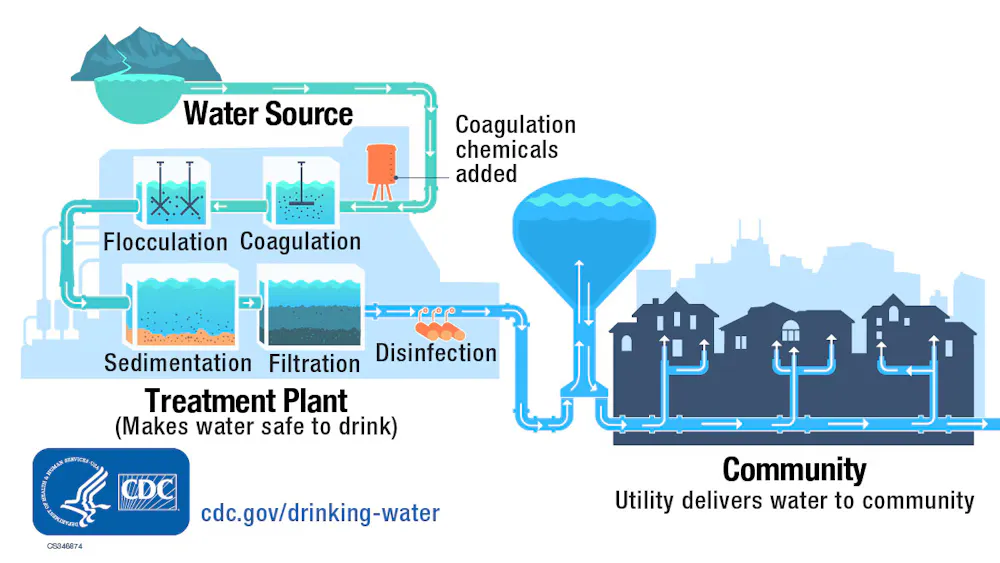
    Today, the process of cleaning water begins with the same steps employed by the ancient Egyptians, followed by extensive filtration to get rid of debris as well as most germs and chemicals. Chlorine is added to kill lingering pathogens, including those that may reside in the service pipes carrying the water to the faucet. Beginning in the 1940s, a small amount of fluoride was added as an inexpensive, safe and effective means to improve dental health.

    The cleanliness and fluoridation of the water supply has dramatically reduced infectious disease and cavities, and has been heralded as one of the 20th century’s greatest public health achievements.

    Is raw water healthier than tap water?

    People who champion raw water claim it has health benefits, such as essential minerals and beneficial bacteria called probiotics, that are stripped from tap water. Let’s unpack each of these claims.

    Water dissolves bits of soil and rock at its source; therefore, its mineral content depends on the local geology. Areas with a lot of limestone, like the Midwest, have water that is higher in calcium. Water from deeper in the ground may have higher mineral content since it passes through more rock on its way to the surface.

    The mineral content of water largely depends on its source and location.
    Sergii Zyskо/iStock via Getty Images Plus

    The idea that tap water is depleted of essential minerals is not true, as these nutrients are too small to be excluded by the filtration process. Test kits can determine the mineral content of your water, and if you find it lacking, mineral supplements can be added. Experts suggest, however, that most minerals you need come from your diet, not water.

    Some also claim that raw water contains probiotics that are removed from tap water. The amount of probiotics in water would also vary by location, and the notion that health-promoting bacteria reside in raw water has not been proved.

    There are no studies associating raw water with any health benefit. Anecdotal claims about smoother skin or increased energy are likely to be placebo effects. Even the idea that raw water tastes better might be more psychological than physiological – a 2018 study showed that most people preferred tap water over bottled water in a blind taste test.

    Risks of drinking raw water

    Raw water carries the risk of serious gastrointestinal infection from a wide variety of pathogens.

    Water-borne viruses include rotavirus and norovirus, which cause rapid-onset diarrhea and vomiting, and hepatitis A, which infects the liver. Bacteria such as E. coli and Salmonella, or parasites like Cryptosporidium and Giardia, also cause severe diarrhea that can lead to dangerous levels of dehydration. Toxoplasma gondii can also lurk in raw water and can cause miscarriage or birth defects if consumed during pregnancy.

    Tap water undergoes several treatment steps before it reaches your faucet.
    CDC

    Carriers of diarrheal infections can transmit them to others if they swim in public pools or fail to properly wash their hands before touching others or preparing food. Norovirus is particularly durable and can survive on surfaces for days, increasing chances of it infecting someone else.

    Raw water can also contain algae that release toxins causing abdominal issues and damage to the brain and nervous system.

    Cholera, dysentery and typhoid fever are no longer health burdens in the U.S. thanks to a robust water treatment system. But areas of the world lacking this privilege suffer high child mortality and widespread diarrheal diseases.

    How safe is tap water in the US?

    Tap water in the U.S. is among the safest to drink in the world. The Biden administration took steps to further improve it, including funding to replace lead pipes and new rules to monitor forever chemicals like perfluoroalkyl and polyfluoroalkyl substances, or PFAS, which have been linked to cancer and developmental disorders.

    Importantly, raw water is not necessarily free from lead, arsenic, pesticides or industrial contaminants. Raw water sources are not reliably monitored by experts, so it is difficult to say which ones pose less risk. In addition, the water may be acceptably safe one day, but not on another. For example, soil runoff from a storm could introduce new germs or pollutants into the area.

    The Environmental Protection Agency routinely screens for nearly 100 contaminants to ensure tap water is safe. In contrast, raw water remains untested, unregulated and untreated, leaving its safety to drink in question. In terms of risks and benefits, there are no demonstrated health benefits from drinking raw water, but clear evidence that you may be exposing yourself to harmful infectious and toxic contaminants.

    Bill Sullivan receives funding from the National Institutes of Health.

    ref. How does raw water compare to tap water? A microbiologist explains why the risks outweigh the benefits – https://theconversation.com/how-does-raw-water-compare-to-tap-water-a-microbiologist-explains-why-the-risks-outweigh-the-benefits-246866

    MIL OSI – Global Reports

  • MIL-OSI USA: Murray, Schumer, Murphy, Kim Lead 46 Senators in Introducing Resolution Condemning Pardons of Individuals Found Guilty of Assaulting Capitol Police Officers

    US Senate News:

    Source: United States Senator for Washington State Patty Murray

    Resolution comes after Trump pardons 1,500 Jan 6 insurrectionists—including those convicted of violently assaulted police officers

    Murray will seek unanimous consent to pass the resolution this week

    Washington, D.C. – Today, U.S. Senators Patty Murray (D-WA), Democratic Leader Chuck Schumer (D-NY), Chris Murphy (D-CT), and Andy Kim (D-NJ) will lead a group of 46 senators in introducing a new resolution condemning the pardons of individuals who were found guilty of assaulting Capitol Police Officers. The resolution follows the move by President Trump, on the first day of his second term, to grant full, complete, and unconditional pardons to over 1,500 people charged with committing crimes in the January 6, 2021 attack on the U.S. Capitol, and to commute the sentences of 14 others, including leaders of the Proud Boys and Oath Keepers, far-right militias. Among those pardoned by Trump were 169 people who pled guilty to assaulting police officers on January 6th.  During the siege of the Capitol that day, over 80 U.S. Capitol Police Officers were assaulted, as well as over 60 officers from the Washington, D.C. Metropolitan Police Department.

    The senators’ resolution, Condemning the pardons for individuals who were found guilty of assaulting Capitol Police Officers, simply states: “Resolved, That the Senate disapproves of any pardons for individuals who were found guilty of assaulting Capitol Police officers.” This week, Senator Murray will seek unanimous consent on the Senate floor to pass the resolution.

    In addition to Murray, Schumer, Murphy, and Kim, Senators Angela Alsobrooks (D-MD), Tammy Baldwin (D-WI), Michael Bennet (D-CO), Richard Blumenthal (D-CT), Lisa Blunt Rochester (D-DE), Cory Booker (D-NJ), Maria Cantwell (D-WA), Chris Coons (D-DE), Catherine Cortez Masto (D-NV), Tammy Duckworth (D-IL), Dick Durbin (D-IL), Ruben Gallego (D-AZ), Kirsten Gillibrand (D-NY), Maggie Hassan (D-NH), Martin Heinrich (D-NM), John Hickenlooper (D-CO), Mazie Hirono (D-HI), Tim Kaine (D-VA), Mark Kelly (D-AZ), Angus King (I-ME), Amy Klobuchar (D-MN), Ben Ray Luján (D-NM), Ed Markey (D-MA), Jeff Merkley (D-OR), Jon Ossoff (D-GA), Alex Padilla (D-CA), Gary Peters (D-MI), Jack Reed (D-RI), Jacky Rosen (D-NV), Bernie Sanders (I-VT), Brian Schatz (D-HI), Adam Schiff (D-CA), Jeanne Shaheen (D-NH), Elissa Slotkin (D-MI), Tina Smith (D-MN), Chris Van Hollen (D-MD), Mark Warner (D-VA), Raphael Warnock (D-GA), Elizabeth Warren (D-MA), Peter Welch (D-VT), Sheldon Whitehouse (D-RI), and Ron Wyden (D-OR) also cosponsored the resolution. In total, 46 senators signed onto the resolution. A PDF of the resolution is HERE.


    “I refuse to allow President Trump to rewrite what happened on January 6th—armed insurrectionists, incited by Trump himself, broke into the U.S. Capitol and violently assaulted Capitol Police officers in their attempt to overthrow a free and fair election,”
    said Senator Murray. “Insurrectionists cracked the ribs of police officers and smashed spinal disks. Donald Trump’s pardons are a wholesale endorsement of political violence—as long as it serves Donald Trump. Affirming that U.S. Senators condemn unconditional pardons for people who were found guilty of violently assaulting Capitol Police officers should be the easiest thing in the world. If Republicans care even the tiniest bit about law enforcement, they should be outraged by these pardons. I hope and expect my Republican colleagues will allow this very simple resolution to pass as a show of support for the officers who put their lives on the line to keep senators safe.”

    “The people who invaded the Capitol on January 6th, whether they committed violence or not, broke the law and attempted to thwart democracy. What they did is a serious crime. There’s no gray area here,” said Democratic Leader Chuck Schumer. “Donald Trump’s made it clear he’s more interested in rewarding lawbreakers and pardoning lawless rioters who attacked police officers and invaded the Capitol, than standing up for law and order. Senate Republicans who experienced the same mayhem on January 6 should join us in condemning this dangerous signal to lawbreakers, so we can make clear that political violence of any kind is unacceptable.”

    “Trump’s pardons of January 6th rioters who viciously assaulted law enforcement officers send a dangerous message: if you’re willing to commit violence in his name, there are no consequences,” said Senator Murphy. “This endorsement of political violence not only undermines our justice system, but it also makes our nation less safe and emboldens those who would attack our democracy.”

    “On January 6th 2021, we witnessed an attack against our sacred Capitol and a brutal assault on police officers upholding their sworn duty. It is shameful for President Trump to issue the pardons and exalt political violence. We all resoundingly condemned the assassination attempts on Trump only to see him bless the violence against a different branch of government. Never should political violence be acceptable,” said Senator Kim.  

    “President Trump’s blanket pardons of armed insurrectionists, who were convicted by juries of everyday Americans, is the ultimate disrespect for police officers who were brutally assaulted on January 6,” said Senator Blumenthal. “These sickening pardons are a clear endorsement of political violence and discredit justice and the rule of law. I urge my Republican colleagues who were protected that terrible day—and who now stay silent—to join in condemning the violence that occurred and standing with the officers who put their lives on the line for their safety.”

    “By attacking law enforcement and trying to block the peaceful transfer of power, the people being pardoned did serious damage to our Capitol and democracy. Some of them attacked and hurt police officers, all received their day in court and were convicted of their crimes. These pardons are a mistake that I strongly disagree with,” said Senator Cantwell.

    “By putting hundreds of violent criminals back on the streets as one of his first acts back in office, President Trump is sending a clear message: it’s open season on law enforcement officers, as long as you’re committing a crime he approves of,” said Senator Coons, co-chair of the Senate Law Enforcement Caucus. “I pray that none of these criminals go on to commit further acts of violence, but President Trump’s pardons have made our police officers and our streets less safe.”

    “President Trump is pardoning violent criminals who assaulted police officers and attempted to overturn a fair and free election,” said Senator Cortez Masto. “This is an insult to law enforcement across the country and an endorsement of political violence. The very least my Republican colleagues can do to back law enforcement is to support this resolution.”

    “On day one in office—after years of pushing the false narrative that Democrats are ‘soft on crime’ and Republicans truly ‘back the blue’— Donald Trump pardoned over 1,500 violent insurrectionists who assaulted law enforcement officers and stormed our nation’s Capitol in an effort to overturn a free and fair election,” said Senator Duckworth. “Not only are these pardons a gross endorsement of political violence, they’re also an insult to the heroic law enforcement officers who defended our democracy and those who died as a result of that fateful day. If Republicans really cared about upholding democracy and the rule of law, then they’d join us in supporting this simple resolution to condemn President Trump’s pardons.”

    “On January 6, 2021, a mob of Trump-inspired insurrectionists  descended on the U.S. Capitol in an attempt to overturn a free and fair election, wielding unspeakable violence against law enforcement officers.  A ‘full, complete, and unconditional’ pardon dishonors the lives of the five law enforcement officers who died as a result of this day, as well as those who are left with life-altering injuries inflicted by these thugs,” said Senator Durbin.  “This resolution ensures that what truly happened that day – the violent, egregious assault on law enforcement officers and the undermining of a Constitutional proceeding – will not be forgotten, even if President Trump has tried to absolve insurrectionists of their crimes.”

    “I was on the House floor, preparing myself and my colleagues for the mob to overrun the Capitol. President Trump’s pardons of these rioters, many of whom attacked policemen—my friends—is a gross misuse of power,” said Senator Gallego. “We must support law enforcement, not the ones who attacked them and tried to take our democracy.”

    “These criminals used flagpoles, fire extinguishers and bear spray to assault the police securing the Capitol on January 6. No one who assaults a police officer should be given a ‘get out of jail free card’ from the President,” said Senator Heinrich.

    “Instead of focusing on steps to strengthen our economy, lower costs, or make communities safer, Donald Trump’s day one priority was pardoning over 1,500 people who stormed the Capitol on January 6, 2021 in an attempt to overturn an election, including those convicted of assaulting police officers,” said Senator Kaine. “These deeply offensive pardons are a slap in the face of the law enforcement community—including five Virginians who died after protecting the Capitol that day—the Constitution, the rule of law, and our democracy. I’m joining together with my colleagues to introduce legislation to formally condemn these shameful pardons.”

    “We will never forget the truth of what happened on January 6: A violent mob attacked our democracy, our Capitol, and the brave men and women of the Capitol Police who were defending it, ” said Senator Klobuchar. “These officers deserve our respect, not the release and pardoning of those who assaulted them. Over the last four years, I have led hearings to examine the events leading up to the attack and have worked with Democrats and Republicans to ensure Capitol Police officers have our full support moving forward. The release of and pardons for those who assaulted them is simply wrong.”

    “The pardons that President Trump granted to insurrectionists who desecrated our Capitol and threatened our democracy on January 6 are not only condemnable – they are disrespectful of the law enforcement who show up every day to protect and serve us. When Republicans say they ‘back the blue,’ they are lauding the very violent criminals who left our officers back and blue on that day. Anyone who supports these pardons is supporting crime and violence,” said Senator Markey. 

    “I condemn in the strongest terms President Trump’s disgraceful pardon of more than 1,000 criminals, many of them violent, who overran the U.S. Capitol, desecrated the seat of our democracy, and assaulted law enforcement in their failed attempt to prevent the peaceful transfer of power,” Senator Ossoff said.

    “President Trump’s decision to pardon the people who attacked the U.S. Capitol and violently assaulted law enforcement officers, in an effort to overturn a free and fair election, is a clear abuse of power. A President’s allies should never receive special treatment when they’ve committed serious, violent crimes – crimes intended to undermine our democracy. To give these attackers a clean slate not only undermines the rule of law, it emboldens their extreme ideological views and it further erodes Americans’ trust in our government,” said Senator Peters.

    “These pardons were a slap in the face of the Capitol Police who stand up everyday to protect members of Congress.  They have our back; we should have theirs.  Failing to condemn the pardons of the criminals who attacked the Capitol would be a shameful betrayal of these dedicated officers,” said Senator Reed.

    “It’s unconscionable that one of President Trump’s first actions in office was to pardon criminals who violently attacked the U.S. Capitol on January 6th, 2021,” said Senator Rosen. “A number of these convicted felons attacked police officers and injured them. It should not be a partisan issue to fully condemn these actions and President Trump’s pardons.”

    “Pardoning those who were convicted of assaulting police officers who were doing their duty during the January 6, 2021, attack on the U.S. Capitol is reckless and dangerous,” said Senator Shaheen. “No elected official, especially the President of the United States, should ever do anything that would justify, condone or excuse politically motivated violence. I hope all my colleagues will join us in supporting this resolution to condemn pardons for those found guilty of assaulting police officers on January 6, 2021.”

    “President Trump’s day one agenda was letting violent criminals who beat police officers out of prison. These are people who planned an insurrection, assaulted police officers with metal batons, fire extinguishers, wooden planks, and even admitted to these crimes and pled guilty in court. The brave Capitol Police officers who put themselves in danger to protect our democracy deserve better. We can’t let what actually happened on January 6th, 2021 be rewritten and whitewashed,” said Senator Smith.

    “On January 6, many rioters attacked our Capitol and assaulted, bludgeoned, and bloodied Capitol Police officers and officers from the District of Columbia. Donald Trump’s pardons of these convicted criminals are sickening – they are a gross insult to the brave officers who did their duty and a betrayal of all of law enforcement. I urge our Republican colleagues to join us in sending a simple message: celebrating criminals convicted of beating police officers is unacceptable,” said Senator Van Hollen.

    According to the U.S. Attorney’s Office for the District of Columbia, approximately 1,572 defendants have been federally charged with crimes associated with the attack of the U.S. Capitol on January 6th. This includes approximately 598 charged with assaulting, resisting, or impeding law enforcement agents or officers or obstructing those officers during a civil disorder, including approximately 171 defendants charged with using a deadly or dangerous weapon or causing serious bodily injury to an officer. As proven in Court, the weapons used and carried on Capitol grounds during the January 6th attack include firearms; OC spray; tasers; edged weapons, including a sword, axes, hatchets, and knives; and makeshift weapons, such as destroyed office furniture, fencing, bike racks, stolen riot shields, baseball bats, hockey sticks, flagpoles, PVC piping, and reinforced knuckle gloves.

    Among others, the individuals who assaulted law enforcement officers and were granted full, unconditional pardons by President Trump this week include:

    • Taylor James Johnatakis, of Kingston, Washington, was convicted of three felonies in November 2023, including assaulting officers. Prosecutors said that he “coordinated a violent assault on a line of police officers defending” the Capitol and that video shows he “used a metal barricade to attack officers head on and grabbed one officer to prevent him from defending himself against other attacking rioters.”
    • Julian Khater, who assaulted a U.S. police office—Brian Sicknick—and later pled guilty to assaulting a police officer with a dangerous weapon.
    • Robert Palmer, who attacked police with a fire extinguisher, a wooden plank, and a pole.
    • Tyler Bradley Dykes of Bluffton, South Carolina, who was sentenced to 57 months in federal prison for stealing a police riot shield and twice using it against officers. He pleaded guilty to two felony counts of assaulting, resisting or impeding officers.
    • Devlyn Thompson, who hit a police officer with a metal baton.
    • Andrew Taake, of Houston, Texas, who was sentenced to a little more than six years for assaulting law enforcement officers with bear spray and a metal whip.
    • Christopher Quaglin, who federal prosecutors said “viciously assaulted numerous officers” and was one of the most violent rioters, was sentenced to 12 years in federal prison.
    • David Dempsey, who, according to prosecutors, “was one of the most violent rioters,” and received 20 years in prison. Prosecutors also said Dempsey had a “very significant history of arrests and convictions” prior to the January 6th attack.
    • Daniel Rodriguez, of Fontana, California, who plunged a stun gun into the neck of Washington Police Officer Michael Fanone multiple times.
    • Ryan Nichols, of Longview, Texas, who assaulted officers with pepper spray, and later on Jan. 6, at his hotel room, he called for additional violence.
    • Howard Richardson, of King of Prussia, Pennsylvania, who struck a police officer three times with a flagpole, hard enough to break the flagpole.
    • Robert Sanford, from Chester, Pennsylvania, who hit two police officers in the head with a fire extinguisher and threw a traffic cone at another officer.
    • Jonathan Munafo, of Albany, New York, who punched a police officer, stole the officer’s riot shield, and struck a Capitol office window with two poles.

    MIL OSI USA News

  • MIL-OSI USA: Municipal Roads Repaired with FEMA Funds

    Source: US Federal Emergency Management Agency

    Headline: Municipal Roads Repaired with FEMA Funds

    Municipal Roads Repaired with FEMA Funds

    Projects included flood, erosion, and hazard mitigation worksGuaynabo, PUERTO RICO — The Federal Emergency Management Agency (FEMA) allocated nearly $2.6 million to repair important roads and bridges in the municipalities of Barranquitas and Caguas after Hurricane María, helping to restore road infrastructure and reduce the risk of future damage in the area.“These bridge and road repairs strengthen the island’s resilience, allowing it to not only repair damage, but also increase its capacity to meet future challenges through federal FEMA assistance that includes measures to prevent future damage and protect critical infrastructure,” highlighted the Director of Public Assistance, Al Gómez Rivera.One of the projects in this obligation was the repair of the Maneco Bridge in the Cañabón neighborhood of Barranquitas, which consists of a road and a culvert built in 1960. The planned work had over $579,000 in funds and included the repair of the asphalt, base material and subbase of the road and the 27-foot-long corrugated metal pipe culvert.FEMA’s Public Assistance director, Al Gómez Rivera, explained that one of the main damages was to the sewer pipes through which the river basin passed. The funds for the project made it possible to widen the sewer to mitigate damage to the structure in the event of future rains.The bridge, which now bears the name of “Maneco” — as Manuel Colón Santos is affectionately known — benefits some 200 families. Maneco is a leader at the Cañabón neighborhood, known for the help he provides to his neighbors: his home was available to the community and was a space where food and other aid was offered after Hurricane María. Maneco also works with other residents to maintain the neighborhood’s community center, which serves as a shelter and a space for social events.   “Our past perils are over; sometimes you would go to an event and, if it rained, you had to wait on the other side, spend two or three hours [waiting] for the river water to decrease to be able to go through. I am very grateful because it is good for the community and, not only for us, but also for many communities in particular,” Maneco said. Moreover, FEMA allocated over $2 million for repairs to the Los Ramos bridge in the Las Carolinas community in Caguas. This grant supported the construction of a new one-span concrete bridge with galvanized steel beams, as well as the installation of erosion protection in the river. The project also included repairs such as the removal of damaged sections of the bridge and the installation of a temporary asphalt surface while the new bridge is being built.To reduce the risk of future flooding, gabions were installed to protect the bank and bridge foundations from erosion. A geotextile fabric was also placed under the gabions to stabilize the soil and prevent erosion due to rainfall. Hazard mitigation funding includes an allocation of over $26,000 to reduce the risk of future damage. These include the installation of curbs and gutters, drainage ditches and a network to stabilize the road and prevent erosion. These works are expected to prevent long-term damage to the road and protect the environment.The measures also include planting vegetation and installing a netting to prevent bank erosion, which will help protect the area from future damage caused by heavy rains and flooding.FEMA has allocated nearly $34.9 billion for over 11,050 recovery projects following Hurricane María. Of this total funding, over $2.7 billion are earmarked for over 3,000 bridge and road projects across the island.For more information about Puerto Rico’s recovery,  visit fema.gov/disaster/4339, fema.gov/disaster/4473 and recovery.pr. Follow us on our social media at Facebook.com/FEMAPuertoRico, Facebook.com/COR3pr and Twitter @COR3pr.
    frances.acevedo-pico
    Mon, 01/27/2025 – 12:30

    MIL OSI USA News

  • MIL-OSI United Kingdom: Improving Access to Scotland’s NHS: We Can Renew Scotland’s NHS and Help Our Nation Thrive

    Source: Scottish National Party

    Like all of us, the National Health Service is personal for me – I see first-hand all that it does, and has done, for my own family.

    In the last years of my beloved Mother’s life, I saw such care and attentiveness in the community and in hospital care.

    My wife would not have the capacity and capability she has in dealing with MS, had it not been for the outstanding care and insight of the National Health Service alongside, might I say, her absolutely personal determination to stay strong.

    I would not have had such joy in my life at the birth of my three children without the National Health Service.

    It is personal for all of us.

    That is why we care about it so much.

    That is why we want to see it thriving once again.

    We all know the tremendous pressures our NHS has been under in recent years.

    We see a service still reeling from the strain of a global pandemic – a pandemic that revealed the NHS’s many strengths but also exposed its underlying weaknesses.

    Weaknesses made worse by a decade and a half of austerity, and by the body blow of inflation that has meant – as we know from our own family finances – the available money delivers less.

    It is a service still beset by backlogs and delayed discharges, and struggling to meet the increasing needs of an ageing population.

    The challenges are great, of that I have no doubt. But I know also that our NHS is fundamentally resilient, fundamentally robust.

    I witnessed both these realities earlier this month when I spent a Saturday evening visiting the emergency department at the Royal Infirmary of Edinburgh.

    In the midst of both winter pressures and a particularly challenging flu season, I saw patients who waited too long to be seen, but also staff who went above and beyond.

    I saw an NHS that in the face of the storm kept on standing, kept on delivering.

    There are some who oppose the NHS model, who believe that the answer to our health challenges is a privatisation of care. They want us to believe that the health service is beyond saving, that it is on the point of collapse.

    But that is simply not true.

    There are challenges.

    Some services are struggling.

    Periods of real crisis as we have seen in recent weeks as flu cases spiked.

    The impact of these issues on too many patients is real.

    But, as I will set out today, there is nothing wrong with the National Health Service that can’t be fixed by what is right with the National Health Service.

    What is right with the National Health Service includes the thousands of health and care staff who are doing phenomenal things under enormous pressure.

    People who, time and again, display resilience, selflessness and grit, who truly go above and beyond.

    It includes innovations, such as the Rapid Cancer Diagnostic Service, a new pathway that delivers significant reductions in the time from referral to diagnosis, opening the door also to faster treatment.

    It includes national public health initiatives like the HPV vaccination programme, which has resulted in no cases of cervical cancer in young women who have been fully vaccinated.

    A remarkable, utterly remarkable, life-saving achievement.

    And it includes cutting-edge research, multiple projects, looking into the ways AI can transform diagnosis and treatment in the years to come.

    The foundations on which we will build NHS recovery and renewal are strong.

    Under this Government, the NHS will always remain in the hands of the public and free at the point of use. That is non-negotiable.

    The question then becomes how do we do better?

    How do we ensure our health service is not just the best in these isles but the best it can possibly be?

    The answer to that question is not a simple one. There is no ‘magic bullet’.

    Rather, it involves progress across multiple fronts, a balancing of sometimes competing demands and interests.

    It will require choices and action by central government, yes, but that must be delivered in partnership with others – local government, the third sector, patient groups, and health and social care workers at all levels.

    It must deliver reform that is fundamentally patient-centred but do so through a health and social care system that becomes an ever more interconnected whole.

    I have said before that my approach as First Minister is to seek the right solutions, not merely the quick ones.

    I favour consensus building and collaboration over diktats from on high. For the future success of our NHS this is not only the right approach, but also the necessary approach.

    We will only succeed on this path of reform and renewal if we walk it together.

    That is why the Cabinet Secretary for Health and I meet regularly with staff in all parts of the National Health Service.

    It is why we have been engaging with health boards, local government, Health and Social Care Partnerships, the Scottish Ambulance Service, Public Health Scotland, and NHS 24.

    We have listened carefully, also, to patients and their families, to all those who depend on the NHS for lifesaving, life-enhancing care.

    We have been told all that is going well and all that must be better.

    We have heard the advice from those with direct, frontline experience. And that has helped us develop a clear understanding of where the challenges are, and what changes are needed.

    It is this kind of open, collaborative approach, with a focus on solutions, on the right answers over the easy ones, that has led to the actions I am setting out today.

    It is a set of actions with clear outcomes – tangible improvements that we can and will deliver.

    Tangible improvements to make people’s experience of the NHS in Scotland better than it is today.

    Actions made possible by the record funding we are delivering to the NHS frontline.

    Actions that will address the immediate issues in our health service – those problems of access that I know cause so much frustration, and indeed for some, unnecessary pain.

    Actions that set out a new course so we can safeguard the NHS for the long-term.

    Over the coming weeks, the Government will set out for Parliament what the different elements of our approach will mean in practice.

    And we will be reminding Members of Parliament as we do that, that the delivery of this stronger NHS depends on the safe progress of the draft Budget currently being considered by Parliament.

    The actions we will take to deliver a more accessible, more person-centred NHS have three clear purposes:

    First, to reduce the immediate pressures across the NHS.

    Second, to shift the balance of care from acute services to the community.

    Third, to use innovation – digital and technological – to improve access to care.

    Together, these will address the problems that right now, every day weigh down our National Health Service.

    They will begin to deliver the long-term, systemic improvement that is needed to ensure our health service is sustainable for the future.

    And they will make it easier for people across Scotland to live healthier lives, helping us to build a future in which health is practiced in homes and communities as much as it is practiced in surgeries and hospitals.

    So let’s talk first about those immediate problems, the crises facing too many parts of our National Health Service.

    The first and most important thing on many people’s minds is how long it can take to access services.

    Delays in access, with waiting times that are too long, and delays in discharge, because appropriate at home or in community care is not available.

    The two, of course, are fundamentally connected.

    Last year, I referred to delayed discharge as the canary in the coal mine of our National Health Service. I think of waiting times in much the same way.

    Both these delays tell us that the flow of people through the health system is not happening as it should.

    Put more simply, people are not getting the right care in the right place, at the right time.

    That is not acceptable to me.

    It is not acceptable to my Government, because it can lead to people getting sicker as they wait, and it can mean they can take longer to recover.

    It adds substantially to the stress they and their loved ones experience.

    It creates greater strain across the system, leading to more delays elsewhere, poorer outcomes for others and still further stress on services.

    It is the very definition of a vicious circle, and it has to come to an end.

    So, today, we commit to a substantial increase in capacity in order to significantly reduce people’s waits.

    The changes we propose – including an enhanced regional delivery model, alongside increased levels of activity in our National Treatment Centres – will deliver over 150,000 extra appointments and procedures – in hospitals, in communities – in the coming year.

    That includes 10,000 extra procedures through smarter working in the National Treatment Centres.

    Other sites – including Gartnavel, Inverclyde, Stracathro, Perth Royal Infirmary and Queen Margaret Hospital – will deliver 9,500 extra cataract procedures.

    As well as 2,500 extra orthopaedic appointments and procedures – operations such as hip or knee replacements.

    In this way, we will create centres of excellence, places of expertise and specialisation, where we will be better placed to capitalise on the technological innovation and the potential of AI.

    And we will cut our waiting lists.

    Cancer referrals, gynaecology, ophthalmology, orthopaedics, and radiology – all benefiting from this new investment.

    Centres able to deliver more care, more quickly and more efficiently than traditional, smaller, more fragmented facilities – with transport support provided for those who need it.

    And, to ensure that they do, we will put in place clear milestones and targets for those specialities that add the most to our waiting lists.

    Our second focus will see more and better care delivered in the community.

    I spoke earlier about the importance of people receiving the right care at the right time, in the right setting.

    That right setting will always be the least intensive setting appropriate to the person’s needs.

    Sometimes that appropriate setting is in hospital. More often, it is not.

    So to strengthen and renew our NHS, we will shift more care into communities and into homes.

    As much as possible, people who do not need to be in hospital will not go to hospital, protecting those acute services for those who absolutely need them.

    This new approach will mean changing the way we deliver acute services.

    By this summer, we will have specialised staff in frailty teams, at the front door of every A&E department in Scotland.

    This will mean that frail patients, often older patients with complex needs, will bypass our busy A&Es, in order to receive the specialist care and support they need, whether in hospital or back at home.

    It will mean better care for these most vulnerable patients while reducing the pressure on our A&Es.

    Our actions will also improve the NHS’s capacity to treat people at home.

    Our Hospital at Home initiative, which allows hospital-levels of care in a person’s home, will be expanded to at least 2,000 beds by the end of 2026.

    Without the need for any new bricks and mortar, the effective capacity of every single hospital in Scotland will be expanded.

    Taken together, it is action that will ease acute pressures, reduce delays, cost less to our NHS, and most importantly, help people get better more quickly, more comfortably.

    Quality care for thousands of Scots delivered not simply close to home, but at home.

    Of course, we cannot simply shift services out of acute settings. We also need to build capacity in our primary care and community health settings.

    With this in mind, the Government has been listening carefully to the views of Scotland’s GPs.

    They have described the multiple contributions general practice can make as we shift to more community-focused care. They have argued that GPs must be given the resources they need to fulfil that role.

    We have listened, and we have been persuaded.

    As a result, our plan will ensure that a greater proportion of new NHS funding goes to primary and community care.

    GPs and services in the community will have the resources they need to play a greater role in our health system.

    This increased investment will result in GP services that are easier for people to access.

    That is important in terms of people’s confidence in the health service – indeed, difficulties making GP appointments top the list of issues that people often raise with me.

    But equally, it will make it more likely that health issues are picked up quickly and dealt with earlier.

    For there is no better way to deal with illness than to prevent it.

    Addressing conditions early and intervening to prevent diseases from progressing, prevents manageable conditions from becoming serious ones.

    It is good for patients and of vital importance for the future sustainability of our National Health Service.

    That is why our plan also includes £10.5 million to build GP capacity to intervene earlier and prevent illnesses, such as cardiovascular disease.

    But this is not only an issue of money. We must also innovate and identify new ways of working.

    For example, I want to see the NHS Scotland Pharmacy First Service expand so that community pharmacies can treat a greater number of clinical conditions and prevent the need for a GP visit in the first place.

    The third part of our approach is innovation to improve access to, and delivery of, care.

    Better use of data will ensure that more operating theatres are working at maximum capacity, with best practice approaches, approaches shown to increase productivity by 20%, rolled out across the country.

    Using existing capacity, more operations will be delivered – enabling us to also deliver shorter waiting times.

    The latest innovations in genetic testing will be harnessed to enable better targeting of medications in cases ranging from recent stroke patients to new-born infants with bacterial infections.

    Smarter care, better care.

    Building on the already successful model of digital support for mental health – a service that saw 74,000 referrals in 2023-24 – we will offer support in additional areas including dermatology and the management of long-term conditions.

    This type of care, because it is not dependent on physical attendance, at a specific time, in a specific place, is more flexible.

    It means care can be made to fit better into the lives of those who use the services.

    Again, smarter care, and better care.

    And, as a much-needed addition to improve patients’ interaction with the NHS, there will be a Scottish health and social care app.

    This ‘Digital Front Door’ will begin rollout from the end of this year, starting in Lanarkshire, and, over time, it will become an ever more central, ever more important access and management point for care in Scotland.

    This is the third in a series of speeches I have delivered in recent weeks.

    In each I have spoken about the importance of identifying clear goals, clear direction to national policy.

    If we have a clear sense of the direction we wish to travel, the levels of success we wish to achieve, and if we can unite behind these goals, then genuine progress becomes all the more possible.

    Protecting, strengthening, renewing our National Health Service – that is a goal I think we can all get behind.

    MIL OSI United Kingdom

  • MIL-OSI USA: Forecast wholesale power prices and retail electricity prices rise modestly in 2025

    Source: US Energy Information Administration

    In-brief analysis

    January 27, 2025


    In our January Short-Term Energy Outlook (STEO), we expect that U.S. wholesale power prices will average slightly higher in 2025 in most U.S. regions than last year, except in Texas and in the Northwest. We forecast that the 11 wholesale prices we track in STEO will average $40 per megawatthour (MWh) in 2025 (weighted by demand), up 7% from 2024. We expect the 2025 average U.S. residential electricity price will be 2% higher than the 2024 average, though after accounting for inflation, our forecast for U.S. residential prices remains relatively unchanged from 2024.

    Wholesale power prices are an indicator of the cost of generating power and are generally created on an hourly or daily basis in the United States. These prices reflect the operating and fuel costs of the most expensive unit that is needed for fulfilling electricity demand at a given point in time at a defined pricing point location within the power grid, along with any costs associated with transmission congestion into that area. The cost of natural gas is a primary driver of wholesale prices in many regions because the marginal generator is often one fueled by natural gas. We expect that the cost of natural gas delivered to U.S. power generators will average $3.37 per million British thermal units in 2025, which is up 24% from last year’s average but is about the same price as in 2023.

    We expect that average wholesale power prices will range from about $30/MWh in the part of Texas where the grid is managed by the Electric Reliability Council of Texas (ERCOT) to $55/MWh in the Northwest region. These two regions are the only ones in which we expect lower wholesale prices this year. The Northwest region is still experiencing drought conditions, but we expect conditions to improve slightly this year with 20% more hydropower generation. Increasing generation from solar power projects is contributing to lower wholesale prices in ERCOT.

    Other regions of the country are likely to see higher wholesale prices over the next year as a result of higher costs for natural gas. We expect the largest increases (about 30%–35%) will occur in the Southwest and California regions. Forecast wholesale prices in the ISO New England region average $55/MWh in 2025, up 16% from 2024. Although we expect higher wholesale prices in 2025, they would still be lower than in 2022, when the composite average wholesale price reached $80/MWh.


    Changes in the costs of supplying electricity can take time to affect retail electricity prices because retail rates are reviewed and approved by utility regulators in many areas of the country. We expect U.S. retail electricity prices for residential customers will average 16.8 cents per kilowatthour, which would be 2% more than in 2024. After accounting for inflation, forecast U.S. residential prices in 2025 are relatively unchanged from 2024.

    Principal contributor: Tyler Hodge

    MIL OSI USA News

  • MIL-OSI Global: Trump’s plan to eliminate FEMA is a very bad idea

    Source: The Conversation – Canada – By Jack L. Rozdilsky, Associate Professor of Disaster and Emergency Management, York University, Canada

    A symbolic visit by an American president to a disaster site can be constructive. Former President Joe Biden’s presence at areas in the United States affected by various disasters allowed him to both show leadership and offer comfort in moments of national tragedy.

    In contrast, a bombastic President Donald Trump used his first domestic trip on Jan. 24 to tour disaster sites in North Carolina and Los Angeles while promoting his litany of grievances and rambling about his dislike of the Federal Emergency Management Agency (FEMA).

    It takes a perverse set of skills for a president to act in a way that squanders the opportunity to genuinely exhibit compassion for disaster victims while also lowering the morale of emergency workers at the same time.

    Trump’s announcement to overhaul or eliminate FEMA — especially in the midst of an ongoing disaster — is unreasonable and foolish.

    Trump’s criticisms

    In a Fox News interview on Jan. 22, Trump suggested that FEMA would be facing a reckoning.

    The president echoed Republican criticisms of the Hurricane Helene disaster response last September. During Hurricane Helene, Trump has used his bully pulpit to endorse or invent false or unsubstantiated claims. The federal government was also falsely accused of a lack of response following Helene.

    While touring hurricane damage in North Carolina on Jan. 24, Trump remarked:

    “Well, I’ll also be signing an executive order to begin the process of fundamentally reforming and overhauling FEMA or maybe getting rid of FEMA. I think, frankly, FEMA is not good.”

    Trump indicated he would like to see state governments respond to disasters.

    The White House later clarified that an upcoming executive order would direct a council of FEMA advisers to examine the agency and come up with proposals for reform.

    Turning back the clock

    If Trump gets rid of FEMA, he’ll be turning back the clock 50 years. It is illogical to call for a return to a time with a weak and disorganized system of disaster management.

    In the 1970s, states were responsible for managing their own disasters. More than 100 different federal agencies could become involved in relief efforts. The system was reactionary and responded on a need basis, with no clear pathways for federal disaster assistance to states.

    State governors became increasingly concerned about the lack of a comprehensive national emergency policy. The dispersion of federal disaster management responsibilities among numerous federal agencies was viewed as impeding states’ own ability to manage disaster situations.

    In advocating for better disaster management, a National Association of Governors’ report entitled 1978 Emergency Preparedness Project made the case for a centralized emergency management system in the U.S.

    President Jimmy Carter acted on the recommendations of the governors with Executive Order 12127 to create FEMA in 1979. It was a cabinet-level agency until 2003, when it was merged into the Department of Homeland Security.


    Read more:
    Jimmy Carter’s death invites us to consider his legacy of nuclear emergency response and disaster management


    Duties enshrined in law

    When a large-scale disaster stretches the ability of an American city to help its citizens, a formal process exists to request aid. As a local disaster expands in size and scope, requests for more assistance can go up to higher levels of administration, from the state governor and ultimately to the president. In this process, FEMA reports to local governments.

    A presidential disaster declaration can open up access to an array of federal programs managed by FEMA to assist with response and recovery.

    FEMA was created by President Jimmy Carter in 1979.
    (J. Rozdilsky), CC BY

    The role of FEMA in supporting the declaration process are defined in provisions in the U.S. Code of Federal Regulations. The Stafford Act also provides for the statutory authority guiding FEMA programs like individual assistance.

    While Trump sits at the top of the executive branch, he can engage in a variety of political shenanigans to undermine FEMA, but he cannot unilaterally abolish the agency. As the agency’s duties are enshrined in law, only an act of the legislative branch can terminate FEMA.

    A turbulent history

    FEMA has existed for 46 years and faced turbulent times due to the poor decision-making by past Republican presidents. In 1980, Reagan appointed agency directors with conservative philosophies who emphasized downsizing. Under George W. Bush’s presidency, among the flurry of reactions to Sept. 11, 2001, FEMA was eviscerated and relegated from a top-level cabinet level agency to a position buried deep in the Homeland Security organizational chart.

    Trump’s aggressive posture in trying to remake government involves creating diversions, sowing chaos and overloading people with lies. Taking a cue from his former White House strategist Steve Bannon on how to deal with the media, Trump’s statements about FEMA have worked to “flood the zone with shit.”

    As with many functions of American government, emergency management is just the latest target of disorientation tactics intended to paralyze government operations.

    Jack L. Rozdilsky receives support for research communication and public scholarship from York University. He also has received research support from the Canadian Institutes of Health Research.

    ref. Trump’s plan to eliminate FEMA is a very bad idea – https://theconversation.com/trumps-plan-to-eliminate-fema-is-a-very-bad-idea-248293

    MIL OSI – Global Reports

  • MIL-OSI Video: ‘I’m Going to Help You Fix It’: President Trump Fulfills Promise on California Wildfire Recovery

    Source: United States of America – The White House (video statements)

    On January 24, 2025, President Trump and First Lady Melania visited Los Angeles to survey wildfire damage, meet with first responders, and pledge federal support for recovery efforts, including plans to improve water access for firefighting.

    https://www.youtube.com/watch?v=GoZca8jIm1Q

    MIL OSI Video

  • MIL-OSI Russia: Dmitry Patrushev and Gleb Nikitin discussed water use issues in the Nizhny Novgorod region

    Translation. Region: Russian Federation –

    Source: Government of the Russian Federation – An important disclaimer is at the bottom of this article.

    Dmitry Patrushev held a working meeting with the Governor of the Nizhny Novgorod Region Gleb Nikitin

    Deputy Prime Minister Dmitry Patrushev held a working meeting with the Governor of the Nizhny Novgorod Region Gleb Nikitin. They discussed a wide range of issues, including the development of agriculture in the region and the implementation of the national project “Ecological Well-Being”.

    The parties separately focused on changes in the rules for the use of water resources of the Rybinsk and Gorky reservoirs. Dmitry Patrushev drew attention to the need to adjust and update the existing rules taking into account modern socio-economic conditions.

    The Deputy Prime Minister emphasized that when deciding the issue of regulating the operation of the Gorky Reservoir during a major flood, the safety of the population is a priority.

    Please note: This information is raw content directly from the source of the information. It is exactly what the source states and does not reflect the position of MIL-OSI or its clients.

    MIL OSI Russia News

  • MIL-OSI Africa: Lighting Up Africa: The Transformative Power of Mission 300 (By Kevin Kariuki)

    Source: Africa Press Organisation – English (2) – Report:

    ABIDJAN, Ivory Coast, January 27, 2025/APO Group/ —

    By Kevin Kariuki, Vice President for Power, Energy, Climate, and Green Growth at the African Development Bank Group (www.AfDB.org/en)

    Across Africa, nearly 600 million people live in energy poverty, deprived of reliable access to electricity—a fundamental prerequisite for modern life. This staggering statistic represents more than just a lack of power.  Significantly, it translates to limited opportunities for education, healthcare, gender equality, and economic growth. Mission 300, a bold initiative championed by the African Development Bank Group and the World Bank Group in collaboration with key partners, seeks to change this narrative by providing first time electricity access to 300 million Africans by 2030.  A key milestone in this effort, branded Mission 300, is the Africa Energy Summit scheduled for Dar es Salaam, 27/28 January 2025.

    The Significance of Energy Access

    Energy is the engine of development. Without affordable, reliable, and sustainable electricity, Africa cannot achieve its developmental aspirations or secure its rightful place in the global economy. Energy access is the cornerstone of economic transformation, opening doors to education, healthcare, and income generation. Moreover, it fosters gender equality by reducing the time women spend on labour and time-intensive tasks such as cooking with traditional fuels or collecting for firewood. Mission 300’s success is therefore not just about electrification; it is about saving and empowering lives as well as communities.  It is also about reducing greenhouse gas emissions and safeguarding biodiversity.

    Yet, the path ahead is daunting. At the current pace of electrification, coupled with Africa’s rapid population growth, the number of people living without access to electricity could remain largely unchanged. Action is therefore an imperative, and Mission 300 provides the roadmap to achieve universal energy access by 2030, consistent with the United Nations’ Sustainable Development Goal 7 and the African Union’s Agenda 2063.

    The Role of Mission 300

    Mission 300 will invest in new and rehabilitation of generation capacity, transmission systems, including intra- and regional interconnections, as well as distribution grids to build robust and reliable power systems.  It will be complemented by reforms in the energy sector to ensure affordability and sustainability of electricity service, and financially viable utilities while partnerships with the private sector will assist in mobilizing funding at the required speed and scale

    In addition to providing electricity access from interconnected power systems, through Mission 300’s transformative vision, mini-grids, and stand-alone solar home systems will be prioritized to provide electricity to underserved regions and communities, including in fragile and remote areas where extending the interconnected grid is impracticable.  These Distributed Renewable Energy (DRE) solutions are amenable to easy and speedy roll-out, cost-effective, modular, sustainable, and can ensure that no community is left behind in the Mission 300 journey.  DRE solutions are projected to account for more that 50% of new connections by 2030.

    A Defining Moment: The Africa Energy Summit

    The upcoming Africa Energy Summit in Dar es Salaam will be a pivotal moment in Mission 300 journey. Hosted by the Government of the United Republic of Tanzania, the African Union, the African Development Bank Group, the World Bank Group, as well as the African Union, the summit will bring together over 25 Heads of State and Governments, Heads of international Organisation, including Banks, energy experts, and private sector leaders to forge a common path toward universal energy access.

    The principal outcomes of the summit comprise of the adoption of the Dar es Salaam Energy Declaration by the entire continent and twelve country energy compacts co-created between countries and the Mission 300 partners.  The Dar es Salaam Energy Declaration will outline commitments to reforms and actions necessary to achieve Mission 300 while twelve country energy compacts, will expound on the principles of the Dar es Salaam Energy Declaration to establish tangible country specific actions and measures for accelerated electricity access such as least-cost power expansion plans, providing last-mile access through grid and distributed renewables, building financially viable energy systems, regional interconnection and promotion of private sector participation in the energy sector.  The twelve countries that will submit energy compacts account for almost half of the global population without access to electricity.

    Another important outcome will be the enlisting of additional partners to the Mission 300 bus.  Several partners are expected to announce additional financial resources and technical assistance in furtherance of the Mission 300 goal. 

    Why Now?

    Firstly, is the unity of purpose and visionary leadership of African Development Bank Group and the World Bank Group Presidents that has led to the forging of a structured approach to definitively address the electricity deficit problem in Africa, in collaboration with other development partners.

    Secondly, the continent is blessed with abundant energy resources, including renewable energy, such as 60% of the world’s best solar potential, of which only a tiny proportion has been harnessed.

    Thirdly the cost of renewable energy technology, particularly wind and solar, has reduced dramatically in the recent past making electricity generation from these sources cost competitive compared to sources of conventional power.  Moreover, access to information communication technology, and digitization thereof, currently enables payment platforms that support distributed renewable energy solution.

    When combined, the foregoing provides unprecedented opportunities for addressing the continent’s energy access deficit while also espousing a low-carbon growth trajectory, to support Africa’s climate goals.

    A Call to Action

    Mission 300 is more than an energy initiative; it is a moral imperative. It represents a collective commitment to uplift millions from poverty, foster inclusive economic growth, and create a resilient, green future. But its success hinges on robust support from all stakeholders—governments, development partners, the private sector, and civil society. Together, we must prioritize reforms, mobilize investments, and leverage partnerships to transform Africa’s energy landscape.

    Let us seize this defining moment.  The Africa Energy Summit must not just a platform for discussion on energy.  It must constitute a watershed moment for energy access in Africa.   Let us therefore work to actualize Mission 300 and literally light up the lives of millions, thereby creating lasting change that will evoke enormous pride on future generations.

    In conclusion, “the road ahead may be challenging, but it is also filled with opportunity.  With determination, innovation, and collaboration, we can achieve universal energy access in Africa.  This is our moment to make history.”

    MIL OSI Africa

  • MIL-OSI Video: ‘You Are Not Forgotten’: President Trump Delivers on North Carolina Recovery

    Source: United States of America – The White House (video statements)

    On January 24, 2025, President Trump and First Lady Melania visited North Carolina to assess hurricane recovery efforts, meet with officials and first responders, and pledge federal support for rebuilding initiatives.

    https://www.youtube.com/watch?v=0KnVL_kOLpM

    MIL OSI Video

  • MIL-Evening Report: Trump’s ‘ethnic cleansing’ Gaza idea dismissed by analysts – rejected by Jordan, Egypt on ‘Day of Return’

    Asia Pacific Report

    UN President Donald Trump’s idea of mass expulsion of Palestinians in Gaza to Jordan and Egypt has been dismissed by analysts as unaccepable “ethnic cleansing” and rejected by the governments of both neigbouring countries.

    Middle East analyst Mouin Rabbani, a nonresident research fellow at the Middle East Council on Global Affairs and commentator specialising in Palestinian affairs and the Arab-Israeli conflict, said the US and Israel would “fail” over such a plan.

    President Trump’s suggestion had been to “clean out” Gaza and move 1.5 million Palestinians to Jordan and Egypt.

    “Even if [President Trump] applies pressure on Jordan and Egypt, I think their leaderships will recognise the price of going along with Trump is going to be much greater than the price of resisting him — in terms of the survival of their leaderships for participating in something like this,” Rabbani told Al Jazeera, referring to Trump’s plan as “ethnic cleansing”.

    The rebuttals to the Trump idea came as Gaza experienced an historic day with jubilant scenes as tens of thousands of Palestinians crossed the so-called Netzarim Corridor to return home in the north showing their determination to survive under the 15-month onslaught by Israel’s military.

    Al Jazeera journalist Tamer al-Misshal said it was a “significant and historic moment” for the Palestinians.

    “It’s the first time since 1948 those who have been forced out of their homes and land managed to get back — despite the destruction and despite the genocide,” he said.

    He quoted one Palestinian man who returned as saying he would erect a tent on his destroyed home, “which is much better than being forcibly displaced from Gaza”.

    Al-Misshal noted Hamas recently said 18 more Israeli captives were alive and would be returned each Saturday in exchange for Palestinian prisoners over the next few weeks.

    He said the next main step was to get the Rafah land crossing opened so aid could flow and thousands of badly wounded Palestinians could get medical treatment abroad.

    ‘Blanket refusal’

    Analyst Mouin Rabbani . . . “Israel is not going to succeed in ethnically cleansing the Gaza Strip after a war.” Image: Middle East Council on Global Affairs

    Analyst Mouin Rabbani told Al Jazeera about the Trump displacement idea: “This isn’t going to happen because Israel is not going to succeed in ethnically cleansing the Gaza Strip after a war, after having failed to do so during a war.”

    When former US Secretary of State Antony Blinken went on a tour of Arab states to promote this idea late last year, he had been met with a “blanket refusal”, Rabbani added.

    Meanwhile, in Tel Aviv Prime Minister Benjamin Netanyahu was feeling the heat from his coalition partners over the ceasefire deal who view the Israeli leader as succumbing to US demands, the analyst said.

    “I think there’s a kind of a mix of personal, political and ideological factors at play,” Rabbani said.

    “Day of victory” . . . How Al Jazeera reported the return of Palestinians to north Gaza today. Image: AJ screenshot APR

    “But ultimately, I think the key relationship to look at here is not that between Netanyahu and his coalition partners, or between Israelis and Palestinians, but between Washington and Israel — because Washington is the one calling the shots, and Israel has no choice but to comply.”

    A senior Hamas official, Basem Naim, has described the “return” day as “the most important day in the current history of this conflict”.

    He said that Israel was “for the first time” obliged to allow Palestinians to return to their houses after being forced “by the resistance”, in a similar way that it was “forced to release” Palestinian prisoners.

    Al Jazeera’s Hani Mahmoud reporting on the “Day of Return” for Palestinians going back to north Gaza. Image: AJ screenshot APR

    ‘Very symbolic day’ in conflict
    “This is, I think, a very symbolic day,” he said. “This is a very important day in how to approach this conflict with the Israelis, which language they understand.”

    Naim also reaffirmed Hamas’s commitment to the ceasefire agreement and said the group was “ready to do the maximum to give this deal a chance to succeed”.

    He also accused Netanyahu and the Israeli government of playing “dirty games” in a bid to “sabotage the deal”.

    Jordanian officials have rejected President Trump’s “clean out” Gaza suggestion with
    Jordanian Foreign Minister Ayman Safadi saying that all talk about an alternative homeland for the Palestinians was rejected and “we will not accept it”.

    Al Jazeera’s Tareq Abu Azzoum reports from Salah al-Din Road, Gaza. Image: AJ screenshot APR

    He said any attempt to displace Palestinians from their land would not bring security to the region.

    The Jordanian House of Representatives said: “The absurdity and denial of Palestinian rights will keep the region on a simmering and boiling plate.”

    Jordan would not be an alternative homeland for displacement attempts against “the patient Palestinian people”.

    In Cairo, the Foreign Ministry reaffirmed in a statement Egypt’s “continued support for the steadfastness of the Palestinian people on their land.”

    It “rejected any infringement on those inalienable rights, whether by settlement or annexation of land, or by the depopulation of that land of its people through displacement, encouraged transfer or the uprooting of Palestinians from their land, whether temporarily or long-term.”

    The 1948 Nakba . . . more than 750,000 Palestinians were forced to leave their homeland and become exiles in neighbouring states and in Gaza. Many dream of their UN-recognised right to return. Image: Wikipedia

    MIL OSI AnalysisEveningReport.nz

  • MIL-OSI Asia-Pac: Traffic measures to be implemented

    Source: Hong Kong Information Services

    To facilitate festive events occurring on the first two days of the Lunar New Year, the Government will roll out special traffic and transport arrangements at various locations on Hong Kong Island and in Kowloon.

    In connection with the International Chinese New Year Night Parade due to be held in Tsim Sha Tsui at 8pm on January 29, the first day of the Lunar New Year, special traffic arrangements will be implemented in phases starting from 3.30pm that day. They will remain in place until the crowd has dispersed and the roads are safe for re-opening.

    During this period, the Star Ferry Bus Terminus and the China Ferry Terminal Bus Terminus will not be operational. On-street parking will be suspended, and pick-up/drop-off areas and carparks will be closed.

    With regard to the Lunar New Year fireworks display, which will be staged at 8pm on January 30, Police will enforce crowd safety management measures and special traffic arrangements on both sides of Victoria Harbour starting from 5pm.

    In addition, the Marine Department will implement marine traffic control measures and strengthen inspections of spectator vessels to ensure that safety requirements are met.

    MIL OSI Asia Pacific News

  • MIL-OSI NGOs: What do trade unions have to do with human rights?

    Source: Amnesty International –

    Trade unions are critical to protecting and promoting human rights including economic, social, and cultural rights and the right to be free from discrimination.

    First, they play a key role through negotiations with employers and collective action in supporting workers’ rights. In so doing, unions balance the scales of power, ensuring that workers are in a position to advocate for their rights, and holding those who run wealthy and powerful companies to account.

    Second, the benefits of trade unions go far beyond the workplace. Unions are the fuel that keeps the fires of social justice and people power burning so that workers’ rights are respected and protected by law. Throughout history, unions have been the driving force behind calls on governments and employers to acknowledge and prevent human rights abuses that are connected to their business operations. They also ensure laws are adopted and reformed to better respect and protect the rights of workers.

    Finally, unions have a long history of solidarity with other global human rights movements. From strikes in the 80s against apartheid in South Africa to the union-backed campaigns against Israel’s genocide of Palestinians in Gaza, their actions consistently demonstrate the bond between trade unionism and social justice.

    MIL OSI NGO

  • MIL-OSI NGOs: Israel/OPT: Genocide ‘matter of law and evidence, not opinion’ and UK government must ensure accountability

    Source: Amnesty International –

    Marking the one-year anniversary since the International Court of Justice (ICJ) found plausible risk that Israel is committing genocide in Gaza (Sunday 26 January), Amnesty International said the UK government’s disregard for its legal obligations to prevent genocide had contributed to Israel’s impunity and risked British complicity in serious crimes against international law. 

    Amnesty is calling on the UK government to take urgent and meaningful steps to prevent Israel’s genocidal acts against Palestinians in Gaza, as it is obligated to do as a State Party to the Genocide Convention.   

    The landmark case at the ICJ was brought by South Africa and the court’s judges ordered provisional measures to protect Palestinians from further harm, however these were dismissed by Israel. Amnesty’s own analysis concluded that Israel is engaged in committing genocide in a comprehensive report published last year and it continues to do so. 

    Sacha Deshmukh, Amnesty International UK’s Chief Executive, said: 

    “The UK government should have taken heed of this extremely significant ICJ ruling the day it was announced. UK inaction and disregard for its international obligations to prevent genocide contributed to Israel’s impunity and risked British complicity in serious crimes against international law. 

    “The genocide against the Palestinian people is a matter of law and evidence, not opinion. Prime Minister Keir Starmer must accept the UK’s obligations to prevent Israel’s genocide against Palestinians in Gaza and help ensure there is justice and accountability. 

    “To avoid the risk of itself being complicit in genocide, the UK should have ended all arms transfers to Israel long ago and committed full support to the ICJ and other important international accountability mechanisms. The UK should take those steps urgently now. 

    “The staggering number of Palestinian civilians killed, the colossal scale of physical destruction, the blocking of life-saving aid before the ceasefire, and the stream of dehumanising and racist anti-Palestinian rhetoric from Israeli officials, provide the clear evidential basis for genocidal intent, as defined by law, in Israel’s actions in Gaza.  

    “The UK government must fulfil its duties to stop genocidal acts even when committed by an ally and show clearly that it is UK policy that Palestinian lives matter as much as any other human life.”

    Evidence of genocide 

    In December 2024, Amnesty’s International’s research found sufficient basis to conclude that Israel has committed – and is continuing to commit – genocide against Palestinians in the occupied Gaza Strip. 

    The 296-page report - ‘You Feel Like You Are Subhuman’: Israel’s Genocide Against Palestinians in Gaza - documents how, during its military offensive launched in the wake of the deadly Hamas-led attacks in southern Israel on 7 October 2023, Israel has unleashed hell and destruction on Palestinians in Gaza brazenly, continuously and with total impunity.  Amnesty examined Israel’s acts in Gaza closely and in their totality, taking into account their recurrence and simultaneous occurrence, and both their immediate impact and their cumulative and mutually-reinforcing consequences. Amnesty considered the scale and severity of the casualties and destruction over time, and also analysed public statements by officials – finding that prohibited acts were often announced or called for in the first place by high-level officials in charge of the war efforts. 

    As a state party to the Genocide Convention, the UK has a legal obligation to use all reasonable means to help prevent genocide and be consistent when supporting international law – just as it has done when calling out crimes carried out by Russian forces. 


    MIL OSI NGO

  • MIL-OSI Asia-Pac: President Lai’s remarks for Lunar New Year

    Source: Republic of China Taiwan

    On the night before Lunar New Year’s Eve, President Lai Ching-te wished his fellow citizens a happy Year of the Snake via video. In his recorded remarks, President Lai thanked Taiwan’s citizens for their hard work over the past year, helping Taiwan continue to progress and develop, as well as play an even more important role on the global stage. The president emphasized that he will be resolved in the missions of ensuring that the nation endures and progresses, safeguarding the lives and property of the public, and caring for the lives of the 23 million people of Taiwan, so that Taiwan keeps going strong and every person has a bright future.
    A translation of the president’s full remarks is as follows:
    My dear fellow citizens: Good evening. Tonight, the night before Lunar New Year’s Eve, many of you may be heading back home, getting ready to ring in the new year, or preparing holiday dishes. There are also many of you remaining busy at your posts.
    I want to thank all those in the armed forces, police officers, firefighters, members of the coast guard, customs officers, medical personnel, and our partners in the public utilities sector for their hard work, which ensures that our citizens can enjoy peace of mind over the holiday.
    I also want to thank everyone for your hard work over the past year. Together, we overcame many challenges, helping Taiwan continue to progress and develop, as well as play an even more important role on the global stage.
    All our citizens are heroes of Taiwan. In this new year, the government will continue striving to foster national development, spur economic growth, and contribute to citizens’ well-being.
    Not long ago, I joined Hondao Senior Citizen’s Welfare Foundation in sharing a meal with seniors living alone, and met with youth through the Taiwan Fund for Children and Families. I hope that everyone can share concern for the elderly, children, and disadvantaged members of our communities. As the saying goes, respect all elders as you would your own, and care for all children as you would your own. Starting this year, the government will push ahead with our Taiwan Global Pathfinders Initiative to help young people make their dreams a reality.
    I will also be resolved in the missions of ensuring that the nation endures and progresses, safeguarding the lives and property of the public, and caring for the lives of the 23 million people of Taiwan, so that Taiwan keeps going strong and every person has a bright future.
    There is a saying that in a harmonious family, all things prosper. I sincerely hope that every family can enjoy peace, togetherness, and happiness. The same goes for our nation. I look forward to the ruling and opposition parties being in harmony and our society uniting. Let’s work together to help our nation continue to make great strides.
    I wish everyone success and prosperity in the year to come. Happy New Year!
    Happy New Year! (Taiwanese)
    Happy New Year! (Hakka)
    Happy New Year! (Eastern Min)
    Happy Lunar New Year!(English) 

    MIL OSI Asia Pacific News

  • MIL-OSI NGOs: Three questions on the intensification of the armed conflict in North and South Kivu DRC

    Source: Médecins Sans Frontières –

    What is the current situation in North and South Kivu with regards to this crisis?

    Since December 2024, several fronts have been opened in the two provinces to control certain key positions. In Lubero territory, in North Kivu province, the conflict resumed in December with massive displacement. It continued in Masisi territory, where intense fighting took place in January 2025, particularly for control of the town of Masisi Centre, before moving down towards South Kivu province, to Minova and Numbi in Kalehe territory.

    During the hostilities, the M23/AFC managed to take control of several towns. In recent days the fighting has moved closer to the provincial capital of Goma, with intense clashes in Sake, just 20 kilometres from the city. Artillery explosions can be heard regularly from Goma.

    Fighting is taking place on all the roads around Goma and has led to a new influx of displaced people into the city, including from some camps on the outskirts of the city where people flee towards Goma, in a situation of panic.

    How is this situation affecting the population?

    Unsurprisingly, the humanitarian consequences for people are very serious. Hundreds of thousands of people have once again fled the fighting. According to the United Nations, 400,000 people have already fled since January. Tens of thousands headed for displacement sites around Goma, where more than 650,000 people were already living, exhausted by almost three years of fighting.

    The clashes in recent weeks have led to a new influx of people into these completely unhygienic sites where – as we have been saying for far too long – families are surviving without proper shelter and lacking everything: food, water, healthcare, etc.

    Unfortunately, these sites are not spared from the fighting. Rockets are being fired near these camps or the health facilities where people have sought shelter. It’s appalling and unacceptable. We are also seeing a very worrying proportion of civilians among the hundreds of wounded we are helping to treat. Some are victims of stray bullets, but others are victims of the warring parties’ failure to respect certain basic rules of conflict.

    In Masisi, the hospital we support came under fire while more than 10,000 people were seeking shelter. Two people were hit just outside the hospital and two of our staff were injured by rocket fire. The presence of combatants or artillery positions in close proximity to health facilities and camps for internally displaced people puts lives at immediate risk. It is important for everyone to remember that even war has its rules.

    What is MSF’s current response on the ground?

    We are doing our utmost to maintain our regular and emergency activities, but in some areas we have had to limit the risks by reducing the size of our teams. Around Goma, for example, direct armed violence has reduced our ability to go to certain affected sites over the past two days, although we continue to supply medical facilities, help them prepare for an influx of wounded, and bring in fuel to run water pumps as soon as conditions allow. This allows these facilities to continue to function, even with a more limited presence of our teams.

    In Goma itself, we continue to support the Kyeshero hospital to treat some of the wounded and to relieve the International Committee of the Red Cross (ICRC), which is on the frontline treating the wounded at the Ndosho hospital. It is clear that the hospitals in Goma are completely overwhelmed by the number of wounded.

    In the rest of North and South Kivu, despite the security and logistical challenges and restrictions on movement, we are maintaining our presence and continuing to treat patients, including the wounded. In three weeks, nearly 400 casualties have been treated at the Minova General Referral hospital, the Numbi hospital centre, and the Masisi General Referral hospital. We are also continuing to support displaced people in more remote areas, such as Lubero, where we are also working to improve access to water in health facilities and at the Magasin site for displaced people.

    MIL OSI NGO

  • MIL-OSI China: Aerial beauty of Shanxi: Yuncheng salt lake in winter

    Source: People’s Republic of China – State Council News

    TAIYUAN, Dec.20 — Yuncheng Salt Lake, known as the “Dead Sea of China,” is one of three inland salt lakes with sodium sulfate in the world, covering an area of 132 square kilometers. It once served as a salt production base.

    To better protect the lake’s ecology, industrial production activities in the lake area have been completely terminated, and restoration works such as embankment renovation, dredging, and flood prevention have been carried out. Meanwhile, a protective regulation issued a few years ago has not only provided a basis for the lake’s protection, but also extended the protection scope to ecological, natural, and cultural resources. With the arrival of winter, many migratory birds have found refuge here, bringing with them beauty and vitality, further enriching the landscape of this unique ecosystem.

    MIL OSI China News

  • MIL-OSI Economics: Technological advancements to continue to drive surge in mobile sports betting, says GlobalData

    Source: GlobalData

    Technological advancements to continue to drive surge in mobile sports betting, says GlobalData

    Posted in Sport

    With the proliferation of smartphones and tablets, customers can now take sports bets at any time from anywhere. As mobile technology continues to advance and more customers engage in mobile betting, the surge in mobile sports betting is expected to continue, says GlobalData, a leading data and analytics company.

    GlobalData’s latest report, “Sports Betting – Strategic Intelligence,” reveals that esports betting is also a major trend, which is contributing to the revenue of online sports betting. The increase in the popularity of esports has resulted in a greater demand for esports betting.

    In 2024, the worldwide sports betting industry was estimated to be valued at just over $45 billion, according to Statista. Additionally, the UK is among the top three sports betting markets in Europe, with over 49% of gamblers placing their bets online.

    With a surge in sports betting, illegal activities related to it are also on the rise, particularly in the US. Over the past two years, dozens of professional and collegiate athletes and coaches have been suspended or fired for gambling violations. In 2024, the National Basketball Association (NBA) banned Jontay Porter for life after discovering Porter had violated the league’s rules by disclosing confidential information to sports bettors.

    Olivia Snooks, Sport Analyst at GlobalData, comments: “The punishments and bans which are being handed out to players are showing that the legal system is working, with the increased visibility of the betting that is taking place helping spot anomalies. With that being said, however, the incidents involving players is not stopping.”

    The UK features as one of the larger gambling markets in the world; the convenience of mobile sports betting has significantly transformed the UK betting industry. Legal sports betting sites in the UK feature a broad range of options, soccer reigns supreme in the UK’s sports betting market. About 45% of active bettors place bets on soccer, with the Champions League and the English Premier League being the most common competitions to bet on. Betting on horse racing is also very popular in the UK and is a major driver in terms of revenue.

    Snooks concludes: “The upcoming ban on sports betting brands appearing as front-of-shirt sponsors for English Premier League soccer clubs marks a significant step in the industry’s self-regulation to promote socially responsible sports sponsorship. Despite the likely impact of the ban, some have argued that self-regulation does not go far enough to tackle the relationship between soccer and sports betting, particularly as the prohibition agreed by the Premier League is limited to front-of-shirt only.”

    MIL OSI Economics

  • MIL-OSI USA: Welch Votes for Disaster Aid Package to Support Vermont’s Flood-Impacted Communities 

    US Senate News:

    Source: United States Senator Peter Welch (D-Vermont)

    Welch-championed disaster package will support Vermont’s flood-impacted communities, fund the government
    WASHINGTON, D.C. — Tonight, the U.S. Senate passed a comprehensive disaster aid package shaped by U.S. Senator Peter Welch (D-Vt.), which will help states like Vermont recover from extreme weather and climate disasters by delivering more than $100.4 billion of relief. The American Relief Act, 2025 will also fund the government through March 14, 2025. It now goes to President Biden’s desk for his signature. 
    Senator Welch released the following statement after the vote: 
    “As I said in the days after Vermont’s catastrophic flooding in July 2023 and again in July 2024, it is the federal government’s job to stand up and help our neighbors when—through no fault of their own—a disaster hits. Senator Sanders, Congresswoman Balint and I have worked with our colleagues in other disaster-impacted states, across the aisle, and across the Capitol to get comprehensive disaster aid to President Biden’s desk. This bill will help communities in Vermont recover stronger and more resiliently than before the floods—and help so many other communities across America that are also recovering from extreme weather disasters.  
    “This bill will help Vermont’s homeowners get the buyout they’re waiting for, farmers and small businesses access the assistance they need, and provide communities flexible recovery funding. It will replenish FEMA’s Disaster Relief Fund, rebuild our highways and bridges, reimburse states for the repairs made after storms, and so much more. It will also, importantly, keep the government funded—something that shouldn’t be up for debate, and shouldn’t be used as a political football in the 11th hour. 
    “I promised we would not abandon Vermonters. I promised we would do everything possible to help Americans who were caught in the path of terrible storms. I’m proud that a bipartisan group of my colleagues found a way to work together, through the chaos of the past week, to get this over the finish line for families counting on this relief. I look forward to President Biden signing our bill for flood-impacted Vermonters.”  
    Senator Welch and the Vermont Congressional Delegation have advocated for disaster aid funding since Vermont’s catastrophic floods of July 2023. It contains many of his top priorities for the State: dedicated help for Vermont’s flood-impacted farmers, flexible spending through the Community Development Block Grant-Disaster Relief fund, money for FEMA’s Disaster Relief Fund, and support for businesses through the U.S. Small Business Administration (SBA), among so much more. 
    In addition to helping disaster victims the bill will fund the will also fund the government through March 14, 2025, extend portions of the Farm Bill, help farmers with emergency economic assistance, and renews some expiring public health and Medicare programs. 
    Senator Welch spoke on the Senate floor last night about the need to work together to pass disaster aid for Vermont and communities across America. Watch Senator Welch’s remarks here:  

    Background on the Comprehensive Disaster Aid in the Continuing Resolution:   
    $100.4 billion in disaster aid:   

    $29 billion will fund FEMA’s Disaster Relief Fund (DRF) 
    More than $33 billion is dedicated to supporting agriculture, which includes:   

    $21 billion for disaster assistance to farmers and producers, including dedicated funding set aside via block grants for Vermont disaster victims who experiences crop, timber, livestock and on-farm infrastructure losses for 2023-2024;   
    $920 million for the Emergency Watershed Protection Program, to provide financial assistance to support debris removal and watershed restoration;  
    $362.5 million for the Rural Disaster Assistance Fund, to allow USDA Rural Development to quickly and flexibly address disasters-related needs using its existing programs, tailored to the specific needs of affected communities; and  
    $25 million in commodity assistance, which can help states with nutrition assistance.  

    The disaster aid funding also includes other funding:  

    $12 billion in Community Development Block Grant-Disaster Relief funds to help communities recover with flexible funding;   
    $8 billion for the Federal Highways Administration emergency relief to reimburse states impacted by natural disasters; and  
    $2.25 billion for SBA loans. 

    MIL OSI USA News

  • MIL-OSI Asia-Pac: Smooth logistics to serve visitors

    Source: Hong Kong Information Services

    Secretary for Transport & Logistics Mable Chan

    Today is the Winter Solstice, one of the most important festivals for the Chinese community. First and foremost, I would like to wish everyone a joyful and peaceful reunion on this special occasion. Following the Winter Solstice, we have Christmas, New Year’s Eve, and New Year holidays around the corner. My colleagues and industry friends have already made full preparations for the seamless flow of people and goods, ensuring everyone can enjoy this festive season with their families and friends.

    Aviation Capacity Restored to Pre-Pandemic Levels

    Hong Kong International Airport (HKIA) successfully operated all three runways simultaneously last month, just in time for the Christmas peak. I believe some of you may have already set off last night as the Airport Authority anticipates that we will see a peak in departures this weekend.

    Another piece of good news to share is that the Airport Authority expects daily passenger traffic to reach pre-pandemic peak of approximately 200,000 passengers during Christmas. In fact, we have reached 1,150 flight movements today, which is very close to the pre-pandemic 1,200 daily movement and these all reflect that the airport’s capacity has been fully restored. Local airlines are actively exploring new destinations to support the expansion of HKIA’s network, in order to provide more choices for travellers. To inject new demand into HKIA, we have launched direct passenger services to Xining, Zhoushan, Huangshan, and Yichang in Mainland China; Vientiane, Laos; Riyadh, Saudi Arabia; Sendai and Yonago, Japan; and Cairns, Australia earlier this year. Local airlines will also open direct flights in phases to the Gold Coast, Australia; Dallas, the US; Hyderabad, India; Munich, Germany; and Brussels, Belgium next year.

    World-Class Temperature-Controlled Logistics

    As the flow of people at HKIA is bustling, the achievements in our logistics industry are equally undeniable. Earlier, I celebrated Christmas with colleagues from my bureau and shared with them seasonal fruits from around the world. Hong Kong’s fruit market gathers top-quality produce with strict temperature requirements from the five continents, all at reasonable prices and arriving fresh to customers. This is made possible by Hong Kong’s world-class and highly efficient air transportation facilities, which clearly demonstrate the city’s advantages in air freight, especially in temperature-controlled logistics.

    The Christmas holiday is filled with opportunities for gatherings and feasts. I invite everyone to take the chance to experience the convenience of Hong Kong’s temperature-controlled logistics, enjoying global cuisine right here in the city. The high-quality temperature-controlled goods in Hong Kong not only benefit the 7.8 million residents but also extend their reach to the 86 million people in the Greater Bay Area (GBA).

    By the end of next year, the Airport Authority will complete the first phase of the permanent facilities for the “HKIA Dongguan Logistics Park” aiming to gradually handle 1 million tons of cargo annually. To meet the growing demand in the GBA for fresh food, such as high-value frozen tuna, salmon and other seafood, the Airport Authority is working with the Dongguan Municipal Government to establish a new customs-designated supervision area for fresh food at the HKIA Dongguan Logistics Park. The Dongguan Municipal Government has received approval from the General Administration of Customs of People’s Republic of China to establish a new designated customs supervision site for fresh food at the Logistics Park. Facilities such as refrigerated storage and inspection areas are currently being prepared for construction.

    As the world’s busiest cargo airport, HKIA has always made me proud. In 2023, HKIA handled 4.3 million tonnes of cargo. This year, the growth momentum continues, with 4.5 million tonnes of cargo processed in the first eleven months alone, surpassing the total cargo volume for the entire previous year. HKIA was named “Cargo Airport of the Year – Asia Pacific” and “Air Cargo Technology Provider of The Year” at the 11th Payload Asia Awards, held in Singapore. I hope HKIA continues their excellent work, propelling both passenger and cargo services to new heights.

    Welcoming travellers of Shenzhen’s Multiple-Entry Individual Visit Scheme

    The central government has resumed the multiple-entry Individual Visit Scheme (IVS) for Shenzhen permanent residents and is implementing a new arrangement to expand the multiple-entry IVS to Shenzhen residence permit holders on December 1. In addition, various exciting activities are taking place across Hong Kong in December, including the New Year’s Eve countdown fireworks display, and it is expected that the number of visitors to Hong Kong will significantly increase during that period. I sincerely invite travellers from the Mainland and overseas to stay a few more days in Hong Kong to experience the charm of this metropolitan city and the unique blend of Eastern and Western Christmas atmosphere.

    We have also made arrangements for transportation on New Year’s Eve. The Transport Department will coordinate with the opening hours of boundary control points to enhance transportation services connecting various ports, including increasing the frequency of the Hong Kong-Zhuhai-Macao Bridge shuttle bus (Gold Bus), the Lok Ma Chau-Huanggang cross-boundary shuttle bus service. Public transport operators will increase their capacity. The Mass Transit Railway (MTR) Corporation will not only provide overnight service on most railway lines on New Year’s Eve but also extend the service of the East Rail Line to and from the MTR Lo Wu Station. There will be a bus route between MTR Sheung Shui Station and San Tin Public Transport Interchange to facilitate East Rail Line passengers in using the 24-hour crossing at Lok Ma Chau/Huanggang after the service to Lo Wu concludes.

    Finally, I would like to take this opportunity to wish all citizens a sweet and warm Christmas, and to carry the joy into 2025. I also want to express my heartfelt gratitude to all those who will be on duty in various locations during the holiday period to serve the public.

    Secretary for Transport & Logistics Mable Chan wrote this article and posted it on her blog on December 21.

    MIL OSI Asia Pacific News

  • MIL-OSI USA: Senator Murray Statement on Senate Passage of Social Security Fairness Act She Cosponsored

    US Senate News:

    Source: United States Senator for Washington State Patty Murray
    Over 43,000 public sector employees in Washington state are affected by provisions the law will repeal
    Washington, D.C. – Today, U.S. Senator Patty Murray (D-WA), Chair of the Appropriations Committee, released the following statement on Senate passage of the Social Security Fairness Act, legislation she cosponsored that will restore full Social Security benefits for law enforcement officers, firefighters, and other public servants by repealing two provisions of current law—the Windfall Elimination Provision (WEP) and the Government Pension Offset (GPO)—that unfairly reduce the Social Security benefits that public employees receive. Over 43,000 people in Washington state are affected by the WEP and GPO provisions. The Social Security Fairness Act previously passed the House and, after passing the Senate 76-20 tonight, heads to President Biden’s desk to be signed into law.
    “In Washington state and across the country, public servants including teachers, police officers, and local government workers are not receiving the full Social Security benefits they’ve earned through years of hard work—putting people in tough financial situations when they retire. This legislation will fix a fundamental unfairness in our current law and ensure that public service employees who work so hard to make our communities better can count on the retirement security they have earned and deserve. I’ve pushed for years to eliminate these two provisions that wrongfully penalize public employees—I’m thrilled the Senate was finally able to pass this bill and look forward to seeing it signed into law.”
    Senator Murray has advocated for years for the repeal of the WEP and GPO and has an extensive record of protecting Social Security benefits and fighting to secure essential funding for the SSA. In August, under Murray’s leadership as Chair, the Senate Appropriations Committee approved its Fiscal Year 2025 Labor, Health and Human Services, Education, and Related Agencies Appropriations Act which includes $14.7 billion for the SSA—a $509 million increase over Fiscal Year 2024. Millions of Americans rely on Social Security and have earned benefits over lifetimes of work. Half of seniors rely on Social Security for most of their income and a quarter of seniors rely on Social Security for at least 90% of their income.   
    At a Budget Committee hearing in September, Senator Murray outlined how House Republican proposals over the years would undermine benefits overall, and undermine the SSA’s ability to help get those benefits to people. At another Senate Budget Committee hearing last July, Senator Murray outlined Democratic efforts to protect benefits, and strengthen Social Security’s long term financial footing while contrasting that with efforts from GOP leaders to slash funding. 

    MIL OSI USA News

  • MIL-OSI USA: Chair Murray Statement on Senate Passage of Disaster Relief Package and CR

    US Senate News:

    Source: United States Senator for Washington State Patty Murray
    Washington, D.C. – Today, U.S. Senator Patty Murray (D-WA), Chair of the Senate Appropriations Committee, issued the following statement on final passage of the disaster relief package and CR that cleared the Senate in an 85-11 vote.
    “Tonight, we prevented a needless shutdown before the holidays and finally delivered much-needed relief to help communities that have been struck by disasters all across the country. I worked hard to get these resources across the finish line—and to ensure that we meet the wide range of urgent needs across the country—because there are so many people still reeling from hurricanes, wildfires, tornadoes, flooding, and more that are counting on us to act. This relief will make such a critical difference for folks who have lost it all and are simply working to get their feet back underneath them.
    “But let’s be very clear: it should never have taken this long or required this much chaos to get this done, and the only reason it did is because House Republicans chose chaos and chose to be dragged around by the richest man in the world.
    “Bottom line: our government should not hang on the whims of an unelected billionaire and our policy should not be dictated by someone who has shown an incredible indifference over the last few days about working families’ lives. Whether or not we lurch toward a devastating shutdown that costs us money, hurts families, and sets back our economy should not depend on whether Elon Musk has the self-control to think for two seconds and do basic fact-checking before mistaking the most obvious Twitter trolls for policy experts. The American people want—and deserve—better than the chaos we got this week thanks to Elon Musk, Donald Trump, and House Republicans.”
    Senator Murray has been pushing to approve additional disaster relief funding for well over a year—and negotiated the bipartisan disaster relief package passed today. In November, she chaired a full committee hearing on the president’s updated disaster relief request, at which she again underscored the need to finally pass a robust disaster relief package, noting it has been one of the longest stretches in her memory that Congress has failed to provide such relief.

    MIL OSI USA News

  • MIL-Evening Report: NZ govt plans to make ‘heavy handed’ change to free speech rules for universities

    The New Zealand government coalition is tweaking university regulations to curb what it says is an increasingly “risk-averse approach” to free speech.

    The proposed changes will set clear expectations on how universities should approach freedom of speech issues.

    Each university will then have to adopt a “freedom of speech statement” consistent with the central government’s expectations.

    The changes will also prohibit tertiary institutions from adopting positions on issues that do not relate to their core functions.

    Associate Education Minister David Seymour said fostering students’ ability to debate ideas is an essential part of universities’ educational mission.

    “Despite being required by the Education Act and the Bill of Rights Act to uphold academic freedom and freedom of expression, there is a growing trend of universities deplatforming speakers and cancelling events where they might be perceived as controversial or offensive,” he said.

    “That’s why the National/ACT coalition agreement committed to introduce protections for academic freedom and freedom of speech to ensure universities perform their role as the critic and conscience of society.”

    Minister for Tertiary Education and Skills Penny Simmonds said freedom of speech was fundamental to the concept of academic freedom.

    “Universities should promote diversity of opinion and encourage students to explore new ideas and perspectives. This includes enabling them to hear from invited speakers with a range of viewpoints.”

    It is expected the changes will take effect by the end of next year, after which universities will have six months to develop a statement and get it approved.

    Te Herenga Waka-Victoria University of Wellington said the important issue of free speech had been a dominant topic throughout the year.

    It believed a policy it had come up with would align with the intent of the criteria laid out by the government today.

    However, the Greens are among critics, saying the government’s changes will add fuel to the political fires of disinformation, and put teachers and students in the firing line.

    Labour says universities should be left to make decisions on free speech themselves.

    ‘A heavy-handed approach’
    The Tertiary Education Union (TEU) said proposed rules could do more harm than good.

    They have been been welcomed by the Free Speech Union, which said academic freedom was “under threat”, but the TEU said there was no problem to solve.

    TEU president Sandra Grey said the move seemed to be aimed at ensuring people could spread disinformation on university campuses.

    “I think one of the major concerns is that you might get universities opening up the space that is for academic and rigorous debate and saying it’s okay we can have climate deniers, we can have people who believe in creationism coming into our campuses and speaking about it as though it were scientific, as though it was rigorously defendable when in fact we know some of these questions . . .  have been settled,” she said.

    Grey said academics who expressed views on campus could expect them to be debated, but that was part and parcel of working at a university and not an attack on their freedom of speech.

    “There isn’t actually a problem. I do think universities, all the staff who work there, the students, understand that they’re covered by all of their requirements for freedom of speech that other citizens are.

    “So it feels like we’ve got a heavy-handed approach from a government that apparently is anti-regulation but is now going to put in place the whole lot of requirements on a community that just doesn’t need it.”

    Some topics ‘suppressed’

    Free Speech Union chief executive Jonathan Ayling . . . some academics are afraid to express their views and there is also a problem with “compelled speech”. Image: VNP/Phil Smith/RNZ News

    Free Speech Union chief executive Jonathan Ayling said freedom of speech was under threat in universities.

    “We’ve supported academics . . .  where they feel that they have been unfairly disadvantaged simply for holding a different opinion to some of their peers. Of course, that is also an addition to the explicit calls for people to be cancelled, to be unemployed,” he said.

    Ayling said some academics were afraid to express their views and there was also a problem with “compelled speech”.

    “Forcing certain references on particularly ideological issues. There’s questions around race, gender, international conflicts, covid-19, these are all questions that we’ve found have been suppressed and also there’s the aspect of self-censorship,” he said.

    “As we have and alongside partners looked into this more and more, it seems that many people in the academy exist in a culture of fear.”

    University committed to differing viewpoints
    Te Herenga Waka-Victoria University of Wellington is committed to hearing a range of different viewpoints on its campuses, vice-chancellor Professor Nic Smith says.

    Free speech had been an important issue during 2024, and the university had arrived at a policy that covered both freedom of speech and academic freedom.

    By consulting widely, there was now a shared understanding of “foundational principles”, and its policy would be in place early in the new year.

    “We believe this policy aligns with the intent of the criteria [from the government] as we understand them. It recognises the strength of our diverse university community and affirms that this diversity makes us stronger,” Professor Smith said.

    “At the same time, it acknowledges that within any diverse community, individuals will inevitably encounter ideas they disagree with-sometimes strongly.

    “Finding value in these disagreements is something universities are very good at: listening to different points of view in the spirit of advancing understanding and learning that can ultimately help us live and work better together.”

    The university believed in hearing a range of views from staff, rather than adopting a single institutional position.

    “The only exception to this principle is on matters that directly affect our core functions as a university.”

    ‘Stoking fear and division’

    The Green Party’s spokesperson for Tertiary Education, Francisco Hernadez . . . this new policy has nothing to do with free speech. Image: VNP/Phil Smith/RNZ News

    Green Party’s spokesperson for Tertiary Education, Francisco Hernadez, said the new policy had nothing to do with free speech.

    “This is about polluting our public discourse for political gain.”

    Universities played a critical role, providing a platform for informed and reasoned debate.

    “Our universities should be able to decide who is given a platform on their campuses, not David Seymour. These changes risk turning our universities into hostile environments unsafe for marginalised communities.

    “Misinformation, disinformation, and rhetoric that inflames hatred towards certain groups has no place in our society, let alone our universities. Freedom of speech is fundamental, but it is not a licence to harm.”

    Hernandez said universities should be trusted to ensure the balance was struck between academic freedom and a duty of care.

    “Today’s announcement has also come with a high dose of unintended irony.

    “David Seymour is speaking out of both sides of his mouth by on the one hand claiming to support freedom of speech, but on the other looking to limit the ability universities have to take stances on issues, like the war in Gaza for example.

    “This is an Orwellian attempt to limit discourse to the confines of the government’s agenda. This is about stoking fear and division for political gain.”

    Labour’s Associate Education (Tertiary) spokesperson Deborah Russell responded: “One of the core legislated functions of universities in this country is to be a critic and conscience of society. That means continuing to speak truth to power, even if those in power don’t like it.”

    “Nowhere should be a platform for hate speech. I am certain universities can make these decisions themselves.”

    ‘Expectations clarified’ – university
    The University of Auckland said in a statement the announcement of planned legislation changes would help “to clarify government expectations in this area”.

    “The university has a longstanding commitment to maintaining freedom of expression and academic freedom on our campuses, and in recent years has worked closely with [the university’s] senate and council to review, revise and consult on an updated Freedom of Expression and Academic Freedom Policy.

    “This is expected to return to senate and council for further discussion in early 2025 and will take into account the proposed new legislation.”

    The university described the nature of the work as “complex”.

    “While New Zealand universities have obligations under law to protect freedom of expression, academic freedom and their role as ‘critic and conscience of society’, as the proposed legislation appreciates, this is balanced against other important policies and codes.”

    This article is republished under a community partnership agreement with RNZ.

    Article by AsiaPacificReport.nz

    MIL OSI AnalysisEveningReport.nz