NewzIntel.com

    • Checkout Page
    • Contact Us
    • Default Redirect Page
    • Frontpage
    • Home-2
    • Home-3
    • Lost Password
    • Member Login
    • Member LogOut
    • Member TOS Page
    • My Account
    • NewzIntel Alert Control-Panel
    • NewzIntel Latest Reports
    • Post Views Counter
    • Privacy Policy
    • Public Individual Page
    • Register
    • Subscription Plan
    • Thank You Page

Category: Natural Disasters

  • MIL-OSI Security: Attempted Robber Who Shot Elderly Man on the Ute Mountain Ute Reservation Sentenced To More Than 13 Years In Prison

    Source: Office of United States Attorneys

    DURANGO – The U.S. Attorney’s Office for the District of Colorado announces that Lovell Cassius Benallie, age 27, of Kirtland, New Mexico, was sentenced to a total of 166 months in prison for assault with a dangerous weapon and discharging a firearm during a crime of violence on the Ute Mountain Ute Indian Reservation. The prison sentence will be followed by three years of supervised release.

    According to the plea agreement and information presented at sentencing, on August 24, 2023, Benallie and an associate traveled from New Mexico to the Ute Mountain Ute Casino. After gambling, Benallie went to the nearby Ute Mountain Ute Travel Center and approached an elderly Navajo man preparing to use the laundry facility. In an interaction that lasted about eighteen seconds, Benallie said, “give me all your money” and pointed a 9mm gun at the man. When the man replied, “what money” Benallie aimed and fired the gun at the man’s leg. Benallie fled the scene. The victim was airlifted to Grand Junction for medical treatment and suffered serious and enduring injuries.    

    Benallie had several prior felony convictions, including a conviction for aggravated assault with a dangerous weapon in Farmington, New Mexico.

    “The defendant acted callously and purposelessly,” said Acting United States Attorney for the District of Colorado Matt Kirsch. “Gun violence will not be tolerated on the Ute Mountain Ute Reservation and our office reaffirms our intention to vigorously violent crimes on our reservations.”

    “This defendant coldly and callously shot a total stranger during an attempted robbery. Any such act of violence on the Ute Mountain Ute Reservation gets the full attention of FBI Denver,” said Special Agent in Charge Mark Michalek. “In this case we were assisted by the Farmington, New Mexico, Police Department. We will continue to support the Bureau of Indian Affairs and those who live on the reservation by investigating criminal acts and removing the perpetrators from the community.”

    United States District Court Judge Gordon P. Gallagher sentenced the defendant on December 16, 2024.

    The Federal Bureau of Investigation office in Durango conducted the investigation in conjunction with the Bureau of Indian Affairs. Assistant United States Attorney Jeffrey K. Graves handled the prosecution.

    Case Number: 1:23-cr-00383-GPG-JMC-1

    MIL Security OSI –

    January 27, 2025
  • MIL-OSI United Kingdom: The UK will continue to work closely with UNOWAS to build peace and security in West Africa and the Sahel: UK statement at the UN Security Council

    Source: United Kingdom – Executive Government & Departments

    Statement by Fergus Eckersley, UK Minister Counsellor, at the UN Security Council meeting on West Africa and the Sahel.

    First, the United Kingdom congratulates Senegal, Ghana, and Mauritania on their successful recent elections. 

    But, elsewhere, democracy and civic space remain under pressure, with civil society organisations, human rights defenders, journalists and media institutions facing severe challenges.

    Timelines for the return to constitutional governments in Mali and Burkina Faso have either been delayed or remain unclear, and Niger is also yet to establish a transition timeline. 

    Guinea’s transition timeline has also slipped again. We urge that the return to constitutional order is completed swiftly. Inclusive and transparent democratic processes are crucial for stability and peace.

    Second, the security situation across the Sahel is worsening, with terrorist and insurgent activities, serious and organised crime, and external actors and proxies exacerbating instability.

    Private military security companies, like Russia’s Wagner Group and Africa Corps, are not the answer. They have a track record of worsening existing conflicts and undermining long-term development and stability.

    We are concerned about the economic impact of deteriorating security in already fragile states. 

    Many countries in the Sahel now face difficulties accessing the financing they need to maintain macroeconomic stability and sustain growth.

    The United Kingdom also notes the outcome of the recent ECOWAS summit held on 15 December, including the announcement of the six-month grace period for the Alliance of Sahelian States. 

    We urge all states in the region to cooperate to tackle the growing security, development, governance challenges and transnational threats. Maintaining strong links between states is critical.

    Third, we are extremely concerned by the deteriorating regional humanitarian situation.

    Extreme flooding has affected over 3.7 million people in West Africa this year and has contributed to worsening food insecurity, further fuelled by conflict, displacement and climate change.

    Since 2019, UK aid has supported over 16 million people in the Sahel with life-saving assistance. 

    But access is increasingly restricted. 

    We call on all actors to ensure safe and unimpeded access for humanitarian assistance. 

    Armed escorts must remain a last resort.

    In closing, the UK looks forward to deepening bilateral partnerships, and continuing to work closely with UNOWAS and regional organisations to help build peace and security in West Africa and the Sahel.

    Updates to this page

    Published 20 December 2024

    MIL OSI United Kingdom –

    January 27, 2025
  • MIL-OSI USA: Three Business Students Attend Top International Climate Conference: A Once-In-A-Lifetime Experience

    Source: US State of Connecticut

    Junior Chapal Bhavsar is interested in big, sustainable-technology projects, including the creation of climate-friendly power plants, and is eager to use his finance knowledge to find ways to fund their construction.

    As one of 14 UConn students, and five faculty and staff, to attend the United Nation’s Climate Change Conference (COP 29) in Baku, Azerbaijan last month, Bhavsar met many people—including some international power figures—who share his ideology.

    “At COP, I wanted to connect with people in the business space. I went in with an open mind and was happy to talk to anyone. I was in the room with the Minister of Energy of Azerbaijan and with a Saudi delegation working on a clean-energy pipeline. It was fascinating to talk about how financing is changing in the sector, with private industry replacing government entities to advance these projects.’’

    “Perhaps the highlight was being able to connect with the U.S. Ambassador to Azerbaijan, Mark Libby,’’ Bhavsar said. “He’s from Southbury and I grew up in Danbury, so we had that in common. I was excited to connect with someone who is so key in the climate-protection movement, a top guy who is very successful. He invited us to a roundtable where he answered all kinds of questions.’’

    Bhavsar was joined by two other UConn business students, senior Jackie Flaherty, who is majoring in marketing and urban and community studies and minoring in geographic information science; and senior Naiiya Patel, who is studying accounting, with minors in philosophy, and social responsibility and impact in business. All three are members of the UConn Honors program.

    ‘Committed to Purposeful Change’

    Arminda Kamphausen, director for Global & Sustainability Initiatives at the School of Business, said the COP 29 conference offered students an extraordinary experience. UConn business students have been participating since 2021.

    “This once-in-a-lifetime experience ticks all the boxes: international travel, cultural awareness, and growth through exposure to and interaction with critical real-world issues,’’ she said. “The conversations I have had with these students since their return underscores the importance of experiential learning to a complete education. I am so glad we prioritize that here at the UConn School of Business.’’

    “The conversations also reinforce my hope in this generation of young people who are committed to purposeful change and positive impact. Experiences like this give them the tools they need to do just that,’’ she said.

    Kamphausen said the UConn Office of Sustainability deserves credit for its work to make this adventure happen, and particularly for its ability to arrange for our students to enter the exclusive arena where the most meaningful negotiations occur.

    Sustainable Initiatives That Could Apply to Gampel

    Patel enjoyed the conference and said one of the highlights for her was having the opportunity to meet the former President of Finland, Tarja Halonen. She told Halonen how much she enjoyed her presentation on the importance of a greener future and need to act decisively.

    “It was very cool; I never expected to meet someone so important,’’ Patel said.

    Patel said she arrived at COP 29 thinking that she would focus on youth impact and teaching, but found many other interests there as well.

    “The themes covered so many fascinating topics from water security to biodiversity to transportation and tourism. It felt so cool because so much of it could be applied right here at UConn,’’ she said.

    Patel was intrigued by a presentation from an executive with the Liverpool soccer team, who talked about initiatives to keep the facility and the patron experience more sustainable and climate friendly.

    “I thought it would be a great match at UConn and perhaps we could adopt some of those ideas at Gampel,’’ she said. “It was an interesting conference and I didn’t expect that much access to information nor to be around so many important people. Every day there were new panels and an amazing schedule of events. I loved the freedom to seek the information that was of most interest to me.’’

    Patel’s professional interests include business, sustainability and education. She hopes to work for one of the Big 4 accounting firms, and said having knowledge about climate-change initiatives will be an advantage in securing her first job and advancing in the industry.

    Flaherty Built New Network of Friends, Colleagues

    Flaherty has worked in the Office of Sustainability in various capacities since she came to UConn.

    “My interest began senior year in high school when I took environmental science and human geography courses,’’ she said. “I really enjoy both communicating information and working with people.’’

    The trip to COP 29 was particularly enjoyable for Flaherty, who hasn’t traveled extensively. She loved both the food and the people. “I also enjoyed meeting representatives from around the world and hearing their perspectives,’’ she said.

    She hopes to work in sustainable urban planning or communications following graduation.

    “This will be such a nice experience to talk about in my future career. I’m so grateful to UConn to have offered this opportunity. It is so important going forward in my career to have had this experience,’’ she said. “I also found a great new network of UConn friends to build both professional relationships and friendships.’’

    One of the things that surprised her was seeing oil companies and other lobbyists at the event.

    Flaherty and her peers both wished that the conference had generated more substantial change, as the 2015 COP agreement did, resulting in the Paris Agreement. But only about 20 percent of the original finance goals were adopted at the conference.

    “At first, I was very disappointed in the outcome. But now I think it is important to focus on what we can do in our communities and to push local leaders to advocate and pressure for national initiatives and investments,’’ Flaherty said.

    “Regardless of some frustrations, it was a once-in-a-lifetime experience to be able to interact with people from around the world and it was tremendously eye-opening,’’ she added.

    Bhavsar, a Fulbright scholar with a particular interest in banking and analyst roles, said he still felt optimistic after the event. “Its important that we make progress. It can always be better but it is a big step to make and build connections,’’ he said. “I think these nations are on the right track and moving in the right direction.’’

    Bhavsar said he will long remember the people he met at the conference and in the country, visiting a palace, a fire temple, a mosque and exploring Baku.

    “UConn support helped us attend COP but also have a tremendous cultural experience as well,’’ he said. “I met one guy who went home and got his brother, who spoke English and could translate for us. We all went out for tea! The Azerbaijani people are very, very nice.’’

    MIL OSI USA News –

    January 27, 2025
  • MIL-OSI Security: Powerview-Pine Falls — Powerview RCMP traffic stops lead to weapons arrests

    Source: Royal Canadian Mounted Police

    On December 14, 2024, at approximately 1:15 am, Powerview RCMP received a weapons complaint in the community of Manigotagan.

    While patrolling the area, officers conducted a traffic stop and recognized the male driver of the vehicle as a person with an outstanding warrant.

    As the officer was placing the driver under arrest, another traffic stop was being conducted nearby with assistance from Hollow Water First Nation Safety Officers.

    Two males from the second vehicle were arrested and when searching the vehicle, officers located a loaded firearm.

    RCMP arrested Cole Arthurson, 28, from Selkirk, Kyle Clarke, 34, from Winnipeg, and Keanu Simard, 28 from Hollow Water. All three were charged with a number of firearm-related offences.

    On December 16, 2024, at approximately 12:00 am, Powerview RCMP conducted a traffic stop while on patrol in the community, stopping a vehicle with three occupants on Cedar Street.

    As the officer approached the vehicle, the male driver informed police he did not have a valid license. After speaking with the other male occupants in the vehicle – officers noticed what appeared to be a sawed-off shotgun in plain view in the back.

    All three occupants were arrested without incident at the scene.

    Clements Swampy, 29, Matthew Boyd, 32, both of Fort Alexander, and Brennon Beaulieu (22) from Winnipeg were all charged with numerous firearm-related offences.

    The investigations continue.

    MIL Security OSI –

    January 27, 2025
  • MIL-OSI Canada: Multi-Year Infrastructure Investment Strategy Details Roadmap to Improved Highways, Airports and Water Infrastructure for Manitobans

    Source: Government of Canada regional news

    December 20, 2024

    Multi-Year Infrastructure Investment Strategy Details Roadmap to Improved Highways, Airports and Water Infrastructure for Manitobans

    – – –
    New Infrastructure Investment Strategy Will Support Manitoban Economy and Transportation Needs: Naylor


    The Multi-year Infrastructure Investment Strategy, which outlines planned capital investments for highway, airport, water-related and general infrastructure over the next five years, is now available, Transportation and Infrastructure Minister Lisa Naylor announced today. 

    “Building the Manitoba of tomorrow starts with this new visionary plan,” said Naylor. “The Infrastructure Investment Strategy outlines our government’s priorities in connecting Manitobans across the province for years to come. Many of these projects will improve road safety, ensuring families can travel safely while also creating new opportunities to expand our economy and create thriving businesses and jobs.” 

    The strategy provides a comprehensive overview of the Department of Transportation and Infrastructure’s project priorities through to 2029 to improve transparency and provide advance notice to stakeholders and rightsholders, while still providing flexibility to accommodate emerging issues, the minister noted. 

    Some multi-year project highlights include:

    • twinning of Trans-Canada Highway from five kilometres (km) west of Provincial Road (PR) 301 to the Ontario boundary to improve public safety and support trade through this major corridor;
    • interchange construction on the south Perimeter Highway at McGillivray Boulevard and St. Anne’s Road as part of the Perimeter Freeway Initiative;
    • projects on PTH 75 including a structure renewal at Morris River 0.6 km north of PTH 23 and surface reconstruction from 6.6 km north of PTH 14 to 3.4 km south of PTH 23;
    • $600 million, conditional on a memorandum of understanding, to enhance flood protection to communities in the Lake Manitoba-Lake St. Martin area and to strengthen Manitoba’s existing network of flood mitigation infrastructure;
    • progress toward construction of a new airport at Wasagamack Airport;
    • continued work toward construction of a bridge at Sea Falls;
    • intersection improvements on Trans-Canada Highway at Provincial Trunk Highway (PTH) 5; and
    • surface reconstruction on PTH 6 from 0.6 km south of PR 239 to Fairford River.

    “We’re pleased to see the Manitoban government outline a strong commitment to improve the infrastructure that keeps Manitobans moving, as we know the importance of our roads, bridges and flood protection systems to creating a strong economy,” said Chris Lorenc, president and CEO, Manitoba Heavy Construction Association. “A five-year plan ensures we’re able to meet the demands required by these important projects and we look forward to advancing Manitoba as a transportation hub not just in Canada, but across the continent.” 

    Projects outlined within this document are organized to reflect projects under four strategic investment categories: infrastructure renewal, economic development, climate resiliency and connectivity and innovation. These investments will strengthen and complement projects under ongoing initiatives such as the Trade and Commerce Grid Initiative, Perimeter Freeway Initiative, and Enhancing National Trade Corridors Strategy, noted the minister. 

    These investments also build on previously announced projects such $30 million to build a northern corridor to the Port of Churchill to export resources to reflect the Manitoba government’s goal of making Manitoba an inter-continental trade gateway, a commitment of $15 million over several years for the capital redevelopment of the Thompson airport and continued support for the development of the CentrePort Canada Rail Park. 

    To read the Multi-year Infrastructure Investment Strategy, visit: www.gov.mb.ca/mti/myhis/pdf/2024_multi-year_infrastructure_investment_strategy.pdf. 

    – 30 –

    MIL OSI Canada News –

    January 27, 2025
  • MIL-OSI Security: Billings woman who trafficked meth for Washington suppliers sentenced to eight years in prison

    Source: Office of United States Attorneys

    BILLINGS — A Billings woman who admitted to trafficking methamphetamine from a Billings residence as part of a multi-state organization supplied by Washington sources was sentenced today to eight years in federal prison, to be followed by five years of supervised release, U.S. Attorney Jesse Laslovich said.

    The defendant, Anita Mae Ballestersos, 36, pleaded guilty in August to possession with intent to distribute meth.

    U.S. District Judge Susan P. Watters presided.

    In court documents, the government alleged that beginning in September 2023, the Drug Enforcement Administration investigated a group of meth traffickers, including Ballesteros, in the Billings area and twice purchased meth from Ballesteros in controlled buys. Ballesteros was one of seven defendants involved in a multi-state drug trafficking ring that operated from a residence on Sugar Avenue in Billings. A group of males from Washington brought to Montana pounds of meth that Ballesteros and a co-defendant distributed to their network of dealers. Ballesteros was known to distribute most of the meth from this Washington group and sold in ounce and half-pound quantities. Ballesteros also was obtaining and providing firearms to her Washington sources. A co-defendant described Ballesteros as having enough meth to “keep Billings awake.”

    The U.S. Attorney’s Office prosecuted the case. The DEA conducted the investigation.

    This case is part of Project Safe Neighborhoods (PSN), a program bringing together all levels of law enforcement and the communities they serve to reduce violent crime and gun violence, and to make our neighborhoods safer for everyone. On May 26, 2021, the Department launched a violent crime reduction strategy strengthening PSN based on these core principles: fostering trust and legitimacy in our communities, supporting community-based organizations that help prevent violence from occurring in the first place, setting focused and strategic enforcement priorities, and measuring the results. For more information about Project Safe Neighborhoods, please visit Justice.gov/PSN.

    XXX

    MIL Security OSI –

    January 27, 2025
  • MIL-OSI Global: ‘Yes, I am a human’: bot detection is no longer working – and just wait until AI agents come along

    Source: The Conversation – UK – By Irfan Mehmood, Associate Professor in Business Analytics and AI, University of Bradford

    ‘Let’s try for a third time.’ Gago Design

    You’re running late at the airport and need to urgently access your account, only to be greeted by one of those frustrating tests — “Select all images with traffic lights” or “Type the letters you see in this box”. You squint, you guess, but somehow you’re wrong. You complete another test but still the site isn’t satisfied.

    “Your flight is boarding now,” the tannoy announces as the website gives you yet another puzzle. You swear at the screen, close your laptop and rush towards the gate.

    Now, here’s a thought to cheer you up: bots are now solving these puzzles in milliseconds using artificial intelligence (AI). How ironic. The tools designed to prove we’re human are now obstructing us more than the machines they’re supposed to be keeping at bay.

    Welcome to the strange battle between bot detection and AI, which is set to get even more complicated in the coming years as technology continues to improve. So what does the future look like?

    Captcha, which stands for Completely Automated Public Turing test to tell Computers and Humans Apart, was invented in the early 2000s by a team of computer scientists at Carnegie Mellon University in Pittsburgh. It was a simple idea: get internet users to prove their humanity via tasks they can easily complete, but which machines find difficult.

    Machines were already causing havoc online. Websites were flooded with bots doing things like setting up fake accounts to buy up concert tickets, or posting automated comments to market fake Viagra or to entice users to take part in scams. Companies needed a way to stop this pernicious activity without losing legitimate users.

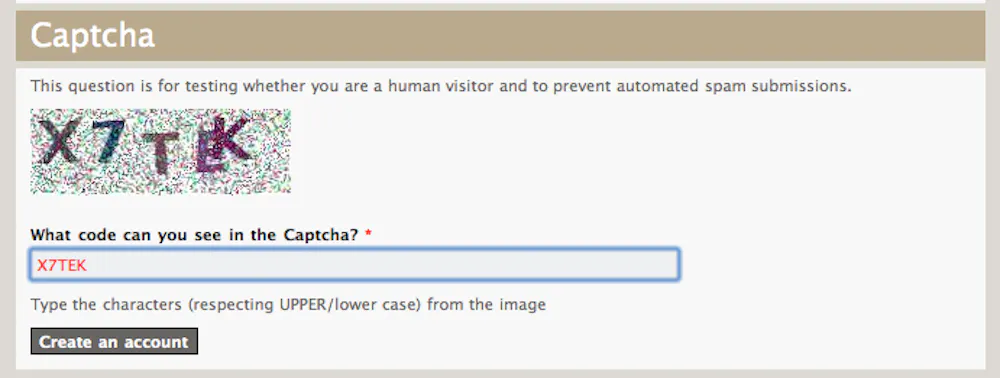
    The early versions of Captcha were basic but effective. You’d see wavy, distorted letters and type them into a box. Bots couldn’t “read” the text the way humans could, so websites stayed protected.


    Chris Messina, CC BY

    This went through several iterations in the years ahead: ReCaptcha was created in 2007 to add a second element in which you had to also key in a distorted word from an old book.

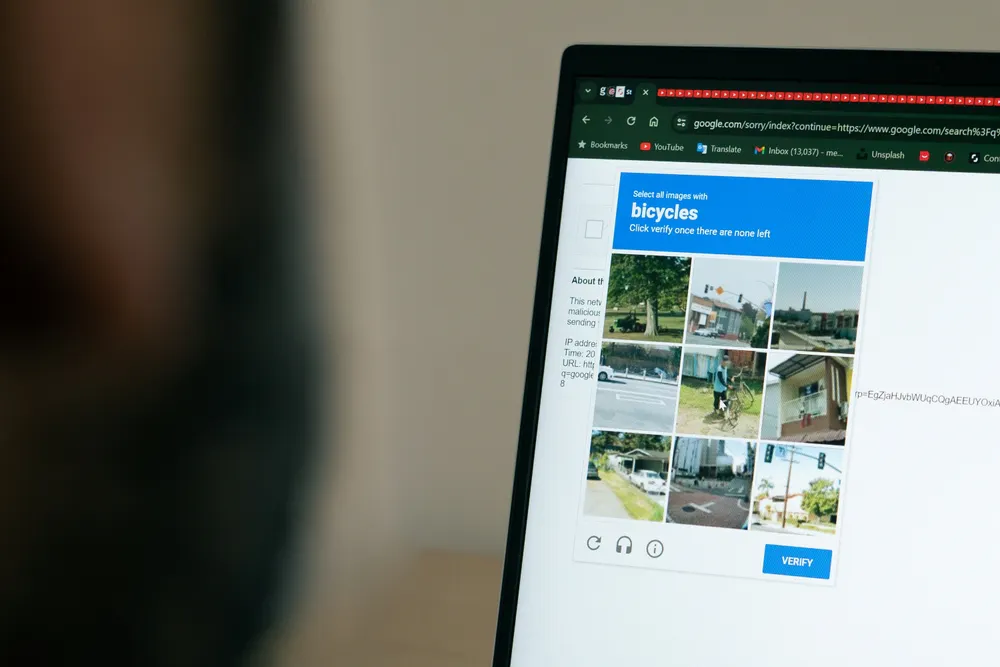
    Then in 2014 – by now acquired by Google – came reCaptcha v2. This is the one that asks users to tick the “I am not a robot” box and often choose from a selection of pictures containing cats or bicycle parts, or whatever. Still the most popular today, Google gets paid by companies who use the service on their website.

    Damn those bicycles.
    Lilgrapher

    How AI has outgrown the system

    Today’s AI systems can solve the challenges these Captchas rely on. They can “read” distorted text, so that the wavy or squished letters from the original Captcha tests are easy for them. Thanks to natural language processing and machine learning, AI can decode even the messiest of words.

    Similarly, AI tools such as Google Vision and OpenAI’s Clip can recognise hundreds of objects faster and more accurately than most humans. If a Captcha asks an AI to click all the buses in a picture selection, they can solve it in fractions of a second, whereas it might take a human ten to 15 seconds.

    This isn’t just a theoretical problem. Consider driving tests: waiting lists for tests in England are many months long, though you can get a much faster test by paying a higher fee to a black-market tout. The Guardian reported in July that touts commonly used automated software to book out all the test slots, while swapping candidates in and out to fit their ever-changing schedules.

    In an echo of the situation 20 years ago, there are similar issues with tickets for things such as football matches. The moment tickets become available, bots overwhelm the system – bypassing Captchas, purchasing tickets in bulk and reselling them at inflated prices. Genuine users often miss out because they can’t operate as quickly.

    Similarly, bots attack social media platforms, e-commerce websites and online forums. Fake accounts spread misinformation, post spam or grab limited items during sales. In many cases, Captcha is no longer able to stop these abuses.

    What’s happening now?

    Developers are continually coming up with new ways to verify humans. Some systems, like Google’s ReCaptcha v3 (introduced in 2018), don’t ask you to solve puzzles anymore. Instead, they watch how you interact with a website. Do you move your cursor naturally? Do you type like a person? Humans have subtle, imperfect behaviours that bots still struggle to mimic.

    Not everyone likes ReCaptcha v3 because it raises privacy issues – plus the web company needs to assess user scores to determine who is a bot, and the bots can beat the system anyway. There are alternatives that use similar logic, such as “slider” puzzles that ask users to move jigsaw pieces around, but these too can be overcome.

    Slider Captcha:


    GitHub

    Some websites are now turning to biometrics to verify humans, such as fingerprint scans or voice recognition, while face ID is also a possibility. Biometrics are harder for bots to fake, but they come with their own problems – privacy concerns, expensive tech and limited access for some users, say because they can’t afford the relevant smartphone or can’t speak because of a disability.

    The imminent arrival of AI agents will add another layer of complexity. It will mean we increasingly want bots to visit sites and do things on our behalf, so web companies will need to start distinguishing between “good” bots and “bad” bots. This area still needs a lot more consideration, but digital authentication certificates are proposed as one possible solution.

    In sum, Captcha is no longer the simple, reliable tool it once was. AI has forced us to rethink how we verify people online, and it’s only going to get more challenging as these systems get smarter. Whatever becomes the next technological standard, it’s going to have to be easy to use for humans, but one step ahead of the bad actors.

    So the next time you find yourself clicking on blurry traffic lights and getting infuriated, remember you’re part of a bigger fight. The future of proving humanity is still being written, and the bots won’t be giving up any time soon.

    The authors do not work for, consult, own shares in or receive funding from any company or organisation that would benefit from this article, and have disclosed no relevant affiliations beyond their academic appointment.

    – ref. ‘Yes, I am a human’: bot detection is no longer working – and just wait until AI agents come along – https://theconversation.com/yes-i-am-a-human-bot-detection-is-no-longer-working-and-just-wait-until-ai-agents-come-along-246427

    MIL OSI – Global Reports –

    January 27, 2025
  • MIL-OSI Global: Climate, migration and conflict mix to create ‘deadly’ intense tropical storms like Chido

    Source: The Conversation – UK – By Liz Stephens, Professor of Climate Risks and Resilience, University of Reading

    Cyclone Chido was an “intense tropical cyclone”, equivalent to a category 4 hurricane in the Atlantic. It made landfall in Mayotte, a small island lying to the north-west of Madagascar on December 14, generating wind gusts approaching 155mph (250km/hr). Later on, it hit Mozambique, East Africa with the same ferocity.

    This storm skirted north of Madagascar and affected the Comoros archipelago before making landfall in Mozambique. It is well within the range of what is expected for this part of the Indian Ocean. But this region has experienced an increase in the most intense tropical cyclones in recent years. This, alongside its occurrence so early in the season, can be linked to increases in ocean temperatures as a result of climate change.

    News of the effects of tropical cyclone Chido in Mayotte, Mozambique and Malawi continues to emerge. Current estimates suggest 70% of Mayotte’s population have been affected, with over 50,000 homes in Mozambique partially or completely destroyed.

    Ongoing conflict in Mozambique and undocumented migration to Mayotte will have played a key role in the number of deaths and the infrastructure damage.

    Assessing how these cyclones characteristics are changing across southern Africa is part of the research we are involved in. Our team also studies how to build resilience to cyclones where conflict, displacement and migration magnify their effects.

    A human-made disaster?

    The risk that tropical cyclones pose to human life is exacerbated by socioeconomic issues. Migrants on Mayotte, many of whom made perilous journeys to escape conflict in countries such as the Democratic Republic of Congo, now make up more than half of the island’s population.

    Precarious housing and the undocumented status of many residents reportedly made the disaster more deadly, as people feared evacuation would lead them to the police. On islands with poor infrastructure such as Mayotte, there is often simply nowhere safe to go. It takes many days for the power network and drinking water supply to be restored.

    The situation is particularly complex in Mozambique. The ongoing conflict and terrorist violence, coupled with cyclones, including Kenneth in 2019, has caused repeated evacuations and worsening living conditions. Cabo Delgado and Nampula in the far north of Mozambique, the provinces most affected by both Chido and the conflict, rank among the poorest and most densely populated in the country due to limited education, scarce livelihood options and an influx of people displaced by violence.

    As of June 2024, more than half a million people remained without permanent homes in the region, many living in displacement camps. That number is likely to rise significantly after Chido.

    Compounding the crisis, Chido’s landfall so early in the cyclone season meant that the usual technical and financial preparations were not yet fully ramped up, with low stock levels delaying the timely delivery of aid. Unrest following elections in November hampered preparations further, cutting the flow of resources and personnel needed for anticipatory action and early response.

    Tropical cyclones in a warmer world

    Warmer sea surface temperatures not only provide more fuel for stronger storms, but may also expand the regions at risk of tropical cyclones.

    The Indian Ocean is warming faster than the global average, and is experiencing a staggering increase in the proportion of storms reaching the intensity of Chido.

    Climate simulations predict that storms will continue getting stronger as we further warm our world, and could even lead to an unprecedented landfall as far south as the Mozambican capital, Maputo.

    Scientists carry out attribution studies to determine how climate change contributed to specific events. Scientists undertaking rapid attribution studies of Chido have found that the ocean surface temperatures along the path of the storm were 1.1°C warmer than they would have been without climate change. So, temperatures this warm were made more than 50 times more likely by climate change. Another study focusing on Chido itself concluded that the cyclone’s winds were 5% faster due to global heating caused by burning fossil fuels, enough to bump it from a category 3 to a category 4 storm.

    Intense winds are not the only hazard. Scientists are confident that tropical cyclones will dump more rain as a result of climate change. A trend towards slower-moving storms has been observed, causing more of that rain to accumulate in a single location, resulting in floods.

    Cyclone Freddy delivered a year’s worth of rain to southern Malawi in just four days in March 2023. Storm surges, exacerbated by sea level rise, also raise the scale of flooding, as in the devastating Cyclone Idai in March 2019. An increase in the number of storms that rapidly intensify, as Chido did before landfall in Mayotte has also been linked to climate change, which makes it harder to provide early warnings.

    To improve resilience to future cyclones, conflict, migration and social dynamics must be considered alongside climate change, without this, displaced and migrant communities will continue to be the most affected by the risks that climate change poses.


    Don’t have time to read about climate change as much as you’d like?

    Get a weekly roundup in your inbox instead. Every Wednesday, The Conversation’s environment editor writes Imagine, a short email that goes a little deeper into just one climate issue. Join the 40,000+ readers who’ve subscribed so far.


    Liz Stephens also works for the Red Cross Red Crescent Climate Centre, where she works as the Science Lead. She receives funding from the Foreign, Commonwealth & Development Office (FCDO) and the International Development Research Centre in Canada, as part of the CLARE (CLimate Adaptation and REsilience) research programme. Liz holds advisory positions within the Red Cross Red Crescent Movement, for the European Commission’s Global Flood Awareness System, the Anticipation Hub and the African Risk Capacity

    I work for a university which has interest on publications around disasters and climate change. I am part of a research consortium (REPRESA) funded by IDRC to research cyclones in Southern Africa region

    Dan Green does not work for, consult, own shares in or receive funding from any company or organisation that would benefit from this article, and has disclosed no relevant affiliations beyond their academic appointment.

    – ref. Climate, migration and conflict mix to create ‘deadly’ intense tropical storms like Chido – https://theconversation.com/climate-migration-and-conflict-mix-to-create-deadly-intense-tropical-storms-like-chido-246219

    MIL OSI – Global Reports –

    January 27, 2025
  • MIL-OSI Banking: Fed Cuts Rates in Third-Consecutive Meeting While Existing Sales Rise

    Source: Fannie Mae

    (The Fannie Mae Economic & Housing Weekly Note will not be published for the next two weeks.)

    Key Takeaways:

    • The Federal Open Market Committee (FOMC) cut the federal funds rate by 25 basis points to a target range of 4.25-4.5 percent at its December 17-18 meeting. There was one dissenting vote. The updated Summary of Economic Projections (SEP) now shows the median participant expects 50 basis points worth of rate cuts in 2025, as opposed to 100 basis points worth of cuts in the September SEP. The committee has also revised upward their expectations for core inflation over the next two years.
    • Gross domestic product (GDP), adjusted for inflation, grew at a 3.1 percent annualized rate in Q3 2024, an upgrade of three-tenths compared to the prior estimate, according to the third and final estimate from the Bureau of Economic Analysis (BEA). The upgrade was primarily due to stronger consumption (3.7 percent annualized vs. 3.5 percent previously) and exports. Gross domestic income (GDI), a theoretically equivalent measure to GDP that can differ due to measurement error, posted a somewhat softer 2.1 percent annualized gain in the third quarter.
    • Personal income, adjusted for inflation, increased 0.2 percent in November, according to the BEA. Real disposable personal income was also up 0.2 percent. Real personal consumption expenditures increased 0.3 percent over the month due to a strong 0.7 percent gain in spending on goods. The personal consumption expenditures (PCE) price index increased 0.1 percent over the month and was up 2.4 percent compared to a year prior. Excluding food and energy, core PCE prices also increased 0.1 percent over the month and rose 2.8 percent compared to a year prior.
    • Retail sales and food services increased 0.7 percent in November, according to the Census Bureau. Part of the gain was due to a 2.6 percent jump in motor vehicle and parts dealer sales and a 1.8 percent increase in nonstore retailers, which primarily represents online sales. Control group retail sales (excluding food service, auto, building supplies, and gas station sales) increased 0.4 percent, more than reversing the 0.1 percent decline the month prior.
    • Existing home sales rose 4.8 percent to a seasonally adjusted annualized rate (SAAR) of 4.15 million, the strongest sales pace since March, according to the National Association of Realtors. The number of homes available for sale declined 2.9 percent to 1.33 million. Combined with the stronger sales pace, the supply of homes declined four-tenths to 3.8 months, the lowest level since April.
    • Housing starts declined 1.8 percent to a SAAR of 1.29 million in November, according to the Census Bureau. Single-family starts rose 6.4 percent to a SAAR of 1.01 million, reversing most of last month’s decline that was due primarily to hurricane-related disruptions. Single-family permits were essentially flat at 972,000. The volatile multifamily starts series dropped 23.2 percent to a SAAR of 278,000, while multifamily permits rose 19.0 percent to a SAAR of 533,000.
    • The National Association of Home Builders (NAHB)/Wells Fargo Housing Market Index was unchanged at 46 in December. The index for single-family sales in the present was unchanged at 48, while the index for sales in the next six months rose 3 points to 66, a more than 2.5-year high. The index for the traffic of prospective buyers declined 1 point to 31.
    Forecast Impact:

    The Fed’s rate cut was in line with market and our own expectations. The updated SEP, which shows fewer rate cuts over the next two years compared to the September SEP, could potentially move mortgage rates higher given the recent upward movement in the 10-year Treasury note rate. While core PCE inflation came in cooler in November, smoothing through some of the recent volatility, the three-month annualized rate of core inflation remains elevated at 2.5 percent, supporting our expectation for a pause in rate cuts early in 2025.

    The upgraded consumption growth in the third quarter presents a bit of upside risk to our fourth-quarter forecast in the same category, though we had already penciled in a robust 3.0 percent annualized growth rate. The gain in control group retail sales, which feed directly into the BEA’s estimates for consumption, lend support to our forecast for ongoing strong consumption growth in Q4, as does the gain in real monthly consumption in the monthly PCE report.

    The rise in existing home sales likely reflects, in part, lower mortgage rates toward the end of September on properties that took longer to close, especially in Florida and nearby states where hurricanes could have slowed the closing process. Still, some of the higher sales pace (albeit, still very suppressed by historical standards) could be sustained into December and next year even amid higher rates given recent improvements in mortgage application data. On the new construction side, the gain in single-family starts recovered most of the decline in October that was due to hurricane disruptions. The fourth quarter is currently tracking in line with our forecast. Single-family permits have been essentially flat since August, but still suggest a strong pace of building into 2025, especially when combined with a more than 2.5-year high in builder sentiment for sales over the next six months.


    Nathaniel Drake
    Economic and Strategic Research Group
    December 20, 2024

    Opinions, analyses, estimates, forecasts, beliefs, and other views of Fannie Mae’s Economic & Strategic Research (ESR) Group included in these materials should not be construed as indicating Fannie Mae’s business prospects or expected results, are based on a number of assumptions, and are subject to change without notice. How this information affects Fannie Mae will depend on many factors. Although the ESR Group bases its opinions, analyses, estimates, forecasts, beliefs, and other views on information it considers reliable, it does not guarantee that the information provided in these materials is accurate, current, or suitable for any particular purpose. Changes in the assumptions or the information underlying these views could produce materially different results. The analyses, opinions, estimates, forecasts, beliefs, and other views published by the ESR Group represent the views of that group as of the date indicated and do not necessarily represent the views of Fannie Mae or its management.

    MIL OSI Global Banks –

    January 27, 2025
  • MIL-OSI USA: FEMA Awards $1 Billion in Public Assistance Funds Following Hurricane Milton

    Source: US Federal Emergency Management Agency 2

    FEMA Awards $1 Billion in Public Assistance Funds Following Hurricane Milton

    TALLAHASSEE, Fla. – FEMA has obligated over $1 billion in Public Assistance funds to aid Florida’s recovery from Hurricane Milton. Reaching this milestone, in just over two months after the hurricane’s major disaster declaration on Oct. 11, has never been done before in Florida. This rapid response highlights the partnership with the State of Florida to aid local governments’ efforts to help communities recover.These funds include costs that the state and local jurisdictions spent on debris removal and emergency protective measures. As of Dec. 20, the state of Florida has removed 37.4 million cubic yards of debris, which equals to more than 228,000 tractor trailers loads.FEMA’s Public Assistance program provides reimbursement to state and local government agencies for the costs of emergency response, debris removal and restoration of disaster-damaged public facilities and infrastructure. Houses of worship and certain private nonprofit organizations may also be eligible for FEMA Public Assistance. The deadline to apply for Public Assistance funds is Dec. 20, 2024.For the latest information about Hurricane Milton recovery, visit fema.gov/disaster/4834. For Hurricane Helene, visit fema.gov/disaster/4828. For Hurricane Debby, visit fema.gov/disaster/4806. Follow FEMA on X at x.com/femaregion4 and on Facebook at facebook.com/fema.###FEMA’s mission is helping people before, during, and after disasters. FEMA is committed to ensuring disaster assistance is accomplished equitably, without discrimination on the grounds of race, color, nationality, sex, sexual orientation, religion, age, disability, English proficiency, or economic status. Any disaster survivor or member of the public may contact the FEMA Office of Civil Rights if they feel that they have a complaint of discrimination. FEMA’s Office of Civil Rights can be contacted at FEMA-OCR@fema.dhs.gov or toll-free at 833-285-7448.
    sixto.valentin…
    Fri, 12/20/2024 – 14:53

    MIL OSI USA News –

    January 27, 2025
  • MIL-OSI Security: Kilo Fentanyl Distributor Sentenced to 40 Years

    Source: Office of United States Attorneys

    RALEIGH, N.C. – A New Bern man was sentenced to 40 years in prison for trafficking and distributing methamphetamine and fentanyl for a large-scale drug trafficking operation in Craven County.  On August 8, 2024, a Raleigh jury found Lucio Camargo Garcia guilty of the charges.

    “Garcia took advantage of Craven County’s most hopeless souls, extracting profit from their pain and addiction,” said U.S. Attorney Michael F. Easley, Jr. “Too many of our friends, families, and neighbors are battling addiction.  The Craven County Sheriff’s Office and New Bern Police won’t stand by and let armed drug traffickers push kilos of fentanyl and meth in our community unchecked, and neither will we.  Eastern North Carolina traffickers take note – our partnership is for the long haul, and we won’t let off.”

    “This sentencing sends a clear message that our community will not tolerate the trafficking of dangerous drugs like methamphetamines and fentanyl,” said HSI Charlotte Special Agent in Charge Cardell T. Morant, HSI Charlotte covers North and South Carolina. “These substances devastate lives and destroy communities.  HSI and its partners are committed to holding those who profit from this destruction accountable. This is a warning to those who engage in this illegal activity – we will pursue justice relentlessly.”

    “This investigation identified Garcia as a major importer and distributor of methamphetamine and fentanyl in Craven County,” said Craven County Sheriff Chip Hughes. “His prosecution, along with his co-conspirators has resulted in a significant reduction in the availability of these dangerous drugs in our communities.”

    According to court records and evidence presented at trial, in 2021, the Drug Enforcement Administration (DEA), Homeland Security Investigations (HSI), the Craven County Sheriff’s Office, the New Bern Police Department, the State Bureau of Investigation, and other state and local agencies launched an investigation into a large-scale drug trafficking organization responsible for acquiring kilogram quantities of methamphetamine and fentanyl from the southwest border of the United States and distributing the drugs in and around Craven County. Through the use of confidential sources, surveillance, enforcement actions, and controlled purchases, Garcia was identified as the primary distributor of methamphetamine and fentanyl who re-sold the product to both drug users and other area dealers.

    From January to October 2022, law enforcement conducted multiple controlled purchases of methamphetamine and fentanyl from Garcia. On October 31, 2022, search warrants were executed at residences associated with the drug trafficking organization, including Garcia’s residence. Law enforcement seized approximately one kilogram of methamphetamine, approximately nine hundred grams of fentanyl (powder and pill form), and a loaded firearm from Garcia’s residence. Most of the drugs were located in a secret compartment in the ceiling of Garcia’s bedroom closet.

    This investigation was an Organized Crime Drug Enforcement Task Forces (OCDETF) investigation. OCDETF identifies, disrupts, and dismantles the highest-level drug traffickers, money launders, gangs, and transnational criminal organizations that threaten the United States by using a prosecutor-led, intelligence-driven, multi-agency approach that leverages the strengths of federal, state, and local law enforcement agencies against criminal networks.

    Michael F. Easley, Jr., U.S. Attorney for the Eastern District of North Carolina made the announcement after sentencing by U.S. District Judge James C. Dever III. The DEA, HSI, U.S. Postal Inspection Service, North Carolina State Bureau of Investigations, Craven County Sheriff’s Office, New Bern Police Department, and Pamlico County Sheriff’s Office  investigated the case and Assistant U.S. Attorneys Katherine Englander and Caroline Webb prosecuted the case.

    Related court documents and information can be found on the website of the U.S. District Court for the Eastern District of North Carolina or on PACER by searching for Case No. 4:22-CR-75-D-RJ-2.

    MIL Security OSI –

    January 27, 2025
  • MIL-OSI Security: Clay County Convicted Felon Sentenced To Federal Prison On Firearm Charge

    Source: Office of United States Attorneys

    Jacksonville, Florida – U.S. District Judge Wendy W. Berger has sentenced Anthony Rodriguez, Jr. (32, Orange Park) to 21 months in federal prison for possessing a firearm as a convicted felon. Rodriguez was arrested on July 9, 2024, and ordered detained.   

    According to court records, on May 11, 2024, Rodriguez shoplifted merchandise from a Wal-Mart in Clay County. Wal-Mart personnel stopped Rodriguez and the Clay County Sheriff’s Office (CCSO) subsequently responded. As the CCSO searched Rodriguez during his arrest, a loaded Glock 43 9mm pistol fell to the ground from Rodriguez’s clothing. At the time of the incident, Rodriguez had seven previous felony convictions, including two convictions involving a firearm and ammunition. As a previously convicted felon, he is prohibited from possessing a firearm or ammunition under federal law.

    This case was investigated by the Clay County Sheriff’s Office and the Bureau of Alcohol, Tobacco, Firearms and Explosives – Jacksonville Office. It was prosecuted by Assistant United States Attorney Kevin C. Frein.

    This case is part of Project Safe Neighborhoods (PSN), a program bringing together all levels of law enforcement and the communities they serve to reduce violent crime and gun violence, and to make our neighborhoods safer for everyone. On May 26, 2021, the Department launched a violent crime reduction strategy strengthening PSN based on these core principles: fostering trust and legitimacy in our communities, supporting community-based organizations that help prevent violence from occurring in the first place, setting focused and strategic enforcement priorities, and measuring the results.

    MIL Security OSI –

    January 27, 2025
  • MIL-OSI Global: Times journalists deemed ‘legitimate military targets’ – how Russia muzzles criticism at home and abroad

    Source: The Conversation – UK – By Precious Chatterje-Doody, Senior Lecturer in Politics and International Studies, The Open University

    Russia’s former president and current deputy head of its security council, Dmitry Medvedev, has declared that the editors of the Times newspaper in the UK are now “legitimate military targets”.

    Medvedev, who is one of Vladimir Putin’s closest allies, was responding to the newspaper’s coverage of the recent assassination of Russia’s chemical weapons chief, Igor Kirillov, in Moscow on December 17. The paper’s leading article referred to his killing by an explosive device hidden in a scooter as a “legitimate act of defence by a threatened nation”.

    Medvedev took to Telegram to denounce the article, writing: “Those who carry out crimes against Russia … always have accomplices. They too are now legitimate military targets. This category could also include the miserable jackals from the Times who cowardly hid behind their editorial. That means the entire leadership of the publication.”

    The assassination of Kirillov, who was in charge of Russia’s chemical, biological and nuclear defence forces, came a day after he had been charged by Ukraine in absentia with war crimes over Russia’s use of chemical weapons in the ongoing war.

    Once seen as a liberal reformer when he temporarily took over Russia’s presidency between 2008 and 2012, Medvedev has since reinvented himself as a pro-war hawk who regularly makes outlandish or extreme statements on social media.

    In May 2023, following a drone attack on the Kremlin, Medvedev posted a message on Telegram saying there were “no options left other than the physical elimination of [the Ukrainian president] Zelenskyy and his clique”. The post prompted Ukraine’s foreign minister, Dmytro Kuleba, to respond in an interview that “Medvedev should drink less vodka before going on Telegram”.

    In his most recent outburst, Medvedev mirrored the rhetoric used in the Times editorial, claiming that by the same logic, all of Kyiv’s “accomplices” – whether decision-makers in Nato or journalists justifying Ukraine’s actions – are active participants in a war against Russia. This makes them “legitimate military targets” who need to “be careful” even in London, where “anything goes”.

    Part of a pattern

    Medvedev’s comments, while extreme, fall within a broader pattern of Russian officials using humour or courting controversy to justify their positions or ensure international press coverage. But they are also part of an escalation in Russian attacks on freedom of expression and the press.

    Prior to the full-scale invasion of Ukraine, Russia’s media environment was restricted. Opposition viewpoints could, however, still be accessed relatively easily from a range of sources, including the regional press, online outlets and the political blogosphere. But the Kremlin has gradually chipped away at these possibilities by increasing restrictions on independent media and social media users alike.

    These restrictions were ramped up even further following Russia’s invasion of Ukraine in February 2022. Criticism of the armed forces and spreading what the Kremlin deems “false information” about the so-called “special military operation” were criminalised.

    Anti-war activists now routinely face conviction for justifying terrorism, and well-respected news outlets such as Ekho Moskvy have been forced to close. Journalists from Russia and abroad have been tried, convicted and incarcerated for allegedly violating these laws. They are often held in harsh conditions, in isolation and without access to adequate medical care.

    But it is not just journalists and activists within Russia who have come under threat from this increasingly authoritarian regime. As well as its military incursions into Georgia in 2008 and eastern Ukraine since 2014, Russian intelligence organisations have been blamed for a number of targeted provocations abroad in recent years. In the case of the 2018 Salisbury poisonings, these resulted in fatalities on British soil.

    Russian involvement is, of course, always denied. Kremlin propaganda uses a range of disinformation tactics to hide Russia’s culpability. With the Salisbury poisonings, this included an outlandish television interview on Russia’s RT network, where the main suspects claimed to be visiting health supplements salesmen. My research at the time showed that online audiences universally rejected their story, but incredulity over the interview overtook public anger.

    Contrasting values

    As my research has shown, extreme statements and conspiracy theories circulate rapidly and widely in today’s international media environment. With this in mind, it is common for the Kremlin and its proxies to mirror accusations back towards other parties and accuse them of hypocrisy.

    Taking questions from a US journalist in his end-of-year press conference and phone-in on December 19, Putin was asked about the “failure” of the special military operation in Ukraine. The reporter went on to describe Putin’s position as “weaker” than that of the incoming US president, Donald Trump.

    Putin insinuated that the very fact this US journalist was included in the event showed a better treatment by Russia of “esteemed” international journalists than Russian journalists receive from the US.

    This is patently untrue. Wall Street Journal reporter Evan Gershkovich was imprisoned in Russia for 16 months on trumped-up espionage charges, after being detained in March 2023 while covering the effect of western sanctions on the Russian economy.

    Russia’s crackdown on freedom of speech and freedom of the press is precisely because authoritarian regimes recognise they are incredibly vulnerable to the free and open-ended enquiry that my co-authors and I have argued is so crucial to defend.

    As a spokesperson for the UK prime minister, Keir Starmer, noted in response to Medvedev’s latest comments: “A free press is a cornerstone of our democracy.”

    Precious Chatterje-Doody does not work for, consult, own shares in or receive funding from any company or organisation that would benefit from this article, and has disclosed no relevant affiliations beyond their academic appointment.

    – ref. Times journalists deemed ‘legitimate military targets’ – how Russia muzzles criticism at home and abroad – https://theconversation.com/times-journalists-deemed-legitimate-military-targets-how-russia-muzzles-criticism-at-home-and-abroad-246361

    MIL OSI – Global Reports –

    January 27, 2025
  • MIL-OSI Russia: 23rd meeting of the Intergovernmental Commission on Economic Cooperation between the Russian Federation and the Republic of Armenia

    Translation. Region: Russian Federation –

    Source: Government of the Russian Federation – An important disclaimer is at the bottom of this article.

    The meeting was held under the joint chairmanship of Deputy Prime Minister of the Russian Federation Alexey Overchuk and Deputy Prime Minister of the Republic of Armenia Mher Grigoryan.

    23rd meeting of the Intergovernmental Commission on Economic Cooperation between the Russian Federation and the Republic of Armenia

    December 20, 2024

    23rd meeting of the Intergovernmental Commission on Economic Cooperation between the Russian Federation and the Republic of Armenia. Alexey Overchuk and Deputy Prime Minister of the Republic of Armenia Mher Grigoryan

    December 20, 2024

    Previous news Next news

    23rd meeting of the Intergovernmental Commission on Economic Cooperation between the Russian Federation and the Republic of Armenia

    The 23rd regular meeting of the Intergovernmental Commission on Economic Cooperation between the Russian Federation and the Republic of Armenia was held in Moscow under the joint chairmanship of Deputy Prime Minister of the Russian Federation Alexey Overchuk and Deputy Prime Minister of the Republic of Armenia Mher Grigoryan.

    The parties summed up the results of bilateral cooperation in trade and economic spheres, energy, industry, transport, agriculture, finance, healthcare, culture, science, interregional cooperation, education and tourism.

    “Our trade and economic relations continue to be on the rise. Mutual trade between Russia and Armenia, according to data for 10 months of 2024, amounted to 10.2 billion dollars. This is more than twice as much as the same indicator last year,” noted Alexey Overchuk, emphasizing that in order to implement trade and economic relations, the countries have almost completely switched to settlements in national currencies – the share of the Russian ruble in mutual settlements has reached 96.3%.

    The Russian Federation is one of the main investors in the Armenian economy. Investments in industrial projects in the Republic of Armenia have reached $3.4 billion. More than 40 large Russian companies operate in Armenia, some of them are the largest taxpayers in the state budget.

    “In addition to direct investments, Eurasian development institutions are also actively working,” said the Deputy Prime Minister. “Active work is underway here, including in support of the “Crossroads of the World” initiative, which was put forward by the Prime Minister of the Republic of Armenia Nikol Vovaevich Pashinyan.”

    The Chairman of the Russian part of the commission also noted that in July 2024, with the assistance of Russian Railways, the railway between Armenia and Georgia, damaged by flooding, was restored in the shortest possible time – the only railway connecting Armenia with the outside world, which is an important channel for delivering vital goods to Armenia.

    “All these investments and projects are being implemented with the aim of strengthening connectivity in the Eurasian region and the South Caucasus, in particular, integrating Armenia into the new value chains emerging in Eurasia and realizing the transport and logistics potential that the Republic of Armenia has, with unwavering respect for its sovereignty and jurisdiction,” Alexey Overchuk said in his speech.

    In the context of the work of Eurasian development institutions, the Deputy Prime Minister also noted the implementation of the irrigation systems modernization project: mechanical irrigation has been replaced by gravity irrigation, which provides annual energy savings. 5 main and 22 inter-farm canals have been restored. Work on the restoration and construction of intra-farm irrigation systems in 105 settlements of the Republic of Armenia has been completed.

    “Two weeks ago, our specialists agreed to assess the technical condition of eight bridges damaged by the floods in Lori and Tavush. All work will be completed as soon as possible, and we expect that by the end of the year, their results will be submitted to the Ministry of Territorial Administration and Infrastructure of the Republic of Armenia,” the Deputy Prime Minister said.

    During the meeting, the active development of cooperation in the humanitarian sphere was emphasized.

    “Today we are signing an intergovernmental Agreement on the conditions of operation of the Russian-Armenian University in the Republic of Armenia. This is one of the leading universities in Armenia, where more than 5 thousand students study, mastering 123 educational programs, 80 of which are taught according to Russian educational standards,” the Deputy Prime Minister emphasized.

    The university’s research and teaching staff includes 82 doctors and 332 candidates of science. The university’s structure includes 9 institutes, 31 departments and 12 laboratories.

    The University cooperates with the Joint Institute for Nuclear Research, the Institute for System Programming of the Russian Academy of Sciences, the St. Petersburg Polytechnic University and other Russian scientific centers. Research projects are implemented in such areas as bioinformatics, genomic research, quantum nanophotonics, biochemistry and biotechnology.

    Work continues to provide opportunities to receive education according to Russian standards in the educational and sports complex, which includes a school for 700 students, built in Yerevan as part of the Gazprom for Children social program.

    The countries pay great attention to cooperation in the field of culture. Since 2023, a program to support Russian theaters abroad has been implemented, within the framework of which the Yerevan State Russian Drama Theater named after Stanislavsky was provided with financial assistance for the acquisition of stage equipment and the creation of new productions based on works of Russian classics. The Moscow Parajanov Theater, with the support of the Ministry of Culture of Russia and the Cultural Center of the Armenian Embassy in Russia, held a large-scale festival “Parajanov Fest”.

    Bilateral cooperation in the field of creative education is developing. Within the framework of the International Student Festival of VGIK, 38 films participating in the festival were screened at the Russian-Armenian University.

    In pursuance of the agreements reached at the meeting of the intergovernmental commission, the second Russian-Armenian Forum of Education in the Sphere of Culture was held in Moscow in December 2024.

    Cooperation in the healthcare sector is being strengthened, including within the framework of annual Russian-Armenian forums on healthcare. The ninth Russian-Armenian forum on healthcare, dedicated to issues of maternal and child health, was held on December 16, 2024 in Yerevan. During the forum, the system of extended perinatal screening developed and successfully applied in Russia was presented.

    Russia and Armenia are developing mutual tourism. In January-September 2024, the number of trips of Russian tourists to Armenia amounted to 715.8 thousand, and Armenian tourists to Russia – 266 thousand.

    Speaking about cooperation in multilateral formats, primarily through the Eurasian Economic Union, the Deputy Prime Minister noted that the union has become a real guarantor of Armenia’s energy and food security, as well as its technological development.

    “The Union countries are the key sales market and the key supplier to the Armenian market. The EAEU accounts for 56% of Armenia’s food exports, 80% of machinery and equipment exports, 67% of chemical exports, and 56% of textile exports. The EAEU also provides 72% of energy imports, 49% of precious metal imports, 38% of food imports, and 34% of timber imports. During its membership in the Union, the export of industrial goods from Armenia has grown 15-fold, and food exports from Armenia have grown 4-fold. Since joining the EAEU in 2015, Armenia’s per capita GDP has grown almost 2.4-fold. This was made possible by the benefits of a common goods market, low prices for agricultural raw materials and energy, a convenient migration regime, and a common services market,” said Alexey Overchuk.

    Following the meeting, the protocol of the 23rd meeting of the Intergovernmental Commission on Economic Cooperation between the Russian Federation and the Republic of Armenia was signed.

    The parties also signed an Agreement between the Government of the Russian Federation and the Government of the Republic of Armenia on the conditions for the operation of the Russian-Armenian University in the Republic of Armenia, a State Purchase Agreement for a polyvalent, cultured, sorbed, inactivated foot-and-mouth disease vaccine, an Agreement between the Government of the Russian Federation and the Government of the Republic of Armenia on the conditions for the operation of the Educational and Sports Complex of Gazprom Armenia CJSC in Yerevan, and a work plan for the Russian-Armenian Business Council for 2025.

    Please note: This information is raw content directly from the source of the information. It is exactly what the source states and does not reflect the position of MIL-OSI or its clients.
    MIL OSI Russia News –

    January 27, 2025
  • MIL-OSI United Nations: Palestinian Rights Committee Bureau Welcomes Historic Resolution Requesting Advisory Opinion from International Court of Justice, Rejects Actions that Obstruct Aid

    Source: United Nations General Assembly and Security Council

    The following statement was issued today by the Bureau of the General Assembly’s Committee on the Exercise of the Inalienable Rights of the Palestinian People:

    The Bureau of the UN Palestinian Rights Committee warmly welcomes the General Assembly’s adoption of a timely and important resolution to urgently request an Advisory Opinion of the International Court of Justice on the obligations of Israel in relation to the presence and activities of the United Nations, other international organizations and third States.  The path to peace begins with justice — no more, no less.  This groundbreaking initiative spearheaded by Norway stands as a testament to the international community’s unwavering commitment to uphold human rights, international humanitarian law, and the urgent pursuit of justice for the Palestinian people.

    By an overwhelming majority vote of 137 in favour to 12 against, with 22 abstaining, the UN Member States requested the World Court to act urgently, giving the matter top priority.  This step follows closely the adoption of resolution ES-10/25, which deplored the measures taken by Israel, the occupying Power, that impede assistance to the Palestinian people, including the illegitimate legislation adopted by the Knesset against the United Nations Relief and Works Agency for Palestine Refugees in the Near East (UNRWA) and reaffirmed full support for the mandate of the Agency and demanded an end to the obstruction of UNRWA’s vital operations and full respect for Israel’s international legal obligations.

    Israel’s relentless and brutal war on the Gaza Strip has resulted in over 45,000 Palestinians killed, the majority children and women, more than 107,000 injured, over 70,000 homes destroyed or damaged, in addition to other vital civilian infrastructure, and approximately 1.9 million forcibly displaced and suffering a humanitarian catastrophe, including starvation, cold and the spread of diseases.  Now is the time for decisive action — no more impunity, no more obstruction, no more weaponization of vital humanitarian aid. 

    Israel must implement, without delay, all of its legal obligations under international law, including the binding provisional measures as set out by the International Court of Justice in the case brought by South Africa under the Genocide Convention to prevent further harm to the Palestinian civilian population.

    The Committee Bureau reiterates its longstanding call for an immediate ceasefire, unobstructed and immediate provision of humanitarian aid, and a just and peaceful resolution to the question of Palestine that ends the Israeli unlawful occupation, enables the Palestinian people to achieve their inalienable rights, including self-determination and achieve the two-State solution on the pre-1967 borders with East Jerusalem as the capital of the State of Palestine in accordance with international law and the relevant UN resolutions.

    MIL OSI United Nations News –

    January 27, 2025
  • MIL-OSI United Nations: Security and economic woes plague West Africa, as key elections loom

    Source: United Nations 4

    By Vibhu Mishra

    20 December 2024 Peace and Security

    West Africa and the Sahel continue to grapple with a confluence of political, security and humanitarian crises as countries prepares for pivotal elections in 2025, the UN special envoy for the vast region told ambassadors in the Security Council on Friday.

    Leonardo Santos Simão, highlighted upcoming presidential elections in Côte d’Ivoire and Guinea-Bissau, and the adoption of constitutional reforms amid a strained political environment in Gambia.

    He also commended recent successful elections in Ghana and Senegal, noting the signing of a “Peace Pact” by all presidential candidates in Ghana and the smooth transfer of power following orderly concessions by political rivals.  

    In Senegal, electoral observer missions highlighted the transparency of the process and the trust placed by political parties in national institutions, he added.

    “These two elections demonstrate progress in democracy in the region,” Mr. Simão said.

    Challenges remain

    However, several countries in the region – including Ghana and Senegal – continue to face significant economic challenges.

    “They will require support to manage rising debt and implement projects that protect livelihoods, otherwise their democratic gains may fail to satisfy the expectations of the populations, in particular among women and the youth,” Mr. Simão warned.

    He also urged efforts to prioritise preventive diplomacy and dialogue in the region, while emphasising he remains focused on fostering mutual understanding and encouraging common ground with all stakeholders.

    “While the positive outcomes of these engagements are gradual, there are promising signs of increased collaboration on people-centred, pragmatic solutions to the region’s security, governance, humanitarian and socio-economic challenges,” he added.

    Escalating security threats

    Insecurity remains the most urgent concern, with terrorist groups becoming increasingly aggressive and utilising sophisticated weaponry, including drones. Recent attacks in the Central Sahel have claimed many lives, affecting civilians and security personnel alike.

    Beyond the Sahel, violent extremism and organized crime have begun to spill into Gulf of Guinea nations, such as Benin and Togo, threatening more regional destabilisation.  

    The cessation of operations by the G5-Sahel Joint Force and the restructuring of the Accra Initiative, highlight the urgent need to reinvigorate regional security mechanisms, Mr. Simão said.

    He called for increased support for the Multinational Joint Task Force (MNJTF), the only functioning security platform in the Lake Chad Basin, which is struggling to counter increasingly well-equipped terrorist groups.

    Humanitarian crisis deepens

    The humanitarian situation in the region also remains challenging.

    Chad, hosting two million refugees and internally displaced persons (IDPs) – including those fleeing the violence in Sudan – is grappling with the dual challenges of displacement and severe flooding.

    In Burkina Faso, Mali, Niger and Nigeria, escalating violence has displaced millions, while underfunded humanitarian appeals leave many vulnerable.

    “I urge partners to contribute to the humanitarian appeal, which remains less than 50 percent funded,” Mr. Simão said.

    Withdrawal from ECOWAS

    He also briefed Council members of the Summit of the Economic Community of West African States (ECOWAS) last week, where leaders took note of the decision by Burkina Faso, Mali, and Niger to withdraw from the bloc.  

    While formal withdrawal proceedings are expected to commence in late January 2025, ECOWAS leaders also extended a six-month window for dialogue, in case rapprochement is possible.

    MIL OSI United Nations News –

    January 27, 2025
  • MIL-OSI Security: Five Men From Grand Strand and Pee Dee Region Sentenced for Fentanyl Trafficking and Related Gun Crimes

    Source: Federal Bureau of Investigation (FBI) State Crime News

    FLORENCE, S.C. — Five men from across the Pee Dee and Grand Strand were sentenced to multi-year terms in federal prison after pleading guilty to a fentanyl trafficking conspiracy operating in and around Horry County and related firearms crimes.

    • Joshua Rodriguez, 33, of Myrtle Beach, was sentenced to 151 months in federal prison after pleading guilty to conspiracy to distribute fentanyl;
    • Derrick Adrien Hooks, Jr., 27, of Chesterfield, was sentenced to 96 months in federal prison after pleading guilty to conspiracy to distribute fentanyl;
    • Christopher Brown, 32, of Pawleys Island, was sentenced to 84 months in federal prison after pleading guilty to conspiracy to distribute fentanyl;
    • Jonathan Thien Ta, 32, of Myrtle Beach, was sentenced to 50 months in federal prison after pleading guilty to being a felon in possession of firearm and ammunition; Ta’s federal sentence will run consecutive to a state sentence he is serving on separate firearms-related conduct; and
    • Neil Alexander Torres, 32, of Myrtle Beach, was sentenced to 18 months in federal prison after pleading guilty to being a felon in possession of firearm and ammunition.

    Rodriguez and Brown’s terms of imprisonment will be followed by a five-year term of court-ordered supervision. Hook’s term of imprisonment will be followed by a four-year term of court-ordered supervision. Ta and Torres’s terms of imprisonment will be followed by three-year terms of court-ordered supervision.  There is no parole in the federal system.

    As to Ta and Torres, evidence presented to the court showed that on Nov. 26, 2020, officers with Myrtle Beach Police Department arrived at a restaurant in Myrtle Beach with a warrant to arrest Ta. Officers tried to take Ta into custody, but Ta disobeyed law enforcement commands, reaching into his waistband and pulling out a loaded 9mm handgun, which he passed to Torres before Ta attempted to flee on foot. At the time of the incident, both Ta and Torres were convicted felons who could not legally possess either the firearm or the ammunition with which it was loaded.

    Additional evidence presented to the court showed that from 2018 to 2023, Rodriguez, Hooks, and Brown were involved in trafficking pressed pills containing fentanyl in and around Horry County. Fentanyl is potentially lethal in very small doses.

    Rodriguez, who was a high-level distributor, was accountable for distributing some 14 kilograms of fentanyl over the course of the conspiracy. He frequently possessed firearms in connection with his drug trafficking and threatened to use violence against others.

    On July 1, 2021, law enforcement in Horry County attempted to conduct a traffic stop on a car driven and solely occupied by Hooks. Hooks fled from officers and threw pills and suspected marijuana out of the car during the ensuing chase. Law enforcement then obtained a search warrant for the home in Little River Hooks had come from just prior to the traffic stop. In Hooks’ room at the house, law enforcement found approximately 3.5 kilogram of pills, multiple kilograms of suspected marijuana, a 5.56 caliber firearm, assorted magazines, and ammunition and more than $10,000 in cash. Further investigation revealed that over the course of his involvement in the conspiracy, Hooks was accountable for trafficking 1.6 kilograms of fentanyl.

    Investigation showed Brown was involved as a lower-level distributor within the conspiracy. In approximately five years, Brown was accountable for trafficking 2.7 kilograms of fentanyl. Like Hooks, Brown had a history of fleeing from law enforcement. In 2023, Georgetown County Sheriff’s Office attempted to stop a vehicle driven by Brown in Pawleys Island. Brown fled, reaching speeds of 91 miles per hour while trying to evade law enforcement.

    United States District Judge Joseph Dawson, III, sentenced all five men.

    This prosecution is part of an Organized Crime Drug Enforcement Task Forces (OCDETF) investigation. OCDETF identifies, disrupts, and dismantles the highest-level drug traffickers, money launderers, gangs, and transnational criminal organizations that threaten the United States by using a prosecutor-led, intelligence-driven, multi-agency approach that leverages the strengths of federal, state, and local law enforcement agencies against criminal networks. Additional information about the OCDETF Program can be found at https://www.justice.gov/OCDETF.

    This case was investigated by the FBI Columbia Field Office, Myrtle Beach Police Department, Horry County Police Department, Horry County Sheriff’s Office, and the 15th Circuit Drug Enforcement Unit. Assistant U.S. Attorney Katherine Flynn is prosecuting the case.

    ###

    MIL Security OSI –

    January 27, 2025
  • MIL-OSI Security: Two-Time Convicted Felon Sentenced to Over 11 Years in Prison for Drug and Firearm Charges

    Source: Office of United States Attorneys

    BOSTON – A Lynn man was sentenced today in federal court in Boston for drug and firearm charges.

    Jose Perez, 27, was sentenced by Chief U.S. District Court Judge F. Dennis Saylor to 142 months in prison, to be followed by three years of supervised release. In August 2024, Perez was convicted after a five day jury trial of one count of conspiracy to distribute and to possess with intent to distribute controlled substances and one count of felon in possession of a firearm. In January 2023, Perez was arrested and charged along with co-defendant Henry Del Rio.

    In December 2022, police officers attempted to stop a vehicle speeding through Lexington, Mass. that Perez was driving. Instead of pulling over, Perez accelerated and engaged in a high-speed escape attempt, traveling more than 85 miles per hour on residential streets, crashing head-first into another vehicle, and ultimately losing control and colliding into a post. As Perez exited the vehicle, a loaded Glock 34X 9mm semi-automatic handgun dropped to the ground. Perez and Del Rio, his passenger, then fled and led officers on a foot chase through a Stop and Shop parking lot. After officers apprehended Perez and Del Rio, Perez was found with over $2,000 cash in his pockets.  Officers also recovered a bag of cocaine and a bag containing 44 smaller, individually wrapped bags of fentanyl in Del Rio’s flight path, as well as a bag of cocaine in the vehicle Perez had crashed.

    At the time, Perez was on supervised release in connection with two prior federal convictions: one in 2017 for engaging in the business of dealing firearms without a license, and one in 2020 for conspiracy to distribute controlled substances and felon in possession of a firearm.  Given Perez’s status as a felon, he is barred from possessing a firearm.

    In May 2024, Del Rio pleaded guilty to conspiracy to distribute and possess with intent to distribute controlled sentences and is scheduled to be sentenced in January 2025.

    United States Attorney Joshua S. Levy and James M. Ferguson, Special Agent in Charge of the Bureau of Alcohol, Tobacco, Firearms and Explosives, Boston Field Division made the announcement today. Valuable assistance was provided by the Lexington, Chelsea and MBTA Police Departments and Customs and Border Protection. Assistant U.S. Attorneys Mike Crowley and Sarah Hoefle of the Organized Crime and Gang Unit prosecuted the case.

    MIL Security OSI –

    January 27, 2025
  • MIL-OSI Security: Convicted felon admits to illegal firearms possession

    Source: Office of United States Attorneys

    HOUSTON – A 49-year-old Houston man has been convicted illegally possessing six firearms, announced U.S. Attorney Alamdar S. Hamdani. 

    Christopher Curry admitted he was a convicted felon and planned to exchange the guns for marijuana. 

    At the time of his arrest Oct. 17, authorities found him in possession of six firearms. In his vehicle were a shotgun, a pistol and several semiautomatic rifles. 

    Curry has three felony convictions to include two drug possessions and being a felon in possession of a firearm. As such, he is prohibited of possessing firearms or ammunition per federal law. 

    Senior U.S. District Judge Sim Lake accepted the plea and set sentencing for March 14, 2025. At that time he faces up to 15 years in federal prison as well as a possible $250,000 maximum fine. 

    He has been and will remain in custody pending that hearing. 

    The Houston Police Department Northeast Crime Suppression Team and the Department of Public Safety conducted the joint investigation with the assistance of the Alcohol, Tobacco, Firearms and Explosives Crime Gun Strike Force.

    Assistant U.S. Attorney John Ganz is prosecuting the case. 

    MIL Security OSI –

    January 27, 2025
  • MIL-OSI United Kingdom: Flamingo Land appeal is “nightmare before Christmas” say Greens

    Source: Scottish Greens

    20 Dec 2024 Nature Save Loch Lomond

    Scotland rejects daft Flamingo Land plans. Our Government must do the same.

    More in Nature

    Scottish Green MSP Ross Greer has slammed the decision of the Scottish Government’s enterprise agency to extend Flamingo Land’s exclusive contract to land on the southern shore of Loch Lomond at Balloch, paving the way for the developer to appeal the rejection of their mega-resort application.

    At a public hearing in September the board of Loch Lomond and the Trossachs National Park unanimously rejected the Yorkshire theme park operator’s plans for two hotels, a waterpark, a hundred woodland lodges, over 370 parking spaces, a monorail, shops, restaurants and more at Balloch. 

    This came after a campaign led by Mr Greer collected a record 155,000 objections to the plans, alongside objections from a variety of environmental groups and organisations.

    Mr Greer received notice today from Scottish Enterprise that they will extend Flamingo Land’s exclusive contract to the land alongside the River Leven and southern shore of Loch Lomond, which makes up a majority of the proposed site. This extension allows Flamingo Land to lodge an appeal to the Scottish Government to overturn their application rejection. The contract gives Flamingo Land the exclusive right to buy the publicly owned land if they secure planning permission.

    Following the National Park’s rejection of the plans in September, Greer called on the First Minister to end Flamingo Land’s exclusive contract.

    Reacting to the news, Ross Greer MSP said: “This ridiculous company just doesn’t know when to give up, and it is bitterly disappointing that the Scottish Government are helping them in their attempts to ruin this special corner of Loch Lomond.

    “Extending Flamingo Land’s exclusive contract for the land means that an appeal is now all but certain, despite the overwhelming reasons for its rejection in the first place.

    “Our campaign to Save Loch Lomond lodged a record 155,000 objections to these daft and destructive mega-resort plans. We were joined by experts from the likes of the Woodland Trust, Ramblers and most importantly, the Scottish Environment Protection Agency. Not only that, the National Park’s own planning officers carefully considered the application and agreed that it must be rejected on the basis of both flood risk and damage to the natural environment.

    “Flamingo Land has spent a decade trying to force a mega-resort on Balloch. We beat them in 2019 and then again earlier this year. This greedy company just cannot take no for an answer. I am incredibly frustrated that the Scottish Government is enabling this saga through an exclusive contract which should have been terminated years ago. There are absolutely no grounds to approve the application on appeal. We have urged Flamingo Land to accept reality and get round the table to discuss alternatives, but they clearly have no interest in listening to the community.

    “The Scottish Greens will continue our campaign and work alongside Balloch residents to ensure that these destructive plans are rejected once again. Exhausted as we all are after a decade of this nonsense, we are ready to fight once again to save Loch Lomond.”

    MIL OSI United Kingdom –

    January 27, 2025
  • MIL-OSI Canada: Province appoints new BC Hydro board chair, directors

    Source: Government of Canada regional news

    The B.C. government has appointed a new chair and three new directors to the BC Hydro board of directors, ensuring the important work of keeping rates affordable, expanding critical electricity infrastructure to meet future demand, and effective management of drought and power imports continues to be prioritized.

    Glen Clark has been appointed the new chair of the BC Hydro board of directors. Clark will take over the post from current chair, Lori Wanamaker, whose term will end on Dec. 31, 2024. Clark brings extensive leadership, corporate relations and resource development experience to the position, as a former premier and minister of finance and corporate relations, as well as former president of the Jim Pattison Group, a multinational corporation with diverse holdings.

    Merran Smith is president of New Economy Canada and brings award-winning leadership uniting industry, government and civil-society partners to solve society’s most pressing social and ecological challenges. She represents Canada on the C3E International Ambassador Corps. The founder of Clean Energy Canada, Smith is broadly recognized as a fearless advocate and national leader in advancing Canada’s clean, zero-carbon economy.

    Brynn Bourke is executive director of the BC Building Trades (BCBT). Under her leadership, BCBT has opened the College of the BC Building Trades, launched a youth ambassador program to connect apprentices with high school students, secured enhanced sanitation protocols on construction sites and supported initiatives that reduce barriers for under-represented groups to enter the trades. Bourke is a board member of BuildForce Canada and SkillPlan.

    Don Kayne is president and CEO of Canfor Corporation, and former CEO of Canfor Pulp Products Inc. Kayne has deep experience in international sales and marketing, human resources and executive compensation through 45 years with the forest company. Kayne has served the forestry industry in many roles, including numerous current and past leadership positions with provincial, national and international forestry-related associations and organizations.

    The new directors will occupy spaces on the board left by Amanda Hobson and Victoria McMillan, whose terms are ending, and Irene Lanzinger and Daryl Fields, who are retiring.

    Directors Nalaine Morin and Chief Clarence Louie, whose terms on the board will end on Dec. 31, 2024, have been reappointed for an additional two-year term. The remainder of the board is unchanged.

    The board of directors is responsible for providing oversight and direction of BC Hydro, such as the implementation of relevant energy policy decisions of the Province. The board chair provides leadership in guiding the board’s activities in the best interests of BC Hydro and British Columbians.

    MIL OSI Canada News –

    January 27, 2025
  • MIL-OSI Security: Louisville Man Sentenced to 27 Years in Federal Prison for Drug Trafficking Conspiracy and Firearms Offense

    Source: Office of United States Attorneys

    Louisville, KY – A Louisville man was sentenced yesterday to a total of 27 years in federal prison for numerous felony offenses, including conspiracy to possess with the intent to distribute controlled substances, possession with the intent to distribute fentanyl, heroin, and cocaine, possession of a firearm in furtherance of a drug trafficking crime and escape.

    U.S. Attorney Michael A. Bennett of the Western District of Kentucky, Special Agent in Charge R. Shawn Morrow of the ATF Louisville Field Division, and Chief Paul Humphreys of the Louisville Metro Police Department made the announcement.

    “This case demonstrates the positive impact that flows from collaborative law enforcement efforts,” said U.S. Attorney Bennett. Our federal, state, and local law enforcement partnerships in Louisville are key to making the community safer. I commend the work ATF and LMPD, as well as the federal, state, and local agencies from across the country who assisted them. The result in this case – the removal of two violent individuals from the streets for a lengthy period – makes the city safer for all who live, work, and visit here.”     

    According to court documents, Chicoby Summers, 29, was sentenced to 25 years in prison, followed by 5 years supervised release, for conspiracy to possess with the intent to distribute over one kilogram of fentanyl, over 250 grams of heroin, and a mixture of cocaine base, commonly referred to as “crack cocaine,” possession with the intent to distribute fentanyl, heroin, and cocaine, possession of a firearm in furtherance of drug trafficking, and escape. Summers was sentenced to an additional 2 years in prison, to run consecutively with the 25-year sentence for a total of 27 years, for violation of his supervised release.

    Summers and his co-defendant, Jerlen Horton, were convicted following a seven-day jury trial in July of this year.

    In November of this year, Horton was sentenced to serve 29 years and a 6 months, followed by 5 years of supervised release, for conspiracy to possess with the intent to distribute over one kilogram of fentanyl, over 250 grams of heroin, and a mixture of cocaine base, commonly referred to as “crack cocaine,” possession with the intent to distribute fentanyl, heroin, and cocaine, and possession of a firearm in furtherance of drug trafficking.

    There is no parole in the federal system.

    The ATF and LMPD investigated the case, with assistance from the FBI, DEA, United States Postal Inspection Service, Kentucky State Police, Franklin County Sheriff’s Office, Long Beach California Police Department, Verdigris Oklahoma Police Department, and the St. Louis Metropolitan Police Department.

    Assistant U.S. Attorneys Frank Dahl and Josh Porter prosecuted the case, with assistance from paralegal Adela Alic.

    This case is part of Project Safe Neighborhoods (PSN), a program bringing together all levels of law enforcement and the communities they serve to reduce violent crime and gun violence, and to make our neighborhoods safer for everyone. On May 26, 2021, the Department launched a violent crime reduction strategy strengthening PSN based on these core principles: fostering trust and legitimacy in our communities, supporting community-based organizations that help prevent violence from occurring in the first place, setting focused and strategic enforcement priorities, and measuring the results.

    ###

    MIL Security OSI –

    January 27, 2025
  • MIL-OSI Security: Nine Quad Cities Men Sentenced to Federal Prison in Violent RICO Conspiracy

    Source: Office of United States Attorneys

    DAVENPORT, Iowa – Nine Quad Cities men, Don Christopher White, Jr., Raheem Jacques Houston, Deaguise Ramont Hall, Michael Linn Cross, Devell Carl Lewis, Lashawn D James Hensley, Simmeon Terrell Hall, Devante Atwell French, and Cortez Deangelo Cooper, Jr., were sentenced to federal prison for their roles in a racketeering conspiracy, which engaged in a years-long pattern of violence, including murder, attempted murder, and drug trafficking.

    According to public court documents and evidence presented at trials and sentencings, these Fifth Street gang members, also known as the “Arsenal Courts Posse,” “Zone Fifth,” “Fifth Street Mafia,” “Rock Town Money Getters (RTMG),” and “Money Team,” were members and associates of a coordinated violent criminal enterprise based out of Rock Island, Illinois, but engaged in racketeering activity in Davenport and Rock Island, whose purpose was to distribute controlled substances, obtain money and shoot at rival gang members, specifically the 12th Street, Savage Life, and Boom Gang street gangs. Evidence at trial demonstrated the criminal enterprise was connected to dozens of shooting investigations and at least seven homicides over the course of two decades. Some of the activity connected to this enterprise included the following incidents:

    • On August 6, 2006, Andrell Hearn was shot and killed in Rock Island.
    • On August 19, 2006, White and other Fifth Street associates drove by an outdoor family gathering in Davenport where 12th Street members were present and discharged firearms into the group resulting in the death of Vincelina Howard.
    • On August 6, 2011, a shooting outside the Mississippi Valley Fairgrounds involving Fifth Street members and members of a rival Davenport group.
    • On September 5, 2012, French and another Fifth Street associate fired shots at a rival gang member in Davenport.
    • On March 31, 2013, several members of a rival Davenport gang were standing in front of the Chorus Line when Fifth Street member Demarko Williams walked into the parking lot and fired multiple shots at the group. In January 2014, Demarko Williams was sentenced to a 100-month federal prison sentence for possessing a firearm as a felon.
    • On September 2, 2015, Fifth Street associate Juwan Johnson shot and killed Lewis Woodson, a rival gang member, in Davenport.
    • On January 3, 2020, officers responded to a shots-fired incident in or near the Davenport parking lot of the Quad City Times building and seized a large number of casings that were later matched to firearms used by Fifth Street members.
    • On May 23, 2020, a dispute over a dice game at a family gathering in Rock Island led to a shootout between Fifth Street associates and others, resulting in the death of Timon Mayfield.
    • Between May 24 and 31, 2020, multiple shootings in the same Rock Island neighborhood where Mayfield was killed left seized casings that were later matched to firearms used by Fifth Street associates.
    • On June 1, 2020, while the City of Davenport was experiencing civil unrest, this criminal enterprise participated in two shootings in Davenport in which they fired in excess of 60 shots and seriously injured two men.
    • Specifically, on June 1, 2020, White, Lewis, Deaguise Hall, Cross, Hensley, and Cooper were present at Necker’s Jewelers to commit a burglary. While there, the group saw a man they had mistaken for a rival gang member. Cooper and others fired 33 rounds from four guns seriously injuring the victim.
    • Just a few hours later, White, Houston, Deaguise Hall, Cross, Hensley, Lewis, and others were in a Davenport alley when a truck occupied by three Davenport police officers entered the alley. Immediately, four Fifth Street associates fired more than 30 rounds at the truck occupied by the officers. Evidence at trial showed Fifth Street members thought the truck was occupied by a rival group. One police officer was struck and injured by the gunfire. One of the officers returned fire. As a result of this exchange, Marquis Tousant died. White, Houston, Deaguise Hall, Cross, Hensley, and Lewis fled the alley shooting in a high-speed car chase through Davenport. They were eventually apprehended. Officers located seven firearms, a large amount of ammunition, large-capacity magazines, including a 50-round drum magazine, face masks, and gloves inside the vehicle. Three of these firearms were later matched to fired casings in the Davenport alley.
    • On December 4, 2021, White and another Fifth Street associate shot at a victim in a vehicle on Middle Road in Davenport.
    • On December 8, 2021, White and another Fifth Street associate were involved in a shooting near the Centennial Bride and River Drive in Davenport. They mistook two men in a vehicle for rivals.
    • On February 25, 2022, White shot a man during a dispute in Moline, Illinois.
    • On March 27, 2022, French shot a victim near the rear door of his residence on Locust Street in Davenport.
    • On April 19, 2022, French shot a victim in the yard of a residence in retaliation for a prior shooting of a Fifth Street associate.

    SENTENCES

    On Wednesday, December 18, 2024, the following defendants were sentenced:

    • Don Christopher White, Jr., 39, was sentenced to 40 years of imprisonment for racketeering conspiracy, and two charges for felon in possession of a firearm, followed by a three-year term of supervised release. White was also ordered to pay $22,784.20 in restitution.
    • Raheem Jacques Houston, 32, was sentenced to 30 years of imprisonment for racketeering conspiracy and felon in possession of a firearm, followed by a three -year term of supervised release. Houston was also ordered to pay $16,012.52 in restitution.
    • Deaguise Ramont Hall, 35, was sentenced to 33 years of imprisonment for racketeering conspiracy and for possession with intent to distribute a controlled substance, followed by a three-year term of supervised release. Hall was also ordered to pay $16,012.52 in restitution.
    • Michael Linn Cross, 32, was sentenced to 18 years of imprisonment for racketeering conspiracy, followed by a three-year term of supervised release. Cross was also ordered to pay $16,012.52 in restitution.
    • LaShawn D. James Hensley, 32, was sentenced to 12 years of imprisonment for racketeering conspiracy, followed by a three-year term of supervised release. Hensley was also ordered to pay $16,012.52 in restitution.

    * * *

    The following defendants were sentenced on December 19, 2024:

    • Devante Atwell French, 31, was sentenced to 30 years of imprisonment for racketeering conspiracy and felon in possession of ammunition, followed by a three-year term of supervised release.
    • Simmeon Terrell Hall, 36, was sentenced to 30 years of imprisonment for racketeering conspiracy and possession with intent to distribute a controlled substance, followed by a three-year term of supervised release.
    • Devell Carl Lewis, 37, was sentenced to 18 1/2 years of imprisonment for racketeering conspiracy, followed by a three-year term of supervised release. Lewis was also ordered to pay $16,012.52 in restitution.
    • Cortez Deangelo Cooper, Jr., 31, was sentenced to 13 1/2 years of imprisonment for racketeering conspiracy and felon in possession of ammunition, followed by a three-year term of supervised release.

    * * *

    Previously, on July 11, 2024, Brandon Deshane Branigan, 34, was sentenced to 18 years of imprisonment for the same racketeering conspiracy, followed by a three-year term of supervised release.

    There is no parole in the federal system.

    * * *

    “Violent crime against our community and attacks on law enforcement will not be tolerated,” said Davenport Police Chief Jeffery Bladel. “These individuals demonstrated a blatant disregard for the safety of our Quad City community; especially in the case of the 2020 ambush and attempted murder of three of our officers. I’m proud of our department’s unwavering dedication to holding criminals accountable and protecting those who serve. My sincere thanks to the U.S. Attorney’s Office for their steadfast commitment to justice.”

    * * *

    Two defendants have pled guilty and are awaiting sentencing:

    Ricky Lee Childs, Jr., 40, is scheduled to be sentenced on January 23, 2025, for racketeering conspiracy. As part of this investigation, he was also charged with felon in possession of a firearm and sentenced to 110 months of imprisonment in case number 3:22-cr-021. Childs faces a maximum sentence of 20 years of imprisonment.

    Timothy Justin Beaver, 30, is scheduled to be sentenced on February 13, 2025, for racketeering conspiracy and for possession with intent to distribute a controlled substance. Beaver faces a maximum sentence of 40 years of imprisonment.

    A federal district court judge will determine the sentence after considering the United States sentencing guidelines and other statutory factors.

    * * *

    Two defendants are awaiting trial. Kylea Dapri Cartwright, Jr., 28, is charged with racketeering conspiracy and felon in possession of ammunition. One of the racketeering acts alleges that on July 5, 2020, Cartwright shot a victim. Rasheem Damonte Bogan, 33, is charged with racketeering conspiracy and felon in possession of a firearm. One of the racketeering acts alleges that on June 1, 2020, Bogan shot a victim. Both are scheduled for a jury trial beginning Monday, February 10, 2025. They each face a maximum of 30 years of imprisonment.

    An indictment is merely an allegation, and all defendants are presumed innocent until proven guilty beyond a reasonable doubt in a court of law.

    * * *

    United States Attorney Richard D. Westphal of the Southern District of Iowa made the announcement. This case was investigated by the Davenport Police Department and the Rock Island Police Department, with assistance from the Scott County Sheriff’s Office, Iowa Department of Public Safety-Division of Criminal Investigations, Bureau of Alcohol, Tobacco, Firearms, and Explosives, Federal Bureau of Investigation, and Drug Enforcement Administration.

    MIL Security OSI –

    January 27, 2025
  • MIL-OSI Security: Oneida County Felon Admits to Firearm and Drug Offenses

    Source: Office of United States Attorneys

    ALBANY, NEW YORK – Leshawn Thomas, age 33, of Clayville, New York, pled guilty yesterday to possessing cocaine and cocaine base with the intent to distribute them and to unlawfully possessing firearms.  United States Attorney Carla B. Freedman and Frank A. Tarentino III, Special Agent in Charge, U.S. Drug Enforcement Administration (DEA), New York Division, made the announcement.

    Thomas, who had two prior felony convictions, admitted to possessing with intent to distribute approximately 3 kilograms of cocaine and 268.14 grams of cocaine base in Oneida County, New York, on or about April 28, 2023.  He also admitted to possessing two loaded semi-automatic pistols: a Glock, model 22, .40 cal. and a Kahr, model CM9, .9 mm.

    Thomas is scheduled to be sentenced by Chief United States District Judge Brenda K. Sannes on April 4, 2025.  He faces a minimum term of 10-years in federal prison and a maximum of life, and a term of supervised release between 5 years and life.  A defendant’s sentence is imposed by a judge based on the particular statute the defendant is charged with violating, the U.S. Sentencing Guidelines, and other factors.

    DEA investigated the case with the assistance of the Saratoga County Sheriff’s Office, the Oneida County Sheriff’s Office, and the New York State Department of Corrections and Community Supervision (NYDOCCS).  Assistant U.S. Attorney Allen J. Vickey is prosecuting the case.

    MIL Security OSI –

    January 27, 2025
  • MIL-OSI Security: Texas ‘Proud Boy’ Sentenced to Prison for Actions During Jan. 6 Capitol Breach

    Source: Office of United States Attorneys

                WASHINGTON – A Texas man was sentenced to prison today after he was previously convicted of felony and misdemeanor offenses related to his conduct during the Jan. 6, 2021, breach of the U.S. Capitol. His actions and the actions of others disrupted a joint session of the U.S. Congress convened to ascertain and count the electoral votes related to the 2020 presidential election.

                Jeffrey David Reed, 49, of Rosanky, Texas, was sentenced by U.S. District Chief Judge James E. Boasberg to 30 months in prison, 24 months of supervised release, and ordered to pay a $2,000 in restitution. 

                Reed, a member of the Proud Boys’ Hudson Valley chapter in New York, was previously found guilty of a felony offense of civil disorder and misdemeanor offenses of entering or remaining in a restricted building or grounds, disorderly or disruptive conduct in a restricted building or grounds, disorderly conduct in a Capitol building, and parading, demonstrating, or picketing in a Capitol building.

                According to evidence presented during the trial, Reed, a member of the Proud Boys’ Hudson Valley chapter in New York, participated in the January 6, 2021, events in Washington, D.C., as part of the group’s organized efforts. Specifically, Reed was part of the group who broke through metal bike rack barriers, and snow fencing with “Area Closed” signs, to push through a line of officers at the first breach of the restricted perimeter near the Peace Circle.

                This forced police officers, overrun by the numbers of the crowd, to run back up the Pennsylvania Walkway toward the Capitol and regroup, forming a second police line between rioters and the Capitol. As the crowd advanced, Reed ran up to the front of the mob and reached the next set of barricades, consisting of metal bike racks. Capitol Police had erected these barriers to protect the Capitol and keep the crowd at bay. Reed grabbed one of the bike racks with both hands, lifted it, and moved it aside, clearing a path for thousands of rioters to push forward toward the Capitol building. The overwhelmed police officers, outnumbered by the advancing mob, were forced to retreat on the West Plaza.

                Reed continued onward toward the Capitol, confronting a third police line formed by officers behind a metal railing that was part of the construction for the Inaugural Stage. At this point, still at the front of the crowd, Reed was face to face with officers—yelling and pointing at them. Despite law enforcement’s efforts to hold the line for over an hour, they were ultimately overrun. The mob, emboldened by their numbers, surged forward once again, overpowering the police and advancing onto the Capitol’s West Plaza. During the crowd’s efforts to stop the crowd from gaining access to a critical access point—the Southwest staircase—Reed physically pulled another metal bike rack with both hands, using his body weight to try to yank the bike rack away from a police officer. This struggle ended in an officer falling to the ground. The crowd, including Reed, stormed the Southwest staircase and the Inaugural Stage before breaching the Capitol building itself.

                At approximately 2:26 p.m., Reed entered the Capitol through the Senate Wing Door, stepping over broken glass and into the chaos. Once inside, he made his way to the Speaker’s Lobby, just outside the House Chamber. Reed exited the Capitol approximately 16 minutes later, through the East Rotunda Door, at around 2:49 p.m. Once exiting the Capitol, Reed remained on Capitol grounds in the restricted area on the East front—climbing on top of law enforcement vehicles and ripping up a “Police Lives Matter” flag on the East steps of the Capitol.

                This case was prosecuted by the United States Attorney’s Office for the District of Columbia and the Department of Justice National Security Division’s Counterterrorism Section. Valuable assistance was provided by the United States Attorney’s Office for the Western District of Texas.

                This case was investigated by the FBI’s San Antonio and Washington Field Offices, as well as the New York Field Office. Valuable assistance was provided by the United States Capitol Police and the Metropolitan Police Department.

                In the 47 months since Jan. 6, 2021, more than 1,572 individuals have been charged in nearly all 50 states for crimes related to the breach of the U.S. Capitol, including more than 590 individuals charged with assaulting or impeding law enforcement, a felony. The investigation remains ongoing.

                Anyone with tips can call 1-800-CALL-FBI (800-225-5324) or visit tips.fbi.gov.

    23cr227

    MIL Security OSI –

    January 27, 2025
  • MIL-OSI Video: Sudan/Egypt, Syria, Libya & other topics Daily Press Briefing | United Nations

    Source: United Nations (Video News)

    Noon Briefing by Stéphane Dujarric, Spokesperson for the Secretary-General.

    • Sudan.
    • Sudan/Egypt
    • Libya
    • Syria
    • OCHA/Türkiye
    • Israel/Yemen
    • Occupied Palestinian Territory
    • Security Council/Afternoon meeting
    • MONUSCO
    • Security Council
    • Central African Republic
    • Liberia
    • West and Central Africa
    • Ukraine
    • International Days

    Sudan
    The Secretary-General is outraged by the killing of three World Food Programme staff members in Sudan on 19 December, when the agency’s field office in Yabus, in Blue Nile State, was hit by aerial bombardment.  He sends his deepest condolences to the families of the victims and their WFP colleagues.   The Secretary-General condemns all attacks on UN and aid personnel and facilities. He calls for a thorough investigation.   Yesterday’s incident underscores the devastating toll that Sudan’s brutal conflict is having on millions of people in need and the humanitarians trying to reach them with life-saving assistance.  2024 is the deadliest year on record for aid workers in Sudan. Just last month, in November, a colleague from OCHA was killed in El-Fasher. Yet despite significant threats to their personal safety, our colleagues continue to do all they can to provide vital support wherever it is needed.  The Secretary-General calls on the parties to adhere to their obligations to protect civilians, including aid personnel, as well as humanitarian premises and supplies. Attacks must not be directed against them and all feasible precautions must be taken to avoid harming them.   After more than 20 months of conflict in Sudan, the Secretary-General once again stresses the need for an immediate ceasefire. The United Nations will continue to back international mediation efforts and work with all relevant stakeholders to help bring an end to the war. For her part, Cindy McCain, WFP’s Executive Director, said that we are urgently working to establish the circumstances around this appalling incident. She also demanded a thorough investigation and for the perpetrators to be held accountable. Yesterday at the Security Council, Edem Wosornu, Director of Operations at OCHA, spoke about the staggering humanitarian crisis in the Sudan. She also reminded Council members that in 2024, humanitarian organizations faced significant funding gaps and called on donors to provide the $4.2 billion humanitarians need to support nearly 21 million people inside Sudan next year.
    Sudan/Egypt
    The Emergency Relief Coordinator, Tom Fletcher, has allocated $6 million from the Central Emergency Response Fund (CERF) to address the humanitarian needs of refugees fleeing conflict in Sudan to Egypt, in support of the ongoing response there. The conflict in Sudan has created the world’s fastest-growing displacement crisis. Of the more than 3 million people who have sought protection across Sudan’s borders since April of last year, some 1.2 million are being hosted by Egypt – more than in any other country – according to recent data from the Egyptian Government. This influx of new arrivals has placed additional strain on host communities in Egypt, stretching public services and resources. The funding from CERF will help support people’s most urgent needs including food, water, shelter, cash assistance and protection services.

    Full Highlights:
    https://www.un.org/sg/en/content/ossg/noon-briefing-highlight?date%5Bvalue%5D%5Bdate%5D=20%20December%202024

    https://www.youtube.com/watch?v=lvlnbuezom8

    MIL OSI Video –

    January 27, 2025
  • MIL-OSI Security: Attorney General Merrick B. Garland Delivers Remarks at the U.S. Attorney’s Office for the District of Oregon

    Source: United States Attorneys General

    Remarks as Delivered

    Thanks, Nat.

    I am very grateful to be here and have the opportunity to talk to all of our federal, state, and local law enforcement here.

    All of you are the partners that make everything work. You represent people who take risks every single day to keep the people of Oregon safe. I can’t thank you enough, and I very much look forward to hearing your perspectives and ideas for me to take back.

    I am also grateful to have the chance to recognize the extraordinary work of the U.S. Attorney’s Office for the District of Oregon.

    For people of this state, this office is the face of the Justice Department. The attorneys and staff here understand that responsibility. And like all of our partners gathered around this table, you do outstanding work on behalf of those you serve.

    Three and a half years ago, the Justice Department launched an ambitious strategy to fight the sharp spike in violent crime that took place during the pandemic.

    We focused our efforts on the most powerful tools we have, which are reflected right here: our partnerships with federal, state, Tribal and local law enforcement.

    We fortified those partnerships with substantial funding from our grantmaking components to help police departments hire more officers, to support our law enforcement task forces, and to invest resources in initiatives aimed at preventing and disrupting violence before it occurs.

    And we brought to bear our unique prosecutorial authorities and new technologies that enable us to zero in on those individuals and gangs that are responsible for the most violence.

    Today, we know that work is starting to pay off.

    Data from the Major Cities Chiefs Association shows a nearly 8% drop in violent crime here in Portland between 2022 and 2023. And recent data shows an additional 4% decline in violent crime in Portland in the first nine months of this year compared to the same time period last year.

    But, of course, there is no acceptable level of violent crime.

    That’s why the Justice Department continues to work with our partners here to fight violent crime, disrupt illegal drug and firearms trafficking, and keep people safe.

    In May, working with the FBI and the Portland Police Bureau, this U.S. Attorney’s Office secured a 14-year sentence for a leader of Portland’s 18th Street Gang. The gang leader conspired to traffic large quantities of fentanyl, methamphetamine, and cocaine into the Portland area for redistribution and sale.

    In August, working with the Westside Interagency Narcotics Team and the Oregon-Idaho High Intensity Drug Trafficking Area (HIDTA) program, this office obtained a sentence of more than 10 years for a man who sold deadly Oxycodone pills to a 20-year-old woman who died from acute fentanyl poisoning.

    In September, working with the FBI and the Medford Police Department, this office secured sentences of three men for distributing counterfeit, fentanyl-laced pills that resulted in the death of a teenage girl.

    In October, working with DEA, FBI, Department of Homeland Security, IRS, and the Oregon State Police, and other state and local law enforcement, this office obtained a 57-month sentence for a chief money launderer for a drug trafficking organization operating in the Pacific Northwest and California.

    The defendant laundered more than $4.6 million in drug proceeds and used laundered funds to purchase eight properties. Those properties were forfeited to the government and will ultimately be sold, with proceeds going to support crime victims and law enforcement.

    That same month, in partnership with the FBI, the Klamath Falls Police Department, the Oregon State Police, and half a dozen other law enforcement partners, this office obtained the conviction of a man who brutally victimized two women. The man kidnapped and sexually assaulted both women and held one of them in a cell that he constructed for the purpose in his garage.

    Thanks to the bravery and collaboration of our law enforcement partners, that man is being held accountable for his crimes.

    Just a couple of weeks ago, this office secured a five-year sentence for a man who illegally possessed and manufactured more than 100 semi-automatic firearms and silencers.

    During a search of his residence, investigators found methamphetamine, dozens of weapons, firearm manufacturing tools, and a 3D printer with a partially printed part for an AR15. When the defendant was arrested, he was carrying a semiautomatic pistol without an identifiable serial number.

    That investigation and successful prosecution reflected the joint efforts of this office, ATF, and the Lane County Sheriff’s Office.

    In addition to using our investigative and prosecutorial capabilities, we are also committed to using our grantmaking capabilities to invest in public safety.

    So far this year, the Justice Department has awarded more than $64 million in grants to Oregon.

    These funds will help law enforcement agencies in Oregon to hire more officers.

    And they will help agencies and community partners prevent and combat violent crime and drug trafficking and improve services for survivors of domestic and dating violence, sexual assault, stalking, and other crimes.

    The Department of Justice remains committed to providing our law enforcement and community partners with the resources they need to protect their communities.

    The examples I have just shared are just a snapshot of the extraordinary work that this U.S. Attorney’s Office is doing every day to protect people in Oregon and to fulfill the Justice Department’s mission to ensure the rule of law, to keep our country safe, and to protect civil rights.

    I am extremely proud of the public servants who make up this office and of the extraordinary leader beside me, Natalie Wight. And I am equally proud of the relationships they have developed with the people around this table.

    Your jobs are not easy. They are dangerous, but they are essential. Thanks to you for the many sacrifices you make to keep of this state safe.

    I’m looking forward now to beginning our meeting.

    MIL Security OSI –

    January 27, 2025
  • MIL-OSI Asia-Pac: YARD 12707 (SURAT) AND YARD 12651 (NILGIRI) DELIVERED TO INDIAN NAVY

    Source: Government of India (2)

    Posted On: 20 DEC 2024 9:01PM by PIB Delhi

    In a historic milestone for the country’s Aatmanirbharta, journey, two warships, a destroyer (Surat) and a frigate (Nilgiri) were delivered to the Indian Navy on 20 Dec 24. The ships have been designed and constructed indigenously by the Warship Design Bureau of Indian Navy and M/s MDL, respectively. This is in keeping with the thrust, given by Government of India and the Indian Navy, on nation building through self-reliance. Simultaneous induction of two state-of-the-art men of war will significantly enhance the operational capabilities and combat readiness of the Indian Navy.

    Yard 12707 (Surat), the fourth and final Project 15B stealth guided missile destroyer, follows in the wake of her predecessors IN Ships Visakhapatnam, Mormugao and Imphal commissioned in the past three years. The delivery of Surat culminates the iconic indigenous destroyer building project of the Indian Navy, which began with the Project 15 (three Delhi class, 1997-2001), followed by Project 15A (three Kolkata class, 2014-2016) and Project 15B (four Visakhapatnam class, 2021-2024). Being a guided missile destroyer with a displacement of 7,400 tons and an overall length of 164 meters, Surat is a potent and versatile platform equipped with state-of-the-art weapons and sensors, including surface-to-air missiles, anti-ship missiles and torpedoes. Powered by a Combined Gas and Gas (COGAG) propulsion set, comprising four gas turbines, she has achieved speeds in excess of 30 knots (56 km/h) during her sea trials. It is also poised to be IN’s first Al enabled warship utilising indigenously developed Al solutions which would enhance its operational efficiency manifolds.

    Yard 12651 (Nilgiri), the first Project 17A stealth frigate is a follow-on of the Shivalik class (Project 17) frigates active in service. Nilgiri is first among the seven P17A frigates under construction and MDL, Mumbai and GRSE, Kolkata. These multi-mission frigates are capable of operating in a ‘blue water’ environment dealing with both conventional and non-conventional threats in the area of India’s Maritime Interests. The newly designed ships are also being built using ‘Integrated Construction’ philosophy, which involves extensive pre-outfitting at the Block stages to reduce the overall build periods. The ships are powered by two Combined Diesel or Gas (CODOG) main propulsion plants, each comprising a Diesel Engine and Gas Turbine, driving a Controllable Pitch Propeller (CPP). The ships also have state- of-the-art Integrated Platform Management System (IPMS). The ships are fitted with supersonic surface-to-surface missile system, Medium Range Surface-to-Air Missiles system, 76 mm Upgraded Gun, and a combination of rapid-fire close-in weapon systems.

    The delivery of the vessels showcases the nation’s design, ship construction, engineering prowess and industrial know-how. The delivery also reinforces IN’s unrelenting focus on Aatmanirbharta in both ship design and shipbuilding. In keeping with the current thrust on nation building through self-reliance the vessels have 75% indigenisation content with orders on a myriad of indigenous firms including MSMEs (more than 200 in each shipyard). The projects have boosted self-reliance, economic development, employment generation, growth of MSMEs and ancillary ecosystem in the country.

    The warships are fitted with major weapons and sensors sourced from indigenous OEMs, viz M/s BAPL, L&T, MTPF, M/s BEL, BHEL, Mahindra etc

    Surat’s keel was laid on 07 Nov 19 and was launched on 17 May 22. The ship has been delivered to the Indian Navy in 31 months from launch to delivery, making her the fastest indigenous destroyer ever built. The ship had commenced her Contractor Sea Trials on 15 Jun 24 and completed her Final Machinery Trials on 25 Nov 24, within an unprecedented record time of just six months.

    Nilgiri’s keel was laid on 28 Dec 17 and the ship was launched into water on 28 Sep 19. The ship had sailed out for her maiden sea trials in Aug 24 and ever since, has undergone a comprehensive schedule of trials in harbour and at sea, leading up to its delivery now.

    The balance six ships of the class are at various stages of construction at MDL, Mumbai and GRSE, Kolkata. These ships are expected to be delivered to IN in 2025 and 2026.

    ****

    VM/SPS                                                                                               272/24

    (Release ID: 2086668) Visitor Counter : 23

    MIL OSI Asia Pacific News –

    January 27, 2025
  • MIL-OSI Europe: EIB Group donates €300 000 to NGOs helping communities affected by flooding in Spain

    Source: European Investment Bank

    • The EIB Group – through the EIB Institute, the group’s philanthropic and social impact arm – will donate €300 000 to the NGOs Save the Children, SOS Children’s Villages and Casa Caridad to support communities affected by flash flooding in Spain.
    • The funds will be used to provide psychosocial support, create suitable conditions for children’s schooling and restore housing to a liveable state.
    • This donation comes in addition to an initial financial package of €900 million launched by the EIB Group in November to support recovery and reconstruction in the affected areas.
    • The EIB Group will channel an additional 400 million through financial institutions to support SMEs and mid-caps affected by the floods.

    The EIB Institute, the philanthropic and social impact arm of the European Investment Bank Group (EIB Group), has announced a donation of €300 000 to support communities affected by the flash flooding that devastated parts of Spain on 30 October and in the first few days of November. The donation will be channelled through the NGOs Save the Children Spain, SOS Children’s Villages and Casa Caridad.

    The floods have left many communities in urgent need of help. This donation by the EIB Institute will lend critical support for residents to restore decent living conditions. With the funds, Save the Children Spain will provide psychosocial support and create adequate learning conditions for children, SOS Children’s Villages will give communities administrative assistance and help them meet essential needs, and Casa Caridad will help families restore their homes.

    The EIB Group is thus continuing to increase its support for recovery and reconstruction in the parts of eastern and south-eastern Spain hardest hit by the storms. This includes a €900 million initial response package announced by the group on 6 November to reschedule and accelerate planned disbursements and thereby facilitate the reconstruction of critical infrastructure to be carried out by regional authorities and public bodies in the affected areas, as was also done following the floods in Central Europe in September.

    The EIB has also launched operations to channel approximately €400 million through financial institutions to support SMEs and mid-caps affected by the floods, with a first agreement with Banco Sabadell.

    “The EIB Group has been quick to mobilise to support recovery efforts in the aftermath of the devastating floods in Spain. Today, we supplement our lending with this donation from the EIB Institute, as a sign of our solidarity and commitment to helping the hardest hit communities,” said EIB President Nadia Calviño.

    “The EIB Institute has a long track record of responding to humanitarian crises with swift, impactful support. Over the past decade, we have consistently prioritised providing aid to the most vulnerable, such as children, single-parent and large families, elderly people, people with disabilities and those suffering from malnourishment. Our donations have reached countless individuals, providing critical aid and building resilience in communities around the world. Our mission is to bring hope and relief to those in need, wherever they may be,” said EIB Institute Director Shiva Dustdar.

    The EIB Institute regularly grants aid in response to crises and natural disasters, and donates IT equipment from the EIB. In 2023, EIB donations through the EIB Institute helped populations affected by the war in Ukraine, the earthquake in Türkiye and Syria and the flooding in Slovenia, among other events.

    Background information

    European Investment Bank

    The EIB is the long-term lending institution of the European Union, owned by the Member States. It finances investments that pursue EU policy objectives. EIB projects bolster competitiveness, drive innovation, promote sustainable development, enhance social and territorial cohesion, and support a just and swift transition to climate neutrality.

    The EIB Group, consisting of the European Investment Bank and the European Investment Fund, reported total financing signatures in Spain of €11.4 billion in 2023, approximately €6.8 billion of which went to climate action and environmental sustainability projects. Overall, the EIB Group signed €88 billion in new financing in 2023.

    The EIB Institute was set up within the EIB Group to foster thought-leadership and impact initiatives with European stakeholders and the public at large.

    MIL OSI Europe News –

    January 27, 2025
  • MIL-OSI Europe: At a Glance – Plenary round-up – December 2024 – 20-12-2024

    Source: European Parliament

    The European Union’s external relations topped the agenda for the December 2024 plenary session, with several debates on statements by the High Representative for Foreign Affairs and Security Policy, and Vice-President of the European Commission, Kaja Kallas, attending the plenary for the first time in her new capacity. These included the toppling of the Syrian regime and its consequences; Russia’s disinformation activities and fraudulent justification of its war against Ukraine; the use of rape as a weapon of war (e.g. in the Democratic Republic of Congo and Sudan). The day after Kallas’s remarks on the crackdown on peaceful pro-European demonstrators in Georgia, Salome Zourabichvili, President of Georgia, addressed Members in a formal sitting. Other debates on Commission statements covered, inter alia: the situation in Mayotte following the recent devastating cyclone; a European innovation act; harassment and cyber-violence against female politicians in EU candidate and neighbouring countries; a shared vision for sustainable European tourism; promoting social dialogue and the right to strike; tackling abusive subcontracting; the need to ensure swift action and transparency on public-sector corruption allegations; urgent EU action to preserve nature and biodiversity; and the Commission’s plans to revise outstanding proposals on animal welfare in its 2025 work plan. Members also debated ahead of the European Council meeting of 19 December 2024 and set out their expectations ahead of the EU-Western Balkans Summit that took place the previous day. Parliament created two new standing committees, upgrading the former sub-committees on Public Health, and on Security and Defence; and set up two special committees: on the European Democracy Shield, and the Housing Crisis.

    MIL OSI Europe News –

    January 27, 2025
←Previous Page
1 … 631 632 633 634 635 … 770
Next Page→
NewzIntel.com

NewzIntel.com

MIL Open Source Intelligence

  • Blog
  • About
  • FAQs
  • Authors
  • Events
  • Shop
  • Patterns
  • Themes

Twenty Twenty-Five

Designed with WordPress