Category: Natural Disasters

  • Trump says US will send Patriot missiles to Ukraine

    Source: Government of India

    Source: Government of India (4)

    U.S. President Donald Trump said on Sunday he will send Patriot air defense missiles to Ukraine, saying they are necessary to defend the country because Russian President Vladimir Putin “talks nice but then he bombs everybody in the evening.”

    Trump did not give a number of Patriots he plans to send to Ukraine, but he said the United States would be reimbursed for their cost by the European Union.The U.S. president has grown increasingly disenchanted with Putin because the Russian leader has resisted Trump’s attempts to negotiate a ceasefire between Ukraine and Russia.

    Ukrainian President Volodymyr Zelenskiy has asked for more defensive capabilities to fend off a daily barrage of missile and drone attacks from Russia.

    “We will send them Patriots, which they desperately need, because Putin really surprised a lot of people. He talks nice and then bombs everybody in the evening. But there’s a little bit of a problem there. I don’t like it,” Trump told reporters at Joint Base Andrews outside of Washington.

    “We basically are going to send them various pieces of very sophisticated military equipment. They are going to pay us 100% for that, and that’s the way we want it,” Trump said.

    He plans to meet NATO Secretary General Mark Rutte to discuss Ukraine and other issues this week.

    (Reuters)

  • MIL-OSI China: World’s most powerful direct-drive floating wind turbine unveiled in China

    Source: People’s Republic of China – State Council News

    This undated photo shows the world’s most powerful direct-drive floating wind turbine in Fuqing, southeast China’s Fujian Province. (China Huaneng Group/Handout via Xinhua)

    China has achieved a major breakthrough in clean energy technology with the rollout of the world’s most powerful direct-drive floating wind turbine.

    Jointly developed by state-owned enterprises China Huaneng Group and Dongfang Electric Corporation, the 17-megawatt turbine officially rolled off the production line on Thursday in Fujian Province’s coastal city of Fuqing, China Huaneng Group confirmed to Xinhua on Saturday.

    A single unit can generate 68 million kilowatt-hours of clean electricity annually, enough to power approximately 40,000 households.

    The turbine will undergo real-world testing in the waters off Yangjiang, in south China’s Guangdong Province, according to China Huaneng Group.

    Boasting an operational availability rate exceeding 99 percent, the giant machine features a record-breaking 262-meter rotor diameter with a swept area of approximately 53,000 square meters, equivalent to 7.5 standard soccer fields. Towering 152 meters, its hub is almost as high as a 50-story residential building.

    The turbine can withstand extreme maritime conditions, including waves over 24 meters and typhoons at level 17. Its unique stabilization technology enables continuous power generation even when the floating platform tilts at extreme angles.

    Liu Xin, director of the offshore wind division at China Huaneng Clean Energy Research Institute, highlighted the turbine’s adaptability, noting that its integrated intelligent sensing system enables holistic stability control for safe and efficient operation in complex deep-sea environments.

    The project’s research and development team made technological breakthroughs in floating wind power system coupling simulation technology and high-fidelity model testing techniques.

    Notably, all its core components, including blades, generators and transformers, are domestically produced, with China’s first large-diameter main shaft bearing incorporated into the design.

    This technological breakthrough opens the door to harnessing China’s vast deep-sea wind resources. According to the energy research institute under the National Development and Reform Commission, while nearshore waters (5-50 meters deep) offer around 500 GW of technically developable wind capacity, deep-sea resources are estimated to be three to four times this volume.

    Data from the Global Wind Energy Council (GWEC) underscores the global significance, showing that over 80 percent of offshore wind resources are located in waters deeper than 60 meters.

    Floating wind power generation technology and solutions are set to further unlock the potential of deep-water wind energy, according to GWEC.

    By the end of 2024, the global installed capacity of floating wind power is expected to reach 278 megawatts, with Norway, the United Kingdom, China and France leading as the top four markets, GWEC said.

    MIL OSI China News

  • Israeli missile hits Gaza children collecting water, IDF blames malfunction

    Source: Government of India

    Source: Government of India (4)

    At least eight Palestinians, most of them children, were killed and more than a dozen were wounded in central Gaza when they went to collect water on Sunday, local officials said, in an Israeli strike which the military said missed its target.

    The Israeli military said the missile had intended to hit an Islamic Jihad militant in the area but that a malfunction had caused it to fall “dozens of metres from the target”.

    “The IDF regrets any harm to uninvolved civilians,” it said in a statement, adding that the incident was under review.

    The strike hit a water distribution point in Nuseirat refugee camp, killing six children and injuring 17 others, said Ahmed Abu Saifan, an emergency physician at Al-Awda Hospital.

    Water shortages in Gaza have worsened sharply in recent weeks, with fuel shortages causing desalination and sanitation facilities to close, making people dependent on collection centres where they can fill up their plastic containers.

    Hours later, 12 people were killed by an Israeli strike on a market in Gaza City, including a prominent hospital consultant, Ahmad Qandil, Palestinian media reported. The Israeli military did not immediately comment on the attack.

    Gaza’s health ministry said on Sunday that more than 58,000 people had been killed since the start of the war between Israel and Hamas in October 2023, with 139 people added to the death toll over the past 24 hours.

    The ministry does not distinguish between civilians and fighters in its tally, but says over half of those killed are women and children.

    CEASEFIRE?

    U.S. President Donald Trump’s Middle East envoy Steve Witkoff said on Sunday that he was “hopeful” on Gaza ceasefire negotiations underway in Qatar.

    He told reporters in Teterboro, New Jersey, that he planned to meet senior Qatari officials on the sidelines of the FIFA Club World Cup final.

    However, negotiations aimed at securing a ceasefire have been stalling, with the two sides divided over the extent of an eventual Israeli withdrawal from the Palestinian enclave, Palestinian and Israeli sources said at the weekend.

    Israeli Prime Minister Benjamin Netanyahu was set to convene ministers late on Sunday to discuss the latest developments in the talks, an Israeli official said.

    The indirect talks over a U.S. proposal for a 60-day ceasefire are being held in Doha, but optimism that surfaced last week of a looming deal has largely faded, with both sides accusing each other of intransigence.

    Netanyahu in a video he posted on Telegram on Sunday said Israel would not back down from its core demands – releasing all the hostages still in Gaza, destroying Hamas and ensuring Gaza will never again be a threat to Israel.

    The war began on October 7, 2023, when Hamas-led militants stormed into Israel, killing about 1,200 people and taking 251 hostages into Gaza. At least 20 of the remaining 50 hostages there are believed to still be alive.

    Families of hostages gathered outside Netanyahu’s office in Jerusalem to call for a deal.

    “The overwhelming majority of the people of Israel have spoken loudly and clearly. We want to do a deal, even at the cost of ending this war, and we want to do it now,” said Jon Polin, whose son Hersh Goldberg-Polin was held hostage by Hamas in a Gaza tunnel and slain by his captors in August 2024.

    Netanyahu and his ministers were also set to discuss a plan on Sunday to move hundreds of thousands of Gazans to the southern area of Rafah, in what Israeli Defence Minister Israel Katz has described as a new “humanitarian city” but which would be likely to draw international criticism for forced displacement.

    An Israeli source briefed on discussions in Israel said that the plan was to establish the complex in Rafah during the ceasefire, if it is reached.

    On Saturday, a Palestinian source familiar with the truce talks said that Hamas rejected withdrawal maps which Israel proposed, because they would leave around 40% of the territory under Israeli control, including all of Rafah.

    Israel’s campaign against Hamas has displaced almost the entire population of more than 2 million people, but Gazans say nowhere is safe in the coastal enclave.

    Early on Sunday morning, a missile hit a house in Gaza City where a family had moved after receiving an evacuation order from their home in the southern outskirts.

    “My aunt, her husband and the children, are gone. What is the fault of the children who died in an ugly bloody massacre at dawn?” said Anas Matar, standing in the rubble of the building.

    (Reuters)

  • MIL-Evening Report: How much salt is OK in drinking water? Without limits, Australia’s health gap widens in remote and regional areas

    Source: The Conversation (Au and NZ) – By Juliette Crowther, Researcher in Food Policy, George Institute for Global Health

    Andrew Merry/Getty

    Most Australians consume far too much sodium, mostly in the form of salt (sodium chloride) in the food they eat.

    The National Health and Medical Research Council recommends no more than 2,000 milligrams of sodium a day, roughly one teaspoon of salt.

    Yet the average Australian consumes nearly twice that.

    In some regional and remote communities, salty drinking water is quietly adding to this problem – yet sodium levels in tap water are often overlooked.

    Our new research reviewed 197 countries and shows when drinking water standards for sodium exist, they’re usually based on taste, not health.

    Most follow guidance from the World Health Organization (WHO) which, in its global campaign to lower sodium intake, has focused on diet but largely ignored drinking water.

    Salty water is an overlooked health risk

    Excess sodium is a major risk factor for high blood pressure and cardiovascular diseases, such as heart attacks and stroke. These are leading causes of death and disability across the world.

    In 2013, these health risks led the WHO to set a global target to reduce sodium intake by 30% by 2025. The WHO has since extended this to 2030, due to slow progress.

    Public health efforts to reduce sodium (salt) have focused mainly on food, not drinking water. This is because most tap water contains low sodium levels (usually below 20mg per litre).

    But some natural water sources contain excessively high sodium. In Australia, this mainly affects remote and rural communities.

    Evidence suggests it’s a growing issue, compounded by climate change, rising sea levels, more frequent storms, prolonged droughts, and human activities, including over extraction of groundwater and agricultural runoff.

    What does the WHO say about water?

    The WHO’s recommended threshold for sodium in water – no more than 200mg/L – is based on how water tastes (palatability), not what is safe for health.

    Worryingly, the WHO recommendations about drinking water are based on an outdated 2003 report that found evidence linking sodium with high blood pressure was lacking.

    Convincing evidence has since confirmed that higher sodium intake is directly related to increased blood pressure.

    The WHO updated its dietary guidelines for sodium in 2012 to reflect these health risks. But water guidelines have not changed.

    What our new research shows

    Our new research, published in recent weeks, reviewed guidelines for sodium in drinking water in 197 countries.

    It found 20% of countries – home to 30% of the world’s population – have no sodium limit in drinking water.

    Among the 132 countries that do, most (92%) follow WHO guidelines.

    Our research found only 12 countries cited health reasons for setting sodium limits, and just two of these set stricter limits than WHO guidelines.

    This means across the world, most drinking standards for sodium continue to be guided by taste, not health.

    Palatability is highly subjective. Just as some people enjoy salty chips and others find them overpowering, sensitivity to sodium in water varies.

    In contrast, the health risks of too much salt are clear.

    What do Australia’s guidelines say?

    Australia’s drinking water guidelines include a non-mandatory sodium limit of 180mg/L, also based on taste.

    But this is still too high to protect health.

    Drinking two litres of water at this concentration in one day would mean having 360mg of sodium – almost one-fifth of the recommended maximum. This is equivalent to eating a large bag of sea-salt popcorn.

    While the guidelines do recommend that people with high blood pressure drink water with less than 20mg/L sodium, there is no clear plan for how this can be achieved equitably, especially when the alternative is expensive bottled water.

    Water inequity in Walgett

    The consequences of this policy gap are stark in places such as Walgett, a remote town in north-western New South Wales with a high Aboriginal population (almost 50%).

    In 2018, when the local river ran dry, the town switched to bore water. Residents immediately noticed the water was slimy and undrinkable.

    Local Aboriginal community controlled organisations asked researchers from the University of New South Wales to test the water. This revealed sodium levels over 300mg/L.

    In 2020, the New South Wales government eventually installed a desalination plant, but due to issues managing waste, it was decommissioned a few months later.

    Today, Walgett still lacks a long-term solution to provide drinking water with low levels of sodium.

    Water inequality is health inequality

    Walgett isn’t an isolated case. Many inland and remote towns, often with high Aboriginal populations, rely on rivers and bore water increasingly affected by drought and agricultural overuse.

    This inequity in access to safe drinking water worsens the health gap.

    Indigenous Australians already face higher rates of high blood pressure, cardiovascular disease, and chronic kidney disease – all worsened by excess sodium.

    In places such as Walgett, where some people report spending as much as A$50 a week on bottled water, families are forced to choose between safe hydration and essentials such as food or medicine.

    Without mandatory health-based limits, these communities have no way to compel authorities to make their water safe.

    Safe drinking water is a human right

    In 2023, the European Union mandated legally binding drinking water standards in all member states.

    Although still based on the outdated 200mg/L taste threshold, this legal framework gives communities a basis to advocate for safer water – something Australia currently lacks.

    A sodium limit closer to the United States Environmental Protection Agency guideline of 30–60mg/L would better align with health advice.

    Without enforceable, health-based limits, Australia risks falling behind on its commitments to the sodium reduction targets and sustainable development goals set by the United Nations.

    No one should have to fight for safe drinking water. If we want to protect our most vulnerable communities, water policy must catch up with science and public health priorities.

    We would like to thank all of the authors of the paper, and the Yuwaya Ngarra-li, a community-led partnership between the Dharriwaa Elders Groups in Walgett and the University of New South Wales.

    This research was funded by the National Health and Medical Research Council. The George Institute’s Food Policy Group is a World Health Organization Collaborating Centre on Population Salt Reduction. Juliette Crowther has no other conflicts of interest to declare.

    Jacqui Webster receives salary funding from a National Health and Medical Research Council (NHMRC) Investigator Grant (#2018015) and DFAT. Jacqui Webster is Chief Investigator on the NHMRC Ideas grant (#2003862) that this research is funded through.

    ref. How much salt is OK in drinking water? Without limits, Australia’s health gap widens in remote and regional areas – https://theconversation.com/how-much-salt-is-ok-in-drinking-water-without-limits-australias-health-gap-widens-in-remote-and-regional-areas-260496

    MIL OSI AnalysisEveningReport.nz

  • MIL-OSI Russia: M. Abbas called on Hamas to hand over weapons to the Palestinian National Authority

    Translation. Region: Russian Federal

    Source: People’s Republic of China in Russian – People’s Republic of China in Russian –

    An important disclaimer is at the bottom of this article.

    Source: People’s Republic of China – State Council News

    RAMALLAH, July 14 (Xinhua) — Palestinian President Mahmoud Abbas on Sunday called on Hamas to hand over its weapons to the Palestinian National Authority.

    During his meeting with former British Prime Minister Tony Blair in the Jordanian capital Amman, Abbas said that “Hamas will not rule Gaza in the post-war era,” the official Palestinian news agency WAFA reported.

    He stressed that the only feasible solution for the Gaza Strip is a complete Israeli withdrawal from the Strip and allowing the State of Palestine to fulfill its obligations with Arab and international support.

    According to WAFA, the meeting discussed the latest situation in the Palestinian territories, as well as political and humanitarian developments related to the ongoing war in the Gaza Strip.

    The Palestinian President stressed the need for an immediate ceasefire, the release of all hostages and prisoners and the unimpeded entry of humanitarian aid into the Gaza Strip.

    During the meeting, M. Abbas condemned Israel’s unilateral measures, including the expansion of settlements in the West Bank and Jerusalem, and rejected any attempts to annex Palestinian territories, as well as repeated attacks on Islamic and Christian holy sites.

    He also called for the launch of a political process to implement the principle of “two states for two peoples” based on the resolutions of the international community and the Arab Peace Initiative, proposing to hold an international peace conference in New York to achieve this goal. –0–

    Please note: This information is raw content obtained directly from the source of the information. It is an accurate report of what the source claims and does not necessarily reflect the position of MIL-OSI or its clients.

    .

    MIL OSI Russia News

  • MIL-OSI Australia: Loch Sport member leads by example

    Source:

    Lyn Krejci donating blood as part of the Emergency Services Blood Drive

    For Loch Sport Fire Brigade member Lyn Krejci, regular blood and plasma donations are just another way to give back to the community.

    Having made 21 donations over two decades, Lyn rolls up her sleeves wherever she can by travelling to her closest blood bank or booking into the mobile van when it comes to town. 

    With many people close to her affected by cancer, she has witnessed first-hand the vital impact that donated blood products have on lifesaving treatments.  

    “I have a really good friend who is currently fighting multiple myeloma, a type of blood cancer, my sister has been battling breast cancer, and I have actually had a cancer scare myself some years ago,” Lyn said.  

    “I lost both of my parents from cancer, so it’s a cause that’s very close to home for me.”  

    Donated blood products contribute to lifesaving treatments for a range of conditions and situations, including cancer, rare blood disorders, immune deficiencies, road trauma and more.  

    “So many people rely on blood, and it’s important for me to contribute to that,” Lyn said.  

    “As my friend goes through her treatment and I see the impact of how donated blood has helped her, it really hits home how important it is to do my part.” 

    After retiring to Loch Sport with her family three years ago, Lyn was inspired to join CFA following a fire in the area.  

    “My husband was previously a career firefighter and joined CFA when we first moved here. Not long after, there was a fire that impacted Loch Sport, and I realised that I didn’t know a lot about what to do in that situation,” Lyn said.   

    “I had planned to join CFA as a non-operational member, but then discovered I was capable of doing so much more than I originally thought.  

    “I did my General Firefighter training and now I’m an active firefighter and Brigade Community Safety Coordinator, and I love educating the community about being fire safe.” 

    For Lyn, both donating blood products and volunteering with CFA come back to one core philosophy – helping others.  

    “The way I look at it, donating blood or plasma is something extra I can do to support the community. It’s a cause that I am personally close to, it’s easy for me to do and it’s also so important for people to get behind. 

    “Every time I sit in the chair to donate, I think of all those people I know who have been impacted, and I think to myself ‘thank you for inspiring me to do this’.” 

    The Lifeblood Emergency Services Blood Drive runs until 31 August. You can join CFA’s team and book a donation by visiting www.lifeblood.com.au, calling 13 14 95 or downloading the Donate Blood app.   

    Submitted by CFA Media

    MIL OSI News

  • MIL-OSI Security: Man Admits the Armed Robbery of Two St. Louis County Stores

    Source: US FBI

    ST. LOUIS – A St. Louis man on Thursday admitted robbing two St. Louis County, Missouri businesses at gunpoint in 2024.

    Stanley E. Alford, 58, pleaded guilty in U.S. District Court in St. Louis to two counts of robbery and two counts of brandishing a firearm in furtherance of a crime of violence. He admitted robbing a store on Gravois Bluffs Boulevard in Fenton, Missouri on Jan. 24, 2024, and a pawnshop in the 8100 block of Gravois Road in St. Louis County two days later.

    During the first robbery, Alford asked a cashier for change and left when she said she couldn’t open the register. He returned a short time later to return an item that he’d just purchased. When the victim opened the register, Alford pulled a handgun and ordered the cashier to give him the cash drawer. He then made her put the cash in a bag and shoved her head with the barrel of the gun.

    At the pawnshop, Alford browsed jewelry before pulling a handgun. After the employee who was helping Alford ran for her life, he jumped over the counter and stole a tray containing ten gold and diamond rings.

    Surveillance video captured Alford committing both robberies and fleeing in a vehicle registered to him. He was also wearing or had in his possession several stolen rings, and officers found distinctive clothing and other evidence connecting him to the robberies.

    Alford is scheduled to be sentenced on October 14. The robbery charges are punishable by up to 20 years in prison. The brandishing charges carry a penalty of seven years in prison, consecutive to any other charge, meaning Alford faces at least 14 years in prison.

    The St. Louis County Police Department and the FBI investigated the case. Assistant U.S. Attorney Zachary Bluestone is prosecuting the case.

    This case is part of Project Safe Neighborhoods (PSN), a program bringing together all levels of law enforcement and the communities they serve to reduce violent crime and gun violence, and to make our neighborhoods safer for everyone. On May 26, 2021, the Department launched a violent crime reduction strategy strengthening PSN based on these core principles: fostering trust and legitimacy in our communities, supporting community-based organizations that help prevent violence from occurring in the first place, setting focused and strategic enforcement priorities, and measuring the results.

    MIL Security OSI

  • MIL-OSI Submissions: Why Texas Hill Country, where a devastating flood killed more than 130 people, is one of the deadliest places in the US for flash flooding

    Source: The Conversation – USA (2) – By Hatim Sharif, Professor of Civil and Environmental Engineering, The University of Texas at San Antonio

    A Kerrville, Texas, resident watches the flooded Guadalupe River on July 4, 2025. Eric Vryn/Getty Images

    Texas Hill Country is known for its landscapes, where shallow rivers wind among hills and through rugged valleys. That geography also makes it one of the deadliest places in the U.S. for flash flooding.

    In the early hours of July 4, 2025, a flash flood swept through an area of Hill Country dotted with summer camps and small towns about 70 miles northwest of San Antonio. More than 130 people died in the flooding. The majority of them were in Kerr County, including more than two dozen girls and counselors at one summer camp, Camp Mystic. Dozens more people were still unaccounted for a week later.

    The flooding began with a heavy downpour, with more than 10 inches of rain in some areas, that sent water sheeting off the hillsides and into creeks. The creeks poured into the Guadalupe River.

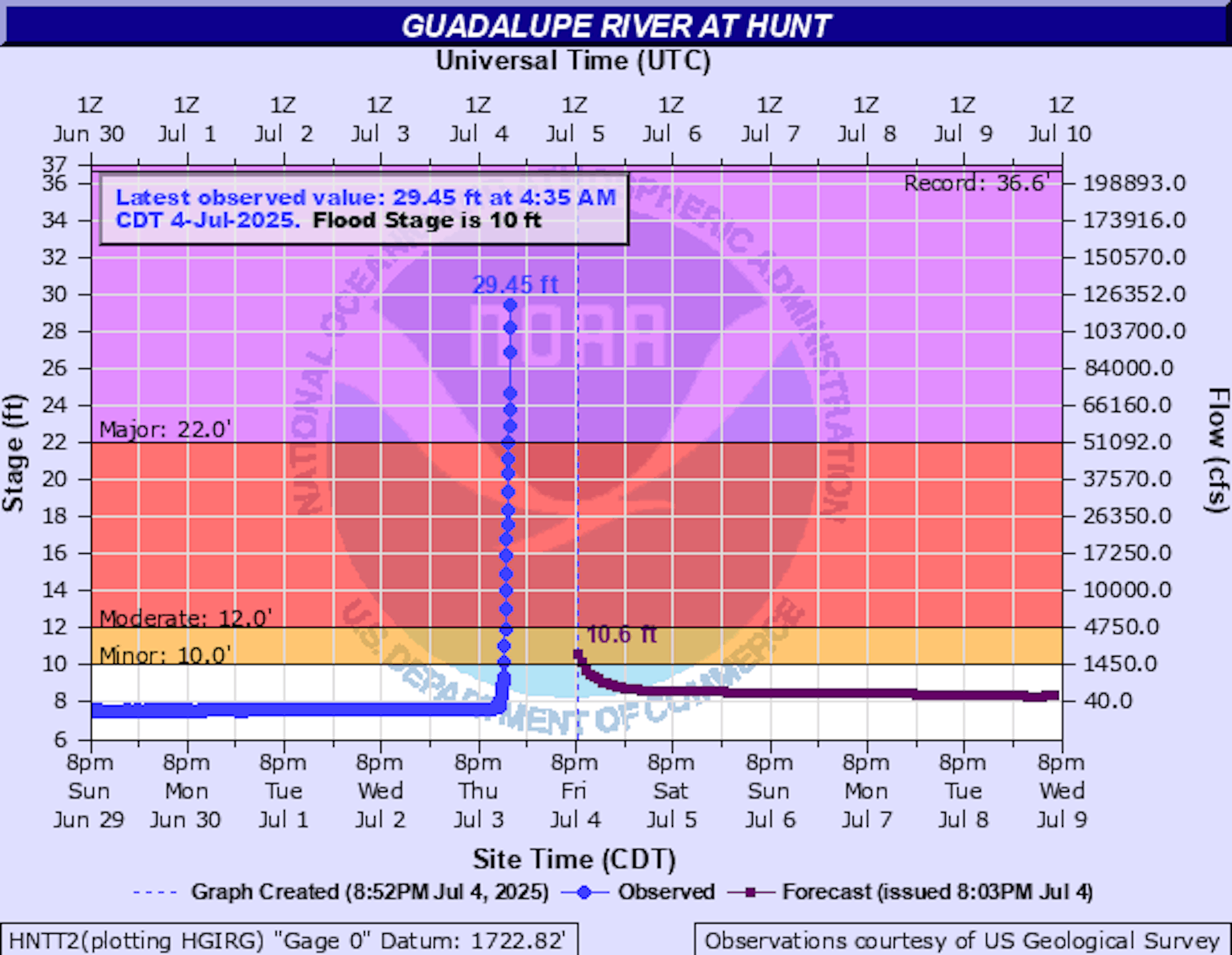
    A river gauge at Hunt, Texas, near Camp Mystic, showed how quickly the river flooded: Around 3 a.m. on July 4, the Guadalupe River was rising about 1 foot every 5 minutes at the gauge, National Weather Service data shows. By 4:30 a.m., it had risen more than 20 feet. As the water moved downstream, it reached Kerrville, where the river rose even faster.

    Flood expert Hatim Sharif, a hydrologist and civil engineer at the University of Texas at San Antonio, explains what makes this part of the country, known as Flash Flood Alley, so dangerous.

    What makes Hill Country so prone to flooding?

    Texas as a whole leads the nation in flood deaths, and by a wide margin. A colleague and I analyzed data from 1959 to 2019 and found 1,069 people had died in flooding in Texas over those six decades. The next highest total was in Louisiana, with 693.

    Many of those flood deaths have been in Hill County. It’s part of an area known as Flash Flood Alley, a crescent of land that curves from near Dallas down to San Antonio and then westward.

    The hills are steep, and the water moves quickly when it floods. This is a semi-arid area with soils that don’t soak up much water, so the water sheets off quickly and the shallow creeks can rise fast.

    When those creeks converge on a river, they can create a surge of water that wipes out homes and washes away cars and, unfortunately, anyone in its path.

    Hill Country has seen some devastating flash floods. In 1987, heavy rain in western Kerr County quickly flooded the Guadalupe River, triggering a flash flood similar to the one in 2025. Ten teenagers being evacuated from a camp died in the rushing water.

    San Antonio, at the eastern edge of Hill Country, was hit with a flash flood on June 12, 2025, that killed 13 people whose cars were swept away by high water from a fast-flooding creek near an interstate ramp in the early morning.

    Why does the region get such strong downpours?

    One reason Hill Country gets powerful downpours is the Balcones Escarpment.

    The escarpment is a line of cliffs and steep hills created by a geologic fault. When warm air from the Gulf rushes up the escarpment, it condenses and can dump a lot of moisture. That water flows down the hills quickly, from many different directions, filling streams and rivers below.

    As temperature rise, the warmer atmosphere can hold more moisture, increasing the downpour and flood risk.

    A tour of the Guadalupe River and its flood risk.

    The same effect can contribute to flash flooding in San Antonio, where the large amount of paved land and lack of updated drainage to control runoff adds to the risk.

    What can be done to improve flash flood safety?

    First, it’s important for people to understand why flash flooding happens and just how fast the water can rise and flow. In many arid areas, dry or shallow creeks can quickly fill up with fast-moving water and become deadly. So people should be aware of the risks and pay attention to the weather.

    Improving flood forecasting, with more detailed models of the physics and water velocity at different locations, can also help.

    Probabilistic forecasting, for example, can provide a range of rainfall scenarios, enabling authorities to prepare for worst-case scenarios. A scientific framework linking rainfall forecasts to the local impacts, such as streamflow, flood depth and water velocity, could also help decision-makers implement timely evacuations or road closures.

    Education is particularly essential for drivers. One to two feet of moving water can wash away a car. People may think their trucks and SUVs can go through anything, but fast-moving water can flip a truck and carry it away.

    Officials can also do more to barricade roads when the flood risk is high to prevent people from driving into harm’s way. We found that 58% of the flood deaths in Texas over the past six decades involved vehicles. The storm on June 12 in San Antonio was an example. It was early morning, and drivers had poor visibility. The cars were hit by fast-rising floodwater from an adjacent creek.

    This article, originally published July 5, 2025, has been updated with the death toll rising.

    Hatim Sharif does not work for, consult, own shares in or receive funding from any company or organization that would benefit from this article, and has disclosed no relevant affiliations beyond their academic appointment.

    ref. Why Texas Hill Country, where a devastating flood killed more than 130 people, is one of the deadliest places in the US for flash flooding – https://theconversation.com/why-texas-hill-country-where-a-devastating-flood-killed-more-than-130-people-is-one-of-the-deadliest-places-in-the-us-for-flash-flooding-260555

    MIL OSI

  • MIL-OSI New Zealand: Weather News – Fast Fronts Bring Wet and Blustery Conditions – MetService

    Source: MetService

    Covering period of Monday 14th – Thursday 17th – We’ve woken to a warmer, cloudier and foggier morning across the country today (Monday). Showers about the west will continue to ease, with cloudy areas in the east becoming fine. The snow has been topped up over the South Island so for those that aren’t back at work or school, it could be beautiful blue bird conditions on the slopes this afternoon.  

    This settling trend isn’t long lived as a quick moving rain band approaches from the west tomorrow (Tuesday) morning. It brings a period of heavy rain and showers to western and northern areas of the country. Thunderstorms are possible about Taranaki up to Northland, as well as Coromandel and coastal Bay of Plenty. MetService Meteorologist Katie Hillyer says, “The silver lining is that this rain band and the showers will move too quickly to allow the accumulations to climb very high, but we’ll need to keep an eye out for the wind gusts as they move through”. A background of strong winds, combined with fast moving features could bring very strong, 80-100km/hr, gusts to Northland and Auckland in the morning and afternoon. By the end of Tuesday, the rain band will be moving off the county and the showers in behind will have eased.  

    As the temperatures drop a bit behind the rainband, the winds will have a cold bite to them, and we will feel a return to more normal winter temperatures. Hillyer advises, “Snow to 700 metres is possible in the south of the South Island, so those that are travelling should keep an eye out for Road Snow Warnings and stay up to date with information from NZTA-Waka Kotahi”.

    Wednesday is generally an easing trend across the country, but toward the end of the day we get a bit of a split in the situation. Overnight Wednesday and into Thursday, areas such as Northland, Auckland, Coromandel, Waikato, and Bay of Plenty will see a quick moving low cross the region, bringing rain, likely to be heavy at times. Further south, there will be showers about coastal areas in the southwest of the country such as the West Coast Region, as well as Southland, but otherwise lots of sun to fight the colder temperatures.

    Please keep up to date with the most current information from MetService at MetService – Te Ratonga Tirorangi

    MIL OSI New Zealand News

  • MIL-OSI Australia: Call for information on jewellery store burglary

    Source: New South Wales Community and Justice

    Call for information on jewellery store burglary

    Monday, 14 July 2025 – 11:20 am.

    Investigations are under way into a burglary at a jewellery business on Murray Street, Hobart, in the early hours of Sunday.Police were called to the business on Murray Street about 2am on July 13 after it was broken into and a quantity of jewellery, including rings and watches, was stolen.Entry was gained by smashing a security door and a glass front door.Detectives are calling for any members of the public who observed the break-in or suspicious activity in Murray Street or Collins Street – where a stolen vehicle was set on fire – to contact police or Crime Stoppers.The following link https://taspol.au.evidence.com/axon/community-request/public/police_investigating_hobart_jewellery_business_burglary is provided to upload any CCTV or dash cam footage that members of the public may have.Anyone with information is asked to contact police on 131 444 or Crime Stoppers on 1800 333 000 or at crimestopperstas.com.au. Information can be provided anonymously.
    Please quote offence report number 779855 .

    MIL OSI News

  • MIL-OSI China: One month after Israeli surprise attack, Iranians stay vigilant

    Source: People’s Republic of China – State Council News

    This photo taken on June 29, 2025 shows the destruction at Evin Prison after the Israeli airstrike in Tehran, Iran. [Photo/Xinhua]

    Precisely one month ago, in the wee hours of June 13, Israel launched major surprise airstrikes on several areas in Iran, including nuclear and military sites, killing senior commanders, nuclear scientists, and civilians.

    One month after the attack, which triggered a 12-day war between the two countries, Iranian experts and politicians maintain that although it is unlikely that Israel would launch another attack against Iran soon, Tehran should enhance its readiness for any scenario that may unfold.

    Speaking in a recent televised interview, Ali Larijani, a senior advisor to Iran’s Supreme Leader Ali Khamenei, warned that “it is possible that Israel … would decide to come back,” stressing that Iran should always be ready.

    In a recent interview with the Iranian Labour News Agency (ILNA), Hossein Kanani Moghaddam, an Iranian expert on West Asia issues and secretary-general of the Green Party, warned against any negligence, noting, “We should always be ready to defend the country and maintain our preparedness to confront the foe.”

    He highlighted the necessity to strengthen the country’s passive defense in the face of surprise operations by Israel and the United States, saying the war, in which Iran was engaged, was a hybrid one featuring the employment of offensive, cyber, security, military, economic and sanction systems by Israel and the United States as well as the U.S. NATO allies.

    Kanani Moghaddam highlighted the importance of ensuring Iran’s intelligence and anti-espionage agencies are well-equipped and focused on countering the “enemy.”

    He also stressed the necessity of establishing an independent intelligence and security organization dedicated to addressing threats from Israel.

    Iran’s deterrence power should be so tremendous that it makes Israel believe any “aggression” against the country would cost it heavily, he added.

    In another interview with ILNA, Ali-Asghar Zargar, an international relations expert, said that while the current ceasefire between Iran and Israel could be sustainable, Iran should take swift actions to strengthen its air defense and military might.

    Iranian lawmaker and former foreign minister, Manouchehr Mottaki, also told the official news agency IRNA in a recent interview that “all of us, especially the Iranian armed forces, should be ready for a likely Israeli attack.”

    Iran’s military figures have been warning that should Israel seek to violate the ceasefire, Iran’s response would be “crushing.”

    In remarks to Defa Press, a news outlet affiliated with the General Staff of Iran’s Armed Forces, spokesman of the Iranian armed forces Abolfazl Shekarchi said the country’s response to a likely Israeli attack would be “firm, serious, crushing, effective and regret-inducing,” emphasizing that the Iranian armed forces’ preparedness was at a high level. 

    MIL OSI China News

  • MIL-OSI China: Abbas urges Hamas to hand over weapons to Palestinian Authority

    Source: People’s Republic of China – State Council News

    Palestinian President Mahmoud Abbas on Sunday called on Hamas to hand over its weapons to the Palestinian Authority (PA).

    During his meeting with former British Prime Minister Tony Blair in the Jordanian capital Amman, Abbas said that “Hamas will not rule Gaza in the post-war era,” the Palestinian official news agency WAFA reported.

    He stressed that the only viable solution for the Gaza Strip is Israel’s complete withdrawal from the strip and the empowerment of the State of Palestine to assume its responsibilities with Arab and international support.

    WAFA said the meeting addressed the latest developments in the Palestinian territories, as well as political and humanitarian developments related to the ongoing war in the Gaza Strip.

    The Palestinian president stressed the need to reach an immediate ceasefire, release all hostages and prisoners, and ensure the unhindered entry of humanitarian aid into the Strip.

    During the meeting, Abbas condemned unilateral Israeli measures, including settlement expansion in the West Bank and Jerusalem, and rejected any attempts to annex Palestinian territories, as well as the repeated attacks on Islamic and Christian holy sites.

    He also called for launching a political process to implement the two-state solution based on international legitimacy resolutions and the Arab Peace Initiative, proposing to hold an international peace conference in New York to achieve the goal. 

    MIL OSI China News

  • MIL-OSI Australia: Three men charged with drug and firearms offences in northern Tasmania

    Source: New South Wales Community and Justice

    Three men charged with drug and firearms offences in northern Tasmania

    Monday, 14 July 2025 – 11:17 am.

    Three men have been charged with drug and firearms offences following a recent police operation in northern Tasmania.
    Detective Inspector Nathan Johnston said the operation, led by the Northern Drugs and Firearms Unit, had been running since May.
    “The operation, which involved a range of specialist police resources, was brought to a planned resolution on 10 July, when two men were taken into custody at a property in Newnham,” he said.
    “Police located $24,000 in cash at the property, as well as a quantity of methylamphetamine and a luxury vehicle believed to have been stolen from Victoria in March.”
    “Several other searches were conducted in the Launceston area, with a further $140,000 in cash located alongside more methylamphetamine in a storage container linked to one of the men.”
    “A suspected stolen motorcycle was also seized.”
    “Police also located two firearms in another container linked to a third man, who was then taken into custody at the scene.”
    Charges:

    A 32-year-old man was charged with trafficking in a controlled substance, dealing with property suspected of being proceeds of crime, motor vehicle stealing and other offences. He was remanded in custody to reappear in the Launceston Magistrates Court at 2.15pm today.
    A 30-year-old man was charged with firearms offences.
    A 45-year-old man was charged with minor drug offences.

    MIL OSI News

  • MIL-OSI Analysis: When disasters fall out of the public eye, survivors continue to suffer – a rehabilitation professional explains how sustained mental health support is critical to recovery

    Source: The Conversation – USA (3) – By Lee Ann Rawlins Williams, Clinical Assistant Professor of Education, Health and Behavior Studies, University of North Dakota

    In Kerrville, Texas, Leighton Sterling watches the rushing floodwaters along the Guadalupe River on July 4, 2025. Eric Vryn via Getty Images News

    The devastating losses from the historic flooding in Texas Hill Country on July 4, 2025, are still coming into grim focus, with 121 deaths confirmed and more than 100 still missing as of July 10.

    As emergency responders focus on clearing debris and searching for victims, a less visible and slower disaster has been unfolding: the need for ongoing mental health support long after headlines fade.

    This phase is no less critical than restoring power or rebuilding bridges. Disasters destabilize emotional well-being, leaving distress, prolonged recovery and long-term impacts in their wake long after the event is over.

    Without sustained emotional support, people and communities face heightened risks of prolonged trauma and stalled recovery.

    As an educator and practitioner focused on disability and rehabilitation, I explore the intersection of disaster recovery and the impact of disasters on mental health. Both my research and that of others underscore the vital importance of support systems that not only help people cope in the immediate aftermath of a disaster but also facilitate long-term healing over the months and years that follow – especially for vulnerable populations like children, older adults and people with disabilities.

    The emotional toll of disasters

    Natural disasters disrupt routines, displace families and challenge people’s sense of control and security. In the immediate aftermath, survivors often experience shock, grief, anxiety and sleep disturbances. Often these symptoms may evolve into chronic stress, depression, post-traumatic stress disorder or a combination of these conditions.

    A 2022 study found that Texans who experienced two or more disasters within a five-year span had significantly poorer mental health, as reflected by lower scores on standardized psychological assessments, which highlights the cumulative toll repeated disasters can have on mental well-being.

    After Hurricane Katrina ravaged New Orleans in 2005, nearly a third of survivors continued to experience poor mental health years later.

    And reports following Hurricane Maria in Puerto Rico in 2017 revealed surging rates of anxiety, depression and suicidal thoughts, especially in areas where services remained unavailable for extended periods of time.

    There are actionable ways to make a difference in the recovery process.

    Strained recovery systems

    Disaster response understandably focuses on immediate needs like rescue operations, providing post-disaster housing and repairing damaged infrastructure. In addition, short-term mental health supports such as mobile health clinics are often provided in the immediate aftermath of a disaster.

    However, although emergency services are deployed quickly after a disaster, long-term mental health support is often delayed or under-resourced, leaving many people without continued care during the recovery period, especially in remote or rural communities, exposing deep structural gaps in how recovery systems are designed.

    One year after Hurricane Harvey devastated parts of Texas in 2017, more than 90% of Gulf Coast residents reported ongoing stress related to housing instability, financial hardship or displacement. Yet less than 10% of people stated that they or someone in their household had used mental health services following the disaster.

    Hurricane Helene in 2024 similarly tested the resilience of rural mental health networks in western North Carolina. The storm damaged roads and bridges, schools and even local clinics.

    This prompted a news organization, North Carolina Health News, to warn of rising “trauma, stress and isolation” among residents as providers scrambled to offer free counseling despite legal barriers stemming from licensing requirements to provide counseling across state borders. State health officials activated community crisis centers and helplines, while mobile mental health teams were dispatched from Tennessee to help those impacted by the disaster. However, state representatives stressed that without long-term investment, these critical supports risk being one-off responses.

    These events serve as a powerful reminder that while roads and buildings can often be restored quickly, emotional recovery is a slower, more complex process. Truly rebuilding requires treating mental health with the same urgency as physical infrastructure. This requires investing in strong mental health recovery systems, supporting local clinics, sustaining provider networks and integrating emotional care into recovery plans from the start.

    In Hunt, Texas, Gov. Greg Abbott speaks to volunteers and community members during a news conference on July 8, 2025.
    Brandon Bell via Getty Images News

    Finding mental health support following a disaster

    Lessons learned from previous disasters and an abundance of research show how sustained mental health supports can help people recover and build resilience.

    These six lessons are particularly helpful for finding needed mental health support following a disaster:

    • If you’re feeling overwhelmed after a disaster, you’re not alone, and help is available. Free and confidential support is offered through resources like the Disaster Distress Helpline (1-800-985-5990 or text TalkWithUs to 66746), which connects you to trained counselors 24/7.

    • Many communities offer local mental health crisis lines or walk-in centers that remain active well after the disaster passes. Check your county or state health department’s website for updated listings and information.

    • Even if physical offices are closed, many clinics now offer virtual counseling or can connect you with therapists and medication refills remotely. If you’ve seen someone before, ask if they’re still available by phone or video.

    • After major disasters, states often deploy mobile health clinics that include mental health services to shelters, churches or schools. These temporary services are free and open to the public.

    • If someone you care about is struggling, help them connect with resources in the community. Share hotline numbers, offer to help make an appointment or just let them know it’s OK to ask for support. Many people don’t realize that help is available, or they think it’s only for more “serious” problems. It’s not.

    • Mental health support doesn’t always arrive right away. Keep an eye on local news, school updates or health department alerts for new services that may become available in the weeks or months after a disaster.

    Disasters don’t just damage buildings; they disrupt lives in lasting ways.

    While emotional recovery takes time, support is available. Staying informed and sharing resources with others can help ensure that the road to recovery isn’t traveled alone.

    Lee Ann Rawlins Williams does not work for, consult, own shares in or receive funding from any company or organization that would benefit from this article, and has disclosed no relevant affiliations beyond their academic appointment.

    ref. When disasters fall out of the public eye, survivors continue to suffer – a rehabilitation professional explains how sustained mental health support is critical to recovery – https://theconversation.com/when-disasters-fall-out-of-the-public-eye-survivors-continue-to-suffer-a-rehabilitation-professional-explains-how-sustained-mental-health-support-is-critical-to-recovery-260781

    MIL OSI Analysis

  • MIL-OSI Analysis: When disasters fall out of the public eye, survivors continue to suffer – a rehabilitation professional explains how sustained mental health support is critical to recovery

    Source: The Conversation – USA (3) – By Lee Ann Rawlins Williams, Clinical Assistant Professor of Education, Health and Behavior Studies, University of North Dakota

    In Kerrville, Texas, Leighton Sterling watches the rushing floodwaters along the Guadalupe River on July 4, 2025. Eric Vryn via Getty Images News

    The devastating losses from the historic flooding in Texas Hill Country on July 4, 2025, are still coming into grim focus, with 121 deaths confirmed and more than 100 still missing as of July 10.

    As emergency responders focus on clearing debris and searching for victims, a less visible and slower disaster has been unfolding: the need for ongoing mental health support long after headlines fade.

    This phase is no less critical than restoring power or rebuilding bridges. Disasters destabilize emotional well-being, leaving distress, prolonged recovery and long-term impacts in their wake long after the event is over.

    Without sustained emotional support, people and communities face heightened risks of prolonged trauma and stalled recovery.

    As an educator and practitioner focused on disability and rehabilitation, I explore the intersection of disaster recovery and the impact of disasters on mental health. Both my research and that of others underscore the vital importance of support systems that not only help people cope in the immediate aftermath of a disaster but also facilitate long-term healing over the months and years that follow – especially for vulnerable populations like children, older adults and people with disabilities.

    The emotional toll of disasters

    Natural disasters disrupt routines, displace families and challenge people’s sense of control and security. In the immediate aftermath, survivors often experience shock, grief, anxiety and sleep disturbances. Often these symptoms may evolve into chronic stress, depression, post-traumatic stress disorder or a combination of these conditions.

    A 2022 study found that Texans who experienced two or more disasters within a five-year span had significantly poorer mental health, as reflected by lower scores on standardized psychological assessments, which highlights the cumulative toll repeated disasters can have on mental well-being.

    After Hurricane Katrina ravaged New Orleans in 2005, nearly a third of survivors continued to experience poor mental health years later.

    And reports following Hurricane Maria in Puerto Rico in 2017 revealed surging rates of anxiety, depression and suicidal thoughts, especially in areas where services remained unavailable for extended periods of time.

    There are actionable ways to make a difference in the recovery process.

    Strained recovery systems

    Disaster response understandably focuses on immediate needs like rescue operations, providing post-disaster housing and repairing damaged infrastructure. In addition, short-term mental health supports such as mobile health clinics are often provided in the immediate aftermath of a disaster.

    However, although emergency services are deployed quickly after a disaster, long-term mental health support is often delayed or under-resourced, leaving many people without continued care during the recovery period, especially in remote or rural communities, exposing deep structural gaps in how recovery systems are designed.

    One year after Hurricane Harvey devastated parts of Texas in 2017, more than 90% of Gulf Coast residents reported ongoing stress related to housing instability, financial hardship or displacement. Yet less than 10% of people stated that they or someone in their household had used mental health services following the disaster.

    Hurricane Helene in 2024 similarly tested the resilience of rural mental health networks in western North Carolina. The storm damaged roads and bridges, schools and even local clinics.

    This prompted a news organization, North Carolina Health News, to warn of rising “trauma, stress and isolation” among residents as providers scrambled to offer free counseling despite legal barriers stemming from licensing requirements to provide counseling across state borders. State health officials activated community crisis centers and helplines, while mobile mental health teams were dispatched from Tennessee to help those impacted by the disaster. However, state representatives stressed that without long-term investment, these critical supports risk being one-off responses.

    These events serve as a powerful reminder that while roads and buildings can often be restored quickly, emotional recovery is a slower, more complex process. Truly rebuilding requires treating mental health with the same urgency as physical infrastructure. This requires investing in strong mental health recovery systems, supporting local clinics, sustaining provider networks and integrating emotional care into recovery plans from the start.

    In Hunt, Texas, Gov. Greg Abbott speaks to volunteers and community members during a news conference on July 8, 2025.
    Brandon Bell via Getty Images News

    Finding mental health support following a disaster

    Lessons learned from previous disasters and an abundance of research show how sustained mental health supports can help people recover and build resilience.

    These six lessons are particularly helpful for finding needed mental health support following a disaster:

    • If you’re feeling overwhelmed after a disaster, you’re not alone, and help is available. Free and confidential support is offered through resources like the Disaster Distress Helpline (1-800-985-5990 or text TalkWithUs to 66746), which connects you to trained counselors 24/7.

    • Many communities offer local mental health crisis lines or walk-in centers that remain active well after the disaster passes. Check your county or state health department’s website for updated listings and information.

    • Even if physical offices are closed, many clinics now offer virtual counseling or can connect you with therapists and medication refills remotely. If you’ve seen someone before, ask if they’re still available by phone or video.

    • After major disasters, states often deploy mobile health clinics that include mental health services to shelters, churches or schools. These temporary services are free and open to the public.

    • If someone you care about is struggling, help them connect with resources in the community. Share hotline numbers, offer to help make an appointment or just let them know it’s OK to ask for support. Many people don’t realize that help is available, or they think it’s only for more “serious” problems. It’s not.

    • Mental health support doesn’t always arrive right away. Keep an eye on local news, school updates or health department alerts for new services that may become available in the weeks or months after a disaster.

    Disasters don’t just damage buildings; they disrupt lives in lasting ways.

    While emotional recovery takes time, support is available. Staying informed and sharing resources with others can help ensure that the road to recovery isn’t traveled alone.

    Lee Ann Rawlins Williams does not work for, consult, own shares in or receive funding from any company or organization that would benefit from this article, and has disclosed no relevant affiliations beyond their academic appointment.

    ref. When disasters fall out of the public eye, survivors continue to suffer – a rehabilitation professional explains how sustained mental health support is critical to recovery – https://theconversation.com/when-disasters-fall-out-of-the-public-eye-survivors-continue-to-suffer-a-rehabilitation-professional-explains-how-sustained-mental-health-support-is-critical-to-recovery-260781

    MIL OSI Analysis

  • MIL-OSI Australia: Tackling a $1.2 billion problem for Australian farmers using dirt-cheap crushed volcanic rock

    Source:

    14 July 2025

    UniSA researcher Dr Binoy Sarkar and a student spreading basalt onto crops.

    Cheap volcanic rock that languishes in open cut mines and quarries could transform Australia’s farming sector as a natural fertiliser, boosting crop yields and removing carbon dioxide from the atmosphere.

    It turns out that crushed basalt – a common rock used to make roads, houses, schools and hospitals – may address two very critical issues of our time: climate change and acidic soils.

    University of South Australia (UniSA) environmental researcher Dr Binoy Sarkar is leading an Enhanced Rock Weathering trial that involves applying crushed basalt to agricultural soils, measuring its nutrient release and carbon capture.

    Dr Sarkar, from UniSA’s Future Industries Institute,  is collaborating with James Cook University, the Tropical North Queensland Drought Hub, and industry partner Carbonaught Pty Ltd on two projects, funded by the Federal Government and Cascade Climate.

    “Australian farmers spend nearly $1.2 billion a year to tackle soil acidification, using expensive liming materials that in themselves contribute to greenhouse gas emissions,” Dr Sarkar says.

    “Large volumes of adequately fine rock particles – a byproduct of the mining and construction industry – can be bought for as little as $30 per ton and applied to soils using existing farm equipment, with negligible expense.

    “Basalt does not completely replace chemical fertilisers, but it can cut fertiliser amounts needed to grow crops, saving farmers a lot of money and substantially improving their profit margins.”

    A truck spreading basalt – crushed rock from quarries – onto crops.

    Farming with basalt solves two critical challenges facing Australian agriculture: improving infertile soils and simultaneously removing greenhouse gas emissions from farming practices that include nitrogen fertilisers, deforestation and land clearing.

    “As a country, we have committed to achieving net zero greenhouse gas emissions by 2050. Almost 18% of our emissions are produced by the agricultural sector, primarily from crop production and emissions from livestock,” Dr Sarkar says.

    “Lime is commonly used for correcting soil acidity, but it is expensive and contributes heavily to on-farm carbon dioxide emissions. Basalt naturally reduces acidity, captures carbon, and it also releases nutrients such as phosphorus, calcium, magnesium and silicon into the soil.”   

    Dr Sarkar says the research will not only benefit Australia’s agricultural sector, but also the mining sector, where basalt is a byproduct that has to be dug and moved aside before reaching valuable minerals located at depth.

    This byproduct is already crushed to make road building and construction materials, but finer fractions are stockpiled, often taking up large amounts of space with negligible commercial use.

    Society at large is also a winner, thanks to basalt scrubbing gigatons of carbon dioxide from the air.

    Dr Sarkar’s collaborative team is the first in Australia to receive significant R&D federal funding ($5 million) to trial the low-cost carbon cutting technology nationally.

    “I hope we can see a lot more trials in the next few years, to build confidence and propel a large-scale adoption of this rock weathering technology.

    “It will also provide opportunities for farmers and quarry owners to sell carbon credits and earn additional profits. Our farmers will be able to take advantage of this huge market when we have a strong monitoring, reporting and verification program for the technology.”

    A video accompanying this media release is available at: https://youtu.be/rivrFCol0g0

    Contact for interview: Dr Binoy Sarkar M: +61 433 801 054 E: binoy.sarkar@unisa.edu.au

    Media contact: Megan Andrews M: +61 434 819 275 E: megan.andrews@unisa.edu.au

    Other articles you may be interested in

    MIL OSI News

  • MIL-OSI USA News: Presidential Message on the Anniversary of the Tragedy in Butler, Pennsylvania

    Source: US Whitehouse

    One year ago today, at 6:11 pm—eight minutes after taking the stage on the grounds of Butler Farms to address thousands of Americans gathered at a campaign rally—rifle fire broke out, and an assassin’s bullet came within a quarter inch of ending my life and silencing our movement to restore American greatness.  Yet, by the hand of providence and the grace of Almighty God, my life was spared.  As we commemorate one year since the harrowing events of July 13, 2024, we reaffirm that the American spirit has and will always triumph over forces of evil and destruction.

    Those who carry scars from that July evening defended our Republic during one of our Nation’s darkest hours—running to the injured amid chaos and uncertainty to provide comfort and lifesaving care.  Doctors and first responders rushed to help the wounded, rallygoers guided their fellow citizens to safety, and patriots raised their fists in the air in an outpouring of support and national pride.  These men and women arrived at the rally grounds as ordinary Americans, but left as heroes.  They represent the very best of our Nation, and we are forever indebted for their kindness and compassion.

    However, one name stands above all for selfless service and ultimate sacrifice on that fateful day.  The world will never forget the tragic loss of Corey Comperatore, a firefighter, veteran, and devoted husband and father.  When gunfire erupted, Corey did not hesitate to protect his wife and two daughters.  He died a hero, and we are eternally grateful for his inspiring love, valor, and faithfulness.

    It remains my firm conviction that God alone saved me that day for a righteous purpose: to restore our beloved Republic to greatness and to rescue our Nation from those who seek its ruin.  One year after the attempt on my life in Butler, our country is in the midst of a new Golden Age.  History will remember the would-be assassin for his cowardice and failure, but the magnificent legacy of the heroes of July 13, 2024, will forever be etched upon the heart of our Nation.  Today, we pay tribute to their spirit of love, unity, and resilience—and we proclaim with one voice the epic battle cry that has reverberated all across the world: “Fight, fight, fight!”

    MIL OSI USA News

  • MIL-Evening Report: Music is at the forefront of AI disruption, but NZ artists still have few protections

    Source: The Conversation (Au and NZ) – By Dave Carter, Associate Professor, School of Music and Screen Arts, Te Kunenga ki Pūrehuroa – Massey University

    Getty Images

    Was the recent Velvet Sundown phenomenon a great music and media hoax, a sign of things to come, or just another example of what’s already happening ?

    In case you missed it, the breakout act was streamed hundreds of thousands of times before claims emerged the band and their music were products of generative artificial intelligence (GenAI).

    Despite the “band” insisting they were real, an “associate” later admitted it was indeed an “art hoax” marketing stunt. Much of the subsequent commentary was concerned with fairness – particularly that a “fake” band was succeeding at the expense of “real” artists.

    But Velvet Sundown is only the most recent example in a long history of computer generated and assisted music creation – going back to the 1950s when a chemistry professor named Lejaren Hiller debuted a musical composition written by a computer.

    By the 1980s, David Cope’s Experiments in Musical Intelligence created music so close to the style of Chopin and Bach it fooled classically trained musicians.

    Artist and composer Holly Herndon was highlighting a need for the ethical use and licensing of voice models and deepfakes several years before Grimes invited others to use AI-generated versions of her voice to make new music, and “Deepfake Drake” alarmed the major record labels.

    At the same time, music companies, including Warner, Capitol and rapper-producer Timbaland, have since inked record contracts for AI-generated work.

    GenAI-powered tools, such as those offered by Izotope, LANDR and Apple, have become commonplace in mixing and mastering since the late 2000s. Machine learning technology also underpins streaming recommendations.

    Creativity and copyright

    Despite this relatively long history of technology’s impact on music, it still tends to be framed as a future challenge. The New Zealand government’s Strategy for Artificial Intelligence, released this month, suggests we’re at a “pivotal moment” as the AI-powered future approaches.

    In June, a draft insight briefing from Manata Taonga/Ministry for Culture & Heritage explored “how digital technologies may transform the ways New Zealanders create, share and protect stories in 2040 and beyond”.

    It joins other recent publications by the Australasian Performing Rights Association and New Zealand’s Artificial Intelligence Researchers Association, which grapple with the future impacts of AI technologies.

    One of the main issues is the use of copyright material to train AI systems. Last year, two AI startups, including the one used by Velvet Sundown, were sued by Sony, Universal and Warner for using unlicensed recordings as part of their training data.

    It’s possible the models have been trained on recordings by local musicians without their permission, too. But without any requirement for tech firms to disclose their training data it can’t be confirmed.

    Even if we did know, the copyright implications for works created by AI in Aotearoa New Zealand aren’t clear. And it’s not possible for musicians to opt out in any meaningful way.

    This goes against the data governance model designed by Te Mana Raraunga/Māori Sovereignty Network. Māori writer members of music rights administrator APRA AMCOS have also raised concerns about potential cultural appropriation and misuse due to GenAI.

    Recent research suggesting GenAI work displaces human output in creative industries is particularly worrying for local musicians who already struggle for visibility. But it’s not an isolated phenomenon.

    In Australia, GenAI has reportedly been used to impersonate successful, emerging and dead artists. And French streaming service Deezer claims up to 20,000 tracks created by GenAI were being uploaded to its service daily.

    Regulation in the real world

    There has been increased scrutiny of streaming fraud, including a world-first criminal case brought last year against a musician who used bots to generate millions of streams for tracks created with GenAI.

    But on social media, musicians now compete for attention with a flood of “AI slop”, with no real prospect of platforms doing anything about it.

    More troublingly, New Zealand law has been described as “woefully inadequate” at combating deepfakes and non-consensual intimate imagery that can damage artists’ brands and livelihoods.

    The government’s AI strategy prioritises adoption, innovation and a light-touch approach over these creative and cultural implications. But there is growing consensus internationally that regulatory intervention is warranted.

    The European Union has enacted legislation requiring AI services to be transparent about what they have trained their models on, an important first step towards an AI licensing regime for recorded and musical works.

    An Australian senate committee has recommended whole-of-economy AI guardrails, including transparency requirements in line with the EU. Denmark has gone even further, with plans to give every citizen copyright of their own facial features, voice and body, including specific protections for performing artists.

    It’s nearly ten years since the music business was described as the “canary in a coalmine” for other industries and a bellwether of broader cultural and economic shifts. How we address the current challenges presented by AI in music will have far-reaching implications.

    Dave Carter is a writer member of APRA AMCOS. He has received funding and contributed to projects funded by Manatū Taongao Ministry for Culture and Heritage, NZ on Air and APRA AMCOS.

    Jesse Austin-Stewart has completed commissioned research for NZ On Air and participated in focus groups for Manatū Taonga Ministry for Culture and Heritage. He has received competitive funding from Creative New Zealand, NZ On Air, Manatū Taonga Ministry for Culture & Hertiage, and the NZ Music Commission. He is a writer member of APRA AMCOS and a member of the Composer’s Association of New Zealand and Recorded Music NZ

    Oli Wilson has previously completed research in partnership with or commissioned by APRA AMCOS, Toi Mai Workforce Development Council, Manatū Taonga Ministry for Culture & Heritage and the NZ Music Commission. He has also received funding, or contributed to projects that have benefited from funding from NZ on Air, the NZ Music Commission and Recorded Music New Zealand. He has provided services to The Chills, owns shares in TripTunz Limited, and is a writer member of APRA AMCOS.

    ref. Music is at the forefront of AI disruption, but NZ artists still have few protections – https://theconversation.com/music-is-at-the-forefront-of-ai-disruption-but-nz-artists-still-have-few-protections-260299

    MIL OSI AnalysisEveningReport.nz

  • MIL-OSI USA News: SUNDAY SHOWS: Trump Administration is Putting Americans First

    Source: US Whitehouse

    This morning, officials joined the Sunday shows to discuss the historic steps the Trump Administration is taking to ensure the safety and security of the American people — including the government-wide response to the devastating Texas flooding, unprecedented action to secure the homeland, and protecting our national security through supply chain resiliency.

    Here’s what you missed:

    Secretary of Homeland Security Kristi Noem

    • “Within just an hour or two after the flooding, we had resources from the Department of Homeland Security there helping those individuals in Texas … This is the fastest, I believe, in years, maybe decades, that FEMA has been deployed to help individuals in this type of a situation.” Watch
    • “This is what I think is really unfortunate is that we have a situation where so many individuals are playing politics with what happened to Texas.” Watch
    • “This week, we’ve got murderers off the street, rapists, child pedophiles. If you look at that marijuana grow facility that we recently just did an operation on, over 319 individuals were brought into custody — and 14 unaccompanied children.” Watch

    Border Czar Tom Homan

    • “If you’re in the country legally, you shouldn’t fear ICE — but what you should fear is the criminal aliens walking the communities in sanctuary cities.” Watch
    • “You didn’t see [Democrats] complaining about, under the Biden Administration, people being held in a Border Patrol parking lot surrounded by a fence in the sweltering heat. Not a word. You didn’t a word about half a million children being trafficked into the country and them not being able to locate 300,000 … They ignored four years of open borders, historic migrant death, historic Americans dying from fentanyl, historic numbers of women and children being sex trafficked, historic number of people on the terrorist watchlist coming across the border. Silence.” Watch

    National Economic Council Director Kevin Hassett

    • “Tariff revenue over the next ten years — which will help reduce the deficit and secure our entitlement programs — it’s $3 trillion, and consumers haven’t seen that.” Watch
    • “We’re trying to put America First … This is about America getting itself ready for the Golden Age by getting our house in order, by getting our tariff and trade policy and tax policy exactly where it needs to be for a Golden Age.” Watch
    • “If there is a time of war, we need to have the metals that we need to produce American weapons, and copper is a key component in many American weapons. As we look forward to the threats that America faces, the President decided that we have plenty of copper in the U.S., but not enough copper production — and that’s why he has taken this strong step.” Watch

    MIL OSI USA News

  • MIL-OSI United Nations: UN-backed labour standards at risk as tariff uncertainty grows

    Source: United Nations 2

    Threatened or actual tariff increases are largely focused on taxing imports into the United States and will make the products made by factories outside the country more expensive – a situation which may drive down demand.

    The ILO’s Better Work programme, a partnership with the International Finance Corporation (IFC), has supported garment factories, many of which export their products to the United States.

    The ILO’s Sara Park explained to UN News what could happen next.

    Sara Park: Better Work currently operates in the garment, textile and footwear sector in 13 countries around the world.

    It was set up 24 years ago in Cambodia to monitor the working conditions in garment factories and since then has focused on improvement and capacity building of factories and our constituencies in the sector, for example occupational safety and health.

    There are other elements that support the sector to promote social dialogue, safe and decent work which includes fair wages and working hours. The programme has also helped build productivity in those sectors.

    UN News: How is the ILO involved?

    Sara Park: The ILO is a tripartite organization, so we work with governments, employers, the unions who represent workers, usually Ministries of Labour, but also with ministries of trade or commerce because the programme focuses on exports.

    © Better Work/Aron Simeneh

    A worker at a factory in Ethiopia carries out an inspection on fire safety equipment.

    But what maybe makes us different from other projects is that we have a very close collaboration with major brands from the US, UK, Europe and Japan to promote responsible business practices.

    UN News: How successful has this programme been?

    Sara Park: Our studies show that at the factory level we’ve made significant impact, for example by increasing wages and supporting gender-equality related issues, women’s empowerment and women getting more supervisory roles.

    Over the quarter of a century of its existence, Better Work has lifted millions of people out of poverty and reduced the environmental impact of the apparel sector by creating decent work in sustainable enterprises.

    It’s still hard for unions as freedom of association remains a big challenge.

    © ILO/Aaron Santos

    A woman works at a Better Work-affiliated factory in Viet Nam.

    If you’re trying to develop a whole industry and make it competitive, it takes years if not decades; however, we have seen improvements in the factories where we work.

    Better Work-enrolled factories have also reported an increase in orders from buyers.

    UN News: So, this is good for business as well?

    Sara Park: This is good for business, and productivity in individual factories. Governments also tell us that the programme supports confidence and thus growth of the industry as a whole in participating countries.

    © Better Work/Marcel Crozet

    Garment employees work on a production line of an exporting clothing plant in Jordan.

    UN News: How has Better Work been affected by recent global changes in development funding?

    Sara Park: As we know from recent developments, the US Government has cut funding and that has affected our programmes in Haiti and Jordan, which were almost fully funded by the US. The other countries have not been affected, as we are lucky to have very diverse funding.

    UN News: Why is the ILO’s ongoing support needed once the relationship between factory and the buyer is set up?

    Sara Park: The buyers, which are often well-known companies, require a sustainable way of monitoring working conditions to ensure they are in compliance with international labour standards; this is important to eliminate risk from the buyers’ perspective.

    The Better Work programme supports improvements in factories, by conducting assessments, advisory and learning sessions and helps all parties to better understand compliance with the standards. It also works with governments, workers and employers to build capacity.

    © Better Work/Feri Latief

    Workers take their lunch break at a garment factory in Indonesia.

    UN News: Currently there is widespread uncertainty about tariffs, the taxing of imported goods particularly into the United States. How is the garment sector impacted?

    Sara Park: At the moment, we don’t know what the impact will be. Governments are monitoring the situation. Employers and, of course, the unions are worried.

    It is extremely challenging for factories as uncertainty means they cannot plan even for the short term, as they don’t know what orders they will have. They are also concerned about paying workers.

    Better Work-enrolled factories are providing primarily jobs in the formal sector; if they close, then those jobs may move to the informal sector where workers have fewer protections.

    In countries like Jordan for example, migrants make up the majority of the workforce in the garment industry, most of them come from South and Southeast Asia.

    UN News: How is this uncertainty impacting investment in the global garment industry?

    Sara Park: During periods of crisis or uncertainty, investment generally pauses. One concern is that factories stop investing in improving working conditions, which could affect occupational safety and health.

    For example, heat stress is a serious issue. Recently, in Pakistan temperatures reached 50 degrees Celsius so action needs to be taken to protect workers. This may not happen if investment dries up.

    UN News: What would you say to a garment worker who was worried about his or her job?

    Sara Park: We understand this is a worry for many workers. Yet the work of the ILO is continuing to ensure that workers are protected and the ILO remains in those countries and is committed to improving conditions for all workers across different sectors.

    We will continue to promote social dialogue because that’s how improvements can be made at factory, sectoral and national level.

    MIL OSI United Nations News

  • MIL-OSI USA: NEWS: Sanders, Welch, Van Hollen Issue Statement of Solidarity with MK Ayman Odeh Following Expulsion Efforts from the Israeli Parliament

    US Senate News:

    Source: United States Senator for Vermont – Bernie Sanders
    WASHINGTON, July 13 – Sen. Bernie Sanders (I-Vt.), Sen. Peter Welch (D-Vt.) and Sen. Chris Van Hollen (D-Md.) today issued a statement of solidarity with MK Ayman Odeh, the chairman of the Arab-majority Hadash-Ta’al party, after lawmakers in the Israeli Knesset House Committee voted to impeach him.
    We strongly condemn the effort to expel MK Ayman Odeh from the Israeli Knesset.
    All over the world, democracy is under assault. If Israel is going to call itself a democracy, it must tolerate peaceful dissent.
    For over a decade, MK Odeh has been a leading advocate for peace, justice, and Jewish-Arab partnership. The current expulsion effort is a direct response to MK Odeh’s outspoken and brave calls for an immediate ceasefire in Gaza, an end to the occupation, and a political solution between Israelis and Palestinians.
    This effort is not merely a personal attack on one parliamentarian – it is a grave assault on democracy, pluralism, and freedom of expression. In any free society, elected representatives must be able to speak their conscience without fear of expulsion or punishment. Suppressing dissent does not strengthen a democracy; it weakens its legitimacy.
    And this expulsion effort sends a chilling message to millions of Palestinian citizens of Israel: that their representation is conditional and their rights revocable. Such a message has no place in any democratic society.
    We strongly condemn this anti-democratic maneuver and urge all members of the Knesset to reject the petition for MK Odeh’s expulsion.
    At a time when many remain silent or resort to inciting rhetoric, MK Odeh has continued to call for an end to the violence, the protection of innocent lives, and a just and lasting peace for both peoples. He deserves the support of all those committed to democracy and freedom of expression.
    We stand in solidarity with MK Odeh and with the right of all lawmakers, Arab and Jewish, to speak freely and without fear of political retribution.

    MIL OSI USA News

  • MIL-OSI USA: NEWS: Sanders, Welch, Van Hollen Issue Statement of Solidarity with MK Ayman Odeh Following Expulsion Efforts from the Israeli Parliament

    US Senate News:

    Source: United States Senator for Vermont – Bernie Sanders

    WASHINGTON, July 13Sen. Bernie Sanders (I-Vt.), Sen. Peter Welch (D-Vt.) and Sen. Chris Van Hollen (D-Md.) today issued a statement of solidarity with MK Ayman Odeh, the chairman of the Arab-majority Hadash-Ta’al party, after lawmakers in the Israeli Knesset House Committee voted to impeach him.

    We strongly condemn the effort to expel MK Ayman Odeh from the Israeli Knesset.

    All over the world, democracy is under assault. If Israel is going to call itself a democracy, it must tolerate peaceful dissent.

    For over a decade, MK Odeh has been a leading advocate for peace, justice, and Jewish-Arab partnership. The current expulsion effort is a direct response to MK Odeh’s outspoken and brave calls for an immediate ceasefire in Gaza, an end to the occupation, and a political solution between Israelis and Palestinians.

    This effort is not merely a personal attack on one parliamentarian – it is a grave assault on democracy, pluralism, and freedom of expression. In any free society, elected representatives must be able to speak their conscience without fear of expulsion or punishment. Suppressing dissent does not strengthen a democracy; it weakens its legitimacy.

    And this expulsion effort sends a chilling message to millions of Palestinian citizens of Israel: that their representation is conditional and their rights revocable. Such a message has no place in any democratic society.

    We strongly condemn this anti-democratic maneuver and urge all members of the Knesset to reject the petition for MK Odeh’s expulsion.

    At a time when many remain silent or resort to inciting rhetoric, MK Odeh has continued to call for an end to the violence, the protection of innocent lives, and a just and lasting peace for both peoples. He deserves the support of all those committed to democracy and freedom of expression.

    We stand in solidarity with MK Odeh and with the right of all lawmakers, Arab and Jewish, to speak freely and without fear of political retribution.

    MIL OSI USA News

  • MIL-OSI New Zealand: Traffic delays following fire in Parnell

    Source: New Zealand Police

    Motorists are advised to expect delays in Parnell this morning due to a building fire in Parnell Road.

    Emergency Services responded to reports of a fire at about 6.45am.

    Parnell Road, between Garfield Street and St Stephens Avenue, has been cordoned off in both directions.

    Motorists are advised to seek an alternative route.

    ENDS.

    Holly McKay/NZ Police

    MIL OSI New Zealand News

  • MIL-OSI New Zealand: Delays following fire, Avondale

    Source: New Zealand Police

    Motorists are advised to expect delays in Avondale this morning due to a building fire in Great North Road.

    Emergency Services responded to reports of a fire at Saint Mary’s Catholic School at about 4.20am.

    Great North Road, between Portage Road and Larch Road, is cordoned off and emergency services are in attendance.

    There are no reports of injury.

    Police will work with fire investigators to establish the circumstances of the fire.

    ENDS.

    Holly McKay/NZ Police

    MIL OSI New Zealand News

  • MIL-OSI Submissions: Disasters don’t disappear when the storm ends – cascading hazards, from landslides to floods, are upending risk models

    Source: The Conversation – USA (2) – By Brian J. Yanites, Associate Professor of Earth and Atmospheric Science. Robert Shrock Professor of Surficial and Sedimentary Geology, Indiana University

    The Carter Lodge hangs precariously over the flood-scoured bank of the Broad River in Chimney Rock Village, N.C., on May 13, 2025, eight months after Hurricane Helene. AP Photo/Allen G. Breed

    Hurricane Helene lasted only a few days in September 2024, but it altered the landscape of the Southeastern U.S. in profound ways that will affect the hazards local residents face far into the future.

    Mudslides buried roads and reshaped river channels. Uprooted trees left soil on hillslopes exposed to the elements. Sediment that washed into rivers changed how water flows through the landscape, leaving some areas more prone to flooding and erosion.

    Helene was a powerful reminder that natural hazards don’t disappear when the skies clear – they evolve.

    These transformations are part of what scientists call cascading hazards. They occur when one natural event alters the landscape in ways that lead to future hazards. A landslide triggered by a storm might clog a river, leading to downstream flooding months or years later. A wildfire can alter the soil and vegetation, setting the stage for debris flows with the next rainstorm.

    Satellite images before (top) and after Hurricane Helene (bottom) show how the storm altered landscape near Pensacola, N.C., in the Blue Ridge Mountains.
    Google Earth, CC BY

    I study these disasters as a geomorphologist. In a new paper in the journal Science, I and a team of scientists from 18 universities and the U.S. Geological Survey explain why hazard models – used to help communities prepare for disasters – can’t just rely on the past. Instead, they need to be nimble enough to forecast how hazards evolve in real time.

    The science behind cascading hazards

    Cascading hazards aren’t random. They emerge from physical processes that operate continuously across the landscape – sediment movement, weathering, erosion. Together, the atmosphere, biosphere and the earth are constantly reshaping the conditions that cause natural disasters.

    For instance, earthquakes fracture rock and shake loose soil. Even if landslides don’t occur during the quake itself, the ground may be weakened, leaving it primed for failure during later rainstorms.

    That’s exactly what happened after the 2008 earthquake in Sichuan Province, China, which led to a surge in debris flows long after the initial seismic event.

    A strong aftershock after a 7.8 magnitude earthquake in Sichuan province, China, in May 2008 triggered more landslides in central China.
    AP Photo/Andy Wong

    Earth’s surface retains a “memory” of these events. Sediment disturbed in an earthquake, wildfire or severe storm will move downslope over years or even decades, reshaping the landscape as it goes.

    The 1950 Assam earthquake in India is a striking example: It triggered thousands of landslides. The sediment from these landslides gradually moved through the river system, eventually causing flooding and changing river channels in Bangladesh some 20 years later.

    An intensifying threat in a changing world

    These risks present challenges for everything from emergency planning to home insurance. After repeated wildfire-mudslide combinations in California, some insurers pulled out of the state entirely, citing mounting risks and rising costs among the reasons.

    Cascading hazards are not new, but their impact is intensifying.

    Climate change is increasing the frequency and severity of wildfires, storms and extreme rainfall. At the same time, urban development continues to expand into steep, hazard-prone terrain, exposing more people and infrastructure to evolving risks.

    The rising risk of interconnected climate disasters like these is overwhelming systems built for isolated events.

    Yet climate change is only part of the equation. Earth processes – such as earthquakes and volcanic eruptions – also trigger cascading hazards, often with long-lasting effects.

    Mount St. Helens is a powerful example: More than four decades after its eruption in 1980, the U.S. Army Corps of Engineers continues to manage ash and sediment from the eruption to keep it from filling river channels in ways that could increase the flood risk in downstream communities.

    Rethinking risk and building resilience

    Traditionally, insurance companies and disaster managers have estimated hazard risk by looking at past events.

    But when the landscape has changed, the past may no longer be a reliable guide to the future. To address this, computer models based on the physics of how these events work are needed to help forecast hazard evolution in real time, much like weather models update with new atmospheric data.

    A March 2024 landslide in the Oregon Coast Range wiped out trees in its path.
    Brian Yanites, June 2025
    A drone image of the same March 2024 landslide in the Oregon Coast Range shows where it temporarily dammed the river below.
    Brian Yanites, June 2025

    Thanks to advances in Earth observation technology, such as satellite imagery, drone and lidar, which is similar to radar but uses light, scientists can now track how hillslopes, rivers and vegetation change after disasters. These observations can feed into geomorphic models that simulate how loosened sediment moves and where hazards are likely to emerge next.

    Researchers are already coupling weather forecasts with post-wildfire debris flow models. Other models simulate how sediment pulses travel through river networks.

    Cascading hazards reveal that Earth’s surface is not a passive backdrop, but an active, evolving system. Each event reshapes the stage for the next.

    Understanding these connections is critical for building resilience so communities can withstand future storms, earthquakes and the problems created by debris flows. Better forecasts can inform building codes, guide infrastructure design and improve how risk is priced and managed. They can help communities anticipate long-term threats and adapt before the next disaster strikes.

    Most importantly, they challenge everyone to think beyond the immediate aftermath of a disaster – and to recognize the slow, quiet transformations that build toward the next.

    Brian J. Yanites receives funding from the National Science Foundation.

    ref. Disasters don’t disappear when the storm ends – cascading hazards, from landslides to floods, are upending risk models – https://theconversation.com/disasters-dont-disappear-when-the-storm-ends-cascading-hazards-from-landslides-to-floods-are-upending-risk-models-259502

    MIL OSI

  • MIL-OSI Security: Coast Guard saves 11 people aboard flooding catamaran off Dana Point

    Source: United States Coast Guard


    07/13/2025 01:52 PM EDT

    DANA POINT, Calif. — U.S. Coast Guard and partner agencies save 11 people aboard a charter catamaran taking on water approximately 7 miles south of Dana Point Harbor, Saturday evening. Coast Guard Sector Los Angeles/Long Beach watchstanders received a distress call at approximately 6:20 p.m. from the operator of the 50-foot catamaran Manute’a, reporting flooding while still making way toward Dana Point Harbor. The Dana Point Harbor Patrol and Orange County Sheriff’s Department were monitoring Channel 16 and immediately responded to assist.

    MIL Security OSI

  • MIL-OSI USA: NEWS: Sanders: ‘No, Mr. President. Climate Change is Not a Hoax’

    US Senate News:

    Source: United States Senator for Vermont – Bernie Sanders

    BURLINGTON, Vt., July 13 – Sen. Bernie Sanders (I-Vt.) today released the following statement:

    In the midst of everything else going on, it’s easy to ignore the extraordinary planetary crisis we face from climate change. But we just can’t allow ourselves to do that.

    The past 10 years have been the warmest 10 years on record. 2024 was the warmest year in recorded history. January 2025 was the hottest January on record. Western Europe just had its hottest June on record. The recent heat wave in the United States put nearly 190 million Americans under heat advisories and broke heat records in more than 280 locations. Over the past 60 years, the frequency of heat waves in the United States has tripled. According to a new study from Yale University, 64% of Americans think global warming is affecting the weather in the U.S. and almost HALF say they have personally experienced its effects.

    From May 2024 to May 2025, 4 billion people — half of the world’s population — experienced at least one extra month of extreme heat due to climate change. Climate change exacerbated Hurricane Helene last fall in the American Southeast, flooding in Texas this past week and in Vermont and Brazil last summer, recent wildfires in Canada and Los Angeles, and health waves in the United States, Europe, India and Pakistan.

    And what is President Trump’s response? He just fired the last remaining State Department employees who work on climate change, which is undoubtedly one of the greatest threats to our national security.

    Donald Trump is putting the planet and future generations at risk for the short-term profits of his fossil fuel executive friends.

    MIL OSI USA News

  • MIL-OSI Russia: Monsoon rains and flash floods kill 104 in Pakistan

    Translation. Region: Russian Federal

    Source: People’s Republic of China in Russian – People’s Republic of China in Russian –

    An important disclaimer is at the bottom of this article.

    Source: People’s Republic of China – State Council News

    ISLAMABAD, July 13 (Xinhua) — At least 104 people were killed and over 200 injured in heavy rains and flash floods in Pakistan from June 26 to July 12, Pakistan’s National Disaster Management Authority (NDMA) said on Sunday.

    According to the NDMA, six people have died and 15 were injured in rain-related accidents in the last 24 hours.

    The highest death toll, 39, was recorded in the eastern province of Punjab, followed by the northwestern province of Khyber Pakhtunkhwa with 31 deaths, the southern province of Sindh with 17 deaths and the southwestern province of Balochistan with 16 deaths.

    Authorities have issued warnings of further rainfall in the coming days and urged residents, especially in low-lying and vulnerable areas, to take precautions. Search and rescue operations are ongoing in the worst-hit regions. –0–

    Please note: This information is raw content obtained directly from the source of the information. It is an accurate report of what the source claims and does not necessarily reflect the position of MIL-OSI or its clients.

    .

    MIL OSI Russia News

  • MIL-OSI Security: Update 303 – IAEA Director General Statement on Situation in Ukraine

    Source: International Atomic Energy Agency – IAEA

    The IAEA team at Ukraine’s Zaporizhzhya Nuclear Power Plant (ZNPP) reported hearing hundreds of rounds of small arms fire last night, the latest sign of military activity potentially threatening nuclear safety and security, Director General Rafael Mariano Grossi said today.

    The large number of shots – repeatedly fired for about an hour from 10pm local time – was unusual, the team members reported.  

    Conducting a site walkdown this morning, they saw numerous small calibre casings lying scattered on the ground near reactor units 5 and 6. There was no sign of broken windows or other physical damage.

    The IAEA team at the ZNPP is seeking further information about the incident.

    “Such military activity at or near a major nuclear power plant is clearly unacceptable,” Director General Grossi said.  

    Saturday evening’s shooting came after a series of purported attacks and other incidents involving drones near the ZNPP and other nuclear facilities in Ukraine in recent months, including a report of a strike a few days ago in the city of Enerhodar, where most ZNPP staff live.  

    Director General Grossi reiterated his deep concern about the apparent increased use of drones near nuclear power plants since early this year, saying such weaponry posed a clear risk to nuclear safety and security.

    Any drone strike on a nuclear facility would violate the Seven Indispensable Pillars for nuclear safety and security during an armed conflict as well as the Five Principles to help ensure nuclear safety and security at the ZNPP, outlined by the Director General in March 2022 and May 2023, respectively.  

    “We are seeing a clear escalation in drone strikes during this war, also affecting Ukraine’s nuclear power plants and potentially putting them in further danger. As I have repeatedly stated, any military attack on a nuclear site – with or without drones – jeopardizes nuclear safety and must stop immediately,” Director General Grossi said.

    MIL Security OSI

  • MIL-OSI NGOs: Update 303 – IAEA Director General Statement on Situation in Ukraine

    Source: International Atomic Energy Agency (IAEA) –

    The IAEA team at Ukraine’s Zaporizhzhya Nuclear Power Plant (ZNPP) reported hearing hundreds of rounds of small arms fire last night, the latest sign of military activity potentially threatening nuclear safety and security, Director General Rafael Mariano Grossi said today.

    The large number of shots – repeatedly fired for about an hour from 10pm local time – was unusual, the team members reported.  

    Conducting a site walkdown this morning, they saw numerous small calibre casings lying scattered on the ground near reactor units 5 and 6. There was no sign of broken windows or other physical damage.

    The IAEA team at the ZNPP is seeking further information about the incident.

    “Such military activity at or near a major nuclear power plant is clearly unacceptable,” Director General Grossi said.  

    Saturday evening’s shooting came after a series of purported attacks and other incidents involving drones near the ZNPP and other nuclear facilities in Ukraine in recent months, including a report of a strike a few days ago in the city of Enerhodar, where most ZNPP staff live.  

    Director General Grossi reiterated his deep concern about the apparent increased use of drones near nuclear power plants since early this year, saying such weaponry posed a clear risk to nuclear safety and security.

    Any drone strike on a nuclear facility would violate the Seven Indispensable Pillars for nuclear safety and security during an armed conflict as well as the Five Principles to help ensure nuclear safety and security at the ZNPP, outlined by the Director General in March 2022 and May 2023, respectively.  

    “We are seeing a clear escalation in drone strikes during this war, also affecting Ukraine’s nuclear power plants and potentially putting them in further danger. As I have repeatedly stated, any military attack on a nuclear site – with or without drones – jeopardizes nuclear safety and must stop immediately,” Director General Grossi said.

    MIL OSI NGO