Category: Natural Disasters

  • MIL-OSI Asia-Pac: Remarks by CE at media session before ExCo (with photos/video)

    Source: Hong Kong Government special administrative region

    Remarks by CE at media session before ExCo (with photos/video)
    Remarks by CE at media session before ExCo (with photos/video)
    **************************************************************

         Following are the remarks by the Chief Executive, Mr John Lee, at a media session before the Executive Council meeting today (October 15):Reporter: Good morning Mr Lee. Almost 1.4 million visitors came to Hong Kong during the Golden Week holiday. What do you make of this year’s tourism business performance? And also, as a prelude to tomorrow’s Policy Address, can you tell us a little bit about what the public can expect from your annual blueprint? Thank you.Chief Executive: I’m very glad that the Golden Week was full of happiness. It was full of enjoyment; both people of Hong Kong and also a lot of visitors visited Hong Kong, and they enjoyed a good time. I thank my colleagues for organising a lot of activities, and I also thank a lot of different representatives from organisations and districts that organised a lot of activities. There were altogether over 400 activities for people to enjoy and there were a lot of offers as well, so as to allow everybody to have a good time.     The visitors from the Mainland actually showed a good increase. There were altogether, during the seven days of the Golden Week, a total of 1.22 million visitors from the Mainland, which means, on a daily average, there were over 170 000 Mainland visitors, and this was up 27 per cent compared with the Golden Week last year. And it was also an increase of 13 per cent compared with the Golden Week in May. Some figures actually showed how intensive the activities have been. There were, first of all, over 1 000 Mainland tourist groups visiting Hong Kong. The actual figure is 1 050. Eighty per cent of these tour groups actually stayed overnight. The firework display attracted over 330 000 people and everybody had a good time, and all those who attended were very complimentary of the display and also the arrangement.      Of the major events in which the Government sponsored, cinema-goers paid half price so that they can enjoy a good time. It attracted about 190 000 people who visited the cinema, which was an increase of 22 per cent compared with last time.      The Leisure and Cultural Services Department’s museums and also art spaces were opened to people for free so there were 60 000 visitors. A lot of public transport also offered free rides or discounted rides. The people who enjoyed all these special offers and took traffic transportation amounted to 4.43 million. The catering business was doing quite well because the associations have indicated that there were about $2 billion in business over the Golden Week, which was a 5 per cent increase. A lot of representatives from different sectors and businesses have indicated that during the Golden Week, there were a larger number of visitors, customers, and also there was an increase in the business turnover.      I thank my colleagues, particularly those involved in the boundary control points, transportation arrangement, crowd management, and all the different activities they organised. These collective efforts between the Government and different sectors of the community, they did very well to ensure that this special National Day and the Golden Week was a very enjoyable time for everybody. I’m glad to see that this enjoyment was shared by both local Hong Kong citizens and also visitors from different parts of the world. Although the whole thing has gone smoothly, and a lot of activities have been enjoyed, we will, of course, still look at the whole arrangement to see whether we can make it an even bigger success next time.      As regard to the Policy Address, I thank you for the interest. I know that everybody’s very keen to know about the content of the Policy Address. I have told you the theme of the Policy Address, which is, we will reform for enhancing development and building our future together. I think that is the sum up of the Policy Address which I will announce tomorrow in the Legislative Council. Thereafter, there will be a series of media interviews, there will be a press conference in the afternoon of tomorrow, and there will be also some collective media interviews the same day tomorrow thereafter. I thank you for the interest and attention. You will know everything when I announce it tomorrow. Thank you.(Please also refer to the Chinese portion of the remarks.)

     
    Ends/Tuesday, October 15, 2024Issued at HKT 16:00

    NNNN

    MIL OSI Asia Pacific News

  • MIL-OSI Global: IDF actions against UN peacekeepers suggest Israel may be considering occupying part of southern Lebanon

    Source: The Conversation – UK – By Vanessa Newby, Assistant Professor, Institute of Security and Global Affairs, Leiden University

    The United Nations security council has expressed strong concern for the safety of peacekeepers in Lebanon after a series of incidents over the past week in which UN positions have come under fire from the Israel Defense Forces as they continue their push in the south of the country.

    “UN peacekeepers and UN premises must never be the target of an attack,” the security council said on October 14 in a statement adopted by consensus of the 15-member council. It urged all parties to respect the security and safety of the United Nations Interim Force in Lebanon (Unifil) operating in south Lebanon.

    In recent days, the Israel Defense Forces (IDF) have struck the Unifil on several occasions, damaging cameras, shooting directly at peacekeepers and, on October 13, two Israeli tanks entered a UN compound for 45 minutes and set off smoke bombs.

    The same day Israel requested that Unifil withdraw five kilometres back from the blue line which constitutes the de facto border between Israel and Lebanon, to keep them “out of harm’s way”.

    On each occasion, the IDF has either claimed it was acting in self-defence against Hezbollah or that its actions were accidental. These explanations have failed to convince the rest of the world.

    The US, several European countries and the EU have all stated that UN peacekeepers must not be harmed. The UN secretary general, António Guterres, contends these attacks may constitute war crimes and are a breach of both international law and international humanitarian law.


    Read more:
    UN peacekeepers at risk as they deliver protection for civilians in southern Lebanon


    Since 1978, Unifil has lost 337 peacekeepers, making Lebanon the most costly, in human terms, of all the UN peacekeeping operations. But despite these risks it has remained in post. Throughout Unifil’s deployment, IDF has put it under pressure both directly and through a proxy force, the South Lebanon Army (SLA). As such Unifil has a strong institutional memory of staying put in the direst of circumstances which makes it unlikely to recommend a drawdown.

    What’s more, the security council is aware that if Unifil leaves the area, another UN-led conflict resolution mechanism is likely to be required in future. This logic is why Unifil mandates have always been renewed – albeit sometimes for three months or less.

    The biggest threat to Unifil’s deployment is if one or more troop contributing countries decide the risks are too high and withdraw their contingents. The post-2006 Unifil mission comprises the highest number of European troop contingents of all peace operations worldwide with the main contributors being Italy, Spain, Ireland, and France.

    The two sectors that comprise the mission – sector west and sector east – are led by Italy and Spain respectively. The biggest non-EU contributors are India, Ghana, Indonesia and Malaysia. If one or more of these countries were to decide to withdraw troops, this could trigger a reevaluation of the mission’s ability to deploy.

    If Unifil were to leave, it is worth noting that their compounds have a large amount of expensive equipment – much of it owned nationally by the troop contributing countries. The logistical challenge of moving troops and equipment in a battle zone would be very difficult and dangerous.

    Despite the intense fighting, many civilians still remain. The death toll from the hostilities is now estimated to be 2,306 dead and 10,698 wounded. Unifil’s presence remains crucial to monitor the hostilities and wherever possible, provide civilian protection and humanitarian assistance. But for that to be possible, Israel’s allies must continue to exert pressure to ensure that the IDF ceases all attacks on Unifil.

    A new ‘zone of security’?

    One possible reason for the attacks is that the IDF believes ridding the area of Unifil exposes Hezbollah and will enable the IDF to continue their incursion unhindered by the watchful eyes of an international observer.

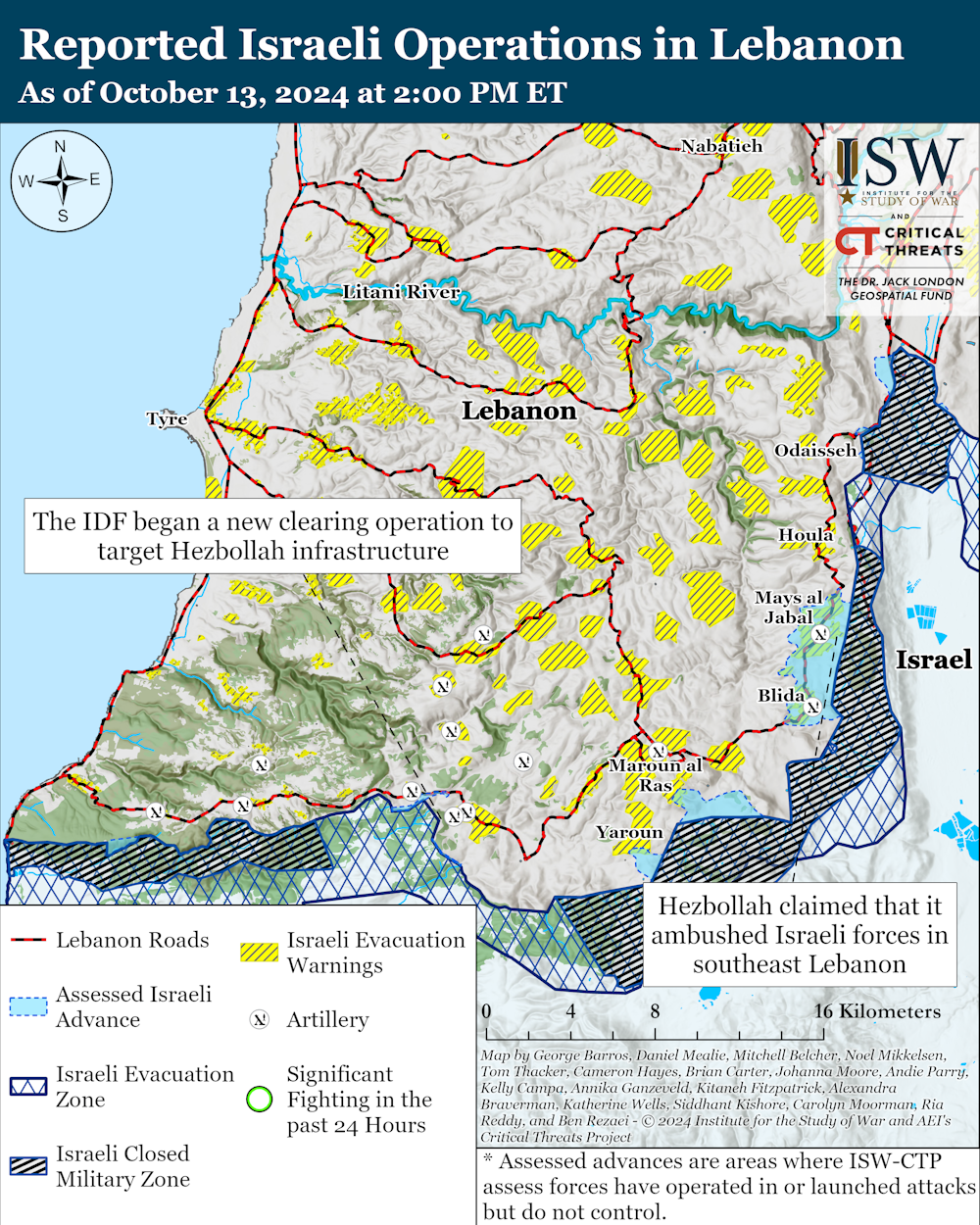
    Israel’s ground offensive in southern Lebanon, October 13 2024.
    Institute for the Study of War

    But there’s another possibility. During the Lebanese civil war, the IDF occupied a section of Lebanese land bordering Israel that was known as the “zone of security”. Its purpose was to serve as a buffer zone for northern Israel, initially designed to protect Israeli citizens from Palestinian militia, and later also from the Shia resistance groups Amal and Hezbollah.

    The Israeli request for Unifil to move five kilometres back from the blue line could mean Israel is considering reestablishing some kind of buffer zone. Several factors point to this being a possibility – although the IDF and the Israeli government may not be aligned on this issue as recent tensions suggest.

    First, the IDF has now deployed units from at least four divisions into Lebanon. The volume of troop numbers deployed is upwards of 15,000 suggesting this incursion is more than a limited operation.

    Second, 29 Unifil compounds lie along the blue line. Were they to be evacuated by the UN, there would be nothing to stop the IDF from moving in and developing them into their own strongholds. While UN positions would need reinforcement and protection equipment, they would nonetheless remain useful.

    Third, in 2006 the IDF tried to destroy Hezbollah from the air and deployed limited haphazard ground incursions. These tactics failed and the prevailing view may now be that the only way to guarantee the safe return of 65,000 Israelis to their homes in northern Israel is through an occupation.

    But unlike the previous occupation, where the IDF was aided by the SLA, Israel currently has no partner in Lebanon, and it is unlikely to find a willing accomplice among the Lebanese population to help them manage the security of a buffer zone. This means IDF troops would directly bear the brunt of attacks from resistance groups, and the northern Israeli villages would be unlikely to remain secure.

    The Netanyahu government’s continued use of military solutions to solve political problems has worrying implications for Israel, Lebanon and the Middle East as a whole. At this stage, Israel looks as if it might be settling back into a conflict that could become another “forever war”.

    Thus far, the tactics used by the IDF would imply they are not thinking ahead to “the day after” and the cost to Israel that would come with the prolonged occupation of a buffer zone.

    This article was written with assistance from John Molloy, lt. col. (rtd.) Irish Defence Forces and former senior Unifil political & civil affairs officer, 2008-2017.

    Chiara Ruffa receives funding from the Swedish Research Council, the Fulbright Commission and the European Commission.

    ref. IDF actions against UN peacekeepers suggest Israel may be considering occupying part of southern Lebanon – https://theconversation.com/idf-actions-against-un-peacekeepers-suggest-israel-may-be-considering-occupying-part-of-southern-lebanon-241297

    MIL OSI – Global Reports

  • MIL-OSI Europe: Analysis: UN peacekeepers at risk in southern Lebanon

    Source: Universities – Science Po in English

    United Nations peacekeepers in southern Lebanon have reported a series of incidents over the past few days in which they have been endangered by Israeli Defense Forces (IDF) as Israel continues its incursion into southern Lebanon. From bearing witness to sheltering the local population, the UN Unifil mission has a vital role to play in Lebanon, but at what cost?

    Read the analysis by experts Chiara Ruffa, Professor in political science at Sciences Po Center for International Studies (CERI), and Vanessa Newby, Assistant Professor at the Institute of Security and Global Affairs at Leiden University, initially published by our partner The Conversation.

    United Nations peacekeepers in southern Lebanon have reported a series of incidents over the past few days in which they have been endangered by Israeli Defense Forces (IDF) as Israel continues its incursion into southern Lebanon.

    Two members of the United Nations Interim Force in Lebanon (Unifil) were wounded on October 10 when an Israeli tank fired its weapon at Unifil’s headquarters in the city of Naqoura. They are reported to be receiving treatment in hospital for minor injuries.

    This follows a series of other reports of IDF troops firing on other Unifil positions in recent days. A Unifil statement called on the IDF “and all actors to ensure the safety and security of UN personnel and property and to respect the inviolability of UN premises at all times”.

    For 44 years the presence of UN peacekeepers in southern Lebanon has provided a much-needed measure of predictability and stability on an international fault line that has the potential to trigger a larger war in the Middle East. Its value has often been to shine an international spotlight on events on the ground and to provide humanitarian assistance to the local population.

    The Unifil peacekeeping mission is in an area of southern Lebanon that stretches from the de facto Lebanese border with Israel about 18 miles northwards up to the Litani River. In violation of UN security council resolution 1701, which was issued in 2006 and was designed to bring to an end the 33-day war between Israel and Hezbollah, Israeli tanks have been advancing into southern Lebanon since September 30. Hezbollah is fighting back – and casualties are mounting.

    On October 5, the Israel Defense Forces (IDF) pressed the Unifil Irish Battalion, stationed south-east of Marun al-Ras, to leave its position to allow the IDF to proceed with their invasion. On October 6, Unifil force commander Lt. Gen. Aroldo Lázaro Sáenz denied the request. A Unifil statement said: “Peacekeepers remain in all positions and the UN flag continues to fly.”


    The IDF reportedly ceased their military operations in the area on October 8. This is most likely because their military goals have changed. The rapidly unfolding Israeli military action in Lebanon has now deployed an additional 15,000 troops. This raises questions about the “limited” nature of the IDF’s incursion and its goals.

    Since 1978, Unifil has provided medical services, electricity, generators, language courses, financial aid and water to local communities. The peacekeeping force has also helped to clear millions of square meters of land from anti-personal mines and cluster bombs, releasing farmland for cultivation and preventing injuries or deaths since the 2006 war.

    In 2006, the Unifil mission adopted a new mandate under UN Resolution 1701. Like all newer UN peacekeeping mandates, it contained a protection of civilians clause which authorises Unifil to “protect civilians under imminent threat of physical violence”.

    Israel contends that Hezbollah missile attacks into northern Israel are an indication that Unifil has never fully implemented 1701 – hence the need to invade and destroy the militant group. But protection of civilians is central to Unifil’s mandate. While the IDF claims it is targeting Hezbollah’s military infrastructure and leadership, thousands of civilian lives in southern Lebanon remain at risk.

    It has recently been reported that more than 2,000 civilians have died in the latest Israeli incursion, with more than 9,000 injured and over 608,000 displaced. So, implementation of this protection clause has never been more important.

    Unifil must not become collateral damage

    Unifil’s ability to protect civilians during Israeli incursions has often been challenged because the IDF refused to guarantee the safety of fleeing civilians, either in convoys out of the villages, or in UN compounds.

    The most notorious incident was the Qana incident of 1996, when 106 civilians died while sheltering in the Fijian UN compound. In July 2006, the IDF used a precision guided aerial bomb on a Unifil post. The attack killed four international unarmed military observers working under Unifil operational control, despite repeated verbal warnings from Unifil headquarters to avoid the post. The IDF has also damaged Unifil positions in times of peace. In January 2005 an unarmed French UN observer was killed by IDF tank fire. In January 2015 IDF artillery killed a Spanish peacekeeper.

    So the challenge for Unifil has always been that if they allow civilians to take shelter in their compounds, they risk becoming part of the IDF’s collateral damage.

    Similarly, Hezbollah is also no friend of Unifil. In December 2022, Hezbollah supporters killed an Irish peacekeeper who ventured accidentally into a village just outside the area of operation.

    International witness

    Despite these challenges, Unifil still has a powerful role to play in southern Lebanon. As the fog of war engulfs all the protagonists, Unifil has the ability to bring the world’s attention to the current conflict which may help constrain the parties. It is critical at this time to have an international force bear witness to events on the ground and provide basic humanitarian assistance, monitor and report potential violations and guarantee shelter to the local population whenever possible to help the displaced people that remain within the Unifil area of operation.

    On October 7, the US State Department warned the IDF that it did not want to see military action taken against Unifil or for the peacekeepers to be put in danger in any way. This warning is welcome given the recent disregard for the UN demonstrated by Israel’s prime minister, Benjamin Netanyahu. who, when speaking to the UN general assembly on September 27, labelled the UN “contemptible in the eyes of decent people everywhere”. On October 2, the Israeli government barred UN secretary general António Guterres from entering Israel.

    Israel’s allies must increase the pressure for the IDF to allow Unifil to exercise the protection of civilians clause contained in its mandate. This would mean allowing the peacekeeping force the freedom of movement in south Lebanon to facilitate the delivery of humanitarian aid. The IDF must also guarantee the safety of civilians escaping with Unifil’s assistance from the villages. And the IDF must allow Unifil to establish safe zones for civilians trapped in the conflict, to compensate for the absence of air raid shelters and bunkers in Lebanon.

    While Unifil may not be able to prevent the bloodshed, for now it can continue help to stem the flow, just as it always has.

    MIL OSI Europe News

  • MIL-OSI Asia-Pac: BFAC appreciates Intellectual Property Department’s contribution to development of Hong Kong into regional intellectual property trading centre

    Source: Hong Kong Government special administrative region

    The following is issued on behalf of the Business Facilitation Advisory Committee Secretariat:

         The Business Facilitation Advisory Committee held its 55th meeting today (October 15). At the meeting, members were briefed by the Intellectual Property Department (IPD) on various policy measures implemented by the Government to develop Hong Kong into a regional intellectual property (IP) trading centre, and the progress to date.

         The Government has been implementing a series of short-, medium- and long-term measures from three aspects, including strengthening the protection of IP rights, building capacity, and promoting widely, to promote the development of Hong Kong into a regional IP trading centre, thereby expanding Hong Kong’s competitive advantages in developing IP trading in the region. Key measures include, among others, implementing the “patent box” tax incentive and exploring further enhancement of the Copyright Ordinance (Cap. 528) regarding protection for development of artificial intelligence (AI) technology.

         The Inland Revenue (Amendment) (Tax Concessions for Intellectual Property Income) Ordinance 2024 was enacted in July 2024 to implement a “patent box” tax incentive in Hong Kong. The tax rate for qualifying profits derived from eligible IP (in particular patents) created through research and development activities is set at 5 per cent which is substantially lower than the prevailing normal profits tax rate of Hong Kong (i.e. 16.5 per cent). In addition, in view of the copyright issues arising from the rapid development of AI technology, the IPD, having launched its two-month public consultation (closed on September 8 this year), is considering stakeholders’ submissions in exploring further enhancement of the Copyright Ordinance regarding protection for such technology development to ensure that the local copyright regime remains robust and competitive.
     
         The Committee appreciated the IPD’s ongoing efforts in taking forward a series of policy measures to enable Hong Kong to seize the opportunity brought by IP trading and sustain its competitiveness, thereby ensuring the continuous high-quality development of the economy.
        
         The Committee also received the work reports of its three task forces:
     
    Wholesale and Retail Task Force (WRTF)
    ———————————————
     

    Hong Kong Customs briefed the WRTF on the scope of registration for dealers in precious metals and stones (DPMS) and the DPMS Registration System (DRS). Any person who is seeking to carry on a business of dealing in precious metals and stones in Hong Kong and engage in any transaction(s) with a total value at or above HK$120,000 in Hong Kong is required to register with the Commissioner of Customs and Excise. To advocate the Government’s vision to develop Hong Kong into a smart city, Hong Kong Customs has rolled out the DRS to support the submission of registration applications and progress checking by the trade at their convenience. The DRS adopts the dynamic QR code authentication technology to enable the industry and consumers to instantly validate the registration of dealers. The WRTF thanked Hong Kong Customs for the briefing and welcomed the e-service introduced by Hong Kong Customs for the registration for DPMS.

    The Hong Kong Productivity Council (HKPC) briefed the WRTF on the Government Funding Scheme Management Centre (GFSMC) and the Biz Expands Easy (BEE) Platform. Since 2022, the GFSMC introduced the BEE 3-in-1 platform, which provides Hong Kong corporations with integrated information for 28 funding schemes. Registered users can log in to the platform to view and manage applications for multiple funding schemes under HKPC secretariat support. Furthermore, the GFSMC inaugurated the Biz Expands Easy Square in January 2024 to further enhance the accessibility of funding resources for Hong Kong corporations and start-ups, and also foster a network for applicants to share their successful experiences. The WRTF welcomed the BEE Platform, and considered the BEE Platform would enable users to further understand designated funding schemes and explore suitable funding schemes.

     
    Food Business and Related Services Task Force (FRSTF)
     

    The Food and Environmental Hygiene Department (FEHD) briefed and consulted the FRSTF on whether there is a need to retain composite food shop licences and extend the validity period of a full food business licence, in response to the views of the Legislative Council (LegCo)’s Public Accounts Committee. The FRSTF suggested that the FEHD retain the composite food shop licence with better promotion to the trades on the licence type. For the extension of the validity period of full licences, as trades would not have flexibility to choose a shorter licensing period and the annual compliance of fire safety requirements remains at the status quo, the FRSTF considered that the extension of the validity period of full licences may not facilitate the trades’ operations and there is no need for its implementation.

    The FEHD also briefed and consulted the FRSTF on enhanced measures against illegal operations of food businesses in response to the views of the LegCo’s Public Accounts Committee. To suppress the industry’s practice of operating food businesses before obtaining a provisional licence/full licence, in addition to taking enforcement actions, the FEHD suggested suspending the processing of licence applications and debarring the same applicant and his/her partners from applying for the same type of licence for the same premises for 12 months upon conviction of a relevant offence by the court. The FRSTF opined that the proposed administrative measures are too harsh and may undermine the catering business. The FRSTF suggested that the FEHD assist the trades to obtain a provisional licence more efficiently to address the issue of illegal operations.

     
    Task Force on Business Liaison Groups (BLGTF)
     

    The Inland Revenue Department (IRD) briefed the BLGTF on the initiative of the electronic filing (e-filing) of profits tax returns, including the need to take forward the mandatory e-filing, the benefits of e-filing, the enhanced e-filing services, the IRD’s support measures to taxpayers, and the timeline of the phased implementation of mandatory e-filing. The BLGTF welcomed the above initiatives and invited the IRD to brief and consult more small and medium-sized enterprises (SMEs) on the initiative. The IRD undertook to keep up the ongoing work of soliciting suggestions and opinions from SMEs through different channels.

     
         The Committee also expressed appreciation of the commitment and achievements of the bureaux and departments in continuously implementing business facilitation measures under the Be the Smart Regulator Programme to enhance their business licensing services.
           
         Papers for the Committee meeting are available at www.gov.hk/en/business/supportenterprises/bf/advisory/index.htm for public access.

    MIL OSI Asia Pacific News

  • MIL-OSI Australia: Plimsoll Address

    Source: Australian Government – Minister of Foreign Affairs

    Thank you to the Australian Institute for International Affairs and the University of Tasmania for inviting me to give this address, in honour of this great statesperson. 

    With a career that spanned the first four decades of independent Australian foreign policy, there are few who have made a contribution comparable to James Plimsoll – or Jim Plim as he was affectionately known.

    He first made his mark in the late 1940s supporting Foreign Minister Evatt during his presidency of the United Nations General Assembly – support that included ghost-writing Evatt’s book, The Task of Nations.

    He later became Secretary of the Department of External Affairs – which we now know as DFAT…

    He was appointed Ambassador in Washington, Tokyo, Brussels and Moscow… 

    High Commissioner in London and Delhi…

    And even Governor of this great state of Tasmania…

    Among all these lofty appointments, his biographer Jeremy Hearder reflected that the highlight of Plimsoll’s career was serving as Australia’s Ambassador and Permanent Representative to the UN Nations in New York, in the late 1950s and early 1960s.

    And we can understand why. He found himself at the centre of major international issues – and his diplomatic skill meant, in the words of a British colleague, that Plimsoll “exercised an influence on the UN quite disproportionate to Australia’s standing in the world.”

    This was partly because of what the then Secretary of External Affairs, Arthur Tange, described as Plimsoll’s “remarkable capacity… for talking to people in their own terms, freely encouraging them to explain their viewpoints and problems.”

    It is patent that Jim Plim understood deeply how Australia’s interests as a middle power are at stake in the multilateral system.

    Even with all the flaws with the international system, this remains the case today.

    Australia will always be better off in a world that operates by rules that all countries have a say in shaping.

    A world where Australia and other countries have the freedom to decide our own futures, without interference and intimidation.

    A world where we can find collective solutions to our toughest problems.

    Where no country dominates, and no country is dominated.

    I’ve recently returned from the UN General Assembly’s annual High-Level Week, where Australia progressed our most ambitious multilateral agenda in many years.

    I convened meetings of humanitarian leaders and ministers from influential countries to address a serious problem in the international system.

    That is, the growing risk that norms are being eroded in international humanitarian law – what we often refer to as the rules of war.

    We see this in the massive civilian toll in conflicts around the world, and we see this in the increasing numbers of aid workers being killed and kidnapped.

    In order to protect civilians, we must also protect aid workers who deliver the food, water and medicine civilians need to survive.

    Aid workers are the best of humanity. Their dedication to improving the lives of others should not cost them their own.

    Yet 2023 was the deadliest year on record for aid workers, and 2024 is on track to be even worse.

    This has been felt directly by Australians with the IDF’s strike against World Central Kitchen vehicles, which killed Australian Zomi Frankcom and her colleagues.

    This was not a one-off incident. Gaza is the most dangerous place on earth to be an aid worker. More than 300 aid workers have been killed since the start of the conflict.

    Together, the ministerial group I convened agreed to pursue a new Declaration for the Protection of Humanitarian Personnel.

    Work on the Declaration is now underway, with our officials consulting experts and other countries.

    All countries will be invited to join the Declaration, to demonstrate the unity of the international community’s commitment to protect aid workers – and to channel that commitment into action in Gaza, in Sudan, in Ukraine and in all current and future conflicts.

    This is exactly the kind of leadership Australia should be taking in the world.

    We are not a superpower. But we are respected, and at our best we have a reputation for bringing countries together to defend and promote the rules-based order that protects us all.

    From the days helping draft the UN Charter and the Universal Declaration of Human Rights, to Gareth Evans’ leadership on the Chemical Weapons Convention, to our more leading role in the Arms Trade Treaty.

    There’s no doubt that reputation waned through the negative globalist years of the previous government.

    But in driving this Declaration we are demonstrating that Australians are indeed constructive internationalists in the mould of the honouree of this address.

    This brings me back to the book Plimsoll ghostwrote for Evatt, which spelled out our shared responsibility to each other. I quote:

    “We should try to raise standards everywhere in order to practice the simple humanitarian doctrine which is the basis of all morality, namely that we should help our neighbour and relieve misery and suffering… [We] can hardly imagine … the common lot of so many of mankind – disease, low expectation of life, and unrelieved pain; flood, famine and epidemics… These wrongs cry out for redress, and can and must be righted by co-operative international effort.”

    A powerful articulation of the motivation for our humanitarian work.

    And tonight we build on that work. Tonight, I am releasing Australia’s new Humanitarian Policy.

    It is a policy that comprehends the serious problems of our times.

    A climate changing faster than our combined efforts to stop it.

    More people displaced – in fact, more than 117 million people forcibly displaced from their homes.

    More people needing humanitarian assistance – 302 million people this year, up by nearly 30 million in just the last two years.

    More conflict than any time since World War Two. Russia’s invasion of Ukraine. Sudan. Myanmar. And in the Middle East.

    The Albanese Government is committed to humanitarian action which saves lives, alleviates human suffering and builds resilient communities. 

    The Policy outlines the role Australia will play at a time when need is outstripping the world’s capacity to respond and disregard for international humanitarian law is increasing.

    It is a plan of action that is not just about meeting humanitarian needs. It is also about protecting the peace, stability and prosperity that we want for Australia, our region and the world.

    It is a plan that is accountable – to the Australian people, and to the partners and communities we seek to help.

    We will focus on three priorities.

    First, we will build readiness and preparedness, anticipating shocks before they occur and working with our partners to lessen their impact.

    As part of this priority, I announce Australia is providing $5 million to the new Asia-Pacific Regional Humanitarian Fund to pre-position for the next emergency.

    Second, we will respond to crises and disasters, delivering support that meets the needs of crisis-affected populations and protects the most vulnerable, both immediately and over the longer term.

    As part of that effort, I announce $9 million in humanitarian relief to respond to high levels of food insecurity in Yemen. This follows support I announced yesterday for Myanmar, as well as over $80 million in aid to support civilians who have been devastated by the conflicts in Gaza and Lebanon.

    And third, we will reinforce the international humanitarian system, working to take practical and actionable steps to strengthen adherence to international humanitarian law – just as we are doing with the Declaration.

    We act globally, but our focus remains our region. We offer genuine partnerships, based on respect, listening and learning from each other.

    And we are helping build self-reliance, so obviously in Australia’s interests and the region’s interests.

    Now, we know humanitarian assistance can lessen shocks and keep further instability, conflict and displacement at bay.

    But we all want a world where humanitarian assistance is needed far less often.

    This is just one reason why the Albanese Government is acting on climate change.

    We have enshrined our ambitious emissions reduction targets into legislation: 43 per cent by 2030 and net zero by 2050.

    We are transforming our economy.

    Within this decade, 82 per cent of Australia’s electricity generation will be renewable, up from around 32 per cent when we came to office.

    We are building new industries to accelerate our economic transition and to export reliable, renewable energy to the world.

    And we are acting internationally, to respond to our partners.

    By the end of 2025, Australia will offer Climate Resilient Debt Clauses in our sovereign loans.

    And the groundbreaking Australia-Tuvalu Falepili Union treaty entered into force on 28 August – a treaty which provides for both adaptation and mobility with dignity…

    And the first treaty anywhere in the world which provides legal protection for sovereignty in the face of sea level rise.

    But we can’t address climate change on our own, just as we can’t alone resolve all of the conflicts that are driving humanitarian crises.

    What we are doing is using our forthcoming term on the UN Peacebuilding Commission to reform the international peacebuilding and conflict prevention architecture.

    What we are doing is helping Ukraine end Russia’s illegal and immoral war on its own terms.

    Since coming to office, we have more than doubled the military contribution to Ukraine – and Australia is the largest non-NATO contributor to Ukraine’s fight.

    And what we are doing is supporting efforts for long-term peace in the Middle East.

    We have just marked the first anniversary of the October 7 attacks by Hamas.

    We condemn Hamas’ terrorism unequivocally. We call for the release of hostages immediately.

    On that day, Hamas killed 1,200 people: the largest loss of Jewish life on any single day since the Holocaust.

    October 7 is a day that recalls humanity’s darkest memories. 

    The six million European Jews killed in the Holocaust – following thousands of years of persecution and atrocities perpetrated against the Jewish people.

    This long shadow of antisemitism is the history that finally resolved the international community to create the State of Israel.

    At the same time, the world also promised a Palestinian state.

    77 years later, that Palestinian state still does not exist.

    Earlier this year, Australia voted in the General Assembly in support of Palestinian aspirations for full membership of the UN. 

    The international community now must work together to pave a path to lasting peace.

    Australia wants to engage on new ways to build momentum, including the role of the Security Council in setting a pathway for two-states, with a clear timeline for the international declaration of Palestinian statehood.

    The world knows we cannot keep hoping the parties will fix this themselves; nor can we allow any party to obstruct the prospect of peace.

    Because a two-state solution is the only hope of breaking the endless cycle of violence – the only hope to see a secure and prosperous future for both peoples.

    To strengthen the forces for peace across the region and undermine extremism.

    Any future Palestinian state must not be in a position to threaten Israel’s security, with no role for terrorists.

    Right now, the suffering across the region must end.

    In Israel’s response to the attacks, more than 40,000 Palestinians have been killed. More than 11,000 children.

    It is now more than ten months since Australia and 152 other countries voted for a ceasefire in Gaza.

    I repeat that call again. 

    Just as I repeat our call for a diplomatic solution, de-escalation and ceasefire in Lebanon. 

    We want to see civilians on both sides of the Lebanon-Israel border return to their homes and the implementation of UNSC Resolution 1701.

    Australia made our call alongside a number of countries – Canada, European Union, France, Germany, Italy, Japan, Saudi Arabia, United Arab Emirates, the United Kingdom, the United States and Qatar.

    Shortly thereafter, G7 leaders issued a statement in similar terms.

    Yet somehow Mr Dutton accused the Prime Minister of being at odds with our allies. 

    He said the Prime Minister should be condemned for calling for a ceasefire.

    Now Mr Dutton has realised it is he who is at odds with the international community– but he still can’t bring himself to back a ceasefire.

    I can’t recall a single time over the past year that Mr Dutton has called for the protection of civilians, or for the upholding of international law. 

    He never utters a word of concern for innocent Palestinians and Lebanese civilians.

    From the other side, the Greens political party are being just as absolutist.

    Australians are rightly distressed by the catastrophic conflict, and the distress is felt most acutely in our Jewish, Palestinian and Lebanese communities.

    The lived experiences and understandings of our different Australian communities are distinct.

    There is long, complex and disputed history – deeply felt, close to the heart of many.

    And there is a need to acknowledge the real trauma on all sides, to acknowledge each other’s humanity, and to come together – as peacemakers throughout history have done.

    It is incumbent on any Australian Government to play a responsible role in promoting peace – recognising we are not the crucial player in the Middle East, but we have a respected voice. 

    Leaders must govern for the whole country.

    Our country does not benefit from the conflict being reproduced here. 

    Australians are 26 million people, from more than 300 ancestries. We are home to the oldest continuing civilisation on the planet.

    There is vast power in that.

    The ability to see and understand every part of the world.

    Yet it’s also something we need to nurture. 

    If we allow people to divide our community, if we allow conflicts overseas to be reproduced here; if we shout each other down and insist on respective absolutes; the bedrock of our stability, our security and our prosperity is shaken.

    Nothing is more important for our future than ensuring that Australia remains a pluralist nation, welcoming different races, religions and views, united by respect for each other’s humanity and for each other’s right to live in peace.

    As I said, there is vast power in who we are. Our people are the most elemental aspect of our national power. 

    We must deploy that power at this time in our history…

    This time when we face the most dangerous set of circumstances since World War Two. 

    This time when we need to combine our economic power, our cultural power, our strategic, diplomatic and defence power – all to make Australia stronger and more influential in a more contested and challenging world.

    We are making Australia more economically resilient at home, with a Future Made in Australia setting us on a path to be a renewable energy superpower.

    We are making Australia more economically resilient in the world, with the Southeast Asia Economic Strategy to 2040 that harnesses the opportunities from living in the most competitive and fastest growing region in the world – and so we never are over-reliant on one market again.

    We are rebuilding our diplomatic relationships.

    We are doing the work that should have been done a decade ago to again make Australia a partner of choice in the Pacific.

    We don’t just go around picking fights and blowing up relationships.

    We are investing in our credibility as a partner to the region.

    It is by our actions that we have been able to restore trust among the Pacific family.

    And we are stabilising our own relations with China, so we navigate differences wisely.

    Our calm and consistent approach to the China relationship has seen progress on the removal of trade impediments for wine, barley, coal, cotton, timber logs, copper ores and concentrates; and now lobster – almost $20 billion worth of Australian exports back into China.

    We are increasing our collaboration with new partners and traditional partners; with Southeast Asia, with Japan, with India, and through our Quad partnership.

    We are investing in defence cooperation and our own military capabilities, including through AUKUS.

    And we are working together with our partners to uphold the rules and reform the institutions that we helped establish.

    All of these efforts are to shape the strategic calculus of the region, so no potential aggressor thinks the pursuit of conflict is worth the risk.

    This is how we advance the region we want. A region in balance. 

    Where countries, large and small, have the freedom to decide our own futures.

    These are just some of the ways in which the Albanese Government is driving Australia’s most ambitious international engagement in many years. 

    Being a partner to our region, and a leader in our values. 

    Always working toward a more peaceful, stable and prosperous world for all.

    Where sovereignty is respected and civilians are protected. 

    And I would say, furthering the legacy of creative diplomacy and determined statecraft practised by the great Jim Plim himself.

    Thank you.

    MIL OSI News

  • MIL-OSI Europe: Written question – Incidents on Ryanair planes – concerns for passenger safety – E-001973/2024

    Source: European Parliament

    Question for written answer  E-001973/2024
    to the Commission
    Rule 144
    Flavio Tosi (PPE), Salvatore De Meo (PPE), Giusi Princi (PPE), Massimiliano Salini (PPE), Caterina Chinnici (PPE), Letizia Moratti (PPE), Marco Falcone (PPE)

    Over the past week, Ryanair aircraft have been at the centre of two incidents: one in Brindisi and the other in Bergamo (Italy). In Brindisi, 184 passengers plus the cabin crew were evacuated and the airport was closed after an engine caught fire. Bergamo airport was shut for a few hours too, following a tyre blowout on a plane coming into land.

    Fortunately no one was injured in either case, but the two are only the latest in a series of episodes and technical issues to hit the Irish airline over the past year. Such incidents not only carry implications for the safety of passengers, crew and security staff, but instantly cause significant disruption to air traffic and operations at the airports involved.

    Given the alarming frequency of such failures, can the Commission say:

    • 1.What action will the European Union Aviation Safety Agency take to ensure that the maintenance plans for Ryanair’s aircraft are in order?
    • 2.For the sake of passenger safety, how will it make sure that the only aircraft used is that which is authorised and fully fit to fly?

    Submitted: 7.10.2024

    Last updated: 15 October 2024

    MIL OSI Europe News

  • MIL-OSI Europe: Answer to a written question – Urgent activation of the EU Solidarity Fund for Madeira – P-001692/2024(ASW)

    Source: European Parliament

    1. The EU Solidarity Fund (EUSF)[1] can only be activated at the request of Portugal which has a deadline of 12 weeks as from the first damage occurred, demonstrating that the total direct damage exceeds the thresholds specified in Article 2 Regulation (EC) No 2012/2002. The EUSF may cover a part of the costs for emergency and recovery operations incurred by public authorities[2]. Pursuant to Article 2(3) of the above Regulation, the EUSF may provide support to outermost regions in cases of ‘regional natural disasters’ if the direct damage exceeds 1% of the concerned region’s gross domestic product (instead of the normally applicable excess of 1.5% of direct damage).

    Support is also available under the European Agricultural Fund for Rural Development[3] for prevention, restoration and resilience against fires, with a planned amount in Madeira of EUR 36.6 million for 2014-2022, and EUR 11.9 million for 2023-2027.

    2. In its communication on the Outermost regions[4], the Commission has committed itself to supporting actions on risk prevention and resilience as regards natural disasters, fostering knowledge exchange and giving due consideration when implementing the EUSF. The Commission is also fully committed to offer all possible support to Portugal and the outermost regions, including Madeira, in its fight against the wildfires.

    • [1] Council Regulation (EC) No 2012/2002 of 11 November 2002 establishing the European Union Solidarity Fund (OJ L 311, 14.11.2002, p. 3) as amended by Regulation (EU) No 661/2014 of the European Parliament and the Council of 15 May 2014 (OJ L 189, 27.6.2014, p. 143) and by Regulation (EU) 2020/461 of the European Parliament and the Council of 30 March 2020 (OJ L 99, 31.3.2020, p. 9). https://eur-lex.europa.eu/legal-content/EN/TXT/?uri=celex:32002R2012
    • [2] This means, for example, the recovery of essential infrastructure, provision of temporary accommodation to the population, cleaning-up operations, and protection of the cultural heritage.
    • [3] Regulation (EU) 2021/2115 of the European Parliament and of the Council of 2 December 2021 establishing rules on support for strategic plans to be drawn up by Member States under the common agricultural policy (CAP Strategic Plans) and financed by the European Agricultural Guarantee Fund (EAGF) and by the European Agricultural Fund for Rural Development (EAFRD) and repealing Regulations (EU) No 1305/2013 and (EU) No 1307/2013, OJ L 435/1, 6.12.2021.
    • [4] COM(2022) 198 final.
    Last updated: 15 October 2024

    MIL OSI Europe News

  • MIL-OSI Banking: Christopher J Waller: Thoughts on the economy and policy rules at the Federal Open Market Committee

    Source: Bank for International Settlements

    Thank you, Athanasios, and thank you for the opportunity to be part of this very worthy celebration.1 In support of the theme of this conference, I do have some thoughts on the Shadow Open Market Committee’s contributions to the policy debate, in particular its advocacy for policy rules. But before I get to that, I am going to exercise the keynote speaker’s freedom to talk about whatever I want. To that end, I want to take a few minutes to offer my views on the economic outlook and its implications for monetary policy. So let me start there, and afterward I will discuss the role that policy rules play in my decision making and in the deliberations of the Federal Open Market Committee (FOMC).

    In the three weeks or so since the most recent FOMC meeting, data we have received has been uneven, as it sometimes has been over the past year. I continue to judge that the U.S. economy is on a solid footing, with employment near the FOMC’s maximum employment objective and inflation in the vicinity of our target, even though the latest inflation data was disappointing.

    Real gross domestic product (GDP) grew at a 2.2 percent annual rate in the first half of 2024, and I expect it to grow a bit faster in the third quarter. The Blue Chip consensus of private sector forecasters predicts 2.3 percent, while the Atlanta Fed’s GDPNow model, based on up-to-the moment data, is predicting real growth of 3.2 percent.

    Earlier, there were concerns that GDP in the first half of this year was overstating the strength of the economy, since gross domestic income (GDI) was estimated to have grown a mere 1.3 percent in the first half of this year, suggesting a big downward revision to GDP was coming. But revisions received after our most recent FOMC meeting showed the opposite-GDI growth was revised up substantially to 3.2 percent. This change in turn led to an upward revision in the personal saving rate of about 2 percentage points in the second quarter, leaving it at 5.2 percent in June. This revision suggests that household resources for future consumption are actually in good shape, although data and anecdotal evidence suggests lower-income groups are struggling. These revisions suggest that the economy is much stronger than previously thought, with little indication of a major slowdown in economic activity.

    That outlook is supported by consumer spending that has been and continues to be strong. Though the growth in personal consumption expenditures (PCE) has moderated since the second half of 2023, it has continued at an average pace of close to 2.5 percent so far this year. Also, my business contacts believe that there is considerable pent-up demand for durable goods, home improvements, and other big-ticket items, demand that built up due to high interest rates for credit cards and home equity loans. Now that rates have started to come down and are expected to come down more, consumers will be eager to make those purchases. For business spending, purchasing managers for manufacturers describe ongoing weakness in that sector, but those for the large majority of businesses outside of manufacturing continue to report a solid expansion of activity.

    Now let’s talk about the labor market. Only a couple months ago, it appeared that the labor market was cooling too quickly. Low numbers for job creation and a jump in the unemployment rate from 4.1 percent in June to 4.3 percent in July raised risks that the labor market was deteriorating. To remind you of how bad the markets viewed the July data, some Fed watchers were calling for an emergency FOMC meeting to discuss a rate cut. While the unemployment rate ticked down in August, job growth was once again well below expectations. Many were arguing that the labor market was on the verge of a serious deterioration and that the Fed was behind the curve even after a 50 basis point cut in the policy rate at the September FOMC meeting.

    Then we got the September employment report. Job creation in September was unexpectedly strong at 254,000 and the unemployment rate fell back down to 4.1 percent, which is where it was in June. The report also showed big upward revisions to payroll gains for the previous two months. Together, the message was loud and clear: While job creation has moderated and the unemployment rate has risen over the past year, the labor market remains quite healthy.

    Along with other new data on the labor market, the evidence is that labor supply and demand have come into balance. The number of job vacancies, a sign of strength in the labor market, has fallen gradually since the beginning of the year. The ratio of vacancies to unemployed is at 1.2, about the level in 2019, which was a pretty strong labor market. To put this number into perspective, recent research has shown that this ratio has been above 1 only three times since 1960.2 The quits rate, another sign of labor market strength, has fallen lower than it was in 2019, a decrease which partly reflects that the hiring rate has fallen as labor supply and demand have come into better balance.

    In sum, based on payrolls, the unemployment rate and job revisions, there has been a very gradual moderation in labor demand relative to supply, but not a deterioration. The stability of the labor market, as reflected in these two measures as well as the other metrics I mentioned, bolsters my confidence that we can achieve further progress toward the FOMC’s inflation goal while supporting a healthy labor market that adds jobs and boosts wages and living standards for workers.

    I will be looking for more evidence to support this outlook in the weeks and months to come. But, unfortunately, it won’t be easy to interpret the October jobs report to be released just before the next FOMC meeting. This report will most likely show a significant but temporary loss of jobs from the two recent hurricanes and the strike at Boeing. I expect these factors may reduce employment growth by more than 100,000 this month, and there may be a small effect on the unemployment rate, but I’m not sure it will be that visible. Since the jobs report will come during the usual blackout period for policymakers commenting on the economy, you won’t have any of us trying to put this low reading into perspective, though I hope others will.

    Looking ahead, I expect payroll gains to moderate from their current pace but continue at a solid rate. The unemployment rate may drift a bit higher but is likely to remain quite low in historical terms. While I believe the labor market is on a solid footing, I will continue to watch the full range of data for signs of weakness.

    Meanwhile, inflation, after showing considerable progress for several months toward the FOMC’s 2 percent target, likely moved up in September. The consumer price index grew 0.2 percent over the past month, 2.1 percent over the past three months, 1.6 percent over six months and 2.4 percent in the past year. Oil prices fell over most of the summer but then more recently have surged. Excluding energy and also food prices that likewise tend to be volatile, and just as it did in August, core CPI inflation printed at 0.3 percent in September and 3.3 percent over the past year.

    Private-sector forecasts are predicting that PCE inflation, the FOMC’s preferred measure, will also move up in September. Core PCE prices are expected to have risen around 0.25 percent last month. While not a welcome development, if the monthly core PCE inflation number comes in around this level, over the last 5 months it is still running very close to 2 percent on an annualized basis. We have made a lot of progress on inflation over the course of the last year and half, but that progress has clearly been uneven-at times it feels like being on a rollercoaster. Whether or not this month’s inflation reading is just noise or if it signals ongoing increases, is yet to be seen. I will be watching the data carefully to see how persistent this recent uptick is.

    The FOMC’s inflation goal is an average of 2 percent over the longer run and there are some good reasons to think that price increases will be modest going forward. I am hearing reports from firms that their pricing power seems to have waned as consumers have become more sensitive to price changes. There has also been a steady slowing in the growth of labor compensation. It is true that average hourly earnings growth in September ticked up to 4 percent over the past year. And though it might seem like wage increases of 4 percent a year would put upward pressure on inflation that is near 2 percent, that might not be true if one considers productivity, which has grown at an average annual rate of 2.9 percent for the past five quarters. Some of this strength was making up for productivity that shrank due to the pandemic, but the longer it continues-up 2.5 percent for the second quarter-the better productivity supports wage growth of 4 percent, or even higher, without driving up inflation. All that said, I will be watching all the data related to inflation closely.

    With the labor market in rough balance, employment near its maximum level, and inflation generally running close to our target over the past several months, I want to do what I can as a policymaker to keep the economy on this path. For me, the central question is how much and how fast to reduce the target for the federal funds rate, which I believe is currently set at a restrictive level. To help answer questions like this, I often look at various monetary policy rules to assess the appropriate setting of policy. Policy rules have long been of serious interest to the Shadow Open Market Committee. So before I turn to my views on the future path of policy, I thought I would talk about monetary policy rules versus discretion and begin with some background about the use of rules at the FOMC.

    For a brief overview of the history of the advent of rules at the Board, I have been directed to the second chapter of The Taylor Rule and the Transformation of Monetary Policy written by George Kahn, and I have also consulted the memories of longtime members of the Board staff.3 Rules came along in the 1990s as the Fed was moving away from monetary targeting, focusing more on interest-rate policy, and taking its first major steps toward increased transparency. There was immediate interest in Taylor-type rules among Fed staff, and even some contributions of research.4 There was a presentation to the FOMC on rules in 1995, and that was the same year that John Taylor’s Bay Area colleague, Janet Yellen, was apparently the first policymaker to mention the Taylor rule at an FOMC meeting. While FOMC decisions mimicked a Taylor rule much of the time under Chairman Alan Greenspan, he was famously an advocate of “constructive ambiguity” in communication, and he and other central bankers since have resisted the suggestion that decisions could be handed over to strict rules. Today, of course, a number of rules-based analyses are included in the material submitted to policymakers ahead of every FOMC meeting, and we publish the policy prescriptions of different rules as part of the Board’s semi-annual Monetary Policy Report. Rules have become part of the furniture in modern policymaking.

    As everyone here knows, but for the benefit of other listeners, Taylor rules relate the level of the policy interest rate to a limited number of other economic variables, most often including the deviation of inflation from a target value and a measure of resource use in the economy relative to some long-run trend.5 There are numerous forms of the Taylor rule, but they generally fall into two categories.

    The first of these, an inertial rule, has the property that the policy rate changes only slowly over time. I tend to think of it as an approach that captures the reaction function of a policymaker in a stable economy where the forces that would tend to change the economy and policy build over time. When change does occur, a gradual response may give policymakers time to assess the true state of the economy and the possible effects of their decision. One example I can use is the steadfastness of policymakers in the latter part of 2023, when inflation fell more rapidly than was widely expected, and again in early 2024, when it briefly escalated. The FOMC did not change course either time, an approach validated by inertial rules.

    A non-inertial rule, on the other hand, allows and in fact calls for relatively quick adjustments to policy. The guidance from these rules is more useful when there is a turning point in the economy, and policymakers need to stay ahead of events. One saw these non-inertial rules prescribe a sharper rise in the policy rate above the effective lower bound starting in 2021 as inflation began climbing above the FOMC’s 2 percent target. Non-inertial rules are also more useful in the face of major shocks to the economy such as the 2008 financial crisis and the start of the pandemic.

    The great promise of rules is that they provide a simple and reliable guide to policy, but what should one do when different rules recommend different policy actions given the same economic conditions? Right now, inertial rules tell us to move slowly in reducing policy rates toward a neutral stance that neither restricts nor stimulates the economy. On the other hand, non-inertial rules tell us to cut the policy rate more aggressively, subject to the caveat that one is certain of the values of all the ‘star’ variables: U*, Y* and r*. I think the answer is that while rules are valuable in helping analyze policy options, they have limitations. Among these are the limits of the data considered, which is typically narrower than the range of data that policymakers use to make decisions, and also the fact that simple policy rules do not take into account risk management, which is often a critical consideration in policy decisions. So, while policy rules serve as a good check on discretionary policy, there are times when discretion is needed. As a result, I prefer to think of them as “policy rules of thumb”.

    Turning to my view for the path for policy, let me discuss three scenarios that I have had in mind to manage the risks of upcoming decisions in the medium term.

    The first scenario is one where the overall strong economic developments that I have described today continue, with inflation nearing the FOMC’s target and the unemployment rate moving up only slightly. This scenario implies to me that we can proceed with moving policy toward a neutral stance at a deliberate pace. This path would be based on the judgment that the risks to both sides of our dual mandate are balanced. In this circumstance, our job is to keep inflation near 2 percent and not slow the economy unnecessarily.

    Another scenario, less likely in light of recent data, is that inflation falls materially below 2 percent for some time, and/or the labor market significantly deteriorates. The message here is that demand is falling, the FOMC may suddenly be behind the curve, and that message would argue for moving to neutral more quickly by front-loading cuts to the policy rate.

    The third scenario applies if inflation unexpectedly escalates either because of stronger-than-expected consumer demand or wage pressure, or because of some shock to supply that pushes up inflation. As we learned in the recovery from the pandemic recession, when demand was stronger and supply weaker than initially expected, such surprises do occur. In this circumstance, as long as the labor market isn’t deteriorating, we can pause rate cuts until progress resumes and uncertainty diminishes.

    Most recently, we have seen upward revisions to GDI, an increase in job vacancies, high GDP growth forecasts, a strong jobs report and a hotter than expected CPI report. This data is signaling that the economy may not be slowing as much as desired. While we do not want to overreact to this data or look through it, I view the totality of the data as saying monetary policy should proceed with more caution on the pace of rate cuts than was needed at the September meeting. I will be watching to see whether data, due out before our next meeting, on inflation, the labor market and economic activity confirms or undercuts my inclination to be more cautious about loosening monetary policy.

    Whatever happens in the near term, my baseline still calls for reducing the policy rate gradually over the next year. The median rate for FOMC participants at the end of 2025 is 3.4 percent, so most of my colleagues likewise expect to reduce policy over the next year. There is less certainty about the final destination. The median estimated longer-run level of the federal funds rate in the Committee’s Summary of Economic Projections (SEP) is 2.9 percent, but with quite a wide dispersion, ranging from 2.4 percent to 3.8 percent. While much attention is given to the size of cuts over the next meeting or two, I think the larger message of the SEP is that there is a considerable extent of policy restrictiveness to remove, and if the economy continues in its current sweet spot, this will happen gradually.

    Thank you again, for the opportunity to be part of today’s conference, and for allowing me to share some thoughts, relevant to monetary policy rules and my day job back in Washington. The Shadow Committee has elevated the public debate about monetary policy. May you continue to play that role for many years to come.


    i. Note: On October 14, 2024, a sentence on page 10 was corrected to say “restrictiveness”: “I think the larger message of the SEP is that there is a considerable extent of policy restrictiveness to remove, and if the economy continues in its current sweet spot, this will happen gradually.”

    MIL OSI Global Banks

  • MIL-OSI United Kingdom: expert reaction to study on the rate of increase of global warming

    Source: United Kingdom – Executive Government & Departments

    A study published in Nature Communications and Earth & Environment looks at the recent increase of global warming. 

    Dr Kevin Collins, Senior Lecturer Environment and Systems, Open University, said:

    “With many people and places experiencing year on year record temperatures around the globe in the last decade, it is very human to assume global warming is accelerating or ‘surging’.  However, through an authoritative statistical analysis of temperature increases since 1970, this research concludes that there is no detectable surge. Yet.

    “Instead, the results suggest global warming is occurring at a steady state. However, as the authors acknowledge, this may be because the size of any acceleration is either statistically too small, or there is simply not enough data to detect a surge in the last decade.  In other words, it is still too early to tell if the last decade (the warmest on record) represents a ‘leap’ in the warming trend.  By 2035 or 2040 we may look back and be able to see from 2015 onwards there has been a fundamental shift in the warming trend.

    “There is a very real danger that the new research is misinterpreted to show that there is no global warming or that a steady state increase in temperature means we have lots of time to act.

    “The bald statistics of a global warming world are already being lived by many populations and communities whose livelihoods are being severely impacted by heatwaves, droughts, floods, sea-level rise and other environmental changes.”

    Prof Richard Allan, Professor of Climate Science, University of Reading and National Centre for Earth Observations, said:

    “The new research highlights the difficulty in detecting an increase in the rate of surface warming, which is influenced by natural variations such as swings between warm El Niño and cool La Niña events. However, satellite observations and ocean measurements already detect a steady increase in Earth’s heating rate that is less susceptible to year to year fluctuations at the sea surface.

    “In fact, when all lines of evidence are scrutinized it is apparent that climate change is accelerating rather continuing steadily. Halting global warming by stabilizing Earth’s climate and limiting further damage from worsening extreme weather and rising sea levels is only possible through rapid and massive cuts in greenhouse gas emissions.”


    ‘Is the Recent Surge in Global Warming Detectable?’ by Claudie Beaulieu et al. was published in Nature Communications Earth & Environment at 22:00 UK time on Monday 14th October.

    Declared interests:

    Dr Kevin Collins: No conflicts to declare.

    Prof Richard Allan: No conflicts to declare.

    MIL OSI United Kingdom

  • MIL-OSI United Kingdom: Labour’s approach to Middle East conflict “failing” as civilian death toll mounts

    Source: Green Party of England and Wales

    Green Party Co-Leader, Carla Denyer said, “The reports over the weekend that no food has entered Northern Gaza since the 1st of October, of Israel’s attack on al-Aqsa Hospital, of chemical weapons being used to attack UNIFIL peacekeepers, of mass civilian casualties in Gaza’s Jabalia Refugee Camp and of increased rocket fire into Israel from Hezbollah are extremely disturbing. The huge numbers of civilian deaths and the prospect of widespread starvation in Northern Gaza are intolerable.

    The Labour government must recognise that violence in the Middle East is escalating rapidly and that their current approach is failing. The Government needs to consider far more direct measures to incentivise a ceasefire including an end to arms sales, the introduction of divestments, boycotts and sanctions, prosecutions for all those who have committed war crimes and a plan for a viable Palestinian state.”

    Press Releases

    MIL OSI United Kingdom

  • MIL-OSI USA: Governor Newsom signs legislation to prevent gas price spikes and save Californians money

    Source: US State of California 2

    Oct 14, 2024

    What you need to know: New measure will help prevent price spikes that cost Californians upwards of $2 billion last year, giving the state more tools to require that petroleum refiners backfill supplies and plan ahead for maintenance.

    SACRAMENTO – Today, surrounded by legislators and community leaders in the rotunda of the California State Capitol, Governor Gavin Newsom signed legislation to help prevent gas price spikes and save consumers money at the pump.

    The legislation — ABX2-1 authored by Assemblymembers Gregg Hart and Cecilia Aguiar-Curry and Senator Nancy Skinner — allows the state to require oil refiners to maintain a minimum inventory of fuel to avoid supply shortages that create higher gasoline prices for consumers and higher profits for the industry. It also authorizes the California Energy Commission to require refiners to plan for resupply during refiner maintenance outages. A signing message can be found here.

    “Price spikes have cost Californians billions of dollars over the years, and we’re not waiting around for the industry to do the right thing — we’re taking action to prevent these price spikes and save consumers money at the pump. Now, the state has the tools to make sure they backfill supplies and plan ahead for maintenance so there aren’t shortages that drive up prices. I’m grateful to our partners in the Senate and Assembly for acting quickly to push this forward and help deliver relief for Californians.”

    Governor Gavin Newsom

    “With this new law, big oil companies are now responsible for stabilizing prices at the pump. It’s a critical accomplishment, but our work is not done. I will continue to fight to lower the cost of living, because housing, groceries and everyday necessities must be more affordable for all Californians.” — Assembly Speaker Robert Rivas (D-Salinas)

    “Today, we’re coming together to provide needed relief at the pump and help keep hard-earned dollars in the pockets of Californians. I’m grateful to Governor Newsom, Speaker Rivas, and members of the Senate and Assembly for taking swift action on this critical issue. That said, our work isn’t stopping. We’re going to continue to grind away to help lower the cost of living for folks in every corner of the Golden State. It’s a necessity.” — Senate President pro Tempore Mike McGuire (D-North Coast)

    Why it’s needed

    Price spikes at the pump are profit spikes for oil companies, and they’re overwhelmingly caused by refiners not backfilling supplies when they go down for maintenance. If this proposal had been in effect last year, Californians could have saved hundreds of millions — if not billions — of dollars at the pump according to analysis from the  Division of Petroleum Market Oversight (DPMO):

    Experts have come out in support of this measure, including Stanford economists who praised the proposal for being “an economically sound policy that addresses an important problem in a well-targeted way” and the “additional supply would free up refinery capacity to serve Nevada and Arizona, also reducing prices in these markets.”

    Supporters of the bill include mayors, local leaders, consumer organizations, environmental advocates, labor, business leaders and consumer groups. Last month, the Governor and supporters met and discussed how gasoline price spikes affect millions of Californians’ everyday lives, and shared why this plan will help California families.

    How we got here

    The Governor convened a special session to focus on saving Californians money at the pump. The proposal authorizes the California Energy Commission (CEC) to require petroleum refiners to maintain a minimum inventory of refined fuel throughout the distribution chain to avoid supply shortages that create higher prices at the pump for consumers. It also authorizes the CEC to require refiners to plan for resupply during scheduled refiner maintenance. The text of the proclamation calling for a special session is available here.

    Following gasoline price spikes in 2022, Governor Newsom called for a special session and worked in partnership with the Legislature to sign into law a package of reforms holding Big Oil accountable. 

    California’s new watchdog found that higher gasoline prices were caused by a suspicious market transaction, refinery maintenance without properly preparing for it, and more. 

    In January of this year, the watchdog sent Governor Newsom and the legislature a letter outlining specific proposals to reform California’s gasoline spot market, which included a minimum inventory requirement to prevent price spikes due to lack of stable supply.

    The state’s gasoline price watchdog also found that, in 2023, gasoline prices spiked largely due to refineries going offline without adequately planning to backfill supplies, which caused refining margins to spike as spot and retail prices jumped — indicating that refinery margins made up the largest proportion of the price spikes between July and September 2023.

    Convening experts, community leaders, and consumer advocates

    The Governor today also announced his appointments to the Independent Consumer Fuels Advisory Committee:

    Martha Dina Arguello, of Los Angeles, has been appointed to the Independent Consumer Fuels Advisory Committee. Arguello has been Executive Director at Physicians for Social Responsibility – Los Angeles since 2007. She was Director of Health and Environmental Programs at Physicians for Social Responsibility – Los Angeles from 1999 to 2007. Arguello is Co-Founder and Co-Chair of Standing Together Against Neighborhood Drilling and Californians for a Health and Green Economy. She is a member of the California Air Resources Board AB 32 Environmental Justice Advisory Committee and the Steering Committee of Californians for Pesticide Reform. This position does not require Senate confirmation and the compensation is $100 per diem. Arguello is a Democrat. 

    Michael Jorgenson, of Mill Valley, has been appointed to the Independent Consumer Fuels Advisory Committee. Jorgenson has served as Supervisory Deputy Attorney General at the California Department of Justice, Office of the Attorney General since 2018. He was Deputy County Counsel IV at the Marin County Counsel’s Office from 2017 to 2018. Jorgenson served in several roles at the California Department of Justice, Office of the Attorney General from 2003 to 2017, including Deputy Attorney General in the Public Rights Division, Supervising Deputy Attorney General in the Civil Division and Deputy Attorney General in the Civil Division. He was an Associate at Berman Tabacco from 2001 to 2003 and at Kelly Gill Sherburne & Herrera from 1999 to 2001. He earned a Juris Doctor degree from the University of San Francisco School of Law and a Bachelor of Arts degree in Economics and History from University of Michigan. This position does not require Senate confirmation and the compensation is $100 per diem. Jorgenson is a Democrat. 

    Neale Mahoney, of Stanford, has been appointed to the Independent Consumer Fuels Advisory Committee. Mahoney has been a Professor of Economics at Stanford University since 2020. He was a Special Policy Advisor for Economic Policy at The White House from 2022 to 2023. Mahoney was a Professor of Economics at the University of Chicago from 2013 to 2020. He earned a Doctor of Philosophy degree in Economics from Stanford University and a Bachelor of Science degree in Applied Mathematics and Economics from Brown University. This position does not require Senate confirmation and the compensation is $100 per diem. Mahoney is a Democrat. 

    Deborah “Debbie” Meeks, of Walnut Creek, has been appointed to the Independent Consumer Fuels Advisory Committee. Meeks has been Manager of United States West Coast Policy and Business Coordinator at Shell USA since 2021. She was a Manager of Alliances and Portfolios at Shell US Retail from 2017 to 2021. Meeks was Americas and Mexico Regional Manager, Principal Account Executive, and Senior Account Manager at Shell Catalysts and Technologies from 1995 to 2017. She earned a Bachelor of Science degree in Chemical Engineering from California State University, Long Beach. This position does not require Senate confirmation and the compensation is $100 per diem. Meeks is a Democrat. 

    Norman Rogers, of Santa Ana, has been appointed to the Independent Consumer Fuels Advisory Committee. Rogers has been Second Vice-President at United Steelworkers Local 675 since 2021, and a Plant Operator in Oil Movements at Marathon Petroleum Corporation since 2018. He was a Plant Operator for Oil Movements at Tesoro Refinery from 2013 to 2018. Rogers was a member of the Fire Brigade at the Carson Refinery from 2001 to 2021. He was Plant Operator for Oil Movements at BP from 2001 to 2013, and at Arco Refinery from 1999 to 2001. This position does not require Senate confirmation and the compensation is $100 per diem. Rogers is registered without party preference.

    Astrid Zuniga, of Modesto, has been appointed to the Independent Consumer Fuels Advisory Committee. Zuniga has been President at United Domestic Workers/AFSCME 3930 since 2024 and was Vice President from 2016 to 2024. She has been Executive Secretary/Treasurer at the Stanislaus and Tuolumne Central Labor Council since 2013, and an In-Home Support Services Caregiver since 1998. Zuniga is a member of the California Democratic Party Executive Board and the Women’s Advisory Committee for AFSCME International. This position does not require Senate confirmation and the compensation is $100 per diem. Zuniga is a Democrat. 

    Recent news

    News Welcome to The California Weekly, your Saturday morning recap of top stories and announcements you might have missed. News you may have missed1. BOOSTING PUBLIC TRANSPORTATIONThe state is awarding $206 million in NEW funding to expand clean bus and rail…

    News What you need to know: A court has rejected a legal maneuver to stop enforcement of California’s emergency regulations banning THC-containing hemp products that harm the public, especially children. The ban remains in effect after the court affirmed that the…

    News Includes arrest of a suspect with an arsenal of illegal firearms What you need to know: The ongoing enforcement collaboration between the California Highway Patrol and local law enforcement in Bakersfield continues to produce results. The collaborative effort has…

    MIL OSI USA News

  • MIL-OSI USA: Governor Newsom announces appointments 10.14.24

    Source: US State of California 2

    Oct 14, 2024

    SACRAMENTO – Governor Gavin Newsom today announced the following appointments:

    Joe Shea, of Los Angeles, has been appointed Assistant Secretary for Salton Sea Policy at the California Natural Resources Agency. Shea has served in several positions at the Office of Governor Gavin Newsom since 2019, including Deputy Cabinet Secretary since 2022, Assistant Cabinet Deputy, and Special Assistant to the Governor. He was a Special Consultant for the California Governor-elect Gavin Newsom Transition from 2018 to 2019. From 2017 to 2018, Shea held multiple positions with Newsom for California Governor 2018, including Southern California Field Director and Northern California Organizer. He earned a Bachelor of Arts degree in Public Policy from the University of Michigan. This position does not require Senate confirmation and the compensation is $168,000. Shea is a Democrat.

    Allegra Curiel, of Sacramento, has been appointed Deputy Director of Legislative Affairs at the California Department of Resources, Recycling, and Recovery (CalRecycle.) Curiel has been a Senior Policy Advocate at the California Council for Environmental and Economic Balance since 2023. She was a Policy Manager at Newlight Technologies Inc. from 2021 to 2023. Curiel held multiple positions at CalRecycle from 2017 to 2021, including Legislative Analyst from 2018 to 2021, Disaster Recovery Operations Analyst in 2018 and Executive Fellow with the Capital Fellows Program from 2017 to 2018. She earned a Bachelor of Arts degree in Political, Legal, and Economic Analysis from Mills College at Northeastern University. This position does not require Senate confirmation and the compensation is $135,036. Curiel is a Democrat.  

    Marybel Batjer, of Sacramento, has been appointed to the California Wildfire Safety Advisory Board. Batjer has been a Partner at California Strategies since 2021. She was President of the California Public Utilities Commission from 2019 to 2021. Batjer was Secretary of the California Government Operations Agency from 2013 to 2019. She was Vice President of Public Policy and Corporate Social Responsibility at Caesars Entertainment Inc. from 2005 to 2013. Batjer was Cabinet Secretary in the Office of Governor Arnold Schwarzenegger from 2003 to 2004. She was Chief of Staff in the Office of Nevada Governor Kenny Guinn from 2000 to 2003. Batjer was Executive-in-Residence of Hotel Management and Casino Operations at the Mirage from 1998 to 2000. She was Undersecretary at the California Business, Transportation and Housing Agency from 1997 to 1998. Batjer was Chief Deputy Director at the California Department of Fair Employment and Housing from 1992 to 1997. She was a Special Assistant to the U.S. Secretary of the Navy from 1989 to 1993. Batjer was a National Security Affairs Special Assistant to President Ronald Regan from 1987 to 1989. She earned a Bachelor of Arts degree in Administration and Legal Processes from Mills College at Northeastern University. This position does not require Senate confirmation and there is no compensation. Batjer is a Democrat. 

    John Laird, of Santa Cruz, has been appointed to the Pacific States Marine Fisheries Commission. Laird has served as a California State Senator representing Senate District 17 since 2020. He served as Secretary of the California Natural Resources Agency from 2011 to 2019. Laird was a member of the California Integrated Waste Management Board from 2009 to 2010. He served as a California State Assemblymember representing Assembly District 27 from 2002 to 2008. Laird was Executive Director at the Santa Cruz AIDS Project from 1991 to 1993. He was a Budget Analyst for the County of Santa Cruz from 1974 to 2002. Laird was a Legislative Aide in the Office of Congressman Jerome Waldie from 1972 to 1974. He is a member of the California Democratic Party. Laird earned a Bachelor of Arts degree in Politics from the University of California, Santa Cruz. This position requires Senate confirmation and there is no compensation. Laird is a Democrat. 

    Recent news

    News What you need to know: New measure will help prevent price spikes that cost Californians upwards of $2 billion last year, giving the state more tools to require that petroleum refiners backfill supplies and plan ahead for maintenance. SACRAMENTO – Today,…

    News Welcome to The California Weekly, your Saturday morning recap of top stories and announcements you might have missed. News you may have missed1. BOOSTING PUBLIC TRANSPORTATIONThe state is awarding $206 million in NEW funding to expand clean bus and rail…

    News What you need to know: A court has rejected a legal maneuver to stop enforcement of California’s emergency regulations banning THC-containing hemp products that harm the public, especially children. The ban remains in effect after the court affirmed that the…

    MIL OSI USA News

  • MIL-OSI USA: HIEMA NEWS RELEASE – FEMA APPROVES STATE REQUEST TO EXTEND TEMPORARY HOUSING ASSISTANCE FOR MAUI WILDFIRE SURVIVORS THROUGH FEBRUARY 2026

    Source: US State of Hawaii

    HIEMA NEWS RELEASE – FEMA APPROVES STATE REQUEST TO EXTEND TEMPORARY HOUSING ASSISTANCE FOR MAUI WILDFIRE SURVIVORS THROUGH FEBRUARY 2026

    Posted on Oct 14, 2024 in Latest Department News, Newsroom

    DEPARTMENT OF DEFENSE

    KA ʻOIHANA PILI KAUA


    KEʻENA HOʻOMALU PŌULIA O HAWAIʻI


    JOSH GREEN, M.D.

    GOVERNOR

    KE KIAʻĀINA

    MAJOR GENERAL STEPHEN F. LOGAN

    DIRECTOR OF EMERGENCY MANAGEMENT

    LUNA HOʻOMALU PŌULIA

    JAMES DS. BARROS

    ADMINISTRATOR OF EMERGENCY MANAGEMENT

    KAHU HOʻOMALU PŌULIA

    FEMA APPROVES STATE REQUEST TO EXTEND TEMPORARY HOUSING ASSISTANCE FOR MAUI WILDFIRE SURVIVORS THROUGH FEBRUARY 2026


    FOR IMMEDIATE RELEASE                                                                                                                                                                                                    2024-073

    October 14, 2024


    HONOLULU – The Federal Emergency Management Agency (FEMA) has officially approved a one-year extension of the Individuals and Households Programs (IHP) for the state of Hawaiʻi, providing crucial support to survivors of the devastating Maui wildfires. Under disaster declaration FEMA-4724-DR-HI, Financial Assistance and Direct Temporary Housing Assistance will now be available for an additional 12 months, concluding on February 10, 2026.

    “On behalf of our state, I want to express my gratitude to FEMA for this favorable response to my administration’s request. The ongoing support FEMA and our other federal partners have provided has been crucial for the recovery of our people.” said Governor Josh Green, M.D. “I am reminded that when he visited Lahaina, President Joe Biden said he and his administration would be with our people for as long as it takes and we are humbly appreciative of that steadfast commitment.”

    This extension reflects the recognition of the unprecedented challenges faced by the Maui community in the wake of the wildfires. Originally set to end on February 10, 2025, the enhanced support aims to offer both emotional and physical relief to survivors, allowing them more time to rebuild their lives and secure stable housing.

    “We are grateful for FEMA’s swift action in approving our request to extend direct housing assistance,” said Hawaiʻi Emergency Management Agency Administrator James Barros. “This additional year of support is vital for our Maui survivors and will help our community recover and heal from this disaster.”

    FEMA’s decision ensures that all previously approved Individual Assistance programs under the IHP will remain in effect throughout this extension period.  The continued assistance includes FEMA’s direct housing assistance, financial housing assistance, and continued temporary housing assistance (rental assistance).

    The state of Hawaiʻi and FEMA remain committed to working closely with local officials and stakeholders to facilitate a smooth transition for survivors as they navigate the recovery process. This extension is a testament to the ongoing collaboration and support necessary to rebuild the community and restore hope for those impacted.

    To obtain more information on FEMA’s disaster housing assistance, please contact the FEMA HELPLINE at 1-800-621-3362.

    ###


    Contact:

    1. Kīele Amundson

    Communications Director

    808-733-4300 Ext 522

    Email: [email protected]

    MIL OSI USA News

  • MIL-OSI Asia-Pac: DG Paramesh Sivamani takes over as 26th Director General of Indian Coast Guard

    Source: Government of India (2)

    Posted On: 15 OCT 2024 11:13AM by PIB Delhi

    DG Paramesh Sivamani took over as the 26th Director General of the Indian Coast Guard (ICG). The Flag Officer, during his illustrious career spanning over three and a half decades, has served in various capacities in ashore and afloat appointments.


    DG Paramesh Sivamani specialises in Navigation & Direction and his sea commands include all major vessels of ICG which include Advanced Offshore Patrol Vessel ‘Samar’ & Offshore Patrol Vessel ‘Vishwast’. The Flag Officer was at the helm of Coast Guard Region (East), Coast Guard Region (West), Coast Guard Commander Eastern Seaboard). He is an alumnus of the National Defence College, New Delhi and Defence Services Staff College, Wellington.

    DG Paramesh Sivamani was elevated to the rank of Additional Director General in September 2022, and was subsequently posted at the Coast Guard Headquarters, New Delhi. He was given the additional charge of Director General Coast Guard in August 2024.

    During the period, many significant operations and exercises were accomplished that includes the seizure of drugs/narcotic substances and gold worth crores of rupees, rescue of mariners during severe cyclonic storms, joint exercises with the Foreign Coast Guards, anti-poaching operations, humanitarian assistance during cyclones/naturals calamities & Coastal Security exercises.

    The Flag Officer was conferred with the Tatrakshak Medal in 2014 and the President Tatrakshak Medal in 2019 for his illustrious service. He was also awarded the DG Coast Guard Commendation in 2012 and Flag Officer Commanding-in-Chief (East) Commendation in 2009.

    ****

    VK/SR/Savvy

    (Release ID: 2064900) Visitor Counter : 71

    MIL OSI Asia Pacific News

  • MIL-OSI Asia-Pac: Text of Vice-President’s address at Inaugural Session of the International Conference for CA Members at Birla Auditorium, Jaipur

    Source: Government of India (2)

    Very good morning to all of you,

    I have a long association with your fraternity, I am one of you.

    I am absolutely delighted to be amongst you all. I take it as a great privilege and honour to address such a powerful group that is destined to shape the destiny of this nation. 

    Respected dignitaries, esteemed members, and everyone present here. 

    To be at the inaugural session and to connect with you is like generating a connect with the economy of the nation, with the industry of the nation, with trade of the nation, with commerce of the nation, with professionals of the nation, and anyone and everyone who matters. Thank you for this rare opportunity. 

    Chartered accountants are unsung heroes but now their presence is being felt. The past unsung stories are getting louder and louder in high decibels, resonating in our ears for the larger good of the nation. You make stakeholders in our growth trajectory more relevant and accountable. In an era of rapid globalisation, economic interconnectedness is imperative. By virtue of your training, your intellect, and experience, you are a real bridge, you are watchdogs and guardians of financial integrity. 

    When that book was given to me, what I wrote?, I will reveal. Be a beacon of transparency and accountability, and you are one. This transparency is not just a statutory requirement, a ritualistic formality. It is the very foundation of trust in our financial systems by providing sound financial advice and strategic insights, and I am aware, you alone are capable of do it by hand-holding young entrepreneurs. You enable businesses to make informed decisions, sometimes innovative decisions. You generate in them a futuristic outlook, and thus you act as catalysts for growth and innovation, both of which are good pillars of governance. 

    India’s remarkable economic journey has made impact globally. We have exponential economic upsurge, taking the nation to be the fifth-largest global economy, on the way to becoming the third one ahead of Germany and Japan but our target is very different, and the Prime Minister has unfolded his vision. The vision is, we have to be a developed nation, no one knows better than this category of people here what is meant by a developed nation.

    The challenge is daunting but achievable, given our expertise in human resources and we will have to undertake a journey by making our per capita income eight-fold. A challenge we will surely meet.

    क्योंकि पूरे देश में एक बहुत बड़ा हवन हो रहा है। वह हवन है विकसित भारत के लिए। उसका लक्ष्य है 2047 में भारत का विकसित होना। उस हवन में हर किसी की आहुति की आवश्यकता है, मेरे मन में कोई शंका नहीं है यदि पूर्ण आहुति कोई देगा, तो वह आपकी fraternity देगी।

    We have made remarkable progress in the World Bank’s ease of doing business rankings and this is a testament to the collective efforts of various stakeholders, important among them being chartered accountants fraternity. 

    Dear friends, we are the only country in the world that has a civilisational ethos of 5,000 years. Ethics is in our blood, ethics is our DNA and you know it more than I do that ethics in accounting and auditing are the cornerstone of trust and demand unwavering commitment to ethical practices. There can be no calibration of it, it has to be 100%. It is not optional, it is the only way. 

    In this digital age, the landscape of accounting and auditing is evolving rapidly as was indicated, artificial intelligence, blockchain, machine learning, data analytics, and the other technologies which we club as disruptive technologies. You will be happy to note that India is amongst the countries in single digits who are bestowing attention on this critical aspect. 

    Only yesterday, the governor of the Reserve Bank of India cautioned what has been indicated here also. We have to keep artificial intelligence in captivity rather than being its captive. Artificial intelligence and the kind are challenges and opportunities, we have to convert these challenges into opportunities. I have no doubt that the organisation will take all steps in this direction.

    The harmonisation of Indian accounting standards with international financial reporting standards is a significant step, for which I congratulate you. Chartered accountants are just not numbers. I remember a situation when I was a lawyer, they used to say, anecdotally, chartered accountancy मे पास होना मुश्किल है और वकालत में फेल होना मुश्किल है, आजकल हालत बहुत बदल गए हैं और लीगल एजुकेशन भी आपकी तरह बहुत प्रोफेशनल हो गया है मैं मेरे जमाने की बात कर रहा हूं।  Chartered accountants are not just number crunchers or compliance officers. Your job is not mechanical, I would go to the extent of saying that your job is emotive also because we know sometimes industrial houses, and in our country they are normally partnership-driven or family-driven. Someone labelled to me, when I was a member of the International Court of Arbitration at Paris,  It was indicated to me India has unique concept of corporates, and that is family corporates. You have a challenge to keep it in harmony, to see it doesn’t become dysfunctional, it doesn’t get into disruption groove and I am sure you know it more than I do. 

    More often than not it is behind the scenes. It is crucial in building a strong, transparent, and vibrant economy. Now, for us, challenge is very different because we are on the rise as never before, and our rise is unstoppable. Our rise is on an incremental trajectory and when you are in such a flight for the economy, you have to be extra careful that can be done only by your organisation. 

    First, and I would urge, a collective, nationalistic outlook is the very basis of economic prosperity. Which I assume all of you are primarily interested in because it doesn’t require much explanation. We cannot be pyramidical, we have to be plateau, that’s our culture. We take everyone along with us. That is why in G20 we gave the word of motto: One world, one family, one future ‘Vasudhaiva Kutumbakam’.

    Our national discourse needs more conversation about this nationalistic outlook because today, more than ever, we need our citizens to be nationalistic. How can we, in this country, ever imagine that we will have partisan interest, personal interest, fiduciary interest, self-interest, ahead of national interest? That we see quite often. You can take a great lead very successfully in this direction. After braving many challenges, we have come a long way, from a ship-to-mouth country to the world’s fastest-growing large economy in a few generations’ time. With this rise, internal and external challenges grow. 

    I was elected to parliament in 1989, and I know the situation then. Our foreign exchange reserve, with which you all are concerned, was around 1 billion US dollars. सोने की चिड़िया कहलाने वाले देश का सोना स्विट्जरलैंड के दो बैंकों में गिरवी रखना पड़ा। It was shipped by air to sustain our credibility and what a proud moment at the moment! Our foreign exchange reserves are more than 700 billion. That’s a great accomplishment. 

    Therefore, the greatest challenge I must advert to is a challenge that is growing day by day. The challenge has taken menacing proportions, it is alarmingly worrisome, and that is narratives and efforts are afoot to upset our social cohesion. We, therefore, all have to work with passion and in missionary mode to build a cohesive society that thinks in nationalistic terms and is not ridden by factions of caste, creed, colour, culture, conviction, and cuisines.

    We are all absorbing, let me describe the scene. We as a majority are all-embracing, we as a majority are tolerant, we as a majority generate a soothing ecosystem and we have a counterpoint writing on the wall the other kind of majority that is brute, ruthless, reckless in its functioning, believes in trampling all values of the other side. The difference has to be noticed.

    Friends, when you think as a citizen of this great civilisational state Bharat, home to one-sixth of humanity and a place known in the world for incredible human genius, we will have to leave behind the narrow parochial divisions. A citizen with a nationalistic outlook will have no difficulty in embracing diversity, he or she celebrates this country’s glorious past regardless of his or her faith, because that is our shared cultural heritage. हमारे shared cultural heritage पर कुठाराघात हो रहा है, उसको हमारी कमजोरी बताने का प्रयास हो रहा है उसके तहत देश को ध्वस्त करने की योजना बनी हुई है ऐसी ताकतों पर वैचारिक और मानसिक प्रतिघात होना चाहिए।

    The people before me are nerve centres and epicentres of this wholesome narrative. Such unity and cohesion is the very basis of economic prosperity. We are having exponential growth, our developmental journey in infrastructure has the world stunned. Global institutions, the IMF, the World Bank, are accolading India for a variety of reasons, digitisation in particular but this economic rise becomes fragile when social unity is disturbed when the fervour of nationalism dies when anti-national forces within and without generate in this country divisiveness. We have to be mindful of that. 

    Our society is known through centuries to hand-hold the challenged, the marginalised, the vulnerable, the weaker. It is soothing to note that a number of government schemes have generated an ecosystem where everyone now can exploit his or her potential, realise dreams, and fructify aspirations but your role is also enormous in that, and I am sure, like all you have done so far, this too will be addressed. 

    No one has the right to take the law into one’s hands. That is universal, there was a time when some people thought they were above the law, they were privileged. कानून उनका कुछ नहीं बिगाड़ सकता, कानून के हाथ उन तक नहीं पहुंच सकते उन हालात में बड़ा बदलाव आ गया है। जब बदलाव आ गया है तो भी आज के दिन हम देख रहे हैं जिम्मेदार लोग संवैधानिक पदों पर बैठे लोग कानून की परवाह नहीं करते, देश की परवाह नहीं करते कुछ भी बोल देते हैं और वह ऐसे ही नहीं बोलते This is emerging as a sinister design, well-structured by forces that are inimical to India. 

    तो आप जो इतना कर रहे हो और जिसके नतीजे आज के दिन हर भारतीय सुखद तरीके से महसूस कर रहा है उसको चकनाचूर करने की जो योजना कुछ लोग बना रहे हैं हमारी प्रगति उनको पच नहीं रही है। We can’t be crazy for political power, political power has to emanate from the people. It has to emanate from the people through a democratic process that is sanctified. 

    I will make an appeal to you in particular because that is the brief you alone can handle and that is economic nationalism. Imagine the fate of this country, billions of foreign exchange is being drained out every year by engaging in avoidable imports – shirts, trousers, shoes, carpets, furniture, kites, diya, toys, and what not. We are inflicting three things.

    We are depriving our people of work, we are draining our foreign exchange, we are blunting entrepreneurship. Now imports of avoidable items are being done by whom? Those who place their fiscal gain ahead of national interest. 

    I appeal to you, no fiscal gain, irrespective of quantum, can be justification for avoidable imports. Your fraternity can play a big role, it will be a great service to the nation. 

    Second, no one knows better than you do when raw material is exported outside the country. Iron ore, for instance, go to Paradip Port. We declare to the world we are not capable of adding value to it. Why should our raw material go beyond the shores of this country without value addition? If we add value, we will certainly be generating employment, entrepreneurship will blossom.  You have a great role to play, no one can play that role more than you can because you to hand-hold the entrepreneur that what you are making in your cosy rooms, you will make much more. Get sublime satisfaction, and you will be contributing to national welfare. I am sure this must be handled by you by brainstorming. 

    Friends, optimum utilisation of natural resources, you know it, you have to curb it. Our economic prowess, our financial strength cannot be a determining factor as to how he or she will utilise natural resources. They are trustees. Let us focus on that. 

    Friends, I am happy that this outfit is at par with global standards and in some areas, in the lead, speaking of change, we must embrace the growing demand for ESG audits as a significant opportunity for our profession with stakeholders increasingly prioritising environmental sustainability, auditors could access a company’s ESG performance and ensure compliance with regulations. 

    I have no doubt, and everyone will agree and young girls, short-sighted accountants will agree immediately.अपने पास रहने के लिए धरती के अलावा और कोई प्लेनेट नहीं है। We have to pass it on to future generations, at least in some repairing mode, we have done enough damage to it.

    I am before audience that has a huge potential to generate a sustain economy, give it cutting edge through innovation and research. Global economies have prospered because they are engaged in research and development. 

    CSR has to be in a motivational groove. You have to nurture research that will give the entire nation a greater respect in the world. When in research and innovation we are ahead of others, that gives cutting edge to our soft diplomacy also. I have said all this because the organisers have very wisely, thoughtfully, given a theme for this conference.

    ‘Synthesizing The Profession’ that is need. We have to be in sync, we have to be in synergy, we have to be in synthesis. We have to work in tandem and togetherness. We all are stakeholders because we swim or sink together that feeling has to come. 

    Chartered accountants, I have no doubt, are the nerve centre and epicentre of big change. You can bring the change which you believe. I have no doubt, no legal transgressions can take place. There can be no dilution of transparency and accountability unless the chartered accountant looks the other way. You have seen global giants in chartered accountancy collapsing for ingratiating with the client management. Management and stakeholders, shareholders, the difference has to be understood. The trust of the stakeholders, the shareholders, is in your hands. It is your mandate, your ordainment, your obligation to see that the management is kept close to ethics, optimal utilisation, and giving the best to the shareholders. 

    Your role in combating corruption, uncovering malfunctions, and detecting corporate frauds is much beyond any investigating agency. They have to learn it, you know it so seamlessly that you are like a duck taking to water.  Investigating agencies have to learn, they learn through you that is an area we must focus on. 

    Tax evasion and financial frauds, they may help some, these days they don’t help anyone. The long arm of the law is working in an overzealous manner to serve the country, to see that such kinds of people who seek to monetise fraud, corruption, scams for fiscal gain, are learning their lesson the hard way. You are custodians and watchdogs, and therefore you cannot even for a moment take reprieve from this duty. This is not a duty emanating from your statute, its duty emanating from you being the citizen of this country, and therefore, please engage in this area. 

    In a country like ours, ethics is non-negotiable. घर के अंदर भी देखिए, बड़े बुजुर्ग पहले कोई गलत काम नहीं होने देते थे, अचानक घर के अंदर ज्यादा संपन्नता आ गई। पूछते थे कैसे आ गई? अब उन बड़े बुजुर्गों का काम तो आप लोग करते हैं I am sure you will do it. 

    Friends, I will be availing myself of this opportunity because I take you to be beyond chartered accountants. I take you as very responsible citizens of this great nation. India, Bharat, is a stabilising global force. This force has to emerge, this century has to belong to Bharat, and that will be good for humanity, that will contribute to peace and harmony on the planet. Therefore, it will be a national disservice of extremity if we turn Nielsen’s eye to the dangers of demographic upheavals that are taking place in this country. Organic, natural demographic change is never upsetting but a demographic change brought about in a strategic manner to achieve an object offers a scene that is frightening. 

    Analysing this menacing development over the last few decades will turn out to be an eye-opener. Take any state and you will find demographic change has a pattern. That pattern offers a challenge to our values, to our civilisational ethos, to our democracy. If this challenge, which is alarmingly worrisome, is not addressed in a systemic manner, it will graduate to an existential challenge. It has happened in the world. I need not name countries that have lost their identity 100% because of this demographic disorder, demographic earthquake. Demographic disorder is no less severe in consequences than a nuclear bomb. Mind you, young boys and girls in particular who are chartered accountants, mine is a moderate statement. You look at the global landscape and you will find the devastating consequences in the shape of loss of human rights, human values, democracy being the last option. 

    In some countries, even the developed world is feeling its heat but in our country, when we seek to address this draconian problem, there are voices that talk on a different level. Every one of us and each one of us has to be alive 24×7 to ensure this does not happen anymore. There is a proverb that says, if you are going in the wrong lane, you are not on the right path. The first thing is you must immediately stop and then contemplate taking a U-turn. The more you delay in taking a U-turn, you are creating your problems, not arithmetically but geometrically. 

    Look at our culture, our inclusivity and unity in diversity are facets of affirmative, positive social order, very soothing. We are for all with open arms and what is happening? This is being shaken and severely compromised by these demographic dislocations, evil design divisiveness on the plank of caste and the like also. 

    Let me slightly elaborate, demographic dislocation is turning out to be a fortress of political impregnability in democracy when it comes to elections in some areas. We have seen this change in the country so much is the demographic change that the area becomes a political fortress. Democracy has no meaning, elections have no meaning at all. Who will be elected turns out to be a foregone conclusion and this area in our country, unfortunately friends, is increasing. We must be alive to this danger. We owe it to our future generations that this civilisation that has ethos of 5000 years, its essence, its sublimity, its spirituality, its religiosity cannot be allowed to be destroyed before our eyes. Therefore, please think about it.

    I would say this is a monster, this monster is unregulated, this monster is being propagated by people who we take as wise people. Some in politics have no difficulty in sacrificing national interest for next day’s newspaper headline or getting some minor petty partisan interest served. 

    Friends, I have no doubt that you all will share my sentiment that all these misadventures to change the landscape of this land have to be neutralised by exemplification to preserve our roots and basics. We see all around there are some champions only of grammar of anarchy. They do it as a design, as a strategy. They orchestrate a narrative. Wings are given to the narrative. It is unregulated. 

    I will appeal to you, time for all of us to be aware of it. India’s 5 trillion economy, we are close to it. There will be more in the line that’s what we are going to do.

    I thought, If I don’t share my mind with people who have the capacity to change and the only constant in life is change, we must not be allowed by involuntary change, we must be the architect of change, we must script the change. 

    Let us have the change which we believe. Let us aspire for a change that fits in our civilisational ethos. I am grateful for your time. 

    Thank you so much. 

    ****

    JK/RC/SM

    MIL OSI Asia Pacific News

  • MIL-OSI Canada: Fire Service Recognition Day: Minister McIver and Minister Loewen

    Source: Government of Canada regional news

    “Fire Service Recognition Day is a time to reflect on the significant contributions and sacrifices made by the people who help protect Albertans and their families, communities and property.

    “Every day, local fire departments and their members demonstrate tremendous bravery, knowledge and skill in their work to protect our communities. Their unwavering commitment to safeguarding lives and property in the places we call home, whether a small village or a bustling city, is vital to our well-being and peace of mind. From advising on fire prevention, to dispatching crisis calls and responding to emergencies, fire service members routinely demonstrate their commitment to public service, sometimes at the risk of their own safety. It takes tremendous courage, compassion, and selfless dedication to step into harm’s way.

    “As a province, Alberta recognizes the important work fire service members do for us all, and we are grateful.”

    Ric McIver, Minister of Municipal Affairs

    “On Fire Service Recognition Day, I want to take a moment to honour our wildland firefighters, whose bravery and dedication are vital to protecting our communities and landscapes. These courageous individuals put themselves in harm’s way to battle wildfires, often in challenging and unpredictable conditions. Their tireless efforts not only safeguard lives and property but also help preserve the natural beauty of our province.

    “We owe a deep debt of gratitude to these heroes who work around the clock, often away from their families, to ensure our safety. Today, let us recognize their commitment and resilience and acknowledge the sacrifices they make for all Albertans. As we reflect on their contributions, let’s also remember the importance of fire prevention and community preparedness.

    “Thank you to all our wildland firefighters for your unwavering service.”

    Todd Loewen, Minister of Forestry and Parks

    MIL OSI Canada News

  • MIL-OSI USA: NASA Activates Resources to Help Assess Impacts from Hurricane Milton

    Source: NASA

    In the wake of Hurricane Milton, NASA is deploying resources to support Federal Emergency Management Agency (FEMA) and state emergency management agencies to aid their response effort including satellite and aerial data collection.
    The agency’s Disasters Response Coordination System and Airborne Science Program are began conducting flights Friday to provide emergency responders with better insight into flooding, damage in Florida, and debris.
    “After the devastating impact from hurricanes Helene and Milton, NASA immediately sprang into action,” said Karen St. Germain, director, Earth Sciences Division at NASA Headquarters in Washington. “Whether it is through observations from space or from airplanes, NASA is ready to assist communities affected by severe storms. We are working together with our federal and state partners to provide a better understanding of what is happening on the ground, in real time. NASA’s Disasters Response Coordination System was designed with the goal of delivering trusted, actionable Earth science information, where and when people need it, to enable effective response when these events strike.”
    NASA’s Uninhabited Aerial Synthetic Aperture Radar Vehicle (UAVSAR) instrument is gathering rapid wide area L-Band synthetic aperture radar data shared directly with FEMA and other organizations. Flights are coordinated directly with FEMA to augment their existing satellite and aerial data collection.
    Since Hurricane Milton struck, persistent cloud cover over the State of Florida has made it challenging to obtain optical satellite observations of conditions in the region. Synthetic aperture radar instruments, such as those aboard UAVSAR, can see through the clouds to observe changes on the ground. This provides much-needed observations of flood inundation across communities in Florida, as well as the extent of inland river flooding and resource deployment.
    The Disaster Response Coordination System has been working closely with FEMA and state emergency management agencies to aid response efforts as Hurricane Milton approached and impacted Florida. The team is actively sharing resources with other agency partners, the state of Florida, and disaster response non-profit organizations.  
    NASA continues to determine the needs of its partners and is sharing maps and data on the NASA Disasters Mapping Portal as they become available.
    Hurricane Milton caused significant wind, flooding, power outages, and damage across central Florida, from Sarasota and Tampa to Palm Springs and the Space Coast. Impacts are currently being assessed alongside lifesaving operations and emergency repairs. The Disasters Response Coordination System is collaborating directly with FEMA, the State of Florida Geospatial Information Office, U.S. Geological Survey, NOAA (National Oceanic and Atmospheric Administration), and the American Red Cross. The Disasters Response Coordination System is also sharing any available Earth observation data with NASA’s Kennedy Space Center emergency managers to support their damage assessment process.
    By using tools like NASA’s Black Marble, and updating daily with differential analysis done to highlight areas with extended power outages, the agency provides FEMA, states, and non-profits the opportunity to distribute temporary generators, life-sustaining resources, and damage assessments.
    The UAVSAR flights are being conducted with support from NASA’s Disasters Program, NASA’s Earth Action Program, and NASA’s Research and Analysis Program, and are being managed by NASA’s Armstrong Flight Research Center in Edwards, California,  a NASA’s Jet Propulsion Laboratory in Southern and California, and the California Institute of Technology.
    To learn more about NASA’s Disaster Response Coordination System, visit:
    https://disastersresponsecoordinationsystem.gov

    MIL OSI USA News

  • MIL-OSI USA: Biden-Harris Administration Approves $441 Million to Helene Survivors, and $349 Million in Funding to Support Communities, As President Biden Approves Major Disaster Declaration for Florida Following Hurricane Milton

    Source: US Federal Emergency Management Agency

    Headline: Biden-Harris Administration Approves $441 Million to Helene Survivors, and $349 Million in Funding to Support Communities, As President Biden Approves Major Disaster Declaration for Florida Following Hurricane Milton

    Biden-Harris Administration Approves $441 Million to Helene Survivors, and $349 Million in Funding to Support Communities, As President Biden Approves Major Disaster Declaration for Florida Following Hurricane Milton

    WASHINGTON – FEMA remains fully committed to assisting survivors affected by Helene and Milton as response teams work tirelessly to address immediate needs. Yesterday, FEMA Administrator Deanne Criswell returned to North Carolina to oversee ongoing response and recovery efforts for Hurricane Helene. President Biden will visit Florida tomorrow to support communities impacted by Hurricane Milton. 

    In response to Hurricane Milton, President Biden approved a Major Disaster Declaration for Florida that allows FEMA to provide federal funding to 34 counties, in addition to the Miccosukee Tribe of Indians of Florida. This includes assistance to individuals and households, in addition to public assistance for emergency work.

    Throughout the Southeast, FEMA personnel are on the ground, working closely with state officials to ensure survivors receive the support they need. As of today, FEMA has approved $441 million in assistance for individuals affected by Hurricane Helene and over $349 million in public assistance funding to help rebuild communities.   

    Hurricane Milton Recovery Update

    While Hurricane Milton has passed, flooding is expected to continue throughout the weekend. People in Milton-affected areas should continue following safety guidance from local officials – stay clear of downed power lines and continue to practice power outage and generator safety. 

    Power Restoration: Power restoration efforts have significantly improved across the region following Hurricane Milton, with outages decreasing from a peak of 3.3 million to 1.6 million, as crews work around the clock to bring communities back online. 

    Debris: FEMA is currently working with state and local officials on debris removal plans for areas affected by the storms. Residents should pay attention to local guidance related to debris removal in their area.  

    Staffing: More than 600 FEMA staff are on the ground providing support to affected communities. FEMA mobilized search and rescue teams, disaster response units and vital resources across Florida. Urban Search and Rescue continue to support state search and rescue teams, the National Guard and local authorities with rescues. Federal teams supplemented the state’s critical operations, such as water rescues, Emergency Operations Center support, volunteer and donations management and fire/HAZMAT response.

    Sheltering: Over 50 shelters are currently housing over 3,100 people impacted by Milton, a significant decrease from nearly 13,000 yesterday.

    Commodities: FEMA has delivered more than 1.6 million meals and 400,000 liters of water to augment the state’s supplies. FEMA has an additional 5.3 million meals and 3.9 million liters of water available to support survivors of Hurricane Milton, ensuring critical supplies are ready for immediate distribution.

     Hurricane Helene Recovery Efforts

    FEMA has approved $441 million in federal disaster assistance for Hurricane Helene survivors and over $349 million in public assistance funding to help communities rebuild.   

    Hurricane Helene recovery efforts continue, with federal responders working throughout the region to provide immediate and long-term support. FEMA Disaster Recovery Centers are open across the region to provide support.

    The agency is actively working alongside state, local and tribal partners to assess damage and support those affected by Helene. Over 10,000 personnel from across the federal workforce, including FEMA staff, are deployed to affected communities. To date, FEMA has delivered over 12.6 million meals and more than 12.9 million liters of water to the region. 

    Disaster survivors in certain areas of Georgia, Florida, North Carolina, South Carolina, Tennessee and Virginia can begin their recovery process by applying for federal assistance through FEMA. People with damage to their homes or personal property who live in the designated areas should apply for assistance, which may include upfront funds to help with essential items like food, water, baby formula, breastfeeding supplies and other emergency supplies. Funds may also be available to repair storm-related damage to homes and personal property, as well as assistance to find a temporary place to stay. Homeowners and renters with damage to their home or personal property from previous disasters, whether they received FEMA funds or not, are still eligible to apply for and receive assistance for Helene.   

    There are three ways to apply for FEMA assistance:  

    Support for North Carolina

    Financial Support: FEMA has approved more than $79 million in housing and other types of assistance for over 62,000 households.

    Power and Cellular Restoration: More than 95% of originally reported power outages have been restored. Cellular restoration continues to improve, with more than 92% of cellular sites in service as of today.  

    Staffing: As response efforts continue in North Carolina, more than 1,200 FEMA staff are on the ground providing support to affected communities. Over 250 Urban Search and Rescue personnel remain in the field helping people. These teamshave rescued or supported over 3,200 survivors to date.

    Sheltering: More than 1,800 families who cannot return home are staying in safe and clean lodging through FEMA’s Transitional Sheltering Assistance program. Under FEMA’s Transitional Sheltering Assistance program, residents in declared counties who have applied for disaster assistance may be eligible to stay temporarily in a hotel or motel paid for by FEMA while they work on their long-term housing plan. FEMA will notify applicants of their eligibility for this assistance through an automated phone call, text message and/or email, depending upon the method of communication they selected at the time of application for disaster assistance. Shelter numbers continue to decline, with 15 shelters housing just over 500 occupants

    Commodities: Commodity distribution, mass feeding, and hydration operations remain in areas of western North Carolina. Voluntary organizations are supporting feeding operations with bulk food and water deliveries coming via truck and aircraft. Mobile feeding operations are helping survivors in heavily affected areas, including mass feeding sites in Buncombe and Watauga counties serving locations across the impacted areas. 

    Resources

    • There are more than 300 Disaster Survivor Assistance members going into neighborhoods to connect with survivors without cell coverage or power.
    • There are three Disaster Recovery Centers now open, where survivors can speak directly with FEMA and state personnel for assistance with their recovery. To find the nearest center, visit FEMA.gov/DRC.
    • Residents can visit: ncdps.gov/helene to get information and additional assistance.  
    • Residents can get in touch with loved ones by calling 2-1-1 or visiting unitedwaync.org to add them to search and rescue efforts.  

    Support for Florida

    As Helene recovery efforts continue in Florida, FEMA has approved more than $157 million for over 51,800 households. FEMA specialists are canvassing Florida communities affected by Helene to help survivors apply for assistance. Additionally, FEMA inspectors are visiting applicants’ homes to verify disaster-caused damage.

    There are 97 FEMA Disaster Survivor Assistance members going into neighborhoods, and three Disaster Recovery Centers are open where survivors can speak to state and federal personnel to help with their recovery. Additional centers will reopen following assessments to the facilities following Milton. Survivors may find their closest center by visiting FEMA.gov/DRC.

    Residents in need of information or resources should call the State Assistance Information Line (SAIL) at 1-800-342-3557. English, Spanish and Creole speakers are available to answer questions.  

    Support for South Carolina

    As recovery efforts continue in South Carolina, FEMA has approved over $106 million for more than 121,500 households. FEMA Disaster Survivor Assistance Teams are on the ground in neighborhoods across the affected counties continuing to help survivors apply for FEMA assistance and connect them with additional state, local, federal and voluntary agency resources. 

    There are 73 Disaster Survivor Assistance members going into neighborhoods and one Disaster Recovery Center open where survivors can speak to state and federal personnel to help with their recovery. Survivors may find their closest center by visiting FEMA.gov/DRC.

    Residents with questions on Helene can call the state’s toll-free hotline, open 24 hours a day, at 1-866-246-0133. 

    Residents who are dependent on medical equipment at home and who are without power due to Helene may be eligible for a medical needs shelter. Call the state’s Department of Public Health Care Line at 1-855-472-3432 for more information. 

    Support for Georgia

    FEMA has approved over $85 million for more than 92,300 households. FEMA Disaster Survivor Assistance Teams are on the ground in neighborhoods across the affected counties helping survivors apply for FEMA assistance and connecting them with additional state, local, federal and voluntary agency resources. 

    There are 129 Disaster Survivor Assistance members going into neighborhoods and two Disaster Recovery Centers open where survivors can speak to state and federal personnel to help with their recovery. Survivors may find their closest center by visiting FEMA.gov/DRC.

    Resources: Residents can find resources like shelters and feeding sites at gema.georgia.gov/hurricane-helene. 

    Support for Virginia  

    To date, FEMA has approved over $3.2 million for over 1,000 households. FEMA Disaster Survivor Assistance Teams are on the ground in neighborhoods across the affected counties helping survivors apply for FEMA assistance and connecting them with additional state, local, federal and voluntary agency resources.

    There are about 38 Disaster Survivor Assistance members going into neighborhoods, and three Disaster Recovery Centers open where survivors can speak to state and federal personnel to help with their recovery. Survivors may find their closest center by visiting FEMA.gov/DRC.

    Residents can find resources like shelters and feeding sites at: Recover – Hurricane Helene | VDEM (vaemergency.gov)

    Support for Tennessee

    FEMA has approved more than $9 million for disaster assistance for over 1,800 households. FEMA Disaster Survivor Assistance Teams are on the ground in neighborhoods across the affected counties helping survivors apply for FEMA assistance and connecting them with additional state, local, federal and voluntary agency resources.

    There are more than 39 Disaster Survivor Assistance members going into neighborhoods to connect with survivors without cell coverage or power.

    Counties continue to establish donation centers. For the evolving list, visit TEMA’s website.

    Voluntary Organizations

    Voluntary organizations are also providing personnel and resources to the hardest hit areas. The American Red Cross has hundreds of trained disaster workers providing comfort and operating shelters. Additionally, they are helping find loved ones through their helpline 1-800-RED-CROSS (1-800-733-2767) or by the Red Cross Hurricane Helene Reunification page where people can enter pertinent information about the person they’re looking for. If someone is missing a child related to this disaster or any other incident, they need to call 9-1-1 and then 1-800-THE-LOST to receive assistance from the National Center for Missing and Exploited Children. 

    FEMA remains steadfast in its mission to support survivors as they begin their recovery from these historic storms. The agency will continue to work with federal, state, and local partners to ensure the safety and well-being of those impacted by Milton and Helene.

    amy.ashbridge

    MIL OSI USA News

  • MIL-OSI Australia: Suspicious fire at Stonyfell

    Source: South Australia Police

    Police are investigating a suspicious fire at Stonyfell earlier this morning.

    Just after 3am on Sunday 13 October, police and emergency services were called to Hallett Road after reports of fire in the rear yard of a business premises.

    MFS crews were first on scene and quickly extinguished the fire.

    The fire started at the rear of the premises and travelled to the rear entrance of the building causing minor damage.

    Crime Scene Investigators will be attending the scene this morning.

    Anyone who saw any suspicious activity in the area at the time or has information that may assist with the investigation is asked to contact Crime Stoppers on 1800 333 000 or online at http://www.crimestopperssa.com.au – you can remain anonymous.

    MIL OSI News

  • MIL-OSI Australia: Second arson attack on Flinders Park business

    Source: South Australia Police

    Police are investigating after a second arson incident on a Flinders Park business property in as many days.

    About 6.45am on Sunday 13 October, police and fire crews were called to Grange Road at Flinders Park after reports of an alarm activation.

    No entry was gained to the property however accelerant was poured through an open window and a small fire took hold causing minimal damage.

    Crime Scene officers will be attending the scene this morning.

    Western District police are investigating the incident and ask anyone who has information that may assist to please contact Crime Stoppers on 1800 333 000 or online at http://www.crimestopperssa.com.au – you can remain anonymous.

    MIL OSI News

  • MIL-OSI New Zealand: Big year of building reforms

    Source: New Zealand Government

    Significant reforms are underway in the building and construction portfolio to help enable more affordable homes and a stronger economy, Building and Construction Minister Chris Penk says.

    “If we want to grow the economy, lift incomes, create jobs and build more affordable, quality homes we need a construction sector that is firing on all cylinders,” Mr Penk says. 

    “A recent report found that the sector supports 20 per cent of all jobs in New Zealand and contributes $99 billion dollars in sales. However, the report also found that productivity levels in the sector are the same as they were in 1985 and that the time taken to build a home has increased to a staggering 19 months on average. 

    “Much of this lost productivity is due to the building consent system which adds layers of regulations that can make even the simplest projects a nightmare. 

    “This red tape strangles productivity and makes building more expensive – with the flow on effect being that we are building fewer homes than we could be. This is why the Government has prioritised bold, structural reforms which are easily the largest since the Building Act was introduced in 2004. 

    “We know that there are enormous economic and social benefits for Kiwis if they have stable housing and that change is long overdue. 

    “The guiding principles for these reforms is that building needs to be easier and that regulations surrounding it should be streamlined, proportionate to the risk, consistent nationwide and place liability in the appropriate places. 

    “We are not lowering standards, instead we are removing unjustifiable regulations that are not adding value and enabling trusted qualified individuals with a proven track record of delivery to do the job. 

    “We will be announcing the next step in the Government’s plan to make building easier and more affordable in the coming weeks.

    “In the last 10 months, the Government has announced a range of initiatives from small common sense changes to large structural reforms all with the goal of letting tradies get on with the job. So far these changes and proposed changes have included, 

    1. Commencing a major reform of the structure of the Building Consent system to improve efficiency and consistency across New Zealand. 
    2. Removing barriers to overseas building products to increase competition and drive down prices for building products.
    3. Increasing the use of remote inspections to reduce delays in the consenting process.  
    4. Allowing Granny Flats and other structures up to 60sqm to be built without a building or resource consent. 
    5. Extending deadlines for earthquake prone buildings to give building owners certainty. 
    6. Reviewing the earthquake prone building legislation to ensure the settings effectively balance the risk of life safety with the real-world implications on building owners and communities. 
    7. Holding careless builders accountable by looking to strengthen registration and licencing regimes, including penalties. 
    8. Exempting small building projects like home renovations from paying the building levy. 
    9. Streamlining building consent changes by defining minor variations – meaning builders don’t need to formally amend a building consent for small changes like swapping out comparable building products. 
    10. Making it possible to customise multi-proof designs, which are pre-consented building consents with a fast-tracked approval process.
    11. Putting the spotlight on building consent delays by publishing building consent timeframes each quarter. 
    12. Cutting dam red-tape meaning small dam owners don’t have to comply with burdensome regulations.
    13. Investigating the impacts of the recent H1 building code changes to ensure the settings are balancing the impact of upfront costs with energy efficiency. 
    14. Removing compliance costs for councils by reducing the frequency of competence assessments for building control officers. 
    15. Initiating a review into the fire safety provisions in the building code so we can better protect people and property. 

    “This is all part of the Government’s wider plan to rebuild the economy and end the housing crisis.”

    MIL OSI New Zealand News

  • MIL-OSI United Kingdom: Industrial Strategy launch to ‘hardwire stability for investors’

    Source: United Kingdom – Executive Government & Departments

    Government launches a modern Industrial Strategy and new Advisory Council ahead of International Investment Summit

    Industrial Strategy logo

    • The Business Secretary and Chancellor announce steps to deliver long-term growth through a modern Industrial Strategy, including appointing a Chair of the new Industrial Strategy Advisory Council 
    • The Industrial Strategy will create a pro-business environment and play to the UK’s strengths, focusing on eight growth driving sectors including creative industries and financial services  
    • Business Secretary Jonathan Reynolds pledges an end to instability “our modern Industrial Strategy will hardwire stability for investors and give industry the confidence to plan for the next 10 years and beyond” 
    • Clare Barclay, CEO of Microsoft UK, will chair government’s new Industrial Strategy Advisory Council, which will provide expert advice developed in partnership with business, unions, and stakeholders from across the UK 
    • Announcements come ahead of International Investment Summit which will bring together business leaders from around the globe to boost investment and growth 
    • Government is also asking for business to help shape the industrial strategy with a green paper to develop the plans in partnership 

    The next generation of British industry has been fired-up and readied to reignite our industrial heartlands and kickstart economic growth, as the Government launches the first Industrial Strategy in seven years. 

    Business and Trade Secretary Jonathan Reynolds and the Chancellor of the Exchequer Rachel Reeves have published a green paper to kickstart delivery of the Government’s modern Industrial Strategy. The strategy will drive long-term growth in key sectors that is sustainable, resilient and distributed across the country.   

    Announcing the eight growth sectors will be the focus of the Strategy, alongside naming the new Industrial Strategy Advisory Council’s chair, the Business Secretary has promised to ‘give investors a ten year plan to choose Britain’.  

    The key sectors the government will focus its modern Industrial Strategy are on advanced manufacturing; clean energy industries, creative industries; defence; digital and technologies; financial services; life sciences; and professional and business services. 

    The green paper, which will be published on the day of the International Investment Summit, will bring together UK leaders, high-profile investors and businesses from across the world. There, Reynolds is expected to tell delegates the Industrial Strategy will put Britain back on the global stage and help attract investment into the most productive parts of the UK economy.  

    Business and Trade Secretary Jonathan Reynolds MP said: 

    Our modern Industrial Strategy will hardwire stability for investors and give them the confidence to plan not just for the next year, but for the next 10 years and beyond.  

    This is the next step in our pro worker, pro business plan which will see investors and workers alike get the security and stability they need to succeed. 

    Clare’s wealth of talent and experience will help ensure the Industrial Strategy delivers its mission of unleashing the potential of high productivity sectors to spur growth, spread wealth, and drive-up employment across the UK.

    Chancellor of the Exchequer Rachel Reeves MP said:  

    I have never been more optimistic about our country’s potential. We have some of the brightest minds and greatest businesses in the world. From the creative industries and life sciences to advanced manufacturing and financial services. 

    This Government is determined to deliver on Britain’s potential so we can rebuild Britain and make every part of the country better off.

    Clare Barclay, CEO of Microsoft UK, will chair the Industrial Strategy Advisory Council. The Council will inform the development of the Industrial Strategy through its expertise and latest evidence, working with business, trade unions, devolved governments, local leaders, academia and stakeholders.  

    In the King’s speech the Government committed to putting the Council on a statutory footing – giving it powers and responsibilities and ensuring it will be permanent and independent.  

    Ahead of establishing a statutory body, we are introducing an interim advisory Council. The first Council meeting and announcement of full membership is expected in the coming weeks.   

    Microsoft UK CEO Clare Barclay said: 

    As Chair of the Industrial Strategy Advisory Council, I will ensure the Council provides a clear and strong voice on behalf of business, nations, regions, and trade unions, as we invest for the future to ensure that our prosperity is underpinned by robust growth in key sectors right across the country. 

    Whilst we fully embrace the industries of today, we must also have a clear plan for future growth, and the Advisory Council will play a central role in shaping and delivering this plan.

    The government has also identified eight growth-driving sectors for the Industrial Strategy, focusing on sectors the UK excels in today and will excel tomorrow.  

    Over the last 25 years, the top 30% of sectors ranked by productivity in 1997 were responsible for generating roughly 60% of the economy’s entire productivity growth. That’s why our Industrial Strategy will channel support to sectors and geographical clusters that have the highest growth potential for the next decade. 

    Our strategy will create a pro-business environment to capture a greater share of internationally mobile investment in strategic sectors and motivate domestic business to boost their investment and scale up their growth. 

    Businesses up and down the country will also be invited to respond to the Industrial Strategy Green Paper, which will be published tomorrow.  

    The consultation will provide stakeholders with the opportunity to inform the Strategy’s continued development and ensure it delivers tangible impact to people and communities right across the UK.  

    Views are sought from business, international investors, unions and any other interested parties, on the overall vision, approach to growth sectors and the policy levers needed to drive investment.   

    Make UK CEO Stephen Phipson said: 

    We live in a world which is massively different to a decade ago and simply leaving the economy and, industrial strategy, to the free market is an ideology which is long past its sell by date. This is a welcome first step in addressing the achilles heel of the economy which has left the UK an outlier among advanced countries. It sets out a clarity of vision for how the resources of Government and, in particular, each department can be convened towards a single objective of long term growth across all regions.  

    With the welcome announcement of the Industrial Strategy Advisory Council Chair and, the Council being put on a statutory footing, industry will no longer fear the constant chop and change in policy we have seen over the last decade or so and can focus on the long term – it is important that the Government is delivering on its promises.

    WPP CEO Mark Read said: 

    WPP supports the Government’s objective to create and foster an investment environment that drives long-term growth. As a global marketing services company, we believe that the UK’s world-leading creative industries, powered by new technologies like AI and exceptional talent, can continue to play a key role in further advancing the UK’s investment case on the global stage.

    Airbus UK Chairman John Harrison said: 

    Airbus welcomes the inclusion of advanced manufacturing in the Government’s Industrial Strategy as a vital opportunity to build on the successful partnership between government and the aerospace sector.  

    As one of the most technologically advanced businesses in the UK, we also welcome the strong focus on innovation, which is crucial to driving future growth and maintaining the UK’s global competitiveness in aerospace and defence.

    For businesses to invest and thrive they need confidence in their supply chains. So, we are also establishing a new supply chains taskforce in government that will work to assess where supply chains critical to the UK’s economic security and resilience – including those in the growth driving sectors outlined in the industrial strategy – could be vulnerable to disruption. The taskforce will ensure that government works with business to address these risks, building the conditions required to deliver secure growth. 

    We want the UK to be a prime investment opportunity for business. The Industrial Strategy, and the Industrial Strategy Advisory Council, will be key to giving investors the solid foundation on which to build. 

    Notes to Editors:  

    • More information on sectors and productivity can be found here: https://www.ons.gov.uk/economy/economicoutputandproductivity/productivitymeasures/datasets/outputperhourworkeduk 

    • The Green Paper will be published tomorrow [Monday 14 October] at 9:30am. Businesses will have until 24 November to respond.  

    • Clare Barclay biography: Clare is Chief Executive Officer of Microsoft UK. She leads the strategy and delivery of Microsoft’s business in the UK, focused on helping organisations accelerate technology-driven growth. She is a thought leader and regular keynote speaker on how technology and AI presents a transformational opportunity to fuel UK economic growth. Clare engages at board level across industry sectors on how best to capitalise on the opportunity in harnessing the potential of AI. With nearly three decades in the technology industry, Clare has held a range of senior leadership roles with experience across all aspects of the business including partnerships to unlock opportunity across industries and empowering small and medium businesses, the beating heart of the UK economy, to prosper. In her prior role as Chief Operating Officer, she was also responsible for driving significant transformational change for Microsoft and in helping reshape its culture. Clare is passionate about the UK as a talent hub and the potential for UK industry to lead on the world stage, leveraging the latest scientific and technological advances. She is also deeply committed to diversity and inclusion and in helping young people succeed. She lives in London with her husband and two sons.  

    • The Summit will be sponsored by Barclays, HSBC, Lloyds, M&G plc, Octopus Energy, and TSL.

    Updates to this page

    Published 13 October 2024

    MIL OSI United Kingdom

  • MIL-OSI Asia-Pac: Teams connect with minority families

    Source: Hong Kong Information Services

    Kiran Fatima, who is of Pakistani descent, speaks a number of Pakistani languages – namely Urdu, Punjabi and Pashto – as well as English and some Cantonese.

    Her knowledge of different languages helps her in her role as a member of the Ethnic Minority (EM) Care Team at the LINK Centre, one of the support service centres for ethnic minorities commissioned by the Government.

    The establishment of EM Care Teams was announced in last year’s Policy Address, with each of the support service centres being tasked with setting up its own team. Eight teams were launched in July of this year, and each team is expected to assist at least 500 ethnic minority households annually through home visits or outreach activities.

    Community support

    Miss Fatima explained that after establishing contact with families through community networks, as well as referrals from the District Services & Community Care Teams (District Care Teams), the EM Care Teams visit ethnic minority households to connect with them, offer assistance, and disseminate important government messages. “A recent example is dissemination of the latest information on Typhoon Yagi to remind ethnic minorities to take precautionary measures.”

    As EM Care Team members often speak the same languages and share similar cultural backgrounds to the ethnic minority families they visit, Miss Fatima believes they are well equipped to understand the needs of such households. Besides providing information about public services, welfare and medical services, and the services offered by District Care Teams and the support service centres for ethnic minorities, they can assist in referring cases to government departments or other organisations for follow-up, she added.

    Tailored services
    Mohammad Bilal, a father of four, has faced challenges as a parent, not least in relation to his youngest daughter’s behaviour. “It is hard for me and my wife to understand school problems like the kids’ homework and the kids’ school notices. I cannot help them,” he said. 

    After the family reached out to the LINK Centre, they were visited by its EM Care Team, whose members now help with translations of homework assignments and school notices. The team has also arranged play therapy sessions for his daughter at the centre.

    “My wife also attended some parenting workshops offered by the LINK Centre, which were in English and designed to meet the needs of ethnic minorities,” Mr Bilal recounted, adding that the family were thankful to have received assistance from the centre in applying for the Mainland Travel Permits for Hong Kong & Macao Residents (non-Chinese Citizens).

    Outreach efforts

    LINK Centre person-in-charge Ann Tam revealed that the centre’s EM Care Team is led by one social worker and three programme workers who are all familiar with ethnic minority languages and cultures. It also recruits ethnic minorities as volunteers, and provides basic training for them in areas such as how to conduct effective home visits.

    Miss Tam explained that the care team’s services are promoted at street booths and through visits to places where ethnic minorities gather. “We work closely with the District Offices and District Care Teams,” she added. “Whenever the District Care Teams encounter problems or difficulties when serving ethnic minorities, they could refer the cases to us for further follow-up.”

    More service centres

    Excluding foreign domestic helpers, around 300,000 people from ethnic minority groups currently reside in Hong Kong. The Home Affairs Department has adopted a multi-pronged approach to supporting their integration into the community.

    Assistant Director of Home Affairs Wilson Kwong outlined that the department provides a variety of services for ethnic minorities through the eight support service centres. These services include language classes, integration programmes, counselling services, referral services, and more.

    One of the eight centres, the CHEER Centre in Kwun Tong, also provides instant telephone translation services in eight minority languages to facilitate access to public services. “These centres provide services to over 100,000 service recipients every year, and we will set up two more centres by the end of this year. One is in Kowloon Central and the other one is in New Territories East, bringing the total number of centres to 10.”

    Mr Kwong added that the department has regularised the enhanced services to youth and newly arrived ethnic minorities. It will also continue to implement the “District-based Programme for Racial Harmony”, which includes organising activities at the district level to facilitate communication and interaction between ethnic minorities and the wider community.

    MIL OSI Asia Pacific News

  • MIL-OSI USA: Biden-Harris Administration Assisting with Seven Major Disaster Declarations Across Southeast Following Helene and Milton

    Source: US Federal Emergency Management Agency

    Headline: Biden-Harris Administration Assisting with Seven Major Disaster Declarations Across Southeast Following Helene and Milton

    Biden-Harris Administration Assisting with Seven Major Disaster Declarations Across Southeast Following Helene and Milton

    WASHINGTON – Under the direction of FEMA Administrator Deanne Criswell, more than 10,000 federal employees are assisting with Helene and Milton response and recovery across the Southeast.

    Yesterday, President Joseph R. Biden approved a major disaster declaration for Florida following Hurricane Milton. Nearly 700 FEMA staff are in Florida to supplement local and state efforts in response to Helene and Milton.

    President Biden previously approved federal disaster assistance in six states affected by Helene. This opens up federal help for survivors in designated areas in Florida, Georgia North Carolina, South Carolina, Tennessee and Virginia. Survivors—who to date have been approved for over $441 million in federal disaster assistance for Helene—may apply for assistance in three ways: online by visiting disasterassistance.gov, by calling 800-621-3362 or using the FEMA App.

    Survivors may receive upfront funds to help with essential items like food, water, baby formula and other emergency supplies. Funds may also be available to repair storm-related damage to homes and personal property, as well as assistance to find a temporary place to stay. 

    These photos highlight response and recovery efforts across states impacted by Helene and Milton.

    View Original‘ data-align=”center” data-asset-link=”1″ data-entity-type=”emerald” data-image-style=”large” data-asset-type=”imageasset” data-asset-id=”56277″ src=”https://www.fema.gov/sites/default/files/styles/large/public/externals/b40ae70075d6eef90116e9e50b30a3a5.jpg?itok=cjrLWps1″ alt=”Caption: St. Lucie, Fla. (Oct. 11, 2024) – FEMA Administrator Criswell greets the local community after Hurricane Milton, meeting survivors where they are.” class=”image-style-large”>
    St. Lucie, Fla. (Oct. 11, 2024) – FEMA Administrator Criswell greets the local community after Hurricane Milton, meeting survivors where they are.
    View Original‘ data-align=”center” data-asset-link=”1″ data-entity-type=”emerald” data-image-style=”large” data-asset-type=”imageasset” data-asset-id=”56275″ src=”https://www.fema.gov/sites/default/files/styles/large/public/externals/e3e67b68db6e4b6560c7b6234606cbf8.jpg?itok=Bh48LpCg” alt=”Caption: St. Lucie, Fla. (Oct. 11, 2024) – FEMA Administrator Criswell greets the local community after Hurricane Milton, meeting survivors where they are.” class=”image-style-large”>
    St. Lucie, Fla. (Oct. 11, 2024) – FEMA Administrator Criswell greets the local community after Hurricane Milton, meeting survivors where they are.
    View Original‘ data-align=”center” data-asset-link=”1″ data-entity-type=”emerald” data-image-style=”large” data-asset-type=”imageasset” data-asset-id=”56274″ src=”https://www.fema.gov/sites/default/files/styles/large/public/externals/1f31274b2a7296cc25e9454dca75837f.jpg?itok=GB60-db9″ alt=”Caption: St. Lucie, Fla. (Oct. 11, 2024) – FEMA Administrator Criswell greets the local community after Hurricane Milton, meeting survivors where they are.” class=”image-style-large”>
    St. Lucie, Fla. (Oct. 11, 2024) – FEMA Administrator Criswell greets the local community after Hurricane Milton, meeting survivors where they are.
    CLEARWATER, Florida — FEMA Urban Search and Rescue Colorado Task Force One conducts wellness check after Hurricane Milton. (Source: FEMA)
    View Original‘ data-align=”center” data-asset-link=”1″ data-entity-type=”emerald” data-image-style=”large” data-asset-type=”imageasset” data-asset-id=”56231″ src=”https://www.fema.gov/sites/default/files/styles/large/public/externals/76466a4941ac4ee2d541f75f5f18c2e8.jpg?itok=7t8ApOIq” alt=”Caption: Clearwater, Fla. (Oct. 11, 2024) – FEMA Urban Search and Rescue Colorado Task Force One condcuts hasty searches after Hurricane Milton.” class=”image-style-large”>
    Clearwater, Fla. (Oct. 11, 2024) – FEMA Urban Search and Rescue Colorado Task Force One conducts searches after Hurricane Milton.
    ST. LUCIE COUNTY, Florida — Soldiers from the Florida and South Carolina National Guard distribute water, meals and sanitation kits to residents who were affected by Hurricane Milton (Source: U.S. Air National Guard)
    View Original‘ data-align=”center” data-asset-link=”1″ data-entity-type=”emerald” data-image-style=”large” data-asset-type=”imageasset” data-asset-id=”56204″ src=”https://www.fema.gov/sites/default/files/styles/large/public/externals/c8e797f53de269c47cee207170221624.jpg?itok=uW_6NQWT” alt=”Caption:

    Smyth County, Va. (Oct. 10, 2024) – A FEMA Disaster Survivor Assistance Specialist leaves a flyer with information on applying for disaster assistance after Hurricane Helene at a home in Smyth County, Va., on Oct. 10. 

    ” class=”image-style-large”>

    Smyth County, Va. (Oct. 10, 2024) – A FEMA Disaster Survivor Assistance Specialist leaves a flyer with information on applying for disaster assistance after Hurricane Helene at a home in Smyth County, Va., on Oct. 10. 
    View Original‘ data-align=”center” data-asset-link=”1″ data-entity-type=”emerald” data-image-style=”large” data-asset-type=”imageasset” data-asset-id=”56258″ src=”https://www.fema.gov/sites/default/files/styles/large/public/externals/1e1844aa868e55e33b024892f8fddbeb.jpg?itok=_AA9r7WJ” alt=”Caption: Douglas, Ga. (Oct. 11, 2024) – FEMA opened a Disaster Recovery Center to help those affected by Hurricane Helene register for aid.” class=”image-style-large”>
    Douglas, Ga. (Oct. 11, 2024) – FEMA opened a Disaster Recovery Center to help those affected by Hurricane Helene register for aid.
    View Original‘ data-align=”center” data-asset-link=”1″ data-entity-type=”emerald” data-image-style=”large” data-asset-type=”imageasset” data-asset-id=”56186″ src=”https://www.fema.gov/sites/default/files/styles/large/public/externals/596380e8a86ee6b20275798d6e28b641.jpg?itok=a3GzrKBF” alt=”Caption: Asheville, N.C. (Oct. 10, 2024) – FEMA Disaster Recovery Center is open to help survivors of Hurricane Helen.” class=”image-style-large”>
    Asheville, N.C. (Oct. 10, 2024) – FEMA Disaster Recovery Center is open to help survivors of Hurricane Helen.
    View Original‘ data-align=”center” data-asset-link=”1″ data-entity-type=”emerald” data-image-style=”large” data-asset-type=”imageasset” data-asset-id=”56266″ src=”https://www.fema.gov/sites/default/files/styles/large/public/externals/4f752822650cb861f9c38425311ac9ca.jpg?itok=422c_ur1″ alt=”Caption: Batesburg, SC (Oct. 11, 2024) – FEMA hosts a Disaster Survivor Assistance event at local factory to help employees register for assistance.” class=”image-style-large”>
    Batesburg, SC (Oct. 11, 2024) – FEMA hosts a Disaster Survivor Assistance event at local factory to help employees register for assistance.

     FEMA’s Disaster Multimedia Toolkit page provides graphics, social media copy and sample text in multiple languages. In addition, FEMA has set up a rumor control web page to reduce confusion about its role in the Helene response. Visit Hurricane Rumor Response.

    amy.ashbridge

    MIL OSI USA News

  • MIL-OSI United Kingdom: £350,000 drought relief for Southern Africa

    Source: Scottish Government

    Aid for communities suffering worst drought in a century

    Thousands of drought-affected households in Zambia and Zimbabwe will receive support from the Scottish Government’s Humanitarian Emergency Fund.

    Christian Aid and the Scottish Catholic International Aid Fund (SCIAF) will each receive £175,000 to enable both charities to provide cash to communities to meet their immediate basic needs, including food and safe drinking water.

    SCIAF will support 1,530 households in Zambia with cash transfers of 600 kwacha, equivalent to £17 a month. Christian Aid will provide cash transfers to 562 drought-affected household in Zimbabwe and promote services that work to prevent gender-based violence, which can increase during times of instability following major disasters.   

    First Minister John Swinney said:

    “Between a record drought exacerbated by the climate crisis and ongoing cholera outbreaks, the current situation in Southern Africa looks very bleak.

    “This funding will ensure people in some of the hardest hit communities can put food on their families’ tables, buy basic essentials, and safe drinking water – which is critical to prevent further spread of cholera.

    “Scotland must fulfil its role as a good global citizen and a big part of that is supporting those who have contributed the least to climate change, through the worst of its effects.”

    SCIAF Chief Executive Lorraine Currie said:

    “Right now, people in Zambia and neighbouring countries in Africa are at crisis point, with failed harvest after failed harvest.

    “The root cause is climate change, which is ravaging the region. It’s making weather patterns more extreme with more intense, more frequent droughts, floods, and heat waves. Rural areas, where most people farm to feed themselves are the hardest hit.

    “This funding from the Scottish Government will literally save lives. Working through our local partners, we will make sure the most vulnerable people are reached with cash grants which will give them the freedom to quickly buy what their families need to survive. These are our sisters and brothers and we will not forget them.”

    Christian Aid’s Zimbabwe Country Director Aulline Chapisa said: 

    “We’re deeply grateful for the Scottish Government’s commitment and support. This funding will enable 562 vulnerable households to access essential food items and will be delivered by our local partner the Zimbabwe Council of Churches. It will also help to significantly reduce levels of gender-based violence by improving access to information and support services.  

    “Sadly we know that during times of crisis and food insecurity cases of domestic violence increase. Additionally, with extra funding from Christian Aid, we’ll be improving access to safe water supplies and supporting people to diversify their means of earning a living. Ultimately this project is about life saving food assistance and building resilience and wellbeing in these communities.”

    Background

    Southern Africa experienced its driest February in 100 years, according to the United Nations, with estimates suggesting between 40 – 80 per cent of the maize crop has been wiped out in areas where 70 per cent of the population relies on agriculture to survive.

    The Scottish Government’s Humanitarian Emergency Fund provides aid in the aftermath of a crisis through a panel of eight leading humanitarian aid organisations in Scotland who advise and access the fund: Mercy Corps, Oxfam, British Red Cross, Islamic Relief, SCIAF, Christian Aid, Tearfund and Save the Children.

    Scotland provided £2.9 million of humanitarian aid to nine countries between 2023-24. More than 745,000 people across Africa and southern Asia are estimated to have benefitted from this support between 2023-24, which was awarded in response to crises including earthquakes in Afghanistan, Tropical Storm Freddy in Malawi, and refugee displacement following conflict in South Sudan.

    Humanitarian Emergency Fund: Annual Report 2023-24

    MIL OSI United Kingdom

  • MIL-OSI New Zealand: Witnesses sought to Hastings assault

    Source: New Zealand Police (National News)

    Attribute to Senior Sergeant Kevin Stewart: 

    Police in Hastings are seeking witnesses to a serious assault on Roberts Street, which has left the victim in hospital.

    Multiple 111 calls were made about 10.55am today, after a man was seen assaulting a woman on the street. Prior to the suspect leaving the scene, a firearm was reportedly pointed at bystanders.

    The victim is being treated in hospital for head injuries and Police are looking to provide her with support. Enquiries are ongoing to locate the suspect, who is believed to be known to the victim.

    Police are aware that a number of people witnessed this incident, and that some of them were filming at the time. We are asking anyone with information about this incident – including anyone who captured video or photos of it – to contact us.

    Police have an increased presence in the area and are following a number of lines of inquiry to locate the offender.

    If you have any information that could help our enquiries, please update us online now or call 105. Please use the reference number P060269218.

    Information can also be provided anonymously via Crime Stoppers on 0800 555 111.

    ENDS

    Issued by the Police Media Centre

    MIL OSI New Zealand News

  • MIL-OSI Australia: EYRE HIGHWAY, NULLARBOR (Vehicle Fire)

    Source: Country Fire Service – South Australia

    NULLARBOR

    Eyre Highway HazMat

    Issued for NULLARBOR near 88 km east of the Western Australia border .

    The CFS is responding to a HazMat incident 88 km east of the Western Australia border in the Nullarbor, South Australia.

    CFS volunteers, with one truck and one bulk-water carrier, are on the scene, supported by SA Police, WA Police, and Western Australia Fire. Personnel are maintaining an exclusion zone to protect the public from toxic smoke.

    The cause of the smoke is a semi-trailer fire carrying household insecticides, which will continue to produce smoke for at least 10 to 24 hours.

    Road closures due to this incident, include:

    Eyre Highway between Eucla to Yalata

    It is unknown when the roads will be reopened. Visit traffic.sa.gov.au for more information on road closures.

    Smoke and toxic fumes are impacting the surrounding area, and visibility may be reduced. To ensure your safety and that of firefighters and other emergency personnel working in the area, please do not enter the incident area unless necessary.

    As a precaution, the public should remain indoors and in vehicles with windows and doors closed and any air conditioning set to recirculation to not draw any fumes or smoke into enclosed spaces.

    Message ID 0007773

    MIL OSI News

  • MIL-OSI Australia: SOUTH TERRACE, DUBLIN (Assist Agency)

    Source: Country Fire Service – South Australia

    Advice – Reduced Threat

    We will issue a Reduced Threat message when the threat to the community has reduced.

    All bushfire incidents that have had an Advice, Watch and Act or Emergency Warning message issued will be finalised with an Advice – Reduced Threat message.

    MIL OSI News

  • MIL-OSI Australia: ALDINGA ROAD, WHITES VALLEY (Assist Agency)

    Source: Country Fire Service – South Australia

    Advice – Reduced Threat

    We will issue a Reduced Threat message when the threat to the community has reduced.

    All bushfire incidents that have had an Advice, Watch and Act or Emergency Warning message issued will be finalised with an Advice – Reduced Threat message.

    MIL OSI News

  • MIL-OSI Australia: MOUNT ALMA ROAD, HINDMARSH VALLEY (Vehicle Accident)

    Source: Country Fire Service – South Australia

    Advice – Reduced Threat

    We will issue a Reduced Threat message when the threat to the community has reduced.

    All bushfire incidents that have had an Advice, Watch and Act or Emergency Warning message issued will be finalised with an Advice – Reduced Threat message.

    MIL OSI News