Category: Natural Disasters

  • MIL-OSI Africa: Tips for safer driving on icy roads

    Source: South Africa News Agency

    Sunday, September 22, 2024

    The Road Traffic Management Corporation (RTMC) has warned motorists to exercise extreme caution when driving on icy roads. 

    Severe snow and wet conditions have been reported in parts of the country, especially in KwaZulu-Natal and the Free State.

    READ | Government prioritises providing shelter for stranded motorists in anticipation of more snow

    “The South African Weather Service has issued an alert for strong surface winds, severe thunderstorms affecting Gauteng, and snow fall affecting the Eastern Cape and some parts of the country,” the RTMC said at the weekend.

    During this period, the RTMC advises road users to adhere to Arrive Alive road safety messages and follow the advice below: 

    Driving safely on icy roads

    1. Decrease your speed and leave yourself plenty of room to stop. You should allow at least three times more space than usual between you and the car in front of you.
    2. Brake gently to avoid skidding. If your wheels start to lock up, ease off the brake.
    3. Turn on your lights to increase your visibility to other motorists.
    4. Keep your lights and windshield clean.
    5. Use low gears to keep traction, especially on hills.
    6. Don’t use cruise control or overdrive on icy roads.
    7. Be especially careful on bridges, overpasses and infrequently travelled roads, which will freeze first. Even at temperatures above freezing, if the conditions are wet, you might encounter ice in shady areas or on exposed roadways like bridges.
    8. Don’t pass snow ploughs and sanding trucks. The drivers have limited visibility, and you’re likely to find the road in front of them worse than the road behind.
    9. Don’t assume your vehicle can handle all conditions. Even four-wheel and front-wheel drive vehicles can encounter trouble on icy roads. – SAnews.gov.za

    MIL OSI Africa

  • MIL-OSI United Kingdom: Surface water flooding expected on Monday 23 September

    Source: United Kingdom – Executive Government & Departments

    Heavy rain and thunderstorms expected on Monday 23 September could lead to significant surface water flooding across parts of the country.

    Heavy rain and thunderstorms expected on Monday 23 September could lead to significant surface water flooding across parts of the country. We are urging people to keep an eye on the weather, check their flood risk, and take care planning their journeys.

    Sarah Cook, Flood Duty Manager at the Environment Agency, said:

    Persistent heavy rain and thunderstorms could lead to significant surface water flooding on Monday across parts of England. The impacts could include localised flooding in urban areas and fast responding catchments, including some property flooding as well as travel disruption. The risk from river flooding remains low.

    Environment Agency teams are out on the ground, and ready to support local authorities in responding to surface water flooding. We urge people to plan their journeys carefully, follow the advice of local emergency services on the roads and not to drive through flood water – it is often deeper than it looks and just 30cm of flowing water is enough to float your car.

    People should check their flood risk, sign up for free flood warnings and keep up to date with the latest situation as well as following @EnvAgency on X, formerly Twitter, for the latest flood updates.

    Updates to this page

    Published 22 September 2024

    MIL OSI United Kingdom

  • MIL-OSI USA News: Statement from Vice President Harris on the Anniversary of the White  House Office of Gun Violence  Prevention

    Source: The White House

    I believe that every person in our nation must have the freedom to live safe from gun violence. That is why President Biden and I have worked to address the epidemic of gun violence with the urgency it demands by enacting the Bipartisan Safer Communities Act – the most significant gun safety law in nearly 30 years – and launching the first-ever White House Office of Gun Violence Prevention.  

    In the year since President Biden asked me to oversee the White House Office of Gun Violence Prevention, our administration has improved and expanded background checks by closing the gun show loophole and implementing enhanced background checks for Americans under the age of 21. We have worked with law enforcement and courts to keep guns out of the hands of abusive dating partners after we narrowed the boyfriend loophole. We are also making progress on distributing the single largest investment in youth mental health in history, $1 billion for schools across the country to hire and train more than 14,000 mental health professionals who can help address the trauma of gun violence. Additionally, our Office has been an unprecedented resource to states, cities, and local communities – launching a Resource Center to help states implement red flag laws, coordinating the first-ever federal interagency response to mass shootings, releasing a Safer States Agenda to help legislators pass commonsense gun safety laws, and helping communities access our historic investments in community violence intervention programs.

    Our Office of Gun Violence Prevention has also supported, convened, and worked alongside gun violence survivors, the families of those who have lost loved ones to shootings, and other impacted individuals to tackle the trauma caused by gun violence and share new solutions. As someone who prosecuted homicide cases while District Attorney of San Francisco and worked to get illegal firearms off the streets as Attorney General of California, I know we have more work to do. State legislators and members of Congress must have the courage to act by making background checks universal, passing red flag and safe storage laws, enacting a ban on bump stocks, and renewing the Assault Weapons Ban. Our administration will also continue to implement the Bipartisan Safer Communities Act and take additional executive action to support states, cities, and local communities in their efforts to reduce gun violence. Having mourned with families and consoled communities throughout the nation that have been directly impacted by gun violence, I know we do not have a moment or a life to spare.

    # # #

    MIL OSI USA News

  • MIL-OSI Global: Celebrity brands: Why fame alone isn’t enough to keep them afloat anymore

    Source: The Conversation – Canada – By Omar H. Fares, Lecturer of Marketing in the Lazaridis School of Business and Economics, Wilfrid Laurier University

    Over the past decade, there has been a significant rise of celebrity brands. Recent data from NielsenIQ, a global marketing research firm, shows just how significant this boom has become.

    Celebrity beauty brands collectively achieved $1.1 billion in sales from November 2022 to November 2023. Interestingly, these brands experienced a growth rate of 57.8 per cent, far outpacing the overall beauty category’s growth of 11.1 per cent during the same period.

    Celebrity brands are products or services created, endorsed or owned by famous individuals who leverage their fame to influence consumer decisions. With the rise of social media and the emergence of digital celebrities, these celebrity brands have become increasingly prominent.

    On the surface, the appeal seems straightforward for both celebrities and consumers. Celebrities use their influence to develop brands that bypass the typical awareness stage, entering consumers’ consideration immediately upon launch.

    Consumers, in turn, expect that a celebrity they admire will offer high-quality products that resonate with their preferences and values. However, this trust can quickly erode when products fail to meet expectations.

    Why do some brands fail?

    While some celebrity brands, like Selena Gomez’s Rare Beauty and Rihanna’s Fenty Beauty brands, are successful, not all manage to maintain their initial momentum.

    A notable example is beauty influencer Jaclyn Hill’s cosmetics brand, which faced major backlash when her 2019 lipstick launch was filled by complaints of defective products, leading to a recall and long-lasting damage to her brand’s reputation. Hill has since announced the brand will be shutting down, highlighting how even celebrity brands can falter when quality and consumer trust are compromised.

    There are three key reasons that can often lead to the downfall of these ventures: product quality, authenticity and misalignment of positioning with the target market.

    Consumers expect that products endorsed by their favourite celebrities will live up to a high standard. When this expectation is not met, trust is quickly eroded. This falls in line with the expectation confirmation theory, which suggests consumer satisfaction is shaped by the relationship between initial expectations and the actual performance of the product.

    An example of this is Kylie Jenner’s skincare brand, Kylie Skin, which came under fire shortly after its launch for promoting a walnut scrub. Skincare professionals and consumers criticized the product, for being too harsh for the skin and potentially causing microtears. This raised questions about the product safety and hurt the brand’s reputation early on.

    Consumers expect products to deliver on promises, and if quality is lacking, no amount of celebrity endorsement can save the brand.

    The value of authenticity

    Younger consumers especially value authenticity in celebrity brands. Consumers are increasingly drawn to brands that feel like a true extension of the celebrity’s personal brand and values.

    When a brand feels disingenuous or disconnected from the celebrity, it often results in strong backlash. Given the heightened expectations surrounding celebrity-backed ventures, any perceived inauthenticity tends to amplify negative word-of-mouth, even more so than traditional brands.

    For example, in the case of Millie Bobby Brown’s Florence by Mills, the brand faced early challenges, particularly regarding its authenticity and the quality of its marketing.

    Shortly after its 2019 launch, Brown was criticized for faking a skincare routine video in which she appeared to mimic applying her products without actually using them. This misstep raised doubts about her involvement in the brand and its authenticity, leading to public backlash.

    Brown later apologized, saying she was “still learning” about the beauty space. Although the brand has since recovered, and Brown has recently announced that she is launching a fashion brand, this sort of hurdle can be a breaking point for other brands.

    Misalignment with target market

    Misalignment between what celebrities think their target market wants and what the market actually desires can severely impact a brand’s success. An example of misalignment in brand positioning is Jessica Alba’s Honest Beauty.

    Initially launched as part of the Honest Company, which focuses on safe, non-toxic baby products, Honest Beauty faced challenges when it expanded into skincare. Issues like the 2015 sunscreen backlash where consumers reported sunburns despite using the product, and other allegations of misleading product claims, eroded trust.

    Additionally, while the brand was positioned as eco-conscious and affordable, some premium-priced products alienated a portion of the target audience, creating a disconnect between its mission and consumer expectations.

    In essence, successful brands must align their positioning — how the brand is perceived in the minds of the consumers — with the celebrity’s image and their audience’s expectations to avoid such challenges.

    The future of celebrity brands

    As the market continues to evolve and consumers become more discerning about the products they buy, the success of celebrity brands requires more than just star power these days. The era of slapping a famous name on any product and expecting it to sell is over.

    Many consumers are also experiencing “celebrity fatigue” due to the oversaturation of celebrity brands. This year alone has seen the launch of Beyoncé haircare brand Cécred, Dwayne Johnson’s skincare brand Papatui and Wiz Khalifa’s Mistercap’s mushroom growing kits.

    With the market becoming increasingly competitive, longevity is now a critical measure of success. While some brands may enjoy an initial boost of interest upon launch, the real challenge lies in sustaining that momentum over time.

    To stand out in today’s crowded marketplace, celebrity brands must demonstrate substance, quality and purpose. Today’s consumers are looking for brands that go beyond the surface, offering consumers real value, authenticity and a commitment to social responsibility. Celebrity brands must work to prove their worth and longevity to consumers.

    As we move forward, the focus will shift from the sheer number of celebrity brand launches to which ones are truly deserving of consumers’ trust in a space that continues to be increasingly competitive.

    Omar H. Fares does not work for, consult, own shares in or receive funding from any company or organisation that would benefit from this article, and has disclosed no relevant affiliations beyond their academic appointment.

    ref. Celebrity brands: Why fame alone isn’t enough to keep them afloat anymore – https://theconversation.com/celebrity-brands-why-fame-alone-isnt-enough-to-keep-them-afloat-anymore-238956

    MIL OSI – Global Reports

  • MIL-OSI Global: Tablet use by young children is linked with more outbursts of anger and frustration

    Source: The Conversation – Canada – By Caroline Fitzpatrick, Canada Research Chair in Digital Media Use by Children and Its Implications for Promoting Togetherness: An Ecosystemic Approach, Université de Sherbrooke

    Tablets and mobile devices can be highly engaging for young children. However, they offer few opportunities for children to develop important emotion regulation skills, including the ability to manage strong emotions like anger and frustration. (Shutterstock)

    The number of children who own their own tablet has increased from seven per cent in 2013 to 44 per cent in 2020. In the United States, tablet use has become nearly universal, with 93 per cent of parents reporting that their two- to four-year-old uses a mobile device.

    Tablets and mobile devices can be connected to the internet and allow users unlimited access to tailored content thanks to personalized algorithms. For this reason, these devices can be highly engaging for young children. However, they offer few opportunities for children to develop important emotion regulation skills, including the ability to manage strong emotions like anger and frustration.

    The early childhood years are foundational for the development of emotion regulation skills. More challenging, less well-regulated children also tend to be exposed to more screen time by parents. For this reason, it remains important to answer the following question: does children’s tablet use contribute to poor emotional regulation, or do poorly regulated children spend more time on tablets?

    We and our co-authors addressed this question in a study published in JAMA Pediatrics.

    Tablet use and emotional regulation

    Our study found that for every 73-minute increase in tablet use at the age of 3.5 years, there was a significant increase in expressions of anger and frustration at age 4.5.
    (Shutterstock)

    Over the course of three years, we longitudinally studied a sample of 315 children at the ages of 3.5, 4.5 and 5.5 years in Nova Scotia. Parents reported how much time their child spent using tablets on average every day, and reported how frequently their child expressed anger and frustration in the context of their daily routines.

    Children in our sample spend on average 55 minutes (0.92 hours) per day using tablets at age 3.5, 57 minutes (0.95 hours) per day using tablets at 4.5, and 60 (one hour) per day using tablets at age 5.5.

    We found that for every 73 minutes (1.22 hours) increase in tablet use at the age of 3.5 years, there was a significant increase in expressions of anger and frustration at age 4.5. Children who expressed anger and frustration more frequently at age 4.5 then increased their tablet time at age 5.5 by 17 minutes (0.28 hours).

    Our study’s rigorous design also allowed us to compare each child to themselves over time. That means they served as their own baseline control, which prevents other factors such as pre-existing individual differences (such as child sex and temperament) or differences in the quality of the family environment or socio-economic status from confounding the analyses.

    Kids’ tablet use

    Because of their small size, tablets can also be transported to restaurants or brought along for car or bus rides.
    (Shutterstock)

    Because of their small size, tablets can be transported to restaurants or brought along for car or bus rides to keep children busy or manage boredom and emotional outbursts. Indeed, parents report using screen media as a calming tool to help manage young children’s emotional outbursts. This strategy may be an effective short-term solution, but is likely to backfire in the long run.

    In addition, very young children can operate tablets on their own, which can lead parents to use mobile devices to keep children busy. As such, child tablet use is likely to offer immediate gratification to children while remaining a solitary activity.

    For these reasons, three-year-olds who spend more hours using tablets may forfeit opportunities to engage in activities — such as interactions with caregivers or free play with other children — that are essential for rehearsing and eventually mastering self-regulation. By the age of four, more frequent expression of anger also contributed to increases in tablet use, suggesting that early childhood tablet use could contribute to a vicious cycle over time.

    Co-use of tablets with a caregiver may offer more opportunities for social interactions which may contribute to child learning outcomes.
    (Shutterstock)

    Our study is not without limitations. First, our study was conducted during the pandemic with a convenience sample of 315 children with low levels of socioeconomic risk. Replications on more diverse and vulnerable samples post-pandemic are needed to confirm these results.

    Future studies could examine the roles of screen media content and context of use on children. For instance, using tablets for e-book reading versus using a tablet to watch videos on YouTube may have different effects on children. Furthermore, the co-use of tablets with caregivers may offer more opportunities for social interactions, which may contribute to child learning outcomes.

    Takeaways for parents and caregivers

    Our results indicate that parents should closely monitor tablet use in the early preschool years. Parents should also avoid using tablets as a digital calming tool, especially with children who may be having trouble regulating their emotions and behaviour.

    Finally, to improve emotional regulation skills, parents can ensure that children have sufficient opportunities to engage in activities that promote the development of emotion.

    Gabrielle Garon-Carrier receives funding from Canada Research Chairs Program.

    Caroline Fitzpatrick and Fabricio De Andrade Rocha do not work for, consult, own shares in or receive funding from any company or organisation that would benefit from this article, and have disclosed no relevant affiliations beyond their academic appointment.

    ref. Tablet use by young children is linked with more outbursts of anger and frustration – https://theconversation.com/tablet-use-by-young-children-is-linked-with-more-outbursts-of-anger-and-frustration-237111

    MIL OSI – Global Reports

  • MIL-OSI Security: Guam Observes the 23rd Anniversary of 9/11

    Source: United States INDO PACIFIC COMMAND

    Members of the Government of Guam, the Rotary Club of Northern Guam, first responders, military leaders, and other distinguished guests gathered for a 9/11 remembrance ceremony at Two Lovers Point on Sept. 20.

    The ceremony, initially scheduled for the 23rd anniversary of the tragedy, was postponed due to Tropical Storm Bebinca and instead took place a week later, coinciding with the day former President George W. Bush declared the “War on Terror.” Guests laid wreaths at the memorial in honor of the nearly 3,000 lives lost on Sept. 11, 2001.

    Rotary Club President John Ilao welcomed those in attendance, highlighting the significance of the 9/11 monument the club founded and constructed in 2011. He emphasized that the monument is a testament to their motto, “Service Above Self,” and serves as a symbol for the people of Guam, reminding them that “service to others creates a better world.”

    Distinguished guest speaker U.S. Navy Rear Adm. Brent DeVore, commander of Joint Region Marianas, then shared his personal experience from that day when he and his wife, Amy, were in the National Capital Region. DeVore was studying for a graduate assignment, and his wife was working as a nurse practitioner, pregnant with their first child. They were in their apartment, just a mile from the Pentagon, when they witnessed American Airlines Flight 77 crash at 9:37 a.m.

    “We felt the concussion of the impact as it flexed the windows of our apartment,” DeVore said. “Moments later, you can imagine the number of sirens and the stream of emergency response vehicles flowing inward towards the city. Meanwhile, this dichotomy of an eerie silence overhead, as we were close to Reagan National Airport where all of that airspace had been closed, punctuated by immediate response fighter planes that started to circle overhead to secure the airways.”

    DeVore and the world later learned that 184 lives were lost at the Pentagon and aboard Flight 77, in addition to the 40 people killed on United Airlines Flight 93 in Pennsylvania, and the 2,753 victims in New York City, including those aboard American Airlines Flight 11 and United Airlines Flight 175.

    He also reflected on the honor of serving aboard the USS New York (LPD-21), an amphibious transport dock carrying 7.5 tons of steel from the World Trade Center in her bow, 15 years later. DeVore said one of the highlights of that tour for him was sailing into New York City Harbor, where first responders and the local community lined the pier. “[They saw the ship] as a visible reminder of the strength of their community,” he said.

    U.S. Air Force Col. Brandon Shroyer, deputy commander of the 36th Wing, followed with special guest remarks, where he highlighted the actions of 1st Lt. Heather “Lucky” Penney on that fateful day. Penney was assigned to the 121st Fighter Squadron of the District of Columbia Air National Guard along with her commanding officer, Lt. Col. Marc “Sass” Sasseville. They were ordered to intercept United Airlines Flight 93, which was believed to be headed toward Washington D.C. With little time to arm their F-16s, they realized that their plan was simple, Shroyer explained: “Ram the jet and sacrifice themselves for everyone else.” However, due to the bravery and sacrifice of the passengers and crew aboard Flight 93, they learned that the plane had already crashed in a field in Pennsylvania while circling the national capital.

    “This was our generation’s wake-up call,” Shroyer said. “It mobilized our nation and it changed the course of our careers, our lives, and was the beginning of a long war that we continue to wage today.”

    On that day 23 years ago, Shroyer was a cadet in the U.S. Air Force Academy and learned of the attacks while eating breakfast. Like thousands of other Americans who joined the military in the aftermath of 9/11, he chose to continue his training, knowing he would be leading an Air Force at war. Shroyer later flew C-17 and C-130J combat missions over Iraq and Afghanistan.

    During his remarks, DeVore recognized firefighters, emergency medical technicians, flight attendants, pilots, service members, and transportation security officers in attendance.

    “You embody the same courage and dedication that we witnessed on 9/11 in New York City, Washington, D.C., and Pennsylvania,” he said. “You remind us that even in the darkest of times, there is light, hope, and an unbreakable spirit that binds us together as Americans. Let us carry the memories of those we lost, not as a burden but as a beacon guiding us to live lives worthy of their sacrifice. Let their bravery inspire us to be better, to do more, and to never forget.”

    MIL Security OSI

  • MIL-OSI USA: ICYMI: Rubio Joins Face the Nation

    US Senate News:

    Source: United States Senator for Florida Marco Rubio
    U.S. Senator Marco Rubio (R-FL) joined Face the Nation to discuss foreign election interference, threats to President Donald Trump’s life, the impact of illegal mass migration on communities across America, and more. See below for highlights and watch the full interview on YouTube and Rumble.

    On foreign election interference:
    “I think this is going to become a fact of life in the 21st century. It’s just very easy now for anyone to do it. You don’t have to be a big nation-state. 
    “They’re kind of all different. The Russians are looking at the preexisting fractures in our country, and then they try to sow division, getting us to fight with one another. That’s primarily what we’ve seen them focused on, sowing messages out there, including with inauthentic things that they create. You use AI, you make a fake video, you put it out there just to get Americans to fight against each other. 
    “In the case of Iran, it seems to be more specifically focused on Donald Trump. It’s now publicly documented that they’re trying to kill him. If Iran is trying to kill Donald Trump, they most certainly don’t want him to win the election. That’s what their efforts have been [focused on], including the attempted hack and leak operations. 
    “The Chinese are new to this business or growing into it. In past cases that we’ve seen publicly disclosed, [they have been] going after specific candidates that they view as being anti-China. I don’t think they want Donald Trump to win, but I do think you’ve seen them focus on things like congressional races in the past. I also think they’re laying the groundwork for more expansive operations in the future to influence American public opinion, on things like Taiwan and what’s happening in the South China Sea. 
    “There are multiple actors out there that are in this space now, and I think you’ll see more in the years to come, because you don’t need to build anything really expensive. You just need access to the World Wide Web. We’re an open country, an open society with open means of communication, and the best way to deal with all this is awareness. People need to understand that not everything you see on the internet is true.”
    On the congressional testimony of Microsoft’s president:
    “What he alluded to are some instances in the past where some fake audio or fake video generated using AI is put out there, and it influences the election in 48 hours. I think we’re a little bit insulated from that. Not that we should let our guard down, but a lot of the votes are already in by the time 48 hours comes around. That doesn’t mean it’s irrelevant. In very close races, it could tip the scales.
    “Here’s the bottom line. If you see something out there, a video that just seems way too scandalous, I would pause for a second and make sure that it can be verified. That’s my advice to everybody. Don’t just believe something you see for the first time. It may have been something that happened five years ago, and they’re making it look like it happened yesterday. It may be something that has been made up using an AI mechanism to do so.
    “Again, I’m not saying 48 hours before the election is irrelevant in America. I am saying it’s probably less impactful than it is in some of these other countries who don’t have mail voting, early voting, where so many of the votes are already in by then.”
    On the hack and leak operation that targeted the Trump campaign:  
    “I think you’re going to see more of that in the years to come. I remind everybody that back in 2016, when this first happened, I said, ‘That’s a foreign operation that was used to target the Clinton campaign.’ So, [organized operations] are going to become [more regular]. I’m not saying we should be happy about it or accepting of it, but we need to understand that this is going to become a regular feature.
    “[It won’t just be a feature] of presidential races. Presidential races get so much attention that I think you can wade through some of that. I think some of these lower ballot races are the ones that are more susceptible, because if you’re running for Congress or Senate somewhere, and someone dumped something like this on you, it’s much harder to get the truth out there in time for it to be cleared up. There just isn’t going to be as much interest [in the story], and there aren’t going to be as many people covering it.
    “I don’t know anything more than what’s been publicly reported when it comes to that hack and leak operation. Perhaps we’ll know more this week. It doesn’t surprise me that someone clicked on something [that allowed hackers in]. [The hackers] got into the system, they stole documents, and then they tried to give it to the media. 
    “Here’s what we’re going to see. One day, they’re not going to take it and give it to a campaign or the media; they’re going to give it to some online journalist, somebody who will run with this stuff, begin to report on it, or maybe even alter it. For example, [they will] make up a fake email where it looks like a real email. Maybe it is a real email, but they altered a few words in it and put it out there. By the time you put out that fire, you know it’s done damage. 
    “In a presidential race, everybody will cover that. I think you can get to the truth a lot faster in a down ballot race. It’s going to be a lot harder for some candidates to prove that that email is fake. By the time they do, the election may be over.”
    On Americans’ lack of trust in federal law enforcement:
    “What information is made available to the American public, which deserves to know, on what is behind not just one, but two assassination attempts on Donald Trump? I think that’s where this lack of trust in institutions [comes from]. Multiple people in the Federal Bureau of Investigation face charges or were fired for misconduct in the way they handled issues about Donald Trump just eight years ago. I think people are right to be suspicious and distrustful.
    “That’s why it’s so damaging, for example, when 51 former intelligence officials signed a letter saying that a laptop of Hunter Biden is Russian disinformation, then it turns out not to be true. People logically conclude that this is an example of how these agencies and our institutions work against candidates they don’t like. It undermines people’s trust in our institutions. That lack of trust is eroded in government, in the media, in our agencies, and within the government. 
    “That’s why disclosure and openness with regard to these investigations is so critical. It’s not just because we want to know. It’s because it’s important to preserve trust in our institutions.”
    On the FBI’s duty to be transparent about foreign influence in the 2024 elections: 
    “I trust rank and file, in the field FBI agents to do their job. I don’t know what their leadership in some of these agencies or the mid-level [management] will do with it, because you’ve seen a history in the past of there being bias. I hope that’s not true.  
    “I’m not saying I know this to be true or even that I think it is true, but let’s say there is a foreign nexus to one of these two attempts [on Donald Trump’s life]. Would they allow that information to be put out there to the American public before the election in November?”
    On the bomb threats in Springfield, Ohio, being called in by individuals overseas: 
    “A lot of these calls where they call and tell the SWAT team to go to someone’s house because there’s a murder occurring, a lot of these come from overseas. That doesn’t mean it’s being directed by a government overseas. It could be. I haven’t heard that. But just because they’re coming from overseas doesn’t mean the government is behind it. But we have these kinds of individuals all over the world that like to do these kinds of things.” 
    On the strain of illegal mass migration on communities across America:
    “At a minimum, it shouldn’t keep us from saying, ‘Maybe I don’t believe the dogs and the cats thing, but there are literally people moving in by the thousands.’ They come to Charleroi, Pennsylvania. That’s a 4,000-person city that has 2,500 migrants. 
    “Americans who are not intolerant, they’re not bigots, are troubled by the fact that their city is being flooded. In Springfield, you see legitimate reports of huge increases in traffic accidents, leading to slower police response times, and overcrowded schools. This puts a strain on a community, and if you complain about it somehow, you’re a bigot, you’re a racist, you’re a hater. Everyday Americans are being made to feel like they’re haters because they’re complaining about something that all and any of us would complain about. 
    “If any of us, I don’t care who we are, lived in a city of 4,000 people, and you brought in 2,500 migrants overnight into one place, there would be problems there. It doesn’t make you a bigot. That’s the problem we should be focusing on.”
    On media coverage of illegal mass migration:
    “What should matter the most is there is a real migratory crisis…. There are real impacts happening in our country with this movement of mass migration, and that has not gotten the coverage that it deserves. You say you’ve covered it, but it hasn’t gotten the coverage. The cats and dogs thing has gotten way more coverage than the real world impacts that this is having, and I think that’s what needs to change in the way this issue is covered.”

    MIL OSI USA News

  • MIL-OSI Africa: Roads reopened to traffic after snowfall

    Source: South Africa News Agency

    Sunday, September 22, 2024

    Government has announced that all roads affected by the recent snowstorm, including the N3 Toll Route, have now been reopened to traffic. 

    These include key routes in Gauteng, Free State, Mpumalanga, KwaZulu-Natal, and the Eastern Cape. 

    “The extensive backlog of traffic between KwaZulu-Natal and the Free State has been cleared.

    “Motorists are advised to resume their travels on Monday, 23 September 2024. 

    “Although the roads are cleared, road users are urged to drive cautiously as some roads remain slippery, and weather conditions limit visibility.

    “Government thanks all citizens, emergency services, government entities, humanitarian organisations, and stakeholders for their support during this time,” said the Government Communication and Information System (GCIS) on Sunday night. 

    READ | Tips for safer driving on icy roads

    Regrettably, a 39-year-old woman died on Saturday while trapped in the blizzard that engulfed the N3 between Van Reenen’s Pass, connecting KwaZulu-Natal and the Free State.

    The GCIS has urged citizens to stay informed by tuning in to local radio stations and following government social media pages for updates. 

    “Thank you for your cooperation, South Africa! Let us all continue to prioritise safety on the roads,” the department said. – SAnews.gov.za

    MIL OSI Africa

  • MIL-Evening Report: ‘Breakthrough discovery’: Indigenous Rangers in outback WA find up to 50 night parrots – one of Australia’s most elusive birds

    Source: The Conversation (Au and NZ) – By Rachel Paltridge, Adjunct Senior Research Fellow, ecology, The University of Western Australia

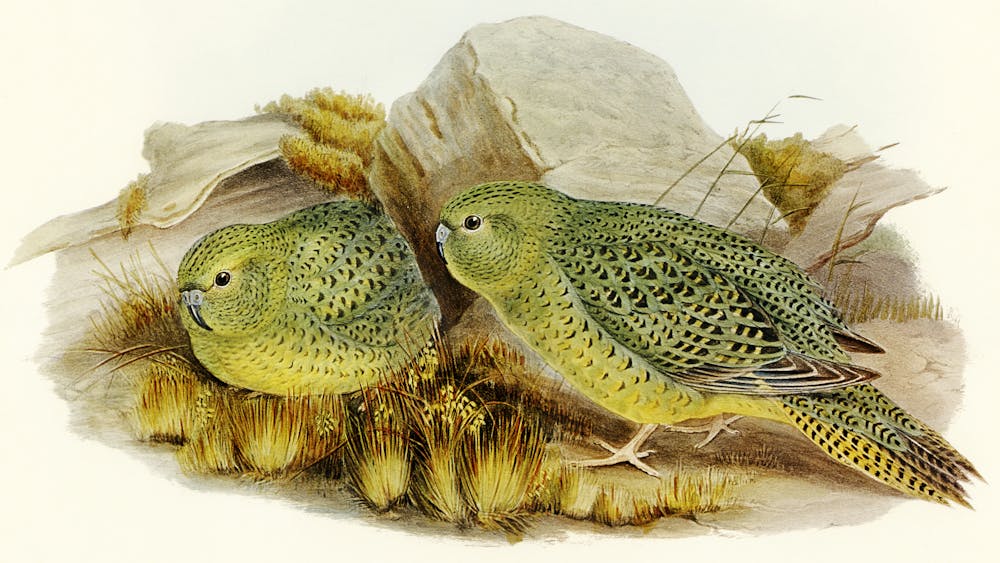
    In arid inland Australia lives one of Australia’s rarest birds: the night parrot. Missing for more than a century, a live population was rediscovered in 2013. But the species remains elusive.

    Until recently, Australia’s known night parrot population numbered in the tens of birds, scattered across desert in Queensland and Western Australia.

    But our research team – consisting of Indigenous rangers and scientists – has made a breakthrough discovery. We’ve detected the largest known night parrot population in the world: perhaps as many as 50, living in WA’s Great Sandy Desert, on land managed by the Ngururrpa people. Our results are published today.

    Urgent action is needed to protect these vulnerable populations and ensure the night parrot doesn’t go missing a second time, perhaps for good.

    The night parrot lives in arid inland Australia. Pictured: an 1890 illustration by Elizabeth Gould.
    Wikimedia, CC BY

    A highly mysterious species

    The night parrot was once found throughout Australia’s arid inland, but its numbers plummeted in the late 19th century.

    The bird was not definitely recorded for more than 100 years, until a dead bird was found near Boulia in western Queensland in 1990. Another dead bird was found in Diamantina National Park, also in western Queensland, in 2006.

    In 2013 a small population was found by naturalist John Young in south-western Queensland. That area is now a wildlife reserve.

    Night parrots are notoriously difficult to detect. They build tunnels in dense spinifex and hide there by day, emerging at night to forage. They are known only from populations in remote south-west Queensland and central and northern Western Australia. The species is critically endangered.

    In Western Australia, Indigenous cultural knowledge about the species includes stories about how difficult the bird is to find. There are also whispered stories of mothers telling children the night parrot’s call was the sound of an evil spirit, and warning them not to stray from camp.

    A short video explaining the night parrot project.

    What we did

    The Ngururrpa Indigenous Protected Area is in the Great Sandy Desert. It comprises vast areas of sandplains and dunefields, and smaller areas of floodplain and spinifex which are key night parrot habitats.

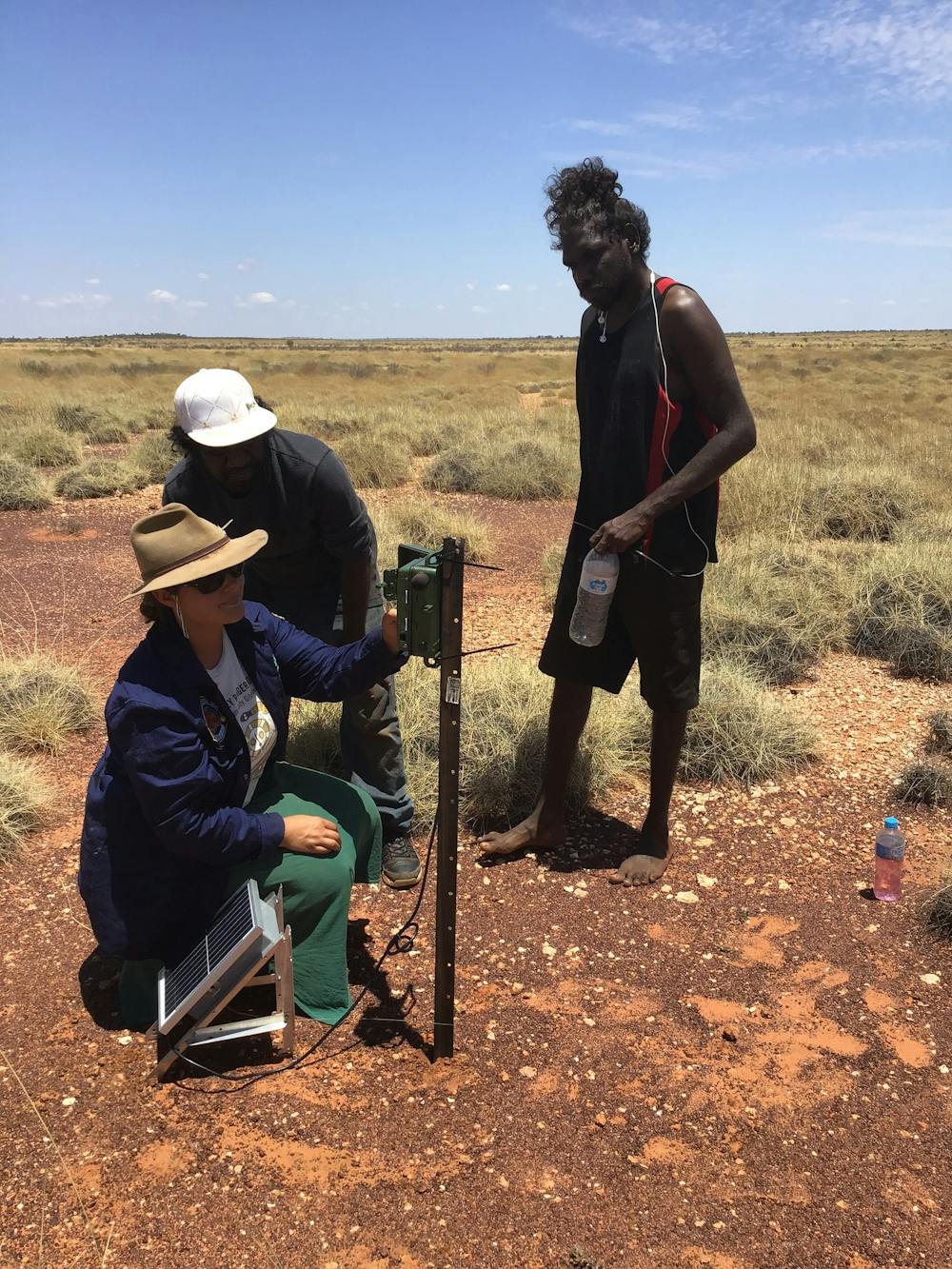
    The researchers recorded night parrots using ‘songmeters’.
    Ngururrpa Rangers/Facebook

    Ngururrpa Rangers worked with scientists to learn how to use sound recorders to search for night parrots. We then searched for the birds on Country between 2018 and 2023.

    We combined the rangers’ detailed knowledge of habitats, water and seed resources with geology maps, satellite imagery and fire history data. From this we selected 31 potential roosting areas, then deployed sound recorders called “songmeters” at those sites.

    We wanted to detect the night parrots’ distinctive calls which consist of whistles, croaks and bell-like sounds.

    The acoustic data we gathered was then analysed to extract any bird calls in the night parrot’s frequency range. Potential detections were verified using a reference library of known night parrot calls.

    Our results

    We detected night parrot calls at 17 of 31 sites. Of these, ten were roost sites, where night parrot calls were detected in the hour after sunset and the hour before sunrise.

    Individual night parrots are thought to have unique calls. We analysed how many different calls we could hear, and how loud they were (which can tell us when birds are calling from different locations). From this we built a picture of the identity and number of individuals regularly occupying a site.

    We extrapolated this across the 58 patches of potential night parrot habitat on the Ngururrpa Indigenous Protected Area. We concluded up to 20 roosting areas may be occupied by night parrots.

    Based on the numbers at roosting sites where we recorded calls, we estimate 40–50 night parrots could be present in the Ngururrpa Indigenous Protected Area.


    Fire and predators pose grave threats

    Once we found the night parrot populations, we wanted to know what threats they faced.

    We used camera-traps to identify predators and also collected their scats (poos) to analyse their diets.

    Ngururrpa Ranger Kathryn Njamme with a night parrot feather.
    Ngururrpa IPA

    Dingoes were the predator detected most frequently in night parrot roosting habitat. Our cameras captured them ten times more often than feral cats. And we found dingoes regularly eat feral cats at night parrot sites.

    Based on information from other areas, we suspect cats are a key predator of night parrots. Dingoes could be important in suppressing cat numbers and helping the parrots survive. So, attempts to limit predators in night parrot habitat should not harm dingoes.

    We also analysed 40 years of satellite imagery to assess the threat of fire to night parrots’ roosting habitat. Based on the vegetation types and flammability of surrounding landscapes, we found bushfires sparked by lightning are a much bigger threat to night parrots in the Great Sandy Desert than in Queensland.

    Strategic aerial and ground burning, to reduce fuel loads, already occurs in the Ngururrpa Indigenous Protected Area. As our knowledge of night parrots improves, these programs can become more targeted to protect key night parrot areas.

    Ngururrpa Rangers using ‘Felixer’ devices to selectively control cats in night parrot habitat.
    Ngururrpa IPA

    Keeping night parrots alive

    A long-term monitoring program for night parrots on Ngururrpa Country should be established to help better understand and protect this vitally important population.

    And the remote, wild nature of the landscape should be retained. This means minimising disturbance from people and vehicles, and continuing to exclude livestock and weeds.

    Clifford Sunfly has articulated how the rangers want to help protect night parrots into the future:

    We would like to spend more time on Country to find where [night parrots] are and understand what they are doing.

    We want those scientists to come and help us catch some night parrots and tag them. We also need more snake-cams (inspection cameras) too and more songmeters. And a kit for collecting scats for DNA.

    One day we would love to have our own research facility for doing our night parrot surveys. It would be our dream to have our own research base on Ngururrpa.

    Rachel Paltridge receives funding from the National Environmental Science Program’s Resilient Landscapes Hub, and the Indigenous Desert Alliance.

    Clifford Sunfly is a Ngururrpa Ranger. The ranger program receives funding from the WA government’s Aboriginal Ranger Program and the State NRM Program.

    Nicholas Leseberg receives funding from the Australian and Queensland Governments. He works for Bush Heritage Australia, and as a consultant on night parrots for many projects.

    ref. ‘Breakthrough discovery’: Indigenous Rangers in outback WA find up to 50 night parrots – one of Australia’s most elusive birds – https://theconversation.com/breakthrough-discovery-indigenous-rangers-in-outback-wa-find-up-to-50-night-parrots-one-of-australias-most-elusive-birds-239449

    MIL OSI AnalysisEveningReport.nz

  • MIL-OSI New Zealand: ChildFund NZ – Charities Incentivised to Collaborate not Compete

    Source: ChildFund New Zealand

    Emergency Alliance brings together some of New Zealand’s leading relief agencies who have agreed to collaborate rather than compete for donations during a humanitarian emergency.
    Collaboration generates more funds, and makes distribution of those funds more efficient during an emergency.
    “Simply put, more donations get to those who need it most,” says Emergency Alliance Executive Director, Paul Brown.
    “Having a joint appeal makes it easy for the public to donate during a crisis. They don’t have to choose which charity to support. They can donate via one platform, knowing Emergency Alliance will distribute the funds to the charities best positioned to get effective support quickly to where it is most needed.”
    The Emergency Alliance was launched in 2023, and connects the New Zealand aid sector to other successful collaborative alliances in 13 other countries.
    ChildFund New Zealand is part of a global network of ChildFund organisations working in over 70 countries and reaching over 30 million children and young people. It brings this global reach and experience, plus its extensive work in the Pacific, to Emergency Alliance.
    “We are very excited to welcome ChildFund to our family. They bring a global network, with depth in understanding of how emergencies affect children and youth. ChildFund’s work in the Pacific is particularly important as we gear up for another cyclone season,” says Paul Brown.
    “When disaster strikes, it’s critical that we work together, not just in coordinating responses on the ground, but also coordinating how we raise funds. By making it simple for the public, New Zealanders can trust that donations will get to where they are most needed,” says Josie Pagani CEO of ChildFund New Zealand.
    “I have seen how these joint appeal mechanisms work around the world. Often the public are ahead of governments in wanting to do something to help people in a crisis. So, let’s make it easy for generous Kiwis to donate.”
    “Working together achieves so much more than going it alone. We look forward to doing the best job we can by collaborating to help people during a humanitarian crisis,” says Josie Pagani.

    MIL OSI New Zealand News

  • MIL-OSI United Kingdom: Rural Flood Resilience Partnership launched to help farmers and rural communities adapt to a changing climate

    Source: United Kingdom – Executive Government & Departments

    Partnership unites six organisations including: Action with Communities in Rural England; Association of Drainage Authorities; Country Land and Business Association; Environment Agency; National Farmers Union; and Natural England

    With rural communities increasingly on the frontline of extreme weather and the devastating impacts of flooding, a unique partnership has been launched today (23 September 2024) to support rural flood resilience and help farmers and communities adapt to a changing climate. 

    Climate change means that people, places and nature are facing more frequent and more severe storms and floods. Last winter saw one of England’s wettest periods since records began in 1836. 

    The Rural Flood Resilience Partnership has been established to improve collaboration, deepen understanding of vulnerabilities, and support rural communities and agricultural businesses in building their resilience to present and future flood risks and coastal erosion. 

    The Partnership unites organisations representing government agencies, trade associations, rural communities and businesses to tackle a joint challenge with joint solutions. 

    The six equal founding partners are: Action with Communities in Rural England; the Association of Drainage Authorities; Country Land and Business Association; the Environment Agency; the National Farmers Union; and Natural England. 

    Today, the Partnership publishes its work plan covering 2024 to 2026. Partners and a wide range of projects will work together to improve their evidence base and will draw on this to co-develop solutions. 

    The work plan sets out 21 actions supporting seven strategic outcomes focused on: developing the evidence base behind decision-making to increase resilience; ensuring communities, farmers and landowners have access to quality advice and support; and engaging rural communities in flood resilience.  

    James Blake, Chair of Trustees Action with Communities in Rural England, said:

    It’s vital that everyone living and working in rural communities – not just those involved in land management and agriculture – have an opportunity to engage with and influence plans to manage the consequences of climate change.  

    As one of the founding members of this partnership, we look forward to drawing on the experience and reach of ACRE members to build the capacity of rural communities to come together and consider what can be done based on local circumstances in response to this most pressing global issue.

    Robert Caudwell, Chair of the Association of Drainage Authorities, said:  

    Our climate is changing rapidly, and those living and working in rural parts of England are some of the most aware of, and most vulnerable to, those changes.

    Listening to the voice of rural communities is essential if we are to build England’s resilience to flooding and drought in the future. 

    The best solutions can often be achieved when public authorities work together with local businesses and communities, combining their land and water management expertise with a deeper understanding of our local landscape and those impacted. 

    ADA is proud to play its part in this new Partnership in support of our members, England’s flood and water management authorities.

    Country Land and Business Association (CLA) President Victoria Vyvyan said:

    The damage to rural land and businesses from flooding is localised but acute, and the frequency of these events will increase with climate change.  

    It is crucial to improve the resilience of rural businesses and communities to flooding. The CLA hopes this partnership will provide the evidence, awareness of risks, and access to practical advice that will allow them to improve their resilience.  

    This partnership will look for short and medium-term solutions whilst raising awareness of the rural-specific costs and challenges from flooding which our members face.

    Caroline Douglass, Executive Director for Flood and Coastal Risk Management, Environment Agency, said: 

    Flooding presents specific challenges to those living and working in rural communities, from ruined crops to having road access cut off by floodwaters.  

    Since 2015, flooding and coastal change projects have been completed to protect more than 400,000 hectares of agricultural land better. This includes 280,000 hectares between 2015-2021, helping to avoid more than £500 million worth of economic damage to agricultural land production.

    While the Environment Agency continues to work to strengthen rural flood resilience, no single organisation can tackle these challenges in isolation. This partnership provides the opportunity to accomplish more than any one organisation can manage alone. 

    The new Rural Flood Resilience Partnership will help farmers, land managers and rural communities become more resilient to the impacts of climate change while retaining the vital role of managing land and producing sustainable food.

    NFU Vice President Rachel Hallos said: 

    The NFU is pleased to be involved in this new Partnership and hope it will enable farmers and rural communities to strengthen the resilience of their homes and businesses by providing practical solutions based on tangible evidence to some of the challenges they face in the event of flooding. 

    It will also give rural communities the means to influence decision making, provide access to resources and support action on the ground, strengthening rural resilience to flooding in a changing climate. 

    Farmers are on the frontline of climate change – our biggest challenge. The extreme weather this brings is one of the main threats to UK food security and more severe storms, devastating floods, and increased periods of little or no rain are all impacting our ability to produce food. 

    The country has just experienced its wettest 18 months since records began in 1836 which left many thousands of acres of productive farmland under water. There are still many farm businesses in dire need of support, and we are awaiting details of how the Farming Recovery Fund can help those businesses recover from the impacts of the devastating flooding and saturated ground.

    Natural England’s Greener Farming & Fisheries Director, Brad Tooze, said:

    Natural England champions the power of nature and nature-based solutions to help tackle the joint climate and biodiversity emergencies.  

    NE welcomes the opportunity to join this partnership and add our science and evidence expertise and our local farm advice offer into the mix. Together we can support farmers and land managers to farm in more flood resilient ways – supporting communities to become more flood resilient and recovering nature at the same time. 

    From signing up to the Sustainable Farming Incentive to manage arable land for flood/drought resilience and water quality or by working with others to restore a river and floodplain in Landscape Recovery every farmer and land manager can make a difference.

    The Partnership forms part of the wider work that all partners are undertaking on flood and coastal resilience.  

    All flood and coastal risk management schemes delivered by risk management authorities in England are carefully assessed to make sure they benefit the most people and property. Approximately 40% of all schemes and 45% of investment better protect properties in rural communities.

    Updates to this page

    Published 23 September 2024

    MIL OSI United Kingdom

  • MIL-OSI Australia: Taree NPWS hazard reduction burn 22 September 2024

    Source: New South Wales Environment and Heritage

    The 72 hectare ‘Starrs Creek HR – Stage 2’ aims to provide a fuel reduced zone within Coorabakh National Park, aiding in the suppression of bushfire in the area.

    The burn will also stimulate reproduction of the critically endangered Banksia conferta within the prescribed burn area.

    NPWS crews will be working on roads and trails throughout Coorabakh National Park to implement the burn. The public are advised that smoke may affect roads in the area and motorists are reminded to exercise caution when driving along roads in the area.

    Hazard reduction burns are essential to reduce bushfire fuel loads to help protect parks, neighbours and communities from future bushfires. Fires such as this one are also specifically planned to have an ecological outcome.

    All burns around the state are coordinated with the NSW Rural Fire Service.

    People with known health conditions can sign up to receive air quality reports, forecasts and alerts via email or SMS from the Department of Climate Change, Energy, the Environment and Water (NSW DCCEEW).

    For health information relating to smoke from bush fires and hazard reduction burning, visit the NSW Health or Asthma Australia.

    More information on hazard reduction activities is available at NSW Rural Fire Service and the NSW Government Hazards Near Me website and app.

    MIL OSI News

  • MIL-OSI China: Largest jade dragon from Hongshan culture found in north China

    Source: People’s Republic of China – State Council News

    This undated file combo photo shows a jade dragon unearthed from a stone tomb site in the city of Chifeng, north China’s Inner Mongolia Autonomous Region. Chinese archaeologists have unearthed the largest jade dragon ever discovered from the Hongshan culture, an important part of the Neolithic Age, at a stone tomb site in the city of Chifeng, north China’s Inner Mongolia Autonomous Region, according to the regional institute of cultural relics and archaeology. Measuring 15.8 cm long, 9.5 cm wide, and 3 cm thick, the artifact was found at a site featuring a circular tomb in the north and a square altar in the south, which is the only one of its kind ever found in the region. [Photo/Xinhua]

    HOHHOT, Sept. 22 — Chinese archaeologists have unearthed the largest jade dragon ever discovered from the Hongshan culture, an important part of the Neolithic Age, at a stone tomb site in the city of Chifeng, north China’s Inner Mongolia Autonomous Region, according to the regional institute of cultural relics and archaeology.

    Measuring 15.8 cm long, 9.5 cm wide, and 3 cm thick, the artifact was found at a site featuring a circular tomb in the north and a square altar in the south, which is the only one of its kind ever found in the region.

    Apart from the architectural remains, human skeletal remains, burials, fire pits, and cylindrical object pits have also been discovered at the site. The unearthed artifacts include jade and painted pottery basins and tripod pottery cups, among others.

    The ongoing research at the site includes studies of the ancient environment, large-scale topographic mapping and carbon-14 dating, among others. The latest dating data indicates that the site belongs to the late Hongshan culture, dating back 5,100 to 5,000 years.

    The finds were revealed during a themed seminar held Sunday in Chifeng, which provided updates on the archaeological progress at the stone tomb in Yuanbaoshan of Chifeng’s Aohan Banner.

    This undated file photo shows the general view of a stone tomb site in the city of Chifeng, north China’s Inner Mongolia Autonomous Region. [Photo/Xinhua]
    This undated file photo shows archaeologists working at a stone tomb site in the city of Chifeng, north China’s Inner Mongolia Autonomous Region. [Photo/Xinhua]
    This undated file photo shows jade wares unearthed at a stone tomb site in the city of Chifeng, north China’s Inner Mongolia Autonomous Region. [Photo/Xinhua]
    This undated file photo shows a circular tomb at a stone tomb site in the city of Chifeng, north China’s Inner Mongolia Autonomous Region. [Photo/Xinhua]
    This undated file photo shows a stone tomb site before excavation in the city of Chifeng, north China’s Inner Mongolia Autonomous Region. [Photo/Xinhua]

    MIL OSI China News

  • MIL-OSI China: 7th Chinese farmers’ harvest festival celebrated across China

    Source: People’s Republic of China – State Council News

    7th Chinese farmers’ harvest festival celebrated across China

    Updated: September 23, 2024 07:33 Xinhua
    A villager airs crops at Yangchan Village in Huangshan City, east China’s Anhui Province, Sept. 22, 2024. This Sunday marks the seventh Chinese farmers’ harvest festival. [Photo/Xinhua]
    A farmer loads harvested corns onto a truck at Bianqiao Township of Linyi City, east China’s Shandong Province, Sept. 17, 2024. [Photo/Xinhua]
    A farmer holds harvested rice at Yuanyang County of Honghe Hani and Yi Autonomous Prefecture, southwest China’s Yunnan Province, Sept. 22, 2024. [Photo/Xinhua]
    Farmers harvest rice at Zhanglou Village of Xinyang City, central China’s Henan Province, Sept. 22, 2024. [Photo/Xinhua]
    A farmer harvests grapes at an orchard of Xixiaoyi Village in Tangshan City, north China’s Hebei Province, Sept. 22, 2024. [Photo/Xinhua]
    Farmers harvest rice at Wanchang Township in Yongji County, northeast China’s Jilin Province, Sept. 20, 2024. [Photo/Xinhua]
    An aerial drone photo shows harvesters working in a paddy field in Fangzheng County of Harbin, northeast China’s Heilongjiang Province, Sept. 22, 2024. This Sunday marks the seventh Chinese farmers’ harvest festival. In recent years, China’s major grain production province Heilongjiang has enhanced its grain production capacity and advanced the quality of high-standard farmland development. [Photo/Xinhua]
    Harvesters work in a paddy field in Fangzheng County of Harbin, northeast China’s Heilongjiang Province, Sept. 22, 2024. [Photo/Xinhua]
    An aerial drone photo shows a paddy field in Fangzheng County of Harbin, northeast China’s Heilongjiang Province, Sept. 22, 2024. [Photo/Xinhua]
    Folk artists throw molten iron to create fireworks in Haiyang, east China’s Shandong Province, Sept. 21, 2024. The event aims to commemorate the seventh Chinese farmers’ harvest festival which falls on Sept. 22 this year. [Photo/Xinhua]
    Folk artists throw molten iron to create fireworks in Haiyang, east China’s Shandong Province, Sept. 21, 2024. [Photo/Xinhua]

    MIL OSI China News

  • MIL-OSI Security: Defense News: ASN EI&E Hosts Climate & Energy Tech Demo to Kick Off Climate Week NYC

    Source: United States Navy

    New York-based Sea Cadets and Naval Junior Reserve Officer Training Corps cadets attended the event, held at the U.S. Armed Forces Recruiting Station in Times Square.

    “Having these young Sea Cadets and NJROTC cadets – the future of our nation – learn about our climate and energy technologies was a fantastic way for the Department of the Navy to kick off its participation in Climate Week NYC,” said Berger. “They understand firsthand how climate change is impacting our world today, and we were able to help make the connection for them of how climate readiness is mission readiness for our Sailors and Marines.”

    DON researchers and engineers from various commands showcased technologies, such as hydrogen-powered fuel cells, small unit power systems, water-conserving firefighting nozzles, atmospheric water generation, and green concrete, to educate the students about the DON’s commitment to climate action and inspire them about DON careers in climate- and energy-focused roles.

    Madeleine White, resilience innovation research portfolio manager at Naval Facilities Engineering and Expeditionary Warfare Center, explained green concrete, which uses sustainable materials to reduce traditional concrete’s environmental impact, such as lowering the carbon footprint of construction. 

    “Working on this [technology] as it is as an engineer has been great, but being able to show it to the individuals who are one day going to use it or be involved with it makes my job all worthwhile,” White said. “And doing [the event] out in a space like this and having these engineer technologies out in such a public space for people to see is such a fun environment to be in.”

    Jeremiah Rodriguez, a junior and NJROTC cadet at Curtis High School in Staten Island, N.Y., said he would think about global warming and its impact.

    “It would be in the back of my mind, such as how it would continuously get hotter,” he said. “One day, it’ll get to the point where you can cook an egg on the sidewalk. With this new technology, I really hope we can figure out a way to significantly reduce the impact of climate change. After this presentation, I really find it hopeful for our generation’s future.”

    Climate Week NYC is the largest annual climate event of its kind, bringing together more than 600 events and activities across New York City in person, hybrid and online. Climate Group hosts the official program during the week that brings together the most senior international figures from business, government, civil society and the climate sector. 

    This year, Climate Week NYC is being held Sept. 22-29, 2024. The event takes place every year in partnership with the United Nations General Assembly and is run in coordination with the United Nations and the City of New York.

    In May 2022, the Department of the Navy released Climate Action 2030 in which Secretary of the Navy Carlos Del Toro recognized climate change as one of the most destabilizing forces of our time and charged the Department with building a climate-ready force.

    Berger is responsible for providing oversight and policy for Navy and Marine Corps energy and climate resilience; infrastructure sustainment, restoration and modernization; military construction; acquisition, utilization and disposal of real property and facilities; environmental protection, planning, restoration and natural resources conservation; and safety and occupational health.

    MIL Security OSI

  • MIL-OSI Australia: Brigades of CFA: Warracknabeal

    Source: Victoria Country Fire Authority

    Warracknabeal Fire Brigade may be one of Victoria’s oldest fire brigades – but its members have always had a focus on innovation and progression.

    Located in the state’s north-west, Warracknabeal brigade has a history dating back to CFA’s formative years. The brigade began in the 1890s when local volunteers secured a 26-person Merryweather hand-operated manual pump enabling them to officially join the newly created Country Fire Brigades Board (now CFA). 

    By 1919, the Country Fire Brigades Board (CFBB) had seen the potential of motorised firefighting vehicles which were considered a great advance on horse-drawn vehicles. Following the war, there were also huge developments in the design and use of motorised water pumps, which made firefighting more efficient and effective.

    Warracknabeal’s then captain, local entrepreneur Tom Gardiner seized upon this opportunity, establishing Gardiner-Aussie Workshops in the early 1920s with the goal of building trucks and pumpers suitable for rural firefighting. His innovative design would prove successful and was quickly adopted by the CFBB. Tom’s workshop was commissioned to develop 55 pumpers prior to his death in 1935.

    The new pumpers would not be the first motorised vehicle produced out of Warracknabeal. A belt drive bike with a small four stroke engine and pedal assist was built by the Mallee Cycle works in 1905.  

    Another of the brigade’s early leaders has strong ties to CFA’s history and was instrumental in improving CFA’s early communication with members. In 1947 Captain Norman Tosh recognised the need for a regular publication to share information with brigades across the state. With approval from CFA, he became the founder and first editor of ‘The Fireman’ (now Firewise), a newspaper for volunteer firefighters which is still in circulation today.

    Warracknabeal Fire Brigade has grown significantly in the years since, and members are firmly focused on the future.

    Current brigade captain Cameron Whelan says, like its early years, Warracknabeal brigade continues to have a progressive and innovative lens focused on improvement.

    The brigade’s new, state-of-the-art station opened in mid-2023 replacing the 35-year-old station. The station features improved facilities such as drive through engine bays, a laundry, changerooms and other amenities. The brigade was able to provide a significant contribution to improve the size of the meeting room, rear shed, install bi-fold doors as well as make other improvements.

    “We’ve always been a vibrant and progressive brigade, so the modern design of the new station represents us well,” Cameron said.

    “We’ve built this station for the next 30 years so the vision is not only to support the needs of Warracknabeal today; we’re also looking beyond that to what will be required in the future.

    “Our Fire Equipment Maintenance servicing is key to the brigade continuing to improve facilities and operational equipment.

    “The brigade also has an active social Auxiliary membership primarily supporting the brigade through fundraising programs and assisting local community groups such as the Scouts and Guides.” 

    The brigade has about 70 members and attends about 40 incidents a year locally; members also provide support across the state during the fire season.

    With one of the key industries in Warracknabeal and surrounds being broadacre cereal farming, harvesting-related fires are one of the main risks the brigade encounters over the fire danger period. Its members have been heavily involved in the development of the joint CFA and Victorian Farmers Federation Grain Harvesting Guidelines.

    “The main incidents we turn out to are running grass and scrub fires through to harvesting machinery fires,” Cameron said.

    “Like many other towns we also have a range of other risks from hospital/aged care, large chemical storage facilities through to household or structural fires.”

    The brigade has a very stable membership and whilst they will always welcome new members, Cameron says they are lucky they don’t need to actively seek members.

    “Like many rural brigades, we can see a drop off when members reach 18-19 years old because they leave for university or work,” Cameron said.

    “A strong Juniors program aims to encourage skill development and succession from the junior to senior ranks. 

    “To encourage retention, we include fire ground practise as part of our Junior training to build their skills and eagerness.”

    Cameron said volunteering with CFA is for anyone who is willing to help their community, better themselves and join a bigger family.

    “The thing I’m most proud of in leading our brigade is the values our members display,” Cameron said.

    “Values such as care, respect and integrity are common attributes amongst our cohort.”

    This story is part of our profile series Brigades of CFA which highlights our brigades and the great work they do in their communities.

    Submitted by CFA News

    MIL OSI News

  • MIL-OSI China: Largest jade dragon from Hongshan culture found

    Source: China State Council Information Office 3

    This undated file combo photo shows a jade dragon unearthed from a stone tomb site in the city of Chifeng, north China’s Inner Mongolia Autonomous Region. Chinese archaeologists have unearthed the largest jade dragon ever discovered from the Hongshan culture, an important part of the Neolithic Age, at a stone tomb site in the city of Chifeng, north China’s Inner Mongolia Autonomous Region, according to the regional institute of cultural relics and archaeology. [Photo/Xinhua]

    Chinese archaeologists have unearthed the largest jade dragon ever discovered from the Hongshan culture, an important part of the Neolithic Age, at a stone tomb site in the city of Chifeng, north China’s Inner Mongolia Autonomous Region, according to the regional institute of cultural relics and archaeology.

    Measuring 15.8 cm long, 9.5 cm wide, and 3 cm thick, the artifact was found at a site featuring a circular tomb in the north and a square altar in the south, which is the only one of its kind ever found in the region.

    Apart from the architectural remains, human skeletal remains, burials, fire pits, and cylindrical object pits have also been discovered at the site. The unearthed artifacts include jade and painted pottery basins and tripod pottery cups, among others.

    The ongoing research at the site includes studies of the ancient environment, large-scale topographic mapping and carbon-14 dating, among others. The latest dating data indicates that the site belongs to the late Hongshan culture, dating back 5,100 to 5,000 years.

    The finds were revealed during a themed seminar held Sunday in Chifeng, which provided updates on the archaeological progress at the stone tomb in Yuanbaoshan of Chifeng’s Aohan Banner.

    MIL OSI China News

  • MIL-OSI Global: A weakened Hezbollah is being goaded into all-out conflict with Israel – the consequences would be devastating for all

    Source: The Conversation – USA – By Asher Kaufman, Professor of History and Peace Studies, University of Notre Dame

    For almost a year, Israel and Hezbollah have engaged in increasingly provocative cross-border skirmishes as onlookers warn that this escalating war of attrition could land the region in all-out conflict. The past few days have made that devastating scenario closer to a reality.

    First came Israel’s pager and walkie-talkie attack, an unprecedented assault on Hezbollah’s communications that injured thousands of the organization’s operatives. It was followed by the assassination of Ibrahim Aqil, a key Hezbollah leader, who died in an airstrike that also killed other senior commanders of the militant group, as well as some civilians. Hezbollah has responded by extending the geographical range of its rockets fired at Israel, targeting both military facilities and civilian neighborhoods just north and east of Haifa.

    As a scholar of Lebanon and Israel, I have followed the dynamics of this war of attrition since Oct. 8, 2023, the day after Hamas executed an unprecedented and deadly attack on Israel, which responded by bombarding the Gaza Strip. Hezbollah then began firing rockets into northern Israel in solidarity with Hamas in Gaza.

    Despite the high rhetoric and mutual threats of destruction, until recent days neither Israel nor Hezbollah, nor the latter’s sponsor Iran, have shown an interest in a full-scale war. All parties surely know the likely destructive consequences of such an eventuality for themselves: Israel has the military power to devastate Beirut and other parts of Lebanon as it did in Gaza, while even a weakened Hezbollah could fire thousands of missiles at Israeli strategic sites, from the airport to central Tel Aviv, water supply lines and electricity hubs, and offshore gas rigs.

    So instead, they have exchanged fire and blows along their shared boundary, with somewhat agreed-upon red lines concerning the geographical scope of attacks and efforts not to intentionally target civilians.

    But Israel’s recent attacks in Lebanon may have turned the page of this war of attrition into a new and far more acute situation, putting the region on the brink of a full war. Such a war would wreak havoc in Lebanon and Israel, and might also drag Iran and the United States into direct confrontation. In doing so, it would also fulfill the apparent of the Hamas gunmen who murdered around 1,200 Israelis on Oct. 7 in the hope that a heavy-handed Israeli response would draw in more groups across the region.

    A dangerous ‘new phase’

    Hezbollah’s secretary general, Hassan Nasrallah, has insisted throughout the near-yearlong hostilities that his organization would hold its fire only if a cease-fire agreement is reached between Israel and Hamas. In recent weeks, however, Israel has taken the conflict in the opposite direction.

    The country’s defense minister, Yoav Gallant, described the coordinated attacks on Hezbolah targets as a “new phase,” adding that the “center of gravity” in the war was moving north into Lebanon. The Israeli government has added the “return of the residents of the north securely to their homes” as an additional war goal.

    The assault on Hezbollah’s communications system targeted the organization’s operatives but hit many civilian bystanders, leaving Lebanese in shock, trauma, anger and desperation.

    It demonstrated Israel’s tactical military advantage over Hezbollah. The unprecedented penetration into the heart of the organization’s command and rank-and-file structures has never been seen before in any conflict or war globally. It struck Hezbollah in its most vulnerable places and even exposed its coordination with Iran – one of the injured persons from the pager explosions was the Iranian ambassador in Lebanon.

    The killing of Akil two days later was another signal that the Israeli government had now decided to try to change the rules of this risky game of reprisals and counter-reprisals. It is clear that rather than the uneasy status quo that defined this war of attrition for nearly a year, Israel’s intent is now to pressure Hezbollah to concede.

    Getting out of control

    Nasrallah delivered a gloomy and defiant speech in the aftermath of the pager attack. While acknowledging that Hezbollah was severely undermined by this operation, he defined the Israeli attack as a continuation of “multiple other massacres perpetrated by the enemy over decades.”

    By doing so, he framed it within a popular historical narrative among many Lebanese and Palestinians who regard Israel as a criminal entity that regularly carries out massacres against innocent civilians.

    Nasrallah also insisted that his commitment to supporting Hamas in Gaza remains unwavering.

    While stating that Israeli actions have “crossed all red lines” and could amount to a declaration of war, Nasrallah also reiterated a point he had made in previous peaks of this ongoing conflict: that retribution is coming, the only question being of timing and scale. By doing so, Nasrallah hinted that he may still not be interested in a full war.

    Israel, on the other hand, appears less circumspect. After almost a full year of contained tension with Hezbollah, Israel’s leaders appear willing to risk an escalation that might get out of control.

    It is hard to determine what the strategy behind Israel’s actions is: Since Oct. 7; as the Biden administration has noted, Israel has not displayed a coherent strategy with clear political goals.

    Rather, critics of Prime Minister Benjamin Netanyahu suggest that he is mainly motivated by his own political survival and the retention of power as the head of state, tying Israel’s interests to his own.

    Uniting the ‘axis of resistance’

    So where does this leave Nasrallah as he weighs Hezbollah’s response, surely in consultation with Iran? After such devastating blows to Nasrallah’s organization, it is hard to think that Hezbollah would be willing to scale down, stop its cross-border attacks and retreat away from the Israeli border, or give up its commitment to support Hamas in Gaza.

    Palestinian refugees listen to a speech by Hezbollah leader Hassan Nasrallah from a cafe at the entrance of the Sabra camp in Beirut.
    Joseph Eid/AFP via Getty Images

    On the other hand, opting for a full-scale war, after spending a year avoiding it, is fraught with risk – both Nasrallah and his sponsors in Tehran know well the high costs of such a war for Hezbollah, Lebanon and potentially also for Iran.

    If Hezbollah went to war now against Israel, it would embark on its most consequential move since its foundation in 1982. But it would do so with crippled communications systems and without much of its leadership – some of whom had worked for decades side by side with Nasrallah, building with him the military capacity of the organization.

    In some respects, Israelis under Netanyahu’s leadership, and Lebanese in a country increasingly held hostage by Hezbollah’s interests, face similar predicaments: Their well-being is being sacrificed for other priorities.

    Netanayhu’s recent statements about concern for Israeli citizens in the north sound hollow after 11 months of pursuing policies that put them more in danger, as well as opposing a Gaza cease-fire deal that would also end hostilities between Hezbollah and Israel.

    In Lebanon, Hezbollah has dragged the country into this war against the will of most Lebanese – a decision that has led to significant devastation in parts of a country already suffering extreme political and economic duress.

    Nasrallah’s speech described Hezbollah’s predicament as that of all Lebanon – while sending a veiled threat that dissent would not be tolerated. Many Lebanese are undoubtedly sympathetic to the Palestinian cause and resent Israel’s war in Gaza. But at the same time, they may balk at the idea that their own well-being has to be sacrificed in the process.

    In the meantime, Yahya Sinwar, the Hamas leader and mastermind behind the Oct. 7 massacre, may well be looking on at the unfolding events between Israel and Hezbollah with satisfaction. His plan was designed to trigger the unification of all fronts of the so-called “axis of resistance,” which includes the Houthis in Yemen as well as Hezbollah and other Iran-backed groups with the hope for a regional war against Israel.

    A year later, we are closer than ever to that scenario.

    Asher Kaufman does not work for, consult, own shares in or receive funding from any company or organization that would benefit from this article, and has disclosed no relevant affiliations beyond their academic appointment.

    ref. A weakened Hezbollah is being goaded into all-out conflict with Israel – the consequences would be devastating for all – https://theconversation.com/a-weakened-hezbollah-is-being-goaded-into-all-out-conflict-with-israel-the-consequences-would-be-devastating-for-all-239469

    MIL OSI – Global Reports

  • MIL-Evening Report: Move over Olympians, Australia’s wildlife are incredible athletes

    Source: The Conversation (Au and NZ) – By Euan Ritchie, Professor in Wildlife Ecology and Conservation, School of Life & Environmental Sciences, Deakin University

    Now that the Paris Olympics and Paralympics have disappeared from our screens, let’s get back to watching animal videos.

    But seriously, have you ever paused to think about the athletic abilities of Australian wildlife?

    In my research as an ecologist, I’m constantly amazed by the strength, speed and resilience of our native animals. Their prowess is testament to the wonders of evolution, and the necessity of species having to adapt to challenging and changing environments in order to survive.

    Let’s take a closer look at some of our best competitors and how might they fare, against humans and overseas entrants. On your marks, get set… swim, hop, dig, dance, glide!

    Swimming

    Australians are renowned for being strong swimmers. But what is the fastest swimmer in the animal kingdom?

    On this there is much debate. Some suggest it’s the Indo Pacific sailfish, clocking in at about 30km/hr. That’s impressive, but much slower than oft-cited (but inaccurate) claims it can travel at more than 100km/hr.

    For perspective, the fastest human to swim the 50 metres freestyle is American Caeleb Dressel, completing this in a time of 20.16 seconds. That’s roughly 9km/h – faster than many people jog, but still no match for a sailfish.

    As in humans, swimming speed in fishes tends to increase with body length. Larger species that challenge sailfish for the fastest swimmer title include blue or black marlin. Shorter, torpedo-like bluefin tuna are also in contention. All are found in Australian waters, though not exclusively.

    While American swimmer Michael Phelps put in an impressive showing against a simulated great white shark, no human would beat much faster sailfish, marlin and tuna.

    Sprinting, long and high jump

    Aussie icons, red kangaroos can reach speeds of around 60-70km/hr. But they are no match for cheetahs, which can move at more than 120km/hr.

    Long jump is surely the kangaroo’s main event. Red kangaroos can jump a staggering 13 metres or more. Amazingly, this might not be enough to clinch gold. Snow leopards can jump more than 15 metres.

    Kangaroos can clear heights of up to 3m, so would perform well in the high jump. But they’d finish behind bottlenose dolphins, which can jump over 7m in the air, just for kicks.

    Scaled for body size, though, both species would be embarrassed by a tiny insect known as a froghopper. It jumps to heights of more than 140 times its body length.

    Kangaroos sure can jump, but they’re not the greatest of all in the animal kingdom.

    Battles of strength

    African elephants can lift more than 1,000kg and weaver ants more than 100 times their own body weight.

    But relative to size, a truly impressive champion is Australia’s horned dung beetle. At just a centimetre long, these diminutive powerhouses can pull more than 1,100 times their own body weight, roughly equating to an average man lifting two fully-loaded 18-wheeler trucks.

    And yet, horned dung beetles might still only claim silver. Another invertebrate Aussie, the tiny tropical moss mite, is perhaps the world’s strongest animal. It can pull more than 1,180 times its weight.

    Bigger does not always equal stronger.

    Packing the fastest, deadliest punch

    In terms of combat sports, bigger is not always better.

    Peacock mantis shrimps – invertebrates found in Australian marine waters and elsewhere – have the swiftest and most powerful punch in the lightweight crustacean division.

    They kill prey by punching them with strong, club-like appendages. They deliver blows at up to 23m per sec, akin to the speed and force of a .22 calibre bullet being fired.

    So powerful is the punch, it vaporises water and creates a super-hot shockwave that breaks up and incapacitates its prey.

    Nature’s deadliest punch?

    Tantalising contests

    What about a digging contest? Eastern barred bandicoots can shift 4.8 tonnes of soil a year. How would that stack up against marsupial moles, which can disappear almost instantly into desert sands? Or the expert excavations of wombats and aardvarks that can dig more than half a metre in 15 seconds?

    In terms of free-diving and flying, there’s really no contest. Cuvier’s beaked whale can dive nearly 3000m and peregrine falcons can reach over 320 km/hr. These animals are found across the globe, however – not just in Australia.

    Australia’s largest gliding marsupial, the greater glider, can sail up to 100m between trees. But gliding gold would surely go to the giant flying squirrel, which can glide up to 450m.

    I’d love to see a shooting contest between Australia’s archer fish and Madagascar’s panther chameleon. But finding the right arena for both aquatic and land-based sharpshooters would be tricky.

    Raygun’s kangaroo hop is now legendary, but a breaking (break dancing) contest between a peacock spider, spanish dancer (a type of nudibranch) and a magnificent riflebird might genuinely break the internet.

    Step aside, Raygun, peacock spiders are taking the floor.

    Appreciating wildlife athletes

    So who would win a global contest for the best wildlife athlete overall?

    If the competition was on land and focused on running, jumping, strength and climbing, it’s hard to go past the overall abilities of a Bengal tiger.

    Many amazing wildlife athletes are threatened with extinction. Others are gone forever.

    They include the incredible oolacunta – also known as the desert rat kangaroo. It’s powers of endurance in the desert are the stuff of folklore. As legendary Australian mammalogist Hedley Herbert Finlayson wrote in 1931:

    Its speed for such an atom, was wonderful, and its endurance amazing … when we finally got it, it had taken the starch out of three mounts and run us 12 miles; all under such adverse conditions of heat and rough going, as to make it almost incredible that so small a frame should be capable of such an immense output of energy.

    Let’s celebrate wildlife and their athletic abilities and ensure they have a secure future.

    Euan Ritchie receives funding from the Australian Research Council and the Department of Energy, Environment, and Climate Action. Euan is a Councillor within the Biodiversity Council, a member of the Ecological Society of Australia and the Australian Mammal Society, and President of the Australian Mammal Society.

    ref. Move over Olympians, Australia’s wildlife are incredible athletes – https://theconversation.com/move-over-olympians-australias-wildlife-are-incredible-athletes-238303

    MIL OSI AnalysisEveningReport.nz

  • MIL-OSI China: 4 killed, many injured in mass shooting in US Alabama

    Source: China State Council Information Office

    At least four people were killed and many others injured in a mass shooting Saturday night in downtown Birmingham, in the U.S. state of Alabama, police said.

    Birmingham police said the shooting occurred in Birmingham Five Points South, an entertainment district near the University of Alabama, just after 11 p.m. local time (0400 GMT Sunday).

    Police said multiple people fired several shots at a group of people. When police officers arrived at the scene, they found three people — two men and one women — were dead. A fourth victim later died in hospital.

    At least four of the gunshot victims have life-threatening injuries, and the rest have “various injuries,” police said.

    As of Sunday morning, no one was in custody, and police said they do not have a motive for the shooting at this time.

    MIL OSI China News

  • MIL-OSI China: China, Nepal launch joint army training in SW China’s Chongqing

    Source: China State Council Information Office

    A joint army training, co-organized by Chinese and Nepali militaries, kicked off Sunday in southwest China’s Chongqing Municipality.

    This is the fourth iteration of joint training between the two militaries, with the previous session held in 2019.

    Under the theme of “joint counter-terrorism operations in urban blocks,” the joint training will include small arms shooting in special operations, counter-terrorism squad tactics, drone operations, emergency rescue, and comprehensive counter-terrorism exercises.

    The training will last until Oct. 1. In addition to joint exercise sessions, the two militaries will engage in research and exchange on disaster reduction and relief in earthquakes, avalanches and landslides.

    A series of cultural exchange activities will also take place during the training to enhance mutual trust and understanding.

    MIL OSI China News

  • MIL-OSI Australia: Additional humanitarian assistance for Gaza and the West Bank

    Source: Australian Government – Minister of Foreign Affairs

    Australia will provide an additional $10 million in response to the ongoing humanitarian crisis in Gaza and the West Bank.

    The funding will be directed to UNICEF and UNFPA and will provide lifesaving assistance, with a focus on women and girls, including the delivery of nutrition support, as well as hygiene and dignity kits.

    Since 7 October, Australia has committed $82.5 million in humanitarian assistance to address essential needs in Gaza and the West Bank and respond to the protracted refugee crisis in the region.

    Australia continues to push for safe, rapid and unimpeded humanitarian assistance to people in desperate need, and for all aid workers to be protected.

    Quotes attributable to Minister for Foreign Affairs, Senator the Hon Penny Wong:

    Australia’s support will help address the dire humanitarian situation with the delivery of nutrition and essential hygiene and health products.

    Rapid, safe and unimpeded humanitarian relief must reach civilians, and aid workers must be protected to enable their lifesaving work.

    “We continue to press for a ceasefire, the protection of civilians and the release of hostages.”

    Quotes attributable to Minister for International Development and the Pacific, the Hon Pat Conroy MP:

    “The situation in Gaza is catastrophic. Civilians should not be made to pay the price for the horrendous acts of others. The suffering must stop.”

    “We support the ceasefire endorsed by the UN Security Council and want to see it fully implemented by both parties. Any delay will only see more lives lost.”

    MIL OSI News

  • MIL-OSI Australia: Road upgrades pave the way for safer journeys for Glen Innes motorists

    Source: New South Wales Premiere

    Published: 23 September 2024

    Released by: Minister for Regional Transport and Roads


    Safer and more reliable journeys are on the way for motorists and freight operators in the Glen Innes region, with road upgrade works starting soon thanks to $13.5 million from the Albanese and Minns Governments.

    Glen Innes Severn Council has been approved to receive 2 packages of disaster funding under the jointly funded Commonwealth-state Disaster Recovery Funding Arrangements and the Regional Roads and Transport Recovery Package.

    The DRFA will allow Glen Innes Severn Council to complete improvement works on 9 local roads across the region including sections of Strathbogie Road, Rangers Valley Road, Furracabad Road, Glen Leigh Road, Pinkett Road, Shannon Vale Road, Haymarket Road, Maybole Road and Golf Links Road. The Shannon Vale Road upgrade was completed in February 2024.

    The Regional Roads and Transport Recovery Package will help Glen Innes Severn Council carry out improvement work on regional roads including sections of Emmaville Road and Wellington Vale Road.

    The work includes strengthening through cement stabilisation of the base pavement and resealing to make the roads better able to withstand prolonged periods of wet weather and flooding.

    Geotechnical and design investigations are underway for both packages, with work expected to start later this year.

    Quotes attributed to Senator Jenny McAllister, Minister for Emergency Management:

    “The Albanese Government is working with the NSW Government and local councils to ensure communities have resilient infrastructure they can rely on every day. We are working to ensure all road users are connected and make it home safely to their loved ones every day.

    “The Albanese Government is delivering reliable infrastructure and assets that keep regional communities in NSW connected and safe, especially during times of severe weather.”

    Quotes attributed to Jenny Aitchison, Minister for Regional Transport and Roads:

    “This is great news for Glen Innes, in particular, for the villages of Emmaville and Deepwater.

    “Emmaville Road and Wellington Vale Road provide a critical link for residents and businesses to the major centre of Glen Innes.

    “These improvements being funded by the Australian and NSW Governments, will improve safety significantly while also ensuring reliable roads for residents in all types of weather.”

    Quotes attributed to NSW Labor’s spokesperson for Northern Tablelands, Peter Primrose MLC:

    “It’s great to see all levels of government working collaboratively to improve regional roads across NSW.

    “This important work is ensuring our rural and regional communities remain connected throughout natural disasters and can bounce back quicker.”

    Quotes attributed to Bernard Smith, Glen Innes Severn General Manager:

    “We’re assessing all our local roads and preparing to start major repairs on Pinkett Road, Rangers Valley Road, Glen Legh Road, and Emmaville Road segments by September. Construction will begin in summer 2024/2025, with additional roadworks on Maybole Road, Golf Links Road, and others continuing through early 2026. These improvements are essential for better travel and safety in our region.

    “The design phase for our regional roads is progressing well, with Emmaville Road set for delivery in December 2024. These upgrades, including the remaining segments of Emmaville Road and Wellington Vale Road planned for the 2025/26 financial year, are crucial for enhancing transport links and supporting regional development across our towns.

    “This grant allows our council to fortify essential infrastructure, making it more disaster resilient. By upgrading our roads and transport networks, we’re ensuring they serve our community effectively, now and in the future.

    “The support and resources provided by Transport for NSW are invaluable. Their expertise and commitment to enhancing regional transport infrastructure align perfectly with our goals for Glen Innes Severn.” 

    MIL OSI News

  • MIL-OSI Australia: Prescribed hazard reduction burns in Nicholls and Ngunnawal

    Source: Government of Australia Capital Territory

    On 13 September 2024, the ACT Government assumed a caretaker role, with an election to be held 19 October 2024. Information on this website will be published in accordance with the Guidance on Caretaker Conventions until after the election and conclusion of the caretaker period.

    Released 23/09/2024

    A prescribed hazard reduction burn in Nicholls will commence this evening, and another hazard reduction burn will commence at Hill Reserve in Ngunnawal tomorrow, subject to suitable weather and fuel moisture conditions.

    The prescribed hazard reduction burns are being conducted to reduce the ground cover of exotic grasses and reduce the fire hazard in the area.

    See the location map of the burn sites.

    Experienced ACT Parks and Conservation Service fire managers will conduct and oversee the burning operations alongside the Ginninderry Conservation Trust and local First Nations community members.

    Every effort is made to conduct burns in weather conditions that will minimise the impact of smoke, but temporary smoke cover is possible and may be visible across parts of Canberra.

    Fire crews will be on the ground monitoring and patrolling the prescribed burn to its conclusion.

    Smoke, flame, and glowing embers may be seen at these sites, which is normal for these types of operations. The public are asked not to call emergency triple-zero unless they see any unattended fire.

    Prescribed burns are an important part of the ACT’s annual Bushfire Operations Plan to enhance ecological quality, reduce the risk of bushfires and help keep Canberrans safe.

    More information about prescribed hazard reduction burns is available on the ACT Environment website.

    – Statement ends –

    ACT Environment, Planning and Sustainable Development Directorate | Media Releases

    Media Contacts

    «ACT Government Media Releases | «Directorate Media Releases

    MIL OSI News

  • MIL-OSI Asia-Pac: Prime Minister meets President of Palestine

    Source: Government of India (2)

    Posted On: 22 SEP 2024 11:45PM by PIB Delhi

    Prime Minister Shri Narendra Modi met the President of Palestine, H.E. Mahmoud Abbas on 22 September 2024, on the sidelines of the Summit of the Future in New York.

    Prime Minister expressed deep concern at the humanitarian crisis unfolding in Gaza and the deteriorating security situation in the region and reaffirmed India’s unwavering support to the people of Palestine, including continued humanitarian assistance. Prime Minister reiterated India’s time-tested principled position on the Israel-Palestine issue, and called for ceasefire, release of hostages and return to the path of dialogue and diplomacy. He stressed that only a two State solution will deliver enduring peace and stability in the region. Recalling that India was one of the first countries to recognize Palestine, he conveyed India’s continued support to Palestine membership of the UN.

    The two leaders held constructive discussion on various facets of India-Palestine bilateral relations, including India’s support to Palestine at the United Nations and ongoing assistance and support to Palestine in the field of education, health, and other capacity building efforts. Both leaders reaffirmed their commitment to further deepen India-Palestine bilateral relations.

    *****

    MJPS/SR

    (Release ID: 2057698) Visitor Counter : 26

    MIL OSI Asia Pacific News

  • MIL-OSI Asia-Pac: English rendering of PM’s address to the Indian Diaspora, New York, USA

    Source: Government of India

    Posted On: 23 SEP 2024 3:58AM by PIB Delhi

    Bharat Mata ki – Jai!

    Bharat Mata ki – Jai!

    Bharat Mata ki – Jai!

    Namaste U.S.! Now even our “Namaste” has gone multinational, transitioning from local to global, and it’s all because of you. Every Indian who holds Bharat close to their heart has made this possible.

    Friends, 

    You’ve come here from far and wide. Some faces are familiar, while others are new. Your love is a great honour for me. I recall the days when I wasn’t a PM, wasn’t a CM, wasn’t a leader at all. Back then, I used to come here as an inquisitive traveller, eager to see and understand this land, carrying many questions in my mind. Even when I held no official position, I had already toured almost 29 states in America. Later, when I became a CM, I continued connecting with you through technology. As a PM, too, I’ve received immense affection and warmth from you. In 2014, it was Madison Square; Sam Jose in 2015; Houston in 2019; Washington in 2023; and now New York in 2024, and each time, you surpass the last record.

    Friends, 

    I’ve always recognized the strength of the Indian diaspora. Even when I held no official post, I understood it, and I understand it today. You have always been Bharat’s strongest brand ambassadors for me. That’s why I call you the ‘Rashtradoot’ (nation’s emissaries). You’ve connected America to Bharat and Bharat to America. Your skills, talent, and commitment are unparalleled. Though you’ve crossed seven seas, no ocean is deep enough to separate you from the Bharat that resides in your hearts. What Maa Bharti has taught us, we can never forget. Wherever we go, we treat everyone like family. Embracing diversity, living it, and integrating it into our lives—these are our values, embedded in our very being. We are from a country with hundreds of languages and dialects, home to every religion and sect. Yet, we move forward as one and united. In this very hall, some speak Tamil, others Telugu, Malayalam, Kannada, Punjabi, Marathi, or Gujarati. Our languages may differ, but our spirit is one: “Bharat Mata ki Jai” (Victory to Mother Bharat), the spirit of Indianness. This is our greatest strength in connecting with the world. These values naturally make us ‘Vishwa Bandhu’ (global friend). As our scriptures say, तेन त्यक्तेन भुंजीथा: meaning those who sacrifice are the ones who truly enjoy. We find happiness by doing good to others and by sacrificing.  Wherever we live, this spirit remains unchanged. We contribute maximum to the societies we live in. In America, be it as doctors, researchers, tech professionals, scientists, or in other professions, you’ve soared high, and the world has witnessed it.  Just a short while ago the T-20 Cricket World Cup was held here and the USA team played amazingly, and the world has also seen the contribution of the Indians living here in that team.

    Friends, 

    For the world, AI means artificial intelligence, but I believe AI stands for America-India. This America-India spirit is the AI power of the new world, elevating Bharat-America relations. I salute all of you, the Indian diaspora. 

    Friends, 

    Wherever I go in the world, I hear nothing but praise for the Indian diaspora from every leader. Just yesterday, President Biden invited me to his home in Delaware. His warmth and hospitality were truly touching. This honour is for 140 crore Indians, for your hard work, for the millions of Indians living here. I extend my gratitude to President Biden and to all of you. 

    Friends, 

    The year 2024 is crucial for the world. On one side, we see conflicts and tensions among nations, while on the other, some countries are celebrating democracy. Bharat and America are together in this celebration of democracy. Elections are upcoming here in the U.S., while Bharat has already held its elections. These elections in Bharat were the largest in human history. You can imagine: almost double the number of voters as the total population of the U.S., and more voters than the entire population of Europe! So many people cast their votes in Bharat. When we see the scale of Bharat’s democracy, it fills us with pride. A three-month-long polling process, 15 million polling staff, over a million polling stations, more than 2,500 political parties, more than 8,000 candidates, thousands of newspapers in different languages, hundreds of radio stations, TV news channels, millions of social media accounts, lakhs of social media channels—all of this makes Bharat’s democracy vibrant. It’s an era of expanding freedom of expression, and our electoral process undergoes scrutiny at this level.

    And friends, 

    This long election process has led to something unprecedented in Bharat this time. What happened? What happened? What happened? ‘Abki Baar – ’ (This time again—), ‘Abki Baar – ’ (This time again—), ‘Abki Baar – ’ (This time again—)!

    Friends, 

    Our government has been re-elected for the third time. This hadn’t happened in Bharat in the last 60 years. The mandate the people of Bharat has given us is huge and significant. In this third term, we have even greater goals to achieve. We must move forward with three times the strength and three times the speed. You’ll remember one word: PUSHP (flower). Yes, consider it a lotus, I have no objections. PUSHP, and I define this PUSHP. P for Progressive Bharat, U for Unstoppable Bharat, S for Spiritual Bharat, H for Humanity First Bharat, and P for Prosperous Bharat. Together, these five petals of PUSHP will shape a ‘Viksit Bharat’ (Developed India).

    Friends, 

    I am the first Prime Minister of Bharat born after independence. During the freedom struggle, millions of Indians dedicated their lives to Swaraj (self-rule). They didn’t think of their personal interests or comfort zones; they forgot everything and fought against the British. Some were hanged, some were shot, some endured torturous imprisonment, and many spent their youth in jail.

    Friends, 

    We couldn’t die for our country, but we can surely live for it. Dying wasn’t in our destiny, but living is our destiny. Right from day one, my mind and mission has been clear. I couldn’t give my life for ‘Swaraj’ (independence), but I decided to dedicate my life to ‘Suraj’ (good governance) and a ‘Samridh’ (prosperous) Bharat. A large part of my life was spent wandering across the country for years. Wherever I found food, I ate; wherever I found a place to sleep, I slept. From the shores of the ocean to the mountains, from deserts to snow-covered peaks, I met people from every region, got to know and understand them. I gained first-hand experience of my country’s life, its culture, and its challenges. Though my path was different, destiny brought me into politics. I never imagined becoming a Chief Minister, but I became Gujarat’s longest-serving CM for 13 years. I remained Gujarat’s Chief Minister for 13 years and then people promoted me to Prime Minister. But the lessons I learned traveling through the country have shaped my governance model, both at the state and central levels. Over the past 10 years, the success of this governance model is evident to you and the world. And now, with great trust, the people of Bharat have given me a third term. I approach this third term with three times the sense of responsibility.

    Friends, 

    Today, Bharat is one of the world’s youngest nations. Bharat is filled with energy and dreams. Every day, new records are being set. Every day, new news. Just today, we received great news: Bharat won gold in both men’s and women’s categories at the Chess Olympiad. But let me tell you one more thing, which will require even more applause. For the first time in nearly 100 years, this has happened! The whole country and every Indian is proud of our chess players. There’s another AI driving Bharat. And what is that? It is A for Aspirational and I for Bharat: Aspirational Bharat. This is our new energy. The aspirations of millions of Indians are driving Bharat’s growth. Every aspiration is giving rise to new achievements, and every achievement is fuelling new aspirations. In just one decade, Bharat has risen from the 10th to the 5th largest economy. Now every Indian wants Bharat to quickly become the third-largest economy. Today, a large section of Bharat’s population has seen their basic needs met. Over the past 10 years, crores of people have gained access to clean cooking gas, piped water, electricity, and toilets. These crores of people now aspire to a better quality of life.

    Friends,

    Now, the people of Bharat don’t just want roads; they want magnificent expressways. Now, the people of Bharat don’t just want rail connectivity; they want high-speed trains. Every city in Bharat aspires to have metro services, and every city wants its own airport. Every citizen, whether from a village or a city, wants world-class facilities, and we are seeing the results of these aspirations. In 2014, only 5 cities in Bharat had metro services; today, 23 cities have metros. Bharat now has the second-largest metro network in the world, and it is expanding every day.

    Friends,

    In 2014, only 70 cities in Bharat had airports; today, more than 140 cities have airports. In 2014, fewer than 100 gram panchayats had broadband connectivity; today, more than 200,000 panchayats have it. In 2014, Bharat had around 140 million LPG consumers; today, the number has risen to over 310 million. What used to take years to accomplish is now being completed in months. There is a new confidence in Bharat’s people, a determination to reach their goals. Development in Bharat is becoming a people’s movement, and every Indian is becoming an equal partner in this movement of development. They believe in Bharat’s success and in its achievements.

    Friends,

    Today, Bharat is a land of opportunities. Bharat no longer waits for opportunities; Bharat creates opportunities. Over the past 10 years, Bharat has prepared a new launching pad for opportunities in every sector. Look at this – just in the last decade, and this will make you proud, 25 crore people have been lifted out of poverty. How did this happen? It happened because we changed the old mindset and approach. We focused on empowering the poor. We connected more than 500 million people to the banking system, provided more than 550 million people with free medical treatment up to 500,000 rupees, gave over 40 million families proper housing, and through collateral-free loans, we provided millions of people with ease of credit. Many such initiatives helped people lift themselves out of poverty, and those who have emerged from poverty today form the neo-middle class, which is driving Bharat’s development at a faster pace.

    Friends,

    We have prioritized women-led development alongside women’s welfare. The crores of houses built by the government have been registered in the name of women. Out of the crores of bank accounts opened, more than half were in women’s names. Over the past decade, 10 crore Indian women have joined the Micro Entrepreneurship Scheme. Let me give you another example. We are making significant efforts to integrate agriculture with technology in Bharat, and today, drones are being used extensively in farming. While drones may not be new to you, what might surprise you is this: do you know who is taking responsibility for them? It’s rural women. We are training thousands of women to become drone pilots, and this remarkable technological revolution in agriculture is being driven by rural women.

    Friends,

    The areas once neglected have now become national priorities. Bharat is more connected today than ever before. You may be astonished to learn the current size of Bharat’s 5G market. Would you mind if I told you? Today, Bharat’s 5G market is larger than that of the United States, and this achievement has been made within just two years. Now, Bharat is working on Made-in-India 6G. How did this happen? It happened because we devised policies to advance this sector. We invested in Made-in-India technology, affordable data, and mobile phone manufacturing. Today, nearly every major mobile brand in the world is Made in India. Bharat is now the second-largest mobile manufacturer globally. There was a time, before my tenure, when we were importing mobile phones; today, we are exporting them.

    Friends, Bharat no longer lags behind. Now, Bharat creates new systems and leads the way. Bharat has introduced the world to a new concept of Digital Public Infrastructure (DPI). DPI has promoted equality and become a powerful tool in reducing corruption. Bharat’s UPI is now capturing the world’s attention. While you may have a wallet in your pocket, in Bharat, people have both physical wallets and e-wallets on their phones. Many Indians no longer carry physical documents, as they now use DigiLocker. When travelling to airports, they seamlessly use DigiYatra. This has become the launching pad for digital public infrastructure, innovation, job creation, and every related technology.

    Friends,

    Bharat will not stop now, nor will it slow down. Bharat envisions a future where as many global devices as possible operate on Made-in-India chips. We have made the semiconductor sector the foundation of Bharat’s accelerated growth. In June last year, Bharat announced incentives for the semiconductor industry, and just a few months later, the foundation stone for Micron’s first semiconductor unit was laid. To date, five such units have been approved in Bharat. The day is not far when you will see Made-in-India chips here in America as well. This small chip will elevate Bharat’s journey towards development to unprecedented heights, and that’s Modi’s promise.

    Friends,

    The resolve and commitment towards reforms in Bharat today are unprecedented. Our Green Energy Transition Programme is a prime example of this. Despite accounting for 17 percent of the world’s population, Bharat’s contribution to global carbon emissions is only 4 percent. We played no part in harming the planet. In fact, compared to the rest of the world, our impact is nearly negligible. We, too, could have fuelled our growth by relying on carbon emissions, but we chose the path of green transition, guided by our deep-rooted respect for nature. As a result, we are investing heavily in solar, wind, hydro, green hydrogen, and nuclear energy. Bharat was the first country in the G20 to achieve the Paris climate goals. Since 2014, our solar energy capacity has increased by over 30 times. We are working to make every home in the country a solar-powered home. To achieve this, we have launched an extensive rooftop solar mission. Today, our railway stations and airports are transitioning to solar energy. From homes to streets, Bharat has embarked on a journey towards energy-efficient lighting. These efforts are generating a large number of green jobs in Bharat.

    Friends,

    21st-century Bharat is advancing through education, skills, research, and innovation. You are all familiar with the name Nalanda University. Not long ago, Bharat’s ancient Nalanda University was revived in a modern form. Today, it’s not only the university but also the spirit of Nalanda that is being reborn. We are creating a modern educational ecosystem that attracts students from across the globe to come to Bharat and study. Over the past 10 years, something remarkable has happened in Bharat. In this period, one new university has been built in Bharat every week, two new colleges have been established every day, and one new ITI has opened each day. In a decade, the number of IIITs has risen from 9 to 25, IIMs from 13 to 21, and AIIMS has tripled to 22. The number of medical colleges has nearly doubled in the same period. Today, even the world’s top universities are coming to Bharat. Bharat is now renowned. The world has long witnessed the power of Indian designers; now it will witness the brilliance of ‘Design in India’.

    Friends,

    Today, Bharat’s partnerships are expanding globally. Previously, Bharat followed a policy of Equal Distance, but now it embraces a policy of Equal Proximity. We are also becoming a strong voice for the Global South. You may have noticed that, due to Bharat’s initiative, the African Union was granted permanent membership at the G20 Summit. Today, when Bharat speaks on the global stage, the world listens. Not long ago, when I said, “This is not the era of war,” the gravity of the statement was understood worldwide.

    Friends,

    Whenever there is a crisis anywhere in the world, Bharat is one of the first to respond. During the COVID-19 pandemic, we sent vaccines and medicines to over 150 countries. Whether it was an earthquake, a cyclone, or a civil war, we were among the first to offer assistance. This is a reflection of the values and teachings passed down by our ancestors.
    Friends,

    Bharat is emerging as a new catalyst on the global stage, and its influence will be felt across all sectors. Bharat’s role will be crucial in accelerating global growth, promoting global peace, advancing climate action, closing the global skills gap, driving innovation, and stabilising the global supply chain.

    Friends,

    For Bharat, power and capability are symbolised by “ज्ञानायदानायचरक्षणाय”, meaning knowledge is for sharing, wealth is for caring, and power is for protecting. Therefore, Bharat’s priority is not to impose its dominance but to enhance its influence. We are not like fire that burns; we are like the sun’s rays that provide light. We do not seek to dominate the world but to contribute to its prosperity. Whether it’s promoting yoga, advocating for superfood millets, or championing the Mission LiFE vision (Lifestyle for the Environment), Bharat is prioritizing human-centric growth alongside GDP-centric growth. I urge you all to promote Mission LiFE as much as possible here. Small changes in our lifestyle can have a significant positive impact on the environment.

    You may have heard, and perhaps some of you have already participated, in a movement that’s gaining momentum in Bharat. Across the country, people are planting a tree in honour of their mothers (Ek Ped Maa Ke Naam). If your mother is alive, plant a tree along with her. If she is no longer with us, plant a tree in her memory – carry a picture of her with you and plant a tree. This movement is taking place in every corner of Bharat, and I encourage all of you to initiate a similar campaign here. This will not only honour the mothers who gave us life but also our Mother Earth.

    Friends,

    Bharat today dreams big and pursues those dreams with determination. The Paris Olympics concluded just a few days ago, and the next host will be the USA. Soon, you will also witness the Olympics being held in Bharat. We are making every possible effort to host the 2036 Olympics. Whether in sports, business, or entertainment, Bharat has become a centre of global attraction. Today, Indian leagues like the IPL rank among the world’s top leagues, and Indian films are making waves internationally. Bharat is also soaring in global tourism. There is a growing interest in celebrating Indian festivals across different countries. I notice that people in cities everywhere are now learning Garba for Navratri—this reflects their love for Bharat.

    Friends,

    Today, every country seeks to learn more about Bharat. I have something else that will bring you joy. Just yesterday, America returned 300 ancient inscriptions and statues to Bharat, some as old as 1,500 to 2,000 years, which had been stolen from Bharat So far, the United States has returned around 500 such artefacts to Bharat. This is not just about the return of a few items; it is a tribute to our rich heritage spanning thousands of years. It is a matter of pride for Bharat and for all of you. I am deeply grateful to the US government for this gesture.

    Friends,

    The partnership between Bharat and the United States is growing stronger by the day. Our collaboration is for the benefit of the world. We are enhancing cooperation across all sectors, and your convenience has been taken into account as well. Last year, I announced that our government would open a new Consulate in Seattle, which has now become operational. I had also sought your suggestions for the opening of two more consulates, and I am pleased to inform you that, based on your feedback, Bharat has decided to open two new consulates in Boston and Los Angeles.

    I am also delighted to announce the establishment of the Thiruvalluvar Chair for Tamil Studies at the University of Houston. This will further help in propagating the philosophy of the great Tamil saint Thiruvalluvar to the world.

    Friends,

    This event of yours has truly been remarkable. The cultural programme that took place here was fantastic. I have been informed that thousands of people wished to attend this event, but the venue proved to be too small. I apologise to those whom I couldn’t meet today. I look forward to meeting all of you next time, at another venue on another day. However, I know the enthusiasm will remain the same, and the passion will remain undiminished. May you all stay healthy and prosperous, and continue to strengthen the India-US friendship. With these wishes, I extend my heartfelt thanks to you all!

    Join me in saying:

    Bharat Mata ki Jai!

    Bharat Mata ki Jai!

    Bharat Mata ki Jai!

    Many thanks.

    DISCLAIMER: This is the approximate translation of PM’s speech. Original speech was delivered

    MIL OSI Asia Pacific News

  • MIL-OSI New Zealand: Weather News – Unsettled weather ahead: Aotearoa faces rain, wind, and possible snow – MetService

    Source: MetService

    Covering period of Monday 23 – Friday 27 September – MetService is forecasting rain and strong winds for many parts of Aotearoa New Zealand on Monday and Tuesday, with a more widespread weather system bringing wet weather, possible snow and a drop in temperatures later in the week. However, brighter conditions are in store for Wednesday.

    The last few weeks have been characterised by wet weather moving furiously across the country. On Sunday, thunderstorms swept across parts of the North Island, resulting in over 22,000 lightning strikes, 7000 of these over land, and power outages. This trend of rapidly-moving bands of rain is set to continue.

    Today (Monday), rain is expected over the western South Island with showers in other areas of the South Island and western North Island. However, many regions can look forward to some blue skies as the rain tracks north. This respite will be short-lived, as another round of wet weather is expected on Tuesday, accompanied by thunderstorms, hail and possible snowfall in inland Southland and Otago, along with gusty westerly to southwesterly winds across both islands.

    MetService meteorologist Mmathapelo Makgabutlane explains, “The strongest winds will be felt in Central Hawke’s Bay, the Tararua District, and the Wairarapa, where an Orange Strong Wind Warning is in place for Tuesday, with gusts of 120 km/h possible. Strong Wind Watches are also in effect for much of the South Island. Thunderstorms in the western and lower South Island may bring additional gusty winds as they pass through.”

    The most widespread rain of the week is expected on Thursday and Friday, as a large weather system moves over the country. While the largest rainfall accumulations are expected in the western South Island, most reaches of Aotearoa can expect a decent bout of rain, first for the South Island on Thursday, extending to the North Island on Friday.

    Other hazardous conditions are expected with this weather system. Makgabutlane elaborates, “In addition to rainfall, strong winds will sweep across the country, affecting the South Island and lower North Island. Snowfall makes a return, mainly for inland parts of the South Island, which may impact road travel on high-level roads and mountain passes. This will also have a flow-on effect on temperatures as they take a dip, especially over the South Island. In a nutshell, almost all of Aotearoa will see something from this weather system.”

    While the week begins and ends with active weather, Wednesday brings a brief respite. “Sunnier and drier conditions will give those umbrellas a much-needed break, offering an opportunity to get some laundry dried. The only trade-off will be a chillier start to the day with many low single-digit minimum temperatures, and some parts of the South Island even dipping below zero,” says Makgabutlane.

    MIL OSI New Zealand News

  • MIL-OSI New Zealand: Education – Festival vibes at NMIT’s Open Day

    Source: Nelson Marlborough Institute of Technology

    NMIT welcomed over 1500 visitors to their Open Day on Saturday 21 September, with some travelling from across the country to learn more about programmes on offer and to explore the Nelson campus.
    The NMIT Open Day brought the four campuses from around Te Tauihu (the top of the South Island) together to share what’s on offer at NMIT and celebrate its partnerships with local industry and the community.
    Food, music, entertainment and stalls all contributed to the festival vibe. Tutors and industry professionals held demonstrations, showcased state-of-the-art equipment and talked to potential learners about the pathways from studying to a career.
    The different study areas created an array of hands-on experiences for visitors, including decorating cakes, changing a car tyre, abseiling down a building, designing a digital artwork, hopping in an Air Force helicopter or rescue boat, or being pampered with a hair treatment.
    Dr Susannah Roddick, Director Academic and Teaching, said the day was a huge success.
    “The sun came out and so did the community! It was fantastic to see so many people flooding the campus, enjoying the entertainment, chatting to tutors and exploring our facilities and services.”
    Susannah said prospective learners and their whānau appreciated the access to tutors, learner support services, industry experts and the campus.
    “When considering future study options, it really helps to talk directly to a tutor about all sorts of details like class sizes, entry requirements and timetables. Having our community and industry partners, like Air New Zealand, Cawthron Institute and Findex, present on the day also gives people a good picture of career opportunities following graduation.” 

    MIL OSI New Zealand News

  • MIL-OSI Australia: Mount Royal National Park hazard reduction burn 24 September 2024

    Source: New South Wales Environment and Heritage

    A 140-hectare burn will take place adjacent to Kurranulla Creek, on the southernmost tip of Mount Royal National Park, east of Muswellbrook, and 5 km due north of Carrowbrook.

    The burn will begin in the morning, with crews continuing into the late evening. Crews will be present for a number of days after the burn.

    The low intensity burn is being undertaken to reduce fuel loads in the area and protect neighbouring properties.

    NPWS will be assisted by the NSW Rural Fire Service.

    Smoke may be visible and impact on the area around Carrowbrook and Mount Royal for a number of days. Motorists should exercise caution when driving along roads in the area.

    People with asthma or who are susceptible to respiratory problems are advised to stay indoors, close windows and doors, and follow their health plan.

    This burn is one of many hazard reduction operations undertaken by NPWS each year, many with assistance from the Rural Fire Service and Fire and Rescue NSW.

    All burns around the state are coordinated with the NSW Rural Fire Service to ensure the impact on the community is assessed at a regional level.

    People with known health conditions can sign up to receive air quality reports, forecasts and alerts via email or SMS from the Department of Climate Change, Energy, the Environment and Water.

    For health information relating to smoke from bushfires and hazard reduction burns, visit NSW Health or Asthma Australia.

    More information on hazard reduction activities is available at NSW Rural Fire Service and the NSW Government’s Hazard’s Near Me website and app.

    MIL OSI News

  • MIL-OSI USA: Sen. Cramer: NIFA Awards $1.6 Million to NDSU

    US Senate News:

    Source: United States Senator Kevin Cramer (R-ND)
    BISMARCK, N.D. – The U.S. Department of Agriculture’s National Institute of Food and Agriculture (NIFA) announced a $1,600,000 investment in North Dakota State University (NDSU) to support research pertaining to the economics of markets and trade. Specifically, the award will be distributed to the following projects at NDSU:
    $800,000 to support a project assessing the resilience of the supply chain systems of corn and soybeans, the drought-induced impediments in the network under uncertainty, and the resulting impacts on trade, food security, and farm income. 
    $800,000 to support a project assessing the impacts of regulations for genetically modified organisms.

    MIL OSI USA News