Category: Natural Disasters

  • MIL-OSI USA: Plenty of Water in Prairie Potholes

    Source: US Geological Survey

    Surface water in the prairie potholes is highly responsive to both air temperature and precipitation (Renton et al., 2105). In addition, a strong connection between groundwater and potholes is described as filling and subsequently spilling (Vanderhoof et al., 2016). When aquifers are full, surface water recedes slowly. Throughout the Dakotas, recent wet periods may be a part of natural variability that is likely to be repeated over longer time spans (Nustad et al., 2016; Ryberg et al., 2016; Liu and Schwartz, 2011). 

    Thirty-nine years of Annual NLCD land cover provide two good visual examples of prairie pothole flooding events: the Devils Lake area in northeastern North Dakota and Day County in northeastern South Dakota. Lakes, potholes and wetlands in those areas saw large increases in open water (Newsdakota.com, 2020). The James River, a tributary to the Missouri River that flows through Day County, also had recent flooding events (NASA, 2020).

    Right: This map shows open water in North Dakota and South Dakota from 1985 to 2023. The colors indicate whether the open water areas gained or lost water, fluctuated between gains and losses or remained unchanged during that time period. Areas of special interest to this article are Devils Lake in North Dakota and Waubay Lake and Bitter Lake in South Dakota.

    References:

    Auch, R.F., 2015. Chapter 7, northern glaciated plains ecoregion.In Status and Trends of Land Change in the Great Plains of the United States—1973 to 2000, Taylor, J.L., Acevedo, W., Auch, R.F., and Drummond, M.A. pp. 69-76. U.S. Geological Survey Professional Paper 1794-B, Reston, Va. 

    Baulch, H.M., Elliott, J.A., Corderio, M.R.C., Flaten, D.N., Lobb, D.A., and Wilson, H.F., 2019. Soil and water management: opportunities to mitigate nutrient losses to surface waters in the Northern Great Plains. Environ. Rev. 27: 447–477.https://cdnsciencepub.com/doi/10.1139/er-2018-0101

    Blackwell, B.G., Smith, B.J., Kaufman, T.M., and Moos, T.S., 2020. Use of a restrictive regulation to manage walleyes in a new glacial lake in South Dakota. North American Journal of Fisheries Management 40:1202–1215.https://onlinelibrary.wiley.com/doi/abs/10.1002/nafm.10486

    Damschen, W.C., and Galloway, J.M., 2016, Water-surface elevation and discharge measurement data for the Red River of the North and its tributaries near Fargo, North Dakota, water years 2014–15: U.S. Geological Survey Open-File Report 2016–1139, 16 p., https://pubs.usgs.gov/publication/ofr20161139

    Hoogestraat, G.K., and Stamm, J.F., 2015, Climate and streamflow characteristics for selected streamgages in eastern South Dakota, water years 1945–2013; U.S. Geological Survey Scientific Investigations Report 2015–5146, 35 p., with appendix, https://pubs.usgs.gov/publication/sir20155146

    Johnston, C.A., 2013, Wetland Losses Due to Row Crop Expansion in the Dakota Prairie Pothole Region; Natural Resource Management Faculty Publications, 95.https://openprairie.sdstate.edu/nrm_pubs/95/  

    Liu, G. and Schwartz, F.W., 2011, An integrated observational and model-based analysis of the hydrologic response of prairie pothole systems to variability in climate; Water Resources Research, 47, W02504,https://agupubs.onlinelibrary.wiley.com/doi/full/10.1029/2010WR009084

    NASA, 2020,https://earthobservatory.nasa.gov/images/146515/relentless-floods  

    Newsdakota.com, 2020,https://www.newsdakota.com/2020/08/07/excess-water-continues-to-plague-prairie-pothole-region/   

    National Centers for Environmental Information (NOAA), 2025, Climate at a Glance: National Time Series, published May 2025, accessed May 8, 2025, from https://www.ncei.noaa.gov/access/monitoring/climate-at-a-glance/national/time-series 

    Nustad, R.A., Kolars, K.A., Vecchia, A.V., and Ryberg, K.R., 2016, 2011 Souris River flood—Will it happen again?; U.S. Geological Survey Fact Sheet 2016–3073, 4 p.,https://pubs.usgs.gov/publication/fs20163073

    Renton, D.A., Mushet, D.M., and DeKeyser, E.S., 2015, Climate change and prairie pothole wetlands—Mitigating water-level and hydroperiod effects through upland management: U.S. Geological Survey Scientific Investigations Report 2015–5004, 21 p.,https://pubs.usgs.gov/publication/sir20155004  

    Ryberg, K.R., Vecchia, A.V., Akyüz, F.A., and Lin, W., 2016, Tree-ring-based estimates of long-term seasonal precipitation in the Souris River Region of Saskatchewan, North Dakota and Manitoba, Canadian Water Resources Journal / Revue canadienne des ressources hydriques, 41:3, 412-428, 17 p., https://www.tandfonline.com/doi/full/10.1080/07011784.2016.1164627  

    Shapley, M.D., Johnson, W.C., Engstrom, D.R., and Osterkamp, W.R., 2005, Late-Holocene flooding and drought in the Northern Great Plains, USA, reconstructed from tree rings, lake sediments and ancient shorelines. The Holocene, 15 (1): 29-41.

    Todhunter, P.E. 2018, A volumetric water budget of Devils Lake (USA): non-stationary precipitation–runoff relationships in an amplifier terminal lake. Hydrological Sciences Journal, vol. 63 (9):1275–1291. https://www.tandfonline.com/doi/full/10.1080/02626667.2018.1494385

    Todhunter, P.E., 2021, Hydrological basis of the Devils Lake, North Dakota (USA), terminal lake flood disaster. Nat Hazards 106, 2797–2824 (2021).https://link.springer.com/article/10.1007/s11069-021-04567-2  

    USGS Earth Resources Observation and Science (EROS) Center, 2022, Lake levels rise: U.S. Geological Survey Earthshots webpage, 2022, accessed online 6/26/2025, athttps://eros.usgs.gov/earthshots/lake-levels-rise  

    Vanderhoof, M.K., Alexander, L.C., and Todd, M.J., 2016a, Temporal and spatial patterns of wetland extent influence variability of surface water connectivity in the Prairie Pothole Region, United States; Landscape Ecology 31, 805–824 (2016). https://link.springer.com/article/10.1007/s10980-015-0290-5

    Vanderhoof, M.K., and Alexander, L.C., 2016b, The Role of Lake Expansion in Altering the Wetland Landscape of the Prairie Pothole Region, United States; Wetlands 36 (Suppl 2), 309–321. https://link.springer.com/article/10.1007/s13157-015-0728-1

    Vanderhoof, M.K., Christensen, J.R. and Alexander, L.C., 2017, Patterns and drivers for wetland connections in the Prairie Pothole Region, United States; Wetlands Ecology and Management 25, 275–297. https://link.springer.com/article/10.1007/s11273-016-9516-9

    Vecchia, Aldo V., 2011, Simulation of the effects of Devils Lake outlet alternatives on future lake levels and water quality in the Sheyenne River and Red River of the North; 2011; SIR; 2011-5050.

    Wimberly, M.C., Janssen, L.L., Hennessy, D.A., Luri, M., Chowdhury, N.M., and Feng, H., 2017, Cropland expansion and grassland loss in the eastern Dakotas: New insights from a farm-level survey; Land Use Policy, Volume 63, Pages 160-173.

    MIL OSI USA News

  • MIL-OSI: Usio Helps Lead Texas Flood Relief Efforts

    Source: GlobeNewswire (MIL-OSI)

    SAN ANTONIO, Texas, July 10, 2025 (GLOBE NEWSWIRE) — Usio, Inc. (Nasdaq: USIO), has made a donation to, and provided support for, The Comfort Area Foundation in support of the victims of the Hill Country Floods. Usio is joined in this effort by BoosterHub, with whom Usio enjoys a long and productive relationship.

    “We have all been deeply shaken by the devastating flooding in the Hill Country, throughout Texas and in the Comfort, Texas area,” said Louis Hoch, Chief Executive Officer at Usio. “This donation, along with the support of our partner BoosterHub, is part of our effort to help those impacted. Our hearts and prayers go out to the many families and friends that have lost loved ones and otherwise had their lives turned upside down by this terrible tragedy. Our efforts are just a small reflection of our commitment to supporting the communities in which we live, work and play.”

    The devastating floods in the Texas Hill Country resulted in the many deaths with 84 of those reported in Kerr County, officials have said.

    Usio, along with its partner, BoosterHub, are both helping lead the effort of The Comfort Area Foundation to collect donations to support victims in the greater Comfort, Texas area. The organization’s goal is to help improve the quality of life for all people residing in the area.

    About Usio, Inc.

    Usio, Inc. (Nasdaq: USIO), a leading, cloud-based, integrated FinTech electronic payment solutions provider, offers a wide range of payment solutions to merchants, billers, banks, service bureaus, integrated software vendors and card issuers. The Company operates credit, debit/prepaid, and ACH payment processing platforms to deliver convenient, world-class payment solutions and services to clients through its unique payment facilitation platform as a service. The Company, through its Usio Output Solutions division offers services relating to electronic bill presentment, document composition, document decomposition and printing and mailing services. The strength of the Company lies in its ability to provide tailored solutions for card issuance, payment acceptance, and bill payments as well as its unique technology in the card issuing sector. Usio is headquartered in San Antonio, Texas, and has offices in Austin, Texas. Websites: www.usio.com, www.payfacinabox.com, www.akimbocard.com and www.usiooutput.com. Find us on Facebook® and Twitter.

    FORWARD-LOOKING STATEMENTS DISCLAIMER

    Except for the historical information contained herein, the matters discussed in this press release include forward-looking statements which are covered by safe harbors. Those statements include, but may not be limited to, all statements regarding management’s intent, belief and expectations, such as statements concerning our future and our operating and growth strategy and any guidance for future periods. These forward-looking statements are identified by the use of words such as “believe,” “should,” “intend,” “look forward,” “anticipate,” “schedule,” and “expect” among others. Forward-looking statements in this press release are subject to certain risks and uncertainties inherent in the Company’s business that could cause actual results to vary, including such risks related to an economic downturn, the management of the Company’s growth, the loss of key resellers, the relationships with the Automated Clearing House network, bank sponsors, third-party card processing providers and merchants, the security of our software, hardware and information, the volatility of the stock price, the need to obtain additional financing, risks associated with new legislation, and compliance with complex federal, state and local laws and regulations, and other risks detailed from time to time in the Company’s filings with the Securities and Exchange Commission including its annual report on Form 10-K for the fiscal year ended December 31, 2024. One or more of these factors have affected, and in the future could affect, the Company’s businesses and financial results and could cause actual results to differ materially from plans and projections. Although the Company believes that the assumptions underlying the forward-looking statements included in this press release are reasonable, the Company can give no assurance such assumptions will prove to be correct. In light of the significant uncertainties inherent in the forward-looking statements included herein, the inclusion of such information should not be regarded as a representation by us or any other person that the objectives and plans will be achieved. All forward-looking statements made in this press release are based on information presently available to management. The Company assumes no obligation to update any forward-looking statements, except as required by law.

    Usio Contact:
    Paul Manley, Senior Vice President, Investor Relations
    paul.manley@usio.com
    612-834-1804

    The MIL Network

  • MIL-OSI Analysis: Jimmy Swaggart’s rise and fall shaped the landscape of American televangelism

    Source: The Conversation – USA (3) – By Diane Winston, Professor and Knight Center Chair in Media & Religion, USC Annenberg School for Communication and Journalism

    Rev. Jimmy Swaggart preaches at the Los Angeles Memorial Sports Arena on March 29, 1987. AP Photo/Mark Avery, file

    Jimmy Swaggart, one of the most popular and enduring of the 1980s televangelists, died on July 1, 2025, but his legacy lives.

    Along with Jerry Falwell and Pat Robertson, he drew an audience in the millions, amassed a personal fortune and introduced a new generation of Americans to a potent mix of religion and politics.

    Swaggart was an old-time evangelist whose focus was “saving souls.” But he also preached on conservative social issues, warning followers about the evils of abortion, homosexuality and godless communism.

    [Swaggart also denounced] what he called “false cults,” including Catholicism, Judaism and Mormonism. In fact, his denunciations of other religions, as well as his attacks on rival preachers, made him a more polarizing figure than his politicized brethren.

    As a reporter, I covered Swaggart in the 1980s. Now, as a scholar of American religion, I argue that while Swaggart did not build institutions like Falwell’s Moral Majority or Robertson’s 700 Club, he helped to spread right-wing positions on social issues, such as sexual orientation and abortion, and to shape the image of televangelists in popular culture..

    Swaggart’s cousins

    Born into a hardscrabble life in a small Louisiana town, Swaggart grew up alongside his cousins Jerry Lee Lewis, the future rockabilly pioneer, and future country singer Mickey Gilley.

    All three loved music and singing. They polished their playing on an uncle’s piano and sneaked into African American nightclubs to hear the jazz and blues forbidden by their parents.

    Jimmy Swaggart delivering a sermon at the Flora Blanca Stadium in El Salvador.
    Cindy Karp/Getty Images

    While Gilley and Lewis turned their musical talent into recording and performing careers, Swaggart felt called to the ministry. He dropped out of high school, married at 17, began preaching at 20 and was ordained at 26.

    He was licensed by the Assemblies of God, a Pentecostal denomination that believes the Holy Spirit endows believers with spiritual gifts that include speaking in tongues and faith healing.

    The glory years

    Pentecostals were nicknamed Holy Rollers because of their tendency to shake, quake and roll on the floor when feeling the Holy Spirit. Their preachers excelled at rousing audiences’ ardor, and Swaggart commanded the stage better than most. He paced, pounced and poured forth sweat while begging listeners to turn from sin and accept Jesus.

    Starting small, he drew crowds while preaching on a flatbed trailer throughout the South. His following grew, and in 1969 he opened the Family Worship Center in Baton Rouge.

    Evangelist Jimmy Swaggart leaves his office complex in Baton Rouge, La., on Jan. 7, 1977.
    AP Photo

    At capacity, the church held 10,000 worshippers, who represented a broad swath of America: young girls and grannies, white and Black, bankers and farmers. His sermons began calmly but built to a fever pitch. CBS newsman Dan Rather once called him the “country’s greatest speaker.”

    During services, Swaggart also sang and played piano. In 1982, Newsweek magazine noted his musical chops, naming him the “King of Honky Tonk Heaven.” His music crossed gospel, country and honky-tonk – songs with a strong rhythmic beat – and he sold 17 million albums over his lifetime.

    By 1975, Swaggart’s on-stage charisma powered the launch of a television ministry that would reach millions within a decade. Viewers were captivated by his soulful tunes and fire-and-brimstone sermons. At its height, Swaggart’s show was televised in 140 countries, including Peru, the Philippines and South Africa.

    His ministry also became the largest mail-order business in Louisiana, selling books, tapes, T-shirts and biblical memorabilia. Thanks to the US$150 million raised annually from donations and sales, Swaggart lived in an opulent mansion, possessed a private jet previously owned by the Rockefellers, sported a yellow gold vintage Rolex and drove a Jaguar.

    The downfall

    Swaggart disliked competition and had a history of humiliating rival preachers. Wary of the Rev. Marvin Gorman, a Pentecostal minister whose church also was in Louisiana, Swaggart accused the man of adultery. Gorman admitted his infidelity and was defrocked.

    Gorman had heard rumors about Swaggart’s own indiscretions, and he and his son decided to tail the famed evangelist. In 1988, they caught Swaggart at a motel with a prostitute, and Gorman reported the incident to Swaggart’s denomination. He also gave news outlets photos of Swaggart and the prostitute. In a tearful, televised apology, Swaggart pleaded for a second chance.

    While his fans were willing, the Assemblies of God had conditions: Swaggart received the standard two-year suspension for sexual immorality. Defying the ruling, Swaggart went back to work after three months, and the denomination defrocked him.

    A parishioner overcome with grief lies on steps to the altar after Jimmy Swaggart’s confession of sexual indiscretions.
    Thomas S. England/Getty Images

    Swaggart might have succeeded as an independent minister, but in 1991 the police stopped his car for driving on the wrong side of the road. Inside they found the preacher with a prostitute. This time, Swaggart did not ask for forgiveness. Instead, he informed his congregation, “The Lord told me it’s flat none of your business.”

    Afterward, Swaggart never regained his former standing. His mail-order business dried up, donations fell, and attendance at services cratered. But up until his death, he kept on, in his own words, as an “old-fashioned, Holy Ghost-filled, shouting, weeping, soul-winning, Gospel-preaching preacher.”

    Swaggart’s legacy

    Swaggart, like other 1980s televangelists, brought right-wing politics into American homes. But unlike Jerry Falwell and Pat Robertson, Swaggart was less interested in winning elections than saving souls. In fact, when Robertson considered a presidential run in 1988, Swaggart initially tried to dissuade him – then changed his mind and supported him.

    Swaggart’s calls for a return to conservative Christian norms live on – not just in Sunday sermons but also in today’s world of tradwives, abortion restrictions and calls to repeal gay marriage. His music lives on, too. The day before he died, the Southern Gospel Music Association Hall of Fame inducted him as a member.

    But his legacy also survives in popular culture. In recent years, both reality television and scripted series have starred preachers shaped in the image of Swaggart and his peers. Most exaggerate his worst characteristics for shock and comedic effect.

    Preachers of L.A.,” a 2013 reality show that profiled six Los Angeles pastors, featured blinged-out ministers whose sermons mixed hip-hop with the Bible. The fictional “Greenleaf” followed the scandals of an extended family’s Memphis megachurch, while “The Righteous Gemstones,” a dark spoof of Southern preachers, turned a family ministry into a site for sex, murder and moneymaking.

    But these imitations can’t match the reality. Swaggart was a larger-than-life minister whose story – from small-town wannabe to disgraced pastor, to preaching to those who would listen – had it all: sex, politics, music and religion.

    For those who want a taste of the real thing, The King of Honky Tonk Heaven lives on. You can see his old services and Bible studies streaming daily on his network.

    Diane Winston does not work for, consult, own shares in or receive funding from any company or organization that would benefit from this article, and has disclosed no relevant affiliations beyond their academic appointment.

    ref. Jimmy Swaggart’s rise and fall shaped the landscape of American televangelism – https://theconversation.com/jimmy-swaggarts-rise-and-fall-shaped-the-landscape-of-american-televangelism-260377

    MIL OSI Analysis

  • MIL-OSI Analysis: Wildfire smoke can make your outdoor workout hazardous to your health – an exercise scientist explains how to gauge the risk

    Source: The Conversation – USA (3) – By John C. Quindry, Professor of Integrative Physiology and Athletic Training, University of Montana

    Air pollution from wildfire smoke can worsen heart and lung disease. helivideo/iStock via Getty Images Plus

    As the summer’s sunny days take hold, many people turn to outdoor exercise.

    But in parts of North America, pleasant weather often aligns with wildfire season. As summers get drier, both the frequency and the intensity of wildfires have grown, producing more polluting smoke.

    A fire’s smoke can spread across several states, leaving people at risk for the health consequences of air pollution.

    Exercisers and health experts are asking whether the benefits of outdoor exercise are negated when the skies are hazy with wildfire smoke.

    How does air pollution make people sick?

    Air pollution’s components depend on its source. For instance, traffic-related air pollution consists largely of vehicle exhaust and brake and tire wear, while industrial pollution contains significant amounts of ozone.

    Wildfires produce huge quantities of airborne particles, also called fine particulate matter. These particles are less than 2.5 micrometers in diameter – about a tenth the size of a pollen grain.

    Particles of that size, which air quality experts refer to as PM2.5, raise serious health concerns because they are tiny enough to be carried to the air sacs in the deepest parts of the lungs. From there, they can cross into the blood stream, leading to bodywide inflammation – essentially, the immune system’s fight response – which can promote or aggravate multiple chronic illnesses.

    Research shows that long-term exposure to wildfire smoke is linked to lung diseases, heart disease and other conditions. Since these illnesses take decades to develop, scientists think that the health problems caused by wildfire smoke inhalation accumulate after years of exposure.

    One-time smoke exposures may have cumulative effects

    My research team and others are investigating how short-term smoke exposure might also influence long-term health outcomes such as heart and lung diseases.

    Particulate matter from wildfire smoke can aggravate chronic illnesses.

    To estimate the effects of exposure from a single fire event, environmental scientists can study a variety of factors such as immune system markers of inflammation, signs of physiologic stress and changes in heart, blood vessel and nervous system function. How exactly smoke exposures worsen disease is still poorly understood, but these immediate responses in the body may also be linked to developing chronic disease.

    In a study published in June 2025, my colleagues and I examined these outcomes in healthy participants who exercised during a wildfire simulation in our air inhalation lab. The air was filtered to contain high concentrations of PM2.5 particles produced by burning local pine trees – the equivalent to being downwind of a major wildfire.

    We asked 20 generally healthy participants in their mid-20s to exercise on a stationary cycle at about half their maximum effort for two hours while breathing the smoke. We found that participants’ blood vessel and nervous system function declined immediately after their smoky exercise session. These stress indicators bounced back to normal within an hour of returning to a clean air environment.

    Half of our study participants had a heightened response to physiological stress, which scientists think may signify a heightened risk of chronic diseases. We selected them based on a stress test administered before the experiment: Specifically, their blood pressure spiked when their hands were dipped in ice water for two minutes. The stress-responsive participants experienced significantly stronger declines in blood vessel and nervous system function than people in the typical response group, suggesting that exercise in a very smoky climate may affect some people more than others.

    While it isn’t possible to predict who is most at risk, our study underscores the need to think carefully about exposure to wildfire smoke.

    How smoky is too smoky for outdoor exercise?

    Unfortunately, precise air quality thresholds based on factors such as age and medical condition do not exist. But some simple guidelines and considerations can help.

    The first step is to check the air quality where you live at the government website AirNow. It uses a scale called the Air Quality Index, created by the Environmental Protection Agency in 1999 – which ranks air quality regionally on a scale from 0 to 500. The website is searchable by ZIP code. The reading for a given region reflects the contribution of several pollutants, including PM2.5 levels.

    The Air Quality Index ranks air quality at six levels.
    U.S. Environmental Protection Agency

    When the air quality is ranked “good,” the decision is simple – get out there and enjoy the outdoors. And there is little debate that people should generally limit their outdoor exposure when air quality levels cross into the “unhealthy” threshold – or at least be aware that doing so poses health risks.

    The risks and benefits of exercising outdoors when air quality is in the “moderate” and “unhealthy for sensitive” ranges are less clear, particularly for people who don’t have chronic health conditions.

    Gauging your risk

    One major factor in deciding when and whether to exercise outdoors is your health status. AirNow recommends that people with chronic conditions err on the side of caution and remain indoors when smoke levels cause the air quality rating to approach the “unhealthy for sensitive” category.

    That advice may be obvious for people with diagnosed lung conditions such as asthma or chronic obstructive pulmonary disease, given that particles from wildfire smoke aggravate the lungs. But studies suggest it’s true for milder disease states, too. For example, a large study of people with elevated but not clinically high blood pressure indicated that those who lived downwind of air pollution were more likely to develop high blood pressure and, ultimately, heart disease.

    Another consideration is the time of day. As the afternoon heats up, the column of air we breathe expands, diluting the particulate counts. And afternoon winds frequently blow stagnant air out of the valleys and downtown areas where particulate matter can concentrate during the cooler parts of the day. That means evening workouts may be safer than early-morning ones, though direct confirmation with air quality readings is key.

    Also important is the intensity at which you exercise. Higher-intensity exercise means deeper, more frequent breathing, which likely elevates your exposure to harmful air. So you might choose a shorter jog over a longer run when air quality is moderate or poor.

    My lab is currently working to quantify how much pollution a person breathes in while exercising in smoky conditions, based on their exercise intensity, exercise duration and local particulate counts. This line of research is still in its infancy, but our early findings and other published research suggest that when wildfire smoke puts air quality into the “moderate” and “unhealthy for sensitive” range, people can dial down the effects of smoke exposure by decreasing their exercise intensity or the time they spend outside.

    John C. Quindry received funding from the United States Department of Agriculture Forest Service and the National Institutes of Health – INBRE/RAIN.

    ref. Wildfire smoke can make your outdoor workout hazardous to your health – an exercise scientist explains how to gauge the risk – https://theconversation.com/wildfire-smoke-can-make-your-outdoor-workout-hazardous-to-your-health-an-exercise-scientist-explains-how-to-gauge-the-risk-255812

    MIL OSI Analysis

  • MIL-OSI Analysis: The AI therapist will see you now: Can chatbots really improve mental health?

    Source: The Conversation – USA (3) – By Pooja Shree Chettiar, Ph.D. Candidate in Medical Sciences, Texas A&M University

    Chatbot ‘therapists’ use artificial intelligence to mimic real-life therapeutic conversations. Pooja Shree Chettiar/ChatGPT, CC BY-SA

    Recently, I found myself pouring my heart out, not to a human, but to a chatbot named Wysa on my phone. It nodded – virtually – asked me how I was feeling and gently suggested trying breathing exercises.

    As a neuroscientist, I couldn’t help but wonder: Was I actually feeling better, or was I just being expertly redirected by a well-trained algorithm? Could a string of code really help calm a storm of emotions?

    Artificial intelligence-powered mental health tools are becoming increasingly popular – and increasingly persuasive. But beneath their soothing prompts lie important questions: How effective are these tools? What do we really know about how they work? And what are we giving up in exchange for convenience?

    Of course it’s an exciting moment for digital mental health. But understanding the trade-offs and limitations of AI-based care is crucial.

    Stand-in meditation and therapy apps and bots

    AI-based therapy is a relatively new player in the digital therapy field. But the U.S. mental health app market has been booming for the past few years, from apps with free tools that text you back to premium versions with an added feature that gives prompts for breathing exercises.

    Headspace and Calm are two of the most well-known meditation and mindfulness apps, offering guided meditations, bedtime stories and calming soundscapes to help users relax and sleep better. Talkspace and BetterHelp go a step further, offering actual licensed therapists via chat, video or voice. The apps Happify and Moodfit aim to boost mood and challenge negative thinking with game-based exercises.

    Somewhere in the middle are chatbot therapists like Wysa and Woebot, using AI to mimic real therapeutic conversations, often rooted in cognitive behavioral therapy. These apps typically offer free basic versions, with paid plans ranging from US$10 to $100 per month for more comprehensive features or access to licensed professionals.

    While not designed specifically for therapy, conversational tools like ChatGPT have sparked curiosity about AI’s emotional intelligence.

    Some users have turned to ChatGPT for mental health advice, with mixed outcomes, including a widely reported case in Belgium where a man died by suicide after months of conversations with a chatbot. Elsewhere, a father is seeking answers after his son was fatally shot by police, alleging that distressing conversations with an AI chatbot may have influenced his son’s mental state. These cases raise ethical questions about the role of AI in sensitive situations.

    Guided meditation apps were one of the first forms of digital therapy.
    IsiMS/E+ via Getty Images

    Where AI comes in

    Whether your brain is spiraling, sulking or just needs a nap, there’s a chatbot for that. But can AI really help your brain process complex emotions? Or are people just outsourcing stress to silicon-based support systems that sound empathetic?

    And how exactly does AI therapy work inside our brains?

    Most AI mental health apps promise some flavor of cognitive behavioral therapy, which is basically structured self-talk for your inner chaos. Think of it as Marie Kondo-ing, the Japanese tidying expert known for helping people keep only what “sparks joy.” You identify unhelpful thought patterns like “I’m a failure,” examine them, and decide whether they serve you or just create anxiety.

    But can a chatbot help you rewire your thoughts? Surprisingly, there’s science suggesting it’s possible. Studies have shown that digital forms of talk therapy can reduce symptoms of anxiety and depression, especially for mild to moderate cases. In fact, Woebot has published peer-reviewed research showing reduced depressive symptoms in young adults after just two weeks of chatting.

    These apps are designed to simulate therapeutic interaction, offering empathy, asking guided questions and walking you through evidence-based tools. The goal is to help with decision-making and self-control, and to help calm the nervous system.

    The neuroscience behind cognitive behavioral therapy is solid: It’s about activating the brain’s executive control centers, helping us shift our attention, challenge automatic thoughts and regulate our emotions.

    The question is whether a chatbot can reliably replicate that, and whether our brains actually believe it.

    A user’s experience, and what it might mean for the brain

    “I had a rough week,” a friend told me recently. I asked her to try out a mental health chatbot for a few days. She told me the bot replied with an encouraging emoji and a prompt generated by its algorithm to try a calming strategy tailored to her mood. Then, to her surprise, it helped her sleep better by week’s end.

    As a neuroscientist, I couldn’t help but ask: Which neurons in her brain were kicking in to help her feel calm?

    This isn’t a one-off story. A growing number of user surveys and clinical trials suggest that cognitive behavioral therapy-based chatbot interactions can lead to short-term improvements in mood, focus and even sleep. In randomized studies, users of mental health apps have reported reduced symptoms of depression and anxiety – outcomes that closely align with how in-person cognitive behavioral therapy influences the brain.

    Several studies show that therapy chatbots can actually help people feel better. In one clinical trial, a chatbot called “Therabot” helped reduce depression and anxiety symptoms by nearly half – similar to what people experience with human therapists. Other research, including a review of over 80 studies, found that AI chatbots are especially helpful for improving mood, reducing stress and even helping people sleep better. In one study, a chatbot outperformed a self-help book in boosting mental health after just two weeks.

    While people often report feeling better after using these chatbots, scientists haven’t yet confirmed exactly what’s happening in the brain during those interactions. In other words, we know they work for many people, but we’re still learning how and why.

    AI chatbots don’t cost what a human therapist costs – and they’re available 24/7.

    Red flags and risks

    Apps like Wysa have earned FDA Breakthrough Device designation, a status that fast-tracks promising technologies for serious conditions, suggesting they may offer real clinical benefit. Woebot, similarly, runs randomized clinical trials showing improved depression and anxiety symptoms in new moms and college students.

    While many mental health apps boast labels like “clinically validated” or “FDA approved,” those claims are often unverified. A review of top apps found that most made bold claims, but fewer than 22% cited actual scientific studies to back them up.

    In addition, chatbots collect sensitive information about your mood metrics, triggers and personal stories. What if that data winds up in third-party hands such as advertisers, employers or hackers, a scenario that has occurred with genetic data? In a 2023 breach, nearly 7 million users of the DNA testing company 23andMe had their DNA and personal details exposed after hackers used previously leaked passwords to break into their accounts. Regulators later fined the company more than $2 million for failing to protect user data.

    Unlike clinicians, bots aren’t bound by counseling ethics or privacy laws regarding medical information. You might be getting a form of cognitive behavioral therapy, but you’re also feeding a database.

    And sure, bots can guide you through breathing exercises or prompt cognitive reappraisal, but when faced with emotional complexity or crisis, they’re often out of their depth. Human therapists tap into nuance, past trauma, empathy and live feedback loops. Can an algorithm say “I hear you” with genuine understanding? Neuroscience suggests that supportive human connection activates social brain networks that AI can’t reach.

    So while in mild to moderate cases bot-delivered cognitive behavioral therapy may offer short-term symptom relief, it’s important to be aware of their limitations. For the time being, pairing bots with human care – rather than replacing it – is the safest move.

    Pooja Shree Chettiar does not work for, consult, own shares in or receive funding from any company or organization that would benefit from this article, and has disclosed no relevant affiliations beyond their academic appointment.

    ref. The AI therapist will see you now: Can chatbots really improve mental health? – https://theconversation.com/the-ai-therapist-will-see-you-now-can-chatbots-really-improve-mental-health-259360

    MIL OSI Analysis

  • MIL-OSI Analysis: How weather changes cause migraines – a neurologist explains the triggers and what you can do to ease the pain

    Source: The Conversation – USA (3) – By Danielle Wilhour, Assistant Professor of Neurology, University of Colorado Anschutz Medical Campus

    Migraines can be debilitating – and frustrating when triggered by weather you can’t control. fizkes/iStock/Getty Images Plus

    “Is it just me, or is there a storm coming?”

    If you are one of the 39 million Americans in the U.S. living with migraines, there’s a good chance an intense headache will begin when the weather shifts.

    You aren’t alone. Studies find 30% to 50% of people with migraines identify some type of weather change as a trigger, making it the most commonly reported migraine source.

    Yet, it’s also one of the most puzzling.

    Some people are more sensitive to weather

    As a neurologist and headache specialist practicing in Colorado, a place with frequent weather shifts, patients often tell me that weather is one of their biggest migraine triggers. The results can disrupt work, school and social plans, and create a sense of helplessness.

    Doctors still don’t fully understand why some brains are more sensitive to environmental changes.

    What we do know is that people with migraines have especially sensitive nervous systems, and that certain environmental changes – like shifts in air pressure, temperature, humidity and air quality – can activate pathways in the brain that lead to pain.

    What’s going on in the brain during migraines? TEDx.

    Key ways weather can trigger migraines

    Weather triggers can vary from person to person, but there are a few common migraine culprits:

    Barometric pressure changes, or changes in atmospheric pressure, are among the most commonly cited triggers.

    When a storm system moves in, the air pressure drops. Some scientists believe this change may affect the pressure inside your head or how blood vessels in your brain dilate and constrict.

    One theory is that changes in barometric pressure may cause a small imbalance in the pressure between the inside of your skull and the outside environment. That might directly stimulate pain-sensitive nerves in the head, triggering inflammation and the start of a migraine.

    Others point to inflammation, the way the brain processes sensory input, and changes in serotonin levels – which play a key role in activating migraine.

    Temperature extremes, with very hot or very cold days, or sudden changes in temperature, can throw off the body’s internal balance. High humidity or rapid shifts in moisture levels can have a similar effect.

    Air pollutants like ozone and nitrogen dioxide can cause inflammation in the nerves that play a role in migraines.

    Bright sunlight can also be especially bothersome, likely due to heightened sensitivity to light and an overactive visual processing system in the brain.

    Lightning and strong winds may also be linked to migraine attacks in certain individuals.

    In short, weather changes can act as stressors on a brain that’s already wired to be more sensitive. The exact triggers and responses vary from person to person, but the research suggests that the interaction between weather and our biology plays a significant role for a subset of patients with migraines.

    Steps you can take to reduce the pain

    You can’t change the weather, but you can be proactive. Here are a few tips to help weather-proof your migraine routine:

    1. Track your migraines and watch the forecast: Use a migraine diary or app to track when attacks occur, along with weather conditions. Patterns may emerge, such as attacks a day before rain or during temperature changes, that will allow you to adjust your schedule or medication plan.

    2. Develop healthy eating, sleeping and exercise habits: Dehydration, poor sleep and skipped meals can magnify the effects of weather triggers, so keeping your body on an even keel helps reduce vulnerability. Regular exercise and a healthy diet can also help.

    3. Create a migraine-friendly environment: On days when the sun is harsh or the humidity is high, stay inside. Sunglasses, eye masks or even blue-light glasses can be helpful. Some people find that certain earplugs are able to reduce pressure changes felt in the middle ear.

    4. Try meditation, mindfulness techniques or biofeedback, which teaches people to moderate their physiological responses, such as muscle responses and breathing. These strategies can help your nervous system become less reactive over time, which can be especially helpful when dealing with uncontrollable triggers like weather.

    5. Consider pretreatment: If you know a storm is likely to trigger your migraines, you can keep rescue medications close by or even preemptively treat yourself during weather events.

    6. Look into preventive treatment: If weather triggers frequent migraines, talk to your health care provider about preventive treatments – medications, supplements or neuromodulation devices – which can be used on a regular basis to reduce migraine occurrence.

    The bigger picture

    It’s important to remember that while weather can be a trigger, it’s rarely the only one. Migraine is usually the result of a perfect storm of factors: genetic susceptibility, hormones, stress, sleep, food and, yes, the weather.

    That’s why identifying your personal triggers and building a plan, if necessary, with the support of a medical provider, can make a big difference in managing migraines.

    Weather-related migraine can be one of the most frustrating triggers because it feels completely out of your hands. However, with knowledge, tracking and the right treatment strategies, you can take back a sense of control.

    Danielle Wilhour does not work for, consult, own shares in or receive funding from any company or organization that would benefit from this article, and has disclosed no relevant affiliations beyond their academic appointment.

    ref. How weather changes cause migraines – a neurologist explains the triggers and what you can do to ease the pain – https://theconversation.com/how-weather-changes-cause-migraines-a-neurologist-explains-the-triggers-and-what-you-can-do-to-ease-the-pain-258899

    MIL OSI Analysis

  • MIL-OSI Analysis: Dune patterns in California desert hold clues that help researchers map Mars’ shifting sands

    Source: The Conversation – USA – By Lauren Berger, Ph.D. Student in Geology, Texas A&M University

    The author did some of her fieldwork at the Algodones Dunes in California. Ryan Ewing

    Our two-person team loaded the car with a GPS, a drone, notebooks, sample bags, a trowel and a flat spatula lovingly called a scoopula. Then we drove 30 minutes in our rented truck from Yuma, Arizona, to the Algodones Dunes, a sandy field bordering California, Arizona and Mexico. The day was sunny, with a strong breeze. Turning off the highway, we carefully headed onto a gravelly path that acted as our road.

    After making decent – if bumpy – progress, we pulled off onto the sand flats and drove slowly toward the dunes, worried we might get stuck in the sand. Having arrived on the outskirts of the Algodones, we stopped and loaded our backpacks, then set off into the desert on foot.

    The coarse- and fine-grained sand at the Algodones Dunes.
    Lauren Berger

    It was November 2022. As a graduate student at Texas A&M University, I was beginning part of my Ph.D. research with my adviser, geology professor Ryan Ewing. We were looking for coarse-grained sand ripples, which are patterned piles of sand shaped by wind. Sand ripples and sand dunes are types of aeolian bedforms, which are wind-created geologic features.

    Aeolian bedforms are common on Earth and across the solar system, including on Mars, Venus, Pluto, the Saturn moon Titan, the Neptune moon Triton, and Comet 67P. These geological features, among the first landforms observed by remote images of planetary surfaces, are robust indicators of a world’s wind patterns.

    Flying a drone at Algodones. Note the GPS on the tripod, and a GPS target on the ground, which was also a landing pad for the drone.
    Ryan Ewing

    Measuring sand patterns in person

    The shapes and patterns of aeolian bedforms can reveal the environmental conditions that created them.

    Two sizes of the same bedform, such as small dunes on top of big dunes, are called compound bedforms. I study compound bedforms at two scales – the meter- and centimeter-sized coarse-grained ripples at the dunes here on Earth, and the kilometer- and meter-sized dunes on Mars.

    At the Algodones, I measured the height of each large coarse-grained sand ripple and the distance between neighboring ripples. Then we flew our drone low and steady, above the ripples, to create high-resolution images. The drone data allows us to do further measurements on the ripples later, back at my desk.

    On that day, I learned an essential rule of fieldwork in the desert: Don’t forget a shovel. Otherwise, if your vehicle gets stuck, as ours did, you’ll have to dig it out by hand. Luckily for us, a dune buggy driver passing by helped us out and we were able to get back to Yuma in time for dinner.

    High-resolution drone images of the sand ripples at Algodones.
    Lauren Berger

    My introduction to Mars

    I first became interested in aeolian bedforms during my sophomore year of college, when I interned at the NASA Jet Propulsion Laboratory. My job was to view surface images of Mars and then map the sand ripples in the regions where Perseverance, the Mars rover, might land. I assessed the areas where ripples could be hazards – places where the rover could get stuck in the sand, the way our rental truck did in the Algodones.

    I mapped those sand ripples on Mars for two years. But while I mapped, I became fascinated with the patterns the ripples made.

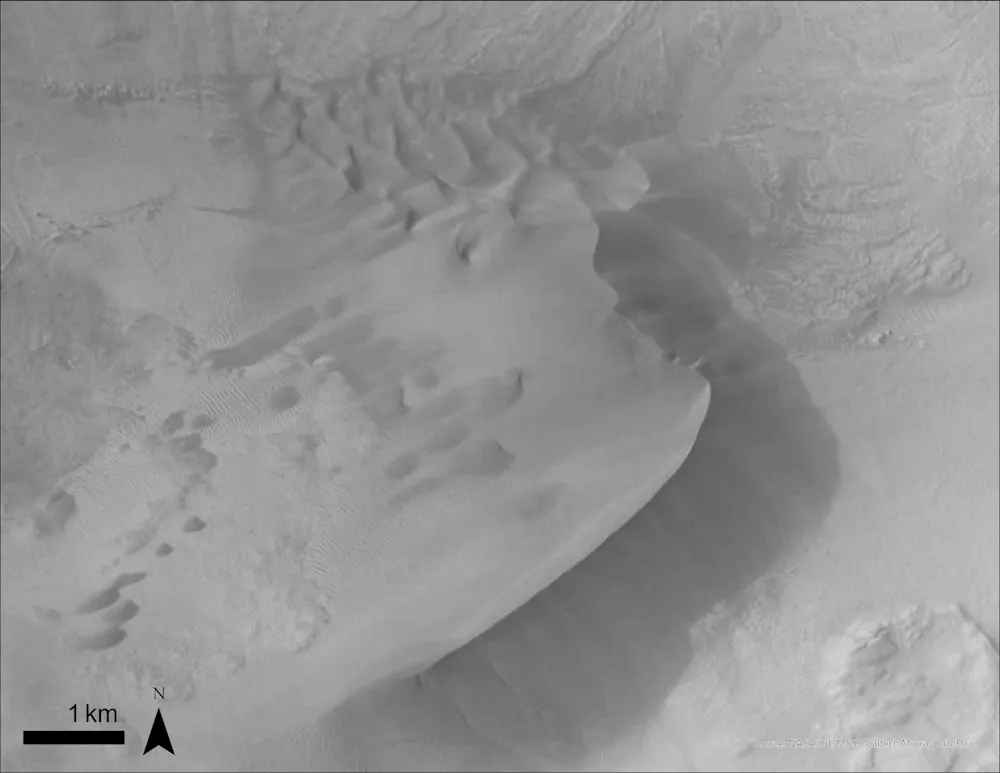
    A potential compound dune on Mars.
    NASA/JPL-Caltech

    Now, as a graduate student and aspiring planetary geologist, my time is split between work in the field and at my computer, where I have stitched together the drone’s photographs of the Algodones to create a large image of the entire study area. I then look for compound dunes on the Martian surface in images taken by the Mars reconnaissance orbiter’s context camera.

    Scientists already know about Earth’s weather patterns, sand grain size and wind data. By measuring different parts of bedforms on both planets – such as their height, shape and spacing – I can compare the similarities and differences of the bedforms to find clues to the wind patterns, grains and atmosphere on Mars. Slowly but surely, as I listen to Studio Ghibli soundtracks, I’m creating the first database of compound dunes on Mars.

    Two dune fields on Mars, both inside an impact crater.
    NASA/JPL-Caltech

    Developing this database is essential to the proposed human mission to Mars. Dust storms are frequent, and some can encircle the entire planet. Understanding aeolian bedforms will help scientists know where to put bases so they don’t get buried by moving sand.

    It is wonderful to spend an afternoon ping-ponging all over a planet that’s 140 million miles from us, seeing gorgeous terrain while I try to answer questions about the compound dunes on Mars. How common are they? Where do they form? How do they compare to those on Earth? I hope to answer these questions as I work toward earning my Ph.D in geology.

    Lauren Berger receives funding from NASA FINESST. Lauren Berger would like to acknowledge the help of her mentors Dr. Ryan Ewing (NASA Johnson Space Center), Dr. Marion Nachon (Texas A&M University), and Dr. Julia Reece (Texas A&M University).

    ref. Dune patterns in California desert hold clues that help researchers map Mars’ shifting sands – https://theconversation.com/dune-patterns-in-california-desert-hold-clues-that-help-researchers-map-mars-shifting-sands-251761

    MIL OSI Analysis

  • MIL-OSI Africa: Sudan: Children reveal harrowing violence in latest North Darfur mass displacement

    Source: APO


    .

    Save the Children and its partners spoke to over 450 of these displaced children in Tawila for the assessment “Children Caught in Conflict”, with children describing traumatic journeys and expressing fear, grief, and a profound sense of uncertainty about their futures. 

    Hundreds of children have recounted harrowing stories of terror and loss after their homes in Sudan’s North Darfur region were attacked, with many telling Save the Children how they lost contact with friends and loved ones [1].  

    Violence is happening daily in North Darfur, the epicentre of Sudan’s two-year conflict,  with fighting intensifying over the past 12 months and spiking in April this year when the Zamzam camp housing people forced from their homes was viciously attacked.  

    Nearly 500,000 people – including 260,000 children – were displaced from Zamzam camp between April and May, which amounts to 99% of the camp’s population. About  75% of the displaced people ended up in the Tawila camp [2], which is located around 60km southeast of Zamzam.  

    Save the Children and its partners spoke to over 450 of these displaced children in Tawila for the assessment “Children Caught in Conflict”, with children describing traumatic journeys and expressing fear, grief, and a profound sense of uncertainty about their futures. 

    Many children witnessed killings and dead bodies in the streets, with some reporting witnessing young people being arrested or killed, and more than half of the girls interviewed (53%) reported incidents of sexual violence during their journey out of Zamzam to Tawila.  

    Three children reported that their mothers died during the journey to Tawila, while four others said they lost a brother, and five reported the death of their fathers. 

    Some children recounted supporting elderly relatives travelling long distances on donkeys, with others saying they were forced to leave behind exhausted family members under threat of violence.  

    Salma*, 12, originally from El Fasher, was displaced twice — first to Zamzam, then to Tawila. She described witnessing rape, killings, and looting along the road. Her grandfather died during the journey due to exhaustion and lack of care. Upon arrival in Tawila, her family had no food or shelter and slept in the open.  

    Talha*, 12, was fetching water for his family when the Zamzam camp came under attack. He witnessed shootings, and widespread panic. He ran home to find his family but discovered the house empty. He searched the schools where people were hiding but couldn’t find them. Believing his family had fled to Tawila, Talha followed the crowds on foot. After arriving, he stayed with a host family for seven days before they too left, leaving him alone. Talha told the survey team his only wish is to return to El Fasher and reunite with his family — though he doesn’t know if they are still alive. 

    While some children said they feel relatively safe in Tawila, many — especially girls — expressed deep grief over the loss of family members and fear of ongoing violence. 

    Children cited poor living conditions, including sleeping on the ground, extreme heat, food shortages, and the presence of armed individuals, as sources of distress.  

    Girls reported high levels of fear and vulnerability, particularly when using toilets or traveling long distances for water. Many shared that friends were raped during displacement or in the camps. Both boys and girls acknowledged a rise in sexual violence, with girls aged 12–18 being the most affected. Boys were also aware of the abuse experienced by their sisters and peers.  

    Francesco Lanino, Deputy Country Director of Programmes and Operations for Save the Children in Sudan, said: 

    “Children in North Darfur have been to hell and back. They are grieving deeply, while contemplating uncertain futures. Many lost family members before and during their displacement, and don’t have adequate tools to process their experiences. Some children have described to our staff harrowing experiences of parting with older family members on the route, many of whom they haven’t seen since.  

    “Since the conflict began, children’s lives have been upended. They now wake to the sound of gunfire and shelling. Families dig trenches for protection, schools are closed, and access to healthcare is limited. Many children reported that their peers have joined armed groups or been forced into early marriage due to economic hardship.  

    “Children’s rights have been completely ignored in Sudan. They are being separated from their families, seeing loved ones killed or maimed, and have already missed years of critical education, with terrible consequences for their long-term well-being. We are incredibly concerned for these children’s futures – and the future of Sudan – if this conflict doesn’t end now.” 

    Save the Children is urging the international community to redouble efforts to demand a ceasefire in Sudan, to allow safe and unhindered humanitarian access and a drastic scale-up of humanitarian assistance.  

    Save the Children has worked in Sudan since 1983 and is currently supporting children and their families across Sudan providing health, nutrition, education, child protection and food security and livelihoods support. Save the Children is also supporting refugees from Sudan in Egypt and South Sudan. 

    Since April 2025, Save the Children has been leading a major humanitarian response in North Darfur, addressing the urgent needs of displaced populations following mass displacement from Zamzam camp and El Fasher. With hundreds of thousands of internally displaced persons across the region, Save the Children has scaled up operations in El Fasher, Tawila and Central Darfur, delivering life-saving services in health, nutrition, water and sanitation, protection, and shelter. 

    Distributed by APO Group on behalf of Save the Children.

    MIL OSI Africa

  • MIL-OSI United Nations: Libya: UN urges restraint as military buildup threatens renewed violence in Tripoli

    Source: United Nations 2

    In a statement late on Wednesday (local time), the UN Support Mission in Libya (UNSMIL) expressed deep concern over continued reports of armed group mobilisation in densely populated areas, urging all parties to refrain from the use of force and inflammatory rhetoric.

    The Mission strongly urges all parties to avoid any actions or political rhetoric that could trigger escalation or lead to renewed clashes,” it said.

    UNSMIL stressed that protection of civilian lives and property under international law remains a binding obligation for all political and security actors.

    Those responsible for attacks against civilians will be held accountable,” the Mission said.

    Pursue dialogue, not violence

    The Mission reiterated its support for the implementation of security arrangements developed by the Truce and Security and Military Arrangements Committees, emphasising that “forces recently deployed in Tripoli must withdraw without delay.

    It also underscored that dialogue – not violence – remains the only viable path to achieving sustainable peace and stability in Tripoli and across Libya.

    The appeal comes amid reports of military movements in the capital and renewed clashes between armed groups, reflecting the persistent volatility that has plagued Libya since the fall of former leader Muammar Gaddafi in 2011.

    Political stalemate

    The country remains divided between rival administrations in the east and west, with unity efforts repeatedly stalled.

    A UN-brokered ceasefire signed in 2020 raised hopes for national elections, but progress has been hampered by political deadlock and sporadic outbreaks of violence – particularly in Tripoli.

    In May, clashes erupted in several districts of the capital, reportedly triggered by the killing of a prominent militia leader. The fighting, which involved heavy weaponry in densely populated areas, forced hundreds of families to flee and further strained the city’s already fragile infrastructure.

    MIL OSI United Nations News

  • MIL-OSI: NANO Nuclear to Participate in Fireside Chat at H.C. Wainwright’s Powering the Future: Advancing Innovation Through Nuclear Virtual Conference on July 15th

    Source: GlobeNewswire (MIL-OSI)

    New York, N.Y., July 10, 2025 (GLOBE NEWSWIRE) — NANO Nuclear Energy Inc. (NASDAQ: NNE) (“NANO Nuclear” or “the Company”), a leading advanced nuclear energy and technology company focused on developing clean energy solutions, today announced that Chief Executive Officer James Walker will participate in a fireside chat at H.C. Wainwright’s Powering the Future: Advancing Innovation Through Nuclear Virtual Conference hosted by Sameer Joshi, Senior Cleantech Analyst at H.C. Wainwright, on July 15, 2025 at 9:00 a.m., Eastern time.

    Figure 1 – Rendering of NANO Nuclear Energy’s High Technology Readiness Level and Patented KRONOS MMR Microreactor Energy System at the University of Illinois Urbana-Champaign

    Mr. Walker is expected to discuss recent business developments, highlighting progress in advancing its lead microreactor project, the patented KRONOS MMR Energy System, toward construction, testing and licensing with the U.S. Nuclear Regulatory Commission, as well as key upcoming regulatory milestones necessary for deployment of the KRONOS reactor prototype at the University of Illinois Urbana-Champaign.

    NANO Nuclear is highly focused on expediting its advanced reactor technology to meet expected growth in energy demands across multiple sectors, including data centers powering artificial intelligence. The stationary KRONOS reactor is designed to be completely modular, mass manufactured with a production line, rapidly installed, safer than traditional reactors, co-located at customer sites, a provider of high-capacity factor baseload carbon free power, and a known technology offering the potential to reduce licensing timeframes. NANO Nuclear views KRONOS as a next generation source of reliable, safe, and clean nuclear energy ideal to meet expected future growth in domestic and international energy consumption. 

    Fireside Chat Details:

    Date: Tuesday, July 15, 2025
    Time: 9:00 a.m. ET
    Speaker: James Walker, CEO
    Moderator: Sameer Joshi, H.C. Wainwright Senior Cleantech Analyst
    Webcast: https://journey.ct.events/view/d216b343-edae-4f3e-8627-d19c29340b11

    A replay of the fireside chat webcast will be available for approximately 30 days on NANO Nuclear’s investor relations website at https://ir.nanonuclearenergy.com/news-events/events.

    About NANO Nuclear Energy, Inc.

    NANO Nuclear Energy Inc. (NASDAQ: NNE) is an advanced technology-driven nuclear energy company seeking to become a commercially focused, diversified, and vertically integrated company across five business lines: (i) cutting edge portable and other microreactor technologies, (ii) nuclear fuel fabrication, (iii) nuclear fuel transportation, (iv) nuclear applications for space and (v) nuclear industry consulting services. NANO Nuclear believes it is the first portable nuclear microreactor company to be listed publicly in the U.S.

    Led by a world-class nuclear engineering team, NANO Nuclear’s reactor products in development include patented KRONOS MMREnergy System, a stationary high-temperature gas-cooled reactor that is in construction permit pre-application engagement U.S. Nuclear Regulatory Commission (NRC) in collaboration with University of Illinois Urbana-Champaign (U. of I.), “ZEUS”, a solid core battery reactor, and “ODIN”, a low-pressure coolant reactor, and the space focused, portable LOKI MMR, each representing advanced developments in clean energy solutions that are portable, on-demand capable, advanced nuclear microreactors.

    Advanced Fuel Transportation Inc. (AFT), a NANO Nuclear subsidiary, is led by former executives from the largest transportation company in the world aiming to build a North American transportation company that will provide commercial quantities of HALEU fuel to small modular reactors, microreactor companies, national laboratories, military, and DOE programs. Through NANO Nuclear, AFT is the exclusive licensee of a patented high-capacity HALEU fuel transportation basket developed by three major U.S. national nuclear laboratories and funded by the Department of Energy. Assuming development and commercialization, AFT is expected to form part of the only vertically integrated nuclear fuel business of its kind in North America.

    HALEU Energy Fuel Inc. (HEF), a NANO Nuclear subsidiary, is focusing on the future development of a domestic source for a High-Assay, Low-Enriched Uranium (HALEU) fuel fabrication pipeline for NANO Nuclear’s own microreactors as well as the broader advanced nuclear reactor industry.

    NANO Nuclear Space Inc. (NNS), a NANO Nuclear subsidiary, is exploring the potential commercial applications of NANO Nuclear’s developing micronuclear reactor technology in space. NNS is focusing on applications such as the LOKI MMR system and other power systems for extraterrestrial projects and human sustaining environments, and potentially propulsion technology for long haul space missions. NNS’ initial focus will be on cis-lunar applications, referring to uses in the space region extending from Earth to the area surrounding the Moon’s surface.

    For more corporate information please visit: https://NanoNuclearEnergy.com/

    For further NANO Nuclear information, please contact:

    Email: IR@NANONuclearEnergy.com
    Business Tel: (212) 634-9206

    PLEASE FOLLOW OUR SOCIAL MEDIA PAGES HERE:
    NANO Nuclear Energy LINKEDIN
    NANO Nuclear Energy YOUTUBE
    NANO Nuclear Energy X PLATFORM

    Cautionary Note Regarding Forward Looking Statements

    This news release, the fireside chat referred to herein and statements of NANO Nuclear’s management in connection with this news release and such fireside chat contain or may contain “forward-looking statements” within the meaning of Section 21E of the Securities Exchange Act of 1934, as amended, and the Private Securities Litigation Reform Act of 1995. In this context, forward-looking statements mean statements related to future events, which may impact our expected future business and financial performance, and often contain words such as “expects”, “anticipates”, “intends”, “plans”, “believes”, “potential”, “will”, “should”, “could”, “would” or “may” and other words of similar meaning. Specifically, forward-looking statements include those related to NANO Nuclear’s development plans for the KRONOS MMR Energy System and NANO Nuclear’s other future plans and intentions. These and other forward-looking statements are based on information available to us as of the date of this news release and represent management’s current views and assumptions. Forward-looking statements are not guarantees of future performance, events or results and involve significant known and unknown risks, uncertainties and other factors, which may be beyond our control. For NANO Nuclear, particular risks and uncertainties that could cause our actual future results to differ materially from those expressed in our forward-looking statements include but are not limited to the following: (i) risks related to our U.S. Department of Energy (“DOE”) or related state or non-U.S. nuclear fuel licensing submissions, (ii) risks related the development of new or advanced technology and the acquisition of complimentary technology or businesses, including difficulties with design and testing, cost overruns, regulatory delays, integration issues and the development of competitive technology, (iii) our ability to obtain contracts and funding to be able to continue operations, (iv) risks related to uncertainty regarding our ability to technologically develop and commercially deploy a competitive advanced nuclear reactor or other technology in the timelines we anticipate, if ever, (v) risks related to the impact of U.S. and non-U.S. government regulation, policies and licensing requirements, including by the DOE and the U.S. Nuclear Regulatory Commission, including those associated with the recently enacted ADVANCE Act and the May 23, 2025 Executive Orders seeking to streamline nuclear regulation, and (vi) similar risks and uncertainties associated with the operating an early stage business a highly regulated and rapidly evolving industry. Readers are cautioned not to place undue reliance on these forward-looking statements, which apply only as of the date of this news release. These factors may not constitute all factors that could cause actual results to differ from those discussed in any forward-looking statement, and NANO Nuclear therefore encourages investors to review other factors that may affect future results in its filings with the SEC, which are available for review at www.sec.gov and at https://ir.nanonuclearenergy.com/financial-information/sec-filings. Accordingly, forward-looking statements should not be relied upon as a predictor of actual results. We do not undertake to update our forward-looking statements to reflect events or circumstances that may arise after the date of this news release, except as required by law.

    Attachment

    The MIL Network

  • MIL-OSI: BitMart Launches Beacon (BitMartGPT): A Revolutionary AI Trading Assistant for the Crypto Age

    Source: GlobeNewswire (MIL-OSI)

    Mahe, Seychelles, July 10, 2025 (GLOBE NEWSWIRE) — BitMart, a global leader in digital asset trading, is proud to announce the launch of Beacon (BitMartGPT), a cutting-edge AI-powered trading assistant designed to transform the way users navigate and succeed in the complex world of crypto trading.

    Beacon: Your AI Crypto Assistant

    Like a lighthouse guiding ships through stormy seas, Beacon illuminates a clear path through volatile market conditions, offering institutional-grade insights and real-time support to crypto traders of all experience levels.

    Beacon is built on advanced AI infrastructure, enabling it to deliver fast, precise, and actionable insights.

    Expanded Features and Capabilities

    At launch, Beacon offers a powerful suite of tools aimed at providing clarity, speed, and strategic foresight to BitMart users:

    • Real-Time Market Intelligence via X Insights:
      Beacon integrates BitMart’s proprietary X Insights platform to analyze social sentiment and influencer commentary in real time. This enables users to anticipate market moves and understand shifting narratives within the crypto ecosystem.
    • Smart Problem Solving and Support:
      Whether it’s an account-related issue or a complex trading question, Beacon offers immediate, intelligent responses. A robust interactive knowledge base complements the live assistant, ensuring efficient self-service and education.
    • Interactive Knowledge Base:
      Ask complex questions about crypto concepts, trading strategies, or market dynamics and receive clear, tailored explanations powered by Beacon’s intelligent understanding of user intent.
    • Dual Operation Modes:
      Users can choose between two operational tiers.
      • Standard Mode supports up to 50 queries every four hours.
      • High-Performance Mode delivers advanced analytical capabilities, accessible up to three times in a four-hour window.
      • VIP users benefit from unrestricted access across both modes.

    Coming soon (Q3 2025), Beacon will further expand its capabilities with advanced trading intelligence tools, including a Personal Trading Analyst for deep, personalized performance insights, an Opportunity Scanner that identifies optimal trades based on your preferences and market trends, and an Advanced Risk Guardian for proactive portfolio protection.

    How It Works: Simple, Fast, Intuitive

    Users interact with Beacon through a conversational interface:

    1. Ask questions in natural language—no need for technical phrasing.
    2. Receive intelligent, data-driven insights based on your preferences and usage patterns.
    3. Make confident decisions supported by comprehensive, AI-enhanced insight.

    Why Beacon Matters

    In the rapidly evolving world of crypto and Web3, timely information, strategic guidance, and intuitive tools are critical. Beacon addresses these demands by combining professional-grade technology with an accessible user interface, making institutional-level support available to every user on the BitMart platform.

    Beacon is exclusively accessible to BitMart users and offered as a permanent, no-cost feature. It is purpose-built to elevate the trading experience by delivering advanced intelligence through an interface that remains intuitive and efficient.

    Discover what Beacon can do for you. Start exploring today.

    About BitMart

    BitMart is a premier global digital asset trading platform with more than 10 million users worldwide. Consistently ranked among the top crypto exchanges on CoinGecko, BitMart offers over 1,700 trading pairs with competitive fees. Committed to continuous innovation and financial inclusivity, BitMart empowers users globally to trade seamlessly. Learn more about BitMart at Website, follow their X (Twitter), or join their Telegram for updates, news, and promotions. Download BitMart App to trade anytime, anywhere.

    Disclaimer:

    The information provided is for informational purposes only and should not be considered a recommendation to buy, sell, or hold any financial assets. All information is provided in good faith. However, we make no representation or warranty of any kind, express or implied, regarding the accuracy, adequacy, validity, reliability, availability or completeness of such information.

    All crypto investments, including earnings, are highly speculative in nature and involve substantial risk of loss. Past, hypothetical, or simulated performance is not necessarily indicative of future results. The value of digital currencies can go up or down and there can be a substantial risk in buying, selling, holding, or trading digital currencies. You should carefully consider whether trading or holding digital currencies is suitable for you based on your personal investment objectives, financial circumstances, and risk tolerance. BitMart does not provide any investment, legal or tax advice.

    The MIL Network

  • MIL-OSI: Byrna Technologies Reports Fiscal Second Quarter 2025 Results

    Source: GlobeNewswire (MIL-OSI)

    ANDOVER, Mass., July 10, 2025 (GLOBE NEWSWIRE) — Byrna Technologies Inc. (“Byrna” or the “Company”) (Nasdaq: BYRN), a personal defense technology company specializing in the development, manufacture, and sale of innovative less-lethal personal security solutions, today reported select financial results for its fiscal second quarter ended May 31, 2025.

    Fiscal Second Quarter 2025 and Recent Operational Highlights

    • Launched the Byrna Compact Launcher (CL), a 38% smaller launcher than the flagship Byrna SD that delivers the same force per square inch as the Byrna LE. The CL is now available for purchase on Amazon and is featured in Amazon’s Prime Day sales event from July 8-11, 2025.
    • Expanded Byrna’s store-within-a-store concept with Sportsman’s Warehouse, now operating in 12 stores with an additional 10 stores expected to open in the third quarter.
    • Successfully ramping company-owned retail locations launched earlier this year. Byrna’s five locations combined averaged $69,000 in sales during May. Notably, the Scottsdale location reached a sales run rate comparable to Byrna’s long-established Las Vegas store within just a few months of opening.
    • Added Tucker Carlson to the roster of celebrity influencers to amplify brand awareness and promote the normalization of less-lethal solutions.

    Fiscal Second Quarter 2025 Financial Results
    Results compare the fiscal second quarter ended May 31, 2025 (“Q2 2025”) to the fiscal second quarter ended May 31, 2024 (“Q2 2024”) unless otherwise indicated.

    Net revenue for Q2 2025 grew 41% year-over-year to $28.5 million from $20.3 million in Q2 2024. The strong year-over-year growth was primarily attributable to the launch of the CL, increased dealer sales, and broader brand adoption.

    Gross profit for Q2 2025 increased to $17.6 million (62% of net revenue) from $12.6 million (62% of net revenue) in Q2 2024, reflecting the strong increase in sales. The introduction of the CL contributed to a favorable product sales mix that offset any decrease due to a change in channel mix which resulted in stronger dealer sales.

    Operating expenses for Q2 2025 were $14.2 million, compared to $10.6 million for Q2 2024. The increase was primarily due to higher variable selling expenses, payroll costs, and increased discretionary marketing spend.

    Net income for Q2 2025 was $2.4 million, an increase from $2.1 million for Q2 2024, driven by an overall increase in product sales which was partially offset with higher income tax expense for the quarter.

    Adjusted EBITDA1, a non-GAAP metric reconciled below, for Q2 2025 totaled $4.3 million, compared to $2.8 million in Q2 2024.

    Cash, cash equivalents and marketable securities at May 31, 2025 totaled $13.0 million compared to $25.7 million at November 30, 2024. The decrease reflects the planned increase in inventory ahead of the Compact Launcher release and normal seasonal working capital movements. Inventory at May 31, 2025 totaled $32.3 million, compared to $20.0 million at November 30, 2024. The Company has no current or long-term debt.

    Management Commentary
    Byrna CEO Bryan Ganz stated: “The launch of the Byrna CL in May helped us deliver a record $28.5 million in revenue for the second quarter. Despite overall softness in consumer spending, our focused marketing and retail expansion strategies allowed us to continue growing our total addressable market and reach new milestones. Looking ahead, we expect that the CL will be a larger part of our sales mix, especially now that it is available to customers on Amazon.

    “Our dealer channel is also becoming a larger percentage of total sales, increasing 106% in the second quarter, supported by our partnership with Sportsman’s Warehouse. We’ve successfully rolled out the first 12 store-within-a-store locations and plan to add another 10 stores in the third quarter in addition to 38 stores with a point of sale display.

    “Our company-owned stores continue to outperform expectations, with five locations collectively averaging $69,000 in sales during May. Our Scottsdale location, which has only been open for a few months, is already performing at levels similar to our longstanding retail store in Las Vegas. We believe our company-owned stores will continue to perform well and become strong contributors as we further increase local and national brand awareness.

    “On the marketing front, we continue to diversify our approach. We recently added Tucker Carlson to our roster of celebrity influencers, and while it is still early, initial web traffic trends have been encouraging. Additionally, we’ve begun integrating AI tools into our content production, which is already helping us accelerate creative testing and expand our marketing reach.

    “Operationally, we have adjusted production to align with current demand following the CL launch and elevated inventory build. Ahead of the CL debut, production was running heavy in an effort to prepare for the launch. We are now producing at a steady state pace of 15,000 units per month and have implemented a more efficient assembly structure that allows us to maintain output with a smaller, more agile workforce.

    “Looking ahead, we expect consumer sentiment to remain subdued, which may continue to limit near-term revenue upside. However, we are confident that the growing momentum of the CL and our expanding retail presence position us well to deliver strong year-over-year growth in the second half of the year. We also expect our cash position to increase as our heightened inventory levels normalize over the coming quarters. While the third quarter is typically a seasonally slower period for Byrna, we remain focused on executing against our operational priorities, expanding market awareness, and setting the stage for a strong finish to the year.”

    Conference Call
    The Company’s management will host a conference call today, July 10, 2025, at 9:00 a.m. Eastern time (6:00 a.m. Pacific time) to discuss these results, followed by a question-and-answer period.

    Toll-Free Dial-In: 877-709-8150
    International Dial-In: +1 201-689-8354
    Confirmation: 13754369

    Please call the conference telephone number 5-10 minutes prior to the start time of the conference call. An operator will register your name and organization. If you have any difficulty connecting with the conference call, please contact Gateway Group at 949-574-3860.

    The conference call will be broadcast live and available for replay here and via the Investor Relations section of Byrna’s website.

    About Byrna Technologies Inc.
    Byrna is a technology company specializing in the development, manufacture, and sale of innovative less-lethal personal security solutions. For more information on the Company, please visit the corporate website here or the Company’s investor relations site here. The Company is the manufacturer of the Byrna® CL, Byrna® LE and Byrna® SD personal security devices, state-of-the-art handheld CO2 powered launchers designed to provide a less-lethal alternative to a firearm for the consumer, private security, and law enforcement markets. To purchase Byrna products, visit the Company’s e-commerce store.

    Forward-Looking Statements
    This news release contains “forward-looking statements” within the meaning of the securities laws. All statements contained in this news release, other than statements of current and historical fact, are forward-looking. Often, but not always, forward-looking statements can be identified by the use of words such as “plans,” “expects,” “intends,” “anticipates,” and “believes” and statements that certain actions, events or results “may,” “could,” “would,” “should,” “might,” “occur,” or “be achieved,” or “will be taken.” Forward-looking statements include descriptions of currently occurring matters which may continue in the future. Forward-looking statements in this news release include but are not limited to our statements related to our expected sales during the second half of fiscal year 2025, the expected expansion of Byrna’s store-within-a-store partnership with Sportsman’s Warehouse, expected sales trends for the Byrna CL, Byrna’s expectations regarding sales at its retail stores, benefits from new marketing partnerships, the expected benefits from AI integration with manufacturing and testing, the expected benefits from a leaner workforce, expectations regarding consumer sentiment and seasonal sales variations, and potential increases in our cash position. Forward-looking statements are not, and cannot be, a guarantee of future results or events. Forward-looking statements are based on, among other things, opinions, assumptions, estimates, and analyses that, while considered reasonable by the Company at the date the forward-looking information is provided, inherently are subject to significant risks, uncertainties, contingencies, and other factors that may cause actual results and events to be materially different from those expressed or implied.

    Any number of risk factors could affect our actual results and cause them to differ materially from those expressed or implied by the forward-looking statements in this news release, including, but not limited to, disappointing market responses to current or future products or services; prolonged, new, or exacerbated disruption of our supply chain; the further or prolonged disruption of new product development; production or distribution disruption or delays in entry or penetration of sales channels due to inventory constraints, competitive factors, increased transportation costs or interruptions, including due to weather, flooding or fires; prototype, parts and material shortages, particularly of parts sourced from limited or sole source providers; determinations by third party controlled distribution channels, including Amazon, not to carry or reduce inventory of the Company’s products; determinations by advertisers or social media platforms, or legislation that prevents or limits marketing of some or all Byrna products; the loss of marketing partners; increases in marketing expenditure may not yield expected revenue increases; potential cancellations of existing or future orders including as a result of any fulfillment delays, introduction of competing products, negative publicity, or other factors; product design or manufacturing defects or recalls; litigation, enforcement proceedings or other regulatory or legal developments; changes in consumer or political sentiment affecting product demand; regulatory factors including the impact of commerce and trade laws and regulations and the implementation or change in tariffs; and future restrictions on the Company’s cash resources, increased costs and other events that could potentially reduce demand for the Company’s products or result in order cancellations. The order in which these factors appear should not be construed to indicate their relative importance or priority. We caution that these factors may not be exhaustive; accordingly, any forward-looking statements contained herein should not be relied upon as a prediction of actual results. Investors should carefully consider these and other relevant factors, including those risk factors in Part I, Item 1A, (“Risk Factors”) in the Company’s most recent Form 10-K and Part II, Item 1A (“Risk Factors”) in the Company’s most recent Form 10-Q, should understand it is impossible to predict or identify all such factors or risks, should not consider the foregoing list, or the risks identified in the Company’s SEC filings, to be a complete discussion of all potential risks or uncertainties, and should not place undue reliance on forward-looking information. The Company assumes no obligation to update or revise any forward-looking information, except as required by applicable law.

    Investor Contact:
    Tom Colton and Alec Wilson
    Gateway Group, Inc.
    949-574-3860
    BYRN@gateway-grp.com

    -Financial Tables to Follow-

    BYRNA TECHNOLOGIES INC.
    Condensed Consolidated Statements of Operations and Comprehensive Income (Loss)
    (Amounts in thousands except share and per share data)
    (Unaudited)
                       
        For the Three Months Ended   For the Six Months Ended  
        May 31   May 31  
          2025       2024       2025       2024    
    Net revenue   $ 28,505     $ 20,269     $ 54,695     $ 36,923    
    Cost of goods sold     10,941       7,709       21,207       14,724    
    Gross profit     17,564       12,560       33,488       22,199    
    Operating expenses     14,238       10,647       28,466       20,450    
    INCOME FROM OPERATIONS     3,326       1,913       5,022       1,749    
    OTHER INCOME (EXPENSE)                  
    Foreign currency transaction loss     (135 )     (220 )     (215 )     (279 )  
    Interest income     116       323       303       604    
    Income from joint venture           62             20    
    Other income     18       2       17       3    
    INCOME BEFORE INCOME TAXES     3,325       2,080       5,127       2,097    
    Income tax expense     (898 )     (3 )     (1,038 )     (3 )  
    NET INCOME (LOSS)   $ 2,427     $ 2,077     $ 4,089     $ 2,094    
                       
    Foreign currency translation adjustment for the period     76       144       (54 )     29    
    Unrealized gain on marketable securities     17             77          
    COMPREHENSIVE INCOME (LOSS)   $ 2,520     $ 2,221     $ 4,112     $ 2,123    
                       
    Basic net income (loss) per share   $ 0.11     $ 0.09     $ 0.18     $ 0.09    
    Diluted net income (loss) per share   $ 0.10     $ 0.09     $ 0.17     $ 0.09    
                       
    Weighted-average number of common shares outstanding – basic     22,668,546       22,728,500       22,628,270       22,383,769    
    Weighted-average number of common shares outstanding – diluted     23,951,297       23,731,076       24,021,948       22,942,530    
     
    BYRNA TECHNOLOGIES INC.
    Condensed Consolidated Balance Sheets
    (Amounts in thousands, except share and per share data)
               
        May 31   November 30,  
          2025       2024    
        Unaudited      
    ASSETS          
    CURRENT ASSETS          
    Cash and cash equivalents   $ 7,001     $ 16,829    
    Marketable Securities     5,984       8,904    
    Accounts receivable, net     6,536       2,630    
    Inventory, net     32,286       19,972    
    Prepaid expenses and other current assets     3,931       2,623    
    Total current assets     55,738       50,958    
    LONG TERM ASSETS          
    Deposits for equipment     1,981       2,665    
    Right-of-use-asset, net     2,262       2,452    
    Property and equipment, net     6,844       3,408    
    Intangible assets, net     3,215       3,337    
    Goodwill     2,258       2,258    
    Deferred tax asset     4,797       5,837    
    Other assets     355       1,007    
    TOTAL ASSETS   $ 77,450     $ 71,922    
               
    LIABILITIES          
    CURRENT LIABILITIES          
    Accounts payable and accrued liabilities   $ 14,377     $ 13,108    
    Operating lease liabilities, current     652       539    
    Deferred revenue, current     335       1,791    
    Total current liabilities     15,364       15,438    
    LONG TERM LIABILITIES          
    Deferred revenue, non-current     15       17    
    Operating lease liabilities, non-current     1,935       2,098    
    Total liabilities     17,314       17,553    
               
               
    STOCKHOLDERS‘ EQUITY          
    Preferred stock              
    Common stock     25       25    
    Additional paid-in capital     134,739       133,029    
    Treasury stock     (21,308 )     (21,253 )  
    Accumulated deficit     (52,694 )     (56,783 )  
    Accumulated other comprehensive loss     (626 )     (649 )  
               
    Total Stockholders’ Equity     60,136       54,369    
               
    TOTAL LIABILITIES AND STOCKHOLDERS’ EQUITY   $ 77,450     $ 71,922    
               

    Non-GAAP Financial Measures

    In addition to providing financial measurements based on generally accepted accounting principles in the United States (GAAP), we provide an additional financial metric that is not prepared in accordance with GAAP (non-GAAP) with presenting non-GAAP adjusted EBITDA. Management uses this non-GAAP financial measure, in addition to GAAP financial measures, to understand and compare operating results across accounting periods, for financial and operational decision making, for planning and forecasting purposes and to evaluate our financial performance. We believe that this non-GAAP financial measure helps us to identify underlying trends in our business that could otherwise be masked by the effect of certain expenses that we exclude in the calculations of the non-GAAP financial measure.

    Accordingly, we believe that this non-GAAP financial measure reflects our ongoing business in a manner that allows for meaningful comparisons and analysis of trends in the business and provides useful information to investors and others in understanding and evaluating our operating results, enhancing the overall understanding of our past performance and future prospects.

    This non-GAAP financial measure does not replace the presentation of our GAAP financial results and should only be used as a supplement to, not as a substitute for, our financial results presented in accordance with GAAP. There are limitations in the use of non-GAAP measures, because they do not include all the expenses that must be included under GAAP and because they involve the exercise of judgment concerning exclusions of items from the comparable non-GAAP financial measure. In addition, other companies may use other non-GAAP measures to evaluate their performance, or may calculate non-GAAP measures differently, all of which could reduce the usefulness of our non-GAAP financial measure as a tool for comparison.
             

    Adjusted EBITDA

    Adjusted EBITDA is defined as net (loss) income as reported in our condensed consolidated statements of operations and comprehensive (loss) income excluding the impact of (I) depreciation and amortization; (ii) income tax provision (benefit); (iii) interest income (expense); (iv) stock-based compensation expense, (v) impairment loss, and (vi) one time, non-recurring other expenses or income. Our Adjusted EBITDA measure eliminates potential differences in performance caused by variations in capital structures (affecting finance costs), tax positions, the cost and age of tangible assets (affecting relative depreciation expense) and the extent to which intangible assets are identifiable (affecting relative amortization expense). We also exclude certain one-time and non-cash costs. Reconciliation of Adjusted EBITDA to net (loss) income, the most directly comparable GAAP measure, is as follows (in thousands):

          For the Three Months Ended   For the Six Months Ended  
          May 31   May 31  
            2025       2024       2025       2024    
    Net Income (Loss)   $ 2,427     $ 2,077     $ 4,089     $ 2,094    
                         
    Adjustments:                  
      Interest income     (116 )     (323 )     (303 )     (604 )  
      Income tax expense     898       3       1,038       3    
      Depreciation and amortization     252       165       437       335    
    Non-GAAP EBITDA   $ 3,461     $ 1,922     $ 5,261     $ 1,828    
                         
    Stock-based compensation expense     723       858       1,562       1,796    
    Severance/Separation/Officer recruiting     116           246       175    
    Non-GAAP adjusted EBITDA   $ 4,300     $ 2,780     $ 7,069     $ 3,799    
                         

    1 See non-GAAP financial measures at the end of this press release for a reconciliation and a discussion of non-GAAP financial measures.

    The MIL Network

  • MIL-OSI China: China eyes deeper Belt and Road cooperation with Egypt — premier

    Source: People’s Republic of China – State Council News

    Chinese Premier Li Qiang meets with Egyptian President Abdel Fattah El-Sisi in Cairo, Egypt, July 10, 2025. [Photo/Xinhua]

    CAIRO, July 10 — Chinese Premier Li Qiang said here on Thursday that China is willing to strengthen Belt and Road cooperation with Egypt in such areas as economy, trade, finance, manufacturing, new energy, science and technology, and cultural and people-to-people exchanges.

    During his meeting with Egyptian President Abdel Fattah El-Sisi, Li also said that China is willing to encourage more capable Chinese enterprises to invest in Egypt.

    Li conveyed to Sisi cordial greetings from Chinese President Xi Jinping, saying that China-Egypt relations have flourished in recent years under the strategic guidance of the two heads of state.

    The Chinese side, Li said, is ready to work with Egypt to take the 70th anniversary of diplomatic ties between the two countries next year as an opportunity to carry forward the traditional friendship, consolidate political mutual trust, and continue to firmly support each other on issues concerning each other’s core interests.

    China is also willing to join Egypt to continue to enrich the China-Egypt comprehensive strategic partnership, push for more achievements in cooperation in various fields between the two nations, and keep moving forward to the goal of building a China-Egypt community with a shared future in the new era.

    The international landscape is marked by mounting turbulence and escalating disorder, with prolonged and unresolved conflicts particularly afflicting the West Asian and North African regions, Li said.

    China stands ready to maintain close communication with Egypt and promote an early ceasefire in Gaza, Li said.

    The Chinese side is also ready to join Egypt in alleviating the humanitarian crisis, preventing the spillover and escalation of the conflict, and making unremitting efforts for a comprehensive, just and lasting settlement of the Palestinian issue, said the Chinese premier.

    He said China is willing to work with Egypt to enhance communication and coordination within multilateral platforms including the United Nations, BRICS and the Shanghai Cooperation Organization, and practice true multilateralism.

    Li added that China will work with Egypt to promote an equal and orderly multipolar world and a universally beneficial and inclusive economic globalization, and push for the steady and long-term development of China-Arab and China-Africa cooperation.

    Chinese Premier Li Qiang meets with Egyptian President Abdel Fattah El-Sisi in Cairo, Egypt, July 10, 2025. [Photo/Xinhua]

    MIL OSI China News

  • MIL-Evening Report: Grattan on Friday: childcare is a ‘canary in mine’ warning for wider problems in policy delivery

    Source: The Conversation (Au and NZ) – By Michelle Grattan, Professorial Fellow, University of Canberra

    It’s such a familiar pattern. When a big scandal breaks publicly, governments jump into action, ministers rush out to say they’ll “do something” instantly.

    But how come they hadn’t seen problems that had been in plain sight?

    Who can forget then-workplace relations minister Tony Burke insisting he’d been unaware, before media revelations, that organised crime was in the CFMEU? After a Nine media expose, a large portion of the notorious union soon ended up in administration.

    When a childcare worker was charged with some 70 offences last week, Education Minister Jason Clare immediately declared he’d introduce legislation in the new parliament’s first sitting for the removal of federal funds from errant providers.

    After ABC reporter Adele Ferguson had exposed serious safety issues in the system on Four Corners in March, the Albanese government announced it would be “exploring” various measures to strengthen Commonwealth powers “to deal with providers that put profit over quality and child safety at risk”.

    In another expose, Ferguson this week revealed substantial problems in the training system for childcare workers.

    Federally, childcare comes under the education minister, and there’s also a dedicated minister for early childhood education (Anne Aly last term, now Jess Walsh). Basically, the federal government funds the system while the states and territories regulate it.

    Anthony Albanese made major promises for expanding childcare in his 2022 and 2025 election pitches. The government also supported higher wages for workers in the sector. Albanese has nominated “affordable childcare” as the legacy he wants to leave.

    It’s all the more surprising, then, that the government didn’t seem to spot a plethora of problems in an area so central to the prime minister’s ambitions.

    The government points to the division of responsibility between Commonwealth and states.

    But surely that explanation doesn’t wash or, if it does, the relevant federal and state ministers, public servants and the regulators have not been doing their designated jobs effectively.

    In various human service policy areas, there are split responsibilities, which differ in specific arrangements.
    Politically, this often brings blame-shifting, and arguments over money and accountability.

    The federal government attaches conditions, for example, to funding agreements for hospitals and schools, which fall under state responsibility. But in practice, there are slippages.

    Split responsibilities, whatever their precise form, can never be “set and forget” – rigorous, constant scrutiny needs to be built in.

    Childcare policy has its complications. But, in terms of complexities, it is nothing like, say, running the nation’s defences. There are not unknowns.

    The obvious issues within childcare include funding, safety, workforce numbers and training.

    The childcare revelations will inevitably lead to new regulations – ironically just as a debate about the desirability of easing excessive regulation in some sectors has become fashionable. In many policy areas, there are tensions between regulation and costs, and no unanimity about where the trade offs should be struck.

    The childcare imbroglio highlights the challenges when public policy is substantially delivered by the “for profit” private sector. Social services expert Gabrielle Meagher, professor emerita at Macquarie University, says, “It’s very difficult to regulate across the gaps governments open up when they fund policies that they don’t deliver themselves”.

    The childcare issue also invites much wider questions about how “governing” is working. Such as, are ministers too distracted?

    Today’s ministers spend more time than ever in the media, and travelling (part of the modern “permanent” election campaign). This takes a large amount of their attention. The prime minister is in the media most days.

    One has to wonder how much of this is a diversion for ministers from detailed policy work, especially as they must bone up on “talking points” because, given the 24-hour news cycle, they will be quizzed about issues outside their portfolios. They usually feel obliged to offer an opinion, rather than saying “sorry, that’s not my bag”.

    What about the public servants, who are formally responsible for policy advice, implementation and supervising?

    We saw with Robodebt shocking behaviour by some bureaucrats. There have been substantial reforms since then and, apart from that, the Albanese government has boosted the numbers and strengthened the capability of the public service.

    But is it fit-for-purpose? If it were, wouldn’t the problems in childcare, apparently well-known among many parents, have filtered up through the system to the ears of ministers – even allowing that regulation rests mainly with the states?

    Apart from failures by state regulators, one issue is who is telling what to whom about the sector. The federal minister responsible for early childhood education visits dozens of childcare centres. But on those visits, the minister will be talking to managers, who will have their own set of concerns. The minister is less likely at the centres to encounter parents who have had a bad experience.

    This goes to a wider problem: in areas of human service delivery, providers of services will usually be organised, while consumers lack the same coherent and forceful voice. Complaining through the media may be only way for families using a service to bring things to light.

    But what about the complaints that do flow into government departments, and ministers’ offices? Surely these give a channel for the red flags that point to a policy failure?

    Bureaucrats say all this communication amounts to a great deal of “noise”, but the challenge is to identify what it signifies, in terms of substantive problems to be addressed.

    When programs are growing very fast, the risk is that corners are cut in delivery. We saw this, disastrously, years ago during the global financial crisis when the Rudd government rolled out the home insulation scheme. A royal commission was damning about the failures of the program, which was marked by several deaths and many household fires. Safety had been compromised in the pursuit of speed and the delivery framework was inadequate.

    There are many lessons from the childcare policy failures. A big announcement does not automatically mean a successful policy delivery. Programs can be working on some fronts while flawed on others. All new or expanded policies should come with detailed evaluation arrangements which are then carefully monitored. And while ministers will boast publicly about how well a policy is doing, they should be constantly demanding to know from their bureaucrats where things might be going wrong.

    Michelle Grattan does not work for, consult, own shares in or receive funding from any company or organisation that would benefit from this article, and has disclosed no relevant affiliations beyond their academic appointment.

    ref. Grattan on Friday: childcare is a ‘canary in mine’ warning for wider problems in policy delivery – https://theconversation.com/grattan-on-friday-childcare-is-a-canary-in-mine-warning-for-wider-problems-in-policy-delivery-259690

    MIL OSI AnalysisEveningReport.nz

  • MIL-OSI: Microchip Expands Space-Qualified FPGA Portfolio with New RT PolarFire® Device Qualifications and SoC Availability

    Source: GlobeNewswire (MIL-OSI)

    CHANDLER, Ariz., July 10, 2025 (GLOBE NEWSWIRE) — Continuing to support the evolving needs of space system developers, Microchip Technology (Nasdaq: MCHP) has announced two new milestones for its Radiation-Tolerant (RT) PolarFire® technology: MIL-STD-883 Class B and QML Class Q qualification of the RT PolarFire RTPF500ZT FPGA and availability of engineering samples for the RT PolarFire System-on-Chip (SoC) FPGA. These achievements underscore the company’s more than 60 years of spaceflight heritage and its commitment to delivering highly reliable, low-power solutions for the most demanding space applications.

    MIL-STD-883 Class B and Qualified Manufacturers List (QML) Class Q are industry standards that define rigorous testing and qualification processes for microelectronic components used in high-reliability applications, such as space and defense. MIL-STD-883, developed by the U.S. Department of Defense, outlines methods for environmental, mechanical and electrical testing to ensure device reliability under extreme conditions. QML Class Q, managed by the Defense Logistics Agency (DLA), certifies that manufacturers consistently produce components meeting these stringent requirements. 

    Unlike traditional SRAM-based FPGAs, RT PolarFire devices utilize nonvolatile technology, making them immune to configuration memory upsets caused by radiation. This eliminates the need for external mitigation measures, helping reduce system complexity and overall cost. RT PolarFire FPGAs consume up to 50% less power than mid-range SRAM-based alternatives, enabling satellite designers to optimize Size, Weight and Power (SWaP) without compromising mission-critical reliability. The PolarFire RTPF500ZT FPGA advances the family’s capabilities, offering enhanced Single Event Latch-up (SEL) radiation performance and increased robustness for inflight programming compared to the original RTPF500T.

    “Microchip Technology has a proven track record of supporting critical space missions, spanning low Earth orbit, satellite platforms and deep space exploration,” said Shakeel Peera, vice president of marketing and strategy for Microchip’s FPGA business unit. “Our commitment to stringent quality standards, compliance with international regulations and long-term product reliability has solidified Microchip’s reputation as a trusted provider of aerospace hardware. As the industry demands higher performance, increased logic density and robust security, we remain dedicated to innovating solutions that address the evolving needs of modern space systems.”

    Engineering samples of the RT PolarFire SoC FPGA further strengthen Microchip’s portfolio of space-qualified solutions. This SoC integrates a real-time, Linux®-capable, RISC-V®-based microprocessor subsystem with a flight-proven FPGA architecture, enabling both flexible software support and deterministic real-time performance. With a roadmap to QML Class V and Class Y, the RT PolarFire SoC FPGA is well suited for central satellite processing, avionics and payload control where high reliability is essential.

    RT PolarFire devices are supported by the Libero® SoC Design Suite, a comprehensive IP library, reference designs and solution stacks tailored for space applications. RT PolarFire SoC FPGAs also integrate with Microchip’s Mi-V ecosystem for RISC-V development. Additionally, development kits and hardware platforms are available to facilitate rapid prototyping, hardware validation and system integration, enabling engineers to efficiently bring mission-critical space systems from concept to deployment.

    Microchip’s latest milestones in radiation-tolerant FPGA technology reflect ongoing progress in addressing the stringent requirements of contemporary space missions. With a focus on continuous improvement and industry collaboration, the company is well positioned to support the next generation of satellite, avionics and deep space systems. Additional information, technical documentation, and development resources can be found on the Microchip radiation-tolerant FPGA website.

    Pricing and Availability
    Purchase directly from Microchip or contact a Microchip sales representative or authorized worldwide distributor.

    Resources
    High-res images available through Flickr or editorial contact (feel free to publish):
    • Application image: https://www.flickr.com/photos/microchiptechnology/54623970661/sizes/o/

    About Microchip Technology:
    Microchip Technology Inc. is a leading provider of smart, connected and secure embedded control and processing solutions. Its easy-to-use development tools and comprehensive product portfolio enable customers to create optimal designs which reduce risk while lowering total system cost and time to market. The company’s solutions serve over 100,000 customers across the industrial, automotive, consumer, aerospace and defense, communications and computing markets. Headquartered in Chandler, Arizona, Microchip offers outstanding technical support along with dependable delivery and quality. For more information, visit the Microchip website at www.microchip.com.

    Note: The Microchip name and logo, the Microchip logo, Libero and PolarFire are registered trademarks of Microchip Technology Incorporated in the U.S.A. and other countries. All other trademarks mentioned herein are the property of their respective companies.

    The MIL Network

  • MIL-OSI United Kingdom: expert reaction to the latest heatwave

    Source: United Kingdom – Executive Government & Departments

    Scientists react to the latest heat wave in the UK. 

    On buildings:

    Anni Feng, built environment expert at the Institution of Engineering and Technology said:

    “When it’s really hot outside, many of us feel uncomfortable indoors too. That’s not just because of the building itself, but also because of what’s around it.

    “Think of it like this: buildings don’t stand alone. The materials used in roads and nearby buildings can trap heat, making the whole area hotter. This extra heat can make people try to cool things down with fans or turn up air conditioning units.

    “But if too many people do that at once, the local energy system might struggle to keep up. That can lead to problems like cooling systems not working properly, which could even affect things like computers and other equipment inside buildings.

    “When considering how we adapt for hotter temperatures, we should ask the questions like what this might mean for surrounding buildings, the environment and people in the communities – both short term and long term – and are they contributing positively to the future we aspire to create?” 

    On infrastructure:

    John Lawrence, Chair of the Institution of Engineering and Technology’s Railway Technical Network said:

    “Heat is a significant issue for the railway, affecting infrastructure and trains alike. The management of it is a cross-industry whole year exercise fitting into the seasonal preparation activities done by maintenance teams and planners across the network. The most noticeable areas affected by heat are also the ones causing the most significant disruption. Ambient temperature and solar gain combine to create very high temperatures at track level and in equipment location cases trackside. Track buckles and dewirements are the most significant thing that keep engineers up at night – even with the amount of focus, investment and improvements made in recent years, situations still arise where rails buckle in the heat. This can lead to potential derailment risks and overhead lines can sag and snag on the pantographs of trains leading to train movements stopping or being rerouted for a significant period of time.

    “There are also hidden failures, too. Much equipment on the railway can suffer heat stress, with signalling control, power supplies and telecoms systems trackside particularly affected, switch-creep caused by rail expansion at points can affect detection and stop trains being routed across them, so where the passenger may see signalling failure, this could very well be caused by overtemperature somewhere on the network. Lineside fires can also be a problem, maybe caused by discarded rubbish, sparks from steam locomotives or maintenance trains, causing significant disruption, whether they arise on the infrastructure or even in a lineside neighbour’s premises.

    “Managing these issues is costly and time consuming and with the greater prevalence of high temperatures, it is becoming more of a hazard over time. You may notice rails being painted white to reflect solar gain at specific risk points on the network, improved tensioning equipment on overhead line gantries to managed dynamic tension, fresh ballast dropped to hold rails in position and rail joints lubricated to enable expansion.

    “What you may not see as a passenger, however, is the hidden technology and processes monitoring condition and taking action to provide early warning of failure. Such as, short, medium and long-term weather reporting to give planners a chance to react. Rail stressing to maintain equal tension for expansion and contraction. Vision systems monitoring pantograph contact, yellow trains on the network monitoring dynamic track stability, critical rail temperature sensors providing warning of danger or signalling systems and points being monitored for a range of defects that can affect operation. You might also be surprised to find thermal imaging drones and helicopters monitoring equipment for overheating and visual inspection and defect correction taking place overnight.

    “Temperature management is a huge issue for the railway and the focus of much research, development and activity across the season. But with the changing climate, it is an ever-present issue for the day-to-day operation of the railway.”


    Dr John Easton, an executive panel member of the Institution of Engineering and Technology’s Railway Technical Network, said:

    “One of the key ways that networks prevent tracks from overheating is by painting them white.  This can reduce the track temperature by 5°C and reduces signalling failures which lead to significant disruption. 

    “This technique is also used in countries where high temperatures are more commonplace, such as Italy, where engineers often paint the inside faces of the rails white to reflect the sunlight and lower the risk of buckling.”


    On weather and climate:

    Prof Gareth Phoenix, Professor of Plant and Global Change Ecology in the School of Biosciences, University of Sheffield, said:

    “With climate change, we are already experiencing hotter and drier summers in the UK, and this trend will continue. Events that we once might have thought of as extreme will start to feel more normal. One of the main problems is that although the amount of rainfall the UK gets over a whole year is expected to stay roughly the same, we are getting more of that rain in winter and less in summer. So, we can expect more droughts, like we are experiencing at the moment, and wetter winters with more flooding – something people will also see they are experiencing more of.

    “Droughts, heatwaves and heavy rainfall are also linked. Warm air holds more moisture, allowing it to build up for longer, which creates bigger gaps between rainfall events and can contribute to drought. But then when it does rain, it can rain a lot more heavily. Also, evaporation from the ground is the Earth’s way of sweating – it helps keep the ground cool. But if there is less moisture in the ground, there can be less evaporation and, consequently, less of a cooling effect, adding to the heatwave.”

    All our previous output on this subject can be seen at this weblink: https://www.sciencemediacentre.org/?s=heatwave&cat=

    Declared interests

    Anni Feng: “No conflicts of interest”

    John Lawrence: “No conflicts of interest”

    For all other experts, no reply to our request for DOIs was received.

    MIL OSI United Kingdom

  • MIL-OSI Russia: China to reap bumper summer grain harvest in 2025

    Translation. Region: Russian Federal

    Source: People’s Republic of China in Russian – People’s Republic of China in Russian –

    An important disclaimer is at the bottom of this article.

    Source: People’s Republic of China – State Council News

    BEIJING, July 10 (Xinhua) — China has produced a stable and bumper summer grain harvest this year, totaling 149.74 million tonnes, official data showed Thursday.

    According to the National Bureau of Statistics (NBS), China’s grain harvest in the summer period slightly decreased by 0.1 percent compared with last year due to difficult weather conditions.

    The decline in the summer grain harvest was minimal, and the overall harvest remained stable overall, said Wei Fenghua, an official with the National Grain Bureau.

    “A stable and large grain harvest in China in 2025 lays a solid foundation for overall annual grain production, providing strong support for responding to the complex international environment and promoting sustainable economic growth,” he said.

    A severe drought has hit major agricultural areas including Henan and Shaanxi provinces, causing some problems. However, active irrigation measures including large-scale water diversion have ensured that most farmland is effectively irrigated, Wei Fenghua explained.

    As China enters its main flood season, the Ministry of Agriculture and Rural Affairs has launched a 100-day campaign to boost crop yields, mitigate disasters and ensure the autumn grain harvest, which is of great significance to China’s food security.

    To achieve China’s grain production target of about 700 million tons this year, the ministry will dispatch teams to guide field work to ensure reliable crop emergence, prevent natural disasters and control pests. -0-

    Please note: This information is raw content obtained directly from the source of the information. It is an accurate report of what the source claims and does not necessarily reflect the position of MIL-OSI or its clients.

    .

    MIL OSI Russia News

  • MIL-OSI Russia: Breaking: China Ready to Facilitate Early Ceasefire in Gaza – Li Qiang

    Translation. Region: Russian Federal

    Source: People’s Republic of China in Russian – People’s Republic of China in Russian –

    An important disclaimer is at the bottom of this article.

    Source: People’s Republic of China – State Council News

    CAIRO, July 10 (Xinhua) — China is ready to maintain close communication with Egypt and promote an early ceasefire in the Gaza Strip, Chinese Premier Li Qiang said at a meeting with Egyptian President Abdel Fattah al-Sisi here on Thursday.

    According to him, the Chinese side is also willing to work with Egypt to alleviate the humanitarian crisis, prevent the spread and escalation of the conflict, and make unremitting efforts for a comprehensive, fair and lasting settlement of the Palestinian issue. –0–

    Please note: This information is raw content obtained directly from the source of the information. It is an accurate report of what the source claims and does not necessarily reflect the position of MIL-OSI or its clients.

    .

    MIL OSI Russia News

  • MIL-OSI Africa: Have your say on the Review of the White Paper on Local Government

    Source: Government of South Africa

    Have your say on the Review of the White Paper on Local Government

    While the recent inclement weather conditions have reminded us of the power that mother nature wields, it has also served to remind us about how municipalities are run, and their importance.

    As inclement weather often brings damage to homes, roads and other infrastructure, municipalities are often the first port of call for residents in such disasters. They are at the coal face of coordinating help for residents, including shelter, food and clothing.

    Given the importance of matters of local government, Cooperative Governance and Traditional Affairs (COGTA) Minister Velenkosini Hlabisa has extended the deadline for submissions on the Review of the White Paper on Local Government.

    The Minister extended the initial deadline that had been set for 30 June to 31 July 2025, due to requests from stakeholders across the country for additional time to prepare and submit inputs. 

    The Ministry said the extension provides an opportunity for broader consultation and deeper reflection while also encouraging interested individuals and organisations to take full advantage of the additional time to submit their views.

    “The Ministry recognises the importance of inclusive participation in shaping a responsive and effective system of local governance and thus welcomes the active engagement from all sectors of society,” the Ministry of Cooperative Governance and Traditional Affairs said.

    These contributions are essential in strengthening the future of local government and it is crucial for citizens to make their comments count.

    Like the weather, local government has an impact on daily life – whether it be refuse collection, the maintenance of roads, or the provision of electricity.

    In the Government Gazette dated 10 April 2025, Minister Hlabisa invited the public, civil society, public institutions and interested stakeholders and all three spheres of government to provide comments towards the review.

    Among others, the review speaks to the challenges brought on by the changing weather patterns.

    This as the Eastern Cape Provincial Government announced that the floods that battered parts of the province last month claimed 103 lives. The victims include 38 children and public servants who were among the first responders. 

    In total, in June, South Africa lost 107 lives because of the disaster, of which three were in KwaZulu-Natal and one in the Western Cape.

    In the aftermath of the disaster, government announced a substantial Disaster Recovery Grant, allocating R1.2 billion to municipalities affected by recent disasters.  

    Climate change is among the nine interconnected priorities for change that are up for discussion in the review document.
    According to the review, the “escalating climate crisis” which has “profoundly reshaped municipal governance priorities,” necessitates that local authorities balance the immediate service delivery demands with long-term resilience planning. 

    While it feels like mother nature is playing a cruel trick on us in the month that South Africa marks Environment Month, the review notes that municipalities are operating in an era in which climate considerations are present in every aspect of urban and rural management.

    “In addition to revealing critical deficits in institutional capacity and resource allocation, this paradigm shift has required structural reforms in financial planning, infrastructure development, and cross-sectoral coordination,” it notes, while also stating that municipalities have been compelled to become frontline responders for climate adaptation.

    According to the document, municipal budgets have borne the brunt of climate-induced disasters, with extreme weather events between 1998 and 2025 increasing emergency expenditures by 320% across South African cities. 

    Flooding in Durban during the 2022 rainy season required R780 million in unplanned drain clearance and road repairs, diverting funds from scheduled housing projects.

    “The frequency of such events has necessitated permanent budget line items for disaster response,” noted the report adding that coastal municipalities like Nelson Mandela Bay have seen 22% decreases in rates income from properties in flood-prone areas since 2018.

    Additionally, critical municipal infrastructure built to 20th-century climate standards now operate beyond their design thresholds.

    According to the document, the key challenges in local government show a breakdown in finance, governance and service delivery resulting in high and growing debt, instability in councils, and a deterioration in and lack of maintenance of infrastructure assets.
    The review notes that local government performance has regressed due to a variety of administrative, governance, service delivery, infrastructure, financial, structural, and systemic challenges.

    “The failure to do the basics well has become a major constraint on attracting investment, fostering growth, creating jobs, promoting human development, and serving citizens,” it said.

    Key areas 

    Government has prioritised the reform of the local government system to ensure it does not continue to be a limiting factor in the country’s development.

    The other eight interconnected priorities for change in the document are: municipal fiscal and financial reform; manipulative conduct, culture and behaviour, unethical practices and poor accountability; overpoliticisation of municipalities; poor oversight over local government at national and provincial level; weak integration of traditional governance systems; poor relationships with citizens; inability of spheres of government to meaningfully collaborate and persistent spatial inequalities.

    Under the issue of municipal fiscal and financial reform, the document states that local government fiscal and financial challenges are multifaceted and impact the delivery of basic services, citizen confidence, and the long-term viability of the local government system.
    The document states that the discussion options for a new local government financial model will need to take into account why levels of local government own revenue have declined, with rising debtors resulting in failure to realise potential revenue.

    It will also need to consider why expenditure is rising above revenue and, at the same time, declining service delivery, as well as persistent weaknesses in internal controls and financial governance, among others.

    On the matter of manipulative conduct, culture and behaviour, unethical practices and poor accountability, the document notes an emergence of “a bureaucratic, hierarchical, command-and-control, and compartmentalised local government institutional culture”.

    This according to the document, has distanced many municipalities from the people they serve with manipulation and methods aiming at maintaining power and/or rapid enrichment having spread, resulting in corrupt, nepotistic, and unethical activity in municipalities.

    “Culture change needs to start with ethical leaders in all three spheres of government who model transparency, accountability, agility, and responsiveness and support strengthening of anti-corruption measures,” noted the review.

    Meanwhile on the priority of poor relationships with citizens, the document states that there is a large divide between many municipalities and their communities (including residential, business, university, and institutional communities). 

    “The fact that as of 2024, households owe municipalities a staggering R230.5 billion (74% of total municipal debt) is an indicator of the broken social contract.”

    It further goes on to say that a three-way partnership between the elected political structure, the administration, and the community is part of the original conceptualisation of municipalities in the 1998 white paper.

    “However, relationships have increasingly become strained and, in some cases, have broken down, hence the need for a focus on ways to improve three-way relational governance at the municipal level, within a whole of government and whole of society framework.”

    Meanwhile on the issue of persistent spatial inequalities, the document noted that the persistence of spatial inequality in South African towns and cities remains one of the most pressing challenges of the post-apartheid era. 

    “Despite three decades of democratic governance, the colonial and apartheid-era urban form, characterised by racial segregation, economic exclusion, and fragmented landscapes, continues to define South Africa’s towns and cities,” it said.

    While adding that policies like the Integrated Urban Development Framework (IUDF) and the Spatial Planning and Land Use Management Act (SPLUMA) have sought to dismantle this legacy, progress has been hindered by fragmented implementation, among others.

    The document noted that the nine focus areas represent “just some of the initial reflections on the causes of local government system failure; the list is not exhaustive.”

    The document notes that the process of local government reform in South Africa faces the persistent and deepening weaknesses of the local government system itself and policy implementation failure are pressing challenges.

    “These two challenges need to be tackled simultaneously. If the policy reform and implementation processes are not significantly improved and recommendations are not translated into action, the necessary system changes will once again not be made or sustained,” it said.

    Local government achievements

    While the white paper speaks to the challenges the country faces, there have been several achievements since the dawn of democracy, including the devolution and establishment of autonomous municipalities with constitutional powers to manage local development. 

    Other successes include a stable, functional democracy with regular elections established at the local level, including ward committees and other mechanisms for community engagement.

    It also includes the merging of fragmented local authorities into inclusive municipal systems. 
    Other developments include the expanding of access to basic services, including an increase in electricity and water provision as well as the Adoption of the Free Basic Services policies. 

    The document states that the review presents a crucial opportunity to assess progress, identify challenges, and propose policy reforms to enhance local governance. 

    “Central to this process is public participation, ensuring that diverse perspectives contribute to shaping an inclusive and effective local government system,” noted the document.

    The White Paper can be accessed on: https://www.cogta.gov.za/index.php/wplg-page/ .

    Contributions can be submitted via email to WPLG26@cogta.gov.za,  oRichardP@cogta.gov.za  or MaphutiL@cogta.gov.za. 

    Submissions can also be made to the following postal address: 
    Minister of Cooperative Governance and Traditional Affairs
    Attention: Mr Thabiso Richard Plank (WPLG26 Policy Review)
    Private Bag X802, Pretoria, 0001
    Alternatively, submission can be dropped off at 87 Hamilton Street, Arcadia, Pretoria. 

    SAnews.gov.za

    Neo

    MIL OSI Africa

  • MIL-OSI NGOs: UK: Government’s unchecked use of tech and AI systems leading to exclusion of people with disabilities and other marginalized groups 

    Source: Amnesty International –

    People with disabilities, those living in poverty or who have serious health conditions are being left in a bureaucratic limbo due to digital exclusion caused by the Department of Work and Pensions’ (DWP) unchecked roll-out of technologies, Amnesty International said today in a new report. 

    The report, “Too Much Technology, Not Enough Empathy” exposes how the DWP’s constant testing, rolling out, and rolling back of costly artificial intelligence (AI) and digital technologies for Universal Credit (UC), Personal Independence Payment (PIP), and other social security schemes has created an inaccessible social security system for people who are already marginalized and at risk of poverty in the UK.  

    Many people requiring social security do not have access to digital technologies, internet or internet connected devices. Their affordability coupled with language barriers and long waiting times for telephone services have led to digital exclusion from DWP’s systems. 

    “The DWP’s mission to reduce ‘costs’ is the beating heart of fascination with, and overreliance on, problematic tech. People are struggling to make ends meet and put food on the table due to cuts in social security and yet the DWP is more concerned about experimental technologies to surveil claimants,” said Imogen-Richmond Bishop, Researcher on Technology, Economic, Social and Cultural Rights. 

    “The tech-enabled system to claim and manage welfare benefits is resulting in relentless dehumanization and strain for people who are already wrestling to access their basic needs in a broken system.” 

    The research is an extension of Amnesty International’s 2025 report, “Social Insecurity: The devastating human rights impact of social security system failures in the UK”that details how the UK’s social security system requires a wholesale overhaul to put it back on track to being human rights compliant and ensure a decent standard of living. The struggles in accessing adequate social security payments to prevent poverty are intersectional and complex, with technology forming one component of the broader social support ecosystem. 

    The tech-enabled system to claim and manage welfare benefits is resulting in relentless dehumanization and strain for people who are already wrestling to access their basic needs in a broken system.

    Imogen-Richmond Bishop, Researcher on Technology, Economic, Social and Cultural Rights

    Both investigations draw their findings from questionnaires, focus group interviews with social security recipients and social security advisors, and build on previous work done by civil society. In total, views of 782 people were captured through this process that took place from October 2024 to January 2025. 

    Perfect storm of pre-existing flaws and new problems 

    The use of digital technologies combined with further cuts to the UK’s social security system after years of austerity has created a perfect storm, where pre-existing flaws are being exacerbated, and new problems linked to these new technologies are being created. 

    Automated systems and the use of AI in the assessment and provision of social security can introduce a significant risk of errors in decision making, due to biased or discriminatory algorithms, with serious consequences for claimants.  

    Digital exclusion can be experienced due to a person’s living conditions, educational attainment, health status, and income levels – complex factors that are not always fully captured by automated social security systems.   

    For one of the claimants interviewed by Amnesty International, gender, and socio-economic status all represented barriers to her access to services online. 

    “You know, have some form of compassion, you know, make the forms and things easier. I mean, I’m quite illiterate. I mean, a lot of women, and men of my age, can’t use them […] So they’re stuffed. They send me letters on my phone. I can’t open them. So I ring up. I can’t open it. I haven’t got an iPad. I can’t afford an iPad, you know,” the claimant told Amnesty International. 

    Human rights implications 

    The digitized and sweeping data collection has also created an all-seeing social security system that impacts claimants’ rights to privacy, data protection, and human dignity. 

    Using extensive amounts of data to determine eligibility for state support is not new. However, the scale and the breadth of the data used, and the speed with which it is processed now is new and can bring with it new unintended consequences and human rights risks.  

    “DWP’s experimentation with tech systems has jeopardised human rights and reduced people in need to data points. The success of a claim can be dependent on whether they neatly fit into a box or meet set criteria rather than their actual eligibility. Technology in this instance has oversimplified people’s complex realities and this demeans people’s needs especially when they are unable to get the support they need from a human case worker,” said Imogen Richmond-Bishop. 

    Amnesty International wrote to the DWP ahead of the publication of the report and provided a comprehensive summary of the research findings and the methodology. DWP declined to comment on the substance of the report at this time of publication.  

    The UK authorities must carry out an independent, and impartial review of the social security system as well as the digital systems used by the DWP and scrap any that violate human rights. We need laws to regulate AI to ensure it doesn’t contribute to human rights violations. Digital systems must be transparent, explainable, and never mandatory.  

    Background: 

    In May 2025, Amnesty International’s “Social Insecurity” report, exposed how cuts, sanctions and systemic failings of the UK’s social security system are pushing people deeper into poverty. 

    Amnesty International has also done research on public sector automation and digitalization in Denmark, Netherlands, India, Serbia, and supported work in France and Sweden on the resulting human rights risks and impacts of algorithmic decision-making in these jurisdictions.   

    MIL OSI NGO

  • MIL-OSI USA: FEMA, SBA and the State of Texas to Open Disaster Recovery Center in Kerrville

    Source: US Federal Emergency Management Agency

    Headline: FEMA, SBA and the State of Texas to Open Disaster Recovery Center in Kerrville

    FEMA, SBA and the State of Texas to Open Disaster Recovery Center in Kerrville

    AUSTIN, Texas – In coordination with the Texas Division of Emergency Management (TDEM), FEMA and U

    S

    Small Business Administration (SBA) staff will open a Disaster Recovery Center (DRC) tomorrow, July 10 to offer face-to-face help to survivors affected by the severe storms, straight-line winds and flooding that began July 2

     Homeowners, renters and eligible non-residents in Kerr County may receive FEMA assistance for losses not covered by insurance

    FEMA and SBA will support state-led efforts at the recovery centers to help survivors apply for disaster assistance

    They can also identify potential needs and connect survivors with local, state and federal agencies, as well as nonprofits and community groups

     The DRC will be open from 8 a

    m

    to 7 p

    m

    daily

    Kerr CountyFirst Baptist Church625 Washington StKerrville, TX 78028Survivors can visit any open center to meet with representatives of FEMA, the state of Texas and the SBA

    No appointment is needed

    All centers are accessible to people with disabilities or access and functional needs and are equipped with assistive technology

    If you need a reasonable accommodation or sign language interpreter, please call 833-285-7448 (press 2 for Spanish)

    Additional locations may be added

    FEMA staff are easily recognizable by their official photo identification (ID)

    If you meet people offering assistance, first ask to see their ID before giving them your personal information

    They may have FEMA clothing, but that can be easily imitated

     FEMA staff can help in several ways including:Checking the status of an application already in the system and making minor changes to applications

    Contacting faith-based organizations, community groups, private sector businesses and public libraries that may have the capability to distribute disaster-related information to residents in the impacted counties

    Identifying organizations providing disaster-related services and/or resources to the public for long-term recovery

    Gathering information about impacts to communities

    Providing flyers explaining how to apply for disaster assistance

    Survivors with homeowners or renters’ insurance, should first file a claim with their insurance company as soon as possible

    If your policy does not cover all your damage expenses, you may then be eligible for federal assistance

    SBA’s Customer Service Representatives are available at the centers to answer questions, assist business owners complete their disaster loan application, accept documents, and provide updates on an application’s status

    For information and to apply online visit SBA

    gov/disaster

     Applicants may also call the SBA’s Customer Service Center at (800) 659-2955 or email disastercustomerservice@sba

    gov for more information on SBA disaster assistance

    For people who are deaf, hard of hearing, or have a speech disability, please dial 7-1-1 to access telecommunications relay services

    Survivors can apply to FEMA in several ways including going online to DisasterAssistance

    gov, which is the fastest method, downloading the FEMA App for mobile devices or calling the FEMA Helpline at 800-621-3362

    Calls are accepted every day from 6 a

    m

    to 10 p

    m

    CT

    Help is available in most languages

     If you use a relay service, such as video relay (VRS), captioned telephone or other service, give FEMA the number for that service

    To view an accessible video about how to apply visit: Three Ways to Register for FEMA Disaster Assistance – YouTube

    For the latest information about Texas’ recovery, visit fema

    gov/disaster/4879

    Follow FEMA Region 6 on social media at x

    com/FEMARegion6 and at facebook

    com/FEMARegion6
    toan

    nguyen
    Wed, 07/09/2025 – 19:00

    MIL OSI USA News

  • MIL-OSI USA: FEMA, SBA and the State of Texas to Open Disaster Recovery Center in Kerrville

    Source: US Federal Emergency Management Agency

    Headline: FEMA, SBA and the State of Texas to Open Disaster Recovery Center in Kerrville

    FEMA, SBA and the State of Texas to Open Disaster Recovery Center in Kerrville

    AUSTIN, Texas – In coordination with the Texas Division of Emergency Management (TDEM), FEMA and U

    S

    Small Business Administration (SBA) staff will open a Disaster Recovery Center (DRC) tomorrow, July 10 to offer face-to-face help to survivors affected by the severe storms, straight-line winds and flooding that began July 2

     Homeowners, renters and eligible non-residents in Kerr County may receive FEMA assistance for losses not covered by insurance

    FEMA and SBA will support state-led efforts at the recovery centers to help survivors apply for disaster assistance

    They can also identify potential needs and connect survivors with local, state and federal agencies, as well as nonprofits and community groups

     The DRC will be open from 8 a

    m

    to 7 p

    m

    daily

    Kerr CountyFirst Baptist Church625 Washington StKerrville, TX 78028Survivors can visit any open center to meet with representatives of FEMA, the state of Texas and the SBA

    No appointment is needed

    All centers are accessible to people with disabilities or access and functional needs and are equipped with assistive technology

    If you need a reasonable accommodation or sign language interpreter, please call 833-285-7448 (press 2 for Spanish)

    Additional locations may be added

    FEMA staff are easily recognizable by their official photo identification (ID)

    If you meet people offering assistance, first ask to see their ID before giving them your personal information

    They may have FEMA clothing, but that can be easily imitated

     FEMA staff can help in several ways including:Checking the status of an application already in the system and making minor changes to applications

    Contacting faith-based organizations, community groups, private sector businesses and public libraries that may have the capability to distribute disaster-related information to residents in the impacted counties

    Identifying organizations providing disaster-related services and/or resources to the public for long-term recovery

    Gathering information about impacts to communities

    Providing flyers explaining how to apply for disaster assistance

    Survivors with homeowners or renters’ insurance, should first file a claim with their insurance company as soon as possible

    If your policy does not cover all your damage expenses, you may then be eligible for federal assistance

    SBA’s Customer Service Representatives are available at the centers to answer questions, assist business owners complete their disaster loan application, accept documents, and provide updates on an application’s status

    For information and to apply online visit SBA

    gov/disaster

     Applicants may also call the SBA’s Customer Service Center at (800) 659-2955 or email disastercustomerservice@sba

    gov for more information on SBA disaster assistance

    For people who are deaf, hard of hearing, or have a speech disability, please dial 7-1-1 to access telecommunications relay services

    Survivors can apply to FEMA in several ways including going online to DisasterAssistance

    gov, which is the fastest method, downloading the FEMA App for mobile devices or calling the FEMA Helpline at 800-621-3362

    Calls are accepted every day from 6 a

    m

    to 10 p

    m

    CT

    Help is available in most languages

     If you use a relay service, such as video relay (VRS), captioned telephone or other service, give FEMA the number for that service

    To view an accessible video about how to apply visit: Three Ways to Register for FEMA Disaster Assistance – YouTube

    For the latest information about Texas’ recovery, visit fema

    gov/disaster/4879

    Follow FEMA Region 6 on social media at x

    com/FEMARegion6 and at facebook

    com/FEMARegion6
    toan

    nguyen
    Wed, 07/09/2025 – 19:00

    MIL OSI USA News

  • MIL-OSI USA: NASA Aircraft, Sensor Technology, Aid in Texas Flood Recovery Efforts

    Source: NASA

    In response to recent flooding near Kerrville, Texas, NASA deployed two aircraft to assist state and local authorities in ongoing recovery operations.
    The aircraft are part of the response from NASA’s Disasters Response Coordination System, which is activated to support emergency response for the flooding and is working closely with the Texas Division of Emergency Management, the Federal Emergency Management Agency (FEMA), and the humanitarian groups Save the Children and GiveDirectly.
    Persistent cloud-cover has made it difficult to obtain clear satellite imagery, so the Disasters Program coordinated with NASA’s Airborne Science Program at NASA’s Johnson Space Flight Center in Houston to conduct a series of flights to gather observations of the impacted regions. NASA is sharing these data directly with emergency response teams to inform their search and rescue efforts and aid decision-making and resource allocation.
    The high-altitude WB-57 aircraft operated by NASA Johnson departed from Ellington Field on July 8 to conduct aerial surveys. The aircraft is equipped with the DyNAMITE (Day/Night Airborne Motion Imager for Terrestrial Environments) sensor.
    The DyNAMITE sensor views the Guadalupe River[KA1] [RC2]  and several miles of the surrounding area, providing high-resolution imagery critical to assessing damage and supporting coordination of ground-based recovery efforts. This system enables real-time collection and analysis of data, enhancing situational awareness and accelerating emergency response times.
    In addition, the agency’s Uninhabited Aerial Vehicle Synthetic Aperture Radar (UAVSAR) is flying out of NASA’s Armstrong Flight Research Center in Edwards, California, aboard a Gulfstream III. Managed by the agency’s Jet Propulsion Laboratory in Southern California, the UAVSAR team is planning to collect observations over the Guadalupe, San Gabriel, and Colorado river basins Wednesday, Thursday, and Friday. Because UAVSAR can penetrate vegetation to spot water that optical sensors are unable to detect, the team’s goal is to characterize the extent of flooding to help with understanding the amount of damage within communities.
    Flights are being coordinated with FEMA, the Texas Division of Emergency Management, and local responders to ensure data is quickly delivered to those making decisions on the ground. Imagery collected will be sent to NASA’s Disaster Response Coordination System.
    Additionally, the Disasters Program, which is part of NASA’s Earth Science Division, is working to produce maps and data to assess the location and severity of flooding in the region and damage to buildings and infrastructure. These data are being shared on the NASA Disasters Mapping Portal as they become available.

    MIL OSI USA News

  • MIL-OSI USA: Smarter Searching: NASA AI Makes Science Data Easier to Find

    Source: NASA

    Imagine shopping for a new pair of running shoes online. If each seller described them differently—one calling them “sneakers,” another “trainers,” and someone else “footwear for exercise”—you’d quickly feel lost in a sea of mismatched terminology. Fortunately, most online stores use standardized categories and filters, so you can click through a simple path: Women’s > Shoes > Running Shoes—and quickly find what you need.
    Now, scale that problem to scientific research. Instead of sneakers, think “aerosol optical depth” or “sea surface temperature.” Instead of a handful of retailers, it is thousands of researchers, instruments, and data providers. Without a common language for describing data, finding relevant Earth science datasets would be like trying to locate a needle in a haystack, blindfolded.
    That’s why NASA created the Global Change Master Directory (GCMD), a standardized vocabulary that helps scientists tag their datasets in a consistent and searchable way. But as science evolves, so does the challenge of keeping metadata organized and discoverable. 
    To meet that challenge, NASA’s Office of Data Science and Informatics (ODSI) at the agency’s Marshall Space Flight Center (MSFC) in Huntsville, Alabama, developed the GCMD Keyword Recommender (GKR): a smart tool designed to help data providers and curators assign the right keywords, automatically.

    The upgraded GKR model isn’t just a technical improvement; it’s a leap forward in how we organize and access scientific knowledge. By automatically recommending precise, standardized keywords, the model reduces the burden on human curators while ensuring metadata quality remains high. This makes it easier for researchers, students, and the public to find exactly the datasets they need.
    It also sets the stage for broader applications. The techniques used in GKR, like applying focal loss to rare-label classification problems and adapting pre-trained transformers to specialized domains, can benefit fields well beyond Earth science.

    The newly upgraded GKR model tackles a massive challenge in information science known as extreme multi-label classification. That’s a mouthful, but the concept is straightforward: Instead of predicting just one label, the model must choose many, sometimes dozens, from a set of thousands. Each dataset may need to be tagged with multiple, nuanced descriptors pulled from a controlled vocabulary.
    Think of it like trying to identify all the animals in a photograph. If there’s just a dog, it’s easy. But if there’s a dog, a bird, a raccoon hiding behind a bush, and a unicorn that only shows up in 0.1% of your training photos, the task becomes far more difficult. That’s what GKR is up against: tagging complex datasets with precision, even when examples of some keywords are scarce.
    And the problem is only growing. The new version of GKR now considers more than 3,200 keywords, up from about 430 in its earlier iteration. That’s a sevenfold increase in vocabulary complexity, and a major leap in what the model needs to learn and predict.
    To handle this scale, the GKR team didn’t just add more data; they built a more capable model from the ground up. At the heart of the upgrade is INDUS, an advanced language model trained on a staggering 66 billion words drawn from scientific literature across disciplines—Earth science, biological sciences, astronomy, and more.

    “We’re at the frontier of cutting-edge artificial intelligence and machine learning for science,” said Sajil Awale, a member of the NASA ODSI AI team at MSFC. “This problem domain is interesting, and challenging, because it’s an extreme classification problem where the model needs to differentiate even very similar keywords/tags based on small variations of context. It’s exciting to see how we have leveraged INDUS to build this GKR model because it is designed and trained for scientific domains. There are opportunities to improve INDUS for future uses.”
    This means that the new GKR isn’t just guessing based on word similarities; it understands the context in which keywords appear. It’s the difference between a model knowing that “precipitation” might relate to weather versus recognizing when it means a climate variable in satellite data.
    And while the older model was trained on only 2,000 metadata records, the new version had access to a much richer dataset of more than 43,000 records from NASA’s Common Metadata Repository. That increased exposure helps the model make more accurate predictions.
    The Common Metadata Repository is the backend behind the following data search and discovery services:

    One of the biggest hurdles in a task like this is class imbalance. Some keywords appear frequently; others might show up just a handful of times. Traditional machine learning approaches, like cross-entropy loss, which was used initially to train the model, tend to favor the easy, common labels, and neglect the rare ones.
    To solve this, NASA’s team turned to focal loss, a strategy that reduces the model’s attention to obvious examples and shifts focus toward the harder, underrepresented cases. 
    The result? A model that performs better across the board, especially on the keywords that matter most to specialists searching for niche datasets.

    Ultimately, science depends not only on collecting data, but on making that data usable and discoverable. The updated GKR tool is a quiet but critical part of that mission. By bringing powerful AI to the task of metadata tagging, it helps ensure that the flood of Earth observation data pouring in from satellites and instruments around the globe doesn’t get lost in translation.
    In a world awash with data, tools like GKR help researchers find the signal in the noise and turn information into insight.
    Beyond powering GKR, the INDUS large language model is also enabling innovation across other NASA SMD projects. For example, INDUS supports the Science Discovery Engine by helping automate metadata curation and improving the relevancy ranking of search results.The diverse applications reflect INDUS’s growing role as a foundational AI capability for SMD.
    The INDUS large language model is funded by the Office of the Chief Science Data Officer within NASA’s Science Mission Directorate at NASA Headquarters in Washington. The Office of the Chief Science Data Officer advances scientific discovery through innovative applications and partnerships in data science, advanced analytics, and artificial intelligence.

    MIL OSI USA News

  • MIL-OSI USA: Choctaw County, Oklahoma Flood Maps Become Final

    Source: US Federal Emergency Management Agency

    Headline: Choctaw County, Oklahoma Flood Maps Become Final

    Choctaw County, Oklahoma Flood Maps Become Final

    DENTON, Texas – New flood maps have been finalized and will become effective on Jan

    9, 2026, for Choctaw County, Oklahoma

    During the next six months, a FEMA compliance specialist will work with the community to update each floodplain ordinance and adopt these new flood maps

    Residents are encouraged to examine the maps to determine if they are in a low-to-moderate or high-risk flood zone

    The current and future Flood Insurance Rate Map can be viewed on FEMA’s Flood Map Changes Viewer at https://msc

    fema

    gov/fmcv

    By understanding flood risks, individuals can decide which insurance option is best for their situation

    Community leaders can use these maps to make informed decisions about building standards and development that will make the community more resilient and lessen the impacts of a flooding event

    Anyone without flood insurance risks uninsured losses to their home, personal property and business

    Flood insurance is available either through a private policy or through the National Flood Insurance Program (NFIP) for those in communities who participate in the NFIP

    Residents with federally backed mortgages must have flood insurance if their structures are in the Special Flood Hazard Area

    Contact your local floodplain administrator (FPA) to review the new flood maps and learn more about your risk of flooding

    A FEMA Map Specialist can help identify your community FPA and answer questions about the maps as well

    Contact them by phone or online chat

    Use a live chat service about flood maps at floodmaps

    fema

    gov/fhm/fmx_main

    html (just click on the “Live Chat Open” icon)

    Contact a FEMA Map Specialist by telephone at 877-FEMA-MAP (877-336-2627) or by email at FEMA-FMIX@fema

    dhs

    gov

    There are cost-saving options available for those newly mapped into a high-risk flood zone

    Learn more about your flood insurance options by talking with your insurance agent or visiting floodsmart

    gov
    toan

    nguyen
    Wed, 07/09/2025 – 18:12

    MIL OSI USA News

  • MIL-OSI USA: Love County, Oklahoma Flood Maps Become Final

    Source: US Federal Emergency Management Agency

    Headline: Love County, Oklahoma Flood Maps Become Final

    Love County, Oklahoma Flood Maps Become Final

    DENTON, Texas – New flood maps have been finalized and will become effective on Jan

    9, 2026, for Love County, Oklahoma

    During the next six months, a FEMA compliance specialist will work with the community to update each floodplain ordinance and adopt these new flood maps

    Residents are encouraged to examine the maps to determine if they are in a low-to-moderate or high-risk flood zone

    The current and future Flood Insurance Rate Map can be viewed on FEMA’s Flood Map Changes Viewer at https://msc

    fema

    gov/fmcv

    By understanding flood risks, individuals can decide which insurance option is best for their situation

    Community leaders can use these maps to make informed decisions about building standards and development that will make the community more resilient and lessen the impacts of a flooding event

    Anyone without flood insurance risks uninsured losses to their home, personal property and business

    Flood insurance is available either through a private policy or through the National Flood Insurance Program (NFIP) for those in communities who participate in the NFIP

    Residents with federally backed mortgages must have flood insurance if their structures are in the Special Flood Hazard Area

    Contact your local floodplain administrator (FPA) to review the new flood maps and learn more about your risk of flooding

    A FEMA Map Specialist can help identify your community FPA and answer questions about the maps as well

    Contact them by phone or online chat

    Use a live chat service about flood maps at floodmaps

    fema

    gov/fhm/fmx_main

    html (just click on the “Live Chat Open” icon)

    Contact a FEMA Map Specialist by telephone at 877-FEMA-MAP (877-336-2627) or by email at FEMA-FMIX@fema

    dhs

    gov

    There are cost-saving options available for those newly mapped into a high-risk flood zone

    Learn more about your flood insurance options by talking with your insurance agent or visiting floodsmart

    gov
    toan

    nguyen
    Wed, 07/09/2025 – 18:19

    MIL OSI USA News

  • MIL-OSI: CLEAR to Provide Discounted TSA PreCheck® for Military Families

    Source: GlobeNewswire (MIL-OSI)

    NEW YORK, July 10, 2025 (GLOBE NEWSWIRE) — CLEAR (NYSE: YOU), an official TSA PreCheck® enrollment provider, is participating in the Transportation Security Administration’s (TSA) Serve with Honor, Travel with Ease initiative to provide discounted TSA PreCheck enrollment fees for military spouses and free enrollment for family members of service members who died in the line of duty or as a result of service-connected injury or illness–referred to as Gold Star families.

    A $25 enrollment discount will be applied for spouses of currently serving uniformed service members—recognizing the frequent travel burdens tied to military life. Additionally, Gold Star families will receive free TSA PreCheck–a tribute to those who have lost loved ones in military service.

    “At CLEAR, we believe in showing up for people who show up for all of us,” said Caryn Seidman Becker, CEO of CLEAR. “We’re proud to support the TSA’s Serve with Honor, Travel with Ease initiative by making it easier for military families to access the benefits of TSA PreCheck. Whether it’s a military spouse managing multiple moves or a Gold Star family traveling in memory of a loved one, we’re honored to make predictable travel more accessible for military families.”

    Additionally, CLEAR is bringing mobile enrollment units to major military installations, reducing travel burdens for eligible families. This effort ensures that enrollment is as accessible as possible, especially for families living on or near military bases.

    TSA PreCheck members benefit from the convenience of keeping shoes, belts and light jackets on through the airport security checkpoint and keeping laptops and 3-1-1 compliant liquids in carry-on bags.

    New TSA PreCheck applicants can pre-enroll or find an enrollment location by visiting CLEAR’s authorized TSA PreCheck website, https://tsaprecheckbyclear.tsa.dhs.gov/. Most existing TSA PreCheck members can renew directly on the website, regardless of the provider they enrolled with originally.

    Uniformed Service members and civilian U.S. Department of Defense (DOD) personnel will still continue to be eligible for free TSA PreCheck screening benefits by using their DOD ID as their Known Traveler Number.

    About TSA PreCheck®        
    TSA PreCheck is a Department of Homeland Security (DHS) Trusted Traveler program that allows enrolled travelers expedited screening through airport security. TSA PreCheck lanes are located at over 200 airports with over 90 airlines participating. Since TSA first launched the TSA PreCheck application program as a DHS Trusted Traveler Program for low-risk travelers in December 2013, active membership in the program has grown to more than 22 million members.

    About CLEAR
    CLEAR’s mission is to strengthen security and create frictionless experiences. With over 31 million Members and a growing network of partners across the world, CLEAR’s identity platform is transforming the way people live, work, and travel. Whether you are traveling, at the stadium, or on your phone, CLEAR connects you to the things that make you, you – making everyday experiences easier, more secure, and friction-free. CLEAR is committed to privacy done right. Members are always in control of their own information, and we never sell Member data. For more information, visit clearme.com.

    Forward-Looking Statements
    This release may contain statements that constitute forward-looking statements within the meaning of the Private Securities Litigation Reform Act of 1995. Investors are cautioned that any and such forward-looking statements are not guarantees of future performance or results and involve risks and uncertainties, and that actual results, developments and events may differ materially from those in the forward-looking statements as a result of various factors, including those described in the Company’s filings within the Securities and Exchange Commission, including the sections titled “Risk Factors” in our Annual Report on Form 10- K. The Company disclaims any obligation to update any forward-looking statements contained herein.

    CLEAR
    media@clearme.com

    This press release was published by a CLEAR® Verified individual.

    The MIL Network

  • MIL-OSI Europe: Minutes – Wednesday, 9 July 2025 – Strasbourg – Final edition

    Source: European Parliament

    PV-10-2025-07-09

    EN

    EN

    iPlPv_Sit

    Minutes
    Wednesday, 9 July 2025 – Strasbourg

    IN THE CHAIR: Roberta METSOLA
    President

    1. Opening of the sitting

    The sitting opened at 09:02.


    2. Negotiations ahead of Parliament’s first reading (Rule 72) (action taken)

    The decisions of the JURI, TRAN, BUDG, ECON, REGI and EMPL committees to enter into interinstitutional negotiations had been announced on 7 July 2025 (minutes of 7.7.2025, item 5).

    As no request for a vote pursuant to Rule 72(2) had been made, the committees responsible had been able to enter into negotiations upon expiry of the deadline.


    3. Conclusions of the European Council meeting of 26 June 2025 (debate)

    European Council and Commission statements: Conclusions of the European Council meeting of 26 June 2025 (2025/2981(RSP))

    The President provided some clarifications on the way in which the debate would be conducted, as a new format was being tested.

    António Costa (President of the European Council) and Ursula von der Leyen (President of the Commission) made the statements.

    The following spoke: Dolors Montserrat, on behalf of the PPE Group, Kathleen Van Brempt, on behalf of the S&D Group, Kinga Gál, on behalf of the PfE Group, Nicolas Bay, on behalf of the ECR Group, Valérie Hayer, on behalf of the Renew Group, Bas Eickhout, on behalf of the Verts/ALE Group, Manon Aubry, on behalf of The Left Group, René Aust, on behalf of the ESN Group, Paulo Cunha, Nicola Zingaretti, Paolo Borchia, Carlo Fidanza, Estrella Galán, Milan Uhrík, Kostas Papadakis, Luděk Niedermayer, Dan Nica, Marieke Ehlers, Reinhold Lopatka and Javier Moreno Sánchez.

    IN THE CHAIR: Christel SCHALDEMOSE
    Vice-President

    The following spoke: Anna Bryłka, Gaetano Pedulla’, Seán Kelly, Marta Temido, who also answered a blue-card question from João Oliveira, and Csaba Dömötör.

    The following spoke under the catch-the-eye procedure: Juan Fernando López Aguilar, Sebastian Tynkkynen, Maria Grapini, João Oliveira, Alexander Jungbluth, Vytenis Povilas Andriukaitis, Malika Sorel and Milan Mazurek.

    The following spoke: Maroš Šefčovič (Member of the Commission) and António Costa.

    The debate closed.


    4. The EU’s post-2027 long-term budget: Parliament’s expectations ahead of the Commission’s proposal (debate)

    Council and Commission statements: The EU’s post-2027 long-term budget: Parliament’s expectations ahead of the Commission’s proposal (2025/2803(RSP))

    Marie Bjerre (President-in-Office of the Council) and Piotr Serafin (Member of the Commission) made the statements.

    The following spoke: Siegfried Mureşan, on behalf of the PPE Group, Mohammed Chahim, on behalf of the S&D Group, Tamás Deutsch, on behalf of the PfE Group, Patryk Jaki, on behalf of the ECR Group, Fabienne Keller, on behalf of the Renew Group, Terry Reintke, on behalf of the Verts/ALE Group, João Oliveira, on behalf of The Left Group, Alexander Jungbluth, on behalf of the ESN Group, Karlo Ressler, Carla Tavares, Angéline Furet, Johan Van Overtveldt, Lucia Yar, Rasmus Nordqvist, Younous Omarjee, Milan Mazurek, Thomas Geisel, Herbert Dorfmann, Victor Negrescu, Ruggero Razza, Ľubica Karvašová, Andrey Novakov, Nicola Zingaretti, Jaak Madison, Rasmus Andresen, Christian Ehler, Andreas Schieder, Isabel Benjumea Benjumea, Jean-Marc Germain, Tomasz Buczek, Bogdan Rzońca, Anouk Van Brug, Danuše Nerudová, Sandra Gómez López, Moritz Körner and Janusz Lewandowski.

    The following spoke under the catch-the-eye procedure: Georgios Aftias, Thomas Bajada, Arkadiusz Mularczyk, Petras Gražulis, Branislav Ondruš, Dariusz Joński, Hélder Sousa Silva and Nina Carberry.

    The following spoke: Piotr Serafin and Marie Bjerre.

    The debate closed.

    (The sitting was suspended at 11:56.)


    IN THE CHAIR: Roberta METSOLA
    President

    5. Resumption of the sitting

    The sitting resumed at 12:00.

    The following spoke: Terry Reintke.


    6. Requests for the waiver of immunity

    The competent Austrian authorities had sent the President a request for Harald Vilimsky’s immunity to be waived in connection with legal proceedings in Austria.

    Pursuant to Rule 9(1), the request had been referred to the committee responsible, in this case the JURI Committee.


    7. Voting time

    For detailed results of the votes, see also ‘Results of votes’ and ‘Results of roll-call votes’.


    7.1. European Climate Law ***I (vote)

    European Climate Law (COM(2025)0524 – C10-0137/2025 – 2025/0524(COD)) – ENVI Committee

    REQUESTS FOR AN URGENT DECISION from the Verts/ALE, Renew and S&D groups (Rule 170(5))

    Rejected

    The following had spoken:

    Gerben-Jan Gerbrandy, Lena Schilling and Tiemo Wölken (movers of the requests), and Jeroen Lenaers (against the requests), before the vote.

    (‘Results of votes’, item 1)


    7.2. Objection pursuant to Rule 114(3): amending Delegated Regulation (EU) 2016/1675 to add certain countries to the list of high-risk third countries, and to remove other countries from that list (vote)

    Motions for resolutions B10-0311/2025, B10-0315/2025, B10-0316/2025 and B10-0318/2025 pursuant to Rule 114(3) (minutes of 9.7.2025, item I)

    (Majority of Parliament’s component Members required)

    MOTION FOR A RESOLUTION B10-0311/2025

    Rejected

    MOTION FOR A RESOLUTION B10-0315/2025

    Rejected

    MOTION FOR A RESOLUTION B10-0316/2025

    Rejected

    MOTION FOR A RESOLUTION B10-0318/2025

    Rejected

    The following had spoken:

    Maria Luís Albuquerque (Member of the Commission), before the vote, to make a statement.

    (‘Results of votes’, item 2)


    7.3. Objection pursuant to Rule 115(2) and (3): Deforestation Regulation – list of countries presenting a low or high risk (vote)

    Motion for a resolution tabled by the ENVI Committee pursuant to Rule 115(2) and (3), on the draft Commission regulation on Commission Implementing Regulation (EU) 2025/1093 of 22 May 2025 laying down rules for the application of Regulation (EU) 2023/1115 of the European Parliament and of the Council as regards a list of countries that present a low or high risk of producing relevant commodities for which the relevant products do not comply with Article 3, point (a) (2025/2739(RPS)) (B10-0321/2025) Member responsible: Alexander Bernhuber

    (Majority of the votes cast)

    MOTION FOR A RESOLUTION

    Adopted (P10_TA(2025)0149)

    (‘Results of votes’, item 3)


    7.4. Amending Regulation (EU) No 1026/2012 on certain measures for the purpose of the conservation of fish stocks in relation to countries allowing non-sustainable fishing ***I (vote)

    Report on the proposal for a regulation of the European Parliament and of the Council amending Regulation (EU) No 1026/2012 on certain measures for the purpose of the conservation of fish stocks in relation to countries allowing non-sustainable fishing [COM(2024)0407 – C10-0098/2024 – 2024/0224(COD)] – Committee on Fisheries. Rapporteur: Thomas Bajada (A10-0070/2025)

    (Majority of the votes cast)

    PROVISIONAL AGREEMENT

    Adopted (P10_TA(2025)0150)

    Parliament’s first reading thus closed.

    The following had spoken:

    Thomas Bajada, before the vote, to make a statement on the basis of Rule 165(4).

    (‘Results of votes’, item 4)


    7.5. Draft amending budget No 1/2025: entering the surplus of the financial year 2024 (vote)

    Report on the Council position on Draft amending budget No 1/2025 of the European Union for the financial year 2025 entering the surplus of the financial year 2024 [09619/2025 – C10-0125/2025 – 2025/0091(BUD)] – Committee on Budgets. Rapporteur: Victor Negrescu (A10-0116/2025)

    (Majority of the votes cast)

    MOTION FOR A RESOLUTION

    Adopted (P10_TA(2025)0151)

    The following had spoken:

    Victor Negrescu, before the vote, to make a statement on the basis of Rule 165(4).

    (‘Results of votes’, item 5)


    7.6. Mobilisation of the European Union Solidarity Fund: assistance to Austria, Poland, Czechia, Slovakia and Moldova relating to floods that occurred in September 2024 and Bosnia and Herzegovina relating to floods that occurred in October 2024 (vote)

    Report on the proposal for a decision of the European Parliament and of the Council on the mobilisation of the European Union Solidarity Fund to provide assistance to Austria, Poland, Czechia, Slovakia and Moldova relating to floods occurred in September 2024 and Bosnia and Herzegovina relating to floods occurred in October 2024 [COM(2025)0250 – C10-0102/2025 – 2025/0138(BUD)] – Committee on Budgets. Rapporteur: Andrzej Halicki (A10-0114/2025)

    (Majority of the votes cast)

    MOTION FOR A RESOLUTION

    Adopted (P10_TA(2025)0152)

    (‘Results of votes’, item 6)


    7.7. Mobilisation of the European Globalisation Adjustment Fund: Application EGF/2025/000 TA 2025 – Technical assistance at the initiative of the Commission (vote)

    Report on the proposal for a decision of the European Parliament and of the Council on the mobilisation of the European Globalisation Adjustment Fund for Displaced Workers – EGF/2025/000 TA 2025 – Technical assistance at the initiative of the Commission [COM(2025)0680 – C10-0103/2025 – 2025/0135(BUD)] – Committee on Budgets. Rapporteur: Jean-Marc Germain (A10-0115/2025)

    (Majority of the votes cast)

    MOTION FOR A RESOLUTION

    Adopted (P10_TA(2025)0153)

    The following had spoken:

    Jean-Marc Germain, before the vote, to make a statement on the basis of Rule 165(4).

    (‘Results of votes’, item 7)


    7.8. Product safety and regulatory compliance in e-commerce and non-EU imports (vote)

    Report on product safety and regulatory compliance in e-commerce and non-EU imports [2025/2037(INI)] – Committee on the Internal Market and Consumer Protection. Rapporteur: Salvatore De Meo (A10-0133/2025)

    (Majority of the votes cast)

    MOTION FOR A RESOLUTION

    Adopted (P10_TA(2025)0154)

    (‘Results of votes’, item 8)


    7.9. 2023 and 2024 reports on Albania (vote)

    Report on the 2023 and 2024 Commission reports on Albania [2025/2017(INI)] – Committee on Foreign Affairs. Rapporteur: Andreas Schieder (A10-0106/2025)

    (Majority of the votes cast)

    MOTION FOR A RESOLUTION

    Adopted (P10_TA(2025)0155)

    (‘Results of votes’, item 9)


    7.10. 2023 and 2024 reports on Bosnia and Herzegovina (vote)

    Report on the 2023 and 2024 Commission reports on Bosnia and Herzegovina [2025/2018(INI)] – Committee on Foreign Affairs. Rapporteur: Ondřej Kolář (A10-0108/2025)

    (Majority of the votes cast)

    MOTION FOR A RESOLUTION

    Adopted (P10_TA(2025)0156)

    (‘Results of votes’, item 10)


    7.11. 2023 and 2024 reports on North Macedonia (vote)

    Report on the 2023 and 2024 Commission reports on North Macedonia [2025/2021(INI)] – Committee on Foreign Affairs. Rapporteur: Thomas Waitz (A10-0118/2025)

    (Majority of the votes cast)

    MOTION FOR A RESOLUTION

    Adopted (P10_TA(2025)0157)

    (‘Results of votes’, item 11)


    7.12. 2023 and 2024 reports on Georgia (vote)

    Report on the 2023 and 2024 Commission reports on Georgia [2025/2024(INI)] – Committee on Foreign Affairs. Rapporteur: Rasa Juknevičienė (A10-0110/2025)

    (Majority of the votes cast)

    MOTION FOR A RESOLUTION

    Adopted (P10_TA(2025)0158)

    The following had spoken:

    – Rasa Juknevičienė, to move an oral amendment to Amendment 9. Parliament had agreed to put the oral amendment to the vote.

    – Urmas Paet, to move an oral amendment to paragraph 16. Parliament had agreed to put the oral amendment to the vote.

    (‘Results of votes’, item 12)


    7.13. Implementation and delivery of the Sustainable Development Goals in view of the 2025 High-Level Political Forum (vote)

    Report on implementation and delivery of the Sustainable Development Goals in view of the 2025 High-Level Political Forum [2025/2014(INI)] – Committee on Development – Committee on the Environment, Climate and Food Safety. Rapporteurs: Robert Biedroń and Nikolas Farantouris (A10-0125/2025)

    (Majority of the votes cast)

    MOTION FOR A RESOLUTION

    Adopted (P10_TA(2025)0159)

    The following had spoken:

    Robert Biedroń and Nikolas Farantouris, before the vote, to make a statement on the basis of Rule 165(4).

    (‘Results of votes’, item 13)


    7.14. The human cost of Russia’s war against Ukraine and the urgent need to end Russian aggression: the situation of illegally detained civilians and prisoners of war, and the continued bombing of civilians (vote)

    Motions for resolutions RC-B10-0304/2025, B10-0303/2025, B10-0304/2025, B10-0305/2025, B10-0306/2025, B10-0307/2025 and B10-0308/2025 (2025/2710(RSP))

    The debate had taken place on 16 June 2025 (minutes of 16.6.2025, item 21).

    (Majority of the votes cast)

    JOINT MOTION FOR A RESOLUTION RC-B10-0304/2025

    Adopted (P10_TA(2025)0160)

    (Motion for a resolution B10-0303/2025 fell.)

    (‘Results of votes’, item 14)

    (The sitting was suspended at 13:01.)


    IN THE CHAIR: Sabine VERHEYEN
    Vice-President

    8. Resumption of the sitting

    The sitting resumed at 13:05.


    9. Approval of the minutes of the previous sitting

    The minutes of the previous sitting were approved.


    10. Lessons from Budapest Pride: the urgent need for an EU wide anti-discrimination law and defending fundamental rights against right-wing attacks (topical debate)

    The following spoke: Ana Catarina Mendes to open the debate proposed by the S&D Group.

    The following spoke: Marie Bjerre (President-in-Office of the Council) and Michael McGrath (Member of the Commission).

    The following spoke: Sven Simon, on behalf of the PPE Group, Klára Dobrev, on behalf of the S&D Group, Jorge Buxadé Villalba, on behalf of the PfE Group, Alessandro Ciriani, on behalf of the ECR Group, Fabienne Keller, on behalf of the Renew Group, Alice Kuhnke, on behalf of the Verts/ALE Group, Manon Aubry, on behalf of The Left Group (the President reminded the speaker of the rules on conduct), Zsuzsanna Borvendég, on behalf of the ESN Group, Maria Walsh, Marc Angel, Tom Vandendriessche, Paolo Inselvini, Sophie Wilmès, Tineke Strik, Irene Montero, Irmhild Boßdorf (the President reminded the House of the rules on conduct), Michał Wawrykiewicz, Raphaël Glucksmann, András László, Georgiana Teodorescu, Veronika Cifrová Ostrihoňová, Nicolae Ștefănuță, Özlem Demirel, Ewa Zajączkowska-Hernik, Sirpa Pietikäinen, Evin Incir, Petra Steger, Maciej Wąsik, Moritz Körner, Kim Van Sparrentak, Carolina Morace, Markus Buchheit, Adrián Vázquez Lázara, Birgit Sippel, Jaroslava Pokorná Jermanová, Marlena Maląg, Hilde Vautmans (the President reminded the speaker of the rules on conduct), Daniel Freund, Li Andersson, Milan Uhrík, Rosa Estaràs Ferragut, Krzysztof Śmiszek, Julien Sanchez, Claudiu-Richard Târziu, Cynthia Ní Mhurchú, Mélissa Camara, Mary Khan, Alessandro Zan, Juan Carlos Girauta Vidal, Cristian Terheş, Lukas Sieper on the previous speaker’s remarks (the President took note of this and again reminded the House of the rules on conduct), and Juan Fernando López Aguilar.

    The following spoke: Michael McGrath.

    IN THE CHAIR: Younous OMARJEE
    Vice-President

    The following spoke: Marie Bjerre.

    The debate closed.


    11. EU-US trade negotiations (debate)

    Council and Commission statements: EU-US trade negotiations (2025/2804(RSP))

    Marie Bjerre (President-in-Office of the Council) and Maroš Šefčovič (Member of the Commission) made the statements.

    The following spoke: Jörgen Warborn, on behalf of the PPE Group, Kathleen Van Brempt, on behalf of the S&D Group, Enikő Győri, on behalf of the PfE Group, Rihards Kols, on behalf of the ECR Group, Karin Karlsbro, on behalf of the Renew Group, Anna Cavazzini, on behalf of the Verts/ALE Group, Martin Schirdewan, on behalf of The Left Group, Michał Szczerba, Bernd Lange, Séverine Werbrouck, Svenja Hahn, Virginijus Sinkevičius, Lynn Boylan, Luis-Vicențiu Lazarus, Željana Zovko, Brando Benifei, Jorge Martín Frías, Dick Erixon, Dan Barna, Sergey Lagodinsky, Marina Mesure, Kateřina Konečná, Daniel Caspary, who also answered a blue-card question from Lukas Sieper, Alex Agius Saliba, Gilles Pennelle, Adrian-George Axinia, João Cotrim De Figueiredo, who also answered a blue-card question from Bruno Gonçalves, Catarina Vieira, Pasquale Tridico, Branislav Ondruš, Juan Ignacio Zoido Álvarez, Javier Moreno Sánchez, Silvia Sardone, Jacek Ozdoba, Sophie Wilmès, Lukas Sieper, Céline Imart, Evin Incir, Pierre Pimpie, Anna Zalewska, Massimiliano Salini, Jean-Marc Germain, Francisco José Millán Mon, Cristina Maestre, Miriam Lexmann, Mika Aaltola, Jessika Van Leeuwen, Nina Carberry, Luděk Niedermayer, Paulo Do Nascimento Cabral, Wouter Beke, Ingeborg Ter Laak, Maria Walsh and Michalis Hadjipantela.

    The following spoke under the catch-the-eye procedure: Regina Doherty, Maria Grapini, Sebastian Tynkkynen and Oihane Agirregoitia Martínez.

    The following spoke: Maroš Šefčovič and Marie Bjerre.

    The debate closed.


    12. EU Preparedness Union in light of the upcoming wildfire and droughts season (debate)

    Council and Commission statements: EU Preparedness Union in light of the upcoming wildfire and droughts season (2025/2771(RSP))

    Marie Bjerre (President-in-Office of the Council) made the statement.

    IN THE CHAIR: Antonella SBERNA
    Vice-President

    Hadja Lahbib (Member of the Commission) made the statement.

    The following spoke: Lena Düpont, on behalf of the PPE Group, Antonio Decaro, on behalf of the S&D Group, Sergio Berlato, on behalf of the ECR Group, Grégory Allione, on behalf of the Renew Group, Benedetta Scuderi, on behalf of the Verts/ALE Group, Valentina Palmisano, on behalf of The Left Group, Raúl de la Hoz Quintano, Marta Temido, Csaba Dömötör, who also answered a blue-card question from Stine Bosse, Diego Solier, Gerben-Jan Gerbrandy, Vicent Marzà Ibáñez, Elena Kountoura, Nikolaos Anadiotis, Matej Tonin, Leire Pajín, Julien Leonardelli, who also answered blue-card questions from Grégory Allione and Thomas Pellerin-Carlin, Ruggero Razza, who also answered a blue-card question from Gerben-Jan Gerbrandy, Mārtiņš Staķis, Lefteris Nikolaou-Alavanos, Ana Miguel Pedro, who also declined to take a blue-card question from Ana Miranda Paz, Thomas Pellerin-Carlin, Ana Vasconcelos, Ana Miranda Paz, Péter Magyar, Victor Negrescu, Marjan Šarec, Dimitris Tsiodras, Sofie Eriksson, Giusi Princi, Sakis Arnaoutoglou, Daniel Buda, Hannes Heide, Sunčana Glavak, Rosa Serrano Sierra, Sérgio Humberto and Michalis Hadjipantela.

    The following spoke under the catch-the-eye procedure: Francisco José Millán Mon, Vytenis Povilas Andriukaitis, Viktória Ferenc, Sebastian Tynkkynen, Ciaran Mullooly, Diana Riba i Giner, Maria Zacharia and Diana Iovanovici Şoşoacă.

    The following spoke: Hadja Lahbib and Marie Bjerre.

    IN THE CHAIR: Martin HOJSÍK
    Vice-President

    The debate closed.


    13. Composition of committees and delegations

    The ECR Group had notified the President of the following decision changing the composition of the committees and delegations:

    – Delegation to the Africa-EU Parliamentary Assembly: Galato Alexandraki was no longer a member

    The decision took effect as of that day.


    14. Presentation of stockpiling strategies – strengthening response capacities for a changing risk and threat landscape (debate)

    Commission statement: Presentation of stockpiling strategies – strengthening response capacities for a changing risk and threat landscape (2025/2790(RSP))

    Hadja Lahbib (Member of the Commission) made the statement.

    The following spoke: Tomislav Sokol, on behalf of the PPE Group, Christophe Clergeau, on behalf of the S&D Group, Valérie Deloge, on behalf of the PfE Group, Kosma Złotowski, on behalf of the ECR Group, Grégory Allione, on behalf of the Renew Group, Pär Holmgren, on behalf of the Verts/ALE Group, Catarina Martins, on behalf of The Left Group, Christine Anderson, on behalf of the ESN Group, Mirosława Nykiel, Nicolás González Casares, Stine Bosse, Ruth Firmenich, Paulius Saudargas, Marta Temido, Liesbet Sommen and Michalis Hadjipantela.

    The following spoke under the catch-the-eye procedure: Vytenis Povilas Andriukaitis and Sebastian Tynkkynen.

    The following spoke: Hadja Lahbib.

    The debate closed.


    15. Alleged misuse of EU funds by Members of the far-right and measures to ensure institutional integrity (debate)

    Statements by Parliament: Alleged misuse of EU funds by Members of the far-right and measures to ensure institutional integrity (2025/2808(RSP))

    The following spoke: Niclas Herbst, on behalf of the PPE Group, Chloé Ridel, on behalf of the S&D Group, Moritz Körner, on behalf of the Renew Group, Mélissa Camara, on behalf of the Verts/ALE Group, Manon Aubry, on behalf of The Left Group, Arno Bausemer, on behalf of the ESN Group, Tomáš Zdechovský, who also answered a blue-card question from Raquel García Hermida-Van Der Walle, Giuseppe Lupo, Raquel García Hermida-Van Der Walle, who also answered blue-card questions from Tomáš Zdechovský and Sebastian Tynkkynen, Daniel Freund, who also answered blue-card questions from Arno Bausemer and Moritz Körner (the President reminded the speaker to keep to the subject of the debate), Jonas Sjöstedt, Reinhold Lopatka, Andreas Schieder and Helmut Brandstätter.

    The following spoke under the catch-the-eye procedure: Juan Fernando López Aguilar.

    The debate closed.


    16. Democratic Republic of the Congo-Rwanda peace deal agreement (debate)

    Council and Commission statements: Democratic Republic of the Congo-Rwanda peace deal agreement (2025/2792(RSP))

    Jozef Síkela (Member of the Commission) made the statement on behalf of the Commission.

    The following spoke: Ingeborg Ter Laak, on behalf of the PPE Group, Marit Maij, on behalf of the S&D Group, Philippe Olivier, on behalf of the PfE Group, Nicolas Bay, on behalf of the ECR Group, Hilde Vautmans, on behalf of the Renew Group, Mounir Satouri, on behalf of the Verts/ALE Group, Marc Botenga, on behalf of The Left Group, Wouter Beke and Francisco Assis.

    IN THE CHAIR: Victor NEGRESCU
    Vice-President

    The following spoke: France Jamet, Jan-Christoph Oetjen, Pernando Barrena Arza, Jan Farský and Hannes Heide.

    The following spoke under the catch-the-eye procedure: Juan Fernando López Aguilar.

    The following spoke: Jozef Síkela.

    The debate closed.


    17. Outcome of the Conference on the Financing for Development in Seville (debate)

    Council and Commission statements: Outcome of the Conference on the Financing for Development in Seville (2025/2793(RSP))

    Marie Bjerre (President-in-Office of the Council) and Jozef Síkela (Member of the Commission) made the statements.

    The following spoke: Lukas Mandl, on behalf of the PPE Group, Marit Maij, on behalf of the S&D Group, Jorge Buxadé Villalba, on behalf of the PfE Group, Mario Mantovani, on behalf of the ECR Group, Barry Andrews, on behalf of the Renew Group, Isabella Lövin, on behalf of the Verts/ALE Group, Marc Jongen, on behalf of the ESN Group, Udo Bullmann, Tiago Moreira de Sá, Beatrice Timgren, Charles Goerens, Leire Pajín, Juan Carlos Girauta Vidal, Robert Biedroń, Murielle Laurent, Francisco Assis and Joanna Scheuring-Wielgus.

    The following spoke: Jozef Síkela and Marie Bjerre.

    The debate closed.


    18. 51 years after the Turkish invasion of the Republic of Cyprus: condemning the continued Turkish occupation and supporting the resumption of negotiations for a comprehensive solution in line with international law, the UNSC resolutions, EU principles and acquis (debate)

    Commission statement: 51 years after the Turkish invasion of the Republic of Cyprus: condemning the continued Turkish occupation and supporting the resumption of negotiations for a comprehensive solution in line with international law, the UNSC resolutions, EU principles and acquis (2025/2794(RSP))

    Jozef Síkela (Member of the Commission) made the statement.

    The following spoke: Loucas Fourlas, on behalf of the PPE Group, Costas Mavrides, on behalf of the S&D Group, Afroditi Latinopoulou, on behalf of the PfE Group, Geadis Geadi, on behalf of the ECR Group, Kai Tegethoff, on behalf of the Verts/ALE Group, Giorgos Georgiou, on behalf of The Left Group, and Marc Jongen, on behalf of the ESN Group.

    The following spoke: Jozef Síkela.

    The debate closed.


    19. Debate on cases of breaches of human rights, democracy and the rule of law (debate)

    (For the titles and authors of the motions for resolutions, see minutes of 9.7.2025, item I.)


    19.1. Case of Ryan Cornelius in Dubai

    Motions for resolutions B10-0328/2025, B10-0333/2025, B10-0336/2025, B10-0340/2025 and B10-0341/2025 (2025/2796(RSP))

    Seán Kelly and Aodhán Ó Ríordáin introduced their groups’ motions for resolutions.

    IN THE CHAIR: Javi LÓPEZ
    Vice-President

    Petras Auštrevičius and Catarina Vieira introduced their groups’ motions for resolutions.

    The following spoke: Reinhold Lopatka, on behalf of the PPE Group, and Barry Andrews, on behalf of the Renew Group.

    The following spoke: Jozef Síkela (Member of the Commission).

    The debate closed.

    Vote: 10 July 2025.


    19.2. Arbitrary arrest and torture of Belgian-Portuguese researcher Joseph Figueira Martin in the Central African Republic

    Motions for resolutions B10-0323/2025, B10-0327/2025, B10-0334/2025, B10-0339/2025 and B10-0342/2025 (2025/2797(RSP))

    Wouter Beke, Francisco Assis, Hilde Vautmans, Saskia Bricmont and Catarina Martins introduced their groups’ motions for resolutions.

    The following spoke: Kathleen Van Brempt, on behalf of the S&D Group, and João Cotrim De Figueiredo, on behalf of the Renew Group.

    The following spoke under the catch-the-eye procedure: Seán Kelly.

    The following spoke: Jozef Síkela (Member of the Commission).

    The debate closed.

    Vote: 10 July 2025.


    19.3. Urgent need to protect religious minorities in Syria following the recent terrorist attack on Mar Elias Church in Damascus

    Motions for resolutions B10-0325/2025, B10-0335/2025, B10-0338/2025, B10-0343/2025, B10-0344/2025, B10-0345/2025, B10-0346/2025 and B10-0347/2025 (2025/2798(RSP))

    Ingeborg Ter Laak, Marco Tarquinio, Nathalie Loiseau, Hannah Neumann, Nikolas Farantouris, Silvia Sardone, Bert-Jan Ruissen and Tomasz Froelich introduced their groups’ motions for resolutions.

    The following spoke: Sander Smit, on behalf of the PPE Group, Yannis Maniatis, on behalf of the S&D Group, Matthieu Valet, on behalf of the PfE Group, Małgorzata Gosiewska, on behalf of the ECR Group, Michalis Hadjipantela, Evin Incir, Margarita de la Pisa Carrión, Laurence Trochu, Christophe Gomart, Paolo Inselvini, Joachim Stanisław Brudziński and Geadis Geadi.

    The following spoke under the catch-the-eye procedure: Fredis Beleris and Costas Mavrides.

    The following spoke: Jozef Síkela (Member of the Commission).

    The debate closed.

    Vote: 10 July 2025.


    20. Explanations of votes in writing (Rule 201)

    Explanations of votes given in writing would appear on the Members’ pages on Parliament’s website.


    21. Agenda of the next sitting

    The next sitting would be held the following day, 10 July 2025, starting at 09:00. The agenda was available on Parliament’s website.


    22. Approval of the minutes of the sitting

    In accordance with Rule 208(3), the minutes of the sitting would be put to the House for approval at the beginning of the afternoon of the next sitting.


    23. Closure of the sitting

    The sitting closed at 22:02.


    LIST OF DOCUMENTS SERVING AS A BASIS FOR THE DEBATES AND DECISIONS OF PARLIAMENT


    I. Motions for resolutions tabled

    Case of Ryan Cornelius in Dubai

    The following Members or political groups had requested that a debate be held, in accordance with Rule 150, on the following motions for resolutions:

    on the case of Ryan Cornelius in Dubai (2025/2796(RSP)) (B10-0328/2025)
    Rasmus Andresen, Villy Søvndal, Maria Ohisalo, Nicolae Ștefănuță, Mélissa Camara, Mounir Satouri, Catarina Vieira, Ville Niinistö
    on behalf of the Verts/ALE Group

    on the case of Ryan Cornelius in Dubai (2025/2796(RSP)) (B10-0333/2025)
    Petras Auštrevičius, Malik Azmani, Dan Barna, Benoit Cassart, Olivier Chastel, Engin Eroglu, Karin Karlsbro, Ilhan Kyuchyuk, Hilde Vautmans, Lucia Yar
    on behalf of the Renew Group

    on the case of Ryan Cornelius in Dubai (2025/2796(RSP)) (B10-0336/2025)
    Yannis Maniatis, Francisco Assis, Aodhán Ó Ríordáin
    on behalf of The Left Group

    on the case of Ryan Cornelius in Dubai (2025/2796(RSP)) (B10-0340/2025)
    Sebastião Bugalho, Seán Kelly, Tomáš Zdechovský, Ingeborg Ter Laak, Isabel Wiseler-Lima, Tomas Tobé, Wouter Beke, Davor Ivo Stier, Łukasz Kohut, Mirosława Nykiel, Michał Wawrykiewicz, Inese Vaidere
    on behalf of the PPE Group

    on the case of Ryan Cornelius in Dubai (2025/2796(RSP)) (B10-0341/2025)
    Adam Bielan, Joachim Stanisław Brudziński, Marlena Maląg, Sebastian Tynkkynen, Bogdan Rzońca, Arkadiusz Mularczyk, Ivaylo Valchev, Anna Zalewska, Waldemar Tomaszewski, Ondřej Krutílek, Veronika Vrecionová
    on behalf of the ECR Group

    Arbitrary arrest and torture of Belgian-Portuguese researcher Joseph Figueira Martin in the Central African Republic

    The following Members or political groups had requested that a debate be held, in accordance with Rule 150, on the following motions for resolutions:

    on the arbitrary arrest and torture of Belgian-Portuguese researcher Joseph Figueira Martin in the Central African Republic (2025/2797(RSP)) (B10-0323/2025)
    Catarina Martins
    on behalf of The Left Group

    on the arbitrary arrest and torture of Belgian-Portuguese researcher Joseph Figueira Martin in the Central African Republic (2025/2797(RSP)) (B10-0327/2025)
    Yannis Maniatis, Kathleen Van Brempt, Francisco Assis
    on behalf of the S&D Group
    Saskia Bricmont, Mélissa Camara, Catarina Vieira, Maria Ohisalo, Mounir Satouri, Nicolae Ștefănuță, Ville Niinistö
    on behalf of the Verts/ALE Group

    on the arbitrary arrest and torture of Belgian-Portuguese researcher Joseph Figueira Martin in the Central African Republic (2025/2797(RSP)) (B10-0334/2025)
    Hilde Vautmans, Oihane Agirregoitia Martínez, Petras Auštrevičius, Malik Azmani, Dan Barna, Benoit Cassart, Olivier Chastel, Engin Eroglu, Svenja Hahn, Karin Karlsbro, Ilhan Kyuchyuk, Jan-Christoph Oetjen, Marie-Agnes Strack-Zimmermann, Lucia Yar
    on behalf of the Renew Group

    on the arbitrary arrest and torture of Belgian-Portuguese researcher Joseph Figueira Martin in the Central African Republic (2025/2797(RSP)) (B10-0339/2025)
    Sebastião Bugalho, Wouter Beke, Ingeborg Ter Laak, Željana Zovko, Isabel Wiseler-Lima, Andrey Kovatchev, Tomas Tobé, Tomáš Zdechovský, Davor Ivo Stier, Łukasz Kohut, Liudas Mažylis, Vangelis Meimarakis, Loránt Vincze, Seán Kelly, Mirosława Nykiel, Michał Wawrykiewicz, Inese Vaidere
    on behalf of the PPE Group

    on the arbitrary arrest and torture of Belgian-Portuguese researcher Joseph Figueira Martin in the Central African Republic (2025/2797(RSP)) (B10-0342/2025)
    Adam Bielan, Aurelijus Veryga, Carlo Fidanza, Marlena Maląg, Joachim Stanisław Brudziński, Sebastian Tynkkynen, Alexandr Vondra, Bogdan Rzońca, Arkadiusz Mularczyk, Ondřej Krutílek, Veronika Vrecionová, Ivaylo Valchev, Alberico Gambino, Anna Zalewska, Małgorzata Gosiewska, Assita Kanko, Michał Dworczyk, Waldemar Tomaszewski
    on behalf of the ECR Group

    Urgent need to protect religious minorities in Syria following the recent terrorist attack on Mar Elias Church in Damascus

    The following Members or political groups had requested that a debate be held, in accordance with Rule 150, on the following motions for resolutions:

    on the urgent need to protect religious minorities in Syria following the recent terrorist attack on Mar Elias Church in Damascus (2025/2798(RSP)) (B10-0325/2025)
    Nikolas Farantouris, Özlem Demirel
    on behalf of The Left Group

    on the urgent need to protect religious minorities in Syria following the recent terrorist attack on Mar Elias Church in Damascus (2025/2798(RSP)) (B10-0335/2025)
    Hannah Neumann, Maria Ohisalo, Katrin Langensiepen, Nicolae Ștefănuță, Mounir Satouri, Catarina Vieira
    on behalf of the Verts/ALE Group

    on the urgent need to protect religious minorities in Syria following the recent terrorist attack on Mar Elias Church in Damascus (2025/2798(RSP)) (B10-0338/2025)
    Tomasz Froelich, Petr Bystron, Alexander Sell, Marc Jongen
    on behalf of the ESN Group

    on the urgent need to protect religious minorities in Syria following the recent terrorist attack on Mar Elias Church in Damascus (2025/2798(RSP)) (B10-0343/2025)
    Silvia Sardone, Susanna Ceccardi, Roberto Vannacci, Matthieu Valet, Pierre-Romain Thionnet, António Tânger Corrêa, Afroditi Latinopoulou, Hermann Tertsch
    on behalf of the PfE Group

    on the urgent need to protect religious minorities in Syria following the recent terrorist attack on Mar Elias Church in Damascus (2025/2798(RSP)) (B10-0344/2025)
    Nathalie Loiseau, Oihane Agirregoitia Martínez, Petras Auštrevičius, Malik Azmani, Dan Barna, Engin Eroglu, Svenja Hahn, Karin Karlsbro, Jan-Christoph Oetjen, Urmas Paet, Marie-Agnes Strack-Zimmermann, Hilde Vautmans, Lucia Yar
    on behalf of the Renew Group

    on the urgent need to protect religious minorities in Syria following the recent terrorist attack on Mar Elias Church in Damascus (2025/2798(RSP)) (B10-0345/2025)
    Adam Bielan, Bert-Jan Ruissen, Aurelijus Veryga, Carlo Fidanza, Marlena Maląg, Joachim Stanisław Brudziński, Sebastian Tynkkynen, Bogdan Rzońca, Arkadiusz Mularczyk, Alexandr Vondra, Reinis Pozņaks, Ondřej Krutílek, Veronika Vrecionová, Emmanouil Fragkos, Ivaylo Valchev, Małgorzata Gosiewska, Guillaume Peltier, Alberico Gambino, Marion Maréchal, Nicolas Bay, Laurence Trochu, Anna Zalewska, Assita Kanko, Waldemar Tomaszewski
    on behalf of the ECR Group

    on the urgent need to protect religious minorities in Syria following the recent terrorist attack on Mar Elias Church in Damascus (2025/2798(RSP)) (B10-0346/2025)
    Sebastião Bugalho, Ingeborg Ter Laak, David McAllister, François-Xavier Bellamy, Andrzej Halicki, Wouter Beke, Željana Zovko, Isabel Wiseler-Lima, Andrey Kovatchev, Tomas Tobé, Tomáš Zdechovský, Davor Ivo Stier, Sander Smit, Elissavet Vozemberg-Vrionidi, Eleonora Meleti, Vangelis Meimarakis, Georgios Aftias, Dimitris Tsiodras, Emmanouil Kefalogiannis, Antonio López-Istúriz White, Matej Tonin, Massimiliano Salini, Łukasz Kohut, Loránt Vincze, Seán Kelly, Mirosława Nykiel, Michał Wawrykiewicz, Inese Vaidere, Michalis Hadjipantela, Miriam Lexmann
    on behalf of the PPE Group

    on the urgent need to protect religious minorities in Syria following the recent terrorist attack on Mar Elias Church in Damascus (2025/2798(RSP)) (B10-0347/2025)
    Yannis Maniatis, Francisco Assis, Marco Tarquinio, Hana Jalloul Muro, Evin Incir, Nikos Papandreou
    on behalf of the S&D Group

    Objection pursuant to Rule 114(3): amending Delegated Regulation (EU) 2016/1675 to add certain countries to the list of high-risk third countries, and to remove other countries from that list

    Motion for a resolution tabled under Rule 114(3) by Jorge Buxadé Villalba, on behalf of the PfE Group, on the Commission delegated regulation of 10 June 2025 amending Delegated Regulation (EU) 2016/1675 to add Algeria, Angola, Côte d’Ivoire, Kenya, Laos, Lebanon, Monaco, Namibia, Nepal and Venezuela to the list of high-risk third countries which have provided a written high-level political commitment to address the identified deficiencies and have developed an action plan with the FATF, and to remove Barbados, Gibraltar, Jamaica, Panama, the Philippines, Senegal, Uganda and the United Arab Emirates from that list (C(2025)3815) – 2025/2740(DEA)) (B10-0311/2025)

    Motion for a resolution tabled under Rule 114(3) by Rasmus Andresen, Kira Marie Peter-Hansen, on behalf of the Verts/ALE Group, Murielle Laurent, Brando Benifei, Kathleen Van Brempt, Francisco Assis, Raphaël Glucksmann, Aurore Lalucq, Cecilia Strada, Christophe Clergeau, Eric Sargiacomo, Nora Mebarek, Chloé Ridel, Claire Fita, Thomas Pellerin-Carlin, Birgit Sippel, Gabriele Bischoff, Lucia Annunziata, Sandro Ruotolo, Emma Rafowicz, Pina Picierno, Alessandra Moretti, Pierre Jouvet, Annalisa Corrado, Evelyn Regner, Jean-Marc Germain, Marco Tarquinio, Udo Bullmann, Alessandro Zan, on the Commission delegated regulation of 10 June 2025 amending Delegated Regulation (EU) 2016/1675 to add Algeria, Angola, Côte d’Ivoire, Kenya, Laos, Lebanon, Monaco, Namibia, Nepal and Venezuela to the list of high-risk third countries which have provided a written high-level political commitment to address the identified deficiencies and have developed an action plan with the FATF, and to remove Barbados, Gibraltar, Jamaica, Panama, the Philippines, Senegal, Uganda and the United Arab Emirates from that list (C(2025)3815) – 2025/2740(DEA)) (B10-0315/2025)

    Motion for a resolution tabled under Rule 114(3) by Damien Carême, Jussi Saramo, on behalf of The Left Group, on the Commission delegated regulation of 10 June 2025 amending Delegated Regulation (EU) 2016/1675 to add Algeria, Angola, Côte d’Ivoire, Kenya, Laos, Lebanon, Monaco, Namibia, Nepal and Venezuela to the list of high-risk third countries which have provided a written high-level political commitment to address the identified deficiencies and have developed an action plan with the FATF, and to remove Barbados, Gibraltar, Jamaica, Panama, the Philippines, Senegal, Uganda and the United Arab Emirates from that list (C(2025)03815 – 2025/2740(DEA)) (B10-0316/2025)

    Motion for a resolution tabled under Rule 114(3) by Luděk Niedermayer, Javier Zarzalejos, Fernando Navarrete Rojas, Isabel Benjumea Benjumea, Maravillas Abadía Jover, Carmen Crespo Díaz, Francisco José Millán Mon, Rosa Estaràs Ferragut, Gabriel Mato, Pilar del Castillo Vera, Esther Herranz García, Borja Giménez Larraz, Raúl de la Hoz Quintano, Susana Solís Pérez, Alma Ezcurra Almansa, Dolors Montserrat, Elena Nevado del Campo, Adrián Vázquez Lázara, Juan Ignacio Zoido Álvarez, Antonio López-Istúriz White, Marco Falcone, Esteban González Pons, Pablo Arias Echeverría, Nicolás Pascual de la Parte, Danuše Nerudová, David Casa, Tomáš Zdechovský, Kinga Kollár, Gabriella Gerzsenyi, Herbert Dorfmann, Christophe Gomart, Ondřej Kolář, Jan Farský, Michalis Hadjipantela, Siegfried Mureşan, Dan-Ştefan Motreanu, Virgil-Daniel Popescu, Iuliu Winkler, Gheorghe Falcă, Mircea-Gheorghe Hava, Daniel Buda, Paulius Saudargas, Maria Walsh, Loucas Fourlas, Verena Mertens, François-Xavier Bellamy, Karlo Ressler, Laurent Castillo, Sirpa Pietikäinen, Andrzej Halicki, on the Commission delegated regulation of 10 June 2025 amending Delegated Regulation (EU) 2016/1675 to add Algeria, Angola, Côte d’Ivoire, Kenya, Laos, Lebanon, Monaco, Namibia, Nepal and Venezuela to the list of high-risk third countries which have provided a written high-level political commitment to address the identified deficiencies and have developed an action plan with the FATF, and to remove Barbados, Gibraltar, Jamaica, Panama, the Philippines, Senegal, Uganda and the United Arab Emirates from that list (C(2025)03815 – 2025/2740(DEA)) (B10-0318/2025)

    The human cost of Russia’s war against Ukraine and the urgent need to end Russian aggression: the situation of illegally detained civilians and prisoners of war, and the continued bombing of civilians

    Motions for resolutions tabled under Rule 136(2) to wind up the debate:

    on the human cost of Russia’s war against Ukraine and the urgent need to end Russian aggression: the situation of illegally detained civilians and prisoners of war, and the continued bombing of civilians (2025/2710(RSP)) (B10-0303/2025)
    Özlem Demirel, Danilo Della Valle
    on behalf of The Left Group

    on the human cost of Russia’s war against Ukraine and the urgent need to end Russian aggression: the situation of illegally detained civilians and prisoners of war, and the continued bombing of civilians (2025/2710(RSP)) (B10-0304/2025)
    Sergey Lagodinsky, Markéta Gregorová, Ville Niinistö, Jutta Paulus, Mārtiņš Staķis
    on behalf of the Verts/ALE Group

    on the human cost of Russia’s war against Ukraine and the urgent need to end Russian aggression: the situation of illegally detained civilians and prisoners of war, and the continued bombing of civilians (2025/2710(RSP)) (B10-0305/2025)
    Yannis Maniatis, Nacho Sánchez Amor, Thijs Reuten
    on behalf of the S&D Group

    on the human cost of Russia’s war against Ukraine and the urgent need to end Russian aggression: the situation of illegally detained civilians and prisoners of war, and the continued bombing of civilians (2025/2710(RSP)) (B10-0306/2025)
    Michael Gahler, Andrzej Halicki, Sebastião Bugalho, David McAllister, Siegfried Mureşan, Isabel Wiseler-Lima, Nicolás Pascual de la Parte, Mika Aaltola, Wouter Beke, Krzysztof Brejza, Lena Düpont, Jan Farský, Mircea-Gheorghe Hava, Rasa Juknevičienė, Ewa Kopacz, Andrey Kovatchev, Reinhold Lopatka, Antonio López-Istúriz White, Danuše Nerudová, Mirosława Nykiel, Liudas Mažylis, Ana Miguel Pedro, Paulius Saudargas, Oliver Schenk, Michał Szczerba, Davor Ivo Stier, Alice Teodorescu Måwe, Ingeborg Ter Laak, Riho Terras, Pekka Toveri, Inese Vaidere
    on behalf of the PPE Group

    on the human cost of Russia’s war against Ukraine and the urgent need to end Russian aggression: the situation of illegally detained civilians and prisoners of war, and the continued bombing of civilians (2025/2710(RSP)) (B10-0307/2025)
    Petras Auštrevičius, Malik Azmani, Dan Barna, Anna-Maja Henriksson, Ľubica Karvašová, Ilhan Kyuchyuk, Nathalie Loiseau, Urmas Paet, Marie-Agnes Strack-Zimmermann, Eugen Tomac, Hilde Vautmans, Lucia Yar, Dainius Žalimas
    on behalf of the Renew Group

    on the human cost of Russia’s war against Ukraine and the urgent need to end Russian aggression: the situation of illegally detained civilians and prisoners of war, and the continued bombing of civilians (2025/2710(RSP)) (B10-0308/2025)
    Michał Dworczyk, Małgorzata Gosiewska, Anna Zalewska, Reinis Pozņaks, Roberts Zīle, Sebastian Tynkkynen, Arkadiusz Mularczyk, Bogdan Rzońca, Rihards Kols, Alexandr Vondra, Ondřej Krutílek, Veronika Vrecionová, Aurelijus Veryga, Charlie Weimers, Joachim Stanisław Brudziński, Assita Kanko, Jadwiga Wiśniewska, Adam Bielan, Mariusz Kamiński
    on behalf of the ECR Group

    Joint motion for a resolution tabled under Rule 136(2) and (4):

    on the human cost of Russia’s war against Ukraine and the urgent need to end Russian aggression: the situation of illegally detained civilians and prisoners of war, and the continued bombing of civilians (2025/2710(RSP)) (RC-B10-0304/2025)
    (replacing motions for resolutions B10-0304/2025, B10-0305/2025, B10-0306/2025, B10-0307/2025 and B10-0308/2025)
    Michael Gahler, Andrzej Halicki, Sebastião Bugalho, David McAllister, Siegfried Mureşan, Isabel Wiseler-Lima, Nicolás Pascual de la Parte, Mika Aaltola, Wouter Beke, Krzysztof Brejza, Lena Düpont, Jan Farský, Mircea-Gheorghe Hava, Rasa Juknevičienė, Sandra Kalniete, Ewa Kopacz, Andrey Kovatchev, Reinhold Lopatka, Antonio López-Istúriz White, Liudas Mažylis, Danuše Nerudová, Mirosława Nykiel, Ana Miguel Pedro, Paulius Saudargas, Oliver Schenk, Michał Szczerba, Davor Ivo Stier, Alice Teodorescu Måwe, Ingeborg Ter Laak, Riho Terras, Matej Tonin, Pekka Toveri, Inese Vaidere
    on behalf of the PPE Group
    Yannis Maniatis, Nacho Sánchez Amor, Thijs Reuten
    on behalf of the S&D Group
    Adam Bielan, Michał Dworczyk, Małgorzata Gosiewska, Sebastian Tynkkynen, Roberts Zīle, Reinis Pozņaks, Ivaylo Valchev, Aurelijus Veryga, Mariusz Kamiński, Charlie Weimers, Alexandr Vondra, Assita Kanko, Joachim Stanisław Brudziński
    on behalf of the ECR Group
    Petras Auštrevičius, Malik Azmani, Dan Barna, Anna-Maja Henriksson, Ľubica Karvašová, Ilhan Kyuchyuk, Nathalie Loiseau, Urmas Paet, Marie-Agnes Strack-Zimmermann, Eugen Tomac, Hilde Vautmans, Lucia Yar, Dainius Žalimas
    on behalf of the Renew Group
    Sergey Lagodinsky
    on behalf of the Verts/ALE Group


    II. Documents received

    The following documents had been received from other institutions:

    – Proposal for transfer of appropriations INF 6/2025 – Section VI – Economic and Social Committee (N10-0026/2025 – C10-0131/2025 – 2025/2123(GBD))
    referred to committee responsible: BUDG

    – Proposal for transfer of appropriations V/INF-01/C/25 – Section V – Court of Auditors (N10-0027/2025 – C10-0132/2025 – 2025/2124(GBD))
    referred to committee responsible: BUDG

    – Proposal for transfer of appropriations V/INF-02/C/25 – Section V – Court of Auditors (N10-0028/2025 – C10-0133/2025 – 2025/2125(GBD))
    referred to committee responsible: BUDG

    – Proposal for transfer of appropriations V/INF-03/T/25 – Section V – Court of Auditors (N10-0029/2025 – C10-0134/2025 – 2025/2126(GBD))
    referred to committee responsible: BUDG

    – Proposal for transfer of appropriations V/INF-04/A/25 – Section V – Court of Auditors (N10-0030/2025 – C10-0135/2025 – 2025/2127(GBD))
    referred to committee responsible: BUDG

    – Proposal for transfer of appropriations V/INF-05/C/25 – Section V – Court of Auditors (N10-0031/2025 – C10-0136/2025 – 2025/2128(GBD))
    referred to committee responsible: BUDG

    – Proposal for transfer of appropriations 1/2025 – Section VIII – European Ombudsman (N10-0032/2025 – C10-0138/2025 – 2025/2129(GBD))
    referred to committee responsible: BUDG


    III. Delegated acts (Rule 114(2))

    Draft delegated acts forwarded to Parliament

    – Commission Delegated Regulation supplementing Regulation (EU) 2023/1114 of the European Parliament and of the Council with regard to regulatory technical standards specifying the minimum contents of the liquidity management policy and procedures for certain issuers of asset-referenced tokens and e-money tokens (C(2025)00602 – 2025/2777(DEA))

    Deadline for raising objections: 3 months from the date of receipt of 27 June 2025

    referred to committee responsible: ECON

    – Commission Delegated Regulation amending the regulatory technical standards laid down in Delegated Regulations (EU) 2017/583 and (EU) 2017/587 as regards transparency requirements for trading venues and investment firms in respect of bonds, structured finance products, emission allowances and equity instruments (C(2025)03104 – 2025/2773(DEA))

    Deadline for raising objections: 3 months from the date of receipt of 18 June 2025

    referred to committee responsible: ECON

    – Commission Delegated Regulation amending Regulation (EU) 2019/1241 of the European Parliament and of the Council as regards an increase of the minimum mesh size when fishing for squid in the North Sea and North Western Waters (C(2025)03720 – 2025/2769(DEA))

    Deadline for raising objections: 2 months from the date of receipt of 16 June 2025

    Extension of the deadline for raising objections: 2 months at the European Parliament’s request

    referred to committee responsible: PECH

    – Commission Delegated Regulation correcting certain language versions of Delegated Regulation (EU) 2024/1366 supplementing Regulation (EU) 2019/943 of the European Parliament and of the Council by establishing a network code on sector-specific rules for cybersecurity aspects of cross-border electricity flows (C(2025)03833 – 2025/2774(DEA))

    Deadline for raising objections: 2 months from the date of receipt of 19 June 2025

    referred to committee responsible: ITRE

    – Commission Delegated Directive adapting to scientific and technical progress Annexes I and II to Directive (EU) 2022/1999 of the European Parliament and of the Council on uniform procedures for checks on the transport of dangerous goods by road (C(2025)03886 – 2025/2775(DEA))

    Deadline for raising objections: 2 months from the date of receipt of 23 June 2025

    referred to committee responsible: TRAN

    – Commission Delegated Regulation amending Commission Delegated Regulation (EU) 2023/2534 on household tumble dryers regarding information on repairability and clarifying some aspects of the measurements and calculation methods, the product information sheet, the technical documentation and the verification procedure (C(2025)03986 – 2025/2782(DEA))

    Deadline for raising objections: 2 months from the date of receipt of 1 July 2025

    referred to committee responsible: ITRE

    – Commission Delegated Regulation amending Regulation (EU) 2019/1241 as regards the correction of the territorial scope of provisions concerning short-necked clam and red seabream (C(2025)04074 – 2025/2778(DEA))

    Deadline for raising objections: 2 months from the date of receipt of 27 June 2025

    referred to committee responsible: PECH

    – Commission Delegated Regulation supplementing Regulation (EU) No 575/2013 of the European Parliament and of the Council with regard to regulatory technical standards specifying the method for identifying the main risk driver of a position and for determining whether a transaction represents a long or a short position as referred to in Articles 94(3), 273a(3) and 325a(2) (C(2025)04105 – 2025/2781(DEA))

    Deadline for raising objections: 3 months from the date of receipt of 1 July 2025

    referred to committee responsible: ECON

    – Commission Delegated Regulation supplementing Directive (EU) 2024/1275 of the European Parliament and of the Council as regards the establishment of a comparative methodology framework for calculating cost-optimal levels of minimum energy performance requirements for buildings and building elements (C(2025)04133 – 2025/2779(DEA))

    Deadline for raising objections: 2 months from the date of receipt of 30 June 2025

    referred to committee responsible: ITRE
    opinion: TRAN

    – Commission Delegated Regulation supplementing Regulation (EU) No 575/2013 of the European Parliament and of the Council with regard to regulatory technical standards specifying the conditions for assessing the materiality of extensions of, and changes to, the use of alternative internal models, and changes to the subset of the modellable risk factors (C(2025)04338 – 2025/2805(DEA))

    Deadline for raising objections: 3 months from the date of receipt of 3 July 2025

    referred to committee responsible: ECON

    – Commission Delegated Regulation supplementing Regulation (EU) 2022/2065 of the European Parliament and of the Council by laying down the technical conditions and procedures under which providers of very large online platforms and of very large online search engines are to share data with vetted researchers (C(2025)04340 – 2025/2799(DEA))

    Deadline for raising objections: 3 months from the date of receipt of 2 July 2025

    referred to committee responsible: IMCO
    opinion: ITRE, JURI, LIBE

    – Commission Delegated Regulation amending Commission Delegated Regulation (EU) 2021/2178 as regards the simplification of the content and presentation of information to be disclosed concerning environmentally sustainable activities and Commission Delegated Regulations (EU) 2021/2139 and (EU) 2023/2486 as regards simplification of certain technical screening criteria for determining whether economic activities cause no significant harm to environmental objectives (C(2025)04568 – 2025/2806(DEA))

    Deadline for raising objections: 4 months from the date of receipt of 4 July 2025

    referred to committee responsible: ECON, ENVI

    Draft delegated act for which the period for raising objections had been extended

    – Commission Delegated Regulation on the implementation of the Union’s international obligations, as referred to in Article 15(2) of Regulation (EU) No 1380/2013 of the European Parliament and of the Council, under the Trade and Cooperation Agreement between the European Union and the European Atomic Energy Community, of the one part, and the United Kingdom of Great Britain and Northern Ireland, of the other part, as regards picked dogfish C(2025)03715 – 2025/2768(DEA)

    Deadline for raising objections: 2 months from the date of receipt of 13 June 2025

    Extension of the deadline for raising objections: 2 months at the request of the European Parliament

    referred to committee responsible: PECH


    IV. Transfers of appropriations and budgetary decisions

    In accordance with Article 31(1) of the Financial Regulation, the Committee on Budgets had decided to approve the European Commission’s transfers of appropriations DEC 08/2025, DEC 09/2025 and DEC 10/2025 – Section III – Commission.


    V. Action taken on Parliament’s positions and resolutions

    The Commission communication on the action taken on the resolutions adopted by Parliament during the March 2025 part-session (third part) was available on Parliament’s website.


    ATTENDANCE REGISTER

    Present:

    Aaltola Mika, Abadía Jover Maravillas, Adamowicz Magdalena, Aftias Georgios, Agirregoitia Martínez Oihane, Agius Peter, Agius Saliba Alex, Alexandraki Galato, Allione Grégory, Al-Sahlani Abir, Anadiotis Nikolaos, Anderson Christine, Andersson Li, Andresen Rasmus, Andrews Barry, Andriukaitis Vytenis Povilas, Androuët Mathilde, Angel Marc, Annemans Gerolf, Annunziata Lucia, Antoci Giuseppe, Arias Echeverría Pablo, Arłukowicz Bartosz, Arnaoutoglou Sakis, Arndt Anja, Arvanitis Konstantinos, Asens Llodrà Jaume, Assis Francisco, Attard Daniel, Aubry Manon, Auštrevičius Petras, Axinia Adrian-George, Azmani Malik, Bajada Thomas, Baljeu Jeannette, Ballarín Cereza Laura, Bardella Jordan, Barley Katarina, Barna Dan, Barrena Arza Pernando, Bartulica Stephen Nikola, Bartůšek Nikola, Bausemer Arno, Bay Nicolas, Bay Christophe, Beke Wouter, Beleris Fredis, Bellamy François-Xavier, Benjumea Benjumea Isabel, Beňová Monika, Bentele Hildegard, Berendsen Tom, Berger Stefan, Berg Sibylle, Berlato Sergio, Bernhuber Alexander, Biedroń Robert, Bielan Adam, Bischoff Gabriele, Blaha Ľuboš, Blinkevičiūtė Vilija, Blom Rachel, Bloss Michael, Bocheński Tobiasz, Boeselager Damian, Bogdan Ioan-Rareş, Bonaccini Stefano, Bonte Barbara, Borchia Paolo, Borrás Pabón Mireia, Borvendég Zsuzsanna, Borzan Biljana, Bosanac Gordan, Boßdorf Irmhild, Bosse Stine, Botenga Marc, Boyer Gilles, Boylan Lynn, Brandstätter Helmut, Brasier-Clain Marie-Luce, Braun Grzegorz, Brejza Krzysztof, Bricmont Saskia, Brnjac Nikolina, Brudziński Joachim Stanisław, Bryłka Anna, Buchheit Markus, Buczek Tomasz, Buda Daniel, Buda Waldemar, Bugalho Sebastião, Buła Andrzej, Bullmann Udo, Buxadé Villalba Jorge, Bystron Petr, Bžoch Jaroslav, Camara Mélissa, Canfin Pascal, Carberry Nina, Cârciu Gheorghe, Carême Damien, Casa David, Caspary Daniel, Cassart Benoit, Castillo Laurent, del Castillo Vera Pilar, Cavazzini Anna, Cavedagna Stefano, Ceccardi Susanna, Cepeda José, Ceulemans Estelle, Chahim Mohammed, Chaibi Leila, Chastel Olivier, Chinnici Caterina, Christensen Asger, Ciccioli Carlo, Cifrová Ostrihoňová Veronika, Ciriani Alessandro, Cisint Anna Maria, Clausen Per, Clergeau Christophe, Cormand David, Corrado Annalisa, Costanzo Vivien, Cotrim De Figueiredo João, Cowen Barry, Cremer Tobias, Crespo Díaz Carmen, Cristea Andi, Crosetto Giovanni, Cunha Paulo, Dahl Henrik, Danielsson Johan, Dauchy Marie, Dávid Dóra, David Ivan, Decaro Antonio, de la Hoz Quintano Raúl, Della Valle Danilo, Deloge Valérie, De Masi Fabio, De Meo Salvatore, Demirel Özlem, Deutsch Tamás, Devaux Valérie, Dibrani Adnan, Diepeveen Ton, Dieringer Elisabeth, Dîncu Vasile, Di Rupo Elio, Disdier Mélanie, Dobrev Klára, Doherty Regina, Doleschal Christian, Dömötör Csaba, Do Nascimento Cabral Paulo, Donazzan Elena, Dorfmann Herbert, Dostalova Klara, Dostál Ondřej, Droese Siegbert Frank, Düpont Lena, Dworczyk Michał, Ecke Matthias, Ehler Christian, Ehlers Marieke, Eriksson Sofie, Erixon Dick, Eroglu Engin, Estaràs Ferragut Rosa, Everding Sebastian, Ezcurra Almansa Alma, Falcă Gheorghe, Falcone Marco, Farantouris Nikolas, Farreng Laurence, Farský Jan, Ferber Markus, Ferenc Viktória, Fernández Jonás, Fidanza Carlo, Fiocchi Pietro, Firmenich Ruth, Fita Claire, Flanagan Luke Ming, Fourlas Loucas, Fourreau Emma, Fragkos Emmanouil, Freund Daniel, Frigout Anne-Sophie, Fritzon Heléne, Froelich Tomasz, Fuglsang Niels, Funchion Kathleen, Furet Angéline, Furore Mario, Gahler Michael, Gál Kinga, Galán Estrella, Gálvez Lina, Gambino Alberico, García Hermida-Van Der Walle Raquel, Garraud Jean-Paul, Gasiuk-Pihowicz Kamila, Geadi Geadis, Gedin Hanna, Geese Alexandra, Geier Jens, Geisel Thomas, Gemma Chiara, Georgiou Giorgos, Gerbrandy Gerben-Jan, Germain Jean-Marc, Gerzsenyi Gabriella, Geuking Niels, Gieseke Jens, Giménez Larraz Borja, Girauta Vidal Juan Carlos, Glavak Sunčana, Glück Andreas, Glucksmann Raphaël, Goerens Charles, Gomart Christophe, Gomes Isilda, Gómez López Sandra, Gonçalves Bruno, Gonçalves Sérgio, González Casares Nicolás, González Pons Esteban, Gori Giorgio, Gosiewska Małgorzata, Gotink Dirk, Gozi Sandro, Grapini Maria, Gražulis Petras, Gregorová Markéta, Grims Branko, Griset Catherine, Gronkiewicz-Waltz Hanna, Groothuis Bart, Grossmann Elisabeth, Grudler Christophe, Gualmini Elisabetta, Guarda Cristina, Guetta Bernard, Guzenina Maria, Győri Enikő, Gyürk András, Hadjipantela Michalis, Hahn Svenja, Haider Roman, Halicki Andrzej, Hansen Niels Flemming, Hassan Rima, Hauser Gerald, Häusling Martin, Hava Mircea-Gheorghe, Heide Hannes, Heinäluoma Eero, Henriksson Anna-Maja, Herbst Niclas, Herranz García Esther, Hohlmeier Monika, Hojsík Martin, Holmgren Pär, Hölvényi György, Homs Ginel Alicia, Humberto Sérgio, Ijabs Ivars, Imart Céline, Incir Evin, Inselvini Paolo, Iovanovici Şoşoacă Diana, Jamet France, Jarubas Adam, Jerković Romana, Jongen Marc, Joński Dariusz, Joron Virginie, Jouvet Pierre, Joveva Irena, Juknevičienė Rasa, Junco García Nora, Jungbluth Alexander, Kabilov Taner, Kalfon François, Kaliňák Erik, Kaljurand Marina, Kalniete Sandra, Kamiński Mariusz, Kanev Radan, Kanko Assita, Karlsbro Karin, Kartheiser Fernand, Karvašová Ľubica, Katainen Elsi, Kefalogiannis Emmanouil, Kelleher Billy, Keller Fabienne, Kelly Seán, Kemp Martine, Kennes Rudi, Khan Mary, Kircher Sophia, Knafo Sarah, Knotek Ondřej, Kobosko Michał, Köhler Stefan, Kohut Łukasz, Kokalari Arba, Kolář Ondřej, Kollár Kinga, Kols Rihards, Konečná Kateřina, Kopacz Ewa, Körner Moritz, Kountoura Elena, Kovatchev Andrey, Krištopans Vilis, Kruis Sebastian, Krutílek Ondřej, Kubín Tomáš, Kuhnke Alice, Kulja András Tivadar, Kulmuni Katri, Kyllönen Merja, Kyuchyuk Ilhan, Lagodinsky Sergey, Lakos Eszter, Lalucq Aurore, Lange Bernd, Laššáková Judita, László András, Latinopoulou Afroditi, Laurent Murielle, Laureti Camilla, Laykova Rada, Lazarov Ilia, Lazarus Luis-Vicențiu, Le Callennec Isabelle, Leggeri Fabrice, Lenaers Jeroen, Leonardelli Julien, Lewandowski Janusz, Lexmann Miriam, Liese Peter, Lins Norbert, Loiseau Nathalie, Løkkegaard Morten, Lopatka Reinhold, López Javi, López Aguilar Juan Fernando, López-Istúriz White Antonio, Lövin Isabella, Luena César, Łukacijewska Elżbieta Katarzyna, Lupo Giuseppe, McAllister David, Madison Jaak, Maestre Cristina, Magoni Lara, Magyar Péter, Maij Marit, Maląg Marlena, Manda Claudiu, Mandl Lukas, Maniatis Yannis, Mantovani Mario, Maran Pierfrancesco, Marczułajtis-Walczak Jagna, Maréchal Marion, Marino Ignazio Roberto, Marquardt Erik, Martín Frías Jorge, Martins Catarina, Martusciello Fulvio, Marzà Ibáñez Vicent, Mato Gabriel, Matthieu Sara, Mavrides Costas, Maydell Eva, Mayer Georg, Mazurek Milan, Mažylis Liudas, McNamara Michael, Mebarek Nora, Mehnert Alexandra, Meimarakis Vangelis, Meleti Eleonora, Mendes Ana Catarina, Mendia Idoia, Mertens Verena, Mesure Marina, Metsola Roberta, Metz Tilly, Mikser Sven, Milazzo Giuseppe, Millán Mon Francisco José, Minchev Nikola, Miranda Paz Ana, Molnár Csaba, Montero Irene, Montserrat Dolors, Morace Carolina, Morano Nadine, Moreira de Sá Tiago, Moreno Sánchez Javier, Moretti Alessandra, Motreanu Dan-Ştefan, Mularczyk Arkadiusz, Müller Piotr, Mullooly Ciaran, Mureşan Siegfried, Muşoiu Ştefan, Nagyová Jana, Nardella Dario, Navarrete Rojas Fernando, Negrescu Victor, Nemec Matjaž, Nerudová Danuše, Nesci Denis, Neuhoff Hans, Neumann Hannah, Nica Dan, Niebler Angelika, Niedermayer Luděk, Niinistö Ville, Nikolaou-Alavanos Lefteris, Nikolic Aleksandar, Ní Mhurchú Cynthia, Noichl Maria, Nordqvist Rasmus, Novakov Andrey, Nykiel Mirosława, Obajtek Daniel, Ódor Ľudovít, Oetjen Jan-Christoph, Oliveira João, Olivier Philippe, Omarjee Younous, Ondruš Branislav, Ó Ríordáin Aodhán, Orlando Leoluca, Ozdoba Jacek, Paet Urmas, Pajín Leire, Palmisano Valentina, Panayiotou Fidias, Papadakis Kostas, Papandreou Nikos, Pappas Nikos, Pascual de la Parte Nicolás, Patriciello Aldo, Paulus Jutta, Pedro Ana Miguel, Pedulla’ Gaetano, Pellerin-Carlin Thomas, Peltier Guillaume, Penkova Tsvetelina, Pennelle Gilles, Pérez Alvise, Peter-Hansen Kira Marie, Petrov Hristo, Picaro Michele, Picierno Pina, Picula Tonino, Piera Pascale, Pietikäinen Sirpa, Pimpie Pierre, Piperea Gheorghe, de la Pisa Carrión Margarita, Pokorná Jermanová Jaroslava, Polato Daniele, Polfjärd Jessica, Popescu Virgil-Daniel, Pozņaks Reinis, Prebilič Vladimir, Princi Giusi, Protas Jacek, Pürner Friedrich, Rackete Carola, Radev Emil, Radtke Dennis, Ratas Jüri, Razza Ruggero, Rechagneux Julie, Regner Evelyn, Repasi René, Repp Sabrina, Ressler Karlo, Riba i Giner Diana, Ricci Matteo, Ridel Chloé, Riehl Nela, Ripa Manuela, Rodrigues André, Ros Sempere Marcos, Roth Neveďalová Katarína, Rougé André, Ruissen Bert-Jan, Ruotolo Sandro, Rzońca Bogdan, Saeidi Arash, Salini Massimiliano, Salis Ilaria, Salla Aura, Sánchez Amor Nacho, Sanchez Julien, Sancho Murillo Elena, Saramo Jussi, Sardone Silvia, Šarec Marjan, Sargiacomo Eric, Satouri Mounir, Saudargas Paulius, Sbai Majdouline, Sberna Antonella, Schaldemose Christel, Schaller-Baross Ernő, Schenk Oliver, Scheuring-Wielgus Joanna, Schieder Andreas, Schilling Lena, Schneider Christine, Schnurrbusch Volker, Schwab Andreas, Scuderi Benedetta, Seekatz Ralf, Sell Alexander, Serrano Sierra Rosa, Sidl Günther, Sienkiewicz Bartłomiej, Sieper Lukas, Simon Sven, Singer Christine, Sinkevičius Virginijus, Sippel Birgit, Sjöstedt Jonas, Śmiszek Krzysztof, Smith Anthony, Smit Sander, Sokol Tomislav, Solier Diego, Solís Pérez Susana, Sommen Liesbet, Sonneborn Martin, Sorel Malika, Sousa Silva Hélder, Søvndal Villy, Squarta Marco, Staķis Mārtiņš, Stancanelli Raffaele, Ștefănuță Nicolae, Steger Petra, Stier Davor Ivo, Storm Kristoffer, Stöteler Sebastiaan, Stoyanov Stanislav, Strack-Zimmermann Marie-Agnes, Strada Cecilia, Streit Joachim, Strik Tineke, Strolenberg Anna, Sturdza Şerban Dimitrie, Stürgkh Anna, Sypniewski Marcin, Szczerba Michał, Szekeres Pál, Szydło Beata, Tamburrano Dario, Tânger Corrêa António, Tarczyński Dominik, Tarquinio Marco, Tarr Zoltán, Târziu Claudiu-Richard, Tavares Carla, Tegethoff Kai, Temido Marta, Teodorescu Georgiana, Teodorescu Måwe Alice, Terheş Cristian, Ter Laak Ingeborg, Terras Riho, Tertsch Hermann, Thionnet Pierre-Romain, Timgren Beatrice, Tinagli Irene, Tobback Bruno, Tobé Tomas, Tolassy Rody, Tomac Eugen, Tomašič Zala, Tomaszewski Waldemar, Tomc Romana, Tonin Matej, Toom Jana, Topo Raffaele, Torselli Francesco, Tosi Flavio, Toussaint Marie, Tovaglieri Isabella, Toveri Pekka, Tridico Pasquale, Trochu Laurence, Tsiodras Dimitris, Turek Filip, Tynkkynen Sebastian, Uhrík Milan, Vaidere Inese, Valchev Ivaylo, Vălean Adina, Valet Matthieu, Van Brempt Kathleen, Van Brug Anouk, van den Berg Brigitte, Vandendriessche Tom, Van Dijck Kris, Van Lanschot Reinier, Van Leeuwen Jessika, Vannacci Roberto, Van Overtveldt Johan, Van Sparrentak Kim, Varaut Alexandre, Vasconcelos Ana, Vasile-Voiculescu Vlad, Vautmans Hilde, Vedrenne Marie-Pierre, Ventola Francesco, Verheyen Sabine, Verougstraete Yvan, Veryga Aurelijus, Vešligaj Marko, Vicsek Annamária, Vieira Catarina, Vigenin Kristian, Vilimsky Harald, Vincze Loránt, Vind Marianne, Vistisen Anders, Vivaldini Mariateresa, Volgin Petar, von der Schulenburg Michael, Vondra Alexandr, Voss Axel, Vozemberg-Vrionidi Elissavet, Vrecionová Veronika, Vázquez Lázara Adrián, Waitz Thomas, Walsh Maria, Walsmann Marion, Warborn Jörgen, Warnke Jan-Peter, Wąsik Maciej, Wawrykiewicz Michał, Wcisło Marta, Wechsler Andrea, Weimers Charlie, Werbrouck Séverine, Wiesner Emma, Wiezik Michal, Wilmès Sophie, Winkler Iuliu, Winzig Angelika, Wiseler-Lima Isabel, Wiśniewska Jadwiga, Wölken Tiemo, Wolters Lara, Yar Lucia, Yon-Courtin Stéphanie, Yoncheva Elena, Zacharia Maria, Zajączkowska-Hernik Ewa, Zalewska Anna, Žalimas Dainius, Zan Alessandro, Zarzalejos Javier, Zdechovský Tomáš, Zdrojewski Bogdan Andrzej, Zijlstra Auke, Zingaretti Nicola, Złotowski Kosma, Zoido Álvarez Juan Ignacio, Zovko Željana, Zver Milan

    Excused:

    Burkhardt Delara, Friis Sigrid, Hazekamp Anja

    MIL OSI Europe News

  • Heavy rainfall likely to continue over northwest, central India: IMD

    Source: Government of India

    Source: Government of India (4)

    The India Meteorological Department (IMD) on Thursday said that heavy to very heavy rainfall is likely to continue over northwest India for the next 2 to 3 days and over central India for the next 4 to 5 days.

    According to the latest IMD update, regions likely to witness very heavy rainfall today include Himachal Pradesh, Jammu, Punjab, Haryana, and western Uttar Pradesh.

    Uttarakhand is expected to receive heavy showers on July 13, while western Rajasthan may see intense rainfall on July 14.

    East Rajasthan and western Madhya Pradesh are expected to be impacted between July 11 and 14, and eastern Madhya Pradesh from July 10 to 12.

    Weather forecast for Delhi-NCR (July 10-13)

    In the Delhi-NCR region, the IMD has issued a detailed weather forecast.

    Today, the city is likely to experience a generally cloudy sky with light to moderate rainfall across most areas and heavy rainfall at isolated locations, accompanied by thunderstorms and lightning. The maximum temperature is expected to remain between 28°C and 30°C—significantly below normal by 6 to 8 degrees Celsius.

    On July 11, Delhi will see very light to light rain with thunderstorms and lightning, while maximum temperatures will rise slightly to 33–35°C and minimum temperatures will hover around 23–25°C. Both maximum and minimum temperatures will stay below seasonal averages.

    July 12 and 13 are expected to bring partly cloudy skies and light rainfall, along with occasional thunderstorms. Daytime temperatures will range between 34°C and 36°C, while nighttime temperatures will stay near or slightly below normal.

    Surface winds in the region will vary in direction and speed, with light to moderate breezes expected throughout the forecast period.

  • Army emerges as lifeline for flood-hit villages in Himachal Pradesh

    Source: Government of India

    Source: Government of India (4)

    In the mist-laden hills of Himachal Pradesh, where breathtaking landscapes have turned into scenes of devastation, the Indian Army has emerged as a vital support system for flood-affected villages grappling with nature’s fury.

    Relentless rain and floods have battered Mandi district, severely impacting remote villages such as Thunag, Degi, Rushad and Chapad. With roads blocked, communication lines disrupted and entire communities cut off, the Army’s relief columns have become a lifeline for hundreds of stranded families.

    Since July 6, Indian Army personnel have been working round the clock alongside the State Disaster Response Force (SDRF), National Disaster Response Force (NDRF) and local authorities. Despite patchy mobile coverage in the hilly terrain, the soldiers have maintained close coordination with the civil administration to deliver urgent assistance where it is needed most.

    Army medics have set up makeshift camps near damaged homes, providing essential medical care and distributing ration kits to affected families. Relief material has already reached isolated villages, with aid supplies delivered to Degi on July 7, Rushad on July 8 and Chapad on July 9.

    To ensure continuous operational connectivity in areas where mobile signals are weak or unavailable, satellite communications through ISAT phones and other advanced systems have been deployed.

    Himachal Pradesh Chief Minister Sukhvinder Singh Sukhu is expected to visit Thunag soon to review the ongoing relief work, while the Brigade Commander is in Mandi to oversee operations and coordinate further support. A meeting with the Chief Minister and Deputy Commissioner of Mandi is also planned to streamline response efforts.

    -IANS