Category: Politics

  • MIL-OSI: Drone Manufacturers Scrambling to Keep Up with Growing Demand as Drone Applications Skyrocket

    Source: GlobeNewswire (MIL-OSI)

    PALM BEACH, Fla., Feb. 06, 2025 (GLOBE NEWSWIRE) — FN Media Group News Commentary – Drones are being increasingly adopted in a growing number of industries such as military, defense, land surveying, agriculture for crop monitoring, energy for inspecting power lines among others. The versatility of drones to perform various tasks efficiently is driving their adoption. Drones can be used to monitor hostile environments and enemy activity as well as used for strategic and operational reconnaissance. Commercial Drones are remotely piloted, optionally piloted, or fully autonomous aerial vehicles that play a significant role in plenty of sectors. They are commonly termed drones and are mostly known for their wide usage in various functions, such as Surveying & Mapping, Inspection & Monitoring among others. These vehicles are also used for mapping, surveying, and determining the weather conditions of a specific area. According to recent industry reports, the markets are poised to continue substantial growth in years to come. MarketsAndMarkets project that The Commercial Drone market is projected to grow at a CAGR of 11.2% from 2024 to 2030. The report said: “Based on End Use, the Transport, Logistics and Warehousing segment is anticipated to record the highest growth rate during the forecast period By End Use, the Drone market has been segmented into logistics & transportation, agriculture, energy & power, military, construction & mining, media & entertainment, insurance, wildlife & forestry, academics & research. Logistics & Transportation segment is estimated to record the highest CAGR during the forecast period with the significant growth of the global e-commerce sector, postal companies are opting for new methods to modify their traditional delivery business models. Active Companies in the markets today include ZenaTech, Inc. (NASDAQ: ZENA), ParaZero Technologies Ltd. (NASDAQ: PRZO), AeroVironment (NASDAQ: AVAV), EHang Holdings Limited (NASDAQ: EH), AgEagle Aerial Systems Inc. (NYSE: UAVS).

    MarketsAndMarkets continued: “With several countries focusing on the use of commercial drones for postal deliveries, the commercial drone market will witness growth. The US Postal Service is exploring the possibility of introducing commercial drone into its vehicle fleets to advance mail delivery operations and support its collection of geospatial, sensor, image, and other data. Companies such as DJI (China) are actively developing solutions for Drone-based package delivery. Amazon (US) has already developed these services. Lower cost, density of urban environments, and the rising demand for reduced delivery times are contributing to the growth of this segment.”

    ZenaTech (NASDAQ:ZENA) ZenaDrone Starts Testing its High-Density Batteries to Extend Flight Time for ZenaDrone 1000 Drone for US Defense Applications – ZenaTech, Inc. (FSE: 49Q) (BMV: ZENA) (“ZenaTech”), a technology company specializing in AI (Artificial Intelligence) drone, Drone as a Service (DaaS), enterprise SaaS and Quantum Computing solutions, announces that ZenaDrone will commence testing work this quarter on a high density battery for the ZenaDrone 1000 multifunction AI drone designed for defense and commercial applications. High density batteries are lightweight and enable longer drone flight times, more reliability and endurance for longer defense missions, heavier payloads, and greater operational success of a wide range of military applications. ZenaDrone will use the batteries from ZenaTech’s affiliated company Galaxy Batteries Inc.

    “High density batteries are key to longer fight times and reliability in the harsh conditions of military defense operations such as cargo and resupply, intelligence gathering, surveillance, and reconnaissance missions. We will test to ensure these batteries will provide the customization, cost savings, supply chain control and superior performance we require. This is important to our goal to become a Blue UAS- certified supplier to sell to US defense branches and other military organizations,” said CEO Shaun Passley, Ph.D.

    ZenaDrone 1000 is an autonomous multifunction drone offering stable flight, maneuverability, heavy lift capabilities, innovative software technology, sensors, AI, and purpose-built attachments, along with compact and rugged hardware engineered for military and industrial use. The company previously completed two paid trials with the US Air Force and the US Navy Reserve for logistics and transportation applications carrying critical cargo, such as blood, in the field.

    The company previously announced that its supply chain is fully NDAA (National Defense Authorization Act) compliant and that it plans to apply for Green UAS (Unmanned Aerial System) followed by Blue UAS certification, an approved supplier list for drone companies.

    NDAA compliance refers to adhering to the provisions outlined in the National Defense Authorization Act, which is a set of US federal laws passed every year that specify the budget and expenditures for the Department of Defense (DoD) and address growing cybersecurity concerns. For a product to be NDAA compliant, it must not be produced by a set list of Chinese manufacturers, which extends to the chipsets, cameras, displays and other technology used.

    The Blue UAS (Unmanned Aerial System) program is a stringent government approved supplier list of drone companies that wish to do business with the US DoD; suppliers including ZenaDrone must meet strict NDAA cybersecurity and supply chain sourcing requirements. The Green UAS program is essentially the same as the Blue UAS program but has a more streamlined and faster certification process without the specifications on country of origin. Continued… Read this full release by visiting: https://www.financialnewsmedia.com/news-zena/

    Other recent developments in the drone industry include:

    ParaZero Technologies Ltd. (NASDAQ: PRZO), an aerospace company focused on safety systems for commercial unmanned aircrafts and defense Counter UAS systems, recently announced the successful demonstration of its DropAir Precision airdrop system in collaboration with a leading global defense company. The demonstration showcased the DropAir system’s ability to safely and precisely deliver critical supplies under challenging operational conditions.

    During the test, ParaZero’s proprietary DropAir technology was deployed in multiple high-altitude drone airdrops. The system’s advanced parachute mechanism activated at low altitude, ensuring minimal drift and precise landings, even in complex environments. Following the successful demonstration, ParaZero plans to advance the DropAir system into the next phase of development, focusing on enhancing its capabilities for real-world military and humanitarian operations.

    AeroVironment (NASDAQ: AVAV), a global leader in intelligent, multi-domain robotic systems, recently announced it has been awarded its third delivery order totaling $288 million of Switchblade® loitering munition systems as part of U.S. Army’s Directed Requirement (DR) for Lethal Unmanned Systems (LUS). The delivery is part of a 5-year Indefinite Delivery, Indefinite Quantity (IDIQ) contract from Army Contracting Command-Aberdeen Proving Ground, with a contract ceiling value of $990 million, announced in August 2024.

    “AV is honored to continue fulfilling this important contract providing the U.S. Army with exceptional and reliable loitering munition solutions,” said Brett Hush, AV’s senior vice president and general manager of Loitering Munition Systems. “We continue to deliver for the U.S. Army with our superior supply chain and manufacturing capacity.”

    EHang Holdings Limited (NASDAQ: EH), the world’s leading Urban Air Mobility (“UAM”) technology platform company, recently announced that its flagship pilotless passenger-carrying aerial vehicle EH216-S completed its inaugural demo flight in downtown Shanghai. It served as an excellent backdrop to demonstrate the exceptional capabilities in convenience, safety, and eco-friendliness within the operational environment of UAM in metropolises. It has also officially launched the regular trial operation of the eVTOL sightseeing routes by the Huangpu River at Longhua Airport in Shanghai, in preparation for the following commercial operations in Shanghai. This move aims to realize the urban air mobility in mega central cities.

    Longhua Airport is regarded as the only airport in Shanghai downtown area with apron airspace and is home to the East China General Aviation Service Center of the Civil Aviation Administration of China (“CAAC”). As an important base for the high-quality development of Shanghai’s low-altitude economy, Longhua Airport offers ideal conditions for various low-altitude economic activities, including aerial mobility, tourism and sightseeing, emergency rescue and logistics. This flight not only showcased EH216-S’s capabilities for commercial applications in urban sightseeing and travel scenarios, but also laid a solid foundation for its future gradual implementation and realization of regular commercial operations of urban air taxis in the Yangtze River Delta region centered around Shanghai.

    AgEagle Aerial Systems Inc. (NYSE: UAVS) a leading provider of best-in-class unmanned aerial systems (UAS), sensors and software solutions for customers worldwide in the commercial and government verticals, announced it recently completed a successful flight demonstration of its eBee VISION Intelligence Surveillance and Reconnaissance (ISR) UAS platform at the French Army’s 61st Artillery Regiment’s event, FID25-61e RA Chaumont. The drone innovation forum was conducted January 30-31, 2025 and attended by the Company in conjunction with its French reseller partner Flying Eye.

    AgEagle CEO Bill Irby commented, “We continue to strengthen and broaden our relationship with the French Army through our partner Flying Eye, who completed training in January to become certified eBee VISION operators. This strategic union is expected to build upon the success of our largest single order in AgEagle’s history, valued at $3.4M, completed with the French Army in Q4 2024. We look forward to leveraging this momentum as we continue to expand the global footprint of our UAS products within both government and commercial verticals.”

    About FN Media Group:
    At FN Media Group, via our top-rated online news portal at www.financialnewsmedia.com, we are one of the very few select firms providing top tier one syndicated news distribution, targeted ticker tag press releases and stock market news coverage for today’s emerging companies. #tickertagpressreleases #pressreleases

    Follow us on Facebook to receive the latest news updates: https://www.facebook.com/financialnewsmedia
    Follow us on Twitter for real time Market News: https://twitter.com/FNMgroup
    Follow us on Linkedin: https://www.linkedin.com/in/financialnewsmedia/

    DISCLAIMER: FN Media Group LLC (FNM), which owns and operates FinancialNewsMedia.com and MarketNewsUpdates.com, is a third party publisher and news dissemination service provider, which disseminates electronic information through multiple online media channels. FNM is NOT affiliated in any manner with any company mentioned herein. FNM and its affiliated companies are a news dissemination solutions provider and are NOT a registered broker/dealer/analyst/adviser, holds no investment licenses and may NOT sell, offer to sell or offer to buy any security. FNM’s market updates, news alerts and corporate profiles are NOT a solicitation or recommendation to buy, sell or hold securities. The material in this release is intended to be strictly informational and is NEVER to be construed or interpreted as research material. All readers are strongly urged to perform research and due diligence on their own and consult a licensed financial professional before considering any level of investing in stocks. All material included herein is republished content and details which were previously disseminated by the companies mentioned in this release. FNM is not liable for any investment decisions by its readers or subscribers. Investors are cautioned that they may lose all or a portion of their investment when investing in stocks. For current services performed FNM has been compensated fifty four hundred dollars for news coverage of the current press releases issued by ZenaTech, Inc. by the Company. FNM HOLDS NO SHARES OF ANY COMPANY NAMED IN THIS RELEASE.

    This release contains “forward-looking statements” within the meaning of Section 27A of the Securities Act of 1933, as amended, and Section 21E the Securities Exchange Act of 1934, as amended and such forward-looking statements are made pursuant to the safe harbor provisions of the Private Securities Litigation Reform Act of 1995. “Forward-looking statements” describe future expectations, plans, results, or strategies and are generally preceded by words such as “may”, “future”, “plan” or “planned”, “will” or “should”, “expected,” “anticipates”, “draft”, “eventually” or “projected”. You are cautioned that such statements are subject to a multitude of risks and uncertainties that could cause future circumstances, events, or results to differ materially from those projected in the forward-looking statements, including the risks that actual results may differ materially from those projected in the forward-looking statements as a result of various factors, and other risks identified in a company’s annual report on Form 10-K or 10-KSB and other filings made by such company with the Securities and Exchange Commission. You should consider these factors in evaluating the forward-looking statements included herein, and not place undue reliance on such statements. The forward-looking statements in this release are made as of the date hereof and FNM undertakes no obligation to update such statements.

    Contact Information:
    Media Contact email: editor@financialnewsmedia.com – +1(561)325-8757

    SOURCE: FN Media Group

    The MIL Network

  • MIL-OSI: Solum Global Inc. Announces U.S. Healthcare Collaboration and Licensing Agreement with AI Company Life2, Inc.

    Source: GlobeNewswire (MIL-OSI)

    WEST PALM BEACH, FL, Feb. 06, 2025 (GLOBE NEWSWIRE) — Solum Global Inc. (“Solum Global, Solum or the Company”) a transparent digital network with a fully decentralized, permissionless blockchain protocol and stablecoin (sgUSD) for storing, trading, and transferring digital and real-world assets enabling immediate settlement between individuals, businesses, and governments, announced today a collaboration and licensing agreement with Artificial Intelligence company Life2, Inc., to address fraud, waste, abuse and other financial inefficiencies in the U.S healthcare industry.

    “Solum Global and Life2 are redefining the future of healthcare finance by driving smarter, data-backed decision-making and unlocking new levels of operational excellence. This partnership transforms financial operations by integrating Life2’s predictive AI analytics with Solum’s blockchain-based RCM solution—reducing billing errors, detecting fraud, and optimizing workflow outcomes. With real-time insights, providers can improve forecasting, enhance cash flow, and streamline administration,” stated Sterling Griffin, Vice President and Co-Founder of Solum Global Inc.

    The U.S. healthcare system faces mounting inefficiencies, rising costs, and security risks, making innovation imminent. The National Health Care Anti-Fraud Association estimates the annual cost of healthcare accounts for an estimated 3% to 10% of all expenditures, totaling between $147 billion and $490 billion annually. Meanwhile, data breaches remain a persistent threat, routinely exposing sensitive personal information. In 2023 alone, the Department of Health and Human Services (HHS) Office for Civil Rights (OCR) published that 725 breaches compromised over 133 million records across healthcare and insurance companies. Partnering with Life2, Inc. means harnessing the power of AI-driven analysis to uncover hidden financial inefficiencies in historical medical records. By leveraging deep domain expertise, large-scale data sets, advanced modeling techniques, and AI-driven machine learning, Life2 tackles complex market challenges beyond the reach of human problem-solving. This partnership empowers providers, hospitals, and insurers to detect billing errors, waste, and fraud while accurately predicting and optimizing future medical expenditures, driving smarter financial and operational decisions.

    “We are excited to collaborate with Solum Global to tackle the deep-rooted challenges within the U.S. healthcare system. By highlighting continual and substantial losses caused by financial leakage and actively partnering with the Solum team on their seamless, end-to-end solution, we are helping drive meaningful change. Together, we are working to reshape American healthcare by reducing costs for patients, providers, and payers,” said Rick Egan, CEO of Life2, Inc.

    Solum Global is revolutionizing U.S. healthcare by integrating Artificial Intelligence (AI), smart contracts, and its stablecoin (sgUSD) with a proprietary electronic health wallet (EHW) slated for release in Q2 2025. This blockchain-powered web3 platform modernizes revenue cycle management (RCM), replacing outdated web2 systems with a seamless, secure, and automated solution. By leveraging blockchain’s programmability, security, immutability, and smart contract billing, Solum facilitates instant payments through the EHW using sgUSD, a U.S. dollar-backed stablecoin. The Solum Global electronic health wallet addresses these challenges by providing a secure, blockchain-powered solution that streamlines transactions, reduces fraud, and enhances data protection. By providing individuals with greater control over their health information, Solum Global is setting a new standard for security and efficiency in healthcare.

    About Solum Global Inc.
    Solum Global is a transparent digital network with a fully decentralized, permissionless blockchain protocol for storing, trading, and transferring digital and real-world assets, enabling immediate settlement between individuals, businesses, and governments. Utilizing cutting-edge blockchain technology, Artificial Intelligence (AI), smart contracts, the Company’s stablecoin (sgUSD), and a proprietary electronic health wallet (EHW), Solum Global provides a seamless solution that addresses the significant challenges inherent in the U.S. healthcare industry. For more information, visit  www.solum.global.

    About Life2, Inc.
    Life2’s core Intellectual Property utilizes deep domain expertise in the use of AI, machine learning, large-scale data sets, and advanced analytics to address complex market needs that cannot be addressed by human problem-solving. Specializing in outcome analytics – proprietary technology that sits at the apex of data analysis, Life2 aggregates, organizes, and analyzes data to provide continuous, real-time, per-person, and per-event risk and intervention analysis that optimizes desired future outcomes. Outcomes can be financial, operational, clinical, or any other type of target metric across all sectors of the healthcare market. For more information, visit https://www.life2inc.com/.

    Forward-Looking Statements 
    Certain statements in this press release constitute “forward-looking statements” within the meaning of the federal securities laws.  Words such as “may,” “might,” “should,” “believe,” “expect,” “anticipate,” “estimate,” “continue,” “predict,” “forecast,” “project,” “plan,” “intend” or similar expressions, or statements regarding intent, belief, or current expectations, are forward-looking statements.  These forward-looking statements are based upon current estimates and assumptions. While the Company believes these forward-looking statements are reasonable, undue reliance should not be placed on any such forward-looking statements, which are based on information available to us on the date of this release.  These forward-looking statements are subject to various risks and uncertainties, including without limitation those set forth in the Company’s filings with the Securities and Exchange Commission. Thus, actual results could be materially different. The Company expressly disclaims any obligation to update or alter statements whether as a result of new information, future events or otherwise, except as required by law.

    Contacts:

    Investor Relations
    Hanover International
    ka@hanoverintlinc.com

    Media Contact
    media@solum.global

    The MIL Network

  • MIL-OSI United Kingdom: TUV comments on Bill proposing MLA pay rise

    Source: Traditional Unionist Voice – Northern Ireland

    TUV North Antrim MLA Timothy Gaston said:

    “The Bill from the Assembly Commission – on which all Executive parties and SDLP are represented – has a clear agenda.

    “It strips out the power for the Remuneration Board to make recommendations on MLA allowances leaving these with the Assembly Commission comprised of MLAs from the Executive plus the SDLP.

    “When it comes to MLA pay, it stipulates that the Remuneration Board “must have regard to the salaries payable to MPs, members of the Scottish Parliament, the Welsh Parliament and (bizarrely) members of both Houses of Parliament in the Irish Republic.

    “Additionally, it removes provisions which prevented former MLAs from sitting on the panel. This creates a clear conflict of interest as former MLAs benefit from the Assembly pension scheme.

    ““The practical outworking of this is that we now have the sham of MLAs claiming that nothing has been decided in terms of a pay rise while knowing full well that they have set the parameters of the legislation in such a way that a significant hike in pay is inevitable. In dictating that the Remuneration Board must take account of salaries paid to members in other legislatures – where the pay is greater than that received by MLAs currently – it is an obvious stitch up.

    “The previous Financial Review Panel was not perfect – it made some crazy decisions about not permitting MLA office phone numbers on office signs for example – but to propose such radical change is totally unwarranted. While the Assembly was determined to avoid a vote this week, TUV – having forced a public debate on the issue – will ensure that amendments are tabled which if passed will derail the bonanza pay deal for Northern Ireland’s underworked MLAs. Should the amendments not be passed the public will have opportunity to pass their verdict on those who oppose them.

    “Many people will draw their own conclusions from the fact that while there is a distinct lack of legislation on the issues which matter to the public, MLAs have been able to find the time to construct a Bill of this nature in their own selfish interests. What a telling commentary on one year of devolution!”

    MIL OSI United Kingdom

  • MIL-OSI Russia: Dmitry Patrushev: The scale and pace of construction of solid municipal waste management facilities must increase

    Translartion. Region: Russians Fedetion –

    Source: Government of the Russian Federation – An important disclaimer is at the bottom of this article.

    Previous news Next news

    Dmitry Patrushev held a meeting in the format of an incident “Organization of a system for handling solid municipal waste”

    Deputy Prime Minister Dmitry Patrushev held a meeting in the format of an incident “Organization of a system for handling solid municipal waste”. It was attended by heads of relevant departments and heads of regions.

    “The implementation of the federal project “Closed Cycle Economy” has been launched since 2025. Its target parameters are outlined in the Presidential Decree on National Development Goals. Work to achieve these targets has already begun. Last year alone, solid municipal waste handling facilities with a total capacity of over 4 million tons were commissioned. The scale and pace of construction should only increase, citizens should see qualitative changes in waste management – strict adherence to the removal schedule and modern waste processing facilities,” said Dmitry Patrushev.

    The meeting discussed the development of the legislative framework in the field of waste management, as well as the implementation of “road maps” for the creation of infrastructure, the purchase of special equipment, containers and the arrangement of waste accumulation sites. The Russian Ecological Operator PPC will form performance indicators for the regions for the implementation of “road maps”.

    The participants of the meeting presented measures to improve the quality of work of regional operators during the holidays, when the waste management system experiences increased load. The best waste management practices of the Russian Ecological Operator will be formalized into methodological recommendations. The heads of the subjects of the Russian Federation will need to implement them in their work.

    During the meeting, positive experience of organizing work in the field of waste management in the Leningrad Region was highlighted. It was noted that an economically stable regional operator operates in the agglomeration, there are enough containers and accumulation sites. Already now, more than 60% of waste is sorted in the region.

    Following the meeting, the Ministry of Natural Resources was instructed to submit to the Government, together with the Russian Ecological Operator and interested departments, a plan to ensure full digital control over the waste management sector.

    Please note: This information is raw content directly from the source of the information. It is exactly what the source states and does not reflect the position of MIL-OSI or its clients.

    MIL OSI Russia News

  • MIL-OSI Global: Peace in Sudan: what it’s going to take

    Source: The Conversation – Africa – By Mulugeta G Berhe, Senior Fellow, World Peace Foundation, Fletcher School of Law and Diplomacy at Tufts, Tufts University

    Sudan, which included South Sudan up to 2011, has never known peace and stability since independence in 1956. The country’s instability stems from the absence of democratic rule; failure to manage its diversity; military coups; civil wars; and its fragmented and bloated security sector.

    Numerous political processes to mediate the peaceful resolution of conflicts started in the first decade of independence and continue today. None of these have delivered anything. The earliest peace efforts – in 1965 – sought to internally resolve the country’s north-south divide, which eventually triggered Africa’s longest civil war.

    Since then, there have been at least a dozen attempts driven by local or external actors to resolve political crises. Among them were:

    • the 1972 Addis Ababa Agreement that ended the first civil war, mediated by Ethiopian emperor Haile Selassie

    • a 1988 agreement to silence the guns, made by John Garang of the Sudan People’s Liberation Movement and Mohamed Osman al-Mirghani of the Democratic Unionist Party

    • the 2019 Khartoum Declaration, mediated by the US, Saudi Arabia, the United Arab Emirates and Britain, which provided a road map for the transition of Sudan into an elected and democratic government.

    More recent talks have centred on the war that broke out in April 2023 pitting the Sudan Armed Forces against the Rapid Support Forces, a powerful paramilitary group. The two protagonists and various civilian groups have been called to Jeddah, Cairo, Bahrain, Djibouti, Addis Ababa, Geneva, Ankara and other locations for talks under different auspices and with different formats. Multilateral organisations like the UN, AU, Intergovernmental Authority on Development (IGAD) and League of Arab states have been engaged directly or through their support in some of the mediation efforts.

    I have two decades of research and practice in conflict prevention, management and resolution with a focus on east Africa and the Horn. It’s my view that mediation processes in Sudan are destined to fail for three main reasons. The first is the lack of an accurate definition of the problems of Sudan, and a lack of broader direction of its resolution and areas of consensus. The second is lack of agreement on who should get everyone together to discuss and resolve it. Finally, the lack of public participation.

    What’s missing

    Sudan needs to find the right formula to manage its diverse political, economic and cultural interests under a viable state. It must bring peace, democracy, justice and genuine reconciliation among Sudanese.

    The most robust attempt to define the problem was the process convened in the years of 2009-2012 by the African Union High-Level Implementation Panel led by the former president of South Africa, Thabo Mbeki, in his capacity as a Special Envoy of the AU PSC. The panel’s final report defined the problems of Sudan as:

    • diversity management (differences between groups based on religion and on socioeconomic power)

    • absence of a viable state that values peace, democracy, justice and reconciliation

    • lack of a consultative forum or process for all Sudanese to contribute to important issues.

    The panel report suggested that the Sudanese needed to arrive at a consensus through inclusive consultation. This has never taken place.

    The second overriding problem is related to the architecture of mediation processes. Before South Sudan’s secession, Sudan shared a border with nine African countries. Even after the south left, Sudan remains a huge nation linking regions, and located at the strategic maritime route of the Red Sea.

    Sudanese conflicts have been entangled in multiple regional and international cross-cutting interests. Outside actors have had various agendas: stability, counter-terrorism, and humanitarian action.

    The existence of multiple interests by itself is an asset towards peace making in Sudan. But failure to coordinate them properly has been generating competing processes. This gives the Sudanese parties a chance to “shop for forums”, enabling them to procrastinate and avoid real engagement.

    Key steps to effective Sudanese mediation

    The key task of a mediator is assisting the Sudanese to define the problems of Sudan correctly, arrive at a consensus on it, and agree on a mechanism to resolve it.

    Defining the problem and building consensus: Any mediation process begins with conflict parties defining the problem and developing the options for their resolution. The parties should have confidence in the neutrality of the mediator.

    At this stage, the conflict parties are usually not represented by the top decision makers but by second level players with the expertise to develop options for decision making. This is because decision makers typically do not want to take positions from which they cannot backtrack.

    Understanding this is important in creating a coordination mechanism for external stakeholders.

    Neutral arbiter: The lead mediator needs to demonstrate neutrality to the conflicting parties as much as possible. Given the conditions in Sudan, a multilateral organisation such as the UN is most suited for the task. The UN has the ultimate responsibility. The AU, the Arab League and IGAD can also be engaged in support of the mediation by using their leverages on the conflicting parties. The choice of focal point must be accessible to all parties and perceived as neutral.

    Foreign power influence: Creating the right mix of incentives for the warring protagonists is vital. This is a task for the external powerbrokers, which have the leverage on the warring parties. The protagonists will make decisions framed by their security, political and economic interests in the wider region.

    But they may also be influenced by the fact that the humanitarian cataclysm in Sudan will have an impact on their interests. And failure to prevent that disaster will damage their reputations.

    The US can use its relationships with the UAE, Saudi Arabia, Egypt and other external powerbrokers so that they refrain from supporting one or the other actor. The front-line states can use their influence on the warring parties to encourage them to work for peace.

    The UN, the African Union, IGAD, and the League of Arab States are the sources for any international legitimacy to the parties. The Sudanese actors will need to respond positively to the demands of these institutions in search of international legitimacy given that the institutions act in a complementary manner.

    With the right architecture for peacemaking, a peace process can be achieved in Sudan.

    Mulugeta G Berhe consults to the World Peace Foundation and has been consulting the UN DPPA MSU until December 31st 2024.

    ref. Peace in Sudan: what it’s going to take – https://theconversation.com/peace-in-sudan-what-its-going-to-take-248328

    MIL OSI – Global Reports

  • MIL-OSI Global: Religious freedom is routinely curbed in Central Asia – but you won’t often see it making international news

    Source: The Conversation – USA – By Eric Freedman, Professor of Journalism and Chair, Knight Center for Environmental Journalism, Michigan State University

    A majority of citizens in Central Asian countries practice Islam, but Muslims still face restrictions on religious expression. AP Photo/Theodore Kaye

    Freedom of worship is tenuous around the globe. The Pew Research Center’s latest annual report found “high” or “very high” levels of government constraints on religion in 59 of the 198 countries and territories it analyzed – a new record. When Pew began releasing reports on the issue in 2007, just 40 countries’ restrictions on religion were classified that way.

    And trampling of religious practices is a taboo subject for domestic news media in many, if not most, of such countries.

    As a journalism professor, I’ve studied international press practices and obstacles to fair, balanced, ethical and independent reporting for more than two decades. Much of my work is about press rights in “repressitarian” countries, meaning repressive in human rights practices and authoritarian in governance. I see overlaps among a range of human rights abuses – of freedom of expression, of religion, of political affiliation – and how the absence of press freedom shields those abuses from public scrutiny.

    The latest study I did with my undergraduate research assistant, Eleanor Pugh, examined how one news organization, Forum 18, covers constraints on religion in the five post-Soviet countries of remote but strategically important Central Asia. Based in Norway, the independent site is named after Article 18 of the Universal Declaration of Human Rights, which recognizes a fundamental right to “freedom of thought, conscience and religion.”

    Forum 18 appears to be the only news outlet that specializes in coverage of the rights of diverse faiths across the former Soviet Union. Its journalism demonstrates the challenges media outlets have in covering and influencing treatment of religious affiliations and observances in the region.

    Taboo topic

    The five countries of Central Asia – Turkmenistan, Tajikistan, Kazakhstan, Kyrgyzstan and Uzbekistan – pursue harsh policies and practices that frequently curtail freedom of faith. This is especially true for minority religions and sects, but even for practitioners of Islam, the region’s predominant faith. All are rated “Not Free” in the 2024 annual report on global political rights and civil liberties issued by Freedom House, a democracy advocacy group based in Washington.

    Government tactics include censorship and seizure of religious materials, trumped-up charges and prison terms for believers, prohibiting schoolchildren from wearing hijabs or attending worship services, and imprisoning Jehovah’s Witnesses who refuse compulsory military service. One recent law in Kyrgyzstan, which took effect Feb. 1, 2025, prohibits faith communities with fewer than 500 adult members and bans unregistered religious activities or places of worship.

    International news outlets generally devote little attention to religious freedom almost anywhere around the world, except for large-scale tragedies such as the repression of Muslim Uyghurs in western China and the genocidal suppression of Muslim Rohingya in Myanmar.

    Foreign journalists find it tough, sometimes impossible, to report on religious issues from inside authoritarian countries.

    Peter Leonard, the former Central Asia editor of the news outlet Eurasianet, told me in March 2024 that officials’ willingness to even talk with international journalists varies from country to country. At best, journalists are “greeted with a little bit of suspicion” in a capital city, while in rural areas and villages they “can expect to be booted out or harassed,” he said, adding, “Religion is a minefield area.”

    Ethnic Russian Kyrgyz citizens wait for a Sunday service at the Church of Archistrategos of God Mikhail – Archangel Michael of God Orthodox Church – in Osh, Kyrgyzstan, in 2010.
    AP Photo/Alexander Zemlianichenko

    When limits on worship do make domestic news, they’re often presented as part of a fight against “terrorism” – a common way authoritarian regimes masquerade crackdowns on religious freedoms.

    Darkhan Umirbekov, an editor at Radio Fee Europe/Radio Liberty, told me that in Kazakhstan – where most media are owned, controlled or financially dependent on the regime and its allies – most such coverage is “in the context of extremism,” as when “security forces detain members of a religious sect or group.”

    Protecting sources

    We chose to study Forum 18 because its reporting follows traditional journalistic values such as fairness and balance, seeking comments and information from government and nongovernmental sources. One of the outlet’s key underlying motives, however, is advocacy in support of religious freedom.

    Although founded by a group of Christians, its coverage spans a wide spectrum of faiths. Recent topics included police raids on Jehovah’s Witnesses meetings in Kyrgyzstan, threats to punish a Muslim actor in Kazakhstan for quoting from the Quran in a video about Islam posted on Instagram, and the demolition of a mosque and Baptist church in Uzbekistan.

    Our analysis, which we presented at a 2024 conference of the Association for Education in Journalism and Mass Communication, found that almost two-thirds of Central Asian stories in 2023 focused on broad topics such as fines, government policies and jail terms for believers. The remainder focused on one-off events such as particular arrests, raids or seizures of religious books.

    We also found that nonofficial news sources – frequently anonymous – outnumber named sources. Many of the site’s reporters’ sources have been developed over the years from the ranks of religious leaders, human rights activists, dissidents and legal scholars. Some live in the region, and others in exile.

    In light of the serious risk of retaliation, it is unsurprising that so many sources require anonymity. While their identities are known to reporters and editors, their names are not disclosed to audiences for protection from threats, attacks and intimidation. Sometimes these sources are described generically, such as “one Protestant” or “independent religious expert” or “local resident.”

    Forum 18 editor and co-founder Felix Corley told me in an interview: “What we’re concerned about is people that we talk to, that we don’t land them in trouble, so we have to be very careful to do everything we can to avoid endangering anyone by clumsy behavior on our part.”

    In addition, the site’s stories detail names and titles of officials responsible for anti-faith policies and practices – among them prosecutors, judges and agency heads, most of whom refuse to comment or even respond to media inquiries.

    Astana Grand Mosque in Kazakhstan, the largest mosque in Central Asia.
    Aytac Unal/Anadolu via Getty Images

    Small but significant

    Forum 18’s audience is primarily outside the region. It includes Central Asians living abroad, human rights activists, nongovernmental organizations, foreign governments, faith leaders and other news organizations that may cite or re-report its stories.

    For example, a 2019 U.S. State Department human rights report on Uzbekistan makes references to a Forum 18 story on the torture of a “prisoner of conscience” incarcerated for meeting with fellow Muslims and participating in religious activities without government permission.

    Religious freedom advocates hope such coverage can inform and influence world opinion. Reporting abroad can spotlight otherwise-unaccountable officials, especially when censorship, self-censorship and threats of prosecution preclude domestic media from reporting.

    Realistically, we recognize that external media coverage is unlikely to prompt meaningful protections of religious freedom in authoritarian countries.

    Even so, such journalism may be seen as a step – albeit a small, symbolic one – toward holding individuals, governments, social groups and other enablers accountable for violations of a fundamental human right.

    Eric Freedman does not work for, consult, own shares in or receive funding from any company or organization that would benefit from this article, and has disclosed no relevant affiliations beyond their academic appointment.

    ref. Religious freedom is routinely curbed in Central Asia – but you won’t often see it making international news – https://theconversation.com/religious-freedom-is-routinely-curbed-in-central-asia-but-you-wont-often-see-it-making-international-news-248740

    MIL OSI – Global Reports

  • MIL-OSI Global: AI datasets have human values blind spots − new research

    Source: The Conversation – USA – By Ike Obi, Ph.D. student in Computer and Information Technology, Purdue University

    Not all human values come through equally in training AIs. RerF/iStock via Getty Images

    My colleagues and I at Purdue University have uncovered a significant imbalance in the human values embedded in AI systems. The systems were predominantly oriented toward information and utility values and less toward prosocial, well-being and civic values.

    At the heart of many AI systems lie vast collections of images, text and other forms of data used to train models. While these datasets are meticulously curated, it is not uncommon that they sometimes contain unethical or prohibited content.

    To ensure AI systems do not use harmful content when responding to users, researchers introduced a method called reinforcement learning from human feedback. Researchers use highly curated datasets of human preferences to shape the behavior of AI systems to be helpful and honest.

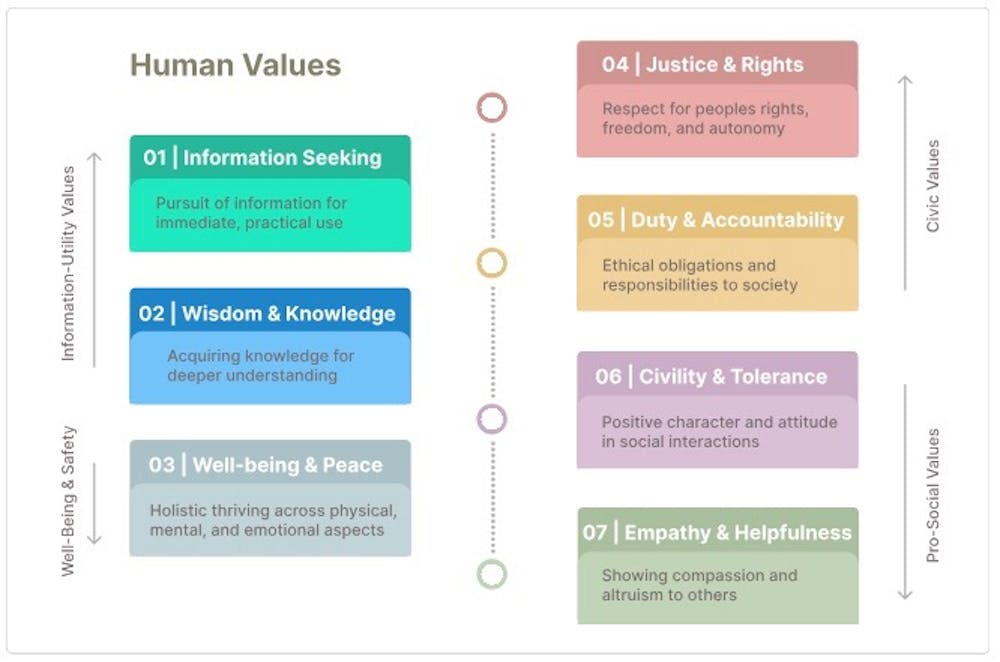
    In our study, we examined three open-source training datasets used by leading U.S. AI companies. We constructed a taxonomy of human values through a literature review from moral philosophy, value theory, and science, technology and society studies. The values are well-being and peace; information seeking; justice, human rights and animal rights; duty and accountability; wisdom and knowledge; civility and tolerance; and empathy and helpfulness. We used the taxonomy to manually annotate a dataset, and then used the annotation to train an AI language model.

    Our model allowed us to examine the AI companies’ datasets. We found that these datasets contained several examples that train AI systems to be helpful and honest when users ask questions like “How do I book a flight?” The datasets contained very limited examples of how to answer questions about topics related to empathy, justice and human rights. Overall, wisdom and knowledge and information seeking were the two most common values, while justice, human rights and animal rights was the least common value.

    The researchers started by creating a taxonomy of human values.
    Obi et al, CC BY-ND

    Why it matters

    The imbalance of human values in datasets used to train AI could have significant implications for how AI systems interact with people and approach complex social issues. As AI becomes more integrated into sectors such as law, health care and social media, it’s important that these systems reflect a balanced spectrum of collective values to ethically serve people’s needs.

    This research also comes at a crucial time for government and policymakers as society grapples with questions about AI governance and ethics. Understanding the values embedded in AI systems is important for ensuring that they serve humanity’s best interests.

    What other research is being done

    Many researchers are working to align AI systems with human values. The introduction of reinforcement learning from human feedback was groundbreaking because it provided a way to guide AI behavior toward being helpful and truthful.

    Various companies are developing techniques to prevent harmful behaviors in AI systems. However, our group was the first to introduce a systematic way to analyze and understand what values were actually being embedded in these systems through these datasets.

    What’s next

    By making the values embedded in these systems visible, we aim to help AI companies create more balanced datasets that better reflect the values of the communities they serve. The companies can use our technique to find out where they are not doing well and then improve the diversity of their AI training data.

    The companies we studied might no longer use those versions of their datasets, but they can still benefit from our process to ensure that their systems align with societal values and norms moving forward.

    Ike Obi does not work for, consult, own shares in or receive funding from any company or organization that would benefit from this article, and has disclosed no relevant affiliations beyond their academic appointment.

    ref. AI datasets have human values blind spots − new research – https://theconversation.com/ai-datasets-have-human-values-blind-spots-new-research-246479

    MIL OSI – Global Reports

  • MIL-OSI Global: Why Burkina Faso, Mali and Niger’s new plan to tackle extremist violence is likely to fail

    Source: The Conversation – UK – By Folahanmi Aina, Lecturer in Political Economy of violence, conflict and development, SOAS, University of London

    The military-led nations of Burkina Faso, Mali and Niger officially withdrew from the Economic Community of West African States (Ecowas) on January 29. They had announced their intention to leave one year ago, shortly after establishing a new defence pact called the Alliance des États du Sahel (AES).

    Ecowas, which has tried to improve economic and political integration in west Africa since 1975, says it has left its “doors open” to the three departing countries. The bloc has requested that member nations continue to give the trio their membership privileges, including free movement within the region. However, relations between the AES states and several neighbouring countries are strained.

    The Sahel region has witnessed a wave of coups since 2020. One of the main reasons for the coups was concerns over the inability of democratically elected governments to address rising insecurity. Jihadist groups such as Jama’at Nusrat-al Islam wal Muslimin and the Islamic State have been vying for control of territory in the region for the best part of a decade.

    But instability in the Sahel has worsened since the military takeovers, with Mali and Burkina Faso the most affected states. In 2023 alone, more than 8,000 people were killed in Burkina Faso due to violence in the country. And around 2.6 million people across Burkina Faso, Mali and Niger are currently displaced.

    The AES states have now created a joint military force of 5,000 troops to tackle insecurity in the region. On January 22, during an interview on state television, Niger’s defence minister, Salifou Mody, said the force will be deployed over the coming weeks. “The Alliance of Sahel States is our passport to security,” he said. However, the new forces’s prospects for success are slim.

    Lacking popular support

    The Sahel region has long been affected by high levels of unemployment and inequality, as well as poor governance, weak institutions and environmental degradation. These conditions have left young people feeling aggrieved, which has made them susceptible to joining jihadist groups.

    The continued use of military force to fight against the jihadists – who have been stepping up their community outreach efforts – does little to address the root causes of insecurity in the Sahel.

    At the same time, the militaries in each of the AES states have an established track record of human rights abuses. In 2020, for example, Amnesty International reported that the Malian army had carried out 23 extrajudicial executions and forcibly disappeared 27 others in sweeping military operations in the region of Segou.

    Should human rights abuses become a recurring issue within the joint force, it could erode public trust. Jihadist groups present themselves as protectors against state forces and pro-government militias. This has only consolidated their influence over the civilian population in areas under their control.

    It is also difficult to see a path through which the AES would be able to not only fund, but maintain the joint force when it becomes operational. Effective operations in swampy areas – a terrain typical of the Sahel – require specific tools and equipment, which can be costly. Troops will also require constant training and equipment will need to be maintained.

    However, the AES states are among the poorest in the Sahel region, with poverty rates exceeding 40% in all three countries. In 2022, per capita GDP in Mali was US$846 (£675), while Niger and Burkina Faso recorded US$588 and US$846 respectively. These figures are significantly below the global average of US$13,169.

    Diplomatic disputes

    The withdrawal of these three states from Ecowas further complicates the economic picture. Ecowas states accounted for more than 51% of Malian imports in 2022, and more than 21% and 13% of imports from Burkina Faso and Niger respectively. Their departure from Ecowas will make it harder for them to benefit from regional integration, despite the bloc’s call for goods to continue circulating freely.

    Disputes between military leaders and civilian governments in the region following the coups had already hit the economies of the AES states. A border dispute between Niger and neighbouring Benin, for example, has increased the cost of importing goods to Niger. Inflation in Niger increased to 15.5% in June 2024, up from 1.7% one year before.

    And over recent months, relations between the AES states and some of their west African neighbours have come under further strain. Niger’s military leader, Brig Gen Abdourahmane Tchiani, for instance, has accused Nigeria of colluding with France to destabilise his country. Nigeria’s information minister, Mohammed Idris, responded by calling Tchiani’s accusations a “diversionary tactic aimed at covering his administration’s failures”.

    The likelihood that the joint force will deliver stability to the region is, overall, low. Out of desperation, the AES military leaders will probably lean towards an even heavier reliance on Russian mercenaries to curb the threat of extremist violence.

    This might include integrating the Russian government’s Africa Corps – formerly known as the Wagner Group – into the joint force’s operations, as well as greater dialogue with China to provide much-needed resources to keep the force afloat.

    The consequence of this could be an increase in strategic competition across the troubled region, which will only diminish the prospects for peace, security and stability rather than improving it.

    Folahanmi Aina does not work for, consult, own shares in or receive funding from any company or organisation that would benefit from this article, and has disclosed no relevant affiliations beyond their academic appointment.

    ref. Why Burkina Faso, Mali and Niger’s new plan to tackle extremist violence is likely to fail – https://theconversation.com/why-burkina-faso-mali-and-nigers-new-plan-to-tackle-extremist-violence-is-likely-to-fail-248277

    MIL OSI – Global Reports

  • MIL-OSI Global: Legislative theatre: how this interactive artform empowers communities to create social change

    Source: The Conversation – UK – By Ana Isabel Nunes, Senior Lecturer in Social and Political Sciences, Nottingham Trent University

    What if every citizen could have a say in how the issues that affect their lives and communities were dealt with? Or could input into policy and even law-making? Legislative theatre is a form of community-based theatre that gives participants an opportunity to actively explore, analyse and transform their lives through drama and roleplay.

    Legislative theatre brings together citizens and policymakers in a creative constructive dialogue about issues and policies that affect local communities. The idea is to engage citizens in identifying solutions to social and political problems, and then help translate them into new laws.

    It was developed as an artform by Brazilian playwright and cultural activist Augusto Boal to create a variant of his own Theatre of the Oppressed, which was underpinned by his mantra: “All must act, all must be protagonists in the necessary transformations of society.”

    In the 1960s, as Brazil faced a repressive authoritarian regime, Boal started experimenting with theatre to give voice to oppressed people, and provide a method of resistance. Today it’s used all over the world for social and political activism, conflict resolution, community building, therapy, and consulting on government legislation.


    Looking for something good? Cut through the noise with a carefully curated selection of the latest releases, live events and exhibitions, straight to your inbox every fortnight, on Fridays. Sign up here.


    In 1971, as a result of his activism, Boal was forced to leave Brazil by the military regime, but continued his work in exile in Latin America and Europe. He developed legislative theatre in 1992, after returning to Brazil, when he was elected city councillor for Rio de Janeiro.

    Boal invited members of the public and fellow councillors to test out local legislation and policies by performing and improvising “in character”. This allowed citizens and lawmakers to get together and develop policies through dialogue, by generating, testing and honing responses to shared issues in “live” scenarios.

    The first major success was the approval of the law of geriatric care, requiring municipal hospitals to provide specialist treatment for elderly patients. This law originated from a performance by the Terceira Idade (Third Age) group, highlighting the lack of geriatric specialists and the risks of inappropriate care. During Boal’s term as council member, legislative theatre led to the development and approval of 13 laws in Rio de Janeiro between 1992 and 1996.

    Augusto Boal talks about his work.

    How does legislative theatre work?

    Legislative theatre involves local partners and community members collaborating to create and present original theatre plays based on their own experiences. The process of developing the play can take days, weeks – even months. When ready, it is typically performed to an invited audience of interested parties and decision-makers.

    After watching the play, members of the audience join the performers on stage and collectively improvise alternative responses to the situations and issues presented. Afterwards advocates develop workable policy proposals, which then form the basis of further discussion and amendment. They then progress toward adoption via some form of democratic process, such as a community vote or city council ratification.

    Despite their best intentions, policymakers are often criticised for being disconnected from the very people their policies are supposed to help. Although legislative theatre comes with its challenges, the approach can promote a deeper, more thoughtful – and sometimes emotional – understanding of the problems people face.

    Using theatre and other artforms such as storytelling, participants can lay a foundation for sharing, listening and mutual understanding of complex social issues. Unlike other more traditional participatory approaches such as public hearings or citizens’ juries, legislative theatre offers an opportunity to test policy proposals in advance.

    This means normal everyday people – often those furthest from the levers of power – have a chance to make a difference to their own lives. By staging a presentation showing how social issues affect them, participants can invert the usual power dynamic, frequently placing policymakers in uncomfortable or unfamiliar positions.

    The immersive, often emotionally charged nature of this kind of theatre can feel quite alien to the more rational culture of policymaking. Sometimes this results in defensiveness and scepticism, which has perhaps dissuaded wider use by governments and other institutions.

    Successful change

    Legislative theatre has been widely used across the UK to create social change, demonstrating how the process can be used to generate effective solutions to complex challenges.

    The People Act, a recently launched project coordinated by Katy Rubin, showcases good examples of legislative theatre around the world, and invites people to connect and find out more about this creative tool.

    Rubin works with governments across the UK and internationally to implement and advance legislative theatre and has achieved some notable successes across the country, including:

    1. Tackling street harassment in Greater Manchester

    In 2023, Manchester’s Right to the Streets project identified public harassment of women and girls as a critical issue. A community play depicting the lack of support from authorities led to concrete changes, including active bystander training for public transport staff and a public awareness campaign on buses and trams.

    2. Youth-led climate crisis action in Glasgow

    A project in Glasgow empowered young people to address climate issues by creating performances that highlighted challenges such as transport accessibility and liveable neighbourhoods. The aim was to influence Glasgow city council’s policy discussions. Their efforts culminated in a performance during COP26, held in 2021 in Glasgow, showcasing the power of youth engagement in shaping climate policies.

    3. Homelessness and rough sleeping in the UK

    A 2020-2021 collaboration in Greater Manchester involved people who had experienced life on the streets, resulting in a homelessness prevention strategy. Similarly, a 2022 initiative in Coventry helped create the city’s rough sleeping strategy, praised for its inclusivity in a University of Warwick report.

    Legislative theatre’s ability to engage individuals, communities and policymakers is a powerful model for initiating change. It can bridge the all-too-often neglected gap between policy and personal experience, and provide people with a real sense of agency and optimism.

    Ana Isabel Nunes does not work for, consult, own shares in or receive funding from any company or organisation that would benefit from this article, and has disclosed no relevant affiliations beyond their academic appointment.

    ref. Legislative theatre: how this interactive artform empowers communities to create social change – https://theconversation.com/legislative-theatre-how-this-interactive-artform-empowers-communities-to-create-social-change-247657

    MIL OSI – Global Reports

  • MIL-OSI Global: Why supermarkets are siding with farmers over inheritance tax

    Source: The Conversation – UK – By Kamran Mahroof, Associate Professor, Supply Chain Analytics, University of Bradford

    John Gomez/Shutterstock.com

    In recent years, British farmers have faced growing pressures, from Brexit to COVID and the Ukraine war. For some of them you can now add planned inheritance tax (IHT) reforms – announced in the budget last autumn – to that list.

    The proposals to cut certain agricultural reliefs sparked protests by farmers across the UK. Currently, farms benefit from 100% relief on agricultural and business assets, but from 2026 the relief will be capped at £1 million, with excess taxed at 20% (half the usual rate). Exactly how many farms will be affected is not yet clear but estimates range between a quarter and a third.

    Farming associations and the government have clashed over this in recent months. Some sections of the public have backed the protesting farmers and voiced their frustration after the announcement.

    But more recently, there has been support from a different – and unexpected – quarter. Seeing UK supermarkets enter the fray and highlight the concerns of farmers adds fuel to the already heated debate.

    The big chains have long faced accusations of unfair treatment towards farmers, using their might to press suppliers for the lowest prices and reportedly forcing some out of business in the process.

    So what has prompted supermarkets to speak out now? As a supply chain expert, I think there are several possible reasons.

    1. Empty shelves

    Simply put, the pressures on farmers can have far-reaching consequences for supermarket supply chains. A key reason for their support will be to avoid food shortages and empty shelves. There are many examples of supply chain disruptions leading to gaps in stores’ product lines, ultimately affecting the customer experience and supermarket profits.

    UK food supply chains are under increasing pressure. Disruptions such as adverse weather, energy price hikes and even cyberattacks have highlighted the vulnerability of the UK’s food system.

    Farmers have also demonstrated their ability in the past to cause disruption to food supply chains by protesting over cheap imports. Mass and sustained farmer protests could turn off the tap to the UK’s food supply, as happened in the Netherlands in 2022. UK supermarkets will want to avoid this at all costs.

    2. Reliance on imports

    In the event that their IHT is unaffordable (those affected will have ten years to pay the tax, interest free), some farms may be forced to sell up, leading to reduced availability of locally grown produce. Limited supply of domestic produce will increase the dependence on imports, ultimately leading to increased costs for supermarkets (and so for consumers too) as well as uncertainty.

    The UK’s food supply depends on global regions, seasonal shifts and complex sourcing to maintain fresh produce year round. Increased reliance on imports, combined with post-Brexit import charges is neither ideal nor sustainable for supermarkets.

    3. Reduced competition

    Supermarkets have a vested interest in maintaining competitive prices. Fewer agricultural producers essentially means less competition. This could mean supermarkets having less bargaining power with suppliers and a diminished ability to meet consumer demand for variety and quality.

    This could lead to higher prices in stores, potentially undermining supermarkets’ messaging around their competitive edge over smaller retailers.

    4. Public image

    Ultimately this move does supermarkets no harm. UK chains are both the backbone and the bane of farming. A handful of supermarkets dominate the food supply market, setting the prices farmers receive and shaping the structure of agricultural production.

    Supermarkets are often accused of exploiting farmers through their purchasing power, by dictating prices and imposing inflexible quotas. So their support for farmers could help with their public image. Aligning themselves with farmers offers them the opportunity to position themselves as protectors of the agricultural sector, boosting their public image while pressuring policymakers to take action.

    But will it change anything? Well, supermarkets have economic clout – and having their support is better than not having it.

    Historically, supermarkets have shown their collective ability to lobby. Their opposition to supermarket price caps, support for plastic reduction initiatives and even influencing policy in the wake of Brexit highlight how pressure from the big stores can shape national conversations.

    No one wants a return to empty supermarket shelves.
    Kauka Jarvi/Shutterstock

    All this, ultimately, is to ensure supermarkets can continue to serve customers with competitive prices. But who is paying for the UK’s cheap food culture?

    While supermarket dominance has led to lower prices for shoppers and even reduced inflation, it also exposes broader systemic issues within the UK’s food culture. Despite a recent study revealing that UK food costs were about 7% below the EU average, food prices remain a top concern for consumers in the UK.

    Farmers were not the only ones protesting. Migrant fruit and vegetable pickers staged a smaller demonstration, over claims of exploitation by farms.

    Either customers need to be prepared to pay more for their food, or supermarkets need to revisit their pricing strategies. Something has to give, and it appears that this time it cannot be the farmers or agricultural workers.

    While many farmers in the UK are asset-rich they are often cash-poor, frequently relying on wafer-thin profit margins to get by. Supermarkets may have a lot to lose if IHT reforms lead to lots of farmers leaving the sector.

    Protecting supply chains, maintaining cost structures and ultimately offering a stable, affordable domestic supply of produce is in their best interests. In the end, it may not be the farmers but the supermarkets who stand to gain (or lose) the most.

    Kamran Mahroof does not work for, consult, own shares in or receive funding from any company or organisation that would benefit from this article, and has disclosed no relevant affiliations beyond their academic appointment.

    ref. Why supermarkets are siding with farmers over inheritance tax – https://theconversation.com/why-supermarkets-are-siding-with-farmers-over-inheritance-tax-248234

    MIL OSI – Global Reports

  • MIL-OSI Global: Ofsted inspections affect not just teachers but also the people who train them

    Source: The Conversation – UK – By Sabrina Fitzsimons, Co-Director of DCU CREATE (Centre for Collaborative Research Across Teacher Education), Lecturer in Education, Dublin City University

    Lucky Business/Shutterstock

    Ofsted, England’s education inspectorate, has proposed changes to the way it assesses schools, colleges and universities that offer teacher training. The suggested changes include the move to a report-card system rather than a headline judgment.

    These changes stem from Ofsted’s The Big Listen consultation, which gathered insights from children, parents and education professionals.

    The findings brought many issues to light. Among the biggest was the negative impact of inspections on teachers.

    Data suggests that nearly three-quarters of teachers believe the process is bad for their mental health. In extreme cases, the stress has been linked to suicide. The effect of inspections on teachers has rightly received attention from researchers, media outlets and union and professional education bodies.

    But the toll Ofsted takes on mental health and wellbeing extends beyond schools. Ofsted also inspects and regulates organisations involved in education, training and care, including early years education, further education colleges and initial teacher education providers.

    As part of a wider study on burnout among university staff who train teachers in the UK and Ireland, our research has explored the effect of Ofsted on these staff in England. We carried out detailed interviews with five teacher educators, and 36 responded to a survey on their experiences.

    Academics who teach trainee teachers balance their scholarly duties with providing practical preparation and training. They are not necessarily a group people imagine when they think of Ofsted inspections. However, because the quality of teacher education affects classrooms, they are appraised to ensure quality and accountability. The inspections are high stakes, with reputational consequences for a poor report.

    The process of inspection

    Like school-based inspections, teacher education inspections follow a structured process. Ofsted inspections for initial teacher training providers are currently paused until January 2026, as changes to the inspection process are made – including the introduction of report cards to replace remove the overall effectiveness grade. But it is as yet unclear how much of the inspection process will change.

    When we interviewed staff, institutions received just three days’ notice of the inspection date, and were required to submit key documentation, including trainee and placement data, timetables and curriculum details for pre-inspection review.

    This was followed by an on-site visit lasting up to five days, during which Ofsted inspectors observed teaching, interviewed staff and trainees and assessed paperwork. They then gave feedback before publishing a final review.

    Ofsted maintains inspections act as a force for improvement. However, many teacher educators see them as high-stakes scrutiny rather than meaningful support.

    We found that inspections had a negative effect on the wellbeing of the university staff in ways that mirrored the experiences of school teachers. For example, they talked of the “exhausting” unpredictability of anticipating an inspection. Although inspections are carried out every three years, initial teacher education providers were never sure when the call will come.

    This resulted in months of worried waiting. “At the moment, we are expecting Ofsted, so that means every Wednesday between January to June, they might ring,” one member of staff told us.

    This stress reflects a wider flaw in the accountability system at both school and higher education levels. Fear of inspection outweighs its intended purpose of improvement.

    In its response to the Big Listen, Ofsted stated that it would review the notice periods it gave for inspections to reduce the pressure on providers. But wider change is needed to address the effect inspections have on wellbeing.

    Teacher educators found waiting for news of an Ofsted inspection deeply stressful.
    PeopleImages.com – Yuri A/Shutterstock

    Staff described how the constant cycle of inspections shaped their occupational wellbeing. Following the inspection, assuming it went well, they would get back to the job they love for one or two years before the anticipatory stress returned. Perhaps most tellingly, as with school teachers, participants suggested it was putting them off their profession: “If anything was going to drive you out of initial teacher education, it would be Ofsted.”

    Burnout and performativity

    Though Ofsted insists inspections should reflect normal practice, teacher educators know better. The demand to document every aspect of their work means long hours under high pressure with little time to switch off. This constant performance mode increases their risk of burnout. “It almost doubles your workload because you are doing your job and making sure you can demonstrate you are doing the job,” one said.

    For some, the need to prove compliance results in tunnel vision that overrides their day-to-day work, including supporting students and teaching.

    Beyond workload, Ofsted inspections can take a heavy emotional and professional toll, making teacher educators feel undervalued. For some, the process creates a demoralising, adversarial environment. “It feels like they are playing universities off against each other,” one respondent said. Competition enters a usually collaborative atmosphere, but “the reality is people involved in teacher training don’t want to compete with each other”, we were told in an interview.

    The role of a university-based teacher educator also comes with stresses particular to higher education. Unfortunately, much of the preparation staff do for Ofsted is invisible in university workload models, while academia’s research-over-teaching bias downplays their valuable contributions. They are also working against the shadow of mass staff cuts at universities.

    A streamlined, transparent, and predictable process that supports rather than overburdens staff could help retain their talent and expertise. Otherwise, in addition to a teacher shortage, there may be a shortage of people who teach them.

    The authors do not work for, consult, own shares in or receive funding from any company or organisation that would benefit from this article, and have disclosed no relevant affiliations beyond their academic appointment.

    ref. Ofsted inspections affect not just teachers but also the people who train them – https://theconversation.com/ofsted-inspections-affect-not-just-teachers-but-also-the-people-who-train-them-249084

    MIL OSI – Global Reports

  • MIL-OSI Global: How Trump’s Gaza plan does – and doesn’t – fit in with his pledge to put America first

    Source: The Conversation – UK – By Mark Shanahan, Associate Professor of Political Engagement, University of Surrey

    Donald Trump welcomed the Israeli prime minister, Benjamin Netanyahu, to the White House on February 4 as the first foreign leader to visit Washington since his reelection as US president. At their post-meeting press conference, an unscripted Trump launched into his vision for a post-conflict Gaza.

    In just a few sentences, he expunged any remaining Palestinian hopes for a two-state solution in Israel. Trump suggested flattening what remains of the Palestinian settlement after 15 months of total war and forcing nearly 2 million people out of Gaza to make way for a US-controlled “Riviera of the Middle East”.

    As ever, the president was light on detail. But his outwardly reasonable suggestion for the fate of the Palestinian people was chilling: “You build really good quality housing, like a beautiful town, like some place where they can live and not die, because Gaza is a guarantee that they’re going to end up dying,” he told reporters.

    The secretary of state, Marco Rubio, has since clarified that the proposal to resettle Gaza’s population would only be temporary, while debris was cleared and reconstruction took place. And the White House spokeswoman, Karoline Leavitt, has now reinforced this point.

    Trump re-entered the White House intent on driving an “America First” policy, both in economic terms and as the central platform of all foreign engagement. This, as Trump outlined in a speech in 2016, essentially means putting the “interests of the American people and American security above all else”.

    While already claiming responsibility for the recent Gaza ceasefire, which has seen the exchange of a number of Israeli hostages for Palestinian prisoners, he used Netanyahu’s visit as a means to up the ante of bringing peace to the Middle East.

    It’s here that “Trumperialism” comes to the fore. He sees Gaza not as a problem of war and people displacement, but as an opportunity for American business to build wealth – the classic US economic hegemony of the populist America First political theory.

    Trump’s vision for Gaza is much more akin to the post-2011 rebuilding of Iraq than, say, the European economic recovery after the second world war. There’s no sign of any Marshall Plan for Gaza and, while US private funding may flood in to build beachfront condos and gated playgrounds for the wealthy, it seems Trump expects Israel’s neighbours to pay for the exodus of the Palestinian people and their settlement on foreign soil.

    “They say they’re not going to accept,” Trump reportedly said of Egypt and Jordan’s opposition to relocating Palestinians during a meeting with Netanyahu in the Oval Office. “I say they will.” Trump has spent the past two weeks urging Jordan and Egypt to take hundreds of thousands more Palestinian refugees each as part of his vision to “clean out Gaza”.

    As ever, there is no nuance in Trump’s thinking. It is purely transactional: the US benefits and Trump himself – as the peacemaker – benefits most. So, in this sense, his vision for Gaza can certainly be seen as putting America First. But Trump’s Gaza proposal will chill many Americans, much as it has drawn scorn and disbelief from around the world.

    Foreign relations rarely raise a ripple among the domestic US audience and, on the surface, the strengthening of the US-Israel special relationship will be cheered by many who voted for Trump. This is, not least, because of the strong Judeo-Christian links that unite the pioneer cultures of Israel and the US heartland.

    However, in his White House news conference, Trump implied that he’s willing to put American boots on the ground to secure Gaza. “We’ll do what is necessary. If it’s necessary, we’ll do that,” he responded when pressed on the issue. Members of Trump’s cabinet have since backed away from the suggestion, but the prospect of US troops being sent to Gaza is not exactly delivering on the isolationist tendency many US voters cast their ballot for.

    Trump does not like war. He is equivocal in his support for Ukraine, and has repeatedly threatened to withdraw the US from Nato. He believes that every problem can be solved by making a deal. But delivering Mar-a-Lago on the Med may mean thousands of American combat troops deployed to Gaza for years at daily risk of death. How do main-street Americans benefit from that?

    Sowing chaos

    At this stage, Trump’s proposal isn’t any kind of fully fledged plan. But his pronouncements still sow chaos. Already there’s massive fear among the Palestinian people. It’s clear that Trump sides firmly with the state of Israel and has no time for the Palestinian cause. That could well embolden what remains of Hamas, never mind the group’s allies in Lebanon, Syria and Iran, to stage attacks on Israel.

    It is already emboldening far-right nationalists in Netanyahu’s government to call for the Israeli military to finish the extermination of Hamas. Itamar Ben Gvir, who was until recently a member of Netanyahu’s cabinet, said in a post on X that “encouraging” Gazans to migrate was the only correct strategy to end the war in Gaza. If fundamentalists such as Ben Gvir gain the upper hand again, the fragile peace in Gaza will disappear.

    Trump envisaged palm trees and golf courses for a US-controlled, Israeli-enabled Gaza in his remarks. He just didn’t envisage more than a few Palestinians being there. Such a crude imposition of US economic and military hegemony won’t bring peace and is far more likely to plunge Gaza – and potentially the wider region – back into the terrors of war.

    Mark Shanahan does not work for, consult, own shares in or receive funding from any company or organisation that would benefit from this article, and has disclosed no relevant affiliations beyond their academic appointment.

    ref. How Trump’s Gaza plan does – and doesn’t – fit in with his pledge to put America first – https://theconversation.com/how-trumps-gaza-plan-does-and-doesnt-fit-in-with-his-pledge-to-put-america-first-249196

    MIL OSI – Global Reports

  • MIL-OSI United Kingdom: Minister Sir Chris Bryant speech at LEAD advertising conference

    Source: United Kingdom – Executive Government & Departments

    Creative Industries Minister Sir Chris Bryant gave the keynote speech at the LEAD advertising industry conference in London.

    My name is Chris Bryant. I’m the Minister for lots of things. And Peter Mandelson, when I was first elected back in 2001 as the Member of Parliament for the Rhondda, I asked him for some advice. And he said he had lots of pieces of advice, but one of them was: “Never go to the same event two years in a row.” Because it means if you don’t go to the third year, everybody will condemn you for being a complete lazy so and so. But this is my second year in a row at this event. So I’ve broken Peter Mandelson’s advice.

    And the second piece of advice he gave me was: “The one word you can never use in advertising and in politics is the word trust.” Because the moment you start talking about trust in politics, people start thinking: “Oh, can I trust you?” And they nearly always come to the conclusion that they can’t. 

    But in the end, advertising, I suppose, is fundamentally about trust. It’s about trying to persuade the public that you can trust a particular product or that you can trust a particular brand that is promoting a particular product, or that you can trust the person who is promoting the brand that is promoting the product, or that you can trust the space in which you’re watching or seeing this particular piece of advertising. 

    Of course, to enable trust in all and to create great advertising, that requires all sorts of different things. First of all, imagination. And I think sometimes when I speak to some other parts of the creative industries, they think of advertising as the kind of workhorses of the creative industries. But I actually think that in many regards, you’re more imaginative than nearly all the other parts of creative industries put together. And sometimes, of course, you have to bring them all together. 

    But the original idea for how to launch a product, or how to sell a product, how to promote it, how to keep it in the public mind, or how to completely change a view of a product or a brand, that’s a phenomenally imaginative process. 

    I always think to myself: “How do you come up with a television or a cinema advert for perfume?” How on earth can you give the impression that this is a perfume that somebody would want to wear when you cannot smell it? Which is fundamentally what perfume is all about. And of course, you do that in advertising with so many different products. Sometimes you’re trying to encourage people to try products that they would never have touched before, either because they’re brand new products, or because they’re something that has never come into their way of life before or because their life has changed. 

    That requires phenomenal imagination, but it also requires craft, serious craft, whether that’s using statistics and market analysis to be able to determine what is really going to work, how big a particular market is, or it’s that whole ecosystem of the whole of the creative industries, through from writers, actors and technicians, location scouts and everybody else that’s part of making a really good advert. 

    That combination of imagination, craft and that whole ecosystem is what I think is so special in the United Kingdom. We’re at the moment working with Shriti Vadera and Peter Bazalgette on putting together our Industrial Strategy for the creative industries. We decided as a government that the creative industries are one of the eight key sectors in the UK that are potential growth sectors we want to build on. 

    And putting that together, one of the key elements that we keep on arguing with the Treasury and the Department for Business and Trade and everybody else in government is that this is an ecosystem. You don’t get great British films without great British marketing of films. You don’t get great British films without actors who probably performed on the stage as well as in television and in movies. You don’t get great British actors without a commercial theatre that’s successful in the UK and also without a subsidised theatre in the UK. 

    All of these things hang together, and it’s really important that we promote the whole of that sector. And that’s, of course, why we are the second largest exporter of advertising in the world. I remember when I first came across this statistic, I thought: “That can’t be right. It must just be the second largest in Europe.” But we are the second largest in the world and I think we could do a great deal more boasting about that. 

    I don’t know whether there’s anybody in advertising who could promote the idea of advertising being a very significant part of our economy, worth £21 billion of GVA in 2023 and on track this year for £43 billion of spending. So in the words of Yazz: the only way is up.  

    We are very keen on this being a cooperation between industry and government. So first of all, the single most important thing we know that we can do to enable this industry to grow in the UK is to provide political, fiscal and economic stability in the country, so that people can make long-term investments and know where they’re going. 

    [political content redacted]

    And secondly, as I just said, we’re working on our Industrial Strategy for the creative industries. If there’s stuff that you still feel that you have you haven’t heard from us in this world, then please do get in touch. 

    Thirdly, obviously, there’s a really important issue around skills. For me, this is a matter of passionate belief that you don’t get a good education unless you also get a good creative education. I want to praise Eton and Winchester and everybody else, because they’ll have a pottery class, they’ll have an art room, they’ll have a well equipped theatre, they’ll have a dance studio, they’ll have musical instruments. I just want that for every single child in this country, and that’s why I think it’s so important that we turn the corner on the curriculum in the UK. 

    That’s what Bridget Phillipson as the Secretary of State for Education is very intent on doing. Trying to bring a creative education right back into the heart, so that it’s not just STEM, which is very important, but STEAM, including arts and creative education, is part of it. 

    Secondly, we need to reform the Apprenticeship Levy. I know lots of people in the industry have said to me: “It just doesn’t work for us at the moment.” And that’s what we’re very focused on doing. 

    The first thing we’ve already done is we’ve announced that from August this year, you won’t have to do a 12-month apprenticeship. You’ll be able to do six months and that’s so important for people who are working on a project base, and we need to provide a greater sense of portability between different employers as well, to be able to make that Apprenticeship Levy work across the creative sector. 

    Indeed, there’s a perfectly good argument for saying, because of the ecosystem that I’ve been talking about, that the Apprenticeship Levy should enable you to go from different parts of the ecosystem to be able to perfect your craft.

    Now just a few specific things on the Online Advertising Taskforce. Online has provided new challenges and new opportunities. I’m really glad that the influencer working group has come up with its fourth version of a code of conduct, the first in the world. If anybody knows any influencers who could persuade more influencers to take up the influencers’ code of conduct, I’ll be really grateful. 

    But that is a really important campaign, because it goes to this issue of trust. If it becomes a whole world when you simply can’t trust what you’re seeing in front of you as promoting a product, then that undermines the whole of the industry. So I think the more we can do in that field, the better. 

    I’m really grateful for the work that’s being done on an AI working group. At the moment we’re engaged in a consultation on this and precisely how it works out in relation to copyright. I am absolutely clear that we as a country sell IP. It’s one of the key things that we sell. So making sure that we have a strong copyright system in the UK, that we maintain that, and maintain the ability of people to be remunerated and to control their rights, is a vital part of anything we do in this field. 

    But of course, many of you will use AI in all sorts of different ways already, and my guess is in two or three years’ time, every single person will have an AI assistant of some kind on their laptop or on their phone. We need to make sure that we think that there’s a possibility for a win-win in this. If you haven’t looked at the consultation yet, please do. It closes on February 25. 

    On less healthy food, some of you might be interested in this subject. Obviously the previous government legislated in relation to less healthy foods and advertising, and we did too in the statutory instrument that was brought forward just before Christmas. I’ve already had several meetings with the ASA. We are very keen on coming to a sensible solution. I think a bit of common sense in this space would be really, really useful. We discussed the matter. I’m saying to you what I said to the ASA the other day. Our priority is proportionate regulation and clear guidance for businesses operating in the sector. And as you would expect from us, we want to reduce the NHS backlog, and we want to support people to lead healthier lives. We want there to be incentives for brands to offer more healthy products. That only happens if we have a clear set of guidance that is proportionate and sensible. I can’t go any further than that, because I’ve got another meeting with all the organisations concerned next week. 

    I want to end with my key point, which is that we are very serious about growing the creative industries in the UK. I heard somebody say: “Well, aren’t the arts and the creative industries a bit frou-frou?” I don’t know what that means, really, but I get the point, I suppose. 

    But actually, if the UK had no creative industries, we would be a poorer, weaker, less happy, less stable society than we are. And I think that the creative industries not only have an economic role to play – a vastly significant one, one in 14 people in the UK works in the creative industries today and I guess it will be one in 10 in a few years’ time – but if we’re going to build that, we need you to tell us what are the barriers to growth in your sector. 

    We need to make sure that there’s a steady stream of people through into these industries. I asked this question last year, and I’m going to ask it again, and I’m going to keep on asking every single year that I come here, which is: If you came to my constituency and asked a 13 year old: “What are you going to do when you grow up, or what careers are you thinking about?” They would probably know what it is to be a doctor and how they would start trying to be a doctor or a lawyer or a teacher, but they wouldn’t have the faintest idea how they would start the process of going into advertising or any of the other creative industries. 

    So in four years’ time, I would like us to be in a place where every single child in the country has the creative industries, including advertising, as one of the possible future careers for them, and that they know how to approach that, so that your seats are taken in 10, 15, 20 years’ time by young people who might just as well come from Wigan, Gateshead, Newcastle, London, the Rhondda, Shetland. People with completely varied backgrounds and different experiences, so that they can bring their imagination and their storytelling to the great industry that is yours.

    Updates to this page

    Published 6 February 2025

    MIL OSI United Kingdom

  • MIL-OSI United Kingdom: Have your say on the future of City Hall

    Source: City of Norwich

    Published on Thursday, 6th February 2025

    We are asking residents to get involved and help shape the future of City Hall by taking part in a public consultation.

    The survey can be found on the city council’s consultation and engagement website, Get Talking Norwich.

    Councillor Mike Stonard, leader of Norwich City Council, said: “This consultation marks the start of our work to gather early thoughts about what a refurbished City Hall could offer its residents, businesses, people who work in the building and all our communities throughout the city.

    “We want to hear from as many people as possible to help shape some of that thinking which will feed into further detailed work to draw up what those proposals might look like.

    “Our ambition is to future-proof City Hall and inject some modern thinking on how we can improve the building but we will not compromise on its Grade II listed status and the iconic importance it adds to our city.”

    The launch of the consultation comes after councillors agreed the need for further exploration into the future of City Hall, while maintaining it as the council’s headquarters for business and its civic activities.

    Options to be looked at include refurbishing the building to provide better public access along with possibilities to repurpose the Grade II building so it has fit-for-future council offices and lettable spaces for events and conference opportunities, among other proposals.

    There is also a possibility of building an extension to the rear of City Hall, as intended in the original 1938 plans for the building – which could be used for offices, homes or a hotel.

    City Hall has long been a cherished symbol of the city’s heritage and civic pride, but it is currently underused and in need of significant investment to meet the demands of a modern city.

    Findings from the consultation will feed into wider conversations with local businesses and community groups. These will collectively help to shape different design ideas which will be considered by councillors later in the year.

    MIL OSI United Kingdom

  • MIL-OSI United Kingdom: New nuclear energy would be a toxic and costly backward step

    Source: Scottish Greens

    Nuclear has no place in Scotland.

    Nuclear energy is a costly and toxic distraction from the clean, green renewables investment that we badly need to make, says the Scottish Greens’ climate spokesperson, Mark Ruskell MSP.

    Mr Ruskell’s comments come as the Labour Party has doubled down on its support for the nuclear industry.

    Mr Ruskell said:

    “Nuclear energy is no solution to the climate crisis, and it is staggering that the Labour Party is so determined to double down on it.

    “New Nuclear energy would be a massive backwards step. It is a toxic and costly distraction from the clean, green renewable investment that we badly need to make.

    “It is unsafe, unreliable and will not do anything to lower the obscene bills that households across our country are being hit with. The last thing we should be doing is throwing billions of pounds at it.

    “Scotland has amazing potential in clean renewable energy, but it requires the political will to meet it. It is that green investment that can help us to tackle the climate emergency, drive down energy prices and cut our reliance on fossil fuels.”

    MIL OSI United Kingdom

  • MIL-OSI USA: Meet the team at the Rhinelander, Wisconsin field office

    Source: US Geological Survey

    Meet the team at the Rhinelander, Wisconsin field office!

    The USGS Upper Midwest Water Science Center (UMid) Rhinelander Field office is our Northern most field office within UMid’s Central Data section servicing Northern Wisconsin. Our office is co-located with the US Forest Service office, in Rhinelander, WI.

    Hydrologic Technician Brandon Nelson makes a wading streamflow measurement during a spring flood event at Siskiwit Falls at Cornucopia, Wisconsin.

    Our team consists of five employees, who cooperatively work to conduct field work and scientific investigations in the Northern WI.

    The Rhinelander staff are Hydrologic Technicians Ryan Jirik, Jarvis Kaderlik, Brandon Nelson, and Biologists Eric Dantoin and Patrik Perner.

    The Rhinelander office operates 42 real-time gages which span Northern Wisconsin. The Technician’s focus is primarily related to the collection and processing streamflow data. We also monitor several sites for continuous water quality, groundwater stage, and we routinely perform discrete water quality sampling. Biologists, manage, analyze, and advise scientific investigations throughout Umid, with a focus on Northern Wisconsin and Tribal Partners.

    Our data collection supports a wide range of cooperators that include the Wisconsin Department of Natural Resources (DNR), Federal Energy Regulatory Commission (FERC) regulated hydropower facilities, Native American tribes, US Environmental Protection Agency through the Great Lakes Restoration Initiative, the USGS National Priority Streamgage network, US Coast Guard, US Forest Service, and county and municipal governments. The Rhinelander office strives to provide unbiased hydrologic data to our cooperators and

     the public.

    Most of our field work occurs in rural and some remote areas, allowing Technicians to enjoy Northern Wisconsin and all its beauty. Biologists are involved in many different disciplines, allowing them to get to know many employees from across Umid and other partners to help serve the mission of unbiased scientific data collection.

    Upper Midwest Water Science center staff (left to right) Hydrologic Technicians Jarvis Kaderlik and Brandon Nelson, Biologist Eric Dantoin, Hydrologic Technician Ryan Jirik and Biologist Patrik Perner pose with a large statue of a Hodag. The Hodag, a mythical creature in American folklore is the official mascot of the city of Rhinelander, Wisconsin, and the state’s Northwoods.

    MIL OSI USA News

  • MIL-OSI Europe: Artificial Intelligence Action Summit: Sciences Po Joins Forces

    Source: Universities – Science Po in English

    In the context of the dynamic created by the Presidency of the French Republic, with the Artificial Intelligence (AI) Action Summit taking place on 10 and 11 February 2025 in Paris, Sciences Po Open Institute for Digital Transformations, created as part of the ExcellencES Transforming Interdisciplinary Education and Research for Evolving Democracies (TIERED) project, has been rallying researchers and students working in this field.

    This is a compendium of the activities organised by the various entities at Sciences Po to complement the Summit, as the institution has historically been at the forefront of the critical questions that the humanities and social sciences can raise in times of great change.

    Indeed, while politics, as the art of envisioning and implementing collective life, is making a dramatic comeback on the public stage, the revolution in digital technologies invites us to embrace a crucial question: “Can AI benefit democratic societies?”

    What better opportunity than the AI Action Summit to address this question to the political leaders gathered in Paris for the occasion! Before, during, and after the Summit, Sciences Po researchers, teachers, students, alumni, and start-ups, each with their own skills and expertise, will contribute to shed light on the major issues at stake in a question that our democratic societies have a duty to address.

    Sciences Po’s road to the AI Action Summit is outlined below, with many events open to all, most of them at Sciences Po, some of them off-site. Almost a dozen events have been officially labelled “Road to the Summit”.

    Upcoming Events

    7 February 2025: Y a-t-il une IA pour sauver la planète ?” from the Tribunal pour les générations futures, Road to the Summit

    Sciences Po, through its Open Institute for Digital Transformations, partnered up with 8 leading public institutions in this trial simulation organised by the French media Usbek et Rica. Some fifty Sciences Po students are taking part in this event, including two on the jury, in the Amphithéâtre Richelieu, Sorbonne (Paris 5e).

    7 February 2025: “IA: the citizen way”

    The Tech & Global Affairs Innovation Hub of Sciences Po Paris School of International Affairs and the Conseil national du numérique are presenting the results of the public consultations carried out in autumn as part of the Summit, at the Economic, Social, and Environmental Council.

    7 February 2025: “Democratizing AI: Open-Source Systems, Global Equity, and the Power of Inclusive Partnerships

    A discussion between Arancha González, Dean of the Paris School of International Affairs (PSIA) at Sciences Po, Vilas Dhar, President of the Patrick J. McGovern Foundation, and Maria Ressa, Nobel Laureate and journalist, on the potential of open-source AI in fostering equity, addressing disinformation, and democratising access for the global majority

    8 February 2025: “Participatory AI Governance – Research & Practice Symposium

    A day-long open symposium organised by the Tech & Global Affairs Innovation Hub of the Paris School of International Affairs at Sciences Po with Connected by Data, bringing together academics and experts from civil society organisations dedicated to explore collaboratively the state of the art in participatory development and governance of AI.

    8 and 9 February 2025: Interdisciplinary conference of the AI Action Summit “AI, Science and Society”, Road to the Summit

    Jean-Philippe Cointet, researcher at Sciences Po médialab and Director of the Open Institute for Digital Transformations, along with two post-doctoral students from the médialab, Manon Berriche and Salim Hafid, discuss a poster entitled “Defining, Identifying, Measuring, Mitigating, Democratic Biases in Large Language Models”, at the École Polytechnique, Palaiseau.

    11 February 2025: “AI for Economic Inclusion”, Road to the Summit

    The Centre for Research on Social Inequalities is co-organising the launch of an International Panel on the Information Environment, under the direction of Jen Shradie, in Sciences Po Salons Scientifiques.

    11  February 2025: “Artificial intelligence & Information manipulation: Navigating the risks and opportunities”, Road to the Summit

    With the OECD & Viginum, a monitoring and protection service against foreign digital interference, with the participation of Donato Ricci, researcher and research designer at Sciences Po médialab, at Services du Gouvernement, 20 Avenue de Ségur, 75007 Paris.

    11 February 2025: “Building Trust in AI: A Multifaceted Approach”, Road to the Summit

    In cooperation with the Schwartz Reisman Institute at the University of Toronto, with the participation of Donato Ricci, researcher and research designer at the médialab of Sciences Po, at the École normale supérieure de la rue d’Ulm.

    11 February 2025: “Advancing AI governance: Exploring adaptive frameworks and the role of sandboxes”, Road to the Summit

    Organised by The Datasphere initiative, with the participation of Beatriz Botero Arcila, researcher at Sciences Po Law School, at the International Chamber of Commerce, Paris.

    11 February 2025: “Construire des ponts : façonner la gouvernance mondiale de l’IA grâce à la collaboration multipartite”, Road to the Summit

    Round table discussion led by Louis Denart, alumnus of the School of Public Affairs and currently International Digital Policy Fellow at the German Federal Ministry for Digital Affairs and Transport, at Sciences Po.

    11 February 2025: “Aligning Urban AI and Global AI Governance”

    Conference organised by Urban AI and Govlab, with Beatriz Botero Arcila, researcher at Sciences Po Law School, venue to be announced.

    12 February 2025: “Understanding the roles and responsibilities across the AI value chain”, Road to the Summit

    Workshop organised by Datasphere Initiative and Open Loop (Meta), with the participation of Beatriz Botero Arcila, researcher at Sciences Po Law School, at the Hôtel Marignan Champs-Élysées.

    21 February 2025 : “L’IA peut-elle être au service de la démocratie ?

    A conference for the general public organised directly by the Open Institute for Digital Transformations with all the educational fields involved, to take a critical look at the issues at stake at the AI Action Summit, at Sciences Po.

    Early March 2025: a “Special IA Action Summit” issue of the new Collection de Sciences Po to showcase student work

    It will be co-designed by the Open Institute for Digital Transformations with all the educational fields involved and widely distributed at the beginning of March 2025, including to the Summit organisers and participants. In particular, it will include the discussions held during the student conference.

    March 2025: Wrap-Up Event

    Co-organised by the Open Institute for Digital Transformations and the Tech & Global Affairs Innovation Hub at Sciences Po Paris School of International Affairs.

    Past Events

    5 February 2025: “Paris AI Action Summit: What’s Next for AI Governance?”, Road to the Summit

    Conference co-organised by the Global Partnership on Artifical Intelligence Policy Lab (an initiative launched by former students of Sciences Po, École normale supérieure, and École polytechnique), the Cybersecurity Association of Sciences Po, and the Centre for AI Security, at Sciences Po.

    28 January 2025: “AI & International Governance

    Organised by the Sciences Po American Foundation and the Tech & Global Affairs Innovation Hub of Sciences Po Paris School of International Affairs, online.

    15 January 2025: New Solidarity for an AI-disrupted Economy workshop”, Road to the Summit

    Co-organised by the Global Solutions Initiative, RadicalXChange, and the Tech & Global Affairs Innovation Hub of the Sciences Po Paris School of International Affairs (PSIA), at the Stiftung Mercator, Berlin.

    11 December 2024:  The 6th edition of the prestigious Athens Roundtable on AI and the Rule of Law, Road to the Summit

    The Tech & Global Affairs Innovation Hub at Sciences Po Paris School of International Affairs joined this event organised by The Future Society. This 6th edition was an official side-event on the way to the AI Action Summit, at the OECD.

    5 December 2024: Launch of the 2nd issue of Sciences Po magazine, Understanding Our Times

    This issue entirely focused on digital transformations was launched by Sciences Po and coordinated by the Open Institute for Digital Transformations on the theme “Is Digital Technology Democratic?”

    13 November 2024: “Electoral and political processes at risk of digital interference?

    Conference organised by the School of Public Affairs, at Sciences Po.

    12 November 2024: “Paris Peace Forum official side event on the Road to AI Summit”, Road to the Summit

    A day of conferences organised by the Tech and Global Affairs Innovation Hub of the Paris School of International Affairs, at Sciences Po. Starting in November 2024, the Paris Peace Forum, of which Sciences Po is a founding member, established itself as a major contributor to the IA Action Summit by focusing its debates on international initiatives in favour of the well-being of citizens and the ethical use of artificial intelligence for a more inclusive society.

    MIL OSI Europe News

  • MIL-OSI United Kingdom: Time to act on UK’s expiring trade remedy measures

    Source: United Kingdom – Government Statements

    Some UK anti-dumping and anti-subsidy measures will expire in 2026. Affected UK producers can apply for an expiry review if they want the measures to be kept.

    In 2026, some anti-dumping and countervailing trade remedy measures that currently defend UK businesses from unfair trading practices will expire. The window for affected domestic producers to apply for an expiry review has now opened.

    The period for industry to request an expiry review for the measures listed below runs from January 2025 to end October 2025. We are already contacting the industries affected by the measures, but producers should be ready to consider now if they will request an expiry review to TRA.

    The measures that expire in January 2026 cover the following goods:

    • Welded steel tubes and pipes
    • Rainbow trout
    • Biodiesel
    • Glass fibre
    • Wire rods

    UK producers of these goods that believe the expiry of these measures could lead to a resurgence of dumping or subsidisation that would cause injury to their industry can apply for an expiry review. To complete the application process, producers will need to provide sufficient evidence that allowing the measures to lapse would be likely to result in continued or recurring harm to their business.

    Requests for expiry reviews for the measures listed above must be submitted between January and October 2025. Interested UK producers should consider if they need to act now to ask the TRA to investigate if there is a case for extending the measure.

    If a request is not submitted between January to October 2025 for these measures, this would result in the relevant measure expiring automatically in January 2026 and potentially leave domestic producers vulnerable to imports at unfair prices.

    The TRA ‘s Pre-Application Office offers support in explaining the review process, reviewing submitted information, and checking draft applications and requests for reviews. The TRA operates as an independent body, so it cannot source information or complete applications on behalf of industry members.

    For those looking to understand the expiry review process further, comprehensive guidance is available online. This resource is designed to help UK producers understand the necessary steps to submit a successful application and ensure that their interests are adequately protected in the face of potentially unfair trading practices.

    All UK producers who have a current trade remedy measure protecting their goods can keep up to date with the expiry date of their measure and when the expiry window opens using the Trade Remedies Service. The TRA will publish information on other measures that will expire as the expiry window approaches, specifying the deadlines when producers must submit any request for an expiry review.

    The UK’s steel safeguard measure which covers certain steel products also ends in summer 2026. Unlike anti-dumping and anti-subsidy measures, it cannot be renewed or extended. Any relevant UK producers who would like to know more about the options available to protect their industry should contact the TRA’s Pre-Application Office.

    Email: Contact@traderemedies.gov.uk

    Expiry notices for measures expiring in January 2026:

    Welded tubes and pipes: Welded Tubes and Pipes from Belarus, China and Russia – Trade Remedies Service – GOV.UK

    Rainbow trout: Rainbow Trout from Turkey – Trade Remedies Service – GOV.UK

    Biodiesel AS: Biodiesel from United States and Canada – Trade Remedies Service – GOV.UK

    Biodiesel AD: Biodiesel from United States and Canada – Trade Remedies Service – GOV.UK

    Glass fibre AD: Continuous Glass fibre from China – Trade Remedies Service – GOV.UK

    Gass fibre AS: Continuous Glass fibre from China – Trade Remedies Service – GOV.UK

    Wire rod: Wire Rod from China – Trade Remedies Service – GOV.UK

    Updates to this page

    Published 6 February 2025

    MIL OSI United Kingdom

  • MIL-OSI Europe: More electric recharging points to be set up under EU alternative fuels initiative

    Source: European Union 2

    The EU is allocating nearly €422 million to 39 projects that will deploy alternative fuels supply infrastructure along the trans-European transport network (TEN-T), contributing to decarbonisation. These projects have been selected under the first cut-off deadline of the 2024-2025 Alternative Fuels Infrastructure Facility (AFIF) of the Connecting Europe Facility (CEF), the EU funding programme supporting European transport infrastructure.

    With this selection, the AFIF will support approximately 2,500 electric recharging points for light-duty vehicles and 2,400 for heavy-duty vehicles along the European TEN-T road network, 35 hydrogen refuelling stations for cars, trucks and buses, the electrification of ground handling services in 8 airports, the greening of 9 ports and 2 ammonia and methanol bunkering facilities. 

    Next steps

    Following EU Member States’ approval of the selected projects on 4 February 2025, the European Commission will adopt the award decision in the coming months, after which the results will become definitive. The European Climate, Infrastructure and Environment Executive Agency (CINEA) has started the preparation of the grant agreements with the beneficiaries of successful projects.

    Background

    The second phase of the AFIF (2024-2025) was launched on 29 February 2024 with a total budget of €1 billion: €780 million under the general envelope and €220 million under the cohesion envelope. Its goal is to support objectives set out in the Regulation for the deployment of alternative fuels infrastructure (AFIR) regarding publicly accessible electric recharging pools and hydrogen refuelling stations across the EU’s main transport corridors and hubs, as well as the objectives set in the ReFuelEU aviation and the FuelEU maritime regulations. 

    The call for proposals covers the roll-out of alternative fuels supply infrastructure for road, maritime, inland waterway and air transport. It supports recharging stations, hydrogen refuelling stations, electricity supply and ammonia and methanol bunkering facilities.

    The call remains open for applications and the next cut-off deadline is 11 June 2025.

    For more information

    MIL OSI Europe News

  • MIL-OSI: NANO Nuclear Energy Engages aRobotics Company and Commits to Multimillion Dollar Investment to Build Out its New Advanced Demonstration Facility

    Source: GlobeNewswire (MIL-OSI)

    New York, N.Y., Feb. 06, 2025 (GLOBE NEWSWIRE) — NANO Nuclear Energy Inc. (NASDAQ: NNE) (“NANO Nuclear” or “the Company”), a leading advanced nuclear energy and technology company focused on developing clean energy solutions, today announced that it has engaged aRobotics Company, a leading innovator in robotics fabrication, inspection, engineering and testing, to oversee the multimillion dollar build out of NANO Nuclear’s recently announced demonstration facility in Westchester County, New York. aRobotics will also assist NANO Nuclear with the fabrication of key components for the demonstration facility.

    Under the agreement, following completion of the facility’s retrofitting, aRobotics Company will manage the construction of certain non-nuclear elements crucial to the design and operation of NANO Nuclear’s four reactors in development: ZEUS, ODIN, LOKI MMRTM and KRONOS MMRTM. This includes leading the development and fabrication of custom sensors and equipment needed to evaluate demonstration components. Additionally, aRobotics will support NANO Nuclear’s ongoing SBIR Phase III project for its Annular Linear Induction Pump (ALIP) technology, a key enabling technology within NANO Nuclear’s suite of advanced nuclear energy systems.

    “We are delighted to work alongside NANO Nuclear and its management team to deliver a sophisticated demonstration facility for the company,” said Akaash Kancharla, Chief Executive Officer of aRobotics Company. “Though microreactors rely on fission processes to generate energy, there are numerous non-nuclear components which are critical to the operation of these energy systems. The experience we’ve gained through our extensive engineering work with the Department of Defense and large defense prime contractors will be instrumental as we support NANO Nuclear in advancing its next phase of reactor development.”

    Figure 1 – NANO Nuclear Energy Engages aRobotics Company to Oversee the Retrofitting of its Advanced Demonstration Facility in Westchester County, New York and Lead the Fabrication of Non-Nuclear Components for its Suite of Energy Systems.

    aRobotics develops, fabricates, and operates advanced robotic systems for inspecting and testing critical infrastructure in both civilian and defense contexts. The company has been recognized with multiple honors, including the NATO DIANA Challenge, the NYC Department of Building Challenge, active contracts with all major branches of the U.S. Military (including nearly 20 SBIR awards), and the Propel by MIPIM Startup Competition. aRobotics designs, develops and fabricates its suite of engineering robotics and provides materials testing solutions in-house at its own facilities. With numerous filed, published, and issued patents in the United States and internationally, aRobotics delivers cutting-edge solutions that ensure the structural integrity of significant assets and is routinely used on large infrastructural projects across the nation from interstates to skyscrapers. Building on its extensive deep technology engineering experience, aRobotics delivers cutting-edge, mission-ready solutions with reliability, efficiency, and innovation.

    “We are thrilled to engage aRobotics Company, whose proven track record in meeting stringent quality standards makes them an ideal partner,” said Jay Yu, Founder and Chairman of NANO Nuclear Energy. “Their extensive track record, particularly their work with the U.S. Department of Defense, give us confidence in their ability to manage the design and construction of our new demonstration facility as well as oversee the fabrication of certain key components such as the ALIP technology, ensuring we continue on a clear path toward demonstration and eventual commercialization.”

    “We are very pleased to partner with aRobotics Company on this phase of our development,” said James Walker, Chief Executive Officer and Head of Reactor Development of NANO Nuclear Energy. “In addition to overseeing the final build out of our new demonstration facility, aRobotics will play a pivotal role in fabricating and refining essential non-nuclear components that support our reactor energy systems. Their efforts will complement our technical teams’ work, helping to accelerate design development and maintain the highest standards of safety and performance for our reactors.”

    About NANO Nuclear Energy, Inc.

    NANO Nuclear Energy Inc. (NASDAQ: NNE) is an advanced technology-driven nuclear energy company seeking to become a commercially focused, diversified, and vertically integrated company across five business lines: (i) cutting edge portable and other microreactor technologies, (ii) nuclear fuel fabrication, (iii) nuclear fuel transportation, (iv) nuclear applications for space and (v) nuclear industry consulting services. NANO Nuclear believes it is the first portable nuclear microreactor company to be listed publicly in the U.S.

    Led by a world-class nuclear engineering team, NANO Nuclear’s reactor products in development include “ZEUS”, a solid core battery reactor, and “ODIN”, a low-pressure coolant reactor, each representing advanced developments in clean energy solutions that are portable, on-demand capable, advanced nuclear microreactors. NANO Nuclear is also developing patented stationary KRONOS MMR Energy System and space focused, portable LOKI MMR.

    Advanced Fuel Transportation Inc. (AFT), a NANO Nuclear subsidiary, is led by former executives from the largest transportation company in the world aiming to build a North American transportation company that will provide commercial quantities of HALEU fuel to small modular reactors, microreactor companies, national laboratories, military, and DOE programs. Through NANO Nuclear, AFT is the exclusive licensee of a patented high-capacity HALEU fuel transportation basket developed by three major U.S. national nuclear laboratories and funded by the Department of Energy. Assuming development and commercialization, AFT is expected to form part of the only vertically integrated nuclear fuel business of its kind in North America.

    HALEU Energy Fuel Inc. (HEF), a NANO Nuclear subsidiary, is focusing on the future development of a domestic source for a High-Assay, Low-Enriched Uranium (HALEU) fuel fabrication pipeline for NANO Nuclear’s own microreactors as well as the broader advanced nuclear reactor industry.

    NANO Nuclear Space Inc. (NNS), a NANO Nuclear subsidiary, is exploring the potential commercial applications of NANO Nuclear’s developing micronuclear reactor technology in space. NNS is focusing on applications such as the LOKI MMR system and other power systems for extraterrestrial projects and human sustaining environments, and potentially propulsion technology for long haul space missions. NNS’ initial focus will be on cis-lunar applications, referring to uses in the space region extending from Earth to the area surrounding the Moon’s surface.

    For more corporate information please visit: https://NanoNuclearEnergy.com/

    For further NANO Nuclear information, please contact:
    Email: IR@NANONuclearEnergy.com
    Business Tel: (212) 634-9206

    PLEASE FOLLOW OUR SOCIAL MEDIA PAGES HERE:

    NANO Nuclear Energy LINKEDIN
    NANO Nuclear Energy YOUTUBE
    NANO Nuclear Energy X PLATFORM

    Cautionary Note Regarding Forward Looking Statements

    This news release and statements of NANO Nuclear’s management in connection with this news release contain or may contain “forward-looking statements” within the meaning of Section 21E of the Securities Exchange Act of 1934, as amended, and the Private Securities Litigation Reform Act of 1995. In this context, forward-looking statements mean statements related to future events, which may impact our expected future business and financial performance, and often contain words such as “expects”, “anticipates”, “intends”, “plans”, “believes”, “potential”, “will”, “should”, “could”, “would” or “may” and other words of similar meaning. In this press release, forward-looking statements include statements regarding the qualifications of aRobotics Company as applied to NANO Nuclear’s projects as well as other anticipated benefits of the NANO Nuclear’s engagement of aRobotics Company. These and other forward-looking statements are based on information available to us as of the date of this news release and represent management’s current views and assumptions. Forward-looking statements are not guarantees of future performance, events or results and involve significant known and unknown risks, uncertainties and other factors, which may be beyond our control. For NANO Nuclear, particular risks and uncertainties that could cause our actual future results to differ materially from those expressed in our forward-looking statements include but are not limited to the following: (i) risks related to our U.S. Department of Energy (“DOE”) or related state or non-U.S. nuclear fuel licensing submissions, (ii) risks related the development of new or advanced technology and the acquisition of complimentary technology or businesses, including difficulties with design and testing, cost overruns, regulatory delays, integration issues and the development of competitive technology, (iii) our ability to obtain contracts and funding to be able to continue operations, (iv) risks related to uncertainty regarding our ability to technologically develop and commercially deploy a competitive advanced nuclear reactor or other technology in the timelines we anticipate, if ever, (v) risks related to the impact of U.S. and non-U.S. government regulation, policies and licensing requirements, including by the DOE and the U.S. Nuclear Regulatory Commission, including those associated with the recently enacted ADVANCE Act, and (vi) similar risks and uncertainties associated with the operating an early stage business a highly regulated and rapidly evolving industry. Readers are cautioned not to place undue reliance on these forward-looking statements, which apply only as of the date of this news release. These factors may not constitute all factors that could cause actual results to differ from those discussed in any forward-looking statement, and NANO Nuclear therefore encourages investors to review other factors that may affect future results in its filings with the SEC, which are available for review at www.sec.gov and at https://ir.nanonuclearenergy.com/financial-information/sec-filings. Accordingly, forward-looking statements should not be relied upon as a predictor of actual results. We do not undertake to update our forward-looking statements to reflect events or circumstances that may arise after the date of this news release, except as required by law.

    Attachment

    The MIL Network

  • MIL-OSI: Fortinet Delivers Unmatched Security and Efficient Network Performance for the Distributed Enterprise with New Next-Gen Firewalls

    Source: GlobeNewswire (MIL-OSI)

    News Summary

    SUNNYVALE, Calif., Feb. 06, 2025 (GLOBE NEWSWIRE) — Fortinet® (NASDAQ: FTNT), the global cybersecurity leader driving the convergence of networking and security, today announced the FortiGate 70G, FortiGate 50G, and FortiGate 30G, the latest G series next-generation firewalls (NGFWs) designed to meet the evolving technology and business demands of today’s distributed enterprises. Powered by Fortinet’s proprietary ASIC technology and the unified Fortinet operating system, FortiOS, the FortiGate G series delivers industry-leading security with unmatched performance. These features, combined with advanced networking support and FortiGuard AI-Powered Security Services, reduce the risk of successful cyberattacks and allow customers to future-proof IT infrastructure while minimizing operational costs and environmental impact.

    “For nearly 25 years, we have set the standard for fortifying enterprise networks,” said Nirav Shah, Senior Vice President, Products and Solutions at Fortinet. “By completing the FortiGate G series with the latest ASIC and FortiOS innovation, we give distributed enterprises cutting-edge tools like AI-powered security services and GenAI for network and security operations centers without compromising performance or sustainability needs. Our customers trust that Fortinet will continue redefining the standard for next-generation firewalls by delivering superior security effectiveness, greater energy efficiency, and unmatched performance for years to come.”

    FortiGate G Series: Industry-Leading Performance with AI-Powered Security
    Today’s enterprises are under pressure to scale operations, secure expanding attack surfaces, and manage increasingly sophisticated cyberthreats while reducing costs and maintaining efficiency. The FortiGate G series is engineered to meet these demands, offering:

    • Cutting-edge security with unmatched power efficiency: The FortiGate G series delivers superior protection without compromising performance. For example, the new FortiGate 70G delivers up to 11x higher IPsec VPN and 7x higher firewall throughput than the industry average while consuming 62x fewer watts per Gbps of IPsec VPN throughput and 42x fewer watts per Gbps of firewall throughput.
    • Faster identification, containment, and mitigation of threats: FortiGuard AI-Powered Security Services provides real-time, automated threat detection and response to defend against advanced ransomware, malware, and zero-day exploits.
    • FortiAI for enhanced cybersecurity operations: FortiAI, the Fortinet generative AI assistant, helps automate tasks, provides actionable insights, and improves threat detection. FortiGate customers can use FortiAI to support incident analysis, threat remediation, and playbook creation, empowering them to streamline security processes and strengthen their cybersecurity posture.

    The power of the new FortiGate G series and FortiGuard AI-Powered Security Services is showcased in the below Security Compute Rating tables, which compare the top firewalls on the market against the target performance numbers of the FortiGate 70G, FortiGate 50G, and FortiGate 30G:  

    FortiGate 70G

    Specification FortiGate
    70G
    Security Compute Rating Competitor Average Check Point 1555 Cisco Meraki
    MX68
    Juniper
    SRX 300
    Palo Alto Networks
    PA-410
    Firewall (Gbps) 10.0 7x 1.5 2.0 0.7 1.9 1.4
    IPsec VPN (Gbps) 7.1 11x 0.7 1.3 0.4 0.3 0.7
    Threat Protection (Gbps) 1.3 3x 0.5 0.6 0.4 0.2 0.8
    Concurrent Sessions 1.4M 4x 376K 1M 64K 64K
    Connections per Second 100K 10x 10K 14K 5K 11K
    Power Efficiency FortiGate
    70G
    Energy Savings Competitor Average Check Point 1555 Cisco Meraki
    MX68
    Juniper
    SRX 300
    Palo Alto Networks
    PA-410
    Max Power Consumption (Watts) 8.9 4x 35.0 17.9 79.0 24.9 18.0
    Watts/Gbps Firewall Throughput 0.9 42x 36.9 9.0 112.9 13.1 12.9
    Watts/Gbps IPsec VPN Throughput 1.3 62x 78.1 13.8 197.5 73.2 27.7


    FortiGate 50G

    Specification FortiGate
    50G
    Security Compute Rating Competitor Average Check Point
    1535
    Cisco Meraki
    MX67
    Juniper
    SRX 300
    Palo Alto Network PA-410
    Firewall (Gbps) 5.0 3x 1.5 2.0 0.7 1.9 1.4
    IPsec VPN (Gbps) 4.5 8x 0.6 1.0 0.4 0.3 0.7
    Threat Protection (Gbps) 1.1 2x 0.5 0.4 0.4 0.2 0.8
    Concurrent Sessions 720K 2x 376K 1M 64K 64K
    Connections per Second 85K 10x 8.8K 10.5K 5K 11K
    Power Efficiency FortiGate
    50G
    Energy Savings Competitor Average Check Point
    1535
    Cisco Meraki
    MX67
    Juniper
    SRX 300
    Palo Alto Networks
    PA-410
    Max Power Consumption (Watts) 8.9 2x 18.7 17.9 14.0 24.9 18.0
    Watts/Gbps Firewall Throughput 1.8 8x 13.7 9.0 20.0 13.1 12.9
    Watts/Gbps IPsec VPN Throughput 2.0 20x 38.6 18.5 35.0 73.2 27.7


    FortiGate 30G

    Specification FortiGate 30G Security Compute Rating Competitor Average Barracudas F12 Cisco Meraki
    Z4
    SonicWall
    TZ270
    Watch Guard NV5
    Firewall (Gbps) 4.0 4x 1.0 1.2 0.5 2.0 0.4
    IPsec VPN (Gbps) 3.5 10x 0.4 0.2 0.3 0.8 0.2
    Threat Protection (Gbps) 0.5 1x 0.4 0.2 0.3 0.8
    Concurrent Sessions 600K 2x 301K 80K 750K 73K
    Connections per Second 30K 4x 7.5K 8K 6K 8.5K
    Power Efficiency FortiGate 30G Energy Savings Competitor Average Barracudas F12 Cisco Meraki
    Z4
    SonicWall
    TZ270
    Watch Guard NV5
    Max Power Consumption (Watts) 8.2 4x 29.5 45.0 42.0 18.9 12.0
    Watts/Gbps Firewall Throughput 2.3 41x 96.6 204.5 25.2 60.0
    Watts/Gbps IPsec VPN Throughput 16.4 7x 120.3 195.7 140.0 25.2
    • Threat protection performance is measured with firewall, IPS, application control and malware protection, and logging enabled.
    • The numbers for competitive solutions are based on publicly available sources. Other vendors may have different testing methodologies.
    • All power consumption values are taken from external data sheets and hardware system guides using maximum power consumption.
    • Performance information is sourced from vendor datasheets published as of February 5, 2025.

    Building a Strong Cybersecurity Platform Starts with the Firewall
    Fortinet was founded on the principle of converging networking and security into a unified cybersecurity platform anchored by a single operating system. The Fortinet Security Fabric is the result of more than two decades of relentless focus on the company’s platform vision to provide customers with end-to-end visibility, unified management, and automated threat intelligence sharing. All FortiGate NGFWs, including the FortiGate G series, seamlessly integrate into the Fortinet Security Fabric so customers can build a secure foundation to advance their overall security measures from adopting secure access service edge (SASE) solutions to enhancing security operations with FortiAI. Fortinet empowers organizations to evolve their cybersecurity strategy, ensuring comprehensive protection and operational efficiency at every stage of their journey.

    Additional Resources

    About Fortinet
    Fortinet (Nasdaq: FTNT) is a driving force in the evolution of cybersecurity and the convergence of networking and security. Our mission is to secure people, devices, and data everywhere, and today we deliver cybersecurity everywhere our customers need it with the largest integrated portfolio of over 50 enterprise-grade products. Well over half a million customers trust Fortinet’s solutions, which are among the most deployed, most patented, and most validated in the industry. The Fortinet Training Institute, one of the largest and broadest training programs in the industry, is dedicated to making cybersecurity training and new career opportunities available to everyone. Collaboration with esteemed organizations from both the public and private sectors, including Computer Emergency Response Teams (“CERTS”), government entities, and academia, is a fundamental aspect of Fortinet’s commitment to enhance cyber resilience globally. FortiGuard Labs, Fortinet’s elite threat intelligence and research organization, develops and utilizes leading-edge machine learning and AI technologies to provide customers with timely and consistently top-rated protection and actionable threat intelligence. Learn more at https://www.fortinet.com, the Fortinet Blog, and FortiGuard Labs.

    Copyright © 2025 Fortinet, Inc. All rights reserved. The symbols ® and ™ denote respectively federally registered trademarks and common law trademarks of Fortinet, Inc., its subsidiaries and affiliates. Fortinet’s trademarks include, but are not limited to, the following: Fortinet, the Fortinet logo, FortiGate, FortiOS, FortiGuard, FortiCare, FortiAnalyzer, FortiManager, FortiASIC, FortiClient, FortiCloud, FortiMail, FortiSandbox, FortiADC, FortiAI, FortiAIOps, FortiAgent, FortiAntenna, FortiAP, FortiAPCam, FortiAuthenticator, FortiCache, FortiCall, FortiCam, FortiCamera, FortiCarrier, FortiCASB, FortiCentral, FortiCNP, FortiConnect, FortiController, FortiConverter, FortiCSPM, FortiCWP, FortiDAST, FortiDB, FortiDDoS, FortiDeceptor, FortiDeploy, FortiDevSec, FortiDLP, FortiEdge, FortiEDR, FortiExplorer, FortiExtender, FortiFirewall, FortiFlex FortiFone, FortiGSLB, FortiGuest, FortiHypervisor, FortiInsight, FortiIsolator, FortiLAN, FortiLink, FortiMonitor, FortiNAC, FortiNDR, FortiPAM, FortiPenTest, FortiPhish, FortiPoint, FortiPolicy, FortiPortal, FortiPresence, FortiProxy, FortiRecon, FortiRecorder, FortiSASE, FortiScanner, FortiSDNConnector, FortiSIEM, FortiSMS, FortiSOAR, FortiSRA, FortiStack, FortiSwitch, FortiTester, FortiToken, FortiTrust, FortiVoice, FortiWAN, FortiWeb, FortiWiFi, FortiWLC, FortiWLM, FortiXDR and Lacework FortiCNAPP. Other trademarks belong to their respective owners. Fortinet has not independently verified statements or certifications herein attributed to third parties and Fortinet does not independently endorse such statements. Notwithstanding anything to the contrary herein, nothing herein constitutes a warranty, guarantee, contract, binding specification or other binding commitment by Fortinet or any indication of intent related to a binding commitment, and performance and other specification information herein may be unique to certain environments.

    The MIL Network

  • MIL-OSI: Innovator Launches QBF, a Bitcoin ETF Providing a 20% Floor* Against Losses with No Cap on the Upside

    Source: GlobeNewswire (MIL-OSI)

    CHICAGO, Feb. 06, 2025 (GLOBE NEWSWIRE) — Innovator Capital Management, LLC (Innovator), pioneer and provider of the first and largest lineup of Defined Outcome ETFs™, today announced the launch of the Innovator Uncapped Bitcoin 20 Floor ETF® – Quarterly (QBF), the first ETF offering uncapped, risk-managed bitcoin exposure.

    Following the launch and record demand for spot bitcoin ETFs — coupled with a new presidential administration signaling greater friendliness towards crypto — investors and financial advisors are looking for opportunities to increase exposure to the emerging asset class, despite concerns of potentially large drops in investment value. QBF is designed to offer investors protection against losses greater than 20%* in bitcoin and uncapped upside with an 80% participation rate over a quarterly outcome period.

    Ticker QBF
    Name Innovator Uncapped Bitcoin 20 Floor ETF® – Quarterly
    Exposure Spot Bitcoin
    Downside Protection 20% Floor*
    Participation Rate 80% Participation Rate (uncapped)
    Outcome Period 3-Months
    Reference Asset Cboe Bitcoin U.S. ETF Index

    The Fund does not invest directly in bitcoin.

    Historically, bitcoin exhibits large swings in price movement — both to the upside and downside over quarterly timeframes. For example, in 2018, bitcoin experienced quarterly losses of 51% in the first quarter and 44% in the fourth quarter. More recently, bitcoin experienced its second worst quarterly loss during the second quarter of 2022, losing nearly 60% of its value. Conversely, bitcoin’s best calendar quarter returns for each year from 2019 to 2024 were 178%, 171%, 103%, 4%, 72%, and 67%. QBF seeks to provide investors with exposure to the upside volatility while mitigating the downside potential.

    “Many investors are intrigued by crypto’s outsized gains and are gravitating towards bitcoin but are wary of losing everything,” said Graham Day, CIO at Innovator. “We brought QBF to market as a solution for advisors who want to offer clients bitcoin’s upside potential while simultaneously capping downside losses. Bitcoin has historically offered an asymmetric return profile, and it was crucial that we not cap upside gains in our efforts to cap downside losses.”

    About Innovator Capital Management, LLC

    Innovator was established in 2017 by Bruce Bond and John Southard, founders of the PowerShares ETF lineup that has grown to be the fourth largest in the world. The listing of three Innovator Buffer ETFs™ in August 2018 marked the launch of the world’s first Defined Outcome ETFs™. Innovator is dedicated to providing ETFs with built-in risk management that offer investors a high level of predictability around their investment outcomes. Today, with more than 130 ETFs and $23 billion in AUM, Innovator is the industry’s leading provider of Defined Outcome ETFs™.

    Media Contact
    Frank Taylor / Stephanie Dressler
    innovator@dlpr.com
    (646) 808-3647

    * Before fees and expenses.

    There is no guarantee the Fund will achieve its investment objective. The Fund has characteristics unlike many other traditional investment products and may not be suitable for all investors. For more information regarding whether an investment in the Fund is right for you, please see “Investor Suitability” in the prospectus.

    The Fund faces numerous market trading risks, including bitcoin risk, bitcoin ETP risk, Defined Outcome strategy risk, Floor risk, Participation Rate risk, Outcome Period risk, derivatives risk, position limits risk, correlation risk, management risk, market risk, investment in a subsidiary risk, market maker risk, non-diversification risk, operation risk, options risk, trading issues risk, upside participation risk, and valuation risk. For a detailed list of Fund risks see the prospectus.

    The Fund seeks to provide shareholders with investment results that participate in a percentage of any positive price returns of bitcoin (the “Participation Rate”) while pursuing a maximum loss of 20% of any bitcoin price return losses (the “Floor”), before fees and expenses, over the Outcome Period. The Fund provides exposure to bitcoin price returns by investing in FLEX Options that reference one or more exchange-traded products that hold bitcoin directly or that reference the Cboe Bitcoin U.S. ETF Index. The Cboe Bitcoin U.S. ETF Index is a modified market capitalization-weighted index that is designed to track the performance of a basket of bitcoin ETFs listed on U.S. exchanges. The Fund does not directly invest in bitcoin.

    The Fund will not participate in the entirety of gains experienced by the bitcoin price and Fund shareholders will forfeit any gains in the bitcoin price that exceed the Participation Rate. The Participation Rate should be considered before investing in the Fund.

    The Participation Rate is a result of the Fund’s sought-after downside protection and is dependent upon market conditions at the time the Fund enters into its FLEX Options for the Outcome Period and is likely to rise or fall from one Outcome Period to the next. It is possible that the Participation Rate in a subsequent Outcome Period could be substantially lower or higher than the current Participation Rate.

    The Fund will experience the losses of the bitcoin price on a one-to-one basis prior to the Floor. If the Outcome Period has begun and the Fund has increased in value, an investor purchasing shares at that price may experience additional losses prior to the Floor to the extent the price of Shares has appreciated since the commencement of the Outcome Period. An investment in the Fund is only appropriate for shareholders willing to bear those losses.

    The Outcomes may only be realized by investors who hold shares at the outset of the Outcome Period and continue to hold them until the conclusion of the Outcome Period. Investors that purchase shares after the Outcome Period has begun or sell shares prior to the Outcome Period’s conclusion may experience investment returns that are very different from those that the Fund seeks to provide. The Fund will not terminate after the conclusion of the Outcome Period. After the conclusion of the Outcome Period, another will begin. Fund returns for a single Outcome Period will be different than the Outcomes achieved by the Fund over multiple Outcome Periods. There is no guarantee that the Outcomes for an Outcome Period will be realized.

    Bitcoin Investing Risk. The further development of the Bitcoin Network and the acceptance and use of bitcoin are subject to a variety of factors that are difficult to evaluate. The value of bitcoin has been, and may continue to be, substantially dependent on speculation. The slowing, stopping or reversing of the development of the Bitcoin Network or the acceptance of bitcoin may adversely affect the price of bitcoin. Bitcoin is subject to the risk of fraud, theft, manipulation or security failures, operational or other problems that impact the digital asset trading venues on which bitcoin trades. The Bitcoin Blockchain may contain flaws that can be exploited by hackers. Cryptocurrency exchanges have stopped operating and have permanently shut down due to fraud, technical glitches, hackers, or malware. Cryptocurrencies operate without central authority, are not backed by any government, and may experience very high volatility.

    FLEX Options Risk. The Fund will utilize FLEX Options issued and guaranteed for settlement by the Options Clearing Corporation (OCC). In the unlikely event that the OCC becomes insolvent or is otherwise unable to meet its settlement obligations, the Fund could suffer significant losses. Additionally, FLEX Options may be less liquid than standard options. In a less liquid market for the FLEX Options, the Fund may have difficulty closing out certain FLEX Options positions at desired times and prices. The values of FLEX Options do not increase or decrease at the same rate as the reference asset and may vary due to factors other than the price of reference asset.

    The Fund’s investment objectives, risks, charges and expenses should be considered carefully before investing. The prospectus and summary prospectus contain this and other important information, and it may be obtained at innovatoretfs.com. Read it carefully before investing.

    The following marks: Accelerated ETFs®, Accelerated Plus ETF®, Accelerated Return ETFs®, Barrier ETF™, Buffer ETF™, Defined Income ETF™, Defined Outcome Bond ETF®, Defined Outcome ETFs™, Defined Protection ETF™, Define Your Future®, Enhanced ETF™, Floor ETF®, Innovator ETFs®, Leading the Defined Outcome ETF Revolution™, Managed Buffer ETFs®, Managed Outcome ETFs®, Stacker ETF™, Step-Up™, Step-Up ETFs®, Target Protection ETF™, 100% Buffer ETFs™ and all related names, logos, product and service names, designs, and slogans are the trademarks of Innovator Capital Management, LLC, its affiliates or licensors. Use of these terms is strictly prohibited without proper written authorization.

    Investing involves risks. Loss of principal is possible. Innovator ETFs are distributed by Foreside Fund Services, LLC.

    Copyright © 2025 Innovator Capital Management, LLC. All rights reserved.

    The MIL Network

  • MIL-OSI Global: Trump’s offshore wind energy freeze: What states lose if the executive order remains in place

    Source: The Conversation – USA – By Barbara Kates-Garnick, Professor of Practice in Energy Policy, Tufts University

    The offshore wind industry brings jobs and economic development. AP Photo/Seth Wenig

    A single wind turbine spinning off the U.S. Northeast coast today can power thousands of homes – without the pollution that comes from fossil fuel power plants. A dozen of those turbines together can produce enough electricity for an entire community.

    The opportunity to tap into such a powerful source of locally produced clean energy – and the jobs and economic growth that come with it – is why states from Maine to Virginia have invested in building a U.S. offshore wind industry.

    But much of that progress may now be at a standstill.

    One of Donald Trump’s first acts as president in January 2025 was to order a freeze on both leasing federal areas for new offshore wind projects and issuing federal permits for projects that are in progress.

    The U.S. Northeast and Northern California have the nation’s strongest offshore winds.
    NREL

    The order and Trump’s long-held antipathy toward wind power are creating massive uncertainty for a renewable energy industry at its nascent stage of development in the U.S., and ceding leadership and offshore wind technology to Europe and China.

    As a professor of energy policy and former undersecretary of energy for Massachusetts, I’ve seen the potential for offshore wind power, and what the Northeast, New York and New Jersey, as well as the U.S. wind industry, stand to lose if that growth is shut down for the next four years.

    Expectations fall from 30 gigawatts by 2030

    The Northeast’s coastal states are at the end of the fossil fuel energy pipeline. But they have an abundant local resource that, when built to scale, could provide significant clean energy, jobs and supply chain manufacturing. It could also help the states achieve their ambitious goals to reduce their greenhouse gas emissions and their impact on climate change.

    The Biden administration set a national offshore wind goal of 30 gigawatts of capacity in 2030 and 110 gigawatts by 2050. It envisioned an industry supporting 77,000 jobs and powering 10 million homes while cutting emissions. As recently as 2021, at least 28 gigawatts of offshore wind power projects were in the development or planning pipeline.

    With the Trump order, I believe the U.S. will have, optimistically, less than 5 gigawatts in operation by 2030.

    That level of offshore wind is certainly not enough to create a viable manufacturing supply chain, provide lasting jobs or deliver the clean energy that the grid requires. In comparison, Europe’s offshore wind capacity in 2023 was 34 gigawatts, up from 5 gigawatts in 2012, and China’s is now at 34 gigawatts.

    What the states stand to lose

    Offshore wind is already a proven and operating renewable power source, not an untested technology. Denmark has been receiving power from offshore wind farms since the 1990s.

    The lost opportunity to the coastal U.S. states is significant in multiple areas.

    Trump’s order adds deep uncertainty in a developing market. Delays are likely to raise project costs for both future and existing projects, which face an environment of volatile interest rates and tariffs that can raise turbine component costs. It is energy consumers who ultimately pay through their utility bills when resource costs rise.

    The potential losses to states can run deeper. The energy company Ørsted had estimated in early 2024 that its proposed Starboard Offshore Wind project would bring Connecticut nearly US$420 million in direct investment and spending, along with employment equivalent to 800 full-time positions and improved energy system reliability.

    Massachusetts created an Offshore Wind Energy Investment Trust Fund to support redevelopment projects, including corporate tax credits up to $35 million. A company planning to build a high-voltage cable manufacturing facility there pulled out in January 2025 over the shift in support for offshore wind power. On top of that, power grid upgrades to bring offshore wind energy inland – critical to reliability for reducing greenhouse gas emissions from electricity – will be deferred.

    Atlantic Coast wind-energy leases as of July 2024. Others wind energy lease areas are in the Gulf of Mexico, off the Pacific coast and off Hawaii.
    U.S. Bureau of Safety and Environmental Enforcement

    Technology innovation in offshore wind will also likely move abroad, as Maine experienced in 2013 after the state’s Republican governor tried to void a contract with Statoil. The Norwegian company, now known as Equinor, shifted its plans for the world’s first commercial-scale floating wind farm from Maine to Scotland and Scandinavia.

    Sand in the gears of a complex process

    Development of energy projects, whether fossil or renewable, is extremely complex, involving multiple actors in the public and private spheres. Uncertainty anywhere along the regulatory chain raises costs.

    In the U.S., jurisdiction over energy projects often involves both state and federal decision-makers that interact in a complex dance of permitting, studies, legal regulations, community engagement and finance. At each stage in this process, a critical set of decisions determines whether projects will move forward.

    The federal government, through the Department of Interior’s Bureau of Offshore Energy Management, plays an initial role in identifying, auctioning and permitting the offshore wind areas located in federal waters. States then issue requests for proposals from companies wishing to sell wind power to the grid. Developers who win bureau auctions are eligible to respond. But these agreements are only the beginning. Developers need approval for site, design and construction plans, and several state and federal environmental and regulatory permits are required before the project can begin construction.

    Trump targeted these critical points in the chain with his indefinite but “temporary” withdrawal of any offshore wind tracts for new leases and a review of any permits still required from federal agencies.

    Jobs and opportunity delayed

    A thriving offshore wind industry has the potential to bring jobs, as well as energy and economic growth. In addition to short-term construction, estimates for supply chain jobs range from 12,300 to 49,000 workers annually for subassemblies, parts and materials. The industry needs cables and steel, as well as the turbine parts and blades. It requires jobs in shipping and the movement of cargo.

    To deliver offshore wind power to the onshore grid will also require grid upgrades, which in turn would improve reliability and promote the growth of other technologies, including batteries.

    The U.S. has offshore wind farms operating off Virginia, Rhode Island and New York. Three more are under construction.
    AP Photo/Steve Helber

    Taken all together, an offshore wind energy transition would build over time. Costs would come down as domestic manufacturing took hold, and clean power would grow.

    While environmental goals drove initial investments in clean energy, the positive benefits of jobs, technology and infrastructure all became important drivers of offshore wind for the states. Tax incentives, including from the Inflation Reduction Act, now in doubt, have supported the initial financing for projects and helped to lower costs.

    It’s a long-term investment, but once clear of the regulatory processes, with infrastructure built out and manufacturing in place, the U.S. offshore wind industry would be able to grow more price competitive over time, and states would be able to meet their long-term goals.

    The Trump order creates uncertainty, delays and likely higher costs in the future.

    Barbara Kates-Garnick receives funding as an Outside Director for Anbaric Transmission, which has no operating projects related to offshore wind. She has received funding for a research project through Tufts University jointly funded by NOWRDC and the Massachusetts Clean Energy Center. She serves on the board of several nonprofits that are not politically active organizations.

    ref. Trump’s offshore wind energy freeze: What states lose if the executive order remains in place – https://theconversation.com/trumps-offshore-wind-energy-freeze-what-states-lose-if-the-executive-order-remains-in-place-249125

    MIL OSI – Global Reports

  • MIL-OSI Global: What Los Angeles-area schools can learn from other districts devastated by natural disasters

    Source: The Conversation – USA – By Lee Ann Rawlins Williams, Clinical Assistant Professor of Education, Health and Behavior Studies, University of North Dakota

    Eliot Arts Magnet Middle School burned when the Eaton Fire swept through Altadena, Calif., in January 2025. JOSH EDELSON/AFP via Getty Images

    As Los Angeles County students begin returning to school after wildfires devastated the region, it’s worth examining how other U.S. educational systems disrupted by natural disasters have moved forward.

    Many students and educators have experienced the loss of their schools and homes, leaving them with a deep sense of grief and uncertainty. More than 1,000 schools were closed in Los Angeles County due to the fires, affecting more than 600,000 students across 26 districts.

    But loss during a disaster goes beyond what’s visible. And a return to normalcy means more than rebuilding schools and educational spaces.

    The fires have disrupted learning, emotional well-being and the routines that hold educational communities together. Previous disasters show that the emotional recovery of students and teachers needs attention for academic progress to be effective.

    As a professor who has studied how educational systems recover from natural disasters, I think Los Angeles-area schools will have to address some key themes of loss as they recover from the fires.

    Loss of learning time and continuity

    One educational consequence after natural disasters is loss of learning time and continuity. After previous natural disasters, some school districts stressed the importance of returning to in-person instruction quickly.

    For example, the Florida Department of Education reported in October 2022 that 68 of the state’s 75 school districts were open one week after Hurricane Ian barreled through the state.

    But that’s not always the best decision.

    Students often need time and space to process loss. Rushing students back into class without acknowledging this can feel counterproductive.

    Successful responses to large-scale disruptions show that keeping education on track during such times requires a holistic approach that involves the entire community.

    Schools play a crucial role in this approach. Beyond offering educational continuity, they are spaces where students can find support and stability.

    This doesn’t necessarily mean an immediate return to the classroom. Instead, a holistic approach ensures that when students do return to school, they have the necessary emotional and psychological support in place.

    In the wake of Hurricane Helene in September 2024, for example, school districts recognized that emotional healing is essential before academic recovery can begin.

    Fifty-three school districts across North Carolina sent 263 counselors and social workers to support students and educators in Buncombe County, home to Asheville, after Helene.

    Soon afterward, teachers incorporated hurricane recovery efforts into their lesson plans. When an environmental response team helped schools use portable testing kits for water quality analysis, some science teachers incorporated the hands-on learning into their classrooms.

    The experience allowed students to engage in a real-world application of science. This deepened their understanding of the disaster’s health impact.

    The Eaton Fire burned the Aveson School of Leaders elementary school in Altadena, Calif., in January 2025.
    Sarah Reingewirtz/MediaNews Group/Los Angeles Daily News via Getty Images

    After Hurricane Milton swept through Tampa Bay, Fla., schools in Hillsborough County extended the first-quarter grading period. They also reviewed the academic calendar to determine necessary adjustments for making up lost instructional time.

    Meanwhile, Pinellas County Schools, which also serves the Tampa Bay area, deployed a mental health and wellness plan developed in 2022 to support students and staff. It emphasizes the need for both academic recovery and mental health support.

    For Los Angeles-area students and teachers, a similar approach could involve offering mental health counseling and creating safe spaces for students and educators to process trauma. This can be done via drop-in counseling collaborations between community mental health providers and trained professionals in schools.

    These efforts could support resilience and long-term recovery.

    New environments and challenges

    The Los Angeles-area wildfires have destroyed schools that often provide free or reduced lunch services to many students. The fires have also uprooted many students, forcing them to navigate new and unfamiliar schools.

    Educators, meanwhile, must manage the challenges of teaching in temporary settings with limited resources.

    These strains highlight the urgent need for support systems to promote stability and rehabilitation.

    Teacher Adrianna Vargas prepares a classroom at Woodbury Village Preschool for the return of students after the Eaton Fire in Altadena, Calif., on Jan. 22, 2025.
    Genaro Molina/Los Angeles Times via Getty Images

    Schools can implement flexible deadlines for assignments to accommodate students dealing with transitional living situations and limited access to resources. Adjusting school grading can provide more realistic measures of student progress during periods of disruption.

    This reduces pressure on students and teachers alike.

    Flexible learning schedules – such as hybrid models combining remote and in-person studies – and staggered school hours can help students stay engaged in their education while they adapt to new circumstances.

    A vision for the future

    Schools often serve as pillars of support. They can be safe havens that provide stability.

    Their recovery is closely tied to broader community rebuilding efforts.

    However, the extent to which this occurs may vary depending on the resources and collaboration between local governments, educational leaders and community members, research shows.

    The process is most effective when there is a coordinated effort – one that acknowledges the emotional and social needs of all involved.

    By acknowledging the profound impact of loss, Los Angeles County can rebuild an educational system that is compassionate and honors shared experiences, while promoting healing, learning and community renewal.

    Lee Ann Rawlins Williams does not work for, consult, own shares in or receive funding from any company or organization that would benefit from this article, and has disclosed no relevant affiliations beyond their academic appointment.

    ref. What Los Angeles-area schools can learn from other districts devastated by natural disasters – https://theconversation.com/what-los-angeles-area-schools-can-learn-from-other-districts-devastated-by-natural-disasters-247777

    MIL OSI – Global Reports

  • MIL-OSI Global: US dodged a bird flu pandemic in 1957 thanks to eggs and dumb luck – with a new strain spreading fast, will Americans get lucky again?

    Source: The Conversation – USA – By Alexandra M. Lord, Chair and Curator of Medicine and Science, Smithsonian Institution

    Eggs have been crucial to vaccine production for decades. Bettmann/Getty Images

    In recent months, Americans looking for eggs have faced empty shelves in their grocery stores. The escalating threat of avian flu has forced farmers to kill millions of chickens to prevent its spread.

    Nearly 70 years ago, Maurice Hilleman, an expert in influenza, also worried about finding eggs. Hilleman, however, needed eggs not for his breakfast, but to make the vaccines that were key to stopping a potential influenza pandemic.

    Hilleman was born a year after the notorious 1918 influenza pandemic swept the world, killing 20 million to 100 million people. By 1957, when Hilleman began worrying about the egg supply, scientists had a significantly more sophisticated understanding of influenza than they had previously. This knowledge led them to fear that a pandemic similar to that of 1918 could easily erupt, killing millions again.

    As a historian of medicine, I have always been fascinated by the key moments that halt an epidemic. Studying these moments provides some insight into how and why one outbreak may become a deadly pandemic, while another does not.

    Anticipating a pandemic

    Influenza is one of the most unpredictable of diseases. Each year, the virus mutates slightly in a process called antigenic drift. The greater the mutation, the less likely that your immune system will recognize and fight back against the disease.

    Every now and then, the virus changes dramatically in a process called antigenic shift. When this occurs, people become even less immune, and the likelihood of disease spread dramatically increases. Hilleman knew that it was just a matter of time before the influenza virus shifted and caused a pandemic similar to the one in 1918. Exactly when that shift would occur was anyone’s guess.

    In April 1957, Hilleman opened his newspaper and saw an article about “glassy-eyed” patients overwhelming clinics in Hong Kong.

    The article was just eight sentences long. But Hilleman needed only the four words of the headline to become alarmed: “Hong Kong Battling Influenza.”

    Within a month of learning about Hong Kong’s influenza epidemic, Hilleman had requested, obtained and tested a sample of the virus from colleagues in Asia. By May, Hilleman and his colleagues knew that Americans lacked immunity against this new version of the virus. A potential pandemic loomed.

    The U.S. prioritized vaccinating military personnel over the public in 1957. Here, members of a West German Navy vessel hand over a jar of vaccine to the U.S. transport ship General Patch for 134 people sick with flu.
    Henry Brueggemann/AP Photo

    Getting to know influenza

    During the 1920s and 1930s, the American government had poured millions of dollars into influenza research. By 1944, scientists not only understood that influenza was caused by a shape-shifting virus – something they had not known in 1918 – but they had also developed a vaccine.

    Antigenic drift rendered this vaccine ineffective in the 1946 flu season. Unlike the polio or smallpox vaccine, which could be administered once for lifelong protection, the influenza vaccine needed to be continually updated to be effective against an ever-changing virus.

    However, Americans were not accustomed to the idea of signing up for a yearly flu shot. In fact, they were not accustomed to signing up for a flu shot, period. After seeing the devastating impact of the 1918 pandemic on the nation’s soldiers and sailors, officials prioritized protecting the military from influenza. During and after World War II, the government used the influenza vaccine for the military, not the general public.

    Stopping a pandemic

    In the spring of 1957, the government called for vaccine manufacturers to accelerate production of a new influenza vaccine for all Americans.

    Traditionally, farmers have often culled roosters and unwanted chickens to keep their costs low. Hilleman, however, asked farmers to not cull their roosters, because vaccine manufacturers would need a huge supply of eggs to produce the vaccine before the virus fully hit the United States.

    But in early June, the virus was already circulating in the U.S. The good news was that the new virus was not the killer its 1918 predecessor had been.

    Hoping to create an “alert but not an alarmed public,” Surgeon General Leroy Burney and other experts discussed influenza and the need for vaccination in a widely distributed television show. The government also created short public service announcements and worked with local health organizations to encourage vaccination.

    A 1957 film informing Americans how the U.S. was responding to an influenza outbreak.

    Vaccination rates were, however, only “moderate” – not because Americans saw vaccination as problematic, but because they did not see influenza as a threat. Nearly 40 years had dulled memories of the 1918 pandemic, while the development of antibiotics had lessened the threat of the deadly pneumonia that can accompany influenza.

    Learning from a lucky reprieve

    If death and devastation defined the 1918 pandemic, luck defined the 1957 pandemic.

    It was luck that Hilleman saw an article about rising rates of influenza in Asia in the popular press. It was luck that Hilleman made an early call to increase production of fertilized eggs. And it was luck that the 1957 virus did not mirror its 1918 relative’s ability to kill.

    Recognizing that they had dodged a bullet in 1957, public health experts intensified their monitoring of the influenza virus during the 1960s. They also worked to improve influenza vaccines and to promote yearly vaccination. Multiple factors, such as the development of the polio vaccine as well as a growing recognition of the role vaccines played in controlling diseases, shaped the creation of an immunization-focused bureaucracy in the federal government during the 1960s.

    Inoculating eggs with live virus was the first step to producing a vaccine.
    AP Photo

    Over the past 60 years, the influenza virus has continued to drift and shift. In 1968, a shift once again caused a pandemic. In 1976 and 2009, concerns that the virus had shifted led to [fears that a new pandemic loomed]. But Americans were lucky once again.

    Today, few Americans remember the 1957 pandemic – the one that sputtered out before it did real damage. Yet that event left a lasting legacy in how public health experts think about and plan for future outbreaks. Assuming that the U.S. uses the medical and public health advances at its disposal, Americans are now more prepared for an influenza pandemic than our ancestors were in 1918 and in 1957.

    But the virus’s unpredictability makes it impossible to know even today how it will mutate and when a pandemic will emerge.

    Alexandra M. Lord does not work for, consult, own shares in or receive funding from any company or organization that would benefit from this article, and has disclosed no relevant affiliations beyond their academic appointment.

    ref. US dodged a bird flu pandemic in 1957 thanks to eggs and dumb luck – with a new strain spreading fast, will Americans get lucky again? – https://theconversation.com/us-dodged-a-bird-flu-pandemic-in-1957-thanks-to-eggs-and-dumb-luck-with-a-new-strain-spreading-fast-will-americans-get-lucky-again-247157

    MIL OSI – Global Reports

  • MIL-OSI Global: How populist leaders like Trump use ‘common sense’ as an ideological weapon to undermine facts

    Source: The Conversation – USA – By Dannagal G. Young, Professor of Communication and Political Science, University of Delaware

    Secretary of Defense Pete Hegseth, left, is part of a ‘revolution of common sense’ led by President Donald Trump. Chip Somodevilla/Getty Images

    It’s “the revolution of common sense,” President Donald Trump announced in his second inaugural address.

    And so it is. The latest installment of that assertion came in his Jan. 30, 2025, press conference about the Potomac plane crash. When asked how he had concluded that diversity policies were responsible for a crash that was still under investigation, Trump responded, “Because I have common sense, OK?”

    “Common sense” is what’s known to scholars as a “lay epistemology,” or how regular people make sense of the world. We don’t rely on statistical evidence or expert research while we’re buying lettuce or driving in traffic. Instead, we’re guided by direct experience, emotions and intuition.

    Because it comes from regular people and not institutions that some people deem to be “corrupt,” champions of common sense suggest it leads to a purer form of truth.

    President Donald Trump is asked how he could conclude that DEI policies caused the Potomac plane crash.

    Yet it is precisely because it comes from personal observations and intuition that research shows common sense is steeped in bias and often leads us astray.

    Populist leaders like Trump commonly celebrate common sense and attack expertise and evidence. Populism is less about being liberal or conservative than it is a way of appealing to the public. These appeals are based on a moral separation between the corrupt, bad people with cultural power and the good, pure people who hold the right values – like faith in common sense over expertise and evidence.

    And with the new Trump administration, the elevation of common sense as a virtue has been quick and broad.

    Dusty boots vs. elite credentials

    In his confirmation hearing for the position of secretary of defense, Pete Hegseth pointed to “dust on his boots” as evidence of his qualifications, in contrast to the elite credentials of past defense secretaries, who have often been Washington insiders.

    Hegseth couldn’t name members of the Association of Southeast Asian Nations, an alliance of countries playing a crucial role in global security. But he did show that he knew the diameter of the rounds that fit in the magazine of an M4 rifle.

    That was evidence that he was, in his words, “a change agent. Someone with no vested interest in certain companies or specific programs or approved narratives.”

    Even Meta’s announcement that it would roll back expert fact-checking on its U.S. social media platforms reflects a “lay epistemic” shift.

    Meta explained that fact-checkers, “like everyone else, have their own biases and perspectives” and that these biases had made fact-checking “a tool to censor.”

    Instead, the company would embrace a community notes model where users could provide additional information on posts, which Meta argued would be “less prone to bias.”

    We’ve seen this approach work on X,” wrote Meta’s Chief Global Affairs Officer Joel Kaplan, “where they empower their community to decide when posts are potentially misleading and need more context, and people across a diverse range of perspectives decide what sort of context is helpful for other users to see.”

    This policy change is probably less of a shift in Facebook founder and CEO Mark Zuckerberg’s principles than a change made out of necessity. Given Trump’s penchant for falsehoods, I imagine Meta’s previous policy would soon have proved financially and politically inconvenient.

    Regardless, the result is a populist’s dream: the demotion of formal expertise in favor of “common sense.”

    When asked whether he knew the members of a regional security alliance, defense secretary nominee Pete Hegseth was stumped.

    Common sense is ideological

    For the past two decades, the rise in social media, combined with declining trust in formal news organizations, has democratized knowledge: the sense that no one person or institution has special access to truth – not scholars with many degrees, not experts armed with scientific evidence or data, and definitely not journalists.

    In a 2020 study of public sentiment across 20 countries, Pew Research Center found that the overwhelming majority of those surveyed, 66%, reported trusting people with “practical experience” to solve problems over experts. Only 28% trusted the experts to solve problems.

    If institutions and experts are perceived as corrupt and ideological, the only truth that we can trust is what comes from our own eyes and our own minds.

    But does common sense bring us to truth? Sometimes, yes. It’s also appealing: Since our observations of the world are informed by our values and beliefs, we often see what we want – such as diversity-hiring initiatives known as “DEI” causing a plane crash, for example.

    And our intuition rarely tells us we’re wrong. This helps account for the existence of confirmation bias, which is our tendency to see and remember things that tell us we’re right. This is also why, even in those rare instances when facts change minds, they rarely change hearts. If we do update our knowledge with correct information, research has shown that our gut will still tell us our overall view of the world was right.

    Ironically, studies also show that the more a person trusts common sense, the more likely they are to be wrong.

    My research has shown that the people most likely to believe misinformation about COVID-19 and the 2020 election were those who placed more trust in intuition and emotion, and less trust in evidence and data. In addition, the more people liked Donald Trump, the more they valued intuition and emotion – and rejected evidence and data.

    So, common sense is ideological.

    When our pathway to knowledge is limited by our experiences and intuition, we’re not actually looking for truth. We’re happy with whatever answers are available, including conspiracy theories or explanations that make us feel good and right.

    We blame individuals – especially people we don’t like or identify with – for their own misfortune. We tend to think “those people should be better and try harder” instead of looking for public policy solutions to problems such as poverty or drug addiction. Without evidence and data summarizing large trends – such as cancer rates tracked through National Institutes of Health funding or ocean temperatures tracked by National Science Foundation funding – we are limited to what we can see through our own eyes and biases.

    And our limited observations merely reinforce our underlying beliefs: “My neighbor probably has breast cancer from taking that medicine I don’t like” or “Today is probably just a randomly hot day.” We’ll either overgeneralize from or downplay these limited examples depending on what our “common sense” says.

    So, when populists elevate common sense as a virtue, it’s not just to celebrate how regular people understand the world. It’s to promote a worldview that rejects verifiable facts, exaggerates our biases, and paves the way for even more propaganda to come.

    Dannagal G. Young was a co-investigator on an NIH grant that provided funding for one of the studies referenced in this piece.

    ref. How populist leaders like Trump use ‘common sense’ as an ideological weapon to undermine facts – https://theconversation.com/how-populist-leaders-like-trump-use-common-sense-as-an-ideological-weapon-to-undermine-facts-248608

    MIL OSI – Global Reports

  • MIL-OSI United Kingdom: NFU Scotland conference 2025 – UK Government keynote address

    Source: United Kingdom – Executive Government & Departments 2

    Today (Thursday, 6 February) UK Government Scotland Office Minister Kirsty McNeill spoke at the NFU Scotland conference in Glasgow.

    Good morning everyone, thank you for inviting me to be here with you today. I’d like to thank Martin Kennedy for that kind introduction and congratulate him for his work in leading the NFUS as he finishes his term as your President.

    I’d also like to start with a huge thanks for your dedicated work in continuing to produce, gather and distribute top quality food across the whole of the UK. But more than that, thank you to all farmers and crofters for the central role you play in our national life and heritage in Scotland.

    Despite countless challenges – not least the famous Scottish climate – farmers continue to work tirelessly, day after day, to feed the United Kingdom, and further afield.

    And be in no doubt, the UK Government will continue to do our part in supporting Scottish farmers and crofters, who form such a central part of our rural and island communities.

    Of course, the majority of environmental policy is devolved, with agriculture policy fully devolved. We will continue to respect the devolution settlement and strengthen relations with the Scottish Government as part of our ongoing resetting of relations.

    But there is much we can and are doing for farming and rural communities more broadly through our Plan for Change to turbo-charge economic growth and deliver a decade of national renewal and opportunity for all.

    Now, let’s be real. I know what you want to ask me about today. And I know that you’re angry. So I’m not going to shy away from a conversation about APR. But I do want to contextualise it. It’s the job of the NFU to make the case for your members. And it’s the job of the UK Government to listen, yes, but to also take a broad and long term view, balancing competing perspectives.

    And the facts are these. The UK Government’s Autumn Budget last year delivered the largest settlement for the Scottish Government in the history of devolution.

    The Chancellor announced on 30 October an additional £1.5 billion for the Scottish Government to spend in this financial year, and an additional £3.4 billion in the next.

    The Scottish Government will be able to allocate this record funding to devolved areas, including agriculture and rural communities. And that does mean your interests will be weighed alongside other devolved policy areas – that’s devolution in action. But I hope you will also see the benefit to your members of this record investment we’ve made available for Scotland’s public services. Because you know better than anyone that our farming communities are too often the ones with the worst access to NHS services. Public transport is sparse or non-existent. Cuts to schools and local services often hit your families harder than those in our big cities. I’m proud of this investment into the Scottish Government and I hope you will come to be too.

    And where policy is reserved, such as in relation to immigration or international trade, we will help support the industry through continuous engagement and development of policy. This is how devolution should work, and we are determined that it does.

    Our new Food Strategy will deliver clear long-term outcomes that create a healthier, fairer, and more resilient food system. We will work together with the Scottish government to complement the progress that they have already made in this area.

    Russia’s illegal invasion of Ukraine sent shock waves across the global supply chain, and the price of fertilisers and energy bills skyrocketed. That is one reason why we have launched our Clean Power 2030 Action Plan. By sprinting towards clean, homegrown energy, we will protect our energy security from international shocks, create thousands of good quality jobs, tackle climate change and drive down bills for good.

    We are taking some bold steps, including by setting up Great British Energy. This new, homegrown energy company – headquartered here in Scotland – will provide a catalyst for new, clean energy projects across the UK.

    Unpredictable weather has been causing floods and droughts as the climate continues to change, directly impacting crop production and, consequently, your profits. This hits particularly hard in areas that are less favourable for farming, and there are many of these in Scotland.

    This industry is resilient. I am in awe of everyone in this room who contributes to our food security, our rural and island communities and the growth of the UK economy. But let me make one thing clear – this Government does not take your resilience and adaptability for granted.

    My own constituency of Midlothian is dotted with farms and farmers, many of whom I have had the pleasure of meeting both as I campaigned, and in my first proud months as their representative in Parliament.

    I know that there is no substitute for meeting people in the places they live and work, on their terms. I have carried this principle into my first months as a Minister in the Scotland Office. On one of my very first ministerial visits last year I met with Lucy and Pete Grewar, who own Sheriffton Farm in Perthshire.

    I was there to discuss their challenges in finding staff to help pick their broccoli, and made a promise to come back with a Home Office ministerial colleague to visit Scotland to hear about these issues directly. I was thrilled that we were able to do that earlier this week when alongside NFUS representatives, Seema Malhotra, the Minister for Migration and Citizenship, and I visited a soft fruit farm in Aberdeenshire.

    Whilst on the farm, Seema and I had further discussion with the owners and NFUS about the Seasonal Workers; Visa scheme and how labour shortages impact their work, but also the need to drive economic growth and encourage domestic workers to take up these vital jobs.

    I also had similarly frank and productive conversations with crofters on the Isle of Lewis. We will continue to engage with you, and I will continue to invite my UK Government colleagues to come up to Scotland and hear directly from rural communities what they need.

    I value every single one of these visits as it gives me the opportunity to really hear from the people who are directly impacted by Government policy, and who also help us achieve our goals of food security, sustainability, Net Zero, economic growth, and countless others.

    And I just want to reassure you that I really listen in these conversations and I do, personally, read everything that I am sent in follow up. So if you have evidence you want me to read, stories you want me to hear or places you want me to visit I give you my word: you will always get a hearing from me. Just be in touch.

    Now there are four areas of UK Government policy that I want to focus on in the time I have left.

    Firstly, inheritance tax.

    This Government was forced to make many difficult decisions when it came into power due to our own challenging inheritance of the £22 billion financial black hole in public finances left by the previous Conservative administration.

    We could have just ignored it. We could have kicked the problem down the road. But when we stood for election we promised to take the hard choices head on. We needed to act.

    I know many of you in this room don’t agree with how we responded and feel let down. So I want you to hear in my own words, as someone who represents farmers right across my own constituency, why the Government made this decision.

    Under the current system, APR and BPR have granted 100% relief since 1992 on business and agricultural assets. However, this is heavily skewed towards the very wealthiest landowners and business owners.

    According to the latest data from HMRC, 40% of agricultural property relief is claimed by just 7% of UK estates making claims. That means that just 117 estates across the UK were claiming over £200 million of relief in 2021-22.

    Unfortunately, we also know that the reality today is that buying agricultural land is one of the most well-known ways to avoid inheritance tax.

    This has artificially inflated the price of farmland, locking younger farmers out of the market.

    None of this is either fair or sustainable. That is why we are reforming how agricultural and business property relief work. From April 2026, relief will be targeted in a way that still maintains significant tax relief while supporting the public finances, and protecting working people.

    I would like to thank Martin and his colleagues at NFUS for their helpful engagement with myself and the Secretary of State for Scotland, Ian Murray, on this issue. I am grateful for the dialogue we have had and will continue to have.

    We have had a disagreement, not a falling out – a difference of opinion on one question should not – must not – prevent us from talking about all the others. And talking is what we will continue to do. We will continue to engage with stakeholders in meetings like this and on farms, and we will continue to strengthen relations with the Scottish Government, respecting the fact that agriculture policy is devolved. 

    That’s why in the coming months the Scotland Office will host a food and farming roundtable where we will invite the industry and the Scottish Government to sit together and discuss these important issues. This will allow us to keep these conversations going.

    Now I would like to further address the devolved agriculture budget.

    I appreciate the vital role Scottish agriculture plays in rural communities and the economy in Scotland. The Secretary of State for Scotland wrote to the Defra Minister for Rural Affairs and Food Security outlining this prior to the Autumn Budget.

    And at the Budget, Defra announced the biggest budget for sustainable food production and nature recovery in history. This included £620m for Scotland for 2025-2026, baselined from last year. This is an above-population share, and the ringfence was removed to respect the devolution settlement – meaning it is for the Scottish Government to determine how they support farmers and rural communities with the public services they rely on.

    But we did not stop there. We wanted to address the issues rural communities face holistically – and the Autumn Budget delivered on that.

    The fuel duty freeze extension means that rural communities who depend on cars, vans and tractors will be able to save more of their income.

    The Budget also gave the go ahead for rural growth deals in Scotland, such as for Argyll and Bute, creating hundreds of jobs and countless opportunities for rural and island communities there.

    We recognise how important it is for rural areas, especially in Scotland, to have the same broadband connectivity and opportunities as the rest of the UK, so we announced in the Budget last year an additional £500 million for Project Gigabit and the Shared Rural Network.

    Next I would like to touch on seasonal workers, referred to earlier.

    While we are not currently considering a Scotland-only visa, this Government knows how important securing the right workforce is to the agri-food chain. This includes skilled jobs such as butchers and vets and temporary roles, such as seasonal horticulture harvesting and poultry processing jobs.

    Underlining the government’s commitment to the horticultural and poultry industry, the Seasonal Worker visa route has been confirmed for 2025, with a total of 43,000 Seasonal Worker visas available for horticulture and 2,000 for poultry next year.

    This will help the sector secure the labour and skills needed to bring high quality British produce, including strawberries, rhubarb, turkey and daffodils to market.

    In addition, Defra published the 2023 Seasonal Workers Survey report on 21 October 2024. 

    The survey showed that the vast majority of respondents reported a positive experience from their time in the UK and 95% expressed a desire to return. This excellent feedback reflects so well on farmers and the vibrancy of rural communities.

    When I visited a Perthshire farm weeks into office, the clearest thing I heard was that Scotland’s farmers wanted a hearing at the Home Office – I promised then that I’d try to bring a Home Office minister to Scotland to hear from farmers directly and that’s a promise kept. Just two days ago I was in a farm in Aberdeenshire with Seema Malhotra, the immigration minister, hearing about how seasonal worker rules could be made to work better for you. The door is always open and so are our minds – we want an ongoing relationship with a practical focus on getting things done.

    -And finally, just let me say something on future trade deals.

    Supporting farmers will always be a priority for this Government. We have been clear we will protect farmers from being undercut by low welfare and low standards in trade deals.

    We will continue to maintain our existing high standards for animal Health and food hygiene, ensuring that imported products comply with our domestic standards and import requirements.

    We are committed to developing a trade strategy that will support economic growth and promote the highest standards of food production.

    The UK has a network of sixteen agrifood and drink attachés around the world who break down market access barriers, create new export opportunities and protect existing trade. Our attachés work closely with Scottish Development International’s global network on delivering market access / export opportunities for Scotland.

    Promoting Scotland internationally through initiatives such as Brand Scotland – a new initiative led by my department backed by three quarters of a million pounds of funding – is a priority for this Government, and these export opportunities are an excellent way to do that.

    In addition, we will seek to negotiate a Sanitary and Phytosanitary agreement with the EU to reduce trade frictions, boost trade and deliver significant benefits on both sides.

    I want to reiterate my commitment to you that this Government will do everything it can to support you, listen to you and advocate for you, to ensure we not only protect but also maximise the potential of this incredible industry.

    Let me end by saying that it has been the honour of my life to serve as MP of Midlothian since July of last year, so I am here today telling you that I will fight for you as a Minister, but I also understand the views of my constituents. Many of them have the same concerns as you.

    Many of them are either farmers themselves, or live in a rural community where farming is a crucial backbone.

    And I want to assure you I understand your importance is more than the material benefits you bring – important though that is. Alongside farming, tourism and heritage are also in my portfolio. I treasure Scotland’s vibrant national museums, and the National Museum of Rural Life is no different – it’s a beautiful, living tribute to Scottish farming and rural life.

    Every time I visit, I can feel the importance of farming to the Scottish identity. I know that all you want is to be able to do what you are good at, what you love.

    It is my duty and that of this Government to ensure you have everything you need to do that, to protect your place in this extremely important endeavour. I promise you we will not let you down. It’s just too important.

    I am going to take a few questions now. Thank you to NFUS for inviting me here today, and to all of you for coming along. I wish you the very best for the rest of your conference.

    Updates to this page

    Published 6 February 2025

    MIL OSI United Kingdom

  • MIL-OSI: Drone Operations Industry Substantially Expanding Usages, Transforming into A Billion Dollar Revenue Opportunity

    Source: GlobeNewswire (MIL-OSI)

    PALM BEACH, Fla., Feb. 06, 2025 (GLOBE NEWSWIRE) — FN Media Group News Commentary – Drones play many roles in every region of the globe… and they seem to be utilized in more situations every day! A report from MarketsAndMarkets said that the Commercial Drone market alone is projected to grow from USD 5.32 billion in 2024 to USD 9.34 Billion by 2030. The report added: “Drones are particularly important for inspecting difficult-to-reach locations at certain altitudes or in contaminated surroundings. The use of drones has modernized the telecommunication tower scrutiny as they can be used to carry out supervision of these towers cost-effectively and in less time. Drones can also be employed for aerial evaluation of buildings and other infrastructures, such as pipelines, electric grids, offshore plants, and solar plates. They can use thermal imaging cameras to detect hotspots on solar plates; spots where energy is not spreading evenly. This can enhance the productivity of solar power plants by the instant identification of potentially problematic areas… Drones can be used to deliver medical supplies in difficult terrains. Drones are considered the future of the last-mile delivery for consumer supplies since they will reduce cost per delivery, along with delivery time. As the wages of delivery persons persist to rise, autonomous delivery or human-less services will become gradually advantageous, especially in developed countries… Emerging economies lack access to roads, and this hampers speedy delivery of basic medical supplies such as blood, medicines, vaccines, drugs, etc. Air transportation of these supplies is costly.” Active Companies in the markets today include ZenaTech, Inc. (NASDAQ: ZENA), Draganfly Inc. (NASDAQ: DPRO), Red Cat Holdings, Inc. (NASDAQ: RCAT), Kratos Defense & Security Solutions, Inc. (NASDAQ: KTOS), Safe Pro Group Inc. (NASDAQ: SPAI).

    MarketsAndMarkets continued: “The success of drones in the fields of ecology and environment creates a trust factor that they can also be utilized in public health, especially to deliver medical couriers. The crucial aspect of using drones is that they reduce the travel time for diagnosis and treatment. Drones are a cost-effective replacement for road transportation in challenging terrains. Drones can be used in disaster relief processes for saving victims and delivering food, water, etc., to survivors and rescue teams. As drone technology advances, regulatory bodies globally are proactively shaping clearer and more supportive regulations to facilitate drone operations. This strategic initiative aims to lower operational barriers and enhance safety, thereby accelerating the adoption of drones across various sectors. Enhanced regulatory frameworks are anticipated to unlock significant business opportunities and drive innovation in drone applications.”

    ZenaTech (NASDAQ:ZENA) ZenaDrone Starts Testing its High-Density Batteries to Extend Flight Time for ZenaDrone 1000 Drone for US Defense Applications – ZenaTech, Inc. (FSE: 49Q) (BMV: ZENA) (“ZenaTech”), a technology company specializing in AI (Artificial Intelligence) drone, Drone as a Service (DaaS), enterprise SaaS and Quantum Computing solutions, announces that ZenaDrone will commence testing work this quarter on a high density battery for the ZenaDrone 1000 multifunction AI drone designed for defense and commercial applications. High density batteries are lightweight and enable longer drone flight times, more reliability and endurance for longer defense missions, heavier payloads, and greater operational success of a wide range of military applications. ZenaDrone will use the batteries from ZenaTech’s affiliated company Galaxy Batteries Inc.

    “High density batteries are key to longer flight times and reliability in the harsh conditions of military defense operations such as cargo and resupply, intelligence gathering, surveillance, and reconnaissance missions. We will test to ensure these batteries will provide the customization, cost savings, supply chain control and superior performance we require. This is important to our goal to become a Blue UAS-certified supplier to sell to US defense branches and other military organizations,” said CEO Shaun Passley, Ph.D.

    ZenaDrone 1000 is an autonomous multifunction drone offering stable flight, maneuverability, heavy lift capabilities, innovative software technology, sensors, AI, and purpose-built attachments, along with compact and rugged hardware engineered for military and industrial use. The company previously completed two paid trials with the US Air Force and the US Navy Reserve for logistics and transportation applications carrying critical cargo, such as blood, in the field.

    The company previously announced that its supply chain is fully NDAA (National Defense Authorization Act) compliant and that it plans to apply for Green UAS (Unmanned Aerial System) followed by Blue UAS certification, an approved supplier list for drone companies.

    NDAA compliance refers to adhering to the provisions outlined in the National Defense Authorization Act, which is a set of US federal laws passed every year that specify the budget and expenditures for the Department of Defense (DoD) and address growing cybersecurity concerns. For a product to be NDAA compliant, it must not be produced by a set list of Chinese manufacturers, which extends to the chipsets, cameras, displays and other technology used.

    The Blue UAS (Unmanned Aerial System) program is a stringent government approved supplier list of drone companies that wish to do business with the US DoD; suppliers including ZenaDrone must meet strict NDAA cybersecurity and supply chain sourcing requirements. The Green UAS program is essentially the same as the Blue UAS program but has a more streamlined and faster certification process without the specifications on country of origin.   Continued… Read this full release by visiting: https://www.financialnewsmedia.com/news-zena/

    Other recent developments in the drone industry include:

    Draganfly Inc. (NASDAQ: DPRO), an award‑winning leader in drone solutions and systems development, recently confirmed through recent sales activities its positioning and preparedness to support the enhancement of border security amid evolving global trade and security uncertainties and shifting geopolitical dynamics. Highlighting recent sales activities with policing agencies, Draganfly continues to strengthen its position to support border security with advanced drone technology solutions.

    “Recent global trade challenges, tariff uncertainties, and security concerns underscore the critical importance of secure borders and resilient supply chains,” said Cameron Chell, CEO of Draganfly Inc. “Our recent sales activities with policing agencies are a testament to our ability and readiness to provide drone technology and services in support of border security solutions.”

    Red Cat Holdings, Inc. (NASDAQ: RCAT), a drone technology company integrating robotic hardware and software for military, government, and commercial operations, recently announced that it will host an Investor and Analyst Day on Thursday, February 27 from 11:00 a.m. – 1:00 p.m. eastern time at the Nasdaq MarketSite in New York City.

    The event will feature presentations by Jeff Thompson, Red Cat’s CEO; Geoffrey Hitchcock, Red Cat’s chief revenue officer and other members of the executive leadership team. Robert Imig, Head of USG Research and Development at Palantir Technologies, Inc. (Nasdaq: PLTR) will also present a roadmap for its recently announced strategic partnership with RedCat.

    Kratos Defense & Security Solutions, Inc. (NASDAQ: KTOS), a technology company in the defense, national security and global markets, recently announced that Kratos Unmanned Systems Division successfully executed a multi-week demonstration of its self-driving truck platooning system technology with FPInnovations, a Canadian research and technology organization that assesses, adapts and delivers solutions to Canada’s forest industry’s total value chain.

    The Kratos developed self-driving system “kit”, which enables vehicles to be capable of autonomous driving, was deployed for evaluation in forestry operations in northern Québec, Canada. Deployment of this technology is intended to mitigate driver shortages, improve safety protocols, boost rural economic vitality, and contribute to the development of a regulatory framework for autonomous vehicles. The automated platooning technology performed exceptionally well in the challenging forestry environment and hauled both unloaded and loaded timber trailers. The Kratos system demonstrated precision navigation in automated platooning mode along complex off-pavement roadways with degraded access to GPS, steep grades, severe visibility-limiting dust, sub-freezing temperatures, rain, and under variable day/night/twilight lighting conditions.

    Safe Pro Group Inc. (NASDAQ: SPAI), a leading provider of artificial intelligence (AI) solutions specializing in drone imagery processing, recently announced that it has entered into a multi-year Memorandum of Understanding (MOU) with NIBULON Ltd. (NIBULON) to cooperate on addressing Ukraine’s agriculture crisis which has sustained billions in damages and losses due to the ongoing war.

    Safe Pro will provide NIBULON with services and access to SpotlightAI™, its patented hyper-scalable AI-powered drone demining ecosystem running on the Amazon Web Services (AWS) cloud. The collaboration will focus on utilizing AI technology to drastically reduce the time and costs of manually surveying Ukrainian farmland potentially contaminated by landmines and unexploded ordnance (UXO).

    About FN Media Group:

    At FN Media Group, via our top-rated online news portal at www.financialnewsmedia.com, we are one of the very few select firms providing top tier one syndicated news distribution, targeted ticker tag press releases and stock market news coverage for today’s emerging companies. #tickertagpressreleases #pressreleases

    Follow us on Facebook to receive the latest news updates: https://www.facebook.com/financialnewsmedia

    Follow us on Twitter for real time Market News: https://twitter.com/FNMgroup

    Follow us on Linkedin: https://www.linkedin.com/in/financialnewsmedia/

    DISCLAIMER: FN Media Group LLC (FNM), which owns and operates FinancialNewsMedia.com and MarketNewsUpdates.com, is a third party publisher and news dissemination service provider, which disseminates electronic information through multiple online media channels. FNM is NOT affiliated in any manner with any company mentioned herein. FNM and its affiliated companies are a news dissemination solutions provider and are NOT a registered broker/dealer/analyst/adviser, holds no investment licenses and may NOT sell, offer to sell or offer to buy any security. FNM’s market updates, news alerts and corporate profiles are NOT a solicitation or recommendation to buy, sell or hold securities. The material in this release is intended to be strictly informational and is NEVER to be construed or interpreted as research material. All readers are strongly urged to perform research and due diligence on their own and consult a licensed financial professional before considering any level of investing in stocks. All material included herein is republished content and details which were previously disseminated by the companies mentioned in this release. FNM is not liable for any investment decisions by its readers or subscribers.  Investors are cautioned that they may lose all or a portion of their investment when investing in stocks. For current services performed FNM has been compensated fifty four hundred dollars for news coverage of the current press releases issued by ZenaTech, Inc. by the Company. FNM HOLDS NO SHARES OF ANY COMPANY NAMED IN THIS RELEASE.

    This release contains “forward-looking statements” within the meaning of Section 27A of the Securities Act of 1933, as amended, and Section 21E the Securities Exchange Act of 1934, as amended and such forward-looking statements are made pursuant to the safe harbor provisions of the Private Securities Litigation Reform Act of 1995. “Forward-looking statements” describe future expectations, plans, results, or strategies and are generally preceded by words such as “may”, “future”, “plan” or “planned”, “will” or “should”, “expected,” “anticipates”, “draft”, “eventually” or “projected”. You are cautioned that such statements are subject to a multitude of risks and uncertainties that could cause future circumstances, events, or results to differ materially from those projected in the forward-looking statements, including the risks that actual results may differ materially from those projected in the forward-looking statements as a result of various factors, and other risks identified in a company’s annual report on Form 10-K or 10-KSB and other filings made by such company with the Securities and Exchange Commission. You should consider these factors in evaluating the forward-looking statements included herein, and not place undue reliance on such statements. The forward-looking statements in this release are made as of the date hereof and FNM undertakes no obligation to update such statements.

    Contact Information:

    Media Contact email: editor@financialnewsmedia.com – +1(561)325-8757

    SOURCE: FN Media Group

    The MIL Network

  • MIL-OSI Economics: Consider it done: How TAMM is transforming government services in Abu Dhabi with AI

    Source: Microsoft

    Headline: Consider it done: How TAMM is transforming government services in Abu Dhabi with AI

    ABU DHABI, U.A.E. – Hammad Hanif Pasha, an IT consultant who has lived in Abu Dhabi since 2010, feels like the Emirate’s government services are always within reach, thanks to TAMM.

    The AI-powered TAMM app puts about 950 Abu Dhabi government services at his fingertips. He says it has improved his quality of life by making it so much easier – no more fighting traffic to get to an appointment, no more waiting in lines.

    “I haven’t been in a government building in four or five years,” he said. “I just don’t need to go anymore.”

    The app, now in a 3.0 version, caters to 2.5 million Abu Dhabi citizens, residents and businesses, who made more than 10 million transactions in the past year, ranging from paying traffic fines to getting a marriage license. With TAMM’s AI assistant, finding answers to even the most complex government processes has become effortless – as simple as sending a text message.

    Pasha cited car registration as one of the most convenient features. “It used to take three or four days before – you had to go for the inspection of the car, then find the right insurance, and after that part was done, you had to make sure that the actual registration happened on the same day that the insurance started.”

    “If for any reason you failed, you had to get another one-day insurance policy to make it match.”

    Now it’s easy, he says. It can all be done in the app, and there’s no waiting in lines, other than for the actual inspection of the car. The AI chatbot recommended the right type of insurance policy and synchronized it with registration.

    MIL OSI Economics

  • MIL-OSI United Kingdom: Construction boss jailed after fraudulently obtaining two maximum-value Covid loans

    Source: United Kingdom – Executive Government & Departments

    Director jailed for Bounce Back Loan fraud and transferring criminal property

    • Arti Deda overstated the turnover of his Knight Workers Limited company to secure two Bounce Back Loans when companies were only entitled to one 
    • Money from the loans was transferred to associates and third parties, not to benefit his business 
    • Deda was jailed for two-and-a-half years and banned as a company director for 10 years 

    A Berkshire-based director who fraudulently obtained two Covid loans for his construction firm has been jailed. 

    Arti Deda, 31, overstated the turnover of his Knight Workers Limited company to obtain maximum-value Bounce Back Loans worth £50,000 each from the bank in 2020, when companies were only entitled to one. 

    None of the £100,000 was used for the economic benefit of the business as was required under the terms of the scheme. 

    Deda, of Littleport Spur, Slough, was sentenced to two-and-a-half years in prison at Reading Crown Court on Wednesday 5 February. 

    He was also disqualified as a company director for 10 years. 

    David Snasdell, Chief Investigator at the Insolvency Service, said: 

    This significant jail term and director disqualification reflects the seriousness of Covid-related fraud.  

    Bounce Back Loans were designed to support small and medium-sized businesses through the pandemic. Taxpayers’ money should not have been used for personal purposes by company directors. 

    The Insolvency Service is committed to investigating these crimes, which have a substantial impact on the public purse, and prosecuting those responsible.

    Knight Workers was incorporated in December 2017 with Deda as its sole director. 

    The company claimed to be in the business of construction of domestic buildings. 

    However, Insolvency Service investigators found minimal evidence of any trading in the construction industry. 

    Deda made the fraudulent applications to two separate banks for Bounce Back Loans for the company during the same week in July 2020, falsely declaring its annual turnover was both £390,000 and £495,000 for 2019. 

    He also claimed in securing the second Bounce Back Loan that this was his only application. 

    A total of £44,500 was transferred to an associate just days after Deda received the funds. A further £13,000 was later transferred to a third party and £20,000 was transferred from the account with the reference ‘material’. 

    Deda applied to have Knight Workers liquidated in November 2021 in an attempt to avoid having to repay the loan.  

    The company was eventually dissolved in April 2023, with Deda having made no repayments. 

    Deda also failed in his duties as a company director to provide accounting records to the liquidator on request. 

    The Insolvency Service is seeking to recover the fraudulently obtained funds under the Proceeds of Crime Act 2002. 

    Further information 

    Updates to this page

    Published 6 February 2025

    MIL OSI United Kingdom