SAN JUAN, Puerto Rico, Feb. 03, 2025 (GLOBE NEWSWIRE) — Red Cat Holdings, Inc. (Nasdaq: RCAT) (“Red Cat” or the “Company”), a drone technology company integrating robotic hardware and software for military, government, and commercial operations, will host an Investor and Analyst Day on Thursday, February 27 from 11:00 a.m. – 1:00 p.m. eastern time at the Nasdaq MarketSite in New York City.
The event will feature presentations by Jeff Thompson, Red Cat’s CEO; Geoffrey Hitchcock, Red Cat’s chief revenue officer and other members of the executive leadership team. Robert Imig, Head of USG Research and Development at Palantir Technologies, Inc. (Nasdaq: PLTR) will also present a roadmap for its recently announced strategic partnership with RedCat.
Registration for the event is available on the Investor Relation’s section of Red Cat’s website https://redcat.red/investor-day/. Registrants that are not attending in person will be emailed a link to a video recording of the event once it is available.
About Red Cat Holdings, Inc.
Red Cat (Nasdaq: RCAT) is a drone technology company integrating robotic hardware and software for military, government, and commercial operations. Through two wholly owned subsidiaries, Teal Drones and FlightWave Aerospace, Red Cat has developed a Family of Systems. This includes the Black Widow™, a small unmanned ISR system that was awarded the U.S. Army’s Short Range Reconnaissance (SRR) Program of Record contract. The Family of Systems also includes TRICHON™, a fixed-wing VTOL for extended endurance and range, and FANG™, the industry’s first line of NDAA-compliant FPV drones optimized for military operations with precision strike capabilities. Learn more at www.redcat.red.
Forward Looking Statements This press release contains “forward-looking statements” that are subject to substantial risks and uncertainties. All statements, other than statements of historical fact, contained in this press release are forward-looking statements. Forward-looking statements contained in this press release may be identified by the use of words such as “anticipate,” “believe,” “contemplate,” “could,” “estimate,” “expect,” “intend,” “seek,” “may,” “might,” “plan,” “potential,” “predict,” “project,” “target,” “aim,” “should,” “will” “would,” or the negative of these words or other similar expressions, although not all forward-looking statements contain these words. Forward-looking statements are based on Red Cat Holdings, Inc.’s current expectations and are subject to inherent uncertainties, risks and assumptions that are difficult to predict. Further, certain forward-looking statements are based on assumptions as to future events that may not prove to be accurate. These and other risks and uncertainties are described more fully in the section titled “Risk Factors” in the Form 10-K filed with the Securities and Exchange Commission on July 27, 2023. Forward-looking statements contained in this announcement are made as of this date, and Red Cat Holdings, Inc. undertakes no duty to update such information except as required under applicable law.
For much of the 20th century, efforts to remake government were driven by a progressive desire to make the government work for regular Americans, including the New Deal and the Great Society reforms.
But they also met a conservative backlash seeking to rein back government as a source of security for working Americans and realign it with the interests of private business. That backlash is the central thread of the Heritage Foundation’s “Project 2025” blueprint for a second Trump Administration.
But Project 2025 does so with particular detail and urgency, hoping to galvanize dramatic change before the midterm elections in 2026. As its foreword warns: “Conservatives have just two years and one shot to get this right.”
The standard for a transformational “100 days” – a much-used reference point for evaluating an administration – belongs to the first administration of Franklin D. Roosevelt.
President Franklin D. Roosevelt signs the Social Security Bill in Washington on Aug. 14, 1935. AP Photo, file
Social reforms and FDR
In 1933, in the depths of the Great Depression, Roosevelt faced a nation in which business activity had stalled, nearly a third of the workforce was unemployed, and economic misery and unrest were widespread.
But Roosevelt’s so-called “New Deal” unfolded less as a grand plan to combat the Depression than as a scramble of policy experimentation.
Roosevelt did not campaign on what would become the New Deal’s singular achievements, which included expansive relief programs, subsidies for farmers, financial reforms, the Social Security system, the minimum wage and federal protection of workers’ rights.
A generation later, another wave of social reforms unfolded in similar fashion. This time it was not general economic misery that spurred actions, but the persistence of inequality – especially racial inequality – in an otherwise prosperous time.
LBJ’s Great Society
President Lyndon B. Johnson’s Great Society programs declared a war on poverty and, toward that end, introduced a raft of new federal initiatives in urban, education and civil rights.
As with the New Deal, the substance of these policies rested less with national policy designs than with the aspirations and mobilization of the era’s social movements.
Resistance to policy change
Since the 1930s, conservative policy agendas have largely taken the form of reactions to the New Deal and the Great Society.
The central message has routinely been that “big government” has overstepped its bounds and trampled individual rights, and that the architects of those reforms are not just misguided but treasonous. Project 2025, in this respect, promises not just a political right turn but to “defeat the anti-American left.”
After the 1946 midterm elections, congressional Republicans struck back at the New Deal. Drawing on business opposition to the New Deal, popular discontent with postwar inflation, and common cause with Southern Democrats, they stemmed efforts to expand the New Deal, gutting a full employment proposal and defeating national health insurance.
They struck back at organized labor with the 1947 Taft-Hartley Act, which undercut federal law by allowing states to pass anti-union “right to work” laws. And they launched an infamous anti-communist purge of the civil service, which forced nearly 15,000 people out of government jobs.
In 1971, the U.S. Chamber of Commerce commissioned Lewis Powell – who would be appointed by Republican President Richard Nixon to the Supreme Court the next year – to assess the political landscape. Powell’s memorandum characterized the political climate at the dawn of the 1970s – including both Great Society programs and the anti-war and Civil Rights movements of the 1960s – as nothing less than an “attack on the free enterprise system.”
In a preview of current U.S. politics, Powell’s memorandum devoted special attention to a disquieting “chorus of criticism” coming from “the perfectly respectable elements of society: from the college campus, the pulpit, the media, the intellectual and literary journals, the arts and sciences, and from politicians.”
Powell characterized the social policies of the New Deal and Great Society as “socialism or some sort of statism” and advocated the elevation of business interests and business priorities to the center of American political life.
A copy of Project 2025 is held during the Democratic National Convention on Aug. 21, 2024, in Chicago. AP Photo/J. Scott Applewhite
Building a conservative infrastructure
Powell captured the conservative zeitgeist at the onset of what would become a long and decisive right turn in American politics. More importantly, it helped galvanize the creation of a conservative infrastructure – in the courts, in the policy world, in universities and in the media – to push back against that “chorus of criticism.”
In national politics, the conservative resurgence achieved full expression in President Ronald Reagan’s 1980 campaign. The “Reagan Revolution” united economic and social conservatives around the central goal of dismantling what was left of the New Deal and Great Society.
Publicly, the Reagan administration argued that tax cuts would pay for themselves, with the lower rates offset by economic growth. Privately, it didn’t matter: Either growth would sustain revenues, or the resulting budgetary hole could be used to “starve the beast” and justify further program cuts.
Project 2025, the latest in this series of blueprints for dramatic change, draws most deeply on two of those plans.
As in the congressional purges of 1940s, it takes aim not just at policy but at the civil servants – Trump’s “deep state” – who administer it.
In the wake of World War II, the charge was that feckless bureaucrats served Soviet masters. Today, Project 2025 aims to “bring the Administrative State to heel, and in the process defang and defund the woke culture warriors who have infiltrated every last institution in America.”
Whatever their source – party platforms, congressional bomb-throwers, think tanks, private interests – the success or failure of these blueprints rested not on their vision or popular appeal but on the political power that accompanied them. The New Deal and Great Society gained momentum and meaning from the social movements that shaped their agendas and held them to account.
The lineage of conservative responses has been largely an assertion of business power. Whatever populist trappings the second Trump administration may possess, the bottom line of the conservative cultural and political agenda in 2025 is to dismantle what is left of the New Deal or the Great Society, and to defend unfettered “free enterprise” against critics and alternatives.
Colin Gordon receives funding from the National Endowment for the Humanities, the Mellon Foundation, and the Russell Sage Foundation.
In the 185 years since te Tiriti o Waitangi was signed between Māori rangatira and the British Crown, Māori have been writing about its meaning, sharing their stories and seeking justice.
For some years, we have been reading and thinking about this mass of written work by Māori. While we know and love these titles, we were aware many New Zealanders have little idea that Māori scholarship stretches back to the earliest books published in this country.
So, in 2018 we collaborated with Ngā Pae o te Māramatanga (the Māori Centre of Research Excellence) and Te Apārangi Royal Society of New Zealand to curate a list of Māori non-fiction publications. Our list formed the inspiration for Books of Mana: 180 Māori-Authored Books of Significance, published this week by Otago University Press.
Co-edited with Jeanette Wikaira, and featuring short essays by leading Māori writers about their relationship to books, mātauranga Māori and the written word, it showcases 180 Māori-authored books published between 1815 and 2022.
For generations our ancestors created sense, meaning, stories and histories from the mountains, rivers and coastlines, and recited generations of history and knowledge through whakapapa, karanga, whaikōrero, mōteatea and pūrākau.
With the arrival of Europeans in the late 18th-century, Māori adopted new tools for recording and passing on knowledge. Pen and paper were rapidly added to the kete and used to weave stories, to engage in creative expression, and as a way to connect and resist.
Much of this writing holds prestige, authority, power, influence, status and even charisma. The word that we think best describes these books is mana.
We encourage all New Zealanders to know more about these remarkable books. At a time when Māori language, culture, identity and te Tiriti are politically threatened, Māori writing is essential for anyone serious about understanding the past, present and future of Aotearoa New Zealand from a Māori perspective.
This Waitangi Day, consider reading any one of these 180 books. But to help make the selection even easier, here are ten that are accessible in bookstores or local libraries.
These titles address language revitalisation, leadership, politics and history. They are also relevant to the world we find ourselves in today.
Ngā Pepa a Ranginui, The Walker Papers – Ranginui Walker
To understand contemporary political debates it is worth looking to the past. Ranginui Walker was one of New Zealand’s leading intellectuals. His collection of opinion pieces, originally published in the Listener magazine between 1973 and 1990, are collated in Ngā Pepa a Ranginui, The Walker Papers.
All of these opinion pieces remain relevant today. As a communicator between the worldviews of Māori and Pākehā, the range of topics he wrote about was extraordinary, from fishing rights, to Māori ideas about health, to critiques of government policies.
Tōku Reo, Tōku Ohooho – Chris Winitana
Ranginui Walker said te reo Māori is a taonga. In Tōku Reo Tōku Ohooho, Chris Winitana tells the story of the people who fought for its retention and revitalisation from the 1970s – and why this kaupapa remains so vitally important today. The book is available either in English or te reo Māori and will be of interest to many as we strive to keep te reo Māori alive.
Huia Histories of Māori: Ngā Tāhuhu Kōrero – Danny Keenan
A stellar lineup of Māori writers will help deepen your knowledge of custom, the natural world, language, health, politics and cultural expression in editor Danny Keenan’s recently republished book Huia Histories of Māori. It covers a vast array of topics, from waka migration traditions, to the introduction of Christianity, to the New Zealand Wars and much more.
Navigating the Stars: Maori Creation Myths – Witi Ihimaera
In Navigating the Stars: Māori creation myths Witi Ihimaera shows how we have always been storytellers, intellectuals and knowledge makers. Pūrākau (legends) are retold for the 21st-century by this pioneer of the Māori novel and short story.
We are in awe of the way the author honours this storytelling tradition and strengthens it for the future. This is a big book that starts our national history with Māori creation narratives, and challenges us to think differently about our past.
Te Kōparapara: An introduction to the Māori world – Michael Reilly & others
If you are looking to build your knowledge of te ao Māori (the Māori world), but don’t know where to begin, we recommend Te Kōparapara. It’s a really accessible introduction to Māori culture, tikanga, history and contemporary society.
Wayfinding Leadership – Chellie Spiller, Hoturoa Barclay-Kerr & John Panoho
Our tūpuna (ancestors) guide us into the future. Chellie Spiller, Hoturoa Barclay-Kerr and John Panoho look to waka navigators in Wayfinding Leadership. It’s part practical guide about how to lead for the collective good, but also part introduction to Māori philosophy. And it’s all cleverly told through the boldness, radical vision and skill of those who laid the foundations for Māori to flourish in these islands.
Imagining Decolonisation – Bianca Elkington, Moana Jackson & others
The bestselling Imagining Decolonisation explains what decolonisation looks like for Māori and Pākehā in an accessible way, and sets out what is required for our country to become a just society.
A particular highlight is the contribution of the late Moana Jackson. A lawyer who was passionate about the transformative possibilities of te Tiriti for Aotearoa, his writings about justice reform and constitutional change will continue to shape generations to come.
A Fire in the Belly of Hineāmaru – Melinda Webber & Te Kapua O’Connor
A Fire in the Belly of Hineāmaru: A collection of narratives about Te Tai Tokerau, translated into te reo Māori by Quinton Hita, is an invitation into Te Tai Tokerau histories, lands and esteemed ancestors, told through the lives of peacemakers, strategists, explorers and entrepreneurs (available in both English and te reo Māori editions).
Mokorua – Ariana Tikao
Mokorua is an inspiring account of the author “re-indigenising” through receiving her moko kauae. We love how she weaves that story into a personal reclaiming of language and identity. Matt Calman’s photographs are particularly striking, too.
From the Centre: A writer’s life – Patricia Grace
A favourite book is From the Centre: a writer’s life, an uplifting memoir by one of our most gifted fiction writers. It stresses the power of reading for cultivating imagination, anchoring identity and deepening a sense of belonging.
We treasured reading about Grace’s life growing up, how she responded to instances of injustice and unfairness, and how she had the courage to write about everyday Māori families. The gentle weight of this beautiful work, in both a physical and emotional sense, will live with us for a long time.
These books enrich our scholarship and our everyday life. We hope you take some time this Waitangi week to engage with Māori writing, and that you come to love these taonga as much as we do.
Angela Wanhalla has received previous funding from Royal Society Te Apārangi and Ngā Pae o te Māramatanga for this book project.
Jacinta Ruru has received previous funding from Royal Society Te Apārangi and Ngā Pae o te Māramatanga for this book project.
Source: United Kingdom – Executive Government & Departments
The Prime Minister met NATO Secretary General Mark Rutte in Brussels this afternoon.
The Prime Minister met NATO Secretary General Mark Rutte in Brussels this afternoon.
The leaders had a constructive discussion about the scale of the defence and security challenge facing Europe as a result of Putin’s relentless campaign of destruction and sabotage.
The Prime Minister restated his unwavering commitment to NATO as the cornerstone of our security.
The NATO Secretary General commended the UK’s ongoing contribution to Ukraine’s fight, and both agreed that all allies need to step up and shoulder more of the burden to keep the pressure on Putin.
The Prime Minister updated the NATO Secretary General on his recent visit to Ukraine, commending the ongoing bravery of the soldiers risking their lives to defend their sovereignty.
Ahead of his attendance at the Informal European Council meeting this evening, the Prime Minister updated on his desire to see a stronger UK-EU security partnership to tackle these threats, which will increase co-operation and bolster NATO further.
Source: United Kingdom – Prime Minister’s Office 10 Downing Street
The Prime Minister met NATO Secretary General Mark Rutte in Brussels this afternoon.
The Prime Minister met NATO Secretary General Mark Rutte in Brussels this afternoon.
The leaders had a constructive discussion about the scale of the defence and security challenge facing Europe as a result of Putin’s relentless campaign of destruction and sabotage.
The Prime Minister restated his unwavering commitment to NATO as the cornerstone of our security.
The NATO Secretary General commended the UK’s ongoing contribution to Ukraine’s fight, and both agreed that all allies need to step up and shoulder more of the burden to keep the pressure on Putin.
The Prime Minister updated the NATO Secretary General on his recent visit to Ukraine, commending the ongoing bravery of the soldiers risking their lives to defend their sovereignty.
Ahead of his attendance at the Informal European Council meeting this evening, the Prime Minister updated on his desire to see a stronger UK-EU security partnership to tackle these threats, which will increase co-operation and bolster NATO further.
An historic Weeping Beech tree, located in Newport’s Church Litten is to be removed after safety concerns were raised.
The existing Weeping Beech tree, now over 120 years old, has been deemed no longer structurally safe. In recent months, the tree has lost a major crown limb, exposing decay in its main stem. Following an internal inspection by a qualified arboriculture consultant, the Isle of Wight Council were advised that the tree has extensive internal decay and needs to be removed before further failure occurs. The tree, located in a very busy public park, is within falling distance of a major road.
Julie Jones-Evans, Newport councillor and cabinet member for Economy, Regeneration, Culture and Leisure said: “The Weeping Beech is a much-loved part of Newport, and we understand that local residents will be shocked and disappointed to hear of its removal.”
“Therefore, we are doing all we can to preserve its genetic code, working with Ventnor Botanic Gardens by taking cuttings and grafting them onto understock.”
“The intention is for any successful grafted plants to be made available for planting in Newport in the future.”
The cuttings will be taken by Ventnor Botanic Gardens over the next few weeks. A digital memorial of the tree will be created to collect people’s stories and memories of the tree. Islanders are being asked to send their memories and photos to regeneration@iow.gov.uk.
Ventnor Botanic Gardens has also sourced a specimen replacement Weeping Beech tree, funded by the Isle of Wight Council with UK Government Shared Prosperity funding. This new tree will be located in the same position as the original tree, and further information will be provided when a programme of works has been confirmed.
Shaping Newport plan to arrange a community gathering to acknowledge the departure of the old tree and welcome the new one.
Source: Government of the Russian Federation – An important disclaimer is at the bottom of this article.
Dmitry Chernyshenko held a meeting of the organizing committee for the preparation and holding of the International Financial Security Olympiad
February 3, 2025
Dmitry Chernyshenko held a meeting of the organizing committee for the preparation and holding of the International Financial Security Olympiad
February 3, 2025
Dmitry Chernyshenko held a meeting of the organizing committee for the preparation and holding of the International Financial Security Olympiad
February 3, 2025
Dmitry Chernyshenko held a meeting of the organizing committee for the preparation and holding of the International Financial Security Olympiad
February 3, 2025
Dmitry Chernyshenko held a meeting of the organizing committee for the preparation and holding of the International Financial Security Olympiad
February 3, 2025
Previous news Next news
Dmitry Chernyshenko held a meeting of the organizing committee for the preparation and holding of the International Financial Security Olympiad
The first meeting of the organizing committee for the preparation and holding of the International Financial Security Olympiad in 2025 was held under the chairmanship of Deputy Prime Minister Dmitry Chernyshenko.
Dmitry Chernyshenko noted that the Olympiad has been held for the fifth year with the support of President Vladimir Putin. Interest in it grows every year.
In 2023, the head of state personally met with the participants of the third Olympiad finals, as a result of which the International Movement for Financial Security was created – representatives of 36 countries are participating in it.
“Over four years, more than 1,900 people have taken part in the final stage of the Olympiad, including 514 prize winners and winners. President Vladimir Putin has decided to organize the final stage of the Olympiad in different regions. In 2025, Krasnoyarsk has been chosen as the venue. The Olympiad is celebrating its first anniversary, and during this time it has acquired its own list of events and traditions. I believe that they should be expanded. Each new host city will make more and more new proposals,” the Deputy Prime Minister emphasized.
Dmitry Chernyshenko and Director of Rosfinmonitoring Yuri Chikhanchin thanked the educational foundation “Talent and Success” and its director Elena Shmeleva, the federal territory “Sirius”, the administration of Krasnodar Krai and the city of Sochi, as well as the Plenipotentiary Representative of the President of Russia in the Southern Federal District for their assistance in organizing the first four Olympiads.
Yuri Chikhanchin noted the need to expand the geography of the Olympiad, as well as to attract more interested countries to conduct the thematic lesson “Financial Security”, which in 2025 is dedicated to the problem of droppering (a fraudulent scheme for cashing out funds).
“Interest of foreign countries in our Olympiad is growing. Schoolchildren and students from 36 countries, members of the CIS, BRICS, SCO and other international organizations, took part in the final of the fourth Olympiad. This year, new countries are going to fully participate in the Olympiad stages,” said the director of Rosfinmonitoring.
Following the meeting, Dmitry Chernyshenko supported this idea and instructed to work on the issue of increasing the representation of countries.
In 2025, the Siberian Federal University will be the venue for the Olympiad in Krasnoyarsk. Events for experts will traditionally be held on the sidelines of the finals.
Governor of Krasnoyarsk Krai Mikhail Kotyukov noted that it is a great honor for the region to host the final stage of the Financial Security Olympiad, and expressed gratitude to the President of the country for supporting the idea of holding the competition in the region. Mikhail Kotyukov emphasized that the region has extensive experience in holding major events of federal and international scale (including the XXIX World Winter Universiade 2019), all the necessary infrastructure, which will allow organizing the main part of the Olympiad final, as well as its sports and cultural program, at a high level.
From February 1 to 28, the invitational stage of the fifth Olympiad is being held in Russian and English on the international social and educational platform “Commonwealth”. Pupils of grades 8-11 and students are invited to participate first. Upon completion of the stage, participants who have completed the tasks will receive a certificate. To participate, you must register on the platformKHTTPS: // Society. Org/ru.
The meeting of the organizing committee was attended by the Director of the Federal Service for Financial Monitoring Yuri Chikhanchin, Deputy Minister of Science and Higher Education Dmitry Afanasyev, Governor of Krasnoyarsk Krai Mikhail Kotyukov, representatives of the Administration of the President of Russia, the Ministry of Education, the Ministry of Foreign Affairs of Russia, Rossotrudnichestvo, ANO National Priorities, financial organizations and rectors of universities participating in the Olympiad.
The lesson “Financial Security” will be held from February 1 to April 30, 2025. The invitational stage of the Olympiad – from February 1 to 28, 2025. The selection stage will consist of two rounds: the first round – from March 31 to April 4, 2025, the second round – from April 9 to 15, 2025. The qualification stage – from August 1 to September 3, 2025. The final stage will be held in person from September 28 to October 3, 2025.
Please note: This information is raw content directly from the source of the information. It is exactly what the source states and does not reflect the position of MIL-OSI or its clients.
Source: United States Senator for Illinois Tammy Duckworth
January 31, 2025
[WASHINGTON, D.C.] – Today, U.S. Senators Tammy Duckworth (D-IL) and Dick Durbin (D-IL) joined U.S. Senator Chris Van Hollen (D-MD) and 14 other U.S. Senators in reintroducing the Keep Our Promise to America’s Children and Teachers (PACT) Act to help put Congress on a fiscally responsible path to fully fund Title I and the Individuals with Disabilities Education Act (IDEA) on a mandatory basis. These programs, which respectively support public education for children in low-income areas and education for individuals with learning disabilities, have been chronically underfunded since their inception, leaving our public schools, students and teachers at a disadvantage.
“When we invest in education and prioritize students across our nation—regardless of zip code—we’re really investing in their future as much as our country’s future,” said Senator Duckworth. “I’m proud to help reintroduce the Keep Our PACT Act to help provide countless teachers, school districts and young people a fairer, more equitable shot at reaching their full potential. Every child deserves the chance to succeed.”
“Our nation’s children are the future. Every student, including students with disabilities, should have equal access to a quality education, regardless of their family’s income or where they live,” said Senator Durbin. “I’m joining my colleagues in reintroducing the Keep Our Promise to America’s Children and Teachers (PACT) Act to ensure the federal government upholds its promise to fund schools, as well as Title I and IDEA programs, that serve our nation’s most vulnerable students.”
“Every child – no matter their zip code – deserves access to a high-quality education and the opportunity to succeed,” said Senator Van Hollen. “But too many children still don’t have that opportunity because the federal government has never lived up to its commitment to fully fund Title I and IDEA – the federal programs designed to keep our promise to all students, including those facing the greatest challenges. The Keep Our PACT Act will ensure the federal government finally makes good on its obligation to invest in a first-rate education for all our students.”
Duckworth and Durbin have worked hard to help ensure that every child in our country has access to a quality public education. In December, Duckworth and Durbin announced over $4 million in funding to help educators across Illinois increase the math proficiency of their students, and they also announced over $7 million in funding to help prepare young Illinoisans to succeed in high-demand careers.
The new Ta’talu Elementary has created more than 500 student seats in Surrey.
“Ta’talu Elementary is part of our government’s commitment to meeting the needs of growing communities like Surrey,” said Lisa Beare, Minister of Education and Child Care. “Providing hundreds of new seats, Ta’talu Elementary ensures more students and families in Surrey have modern spaces to learn, grow and play.”
Ta’talu Elementary is the seventh new school to open in Surrey since 2017. The three-storey school has space for 655 students, in addition to child care space. Building the new Ta’talu Elementary school was funded with more than $39 million provided by the Province and $5 million from the Surrey School District.
“More families are settling down in Surrey and we need to make sure there are safe and comfortable schools to support their kids as they grow and learn,” said Bowinn Ma, Minister of Infrastructure. “That’s why we’re making record investments in schools, housing and health-care facilities so that families can get the services they need in their communities.”
This school is part of the government’s ongoing work over the past seven years to deliver new and expanded schools in Surrey. In the past few months, an 800-seat addition was announced for Fleetwood Park Secondary, as well as prefabricated additions for Old Yale Road Elementary, Latimer Road Elementary, William Watson Elementary and Martha Currie Elementary.
Construction is also underway for the new Snokomish Elementary, and additions at Semiahmoo Trail Elementary and South Meridian Elementary. These projects will create 3,500 new student seats in Surrey.
“Ta’talu is the perfect example of the kind of learning environment every single Surrey student deserves – a beautiful building with a gym, library, music room and dedicated space for students with diverse learning needs,” said Gary Tymoschuk, chair of the Surrey Board of Education. “This is exactly the type of investment our growing communities need so that students in Surrey can thrive and succeed.”
The school’s name was gifted to Surrey school district by Chief Harley Chappell of the Semiahmoo First Nation. Derived from the SENĆOŦEN language, it translates to “little arms.” It pays homage to the school’s location near Campbell River and its tributaries, often referred to as the little arms of the river.
Ta’talu Elementary is part of an investment of nearly $1 billion in schools in the area. To further support the growing population in Surrey, the Province is also building a new hospital and cancer centre, and expanding Surrey Memorial Hospital to include a new renal hemodialysis facility and new interventional cardiology and radiology suites. In addition, the Simon Fraser University Surrey campus is set to open Western Canada’s first medical school in 55 years in 2026.
Quotes:
Garry Begg, MLA for Surrey-Guilford –
“Surrey is a wonderful place to call home. This new school will be an excellent addition to the community and provide Surrey children and families with the infrastructure they need to thrive for generations to come.”
Jessie Sunner, MLA for Surrey-Newton –
“I’m thrilled to see the completion of Ta’talu Elementary. This school will be a modern, vibrant space for Surrey’s students, ensuring they have the safe, innovative and spacious learning environments they need to succeed.”
Jagrup Brar, MLA for Surrey-Fleetwood –
“Surrey is growing quickly, and the completion of another new school is great news for students and families in our community. This school will provide lasting benefits to the community for years to come.”
Amna Shah, MLA for Surrey City Centre –
“The opening of Ta’talu Elementary is part of the Province’s continued commitment to meet the needs of growing communities like Surrey. With hundreds of new seats, we are ensuring Surrey students have the spaces they need to learn and play.”
Learn More:
For more information about Surrey School District, visit: https://www.surreyschools.ca/
For more information about K-12 school capital projects in B.C., visit: https://www2.gov.bc.ca/gov/content/education-training/k-12/administration/capital
For more information about health capital projects in B.C., visit: https://www2.gov.bc.ca/gov/content/health/accessing-health-care/capital-projects
OAKLAND —Attorney General Bonta today annnounced a nationwide settlement against Pfizer-owned Biohaven Pharmaceutical Holding Company for submitting false claims to the Medicaid program and other government healthcare programs. The settlement addresses claims that Biohaven participated in a kickback scheme from 2020 to 2022, where they provided cash and extravagant gifts to healthcare providers in return for prescribing their medication, Nurtec. As part of today’s settlement, Pfizer has agreed to pay, on behalf of Biohaven, a total of nearly $60 million to resolve federal and state violations, most of which resulted in losses to the federal Medicare program. The State of California will receive $413,776 for its share of losses to California’s Medicaid program, Medi-Cal.
“The best interests of patients must always come first,” said Attorney General Bonta. “It is up to us, along with our state and federal partners, to keep violations like those alleged against Biohaven in check. Today’s settlement returns critical funding to our communities and programs like Medicaid that keep them healthy.”
Pfizer has agreed to pay $59,746,277, plus interest, on behalf of Biohaven to resolve allegations that Biohaven engaged in unlawful kickback practices to encourage providers to prescribe Nurtec, a prescription medication designed for the treatment of migraine headaches, to patients who use Medicaid for insurance. That payment will be shared by the federal government and several states, including California. The claims assert that kickbacks were provided to healthcare professionals in the form of cash payments, lavish meals, and honoraria, thereby breaching the Anti-Kickback Statute.
The California Department of Justice’s DMFEA protects Californians by investigating and prosecuting those who defraud the Medi-Cal program as well as those who commit elder abuse. These settlements are made possible only through the coordination and collaboration of governmental agencies, as well as the critical help from whistleblowers who report incidences of abuse or Medi-Cal fraud at oag.ca.gov/dmfea/reporting.
The Division of Medi-Cal Fraud and Elder Abuse receives 75 percent of its funding from the U.S. Department of Health and Human Services under a grant award totaling $69,244,976 for Federal fiscal year (FY) 2025. The remaining 25 percent is funded by the State of California. FY 2025 is from October 1, 2024 through September 30, 2025.
A nationwide plan to digitise immigration documents recently came into force. Since January 1, millions of foreign nationals who live in the UK must now use digital-only status documents, as all biometric residence permits expired at the end of 2024.
The Home Office says an online system will mean faster processing times and lower risk of fraud. However, the rollout has created significant problems for some migrants, with reports of non-citizens being denied entry to the UK after border agents did not accept their proof of status.
My recent work with colleagues at the Oxford Migration Observatory suggests this was predictable. When migration rules and processes change, non-citizens are less likely to understand the rules. This can have serious consequences, as their access to housing, employment and healthcare hinges on their ability to show they have a valid immigration status.
Even when migrants do understand the rules, they may still experience problems proving their status if the people they interact with – such as employers and landlords – do not, or if the processes are unclear. This has been the case for some Ukrainians in the UK, who have been unable to renew their tenancies and face losing their jobs because of uncertainty surrounding visa extensions.
Want more politics coverage from academic experts? Every week, we bring you informed analysis of developments in government and fact check the claims being made.
The results of an online survey by the Migration Observatory reveal non-UK citizens’ knowledge of the rights and conditions attached to their immigration status. The survey asked respondents which immigration status they held, a question not usually included in British surveys or the census.
Using this data, we compared the experiences and understanding of people who received their status under the EU Settlement Scheme (EU citizens and their family members who came to the UK under EU free movement rules) and those with “non-EUSS” statuses (typically non-EU citizens arriving on family, work or study visas).
We found that migrants were less likely to understand their rights and responsibilities when immigration rules related to their situation had recently changed.
There was, for example, no consensus among EUSS pre-settled status holders (people who arrived in the UK under EU free movement but have lived in the UK for fewer than five years) as to whether their status had an expiry date. While 72% said their status would not expire, 17% said they would need to reapply, and 11% did not know. For comparison, 99% of respondents with temporary immigration statuses – such as a work or family visa – knew their status had an expiry date.
One likely reason for the confusion is that the situation is genuinely a bit complicated and keeps changing. When the EU settlement scheme was introduced, pre-settled status lasted for only five years. People who did not upgrade to the more secure “settled status” would see their leave expire.
However, since December 2022, people with pre-settled status can stay in the UK indefinitely if they still meet the original eligibility criteria. Rules on permitted absences (the amount of time somebody can spend outside the UK without it affecting their immigration status) have also changed several times.
Similarly, almost a third of in-work pre-settled status holders did not know they were eligible for most benefits, such as universal credit. This is another area where the rules have evolved following several court cases. A surprisingly high share also did not know they were entitled to free NHS hospital treatment.
By contrast, pre-settled status holders were more likely to know they could work for any employer, an area where the conditions for access have been consistent. This suggests that some people who are not aware of what they are entitled to access may refrain from seeking support they require.
Changing immigration processes
To access the labour and housing markets, receive secondary healthcare, or get married, migrants must show they hold valid leave (permission to live in the UK). At the time of the survey, most non-EUSS status holders could show a physical document, such as a biometric residence permit.
Most EUSS status holders, however, had a digital eVisa. This is a relatively new addition to the immigration system. People with an eVisa prove their status by presenting a “share code” linked to gov.uk.
Most respondents from both groups – 92% – had not experienced issues proving their right to live and work in the UK. However, problems were more common among people with a digital-only status than with physical documentation.
In addition, this group faced different challenges — 48% of digital-only respondents who encountered an issue said it was because the person checking their status would not accept the proof provided, compared to 29% of people with physical documentation.
While most people with a digital-only status were confident they could generate a share code to demonstrate their status to an employer or landlord, a substantial minority of older respondents lacked this confidence. People who had experienced a problem proving their status in the past also lacked confidence, and they considered having a physical card to prove their status to be more important to them.
The challenges migrants face in navigating the UK immigration system are unlikely to disappear — rules and processes will continue to evolve in the years ahead in response to changes in UK migration patterns more broadly. However, policymakers cannot assume that everyone understands the rules, particularly when they keep changing.
Ben Brindle does not work for, consult, own shares in or receive funding from any company or organisation that would benefit from this article, and has disclosed no relevant affiliations beyond their academic appointment.
Have you ever bought a souvenir from a local market on holiday? Or tried to travel overseas with a guitar? If so, you may have been stopped at the airport if your item contains animal or plant parts. This is because most countries, and also the EU, implement Cites, the Convention on International Trade in Endangered Species of Wild Fauna and Flora.
Cites is the main global agreement regulating international wildlife trade to ensure the protection of the 41,000 species covered by the convention. Under Cites, trade measures are established for species to ensure that international trade is legal and ecologically sustainable. For most species (96%), this comprises close regulation of trade. For more threatened species (3%), commercial international trade in wild animals and plants is banned (the remaining 1% refers to a third category of species protected in at least one country).
Under Cites, countries must prohibit international trade in violation of the convention. They are also encouraged to restrict or prohibit the collection of – and domestic trade in – Indigenous species included under Cites. Crucially, countries must enact laws to implement the convention. By design, Cites relies mainly on state-led law-enforcement to achieve its goals.
This year, as Cites marks its 50th anniversary, our new study evaluates the convention’s effectiveness. It asks whether it solves the problem for which it was designed, as well as outlining how it could be more effective.
Taking stock
Cites has had several successes. It can boast an effective system of international cooperation among 184 countries and the EU. Much international trade in Cites-listed species is legally permitted and has been determined to be sustainable. The convention has helped raise the profile of, and catalysed conservation action for, species threatened by international trade, such as pangolins and seahorses.
The convention has also supported the recovery of species, such as crocodiles and vicuña, a member of the camel family that lives in South America. Since 2010, Cites has generated awareness of, and coordinated action to address, illegal wildlife trade, most notably through the establishment of the International Consortium on Combating Wildlife Crime.
However, there are some major problems with the Cites approach. Illegal or unsustainable wildlife trade involving thousands of Cites-listed species occurred in at least 162 signatory countries from 2015 to 2021. This includes countries such as the US that are well resourced to deter it. A predominant focus on state-led law enforcement is therefore proving ineffective in many instances.
We find that many law enforcement agencies are not well enough resourced to deter illegal collection and trade of species. Simply creating laws does not necessarily mean that people or businesses will comply with them.
Also, regulating or prohibiting international wildlife trade does not necessarily reduce the threat to the species concerned. These measures may signal scarcity and lead to price increases, which could accelerate over-exploitation by incentivising speculative collection and stockpiling. In this context, there is much room for improvement.
What needs to change
Deciding on appropriate Cites trade measures for species relies primarily on biological criteria, such as population size. Typically, that process does not involve consultation with the people extracting or trading wildlife. Nor does it really consider insights from the social sciences, including economics, on the likely impact of trade measures on wildlife and people. Decisions by the world’s governments to establish these measures are therefore highly uncertain.
To better prevent species from being overexploited for international trade through Cites, countries need to have a greater understanding of how different species are traded. This would enable them to identify the most appropriate combination of rights, rules and decision-making procedures along supply chains, and then pre-test and implement interventions specific to these systems.
Countries therefore need to analyse how species are traded. This would include looking at the relevant property rights and other laws that affect people involved in the trade, as well as understanding factors such as incentives for people to harvest species, the extent to which trade contributes to peoples’ income, and market size for traded species and products.
Countries could then reconfigure rights and rules so that they are aligned along supply chains. This is needed to avoid creating loopholes and facilitating illegal trade. Where trade (both within countries and between countries) is taking place, these arrangements should support it to be legal and sustainable. That’s the ultimate aim of Cites. The relevant actors, including collectors and traders should also be consulted – or better yet involved in co-designing regulations – so that the rules are legitimate to them.
The most appropriate interventions will depend on each country’s analysis of its own trading situation and their role in the trade of given species. They may include devolving land or use rights to Indigenous peoples so that they manage and can benefit from the species. Or interventions may be programmes to reduce consumer demand or develop responsible markets for wildlife products as appropriate.
The approach we propose in our study has the potential to reduce reliance on state-led law enforcement along international supply chains. Pluralist regulatory approaches, including self-regulation, community monitoring or the engagement of appropriate third parties, could be used to support compliance with new rules at each stage of supply chains. Where property rights are appropriately assigned, clear and enforceable, this could mean less reliance on state law-enforcement. This is because local people with a sense of ownership of wildlife are more likely to help protect it rather than overexploit it.
How could Cites be more effective? By understanding the dynamic trade systems for species in greater detail. Then, identifying the most appropriate combination of rights, rules and decision-making procedures to achieve sustainability throughout supply chains. And, finally, integrating Cites trade measures within these broader systems.
Don’t have time to read about climate change as much as you’d like?
Dan Challender receives funding from the Global Challenges Research Fund through the Trade, Development, and the Environment Hub, the A. G. Leventis Foundation, and the Paul G. Allen Family Foundation. He serves as CITES Focal Point for the IUCN Species Survival Commission (SSC) Pangolin Specialist Group, and is a member of the IUCN Commission on Environmental, Economic, and Social Policy (CEESP)/SSC Sustainable Use and Livelihoods Specialist Group.
Michael ‘t Sas-Rolfes has consulted as a technical advisor to Rhinomics, an initiative working to develop an ethical and sustainable trading model for the benefit of rhino conservation. He serves on the IUCN Species Survival Commission (SSC) African Rhino Specialist Group, and is a member of the IUCN Commission on Environmental, Economic, and Social Policy (CEESP)/SSC Sustainable Use and Livelihoods Specialist Group.
Source: The Conversation – UK – By Sofia Nilsson Warkander, PhD Candidate, 17th-Century Literature, Stockholm University
José Lourenço’s film adaptation of German author Johann Wolfgang von Goethe’s epistolary novel The Sorrows of Young Werther opens with a line on screen stating it is “based on the smash hit 1774 novel of tragic romance”. Set in contemporary Canada, it revolves around Werther (Douglas Booth), who falls tragically in love with Charlotte (Alison Pill), who is already engaged to Albert (Patrick J. Adams).
Goethe’s “smash hit” was written in a new literary landscape, where both readers and writers increasingly belonged to the growing middle class. It was one of the most influential works of the Sturm und Drang movement, also called Geniezeit (the age of genius), which cultivated individual emotion and expression, rejecting antiquated class structures in favour of an “aristocracy of feeling”.
The movement’s interest in the individual’s inner life was revolutionary at the time. Today, it has become an integral part of western ideology and culture, and is arguably part of the reason that romantic comedy is such a popular genre.
Looking for something good? Cut through the noise with a carefully curated selection of the latest releases, live events and exhibitions, straight to your inbox every fortnight, on Fridays. Sign up here.
In recent years, movie adaptations of early modern works have been made with a tongue-in-cheek style far removed from BBC adaptations of the 1990s. One notable example is Carrie Cracknell’s 2022 adaptation of Jane Austen’s Persuasion, where much of the original novel’s tone was changed for a strong flavour of the television series Fleabag. But still, successful reworkings generally show a director’s appreciation for the original.
Lourenço’s comedy, however, strips away much of the complexity of Goethe’s masterpiece. In I’ve Never Wanted Anyone More, the literary genius of The Sorrows of Young Werther is metamorphosed into tropes so contemporary that they already seem dated.
The jovial movie Werther is a trust-fund baby who loves gelato and bespoke tailoring. Instead of an artist, here he is an aspiring science-fiction writer. And although they share an enthusiasm for J.D. Salinger, the film’s Werther and Charlotte generally find more joy in sample sales and smoking joints than poetry.
The trailer for I’ve Never Wanted Anyone More.
The film also has a bizarre penis fixation. Werther’s confidant, Paul, has an obsession with semen, and his uncle repeatedly urges him to avoid condoms. In the moment of their greatest confrontation, Charlotte’s fiancé Albert and Werther agree that linden trees (a passing reference to the ones the literary Werther is buried between) smell like semen.
Apparently, after a fistfight, this is all two romantic rivals have to talk about. As the seminal male bond prevails, I can’t help feeling that the film would have been more credible without trying to be American Pie.
Adapting Goethe
Beyond passion, Goethe’s novel also depicts different social dilemmas. In the book, Werther leaves a promising bureaucratic career because he cannot overcome a sense of disgust at having to navigate social hierarchies with flattery and falseness. In fact, it often seems that it is this social order that he cannot survive, rather than his infatuation with Charlotte.
Unlike Werther, in the novel Charlotte can’t give in to her feelings, because of the expectations of female modesty of the time as well as her duty to provide for her younger siblings by marrying the well-to-do Albert.
In the film version, Charlotte is despondent about how much of her own life she has had to sacrifice to care for her family. The film’s exploration of this sacrifice, and her loneliness as Albert neglects her in favour of his work, shows the potential for a more nuanced characterisation of the heroine.
Unfortunately, I’ve Never Wanted Anyone More is typical of much contemporary screenwriting in its over-explanation of actions and desires, telling rather than showing.
Lourenço often appears inspired by Whit Stillman’s deftly crafted romantic comedies. Love and Friendship (2016), Stillman’s brilliantly funny adaptation of Jane Austen’s novella Lady Susan, could be a model for any attempt to rework centuries-old prose. However, I’ve Never Wanted Anyone More lacks the light touch and meticulous writing that made that adaptation glimmer, exposing original genius alongside the new version’s appeal.
Instead, the film turns both social analysis and tragedy into pat, moral lessons. The literary Werther’s reluctance to partake in a society still ruled by arbitrary privilege is excised from the movie. After being chastised by a friend for being unhappy instead of recognising the advantages he already possesses, Werther instead helps Albert and Charlotte improve their marital relationship.
This therapy speak seems oddly in touch with contemporary pop psychology touting the benefits of gratitude. Instead of suicide, in the film Werther’s despair is transmuted into an artistic breakthrough and an exultant trip to Berlin with Paul, as Charlotte and Albert settle into wedded bliss.
Touching on the novel’s social critique would have made for a more complex and satisfying adaptation. It also has its own interest in times of increasing income disparity and the eradication of the middle class. Keeping more such characteristic marks could have made this reworking stand out among blander cinematic fare.
I’ve Never Wanted Anyone More’s problem is that it cannot decide whether to be burlesque or emotional, whether it’s adapting a novel or its Sparknotes summary. Again, differences between model and adaptation might not be a work’s most important quality. But if the director wants to deviate so consistently, why choose a literary model at all?
Sofia Nilsson Warkander does not work for, consult, own shares in or receive funding from any company or organisation that would benefit from this article, and has disclosed no relevant affiliations beyond their academic appointment.
It has taken decades for some to accept the devastating effects of climate change on our planet. Despite scientific evidence that was available years ago, many people were reluctant to make the connection between increasing use of fossil fuels, rising global temperatures and devastating weather events.
A key reason for this reluctance is the dislocation of cause and effect, both in time and geography. And here there are clear parallels with another deadly human activity that is causing increasing levels of suffering across the planet: the production, trafficking and consumption of illicit drugs. Here are some troubling “highlights” from the UN’s latest World Drugs Report:
Cocaine production is reaching record highs, with production climbing in Latin America coupled with drug use and markets expanding in Europe, Africa and Asia.
Synthetic drugs are also inflicting great harm on people and communities, caused by an increase in methamphetamine trafficking in south-west Asia, the near and Middle East and south-eastern Europe, and fentanyl overdoses in North America.
Meanwhile, the opium ban imposed by the de facto authorities in Afghanistan is having a significant impact on farmers’ livelihoods and incomes, necessitating a sustainable humanitarian response.
The report notes how organised criminal groups are “exploiting instability and gaps in the rule of law” to expand their trafficking operations, “while damaging fragile ecosystems and perpetuating other forms of organised crime such as human trafficking”.
Illicit drug use is damaging large parts of the world socially, politically and environmentally. Patterns of supply and demand are changing rapidly. In our new longform series Addicted, leading drug experts bring you the latest insights on drug use and production as we ask: is it time to declare a planetary emergency?
At every stage of the process of producing drugs such as cocaine, there are not only societal impacts but environmental ones too. An example of the interconnected relationship between climate change and drugs is demonstrated in the use of land.
Demand for cocaine has grown rapidly across many western countries, and meeting this can only be met by changing how land is used. Forests are cleared in South America to make way for growing coca plants. The refinement of coca into cocaine involves toxic chemicals that pollute the soil and nearby watercourses. This in turn compromises those living in these areas as access to clean water and fertile land is reduced.
Until this is reversed, these local communities will not be able to cultivate the land to earn an income or rely on water sources to live. And each year, some of their number will add to the hundreds of thousands of people around the world who die, directly or indirectly, as a result of illicit drug use.
People in the world with drug use disorders (1990-2021)
Having spent most of my career researching the human toll of drug use at almost every stage of the supply and consumption chain, I believe a complete shift in the way we think about the world’s drug problem is required.
We already have many years of evidence of the ways that drugs – both natural and (increasingly) synthetic – are destabilising countries’ legal and political institutions, devastating entire communities, and destroying millions of lives. My question is, as with climate change, why are we so slow to recognise the existential threat that drug use poses to humanity?
The disconnect between users and producers
For decades, problems with drugs have been viewed as a mainly western issue, affecting Europe, North America and Australasia in terms of drug taking. This perception was fostered in part by US president Richard Nixon’s “war on drugs” announcement in June 1971, when he declared drug abuse to be “public enemy number one”.
This western-centric focus has come at a cost – we still have little data and information about drug use and problems in Africa, for example. But we are beginning to see how far drugs and their associated devastation has reached beyond traditional western borders.
Illicit drug use has increased by 20% over the past decade, only partly due to population growth. Almost 300 million people are estimated to consume illicit drugs regularly, with the three most popular being cannabis (228 million users), opioids (60 million) and cocaine (23 million). According to the UN report:
The range of drugs available to consumers has expanded, making patterns of use increasingly complex and polydrug use a common feature in most drug markets. One in 81 people (64 million) worldwide were suffering from a drug use disorder in 2022, an increase of 3% compared with 2018.
There are multiple harmful consequences of drug use. The largest global burden of disease continues to be attributed to opioids, use of which appears to have remained stable at the global level since 2019, in contrast to other drugs.
In the same way that climate change has threatened whole populations, so too have drugs. Yet many of us remain disconnected from how they are produced and distributed – and the misery they cause throughout the supply chain, all over the world.
The production of cocaine, for example, is associated with violence and exploitation at every stage of the manufacturing process. Death threats to farmers and unwilling traffickers have all increased in parallel with the growing demand for cocaine in the US and Europe.
Global drug use disorder deaths by substance (2000-21):
Organised crime groups not only supply and distribute drugs but also trade in people, whether for the commercial sex trade or other forms of modern slavery. This makes sense as the infrastructure and contacts to move drugs are similar to those used to move humans across borders and even continents. Yet many cocaine users are oblivious – wilfully or otherwise – of the violence associated with how this drug is supplied to them. As the UK National Crime Agency points out:
Reducing demand is another critical factor in reducing the supply of illegal drugs. Many people see recreational drug use as a victimless crime. The reality is that the production of illegal drugs for western markets has a devastating impact in source countries in terms of violence, exploitation of vulnerable and indigenous people and environmental destruction.
While some of the suffering associated with the production of drugs like cocaine makes the headlines, it’s often overshadowed by the glamorisation of criminal drug gangs in films and on TV. To the extent that people worry about the impact of drugs, it’s usually focused on those in our immediate communities, such as people dependent on heroin who are sleeping rough and vulnerable to exploitation. But there have already been other victims before the drug reaches our streets.
Shifts in the global supply chain
Tracking heroin routes demonstrates the way that drug supply is an international effort which affects every community on its journey, from the Afghan farmer to officials who are bribed so the drug can cross borders or be let through ports without being seized, to the person injecting or smoking the finished product.
Much of Europe’s heroin is produced in Afghanistan by small farming operations growing opium, which is then transformed into the drug. Most Afghan farmers are simply surviving growing the crop, and don’t reap significant wealth from their harvest. It is those supplying and distributing the opium as heroin who can make serious money from it.
Meanwhile, following the return of the Taliban to power in Afghanistan in August 2021, those farmers’ livelihoods have faced a new threat.
The Taliban is ideologically opposed to the production of opium. Soon after assuming control, its leaders issued a decree banning farmers from growing opium. They have enforced this by destroying crops when farmers have ignored the ban – although there is still believed to be a significant stockpile of heroin in the country, meaning that as yet, there has not been a big impact on supply to Europe and the UK. But this could change amid the emergence of more deadly synthetic alternatives, including nitazenes and other new synthetic opioids.
Heroin trafficking flows based on reported seizures (2019-22):
Either way, the drug gangs who traffic heroin won’t worry about the opium farmers’ wellbeing. As so often happens with changes in the availability of illicit drugs, when there is a shortage, these groups prove adaptable and nimble at providing alternatives quickly.
While gathering intelligence about organised crime gangs is difficult and potentially dangerous, the European Union Drugs Agency (EUDA) has provided some insights about who these groups are and how they operate. The Netherlands remains an important hub for the distribution of heroin, with several Dutch criminal groups involved in importing and distributing heroin from Afghanistan.
But others are involved too: the EUDA’s intelligence shows that criminal networks with members from Kurdish background are central to the wholesale supply and have control over many parts of the supply chain. These professional, well-organised groups have established legal businesses throughout the route of supply that facilitate their illicit activities – largely along the Balkan route with hubs in Europe.
Intermediate & final recipients of heroin shipments (2019-22):
Unlike these organised crime gangs, governments and law enforcement appear to respond to emerging threats slowly and lack the flexibility and ingenuity that the gangs repeatedly demonstrate.
As drug detection techniques have improved, organised crime has shown how inventive it can be. Taking advantage of the COVID-19 pandemic, dealers used consignments of surgical masks to conceal large quantities of cocaine being trafficked to China and Hong Kong from South America.
And as western markets for cocaine become saturated, organised crime gangs have exploited new markets in Asia, where cocaine seizures, a proxy for use of cocaine, have increased. But the shifting landscape is also reflected in changes in consumption, with use of the synthetic stimulant methamphetamine growing rapidly in Asia – reflected in record levels of seizures in the region in 2023.
For the organised crime gangs, production and supply of synthetic drugs is in many ways easier, as it is not reliant on an agricultural crop in the way that heroin and cocaine are and can be manufactured locally. This reduces the distribution logistics and distance needed for an effective supply chain. According to the UN Office on Drugs and Crime, organised crime gangs are exploiting gaps in law enforcement and state governance to both traffic large volumes of drugs and expand their production in the region.
Where there is destabilisation, there is opportunity for those who seek to profit from drug addiction. In Syria, Russia and Ukraine, war has made some people very rich.
Syria and Russia: the new drug hotspots
The wars in Syria and Ukraine bear testament to the way drugs provide solutions to people who are experiencing the worst of times – and to governments that are ready to exploit evolving situations.
As the war in Syria progressed, the Bashar Al-Assad regime actively developed a strategy to dominate the captagon market in the Middle East and North Africa. First produced in the 1960s in Germany to treat conditions such as attention deficit disorders and narcolepsy and other conditions, captagon is a stimulant that staves off hunger and sleep, making it ideal for military use – particularly in countries where food supplies are inconsistent. It has been referred to as the “drug of jihad” used by Islamic fighters in the region.
As the war progressed in Syria, the country and its leader became increasingly isolated, its economy crashed creating the perfect conditions to develop the trade in captagon. Rather than drug production leading to the collapse of law and order, it was the other way round.
Isolated by the west and with a historically strained relationship with its neighbours including Saudi Arabia, the Assad regime – under the guidance, reportedly, of Assad’s brother Maher al-Assad– ruthlessly positioned itself as the world’s main producer and distributor of this drug, then used this position to leverage its influence and try to reintegrate into the Arab world.
Video by TRT World.
Captagon also provided much-needed revenue for the Assad regime. The drug was estimated to be worth US$5.7 billion annually to the Syrian economy – at a time when western governments have placed severe sanctions on the country, restricting its ability to raise revenue. Saudi Arabia was one of the main countries being supplied captagon by Syria. Until the fall of Assad, it was the senior leadership in Syria that controlled the supply and distribution of the drug – giving rise to the label “the world’s largest narco state”.
The Assad government achieved this position by making captagon good value – a viable alternative to alcohol in terms of price and for those who don’t drink. Exploiting many of its own citizens, the regime encouraged individuals and businesses to participate in manufacturing and distributing the drug.
The fall of Assad and his hurried escape to Russia left the rebel fighters to pick up vast hauls of captagon and other drug ingredients. “We found a large number of devices that were stuffed with packages of captagon pills meant to be smuggled out of the country. It’s a huge quantity,” one fighter belonging to the Hayat Tahrir al-Sham (HTS) group told the Guardian. What this will do to drug production and supply in the region is unclear.
While the latest UN World Drug Report highlights “a rapid increase in both the scale and sophistication of drug trafficking operations in the region over the past decade”, it goes on to highlight that “one of the most striking changes worldwide in drug trafficking and drug use over the past decade has taken place in Central Asia, Transcaucasia [Armenia, Azerbaijan and Georgia] and eastern Europe”, where there has been a shift “away from opiates, mostly originating in Afghanistan – towards the use of synthetic stimulants, notably cathinones … There is hardly any other region where cathinones play such a significant role.”
This is part of “a groundbreaking shift in the global drug trade, pioneered in Russia and now spreading globally,” according to the Global Initiative Against Transnational Organized Crime. This shift is changing the nature of drug sales, using “darknet markets and cryptocurrency for anonymous transactions, allowing buyers to retrieve drugs from hidden physical locations or ‘dead drops’, rather than direct exchanges.”
The rise of Russia’s dead drop drug trade stems from several unique national factors: restrictive anti-drug policies, strained western trade relations, and a strong technological foundation. Enabled by these conditions, the dead drop model has reshaped how drugs are distributed in Russia.
Drug transactions now involve no face-to-face interactions; instead, orders are placed online, paid for with cryptocurrency, and retrieved from secret locations across cities within hours. This system, offering convenience and anonymity, has seen synthetic drugs – especially synthetic cathinones like mephedrone – overtake traditional imported substances like cocaine and heroin in Russia … These potent synthetic drugs are cheap, easy to manufacture, and readily distributed through Russia’s vast delivery networks.
The report notes that this shift in drug distribution has been accompanied by rising levels of violence including punishment beatings, and a public health crisis.
Podcast by the Global Initiative Against Transnational Organized Crime.
Yet officially, there is very little reliable data about drug use in Russia. Under the premiership of Vladimir Putin, Russia has no sympathy with those who are dependent, viewing them as weak and without value. And its invasion of Ukraine three years ago has had ramifications for Ukraine’s users too.
Prior to the war, Ukraine had demonstrated an increasingly progressive policy towards those who had problems with drugs, establishing treatment centers and encouraging access to treatment. Since Russia invaded Ukraine in February 2022, this strategy has been severely set back, with many people who need access to substitute treatments such as methadone unable to secure consistent supply of these drugs.
Another global blind spot is China, where, like Russia, little is known about the extent or type of problems that drugs are causing. Both regimes are ideologically opposed to recreational or problem drug use and, as far as we know, there is no state-funded rehabilitation provided in either country; the approach is to criminalise people rather than offer health-based interventions.
We shouldn’t be too critical as many western countries, including the UK, also need to pivot from a criminal approach to drug problems towards a health-focused one. Portugal made such a policy change several years ago, recognising that people who develop problems with drugs such as dependency need help rather than punishment.
This radical shift in thinking has made a significant change to the way those using drugs are treated, in the main offered help and specialist support rather than being arrested and sent to jail, only to be released and then repeat the same cycle of drug use, arrest and prison.
The evidence of this policy change is impressive: not only have drug-related deaths fallen, but population-level drug use is among the lowest in Europe. Nowhere is this policy shift more urgent than the US.
North America: epicentre of the opioid crisis
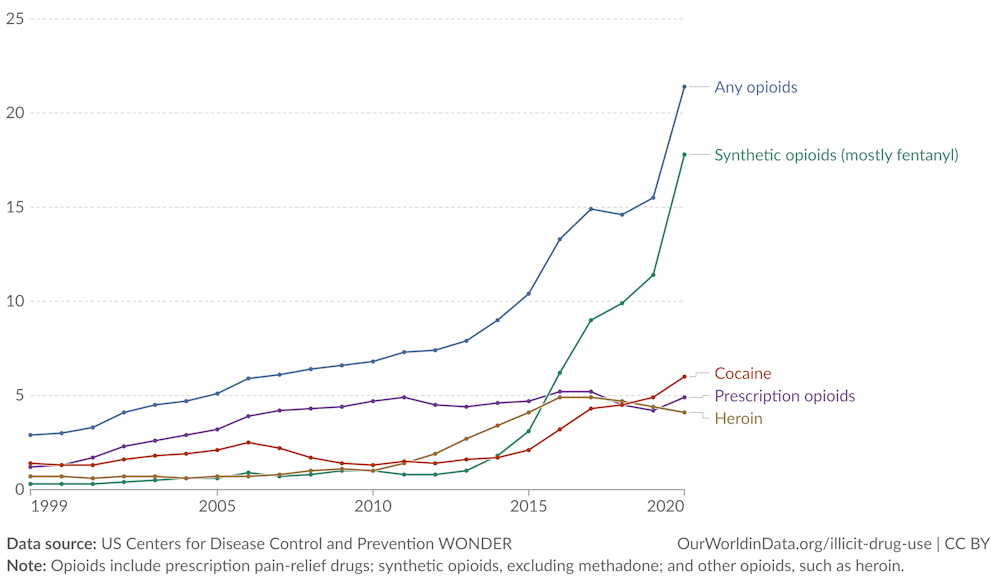
In the US, the synthetic opioids fentanyl and oxycodone have contributed to more than 100,000 fatal overdoses each year since 2021. While there are signs this deaths toll is at last beginning to fall, the harm and pain of addiction and overdose affects every strata of American society – as shown in moving portrayals of America’s opioid crisis such as Painkiller and Dopesick. Most fatalities are caused by respiratory depression where breathing is significantly slowed or stops altogether.
Official trailer for Painkiller (Netflix)
Fentanyl is an analgesic drug that is 50-100 times more potent than heroin or morphine. Where China used to be the principal manufacturer and supplier of fentanyl to the US, Mexico is now the primary source. In December 2024, Mexican authorities announced “the largest mass seizure of fentanyl pills ever made” – amounting to more than 20 million doses of fentanyl pills worth nearly US$400 million. The pills were found in Mexico’s Sinaloa state, home of the Sinaloa drug cartel and a hub of fentanyl production,
“This is what makes us rich,” one fentanyl cook recently told the New York Times. He was scathing about the idea that Donald Trump would be able to stamp out the supply of fentanyl from Mexico to the US by threatening Mexico’s government with tariffs. “Drug trafficking is the main economy here.”
However, the introduction of synthetic opioids to the US came not via organised crime but through a deliberate strategy of the pharmaceutical industry. Upon launching its prescription opioid painkiller OxyContin (a brand name for oxycodone) in 1996, Perdue Pharma, owned by the Sackler family, devised a plan to increase prescriptions of the drug by incentivizing and rewarding doctors to give these drugs to their patients. On a business level, this was a success; on a human level, it has been a disaster.
As patients quickly developed tolerance to drugs such as OxyContin, they had to take higher doses to avoid withdrawal symptoms or the positive feelings it gave them. Taking more of these opiates increases the risk of accidental overdose, many of which proved to be fatal. It has also driven those dependent on drugs to the black market, and into the hands of organised drug gangs, as they seek the drugs in greater quantities.
Dependency on fentanyl and other opioids is all-consuming. When not using these drugs, people are entirely focused on ensuring sufficient supply of the next dose. This includes funding supply which can take people to places they thought they would never be, for example breaking the law, shoplifting or getting involved in commercial sex to make enough money to buy drugs.
Synthetic opiates like OxyContin and fentanyl have proved to be classless, ageless and sex blind. The first-hand experience of addiction and fatalities have radically altered the way many Americans think about drugs and the problems they cause. Canada, too, is suffering a major crisis.
Compounding this tragedy is the failure of the state to provide interventions and treatment that could have reduced fatal and non-fatal overdoses. It is only now that evidence-based interventions are beginning to be made widely available, such as access to Naloxone – a drug that can reverse the effects of opiates and potentially save a life.
Of course, it isn’t just hospitals and health professionals that are challenged by the results of widespread use of opioids, but public services like the police and fire service. In some areas of the US, there have been so many daily overdoses that every service was called on to try and deal with it. Local mayors have made it a priority to train police and fire personnel to be trained as first responders, such is the scale of the problem.
But it is not just in North America that we see the failure of politicians and the state to act when faced with growing problems with drugs. In the UK, where record numbers are dying because of using drugs such as heroin, the government has not invested in overdose prevention strategies. At a time when fatal overdoses increase year on year, budgets for specialist treatment have been reduced. It remains to be seen what the recently elected Labour government will do, if anything, to tackle the tragic rise in drug related fatalities.
What connects both examples from the US and UK is the attitude and perception of drug use many of us have. Drug use and the heavy use of prescription painkillers is still heavily stigmatised. Many of us still view this as something individuals bring on themselves or have a choice about.
So, if we don’t care about what happens to people who develop problems with drugs, why should our elected representatives? In part, it is our bigotry that is enabling the lack of timely intervention, despite us possessing the knowledge and evidence of how drug harms can be minimised.
Latin America: breakdown of the rule of law
Under the last Conservative government, the UK Home Office asserted that people who used cocaine recreationally are supporting violence not only in the UK but in the countries that produce its raw ingredients. It’s not clear if this has made any difference to those using cocaine in the UK – personally, I doubt many people consider or are aware of how cocaine is produced or its provenance.
Perhaps if those using cocaine, mainly in western countries, realised the extent of violence and suffering that cocaine manufacture causes they might think again. Latin America has suffered enormously, with few countries there not touched in some way by the violence and breakdown of law associated with drug production and supply. According to the latest UN World Drugs Report:
Global cocaine supply reached a record high in 2022, with more than 2,700 tons of cocaine produced that year, 20% more than in the previous year … The impact of increased cocaine trafficking has been felt in Ecuador in particular, which has seen a wave of lethal violence in recent years linked to both local and transnational crime groups, most notably from Mexico and the Balkan countries.
Cocaine seizures and homicide rates increased five-fold between 2019 and 2022 in Ecuador, with the highest such rates reported in the coastal areas used for trafficking the drug to major destination markets in North America and Europe.
Cocaine trafficking flows based on reported seizures (2019-22):
As with opium production in Afghanistan, it is small-scale farmers in Colombia, Peru and Bolivia that grow the coca plant that will be turned into cocaine. Like their Afghan counterparts, they grow coca as it is more profitable than alternatives such as coffee. While it may be profitable in the short term, there are greater costs to them and their society.
Cocaine production brings with it violence as those further up the drug production chain try to control its trade. Few parts of these societies are unscathed, from bribing local politicians through to whole regions that are controlled by organised crime. Keeping control means that the use of firearms and violence increases. Against this backdrop, it is unsurprising that basic health and social services suffer.
So, while a coca grower may have more money, every other aspect of their life is negatively impacted. Whether it is regional or state institutions, both are compromised by the drug trade and those that control it. While this may not lead to the total collapse of law and order, it does create injustice and distorts the rule of law in many areas of Latin America and the Caribbean, where competition between gangs has also resulted in an increase in homicides.
The impact is on all sectors of society, now and into the future. For example, while historically the role of women has been largely underrepresented in research and drug policy, the UN report recognises that this is changing:
As women increasingly participate in economic activities, the role that women play in the drug phenomenon may become increasingly important. For example, a shift away from plant-based drug production may affect many women in rural households involved in opium poppy and coca bush cultivation.
The UN also identifies the specific risk to young people and the drugs trade, highlighting:
Long-term efforts to dismantle drug economies must provide socioeconomic opportunities and alternatives, which go beyond merely replacing illicit crops or incomes and instead address the root structural causes behind illicit crop cultivation, such as poverty, underdevelopment, and insecurity. They must also target the factors driving the recruitment of young people into the drug trade, who are at particular risk of synthetic drug use.
Meanwhile, demand for treatment in Europe due to problems with cocaine has risen significantly in recent years, since 2011 there has been an 80% increase in treatment presentations. This reflects the growing number of people using cocaine and the rise in purity of the drug.
Amid what may seem to be a story of unrelenting despair and hopelessness, there are local initiatives and even a few state-wide policies that provide optimism that change is possible.
In my roles both as clinician and scientist, I’ve often been amazed by how ingenious people can be when faced with the apparently impossible. For example, the way some people use heroin to dampen their psychotic symptoms, such as auditory and visual hallucinations – or the development of Naloxone, a drug that can temporarily reverse the effects of opioids, providing a short window for emergency services to treat people who have overdosed.
Early in my career, I witnessed the emergence of HIV in the UK in the 1980s. The speed at which this disease spread was not matched by our ability to treat it. Our response to HIV was undoubtedly hampered by prejudice and stigma towards marginalised groups in society, namely gay men and those using drugs (particularly injecting them).
However, unexpectedly and courageously, the Conservative government recognised those who were most at risk of contracting HIV, and organised a package of measures to contain the spread of infection. One part of this was a media campaign based on public health messaging designed to reduce the risk of contracting the disease. But the government also invested in treatment for those who had been infected and engaged with people at high risk, such as those intravenously injecting drugs.
I worked in specialist HIV clinics for those using drugs. At the time, methadone and diamorphine were provided as an alternative to heroin. Regulations and protocols that restricted the prescribing of these medical opioids were eased, so we could ensure patients attending these clinics were given sufficient oral and injectable opioids that they didn’t need to source street heroin.
This meant they had access to medical grade opioids and, crucially, were given regular supplies of sterile injecting equipment. It was this that reduced the risk of contracting HIV, as some people would share injecting equipment when using heroin.
This impressive policy ran counter to the Conservative party’s ideology at the time, which was to punish rather than help those using drugs like heroin. It showed me how, even with traditional mindsets, it is possible to shift policy thinking in the face of a health crisis. And make no mistake, the global drug problem is an ongoing health crisis. Today, the UN points to the risks that intravenous users of drugs still face:
An estimated 13.9 million people injected drugs in 2022, with the largest number living in North America and East and South-East Asia … The relative risk of acquiring HIV is 14 times higher for those who inject drugs than in the wider population globally.
There are, though, signs of positive change in the way some countries and regions are changing their drug policies. Scotland recently opened a drug consumption facility in Glasgow – a safe place for people to use their drugs, usually injecting drugs like heroin. Such spaces provide access to sterile injecting equipment, reducing the risk of blood-borne infections such as HIV or Hepatitis. At the same time, they offer the opportunity to engage with people who have not accessed traditional health services.
Portugal, as mentioned earlier, has made substantial changes to the way it approaches drug use and the problems associated with it. This policy shift since 2000 has saved lives and brought a more humane way of treating people who develop problems with drugs.
Contrast this with the wasted effort and resources ploughed into the war on drugs – initiated by Nixon and followed by so many western governments ever since. My plea to policymakers is simple: employ the same evidence-based science you use for health issues towards drugs and problem drug use.
Science and research can help in many ways, if given the chance. Some of it might seem radical, like providing safe drug consumption spaces. Some of it is more mundane, but vital – like tackling inequality, a clear driver of problem drug use across the world.
But while we often look to politicians to take the lead on change, it is people – us – that really hold the solution. By far the greatest threat to people and society from drugs is ignorance and bigotry. So many lives have been lost to drugs because of shame, either as a driver of drug use or a barrier to seeking help.
Beliefs are notoriously difficult to shift. As with climate change, the most powerful driver of change is personal experience. We know that when a family or community is affected by a drug overdose, their beliefs and perceptions change. But this is not the way any of us should want to see change happen.
To hear about new Insights articles, join the hundreds of thousands of people who value The Conversation’s evidence-based news. Subscribe to our newsletter.
Ian Hamilton does not work for, consult, own shares in or receive funding from any company or organisation that would benefit from this article, and has disclosed no relevant affiliations beyond their academic appointment.
The UK government’s new plan to foster innovation through artificial intelligence (AI) is ambitious. Its goals rely on the better use of public data, including renewed efforts to maximise the value of health data held by the NHS. Yet this could involve the use of real data from patients using the NHS. This has been highly controversial in the past and previous attempts to use this health data have been at times close to disastrous.
Patient data would be anonymised, but concerns remain about potential threats to this anonymity. For example, the use of health data has been accompanied by worries about access to data for commercial gain. The care.data programme, which collapsed in 2014, had an similar underlying idea: sharing health data across the country to both publicly funded research bodies and private companies.
Poor communication about the more controversial elements of this project and a failure to listen to concerns led to the programme being shelved. More recently, the involvement of the US tech company Palantir in the new NHS data platform raised questions about who can and should access data.
The new effort to use health data to train (or improve) AI models, similarly relies on public support for success. Yet perhaps unsurprisingly, within hours of this announcement, media outlets and social media users attacked the plan as a way of monetising health data. “Ministers mull allowing private firms to make profit from NHS data in AI push,” one published headline reads.
These responses, and those to care.data and Palantir, reflect just how important public trust is in the design of policy. This is true no matter how complicated technology becomes – and crucially, trust becomes more important as societies increase in scale and we’re less able to see or understand every part of the system. It can, though, be difficult, if not impossible, to make a judgement as to where we should place trust, and how to do that well. This holds true whether we are talking about governments, companies, or even just acquaintances – to trust (or not) is a decision each of us must make every day.
The challenge of trust motivates what we call the “trustworthiness recognition problem”, which highlights that determining who is worthy of our trust is something that stems from the origins of human social behaviour. The problem comes from a simple issue: anyone can claim to be trustworthy and we can lack sure ways to tell if they genuinely are.
If someone moves into a new home and sees ads for different internet providers online, there isn’t a sure way to tell which will be cheaper or more reliable. Presentation doesn’t need – and may not even often – reflect anything about a person or group’s underlying qualities. Carrying a designer handbag or wearing an expensive watch doesn’t guarantee the wearer is wealthy.
Luckily, work in anthropology, psychology and economics shows how people – and by
consequence, institutions like political bodies – can overcome this problem. This work is known as signalling theory, and explains how and why communication, or what we can call the passing of information from a signaller to a receiver, evolves even when the individuals communicating are in conflict.
For example, people moving between groups may have reasons to lie about their identities. They might want to hide something unpleasant about their own past. Or they might claim to be a relative of someone wealthy or powerful in a community. Zadie Smith’s recent book, The Fraud, is a fictionalised version of this popular theme that explores aristocratic life during Victorian England.
Yet it’s just not possible to fake some qualities. A fraud can claim to be an aristocrat, a doctor, or an AI expert. Signals that these frauds unintentionally give off will, however, give them away over time. A false aristocrat will probably not fake his demeanour or accent effectively enough (accents, among other signals, are difficult to fake to those familiar with them).
The structure of society is obviously different than that of two centuries ago, but the problem, at its core, is the same — as, we think, is the solution. Much as there are ways for a truly wealthy person to prove wealth, a trustworthy person or group must be able to show they are worth trusting. The way or ways this is possible will undoubtedly vary from context to context, but we believe that political bodies such as governments must demonstrate a willingness to listen and respond to the public about their concerns.
The care.data project, was criticised because it was publicised via leaflets dropped at people’s doors that did not contain an opt-out. This failed to signal to the public a real desire to alleviate people’s concerns that information about them would be misused or sold for profit.
The current plan around the use of data to develop AI algorithms needs to be different. Our political and scientific institutions have a duty to signal their commitment to the public by listening to them, and through doing so develop cohesive policies that minimise the risks to individuals while maximising the potential benefits for all.
The key is to place sufficient funding and effort to signal – to demonstrate – the honest motivation of engaging with the public about their concerns. The government and scientific bodies have a duty to listen to the public, and further to explain how they will protect it. Saying “trust me” is never enough: you have to show you are worth it.
Richard Milne receives funding from Wellcome under grant 220540/Z/20/A to the Wellcome Sanger Institute and the Kavli Foundation, grant G115418 to the University of Cambridge.
Jonathan R Goodman does not work for, consult, own shares in or receive funding from any company or organisation that would benefit from this article, and has disclosed no relevant affiliations beyond their academic appointment.
Visit a supermarket in 2025 and you’ll see that a tub of Lurpak butter can cost £5.70. It may strike you that this represents a staggering increase from £3.65 just three years ago, so instead of paying the premium, you reach for the supermarket’s own brand at £3.80.
This kind of switch, multiplied across millions of shopping baskets, represents a massive shift in consumer behaviour that has been largely invisible to official statistics. But that’s changing, as the UK embarks on its biggest revolution in measuring living costs since the second world war.
The Office for National Statistics (ONS) is transforming the way it tracks inflation, moving from painstakingly checking prices to analysing millions of real purchases through supermarket scanners. Consider olive oil, the price of which surged by 47% in a year, or milk, which jumped by more than 25%. While official statistics captured these price rises, they couldn’t track how households adapted – whether by switching to cheaper alternatives, buying less, or cutting back elsewhere. This was a blind spot in our understanding of consumer behaviour.
Currently, price collectors visit stores across the country each month, checking the prices of about 25,000 products. It’s like taking a snapshot of what’s on the shelves at a particular moment. But this system, designed decades ago, often misses the real impact of inflation on different household types in things like choosing different products or switching stores.
This is crucial for understanding the real impact of inflation on lower-income households. These families often have less flexibility in their budgets and must make more dramatic changes to their shopping habits when prices rise. During recent periods of high inflation, many on low incomes found that official figures didn’t match their experience, which was of even higher inflation than the headline rates. And there’s a good reason why.
Inflation statistics aren’t just academic exercises. They drive decisions that affect every aspect of our financial lives. The Bank of England uses them to set interest rates, which in turn influence mortgage payments and savings returns. Employers use them in wage negotiations. Government uses them to adjust benefits, state pensions and tax thresholds. Even commercial contracts, including mobile phone bills and rail fares, are often linked to inflation rates.
When these numbers don’t accurately reflect price pressures, it can have serious consequences. If official figures underestimate the inflation experienced by lower-income households, benefit increases might not keep pace with their actual cost increases. Similarly, if wages don’t rise in line with real living costs, workers effectively experience a pay cut.
The scanner data revolution
The ONS’s new approach, to be introduced next year, will analyse around 300 million price points from supermarket scanners, covering about half of all grocery transactions in the UK. Instead of just seeing what’s on the shelf, they’ll know exactly what prices people are paying at checkouts across the country.
This massive increase in data points – from 25,000 to 300 million – will allow for a more nuanced understanding of consumer behaviour.
The change will also enable quicker identification of emerging price trends. After the start of the COVID pandemic and the Ukraine war, prices of certain goods changed rapidly. Scanner data could help spot these changes faster, allowing for more timely policy responses. It might also reveal regional variations in price pressures.
Take the 2023 surge in food prices – while overall food inflation hit 19%, the impact varied dramatically across households. Current statistics would not capture lower-income families switching from fresh to frozen vegetables, or from branded to value ranges.
In times of cost pressures, shoppers may switch from fresh produce to frozen. sirtravelalot/Shutterstock
With scanner data, policymakers could spot these trends quickly and respond more precisely – perhaps by adjusting benefit payments or targeting support to specific households when essential food costs spike. Instead of waiting for quarterly surveys to reveal hardship, they will be able to see in real time how different groups are coping with price pressures.
The ONS recently said full implementation will come in 2026, a year later than planned. While it will have the technical capability ready by March 2025, it is opting for a year of parallel running to ensure accuracy. This approach reflects how crucial these statistics are for the economy.
It has already modernised other areas of price collection, including incorporating 40 million train fare data points and 300,000 used car prices. But grocery prices, being central to household budgets and varying significantly across different income groups, require extra attention.
The change is coming at a crucial time. Recent years have shown how rapidly economic conditions can change and how differently these changes can affect various segments of society. The pandemic, Brexit adjustments, and global supply chain disruptions have all contributed to price pressures.
For consumers, while the changes won’t directly lower prices, they could lead to more appropriate responses from the Bank of England, government and employers. Most importantly, it could ensure that official inflation figures better reflect the reality of the weekly shop, particularly during times of economic stress.
The transformation of inflation statistics might seem like a technical detail, but its implications reach far beyond government offices and economic reports. It’s about ensuring that the official measures of living costs better reflect the reality experienced by millions of households across the UK. In this challenging economic environment, that’s something worth getting right.
Marcel Lukas receives funding from the British Academy. He is the Director of Executive Education at the University of St Andrews and Fellow of the ONS. The presented views are his own and do not represent the ONS.
Source: United States Senator for Maine Angus King
WASHINGTON, D.C. — U.S. Senator Angus King (I-ME) is introducing bipartisan legislation with eight of his colleagues to fast-track and modernize prescription drug testing protocols which will in turn improve patient outcomes. The FDA Modernization Act 3.0 (FDAMA) is a bipartisan effort to reduce ineffective animal testing and expedite scientific innovation. In 2022, President Biden signed FDAMA 2.0 into law removing the longstanding requirement that investigational new drugs (INDs) undergo mandatory animal testing before human clinical trials. Instead, the law provided FDA and drug developers the option to use advanced, non-animal methods such as cell-based assays, organ chips, computer modeling, and bioprinting.
However, the FDA has yet to update its regulations leaving numerous FDA regulations that continue to require animal testing against the law. The FDA Modernization Act 3.0 seeks to resolve this by mandating the FDA to update its regulations within 12 months of the bill’s enactment. By fully implementing FDAMA 2.0, drug development can be both more humane and more efficient, ultimately leading to faster and more reliable treatments for patients. An astonishing 90-95% of drugs that pass animal tests go on to fail in human clinical trials, wasting precious time for patients.
“Maine people deserve a modern FDA that approves prescription drugs in an efficient and safe manner consistent with the law,” said Senator King. “The FDA Modernization Act 3.0 will ensure that the American people have access to more reliable treatments, with renewed confidence in their governmental agencies that have long been bogged down with red tape and bureaucratic inefficiencies. I thank my colleagues on both sides of the aisle for prioritizing people over politics in Maine, and across the country.”
In addition to King, the legislation is cosponsored by Senators Cory Booker (D-NJ), Eric Schmitt (R-MO), Rand Paul (R-KY), Sheldon Whitehouse (D-RI), John Kennedy (R-LA), Richard Blumenthal (D-CT), Ben Ray Luján (D-NM), and Roger Marshall (R-KS).
Senator King has consistently worked to increase transparency of prescriptions drugs. Last year, he introduced bicameral legislation to prohibit direct-to-consumer drug advertising of pharmaceutical drugs in the first three years after the drug receives Federal Drug Administration (FDA) approval. Additionally, Senator King has introduced legislation to prohibit pharmaceutical drug manufacturers from claiming tax deductions for consumer advertising expenses.
Portsmouth City Council’s administration has announced proposals that address immediate and unexpected financial pressures without impacting services to residents. Alongside this the plans also look to mitigate one of the largest financial pressures facing councils across the country.
Nationally councils are facing increasing demand and costs for social care services and temporary accommodation.
In Portsmouth the number of households in temporary accommodation has gone up by 54% in the last year to more than 500, while the costs have risen by 84%. This resulted in the current forecast of costs going £5.9m over budget in 2024/25, even higher than the 5.6m shortfall predicted in October 2024.
The budget proposals include investing £31m in acquiring properties to use as temporary accommodation for residents who might find themselves in situations where they have been made homeless. This would reduce the current need to rely on less suitable but costly privately-rented accommodation, with an expectation this will start to ease the existing budget pressure this year and significantly improve the position over the following two years.
Cllr Steve Pitt, Leader of Portsmouth City Council, said:
“It is good news for the city that we’re able to put forward a budget that addresses the immediate financial pressures without reducing services that people rely on.
However, there are funding problems nationally with social care and temporary accommodation that need to be solved. As insufficient government support is coming forward we want to take the proactive steps we can to address these issues and provide better solutions for our residents. The revenue budget savings need to come from £191m of council spending and will take the council’s total savings made in the last 14 years to £110m.
“Last year it was forecast we would need to save £1m in this budget, these spending pressures doubled that and we need to stop that happening in future years. By investing in our own temporary accommodation stock we can save the council tens of millions of pounds in the next decade.”
In addition to the longer-term view the council’s administration is proposing £2m of savings to its revenue budget, which will be met through efficiencies and generating extra income without seeing any significant reduction in services to the public.
The proposals also include raising council tax in line with government’s expectation of 4.99%, 2% of which will go specifically towards funding adult social care. In total the council tax increase would raise £5.1m for the council and see the average Portsmouth home’s (band B) council tax bill increase by the equivalent of £1.29 per week.
Cllr Pitt added:
“We are always mindful of the impact of the decision to increase council tax and don’t take the decision lightly, but the funding government gives us is based on the assumption we will increase council tax by 4.99%, and it still isn’t enough to pay for everything we need. Councils relying on significant use of reserves to balance budgets are increasingly finding themselves in severe financial distress and here in Portsmouth we will not allow that to happen. The only alternative to raising council tax, is to reduce services that people rely on and doing that would hurt our residents even more, especially those who rely on them the most.”
The council will be receiving additional income from renting out new business spaces while there will be increases of 10p or 20p an hour to parking charges in certain locations, in line with existing policy. This follows a freeze on parking charges last year, meaning it is a below inflation increase over the two-year period.
The proposals also include investment in regeneration and economic development, such as future development of the city centre. Funding has been allocated to develop options for regenerating Guildhall Square and finding a more efficient solution to the current Civic Offices building, alongside continued financial support for the City Centre North project, which will deliver new housing, leisure and retail space to the area.
The budget proposals will be considered at the council’s Cabinet meeting on 11 February and if accepted will then go to the Full Council meeting on 25 February for approval.
EVANSVILLE— James Henley, 35, of Greenwood, Indiana, has been sentenced to ten years in federal prison, followed by three years of supervised release after pleading guilty to aggravated identity theft, conspiracy to commit access device fraud, two counts of money laundering, and eight counts of wire fraud. Henley has also been ordered to pay $1,887,426.63 in restitution.
According to court documents, over the course of three years, Henley orchestrated multiple large and complex fraud schemes, resulting in a total loss of $2,927,758.95 to individual homeowners, an Indiana attorney, a bank, and ten state governments. As part of his fraud schemes, Henley registered five fake businesses (OnTrack Real Estate Solutions, LDI Investments Corp, Lucario Investments, 317 Traffic, and Henley Real Estate Solutions) with the states of Indiana and Kentucky, claiming to serve as the Chief Executive Officer for most of them. None of the businesses were legitimate. Instead, Henley used the businesses to mask his identity, make his schemes appear more credible, and launder the stolen money.
Henley’s schemes are broken down as follows:
COVID-19 Fraud:
Between May 2020 and March 2021, James Henley, his wife Jameka Henley, and his associate Jimmie Bickers used the stolen personally identifiable information of 76 real individuals to submit 120 unemployment insurance applications to ten states during the COVID-19 pandemic. Once the applications were approved, the trio used 65 unemployment insurance debit cards to make purchases at retailers and withdraw cash at ATMs in the Evansville and Indianapolis areas. The states paid a total of $1,119,426.63 in unemployment benefits in connection with the group’s fraudulent applications. In July 2020, Henley used funds withdrawn from ATMs to buy a Chevrolet Camaro for $22,801.
Bickers and Jameka Henley have been formally charged for their roles in this scheme but have not pleaded guilty.
Home Title Fraud:
Between December 2021 and May 2023, Henley stole five homes in Indianapolis by filing fraudulent deeds with the Marion County Recorder’s Office. Through the filings, Henley claimed that the homeowners had sold their homes to his fake businesses, but, in reality, he had never even spoken with the homeowners. Unbeknownst to the victims, Henley filed these fraudulent deeds and then sold the homes for significantly less than their market value, pocketing more than $260,000 in profits.
Henley also attempted to steal and sell an additional 14 homes in Indianapolis and Evansville. With one exception, the individuals who bought the homes from Henley took possession and ultimately kept the homes.
For one homeowner, the property Henley stole was her childhood home. She purchased the home while her mother was in the hospital with the hope that, when her mother’s condition improved, her mother would be able to live out her remaining years in the house.
Mortgage Fraud:
In November 2021, an associate of Henley’s purchased a home in Indianapolis, using a mortgage loan from a bank. In April 2022, Henley filed a fraudulent document with the Marion County Recorder’s Office to make it seem as if the mortgage loan had been paid off, when it had not been paid. Henley then filed a deed naming himself a joint owner of the home. Henley and his associate subsequently sold the property for $255,000, pocketing all the proceeds, even though the bank should have received the majority of the funds.
Auto Loan Fraud:
In March 2023, Henley purchased a Dodge Durango in Indianapolis for $71,479, using an auto loan from Everwise Credit Union. A few months later, in June 2023, Henley purchased a Chevrolet Silverado in Plainfield for $54,270, using a second loan from Everwise Credit Union.
In October 2023, Henley connected a JPMorgan Chase bank account to his auto loans, via Everwise’s online payment portal. Henley falsely represented that the Chase account belonged to Jimmie Bickers, and that he had authority to make payments on his loans using funds from the Chase account.
The Chase account was actually an Indiana attorney’s Interest on Lawyers’ Trust Account (IOLTA), which is a highly regulated bank account used by lawyers to hold client funds. The interest earned on IOLTA accounts is used to fund grants for nonprofit groups that promote pro bono and access to justice programs. Henley did not have the attorney’s permission to access or withdraw funds from the IOLTA account.
Between October and November 2023, Henley used the IOLTA account to make two payments, totaling $98,000, toward his auto loans.
Henley has prior felony convictions for financial crimes, including theft, forgery, and fraud.
“James Henley went to great lengths to coordinate exceptionally greedy, complex schemes that exploited hard-working families and state government programs,” said John E. Childress, Acting U.S. Attorney for the Southern District of Indiana. “Undeterred by prior felony convictions for the same conduct, this defendant stole over a million dollars, wreaking financial and logistical havoc on hundreds of victims. The Department of Justice will continue to work with our law enforcement partners to investigate allegations of fraud and seek prosecution as appropriate.”
“James Henley filed fraudulent unemployment insurance (UI) claims in the names of identity theft victims in order to receive UI benefits to which he was not entitled. He enriched himself by defrauding a program that was intended to assist struggling American workers during an unprecedented global pandemic,” said Megan Howell, Acting Special Agent-in-Charge, Great Lakes Region, U.S. Department of Labor, Office of Inspector General. “We and our law enforcement partners are committed to protecting the integrity of the UI system from those who seek to exploit this critical benefit program.”
“This lengthy prison sentence sends a clear message: individuals who attempt to exploit and commit financial crime and identity theft will be brought to justice,” said Ramsey E. Covington, Acting Special Agent in Charge, IRS Criminal Investigation, Chicago Field Office. “IRS Criminal Investigation and our fellow law enforcement partners are committed to protecting the integrity of our financial institutions and will continue to hold criminals like James Henley accountable to the fullest extent of the law.”
“This case should serve as a powerful reminder that individuals with a history of financial crimes will face significant consequences when they demonstrate a blatant disregard for the law and continue to exploit and deceive others for personal gain,” said FBI Indianapolis Special Agent in Charge Herbert J. Stapleton. “The FBI, working alongside our law enforcement partners, will continue to hold those who perpetuate such offenses accountable and protect the public from those who manipulate the system for their own benefit.”
The Federal Bureau of Investigation, Internal Revenue Service-Criminal Investigation, Department of Labor-Office of the Inspector General, and the Indiana Attorney General’s Office Homeowner Protection Unit investigated this case. The sentence was imposed by U.S. District Judge Matthew B. Brookman.
Acting U.S. Attorney Childress thanked Assistant U.S. Attorney Matthew Miller, who prosecuted this case.
On May 17, 2021, the Attorney General established the COVID‑19 Fraud Enforcement Task Force to marshal the resources of the Department of Justice in partnership with agencies across government to enhance efforts to combat and prevent pandemic-related fraud. The Task Force bolsters efforts to investigate and prosecute the most culpable domestic and international criminal actors and assists agencies tasked with administering relief programs to prevent fraud by augmenting and incorporating existing coordination mechanisms, identifying resources and techniques to uncover fraudulent actors and their schemes, and sharing and harnessing information and insights gained from prior enforcement efforts.
Anyone with information about allegations of attempted fraud involving COVID‑19 can report it by calling the Department of Justice’s National Center for Disaster Fraud (NCDF) Hotline at 866-720-5721 or via the NCDF Web Complaint Form at https://www.justice.gov/disaster-fraud/ncdf-disaster-complaint-form
An official website of the United States government
Here’s how you know
Official websites use .gov A .gov website belongs to an official government organization in the United States.
Secure .gov websites use HTTPS A lock ( ) or https:// means you’ve safely connected to the .gov website. Share sensitive information only on official, secure websites.
WASHINGTON — The Department of Veterans Affairs today announced its return to in-person work policy, which states eligible employees must work full-time at their respective duty stations (agency worksites) unless excused due to a disability, qualifying medical condition or other compelling reason.
The announcement follows President Trump’s Jan. 20, presidential memorandum on return to in-person work.
More than 20% of VA’s more than 479,000 employees currently have telework or remote work arrangements. As part of the new policy:
Political appointees, senior executive service members, SES equivalents, senior level and scientific and professional employees will no longer be eligible for remote work arrangements. By Feb. 24, 2025, their telework agreements will be terminated, except for ad hoc or situational telework.
Also, by Feb. 24, 2025, remote work and telework arrangements for supervisors with current official duty stations within 50 miles of an agency facility will be terminated, except for ad hoc or situational telework.
By April 28, 2025, remote work and telework arrangements for non-bargaining unit employees with current official duty stations within 50 miles of an agency facility will be terminated, except for ad hoc or situational telework.
Remote work and telework arrangements for supervisors and non-bargaining unit employees with current official duty stations outside 50 miles of an agency facility will not be terminated at this time. Further guidance will be forthcoming regarding these arrangements.
Return to in person work requirements for bargaining unit employees will be announced at a later date.
VA’s policy allows exceptions for arrangements approved for employees as a reasonable accommodation due to a disability or a qualifying medical condition. Exceptions may also be allowed for military spouses with permanent change of station orders.
“This is a commonsense step toward treating all VA employees equally,” said Acting VA Secretary Todd Hunter. “Most VA clinical staff don’t have the luxury of working remotely, and we believe the performance, collaboration and productivity of the department will improve if all VA employees are held to the same standard.”
Reporters and media outlets with questions or comments should contact the Office of Media Relations at vapublicaffairs@va.gov
Veterans with questions about their health care and benefits (including GI Bill). Questions, updates and documents can be submitted online.
Contact us online through Ask VA
Veterans can also use our chatbot to get information about VA benefits and services. The chatbot won’t connect you with a person, but it can show you where to go on VA.gov to find answers to some common questions.
Learn about our chatbot and ask a question
Subscribe today to receive these news releases in your inbox.
Jefferson City — Today, Governor Mike Kehoe ordered U.S. and Missouri flags be flown at half-staff at government buildings in Pettis and Saline counties, the Fire Fighters Memorial of Missouri in Kingdom City, and firehouses statewide on Tuesday, February 4, 2025, from sunrise to sunset in honor of West Central Missouri Fire Protection District of Saline and Pettis Counties Captain Christopher Mykel Clevenger.
“Christopher Clevenger felt a calling to public service early in life, joining the West Central Missouri Fire Protection District of Saline and Pettis Counties as a volunteer firefighter when he was just 18 years old,” Governor Mike Kehoe said. “As he established a career, raised a family, and coached youth sports, volunteering in the fire service and protecting the public remained an essential part of his life. Claudia and I are deeply saddened by his passing at just 33 years of age. Captain Clevenger’s commitment to serving others will be a lasting part of his legacy.”
Captain Clevenger died of a medical emergency on January 26, 2025, after responding to an emergency call as a member of the West Central Missouri Fire Protection District of Saline and Pettis Counties the previous afternoon.
The flags will be held at half-staff on the day of Clevenger’s interment. To view the Governor’s proclamation, click here.
Headline: NCDHHS Program Celebrates 25 Years of Promoting Healthy Smiles for Young Children
NCDHHS Program Celebrates 25 Years of Promoting Healthy Smiles for Young Children hejones1
The North Carolina Department of Health and Human Services is celebrating the 25th anniversary of the Into the Mouths of Babes program, a partnership that delivers preventive oral health services to young children insured by NC Medicaid. Since 2000, this program has helped medical providers across the state give infants and toddlers early dental evaluations, preventive oral health care and other dental services that lay the foundation for good health.
“Tooth decay is the most common chronic disease in children,” said Dr. Patrick Roberson, DDS, North Carolina State Dental Director. “This program provides vital oral health services for children who need it most and connects medical and dental care to improve outcomes.”
Into the Mouths of Babes was originally piloted in nine western North Carolina counties as the “Smart Smiles” program in the mid-1990’s. In 2001, the program expanded statewide and established a reimbursement package through NC Medicaid.
“Since Into the Mouths of Babes began, more than 2.8 million claims have been submitted for preventive oral health services,” said Dr. Mark Casey, DDS, MPH, Dental Officer for NC Medicaid. “This is the finest example of a cost-effective preventive oral health care program at work.”
Early oral health evaluations provided through Into the Mouths of Babes allow medical providers to identify issues before they become serious, ensuring families can get help early. Additionally, caregiver education provided by the program gives families the tools they need to support healthy habits for life.
“Our rural pediatric practice has provided fluoride treatments to infants and toddlers for over 15 years,” said Dr. Marston Crawford, MD, FAAP, pediatrician for Coastal Children’s Clinic. “These treatments, combined with caregiver discussion about early oral health, have sharply reduced cavities and preventable dental surgery. The majority of our children enter kindergarten cavity-free.”
Training and community outreach are key to the program’s long-term success. NCDHHS employs 20 public health dental hygienists in 10 regions across the state who provide training for Into the Mouths of Babes. The American Academy of Family Physicians also provides continuing medical education hours to physicians who attend an NCDHHS training session.
Key program partners include NC Medicaid, the NCDHHS Division of Public Health’s Oral Health Section, UNC Adams School of Dentistry, UNC Gillings School of Global Public Health, the North Carolina Pediatric Society and the North Carolina Academy of Family Physicians among others.
“The NC Academy of Family Physicians is proud to support this program,” said Gregory Griggs, Executive Vice President of the Academy. “It has made a huge difference in reducing tooth decay for children across North Carolina.”
For more information on the program, including partnerships and the online toolkit, visit the Into the Mouths of Babes webpage.
El Departamento de Salud y Servicios Humanos de Carolina del Norte celebra el 25 aniversario del programaInto the Mouth of Babes, una colaboración que brinda servicios preventivos de salud oral a niños pequeños asegurados por NC Medicaid. Desde el año 2000, este programa ha ayudado a los proveedores médicos de todo el estado a brindar evaluaciones dentales tempranas a bebés y niños pequeños, atención preventiva de la salud oral y otros servicios dentales que sientan las bases para una buena salud.
“La caries dental es la enfermedad crónica más común en los niños”, dijo Dr. Patrick Roberson, DDS, Director Dental del Estado de Carolina del Norte. “Este programa proporciona servicios vitales de salud oral para los niños que más lo necesitan y conecta la atención médica y dental para mejorar los objetivos”.
Into the Mouths of Babes se había iniciado originalmente en nueve condados del oeste de Carolina del Norte como el programa “Smart Smiles” a mediados de la década de 1990. En 2001, el programa se expandió por todo el estado y estableció un paquete de reembolso a través de NC Medicaid.
“Desde que comenzó Into the Mouth of Babes, se han presentado más de 2,8 millones de solicitudes de servicios preventivos de salud oral”, dijo la Dra. Mark Casey, DDS, MPH, Oficial Dental de NC Medicaid. “Este es el mejor ejemplo de un programa de costo económico de atención preventiva de la salud oral que funciona”.
Las evaluaciones tempranas de salud oral proporcionadas a través de Into the Mouth of Babes permiten a los proveedores médicos identificar los problemas antes de que se agraven, asegurando que las familias puedan obtener ayuda temprano. Además, la educación para los cuidadores proporcionada por el programa brinda a las familias las herramientas que necesitan para mantener hábitos saludables de por vida.
“Nuestra práctica pediátrica rural ha proporcionado tratamientos con flúor a bebés y niños pequeños durante más de 15 años”, dijo el Dr. Marston Crawford, MD, FAAP, pediatra de Coastal Children’s Clinic. “Estos tratamientos, combinados con la charla con los cuidadores sobre la salud oral en los primeros años de edad, han reducido drásticamente las caries e intervenciones quirúrgicas dentales menores. La mayoría de nuestros niños entran al jardín de infantes sin caries”.
La capacitación y el alcance comunitario son clave para el éxito a largo plazo del programa. El Departamento de Salud y Servicios Humanos de Carolina del Norte, (NCDHHS, por sus siglas en inglés), emplea a 20 higienistas dentales de salud pública en diez regiones de todo el estado quienes proporcionan formación para Into the Mouth of Babes. La Academia Estadounidense de Médicos de Familia también ofrece horas de educación médica continua a los médicos que asisten a una sesión de capacitación del NCDHHS.
Los socios clave del programa incluyen NC Medicaid, la Sección de Salud Oral de la División de Salud Pública de NCDHHS, la Escuela de Odontología UNC Adams, la Escuela de Salud Pública Global UNC Gillings, la Sociedad Pediátrica de Carolina del Norte y la Academia de Médicos de Familia de Carolina del Norte, entre otros.
“La Academia de Médicos de Familia de Carolina del Norte se enorgullece de apoyar este programa”, dijo Gregory Griggs, Vicepresidente Ejecutivo de la Academia. “Ha marcado una gran diferencia en la reducción de la caries dental en los niños de Carolina del Norte”.
Para obtener más información sobre el programa, incluidas las colaboraciones y el kit de herramientas en línea, visite la página web deInto the Mouths of Babes.
(HARTFORD, CT) – Governor Ned Lamont today announced that the state budget proposal he will present to the Connecticut General Assembly later this week will include an increase in funding for towns and cities to provide special education services for students with disabilities, as well as the creation of a new program that incentivizes municipalities to provide special education programming to students in-district or on a regional basis.
“Over the last several years, special education services have been one of the largest cost drivers for school districts due to the increase in the number of students eligible for special education services and the rapid increase in the cost of those services, particularly for students outplaced in approved special education programs,” Governor Lamont said. “I know that special ed is a major expense when developing town and city budgets and can be unpredictable from year to year. This increased investment supports our municipalities and supports students with special needs.”
For fiscal year 2027, the governor is recommending to the legislature that the Excess Cost Grant, which subsidizes high-cost placements for students with the greatest needs, be increased by an additional $40 million.
Additionally, the governor is asking the legislature to establish the High-Quality Special Education Incentive Grant program. Administered by the Connecticut State Department of Education, this competitive grant program will increase the capacity of school districts to provide high-quality special education programming in-district and regionally, reducing reliance on out-of-district placements and meeting students’ needs as identified by their Individual Education Program in the least restrictive environment. For fiscal year 2027, the governor is proposing to allocate $10 million from the General Fund and $4 million in bond funds to support it.
The State Department of Education is also currently undergoing a study to analyze other states’ annual special education rate-setting for providers of special education services, including placements in out-of-district programs, which could result in additional recommendations by the department. Initiated by Education Commissioner Charlene M. Russell-Tucker, this initiative aims to address the financial unpredictability associated with these specialized services and help districts better manage their budgets.
“By incentivizing districts to provide high-quality special education services right within their communities through new and innovative partnerships, by devoting additional funding to the Excess Cost Grant, and by addressing special education tuition costs, this proposal will directly tackle the rising costs of special education services,” Commissioner Russell-Tucker said. “It will assist our schools in building stronger educational opportunities for the 91,847 students who are receiving special education services across Connecticut.”
Governor Lamont is scheduled to deliver his annual budget address to a joint session of the General Assembly on Wednesday, February 5, 2025. Documents containing the full details of his biennial budget proposal and other legislative proposals will be filed on that date.
Governor Kathy Hochul today announced $20.7 million to support SNUG Street Outreach programs that work to reduce gun violence and save lives in 14 communities across New York State. These grants to community-based organizations and hospitals fund outreach workers, hospital responders, social workers and case managers who are credible messengers and work with individuals at risk of gun violence, connecting them with support and services to change behavior and increase opportunities. Last week, Governor Hochul announced that shooting incidents with injury reported in communities participating in the State’s Gun Involved Violence initiative reached record lows in 2024 with 588 incidents reported compared to 817 in 2023, a 28 percent reduction. The Governor’s FY26 Executive Budget continues unprecedented support for SNUG, Gun Involved Violence and other initiatives in communities that report 90 percent of violent crimes with firearms and 85 percent of violent crimes outside of New York City.
“Public safety is my number one priority — that’s why my Budget invests in proven initiatives like the SNUG program to drive down gun violence, save lives and keep New Yorkers safe,” Governor Hochul said. “Outreach teams across the State are working alongside law enforcement and local partners to target gun violence anywhere it occurs, and to engage stakeholders in a comprehensive approach that makes our communities safer for all.”
New York State’s SNUG program uses a public health approach to address gun violence by identifying the source, interrupting transmission and treating individuals, families and communities affected by the violence. Administered by the state Division of Criminal Justice Services, SNUG, Gun Involved Violence (GIVE) initiative, the State’s nationally recognized Crime Analysis Centers Network and Project RISE (Respond, Invest, Sustain, Empower) are key components of Governor Hochul’s comprehensive plan to address the causes and consequences of gun violence and other crimes.
New York State Division of Criminal Justice Services Commissioner Rossana Rosado said, “Our SNUG Street Outreach teams are a critical component of Governor Hochul’s comprehensive crime reduction and public safety plan. These dedicated individuals work in communities disproportionately affected by gun violence. They mediate and defuse conflicts and provide access to programs and support, including counseling and case management, so youth and families can thrive, and communities can heal. We thank Governor Hochul for her continued support of this work and for her leadership on public safety.”
The $20.7 million will fund staff, programs, services, equipment and technology for the SNUG locations during the 2025 calendar year. Community-based organizations and hospitals receive the funding, which supports 181 full-time and 39 part-time employees who work in specific neighborhoods in Albany, the Bronx, Buffalo, Hempstead, Mt. Vernon, Newburgh, Niagara Falls, Poughkeepsie, Syracuse, Rochester, Troy, Utica, Wyandanch and Yonkers. DCJS tracks shooting data in these “SNUG zones” and last year, those zones collectively reported significant, double-digit decreases in shooting victims, individuals killed by gun violence and shooting incidents with injury when compared to 2023.
SNUG outreach workers, social workers, case managers and hospital responders work in neighborhoods disproportionately affected by gun violence, and the program also embeds social workers and hospital responders at Level One trauma centers in Albany, Buffalo, the Bronx, Rochester and Syracuse. These professionals work with individuals and families in the aftermath of a violent incident to offer support, services and connect them to the SNUG program in their communities for additional assistance.
SNUG staff are credible messengers who live in the communities in which they work, and some have been involved with the criminal justice system or lost loved ones to violence. They work with teens and young adults to detect and defuse disputes before they escalate; respond to shootings to prevent retaliation through mediation and assist family members of those who have been injured or killed; and mentor youth involved with the program to set goals and connect them with educational and job opportunities as well as other services. The programs also engage the community, religious organizations and clergy, and local businesses by sponsoring anti-violence marches, job fairs, block parties, sporting events and other community gatherings.
The following organizations and hospitals will receive funding and support from DCJS to administer SNUG:
New York City and Long Island
Bronx – Jacobi Medical Center: $2,702,617
Hempstead – Family and Children’s Association: $1,164,397
Wyandanch – Economic Opportunity Council of Suffolk: $746,522
Hudson Valley
Mt. Vernon – Family Services of Westchester: $1,088,391
Newburgh – Regional Economic Community Action Plan: $896,799
Poughkeepsie – Family Services Inc.: $1,076,245
Yonkers – Yonkers YMCA: $1,010,259
Capital Region
Albany – Trinity Alliance of the Capital Region: $1,820,329 and Albany Medical Center: $262,310
Troy – Trinity Alliance of the Capital Region: $860,134
Central New York
Syracuse – Syracuse Model Neighborhood Facility: $1,820,189 and SUNY Upstate Medical Center: $464,374
Mohawk Valley
Utica – Integrated Community Alternatives Network: $792,673
Finger Lakes
Rochester – PathStone Corp.: $1,949,426 and Rochester General Hospital: $571,002
Western New York
Buffalo – Erie County Medical Center: $2,800,915
Niagara Falls – Community Missions of Niagara Frontier: $ 677,170
Comprehensive training, site visits and support from DCJS set SNUG apart from other community-based violence interruption programs across the state and country. New staff must complete 40 hours of training and new supervisors complete 32 hours of management training. All staff must also complete 40 hours of professional development training annually. This ongoing training and support help ensure that the program operates consistently across all SNUG sites despite being operated by different community-based organizations and hospitals.
State Senate Majority Leader Andrea Stewart-Cousins said, “As a State Senator, I was proud to advocate for the first SNUG investments in Yonkers and New York State because I knew that real community-driven solutions were key to reducing gun violence and keeping our neighborhoods safe. We’ve seen firsthand how SNUG has changed lives—interrupting cycles of violence, providing critical support, and helping young people find a better path. I’m so proud that Yonkers is receiving more than $1 million in new funding to support this lifesaving program. As Majority Leader, I remain committed to continuing smart, effective investments like SNUG across Westchester and New York. I thank Governor Hochul, my Westchester Delegation and Majority Senators, as well as our partners in the Assembly for their continued leadership and partnership in the fight against gun violence. I look forward to building on this progress together to keep our communities safe.”
State Senator Jamaal Bailey said, “Investing $20.7 million in SNUG to enhance efforts such as preventing gun violence, supporting at-risk individuals, and strengthening communities across New York State is essential. SNUG has been a pivotal partner in preventing gun violence and an organization that has significantly impacted my district, and will continue to do so as Mt. Vernon – Family Services of Westchester is receiving $1,088,391. By funding outreach workers, social workers, and hospital responders, future conflicts can de-escalate and create safer neighborhoods and brighter futures for all of us. Thank you to Governor Hochul for your leadership and prioritizing the safety of our community.”
State Senator Nathalia Fernandez said, “This funding for SNUG, is about more than just intervention—it’s about changing the conditions that lead to violence in the first place. Jacobi Hospital’s Standing Up to Violence program has done just that in its years in service. By supporting credible messengers, outreach workers, and trauma responders, we’re making sure the right people are in place to mediate conflicts, connect at-risk individuals with opportunities, and prevent the next tragedy before it happens. I commend Governor Hochul for investing in real solutions, because every neighborhood, every family, every child in the Bronx deserves to grow up safe from gun violence.”
State Senator Samra G. Brouk said, “Every member of our community deserves to feel safe, wherever they may be. Over $20 million dollars in funding to reduce gun violence across New York State will build upon the tremendous impact that programs such as GIVE have already had on communities like Rochester. I applaud Governor Hochul for addressing the root causes of violence and supporting working solutions to protect our fellow New Yorkers.”
State Senator Sean Ryan said, “Promoting public safety in Buffalo and across our state is a top priority. It’s why we have passed the toughest gun safety laws in the nation and continue to fund initiatives that reduce crime and strengthen communities. I am thankful for Governor Hochul’s support for these outreach programs, which have a proven track record of reducing gun violence.”
State Senator Monica Martinez said, “Gun violence is taking the lives of New Yorkers and instilling fear within our communities. The SNUG Street Outreach program is a proven tool that preempts these devastating tragedies by engaging at-risk individuals and providing them with the support needed to choose a different path. Thank you, Governor Hochul, for enshrining our shared commitment to ending gun violence in New York State in this year’s executive budget.”
State Senator Patricia Fahy said, “Investing in evidence-based programming and on-the-ground resources is exactly how we combat the scourge of gun violence. Partnering with law enforcement, community-based interrupters in cycles of violence like the Trinity Alliance of the Capital Region and increasing the state’s commitment to funding these initiatives is why we’re seeing gun violence rates drop in communities across the state. Thank you to Governor Hochul and my legislative colleagues for continuing to work to ensure that New Yorkers everywhere feel safe on our streets, and to ending the epidemic of gun violence here in New York State.”
State Senator Siela Bynoe said, “The epidemic of gun violence that has taken the lives of too many people across Long Island, and the nation, must end. Addressing the root causes of gun violence through programs that offer outreach where it’s most needed, is both necessary and impactful. I am grateful for Governor Hochul’s support of community-based solutions in the district.”
State Senator Joseph Griffo said, “It is imperative that we continue to look for ways to address and reduce gun violence in the state. This funding will strengthen the SNUG program in Utica by supporting a variety of important services and resources that will enhance public safety in the city and region.”
State Senator Rachel May said, “The state has demonstrated real progress in reducing gun violence rates, and this is our opportunity to continue that success. By increasing funding for the Syracuse Model Neighborhood Facility and SUNY Upstate Medical Center, we can make a meaningful impact on our communities where the scourge of gun violence is widespread. Thank you to Governor Hochul for her leadership, as well as to my colleagues in the legislature for their commitment to curb gun violence in New York State.”
Assembly Majority Leader Crystal Peoples-Stokes said, “We know that outreach works. When people in the community are supporting efforts to combat gun violence, lives get saved. I support the GIVE Initiative and other anti-violence initiatives as well as the work SNUG continues to do in our communities. The Response Teams at Erie County Medical Center continue to be top of the line.”
Assemblymember J. Gary Pretlow said, “As we continue to combat gun violence in our communities, investing in programs like SNUG is not just necessary—it’s life-saving. This funding from Governor Hochul ensures that we can provide resources, mentorship, and intervention to those most at risk, creating safer neighborhoods for everyone. I am proud to support SNUG and the dedicated individuals working tirelessly to break the cycle of violence in Mount Vernon and beyond.”
Assemblymember William B. Magnarelli said, “Reducing gun violence is a priority in protecting our communities. By working with organizations in the community, together we can reinforce safety measures and prevention methods to decrease gun violence.”
Assemblymember John T. McDonald III said, “As one of the original supporters of SNUG which started here in the Capital Region, I have worked closely with Trinity Alliance and those who are part of SNUG and have seen the positive impact of the program. That is why I am appreciative of the Governor’s support to continue to grow the program, including in the City of Troy where the program has taken roots and is welcomed by the public safety team. The data validates the critical need and impact of the program which is making our communities safer.”
Assemblymember Pamela J. Hunter said, “I am grateful for Governor Hochul’s leadership and commitment to reducing gun violence in our communities. The $20.7 million investment in SNUG Street Outreach programs, including critical funding for Syracuse Model Neighborhood Facility and SUNY Upstate Medical Center, will have a direct and positive impact on the lives of people in the 128th Assembly District. By supporting outreach workers, hospital responders, and case managers, this initiative provides life-changing resources to those most at risk, helping to break cycles of violence and create safer neighborhoods. I look forward to seeing the continued progress of these evidence-based efforts to protect and uplift our communities.”
Assemblymember Jonathan Jacobson said, “Unfortunately, gun violence plagues the cities of Newburgh and Poughkeepsie as it does too many areas of the State and the Nation. Gun violence must be addressed in three ways: ending gun trafficking from outside of New York State; enforcing our gun laws including full application of our red flags laws; and engaging the community through community-based organizations to discourage and stop gun violence before it starts. I wish to applaud Governor Hochul for her commitment to stopping gun violence using all three avenues and for the investment in this year’s budget in anti-gun violence initiatives with community-based organizations.”
Assemblymember Marianne Buttenschon said, “We unfortunately continue to see our youth negatively impacted by gun violence and this program works to reduce the violence. I appreciate the Governor providing additional funding to SNUG Programs.”
Assemblymember Demond Meeks said, “Community-based programs like SNUG and GIVE are making a real difference in the fight against gun violence. By focusing on mediation, mentorship, and support, they’re helping to change behaviors and address the root causes of this complex issue. The data is clear: these programs are strengthening our neighborhoods and saving lives. I commend Governor Hochul for her ongoing commitment to investing in these vital resources that directly support communities disproportionately impacted by crime.”
Assemblymember Jen Lunsford said, “Tangible investments in grassroots organizations working to stop gun violence in our community have paid dividends over the past year. We can see crime trending down in nearly every gun-related category thanks to this kind of targeted delivery of resources. This announcement from the Governor of large scale funding for gun violence prevention will help us continue to reduce violence and bring peace and stability to our neighborhoods.”
Assemblymember John Zaccaro, Jr. said, “Far too many families in the Bronx and across our communities in New York have felt the devastating effects of gun violence. The SNUG program will strengthen intervention efforts and connect at-risk individuals with critical resources. By addressing the root causes of violence and providing meaningful intervention, we are not only preventing tragedies but also creating pathways to brighter futures for individuals and families. I thank Governor Hochul for her leadership and commitment to investing in proven violence prevention programs that make a tangible difference in the lives of New Yorkers.”
Assemblymember Kwani B. O’Pharrow said, “Investing in community outreach and support programs like SNUG is crucial for reducing gun violence and fostering safer environments. Thank you, Governor Hochul, for your commitment to transforming lives and creating lasting change in our communities.”
Assemblymember Gabriella Romero said, “With a partner like Governor Kathy Hochul investing in our communities that need it most, we are making real strides in reducing gun violence and saving lives. I want to thank the Governor for her continued commitment to evidence-based, community-driven solutions like SNUG. This $20.7 million investment—including over $2 million for Albany’s Trinity Alliance and Albany Medical Center—will ensure that outreach workers, hospital responders, and social service professionals can continue their critical work to proactively reduce gun violence. These initiatives are making a difference, and I remain committed to securing the resources Albany needs to keep our neighborhoods safe.”
Assemblymember Noah Burroughs said, “SNUG has been doing excellent work in the community within my district. Gun-related crimes are down and we would like to see those numbers decrease more. This is a great opportunity for the 14 communities in New York State that Snug services to continue doing good work throughout all of its communities. Thank you Governor Hochul for this investment in Hempstead.”
Assemblymember Harry Bronson said, “SNUG Street Outreach is impactful because it empowers community-based organizations to leverage their existing relationships and partnerships to reduce gun violence in the areas where they serve. Since implementing SNUG, Rochester has seen a significant and marked decrease in violence, at all levels. But we still have work to do. The funding the Governor is providing to Rochester General Hospital and Pathstone will enable them to bring on the staff, programming and services they need to expand this successful public safety initiative.”
Erie County Executive Mark C. Poloncarz said, “Investing in SNUG programs helps to build safer communities and reduce gun violence. This grant award will help provide the ongoing training and support that is critical to SNUG and I thank Governor Hochul for her partnership in helping to keep our citizens safe.”
Albany Mayor Kathy Sheehan said, “I want to thank and applaud Governor Kathy Hochul and DCJS for their continued investments for SNUG & GIVE initiatives. I have said it many times before, that this Governor isn’t just talk, but action. The investments in these programs allow cities like Albany to wisely make strategic choices to get resources on the ground, establish connections with our neighbors and allow alternative approaches to focusing on public safety. Just this week at my State of the City we highlighted a reduction of crime of 3% compared to the 5-year average & a reduction of 21% since I assumed office. Today’s announcement of an additional $2 million dollars to keep these programs going is something celebrated by every resident in the City of Albany. Thank you Governor!”
Buffalo Mayor Chris Scanlon said, “I want to thank Governor Hochul for her continued investment in violence prevention efforts here in Buffalo. The $2.8 million awarded to Erie County Medical Center for the SNUG Street Outreach program will provide critical resources to community organizations and trauma responders who work tirelessly to prevent gun violence and save lives. In recent years, we’ve seen firsthand how these initiatives make a real difference in our neighborhoods and this funding will allow us to continue that progress—connecting at-risk individuals with the support they need and ensuring a safer, healthier, stronger Buffalo for all.”
Syracuse Mayor Ben Walsh said, “With New York State’s strong support, teamwork with community partners and effective intervention by Syracuse Police, gun violence is down significantly in the City of Syracuse. In 2024, gun violence dropped more than 26% across all of the major categories and the most serious violence – shooting victims injured or deceased dropped 39%. This funding for outreach programs shows Governor Hochul knows reducing gun violence requires the full community working together which is the focus of our Mayor’s Office to Reduce Gun Violence. I’m deeply grateful for the Governor’s help and for the caring and effective work the SNUG Street Outreach team does every day in Syracuse.”
Rochester Mayor Malik D. Evans said, “Governor Hochul’s leadership and continued investments in programs like GIVE and Project RISE have played a major role in helping us reduce gun violence in Rochester by more than 50 percent from the peak years of the pandemic. This investment in SNUG outreach workers is yet another example of her commitment and resolve on this critical issue and the city of Rochester is fortunate for the governor’s partnership.”
Niagara Falls Mayor Robert Restaino said, “We appreciate the continued investment by Governor Hochul in programs that help keep our communities safe. We know that our community benefits from the various initiatives advanced by the Governor. These additional resources will help continue our efforts to keep our City safe.”
Poughkeepsie Mayor Yvonne D. Flowers said, “Governor Hochul continues to deliver for the City of Poughkeepsie, and we are grateful for her commitment to our community. Investing in vital outreach programs like SNUG strengthens our city by expanding our ability to engage and support our youth, guiding them toward positive opportunities. With the TRAC Program no longer in operation, I encourage Family Services Inc. and SNUG to use this funding to develop additional gun violence prevention initiatives and create safe spaces for our children after school. Congratulations to SNUG and I look forward to collaborating with them as we work together to unite our community in the fight against gun violence.”
Utica Mayor Michael Galime said, “To truly be proactive with the issues of Gun Violence we must make sure to approach it from every angle. Good policing will always be at the forefront but additional resources like SNUG are essential to providing additional boots on the ground to raise awareness and prevention. In Utica we are grateful for this funding and will continue to support SNUG however possible.”
Newburgh Mayor Torrance Harvey said, “A huge thank you goes out to Governor Hochul for allocating more funds for anti-violence initiatives in the city of Newburgh! This funding is a significant step toward fostering safer communities and reducing violence. Thank you again, Governor Hochul, for your commitment to making Newburgh a safer place!”
Hempstead Mayor Waylyn Hobbs, Jr. said, “Thank you Governor Hochul for supporting our village through programs such as SNUG that have successful results in our community.”
Troy Mayor Carmella Mantello said, “I commend Governor Hochul for her continued investment in SNUG and the critical work of violence prevention programs across New York State. In Troy, we have seen firsthand the positive impact of SNUG in engaging our communities, de-escalating conflicts, and providing essential support to those at risk. This funding will help strengthen these efforts and help make our neighborhoods safer.”
The Division of Criminal Justice Services provides critical support to all facets of the state’s criminal justice system, including, but not limited to: training law enforcement and other criminal justice professionals; overseeing a law enforcement accreditation program; ensuring Breathalyzer and speed enforcement equipment used by local law enforcement operate correctly; managing criminal justice grant funding; analyzing statewide crime and program data; providing research support; overseeing county probation departments and alternatives to incarceration programs; and coordinating youth justice policy. Follow DCJS on Facebook, Instagram, LinkedIn and X (formerly Twitter).
Source: United States Senator for Illinois Dick Durbin
January 31, 2025
CHICAGO – U.S. Senate Democratic Whip Dick Durbin (D-IL), Ranking Member of the Senate Judiciary Committee, today released the following statement after the Trump Administration reportedly purged multiple Justice Department and FBI officials involved in Donald Trump’s prosecution and the prosecution of January 6 rioters:
“The Trump Administration’s purge of dozens of DOJ and FBI officials involved in investigating Donald Trump and the January 6 rioters is a major blow to the FBI and Justice Department’s integrity and effectiveness. This is a brazen assault on the rule of law that also severely undermines our national security and public safety. Unelected Trump lackeys are carrying out widespread political retribution against our nation’s career law enforcement officials. President Trump would rather have the FBI and DOJ full of blind admirers and loyalists than experienced law enforcement officers.”
Source: United States Senator for Illinois Dick Durbin
January 31, 2025
CHICAGO – U.S. Senate Democratic Whip Dick Durbin (D-IL) today visited El Valor Cantu Children & Family Center in Little Village to meet with staff members and families impacted by recent overreaching executive orders from the Trump Administration.
El Valor serves more than 4,000 children, adults with disabilities, and their families annually. Durbin met with leadership staff at the center to discuss the recently announced federal grant funding freeze, the impact of U.S. Immigration and Customs Enforcement (ICE) actions, and other executive orders from the administration, and their effects on the El Valor community.
“Earlier this week,President Trump threw America into chaos when he abruptly announced a freeze on trillions of dollars in federal grants and loans that so many Americans depend on, including at Head Start centers like El Valor,” said Durbin. “This, along with continued threats of ICE action in our city, has deeply impacted communities here in Chicago. I was grateful to meet with staff at El Valor to hear their concerns, and I’ll continue working to ensure Chicagoans are safe and receiving the services and funding they deserve.”
“We thank Senator Durbin and Clerk Valencia for visiting our program, allowing them to see and hear firsthand from our families about the impact of our services. A funding pause affects not only our program but many others like it, making it harder for working families to provide for their loved ones. We greatly appreciate our civic leaders for hearing our concerns and advocating for our community as we navigate challenges from the current administration,” said El Valor President & CEO Rey B. Gonzalez.
“It’s important for all of us to see the direct impact the impulsive decisions the Trump Administration is making has on our communities. I’m grateful to Senator Durbin for coming to sit with our children, families and communities to hear directly from those who suffer the consequences when those who are supposed to lead choose politics over people. Thank you to everyone at El Valor for continuing to show up and serve, uplifting our neighbors by doing the work,” said Chicago City Clerk Anna Valencia.
El Valor offers dual language instruction, mental health services, and parental support, and 70 percent of its funding comes from federal sources—with Head Start funding making up the majority. This week, Head Start grantees across the state were frozen out of the payment management system that allows them to collect reimbursements and pay staff and rent. Some Head Start centers in Illinois had to send employees home for the day and shutter doors because they could not make payroll.
This week, Durbin spoke on the Senate floor about the impact this federal funding freeze is already having, reading messages from impacted constituents who rely on federal funding to support critical programs and medical research.
Last month, as Chair of the Senate Judiciary Committee, Durbin held a Senate Judiciary Committee hearing entitled “How Mass Deportations Will Separate American Families, Harm Our Armed Forces, and Devastate Our Economy.” The hearing examined the consequences of mass deportations, as well as stressed the need to shift congressional efforts toward sensible solutions that bring order to the border and provide a path to citizenship to longtime residents with no serious criminal convictions.
Source: United Kingdom – Executive Government & Departments
The Government has announced the appointment of three non-executive directors to the Board of the UK Statistics Authority.
The Authority’s statutory objective is to promote and safeguard the production and publication of official statistics that serve the public good.
The three appointees are:
Peter Barron, who is a Northern-Irish communications expert with senior experience in consumer technology and public affairs. He spent more than 20 years working in television news and current affairs at the BBC, ITV, and Channel 4, before working in external relations at Google from 2008 to 2018, and then at Stripe from 2021 to 2023. Peter holds a BSc in European Studies and Modern Languages from the University of Manchester (UMIST) and is a trustee of the Disasters Emergency Committee and the Quentin Blake Centre for Illustration.
Professor Mairi Spowage, who is Director of the Fraser of Allander Institute, Scotland’s leading economic research institute at the University of Strathclyde. Mairi leads research on modelling economic impact, economic measurement, regional economic and trade performance and public sector finances. Mairi has previously held roles as the Deputy Chief Executive of the Scottish Fiscal Commission and Head of National Accounts at the Scottish Government, with almost 20 years of experience of working in statistics and analysis, including transport, household surveys and performance measurement.
Dr Sarah Walsh, a risk and governance specialist who is currently advising clients in different sectors. Sarah has 20 years’ generalist experience, including Risk Director roles at Telegraph Media Group, Guardian Media Group, Save the Children and Imperial College London. Presently, she serves as a non-executive director at the Royal College of Nursing Publishing, including membership of the Royal College of Nursing’s Audit Committee and Equity, Diversity and Inclusion Committee. She also serves as independent non-executive member of the Audit and Risk Committees for Science Museum Group, St John’s Ambulance and the Royal Institute of Chartered Surveyors. Sarah holds a Master’s degree in Astronautics and Space Engineering from Cranfield University, and a PhD in Aerodynamics from the University of Manchester.
Appointments to the Board of the UK Statistics Authority are regulated. These appointments were made by Rt Hon Nick Thomas–Symonds MP, Minister for Cabinet Office. The advisory assessment panel was: Sir Robert Chote, Chair, UKSA (Chair of the panel); Steffan Jones, Director, Joint Data and Analysis Centre, Cabinet Office and Zarin Patel, Non Executive Director, HM Treasury.
Appointees began their roles at the end of January 2025.
Saskatchewan is investing a total of $3.8 million to 16 agencies over the next two years under the National Action Plan to End Gender-based Violence.
The investment will provide for enhanced programs, supports and tools in Saskatchewan communities. The funding includes money to build capacity in transition homes and second stage housing facilities, providing learning resources on healthy relationships to Saskatchewan residents, support enhanced early intervention for families at risk of violence, and develop additional tools to ensure appropriate responses to survivors and perpetrators of interpersonal violence.
“The funding and programming we are announcing today are a critical part of our ongoing work under the National Action Plan to End Gender-based Violence, and align strongly with the recommendations contained in the recently released Domestic Violence Death Review,” Justice Minister and Attorney General Tim McLeod said. “I am grateful to all our partner organizations for collaborating with us on this, and the work they do across Saskatchewan to address and prevent gender-based violence.”
“Saskatchewan’s implementation of the National Action Plan to End Gender-based Violence is focused on prevention, awareness, and building supports for survivors and their loved ones,” Minister Responsible for the Status of Women Alana Ross said. “Our government remains committed to preventing interpersonal violence and abuse in all forms.”
This funding will be provided to the following community-based partners and agencies to develop tools which can be used for outreach, programming and advocacy.
Natural Supports Program ($635,000): Saskatchewan Toward Offering Partnership Solutions to Violence;
Enhanced Early Intervention Supports ($1,100,000): Collaboration between Family Service Regina Inc. and Family Service Saskatoon;
Healthy Relationships Program ($513,000): The John Howard Society;
Adverse Childhood Experiences Awareness and Prevention ($485,000): Praxis Consulting Inc.;
Common Intimate Partner Violence Assessment Tool ($300,000): Provincial Association of Transition Houses and Services of Saskatchewan Inc. (PATHS); and
Human Trafficking Prevention Toolkit ($297,000): Saskatoon Downtown Youth Centre (EGADZ).
Second Stage Housing Capacity ($215,000):
Lloydminster Interval Home Society Inc. ($40,000);
Prince Albert Safe Shelter for Women Inc. ($40,000);
Sofia House Inc. ($40,000);
YWCA Regina Inc. ($38,855);
YWCA Saskatoon Inc. ($36,000); and
Saskatoon Interval House Inc. ($20,000).
Transition Home Capacity ($214,000):
Lloydminster Interval Home Society ($40,000);
Regina Transition House ($40,000);
YWCA Regina Inc. ($39,644);
YWCA Prince Albert Inc. ($39,000);
Moose Jaw Women’s Transition Association Inc. ($35,000);
Saskatoon Interval House Inc. ($20,000); and
Safe and Together Training ($42,000): PATHS.
Additional information about these programs is available in the attached backgrounder.
“The National Action Plan was developed with significant input from survivors, academics and community organizations including PATHS,” PATHS Regina Jo-Anne Dusel said. “The projects currently underway address root causes of violence, provide early intervention and promote the use of common language and tools to determine and manage risk. PATHS is privileged to be working with partners to develop a way for professionals across sectors to speak the same language, effectively identify and manage risk, and where possible, share risk information to reduce the incidence and impact of intimate partner and family violence in our communities. The National Action Plan is a collaboration between the provinces, territories and the federal government which included significant engagement with multiple stakeholder groups, including Saskatchewan Indigenous organizations.”
Under the plan, the federal government is providing a total of $539.3 million over four years in cost-sharing agreements with provinces and territories to implement the National Action Plan to End Gender-Based Violence.
This year, the Government of Saskatchewan is dedicating a total of $31.7 million to community-based partners that facilitate interpersonal violence programs and services. This includes the $14.2 million per year being provided to community-based partners, annualized funding for second-stage shelters and additional funding for Victims Services and other important supports.