Category: Politics

  • MIL-OSI Global: 2024 US presidential election: can we believe the polls?

    Source: The Conversation – France – By Jérôme Viala-Gaudefroy, Spécialiste de la politique américaine, Auteurs historiques The Conversation France

    Nationwide polls are often of limited relevance, considering the unique structure of the US electoral system. To gain a better understanding of the upcoming presidential election, we need to focus on surveys conducted in the pivotal battlegrounds – the so-called swing states. After the missteps in previous elections, it’s hard to place too much confidence in these polls, as many rely on unrepresentative samples.


    As we head toward the 2024 US presidential election, media large and small frequently fall into the trap of “horse race” journalism. Policy questions are rarely treated in depth, and the emphasis is often on the latest polls. One week they announce Kamala Harris as moving ahead, and the next, Donald Trump still has an edge. But how reliable are these polls?

    In the United States, rather than being elected by direct popular vote, the president is chosen indirectly through the Electoral College, an institution inscribed in the country’s constitution. Each state is assigned a number of electors based in part on its population, but also on its number of senators. As a result, smaller states get a larger voice than their population would indicate.

    One of the implications is that national election polls can be deceiving. In most states with established partisan majorities, the outcomes are predictable due to the winner-takes-all approach. This system awards all of a state’s electoral votes to the candidate who wins the popular vote in that state (with the exception of Maine and Nebraska, which use a proportional system). As a result, the most relevant polls are those conducted in “swing states”, where neither party holds a consistent advantage.

    According to recent analyses, around ten states are expected to be in play for 2024. Based on recent trends, there are seven swing states to watch: Nevada, Arizona, Wisconsin, Michigan, Pennsylvania, North Carolina, and Georgia. In the 2016 and 2020 elections, victory margins in these states were razor-thin, often less than 1%.

    With both Harris and Trump within striking distance of the 270 Electoral College votes needed to win the presidency, these swing states, with a combined 91 votes, will determine the outcome.
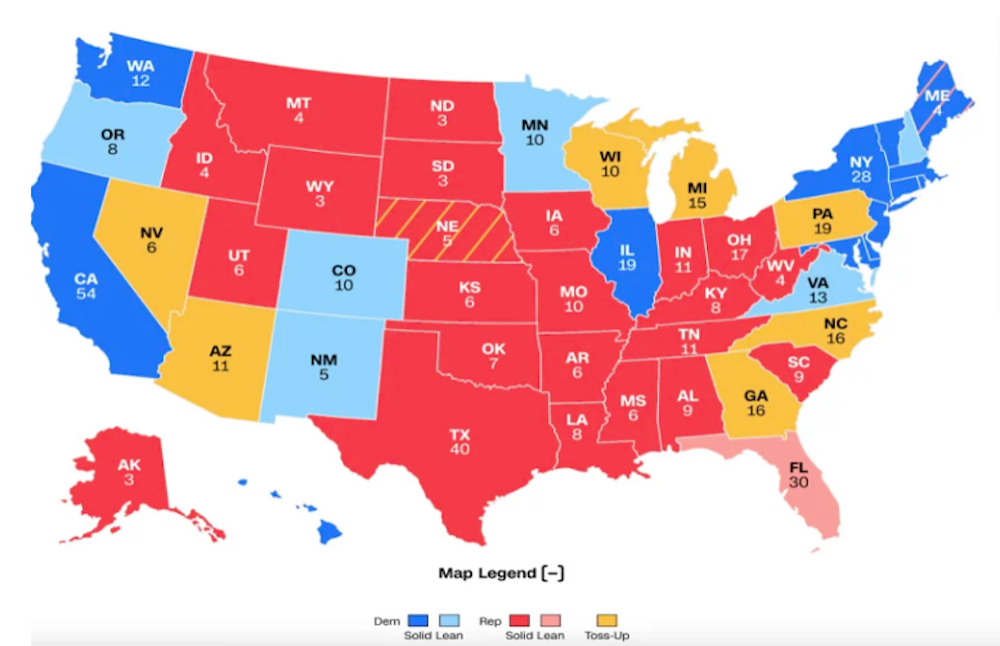
    Map published on 18 August 2024 by CNN. The number of electors for each state are show. The colors indicate the states that appear to be strongly (dark blue) or probably (light blue) leaning toward Kamala Harris, and strongly (red) or probably (pink) leaning toward Donald Trump. In yellow are the seven pivotal states where victory is likely to come down to a small number of votes. Click to zoom.

    The 2016 and 2020 polling failures: flukes or systemic issues?

    When the margins are so tight in these key states, accurately measuring voter intentions is an enormous challenge. In 2016, national polls correctly predicted Hillary Clinton’s popular-vote win – she had nearly 3 million more than Trump. However, they failed to foresee Trump’s Electorial College victories in critical states, which ultimately put him over the top.

    The American Association for Public Opinion Research (AAPOR) pointed out several reasons for these errors, including underrepresentation of Republican voters, over-representation of college-educated voters (who tend to lean Democratic), and an underestimation of undecided voters who eventually voted for Trump or third-party candidates.

    Despite efforts to fix these problems, other biases showed up in 2020. While graduate voters were not over-represented and undecideds were evenly split between Biden and Trump, the Covid-19 pandemic had made the pollsters’ task more complicated. AAPOR points out that the states with a higher proportion of Covid-19 cases were the ones with the highest polling errors. As a result, pollsters underestimated Trump’s vote share in key swing states and also overestimated Biden’s national lead, making the 2020 polls the least accurate in 40 years.

    Proportion of polling errors in presidential elections since 1936. Click to zoom.
    Pew Reseach Center

    Despite these errors, Biden still triumphed, winning 4 percent more of the popular vote and taking home 306 electoral votes to Trump’s 232. Biden’s victories in the swing states of Arizona, Georgia, Michigan, Nevada, Pennsylvania, and Wisconsin make all the difference.

    Polling errors and public distrust

    Errors of this magnitude naturally increase the public’s scepticism of polling, especially among Republicans, who are already wary of establishment institutions. Contrary to initial assumptions, Trump voters didn’t hesitate to express their preferences in 2016 and 2020. However, they were less likely to participate in polls due in part to their distrust of mainstream institutions. As a result, working-class white voters – and their opinions – were underrepresented in many polls.

    Pollsters also face technical challenges. Getting a respondent on the phone now requires calling hundreds of people, thanks to caller ID and call screening. Polls with smaller samples (fewer than 1,000 respondents) are less reliable. To deal with these hurdles, many pollsters are now using a mix of methods, including e-mail, online surveys, and robocalls.

    Though cheaper, online surveys often draw voluntary participants who are compensated, which leads to issues of accuracy and representation. This growing reliance on online polling has contributed to a doubling of polling companies from 2000 to 2022, according to Pew Research Center.

    Margin of error and identifying “likely” voters

    The margin of error is a critical component of polling that is often misunderstood by the public and media. It typically falls between 3 and 4 percentage points, but for smaller demographic groups (for example, young people, white men, or Hispanics), it can be even higher. Media headlines, however, frequently imply a candidate is leading, even when the difference is within the margin of error. University of California, Berkeley researchers suggest that to ensure 95% accuracy, the margin of error should be closer to 6%.

    However, the media sometimes amplify results, particularly in headlines, by implying that a candidate is ahead, even when the difference is within the margin of error. Moreover, researchers at the University of Berkeley have shown that to guarantee 95% accuracy, this margin should be increased to at least 6%. This means a candidate projected to receive 54% of the vote is likely, in reality, to secure anywhere between 48% and 60%, reflecting an actual margin of error of 12 percentage points.

    Another significant challenge for pollsters is identifying likely voters. Only around two-thirds of citizens eligible to vote actually go to the polls. In 2016, turnout on the Democratic side was overestimated, giving the false impression that Clinton was a lock for victory. This likely caused some of her supporters to stay home, while Trump’s base showed up in force when polls suggested he was behind. Accurately predicting who will turn out to vote is crucial to polling accuracy.

    Lessons from the 2022 midterms: A glimmer of hope for 2024?

    Polling showed notable improvements during the 2022 midterm elections, with the results being the most accurate since 1998. Importantly, there was no significant bias toward either party. However, midterm elections operate differently than presidential elections, and the dynamics for 2024 may be very different. That said, many polling institutions have adapted since 2016: as of 2022, 61% of polling firms had changed their methods, such as refining sampling techniques and improving question wording. More than a third have changed their methods after 2020.

    While these changes are positive, challenges remain, especially in predicting turnout and combating low response rates.

    What good are polls, then?

    At the end of the day, election polls offer snapshots – often imprecise – and can only provide general trends. Polling methods vary across firms, introducing biases that make it difficult to compare results.

    Survey aggregators offer averages that might be more reliable than individual polls, but they still come with a degree of uncertainty. This is true for FiveThirtyEight, the well-known website founded by statistics guru Nate Silver. After ABC took over in 2023, Silver left, taking his forecasting model with him to his new platform, Silver Bulletin, which continues to attract significant media attention.

    With the unpredictability of polls, political betting markets have become popular as polling alternatives. Platforms like Polymarket, which recently hired Silver, have multiplied rapidly. Some people, like Elon Musk, argue that markets provide better forecasts than traditional polls, though this claim is unproven. There are also concerns that these markets could be manipulated to sway public opinion.

    While opinion polls aren’t the best tools for predicting elections – as this could be one of the closest in recent history – their value lies in gauging public opinion on key issues. However, even in this role, polls can still be biased, often influenced by how questions are phrased.

    For example, in 2019 USA Today ran the headline “Poll: Half of Americans say Trump is victim of a ‘witch hunt’ as trust in Mueller erodes”. This was in reference to Special Counsel Robert Mueller’s investigation into Russian interference in the 2016 election. The question asked by the poll was:

    “President Trump has called the special counsel’s investigation a ‘witch hunt’ and said he has been investigated more than previous presidents for political reasons. Do you agree?”

    The problem with this wording is that it combined two different ideas: whether the investigation was a “witch hunt” and whether Trump had been unfairly targeted for political reasons. On top of that, the question lacked neutrality, presenting only his perspective.

    Naturally, Trump used the result to his advantage, even though other polls from sources such as The Washington Post, CBS News, and NPR-PBS told a different story.

    To use polling data wisely during this election, it’s crucial to recognize these limitations and pay attention to the fine print – details like the sample size, polling date, margin of error, and methodology. Additionally, consider the poll’s sponsors, who may only release results that align with their particular agenda.

    Ultimately, the best way to interpret polling data is with caution, focusing on general trends rather than any single poll. And always remember, election outcomes can be full of surprises.

    Jérôme Viala-Gaudefroy ne travaille pas, ne conseille pas, ne possède pas de parts, ne reçoit pas de fonds d’une organisation qui pourrait tirer profit de cet article, et n’a déclaré aucune autre affiliation que son organisme de recherche.

    ref. 2024 US presidential election: can we believe the polls? – https://theconversation.com/2024-us-presidential-election-can-we-believe-the-polls-240834

    MIL OSI – Global Reports

  • MIL-OSI Russia: Yuri Trutnev: The second All-Russian long-range shooting tournament in memory of Hero of the Soviet Union Fyodor Okhlopkov has ended in Yakutsk

    MILES AXLE Translation. Region: Russian Federation –

    Source: Government of the Russian Federation – An important disclaimer is at the bottom of this article.

    Previous news Next news

    Yuri Trutnev with the winners of the second All-Russian long-range shooting tournament dedicated to the memory of Hero of the Soviet Union Fyodor Okhlopkov

    On October 13, the winners of the second All-Russian Long-Range Shooting Tournament dedicated to the memory of Hero of the Soviet Union Fyodor Okhlopkov were determined in Yakutsk. The closing ceremony of the competition was held by Deputy Chairman of the Government of the Russian Federation – Plenipotentiary Representative of the President of the Russian Federation in the Far Eastern Federal District, Chief Judge of the tournament Yuri Trutnev, Head of the Republic of Sakha (Yakutia) Aisen Nikolaev and Hero of Russia, Guards Major, Deputy Chief Judge Yaroslav Yakubov. The total prize fund of the tournament was 18 million rubles.

    Over the course of two days, more than 140 shooters from different regions of the country, including participants in the special military operation, competed in night and day shooting. Among those who went to the firing line were active military personnel, employees of law enforcement agencies and special forces, as well as civilian shooting enthusiasts.

    “Next year we celebrate the 80th anniversary of the Great Victory of the Soviet people in the Great Patriotic War. The tournament we are holding is directly related to this anniversary. The competition is held in honor of the memory of Hero of the Soviet Union Fyodor Matveyevich Okhlopkov. And those who are now standing on the site, put on camouflage not only at the tournaments. We will do everything possible to make the competition interesting, objective and fair, so that through your work and joint efforts our country becomes stronger. I am sure that we need to continue this work. We have chosen a good place: Yakutia – a republic with good traditions of sniper skill. Competition creates opportunities to grow and move forward. Thanks to this tournament, among other things, more high-class shooters will be trained in our country, young guys will become interested in military-sports training, which means the level of sniper skill will grow and our Motherland will become stronger,” said Yuri Trutnev.

    “I think the tournament was a success. Many more people came than the first time. The organizing committee headed by Yuri Petrovich Trutnev did a tremendous job to ensure that the best shooters of our country met at the competition. But there is no limit to perfection, we are already starting to prepare for the next tournaments, we will make every effort to ensure that they are held at an even higher level. The results that the participants of these competitions showed, despite the weather, indicate that our Yakutia and all of Russia have traditions of great ancestors, which are continued by their descendants,” noted Aisen Nikolaev.

    The third place in the “Night” stage of the tournament was taken by a sniper with the call sign Kolpachok and a spotter with the call sign Vokha. The second place in the “Night” stage went to the pair Hunter and Creed. The first place in the “Night” stage was won by the pair with the call signs Brat and Kos.

    The third place in the Day stage was won by the sniper pair with the call signs Agron and Yurich. The second place in the Day stage was taken by Nagirny and Bocharov. The first place in the Day stage was awarded to the shooters with the call signs Kolpachok and Vokha.

    The third place winners of both stages were awarded high-precision rifles “Arkuda” of the domestic manufacturer. The second place winners were presented with the keys to the new all-terrain vehicle “Sokol” of the manufacturing plant “Yakt-Sokol” – a resident of the TOR “Patrioticheskaya”. The winners of the competitions received off-road pickup trucks.

    Yuri Trutnev presented a high-precision Raptor rifle from the domestic brand Bespoke Gun. “This prize will go to the 155th separate guards marine brigade of the Pacific Fleet. We have met with the commanders and fighters of this brigade on the line of combat contact many times. I am proud of the fighters and their commanders. I hope that they have many victories ahead and, most importantly, a common victory,” said the Deputy Prime Minister.

    Following the two stages, special prizes were awarded from the Combat Sniping Federation and manufacturers of weapons and equipment: Lobaev Arms, ORSIS, Russian Solid, Dedal-NV and others.

    Please note: This information is raw content directly from the source of the information. It is exactly what the source states and does not reflect the position of MIL-OSI or its clients.

    Please note; This information is raw content directly from the information source. It is accurate to what the source is stating and does not reflect the position of MIL-OSI or its clients.

    http://government.ru/nevs/52985/

    MIL OSI Russia News

  • MIL-OSI USA: NASA Welcomes Estonia as Newest Artemis Accords Signatory

    Source: NASA

    While in Milan for international meetings, NASA Administrator Bill Nelson was among the witnesses as Estonia signed the Artemis Accords and became the 45th nation to join the United States and other signatories agreeing to the safe, transparent, and responsible exploration of the Moon, Mars, and beyond.
    The signing ceremony took place ahead of Italy hosting the 75th International Astronautical Congress beginning Monday, Oct. 14, where government and space officials from signatory countries will discuss advancing implementation of the Artemis Accords, among other topics.
    “We welcome Estonia’s signing of the Artemis Accords, which will open the door for more international collaboration,” said Nelson. “This decision also strengthens our family of nations, united by a common cause, and builds on our commitment to explore space for the benefit of humanity under the sound principles of the accords.”
    Erkki Keldo, Estonia’s minister of economy and industry, signed the Artemis Accords. Rahima Kandahari, deputy assistant secretary for the U.S. State Department and Lisa Campbell, CSA (Canadian Space Agency) president, also participated in the event.
    “Estonia is well known as the leading country in e-governance, and it is a great honor for us to enter a next level in space exploration, said Keldo. “We are more than interested to share our knowledge with the global space community to make future collaboration in space exploration a success for humankind. I am sure that joining the Artemis Accords will open attractive opportunities to Estonian enterprises too, to share their valuable knowledge and competences.”
    In 2020, the United States and seven other nations were the first to sign the Artemis Accords, which identified an early set of principles promoting the beneficial use of space for humanity. The accords are grounded in the Outer Space Treaty and other agreements including the Registration Convention, the Rescue and Return Agreement, as well as best practices and norms of responsible behavior that NASA and its partners have supported, including the public release of scientific data. 
    The commitments of the Artemis Accords and efforts by the signatories to advance implementation of these principles support the safe and sustainable exploration of space. More countries are expected to sign in the coming weeks and months.
    Learn more about the Artemis Accords at:
    https://www.nasa.gov/artemis-accords
    -end-
    Meira Bernstein / Elizabeth ShawHeadquarters, Washington202-358-1600meira.b.bernstein@nasa.gov / elizabeth.a.shaw@nasa.gov

    MIL OSI USA News

  • MIL-OSI Canada: Prime Minister announces new Lieutenant Governor of Nova Scotia

    Source: Government of Canada – Prime Minister

    The Prime Minister, Justin Trudeau, today announced the appointment of Mike Savage as the new Lieutenant Governor of Nova Scotia.

    Mike Savage is a respected former parliamentarian, mayor, and business leader with a lifelong commitment to serving the people of Nova Scotia. He was the Member of Parliament for Dartmouth—Cole Harbour for seven years and the Mayor of Halifax Regional Municipality for 12 years. Throughout his career, he has been a champion for social inclusion and disability rights, economic growth and affordability, and climate change action and mitigation.

    The Prime Minister thanks the outgoing Lieutenant Governor, the Honourable Arthur J. LeBlanc, for his service to the people of Nova Scotia and to Canada.

    Quote

    “I congratulate Mike Savage on his appointment as the new Lieutenant Governor of Nova Scotia. He is a passionate public servant and an experienced leader, and I am confident that he will continue to serve Nova Scotians well and make important contributions in his new role.”

    Quick Facts

    • Lieutenant Governors are the personal representatives of His Majesty The King of Canada in their respective provinces. They fulfill the roles and functions of the Crown, including granting Royal Assent to provincial laws.
    • Lieutenant Governors are appointed by the Governor General of Canada on the recommendation of the Prime Minister. They serve terms of at least five years.

    Biographical Note

    Associated Link

    MIL OSI Canada News

  • MIL-Evening Report: 30 years ago, Tarantino’s Pulp Fiction shook Hollywood and redefined ‘cool’ cinema

    Source: The Conversation (Au and NZ) – By Ben McCann, Associate Professor of French Studies, University of Adelaide

    IMDB

    What might be the most seismic moment in American cinema? Film “speaking” for the first time in The Jazz Singer? Dorothy entering the Land of Oz? That menacing shark that in 1975 invented the summer blockbuster?

    Or how about that moment when two hitmen on their way to a job began talking about the intricacies of European fast food while listening to Kool & The Gang?

    Directed by Quentin Tarantino, Pulp Fiction (1994) celebrates its 30th birthday this month. Watching it now, this story of a motley crew of mobsters, drug dealers and lowlifes in sunny Los Angeles still feels startlingly new.

    Widely regarded as Tarantino’s masterpiece, the director’s dazzling second film was considered era-defining for its memorable dialogue, innovative narrative structure and unique blend of humour and violence. It was nominated for seven Academy Awards, made stars of Samuel L. Jackson and Uma Thurman, and revitalised John Travolta’s career.

    Pulp Fiction is dark, often poignant, and very funny. It is, as one critic describes it, an “intravenous jab of callous madness, black comedy and strange unwholesome euphoria”.

    Tarantino’s trademark style includes plenty of violence and gore.
    IMDB

    A Möbius strip plot

    Famous for its non-linear narrative, Pulp Fiction weaves together a trio of connected crime stories. The three chapters – Vincent Vega and Marsellus Wallace’s Wife, The Gold Watch and The Bonnie Situation – loop, twist and intersect but, crucially, never confuse the viewer.

    Tarantino has often paid tribute to French filmmakers Jean-Luc Godard and Jean-Pierre Melville, whose earlier films also presented their narratives out of chronological order and modified the rules of the crime genre.

    By inviting audiences to piece Pulp Fiction together like a puzzle, Tarantino laid the way for subsequent achronological films such as Memento (2000), Go (1999) and Lock, Stock and Two Smoking Barrels (1998).

    Pop culture meets postmodernism

    In his influential essay Postmodernism, or the Cultural Logic of Late Capitalism, first published in 1984, political theorist Frederic Jameson coined the term “new depthlessness” to describe postmodern culture.

    Jameson perceived a shift away from the depth, meaning and authenticity that characterised earlier forms of culture, towards a focus on surface and style.

    Pulp Fiction’s iconic movie poster shows character Mia Wallace (Uma Thurman) smoking a cigarette.
    IMDB

    Pulp Fiction fits Jameson’s definition of depthlessness. It is stuffed with homages to popular culture and a vivid array of character types drawn from other B-movies – hitmen, molls, mob bosses, double-crossing boxers, traumatised war veterans and tuxedo-wearing “fixers”. It is a film of surfaces and allusions.

    Jackson, Travolta and Thurman feature alongside established 1990s box-office stars including Bruce Willis and industry stalwarts Harvey Keitel and Christopher Walken, both of whom have brief but memorable cameos.

    The film’s most iconic scene takes place at the retro 1950s-themed Jack Rabbit Slim’s diner. Thurman’s twist contest with Travolta fondly echoes Travolta’s earlier dancing in Saturday Night Fever (1977) and pays homage to other dance scenes in films such as 8 ½ (1963) and Band of Outsiders (1964).

    Words and music

    Film critic Roger Ebert once noted how Tarantino’s characters “often speak at right angles to the action”, giving long speeches before getting on with the job at hand.

    Pulp Fiction is full of witty and quotable monologues and dialogue, ranging from the philosophical to the mundane. Conversations about foot massages and blueberry pie bump up against Bible verses and reflections on fate and redemption.

    The film’s 1995 Oscar for Best Original Screenplay was a fitting achievement for Tarantino, who many regard as the snappiest writer in film history. Countless other filmmakers have looked to replicate Pulp Fiction’s mashup of cool and coarse.

    Needle drops are just as important in establishing Pulp Fiction’s mood and tone. The film’s eclectic soundtrack pings between surf rock, soul and classic rock ‘n’ roll.

    The soundtrack peaked at No. 21 on the Billboard 200 in 1994 and stayed in the charts for more than a year.

    Dividing the critics

    Though it was officially released in October 1994, Pulp Fiction had already made a stir earlier that by winning the prestigious Palme d’Or at the Cannes Film Festival.

    Many expected Krzysztof Kieślowski’s Three Colours: Red to take the top prize. Tarantino himself seemed stunned, telling the Cannes audience: “I don’t make the kind of movies that bring people together. I make movies that split people apart.”

    The film has divided critics ever since.

    Many adored Pulp Fiction for its intoxicating allure and sheer adrenaline-fuelled pleasure. To this day it maintains a 92% critic score on Rotten Tomatoes. Film critic Todd McCarthy called it a film “bulging with boldness, humour and diabolical invention”.

    But the backlash was equally robust. Some criticised the film for its excessive gore and irresponsible use of racial slurs. Screenwriting guru Syd Field felt it was too shallow and too talky. Jean-Luc Godard, once one of Tarantino’s idol, apparently hated it.

    Nonetheless, its financial success (a box office return of US$213 million from an $8 million budget) signalled the growing importance and cultural prestige of independent US films. Miramax, the studio that backed it, went on to become a major force in the industry.

    The 1994 film made stars of Samuel L. Jackson and Uma Thurman.
    IMDB

    A lasting legacy

    Shortly after Pulp Fiction’s release, the word “Tarantinoesque” appeared in the Oxofrd English Dictionary. The entry reads:

    Resembling or imitative of the films of Quentin Tarantino; characteristic or reminiscent of these films Tarantino’s films are typically characterised by graphic and stylized violence, non-linear storylines, cineliterate references, satirical themes, and sharp dialogue.

    Pulp Fiction has since been parodied and knocked off countless times. Hollywood suddenly began mass-producing low-budget crime thrillers with witty, self-reflexive dialogue. Things to Do in Denver When You’re Dead (1995), 2 Days In The Valley (1996) and Very Bad Things (1998) are just some example.

    Graffiti artist Bansky even stencilled the likeness of Jules and Vincent all over London, with bananas in place of guns. The Simpsons got in on the act too.

    Tarantino once summed up his working method as follows:

    Ultimately all I’m trying to do is merge sophisticated storytelling with lurid subject matter. I reckon that makes for an entertaining night at the movies.

    I’d say there’s no better way to describe Pulp Fiction.

    Ben McCann does not work for, consult, own shares in or receive funding from any company or organisation that would benefit from this article, and has disclosed no relevant affiliations beyond their academic appointment.

    ref. 30 years ago, Tarantino’s Pulp Fiction shook Hollywood and redefined ‘cool’ cinema – https://theconversation.com/30-years-ago-tarantinos-pulp-fiction-shook-hollywood-and-redefined-cool-cinema-236877

    MIL OSI AnalysisEveningReport.nz

  • MIL-OSI Europe: OSCE-supported Organic Expo 2024 fosters sustainable agriculture in Central Asia

    Source: Organization for Security and Co-operation in Europe – OSCE

    Headline: OSCE-supported Organic Expo 2024 fosters sustainable agriculture in Central Asia

    Ambassador Alexey Rogov, Head of the OSCE Programme Office in Bihskek speaks at the Organic Expo 2024. (OSCE) Photo details

    20 – 22 September, Kyrgyzstan – Bishkek hosts the Organic Expo 2024 – a significant milestone in Central Asia’s agricultural development. This regional event aimed to promote sustainable practices, organic farming, and preservation of biodiversity in mountainous areas.
    The Organic Expo brought together over 200 farmers, entrepreneurs, government officials along with 50 experts and speakers from Kazakhstan, Kyrgyzstan, Uzbekistan, Turkmenistan, Mongolia, Russia, and Germany to take active part in a diverse agenda encompassing organic agriculture, ecology, climate change, and sustainable development.
    To enhance regional organic agriculture and strengthen co-operation among Central Asian countries a practical three-day Regional Forum was conducted as a side event to the Expo. Keynote speakers underscored that organic farming is crucial for food security, boosting export potential, and combating climate change.
    Head of the OSCE Programme Office in Bishkek, Ambassador Alexey Rogov stated, “This forum is a vital step toward promoting organic agriculture as the backbone of a sustainable economy in Central Asia.”
    Organic Expo 2024, supported by the Ministry of Water Resources, Agriculture, and Processing Industry of Kyrgyzstan, the Secretariat of the Special Representative of the President for the Implementation of the Five-Year Programme for Mountain Region Development, and international organizations, contributed to the exchange of agricultural practices in the region. The Expo fostered a unified approach to achieving sustainable development goals by promoting innovative, eco-friendly farming methods and strengthening collaboration across the region.

    MIL OSI Europe News

  • MIL-OSI New Zealand: Stronger fuel reserves to drive economic stability

    Source: New Zealand Government

    New Zealand’s fuel resilience is being strengthened to ensure people and goods keep moving and connected to the world in case of disruptions, Associate Energy Minister Shane Jones says.

    “Fuel security is a priority for the Coalition Government. We are acutely aware of how important engine fuels are to our economy and the impacts a fuel disruption would have on New Zealanders. New Zealand imports nearly all of its engine fuels, making us particularly vulnerable to international and domestic supply disruptions,” Mr Jones says.

    “Ensuring we hold enough reserve stocks in the right place to ride out possible disruptions is a key pillar of fuel security. It is a critical insurance policy needed to safeguard against the potentially devastating impacts that a severe and sustained fuel disruption might have.

    “The previous government introduced a minimum stockholding obligation, which means from 1 January 2025 fuel importers will be required to hold 28 days’ cover for petrol, 24 days for jet fuel and 21 days for diesel.

    “Importantly, the minimum stockholding obligation regulations introduce a new information disclosure rule which enables government to have much clearer oversight over how much fuel is held in New Zealand.

    “However, I am not satisfied that 21 days’ cover for diesel is enough, nor is the jet fuel stockholding rule sufficient to avoid disruptions to international aviation such as that we experienced in 2017.

    “Diesel is our most important fuel – it keeps food and people moving through our country. Without it, New Zealanders would struggle to access everything they need. We need to hold enough diesel onshore to keep essential goods moving through the country and vital services running, even if fuel supply chains have been disrupted. 

    “For this reason, I am seeking feedback on increasing diesel reserves to 28 days’ stock to help reduce any potential impact of a disruption to supply.

    “I am also concerned about security of supply of jet fuel at Auckland Airport. In September I informed the fuel companies which own the jet fuel infrastructure at the airport of my plan to seek Cabinet agreement on regulations that would mandate sufficient jet fuel to be held near Auckland Airport.

    “Auckland Airport is New Zealand’s gateway to the world – 75 per cent of all international seat capacity into New Zealand and 90 per cent of all long haul flights come into Auckland. 

    “New Zealand found out the hard way in 2017 when jet fuel supply was disrupted, forcing planes to be diverted and reducing our connection with the world. Further issues with jet fuel quality in 2022 reinforce the need for action. 

    “Despite the 2019 Government Inquiry into the 2017 Auckland Fuel Supply Disruption recommending jet fuel companies urgently increase their jet fuel holdings near Auckland airport, little progress has been made. Establishing a location-specific jet fuel stockholding requirement would ensure the jet fuel companies act to secure enough fuel is on hand to ride out any disruption to supply.

    “Along with reversing the ban on oil and gas exploration, these actions will further strengthen New Zealand’s resilience and self-determination to ensure disruptions to our energy supply do not halt the economy,” Mr Jones says.

    Read the discussion document on increasing diesel reserves from 21 to 28 days and have your say here: https://www.mbie.govt.nz/have-your-say/options-for-improving-our-diesel-resilience. Consultation closes on December 6.

    MIL OSI New Zealand News

  • MIL-Evening Report: Election anniversary: a year into 3-party coalition government, can the centre hold?

    Source: The Conversation (Au and NZ) – By Richard Shaw, Professor of Politics, Te Kunenga ki Pūrehuroa – Massey University

    Getty Images

    Nearly a year on from its formation, it’s clear a three-party coalition is not quite the same as the two-party versions New Zealand is accustomed to.

    Normally, the primary dynamic has been clear: the major party sets the pace while the smaller governing partner receives a bauble or two for supporting the lead act. There may be occasional concerns about tails wagging dogs, but the dog is clearly in charge.

    With the present National-ACT-NZ First coalition, however, things are more complex and less predictable. The dog has two tails, both of which are more than capable of vigorous wagging.

    On the anniversary of the 2023 election, which produced the first three-party coalition government since the MMP system was adopted in 1996, we are perhaps beginning to get a picture of where dog ends and tails begin.

    Speed wobbles

    If that picture has been a little blurry until now it’s partly because of the speed with which the government has moved – not always to its own advantage.

    In the process of ticking off the 49 items on its plan for the first 100 days, Prime Minister Christopher Luxon’s administration has kept some election promises but broken or fudged others, having to backtrack as a result.

    It has delivered tax cuts, but been forced to trim and cap spending in areas (like health and infrastructure) crying out for extra investment.

    It has given the impression of urgency and action with its Fast-track Approvals Bill. But it had to scrap the policy’s core element of granting three ministers unprecedented constitutional authority over which projects to fast-track.

    Concerns about executive overreach and potential conflicts of interest have dogged other policy areas, too. These range from the repeal of ground-breaking smoke-free legislation to firearms control – both the responsibility of junior coalition party ministers.

    This sense of a government somewhat at odds with itself extends to the swingeing cuts made to the public service workforce. Marketed as freeing up resources for front-line staff, the cuts are increasingly likely to be affecting actual service delivery in health, police, defence and elsewhere.

    Executive overreach? A protest march in Auckland against the government’s fast-track consenting legislation.
    Getty Images

    An ‘executive paradise’

    Some of this can be put down to a new government’s distrust of a public service inherited from its predecessor, and a desire to make the most of its first year before the shadow election campaign kicks off mid-term.

    But the coalition’s vigorous embrace of the executive authority baked into New Zealand’s constitutional arrangements has still been something to behold. As constitutional lawyer and former prime minister Geoffrey Palmer put it, the fast-track legislation risked turning New Zealand into “an executive paradise, not a democratic paradise”.

    The government has used parliamentary urgency more frequently than any other contemporary administration. It has been rattling legislation through the House faster than the wheels of parliamentary democracy are meant to turn.

    Submitters on the Māori wards legislation, for example, were given just three working days to prepare their arguments. Those wanting to comment on the Crown Minerals Amendment Bill had four days.

    And the government has been making less use of parliament’s expert select committees than is standard practice. This has limited public participation and constrained scrutiny of proposed legislation.

    Ministers have also been prepared to ignore public service advice while paying plenty of attention to operational matters in the departments that furnish that advice.

    New Zealand’s system of public management distinguishes between ministers’ responsibility for policy outcomes and senior officials’ responsibility for the operational decisions required to deliver those outcomes.

    Nonetheless, Cabinet has commandeered oversight of operational matters in Whaikaha/Ministry of Disabled People, following botched communications over changes in disability funding. And civil servants have recently been told to stop working from home and return to the office.

    The government will be betting this tactical disposition bolsters its “getting stuff done” narrative. But no one wants a concern with short-term operational details to come at the expense of long-term policy thinking.

    Treaty principles pantomime

    Nowhere is the coalition’s internal tension more evident, however, than in its confrontational approach to Māori and te Tiriti o Waitangi/Treaty of Waitangi issues.

    Having courted voters already sceptical or disgruntled about Māori cultural assertiveness, the coalition moved fast to disestablish Te Aka Whai Ora/Māori Health Authority, repeal legislation supporting Māori wards in local government, row back on official use of te reo Māori, and cut funding for Māori language revitalisation.

    But its proposed Treaty Principles Bill – an ACT Party initiative – looks set to be especially constitutionally fraught and politically divisive.

    National and NZ First have indicated they will not support the bill beyond its first reading, but have agreed it will receive a full six months in front of a select committee.

    This only raises the question of why any parliamentary time and money should be spent on the proposal at all – especially given the government’s supposed “laser focus” on cost and efficiency elsewhere.

    Can the centre hold?

    The politics around the Treaty Principles Bill also reveal just how much the prime minister has had to cede to ACT, for whom the proposed legislation was a bottom line during the government formation process.

    And it inevitably casts doubt on the extent and exercise of prime ministerial authority under three-way governing arrangements. ACT leader and soon-to-be deputy prime minister David Seymour has questioned Christopher Luxon’s authority more than once.

    And Luxon’s apparent unwillingness to at least censure an under-performing minister from another party (NZ First’s Casey Costello, for example) contrasts starkly with his firmer treatment of those in his own National Party (Melissa Lee and Penny Simmons, both demoted).

    One year into a three-year term, these issues can perhaps be dismissed as part of the process of bedding down a new government. But politics never rests. Winston Peters hands the deputy prime minister role to David Seymour at the end of next May. Both NZ First and ACT will want to distinguish themselves from National.

    As the next election nears and the jockeying for attention begins, the prime minister’s authority over his administration, and the coalition’s coherence, will be tested further.

    Richard Shaw does not work for, consult, own shares in or receive funding from any company or organisation that would benefit from this article, and has disclosed no relevant affiliations beyond their academic appointment.

    ref. Election anniversary: a year into 3-party coalition government, can the centre hold? – https://theconversation.com/election-anniversary-a-year-into-3-party-coalition-government-can-the-centre-hold-240189

    MIL OSI AnalysisEveningReport.nz

  • MIL-Evening Report: The science of happier dogs: 5 tips to help your canine friends live their best life

    Source: The Conversation (Au and NZ) – By Mia Cobb, Research Fellow, Animal Welfare Science Centre, The University of Melbourne

    Bigzumi/Shutterstock

    When you hear about “science focused on how dogs can live their best lives with us” it sounds like an imaginary job made up by a child. However, the field of animal welfare science is real and influential.

    As our most popular animal companion and coworker, dogs are very deserving of scientific attention. In recent years we’ve learned more about how dogs are similar to people, but also how they are distinctly themselves.

    We often think about how dogs help us – as companions, working as detectors, and keeping us safe and healthy. Dog-centric science helps us think about the world from a four-paw perspective and apply this new knowledge so dogs can enjoy a good life.

    Here are five tips to keep the tails in your life wagging happily.

    1. Let dogs sniff

    Sniffing makes dogs happier. We tend to forget they live in a smell-based world because we’re so visual. Often taking the dog for a walk is our daily physical activity but we should remember it could be our dogs’ only time out of the home environment.

    Letting them have a really good sniff of that tree or post is full of satisfying information for them. It’s their nose’s equivalent of us standing at the top of a mountain and enjoying a rich, colour-soaked, sunset view.

    Dogs live in a world of smells, so it’s important to let them sniff until their heart’s content.
    Pawtraits/Shutterstock

    2. Give dogs agency

    Agency is a hot topic in animal welfare science right now. For people who lived through the frustration of strict lockdowns in the early years of COVID, it’s easy to remember how not being able to go where we wanted, or see who we wanted, when we wanted, impacted our mental health.

    We’ve now learned that giving animals choice and control in their lives is important for their mental wellbeing too. We can help our dogs enjoy better welfare by creating more choices and offering them control to exercise their agency.

    This might be installing a doggy door so they can go outside or inside when they like. It could be letting them decide which sniffy path to take through your local park. Perhaps it’s choosing which three toys to play with that day from a larger collection that gets rotated around. Maybe it’s putting an old blanket down in a new location where you’ve noticed the sun hits the floor for them to relax on.

    Providing choices doesn’t have to be complicated or expensive.

    3. Recognise all dogs are individuals

    People commonly ascribe certain personality traits to certain dog breeds. But just like us, dogs have their own personalities and preferences. Not all dogs are going to like the same things and a new dog we live with may be completely different to the last one.

    One dog might like to go to the dog park and run around with other dogs at high speed for an hour, while another dog would much rather hang out with you chewing on something in the garden.

    We can see as much behavioural variation within breeds as we do between them. Being prepared to meet dogs where they are, as individuals, is important to their welfare.

    As well as noticing what dogs like to do as individuals, it’s important not to force dogs into situations they don’t enjoy. Pay attention to behaviour that indicates dogs aren’t comfortable, such as looking away, licking their lips or yawning.

    Just like humans, different dogs have different personalities.
    Daria Shvetcova/Shutterstock

    4. Respect dogs’ choice to opt out

    Even in our homes, we can provide options if our dogs don’t want to share in every activity with us. Having a quiet place that dogs can retreat to is really important in enabling them to opt out if they want to.

    If you’re watching television loudly, it may be too much for their sensitive ears. Ensure a door is open to another room so they can retreat. Some dogs might feel overwhelmed when visitors come over; giving them somewhere safe and quiet to go rather than forcing an interaction will help them cope.

    Dogs can be terrific role models for children when teaching empathy. We can demonstrate consent by letting dogs approach us for pats and depart when they want. Like seeing exotic animals perform in circuses, dressing up dogs for our own entertainment seems to have had its day. If you asked most dogs, they don’t want to wear costumes or be part of your Halloween adventures.

    5. Opportunities for off-lead activity – safely.

    When dogs are allowed to run off-lead, they use space differently. They tend to explore more widely and go faster than they do when walking with us on-lead. This offers them important and fun physical activity to keep them fit and healthy.

    Demonstrating how dogs walk differently when on- and off-lead.

    A recent exploration of how liveable cities are for dogs mapped all the designated areas for dogs to run off-leash. Doggy density ranged from one dog for every six people to one dog for every 30 people, depending on where you live.

    It also considered how access to these areas related to the annual registration fees for dogs in each government area compared, with surprising differences noted across greater Melbourne. We noted fees varied between A$37 and $84, and these didn’t relate to how many off-lead areas you could access.

    For dog-loving nations, such as Australia, helping our canine friends live their best life feels good. Science that comes from a four-paw perspective can help us reconsider our everyday interactions with dogs and influence positive changes so we can live well, together.

    Mia Cobb does not work for, consult, own shares in or receive funding from any company or organisation that would benefit from this article, and has disclosed no relevant affiliations beyond their academic appointment.

    ref. The science of happier dogs: 5 tips to help your canine friends live their best life – https://theconversation.com/the-science-of-happier-dogs-5-tips-to-help-your-canine-friends-live-their-best-life-236952

    MIL OSI AnalysisEveningReport.nz

  • MIL-Evening Report: The Voice defeat set us all back. And since then, our leaders have given up

    Source: The Conversation (Au and NZ) – By James Blackwell, Research Fellow (Indigenous Diplomacy), Australian National University

    It’s one year since the failed referendum to enshrine a First Nations Voice to Parliament in the Australian Constitution.

    The vote represents a moment of deep sadness and frustration for many First Nations people for the lost opportunity to move towards meaningful change in our lives, communities and for our futures. Many elders and old people will likely not live to see change.

    I was one of the many people in the Uluru Dialogue at UNSW who worked last year across the country educating on and advocating for the constitutional change. I spoke to communities across New South Wales, Victoria and the ACT, from Boorowa to Melbourne.

    I not only saw the campaign first-hand, I also have read every think piece imaginable in the 12 months since about why the referendum failed.

    A ceaseless blame game

    From the expected pieces blaming the usual suspects (Prime Minister Anthony Albanese, Opposition Leader Peter Dutton, Indigenous peoples, the Yes campaign, the No campaign and the media), there were also some weirder supposed culprits.

    Some blamed “wokeness”, Donald Trump and dark money, secret elites, identity politics, and all manner of culture war issues.

    To my mind, no single thing doomed the Voice. It was a mix of a lot of the above.

    Albanese treating the referendum like an election campaign but without the usual level of resourcing and advocacy. The Coalition’s outright opposition to the idea (despite previous indications of support). The media’s failure to grapple with Indigenous issues and dogmatic insistence on giving prominence to “both sides” of the debate.

    The YES23 organisation was also disorganised from the start. Yes campaigners were forced onto the back foot daily by relentless misinformation, seemingly deliberate, from the No campaign.


    Read more:
    Why did the Voice referendum fail? We crunched the data and found 6 reasons


    This built on a distinct lack of civic education among most Australians.

    It was further amplified by the No campaign’s very successful “If you don’t know, vote no” slogan – the idea being that their untruths warranted little scrutiny.

    That’s on top of a large undercurrent of racism that was never properly called out, and which has never been properly addressed.

    Campaigns like this are something we as a nation haven’t come to terms with. We’ve seen in the United States how effective misinformation can be at confusing people, creating false senses of reality and distorting public perception.

    Even if Australians supported the ideas behind the Voice in the abstract, neither they nor the media were prepared for the level of dishonesty and bad dealing from the No campaign. It was never a fair fight.

    No, no, and no again

    The Voice to Parliament represented a consensus plea from Indigenous communities for systemic reform. The idea was that the structure of the Australian political system was, either by design or outcome, causing many of the social and economic issues that we face, and therefore a structural solution was needed.

    The No campaign claimed after the referendum that the result was a rejection of this idea of a Voice to Parliament as a solution to issues in Indigenous communities or among Indigenous peoples more generally, “because it wasn’t going to fix the things that needed to be fixed”.

    Prominent No campaigner Warren Mundine even called the referendum the “most divisive, most racially charged attack on Australia I’ve ever seen”.

    Australia has voted no to the Voice of division”, was the common refrain from people like Pauline Hanson and other No campaigners. Australians “wanted practical solutions” to Indigenous issues, not a body without any detail that wouldn’t hear “real communities”.

    I am not bringing up these issues again to relitigate the issues of the referendum. Instead, I want to ask a very important question: the Voice to Parliament was designed to address our systemic disadvantage, so what solutions to these serious structural issues have any of the No campaigners offered in the past 12 months?


    Read more:
    A royal commission won’t help the abuse of Aboriginal kids. Indigenous-led solutions will


    We have seen some policies from the Coalition. Plans to reduce “fly in, fly out” workers in remote communities. Reforming land rights and native title. A royal commission into child sexual abuse in Indigenous communities. Less need for programs with “a specific Indigenous focus” in urban areas, where most First Nations people live.

    Some of these are just a rehash of failed Coalition policies of the past, as many others have mentioned. Some appear to have come personally from Senator Jacinta Price and are seemingly not backed by experts (or many people in Indigenous communities). Others appear to be tied directly into conservative political talking points, rather than really addressing Indigenous need.

    The Coalition also abandoned its plan for an alternative second referendum almost immediately after the failed vote.

    The Coalition and other leading No campaigners clearly have no plans to address the structural issues facing our peoples. They’re only offering more of the regular policy tinkering and seesawing we have seen far too often before.

    Abandoning the cause

    The same is true of the government. I have already written for this masthead about the government’s abject failures at implementing the Closing the Gap targets and its lack of meaningful consultation.

    The government’s current attempts at Indigenous policy remain exercises in seeking consent over genuine consultation. Its proposed “economic empowerment” agenda for First Nations peoples is a perfect example.

    Aside from the lack of codesign and meaningful engagement, such policies have been bandied about for the better part of two decades and still have not substantively moved the dial.

    The pursuit of market-based wealth for some privileged few First Nations peoples and communities, under the guise of closing the gap, as well as focusing on the overexaggerated benefits of renewable energy as a driver of Indigenous economic power, is not “economic development” for all mobs.

    The policy focus was also announced as Albanese abandoned his commitment to a Makaratta Commission – the Treaty and Truth components that were meant to follow the Voice to Parliament.

    These ideas fall into the same tired policy stereotypes of throwing money at some of the usual organisations and peoples who have long benefited, and claiming this solves the systemic problems we face. The problem isn’t money, it’s the very rules of the game.

    Charting a way forward

    Research following the referendum shows that 87% of Australians think First Nations peoples should be able to decide for ourselves about our way of life. Moreover, 64% think the disadvantages faced by our communities warrant extra government attention, and 68% believe this disadvantage comes from “past race-based policies”.

    Only 35% believe Indigenous peoples are now treated equally to other Australians, and only 37% believe injustices faced by our community are “all in the past”.

    This clearly shows a level of recognition by the Australian people that something needs to be done about Indigenous policy and the structural issues in this country.

    According to the same data, 87% of Australians agree it is “important for First Nations peoples to have a voice/say in matters that affect them”. This jumps to 98.5% among Yes voters, but also is true of 76% of No voters.

    This suggests that Australian people see the problem and can identify the structural issues.

    The real work, then, is on civics education, getting people to understand that the structural issues they can see need structural change; but also making them more aware of the effects of misinformation. It’s not right that proposals that should get the support of the Australian people can be derailed the way this was.

    But what also isn’t right is the current abdication of Indigenous policy by both major parties and their abandonment of any attempt to remedy structural issues. Following the referendum, the major parties have given up.

    To paraphrase myself from February’s Closing the Gap announcement: the next time you run into an MP, ask them what their plan for Indigenous people is. Ask them not just about closing the gap, but to fix the structural issues that so clearly disadvantage our people.

    That’s the question no one wants to answer, but it’s what we need to do if we are to move on from the 2023 referendum in a positive direction.

    James Blackwell is a member of the Uluru Dialogue at UNSW. He is also an Independent Councillor for Hilltops Council in NSW.

    ref. The Voice defeat set us all back. And since then, our leaders have given up – https://theconversation.com/the-voice-defeat-set-us-all-back-and-since-then-our-leaders-have-given-up-239732

    MIL OSI AnalysisEveningReport.nz

  • MIL-Evening Report: How to look after your mental health right now if you have family in the Middle East or another conflict zone

    Source: The Conversation (Au and NZ) – By Nicholas Procter, Professor and Chair: Mental Health Nursing, University of South Australia

    Escalating violence in the Middle East, particularly in Lebanon in recent weeks, has brought news of death, casualties and displacement.

    In response, the Australian government has organised evacuation flights for Australian citizens and is urging all Australians in Lebanon to take the earliest available flights due to the unpredictable nature of the conflict.

    For the more than 248,000 Australians with Lebanese ancestry, and others, this has been a deeply distressing time.

    Escalating violence in Lebanon has also resonated deeply with other diasporas in Australia, such as those from Palestine and Ukraine. These scattered communities share similar experiences of conflict and displacement.

    So how do Australians with links to Lebanon, Gaza or other conflict zones look after their mental health at this time? And how can you support others who may be struggling?

    Identifying with pain and suffering

    People with emotional ties to conflict zones overseas identify with the pain and suffering they see and hear. Australians with shared cultural heritage may be living in the shadow of homeland events and experiencing what research has calledpush-pull” dynamics.

    This may be experiencing periods of calm and ease mixed with intermittent periods of intense fear, uncertainty and emotional pain as upsetting events unfold.

    For some, sleeplessness, irritability, fear, frustration, uncertainty and emotional exhaustion combine. People are no longer isolated from their country of origin. Rather, global events influence their personal and social life, and mental health.

    The way people manage the interplay between homeland events, sense of powerlessness, and mental health in Australia are complex. It is easy to be rapidly consumed by what is happening. Events are graphic, compelling and fast moving.

    How to look after yourself

    So what can you do if you notice yourself or someone close to you is becoming impacted?

    Know your distress triggers. For some, this might be witnessing violence on television news or social media. For others, this might be stories about children and young people who have been killed. Seeing and hearing images and stories can be distressing if they are repeated across multiple platforms. Some people may need to minimise their media exposure.

    Talk to people you trust about how you are feeling. Describe what is happening and what you notice about yourself. If you are feeling fragile or concerned about your mental health, or the mental health of a loved one, seek support from your health-care provider.

    Reconnect with and strengthen personal support networks. Supportive cultural connections and family members, and other supports including friends and colleagues, can protect against the onset or worsening of mental distress.

    Getting help early can create more options for support. It can also make it easier to accept help in the future.

    Refer to trusted sources of information and calibrate media exposure. While many people need to know about events, news stories and imagery are distressing.

    Incorporate activities that comfort and distract you, and make your situation feel safer. This can include:

    • spending time with family members or friends

    • spiritual, faith or religious reconnecting

    • distraction through music or food.

    Avoid taking devices to bed to protect your sleep and your mental health.

    How to support others

    If you work with or support someone who is impacted, recognise this is a time for sensitivity and compassion. Show you are concerned and, at the same time, check they’re OK. Ask:

    What would be most helpful in our support for you?

    What is the best way for me/the team at work to be supportive and alongside you?

    It is also important to ask about someone’s mental health. You can ask:

    With events unfolding, how are things at home for you right now?

    When validating a person’s experience, remember it is not always important to know personal detail or circumstances in fine detail. What is important is to demonstrate genuine interest, create trust and psychological safety. Aim to really listen, rather than listening so you can respond.

    As a friend, colleague or manager, offering support and listening without judgement may help a person impacted by global catastrophic events.

    In times like these, validation, human connection and support are some of the best things you can do to protect your own and other people’s mental health.

    Sometimes it can be hard to find the words. Here’s what we know helps.

    If this article has raised issues for you, or if you’re concerned about someone you know, call Lifeline on 13 11 14.

    Nicholas Procter currently receives funding from Overseas Services to Survivors of Torture and Trauma, Foundation House and SA Health. He has previously received sitting fees from the Department of Home Affairs.

    Mary Anne Kenny has previous received funding from the Australian Research Council and sitting fees from the Department of Home Affairs.

    ref. How to look after your mental health right now if you have family in the Middle East or another conflict zone – https://theconversation.com/how-to-look-after-your-mental-health-right-now-if-you-have-family-in-the-middle-east-or-another-conflict-zone-240995

    MIL OSI AnalysisEveningReport.nz

  • MIL-Evening Report: Australia’s school funding system is broken. Here’s how to fix it

    Source: The Conversation (Au and NZ) – By Glenn Savage, Associate Professor of Education Policy and the Future of Schooling, The University of Melbourne

    As Australian students begin the final term of 2024, governments are in the middle of a bitter standoff over public school funding for next year.

    The federal government has offered states and territories a 2.5% funding increase for schools to the tune of A$16 billion, but some are demanding 5%.

    The deadline for states and territories to sign the proposed new school funding agreement ended on September 30, leaving the future of Australian school funding beyond 2025 in limbo.

    On top of ongoing funding uncertainty, there are also significant issues with how the proposed new agreement is designed. How can we fix this?

    How does school funding work?

    Federal, state and territory governments each contribute to public school funding.

    The federal government currently contributes 20% of the schooling resource standard. This is the estimate of how much public funding a school needs to meet students’ educational needs.

    The Commonwealth ties this funding to reforms and targets aimed at improving equity and learning outcomes for students. The remaining 80% is up to states and territories to fund.

    The current agreement expires at the end of this year and the Albanese government is proposing to replace it with the ten-year Better and Fairer Schools Agreement from the start of 2025.

    The new agreement provides some important opportunities to improve schools and student outcomes, including measures to enhance student wellbeing, increase attendance, strengthen the teacher workforce, and increase the proportion of students who leave school with a Year 12 certificate.


    Read more:
    There’s a new school funding bill in parliament. Will this end the funding wars?


    Painfully slow progress

    The current round of funding negotiations has been plagued by sour politics and persistent roadblocks.

    The new national agreement was originally due to begin in 2024, but was delayed after a damning December 2022 Productivity Commission review. This found the current agreement had “done little” to lift student outcomes.

    The federal government then commissioned an expert review panel (of which one of us, Pasi Sahlberg, was a member) to inform a new agreement. This year, we have seen negotiations with states and territories over funding and details of the Better and Fairer Schools Agreement were released in July.

    But progress has been painfully slow. While Tasmania, Western Australia and the Northern Territory have signed on, other states and territories are holding out.

    In August, federal Education Minister Jason Clare issued an ultimatum: sign the agreement by September 30 or forgo the 2.5% funding increase. The federal government has since downplayed the missed deadline while critics suggest it was always an “arbitrary” ultimatum.

    Ambiguous equity targets

    The political theatre and inability to find consensus raises major concerns about how effective the national reform agenda can be.

    A closer look at the targets also raises questions about how they might work in practice.

    For example, the new agreement is supposed to have equity at its core (it claims to be “better and fairer”) but it lacks a clear definition of equity. It also lacks specific equity targets to narrow achievement gaps between students from low and high socioeconomic backgrounds.

    The new agreement has “learning equity targets”. This includes measures to reduce the proportion of students in the “needs additional support” NAPLAN category for reading and numeracy by 10% and increase those in the “strong” and “exceeding” categories by 10% by 2030.

    The only specific target for disadvantaged students is there is a “trend upwards” of the proportion in higher NAPLAN proficiency levels.

    Past experience suggests schools will likely “triage” students to reach these targets. This means they will focus more on students who are just below or above the target levels, and less on those unlikely to make the mark. This is what happened when similar targets were set in Ontario in the 2000s.

    So, even if overall average NAPLAN scores improve, achievement gaps (between advantaged and disadvantaged students) could grow. This will not improve equity – it will do the opposite.

    Toothless targets

    There are also no mechanisms to hold states and territories accountable for meeting targets until schools are “fully funded” under the agreement.

    Fully funded means states and territories are receiving 100% of the schooling resource standard. To make matters worse, even when jurisdictions are fully funded, there are no penalties or sanctions for failing to cooperate with the agreement.

    Timelines to reach full funding in the bilateral agreements already signed are years away. For example, it is 2026 for Western Australia and 2029 for the Northern Territory.

    This means states and territories can choose whether they meet the targets or not.

    3 ways to fix school funding

    Failure to fully and fairly fund schools, mixed with an inability to set meaningful targets, creates deep uncertainty for schooling systems as a new year approaches.

    For example, last week the Australian Education Union placed a nationwide ban on the implementation of the new agreement, including “unfunded” reforms that would increase teachers’ workloads.

    This is not a sustainable situation. So, how can we fix it?

    1. Set meaningful targets: it is not enough to have ambiguous goals for improvement that might improve test scores for some but also worsen inequities. At a minimum, we need to rethink targets to ensure they narrow achievement gaps between equity groups. Without this, education systems will continue to fail those who need the most support.

    2. Ensure accountability for the targets: we need to make sure states and territories cannot escape or delay their obligations to improve equity and learning outcomes. To do this, schools should be fully funded from 2025, so current (not future) education ministers are compelled to act.

    3. Distance the politics from school funding: schools need stability and consistency to plan effectively. The Better and Fairer Schools Agreement has a helpful ten-year term but reforms are needed to ensure funding decisions remain fair and consistent across the nation. Instead of messy and protracted political negotiations between governments, we could instead set up a national agency to oversee the distribution of school funding.

    These measures would help avoid political interference and ensure funding is allocated in line with student needs, national reform priorities and agreed targets.

    It’s time to address the deeper issues

    The ongoing failure to fairly resource and set meaningful reforms for our schools is a symptom of a broken national funding system.

    Unless we address its foundational issues, Australian teachers and students — particularly those in disadvantaged schools — will continue to be short-changed.

    Glenn C. Savage receives funding from the Australian Research Council.

    Pasi Sahlberg was a member of the Australian Government’s Expert Panel to inform a better and fairer education system in 2023.

    ref. Australia’s school funding system is broken. Here’s how to fix it – https://theconversation.com/australias-school-funding-system-is-broken-heres-how-to-fix-it-240908

    MIL OSI AnalysisEveningReport.nz

  • MIL-Evening Report: Electric car sales have slumped. Misinformation is one of the reasons

    Source: The Conversation (Au and NZ) – By Milad Haghani, Senior Lecturer of Urban Analytics & Resilience, UNSW Sydney

    Karolis Kavolelis/Shutterstock

    Battery electric vehicle sales in Australia have flattened in recent months. The latest data reveal a sharp 27.2% year-on-year decline (overall new vehicle sales were down 9.7%) in September. Tesla Model Y and Model 3 cars had an even steeper drop of nearly 50%.

    Sales also fell in August (by 18.5%) and July (1.5%). There’s a clear downward trend.

    Before this downturn, electric vehicle sales had been rising steadily, supported by increased choices and government incentives. In early 2024, year-to-date sales continued to grow compared to the same period in 2023. Then, in April, electric vehicle sales fell for the first time in more than two years.

    Australia isn’t simply mirroring a broader global trend. It’s true sales have slowed in parts of Europe and the United States — often due to reduced incentives. But strong sales growth continues in other regions, such as China and India.

    A range of factors or combinations of them could help explain the trend in Australia. These include governments axing incentives, concerns about safety and depreciation, and misinformation.

    Governments are cutting incentives

    Electric vehicles typically cost more upfront. However, the flood of cheaper Chinese vehicles is lowering the cost barrier.

    Federal, state and territory governments also provide financial incentives to buy electric vehicles. These have been among the main drivers of sales in Australia.

    Nationally, incentives include a higher luxury car tax threshold and exemptions from fringe benefits tax and customs duty. But several states and territories have scaled back their rebate programs and tax exemptions in 2023 and 2024.

    New South Wales and South Australia ended their $3,000 rebates on January 1 this year. At the same time, NSW ended a stamp duty refund for new and used zero-emission vehicles up to a value of $78,000. Both incentives had been offered since 2021.

    Victoria ended its $3,000 rebate, also launched in 2021, in mid-2023.

    In the ACT, the incentive of two years’ free registration closed on June 30 2024.

    Queensland’s $6,000 electric vehicle rebate ended in September.

    The market clearly responded to these changes. However, reduced financial incentives alone cannot explain the full picture. Despite several rounds of price cuts, sales of popular Tesla models are falling.

    Buyers are increasingly opting for hybrid vehicles instead. In September, sales of hybrid and plug-in hybrid vehicles were up by 34.4% and 89.9%, respectively.

    These sales trends reflect other consumer concerns beyond just the upfront cost.

    Resale value worries buyers

    One major issue for car buyers in Australia, and globally, is uncertainty about their resale value. Consumers are concerned electric vehicles depreciate faster than traditional cars.

    These concerns are particularly tied to battery degradation, which affects a car’s range and performance over time. And batteries account for much of the vehicle’s total cost. Potential buyers worry about the long-term value of a used electric vehicle with an ageing battery.

    For example, a 2021 Tesla Model 3 Standard Range Plus with nearly 85,000km currently lists for about $34,000. It has lost roughly half its value in just three years.

    While Tesla offers transferable four-year warranties and software updates, the rapid evolution of EV technology also makes older second-hand models less desirable, further reducing their value.

    Fires raise fears about safety

    Electric vehicle fires have made headlines globally. This has created doubts among consumers about the risks of owning them.

    In Korea, a high-profile battery fire in August 2024 led to a ban on certain electric vehicles from underground car parks. While similar bans are not common in Australia, some have been reported. These could have harmed local consumer confidence.

    Incidents of electric vehicle fires have increased along with vehicle numbers. Statistically, these vehicles are not more prone to fires than conventional cars – in fact, the risk is clearly lower.

    For example, analysis of publicly available statistics from South Korean government agencies, one of the early adopters of electric vehicles, show the number of fires per registered electric vehicle is steadily increasing. Fire risk remains lower than for traditional vehicles, although the gap is shrinking as the electric vehicle fleet ages. And the highly publicised nature of their fires is a source of growing buyer hesitancy.

    Electric vehicle fires in Korea are increasing with EV numbers, but the rate is still less than for petrol or diesel cars.
    Author provided using data from South Korean government agencies, CC BY

    Misinformation and politicisation are rampant

    The full environmental benefits of electric vehicles depend on widespread adoption. However, there is a wide gap between early adopters’ experiences and potential buyers’ perceptions.

    Persistent misconceptions include exaggerated concerns about battery life, charging infrastructure and safety. Myths and misinformation often fuel these concerns. Traditional vehicle and oil companies actively spread misinformation in campaigns much like those used against other green energy initiatives.

    In response, coalitions such as Electric Vehicles UK have formed to combat these false narratives and promote accurate information.

    The politicisation of green initiatives adds to the challenge. When electric vehicles become associated with a specific political ideology, it can alienate large parts of the population. Adoption then becomes slower and more divisive.

    Green transition is a work in progress

    The electric vehicle market in Australia is facing challenges, despite the growing variety of models and price cuts.

    The EV sales trend signals deeper issues in the market. Broader trends, such as the dominance of SUVs and utes, underscore the fact that while the transition to greener vehicles is progressing, it remains uneven.

    Further efforts will be needed to reduce misconceptions and misinformation, and bridge the gap between owners’ experience and potential buyers’ perceptions. Only then can Australia enjoy the environmental benefits of widespread EV adoption.

    Hadi Ghaderi receives funding from the iMOVE Cooperative Research Centre, Transport for New South Wales, Queensland Department of Transport and Main Roads, Victorian Department of Transport and Planning, Department of Infrastructure, Transport, Regional Development, Communications and the Arts, IVECO Trucks Australia limited, Victoria Department of Education and Training, Australia Post, Bondi Laboratories, Innovative Manufacturing Cooperative Research Centre, Sphere for Good, Australian Meat Processor Corporation,City of Casey, 460degrees and Passel.

    Milad Haghani does not work for, consult, own shares in or receive funding from any company or organisation that would benefit from this article, and has disclosed no relevant affiliations beyond their academic appointment.

    ref. Electric car sales have slumped. Misinformation is one of the reasons – https://theconversation.com/electric-car-sales-have-slumped-misinformation-is-one-of-the-reasons-240545

    MIL OSI AnalysisEveningReport.nz

  • MIL-OSI New Zealand: Wellington City Council must dig deep to cut the waste

    Source: ACT Party

    ACT’s Local Government spokesperson Cameron Luxton is urging Wellington City Council to dig deep on cuts to wasteful spending as it revisits its long-term plan following the cancellation of the sale of the Council’s airport shares this week.

    “With or without the sale, it’s clear that that the council is spending far too much, hiking rates too far, and strangling the life out of the city,” says Mr Luxton.

    “It is a failure of governance that the Mayor and those councillors in favour of the sale were not able to convince their colleagues that the proceeds from the sale would not be wasted.

    “No council should own an airport, but equally, no council should be spending as recklessly as Wellington is.

    “Looking at the previously approved long-term plan, and related documents, obvious areas for savings include:

    • $112.9m to remove car access along the Golden mile
    • At least $104.4m on rescuing the city library
    • $115.2m on cycle lanes
    • $114m on a food waste recycling scheme and wheelie bins for general rubbish to be collected less frequently than the status quo

    “These obvious areas for savings just scratch the service but collectively would far outstrip the roughly $321 million value of the airport shares.

    “With the dire state of the council’s finances, even sacred cows like the wrecked Town Hall and the zoo should be on the table for sale.

    “This week’s decision was a scathing indictment on the Council’s ability to serve the people on Wellington. But if the failure to sell airport shares forces the Council to take a hard look at its spending, that’s a silver lining.

    “The introduction of unelected commissioners, as we saw in Tauranga, would be a disastrous outcome. Wellington’s council must urgently demonstrate its competence, dig deep to cut low-value spending and liquidate assets, and finally show some respect to ratepayers.”

    MIL OSI New Zealand News

  • MIL-OSI New Zealand: Health – Waikanae closure another symptom of funding debacle, urgent cure needed

    Source: GenPro

    The closure of a satellite medical practice at Waikanae Beach is the latest symptom of a growing crisis in primary healthcare caused by years of inadequate funding.

    “Waikanae Beach patients, many of whom are elderly and high needs, will now have to travel much further to access medical help at Waikanae Health. This puts more even pressure on this health provider,” said Angus Chambers, Chair of the General Practice Owners Association of New Zealand Aotearoa (GenPro).

    “In addition to closing its satellite practice, Waikanae Health also says it has stopped taking on new patients, withdrawn from delivering care at four rest homes, and quit almost all out-of-hours and home consultations. All would have been difficult decisions for the owners of the practice.

    “The biggest concern is the impact on patients. But it’s also sad that this, and other closures and reductions in services, elicit no response from the government or Te Whatu Ora, which seem resigned to the gradual erosion of primary healthcare”.

    “The state is disinterested in these closures and appears to expect general practice care to be replaced by pharmacies and telehealth, as they are cheaper options. Government is either unconcerned or ignorant to the fact that outcomes will suffer and cost more in the long term,” Dr Chambers said.

    General practices are in crisis due to years of under-funding by government and are constrained by out-of-date rules which limit patient charges. They’re also struggling with higher costs, greater patient need, and shortages of medical professionals.

    The pressures facing general practices are well documented. Barely a month goes by without a general practice closing, ceasing patient enrolments, or reducing services such as after-hours care.
     
    “Waikanae’s issues are also reflective of the national trend for hospitals to push more and more patients back to GPs, and the impact of changes in eligibility for Community Services Cards that disadvantaged some practices with a high proportion of card holders with high health needs, such as Waikanae.
     
    “The result of this cocktail of problems is that practices are struggling to stay afloat and retain and recruit GPs, meaning long days and staff burn out. Early retirement, reduction in services and, as we regrettably see again today, practice closures are logical consequences. “
     
    “The government must as a matter of urgency increase its support of primary healthcare, overhaul the current out-of-date funding model, and help increase the supply of medical professionals into primary healthcare,” said Dr Chambers.

    GenPro, which represents about half of all general practices in Aotearoa, is ready to work with the Minister of Health and the Health NZ Commissioner to develop the solutions needed.

    MIL OSI New Zealand News

  • MIL-OSI New Zealand: Sovtech AU Launches in New Zealand, Working with Cure Kids to Deliver Cybersecurity Solutions with a Social Impact – NewzEngine.com

    Source: NewzEngine.com

    Auckland, New Zealand — Sovtech, a leading Australian cybersecurity firm, is proud to announce its official launch in New Zealand this October, marking a new chapter in its expansion across the Tasman.

    Known for its innovative ‘profit for purpose’ business model, Sovtech combines cutting-edge cybersecurity solutions with a strong social mission, including partnerships with significant causes such as Cure Kids – a leading charity dedicated to improving child health in New Zealand.

    As part of the New Zealand launch, Sovtech’s Founder and Director, Neil Templeman, will be visiting Auckland on 15 and 16 October to meet with clients, partners, and government officials. Templeman brings a personal connection to New Zealand, having lived here for seven years. His goal is to establish a local presence, creating new jobs and building a robust team to serve New Zealand businesses.

    “Launching in New Zealand has been driven by strong demand from customers and our partners. We see a great opportunity to help businesses here enhance their cybersecurity posture while making a positive social impact and we have recently signed our first contract in NZ with a large enterprise customer,” says Templeman.

    Sovtech’s unique approach to cybersecurity sets it apart from other providers. The company offers services such as advanced email security, data protection and third-party risk management, but with a difference – profits are reinvested into causes that matter. In Australia, Sovtech has supported First Nations health and education initiatives, and with its New Zealand expansion, it has chosen to align with Cure Kids, a charity focused on funding medical research to improve the health of children.

    Cure Kids is enthusiastic about this collaboration. Brendon Pongia, Head of Engagement, commented, “We are excited to have the support of Sovtech, an organisation with a strong social mission and a shared commitment to improving the health of children in New Zealand.”

    By launching in New Zealand, Sovtech aims to create a lasting social impact while providing the country’s businesses with industry-leading cybersecurity solutions. Its goal is to offer both private and public sector organisations the tools they need to improve their cyber resilience, while simultaneously contributing to a broader societal mission.

    “We believe technology should be a force for good, creating ripple effects that transcend borders and generations,” adds Templeman. “With our Procurement for Purpose model, New Zealand businesses have a unique opportunity to strengthen their security while driving meaningful change.”

    Sovtech’s launch in New Zealand is more than just business – it’s about community, sustainability, and making a difference where it counts.

    Media Contact: Neil Templeman
    Founder & Director, Sovtech
    Neil_templeman@sovtechnz.com

    T: 00 61 419 172 445
    http://www.sovtechnz.com

    Neil Templeman will be available for interviews during his visit to New Zealand on 15-16 October. To schedule a meeting or interview, please contact him directly at the number above.


    About Sovtech:
    Sovtech is a cybersecurity provider offering comprehensive solutions to help businesses safeguard against modern threats. Their profit for purpose model reinvests profits into social causes, aligning technology with positive global change. https://sovtech.com.au/

    About Cure Kids:
    Cure Kids is New Zealand’s largest charitable funder of child health research committed to finding better treatments and preventative strategies for a wide range of serious child health conditions. Cure Kids has invested more than $65 million in New Zealand research since it formed over 50 years ago, which has helped to shape and vastly improve the way children who live with serious diseases and health conditions are diagnosed and treated. Cure Kids is currently funding around $8 million in child health research across 60+ projects. Red Nose Day is their biggest annual fundraising campaign and makes a significant contribution to this work. For more information visit: http://www.curekids.org.nz

    – Published by MIL OSI in partnership with NewzEngine.com

    MIL OSI New Zealand News

  • MIL-OSI United Kingdom: UK Foreign Secretary takes seat at table with European Union on Middle East crisis and war in Ukraine

    Source: United Kingdom – Executive Government & Departments

    UK Foreign Secretary David Lammy attends Foreign Affairs Council in Luxembourg

    • Foreign Secretary David Lammy will today reinforce closer UK-EU cooperation on global issues by attending the Foreign Affairs Council in Luxembourg 

    • Foreign Secretary to join the group of 27 EU Ministers for the first time in more than two years

    • UK will use the meeting to engage with its closest neighbours on plans to reset European relations, the Middle East and ongoing Russian aggression in Ukraine  

    The UK Government will today (Monday 14 October) signal its ambition to engage more closely with the EU on foreign affairs as the Foreign Secretary joins counterparts in Luxembourg.  

    Taking a seat at the table of the Foreign Affairs Council with all 27 EU Foreign Ministers, the talks will focus on the main challenges facing European security. This will include discussions on how the UK and EU can work together to tackle continued Russian aggression and interference across the continent, as well as the escalating crisis in the Middle East, including the ongoing threat posed by Iran.   

    The trip, at the invitation of Josep Borrell, EU High Representative for Foreign Affairs and Security Policy, follows the Prime Minister’s recent visit to Brussels where he committed to move beyond Brexit and make the UK’s relationship with the EU work for the British people.   

    UK attendance at the meeting will be part of more regular engagement, with plans for closer working on international affairs and to strengthen the UK-EU partnership on security matters to be set out after discussions with Josep Borrell in Luxembourg to deliver for Britons and our fellow Europeans.  

    Foreign Secretary David Lammy said:   

    UK security is indivisible from European security. This government is determined to reset our relationships and deepen ties with our European partners in order to make us all safer.  

    This visit is an opportunity for the UK to be back at the table, discussing the most pressing global issues with our closest neighbours and tackle the seismic challenges we all face.

    The Foreign Secretary’s attendance will highlight the importance of the UK working side-by-side with the European Union on foreign policy issues.   

    Ukraine is a prime example of how UK-EU collaboration makes a tangible impact. Joint sanctions depriving Russia of hundreds of billions of pounds; coordinated training of Ukrainian troops providing them with the skills they need, and working together on humanitarian support to target those most in need.   

    Media enquiries

    Email newsdesk@fcdo.gov.uk

    Telephone 020 7008 3100

    Contact the FCDO Communication Team via email (monitored 24 hours a day) in the first instance, and we will respond as soon as possible.

    Updates to this page

    Published 13 October 2024

    MIL OSI United Kingdom

  • MIL-OSI New Zealand: Work to strengthen Auckland’s planning rules amps up

    Source: Auckland Council

    Over the next few months, Auckland Council will take the first steps to engage and consult Aucklanders on work to strengthen how the Auckland Unitary Plan addresses natural hazards, including flooding, erosion and landslides.  

    Councillor Richard Hills, Chair of the Policy and Planning Committee, explains how a process known as deliberative democracy will be used to consult with a representative sample of Aucklanders.  

    “The deliberative democracy process allows us to gain insights from Aucklanders on what can be quite a complicated subject. We’re early in the engagement and consultation process for the plan change, but doing this work means we’re able to capture the views of Aucklanders as it shapes up. As a result, our communities’ views are considered at different stages, rather than just through the Resource Management Act submissions process.  

    “It’s also one of the steps we can take to get feedback from Aucklanders while we wait for changes that the government is making to legislation, so we can change the Auckland Unitary Plan to better deal with natural hazards. Even though we’ve heard loud and clear our communities want urgent action since our devastating floods and storms in 2023, we cannot move forward on this until the government changes the law to allow us to do so.” 

    What is deliberative democracy? 

    Deliberative democracy allows a diverse group of people to learn about a topic in detail, before coming to a collective decision to answer a question. Aucklanders will take part in this process, and will represent the demographics, needs and interests of those living in the region. 

    Participants are randomly selected beforehand, so they represent the wide-ranging views of Aucklanders. The process is often used to gain views on complex topics. It allows participants to have fair and reasonable discussions, share their views, hear the views of others and deliberate before coming to a collective view at the end of the process. 

    These views are then collated with others gained from across Auckland’s communities to give direction on the next stages of the plan change.  

    What is being asked?  

    Phill Reid, Manager Aucklandwide Planning, explains that participants will get an overview of why the work to strengthen the Unitary Plan is needed and what it could entail, saying that they will also discuss changing the Auckland Unitary Plan to better address the risks that natural hazards pose. 

    “While the Unitary Plan can’t stop natural hazards from happening, there are rules and regulations we can add or change to strengthen it against the risks from those hazards. Before we can do this work, we need to understand the level of risk that Aucklanders feel is tolerable or intolerable – this will influence any new rules or restrictions that are brought in and this is what participants will be asked to come to a consensus on.

    “For example, should new homes be able to be built in areas subject to flooding at all? If the group decides they should, then we need to look at what changes we can make to planning rules that don’t negatively impact those living there, their neighbours and their properties.

    “We know Aucklanders would like the Unitary Plan to address natural hazards – and we were given this direction by the council’s Planning, Environment and Parks Committee in mid-2023. The insight we get from this type of engagement will help shape up the next steps.”  

    Would you like take part in future deliberative democracy processes?  

    Deliberative democracy is a form of engagement Auckland Council uses on different topics ahead of a full consultation or submissions process. If you’d be interested in taking part in this kind of process, you can let us know here.   

    MIL OSI New Zealand News

  • MIL-OSI New Zealand: Government and sector to improve Forestry ETS Registry

    Source: New Zealand Government

    Forestry Minister Todd McClay today announced the establishment of a Forestry Sector Reference Group to drive better outcomes from the Forestry Emissions Trading Scheme (ETS) Registry.

    “We are committed to working with the forestry sector to provide greater transparency and engagement on the forestry ETS registry as we work to reduce costs.  

    “This group will help the Government to restore confidence and certainty for Forestry”, Mr McClay says.

    The establishment of the Reference Group follows an independent review of the operational costs of the forestry ETS Register announced earlier this year.

    “Forest owners have raised concerns about the excessive costs that had been imposed upon them by the previous Labour government who put a $30.25 per hectare annual levy for participation in the Registry. 

    “I agree with the sector that this cost is unreasonable – the Reference Group is part of our response to reduce costs and drive greater efficiency.

    “In response, the Government has cancelled the 2023/24 annual charge that forest owners were required to pay to participate in the ETS Registry.

    “Today I am releasing the independent report that outlines where the current system fell short of the Coalition Government and sector’s expectations.

    “The 4,000 plus forestry participants deserve to have confidence in the system designed to manage their ETS obligations. There is a cost to the register, but they shouldn’t have to pay for the last government’s mistakes,” Mr McClay says.

    “any of the issues identified in the report have now been addressed, and the Reference Group will help prioritise work that can reduce the cost and unnecessary regulatory duplication in the ETS Registry. The Government will shortly consult on a new Forestry ETS Registry Levy for the 2024/2025 financial year.

    “Forestry plays an important role in helping New Zealand meet its emissions reductions obligations and grow our economy.”

    The independent review of the Forestry ETS Operational Costs report is available HERE

    MIL OSI New Zealand News

  • MIL-OSI Australia: New leading cyber & digital forensics training facility for NSW jobs precinct

    Source: New South Wales Premiere

    Published: 11 October 2024

    Released by: Minister for Regional NSW


    A major state-of-the art cyber and digital forensics training facility will soon call South Jerrabomberra home following the Minns Labor Government’s $23 million investment in enabling infrastructure within the South Jerrabomberra Regional Jobs Precinct in southern NSW.

    CBIT Digital Forensics Services (CDFS), an Australian supplier of digital forensic tools, industry training and certification, has chosen the precinct to establish its first tactical training facility.

    Digital forensics focuses on identifying, acquiring, processing, analysing, and reporting on data stored electronically.

    CDFS anticipates it will almost double its workforce from nine to 18 over the next few years and plans to invest $11.7 million in a new building on the site, creating additional jobs for local construction and building workers.

    The construction of the NANGU Cyber Forensics Facility is expected to be completed by March 2025 and aiming to have the facility ready for training and operations for the second semester.

    The company has provided hi-tech services to organisations including law enforcement and government department to help deal with digital forensic and investigative issues including electronic evidence handling.

    CDFS joins a growing number of investors setting up in the South Jerrabomberra Regional Jobs Precinct. Further blocks within the precinct will become available for investors in early 2025.

    The precinct is supported by a $23 million contribution by the NSW Government for essential infrastructure including roads, footpaths, upgraded electricity, natural gas, water, and access to NBN Enterprise Ethernet services.

    Strategically located on Canberra’s doorstep, the precinct’s infrastructure and proximity to universities, world-class research and development facilities and a skilled workforce makes it a highly attractive opportunity for investors.

    With the wider region already home to more than 90 companies specialising in technology, cybersecurity and defence, the precinct development will help nurture high-tech careers in engineering, programming and science, specialising in cyber, space, AI, and defence.

    The site’s proximity to government agencies and the nation’s decision-makers, an international airport and major road networks puts new and emerging businesses in a prime position to thrive.

    To activate this investment-ready precinct in regional NSW, the NSW Government is working closely with the Queanbeyan-Palerang Regional Council, the ACT Government and federal agencies.

    CDFS was supported by $3 million in Australian Government funding to establish the NANGU Cyber Forensics Facility.

    Minister for Regional NSW Tara Moriarty said:

    “It is important that we empower regional people and communities to prosper through a boost in skills, wages and opportunities. Through Regional Job Precincts like South Jerrabomberra, the NSW Government is providing this opportunity.

    “This precinct gives investors access to a highly skilled and educated local workforce. It aims to build a sustainable business hub offering fast-tracked planning approvals.

    “This investor-ready precinct has the advantage of proximity to key decision-makers in Canberra, and I am really proud that the NSW Government is giving businesses this opportunity to establish and grow in regional NSW.”

    Member for Monaro, Steve Whan said

    With the rapid growth of areas like Jerrabomberra, Tralee, and Googong, precincts like this are ensuring we can keep highly qualified and skilled workers in their local area, and not lose their talents to the ACT or other major cities.

    “The investment in modern and specialised industries like cyber security, space, AI, and research is creating a sustainable and competitive workforce for regional NSW which will attract new people to our area.

    “I look forward to touring the precinct and learning about the work being done there.”

    CDFS CEO Zoran Iliev said:

    “The Ngunnawal people, the Traditional Owners of the lands where the NANGU Cyber Forensics Facility will stand, have recognised that these lands have always been places of teaching and learning. We deeply respect their traditions and are grateful to have NANGU in this beautiful area with a unique position near Queanbeyan, the Canberra airport, and our nation’s capital.

    Our facility, the NANGU Cyber Forensics Facility, will not only be a hub for technology and science but also a preserver of traditions. The forensic scientists trained here will not only be guardians of the truth but also guardians of the rich traditions of the Ngunnawal people.

    “As an independent RTO, we are proud to bring this training facility to South Jerrabomberra and offer young Australians a unique chance to get the qualifications to help them get not just a job but a career to be proud of.

    “The CDFS team and I are very proud and grateful for the opportunity to help this region by providing top-notch Cyber Forensics training and creating the much-needed new workforce in Cyber.”

    MIL OSI News

  • MIL-OSI Australia: Electronic monitoring to increase protection for victim-survivors of domestic and family violence

    Source: New South Wales Premiere

    Published: 11 October 2024

    Released by: Deputy Premier, Attorney General, Minister for Corrections, Minister for the Prevention of Domestic Violence and Sexual Assault


    The Minns Labor Government is continuing work to create a safer New South Wales and increase protections for victim-survivors of domestic and family violence, with the commencement of electronic monitoring for alleged serious domestic violence offenders released on bail.

    Earlier this year, the Government significantly tightened bail laws for people charged with serious domestic violence offences, forcing them to ‘show cause’ why they shouldn’t be detained. This change has made it harder than ever for alleged serious domestic violence offenders to get bail.

    From today, any alleged serious domestic violence offender who is granted bail will be electronically monitored around the clock using GPS technology.

    The new program allows Corrective Services NSW (CSNSW) to track alleged offenders against geographic bail conditions.

    These exclusion zones may include residential addresses, school and work locations, or suburbs or areas within a city for people in need of protection.

    If an alleged offender enters a restricted zone, CSNSW’s electronic monitoring officers are immediately notified.

    Corrections officers will contact NSW Police to advise that a potential breach of bail conditions has occurred and NSW Police can then respond.

    This builds on the around-the-clock monitoring of certain offenders already conducted by Corrective Services NSW, including the monitoring of high-risk domestic violence perpetrators on parole orders or Intensive Correction Orders.

    These tough new laws are one part of the NSW Government’s work to strengthen protections for victim-survivors of domestic, family and sexual violence.

    The Government has also introduced legislation to create Serious Domestic Abuse Prevention Orders. These new orders will allow the court to impose any conditions considered appropriate to prevent a person’s involvement in domestic abuse.

    In addition, this legislation would create new offences covering repeated and intentional breaches of Apprehended Domestic Violence Orders.

    Under earlier Minns Labor Government justice system reforms:

    • The categories of offences for which bail decisions can be ‘stayed’ were expanded, with the accused remaining in custody while prosecutors challenge the decision to grant bail.
    • For all domestic violence bail decisions, judges and magistrates must now consider, where relevant, domestic abuse risk factors and the views of victims and their family members.
    • All bail decisions will be made by judges and magistrates.

    The NSW Government delivered a $246 million package in the NSW Budget to address domestic, family and sexual violence through crisis response measures, early intervention, primary prevention, and justice system responses.

    If you or someone you know is affected by domestic, family or sexual violence, please call the toll-free number 24 hours a day, 7 days a week for support on 1800RESPECT (1800 737 732) or visit 1800respect.org.au

    Deputy Premier Prue Car said:

    “The NSW Government is committed to curbing the unacceptable rate of domestic, family and sexual violence within our community, and monitoring alleged offenders is key to that.

    “It’s harder now for alleged domestic violence offenders to get bail, but if they do, these new monitoring devices ensure Corrective Services will be able to keep an eye on their movements.”

    Attorney General Michael Daley said:

    “Earlier this year the NSW Government toughened bail laws that raised the threshold and added additional factors to be considered before bail could be granted for alleged serious domestic violence offenders, placing the onus on them to show the court why their detention isn’t justified.

    “We’ve seen an increasing number of alleged serious domestic violence offenders on remand, signalling these bail reforms are indeed working.

    “Domestic violence is an abhorrent crime and one that the NSW Government will not tolerate.”

    Minister for Corrections Anoulack Chanthivong said:

    “Women, children, and others in danger deserve to live their lives in safety, free from the threat of domestic violence.

    “Corrective Services NSW has the specialist knowledge and robust systems in place to help successfully expand existing electronic monitoring of offenders on parole or subject to community corrections orders to those on bail.

    “This intense monitoring shows alleged domestic violence offenders how serious the government is about preventing domestic violence on all fronts.”

    Minister for the Prevention of Domestic Violence and Sexual Assault Jodie Harrison said:

    “Electronic monitoring of people accused of serious domestic violence while they are out on bail prioritises victim-survivors’ safety and ensures alleged perpetrators abide by their bail conditions.

    “This is one part of a coordinated, multi-pronged response to addressing domestic and family violence in our state that includes earlier intervention and primary prevention.

    “The NSW Government is also working with the sector and victim-survivors as we continue to provide holistic, trauma-informed, wraparound support for victim-survivors who are escaping violence.”

    Acting Commissioner Corrective Services NSW Leon Taylor said:

    “The expansion of our existing electronic monitoring system allows us to track serious alleged domestic violence offenders.

    “In the case of a suspected breach our Corrective Services officers will immediately notify police so they can take action. 

    “If we hold concerns for a person in need of protection, the Corrections team will be able to pick up the phone and alert them to a potential bail breach in real time, allowing them to enact their safety plan.”

    Women’s Safety Commissioner Dr Hannah Tonkin said:

    “Domestic and family violence disproportionately affects women, so it’s vital for the NSW Government to continue implementing reforms like this to better protect at-risk women across the community.

    “These changes will give victim-survivors of domestic and family violence greater peace of mind and support their safety planning while the matter is dealt with in the courts.”

    MIL OSI News

  • MIL-OSI Australia: Wheely easy access coming to Illawarra Train Stations as E-Scooter trial extension is confirmed

    Source: New South Wales Premiere

    Published: 11 October 2024

    Released by: Minister for the Illawarra and the South Coast, Minister for Planning and Public Spaces, Minister for Transport


    The NSW Government is investing $10 million to make it safer and easier to walk and ride to 11 Illawarra stations.

    The planned initiatives will include things like footpath upgrades, better lighting, new bicycle storage around stations for people who choose to walk or cycle to and from their homes and to other modes of transport.

    More than $3 million of the investment will be used to build a two-way shared cycleway at Corrimal, which would stretch nearly one kilometre along Murray Road between Corrimal Station and Cawley Street. Corrimal will also see a new pedestrian refuge installed and additional bicycle racks outside the station.

    Other stations to benefit from proposed upgrades include:

    • Helensburgh will see existing bicycle storage upgraded and bicycle racks replaced, a footpath upgrade and new lighting. Footpaths will also be improved between the station and nearby bus stop, with a new refuge crossing installed across Lawrence Hargrave Drive between school and railway station.
    • Stanwell Park will see new lighting and CCTV installed and footpaths upgraded.
    • Scarborough will see including a new pedestrian refuge across Lawrence Hargrave Drive between the station and nearby school, improved footpath access between the station and bus stop and improvements to station stairs.
    • Coledale will see stairs replaced with a ramp.
    • Austinmer will see two pedestrian refuge crossings installed across nearby streets and a new sheltered bicycle storage space at both station entrances.
    • Thirroul will see existing bicycle storage upgraded and bicycle racks replaced, a footpath upgrade and new lighting. The nearby bus stop will be improved so vehicles can overtake waiting buses.
    • Bulli will see new sheltered bicycle storage installed, existing bicycle racks upgraded and more lighting.
    • North Wollongong will see a new secure bicycle shed with CCTV installed.
    • Coniston will see sheltered bicycle storage installed, new lighting and upgraded footpaths. Design work is also underway to make Coniston fully accessible.
    • Dapto will see new sheltered bicycle stalling installed.

    Twenty-eight projects have been identified and prioritised following extensive consultation with the community and other stakeholders.

    Further consultation will take place with the community as the projects progress, with all of them expected to be completed between early next year and the first half of 2026.

    The Transport Integration and Placemaking projects are being delivered through Transport for NSW’s Rail Service Improvement Program, in partnership with Wollongong City Council and Sydney Trains.

    This announcement comes as Transport for NSW has approved an extension of Wollongong City Council’s shared e-scooter trial until 30 June 2025.

    In the first 12 months of the trial with operator Neuron Mobility, 165,000 e-scooter trips were taken in the Wollongong local government area – with riders collectively clocking up over 316,000 kilometres, enough to ride around Australia over 20 times.

    In addition to extending its trial, the council is also exploring options to expand the trial footprint, to support more people riding shared e-scooters to reach their destinations.

    Quotes attributable to Transport Minister Jo Haylen MP:

    “This is an exciting and incredibly important investment for the people of Wollongong.

    “Given there are 25 train stations in the Wollongong Local Government area, there is a growing need to ensure pedestrians and cyclists can connect to these public transport hubs as safely and easily as possible.

    “Sheltered bicycle storage, new refuge crossings and street lighting with CCTV are just some of the many projects we will be rolling out to support the community.

    “We know people in the Illawarra love active transport, so making it easier for people to make the most of these last mile connections is essential.

    “Extending the Wollongong e-scooter trial until June next year is a big added bonus too.

    “All of these small but meaningful investments dotted along the coast will make neighborhoods across the Illawarra better connected.”

    Quotes attributable to the Minister for the Illawarra and the South Coast Ryan Park MP:

    “It’s not every day that 11 trains stations receive much needed upgrades, but that’s exactly what is happening here in the Illawarra.

    “These small and important investments will make it so much easier for families to access their station, and safely lock their bike up there for the day.

    “Upgrades to lighting, footpaths and crossings will also go a long way to improving the overall safety and access for commuters and tourists alike.”

    Quotes attributable to the Member for Wollongong, Paul Scully MP:

    “I’ve said before Wollongong is the best city in the world to ride a bike, now it’s the best place to ride an e-scooter.

    I am pleased that council is also exploring expanding the eScooter trial zone to potentially include Port Kembla and that’s really exciting.

    “The upgrades to stations and improved connections to Corrimal Station will make for a better public transport experience for current and future residents.”

    Quotes attributable to the Member for Shellharbour, Anna Watson MP:

    “After its recent accessibility upgrade, it’s exciting to see Dapto Station is once again receiving welcome investment from the Minns Labor Government. The new sheltered bike racks are a big win for our community and will make it easier to ride to the station, for those who want to.”

    Quotes attributable to the Member for Heathcote, Maryanne Stuart MP:

    “Lawrence Hargrave Drive is the main artery connecting the villages along the coast. As a result, it’s incredibly busy and a challenge for pedestrians to cross. I really welcome the new pedestrian refuges that will make it safer for people to cross the road, as well as the other investments being made for our local stations.

    “Works being undertaken at our train stations and roadways are crucial after they were neglected by the former Liberal National State government. The upgrades at Austinmer in particular, are changes I have campaigned on, I am thrilled the Minns Labor Government will be delivering these upgrades!”

    Quotes attributable to the Lord Mayor of Wollongong, Tania Brown:

    “Projects like these upgrades to Murray Road, and other locations around Wollongong, will assist people to comfortably and safely walk, roll, cycle or scoot to and from train stations that link our city.

    “We welcome the grant funding from the NSW Government and will continue to look for ways to collaborate with Transport for NSW to improve the public and active transport system across Wollongong.

    “We’re pleased to see an extension of the trial to 30 June 2025 to allow Council to work with Transport for NSW to continue to learn about e-scooter use and the further opportunities the shared scheme offers to support e-micromobility across Wollongong.”

    MIL OSI News

  • MIL-OSI Australia: Major funding boost for the Asylum Seekers Centre

    Source: New South Wales Premiere

    Published: 11 October 2024

    Released by: Minister for Health, Minister for Multiculturalism


    The Asylum Seekers Centre will be able to expand primary care clinics and meet the increasingly complex health needs of some of Sydney’s most vulnerable residents, thanks to a grant of more than $1 million from the NSW Government.

    Minister for Health Ryan Park today announced funding of $1.07 million over three years for the Centre, which will help employ more clinical staff to manage the growing number of chronic illnesses such as diabetes and cardiovascular disease in the asylum seeker community.

    The funding will also help the Centre address the increasing need and cost of medicine for members of the community without access to the Pharmaceutical Benefits Scheme (PBS).

    The Asylum Seekers Centre is a not-for-profit organisation that was established in 1993 and offers practical and personal support to people seeking asylum. The Centre also provides primary healthcare services for people seeking asylum with limited Medicare eligibility through a specialist nurse-led health service with volunteer GPs and other specialists.

    The Centre’s health service runs four GP clinics per week and has seen an 81 per cent increase in visits since June 2022. The complexity of visits has increased due to growing mental health presentations, an ageing population, and increased demand for pharmaceuticals, compounded by rising costs.

    Quotes attributable to Minister for Health Ryan Park:

    “This funding will allow people seeking asylum to access critical healthcare services they otherwise wouldn’t be able to.

    “Without access to the valuable work of the Asylum Seekers Centre, patients would often have nowhere else to turn but to our already busy emergency departments.”

    Quotes attributable to Minister for Multiculturalism, Steve Kamper:

    “NSW settles a significant proportion of people fleeing conflicts in Australia. They are an important part of the NSW community and we must ensure they have access to the services they need.

    “We are proud to support the Asylum Seekers Centre to facilitate access to essential primary health care to those who need it most.”

    Quotes attributable to Asylum Seekers Centre CEO Frances Rush OAM:

    “The Asylum Seekers Centre Health Clinic relies on the support of the state government, as well as the generosity of our GPs, physiotherapists, and others who provide their services for free, including partner organisations that provide free access to optometry and dentistry.”

    “The Asylum Seekers Centre is appreciative of both the Minister’s support for the Centre’s Health Clinic and the recognition of the often-precarious plight that people seeking asylum in our state face.”

    “Without access to the Centre’s pharmaceutical services, many people seeking asylum would not have the means to access life-saving medication – a priority healthcare right for all.”

    “This funding will go a long way to help address the great need in our community, enhancing the health and lives of people seeking asylum.”

    MIL OSI News

  • MIL-OSI China: Premier Li urges Chinese, Vietnamese entrepreneurs to boost cooperation

    Source: People’s Republic of China – State Council News

    HANOI, Oct. 13 — Chinese Premier Li Qiang said here Sunday it is hoped that Chinese and Vietnamese entrepreneurs actively follow the general trend, better seize opportunities and further strengthen cooperation for greater development of their own businesses and contribute to the common development of the two countries.

    He made the remarks when addressing a symposium gathering representatives of Chinese and Vietnamese entrepreneurs. Vietnamese Prime Minister Pham Minh Chinh also attended the symposium.

    Li noted that in recent years, with both sides’ joint efforts, China-Vietnam relations have developed steadily, and practical cooperation has yielded fruitful results.

    China and Vietnam are traditional socialist friendly neighbors, and their respective development is an important opportunity for each other, he said, adding that economic and trade cooperation has always been a highlight of China-Vietnam cooperation and an important source of driving force for advancing bilateral ties.

    Looking ahead, Li said, there is still more space for expansion and greater potential to be tapped in the further alignment of the development strategies of the two countries, stronger connectivity, the release of complementary advantages, as well as economic and trade cooperation.

    The two countries share the same social system, strong political mutual trust, geographical proximity and affinity among their people, and enjoy a profound friendship of “comrades and brothers,” which has laid a solid foundation for bilateral cooperation.

    The Chinese premier called on the entrepreneurs to more actively engage in national development strategies, and make full use of multilateral and bilateral economic and trade cooperation agreements and policy dividends such as the Regional Comprehensive Economic Partnership and the Version 3.0 China-ASEAN Free Trade Area.

    Li proposed that the entrepreneurs should jointly promote the integrated development of industries, deepen mutual integration of supply and demand, and build stable and smooth cross-border industrial and supply chains.

    He also urged the two countries’ entrepreneurs to pool innovation and creativity, and strengthen the whole-chain innovation cooperation between industry, academia, research and utilization, with a particular focus on clean energy, biomedicine and artificial intelligence, so as to jointly foster and strengthen new driving forces for the development of the two countries.

    Vietnamese Prime Minister Pham Minh Chinh said that under the guidance of the top leaders of the two parties and the two countries, Vietnam and China have deepened and solidified bilateral relations, bringing the ties into a new era of building a community with a shared future for Vietnam and China.

    Noting that China is Vietnam’s largest trading partner, and Vietnam is China’s largest trading partner in ASEAN, he said economic and trade cooperation has become a highlight and an important pillar of the friendly relations between the two countries.

    Pham Minh Chinh said Vietnam is willing to work with China in the spirit of mutual benefit and win-win cooperation, further give play to complementary advantages, fully tap potential, improve the level of corporate cooperation, promote cooperation on finance, technology, investment, transportation infrastructure, digital economy, green economy, and production and supply chain connectivity, and strengthen coordination within the framework of regional economic integration.

    “The Vietnamese government will continue to provide a sound business environment for enterprises and welcome Chinese enterprises to continue to expand their investment in Vietnam,” he said.

    The Vietnamese head of government also expressed the hope that enterprises from the two countries will jointly deepen practical cooperation, and boost the growth of bilateral relations and the respective development processes of Vietnam and China.

    Representatives of participating enterprises said that the strategic guidance of the two countries’ top leaders has injected strong impetus into China-Vietnam economic and trade cooperation.

    They said the Belt and Road initiative is highly compatible with the Two Corridors and One Economic Circle strategy, and the business communities of the two countries are optimistic about the development prospects in each other’s markets and have firm confidence in deepening cooperation.

    They expressed the willingness to seize opportunities to further promote cooperation on finance, transportation infrastructure construction, digital economy, green energy, communications and logistics.

    MIL OSI China News

  • MIL-OSI China: US should stop “two-faced” actions on Taiwan question: Defense Spokesperson 2024-10-09 “We urge the US side to stop its duplicity towards China, stop its ‘two-faced’ actions on the Taiwan question,” said Chinese Defense Spokesperson Senior Colonel Wu Qian on Wednesday.

    Source: People’s Republic of China – Ministry of National Defense 2

      BEIJING, Oct. 9 — “We urge the US side to stop its duplicity towards China, stop its ‘two-faced’ actions on the Taiwan question,” said Chinese Defense Spokesperson Senior Colonel Wu Qian on Wednesday.

      It is reported that the US government recently approved a US$567 million military assistance to China’s Taiwan region which will fund training, anti-armor weapons  and UAVs.

      According to the spokesperson, the US’s provision of military assistance to China’s Taiwan region in defiance of China’s firm opposition has seriously violated the one-China principle and the three China-US joint communiqués, severely infringed upon China’s sovereignty and security interests and undermined peace and stability across the Taiwan Strait. “We strongly condemn such action and have lodged solemn representations with the US side,” he said.

      The spokesperson pointed out that in recent years, the US side has repeatedly broken its promise and tried all means to provide Taiwan with military assistance, sending wrong signals to “Taiwan independence” separatists. The US has been pouring fuel on the Taiwan question and heightening regional tension, pushing the island towards an extremely dangerous situation of war.

      “It must be stressed that arming Taiwan is supporting ‘Taiwan independence’ separatist forces, and that means war. Anyone attempting to contain China with Taiwan will end up eating the bitter fruit of their own doing,” slammed the spokesperson.

      The spokesperson also urged the US side to stop its duplicity towards China, stop its “two-faced” actions on the Taiwan question, and stop arming Taiwan to avoid further disrupting and sabotaging the relations between China and the US and their militaries. “The Chinese PLA will keep strengthening military training and combat readiness, comprehensively enhance its capability to fight and win in order to resolutely counter ‘Taiwan independence’ separatist forces and external interference, and defend China’s national sovereignty and territorial integrity,” stressed the spokesperson in the end.

    loading…

    MIL OSI China News

  • MIL-OSI United Kingdom: Press release: Major investment deals set to be announced at government’s inaugural International Investment Summit as PM vows to ‘remove needless regulation’ declaring Britain open for business

    Source: United Kingdom – Prime Minister’s Office 10 Downing Street

    Billions worth of investments in emerging growth sectors including AI and life sciences, and infrastructure are set to be unveiled by businesses and ministers at the government’s inaugural International Investment Summit today.

    • Ministers set to unveil billions worth of major investment deals in AI, life sciences and infrastructure
    • Follows investment of £24 billion in clean energy from business leaders hailing the UK’s “clear policy direction”
    • Comes as leading investors, CEOs, and politicians convene for inaugural International Investment Summit
    • PM vows to “do everything in my power to galvanise growth” as he pledges to “get rid of regulation that needlessly holds back investment”

    Billions worth of investments in emerging growth sectors including AI and life sciences, and infrastructure are set to be unveiled by businesses and ministers at the government’s inaugural International Investment Summit today (Monday 14th October).

    World leading CEO’s and investors from across the globe will meet with ministers, First Ministers, and local leaders at the Guildhall – a historic landmark which has served as the ceremonial heart of the City of London for centuries. 

    Securing investment is central to the government’s mission to deliver economic growth which will create jobs, improve living standards, and make communities and families across the country better off.  

    The government has already secured tens of billions worth of investments within 100 days of being in office. The International Investment Summit will provide an opportunity to build on this progress and showcase the UK’s economic strengths. The event will demonstrate that through serious, stable governance, the UK can establish enduring partnerships with businesses to boost investment and give investors the confidence they need to choose Britain. 

    In a sign of intent to deliver on its central promise, this government has immediately made a series of major interventions to restore economic stability and create the right conditions for growth and investment. Business leaders this week hailed the UK’s “clear policy direction” as they announced over £24 billion worth of investment in clean energy projects.

    The government’s policy platform – including bolstering the Office for Investment, a robust Industrial Strategy, major planning reforms to unlock infrastructure and housing, and founding a National Wealth Fund to catalyse private money – will attract investment, kickstart growth, and unlock Britain’s potential. 

    In his keynote speech opening the summit, the Prime Minister will outline how the government will build on this work, with a vow to “do everything in my power to galvanise growth including getting rid of regulation that needlessly holds back investment.” 

    He is expected to say not enough has been done to make sure the UK is keeping pace with emerging industries. He will pledge to “upgrade the regulatory regime to make it fit for the modern age, making Britain fit to harness all opportunities.”

    In his keynote speech, the Prime Minister will make his ‘pitch for Britain’. On the value of stability, the Prime Minister is expected to say: 

    “It’s not just that stability leads to growth – though we all recognise that. It’s also that growth leads to stability. Growth leads to a country that is better equipped to come together and get its future back. That’s why it’s always been so critical to my project.

    “We have a golden opportunity to use our mandate, to end chop and change, policy churn and sticking plasters that make it so hard for investors to assess the value of any proposition. 

    “We have the determination, the focus on clear long-term ends, a mission-led mindset that thinks in years, not the days or hours of the news grid, needed to unlock that potential. Do not doubt that. 

    “We are focusing on investment because the mission of growth, in this country especially, demands it. Private sector investment is the way we rebuild our country and pay our way in the world. This is a great moment to back Britain. This is great moment to back England, Scotland, Northern Ireland and Wales.”

    On regulation, he is expected to say: 

    “We’ve got to look at regulation where it is needlessly holding back the investment, to take our country forward.

    “Where it is stopping us building the homes, the data centres, warehouses, grid connectors, roads, trainlines, you name it then mark my words – we will get rid of it.

    “We will rip out the bureaucracy that blocks investment and we will make sure that every regulator in this country take growth as seriously as this room does.”

    The government will ask the CMA to prioritise growth, investment, and innovation through their work as a priority and it will also be reviewing the focus of other major regulators. 

    The regulatory review is just one part of the government’s work ensuring Britain is at the front of the queue for emerging opportunities. It builds on the recent creation of the Regulatory Innovation Office, which will curb red tape for cutting-edge emerging technologies, speed up approvals, and allow them to be rolled out to the public safely and quickly. 

    These changes come at the same time as the government delivers on a key manifesto promise to establish a modern Industrial Strategy. Long called for by business, the strategy hardwires long-term stability for investors and plays to the UK’s strengths by focusing on eight growth-driving sectors. 

    The summit will involve sessions with ministers and business leaders to discuss how together we can ensure the UK capitalises on emerging growth sectors including health tech and AI, clean energy and creative industries, for the good of working people. Confirmed speakers including Ruth Porat President & Chief Investment Officer of Alphabet, David A. Ricks Chair and CEO of Eli Lilly, Alex Kendall CEO of Wayve and Pushmeet Kohli Vice President of Research at Google DeepMind. 

    The Prime Minister will take part in an “in conversation” event with former CEO and chairman of Google Eric Schmidt, moderated by CEO of GSK Dame Emma Walmsley to discuss how the UK can seize the opportunities of AI to drive growth and productivity, and it’s potential to improve public services such as health and education.

    The Chancellor will close the summit and take part in a panel event discussing investment opportunities in the UK with Group Chief Executive of USS Carol Young, Chairman and CEO of BlackRock Larry Fink and CEO of Brookfield Asset Management Bruce Flatt.

    Attendees will then be invited to an exclusive reception at St Paul’s Cathedral attended by His Majesty The King. 

    Investment Minister Poppy Gustafsson OBE said: 

    “It’s never been a better time to invest in Britain. This summit is a hugely significant moment to showcase the UK’s economic strengths on the world stage and I’m delighted to be part of the government’s important work to drive growth and investment across the UK.”

    Mayor of London, Sadiq Khan said: 

    “I’m delighted to be attending the International Investment Summit. With a new government, we are reclaiming Britain’s reputation as a magnet for global investment – bringing with it new technology, new ways of thinking and, crucially, new jobs across our country, meaning higher living standards.  

    “London and the UK are open for business, trade and investment. I will continue working with the Government to forge new partnerships, reset relationships and seize the opportunity to secure long-term investment so that we can build a better London for everyone and deliver the change Britain needs.”

    Alex Kendall, Co-Founder and CEO of Wayve, said: 

    “I’m delighted to join the inaugural International Investment Summit. The UK has a strong opportunity to lead in Embodied AI, especially in automated vehicles. 

    “We appreciate the Government’s proactive collaboration with industry on intelligent legislation like the AV Act 2024. Their sector-specific approach to AI regulation is the right way to encourage both investment and innovation. 

    “As we advance our Embodied AI technology into safe, reliable, production-ready software for global automakers, we look forward to continuing to work with the Government to harmonise global regulations and scale UK innovation internationally.”

    Ruth Porat Chief Investment Officer at Alphabet Inc said:

    “Google is proud of our long history of meaningful investments in local talent, infrastructure and digital skilling in the UK which help everyone participate in the benefits of the digital economy. With the UK’s rich academic heritage, particularly in the sciences, it is well-positioned to capture the many opportunities that AI can deliver. 

    “The Investment Summit is an important moment to reflect on the progress to date, and how to best position the UK as a global leader in AI, with the economic and societal benefits this transformative technology can deliver today, and in the years ahead.”

    Updates to this page

    Published 14 October 2024

    MIL OSI United Kingdom

  • MIL-Evening Report: Kamala Harris dips in key states, making US election contest a toss-up

    Source: The Conversation (Au and NZ) – By Adrian Beaumont, Election Analyst (Psephologist) at The Conversation; and Honorary Associate, School of Mathematics and Statistics, The University of Melbourne

    The United States presidential election will be held on November 5. In analyst Nate Silver’s aggregate of national polls, Democrat Kamala Harris leads Republican Donald Trump by 49.3–46.5, a slight gain for Trump since last Monday, when Harris led by 49.3–46.2.

    Joe Biden’s final position before his withdrawal as Democratic candidate on July 21 was a national poll deficit against Trump of 45.2–41.2.

    The US president isn’t elected by the national popular vote, but by the Electoral College, in which each state receives electoral votes equal to its federal House seats (population based) and senators (always two). Almost all states award their electoral votes as winner-takes-all, and it takes 270 electoral votes to win (out of 538 total).

    Relative to the national popular vote, the Electoral College is biased to Trump, with Harris needing at least a two-point popular vote win to be the Electoral College favourite in Silver’s model.

    Last Monday, Harris led by one to two points in Pennsylvania (19 electoral votes), Michigan (15), Wisconsin (ten) and Nevada (six). In the last week, Trump has gained in all these states in Silver’s aggregates, reducing Harris’ lead to about one point in these states.

    If Harris wins these four states, she probably wins the Electoral College by at least a 276–262 margin. Trump leads by less than one point in Georgia and North Carolina, which both have 16 electoral votes.

    While Harris is still barely ahead in the Electoral College, her margins have been reduced in the states where she’s leading. As a result, Silver’s model now gives Harris a 52% chance to win the Electoral College, down from 56% last Monday.

    This means the presidential election is effectively a 50–50 toss-up. There’s a 23% chance that Harris wins the popular vote but loses the Electoral College. The FiveThirtyEight model
    is giving similar results to Silver’s model, with Harris a 53% favourite.

    There’s still over three weeks until the election, and polls could change in that time. The polls could also be biased against either Trump or Harris, and in this case that candidate could win easily. With the polls across the swing states so close, either candidate could sweep all these states.

    I wrote about the US election for The Poll Bludger last Thursday, and also covered the UK Conservative leadership election, the far-right winning the most seats at the September 29 Austrian election and Japan’s October 27 election.

    Favourability ratings and economic data

    Harris’ net favourability peaked about two weeks ago at +1.4 in the FiveThirtyEight national poll aggregate, but it has now dropped back to net zero, with 46.8% favourable and 46.8% unfavourable. Harris’ net favourability had surged from about -16 after becoming the Democratic nominee, and she gained further ground after the September 10 debate with Trump.

    Trump’s net favourability has been steady in the last two months, and he’s now at -9.4, with 52.6% unfavourable and 43.2% favourable. Harris’ running mate Tim Walz is at +4.2 net favourable and Trump’s running mate JD Vance is at -9.6 net favourable. Biden’s net approval remains poor at -14.0.

    US headline inflation rose 0.2% in September, the same increase as in August. In the 12 months to September, inflation was up 2.4%, the smallest increase since 2021. Core inflation increased 0.3% in September, the same as in August, and is up 3.3% in the 12 months to September.

    Real (inflation-adjusted) hourly earnings were up 0.2% in September after a 0.3% increase in August, while real weekly earnings slid 0.1% after a 0.6% increase in August owing to changes in hours worked. In the 12 months to September, real hourly earnings were up 1.5% and weekly earnings up 0.9%.

    Congressional elections

    I wrote about the elections for the House of Representatives and Senate that will be held concurrently with the presidential election three weeks ago. The House has 435 single-member seats that are apportioned to states on a population basis, while there are two senators for each of the 50 states.

    The House only has a two-year term, so the last House election was at the 2022 midterm elections, when Republicans won the House by 222–213 over Democrats. The FiveThirtyEight aggregate of polls of the national House race gives Democrats a 47.1–45.9 lead over Republicans, a gain for Republican from a 46.7–44.5 Democratic lead three weeks ago.

    Senators have six-year terms, with one-third up for election every two years. Democrats and aligned independents currently have a 51–49 Senate majority, but they are defending 23 of the 33 regular seats up, including seats in three states Trump won easily in both 2016 and 2020: West Virginia, Montana and Ohio.

    West Virginia is a certain Republican gain after the retirement of former Democratic (now independent) Senator Joe Manchin at this election. Republicans have taken a 5.4-point lead in Montana in the FiveThirtyEight poll aggregate, while Democrats are just 2.3 points ahead in Ohio.

    Republicans are being challenged by independent Dan Osborn in Nebraska, and he trails Republican Deb Fischer by just 1.5 points. Democrats did not contest to avoid splitting the vote. In other Senate contests, the incumbent party is at least four points ahead.

    If Republicans gain West Virginia and Montana, but lose Nebraska to Osborn, and no other seats change hands, Republicans would have a 50–49 lead in the Senate. If Harris wins the presidency, Osborn would be the decisive vote as a Senate tie can be broken by the vice president, who would be Walz. This is the rosiest plausible scenario for Democrats.

    Adrian Beaumont does not work for, consult, own shares in or receive funding from any company or organisation that would benefit from this article, and has disclosed no relevant affiliations beyond their academic appointment.

    ref. Kamala Harris dips in key states, making US election contest a toss-up – https://theconversation.com/kamala-harris-dips-in-key-states-making-us-election-contest-a-toss-up-241216

    MIL OSI AnalysisEveningReport.nz

  • MIL-Evening Report: Coalition seizes Newspoll lead, but other polls have Labor improving

    Source: The Conversation (Au and NZ) – By Adrian Beaumont, Election Analyst (Psephologist) at The Conversation; and Honorary Associate, School of Mathematics and Statistics, The University of Melbourne

    A national Newspoll, conducted October 7–11 from a sample of 1,258, gave the Coalition a 51–49 lead, a one-point gain for the Coalition since the previous Newspoll, three weeks ago. After three 50–50 ties in a row, this is the first time this term the Coalition has led in Newspoll.

    Primary votes were 38% Coalition (steady), 31% Labor (steady), 12% Greens (down one), 7% One Nation (up one) and 12% for all Others (steady). By 2022 election preference flows, these primary votes would normally give a 50–50 tie, so rounding probably contributed to the Coalition’s lead.

    Anthony Albanese’s net approval slumped six points to -14, his worst this term in Newspoll, with 54% dissatisfied and 40% satisfied. Peter Dutton’s net approval improved one point to -14. Albanese led Dutton as better PM by 45–37 (46–37 previously).

    The graph below shows Albanese’s Newspoll net approval ratings this term. The data points are marked with plus signs and a smoothed line has been fitted. Albanese’s net approval has been below -10 in two of the last three Newspolls, causing the trend line to turn down.

    Other federal polls last week had improvements for Labor, and Essential and Resolve last week both suggest the Middle East conflict has had virtually no impact on Australian party support. It’s possible this Newspoll is a pro-Coalition outlier.

    Labor’s primary improves in Resolve poll

    A national Resolve poll for Nine newspapers, conducted October 1–5 from a sample of 1,606, gave the Coalition 38% of the primary vote (up one since September), Labor 30% (up two), the Greens 12% (down one), One Nation 5% (down one), independents 12% (steady) and others 3% (down one).

    Resolve doesn’t usually give a two-party estimate, but applying 2022 preference flows to the primary votes would give Labor about a 51–49 lead, unchanged from September.

    Albanese’s net approval was unchanged at -18, with 53% giving him a poor rating and 35% a good rating. Dutton’s net approval improved one point to -1. Albanese led Dutton by 38–35 as preferred PM, a slight increase from 35–34 in September.

    The Liberals led Labor by 38–26 on economic management (37–26 in September). On keeping the cost of living low, the Liberals led by 31–24 (32–25 previously).

    By 58–29, respondents said they would struggle to afford an expense of a few thousand dollars (57–31 in May). This is the highest “struggle to afford” since Resolve started tracking this question in February 2023, but Labor can take some comfort from the little change since May.

    Asked who was most responsible for rising living costs, 36% selected the federal government, 13% global factors, 13% businesses, 12% the Reserve Bank and 8% state and territory governments. Labor incumbent Jim Chalmers led the Liberals’ Angus Taylor as preferred treasurer by 24–18.

    If Australians could vote in the US presidential election, Kamala Harris would lead Donald Trump by 52–21 (50–25 in September). Before Joe Biden’s withdrawal in July, he led Trump by just 26–22 with Australians with 31% for “someone else”. Harris’ net likeability is +24, Trump’s is -47 and Biden’s is -25.

    Labor gains lead in Essential poll

    A national Essential poll, conducted October 2–6 from a sample of 1,139, gave Labor a 49–47 lead including undecided (48–47 to the Coalition in late September). Primary votes were 34% Coalition (down one), 32% Labor (up three), 12% Greens (steady), 8% One Nation (steady), 1% UAP (down one), 9% for all Others (steady) and 5% undecided (steady).

    On Israel’s military action, 32% said Israel should permanently withdraw from Gaza (down seven since August), 19% said Israel is justified (up two), 18% said Israel should agree to a temporary ceasefire (down three) and 32% were unsure (up eight).

    On the Australian government’s response, 56% were satisfied (up five since August), 30% thought the government too supportive of Israel (down two) and 14% too harsh on Israel (down two).

    By 40–27, voters would support a road user tax for electric vehicle drivers. Just 2% thought the gap between the rich and poor was decreasing, 71% thought it was increasing and 27% staying the same. On Australia’s political system, 48% thought it needs reform but is fundamentally sound, 40% said it needs fundamental change and just 12% said it’s working well.

    Morgan poll tied

    A national Morgan poll, conducted September 30 to October 6 from a sample of 1,697, had a 50–50 tie, a one-point gain for Labor since the September 23–29 poll.

    Primary votes were 37.5% Coalition (down 0.5), 31.5% Labor (up 1.5), 12.5% Greens (down one), 5.5% One Nation (up one), 9% independents (down 0.5) and 4% others (down 0.5).

    The headline figure uses respondent preferences. By 2022 election preference flows, Labor led by 52–48, a 0.5-point gain for Labor.

    ACT election and NSW byelections this Saturday

    The ACT uses the Hare Clark proportional method with five five-member electorates to elect its 25-member parliament, so a quota for election is one-sixth of the vote or 16.7%. The ACT is easily Australia’s most left-wing jurisdiction, and Labor has governed since 2001, often in coalition with the Greens. In 2020, Labor won ten seats, the Liberals nine and the Greens six.

    There will also be three NSW state byelections this Saturday in the Liberal-held seats of Epping, Hornsby and Pittwater. Labor won’t be contesting any of these byelections. In Pittwater, Liberal Rory Amon defeated independent Jacqui Scruby by 50.7–49.3 at the 2023 state election. Amon resigned after being charged with child sex offences and Scruby will contest the byelection.

    NSW and Victorian state polls

    A NSW state Resolve poll for The Sydney Morning Herald, conducted with the federal September and October Resolve polls from a sample of 1,111, gave the Coalition 37% of the primary vote (down one since August), Labor 32% (up two), the Greens 11% (down one), independents 14% (steady) and others 6% (steady).

    The Poll Bludger said the primary votes suggested a “slight two-party advantage to Labor”. Labor incumbent Chris Minns led the Liberals’ Mark Speakman as preferred premier by 37–14 (38–13 in August).

    By 61–23, voters thought the NSW government is not doing enough to help renters. By 53–19, they thought the government should put aside money towards future metro rail projects.

    A Victorian state Redbridge poll, conducted September 26 to October 3 from a sample of 1,516, gave the Coalition a 51–49 lead, a one-point gain for the Coalition since a late July Redbridge poll. Primary votes were 40% Coalition (steady), 30% Labor (down one), 12% Greens (steady) and 18% for all Others (up one).

    Adrian Beaumont does not work for, consult, own shares in or receive funding from any company or organisation that would benefit from this article, and has disclosed no relevant affiliations beyond their academic appointment.

    ref. Coalition seizes Newspoll lead, but other polls have Labor improving – https://theconversation.com/coalition-seizes-newspoll-lead-but-other-polls-have-labor-improving-240785

    MIL OSI AnalysisEveningReport.nz

  • MIL-OSI United Kingdom: Public urged to prepare for floods after wettest 18 months on record

    Source: United Kingdom – Executive Government & Departments 2

    Environment Agency launches Flood Action Week to ensure every person knows their flood risk, marking one year on from Storm Babet

    The Environment Agency is urging the public to ensure they are prepared for a flood as the nation marks the annual ‘Flood Action Week’, which this year runs from 14-20 October. 

    This year’s awareness campaign coincides with the one-year anniversary of Storm Babet, which brought significant flooding across the country.  

    According to the Met Office, Storm Babet saw the third wettest three-day period in a series for England and Wales since 1891. 

    Nearly 96,900 properties were protected by the Environment Agency during Storm Babet, though sadly around 2,150 were flooded. 

    As climate change brings more extreme weather, there has already been flooding this autumn. Only last month, heavy rainfall led to the first major incident of the season with almost a thousand properties flooded. It followed the wettest 18 months on record in England up to February 2024.  

    This campaign is all about showing people that they can easily take a few steps to reduce the devastation caused by floods to their homes and businesses, with around 5.5 million properties in England at risk from flooding. Recent data suggests that nearly half the country is unsure of how to find information on local flood risks, making this campaign all the more important. 

    The best way to protect yourself from flooding is early preparation and knowing what to do in advance. Some of the actions people can take to reduce the dangers are:   

    • Check your long-term flood risk. You can use this free service to find out the long-term flood risk for an area in England, the possible causes of flooding, and how to manage flood risk. 

    • Sign up for flood warnings by phone, text or email  

    • Taking steps to protect yourself from future flooding – including storing important documents in a secure, waterproof location, taking rugs and small furniture upstairs, checking how to turn off your electricity and water, preparing a flood kit. 

    The Environment Agency and its partners are continuing to help communities become more resilient to extreme weather and rising sea levels, but authorities can never stop all flood impacts.  

    Caroline Douglass, Environment Agency Executive Director of Flood and Coastal Risk Management, said:

    Climate change means extreme weather events are happening more frequently, and we have already seen an unusually wet September this year.  

    We can’t always predict where the rain will fall or where flooding will occur, but we do know which areas are at risk.  

    That is why it is essential we all do our part by checking our flood risk and signing up for flood warnings this Flood Action Week.  While we at the Environment Agency are stepping up our preparations to increase the nation’s resilience to flooding as we head into the winter, taking small steps today can immediately improve your own readiness. 

    Following the flooding caused by Storms Ciara and Dennis in 2020, it was estimated that the average insurance claim per household was £32,000

    The impacts of flooding to mental health can be equally as harmful as the physical damage and disruption. People whose homes have been damaged by extreme weather are more likely to have poor mental health than the rest of the population. 

    Floods Minister Emma Hardy said:

    Flooding can be a destructive force that puts everything in life on hold. I’ve seen the impacts firsthand and am determined to ensure as much as possible others do not. 

    Through the recent launch of our Floods Resilience Taskforce, this government is taking decisive action to accelerate the development of flood defences and bolster the nation’s resilience to extreme weather. 

    But this Flood Action Week, we must be all be proactive in taking steps to protect ourselves by checking our flood risk and signing up for flood warnings. 

    Last winter, Storm Babet was followed in quick succession by Storms Ciaran and Henk, which each led to more significant flooding, though flood defences operated well overall. While around 5,000 properties were sadly flooded, around 250,000 properties were protected thanks to the investments the Environment Agency has made in flood and coastal defences. 

    In the year since Storm Babet, the Environment Agency has undertaken a thorough assessment of the condition of flood defense assets across the country to ensure they are up to the required standard. 

    It has conducted over 200,000 checks on the state of assets in the past year – up from 150,000 in an average year – and increased our spend on asset maintenance and repair to £236 million, up from £200 million.  

    Pumps have been pre-emptively deployed at seven strategic depots in vulnerable regions around the country to ensure they can be rolled out rapidly as and when required. 

    The public are also urged to explore the longer-term Property Flood Resilience (PFR) measures they can adopt to protect their own homes. The Environment Agency estimates nine out of 10 properties fitted with PFR in England saw the measures delivered via its flood and coastal risk management investment programme, ensuring better protection. 

    Flood Re is a joint initiative between the Government and insurers aiming to make the flood cover part of household insurance policies more affordable. Its Build Back Better initiative enables householders to install property flood resilience measures up to the value of £10,000 when repairing their properties after a flood. 

    Flood Re Interim CEO Stuart Logue said:

    One year on from Storm Babet and we are seeing yet more severe weather and flooding across the country, causing not only physical devastation to homes, but also placing a unique burden on the mental health and wellbeing of families who are affected. 

    This acts as a stark reminder of the importance of our Build Back Better scheme where householders can access up to £10,000 to build resilience into their homes when carrying our flood repairs.  

    Householders can find out which insurance providers are part of the scheme on our website by searching Flood Re Build Back Better.

    During a flood, it is especially important that drivers take particular care on roads, stay away from swollen rivers and do not drive through flood water, just 30cm of flowing water is enough to move your car.   

    Updates to this page

    Published 14 October 2024

    MIL OSI United Kingdom