Category: Politics

  • MIL-OSI: 26/2025・Trifork Group: Interim report for the quarter ending 31 March 2025

    Source: GlobeNewswire (MIL-OSI)

    Trifork Group AG
    Company announcement no. 26/2025
    Schindellegi, Switzerland – 6 May 2025
    Interim Financial Report for the first quarter ending 31 March 2025

    Trifork Group reports revenue growth of 14.1% and EBITDA growth of 29.4% in Q1 2025

    CEO Jørn Larsen comments on the first quarter:
    “Q1 showed good progress toward our strategic ambition of becoming a more product- and solutions-led business. To support this direction, we revamped Trifork.com in Q1 to highlight our full range of products and platforms, and I invite you to explore our current offering. AI continues to break new ground, and we now discuss AI with most of our customers in one form or another. Our platforms Corax and AI Assist are seeing strong interest as they bring significant value to our customers very fast, in a very flexible, scalable, and secure way without customers needing to employ large data science teams.

    In Q1, we began to see the impact of several larger deals initiated in 2024. In Denmark, the good trend from Q4 continued in Q1, with the activities in the public sector increasing the most. The US business doubled its revenue and became the second-largest in the Group in Q1, proving that our IP-anchored strategy, executed in close collaboration with our Labs companies and global tech partners, can unlock new avenues of growth in revenue and profits.

    We have now completed most of the organizational changes announced last year and have identified cost-saving measures expected to deliver annual savings of EUR 10 million based on 2024 activity levels. For the remainder of 2025, we will continue to focus on further optimization and cost-efficiency across the Group, and I am encouraged by the strong and constructive cost savings efforts of our entire organization.”

    First quarter 2025

    • Trifork Group
      • In Q1 2025, Trifork Group revenue amounted to EURm 57.5, a net increase of 14.1% from Q1 2024, the combined result of an organic growth of 10.8% and an inorganic growth of 3.5%. In the quarter, Trifork had EURm 4.2 more revenue from hardware and third-party licenses compared to Q1 2024. Excluding these revenues, Group revenue growth was 5.9% in Q1 2025.
      • Trifork Group adjusted EBITDA amounted to EURm 6.9, corresponding to growth of 29.4% compared to Q1 2024. The margin was 11.9% (Q1 2024: 10.5%). No special items were recorded.
      • Trifork Group EBIT amounted to EURm 2.8, corresponding to growth of 95.5% compared to Q1 2024. The margin was 4.9% (Q1 2024: 2.8%).
    • Trifork Segment
      • In Q1 2025, adjusted EBITDA in the Trifork Segment amounted to EURm 7.4 (Q1 2024: EURm 5.8), corresponding to growth of 26.3%. The margin was 12.8% (Q1 2024: 11.6%).
      • Sub-segments
        • Inspire revenue increased by 25.0% to EURm 0.7 and realized an adjusted EBITDA of EURm -0.8 (Q1 2024: EURm -1.0).
        • Build revenue declined by -1.2% to EURm 38.3 and realized an adjusted EBITDA margin of 15.2% (Q1 2024: 15.7%).
        • Run revenue increased by 68.5% to EURm 18.5. Adjusted for hardware and third-party licenses, revenue growth was 33.9%. The adjusted EBITDA margin was 15.0% (Q1 2024: 13.1%).
    • Trifork Labs
      • In Q1 2025, fair value adjustment of Trifork Labs investments was EURm -0.1 (Q1 2024: EURm 2.0).
      • At 31 March 2025, the book value of active Labs investments amounted to EURm 82.7 (31 March 2024: EURm 73.4).

    The financial outlook for full-year 2025 provided on 28 February is maintained:

    • Revenue is expected to be in the range of EURm 215-225, equal to 4.4-9.3% total growth
    • Organic revenue growth is expected in the range of 2.9-7.8%
    • Adjusted EBITDA in Trifork Segment is expected in the range of EURm 32.0-37.0
    • EBIT in Trifork Group is expected to be in the range of EURm 14.5-19.5.

    The guidance does not include potential effects from new acquisitions or divestments.

    Main events in the first quarter of 2025

    • Inspire
      Q1 is seasonally a quarter with low conference activity. With more than 2 million views in Q1, the online GOTO universe have reached 83 million video views in total. At the end of the quarter, we had 1.1 million video subscribers. We are continuously sharpening our planning of events and have optimized our cost structure. Our business development efforts are anchored in technology partnerships, where workshop and conference presentations are central to the efforts. We hosted multiple events, including our Observability day in Copenhagen, and attended NVIDIA GTC together with Lenovo, who also co-attended an industrial conference in Germany with us. We held multiple events focusing on SAP.
    • Build
      Build revenue accounted for 66.6% of Group revenue in Q1 and declined by 1.2% compared to the same quarter last year. We spent the quarter focusing our Build activities closer to our own product offerings so that focus is more on implementation, integration, and customization of these and building individual extensions on top. Generally, corporates continued to take a cautious approach to IT spending in light of the global economic and geopolitical uncertainty, but our business development efforts made up for some of the private market weakness. Our public sector customer base primarily consists of Danish engagements. Danish public revenue grew 23.4% in Q1 compared to the same quarter last year and accounted for 47% of revenue in Denmark. In Q1, we announced new engagements with SBSYS (41 municipalities and two regions) and Aalborg University, and a new partnership with Cognizant focused on testing-as-a-service for implementation with KOMBIT (all Danish municipalities).
    • Run
      Run revenue accounted for 32.2% of Group revenue in Q1 and increased by 68.5% in Q1 compared to the same quarter last year (33.9% growth excluding revenues from third-party licenses and hardware, which can be volatile on a quarterly basis). In Q1, we revamped our website Trifork.com to increase focus on our products and platforms, which are central to our growth strategy and which provide more stability to our revenues as the licenses are sold on a recurring basis. Our Cloud Operations business has built a good pipeline supported by our Contain product offering, and it seems that the interest in cloud hosting in our Danish data centers increased in Q1. This was driven by both public and private customers. Our managed services security business continues to be in discussion with potential strategic partners to accelerate growth and market share, and we look forward to updating the market on the progress. Any potential deconsolidation is not included in the current financial guidance for the year. Overall, revenue within Hosting and Security operations increased by 23.2% in Q1.
    • Trifork Labs
      No new investments or exits were completed in Trifork Labs in Q1. Activities in the quarter primarily included reviewing investment proposals from new or existing investors in individual Labs companies in relation to upcoming financing rounds, including the announced EURm 11.5 financing round in Dawn Health led by existing investors Chr. Augustinus Fabrikker and the Export and Investment Fund of Denmark (EIFO). We see this as a testament to continued strong belief in the company’s potential after showing significant progress with large pharma partners such as Merck and Novartis. The investment is aimed at supporting Dawn Health’s strategy to deliver its platform and product suite through a SaaS model, while continuing to invest in further offerings within the Dawn Product Suite.

    Results presentation
    Trifork will host a results presentation and Q&A session with CEO Jørn Larsen and CFO Kristian Wulf-Andersen today, 6 May 2025 at 11:00 CEST in a live webcast that can be accessed via the following link, or via the investor website:

    https://trifork.zoom.us/j/96719631909?pwd=sI6nAeNybYebaVXxyFn3Wp8tpU5BOL.1#success

    A recording will be made available on our investor website. More information can be found at https://investor.trifork.com/events/.

    Investor & Media contact
    Frederik Svanholm, Group Investment Director
    frsv@trifork.com, +41 79 357 7317


    About Trifork Group

    Trifork is a pioneering and global technology partner, empowering enterprise and public sector customers with innovative digital solutions. With 1,215 professionals across 71 business units in 16 countries, Trifork specializes in designing, building, and operating advanced software across sectors such as public administration, healthcare, manufacturing, logistics, energy, financial services, retail, and real estate. The Group’s R&D arm, Trifork Labs, drives innovation by investing in and developing synergistic, high-potential technology companies. Trifork also owns GOTO, which inspires the global tech community through conferences and an online video channel with over 1.1 million subscribers and 83 million views. Trifork Group AG is publicly listed on Nasdaq Copenhagen. Learn more at trifork.com.

    Attachments
    The MIL Network

  • MIL-Evening Report: Labor settled the ‘funding wars’ just before the election. Here are 4 big issues schools still face

    Source: The Conversation (Au and NZ) – By Stewart Riddle, Professor, School of Education, University of Southern Queensland

    Days before Prime Minister Anthony Albanese called the federal election, the Labor government settled a long-running argument with the states over school funding.

    This locked in a new 25%–75% split on federal and state funding for schools. It also committed to “fully funding” public schools by 2034, according to the requirements recommended by the Gonski report in 2011.

    But apart from Peter Dutton’s criticism of the curriculum – suggesting students were being “indocrinated” – schools barely figured in the campaign.

    In his victory speech, Albanese declared his new government would deliver on the values of “fairness, aspiration and opportunity for all”.

    Education is the engine room for all three of these. Now Labor has been returned for a second term, what should the priorities be for schooling?

    1. The teacher shortage

    Teachers are burning out and leaving the profession at an alarming rate. We are due to have a shortage of 4,100 high school teachers in 2025.

    There is a large body of research showing unsustainable workload is a key issue. Teachers have also lost professional autonomy and status, while facing increased scrutiny based on standardised test results and accountability metrics.

    A study of 65,000 Australian media articles from 1996 to 2020 found overwhelmingly negative portrayals of teachers, who have been blamed for education failures.

    There needs to be a national response to the teaching workforce crisis that goes beyond the piecemeal approach of previous plans, such as 2022’s National Teacher Workforce Action Plan.

    We need a more coordinated and extensive campaign to attract and retain teachers. This will take substantial time and financial investment.

    2. Student disengagement

    Likewise, we need strategies to support and enable students to participate fully in schooling. Issues around school refusal and attendance are increasing across Australia. A comprehensive response is needed, which addresses the broad range of social, economic, health and wellbeing factors at play.

    Simple policy “fixes” such as prepackaged lessons, mandated explicit teaching practices, or phonics screening will do little to re-engage marginalised young people.

    Schools need to be able to provide inclusive and supportive learning environments, which cater to the diverse needs and interests of their students and communities.

    This requires school-specific approaches to the curriculum, teaching methods and school climate (or the quality of school life), rather than further standardisation.

    3. Educational inequality

    Australia has one of the most unequal schooling systems in the OECD.
    As the MySchool website notes, “there is a substantial body of research evidence that shows the educational performance of students […] is related to certain characteristics of their family […] and school”.

    Put another way, there is a persistent link between postcodes and educational access and outcomes for Australian students.

    Fully funding public schools in communities facing complex disadvantage is a start, but much more is needed to reverse the policy settings that have entrenched inequality in Australian schooling.

    The combined effects of more than two decades of standardisation (including a focus on high-stakes tests) and marketisation (where schools compete for students) have hollowed out public education in Australia.

    There needs to be a bold plan to reshape Australian schools as engines of equality.

    4. Global uncertainty

    Schools need to be places where young people can not only learn about the world, but also how to get along in the world. This need has arguably become even more pressing.

    With the re-election of US President Donald Trump, the world has become more uncertain and more complex. We also know Australian students’ civics knowledge is at its lowest since testing began.

    Making schools more welcoming and inclusive for students from diverse backgrounds is one way to help build a more democratic future in which difference is celebrated and lasting social bonds are formed.

    Giving young people the opportunity to collaborate on problems that matter to their communities (for example, climate change) can also help make them more engaged and critical thinkers.

    In collaborating on problems, schools use traditional curriculum resources as well as local knowledge and cultural wisdom, which helps to connect young people to their schools and communities.

    The Australian Curriculum already provides the opportunity for schools to do this work, but is often pushed aside in the drive for increased literacy and numeracy test results.

    Time for a bold vision

    To deliver on Albanese’s promise of “fairness, aspiration and opportunity for all”, the Australian government must do much more than provide extra funding for schools.

    Now is the time for a big, bold vision of education for all young Australians. This needs to involve the teaching workforce, students from all backgrounds, and a consideration of the skills and knowledge needed to meet the challenges of a complex and volatile world.

    Stewart Riddle receives funding from the Australian Research Council.

    ref. Labor settled the ‘funding wars’ just before the election. Here are 4 big issues schools still face – https://theconversation.com/labor-settled-the-funding-wars-just-before-the-election-here-are-4-big-issues-schools-still-face-255870

    MIL OSI AnalysisEveningReport.nz

  • MIL-OSI Russia: Since the beginning of this year, more than 2,000 freight trains have passed through Xi’an on China-Europe routes.

    Translation. Region: Russian Federal

    Source: People’s Republic of China in Russian – People’s Republic of China in Russian –

    Source: People’s Republic of China – State Council News

    BEIJING, May 6 (Xinhua) — Xi’an, capital of northwest China’s Shaanxi Province, has received and dispatched more than 2,000 freight trains running on China-Europe/Central Asia routes since the beginning of this year.

    Train number X9043, loaded with cars, household appliances and other goods, left the Xi’an International Port station on the morning of April 29 and headed to the Tajik city of Danghara, becoming the 2,000th freight train to pass through the Shaanxi city on the China-Europe/Central Asia route since the beginning of this year, the provincial people’s government press service reported.

    In the first four months, the number of trains running on the above-mentioned routes and passing through Xi’an, as well as the volume of freight traffic, increased by more than 30 percent year-on-year, statistics show.

    The stable development of regular railway transportation between China and Europe and China and Central Asia brings benefits to both foreign and domestic consumers.

    According to the deputy general director of the Shaanxi company “Aiju”, last year the company implemented a number of projects in the field of processing agricultural products in the North Kazakhstan region of Kazakhstan. On the way back, these freight trains delivered more grain, oils and food products to the country.

    “We plan to gradually increase the range of agricultural products and supply more high-quality food products produced in Kazakhstan to the domestic market,” the entrepreneur summed up. -0-

    MIL OSI Russia News

  • MIL-Evening Report: What’s the difference between osteoarthritis and rheumatoid arthritis?

    Source: The Conversation (Au and NZ) – By Giovanni E. Ferreira, NHMRC Emerging Leader Research Fellow, Institute of Musculoskeletal Health, University of Sydney

    Douglas Olivares/Shutterstock.

    Arthritis – an umbrella term for around 100 conditions that damage the joints – affects 4.1 million Australians. This is expected to rise by 31% to 5.4 million by 2040 and cost the Australian health-care system an estimated $12 billion each year.

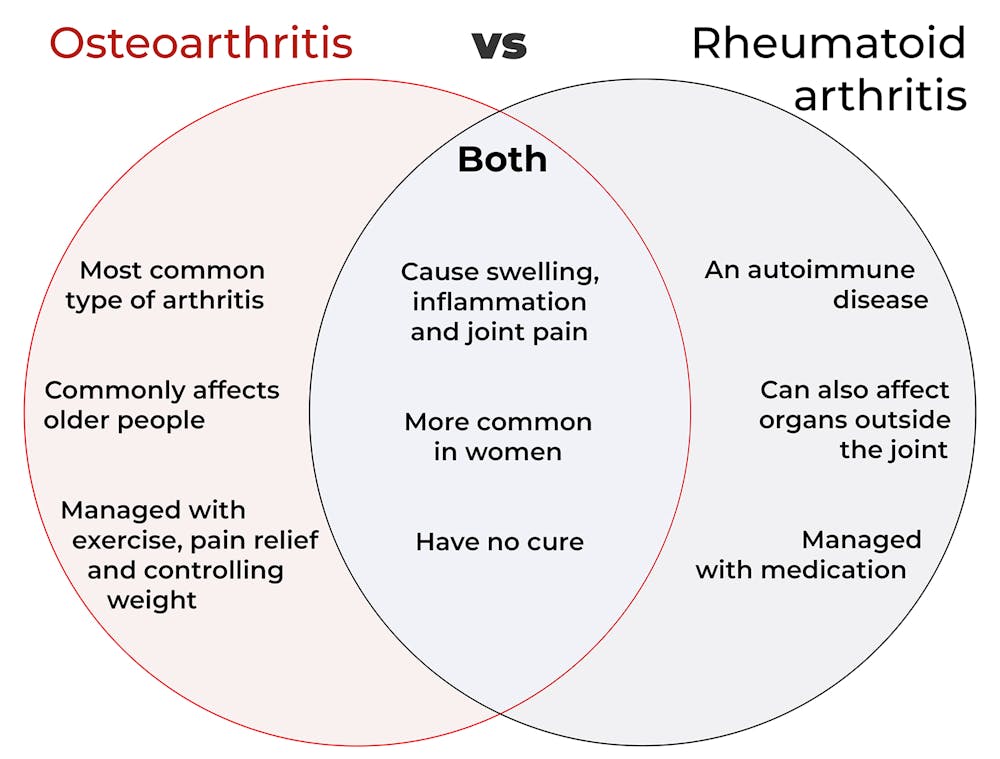
    The two most common types, osteoarthritis and rheumatoid arthritis, can both cause joint pain, swelling and stiffness. Both are more common in women. Neither can be cured.

    But their causes, risk factors and treatments are different – here’s what you need to know.

    What is osteoarthritis?

    Osteoarthritis is the most common form of arthritis. It affects 2.1 million Australians, mostly older people. About a third of Australians aged 75 and older have the condition.

    It can affect any joint but is most common in the knees, hips, fingers, thumbs and big toes.

    The main symptom is pain, especially during movement. Other symptoms may include swelling, stiffness and changes to the shape of joints.

    The main risk factors are ageing and obesity, as well as previous injuries or surgery. For osteoarthritis in the hands, genetics also play a big role.

    Signs of osteoarthritis can appear on knee scans from around age 45 and become more common with age.

    However, this type of arthritis not simply the “wear and tear” of ageing. Osteoarthritis is a complex disease that affects the whole joint. This includes the cartilage (“shock-absorbing” connective tissue protecting your bones), bones, ligaments (connective tissue holding bones and body parts in place) and joint lining.

    Osteoarthritis can change the shape of joints such as knuckles.
    joel bubble ben/Shutterstock

    How is it diagnosed?

    Diagnosis is based on symptoms (such as pain and restricted movement) and a physical exam.

    The disease generally worsens over time and cannot be reversed. But the severity of damage does not always correlate with pain levels.

    For this reason, x-rays and MRI scans are usually unhelpful. Some people with early osteoarthritis experience severe pain, but the damage won’t show up on a scan. Others with advanced and visible osteoarthritis may have few symptoms or none at all.

    What about rheumatoid arthritis?

    Unlike osteoarthritis, rheumatoid arthritis is an autoimmune disease. This means the immune system attacks the joint lining, causing inflammation and damage.

    Common symptoms include pain, joint swelling and stiffness, especially in the morning.

    Rheumatoid arthritis is less common than osteoarthritis, affecting around 514,000 Australians. It mostly impacts the wrists and small joints in the hands and feet, though larger joints such as the elbows, shoulders, knees and ankles can also be involved.

    It can also affect other organs, including the skin, lungs, eyes, heart and blood vessels. Fortunately, disease outside the joint has become less common in recent years, likely due to better and earlier treatment.

    Rheumatoid arthritis often develops earlier than osteoarthritis but can occur at any age. Onset is most frequent in those aged 35–64. Smoking increases your risk.

    How is it diagnosed?

    As with osteoarthritis, your doctor will diagnose rheumatoid arthritis based on your symptoms and a physical exam.

    Some other tests can be useful. Blood tests may pick up specific antibodies that indicate rheumatoid arthritis, although you can still have the condition with negative results.

    X-rays may also reveal joint damage if the disease is advanced. If there is uncertainty, an ultrasound or MRI can help detect inflammation.


    The Conversation, CC BY-SA

    How is osteoarthritis treated?

    No treatment can stop osteoarthritis progressing. However many people manage their symptoms well with advice from their doctor and self-care. Exercise, weight management and pain medicines can help.

    Exercise has been shown to be safe for osteoarthritis of the knee, hip and hand. Many types of exercise are effective at reducing pain, so you can choose what suits you best.

    For knee osteoarthritis, managing weight through diet and/or exercise is strongly recommended. This may be because it reduces pressure on the joint or because losing weight can reduce inflammation. Anti-obesity medicines may also reduce pain.

    Exercise can help manage weight and is safe and effective at managing joint pain.
    gelog67/Shutterstock

    Topical and oral anti-inflammatories are usually recommended to manage pain. However, opioids (such as tramadol or oxycodone) are not, due to their risks and limited evidence they help.

    In some cases antidepressants such as duloxetine may also be considered as a treatment for pain though, again, evidence they help is limited.

    What about rheumatoid arthritis?

    Treatments for rheumatoid arthritis focus on preventing joint damage and reducing inflammation.

    It’s essential to get an early referral to a rheumatologist, so that treatment with medication – called “disease-modifying anti-rheumatic drugs” – can begin quickly.

    These medicines suppress the immune system to stop inflammation and prevent damage to the joint.

    With no cure, the overall goal is to achieve remission (where the disease is inactive) or get symptoms under control.

    Advances in treatment

    There is an increasing interest in prevention for both types of arthritis.

    A large international clinical trial is currently investigating whether a diet and exercise program can prevent knee osteoarthritis in those with higher risk – in this case, women who are overweight and obese.

    For those already affected, new medicines in early-stage clinical trials show promise in reducing pain and improving function.

    There is also hope for rheumatoid arthritis with Australian researchers developing a new immunotherapy. This treatment aims to reprogram the immune system, similar to a vaccine, to help people achieve long-term remission without lifelong treatment.

    Giovanni E. Ferreira receives funding from The National Health and Medical Research Council, HCF Research Foundation, and Ramsay Hospital Research Foundation.

    Rachelle Buchbinder receives research funding from The National Health and Medical Research Council, Medical Research Future Fund, the Australian government, HCF Foundation and Arthritis Australia.

    ref. What’s the difference between osteoarthritis and rheumatoid arthritis? – https://theconversation.com/whats-the-difference-between-osteoarthritis-and-rheumatoid-arthritis-249154

    MIL OSI AnalysisEveningReport.nz

  • MIL-Evening Report: The ‘feminisation’ of Labor is a key reason Australians embraced it – and Anthony Albanese

    Source: The Conversation (Au and NZ) – By Paul Strangio, Emeritus Professor of Politics, Monash University

    Watching elections over the decades, one thing that has struck me is that results are invariably hyperbolised in the first blush of the people’s verdict. The achievement of the winners is over-egged in the commentary, as is the scale of the calamity suffered by the losers.

    That caveat notwithstanding, I think we can credibly say that Saturday’s election result was the most momentous since John Howard’s totemic victory of 2001 — a win that set in train much of what has happened in Australian politics over the course of this century.

    As I suggested in my pre-election essay on Anthony Albanese’s prime ministership, the impending victory for Labor would in part be an endorsement, even if grudging, of his leadership of the nation. It would be a reward for the fact that, despite limitations, he had run an industrious, orderly, united and scandal-free government. His was a mature administration that the country had been bereft of for nearly two decades.

    But the magnitude of Labor’s triumph on Saturday was undoubtedly most of all a repudiation of Duttonism. It was an emphatic assertion of what Australia is not. Why that makes this election the most significant since 2001 is that Dutton was an ideological heir to Howard — as before him was Tony Abbott, notwithstanding the latter’s idiosyncratic influence by the philosophy of the post-war right-wing Catholic crusader, B.A. Santamaria.

    Dutton entered the House of Representatives at the 2001 election, and the early advance of his parliamentary career was nurtured by Howard. As he articulated during this campaign, Dutton regarded Howard as his political touchstone.

    Like Abbott’s, Dutton’s leadership of the Liberal Party represented a doubled down version of the conservative populism that Howard so effectively unleashed at the 2001 election.

    This was a point that Lech Blaine perceptively recognised in his chilling 2024 Quarterly Essay portrait of Dutton. In common with Abbott, Dutton’s rendition of Howardism was an aggressively crude variant. Moreover, both of these unequal proteges were wanting in their mentor’s masterful political dexterity. Antithetical to the heritage of the Liberal Party, they were also short of interest in, let alone aptitude for, economic policy.

    Howard’s conservative populism was directed at cleaving working-class voters off Labor, especially in outer suburban electorates of Australia. For some time, there has been an emerging expectation that Dutton was poised to fruitfully capitalise on an incipient revolt against the Albanese government in outer suburbia. That is, a belief that these seats were susceptible to swallowing whole Dutton’s Frankenstein version of Howardism.

    Dutton’s strategy for hunting after votes in the outer suburbs and the commentary that has attended to it did a disservice to those communities. Undoubtedly, their populations, fast growing and undergoing a tsunami of demographic change, are enduring severe economic duress and struggling with over-stretched infrastructure and services.

    But there has been too much of a readiness to extrapolate from this that they were ripe for embracing an angry, grievance-fuelled politics, that they were vulnerable to xenophobic dog whistling, that they were, in short, home to an uglier Australia.

    The rejection of Duttonism in outer suburbia Australia suggests that, to the contrary, because of their kaleidoscopic diversity of ethnicities and cultures, these communities shrink from a politics of divisiveness and nativism.

    In other words, the routing of the Liberals on Saturday ought to be the moment that finally closes the door on the direction that Howard orientated the party at the beginning of this century. It should be his last hurrah.

    The dilemma, of course, is that stripped of moderates (the idea of the vaunted “broad church” thriving under Howard was itself greatly exaggerated), there is a serious question of whether the Liberals can reverse their 25-year rightwards pivot.

    The new leader could begin the journey back towards the centre by never darkening the doors of Sky News after Dark. A folly of Abbott and Dutton was their tribal attitude to the media. They skewed their communications to reactionary sympathisers who, rather than providing a reality check, encouraged ideological amplification.


    Read more:
    In its soul-searching, the Coalition should examine its relationship with the media


    What of Albanese and his leadership? In my pre-election essay on him, I flagged a concern that victory would feed his self-narrative of always being under-estimated. That it would encourage him to stick fast to his first term modus operandi of cautious, dogged incrementalism at a point when the nation is overdue for a burst of expansive reformism. The scale of Saturday’s win arguably heightens that risk.

    Yet we do have to acknowledge that Albanese, fortunate though he has been with the incurably inauthentic Scott Morrison and then Dutton as opponents, has been under-estimated. He has insisted since 2022 that his was a two-term strategy in which the first would be about measured consolidation that would, in turn, open the path to a long-term Labor government whose legacy would be durable change. This result means the prime minister and his team now have the opportunity to achieve that.

    Watching the ABC’s election night broadcast, a chief takeaway was the conspicuous camaraderie among senior members of Albanese’s Labor cabinet. Treasurer Jim Chalmer’s sincerely generous words about the prime minister’s leadership exemplified that.

    During Labor’s first term, I wondered whether Chalmers, for all his virtues, was actually too much a patient team player and not enough of an agitator within the government. In other words, that he did not sufficiently ginger up Albanese for greater policy adventurism, as Paul Keating did Bob Hawke during the last great era of Labor reformism.

    But Saturday night spotlighted a different, but perhaps at least as equally valuable, dynamic at the top of the government. That is genuine respect, even affection, between its key personnel. Keating could never have been as laudable of Hawke as Chalmers was of Albanese as the votes were tallied.

    This says much about the character of Chalmers, as it does about other leading cabinet members who have exuded that spirit of camaraderie throughout the life of the government. Most notably, the prime minister’s brains trust: Richard Marles, Penny Wong, Tony Burke, Mark Butler and Katy Gallagher.

    But it must also reflect Albanese’s respect for his colleagues. It speaks to his ability to harmoniously manage a team, his gift for generating unity of purpose, and his willingness to afford ministers a self-empowering autonomy in contributing to Labor’s collective enterprise. These are no small things. Respect and decency in a government begins with the prime minister and filters down.

    Let us not get misty-eyed. Albanese is vulcanised by a lifetime in politics. He is tough and a ruthless foe. His political blooding was as a left faction functionary in the right-controlled New South Wales Labor Party. Intra-party knife fighting was an essential part of the skill set he developed.

    But, consistent with all prime ministers, to understand Albanese’s approach to leadership we need to return to his formative roots. He was fatherless, defined by being the only child of a single mum, disability pensioner. These circumstances, as former journalist Katharine Murphy identified, imbued him with a pronounced streak of self-sufficiency, a “lone wolf” aspect. Yet also discernible is a resulting “feminine” side to his character and his prime-ministerial style.

    Albanese readily exhibits empathy and emotion. A familiar sight of him is lips quivering as he struggles to suppress tears. He dares speak of kindness and compassion as positive leadership attributes — in this he evokes former New Zealand prime minister, Jacinda Ardern. And he practices a collaborative, cooperative minded governing operating mode, which are behaviours conventionally associated with women leaders.

    Not coincidentally, a striking feature of Albanese’s prime ministership is that the “feminisation” of Labor has proceeded apace. For instance, policies such as the movement towards universal childcare support and government-backed wage increases in the care industries whose workforce is dominated by women employees. The record proportion of women appointed to cabinet. The continuing storming of the ramparts of caucus by women — they now comprise a majority of the party room — reinforced at the federal election most spectacularly in Brisbane, where six additional female Labor candidates prevailed, including Ali France, slayer of Dutton. And the consolidation of the pattern of women voters favouring Labor.

    It’s unfashionable these days to quote the post-war lion of the Labor left, Jim Cairns. However, when he retired in 1977, Cairns was asked who he would like to inherit his seat. He replied, “a woman, they feel the value of life”. Perhaps a sentiment by which Albanese abides.

    In the past, Paul Strangio received funding from the Australian Research Council.

    ref. The ‘feminisation’ of Labor is a key reason Australians embraced it – and Anthony Albanese – https://theconversation.com/the-feminisation-of-labor-is-a-key-reason-australians-embraced-it-and-anthony-albanese-255883

    MIL OSI AnalysisEveningReport.nz

  • MIL-OSI USA: CONGRESSWOMAN PLASKETT CELEBRATES FARMERS IN ACTION COMMUNITY PROJECT FUNDING WAIVER, GRANTED BY U.S. DEPARTMENT OF AGRICULTURE

    Source: United States House of Representatives – Congresswoman Stacey E. Plaskett (USVI)

    For Immediate Release                                          Contact: Tionee Scotland
    May 5, 2025                                                           202-808-6129

    PRESS RELEASE

    CONGRESSWOMAN PLASKETT CELEBRATES FARMERS IN ACTION COMMUNITY PROJECT FUNDING WAIVER, GRANTED BY U.S. DEPARTMENT OF AGRICULTURE

    Washington, D.C. – For the past two years, Congresswoman Stacey E. Plaskett and her team have actively worked with the St. Croix Farmers in Action (FIA) group to assist with the acquisition of funding for a sustainable water source for local farmers. During the Fiscal Year 2024 (FY24) appropriations process, FIA submitted a Community Project Funding (CPF) request to rehabilitate water infrastructure on Estate Bethlehem and were subsequently approved for $1 million dollars in community project funding, of which FIA would have to provide a non-federal match of $250,000.

    FIA’s plans to rehabilitate Estate Bethlehem’s water infrastructure include an existing 1-million-gallon cistern on the Bethlehem Sugar Factory Site. This funding is critical as the cistern restoration would help fulfill the needs of farms and businesses whose economic success depends upon a consistent water source to maintain farmland. Within the past year, FIA faced significant challenges in providing the required funding match and requested assistance from the Congresswoman and her team.

    Kareem Edwards, FIA board member shared, “FIA extends heartfelt gratitude for Congresswoman Plaskett’s unwavering advocacy and support of our organization and the broader agricultural community in the Virgin Islands. Thanks to Congresswoman Plaskett and her team’s dedicated efforts, we were able to secure the necessary USDA waiver to rehabilitate the million-gallon cistern on the island—a vital step toward strengthening our water infrastructure and enhancing the resilience of our farming operations. The Congresswoman’s commitment to championing the needs of St. Croix’s farmers continues to make a meaningful and lasting impact.”

    Another FIA board member, Tahemah Edwards shared the following, “St. Croix Farmers in Action thanks the Honorable Congresswoman Stacey E. Plaskett and her staff for their vision, dedication, and collaboration in making the Bethlehem Sugar Factory Restoration site a reality. I would also like to thank Kareem Edwards, Tralice Bracy and the St. Croix Farmers in Action board of directors for their lobbying efforts.”

    “This outcome is the result of true collaboration,” said Senator Angel Bolques, whose office provided a letter of support to the U.S. Department of Agriculture in pursuit of the waiver. “Our office worked closely with our Honorable Congresswoman Plaskett and her office, St. Croix Farmers in Action, USDA, and VIEDA—exploring every possible funding solution to help overcome the financial barriers to assist with securing this vital waiver. I’m so proud to have contributed to this effort and remain committed to supporting initiatives that strengthen our agricultural infrastructure and empower our farmers.”

    “I am tremendously pleased that FIA has received a waiver of the match that USDA-Rural Development (USDA-RD) originally required to access the funding provided to rehabilitate existing cistern infrastructure to support the farmers of St. Croix,” said Congresswoman Plaskett. “I commend FIA and the board members, led by Tahemah Edwards and his nephew, Kareem Edwards, for their diligence and perseverance in pursuit of agricultural development and advocacy for St. Croix farmers. I would also like to thank the Senator Angel Bolques and his team for their advocacy and presence on FIA’s behalf.

    “USDA-RD’s decision to waive the match, particularly during this political climate speaks well of our ability to galvanize our efforts in order to get things done for our territory.”

    Pictured below, right to left: FIA Volunteer – Tralice Bracy, Congresswoman Stacey E. Plaskett, FIA Board Member – Paulette Edwards, FIA Board Member Tahemah Edwards, Representatives from Senator Angel Bolques’s office – Judy Torres and Marcellino Ventura

    ###

    MIL OSI USA News

  • MIL-OSI China: Germany’s CDU/CSU, SPD sign coalition deal for new gov’t

    Source: People’s Republic of China – State Council News

    The Christian Social Union (CSU) leader Markus Soeder (1st L), the Christian Democratic Union (CDU) leader Friedrich Merz (2nd L), the Social Democratic Party (SPD)’s co-leaders Lars Klingbeil (2nd R) and Saskia Esken attend the signing ceremony of a coalition agreement in Berlin, Germany, May 5, 2025. [Photo/Xinhua]

    Leaders of Germany’s conservative CDU/CSU and center-left Social Democratic Party (SPD) signed a coalition agreement on Monday, paving the way for the formation of a new federal government.

    Under the coalition pact finalized in April after weeks of negotiations, the parties pledged to enhance Germany’s economic competitiveness, strengthen national defense, and tighten migration policies.

    The CDU/CSU, unofficially the Union parties or the Union, is a conservative political alliance of two political parties in Germany.

    The Bundestag, Germany’s lower house of parliament, is scheduled to elect Friedrich Merz, leader of the CDU, as chancellor on Tuesday. Once Merz is elected, his government will take office, ending the current administration led by Chancellor Olaf Scholz, and SPD’s co-leader Lars Klingbeil will take the post of vice chancellor.

    According to SPD’s announcement of key positions in the new cabinet on Monday, Klingbeil will also take the helm of the Finance Ministry. Boris Pistorius will be retaining his post as defense minister. Baerbel Bas, former president of the Bundestag, has been nominated as minister of Labor and Social Affairs.

    Other nominations include 35-year-old Reem Alabali-Radovan as minister for Economic Cooperation and Development.

    Speaking at a press conference before the signing, Merz said the coalition aims to advance Germany with reforms and investments. Highlighting the capabilities of the new government, Merz vowed to implement reform from day one, build essential infrastructure, and make a strong contribution to Europe.

    “I am very confident that starting tomorrow, we will succeed in governing our country with strength, planning, and trust,” Merz said.

    At the press conference, Klingbeil said the new government will start its work swiftly to stimulate growth in Germany and attract future-oriented industries to Germany.

    During coalition negotiations, the two parties agreed to establish a 500-billion-euro (about 567 billion U.S. dollars) fund dedicated to infrastructure and climate-neutrality investments.

    Klingbeil pledged to cut bureaucracy and streamline procedures to accelerate the realization of infrastructure projects.

    Though the new government plans to tighten migration policies, Klingbeil reaffirmed that Germany remains a country of immigration, stressing that the country will manage migration with clear rules. (1 euro = 1.14 U.S. dollar)

    MIL OSI China News

  • MIL-OSI New Zealand: For every problem there is a solution that is simple, neat—and wrong.

    Source:

    Responding to proposed legislation to ban under-16s from social media, ACT Leader David Seymour says:

    “ACT shares the concern of many parents, teachers and experts: social media is doing enormous harm to young people. We also know what H.L. Menken meant in saying: For every problem there is a solution that is simple, neat—and wrong.

    “ACT opposes National’s bill banning under-16s from social media because it is not workable. Instead, we ask the Education and Workforce Committee to hold an open, transparent inquiry. The inquiry should hear all voices to find a workable solution that respects parental responsibility.

    “ACT is concerned about the practicalities of a ban. For example, requiring all social media users to provide government identification to social media companies would raise privacy issues.

    “The Bill’s definition of ‘social media’ more or less includes the entire internet, for example the Bill says social media could be anything that ‘allow[s] end-users to link to, or interact with, some or all of the other end users.’ Such a poorly drafted definition is unworkable.

    “Similar legislation has been passed in Australia, but hasn’t come into effect yet, and no-one yet knows how the ban will be implemented. We would be better to learn from the Aussies’ mistakes than make the same mistakes at the same time as them.”

    MIL OSI New Zealand News

  • MIL-OSI New Zealand: Once were (AI) sceptics

    Source:

    The Haps

    David Seymour’s speech to the Tauranga Business Chamber has been widely praised. More would get done if the Government had fewer Ministers. Parliament comes out of a three-week recess into three weeks of sitting that will culminate in the Budget on May 22nd. For years ACT published Alternative Budgets showing how the Government could afford two per cent of GDP on Defence. Now two per cent is happening and the weekend’s helicopter announcement is just the beginning. Meanwhile a journalist wrongly accused Free Press of ‘misinformation’ while trying to defend media standards. We are not making this up.

    Once were (AI) sceptics

    The future’s always been a bit disappointing when we get to it, like for those of us who are STILL waiting for flying cars. (Nerdy) children of the ‘90s grew up watching Beyond 2000, a weekly program devoted to the technologies that would change our lives in the next millennium if we survived Y2K. The same program wouldn’t work today, people would roll their eyes at the earnestness of it all.

    At Free Press, we’ve kept off the Artificial Intelligence bandwagon, maybe because we’ve lived long enough to be a little sceptical. We never lost hundreds of thousands of lives to COVID, and neither did countries with far more relaxed policies towards it. Climate change was supposed to bring apocalypse by 2010, and 2020 was too scary to think about, according to the usual suspects. Yet, here we all are.

    Most of the people who go on endlessly about AI couldn’t even give you a short, sharp definition of what it is. They can’t explain why it is more than just another software development. The eighties gave us spreadsheets, the nineties email, and the noughties social networks. All of them had an effect, but they haven’t transformed life as we know it.

    What’s more, it was kind of a toy, as recently as a year ago, the hype of ChatGPT had come and gone. People found it too often ‘hallucinated’ firing out such crazy solutions that you definitely wouldn’t use it for anything important. So, what’s changed?

    In the last year the progress has been staggering, and it’s the rate of change itself that stands out. By now MPs could ask Chat GPT, Perplexity, or Grok for advice, on say, a briefing to a select committee from officials. It could produce a set of policy proposals according to different levels of political ambition while the officials are still speaking. The level of intelligence and nuance is extraordinary, and the rate of change more so.

    For business, the opportunities are extraordinary. We don’t pretend to give businesspeople advice, too many people in the political world think they’re business experts. What we do know is that tasks such as interacting with customers can have massive labour savings. An online doctor consultation can be summarised with perfect notes produced before the patient is out the clinic door. It’s all very exciting.

    What about education? Twelve-year-olds are saying their main source of information is ChatGPT or Perplexity. If they want to know something they don’t Google it, they don’t watch the news and they certainly don’t get a book from the library. They ask an AI program and talk to it like a virtual friend.

    That sets off a lot of questions. Where is the ability to think for themselves? If they can get an answer to any question in seconds, do they need to know anything? If AI can solve all their problems, what space remains for humans? Is it schools’ jobs to prepare them to live in this world, and are schools remotely equipped to do so?

    Where do the blunt bans on mobile phones and social media for young people fit in? Do they preserve a human sphere so kids can get to know themselves without dependence on machines, or do they leave kids even more naive and unprepared to live in that world?

    If that’s education, how about the public service? They’ve always been slow to take on technology. They’re sclerotic thanks to fear of privacy laws. Yet at the same time the public sector has been eating money for too long and badly needs productivity growth.

    We once were sceptics, but the last year of progress has changed our mind. AI is big. It’s at least as big as spreadsheets, emails, and online social networks. With the Chinese Government reported to be making AI a compulsory subject for six-year-olds this year, New Zealand policy will need to raise its sights from its usual debates and ask what our philosophy on AI is…

    MIL OSI New Zealand News

  • MIL-OSI China: Romanian PM announces resignation

    Source: People’s Republic of China – State Council News

    Romanian Prime Minister Marcel Ciolacu (C) speaks to the media at the headquarters of the Social Democratic Party in Bucharest, Romania, on May 5, 2025. [Photo/Xinhua]

    Romanian Prime Minister Marcel Ciolacu announced his resignation on Monday at the headquarters of the Social Democratic Party (PSD).

    The announcement comes as Romania’s ruling PSD declared its decision to withdraw from the governing coalition.

    “One of the two objectives of the governing coalition was not achieved, which means that the governing coalition lacks legitimacy – at least in its current composition,” Ciolacu said, referencing the fallout after the first round of Romania’s presidential election rerun on Sunday. Crin Antonescu, the presidential candidate representing the governing coalition, failed to secure a spot in the second-round runoff scheduled for May 18.

    While the transition is underway, PSD ministers will remain in their positions temporarily as discussions continue with coalition partners – the National Liberal Party (PNL) and the Democratic Alliance of Hungarians in Romania (UDMR) – to establish interim governance arrangements, according to Ciolacu.

    Interim President Ilie Bolojan formally acknowledged Ciolacu’s resignation. According to a statement from the Presidential Administration, an interim prime minister will be appointed on Tuesday.

    The interim cabinet may remain in place for up to 45 days, during which a new government must be formed. During this period, the interim cabinet is authorized only to manage routine public affairs until the newly appointed government members are sworn in.

    The outgoing coalition, established in December 2024, comprised the PSD, PNL, UDMR, and representatives of Romania’s national minorities.

    MIL OSI China News

  • MIL-Evening Report: Cook Islands environment group calls on govt to condemn Trump’s seabed mining order

    By Losirene Lacanivalu, of the Cook Islands News

    A leading Cook Islands environmental lobby group is hoping that the Cook Islands government will speak out against the recent executive order from US President Donald Trump aimed at fast-tracking seabed mining.

    Te Ipukarea Society (TIS) says the arrogance of US president Trump to think that he could break international law by authorising deep seabed mining in international waters was “astounding”, and an action of a “bully”.

    Trump signed the America’s Offshore Critical Minerals and Resources order late last month, directing the National Oceanic and Atmospheric Administration (NOAA) to allow deep sea mining permits.

    The order states: “It is the policy of the US to advance United States leadership in seabed mineral development.”

    NOAA has been directed to, within 60 days, “expedite the process for reviewing and issuing seabed mineral exploration licenses and commercial recovery permits in areas beyond national jurisdiction under the Deep Seabed Hard Mineral Resources Act.”

    It directs the US science and environmental agency to expedite permits for companies to mine the ocean floor in the US and international waters.

    In addition, a Canadian mining company — The Metals Company — has indicated that they have applied for a permit from Trump’s administration to start commercially mining in international waters.

    The mining company had been unsuccessful in gaining a commercial mining licence through the International Seabed Authority (ISA).

    ‘Arrogance of Trump’
    Te Ipukarea Society’s technical director Kelvin Passfield told Cook Islands News: “The arrogance of Donald Trump to think that he can break international law by authorising deep seabed mining in international waters is astounding.

    “The United States cannot pick and choose which aspects of the United Nations Law of the Sea it will follow, and which ones it will ignore. This is the action of a bully,” he said.

    “It is reckless and completely dismissive of the international rule of law. At the moment we have 169 countries, plus the European Union, all recognising international law under the International Seabed Authority.

    “For one country to start making new international rules for themselves is a dangerous notion, especially if it leads to other States thinking they too can also breach international law with no consequences,” he said.

    TIS president June Hosking said the fact that a part of the Pacific (CCZ) was carved up and shared between nations all over the world was yet another example of “blatantly disregarding or overriding indigenous rights”.

    “I can understand why something had to be done to protect the high seas from rogues having a ‘free for all’, but it should have been Pacific indigenous and first nations groups, within and bordering the Pacific, who decided what happened to the high seas.

    “That’s the first nations groups, not for example, the USA as it is today.”

    South American countries worried
    Hosking highlighted that at the March International Seabed Authority (ISA) assembly she attended it was obvious that South American countries were worried.

    “Many have called for a moratorium. Portugal rightly pointed out that we were all there, at great cost, just for a commercial activity. The delegate said, ‘We must ask ourselves how does this really benefit all of humankind?’

    Looking at The Metals Company’s interests to commercially mine in international waters, Hosking said, “I couldn’t help being annoyed that all this talk assumes mining will happen.

    “ISA was formed at a time when things were assumed about the deep sea e.g. it’s just a desert down there, nothing was known for sure, we didn’t speak of climate crisis, waste crisis and other crises now evident.

    “The ISA mandate is ‘to ensure the effective protection of the marine environment from the harmful effects that may arise from deep seabed related activities.

    “We know much more (but still not enough) to consider that effective protection of the marine environment may require it to be declared a ‘no go zone’, to be left untouched for the good of humankind,” she added.

    Meanwhile, technical director Passfield also added, “The audacity of The Metals Company (TMC) to think they can flaunt international law in order to get an illegal mining licence from the United States to start seabed mining in international waters is a sad reflection of the morality of Gerard Barron and others in charge of TMC.

    ‘What stops other countries?’
    “If the USA is allowed to authorise mining in international waters under a domestic US law, what is stopping any other country in the world from enacting legislation and doing the same?”

    He said that while the Metals Company may be frustrated at the amount of time that the International Seabed Authority is taking to finalise mining rules for deep seabed mining, “we are sure they fully understand that this is for good reason. The potentially disastrous impacts of mining our deep ocean seabed need to be better understood, and this takes time.”

    He said that technology and infrastructure to mine is not in place yet.

    “We need to take as much time as we need to ensure that if mining proceeds, it does not cause serious damage to our ocean. Their attempts to rush the process are selfish, greedy, and driven purely by a desire to profit at any cost to the environment.

    “We hope that the Cook Islands Government speaks out against this abuse of international law by the United States.” Cook Islands News has reached out to the Office of the Prime Minister and Seabed Minerals Authority (SBMA) for comment.

    Republished from the Cook Islands News with permission.

    MIL OSI AnalysisEveningReport.nz

  • MIL-Evening Report: Australia and North America have long fought fires together – but new research reveals that has to change

    Source: The Conversation (Au and NZ) – By Doug Richardson, Research Associate in Climate Science, UNSW Sydney

    Climate change is lengthening fire seasons across much of the world. This means the potential for wildfires at any time of the year, in both hemispheres, is increasing.

    That poses a problem. Australia regularly shares firefighting resources with the United States and Canada. But these agreements rest on the principle that when North America needs these personnel and aircraft, Australia doesn’t, and vice versa. Climate change means this assumption no longer holds.

    The devastating Los Angeles wildfires in January, the United States winter, show how this principle is being tested. The US reportedly declined Australia’s public offer of assistance because Australia was in the midst of its traditional summer fire season. Instead, the US sought help from Canada and Mexico.

    But to what extent do fire seasons in Australia and North America actually overlap? Our new research examined this question.
    We found an alarming increase in the overlap of the fire seasons, suggesting both regions must invest far more in their own permanent firefighting capacity.

    What we did

    We investigated fire weather seasons – that is, the times of the year when atmospheric conditions such as temperature, humidity, rainfall and wind speed are conducive to fire.

    The central question we asked was: how many days each year do fire weather seasons in Australia and North America overlap?

    To determine this, we calculated the length of the fire weather seasons in the two regions in each year, and the number of days when the seasons occur at the same time. We then analysed reconstructed historical weather data to assess fire-season overlap for the past 45 years. We also analysed climate model data to assess changes out to the end of this century.

    And the result? On average, fire weather occurs in both regions simultaneously for about seven weeks each year. The greatest risk of overlap occurs in the Australian spring – when Australia’s season is beginning and North America’s is ending.

    The overlap has increased by an average of about one day per year since 1979. This might not sound like much. But it translates to nearly a month of extra overlap compared to the 1980s and 1990s.

    The increase is driven by eastern Australia, where the fire weather season has lengthened at nearly twice the rate of western North America. More research is needed to determine why this is happening.

    Longer, hotter, drier

    Alarmingly, as climate change worsens and the atmosphere dries and heats, the overlap is projected to increase.

    The extent of the overlap varied depending on which of the four climate models we used. Assuming an emissions scenario where global greenhouse gas emissions begin to stabilise, the models projected an increase in the overlap of between four and 29 days a year.

    What’s behind these differences? We think it’s rainfall. The models project quite different rainfall trends over Australia. Those projecting a dry future also project large increases in overlapping fire weather. What happens to ours and North America’s rainfall in the future will have a large bearing on how fire seasons might change.

    While climate change will dominate the trend towards longer overlapping fire seasons, El Niño and La Niña may also play a role.

    These climate drivers involve fluctuations every few years in sea surface temperature and air pressure in part of the Pacific Ocean. An El Niño event is associated with a higher risk of fire in Australia. A La Niña makes longer fire weather seasons more likely in North America.

    There’s another complication. When an El Niño occurs in the Central Pacific region, this increases the chance of overlap in fire seasons of North America and Australia. We think that’s because this type of El Niño is especially associated with dry conditions in Australia’s southeast, which can fuel fires.

    But how El Niño and La Niña will affect fire weather in future is unclear. What’s abundantly clear is that global warming will lead to more overlap in fire seasons between Australia and North America – and changes in Australia’s climate are largely driving this trend.

    Looking ahead

    Firefighters and their aircraft are likely to keep crossing the Pacific during fire emergencies.

    But it’s not difficult to imagine, for example, simultaneous fires occurring in multiple Australian states during spring, before any scheduled arrival of aircraft from the US or Canada. If North America is experiencing late fires that year and cannot spare resources, Australia’s capabilities may be exceeded.

    Likewise, even though California has the largest civil aerial firefighting fleet in the world, the recent Los Angeles fires highlighted its reliance on leased equipment.

    Fire agencies are becoming increasingly aware of this clash. And a royal commission after the 2019–20 Black Summer fires recommended Australia develop its own fleet of firefighting aircraft.

    Long, severe fire seasons such as Black Summer prompted an expansion of Australia’s permanent aerial firefighting fleet, but more is needed.

    As climate change accelerates, proactive fire management, such as prescribed burning, is also important to reduce the risk of uncontrolled fire outbreaks.

    Doug Richardson receives funding from the ARC Centre of Excellence for Climate Extremes (CE170100023) and the Germany-Australia Joint Research Cooperation Scheme, funded by the Deutscher Akademischer Austauschdienst (DAAD) and Universities Australia (RG230014)

    Andreia Filipa Silva Ribeiro receives funding from the Deutsche Forschungsgemeinschaft (DFG) – Project number 530175554, the Alexander von Humboldt Foundation (AvH) and the Germany-Australia Joint Research Cooperation Scheme, funded by the Deutscher Akademischer Austauschdienst (DAAD) and Universities Australia (RG230014).

    ref. Australia and North America have long fought fires together – but new research reveals that has to change – https://theconversation.com/australia-and-north-america-have-long-fought-fires-together-but-new-research-reveals-that-has-to-change-254790

    MIL OSI AnalysisEveningReport.nz

  • MIL-OSI: DMG Blockchain Solutions Announces Preliminary April Operational Results

    Source: GlobeNewswire (MIL-OSI)

    VANCOUVER, British Columbia, May 05, 2025 (GLOBE NEWSWIRE) — DMG Blockchain Solutions Inc. (TSX-V: DMGI) (OTCQB: DMGGF) (FRANKFURT: 6AX) (“DMG” or the “Company”), a vertically integrated blockchain and data center technology company, today announces its preliminary operational results for April 2025:

    • Bitcoin Mined: 30 BTC (vs 32 BTC in Mar 2025)
    • Hashrate: 1.93 EH/s (vs 1.82 EH/s in Mar 2025)
    • Bitcoin Holdings: 351 BTC (vs 458 BTC in Mar 2025)

    DMG’s April results reflect stable mining operations alongside key strategic investments. The Company mined 30 BTC during the month, slightly down from 32 BTC in March due to increased network difficulty and one day shorter duration. Meanwhile, DMG increased its realized hashrate to 1.93 EH/s, supported by the deployment of additional Bitmain S21+ Hydro miners and has now reached its 2.1 EH/s target, which may be slightly trimmed on an ongoing operational basis, at least through the summer months, to best manage its fleet in a higher ambient temperature environment.

    DMG liquidated a portion of its Bitcoin holdings, reducing its treasury from 458 BTC in March to 351 BTC in April. Proceeds were used mainly to fund the acquisition of 2 megawatts capacity of prefabricated artificial intelligence (AI) data center infrastructure as well to make the first material paydown on its Sygnum Bank loan, which had a $20 million balance at the end of March. These actions mark a significant step in executing DMG’s broader strategy to shift its data center capacity towards AI, while delevering its balance sheet.

    Sheldon Bennett, DMG’s CEO, commented, “We remain focused on advancing our AI strategy while maintaining a cash generating Bitcoin operation. With the purchase of 2 megawatts of AI data center infrastructure, we have made a demonstrative shift to utilize the returns generated from Bitcoin mining to fund our initial AI capital expenditures, which we believe will accelerate our ability to secure off-take agreements. Our focus remains on high-value government and enterprise users seeking sovereign AI solutions for Canada.”

    About DMG Blockchain Solutions Inc.

    DMG is a publicly traded and vertically integrated blockchain and data center technology company that manages, operates and develops end-to-end digital solutions to monetize the digital asset and artificial intelligence compute ecosystems. Systemic Trust Company, a wholly owned subsidiary of DMG, is an integral component of DMG’s carbon-neutral Bitcoin ecosystem, which enables financial institutions to move Bitcoin in a sustainable and regulatory-compliant manner.

    For additional information about DMG Blockchain Solutions and its initiatives, please visit www.dmgblockchain.com. Follow @dmgblockchain on X, LinkedIn and Facebook, and subscribe to the DMG YouTube channel to stay updated with the latest developments and insights.

    For further information, please contact:

    On behalf of the Board of Directors,

    Sheldon Bennett, CEO & Director
    Tel: +1 (778) 300-5406
    Email: investors@dmgblockchain.com
    Web: www.dmgblockchain.com

    For Investor Relations:
    investors@dmgblockchain.com

    For Media Inquiries:
    Chantelle Borrelli
    Head of Communications
    chantelle@dmgblockchain.com

    Neither the TSX Venture Exchange nor its Regulation Service Provider (as that term is defined in the policies of the TSX Venture Exchange) accepts responsibility for the adequacy or accuracy of this news release.

    Cautionary Note Regarding Forward-Looking Information

    This news release contains forward-looking information or statements based on current expectations. Forward-looking statements contained in this news release include statements regarding DMG’s strategies and plans, executing on DMG’s broader strategy to shift its data center capacity towards AI, securing high-value AI off-take agreements, the opportunity and plans to monetize bitcoin transactions and provide additional products and services to customers and users, the continued investment in Bitcoin network software infrastructure and applications, the expected allocation of capital, developing and executing on the Company’s products and services, increasing self-mining, increasing hashrate, efforts to improve the operation of its mining fleet, the potential trimming of self-mining due to higher ambient temperature environment, the launch of products and services, events, courses of action, and the potential of the Company’s technology and operations, among others, are all forward-looking information.

    Future changes in the Bitcoin network-wide mining difficulty rate or Bitcoin hashrate may materially affect the future performance of DMG’s production of bitcoin, and future operating results could also be materially affected by the price of bitcoin and an increase in hashrate mining difficulty.

    Forward-looking statements consist of statements that are not purely historical, including any statements regarding beliefs, plans, expectations, or intentions regarding the future. Such information can generally be identified by the use of forwarding-looking wording such as “may”, “expect”, “estimate”, “anticipate”, “intend”, “believe” and “continue” or the negative thereof or similar variations. The reader is cautioned that assumptions used in the preparation of any forward-looking information may prove to be incorrect. Events or circumstances may cause actual results to differ materially from those predicted, as a result of numerous known and unknown risks, uncertainties, and other factors, many of which are beyond the control of the Company, including but not limited to, market and other conditions, volatility in the trading price of the common shares of the Company, business, economic and capital market conditions; the ability to manage operating expenses, which may adversely affect the Company’s financial condition; the ability to remain competitive as other better financed competitors develop and release competitive products; regulatory uncertainties; access to equipment; market conditions and the demand and pricing for products; the demand and pricing of bitcoin; the demand and pricing of Gen AI data centers and usage; security threats, including a loss/theft of DMG’s bitcoin; DMG’s relationships with its customers, distributors and business partners; the inability to add more power to DMG’s facilities; DMG’s ability to successfully define, design and release new products in a timely manner that meet customers’ needs; the ability to attract, retain and motivate qualified personnel; competition in the industry; the impact of technology changes on the products and industry; failure to develop new and innovative products; the ability to successfully maintain and enforce our intellectual property rights and defend third-party claims of infringement of their intellectual property rights; the impact of intellectual property litigation that could materially and adversely affect the business; the ability to manage working capital; and the dependence on key personnel. DMG may not actually achieve its plans, projections, or expectations. Such statements and information are based on numerous assumptions regarding present and future business strategies and the environment in which the Company will operate in the future, including the demand for its products, the ability to successfully develop software, that there will be no regulation or law that will prevent the Company from operating its business, anticipated costs, the ability to secure sufficient capital to complete its business plans, the ability to achieve goals and the price of bitcoin. Given these risks, uncertainties, and assumptions, you should not place undue reliance on these forward-looking statements. The securities of DMG are considered highly speculative due to the nature of DMG’s business. For further information concerning these and other risks and uncertainties, refer to the Company’s filings on www.sedarplus.ca. In addition, DMG’s past financial performance may not be a reliable indicator of future performance.

    Factors that could cause actual results to differ materially from those in forward-looking statements include, failure to obtain regulatory approval, the continued availability of capital and financing, equipment failures, lack of supply of equipment, power and infrastructure, failure to obtain any permits required to operate the business, the impact of technology changes on the industry, the impact of viruses and diseases on the Company’s ability to operate, secure equipment, and hire personnel, competition, security threats including stolen bitcoin from DMG or its customers, consumer sentiment towards DMG’s products, services and blockchain and Gen AI technology generally, failure to develop new and innovative products, litigation, adverse weather or climate events, increase in operating costs, increase in equipment and labor costs, equipment failures, decrease in the price of Bitcoin, failure of counterparties to perform their contractual obligations, government regulations, loss of key employees and consultants, and general economic, market or business conditions. Forward-looking statements contained in this news release are expressly qualified by this cautionary statement. The reader is cautioned not to place undue reliance on any forward-looking information. The forward-looking statements contained in this news release are made as of the date of this news release. Except as required by law, the Company disclaims any intention and assumes no obligation to update or revise any forward-looking statements, whether as a result of new information, future events, or otherwise. Additionally, the Company undertakes no obligation to comment on the expectations of or statements made by third parties in respect of the matters discussed above.

    The MIL Network

  • MIL-Evening Report: ER Report: A Roundup of Significant Articles on EveningReport.nz for May 6, 2025

    ER Report: Here is a summary of significant articles published on EveningReport.nz on May 6, 2025.

    Fiji media welcomes credible news services, but not ‘pop-up propagandists’, says Simpson
    By Anish Chand Entities and individuals that thrived under the previous government with public relations contracts now want to be part of the media or run media organisations, says Fiji Media Association (FMA) secretary Stanley Simpson. He made the comments yesterday while speaking at a World Press Freedom Day event hosted by the journalism programme

    Locked up then locked out: how NZ’s bank rules make life for ex-prisoners even harder
    Source: The Conversation (Au and NZ) – By Victoria Stace, Senior Lecturer, Te Herenga Waka — Victoria University of Wellington FotoDax/Shutterstock People coming out of prison in New Zealand face multiple hurdles reintegrating into society – starting with one of the most fundamental elements of modern life: getting a bank account. Not having a bank

    Can a wooden spoon really stop a pot from boiling over? Here’s the science
    Source: The Conversation (Au and NZ) – By Jay Deagon, Senior Lecturer of Home Economics, CQUniversity Australia Alexanderstock23/Shutterstock One moment, your spaghetti is happily bubbling away in the pot. A minute later, after busying yourself with something else, you turn around to find a hot mess all over your stove. Boiling liquid can rocket up

    How did sport become so popular? The ancient history of a modern obsession
    Source: The Conversation (Au and NZ) – By Konstantine Panegyres, Lecturer in Classics and Ancient History, The University of Western Australia Roman mosaics discovered in Sicily show women playing different sports. David Pineda Svenske/Shutterstock It’s almost impossible to go a day without seeing or hearing about sport. Walk around any city or town and you

    AI systems are built on English – but not the kind most of the world speaks
    Source: The Conversation (Au and NZ) – By Celeste Rodriguez Louro, Associate professor, Chair of Linguistics and Director of Language Lab, The University of Western Australia Reihaneh Golpayegani / Better Images of AI, CC BY An estimated 90% of the training data for current generative AI systems stems from English. However, English is an international

    Crikey, ChatGPT’s gone bush! How AI is learning the art of Aussie slang
    Source: The Conversation (Au and NZ) – By Ross Yates, Lecturer, Project Management, Edith Cowan University Shutterstock Ever tried to explain why a sausage would be referred to as a “snag” while overseas, or why the toilet is the “dunny”? If you found this challenging, spare a thought for large language models (LLMs) such as

    What are the key risk factors for developing knee osteoarthritis? We reviewed the evidence
    Source: The Conversation (Au and NZ) – By Christina Abdel Shaheed, Associate Professor, School of Public Health, University of Sydney Osteoarthritis is the most common joint disease, affecting more than 3 million Australians and over 500 million people worldwide. The knee is the most commonly affected joint, but osteoarthritis can also affect other joints including

    We’ve heard the promises. Now it’s up to Labor to deliver its housing, wages and other economic policies
    Source: The Conversation (Au and NZ) – By Michelle Cull, Associate Professor of Accounting and Financial Planning, Western Sydney University With a convincing win for a second term of government, the pressure is now on the new Labor government to deliver the economic policies central to its win. Prime Minister Anthony Albanese is wary of

    Labor has the chance to do something big in its second term. What policy reforms should it take on?
    Source: The Conversation (Au and NZ) – By Yee-Fui Ng, Associate Professor, Faculty of Law, Monash University Dan Breckwoldt/Shutterstock Labor’s historic election victory means the Albanese government has a rare opportunity to pursue a big, bold reform agenda. The scale of the victory all but guarantees a third term in office after the next election

    ‘I got sent something of people shooting themselves’ – research shows young people can’t avoid harmful content online
    Source: The Conversation (Au and NZ) – By Dougal Sutherland, Clinical Psychologist, Te Herenga Waka — Victoria University of Wellington Leon Neal/Getty Images A new report from New Zealand’s Classification Office has revealed how young people are being exposed to harmful content online and what it is doing to their mental health. The Classification Office

    Caitlin Johnstone: It was never about hostages. It was never about Hamas
    Report by Dr David Robie – Café Pacific. – COMMENTARY: By Caitlin Johnstone Benjamin Netanyahu said last Thursday that freeing the Israeli hostages in Gaza was not his top priority, suggesting instead that defeating Hamas should take precedence over a hostage deal. “We have many objectives, many goals in this war,” Netanyahu said. “We want

    Viral video shows Fiji prison chief throwing punches at Suva bar
    RNZ Pacific The head of Fiji’s prison service has been caught on camera involved in a fist fight that appears to have taken place at the popular O’Reilley’s Bar in the capital of Suva. Sevuloni Naucukidi, the acting Commissioner of the Fiji Corrections Service (FCS), can be seen in the viral video throwing punches at

    PINA on World Press Freedom Day – facing new and complex AI challenges
    By Kalafi Moala in Nuku’alofa On this World Press Freedom Day, we in the Pacific stand together to defend and promote the right to freedom of expression — now facing new and complex challenges in the age of Artificial Intelligence (AI). This year’s global theme is “Reporting a Brave New World: The impact of Artificial

    Late counting continues in several seats, with Goldstein and Melbourne among those too close to call
    Source: The Conversation (Au and NZ) – By Adrian Beaumont, Election Analyst (Psephologist) at The Conversation; and Honorary Associate, School of Mathematics and Statistics, The University of Melbourne With 78% of enrolled voters counted, the ABC is calling 85 of the 150 House of Representatives seats for Labor, 39 for the Coalition, zero for the

    Pacific ‘story sovereignty’ top of mind on World Press Freedom Day
    By Michelle Curran of Pasifika TV World Press Freedom Day is a poignant reminder that journalists and media workers are essential for a healthy, functioning society — including the Pacific. Held annually on May 3, World Press Freedom Day prompts governments about the need to respect press freedom, while serving as a day of reflection

    View from The Hill: a budding Trump-Albanese bromance?
    Source: The Conversation (Au and NZ) – By Michelle Grattan, Professorial Fellow, University of Canberra It took an election win, but Anthony Albanese on Monday finally received that much-awaited phone call from US President Donald Trump. The conversation was “warm and positive,” the prime minister told a news conference, thanking the president for “reaching out”.

    In its soul-searching, Australia’s rightist coalition should examine its relationship with the media
    ANALYSIS: By Matthew Ricketson, Deakin University and Andrew Dodd, The University of Melbourne Among the many lessons to be learnt by Australia’s defeated Liberal-National coalition parties from the election is that they should stop getting into bed with News Corporation. Why would a political party outsource its policy platform and strategy to people with plenty

    Is it dangerous to kiss someone who’s eaten gluten if you have coeliac disease?
    Source: The Conversation (Au and NZ) – By Vincent Ho, Associate Professor and Clinical Academic Gastroenterologist, Western Sydney University Lordn/Shutterstock Coeliac disease is not a food allergy or intolerance. It’s an autoimmune disease that makes the body attack the small intestine if gluten (a protein found in wheat, rye and barley) reaches the gut. Even

    After its landslide win, Labor should have courage and confidence on security – and our alliance with the US
    Source: The Conversation (Au and NZ) – By Joanne Wallis, Professor of International Security, University of Adelaide The re-election of the Albanese Labor government by such a wide margin should not mean “business as usual” for Australia’s security policy. The global uncertainty instigated by US President Donald Trump means Australia’s security landscape is very different

    5 huge climate opportunities await the next parliament – and it has the numbers to deliver
    Source: The Conversation (Au and NZ) – By Anna Skarbek, Climateworks CEO, Monash University Australians have returned an expanded Labor Party to government alongside a suite of climate-progressive independents. Meanwhile, the Coalition – which promoted nuclear energy and a slower renewables transition – suffered a historic defeat. Labor also looks set to have increased numbers

    MIL OSI AnalysisEveningReport.nz

  • MIL-Evening Report: Why Zelensky – not Trump – may have ‘won’ the US-Ukraine minerals deal

    Source: The Conversation (Au and NZ) – By Eve Warburton, Research Fellow, Department of Political and Social Change, and Director, Indonesia Institute, Australian National University

    Last week, the Trump administration signed a deal with Ukraine that gives it privileged access to Ukraine’s natural resources.

    Some news outlets described the deal as Ukrainian President Volodymyr Zelensky “caving” to US President Donald Trump’s demands.

    But we see the agreement as the result of clever bargaining on the part of Ukraine’s war-time president.

    So, what does the deal mean for Ukraine? And will this be help strengthen America’s mineral supply chains?

    Ukraine’s natural resource wealth

    Ukraine is home to 5% of the world’s critical mineral wealth, including 22 of the 34 minerals identified by the European Union as vital for defence, construction and high-tech manufacturing.

    However, there’s a big difference between resources (what’s in the ground) and reserves (what can be commercially exploited). Ukraine’s proven mineral reserves are limited.

    Further, Ukraine has an estimated mineral wealth of around US$14.8 trillion (A$23 trillion), but more than half of this is in territories currently occupied by Russia.

    What does the new deal mean for Ukraine?

    American support for overseas conflict is usually about securing US economic interests — often in the form of resource exploitation. From the Middle East to Asia, US interventions abroad have enabled access for American firms to other countries’ oil, gas and minerals.

    But the first iteration of the Ukraine mineral deal, which Zelensky rejected in February, had been an especially brazen resource grab by Trump’s government. It required Ukraine to cede sovereignty over its land and resources to one country (the US), in order to defend itself from attacks by another (Russia).

    These terms were highly exploitative of a country fighting against a years-long military occupation. In addition, they violated Ukraine’s constitution, which puts the ownership of Ukraine’s natural resources in the hands of the Ukrainian people. Were Zelensky to accept this, he would have faced a tremendous backlash from the public.

    In comparison, the new deal sounds like a strategic and (potentially) commercial win for Ukraine.

    First, this agreement is more just, and it’s aligned with Ukraine’s short- and medium-term interests. Zelenksy describes it as an “equal partnership” that will modernise Ukraine.

    Under the terms, Ukraine will set up a United States–Ukraine Reconstruction Investment Fund for foreign investments into the country’s economy, which will be jointly governed by both countries.

    Ukraine will contribute 50% of the income from royalties and licenses to develop critical minerals, oil and gas reserves, while the US can make its contributions in-kind, such as through military assistance or technology transfers.

    Ukraine maintains ownership over its natural resources and state enterprises. And the licensing agreements will not require substantial changes to the country’s laws, or disrupt its future integration with Europe.

    Importantly, there is no mention of retroactive debts for the US military assistance already received by Ukraine. This would have created a dangerous precedent, allowing other nations to seek to claim similar debts from Ukraine.

    Finally, the deal also signals the Trump administration’s commitment to “a free, sovereign and prosperous Ukraine” – albeit, still without any security guarantees.

    Profits may be a long time coming

    Unsurprisingly, the Trump administration and conservative media in the US are framing the deal as a win.

    For too long, Trump argues, Ukraine has enjoyed US taxpayer-funded military assistance, and such assistance now has a price tag. The administration has described the deal to Americans as a profit-making endeavour that can recoup monies spent defending Ukrainian interests.

    But in reality, profits are a long way off.

    The terms of the agreement clearly state the fund’s investment will be directed at new resource projects. Existing operations and state-owned projects will fall outside the terms of the agreement.

    Mining projects typically work within long time frames. The move from exploration to production is a slow, high-risk and enormously expensive process. It can often take over a decade.

    Add to this complexity the fact that some experts are sceptical Ukraine even has enormously valuable reserves. And to bring any promising deposits to market will require major investments.

    What’s perhaps more important

    It’s possible, however, that profits are a secondary calculation for the US. Boxing out China is likely to be as – if not more – important.

    Like other Western nations, the US is desperate to diversify its critical mineral supply chains.

    China controls not just a large proportion of the world’s known rare earths deposits, it also has a monopoly on the processing of most critical minerals used in green energy and defence technologies.

    The US fears China will weaponise its market dominance against strategic rivals. This is why Western governments increasingly make mineral supply chain resilience central to their foreign policy and defence strategies.

    Given Beijing’s closeness to Moscow and their deepening cooperation on natural resources, the US-Ukraine deal may prevent Russia — and, by extension, China — from accessing Ukrainian minerals. The terms of the agreement are explicit: “states and persons who have acted adversely towards Ukraine must not benefit from its reconstruction”.

    Finally, the performance of “the deal” matters just as much to Trump. Getting Zelensky to sign on the dotted line is progress in itself, plays well to Trump’s base at home, and puts pressure on Russian President Vladimir Putin to come to the table.

    So, the deal is a win for Zelensky because it gives the US a stake in an independent Ukraine. But even if Ukraine’s critical mineral reserves turn out to be less valuable than expected, it may not matter to Trump.

    Eve Warburton receives funding from the Australian Research Council and the Westpac Scholars Trust.

    Olga Boichak is a director of the Foundation of Ukrainian Studies in Australia. She receives funding from the Australian Research Council and the Westpac Scholars Trust.

    ref. Why Zelensky – not Trump – may have ‘won’ the US-Ukraine minerals deal – https://theconversation.com/why-zelensky-not-trump-may-have-won-the-us-ukraine-minerals-deal-255875

    MIL OSI AnalysisEveningReport.nz

  • MIL-OSI USA: Cantwell, Colleagues Demand DOJ Reverse Cancellation of Hundreds of Public Safety Grants

    US Senate News:

    Source: United States Senator for Washington Maria Cantwell
    05.05.25
    Cantwell, Colleagues Demand DOJ Reverse Cancellation of Hundreds of Public Safety Grants
    Trump Administration seeks to cut $55 million in grant funding for six Washington state public safety programs
    WASHINGTON, D.C. – U.S. Senator Maria Cantwell (D-WA), ranking member of the Senate Committee on Commerce, Science, and Transportation and senior member of the Senate Finance Committee, joined nearly 30 Democratic senators in sending a letter to the Department of Justice (DOJ) urging Attorney General Pam Bondi and Deputy Assistant Attorney General Maureen Henneberg to reverse the abrupt cancellation of hundreds of public safety grants that serve crime victims and improve public safety in communities across the country. The Trump Administration is attempting to cut grant funding for 365 programs nationwide, including cutting $55 million in grant funding for six Washington state public safety and victim service programs. The letter also instructs DOJ to provide information about its decision to cancel the grants. 
    “On April 22, the Department of Justice’s (DOJ) Office of Justice Programs (OJP) notified hundreds of grant recipients across the country, without warning, that their funding had been terminated, effective immediately. Many of these grants are authorized by Congress and support programs that have enhanced public safety in communities rural and urban, affluent and poor, Democratic and Republican. While this Administration continues to market itself as the  administration of law and order and public safety, DOJ has decided to defund programs that  prosecutors, police and sheriff’s departments, judges, mental health service providers,  academics, and more depend on to advance the Department’s longstanding ‘core mission of  keeping Americans safe and vigorously enforcing the law,’” the Senators wrote. 
    “Based on public reporting, outreach from grantees, and a DOJ Justice Management Division (JMD) spreadsheet (Encl. 1), it appears that the Department defunded at least 365 public safety grants on April 22, 2025. A review of this information reveals that these grants provide support for victims of crime and resources for communities to ensure public safety,” the Senators continued.
    For example, with these grant terminations, the Department has defunded programs that support victims of crime, combat rape in prison, assist people with mental health disorders, reduce and prevent violence, and support successful reentry. These examples offer only a sample of the critical funding that DOJ abruptly terminated. In Washington state, DOJ cancelled six grants totaling over $55 million. These grants included:
    Three awards worth over $48 million to the National CASA Association to train court appointed special advocates (CASA) who represent abused and neglected children in legal proceedings.
    Two awards totaling $6 million to the Children and Youth Justice Center to prevent violent crime by creating on-the-ground partnerships with community members, law enforcement, victim service providers, and other local stakeholders.
    One award worth $250,000 to the Washington State Department of Corrections to reduce sexual abuse in state correctional facilities.
    “The magnitude of these defunding measures, Congress’ role in authorizing and appropriating grant funds, and the negative impacts that the sudden termination of funding will have on public safety in communities across the country, requires the immediate review of the processes and decisions that led to the cancellation of these critical grants,” the Senators wrote.
    The Senators requested answers to nine questions about the cancellations, including whether the Department has reallocated the money to other programs and how officials determined which grants should be cancelled. 
    A DOJ JMD spreadsheet lists 365 grants totaling $811 million that were terminated on April 22.
    Does this spreadsheet represent the entire universe of grants that were terminated?  
    Are there grants that were terminated that are not reflected on the list? If so, provide the information in every column for these grants. 
    Which grants that were terminated on April 22 have since been restored? For each grant restored, please provide the reason for its restoration.  
    How were the grants that were terminated chosen? What were the factors  considered in making the determination to terminate? Where the affected grantees were state or local jurisdictions, did the political party of state or local officials in  those jurisdictions influence the determination to terminate? 
    Were there entire categories of grants that were terminated? If so, provide the  categories.  
    What is the legal basis for terminating grant funds that are statutorily required? 
    Has DOJ reallocated the funds it rescinded on April 22? Provide any specific  programs or purposes to which these funds will be reallocated. 
    Will DOJ terminate any more grants, from any of its funding components, that have been obligated or are in cycle? If so, provide the grant-making component and the grants that will be terminated or are under consideration to be terminated.  
    Was former Tesla employee turned-DOGE staffer Tarak Makecha solely responsible for selecting which grants to terminate? Provide the names of all individuals within DOJ who reviewed or approved the cancellation of the grants.  
    Did any White House officials review the grants to be terminated or otherwise have any involvement in the decision to terminate the grants? Provide their names.
    “Additionally, we advise that the Department restore immediately the grants terminated on April 22. The cursory termination of these programs imperils the public safety of the victims and communities that rely on these critical resources,” the Senators concluded.
    The letter was led by U.S. Senator Cory Booker (D-NJ) and is cosigned by Senators Chuck Schumer (D-NY), Dick Durbin (D-IL), Mazie Hirono (D-HI), Chris Coons (D-DE), Amy Klobuchar (D-MN), Richard Blumenthal (D-CT), Alex Padilla (D-CA), Adam Schiff (D-CA), Sheldon Whitehouse (D-RI), Peter Welch (D-VT), Andy Kim (D-NJ), Elizabeth Warren (D-MA), Ruben Gallego (D-AZ), Raphael Warnock (D-GA), Tim Kaine (D-VA), Ben Ray Lujan (D-NM), Ron Wyden (D-OR), Kirsten Gillibrand (D-NY), Jeanne Shaheen (D-NH), Chris Van Hollen (D-MD), Patty Murray (D-WA), Brian Schatz (D-HI), Ed Markey (D-MA), Jack Reed (D-RI), Bernie Sanders (I-VT), Gary Peters (D-MI), and Chris Murphy (D-CT). 
    The full text of the letter is available HERE.

    MIL OSI USA News

  • MIL-Evening Report: Fiji media welcomes credible news services, but not ‘pop-up propagandists’, says Simpson

    By Anish Chand

    Entities and individuals that thrived under the previous government with public relations contracts now want to be part of the media or run media organisations, says Fiji Media Association (FMA) secretary Stanley Simpson.

    He made the comments yesterday while speaking at a World Press Freedom Day event hosted by the journalism programme at the University of the South Pacific.

    “We were attacked by fake accounts and a government-funded propaganda machine,” he said.

    “It is ironic that those who once spinned and attacked the media as irrelevant  — because they said no one reads or watches them anymore — now want to be part of the media or run media organisations.”

    “There are entities and individuals that thrived under the previous government with PR contracts while the media struggled and now want to come and join the hard-fought new media landscape.”

    Simpson said the Fijian media fraternity would welcome credible news services.

    “We have to be wary and careful of entities that pop up overnight and their real agendas.”

    “Particularly those previously involved with political propaganda.

    “And we are noticing a number of these sites seemingly working with political parties and players in pushing agendas and attacking the media and political opponents.”

    Republished from The Fiji Times with permission.

    MIL OSI AnalysisEveningReport.nz

  • MIL-OSI New Zealand: Social Media Bill Should Be Government Bill

    Source: E-Commerce arrangement with China to boost Digital Exports

    MEDIA RELEASE – 6 May 2025

    Family First welcomes the introduction of a Social Media Age-Appropriate Users Bill by Catherine Webb, the National MP for Tukituki, which makes it a legal requirement for social media companies to verify users are sixteen years or older.

    However, with the supposed backing of the Prime Minister Christopher Luxon and the National Party, Family First is asking why this Bill is being left to the luck of the members bills’ ballot and not made a government Bill?

    “If as Ms Webb and Mr Luxon say in their introductory comments that this is intended to protect young people from bullying, inappropriate content and social media addiction, then why is it not a government priority which would actually see the idea made into law, or at the very least have a parliamentary & public discussion via a Select Committee process?” asks Bob McCoskrie, CEO of Family First.

    Family First has long advocated for better regulation of social media and support for parents so as to protect young people.

    “First and foremost, there needs to be a community response where parents unite to ensure their young children are not exposed to social media, but there is also room for government support to empower parents,” says Mr McCoskrie.

    Dr Jonathan Haidt – author of “The Anxious Generation: How the Great Rewiring of Childhood is Causing an Epidemic of Mental Illness” – notes in his acclaimed research that there is a clear correlation between the introduction of smart phones and a significant decline in young people’s mental health.  (Dr Haidt was a guest at last year’s Forum on the Family and he called on New Zealand and other countries to do more to protect young people from the harms online.)

    In Australia, a Guardian newspaper poll last year found that almost 70% wanted age limit raised from 13 years to 16 years when it came to social media.  Of this, 44% strongly supported the idea and 24% were somewhat supporting it.  Only 14% opposed the notion and 17% were unsure.

    In the US State of Virginia, legislation has just passed ensuring social media companies limit under sixteen year olds to a maximum of one hour of scrolling a day.

    Family First thanks Catherine Wedd for drafting the Bill but once again calls on all the coalition parties in the Government (ACT and NZ First) to adopt the bill as a Government bill and ultimately walk the talk when it comes to protecting children online.

    “This important discussion needs to be a priority for the Government and not left in a biscuit tin.”

    MIL OSI New Zealand News

  • MIL-OSI New Zealand: Release: Women will keep being paid less under National

    Source:

    This Government is taking the women’s movement backwards, ensuring women will continue to be paid less into the future.

    “Instead of continuing the good work of successive governments to close the well-documented gender pay gap in our country, the Government is making it harder for women to get ahead,” Labour workplace relations and safety spokesperson Jan Tinetti said.

    “Women have historically been paid less, currently it’s at around 92 cents to every dollar a man earns.

    “Government absolutely has a role to play to reduce the gender pay gap over time, and yet this one is about to push through legislation under urgency to stop women from making pay equity claims when they are paid less than their male colleagues doing a similar job.

    “Not content with trashing workers’ rights, Brooke Van Velden is now going after women on Christopher Luxon and Nicola Willis’ behalf.

    “She thinks teachers don’t have the right to feel angry with the government, but 94,000 teachers who have equal pay claims would disagree.
    “This is a Government that is choosing to ignite a debate around women’s bathrooms, while destroying a women’s right to be paid the same as men. I don’t think I’ve ever seen something so gross and backwards in my life.

    “Funny how they can find money for tax cuts for landlords and the tobacco lobby but not for women.

    “If this is how Nicola Willis is planning to pay for her Budget then I suspect many people are going to let her know pretty quickly that she’s made the wrong decision,” Jan Tinetti said.


    Stay in the loop by signing up to our mailing list and following us on FacebookInstagram, and X

    MIL OSI New Zealand News

  • MIL-OSI USA: Quigley Statement on Retirement of Representative Jan Schakowsky

    Source: United States House of Representatives – Representative Mike Quigley (IL-05)

    Today, U.S. Representative Mike Quigley (IL-05) released the following statement regarding the announcement that U.S. Representative Jan Schakowsky will not seek re-election:

    “It has been a privilege to serve in the House of Representatives alongside Congresswoman Schakowsky for sixteen years. She has always been a relentless champion for Chicagoland, and it has been deeply gratifying to partner with her to serve our city and state. I have been particularly grateful to work alongside her on the ALS Better Care Act, an issue that is close to my heart.

    “When Congresswoman Schakowsky was first elected, all twenty of Illinois’ representatives in Congress were men. An indisputable part of her legacy is that the same is far from true today. She has been a tireless advocate for women’s rights, including helping increase the number of women in politics.

    “On a personal level, I am honored to have earned her friendship. Her voice will be sorely missed in Congress, but I do not doubt that, as she put it today, she ‘can still be a badass.’”

    MIL OSI USA News

  • MIL-OSI New Zealand: Economy – 2024 General Insurance Stress Test Results published today – Reserve Bank of NZ

    Source: Reserve Bank of New Zealand

    6 May 2025 – The Reserve Bank of New Zealand has published the results from the 2024 General Insurance Industry Stress Test. The exercise assessed insurers’ responses to a major earthquake and severe but plausible cyber-risk incidents.

    The seismic scenario was based on a magnitude 8.7 earthquake along the Hikurangi Subduction Zone off the east coast of the North Island. The scenario was designed to simulate an event well beyond our solvency requirements to enable testing of insurers’ preparedness and recovery plans. This scenario would result in widespread damage and a sharp decline in GDP. Participating insurers modelled property losses of $62 billion, which rose to around $100bn if extrapolated out to cover the whole market.  

    “Despite the severity of the scenario, policyholder claims would have been met,” said Kerry Watt, Director of Financial Stability Assessment and Strategy. “This is a sign of the resilience that’s been built into the system since the Canterbury earthquakes, including strengthening of solvency requirements, increased coverage by the Natural Hazards Commission and improved loss estimation modelling.”  

    The severity of the test did mean substantial mitigating actions were required to return insurers to required solvency positions. Capital injections from their parent companies and ongoing availability of reinsurance were identified as critical to enabling insurers to continue to offer cover following such an event. The exercise provided valuable insights to feed into our review of solvency standards and our recovery planning.  

    The stress test noted the significant impacts beyond the insurance industry. This includes costs to the Crown through funding of the Natural Hazards Commission and meeting recovery costs for damage to uninsured assets and any economic support programmes. This highlights the importance of the government maintaining sufficient fiscal buffers to manage such shocks.

    “The exercise was challenging and required a significant collaborative effort across industry and government. Ultimately, the scenario highlights the importance of all stakeholders, individually and collectively, understanding the risks and preparing for these types of severe events,” said Mr Watt.  

    The stress test also included a number of cyber scenarios, including a major data breach, a critical cloud services outage, and a ransomware attack. Insurers demonstrated resilience to claims arising from large cyber events, though these could have a significant impact on profitability.  

    “Cyber risks are growing and evolving quickly. This exercise helped insurers identify where they are most exposed, and where more work is needed to understand and model these risks. We encourage the industry to build on these insights to improve resilience in this rapidly changing space,” Mr Watt said.

    The Reserve Bank will continue to work closely with insurers and relevant government agencies to support New Zealand’s preparedness for seismic and cyber risks.
     

    More information

    2024 General Insurance Industry Stress Test : https://govt.us20.list-manage.com/track/click?u=bd316aa7ee4f5679c56377819&id=08fd9aa271&e=f3c68946f8

    What is a Stress Test?  – Stress Tests are a critical tool we use to assess potential vulnerabilities, support risk management, and inform policy and supervisory decisions. 
    The May Financial Stability Report (FSR) will be released on Wednesday 7 May 2025 at 9:00am. There will be a media conference on the same day at 1:00pm.
    The Reserve Bank worked closely with the Treasury, the Natural Hazards Commission, the Department of the Prime Minister and Cabinet and the National Emergency Management Agency when producing this Bulletin.

    MIL OSI New Zealand News

  • MIL-OSI China: Robust performance of listed firms highlights vitality, resilience of Chinese economy

    Source: People’s Republic of China – State Council News

    This photo taken on April 25, 2025 shows robot IRON of Xiaopeng at the 21st Shanghai International Automobile Industry Exhibition in east China’s Shanghai. [Photo/Xinhua]

    Most companies listed on China’s A-share market delivered robust performance last year, underscoring the vitality and resilience of the world’s second-largest economy.

    As of Tuesday, 5,304 firms listed on Shanghai and Shenzhen stock exchanges had released their financial reports for 2024, with 66.42 percent achieving profits, according to financial information provider Wind Info. Notably, 19.21 percent posted a year-on-year net profit increase of over 20 percent.

    These reports reflect the underlying strength of the Chinese economy, buoyed by ongoing industrial transformation and a steady buildup in innovation capacity, said Zhu Keli, a researcher with the China Institute of New Economy.

    New engines 

    Financial disclosures showed emerging sectors, from artificial intelligence and new energy to advanced manufacturing, are becoming fresh growth engines driving China’s economic development.

    According to data from the main board of the Shanghai Stock Exchange, nearly half of China’s top 50 listed firms by market capitalization in 2024 came from emerging industries, a marked increase in both number and proportion.

    The auto and electronics sectors stood out among emerging industries with stellar net profit growth. The auto industry posted an 11.16 percent year-on-year expansion in net profit while the electronics sector surged 35.18 percent from a year ago, underlining the strong momentum in tech-related manufacturing.

    Auto parts supplier Shuanglin Group, for instance, reported a more than fivefold increase in net profit last year, driven by rising demand from electric vehicle (EV) makers including BYD and Changan Auto. The company has also secured new orders from EV brands like AVATR.

    In the electronics sector, Will Semiconductor Co., Ltd. Shanghai, saw its business performance register marked growth last year, with operating revenue hitting a record high. The leading semiconductor producer credited its rapid expansion to a rebound in the semiconductor sector and surging demand for high-end smartphones and intelligent vehicles in the market.

    Innovation-driven growth 

    Technological innovation emerged as a notable feature of corporate performance last year. China’s listed companies have been increasingly bets on frontier and disruptive technologies, playing a pivotal role in the country’s broader push for innovation-driven growth.

    Data showed that in 2024, A-share firms accounted for more than half of corporate research and development (R&D) spending nationwide and held nearly one-third of all the country’s patents. The R&D intensity, measured by R&D expenditure as a share of operating revenue, gained 0.1 percentage points from a year ago to 2.6 percent.

    Chongqing-based automaker Seres, which collaborates with Huawei on AITO cars, invested nearly 7 billion yuan (about 972 million U.S. dollars) in R&D last year, a surge of about 60 percent year on year. Its R&D crew also expanded by about a quarter from a year ago to over 6,200 people.

    By maintaining a strong focus on R&D, the firm has tapped global frontier technologies and innovation resources, facilitating the integration of software and automotive technologies, said Zhang Xinghai, chairman of the company.

    These financial reports underline the faster integration between traditional and emerging industries in the Chinese economy, with listed firms proactively sharpening competitive edges, Zhu said, adding that the country is fostering diversified growth engines amid the pursuit of high-quality development.

    In the annual government work report released in March, China’s policymakers have pledged to make solid progress in high-quality development, outlining measures to modernize its industrial system and advance the integration of technological and industrial innovation, among others. 

    MIL OSI China News

  • MIL-OSI China: Chinese automaker backs Indonesia’s green industry push as main partner in AIGIS 2025

    Source: People’s Republic of China – State Council News

    This photo taken on Feb. 13, 2025 shows the booth of Jaecoo, a brand of Chinese automaker Chery, during the 2025 Indonesia International Motor Show (IIMS) in Jakarta, Indonesia. [Photo/Xinhua]

    JAECOO, an SUV brand under China’s Chery Group, has been trusted as the main partner in organizing the 2nd Annual Indonesia Green Industry Summit (AIGIS) to be held this August, a flagship initiative launched by Indonesia’s Ministry of Industry to accelerate the country’s progress toward its 2060 net-zero emissions target.

    “This involvement reflects JAECOO’s long-term commitment to supporting Indonesia’s green industry ecosystem through technological innovation and strategic collaboration,” the company said in a press release on Sunday.

    As part of the AIGIS program, the 2025 National Green Industry Forum was held in Bandung on April 30, bringing together over 300 stakeholders from government, industry, and research institutions.

    Discussions focused on the adoption of low-carbon technologies, improvements in energy efficiency, and the advancement of green innovation.

    The forum highlighted the urgent need for industrial transformation, noting that Indonesia’s industrial sector accounts for 34 percent of greenhouse gas emissions and contributes 41 percent to the nation’s GDP.

    JAECOO officially entered the Indonesian market in early 2025, introducing its J7 model equipped with the Super Hybrid System (SHS), a solution designed to combine environmental sustainability with powerful urban mobility.

    “I was surprised by the pre-booking price. It’s very competitive for a vehicle with this level of capability,” said Deputy Minister of Industry Faisol Reza, who test-drove the J7 SHS at the forum. “PHEV (Plug-in Hybrid Electric Vehicle) technology like this is far more efficient and cost-effective than conventional hybrids (HEVs).”

    As a brand rooted in new energy innovation, JAECOO shares a common vision with the Indonesian government’s green development roadmap.      

    According to the company, its participation in AIGIS reflects a commitment to delivering real technology and real action for a sustainable future.

    MIL OSI China News

  • MIL-OSI China: Lewandowski set to return against Inter Milan

    Source: People’s Republic of China – State Council News

    FC Barcelona received a boost ahead of Tuesday’s Champions League semifinal second leg at Inter Milan, with top scorer Robert Lewandowski returning to training and expected to be available for selection.

    Tuesday looks set to see another thrilling game after last Wednesday’s epic 3-3 draw in Montjuic left the Italian side as slight favorites to face either Paris Saint-Germain or Arsenal in the final.

    Robert Lewandowski shoots during the UEFA Champions League Group H match against Royal Antwerp, Sept. 19, 2023. (Xinhua/Joan Gosa)

    Coach Hansi Flick rested nearly all of his expected starting 11 for his side’s narrow 2-1 win away to bottom side Real Valladolid on Saturday night, with Pedri the only one who is expected to repeat in the starting 11 in Milan.

    The Spain international was replaced by Frenkie de Jong at halftime on Saturday, with Lamine Yamal having to go into action before the break when Dani Rodriguez suffered a shoulder injury. Raphinha was also a half-time substitute, while Dani Olmo and Eric Garcia also had minutes at the weekend.

    Jules Kounde’s hamstring injury means Garcia could play at right-back in Milan, although Hector Fort could also continue if Flick opts not to play Garcia out of position.

    Meanwhile, Pau Cubarsi and Inigo Martinez were able to rest on Saturday and both will start, with questions over whether Flick will use Martinez as a left-back if Alejandro Balde is still unavailable.

    Barca received a big morale boost on Saturday when Marc-Andre ter Stegen returned to action after recovering from cruciate ligament surgery at the start of the season, but Flick confirmed in his post-match press conference that Wojciech Szczesny would play against both Inter Milan on Tuesday and Real Madrid next weekend. 

    MIL OSI China News

  • MIL-OSI New Zealand: Politics and Business – Pay equity improvement supported – BusinessNZ

    Source: BusinessNZ

    BusinessNZ supports amending the pay equity process to make it more transparent, evidence-based, and more able to achieve robust settlements.
    BusinessNZ Chief Executive Katherine Rich says the current process is bringing large anomalies between the public and private sectors, in effect leading to new equity problems – between those employed in the public sector and those in the private sector.
    “Increases in public health sector remuneration have created difficulties in the private sector where they can’t afford those pay rates. Where those private sector employers receive government funding for some services, it is not enough to cover the contracted services they provide. As a result, they are losing staff, suffering from industrial action and face problems in delivering their contracted work.
    “These outcomes indicate that the pay equity process needs attention.
    “Current problems include unclear evidence for some pay equity claims, a lack of transparency around choice of comparators for the pay equity process, and insufficient incentives for the bargaining parties to resolve pay equity claims themselves, without recourse to the government.
    “BusinessNZ supports a review of the settings for pay equity claims, in the interests of fairness and a more balanced economy,” Mrs Rich said.
    The BusinessNZ Network including BusinessNZ, EMA, Business Central, Business Canterbury and Business South, represents and provides services to thousands of businesses, small and large, throughout New Zealand.

    MIL OSI New Zealand News

  • MIL-OSI New Zealand: Government Cuts – “A national embarrassment” – Workers First on Government’s pay equity betrayal

    Source: Workers First Union

    Workers First Union has described today’s announcement that the Government will attempt to shut down existing pay equity claims and make it harder to file new ones as a “national embarrassment” that will worsen inequality in New Zealand and continue the flood of experienced professionals in historically female-dominated professions to countries overseas.
    Sheryl Cadman, Workers First Central Region Secretary, said that the plan announced today by Minister Brooke Van Velden reneges on decades of bipartisan work on pay equity because the current Government cannot manage the economy ahead of Budget 2025/26.
    “Minister Van Velden has decided to make tens of thousands of women pay for her Government’s next austerity budget,” said Ms Cadman.
    “As a policy decision, it achieves the ambitious trifecta of worsening the long-term health of our economy, exacerbating worker shortages in health, education and other historically female-dominated industries, and embedding unfairness throughout our society.”
    Ms Cadman said pay equity claims like Workers First’s case on behalf of veterinary nurses across the private sector could be jeopardised by the Government’s “fast-tracked” changes to the system that deals with pay equity claims.
    “We’ll regroup and assess our options, but the problems do not go away just because the legislative pathway for change has been willingly broken by the Government,” said Ms Cadman.
    “Entire industries rely on the pay equity claim process to have an expert court consider their historical underpayment and make recommendations for redress – not an ignorant Minister whose main experience of female workers is as people who bring her things.”
    “Using parliamentary urgency to force a law change like this that demands careful scrutiny is especially foolish, short-sighted and authoritarian.”
    Ms Cadman said she reserved particular disdain for Minister Brooke van Velden.
    “Minister Van Velden is a politician who’s incapable of listening and barely capable of thinking clearly about the present moment, let alone considering the decades of unfairness in the past that has made pay equity a priority for anyone who wants to make New Zealand a better place to live.”
    “The union movement has dealt with worse and we will fight this again.”

    MIL OSI New Zealand News

  • MIL-OSI New Zealand: Government Cuts – “A national embarrassment” – Workers First on Government’s pay equity betrayal

    Source: Workers First Union

    Workers First Union has described today’s announcement that the Government will attempt to shut down existing pay equity claims and make it harder to file new ones as a “national embarrassment” that will worsen inequality in New Zealand and continue the flood of experienced professionals in historically female-dominated professions to countries overseas.

    Sheryl Cadman, Workers First Central Region Secretary, said that the plan announced today by Minister Brooke Van Velden reneges on decades of bipartisan work on pay equity because the current Government cannot manage the economy ahead of Budget 2025/26.

    “Minister Van Velden has decided to make tens of thousands of women pay for her Government’s next austerity budget,” said Ms Cadman.

    “As a policy decision, it achieves the ambitious trifecta of worsening the long-term health of our economy, exacerbating worker shortages in health, education and other historically female-dominated industries, and embedding unfairness throughout our society.”

    Ms Cadman said pay equity claims like Workers First’s case on behalf of veterinary nurses across the private sector could be jeopardised by the Government’s “fast-tracked” changes to the system that deals with pay equity claims.

    “We’ll regroup and assess our options, but the problems do not go away just because the legislative pathway for change has been willingly broken by the Government,” said Ms Cadman.

    “Entire industries rely on the pay equity claim process to have an expert court consider their historical underpayment and make recommendations for redress – not an ignorant Minister whose main experience of female workers is as people who bring her things.”

    “Using parliamentary urgency to force a law change like this that demands careful scrutiny is especially foolish, short-sighted and authoritarian.”

    Ms Cadman said she reserved particular disdain for Minister Brooke van Velden.

    “Minister Van Velden is a politician who’s incapable of listening and barely capable of thinking clearly about the present moment, let alone considering the decades of unfairness in the past that has made pay equity a priority for anyone who wants to make New Zealand a better place to live.”

    “The union movement has dealt with worse and we will fight this again.”

    MIL OSI New Zealand News

  • MIL-OSI USA: Cornyn Praises Texas DOGE, Discusses Musk’s Legacy

    US Senate News:

    Source: United States Senator for Texas John Cornyn

    WASHINGTON – Today on the floor, U.S. Senator John Cornyn (R-TX), a member of the Senate DOGE Caucus, highlighted the work President Trump and Elon Musk have done through the Department of Government Efficiency (DOGE) to eliminate wasteful government spending and save American taxpayer dollars and praised the creation of Texas DOGE. Excerpts of Sen. Cornyn’s remarks are below, and video can be found here.

    “Mr. Musk and the Department of Government Efficiency should be applauded for their efforts to root out waste, fraud, and abuse.”

    “Back home in Texas, Governor Abbott and the Texas legislature have also followed dozens of other states in paying a high compliment to the Department of Government Efficiency and Elon Musk by proposing a DOGE-like task force at the state level.”

    “I’m sure even in a state as efficiently run with as low a tax is as Texas that you can find inefficiency that can be and should be rooted out.”

    “Governor Abbott recently signed the first bill of this year’s legislative session into law to establish the Texas Regulatory Efficiency Office, modeled after DOGE.”

    “While some states are more fiscally responsible than others, state governments, as I said, are not immune from spending taxpayer money on outdated or inefficient programs. Texas is one of the most efficient. That shouldn’t surprise anyone.”

    “I look forward to seeing the great work being done down in Austin by the Texas DOGE and what they can do to try to help make state government more efficient.”

    “Elon’s status within the federal government is that of what’s called a special government employee. That means it’s for a period of time—130 days in this case. And with that date approaching soon, Mr. Musk indicates he plans to wrap up his work, but I must emphasize that the work of DOGE must go on.”

    “I support Congress and the administration working together to codify these cost-cutting measures through rescissions.”

    “I will be a willing and eager partner in their efforts.”

    MIL OSI USA News

  • MIL-OSI Australia: Interview with Karl Stefanovic, Today Show

    Source: Australia’s climate in 2024: 2nd warmest and 8th wettest year on record

    Karl Stefanovic, Host: Well, back to work for the Labor Government this week after partying like it was 1983. Well, we all like a party, don’t we? Or is it just me? Foreign Affairs Minister Penny Wong joins us now live from Adelaide to discuss. Penny, good morning to you. How was it?

    Penny Wong, Foreign Minister: Good morning, Karl. Look, it’s you know we feel humbled, and grateful, and really conscious of the responsibility and privilege Australians have given us, and we will work every day to repay that trust.

    Stefanovic: Was there a specific moment on the night when you knew you’d won, when you turned to someone and said, this is ours.

    Foreign Minister: Well, I think I was with the Prime Minister and obviously we were looking at a lot of the results and frankly, the result became much clearer, much quicker than I thought it would. Because what we saw, really, is that the Liberal Party is not the party of middle Australia. The cities and the suburbs of Australia looked at Peter Dutton, looked at the Liberal Party, and said, look, you’re not in touch with the life I’m living. You’re not in touch with the things that are hard for me, the things that I want. You’re not in touch with my values. And very comprehensively across the country, we saw, particularly our cities and our suburbs, the Liberals hold such a small fraction of the seats within metropolitan Australia. They just don’t represent middle Australia.

    Stefanovic: What did you say to each other when you knew you’d won?

    Foreign Minister: I think I gave him a hug.

    Stefanovic: Pretty emotional?

    Foreign Minister: It’s always emotional. It’s a big thing isn’t it? I mean, it’s a big thing to form government. It’s a big thing to be given that responsibility and the honour of forming government by the Australian people. It’s a humbling moment, and we carry that with us. And as the Prime Minister said, we’re back to work and we will work every day to repay this trust.

    Stefanovic: Okay, let’s get on with it. A couple of quick-fire election questions for you. Is Tanya still on the front bench after that air kiss?

    Foreign Minister: Tanya, as the PM has said, will be a senior cabinet minister, he’s made that clear.

    Stefanovic: Does Chris Bowen need some time off the bench?

    Foreign Minister: I think Chris is, remember, Chris when we first came to government, had to deal with a gas crisis, an energy crisis, where as a result of where we’d been, we had real reliability and supply problems. He’s doing, and has done, an excellent job. What happens to people’s portfolios is at the privilege of the Prime Minister. He’s made some indication about a number of us in the leadership group and in senior portfolios, who will continue in our current jobs but the rest is up to him.

    Stefanovic: Will you stay a full term?

    Foreign Minister: Yes, I will. And in fact, the size of this victory and the prospect of a third-term Labor Government, it looks pretty good.

    Stefanovic: You’ll stay in that portfolio?

    Foreign Minister: I want to. And the Prime Minister’s indicated that me, Richard, Don Farrell, Katy and Jim will stay where we are. And we’re really appreciative, all of us, of the opportunity and the trust he’s shown in us.

    Stefanovic: Will the PM stay a full term?

    Foreign Minister: He’s said so. And I think –

    Stefanovic: And then some?

    Foreign Minister: It’s a pretty funny thing to ask. Yeah exactly, and then some. I think it’s a pretty funny thing to ask given what we saw on Saturday.

    Stefanovic: I mean, everyone’s happy with that? Jim’s alright with that?

    Foreign Minister: I think Jim’s answered this very clearly. He’s made the point, what an honour it is for all of us to serve as senior ministers in a Labor Government. And the Prime Minister leads this Government, and this opportunity that we all have is as much down to him as it is to the Australian people.

    Stefanovic: Alright, more importantly, Trump’s tariffs loom pretty large, as you would know. Will you help sandbag the Australian film industry? If so, what might that look like? Because there’s a great deal of understandable nervousness inside that industry.

    Foreign Minister: Absolutely. And I think that there’s also the reality, isn’t there, which is we do a lot of work with the American film industry. And there’s a lot of films, Australian actors in American films, Australian crews working on US films, films filmed here in Australia, which are collaborations between American studios and Australian companies. So, these tariffs really don’t reflect the reality of the cooperation and collaboration between our countries. So, we’ll obviously be putting that view to the US administration. I did hear as I was driving in this morning, President Trump on the radio saying that he was going to have a discussion with the studios, and we think that’s a good thing.

    Stefanovic: Okay, meantime, the Greens here say they’re still carrying a stick in the Senate. You’ll still need to listen to them. It’s more like a toothpick with a cocktail onion now, don’t you think?

    Foreign Minister: I wonder if I can use that line. Do you think I can use that line in the Senate with them? Karl, what do you reckon?

    Stefanovic: You can quote me anytime you want.

    Foreign Minister: ‘As Karl said’. See how that goes down? It might work, might not. Look, one of the things about Saturday, Karl, is I think Australians rejected the politics of conflict and the politics of grievance. And, unfortunately, Adam Bandt in some ways is quite like Peter Dutton. It’s the same conflict, it’s the same, frankly, sometimes quite aggressive, and the same politics of protest and grievance. And I think Australians have comprehensively rejected that. And my suggestion to Adam Bandt is perhaps he should consider what message Australians sent to all of us in the Parliament.

    Stefanovic: He may not be there. Look, you mentioned the Voice during the campaign as well, Penny. I listened to it and you clearly weren’t saying you were going to go back to it, but it was seized upon, as you know. Did you worry at any point that you’d made a mistake to the party?

    Foreign Minister: You know me, Karl, I’m always hard on myself, aren’t I? And, of course, you always worry about giving your opponent the opportunity to have a go. But can I say, I think what it demonstrated was what I said at the start – Peter Dutton’s reflexes, the Liberal Party’s desire to get into the culture wars, is part of them not being where middle Australia is at. People were concerned about Medicare, people were concerned about cost of living, people were concerned about tax cuts. People were concerned about schools and hospitals and bulk billing, fee-free TAFE. People were concerned about making sure, in an uncertain world, where we see a lot of change globally, that steady leadership would be required. That’s what Australians wanted to see. They weren’t interested in the Peter Dutton Liberal Party culture wars.

    Stefanovic: That’s definitely a no, then? You’re not going to be pursuing that?

    Foreign Minister: We’ve made that clear, the Australian people have made that clear, the Voice is gone.

    Stefanovic: Okay, I suppose you don’t care about the Liberal leadership, why would you? But Gina Rinehart is saying the country needs to move to the right, more Trump-like. How do you respond?

    Foreign Minister: Ms Rinehart has been very public about those views for some time but I think Australians spoke on Saturday.

    Stefanovic: Penny, always good to talk to you. Thank you so much, and best of luck with the job ahead.

    Foreign Minister: Great to speak with you. I’ll try the cocktail line.

    MIL OSI News

  • MIL-OSI Australia: Interview on Radio National Breakfast with Sally Sara

    Source: Australia’s climate in 2024: 2nd warmest and 8th wettest year on record

    Sally Sara, Host: Well, Anthony Albanese has started his second term with a flurry of phone calls from world leaders, including what he described as a warm and positive conversation with US President Donald Trump. The Minister for Foreign Affairs, Senator Penny Wong, is my guest this morning. Minister, welcome back to Breakfast.

    Penny Wong, Foreign Minister: G’day, Sally. Good to be with you.

    Sara: Do you want to stay on as Foreign Minister?

    Foreign Minister: I will be staying on as Foreign Minister and I’m looking forward to be part of a third-term Labor Government as well, but look what I want to say first is just to thank your listeners. We were given an enormous opportunity, a great privilege on Saturday. We’re very conscious of the weight of that, the responsibility of that and the privilege of that. And we will work every day to repay the trust Australians have shown in us.

    Sara: How do you guard against hubris or the party letting standards drop with such an emphatic result going into a second term?

    Foreign Minister: I think the culture in the Albanese Labor government, set by the Prime Minister, but by all of us in the leadership group, in the cabinet, in the caucus is we never take the position we have for granted. We never take the Australian people for granted, we serve ultimately at their pleasure and they have – Australians are always our focus. So, I think when the Prime Minister talks about humility, about recognising the weight of responsibility, that is what we have, the sense we have across our caucus.

    Sara: What was it in the results on Saturday that surprised you?

    Foreign Minister: The extent to which the Coalition are not the party of middle Australia. Now, I had a look at the AEC’s current count of metropolitan seats, so they have an inner and outer metropolitan seats at this stage, on current numbers, the Coalition are down to seven out of 88 seats in metropolitan areas. You know what that says, Sally? That says that in the cities and suburbs, the Coalition does not represent middle Australia. It doesn’t represent the hopes, aspirations and struggles of people, of Australians and their families living in our cities and suburbs. That really was a profound message from the electorate.

    Sara: Let’s have a look at your portfolio. The Prime Minister had the chance to speak directly with Donald Trump yesterday. What was discussed and what sort of value do you think there was in having that call yesterday?

    Foreign Minister: It was very important to reach out after an election to key leaders. And obviously, the US is so important to Australia. And the Prime Minister also has spoken to a number of other leaders in the region and beyond. He spoke about that yesterday in his press conference. There’s obviously a lot to discuss with the United States, we know we have a difference of views on tariffs and we will continue to press our view to them as well as getting on with the job that we said, which was to continue to diversify Australia’s exports as a consequence, not only of this US tariff decision, but to make sure we are more economically resilient in a world that is changing.

    Sara: Has there been any significant progress or developments in Australia’s push to secure an exemption from the Trump tariffs?

    Foreign Minister: Well, we’ve been in caretaker, which is what you’re in when you’re in the election. So, obviously the business of government becomes much, much more constrained because of the political campaign. We will continue to engage with the US administration, whether it’s on steel or more broadly. We know that President Trump and his administration have a different view on tariffs, a much tougher view than the first Trump administration. We know that these tariffs have been imposed on countries across the world and that no country has been in a better position than Australia. But equally, we believe that tariffs are unjustified and unwarranted. You would know that we have very few, the US is less than five per cent of our exports. What we need to do, apart from what we’ve done, which is to open up trade with China, where we’ve seen $20 billion worth of trade impediments taken off in our first term of government. But we need to do what we were doing in the first term, we need to continue to do that, which is to diversify our export markets.

    Sara: What sort of effect could it have on Australia if Donald Trump goes forward with this proposed 100 per cent tariff on foreign-made films? And is it even possible given that now it’s not a physical entity, films are a service rather than a good.

    Foreign Minister: And films are a lot of collaboration in films between countries and certainly Australia and America, we’ve worked so closely on so many great movies and our movie and entertainment industries are really very interlinked and very collaborative. And you see Australian actors working in the US, you see American films being filmed here in Australia. You see such collaboration through the whole creative process. And I think that’s to the benefit of both our countries. So, what we would say to the Trump administration is, it’s a great thing that we’re collaborating on films. So, let’s keep working together because that’s what viewers want to see, the audience wants to see. I heard the President as I was driving into the office early this morning, I think actually on one of the news clips that you ran, saying that he will talk to the studios, and that’s a good thing. And I think what he’d hear from them is that this collaboration, the involvement of Australian artists, Australian actors, as well as filming in Australia, is a good thing for the US industry.

    Sara: As you’re saying, we’re coming out of caretaker mode. On the question of Israeli Prime Minister Benjamin Netanyahu, would your government allow the arrest of Benjamin Netanyahu if he were ever to visit Australia?

    Foreign Minister: I’m surprised you asked me that, Sally, because I’ve answered that multiple times, as has the Attorney-General, Mr Dreyfus, and we don’t speculate on hypotheticals. I know that this was something I think Senator Cash pressed me on quite obviously in Senate Estimates, and I gave her the same answer. One of the things I would say about this election, though, the Middle East conflict has been so deeply distressing for so many people and it has been polarising in the Australian community because people do have very strongly held, different views. We have always said, let’s not bring the conflict here. And I think the result on Saturday demonstrates that Australians also don’t think we should bring that kind of anger and conflict into our society. We will continue to advocate for a ceasefire, for the return of hostages and for humanitarian aid to flow.

    Sara: How concerned is Australia about the political instability in the Solomon Islands right now, and particularly today’s expected no confidence motion against the Prime Minister?

    Foreign Minister: These are matters for the people and the Parliament of the Solomon Islands. It’s a sovereign country and you know, I’m not going to comment on it. That’s a matter for, as I said, the people and the representatives of Solomon Islands.

    Sara: Penny Wong, we’ll need to leave it there. Thank you for your time this morning on Breakfast.

    Foreign Minister: Great to speak with you.

    Sara: That’s Senator Penny Wong, the Minister for Foreign Affairs.

    MIL OSI News