Category: Politics

  • MIL-OSI Europe: Montenegrin State Election Commission begins livestreaming its sessions with OSCE support

    Source: Organization for Security and Co-operation in Europe – OSCE

    Headline: Montenegrin State Election Commission begins livestreaming its sessions with OSCE support

    The State Election Commission of Montenegro holds its first livestreamed session using video equipment provided by the OSCE Mission to Montenegro, Podgorica, 17. April 2025. (OSCE/Marina Živaljević) Photo details

    On 17 April, the State Election Commission of Montenegro (SEC) held its first livestreamed session using video equipment provided by the OSCE Mission to Montenegro.
    By introducing livestreamed sessions, SEC has addressed a recommendation from the OSCE Office for Democratic Institutions and Human Rights (ODIHR) following the 2020 parliamentary elections. The recommendation proposed, among other measures, that online broadcasting and media access to SEC sessions should be considered to enhance transparency and strengthen public confidence in the work of the election administration.
    Opening the session, the Chair of the Commission, Nikola Mugoša, stated that today’s session – the first to be broadcast publicly – marked a step forward in the Commission’s work. “Since the beginning of this and the previous convocation, we have been committed to increasing transparency. By opening the sessions to the public, we are enabling citizens and the media to follow our work more easily, providing an additional impetus for transparency,” said Mugoša, who also noted that SEC opened its sessions to the media in 2023.
    Speaking on behalf of the OSCE Mission, Darko Brajović, National Programme Officer in the Democratization Programme, said that with the introduction of livestreamed sessions, the Commission had entered a new chapter for electoral transparency in Montenegro. “The Mission is pleased to have supported this initiative by providing the necessary video equipment to make livestreaming possible. However, the real credit goes to all of you who voted in favour of making this happen. When electoral processes are open and visible to the public, they inspire confidence,” said Brajović.
    The Survey on public perceptions and confidence in election management bodies, commissioned by the OSCE Mission in October 2021, found that 87.3 per cent of respondents believed that if SEC’s meetings were public, it would strengthen public confidence in its work and in the electoral process.
    The OSCE Mission to Montenegro will continue supporting election administration bodies in building capacity to conduct elections in line with OSCE commitments and best international practice.

    MIL OSI Europe News

  • MIL-OSI United Kingdom: Patients urged to check packs of blood pressure medicine lercanidipine after labelling error

    Source: United Kingdom – Executive Government & Departments

    Press release

    Patients urged to check packs of blood pressure medicine lercanidipine after labelling error

    Patients who take the common blood pressure medicine Lercanidipine HCI 20mg tablets (lercanidipine hydrochloride) from the manufacturer Recordati Pharmaceuticals Limited, should, as a precautionary measure, urgently check if they have the batch number MD4L07 with an expiry date of 01/2028 on any packs they have at home. The batch number is printed on the foil of the blister strips.

    This follows an error in the strength of the product printed on some of the sides of the pack. The error is limited to one batch of the medicine only.

    The packs are incorrectly labelled as 10mg on some sides of the pack when they are 20mg tablets. The correct strength (20mg) is printed on the top of the carton and on the blister strips.

    An alert, has been issued by the Medicines and Healthcare products Regulatory Agency (MHRA) today.

    Patients prescribed 10mg tablets

    Patients prescribed 10mg tablets and have received tablets with this batch number should contact their pharmacist or GP immediately.

    If the GP or pharmacist cannot be reached, patients should call NHS 111 for advice on continuing their medication.

    If a patient cannot speak to a healthcare professional before they are due to take their next dose, they should:

    1. verify the strength of the tablets is 20mg from the information on the foil of the blister strips

    2. remove one tablet from the blister as normal

    3. locate the break line on the tablet

    4. snap the tablet in half across the break line and take half of the tablet. This is permitted for the 20mg tablets and is in line with information included in the patient information leaflet (where it states ‘The tablet can be divided into equal doses’). This is a temporary measure until you can talk to your pharmacist or doctor.

    Patients prescribed 20mg tablets

    Patients who were prescribed 20mg tablets should verify the strength of the tablets by checking the information on the foil of the blister strips prior to taking the tablet. Patients should continue to take the tablets as prescribed by their doctor.

    Patients should not stop taking their medicine without consulting their healthcare provider. Patients who are concerned about the strength of the medication they have received should check it with their dispensing pharmacy.

    Patients concerned they may have accidentally taken a higher dose of the medication than they were prescribed should talk to a pharmacist, their GP or call NHS 111.  

    Patients who experience side effects or have any questions about the medication should seek medical attention. Any suspected side effects should also be reported via the MHRA Yellow Card scheme.

    Dr Alison Cave, MHRA Chief Safety Officer said:

    Patient safety is our top priority. We ask patients to check their medicine packaging and follow our advice.

    Healthcare professionals such as pharmacists are also being asked to stop supplying medicine from the affected batch and to return it to the supplier.

    Please report any suspected adverse reactions via the MHRA’s Yellow Card scheme.

    The alert was issued after the manufacturer, Recordati Pharmaceuticals Limited, informed the MHRA of an error in the strength of the product printed on some sides of the product carton. Recordati Pharmaceuticals Limited is initiating a recall of the specified batches as a precautionary measure.

    Notes to editors

    • You can find local pharmacy opening times by using the NHS’s Find a Pharmacy page.
    • You can find which pharmacies are open by searching for Easter opening times online, contacting your local pharmacy or calling 111.
    • Patients who may have accidentally taken a higher dose of the medication than they were prescribed should talk to a pharmacist, their GP or call NHS 111.
    • Each of the packs affected by the recall contains 28 tablets. 7769 packs of the tablets have been distributed.
    • The Medicines and Healthcare products Regulatory Agency (MHRA) is responsible for regulating all medicines and medical devices in the UK by ensuring they work and are acceptably safe.  All our work is underpinned by robust and fact-based judgments to ensure that the benefits justify any risks.
    • The MHRA is an executive agency of the Department of Health and Social Care.
    • For media enquiries, please contact the newscentre@mhra.gov.uk, or call on 020 3080 7651.

    Updates to this page

    Published 17 April 2025

    MIL OSI United Kingdom

  • MIL-OSI: SUNation Energy Issues Letter to Shareholders in Conjunction With Filing of Form 10-K

    Source: GlobeNewswire (MIL-OSI)

    RONKONKOMA, N.Y., April 17, 2025 (GLOBE NEWSWIRE) — SUNation Energy, Inc. (Nasdaq: SUNE) (“SUNation” or the “Company”), a leading provider of sustainable solar energy and backup power to households, businesses, municipalities, and for servicing existing systems, today issued a Letter to Shareholders from CEO Scott Maskin in connection with the filing of the Company’s Form 10-K for the year ended December 31, 2024 (“FY 2024”) on April 15, 2025. A copy of the Company’s Form 10-K is available at www.sec.gov.

    Dear Fellow Shareholder:

    I am writing to you with a renewed sense of optimism for SUNation’s future, tremendous pride in the dedication and hard work of our team, and appreciation for the continuing faith of our residential and commercial customers in our ability to provide an outstanding end-to-end solar experience. Over the last several quarters, we have made it a priority to address a variety of legacy financial, operational, and governance issues that impeded our growth potential, which included recruiting a new leadership team and a refreshed Board of Directors with relevant industry, capital markets, and public company experience.

    This journey has not been easy, but nothing worth doing ever is. Many of these decisions were among the most difficult of my career, with a significant impact to our people and our investors; they were, however, necessary. While we still have work to do, we believe that we have positioned the Company to resume growth and thrive in the years ahead.

    Our results for 2024 reflect both the encouraging and unpredictable aspects of our industry, as well as the specific issues that affected our operations. The last two years have been some of the most challenging in our space, and some companies – many larger than us – have not survived. While being a smaller company can make us more vulnerable to the effects of macro conditions, it also provides us with a significant advantage – specifically, the ability to act quickly and with resolve.

    As we look ahead to 2025, we see a significant opportunity to pursue a myriad of commercial and residential opportunities in our core markets and surrounding regions, consider strategic acquisition opportunities, and fortify our operations to support a pivot to sustainable growth and profitability. For full year 2024 results, and other recent developments, please review our annual report on Form 10-K, which we filed on April 15, 2025, and can be found at www.sec.gov, free of charge.

    2024 Performance Overview and Recent Events

    Full Year 2024

    • Total sales of $56.9 million declined as expected from last year’s sales of $79.6 million driven by a decrease in residential and commercial solar projects, as well as lower service revenue. However, sales increased on a consecutive basis for each quarter of 2024 with Q4 2024 sales of $15.4 million up 9.3% from Q1 2024 sales of $13.2 million.  
    • Over 50% of our installed jobs in 2023 and 2024 came from referrals or repeat customers, a rate that ranks among the best in our industry. This also helped drive down year-over-year customer acquisition costs by approximately 8%.
    • Gross margin for 2024 improved to 35.9% from 34.8%, reflecting tighter controls over direct costs.
    • Total operating expenses declined by nearly 7% to $32.7 million from $35.2 million.
    • The decline in total operating expenses in 2024 was offset by a $3.1 million non-cash goodwill impairment charge associated with Hawaii Energy Connection (“HEC”) and a $750,000 intangible asset impairment loss related to technology related intangible assets within the HEC segment; there were no such charges realized in 2023.
    • A series of cost optimization and efficiency measures implemented in 2024 are expected to produce annual selling, general and administrative expense cost savings in 2025 of over $2.0 million.
    • Operating loss from continuing operations was $12.3 million compared to $7.5 million in 2023

    Recent Developments

    • We secured $20 million in aggregate gross proceeds via a securities purchase agreement with certain institutional investors (“the Offering”).
    • This fresh capital allowed us to eliminate $12.6 million of secured debt and other long-term contractual obligations. This included the repayment in full of $9.4 million of senior and junior secured debt that removed an average annual cash drain of approximately $3.4 million through 2027, and the payment in full of a $2.5 million earn out consideration.
    • This reduction in debt has produced material benefits, including lowering our annual interest expense for 2025 by an estimated $1.4 million, while enhancing cash flows that provide the flexibility necessary to invest appropriately in our long-term expansion and/or other strategic options.

    Q1 2025 Outlook

    We expect that our financial position for the first quarter ended March 31, 2025 will reflect the positive effects of this deleveraging and the cost containment initiatives that began in 2024, including:

    • cash and cash equivalents of approximately $1.4 million, up from cash and cash equivalents of $0.8 million at December 31, 2024; cash at March 31, 2025 did not include $5 million in gross proceeds raised as part of the Offering that closed in early April 2025.
    • total debt of approximately $9.3 million, a $9.8 million reduction from $19.1 million at December 31, 2024; this reduction does not include the impact of the above-mentioned $2.5 million earn out payment.    

    The Path Forward

    Our strategy is designed to provide customers with sustainable energy security by leveraging our people, technology, and processes to deliver solutions that improve the performance, increase the reliability, and reduce the cost of energy.

    Our industry is highly fragmented, consisting primarily of small, regional companies that control the majority of installations. We believe that this creates a great opportunity for a company like SUNation. With our corporate transformation substantially complete, an injection of fresh capital, and our outlook for the solar industry positive, we believe that the best pathway for long-term growth is a combination of organic expansion initiatives, while pursuing net profitable accretive strategic acquisition opportunities.

    With respect to organic growth, we will continue to focus on lowering customer acquisition costs by capitalizing on our premier referral rates, achieve economies of scale that support a lower cost of goods sold, and explore opportunities that widen the scope of solar services to become a one-stop shop for solar and storage-related needs. By leveraging our two-decade reputation for high quality and dependable solar installation, we are investing heavily in the operations of our roofing division, a natural extension of our solar offerings, as well as strengthening our outreach to non-SUNation clients in need of service for their existing PV and battery systems. We also believe that we can increase our service revenue by addressing service gaps created by solar providers that are no longer in business.

    Our approach to any potential acquisitions will be deliberate and thoughtful, with a focus on well-run residential and commercial solar companies in a select group of states that contain markets with the factors that are necessary for fruitful expansion. We believe that regional companies with robust corporate support are best suited to navigate their respective state and regulatory operating environments. Our acquisition criteria includes exposure to battery storage and value-added energy services, opportunities that can deliver meaningful cost and revenue synergies, and compatible business cultures, with a focus on the customer. Our goal is to achieve scale while maintaining the regional identity and connection to the community that these companies have developed over the years.

    We believe that SUNation’s value proposition of energy independence, our sterling reputation, customer-centric approach, and diversified service portfolio will help us navigate the macroeconomic environment, including tariffs, government subsidies, and interest rates.

    In Closing

    I founded SUNation in 2003 and built it into one of the largest and most respected solar installers on Long Island. This was accomplished through hard work, a respect for the customer, and surrounding myself with the best possible team. In 2022 we acquired HEC and E-GEAR, both Hawaii-based sustainable energy solution providers, as a reflection of our commitment to capitalize on the growing demand for solutions that provide home energy security.  

    After more than two decades, we are just beginning.

    I am optimistic about the future of the solar and storage industry and SUNation. Our industry creates good paying jobs and generates substantial revenue at the regional level, positioning us as a significant contributor to the national energy mix alongside oil, coal, gas, and wind. Importantly, our distributed energy solutions fortify local energy infrastructures, making us a vital part of energy security. Our industry is resilient and has always aligned with economic expansion – a stronger economy equals strong energy demand.

    I remain committed to capitalizing on the significant opportunities inherent in our industry and delivering long-term value to our shareholders.

    Respectfully submitted,

    Scott Maskin
    Chief Executive Officer

    Corporate Update Call / Submit Question in Advance

    Management will host a Corporate Update call on Wednesday, April 23 at 10:00 am ET. Interested parties may participate in the call by dialing:

    • Domestic: (800) 715-9871
    • International: (646) 307-1963
    • Passcode: 5681681

    The conference call will also be accessible via the Investor Relations section of the Company’s web site at https://ir.sunation.com/news-events or via this link: https://edge.media-server.com/mmc/p/2sjxvf6u.

    Questions may be submitted in advance to ir@sunation.com with the subject line “Corporate Update Questions.” The deadline for submitting questions is April 22 at 5:00 PM ET.

    About SUNation Energy, Inc.

    SUNation Energy, Inc. is focused on growing leading local and regional solar, storage, and energy services companies nationwide. Our vision is to power the energy transition through grass-roots growth of solar electricity paired with battery storage. Our portfolio of brands (SUNation, Hawaii Energy Connection, E-Gear) provide homeowners and businesses of all sizes with an end-to-end product offering spanning solar, battery storage, and grid services. SUNation Energy, Inc.’s largest markets include New York, Florida, and Hawaii, and the company operates in three (3) states.

    Forward Looking Statements 

    Our prospects here at SUNation Energy Inc. are subject to uncertainties and risks. This news release contains forward-looking statements within the meaning of the Private Securities Litigation Reform Act of 1995, Section 27A of the Securities Act of 1933 and Section 21E of the Securities Act of 1934. The Company intends that such forward-looking statements be subject to the safe harbor provided by the foregoing Sections. These forward-looking statements are based largely on the expectations or forecasts of future events, can be affected by inaccurate assumptions, and are subject to various business risks and known and unknown uncertainties, a number of which are beyond the control of management. Therefore, actual results could differ materially from the forward-looking statements contained in this presentation. The Company cannot predict or determine after the fact what factors would cause actual results to differ materially from those indicated by the forward-looking statements or other statements. The reader should consider statements that include the words “believes”, “expects”, “anticipates”, “intends”, “estimates”, “plans”, “projects”, “should”, or other expressions that are predictions of or indicate future events or trends, to be uncertain and forward-looking. We caution readers not to place undue reliance upon any such forward-looking statements. The Company does not undertake to publicly update or revise forward-looking statements, whether because of new information, future events or otherwise. Additional information respecting factors that could materially affect the Company and its operations are contained in the Company’s filings with the SEC which can be found on the SEC’s website at www.sec.gov.

    The MIL Network

  • MIL-OSI United Kingdom: Get involved with the Hamilton, Larkhall and Stonehouse by-election

    Source: Scottish National Party

    As your SNP candidate for the Hamilton, Larkhall and Stonehouse by-election on 5th June 2025, I am determined to continue the hard work of our dear friend and colleague, Christina McKelvie.

    Christina was a tireless champion for the community and for Scotland, and this by-election is an opportunity to honour her incredible legacy.

    Christina’s commitment to the constituency was unwavering, and my promise to you is that I will always put the people of Scotland’s interests first, just as she did. I will continue her fight for a brighter, better future for our people.

    This by-election is more important than ever for the SNP and for Scotland, against the backdrop of a recent poll showing a double-digit lead for independence support.

    In these difficult economic times, the Labour government in Westminster is failing us – ramping up cuts, treating Scotland as an afterthought, and letting our communities suffer.

    Take the issue of rising energy bills: under Labour, pensioners are being hit hard with cuts to winter fuel payments. The SNP is committed to bringing these payments back, to help those most in need.

    We also remain steadfast in our support for Scotland’s NHS. While the SNP works every day to improve access to GP services and tackle waiting times, we’ll never stop fighting to ensure that Scotland’s NHS is protected for future generations.

    This by-election is an opportunity for you to make your voice heard and get into the swing of things for the Scottish Parliamentary election in 2026.

    Please join me and my local team for this crucial by-election campaign by contacting me via email or visiting our Campaign Hub at 18 Townhead Street, Hamilton, ML3 7BE. It’s open 10am – 8pm every day between now and polling day.

    We have a number of upcoming campaigning sessions:

    Thursday 17th April
    2:30pm – Survey card delivery
    6:30pm – Canvassing

    Friday 18th April
    10:30am – Survey card delivery
    2:30pm – Canvassing

    Saturday 19th April
    10am – Canvassing
    1pm – Canvassing

    Sunday 20th April
    11am – Survey Cards delivery
    2pm – Survey Cards delivery

    Leafleting always available

    And donate to help us to reach people across every part of the constituency. Every penny will count.

    Donate now

    Your party, and your country, needs you. So, let’s get to work.

    MIL OSI United Kingdom

  • MIL-OSI United Kingdom: Prime Minister Keir Starmer’s 2025 Easter message

    Source: United Kingdom – Executive Government & Departments

    Press release

    Prime Minister Keir Starmer’s 2025 Easter message

    Prime Minister Keir Starmer’s 2025 Easter message.

    As Lent comes to an end and we move into the Easter weekend, I want to wish Christians everywhere remembering the death and celebrating the resurrection of Jesus Christ a very happy Easter. The story of Easter is central to the Christian faith: it is a story of hope, redemption and renewal. 

    This Easter, as churches hold special services across the UK, and gather to celebrate with friends and family, we remember those Christians facing hardship, persecution or conflict around the world who cannot celebrate freely. 

    I also want to thank you for the ways in which you follow Christ’s example of love and compassion in serving your communities. Whether through night shelters, youth clubs, toddler groups, family support, care for the elderly or chaplaincy support, and in a multitude of other ways, you demonstrate steadfast commitment and care. 

    We can all take inspiration from the message of Easter and continue to work together for the flourishing and renewal of our country.

    Updates to this page

    Published 17 April 2025

    MIL OSI United Kingdom

  • MIL-OSI United Kingdom: Professor Claire Stewart appointed to the Commission on Human Medicines as three members reappointed

    Source: United Kingdom – Executive Government & Departments

    News story

    Professor Claire Stewart appointed to the Commission on Human Medicines as three members reappointed

    The appointment will involve a time commitment of 22 days per year. Remuneration for the role will be at a rate of £325 per attendance and preparation for meetings.

    Professor Claire Stewart has been appointed as a commissioner of the Commission on Human Medicines (CHM) for four years from 3 March 2025.

    Three other commissioners of the Commission on Human Medicines have also been reappointed, with their new terms due to begin in May.

    The CHM is an advisory non-departmental public body which is sponsored by the Department of Health and Social Care (DHSC).

    The CHM advises ministers on the safety, efficacy and quality of medicines.

    Three commissioners have been reappointed:

    • Professor Amanda Adler has been reappointed for a further two years from 1 May 2025.
    • Professor Steve Cunningham has been reappointed for a further two years from 1 May 2025.
    • Professor Yvonne Perrie has been reappointed for a further four years from 1 May 2025.

    The appointments will involve a time commitment of approximately 22 days per year including 11 meetings. Remuneration for the roles will be at a rate of £325 per meeting.

    All appointments are made in accordance with the Cabinet Office Code of Governance for Public Appointments.

    The regulation of public appointments against the requirements of this code is carried out by the Commissioner for Public Appointments.

    The appointments are made on merit and political activity played no part in the decision process. However, in accordance with the code, there is a requirement for appointees’ political activity (if any declared) to be made public.

    None of the appointees have declared any political activity.

    Share this page

    The following links open in a new tab

    Updates to this page

    Published 17 April 2025

    MIL OSI United Kingdom

  • MIL-OSI Economics: Guatemala goes digital with smart port solution (VUMAR)

    Source: International Chamber of Commerce

    Headline: Guatemala goes digital with smart port solution (VUMAR)

    VUMAR simplifies and automates how vessels are cleared for arrival and departure at key ports, including Santo Tomas de Castilla and Puerto Quetzal. By bringing together shipping agents, terminal operators, and five government agencies on one digital platform, the system has made port processes much faster and more efficient. 

    Key impacts of VUMAR to date: 

    • Processing times cut by over 80%, from around 8 hours to under 1 hour 
    • Estimated annual savings of over US$4 million for both public and private sectors 
    • Improved coordination and transparency between government agencies and the private sector 
    • Supports Guatemala’s ambitions to be a leading logistics hub in the Americas 

    Vumar also aligns Guatemala with international standards, improving the country’s global trade efficiency and competitiveness. By cutting red tape and reducing delays, Guatemala is making it easier for businesses to operate and compete internationally. 

    The VUMAR project is another example of how digital tools can drive real impact in trade facilitation, boosting competitiveness and economic growth. 

    Guatemala is one of six success stories from the past year from the Global Alliance for Trade Facilitation, of which ICC is a host organisation. With 18 more trade facilitation projects underway in 25 countries, the Alliance’s broader impact in making global trade safer, faster and more cost-effective is detailed in the 2024 Annual Report.  

    MIL OSI Economics

  • MIL-OSI Global: The Thucydides Trap: Vital lessons from ancient Greece for China and the US … or a load of old claptrap?

    Source: The Conversation – Global Perspectives – By Andrew Latham, Professor of Political Science, Macalester College

    Retreat of the Athenians from Syracuse during a battle of the Peloponnesian War, from Cassell’s ‘Universal History,’ published in 1888. Ken Welsh/Design Pics/Universal Images Group via Getty Images)

    The so-called Thucydides Trap has become a staple of foreign policy commentary over the past decade or so, regularly invoked to frame the escalating rivalry between the United States and China.

    Coined by political scientist Graham Allison — first in a 2012 Financial Times article and later developed in his 2017 book “Destined for War” — the phrase refers to a line from the ancient Greek historian Thucydides, who wrote in his “History of the Peloponnesian War,” “It was the rise of Athens and the fear that this instilled in Sparta that made war inevitable.”

    At first glance, this provides a compelling and conveniently packaged analogy: Rising powers provoke anxiety in established ones, leading to conflict. In today’s context, the implication seems clear – China’s rise is bound to provoke a collision with the United States, just as Athens once did with Sparta.

    But this framing risks flattening the complexity of Thucydides’ work and distorting its deeper philosophical message. Thucydides wasn’t articulating a deterministic law of geopolitics. He was writing a tragedy.

    History repeats as tragedy?

    Thucydides fought in the Peloponnesian War on the Athenian side. His world was steeped in the sensibilities of Greek tragedy, and his historical narrative carries that imprint throughout. His work is not a treatise on structural inevitability but an exploration of how human frailty, political misjudgment and moral decay can combine to unleash catastrophe.

    That tragic sensibility matters. Where modern analysts often search for predictive patterns and system-level explanations, Thucydides drew attention to the role of choice, perception and emotion. His history is filled with the corrosive effects of fear, the seductions of ambition, the failures of leadership and the tragic unraveling of judgment. This is a study in hubris and nemesis, not structural determinism.

    Much of this is lost when the phrase “Thucydides Trap” is elevated into a kind of quasi-law of international politics. It becomes shorthand for inevitability: power rises, fear responds, war follows.

    But Thucydides himself was more interested in why fear takes hold, how ambition twists judgment and how leaders — trapped in a narrowing corridor of bad options — convince themselves that war is the only viable path left. His narrative shows how conflict often arises not from necessity, but from misreading, miscalculation and passions unmoored from reason.

    Even Allison, to his credit, never claimed the “trap” was inescapable. His core argument was that war is likely but not inevitable when a rising power challenges a dominant one. In fact, much of Allison’s writing serves as a warning to break from the pattern, not to resign oneself to it.

    Traditional Russian wooden dolls depict China’s President Xi Jinping and U.S. President Donald Trump.
    AP Photo/Dmitri Lovetsky

    In that sense, the “Thucydides Trap” has been misused by commentators and policymakers alike. Some treat it as confirmation that war is baked into the structure of power transitions — an excuse to raise defense budgets or to talk tough with Beijing — when in fact it ought to provoke reflection and restraint.

    To read Thucydides carefully is to see that the Peloponnesian War was not solely about a shifting balance of power. It was also about pride, misjudgment and the failure to lead wisely.

    Consider his famous observation, “Ignorance is bold and knowledge reserved.” This isn’t a structural insight — it’s a human one. It’s aimed squarely at those who mistake impulse for strategy and swagger for strength. Or take his chilling formulation, “The strong do what they will and the weak suffer what they must.” That’s not an endorsement of realpolitik. It’s a tragic lament on what happens when power becomes unaccountable and justice is cast aside.

    Seen in this light, the real lesson of Thucydides is not that war is preordained, but that it becomes more likely when nations allow fear to cloud reason, when leaders mistake posturing for prudence and when strategic decisions are driven by insecurity rather than clarity.

    Thucydides reminds us how easily perception curdles into misperception — and how dangerous it is when leaders, convinced of their own virtue or necessity, stop listening to anyone who disagrees.

    It ain’t necessarily so.
    Dan Kitwood/Getty Images

    The real lessons of Thucydides

    In today’s context, invoking the Thucydides Trap as a justification for confrontation with China may do more harm than good. It reinforces the notion that conflict is already on the rails and cannot be stopped. But if there is a lesson in “The History of the Peloponnesian War,” it is not that war is inevitable but that it becomes likely when the space for prudence and reflection collapses under the weight of fear and pride. Thucydides offers not a theory of international politics, but a warning — an admonition to leaders who, gripped by their own narratives, drive their nations over a cliff.

    Avoiding that fate requires better judgment. And above all, it demands the humility to recognize that the future is not determined by structural pressures alone, but by the choices people make.

    This article is part of a series explaining foreign policy terms commonly used, but rarely explained.

    Andrew Latham does not work for, consult, own shares in or receive funding from any company or organization that would benefit from this article, and has disclosed no relevant affiliations beyond their academic appointment.

    ref. The Thucydides Trap: Vital lessons from ancient Greece for China and the US … or a load of old claptrap? – https://theconversation.com/the-thucydides-trap-vital-lessons-from-ancient-greece-for-china-and-the-us-or-a-load-of-old-claptrap-252954

    MIL OSI – Global Reports

  • MIL-OSI Global: Thailand’s fragile democracy takes another hit with arrest of US academic

    Source: The Conversation – Global Perspectives – By Adam Simpson, Senior Lecturer, International Studies, University of South Australia

    Despite the challenges faced by local democratic activists, Thailand has often been an oasis of relative liberalism compared with neighbouring countries such as Myanmar, Laos and Cambodia.

    Westerners, in particular, have been largely welcomed and provided with a measure of protection from harassment by the authorities. Thailand’s economy is extremely dependent on foreign tourism. Many Westerners also work in a variety of industries, including as academics at public and private universities.

    That arrangement now seems under pressure. Earlier this month, Paul Chambers, an American political science lecturer at Naresuan University, was arrested on charges of violating the Computer Crimes Act and the lèse-majesté law under Section 112 of Thailand’s Criminal Code for allegedly insulting the monarchy.

    Chambers’ visa has been revoked and he now faces a potential punishment of 15 years in jail.

    The lèse-majesté law has become a common tool for silencing Thai activists. At least 272 people have been charged under the law since pro-democracy protests broke out in 2020, according to rights groups.

    Its use against foreigners has, until now, been limited. No foreign academic has ever been charged with it. Because of the law, however, most academics in Thailand usually tread carefully in their critiques of the monarchy.

    The decision to charge a foreign academic, therefore, suggests a hardening of views on dissent by conservative forces in the country. It represents a further deterioration in Thailand’s democratic credentials and provides little optimism for reform under the present government.

    Thailand’s democratic deficit

    Several other recent actions have also sparked concerns about democratic backsliding.

    Following a visit by Prime Minister Paetongtarn Shinawatra to China in February, the government violated domestic and international law by forcibly returning 40 Uyghurs to China.

    The Uyghurs had fled China a decade earlier to escape repression in the western Xinjiang region and had been held in detention in Thailand ever since. They now potentially face worse treatment by the Chinese authorities.

    Then, in early April, Thailand welcomed the head of the Myanmar junta to a regional summit in Bangkok after a devastating earthquake struck his war-ravaged country.

    Min Aung Hlaing has been shunned internationally since the junta launched a coup against the democratically elected government in Myanmar in 2021, sparking a devastating civil war. He has only visited Russia and China since then.

    In addition, the military continues to dominate politics in Thailand. After a progressive party, Move Forward, won the 2023 parliamentary elections by committing to amend the lèse-majesté law, the military, the unelected Senate and other conservative forces in the country ignored the will of the people and denied its charismatic leader the prime ministership.

    The party was then forcibly dissolved by the Constitutional Court and its leader banned from politics for ten years.

    In February, Thailand’s National Anti-Corruption Commission criminally indicted 44 politicians from Move Forward for sponsoring a bill in parliament to reform the lèse-majesté law. They face lifetime bans from politics if they are found guilty of breaching “ethical standards”.

    Even the powerful former prime minister, Thaksin Shinawatra, whose daughter is also the current prime minister, is not immune from the lèse-majesté law.

    He was indicted last year for allegedly insulting the monarchy almost two decades ago. His case is due to be heard in July.

    This continued undermining of democratic norms is chipping away at Thailand’s international reputation. The country is now classified as a “flawed democracy” in the Economist Intelligence Unit’s Democracy Index, with its ranking falling two years in a row.


    Read more:
    Thailand’s democracy has taken another hit, but the country’s progressive forces won’t be stopped


    Academic freedom at risk

    The lèse-majesté law has always represented something of a challenge to academic freedom in Thailand, as well as freedom of speech more generally. Campaigners against the law have paid a heavy price.

    The US State Department has provided a statement of support for Chambers, urging the Thai government to “ensure that laws are not used to stifle permitted expression”. However, given the Trump administration’s attacks on US universities at the moment, this demand rings somewhat hollow.

    Academic freedom is a hallmark of democracies compared with authoritarian regimes. With the US no longer so concerned with protecting academic freedom at home, there is little stopping flawed democracies around the world from stepping up pressure on academics to toe the line.

    The undermining of democracy in the US is already having palpable impacts on democratic regression around the world.

    With little international pressure to adhere to democratic norms, the current Thai government has taken a significant and deleterious step in arresting a foreign academic.

    In the future, universities in Thailand, as in the US, will find it harder to attract international talent. Universities – and the broader society – in both countries will be worse off for it.

    Adam Simpson does not work for, consult, own shares in or receive funding from any company or organisation that would benefit from this article, and has disclosed no relevant affiliations beyond their academic appointment.

    ref. Thailand’s fragile democracy takes another hit with arrest of US academic – https://theconversation.com/thailands-fragile-democracy-takes-another-hit-with-arrest-of-us-academic-254706

    MIL OSI – Global Reports

  • MIL-OSI Global: Reckoning and resistance: The future of Black hiring commitments on campus

    Source: The Conversation – Canada – By Cornel Grey, Assistant Professor in Department of Gender, Sexuality, and Women’s Studies, Western University

    In the wake of George Floyd’s murder in May 2020, a global reckoning on anti-Black racism ignited protests, conversations and demand for action. Across North America, universities scrambled to make public commitments to racial justice. They pledged to make changes and address systemic inequalities.

    One of the most significant commitments was what’s known as cluster hiring. Recruiting multiple Black scholars at the same time can foster a thriving intellectual community. Research shows cluster hires improve Black faculty representation and retention.

    This strategy can also help combat the isolation, hostility and lack of support that Black faculty often face in predominantly white institutions.

    Many universities pledged lofty and hopeful equity initiatives at the time. These included similar commitments to hiring Indigenous faculty in clusters, developing or expanding Black Studies programs and implementing campus-wide anti-racism strategies.

    But these pledges now face a challenging landscape.

    The United States is witnessing a growing backlash against diversity, equity and inclusion (DEI) and higher education in general. And Canada is not immune.

    In Canada, hiring freezes are now gripping several Canadian post-secondary institutions.

    As austerity measures as well as political shifts impact students, faculty and administrators, a big question looms. What programs will institutions cut in these times of fiscal restraint and shifting cultural values?


    Read more:
    The world is in crisis – what role should our universities play?


    The true test to racial justice committment

    In 2020, McGill made a powerful pledge: to hire 40 Black tenure-track or tenured professors by 2025 and 85 by 2032.

    According to McGill University, it has increased the number of Black tenure-track or tenured professors from 14 in 2021 to 50 in 2025. This marks a significant step toward addressing longstanding gaps in representation.

    But as public support for DEI initiatives wanes and universities face growing financial pressures, will these efforts to build a more equitable faculty be sustained?

    Several Canadian universities also pledged to create or expand Black Studies programs.

    New programs were launched at Toronto Metropolitan University, Western University, the University of Guelph and the University of Waterloo. Existing initiatives at Queen’s University, Dalhousie University and York were expanded.

    Yet the development and funding of Black Studies in Canada largely remains fragile. Administrative support is often lacking and dependent on broader institutional priorities.

    Black studies programs are fragile

    Disciplines like Black Studies, Indigenous Studies and Gender Studies are not just academic pursuits. They provide students with essential analytical tools to understand our most pressing issues, including economic precarity, the erosion of civil freedoms and land sovereignty.

    These university programs are at the forefront of equity education. They are crucial to foster the ability of students and scholars to critically engage with the key challenges we face today.


    Read more:
    Afua Cooper: My 30-year effort to bring Black studies to Canadian universities is still an upward battle


    The U.S. is a warning

    Recent developments in the U.S. serve as a cautionary tale. Canadian politicians and agencies often take cues from American trends.

    Republican lawmakers have aggressively targeted DEI initiatives on campuses in several states. And new legislation bans race-conscious hiring and rewrites curricula.

    Canadian researchers receiving funding from U.S. federal agencies are being pressured to conform their scholarship to the ideological agendas of the White House.

    At the University of Alberta, the move away from DEI discourses to more neutral language like “access, community, and belonging” has marked a fundamental shift.

    In Alberta, the Provincial Priorities Act (Bill 18) now requires federal research funds to align with provincial government priorities. And in Nova Scotia, Bill 12 threatens to link university funding decisions to the government’s social and economic priorities.

    In this climate, ideas of curtailing DEI in research are no longer speculative.

    Within these changes are urgent questions about how research and funding agencies like the Social Sciences and Humanities Research Council (SSHRC), Natural Sciences and Engineering Research Council of Canada (NSERC) and Canadian Institutes of Health Research (CIHR) will respond.

    Research shows that including DEI frameworks in funding applications has had some positive impacts for researchers in science, technology, engineering and mathematics (STEM) fields, but its focus on personal responsibility and metrics can obscure the deeper forces behind inequality.

    Retaining its political edge

    Universities often frame their commitments to Black faculty hiring and Black Studies programs as part of broader DEI agendas.

    However, as scholars have long pointed out, DEI policies prioritize representation over structural transformation, reducing the presence of Black faculty to a matter of optics rather than a meaningful shift in institutional power.

    When Black Studies is treated as an administrative deliverable rather than a radical intellectual tradition grounded in resistance to oppression, it is stripped of its political edge.

    Institutional integrity

    As Canadian universities face financial pressures and shifting political tides, the commitments will now be put to the test.

    Anti-Black racism and equity cannot be a temporary trend that universities go through during times of public scrutiny. It must remain at the core of academic values, regardless of political or financial pressure.

    The fight for Black and Indigenous hiring initiatives continues and the 2020-21 promises made by universities need to be held to the highest standard. This is about sustained commitment to structural change in our institutions. The stakes couldn’t be higher.

    Cornel Grey receives funding from the Social Sciences and Humanities Research Council (SSHRC).

    Muna-Udbi Abdulkadir Ali receives funding from the Social Sciences and Humanities Research Council (SSHRC).

    Stephanie Latty receives funding from Social Sciences and Humanities Research Council (SSHRC).

    ref. Reckoning and resistance: The future of Black hiring commitments on campus – https://theconversation.com/reckoning-and-resistance-the-future-of-black-hiring-commitments-on-campus-253676

    MIL OSI – Global Reports

  • MIL-OSI Global: Why deregulating online platforms is actually bad for free speech

    Source: The Conversation – USA – By Michael Gregory, Assistant Professor of Philosophy, Clemson University

    Free speech requires freedom from fear and intimidation. AP Photo/Schalk van Zuydam

    One of the first executive orders that President Trump signed after his inauguration on Jan. 20, 2025, was titled Restoring Freedom of Speech and Ending Federal Censorship. The order accused the previous administration of having “trampled free speech rights by censoring Americans’ speech on online platforms.”

    What Trump was referring to as censorship was the government’s attempt to work with social media and broadcasting platforms to regulate misinformation, disinformation and misleading information by removing content, limiting its dissemination or labeling it, sometimes with fact-checking included. Similar accusations had been brought before the Supreme Court in 2024, where the justices sided with the federal government, preserving its ability to interact and coordinate with social media platforms.

    However, the decision came during a trend toward deregulation of online platforms as Elon Musk removed guardrails after acquiring X, and Meta and YouTube removed policies meant to combat hate and misinformation. With Trump’s commitment to free speech protections through deregulation, online platforms are likely to remove more guardrails.

    As a scholar of legal and political philosophy, I know that deregulation and free speech are often linked. Recently there has been a significant increase in broad court rulings on the First Amendment that support deregulation in all sorts of market sectors, from contributions to political campaigns to graphic labels on cigarettes.

    This is not surprising considering that free speech has long been associated with the metaphor of free trade in ideas, closely tied to the value of a deregulated market economy. The presumption has been that the way to protect freedom of speech is through a deregulated marketplace, and speech on social media platforms is no exception. However, research on online speech shows the opposite to be the case: Regulating online speech protects free speech.

    What is content moderation?

    Free speech and its exceptions

    Free speech in the U.S. has always been accompanied by a series of exceptions, laid out clearly by the courts, that constrain speech based on a competing concern for the prevention of harm. For example, speech that threatens, incites or directly causes harm is not protected speech.

    Yet, when it comes to content-based regulation dealing with ideas or ideological expression, the courts have been clear that the government should not place burdens on speech that is objectionable. The government cannot censor speech that is false but does not lead to a specific, identifiable harm.

    Despite these legal constraints, researchers have suggested that upholding the value of free speech requires some content-based regulation. To understand this seemingly paradoxical conclusion, it’s important to understand why free speech is valuable in the first place. Free speech enables you to be an autonomous member of society by allowing you to express yourself and hear other people express themselves.

    People consider it wrong when a government bans discussion of a viewpoint or piece of content because that violates their right as speakers and listeners to engage with the viewpoint or content. In other words, having free speech is essential because citizens need to be able to choose freely what they say and listen to.

    In addition, democracy is served by having a citizenry that is able to engage freely and meaningfully in the content of their choosing. Democratic dissent, after all, was the original inspiration for free speech protections and serves as the backbone of their protections today.

    Regulating for free speech

    The need for citizens in a democratic state to be autonomous speakers and thinkers underscores the importance of content-based regulation in upholding free speech. Research has shown that hate speech online in particular and the proliferation of extremism online in general have a chilling effect on online speech through intimidation and fear. So, restrictions on hate speech can support free speech rather than undermining it.

    Hate speech is a form of speech that can diminish free speech.
    Creative Touch Imaging Ltd./NurPhoto via Getty Images

    In addition, the spread of online misinformation and the challenges of detecting it can similarly undermine the people’s ability to exchange ideas and evaluate viewpoints as autonomous speakers or listeners. In fact, research shows that users are bad at distinguishing between true and false claims online. This fundamental weakness undermines your ability to operate as an autonomous speaker or listener.

    Finally, increased polarization online, caused by the dissemination of falsehoods, undermines the democratic point of free speech protections. People cannot meaningfully engage in the marketplace of ideas on a platform where falsehoods are amplified. Importantly, this insight aligns with users’ preference that platforms remove disinformation rather than protect it.

    All of this is evidence that deregulating social media platforms is a net loss for free speech. In economic markets, maintaining a consumer’s freedom of choice requires regulations against coercion and deceit. In the marketplace of ideas, the principle is the same: The free trade of ideas requires regulation.

    Michael Gregory does not work for, consult, own shares in or receive funding from any company or organization that would benefit from this article, and has disclosed no relevant affiliations beyond their academic appointment.

    ref. Why deregulating online platforms is actually bad for free speech – https://theconversation.com/why-deregulating-online-platforms-is-actually-bad-for-free-speech-253015

    MIL OSI – Global Reports

  • MIL-OSI: Global Drone Market Projected to Reach $57.8 Billion By 2030 as Usage and Demands Soars

    Source: GlobeNewswire (MIL-OSI)

    PALM BEACH, Fla., April 17, 2025 (GLOBE NEWSWIRE) — FN Media Group News Commentary – Industry experts are predicting a bright spot of good news about the drone industry value in 2025. New estimates project that the global drone market will be worth $57.8 billion by 2030. That’s a huge increase from previous forecasts, which had the drone industry worth $40.6 billion in 2025. That’s according to a fresh report, dubbed the Drone Market Report 2025-2030. It’s put out by Drone Industry Insights, which is a German consulting group. DII has been putting out similar reports for years now — and this latest report starts by looking at the drone industry value in 2025. From there, it looks at where the commercial drone space is headed over the next five years. As it turns out, the numbers are bigger than experts previously expected. The report said: “So why is the forecast different (and better) than usual? After all, the consumer drone market has not been doing well. But as is the case with many industries, the money is in the business side — not the consumer side. And for the former, drones have become essential tools in industries like construction, agriculture, and energy. Plus, they are increasingly finding their way into fields like logistics (as evidenced by growing drone deliveries, and public safety. As it turns out, most people are making money in drones not by building them, but by actually operating them. The commercial services segment is by far the largest within the drone industry. That’s people who fly for everything from wedding photography to making advanced maps. There’s also increasing military use of small, portable drones. That’s evidenced by groups like Dignitas fighting the war in Ukraine with drones. “Drones as a service” is a broad, widely-encompassing segment, but nonetheless it’s expected to reach $29.4 billion by 2025.  Behind that is the drone hardware industry. In 2025, drone hardware is worth $6.7 billion — but it’s also the fastest-growing segment. That’s likely fueled by recent innovations in BVLOS (Beyond Visual Line of Sight) technology. It also has to do with growing trends like the proliferation of automated drone docking stations.” Active Companies in the drone industry today include ZenaTech, Inc. (NASDAQ: ZENA), Draganfly Inc. (NASDAQ: DPRO), Red Cat Holdings, Inc. (NASDAQ: RCAT), Safe Pro Group Inc. (NASDAQ: SPAI), EHang Holdings Limited (NASDAQ: EH).

    The report continued: “Around the world, the number of global drone flights jumped 25% in 2024. Yes, takeoffs rose from an estimated 15.5 million to 19.5 million. Asia saw the most flights at 6.3 million, followed by North America (3.9 million) and Europe (3.8 million). We’ve seen this trend of Asian dominance in all sorts of facets of the industry… it’s impossible to ignore to China’s dominance in drone manufacturing. Of course, recent U.S. economic news around tariffs and free trade could upend this at any time. Just this month, China sanctioned a handful of companies, including some American drone companies. The retaliatory move is China’s way of hurting the U.S. drone industry — but it could also upend who really is the leader. Drone pilots around the world even wonder what the news — which on the surface only impacts the U.S. — could mean for prices and availability of drones for sale in their own countries (even if there isn’t a formal ban on DJI drones imposed on those countries). And with that, pay attention to the emerging role of Latin America and Africa. As drone accessibility improves and local ecosystems flourish, these regions could be the next big thing.”

    ZenaTech (NASDAQ:ZENA) to Showcase Drone as a Service (DaaS) and AI Drone Innovation for Commercial and Defense Markets at Two Premier Investor Conferences — D. Boral Capital Conference and Ladenburg Technology Innovation Expo25 ZenaTech, Inc. (FSE: 49Q) (BMV: ZENA) (“ZenaTech”), a technology company specializing in AI (Artificial Intelligence) drone, Drone as a Service (DaaS), enterprise SaaS, and Quantum Computing solutions, announces that the company was invited and will participate at two prominent investor conferences next month: the D. Boral Capital Conference and the Ladenburg Thalmann Technology Innovation Expo.

    These high-profile investor events bring together a variety of institutional investors to explore cutting-edge technologies and investment opportunities. ZenaTech’s leadership team will present an overview of the company and engage in one-on-one meetings on the latest developments regarding its AI drone solutions for commercial and defense markets and the expansion of its Drones as a Service (DaaS) business model.

    Conference Details:

    D. Boral Capital Inaugural Global Conference: One of the most prestigious events for emerging growth issuers and institutional investors in the world, it showcases dynamic public and private companies across multiple sectors in an intimate setting. Approximately 75 presenting companies and hundreds of institutional investors are expected to attend. Date and Venue: May 14, 2025, The Plaza Hotel — 5th Avenue at Central Park South, New York, NY 10019

    Ladenburg Thalmann Technology Innovation Expo25: The Expo is a full-day event showcasing approximately 50 AI-driven technology companies through presentations, live demos, and one-on-one meetings. Designed to foster meaningful investor engagement, the conference brings together public company executives, institutional investors, and industry professionals. Date and Venue: May 21, 2025, Convene — 101 Park Avenue, New York, NY

    To book a one-on-one meeting with ZenaTech at one of these events, please refer to the conference website links. Continued… Read this full release by visiting: https://www.financialnewsmedia.com/news-zena/

    Other recent developments in the markets include:

    Red Cat Holdings, Inc. (NASDAQ: RCAT), a drone technology company integrating robotic hardware and software for military, government, and commercial operations, has recently said that it has successfully closed the previously announced registered direct offering with certain institutional investors for the purchase and sale of 4,724,412 shares of common stock resulting in gross proceeds of approximately $30 million, before deducting placement agent fees and other offering expenses. The offering closed on April 11, 2025.

    “We believe this financing positions Red Cat for significant growth in the drone industry focused on aerospace and defense technologies, establishing Red Cat as one of the fastest growing drone companies based in the United States,” said Jeff Thompson, Founder, Chairman and Chief Executive Officer of Red Cat.

    EHang Holdings Limited (NASDAQ: EH), the world’s leading urban air mobility (“UAM”) technology platform company, recently announced that it filed its annual report on Form 20-F for the fiscal year ended December 31, 2024 with the U.S. Securities and Exchange Commission (the “SEC”) on April 15, 2025. The annual report can be accessed on the Company’s investor relations website at http://ir.ehang.com/ and on the SEC’s website at https://www.sec.gov/.

    The Company will provide a hard copy of its annual report containing the audited consolidated financial statements, free of charge, to its shareholders and ADS holders upon request. Requests should be directed to the Company’s Investor Relations Department at ir@ehang.com.

    Draganfly Inc. (NASDAQ: DPRO), an industry-leading developer of drone solutions and systems, recently announced that it has been selected by SafeLane Global Ltd. (“SafeLane”) as its preferred unmanned aerial systems (UAS) and aerial survey provider.

    SafeLane, a world-renowned specialist in explosive threat mitigation, is one of only two private organizations licensed by the Ukrainian Ministry of Defense to conduct landmine and explosive ordnance clearance operations in Ukraine. With over 30 years of experience across more than 60 countries, SafeLane supports governments, humanitarian organizations, and commercial clients in the clearance and disposal of landmines, unexploded ordnance (UXO), and explosive remnants of war (ERW), both on land and underwater.

    Under the agreement, Draganfly will provide advanced drone solutions, including UAVs, specialized sensors, and data analysis services, to support SafeLane’s global mine action initiatives. The collaboration aims to enhance the speed, accuracy, and safety of explosive threat detection and removal operations in high-risk environments.

    Safe Pro Group Inc. (NASDAQ: SPAI), a leading provider of artificial intelligence (AI)-driven security solutions, recently announced that its white paper, “Drone-Based AI for Landmine and UXO Detection and Mapping” has been accepted for presentation at the Annual Symposium on the Application of Geophysics to Engineering and Environmental Problems (SAGEEP) 2025 event hosted by The Environmental and Engineering Geophysical Society (EEGS). The paper showcases the Company’s patented, artificial intelligence (AI)-powered, drone-based imagery analysis technology’s application in the rapidly growing defense and humanitarian sectors.

    SAGEEP is a premier international conference focusing on the near surface, where practitioners, academics, researchers, consultants, students, and government representatives gather to hear presentations or view posters representing the latest in new approaches and methods in environmental and engineering geophysics. The technical program will also incorporate special sessions planned in Future of Geophysics- Innovative Geophysics and Engineering (FOG), Unmanned Vehicles and Drones, Geophysics for Archaeology and Forensics, GPR Platforms and case studies, HVSR, and Underwater Munitions Response Operations.

    About FN Media Group:
    At FN Media Group, via our top-rated online news portal at www.financialnewsmedia.com, we are one of the very few select firms providing top tier one syndicated news distribution, targeted ticker tag press releases and stock market news coverage for today’s emerging companies. #tickertagpressreleases #pressreleases

    Follow us on Facebook to receive the latest news updates: https://www.facebook.com/financialnewsmedia
    Follow us on Twitter for real time Market News: https://twitter.com/FNMgroup
    Follow us on Linkedin: https://www.linkedin.com/in/financialnewsmedia/

    DISCLAIMER: FN Media Group LLC (FNM), which owns and operates FinancialNewsMedia.com and MarketNewsUpdates.com, is a third party publisher and news dissemination service provider, which disseminates electronic information through multiple online media channels. FNM is NOT affiliated in any manner with any company mentioned herein. FNM and its affiliated companies are a news dissemination solutions provider and are NOT a registered broker/dealer/analyst/adviser, holds no investment licenses and may NOT sell, offer to sell or offer to buy any security. FNM’s market updates, news alerts and corporate profiles are NOT a solicitation or recommendation to buy, sell or hold securities. The material in this release is intended to be strictly informational and is NEVER to be construed or interpreted as research material. All readers are strongly urged to perform research and due diligence on their own and consult a licensed financial professional before considering any level of investing in stocks. All material included herein is republished content and details which were previously disseminated by the companies mentioned in this release. FNM is not liable for any investment decisions by its readers or subscribers. Investors are cautioned that they may lose all or a portion of their investment when investing in stocks. For current services performed FNM has been compensated fifty one hundred dollars for news coverage of the current press releases issued by ZenaTech, Inc. by the Company. FNM HOLDS NO SHARES OF ANY COMPANY NAMED IN THIS RELEASE

    This release contains “forward-looking statements” within the meaning of Section 27A of the Securities Act of 1933, as amended, and Section 21E the Securities Exchange Act of 1934, as amended and such forward-looking statements are made pursuant to the safe harbor provisions of the Private Securities Litigation Reform Act of 1995. “Forward-looking statements” describe future expectations, plans, results, or strategies and are generally preceded by words such as “may”, “future”, “plan” or “planned”, “will” or “should”, “expected,” “anticipates”, “draft”, “eventually” or “projected”. You are cautioned that such statements are subject to a multitude of risks and uncertainties that could cause future circumstances, events, or results to differ materially from those projected in the forward-looking statements, including the risks that actual results may differ materially from those projected in the forward-looking statements as a result of various factors, and other risks identified in a company’s annual report on Form 10-K or 10-KSB and other filings made by such company with the Securities and Exchange Commission. You should consider these factors in evaluating the forward-looking statements included herein, and not place undue reliance on such statements. The forward-looking statements in this release are made as of the date hereof and FNM undertakes no obligation to update such statements.

    Contact Information:
    Media Contact email: editor@financialnewsmedia.com – +1(561)325-8757

    SOURCE: FN Media Group

    The MIL Network

  • MIL-OSI: One Stop Systems CEO and Chairman Issue Letter to Shareholders

    Source: GlobeNewswire (MIL-OSI)

    ESCONDIDO, Calif., April 17, 2025 (GLOBE NEWSWIRE) — One Stop Systems, Inc. (“We”, “OSS” or the “Company”) (Nasdaq: OSS), a leader in rugged Enterprise Class compute for artificial intelligence (AI), machine learning (ML) and sensor processing at the edge, today issued a shareholder letter, which reviews the progress it made in 2024 and the Company’s expectations for 2025.

    Dear Fellow Shareholders

    We are excited to share the progress we made in 2024 and the opportunities ahead to profitably grow our business and create significant value for our shareholders. 2024 was a transformative year for OSS. We successfully executed a strategic transition that not only reshaped our business, but we also believe positioned us at the forefront of one of the most dynamic and rapidly growing markets—high-performance edge compute (HPeC) for AI, machine learning (ML), autonomy, and sensor fusion at the edge.

    Our ability to adapt and innovate fueled sequential revenue growth for every quarter of 2024, expanded our order volumes, and strengthened our sales pipeline. As demand for intelligent, real-time processing continues to grow across industries—from defense to aerospace to industrial and commercial applications—OSS is well positioned to capitalize on these powerful market trends.

    Since joining in June 2023, I have talked about a multi-year strategy aimed at producing significant growth within our OSS segment. Our efforts have been focused on three phases. During 2023 we successfully executed our first phase and strengthened our foundation by adding new management and board talent, and pivoting our strategy to pursue higher-margin, higher-growth opportunities across defense and commercial markets. These efforts developed a comprehensive go-to-market strategy, rebuilt our sales pipeline to over $1 billion, and reduced our exposure to legacy low margin, non-core markets.

    With a proper foundation in place to support a larger business, throughout 2024 we executed against our second phase of transformation aimed at converting our pipeline to orders and increasing our competitive position more broadly across defense markets.

    Looking at the progress of our second phase, during 2024 we created a new customer funded development revenue stream to provide more integrated solutions to our customers and establish OSS as a platform incumbent on large, multi-year programs. We believe these efforts will provide meaningful benefits to our business over the long term by contributing a higher mix of predictable recurring revenue and multi-year backlogs.  

    Customer funded development revenue grew by 118% in 2024 to $3.7 million. While still small numbers, this growth highlights our initial efforts to pursue programs that establish OSS in an incumbent position on key military and commercial applications. Development relationships are expected to take one to two years before leading to production orders. As a result, we expect certain development programs that we worked on during 2024 to transition to orders and sales in 2025. This includes commercial applications in datacenter, healthcare, and aerospace markets, combined with multiple opportunities across the U.S. Department of Defense.

    Throughout 2024, we also experienced greater adoption within our OSS segment from both defense and commercial end markets. We continue to experience high levels of interest in our solutions and increasing requests for information, proposals and white papers, as customers look for technology partners like OSS to support their expanding and highly specialized needs. These trends helped grow our customer base and broaden our customer concentration during the year.

    OSS segment growth in our defense market was from new and existing programs. We experienced demand from several programs within the U.S. Army, a renewal for the U.S. Navy P-8 program, a new HPeC solution for a U.S. intelligence agency and a new design win with a leading defense contractor in Asia for an autonomous maritime application.

    Within the defense market, we continue to work on a rugged 360-degree Situational Awareness system for the U.S. Army. If the Army chooses to fund and field this system across one or multiple combat vehicles, we estimate the value of such an opportunity could exceed $200 million in production orders over a three-to-five-year period with additional opportunities for follow on logistics, support and tech refresh options

    In our commercial end market, we experienced customer demand for our solutions from several sectors, including motorsport, autonomous trucking, commercial aerospace, and, importantly, the datacenter markets. We are pursuing a potential $200 million multi-year pipeline opportunity to provide our solutions within the composable infrastructure/datacenter market. In 2024, we announced an initial contract for 100 units with a datacenter customer. We expect our best-in-class solution will expand to multiple customers in 2025, leading to increased revenue potential for 2025 and beyond.

    While the U.S. Army Situational Awareness or composable infrastructure/datacenter opportunities remain subject to fielding and funding decisions, they represent transformative opportunities that we are pursuing to significantly transform our OSS segment

    Finally, after a weaker economy in Europe in 2024, our Bressner segment is off to a good start in 2025 with anticipated rising demand throughout the year. Our embedded position remains strong with our customers, and the programs we have pursued are aligned with our customers’ priorities. As a result, we currently expect the 2025 annual book-to-bill ratio for our OSS segment to be on the order of 1.2x. We believe a higher expected book-to-bill for 2025, on a base of higher annual revenue, showcases accelerating momentum underway for our HPeC and enterprise class compute solutions.

    We anticipate consolidated revenue of $59 to $61 million for the full year of 2025. This includes expected OSS segment revenue of approximately $30 million, representing over 20% year-over-year growth in the OSS segment. In addition, the Company expects to be EBITDA break-even for the full year of 2025. It is important to note that we expect revenue and profitability to improve at a higher rate in the second half of 2025 based on current trends and our expanding sales pipeline.

    Our solutions remain in demand and our opportunities across our commercial and defense markets are only increasing, despite recent economic and trade policies that have increased the level of global economic uncertainty over the near term. We are monitoring the potential impact tariffs may have on our supply chain. In addition, we are beginning to see opportunities emerge as certain of our product lines, specifically in our commercial markets, have the potential to be more competitive against foreign competition.

    As we enter the third year of our transformation, we are proud of our team and what we have accomplished so far and are excited to enter this next phase of accelerating growth and improving profitability.

    We believe the investments we made in 2023 and 2024 have established a solid foundation for scaling our business and capturing transformative revenue opportunities. We believe we have the right products, the right team, and the right strategy to meet the increasing demand for rugged, enterprise-class computing solutions across defense and commercial markets.

    On behalf of the OSS team and Board of Directors, we extend my sincere appreciation to our employees for their dedication, our customers for their trust, and our shareholders for their continued support. Our commitment remains steadfast: to deliver innovative solutions, drive sustainable growth, and enhance shareholder value.

    Respectfully,

    Mike Knowles
    President and CEO

    Ken Potashner
    Chairman

    About One Stop Systems
    One Stop Systems, Inc. (Nasdaq: OSS) is a leader in AI enabled solutions for the demanding ‘edge’. OSS designs and manufactures Enterprise Class compute and storage products that enable rugged AI, sensor fusion and autonomous capabilities without compromise. These hardware and software platforms bring the latest data center performance to harsh and challenging applications, whether they are on land, sea or in the air.

    OSS products include ruggedized servers, compute accelerators, flash storage arrays, and storage acceleration software. These specialized compact products are used across multiple industries and applications, including autonomous trucking and farming, as well as aircraft, drones, ships and vehicles within the defense industry.

    OSS solutions address the entire AI workflow, from high-speed data acquisition to deep learning, training and large-scale inference, and have delivered many industry firsts for industrial OEM and government customers.

    As the fastest growing segment of the multi-billion-dollar edge computing market, AI enabled solutions require-and OSS delivers-the highest level of performance in the most challenging environments without compromise.

    OSS products are available directly or through global distributors. For more information, go to www.onestopsystems.com. You can also follow OSS on X, YouTube, and LinkedIn.

    Forward-Looking Statements
    OSS cautions you that statements in this press release that are not a description of historical facts are forward-looking statements. Forward-looking statements include statements regarding OSS’ expectations, beliefs, intentions or strategies regarding the future, and can be identified by forward-looking words such as “anticipate,” “believe,” “could,” “continue,” “estimate,” “expect,” “intend,” “may,” “should,” “will” and “would” or similar words. Forward-looking statements include, without limitation, statements regarding future financial and operating results, OSS’ plans, objectives, expectations and intentions, and other statements that are not historical facts. These statements are based on OSS’ current beliefs and expectations. The inclusion of forward-looking statements should not be regarded as a representation by OSS or its partners that any of our plans or expectations will be achieved, including but not limited to, our ability to expand our product offerings and further penetrate our target markets, future demand for AI/ML integrations, and our business strategies. Actual results may differ from those set forth in this press release due to the risk and uncertainties inherent in our business, including risks described in our prior press releases and in our filings with the Securities and Exchange Commission (SEC), including under the heading “Risk Factors” in our latest Annual Report on Form 10-K and any subsequent filings with the SEC. You are cautioned not to place undue reliance on these forward-looking statements, which speak only as of the date hereof, and the company undertakes no obligation to revise or update this press release to reflect events or circumstances after the date hereof. All forward-looking statements are qualified in their entirety by this cautionary statement, which is made under the safe harbor provisions of the Private Securities Litigation Reform Act of 1995.

    Media Contacts:
    Robert Kalebaugh
    One Stop Systems, Inc.
    Tel (858) 518-6154
    Email contact

    Investor Relations:
    Andrew Berger
    Managing Director
    SM Berger & Company, Inc.
    Tel (216) 464-6400
    Email contact

    The MIL Network

  • MIL-OSI Global: Why is Donald Trump failing to bring peace to Ukraine like he promised?

    Source: The Conversation – UK – By Jennifer Mathers, Senior Lecturer in International Politics, Aberystwyth University

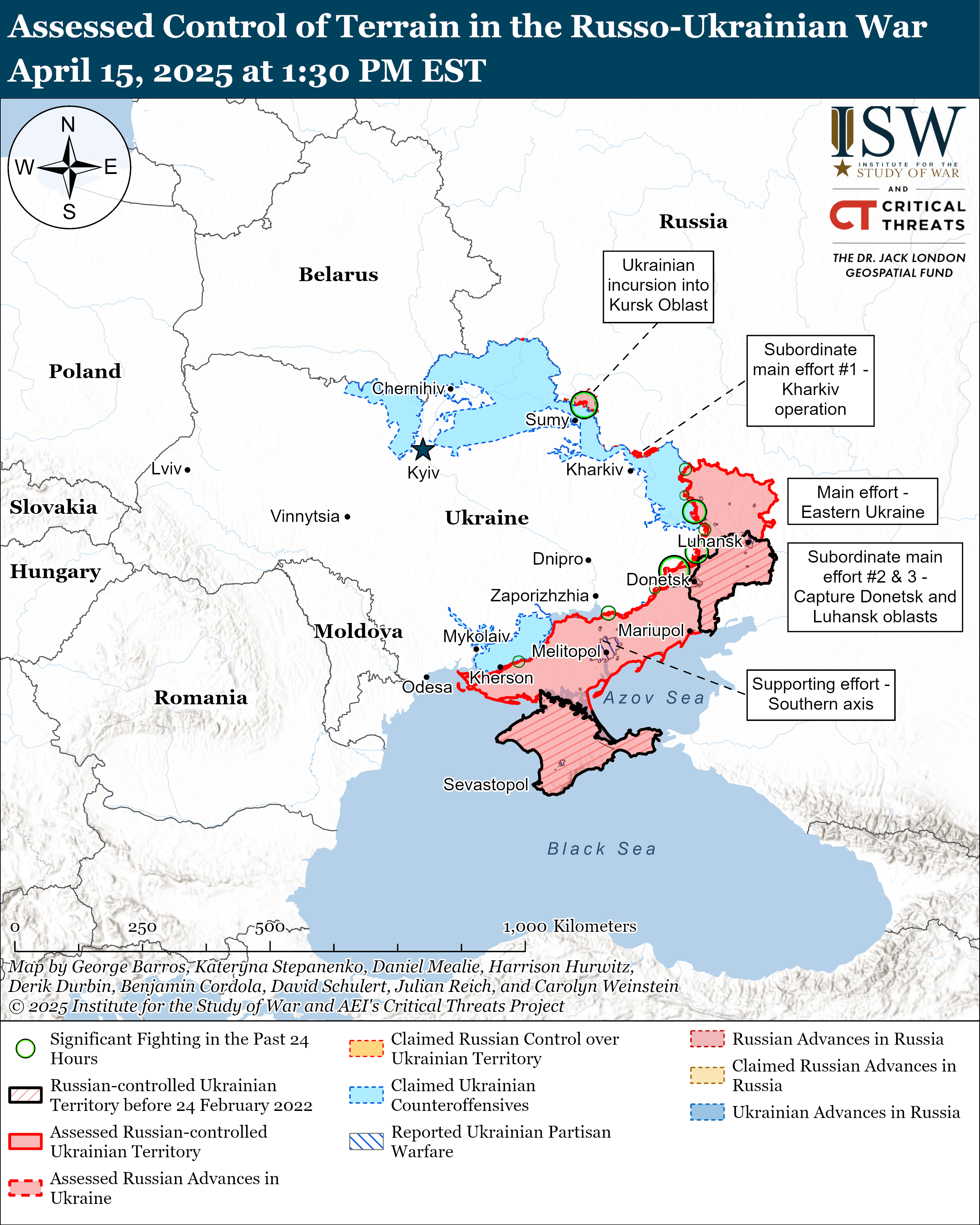
    Ending Russia’s war in Ukraine was one of Donald Trump’s campaign promises, and one that he famously boasted could be achieved in 24 hours. But three months after taking office, the Trump administration has only managed to negotiate a partial ceasefire that has done nothing to stop the fighting.

    On April 13, for example, Russia fired ballistic missiles into the city of Sumy in north-eastern Ukraine, killing at least 35 civilians gathered to celebrate Palm Sunday and injuring over 100 more.

    Military attacks have continued despite numerous meetings between senior Russian and US officials, and phone conversations where Trump and his Russian counterpart, Vladimir Putin, have spoken directly.

    So, why are Trump’s efforts to end the war struggling to get off the starting blocks? The most important reason is that Russia is blocking progress. Moscow has created obstacles, deployed delaying tactics and has generally muddied the waters.

    Fighting in Ukraine has continued as Washington and Moscow discuss the future of Ukraine.
    Institute for the Study of War

    Trump’s major initiative is his proposal for a 30-day general ceasefire to prepare the way for broader peace negotiations. While Ukraine’s president, Volodymyr Zelensky, agreed to this immediately when it was proposed in March, Putin did not. He instead offered a counter proposal: a partial ceasefire banning attacks on energy infrastructure.

    Russia relies heavily on the export of energy, especially oil, to fund the war. But Ukraine has been systematically targeting Russia’s oil refineries and storage facilities, mainly using domestically produced drones. Ukraine is estimated to have destroyed 10% of Russia’s refining capacity since the beginning of 2025.

    By narrowing the scope of the ceasefire, Putin was able to shield Russia’s energy production while continuing to attack Ukraine. Moscow needs the fighting to continue to achieve its openly stated goal of controlling all of Donetsk, Luhansk, Kherson and Zaporizhzhia, the four regions of Ukraine it claimed to annex in 2022.

    Another Russian tactic has been to take every opportunity to present a list of demands for Ukrainian concessions. These include Kyiv giving up its claims to Ukrainian territory occupied by Russia, abandoning its goal of joining Nato, and reducing its armed forces significantly. Russia also wants Ukraine to agree to a change of political leadership.

    This tactic is important for two reasons. First, Russia’s demands make it clear that Moscow envisages the war as the first stage in a longer-term plan to exercise control over all of Ukraine, not only the annexed territories. And second, repeatedly stating Russia’s demands gets them into the public discourse.

    When journalists – or, especially, US officials – repeat them, as Trump’s special envoy Steve Witkoff did recently, they gain an air of legitimacy. This creates the expectation that a peace agreement will comply with Moscow’s agenda.

    Russia is also good at deflecting attention away from ending the war. Sometimes Putin does this with flattery and by appealing to Trump’s sense of self-importance.

    In an interview about his March trip to Moscow, Witkoff glided over his failure to secure a pledge from the Russians to agree to a general ceasefire and instead conveyed a touching story demonstrating Putin’s regard for Trump.

    Putin apparently told Witkoff that he went to church and prayed for Trump’s recovery after he narrowly escaped an assassination attempt during the election campaign. Putin also sent Witkoff back to the US with a portrait of Trump, painted by an artist who is known for producing flattering portraits of Putin himself.

    Another effective tactic of deflection involves money. Russian officials dangle the prospect of lucrative deals involving trade and investment in front of Trump administration officials. This was evidently the focus of much of the first meeting between US and Russian officials in Saudi Arabia in February, although it was convened to discuss plans for peace.

    It is also probably the reason for Kirill Dmitriev’s visit to Washington at the beginning of April. Dmitriev, a figure close to Putin and head of Russia’s sovereign wealth fund, confirmed to journalists that his discussions encompassed possible deals with the US involving rare-earth metals, exploiting resources in the Arctic, and resuming direct flights between the US and Russia.

    Trump’s role

    While Russia places obstacles in the path of peace, Trump and his officials do nothing to remove them. This allows Moscow to continue waging war without constraints.

    Despite Trump’s occasional tough talk about running out of patience with Moscow, as well as his threats of secondary tariffs on countries that buy oil from Russia, no measures that would put pressure on Russia have been implemented.

    Trump has instead made excuses for Moscow. He described the attack on Sumy as a “mistake”, and has expressed admiration for Putin for dragging his feet to get a better deal with Washington.

    This contrasts sharply with Trump’s dealings with Ukraine. Zelensky was publicly humiliated during his meeting with Trump and US vice-president, J.D. Vance, in the Oval Office in February. Trump has even accused Zelensky of starting the war, which was launched by a mass invasion of Russian forces.

    Trump and his team have shown far less interest in Ukraine’s security needs than in striking a lucrative deal to extract the country’s natural resources. The prospect of the Trump administration negotiating a peace agreement that the Ukrainians would accept seems remote.

    So, where does this leave the peace process? When the partial ceasefire arrangement comes to an end later in April, Washington will have to decide whether to resume its efforts to secure a general ceasefire or chart a new course.

    Based on his track record so far, Trump might just blame the Ukrainians for refusing to surrender to Russia’s terms, abandon attempts to reach a negotiated settlement to the war, and go straight to reestablishing normal relations with Russia.

    Jennifer Mathers does not work for, consult, own shares in or receive funding from any company or organisation that would benefit from this article, and has disclosed no relevant affiliations beyond their academic appointment.

    ref. Why is Donald Trump failing to bring peace to Ukraine like he promised? – https://theconversation.com/why-is-donald-trump-failing-to-bring-peace-to-ukraine-like-he-promised-254546

    MIL OSI – Global Reports

  • MIL-OSI Global: Wall Street caught between a rock and a hard place as tensions between US and China rise

    Source: The Conversation – UK – By Johannes Petry, CSGR Research Fellow, University of Warwick

    American investment bank JP Morgan’s logo on its Hong Kong office. Tada Images / Shutterstock

    The trade war between China and the US has spiralled into unchartered territory. On April 10, the Trump administration imposed a tariff of 125% on all Chinese imports. China called the actions unfair and responded with similar measures.

    Within the broader debate around unravelling economic ties between the US and China, where economic interdependence has increasingly been viewed as a threat to US national security, this escalation raises questions about whether global finance is also reducing its presence in China.

    After all, the risks of financial connectivity with China have been discussed prominently by US policymakers in recent years. And many financial analysts have spent much of the past year discussing whether China has become “uninvestable” due to rising geopolitical tensions.

    However, as I show in a recently published study, most global financial firms have continued to expand their presence in Chinese markets over the last decade, even as tensions have intensified.

    Crucially, they have done so on China’s terms, operating within a system that prioritises government oversight and policy goals over liberal market norms. This pragmatic accommodation is quietly reshaping the global financial order.

    China’s capital markets, which have historically been sealed off from the rest of the world, have been opening up in recent decades. This has prompted global financial firms to expand their footprint in China.

    Investment banks such as Goldman Sachs and JP Morgan have taken full ownership of local joint ventures. And asset managers like BlackRock or Invesco have established fund management operations on the Chinese mainland.

    Yet China has not liberalised in the way many in the west expected. Rather than conforming to global norms of open, lightly regulated markets, China’s financial system remains largely guided by the state.

    Markets there operate within a framework shaped by the policy priorities of the central government, capital controls remain in place, and foreign firms are expected to play by a different set of rules than they would in New York or London.

    Foreign investors have been allowed to buy into mainland markets, but through infrastructure that limits capital outflows and preserves regulatory oversight.

    Rather than adapting China to the global financial order, Wall Street has accommodated China’s distinct model. The motivation behind this is clear: China is simply too big to ignore.

    Take China’s pension system as an example. Whereas pension assets in the US amount to 136.2% of GDP in 2019, in China these only amounted to 1.6%. The growth potential in this market is enormous, representing a trillion-dollar opportunity for global firms.

    Consequently, index providers such as MSCI, FTSE Russell, and S&P Dow Jones – key gatekeepers of global investment – have included Chinese stocks and bonds in major benchmark indices.

    These decisions, taken between 2017 and 2020, effectively declared Chinese markets “investment grade” for institutional investors around the world. This has helped legitimise China’s market model within the architecture of global finance.

    America strikes back

    In recent years, Washington has sought to curtail US financial exposure to China through a growing set of measures. These include investment restrictions, entity blacklists, and forced delisting for Chinese firms on US stock exchanges. Such actions signal a broader effort to use finance as a tool of strategic leverage.

    The moves have had some effect. Some US institutional investors and pension funds have declared China “uninvestable”, and are reducing their exposure. American investments in China have roughly halved since their US$1.4 trillion (£1.1 trillion) peak in 2020.

    But attributing this solely to geopolitical pressure overlooks another key factor: China’s underwhelming market performance. A protracted property crisis, a government crackdown on tech companies, and a weak post-pandemic economic recovery have made Chinese markets less attractive to investors in purely financial terms.

    More strategically oriented investors from Asia, Europe and the Middle East have invested more into Chinese markets, filling gaps left by US investors. Sovereign wealth funds from the Middle East, especially, have engaged in more long-term investments as part of broader efforts to strengthen economic cooperation with China.

    And at the same time, many western financial firms have doubled down on their presence in China, expanding their onshore footprint. Since 2020, institutions like JP Morgan, Goldman Sachs and BlackRock have opened new offices, increased their staff, acquired new licences and bought out their joint venture partners to operate independently as investment banks, asset managers or futures brokers.

    It has become more difficult to invest foreign capital in China. But western financial firms are positioning themselves to tap into China’s huge domestic capital pools and capture its long-term growth opportunities – even as they tread carefully around geopolitical sensitivities.

    Fragmenting financial order

    It is too early to predict the long-term effects of the current geopolitical tensions. But Wall Street is trying to placate both sides. On the one hand, it is adapting to capital markets with Chinese characteristics. And on the other, it is trying not to antagonise an increasingly interventionist America.

    However, while holding its breath amid further escalation and having scaled back some of its activities, Wall Street has not left China. It is instead learning how to work within the constraints of a system shaped by a different set of priorities.

    This does not necessarily signal a new global consensus. But it does suggest that the liberal financial order, once defined by Anglo-American norms, is becoming more pluralistic. China’s rise is showing that alternative models – where the state retains a strong hand in markets – can coexist with, and even shape, global finance.

    As tensions between the US and China continue to rise, financial firms are learning to navigate a world in which existing relationships between states and markets are being reconfigured. This process may well define the future of global finance.

    Johannes Petry receives funding from the Economic and Social Research Council (ESRC) and the German Research Foundation (DFG).

    ref. Wall Street caught between a rock and a hard place as tensions between US and China rise – https://theconversation.com/wall-street-caught-between-a-rock-and-a-hard-place-as-tensions-between-us-and-china-rise-254490

    MIL OSI – Global Reports

  • MIL-OSI Global: How petrostates succeeded in watering down the world’s plan to cut shipping emissions

    Source: The Conversation – UK – By Christiaan De Beukelaer, Senior Lecturer in Culture & Climate, The University of Melbourne

    The UN’s International Maritime Organization has just agreed to start charging ships for the greenhouse gases they emit. After decades of ineffective incremental tweaks to shipping emissions, the breakthrough came on April 11 at a summit in London. It makes shipping the first industry subject to a worldwide – and legally binding – emissions price.

    The positive spin is that getting any sort of deal is a major win for multilateral climate action, especially considering two strong headwinds.

    From within the meeting, there was sustained opposition to ambitious action from Saudi Arabia and other petrostates, as well as from China and Brazil. Second, the US had already disengaged from negotiations. Even so, from outside the meeting, the US administration’s tariff war and explicit threat to retaliate against states supporting a shipping pricing regime could have affected talks far more than they did.

    But we’re not sure that this agreement can be considered a success. While there is little traditional climate change denial at the IMO, “mitigation denial” is alive and kicking. Mitigation denial means making lofty promises, often in line with scientific evidence, but not adopting concrete measures able to deliver on these targets. This is exactly what petrostates pushed the IMO to do last week.

    Ultimately, the IMO has well and truly failed the most climate vulnerable, by favouring a more gradual and less certain transition to low-carbon shipping. It’s even effectively making these countries pay the price.

    What are the measures?

    The IMO agreement introduces a global fuel standard for shipping, with financial penalties for ships that don’t meet emissions targets. This is effectively a carbon-trading scheme.

    It sets two targets, both of which get tougher every year: a “base” level and a stricter “direct compliance” level. Ships that miss the direct target have to buy “remedial units”, and more expensive ones if they also fail the base level. Ships that go beyond their targets earn “surplus units”, which they can trade or save for up to two years.

    In practice, this means that the companies and countries that can invest in new technologies will earn a double dividend: they won’t pay for emissions and they will receive rewards for using low-emission fuels.

    At the same time, countries and shipping companies lacking the means to invest will effectively subsidise those early movers by paying penalties that reward them. Hardly any revenues will be available for the promised “just and equitable” transition that would ensure no country is left behind. No wonder nearly all delegates from vulnerable Pacific nations abstained from the vote at the IMO.

    For a typical ship burning heavy fuel oil in 2028, it works out at around US$25 (£19) per tonne of greenhouse gas. That’s far lower than needed to drive a rapid transition to cleaner fuels. We also still don’t know exactly how the money raised will be used.

    Delegates also agreed to update the IMO’s “carbon intensity” policy, which now requires ships to be 21.5% more fuel efficient by 2030 compared to 2019. This is a modest 2.5% improvement per year.

    Pacific island states and the UK were among those arguing for bigger cuts (up to 47%). China pushed for 15% and the EU proposed the surprisingly low 23%. The final result of 21.5% is a bad compromise that does not reflect scientific recommendations on meeting the IMO’s goals or what is possible with available technology.

    Climate action at the IMO

    This geopolitical struggle goes back decades. Following the adoption of the Kyoto protocol (a precursor of the Paris agreement) in 1997, the UN tasked the IMO with reducing shipping emissions. After two decades of little progress, in 2018 the IMO eventually set a weak target to cut emissions by 50% from 2008 levels. In 2023, that goal was strengthened to net-zero emissions “by or around 2050”, with interim targets of 20-30% cuts by 2030 and 70-80% by 2040.


    Read more:
    Why the shipping industry’s increased climate ambition spells the end for its fossil fuel use


    Most importantly, the 2023 strategy also committed to adopting legally binding measures in April 2025 to deliver on these targets. This has now happened.

    In light of that history, the new measures do constitute progress. However, their success has to be judged on whether they can actually meet the IMO’s targets.

    The 2030 goal is especially important as climate damage is proportional to cumulative emissions over time, so it’s important to cut emissions as soon as possible. If the shipping sector misses its 2030 target, it may have emitted too much carbon to still make a fair contribution to the Paris agreement.

    Academics at UCL have analysed the new IMO agreement. Unfortunately, they calculated the new policies will only deliver a 10% reduction by 2030 – that’s not even close to the 20% goal the IMO set, let alone the “strive” target of 30%.

    Mitigation denial?

    At the IMO’s closing meeting, Harry Conway, chair of its Marine Environment Protection Committee, held up a glass of water and remarked that at the start of the week, the glass was empty, now the glass is half full.

    As political spin, that image might work. But when it comes to setting a clear and ambitious path forward, the measures fall well short.

    The 2023 strategy committed nations to “strive” to deliver 30% emissions cuts by 2030. Last week’s meeting might yield 10%. Another reason why Pacific delegates abstained from voting. There is a lot more striving – and delivering – to be done.

    A credible pathway to reach net-zero by 2050 is now at risk. Strong pushback by the US, Saudi Arabia, China and Brazil, and weak leadership from the EU all played a role. Even adopting these modest measures – which requires a vote in October – and specifying operational “guidelines” afterwards will be an uphill battle.

    Christiaan De Beukelaer receives funding from the ClimateWorks Foundation.

    Simon Bullock is a member of the Institute for Marine Engineering, Science and Technology (IMarEST)

    ref. How petrostates succeeded in watering down the world’s plan to cut shipping emissions – https://theconversation.com/how-petrostates-succeeded-in-watering-down-the-worlds-plan-to-cut-shipping-emissions-254638

    MIL OSI – Global Reports

  • MIL-OSI Global: Television wasn’t the death knell for cinema – and that holds lessons for the creative industries and AI

    Source: The Conversation – UK – By Mark Fryers, Lecturer in film and media, The Open University

    KitohodkA/Shutterstock

    As television grew rapidly in popularity in the second half of the 20th century, many people assumed it would cause a knock-on crisis for the film industry. After all, it meant that viewers no longer had to leave their sofas to enjoy onscreen entertainment.

    But the reality was far more nuanced. The “death of cinema” has been habitually touted ever since the introduction of the TV, but never really came to pass. Instead, cinema found ways to work with new competition through technological innovation, aesthetic invention and engaging with challenging subject matters.

    Today, lessons from the introduction of TV demonstrate how the creative industries have navigated the introduction of new technology. And could offer some comfort to those who fear that artificial intelligence (AI) technology could be a death knell for the creative industries.


    This article is part of our State of the Arts series. These articles tackle the challenges of the arts and heritage industry – and celebrate the wins, too.


    As far back as 1938, long before its widespread popularity, film production company Paramount Studios sought to break into television. It made significant investment in DuMont Laboratories, which evolved into a pioneering commercial TV network.

    Other studios followed suit and experimented with “live cinema”. This was a form of entertainment in which broadcast images, including sporting events, were converted into 35mm film and projected onto cinema screens, and it was made throughout the 1940s.

    The “Paramount decrees” antitrust case issued by the US Supreme Court in 1948 ended the monopolistic practices of the studios, which precluded them from owning broadcast companies in favour of the radio networks. They were also ordered to sell their cinema chains, which meant that their films no longer had guaranteed screenings to the public.

    Nevertheless, they continued to form television production companies, with Columbia establishing Screen Gems in 1951 and Paramount reinvesting in the ABC network in 1952. By the 1960s, the majority of prime-time television programming was provided by Hollywood studio companies. These close ties fostered a mutually beneficial relationship.

    Cross-pollination

    After the break-up of the studios, many studio personnel found work in the television industry. It provided a training ground for future cinema stars, including as Steven Spielberg, George Clooney and John Travolta. Studios could also rent out their studios and facilities to television production companies.

    The “star system” (in which the popularity of film stars had always driven the commercial potential of cinema) was now complimented by the exposure of these stars on television programmes.

    Jaws was advertised across TV channels.
    Wiki Commons, CC BY-SA

    Many studios began using TV to advertise their films. For example, Disneyland TV programmes helped to advertise the Disney studio and its cinematic products as distinct from television. And film trailers became another important conduit for cinema advertising. The summer blockbuster era was ushered in by Jaws in 1975 with blanket advertising on every prime-time TV show.

    When early television schedules lacked enough new content to fill the airwaves, British cinema and cheap films and serials (a series of short films with cliffhanger endings; an early progenitor of television series) from the smaller Hollywood studios filled the early schedules.

    Other studio executives took note that their back catalogues of film, which mainly sat untouched in vaults, were a financial goldmine that could be ploughed back into film production and technological development. MGM, which owned titles including perennial favourite The Wizard of Oz, which CBS reserved exclusive rights to screen for 20 years, from August 1956 US$34 million (£12 million) for its titles, while Paramount held out for US$50 million (£17.8 million). Screening rights were sold to the television networks.

    As a result, television became the primary conduit for film viewing. Subsequently, more films were seen on television than on the big screen. There were 3.4 billion film viewings on UK TV in 2013 compared with 165 million cinema admissions – these are now shared with streaming and on demand services. Something had to be done to keep people going to the cinema.

    Technical and aesthetic innovation

    In attempting to preserve the experience of the big screen, widescreen, 3D and multi-track sound systems were introduced to cinemas. The move to standardised colour film accelerated, while extended film length attempted to link the cinematic experience with “high culture” such as the theatre and opera, with overtures and intermissions.

    While many were seen as gimmicky (such as “smell-O-vision” in Scent of Mystery, 1960), widescreen filming became the aesthetic choice of filmmakers, producing epic canvasses and an alternative viewing experience to the small television screen.

    A trailer for A Scent of Mystery and its ‘smell-o-vision’ marketing.

    Although many of these technologies dated back to the 1920s, small-screen competition drove technological and aesthetic innovation, and was partly financed by the tele-visual licensing of their films. Alongside these innovations, the content of the films themselves offered a demonstrable alternative to the small screen.

    By the late 1960s, Hollywood had essentially broken free from the self-imposed censorial strictures of the Hay’s production code, which regulated everything from language to interracial relationships. Instead, film-makers had absorbed the influences of documentary, avant-garde and the French New Wave, among others, as well as the rock n’ roll and counterculture movements to make bold and controversial films, such as Who’s Afraid of Virginia Woolf? (1966) and Easy Rider (1969).

    The topics and levels of sex and violence portrayed in these films were unthinkable within the heavily regulated family and advertiser-friendly television industry.


    Looking for something good? Cut through the noise with a carefully curated selection of the latest releases, live events and exhibitions, straight to your inbox every fortnight, on Fridays. Sign up here.


    Director Alfred Hitchcock made the most of this distinction between mediums. He utilised the agile tele-visual working crew of his TV series Alfred Hitchcock Presents (1955) for the taboo-bothering horror film Psycho in 1960, suggesting that the two mediums could be related but also divided by content. This, along with the aesthetic innovations helped to elevate cinema artistically in relation to the small screen.

    And so the AI era dawns. The writers and actors strike of 2023 showed that the creative industries are ready to fight for their survival. Adaptability, as Hollywood has demonstrated throughout its history, can also be the key to continued success.

    Dr Mark Fryers received funding from the Arts and Humanities Research Council (MA & PhD funding, 2011-2015).

    ref. Television wasn’t the death knell for cinema – and that holds lessons for the creative industries and AI – https://theconversation.com/television-wasnt-the-death-knell-for-cinema-and-that-holds-lessons-for-the-creative-industries-and-ai-250227

    MIL OSI – Global Reports

  • MIL-OSI Europe: Minister for Enterprise, Tourism and Employment Peter Burke T.D. secures Government approval to publish the Short Term Letting and Tourism Bill General Scheme Minister James Browne to publish new planning guidance

    Source: Government of Ireland – Department of Jobs Enterprise and Innovation

    Minister Peter Burke has secured Cabinet approval to publish the General Scheme of the new Short Term Letting and Tourism (STLT) Bill.  The legislation will introduce a register for all Short Term Lets (STLs) in Ireland, which will be implemented and managed by Fáilte Ireland from 20 May 2026, ensuring compliance with the new EU Short Term Rental Regulation which was adopted by the EU on 11 April 2024.

    Minister for Housing James Browne has also secured approval from Government to publish a National Planning Statement on Short Term Letting, in order to give greater clarity to the sector with regards planning in advance of the commencement of the new legislation.

    Minister Burke said

    “This is a very important piece of legislation that will enable the introduction of new regulatory controls for the Short-Term Letting sector. The self-catering and wider short-term letting sector is an important element of the Irish tourism ecosystem and for the first time, we will have up to date and accurate data on the numbers and spread of this accommodation. Tourism is of critical importance to the Irish economy, providing 228,000 jobs and €6 billion income to our economy in 2024.   The long-term development of the tourism sector requires that an appropriate balance is achieved between the short-term letting sector and long-term housing market, and the wider needs of local communities, both economically and socially.”

    Minister went on to say

    “I am aware of the genuine concerns regarding the impacts on rural tourism and local economies of removing a significant cohort of STL properties from the tourism and other short-term letting market and I continue to engage with the sector in this regard. However, meeting local housing need across Ireland is a critically important consideration and Government must use every lever available to assist in providing homes for our people”.

    The new STL register will be available online and will provide a full picture of the stock of registered tourist accommodation across the state. Hosts offering STL accommodation for periods up to and including 21 nights will be obliged to register with Fáilte Ireland and hold a valid registration number that must be displayed when advertising their STL property.

    The EU STR Regulation and Ireland’s new registration requirements for STLs will both come into full force on 20 May 2026. Fáilte Ireland will apply the enforcement mechanisms provided for in the legislation in respect of non-compliant STL hosts by means of Fixed Payment Notices and/or summary proceedings in the District Court.

    The STLT Bill also provides for the introduction of an administrative sanction procedure (ASP) for infringements by online short-term rental platforms of their obligations under the STR Regulation. This will enable the State to impose large financial penalties (a maximum of 2% of turnover) to enforce compliance where necessary.

    Minister Burke will appoint an independent panel to determine the level of financial sanction to be imposed.

    The Cabinet also approved, for the Minister for Housing, Local Government and Heritage, James Browne T.D., the drafting of new planning guidance and any necessary legislative changes to implement the new Planning Guidelines in the form of a National Planning Statement on short-term letting. That Planning Statement is an important input in balancing local housing, tourism and economic needs and will provide the necessary clarity to the STL sector on the planning requirements around STL properties. The Minister for Housing, Local Government and Heritage will publish these guidelines in advance of the final enactment of the STLT Bill.

    Minister Browne said:

    “In advance of commencement of the legislation, I will be publishing new planning guidance to give greater clarity to the short term letting sector and to allow those in tourism to plan accordingly. This guidance will seek to recognise the needs of tourism and those who visit Ireland, while also acting on the urgent aim of this Government to increase domestic rental supply. This new Housing policy is to generally preclude new planning permissions for Short term lets in cities and towns with a Census population in excess of 10,000 persons, or as may be set by Regulations, and to enable local authorities have discretion to develop policies for other locations having regard to relevant local criteria to be set out in the guidance. At present, all STL properties based in rent pressure zones are required to have appropriate planning permission in instances where a secondary property is being rented out for more than 90 days per year.  If you rent out a room in your principal private residence, planning permission is generally not required.”

    Minister Burke and his Department will consider the full implications for the Tourism sector as we await the planning clarification from the Minister for Housing, Local Government and Heritage.

    MIL OSI Europe News

  • MIL-OSI: Norwood Financial Corp announces First Quarter 2025 Results

    Source: GlobeNewswire (MIL-OSI)

    Quarterly Highlights:

    • Fully diluted EPS of $0.63, a 14.5% increase over the same period in 2024
    • Return on assets rises to over 1.00%.
    • Net interest margin increased 30 basis points vs. the prior quarter and 11 basis points over the prior year.
    • Loans grew at a 13.5% annualized rate during the first quarter.
    • Capital continues to improve on increased earnings and lower AOCI adjustment.

    HONESDALE, Pa., April 17, 2025 (GLOBE NEWSWIRE) — Norwood Financial Corp (Nasdaq Global Market-NWFL) and its subsidiary, Wayne Bank, announced results for the three months March 31, 2025.

    Jim Donnelly, President and Chief Executive Officer of Norwood Financial Corp and Wayne Bank, stated, “The actions that we took in December 2024 to improve our capital and earnings have given us a great start to 2025. The portfolio repositioning has improved our net interest margin. That, coupled with strong annualized growth in loans and deposits, put us on a positive trajectory for 2025. We continue to benefit from lower deposit costs together with higher assets yields and our deposit growth has allowed us to lower our use of wholesale borrowings.”

    Mr. Donnelly continued, “The capital that we raised in December 2024, has strengthened our balance sheet and will allow our Company to better weather any headwinds that come with global uncertainty. Although we do not have any international business per se, we do have customers who may have exposure to developing trade conditions. Because we are a community bank we are contacting our customers to determine how we can best assist them, if necessary. Additionally, we are being prudent regarding the opportunities in front of us, taking the time to assess the effects of changing economic circumstances.”

    Selected Financial Highlights

    (dollars in thousands, except
    per share data)
    Year-Over Year Linked Quarter Adjusted Linked Quarter1  
      3 Months Ended 3 Months Ended 3 Months Ended  
      Mar-25 Mar-24 Change Dec-24 Change Dec-24 Change  
    Net interest income 17,857   14,710   3,147 16,625   1,232 16,625   1,232  
    Net interest spread (fte) 2.61%   2.08%   53 bps 2.31%   30 bps 2.31%   30 bps  
    Net interest margin (fte) 3.30%   2.80%   50 bps 3.04%   26 bps 3.04%   26 bps  
    Net income (loss) 5,773   4,433   1,340 (12,651)   18,424 3,119   2,654  
    Diluted earnings per share 0.63   0.55   0.08 -1.54   -2.09 0.38   0.25  
    Return on average assets 1.01%   0.80%   21 bps -2.19%   320 bps 0.54%   47 bps  
    Return on tangible equity 12.40%   11.65%   75 bps -30.77%   (4,317 bps) 7.59%   481 bps  
           

    1 – The above table includes non-GAAP financial measures excluding the one-time $20.0 million net realized loss incurred in the fourth quarter as a result of the repositioning of our investment portfolio. Please see “Non-GAAP Financial Measures” below for a reconciliation of all non-GAAP financial measures.

    Discussion of financial results for the three months ended March 31, 2025:

    • The Company had net income of $5.8 million for the three months ended March 31, 2025, an increase $1.3 million over the same period last year.
    • Net interest income increased during the first quarter of 2025 compared to the first quarter of 2024 due to increases in asset yields which outpaced increases in yields on liabilities.
    • Correspondingly, the net interest margin in the first quarter of 2025 was 3.30% compared to 2.80% in the first quarter of 2024.
    • The efficiency ratio for the first quarter of 2025 was 59.7% compared to 70.6% in the first quarter of 2024.
    • As of March 31, 2025, total assets were $2.376 billion, compared to $2.260 billion at March 31, 2024, an increase of 5.07%.
    • Loans receivable were $1.771 billion at March 31 2025, compared to $1.621 billion at March 31, 2024, an increase of 9.24%.
    • Total deposits were $2.004 billion at March 31 2025, compared to $1.839 billion at March 31, 2024, an increase of 9.00%.
    • Tangible Common Equity was 8.16% as of March 31, 2025, versus 6.80% at March 31, 2024.
    • Tangible Book Value per share increased $0.81 from $19.85 at December 31, 2024 to $20.66 at March 31, 2025.

    Norwood Financial Corp is the parent company of Wayne Bank, which operates from sixteen offices throughout Northeastern Pennsylvania and fourteen offices in Delaware, Sullivan, Ontario, Otsego and Yates Counties, New York. The Company’s stock trades on the Nasdaq Global Market under the symbol “NWFL”.

    Non-GAAP Financial Measures

    This release references adjusted net income, adjusted diluted earnings per share, adjusted return on average assets and adjusted return on tangible equity, all of which are non-GAAP (Generally Accepted Accounting Principles) financial measures. Adjusted values were derived by reversing the effect of loss on sale of securities in December 2024 along with the attendant tax effect. We believe the presentation of adjusted net income, adjusted diluted earnings per share, adjusted return on average assets and adjusted return on tangible equity ensures comparability of these measures as the portfolio restructuring is not something the Company expects to be a recurring event.

    Adjusted Return on Average Assets      
    (Dollars in thousands)      
      Three Months Ended
      December 31, 2024
    Net (loss) income $ (12,651)  
    Average assets   2,299,732  
    Return on average assets (annualized)   -2.19 %
    Net (loss) income   (12,651)  
    Net realized losses on sale of securities   19,962  
    Tax effect at 21%   (4,192)  
    Adjusted Net Income (Non-GAAP)   3,119  
    Average assets   2,299,732  
    Adjusted return on average assets (annualized)      
    (Non-GAAP)   0.54 %
           
           
    Adjusted Return on Average Tangible Shareholders’ Equity      
    (Dollars in thousands)      
           
      Three Months Ended
      December 31, 2024
    Net (loss) income $ (12,651)  
    Average shareholders’ equity   192,981  
    Average intangible assets   29,424  
    Average tangible shareholders’ equity   163,557  
    Return on average tangible shareholders’ equity (annualized)   -30.77 %
    Net (loss) income   (12,651)  
    Net realized losses on sale of securities   19,962  
    Tax effect at 21%   (4,192)  
    Adjusted Net Income (Non-GAAP)   3,119  
    Average tangible shareholders’ equity   163,557  
    Adjusted return on average shareholders’ equity (annualized)      
    (Non-GAAP)   7.59 %
           
           
    Adjusted Earnings Per Share      
    (Dollars in thousands)      
           
      Three Months Ended
      December 31, 2024
    GAAP-Based Earnings Per Share, Basic $ (1.54)  
    GAAP-Based Earnings Per Share, Diluted $ (1.54)  
    Net (Loss) Income   (12,651)  
    Net realized losses on sale of securities   19,962  
    Tax effect at 21%   (4,192)  
    Adjusted Net Income (Non-GAAP)   3,119  
    Adjusted Earnings per Share, Basic (Non-GAAP) $ 0.38  
    Adjusted Earnings per Share, Diluted (Non-GAAP) $ 0.38  

    The following table reconciles average equity to average tangible equity:

        For the Period Ended
    (dollars in thousands)   March 31
          2025       2024  
                 
    Average equity   $ 218,194     $ 182,088  
    Average goodwill and other intangibles     (29,409 )     (29,476 )
    Average tangible equity   $ 188,785     $ 152,612  
                 

    Forward-Looking Statements

    The Private Securities Litigation Reform Act of 1995 contains safe harbor provisions regarding forward-looking statements. When used in this discussion, the words “believes”, “anticipates”, “contemplates”, “expects”, “bode”, “future performance” and similar expressions are intended to identify forward-looking statements. Such statements are subject to certain risks and uncertainties, which could cause actual results to differ materially from those projected. Those risks and uncertainties include, among other things, changes in federal and state laws, changes in interest rates, our ability to maintain strong credit quality metrics, our ability to have future performance, our ability to control core operating expenses and costs, demand for real estate, government fiscal and trade policies, cybersecurity and general economic conditions. The Company undertakes no obligation to publicly release the results of any revisions to those forward-looking statements which may be made to reflect events or circumstances after the date hereof or to reflect the occurrence of unanticipated events.

    Contact: John M. McCaffery
    Executive Vice President &
    Chief Financial Officer
    NORWOOD FINANCIAL CORP
    272-304-3003
    www.waynebank.com 

             
    NORWOOD FINANCIAL CORP        
    Consolidated Balance Sheets        
    (dollars in thousands, except share and per share data)        
     (unaudited)        
        March 31
        2025     2024  
    ASSETS        
       Cash and due from banks $ 31,729   $ 19,519  
       Interest-bearing deposits with banks   43,678     92,444  
              Cash and cash equivalents   75,407     111,963  
             
      Securities available for sale   408,742     398,374  
      Loans receivable   1,771,269     1,621,448  
      Less: Allowance for credit losses   20,442     18,020  
         Net loans receivable   1,750,827     1,603,428  
      Regulatory stock, at cost   7,616     6,545  
      Bank premises and equipment, net   20,273     18,057  
      Bank owned life insurance   46,914     45,869  
      Foreclosed real estate owned       97  
      Accrued interest receivable   8,587     8,135  
      Deferred tax assets, net   17,859     21,642  
      Goodwill   29,266     29,266  
      Other intangible assets   136     202  
      Other assets   10,417     16,845  
              TOTAL ASSETS $ 2,376,044   $ 2,260,423  
             
    LIABILITIES        
       Deposits:        
         Non-interest bearing demand $ 391,377   $ 383,362  
         Interest-bearing   1,613,071     1,455,636  
              Total deposits   2,004,448     1,838,998  
      Short-term borrowings       60,055  
      Other borrowings   118,590     151,179  
      Accrued interest payable   13,864     11,737  
      Other liabilities   18,435     17,241  
                TOTAL LIABILITIES   2,155,337     2,079,210  
             
    STOCKHOLDERS’ EQUITY        
      Preferred Stock, no par value per share, authorized 5,000,000 shares        
      Common Stock, $.10 par value per share,        
             authorized: 20,000,000 shares,        
             issued: 2025: 9,489,398 shares, 2024: 8,310,847 shares   949     831  
      Surplus   126,785     97,893  
      Retained earnings   127,865     137,285  
      Treasury stock, at cost: 2025: 229,979 shares, 2024: 200,690 shares   (6,208 )   (5,397 )
      Accumulated other comprehensive loss   (28,684 )   (49,399 )
               TOTAL STOCKHOLDERS’ EQUITY   220,707     181,213  
             
              TOTAL LIABILITIES AND        
                     STOCKHOLDERS’ EQUITY $ 2,376,044   $ 2,260,423  
             
             
    NORWOOD FINANCIAL CORP        
    Consolidated Statements of Income        
    (dollars in thousands, except per share data)        
      (unaudited)        
        Three Months Ended March 31,
        2025     2024  
    INTEREST INCOME        
        Loans receivable, including fees $ 25,988   $ 23,681  
        Securities   3,870     2,526  
        Other   226     731  
             Total Interest income   30,084     26,938  
             
    INTEREST EXPENSE        
       Deposits   10,748     10,110  
       Short-term borrowings   458     336  
       Other borrowings   1,021     1,782  
            Total Interest expense   12,227     12,228  
    NET INTEREST INCOME   17,857     14,710  
    PROVISION FOR (RELEASE OF) CREDIT LOSSES $ 857   $ (624 )
    NET INTEREST INCOME AFTER PROVISION FOR (RELEASE OF) CREDIT LOSSES   17,000     15,334  
             
             
    OTHER INCOME        
        Service charges and fees   1,513     1,343  
        Income from fiduciary activities   325     238  
        Gains on sales of loans, net   47     6  
        Earnings and proceeds on life insurance policies   286     268  
        Other   180     151  
               Total other income   2,351     2,006  
             
    OTHER EXPENSES        
          Salaries and employee benefits   6,472     6,135  
          Occupancy, furniture and equipment   1,378     1,261  
          Data processing and related operations   1,085     1,022  
          Taxes, other than income   192     93  
          Professional fees   659     585  
          FDIC Insurance assessment   406     361  
          Foreclosed real estate   4     21  
          Amortization of intangibles   15     19  
          Other   1,853     2,235  
                 Total other expenses   12,064     11,732  
             
    INCOME BEFORE TAX EXPENSE   7,287     5,608  
    INCOME TAX EXPENSE   1,514     1,175  
    NET INCOME $ 5,773   $ 4,433  
             
    Basic earnings per share $ 0.63   $ 0.55  
             
    Diluted earnings per share $ 0.63   $ 0.55  
                 
    NORWOOD FINANCIAL CORP                                    
    NET INTEREST MARGIN ANALYSIS                                    
    (dollars in thousands)                                    
                                         
      For the Quarter Ended
      March 31, 2025 December 31, 2024 March 31, 2024
      Average   Average   Average   Average   Average   Average  
      Balance Interest    Rate   Balance Interest     Rate   Balance Interest     Rate  
      (2) (1) (3)   (2) (1) (3)   (2) (1) (3)  
    Assets                                    
    Interest-earning assets:                                    
      Interest-bearing deposits with banks $ 20,802   $ 226   4.41   % $ 46,629   $ 574   4.90   % $ 53,930   $ 730   5.44   %
       Securities available for sale:                                    
         Taxable   408,427     3,623   3.60       404,777     2,434   2.39       402,275     2,147   2.15    
         Tax-exempt (1)   44,242     312   2.86       65,628     449   2.72       69,880     481   2.77    
            Total securities available for sale (1)   452,669     3,935   3.53       470,405     2,883   2.44       472,155     2,628   2.24    
         Loans receivable (1) (4) (5)   1,743,572     26,120   6.08       1,690,650     26,246   6.18       1,612,106     23,775   5.93    
            Total interest-earning assets   2,217,043     30,281   5.54       2,207,684     29,703   5.35       2,138,191     27,133   5.10    
    Non-interest earning assets:                                    
       Cash and due from banks   28,705             27,283             24,593          
       Allowance for credit losses   (20,154 )           (18,741 )           (19,096 )        
       Other assets   93,131             83,506             73,692          
            Total non-interest earning assets   101,682             92,048             79,189          
    Total Assets $ 2,318,725           $ 2,299,732           $ 2,217,380          
    Liabilities and Stockholders’ Equity                                    
    Interest-bearing liabilities:                                    
       Interest-bearing demand and money market $ 546,884   $ 2,801   2.08     $ 528,330   $ 3,017   2.27     $ 449,825   $ 2,311   2.07    
       Savings   211,905     142   0.27       209,362     162   0.31       235,545     250   0.43    
       Time   793,803     7,805   3.99       764,819     7,805   4.06       725,199     7,549   4.19    
          Total interest-bearing deposits   1,552,592     10,748   2.81       1,502,511     10,984   2.91       1,410,569     10,110   2.88    
    Short-term borrowings   44,297     458   4.19       46,267     348   2.99       57,997     336   2.33    
    Other borrowings   93,549     1,021   4.43       133,620     1,528   4.55       155,498     1,782   4.61    
       Total interest-bearing liabilities   1,690,438     12,227   2.93       1,682,398     12,860   3.04       1,624,064     12,228   3.03    
    Non-interest bearing liabilities:                                    
       Demand deposits   380,544             394,001             386,066          
       Other liabilities   29,549             30,352             25,162          
          Total non-interest bearing liabilities   410,093             424,353             411,228          
       Stockholders’ equity   218,194             192,981             182,088          
    Total Liabilities and Stockholders’ Equity $ 2,318,725           $ 2,299,732           $ 2,217,380          
    Net interest income/spread (tax equivalent basis)       18,054   2.61   %       16,843   2.31   %       14,905   2.08   %
    Tax-equivalent basis adjustment       (197 )           (218 )           (195 )    
    Net interest income     $ 17,857           $ 16,625           $ 14,710      
    Net interest margin (tax equivalent basis)         3.30   %         3.04   %         2.80   %
                                         
                                         
    (1) Interest and yields are presented on a tax-equivalent basis using a marginal tax rate of 21%.                           
    (2) Average balances have been calculated based on daily balances.                              
    (3) Annualized                                    
    (4) Loan balances include non-accrual loans and are net of unearned income.                            
    (5) Loan yields include the effect of amortization of deferred fees, net of costs.                            
    NORWOOD FINANCIAL CORP        
    Financial Highlights (Unaudited)        
    (dollars in thousands, except per share data)        
             
    For the Three Months Ended March 31   2025     2024  
             
    Net interest income $ 17,857   $ 14,710  
    Net income   5,773     4,433  
             
    Net interest spread (fully taxable equivalent)   2.61 %   2.08 %
    Net interest margin (fully taxable equivalent)   3.30 %   2.80 %
    Return on average assets   1.01 %   0.80 %
    Return on average equity   10.73 %   9.79 %
    Return on average tangible equity   12.40 %   11.68 %
    Basic earnings per share $ 0.63   $ 0.55  
    Diluted earnings per share $ 0.63   $ 0.55  
             
    As of March 31   2025     2024  
             
    Total assets $ 2,376,044   $ 2,260,423  
    Total loans receivable   1,771,269     1,621,448  
    Allowance for credit losses   20,442     18,020  
    Total deposits   2,004,448     1,838,998  
    Stockholders’ equity   220,707     181,213  
    Trust assets under management   198,761     202,020  
             
    Book value per share $ 23.84   $ 22.34  
    Tangible book value per share $ 20.66   $ 18.71  
    Equity to total assets   9.29 %   8.02 %
    Allowance to total loans receivable   1.15 %   1.11 %
    Nonperforming loans to total loans   0.45 %   0.23 %
    Nonperforming assets to total assets   0.33 %   0.17 %
             
    NORWOOD FINANCIAL CORP                    
    Consolidated Balance Sheets (unaudited)                    
    (dollars in thousands)                    
        March 31   December 31   September 30   June 30   March 31
        2025   2024   2024   2024   2024
    ASSETS                    
    Cash and due from banks $ 31,729 $ 27,562 $ 47,072 $ 29,903 $ 19,519
    Interest-bearing deposits with banks   43,678   44,777   35,808   39,492   92,444
    Cash and cash equivalents   75,407   72,339   82,880   69,395   111,963
                         
    Securities available for sale   408,742   397,846   396,891   397,578   398,374
    Loans receivable   1,771,269   1,713,638   1,675,139   1,641,356   1,621,448
    Less: Allowance for credit losses   20,442   19,843   18,699   17,807   18,020
    Net loans receivable   1,750,827   1,693,795   1,656,440   1,623,549   1,603,428
    Regulatory stock, at cost   7,616   13,366   6,329   6,443   6,545
    Bank owned life insurance   46,914   46,657   46,382   46,121   45,869
    Bank premises and equipment, net   20,273   19,657   18,503   18,264   18,057
    Foreclosed real estate owned           97
    Goodwill and other intangibles   29,402   29,418   29,433   29,449   29,468
    Other assets   36,863   44,384   42,893   44,517   46,622
    TOTAL ASSETS $ 2,376,044 $ 2,317,462 $ 2,279,751 $ 2,235,316 $ 2,260,423
                         
    LIABILITIES                    
    Deposits:                    
    Non-interest bearing demand $ 391,377 $ 381,479 $ 420,967 $ 391,849 $ 383,362
    Interest-bearing deposits   1,613,071   1,477,684   1,434,284   1,419,323   1,455,636
    Total deposits   2,004,448   1,859,163   1,855,251   1,811,172   1,838,998
    Borrowings   118,590   214,862   197,412   210,422   211,234
    Other liabilities   32,299   29,929   31,434   31,534   28,978
    TOTAL LIABILITIES   2,155,337   2,103,954   2,084,097   2,053,128   2,079,210
                         
    STOCKHOLDERS’ EQUITY   220,707   213,508   195,654   182,188   181,213
                         
    TOTAL LIABILITIES AND                    
    STOCKHOLDERS’ EQUITY $ 2,376,044 $ 2,317,462 $ 2,279,751 $ 2,235,316 $ 2,260,423
                         
    NORWOOD FINANCIAL CORP                    
    Consolidated Statements of Income (unaudited)                    
    (dollars in thousands, except per share data)                    
        March 31   December 31   September 30   June 30   March 31
    Three months ended   2025    2024    2024    2024    2024 
    INTEREST INCOME                    
    Loans receivable, including fees $ 25,988   $ 26,122   $ 25,464   $ 24,121   $ 23,681  
    Securities   3,870     2,789     2,526     2,584     2,526  
    Other   226     574     497     966     731  
    Total interest income   30,084     29,485     28,487     27,671     26,938  
                         
    INTEREST EXPENSE                    
    Deposits   10,748     10,984     10,553     10,687     10,110  
    Borrowings   1,479     1,876     2,003     2,059     2,118  
    Total interest expense   12,227     12,860     12,556     12,746     12,228  
    NET INTEREST INCOME   17,857     16,625     15,931     14,925     14,710  
    PROVISION FOR (RELEASE OF) CREDIT LOSSES   857     1,604     1,345     347     (624 )
    NET INTEREST INCOME AFTER (RELEASE OF) PROVISION                    
    FOR CREDIT LOSSES   17,000     15,021     14,586     14,578     15,334  
                         
    OTHER INCOME                    
    Service charges and fees   1,513     1,595     1,517     1,504     1,343  
    Income from fiduciary activities   325     224     256     225     238  
    Net realized (losses) gains on sales of securities       (19,962 )            
    Gains on sales of loans, net   47     50     103     36     6  
    Gains on sales of foreclosed real estate owned               32      
    Earnings and proceeds on life insurance policies   286     275     261     253     268  
    Other   180     159     158     157     151  
    Total other income   2,351     (17,659 )   2,295     2,207     2,006  
                         
    OTHER EXPENSES                    
    Salaries and employee benefits   6,472     6,690     6,239     5,954     6,135  
    Occupancy, furniture and equipment, net   1,378     1,291     1,269     1,229     1,261  
    Foreclosed real estate   4     9     9     15     21  
    FDIC insurance assessment   406     335     339     309     361  
    Other   3,804     5,094     4,175     3,937     3,954  
    Total other expenses   12,064     13,419     12,031     11,444     11,732  
                         
    INCOME BEFORE TAX (BENEFIT) EXPENSE   7,287     (16,057 )   4,850     5,341     5,608  
    INCOME TAX (BENEFIT) EXPENSE   1,514     (3,406 )   1,006     1,128     1,175  
    NET (LOSS) INCOME $ 5,773   $ (12,651 ) $ 3,844   $ 4,213   $ 4,433  
                         
    Basic (loss) earnings per share $ 0.63   $ (1.54 ) $ 0.48   $ 0.52   $ 0.55  
                         
    Diluted (loss) earnings per share $ 0.63   $ (1.54 ) $ 0.48   $ 0.52   $ 0.55  
                         
    Book Value per share $ 23.84   $ 23.02   $ 24.18   $ 22.52   $ 22.34  
    Tangible Book Value per share   20.66     19.85     20.54     18.88     18.71  
                         
    Return on average assets (annualized)   1.01 %   -2.19 %   0.68 %   0.75 %   0.80 %
    Return on average equity (annualized)   10.73 %   -26.08 %   8.09 %   9.41 %   9.79 %
    Return on average tangible equity (annualized)   12.40 %   -30.77 %   9.58 %   11.26 %   11.68 %
                         
    Net interest spread (fte)   2.61 %   2.31 %   2.23 %   2.06 %   2.08 %
    Net interest margin (fte)   3.30 %   3.04 %   2.99 %   2.80 %   2.80 %
                         
    Allowance for credit losses to total loans   1.15 %   1.16 %   1.12 %   1.08 %   1.11 %
    Net charge-offs to average loans (annualized)   0.07 %   0.12 %   0.08 %   0.13 %   0.08 %
    Nonperforming loans to total loans   0.45 %   0.46 %   0.47 %   0.47 %   0.23 %
    Nonperforming assets to total assets   0.33 %   0.34 %   0.35 %   0.34 %   0.17 %

    The MIL Network

  • MIL-OSI Economics: China’s tech self-reliance accelerates amid sanctions, reshaping global innovation landscape, says GlobalData

    Source: GlobalData

    China’s tech self-reliance accelerates amid sanctions, reshaping global innovation landscape, says GlobalData

    Posted in Strategic Intelligence

    Geopolitical tensions and domestic challenges are accelerating China’s push toward technological self-sufficiency. As US sanctions intensify, China is doubling down on innovation across artificial intelligence (AI), semiconductors, robotics, and 5G. Strategic investments in critical minerals, digital infrastructure, and automation are positioning China to lead the next industrial revolution, reshaping global supply chains and creating a parallel tech ecosystem independent of Western influence, observes GlobalData, a leading data and analytics company.

    GlobalData’s latest Strategic Intelligence report, “China Tech,” discusses the issue of whether China will lead the world into the Fourth Industrial Revolution by 2030, spurred towards greater self-reliance by the imposition of increasingly stringent US tariffs and sanctions. It looks at how things may play out for China in 14 of the key next-generation technology markets, namely semiconductors, 5G, robotics, consumer electronics, electric vehicles and energy storage, space technology, military technology, high-performance computing, biotechnology, alternative energy, autonomous vehicles, AI, smart cities, and internet platforms

    Isabel Al-Dhahir, Principal Analyst, Strategic Intelligence at GlobalData, comments: “One of China’s most prescient early moves was its upstream investment in mining and processing various critical minerals. This strategic decision has allowed the country to secure a pivotal position in global supply chains. China has seen consolidation of its midstream and downstream capabilities through investment into end-use products and the build-out of digital infrastructure to support the evolution of emerging technologies”.

    Beyond the influence of US restrictions, China’s technological landscape has been significantly molded by internal factors, particularly its aging demographics and contracting workforce. In response, China has championed using robots to mitigate the impact of these demographic challenges. The International Federation of Robotics (IFR) reports that, as of 2023, China boasts 470 robots per 10,000 workers—a figure that has doubled since 2019, placing it third in the global rankings, just behind South Korea and Singapore. Both of these nations are similarly grappling with the implications of aging populations.

    Al-Dhahir continues: “AI and robotics are central to China’s growth strategy. China is the world’s manufacturing hub but faces rising labor costs and a shrinking labor force. Japan dominates the robotics supply-side market. However, China has articulated objectives to strengthen its home-grown R&D.”

    Another item high on China’s agenda is the further development and deployment of 5G networks and, by the late decade, the creation of almost zero-latency 6G wireless networks. This vision includes deploying a vast number of connected devices enhanced by real-time sensor data, leading to the creation of ultra-smart cities and digital ecosystems.

    Al-Dhahir concludes: “China is engaged in every significant technological frontier of the 21st century. The attempts to impede its advancement have, paradoxically, only hastened its progress. For some time, China has sought to expand its influence across developing markets, financing infrastructure projects and making recipient countries dependent on its technologies. This trend will likely continue, with further fragmentation of global supply chains and even the creation of separate technospheres with competing standards.”

    MIL OSI Economics

  • MIL-OSI United Kingdom: Former Councillor and Mayor David Borrow Installed as 42nd Honorary Alderman of the City of Preston

    Source: City of Preston

    In recognition of his long-standing service and commitment to the city as a past Councillor and Mayor, the title of Honorary Alderman of the City has been bestowed upon David Borrow at an extraordinary Council meeting earlier today.

    At a special ceremony in the city’s historic Council Chamber chaired by The Right Worshipful the Mayor of Preston, Councillor Phil Crowe, David was invited to sign the Honorary Alderman Roll and was presented with a commemorative scroll. David is the 42nd Honorary Alderman of the City.

    The Office of Alderman can be found within the ancient Charters of the Borough, as early as the Guild of 1397 where records show that the Guild was held before the Mayor, three stewards, 10 Aldermen and the Clerk.

    Traditionally Aldermen were appointed to the position as they had many years of experience serving as Councillors and they held the respect of the rest of the Council. The official role of Alderman was abolished under the Local Government Act 1972 in 1974. Today, in recognition of the position Aldermen used to play in Council and civic life, the Local Government Act of 1972 enables councils to confer the title of Honorary Alderman on any person who, in the opinion of the Council, has rendered eminent services to the Council as a past member of the Council.

    David announced his retirement from politics in May 2024. David Borrow joined the Labour Party in 1970, aged 18, and was elected as a councillor to the Preston Borough Council in 1987. David was the Council Leader for Preston between 1992 and 1994, and again from 1995 until his election to Westminster. He stood down from the Council in 1998 and he served as a Member of Parliament for South Ribble during the Blair/Brown years from 1997 to 2010.

    David has served as a member of Preston City Council for a total of 24 years and was appointed the 692nd Mayor of Preston in 2019. Due to the Covid pandemic, David was one of only three Mayors in the past 100 years to serve more than a single year in the role.

    Adrian Phillips, Chief Executive at Preston City Council said:

    “It is most fitting that David Borrow is honoured in this way. We recognise and thank David for his long-standing contribution and dedication to public service to the people of Preston and the wider city region with the title of Honorary Alderman of the City.”


    MIL OSI United Kingdom

  • MIL-OSI United Kingdom: Proposed Waste and Recycling Investment

    Source: Scotland – City of Dundee

    Proposed investment in the future of Dundee City Council’s waste and recycling operations is set to go before councillors.

    Three reports are to be considered by the next meeting of the Fair Work, Economic Growth and Infrastructure Committee.

    A sourcing strategy is being put forward for the procurement process to purchase wheeled bins, euro containers, skips and specialist containers for neighbourhood recycling points for the next year.

    Costs of £150,000 are outlined, with approval sought to proceed through the Scotland Excel procurement service.

    Councillors will hear that the annual purchase is required for new build properties and new commercial customers amongst others, as well as replacing damaged items.

    Another report focusing on recycling presents a sourcing strategy for the procurement process for the treatment of mixed scrap metal, mixed recycling: metals, plastics and cartons, as well as paper and cardboard.

    Current contracts for the three areas of recycling total around £470,000.

    New contracts would start later in 2025 and would involve the reprocessing of over 7,500 tonnes of material a year.

    Meanwhile, the committee is being asked to approve the purchase of specialist equipment for Baldovie Household Waste Recycling Centre.

    The £99,722 cost will be covered by money received from the Scottish Government’s Recycling Improvement Fund, which is being used to maximise reuse, recycling and carry out site upgrades at the city’s two recycling centres.

    The roll packer will be used for compacting waste and recycling contained in open skips. High compaction will be possible, and this will result in fewer vehicle and skip movements, leading to better operational efficiency.

    Committee convener Cllr Steven Rome said: “These reports show our commitment to improve our recycling and reuse rates and make it easier for more people to play a part in our recycling effort.”

    Climate, Environment & Biodiversity Convener Cllr Heather Anderson said: “As a council, we have declared a climate emergency with waste being one of the key themes within that declaration and the subsequent Dundee Climate Action Plan.

    “To make a real impact, it is important that we continue to improve the reduction, reuse and recycling of waste and resources in the city. So, it is vitally important that we keep investing for the future.”

    The committee meets on Monday April 21.

    MIL OSI United Kingdom

  • MIL-OSI: Nametag Launches Adaptive e-ID Verification™, Integration with India’s Aadhaar National Digital Identity System

    Source: GlobeNewswire (MIL-OSI)

    SEATTLE, April 17, 2025 (GLOBE NEWSWIRE) — Nametag, the identity verification platform known for pioneering Deepfake Defense™ and Adaptive Document Verification™, today expanded its global leadership with the launch of Adaptive e-ID Verification™, a new capability that enables people to verify their identity using their government-issued digital ID (e-ID) in place of a physical identity document. The feature debuts with a direct integration with Aadhaar, India’s national digital identity system, offering a seamless, document-free identity verification experience for people located in India.

    Nametag’s mission is to protect people and their accounts against impersonation through trusted, accessible identity verification. This new feature combines the speed and familiarity of Aadhaar with the security and assurance of Nametag’s Deepfake Defense™ engine to protect Indian residents from bad actors armed with generative AI and other emerging tools.

    Protecting Over 1 Billion Aadhaar Holders with Deepfake Defense™

    Aadhaar, maintained by the Unique Identification Authority of India (UIDAI), is one of the most widely adopted digital identity systems in the world. As of July 2022, more than 99.9% of Indian adults had an Aadhaar ID number. Critically, Aadhaar records include a trusted profile photo, which Nametag uses to match against a user’s live selfie, eliminating the need for physical ID capture while maintaining Nametag’s industry-high standard for identity assurance.

    While Aadhaar provides a trusted, government-issued photo, Nametag’s technology ensures that the person completing the verification flow is the legitimate Aadhaar account holder. This integration marks the first time a digital ID system as widely adopted as Aadhaar has been paired with Deepfake Defense™ identity verification, enabling organizations to verify employees and customers in India with unmatched speed and trust.

    A New Standard for Secure, Document-Free Identity Verification

    Organizations using Nametag can now securely verify over 1 billion employees and customers in India without requiring them to scan a physical ID.

    Nametag’s approach reduces friction for users in India while ensuring that every verification is protected against impersonation attempts. Users simply enter their Aadhaar number, validate a one-time passcode (OTP) sent to their Aadhaar-linked phone number, and complete a Spatial Selfie™—a unique biometric likeness and liveness check developed by Nametag to combat AI-generated deepfakes and other sophisticated impersonation attempts.

    Even if an attacker obtains an Aadhaar number and intercepts the associated OTP, they cannot pass the Spatial Selfie™ check, powered by Nametag’s Deepfake Defense™ engine.

    “The launch of Adaptive e-ID Verification with Aadhaar underscores Nametag’s commitment to continuous innovation in identity verification,” said Aaron Painter, CEO of Nametag. “By integrating with Aadhaar, we’re enabling organizations to deliver a more secure, seamless, and locally relevant verification experience for users in India. Adaptive e-ID Verification combines Nametag’s Deepfake Defense™ engine with Aadhaar’s digital identity ecosystemgiving global organizations new and greater capabilities to prevent fraud and improve user experiences.”

    This new feature is automatically enabled for organizations using Nametag to verify people in India. Nametag’s customers include major global enterprises that use the company’s solutions for workforce onboarding, account recovery, and helpdesk verification.

    To learn more, watch a demo video, or request a live demo, visit getnametag.com.

    About Nametag

    Nametag provides integrated identity verification and account protection solutions that prevent modern impersonation threats and streamline user experiences. Powered by Deepfake Defense™, Nametag detects and blocks sophisticated attacks which bypass other, outdated approaches to user verification, delivering the highest possible level of identity assurance. Nametag’s out-of-the-box solutions help enterprises secure their entire user account lifecycle, from onboarding through recovery, while ensuring compliance with the latest privacy standards. Security-conscious enterprises trust Nametag to protect their businesses and reduce IT and support costs. For more information, visit getnametag.com.

    Nametag Media Contact:

    Jennifer Schenberg
    PenVine for Nametag
    917-445-4454
    jennifer@penvine.com

    A photo accompanying this announcement is available at https://www.globenewswire.com/NewsRoom/AttachmentNg/043b3360-75af-4c7d-9b05-72aa6023c7c8

    The MIL Network

  • MIL-OSI: Former Australian Ambassador to the United States, The Hon. Arthur Sinodinos AO, Joins Cove Capital as Special Advisor to Bolster Strategic Growth in its global Critical Minerals Operations

    Source: GlobeNewswire (MIL-OSI)

    NEW YORK, April 17, 2025 (GLOBE NEWSWIRE) — Cove Capital LLC (“Cove” or the “Company”), a company at the forefront of developing critical minerals projects and advanced downstream technologies globally, is proud to announce the appointment of The Hon. Arthur Sinodinos AO, former Australian Ambassador to the United States, as a Special Advisor.

    Ambassador Sinodinos brings to Cove Capital a wealth of experience at the highest levels of diplomacy, business, and government policy. His tenure as Ambassador to the United States (2020–2023) was marked by a strong focus on deepening U.S.-Australia cooperation on energy security and critical minerals supply chains — priorities that align directly with Cove Capital’s mission. His leadership was instrumental in forging the U.S.-Australia Climate, Critical Minerals and Clean Energy Transformation Compact, which laid the foundation for collaborative investment and innovation in the sector.

    “We are honored to welcome Ambassador Sinodinos to the Cove Capital team,” said Pini Althaus, Chairman and CEO of Cove Capital. “His unique ability to navigate the intersection of diplomacy, policy, and strategic industry partnerships — particularly between Australia and the United States — is invaluable as we continue to scale our global ambitions in critical minerals and downstream technology development.”

    Cove Capital is actively engaged in the advancement of critical minerals projects in Central Asia, with a particular focus on Kazakhstan through its Portfolio company Kaz Resources, and in Uzbekistan. In these regions, with support from the U.S. government and under the framework of various Critical Minerals Agreements, the company is working alongside local governments and partners to unlock high-grade deposits of rare earth elements, lithium, and other key critical materials vital to national security and advanced manufacturing applications. These projects are designed not only to meet growing United States demand, but also to establish long-term, transparent supply chains that support a supply chain independent of China.

    In addition to its upstream activities, Cove Capital is strategically invested in downstream technology, including its Portfolio company, REEMAG LLC. REEMAG has developed an innovative and proprietary carbon-free and chemical-free recycling process for end-of-life rare earth NdFeB (neodymium-iron-boron) magnets — a critical bottleneck in today’s supply chain. The collaboration positions Cove Capital as a vertically integrated player in the rare earths sector, from resource development to refined materials.

    Ambassador Sinodinos will play a key role in advising Cove Capital on international government relations, stakeholder engagement, and strategic alliances — particularly as the company expands its presence in North America and Central Asia.

    “This is an exciting opportunity to support a company that is both innovative and strategically aligned with national and international priorities,” said Ambassador Sinodinos. “Cove Capital is contributing meaningfully to the resilience and diversification of critical mineral supply chains. I look forward to helping advance their mission in collaboration with key allies and partners.”

    As global demand for critical minerals accelerates, Cove Capital remains committed to being a reliable partner for governments, technology firms, and defense companies seeking reliable supply chains and ethically sourced and responsibly processed materials that power the future.

    About Cove Capital LLC

    Cove Capital was founded in 2015. With offices in Melbourne and New York (head office), Cove Capital invests in mining, processing and renewable energy technology. Since 2018, Cove Capital has been at the forefront of investment and development in critical minerals projects in the United States, Central Asia, Latin America, the Middle East and the Indo-Pacific region. Cove Capital, under the visionary leadership of Mr. Pini Althaus, brings unparalleled knowledge and extensive experience to the critical minerals industry.

    The MIL Network

  • MIL-OSI United Kingdom: UK backs businesses to trade carbon credits and unlock finance

    Source: United Kingdom – Executive Government & Departments

    Press release

    UK backs businesses to trade carbon credits and unlock finance

    British businesses and organisations better supported to trade carbon credits as part of new work to establish the UK as the global hub for green finance.

    • Britain is back in the business of climate leadership, leading a new growth market and cementing UK as the green finance capital of the world
    • voluntary carbon and nature markets to unlock new revenue streams for UK businesses delivering on Plan for Change
    • UK work will boost opportunities for businesses at home and abroad to unlock private finance for the climate crisis

    British businesses and organisations will be better supported to trade carbon credits as part of new work to establish the UK as the global hub for green finance – driving growth and investment while tackling the climate crisis through the Plan for Change.

    Today the government has launched plans to strengthen voluntary carbon and nature markets which can help leverage the finance needed to address the scale of the climate emergency whilst diversifying revenue streams for British businesses.

    These markets support the trading of carbon credits, where a business can reduce their emissions by investing in environmentally friendly projects such as deploying electric vehicles, reducing deforestation, removing carbon dioxide through carbon dioxide or planting trees.

    Currently these markets are not realising their full potential, with a lack of clarity among businesses and organisations on how they can be used, and some poor practice impacting their effectiveness in delivering meaningful climate action and economic growth. There have been widespread calls from businesses and organisations for greater clarity in how to use these markets as part of their plans to reach net zero.

    In response, the UK is establishing a global framework to build trust and confidence in carbon and nature credit trading, with a set of principles to guide and support businesses on how to use carbon credits that provide environmental benefits. This includes making clear what a good credit is, ensuring they are delivering environmental benefits and encouraging businesses to fully disclose what they are being used for in annual sustainability reporting.

    These markets are estimated to be worth up to $250 billion by 2050 for carbon markets, and $69 billion for nature markets, under the right conditions. By increasing confidence in these markets, British businesses – including farmers and land managers –  will be well positioned to seize the economic rewards by creating new revenue streams and investment opportunities. 

    These plans will further strengthen the UK as the green finance capital of the world – leading the way in a new growth market, unlocking private finance for climate change and backing businesses on the clean energy transition.  

    Positive climate action can lead to significant growth opportunities for UK businesses with the UK seeing £43.7 billion of private investment into UK’s clean energy industries since July. Recent figures from the CBI shows that the net zero economy grew 3 times faster than the economy as a whole last year, with employment in the sector up by over 10%.

    Climate Minister Kerry McCarthy said:

    Building up trust in carbon and nature markets is crucial to their success in driving meaningful climate action and real, lasting change for the environment. 

    The UK is determined to spearhead global efforts to raise integrity in these markets so they can channel the finance needed to tackle the climate crisis and speed up the global clean energy transition.

    These principles will cement the UK as the global hub for green finance and carbon markets. This is an opportunity to deliver on the climate crisis and drive investment and growth in the UK as part of our Plan for Change.

    Nature Minister Mary Creagh said:

    Nature underpins everything. Voluntary carbon and nature markets will be an important tool to crowd in private finance to protect our precious peatlands, important habitats and rare species.

    It is why increasing trust in these markets will ensure that they benefit both people and our planet, ensuring money flows towards genuine environmental improvement projects and creates new sources of finance for farmers and land managers in the UK.

    Carbon credits are tradable units that represent the reduction or removal of greenhouse gases emissions from the atmosphere. One credit typically represents one metric tonne of CO2 or its equivalent. Companies or individuals purchase these credits from project developers who have generated them through activities like reforestation, cleaner energy, or other emission reduction projects. By buying the credits, they are financing projects that would not otherwise happen, in addition to steps that they are taking to reduce their own emissions.

    Mark Kenber, Executive Director, Voluntary Carbon Markets Integrity Initiative (VCMI) said:

    Businesses need clarity and confidence to invest in voluntary carbon and nature markets that help meet global climate goals. This consultation from the UK government plays a vital role in delivering this.  

    VCMI welcomes the proposal to recognise our Claims Code as international best practice, as well as the global leadership shown by the UK’s proposal to incentivise greater action by companies to address their unabated Scope 3 emissions through the inclusion of our forthcoming Scope 3 Action Code of Practice. The Code of Practice will enable companies to go further, faster and with integrity on climate action.

    The proposals in the consultation align with the UK government’s new approach to ensure regulation supports growth. The consultation explores the recommendation in the recently published Corry Review to launch a Nature Market Accelerator to bring coherence to nature markets and accelerate investment. 

    The consultation will be live for 12 weeks, seeking responses from industry organisations and the public:

    Voluntary carbon and nature markets: raising integrity

    Onel Masardule, Co-Chair, Indigenous Peoples and Local Communities Engagement Forum, Integrity Council for the Voluntary Carbon Market (ICVCM) said:

    For the voluntary carbon market to succeed, it must respect the rights and interests of Indigenous Peoples and local communities, and make us true partners – rather than just stakeholders – in the market. ICVCM’s The Core Carbon Principles (CCPs) define what high integrity carbon credits should look like: ensuring that new carbon projects have robust social and environmental safeguards, operate with the free, prior and informed consent and are transparent about how they share benefits. I welcome the UK government’s proposal to endorse the use of CCP-labelled credits and encourage other governments to do the same. This will provide clarity on what high integrity means to enable the market to scale to accelerate climate action and deliver positive environmental and social outcomes at the local level.

    Notes to editors

    The 6 integrity principles being consulted on are: 

    • suppliers should ensure credits meet recognised high integrity criteria that ensure credits deliver environmental benefits  
    • buyers should measure and disclose the planned use of credits as part of sustainability reporting 
    • users should consider how credits feed into wider transition plans that align with the 1.5°C goal of the Paris Agreement 
    • claims involving the use of credits should accurately communicate an organisation or product’s overall environmental impact, including by using appropriate and accurate terminology 
    • market participants should cooperate with others to support the growth of high integrity markets
    • credits should only be used in addition to ambitious climate action within value chains

    Updates to this page

    Published 17 April 2025

    MIL OSI United Kingdom

  • MIL-OSI United Nations: 17 April 2025 How young advocates are preventing child marriage and early pregnancy in Nepal

    Source: World Health Organisation

    Evidence shows that investing in adolescent sexual and reproductive health and rights (SRHR) reduces adolescent pregnancy and child marriage, improves health, empowers girls and strengthens economies.

    Between 2000 and 2021, the global adolescent birth rate fell by 34%, and between 2010 and 2020 child marriage declined by 24%. Progress has been driven by efforts across diverse sectors, from health to education, with integral contributions from young leaders. However, pregnancy and childbirth related complications are the leading cause of death among 15–19-year-old girls and more than 12 million teenage girls give birth globally every year.

    We sat down with Darshana Rijal, a young social leader in Nepal, who is also the vice president of the youth-led organization YUWA (which means ‘youth’ in Nepali). She has participated in several WHO-supported workshops and conferences as a young leader making change in this space.

    Darshana strongly advocates for improved policies that support sexual and reproductive health, family planning services and health information for young people, including sexuality education and programmes that give young people a voice in decision-making.

    Q: How much of a problem is child marriage in the communities where you work?

    A: Poverty, lack of education and deeply entrenched norms push girls into early marriage. I have met young women who were forced to leave school because they were getting married. In humanitarian crises or climate disasters, girls are at even higher risk as families struggle with economic pressures and see marriage as their last resort to get some money in.

    Q: What other problems do young people in your community face?

    A: One of the biggest barriers for young people to access health care is stigma. When adolescents seek contraceptives or other services, they are often judged by health professionals. This prevents them from getting the care they need. There are even more challenges for adolescents living in rural areas where child marriage is most common.

    Q: What have you learned in your work with communities throughout Nepal?

    A: Education programmes can be life changing. After setting up a system with the government, we ensured girls stayed in school instead of being forced into child marriage. Now, more and more young people are completing their education. For instance, we conducted a three-day class on sexual and reproductive health and rights in rural Nepal, where child marriage rates are high. We taught young people about consent, healthy relationships, and that girls should have a say in their relationships. Later, we learned that some of them had successfully stopped child marriage by speaking with their parents and convincing them to wait until the legal age of 21. We also did a monitoring visit back to the area, and it was amazing to see how the young people we taught had become educators themselves. They were passing on knowledge about consent, healthy relationships, and girls’ rights.

    Q: Through your work, what successes have you seen when rolling out targeted work on child marriages and adolescent pregnancy?

    A: Education programmes need to be accessible. We visited three different communities to teach about sexual and reproductive health and rights. In one, we used regular Nepali, while in the other two, we worked with local facilitators in their native languages. The response was much stronger in the communities where we used local languages – it showed us that resources need to be in languages young people can relate to. In some villages, no one had ever graduated high school.

    Q: What is your biggest demand in relation to young people’s health?

    A: We as young people must be at the forefront of this change. When girls are given the power to lead, they transform not only their own lives but also their entire communities. I want to see a world where a girl’s potential is not cut short. They are not only the future, but they are also the present cornerstones of our society. For me, activism is about challenging the status quo and creating opportunities for youth to lead change. In Nepal, adolescents make up a very large group of our population, so it is ensuring that our rights are respected and prioritized. We are often misheard and misrepresented and put aside, when in reality adolescent needs are vast and concrete, especially for adolescent girls.


    WHO is launching a guideline for preventing early pregnancy and poor reproductive outcomes in low- and middle-income countries. The guideline promotes the meaningful engagement of adolescents in the design, implementation, monitoring and evaluation of efforts to address their rights and needs.

    Partnering with a wide range of organizations, including those that are youth-led, will be essential to the uptake of the recommendations in the updated guideline. Reflecting this, WHO’s Department of Sexual and Reproductive Health, including the UN Special Programme in Human Reproduction (HRP), plans to develop policies and tools, including communication materials, that are accessible and useful to young people and youth-led organizations.

    MIL OSI United Nations News

  • MIL-OSI: Notice to the Annual General Meeting of Virtune AB

    Source: GlobeNewswire (MIL-OSI)

    Notice to the Annual General Meeting of Virtune AB

    The shareholders of Virtune AB ( Publ ) corporate ID number 559175–2067, with registered office in Stockholm, are hereby summoned to the Annual General Meeting on Wednesday, May 21, 2025 at 4:00 PM. The Annual General Meeting will not take place digitally but will take place physically at the company’s premises at Kungsgatan 26, 111 35 in Stockholm.

    Registration etc.
    Shareholders who wish to participate in the Annual General Meeting must register with the company by email no later than Friday, May 16, 2025, no later than 5:00 p.m. Registration for participation in the Annual General Meeting must be made to email: hello@virtune.com. When registering, name, address, personal or corporate identity number, telephone number and shareholding must be stated and, where applicable, the name of any assistant, proxy or deputy. Shareholders who participate via video link or are represented by proxy must issue a written, dated power of attorney for the proxy. The power of attorney should be submitted to the company well in advance of the Annual General Meeting and this can be done by email: hello@virtune.com. Anyone representing a legal entity must attach a copy of the registration certificate showing the authorized signatory. The information provided when registering will be processed and used only for the meeting.

    Proposal for agenda

    1.   Election of chairman at the meeting

    2.   Selection of one or two keepers of the minutes

    3.   Establishment and approval of the electoral roll

    4.   Approval of agenda

    5.   Examination of whether the meeting has been duly convened

    6.   Presentation of annual report and audit report

    7.   Decision on

    a)   determination of the income statement and balance sheet

    b)   dispositions regarding the company’s results according to the approved balance sheet

    c)   Discharge from liability for the board members and the CEO

    8.   Determination of the number of board members and deputies as well as auditors or registered auditing firm

    9.   Determination of remuneration for the board of directors and the auditor

    10.   Election of board of directors and auditor or registered auditing firm

    11.   Decision on principles for the appointment of Board members

    12.   Proposal for a resolution authorizing the board of directors to decide on the issue of shares and convertibles

    13.   Proposal for a decision on the adoption of a long-term incentive program for the board of directors and key personnel within Virtune AB

    PROPOSAL FOR A DECISION
    Election of chairman at the meeting (item 1)
    The Nomination Committee proposes that the Chairman of the Board, Erik Fischbeck, or, in his absence, the person appointed by the Board, be appointed Chairman of the Annual General Meeting.

    Selection of one or two adjusters (point 2)
    The Board proposes that Gert Nordin, or in the event of his absence, the person designated by the Board, be appointed to, together with the Chairman, adjust the minutes of the meeting.

    The board’s proposal for the establishment and approval of the voting list (item 3)
    The voting list proposed for approval is the voting list prepared by the company, based on the general meeting share register and advance votes received, and checked and approved by the adjuster.

    Decision on allocations regarding the company’s results according to the adopted balance sheet (item 7b)
    The Board of Directors proposes that the standing funds available for the meeting be transferred to a new account and that no dividend should therefore be paid.

    Determination of the number of board members and deputies as well as auditors or registered auditing firm (item 8)
    The Nomination Committee proposes that the board shall consist of a minimum of 3 and a maximum of 8 members and a minimum of 1 and a maximum of 2 deputies, until the time of the next Annual General Meeting and that the meeting elects 4 members and one deputy.

    The Nomination Committee proposes that a registered accounting firm be elected as auditor.

    Determination of remuneration for the board of directors and the auditor (item 9)
    The Nomination Committee proposes that the Board be remunerated as follows: A fee of 3 price base amounts, according to the level established in 2025, shall be paid to the Chairman of the Board and 2 price base amounts to members who are not operational in the company for regular board work comprising up to twelve board meetings including customary board work and preparation during the remaining period until the next Annual General Meeting.

    The Nomination Committee further proposes that the meeting authorizes the Board to approve, if necessary, consulting fees for work in addition to regular board work per current account for board members for advisory services. Consulting fees for advisory services should be paid in moderation.

    The board proposes that the auditor’s fee be paid according to an invoice approved by the board.

    Election of the board of directors and auditor or registered accounting firm (item 10)
    The Nomination Committee proposes the re-election of Erik Fischbeck, Laurent Kssis, Fredrik Djavidi and Christopher Kock. It is further proposed that Erik Fischbeck be appointed Chairman of the Board. All elections are for the period until the end of the next Annual General Meeting.

    The board is therefore proposed to consist of the following:

    • Re-election of Erik Fischbeck, Chairman of the Board
    • Re-election of Laurent Kssis, board member
    • Re-election of Fredrik Djavidi, board member
    • Re-election of Christopher Kock, board member

    Furthermore, the Nomination Committee also proposes re-election of Deputy Board Member Peter Arvidson for the period until the end of the next Annual General Meeting as Deputy Board Member.

    Nomination Committee proposes that the registered auditing firm Öhrlings Price WaterhouseCoopers AB be re-elected, for the period until the end of the next Annual General Meeting, as auditor and Öhrlings Price WaterhouseCoopers AB has appointed Johan Engstam as auditor in charge.

    Decision on principles for the appointment of Board members (item 11)
    The Nomination Committee is proposed to consist of the 3 largest shareholders as of November 30, 2025 and the Chairman of the Board. The following principles in summary are proposed to constitute principles for the appointment of Nomination Committee members.

    The Nomination Committee shall appoint a chairman from within its ranks, who may not, however, be the chairman of the board.
    The Nomination Committee shall comply with the Swedish Code of Corporate Governance to the greatest extent possible.
    majority of the members shall be independent in relation to the company and the company management. At least one member shall be independent in relation to the largest shareholder or group of shareholders in terms of votes, shareholders who cooperate in the management of the company. No remuneration shall be paid to members of the Nomination Committee.
    For more information, see Appendix 1: Virtune – NOMINATION COMMITTEE 2025.

    Proposal for a resolution authorizing the board of directors to decide on the issue of shares and convertibles (item 12)
    The Board of Directors proposes that the Annual General Meeting authorize the Board of Directors to, during the period until the next Annual General Meeting, on one or more occasions and with or without deviation from the shareholders’ preferential rights, make decisions on new issues of shares and convertible debentures. The issue of shares and convertible debentures shall only be possible against cash payment. Deviation from the shareholders’ preferential rights shall be possible for the purpose of enabling payment for the acquisition of property or shares in order to capitalize the Company and or to otherwise develop and expand the business. New issues of shares and convertible debentures shall, in the event of deviation from the shareholders’ preferential rights, be carried out on market terms and may only be carried out to a maximum total dilution of 10 percent of the total number of outstanding shares in the Company. However, new issues of shares and convertible debentures that take place in accordance with the shareholders’ preferential rights shall not be limited in any way other than what follows from the limits on the share capital and the number of shares in the articles of association applicable at any time.

    It is further proposed that the Annual General Meeting authorize the Board of Directors, the CEO or the person appointed by the Board of Directors, to make any minor adjustments to the resolution that may be deemed necessary in connection with registration of the resolution with the Swedish Companies Registration Office.

    Proposal for a resolution on the adoption of a long-term incentive program for the board of directors, management and key personnel within Virtune AB (item 13)
    The Board of Directors proposes that the Annual General Meeting authorizes the Board of Directors to introduce a long-term incentive program for the Board of Directors, management and key personnel within Virtune AB (the “Company”) (the “Option Program 2025”). Within the framework of the Option Program 2025, the Company may issue a maximum of 316,000 warrants that can be distributed among the participants. The program entails full dilution corresponding to up to approximately 5 percent of the total number of outstanding shares in the Company.

    Number of shares and votes
    As of the date of this notice, the company has a total of 6,376,960 outstanding shares, which entitle each share to one vote at the Annual General Meeting. As of the date of this notice, the company does not hold any treasury shares.

    Majority rules
    For a valid resolution according to item 12 above, approval by at least two-thirds (2/3) of both the votes cast and the shares represented at the meeting is required. For item 13, for its validity, the proposal requires the support of shareholders representing at least nine-tenths (9/10) of both the votes cast and the shares represented at the meeting.

    Information before the meeting
    The Board of Directors and the CEO shall, if requested by any shareholder and the Board of Directors believes that this can be done without material harm to the company, provide information about circumstances that may affect the assessment of an item on the agenda and circumstances that may affect the assessment of the company’s financial situation and the company’s relationship with other companies within the group. Requests for such information shall be sent by e-mail to hello@virtune.com , no later than Friday, May 16, 2025, at 5:00 p.m. The information shall also be sent within the same time to the shareholder who has so requested and who has provided his or her address.

    Documents
    Annual report documents and audit report for the financial year 2024 and other decision-making documents are available at the Company at Kungsgatan 26, 111 35 Stockholm and on the Company’s website https://virtune.com/ no later than three weeks before the meeting.

    _____________________

    Stockholm
    April 2025
    Virtune AB ( Publ )
    Board of Directors

    Attachment

    The MIL Network

  • MIL-OSI: YieldMax™ Launches the Target 12™ Real Estate Option Income ETF (RNTY)

    Source: GlobeNewswire (MIL-OSI)

    CHICAGO and MILWAUKEE and NEW YORK, April 17, 2025 (GLOBE NEWSWIRE) — YieldMax™ announced the launch today of the following Target 12™ ETF:

    YieldMax™ Target 12™ Real Estate Option Income ETF (NYSE Arca: RNTY)

    RNTY Overview

    RNTY is an actively managed ETF that seeks a target annual income level of 12% and capital appreciation via direct investments in a select portfolio of Real Estate Companies (“Real Estate Companies”) operating in the real estate industry and other real estate related investments, including Real Estate Investment Trusts (“REITs”), and/or Real Estate ETFs. RNTY aims to generate a target annual income level of 12% primarily by selling options contracts on some or all of its Real Estate Companies.

    RNTY Equity Portfolio

    RNTY seeks capital appreciation via direct investments in its portfolio of Real Estate Companies. To enable RNTY to effectively implement its options strategies (see below), RNTY’s Adviser evaluates the liquidity of a potential company’s common stock and the liquidity of its options contracts. The Advisor will also evaluate such company’s price level and implied volatility (i.e., a measure of how much the market believes the stock price will move in the future) and will monitor these factors when determining whether to select new companies or remove existing companies from the portfolio. Any dividend paid by its Real Estate companies will contribute to RNTY’s income generation.

    RNTY Options Portfolio

    RNTY seeks to generate a target annual income level of 12% primarily by writing (selling) options contracts on some or all of its Real Estate Companies. Depending on the Advisor’s outlook, it will select one or more options strategies that it believes will best provide RNTY with current income while generally also attempting to participate in a portion of the share price increases experienced by its Real Estate Companies. By strategically entering and exiting options positions, the Advisor seeks to enhance RNTY’s income potential and performance.

    RNTY Distribution Schedule

    RNTY is the newest member of the YieldMax™ ETF family and like all YieldMax™ ETFs, RNTY aims to deliver current income to investors. RNTY’s first distribution is expected to be announced on June 3, 2025, and along with the Target 12™ ETFs, will thereafter aim to announce its distributions on the first Tuesday of every month.

    Why Invest in RNTY?

    • RNTY seeks to generate a target annual income level of 12%, which is not dependent on the value of its portfolio of Real Estate Companies.
    • RNTY seeks to participate in some of the potential share price gains experienced by its Real Estate Companies.

    Please see the table below for distribution and yield information for all outstanding YieldMax™ ETFs.

    ETF Ticker1 ETF Name Distribution Frequency Distribution per Share Distribution Rate2,4 30-Day
    SEC Yield3
    ROC5
    CHPY YieldMax™ Semiconductor Portfolio Option Income ETF Weekly $0.3627 84.42%
    GPTY YieldMax™ AI & Tech Portfolio Option Income ETF Weekly $0.2545 35.61% 0.00% 63.04%
    LFGY YieldMax™ Crypto Industry & Tech Portfolio Option Income ETF Weekly $0.4307 65.56% 0.00% 35.49%
    QDTY YieldMax™ Nasdaq 100 0DTE Covered Call Strategy ETF Weekly $0.3320 45.17% 0.00% 100.00%
    RDTY YieldMax™ R2000 0DTE Covered Call Strategy ETF Weekly $0.3745 46.99% 0.00% 100.00%
    SDTY YieldMax™ S&P 500 0DTE Covered Call Strategy ETF Weekly $0.3085 39.77% 0.00% 100.00%
    ULTY YieldMax™ Ultra Option Income Strategy ETF Weekly $0.0852 78.42% 2.21% 99.18%
    YMAG YieldMax™ Magnificent 7 Fund of Option Income ETFs Weekly $0.0943 35.03% 69.89% 65.96%
    YMAX YieldMax™ Universe Fund of Option Income ETFs Weekly $0.1334 55.21% 96.57% 54.97%
    BIGY YieldMax™ Target 12™ Big 50 Option Income ETF Monthly $0.4582 12.78% 0.71% 0.00%
    SOXY YieldMax™ Target 12™ Semiconductor Option Income ETF Monthly $0.4266 12.95% 0.26% 0.00%
    ABNY YieldMax™ ABNB Option Income Strategy ETF Every 4 weeks $0.3665 42.28% 3.62% 0.00%
    AIYY YieldMax™ AI Option Income Strategy ETF Every 4 weeks $0.2301 69.42% 4.89% 93.15%
    AMDY YieldMax™ AMD Option Income Strategy ETF Every 4 weeks $0.2765 54.51% 2.97% 93.13%
    AMZY YieldMax™ AMZN Option Income Strategy ETF Every 4 weeks $0.4877 43.74% 4.40% 89.31%
    APLY YieldMax™ AAPL Option Income Strategy ETF Every 4 weeks $0.3023 29.68% 3.44% 44.35%
    BABO YieldMax™ BABA Option Income Strategy ETF Every 4 weeks $0.7578 61.39% 1.92% 0.00%
    CONY YieldMax™ COIN Option Income Strategy ETF Every 4 weeks $0.4381 79.15% 4.42% 94.62%
    CRSH YieldMax™ Short TSLA Option Income Strategy ETF Every 4 weeks $0.5616 97.15% 1.79% 0.00%
    CVNY YieldMax™ CVNA Option Income Strategy ETF Every 4 weeks $2.9684 108.50% 2.44% 99.08%
    DIPS YieldMax™ Short NVDA Option Income Strategy ETF Every 4 weeks $0.5851 61.83% 2.36% 96.87%
    DISO YieldMax™ DIS Option Income Strategy ETF Every 4 weeks $0.3254 35.28% 4.03% 0.00%
    FBY YieldMax™ META Option Income Strategy ETF Every 4 weeks $0.5506 50.96% 4.38% 0.00%
    FEAT YieldMax™ Dorsey Wright Featured 5 Income ETF Every 4 weeks $1.6435 62.08% 108.54% 0.00%
    FIAT YieldMax™ Short COIN Option Income Strategy ETF Every 4 weeks $0.9240 140.28% 1.73% 98.90%
    FIVY YieldMax™ Dorsey Wright Hybrid 5 Income ETF Every 4 weeks $1.0283 38.27% 69.37% 0.00%
    GDXY YieldMax™ Gold Miners Option Income Strategy ETF Every 4 weeks $0.6394 48.17% 2.77% 0.00%
    GOOY YieldMax™ GOOGL Option Income Strategy ETF Every 4 weeks $0.3729 40.79% 4.67% 90.74%
    JPMO YieldMax™ JPM Option Income Strategy ETF Every 4 weeks $0.3717 31.55% 4.01% 42.17%
    MARO YieldMax™ MARA Option Income Strategy ETF Every 4 weeks $1.4783 89.19% 4.90% 95.22%
    MRNY YieldMax™ MRNA Option Income Strategy ETF Every 4 weeks $0.1827 93.80% 4.65% 94.71%
    MSFO YieldMax™ MSFT Option Income Strategy ETF Every 4 weeks $0.3337 28.35% 3.75% 0.00%
    MSTY YieldMax™ MSTR Option Income Strategy ETF Every 4 weeks $1.3356 83.27% 0.50% 0.48%
    NFLY YieldMax™ NFLX Option Income Strategy ETF Every 4 weeks $0.6020 46.74% 3.58% 59.10%
    NVDY YieldMax™ NVDA Option Income Strategy ETF Every 4 weeks $0.7874 70.46% 4.01% 100.00%
    OARK YieldMax™ Innovation Option Income Strategy ETF Every 4 weeks $0.2923 52.35% 3.51% 93.61%
    PLTY YieldMax™ PLTR Option Income Strategy ETF Every 4 weeks $5.3257 118.21% 2.78% 97.91%
    PYPY YieldMax™ PYPL Option Income Strategy ETF Every 4 weeks $0.3521 38.50% 4.19% 0.00%
    SMCY YieldMax™ SMCI Option Income Strategy ETF Every 4 weeks $1.5012 108.91% 3.01% 67.02%
    SNOY YieldMax™ SNOW Option Income Strategy ETF Every 4 weeks $0.6864 60.19% 3.01% 94.51%
    TSLY YieldMax™ TSLA Option Income Strategy ETF Every 4 weeks $0.6598 106.59% 3.87% 96.85%
    TSMY YieldMax™ TSM Option Income Strategy ETF Every 4 weeks $0.5635 53.48% 3.61% 16.38%
    WNTR* YieldMax™ Short MSTR Option Income Strategy ETF Every 4 weeks
    XOMO YieldMax™ XOM Option Income Strategy ETF Every 4 weeks $0.3500 34.72% 3.18% 90.74%
    XYZY YieldMax™ XYZ Option Income Strategy ETF Every 4 weeks $0.4412 56.34% 6.32% 89.82%
    YBIT YieldMax™ Bitcoin Option Income Strategy ETF Every 4 weeks $0.4110 52.74% 1.52% 30.49%
    YQQQ YieldMax™ Short N100 Option Income Strategy ETF Every 4 weeks $0.4437 33.17% 3.08% 0.00%


    Performance data quoted represents past performance and is no guarantee of future results. Investment return and principal value of an investment will fluctuate so that an investor’s shares, when sold or redeemed, may be worth more or less than their original cost and current performance may be lower or higher than the performance quoted above. Performance current to the most recent month-end can be obtained by calling 
    (833) 378-0717.

    Note: DIPS, FIAT, CRSH, YQQQ and WNTR are hereinafter referred to as the “Short ETFs.”

    Distributions are not guaranteed. The Distribution Rate and 30-Day SEC Yield are not indicative of future distributions, if any, on the ETFs. In particular, future distributions on any ETF may differ significantly from its Distribution Rate or 30-Day SEC Yield. You are not guaranteed a distribution under the ETFs. Distributions for the ETFs (if any) are variable and may vary significantly from period to period and may be zero. Accordingly, the Distribution Rate and 30-Day SEC Yield will change over time, and such change may be significant.

    Investors in the Funds will not have rights to receive dividends or other distributions with respect to the underlying reference asset(s).

    *The inception date for WNTR is March 26, 2025.

    1All YieldMax™ ETFs shown in the table above (except YMAX, YMAG, FEAT, FIVY and ULTY) have a gross expense ratio of 0.99%. YMAX, YMAG and FEAT have a Management Fee of 0.29% and Acquired Fund Fees and Expenses of 0.99% for a gross expense ratio of 1.28%. FIVY has a Management Fee of 0.29% and Acquired Fund Fees and Expenses of 0.59% for a gross expense ratio of 0.88%. “Acquired Fund Fees and Expenses” are indirect fees and expenses that the Fund incurs from investing in the shares of other investment companies, namely other YieldMax™ ETFs. ULTY has a gross expense ratio after the fee waiver of 1.30%. The Advisor has agreed to a fee waiver of 0.10% through at least February 28, 2026.
    2The Distribution Rate shown is as of close on April 16, 2025. The Distribution Rate is the annual distribution rate an investor would receive if the most recent distribution, which includes option income, remained the same going forward. The Distribution Rate is calculated by annualizing an ETF’s Distribution per Share and dividing such annualized amount by the ETF’s most recent NAV. The Distribution Rate represents a single distribution from the ETF and does not represent its total return. Distributions may also include a combination of ordinary dividends, capital gain, and return of investor capital, which may decrease an ETF’s NAV and trading price over time. As a result, an investor may suffer significant losses to their investment. These Distribution Rates may be caused by unusually favorable market conditions and may not be sustainable. Such conditions may not continue to exist and there should be no expectation that this performance may be repeated in the future.
    3The 30-Day SEC Yield represents net investment income, which excludes option income, earned by such ETF over the 30-Day period ended March 31, 2025, expressed as an annual percentage rate based on such ETF’s share price at the end of the 30-Day period.
    4Each ETF’s strategy (except those of the Short ETFs) will cap potential gains if its reference asset’s shares increase in value, yet subjects an investor to all potential losses if the reference asset’s shares decrease in value. Such potential losses may not be offset by income received by the ETF. Each Short ETF’s strategy will cap potential gains if its reference asset decreases in value, yet subjects an investor to all potential losses if the reference asset increases in value. Such potential losses may not be offset by income received by the ETF.
    5ROC refers to Return of Capital. The ROC percentage is the portion of the distribution that represents an investor’s original investment.

    Each Fund has a limited operating history and while each Fund’s objective is to provide current income, there is no guarantee the Fund will make a distribution. Distributions are likely to vary greatly in amount.

    Standardized Performance

    For YMAX, click here. For YMAG, click here. For TSLY, click here. For OARK, click here. For APLY, click here. For NVDY, click here. For AMZY, click here. For FBY, click here. For GOOY, click here. For NFLY, click here. For CONY, click here. For MSFO, click here. For DISO, click here. For XOMO, click here. For JPMO, click here. For AMDY, click here. For PYPY, click here. For XYZY, click here. For MRNY, click here. For AIYY, click here. For MSTY, click here. For ULTY, click here. For YBIT, click here. For CRSH, click here. For GDXY, click here. For SNOY, click here. For ABNY, click here. For FIAT, click here. For DIPS, click here. For BABO, click here. For YQQQ, click here. For TSMY, click here. For SMCY, click here. For PLTY, click here. For BIGY, click here. For SOXY, click here. For MARO, click here. For FEAT, click here. For FIVY, click here. For LFGY, click here. For GPTY, click here. For CVNY, click here. For SDTY, click here. For QDTY, click here. For RDTY, click here. For WNTR, click here. For CHPY, click here.

    Important Information

    This material must be preceded or accompanied by the prospectus. For all prospectuses, click here.

    Tidal Financial Group is the adviser for all YieldMax™ ETFs.

    THE FUND, TRUST, AND ADVISER ARE NOT AFFILIATED WITH ANY UNDERLYING REFERENCE ASSET.

    Risk Disclosures

    Investing involves risk. Principal loss is possible.

    Referenced Index Risk. The Fund invests in options contracts that are based on the value of the Index (or the Index ETFs). This subjects the Fund to certain of the same risks as if it owned shares of companies that comprised the Index or an ETF that tracks the Index, even though it does not.

    Indirect Investment Risk. The Index is not affiliated with the Trust, the Fund, the Adviser, or their respective affiliates and is not involved with this offering in any way. Investors in the Fund will not have the right to receive dividends or other distributions or any other rights with respect to the companies that comprise the Index but will be subject to declines in the performance of the Index.

    Russell 2000 Index Risks. The Index, which consists of small-cap U.S. companies, is particularly susceptible to economic changes, as these firms often have less financial resilience than larger companies. Market volatility can disproportionately affect these smaller businesses, leading to significant price swings. Additionally, these companies are often more exposed to specific industry risks and have less diverse revenue streams. They can also be more vulnerable to changes in domestic regulatory or policy environments.

    Call Writing Strategy Risk. The path dependency (i.e., the continued use) of the Fund’s call writing strategy will impact the extent that the Fund participates in the positive price returns of the underlying reference asset and, in turn, the Fund’s returns, both during the term of the sold call options and over longer periods.

    Counterparty Risk. The Fund is subject to counterparty risk by virtue of its investments in options contracts. Transactions in some types of derivatives, including options, are required to be centrally cleared (“cleared derivatives”). In a transaction involving cleared derivatives, the Fund’s counterparty is a clearing house rather than a bank or broker. Since the Fund is not a member of clearing houses and only members of a clearing house (“clearing members”) can participate directly in the clearing house, the Fund will hold cleared derivatives through accounts at clearing members.

    Derivatives Risk. Derivatives are financial instruments that derive value from the underlying reference asset or assets, such as stocks, bonds, or funds (including ETFs), interest rates or indexes. The Fund’s investments in derivatives may pose risks in addition to, and greater than, those associated with directly investing in securities or other ordinary investments, including risk related to the market, imperfect correlation with underlying investments or the Fund’s other Index (or ETFs that track the Index’s performance)holdings, higher price volatility, lack of availability, counterparty risk, liquidity, valuation and legal restrictions.

    Options Contracts. The use of options contracts involves investment strategies and risks different from those associated with ordinary Index (or ETFs that track the Index’s performance) securities transactions. The prices of options are volatile and are influenced by, among other things, actual and anticipated changes in the value of the underlying instrument, including the anticipated volatility, which are affected by fiscal and monetary policies and by national and international political, changes in the actual or implied volatility or the reference asset, the time remaining until the expiration of the option contract and economic events.

    Distribution Risk. As part of the Fund’s investment objective, the Fund seeks to provide current income. There is no assurance that the Fund will make a distribution in any given period. If the Fund does make distributions, the amounts of such distributions will likely vary greatly from one distribution to the next. Additionally, monthly distributions, if any, may consist of returns of capital, which would decrease the Fund’s NAV and trading price over time.

    High Index (or Index ETF) Turnover Risk. The Fund may actively and frequently trade all or a significant portion of the Fund’s holdings. A high Index (or Index ETF) turnover rate increases transaction costs, which may increase the Fund’s expenses.

    Liquidity Risk. Some securities held by the Fund, including options contracts, may be difficult to sell or be illiquid, particularly during times of market turmoil.

    Non-Diversification Risk. Because the Fund is “non-diversified,” it may invest a greater percentage of its assets in the securities of a single issuer or a smaller number of issuers than if it was a diversified fund.

    New Fund Risk. The Fund is a recently organized management investment company with no operating history. As a result, prospective investors do not have a track record or history on which to base their investment decisions.

    Price Participation Risk. The Fund employs an investment strategy that includes the sale of call option contracts, which limits the degree to which the Fund will participate in increases in value experienced by the underlying reference asset over the Call Period.

    Inflation Risk. Inflation risk is the risk that the value of assets or income from investments will be less in the future as inflation decreases the value of money. As inflation increases, the present value of the Fund’s assets and distributions, if any, may decline.

    Single Issuer Risk. Issuer-specific attributes may cause an investment in the Fund to be more volatile than a traditional pooled investment which diversifies risk or the market generally. The value of the Fund, which focuses on an individual security (ARKK, TSLA, AAPL, NVDA, AMZN, META, GOOGL, NFLX, COIN, MSFT, DIS, XOM, JPM, AMD, PYPL, SQ, MRNA, AI, MSTR, Bitcoin ETP, GDX®, SNOW, ABNB, BABA, TSM, SMCI, PLTR, MARA, CVNA), may be more volatile than a traditional pooled investment or the market as a whole and may perform differently from the value of a traditional pooled investment or the market as a whole.

    Risk Disclosures (applicable only to GPTY)

    Artificial Intelligence Risk. Issuers engaged in artificial intelligence typically have high research and capital expenditures and, as a result, their profitability can vary widely, if they are profitable at all. The space in which they are engaged is highly competitive and issuers’ products and services may become obsolete very quickly. These companies are heavily dependent on intellectual property rights and may be adversely affected by loss or impairment of those rights. The issuers are also subject to legal, regulatory and political changes that may have a large impact on their profitability. A failure in an issuer’s product or even questions about the safety of the product could be devastating to the issuer, especially if it is the marquee product of the issuer. It can be difficult to accurately capture what qualifies as an artificial intelligence company.

    Technology Sector Risk. The Fund will invest substantially in companies in the information technology sector, and therefore the performance of the Fund could be negatively impacted by events affecting this sector. Market or economic factors impacting technology companies and companies that rely heavily on technological advances could have a significant effect on the value of the Fund’s investments. The value of stocks of information technology companies and companies that rely heavily on technology is particularly vulnerable to rapid changes in technology product cycles, rapid product obsolescence, government regulation and competition, both domestically and internationally, including competition from foreign competitors with lower production costs. Stocks of information technology companies and companies that rely heavily on technology, especially those of smaller, less-seasoned companies, tend to be more volatile than the overall market. Information technology companies are heavily dependent on patent and intellectual property rights, the loss or impairment of which may adversely affect profitability.

    Risk Disclosure (applicable only to MARO)

    Digital Assets Risk: The Fund does not invest directly in Bitcoin or any other digital assets. The Fund does not invest directly in derivatives that track the performance of Bitcoin or any other digital assets. The Fund does not invest in or seek direct exposure to the current “spot” or cash price of Bitcoin. Investors seeking direct exposure to the price of Bitcoin should consider an investment other than the Fund. Digital assets like Bitcoin, designed as mediums of exchange, are still an emerging asset class. They operate independently of any central authority or government backing and are subject to regulatory changes and extreme price volatility.

    Risk Disclosures (applicable only to BABO and TSMY)

    Currency Risk: Indirect exposure to foreign currencies subjects the Fund to the risk that currencies will decline in value relative to the U.S. dollar. Currency rates in foreign countries may fluctuate significantly over short periods of time for a number of reasons, including changes in interest rates and the imposition of currency controls or other political developments in the U.S. or abroad.

    Depositary Receipts Risk: The securities underlying BABO and TSMY are American Depositary Receipts (“ADRs”). Investment in ADRs may be less liquid than the underlying shares in their primary trading market.

    Foreign Market and Trading Risk: The trading markets for many foreign securities are not as active as U.S. markets and may have less governmental regulation and oversight.

    Foreign Securities Risk: Investments in securities of non-U.S. issuers involve certain risks that may not be present with investments in securities of U.S. issuers, such as risk of loss due to foreign currency fluctuations or to political or economic instability, as well as varying regulatory requirements applicable to investments in non-U.S. issuers. There may be less information publicly available about a non-U.S. issuer than a U.S. issuer. Non-U.S. issuers may also be subject to different regulatory, accounting, auditing, financial reporting and investor protection standards than U.S. issuers.

    Risk Disclosures (applicable only to GDXY)

    Risk of Investing in Foreign Securities. The Fund is exposed indirectly to the securities of foreign issuers selected by GDX®’s investment adviser, which subjects the Fund to the risks associated with such companies. Investments in the securities of foreign issuers involve risks beyond those associated with investments in U.S. securities.

    Risk of Investing in Gold and Silver Mining Companies. The Fund is exposed indirectly to gold and silver mining companies selected by GDX®’s investment adviser, which subjects the Fund to the risks associated with such companies.

    The Fund invests in options contracts based on the value of the VanEck Gold Miners ETF (GDX®), which subjects the Fund to some of the same risks as if it owned GDX®, as well as the risks associated with Canadian, Australian and Emerging Market Issuers, and Small-and Medium-Capitalization companies.

    Risk Disclosures (applicable only to YBIT)

    YBIT does not invest directly in Bitcoin or any other digital assets. YBIT does not invest directly in derivatives that track the performance of Bitcoin or any other digital assets. YBIT does not invest in or seek direct exposure to the current “spot” or cash price of Bitcoin. Investors seeking direct exposure to the price of Bitcoin should consider an investment other than YBIT.

    Bitcoin Investment Risk: The Fund’s indirect investment in Bitcoin, through holdings in one or more Underlying ETPs, exposes it to the unique risks of this emerging innovation. Bitcoin’s price is highly volatile, and its market is influenced by the changing Bitcoin network, fluctuating acceptance levels, and unpredictable usage trends.

    Digital Assets Risk: Digital assets like Bitcoin, designed as mediums of exchange, are still an emerging asset class. They operate independently of any central authority or government backing and are subject to regulatory changes and extreme price volatility. Potentially No 1940 Act Protections. As of the date of this Prospectus, there is only a single eligible Underlying ETP, and it is an investment company subject to the 1940 Act.

    Bitcoin ETP Risk: The Fund invests in options contracts that are based on the value of the Bitcoin ETP. This subjects the Fund to certain of the same risks as if it owned shares of the Bitcoin ETP, even though it does not. Bitcoin ETPs are subject, but not limited, to significant risk and heightened volatility. An investor in a Bitcoin ETP may lose their entire investment. Bitcoin ETPs are not suitable for all investors. In addition, not all Bitcoin ETPs are registered under the Investment Company Act of 1940. Those Bitcoin ETPs that are not registered under such statute are therefore not subject to the same regulations as exchange traded products that are so registered.

    Risk Disclosures (applicable only to the Short ETFs)

    Investing involves risk. Principal loss is possible.

    Price Appreciation Risk. As part of the Fund’s synthetic covered put strategy, the Fund purchases and sells call and put option contracts that are based on the value of the underlying reference asset. This strategy subjects the Fund to certain of the same risks as if it shorted the underlying reference asset, even though it does not. By virtue of the Fund’s indirect inverse exposure to changes in the value of the underlying reference asset, the Fund is subject to the risk that the value of the underlying reference asset increases. If the value of the underlying reference asset increases, the Fund will likely lose value and, as a result, the Fund may suffer significant losses.

    Put Writing Strategy Risk. The path dependency (i.e., the continued use) of the Fund’s put writing (selling) strategy will impact the extent that the Fund participates in decreases in the value of the underlying reference asset and, in turn, the Fund’s returns, both during the term of the sold put options and over longer periods.

    Purchased OTM Call Options Risk. The Fund’s strategy is subject to potential losses if the underlying reference asset increases in value, which may not be offset by the purchase of out-of-the-money (OTM) call options. The Fund purchases OTM calls to seek to manage (cap) the Fund’s potential losses from the Fund’s short exposure to the underlying reference asset if it appreciates significantly in value. However, the OTM call options will cap the Fund’s losses only to the extent that the value of the underlying reference asset increases to a level that is at or above the strike level of the purchased OTM call options. Any increase in the value of the underlying reference asset to a level that is below the strike level of the purchased OTM call options will result in a corresponding loss for the Fund. For example, if the OTM call options have a strike level that is approximately 100% above the then-current value of the underlying reference asset at the time of the call option purchase, and the value of the underlying reference asset increases by at least 100% during the term of the purchased OTM call options, the Fund will lose all its value. Since the Fund bears the costs of purchasing the OTM calls, such costs will decrease the Fund’s value and/or any income otherwise generated by the Fund’s investment strategy.

    Counterparty Risk. The Fund is subject to counterparty risk by virtue of its investments in options contracts. Transactions in some types of derivatives, including options, are required to be centrally cleared (“cleared derivatives”). In a transaction involving cleared derivatives, the Fund’s counterparty is a clearing house rather than a bank or broker. Since the Fund is not a member of clearing houses and only members of a clearing house (“clearing members”) can participate directly in the clearing house, the Fund will hold cleared derivatives through accounts at clearing members.

    Derivatives Risk. Derivatives are financial instruments that derive value from the underlying reference asset or assets, such as stocks, bonds, or funds (including ETFs), interest rates or indexes. The Fund’s investments in derivatives may pose risks in addition to, and greater than, those associated with directly investing in securities or other ordinary investments, including risk related to the market, imperfect correlation with underlying investments or the Fund’s other portfolio holdings, higher price volatility, lack of availability, counterparty risk, liquidity, valuation and legal restrictions.

    Options Contracts. The use of options contracts involves investment strategies and risks different from those associated with ordinary portfolio securities transactions. The prices of options are volatile and are influenced by, among other things, actual and anticipated changes in the value of the underlying reference asset, including the anticipated volatility, which are affected by fiscal and monetary policies and by national and international political, changes in the actual or implied volatility or the reference asset, the time remaining until the expiration of the option contract and economic events.

    Distribution Risk. As part of the Fund’s investment objective, the Fund seeks to provide current income. There is no assurance that the Fund will make a distribution in any given period. If the Fund does make distributions, the amounts of such distributions will likely vary greatly from one distribution to the next.

    High Portfolio Turnover Risk. The Fund may actively and frequently trade all or a significant portion of the Fund’s holdings.

    Liquidity Risk. Some securities held by the Fund, including options contracts, may be difficult to sell or be illiquid, particularly during times of market turmoil.

    Non-Diversification Risk. Because the Fund is “non-diversified,” it may invest a greater percentage of its assets in the securities of a single issuer or a smaller number of issuers than if it was a diversified fund.

    New Fund Risk. The Fund is a recently organized management investment company with no operating history. As a result, prospective investors do not have a track record or history on which to base their investment decisions.

    Price Participation Risk. The Fund employs an investment strategy that includes the sale of put option contracts, which limits the degree to which the Fund will participate in decreases in value experienced by the underlying reference asset over the Put Period.

    Single Issuer Risk. Issuer-specific attributes may cause an investment in the Fund to be more volatile than a traditional pooled investment which diversifies risk or the market generally. The value of the Fund, for any Fund that focuses on an individual security (e.g., TSLA, COIN, NVDA, MSTR), may be more volatile than a traditional pooled investment or the market as a whole and may perform differently from the value of a traditional pooled investment or the market as a whole.

    Inflation Risk. Inflation risk is the risk that the value of assets or income from investments will be less in the future as inflation decreases the value of money. As inflation increases, the present value of the Fund’s assets and distributions, if any, may decline.

    Risk Disclosures (applicable only to CHPY)

    Semiconductor Industry Risk. Semiconductor companies may face intense competition, both domestically and internationally, and such competition may have an adverse effect on their profit margins. Semiconductor companies may have limited product lines, markets, financial resources or personnel. Semiconductor companies’ supply chain and operations are dependent on the availability of materials that meet exacting standards and the use of third parties to provide components and services.

    The products of semiconductor companies may face obsolescence due to rapid technological developments and frequent new product introduction, unpredictable changes in growth rates and competition for the services of qualified personnel. Capital equipment expenditures could be substantial, and equipment generally suffers from rapid obsolescence. Companies in the semiconductor industry are heavily dependent on patent and intellectual property rights. The loss or impairment of these rights would adversely affect the profitability of these companies.

    Risk Disclosures (applicable only to YQQQ)

    Index Overview. The Nasdaq 100 Index is a benchmark index that includes 100 of the largest non-financial companies listed on the Nasdaq Stock Market, based on market capitalization.

    Index Level Appreciation Risk. As part of the Fund’s synthetic covered put strategy, the Fund purchases and sells call and put option contracts that are based on the Index level. This strategy subjects the Fund to certain of the same risks as if it shorted the Index, even though it does not. By virtue of the Fund’s indirect inverse exposure to changes in the Index level, the Fund is subject to the risk that the Index level increases. If the Index level increases, the Fund will likely lose value and, as a result, the Fund may suffer significant losses. The Fund may also be subject to the following risks: innovation and technological advancement; strong market presence of Index constituent companies; adaptability to global market trends; and resilience and recovery potential.

    Index Level Participation Risk. The Fund employs an investment strategy that includes the sale of put option contracts, which limits the degree to which the Fund will benefit from decreases in the Index level experienced over the Put Period. This means that if the Index level experiences a decrease in value below the strike level of the sold put options during a Put Period, the Fund will likely not experience that increase to the same extent and any Fund gains may significantly differ from the level of the Index losses over the Put Period. Additionally, because the Fund is limited in the degree to which it will participate in decreases in value experienced by the Index level over each Put Period, but has significant negative exposure to any increases in value experienced by the Index level over the Put Period, the NAV of the Fund may decrease over any given period. The Fund’s NAV is dependent on the value of each options portfolio, which is based principally upon the inverse of the performance of the Index level. The Fund’s ability to benefit from the Index level decreases will depend on prevailing market conditions, especially market volatility, at the time the Fund enters into the sold put option contracts and will vary from Put Period to Put Period. The value of the options contracts is affected by changes in the value and dividend rates of component companies that comprise the Index, changes in interest rates, changes in the actual or perceived volatility of the Index and the remaining time to the options’ expiration, as well as trading conditions in the options market. As the Index level changes and time moves towards the expiration of each Put Period, the value of the options contracts, and therefore the Fund’s NAV, will change. However, it is not expected for the Fund’s NAV to directly inversely correlate on a day-to-day basis with the returns of the Index level. The amount of time remaining until the options contract’s expiration date affects the impact that the value of the options contracts has on the Fund’s NAV, which may not be in full effect until the expiration date of the Fund’s options contracts. Therefore, while changes in the Index level will result in changes to the Fund’s NAV, the Fund generally anticipates that the rate of change in the Fund’s NAV will be different than the inverse of the changes experienced by the Index level.

    YieldMax™ ETFs are distributed by Foreside Fund Services, LLC. Foreside is not affiliated with Tidal Financial Group, or YieldMax™ ETFs.

    © 2025 YieldMax™ ETFs

    The MIL Network

  • MIL-OSI United Kingdom: Change of British High Commissioner to Barbados and the Eastern Caribbean: Simon Mustard

    Source: United Kingdom – Executive Government & Departments

    News story

    Change of British High Commissioner to Barbados and the Eastern Caribbean: Simon Mustard

    Mr Simon Mustard has been appointed British High Commissioner to Barbados and the Eastern Caribbean. He will take up his appointment during May 2025.

    Simon Mustard

    Mr Simon Mustard has been appointed British High Commissioner to Barbados, and non-resident High Commissioner to Antigua and Barbuda, the Commonwealth of Dominica, Grenada, the Federation of Saint Christopher and Nevis, Saint Lucia, and Saint Vincent and the Grenadines.

    Simon will succeed Mr Scott Furssedonn-Wood MVO, who will be transferring to another Diplomatic Service appointment.

    Mr Mustard will take up his appointment during May 2025.

    Curriculum vitae

    Full name: Simon Mustard

    Year Role
    2021 to 2025 FCDO, Director East/Southern Africa
    2019 to 2021 Freetown, British High Commissioner
    2017 to 2019 FCO, Head, Southern and Central Africa Department and Special Envoy to African Great Lakes Region
    2016 Lilongwe, British High Commissioner
    2013 to 2016 Amman, Deputy Head of Mission
    2011 to 2013 FCO, Head, Country-Casework Team and Deputy Head of Consular Assistance, Consular Directorate
    2009 to 2011 FCO, Head, Regional Issues Team, Counter-Proliferation Department
    2008 to 2009 FCO, Private Secretary to Minister of State, and also to the Secretary of State
    2005 to 2008 Washington, Policy Lead on Counter-Terrorism and Strategic Threats
    2002 to 2004 Belmopan, Third Secretary (Political)
    2000 to 2002 FCO, Desk Officer, Environment Policy Department
    1994 to 2000 Police Officer, Lothian and Borders Police

    Media enquiries

    Email newsdesk@fcdo.gov.uk

    Telephone 020 7008 3100

    Contact the FCDO Communication Team via email (monitored 24 hours a day) in the first instance, and we will respond as soon as possible.

    Updates to this page

    Published 17 April 2025

    MIL OSI United Kingdom

  • MIL-OSI: KE Holdings Inc. to Hold Annual General Meeting on June 13, 2025

    Source: GlobeNewswire (MIL-OSI)

    BEIJING, April 17, 2025 (GLOBE NEWSWIRE) — KE Holdings Inc. (“Beike” or the “Company”) (NYSE: BEKE; HKEX: 2423), a leading integrated online and offline platform for housing transactions and services, today announced that it will hold an annual general meeting of the Company’s shareholders (the “AGM”) at 10:00 a.m. Beijing time on Friday, June 13, 2025 at Oriental Electronic Technology Building, No. 2 Chuangye Road, Haidian District, Beijing, PRC, for the purposes of considering and, if thought fit, passing each of the Proposed Resolutions as defined and set forth in the notice of the AGM (the “AGM Notice”). A circular of the Company dated April 17, 2025 in relation to the AGM, the AGM Notice and the form of proxy for the AGM are available on the Company’s website at https://investors.ke.com/. The board of directors of the Company fully supports the Proposed Resolutions and recommends that shareholders and holders of American depositary shares (“ADSs”) of the Company vote in favor of the Proposed Resolutions.

    Holders of record of the Company’s ordinary shares as of the close of business on May 13, 2025, Hong Kong time, are entitled to receive notice of, and to attend and vote at, the AGM or any adjournment or postponement thereof. Holders of record of ADSs as of the close of business on May 13, 2025, New York time, who wish to exercise their voting rights for the underlying Class A ordinary shares must give voting instructions to The Bank of New York Mellon, the depositary of the ADSs, if the ADSs are held by holders on the books and records of the depositary, or indirectly through a bank, brokerage or other securities intermediary, if the ADSs are held by any of them on behalf of holders of the ADSs.

    The Company has filed its annual report on Form 20-F, including its audited financial statements, for the fiscal year ended December 31, 2024, with the U.S. Securities and Exchange Commission (the “SEC”). The Company’s annual report on Form 20-F can be accessed on the Company’s website at https://investors.ke.com/ and on the SEC’s website at http://www.sec.gov.

    About KE Holdings Inc.

    KE Holdings Inc. is a leading integrated online and offline platform for housing transactions and services. The Company is a pioneer in building infrastructure and standards to reinvent how service providers and customers efficiently navigate and complete housing transactions and services in China, ranging from existing and new home sales, home rentals, to home renovation and furnishing, and other services. The Company owns and operates Lianjia, China’s leading real estate brokerage brand and an integral part of its Beike platform. With more than 23 years of operating experience through Lianjia since its inception in 2001, the Company believes the success and proven track record of Lianjia pave the way for it to build its infrastructure and standards and drive the rapid and sustainable growth of Beike.

    Safe Harbor Statement

    This press release contains statements that may constitute “forward-looking” statements pursuant to the “safe harbor” provisions of the U.S. Private Securities Litigation Reform Act of 1995. These forward-looking statements can be identified by terminology such as “will,” “expects,” “anticipates,” “aims,” “future,” “intends,” “plans,” “believes,” “estimates,” “likely to,” and similar statements. Beike may also make written or oral forward-looking statements in its periodic reports to the SEC and The Stock Exchange of Hong Kong Limited (the “Hong Kong Stock Exchange”), in its annual report to shareholders, in press releases and other written materials and in oral statements made by its officers, directors or employees to third parties. Statements that are not historical facts, including statements about KE Holdings Inc.’s beliefs, plans, and expectations, are forward-looking statements. Forward-looking statements involve inherent risks and uncertainties. A number of factors could cause actual results to differ materially from those contained in any forward-looking statement, including but not limited to the following: Beike’s goals and strategies; Beike’s future business development, financial condition and results of operations; expected changes in the Company’s revenues, costs or expenditures; Beike’s ability to empower services and facilitate transactions on Beike platform; competition in the industry in which Beike operates; relevant government policies and regulations relating to the industry; Beike’s ability to protect the Company’s systems and infrastructures from cyber-attacks; Beike’s dependence on the integrity of brokerage brands, stores and agents on the Company’s platform; general economic and business conditions in China and globally; and assumptions underlying or related to any of the foregoing. Further information regarding these and other risks is included in KE Holdings Inc.’s filings with the SEC and the Hong Kong Stock Exchange. All information provided in this press release is as of the date of this press release, and KE Holdings Inc. does not undertake any obligation to update any forward-looking statement, except as required under applicable law.

    For more information, please visit: https://investors.ke.com.

    For investor and media inquiries, please contact:

    In China:
    KE Holdings Inc.
    Investor Relations
    Siting Li
    E-mail: ir@ke.com 

    Piacente Financial Communications
    Jenny Cai
    Tel: +86-10-6508-0677
    E-mail: ke@tpg-ir.com 

    In the United States:
    Piacente Financial Communications
    Brandi Piacente
    Tel: +1-212-481-2050
    E-mail: ke@tpg-ir.com

    Source: KE Holdings Inc. 

    The MIL Network