Category: Renewable Hydrogen

  • MIL-OSI: Global Interest in Nickel Mining Booming as Demand Skyrockets Around the World

    Source: GlobeNewswire (MIL-OSI)

    PALM BEACH, Fla., March 19, 2025 (GLOBE NEWSWIRE) — FN Media Group News Commentary – According to a report from Grand View Research, the global nickel mining market size was estimated at USD 50.40 billion in 2022 and is estimated to grow at a compound annual growth rate (CAGR) of 6.6% from 2023 to 2030. Growth in end-use industries such as construction, consumer durables, and machinery & equipment are propelling the growth of the stainless steel industry. Nickel is one of the key raw materials of stainless steel. Hence, development in the stainless steel industry is contributing to the growth of the market. According to the Nickel Institute, over two-thirds of the world’s nickel is utilized in the production of stainless steel. It acts as an alloying agent, enhancing essential properties such as formability, ductility, and weldability while also increasing corrosion resistance for specific applications. The report said: “The nickel mining industry is highly competitive and to gain an edge, major players are acquiring their competitors.   The batteries segment is anticipated to register the fastest CAGR of 7.2% in terms of revenue, over the forecast period (2030). Nickel batteries offer a cost-effective solution for achieving higher energy density and storage capabilities.” Active Companies in the markets today include: First Atlantic Nickel Corp. (OTCQB: FANCF) (TSX-V: FAN), Vale S.A. (NYSE: VALE), Chevron Corporation (NYSE: CVX), Glencore plc (OTCPK: GLNCY) (OTCPK: GLCNF), Quebec Innovative Materials Corp. (OTCQB: QIMCF) (CSE: QIMC).

    Grand View Research continued: “Based on region, Asia Pacific held the largest revenue share of over 57.0% in 2022. The growth in various industries, such as battery manufacturing, automotive & defense, and petrochemicals, is increasing the demand for nickel, which is positively influencing its mining activity. The Russia-Ukraine war has benefitted the Philippines’ nickel industry, as Russia’s output has been declining in the past few years coupled with the aversion it is receiving in trade.   Europe is anticipated to register a CAGR of 7.8% in terms of revenue over the forecast period (2030). The EU has recognized the importance of nickel in the energy transition and has added it to the list of critical minerals. To ensure a diversified supply chain, the EU has set benchmarks for the extraction of at least 10% of the annual consumption of nickel within the boundary of Europe. This move is expected to have a positive impact on the mining activity in the region.   North America is anticipated to register the fastest CAGR of 8.1% over the forecast period (2030). The increasing demand for nickel-based products in aerospace and defense industries has raised its significance as a critical mineral.   In addition, the growing emphasis on accomplishing a domestic supply chain for the EV battery segment is anticipated to boost production in the region.”

    First Atlantic Nickel Corp. (OTCQB: FANCF) (TSX-V: FAN) AND COLORADO SCHOOL OF MINES LAUNCH RESEARCH PARTNERSHIP TO EXPLORE GEOLOGIC HYDROGEN POTENTIAL IN NEWFOUNDLAND OPHIOLITES – First Atlantic Nickel Corp. (FSE: P21) (“First Atlantic” or the “Company”) is pleased to announce a strategic research partnership with Colorado School of Mines to explore geologic hydrogen as an energy source. This collaboration will focus on two significant ophiolite complexes in Newfoundland, Canada: the St. Anthony Ophiolite Complex (Atlantis Project, 103 km²) and the Pipestone Ophiolite Complex (Atlantic Nickel Project, 71 km²). Both projects are 100% owned by First Atlantic and encompass extensive ultramafic rock formations, characterized by awaruite-bearing serpentinized peridotites, which are key indicators of geologic hydrogen.

    First Atlantic Nickel is primarily focused on exploring awaruite nickel-iron alloy mineralization. Additionally, it is partnering with Colorado School of Mines to conduct secondary research on geological hydrogen produced during serpentinization. This collaborative research will leverage data collected by First Atlantic during its ongoing exploration for awaruite nickel deposits. Notably, awaruite serves as an indicator mineral of geologic hydrogen within serpentinized peridotites found in ophiolites. Colorado School of Mines will carry out this hydrogen research component, enhancing the overall exploration program while leveraging First Atlantic’s extensive geological assets and expertise.

    Geologic Hydrogen: Ophiolites and Peridotite

    Ophiolites—sections of oceanic crust and upper mantle thrust onto continental crust—are globally recognized as prime sources of geologic hydrogen, often referred to as “white hydrogen” or “gold hydrogen.” These formations are dominated by ultramafic rocks, notably peridotite, which consists primarily of olivine and pyroxene minerals rich in nickel, chromium, magnesium, and iron. When peridotite interacts with water, it triggers serpentinization—a hydrothermal reaction in which iron oxidizes and water is reduced, releasing molecular hydrogen gas (H₂). This natural process can be represented by the equation:

    3FeO (in olivine) + H₂O → Fe₃O₄ (magnetite) + H₂ – During serpentinization, awaruite (Ni₃Fe) forms as a secondary mineral when liberated nickel (Ni2+) and iron (Fe2+) from the olivine, pyroxene, and chromite minerals react with the abundant hydrogen (H2) present. This natural process can be represented by the equation:

    3(Ni²⁺) + (Fe²⁺) + 4(H₂) → (Ni₃Fe) + 8(H⁺) – The formation of awaruite could not happen without the presence of hydrogen. This process occurs readily in ophiolitic peridotites at depth, where water saturated rocks in oxygen-poor, reducing conditions produce this exothermic reaction, generating heat that sustains further reactions. According to the Geological Survey of Finland, “In Europe and in regions outside the crystal shield, only ophiolites are often referred to as a source of geological hydrogen.” Within these ophiolite settings, serpentinized peridotites are the most promising targets, with peridotites producing significantly more hydrogen than other rocks, up to 4 kg per cubic meter. Ophiolites represent large potential sources of geologic hydrogen, with some of the most significant global geologic hydrogen discoveries occurring in ophiolites.

    “Geologic hydrogen systems are a combination of mineral systems and natural gas systems. In our group, we have the unique combination of expertise from both the mining industry and oil and gas industry to advance geologic hydrogen exploration and stimulated hydrogen monitoring” said Dr. Yaoguo Li from Colorado School of Mines. CONTINUED… Read this and more news for First Atlantic Nickel at:   https://www.fanickel.com/archive

    In other market news of interest:

    Vale S.A. (NYSE: VALE) noted the Company leads the production of nickel metal that is considered one of the most versatile. Hard but also malleable, it is corrosion resistant and retains its properties even when subjected to extreme temperatures. It is part of everyday life: it is used in the production of batteries and items ranging from coins to cars.

    Highlights: The ore obtained from our mines contains more than just nickel. Therefore, by extracting and processing it, we also produce cobalt, copper and precious metals. Where we operate: Brazil, Canada and Indonesia.

    Chevron Corporation (NYSE: CVX) recently announced senior leadership changes as part of the company’s efforts to simplify its organizational structure, execute faster and more effectively, and be positioned for stronger long-term competitiveness.   The company’s Oil, Products & Gas organization will be consolidated into two segments: Upstream and Downstream, Midstream & Chemicals. Mark Nelson will continue to lead this organization as vice chairman and executive vice president, Oil, Products & Gas.

    The Upstream organizational model will drive value through greater standardization across Shale & Tight, Base Assets & Emerging Countries, Offshore, Eurasia and Australia.

    Ceibo, a clean copper extraction technology company, and Glencore plc‘s (OTCPK: GLNCY) (OTCPK: GLCNF) Lomas Bayas Mining Company have recently entered into a partnership to deploy Ceibo’s proprietary leaching technologies that enable a more effective extraction of copper from low-grade sulfides at one of Chile’s leading mines. Lomas Bayas has validated Ceibo’s technology and is moving toward scaling up to assess this as an alternative to extend the life of their mining operations. This partnership follows two years of testing by Glencore, an important contributor to Chile’s position as the world’s largest copper producer.

    Under the terms of the memorandum of understanding, Ceibo’s technology will scale up with on-site testing through the Lomas Lab, a Glencore world-scale test site, and the company’s research and development branch. This agreement opens a significant commercial avenue for Ceibo, demonstrating its unique approach with a major mining company and affirming the value that Ceibo’s advanced leaching technologies bring to copper assets globally.

    Quebec Innovative Materials Corp. (OTCQB: QIMCF) (CSE: QIMC) recently announced the signing of a Memorandum of Understanding (MOU) with Black Tree Energy Group Sàrl (BTEG), a Swiss-based energy infrastructure and project development firm. This partnership reinforces QIMC’s strategic expansion into the U.S., a key market for accelerating the commercialization of natural hydrogen. Together, QIMC and BTEG will drive large-scale hydrogen projects by integrating technical expertise with financial strategy, project development, and execution capabilities.

    With strong support for clean natural hydrogen initiatives, the United States presents a substantial opportunity for natural hydrogen development. Through this Memorandum of Understanding (MOU), QIMC intends to capitalize on its established expertise in natural renewable hydrogen—encompassing geological and geophysical analyses, project evaluation, and hydrogen fieldwork and drilling—to identify high-potential U.S. sites and accelerate the path to commercial production.

    About FN Media Group:

    At FN Media Group, via our top-rated online news portal at www.financialnewsmedia.com, we are one of the very few select firms providing top tier one syndicated news distribution, targeted ticker tag press releases and stock market news coverage for today’s emerging companies. #tickertagpressreleases #pressreleases

    Follow us on Facebook to receive the latest news updates: https://www.facebook.com/financialnewsmedia

    Follow us on Twitter for real time Market News: https://twitter.com/FNMgroup

    Follow us on Linkedin: https://www.linkedin.com/in/financialnewsmedia/

    DISCLAIMER:  FN Media Group LLC (FNM), which owns and operates FinancialNewsMedia.com and MarketNewsUpdates.com, is a third party publisher and news dissemination service provider, which disseminates electronic information through multiple online media channels.  FNM is NOT affiliated in any manner with any company mentioned herein.  FNM and its affiliated companies are a news dissemination solutions provider and are NOT a registered broker/dealer/analyst/adviser, holds no investment licenses and may NOT sell, offer to sell or offer to buy any security.  FNM’s market updates, news alerts and corporate profiles are NOT a solicitation or recommendation to buy, sell or hold securities.  The material in this release is intended to be strictly informational and is NEVER to be construed or interpreted as research material.  All readers are strongly urged to perform research and due diligence on their own and consult a licensed financial professional before considering any level of investing in stocks.  All material included herein is republished content and details which were previously disseminated by the companies mentioned in this release.  FNM is not liable for any investment decisions by its readers or subscribers.  Investors are cautioned that they may lose all or a portion of their investment when investing in stocks.  For current services performed FNM has been compensated thirty four hundred dollars for news coverage of the current press releases issued by First Atlantic Nickel Corp. by a non-affiliated third party.  FNM HOLDS NO SHARES OF ANY COMPANY NAMED IN THIS RELEASE.

    This release contains “forward-looking statements” within the meaning of Section 27A of the Securities Act of 1933, as amended, and Section 21E the Securities Exchange Act of 1934, as amended and such forward-looking statements are made pursuant to the safe harbor provisions of the Private Securities Litigation Reform Act of 1995. “Forward-looking statements” describe future expectations, plans, results, or strategies and are generally preceded by words such as “may”, “future”, “plan” or “planned”, “will” or “should”, “expected,” “anticipates”, “draft”, “eventually” or “projected”. You are cautioned that such statements are subject to a multitude of risks and uncertainties that could cause future circumstances, events, or results to differ materially from those projected in the forward-looking statements, including the risks that actual results may differ materially from those projected in the forward-looking statements as a result of various factors, and other risks identified in a company’s annual report on Form 10-K or 10-KSB and other filings made by such company with the Securities and Exchange Commission. You should consider these factors in evaluating the forward-looking statements included herein, and not place undue reliance on such statements. The forward-looking statements in this release are made as of the date hereof and FNM undertakes no obligation to update such statements.

    Contact Information:

    Media Contact email: editor@financialnewsmedia.com – +1(561)325-8757

    SOURCE: FN Media Group

    The MIL Network

  • MIL-OSI Economics: RBI Bulletin – March 2025

    Source: Reserve Bank of India

    Today, the Reserve Bank released the March 2025 issue of its monthly Bulletin. The Bulletin includes four speeches, five articles and current statistics.

    The five articles are: I. State of the Economy; II. Spatial Distribution of Monsoon and Agricultural Production; III. Changing Dynamics of India’s Remittances – Insights from the Sixth Round of India’s Remittances Survey; IV. Decoupling Economic Growth from Emissions: A LMDI Decomposition Analysis; and V. Market Access and IMF Arrangements: Evidence from Across the Globe.

    I. State of the Economy

    The resilience of the global economy is being tested by escalating trade tensions and a heightened wave of uncertainty around the scope, timing, and intensity of tariffs. While engendering heightened volatility in global financial markets, these have also caused apprehensions about the slowdown in global growth. Amidst these challenges, the Indian economy continues to demonstrate resilience as evident in the robust performance of the agriculture sector and improving consumption. The reverberations of a tumultuous external environment, however, are being reflected in sustained foreign portfolio outflows. India’s macroeconomic strength to face these challenges is bolstered by a decline in headline CPI inflation to a seven-month low of 3.6 per cent in February 2025 on account of a further correction in food prices.

    II. Spatial Distribution of Monsoon and Agricultural Production

    By Abhinav Narayanan and Harendra Kumar Behera

    This article analyses the impact of spatial variation of rainfall across districts on production of Kharif crops. It also examines how deficient or excess rainfall during specific periods impact the production of specific crops.

    Highlights:

    • Extreme weather events such as excessive or insufficient rainfall cause significant crop damages leading to disruptions in production resulting in reduced yields or lower quality of produce.

    • The timing of extreme weather events is crucial, as crop production cycles vary.

    • Insufficient rainfall in the months of June and July negatively impacts cereal and pulses production, while oilseeds are particularly vulnerable to excessive rainfall during the harvesting period (August-September).

    III. Changing Dynamics of India’s Remittances – Insights from the Sixth Round of India’s Remittances Survey

    By Dhirendra Gajbhiye, Sujata Kundu, Alisha George, Omkar Vinherkar, Yusra Anees, Jithin Baby

    This article analyses the results of the sixth round of India’s remittances survey conducted for 2023-24. It captures various dimensions of inward remittances to India – country-wise source of remittances, state-wise destination of remittances, transaction-wise size of remittances, prevalent mode of transmission, cost of sending remittances and share of remittances transmitted through the digital modes vis-à-vis cash.

    Highlights:

    • India’s inward remittances have more than doubled during 2010-11 to 2023-24 and have been a stable source of external financing during this period. Following a pandemic-led contraction during 2020-21, remittances to India in the post pandemic period recorded a significant surge.

    • The survey results indicate that the share of inward remittances from advanced economies has risen, surpassing the share of Gulf economies in 2023-24, reflecting a shift in migration pattern towards skilled Indian diaspora.

    • Maharashtra, followed by Kerala and Tamil Nadu, continue to be the dominant recipient of remittances.

    • The cost of sending remittances to India has moderated significantly, driven by digitalisation, but remains higher than the SDG target of 3 per cent.

    • Additionally, on an average, 73.5 per cent of total remittances received by the money transfer operators in 2023-24 were through digital mode.

    • Furthermore, fintech companies offer affordable cross-border remittance services, fostering competition among different remittance service providers.

    IV. Decoupling Economic Growth from Emissions: A LMDI Decomposition Analysis

    By Madhuresh Kumar, Shobhit Goel, Manu Sharma, Muskan Garg

    This article examines the drivers behind India’s CO₂ emissions growth from 2012 to 2022 using the Logarithmic Mean Divisia Index (LMDI) decomposition method. It breaks down total emissions into key contributing factors, including the impact of GDP growth (activity effect), improvements in energy efficiency (energy intensity effect), shifts in the economic structure (structural effect), changes in the composition of fuel (fuel mix effect), and the growing share of renewable energy in electricity generation, which reduces the carbon intensity of electricity (emission factor effect).

    Highlights:

    • During 2012-22, energy-related CO2 emissions increased by 706 million tons. The main contributor was economic growth (+1073 Mt), with a smaller impact from the change in fuel mix of the economy (+78 Mt). However, gains in energy efficiency (-399 Mt), structural changes (-15 Mt), and improvements in emission intensity of electricity due to increased use of renewables (-30 Mt) helped curb emissions.

    • India’s energy efficiency improved by 1.9 per cent annually, exceeding the global average.

    • India’s growth decoupled from emissions, with a decoupling elasticity of 0.59, comparable to other lower-middle-income countries.

    • Renewables have had a small but significant impact on emission reduction over the past decade, with solar and wind accounting for 2.1 percent of total primary energy in 2022-23.

    • Going ahead, the emission factor effect is expected to play a more prominent role as renewables increasingly replace fossil fuels and green hydrogen usage expands in industries.

    V. Market Access and IMF Arrangements: Evidence from Across the Globe

    By Shruti Joshi and PSS Vidyasagar

    The article analyses loans availed by various countries from the International Monetary Fund (IMF) during 2000-2023 and finds a negative relation between market access and dependence on IMF’s loan for those countries which resorted to IMF loans.

    Highlights:

    • During 2000-2023, dependence of Emerging Market and Developing Economies (EMDEs) on IMF resources increased on account of their limited access to international financial markets and alternate sources of funding. Several fast growing large EMDEs, including India and China, however, did not have to take recourse to the IMF loans.

    • During the crisis periods, especially the Global Financial Crisis and Euro-Zone Crisis, some Advanced Economies also resorted to IMF loans due to their reduced market access on account of sovereign rating downgrades.

    • Among countries that resorted to IMF loans, those which faced a larger country risk premium availed larger funding.

    • Access to alternative sources of funding such as Regional Financing Arrangements (RFAs) and swap lines reduces the dependence on IMF loans.

    The views expressed in the Bulletin articles are of the authors and do not represent the views of the Reserve Bank of India.

    (Puneet Pancholy)  
    Chief General Manager

    Press Release: 2024-2025/2418

    MIL OSI Economics

  • MIL-OSI United Kingdom: Chancellor’s National Wealth Fund to deliver growth and boost security

    Source: United Kingdom – Executive Government & Departments

    News story

    Chancellor’s National Wealth Fund to deliver growth and boost security

    Chancellor sets new strategy for National Wealth Fund to reflect our Plan for Change, unlocking billions of pounds of private investment into the UK.

    • New strategic steer will see National Wealth Fund take on higher risk projects as government goes further and faster to kickstart economic growth, make Britain a clean energy superpower and boost security.
    • Government also launches recruitment for a new National Wealth Fund CEO to build on the £1.8 billion unlocked in private investment since July.

    The National Wealth Fund will unlock over £70 billion in private investment to help deliver economic growth, make Britain a clean energy superpower, and strengthen the defence sector, the Chancellor has confirmed today [19 March]. 

    The new strategic direction sets clean energy, advanced manufacturing, digital technologies, and transport as new priority sectors for the National Wealth Fund. Money will be invested across the United Kingdom in projects like carbon capture, green hydrogen, gigafactories, green steel, and ports.  

    Crucially, the Chancellor’s steer will help direct investment to the industries our defence sector relies on – advanced manufacturing and digital and dual-use technologies – working with industry to keep Britain safe and building on the Government’s commitment to increase spending on defence and national security to 2.5% of GDP from April 2027.   

    The National Wealth Fund’s economic capital limit will also be increased from £4.5 billion to £7 billion, allowing it take on greater risk. This means it has more flexibility over its investments and can support more projects that struggle to access private finance.

    Chancellor of the Exchequer, Rt Hon Rachel Reeves MP, said:

    My number one mission is kickstarting economic growth through our Plan for Change to make Great Britain a stronger, more resilient country and put more money into the pockets of working people.

    I am determined to go further and faster to get our economy growing. By directing tens of billions of pounds into the UK’s industrial strengths, we’ll deliver the high-skilled, high-paid jobs of the future in every corner of the country.

    Since July last year, the National Wealth Fund has unlocked 9,900 jobs and nearly £1.8 billion of private investment in growth-driving industries like green energy and technology. 

    Investment has already started flowing into priority sectors including £55 million for Connected Kerb to increase coverage of EV charging networks and a £28.6 million investment into Cornish Metals. 

    The Chancellor’s strategic steer comes as a new £9.6 million National Wealth Fund investment was announced today for Solihull Council to improve the area’s heating infrastructure and reduce bills, providing low carbon heating, hot water and power to town centre buildings. 

    To lead this new chapter for the UK’s flagship public investor, the Government has also launched a recruitment campaign for the National Wealth Fund’s next CEO. 

    John Flint will step down from the role of CEO in the summer after successfully seeing through the National Wealth Fund’s transition from the UK Infrastructure Bank. 

    The Chancellor will also establish a new UK Strategic Public Investment Forum joining up the UK’s leading policymakers and public financial institutions including the CEOs of the National Wealth Fund, British Business Bank, UK Export Finance, Homes England, Innovate UK, and Great British Energy and The Crown Estate. 

    The forum – the first of its kind – will cooperate on delivering investments to the priority areas set out by the Chancellor and will be tasked with ensuring the Government is getting maximum impact for its investments.  

    Stemming from this, the National Wealth Fund will work closely with Great British Energy to support its quick establishment as a publicly owned clean energy company that will boost Britain’s energy security making it a clean energy superpower, lower bills, create jobs, and grow the economy.

    Investing in homegrown clean energy industries is an essential part of the government’s drive to replace the UK’s dependency on fossil fuel markets controlled by petrostates and dictators with clean, homegrown power.

    Secretary of State for Energy Security and Net Zero, Rt Hon Ed Miliband MP, said:

    Clean power is the economic opportunity of the 21st century – and through the National Wealth Fund we will seize this opportunity to invest in British industries and workers.

    We are delivering our clean energy superpower mission to make our country energy secure and deliver the good jobs that the British people deserve.

    More details on Great British Energy’s developer mandate have also been released today.

    The partnership between Great British Energy and the National Wealth Fund will see the former bringing project development expertise as well as investment, and the latter providing finance, a model already being deployed in Japan and Denmark. 

    Harnessing private investment via the National Wealth Fund is part of the Government’s wider efforts to kickstart economic growth and deliver a new era of security and renewal through our Plan for Change. 

    Cutting red tape so major infrastructure projects can progress, removing unnecessary hurdles in the planning system so more homes can be built, and progressing new economic partnerships with international partners like Japan and India is part of the work being undertaken to grow the economy and put more money in people’s pockets.


    More information

    Updates to this page

    Published 19 March 2025

    MIL OSI United Kingdom

  • MIL-OSI Economics: OEUK news UK energy supply chain at risk as 90% eye overseas markets 19 March 2025

    Source: Offshore Energy UK

    Headline: OEUK news

    UK energy supply chain at risk as 90% eye overseas markets

    19 March 2025

    Offshore Energies UK’s 2025 Supply Chain report says building on the UK’s unique industrial strengths in energy production is key to unlocking the Government’s ambition to grow the nation’s economy and build the future of the North Sea.  

    Drawing on over 50 years of successful North Sea oil and gas operations, the offshore energy industry’s supply chain has the potential to power the UK’s drive to produce secure, sustainable and ever cleaner energy. But without a pipeline of projects enabled by pragmatic policy to anchor them here in the UK, OEUK’s sentiment survey reveals nine companies out of every 10 see more attractive opportunities to grow their business overseas due to uncertainty and a less positive business environment at home. 

    The report sets out the barriers the industry faces including low revenues from renewables and declining investor confidence while outlining the actions both industry and government can take to ensure a homegrown energy future. It sets out key steps industry and government can take to anchor world class offshore energy companies in the UK. These include industry initiatives aimed at fostering better collaboration across the supply chain plus moves to ensure that government champions the UK energy supply chain capability in offshore wind, hydrogen, and carbon capture and storage (CCS). 

    Forming an extensive and vital network across the country from Shetland to Southampton and from Morecambe Bay to the Eastern Seaboard of England, the UK’s offshore energy supply chain comprises hundreds of businesses supporting the industry throughout its lifecycle from installing wind turbines, producing oil and gas and decommissioning offshore installations.  

    As an integrated ecosystem, this supply chain delivers products and services to energy producers and includes FTSE 100 companies as well as small to medium enterprises developing new technologies and providing specialist capabilities. It encompasses companies involved in designing mooring systems, manufacturing specialist valves, installing high voltage subsea cables, maintaining pipelines transporting energy and carbon and removing offshore structures from the seabed with many developing global leadership in floating offshore wind and decommissioning.  

    Katy Heidenreich, OEUK’s supply chain and people director, says:  

    “The UK is competing internationally for energy investment so it’s concerning that many offshore energy supply chain firms see more attractive opportunities to grow their business overseas. We’ve set out key steps industry and government can take to position the UK as first choice for the offshore energy supply chain companies.   

    “To grow the whole UK’s economy, we need energy policy that supports continued investment in homegrown oil and gas alongside an acceleration of renewable energy. This must be addressed, and we are working with our members to bring positive solutions to the table.  

    “It’s good to export our expertise but that should never come at a cost to work we need to get done in the UK. Around 60% of companies surveyed for the report are diversifying into offshore wind, hydrogen and carbon capture and storage but business revenues from renewables and CCS still represent a relatively low proportion as they make up between zero and a fifth of their turnover.  

    “OEUK is currently engaging with critical government consultations on the future of our North Sea from industrial strategy to oil and gas licensing, environmental impact and a new fiscal regime. It’s vital we get this right to create a positive business environment in the UK for our supply chain. 

    “The offshore energies industry supports the sectors Britain needs to build its future. Steel, cement, ship building, glass, car making and many more rely on the energy and technologies we produce, including carbon capture which can offset and futureproof their energy-intensive operations. With between 60-80% of the capabilities required to lead the energy transition to net zero emissions, our companies and highly skilled people are committed partners in delivering secure, and affordable homegrown energy.

    “The UK government is rightly ambitious to develop the clean power capabilities to support its industrial strategy, but this goal must be delivered in a way that builds our supply chain capability. The prize is a homegrown energy future, not one that is imported.” 

    Current challenges highlighted by the OEUK’s report include harnessing oil and gas revenues from the UK’s still significant reserves so supply chain companies can survive and thrive.  

    The report outlines how through initiatives including alliance contracting, shared inventory systems and a drive to promote good procurement practice, are supporting efforts to create an attractive commercial environment. These are helping operators, developers, major contractors and suppliers of all sizes work better together.

    OEUK’s report comes as decisions made in the coming months will not only shape the North Sea’s future but also its ability to unlock investment in low carbon technologies while continuing to deliver the energy security the UK needs. It highlights there must be collective recognition that a sustainable future is one that enables the supply chain to remain anchored in the UK while adapting and growing as new energy opportunities arise. 


    Share this article

    MIL OSI Economics

  • MIL-OSI Europe: Austria: EIB supports hydropower expansion in Upper Austria

    Source: European Investment Bank

    • The EIB is providing €320 million in loans for the construction of the Ebensee pumped storage power plant.
    • Energie AG plans to invest more than €600 million to expand hydropower in Upper Austria, with a €400 million financing package for this objective approved by the EIB.

    The European Investment Bank (EIB) has granted Energie AG Oberösterreich in Upper Austria a financing package of up to €400 million to expand hydropower. Energie AG plans to invest a total of over €600 million in a new pumped storage power plant in Ebensee and a planned run-of-river hydropower plant in Roitham/Traunfall.

    The Ebensee pumped storage power plant will act as a green battery, compensating for fluctuations in the power generation from wind and solar plants and ensuring security of supply. Financing agreements for the Ebensee project encompassing €320 million were signed at EIB headquarters in Luxembourg.

    The Ebensee project is the single largest investment by Energie AG Oberösterreich to date, and is a milestone in the transformation of the energy supply in Upper Austria. An additional €80 million in financing for the Traunfall run-of-river power plant, intended to replace three hydropower plants at the end of their useful life, has also been given advance EIB approval. The relevant financing contracts are set to be signed in 2025, subject to the pending approval of the project by the Supervisory Board of Energie AG Oberösterreich. 

    “Rapidly expanding renewable energy is crucial for decarbonising the economy. The hydropower plants by Energie AG Oberösterreich are another important step on the road to a climate-neutral energy supply, and will help reduce Europe’s dependence on oil and gas imports,” said EIB Vice-President Thomas Östros.

    “Our strategy at Energie AG Oberösterreich has set a course for maximum carbon reduction throughout the entire company. All told, we will be investing €4 billion by 2035 to expand renewable energy and grids. We are also making major investments in green hydrogen production,” said Leonhard Schitter, Chair and CEO of Energie AG Oberösterreich.

    “In the coming decades, the energy sector – including Energie AG Oberösterreich – will be influenced by high investment requirements for the process of transformation needed to develop a sustainable energy system. A key success factor in this process will be providing for future financing requirements early, with optimal borrowing and framework conditions. With the EIB, we are delighted to have a strong partner on board for this challenge,” said Andreas Kolar, CFO of Energie AG Oberösterreich.

    This project is part of REPowerEU, the EU plan to rapidly reduce Europe’s dependence on fossil fuels. Thanks to REPowerEU, the EIB is able to finance a higher share of the total project costs than the usual 30-50%.

    The investment also furthers the objectives of Austria’s National Energy and Climate Plan, which plans to convert all electricity generation to renewables by 2030.

    Background information  

    EIB 

    The European Investment Bank (ElB) is the long-term lending institution of the European Union, owned by its Member States. Built around eight core priorities, we finance investments that contribute to EU policy objectives by bolstering climate action and the environment, digitalisation and technological innovation, security and defence, cohesion, agriculture and bioeconomy, social infrastructure, high-impact investments outside the European Union, and the capital markets union.  The EIB Group, which also includes the European Investment Fund (EIF), signed nearly €89 billion in new financing for over 900 high-impact projects in 2024, boosting Europe’s competitiveness and security.  All projects financed by the EIB Group are in line with the Paris Climate Agreement, as pledged in our Climate Bank Roadmap. Almost 60% of the EIB Group’s annual financing supports projects directly contributing to climate change mitigation, adaptation, and a healthier environment. Fostering market integration and mobilising investment, the Group supported a record of over €100 billion in new investment for Europe’s energy security in 2024 and mobilised €110 billion in growth capital for startups, scale-ups and European pioneers. Approximately half of the EIB’s financing within the European Union is directed towards cohesion regions, where per capita income is lower than the EU average.

    In 2024, the EIB Group signed financing of €1.7 billion in Austria. This primarily promoted countercyclical investments in energy-intensive sectors like steel and renewable energy.

    High-quality, up-to-date photos of our headquarters for media use are available here.

    Energie AG Oberösterreich is a leader in the sustainable future of energy. As the largest energy provider in Austria’s main industrial region, it is doing everything it can to cut emissions throughout the cycle of generation, distribution and recycling – sustainably reducing the CO2 produced by the entire organisation. The goal: to be climate neutral and energy independent by 2035, ensuring security of supply and safe disposal. By 2035, renewable energy sources like water, wind and solar should generate a total of 1.2 TWh per year. That’s the average electricity consumption of around 330 000 households – meaning more than 700 000 people. With the construction of the Ebensee pumped storage power plant, Energie AG Oberösterreich is taking yet another important step towards a sustainable energy future.

    MIL OSI Europe News

  • MIL-OSI United Kingdom: Plans for future of Grangemouth

    Source: United Kingdom – Executive Government & Departments

    Press release

    Plans for future of Grangemouth

    Feasibility study published today sets out nine options for Grangemouth’s long term industrial future

    • Next steps to secure Grangemouth’s long-term future 

    • Nine low carbon and renewable options for the site identified in an independent report published today  

    • Plans to secure private investment and a long-term partnership with business backed by £200 million from the UK Government, and £25 million from the Scottish Government

    Plans to secure a long-term industrial future for Grangemouth have been stepped up as a feasibility study sets out nine options for its future.   

    The plan – which is backed by £200 million from the UK Government and £25 million from the Scottish Government – will support jobs, unlock investment and drive growth.   

    The £1.5 million feasibility study – published today by EY – follows the recent decision by Petroineos to decommission the oil refinery.    

    It has identified credible long-term industrial options for the Grangemouth site and explored how it can build on its skilled workforce, local expertise and long heritage as a fuel leader in Scotland to forge a new path in low carbon energy production.     

    The report provides nine proposals likely to attract private investment, including plastics recycling, hydrogen production and other projects that could create up to 800 jobs by 2040, grow the economy, and deliver on both Governments’ shared ambition to secure a long term future for Grangemouth.      

    To kickstart the process, Energy Minister Michael Shanks and Acting Cabinet Secretary for Net Zero and Energy Gillian Martin are co-chairing a meeting this morning (Wednesday 19 March) of the Grangemouth Future Industry Board with local industry leaders, Falkirk Council, trade bodies and unions. Scottish Enterprise and the UK Government’s Office for Investment will work with Petroineos to market the proposals set out in Project Willow and seek investor interest.     

    It follows the Prime Minister’s announcement last month of £200 million to help unlock Grangemouth’s full potential. First Minister John Swinney also announced £25 million to establish a Grangemouth Just Transition Fund, which will support businesses and stakeholders to bring forward investible propositions over the next 12 months for the site.   

    Energy Minister Michael Shanks said:   

    We committed to leaving no stone unturned in supporting an industrial future for Grangemouth delivering jobs and economic growth.   

    This report and the £200 million investment by the UK Government demonstrates that commitment.  

    We will build on Grangemouth’s expertise and industrial heritage to attract investors, secure a long-term clean energy future, and deliver on our Plan for Change.

    Scottish Secretary, Ian Murray, said:  

    The publication of the Project Willow report and the options it sets out marks a significant milestone in our commitment to deliver a long-term, sustainable future for the Grangemouth site which benefits the local community and the Scottish economy.  

    Working alongside the Scottish Government and local partners, we remain committed to supporting the skilled workforce at Grangemouth, and are already working to attract investors for the projects outlined in this report.  

    The Prime Minister recently announced a £200 million investment in Grangemouth through the National Wealth Fund which followed the £100 million Falkirk and Grangemouth Growth Deal, delivered jointly with the Scottish Government. Scotland is at the centre of our Plan for Change as we become a clean energy superpower over the next few years.

    First Minister John Swinney said: 

    We will leave no stone unturned in order to secure the future of the Grangemouth refinery site, and the Scottish Government has already committed or invested a total of £87 million to help do so. 

    Grangemouth is home to over a century of industrial expertise and employs thousands of highly skilled workers, placing the site at a massive competitive advantage and creating a unique opportunity for investors. 

    Everyone working at Grangemouth’s refinery – and in the wider industrial cluster – is a valued employee with skills that are key to Scotland’s economic and net zero future. 

    This report sets out a wide range of viable alternatives for the refinery site, demonstrating that a long term, new industrial future at Grangemouth is achievable. We will continue to work closely with the UK Government to realise these opportunities and Scottish Enterprise stands ready to support inward investors looking to progress any of these technologies.

    Alongside launching a search for investors, both governments have also committed to review the Project Willow policy recommendations and understand how government funding can be deployed to mature proposals from the private sector.  

    The £25 million Grangemouth Just Transition Fund and £200 million from the National Wealth Fund for co-investment are on top of existing investments to ensure the long-term economic future of the Grangemouth area and support the workforce. These include:  

    • The £100 million Falkirk and Grangemouth Growth Deal package, delivered jointly by the Scottish Government and UK Government, to support the community and its workers by investing in local energy projects to create new opportunities for growth in the region. 

    •  Joined up support from the Scottish Government and DESNZ to provide tailored skills support for refinery workers, this includes a training guarantee for all Grangemouth refinery staff to ensure that any worker who would like skills training at the local college is supported, with funding provided by the UK Government – this will help workers into new, good jobs with local employers.    

    Background information

    The nine projects include:  

    • Waste: hydrothermal upgrading (breaking down hard to recycle plastics), chemical plastics recycling, ABE biorefining (breaking down waste material)  

    • Bio-feedstock: breaking down Scottish timber into bioethanol, anaerobic digestion of bioresources and digestate pyrolysis, HEFA (conversion of Scottish cover crops into sustainable aviation fuel and renewable diesel using low carbon hydrogen).  

    • Offshore wind conduit: Replacing natural gas with hydrogen, using low carbon hydrogen to produce methanol and convert it to SAF, producing low carbon ammonia from hydrogen for shipping and chemicals.  

    Any National Wealth Fund investment will be subject to investible propositions and the Fund’s criteria – the proposition must deliver a positive return, drive regional and economic growth or support activity to tackle climate change, invest in key sectors, and crowd in private finance.

    Updates to this page

    Published 19 March 2025

    MIL OSI United Kingdom

  • MIL-OSI United Kingdom: Plan for future of Grangemouth

    Source: Scottish Government

    Summary of Project Willow report published

    Plans to secure a long-term industrial future for Grangemouth have been stepped up as a feasibility study sets out nine options for its future.

    The plan – which is backed by £25 million from the Scottish Government and £200 million from the UK Government – will support jobs, unlock investment and drive growth.

    The £1.5 million feasibility study – published today by EY – follows the recent decision by Petroineos to decommission the oil refinery.

    It has identified credible long-term industrial options for the Grangemouth site and explored how Grangemouth can build on its skilled workforce, local expertise and long heritage as a fuel leader in Scotland to forge a new path in low carbon energy production.  

    The report provides nine proposals likely to attract private investment, including plastics recycling, hydrogen production and other projects that could create up to 800 jobs by 2040.

    It follows First Minister John Swinney’s announcement of £25 million to establish a Grangemouth Just Transition Fund, which will support businesses and stakeholders to bring forward investible propositions for the site over the next 12 months, and the Prime Minister’s announcement last month of £200 million to help unlock Grangemouth’s full potential.

    First Minister John Swinney said:

    “We will leave no stone unturned in order to secure the future of the Grangemouth refinery site, and the Scottish Government has already committed or invested a total of £87 million to help do so.

    “Grangemouth is home to over a century of industrial expertise and employs thousands of highly skilled workers, placing the site at a massive competitive advantage and creating a unique opportunity for investors.

    “Everyone working at Grangemouth’s refinery – and in the wider industrial cluster – is a valued employee with skills that are key to Scotland’s economic and net zero future.

    “This report sets out a wide range of viable alternatives for the refinery site, demonstrating that a long term, new industrial future at Grangemouth is achievable. We will continue to work closely with the UK Government to realise these opportunities and Scottish Enterprise stands ready to support inward investors looking to progress any of these technologies.”

    UK Energy Minister Michael Shanks said:  

    “We committed to leaving no stone unturned in supporting an industrial future for Grangemouth delivering jobs and economic growth. 

    “This report and the £200 million investment by the UK Government demonstrates that commitment. 

    “We will build on Grangemouth’s expertise and industrial heritage to attract investors, secure a long-term clean energy future, and deliver on our Plan for Change.” 

    To kickstart the process, Energy Minister Michael Shanks and Acting Cabinet Secretary for Net Zero and Energy Gillian Martin co-chaired a meeting this morning (Wednesday 19 March) of the Grangemouth Future Industry Board with local industry leaders, Falkirk Council, trade bodies and unions. Scottish Enterprise and the UK Government’s Office for Investment will work with Petroineos to market the proposals set out in Project Willow and seek investor interest.   

    Alongside launching a search for investors, both governments have also committed to review the Project Willow policy recommendations and understand how government funding can be deployed to mature proposals from the private sector. 

    Background

    Project Willow: Grangemouth investment opportunities

    The nine projects include: 

    • Waste: hydrothermal upgrading (breaking down hard to recycle plastics), chemical plastics recycling, ABE biorefining (breaking down waste material)
    • Bio-feedstock: breaking down Scottish timber into bioethanol, anaerobic digestion of bioresources and digestate pyrolysis, HEFA (conversion of Scottish cover crops into sustainable aviation fuel and renewable diesel using low carbon hydrogen).
    • Offshore wind conduit: Replacing natural gas with hydrogen, using low carbon hydrogen to produce methanol and convert it to SAF, producing low carbon ammonia from hydrogen for shipping and chemicals. 

    Any National Wealth Fund investment will be subject to investible propositions and the Fund’s criteria – the proposition must deliver a positive return, drive regional and economic growth or support activity to tackle climate change, invest in key sectors, and crowd in private finance. 

    The £25 million Grangemouth Just Transition Fund and £200 million from the National Wealth Fund for co-investment are on top of existing investments to ensure the long-term economic future of the Grangemouth area and support the workforce. These include: 

    – The £100 million Falkirk and Grangemouth Growth Deal package, delivered jointly by the Scottish Government and UK Government, to support the community and its workers by investing in local energy projects to create new opportunities for growth in the region.

    – Joined up support from the Scottish Government and DESNZ to provide tailored skills support for refinery workers; this includes a training guarantee for all Grangemouth refinery staff to ensure that any worker who would like skills training at the local college is supported, with funding provided by the UK Government – this will help workers into new, good jobs with local employers.   

    MIL OSI United Kingdom

  • MIL-OSI USA: Atomic Layer Processing Coating Techniques Enable Missions to See Further into the Ultraviolet

    Source: NASA

    Astrophysics observations at ultraviolet (UV) wavelengths often probe the most dynamic aspects of the universe. However, the high energy of ultraviolet photons means that their interaction with the materials that make up an observing instrument are less efficient, resulting in low overall throughput. New approaches in the development of thin film coatings are addressing this shortcoming by engineering the coatings of instrument structures at the atomic scale.
    Researchers at the NASA Jet Propulsion Laboratory (JPL) are employing atomic layer deposition (ALD) and atomic layer etching (ALE) to enable new coating technologies for instruments measuring ultraviolet light. Conventional optical coatings largely rely on physical vapor deposition (PVD) methods like evaporation, where the coating layer is formed by vaporizing the source material and then condensing it onto the intended substrate. In contrast, ALD and ALE rely on a cyclic series of self-limiting chemical reactions that result in the deposition (or removal) of material one atomic layer at a time. This self-limiting characteristic results in a coating or etchings that are conformal over arbitrary shapes with precisely controlled layer thickness determined by the number of ALD or ALE cycles performed.
    The ALD and ALE techniques are common in the semiconductor industry where they are used to fabricate high-performance transistors. Their use as an optical coating method is less common, particularly at ultraviolet wavelengths where the choice of optical coating material is largely restricted to metal fluorides instead of more common metal oxides, due to the larger optical band energy of fluoride materials, which minimizes absorption losses in the coatings. Using an approach based on co-reaction with hydrogen fluoride, the team at JPL has developed a variety of fluoride-based ALD and ALE processes.

    In addition to these metal-fluoride materials, layers of aluminum are often used to construct structures like reflective mirrors and bandpass filters for instruments operating in the UV.  Although aluminum has high intrinsic UV reflectance, it also readily forms a surface oxide that strongly absorbs UV light. The role of the metal fluoride coating is then to protect the aluminum surface from oxidation while maintaining enough transparency to create a mirror with high reflectance.
    The use of ALD in this context has initially been pursued in the development of telescope optics for two SmallSat astrophysics missions that will operate in the UV: the Supernova remnants and Proxies for ReIonization Testbed Experiment (SPRITE) CubeSat mission led by Brian Fleming at the University of Colorado Boulder, and the Aspera mission led by Carlos Vargas at the University of Arizona. The mirrors for SPRITE and Aspera have reflective coatings that utilize aluminum protected by lithium fluoride using a novel PVD processes developed at NASA Goddard Space Flight Center, and an additional very thin top coating of magnesium fluoride deposited via ALD.

    The use of lithium fluoride enables SPRITE and Aspera to “see” further into the UV than other missions like NASA’s Hubble Space Telescope, which uses only magnesium fluoride to protect its aluminum mirror surfaces. However, a drawback of lithium fluoride is its sensitivity to moisture, which in some cases can cause the performance of these mirror coatings to degrade on the ground prior to launch. To circumvent this issue, very thin layers (~1.5 nanometers) of magnesium fluoride were deposited by ALD on top of the lithium fluoride on the SPRITE and Aspera mirrors. The magnesium fluoride layers are thin enough to not strongly impact the performance of the mirror at the shortest wavelengths, but thick enough to enhance the stability against humidity during ground phases of the missions. Similar approaches are being considered for the mirror coatings of the future NASA flagship Habitable Worlds Observatory (HWO).
    Multilayer structures of aluminum and metal fluorides can also function as bandpass filters (filters that allow only signals within a selected range of wavelengths to pass through to be recorded) in the UV. Here, ALD is an attractive option due to the inherent repeatability and precise thickness control of the process. There is currently no suitable ALD process to deposit aluminum, and so additional work by the JPL team has explored the development of a custom vacuum coating chamber that combines the PVD aluminum and ALD fluoride processes described above. This system has been used to develop UV bandpass filters that can be deposited directly onto imaging sensors like silicon (Si) CCDs. These coatings can enable such sensors to operate with high UV efficiency, but low sensitivity to longer wavelength visible photons that would otherwise add background noise to the UV observations.
    Structures composed of multilayer aluminum and metal fluoride coatings have recently been delivered as part of a UV camera to the Star-Planet Activity Research CubeSat (SPARCS) mission led by Evgenya Shkolnik at Arizona State University. The JPL-developed camera incorporates a delta-doped Si CCD with the ALD/PVD filter coating on the far ultraviolet channel, yielding a sensor with high efficiency in a band centered near 160 nm with low response to out-of-band light.

    Next, the JPL team that developed these coating processes plans to focus on implementing a similar bandpass filter on an array of larger-format Si Complementary Metal-Oxide-Semiconductor (CMOS) sensors for the recently selected NASA Medium-Class Explorer (MIDEX) UltraViolet EXplorer (UVEX) mission led by Fiona Harrison at the California Institute of Technology, which is targeted to launch in the early 2030s. 
    For additional details, see the entry for this project on NASA TechPort
    Project Lead: Dr. John Hennessy, Jet Propulsion Laboratory (JPL)

    MIL OSI USA News

  • MIL-OSI Economics: Members agree on topics for experience-sharing sessions on services trade

    Source: WTO

    Headline: Members agree on topics for experience-sharing sessions on services trade

    Members also explored the linkages between services trade and environmental sustainability at an event organized by the WTO Secretariat on 12 March.
    Giving effect to ministerial mandate
    The agreement to organize informal experience-sharing sessions on good regulatory practices and recognition of professional qualifications stems from the February 2024 ministerial mandate to  reinvigorate work on trade in services and to facilitate the increased participation of developing members in services trade. Members will also continue discussions on the possibility of organizing sessions on the green transition and digitalization.
    Several members reiterated their call for not duplicating the work carried out in the Council’s subsidiary bodies and for having balanced deliberations.
    Participation of least-developed countries (LDCs) in services trade
    Members responded favourably – pending final discussions on technical issues – to a request by the WTO LDC group to collect information through a survey hosted on the WTO website on how their service suppliers are engaging with consumers and enterprises in other economies. Particular attention will be paid to the 51 WTO members that have notified preferences for LDC services and service suppliers. Members reiterated their commitment to support the participation of LDCs in services trade.
    Members have notified preferences for LDC service suppliers in line with a ministerial mandate to operationalize the “LDC Services Waiver”, which was adopted at the 8th Ministerial Conference in 2011.
    A total of 37 WTO members are classified as LDCs. More information on the waiver can be found here.
    Services trade concerns
    Members discussed three previously addressed specific trade concerns involving cybersecurity measures and mobile applications, among other services-related topics.
    Japan and the United States, supported by several other members, reiterated concerns about the cybersecurity measures of China and Viet Nam. China repeated concerns with certain services measures of the United States. China also reiterated its concerns regarding India’s measures in relation to mobile applications.
    Trade in financial services
    Members continued discussing how to reinvigorate work on trade in services in the Committee on Trade in Financial Services. A new proposal, bringing together three earlier submissions from China, the Philippines and India, calls for information-sharing sessions on digital payments, interoperability of payment systems and cost of remittance services. The proposal also refers to crisis preparedness as advocated by Pakistan. Details of previous discussions can be found here.
    The Committee is one of the Services Council’s subsidiary bodies.
    Classification of environmental services
    At a meeting of the Committee on Specific Commitments held on 11 March, members heard from Costa Rica and Switzerland about how the Agreement on Climate Change, Trade and Sustainability is helping its parties define, classify and make commitments in environmental services.
    In the Agreement, Costa Rica, Iceland, New Zealand and Switzerland set out the commitments they have made on 114 services ranging from environmental protection to resource management and climate change adaptation and mitigation.
    Members welcomed the presentation and agreed to engage further on this topic.
    The Committee is one of the Services Council’s subsidiary bodies.
    Recent developments in services trade policy
    An event held on 12 March entitled “Nexus between Trade in Services and Environmental Sustainability:  Evidence from Recent Research” looked at the role of services trade in promoting environmental sustainability and the impact of environmental policy on services trade.
    Introducing a forthcoming research paper titled “Services Trade and Environmental Sustainability: Conceptual Linkages and Empirical Patterns”, the Organisation for Economic Co-operation and Development highlighted the important role that services trade can play in tackling environmental challenges. This is particularly important as services represent two-thirds of global output and are among the most dynamic sectors in international trade.
    The value that services trade adds to supply chains can support greener production functions and consumption patterns, the OECD noted. For example, engineering services can be used in the green hydrogen production supply chain and financial services can support carbon mitigation projects.
    The OECD paper makes the case for removing restrictions to services imports and for examining synergies with environmental policymaking. Countries at all levels of development stand to benefit from increased openness and participation in services trade as a result of increased domestic productivity, the OECD noted.
    This event was organized by the WTO’s Trade in Services and Investment Division as part of the “Simply Services” speaker series, an informal platform for sharing the latest information on trends in services trade. The webcast of the event can be watched here.

    Share

    MIL OSI Economics

  • MIL-OSI Asia-Pac: Sarbananda Sonowal Virtually Flags Off Electrolysers for Green Hydrogen Plant in Kandla

    Source: Government of India (2)

    Posted On: 18 MAR 2025 8:01PM by PIB Delhi

    In a significant step towards energy transition and achieving the objectives of the National Green Hydrogen Mission, the Union Minister of Ports, Shipping & Waterways, Shri Sarbananda Sonowal, virtually flagged off electrolysers for the upcoming Green Hydrogen plant at Deendayal Port Authority (DPA) in Kandla port, today.

    Speaking on the occasion, the Union Minister Shri Sarbananda Sonowal said, “This flagging-off marks a key milestone in DPA Kandla’s mission to emerge as India’s leading Green Hydrogen hub. Under the visionary leadership of Hon’ble Prime Minister Shri Narendra Modi, we are driving advanced green energy initiatives, reaffirming our commitment to decarbonising the maritime sector and setting a national benchmark for sustainable port operations.”

    *Key Highlights of the Initiative:*

    – *Indigenous Technology*: The electrolysers were manufactured by L&T under the “Make-in-India” initiative for a 1 MW Green Hydrogen Plant being set up at DPA, Kandla.

    – *Production Capacity*: The Green Hydrogen Plant at DPA Kandla will be operational by July 2025, producing 18 kg of hydrogen per hour, making it India’s first port-based plant using indigenous electrolysers.

    – *Expansion Plans*: DPA plans to expand into Green Ammonia production, advancing India’s Net Zero goals. The initiative aims to establish a port-operated 1 MW Green Hydrogen Plant, with plans to scale it up to 10 MW in the future.

    The flag-off ceremony was attended by Shri T.K. Ramachandran, Secretary, Ministry of Ports, Shipping and Waterways; Shri Sushil Kumar Singh, IRSME, Chairman, DPA; and Shri Derek M. Shah, Senior Vice President & Head, L&T Green Energy. The electrolysers were flagged off from L&T’s Hazira manufacturing facility.

    ***

    GDH/HR

    (Release ID: 2112512) Visitor Counter : 26

    MIL OSI Asia Pacific News

  • MIL-OSI Global: Plastic pyrolysis − chemists explain a technique attempting to tackle plastic waste by bringing the heat

    Source: The Conversation – USA – By Kevin A. Schug, Professor of Analytical Chemistry, University of Texas at Arlington

    Large proportions of plastic waste don’t get recycled. Westend61 via Getty Images Plus

    In 1950, global plastic production was about 2 million tons. It’s now about 400 million tons – an increase of nearly 20,000%.

    As a material, it has seemingly limitless potential. Plastic is inexpensive to produce while being lightweight and sturdy. Its applications range from food and beverage packing to clothing and health care.

    When a plastic item ends its useful life, it can take a very long time to decompose, up to 500 years in some cases. Even then, the plastic pieces don’t disappear entirely – instead, they break down into smaller and smaller pieces, eventually becoming microplastics that end up in the soil where we grow food, the water we drink and the air we breathe.

    Research has linked these microplastics to health issues such as diabetes, heart disease and low male fertility.

    For years, local governments and manufacturers have relied on recycling as the answer to keep plastic waste from accumulating. However, despite their efforts to sort and separate recyclables, most plastics still end up in landfills – or worse, in green spaces and waterways.

    According to the U.S. Environmental Protection Agency, the overall recycling rate for plastics is 8.7%. About a third of milk jugs and plastic bottles are recycled – a higher rate than other types of plastic.

    Because plastic is so commonly used, finding new ways to manage and recycle plastic waste is becoming ever more important. Plastic waste pyrolysis is one technology that could help address this issue.

    This is a relatively new technique, so researchers still have only a limited knowledge of the pyrolysis process. As analytical chemists, we strive to understand the composition of complex mixtures, especially new creations from sources such as plastic waste pyrolysis.

    What is plastic pyrolysis?

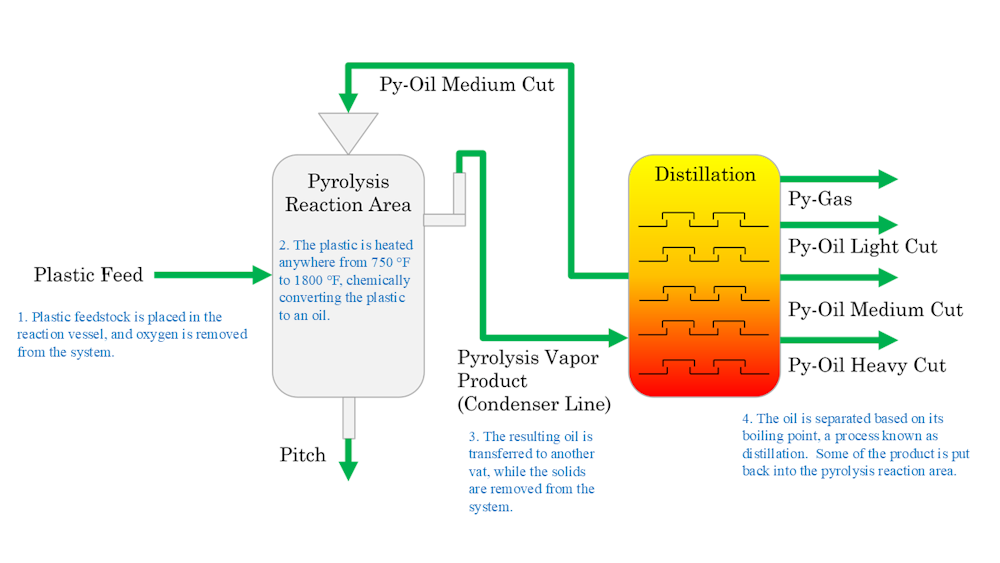
    Plastic pyrolysis is a chemical process that involves chemically breaking down plastics into other molecules by heating the plastics to extremely high temperatures in the absence of oxygen.

    Plastics are fed into the pyrolysis reactor, where they get hot and turn to oil. The oil moves to another vat where it’s boiled and distilled.
    Alexander Kaplitz and Kevin A. Schug

    Unlike traditional plastic recycling, pyrolysis theoretically isn’t limited to specific types of plastic. It could be made to accommodate many of them, although current technology is limited to a few types – polyethylene and polypropylene, used in food containers and bottles – at an industrial scale.

    So, plastic pyrolysis could help handle the waste from consumer products such as plastic bags, bottles, milk jugs, packaging materials, wet wipes and even discarded children’s toys. Pyrolysis can also handle more complex plastic waste such as tires and discarded electronics, although solid waste handlers and recyclers avoid certain plastic types in pyrolysis, such as polyvinyl chloride – or PVC, which is found in pipes and roofing products – and polystyrene, used in packaging, as these can create harmful byproducts.

    During pyrolysis, the plastic polymers are broken down into smaller molecules, resulting in the production of liquid oil, fuel source gases such as methane, propane and butane, and char.

    Char is the solid residue left at the end of the pyrolysis process. It can be used as a carbon-rich material for various applications, including adding it to soil to make it healthier for farming, as it increases soil moisture and pH, benefiting nutrient absorption. Char also has the ability to absorb harmful carbon gases from the air, which can help prevent climate change.

    The main downside of char is if it’s used too much it can increase soil alkalinity, which may hinder plant growth.

    Plastic pyrolysis uses heat to break down plastic, with the intent to convert plastic waste into usable materials.

    How pyrolosis works

    The plastic pyrolysis process typically involves several key steps.

    In the first step of pyrolysis, community recyclers collect the plastic waste and clean it to remove any contaminants. The plastic then gets shredded into smaller pieces to facilitate the pyrolysis process. Unlike traditional recycling, it needs only minimal sorting.

    Chemical recyclers operating pyrolysis plants feed the shredded plastic into a pyrolysis reactor, where they heat it to temperatures ranging from 600 to 1,600 degrees Fahrenheit (315 to 871 degrees Celsius). Without oxygen, plastics in the reactor don’t catch fire and emit fumes into the air. Instead, this high-temperature environment causes the plastic polymers to break down into smaller hydrocarbon molecules. These smaller molecules can be further refined.

    The high temperature turns some molecules into vapors, which condense into liquid oil. Chemical companies can further refine this oil to be used as fuel or as a raw material to make other chemicals or plastics.

    In addition to liquid oil, the pyrolysis process generates natural gases, such as methane, ethane, butane and propane. Pyrolysis operators then capture these gases, and they can sometimes use them as a source of energy to power the pyrolysis reactor or other industrial processes.

    Plastic pyrolysis generates oil, which engineers can use to create new materials or fuels.
    BASF, CC BY-NC-ND

    Benefits of pyrolysis

    When done effectively, plastic pyrolysis offers several benefits.

    By expanding recycling beyond just plastic bottles and milk jugs, pyrolysis could reduce the amount of plastic waste pollution that ends up in landfills and oceans.

    Additionally, converting plastic waste into usable products could help lower the production demand for new plastics from petroleum hydrocarbons. The byproducts could get used in recycled plastics.

    Some researchers are also testing pyrolysis oils to see whether they can use them instead of gasoline to fuel vehicles. The gases produced during pyrolysis can even generate energy that fuels the pyrolysis reactor, making the process more self-sustaining and reducing the need for external energy sources.

    Currently, about 15% to 20% of the pyrolysis products are recycled into new propylene and ethylene, while most – about 80% to 85% – becomes diesel fuel, hydrogen, methane and other chemicals.

    While plastic pyrolysis holds some promise, it also faces challenges. The cost of setting up and operating pyrolysis plants is high. How profitable the process is depends on the availability of suitable plastic waste, the market demand for the oils and gases produced, and the costs of energy and staff necessary to operate the reactor.

    Another issue is quality control. Most plastic types can undergo pyrolysis, but different plastics create oils with different chemical makeups. Scientists will need to understand the composition of these oils before industry can determine which plastic types to focus on and how each oil could create new materials.

    Pyrolysis oils have unique chemical compositions depending on the type of plastics used to create them.
    Alexander Kaplitz and Kevin A. Schug

    Researchers like us at The University of Texas at Arlington and our international colleagues are studying new chromatography-based oil-separation techniques that can successfully identify some types of pyrolysis oils. Chromatography is the process of separating components in a mixture by passing them through a stiff material.

    Different components in the mixture are attracted to this material to different degrees. So, they exit the chromatography system at different times, which separates them from one another.

    With more research into the technique’s efficiency and technological advancements to scale up pyrolysis, this technique could be one part of a sustainable solution to plastic waste management. In the meantime, pyrolysis is being used now, with one report estimating the market for pyrolysis plants at US$40 billion in 2024 and predicting it to grow to $1.2 billion by 2033.

    Kevin A. Schug receives funding from the National Science Foundation, the National Institutes for Health, ExxonMobil, and Weaver Consultants Group. He is affiliated with VUV Analytics, Inc. and Infinity Water Solutions as a member of their scientific advisory boards. Lummus Technology, LLC provided the funding for research on plastic waste pyrolysis oils at UT Arlington.

    Alexander Kaplitz does not work for, consult, own shares in or receive funding from any company or organization that would benefit from this article, and has disclosed no relevant affiliations beyond their academic appointment.

    ref. Plastic pyrolysis − chemists explain a technique attempting to tackle plastic waste by bringing the heat – https://theconversation.com/plastic-pyrolysis-chemists-explain-a-technique-attempting-to-tackle-plastic-waste-by-bringing-the-heat-234453

    MIL OSI – Global Reports

  • MIL-OSI United Kingdom: Energy Secretary visits China to launch climate dialogue

    Source: United Kingdom – Executive Government & Departments

    News story

    Energy Secretary visits China to launch climate dialogue

    Ed Miliband resumes formal energy and climate talks with China

    Energy Secretary Ed Miliband met his Chinese counterparts in Beijing this week to re-start formal energy and climate discussions and demonstrate global climate leadership.

    On Saturday (15 March) the Secretary of State met Chinese Minister Huang at the Ministry of Ecology and Environment. They discussed strengthening cooperation on climate issues such as nationally-determined contributions (NDCs) looking ahead to COP30.

    He then travelled to Tsinghua University where he spoke to students about UK action and global cooperation on climate change as part of the university’s climate lecture series.

    On Sunday (16 March), the Energy Secretary visited Carbon Capture and Storage (CCUS) and hydrogen power projects in Energy Valley, an area which drives the development of clean energy technologies in the country. 

    He then met with British business representatives based in Beijing, to hear about the opportunities and challenges for business and how the UK can support in increasing UK clean energy exports to drive growth and create jobs.

    On Monday (17 March), the Secretary of State visited China’s National Energy Administration to engage in a formal UK-China Energy Dialogue. Along with Administrator Wang, he led discussions focused on clean energy technologies, pathways to the energy transition including phasing out coal, energy security and international energy governance.

    At the end of the meeting, Ed Miliband signed the Clean Energy Partnership Memorandum of Understanding (MoU) with Administrator Wang, which agrees to enhance cooperation on renewables, grid modernisation and clean technologies, while protecting the UK’s national security.  

    The visit concluded with a visit to the Great Hall of the People, where the Energy Secretary met Chinese Vice Premier Ding Xuexiang to agree to continue cooperation on energy and climate. The Secretary of State also took the opportunity to raise the UK government’s concerns on issues including Russia, forced labour and Jimmy Lai.

    Energy Secretary Ed Miliband said: 

    We can only keep future generations safe from climate change if all major emitters act. It is simply an act of negligence to today’s and future generations not to engage China on how it can play its part in taking action on climate. 

    That is why I met Chinese ministers for frank conversations about how both countries can fulfil the aims of the Paris Climate Agreement, to which both countries are signed up.  

    Our Plan for Change and clean energy superpower mission is about energy security, lower bills, good jobs and growth for the British people. It is with this mission that we can also influence climate action on a global stage, fight for our way of life and keep our planet safe for our children and grandchildren.

    Updates to this page

    Published 18 March 2025

    MIL OSI United Kingdom

  • MIL-OSI Asia-Pac: INTERNATIONAL CENTRE FOR AUTOMOTIVE TECHNOLOGY

    Source: Government of India

    Posted On: 18 MAR 2025 3:27PM by PIB Delhi

    International Centre for Automotive Technology (ICAT) has played a key role in advancing research and development within India’s automotive sector. It has successfully developed 27 innovative technologies, reflecting its commitment to excellence in automobile engineering. Additionally, ICAT holds 9 patents/ IPRs and 2 copyrights/ design registrations, highlighting its contributions to intellectual property in the automotive domain. ICAT’s experts have published over 50 technical papers in esteemed national and international forums. Furthermore, to strengthen the R&D ecosystem, ICAT has established over 40 Memorandums of Understanding (MoUs) with leading domestic and international automotive organizations and premier academia such as IIT-Kanpur, IIT-Roorkee, IIT-Hyderabad, CDAC, IDIADA-Spain, TUV Rhineland-Germany.

    ICAT has launched the ICAT incubation and acceleration centre for supporting startups in auto and allied domain. Additionally, ICAT is a board member in Automotive & Allied Research and Technology Innovations (AARTI) Foundation, a section-8 entity established with support from IIT-Roorkee, to support innovation and businesses in auto and allied domains, especially for startups and MSMEs. ICAT actively engages startups & MSMEs through workshops, seminars and webinars offering skilling and upskilling opportunities while serving as a technology and validation partner by providing technical and industry expertise.

    The Government of India has formulated various schemes to attract foreign investment in the heavy industry and automobile sectors. These schemes also aim to strengthen the position of India in global EV and hydrogen fuel cell market. The details are as under: –

    1. Production Linked Incentive (PLI) Scheme for Automobile and Auto Component Industry in India (PLI-Auto): Government has notified this scheme on 23.09.2021 for Automobile and Auto Component Industry for enhancing India’s manufacturing capabilities for Advanced Automotive Technology (AAT) products with a budgetary outlay of ₹25,938 crore. There are 41 approved foreign applicants in the scheme.
    2. Scheme to Promotion Manufacturing of Electric Passenger Cars in India (SPMEPCI): This scheme was notified on 15.03.2024 to promote the manufacturing of electric cars in India. Under this scheme, EV passenger cars (e-4W) can initially be imported with a minimum CIF value of USD 35,000, at a duty rate of 15% for a period of 5 years from the date of issuance of approval letter by MHI. This requires applicants to invest a minimum of ₹4,150 crore and achieve a minimum DVA of 25% at the end of third year and DVA of 50% at the end of fifth year.
    3. Faster Adoption and Manufacturing of (Hybrid &) Electric Vehicles in India (FAME India) Scheme Phase-II: The Government implemented this scheme for a period of five years from 01/04/2019 till 31/03/2024 with a total budgetary support of Rs.11,500 crore. There are foreign OEMs who had invested and were supported under the scheme.
    4. PM Electric Drive Revolution in Innovative Vehicle Enhancement (PM E-DRIVE)Scheme: This schemewith an outlay of Rs.10,900 crore was notified on 29th September, 2024. It is a two-year scheme w.e.f. 1st April, 2024 onwards, which aims to support EVs including e-2W, e-3W, e-Trucks, e-buses and e-Ambulances.  There are foreign OEMs who have invested and are supported under the scheme.
    5. National Green Hydrogen Mission (NGHM): The Ministry of New and Renewable Energy (MNRE) is implementing the National Green Hydrogen Mission, with an objective to make India a global hub of production, usage and export of Green Hydrogen and its derivatives. One of the objectives of the Mission is to support the deployment of Green Hydrogen as fuel in buses and trucks, in a phased manner on a pilot basis. MNRE issued the scheme guidelines for implementation of pilot projects for use of Green Hydrogen in the Transport Sector under the NGHM. Under this scheme, five pilot projects have been sanctioned consisting total of 37 vehicles (buses and trucks), and 9 hydrogen refuelling stations. As part of the Mission, the R&D Scheme Guidelines have been issued that include development of fuel cells as one of the key areas.

    This information was given by the Minister of State for Steel and Heavy Industries, Shri Bhupathiraju Srinivasa Varma in a written reply in the Lok Sabha today.

    ****

    TPJ/NJ

    (Release ID: 2112239) Visitor Counter : 41

    MIL OSI Asia Pacific News

  • MIL-OSI Asia-Pac: Leading zero-emission commercial vehicles manufacturer opens global headquarters in Hong Kong (with photo)

    Source: Hong Kong Government special administrative region

    Leading zero-emission commercial vehicles manufacturer opens global headquarters in Hong Kong (with photo) 
    The company also plans to establish a global research and development centre and intelligent manufacturing centre in Hong Kong and is committed to building a high-quality zero-emission commercial vehicle ecosystem for the world.
     
         Associate Director-General of Investment Promotion for Invest Hong Kong Mr Charles Ng said, “We are excited to welcome Wisdom Motor to Hong Kong. The establishment of its global headquarters is a testament to our city’s unparalleled suitability for technological and product development. With a rich talent pool and a strategic location, Hong Kong provides the perfect foundation for companies like Wisdom Motor to forge international partnerships and expand their presence in both the Asian and global markets.”
     
    The Chief Strategy Officer of Wisdom Motor, Mr Felix Xu, said, “Hong Kong is situated in the heart of Asia and in close proximity to the Mainland. It enables businesses to tap into the multitude of opportunities in the Guangdong-Hong Kong-Macao Bay Area and throughout the rest of the region. The city is an ideal base for us to promote our technological achievements to the Greater Bay Area, other parts of the Mainland, and developed overseas countries.”
     
    He also said that the Hong Kong global headquarters is a pivotal hub for developing intelligent and connected vehicle applications, including Vehicle Control Unit or Motor Control Unit electronic control systems and hydrogen fuel systems. The company will collaborate with local university research teams and technology companies to develop carbon-neutral technologies and projects tailored to Hong Kong’s unique conditions.
     
    He added that Wisdom Motor is an all-round enterprise with in-house capabilities in design, engineering, manufacturing, and delivery of class-leading smart zero-emission commercial vehicles. It is also at the forefront of integrating hydrogen fuel cell systems, leveraging advanced composite materials and manufacturing processes to achieve significant lightweight advantages. Wisdom Motor delivered Hong Kong’s first battery electric double-decker bus as well as the world’s first tri-axle hydrogen double-deck bus, paving the way to contribute to Hong Kong’s decarbonisation strategy.
     
    For more information about Wisdom Motor, please visit wisdommotor.com
    To get a copy of the photo, please visit
    www.flickr.com/photos/investhk/albums/72177720324481352Issued at HKT 18:45

    NNNN

    MIL OSI Asia Pacific News

  • MIL-OSI Asia-Pac: President Lai meets Japan-ROC Diet Members’ Consultative Council Chairman Furuya Keiji

    Source: Republic of China Taiwan

    Details
    2025-03-17
    President Lai addresses opening of 2025 Yushan Forum
    On the morning of March 17, President Lai Ching-te attended the opening of the 2025 Yushan Forum, the theme of which was “New Southbound Policy+: Taiwan, the Indo-Pacific, and a New World.” In remarks, President Lai stated that the New Southbound Policy has led to great success in economic and trade cooperation, professional exchanges, resource sharing, and building regional links. He said that in the past, Taiwanese industries went from moving westward across the Taiwan Strait, to shifting southbound, to working closer with the north, but that now, Taiwan is confidently stepping across the Pacific, reaching eastward, to the Americas and other regions. While staying firmly rooted in Taiwan, he said, Taiwan’s enterprises are expanding their global presence and marketing worldwide. The president stated that Taiwan will strive alongside its partners in democracy to bolster non-red supply chains and digital solidarity, and together respond to the threats and challenges posed by expanding authoritarianism. He indicated that the Yushan Forum is a place to share experiences, and more importantly, lay down firm foundations for exchanges and cooperation among participants’ countries to create greater stability for the region and greater prosperity for the world. A transcript of President Lai’s remarks follows: On behalf of all the people of Taiwan, I want to welcome our good friends joining us from around the world. Your presence shows support for a peaceful and stable Taiwan and a free and open Indo-Pacific region. The Yushan Forum has become more than just an important platform for the New Southbound Policy. Over these eight years, more than 3,600 participants from Taiwan and 28 other countries have helped deepen Taiwan’s connections with nations around the world. The New Southbound Policy has led to great success in economic and trade cooperation, professional exchanges, resource sharing, and building regional links. Looking ahead, the Yushan Forum will be taking on the important mission of carrying its legacy forward and transforming it into action. Not only must we turn consensus into action plans for close cooperation among countries in the region; we must also work with partners around the world to forge ahead with cooperative plans for mutual prosperity. We hope to envision a new world from Taiwan – and see Taiwan in this new world. We are also embracing an era of smart technology. The government sessions of this Yushan Forum are therefore centered around topics including smart healthcare, smart transportation, and resilient supply chains for semiconductors. Taiwan is intent on working side by side with other countries to face the challenges of this new era. Today’s Taiwan celebrates not only the democratic achievements that are recognized by the international community, but also our strengths in the semiconductor and other tech industries, which enable us to play a key role in restructuring global democratic supply chains and the economic order. We are building on Taiwan as a “silicon island” for semiconductors while accelerating innovation and AI applications for industry. These efforts will help Taiwan become an “AI island” as well. We are also developing forward-looking fields such as quantum technology and precision medicine, which will create an industry ecosystem that is highly competitive and innovative. The government will also develop economic models powered by innovation. This will help SMEs (small- and medium-sized enterprises) upgrade and transform through the power of digital transformation and net-zero transition. In the past, Taiwanese industries went from moving westward across the Taiwan Strait, to shifting southbound, to working closer with the north. But now, we are confidently stepping across the Pacific, reaching eastward, to the Americas and other regions. While staying firmly rooted in Taiwan, our enterprises are expanding their global presence and marketing worldwide. Taiwan will continue to engage with the world, and we welcome the world to come closer to Taiwan. As we gather here today, I am confident that we share the same goal: Through international cooperation, we hope to build an even more inclusive, resilient, prosperous Indo-Pacific, while jointly defending the democracy, freedom, and peace we so firmly believe in. I want to thank you all once again for supporting Taiwan. We will strive alongside our partners in democracy to bolster non-red supply chains and digital solidarity, and together respond to the threats and challenges posed by expanding authoritarianism. Yushan is also known as Jade Mountain. It is Taiwan’s highest peak and stands as firm as our unwavering spirit. During this critical time of global change and transformation, the Yushan Forum is a place where we can share our experiences, and more importantly, lay down firm foundations for exchanges and cooperation among our countries. This way, we can create greater stability for the region and greater prosperity for the world. I wish everyone a successful forum. Thank you. Also in attendance at the event were former Prime Minister of Denmark and Alliance of Democracies Foundation Chairman Anders Fogh Rasmussen, former Prime Minister of the Republic of Slovenia Janez Janša, Japan-ROC Diet Members’ Consultative Council Chairman Furuya Keiji, and American Institute in Taiwan Taipei Office Director Raymond Greene.

    Details
    2025-03-13
    President Lai attends Ministry of Foreign Affairs 2025 Spring Banquet  
    On the evening of March 13, President Lai Ching-te attended the Ministry of Foreign Affairs 2025 Spring Banquet for foreign ambassadors and representatives stationed in Taiwan. In remarks, President Lai thanked our diplomatic allies and like-minded countries for continuing to demonstrate their high regard and support for Taiwan at international venues. The president stated that a stronger Taiwan will be able to contribute even more to the world, explaining that is why he established the National Climate Change Committee, the Whole-of-Society Defense Resilience Committee, and the Healthy Taiwan Promotion Committee. He added that he hopes to pool our strengths so as to formulate national development strategies and enhance Taiwan’s international collaboration. The president also expressed hope of developing opportunities for cooperation with other countries across many domains to jointly advance democracy, peace, and prosperity throughout the region and around the world. A translation of President Lai’s remarks follows: Today is my first time attending the Ministry of Foreign Affairs Spring Banquet since becoming president. It is a pleasure to be able to meet and socialize with esteemed guests from other countries and good friends from all sectors of Taiwan. The global landscape has changed rapidly over the past year. Geopolitical volatility, the restructuring of supply chains, technological advancements, and other factors have had a profound impact on nations’ strategic plans. I want to take this opportunity to thank our diplomatic allies and like-minded countries for continuing to demonstrate their high regard and support for Taiwan at international venues. Last month, the leaders of the United States and Japan, the US secretary of state and the foreign ministers of Japan and the Republic of Korea, and the G7 foreign ministers all issued joint statements emphasizing the importance of peace and stability across the Taiwan Strait, underscoring Taiwan’s vital role in global progress and prosperity.  I would especially like to thank members of the diplomatic corps for working with us to build even closer partnerships between our countries. I have always believed that a stronger Taiwan will be able to contribute even more to the world. That is why, after taking office, I established the National Climate Change Committee, the Whole-of-Society Defense Resilience Committee, and the Healthy Taiwan Promotion Committee under the Office of the President. These committees continue to address global concerns and seek to solve important issues that impact our own people. I hope to pool our strengths so as to formulate national development strategies and enhance Taiwan’s international collaboration.  Last year, I visited our Pacific allies – the Republic of the Marshall Islands, Tuvalu, and the Republic of Palau. I deeply appreciated our friends’ warm hospitality and came to feel very deeply that we are like a family. Through local visits and mutual exchanges, we deepened our diplomatic alliances and cooperation, creating win-win outcomes. We also showed Taiwan’s determination to work with allies to tackle the many challenges related to climate change, net-zero transition, and digital transformation. At the start of this month, Taiwan hosted the first-ever workshop on whole-of-society defense resilience under the Global Cooperation and Training Framework. Experts and scholars from 30 countries participated in the discussions. I once again thank the diplomatic corps for their support and assistance. In the future, we look forward to developing opportunities for cooperation with other countries across many domains to jointly advance democracy, peace, and prosperity throughout the region and around the world. In the face of authoritarian expansion, Taiwan will continue to bolster its national defense capabilities. We will stand shoulder to shoulder with fellow democracies to demonstrate the strength of deterrence. We will also join hands to build non-red supply chains, strengthen our economic resilience, and promote an initiative on semiconductor supply chain partnerships for global democracies. All of this will ensure steady technological and economic development.  In my New Year’s Day address, I said that in this new year, we have many more brilliant stories of Taiwan to share with the world. Everyone gathered here tonight is a dear friend of Taiwan. And each of you plays an important role in the stories this land has to tell.  I am deeply grateful to you all for the incredible efforts you make in support of Taiwan. In so many ways, you connect Taiwan to the rest of the world and allow the world to see the many different sides of this amazing nation. I believe that through even deeper and more extensive cooperation, we will create many more wonderful stories of Taiwan and build an even brighter future together. I wish you all a pleasant evening. Also in attendance at the event were Dean of the Diplomatic Corps and Saint Vincent and the Grenadines Ambassador Andrea Clare Bowman and other members of the foreign diplomatic corps in Taiwan.

    Details
    2025-03-04
    President Lai meets US Heritage Foundation founder Dr. Edwin Feulner
    On the afternoon of March 4, President Lai Ching-te met with a delegation led by founder of the US-based Heritage Foundation Dr. Edwin Feulner. In remarks President Lai thanked the foundation for publishing the 2025 Index of Economic Freedom, in which Taiwan ranked fourth globally and which recognized Taiwan’s sound legal foundation and ideal investment environment. The president said that Taiwan and the United States are important economic and trade partners and engage closely in industrial exchange. The president also expressed hope to expand investment in and procurement from the US in such areas as high-tech, energy, and agricultural products, and to work with the US and other democratic partners to create more resilient and diverse semiconductor supply chains to address new circumstances. A translation of President Lai’s remarks follows: It is a pleasure to welcome Dr. Feulner back to Taiwan today. I recall meeting with Dr. Feulner and Heritage Foundation President Kevin Roberts here at the Presidential Office at the end of last February. We had a fruitful discussion on Taiwan-US relations and regional affairs. When President Donald Trump was elected for his first term, Dr. Feulner played a crucial role in the administration’s transition team. Today, I look forward to hearing his thoughts on possible ways to further deepen relations between Taiwan and the US. I would like to thank the Heritage Foundation for publishing the 2025 Index of Economic Freedom, in which Taiwan ranked fourth globally. The report also recognized Taiwan’s sound legal foundation and ideal investment environment. Taiwan and the US are important economic and trade partners and engage closely in industrial exchange. The Taiwan Semiconductor Manufacturing Company’s (TSMC) historic US$65 billion investment in Arizona–negotiated and finalized during President Trump’s first term–is a case in point. And today, TSMC Chairman C.C. Wei (魏哲家) and President Trump jointly announced that the company would be expanding its investment in the US with new facilities. Looking ahead, we hope to expand investment in and procurement from the US in such areas as high-tech, energy, and agricultural products. We also look forward to working with the US and other democratic partners to create more resilient and diverse semiconductor supply chains to address new circumstances. At present, we continue to face authoritarian expansionism. As a country that deeply loves and staunchly defends freedom, Taiwan will collaborate with the US and other like-minded countries to maintain regional peace and stability. I would like to thank President Trump for his recent joint statement with Japanese Prime Minister Ishiba Shigeru, which emphasized the importance of maintaining peace and stability across the Taiwan Strait. And last month, the US was also part of a G7 foreign ministers’ statement in which “they strongly opposed any attempts to change unilaterally the status quo using force.” We firmly believe that only peace attained through one’s own strength can truly be called peace. Currently, Taiwan’s defense budget stands at approximately 2.5 percent of GDP. Going forward, the government will prioritize special budget allocations to ensure that Taiwan’s defense budget exceeds 3 percent of GDP. Also, we will continue to reform national defense in the conviction that help comes most to those who help themselves. This will allow us to contribute even more to regional peace and stability. In closing, I once again thank Dr. Feulner for visiting and for demonstrating support of Taiwan. I wish you all a smooth and successful trip. Dr. Feulner then delivered remarks, first stating that on behalf of his successor, President Roberts, and all of his colleagues at the Heritage Foundation, it is his pleasure to present President Lai with the first copy of the 2025 Index of Economic Freedom. Pointing out that in the Index the Republic of China (Taiwan) is number four of 176 countries around the world in terms of its economic freedom, Dr. Feulner extended his congratulations to President Lai.  Dr. Feulner said he looks forward to a discussion about the present situation and how we can improve relations between the US and Taiwan. Dr. Feulner expressed his gratitude on hearing the wonderful announcement from TSMC, which was released right before his visit, that it will be expanding its investment in the US. In past trips, he said, he has had the opportunity to visit the TSMC headquarters in Taiwan, and fairly recently he has had the opportunity to view the site in Arizona where the construction continues and where the initial operations are beginning. He stated that they are proud to have TSMC now as an integral part of our responsible bilateral relationship. Dr. Feulner noted that while TSMC is of course very big, he also wants to express appreciation for all of the hundreds and hundreds of Taiwan-based companies that are strong, close partners throughout the US with American companies and with American people in terms of making a close and unified alliance of two freedom-loving countries.

    Details
    2025-03-04
    President Lai attends opening ceremony of GCTF Workshop on Whole-of-Society Resilience Building, Preparation, and Response
    On the morning of March 4, President Lai Ching-te attended the opening ceremony of the Global Cooperation and Training Framework (GCTF) Workshop on Whole-of-Society Resilience Building, Preparation, and Response. In remarks, President Lai stated that global challenges such as extreme weather, pandemics, and energy crises continue to emerge, and growing authoritarianism presents a grave threat to freedom-loving countries. These challenges have no borders, he said, and absolutely no single country can face them alone. The president said that as a responsible member of the international community, Taiwan is both willing and able to contribute even more to the democracy, peace, and prosperity of the world, and that the GCTF is an important platform where Taiwan can make those contributions by sharing its experiences with the rest of the world. President Lai indicated that Taiwan will join the forces of the central and local governments to enhance social resilience across the board, enhance disaster response capabilities in the community, and leverage its strengths to make contributions to the international community. He said that we are demonstrating to the world our determination to create an even more resilient Taiwan, and expressed hope to advance mutual assistance and exchanges with all the countries involved, so that we can together promote stability and prosperity around the world. A transcript of President Lai’s remarks follows: To begin, I would like to welcome more than 60 distinguished guests from 30 countries, as well as experts from Taiwan. You are all here for this GCTF workshop to discuss whole-of-society resilience building, preparation, and response. As a responsible member of the international community, Taiwan is both willing and able to contribute even more to the democracy, peace, and prosperity of the world. The GCTF is an important platform where Taiwan can make those contributions by sharing its experiences with the rest of the world. I want to thank our full GCTF partners, the United States, Japan, Australia, and Canada. Over the past several years, we have worked with even more countries through this framework and have expanded our exchanges into even more fields. Together, we have met all kinds of new challenges. I am confident that as our cooperation grows stronger, so will our ability to promote global progress. Each of today’s guests is contributing a vital force in that regard. I extend my sincere thanks to you all. Global challenges such as extreme weather, pandemics, and energy crises continue to emerge. And growing authoritarianism presents a grave threat to freedom-loving countries. These challenges have no borders, and absolutely no single country can face them alone. Taiwan holds a key position on the first island chain, and stands at the very frontline of the defense of democracy. With this joint workshop, we are demonstrating to the world our determination to create an even more resilient Taiwan. We are also aiming to advance our mutual assistance and exchanges with all the countries involved, so that we can make our societies more resilient and together promote stability and prosperity around the world. Moving forward, we will continue advancing the following three initiatives: First, we will join the forces of the central and local governments to enhance social resilience across the board. Just last year, I established the Whole-of-Society Defense Resilience Committee at the Presidential Office. Civilian force training, strategic material preparation, and critical infrastructure operation and maintenance are all key discussion areas for our committee. These aim to enhance Taiwan’s resilience in national defense, economic livelihoods, disaster prevention, and democracy. They are also items on the agenda for this GCTF workshop. To cover all the bases, Taiwan must unite and cooperate as a team. Last year, our committee held the very first cross-sector tabletop exercise at the Presidential Office which included central and local government officials as well as civilian observers. We aim to test the government’s emergency response capabilities in high-intensity gray-zone operations and near-conflict situations. We will continue to hold exercises to help the central and local governments work together more efficiently, and strengthen Taiwan’s overall disaster response capabilities. Second is to enhance disaster response capabilities in the community. We fully understand that to build whole-of-society resilience, we must help people increase risk awareness, know how to respond to disasters, and develop abilities to help themselves, help one another, and work together. We are grateful to the American Institute in Taiwan (AIT) for collaborating with the Taiwan Development Association for Disaster Medical Teams to host “Take Action” workshops around the country since 2021. A 2.0 version is already in practice, and continues to train the public in first aid skills. Director of the AIT Taipei Office Raymond Greene and I took part in a Take Action event in New Taipei City last year and personally saw the positive outcomes of the training. In addition to the Take Action workshops, the government is also providing Disaster Relief Volunteer training for ages 11 to 89, and is continuing to expand its target audience. We have also set up Taiwan Community Emergency Response Teams at key facilities nationwide, enhancing the ability of these important facilities to respond independently to disasters. Civilian training will continue to be refined and expanded so that members of the public can serve as important partners in government-led disaster prevention and relief. Third, we will leverage Taiwan’s strengths to make contributions to the international community. The inspiration for our Disaster Relief Volunteer training comes from a similar program run by The Nippon Care-Fit Education Institute in Japan. I am confident that through exchanges like this workshop, Taiwan and other countries can also inspire one another in many areas, and enhance whole-of-society resilience in multiple ways. Taiwan also excels in information and communications and advanced technology. We will set up even more robust cybersecurity systems, expand usage of emerging technologies, and improve the ways we maintain domestic security. We hope that by leveraging our capabilities and sharing our experiences, Taiwan can contribute even more to the international community. I want to welcome all our partners once again, and thank AIT for co-hosting this event. Let’s continue down the path of advancing global security and developing resilience together. Because together, we can travel farther, and we can travel longer. Also in attendance at the event were Japan-Taiwan Exchange Association Deputy Representative Takaba Yo, Australian Office in Taipei Representative Robert Fergusson, and Canadian Trade Office in Taipei Executive Director Jim Nickel.

    Details
    2025-02-24
    President Lai meets Japanese House of Representatives Member Tamaki Yuichiro
    On the afternoon of February 24, President Lai Ching-te met with Japanese House of Representatives Member Tamaki Yuichiro. In remarks, President Lai noted that Taiwan and Japan are important trading partners. The president expressed hope that, in addition to semiconductors, Taiwan and Japan can also bolster cooperation in the fields of hydrogen energy and drones and build non-red supply chains, thus creating economic win-win situations and maintaining peace and stability in the Indo-Pacific region and globally. A translation of President Lai’s remarks follows: I would like to start by warmly welcoming Representative Tamaki on his first trip to Taiwan. Now is a key moment for the cooperative ties between Taiwan and Japan, and the fact that Representative Tamaki has chosen to take time out of his busy schedule to make this trip demonstrates his especially meaningful support for Taiwan. For this I want to express my deepest gratitude. At the beginning of this month, Japan and the United States held a summit meeting. In the post-summit joint leaders’ statement the government of Japan reiterated the importance of maintaining peace and stability across the Taiwan Strait, opposed any attempts to unilaterally change the status quo by force or coercion, and expressed support for Taiwan’s meaningful participation in international organizations. I would like to thank the government of Japan for these statements. Taiwan and Japan are both responsible members of the international community. I welcome an even firmer friendship between Japan and the US and hope to see cooperation among Taiwan, Japan, and the US become a solid force in consolidating peace and stability in the Indo-Pacific region. In addition to complex international conditions, we now also face the threat of China’s red supply chain. More and more countries are becoming increasingly concerned about such issues as economic security and supply chain resilience. As authoritarianism consolidates, democratic nations must also come closer in solidarity. Taiwan and Japan are important trading partners. I hope that, in addition to semiconductors, Taiwan and Japan can also bolster cooperation in the fields of hydrogen energy and drones, and that we can build non-red supply chains, thus creating economic win-win situations and maintaining peace and stability in the Indo-Pacific region and globally. Lastly, I would like once again to welcome Representative Tamaki to Taiwan and wish him a successful visit. I hope he departs Taiwan with a deep impression and that he will visit again. Representative Tamaki then delivered remarks, noting that this was his first visit to Taiwan and thanking President Lai and officials of the Taiwan government for their warm welcome. Pointing out that Taiwan-Japan ties are closer than ever thanks to the major efforts made on this front by President Lai since taking office, Representative Tamaki expressed his admiration and gratitude. Representative Tamaki pointed out that in a changing global landscape, Taiwan, Japan, and the Indo-Pacific region all face major changes, but he firmly believes that Taiwan-Japan relations will develop even further. Recalling President Lai’s previous remarks, the representative said that Japan and the US recently held a summit meeting that yielded important results. In the joint leaders’ statement, he noted, the two sides made a clear commitment regarding peace and stability across the Taiwan Strait and firmly opposed any attempts to unilaterally change the status quo by force or coercion. Representative Tamaki said that the ruling Liberal Democratic Party and the Komeito did not win a majority in last year’s House of Representatives general elections, while the number of seats held by his own Democratic Party for the People quadrupled. This result, he said, has filled him with a feeling of great responsibility. Moving forward, he intends to continue promoting Taiwan-Japan cooperation and strengthening relations. Also in attendance at the meeting was Japan-Taiwan Exchange Association Taipei Office Chief Representative Katayama Kazuyuki.

    Details
    2025-03-13
    President Lai holds press conference following high-level national security meeting
    On the afternoon of March 13, President Lai Ching-te convened a high-level national security meeting, following which he held a press conference. In remarks, President Lai introduced 17 major strategies to respond to five major national security and united front threats Taiwan now faces: China’s threat to national sovereignty, its threats from infiltration and espionage activities targeting Taiwan’s military, its threats aimed at obscuring the national identity of the people of Taiwan, its threats from united front infiltration into Taiwanese society through cross-strait exchanges, and its threats from using “integrated development” to attract Taiwanese businesspeople and youth. President Lai emphasized that in the face of increasingly severe threats, the government will not stop doing its utmost to ensure that our national sovereignty is not infringed upon, and expressed hope that all citizens unite in solidarity to resist being divided. The president also expressed hope that citizens work together to increase media literacy, organize and participate in civic education activities, promptly expose concerted united front efforts, and refuse to participate in any activities that sacrifice national interests. As long as every citizen plays their part toward our nation’s goals for prosperity and security, he said, and as long as we work together, nothing can defeat us. A translation of President Lai’s remarks follows: At many venues recently, a number of citizens have expressed similar concerns to me. They have noticed cases in which members of the military, both active-duty and retired, have been bought out by China, sold intelligence, or even organized armed forces with plans to harm their own nation and its citizens. They have noticed cases in which entertainers willingly followed instructions from Beijing to claim that their country is not a country, all for the sake of personal career interests. They have noticed how messaging used by Chinese state media to stir up internal opposition in Taiwan is always quickly spread by specific channels. There have even been individuals making careers out of helping Chinese state media record united front content, spreading a message that democracy is useless and promoting skepticism toward the United States and the military to sow division and opposition. Many people worry that our country, as well as our hard-won freedom and democracy and the prosperity and progress we achieved together, are being washed away bit by bit due to these united front tactics. In an analysis of China’s united front, renowned strategic scholar Kerry K. Gershaneck expressed that China plans to divide and conquer us through subversion, infiltration, and acquisition of media, and by launching media warfare, psychological warfare, and legal warfare. What they are trying to do is to sow seeds of discord in our society, keep us occupied with internal conflicts, and cause us to ignore the real threat from outside. China’s ambition over the past several decades to annex Taiwan and stamp out the Republic of China has not changed for even a day. It continues to pursue political and military intimidation, and its united front infiltration of Taiwan’s society grows ever more serious. In 2005, China promulgated its so-called “Anti-Secession Law,” which makes using military force to annex Taiwan a national undertaking. Last June, China issued a 22-point set of “guidelines for punishing Taiwan independence separatists,” which regards all those who do not accept that “Taiwan is part of the People’s Republic of China” as targets for punishment, creating excuses to harm the people of Taiwan. China has also recently been distorting United Nations General Assembly Resolution 2758, showing in all aspects China’s increasingly urgent threat against Taiwan’s sovereignty. Lately, China has been taking advantage of democratic Taiwan’s freedom, diversity, and openness to recruit gangs, the media, commentators, political parties, and even active-duty and retired members of the armed forces and police to carry out actions to divide, destroy, and subvert us from within. A report from the National Security Bureau indicates that 64 persons were charged last year with suspicion of spying for China, which was three times the number of persons charged for the same offense in 2021. Among them, the Unionist Party, Rehabilitation Alliance Party, and Republic of China Taiwan Military Government formed treasonous organizations to deploy armed forces for China. In a democratic and free society, such cases are appalling. But this is something that actually exists within Taiwan’s society today. China also actively plots ways to infiltrate and spy on our military. Last year, 28 active-duty and 15 retired members of the armed forces were charged with suspicion of involvement in spying for China, respectively comprising 43 percent and 23 percent of all of such cases – 66 percent in total. We are also alert to the fact that China has recently used widespread issuance of Chinese passports to entice Taiwanese citizens to apply for the Residence Permit for Taiwan Residents, permanent residency, or the Resident Identity Card, in an attempt to muddle Taiwanese people’s sense of national identity. China also views cross-strait exchanges as a channel for its united front against Taiwan, marking enemies in Taiwan internally, creating internal divisions, and weakening our sense of who the enemy really is. It intends to weaken public authority and create the illusion that China is “governing” Taiwan, thereby expanding its influence within Taiwan. We are also aware that China has continued to expand its strategy of integrated development with Taiwan. It employs various methods to demand and coerce Taiwanese businesses to increase their investments in China, entice Taiwanese youth to develop their careers in China, and unscrupulously seeks to poach Taiwan’s talent and steal key technologies. Such methods impact our economic security and greatly increase the risk of our young people heading to China. By its actions, China already satisfies the definition of a “foreign hostile force” as provided in the Anti-Infiltration Act. We have no choice but to take even more proactive measures, which is my purpose in convening this high-level national security meeting today. It is time we adopt proper preventive measures, enhance our democratic resilience and national security, and protect our cherished free and democratic way of life. Next, I will be giving a detailed account of the five major national security and united front threats Taiwan now faces and the 17 major strategies we have prepared in response. I. Responding to China’s threats to our national sovereignty We have a nation insofar as we have sovereignty, and we have the Republic of China insofar as we have Taiwan. Just as I said during my inaugural address last May, and in my National Day address last October: The moment when Taiwan’s first democratically elected president took the oath of office in 1996 sent a message to the international community, that Taiwan is a sovereign, independent, democratic nation. Among people here and in the international community, some call this land the Republic of China, some call it Taiwan, and some, the Republic of China Taiwan. The Republic of China and the People’s Republic of China are not subordinate to each other, and Taiwan resists any annexation or encroachment upon our sovereignty. The future of the Republic of China Taiwan must be decided by its 23 million people. This is the status quo that we must maintain. The broadest consensus in Taiwanese society is that we must defend our sovereignty, uphold our free and democratic way of life, and resolutely oppose annexation of Taiwan by China. (1) I request that the National Security Council (NSC), the Ministry of National Defense (MND), and the administrative team do their utmost to promote the Four Pillars of Peace action plan to demonstrate the people’s broad consensus and firm resolve, consistent across the entirety of our nation, to oppose annexation of Taiwan by China. (2) I request that the NSC and the Ministry of Foreign Affairs draft an action plan that will, through collaboration with our friends and allies, convey to the world our national will and broad social consensus in opposing annexation of Taiwan by China and in countering China’s efforts to erase Taiwan from the international community and downgrade Taiwan’s sovereignty. II. Responding to China’s threats from infiltration and espionage activities targeting our military (1) Comprehensively review and amend our Law of Military Trial to restore the military trial system, allowing military judges to return to the frontline and collaborate with prosecutorial, investigative, and judicial authorities in the handling of criminal cases in which active-duty military personnel are suspected of involvement in such military crimes as sedition, aiding the enemy, leaking confidential information, dereliction of duty, or disobedience. In the future, criminal cases involving active-duty military personnel who are suspected of violating the Criminal Code of the Armed Forces will be tried by a military court. (2) Implement supporting reforms, including the establishment of a personnel management act for military judges and separate organization acts for military courts and military prosecutors’ offices. Once planning and discussion are completed, the MND will fully explain to and communicate with the public to ensure that the restoration of the military trial system gains the trust and full support of society. (3) To deter the various types of controversial rhetoric and behavior exhibited by active-duty as well as retired military personnel that severely damage the morale of our national military, the MND must discuss and propose an addition to the Criminal Code of the Armed Forces on penalties for expressions of loyalty to the enemy as well as revise the regulations for military personnel and their families receiving retirement benefits, so as to uphold military discipline. III. Responding to China’s threats aimed at obscuring the national identity of the people of Taiwan (1) I request that the Ministry of the Interior (MOI), Mainland Affairs Council (MAC), and other relevant agencies, wherever necessary, carry out inspections and management of the documents involving identification that Taiwanese citizens apply for in China, including: passports, ID cards, permanent residence certificates, and residence certificates, especially when the applicants are military personnel, civil servants, or public school educators, who have an obligation of loyalty to Taiwan. This will be done to strictly prevent and deter united front operations, which are performed by China under the guise of “integrated development,” that attempt to distort our people’s national identity. (2) With respect to naturalization and integration of individuals from China, Hong Kong, and Macau into Taiwanese society, more national security considerations must be taken into account while also attending to Taiwan’s social development and individual rights: Chinese nationals applying for permanent residency in Taiwan must, in accordance with the law of Taiwan, relinquish their existing household registration and passport and may not hold dual identity status. As for the systems in place to process individuals from Hong Kong or Macau applying for residency or permanent residency in Taiwan, there will be additional provisions for long-term residency to meet practical needs. IV. Responding to China’s threats from united front infiltration into Taiwanese society through cross-strait exchanges  (1) There are increasing risks involved with travel to China. (From January 1, 2024 to today, the MAC has received reports of 71 Taiwanese nationals who went missing, were detained, interrogated, or imprisoned in China; the number of unreported people who have been subjected to such treatment may be several times that. Of those, three elderly I-Kuan Tao members were detained in China in December of last year and have not yet been released.) In light of this, relevant agencies must raise public awareness of those risks, continue enhancing public communication, and implement various registration systems to reduce the potential for accidents and the risks associated with traveling to China. (2) Implement a disclosure system for exchanges with China involving public officials at all levels of the central and local government. This includes everyone from administrative officials to elected representatives, from legislators to village and neighborhood chiefs, all of whom should make the information related to such exchanges both public and transparent so that they can be accountable to the people. The MOI should also establish a disclosure system for exchanges with China involving public welfare organizations, such as religious groups, in order to prevent China’s interference and united front activities at their outset. (3) Manage the risks associated with individuals from China engaging in exchanges with Taiwan: Review and approval of Chinese individuals coming to Taiwan should be limited to normal cross-strait exchanges and official interactions under the principles of parity and dignity, and relevant factors such as changes in the cross-strait situation should be taken into consideration. Strict restrictions should be placed on Chinese individuals who have histories with the united front coming to Taiwan, and Chinese individuals should be prohibited from coming to Taiwan to conduct activities related in any way to the united front. (4) Political interference from China and the resulting risks to national security should be avoided in cross-strait exchanges. This includes the review and management of religious, cultural, academic, and education exchanges, which should in principle be depoliticized and de-risked so as to simplify people-to-people exchanges and promote healthy and orderly exchanges. (5) To deter the united front tactics of a cultural nature employed by Chinese nationals to undermine Taiwan’s sovereignty, the Executive Yuan must formulate a solution to make our local cultural industries more competitive, including enhanced support and incentives for our film, television, and cultural and creative industries to boost their strengths in democratic cultural creation, raise international competitiveness, and encourage research in Taiwan’s own history and culture. (6) Strengthen guidance and management for entertainers developing their careers in China. The competent authorities should provide entertainers with guidelines on conduct while working in China, and make clear the scope of investigation and response to conduct that endangers national dignity. This will help prevent China from pressuring Taiwanese entertainers to make statements or act in ways that endanger national dignity. (7) The relevant authorities must adopt proactive, effective measures to prevent China from engaging in cognitive warfare against Taiwan or endangering cybersecurity through the internet, applications, AI, and other such tools. (8) To implement these measures, each competent authority must run a comprehensive review of the relevant administrative ordinances, measures, and interpretations, and complete the relevant regulations for legal enforcement. Should there be any shortcomings, the legal framework for national security should be strengthened and amendments to the National Security Act, Anti-Infiltration Act, Act Governing Relations between the People of the Taiwan Area and the Mainland Area, Laws and Regulations Regarding Hong Kong & Macao Affairs, or Cyber Security Management Act should be proposed. Communication with the public should also be increased so that implementation can happen as soon as possible. V. Responding to threats from China using “integrated development” to attract Taiwanese businesspeople and youth (1) I request that the NSC and administrative agencies work together to carry out strategic structural adjustments to the economic and trade relations between Taiwan and China based on the strategies of putting Taiwan first and expanding our global presence while staying rooted in Taiwan. In addition, they should carry out necessary, orderly adjustments to the flow of talent, goods, money, and skills involved in cross-strait economic and trade relations based on the principle of strengthening Taiwan’s foundations to better manage risk. This will help boost economic security and give us more power to respond to China’s economic and trade united front and economic coercion against Taiwan. (2) I request that the Ministry of Education, MAC, Ministry of Economic Affairs, and other relevant agencies work together to comprehensively strengthen young students’ literacy education on China and deepen their understanding of cross-strait exchanges. I also request these agencies to widely publicize mechanisms for employment and entrepreneurship for Taiwan’s youth and provide ample information and assistance so that young students have more confidence in the nation’s future and more actively invest in building up and developing Taiwan. My fellow citizens, this year marks the 80th anniversary of the end of the Second World War. History tells us that any authoritarian act of aggression or annexation will ultimately end in failure. The only way we can safeguard freedom and prevail against authoritarian aggression is through solidarity. As we face increasingly severe threats, the government will not stop doing its utmost to ensure that our national sovereignty is not infringed upon, and to ensure that the freedom, democracy, and way of life of Taiwan’s 23 million people continues on as normal. But relying solely on the power of the government is not enough. What we need even more is for all citizens to stay vigilant and take action. Every citizen stands on the frontline of the defense of democracy and freedom. Here is what we can do together: First, we can increase our media literacy, and refrain from spreading and passing on united front messaging from the Chinese state. Second, we can organize and participate in civic education activities to increase our knowledge about united front operations and build up whole-of-society defense resilience. Third, we can promptly expose concerted united front efforts so that all malicious attempts are difficult to carry out. Fourth, we must refuse to participate in any activities that sacrifice national interests. The vigilance and action of every citizen forms the strongest line of defense against united front infiltration. Only through solidarity can we resist being divided. As long as every citizen plays their part toward our nation’s goals for prosperity and security, and as long as we work together, nothing can defeat us.

    MIL OSI Asia Pacific News

  • MIL-OSI United Nations: UNECE Resource Management Week 2025: Advancing Sustainable Resource Governance for a Just Energy Transition 

    Source: United Nations Economic Commission for Europe

    As demand for critical mineral resources surges and energy transitions reshape economies, UNECE Resource Management Week 2025 is where global experts, policymakers and industry leaders will come together to shape the policies and strategies to support a more sustainable future for resource governance. 

    Strengthening Global Resource Governance with UNFC and UNRMS 

    As critical minerals become increasingly essential to the energy transition, the 16th Session of the Expert Group on Resource Management (24–28 March) will explore how to ensure transparent, sustainable, and responsible resource governance. Discussions will focus on the United Nations Framework Classification for Resources (UNFC) and UN Resource Management System (UNRMS) and their role in securing supply while balancing environmental and social concerns and implementing UNFC under the EU Critical Raw Material Act. The International Centres of Excellence on Sustainable Resource Management in Central Asia, Mexico, Russian Federation and UK will share their national and regional priorities to deploy and disseminate UNFC and UNRMS.  

    The session will also feature the Geneva Dialogues on Mineral and Metal Resources, with a Joint UNEP and UNECE side event focused on circular economy solutions and responsible mining practices. Lectures will bring fresh insights, including a discussion led by the Norwegian Offshore Directorate’s Stig-Morten Knutsen on the potential of seabed minerals for energy and industry, addressing both opportunities and environmental risks. Other sessions will explore AI’s role in resource management and women’s leadership in resource management. The FutuRaM annual event on 26 March will highlight advancements in secondary raw materials (SRMs) management, showcasing two years of research on how urban mining and anthropogenic resources can strengthen supply chains. Experts will discuss how the latest Urban Mine Platform updates can support informed decision-making in resource management. 

    With competition for minerals intensifying, EGRM-16 will play a role in shaping policies that secure resources responsibly while advancing long-term sustainability goals. 

    Two Decades of Advancing Mine Safety, Methane Management, and Just Transition 

    As pressure mounts to curb methane emissions and phase out coal, UNECE’s Group of Experts on Coal Mine Methane and Just Transition will mark its 20th session (24–25 March 2025) by unveiling new tools for methane abatement and discussing ways to integrate emission reductions into national climate targets (NDCs). With mine closures accelerating, experts will present business models from Poland and Spain that repurpose sites for clean energy. Just transition strategies in Tajikistan and Uzbekistan will also highlight efforts to support coal-dependent communities. The session underscores the growing urgency to align mine safety, environmental goals, and economic resilience in the energy transition. 

    UNECE to Tackle Gas Sector’s Role in Energy Security and Climate Action

    The 12th Session of the UNECE Group of Experts on Gas (GEG-12) will address the future of gas in a rapidly evolving landscape. Discussions will focus on biogases as alternatives to fossil fuels, hydrogen infrastructure, and resilience amid supply shocks. For the first time, Just Transition in the gas sector will be explored, alongside new methane reduction measures 

    Driving Partnerships for a Just and Sustainable Energy Transition 

    The UNECE Resource Management Week 2025 will also highlight collaborations with the European Commission, World Bank, and UNDP on methane reduction and hydrogen projects, as well as partnerships with the UN Country Teams and the Issue-Based Coalition on Environment and Climate Change to shape coherent just transition policies. With a focus on practical solutions and innovation, the event aims to accelerate the energy transition in a fair, inclusive, and sustainable way. 

    MIL OSI United Nations News

  • MIL-OSI United Kingdom: British Embassy Zagreb invites bids for Impact Fund 2025 to 2026

    Source: United Kingdom – Executive Government & Departments

    World news story

    British Embassy Zagreb invites bids for Impact Fund 2025 to 2026

    British Embassy Zagreb invites organisations to submit proposals by 14 April 2025 for projects demonstrating impact in areas of strengthening inter-community relations in Southeast Europe.

    The British Embassy in Zagreb is inviting organisations to submit project proposals for funding from our Impact Fund. As the name suggests, the purpose of the fund is to achieve impact, so we’re looking for projects that make a real difference in the highlighted priority areas. Project proposals which strengthen and nurture relationships between Croatian and UK people and organisations are particularly welcome.

    Themes

    This year, the call will focus on organisations, projects and activities, which link to the following thematic areas:

    Regional stability and development: connecting and strengthening societies in Southeast Europe

    Projects which promote harmonious and constructive relations between communities within Croatia, and between communities in Croatia and its neighbours, to enable stability, European integration and socio-economic advancement in the context of global and domestic challenges. We will prioritise projects in the following areas: 

    • strengthening inter-community understanding, tolerance and constructive cooperation, both domestically and cross-border within Southeast Europe
    • defending against threats to inter-community relations in Southeast Europe, e.g. countering hate speech, historic distortion, and disinformation; supporting a healthy media landscape; and promoting factual, inclusive public discourse and narratives
    • empowering women and girls, enhancing female civic participation and equality, contributing to prosperity and security in the region

    Special emphasis should be placed on activities which generate change, with wider and lasting social impact.

    Innovation for growth: building and nurturing UK-Croatia research & innovation, science, technology, and business partnerships.

    Projects which nurture long-term research & innovation, science, technology, and business partnerships, with a special emphasis on fostering economic growth and UK-Croatia cooperation. We will prioritise projects in the following areas: 

    • establishing new partnerships between researchers, businesses and institutions in the UK and Croatia. In particular, large-scale UK-Croatia collaboration between researchers and organisations within Horizon Europe and other programmes (note: while we cannot directly fund research covered by these other programmes, but we can support establishing the research connections)
    • projects focused on policy and regulation, exchanging knowledge and best practice and other activities which promote and support research (this excludes direct funding) relating to AI, quantum technologies, high-performance computing, nuclear fusion, semiconductors, Health tech and engineering biology. Including values-based governance and regulation of new and emerging technologies, especially AI

    • building expertise on the commercialisation of innovation, connecting Croatian companies to venture capitals and tech ecosystems, and enabling the UK and Croatian business partnerships

    • addressing barriers to market access between the UK and Croatia (e.g. policy, implementation of regulations)

    Energy and climate: promoting green growth and energy transition  

    Projects which promote green and sustainable growth, support the transition to clean energy sources such as offshore wind, hydrogen and nuclear, and deeper UK-Croatia cooperation. Also, projects that tackle the climate crisis and mitigate its impacts, as well as tackling and reversing bio-diversity loss will be considered for funding. We will prioritise projects in the following areas: 

    • establishing UK-Croatia commercial and scientific partnerships in the development of net zero technologies, with focus on hydrogen and nuclear fission and fusion (e.g. joint initiatives, building partnerships within Horizon Europe, exchange programmes between the UK and Croatian institutions)
    • establishing UK-Croatia commercial and scientific partnerships in energy efficiency and storage, emission reduction, and accelerating to achieving net zero
    • establishing UK-Croatia commercial and scientific partnerships in tackling the climate crisis, mitigating its impacts by strengthening social, economic and ecological resilience, unlocking climate and nature finance

    Activity bid guidance

    The British Embassy will support projects with activities taking place between 20 June 2025 and 15 February 2026, with no expectation of continued funding beyond the stated period.

    Maximum project budget limit: 11,500 Euros.

    Project bids will be assessed against the following criteria:

    • alignment with thematic priorities and likelihood of achieving a real-world impact
    • outcomes that are achievable within the funding period and offer value for money
    • activity design that includes clear evaluation procedures and measures of impact
    • activity design that includes risk and financial accountability procedures
    • that the organisation’s safeguarding policies ensure protection of beneficiaries, especially vulnerable individuals and children

    Bidding process

    1. proposals must be submitted using the online application form.
    2. all proposals must be received by 12:00 pm on 14 April 2025. Late proposals will not be considered
    3. successful bidders will be notified by the end of May

    Transparency and further questions

    The British Embassy in Zagreb will organise an online question and answer session about the bidding process on Wednesday 26 March 2025 at 2pm (CET). You can join the live session using this link.

    Additional information and documentation

    All project implementers will be expected to sign a standard contract or grant agreement with the Embassy provided by the UK Foreign, Commonwealth & Development Office (FCDO).

    The terms of the contract or agreement are not negotiable.

    All projects are expected to have achieved 85% spend by end of December 2025. Proposed budgets must reflect this requirement.

    Updates to this page

    Published 17 March 2025

    MIL OSI United Kingdom

  • MIL-OSI Europe: Answer to a written question – Recognition of nuclear-derived hydrogen as ‘low carbon’ – E-002277/2024(ASW)

    Source: European Parliament

    The Commission published on 27 September 2024 for feedback a draft delegated act[1] setting out the methodology for determining the greenhouse gas emissions savings of low-carbon fuels.

    The consultation closed on 25 October 2024. As required under Article 9(5) of the Hydrogen and Gas Market Directive[2], the draft is consistent with the methodology agreed for determining the greenhouse gas emissions savings of renewable hydrogen and recycled carbon fuels[3], including the same pathway that considers the emission intensity of electricity based on the annual electricity mix.

    The pathway for sourcing fully renewable electricity is specifically required by the Renewable Energy Directive[4] while no dedicated pathway for sourcing nuclear power is set out under the Gas Market Directive[5].

    Nevertheless, the Commission intends to explore also these pathways in the context of a future review of the draft delegated act at the latest by July 2028.

    The Commission will take into account the feedback received and adopt the final text of the delegated act before submitting it to the European Parliament and the Council, which will have two months to examine the proposals and to accept or reject them.

    • [1] https://ec.europa.eu/info/law/better-regulation/have-your-say/initiatives/14303-Methodology-to-determine-the-greenhouse-gas-GHG-emission-savings-of-low-carbon-fuels_en
    • [2] Directive (EU) 2024/1788.
    • [3] Commission Delegated Regulation (EU) 2023/1185 of 10 February 2023 supplementing Directive (EU) 2018/2001 of the European Parliament and of the Council by establishing a minimum threshold for greenhouse gas emissions savings of recycled carbon fuels and by specifying a methodology for assessing greenhouse gas emissions savings from renewable liquid and gaseous transport fuels of non-biological origin and from recycled carbon fuels. OJ L 157/20, of 20.06.2023.
    • [4] Directive (EU) 2023/2413 of the European Parliament and of the Council of 18 October 2023 amending Directive (EU) 2018/2001, Regulation (EU) 2018/1999 and Directive 98/70/EC as regards the promotion of energy from renewable sources, and repealing Council Directive (EU) 2015/652, OJ L, 2023/2413, 31.10.2023.
    • [5] Directive (EU) 2024/1788 of the European Parliament and of the Council of 13 June 2024 on common rules for the internal markets for renewable gas, natural gas and hydrogen, amending Directive (EU) 2023/1791 and repealing Directive 2009/73/EC (recast), OJ L, 2024/1788, 15.7.2024.
    Last updated: 17 March 2025

    MIL OSI Europe News

  • MIL-OSI Europe: Answer to a written question – Hydrogen – E-002267/2024(ASW)

    Source: European Parliament

    The Commission’s reply to the Court’s observations and recommendations was published alongside the audit[1].

    The REPowerEU Plan[2] suggested an aspirational target of 10 million tonnes of EU renewable hydrogen production and 10 million tonnes of renewable hydrogen imports by 2030 to lower the imports of Russian fossil fuels, proposing to increase the mandatory targets for renewable hydrogen consumption in industry and the transport sector[3].The co-legislators however decided on a lower level of binding targets under the Renewable Energy Directive[4].

    In addition, the co-legislators also agreed on mandatory targets for renewable hydrogen consumption in industry in 2035 and laid out pathways in the aviation[5] and maritime[6] sector to promote the uptake of renewable and low-carbon hydrogen up to 2050.

    The Commission is currently working with Member States, including through an assessment of their National Energy and Climate Plans, to ensure the timely transposition of the mandatory demand volumes decided by the co-legislators in industry and transport.

    • [1] Available at: https://www.eca.europa.eu/Lists/ECAReplies/COM-Replies-SR-2024-11/COM-Replies-SR-2024-11_EN.pdf
    • [2] COM(2022) 230 final.
    • [3] The annex to the REPowerEU Plan (SWD(2022)230 final assesses that 8 m tons of this higher renewable hydrogen production and import could replace EU natural gas demand of 27 billion cubic meters.
    • [4] Directive (EU) 2023/2413.
    • [5] Regulation (EU) 2023/2405.
    • [6] Regulation (EU) 2023/1805.
    Last updated: 17 March 2025

    MIL OSI Europe News

  • MIL-OSI Asia-Pac: President Lai addresses opening of 2025 Yushan Forum

    Source: Republic of China Taiwan

    Details
    2025-03-13
    President Lai attends Ministry of Foreign Affairs 2025 Spring Banquet  
    On the evening of March 13, President Lai Ching-te attended the Ministry of Foreign Affairs 2025 Spring Banquet for foreign ambassadors and representatives stationed in Taiwan. In remarks, President Lai thanked our diplomatic allies and like-minded countries for continuing to demonstrate their high regard and support for Taiwan at international venues. The president stated that a stronger Taiwan will be able to contribute even more to the world, explaining that is why he established the National Climate Change Committee, the Whole-of-Society Defense Resilience Committee, and the Healthy Taiwan Promotion Committee. He added that he hopes to pool our strengths so as to formulate national development strategies and enhance Taiwan’s international collaboration. The president also expressed hope of developing opportunities for cooperation with other countries across many domains to jointly advance democracy, peace, and prosperity throughout the region and around the world. A translation of President Lai’s remarks follows: Today is my first time attending the Ministry of Foreign Affairs Spring Banquet since becoming president. It is a pleasure to be able to meet and socialize with esteemed guests from other countries and good friends from all sectors of Taiwan. The global landscape has changed rapidly over the past year. Geopolitical volatility, the restructuring of supply chains, technological advancements, and other factors have had a profound impact on nations’ strategic plans. I want to take this opportunity to thank our diplomatic allies and like-minded countries for continuing to demonstrate their high regard and support for Taiwan at international venues. Last month, the leaders of the United States and Japan, the US secretary of state and the foreign ministers of Japan and the Republic of Korea, and the G7 foreign ministers all issued joint statements emphasizing the importance of peace and stability across the Taiwan Strait, underscoring Taiwan’s vital role in global progress and prosperity.  I would especially like to thank members of the diplomatic corps for working with us to build even closer partnerships between our countries. I have always believed that a stronger Taiwan will be able to contribute even more to the world. That is why, after taking office, I established the National Climate Change Committee, the Whole-of-Society Defense Resilience Committee, and the Healthy Taiwan Promotion Committee under the Office of the President. These committees continue to address global concerns and seek to solve important issues that impact our own people. I hope to pool our strengths so as to formulate national development strategies and enhance Taiwan’s international collaboration.  Last year, I visited our Pacific allies – the Republic of the Marshall Islands, Tuvalu, and the Republic of Palau. I deeply appreciated our friends’ warm hospitality and came to feel very deeply that we are like a family. Through local visits and mutual exchanges, we deepened our diplomatic alliances and cooperation, creating win-win outcomes. We also showed Taiwan’s determination to work with allies to tackle the many challenges related to climate change, net-zero transition, and digital transformation. At the start of this month, Taiwan hosted the first-ever workshop on whole-of-society defense resilience under the Global Cooperation and Training Framework. Experts and scholars from 30 countries participated in the discussions. I once again thank the diplomatic corps for their support and assistance. In the future, we look forward to developing opportunities for cooperation with other countries across many domains to jointly advance democracy, peace, and prosperity throughout the region and around the world. In the face of authoritarian expansion, Taiwan will continue to bolster its national defense capabilities. We will stand shoulder to shoulder with fellow democracies to demonstrate the strength of deterrence. We will also join hands to build non-red supply chains, strengthen our economic resilience, and promote an initiative on semiconductor supply chain partnerships for global democracies. All of this will ensure steady technological and economic development.  In my New Year’s Day address, I said that in this new year, we have many more brilliant stories of Taiwan to share with the world. Everyone gathered here tonight is a dear friend of Taiwan. And each of you plays an important role in the stories this land has to tell.  I am deeply grateful to you all for the incredible efforts you make in support of Taiwan. In so many ways, you connect Taiwan to the rest of the world and allow the world to see the many different sides of this amazing nation. I believe that through even deeper and more extensive cooperation, we will create many more wonderful stories of Taiwan and build an even brighter future together. I wish you all a pleasant evening. Also in attendance at the event were Dean of the Diplomatic Corps and Saint Vincent and the Grenadines Ambassador Andrea Clare Bowman and other members of the foreign diplomatic corps in Taiwan.

    Details
    2025-03-04
    President Lai meets US Heritage Foundation founder Dr. Edwin Feulner
    On the afternoon of March 4, President Lai Ching-te met with a delegation led by founder of the US-based Heritage Foundation Dr. Edwin Feulner. In remarks President Lai thanked the foundation for publishing the 2025 Index of Economic Freedom, in which Taiwan ranked fourth globally and which recognized Taiwan’s sound legal foundation and ideal investment environment. The president said that Taiwan and the United States are important economic and trade partners and engage closely in industrial exchange. The president also expressed hope to expand investment in and procurement from the US in such areas as high-tech, energy, and agricultural products, and to work with the US and other democratic partners to create more resilient and diverse semiconductor supply chains to address new circumstances. A translation of President Lai’s remarks follows: It is a pleasure to welcome Dr. Feulner back to Taiwan today. I recall meeting with Dr. Feulner and Heritage Foundation President Kevin Roberts here at the Presidential Office at the end of last February. We had a fruitful discussion on Taiwan-US relations and regional affairs. When President Donald Trump was elected for his first term, Dr. Feulner played a crucial role in the administration’s transition team. Today, I look forward to hearing his thoughts on possible ways to further deepen relations between Taiwan and the US. I would like to thank the Heritage Foundation for publishing the 2025 Index of Economic Freedom, in which Taiwan ranked fourth globally. The report also recognized Taiwan’s sound legal foundation and ideal investment environment. Taiwan and the US are important economic and trade partners and engage closely in industrial exchange. The Taiwan Semiconductor Manufacturing Company’s (TSMC) historic US$65 billion investment in Arizona–negotiated and finalized during President Trump’s first term–is a case in point. And today, TSMC Chairman C.C. Wei (魏哲家) and President Trump jointly announced that the company would be expanding its investment in the US with new facilities. Looking ahead, we hope to expand investment in and procurement from the US in such areas as high-tech, energy, and agricultural products. We also look forward to working with the US and other democratic partners to create more resilient and diverse semiconductor supply chains to address new circumstances. At present, we continue to face authoritarian expansionism. As a country that deeply loves and staunchly defends freedom, Taiwan will collaborate with the US and other like-minded countries to maintain regional peace and stability. I would like to thank President Trump for his recent joint statement with Japanese Prime Minister Ishiba Shigeru, which emphasized the importance of maintaining peace and stability across the Taiwan Strait. And last month, the US was also part of a G7 foreign ministers’ statement in which “they strongly opposed any attempts to change unilaterally the status quo using force.” We firmly believe that only peace attained through one’s own strength can truly be called peace. Currently, Taiwan’s defense budget stands at approximately 2.5 percent of GDP. Going forward, the government will prioritize special budget allocations to ensure that Taiwan’s defense budget exceeds 3 percent of GDP. Also, we will continue to reform national defense in the conviction that help comes most to those who help themselves. This will allow us to contribute even more to regional peace and stability. In closing, I once again thank Dr. Feulner for visiting and for demonstrating support of Taiwan. I wish you all a smooth and successful trip. Dr. Feulner then delivered remarks, first stating that on behalf of his successor, President Roberts, and all of his colleagues at the Heritage Foundation, it is his pleasure to present President Lai with the first copy of the 2025 Index of Economic Freedom. Pointing out that in the Index the Republic of China (Taiwan) is number four of 176 countries around the world in terms of its economic freedom, Dr. Feulner extended his congratulations to President Lai.  Dr. Feulner said he looks forward to a discussion about the present situation and how we can improve relations between the US and Taiwan. Dr. Feulner expressed his gratitude on hearing the wonderful announcement from TSMC, which was released right before his visit, that it will be expanding its investment in the US. In past trips, he said, he has had the opportunity to visit the TSMC headquarters in Taiwan, and fairly recently he has had the opportunity to view the site in Arizona where the construction continues and where the initial operations are beginning. He stated that they are proud to have TSMC now as an integral part of our responsible bilateral relationship. Dr. Feulner noted that while TSMC is of course very big, he also wants to express appreciation for all of the hundreds and hundreds of Taiwan-based companies that are strong, close partners throughout the US with American companies and with American people in terms of making a close and unified alliance of two freedom-loving countries.

    Details
    2025-03-04
    President Lai attends opening ceremony of GCTF Workshop on Whole-of-Society Resilience Building, Preparation, and Response
    On the morning of March 4, President Lai Ching-te attended the opening ceremony of the Global Cooperation and Training Framework (GCTF) Workshop on Whole-of-Society Resilience Building, Preparation, and Response. In remarks, President Lai stated that global challenges such as extreme weather, pandemics, and energy crises continue to emerge, and growing authoritarianism presents a grave threat to freedom-loving countries. These challenges have no borders, he said, and absolutely no single country can face them alone. The president said that as a responsible member of the international community, Taiwan is both willing and able to contribute even more to the democracy, peace, and prosperity of the world, and that the GCTF is an important platform where Taiwan can make those contributions by sharing its experiences with the rest of the world. President Lai indicated that Taiwan will join the forces of the central and local governments to enhance social resilience across the board, enhance disaster response capabilities in the community, and leverage its strengths to make contributions to the international community. He said that we are demonstrating to the world our determination to create an even more resilient Taiwan, and expressed hope to advance mutual assistance and exchanges with all the countries involved, so that we can together promote stability and prosperity around the world. A transcript of President Lai’s remarks follows: To begin, I would like to welcome more than 60 distinguished guests from 30 countries, as well as experts from Taiwan. You are all here for this GCTF workshop to discuss whole-of-society resilience building, preparation, and response. As a responsible member of the international community, Taiwan is both willing and able to contribute even more to the democracy, peace, and prosperity of the world. The GCTF is an important platform where Taiwan can make those contributions by sharing its experiences with the rest of the world. I want to thank our full GCTF partners, the United States, Japan, Australia, and Canada. Over the past several years, we have worked with even more countries through this framework and have expanded our exchanges into even more fields. Together, we have met all kinds of new challenges. I am confident that as our cooperation grows stronger, so will our ability to promote global progress. Each of today’s guests is contributing a vital force in that regard. I extend my sincere thanks to you all. Global challenges such as extreme weather, pandemics, and energy crises continue to emerge. And growing authoritarianism presents a grave threat to freedom-loving countries. These challenges have no borders, and absolutely no single country can face them alone. Taiwan holds a key position on the first island chain, and stands at the very frontline of the defense of democracy. With this joint workshop, we are demonstrating to the world our determination to create an even more resilient Taiwan. We are also aiming to advance our mutual assistance and exchanges with all the countries involved, so that we can make our societies more resilient and together promote stability and prosperity around the world. Moving forward, we will continue advancing the following three initiatives: First, we will join the forces of the central and local governments to enhance social resilience across the board. Just last year, I established the Whole-of-Society Defense Resilience Committee at the Presidential Office. Civilian force training, strategic material preparation, and critical infrastructure operation and maintenance are all key discussion areas for our committee. These aim to enhance Taiwan’s resilience in national defense, economic livelihoods, disaster prevention, and democracy. They are also items on the agenda for this GCTF workshop. To cover all the bases, Taiwan must unite and cooperate as a team. Last year, our committee held the very first cross-sector tabletop exercise at the Presidential Office which included central and local government officials as well as civilian observers. We aim to test the government’s emergency response capabilities in high-intensity gray-zone operations and near-conflict situations. We will continue to hold exercises to help the central and local governments work together more efficiently, and strengthen Taiwan’s overall disaster response capabilities. Second is to enhance disaster response capabilities in the community. We fully understand that to build whole-of-society resilience, we must help people increase risk awareness, know how to respond to disasters, and develop abilities to help themselves, help one another, and work together. We are grateful to the American Institute in Taiwan (AIT) for collaborating with the Taiwan Development Association for Disaster Medical Teams to host “Take Action” workshops around the country since 2021. A 2.0 version is already in practice, and continues to train the public in first aid skills. Director of the AIT Taipei Office Raymond Greene and I took part in a Take Action event in New Taipei City last year and personally saw the positive outcomes of the training. In addition to the Take Action workshops, the government is also providing Disaster Relief Volunteer training for ages 11 to 89, and is continuing to expand its target audience. We have also set up Taiwan Community Emergency Response Teams at key facilities nationwide, enhancing the ability of these important facilities to respond independently to disasters. Civilian training will continue to be refined and expanded so that members of the public can serve as important partners in government-led disaster prevention and relief. Third, we will leverage Taiwan’s strengths to make contributions to the international community. The inspiration for our Disaster Relief Volunteer training comes from a similar program run by The Nippon Care-Fit Education Institute in Japan. I am confident that through exchanges like this workshop, Taiwan and other countries can also inspire one another in many areas, and enhance whole-of-society resilience in multiple ways. Taiwan also excels in information and communications and advanced technology. We will set up even more robust cybersecurity systems, expand usage of emerging technologies, and improve the ways we maintain domestic security. We hope that by leveraging our capabilities and sharing our experiences, Taiwan can contribute even more to the international community. I want to welcome all our partners once again, and thank AIT for co-hosting this event. Let’s continue down the path of advancing global security and developing resilience together. Because together, we can travel farther, and we can travel longer. Also in attendance at the event were Japan-Taiwan Exchange Association Deputy Representative Takaba Yo, Australian Office in Taipei Representative Robert Fergusson, and Canadian Trade Office in Taipei Executive Director Jim Nickel.

    Details
    2025-02-24
    President Lai meets Japanese House of Representatives Member Tamaki Yuichiro
    On the afternoon of February 24, President Lai Ching-te met with Japanese House of Representatives Member Tamaki Yuichiro. In remarks, President Lai noted that Taiwan and Japan are important trading partners. The president expressed hope that, in addition to semiconductors, Taiwan and Japan can also bolster cooperation in the fields of hydrogen energy and drones and build non-red supply chains, thus creating economic win-win situations and maintaining peace and stability in the Indo-Pacific region and globally. A translation of President Lai’s remarks follows: I would like to start by warmly welcoming Representative Tamaki on his first trip to Taiwan. Now is a key moment for the cooperative ties between Taiwan and Japan, and the fact that Representative Tamaki has chosen to take time out of his busy schedule to make this trip demonstrates his especially meaningful support for Taiwan. For this I want to express my deepest gratitude. At the beginning of this month, Japan and the United States held a summit meeting. In the post-summit joint leaders’ statement the government of Japan reiterated the importance of maintaining peace and stability across the Taiwan Strait, opposed any attempts to unilaterally change the status quo by force or coercion, and expressed support for Taiwan’s meaningful participation in international organizations. I would like to thank the government of Japan for these statements. Taiwan and Japan are both responsible members of the international community. I welcome an even firmer friendship between Japan and the US and hope to see cooperation among Taiwan, Japan, and the US become a solid force in consolidating peace and stability in the Indo-Pacific region. In addition to complex international conditions, we now also face the threat of China’s red supply chain. More and more countries are becoming increasingly concerned about such issues as economic security and supply chain resilience. As authoritarianism consolidates, democratic nations must also come closer in solidarity. Taiwan and Japan are important trading partners. I hope that, in addition to semiconductors, Taiwan and Japan can also bolster cooperation in the fields of hydrogen energy and drones, and that we can build non-red supply chains, thus creating economic win-win situations and maintaining peace and stability in the Indo-Pacific region and globally. Lastly, I would like once again to welcome Representative Tamaki to Taiwan and wish him a successful visit. I hope he departs Taiwan with a deep impression and that he will visit again. Representative Tamaki then delivered remarks, noting that this was his first visit to Taiwan and thanking President Lai and officials of the Taiwan government for their warm welcome. Pointing out that Taiwan-Japan ties are closer than ever thanks to the major efforts made on this front by President Lai since taking office, Representative Tamaki expressed his admiration and gratitude. Representative Tamaki pointed out that in a changing global landscape, Taiwan, Japan, and the Indo-Pacific region all face major changes, but he firmly believes that Taiwan-Japan relations will develop even further. Recalling President Lai’s previous remarks, the representative said that Japan and the US recently held a summit meeting that yielded important results. In the joint leaders’ statement, he noted, the two sides made a clear commitment regarding peace and stability across the Taiwan Strait and firmly opposed any attempts to unilaterally change the status quo by force or coercion. Representative Tamaki said that the ruling Liberal Democratic Party and the Komeito did not win a majority in last year’s House of Representatives general elections, while the number of seats held by his own Democratic Party for the People quadrupled. This result, he said, has filled him with a feeling of great responsibility. Moving forward, he intends to continue promoting Taiwan-Japan cooperation and strengthening relations. Also in attendance at the meeting was Japan-Taiwan Exchange Association Taipei Office Chief Representative Katayama Kazuyuki.

    Details
    2025-02-21
    President Lai meets Abe Akie, wife of late Prime Minister Abe Shinzo of Japan
    On the morning of February 21, President Lai Ching-te met with Abe Akie, the wife of late Prime Minister Abe Shinzo of Japan. In remarks, President Lai thanked Mrs. Abe for carrying on the legacy of former Prime Minister Abe, being a benevolent and determined force for regional peace and prosperity, and calling on all parties to continue to place attention on peace in the Taiwan Strait. The president stated that Taiwan will carry on the legacy and spirit of former President Lee Teng-hui and former Prime Minister Abe, safeguard the values of freedom and democracy, and deepen the Taiwan-Japan friendship. A translation of President Lai’s remarks follows: Last May, Mrs. Abe came to Taiwan to attend the inauguration ceremony for myself and Vice President Bi-khim Hsiao, and we reminisced about the past here at the Presidential Office. I would like to warmly welcome her back today. I am also delighted to be meeting with all guests in attendance. Yesterday, Mrs. Abe and I attended the opening of the very first Halifax Taipei forum, for which Mrs. Abe also delivered a keynote speech earlier today. In her speech, she offered valuable input on global security and democratic development. I would like to thank Mrs. Abe for making this special trip to Taiwan to take part, showing her strong support for Taiwan. Former Prime Minister Abe pioneered the vision of a free and open Indo-Pacific, and called on the international community to pay attention to peace and stability in the Taiwan Strait and Indo-Pacific. These have become common strategic goals of democratic countries around the world and will have a far-reaching influence over international developments and Taiwan’s security. They were important contributions that former Prime Minister Abe made in regard to the Taiwan Strait and the Indo-Pacific region. Recently, current Prime Minister of Japan Ishiba Shigeru and United States President Donald Trump held a meeting and jointly reiterated the importance of peace and stability across the Taiwan Strait, as well as opposed unilateral changes to the status quo by force or coercion. They also expressed support for Taiwan’s participation in international organizations. This shows that Prime Minister Ishiba is furthering the legacy of former Prime Minister Abe. We are very grateful for the former prime minister’s friendship toward Taiwan, and to Mrs. Abe for carrying on his legacy. Mrs. Abe is a benevolent and determined force for regional peace and prosperity, and has called on all parties at numerous public venues to continue to place attention on peace in the Taiwan Strait. Last December, for instance, she traveled at the invitation of President Trump and his wife to the US, where she addressed cross-strait issues and spoke up for Taiwan. We were deeply moved by this. As authoritarian states continue to expand, Taiwan will keep working alongside like-minded nations such as Japan and the US, as well as the European Union, to jointly contribute to regional and global peace and prosperity. I look forward to continued advancement of regional peace and prosperity with the help of Mrs. Abe’s efforts. Mrs. Abe will also be meeting with daughter of former President Lee and Lee Teng-hui Foundation Chairperson Annie Lee (李安妮) tomorrow. Former President Lee and former Prime Minister Abe were both fully devoted to promoting Taiwan-Japan relations. We will carry on their legacy and spirit, safeguard the values of freedom and democracy, and deepen the Taiwan-Japan friendship. In closing, I wish you all a smooth and successful visit. Mrs. Abe then delivered remarks, first expressing her sincere thanks to President Lai for taking the time to meet. She said that former Prime Minister Abe hailed from Yamaguchi Prefecture, and that accompanying her that day were House of Councillors Member Kitamura Tsuneo, Yamaguchi Prefecture Governor Muraoka Tsugumasa, Yamaguchi Prefectural Assembly Deputy Speaker Shimata Noriaki, and many other important figures from Yamaguchi. If former Prime Minister Abe’s spirit could look upon this scene, she said, he would certainly be very pleased. Mrs. Abe recalled that when the former prime minister passed away, then-Vice President Lai traveled to their official residence to express his condolences and pay tribute. She said that she will never forget such a gesture of deep friendship, heartfelt condolences, and care. The year before last, she indicated, a memorial photo exhibition for former Prime Minister Abe was held in Taiwan, and many Taiwanese people from all walks of life came to view it. Last year, Mrs. Abe continued, she had the privilege of attending President Lai’s inauguration ceremony, where she met with many friends from Taiwan and personally felt the close and beautiful ties that Taiwan and Japan share. Mrs. Abe stated that she will carry out the wishes of former Prime Minister Abe and do her utmost to help raise Taiwan-Japan relations to new heights, saying that she looks forward to hearing the advice that President Lai and all those present have to offer. The delegation also included Japan-Taiwan Exchange Association Taipei Office Chief Representative Katayama Kazuyuki.

    Details
    2025-03-13
    President Lai holds press conference following high-level national security meeting
    On the afternoon of March 13, President Lai Ching-te convened a high-level national security meeting, following which he held a press conference. In remarks, President Lai introduced 17 major strategies to respond to five major national security and united front threats Taiwan now faces: China’s threat to national sovereignty, its threats from infiltration and espionage activities targeting Taiwan’s military, its threats aimed at obscuring the national identity of the people of Taiwan, its threats from united front infiltration into Taiwanese society through cross-strait exchanges, and its threats from using “integrated development” to attract Taiwanese businesspeople and youth. President Lai emphasized that in the face of increasingly severe threats, the government will not stop doing its utmost to ensure that our national sovereignty is not infringed upon, and expressed hope that all citizens unite in solidarity to resist being divided. The president also expressed hope that citizens work together to increase media literacy, organize and participate in civic education activities, promptly expose concerted united front efforts, and refuse to participate in any activities that sacrifice national interests. As long as every citizen plays their part toward our nation’s goals for prosperity and security, he said, and as long as we work together, nothing can defeat us. A translation of President Lai’s remarks follows: At many venues recently, a number of citizens have expressed similar concerns to me. They have noticed cases in which members of the military, both active-duty and retired, have been bought out by China, sold intelligence, or even organized armed forces with plans to harm their own nation and its citizens. They have noticed cases in which entertainers willingly followed instructions from Beijing to claim that their country is not a country, all for the sake of personal career interests. They have noticed how messaging used by Chinese state media to stir up internal opposition in Taiwan is always quickly spread by specific channels. There have even been individuals making careers out of helping Chinese state media record united front content, spreading a message that democracy is useless and promoting skepticism toward the United States and the military to sow division and opposition. Many people worry that our country, as well as our hard-won freedom and democracy and the prosperity and progress we achieved together, are being washed away bit by bit due to these united front tactics. In an analysis of China’s united front, renowned strategic scholar Kerry K. Gershaneck expressed that China plans to divide and conquer us through subversion, infiltration, and acquisition of media, and by launching media warfare, psychological warfare, and legal warfare. What they are trying to do is to sow seeds of discord in our society, keep us occupied with internal conflicts, and cause us to ignore the real threat from outside. China’s ambition over the past several decades to annex Taiwan and stamp out the Republic of China has not changed for even a day. It continues to pursue political and military intimidation, and its united front infiltration of Taiwan’s society grows ever more serious. In 2005, China promulgated its so-called “Anti-Secession Law,” which makes using military force to annex Taiwan a national undertaking. Last June, China issued a 22-point set of “guidelines for punishing Taiwan independence separatists,” which regards all those who do not accept that “Taiwan is part of the People’s Republic of China” as targets for punishment, creating excuses to harm the people of Taiwan. China has also recently been distorting United Nations General Assembly Resolution 2758, showing in all aspects China’s increasingly urgent threat against Taiwan’s sovereignty. Lately, China has been taking advantage of democratic Taiwan’s freedom, diversity, and openness to recruit gangs, the media, commentators, political parties, and even active-duty and retired members of the armed forces and police to carry out actions to divide, destroy, and subvert us from within. A report from the National Security Bureau indicates that 64 persons were charged last year with suspicion of spying for China, which was three times the number of persons charged for the same offense in 2021. Among them, the Unionist Party, Rehabilitation Alliance Party, and Republic of China Taiwan Military Government formed treasonous organizations to deploy armed forces for China. In a democratic and free society, such cases are appalling. But this is something that actually exists within Taiwan’s society today. China also actively plots ways to infiltrate and spy on our military. Last year, 28 active-duty and 15 retired members of the armed forces were charged with suspicion of involvement in spying for China, respectively comprising 43 percent and 23 percent of all of such cases – 66 percent in total. We are also alert to the fact that China has recently used widespread issuance of Chinese passports to entice Taiwanese citizens to apply for the Residence Permit for Taiwan Residents, permanent residency, or the Resident Identity Card, in an attempt to muddle Taiwanese people’s sense of national identity. China also views cross-strait exchanges as a channel for its united front against Taiwan, marking enemies in Taiwan internally, creating internal divisions, and weakening our sense of who the enemy really is. It intends to weaken public authority and create the illusion that China is “governing” Taiwan, thereby expanding its influence within Taiwan. We are also aware that China has continued to expand its strategy of integrated development with Taiwan. It employs various methods to demand and coerce Taiwanese businesses to increase their investments in China, entice Taiwanese youth to develop their careers in China, and unscrupulously seeks to poach Taiwan’s talent and steal key technologies. Such methods impact our economic security and greatly increase the risk of our young people heading to China. By its actions, China already satisfies the definition of a “foreign hostile force” as provided in the Anti-Infiltration Act. We have no choice but to take even more proactive measures, which is my purpose in convening this high-level national security meeting today. It is time we adopt proper preventive measures, enhance our democratic resilience and national security, and protect our cherished free and democratic way of life. Next, I will be giving a detailed account of the five major national security and united front threats Taiwan now faces and the 17 major strategies we have prepared in response. I. Responding to China’s threats to our national sovereignty We have a nation insofar as we have sovereignty, and we have the Republic of China insofar as we have Taiwan. Just as I said during my inaugural address last May, and in my National Day address last October: The moment when Taiwan’s first democratically elected president took the oath of office in 1996 sent a message to the international community, that Taiwan is a sovereign, independent, democratic nation. Among people here and in the international community, some call this land the Republic of China, some call it Taiwan, and some, the Republic of China Taiwan. The Republic of China and the People’s Republic of China are not subordinate to each other, and Taiwan resists any annexation or encroachment upon our sovereignty. The future of the Republic of China Taiwan must be decided by its 23 million people. This is the status quo that we must maintain. The broadest consensus in Taiwanese society is that we must defend our sovereignty, uphold our free and democratic way of life, and resolutely oppose annexation of Taiwan by China. (1) I request that the National Security Council (NSC), the Ministry of National Defense (MND), and the administrative team do their utmost to promote the Four Pillars of Peace action plan to demonstrate the people’s broad consensus and firm resolve, consistent across the entirety of our nation, to oppose annexation of Taiwan by China. (2) I request that the NSC and the Ministry of Foreign Affairs draft an action plan that will, through collaboration with our friends and allies, convey to the world our national will and broad social consensus in opposing annexation of Taiwan by China and in countering China’s efforts to erase Taiwan from the international community and downgrade Taiwan’s sovereignty. II. Responding to China’s threats from infiltration and espionage activities targeting our military (1) Comprehensively review and amend our Law of Military Trial to restore the military trial system, allowing military judges to return to the frontline and collaborate with prosecutorial, investigative, and judicial authorities in the handling of criminal cases in which active-duty military personnel are suspected of involvement in such military crimes as sedition, aiding the enemy, leaking confidential information, dereliction of duty, or disobedience. In the future, criminal cases involving active-duty military personnel who are suspected of violating the Criminal Code of the Armed Forces will be tried by a military court. (2) Implement supporting reforms, including the establishment of a personnel management act for military judges and separate organization acts for military courts and military prosecutors’ offices. Once planning and discussion are completed, the MND will fully explain to and communicate with the public to ensure that the restoration of the military trial system gains the trust and full support of society. (3) To deter the various types of controversial rhetoric and behavior exhibited by active-duty as well as retired military personnel that severely damage the morale of our national military, the MND must discuss and propose an addition to the Criminal Code of the Armed Forces on penalties for expressions of loyalty to the enemy as well as revise the regulations for military personnel and their families receiving retirement benefits, so as to uphold military discipline. III. Responding to China’s threats aimed at obscuring the national identity of the people of Taiwan (1) I request that the Ministry of the Interior (MOI), Mainland Affairs Council (MAC), and other relevant agencies, wherever necessary, carry out inspections and management of the documents involving identification that Taiwanese citizens apply for in China, including: passports, ID cards, permanent residence certificates, and residence certificates, especially when the applicants are military personnel, civil servants, or public school educators, who have an obligation of loyalty to Taiwan. This will be done to strictly prevent and deter united front operations, which are performed by China under the guise of “integrated development,” that attempt to distort our people’s national identity. (2) With respect to naturalization and integration of individuals from China, Hong Kong, and Macau into Taiwanese society, more national security considerations must be taken into account while also attending to Taiwan’s social development and individual rights: Chinese nationals applying for permanent residency in Taiwan must, in accordance with the law of Taiwan, relinquish their existing household registration and passport and may not hold dual identity status. As for the systems in place to process individuals from Hong Kong or Macau applying for residency or permanent residency in Taiwan, there will be additional provisions for long-term residency to meet practical needs. IV. Responding to China’s threats from united front infiltration into Taiwanese society through cross-strait exchanges  (1) There are increasing risks involved with travel to China. (From January 1, 2024 to today, the MAC has received reports of 71 Taiwanese nationals who went missing, were detained, interrogated, or imprisoned in China; the number of unreported people who have been subjected to such treatment may be several times that. Of those, three elderly I-Kuan Tao members were detained in China in December of last year and have not yet been released.) In light of this, relevant agencies must raise public awareness of those risks, continue enhancing public communication, and implement various registration systems to reduce the potential for accidents and the risks associated with traveling to China. (2) Implement a disclosure system for exchanges with China involving public officials at all levels of the central and local government. This includes everyone from administrative officials to elected representatives, from legislators to village and neighborhood chiefs, all of whom should make the information related to such exchanges both public and transparent so that they can be accountable to the people. The MOI should also establish a disclosure system for exchanges with China involving public welfare organizations, such as religious groups, in order to prevent China’s interference and united front activities at their outset. (3) Manage the risks associated with individuals from China engaging in exchanges with Taiwan: Review and approval of Chinese individuals coming to Taiwan should be limited to normal cross-strait exchanges and official interactions under the principles of parity and dignity, and relevant factors such as changes in the cross-strait situation should be taken into consideration. Strict restrictions should be placed on Chinese individuals who have histories with the united front coming to Taiwan, and Chinese individuals should be prohibited from coming to Taiwan to conduct activities related in any way to the united front. (4) Political interference from China and the resulting risks to national security should be avoided in cross-strait exchanges. This includes the review and management of religious, cultural, academic, and education exchanges, which should in principle be depoliticized and de-risked so as to simplify people-to-people exchanges and promote healthy and orderly exchanges. (5) To deter the united front tactics of a cultural nature employed by Chinese nationals to undermine Taiwan’s sovereignty, the Executive Yuan must formulate a solution to make our local cultural industries more competitive, including enhanced support and incentives for our film, television, and cultural and creative industries to boost their strengths in democratic cultural creation, raise international competitiveness, and encourage research in Taiwan’s own history and culture. (6) Strengthen guidance and management for entertainers developing their careers in China. The competent authorities should provide entertainers with guidelines on conduct while working in China, and make clear the scope of investigation and response to conduct that endangers national dignity. This will help prevent China from pressuring Taiwanese entertainers to make statements or act in ways that endanger national dignity. (7) The relevant authorities must adopt proactive, effective measures to prevent China from engaging in cognitive warfare against Taiwan or endangering cybersecurity through the internet, applications, AI, and other such tools. (8) To implement these measures, each competent authority must run a comprehensive review of the relevant administrative ordinances, measures, and interpretations, and complete the relevant regulations for legal enforcement. Should there be any shortcomings, the legal framework for national security should be strengthened and amendments to the National Security Act, Anti-Infiltration Act, Act Governing Relations between the People of the Taiwan Area and the Mainland Area, Laws and Regulations Regarding Hong Kong & Macao Affairs, or Cyber Security Management Act should be proposed. Communication with the public should also be increased so that implementation can happen as soon as possible. V. Responding to threats from China using “integrated development” to attract Taiwanese businesspeople and youth (1) I request that the NSC and administrative agencies work together to carry out strategic structural adjustments to the economic and trade relations between Taiwan and China based on the strategies of putting Taiwan first and expanding our global presence while staying rooted in Taiwan. In addition, they should carry out necessary, orderly adjustments to the flow of talent, goods, money, and skills involved in cross-strait economic and trade relations based on the principle of strengthening Taiwan’s foundations to better manage risk. This will help boost economic security and give us more power to respond to China’s economic and trade united front and economic coercion against Taiwan. (2) I request that the Ministry of Education, MAC, Ministry of Economic Affairs, and other relevant agencies work together to comprehensively strengthen young students’ literacy education on China and deepen their understanding of cross-strait exchanges. I also request these agencies to widely publicize mechanisms for employment and entrepreneurship for Taiwan’s youth and provide ample information and assistance so that young students have more confidence in the nation’s future and more actively invest in building up and developing Taiwan. My fellow citizens, this year marks the 80th anniversary of the end of the Second World War. History tells us that any authoritarian act of aggression or annexation will ultimately end in failure. The only way we can safeguard freedom and prevail against authoritarian aggression is through solidarity. As we face increasingly severe threats, the government will not stop doing its utmost to ensure that our national sovereignty is not infringed upon, and to ensure that the freedom, democracy, and way of life of Taiwan’s 23 million people continues on as normal. But relying solely on the power of the government is not enough. What we need even more is for all citizens to stay vigilant and take action. Every citizen stands on the frontline of the defense of democracy and freedom. Here is what we can do together: First, we can increase our media literacy, and refrain from spreading and passing on united front messaging from the Chinese state. Second, we can organize and participate in civic education activities to increase our knowledge about united front operations and build up whole-of-society defense resilience. Third, we can promptly expose concerted united front efforts so that all malicious attempts are difficult to carry out. Fourth, we must refuse to participate in any activities that sacrifice national interests. The vigilance and action of every citizen forms the strongest line of defense against united front infiltration. Only through solidarity can we resist being divided. As long as every citizen plays their part toward our nation’s goals for prosperity and security, and as long as we work together, nothing can defeat us.

    MIL OSI Asia Pacific News

  • MIL-OSI: CYCJET Yuchang Industry invites you to attend CHINAPLAS 2025 International Rubber and Plastics Exhibition

    Source: GlobeNewswire (MIL-OSI)

    SHANGHAI, March 16, 2025 (GLOBE NEWSWIRE) — Exhibition name: The 37th China International Plastics and Rubber Industry Exhibition (CHINAPLAS 2025)
    Exhibition time: April 15-18, 2025
    Exhibition location: Shenzhen International Convention and Exhibition Center (Bao’an New Hall)
    CYCJET booth number: 8W81

    1. About CHINAPLAS 2025
    Founded in 1983, CHINAPLAS is one of the most influential exhibitions in the global plastics and rubber industry. The 2025 exhibition will focus on sustainable development and innovation, with an exhibition area of 380,000 square meters and more than 4,000 well-known exhibitors.

    The exhibition not only brings together the latest technologies and products in the industry, but also holds the Global Rubber and Plastic Industry Development Trend and Technology Summit Forum at the same time, focusing on emerging industries such as new energy vehicles, photovoltaics, wind power, hydrogen energy, and discussing hot topics such as digital empowerment and green energy. In addition, the exhibition is expected to attract 250,000 professional buyers from 150 countries and regions, of which overseas visitors account for about 25%, this is not only a weather vane for the development of the industry, but also an excellent opportunity for companies to demonstrate their strength and expand the market, and fully demonstrate the high-value utilization and high-tech production of plastic recycling.

    2. About CYCJET

    CYCJET Yuchang Industrial Co., Ltd., as a leader in product identification solutions, has participated in the CHINAPLAS International Rubber and Plastics Exhibition for six consecutive years. With its outstanding laser inkjet technology and product performance, CYCJET has accumulated rich experience in the field of identification equipment and has won wide market recognition. At this exhibition, we will bring star products such as CYCJET series UV inkjet printers, laser machines, portable handheld inkjet printers, etc. to present you with the latest technological achievements.

    1. UV inkjet printer: It adopts advanced UV inkjet technology to achieve high-precision inkjet coding, can perform high-precision coding on the surface of various materials, and can dynamically adjust the content according to the real-time needs of the production line. It is widely used in packaging identification in food, beverage, pharmaceutical and other industries.

    2. Laser marking machine: It adopts non-contact processing method, which will not cause physical damage to the workpiece and ensure the original accuracy of the workpiece. In addition, the laser marking machine supports real-time data printing, which can meet the needs of complex industrial production. It can engrave clear and permanent marks on the surface of metal, plastic and other materials, and is widely used in automotive parts, electronic components and other industries.

    3.Portable handheld inkjet printer: It is small and portable, flexible to operate, suitable for printing on the surface of various materials, and can meet the needs of rapid on-site marking.

    In addition to these star products, there are also small character inkjet printers, automatic inkjet equipment, etc. These products reflect CYCJET’s unremitting pursuit of logo quality and in-depth insight into customer needs. At the same time, CYCJET’s inkjet printer technology has demonstrated excellent performance and wide application value in many fields such as cartons, medical treatment, lithium batteries, roll film, rulers, pipes, beverage bottles, plastic bags, wood, metal, tires, rulers, etc. It not only improves production efficiency, but also enhances the added value and brand image of products.

    In addition, CYCJET’s technical team has rich experience and expertise, and can provide customers with customized solutions and comprehensive technical support to ensure that any problems encountered by customers during use can be solved promptly and effectively.

    CHINAPLAS 2025 is an excellent platform for gathering industry elites and displaying cutting-edge technologies. CYCJET Yuchang Industrial looks forward to meeting you at the exhibition to discuss industry development trends and share technical experience. Our booth 8W81 will provide you with a full range of product displays and technical support, allowing you to gain a deeper understanding of CYCJET’s strength and innovation. Let us work together to create a better future for the rubber and plastics industry!

    CYCJET is the brand name of Yuchang Industrial Company Limited. As a manufacturer, CYCJET have more than 20 years of experience for R& D different types of handheld inkjet printing solution, Laser printing solution, and portable marking solution, High Resolution Printing solution in Shanghai China.

    Contact Person: David Guo
    Telephone: +86-21-59970419 ext 8008
    MOB:+86-139 1763 1707
    Email: sales@cycjet.com
    Web: https://cycjet.com/
    Reference Video: https://youtu.be/OMlO1H74_U8
    Facebook: https://www.facebook.com/100064098422560/videos/1797672731079290
    Linkedin:https://www.linkedin.com/feed/update/urn:li:activity:7301173476332109824
    Ins: https://www.instagram.com/reel/DGnJl7hR7RM/?igsh=MzRlODBiNWFlZA==

    Keywords :  
    CHINAPLAS2025
    UV inkjet printer
    Laser marking machine
    CO2 laser marking machine
    Laser marking equipment
    Flying laser printer
    Plastic pipe laser marking machine
    Inkjet printer
    High resolution inkjet printer
    Online inkjet printer
    Industrial inkjet printer

    Photos accompanying this announcement are available at:

    https://www.globenewswire.com/NewsRoom/AttachmentNg/3a8d1cd9-11c9-46af-bd44-7920c1fa9daa

    https://www.globenewswire.com/NewsRoom/AttachmentNg/a5a18db9-a63e-497d-8550-115f19c1a2d0

    https://www.globenewswire.com/NewsRoom/AttachmentNg/e1212ca9-6b14-42b4-942b-71fd8a50eaaa

    https://www.globenewswire.com/NewsRoom/AttachmentNg/f9ceb1a0-cb61-43c7-91da-69d13d22ad8b

    The MIL Network

  • MIL-OSI Africa: South Africa-European Union Summit concludes

    Source: South Africa News Agency

    President Cyril Ramaphosa has welcomed the European Union’s €4.7 billion Global Gateway Investment Package aimed at supporting strategic investment projects.

    The President was speaking during a press briefing following the 8th South Africa-European Union Summit held in Cape Town on Thursday.

    The package is aimed at supporting:
    •    A clean and just energy transition in South Africa
    •    Digital and physical connectivity infrastructure
    •    The local pharmaceutical industry.

    “The investment package covers areas such as critical raw mineral processing, green hydrogen, renewable energy, transport and digital infrastructure, local vaccine and pharmaceutical production, and resources for skills development.

    “To boost the competitiveness of our economies, we agreed to launch negotiations towards a Clean Trade and Investment Partnership. This will support the development of cleaner value chains for raw materials and local beneficiation, renewable and low carbon energy, and clean technology,” President Ramaphosa said.

    Furthermore, the partnership will also serve as a platform for “regulatory cooperation between the European Union and South Africa in areas of mutual interest related to clean supply chains”.

    “This partnership is expected, for example, to deliver short and long term solutions to enable Sasol to export sustainable fuel, especially aviation fuel, to the European Union,” the President added.

    Strengthening ties

    President Ramaphosa noted that the summit – the first such held in seven years – reflects mutual commitment to “enhancing our Strategic Partnership for the mutual benefit of our people”.

    As a regional bloc, the European Union (EU) is South Africa’s biggest trading partner recording some €49.5 billion in total trade in 2023 with EU foreign direct investment into South Africa reaching around €71 billion in 2022.

    “Today’s Summit focused on strengthening our trade and investment relations, which are vital for the growth of our economies and the achievement of our development goals,” the President noted.

    Discussions also focussed on other areas including green energy, science and health.

    “We have prioritised the transition to green energy, ensuring that this process is just and inclusive and safeguards the livelihoods of those most affected by the transition. We also had discussions on our robust cooperation in education; science, technology and innovation; and health.

    “We have recognised the vital importance of developing the skills and capabilities of young people, starting from early childhood development through to the training of young people in the skills of the future,” President Ramaphosa explained.

    Global developments 

    On the global stage, President Ramaphosa said, “we reaffirmed our commitment to multilateralism, the rule of law and the central role of the United Nations in maintaining global peace and security”.

    “We also expressed our resolve to resist actions that undermine multilateral cooperation. We reinforced our belief that the institutions of global governance must be reformed to make them representative and fit for purpose. 

    “We agreed that addressing the root causes of conflict is essential for achieving durable peace, security and stability in Africa.”

    Turning to the conflict in the Democratic Republic of Congo (DRC), President Ramaphosa said South Africa calls on parties to assist in addressing the “dire situation of the people” caught in the blaze of the war.

    “As South Africa, we have made a call for a humanitarian intervention for displaced people in the eastern Democratic Republic of the Congo. 

    “As we work to achieve a ceasefire and achieve a peaceful resolution of the conflict in the DRC, we are calling on the United Nations, African Union and EU to help to address the dire situation of the people affected by the fighting,” he said.
    Reflecting on the outcomes of the Summit, President Ramaphosa described it as having further strengthened the strategic partnership.

    “Today’s Summit has further strengthened our Strategic Partnership, which will support our efforts to drive inclusive economic growth, create jobs, eradicate poverty and address global challenges in a spirit of solidarity, collaboration and partnership.

    “On behalf of the Government and people of South Africa, it has been a pleasure to host you today, reaffirming our commitment to building strong, mutually beneficial relations with the European Union,” President Ramaphosa concluded. 

    In his opening remarks at the summit, the President said that as one of South Africa’s most important trade and investment partners, the European Union can play a catalytic role in unleashing the productive capacity of our economy and equip our people, especially the youth, to participate in the economy of the future.

    READ | President Ramaphosa engages EU on new investment package

    “We hope we can continue to rely on the support of the European Union and its member states in our efforts to alleviate poverty, transition to a low-carbon economy, invest in climate-resilient infrastructure and grow our industrial capacity,” the President explained. – SAnews.gov.za

    MIL OSI Africa

  • MIL-OSI Europe: Written question – Ending of the work programme of the Major Accident Hazards Bureau – E-000953/2025

    Source: European Parliament

    Question for written answer  E-000953/2025
    to the Commission
    Rule 144
    Wouter Beke (PPE)

    The Major Accident Hazards Bureau (MAHB) is part of the Joint Research Centre (JRC) and provides scientific and technical support for policy associated with chemical safety and security. It was created in the 1980s to support the Seveso Directive on the control of major-accident hazards involving dangerous substances and has become a leading centre for industrial safety expertise in the EU and globally. The MAHB’s work programme (a shared responsibility of the Directorate-General for Environment (DG ENV) and the JRC) will end in 2025. It has been brought to my attention that several stakeholders have expressed concerns to DG ENV and the JRC on multiple occasions about the impact of stopping the key activities of the MAHB, especially given the emerging safety challenges related to large-scale hydrogen and ammonia use arising from the energy transition.

    • 1.Can the JRC clarify why the key activities of the MAHB (e.g. accident analysis and lessons learnt studies, identifying emerging trends, risk modeling software, facilitating knowledge exchange and providing technical and scientific support at EU-level) are being terminated?
    • 2.How will the Commission ensure the continuity of competent and sustainable technical and scientific support in this policy domain?
    • 3.If the support is not going to be continued, can the Commission provide the key points of its impact assessment?

    Submitted: 6.3.2025

    Last updated: 14 March 2025

    MIL OSI Europe News

  • MIL-OSI United Kingdom: UK and China restart meaningful climate change dialogue

    Source: United Kingdom – Government Statements

    Press release

    UK and China restart meaningful climate change dialogue

    Energy Secretary calls for action and cooperation from China to tackle the climate emergency.

    • Energy Secretary visits Beijing to urge continued action from China – the world’s biggest emitter – to tackle the climate emergency   
    • Miliband expected to say there is no route to keeping future generations safe from climate threat without engaging China in responsible climate leadership
    • UK and China agree to secure and pragmatic cooperation and lesson sharing on climate and clean energy – delivering on government’s Plan for Change to re-engage with China on issues that matter to the British people

    Pragmatic cooperation with China will help keep British people safe from the climate crisis, as UK and Chinese ministers are set to meet in Beijing for the first formal talks to accelerate climate action in nearly 8 years.  

    As the government pursues its mission to become a clean energy superpower under the Plan for Change, The Energy Secretary will meet with China’s National Energy Administrator Minister Wang Hongzhi and China’s Ecology and Environment Minister Huang Runqiu in Beijing to commit to pragmatic engagement on the climate crisis, cooperating with China to reduce global emissions. 

    The UK is expected to launch a formal Climate Dialogue with Chinese counterparts, inviting Chinese ministers to London later this year, and for the first time institutionalising climate change talks between both countries moving forward. 

    China is the world’s largest investor and supplier of renewable energy but it remains the world’s largest emitter responsible for more emissions than the US, EU, India, and UK combined. China’s contribution to climate action is therefore crucial to tackling one of the biggest global challenges the world faces.   

    The Energy Secretary will also use the visit to engage frankly with China on UK concerns on issues like forced labour in supply chains, human rights and freedoms in Hong Kong, and China’s ongoing support for Russia’s illegal invasion of Ukraine.  

    The climate crisis is an existential threat to our way of life in Britain. Extreme weather is changing the lives of people and communities across country; from thousands of acres of farmland being submerged due to storms like Bert and Daragh, to record numbers of heat-related deaths in recent summers. In turn, China are feeling the effects with temperatures in Beijing remaining above 35°C for a record breaking 28 days last year.  

    The government’s Plan for Change is restoring the UK’s role as a responsible climate leader, and re-engaging with the world’s second largest economy will remain critical in delivering both climate and energy security for Britain and across the world.   

    Energy Secretary Ed Miliband said:  

    We can only keep future generations safe from climate change if all major emitters act. It is simply an act of negligence to today’s and future generations not to engage China on how it can play its part in taking action on climate. 

    That is why I will be meeting Chinese ministers for frank conversations about how both countries can fulfil the aims of the Paris Climate Agreement, to which both countries are signed up.  

    Our Plan for Change and clean energy superpower mission is about energy security, lower bills, good jobs and growth for the British people. It is with this mission that we can also influence climate action on a global stage, fight for our way of life and keep our planet safe for our children and grandchildren.

    The Energy Secretary will refresh an outdated 10-year-old UK Clean Energy Partnership with China – which will now provide clarity on areas where the UK government can securely collaborate with China on areas of mutual benefit – such as new emerging technologies, including hydrogen and carbon capture and storage. The UK will also share expertise on phasing out coal, having closed its last coal-fired power station last year.

    This will establish a formal agreed platform with China to engage with them on potential UK and global energy security concerns, and creating a channel to challenge them on areas where we disagree, such as forced labour in supply chains.

    This further boosts already robust national security controls in our critical infrastructure such as the National Security and Investment Act – providing a strengthened mechanism to protect the UK’s national security, which is the first duty of government.

    This is part of the government’s commitment to a long-term, strategic and pragmatic relationship with China, rooted in UK and global interests – cooperating where we can, competing where we need to, and challenging where we must. 

    As an open economy, the UK welcomes investment from a wide range of countries and investors on the basis is supports the UK’s mission for growth securely and pragmatically. The government will not hesitate to use established powers to protect national security in energy infrastructure whenever concerns are identified. These discussions complement the government’s mission to make Britain a clean energy superpower, delivering energy security and bringing down bills for good. The expected rise in the price cap shows once again the cost of remaining reliant on the unstable global fossil fuel markets that are driving price increases. 

    Three years on from Russia’s invasion of Ukraine, wholesale gas prices have now risen by 15% compared to the previous price cap period, which is directly affecting the cost of generating power and heating of homes. Moving to a power system based on homegrown, clean energy will reduce the UK’s reliance on volatile markets and protect billpayers.  

    To achieve this, government has set out the most ambitious reforms of the UK’s energy system in a generation. Within its first eight months in office, the government has lifted the onshore wind ban, established Great British Energy, approved nearly 3GW of solar, delivered a record-breaking renewables auction and kickstarted the carbon capture and hydrogen industries in the UK – helping to deliver energy security, grow the economy and deliver clean, cheap energy.    

    Notes to editors

    The last time an Energy Secretary visited Beijing for a formal climate and energy dialogue was in 2017. COP26 President Alok Sharma visited Tianjin in 2021 ahead of the COP26 summit in Glasgow.

    However, both our formal partnerships with China on climate and clean energy both date back to 2015. And this visit signals a shift in the dial in re-engaging with China and updating relationships in line with the current global landscape.

    Updates to this page

    Published 14 March 2025

    MIL OSI United Kingdom

  • MIL-Evening Report: Marshall Islands: How the Rongelap evacuation changed the course of history

    SPECIAL REPORT: By Giff Johnson, editor of the Marshall Islands Journal and RNZ Pacific correspondent in Majuro

    The late Member of Parliament Jeton Anjain and the people of the nuclear test-affected Rongelap Atoll changed the course of the history of the Marshall Islands by using Greenpeace’s Rainbow Warrior ship to evacuate their radioactive home islands 40 years ago.

    They did this by taking control of their own destiny after decades of being at the mercy of the United States nuclear testing programme and its aftermath.

    In 1954, the US tested the Bravo hydrogen bomb test at Bikini Atoll, spewing high-level radioactive fallout on unsuspecting Rongelap Islanders nearby.

    For years after the Bravo test, decisions by US government doctors and scientists caused Rongelap Islanders to be continuously exposed to additional radiation.

    Marshall Islands traditional and government leaders joined Greenpeace representatives in showing off tapa banners with the words “Justice for Marshall Islands” during the dockside welcome ceremony earlier this week in Majuro. Image: Giff Johnson/RNZ Pacific

    The 40th anniversary of the dramatic evacuation of Rongelap Atoll in 1985 by the Greenpeace vessel Rainbow Warrior — a few weeks before French secret agents bombed the ship in Auckland harbour — was spotlighted this week in Majuro with the arrival of Greenpeace’s flagship Rainbow Warrior III to a warm welcome combining top national government leaders, the Rongelap Atoll Local Government and the Rongelap community.

    “We were displaced, our lives were disrupted, and our voices ignored,” said MP Hilton Kendall, who represents Rongelap in the Marshall Islands Parliament, at the welcome ceremony in Majuro earlier in the week.

    “In our darkest time, Greenpeace stood with us.”

    ‘Evacuated people to safety’
    He said the Rainbow Warrior “evacuated the people to safety” in 1985.

    Greenpeace would “forever be remembered by the people of Rongelap,” he added.

    The Able US nuclear test at Bikini Atoll in the Marshall Islands on 1 July 1946. Image: US National Archives

    In 1984, Jeton Anjain — like most Rongelap people who were living on the nuclear test-affected atoll — knew that Rongelap was unsafe for continued habitation.

    There was not a single scientist or medical doctor among their community although Jeton was a trained dentist, and they mainly depended on US Department of Energy-provided doctors and scientists for health care and environmental advice.

    They were always told not to worry and that everything was fine.

    Crew of the Rainbow Warrior and other Greenpeace officials — including two crew members from the original Rainbow Warrior, Bunny McDiarmid and Henk Hazen, from Aotearoa New Zealand – were welcomed to the Marshall Islands during a dockside ceremony in Majuro to mark the 40th anniversary of the evacuation of Rongelap Atoll. Image: Giff Johnson/RNZ Pacific

    But it wasn’t, as the countless thyroid tumors, cancers, miscarriages and surgeries confirmed.

    As the desire of Rongelap people to evacuate their homeland intensified in 1984, unbeknown to them Greenpeace was hatching a plan to dispatch the Rainbow Warrior on a Pacific voyage the following year to turn a spotlight on the nuclear test legacy in the Marshall Islands and the ongoing French nuclear testing at Moruroa in French Polynesia.

    A Rainbow Warrior question
    As I had friends in the Greenpeace organisation, I was contacted early on in its planning process with the question: How could a visit by the Rainbow Warrior be of use to the Marshall Islands?

    Jeton and I were good friends by 1984, and had worked together on advocacy for Rongelap since the late 1970s. I informed him that Greenpeace was planning a visit and without hesitation he asked me if the ship could facilitate the evacuation of Rongelap.

    At this time, Jeton had already initiated discussions with Kwajalein traditional leaders to locate an island that they could settle in that atoll.

    I conveyed Jeton’s interest in the visit to Greenpeace, and a Greenpeace International board member, the late Steve Sawyer, who coordinated the Pacific voyage of the Rainbow Warrior, arranged a meeting for the three of us in Seattle to discuss ideas.

    Jeton and I flew to Seattle and met Steve. After the usual preliminaries, Jeton asked Steve if the Rainbow Warrior could assist Rongelap to evacuate their community to Mejatto Island in Kwajalein Atoll, a distance of about 250 km.

    Steve responded in classic Greenpeace campaign thinking, which is what Greenpeace has proved effective in doing over many decades. He said words to the effect that the Rainbow Warrior could aid a “symbolic evacuation” by taking a small group of islanders from Rongelap to Majuro or Ebeye and holding a media conference publicising their plight with ongoing radiation exposure.

    “No,” said Jeton firmly. He wasn’t talking about a “symbolic” evacuation. He told Steve: “We want to evacuate Rongelap, the entire community and the housing, too.”

    Steve Sawyer taken aback
    Steve was taken aback by what Jeton wanted. Steve simply hadn’t considered the idea of evacuating the entire community.

    But we could see him mulling over this new idea and within minutes, as his mind clicked through the significant logistics hurdles for evacuation of the community — including that it would take three-to-four trips by the Rainbow Warrior between Rongelap and Mejatto to accomplish it — Steve said it was possible.

    And from that meeting, planning for the 1985 Marshall Islands visit began in earnest.

    I offer this background because when the evacuation began in early May 1985, various officials from the United States government sharply criticised Rongelap people for evacuating their atoll, saying there was no radiological hazard to justify the move and that they were being manipulated by Greenpeace for its own anti-nuclear agenda.

    Women from the nuclear test-affected Rongelap Atoll greeted the Rainbow Warrior and its crew with songs and dances this week as part of celebrating the 40th anniversary of the evacuation of Rongelap Atoll in 1985 by the Rainbow Warrior. Image: Giff Johnson/RNZ Pacific

    This condescending American government response suggested Rongelap people did not have the brain power to make important decisions for themselves.

    But it also showed the US government’s lack of understanding of the gravity of the situation in which Rongelap Islanders lived day in and day out in a highly radioactive environment.

    The Bravo hydrogen bomb test blasted Rongelap and nearby islands with snow-like radioactive fallout on 1 March 1954. The 82 Rongelap people were first evacuated to the US Navy base at Kwajalein for emergency medical treatment and the start of long-term studies by US government doctors.

    No radiological cleanup
    A few months later, they were resettled on Ejit Island in Majuro, the capital atoll, until 1957 when, with no radiological cleanup conducted, the US government said it was safe to return to Rongelap and moved the people back.

    “Even though the radioactive contamination of Rongelap Island is considered perfectly safe for human habitation, the levels of activity are higher than those found in other inhabited locations in the world,” said a Brookhaven National Laboratory report commenting on the return of Rongelap Islanders to their contaminated islands in 1957.

    It then stated plainly why the people were moved back: “The habitation of these people on the island will afford most valuable ecological radiation data on human beings.”

    And for 28 years, Rongelap people lived in one of the world’s most radioactive environments, consuming radioactivity through the food chain and by living an island life.

    Proving the US narrative of safety to be false, the 1985 evacuation forced the US Congress to respond by funding new radiological studies of Rongelap.

    Thanks to the determination of the soft-spoken but persistent leadership of Jeton, he ensured that a scientist chosen by Rongelap would be included in the study. And the new study did indeed identify health hazards, particularly for children, of living on Rongelap.

    The US Congress responded by appropriating US$45 million to a Rongelap Resettlement Trust Fund.

    Subsistence atoll life
    All of this was important — it both showed that islanders with a PhD in subsistence atoll life understood more about their situation than the US government’s university educated PhDs and medical doctors who showed up from time-to-time to study them, provide medical treatment, and tell them everything was fine on their atoll, and it produced a $45 million fund from the US government.

    However, this is only a fraction of the story about why the Rongelap evacuation in 1985 forever changed the US narrative and control of its nuclear test legacy in this country.

    The crew of Greenpeace’s Rainbow Warrior III vessel were serenaded by the Rongelap community to mark the 40th anniversary of the evacuation of Rongelap Islanders from their nuclear test-affected islands this week in Majuro. Image: Giff Johnson/RNZ Pacific

    Rongelap is the most affected population from the US hydrogen bomb testing programme in the 1950s.

    By living on Rongelap, the community confirmed the US government’s narrative that all was good and the nuclear test legacy was largely a relic of the past.

    The 1985 evacuation was a demonstration of the Rongelap community exerting control over their life after 31 years of dictates by US government doctors, scientists and officials.

    It was difficult building a new community on Mejatto Island, which was uninhabited and barren in 1985. Make no mistake, Rongelap people living on Mejatto suffered hardship and privation, especially in the first years after the 1985 resettlement.

    Nuclear legacy history
    Their perseverance, however, defined the larger ramification of the move to Mejatto: It changed the course of nuclear legacy history by people taking control of their future that forced a response from the US government to the benefit of the Rongelap community.

    Forty years later, the displacement of Rongelap Islanders on Mejatto and in other locations, unable to return to nuclear test contaminated Rongelap Atoll demonstrates clearly that the US nuclear testing legacy remains unresolved — unfinished business that is in need of a long-term, fair and just response from the US government.

    The Rainbow Warrior will be in Majuro until next week when it will depart for Mejatto Island to mark the 40th anniversary of the resettlement, and then voyage to other nuclear test-affected atolls around the Marshall Islands.

    This article is republished under a community partnership agreement with RNZ.

    MIL OSI AnalysisEveningReport.nz

  • MIL-OSI USA: Hubble Spies a Spiral in the Water Snake

    Source: NASA

    This NASA/ESA Hubble Space Telescope image of a vibrant spiral galaxy called NGC 5042 resides about 48 million light-years from Earth in the constellation Hydra (the water snake). The galaxy nicely fills the frame of this Hubble image, while a single, foreground star from the Milky Way shines with cross-shaped diffraction spikes near the galaxy’s edge toward the top, center of the image.
    Hubble observed NGC 5042 in six wavelength bands from the ultraviolet to infrared to create this multicolored portrait. The galaxy’s cream-colored center is packed with ancient stars, and the galaxy’s spiral arms are decorated with patches of young, blue stars. The elongated yellow-orange objects scattered around the image are background galaxies far more distant than NGC 5042.
    Perhaps NGC 5042’s most striking feature is its collection of brilliant pink gas clouds studded throughout its spiral arms. These flashy clouds are H II (pronounced “H-two” or hydrogen-two) regions, and they get their distinctive color from hydrogen atoms that were ionized by ultraviolet light. If you look closely at this image, you’ll see that many of these reddish clouds are associated with clumps of blue stars, often appearing to form a shell around the stars.
    H II regions arise in expansive clouds of hydrogen gas, and only hot and massive stars produce enough high-energy, ultraviolet light to create a H II region. Because the stars capable of creating H II regions only live for a few million years — just a blink of an eye in galactic terms — this image represents a fleeting snapshot of this galaxy.

    Media Contact:
    Claire Andreoli (claire.andreoli@nasa.gov)NASA’s Goddard Space Flight Center, Greenbelt, MD

    MIL OSI USA News

  • MIL-OSI Europe: Answer to a written question – Transparency, priorities and financial risks of the ‘Scaling up renewables in Africa’ campaign – E-002617/2024(ASW)

    Source: European Parliament

    The Commission applies strict rules for the management of all projects, according to the rules and procedures applicable to external instruments as set in the Financial Regulation[1]. These provisions help to ensure full transparency and appropriate use of public funds.

    Working in a Team Europe[2] approach the EU ensures strong coordination and tangible impact on the ground. A key Team Europe Initiative on sustainable energy under the EU Global Gateway strategy[3] is the Africa-EU Green Energy Initiative[4] (AEGEI).

    The campaign showcases AEGEI investments jointly identified by the African partners and the EU. Ownership, transparency and accountability are at the core of the EU and African partners cooperation.

    Improving access to affordable and reliable energy is a cornerstone of the EU’s partnership with African countries. AEGEI aims to establish 50GW of additional renewable energy generation capacity, including with solar and wind power. In addition, it strives to bring electricity access to at least 100 million people by 2030.

    The objective of the campaign is to leverage further commitments in renewable energy access, renewable power generation, grids and storage. Increasing access to affordable and reliable energy and green hydrogen industrialization are complementary goals. Both can create sustainable prosperity, jobs, and services for people.

    The Commission thoroughly reviews the macroeconomic outlook of partner countries to safeguard EU taxpayers against inflationary and financial risks.

    The Commission supports capacity building investments that contribute to creating a self-sustaining economy. Local communities are actively engaged in the projects to ensure that investments meet their needs and lead to sustainable development.

    • [1] https://commission.europa.eu/publications/eu-financial-regulation_en
    • [2] https://international-partnerships.ec.europa.eu/policies/team-europe-initiatives_en
    • [3] https://international-partnerships.ec.europa.eu/policies/global-gateway_en
    • [4] https://international-partnerships.ec.europa.eu/policies/global-gateway/africa-europe-green-energy_en
    Last updated: 7 March 2025

    MIL OSI Europe News

  • MIL-OSI Russia: PhysMech and SPbPU PISh “Digital Engineering” presented research at the Winter School on Continuous Media Mechanics

    Translartion. Region: Russians Fedetion –

    Source: Peter the Great St Petersburg Polytechnic University – Peter the Great St Petersburg Polytechnic University –

    Representatives of the Institute of Physics and Mechanics of Peter the Great St. Petersburg Polytechnic University (SPbPU) and the Advanced Engineering School “Digital Engineering” (AES) took part inXXIV Winter School on Continuous Media Mechanics in Perm. The event was held within the framework of the Program for the creation and development of a world-class scientific center “Supersonic” for 2020-2024 with the support of the Ministry of Science and Higher Education of the Russian Federation.

    The event was organized by the Institute of Continuous Media Mechanics of the Ural Branch of the Russian Academy of Sciences – a branch of the Perm Federal Research Center of the Ural Branch of the Russian Academy of Sciences.

    The Winter School on Continuous Media Mechanics is held to build a systematic discussion on current issues in this field and is aimed at developing research activities, including among young specialists. The event included a competition of reports among students, postgraduates and young scientists.

    The XXIV Winter School on Continuous Media Mechanics was attended by 320 people from 21 cities of Russia, including St. Petersburg, Moscow, Yekaterinburg, Novosibirsk, Izhevsk, Kazan, Samara and others. The event featured 319 reports in eight sections, the abstracts of which were included in the collection of papers on the results of the school.

    The main topics of the event program:

    computational continuum mechanics, physics and mechanics of meso- and nanostructured systems, mechanics of functional materials, convection, hydrodynamic stability and turbulence, hydrodynamics of non-Newtonian fluids and fluids with special properties, fundamental and applied magnetohydrodynamics, continuum mechanics in biology and medicine, mining mechanics, monitoring of natural and man-made systems.

    Scientists, postgraduates, and students of the Institute of Physics and Mechanics of SPbPU presented the results of research and development by research teams on current issues in computational continuum mechanics, mechanics of functional materials, hydrodynamic stability, physics and mechanics of meso- and nanostructured systems, chemomechanics, fundamental and applied hydrodynamics, and gas dynamics. The research results contribute to the development of engineering applications of microelectronics, hydrogen technologies, modern electronic and optoelectronic devices, boiler equipment, methods for testing thermal conductivity at the nanoscale, and calculations of fracture mechanics parameters.

    Plenary reports:

    Krivtsov Anton-Irzhi Miroslavovich, Director of the Higher School of Theoretical Mechanics and Mathematical Physics of the Physics and Mechanical Institute of SPbPU, Head of the Laboratory of Modeling of Production Technologies and Processes of the PISh SPbPU, Corresponding Member of the Russian Academy of Sciences, Associate Professor, Doctor of Physical and Mathematical Sciences. Topic of the report: “Using Approaches Based on the Bernoulli-Euler and Schrödinger Gas Dynamics Kinetics Equations to Describing Transport Processes”; Freidin Alexander Borisovich, Senior Researcher, Professor of the Higher School of Mechanics and Control Processes of the Physics and Mechanical Institute of SPbPU, Doctor of Physical and Mathematical Sciences. Topic of the report: “Related Problems of Chemomechanics: Statements and Solutions”.

    Sectional reports:

    Belyaev Aleksandr Konstantinovich, Director of the Higher School of Mechanics and Control Processes of the Institute of Physics and Mechanics of SPbPU, Corresponding Member of the Russian Academy of Sciences, Associate Professor, Doctor of Physical and Mathematical Sciences. Topic of the report: “Models of Hydrogen Motion in an Extruder at Low Temperatures”; Kovalev Igor Alekseevich, student of the Institute of Physics and Mechanics of SPbPU. Topic of the report: “Dislocation Relaxation of Stresses in a Cylindrical Quantum Ring Near the Free Surface”; Kuzkin Vitaly Andreevich, Professor of the Higher School of Theoretical Mechanics and Mathematical Physics of the Institute of Physics and Mechanics of SPbPU, Doctor of Physical and Mathematical Sciences. Topic of the report: “Ballistic Thermoelasticity of Nonlinear Chains”; Savikovsky Artem Viktorovich, postgraduate student of the Institute of Physics and Mechanics of SPbPU. Topic of the report: “Calculation of Stress Intensity Factors through Jk-Integrals for Anisotropic Materials”; Sedova Yulia Sergeevna, postgraduate student of the Physics and Mechanical Institute of SPbPU. Topic of the report: “Analysis of the results of testing ring samples of boiler tubes using mechanical models of hydrogen embrittlement”; Ivanova Alexandra Borisovna, postgraduate student of the Physics and Mechanical Institute of SPbPU. Topic of the report: “Related problems of chemomechanics for an elastic and viscoelastic reaction product”.

    The winners of the competition of reports among students, postgraduates and young scientists were awarded diplomas for the presentations of student Igor Kovalev, postgraduates Artem Savikovsky, Alexandra Ivanova and Yulia Sedova, as well as professor of the Higher School of Theoretical Mechanics and Mathematical Physics of the Physical-Mechanical Institute of SPbPU Vitaly Kuzkin.

    The laureates were awarded at a meeting of the Academic Council of the Physics and Mechanics Institute of SPbPU. Acting Director of the Physics and Mechanics Institute of SPbPU Nikolay Ivanov congratulated the winners and presented them with diplomas.

    The council members highly appreciated the contribution of young scientists to the development of their research areas.

    It is gratifying that such a representative delegation from the Polytechnic University participated in the Perm Winter School. Young scientists and venerable professors confirmed the high level of the St. Petersburg school of mechanics. We wish everyone further success, and especially students who are just starting their path in science, – noted Nikolay Georgievich.

    The team of the Advanced Engineering School of SPbPU “Digital Engineering” demonstrated research in the field of continuum mechanics, implemented using systems digital engineering technologies for the tasks of medicine, healthcare, construction, automotive and aircraft manufacturing.

    Sectional reports:

    Antonova Olga Vladimirovna, Associate Professor of the Higher School of Advanced Digital Technologies of the Advanced Engineering School of SPbPU “Digital Engineering”, Candidate of Technical Sciences. Topic: “Application of hyperelastic material models to describe the mechanical behavior of high-tech medical devices and biological tissues”; Sadovchenko Ekaterina Alekseevna, Master’s student of the Primorsky Polytechnical School of SPbPU, engineer in the Applied Research and Development direction of the Engineering Center (CompMechLab®) of Primorsky Polytechnical School of SPbPU. Topic: “Modeling the process of installing dental implants using finite element analysis”; Nezhinskaya Liliya Sergeevna, Master’s student of the Primorsky Polytechnical School of SPbPU, engineer in the Applied Research and Development direction of the Engineering Center (CompMechLab®) of Primorsky Polytechnical School of SPbPU. Topic: “Study of elastic-plastic properties of meta-biomaterials. Full-scale and virtual tests” in the section “Physics and mechanics of meso- and nanostructured systems”; Ivanov Maxim Vyacheslavovich, engineer of the Department of development of cars and equipment of the Engineering Center (CompMechLab®) of PISh SPbPU, assistant of the Higher School of Advanced Digital Technologies, graduate of the Advanced Engineering School of SPbPU “Digital Engineering”. Topic: “Optimization of the bearing capacity of metal panels with a tetrahedral filler”.

    In the course of Olga Antonova’s research, an analysis was conducted of the features of the application of hyperelastic models of materials to describe the behavior of various medical devices and biological tissues used in modern medical practice, primarily in the field of cardiology.

    In the future, the obtained results can be used as a basis for modeling the processes of installing coronary and endobiliary stents, prosthetic rings for annuloplasty, optimizing the methods of these medical interventions, as well as in developing recommendations for medical workers, concluded Olga Vladimirovna.

    Ekaterina Sadovchenko spoke about the methodology for modeling the process of installing dental implants in bone blocks of different densities using the finite element method.

    The research presented by Liliya Nezhinskaya within the framework of the XXIV Winter School on Continuous Media Mechanics will allow the formation of mathematical models of meta-biomaterials of various topologies for their further application in the development of products in the field of tissue engineering for the treatment of bone defects.

    It should be noted that the project represents a part research, supported by the Russian Science Foundation, which is carried out by a research group led by the Vice-Rector for Digital Transformation of SPbPU, Head of the SPbPU Digital Engineering School Alexey Borovkov.

    Maxim Ivanov spoke about a project to optimize the load-bearing capacity of metal panels with a tetrahedral filler, which is part of his PhD thesis. Layered panels with such a filler are actively used in construction, the automotive industry, and aircraft manufacturing. The results obtained can be used to optimize the technological process of manufacturing a filler of complex shape.

    The presentations of Liliya Nezhinskaya and Ekaterina Sadovchenko were also noted at the competition of reports among students, postgraduates and young scientists. The winners received diplomas.

    The research of the participants of the XXIV Winter School on Continuous Media Mechanics was highly appreciated by the scientific committee, which noted their relevance and practical focus while maintaining the fundamental nature of the approaches used.

    Please note: This information is raw content directly from the source of the information. It is exactly what the source states and does not reflect the position of MIL-OSI or its clients.

    MIL OSI Russia News

  • MIL-OSI Asia-Pac: Green and efficient synthesis of hydrogen peroxide under sunlight could benefit the industry

    Source: Government of India (2)

    Posted On: 07 MAR 2025 5:20PM by PIB Delhi

    Researchers have found an efficient, less energy-intensive, and environmentally friendly way of synthesizing hydrogen peroxide, a chemical that is crucial to the industry for disinfection, paper bleaching, and so on.

    Hydrogen peroxide (H2O2) is a versatile oxidizing agent that is widely used in environmental disinfection, chemical synthesis, paper bleaching, and fuel cells. In addition, the growth of this market is driven by the increasing awareness of disinfection, the rise in the number of surgeries, the prevalence of hospital-acquired infections, and so on. Currently, over 95% of H2O2 is produced industrially using the anthraquinone oxidation process, which is very energy intensive, expensive and produces many hazardous chemicals as by-products.

    Scientists are therefore looking for an environmentally friendly and economical strategy to produce H2O2 from renewable resources with minimal environmental impact. In this context, a new class of porous and ordered polymers with modifiable catalytic sites and light-harvesting properties in visible range, called covalent organic frameworks (COFs), have emerged as promising photocatalysts.

    Figure 1.  Sustainable synthesis and versatile applications of hydrogen peroxide.

    Researchers at S. N. Bose National Centre for Basic Sciences, Kolkata, an autonomous institute under the Department of Science and Technology (DST), have designed and prepared a series of COFs having good water affinity through careful control of the hydrazone linkage density and studied their effect on the photocatalytic performance for H2O2 generation. It was observed that the hydrazone-linked COFs provide abundant docking sites for water and oxygen, thereby promoting water oxidation reaction (WOR) and oxygen reduction reaction (ORR) – two main pathways for photocatalytic H2O2 generation.

    As a result, the hydrazone-linked COF exhibited exceptional photocatalytic H2O2 production without external sacrificial electron donors when irradiated with a 40 W blue LED (λ = 467 nm). Interestingly, a significant amount of H2O2 (550 μmol g-1 h-1) was also produced under sunlight irradiation, which outperforms most organic photocatalysts under similar conditions, thus demonstrating a clean and sustainable pathway.

    Furthermore, as-synthesized hydrazone-linked COFs can generate H2O2 up to 21641 μmol g-1 h-1 using an aqueous benzyl alcohol solution (water: benzyl alcohol = 90:10) by preventing the degradation of H2O2. This strategy of using a mixture of water-benzyl alcohol solution will be helpful in developing a continuous flow reactor for the sustainable production of H2O2 and will reveal a laboratory-to-industry technology transfer for the benefit of mankind.

    ***

    NKR/PSM

    (Release ID: 2109125) Visitor Counter : 20

    MIL OSI Asia Pacific News

  • MIL-OSI United Kingdom: expert reaction to study looking at butter or vegetable oils and mortality

    Source: United Kingdom – Executive Government & Departments

    A study published in JAMA Internal Medicine looks at butter and plant based oils intake and mortality.

    Prof Sarah Berry, Professor of Nutritional Sciences, King’s College London, said:

    “The study shows that high butter consumption is linked to increased cancer and total mortality, whereas plant-based oils are linked to a lower risk of overall mortality and death due to cardiovascular disease and cancer.

    “This research is very timely.  Social media is currently awash with influencers promoting butter as a health food and claiming that seed oils are deadly.  This large-scale, long-term study finds the reverse.  The authors produce further evidence that seed oil consumption is linked to improved health and that butter – delicious as it is – should only be consumed once in a while.

    “In a sane world, this study would give the butter bros and anti-seed oil brigade pause for thought, but I’m confident that their brand of nutri-nonsense will continue unabated.”

    Dr Louise Flanagan, Head of Research for the Stroke Association, said: 

    “Stroke is the fourth leading cause of death in the UK and a leading cause of adult disability – but, fortunately, nine out of 10 strokes can be prevented.  High blood pressure is the cause of around half of all strokes.

    “This study covered a wider range of plant oils than previous research to find that greater consumption of rapeseed oil, soybean oil or olive oil is associated with an overall lower risk of death.  It is positive to see other plant oils being considered in this way as olive oil has been a focus of much research in the past.

    “The suggestion to switch from butter to plant oils is achievable for many people.  However, it was only olive oil that was associated with a lower risk of death due to cardiovascular disease, including stroke.  Olive oil is typically more expensive than other oils like rapeseed which means that its potential health benefits could be out of financial reach for some.

    “The study didn’t consider what eating both butter and plant oils means in terms of health risks, which is likely to be what many people naturally do.  This is potentially something which could be considered in future studies.

    “The Stroke Association encourages people to maintain a healthy diet, exercise regularly, not smoke and monitor alcohol intake, which can help to maintain healthy blood pressure.  Anyone with concerns should speak to their GP.”

    Prof Parveen Yaqoob, professor of nutritional science at the University of Reading, said:

    “The link between diets high in saturated fat, particularly animal-based fat such as butter and lard, and higher mortality has been argued for decades.  I have seen American adverts from the 1960s extolling the virtues of American housewives “polyunsaturating” their husbands when they come home from work.  This is a fun historical reminder of the link between the food industry and dietary health messages, as well as showing how much woman have had to fight for social progress.

    “This latest research provides strong additional data to support the ‘healthier fats’ theory.  The research followed a large cohort of health workers in America over many years.  The use of food frequency questionnaires means that we are relying on the participants to remember what they have eaten and how much, which we know can be an unreliable indicator of actual dietary patterns.

    “The scientists for this study highlight that not all vegetable oils are equal.  Although butter was being replaced by corn oil and sunflower oil, which are polyunsaturated, in the 1960s and 70s, the oils they are talking about in the research – olive, canola and soybean – are mainly monounsaturated.  The researchers suggests that these are more beneficial than the polyunsaturated fats, and refer to the Mediterranean diet, which is higher in monounsaturated fats such as olive oil, for that reason.  While many Western diets shifted away from saturated fat to polyunsaturated fat in the 1970s, the oils that we consume more often now contain more monounsaturates, which seem to be more beneficial.  Given that there are some plant-based oils that are high in saturates – such as palm oil and coconut oil – it is important to consider them separately.

    “Recent dietary fads have suggested a re-examination of evidence on dietary fat.  People who are confused about these conflicting messages about their diet should focus on broader, well-established advice, which can be summarised as: eat more fresh vegetables.”

    Prof Tom Sanders, Professor emeritus of Nutrition and Dietetics, King’s College London, said:

    “This important study shows that people who chose to eat butter don’t live as long as those who chose to eat vegetable oils.  It is a well conducted prospective study of 221,054 health professionals who were in their fifties when enrolled and followed up for 33 years.  Dietary intakes were assessed every 4 years.  The study reports that those who had the highest intake of butter were 15% more likely to die prematurely (from both cardiovascular disease and cancer).  In comparison the opposite was true (a 16 % reduction in relative risk of all-cause mortality), for participants who had the highest intake of vegetable oil.  The same relationship was seen for olive oil, soybean oil and canola oil (rapeseed oil).

    “The strength of the study is the long period of follow-up, repeated measures of dietary intake and adjustment in the statistical analysis for other factors such as smoking habit and obesity.  The findings do not apply to sunflower, palm or coconut oils which were not consumed to any significant extent in this study.  The limitations are that this an observational study not a randomised controlled trial.  Furthermore, the findings with regard to health professionals may differ from the general population because they are better informed about healthy lifestyle choices.

    “Butter is high in saturated fat, contains some trans fatty acids but is very low in polyunsaturated fats.  Whereas unhydrogenated soybean, canola and olive oils are low in saturated fatty acids but high in unsaturated fats.  Replacement of butter with these vegetable oils is well documented to lower blood cholesterol, particularly that associated with low density lipoprotein (LDL) by about 10%.  This change in LDL cholesterol would be predicted to reduce the relative risk of death by about 3% which is much less than what was observed in this study.  It remains possible that a higher intake of polyunsaturated fatty acids (especially linoleic acid) from the vegetable oil may have played a role in reducing risk by a variety of mechanisms.  An alternative explanation may be that health professionals who are sensible follow prevailing healthy eating and lifestyle advice compared to those who don’t.

    “The take home message is that it is healthier to choose unsaturated vegetable oils rather than butter.  This is particularly relevant as there has been much negative publicity about vegetable oils on social media, which are based on unfounded claims of potential harmful effects, rather than deaths as described in the present study.”

    Prof George Davey Smith, FRS FMedSci, Professor of Clinical Epidemiology, University of Bristol, said:

    “Yet again these studies show that the exposure that is accompanied by large differences in other adverse health exposures – e.g. more than double the rate of cigarette smoking in the highest quartile vs lowest quartile of butter consumption is associated with worse health outcomes.  That these differences cannot be taken into account by the statistical models the authors use is well known; measurement error and unmeasured factors ensure this.  It is now more than 30 years since these authors published two high profile papers back to back in the New England Journal of Medicine claiming that vitamin E supplement use would reduce heart disease risk by 40%.  The claims were incorrect, but many people believed them – the story was the headline news in the New York Times – and started taking vitamin E supplements.  However randomised trials later showed this was nonsense: there was no benefit.  This is documented in the first few minutes of this recent talk https://www.youtube.com/watch?v=8IgpTT5ZXXU&t=2s  As in the conclusion of my blog1 on the same authors’ “dark chocolate” paper, the interesting question this paper raises is “why do supposedly legitimate journals keep publishing papers like this?”.”

    1 https://ieureka.blogs.bristol.ac.uk/2024/12/04/dark-chocolate-diabetes/

    ‘Butter and Plant-Based Oils Intake and Mortality’ by Yu Zhang et al. was published in JAMA Internal Medicine at 21:00 UK time on Thursday 6 March 2025.

    DOI: 10.1001/jamainternmed.2025.0205

    Declared interests

    Prof Sarah Berry: “Sarah has received funding from the Almond Board of California, Malaysian Palm Oil Board and ZOE (Chief scientist at ZOE Ltd, options and consultancy at ZOE Ltd.).”

    Dr Louise Flanagan: “None.”

    Prof Parveen Yaqoob: “Professor Parveen Yaqoob is Deputy Vice-Chancellor, and Pro-Vice-Chancellor (Research & Innovation) of the University of Reading, and professor of nutritional science in the Department of Food and Nutritional Sciences, which has funding from public bodies, charities and businesses to conduct independent scientific research on food and nutrition.

    The Department has done work on dietary fat, including research co-authored by Parveen as part of the DIVAS project: https://research.reading.ac.uk/ifnh/cases/milk-dairy-consumption-risk-cardiovascular-diseases-cause-mortality/  Mostly government or UKRI funded, with industry partners.  The papers listed from that project list grant numbers.

    Work on reducing saturated fat in dairy was a REF case study, which includes grant numbers from BBSRC and MRC, and had industry partners throughout, which is one of the ways in which the research was considered to have impact.

    https://results2021.ref.ac.uk/impact/eefa0a3d-4ba8-4419-8c28-836e06b41eed?page=1.”

    Prof Tom Sanders: “I am a member of the Programme Advisory Committee of the Malaysia Palm Oil Board which involves the review of research projects proposed by the Malaysia government.

    I also used to be a member of the Scientific Advisory Committee of the Global Dairy Platform up until 2015.

    I did do some consultancy work on GRAS affirmation of high oleic palm oil for Archer Daniel Midland more than ten years ago.

    My research group received oils and fats free of charge from Unilever and Archer Daniel Midland for our Food Standards Agency Research.

    Tom was a member of the FAO/WHO Joint Expert Committee that recommended that trans fatty acids be removed from the human food chain.

    Member of the Science Committee British Nutrition Foundation.  Honorary Nutritional Director HEART UK.

    Before my retirement from King’s College London in 2014, I acted as a consultant to many companies and organisations involved in the manufacture of what are now designated ultraprocessed foods.

    I used to be a consultant to the Breakfast Cereals Advisory Board of the Food and Drink Federation.

    I used to be a consultant for aspartame more than a decade ago.

    When I was doing research at King’ College London, the following applied: Tom does not hold any grants or have any consultancies with companies involved in the production or marketing of sugar-sweetened drinks.  In reference to previous funding to Tom’s institution: £4.5 million was donated to King’s College London by Tate & Lyle in 2006; this funding finished in 2011. This money was given to the College and was in recognition of the discovery of the artificial sweetener sucralose by Prof Hough at the Queen Elizabeth College (QEC), which merged with King’s College London. The Tate & Lyle grant paid for the Clinical Research Centre at St Thomas’ that is run by the Guy’s & St Thomas’ Trust, it was not used to fund research on sugar. Tate & Lyle sold their sugar interests to American Sugar so the brand Tate & Lyle still exists but it is no longer linked to the company Tate & Lyle PLC, which gave the money to King’s College London in 2006.”

    MIL OSI United Kingdom