Category: Report

  • MIL-OSI Global: Trump’s obsession with trade deficits has no basis in economics. And it’s a bad reason for tariffs

    Source: The Conversation – UK – By Nigel Driffield, Professor of International Business, Warwick Business School, University of Warwick

    Those of us who study trade and investment for a living are, I suspect, becoming exasperated with both the White House stance on tariffs and the way that this is reported in much of the media. US president Donald Trump believes that if a country has a trade surplus with the US it is somehow playing unfairly and needs to be dealt with. But anyone who understands the basics of international economics will recognise the fallacy in both of these beliefs.

    Trade takes place based on what economists call “comparative advantage” – countries import those goods that are otherwise relatively expensive for them to produce. And they export what they produce cheaply relative to other countries.

    So the UK, for example, has a trade surplus in services but a deficit in goods that are made in low-cost locations. This is similar to the position of the US.

    To understand what the US is seeking to achieve, the first questions must be: what are tariffs designed to do? And when are they typically applied? These issues lead to another point. If Trump is so convinced that his tariffs will produce a win-win, why haven’t they succeeded before?

    Trade policy in the form of tariffs is designed to make imports more expensive and encourage buyers to switch to domestic producers. This may be an attempt to protect or support local industry, or as part of a bargaining strategy to access others’ markets.

    But this assumes two things. First, that the demand for such imports is relatively price sensitive (that is, buyers will be put off by price rises). And second, that there are domestic producers able to fill this gap at an appropriate price.

    But tariffs can also cause what is known as “trade substitution” – where the country imports the goods from alternative sources instead.

    To illustrate how this can work in practice, the US has long applied tariffs on European whisky, ranging from 10% to 25% in recent years.

    The US already produces various drinks that are considered to be similar to whisky. So the reason for importing is likely for variety, or possibly the allure of consuming a premium product like a Scottish single malt. As such, price increases may not encourage substitution away from imports – or it may trigger substitution to other imports with lower tariffs.

    An alternative example of the case for tariffs is the steel industry. Many countries believe that they should have a steel industry for strategic reasons, but also because steel is an input into so many aspects of the economy.

    There have also been concerns globally in the industry about the pricing of Chinese steel, and whether it should attract tariffs to balance what is seen as unfair competition. Chinese steel receives subsidies from the Chinese government, after all.

    While this may be a valid concern, it also forces governments to make choices about what they see as “strategic industries”. A good example of this is the desire to protect steel jobs in richer countries, in contrast to the willingness to import cheap clothes from Asia in order to keep inflation down.

    This is typically why, if tariffs are used at all, they tend to be targeted to certain industries.

    The wrinkle in Trump’s plan

    So will the US tariffs plan work? Unfortunately for Trump, the answer is probably not. This type of trade policy has been tried, but has seldom been shown to be effective.

    The second point is whether the president of a large global power should be concerned about its trade balance with another country. Unless he believes that the country is engaging in large-scale subsidy in order to dump goods on foreign markets, the answer is almost certainly no.

    Casual inspection of trade statistics for the US and Canada suggests that the most common exports from Canada to the US include crude petroleum, petroleum gas, refined petroleum and motor vehicle parts and accessories.

    Tariffs on the first three will simply push prices up for US consumers. The last one demonstrates, often to the frustration of policymakers who seek to intervene on trade, that there is little that governments can do to influence modern supply chains, unless they seek to break them all together.

    ‘We don’t need anything Canada has.’

    Firms will locate activities based on combinations of efficiency and where their customers are. So seeking to change these patterns through tariffs will simply increase the cost of imported inputs and make production in the US less competitive.

    In simple terms, complaining that you have a trade deficit with one country is like complaining that you have a trade deficit with your corner shop. They sell you things, you give them money, but they never buy from you. They provide goods that you want for money that you earn elsewhere.

    You could shop elsewhere (and have a deficit with the new shop), you can give up your job and even grow your own food. But were you to impose a “tariff” on your corner shop, it would simply put up the prices that you have to pay.

    That the US has a trade deficit is not a sign that the rest of the world is “ripping it off”. It is a reflection of an affluent society with relatively high wages buying products from countries that can produce them more cheaply. Trump’s tariffs will hurt Americans first – basic international economics is clear on that too.

    Nigel Driffield receives funding from the Economic and Social Research Council. He is an inactive member of the Labour Party and an advisor to the mayor of the West Midlands

    ref. Trump’s obsession with trade deficits has no basis in economics. And it’s a bad reason for tariffs – https://theconversation.com/trumps-obsession-with-trade-deficits-has-no-basis-in-economics-and-its-a-bad-reason-for-tariffs-254512

    MIL OSI – Global Reports

  • MIL-OSI Global: How Pope Francis changed the Catholic Church’s foreign policy

    Source: The Conversation – UK – By Massimo D’Angelo, Research Associate in the Institute for Diplomacy and International Affairs, Loughborough University

    Pope Francis greets visitors at Saint Peter’s Square, Vatican City. Ricardo Perna / Shutterstock

    When the late Pope Francis first stepped on to the balcony of Saint Peter’s Basilica following his election 12 years ago, he remarked that he had been called almost from the “end of the world”. He was the first non-European pontiff since Gregory III, elected in AD731, who was of Syrian origin. And he was the first pope in history to come from Latin America.

    This is not merely a biographical detail. His papacy was transformative in shaping a Catholic Church that was not focused solely on Europe. He shifted its attention from the old continent to the world’s peripheries, aspiring to create a truly global church.

    Before his election, Pope Francis was called Jorge Mario Bergoglio and had, since 1998, held the office of Archbishop of Buenos Aires. In Argentina, he worked to expand and support the efforts of priests serving in the slums.

    The Catholic Church has maintained a presence in the peripheries of Buenos Aires since the 1960s, when a group called Priests for the Third World established itself in impoverished neighbourhoods. These priests advocated for the rights of their parishioners and preached liberation theology, a movement that aligns the Catholic Church with the struggles of marginalised groups.

    The theme of the peripheries became a defining thread of Pope Francis’s papacy. Days before he became pope, Francis told the cardinals that elected him that the Church must “come out of herself and to go to the peripheries, not only geographically, but also the existential peripheries”.

    Without doing so, he warned, the Church risks becoming structurally disconnected from the ambivalent and contradictory processes that shape the modern global era.


    Read more:
    Pope Francis dies: an unconventional pontiff who sought to modernise Catholicism


    Pope Francis navigated a complex relationship with liberation theology. Some interpretations of the movement, which gained prominence in the late 1960s, incorporate Marxist elements. This raised concerns within the Church hierarchy and among western governments during the cold war.

    As a young Jesuit in Argentina, Bergoglio was influenced by the 1969 Declaration of San Miguel. This rejected Marxist interpretations of liberation theology and developed an alternative called the “theology of the people”. Rather than drawing on Marxist analysis, it emphasises the faith, culture and spiritual expressions of ordinary people, especially the poor.

    And from 1976 to 1983, when Argentina was ruled by a military dictatorship, Bergoglio distanced himself from radical priests engaged in liberation theology. His caution not to alienate military hierarchy led to tensions, most notably in the 1976 abduction of two Jesuits, Orlando Yorio and Franz Jalics.

    The then Father Bergoglio was accused of withdrawing his protection from the priests, which allegedly left them exposed to the regime. In 2005, a secret dossier was anonymously circulated among cardinals accusing him of complicity in the abduction, based on a complaint by human rights lawyer Marcelo Parrilli.

    Some sources claimed this was smear campaign orchestrated by Jesuits who had previously clashed with Bergoglio. And in his testimony, Bergoglio stated that he met on two occasions with the dictators and members of the military, Jorge Videla and Emilio Massera, but to intercede on behalf of the detained priests. The Vatican denied he was guilty of any wrongdoing.

    Despite his cautious stance, Bergoglio consistently upheld the Church’s priority of addressing the needs of the poor. This was a principle that later defined his papacy. As Pope Francis, he softened the Vatican’s previous opposition to liberation theology, reaffirming its emphasis on social justice while distancing it from Marxist rhetoric.

    A post-European Pope

    Pope Francis’s predecessor, Joseph Ratzinger, maintained a profound engagement with Europe. This shaped his thinking as a theologian, cardinal and later as Pope Benedict XVI. His papacy was marked by numerous visits across the continent, where he delivered significant speeches on the Church’s role and Europe’s intellectual and spiritual challenges.

    One of his most notable speeches, delivered at the University of Regensburg in Germany in 2006, sparked considerable controversy in the Muslim world. The lecture explored Europe’s relationship with Christianity and its future responsibilities.

    But it became infamous for his quotation of Manuel II Palaiologos, a Byzantine emperor who characterised aspects of Islam as violent. This remark provoked widespread anger and protests across the Muslim world, highlighting the sensitivities surrounding interfaith dialogue and the role of religion in global politics.

    In contrast, Pope Francis recognised that Christians must go “beyond the walls” to embrace humanity as a whole. In his vision, the Church should function as a “field hospital”, extending its care even to the so-called “churches of the decimal point” – those with only a tiny percentage of Catholics relative to the populations in which they exist.

    Under his leadership, the Vatican’s geopolitical focus shifted significantly. The composition of the College of Cardinals, which will elect his successor, has changed. The historic European influence has been diluted.

    The regional distribution of the 135 cardinal electors now includes 23 from Asia, 20 from North America, 18 each from South America and Africa, and three from Oceania. Europe, which comprised a slight majority of the body when Francis was elected in 2013, has 53 cardinals.

    This diversification aligns with Francis’s vision of a Church that is truly present across the globe. Pope Francis’s apostolic journeys further reflected this global reorientation, taking him to places such as Iraq, Kazakhstan, the United Arab Emirates and South Korea.

    Pope Francis during his visit to Iraq in 2021.
    Jon_photographi / Shutterstock

    Another major transformation has been in the Church’s relationship with political power. While Ratzinger often saw alliances with political parties as necessary to safeguard the Church’s survival in an era of secular decline, Francis rejected this approach.

    As he stated in Kazakhstan in 2022, “the sacred must not be instrumentalised by the profane”. This stance has drawn criticism, particularly in relation to his responses to conflicts in Ukraine and Gaza. His constant appeals for peace, rather than direct condemnation of religious or political leaders, led some to perceive his position as one of “neutralism” or even pro-Russian.

    Yet his approach appears to have been rooted in the conviction that dialogue is essential, even with the most controversial figures. This was evident in his willingness to engage with General Min Aung Hlaing, the head of Myanmar’s military government, further underscoring his effort to desacralise worldly power.

    Massimo D’Angelo does not work for, consult, own shares in or receive funding from any company or organisation that would benefit from this article, and has disclosed no relevant affiliations beyond their academic appointment.

    ref. How Pope Francis changed the Catholic Church’s foreign policy – https://theconversation.com/how-pope-francis-changed-the-catholic-churchs-foreign-policy-255051

    MIL OSI – Global Reports

  • MIL-OSI Global: US universities lose millions of dollars chasing patents, research shows

    Source: The Conversation – USA – By Joshua M. Pearce, John M. Thompson Chair in Information Technology and Innovation and Professor, Western University

    Every year, American universities spend millions of dollars patenting inventions developed on their campuses. Big names such as Stanford and the University of California system lead the pack in patent activity, but hundreds of other universities are also trying to strike gold by monetizing intellectual property. The idea is simple: By investing in patents and selling or licensing them to industry, the university will profit.

    But in practice, this strategy rarely pays off.

    Indeed, the results of a recent study I conducted using full-cost accounting shows the average American research university is losing millions of dollars on patents annually. One school I examined as a case study lost a staggering $9 million on intellectual property investments in one year.

    These findings come at a critical moment. Universities across the U.S. are under serious financial strain and at risk of losing federal funding under the current administration. Speaking as an engineer and innovation expert, I believe universities can no longer afford to be losing money on schemes meant to generate revenue.

    How universities got into the patent business

    The current system was born out of the 1980 Bayh-Dole Act, which standardized federal policy to encourage university grant recipients to patent their inventions. The goal was to commercialize taxpayer-funded research and to make universities money in the process.

    One result was the rapid expansion of technology transfer offices at universities across the country. These offices are designed to support the commercialization of academic research and development.

    On the surface, this strategy might seem promising. Years of data from the Association of University Technology Managers, which surveys tech transfer offices, suggested large, growing revenues from licensing intellectual property.

    But there’s a major caveat: It costs money for a university to do all this, and the association’s figures don’t take all of those costs into account. They exclude big expenses such as the costs of running technology transfer offices and litigation. When these are included, previous research has shown, just under half of the tech transfer offices pay for themselves.

    And even these analyses are incomplete, as they ignore the opportunity costs to faculty participating in the time-consuming patenting process. After all, every hour a professor spends on patenting is an hour not spent writing grant proposals.

    This raises a crucial question: Do university investments in patenting, taking into account all the costs, actually deliver a positive return on investment?

    To answer this, I developed a formula to determine exactly how much universities spend in patenting, including the costs of faculty time. I then applied that formula to an average R1 research university − about halfway down the list of annual National Science Foundation funding − using real numbers.

    The hidden cost of faculty time

    For the case study university, I found that every single cost category exceeded the intellectual property-related income. The opportunity cost for writing patents instead of grants was more than 33 times the income realized.

    This means that the average U.S. university is literally losing millions of dollars pursuing patents. Research universities could increase research income by simply ignoring intellectual property entirely.

    Using this full-cost accounting method is something university administrators would be wise to consider in their decision-making, given the real opportunity costs of faculty time.

    Administrators may argue that because faculty are salaried, there’s no additional cost to making them spend time writing patents. But this ignores reality: Faculty are among the university’s most productive assets. They generate income through tuition and research grants. Their time isn’t free − and using it inefficiently can come at a steep cost.

    My study looked only at one university that happens to have a very high invention disclosure rate and would, if viewed from afar, seem to be doing really well on intellectual property investment. When all costs are accounted for the university, it becomes apparent that its intellectual property policy is causing the school to hemorrhage money.

    The easy-to-follow methodology I set up can be used by any university to determine its intellectual property’s real return on income. Each university will be slightly different, but for the vast majority, the return on investment will be strongly negative.

    As the costs of university education become increasingly challenging for many Americans, I think it’s time to take a hard look at university “investments” in technology transfer with a negative return.

    Joshua M. Pearce has received funding for research from the Natural Sciences and Engineering Research Council of Canada, the Canada Foundation for Innovation, Mitacs, the U.S. Department of Energy and the Advanced Research Projects Agency-Energy, U.S. Department of Defense, The Defense Advanced Research Projects Agency, and the National Science Foundation. His past and present consulting work and research is funded by the United Nations, the National Academies of Science, Engineering and Medicine, and many companies in the energy and solar photovoltaic fields. He does not have any direct conflicts of interest.

    ref. US universities lose millions of dollars chasing patents, research shows – https://theconversation.com/us-universities-lose-millions-of-dollars-chasing-patents-research-shows-244270

    MIL OSI – Global Reports

  • MIL-OSI Global: Trump administration pauses new mine safety regulation − here’s how those rules benefit companies as well as workers

    Source: The Conversation – USA – By Jeremy M. Gernand, Associate Professor of Environmental Health and Safety Engineering, Penn State

    Federal officials in white hard hats speak with miners in an Indiana coal mine in 2015. AP Photo/Timothy D. Easley

    President Donald Trump’s administration has announced its intention to pause or reverse regulations on mine safety, saying it wants to loosen rules that constrain companies. But as a scholar of both engineering and public policy, with a focus on the risk of exposures to air pollutants and other safety issues, I have seen how safety regulations are designed to benefit not only workers but also companies and the public as a whole.

    Federal laws and other regulations require that rules written by federal agencies use scientific evidence about how to minimize risk. And under an executive order signed by President Bill Clinton in 1993 that is still in effect, regulations must be evaluated to make sure they produce more economic benefit for the nation than they cost.

    This is not a simple or quick process. Let’s look at one rule as an example of how this plays out, and how the democratic process of scientific study, public debate and comment helps regulators arrive at a rule that balances the needs and interests of workers, companies and the public.

    Silica dust exposure in mines

    The Trump administration is pausing enforcement of a rule that requires coal-mining companies to protect their workers from exposure to silica dust, a fine powder generated when pulverizing rock that can damage their lungs to the point of needing supplemental oxygen or a lung transplant. Since the 1930s, federal officials have warned about this problem, which was identified in miners as far back as 1700.

    In 1938, the U.S. secretary of labor made a short video warning miners of the dangers of inhaling silica dust.

    The first U.S. regulations about miners’ exposure to silica dust were created in the early 1970s. But over time, safety practices and technology advances become less costly. And life expectancy and national wealth increase, raising the value of preventing a fatality or a disability.

    Efforts to tighten the regulations began in earnest in 1996. Much of that work involved research into how inhaling silica affects a person’s health and how much exposure is required to lead to disease.

    In 2019, the federal Mine Safety and Health Administration, part of the U.S. Department of Labor, opened an opportunity for the public, including mining companies, independent experts, regular citizens and anyone interested, to comment on the idea of reducing mine workers’ exposure to silica.

    Based on all that information, in July 2023 the agency published a proposed rule. Then the agency held three public hearings – in Virginia, West Virginia and Colorado – which were collectively attended by 525 people, with 48 speakers and 157 submissions of written comments.

    In April 2024 the agency published a final rule, which included responses to those comments. It was slated to take effect in April 2025 for coal mines and April 2026 for other types of mines. That final rule runs to 268 pages in the Federal Register, the official publication of all federal documents. It cut in half the amount of silica dust allowed in the air in mines from 100 micrograms per cubic meter to 50.

    The rule was set to begin protecting coal miners on April 14, 2025. But just days before that deadline, the Trump administration announced it would pause enforcement of the rule for an undetermined period.

    National Black Lung Association President Gary Hairston speaks during a public hearing hosted by the federal Mine Safety and Health Administration in August 2023 about its draft rule to limit worker exposure to silica dust.
    AP Photo/Leah Willingham

    Costs and benefits

    Evaluating costs and benefits of rule changes can be complicated. Each instance of injury, illness or death that is avoided doesn’t need medical treatment, doesn’t cause people to miss work, earn less and be less productive, and doesn’t shorten someone’s life.

    The Mine Safety and Health Administration estimated that across the mining industry, its rule would avoid 531 deaths and 1,836 cases of silica-related illnesses over the next 60 years. Officials calculated those benefits were worth $294 million a year.

    Regulations do have costs. Some rules may require buying equipment, such as new respirators, ventilation machinery and sensors to monitor dust levels in mines. Workers need to be trained on new procedures and equipment, too. Often, as with the silica dust rule, companies must monitor employees’ health to ensure the measures are working and take steps to correct problems that arise. The estimated total cost of the silica dust rule to all affected companies was $89 million a year.

    The value of the benefits and the expenses of the costs, including of this regulation, often end up being debated in court. Ultimately, the estimated costs of compliance with the rule not only are far less than the estimated benefits, but are just 0.07% of the $124.2 billion in estimated annual revenues for the mining industry.

    Uneven effects

    The effects of the costs and benefits are not always spread evenly. Some companies that are struggling to remain profitable and are using aging, inefficient equipment or working in a particularly challenging mining environment may not have enough money to comply. They might have to shut down operations or sell to a new owner.

    But companies that are more successful would have the money to invest to comply – and perhaps less need for new or upgraded equipment to meet the standards while keeping their workers productive.

    And in fact, many companies already met the standard, even before it was slated to take effect. In a study running from 2016 to 2021, the Mine Safety and Health Administration found that more than 93% of coal miners were exposed to lower levels of silica dust than the proposed new limit. But that meant that about 7% of coal miners were not – and 1.3% of them were exposed to levels higher than the then-current limit of 100 micrograms per cubic meter.

    The effect of a reversal

    When regulations are paused or rescinded, companies may be able to save a little money. They don’t have to immediately take action to reduce exposure and avoid fines.

    Rescinding a regulation is not a trivial task. That process must also involve risk assessment and economic justifications, according to the Administrative Procedure Act.

    And even if a rule is paused or reversed, the dangers still exist. The documentation in the rulemaking history provides a ready recipe for a liability claim against an organization that ignores that information. A worker who developed cancer due to heightened silica exposure would have a mountain of public evidence available for a lawsuit seeking damages.

    Why are regulations necessary?

    Regulations help workers by giving them an understanding of the risks they face in these jobs. Workers don’t have the time, equipment or expertise to conduct their own analyses in each mine operated by each company.

    Regulations also help companies: They ensure competition is on an even playing field by preventing some firms from cutting corners and lowering their prices at the expense of worker safety and health. The companies also have a lower risk of losing experienced workers to illness, injury, death or better working conditions elsewhere. More experienced workers are more productive, earning the companies more money. And longtime workers contribute to safer workplaces, which incur fewer company costs for workers’ compensation claims.

    The public benefits too. Without regulations, companies may be able to escape paying the long-term costs of chronic diseases that appear years after exposure. That cost then falls on the overall health insurance marketplace, or on taxpayer-funded Medicare and Medicaid services, driving up expenses for everyone.

    Jeremy M. Gernand receives funding from the Health Effects Institute and the National Institute for Occupational Safety and Health.

    ref. Trump administration pauses new mine safety regulation − here’s how those rules benefit companies as well as workers – https://theconversation.com/trump-administration-pauses-new-mine-safety-regulation-heres-how-those-rules-benefit-companies-as-well-as-workers-254178

    MIL OSI – Global Reports

  • MIL-OSI Global: Controlled burns reduce wildfire risk, but they require trained staff and funding − this could be a rough year

    Source: The Conversation – USA – By Laura Dee, Associate Professor of Ecology, University of Colorado Boulder

    Prescribed burns like this one are intentional, controlled fires used to clear out dry grass and underbrush that could fuel more destructive wildfires. Ethan Swope/Getty Images

    Red skies in August, longer fire seasons and checking air quality before taking my toddler to the park. This has become the new norm in the western United States as wildfires become more frequent, larger and more catastrophic.

    As an ecologist at the University of Colorado Boulder, I know that fires are part of the natural processes that forests need to stay healthy. But the combined effects of a warmer and drier climate, more people living in fire-prone areas and vegetation and debris built up over years of fire suppression are leading to more severe fires that spread faster. And that’s putting humans, ecosystems and economies at risk.

    To help prevent catastrophic fires, the U.S. Forest Service issued a 10-year strategy in 2022 that includes scaling up the use of controlled burns and other techniques to remove excess plant growth and dry, dead materials that fuel wildfires.

    However, the Forest Service’s wildfire management activities have been thrown into turmoil in 2025 with funding cuts and disruptions and uncertainty from the federal government.

    The planet just saw its hottest year on record. If spring and summer 2025 are also dry and hot, conditions could be prime for severe fires again.

    More severe fires harm forest recovery and people

    Today’s severe wildfires have been pushing societies, emergency response systems and forests beyond what they have evolved to handle.

    Extreme fires have burned into cities, including destroying thousands of homes in the Los Angeles area in 2025 and near Boulder, Colorado, in 2021. They threaten downstream public drinking water by increasing sediments and contaminants in water supplies, as well as infrastructure, air quality and rural economies. They also increase the risk of flooding and mudslides from soil erosion. And they undermine efforts to mitigate climate change by releasing carbon stored in these ecosystems.

    In some cases, fires burned so hot and deep into the soil that the forests are not growing back.

    While many species are adapted to survive low-level fires, severe blazes can damage the seeds and cones needed for forests to regrow. My team has seen this trend outside of Fort Collins, Colorado, where four years after the Cameron Peak fire, forests have still not come back the way ecologists would expect them to under past, less severe fires. Returning to a strategy of fire suppression − or trying to “go toe-to-toe with every fire” − will make these cases more common.

    Parts of Cameron Peak, burned in a severe fire in 2020, still showed little evidence of recovery in 2024. Efforts have been underway to try to replant parts of the burned areas by hand.
    Bella Oleksy/University of Colorado

    Proactive wildfire management can help reduce the risk to forests and property.

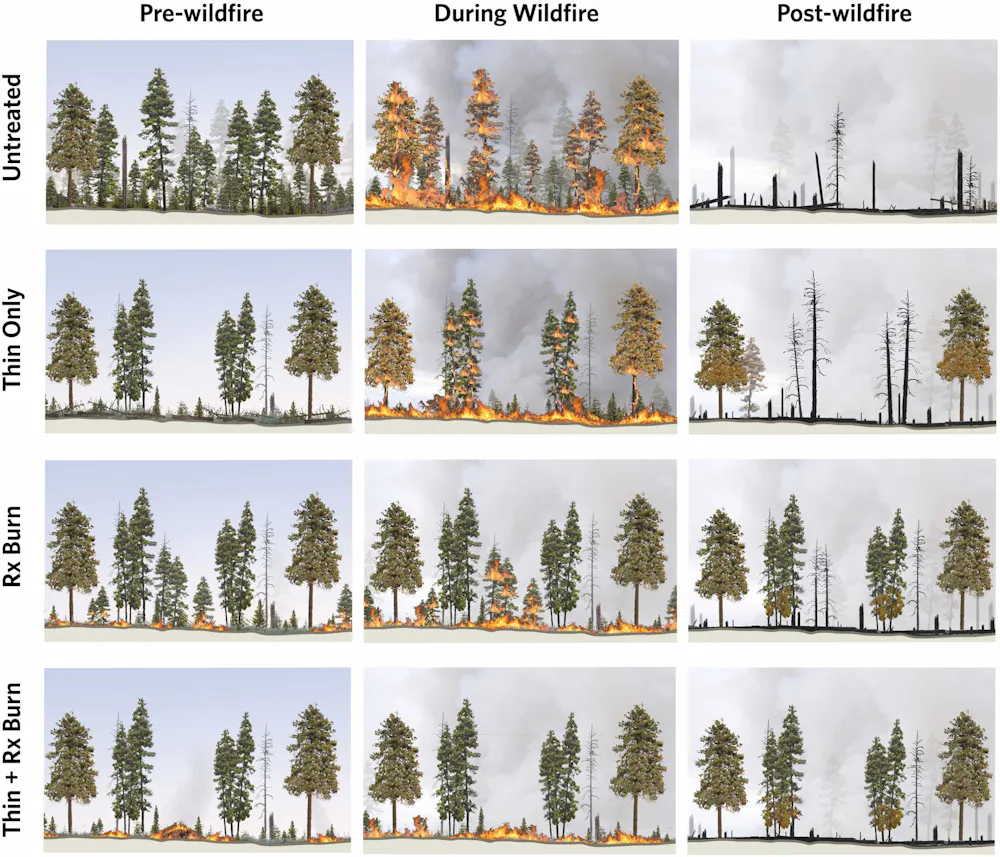
    Measures such as prescribed burns have proven to be effective for maintaining healthy forests and reducing the severity of subsequent wildfires. A recent review found that selective thinning followed by prescribed fire reduced subsequent fire severity by 72% on average, and prescribed fire on its own reduced severity by 62%.

    Prescribed burns and forest thinning tend to reduce the risk of extremely destructive wildfires.
    Kimberley T. Davis, et al., Forest Ecology and Management, 2024, CC BY

    But managing forests well requires knowing how forests are changing, where trees are dying and where undergrowth has built up and increased fire hazards. And, for federal lands, these are some of the jobs that are being targeted by the Trump administration.

    Some of the Forest Service staff who were fired or put in limbo by the Trump administration are those who do research or collect and communicate critical data about forests and fire risk. Other fired staff provided support so crews could clear flammable debris and carry out fuel treatments such as prescribed burns, thinning forests and building fire breaks.

    Losing people in these roles is like firing all primary care doctors and leaving only EMTs. Both are clearly needed. As many people know from emergency room bills, preventing emergencies is less costly than dealing with the damage later.

    Logging is not a long-term fire solution

    The Trump administration cited “wildfire risk reduction” when it issued an emergency order to increase logging in national forests by 25%.

    But private − unregulated − forest management looks a lot different than managing forests to prevent destructive fires.

    Logging, depending on the practice, can involve clear-cutting trees and other techniques that compromise soils. Exposing a forest’s soils and dead vegetation to more sunlight also dries them out, which can increase fire risk in the near term.

    Forest-thinning operations involve carefully removing young trees and brush that could easily burn, with a goal of creating conditions less likely to send fire into the crowns of trees.
    AP Photo/Godofredo A. Vásquez

    In general, logging that focuses on extracting the highest-value trees leaves thinner trees that are more vulnerable to fires. A study in the Pacific Northwest found that replanting logged land with the same age and size of trees can lead to more severe fires in the future.

    Research and data are essential

    For many people in the western U.S., these risks hit close to home.

    I’ve seen neighborhoods burn and friends and family displaced, and I have contended with regular air quality warnings and red flag days signaling a high fire risk. I’ve also seen beloved landscapes, such as those on Cameron Peak, transform when conifers that once made up the forest have not regrown.

    Recovery has been slow on Cameron Peak after a severe fire in 2020. This photo was taken in 2024.
    Bella Oleksy/University of Colorado

    My scientific research group and collaborations with other scientists have been helping to identify cost-effective solutions. That includes which fuel-treatment methods are most effective, which types of forests and conditions they work best in and how often they are needed. We’re also planning research projects to better understand which forests are at greatest risk of not recovering after fires.

    This sort of research is what robust, cost-effective land management is based on.

    When careful, evidence-based forest management is replaced with a heavy emphasis on suppressing every fire or clear-cutting forests, I worry that human lives, property and economies, as well as the natural legacy of public lands left to every American, are at risk.

    Laura Dee receives funding from NASA.

    ref. Controlled burns reduce wildfire risk, but they require trained staff and funding − this could be a rough year – https://theconversation.com/controlled-burns-reduce-wildfire-risk-but-they-require-trained-staff-and-funding-this-could-be-a-rough-year-251705

    MIL OSI – Global Reports

  • MIL-OSI Global: Trump is stripping protections from marine protected areas – why that’s a problem for fishing’s future, and for whales, corals and other ocean life

    Source: The Conversation – USA – By David Shiffman, Faculty Research Associate in Marine Biology, Arizona State University

    The coral reefs of Palmyra Atoll, part of Pacific Islands Heritage Marine National Monument, provide nurseries for many fish species. Andrew S. Wright/U.S. Fish and Wildlife Service via Flickr, CC BY-SA

    The single greatest threat to the diversity of life in our oceans over the past 50 years, more than climate change or plastic pollution, has been unsustainable fishing practices.

    In much of the ocean, there is little to no regulation or oversight of commercial fishing or other human activities. That’s part of the reason about a tenth of marine plant and animal species are considered threatened or at risk.

    It’s also why countries around the world have been creating marine protected areas.

    These protected areas, covering over 11.6 million square miles (30 million square kilometers) in 16,000 locations, offer refuge away from human activities for a wide variety of living creatures, from corals to sea turtles and whales. They give fish stocks a place to thrive, and those fish spread out into the surrounding waters, which helps fishing industries and local economies.

    In the U.S., however, marine protection is being dismantled by President Donald Trump.

    Marine protected areas as of 2022. Fully or highly protected areas represented less than 3% of the ocean, according to the Marine Protection Atlas.
    Marine Conservation Institute via Wikimedia Commons, CC BY-SA

    Trump issued a proclamation on April 17, 2025, titled “Unleashing American commercial fishing in the Pacific,” ordering the removal of key protections to allow commercial fishing in parts of a nearly-500,000-square-mile marine protected area called the Pacific Island Heritage National Marine Monument.

    He also called for a review of all other marine national monuments to decide if they should be opened to commercial fishing too. In addition, the Trump administration is proposing to redefine “harm” under the Endangered Species Act in a way that would allow for more damage to these species’ habitats.

    I’m a marine biologist and scuba diver, and it’s no accident that all my favorite dive sites are within marine protected areas. I’ve found what scientific studies from across the world show: Protected areas have much healthier marine life populations and healthier ecosystems.

    What’s at risk in the Pacific

    The Pacific Island Heritage National Marine Monument, about 750 miles west of Hawaii, is dotted by coral reefs and atolls, with species of fish, marine mammals and birds rarely found anywhere else.

    It is home to protected and endangered species, including turtles, whales and Hawaiian monk seals. Palmyra Atoll and Kingman Reef, both within the area, are considered among the most pristine coral reefs in the world, each providing habitats for a wide range of fish and other species.

    These marine species are able to thrive there and spread out into the surrounding waters because their habitats have been protected.

    A tour of several marine protected areas and their inhabitants in 2016.

    President George W. Bush, a conservative Republican, created this protected area in 2009, restricting fishing there, and President Barack Obama later expanded it. Trump, whose administration has made no secret of its aim to strip away environmental protections across the country’s land and waters, is now reopening much of the marine protected area to industrial-scale fishing.

    The risks from industrial fishing

    When too many fish are killed and too few young fish are left to replace them, it’s considered overfishing, and this has become a growing problem around the world.

    In 1974, about 10% of the world’s fish stocks were overfished. By 2021, that number had risen to 37.7%, according to the United Nations Food and Agriculture Organization’s annual State of Fisheries and Aquaculture Report.

    A fishing net caught on a coral reef can destroy habitat.
    Kampee Patisena/Moment/Getty Images

    Modern industrial-scale fishing practices can also harm other species.

    Bycatch, or catching animals that fishermen don’t want but are inadvertently caught up in nets and other gear, is a threat to many endangered species. Many seabirds, sea turtles and whales die this way each year. Some types of fishing gear, such as trawls and dredges that drag along the sea floor to scoop up sea life, can destroy ocean habitat itself.

    Without regulations or protected areas, fishing can turn into a competitive free-for-all that can deplete fish stocks.

    How marine protected areas protect species

    Marine protected areas are designed to safeguard parts of the ocean from human impacts, including offshore oil and gas extraction and industrial fishing practices.

    Studies have found that these areas can produce many benefits for both marine life and fishermen by allowing overfished species to recover and ensuring their health for the future.

    A decade after Mexico established the Cabo Pulmo protected area, for example, fish biomass increased by nearly 500%.

    How marine protected areas help marine life and local economies.

    Successful marine protected areas tend to have healthier habitats, more fish, more species of fish, and bigger fish than otherwise-similar unprotected areas. Studies have found the average size of organisms to be 28% bigger in these areas than in fished areas with no protections. How many babies a fish has is directly related to the size of the mother.

    All of this helps create jobs through ecotourism and support local fishing communities outside the marine protected area.

    Marine protected areas also have a “spillover effect” – the offspring of healthy fish populations that spawn inside these areas often spread beyond them, helping fish populations outside the boundaries thrive as well.

    Ultimately, the fishing industry benefits from a continuing supply. And all of this happens at little cost.

    A need for more protected areas, not fewer

    Claims by the Trump administration that marine protected areas are a heavy-handed restriction on the U.S. fishing industry do not hold water. As science and my own experience show, these refuges for sea life can instead help local economies and the industry by allowing fish populations to thrive.

    For the future of the planet’s whales, sea turtles, coral reefs and the health of fishing itself, scientists like me recommend creating more marine protected areas to help species thrive, not dismantling them.

    David Shiffman has consulted for many environmental non-profit groups including the Ocean Conservancy, as well as fishing industry groups and fisheries managment agencies.

    ref. Trump is stripping protections from marine protected areas – why that’s a problem for fishing’s future, and for whales, corals and other ocean life – https://theconversation.com/trump-is-stripping-protections-from-marine-protected-areas-why-thats-a-problem-for-fishings-future-and-for-whales-corals-and-other-ocean-life-254925

    MIL OSI – Global Reports

  • MIL-OSI Global: From help to harm: How the government is quietly repurposing everyone’s data for surveillance

    Source: The Conversation – USA – By Nicole M. Bennett, Ph.D. Candidate in Geography and Assistant Director at the Center for Refugee Studies, Indiana University

    DOGE has been key to attempts to consolidate Americans’ personal data for the government. Jim Watson/AFP via Getty Images

    A whistleblower at the National Labor Relations Board reported an unusual spike in potentially sensitive data flowing out of the agency’s network in early March 2025 when staffers from the Department of Government Efficiency, which goes by DOGE, were granted access to the agency’s databases. On April 7, the Department of Homeland Security gained access to Internal Revenue Service tax data.

    These seemingly unrelated events are examples of recent developments in the transformation of the structure and purpose of federal government data repositories. I am a researcher who studies the intersection of migration, data governance and digital technologies. I’m tracking how data that people provide to U.S. government agencies for public services such as tax filing, health care enrollment, unemployment assistance and education support is increasingly being redirected toward surveillance and law enforcement.

    Originally collected to facilitate health care, eligibility for services and the administration of public services, this information is now shared across government agencies and with private companies, reshaping the infrastructure of public services into a mechanism of control. Once confined to separate bureaucracies, data now flows freely through a network of interagency agreements, outsourcing contracts and commercial partnerships built up in recent decades.

    These data-sharing arrangements often take place outside public scrutiny, driven by national security justifications, fraud prevention initiatives and digital modernization efforts. The result is that the structure of government is quietly transforming into an integrated surveillance apparatus, capable of monitoring, predicting and flagging behavior at an unprecedented scale.

    Executive orders signed by President Donald Trump aim to remove remaining institutional and legal barriers to completing this massive surveillance system.

    DOGE and the private sector

    Central to this transformation is DOGE, which is tasked via an executive order to “promote inter-operability between agency networks and systems, ensure data integrity, and facilitate responsible data collection and synchronization.” An additional executive order calls for the federal government to eliminate its information silos.

    By building interoperable systems, DOGE can enable real-time, cross-agency access to sensitive information and create a centralized database on people within the U.S. These developments are framed as administrative streamlining but lay the groundwork for mass surveillance.

    Key to this data repurposing are public-private partnerships. The DHS and other agencies have turned to third-party contractors and data brokers to bypass direct restrictions. These intermediaries also consolidate data from social media, utility companies, supermarkets and many other sources, enabling enforcement agencies to construct detailed digital profiles of people without explicit consent or judicial oversight.

    Palantir, a private data firm and prominent federal contractor, supplies investigative platforms to agencies such as Immigration and Customs Enforcement, the Department of Defense, the Centers for Disease Control and Prevention and the Internal Revenue Service. These platforms aggregate data from various sources – driver’s license photos, social services, financial information, educational data – and present it in centralized dashboards designed for predictive policing and algorithmic profiling. These tools extend government reach in ways that challenge existing norms of privacy and consent.

    The role of AI

    Artificial intelligence has further accelerated this shift.

    Predictive algorithms now scan vast amounts of data to generate risk scores, detect anomalies and flag potential threats.

    These systems ingest data from school enrollment records, housing applications, utility usage and even social media, all made available through contracts with data brokers and tech companies. Because these systems rely on machine learning, their inner workings are often proprietary, unexplainable and beyond meaningful public accountability.

    Data privacy researcher Justin Sherman explains the astonishing amount of information data brokers have about you.

    Sometimes the results are inaccurate, generated by AI hallucinations – responses AI systems produce that sound convincing but are incorrect, made up or irrelevant. Minor data discrepancies can lead to major consequences: job loss, denial of benefits and wrongful targeting in law enforcement operations. Once flagged, individuals rarely have a clear pathway to contest the system’s conclusions.

    Digital profiling

    Participation in civic life, applying for a loan, seeking disaster relief and requesting student aid now contribute to a person’s digital footprint. Government entities could later interpret that data in ways that allow them to deny access to assistance. Data collected under the banner of care could be mined for evidence to justify placing someone under surveillance. And with growing dependence on private contractors, the boundaries between public governance and corporate surveillance continue to erode.

    Artificial intelligence, facial recognition systems and predictive profiling systems lack oversight. They also disproportionately affect low-income individuals, immigrants and people of color, who are more frequently flagged as risks.

    Initially built for benefits verification or crisis response, these data systems now feed into broader surveillance networks. The implications are profound. What began as a system targeting noncitizens and fraud suspects could easily be generalized to everyone in the country.

    Eyes on everyone

    This is not merely a question of data privacy. It is a broader transformation in the logic of governance. Systems once designed for administration have become tools for tracking and predicting people’s behavior. In this new paradigm, oversight is sparse and accountability is minimal.

    AI allows for the interpretation of behavioral patterns at scale without direct interrogation or verification. Inferences replace facts. Correlations replace testimony.

    The risk extends to everyone. While these technologies are often first deployed at the margins of society – against migrants, welfare recipients or those deemed “high risk” – there’s little to limit their scope. As the infrastructure expands, so does its reach into the lives of all citizens.

    With every form submitted, interaction logged and device used, a digital profile deepens, often out of sight. The infrastructure for pervasive surveillance is in place. What remains uncertain is how far it will be allowed to go.

    Nicole Bennett is affiliated with Indiana University’s Center for Refugee Studies and the Indiana University Refugee Task Force.

    ref. From help to harm: How the government is quietly repurposing everyone’s data for surveillance – https://theconversation.com/from-help-to-harm-how-the-government-is-quietly-repurposing-everyones-data-for-surveillance-254690

    MIL OSI – Global Reports

  • MIL-OSI Global: Justice Department lawyers work for justice and the Constitution – not the White House

    Source: The Conversation – USA – By Cassandra Burke Robertson, Professor of Law and Director of the Center for Professional Ethics, Case Western Reserve University

    The U.S. flag flies above Department of Justice headquarters on Jan. 20, 2024, in Washington. J. David Ake/Getty Images

    In the 1970s, President Richard Nixon tried to fire the Department of Justice prosecutor leading an investigation into the president’s involvement in wiretapping the Democratic National Committee’s headquarters.

    Since then, the DOJ has generally been run as an impartial law enforcement agency, separated from the executive office and partisan politics.

    Those guardrails are now being severely tested under the Trump administration.

    In February 2025, seven DOJ attorneys resigned, rather than follow orders from Attorney General Pam Bondi to dismiss corruption charges against New York Mayor Eric Adams. Adams was indicted in September 2024, during the Biden administration, for alleged bribery and campaign finance violations.

    One DOJ prosecutor, Hagan Scotten, wrote in his Feb. 15 resignation letter that while he held no negative views of the Trump administration, he believed the dismissal request violated DOJ’s ethical standards.

    Among more than a dozen DOJ attorneys who have recently been terminated, the DOJ fired Erez Reuveni, acting deputy chief of the department’s Office of Immigration Litigation, on April 15. Reuveni lost his job for speaking honestly to the court about the facts of an immigration case, instead of following political directives from Bondi and other superiors.

    Reuveni was terminated for acknowledging in court on April 14 that the Department of Homeland Security had made an “administrative error” in deporting Kilmar Abrego Garcia to El Salvador, against court orders. DOJ leadership placed Reuveni on leave the very next day.

    Bondi defended the decision, arguing that Reuveni had failed to “vigorously advocate” for the administration’s position.

    I’m a legal ethics scholar, and I know that as more DOJ lawyers face choices between following political directives and upholding their profession’s ethical standards, they confront a critical question: To whom do they ultimately owe their loyalty?

    President Donald Trump speaks before Pam Bondi is sworn in as attorney general at the White House on Feb. 5, 2025.
    Andrew Harnik/Getty Images

    Identifying the real client

    All attorneys have core ethical obligations, including loyalty to clients, confidentiality and honesty to the courts. DOJ lawyers have additional professional obligations: They have a duty to seek justice, rather than merely win cases, as well as to protect constitutional rights even when inconvenient.

    DOJ attorneys typically answer to multiple authorities, including the attorney general. But their highest loyalty belongs to the U.S. Constitution and justice itself.

    The Supreme Court established in a 1935 case that DOJ attorneys have a special mission to ensure that “justice shall be done.”

    DOJ attorneys reinforce their commitment to this mission by taking an oath to uphold the Constitution when they join the department. They also have training programs, internal guidelines and a long-standing institutional culture that emphasizes their unique responsibility to pursue justice, rather than simply win cases.

    This creates a professional identity that goes beyond simply carrying out the wishes of political appointees.

    Playing by stricter rules

    All lawyers also follow special professional rules in order to receive and maintain a license to practice law. These professional rules are established by state bar associations and supreme courts as part of the state-based licensing system for attorneys.

    But the more than 10,000 attorneys at the DOJ face even tougher standards.

    The McDade Amendment, passed in 1998, requires federal government lawyers to follow both the ethics rules of the state where they are licensed to practice and federal regulations. This includes rules that prohibit DOJ attorneys from participating in cases where they have personal or political relationships with involved parties, for example.

    This law also explicitly subjects federal prosecutors to state bar discipline. Such discipline could range from private reprimands to suspension or even permanent disbarment, effectively ending an attorney’s legal career.

    This means DOJ lawyers might have to refuse a supervisor’s orders if those directives would violate professional conduct standards – even at the risk of their jobs.

    This is what Assistant U.S. Attorney Danielle Sassoon wrote in a Feb. 12, 2025, letter to Bondi, explaining why she could not drop the charges against Adams. Sassoon instead resigned from her position at the DOJ.

    “Because the law does not support a dismissal, and because I am confident that Adams has committed the crimes with which he is charged, I cannot agree to seek a dismissal driven by improper considerations … because I do not see any good-faith basis for the proposed position, I cannot make such arguments consistent with my duty of candor,” Sassoon wrote.

    As DOJ’s own guidance states, attorneys “must satisfy themselves that their behavior comports with the applicable rules of professional conduct” regardless of what their bosses say.

    Post-Watergate principles under pressure

    The president nominates the attorney general, who must be confirmed by the U.S. Senate.

    That can create the perception and even the reality that the attorney general is indebted to, and loyal to, the president. To counter that, Attorney General Griffin Bell, in 1978, spelled out three principles established after Watergate to maintain a deliberate separation between the White House and the Justice Department.

    First, Bell called for procedures to prevent personal or partisan interests from influencing legal judgments.

    Second, Bell said that public confidence in the department’s objectivity is essential to democracy, with DOJ serving as the “acknowledged guardian and keeper of the law.”

    Third, these principles ultimately depend on DOJ lawyers committed to good judgment and integrity, even under intense political pressure. These principles apply to all employees throughout the department – including the attorney general.

    Recent ethics tests

    These principles face a stark test in the current political climate.

    The March 2025 firing of Elizabeth Oyer, a career pardon attorney with the Justice Department, raises questions about the boundaries between political directives and professional obligations.

    Oyer was fired by Bondi shortly after declining to recommend the restoration of gun rights to actor Mel Gibson, a known Donald Trump supporter. Gibson lost his gun rights after pleading no contest to a misdemeanor domestic battery charge in 2011.

    Oyer initially expressed concern to her superiors about restoring Gibson’s gun rights without a sufficient background investigation, particularly given Gibson’s history of domestic violence.

    When Oyer later agreed to testify before Congress in a hearing about the White House’s handling of the Justice Department, the administration initially planned to send armed U.S. Marshals officers to deliver a warning letter to her home, saying that she could not disclose records about firearms rights to lawmakers.

    Oyer was away from home when she received an urgent alert that the marshals were en route to her home, where her teenage child was alone. Oyer’s attorney described this plan as “both unprecedented and completely inappropriate.”

    Officials called off the marshals only after Oyer confirmed receipt of the letter via email.

    Elizabeth Oyer, a former U.S. pardon attorney at the Justice Department, speaks at a Senate hearing on April 7, 2025, in Washington.
    Kayla Bartkowski/Getty Images

    Why independence matters

    In my research, I found that lawyers sometimes have lapses in judgment because of the “partisan kinship,” conscious or not, they develop with clients. This partisan kinship can lead attorneys to overlook serious red flags that outsiders would easily spot.

    When lawyers become too politically aligned with clients – or their superiors – their judgment suffers. They miss ethical problems and legal flaws that would otherwise be obvious. Professional distance allows attorneys to provide the highest quality legal counsel, even if that means saying “no” to powerful people.

    That’s why DOJ attorneys sometimes make decisions that frustrate political objectives. When they refuse to target political opponents, when they won’t let allies off easily, or when they disclose information their superiors wanted hidden, they’re not being insubordinate.

    They’re fulfilling their highest ethical duties to the Constitution and rule of law.

    Cassandra Burke Robertson does not work for, consult, own shares in or receive funding from any company or organization that would benefit from this article, and has disclosed no relevant affiliations beyond their academic appointment.

    ref. Justice Department lawyers work for justice and the Constitution – not the White House – https://theconversation.com/justice-department-lawyers-work-for-justice-and-the-constitution-not-the-white-house-254763

    MIL OSI – Global Reports

  • MIL-OSI Global: VAT hikes can raise tax without hurting the poor: an economist sets out the evidence

    Source: The Conversation – Africa – By Imraan Valodia, Pro Vice-Chancellor, Climate, Sustainability and Inequality and Director, Southern Centre for Inequality Studies, University of the Witwatersrand

    South Africa’s 2025-6 budget has been subjected to more comment than usual. This is due to the political tensions generated by a proposed increase in value added tax (VAT).

    South Africa’s choices on how it manages the revenue and expenditure issues in the budget are critical for how the larger issues of the country’s debt and its economic policies are handled. As things stand, the economy is locked into a low-growth trajectory which make the debt, revenue and expenditure issues more difficult to deal with.

    This piece draws on a longer article which explores these issues in greater detail. Here, I focus only on the VAT issue.

    The finance minister originally tabled an increase of 2 percentage points, then changed it to 0.5 percentage points. Still, it is threatening to end the country’s government of national unity, which was set up after elections in 2024.


    Read more:
    South Africa’s finance minister wanted to raise VAT: the pros and cons of a tricky tax


    Most commentators, including the political parties that have opposed the proposal, many academics, and non-governmental organisations claiming to represent low-income groups, have argued that an increase in VAT places an undue burden on low-income groups. This would make it regressive.

    Based on work as an academic economist over the past three decades, I believe that the debate has been based largely on conjecture and ideological opposition to VAT, rather than on the evidence of its impact.

    This is a pity as there is empirical evidence rooted in research that a VAT increase is, in fact, not regressive and is therefore a good policy decision.

    Tax experts usually refer to the three Es in taxes – equity, efficiency and ease of administration – for evaluating tax policy proposals. New taxes should ideally promote equity (they should be progressive and not regressive), be efficient and be easy to administer.

    An increase in VAT in South Africa ticks all these boxes.

    First, contrary to what many commentators have been arguing, VAT isn’t always regressive – it depends on how it’s implemented. As proposed by the finance minister it would not be regressive because, while it would add to the burden of low-income households, most of the VAT would be collected from higher-income households. Added to this is that the proposed expansion of the existing list of zero-rated items would protect the lowest-income households.

    Second, VAT is a very efficient tax. For relatively low increases in the rate, government is able to raise a large amount of revenue.

    Finally, the system is easy to administer and adds very little cost to collection.

    Key to its efficacy is the way VAT is implemented, including the choice of products to zero rate, and the political credibility of government.

    The case for a VAT increase

    VAT is a consumption tax, so it only affects the income that a household consumes.

    According to the International Monetary Fund (IMF), VAT is now the mainstay of tax systems in over 160 countries, raising on average one-third of total government revenues.

    In theory, there are good reasons to be concerned about the impact of VAT. First, it can place a high burden on low-income households because they spend a large proportion of their incomes on consumption goods such as food.

    Second, VAT may also place a heavy burden of tax on women. In South Africa and many other countries, women-led households tend to be clustered in the lower end of the income distribution. And women disproportionately take responsibility for feeding and caring for family members.

    So, at least in theory, VAT is a regressive tax. But is it really so in practice?

    Three studies that have explored this issue in some detail have concluded that, in South Africa, VAT is not regressive.

    In 2008, I worked with colleagues in eight countries (South Africa, Ghana, Uganda, Morocco, Mexico, Argentina, India and the United Kingdom) on the gender issues related to tax. In particular we looked at the burden of VAT on low-income and women-headed households.

    Our findings were that, in general, VAT is regressive and discriminates against women, but it depends on how it is implemented.

    In South Africa, the zero-rating of basic consumption goods is very effective, protecting low-income and female-headed households from VAT. It’s an example of a VAT system that is neutral – neither regressive nor progressive.

    A more recent study by South African economist Ingrid Woolard and colleagues reached a similar conclusion in 2018.

    A third study was done in the same year when VAT was increased from 14% to 15%. Following a similar emotive debate, the finance minister appointed an independent committee which I served on and which was chaired by Woolard, to advise on further zero-rating.

    Our conclusion – again – was that zero-rating is highly effective at protecting low-income groups from the deleterious effects of VAT.

    How it’s done matters

    The challenge with zero-rating is that while low-income households benefit, high-income households benefit more (because they spend more, in absolute terms, on zero-rated goods). Large amounts of potential VAT revenue are lost to high-income groups that don’t need protection.

    The trick is to find a basket of goods that low-income households consume a lot of, but which high-income households don’t consume in large quantities. Some typical examples are beans, canned pilchards and cabbage. These are all goods that low-income households consume and high-income households do not.

    National Treasury’s proposals for increasing the basket of goods to be zero-rated are based on solid research.

    A good example of the trade-offs to consider is the case of chicken. Chicken is an important source of protein for low-income households, but also for high-income households. So, if all chicken were zero-rated, this would protect poor households, but a large amount of VAT revenue would be lost.

    In our 2018 zero-rating report, at 2018 prices and consumption patterns, we calculated that zero-rating all chicken products would be equivalent to R1.3 billion (US$67.6 million) but government would lose R4.6 billion (US$244.4 million) to high income households.

    Not a good trade-off.

    However, some chicken products, such as chicken heads and feet, are mostly consumed by low-income groups, and are therefore good candidates for zero-rating.

    The two other Es – efficiency and ease of administration – of taxes are also key to consider.

    On these two considerations, VAT has big advantages.

    It’s very difficult to avoid or evade VAT because it’s collected along the chain of production. There’s evidence that South Africa has very little leakage in the system.

    So it is relatively easy to increase the VAT rate without needing to invest additional resources to collect the tax.

    Credibility is key

    Apart from the economic considerations, tax policy has to be politically credible. People should believe that their tax contributions are being used effectively, and government should be seen to be acting in line with this.

    If people don’t believe in government’s ability to spend wisely, resistance to taxes increases. Then tax avoidance and evasion increases.

    It would be fair to say that, with the high levels of corruption in South Africa’s political system, government’s credibility is low.

    Thus, if VAT is to be increased, government has to do a lot more to improve its credibility and reassure South Africans that the tax revenues will be well spent.

    Imraan Valodia receives funding from a number of foundations and governments that support academic research.

    ref. VAT hikes can raise tax without hurting the poor: an economist sets out the evidence – https://theconversation.com/vat-hikes-can-raise-tax-without-hurting-the-poor-an-economist-sets-out-the-evidence-254213

    MIL OSI – Global Reports

  • MIL-OSI Global: Could Trump be leading the world into recession?

    Source: The Conversation – UK – By Steve Schifferes, Honorary Research Fellow, City Political Economy Research Centre, City St George’s, University of London

    Carolyn Franks/Shutterstock

    Growth forecasts for the US and other advanced economies have been sharply downgraded by the International Monetary Fund (IMF) in the wake of dramatic swings in US president Donald Trump’s economic policy. But could the uncertainty and the turmoil in financial markets eventually be enough to push the world into a recession?

    The IMF says that global growth has already been hit by the decline in business and consumer confidence as “major policy shifts” by the US unfold. These are leading to less spending and less investment.

    It also predicts further damage from the disruption in global supply chains and inflation caused by tariff increases.

    But while the IMF forecasts a sharp reduction in world economic growth in 2025 and 2026, it is not projecting a recession – for now. However, it says the chances of a global recession have risen sharply from 17% to 30%. And there is now a 40% chance of a recession in the US.

    The head of the IMF, Kristalina Georgieva, has blamed the slowdown on the ongoing “reboot of the global trading system” by the US. She said this is leading to downgrades in growth estimates, while volatility in financial markets is “up” and trade policy uncertainty is “literally off the charts”.

    As part of the IMF forecasts, growth projections for the world’s richest countries in 2025 have been sharply reduced. In the US it is down 0.5% to just 1.8%, while growth in the euro area is projected to be just 0.8%. Japan will be growing by even less at 0.6%. Germany – the EU’s largest economy – is projected to have no growth at all.

    And for the UK, growth has been cut by 0.5%, to a very weak 1.1%, which is in line with forecasts from March. This is well below the 2% projected at the time of the last budget in the autumn. And despite the adjustments made in the UK’s spring statement, the downgrade is likely to mean more tax increases, spending cuts, or both.

    Some developing countries are doing much better, with India projected to have one of the highest annual GDP growth rates at 6.2% in 2025. Meanwhile, China’s growth forecast has been cut sharply due to the effect of US tariffs. It is now projected by the IMF to be down by 1.3% to just 4%.

    Other poorer developing countries will also be negatively affected, but most will continue to grow at a faster pace than major industrial nations.

    What the forecast underscores is that the era of rapid globalisation, spurred by trade and integration of financial markets, seems to be coming to an end.

    Its rapid spread since the 1950s, which accelerated in the 1980s, led to a huge expansion of the world economy. But it created winners and losers, both between nations and within them.

    The Trump administration’s answer to this is massive tariff increases
    hitting countries that stand accused of “ripping off America”. The tariffs have several contradictory objectives, including raising money pay for tax cuts; acting as a bargaining chip to open foreign markets to American goods; and encouraging manufacturers to relocate to the US.

    Trump has swung between these objectives, and backed down when market reaction became too fierce. These swings have destabilised trade and investment, as well as business and consumer confidence.


    Read more:
    Trump has shown he will backtrack on tariffs. What does that say about how to wage a trade war?


    Tariffs do not change the fact that many countries can produce the goods Americans want, more cheaply and often more efficiently. And the looming trade war could mean US exporters are hit with retaliatory tariffs, making it even harder to sell American goods abroad.

    The inflationary effect of tariffs – raising the price of imported goods – could reverse the recent successes of central banks in taming inflation. It could even force them to raise interest rates – something Trump is fiercely against.

    A more immediate effect of Trump’s erratic policy-making has been turmoil in financial markets. The US stock market has fallen sharply since Trump announced his tariff plan, currently down by nearly 15% (a loss of more than US$4 trillion (£2.99 trillion) for shareholders).

    This matters for the US economy, as most Americans depend on their stock market holdings to pay for their defined-contribution pensions. But even more worrying is the effect on the US Treasury bond market, which has been a safe haven in times of trouble. Foreign investors are now shunning US bonds, driving up interest rates for US government debt and unsettling financial institutions.

    Added to the problem is the sharp drop in the value of the US dollar. Trump says he wants a weaker dollar, presumably to make US exports cheaper. But it also raises the price of imported goods and could fuel inflation. Ultimately, it could threaten the role of the US dollar as the world’s reserve currency.

    Potentially, big swings in normally steady financial markets can presage some of the same wobbles that led to the global financial crisis of 2008. That crisis threatened the solvency of the global financial system – although we have not reached that point yet.

    Winners and losers

    So what is the most likely outcome of the trade war, and the loss of a single hegemonic economic power? One example is what happened when Britain lost its dominant role in manufacturing and finance after the first world war.

    Attempts at rebuilding a global economic order failed, and other major countries (led by Germany and the US) reverted to autarky, stepping back from the international trading system and worsening the Depression of the 1930s.

    Just as Trump is trying to do, countries reverted to competitive devaluations. Each tried to make its exports cheaper than those of its rivals, ultimately to no avail. The world was divided into rival trading blocs, and it is conceivable that the US, the EU and China could form three such blocs in future.

    The last financial crisis, in 2008, was mitigated by prompt and cooperative action
    by central banks and governments. They injected trillions to stabilise the financial sector, but even now the damaging effects of this crisis on national growth rates is plain to see.

    The IMF has made it clear that it is not just the detail of the tariffs, but erratic US economic policy, that is the main culprit for the potential recession. The rising cost of servicing US debt as investors lose confidence is also raising the cost of the large public debts of other advanced economies, including the UK. This puts more pressure on public spending.

    Let’s hope that whatever the turmoil, we will not be repeating the mistakes of the past.

    Steve Schifferes does not work for, consult, own shares in or receive funding from any company or organisation that would benefit from this article, and has disclosed no relevant affiliations beyond their academic appointment.

    ref. Could Trump be leading the world into recession? – https://theconversation.com/could-trump-be-leading-the-world-into-recession-255081

    MIL OSI – Global Reports

  • MIL-OSI Global: Why Hollywood is finally taking horror films seriously

    Source: The Conversation – UK – By Reece Goodall, Director of Student Experience and Progression for the Faculty of Arts, University of Warwick

    Horror films have always held an interesting place in cultural and cinematic circles. Despite proving consistently profitable and boasting a considerable fanbase, the genre has also been the target in several moments of cultural crisis. Think the video nasties of the 1970s and 80s, or the implied conservatism of the violence in torture porn films of the 2000s.

    Though the genre has been one of the industry’s most profitable genres since the 1930s, due to its perceived low status, horror has largely been unrecognised by award bodies, mainstream critics and the gatekeepers of more “legitimate” cinema. There’s an implied sense that the genre is somewhat different from respectable film-making – that it is low status, trashy and in some cases outright nasty.

    Only seven horror films have been nominated for best picture at the Oscars since the first ceremony in 1929. Two of those nominations were in the last decade, and there was widespread conversation about the bias against the genre after Toni Collette failed to receive an Oscar nomination for her performance in the 2018 film Hereditary.

    Even then, Collette’s excellent performance was in an auteur film released by indie studio A24. Far from the more conventional forms of horror that tend to be overlooked year on year by bodies recognising the year’s achievements in film-making. However, if we leap ahead to 2025 and look at the horror films that took the past year by storm – The Substance, Nosferatu, Terrifier 3 – all forms of the genre are represented.


    Looking for something good? Cut through the noise with a carefully curated selection of the latest releases, live events and exhibitions, straight to your inbox every fortnight, on Fridays. Sign up here.


    The Substance and Nosferatu could both be described as “elevated horror”, a sub-genre that focuses on negative moods rather than explicit gore (although both films certainly get bloody, especially in The Substance’s monstrous climax).

    On the other end of the scale, Terrifier 3 is particularly brutal, aligning itself more with grindhouse and slasher films and celebrating the practical effects that bring violence to the big screen. In another era, there is no doubt that Terrifier 3 would have been a target of censors and the cultural critics over its depictions of violence, with brutal deaths and the murder of several children. But in 2025, it is celebrated by genre fans and an object of serious academic interest.

    The films were all successes. Both The Substance and Nosferatu received multiple nominations at the 2025 Academy Awards. Along with Alien: Romulus, the horror genre picked up ten nominations, its best performance since 1974.

    Nosferatu was nominated for several Academy Awards.

    Elsewhere, Terrifier 3 broke records as the highest-grossing unrated film (a movie not given a rating by film censors, normally because of offensive content) of all time. Terrifier 3 never seemed likely to receive an Oscar nomination, even despite its success and a sustained and entertaining marketing campaign. Nonetheless, both fans and industry figures alike have suggested that its practical make-up effects warranted recognition.

    So why is horror becoming more widely appreciated in the 21st century? The “elevated horror” dimension is certainly one factor, presenting works that align more with the conventions of art cinema, which is essentially easier to sell as legitimate.

    Alongside this, we have the political dimension. Horror films have always been political, representing the fears and marginal identities of a particular country and time period. But in an era characterised by increased instability, pandemics, wars and all manner of social crises, the need for the genre might be more prevalent than ever.

    The terrifying trailer for Terrifier 3.

    In light of the industry’s continuing struggle with declining cinema attendance numbers, horror remains one of the rare genres that consistently draws audiences to theatr. Although films like Terrifier 3 might be looked down on by the cinema establishment, it was event cinema and widely discussed in a way that few films in the past five years have managed to be.

    Audiences have always loved horror, and in a tough period for the cinema industry, the genre continues to prove financially stable and appealing to film-goers. That the gatekeepers of the industry are tentatively starting to recognise the genre is a new development, and although it remains to be seen whether this recognition will be sustained in future years, we’re in a moment when horror of all varieties is being praised like never before.

    Reece Goodall does not work for, consult, own shares in or receive funding from any company or organisation that would benefit from this article, and has disclosed no relevant affiliations beyond their academic appointment.

    ref. Why Hollywood is finally taking horror films seriously – https://theconversation.com/why-hollywood-is-finally-taking-horror-films-seriously-253687

    MIL OSI – Global Reports

  • MIL-OSI Global: Celebrity Traitors: my research shows voting behaviour could help identify faithfuls

    Source: The Conversation – UK – By Robin Kramer, Senior Lecturer in the School of Psychology, University of Lincoln

    With the lineup of the upcoming celebrity series of The Traitors recently leaked online, people are once again debating the best strategies that players might use to succeed. But a player’s voting history can also reveal the psychological dynamics at play, particularly alliances they may be subconsciously forming.

    For those who aren’t familiar, the premise of the show is that each player is given the role of either “faithful” or “traitor”. Only the traitors know everyone’s roles in the game. If the faithful players eliminate all of the traitors by the end of the game, they divide the prize money equally among themselves. However, if one or more traitors remain by the end, all of the money goes to them instead.

    There are two ways for someone to be eliminated from the game. First, all of the players vote on who to “banish” at the round table each day. Second, the traitors decide on one person to “murder” overnight, who is then removed from the game before breakfast the following morning. There are also occasional tweaks to this format depending on the stage of the game.

    Ideally, faithful players would spot the lies that traitors tell. However, research shows that people don’t fare much better than chance at doing this, although certain individuals (who are often found to be working in law enforcement) or specialised groups, such as members of the US Secret Service, may be.


    Read more:
    Why we’re so bad at spotting lies – most of us only perform slightly better than chance


    Instead, players may base their decisions on unreliable biases. In a game where there’s so little to go on, they risk being blinded by the trustworthiness of a (fake) Welsh accent, for example, or drawing suspicions for simply being too quiet or too noisy. After all, there is a lot of behaviour that people often incorrectly link with deception. For instance, westerners commonly associate someone averting their gaze with lying but researchers have shown that looking away isn’t linked to deception.

    Spotting traitors is no easy task if you’re a faithful.
    Andrii Yalanskyi/Shutterstock

    Using voting behaviour as evidence

    Information from interactions with other players can be unreliable, but players also get to see how others vote at the round table. And this is where real evidence can be found.

    The faithful players have little to go on, so they end up voting for anyone – faithful and traitors alike. In contrast, traitors can direct their votes only at the faithful. If we combine these ideas, we see that traitors are more likely to be voted for by faithful players, even if this is by accident.

    The traitors don’t tend to vote for each other because they naturally form an alliance, working together to shape the game. Their secret meetings in Traitors’ Tower, shared uniform (a cloak and hood), and power to murder the faithful, construct a sense of “us versus them”. In fact, very little is needed for people to start behaving this way. Known as the minimal group paradigm, research has shown that simply segregating people based on their preference for certain artists or their eye colour is enough to change the way they behave towards each other.

    They may be happy to deceive the faithful, but the traitors are generally willing to trust each other. This mirrors a 2018 study where “deviant” study participants (who cheated on a task) felt connected to their team and trusted its members when the team engaged in coordinated acts of deviance (helping each other to cheat). Although they knew logically that their team shouldn’t be trusted, their sense of connection led to a feeling of trust nonetheless.

    Do voting records actually reveal players’ roles?

    Conveniently, all of the voting records for the show have been collated online. Let’s first exclude voting rounds which restrict the traitors’ options. During a round table which results in a traitor’s banishment, most players have voted for that traitor. There is good reason for other traitors to jump on the bandwagon at that point, to blend in and appear more faithful. Similarly, voting is limited after a tie, where the remaining options may force particular decisions.

    After excluding these two types of voting context, I investigated the votes for players who were traitors at the time of voting (rather than switching to this role later on) for the three series of the UK show. I also considered other completed series of English-language versions of the show: the US, Australia, Canada and New Zealand.

    Altogether, 95% of the 76 votes for traitors were cast by faithful players. Remember Jake from series three earlier this year? As a faithful player, he voted for Linda right at the beginning of the game. When Linda was later revealed as a traitor, Jake’s abilities were championed by the other players, earning him the nickname “traitor hunter” and convincing them that he was faithful.

    So whenever a traitor is banished, players should consider who voted for that traitor in previous round tables – as we’ve seen, those votes probably came from the faithful. However, as the game progresses, there’s always the possibility that a faithful player could later be “seduced” into becoming a traitor, so it’s important to keep this in mind too.

    Players may not be able to rely on spotting “tells” or other cues to deception in the game, but there are always patterns in the ways people behave. You just need to know where to look.

    Robin Kramer does not work for, consult, own shares in or receive funding from any company or organisation that would benefit from this article, and has disclosed no relevant affiliations beyond their academic appointment.

    ref. Celebrity Traitors: my research shows voting behaviour could help identify faithfuls – https://theconversation.com/celebrity-traitors-my-research-shows-voting-behaviour-could-help-identify-faithfuls-223229

    MIL OSI – Global Reports

  • MIL-OSI Global: What does the UK Supreme Court’s gender ruling mean for trans men?

    Source: The Conversation – UK – By Daniel Alge, Senior Lecturer in Criminology & Criminal Justice, Brunel University of London

    Alex Segre/Shutterstock

    The UK Supreme Court ruling backing the “biological” definition of a woman has been hailed by many as providing clarity on the law. But far from the matter being settled, it has raised complex questions, particularly when we consider that half of all transgender people are trans men. It even raises the possibility of trans men being excluded from both men and women’s spaces.

    The court unanimously agreed that, regardless of any gender reassignment or possession of a gender recognition certificate (GRC) recognising them as female, transgender women should not be recognised as women for the purposes of the Equality Act 2010. This means that access to single-sex spaces should be determined by biological gender assigned at birth.

    Meanwhile, the Equality and Human Rights Commission has said it will “pursue” the NHS unless it changes its gender policies. The NHS policies currently state that transgender patients should be accommodated in accordance with their self-identified gender, based on appearance, name and pronouns.


    Want more politics coverage from academic experts? Every week, we bring you informed analysis of developments in government and fact check the claims being made.

    Sign up for our weekly politics newsletter, delivered every Friday.


    For many complex reasons, trans men generally feature far less in the public discourse around trans issues. Trans men are currently under-researched and rarely considered by the mainstream media or academic literature.

    The Supreme Court’s own summary of the case sets out the issue in terms of the definition of “woman”. But it is clear that the judgment applies equally to trans men as it finds that each of the terms “man”, “woman” and “sex” in the Equality Act refer to biological sex. The court concludes that any other definition would be “incoherent and unworkable”.

    The Office for National Statistics estimates there are roughly equal numbers (48,000) of trans men and trans women in England and Wales. This is supported by data from the US, which also shows roughly equal populations of trans men and trans women.

    Issues for trans men

    Those who support a biological definition of sex have framed their position as one which protects women’s rights and keeps women’s spaces safe by excluding men. By legal definition, that now includes trans women. However, it does not include trans men, who would have been born biologically female.

    This judgment means that trans men can be excluded from men’s single-sex spaces. But there may also be cases where they are excluded from women’s spaces too, despite being considered women under the ruling.

    The court found that it might be proportionate to exclude a trans man from a women’s single-sex service such as counselling for survivors of sexual abuse where “reasonable objection is taken to their presence … because the gender reassignment process has given them a masculine appearance…”.

    This statement highlights the flawed legal reasoning around trans men. In most circumstances they are to be treated as women, even if that creates absurdities in practical implementation. And yet, they can also be excluded from some women’s spaces if they appear too masculine. It could be argued that it is this decision which is “incoherent and unworkable”.

    The ruling could create more confusion over who can access single-sex spaces.
    Iryna_Kolesova/Shutterstock

    The Supreme Court decision repeatedly makes the point that “neither possession of a GRC [gender recognition certificate] nor the protected characteristic of gender reassignment require any physiological change or even any change in outward appearance”.

    However, in practice a GRC can’t be issued without a medical diagnosis of gender dysphoria. It is very difficult for an individual to meet the diagnostic criteria for gender dysphoria without making changes to their appearance or pursuing medical transition.

    Testosterone treatment means that trans men may find it easier to “pass” (be perceived as the gender they identify with) than trans women. Testosterone generally causes facial hair to grow, and creates a more masculine physique and a deeper voice without the need for any additional procedures.

    There are no official statistics, but a 2022 report by the advocacy group TransActual found that around 90% of trans respondents have accessed hormone therapy or surgery, or hope to do so in the future.

    This likely means that a majority of the 48,000 estimated trans men in England and Wales are likely to present as masculine, and be perceived as cisgender men. This is where any implementation of the Supreme Court’s ruling becomes complicated.

    Single-sex spaces

    The decision, subject to any future clarification, means that trans men are not permitted to enter men’s single-sex spaces such as men’s toilets, gym changing rooms or hospital wards. Instead, they should use the women’s single-sex spaces including communal changing areas, in accordance with their biological sex.

    The justices briefly considered this issue when they gave the example of an employer requiring that a warden in a women’s or girls’ hostel be female. Before this ruling, such a role would be open to a trans woman with a GRC, but not to a trans man with a GRC.

    The court stated that “a biological definition of sex would correct this perceived anomaly”. However, this means that the warden in the girls’ hostel can now be a trans man, who could well be indistinguishable from a cis man to the residents of the hostel.

    There is also the concern that both trans men and trans women will expose themselves to a greater risk of harassment, which has already increased considerably, if they are forced to out themselves by using facilities which don’t align with the gender they present as.

    Daniel Alge does not work for, consult, own shares in or receive funding from any company or organisation that would benefit from this article, and has disclosed no relevant affiliations beyond their academic appointment.

    ref. What does the UK Supreme Court’s gender ruling mean for trans men? – https://theconversation.com/what-does-the-uk-supreme-courts-gender-ruling-mean-for-trans-men-254868

    MIL OSI – Global Reports

  • MIL-OSI Global: Harvard is suing the White House: here’s what Trump hopes to achieve by targeting universities

    Source: The Conversation – UK – By Thomas Gift, Associate Professor and Director of the Centre on US Politics, UCL

    A few days ago, in a move that attracted international attention, the White House threatened to strip Harvard University of US$2 billion (£1.5 billion) in federal funding, potentially revoke its tax-exempt status and even prevent it from enrolling international students if it didn’t capitulate to a new list of demands.

    The five-page ultimatum reads like a political ransom note. It calls on Harvard to make major “governance reform” including enforcing “viewpoint diversity” in admissions and hiring, squashing diversity, equity and inclusion (DEI) initiatives, and more screening of foreign student applicants for their beliefs and reporting those who commit “conduct violations” to authorities.

    Now, the White House says it was all a big misunderstanding – that the letter was “unauthorized” and that it was Harvard’s fault for not recognising the mistake. Instead of “pick[ing] up the phone … Harvard went on a victimhood campaign,” said a senior policy strategist for Trump in the New York Times. Never mind, as Harvard noted, that the letter was signed by three federal officials and printed on official letterhead.

    But the war between the White House and Harvard is far from over. Trump is likely to be in it for the long game and have many more plays to make.

    On Monday, Harvard announced it was suing the Trump administration for its prior threat to axe the school’s funding – a move Harvard said would have “severe and long-lasting” effects.

    Harvard’s huge US$50 billion endowment gives it the ability to absorb federal spending cuts in a way that even other wealthy US universities can’t. Yet the university’s leadership still says that it would need to make draconian slashes to its research and student programming if federal cuts happened.

    “We are going to choke off the money to schools that aid the Marxist assault on our American heritage and on Western civilization itself,” Trump has previously stated, hinting at his wider project to wield power over universities and significantly change the way they operate.

    Part of a bigger plan

    It’s not just Harvard that’s facing the heat — although as the nation’s most prestigious and high-profile university, its decisions will set the tone for the rest of the sector. More than 40 universities across the US are under investigation by the Trump administration, including for alleged illicit actions by DEI offices and charges of tolerating anti-semitism.

    Another Ivy League university, Columbia in New York, for example, has caved to Trump’s demands as a precondition for restoring US$400 million in federal grants, with one group alleging that the cuts constitute an existential “gun to the head”. Johns Hopkins University, in Maryland, has seen at least US$800 million in federal spending cut, forcing the school to slash more than 2,000 jobs.

    J.D. Vance outlines his views on US universities.

    It’s hard to overstate the backlash. Princeton president Christopher Eisgruber has called Trump’s latest moves “the greatest threat to American universities since the Red Scare of the 1950s”. Political analyst Fareed Zakaria believes that the Trump White House is waging a version of Mao Zedong’s Cultural Revolution, when the Chinese leader took control of China’s leading universities.

    “No government — regardless of which party is in power — should dictate what private universities can teach, whom they can admit and hire, and which areas of study and inquiry they can pursue,” said Harvard president Alan Garber.

    Trump’s attacks on universities follow a blueprint: identify institutions seen as elite, liberal and out of touch, and undercut their legitimacy relentlessly.

    The current crackdown fits a broader pattern, which includes the dismantling of the US Agency for International Development, seen as a soft target when many Americans think the country spends too much on foreign aid, and swipes at some of the nation’s top law firms, cast by Trump as part of an out-of-control, “rigged” legal system.

    Perhaps the only question is why the Trump administration didn’t come after universities sooner. As CNN’s Stephen Collinson has noted: “Harvard University is such a perfect foil for Trumpism that it’s a wonder it avoided the MAGA maelstrom for so long.”

    Recent campus unrest and rising concerns over anti-semitism — spotlighted by a trio of controversial congressional testimonies by the presidents of Harvard, MIT, and the University of Pennsylvania in 2023 — have provided a convenient political opening for Maga crusaders. However, Trump’s latest tirade almost certainly has less to do with principle than political opportunity.

    Recent polling from Gallup shows that trust in higher education has plummeted since roughly the first time Trump ran for president. In 2015, 57% of Americans possessed “a great deal” or “quite a lot” of confidence in higher education. Today, that number is just 36%. For Republicans, those numbers have dropped even more sharply, from 56% to 20%.

    There’s plenty of speculation about what’s driving these figures, but most are inextricably linked to partisan politics. Harvard Law School’s Jack Goldsmith and Adrian Vermeuele say that elite colleges have made it easy for conservatives to dislike them, and should reflect on why.

    Critiques of academia include accusations that faculties and student bodies tilt far to the left. At Harvard, for example, just 3% of professors identify as conservative, and 13% of recent graduates.

    These charges coincide with allegations of illiberal student “mobs” who shout down and heckle speakers and refuse to allow dissenting opinions. According to the Foundation for Individual Rights and Expression, for instance, Harvard is at the bottom of the table – scoring zero out of 100 – in its annual college free speech ranking.

    Adding to the controversy are claims that DEI offices have gone “too far” in inculcating a “oppressor-oppressed” mentality on campuses. The Trump administration views universities as ground-zero of the broader DEI trend that proliferated in the public and private sector during the Biden years.

    Declining trust in universities has doubtlessly been exacerbated by Maga rhetoric. Before being elected, Vice-President J.D. Vance announced that “the professors are the enemy”. Marc Lampkin, a longtime Republican strategist, said that “Republicans believe that … universities are the training ground for left, progressive camps”.

    That Harvard sits on a US$50 billion endowment, even as it takes advantage of tax benefits as a nonprofit, strikes many in the Trump camp as unfair.

    The clash between Harvard and the White House is laying the groundwork for a high-stakes showdown, pitting academia’s defenders against the Magaverse. Yet it’s possible to believe two things at once: that universities do suffer from some, even many, of the ailments that Trump has alleged; and that Trump’s onslaught against higher education is strategically misguided, politically motivated and aimed at putting universities under the president’s thumb.

    Thomas Gift teaches an annual course in the Harvard Summer School, and worked full-time at the Harvard Kennedy School in 2015-16.

    ref. Harvard is suing the White House: here’s what Trump hopes to achieve by targeting universities – https://theconversation.com/harvard-is-suing-the-white-house-heres-what-trump-hopes-to-achieve-by-targeting-universities-254850

    MIL OSI – Global Reports

  • MIL-OSI Global: London marathon: why you need a plan to prevent the post-race blues

    Source: The Conversation – UK – By Helen Owton, Lecturer in Sport and Fitness, The Open University

    IR Stone/Shutterstock

    As the sun rises over the river Thames on marathon day this year, tens of thousands of cheering spectators will fill the streets and a record-breaking 56,000 adrenaline-fuelled runners will gather at the starting line of the TCS London marathon.

    At the start of the gun, the stampede of runners will surge forward bringing the streets of London alive with the rhythmic thud of trainers, the sweat of determination, and the roaring of the crowd shouting: “Come on, you can do it!”

    The race isn’t just about competition; it’s a celebration of perseverance, passion and overcoming adversity. “Every marathon is up and down, very emotional” says “Britain’s bladerunner” double Paralympic gold medallist Richard Whitehead, who holds the Guinness World Record for fastest double amputee marathon in 2024.

    At the finish line, exhaustion is mixed with triumph and runners share in a sense of collective achievement. But, once the race is over, it’s back home to daily tasks; the gruelling demands of the training schedule vanish, and the highs of the marathon can fade quickly.

    The low after the high

    While marathon runners usually experience a great sense of accomplishment and euphoria after completing a race, it can often be followed by a lingering sense of emptiness.

    A 2024 study found that endurance athletes often face a mixture of emotions after a race, both physically and mentally. Their feelings seem to depend on factors like how much time they spent training and their ability to set new goals for the next phase of training.

    A comedown after a major event is a common experience for many athletes. After the months of intense training, physical exertion and the emotional high of participating in such a momentous event, the mind and body can experience a crash and “post-marathon blues” can set in as the excitement, adrenaline and sense of purpose and meaning fades.


    Read more:
    ‘Olympic comedown’ is a common ailment after the games – here’s what it is and how athletes cope


    The post-marathon blues describes mild depression and feelings of emptiness. It’s characterised by increased anxiety levels, depression, burnout and challenges in adjusting back to everyday life.

    Set goals, rest and recover

    Marathon runners report that it can take between one to eight weeks before they feel their wellbeing return to pre-race levels. While setting goals ahead of time could help alleviate negative emotions after the marathon, attempting to achieve another goal too soon also has its risks, including injury and training plateau.

    Eddie Izzard, who ran 43 marathons in 51 days in 2009 and 31 in 31 days in 2020 has been open about the physical toll of running multiple marathons. For some, though, marathon running is a way of life, as “ ultramarathon man” Dean Karnazes explains:

    I run because if I didn’t, I’d be sluggish and glum and spend too much time on the couch. I run to breathe in fresh air. I run to explore. I run to escape the ordinary. I run … to savour the trip along the way. Life becomes a little more vibrant, a little more intense. I like that.

    Setting a new goal, however, doesn’t have to be another marathon or even another sports-related goal. Reflect on and enjoy the sense of achievement from running a marathon and channel this into other aspects of your life and explore other interests like a DIY project or a hobby.

    A post-marathon plan is just as crucial as the pre-marathon training schedule. Proper recovery and continued maintenance of your physical and mental wellbeing are essential for long-term performance, injury prevention and overall health. While there is no one-size-fits-all recovery plan, some suggest a phased recovery, building up to a return to training after adequate recovery time.

    In the end, post-marathon blues is a real challenge. Despite the euphoria of such an incredible achievement, experiencing negative emotions is inevitable and something you might not be able to avoid. But post-marathon blues doesn’t have to define the journey. It’s all part of the process. And athletes, if physically and psychologically prepared, can turn the finishing line into a new starting point.

    Helen Owton does not work for, consult, own shares in or receive funding from any company or organisation that would benefit from this article, and has disclosed no relevant affiliations beyond their academic appointment.

    ref. London marathon: why you need a plan to prevent the post-race blues – https://theconversation.com/london-marathon-why-you-need-a-plan-to-prevent-the-post-race-blues-253978

    MIL OSI – Global Reports

  • MIL-OSI Global: Young UK journalists learn towards activist roles, away from objectivity – new survey

    Source: The Conversation – UK – By Imke Henkel, Lecturer in Journalism and Media, University of Leeds

    fizkes/Shutterstock

    The role of journalists has been changing for some time now. Due to the rise of social media, journalists no longer hold the monopoly on informing the public and holding the powerful to account. Nor do they keep their role as exclusive gatekeepers for news. And many readers find that algorithms do a better job of selecting news than human editors.

    For a new report on the state of the journalism profession in the UK in the 2020s, my colleagues and I asked journalists what they think their role in society should be today. Facing a world of rising authoritarianism, war in Europe and catastrophic climate change, a younger generation of UK journalists increasingly believe they should occupy a more activist role in society.

    We asked a representative sample of 1,130 UK journalists how important a selection of 24 roles were to them. These included informer roles such as “being a detached observer”, to advocating roles such as “promote peace and tolerance” and audience-oriented roles such as “provide entertainment and relaxation”. We measured their answers on a scale from “not at all important” to “extremely important”.

    These questions were part of a wider survey my colleagues Neil Thurman, Sina Thäsler-Kordonouri and I conducted at the end of 2023. Our survey is the UK leg of the third wave of the Worlds of Journalism Study, a global project researching the state of journalism across 75 countries.

    The survey follows a similar one conducted eight years earlier. Comparing journalists’ answers to both allows us to understand how their professional attitudes have changed.

    Then and now, the roles journalists hold to be most important are those considered to be the traditional purpose of journalism: being a detached observer (linked to objectivity), providing analysis of current affairs, and – the classic watchdog role – monitoring and scrutinising those in power. More than half of our respondents thought that these roles were “extremely” or “very important”.

    However, we found a notable shift in which roles journalists emphasise over others. While they still consider their traditional roles to be essential, many appear to be leaning more towards activist roles, and away from roles linked to objectivity.

    In 2015, 77% of respondents thought that “being a detached observer” was “extremely” or “very important”. In 2023, it was 69%. Tellingly, there is also a generational shift. While 74% of respondents over 40 rate their role as detached observers as very or extremely important, just 60% of those under 40 do.

    The activist role

    UK journalists’ interest in the more activist watchdog role has risen between 2015 and 2023. It should be noted that the question was asked slightly differently in 2015. Then, 48% found it very or extremely important to monitor and scrutinise political leaders, and 59% thought the same about business. In 2023, 65% considered monitoring and scrutinising those in power very or extremely important.

    In general, we found that as younger journalists are turning away from roles that can be considered more neutral, such as “providing analysis of current affairs”, they are becoming more interested in more activist roles.

    Roles such as “speaking on behalf of the marginalised” and “shining a light on society’s problems” are both more important for journalists under 40 than for older journalists.

    We also found that the role of “educating the audience” was significant – 88% of respondents said it was important. This role can sometimes be considered more activist, as it may involve conveying cultural or moral values in addition to information. Along with younger journalists, we found those who produce for podcasts and for radio are significantly more interested in this role than other journalists.

    Young journalists were more likely to embrace activist roles.
    Silatip/Shutterstock

    We also observed that roles which support active participation in democracy, such as “provide information people need to form political opinions”, are more favoured by journalists working for local and regional media than by their colleagues at national outlets.

    Those working for internet native media reported being less interested in these roles than those in legacy media (newspaper, TV or radio). Additionally, journalists’ interest in commercially driven roles like “providing the kind of news that attracts the largest audience”, has decreased.

    Responding to pressure

    Recent political and social upheavals have raised confronting questions about journalists’ role in society.

    In the aftermath of Brexit, journalists were accused of failing their democratic role. So-called mainstream media have been criticised by alternative media for supposedly reinforcing the establishment’s agenda. And journalists’ traditionally most treasured value – objectivity – has been questioned in the face of the war in Ukraine, social movements such as Black Lives Matter and existential threats like climate change. It’s no wonder that many journalists themselves are perturbed by what is happening to their profession.

    Our survey points to a notable shift in journalists’ professional attitudes. UK journalists, especially the younger generation, seem to respond more to the pressures that challenge their traditional roles. Meanwhile, local news outlets and legacy media emerge as the most determined advocates for journalism’s democratic role.

    The dispute about the contested value of journalistic objectivity has become a bellwether for journalists’ changing professional culture. Our survey shows that, while still important for UK journalists, it is indeed eroding.

    Imke Henkel does not work for, consult, own shares in or receive funding from any company or organisation that would benefit from this article, and has disclosed no relevant affiliations beyond their academic appointment.

    ref. Young UK journalists learn towards activist roles, away from objectivity – new survey – https://theconversation.com/young-uk-journalists-learn-towards-activist-roles-away-from-objectivity-new-survey-254839

    MIL OSI – Global Reports

  • MIL-OSI Global: Brown rice contains more arsenic than white rice – but here’s why you shouldn’t worry

    Source: The Conversation – UK – By Iain Brownlee, Associate Professor, Nutrition, Northumbria University, Newcastle

    nesavinov/Shutterstock

    Brown rice contains more arsenic than white rice, according to a recent study from the US. Understandably, that might sound alarming. After all, arsenic is a well-known toxin. But the levels found in brown rice are not a health risk. And brown rice, like other whole grains, is still an important part of a healthy diet.

    To understand the issue, it helps to remember an old principle from toxicology: the dose makes the poison. In other words, harmful substances can be harmless – or even beneficial – at low enough doses.

    Arsenic, while dangerous in high amounts, is naturally found in soil and water and can show up in many foods, including rice.

    The new study makes this very clear: the amount of arsenic in brown rice is far below any level considered risky for human health. What matters is both how much is present and how often it is consumed.

    For most people, the exposure from eating brown rice is minimal and not something to worry about.

    Despite the study’s reassuring conclusion, some news outlets ran with scary headlines. Such as: Toxic metal linked to cancer, autism found in brown rice as scientists say it’s time to rethink healthy option. And: Think brown rice is healthier than white rice? Study finds high level of carcinogen in brown rice in the US.

    Pesticides, preservatives, trace metals – all can sound scary out of context. But for most people, the health risks don’t come from what’s in our food in tiny amounts – they come from our everyday choices.

    What we should be worried about

    In countries like the UK, less than one in 1,000 people follow all aspects of national dietary guidelines. That means most people aren’t eating enough fruit, vegetables and whole grains – and that’s a much bigger problem.

    In fact, poor diet is a bigger cause of illness and early death worldwide than smoking or alcohol. Two of the top dietary risk factors? Eating too much salt and not enough whole grains.

    Cardiovascular disease, the world’s leading cause of death for decades, kills around 20 million people each year. During the COVID pandemic, it remained deadlier than the virus itself. One of the simplest ways to reduce your risk of cardiovascular disease is to eat more whole grains.

    A poor diet kills more people than smoking or alcohol.
    Rimma Bondarenko/Shutterstock

    So while it’s true that brown rice has more arsenic than white rice, not eating brown rice (or other whole grains) may pose a greater health risk. (Other whole grains options to choose from include: oats, quinoa, barley and whole wheat pasta and bread.)

    If you’re fortunate enough to have choices about what to eat, take a moment to reflect on how your habits align with national dietary guidelines. If you’re already eating well, great – keep it up. If not, start small: swap in a few whole grains and reduce your salt intake.

    And if you’re still not convinced about brown rice, that’s OK. Choose another whole grain that works for you. Just don’t let a misunderstood detail about arsenic scare you away from one of the most positive foods choices you can make.

    Iain Brownlee currently receives funding from the European Research Agency/Medical Research Council and the National Institute of National Institute of Health and Care Research. He has previously received funding from multiple government organisations in the UK, Singapore and Australia, as well as multiple industry funders including Nestlé/Cereal Partners Worldwide.

    ref. Brown rice contains more arsenic than white rice – but here’s why you shouldn’t worry – https://theconversation.com/brown-rice-contains-more-arsenic-than-white-rice-but-heres-why-you-shouldnt-worry-254668

    MIL OSI – Global Reports

  • MIL-OSI Global: Severance: what the hit show can teach us about cybersecurity and human risk

    Source: The Conversation – UK – By Oli Buckley, Professor in Cyber Security, Loughborough University

    What if your work self didn’t know about your personal life, and your home self had no idea what you did for a living? In Apple TV’s Severance, that’s exactly the deal: a surgical procedure splits the memories of employees into “innies” (who only exist at work) and “outies” (who never recall what they do from nine to five).

    On the surface, it sounds like an ideal solution to a growing cybersecurity problem of insider threats, such as leaks or sabotage by employees. After all, if an employee can’t remember what they accessed at work, how can they leak it, sabotage it, or sell it?

    As someone who has researched insider threats for the last decade I can’t help but see Severance as a cautionary tale of what happens when we try to eliminate threats without understanding people.

    The threat from within

    Insider threats really hit prominence in the wake of high-profile incidents like Chelsea Manning and Edward Snowden, who both leaked top secret government information. These threats are one of the most persistent challenges in security because unlike “traditional” hackers, insiders already have access to sensitive systems and information.

    They might act maliciously, stealing trade secrets or exposing data, or accidentally, through phishing links or lost devices. Either way, the consequences can be more serious because of the unprecedented levels of access someone has while working within an organisation.

    While we often think of the high-profile cases in the first instance, the reality of most insider incidents is far less dramatic. Think of the disgruntled employee who downloads a client database before leaving, or the well-meaning staff member who shares a sensitive file via the wrong link.

    In fact, one of the most iconic examples of an insider threat in fiction is Jurassic Park. The entire catastrophe begins, not with a dinosaur, but with a software engineer, Dennis Nedry, who disables the park’s security in an attempt to steal trade secrets. It’s a reminder that even the most sophisticated systems can be undone by a single rogue employee.

    Organisations try to manage this through access controls, behaviour monitoring and training. But people are unpredictable. Insider threats sit at the messy intersection of human behaviour, organisational culture and digital systems.

    This is where Severance strikes a chord. What if you could eliminate the human risk altogether, by turning employees into separate, tightly compartmentalised selves? In the show, workers at the shadowy Lumon Corporation have no memory of their job outside the office and vice versa.

    In a sense, it’s the ultimate form of “need to know.” An “innie” can’t tell anyone what they do because they don’t know anything beyond their desk. It’s a very elegant, although ethically problematic, solution for someone working in security. However, as the series unfolds, it becomes clear that the levels of control on offer through the process of severance come with a terrible cost.

    The problem with control

    The innies in Severance are trapped in an endless workday, unable to understand the meaning or value of their tasks. They form bonds, question authority and ultimately rebel. Ironically, it is the severed employees, the ones who are most closely controlled in the company, who become the greatest insider threat to Lumon.

    This mirrors something we know from real organisations: excessive surveillance, control and secrecy often backfires. For instance, Amazon has faced repeated criticism over its use of tracking technologies to monitor warehouse workers’ movements and productivity, with reports suggesting this has contributed to high stress, burnout and even rule-breaking as workers try to “game” the system.

    A 2022 study published in Harvard Business Review found that employees who feel overly monitored are significantly more likely to break rules or engage in counterproductive behaviour – undermining the very goals of workplace surveillance. If people feel undervalued or mistreated, they’re more likely to become disengaged or actively hostile. Security systems that ignore culture and trust are therefore often brittle.

    What Severance gets right is that insider threats are emotional and ethical problems as much as technical ones. They stem from how people feel about their role, their autonomy and their identity within a system. This is something that we can’t simply patch within a piece of software.

    Lessons from fiction

    Thankfully, no company in the real world is proposing surgical memory separation, at least not yet. But in an age of algorithmic management, increasing surveillance, and growing concerns about privacy, Severance resonates. It forces us to ask just how far should we go in the name of security?

    The answer isn’t to separate people from their work, but to build systems that are secure and respectful of the people within them; something increasingly backed by research.

    That means better design, clearer boundaries and a workplace culture that values openness, not just compliance. For example, implementing clear expectations around work hours and communication norms can help prevent burnout and promote wellbeing.

    Encouraging open communication channels, such as anonymous feedback systems, empowers employees to voice concerns without fear, fostering a culture of trust. Additionally, designing physical workspaces that promote collaboration, like open-plan areas and communal lounges, can enhance team cohesion and reflect organisational values.

    If we follow the example set by Lumon and try to remove all risk then we lose something far more essential – the humanity at the centre of our systems and organisations. Ultimately, removing that human focus could be the most significant vulnerability of all.

    Oli Buckley receives funding from Jason R.C. Nurse receives funding from The Engineering and Physical Sciences Research Council (EPSRC) and Responsible AI UK.

    ref. Severance: what the hit show can teach us about cybersecurity and human risk – https://theconversation.com/severance-what-the-hit-show-can-teach-us-about-cybersecurity-and-human-risk-255024

    MIL OSI – Global Reports

  • MIL-OSI Global: ‘Energy security’ is being used to justify more fossil fuels – but this will only make us less secure

    Source: The Conversation – UK – By Freddie Daley, Research Associate, Centre for Global Political Economy, University of Sussex

    corlaffra / shutterstock

    The UK government is about to host a summit with the International Energy Agency (IEA) on the future of energy security. It does so as the world grapples with war, geopolitical realignments and trade barriers, against a backdrop of accelerating climate upheavals. One of the expected outcomes of this summit is a new, agreed definition of what constitutes energy security in the 21st century.

    Common understandings of energy security have focused on making supplies reliable and affordable, with less attention paid to ensuring sources of energy are sustainable and less volatile over the medium- and long-term. This neglect compromises our collective security.

    The IEA’s 31 member countries and 13 associates include most of the world’s most powerful states. Its influence means that this new definition of energy security will be used to inform government policies and investment decisions around the world. Given the cost of energy infrastructure, and the lengthy time it takes to build these projects, this definition is set to shape our future, economically and climatically.

    But there is a very real risk that this definition will open the door to further investments into fossil fuel production under the guise of energy security.

    International Energy Agency (IEA) member and ‘association member’ countries.
    IEA, CC BY-SA

    After Russia invaded Ukraine, governments rushed to cut their reliance on Russian fossil fuels. This caused major disruptions as prices spiked and millions were pushed into energy poverty.

    Europe alone spent an extra €517–€831 billion (£444–£713 billion) on energy in 2021 and 2022, even though some imports from Russia continued through so-called “shadow fleets”. Some argued that high fossil fuel prices only embolden leaders like Putin and help fund their conflicts.

    Governments responded with “energy nativism”, as they sought to secure as much energy as possible for their citizens at whatever cost. This typically meant boosting renewables and bulk buying oil and gas. In the UK’s case, it also meant the previous government issuing hundreds of new licenses to drill for oil and gas to “increase energy security” – licenses the current government says it will honour).

    Shipments of liquified natural gas (LNG) were also redirected from poorer countries like Pakistan and Bangladesh towards the highest bidders in Europe and Asia. This raises the question of who exactly is becoming more energy secure and at what cost.

    Meanwhile, large fossil fuel exporters like Qatar, the US and Australia ramped up production. A US official even referred to its gas exports as “molecules of freedom”. Australia has exported so much natural gas it may have to buy its own gas back from Japan at market price.

    The sheer volume of investment in new oil and gas infrastructure like offshore rigs or LNG terminals, combined with long build times, has locked in higher fossil fuel production and pushed emissions to record levels. This poses significant risks for both exporters and importers, especially as future demand is uncertain and energy markets remain volatile.

    Fossil fuels remain dominant

    More fundamentally, continued reliance on fossil fuels is making humanity less secure. The vast majority of emissions still come from burning coal, oil or gas. Preventing climate catastrophe therefore requires us to phase out fossil fuels as fast as possible – with wealthy nations leading the charge. In their place, we’ll have to generate energy from renewable sources that do not replicate the volatility of globally traded fossil fuels.

    Yet despite some progressive policies, fossil fuels remain dominant across the global economy. Investment in oil and gas today is almost double the level it must fall below if the world is to reach net zero by 2050, according to the IEA’s own modelling.

    The pursuit of energy security has boosted renewables, but adding additional clean energy isn’t enough – it must ultimately displace fossil fuels entirely. This will require a whole-economy shift. That means cutting production of fossil fuels while also reducing demand, stabilising prices and building out clean energy fast enough to support the electrification of transport, industry and heating.

    But supply chains for batteries, solar panels and other key technologies are vulnerable. Delays and shortages could mean electricity prices spike, sparking social unrest. This is yet another risk of getting energy security wrong: if inflationary pressures drive the immiseration of the general public, governments and their energy plans will be short lived.

    The definition of energy security that comes out of the IEA summit should reflect the fact we’re now in a world of constant crises. True energy security means charting a path towards a world that is more socially, economically and environmentally secure. This means developing a well-managed global plan to phase out fossil fuels.

    Peter Newell receives research funding from UKRI for work on energy transitions.

    Freddie Daley does not work for, consult, own shares in or receive funding from any company or organisation that would benefit from this article, and has disclosed no relevant affiliations beyond their academic appointment.

    ref. ‘Energy security’ is being used to justify more fossil fuels – but this will only make us less secure – https://theconversation.com/energy-security-is-being-used-to-justify-more-fossil-fuels-but-this-will-only-make-us-less-secure-254094

    MIL OSI – Global Reports

  • MIL-OSI Global: New survey shows the extent of class privilege in UK journalism

    Source: The Conversation – UK – By Imke Henkel, Lecturer in Journalism and Media, University of Leeds

    UK journalism has a class problem. This statement will not surprise most people familiar with UK newsrooms. What is astonishing, though, is the scarcity of empirical data that could help us better understand the extent to which class inequality affects journalists and their work.

    For the first time, research by my colleagues and me an for the report UK Journalists in the 2020s uses a representative sample of UK journalists to measure their socioeconomic background. The vast majority of our respondents came from a privileged background, measured by their schooling and by the job held by their main household earner when they were a child.

    Previous research on this issue was based on considerably more limited data. In July 2009, a report commissioned by the then Labour government found that journalism was one of two professions that had experienced the biggest decline in social mobility (the other being accountancy).

    Research by the Sutton Trust established repeatedly (most recently in 2019), that leading news editors, broadcasters and newspaper columnists are about six to seven times more likely to be privately educated than the general population, a typical marker for privilege in Britain.

    Some of the best data we have regarding UK journalists’ social class was collected by the National Council for the Training of Journalists, who since 2017 has regularly published reports on the diversity among UK journalists.

    However, as the report’s author Mark Spilsbury concedes, the findings have a considerable margin of error. The report uses data from the UK Government Labour Force Survey, and only extrapolates its figures for the small fraction of journalists within that workforce.

    Our report, for the Reuters Institute for the Study of Journalism at the University of Oxford, draws on a survey that media researchers Neil Thurman, Sina Thäsler-Kordonouri and I conducted between September 27 and November 30 2023.

    We used data from the 2021 Census for England, Wales, and Northern Ireland and from the Roxhill Media database to estimate the total number of UK journalists to be 68,279. Given how notoriously reluctant journalists are to respond to surveys, already swamped as they are with similar requests, we sent our questionnaire to 16,497 randomly selected participants.

    We considered journalists to be those who worked for a media outlet with an identifiable focus on news, and who earned at least 50% of their income from journalism or worked at least 50% of their working week as a journalist. To be included in our survey, respondents also needed to work for a news outlet with a UK base and that was aimed, at least in part, at a UK audience.

    After data cleaning, we retained a final sample of 1,130 respondents, a sufficient size to achieve a confidence level of at least 95% and a maximum error margin of 3%.

    Our survey is part of the international Worlds of Journalism Study, which uses the same core questionnaire across 75 countries. The survey covers a wide range of topics, including journalists’ demographics, working conditions and their experience of safety and wellbeing.

    For the UK study, we added two questions regarding journalists’ socioeconomic background. First, we asked what job the main earner in their households held when the respondents were 14 years old. Second, we asked about the school journalists attended: fee-paying private or state primary and secondary school, non-fee-paying selective secondary school (such as grammar school) or a school not in the UK.


    Want more politics coverage from academic experts? Every week, we bring you informed analysis of developments in government and fact check the claims being made.

    Sign up for our weekly politics newsletter, delivered every Friday.


    The question on parents’ occupation allowed respondents to write in the title of the relevant job. We coded the replies manually using the nine categories of the Office for National Statistics’ 2020 Standard Occupational Classification.

    Seventy-one percent of journalists in our sample came from a privileged background, with the main earner in their childhood household holding a job within the three top categories of the classification. Only 12% of our respondents came from a working-class background (sales and customer service occupations; process, plant and machine operatives and elementary occupations).


    Read more:
    Know your place: what happened to class in British politics – a podcast series from The Conversation Documentaries


    We lack the data for an outright comparison with the general population. But the 2021 census gives an indication. It shows that 23.3% of the main earner in all households in England and Wales held a job in the highest AB social grade, about equivalent to the top three categories in our classification. Nearly double (43.9%) fell into the social grade C2 and DE, roughly equivalent with our bottom three categories.

    Journalists’ privilege also shows in their schooling. Twenty-two percent of journalists in our sample attended a fee-paying secondary, and 13% attended a fee-paying primary school. Around 6% of the general pupil population in England attends private schools, and fewer in Scotland, Wales and Northern Ireland.

    Does privilege matter?

    Our data does not suggest that a privileged upbringing makes it more likely for journalists to hold a top management position. Where it does make a difference, though, is whether they work for national media or outlets with international presence (like the Guardian or the Financial Times). Of those who do only 9% come from a working-class background, while 72% come from a privileged one (the rest come from the middle groups in our classification).

    In contrast, 20% of journalists working for local and regional outlets (including regional arms of national outlets, such as BBC Wales) have a working-class background, and 57% grew up in a more privileged household.

    Our survey also shows other areas of inequality. An interesting one is age. Both women and journalists from an ethnic minority background seem to drop out of the profession after the age of 50. Journalists with an Asian or Black background in particular remain underrepresented compared to the overall population, as they were in 2015.

    Female journalists are also still less well paid, less likely to have a permanent contract or to hold a top management role than their male colleagues. They also more often report feeling stressed out. Their disadvantage against their male colleagues may well be a reason.

    New survey data shows that of those who work for national media, 72% are from a privileged background.
    Zeynep Demir Aslim/Shutterstock

    One reason for the privileged background of so many journalists will be that journalism has become a thoroughly academic profession. Nine out of ten journalists in our sample were university educated.

    In an increasingly complex world, there may be good reasons for those who report on it to undergo an academic training. However, as some scholars have argued, trust in journalism not only depends on accurate and reliable reporting, but also on emotional and social factors that are essential for the relationship between journalists and audiences.

    Given the lack of trust in news and rising news avoidance among UK audiences, the inequalities our report found should be of concern. If journalists are found to belong to a privileged elite they are less likely to be trusted by the general public. Reliable data on the inequalities that shape the journalism profession is a necessary start to tackle this problem.

    Imke Henkel does not work for, consult, own shares in or receive funding from any company or organisation that would benefit from this article, and has disclosed no relevant affiliations beyond their academic appointment.

    ref. New survey shows the extent of class privilege in UK journalism – https://theconversation.com/new-survey-shows-the-extent-of-class-privilege-in-uk-journalism-254838

    MIL OSI – Global Reports

  • MIL-OSI Global: Flooding incidents in Ghana’s capital are on the rise. Researchers chase the cause

    Source: The Conversation – Africa – By Stephen Appiah Takyi, Senior Lecturer, Department of Planning, Kwame Nkrumah University of Science and Technology (KNUST)

    Urban flooding is a major problem in the global south. In west and central Africa, more than 4 million people were affected by flooding in 2024. In Ghana, cities suffer damage from flooding every year.

    Ghana’s president, John Dramani Mahama, has established a task force to find ways of improving flood resilience in the country. This is partly driven by an increase in flooding incidents in cities such as Accra and Kumasi in the last decade.

    We are urban planning and sustainability scholars. In a recent paper we analysed whether flooding in Accra, Ghana’s capital, was caused by climate change or poor land use planning.

    We conclude from our analysis that flooding is caused by poor and uncoordinated land use planning rather than climate change. We recommend that the physical planning department and other regulatory agencies are equipped to ensure the effective enforcement the relevant land use regulations.

    Mixed push factors

    The Accra metropolitan area is one of the 29 administrative units of Ghana’s Greater Accra region. It is the most populous region in Ghana, with over five million residents, according to the 2021 Housing and Population Census.

    We interviewed 100 households living in areas such as Kaneshie, Adabraka and Kwame Nkrumah Circle. These areas experience a high incidence of floods. Representatives of agencies such as the Physical Planning Department of the Accra Metropolitan Assembly, the National Disaster Management Organisation and the Environmental Protection Agency were interviewed too, about:

    • the nature and areas most prone to flooding in the study area

    • the frequency of flooding

    • land use planning and regulations and their influence on flooding.

    About 40% of the people we interviewed attributed flooding to both weak enforcement of land use regulation and changes in rainfall patterns. Most of the households (52%) said floods in Accra were the result of weak enforcement of land use regulations, while 8% blamed changes in land use regulations.

    We also analysed recorded data on flood incidence and rainfall. We found no correlation between increased rainfall and flooding. For example in 2017 there was a decrease in rainfall, but an increase in flooding.

    This finding points to the fact that rainfall isn’t the only factor contributing to flooding in the city.

    The agencies and city residents reported that between 2008 and 2018, they could see that more people were encroaching on the city’s wetlands by building homes and commercial infrastructure. This has changed the natural flow of water bodies. The Greater Accra Metropolitan and its environs has major wetlands such as Densu Delta, Sakumo Lagoon and Songor Lagoon.

    Interview respondents noted that the siting of unauthorised buildings and the encroachment on buffer zones of water bodies in the city could have been averted. They blamed political interference in the enforcement of land use regulation. The government makes the situation worse in two ways, they said:

    • planning standards and regulations are neglected in the development process. The processes involved in acquiring development permits are cumbersome and expensive, so people go ahead and develop without permits.

    • regulatory institutions and authorities are ineffective. This is clear from the fact that planning happens chaotically. No attention is given to the ecological infrastructure that’s needed.

    The way forward

    We conclude that land use malpractices remain the dominant causes of flooding in Accra. They include:

    • poor disposal of solid waste, which eventually blocks drains and results in water overflow during heavy rains

    • building on wetlands as a result of non-compliance or non-enforcement of land use regulations.

    There is an urgent need for Ghana’s cities to adopt best practices in waste management. These include recycling of plastic waste and composting for urban agriculture. An environmental excise tax was introduced in 2011 to fund plastic waste recycling and support waste management agencies.

    The increasing encroachment on wetlands should be addressed through the strict enforcement of buffer regulations. Planning authorities and the judiciary can collaborate on this. The city must also encourage green infrastructure, like rain gardens, green roofs, permeable pavement, street trees and rain harvesting systems.
    Research has shown these to be environmentally sustainable and cost-effective approaches to managing storm water.

    Another suggested approach is the introduction of the polluter pays principle in city management. This is a system where city residents who are involved in the pollution of the environment are made to pay for the cost of mitigating the impact. Residents who dispose of waste indiscriminately and encroach on wetlands would be made to pay for the cost of the environmental degradation. Cities such as Barcelona and Helsinki have applied this principle in the management of their industrial discharge and contaminated waste.

    Finally, there should be incentives for city residents to promote environmental sustainability. For example, a deposit refund system has been introduced in several states in the US and Australia. In this system, consumers are made to pay a deposit after purchasing items that can be recycled, such as plastic bottles, and the deposit is reimbursed to the consumer after the return of the empty bottles to a retail store.

    The authors do not work for, consult, own shares in or receive funding from any company or organisation that would benefit from this article, and have disclosed no relevant affiliations beyond their academic appointment.

    ref. Flooding incidents in Ghana’s capital are on the rise. Researchers chase the cause – https://theconversation.com/flooding-incidents-in-ghanas-capital-are-on-the-rise-researchers-chase-the-cause-254000

    MIL OSI – Global Reports

  • MIL-OSI Global: South Africa: state of the nation 30 years into democracy

    Source: The Conversation – Africa – By Sandy Africa, Director Research, MISTRA and Research Associate, Department of Political Sciences, University of Pretoria

    Just over 30 years after South Africa’s first democratic elections, public opinion is divided over how to evaluate the post-apartheid, democratic state. Characterisations range from “failed or failing state”, to
    mafia state” to the more optimistic “developmental state” committed to addressing historical patterns of injustice through decisive state intervention.

    The characterisations vary so widely because interpretations of the state are shaped not only by a complex empirical reality but also by competing theoretical and ideological perspectives. Some parts of the state appear dysfunctional, marked by failure, corruption, or capture. Others are viewed as evolving, contested, or in need of transformation. The perspective depends on the framework of analysis applied.

    Theoretical approaches reinforce these divisions. Some emphasise state failure and breakdowns. Some highlight illicit networks and patronage. Others focus on whether the state is supported by strong institutions and leadership, has the necessary operational know-how, or operates within a clear ethical matrix.

    These overlapping dimensions produce divergent conclusions. To some, the proverbial glass is half empty, while to others it is half full.

    The ongoing debate about the successes and failures of the South African state is the subject of a book that followed a call for papers in 2023 – The State of the South African State: Capability, Capacity and Ethics.

    The book poses the question of whether South Africa’s future lies in hope or despair. Contributors cover a range of themes through the lens of a range of disciplines in the social sciences. The themes include financing of the state’s responsibilities, managing the energy transition, water provision, the political economy, foreign policy, the state of the security sector, traditional leadership, the role of civil society and the capacity of the public service.

    Capacity, capability and ethics

    In assessing the state’s performance, the book addresses three interdependent components: capacity, capability and ethics.

    Capacity refers to the state’s institutional make-up (its tangible infrastructure).

    Capability refers to the means at the society’s disposal to enable the state to deliver on its mandate. It includes the operational know-how, including how effectively the state uses its resources.

    Ethics refers to the behaviours displayed by those entrusted with leadership and implementation responsibilities across the state.

    A state with ample capacity and high capability but lacking in ethical grounding may misuse its resources. This leads to corruption and public disillusionment.
    Conversely, strong ethical commitments without sufficient capacity or capability may result in well-intentioned but ineffective policies.

    When ethics guide the accumulation of capacity as well as the effective, strategic use of those resources, the state is more likely to fulfil its public mandate and uphold constitutional values.

    Historical evolution

    The volume situates this framework within broader theoretical debates. It explains how past and present challenges (such as state capture or institutional decay) have emerged. It also charts a pathway for renewal.

    The democratic South African state’s formal evolution has passed through four phases:

    • transition and transformation (1994-1999)

    • policy orientation and compromise (mid-1990s to early 2000s)

    • erosion and institutional decay (2008-2018)

    • attempts at recovery and renewal (2019-July 2024)

    • the government of national unity agenda (July 2024 to present).

    In the immediate post-1994 era, the state transformed its capacity. It replaced apartheid-era structures with new bodies designed to uphold constitutional principles and reflect democratic values.

    The guiding ethical operating system was strong. Ideals of dignity, equality, and inclusivity were central to the nation-building project. This set the stage for policies intended to redress historical injustices, even if practical know‐how was still maturing.

    In the second phase of state-building (after the first five years of democracy) there was a shift from the initial promise of the Reconstruction and Development Programme towards a market-oriented approach. This policy change was an attempt to manage economic realities through market mechanisms. But some policy actors saw it as a betrayal of the poor and the working class.

    During this period, the ethical underbelly began to show signs of strain. As pragmatic and market-driven ideas took precedence, some of the original ethical commitments were diluted. These included broad-based development and social justice. This contributed to compromises that would later affect public trust.

    In the third phase from about 2009 onwards, the state’s institutional capacity suffered from high levels of mismanagement and poor oversight. The robustness of institutions was undermined by chronic neglect and corruption.

    State capture and corruption impaired the state’s ability to use its capacity effectively. The result was policy failures. This made it more difficult to meet social and economic challenges.

    The weakening of accountability allowed unethical practices to flourish. It also undermined the very ideas that had originally set the state on a path of inclusive development.

    In the phases that followed reform efforts focused on rebuilding operational capacity. There were attempts to improve administrative efficiency and strategic planning, and build compacts for social change and redress.

    Measures were introduced – albeit gradually – to reinforce accountability and transparency. The aim was to renew the social compact between the state and society around inclusive growth and accountability.

    After the 2024 national and provincial government elections, the African National Congress (ANC) had to form a unity government in July 2024. Since then, there has been a renewed effort to strengthen the state’s capacity. The unity government’s agenda places some emphasis on improving operational efficiency and strategic planning.

    Hope or despair?

    Despite both domestic and international pressures, including a change in administration in the US, recent unity government efforts highlight that a positive turnaround is possible, though it is far from guaranteed.

    The framework set out in the book suggests that building an effective, capable and developmental depends on:

    • bolstering institutional capacity

    • improving the effective use of resources

    • embedding strong ethical standards into all levels of state activity.

    To some observers, the post-apartheid state was doomed to failure from the start, due to the negotiated settlement that brought it about. To others, the legitimacy of the state has been eroded by poor policy choices, and that’s why it now faces a polycrisis.

    And to others, the state has been captured and repurposed by opportunistic and self-serving forces.

    Understanding the state of the South African state is contested territory. And probably will be for a long time to come.

    The upcoming book was the subject of a webinar hosted by the Mapungubwe Institute for Strategic Reflection, MISTRA, earlier this year:
    A YouTube recording of the webinar can be found here.

    Sandy Africa is the Research Director of the Mapungubwe Institute for Strategic Reflection and a Research Associate at the University of Pretoria. Together with Na’eem Jeenah and Musa Nxele, she is a co-editor of the forthcoming book.

    Musa Nxele is the Academic Director of the Nelson Mandela School of Public Governance, University of Cape Town.

    Na’eem Jeenah is a senior researcher at the Mapungubwe Insttitute for Strategic Reflection (MISTRA).

    ref. South Africa: state of the nation 30 years into democracy – https://theconversation.com/south-africa-state-of-the-nation-30-years-into-democracy-251724

    MIL OSI – Global Reports

  • MIL-OSI Global: Who will the next pope be? Here are some top contenders

    Source: The Conversation – Global Perspectives – By Darius von Guttner Sporzynski, Historian, Australian Catholic University

    The death of Pope Francis this week marks the end of a historic papacy and the beginning of a significant transition for the Catholic Church. As the faithful around the world mourn his passing, attention now turns to the next phase: the election of a new pope.

    This election will take place through a process known as the conclave. Typically held two to three weeks after a pope’s funeral, the conclave gathers the College of Cardinals in the Vatican’s Sistine Chapel. Here, through prayer, reflection and secret ballots, they must reach a two-thirds majority to choose the next Bishop of Rome.

    While, in theory, any baptised Catholic man can be elected, for the past seven centuries the role has gone to a cardinal. That said, the outcome can still be unpredictable – sometimes even surprising the electors themselves.


    Read more:
    How will a new pope be chosen? An expert explains the conclave


    An unlikely candidate

    Cardinal Jorge Mario Bergoglio – who became Pope Francis – wasn’t among the front-runners in 2013. Nonetheless, after five rounds of voting, he emerged as the top candidate. Something similar could happen again.

    This conclave will take place during a time of tension and change within the church. Francis sought to decentralise Vatican authority, emphasised caring for the poor and the planet, and tried to open dialogue on sensitive issues such as LGBTQIA+ inclusion and clerical abuse. The cardinals must now decide whether to continue in this direction, or steer towards a more traditional course.

    There is historical precedent to consider. For centuries, Italians dominated the papacy. Of the 266 popes, 217 have been Italian.

    However, this pattern has shifted in recent decades: Francis was from Argentina, John Paul II (1978–2005) from Poland, and Benedict XVI (2005–2013) from Germany.

    The top papabili

    As with any election, observers are speaking of their “favourites”. The term papabile, which in Italian means “pope-able”, or “capable of becoming pope”, is used to describe cardinals who are seen as serious contenders.

    Among the leading papabili is Cardinal Pietro Parolin, aged 70, the current Secretary of State of Vatican City. Parolin has long been one of Francis’ closest collaborators and has led efforts to open dialogue with difficult regimes, including the Chinese Communist Party.

    Parolin is seen as a centrist figure who could appeal to both reform-minded and more conservative cardinals. Yet some observers argue he lacks the charismatic and pastoral presence that helped define Francis’ papacy.

    Another name to watch is Cardinal Pierbattista Pizzaballa, the Latin Patriarch of Jerusalem. At 60, he is younger than many of his colleagues, but brings extensive experience in interfaith dialogue in the Middle East. His fluency in Hebrew and his long service in the Holy Land could prove appealing.

    Then again, his relative youth may cause hesitation among those concerned about electing a pope who could serve for decades. As the papacy of John Paul II demonstrated, such long reigns can have a profound impact on the church.

    Cardinal Luis Antonio Tagle of the Philippines is also frequently mentioned. Now 67, Tagle is known for his deep commitment to social justice and the poor. He has spoken out against human rights abuses in his home country and has often echoed Francis’ pastoral tone. But some cardinals may worry that his outspoken political views could complicate the church’s diplomatic efforts.

    Cardinal Peter Turkson of Ghana, now 76, was a prominent figure during the last conclave. A strong voice on environmental and economic justice, he has served under both Benedict XVI and Francis.

    Turkson has largely upheld the church’s traditional teachings on matters such as male-only priesthood, marriage between a man and a woman, and sexuality. He is also a strong advocate for transparency, and has spoken out against corruption and in defence of human rights.

    Though less widely known among the public, Cardinal Mykola Bychok of Melbourne may also be considered. His election would be as surprising (and perhaps as symbolically powerful) as that of John Paul II in 1978. A Ukrainian-Australian pope, chosen during the ongoing war in Ukraine, would send a strong message about the church’s concern for suffering peoples and global peace.

    Other names that may come up are Cardinal Fridolin Ambongo Besungu from the Democratic Republic of the Congo, and Cardinal Jaime Spengler of Brazil – both of whom lead large and growing Catholic communities. Although news reports don’t always list them among the top contenders, their influence within their regions – and the need to recognise the church’s global demographic shifts – means their voices will matter.

    On the more conservative side is American Cardinal Raymond Burke, who had been one of Francis’ most vocal critics. But his confrontational stance makes him an unlikely candidate.

    More plausible would be Cardinal Péter Erdő of Hungary, aged 71. Erdő is a respected canon lawyer with a more traditional theological orientation. He was mentioned in 2013 and may reemerge as a promising candidate among conservative cardinals.

    Cardinal Péter Erdő was ordained as a priest in 1975 and has a doctorate in theology. He will be a top pick among conservatives.
    Wikimedia, CC BY-SA

    One tough act to follow

    Although Francis appointed many of the cardinals who will vote in the conclave, that doesn’t mean all of them supported his agenda. Many come from communities with traditional values, and may be drawn to a candidate who emphasises older church teachings.

    The conclave will also reflect broader questions of geography. The church’s growth has shifted away from Europe, to Asia, Africa and Latin America. A pope from one of these regions could symbolise this change, and speak more directly to the challenges faced by Catholic communities in the Global South.

    Ultimately, predicting a conclave is impossible. Dynamics often change once the cardinals enter the Sistine Chapel and begin voting. Alliances shift, new names emerge, and consensus may form around someone who was barely discussed beforehand.

    What is certain is that the next pope will shape the church’s future: doctrinally, diplomatically and pastorally. Whether he chooses to build on Francis’ legacy of reform, or move in a new direction, he will need to balance ancient traditions with the urgent realities of the modern world.

    Darius von Guttner Sporzynski does not work for, consult, own shares in or receive funding from any company or organisation that would benefit from this article, and has disclosed no relevant affiliations beyond their academic appointment.

    ref. Who will the next pope be? Here are some top contenders – https://theconversation.com/who-will-the-next-pope-be-here-are-some-top-contenders-255006

    MIL OSI – Global Reports

  • MIL-OSI Global: How Iran’s government has weaponized sexual violence against women who dare to resist

    Source: The Conversation – Canada – By Mina Fakhravar, PhD Candidate, Feminist and Gender Studies, L’Université d’Ottawa/University of Ottawa

    In Iran’s 2022–2023 “Woman, Life, Freedom” uprising, women’s bodies quite literally became battlefields.

    The protest movement erupted after the death in custody of 22-year-old Mahsa (Jina) Amini, who was arrested by Iran’s morality police for improperly wearing a hijab.

    Her death became a powerful symbol of the government’s patriarchal control over women’s bodies, and ignited protests that exposed the regime’s use of sexual violence as a weapon of repression.

    Testimonies from survivors, shared despite stigma and fear, revealed harrowing abuses: women protesters were beaten, sexually assaulted, raped (including gang rape and rape with objects), stripped naked and tortured during their arrests, transfers and detention in both official and unofficial sites, and throughout interrogations.

    These were not isolated acts but calculated techniques to punish dissent and instil terror.

    An Iranian woman protests the death of Mahsa Amini, who died after being detained by the morality police in Tehran in September 2022. This photo was taken by an individual not employed by the Associated Press and obtained by the AP outside Iran.
    (AP Photo/Middle East Images)

    Marking, punishing, controlling women

    One of the most chilling testimonies belongs to a young woman detained during the protests:

    “My friends and I removed our veils in public and we were chanting. The thought never crossed my mind that the security forces would arrest us… From the moment we were arrested, they beat us violently… They told us ‘There is no God here. We are your God.’”

    She was later subjected to a violent gang rape.

    The Iranian government apparently views women’s bodies as territories to be marked, disciplined and punished. Its patriarchal ideology reduces women to bearers of family honour and religious purity, legitimizing state control over their appearance, behaviour and movement.

    As French materialist feminist Colette Guillaumin theorized with the concept of “sexage”, patriarchal systems reduce women to “natural objects” — beings whose bodies, time and sexuality are appropriated and controlled. Nicole-Claude Mathieu further underlined how this appropriation operates across diverse contexts of domination.

    In Iran, these insights help explain how the state instrumentalizes women’s bodies as symbols of ideological domination and as resources to be regulated and exploited. Forcibly veiling or unveiling women, as Guillaumin argued, signifies public ownership over their bodies, transforming their visibility and autonomy into objects of state control.

    The politics of sexual violence

    The Iranian state seemingly perceives unveiled women not merely as disobedient citizens but as bodies that have escaped control and refused their assigned status of possession.

    For this transgression, punishment seeks to annihilate them: through humiliation, torture and rape. Media reports have indicate that security forces have deliberately targeted female protesters’ eyes and genitals, further exemplifying how women are reduced to mere sexual and reproductive objects.

    This targeted violence exposes how, in the eyes of the authorities, women’s identities are crudely reduced to their faces and genitals, symbols of their visibility and sexuality.

    Far from isolated acts, rapes and sexual violence committed by Iranian state forces during the “Woman, Life, Freedom” uprising embody what feminist scholar Catharine MacKinnon defines as a “system of sexual terrorism”, where sexual violence is neither private nor incidental but a methodical instrument of political domination.

    Rape allows the authorities to discipline women who have dissented, to humiliate them and to reassert control over those who dared reclaim their bodies and voices.

    Stigma, silence and legal abandonment

    But sexual violence never ends with the act itself. Its aftermath carves deep and lasting scars in survivors’ lives.

    In Iran, rape survivors endure not only trauma but also social exclusion, stigma and judicial abandonment. The Iranian legal system, which narrowly defines rape under “zina” (fornication), often punishes the victim if she cannot produce four male witnesses. This often silences survivors.

    As another survivor, interviewed by Amnesty International, declared:

    “I will never be the same person again… But I hope that my testimony will result in justice, and not just for me … so maybe we can prevent similar bitter events from happening again in the future.”

    The Iranian government’s obsession with controlling women extends beyond their bodies to systems of surveillance. In 2025, Tehran authorities have deployed 15,000 new AI-powered surveillance cameras, alongside drones and facial recognition technologies, explicitly to enforce compulsory hijab laws.

    In Iran, veiling is not only religious but profoundly political, a public sign of submission to patriarchal rule.

    Meanwhile, executions in Iran have surged to alarming levels, with at least 972 people executed in 2024 alone, the highest in eight years. Among those targeted are women activists, particularly from ethnic minority groups, facing death sentences for their resistance.

    The 2025 report by the United Nation’s Fact-Finding Mission highlights the ongoing cases of Pakhshan Azizi, Sharifeh Mohammadi and Varisheh Moradi, all sentenced to death.

    Their cases, alongside Iran’s skyrocketing execution rate, expose a terrifying pattern of state femicide: the execution of women who dare to fight for gender justice and human rights.

    Global responsibility

    These are not domestic Iranian matters — they are crimes against humanity.

    As MacKinnon reminds us, sexual violence is not private, it is a political weapon and a civil rights violation. The world must act by imposing targeted sanctions on perpetrators, offering asylum to survivors and supporting Iranian feminist movements demanding justice.

    To let these crimes go unanswered is to surrender women’s bodies to impunity. Iranian women have shown extraordinary courage. The global response must match their bravery with action.

    Mina Fakhravar does not work for, consult, own shares in or receive funding from any company or organisation that would benefit from this article, and has disclosed no relevant affiliations beyond their academic appointment.

    ref. How Iran’s government has weaponized sexual violence against women who dare to resist – https://theconversation.com/how-irans-government-has-weaponized-sexual-violence-against-women-who-dare-to-resist-253791

    MIL OSI – Global Reports

  • MIL-OSI Global: How branding made Francis the ‘People’s Pope’

    Source: The Conversation – Canada – By Aidan Moir, Assistant Professor, Department of Communication, Media and Film, University of Windsor

    From papal selfies to the viral generative AI images featuring a stylish puffer jacket, Pope Francis became a prominent popular culture figure during his papacy.

    News media called him the “People’s Pope,” branding that also circulated online on social media to turn Pope Francis into an icon who symbolized the progressive ideals of 2010s popular culture.

    His 2013 election was significant for many reasons, including the fact that he became the first Jesuit and first pope from Latin America. His acension to the papacy represented an attempt by the Catholic Church to rebrand itself through Francis’s “progressive” public image.

    The Catholic Church as an institutional brand has been at the centre of numerous scandals and controversies after committing grave injustices for generations.


    Read more:
    ‘I am sorry’ — A reflection on Pope Francis’s apology on residential schools


    Pope Francis, on the other hand, became what branding expert Douglas Holt calls an “iconic brand.” These are entities that serve as powerful symbols that reflect cultural myths and ideals.

    Just like politicians or celebrities, popes also need branding to develop their public identities.

    Branding and the papacy

    Pontiffs have always been subject to branding, making them unique subjects for public fascination and popular culture. Decisions about what shoes to wear and what papal name to take are in fact acts of branding.

    Pope Francis chose his papal name to align himself with Saint Francis of Assisi. He also chose to wear a simple white cassock for his first public appearance on the balcony at St. Peter’s Basilica. These decisions were branding strategies.

    Francis’s use of social media brought the papacy into a new digital age. It provided him with a platform to build his brand in a manner similar to politicians.

    His embrace of technology made him appear “cool,” leading to a decade of viral social media posts and memes. The first papal selfie, taken in 2013 with teenage pilgrims visiting the Vatican, went viral on Twitter.

    Iconic brands cannot act alone to maintain their cultural status. As Holt explains, they depend on “co-authors” to create myths that connect brands with the public. Co-authors are media texts or cultural groups circulating stories that give meaning to iconic brands.

    From the outset, news media were an integral part of building the pope’s image. Francis was Time magazine’s 2013 Person of the Year, and graced the cover of Rolling Stone.

    He was largely unknown around the globe prior to becoming pope. Media coverage played an important role in presenting his brand to global audiences as news reports suggested Francis’s humility, compassion for the poor and radical approach to the papacy would transform the Catholic Church.

    Just days after his election, The Washington Post labelled Francis “the People’s Pope.” This title connected Francis to figures likes Princess Diana, a similar iconic figure known for challenging protocol and her progressive charity work who was dubbed “the People’s Princess.”


    Read more:
    Pope Francis has died, aged 88. These were his greatest reforms – and controversies


    A ‘progressive’ image

    After legacy media bolstered his iconic brand as “the People’s Pope,” Pope Francis reinforced this messaging through strategic, selective actions.

    Francis became pope during Barack Obama’s presidency in the United States. The two men shared some similarities, including representing different “firsts.”

    Francis was aware of his iconic brand as “the People’s Pope.” Like Princess Diana, this branding allowed him to appeal to a global audience, regardless of religious affiliation.

    His first official trip was to the Mediterranean island of Lampedusa, holding mass for asylum-seekers and migrants.

    His response of “who am I to judge?” to a media question about the Catholic Church’s position on 2SLGTBQ+ issues gained positive media coverage.

    In 2015, Francis published his first papal encyclical focused on the connection between climate change and global poverty.

    Pope Francis developed an iconic brand that connected with the public during a decade defined by progressive ideals as legacy and social media worked together as co-authors in building his identity.

    Iconic brands can transform the institutions they represent. Pope Francis’s image demonstrates how papal branding is no different than other forms of branding. It depends on different dynamics coming together at the right moment to form myths for public connection.

    Memes related to the movie Conclave are already going viral on social media. The new pontiff will enter a different cultural landscape than Pope Francis, but the strategies for creating an iconic brand remain the same.

    Aidan Moir previously received funding from the Social Sciences and Humanities Research Council of Canada.

    ref. How branding made Francis the ‘People’s Pope’ – https://theconversation.com/how-branding-made-francis-the-peoples-pope-254981

    MIL OSI – Global Reports

  • MIL-OSI Global: Ashwagandha: this ancient herb is trending for its potential health benefits – but also comes with risks

    Source: The Conversation – UK – By Dipa Kamdar, Senior Lecturer in Pharmacy Practice, Kingston University

    Mateusz Feliksik/Shutterstock

    Depending on who you follow on social media, you may have come across talk of a little-known herb called ashwagandha over the past year. Celebrities including Meghan Markle, Gwyneth Paltrow and Jennifer Aniston are reported to use ashwagandha for its calming effects. Ashwagandha has been trending on social media with data showing #ashwagandha had more than 670 million views on TikTok in 2024.

    Scientifically known as Withania somnifera, ashwagandha is a common herb used for thousands of years in Ayurvedic medicine – an ancient Indian system of healing based on the belief that health and wellness depend on a balance between the body, mind and spirit. Ayurveda emphasises a holistic approach to health using natural treatments, such as herbal remedies, dietary changes, physical therapy, meditation and yoga.

    But beyond the social media buzz, what does science say about this herb’s benefits?

    Ashwagandha root has been used in traditional medicine as an adaptogen. This means it could help people become more resilient to various types of stress, whether biological, physical, or chemical.

    The strongest evidence available for ashwagandha is as a stress and anxiety reliever. A review looking at several small studies showed that ashwagandha can significantly reduce levels of perceived stress and anxiety in people. This may be partly due to its regulating effect on stress hormones such as cortisol.

    Ashwagandha is also known for its ability to improve sleep quality. The “somnifera” part of its scientific name, meaning “sleep-inducing” hints at its effects. Some trials show it can help people fall asleep faster and enjoy deeper, more restful sleep, thus boosting energy levels. This may be beneficial for people suffering from insomnia. But there is no evidence showing whether it is better than taking sleeping tablets.

    Possible benefits

    Recently, this herb has been associated with other benefits. The Sanskrit word “ashwagandha” means “the smell of a horse,” symbolising its ability to give the strength and stamina of a horse. Athletes and fitness enthusiasts may benefit from ashwagandha’s ability to enhance physical performance. Some research indicates that ashwagandha can improve strength, muscle mass and oxygen use during exercise.

    For men, ashwagandha has been shown in some small studies to boost testosterone levels and improve fertility by increasing sperm count and motility. This may be linked to dehydroepiandrosterone (DHEA) – a sex hormone that your body naturally produces. DHEA is used to make other hormones such as testosterone. This means men with prostate cancer sensitive to testosterone should avoid using this herb.

    Ashwagandha has been linked to improved cognitive function, such as better memory and focus. Small studies, involving older people who have some cognitive impairment, suggest that ashwagandha may help to reduce oxidative stress – harmful molecules called free radicals that can damage cells in the body – and inflammation, which can negatively effect memory and thinking processes.

    There are also ongoing clinical trials investigating whether ashwagandha may be effective in treating long COVID symptoms such as fatigue and cognitive dysfunction – having trouble with mental tasks such as thinking, remembering and making decisions – but there’s no robust evidence yet.

    Ashwagandha is rich in phytochemicals, including withanolides. Withanolides are steroidal lactones – they are structurally similar to steroids, with a lactone ring in their chemical structure – that are thought to help cells absorb glucose from the bloodstream. This can lower blood sugar in both healthy people and those with diabetes, although larger studies need to be done. In animal studies, withanolides show anti-inflammatory activity.

    Side effects

    While ashwagandha may offer potential health benefits, it also has numerous risks and side effects. The long-term safety of ashwagandha is not well-documented. Most studies have focused on short-term use, typically up to three months – but the benefits may take some weeks or months to appear. The most common side effects are mild stomach upsets and nausea.

    Its use is not advised in people with some pre-existing health conditions such as liver disease. Although rare, there have been reports of liver problems, including severe liver failure, associated with ashwagandha use. Ashwagandha may stimulate the immune system, potentially causing flare ups for people with autoimmune conditions such as multiple sclerosis and rheumatoid arthritis.

    It’s also possible that ashwagandha may interact with some medications, such as immunosuppressants, sedatives and thyroid hormone medications. Research suggests that ashwagandha may influence thyroid function, particularly by increasing thyroid hormone levels. It may also interact with thyroid medications, such as levothyroxine, possibly leading to overmedication.

    Pregnant and breastfeeding women are advised to avoid ashwagandha, especially at higher doses. The herb may be linked to miscarriages and, although there’s conflicting evidence, it’s best to be cautious.

    Ashwagandha holds promise, then, as a stress reliever, sleep aid and even an energy booster. With growing interest and a large body of anecdotal evidence, it’s no surprise that it’s become a favourite among wellness enthusiasts. However, scientific research is still developing and more extensive clinical trials are needed to confirm the benefits, side effects and determine the safest, most effective doses.

    If you’re considering incorporating ashwagandha into your routine, especially for long-term use, do consult a healthcare professional first, especially if you have pre-existing health conditions or are taking other medications.

    Dipa Kamdar does not work for, consult, own shares in or receive funding from any company or organisation that would benefit from this article, and has disclosed no relevant affiliations beyond their academic appointment.

    ref. Ashwagandha: this ancient herb is trending for its potential health benefits – but also comes with risks – https://theconversation.com/ashwagandha-this-ancient-herb-is-trending-for-its-potential-health-benefits-but-also-comes-with-risks-253979

    MIL OSI – Global Reports

  • MIL-OSI Global: Trump’s Greenland plan glosses over a history of segregation and discrimination for Indigenous Alaskans

    Source: The Conversation – UK – By Andrew Gawthorpe, Lecturer in History and International Studies, Leiden University

    Donald Trump has wanted America to annex Greenland for a long time. He now has a concrete plan to do it. As reported by the New York Times, the president’s National Security Council has instructed several government departments to get to work on acquiring the island.

    Trump has made it clear that the use of military force remains on the table. But, at least for now, it seems the plan will rely mostly on persuasion.

    The first component is a coordinated advertising and social media campaign aimed at convincing Greenlanders that their future lies under the stars and stripes. The administration plans to tell the island’s residents that they will be more prosperous and more secure as part of the US.

    Driving that message home will be an uphill struggle. A poll in January 2025 found that 85% of Greenlanders oppose the idea of being annexed by the US. A parliamentary election in March also showed little support for it. The best-performing party was the pro-business Demokraatit, which wants to slow walk changes to Greenland’s international status.

    To overcome this resistance, the Trump administration is reportedly planning to appeal to shared ethnic and cultural ties between Inuit Greenlanders, who make up about 88% of the island’s population, and Indigenous peoples in the US state of Alaska. Greenlanders are likely to question that approach for a number of reasons.

    These ties are not completely imaginary. Greenland Inuit are descended from the Thule people, who migrated from Alaska around 1,000 years ago. There are similarities between the languages of Alaskan and Greenland Inuit.

    But these people have been separated by 2,000 miles for centuries, and in the interim have been shaped by their divergent histories. Though their languages are similar, they are generally not mutually intelligible.

    One of the main factors separating Alaskan and Greenland Inuit is their separate colonial histories. Greenland was colonised by Denmark, and Alaska by the US. The details of this colonial history are likely to give Greenlanders pause.

    Alaska became a US state in 1959. Before then, it was a territory – a colonial holding similar to Puerto Rico or Guam today. During its time as a territory, the US government and white settlers treated Alaska’s Indigenous people with a mixture of disinterest and malice.

    Until discrimination was outlawed by a state law in 1945, Indigenous Alaskans lived in a system of segregation and limited rights similar to the “Jim Crow” policies of the southern US. Indigenous Alaskans, like African Americans in the southern states, were not guaranteed the right to vote, and “whites only” signs were commonplace in businesses.

    During the second world war, the US government feared a Japanese attack on the Aleutian islands, which form part of Alaska. As a result, it forcibly evacuated the Indigenous population, burning their villages to prevent invading Japanese troops from using them as housing. Evacuees were forced to live in unsanitary camps on the mainland for years, where more than one in ten died.

    The US government justified this as a geopolitical necessity. But given that great power politics is also behind its drive to control Greenland, the island’s residents should question whether their rights will be respected if they conflict with another perceived geopolitical necessity.

    Buying favour

    Another plank of the Trump administration’s plan is financial. The White House apparently wants to replace the subsidy that Greenland currently receives from Denmark with a payment of US$10,000 (£7,600) per resident. It’s not clear if this money is intended to go directly to the population, or to the island’s central government.

    This works out at just over US$568 million (£429 million) a year. If it’s a subsidy for the central government, then it’s slightly less than the island currently receives from Denmark. And if it’s a payment directly to the population, then it’s unclear how public services on the island would be funded.

    Here again, a look at the experience of Indigenous Alaskans is instructive. Indigenous Alaskans, who receive various US government services through the Bureau of Indian Affairs, have a much higher poverty rate than the general population, lower rates of health coverage and worse educational outcomes.

    They also generally don’t live as long. According to the most recent figures, the life expectancy for Indigenous Alaskans is 70.4 years – much lower than the statewide average of 74.5.

    Economic development – or, perhaps more accurately, exploiting Greenland’s natural resources – is also part of Trump’s plan. Trump is apparently interested in Greenland’s “rare earth minerals, copper, gold, uranium and oil”.

    Greenland does indeed have vast mineral wealth. But it is unclear if it can be safely accessed in the island’s current inhospitable environment.

    Such resource extraction could also easily lead to environmental damage, as it has done in Alaska. In 1989, for example, the Exxon Valdez oil supertanker spilled more than 10 million gallons of crude oil in Alaska’s Prince William Sound.

    Meanwhile, without strong regulation and taxation, the wealth generated could easily accrue to corporations rather than Greenlanders.

    There is a long history of colonising powers claiming that only they, rather than “the natives”, can deliver prosperity and progress to a country. Trump’s plan, which tries to turn the experience of Indigenous Alaskans into one that Greenlanders should want to emulate, fits squarely into this genre.

    But the history of US involvement in Alaska and its treatment of Indigenous Alaskans gives lie to that story. For Greenlanders to trade their sovereignty to the US in return for a guarantee of prosperity and security would be a risky gamble indeed.

    Andrew Gawthorpe does not work for, consult, own shares in or receive funding from any company or organisation that would benefit from this article, and has disclosed no relevant affiliations beyond their academic appointment.

    ref. Trump’s Greenland plan glosses over a history of segregation and discrimination for Indigenous Alaskans – https://theconversation.com/trumps-greenland-plan-glosses-over-a-history-of-segregation-and-discrimination-for-indigenous-alaskans-254418

    MIL OSI – Global Reports

  • MIL-OSI Global: The New Yorker at 100: how bold, illustrated and wordless covers helped define the iconic magazine

    Source: The Conversation – UK – By Geoff Grandfield, Associate Professor Illustration Animation Department, Kingston University

    olesea vetrila/Shutterstock

    Over the last century of glorious, tragic, turbulent and innovative human endeavour, the cover of the New Yorker magazine has used only the illustrated image to communicate talking points of American – and specifically New York City – life and culture.

    Beyond the masthead and issue date, no set typography has ever been allowed, maintaining a unique wordless space in magazine publishing where only an image connotes the idea. The absence of copy is arresting, the silent core of what the solely visual can communicate. Though notably, the majority of weekly sales are by subscription, not impulse buys.

    There are few of the New Yorker’s 1925 newsstand contemporaries left. Meanwhile, publications like Time, Newsweek and Fortune have not resisted the dominant orthodoxy of photography with multiple cover lines to gain sales.

    While photography delivers celebrity and the spectacle of modern life, the New Yorker has maintained a belief in visualising without written explanation to reach those readers who seek something more. But how can a magazine whose survival depends on sales maintain appeal with such apparently humble graphic means?


    Looking for something good? Cut through the noise with a carefully curated selection of the latest releases, live events and exhibitions, straight to your inbox every fortnight, on Fridays. Sign up here.


    The magazine’s strategy for success has been to employ a succession of brilliant art editors (just four in 100 years – somewhat unique in magazine publishing) who understand how illustration, in the right hands, can offer appeal, surprise, entertainment and imaginative freedom to invent what French poster artist Cassandre called “a visual incident”.

    Posters and magazine covers have a similar task: both vie to grab the attention of a public subjected to evermore intrusive image assault. From simple street hoardings and news vendors in 1925, to broadcast then digital media today, the changes over the last 100 years have been immense and profound.

    This audio-visual bombardment of words, images, sound and movement simply did not exist back then. This golden age of the printed poster and magazine cover appears now to belong another world – so how can preservation of these ideals be viable in a 21st century weekly magazine?

    Illustration and its reinvention as an agile alternative to the over-saturation of audio-visual and written media is one key. The choice of illustration as communication remains underrepresented. Other than courtroom reporting, there have been few front pages that have used a drawing, but its popular appeal evidences a relevance to complex modern lives.

    As a discipline, illustration is closely related to the cartoon and its sequential form, the comic strip. Many New Yorker cover artists operate across these practices, demonstrating the common ground of drawing.

    Illustrations are used for associative value – they conjure up an expressive or reflective mood, provide a seasoned commentary, or capture concisely a cultural moment. In the context of fake news, illustrations don’t purport to be objective – they best work through a coherent convincing visual language that offers more than words.

    For the majority of the New Yorker’s audience, illustration has an affectionate, unsophisticated association with successive stages of development, starting in childhood. From early picture books to comics, graphic novels, music and lifestyle, illustrated communication allows interpretation and relatability.

    Illustration can be successful in performing the elusive act of being inclusive and appealingly anonymous. The New Yorker recognises that diversity in content is reliant on the real-life experience of its artists. Since the 1930s when most journalists and illustrators were male and white, the magazine has sought to make a weekly visual statement of the contemporary by prioritising images that represent the diversity of New York.

    There is a disposable deal in buying a magazine – it is not designed to be a keeper. Certain images of “a moment” can later become the visual signature of an age, though it may not not always be apparent at the time.

    The early consistency of New Yorker art deco covers expressed both wonderful visual ideas and a graphic language for modernity. The skyscrapers, bridges and lights of the quintessential modern metropolis are beautifully shown in Adolph Kronengold’s cover from March 1938.

    Barry Blitt’s 2008 “politics of fear” cover, showing Barack Obama in Muslim clothing and Michelle Obama in combats with a gun slung over her back, expressed much more than portraits in an American presidential campaign. It provocatively articulated media exaggeration and control, forces that dominate today.

    And then there are the images that transcend a stylistic era and which are elevated above beyond specific facts in a way that helps us see the world in a new way, like Saul Steinberg’s “view of the world from 9th Avenue” cover from 1976.

    Saul Steinberg’s View From 9th Avenue New Yorker Cover.
    Wikipedia / The New Yorker

    The viewpoint is literally floating above the street, not so high that local details are unrecognisable, yet just beyond the Hudson are diminishing deserts and prairies and over the Pacific ocean you can see Japan.

    A wonderful satire on the attitude of global centrality and specifically a New Yorker’s idea of their own importance, the image has been copied and referenced ever since its publication.

    The completely black cover by Art Spiegelman and New Yorker art director Françoise Mouly for September 24 2001 achieved the impossible task of visualising the feeling of loss following the world trade centre attacks. Mouly has been the art director since 1993 and possesses a supreme visual intelligence that has driven the success of the pictorial cover for more than three decades.

    She maintains that artists are able to say new things about the same themes year after year – something AI cannot do as it refers only to the past. The present, however, is elusive and the province of the artist gathering energy like a lightning conductor. Plus, crucially, AI doesn’t doodle.

    New Yorker artists are people who can present a dilemma, an issue, a moment or a spectacle visually, not abstracted, but through emotional empathy. The covers are non-linear but require “reading”. The multiple layers of meaning are often open to interpretion.

    The beauty of the New Yorker cover lies in not equating it with a written description, but rather in prompting an emotional response to what it is to be alive in that moment, whether good times or bad. That’s a pretty wonderful objective and guiding principle for a weekly publication.

    Geoff Grandfield does not work for, consult, own shares in or receive funding from any company or organisation that would benefit from this article, and has disclosed no relevant affiliations beyond their academic appointment.

    ref. The New Yorker at 100: how bold, illustrated and wordless covers helped define the iconic magazine – https://theconversation.com/the-new-yorker-at-100-how-bold-illustrated-and-wordless-covers-helped-define-the-iconic-magazine-253260

    MIL OSI – Global Reports

  • MIL-OSI Global: Severance: what the hit show can teach us about cyber security and human risk

    Source: The Conversation – UK – By Oli Buckley, Professor in Cyber Security, Loughborough University

    What if your work self didn’t know about your personal life, and your home self had no idea what you did for a living? In Apple TV’s Severance, that’s exactly the deal: a surgical procedure splits the memories of employees into “innies” (who only exist at work) and “outies” (who never recall what they do from nine to five).

    On the surface, it sounds like an ideal solution to a growing cyber security problem of insider threats, such as leaks or sabotage by employees. After all, if an employee can’t remember what they accessed at work, how can they leak it, sabotage it, or sell it?

    As someone who has researched insider threats for the last decade I can’t help but see Severance as a cautionary tale of what happens when we try to eliminate threats without understanding people.

    The threat from within

    Insider threats really hit prominence in the wake of high-profile incidents like Chelsea Manning and Edward Snowden, who both leaked top secret government information. These threats are one of the most persistent challenges in security because unlike “traditional” hackers, insiders already have access to sensitive systems and information.

    They might act maliciously, stealing trade secrets or exposing data, or accidentally, through phishing links or lost devices. Either way, the consequences can be more serious because of the unprecedented levels of access someone has while working within an organisation.

    While we often think of the high-profile cases in the first instance, the reality of most insider incidents is far less dramatic. Think of the disgruntled employee who downloads a client database before leaving, or the well-meaning staff member who shares a sensitive file via the wrong link.

    In fact, one of the most iconic examples of an insider threat in fiction is Jurassic Park. The entire catastrophe begins, not with a dinosaur, but with a software engineer, Dennis Nedry, who disables the park’s security in an attempt to steal trade secrets. It’s a reminder that even the most sophisticated systems can be undone by a single rogue employee.

    Organisations try to manage this through access controls, behaviour monitoring and training. But people are unpredictable. Insider threats sit at the messy intersection of human behaviour, organisational culture and digital systems.

    This is where Severance strikes a chord. What if you could eliminate the human risk altogether, by turning employees into separate, tightly compartmentalised selves? In the show, workers at the shadowy Lumon Corporation have no memory of their job outside the office and vice versa.

    In a sense, it’s the ultimate form of “need to know.” An “innie” can’t tell anyone what they do because they don’t know anything beyond their desk. It’s a very elegant, although ethically problematic, solution for someone working in security. However, as the series unfolds, it becomes clear that the levels of control on offer through the process of severance come with a terrible cost.

    The problem with control

    The innies in Severance are trapped in an endless workday, unable to understand the meaning or value of their tasks. They form bonds, question authority and ultimately rebel. Ironically, it is the severed employees, the ones who are most closely controlled in the company, who become the greatest insider threat to Lumon.

    This mirrors something we know from real organisations: excessive surveillance, control and secrecy often backfires. For instance, Amazon has faced repeated criticism over its use of tracking technologies to monitor warehouse workers’ movements and productivity, with reports suggesting this has contributed to high stress, burnout and even rule-breaking as workers try to “game” the system.

    A 2022 study published in Harvard Business Review found that employees who feel overly monitored are significantly more likely to break rules or engage in counterproductive behaviour – undermining the very goals of workplace surveillance. If people feel undervalued or mistreated, they’re more likely to become disengaged or actively hostile. Security systems that ignore culture and trust are therefore often brittle.

    What Severance gets right is that insider threats are emotional and ethical problems as much as technical ones. They stem from how people feel about their role, their autonomy and their identity within a system. This is something that we can’t simply patch within a piece of software.

    Lessons from fiction

    Thankfully, no company in the real world is proposing surgical memory separation, at least not yet. But in an age of algorithmic management, increasing surveillance, and growing concerns about privacy, Severance resonates. It forces us to ask just how far should we go in the name of security?

    The answer isn’t to separate people from their work, but to build systems that are secure and respectful of the people within them; something increasingly backed by research.

    That means better design, clearer boundaries and a workplace culture that values openness, not just compliance. For example, implementing clear expectations around work hours and communication norms can help prevent burnout and promote wellbeing.

    Encouraging open communication channels, such as anonymous feedback systems, empowers employees to voice concerns without fear, fostering a culture of trust. Additionally, designing physical workspaces that promote collaboration, like open-plan areas and communal lounges, can enhance team cohesion and reflect organisational values.

    If we follow the example set by Lumon and try to remove all risk then we lose something far more essential – the humanity at the centre of our systems and organisations. Ultimately, removing that human focus could be the most significant vulnerability of all.

    Oli Buckley receives funding from Jason R.C. Nurse receives funding from The Engineering and Physical Sciences Research Council (EPSRC) and Responsible AI UK.

    ref. Severance: what the hit show can teach us about cyber security and human risk – https://theconversation.com/severance-what-the-hit-show-can-teach-us-about-cyber-security-and-human-risk-255024

    MIL OSI – Global Reports

  • MIL-OSI Global: Do cats make good therapy animals? The new trend showing felines may be more complicated than we realise

    Source: The Conversation – UK – By Grace Carroll, Lecturer in Animal Behaviour and Welfare, School of Psychology, Queen’s University Belfast

    larisa Stefanjuk/Shutterstock

    Dogs are sociable, enthusiastic and widely used to comfort people in settings like hospitals, schools and care homes. But an increasingly popular alternative is emerging: therapy cats.

    The term is often used loosely in the media and inconsistently within the scientific community. But in its strictest sense, animal-assisted therapy is a structured activity delivered by health professionals with clinical goals.

    Most cats involved in this kind of work are part of broader animal-assisted services. For simplicity, we will stick with “therapy cat” throughout this article.

    Therapy cats are used to alleviate loneliness and stress. They are used in prisons, schools, hospices, care homes and hospitals and are recommended for people who are afraid of dogs or might struggle to interact with large animals like horses.

    Therapy cats are becoming increasingly popular.
    Monkey Business Images/Shutterstock

    The environments therapy cats are often taken into, such as nursing homes or schools, can be noisy, unpredictable, and filled with unfamiliar people and surroundings. These are precisely the kinds of settings that can unsettle a typical cat.

    Cats usually prefer predictability and stable surroundings. Similar to their wildcat ancestors, domestic cats prioritise territorial security over social bonds with people or other cats. C

    ats rely on scent to navigate and feel secure in their surroundings. The F3 pheromone helps them mark areas as “safe” or “known”, creating a kind of olfactory map of their home range.

    Yet recent social media trends suggest a shift in our understanding. Increasingly, we see cats travelling alongside their owners in a campervan, via plane or even on motorbikes. These cats appear to tolerate, and sometimes even thrive, in environments animal behaviour experts once assumed were too stressful for them. So, what makes these cats different?

    Some cats can benefit from the presence of a trusted human in unfamiliar or potentially stressful environments. In a 2021 study, animal behaviour researcher Alexandra Behnke and colleagues found that nearly half of the 42 cats they tested showed signs of the secure base effect, a bond that helps reduce stress and encourages exploration when reunited with their owner. This could be helping therapy cats cope with new environments.

    A recent study led by Joni Delanoeije, a Belgian researcher in human-animal interaction, explored how cats selected for animal-assisted services differ from the average household pet. The study analysed survey responses relating to 474 cats – 12 of which had participated in such services. Cats involved in animal-assisted services were found to be more sociable with both people and other cats, were more attention-seeking and less resistant to being restrained.

    These findings suggest that behavioural traits, like sociability and tolerance, may make some cats better suited to interacting with people in unfamiliar settings. However, the small number of cats actually involved in service work in this study means that we need more research to draw firm conclusions.

    These cats also have strong, trusting bonds with their handlers. Early socialisation and gradual exposure seem to be essential for preparing cats to cope with the unpredictable nature of service work.

    However, even with these qualities, cats may still face challenges in therapy environments. In a 2023 global study of cat-assisted services, US psychologists Taylor Griffin and Lori Kogan found that even well-adapted cats may struggle in practice.

    The study found that 68% of handlers had ended visits early when they deemed it best for the cat. Handlers in this study also described strong bonds with their cats – a relationship probably key to the cat’s ability to adapt, offering a sense of safety and predictability in a potentially stressful setting.

    Cats can help people feel less lonely.
    Veera/Shutterstock

    How do therapy cats compare to dogs?

    Cats are different from dogs in their social needs, temperament and tolerance for change. These differences must be carefully considered during selection for therapy work – but with their differences come advantages. For example, therapy cats may provide more benefits to people that see themselves as “cat people”.

    Research has shown that this self-classification is linked to personality traits, with cat people often being more independent, creative and self-sufficient. Dog people tend to be more outgoing, sociable and group-oriented. Cat lovers might feel more at ease in one-to-one therapeutic settings, while dog lovers could prefer group-based activities.

    Species preferences can also affect emotional responses. In a 2022 study, researcher Jovita Lukšaite and colleagues used facial expression software to analyse participants’ reactions to animal images.

    Both cat and dog images triggered similar levels of happiness on average, yet dog images evoked significantly more fear. Fear of dogs could reduce the effectiveness of canine-assisted therapy for some, making cats a valuable alternative.

    Dogs may excel at providing emotional support through physical interaction but cat purrs are a unique characteristic that may offer therapeutic benefits. A 2001 study found that domestic cats purr at a frequency between 25 and 50 hertz – a frequency that promotes healing in humans.

    While there is a lack of more recent research to support this finding, a 2021 study found that cat owners reported that their cat’s purrs had a calming effect.

    So, dogs might be the traditional therapy animal, but cats have shown they too have what it takes. With the right temperament and training, cats can offer something different to those in need of comfort.

    Grace Carroll does not work for, consult, own shares in or receive funding from any company or organisation that would benefit from this article, and has disclosed no relevant affiliations beyond their academic appointment.

    ref. Do cats make good therapy animals? The new trend showing felines may be more complicated than we realise – https://theconversation.com/do-cats-make-good-therapy-animals-the-new-trend-showing-felines-may-be-more-complicated-than-we-realise-254507

    MIL OSI – Global Reports