Category: Reports

  • MIL-OSI Global: What Los Angeles-area schools can learn from other districts devastated by natural disasters

    Source: The Conversation – USA – By Lee Ann Rawlins Williams, Clinical Assistant Professor of Education, Health and Behavior Studies, University of North Dakota

    Eliot Arts Magnet Middle School burned when the Eaton Fire swept through Altadena, Calif., in January 2025. JOSH EDELSON/AFP via Getty Images

    As Los Angeles County students begin returning to school after wildfires devastated the region, it’s worth examining how other U.S. educational systems disrupted by natural disasters have moved forward.

    Many students and educators have experienced the loss of their schools and homes, leaving them with a deep sense of grief and uncertainty. More than 1,000 schools were closed in Los Angeles County due to the fires, affecting more than 600,000 students across 26 districts.

    But loss during a disaster goes beyond what’s visible. And a return to normalcy means more than rebuilding schools and educational spaces.

    The fires have disrupted learning, emotional well-being and the routines that hold educational communities together. Previous disasters show that the emotional recovery of students and teachers needs attention for academic progress to be effective.

    As a professor who has studied how educational systems recover from natural disasters, I think Los Angeles-area schools will have to address some key themes of loss as they recover from the fires.

    Loss of learning time and continuity

    One educational consequence after natural disasters is loss of learning time and continuity. After previous natural disasters, some school districts stressed the importance of returning to in-person instruction quickly.

    For example, the Florida Department of Education reported in October 2022 that 68 of the state’s 75 school districts were open one week after Hurricane Ian barreled through the state.

    But that’s not always the best decision.

    Students often need time and space to process loss. Rushing students back into class without acknowledging this can feel counterproductive.

    Successful responses to large-scale disruptions show that keeping education on track during such times requires a holistic approach that involves the entire community.

    Schools play a crucial role in this approach. Beyond offering educational continuity, they are spaces where students can find support and stability.

    This doesn’t necessarily mean an immediate return to the classroom. Instead, a holistic approach ensures that when students do return to school, they have the necessary emotional and psychological support in place.

    In the wake of Hurricane Helene in September 2024, for example, school districts recognized that emotional healing is essential before academic recovery can begin.

    Fifty-three school districts across North Carolina sent 263 counselors and social workers to support students and educators in Buncombe County, home to Asheville, after Helene.

    Soon afterward, teachers incorporated hurricane recovery efforts into their lesson plans. When an environmental response team helped schools use portable testing kits for water quality analysis, some science teachers incorporated the hands-on learning into their classrooms.

    The experience allowed students to engage in a real-world application of science. This deepened their understanding of the disaster’s health impact.

    The Eaton Fire burned the Aveson School of Leaders elementary school in Altadena, Calif., in January 2025.
    Sarah Reingewirtz/MediaNews Group/Los Angeles Daily News via Getty Images

    After Hurricane Milton swept through Tampa Bay, Fla., schools in Hillsborough County extended the first-quarter grading period. They also reviewed the academic calendar to determine necessary adjustments for making up lost instructional time.

    Meanwhile, Pinellas County Schools, which also serves the Tampa Bay area, deployed a mental health and wellness plan developed in 2022 to support students and staff. It emphasizes the need for both academic recovery and mental health support.

    For Los Angeles-area students and teachers, a similar approach could involve offering mental health counseling and creating safe spaces for students and educators to process trauma. This can be done via drop-in counseling collaborations between community mental health providers and trained professionals in schools.

    These efforts could support resilience and long-term recovery.

    New environments and challenges

    The Los Angeles-area wildfires have destroyed schools that often provide free or reduced lunch services to many students. The fires have also uprooted many students, forcing them to navigate new and unfamiliar schools.

    Educators, meanwhile, must manage the challenges of teaching in temporary settings with limited resources.

    These strains highlight the urgent need for support systems to promote stability and rehabilitation.

    Teacher Adrianna Vargas prepares a classroom at Woodbury Village Preschool for the return of students after the Eaton Fire in Altadena, Calif., on Jan. 22, 2025.
    Genaro Molina/Los Angeles Times via Getty Images

    Schools can implement flexible deadlines for assignments to accommodate students dealing with transitional living situations and limited access to resources. Adjusting school grading can provide more realistic measures of student progress during periods of disruption.

    This reduces pressure on students and teachers alike.

    Flexible learning schedules – such as hybrid models combining remote and in-person studies – and staggered school hours can help students stay engaged in their education while they adapt to new circumstances.

    A vision for the future

    Schools often serve as pillars of support. They can be safe havens that provide stability.

    Their recovery is closely tied to broader community rebuilding efforts.

    However, the extent to which this occurs may vary depending on the resources and collaboration between local governments, educational leaders and community members, research shows.

    The process is most effective when there is a coordinated effort – one that acknowledges the emotional and social needs of all involved.

    By acknowledging the profound impact of loss, Los Angeles County can rebuild an educational system that is compassionate and honors shared experiences, while promoting healing, learning and community renewal.

    Lee Ann Rawlins Williams does not work for, consult, own shares in or receive funding from any company or organization that would benefit from this article, and has disclosed no relevant affiliations beyond their academic appointment.

    ref. What Los Angeles-area schools can learn from other districts devastated by natural disasters – https://theconversation.com/what-los-angeles-area-schools-can-learn-from-other-districts-devastated-by-natural-disasters-247777

    MIL OSI – Global Reports

  • MIL-OSI Global: US dodged a bird flu pandemic in 1957 thanks to eggs and dumb luck – with a new strain spreading fast, will Americans get lucky again?

    Source: The Conversation – USA – By Alexandra M. Lord, Chair and Curator of Medicine and Science, Smithsonian Institution

    Eggs have been crucial to vaccine production for decades. Bettmann/Getty Images

    In recent months, Americans looking for eggs have faced empty shelves in their grocery stores. The escalating threat of avian flu has forced farmers to kill millions of chickens to prevent its spread.

    Nearly 70 years ago, Maurice Hilleman, an expert in influenza, also worried about finding eggs. Hilleman, however, needed eggs not for his breakfast, but to make the vaccines that were key to stopping a potential influenza pandemic.

    Hilleman was born a year after the notorious 1918 influenza pandemic swept the world, killing 20 million to 100 million people. By 1957, when Hilleman began worrying about the egg supply, scientists had a significantly more sophisticated understanding of influenza than they had previously. This knowledge led them to fear that a pandemic similar to that of 1918 could easily erupt, killing millions again.

    As a historian of medicine, I have always been fascinated by the key moments that halt an epidemic. Studying these moments provides some insight into how and why one outbreak may become a deadly pandemic, while another does not.

    Anticipating a pandemic

    Influenza is one of the most unpredictable of diseases. Each year, the virus mutates slightly in a process called antigenic drift. The greater the mutation, the less likely that your immune system will recognize and fight back against the disease.

    Every now and then, the virus changes dramatically in a process called antigenic shift. When this occurs, people become even less immune, and the likelihood of disease spread dramatically increases. Hilleman knew that it was just a matter of time before the influenza virus shifted and caused a pandemic similar to the one in 1918. Exactly when that shift would occur was anyone’s guess.

    In April 1957, Hilleman opened his newspaper and saw an article about “glassy-eyed” patients overwhelming clinics in Hong Kong.

    The article was just eight sentences long. But Hilleman needed only the four words of the headline to become alarmed: “Hong Kong Battling Influenza.”

    Within a month of learning about Hong Kong’s influenza epidemic, Hilleman had requested, obtained and tested a sample of the virus from colleagues in Asia. By May, Hilleman and his colleagues knew that Americans lacked immunity against this new version of the virus. A potential pandemic loomed.

    The U.S. prioritized vaccinating military personnel over the public in 1957. Here, members of a West German Navy vessel hand over a jar of vaccine to the U.S. transport ship General Patch for 134 people sick with flu.
    Henry Brueggemann/AP Photo

    Getting to know influenza

    During the 1920s and 1930s, the American government had poured millions of dollars into influenza research. By 1944, scientists not only understood that influenza was caused by a shape-shifting virus – something they had not known in 1918 – but they had also developed a vaccine.

    Antigenic drift rendered this vaccine ineffective in the 1946 flu season. Unlike the polio or smallpox vaccine, which could be administered once for lifelong protection, the influenza vaccine needed to be continually updated to be effective against an ever-changing virus.

    However, Americans were not accustomed to the idea of signing up for a yearly flu shot. In fact, they were not accustomed to signing up for a flu shot, period. After seeing the devastating impact of the 1918 pandemic on the nation’s soldiers and sailors, officials prioritized protecting the military from influenza. During and after World War II, the government used the influenza vaccine for the military, not the general public.

    Stopping a pandemic

    In the spring of 1957, the government called for vaccine manufacturers to accelerate production of a new influenza vaccine for all Americans.

    Traditionally, farmers have often culled roosters and unwanted chickens to keep their costs low. Hilleman, however, asked farmers to not cull their roosters, because vaccine manufacturers would need a huge supply of eggs to produce the vaccine before the virus fully hit the United States.

    But in early June, the virus was already circulating in the U.S. The good news was that the new virus was not the killer its 1918 predecessor had been.

    Hoping to create an “alert but not an alarmed public,” Surgeon General Leroy Burney and other experts discussed influenza and the need for vaccination in a widely distributed television show. The government also created short public service announcements and worked with local health organizations to encourage vaccination.

    A 1957 film informing Americans how the U.S. was responding to an influenza outbreak.

    Vaccination rates were, however, only “moderate” – not because Americans saw vaccination as problematic, but because they did not see influenza as a threat. Nearly 40 years had dulled memories of the 1918 pandemic, while the development of antibiotics had lessened the threat of the deadly pneumonia that can accompany influenza.

    Learning from a lucky reprieve

    If death and devastation defined the 1918 pandemic, luck defined the 1957 pandemic.

    It was luck that Hilleman saw an article about rising rates of influenza in Asia in the popular press. It was luck that Hilleman made an early call to increase production of fertilized eggs. And it was luck that the 1957 virus did not mirror its 1918 relative’s ability to kill.

    Recognizing that they had dodged a bullet in 1957, public health experts intensified their monitoring of the influenza virus during the 1960s. They also worked to improve influenza vaccines and to promote yearly vaccination. Multiple factors, such as the development of the polio vaccine as well as a growing recognition of the role vaccines played in controlling diseases, shaped the creation of an immunization-focused bureaucracy in the federal government during the 1960s.

    Inoculating eggs with live virus was the first step to producing a vaccine.
    AP Photo

    Over the past 60 years, the influenza virus has continued to drift and shift. In 1968, a shift once again caused a pandemic. In 1976 and 2009, concerns that the virus had shifted led to [fears that a new pandemic loomed]. But Americans were lucky once again.

    Today, few Americans remember the 1957 pandemic – the one that sputtered out before it did real damage. Yet that event left a lasting legacy in how public health experts think about and plan for future outbreaks. Assuming that the U.S. uses the medical and public health advances at its disposal, Americans are now more prepared for an influenza pandemic than our ancestors were in 1918 and in 1957.

    But the virus’s unpredictability makes it impossible to know even today how it will mutate and when a pandemic will emerge.

    Alexandra M. Lord does not work for, consult, own shares in or receive funding from any company or organization that would benefit from this article, and has disclosed no relevant affiliations beyond their academic appointment.

    ref. US dodged a bird flu pandemic in 1957 thanks to eggs and dumb luck – with a new strain spreading fast, will Americans get lucky again? – https://theconversation.com/us-dodged-a-bird-flu-pandemic-in-1957-thanks-to-eggs-and-dumb-luck-with-a-new-strain-spreading-fast-will-americans-get-lucky-again-247157

    MIL OSI – Global Reports

  • MIL-OSI Global: How populist leaders like Trump use ‘common sense’ as an ideological weapon to undermine facts

    Source: The Conversation – USA – By Dannagal G. Young, Professor of Communication and Political Science, University of Delaware

    Secretary of Defense Pete Hegseth, left, is part of a ‘revolution of common sense’ led by President Donald Trump. Chip Somodevilla/Getty Images

    It’s “the revolution of common sense,” President Donald Trump announced in his second inaugural address.

    And so it is. The latest installment of that assertion came in his Jan. 30, 2025, press conference about the Potomac plane crash. When asked how he had concluded that diversity policies were responsible for a crash that was still under investigation, Trump responded, “Because I have common sense, OK?”

    “Common sense” is what’s known to scholars as a “lay epistemology,” or how regular people make sense of the world. We don’t rely on statistical evidence or expert research while we’re buying lettuce or driving in traffic. Instead, we’re guided by direct experience, emotions and intuition.

    Because it comes from regular people and not institutions that some people deem to be “corrupt,” champions of common sense suggest it leads to a purer form of truth.

    President Donald Trump is asked how he could conclude that DEI policies caused the Potomac plane crash.

    Yet it is precisely because it comes from personal observations and intuition that research shows common sense is steeped in bias and often leads us astray.

    Populist leaders like Trump commonly celebrate common sense and attack expertise and evidence. Populism is less about being liberal or conservative than it is a way of appealing to the public. These appeals are based on a moral separation between the corrupt, bad people with cultural power and the good, pure people who hold the right values – like faith in common sense over expertise and evidence.

    And with the new Trump administration, the elevation of common sense as a virtue has been quick and broad.

    Dusty boots vs. elite credentials

    In his confirmation hearing for the position of secretary of defense, Pete Hegseth pointed to “dust on his boots” as evidence of his qualifications, in contrast to the elite credentials of past defense secretaries, who have often been Washington insiders.

    Hegseth couldn’t name members of the Association of Southeast Asian Nations, an alliance of countries playing a crucial role in global security. But he did show that he knew the diameter of the rounds that fit in the magazine of an M4 rifle.

    That was evidence that he was, in his words, “a change agent. Someone with no vested interest in certain companies or specific programs or approved narratives.”

    Even Meta’s announcement that it would roll back expert fact-checking on its U.S. social media platforms reflects a “lay epistemic” shift.

    Meta explained that fact-checkers, “like everyone else, have their own biases and perspectives” and that these biases had made fact-checking “a tool to censor.”

    Instead, the company would embrace a community notes model where users could provide additional information on posts, which Meta argued would be “less prone to bias.”

    We’ve seen this approach work on X,” wrote Meta’s Chief Global Affairs Officer Joel Kaplan, “where they empower their community to decide when posts are potentially misleading and need more context, and people across a diverse range of perspectives decide what sort of context is helpful for other users to see.”

    This policy change is probably less of a shift in Facebook founder and CEO Mark Zuckerberg’s principles than a change made out of necessity. Given Trump’s penchant for falsehoods, I imagine Meta’s previous policy would soon have proved financially and politically inconvenient.

    Regardless, the result is a populist’s dream: the demotion of formal expertise in favor of “common sense.”

    When asked whether he knew the members of a regional security alliance, defense secretary nominee Pete Hegseth was stumped.

    Common sense is ideological

    For the past two decades, the rise in social media, combined with declining trust in formal news organizations, has democratized knowledge: the sense that no one person or institution has special access to truth – not scholars with many degrees, not experts armed with scientific evidence or data, and definitely not journalists.

    In a 2020 study of public sentiment across 20 countries, Pew Research Center found that the overwhelming majority of those surveyed, 66%, reported trusting people with “practical experience” to solve problems over experts. Only 28% trusted the experts to solve problems.

    If institutions and experts are perceived as corrupt and ideological, the only truth that we can trust is what comes from our own eyes and our own minds.

    But does common sense bring us to truth? Sometimes, yes. It’s also appealing: Since our observations of the world are informed by our values and beliefs, we often see what we want – such as diversity-hiring initiatives known as “DEI” causing a plane crash, for example.

    And our intuition rarely tells us we’re wrong. This helps account for the existence of confirmation bias, which is our tendency to see and remember things that tell us we’re right. This is also why, even in those rare instances when facts change minds, they rarely change hearts. If we do update our knowledge with correct information, research has shown that our gut will still tell us our overall view of the world was right.

    Ironically, studies also show that the more a person trusts common sense, the more likely they are to be wrong.

    My research has shown that the people most likely to believe misinformation about COVID-19 and the 2020 election were those who placed more trust in intuition and emotion, and less trust in evidence and data. In addition, the more people liked Donald Trump, the more they valued intuition and emotion – and rejected evidence and data.

    So, common sense is ideological.

    When our pathway to knowledge is limited by our experiences and intuition, we’re not actually looking for truth. We’re happy with whatever answers are available, including conspiracy theories or explanations that make us feel good and right.

    We blame individuals – especially people we don’t like or identify with – for their own misfortune. We tend to think “those people should be better and try harder” instead of looking for public policy solutions to problems such as poverty or drug addiction. Without evidence and data summarizing large trends – such as cancer rates tracked through National Institutes of Health funding or ocean temperatures tracked by National Science Foundation funding – we are limited to what we can see through our own eyes and biases.

    And our limited observations merely reinforce our underlying beliefs: “My neighbor probably has breast cancer from taking that medicine I don’t like” or “Today is probably just a randomly hot day.” We’ll either overgeneralize from or downplay these limited examples depending on what our “common sense” says.

    So, when populists elevate common sense as a virtue, it’s not just to celebrate how regular people understand the world. It’s to promote a worldview that rejects verifiable facts, exaggerates our biases, and paves the way for even more propaganda to come.

    Dannagal G. Young was a co-investigator on an NIH grant that provided funding for one of the studies referenced in this piece.

    ref. How populist leaders like Trump use ‘common sense’ as an ideological weapon to undermine facts – https://theconversation.com/how-populist-leaders-like-trump-use-common-sense-as-an-ideological-weapon-to-undermine-facts-248608

    MIL OSI – Global Reports

  • MIL-OSI Global: Reducing air pollution could increase methane emissions from wetlands – here’s what needs to be done

    Source: The Conversation – UK – By Vincent Gauci, Professorial Fellow, School of Geography, Earth and Environmental Science, University of Birmingham

    Sampling in a Pantanal lake, Brazil. Vincent Gauci, CC BY-NC-ND

    What if well-meaning policies that reduce one atmospheric pollutant could also increase natural emissions of powerful greenhouse gases?

    Our findings, just published in the journal Science Advances, advance an earlier discovery of one such unfortunate interaction. This means that we need to work much harder than we thought to stay within the safe climate limits of the Paris agreement.

    The atmospheric pollutant in question is sulphur. Its current and projected decline from clean air policies aimed at reducing acid rain and fine particles, coupled with direct effects of increasing atmospheric CO₂ and warming, will lead to larger natural wetland methane emissions than expected.

    This is because sulphur has a very specific effect in natural wetlands that reduces methane emissions. On the other hand, CO₂ boosts methane production by increasing growth in plants that make the food for methane-producing microbes.

    Put simply, sulphur provides the conditions for one set of bacteria to outmuscle another set of microbes that produce methane over limited available food in wetlands. Under the conditions of acid rain sulphur pollution during the past century, this was enough to reduce wetland methane emissions by up to 8%.

    If we lift this sulphur “lid” on wetland methane production and increase CO₂, we have a double whammy effect that pushes wetland emissions much higher.

    We first discovered this effect in the early 2000s with field experiments that simulated acid rain sulphur pollution in the peatlands of North America, Scotland and Scandinavia. Further similar experiments took place on methane-emitting rice.

    Now, more than 20 years on, we have better modelling approaches that allow us to use improved estimates of the future of sulphur pollution and CO₂ for a range of scenarios. This allows us to link these back to methane emissions.

    A water hyacinth meadow in the Pantanal, Brazil.
    Vincent Gauci, CC BY-NC-ND

    The effect is substantial and we estimate that these different factors, in combination, will mean that policy instruments like the global methane pledge, which addresses anthropogenic emissions of methane, may need to work much harder.

    More than 150 nations signed up to the global methane pledge at the UN climate summit, Cop26, in Glasgow. The pledge seeks to reduce emissions of anthropogenic methane by 30% on a 2020 baseline by 2030.

    If successful, the climate benefit can be substantial (methane is around 30-80 times more potent than CO₂ as a greenhouse gas) and fast-acting. This is because methane only lasts in the atmosphere for around 10 years, leading to a rapid 0.2°C climate dividend by 2050.


    Read more:
    Methane is pitched as a climate villain – could changing how we think about it make it a saviour?


    However, our findings show that between 8% and 15% of the allowable space for these human-made emissions is disappearing. This is due to the climate, CO₂ fertilisation, and sulphur unmasking effects. So, larger cuts are needed to achieve the same Paris climate targets.

    This isn’t the first time that the loss of an apparent broad climate-cooling action of atmospheric sulphur has been implicated in driving warming at a faster rate than anticipated.

    Drainage canal in the Kampar peat swamp forest, Sumatra, Indonesia.
    Vincent Gauci, CC BY-NC-ND

    In 2020, shipping pollution controls were introduced globally to reduce emissions of sulphur dioxide and fine particles that are harmful to human health. This reduction in atmospheric sulphur over the oceans has been implicated in larger warming effects than expected in what has come to be known as “termination shock”.

    Part of the warming effect of emitted CO₂ is effectively masked by cooling sulphate particles in the atmosphere. If the source of the sulphate is stopped, the remaining sulphur in the atmosphere drops out rapidly, unmasking the warming effect of the CO₂ which lasts over 100 years in the atmosphere. For natural wetlands the unmasking effect on methane emissions can take a little longer, more a “termination rebound” than shock – but it soon catches up.

    Intentional interventions?

    So what can be done? In another paper recently published in Global Change Biology, scientists propose direct intervention in natural wetland methane emissions through adding sulphate to these ecosystems, essentially – and this time deliberately – replacing the sulphate lid on the wetland methane source. This raises questions about what a natural wetland actually is.

    Acacia plantation on former peat swamp forest after harvest, Sumatra, Indonesia.
    Vincent Gauci, CC BY-NC-ND

    What are the environmental ethics of deliberately intervening in this manner for ecosystems that are only just recovering from past incidental pollution effects? In emitting methane, they are, ultimately, just performing their natural function and should be protected for the vast carbon stores they contain and the valuable biodiversity that makes these ecosystems their home.

    So, we need to go back to the framework set up by the global methane pledge which is prompting much innovation to reduce human emissions from fossil fuel industries, waste and agriculture. We need to work harder on emissions first and foremost while also considering technologies to actively remove methane from the atmosphere.

    Atmospheric methane removal technologies are a new and under-investigated approach to managing atmospheric methane and they could be as simple as growing more trees.


    Don’t have time to read about climate change as much as you’d like?

    Get a weekly roundup in your inbox instead. Every Wednesday, The Conversation’s environment editor writes Imagine, a short email that goes a little deeper into just one climate issue. Join the 40,000+ readers who’ve subscribed so far.


    Vincent Gauci receives funding from or has received funding from the Natural Environment Research Council, The Royal Society, Spark Climate Solutions, Axa Research Fund, Defra.

    Lu Shen receives funding from National Natural Science Foundation of China.

    ref. Reducing air pollution could increase methane emissions from wetlands – here’s what needs to be done – https://theconversation.com/reducing-air-pollution-could-increase-methane-emissions-from-wetlands-heres-what-needs-to-be-done-246723

    MIL OSI – Global Reports

  • MIL-OSI Global: These maps of support for Germany’s far-right AfD lay bare the depth of the urban-rural divide

    Source: The Conversation – UK – By Rolf Frankenberger, Managing Director Research, Institute for Research on Right-Wing Extremism (IRex), University of Tübingen

    The process of industrialisation, globalisation and urbanisation – spreading out from urban centres into the countryside – is one of the core developments of modern society. It has changed people’s lives in almost every part of the world. This is a process that has been going on for more than a century. New lifestyles have developed and traditional ones have been challenged.

    A new division has emerged as a result between the urban and the rural. The two are more than just forms of settlements – they reflect ideals, values and lifestyles. Those who live in towns and cities lead almost entirely different lives to those who live in the countryside.

    Where the two meet, there is potential for tension. And that tension can be politicised. In Germany, the Alternative für Deutschland (AfD), a far-right nationalist and völkisch party, is using the “urban-rural divide” to polarise and mobilise an electorate that is attracted by romanticised notions of purity, tradition, nation and rurality.

    Using spatial and data analysis, we can illustrate the patterns of this politicisation.

    Imagine you are living in a small village in the countryside. You strongly believe in traditions and family life. You regard the landscape around you as home – as heimat, as it would be called in German. But people from abroad are moving into your village, because they can afford land there. They are different in the way they think and live. They might, for example, be digital nomads in search of a picturesque location for their home office.

    These newcomers bring the city with them, changing the rural community they join. City, to you, is a cipher for urbanity, globalism and individualism.

    But this is just one side of the coin. The other is that people from the countryside also move to cities, be it for education, work or just because there is nothing left in their village. And they bring their lifestyles to the city, too, trying to keep up traditional ideals of how the world should look.

    Diversity, ambiguity and, sometimes, incompatibility become the norm under these conditions. Urban lifestyles and designs – such as shared flats, alternative family forms, non-binary identity or digital mobility at work – collide with rural norms such as the traditional family and “rootedness” across generations.

    This can happen both in cities and in rural areas. As a result, a pluralism of ideas, styles and values arises – ranging from progressive, liberal and leftist, inclusive, modernist values to traditional, conservative and rightist, exclusive and nationalist beliefs. They coexist but are unevenly distributed over urban and rural areas.

    The AfD and other far-right parties introduce a political meaning to the urban-rural divide. The AfD pushes a narrative of the city as a negative force that is fundamentally incompatible with the rural. It claims that an elite cartel has usurped power in Germany and is trying to destroy the “culturally determined German identity”. It instead advocates for the protection of a leitkultur – of customs and traditions (brauchtum) that it believes create identity. It asserts heteronormativity as a biological fact, emphasises a strong traditional family, traditional farming and rural identity.

    What might be called cultural landscapes (kulturlandschaften) have become a particular battleground of late, with opposition to the construction of wind turbines, especially in forests, now a policy position. The AfD’s candidate for chancellor, Alice Weidel, described these as “windmills of shame” (“Windmühlen der Schande”) and called for their dismantling at the recent party congress. Wind turbines can be understood here as expressions of urban leitmotifs in a rural cultural landscape – they disrupt the countryside to provide energy for unseen urban consumers.

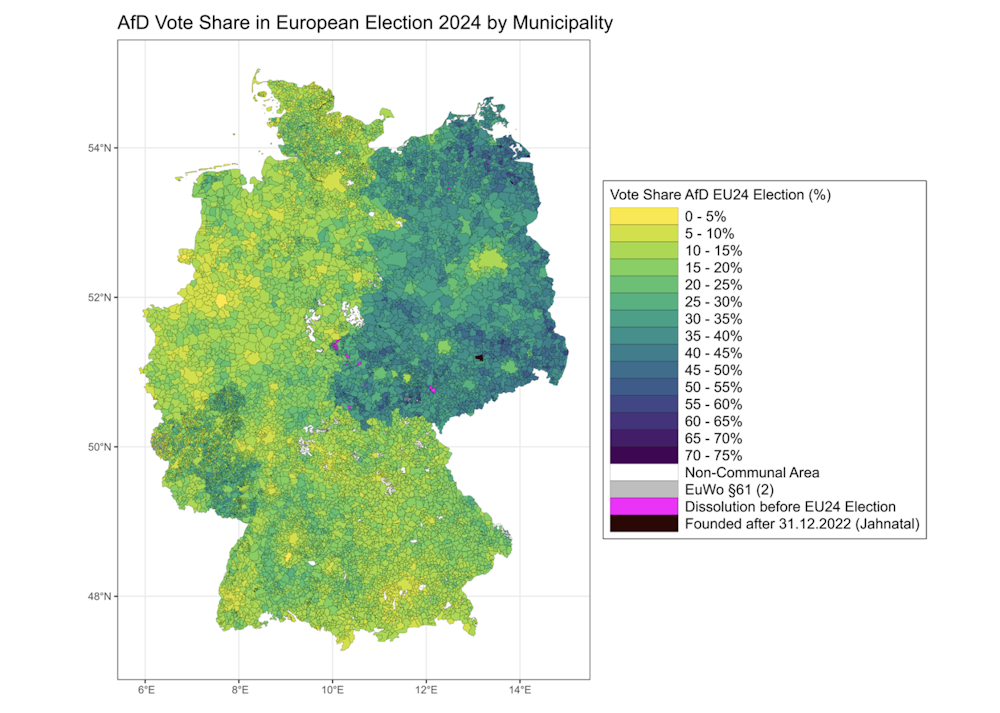
    And ultimately, this politicisation translates into electoral outcomes. In the European parliament elections of June 2024, the AfD took 15.9% of German votes. If we look at the spatial distribution of the AfD’s vote, a pattern showing the salience of the urban-rural divide emerges.

    East and west, town and country

    It’s clear by looking at the map that most (though not all) of the AfD’s strongholds are in eastern Germany – the region which used to be the German Democratic Republic (GDR). Fascism and Nazism were outlawed by decree when this anti-fascist state was established but, in reality, far-right ideologies don’t die off that easily. The result was that extremist views survived in an environment where there was also a lack of education on the National Socialism of the past – and a lack of education about democracy.

    When the socialist authoritarian GDR regime fell in 1989, Germany was reunified under western conditions. This had various effects, including a sense that the experiences of the east were not valued. The inequalities between the two sides of the reunified nation have left some in the east feeling distant from the state. The AfD’s version of nationalism finds fertile ground here.

    Another pattern is also clear across the whole country: the AfD is stronger in remote and rural areas and weaker in urban centres. There is less support in cities such as Berlin, Cologne, Dresden, Hamburg, Leipzig, Munich and Stuttgart. Places with more globalised cultures, international business and diverse populations remain comparably resilient to the spread of the far right.

    AfD support in different municipalities. The darker the colours, the higher the AfD vote share.
    R Frankenberger, CC BY-ND

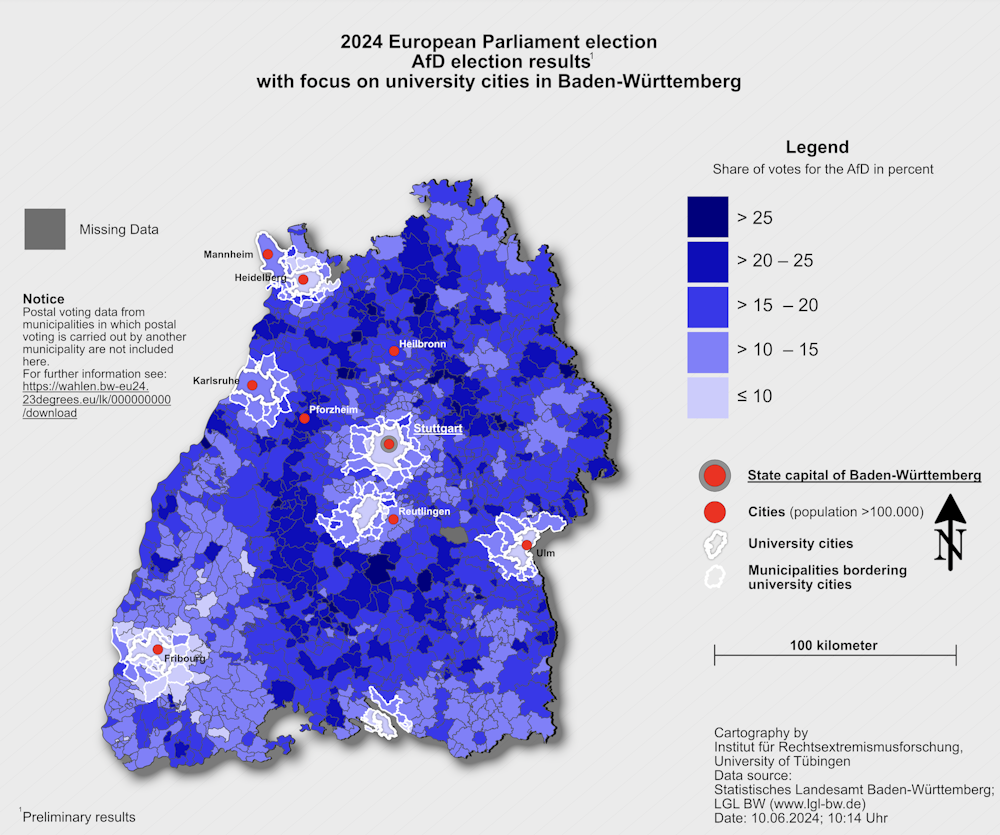
    These patterns become more visible if you take the European election results in the state of Baden-Württemberg as an example.

    The AfD performs significantly worse in the more globalised, cosmopolitan and university-oriented urban areas and their suburbs than in the more remote and rural areas of Baden-Württemberg. On the map, university cities are marked out with a white outline.

    AfD support mapped, with university cities highlighted.
    University of Tübingen, CC BY-ND

    The AfD is particularly strong in the northern and eastern Black Forest, on the Baar, in the Swabian Alb, in the Rems-Murr district, in the Swabian Forest and in Hohenlohe. Most of these areas are remote, with many small towns and villages. They have slightly lower income levels and lower levels of migration than average. They are much more traditional in terms of culture and religion than urban areas.

    The Black Forest, the Swabian Forest, and Hohenlohe also have quite strong protestant and evangelical communities, which are strongholds of traditional family life, customs and traditions.

    We should expect to see these trends continue. The AfD looks set to make further gains in the February 23 election being held in Germany, retaining its strongholds in the east but also spreading into the west in rural areas. The urban-rural divide will therefore become all the more apparent and entrenched when German voters head to the polls.

    Rolf Frankenberger does not work for, consult, own shares in or receive funding from any company or organisation that would benefit from this article, and has disclosed no relevant affiliations beyond their academic appointment.

    ref. These maps of support for Germany’s far-right AfD lay bare the depth of the urban-rural divide – https://theconversation.com/these-maps-of-support-for-germanys-far-right-afd-lay-bare-the-depth-of-the-urban-rural-divide-248405

    MIL OSI – Global Reports

  • MIL-OSI Global: The ‘degrowth’ movement envisions global climate justice, but must adapt to global south realities

    Source: The Conversation – France – By Claudius Gräbner-Radkowitsch, Junior Professor of Pluralist Economics, Europa-Universität Flensburg

    It is widely accepted that human activities are the primary drivers of global warming and environmental crises, including the rapid loss of biodiversity. However, the debate over how best to address these issues is far from settled. In political circles, “green growth” – the concept of making economic activities more sustainable – has emerged as the most popular solution.

    Is green growth enough?

    The idea behind green growth is to continue expanding economies while minimising environmental harm. However, critics argue that this approach has failed to significantly curb climate change and biodiversity loss.

    Despite international efforts since the 1970s, carbon emissions have continued to rise. As the World Inequality Report reveals, nearly half of historical emissions occurred after 1990. Incremental policy changes, technological innovations and shifts in consumer behaviour have not been enough to reverse this trend. This failure has led to the growing appeal of “degrowth” – a more radical alternative that challenges the current global economic system.

    What is ‘degrowth’?

    “Degrowth” emerged in Europe, particularly in France, in the late 2000s. Philosophers such as André Gorz and economists such as Serge Latouche were among its early proponents, with researchers such as Tim Jackson later popularising the concept in the English-speaking world. They argue that the root cause of environmental destruction lies not only in human activity but also in a global economic model that has prioritised growth and profit since the Industrial Revolution.

    Initially, degrowth was a critique of Western lifestyles and notions of progress. Environmental concerns were just one part of the movement’s broader agenda. Over time, however, environmentalism has become central to the movement’s goals.

    A stenciled message in favour of degrowth.
    Paul Sableman, CC BY


    À lire aussi :
    Idea of green growth losing traction among climate policy researchers, survey of nearly 800 academics reveals


    What about the global south?

    Today, many degrowth advocates assert that the richer countries of the global north, being largely responsible for environmental degradation, should be the ones to scale back economic activity to avert ecological catastrophe. But what about the poorer countries of the global south? Should they adopt degrowth strategies? Some argue this would impose a neocolonial agenda, with wealthier countries once again dictating the terms of global development. Others note that many poorer countries need economic growth to combat poverty. And even if degrowth were limited to the north, it could still have significant effects on the south – both positive and negative.

    A review of academic literature on degrowth and the global south reveals two main perspectives: those who see degrowth as incompatible with the south’s development needs, and those who believe it could offer synergies with sustainable development goals.

    Supporters of degrowth often point out that many of its core ideas originate in the global south. Anthropologist Jason Hickel cites figures such as Sri Lankan philosopher Ananda Coomaraswamy, Indian economist J.C. Kumarappa and Bengali poet Rabindranath Tagore as inspirations. While these thinkers may not use the term “degrowth”, they promote ideas aligned with it, such as the Latin American Sumak kawsay (or “Buen vivir”) or the South African Ubuntu. These non-Western perspectives have been instrumental in shaping the degrowth discourse in the global north.

    Degrowth as decolonisation

    Degrowth advocates argue that scaling back economic activity in the north could help dismantle the unequal global division of labour, in which raw materials are extracted from the south and processed into consumer goods in the north. This system disproportionately benefits wealthier nations while leaving poorer countries with the social and environmental costs. Federico Demaria, a researcher in political ecology, argues that northern countries must “pay for past and present colonial exploitation in the south” – a central theme in contemporary degrowth discourse.

    An aerial view of a gold mine in Brazil.
    Tarcisio Schnaider/Shutterstock

    Some researchers suggest that dependence on economic growth is problematic for both the north and south. They argue that growth alone does not guarantee poverty reduction – wealth distribution and institutional reforms are just as crucial. Degrowth could help both regions avoid unsustainable development models by focusing more on social well-being than perpetual economic expansion.

    Challenges for degrowth in the global south

    However, many scholars believe degrowth is unattractive for the global south. Critics argue that the concept is too Eurocentric and fails to resonate amid the specific challenges faced by poorer nations. Interviews with academics and activists in the south show that while they may agree with some of the ideas behind degrowth, they reject its language, which they see as rooted in Western thinking. Economist Beatriz Rodríguez Labajos and her co-authors suggest that researchers from the north and south should look at “strengthening potential synergies, through an assertive recognition of the barriers to doing so”.

    There is also concern that promoting degrowth in the south could be perceived as a new form of colonialism. Imposing Western notions of degrowth could prevent poorer countries from following the same path to prosperity that the north took, which often involved exploiting the resources of the south. The degrowth movement’s failure to fully address the colonial roots of economic development poses a challenge to its decolonization-oriented ambitions.

    The problem of global dependencies

    Finally, global dependencies further complicate the degrowth debate. Many people in the south rely on export-driven economies that serve Western markets. A reduction in economic activity in the north could harm populations in the south who depend on those exports.

    This interdependence presents a dilemma for the degrowth movement. Proponents argue that degrowth is not about abandoning economic activity but reforming the global trade, finance and governance systems to prevent negative impacts on the south. For degrowth to succeed, its advocates must formulate concrete proposals that address these global dependencies without exacerbating inequalities or harming the most vulnerable.


    This article is part of a project involving The Conversation France and AFP audio. It has received financial support from the European Journalism Centre, as part of the Solutions Journalism Accelerator programme supported by the Bill and Melinda Gates Foundation. AFP and The Conversation France have retained their editorial independence at every stage of the project.


    We offer this article as part of the Normandy World Forum for Peace, organised by the Normandy region of France on September 26-27, 2024. The Conversation France is a partner of the forum. For more information, visit the Normandy World Forum for Peace’s website.

    Claudius Gräbner-Radkowitsch is a member of the Bündnis90/Die Grünen (The Greens) party. He has received research grants, notably from the Austrian FWF and the German DFG.

    Birte Strunk ne travaille pas, ne conseille pas, ne possède pas de parts, ne reçoit pas de fonds d’une organisation qui pourrait tirer profit de cet article, et n’a déclaré aucune autre affiliation que son organisme de recherche.

    ref. The ‘degrowth’ movement envisions global climate justice, but must adapt to global south realities – https://theconversation.com/the-degrowth-movement-envisions-global-climate-justice-but-must-adapt-to-global-south-realities-238276

    MIL OSI – Global Reports

  • MIL-OSI Global: Female genital mutilation is a leading cause of death for girls where it’s practised – new study

    Source: The Conversation – Africa – By Heather D. Flowe, Professor of Psychology, University of Birmingham

    Female genital mutilation or cutting (FGM/C) is a deeply entrenched cultural practice that affects around 200 million women and girls. It’s practised in at least 25 African countries, as well as parts of the Middle East and Asia and among immigrant populations globally.

    It is a harmful traditional practice that involves removing or damaging female genital tissue. Often it’s “justified” by cultural beliefs about controlling female sexuality and marriageability. FGM/C causes immediate and lifelong physical and psychological harm to girls and women, including severe pain, complications during childbirth, infections and trauma.

    We brought together our expertise in economics and gender based violence to examine excess mortality (avoidable deaths) due to FGM/C. Our new research now reveals a devastating reality: FGM/C is one of the leading causes of death for girls and young women in countries where it’s practised. FGM/C can result in death from severe bleeding, infection, shock, or obstructed labour.

    Our study estimates that it causes approximately 44,000 deaths each year across the 15 countries we examined. That is equivalent to a young woman or girl every 12 minutes.

    This makes it a more significant cause of death in the countries studied than any other excluding infection, malaria and respiratory infections or tuberculosis. Put differently, it is a bigger cause of death than HIV/Aids, measles, meningitis and many other well-known health threats for young women and girls in these countries.

    Prior research has shown that FGM/C leads to severe pain, bleeding and infection. But tracking deaths directly caused by the practice has been nearly impossible. This is partly because FGM/C is illegal in many countries where it occurs, and it typically takes place in non-clinical settings without medical supervision.

    Where the crisis is most severe

    The practice is particularly prevalent in several African nations.
    In Guinea, our data show 97% of women and girls have undergone FGM/C, while in Mali the figure stands at 83%, and in Sierra Leone, 90%. The high prevalence rates in Egypt, with 87% of women and girls affected, are a reminder that FGM/C is not confined to sub-Saharan Africa.

    For our study, we analysed data from the 15 African countries for which comprehensive “gold standard” FGM/C incidence information is available. Meaning, the data is comprehensive, reliable and widely accepted for research, policymaking and advocacy efforts to combat FGM/C.

    We developed a new approach to help overcome previous gaps in data. We matched data on the proportion of girls subjected to FGM/C at different ages with age-specific mortality rates across 15 countries between 1990 and 2020. The age at which FGM occurs varies significantly by country. In Nigeria, 93% of procedures are performed on girls younger than five years old. In contrast, in Sierra Leone, most girls undergo the procedure between the ages of 10 and 14.

    Since health conditions vary from place to place and over time, and vary in the same place from one year to the next, we made sure to consider these differences. This helped us figure out if more girls were dying at the ages when FGM/C usually happens in each country.

    For example, in Chad, 11.2% of girls undergo FGM/C aged 0-4, 57.2% at 5-9 and 30% at 10-14. We could see how mortality rates changed between these age groups compared to countries with different FGM patterns.

    This careful statistical approach helped us identify the excess deaths associated with the practice while accounting for other factors that might affect child mortality.

    Striking findings

    Our analysis revealed that when the proportion of girls subjected to FGM in a particular age group increases by 50 percentage points, their mortality rate rises by 0.1 percentage points. While this may sound small, when applied across the population of affected countries, it translates to tens of thousands of preventable deaths annually.

    The scale is staggering: while armed conflicts in Africa caused approximately 48,000 combat deaths per year between 1995 and 2015, our research suggests FGM/C leads to about 44,000 deaths annually. This places FGM among the most serious public health challenges facing these nations.

    Beyond the numbers

    These statistics represent real lives cut short. Most FGM/C procedures are performed without anaesthesia, proper medical supervision, or sterile equipment. The resulting complications can include severe bleeding, infection and shock. Even when not immediately fatal, the practice can lead to long-term health problems and increased risks during childbirth.

    The impact extends beyond physical health. Survivors often face psychological trauma and social challenges. In many communities, FGM/C is deeply embedded in cultural practices and tied to marriage prospects, making it difficult for families to resist the pressure to continue the tradition.

    Urgent crisis

    FGM/C is not just a human rights violation – it’s a public health crisis demanding urgent attention. While progress has been made in some areas, with some communities abandoning the practice, our research suggests that current efforts to combat FGM/C need to be dramatically scaled up.

    The COVID-19 pandemic has potentially worsened the situation, owing to broader impacts of the pandemic on societies, economies and healthcare systems. The UN estimates that the pandemic may have led to 2 million additional cases of FGM/C that could have been prevented. Based on our mortality estimates, this could result in approximately 4,000 additional deaths in the 15 countries we studied.

    The way forward

    Ending FGM/C requires a multi-faceted approach. Legal reforms are crucial – the practice remains legal in five of the 28 countries where it’s most commonly practised. However, laws alone aren’t enough. Community engagement, education, and support for grassroots organisations are essential for changing deeply held cultural beliefs and practices.

    Previous research has shown that information campaigns and community-led initiatives can be effective. For instance, studies have documented reductions in FGM/C rates following increased social media reach in Egypt and the use of educational films showing different views on FGM/C.

    Most importantly, any solution must involve the communities where FGM/C is practised. Our research underscores that this isn’t just about changing traditions – it’s about saving lives. Every year of delay means tens of thousands more preventable deaths.

    Our findings suggest that ending FGM/C should be considered as urgent a priority as combating major infectious diseases. The lives of millions of girls and young women depend on it.

    The authors do not work for, consult, own shares in or receive funding from any company or organisation that would benefit from this article, and have disclosed no relevant affiliations beyond their academic appointment.

    ref. Female genital mutilation is a leading cause of death for girls where it’s practised – new study – https://theconversation.com/female-genital-mutilation-is-a-leading-cause-of-death-for-girls-where-its-practised-new-study-249171

    MIL OSI – Global Reports

  • MIL-OSI Global: Where support for Germany’s far-right AFD is growing and why – podcast

    Source: The Conversation – UK – By Laura Hood, Host, Know Your Place podcast, The Conversation

    Germany is holding an election on February 23 and the contest is attracting an unusual amount of attention. That’s because the far-right Alternative for Germany (AFD) is polling in second place on 20% of the national vote.

    Should the party end up with a vote share on this scale, it would be its best ever result in a national election. It would change the face of the German parliament and force mainstream parties into difficult questions about their longstanding refusal to work with extreme parties.

    The AFD’s roots are in nationalistic and racist movements. It continues to take an ultra anti-immigration stance and, in this election, is calling for “demigration” – effectively the deportation of migrants.

    In this episode of The Conversation Weekly podcast, Rolf Frankenberger, an expert on right-wing extremism at the University of Tübingen in Germany, explains where the AFD draws its support from and what type of Germany it wants to return to.

    Frankenburger has found two clear trends in the geographical distribution of AfD voting. The first is common among far-right parties around the world:

    “ There are always exceptions, of course, but the main pattern is that around the big cities like Berlin, like Hamburg, Bremen, Hanover, Münster, Stuttgart, Munich, Frankfurt in these cities and their direct environment and suburbs, the AFD is less important. Whereas in the specific rural areas, like in Saxonia, in the Erzgebirge, in Baden-Württemberg, in the Black Forest, in Rhineland Palatinate, in the more rural areas, they have their strongholds.”

    The second, however, is unique to Germany. Support for the AFD is far more concentrated in the east of Germany. This region was the part of the country that made up the communist German Democratic Republic between 1949 and 1990, before German reunification.

    “Reunification in Germany produced winners and losers. And in the view of many East German people – and much of it is true – there are inequalities that were produced by reunification.”

    These divisions are being exploited to push what Frankenburger terms a form of white supremacist, traditionalist “Völkisch nationalism” – not a term that is well understood outside of Germany but which resonates heavily in domestic politics.

    “And so the AFD comes in and says ‘hey, there’s something wrong with the state, there’s something wrong with democracy, and there’s something wrong with our heritage. So we have a strong German heritage. We have an identity, we have an idea and all the others are trying to destroy it’. So it’s a kind of protest.”

    To find out more about narratives pushed by the AFD, listen to the interview with Rolf Frankenberger on The Conversation Weekly podcast.


    This episode of The Conversation Weekly was written and produced by Mend Mariwany and Gemma Ware. Sound design was by Michelle Macklem, and theme music by Neeta Sarl.

    Clips in this episode from AFP News, AfD in English, DW News and Al Jazeera English.

    Listen to The Conversation Weekly via any of the apps listed above, download it directly via our RSS feed or find out how else to listen here.

    Rolf Frankenberger does not work for, consult, own shares in or receive funding from any company or organisation that would benefit from this article, and has disclosed no relevant affiliations beyond their academic appointment.

    ref. Where support for Germany’s far-right AFD is growing and why – podcast – https://theconversation.com/where-support-for-germanys-far-right-afd-is-growing-and-why-podcast-249045

    MIL OSI – Global Reports

  • MIL-OSI Global: Palestinians have long resisted resettlement – Trump’s plan to ‘clean out’ Gaza won’t change that

    Source: The Conversation – USA – By Maha Nassar, Associate Professor in the School of Middle Eastern and North African Studies, University of Arizona

    U.S. President Donald Trump and Israeli Prime Minister Benjamin Netanyahu hold a news conference in the White House on Feb. 4, 2025. Andrew Caballero-Reynolds/AFP via Getty Images

    President Donald Trump’s suggestion that the U.S. should “take over” Gaza, displace its current population and turn the enclave into “the Riviera of the Middle East” is unsettling – in both a literal and, to Palestinians, a very personal sense.

    The remarks, which followed earlier comments in which the president expressed a desire to “clean out” Gaza, have been taken by some Middle East experts as a call to “ethnically cleanse” the strip of its 2.2 million Palestinian inhabitants. They worry that such talk will bolster the hopes of Israel’s far-right settlers and their supporters in government, who want to remove Palestinians from Gaza and build Jewish-only settlements on the enclave’s beachfront property.

    Following Trump’s remarks, Riyad Mansour, Palestinian envoy to the United Nations, stated: “Our homeland is our homeland.” He added, “I think that leaders and people should respect the wishes of the Palestinian people.”

    As a scholar of modern Palestinian history, I know that calls to remove the Palestinians from Gaza are not new – but neither is Palestinians’ determination to remain in their homeland. For almost 80 years, Palestinians in Gaza have resisted various proposals to displace them from the enclave. In fact, those plans have often spurred resistance to occupation and removal.

    A people already uprooted

    Most people in Gaza are the product of displacement in the first place.

    In 1948, over 700,000 Palestinians fled or were expelled from their homes when the state of Israel was established and a war between the new country and its Arab neighbors erupted.

    These Palestinians became nationless refugees, placed under the care of the U.N. Relief and Works Agency. In the Gaza Strip, the agency set up eight refugee camps to care for over 200,000 Palestinians who had been forced out of over 190 towns and villages.

    Palestinian refugees are seen fleeing violence in 1948.
    Bettman/Getty Images

    In December 1948, the U.N. General Assembly adopted Resolution 194 stipulating that “the refugees wishing to return to their homes and live at peace with their neighbors should be permitted to do so at the earliest practicable date.”

    While Israeli leaders initially expressed a willingness to allow some refugees back, they rejected the refugees’ wholesale return. They argued that doing so would undermine Israel’s security and dilute its character as a “Jewish state.”

    As such, Israel’s first prime minister, David Ben-Gurion, looked for ways to “motivate the refugees to move eastward” toward Jordan. He hoped that by moving refugees further away from Israel, they would be less likely to return.

    At first, the United States called upon Israel to repatriate a substantial number of refugees. But with Israel consistently refusing to do so, leaders in Washington started turning to the idea of resettlement. They hoped that the promise of economic prosperity could induce large numbers of refugees to move to other Arab countries – and give up on the idea of returning home. For example, in 1953, Secretary of State John Foster Dulles drew up plans to resettle Palestinian refugees in Syria as part of a large water management project there.

    Likewise in 1961, the recently formed U.S. Agency for International Development began funding an irrigation project in Jordan, bringing in Palestinian refugees to work as farmers. U.S. officials hoped that the refugees would start to identify as Jordanians, rather than as Palestinians, and agree to permanently resettle in Jordan.

    But it did not work. A survey taken five years later found that the refugees still identified as Palestinians and wished to return to their homeland.

    Rejecting resettlement

    A further war between Israel and neighboring countries in 1967 resulted in Israel’s occupation of the West Bank and East Jerusalem, which had been under Jordanian rule, as well as the Gaza Strip, which had been previously administered by Egypt.

    It also sparked a renewed sense of Palestinian national identity, especially among younger generations who increasingly took up guerrilla-style tactics in a bid to force Israel, and the international community, to recognize their right to return.

    In response, Israel looked to resettlement as a way to reduce the Palestinian population in territories it now occupied. In 1969, the Israeli government drew up secret plans to permanently transfer up to 60,000 Palestinians from Gaza to Paraguay. The scheme came to an abrupt halt when two Palestinians confronted the Israeli ambassador in Asunción about being brought to Paraguay under false pretenses.

    Meanwhile, between 1967 and 1979, far-right Israeli Jewish settlers established seven settlements in Gaza. They hoped to see Palestinians removed from the strip so the land could be incorporated into their vision of a “greater Israel.”

    Throughout the 1970s and 1980s, Israeli officials proposed various plans to remove refugees from the camps and resettle them elsewhere. This included a 1983 plan to dismantle refugee camps in the occupied Palestinian territories and resettle their inhabitants in better housing in towns and cities.

    But Palestinian refugees firmly rejected the offer because it would have required them to give up their refugee status and relinquish their right of return.

    The Oslo negotiations of the 1990s rejected the notion of removing Palestinians from Gaza. In fact, keeping the refugees in Gaza was central to the premise of a two-state solution. At the same time, questions over the right of refugees to return to their original homelands in what is now Israel were shelved.

    No money can ‘replace your homeland’

    But with hopes of a two-state solution long since faded, resettlement plans have reemerged.

    Shortly after the Oct. 7, 2023, attack by Hamas gunmen in Israel that sparked the widespread bombing and siege of Gaza, the Biden administration asked Congress to fund “the potential needs of Gazans fleeing to neighboring countries.” The news outraged many Palestinians, who saw it as giving Israel a green light to carry out what many viewed as an attempt to ethnically cleanse Gaza.

    In October 2024, far-right Jewish settlers gathered on the border of Gaza and called for the reestablishment of Jewish settlements in Gaza that had been dismantled in 2005. National Security Minister Itamar Ben-Gvir called upon Israel to “encourage emigration” of Palestinians from Gaza. He proposed telling the Palestinians there: “We’re giving you the option, leave to other countries, the Land of Israel is ours.”

    Palestinians have responded with their feet. As soon the ceasefire went into effect on Jan. 19, 2025, hundreds of thousands of Palestinians who had been displaced to southern Gaza walked for hours to reach their homes in northern Gaza. Hundreds posted videos of cleaning out their damaged homes so they can live there once again.

    The road to recovery in Gaza will be long. The U.N. estimates that rebuilding Gaza will cost US$50 billion and take at least 10 years.

    I believe Palestinians want help rebuilding, not resettlement. Many of them have already vehemently rejected Trump’s call to move out. As one Palestinian told The Guardian newspaper: “We would rather die here than leave this land.” He insisted, “No amount of money in the world can replace your homeland.”

    Resettlement schemes have a long history, yet Palestinians have thwarted them at every turn. There is no reason to think that this time will be any different.

    Maha Nassar is affiliated with the Foundation for Middle East Peace.

    ref. Palestinians have long resisted resettlement – Trump’s plan to ‘clean out’ Gaza won’t change that – https://theconversation.com/palestinians-have-long-resisted-resettlement-trumps-plan-to-clean-out-gaza-wont-change-that-249193

    MIL OSI – Global Reports

  • MIL-OSI Global: This Valentine’s Day, try loving-kindness meditation

    Source: The Conversation – USA – By Jeremy David Engels, Liberal Arts Endowed Professor of Communication, Penn State

    Love is one of the most diverse emotions, and it can be experienced in countless ways. fizkes/iStock via Getty Images Plus

    Most people love love, but not everyone loves Valentine’s Day.

    When it was first invented in the 1300s in medieval Europe, this holiday was a celebration of romantic love, the coming of spring and the freedom to choose a partner, rather than having one chosen for you.

    Today that ancient and optimistic message remains but is often buried under a pile of consumer goods – chocolates, cards, stuffed animals, plastic toys, expensive dinners and roses that cost so much more than you think.

    The archetypical image of this holiday is Cupid shooting a person with an arrow that makes them go mad with physical desire.

    Yet love is one of the richest and most diverse human emotions. There are many ways to experience love – so this holiday, as a scholar of mindfulness and communication, I encourage you to try out a practice of “metta,” or loving-kindness.

    What is loving-kindness?

    Loving-kindness, or metta, is the type of love praised and practiced by Buddhists around the world, and it is very different from romantic love. It is described as “limitless” and “unbounded” love.

    In the ancient Pali language, the word “metta” has two root meanings. The first is “gentle,” in the sense of a gentle spring rain that falls on young plants without discrimination. The second is “friend.” A metta friend is a true friend – someone who is always there for you without fail and without demanding anything in exchange, or someone who supports you when you’re in pain and who is happy for you when you’re happy, without a tinge of jealousy.

    Metta is a kind of love that is offered without any expectation of return. It is not reciprocal or conditional. It does not discriminate between us and them, or worthy and unworthy. To practice metta meditation is to give the rarest gift: a gift that does not demand a return.

    The Buddha describes how to practice this love in an early discourse called the “Karaniya Metta Sutta.”

    A group of monks approach the Buddha complaining about the spirits living in the forest causing nearby villagers to suffer. The Buddha advises against fighting or driving them away. Instead, he encourages practicing boundless love toward them, wishing them happiness, peace and ease.

    The monks do as recommended, practicing loving-kindness meditation for several weeks. Over time, noticing how happy the monks became, the spirits began to practice loving-kindness, too, because they also wanted to be happy. The practice changed the spirits’ behavior, and they stopped harassing the villagers.

    How to practice loving-kindness

    In the fifth century, a Sri Lankan monk named Buddhaghosa composed an important meditation text called the Visuddhimagga, or “The Path of Purification.” This text is sacred to Theravada Buddhists.

    Buddhaghosa provides instructions for how to practice loving-kindness meditation. Contemporary teachers adapt and modify these instructions. However, the general format of this meditation tends to be consistent.

    Loving-kindness meditation begins with a practice of mindfulness in order to calm the mind and body and to remember to come back to the now.

    A guided loving-kindness meditation practice.

    Next, this meditation involves softly reciting several traditional phrases and visualizing an audience who will receive loving-kindness as these words are spoken. The phrases are:

    • May I/you/they/we be filled by loving-kindness

    • May I/you/they/we be safe from inner and outer dangers.

    • May I/you/they/we be well in body and mind.

    • May I/you/they/we be at ease and happy.

    Traditionally, the meditation starts with yourself – the pronoun will be “I.” Then, the meditation involves picturing a beloved person – and it does not even have to be a person; it can be a pet or an animal – and directing loving-kindness to them. The pronoun in the meditation will change to “you.”

    After this, the meditation involves directing loving-kindness to a wider circle of friends and loved ones – the pronoun will change to “they.” Finally, the meditation involves gradually including more and more people in your well wishes: the folks in your community and town, people everywhere, animals and all living beings, and the whole Earth, and the pronoun will change to “we.”

    Many versions of this meditation invite practitioners to express metta for people who have caused them difficulty, including to someone seen to be an “opponent.”

    However, teachers including the Zen master, poet and peace activist Thich Nhat Hanh recommend practicing this type of metta meditation only once you are well established in directing loving-kindness at yourself and those you are close to.

    Why practice loving-kindness meditation?

    Clinical research shows that loving-kindness meditation has a positive effect on mental health. It could help lessen anxiety and depression, increase life satisfaction and improve self-acceptance; it could also reduce self-criticism.

    There is also evidence that loving-kindness meditation increases a sense of connection. Practicing loving-kindness could increase happiness while strengthening feelings of kinship with all living beings, a few of the benefits of metta meditation described by the Buddha in the Karaniya Metta Sutta.

    So if you’re feeling disconnected from others, ill at ease or just disenchanted with a holiday that has become overrun by capitalism on this Valentine’s Day, you might consider trying loving-kindness meditation.

    Jeremy David Engels does not work for, consult, own shares in or receive funding from any company or organization that would benefit from this article, and has disclosed no relevant affiliations beyond their academic appointment.

    ref. This Valentine’s Day, try loving-kindness meditation – https://theconversation.com/this-valentines-day-try-loving-kindness-meditation-246001

    MIL OSI – Global Reports

  • MIL-OSI Global: After he reached the Super Bowl, Colin Kaepernick’s racial justice protests helped expose US views toward sports activism

    Source: The Conversation – USA – By Betina Cutaia Wilkinson, Associate Professor & Associate Chair of Political Science, Wake Forest University

    San Francisco 49ers players Eric Reid, left, and Colin Kaepernick take a knee during the national anthem before a game against the Los Angeles Rams on Sept. 12, 2016. Daniel Gluskoter/AP Images for Panini

    Back in 2012, quarterback Colin Kaepernick was one of the NFL’s most popular stars. He led the San Francisco 49ers to the Super Bowl and was just a few plays away from winning the title and lifting the Lombardi Trophy.

    But America’s focus on Kaepernick’s athletic success waned in 2016. That’s when he began to kneel before games during the playing of “The Star-Spangled Banner” to protest the deaths of young Black men at the hands of white police officers.

    They included Alton Sterling and Philando Castile, two unarmed Black men killed by police in the summer of 2016.

    “To me, this is bigger than football, and it would be selfish on my part to look the other way,” Kaepernick said in The Guardian newspaper. “There are bodies in the street and people getting paid leave and getting away with murder.”

    Kaepernick’s activism, coinciding with the reemergence of the Black Lives Matter movement, received varied responses.

    Some NFL players, like Kaepernick’s then-teammate Eric Reid, imitated Kaepernick’s actions, generating a wave of anti-racist activism – not just in football but in other sports, too, like women’s basketball. Others, including several NFL executives, responded with vitriol and hate.

    A recent study I conducted with colleagues Lisa Kiang and Elizabeth Seagroves examines American attitudes toward sports activism, providing insight into the stark responses to Kaepernick’s advocacy and those of other athletes.

    Making sense of the varied responses

    We surveyed 207 college students and 33 residents in Winston-Salem, North Carolina, where I teach, to examine their views on racial justice activism among professional athletes.

    We found there were three general perspectives.

    One group supported the sports activism and tied it to changing the status quo. People in this group back athletes’ ability to serve as activists and role models, and they hope the protests generate meaningful sociopolitical change.

    “I thought it was very necessary and good,” said one participant in the study, referring to athletes’ activism. “I think that if they can use their platform for something good, they should.”

    When we asked about Kaepernick’s activism in 2016, these participants lauded him for his courage.

    They felt Kaepernick’s protests, along with the Black Lives Matter movement, helped raise awareness of racial injustices in the United States.

    Activists supporting players’ right to protest appear outside a hotel where NFL meetings were being held on Oct. 17, 2017, in New York.
    Spencer Platt/Getty Images

    Participants reject racial justice advocacy

    Other participants in our study expressed support for athletes’ right to protest, but they rejected their racial justice advocacy.

    They said athletes have the freedom to say what they think. And they tied the protests to the United States’ commitment to freedom of speech. But they disapproved of kneeling during the playing of the national anthem, labeling it as disrespectful.

    “I think most of it is good. If you have a platform, you should use it,” one participant told us. “However, when misinformation is spread, it becomes bad.”

    Several participants felt the conflation of the national anthem with protesting racial injustices was misleading and wrong, and this participant considered Kaepernick’s protest “misinformation.”

    Kaepernick’s activism elicited similarly mixed feelings at the time. A majority of the public viewed Kaepernick’s refusal to stand as unpatriotic. Most, however, also supported his right to free speech.

    In May 2018, NFL Commissioner Roger Goodell barred athletes from protesting on the sidelines during the national anthem, but he gave them the option to remain in the locker room during the playing of “The Star-Spangled Banner” if they preferred. The move came after players had protested racial inequality and police brutality for two seasons.

    “We want people to be respectful of the national anthem,” Goodell said, according to ESPN. “We want people to stand – that’s all personnel – and make sure they treat this moment in a respectful fashion. That’s something we think we owe. But we were also very sensitive to give players choices.”

    In June 2020, in the wake of George Floyd’s death and years into Kaepernick’s activism, Goodell apologized to players and reversed the policy, saying, “We were wrong for not listening to NFL players earlier.”

    Dontari Poe of the Dallas Cowboys kneels during the playing of the national anthem on Sept. 13, 2020, in Inglewood, Calif.
    AP Photo/Ashley Landis

    But team protests varied throughout the league.

    Some teams such as the Green Bay Packers and Jacksonville Jaguars, at least on one occasion, remained in their locker rooms during the playing of “The Star-Spangled Banner.”

    Some teams acted uniformly with the exception of one or two players. Dallas Cowboys player Dontari Poe was the only person on his team to kneel during the playing of the national anthem.

    The fact that not all players protested, and that teams had distinct approaches to protesting, is not surprising given the public’s varied responses to athlete activism.

    Complete disapproval

    A third group of participants in our study disapproved of sports activism entirely. And these participants often accompanied their criticism by saying that athletes strayed from their role as entertainers.

    “I don’t think it’s good because it’s giving people a reason not to like a professional athlete when their job is to play a sport. They are not politicians and haven’t been able to prove they can make a change,” said one participant.

    For example, when responding to WNBA player Skylar Diggins-Smith’s call for the imprisonment of the police officers in Louisville, Kentucky, involved in the 2020 shooting death of Breonna Taylor during a nighttime apartment raid, one participant said: “It’s not for the average citizen to call for police officers to be investigated. It’s just not OK for a professional athlete to push their agenda like that.”

    Our study, much like other studies, found that people who are white, older and politically conservative are more opposed to racial justice activism in sports than their counterparts.

    What does this mean?

    As seen in our study, U.S. views toward sports protests are tied to the role people believe athletes should play in society.

    For some, athletes can and should be role models; that includes by raising awareness of racial injustices. For others, athletes should only express their perspectives under certain conditions.

    And yet other Americans believe athletes are performers whose only role should be to entertain.

    Still, there’s no doubt Kaepernick’s activism changed the playing field, even if his NFL career suffered. After the 2016 season, he was never picked up by another team.

    Kaepernick’s activism inspired people to attend protests and donate to political causes.

    The NAACP has asked college athletes to avoid attending schools that are dismantling their diversity, equity and inclusion, or DEI, initiatives.

    Coach Steve Kerr and All- Star Steph Curry of the Golden State Warriors regularly voice their political views and draw attention to injustices.

    Several sports associations – the NFL, NBA, WNBA and NWSL – have implemented social justice initiatives and councils that strive to mobilize voters and educate the electorate on political issues.

    Colin Kaepernick’s activism may have ended his Super Bowl dreams, but his legacy extends far beyond the game of football.

    Betina Cutaia Wilkinson previously received funding from the Latino Center for Leadership Development.
    Lisa Kiang works with Betina Wilkinson at Wake Forest University. Elizabeth Seagroves was Betina Wilkinson’s student during her time at Wake Forest University

    ref. After he reached the Super Bowl, Colin Kaepernick’s racial justice protests helped expose US views toward sports activism – https://theconversation.com/after-he-reached-the-super-bowl-colin-kaepernicks-racial-justice-protests-helped-expose-us-views-toward-sports-activism-242672

    MIL OSI – Global Reports

  • MIL-OSI Global: Trump’s reversal of climate policies risks undermining U.S. manufacturing — and could cost people jobs

    Source: The Conversation – Canada – By Thomas Stuart, Lecturer in Communications, Gustavson School of Business, University of Victoria

    United States President Donald Trump’s early executive actions have set American manufacturing on a collision course with his administration’s fossil-fuel-driven agenda. It’s clear that climate change policies run counter to his vision of American primacy.

    Trump wasted no time reversing the green initiatives of his predecessor, former president Joe Biden. He withdrew the U.S. from the Paris Climate Agreement for a second time, rolled back environmental regulations and froze green energy funding.


    Read more:
    The impact of Donald Trump’s anti-climate measures on our heating planet


    However, these reversals have exposed complications in Trump’s economic platform. For all his promises to revive American industry and reduce reliance on foreign production, Trump’s opposition to clean energy threatens green technology investments and other incentives that drive U.S. manufacturing development.

    Trump’s Strategic National Manufacturing Initiative promised to “stop outsourcing” and turn the U.S. into a “manufacturing superpower.” Yet his plans to cancel the electric vehicle mandate and reduce regulations promoting clean energy undermine the manufacturing sector’s shift toward green technology.

    In the long run, Trump’s own actions may undermine his vision of an American manufacturing renaissance by cutting crucial investments, putting the U.S. at odds with a global economy increasingly focused on clean technologies.

    The green manufacturing boom

    Republican congressman John James recently applauded Trump’s reversal of green policies during a congressional hearing. Yet, in the same breath, James called for the administration to continue “onshoring the future of automotive jobs and manufacturing,” a policy he linked to Biden’s Inflation Reduction Act (IRA).

    Other Republican representatives from Michigan, Georgia and North Carolina increasingly find themselves walking along the same rhetorical tight-rope.

    While Biden’s IRA has been widely criticized by the Trump administration, the act has brought Republican districts significant green investments and manufacturing jobs.

    As James acknowledged:

    “While the bulk of the IRA is damaging policy, we must not neglect the sector-wide energy tax provisions that manufacturers and job creators rely on in my district and around the country.”

    The green manufacturing boom is not an abstract concept, but a tangible economic engine, particularly in districts with established fossil fuel industries like Chatham County, N.C. Here, manufacturer Wolfspeed’s new US$5 billion dollar semiconductor plant sits in the heart of traditional coal country.

    Since 2022, the private sector has invested US$133 billion in clean energy and electric vehicle (EV) technology. Manufacturing investments alone have jumped by three times over the previous two years, totalling US$89 billion.

    The impact of the IRA on ‘red states’

    Biden-era policy has largely driven the America’s green energy economic development. The IRA provided a staggering US$312 billion in planned investments in EV and battery manufacturing.

    Eighty-five per cent of this funding flows into Republican-voting districts — areas that have historically voted against climate-focused legislation like the IRA. Yet the rewards of these green tech policies have been a boon for local economies.

    Georgia, for instance, has become a model for the American green energy transformation. In the first two years of the IRA, about US$15 billion dollars flowed into the state. Since then, Georgia has added a projected 43,000 new green jobs.

    Meanwhile, North Carolina’s Randolph County has seen the largest investment in green technology in U.S. history. Under the previous administration, it received about US$14 billion in funding, allowing Toyota to build a manufacturing megasite.

    By 2030, the site is expected to create 5,000 jobs in the area, with wages averaging 80 per cent more than the county median salary. Once fully operational, the site will manufacture enough batteries annually to power and maintain up to 500,000 EVs.

    What comes next?

    As Trump continues to roll back environmental protections and withdraw from climate agreements, whether he can still deliver the manufacturing revival he promised remains to be seen.

    In one respect, his policies may lead to a consolidation in the green technology sector. Despite his administration’s retreat from broader green energy policies, Trump says he will continue securing the U.S. supply of critical minerals for EV batteries.

    This could reflect the influence of Tesla CEO Elon Musk, who is serving under Trump as a “special government employee.” Tesla, which relies on these critical minerals for its EV production, would benefit from a stable supply.

    Musk resents regulatory interventions, particularly those that encourage competition. On a call with investors, Musk said Tesla might feel a slight impact from lost subsidies. However, he suggested the real damage would be to competitors who are scrambling to catch up in an industry where raw materials are king. Musk predicted that “long term, it probably actually helps Tesla.”

    In another respect, Trump’s policy reversal could also weaken Republican unity. Republican politicians like Georgia’s Buddy Carter, Tennessee’s Chuck Fleischmann and Georgia Gov. Brian Kemp have highlighted the short-sighted nature of Trump’s economic plan.

    Trump’s decision to turn his back on climate change policy is more than a blow to environmentalists; it’s a direct challenge to his own economic agenda. He risks not just the environment, but also the green investments essential to American industry’s competitive revival.

    Thomas Stuart does not work for, consult, own shares in or receive funding from any company or organisation that would benefit from this article, and has disclosed no relevant affiliations beyond their academic appointment.

    ref. Trump’s reversal of climate policies risks undermining U.S. manufacturing — and could cost people jobs – https://theconversation.com/trumps-reversal-of-climate-policies-risks-undermining-u-s-manufacturing-and-could-cost-people-jobs-248399

    MIL OSI – Global Reports

  • MIL-OSI Global: Why there’s an ethnic pension gap in the UK – and how the government could close it

    Source: The Conversation – UK – By Athina Vlachantoni, Professor of Gerontology and Social Policy, University of Southampton

    Opting out of workplace pension schemes is more common among some minority communities than the white British population. Pranithan Chorruangsak/Shutterstock

    There’s an ethnic pension gap in the UK that leaves people from particular minority ethnic communities worse off in retirement than their white British counterparts. The gap can be measured in several ways – for example, by comparing the pension amount between ethnic communities or measuring the proportion of working-age people from different ethnic groups who are signed up to a workplace pension scheme.

    But whichever indicator you use, the evidence shows that people from minority ethnic communities, whether they were born in the UK or not, fare worse than white British people.

    Unfortunately, that’s not all. Within the minority ethnic population, it is the Bangladeshi and Pakistani communities who are faring worse than people from other minority ethnic communities. And women are struggling more than men.

    The government’s most recent analysis based on the Family Resources Survey shows that Asian pensioner families (that is, either a single pensioner or a couple that includes at least one pensioner) had the lowest gross income at £500 a week). This compared with £731 a week among pensioner families from the “white other” ethnic group.

    Unpicking the causes

    But why is there an ethnic pension gap? To understand why it persists, it’s helpful to take a few steps back and examine the accumulation of disadvantage. Our research in the Centre for Research on Ageing and the ESRC Centre for Population Change has done just that – unravelling the factors that lead to the gap.

    We found that working-age people from Bangladeshi and Pakistani communities were less likely than their white British counterparts to be in paid work. And once in paid work, they were less likely to work as employees and more likely to be self-employed.

    This is important because, over the last 15 years, the UK government has introduced auto-enrolment in workplace pensions, which means that all workers aged 22 or above and earning at least £10,000 per year are automatically enrolled in their workplace scheme.

    Even among employees, we found that workers from Bangladeshi and Pakistani communities were less likely to be members of their workplace pension scheme. That is, they were more likely to opt out. Among pensioners, we found that those from Bangladeshi and Pakistani communities were less likely to be receiving a state or workplace pension, and more likely to be receiving pension credit (a means-tested benefit for those on low incomes).

    Differences between minority ethnic communities in their employment trends then lead to ethnic gaps in pension protection. There are a number of factors at play, including cultural reasons that might affect employment choices and opportunities (particularly among women) and structural reasons affecting the types of jobs and earnings where people from Bangladeshi and Pakistani communities find work.


    Read more:
    How the gender pay gap evolves into a gender pension gap


    Religious reasons can also affect people’s choices about the kinds of investments they make. Under Islamic finance guidelines, investing in profit-making ventures – commonly part of workplace pensions – is not permitted.

    Recent research by the Institute for Fiscal Studies showed that 16% of Pakistani and 24% of eligible Bangladeshi employees opt out of a workplace pension, compared to 10% of eligible white employees.

    All these reasons are important factors in understanding the ethnic pension gap and are vital issues for the government to address.

    The ethnic pension gap leaves some communities more than £200 worse off per week on average than their white British peers.
    Rawpixel.com/Shutterstock

    So where does this leave government policies to close the gap? Encouraging younger people from Pakistani and Bangladeshi communities to enter (and crucially, to stay) in the labour market can be the first step.

    According to the most recent government data, on average 75% of people aged 16-64 are employed. But this breaks down to 76% for white people, and 57% for Pakistani and 63% for Bangladeshi people.

    Meanwhile, another useful step the government could take would be reducing the £10,000 eligibility threshold for auto-enrolment. This would allow more low earners to start saving for retirement.

    But if more people from minority ethnic communities are going to stick with their workplace pension (or rather if fewer people are going to opt out), the government needs to consider the design and promotion of more sharia-compliant investments. These make workplace pension plans acceptable to Muslim communities. This could be a crucial step in closing the pension gap for future cohorts, and a feasible way forward. These products already exist, after all.

    Closing the ethnic pension gap (and the gender gap within it) is vital because the UK’s population is both ageing and becoming more ethnically diverse. About 18% of the population of England and Wales are from a non-white background (in Scotland it’s 4% and in Northern Ireland 3.4%).

    Addressing the ethnic pension gap is vital. It could take the UK a step closer to a society where people from all ethnic communities have the opportunity to reach later life with greater financial security and dignity.

    Athina Vlachantoni receives funding from the UKRI.

    Jane Falkingham receives funding from UKRI (Economic & Social Research Council)

    Maria Evandrou receives funding from UKRI.

    ref. Why there’s an ethnic pension gap in the UK – and how the government could close it – https://theconversation.com/why-theres-an-ethnic-pension-gap-in-the-uk-and-how-the-government-could-close-it-248822

    MIL OSI – Global Reports

  • MIL-OSI Global: First new non-opioid painkiller approved in the US for decades – here’s how it works

    Source: The Conversation – UK – By Alistair Mathie, Professor of Pharmacology and Head of Life Sciences, University of Westminster

    S L/Shutterstock

    A new non-opioid painkiller, suzetrigine, has just been approved by the US drug regulator, the FDA. It is the first non-opioid painkiller the agency has approved in over two decades.

    Because of their addictive nature, medical professionals have done a lot in recent years to minimise the use of opioids, especially the length of time they are taken for following surgery. Patients receiving opioids for longer than a week post-surgery were found to double their risk of using these drugs for more than a year.

    In the US, a study showed that around 6% of all patients who underwent surgery became persistent opioid users, even if they had never taken opioids before. So the arrival of a relatively safe and effective non-opioid drug to treat acute pain without the risk of addiction is a huge deal.

    Suzetrigine works by blocking the activity of proteins called sodium channels in nerve cells that send pain signals. This stops the pain signal in its tracks, before it reaches your brain and therefore before you experience it.

    This is exactly how existing local anaesthetic drugs, such as lidocaine, work. Unfortunately, these drugs block all sodium channels throughout your body, including those that control the activity of your heart, your brain and your breathing. This is why, as their name implies, they can only be applied locally.

    In dentistry, this is usually done using a syringe and accompanied by another drug (called a “vasoconstrictor”) to stop the anaesthetic from escaping into the bloodstream.

    Targeting sodium channels to alleviate pain is a wonderful idea in principle. However, it is hampered by the widespread presence of these proteins – which initiate electrical signalling in almost all the cells of your body – and the consequent risks associated with blocking them. Not least the very real risk of sudden death.

    In Japan, fugu, a dish made from puffer fish, is an exotic delicacy. At least part of its attraction is the slight tingle in the tongue that can be experienced when eating it. This tingling is caused by a poison, tetrodotoxin, that is a potent blocker of sodium channels. Too much tetrodotoxin is fatal. In Japanese restaurants, only qualified fugu handlers are permitted to prepare the dish.

    So why is the discovery and development of suzetrigine so important? We have nine different genes that code for sodium channels (they run from Nav1.1 to Nav1.9). Each of these channels is present at different levels in the different cells and organs of your body. But only one of these channels, Nav1.8, is present in peripheral pain-sensing neurons and not in other parts of the body.

    There is no evidence of Nav1.8 expression in either your heart or your brain. This selective expression suggests that this particular sodium channel might be a good target to alleviate pain.

    This idea received further credence following the discovery that people with genetic mutations that increase the activity of this channel suffered nerve pain despite there being no obvious cause of the pain.

    Highly selective

    Over several years, Vertex Pharmaceuticals, the company that makes suzetrigine (brand name Journavx), screened many potential drugs to try to identify a safe, selective blocker of these channels that could be taken orally. Suzetrigine was found to be both a potent and very selective blocker of these channels. It is, staggeringly, at least 30,000 times more potent at blocking Nav1.8 channels than all the other types of sodium channels that we have.

    In two clinical trials with over 1,000 patients in each, suzetrigine was found to be equally as effective as opioids at blocking acute pain following moderately painful surgery – either removal of bunions or a tummy-tuck.

    Suzetrigine also produced far fewer side-effects than opioid treatment and had no risk of addiction. So far, however, there is no convincing evidence that suzetrigine is effective in chronic, long-term pain relief.

    The discovery and approval for the use of suzetrigine opens up the possibility of treating acute pain by selectively blocking specific sodium channels, without the risk of addiction. More generally, selective targeting of the many different ion channels that underlie pain signalling may pave the way for new, non-addictive treatments for all forms of acute and chronic pain.

    Alistair Mathie has previously received funding from the Royal Society, BBSRC and LifeArc to study the role of ion channels in pain

    Emma Veale has previous received funding from BBSRC and LifeArc to study the role of ion channels in pain. Also from NIHR to deliver a feasibility study in primary care aimed at managing post-surgical opioid use.

    ref. First new non-opioid painkiller approved in the US for decades – here’s how it works – https://theconversation.com/first-new-non-opioid-painkiller-approved-in-the-us-for-decades-heres-how-it-works-248858

    MIL OSI – Global Reports

  • MIL-OSI Global: Millions of animals die on roads – does this make driving morally wrong?

    Source: The Conversation – UK – By Diego Exposito, PhD researcher in Politics, University of Sheffield

    A dead European hare. MMCez/Shutterstock

    Imagine one morning, you are deciding whether to drive to work or catch the train. Eventually, you decide to drive. On your way to the office, a squirrel crosses the road leaving you no time to react, and you run it over. Did you do anything wrong by deciding to drive instead of taking the train?

    Ethical debates about the morality of driving tend to stop at the possible harm to humans. This is surprising, considering the decades of work in animal ethics and the fact that around 223 million birds and mammals are killed on Europe’s roads each year.

    Researchers in moral philosophy like myself analyse the extent to which our actions are right or wrong. One way to evaluate actions like driving is to ask whether it is morally justified to subject others to a certain risk. Driving fits this kind of reasoning because when we decide to drive, we are not certain that we will kill someone (human or non-human), but we know our action will put others at some risk of harm.

    So, how much risk is permissible? There are two factors moral philosophers often use to assess this. The first is the extent to which the action that puts others at risk is part of a fair social system of risk-taking – in other words, a social arrangement in which people exchange risks but also benefits that everyone can access. The second concerns whether such a system works to the advantage of all those who participate in it.

    Driving can be considered a social system of risk-taking, and it would be considered morally acceptable if everyone can drive or be driven by other people, and if the system of driving ultimately benefits those who are put at risk by it.

    Some philosophers believe that in the case of humans, this line of reasoning makes driving morally acceptable. But what if we extend it to include animals?

    A car through a deer’s eyes

    Cats, dogs and other domestic animals may ride in cars but most wild animals will not, so they do not meet the first factor. The sheer number of animals that end their lives as roadkill indicates that driving does not work to their advantage. For most animals, cars are a threat rather than a benefit.

    Driving, in this case, would not be morally acceptable according to the ethical test we set for our fellow humans.

    Car travel has contributed to the decline of some species.
    Natalya Ugryumova/Shutterstock

    This may lead us to consider our risk of killing animals before we drive – including the road we will use, the season, or the speed we will drive at. It may even tell us that driving is morally impermissible.

    One way to deny this would be to say that to forgo driving is too costly. For many people, driving is not an activity they can choose to do or not, but a basic need on which people depend for going to (or finding) a job, buying groceries, or visiting friends and family.

    But even if we think these costs are important, what about the serious costs to animals? When we consider both of these factors, some tentative conclusions emerge.

    Situations in which driving imposes a high risk of harm to animals, while not driving causes little cost to humans, probably make driving unacceptable. Take this scenario: your route to work during summer crosses congregations of house sparrows during the season in which they breed. Luckily, there is a convenient alternative.

    Then there are situations in which driving imposes almost no risk to animals, but not being able to drive deeply affects people – such as a drive to the other side of a city to buy food, during which few wild animals are likely to cross your path. In such cases, driving is probably permissible.

    But what about the various situations that sit between these two scenarios? In a lot of cases, driving is not necessary but may be more convenient than using public transport. Also, much of our driving is not done for essential activities but for things we generally enjoy.

    Finding clear criteria that determine when it is morally acceptable to drive is the matter that ethicists should try to elucidate. All I can say is that all sets of costs and risks need assessing, and driving must be viewed as an activity subject to ethical reflection.

    Drivers will need to decide, balancing the risk of harm they might impose on others by driving with the disadvantages of choosing not to drive. It should not come as a surprise, however, if we find that much of our driving is morally unjustified.


    Don’t have time to read about climate change as much as you’d like?

    Get a weekly roundup in your inbox instead. Every Wednesday, The Conversation’s environment editor writes Imagine, a short email that goes a little deeper into just one climate issue. Join the 40,000+ readers who’ve subscribed so far.


    Diego Exposito receives funding from the White Rose College of the Arts and Humanities. He is affiliated with Screwworm Free Future.

    ref. Millions of animals die on roads – does this make driving morally wrong? – https://theconversation.com/millions-of-animals-die-on-roads-does-this-make-driving-morally-wrong-248178

    MIL OSI – Global Reports

  • MIL-OSI Global: Belarus election: how ‘Europe’s last dictator’ held onto power as his opponents were jailed or exiled

    Source: The Conversation – UK – By Stephen Hall, Lecturer (Assistant Professor) in Russian and Post-Soviet Politics, University of Bath

    The acclamation of Alexander Lukashenko as Belarus president for a seventh straight term was confirmed on January 26. The electoral authorities announced that the man known as “Europe’s last dictator” – the only president the country has had since it held its first “democratic” election in 1994 – had won 87% of the vote.

    Most western leaders have dismissed the result as a “sham”. Germany’s foreign minister, Annalena Baerbock, posted on X that “the people of Belarus had no choice”, while the Polish foreign minister, Radosław Sikorski, commented that he was surprised “only” 87.6% of the electorate had voted for Lukashenko: “Will the rest fit inside the prisons?” he asked.

    But the result was never really in doubt. Sikorski’s barb about jailing opponent figures is right on the money. Many of Belarus’s main opposition figures are already behind bars and the rest are in exile. And, just to make sure of things, well before the campaign started – in January 2024 – Lukashenko changed the law so that only those people who were had lived permanently in Belarus for 20 years could stand for the presidency. This meant that the most prominent opposition leader not now in prison in Belarus, Sviatlana Tsikhanouskaya, was ineligible.

    Tsikhanouskaya fled after the election to avoid the fate of her husband, Sergei Tsikhanouski, who was arrested in 2020, two days after declaring his candidacy for the election. He has since been jailed for 18 years on charges of “preparation of mass disorder” and “incitement to hatred”. Tsikhanouskaya was herself tried in absentia and sentenced to 15 years for high treason, inciting social hatred, attempts to seize power, forming an “extremist” group and harming national security.

    So with no real opposition allowed to stand, Lukashenko’s reelection was pretty much a foregone conclusion. A survey conducted by the think tank Chatham House at the end of 2024 found that about one-third of Belarusians said they supported Lukashenko – and most of these people also commented they thought the country was going in the right direction.

    Keeping Belarus out of the war was a major factor for these voters. A further 41% professed to be neutral. When it came to electoral integrity, 36% agreed or somewhat agreed that the result was predetermined. Among pro-democracy voters that number rose to 77%.

    Government in exile

    Tsikhanouskaya leads a government in exile from Lithuania, heading what her team has called a “united transitional cabinet”, tasked with “ensuring the transition of power from dictatorship to democracy, and promoting fair and free elections”. The cabinet is supported by a national coordinating council of 70 members which is elected on a two-yearly basis and who main function is to establish the ground rules for a “ democratic and rule-of-law-based state”.

    Tsikhanouskaya’s efforts have been supported by a range of countries, including the US which, in August 2020, urged the Lukashanko regime to “actively engage Belarusian society, including through the newly established National Coordination Council, in a way that reflects what the Belarusian people are demanding, for the sake of Belarus’ future, and for a successful Belarus”.

    But being a leader in exile means it is difficult to bridge the barrier to Belarusians at home.

    Political prisoners

    Other opposition figures are mainly still in prison. Sergei Tsikhanouski was recently was charged with violating prison rules, which will increase his existing 18-year sentence.

    His fellow opposition leader, Viktar Babaryka – who was also arrested in the run-up to the 2020 election – was given 14 years on trumped-up up charges. His assistant Maria Kolesnikova, who took over from him as a protest leader, was jailed after publicly destroying her passport so she could not be forcibly exiled by the authorities.

    Although not part of the political opposition another prominent figure, Ales Bialiatski, a human rights activist who won the Nobel peace prize in 2022 was sentenced to ten years in jail in 2023 for smuggling and allegedly financing the 2020 protests.

    Overtures to the west

    Since the summer of 2024, 200 political prisoners have been released, a possible sign that Lukashenko wants to reset relations with the west. He did something similar in 2015, the year after Russia annexed Crimea.

    At the time his release of six opposition activists was seen as a possible sign the Belarus leader was concerned his country could be at risk from Russian aggression and he was looking to keep with the EU and the US.

    Kolesnikova was recently allowed a prison visit from her father for the first time in nearly two years. Meanwhile a journalist was given access to Babaryka in jail and allowed to record a video of the jailed dissident for his daughter.

    If the release of prisoners and reappearance of the two jailed dissidents are indeed an attempt to reset relations with the west, the fact he still has more than 1,000 political prisoners behind bars will give Lukashenko plenty of diplomatic leeway.

    But given Lukashenko’s close alignment with Russian president Vladimir Putin and the fact that he allowed Belarus to be used as a launch pad for Russia’s invasion of Ukraine, it is unlikely that many western countries will be won over.

    Lukashenko has shown himself to be an irritant many times over the years. In 2021, the year before Russia’s invasion of Ukraine, the Belarus leader was roundly criticised for trying to spark a migrant crisis in neighbouring Poland, Lithuania and Latvia. Belarus was reportedly flying Iraqi and Afghan migrants from the Middle East and bussing them to the border where Belarusian troops were trying to push them across.

    As far as armed resistance to Lukashenko is concerned, the Kastuś Kalinoŭski Regiment, a group of Belarusian volunteers has been fighting as part of Ukraine’s armed forces since March 2022. The regiment’s stated aim is to help Ukraine fight off Russia and become part of the EU and Nato and to strive for Belarus to do the same.

    The next election is due to be held in 2030. Alexander Lukashenko will be 75.

    Stephen Hall does not work for, consult, own shares in or receive funding from any company or organisation that would benefit from this article, and has disclosed no relevant affiliations beyond their academic appointment.

    ref. Belarus election: how ‘Europe’s last dictator’ held onto power as his opponents were jailed or exiled – https://theconversation.com/belarus-election-how-europes-last-dictator-held-onto-power-as-his-opponents-were-jailed-or-exiled-248962

    MIL OSI – Global Reports

  • MIL-OSI Global: Companion review: this sleek but violent film asks interesting ethical questions about our relationship with AI

    Source: The Conversation – UK – By Sarah Artt, Lecturer in English and Film, Edinburgh Napier University

    Science fiction film and television has long been fascinated by robots. But stories that show us uncannily human cyborgs have often tended to veer towards either comedy or horror. Fritz Lang’s Metropolis (1927) and Ridley Scott’s Blade Runner (1982) both imagine a world where beautiful female cyborgs threaten to overstep their original programming. Rarer are stories that suggest it might be possible to love a cyborg, such as Susan Seidelman’s underseen romantic comedy, Making Mr. Right (1987).

    Companion picks up where Alex Garland’s Ex Machina (2014) leaves off. Ex Machina was about a young man tasked with testing the artificial intelligence (AI) of a female robot. Companion, however, posits a world where synthetic humans have become common.

    Companion’s plot also owes much to the themes of rivalry and revenge present in Karyn Kusama’s horror films Jennifer’s Body (2009) and The Invitation (2022), as well as the TV show Battlestar Galactica’s (2004 to 2009) imagining of full cyborg autonomy.

    Companion is a particularly post-Black Mirror (2011) example of science fiction. With its glossy aesthetics, and ubiquitously friction-less technology, it’s a vision of a future where AI and advanced robotics have made our lives easier. But, in typical Black Mirror fashion, this parable offers a warning.


    Looking for something good? Cut through the noise with a carefully curated selection of the latest releases, live events and exhibitions, straight to your inbox every fortnight, on Fridays. Sign up here.


    We meet Iris (Sophie Thatcher) and Josh (Jack Quaid) as they head to a chic, modern lake house for a weekend with friends. At this point, our only real indication that this is science fiction is the fact that the GPS in Josh’s car is a bit better than usual.

    At first, Iris seems like yet another incarnation of the Manic Pixie Dream Girl – quirky and kittenish, but too bland to really be a protagonist. It is only Thatcher’s subtle physical performance that lets us question whether Iris is entirely human. Besotted with Josh and anxious to please, Iris seems like just another girl who has wished for her prince to come and been rewarded with a supermarket meet cute.

    What makes Companion unsettling is not so much its depiction of cyborgs but rather its portrayal of misogyny.

    Survivors of intimate partner violence will recognise Josh. Particularly his ironclad belief that he is a “a nice guy” who is entitled to an attractive partner who places his needs above all else.

    For some audiences, Companion may not feel firmly rooted enough in either science fiction or horror. But then, it’s really only a horror film if you too are kept awake at night by the thought that some people really want a sex robot with customisable intelligence levels (Josh keeps Iris’s at 40%).

    Thatcher’s performance as Iris is fascinatingly glitchy. There is something about her walk – a precision that isn’t quite human. She stands with a stillness that reminds us she is more object than woman. There is a grimace she makes that conveys how she finds it troubling to process veiled commands from a man who isn’t her partner. It represents a feeling female viewers may have had before, when the social programming that tells women to be nice smacks up against their fight or flight response.

    Iris is a sex robot designed with charming slightly buck teeth – a flaw to offset her pore-less skin. The goal is to prevent her from falling into to the uncanny valley (that discomfited feeling when you encounter an object that is a little too life-like) and make her seem more real.

    Some people argue that you should only have sex with a robot if you think that robot would want to have sex with you. But most science fiction doesn’t really go that way – from Bride of Frankenstein (1935) to Black Mirror, most cyborg figures are programmed to consent without question.

    Companion shows us Iris’s point of view as Josh looms over her during sex. Afterwards, her romance-trope laden chatter is shut down by his command that she go to sleep.

    Companion contains aspects of both comedy and horror. But like the best science fiction, it’s central warning is against those who believe that technology can offer them absolute control.

    Sarah Artt does not work for, consult, own shares in or receive funding from any company or organisation that would benefit from this article, and has disclosed no relevant affiliations beyond their academic appointment.

    ref. Companion review: this sleek but violent film asks interesting ethical questions about our relationship with AI – https://theconversation.com/companion-review-this-sleek-but-violent-film-asks-interesting-ethical-questions-about-our-relationship-with-ai-249062

    MIL OSI – Global Reports

  • MIL-OSI Global: 360-degree videos are making social issues and educational content more engaging for Canadians

    Source: The Conversation – Canada – By Victoria (Vicky) McArthur, Associate Professor, School of Journalism and Communication, Carleton University

    Immersive film using virtual reality (VR) or 360-degree video is being used increasingly as a tool for eliciting empathy and emotional identification in fact-based stories. Unlike traditional flat film, immersive films allow viewers to look in any direction while watching the video.

    This immersive quality is what makes these films such an intriguing medium. Nearly a decade ago, American filmmaker Chris Milk described VR as the “ultimate empathy machine” because it can fully immerse viewers in another person’s environment and perspective.

    This sentiment has been echoed by VR journalism pioneer Nonny de la Peña, whose early work explored the unique storytelling characteristics of the medium. Her first VR film, Hunger in Los Angeles, was the first VR documentary to be showcased at the Sundance Film Festival in 2012.

    The film depicts a diabetic man collapsing outside a food bank due to low blood sugar. Viewers reported feeling a great deal of empathy for the man, with some reaching out to try and help him.

    In March 2015, YouTube launched support for publishing and viewing 360-degree videos. Today, anyone can film and share 360-degree video content using commercially available cameras, expanding the possibilities for storytelling and audience engagement.

    Rise of 360-degree video content

    Countless content creators, filmmakers and journalists have produced immersive content using these cameras. In 2016, for instance, CBC produced Highway of Tears, a short 360-degree video about 16-year-old Ramona Wilson, a young Indigenous woman from the Gitxsan Nation who disappeared along Highway 16 near Prince George, B.C., in 1994.

    CBC has produced other 360-degree videos to highlight real-world challenges and experiences, including Ice Rescue from the Victim’s Perspective and Accessibility Advocate Shows What It’s Like to Use a Wheelchair in Winter.

    ‘Highway of Tears: 360 Video’ from CBC.

    Canadian researchers have also been using immersive technologies like virtual reality and 360-degree video as tools for education and empathy-building.

    A group of Canadian researchers conducted an experiment with VR to see if they could foster empathy for the impact of climate change on oceans. Using a VR simulation, they showed participants optimistic and pessimistic future impacts of climate change on oceans. After experiencing the simulation, participants expressed increased empathy and concern for the issue.

    Similarly, at Toronto Metropolitan University, researchers used 360-degree videos to deepen empathy and understanding for people taking care of individuals with dementia. Participants watched 360-degree videos filmed from the perspective of two fictional characters living with dementia. They reported strong emotional responses to the videos and a deeper understanding of living with dementia.

    As immersive technology becomes more accessible, its potential to foster empathy and understanding across a range of social issues continues to grow.

    Is VR truly the ‘ultimate empathy machine’?

    Is immersive technology truly the “ultimate empathy machine?” Presently, there’s no agreement among experts. Some question the scientific rigour used to support such claims. Past research has suffered from small sample sizes, a lack of diversity among research participants and a lack of longitudinal studies investigating the effects of empathy.

    Other researchers suggest that, while empathetic gains have been demonstrated, these effects tend to fade after a short time. One study found that while VR increased emotional empathy for refugees, those feelings were mostly gone after just 10 days. More importantly, these empathic responses didn’t translate into actions like charitable donations.

    Some researchers have taken a more nuanced approach by distinguishing between emotional and cognitive empathy. Cognitive empathy involves knowing how other people think and feel, while emotional empathy involves feeling another person’s emotions. The findings from one research study indicate that VR can improve emotional empathy, but not cognitive empathy.

    This distinction is crucial in assessing VR’s potential as an empathy-building tool. While immersive experiences may create strong emotional responses, their long-term influence and ability to drive meaningful action remain uncertain.

    Knowledge mobilization

    Other research suggests VR and 360-degree video have the potential to be knowledge-transfer tools. Canadian researchers are encouraged to engage the Canadian public through knowledge mobilization — the process of sharing research findings with organizations, people and government.

    Several Canadian research institutions have started using 360-degree video as a knowledge-mobilization tool. For example, researchers at the National Research Council Canada’s (NRC) Hydrogen Laboratory in British Columbia produced a 360-degree video allowing audiences to see the lab and learn more about the research conducted there.

    360-degree video of the Hydrogen Laboratory in Vancouver.

    The NRC has produced other 360-degree video explainers, including one about the Aerial Robotics Laboratory in Montréal and another about the Climatic Testing Facility located in Ottawa.

    At a time when Canadians are inundated with information, immersive video explainers offer a unique way to learn about science and society. While it remains unclear whether VR is truly the “ultimate empathy machine,” its ability to place audiences at the centre of stories and events has been shown to have positive effects on learning, information retention and the transfer of knowledge.

    Immersive film may not be a guaranteed empathy-builder, but it’s far from being an apathy machine. Ultimately, it offers unique perspectives to Canadians wishing to learn more about the world we live in.

    Victoria (Vicky) McArthur receives funding from the Natural Sciences and Engineering Research Council of Canada and the Social Sciences and Humanities Research Council of Canada.

    ref. 360-degree videos are making social issues and educational content more engaging for Canadians – https://theconversation.com/360-degree-videos-are-making-social-issues-and-educational-content-more-engaging-for-canadians-248398

    MIL OSI – Global Reports

  • MIL-OSI Global: Three pop beefs that were more cutting than Matty Healy and Taylor Swift’s

    Source: The Conversation – UK – By Glenn Fosbraey, Associate Dean of Humanities and Social Sciences, University of Winchester

    There has been a sharp intake of breath among Taylor Swift fans following reports that 1975 frontman and songwriter Matty Healy is soon to release a song addressing their public romance from 2023.

    The song in question, God Has Entered My Body, is reportedly the title track of an upcoming 1975 album. According to a report in the Sun, the song includes the lyric “Keep your head up princess, your tiara is falling”. It is reported to be Healy’s response to Swift’s 2024 song The Smallest Man Who Ever Lived, which many fans believe was about their relationship.

    The 1975 frontman has responded to the rumours in typical Healy style, commenting “huge if true” under a post about the story on social media site Reddit.

    This lyrical back and forth is just the latest entry in a rich history of public beefs between pop stars that have been committed to record. Here are some of the most notable examples.


    Looking for something good? Cut through the noise with a carefully curated selection of the latest releases, live events and exhibitions, straight to your inbox every fortnight, on Fridays. Sign up here.


    1. Lennon v McCartney (1971)

    The first mainstream pop “diss track” exchange took place long before the term was even coined. It occurred in 1971 through Paul and Linda McCartney’s Too Many People and John Lennon’s How Do You Sleep?

    Lennon was incensed by the McCartney lyrics “too many people going underground” and “too many people preaching practices”, which he took as attacks on his and Yoko Ono’s avant garde albums and bed-in escapades. In response, he launched a stinging tirade that accused (Paul) McCartney of creating “Muzak”, being only a “pretty face”, and hanging around with sycophants who fed his ego.

    How Do You Sleep? by John Lennon & The Plastic Ono Band.

    The on-record beef ended there, perhaps because McCartney was too busy to focus on his new band Wings, or simply because he didn’t want to risk another lashing from Lennon’s famously sharp tongue.

    Either way, to the relief of Beatles fans everywhere, the two made amends before Lennon’s death in 1980, and Paul finally concluded their lyrical back and forth two years later with the touching Here Today.

    2. Buckingham v Nicks (1977)

    Recorded amid a backdrop of romantic tension and heavy drug use, it’s a wonder that Fleetwood Mac were even able to complete their 12th studio album Rumours, let alone create something that would go on to sell 40 million copies and spend more than a 1,000 weeks in the UK album charts.

    It’d be unfair to say the massive success of the album is due to the lyrical exchanges between the by then estranged couple Lindsey Buckingham and Stevie Nicks, but it certainly didn’t hurt.

    Dreams by Fleetwood Mac.

    Buckingham lit the fuse with Go Your Own Way, which accused Nicks of “packing up and shacking up” with different men. It caused Nicks to write Dreams, where she encouraged him to “listen carefully to the sound of your loneliness, like a heartbeat, drives you mad, in the stillness of remembering what you had”.

    Decades later, one of the bitterest feuds in pop music continues to rumble on, with Buckingham currently sidelined from the group after being fired in 2018. It won’t come as a surprise that their version of events differs, with Buckingham claiming Nicks was behind his sacking, and Nicks accusing him of revisionism. No Lennon and McCartney thawing of the ice here, then. Yet.

    3. Perry v Swift (2014-18)

    Swift was involved in another public spat back in the 2010s. If reports are to be believed, the two pop icons Katy Perry and Swift became close friends in 2009, but by 2013, things seemed to have soured.

    A rift over some backup dancers, some thinly veiled interview comments and a mutual ex-boyfriend have all been the subject of fan theories about the shift in mood.

    Bad Blood by Taylor Swift ft. Kendrick Lamar.

    In terms of diss tracks, Swift struck first, and relatively mildly, with Bad Blood in 2014, stating in an interview shortly after its release that it was about “a female musical artist”. Although she refused to name names, internet sleuths soon believed they’d figured out it was Perry.

    A Twitter spat between Swift and rapper Nicki Minaj then broke out. Minaj complained that her song Anaconda wasn’t nominated for the video-of-the-year award when Swift’s Bad Blood was (stay with me – this will become relevant soon).

    If the near-journalistic speed of those Lennon and McCartney tracks were indicative of the music industry in the early 1970s, Perry’s delayed response to Swift’s (perceived) barb is indicative of modern times, where her releases were kept to a strict three- or four-year cycle.

    Three years on, then, comes Swish Swish, which included lyrics like “you’re a joke / And I’m a court-side killer queen” and “Your game is tired / You should retire”. It featured Nicki Minaj in the music video to further fan the flames (told you it’d become relevant).

    Swish Swish by Katy Perry ft. Nicki Minaj.

    The only problem was that, in the years between their falling out, Swift had transitioned from mere pop musician to word-dominating superstar, so Perry’s insults carried little weight.

    When it comes to diss tracks, then, the old adage of striking while the iron is hot is definitely applicable. The pair have since made up, with Perry sending Swift an actual olive branch in 2018.

    The pair are pictured embracing during the closing scene of Swift’s 2019 music video for You Need To Calm down. Even the Bad Blood controversy seems to be water under the proverbial bridge now, with Perry videoed singing along to the track by fans earlier this year during one of Swift’s Eras tour concerts.

    Glenn Fosbraey does not work for, consult, own shares in or receive funding from any company or organisation that would benefit from this article, and has disclosed no relevant affiliations beyond their academic appointment.

    ref. Three pop beefs that were more cutting than Matty Healy and Taylor Swift’s – https://theconversation.com/three-pop-beefs-that-were-more-cutting-than-matty-healy-and-taylor-swifts-248076

    MIL OSI – Global Reports

  • MIL-OSI Global: What Trump’s proposal to ‘take over’ Gaza could mean for Arab-Israeli relations

    Source: The Conversation – UK – By Simon Mabon, Professor of International Relations, Lancaster University

    US president Donald Trump has made the extraordinary suggestion that the US should seize control of the Gaza Strip and permanently remove its Palestinian inhabitants. Speaking to the press at the White House alongside the Israeli prime minister, Benjamin Netanyahu, Trump said the US would “own [Gaza] and be responsible”.

    When pushed on the practicalities of such a move, Trump replied that the US would “do what is necessary” and develop the land into the “riviera of the Middle East”. “It’ll be something that the entire Middle East can be very proud of,” he said.

    The secretary of state, Marco Rubio, later wrote in a post on X: “The United States stands ready to lead and Make Gaza Beautiful Again. Our pursuit is one of lasting peace in the region for all people.”

    Trump’s declaration has been celebrated by many on the Israeli right, who have long supported the removal of Palestinian residents from Gaza. But it has also been met with anger across the Arab world and beyond.

    Francesca Albanese, the UN special rapporteur on the occupied Palestinian territories, called Trump’s proposal “incitement to commit forced displacement”. Some politicians have described his comments as an endorsement of ethnic cleansing.

    Trump first uttered his desire to “clean out” Gaza a week before this announcement. This prompted foreign ministers from Saudi Arabia, the United Arab Emirates, Qatar, Jordan and Egypt to sign a statement affirming their rejection of efforts to “compromise Palestinians’ unalienable rights, whether through settlement activities, or evictions or annex of land or through vacating the land from its owners”.

    The statement, made by a group of states not generally known for operating in a unified manner, ended by congratulating Rubio on his appointment. But the message to the Trump administration was clear: the two-state solution is the only viable solution to the Israeli-Palestinian conflict.

    Trump’s latest proclamations will deepen schisms across the region between Israel and its Arab neighbours, and prompt questions about the future role of the US in the Middle East.

    Egypt and Jordan’s response

    Any attempt by Washington to seize control of Gaza, which would almost certainly involve military force, would evoke parallels with 1948 and what is known in Arabic as the nakba, or “the catastrophe”.

    At that time, many Palestinians had to flee their land in what is now Israel, setting in motion decades of conflict between Israel and neighbouring Arab states. Acts of terrorism in the intervening years have cost thousands of lives on all sides.

    Trump’s call for Arab states to take in Palestinians from Gaza – who he says have no alternative but to abandon the coastal strip – ignores the strength of feeling across the world about the Palestinian issue.

    Egypt, for example, has long rejected the idea of housing Gaza’s population, amid growing socio-economic pressures and longstanding fears of Islamist violence. And Jordan has been steadfast in its desire not to host more Palestinians, having already provided refuge for people fleeing Palestine in 1948 and 1967. It has, more recently, also become the main destination for refugees from Lebanon, Syria and Iraq.

    On February 5, Egypt’s foreign minister, Badr Abdelatty, met with the prime minister of the Palestinian Authority, Mohammed Mustafa, in Cairo. According to an Egyptian foreign ministry statement, the pair jointly rejected Trump’s proposal for a US takeover of Gaza.

    Egypt and Jordan have both signed peace deals with Israel. But relations have not always been cordial, and the destruction of Gaza has exacerbated these tensions. Trump’s latest comments, as well as those from the Israeli right, will only worsen the situation.

    Relations with Saudi Arabia

    During Trump’s first term, his administration secured a significant diplomatic victory by brokering the Abraham accords. The accords, all of which were signed in the latter half of 2020, normalised relations between Israel and the United Arab Emirates, Bahrain and later Morocco.

    The signatories to the Abraham accords have been conspicuously quiet about Israel’s actions in Gaza. And it remains to be seen what effect Trump’s proposed Gaza takeover could have on relations between these states. The United Arab Emirates, Bahrain and Morocco have, at the time of writing, not yet announced their response.

    Saudi Arabia, on the other hand, has remained the jewel in the diplomatic crown seemingly out of reach both for the Trump administration and that of his successor, Joe Biden. The kingdom occupies a prominent place within the Arab and Muslim world by virtue of its custodianship of the two holy mosques of Mecca and Medina.

    Crown Prince Mohammed bin Salman, Saudi Arabia’s de facto ruler, has taken an increasingly hard line on normalisation with Israel in recent months, suggesting that such a deal would not be possible without the establishment of a Palestinian state.

    In a statement released on February 5, the Saudi foreign ministry said it rejected “any attempts to displace the Palestinians from their land”. And bin Salman has affirmed the kingdom’s position that it would not establish ties with Israel without a Palestinian state.

    During his press conference, Trump suggested that Saudi Arabia was not demanding a Palestinian homeland. But statements from Saudi officials since then contradict this narrative and point to increasingly divergent views on Gaza – and indeed, the future of Palestine – between Riyadh and Washington.

    Fundamentally, Trump’s remarks are the latest in a long line of bombastic diplomatic flourishes that appear designed to provoke as much as to enact policy. But in this case, even rhetorical provocations will have consequences for already strained relations between Israel and the wider Arab world.

    Simon Mabon receives funding from the Carnegie Corporation of New York. He is a Senior Research Fellow at the Foreign Policy Centre in London.

    ref. What Trump’s proposal to ‘take over’ Gaza could mean for Arab-Israeli relations – https://theconversation.com/what-trumps-proposal-to-take-over-gaza-could-mean-for-arab-israeli-relations-249184

    MIL OSI – Global Reports

  • MIL-OSI Global: England plans to make academies follow the national curriculum – but it’s been getting more prescriptive for years

    Source: The Conversation – UK – By Dominic Wyse, Professor of Early Childhood and Primary Education, UCL

    Juice Flair/Shutterstock

    A national curriculum sets out what state school pupils should be taught during their time at school. But in England, the national curriculum currently applies to only around 44% of children – those in schools run by their local authority.

    The remaining children, including 81.7% of secondary school pupils, are at academies. These schools, the result of a policy to address disadvantage in education, are free to set their own curriculum. Independent, fee-paying schools have never had to follow the national curriculum.

    The government’s children’s wellbeing and schools bill proposes that academy schools would, for the first time, be required to follow the national curriculum.

    This proposal, along with others set to reduce the autonomy of academies, has raised some debate. Academies and their associated freedoms were a flagship policy of the previous Conservative government. Laura Trott, shadow education secretary, has said: “The Bill seeks to turn its back on Labour’s history and take back those academy freedoms on curriculum, on pay and on behaviour. You name it, they are reversing it — all the things that have done so much to improve our education system … And who will suffer? The poorest pupils in society.”

    As well as considering whether all pupils should be taught the national curriculum, England is currently in the middle of a review of the content of the curriculum itself. This is an excellent opportunity to consider how England’s national curriculum can best serve pupils and improve their education. Much evidence suggests the current curriculum is too prescriptive.

    One advantage of not having to follow the national curriculum is that schools can develop a programme of teaching, and how they go about teaching it, that is more closely aligned with the particular context of their school community and pupils.

    Teachers value having autonomy over what they teach.
    LightField Studios/Shutterstock

    Also, for many teachers, the power to control their curriculum is an appealing prospect that links with their professional identity (although evidence has shown that in some multi-academy trusts – groups of academy schools run together – teachers actually have less autonomy).

    Evidence from my forthcoming book with colleague Yana Manyukhina on how children experience the national curriculum shows that some schools who do not have to follow the national curriculum make use of it anyway. However, the academy school in our research project was also able and confident to innovate with their school curriculum by giving children more choices over their learning – in ways that the children we interviewed said highly motivated them.

    Government control

    A national curriculum was first established in England in 1988. Since then, there have been multiple significant revisions. Sometimes these revisions have been quite radical, overturning the ideas and details of previous national curricula.

    The current national curriculum was instituted in 2014. It was developed under the Conservative-Liberal Democrat coalition government and during Michael Gove’s time as secretary of state for education.

    One of the claims in favour of a country or region having a national curriculum is that this ensures that all pupils in a country have an entitlement to learn the same knowledge, skills and other aspects, such as values. The idea is that this will support educational standards by ensuring that all pupils have access to a baseline of knowledge.

    But national curricula often give power to governments to control what happens in lessons in schools. This limits what teachers can make professional decisions about, and provides less scope for teachers to build their teaching on the interests of the pupils that they teach.

    Before 1988, primary school teachers had full control over the curriculum and the teaching methods that they used. England’s first national curricula specified the knowledge to be taught but did not stray into the methods that teachers should use in order to teach.

    For more than two decades, my colleagues and I have tracked the intensification of control, by successive governments in England, over not only the content of the subject of English in primary schools but also the way it is taught. For instance, from 2021 guidance was added to the national curriculum prescribing that the teaching of reading must be taught through the one approach of “synthetic phonics”.

    Government actions are often to some degree based on political ideology. If they have the power to control the curriculum, their ideology can sometimes result in programmes of study that are not sufficiently based on what research shows is likely to be effective.

    For instance, my research shows that the heavy emphasis on the teaching of formal grammatical terms in the current curriculum is not based on evidence as to its value in teaching writing, suggesting that it is rather the result of ideological commitment.

    Irrespective of whether ultimately all schools are required to follow the national curriculum, the new curriculum should be much more evidence-based than the current one.

    A national curriculum can be a useful framework for schools. But it should not restrict subjects and teaching methods that may be of great benefit to children. I would argue that all schools should be given more freedom over the curriculum, and particularly over teaching methods. The government should publish a recommended curriculum that, crucially, schools are not bound in law to follow.

    Dominic Wyse receives funding for the research centre The Helen Hamlyn Centre for Pedagogy (HHCP) from The Helen Hamlyn Trust. The Children’s Agency and the National Curriculum research project was funded by The Leverhulme Trust. He is currently advising on the primary curriculum for the National Council for Curriculum and Assessment in Ireland. He is advising the Welsh Government as part of his membership of the expert group on literacy.

    ref. England plans to make academies follow the national curriculum – but it’s been getting more prescriptive for years – https://theconversation.com/england-plans-to-make-academies-follow-the-national-curriculum-but-its-been-getting-more-prescriptive-for-years-248508

    MIL OSI – Global Reports

  • MIL-OSI Global: Psychotherapy may change memories of childhood – here’s why practitioners should warn clients

    Source: The Conversation – UK – By Lawrence Patihis, Senior Lecturer in Psychology, University of Portsmouth

    Yuri A/Shutterstock

    One of the unfortunate legacies that my generation, gen X, has passed on to the millennials and gen Z, is the idea that therapy has no side effects. However, just like many other medical treatments, there can be negative effects. For example, in some cases psychotherapy can be linked with a worsening of psychiatric symptoms, increased anxiety and false memories.

    My team’s recent paper investigated the effect of evaluating a parent on the basis of their emotions and memories of those emotions in childhood. Our findings, which show these kinds of reappraisals can distort memories, may have implications for talking therapies that explore clients’ childhoods.

    Previous research has shown that as people’s thoughts change, their memory of emotions seems to do so too. In 1997 psychology professor Linda Levine found that people misremembered how they had felt when Ross Perot withdrew from the 1992 US presidential race, when they were asked to recall their emotions after the election. Psychologist Martin Safer found in his 2010 study that some people misremembered how much grief they felt when their spouse died, and this bias was related to their current evaluation of the death.

    In my team’s study, published in Psychological Reports, we found that writing out recent examples of participants’ mothers’ behaviour could lead them to reappraise their mother. It also seemed to change the participants’ current emotions towards their mother. And most surprisingly, it seemed to subtly affect the participants’ memories of emotions from childhood.

    Our participants were split into four groups and given different writing prompts. The first group were asked to give recent examples of their mother showing a positive attribute. For example: “Please write three to four sentences giving the most recent examples of when your mother showed competence (effectiveness) in her life.”

    The second group were asked to give examples of their mother showing a lack of those same attributes. A third group were asked to give examples of a former teacher showing a lack of positive attributes and the last group were given no writing tasks.

    The participants were then given questionnaires asking them to evaluate their mothers and about their memories of their emotions toward their mothers.

    We found that these reappraisals affected participants’ current happiness and interest towards their mother. Reappraisal also affected their memories of happiness from childhood.

    Counselling isn’t free of risks.
    Prostock-studio/Shutterstock

    In these experiments, we slightly nudged people’s appraisals of their mothers. But this may happen in a bigger way in the real world. Talking to a therapist for years in a way that reconstructs a client’s childhood, and then linking this to their problems, could cause more significant reappraisals of their parents. What therapy clients may not realise, nor perhaps even their therapist, is that these reevaluations could be changing their memories of childhood.

    Warning signs

    I believe that clients should be aware of the side effects of therapy, and there should be a line or two on the malleability of memory on the forms people sign before therapy begins.

    It would also help if all therapists were taught in their training about the ways memory can be distorted. Indeed, research on infantile and childhood amnesia suggests that humans seem to remember little of early childhood, leaving us all vulnerable to reappraising that period.

    We might debate whether therapists should be making negative comments about parents. Perhaps in cases of abuse, some might argue it could help. But in many other types of clients, therapists making negative comments could have a powerful effect that far exceeds our experimental nudges. For example: “Wow, your mother sounds like a controlling type,” if repeated enough by therapists, might cause reappraisals and family rifts over time.

    In some cases, reevaluating your parents in a positive direction can lead to better relationships over time. This may result in the real joy of childhood being better remembered and appreciated. Positive reevaluations may actually be fair and moving towards accuracy. For example in cases where previous negative reappraisals in adolescence and early adulthood were unfair and forgetful of the sacrifice and love the parents had given in early childhood.

    Nevertheless, there is a potential negative side effect if parents are positively reappraised too much. If your parents had set up conditions to illicit a lot of negative emotions in childhood, glossing over that might increase the risk of repeating the same mistakes as you raise your own children.

    I am a strong believer in living an examined life. People should be free to practice psychotherapy, and clients should be welcome to seek out therapies that dig deep into parental and childhood themes. In the same way that people who need X-rays should get them despite the small risks, people who need therapy should take it.

    Better to be as accurate as you can be, as we live fully examined and rich lives.

    Lawrence Patihis does not work for, consult, own shares in or receive funding from any company or organisation that would benefit from this article, and has disclosed no relevant affiliations beyond their academic appointment.

    ref. Psychotherapy may change memories of childhood – here’s why practitioners should warn clients – https://theconversation.com/psychotherapy-may-change-memories-of-childhood-heres-why-practitioners-should-warn-clients-243060

    MIL OSI – Global Reports

  • MIL-OSI Global: Limerence: why some people experience intense infatuation that feels like love, and how it affects them

    Source: The Conversation – UK – By Rebecca Ellis, Assistant Researcher in Public Health, Swansea University

    LightField Studios/Shutterstock

    Limerence is a term you may not be familiar with. It describes an involuntary, uncontrollable and obsessive desire for another person. This fixation can lead to significant distress, disrupting daily life, and may have negative impacts on other people too.

    Limerence can affect anyone, but is more likely to occur in people with anxiety or depression. It is thought to affect 4%-5% of the general population, although this is very hard to measure.

    The term was coined by behavioural psychologist Dorothy Tennov in her 1979 book, Love and Limerence: The Experience of Being in Love. She described it as a unique psychological phenomenon, different from falling in love, which is driven by an uncontrollable desire for another person – the “limerent object”.

    Anyone can become a limerent object to someone with the condition – whether they are a friend, colleague or total stranger. These feelings are almost always unrequited because a core feature of limerence is the uncertainty of another’s feelings.

    The time in which a person is experiencing these feelings is referred to as a “limerent episode”. The length of a limerent episode differs from person to person.

    For some people, such as those with attention deficit hyperactivity disorder (ADHD), it can be particularly intense as infatuation combines with traits such as hyperfocus – an intense fixation on an interest or activity for an extended period of time, which will be familiar to many neurodiverse people.

    There is still some academic discussion as to whether limerence is “natural”, as originally suggested by Tennov in her book. Others scholars point to its negative impact on daily life, including a person’s mental health, and potentially to the other person. It’s also important to note that limerence is not a formal diagnosis.

    How is limerence characterised?

    A person in a state of limerence idolises their limerent object, fixating on their positive traits while denying any flaws. Their emotions become dependent on perceived signs of interest or rejection, leading to extreme highs and lows.

    They will think about their limerent object continually – which can feel exciting and fun, especially if their feelings are reciprocated. In such cases, it may be difficult to recognise the limerent attachment type in a relationship, mistaking these feelings for the early stages of romantic love.

    However, the intensity of limerence has negative consequences. A person in a state of limerence can experience intrusive thoughts, physical discomfort, intense and one-sided feelings, as well as obsessive-compulsive thoughts in relation to their limerent object. These characteristics distinguish limerence from crushes and similar conventional romantic feelings.

    There are typically three stages of limerence. First, infatuation involving the initial attraction in which the person starts idealising someone.

    Second, crystallisation, which is the fully limerent phase, where obsessive thoughts, emotional dependency and euphoria, or despair, dominate. And third, deterioration, when the attachment eventually fades.


    AnnGaysorn/Shutterstock

    Though limerence remains an under-researched topic, some studies suggest links with anxious attachment styles, when a person fears rejection and craves constant reassurance.

    People with this attachment style often experience heightened emotional sensitivity and intense preoccupation with their partner’s responses. These traits can make them more vulnerable to experiencing limerence, as they struggle to regulate emotions and detach from the object of their infatuation.

    It may also affect a person’s ability to develop and maintain healthy relationships, whether these are loving or platonic.

    What kind of help is available?

    There is little psychological literature on how people experiencing limerence can regulate their emotions or break the cycle. In terms of external support, therapies such as cognitive behavioural therapy (CBT) and acceptance and commitment therapy (ACT) may help.

    ACT works by changing a person’s relationship with their thoughts and feelings. Using a process known as “cognitive diffusion”, a person learns to notice their intrusive thoughts and detach from them. For those who experience limerence, this can make it easier for them to develop and maintain healthy relationships.

    But while limerence can be overwhelming, recognising it for what it is, and not judging oneself for feeling this way, can be an important first step.

    Second, practicing self-awareness is vital: understanding the triggers and patterns of limerent behaviour, and using this knowledge to build healthier foundations for future relationships.

    Third, setting boundaries such as limiting exposure to the limerent object can help break the cycle of reinforcement. And fourth, practising self-compassion and patience, accepting these emotions without judgment while focusing on personal growth, may help to ease distress.

    The internet has allowed more people to share their experiences of limerence, find community support and better understand themselves. But greater awareness and more research are needed to support people struggling with its effects – and to offer healthier ways of navigating attraction and attachment.

    Rebecca Ellis does not work for, consult, own shares in or receive funding from any company or organisation that would benefit from this article, and has disclosed no relevant affiliations beyond their academic appointment.

    ref. Limerence: why some people experience intense infatuation that feels like love, and how it affects them – https://theconversation.com/limerence-why-some-people-experience-intense-infatuation-that-feels-like-love-and-how-it-affects-them-248204

    MIL OSI – Global Reports

  • MIL-OSI Global: Why personal climate action matters – according to experts

    Source: The Conversation – UK – By Jack Marley, Environment + Energy Editor, UK edition

    EL_Images/Shutterstock

    Do you feel powerless?

    You probably aren’t responsible for the investment decisions of an energy company, nor do you have a hand in government policy. But still, you are reading about climate change – a problem that can easily seem intractable to most people.

    The Veganuary campaign reported record participation this year: 25.8 million people worldwide tried a lighter lifestyle without meat and dairy in January, knowing that enormous emission sources sit beyond their immediate control. If such resolve to fix our planet exists, how can people exercise it?


    This roundup of The Conversation’s climate coverage comes from our award-winning weekly climate action newsletter. Every Wednesday, The Conversation’s environment editor writes Imagine, a short email that goes a little deeper into just one climate issue. Join the 40,000+ readers who’ve subscribed.


    You might be used to thinking of climate change in terms of your carbon footprint. That’s no accident, says science communicator Sam Illingworth (Edinburgh Napier). A public relations firm, hired by oil giant BP, invented the concept in 2004 as part of a deliberate effort to shift attention from corporate culpability, he says.

    “In my research into climate communication, I see how stories of guilt resonate with communities already facing misplaced blame,” Illingworth adds.

    You’re not alone

    “Net zero heroes” are set up to fail, Illingworth says. But realising this only makes collective action more important, and shows the futility of trying to bear the weight of the problem on your own.


    Read more:
    You don’t have to be a net zero hero – how focus on personal climate action can distract from systemic problems


    Your choices do not exist in a vacuum. Earth is an interconnected community of living and non-living things says ethicist Patrick Effiong Ben of the University of Manchester. African philosophers like Jonathan Chimakonam and Aïda Terblanché-Greeff have a helpful concept for thinking through the weightiness of your decisions: complementarity.

    Life on Earth is connected in often subtle and unpredictable ways.
    Lois GoBe/Shutterstock

    “Complementarity holds that the relationships that unite individual things can extend to prove the value of every contribution, no matter its size,” Ben says.


    Read more:
    Think your efforts to help the climate don’t matter? African philosophers disagree


    You can test this notion by choosing to eat a plant-based diet or forgo flying and observing your influence on others. If you’re sceptical, just think how many of your habits or turns of phrase are borrowed from loved ones. Steve Westlake, a behavioural psychologist at Cardiff University, says that your pro-environment choices can ultimately alter what other people consider “normal”.

    “In a survey I conducted, half of the respondents who knew someone who has given up flying because of climate change said they fly less because of this example. That alone seemed pretty impressive to me,” he says.


    Read more:
    Climate change: yes, your individual action does make a difference


    “They explained that the bold and unusual position to give up flying had: conveyed the seriousness of climate change and flying’s contribution to it; crystallised the link between values and actions; and even reduced feelings of isolation that flying less was a valid and sensible response to climate change.”

    What’s stopping us?

    Often, is is not apathy that holds us back, but a seeming lack of options. In the UK, where I live, a train is by far the better travel choice emissions-wise but it is usually much more expensive than a flight that covers the same distance.

    Environmental psychologists Christina Demski (University of Bath) and Stuart Capstick (Cardiff University) criticise the laissez-faire approach of successive governments that have “[gone] with the grain of consumer choice” while failing to recognise that many people would gladly choose the green option if they could afford or access it.


    Read more:
    To address climate change, lifestyles must change – but the government’s reluctance to help is holding us back


    This desire to do something meaningful is continually frustrated, they say, but it will not vanish as the crisis worsens. Everyone alive and yet to live needs a liveable climate. Securing it is within our technical and material means.

    The human species has no home but this one.
    Canities/Shutterstock

    Just listen to this from sustainability researcher Joel Millward-Hopkins (Université de Lausanne, previously University of Leeds):

    “Fortunately, in new research we found that using 60% less energy than today, decent living standards could be provided to a global population of 10 billion by 2050. That’s 75% less energy than the world is currently forecast to consume by 2050 on our present trajectory – or as much energy as the world used in the 1960s.”


    Read more:
    How 10 billion people could live well by 2050 – using as much energy as we did 60 years ago


    Instead of seeing your new vegan diet as a personal choice, think of it as a political act taken in solidarity with people and other species bearing the brunt of climate change say political philosophers Alasdair Cochrane (University of Sheffield) and Mara-Daria Cojocaru (Munich School of Philosophy).


    Read more:
    Veganism: why we should see it as a political movement rather than a dietary choice


    And remember that it isn’t all sacrifice. The joy that is possible with more expensive and more energy-hungry lifestyles is fleeting says Capstick, but contentment, he argues, is low-carbon.


    Read more:
    Climate change: greener lifestyles linked to greater happiness – in both rich and poor countries


    ref. Why personal climate action matters – according to experts – https://theconversation.com/why-personal-climate-action-matters-according-to-experts-248960

    MIL OSI – Global Reports

  • MIL-OSI Global: Turkey’s earthquake reconstruction efforts must balance speed with fairness

    Source: The Conversation – Canada – By Fatma Ozdogan, PhD Candidate & Researcher, Université de Montréal

    Earthquake survivors in Hatay Province, Turkey, on Sept. 6, 2024. (Fatma Özdoğan)

    Two years after the devastating 2023 earthquakes in Turkey that killed about 60,000 people and caused the collapse of 57,000 buildings, the country’s recovery remains slow, fragmented, and heavily politicized.

    Despite large-scale reconstruction efforts, branded the “Reconstruction of the Century,” there is no clear strategy or timeline, and affected communities are still excluded from decision-making.

    Given the scale of destruction, reconstruction efforts will likely take years. Large-scale government housing projects on city outskirts are being prioritized due to their speed and the ease of land acquisition. However, these developments often come at the cost of uprooting established communities, pushing people into peripheral areas with limited access to services like transport and education and fewer economic opportunities.

    Temporary accommodations like container cities continue to deteriorate. Overcrowding, inadequate sanitation and unreliable access to clean water, electricity, health care and education are widespread. Women face heightened safety risks, and schools are overwhelmed, forcing many families to relocate unwillingly or leaving children with no option but to hitchhike to school.

    ‘Disaster of the century’ narrative

    From the outset, Turkey’s political leadership framed the 2023 earthquakes as the “disaster of the century,” using their scale to deflect scrutiny from governance failures. Weak enforcement of earthquake regulations and systemic negligence played a key role in the destruction, yet officials have avoided accountability.

    This narrative was reinforced by contractors facing trial, who claimed the devastation was caused by an extraordinary natural event rather than poor construction practices or regulatory failures. By portraying the disaster as unavoidable, they have sought to shift responsibility away from those who contributed to the destruction.

    The rapid removal of debris further weakened efforts to establish accountability. Clearing ruins so quickly erased critical evidence that could have explained why some buildings collapsed while others remained standing. Many structures were never properly assessed, and legal cases against those responsible have struggled to move forward due to missing documentation.

    Survivors seeking justice remain trapped in lengthy legal battles with little hope for accountability. Among them are initiatives like Families in Pursuit of Justice and the Association for the Survival of the Champion Angels, led by relatives of victims, continue to demand accountability from contractors and officials.

    It is important to note that earthquake-induced ground motions in a few localities did exceed the parameters defined in the building codes, but this should only have resulted in damage, not total building collapses.

    Land expropriation and legal battles

    Turkey’s construction industry, closely tied to political power, has benefited from disaster recovery, reinforcing existing economic and political hierarchies. Large-scale reconstruction projects serve as an economic engine, giving firms with close government ties an advantage while sidelining local communities.

    The awarding of large-scale projects without competitive bidding has fuelled concerns that reconstruction is prioritizing political and economic interests over the needs of local communities.

    One of the key mechanisms enabling top-down reconstruction is the designation of reserve areas, a legal tool allowing the state to expropriate land for redevelopment under the justification of disaster recovery and urban renewal. This process has often led to forced displacement, particularly in areas with high land value or where redevelopment aligns with broader political and economic interests.

    This is evident in Akevler, a neighbourhood in central Antakya, where residents received sudden expropriation orders, even for structurally sound or repaired homes. Many launched legal challenges, marking their buildings with signs reading “Do not demolish; in court” to resist state-led destruction.

    In November 2024, there was a significant legal victory for residents when a court issued a stay within the reserve area in Akevler. The court cited “irreparable harm” and ruled that demolitions and evictions could not proceed without due legal process. This decision also extended to vacant parcels, reinforcing concerns about arbitrary land seizures.

    Beyond urban areas, rapid recovery decisions have also disregarded environmental concerns. In Defne, Hatay, earthquake survivor Çiğdem Mutlu Arslan has been fighting to protect her family’s ancestral olive grove. In July 2024, a contractor — citing post-disaster road construction — cut down 32 of 40 trees, some more than 150 years old, without an expropriation decision.

    Determined to resist further encroachment, Arslan set up camp on her land, documenting the destruction and raising awareness of how recovery policies are exacerbating environmental degradation. Her struggle reflects broader post-disaster consequences, where recovery efforts threaten communities, heritage and the environment.

    ‘Building Back Better’

    While these struggles highlight the shortcomings of post-disaster recovery, there are potentially better and fairer ways to approach reconstruction. Building Back Better (BBB) has become a central principle globally accepted, shaping expectations for reconstruction.

    Introduced by the United Nations after the 2004 Indian Ocean tsunami, BBB promotes rebuilding stronger, more resilient and more equitable communities rather than simply restoring pre-disaster conditions. BBB prioritizes disaster-resistant infrastructure, social equity and sustainability to reduce future risks.

    Yet, BBB faces significant challenges. The tension between rapid reconstruction and long-term resilience often leads to trade-offs, where speed takes priority over equity and sustainability. Vulnerable communities, particularly low-income groups with insecure land tenure rights, frequently receive inadequate attention, exacerbating pre-existing inequalities.

    For BBB to be effective, recovery strategies must be inclusive and adapted to local contexts. However, many disaster-prone regions lack the social safety nets and institutional capacity to implement BBB successfully. Additionally, the framework’s broad and ambiguous goals often result in inconsistent applications, where vulnerabilities are reinforced rather than addressed.

    A more effective path forward

    Drawing from these examples and considering the global discourse around post-disaster recovery, a more effective approach must prioritize social justice, transparency and long-term resilience. Several key measures should be considered:

    A people-centred recovery: Reconstruction must prioritize affected communities rather than external economic or political interests. Ensuring access to stable housing, education and health care while addressing existing inequalities is crucial. Organized civil society groups can assist with articulating needs and developing community-driven plans. Decentralized access to financing for communities coupled with technical support can help with realizing these plans.

    Transparency and accountability: Decision-making must be open to public scrutiny, and legal rulings must be enforced.

    Challenging dominant narratives: Moving beyond narratives that frame disasters as inevitable is critical. Acknowledging governance failures and addressing systemic issues will be key to preventing future tragedies.

    Balancing speed with resilience: While urgent needs must be met, reconstruction should incorporate more sustainable planning to prevent future displacement and social impacts.

    Reforming the construction industry: Ensuring the effective enforcement of regulations and addressing systemic gaps in oversight are essential to reducing vulnerability to future disasters.

    Without these measures, Turkey risks repeating past mistakes, deepening inequalities and failing to provide stability for disaster-affected communities.

    Cassidy Johnson receives funding from UK Engineering and Physical Sciences Research Council, “Learning from Earthquakes: Building Resilient Communities Through Earthquake Reconnaissance, Response and Recovery,” grant EP/P025951/1.

    Fatma Ozdogan does not work for, consult, own shares in or receive funding from any company or organisation that would benefit from this article, and has disclosed no relevant affiliations beyond their academic appointment.

    ref. Turkey’s earthquake reconstruction efforts must balance speed with fairness – https://theconversation.com/turkeys-earthquake-reconstruction-efforts-must-balance-speed-with-fairness-248730

    MIL OSI – Global Reports

  • MIL-OSI Global: Trump’s Gaza threat shows the Middle East is both safer and more turbulent post-war

    Source: The Conversation – Canada – By Kevin Budning, Postdoctoral Research Fellow, National Security, Carleton University

    United States President Donald Trump’s suggestion that the U.S. will take over war-torn Gaza and create a “Riviera of the Middle East” has been immediately condemned by the international community, including American allies and adversaries alike.

    His threats come just two weeks into the ceasefire deal between Israel and Hamas, and risk undermining the regional diplomatic efforts that made the ceasefire deal possible.


    Read more:
    Trump wants the US to ‘take over’ Gaza and relocate the people. Is this legal?


    Structured in three phases, the ceasefire agreement involves the exchange of Israeli hostages for some Palestinian prisoners; the withdrawal of Israeli forces along the Philadelphi and Netzarim corridors; and the return of vital humanitarian assistance needed to rebuild a war-torn Gaza — not to “clean it out,” as Trump has proposed.

    In the post-war landscape — and amid Trump’s threats as he stood next to Israeli Prime Minister Benjamin Netanyahu at the White House — Israel now likely finds itself in a paradoxical situation: both better and worse off.

    On the one hand, Israel is more secure than ever before. It has leveraged the shock of the Oct. 7 attacks to reshape the regional balance of power, demonstrating military strength and restoring deterrence.

    On the other hand, Israel’s relentless bombardment of Gaza, its unwillingness to yield to public pressure and its perceived disregard for international law and the rules-based order have isolated the country, arguably turning it into a pariah on the world stage.

    Capitalizing on catastrophe

    Historically, Israel has implemented a counter-insurgency strategy known as “mowing the grass,” designed to weaken its adversaries through limited targeted military campaigns that deliberately stop short of full destruction.

    The strategy never intended to address the root causes of the conflict. Rather, it focused on preventing Hamas from launching large-scale, credible attacks against Israel.

    Oct. 7 was precisely what “mowing the grass” sought to obviate. The security lapse, however, inadvertently created ripe conditions for Israel to justify — even for a limited time — a much larger and more destructive campaign against Palestinian militant groups. A window had emerged, and Israel seized it.

    Israel’s ground and aerial campaign over the past 15 months has significantly weakened the group, although, as demonstrated by a recent show of force, it has not been eliminated.

    The Israeli military’s control over key border points, the destruction of tunnels used to carry out attacks and smuggle weapons and the targeted killings of political leaders may make it difficult for Hamas to inflict similar levels of carnage again any time soon.

    Hezbollah in the north

    Like in Gaza, the Israeli government used Hezbollah’s relentless rocket attacks to justify a separate military campaign deep into Lebanese territory.

    In the span of a few weeks, the offensive reportedly killed more than 4,000 Hezbollah fighters, destroyed key weapon caches and critical infrastructure and pushed the group north of the Litani River, approximately 30 kilometres from the Israeli border.

    Israel further shocked the world when it simultaneously detonated pagers and walkie-talkies used by Hezbollah militants. This was followed by a string of targeted killings that included Hezbollah’s long-time leader, Hassan Nasrallah, and his then-successor, Hashem Safieddine.

    The decapitation of the Hezbollah’s chain of command, combined with its failure to mount an effective counteroffensive, revealed that the group is far weaker than projected. This, in turn, forced Hezbollah to make significant concessions and capitulate to a ceasefire agreement that worked against its interests.

    The wider region

    The Iran-backed Houthi movement in Yemen also entered the conflict by seizing Israeli and western-owned ships and launching a series of drone and missile attacks toward Israel.

    But Israel responded with greater force, showcasing its ability to conduct large-scale missile, drone and aerial strikes thousands of kilometres away in Yemen.


    Read more:
    Western strikes against Houthis risk igniting a powderkeg in the Middle East


    And for the first time, Israel and Iran engaged in direct tit-for-tat escalatory exchanges, sparking fears of an all-out regional war. Israel’s defence systems, backed by allies and neighbouring countries, successfully thwarted hundreds of Iranian missiles.

    Israel’s response successfully bypassed Iran’s anti-missile defence systems, sending a decisive message of military superiority. Israel also demonstrated its intelligence advantage by assassinating Hamas leader Ismail Haniyeh in Iran while he was residing at a compound secured by the Islamic Revolutionary Guard Corps.

    The collapse of Syria’s Assad regime also created a power vacuum, prompting Israel to conduct hundreds of airstrikes aimed at destroying weapons abandoned by the Syrian army, surface-to-air defence missile systems and to seize strategic territory close to its border.

    Israel’s increasing presence within Syria and dominance over the airspace now makes it considerably easier to intercept the supply chain between Iran and Hezbollah.

    All for a cost

    Israel’s push to deter its adversaries and restore its standing as the regional powerhouse, however, has come at a high price: its reputation.

    Diplomatically, some of Israel’s closest allies, including Canada, France and the United Kingdom, have either banned or restricted arms sales to Israel.

    The once-universal support for Israel in the U.S. from both the Republican and Democratic parties became considerably strained. The United Nations General Assembly also voted overwhelmingly for the Security Council to consider admitting Palestine as the 194th member — a move viewed by Israel as a reward for Oct. 7.

    Israel also faces a public relations crisis at the International Criminal Court, where it is currently on trial for allegedly violating the Genocide Convention in relation to Palestinians in the Gaza Strip. Likewise, the court issued a warrant for Netanyahu and former Defence Minister Yoav Gallant for “intentionally depriving Gazans of food and directing attacks against civilians.”

    The ripple effects of Israel’s actions have spilled overseas, affecting much of the world, and especially the younger generations’ public opinion of the conflict.

    In the U.S., for example, a Pew Research Report found that Americans under 30 are considerably more likely to sympathize with Palestinians than Israelis. The results are similar in Canada, with youth between the ages of 18 and 24 reporting support for Hamas over Israel by a two-to-one margin.

    Is Israel more or less secure?

    While Israel’s response to Iran and the “axis of resistance” have positioned the country into a safer, more militarily dominant position than before the war, the consequences of this strategy may be short-lived.

    The images from Gaza — the loss of civilian life, displaced families, and starving children with no viable prospect of a future — have shifted public opinion against Israel. This has frayed diplomatic relations with once-dependable allies — although apparently not the U.S — upended the wider Middle East peace process, and fuelled a resurgence of antisemitism, especially on college campuses, not seen since before the Holocaust.

    But most of all, Israel’s response to Oct. 7 may unintentionally serve as the most powerful recruitment tool for future cycles of Palestinian violence. To many, especially the youth around the world, it is possible that future violence may come to be viewed as a legitimate form of resistance.

    And if that is the case, coupled with the unlikely prospect of Israel permanently deterring Iran and its proxies and with an American president who is in favour of relocating Gaza’s entire population and taking over the territory, Israel could find itself in a more precarious situation than ever before.

    The views expressed in this work are those of the author and do not reflect the official positions or opinions of the Government of Canada

    ref. Trump’s Gaza threat shows the Middle East is both safer and more turbulent post-war – https://theconversation.com/trumps-gaza-threat-shows-the-middle-east-is-both-safer-and-more-turbulent-post-war-247868

    MIL OSI – Global Reports

  • MIL-OSI Global: Violent crime in South Africa happens mostly in a few hotspots: police resources should focus there – criminologist

    Source: The Conversation – Africa – By Guy Lamb, Criminologist / Senior Lecturer, Stellenbosch University

    Crime researchers use murder (or homicide) rate per 100,000 as a crude measure of the general level of violent interpersonal crime globally. According to the United Nations Office for Drugs and Crime, South Africa’s murder rate of 45 per 100,000 (2023/24) is the second highest for countries that publish crime data.

    The South African Police Service crime data shows that levels of attempted murder, armed robbery and robberies at homes have soared over the past 10 years. Other categories of violent crime, such as assault and sexual violence, also remain high.

    High crime rates have had considerable negative effects on the country’s economy. The destructive impact of violent crime is estimated to cost the equivalent of 15 % of GDP.

    In 2019, President Cyril Ramaphosa indicated that government would seek to reduce violent crime by 50% within a decade. The police budget increased by 24% from 2018/19 to 2024/25. But the murder rate increased by 25%, from 36 per 100,000 in 2018/19 to 45 per 100,000 in 2023/24.

    I have spent 25 years researching violent crime and policing in South Africa. I also wrote a 2022 book, Policing and Boundaries in a Violent Society, and conducted various studies for the Institute for Security Studies.

    In my view, the logical approach for government is to attend to the top 100 high crime areas. I’ll show why below. It must use the resources of the departments in its justice, crime prevention and security cluster to intervene in targeted, evidence-based ways, to combat and prevent crime.

    Where crime is happening and what police are doing

    Violent crime in South Africa has consistently been highly concentrated in a small number of urban areas. For example, 20% of all reported murders occur in just 30 policing areas (2.6% of the 1,149 policing areas). About 50% of all violent crime occurs in 100 policing areas (9% of the precincts).

    Place-based crime reduction interventions have yielded positive results in high crime cities in a variety of countries, such as the US, Argentina and Trinidad and Tobago.

    But in South Africa, the approach to fighting crime has focused instead on arrests and on force. This is why increasing the funding hasn’t had results.

    The police arrested around 1.5 million criminal suspects a year between 2019/20 and 2023/24. (The exception was 2020/1, with 2.8 million arrests due to COVID-19 lockdown violations.)

    A negative outcome of this police action has been rising civil claims against police, amounting to R67.4 billion (US$3.6 billion) as of March 2024 (47,818 claims).

    The police have also used militarised approaches, such as Operation Shanela. Officers have been encouraged to be more forceful against alleged criminals.

    There is very little evidence to suggest that militarised policing reduces violent crime. It can actually contribute to declining public trust in the police. Only 27% of the population consider police trustworthy (from 47% in 1999).

    Despite the police budget increasing in recent years, their effectiveness has been undermined by declining personnel numbers. In 2018, there were 150,639 police personnel. This has dropped to 140,048 in recent years. There has also been a substantial reduction in the police reserve force.

    A further challenge is the high rate of recidivism (re-offending). An estimated 90% of offenders commit crime again after leaving prison.

    Six actions for 100 worst areas

    I argue that six things need to happen in the 100 worst crime areas:

    • reduce the number of firearms in circulation

    • improve the number of court-ready police dockets

    • improve place-based crime intelligence

    • reduce alcohol harms

    • provide rehabilitation and support services for offenders

    • boost community safety organisations.

    Firearms control

    Firearms are the leading weapon used in murders and in several categories of robberies. They are also commonly used in sexual violence, and feature in gangsterism and organised crime.

    Confiscating illegal firearms and ammunition, and securing convictions for those found in possession of illegal firearms, will have a positive impact in the target areas.

    This requires a close working relationship between police and the National Prosecuting Authority to collect appropriate evidence and prepare court dockets adequately.

    Rulings by magistrates that declare certain people unfit to possess licensed firearms must be monitored regularly.

    Court-ready police dockets

    The National Prosecuting Authority has undergone reforms over the past six years to improve the efficiency and effectiveness of the criminal justice system. As a result, it has secured high conviction rates for several categories of violent crimes. However, many police dockets lack sufficient reliable evidence for the prosecutors to present so as to secure convictions in court.

    As the table below shows, the vast majority of recorded violent crime cases do not result in a court conviction.

    Police officials in high crime areas are typically overwhelmed by the large number of criminal cases they need to investigate. That means only a small number of dockets that have a likelihood of securing a conviction are prepared.

    More resources are needed to increase cooperation between the police and prosecutors.

    Place-based crime intelligence

    Better crime intelligence could result in better control of illegal firearms and higher quality police dockets.

    Police crime intelligence and other departments in the justice and security cluster must cooperate and share information.

    Alcohol harms

    Several forms of violent crime are linked to excessive alcohol consumption. Unregulated alcohol outlets present the most risky context for committing violence. There is an opportunity for police, prosecutors (especially through the Community Prosecutions Initiative) and municipalities to collaborate to reduce alcohol related crime and harms in the top 100 high crime areas.

    This requires more effective monitoring and policing of alcohol outlets to ensure better compliance with liquor laws.

    Rehabilitation and support services for offenders

    It is likely that recidivism rates would be reduced if former prisoners and their families had better rehabilitation services in the top 100 high crime areas. Studies suggest that the most effective and practical programmes are those that focus on substance abuse, restorative justice, mental health, education and income generation.

    Such services could give former inmates a means to generate an income legally.

    Community safety organisations

    Studies have shown that crime can be reduced when police and other government entities work closely with community organisations to devise solutions.

    Community police forums and neighbourhood watches are examples of these kinds of arrangements.

    They can collect intelligence and help the authorities design and implement evidence-based crime prevention actions that focus on the areas where crime is concentrated, and on the situations that tend to drive crime.

    Guy Lamb receives funding from the Research Council of Norway and the British Academy.

    ref. Violent crime in South Africa happens mostly in a few hotspots: police resources should focus there – criminologist – https://theconversation.com/violent-crime-in-south-africa-happens-mostly-in-a-few-hotspots-police-resources-should-focus-there-criminologist-248233

    MIL OSI – Global Reports

  • MIL-OSI Global: US health funding cuts: what Nigeria stands to lose

    Source: The Conversation – Africa – By Oyewale Tomori, Fellow, Nigerian Academy of Science

    US president Donald Trump’s decision to withdraw the US from the World Health Organization is threatening funding for critical health programmes like HIV/Aids and tuberculosis in different parts of the world, including Nigeria.

    The Conversation Africa’s Adejuwon Soyinka asked professor of virology and former WHO Africa regional virologist Oyewale Tomori why Nigeria is heavily dependent on US funding for some of its health programmes, what’s at risk and how to mitigate the impact.

    How dependent is Nigeria on US funding for health?

    Sadly, Nigeria and many African countries are too dependent on US funding and other donor funding for basic health activities and interventions. These activities are the normal function of a good and responsive government which is committed to the welfare of citizens.

    According to a US embassy publication, since 2021, the US has committed to providing nearly US$20 billion in health programmes in Africa. The report says in 2023 alone, the US invested over US$600 million in health assistance in Nigeria. That is about 21% of Nigeria’s 2023 annual health budget.

    Nigeria has, over the years, allocated on the average about 5% of the national budget to health. Three quarters of that covers recurrent expenditure like salaries.

    Nigeria’s proposed 2025 budget is ₦49.74 trillion (US$33 billion), of which ₦2.4 trillion (US$1.6 billion) (4.8%) is allocated to health. This is lower than the 5.15% allocated to health in the 2024 budget.

    The private sector plays a significant role in the Nigeria’s healthcare system, providing close to 60% of healthcare services.

    In recent years, traditional medicine is increasingly offering complementary and alternative medicine in support of the services provided by the federal, state and local government areas levels.

    What health programmes does the US fund in Nigeria?

    The US support is focused on preventing malaria, under the US President’s Malaria Initiative; ending HIV, through the US President’s Emergency Plan for AIDS Relief; and delivering vaccines (COVID, polio, rotavirus, IPV2 and HPV).

    Malaria is a major public health concern in Nigeria. In 2021, there were an estimated 68 million cases of malaria and 194,000 deaths. Nigeria has the highest burden of malaria globally, nearly 27% of the global malaria burden.

    Nigeria has a high burden of HIV – fourth in the world. A large number of Nigerians live with the virus. The national agency responsible for AIDS control reported a rate of 1,400 new HIV cases per week in 2023.

    Nigeria has experienced outbreaks of yellow fever, meningitis, cholera, Lassa fever and COVID-19.

    In addition to helping with managing these major diseases, the US government also provided funds to strengthen the country’s ability to prevent, detect, respond to and recover from emerging public health threats.

    With these funds, a Public Health Emergency Management Programme was established and national disease surveillance systems were upgraded. Nigeria’s laboratory diagnostics were enhanced to test for Ebola, mpox, yellow fever, measles, Lassa fever, cholera and cerebrospinal meningitis.

    Other countries (Japan, Germany, Canada, the UK) also provided support through building and equipping laboratories and training health workers.

    What’s most at risk?

    Interventions most at risk are those of which the Nigerian government has abdicated its responsibilities to the donors. They include provision of rapid diagnostic tests for malaria, insecticide-treated bed nets, malaria preventive treatments in pregnancy, provision of fast acting malaria medicines and insecticide for home spraying.

    The following HIV interventions are likely to be adversely affected: HIV counselling and testing services, especially for pregnant women to prevent mother-to-child transmission of HIV, and the care of people living with HIV with TB/HIV services, as well as care and support for orphans and vulnerable children.

    Sustaining laboratory capacity for rapid disease diagnosis will suffer a major setback with reduced or lack of reagents and consumables.

    A huge amount of laboratory equipment is provided by donors. Servicing and replacement of equipment will be affected.

    The Nigerian health sector’s challenges include inadequate funding, shortage of healthcare professionals, poor access to healthcare due to cost, poor infrastructure, and high prevalence of preventable diseases.

    Cutting off US money is not likely to affect the shortage of healthcare professionals, as the major reason for the shortage is their deteriorating work environment and unsafe social environment. This environment was created by years of economic downturn and social insecurity in Nigeria.

    Why is Nigeria still so reliant on US funding?

    I think Nigeria lacks national pride as it begs for assistance to provide what it already has the resources for. The government seems to place the well-being of the citizens on a secondary status.

    Many African governments assume the world owes Africa compensation for colonial activities. But to me, the danger to Nigeria’s freedom from dependency is not truly knowing what we are, who we are, and how endowed we are.

    The world describes Nigeria as “resource limited” and, without thinking, Nigerians accept such name calling. Nigeria is not resource-limited, it is resource wasteful. Nigeria is not resource constrained; it is corruption constrained. Until Nigerians know who and what we are, we will never find the solution to our problems.

    Nigeria’s acceptance of the tag “resource-limited” drives it to beg for assistance even in areas of its highest capability, capacity and competence and where it has highly trained people. Like disease prevention and control.

    Africa has since the 1960s experienced numerous outbreaks of diseases and has acquired significant expertise in disease prevention and control. An example is the 2014 Ebola outbreak in Nigeria, which was brought under control within three months with only 20 cases and eight deaths.

    This was a disease that raged for three years and ravaged three countries: Guinea, Liberia and Sierra Leone. It was reported in seven others with 28,600 cases and 11,326 deaths.

    In Nigeria, the country coordinated response activities which were anchored on the participation of the community. The community was part of disease investigation, contact tracing, isolation of cases and adoption of infection, prevention and control interventions.

    How can Nigeria mitigate the impact?

    Nigeria must immediately provide emergency funds to cover the shortfall arising from the action of the US government. What Trump has done should have been anticipated, because he did the same things during his first term of office.

    Nigeria must re-order its priorities, and provide funds to create and sustain an enabling environment for talented human resources to function effectively for disease control and prevention.

    The country must prioritise disease prevention and control (in that order) through adequate and sustained funding of disease surveillance activities at all levels of governance.

    Nigeria needs to decentralise disease surveillance, prevention and control by enabling states and local government areas to take responsibility. The Nigeria Centre for Disease Control and Prevention should coordinate state and local government areas activities, instead of acting as the controller of diseases in Nigeria.

    Oyewale Tomori does not work for, consult, own shares in or receive funding from any company or organisation that would benefit from this article, and has disclosed no relevant affiliations beyond their academic appointment.

    ref. US health funding cuts: what Nigeria stands to lose – https://theconversation.com/us-health-funding-cuts-what-nigeria-stands-to-lose-248921

    MIL OSI – Global Reports

  • MIL-OSI Global: Trump’s second tone: authoritarian, radical and triumphalist in a divided US

    Source: The Conversation – France – By Jérôme Viala-Gaudefroy, Spécialiste de la politique américaine, Auteurs historiques The Conversation France

    US President Donald Trump’s inaugural address on January 20 revealed the key themes of his rhetoric–triumphalism and overt authoritarianism–and provided insight into the programme he wants to implement. However, accomplishing his goals will not be easy amid deep divisions within the country that narrowly elected him.

    The triumphant hero: martyr and messiah

    In his 2017 inaugural address, Trump delivered a populist message decrying “the establishment” for the “carnage” afflicting “forgotten Americans”. Eight years later, in the longest inaugural speech in four decades, he painted a starkly different picture–one of a victorious and ambitious country with himself as both its savior and an embodiment of its triumph.

    Trump used the words “I,” “me” and “my” 50 times in his 2025 address, compared to just four in 2017, deliberately merging his personal identity with that of the nation.


    J. Viala-Gaudefroy, Fourni par l’auteur

    He cast himself as both a hero-martyr –“tested and challenged more than any president in our 250-year history”– and the sole leader capable of solving the country’s problems. He linked his personal journey to divine intervention, declaring that God had saved him on July 13, the day he survived an assassination attempt in Pennsylvania, “I was saved by God to make America great again.”

    A radical crackdown on immigration

    Trump’s stance on immigration is significantly more extreme than his 2017 agenda. While his first term focused on reinforcing borders, he now frames illegal immigration as an “invasion” requiring military intervention. On inauguration day, the president signed several executive orders, including one seeking to eliminate birthright citizenship despite its protection under the 14th Amendment. His hardline approach energizes supporters within his conservative base, some of whom subscribe to the “great replacement” theory and view his policies as necessary to preserve American identity.

    Culture wars: race, gender and education

    In his second inaugural address, Trump expanded his rhetoric to encompass culture war issues, aggressively targeting diversity, equity, and inclusion (DEI) policies in US workplaces. He accused the state of “socially engineering race and gender into every aspect of public and private life”, and then began dismantling programmes promoting equality, including recruitment efforts aimed at hiring racial and sexual minorities within the federal government.

    His executive orders rescind measures dating back to the Civil Rights era, including one from president Lyndon B. Johnson mandating equal opportunity policies for federal contractors. Echoing president Ronald Reagan, Trump framed these actions in anti-racist language –“We will forge a society that is colorblind and merit-based”– disregarding the well-documented realities of systemic racism.

    Trump also asserted that “there are only two genders, male and female”, and has signed an order recognizing only biological sex at birth. Framing this move as a defense of women, he argues that their “safe spaces”, including bathrooms and sports competitions, must be protected from individuals who “identify” as female.

    In education, he decried critical perspectives on US history as “unpatriotic”, insisting that schools instill national pride instead of “teaching our children to hate our country”. His plan includes reducing or eliminating federal funding for schools that teach “inappropriate racial, sexual, or political content” or mandate vaccines and mask-wearing–despite education policy largely falling under state jurisdiction.

    Reviving founding myths

    Trump’s historical narrative is steeped in romanticized patriotism. He revived the myth of “the frontier”, a late 19th century ideal portraying westward expansion as the ultimate symbol of American dynamism. This narrative ignores histories of the genocide of indigenous peoples and environmental destruction.

    His vision of “inexhaustible” natural resources –particularly shale oil and gas, described as “liquid gold”– reflects this ideology of relentless economic expansion and 19th century “bonanza economics”. By rejecting US conservationist traditions, Trump is prioritizing industrial growth over environmental sustainability.

    Expansionism reimagined: from the frontier to space

    Trump draws inspiration from president William McKinley (1897–1901), an advocate of expansionism during the Spanish-American War, which brought territories such as the Philippines and Puerto Rico under US control. Reviving the concept of “manifest destiny”, he merged exceptionalism with expansionism, vowing to “plant the American flag on Mars.”

    Trump restated his intention to rename the Gulf of Mexico the “Gulf of America”–a gesture with little practical impact given that much of the gulf lies outside US territory. While he has expressed interest in purchasing Greenland (which he has also claimed to be willing to take over) and even annexing Canada, he mentioned neither in his inaugural speech. However, he did promise to take control of the Panama Canal, justifying the move with a series of lies and exaggerations regarding its history and operation.

    A new golden age or “Gilded Age”?

    Trump’s admiration for McKinley extends to his economic policies. He envisions a protectionist strategy driving national reindustrialization. Yet, McKinley’s era–the “Gilded Age”–was marked by extreme inequality, a lack of income and corporate taxes, minimal regulation and rampant corruption. The wealthiest figures of the time, later dubbed “robber barons”, mirror the oligarchic ambitions of Trump’s current supporters.

    Ironically, as economist Douglas A. Irwin notes, the economic prosperity of the late 19th century was not driven by tariffs but by mass immigration. Between 1870 and 1913, the US population doubled due to an influx of unskilled laborers, a reality at odds with Trump’s strict immigration agenda.

    A nation divided under an assertive authoritarianism

    Trump’s vision, as outlined in his speech, is one of maximal presidential power, where justice is subordinated to political goals. His decision to pardon over 1,500 individuals convicted for their involvement in the January 6, 2021 Capitol riot underscores this authoritarian approach, reinforcing the idea that traditional laws do not apply to his most loyal and even violent supporters.

    He has also launched a sweeping purge of the federal administration, citing “integrity, competence, and loyalty” as guiding values. Additionally, he has openly planned to use the Justice Department and FBI for political purposes.

    Unlike previous presidents, Trump made no effort to unite a deeply divided nation during his address. He ignored the tradition of acknowledging his predecessor, Joe Biden, and instead declared his electoral victory proof that “the entire nation is rallying behind our agenda.”

    However, the US remains fractured politically. Trump secured less than 50% of the popular vote in the November election, his party holds the narrowest House majority since the 1930s, and he entered office with one of the lowest initial approval ratings in 70 years–just 47%. His personal favorability was even lower, hovering around 41% (Reuters, NPR).

    This polarization is evident in the public reaction to his most controversial policies, such as his pardoning of the January 6 rioters just after his inaugural address. While his base celebrates these decisions, the broader American public largely disapproves. The fundamental question remains: can US institutions withstand the growing tensions? Without majority support, realising Trump’s most radical societal and political agenda may prove an uphill battle.

    Jérôme Viala-Gaudefroy ne travaille pas, ne conseille pas, ne possède pas de parts, ne reçoit pas de fonds d’une organisation qui pourrait tirer profit de cet article, et n’a déclaré aucune autre affiliation que son organisme de recherche.

    ref. Trump’s second tone: authoritarian, radical and triumphalist in a divided US – https://theconversation.com/trumps-second-tone-authoritarian-radical-and-triumphalist-in-a-divided-us-248502

    MIL OSI – Global Reports

  • MIL-OSI Global: Why is Trump’s preferential treatment of Russia shifting? Because there’s nothing in it for him

    Source: The Conversation – Canada – By James Horncastle, Assistant Professor and Edward and Emily McWhinney Professor in International Relations, Simon Fraser University

    When Donald Trump assumed power in the United States for a second time, it was initially assumed that it didn’t bode well for Ukraine.

    During his first term, Trump maintained questionable connections to Russia. Furthermore, his claim that he would end the Russia-Ukraine conflict in a day — with Russia still occupying much of Ukraine — led many analysts to believe that any such policy would favour the Russians.


    Read more:
    Can Trump deliver on his promise to end Russia’s invasion of Ukraine?


    These fears, at least so far, have not come to pass. In Trump’s inaugural address, many of the items he highlighted on the campaign trail figured prominently.

    Noticeably absent, however, was Ukraine. When it comes to Trump’s “America First,” philosophy, Ukraine and Russia have seemingly lost significance.

    Strategy of distraction

    Trump, with his bombastic nature, dominates the media cycle. His proclamations, social media statements threats and insults occur with such regularity that it’s difficult for anyone to keep pace.

    Just as one news item comes into focus, a new comment or ultimatum overtakes it.

    In many ways, this works to Trump’s advantage. People can be too distracted by the latest outlandish statement to pay close attention as Trump pursues his ambitious domestic policy goals. Lost in the media turmoil of Trump’s executive orders, tariff threats and heightened deportation campaign has been a shift on Russia and Ukraine.

    Ukraine, for Trump, is a secondary concern. His priorities, first and foremost, are domestic and aimed at remaking America.

    As such, rather than being driven by any foreign policy goals, Trump’s engagement with Ukraine and Russia will be determined by how he perceives he can benefit domestically in return. His calculations, in this regard, appear to have shifted.

    Complicated relationship with Ukraine

    Trump’s relationship with Ukraine during his first term was, to put it mildly, difficult. His infatuation with Russian leader Vladimir Putin, and Russia’s open disdain for Ukraine, caused him to largely ignore the country.

    When he did pay attention to Ukraine, it was as part of an effort to acquire information to damage his presumed political rival, former president Joe Biden. This effort resulted in Trump withholding aid from Ukraine unless it acquiesced to his demands.

    Trump’s position on Ukraine, however, has shifted over time. His antagonistic relationship with President Volodymyr Zelenskyy has seemingly improved.

    While there are still tension points, most notably when Zelenskyy visited Pennsylvania during the U.S. presidential election campaign, Trump has moderated his comments on his Ukrainian counterpart. Ukraine’s purchase of American equipment and ammunition, furthermore, supports Trump’s focus on domestic production.

    Lastly, Trump has expressed interest in accessing Ukraine’s rare earth metals. China currently dominates the rare earth metal market, which puts the U.S. at a disadvantage due to the minerals’ importance for future technological innovation. That means Trump has a stake in Ukraine’s future.

    These developments don’t mean the relationship is perfect. Instead, Trump is unlikely to be a burden to Ukraine, and this development is in part due to his declining view of Putin.

    Trump/Putin relationship

    The initial assumption of many analysts when Trump came to power again was that he would immediately favour Putin. The close relationship between the two is well-documented, and has been open to considerable speculation as to why Trump courted such favour with Putin in his first term.

    Trump, however, has upped his rhetoric against Russia since assuming the presidency. First, he threatened Putin with additional economic sanctions. Second, he stated that he would like OPEC to increase oil production and therefore inhibit Russia’s war effort by undermining its primary source of revenue.

    Why the pivot? It likely goes to the core foundation of Trump’s persona: he likes winners. Regardless of the ultimate outcome of the Russia-Ukraine war, Russia and Putin have displayed considerable weakness in execution during the war. The Russian military, once feared globally, has largely proven to be a paper tiger.

    While Russia still has several advantages in the war, it is only doing so by leveraging its future. According to Trump, Russia is in “big trouble” in terms of its economic woes. Trump is not alone in this view. Analysts, as well as perhaps Putin himself, recognize the serious challenges facing the Russian economy.

    It’s not just economically that Russia has leveraged its future. To avoid straining the Russian people, Putin has reached a deal with North Korea, which is providing soldiers for the war against Ukraine.


    Read more:
    Amid the West’s wavering aid to Ukraine, North Korea backs Russia in a mutually beneficial move


    Furthermore, Russia has deepened ties with Iran in exchange for Iranian drones.

    What Putin has provided North Korea and Iran in exchange for these soldiers is unclear. That said, Russia can only provide any technological exchanges for these soldiers and drones one time, as once shared, the same technology cannot be part of other arrangements. This reality limits Russia’s influence in the years ahead.

    The new art of the deal?

    Trump, almost certainly, wants to make a peace deal on Ukraine. It would burnish his reputation as a statesman while simultaneously demonstrating American strength and influence to the world at a minimal cost to the U.S.

    The terms of that deal, however, have shifted in the face of Russian weakness.

    That’s why it’s not surprising that the mercurial Trump has pivoted his stance on Russia. Until Russia can display the strength that Trump thought it possessed, he’s unlikely to do the Russians any favours in the future.

    James Horncastle does not work for, consult, own shares in or receive funding from any company or organisation that would benefit from this article, and has disclosed no relevant affiliations beyond their academic appointment.

    ref. Why is Trump’s preferential treatment of Russia shifting? Because there’s nothing in it for him – https://theconversation.com/why-is-trumps-preferential-treatment-of-russia-shifting-because-theres-nothing-in-it-for-him-248365

    MIL OSI – Global Reports