Category: Reports

  • MIL-OSI Global: How proposed changes to higher education accreditation could impact campus diversity efforts

    Source: The Conversation – USA – By Jimmy Aguilar, PhD Candidate in Urban Education Policy, University of Southern California

    An executive order seeks to remove ‘discriminatory ideology’ in universities. Critics contend it politicizes the accreditation process. Abraham Gonzalez Fernandez via Getty Images

    President Donald Trump on April 23, 2025, signed an executive order that aims to change the higher education accreditation process. It asks accrediting agencies to root out “discriminatory ideology” and roll back diversity, equity and inclusion initiatives on college campuses.

    The Conversation asked Jimmy Aguilar, who studies higher education at the University of Southern California, to explain what accreditation is, why it matters and how the Trump order seeks to change it.

    What is accreditation and how does it work?

    Accreditation is a process that evaluates whether colleges and universities meet standards of academic rigor, institutional integrity and financial stability.

    In the United States, there were 88 accrediting agencies during the 2022-23 school academic year.

    The agencies are formally recognized by the Department of Education and the Council for Higher Education Accreditation.

    Accreditation is not a one-time stamp of approval, but a continuous process.

    At its core, accreditation is a guarantor of quality in higher education.

    The process involves self-assessment and peer review visits.

    Colleges typically undergo a full review every five to 10 years, depending on the accrediting agency.

    Institutions must meet standards for curriculum, faculty, student services and outcomes, and provide documentation.

    Then, federally recognized accrediting agencies review the documentation.

    Teams, often comprised of peer reviewers from other colleges, conduct campus visits and evaluations before granting or reviewing accreditation.

    Why do universities need to be accredited?

    Accreditation assures students, employers and the public that an institution meets basic academic standards.

    It also signals credibility and secures federal financial support.

    Without it, colleges cannot access key funding sources such as Pell Grants and federal student loans.

    The funding is essential for college budgets and students’ access to higher education.

    Accreditation is also required for professional licensure in fields such as teaching, nursing, medicine and law.

    It also helps ensure that students can transfer credits between institutions.

    What does Trump’s executive order do?

    President Donald Trump displays a signed executive order in the Oval Office at the White House on April 23, 2025, in Washington.
    Chip Somodevilla/Getty Images)

    The executive order would reshape the college accreditation system, aligning it with the administration’s political priorities. Those priorities include the rollback of DEI initiatives.

    The order seeks to use federal oversight to weaken institutional DEI policies and priorities. It also promotes new standards aligned with the administration’s interpretation of “merit-based” education.

    The executive order also directs the Department of Education to penalize agencies that require colleges to implement DEI-related standards.

    The Trump administration claims that such standards amount to “unlawful discrimination.”

    Penalties may include increased oversight or loss of federal recognition. This would render the accreditation seal meaningless, according to the executive order.

    The order also proposes a broad overhaul of the accreditation process, including:

    • Promoting “intellectual diversity” in faculty hiring. The executive order argues that promoting a broader range of viewpoints among faculty will enhance academic freedom. Critics often interpret this language as an effort to increase conservative ideological representation.

    • Streamlining the process for institutions to switch accreditors. During Trump’s first term, his administration removed geographic restrictions, giving colleges more flexibility to choose. The new executive order goes further. It makes it easier for schools to leave agencies whose standards they disagree with.

    • Expanding recognition of new accrediting agencies to increase competition.

    • Linking accreditation more directly to student outcomes. This would shift focus to metrics such as graduation rates and earnings, rather than commitments to diversity or equity.

    A 2023 Supreme Court ruling that outlawed affirmative action in university admissions has been a point of contention in the debate over diversity, equity and inclusion in higher education.
    Joe Daniel Price/Getty Images

    The executive order singles out accreditors for law schools, such as the American Bar Association, and for medical schools, such as the Liaison Committee on Medical Education.

    The order accuses them of enforcing DEI standards that conflict with a 2023 Supreme Court ruling that outlawed affirmative action in university admissions.

    However, the ruling was limited to race-conscious admissions. It did not directly address faculty hiring or accreditation standards.

    That raises questions about whether the order’s interpretation extends beyond the scope of the court’s decision.

    The ruling has nonetheless been a point of contention in the debate over diversity, equity and inclusion.

    The American Association of University Professors and the Lawyers’ Committee for Civil Rights Under Law have denounced the executive order.

    The groups argue that it threatens to politicize accreditation and suppress efforts to promote equity and inclusion.

    Nevertheless, the order represents a push by the federal government to influence higher education governance.

    Jimmy Aguilar does not work for, consult, own shares in or receive funding from any company or organization that would benefit from this article, and has disclosed no relevant affiliations beyond their academic appointment.

    ref. How proposed changes to higher education accreditation could impact campus diversity efforts – https://theconversation.com/how-proposed-changes-to-higher-education-accreditation-could-impact-campus-diversity-efforts-255309

    MIL OSI – Global Reports

  • MIL-OSI Global: Humans are killing helpful insects in hundreds of ways − simple steps can reduce the harm

    Source: The Conversation – USA – By Christopher Halsch, Ecologist, Binghamton University, State University of New York

    Dragonflies, just like bees and butterflies, face threats that humans can help prevent. Christopher Halsch

    Insects are all around us – an ant on the sidewalk, a bee buzzing by, a butterfly floating on the breeze – and they shape the world we experience. They pollinate flowering plants, decompose waste, control pests, and are critical links in food chains.

    Despite how much humans rely on insects, our actions are reducing their populations in many parts of the world. A recent study found that the United States lost more than 20% of its butterflies over the past two decades. Sadly, this rate of decline is not unusual. Many studies have found that insect populations are declining at 1% to 2% per year.

    To understand why this is happening, Status of Insects, an international research group we are part of, reviewed 175 recent studies on the causes of insect decline. We found hundreds of potential causes that are all highly connected, almost all of which stem directly or indirectly from human activities.

    The drivers of insect decline are connected

    The causes of insect decline are led by a few major sources: intensive agriculture, climate change, pollution, invasive species and habitat loss. Some drivers are bigger threats than others, but all of them play a role in causing insect declines.

    Importantly, many insects experience more than one of these stressors at the same time.

    The Mitchell’s satyr butterfly relies on prairie wetlands, many of which have been drained or altered, and is now critically endangered. Its greatest threats are habitat loss and insecticides from agricultural areas. This one was spotted in Michigan.
    U.S. Fish and Wildlife Service

    Urban risks

    Picture a moth in a city park. It is threatened by habitat loss as the city grows, but its habitat may also be threatened by invasive plants that escape from gardens. At the same time, it is suffering from the effects of pollution – light, air and noise pollution are common in urban areas.

    Light pollution is especially important for moths because they are attracted to artificial lights at night, and so are their predators. Spiders, for example, have learned to hunt in lit areas. When moth species that fly at night spend a lot of time around lights, they can expend a lot of energy, leaving less for other activities, such as pollinating plants.

    In addition to being pollinators, moths also control plant growth by eating leaves during their caterpillar stage. And they provide food for many species of birds and bats, which play their own important roles in ecosystems.

    Risks on farmland and orchards

    Intensive agriculture is one of the most commonly discussed drivers of insect decline. It is also heavily connected to other causes.

    Consider native bees in agricultural areas. As agriculture expands, their native habitat is reduced. Agricultural landscapes also tend to have high levels of chemical pollution – especially insecticides, fungicides, herbicides and fertilizers. Insecticides are designed to disrupt insect physiology and can directly harm bees, while herbicides indirectly disrupt bees by removing plants that provide food.

    Flowers, and the insects that rely on them, can fall victim to chemicals used on farms.
    Dixit Motiwala/Unsplash, CC BY

    Often, U.S. farms also use honeybees, native to Europe, for pollination. These introduced bees are easier to manage but can spread diseases and parasites into native bee populations.

    Native bees may be able to survive one of these threats, but all three together present a much bigger challenge.

    Polluted water can also harm insects

    Humans often focus on insects such as bees and butterflies because they are more visible, but many insects spend much of their life underwater, where they face another set of threats.

    For instance, dragonflies are aquatic when they are juveniles. The threats at this stage of life are no less severe but are entirely different from those facing adults.

    When water levels in streams or ponds decrease, that reduces young dragonflies’ habitat. These insects can also be threatened by water pollution from runoff and increases in water temperature with climate change.

    Successful conservation considers all the risks

    These connections mean humans must be thoughtful about conservation.

    Well-meaning actions such as reducing pollution or controlling invasive species can help, but they will have little effect if there is no habitat for insects to return to. Restoring habitat can have widespread benefits and potentially help insects respond to other threats.

    Many insects play important roles in humans’ lives. Caterpillars, for example, help keep plant growth under control.
    Christopher Halsch

    There are more insect species on Earth than species in any other plant or animal group. They can be found almost everywhere you look.

    Yet public attention is mostly focused on pollinators. That can leave other insects facing unaddressed human threats.

    Preserving and restoring water resources such as wetlands, lakes and streams is vital for aquatic insects like dragonflies. Many other insects spend much of their lives underground. Soil-dwelling insects, such as some beetles and flies, serve important functions, like decomposing dead plant material.

    Successful conservation also considers species throughout their life cycles. For instance, planting pollinator gardens provides nectar for adult hoverflies – an important but often overlooked pollinator. But a garden alone would not necessarily provide food for their larval stage, when many hoverflies decompose plant and animal matter.

    How to help insects

    The simplest way to help insects is by providing high-quality habitats.

    This includes supporting a variety of native plants that can provide both nectar and leaves, which are food for many herbivorous insects throughout their lives.

    A good habitat also provides places for insects to nest, such as bare ground or leaf litter. Bigger patches are better, but even small gardens can be helpful.

    Wildflower gardens can help insects thrive.
    California Native Plant Society/Flickr, CC BY

    At the same time, limiting exposure to other threats is important. Actions such as dimming artificial lights at night and reducing the use of pesticides can help.

    There are many reasons for insect decline, making population recovery an imposing challenge. But there are also many ways – large and small – that people, cities and companies can reduce the harm and help these valuable critters thrive.

    Christopher Halsch has received funding from the USDA NIFA (2022-67011-36563).

    Eliza Grames receives funding from the National Science Foundation (DEB 2225092).

    ref. Humans are killing helpful insects in hundreds of ways − simple steps can reduce the harm – https://theconversation.com/humans-are-killing-helpful-insects-in-hundreds-of-ways-simple-steps-can-reduce-the-harm-255844

    MIL OSI – Global Reports

  • MIL-OSI Global: ‘Grit’ and relentless perseverance can take a toll on brain health − particularly for people facing social stresses like racism

    Source: The Conversation – USA – By Darlingtina Esiaka, Assistant Professor of Behavioral Science, University of Kentucky

    Persistence without rest may tax brain health. ljubaphoto/E+ via Getty Images

    For many people, grit – the perseverance and passion for long-term goals – is a virtue. It is also a key ingredient in overcoming challenges, achieving success and maintaining resilience.

    Studies have linked grit with success in goal attainment, improved psychological well-being and increased life satisfaction.

    But despite conventional narratives equating this type of psychological persistence with well-being, brain research is beginning to show that mustering grit in the face of adversity may also have some unexpected detrimental effects – particularly for communities that are already under chronic stress.

    As a behavioral scientist studying Alzheimer’s disease and brain health in Black communities, I use techniques such as brain activity monitoring to examine risk factors and early signs of cognitive decline. My research along with other work is beginning to uncover that pushing through can create a level of stress that actually taxes brain health.

    The paradox of grit, active coping and brain health

    Grit has become a central idea in psychology. Researchers have mainly focused on its positive features, describing it as a quality that helps people work hard, stay strong during tough times and keep trying even when things are difficult. Active coping is a similar concept defined as addressing problems directly and actively seeking solutions. Studies have linked it to lower stress, better health and feeling more in control.

    Traits such as grit and active coping are strategies used to manage stress, and they are traditionally seen as protective factors for well-being.

    But perseverance may also come with risks that can contribute to poor brain health outcomes. Consider the concept of John Henryism, developed by an epidemiologist named Sherman James in the 1970s.

    John Henryism is a coping strategy characterized by persistent, high-effort striving in response to chronic stressors, particularly among marginalized groups. It is named after the legendary African American folk hero John Henry, who worked himself to death in a contest against a steam-powered drill. In the folk tale, John Henry exemplifies how people may engage in prolonged, high-effort coping, often at the expense of their health. James used the folklore to symbolize the relentless effort to overcome structural and systemic barriers.

    For example, imagine someone in their early 40s who works two physically demanding jobs to support their family and prevent homelessness. They believe relentless effort is the only path to stability, despite experiencing chronic fatigue and pain. Over time, this sustained strain may lead to high blood pressure, stroke and depression – all of which have been linked to cognitive decline.

    This statue of John Henry stands in Talcott, W.Va., above the Big Bend Tunnel on the Chesapeake and Ohio Railway. Many people believe the events described in the folktale took place here.
    Ken Thomas via Wikimedia Commons

    John Henryism has been linked to negative health outcomes, including increased risks of hypertension, cardiovascular disease and early mortality. It has also been linked to the risk of poor brain health.

    Perseverance and the risk of cognitive impairment

    My colleagues’ and my recent work supports the idea that high-effort coping such as grit can contribute to neurocognitive wear and tear. Being constantly under stress can essentially overwork certain parts of the brain. This damage can build up to make it harder for the brain to learn new things, remember information and stay sharp as a person gets older.

    In our study published in January 2025, we asked 158 Black men living in the U.S. to participate in an online survey. The survey measured grit by asking how much participants agreed with statements like “I finish whatever I begin.” It also asked participants to report how often they experienced episodes of memory loss and confusion and to rank whether these episodes were becoming more frequent.

    We found that men with higher levels of grit reported greater cognitive difficulties such as trouble concentrating, forgetfulness and feeling mentally fatigued, despite their strong motivation to persevere. While our study couldn’t determine whether grit causes these difficulties, it raises important questions about whether sustained, high-effort coping might come at a cognitive cost over time.

    A concept called allostatic load provides one possible explanation for the link between perseverance and the cognitive decline we observed in our study. Allostatic load is the wear and tear on the body that builds up over time due to dealing with stress.

    I believe individuals who push through adversity against all odds may experience allostatic load more acutely. Their persistent coping could intensify physiological strain over time, contributing to earlier onset of cognitive decline. This explanation aligns with previous work, which has shown that prolonged exposure to stress can accelerate cognitive decline and negatively affect memory and executive function.

    Facing frequent stressors such as racism, discrimination, economic challenges and limited access to health care with intense levels of perseverance may encourage people to push through these challenges without adequate recovery. That can cause chronic stress that damages brain health.

    Continuously exerting mental and emotional effort without relief may also result in cognitive overload and diminish people’s ability to sustain mental resilience. This burden accelerates brain aging and increases the risk of cognitive decline.

    Unlike the occasional stress of meeting a deadline or completing a difficult project, this type of overexertion is more like waking up every day already exhausted, yet pushing through multiple jobs, financial worries and family responsibilities with little rest or support. Over time, this constant mental strain may wear down the brain’s ability to recover and maintain clarity, even when the person appears outwardly resilient.

    Rethinking perseverance

    Researchers are beginning to build a more nuanced understanding of perseverance that challenges the conventional wisdom that it is always beneficial. This perspective also redefines the notion of strength in the face of adversity.

    In this more realistic definition, perseverance can include self-care and rest. Knowing when to take a break or prioritize self-care is a practical strategy for maintaining cognitive health in the face of challenges.

    Also, practices such as meditation, deep breathing and guided relaxation can help regulate stress responses and reduce cognitive strain. And beyond personal resilience, leaning on social support and meaningful connections can be just as crucial for long-term brain health.

    Darlingtina Esiaka receives funding from National Institute on Aging and Alzheimer’s Association. She is the founder of Black in Gerontology and Geriatrics Network.

    ref. ‘Grit’ and relentless perseverance can take a toll on brain health − particularly for people facing social stresses like racism – https://theconversation.com/grit-and-relentless-perseverance-can-take-a-toll-on-brain-health-particularly-for-people-facing-social-stresses-like-racism-251585

    MIL OSI – Global Reports

  • MIL-OSI Global: When doctors don’t believe their patients’ pain – experts explain the all-too-common experience of medical gaslighting

    Source: The Conversation – USA – By Elizabeth Hintz, Assistant Professor of Health Communication, University of Connecticut

    Medical gaslighting stems from centuries of gender bias in medicine. SimpleImages/Moment via Getty Images

    For people with chronic gynecological pain conditions, pain can be constant, making everyday activities like sitting, riding a bicycle and even wearing underwear extremely uncomfortable. For many of these people – most of whom identify as women – sexual intercourse and routine pelvic exams are unbearable.

    Endometriosis and vulvodynia, or chronic genital pain, are common gynecological conditions that can cause severe pain. They each affect about 1 in 10 American women.

    Yet many women face skepticism and gaslighting in health care settings when they seek care for this type of pain.

    We know this well through our research on social cognition and on how people with misunderstood health conditions manage difficult conversations with their doctors and family, as well as through volunteer work alongside people living with these conditions.

    We’ve consistently found that medical gaslighting around chronic gynecological pain is a complex societal problem, fueled by holes in medical research and training.

    ‘It’s all in your head’

    A 2024 study of patients who went to a clinic for vulvovaginal pain – pain experienced in the external female genitals and vagina – found that 45% of these patients had been told that they “just needed to relax more” and 39% were made to feel that they were “crazy”. A staggering 55% had considered giving up on seeking care.

    These results echo what one of us – Elizabeth Hintz – found in her 2023 meta-synthesis: Female patients with chronic pain conditions frequently hear this “It’s all in your head” response from doctors.

    Another study followed patients in two different major U.S. cities who were seeking care for vulvovaginal pain. The researchers found that most patients saw multiple clinicians but never received a diagnosis. Given the challenges of seeking medical care, many patients turn to social media sources like Reddit for support and information.

    These studies, among others, illustrate how people with these conditions often spend years going to clinician after clinician seeking care and being told their pain is psychological or perhaps not even real. Given these experiences, why do patients keep seeking care?

    “Let me describe the pain that would drive me to try so many different doctors, tests and treatments,” a patient with vulvovaginal pain said to her doctor. For her, sex “is like taking your most sensitive area and trying to rip it apart.”

    “I can now wear any pants or underwear that I want with no pain,” said another patient after successful treatment. “I never realized how much of a toll the pain took on my body every day until it was gone.”

    The World Health Organization estimates that at least 1 in 10 women suffers from endometriosis, yet many doctors miss it or dismiss it.

    Medical gaslighting

    Many patients worldwide experience medical gaslightinga social phenomenon where a patient’s health concerns are not given appropriate medical evaluation and are instead downplayed, misattributed or dismissed outright.

    Medical gaslighting is rooted in centuries of gender bias in medicine.

    Women’s reproductive health issues have long been dismissed as psychological or “hysterical.” Genital and pelvic pain especially has been misattributed to psychological rather than biological causes: A century ago, Freudian psychoanalysts incorrectly believed that female sexual pain came from psychological complexes like penis envy.

    These historical views help shed light on why these symptoms are still not taken seriously today.

    Consequences of medical gaslighting

    In addition to the physical toll of untreated pain, medical gaslighting can take a psychological toll. Women may become isolated when other people do not believe their pain. Some internalize this disbelief and can begin to doubt their own perceptions of pain and even their sanity.

    This cycle of gaslighting compounds the burden of the pain and might lead to long-term psychological effects like anxiety, depression and post-traumatic stress symptoms. For some, the repeated experience of being dismissed by clinicians erodes their sense of trust in the health care system. They might hesitate to seek medical attention in the future, fearing they will once again be dismissed.

    Although some chronic gynecological pain conditions like endometriosis are gaining public attention and becoming better understood, these dynamics persist.

    A funding crisis

    Part of the reason for the misunderstanding surrounding chronic gynecological pain conditions is the lack of research on them. A January 2025 report from the National Academies found that research on diseases disproportionately affecting women were underfunded compared with diseases disproportionately affecting men.

    This problem has gotten worse over time. The proportion of funding from the National Institutes of Health spent on women’s health has actually declined over the past decade. Despite these known disparities, in April 2025 the Trump administration threatened to end funding for the Women’s Health Initiative, a long-running women’s health research program, further worsening the problem.

    Without sustained federal funding for women’s health research, conditions like endometriosis and vulvodynia will remain poorly understood, leaving clinicians in the dark and patients stranded.

    Disparities in care

    As hard as it is for any female patient to have their pain believed and treated, gaining recognition for chronic pain is even harder for those who face discrimination based on class or race.

    One 2016 study found that half of the white medical students surveyed endorsed at least one false belief about biological differences between Black and white patients, such as that Black people have physically thicker skin or less sensitive nerve endings than white people. The medical students and residents who endorsed these false beliefs also underestimated Black patients’ pain and offered them less accurate treatment recommendations.

    Research shows that medical students and residents often hold false beliefs about biological differences between Black and white patients.
    FG Trade Latin/E+ via Getty Images

    Studies show that women are more likely to develop chronic pain conditions and report more frequent and severe pain than men. But women are perceived as more emotional and thus less reliable in describing their pain than men. Consequently, female patients who describe the same symptoms as male patients are judged to be in less pain and are less likely to be offered pain relief, even in emergency settings and with female clinicians. Compared to male patients, female patients are more likely to be prescribed psychological care instead of pain medicine.

    These lingering erroneous beliefs about gender and race are key reasons patients’ pain is dismissed, misunderstood and ignored. The very real-life consequences for patients include delayed diagnosis, treatment and even death.

    Practical steps to disrupt medical gaslighting

    Correcting these problems will require a shift in clinical training, so as to challenge biased views about pain in women and racial minorities and to educate clinicians about common pain conditions like vulvodynia. Research suggests that medical training needs to teach students to better listen to patients’ lived experiences and admit when an answer isn’t known.

    In the meantime, people navigating the health care system can take practical steps when encountering dismissive care.

    They can educate themselves about chronic gynecological pain conditions by reading books like “When Sex Hurts: Understanding and Healing Pelvic Pain” or educational information from trusted sources like the International Society for the Study of Women’s Sexual Health, the International Pelvic Pain Society and the International Society for the Study of Vulvovaginal Disease.

    Although these steps do not address the roots of medical gaslighting, they can empower patients to better understand the medical conditions that could cause their symptoms, helping to counteract the effects of gaslighting.

    If someone you know has experienced medical gaslighting and would like support, there are resources available.

    Organizations like The Endometriosis Association and the National Vulvodynia Association offer support networks and information – like how to find knowledgeable providers. Additionally, connecting with patient advocacy groups like Tight Lipped can provide opportunities for patients to engage in changing the health care system.

    Elizabeth Hintz volunteers with Tight Lipped, a non-profit patient advocacy organization by and for people with chronic vulvovaginal and pelvic pain.

    Marlene Berke volunteers with Tight Lipped, a non-profit patient advocacy organization by and for people with chronic vulvovaginal and pelvic pain.

    ref. When doctors don’t believe their patients’ pain – experts explain the all-too-common experience of medical gaslighting – https://theconversation.com/when-doctors-dont-believe-their-patients-pain-experts-explain-the-all-too-common-experience-of-medical-gaslighting-250770

    MIL OSI – Global Reports

  • MIL-OSI Global: Trump speaking poorly of other presidents is uncommon, but not unheard of, in American presidential history

    Source: The Conversation – USA – By Peter Kastor, Professor of History & American Culture Studies, Washington University in St. Louis

    While most former presidents do not speak out about their successors after they leave the White House, Donald Trump is not the first president to criticize his former political opponents while in office. Trigger Photo/Getty Images Plus

    Former presidents don’t criticize their successors in public.

    Or do they?

    Former Presidents Bill Clinton, Barack Obama and Joe Biden have all criticized President Donald Trump in recent months.

    In April 2025, Obama, for example, spoke about the importance of preserving the international order, meaning the system of rules, norms and institutions that have been active since World War II. He said: “And this is an important moment, because in the last two months, we have seen a U.S. government actively try to destroy that order and discredit it. And the thinking, I gather, is that somehow, since we are the strongest, we’re going to be better off if we can just bully people into doing whatever we want.”

    Biden also offered his own negative comments on April 15: “In fewer than 100 days, this new administration has done so much damage,” he said in his first public remarks since leaving office.

    Some commentators have called these former presidents’ remarks “unprecedented.”

    Many Americans are accustomed to former presidents not speaking about – let alone criticizing – the current president.

    As a scholar of the presidency, I know that most presidents stay quiet about their successors, regardless of what the current president does or says. They do this to avoid undermining both their own reputations as well as the stability of the presidency itself.

    But I am also struck by the fact that this tradition is not as entrenched as former presidents might claim or as many Americans believe.

    President Jimmy Carter and his Republican challenger, Ronald Reagan, shake hands as they meet on a debate stage in 1980.
    Bettmann/Contributor/Getty Images

    Presidents who bucked the norm

    President George Washington established the precedent that presidents retire after two terms and steer clear of public statement. John Quincy Adams, the sixth U.S. president, established a different model.

    After Adams lost his bid for reelection in 1828 to Andrew Jackson, he served in the House of Representatives from 1831 through 1848. Congress is an unusual perch for a former president, but it’s a place where criticizing sitting presidents and their policies is part of the job. Adams had plenty of criticism there for his successors, including Jackson and James K. Polk.

    Nearly half a century later, President Teddy Roosevelt was disappointed that his hand-picked successor, William Howard Taft, failed to live up to Roosevelt’s vision of reform. Roosevelt went from criticizing Taft privately in political circles to campaigning against him publicly in 1912, aiming to win a nonconsecutive second term. Democrat Woodrow Wilson eventually won that election, beating out Taft and Roosevelt.

    Richard Nixon, who, in 1974, became the only president to resign from office, wrote a series of books in the 1980s and 1990s that sought to redeem his own sullied image by casting himself as a visionary statesman. Nixon’s books also included plenty of unsolicited advice – and implicit criticism – for Democratic and Republican presidents alike.

    Before becoming the beloved elder statesman of the former presidents club in 1980, Jimmy Carter earned the ire of his successors for his outspokenness. He said that President Ronald Reagan’s administration was an “aberration on the political scene” and said that one of Clinton’s political pardons was “disgraceful.”

    With the exception of Roosevelt, these former presidents who criticized their successors all felt they had something to prove. Anxious to redeem their legacies, they did not retire quietly.

    A healthy foray into retirement

    So why don’t we all know these stories, and instead believe that past presidents simply keep their mouths shut?

    Americans have long treated presidential retirement as a symbol of a healthy democracy. And that story of retirement emphasizes how former presidents often leave politics behind them.

    The trajectory of presidents finding peace and contentment in retirement, surrounded by friends and family, is an appealing way for presidential biographers to end a story. These stories have included narratives about Harry Truman taking a cross-country road trip only months after leaving the White House in 1953, and George W. Bush taking up painting.

    In reality, former presidents have led complex lives of happiness and loss, withdrawal and engagement. The energy and ambition that brought them to the White House often make retirement difficult. And, over the long history of the presidency, former presidents have become increasingly public figures.

    Former Presidents Bill Clinton, left, George W. Bush and Barack Obama are seen with Hillary Clinton and Laura Bush at the inauguration of Donald Trump on Jan. 20, 2025, in Washington.
    Chip Somodevilla/Getty Images

    A shifting role

    Another important factor in the growing prominence of former presidents is how their roles have recently changed.

    Beginning in the 1990s, former presidents and first ladies tried to publicly show friendship and agreement with their counterparts.

    George H.W. Bush and Clinton, for example, teamed up to raise money for disaster relief after the 2004 Indian Ocean tsunami in South and Southeast Asia. In 2017, Bush’s son George W. Bush, himself a former president by that time, called Clinton his “brother with a different mother.”

    Former first lady Michelle Obama and Barack Obama have publicly thanked George W. Bush and Laura Bush for helping their family adjust to life in the White House. Michelle Obama has also become known for her personal friendship with George W. Bush.

    And as medical advances enabled former presidents to live longer than ever, the relationships within a growing former presidents club became the subject of books, movies and television segments.

    All of these stories had the same message – that all presidents are committed to their country. Likewise, the amiable relationship between former and sitting presidents shows that if party leaders could overcome partisanship in the name of unity and friendship, so too could other Americans.

    In a remarkable moment, for example, three presidents from two different parties – Clinton, George W. Bush and Obama – came together for a video before Biden’s 2021 inauguration to call for unity in a moment of crisis.

    Following the Jan. 6, 2021, Capitol attack, they used their connection as presidents to tell a national story. As Bush said, “Well, I think the fact that the three of us are standing here talking about a peaceful transfer of power speaks to the institutional integrity of our country.”

    “America’s a generous country, people of great hearts. All three of us were lucky to be the president of this country,” Bush continued.

    The Republican former president looked at the Democrats on either side of him and smiled.

    Presidents Barack Obama, George W. Bush and Bill Clinton speak together in 2021.

    A new kind of presidential relations

    While friendships between presidents became more common in the 1990s and 2000s, Clinton and especially Trump were doing something different by the 2016 election.

    In 2016, Clinton became an active partisan in support of his wife, Hillary Clinton, during her unsuccessful bid for president.

    Both Clintons remained public critics of Trump long after he assumed office in 2017.

    For his part, Trump as a politician and then president immediately dismissed the notion of friendship with his predecessors and former competitors. He was quick to condemn Hillary Clinton – and especially Obama – in the early years of his first presidency.

    No sooner did Trump lose the 2020 election than he was heaping public scorn on Biden with an energy that only increased after Trump entered the 2024 race.

    Trump’s criticism of Biden did not stop after his 2024 victory, with the White House issuing statements like a pledge “to turn back the economic plague unleashed by the Biden Administration.”

    Trump has escalated attacks on other presidents. But he was not the first to criticize his successors or predecessors.

    Peter Kastor does not work for, consult, own shares in or receive funding from any company or organization that would benefit from this article, and has disclosed no relevant affiliations beyond their academic appointment.

    ref. Trump speaking poorly of other presidents is uncommon, but not unheard of, in American presidential history – https://theconversation.com/trump-speaking-poorly-of-other-presidents-is-uncommon-but-not-unheard-of-in-american-presidential-history-255568

    MIL OSI – Global Reports

  • MIL-OSI Global: FDR united Democrats under the banner of ‘liberalism’ − but today’s Democratic Party has nothing to put on its hat

    Source: The Conversation – USA – By Kevin M. Schultz, Professor of History, University of Illinois Chicago

    President Franklin D. Roosevelt, left, popularized the term ‘liberal’; President Lyndon Johnson may have caused its demise. FDR: AFP/Getty; LBJ: Bettmann/Getty

    If Donald Trump has taught Americans anything, it’s that political parties can shift positions on any number of issues and retain strong support. Republicans had once been aggressive Cold Warriors, standing shoulder to shoulder with allies against Russia, but now they are isolationists. They once favored so-called “free markets,” but now they support tariffs. And they once supported cutting budget deficits, but now they balloon those deficits with tax cuts.

    Same party, different policies.

    This accords with recent scholarship showing that American political parties don’t have much ideological coherence around concepts such as “freedom” or “equality” but instead are more like social groups with strong communal bonds such as common sympathies and common enemies.

    It turns out that political parties are mostly just people rooting for their side, the way you might support a sports team. It doesn’t matter whether your team changes tactics. You still root for them.

    People do switch allegiances, but it often takes a traumatic event to stop seeing fellow partisans as good, reasonable people.

    Republicans right now have strong tribal belonging that begins and ends with a single question: Do you support President Trump? They have a banner to march under: MAGA. And a song: “God Bless the U.S.A.” They live, laugh and love to own the libs. Their signs and symbols are simple and amusing. And they are effective.

    The Democrats have nothing. No leader, no banner to march under, no signs and no symbols.

    They used to.

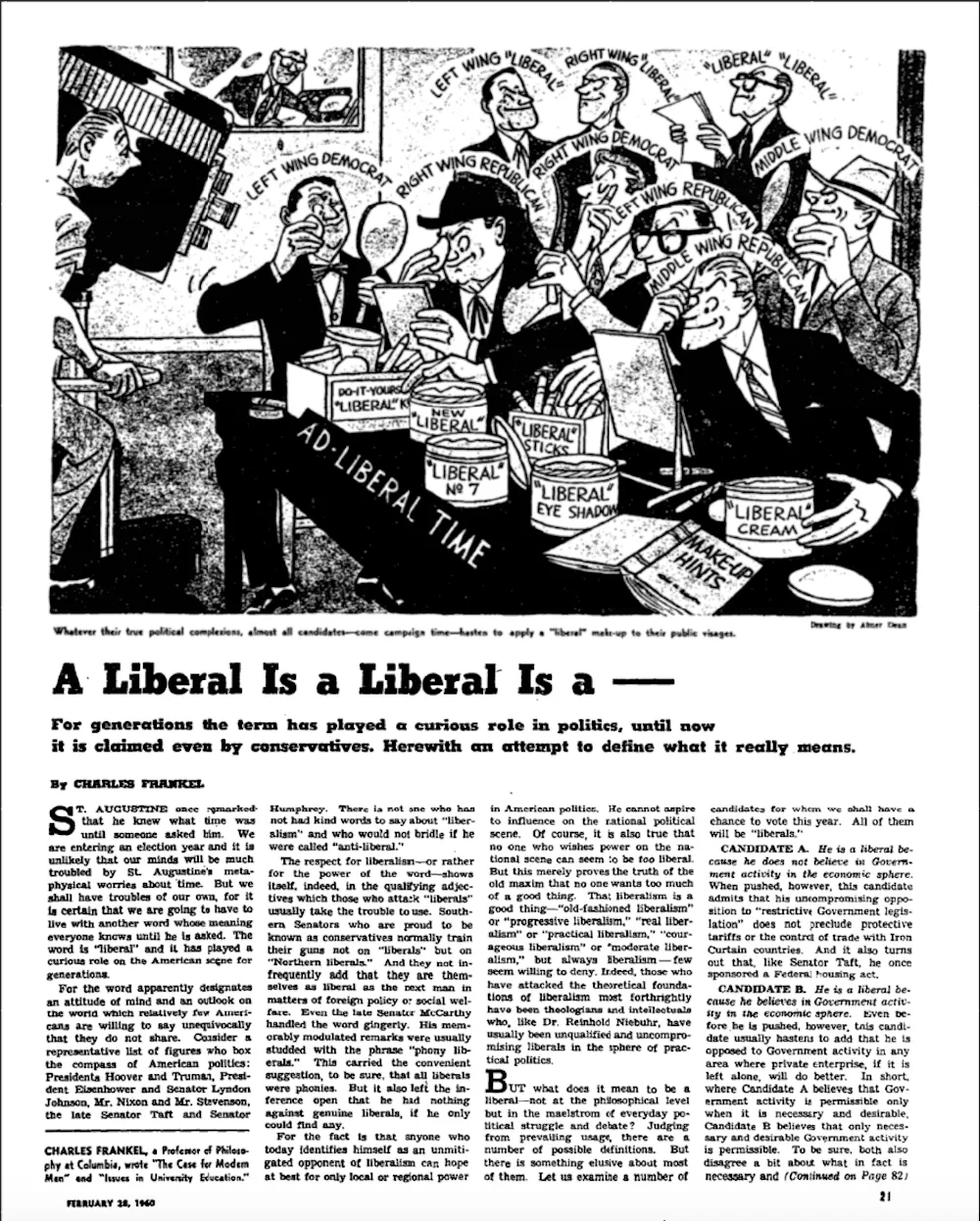
    In 1960, scholar Charles Frankel dived into the meaning of the politically important word ‘liberal’ in a commentary for The New York Times.
    New York Times archive

    The liberal past

    In the past, Democrats had a word to describe their sensibility: “liberal.” But now: RIP, liberal. No one, it seems, wants to be a liberal anymore.

    In my research on uses and abuses of the word liberal, I discovered that liberalism is a relatively new word in American politics, really starting only in 1932.

    That year, presidential candidate Franklin D. Roosevelt was searching for a way to fend off Republican accusations that his New Deal was “socialism,” a word with radical connotations.

    Liberalism as a word predates FDR’s usage, but he redefined it to signify the government regulation of capitalism and the use of the state to provide citizens with basic economic security.

    When in 1932 FDR accepted the nomination for president, he declared the Democratic Party “the bearer of liberalism,” by which he meant undertaking “planned action” while fighting for “the greatest good to the greatest number of our citizens.”

    FDR pitted his liberalism against his opponents, whom he labeled “conservatives.” The U.S. has had the liberal-conservative divide ever since.

    FDR’s successor, Democrat Harry Truman, recognized the power of the term, extravagantly claiming, “The liberal faith is the political faith of the great majority of Americans.”

    President John F. Kennedy gloried in the word, too, defining a liberal as “someone who welcomes new ideas without rigid reactions, someone who cares about the welfare of the people.”

    In 1960, philosopher Charles Frankel argued that liberalism as defined by FDR was a banner under which every Democrat marched, concluding that “anyone who today identifies himself as an unmitigated opponent of liberalism … cannot aspire to influence on the national political scene.”

    Shifting meanings

    Not for long.

    For one thing, in the 1950s the word shifted meaning to better accord with the times, as it had done several times in the past. During the post-World War II economic expansion, “a large part of the New Deal public,” historian Richard Hofstadter wrote in 1954, “have become home-owners, suburbanites and solid citizens.”

    Liberals therefore shifted liberalism. No longer were liberals solely about providing jobs and Social Security. They also demanded increased access to higher education, medical care and civil rights, and the elevation of popular culture.

    In 1956, future presidential adviser Arthur Schlesinger Jr. called this shift one from “quantitative” to “qualitative liberalism.”

    President Lyndon Johnson put this into effect in the mid-1960s. Johnson developed anti-poverty programs such as Head Start, but he also created cultural programs such as PBS, expanded civil rights and passed Medicare and Medicaid.

    “We are a great and liberal and progressive democracy,” Johnson declared in 1966.

    But Johnson’s qualitative liberalism came with costs. The programs expanded the federal bureaucracy, which by the late 1960s became noted for being ineffective and overly regulatory.

    Civil rights laws were perceived as threatening to the white working class. And Johnson’s liberalism became wedded to the war in Vietnam, where by 1969 more than 500,000 Americans were fighting to protect liberalism from the supposedly creeping arms of communism.

    Soon, the knives were out for liberals.

    3 lines of attack

    First, right-wing thinkers had already begun to portray liberals as little more than quasi-communists pushing for civil rights beyond most Americans’ desires.

    In 1955, conservative impresario William F. Buckley Jr. founded the magazine National Review to create “a responsible dissent from the Liberal orthodoxy.” He titled his 1959 book “Up from Liberalism” and spent 217 of the book’s 229 pages attacking liberals.

    Then leftist thinkers took their shot, imagining liberals as little more than beards for capitalism and foreign policy hawks.

    Left-wing novelist Norman Mailer summed up this sentiment in 1962, writing, “I don’t care if people call me a radical, a rebel, a red, a revolutionary, an outsider, an outlaw, a Bolshevik, an anarchist, a nihilist or even a left conservative, but please don’t ever call me a liberal.”

    Left-wing author Norman Mailer said in 1962 that people could call him a Bolshevik, an anarchist, a nihilist, ‘but please don’t ever call me a liberal.’
    Fred Stein Archive/Archive Photos/Getty Images

    Civil rights advocates took their turn, seeing liberals as halfway friends, unwilling to fully embrace equality. Historian Lerone Bennett Jr. wished liberals “a fond farewell” in 1964. In that same year, writer James Baldwin called white liberals an “affliction.”

    With attacks coming from multiple sides, by the 1970s Democrats ran from the label. And without defenders, enemies redefined liberals, first as out-of-touch elitists, then as allies of corporations ignoring the demands of working people, and eventually, today, as woke snowflakes.

    In 2009, political scientists examining a hundred years of polling data found that, starting in the mid-1960s, decreasing numbers of Americans referred to themselves as liberal. And because partisanship is a social dynamic, when the club began to shrink, the researchers wrote, it turned into “a spiral in which ‘liberal’ not only is unpopular, but becomes ever more so.”

    The researchers also found that most Americans still supported “‘liberal’ public policies” such as “redistribution, intervention in the economy, and aggressive governmental action to solve social problems.” Americans, apparently, just hated the label.

    Owning the libs” has been the glue keeping together the Republican Party ever since.

    From ‘abundance’ to ‘Waymo’

    Democrats are now searching for a new label. What can replace liberalism?

    New York Times columnist Ezra Klein and Derek Thompson, who writes for The Atlantic, have proposed “abundance liberalism.” Other New York Times writers have also been busy envisioning this future. Reporter and editor David Leonhardt suggested “democratic capitalism.” Columnist Thomas Friedman improbably went with “Waymo Democrat,” referring to self-driving Waymo cars as a placeholder for an embrace of technological innovation.

    More realistically, political analyst E.J. Dionne and historian James Kloppenberg are writing a history of “social democracy” as a potential rallying cry for Democrats, pointing to its use by the most popular politician in America, Bernie Sanders.

    Whatever emerges, it’s helpful to remember that before 1932, hardly anyone in the U.S. used the word “liberal” to describe any kind of politics. Now, without finding a new emblem to rally behind, Democrats may be doing little more than battling that other neologism: MAGA.

    Kevin M. Schultz does not work for, consult, own shares in or receive funding from any company or organization that would benefit from this article, and has disclosed no relevant affiliations beyond their academic appointment.

    ref. FDR united Democrats under the banner of ‘liberalism’ − but today’s Democratic Party has nothing to put on its hat – https://theconversation.com/fdr-united-democrats-under-the-banner-of-liberalism-but-todays-democratic-party-has-nothing-to-put-on-its-hat-255362

    MIL OSI – Global Reports

  • MIL-OSI Global: Recycling asphalt pavement can help the environment − now scientists are putting the safety of recycled pavement to the test

    Source: The Conversation – USA – By Jingtao Zhong, Ph.D. Student in Civil Engineering, University of Tennessee

    The composition of the asphalt mixture making up a road can determine how safe it is for cars to drive on. Tarik Seker/iStock via Getty Images Plus

    More than 90% of paved roads in the U.S. are made of asphalt, which is constructed with nonrenewable materials such as petroleum. One way to make paving more sustainable is to recycle old pavement. When roads break down and need repaving, transportation agencies can recycle their old pavement into a reusable material called reclaimed asphalt pavement, or RAP. This method reduces carbon emissions and conserves natural resources.

    Nearly 95% of new asphalt pavement projects in the U.S. incorporate RAP.

    However, researchers don’t know as much about the long-term safety and durability of RAP as they do about new pavement.

    So, can engineers make roads more sustainable without compromising safety? As civil engineering researchers at the University of Tennessee, Knoxville, we’re working with our state’s transportation department to help answer this question.

    RAP and friction

    Asphalt pavement is composed of asphalt binder and aggregates. Asphalt binder is typically sticky and black petroleum-based material that acts as glue, holding the pavement together.

    Aggregates are solid materials, such as crushed stone, gravel or sand. The pavement manufacturers coat these aggregates with asphalt to bind them together and create a durable road surface. But both of these materials are nonrenewable.

    One way to reduce the demand for new aggregates is by recycling old pavement. Contractors use a milling machine to grind up the existing pavement surface. The milled material is then reused: The old aggregates and asphalt binder from the road become part of the new mixture. These old materials are often blended with new binder and additional aggregates to make sure they can perform well.

    Why study RAP’s properties?

    One challenge with using RAP is that its properties vary significantly. RAP typically look black, since they are fully coated in asphalt. Researchers have a hard time visually inspecting them to identify the aggregate types, shapes or textures. But we developed testing procedures to measure these properties.

    The road’s ability to grip the tires, known as skid resistance, keeps vehicles from skidding or hydroplaning during wet conditions. Skid resistance is typically quantified by measuring a coefficient of friction between the tire and the pavement surface.

    Pavement friction is the force that resists the motion between a vehicle’s tire and the pavement’s surface. More friction means a vehicle is less likely to skid.

    Understanding RAP’s skid resistance-related properties is important because these attributes affect how safe the pavement is, especially when it’s wet.

    Nearly 75% of weather-related accidents occur on wet pavement. At low speeds, most of the skid resistance between a tire and the pavement comes from the texture of the aggregates.

    Most friction research has tested new aggregates. RAP needs to maintain good frictional properties to be as safe as the original, but until now, researchers haven’t fully investigated whether it does.

    How we study RAP’s properties

    Our research team developed a two-step process to better understand RAP’s safety performance. First, we extract the aggregates from the RAP. Then, we measure the frictional properties of those aggregates, since they play a key role in pavement skid resistance.

    To remove the black asphalt coating and expose the actual surface of the aggregates, we use two simple methods. The first is a mechanical method, where we crush the RAP using a hammer to expose the surface inside. The second is a chemical procedure, where we use a solvent to dissolve asphalt and leave the aggregates for further testing.

    Once we’ve cleaned the aggregates, we analyze their chemical composition and see how it relates to friction. One factor we look for is the hardness of the minerals in the aggregate. Harder minerals, such as silica, provide better friction as they keep their texture better over time instead of wearing down under traffic.

    We also use an aggregate image measurement system, which takes high-resolution images and analyzes the shape, angularity − the sharpness of the aggregate particles − and surface texture of the aggregates. These properties relate directly to skid resistance.

    Understanding the frictional properties of RAP − and, specifically, how silica content affects skid resistance − helps engineers determine whether an RAP mixture is safe for a road’s curves or intersections. These insights can guide how much RAP transportation departments can use, and where, without compromising safety. We hope our research will lead to solutions that reduce carbon emissions, conserve natural resources and keep roads safe over time.

    Jingtao Zhong receives funding from the Tennessee Department of Transportation (State project number RES2023-15).

    Baoshan Huang receives funding from the Tennessee Department of Transportation (State project number RES2023-15).

    ref. Recycling asphalt pavement can help the environment − now scientists are putting the safety of recycled pavement to the test – https://theconversation.com/recycling-asphalt-pavement-can-help-the-environment-now-scientists-are-putting-the-safety-of-recycled-pavement-to-the-test-252348

    MIL OSI – Global Reports

  • MIL-OSI Global: Basic research advances science, and can also have broader impacts on modern society

    Source: The Conversation – USA – By Bruce J. MacFadden, Distinguished Professor Emeritus, University of Florida

    As charismatic animals, sharks can stimulate interest in science, research and technology. Florida Museum (Kristin Grace photo)

    It might seem surprising, but federal research funding isn’t just for scientists. A component of many federal grants that support basic research requires that discoveries be shared with nonscientists. This component, referred to as “broader impacts” by the National Science Foundation, can make a big difference for K-12 students and teachers, museumgoers, citizen scientists and other people interested in science, while also helping the scientists themselves give back to the taxpayers that fund their work.

    Basic research, often done because of a curious scientist’s interest, may not initially have a direct application, like developing the smartphone or curing a disease. But these discoveries build important knowledge in the natural sciences, engineering, mathematics and related disciplines.

    The U.S. is a world leader in scientific and technological innovation. On the federal level, the National Science Foundation, or NSF, is one of the primary funders of this kind of basic research. In 2022, the federal government funded 40% of all basic research done in the U.S., with the remainder coming from other sources, including the business sector.

    During World War II, President Franklin D. Roosevelt wanted to position the U.S. for strategic and economic leadership worldwide. He commissioned physicist Vannevar Bush to develop a vision for the future of U.S. science and technology. His 1945 report, “Science: the Endless Frontier,” became the blueprint for government-funded basic research. In 1950, Congress created the National Science Foundation to promote the progress of science, advance national prosperity and welfare and secure the national defense.

    Vannevar Bush historically said that ‘without scientific progress, no amount of achievement in other directions can insure our health, prosperity and security as a nation in the modern world.’
    Office for Emergency Management Defense

    During the early decades of NSF, the 1950s until the late 1990s, proposals were mostly evaluated based on the quality of the science and the scientists doing the work. But then, the foundation created a new system, still in place today.

    Thus, each NSF research proposal is now peer-reviewed based on two criteria: intellectual merit, or the quality and novelty of the science and track record of the research team, and “broader impacts” – related activities that disseminate the discoveries to general audiences.

    Intellectual merit is about advancing science knowledge and innovation, while broader impacts describe why people who aren’t scientists should care, and how society could benefit from this research.

    Another pragmatic aspect to broader impacts is that taxpayers pay for these activities, so it’s important for them, and Congress, to understand their return on investment. These broader impacts activities communicate about, and engage the public in, research in a variety of ways.

    While researchers usually understand the intellectual merit of their NSF-funded projects, these broader impacts can be challenging to characterize.

    Broader impact activities

    Since childhood, I’ve had an interest in paleontology — the study of fossils and what we can learn from them about prehistoric life. This field is primarily basic research — adding to knowledge about ancient life. As a scientist conducting basic research, I’ve felt the responsibility to give back to society through broader impacts activities, and I’ve seen many of the benefits that these activities can have.

    My primary area of interest has been extinct mammals of the Americas, particularly the 55-million-year-old record of fossil horses on this continent. For years, NSF supported my discoveries about this interesting group of animals. Fossil horses are a classic example of evolution — in books and museum exhibits.

    A fossil horse from the Ice Age on display at the Florida Museum. Fossil horses are a classic example of evolution — both in books and museum exhibits.
    Florida Museum (Mary Warrick photo)

    Many people are generally interested in horses, so it’s easy to attract their attention with this charismatic group. They also are often surprised to learn that prehistoric horses were native to North America for millions of years. Then, during historical times, they were first introduced by humans onto the continent about 500 years ago.

    Over the years, my research team has used grant-funded broader impact activities to teach people about these fossil horses and our research. One example included working with K-12 science teachers to develop lesson plans. The students measured fossil horse teeth and explored how their teeth adapted to feeding on grasses. We’ve also developed exhibits on fossil horses and studied how they communicate science to museum visitors.

    Science teachers have joined our fieldwork to collect fossils along the Panama Canal during its recent expansion. I’ve given many talks and collaborated with fossil clubs and their members throughout the U.S. We’ve also promoted projects like Fossils4Teachers where fossil collectors donated their fossils and worked alongside K-12 teachers to develop lesson plans that were implemented back in the teachers’ classrooms.

    The Fossils4Teachers professional development workshop, hosted by the Florida Museum in 2017, is one example of a broader impacts activity.
    Florida Museum (Jeff Gage photo)

    We’ve also been able to activate peoples’ interest in other animal groups — such as fossil sharks. Through our Scientist in Every Florida School program, we gave middle school teachers study kits with real fossil shark teeth. Their students learned to identify the shark teeth and then trained computers to identify the teeth using machine learning, a type of artificial intelligence.

    Students study fossil shark teeth through a program at the Florida Museum of Natural History.
    Florida Museum (Megan Higbee Hendrickson photo)

    Broader impact outcomes

    Broader impacts activities like these can have a variety of short- and long-term outcomes. More than 50 million people visit natural history museums in the U.S. annually. Activities that promote museums can reach large numbers of people in their pursuit of lifelong learning.

    More broadly, participatory science interest groups can allow people to learn about science while informing basic research projects. Within the field of natural history, a few popular examples include the Merlin app and the iNaturalist app, both of which have millions of active observers. Merlin encourages people to submit their observations of birds, and iNaturalist accepts sightings of plants, animals and fossils, which researchers can carefully vet and use as data.

    Many of the K-12 teachers my team has worked with report that they feel more confident teaching the new science content that they learned from our collaborations.

    Interestingly, although much of the research on science professional development focuses on the teachers, scientists also report a high level of satisfaction and improved communication skills after working with these teachers, both in the field and back in the classroom.

    Basic research benefits for society

    Generations of U.S. scientists have greatly benefited from federal investments in basic research. In the 75 years since NSF’s founding, the organization has funded hundreds of thousand projects to advance science and technology.

    These have supported basic research discoveries and also the training and career development of the tens of thousands of scientists working on these projects annually.

    Many prominent scientists have gone on to be productive leaders and innovators in the U.S. and internationally. NSF has funded more than 268 Nobel laureates.

    While NSF invests in the discovery of foundational knowledge about the natural world, funded projects have not traditionally had direct applications for societal benefits. To be sure, however, many of NSF’s projects – for example, on lasers and nanotechnology – started out as curiosity-driven basic research and ended up with immense applications for technological innovation and economic prosperity.

    For example, mapping the Earth’s ocean floor’s magnetic properties during World War II helped scientists understand how the crust moves and mountains form. This led to the plate tectonic revolution in the earth sciences. This line of basic research then led to an important application: predicting the probable location of high-risk earthquake zones worldwide.

    None of these downstream applications and benefits to society would have been realized without basic research discoveries supported by federal agencies such as NSF, and the further value added through broader impacts activities.

    Bruce J. MacFadden has received funding from the U. S. National Science Foundation.

    ref. Basic research advances science, and can also have broader impacts on modern society – https://theconversation.com/basic-research-advances-science-and-can-also-have-broader-impacts-on-modern-society-252983

    MIL OSI – Global Reports

  • MIL-OSI Global: Secrets of the Thames: mudlarking treasures showcase history of London’s river and the people who scour its banks

    Source: The Conversation – UK – By Thomas Lucking, PhD Candidate in History, University of East Anglia

    Twice a day, every day, the tides of the River Thames rise and fall, revealing a foreshore that, in the middle of London, has been a focus of human activity for millennia.

    Making use of the limited windows of time in which the riverbank is exposed, devoted hobbyists known as mudlarks scour the river’s edge for historic and interesting finds. The mudlarks, through their dedication, have assembled impressive collections of objects, each of which adds yet another small piece of London’s history to the archaeological record.

    Secrets of the Thames, a new exhibition at the London Museum Docklands presents an insight into the fascinating world of mudlarking. It draws together more than 350 finds recovered from the river alongside the stories, insights and experiences of the mudlarks themselves.

    The result is an engaging exhibition that makes use of the objects on display to tell the story of the Thames and London through time, and the people who search for them, giving the visitor an all-round insight that goes beyond being a room of objects in cases.


    Looking for something good? Cut through the noise with a carefully curated selection of the latest releases, live events and exhibitions, straight to your inbox every fortnight, on Fridays. Sign up here.


    The objects on display are more than simply a group of interesting items – although there are certainly plenty of objects that require time and attention to fully appreciate.

    They are also a record of the ways the Thames has been used and viewed over the years. And together, they tell the story of the mudlarks that put the hours into finding these objects. For those who wish to see a variety of the more ancient objects from London, this exhibition tides things over until the London Museum Smithfield opens in 2026.

    The beginning of the exhibition explores the history of mudlarks on the Thames. The term was coined in the late 18th and 19th centuries to refer to the poor who scavenged for objects such as scrap metal and coal.

    Historic accounts, paintings and other objects provide glimpses into this time, including descriptions of some of these early mudlarks. Their stories and motivations for being on the Thames contrast sharply with the mudlarks of today. Those early mudlarks were effectively scavenging to survive. But over time an appreciation of the number of historic objects revealed by the tides saw mudlarking evolve into a hobby for those who wanted to search for small pieces of the city’s history.

    Today, a permit is needed to mudlark on the Thames, provided by the Port of London Authority (PLA).

    The changing ways the Thames has been used and viewed over time is revealed in the next space. Displays are arranged to showcase objects exploring different themes, including the river as a place of religious significance, a place of travel and trade and a place to dispose of the countless tons of rubbish generated by the inhabitants of London down the centuries.

    Indeed, the cases themselves sit within a reconstructed foreshore having seemingly been washed across the room by the tidal waters, complete with historic and not-so-historic objects emerging from the mud. The objects on display cover a wide timescale, from prehistoric flint tools through to modern religious offerings, all of which have been pulled from the mud of the Thames.

    Modern mudlarks

    It is in the next space that the modern mudlarks themselves are brought into sharper focus. A mock-up of someone’s home display, complete with drawers filled with a range of objects, hints at the dedication and organisation required for these searchers.

    Video interviews with mudlarks are played, explaining the enjoyment they take from their wanderings on the river. Alongside is a display explaining the role of the Portable Antiquities Scheme in recording the objects, preserving the information and context of where they were found. Each object adds a piece to the archaeological jigsaw.

    Underlying all of this is the tidal nature of the Thames, which both continually turns the foreshore and allows access for the mudlarks. A large model of the moon provides a space to sit and reflect at the end of the exhibition. A further small room shows a video of mudlarking on the Thames, allowing visitors to immerse themselves into the sight and sounds of the river. It offers an understanding of why people are drawn to its banks.

    The overall impression of the exhibition is a mixture of appreciation for the variety of objects that have been recovered from the river, with every aspect of human life represented.

    The thematic approach taken to displaying many of the objects brings the shared habits and customs of human life down the centuries to the fore. In objects such as the Roman jewellery, we see items that would look perfectly at home being worn by anyone walking the banks of the Thames today.

    The modern human connection with the river is also clear to see through the mudlarks, whose dedication gives them a unique perspective on what may at first glance appear to be a muddy riverbank, but through their searching, reveals a far richer and deeper history.

    Secrets of the Thames is at the London Museum Docklands until March 1 2026.

    Thomas Lucking is an AHRC-funded PhD researcher.

    ref. Secrets of the Thames: mudlarking treasures showcase history of London’s river and the people who scour its banks – https://theconversation.com/secrets-of-the-thames-mudlarking-treasures-showcase-history-of-londons-river-and-the-people-who-scour-its-banks-256006

    MIL OSI – Global Reports

  • MIL-OSI Global: Why loneliness should be treated as a social issue

    Source: The Conversation – UK – By Kathryn Bates, Research Fellow, Psychology, King’s College London

    Stock Unit/Shutterstock

    Anyone who has experienced loneliness knows how deeply personal it feels. We feel lonely when our social and emotional needs aren’t being met. Because of this, psychological research often focuses on individual-level solutions, encouraging people to change their perceptions or behaviour through therapy. But this focus misses the heart of the issue: the absence of meaningful connection with others.

    It’s right to be concerned about high rates of loneliness among young people, especially given the negative impact of severe loneliness on physical and mental health. Some argue that technology is to blame and point to increased time spent on phones or social media.

    While studies do show that higher internet use is associated with greater loneliness, the direction of this relationship remains unclear. Are young people lonely because they’re online, or online because they feel lonely?

    The internet is not devoid of social interaction. In fact, studies suggest that young people’s online activities often mirror their offline behaviour, especially when it comes to seeking connection and communicating with friends. This complicates the idea that technology alone is to blame.

    Rather than placing all responsibility on a person suffering from loneliness, we need to look at societal solutions. This doesn’t mean psychological interventions have no value. Therapies like cognitive behavioural therapy (CBT) or social skills training can be effective for some, particularly in cases of severe loneliness.

    But these approaches aren’t universally successful. They’re expensive, require trained professionals and any resulting improvements are often short-lived.

    Societal solutions, by contrast, offer broader and more sustainable impact. These can be thought of in two main ways: creating spaces for meaningful social connection and addressing the root societal conditions that lead to loneliness.

    While loneliness is a subjective experience, social connection is more tangible. It’s reflected in whether we have people we can rely on, whether we feel supported, and the quality of our relationships. In this sense, social connection can be an antidote to loneliness.

    When public spaces shrink, loneliness grows

    But opportunities for connection are shrinking. In the UK, hundreds of millions of pounds have been cut from youth services and half of all youth clubs closed between 2011 and 2021. At the same time, a global cost of living crisis has left many young people – even those in full-time work – with little or no money left at the end of the month.

    Meanwhile, “third spaces” – places outside of home, school, or work where people can connect – are disappearing. Cafes and bars are often too expensive, while public libraries and community spaces are underfunded and closing rapidly. In this context, it’s no surprise that young people are spending more time socialising online: there are simply fewer affordable and accessible places to connect in person.

    Taking a societal approach also means acknowledging the inequalities that shape how loneliness is experienced. We’re not just individuals making isolated choices: we’re part of communities and systems. And, for many, structural issues like marginalisation and discrimination play a role in their experience of loneliness.

    Young people from marginalised backgrounds, including those from lower-income families and those identifying as LGBTQ+, are at significantly higher risk of loneliness. Researchers argue that exclusion and discrimination – not individual deficits – are contributing to this.

    That’s why some are calling for us to understand the causes of loneliness at every level, from personal traits to societal attitudes to the design of neighbourhoods and communities.

    If we want to reduce loneliness in young people, we need to go beyond telling them to seek therapy or use their phones less. We need public investment in spaces that foster connection, and we must address the broader structural issues that make some young people especially vulnerable. Focusing only on the lonely individual won’t be enough, especially for those facing the deepest barriers to belonging.

    Kathryn Bates receives funding from the Economic Social Research Council.

    ref. Why loneliness should be treated as a social issue – https://theconversation.com/why-loneliness-should-be-treated-as-a-social-issue-252951

    MIL OSI – Global Reports

  • MIL-OSI Global: Could psychedelics help you to drink less alcohol? Our new study aims to find out

    Source: The Conversation – UK – By Rebecca Harding, PhD Candidate, Clinical Psychopharmacology Unit, UCL

    Master1305/Shutterstock

    Psychedelics like LSD and psilocybin (the active ingredient in magic mushrooms) are gaining increasing attention in psychiatry. Studies suggest they may offer therapeutic benefits for conditions such as depression, anxiety, obsessive–compulsive disorder, eating disorders and addiction.

    Our research team is investigating whether N,N-dimethyltryptamine (DMT), a fast-acting psychedelic, can help people reduce alcohol consumption.

    Alcohol is the most commonly misused substance in the UK, partly because it is legal, widely available and deeply ingrained in social culture. While many people can enjoy alcohol in moderation, a significant number struggle to control their drinking. For these people, excessive alcohol consumption can lead to serious physical, mental and social consequences.

    Traditional treatments don’t work for everyone, which is why we’re exploring alternatives, such as psychedelics, that might enable people to change their behaviour in a single, transformative experience.


    Get your news from actual experts, straight to your inbox. Sign up to our daily newsletter to receive all The Conversation UK’s latest coverage of news and research, from politics and business to the arts and sciences. Join The Conversation for free today.


    DMT is metabolised rapidly in the body. When administered intravenously, the effects kick in almost immediately, typically within one to two minutes. However, these effects are short-lived, lasting only ten to 20 minutes.

    Despite its brief duration, many users describe the experience as intensely profound. They often report vivid visions, complex patterns and a sensation of entering a different reality. In some cases, the experience leads to a complete shift in how they think, feel and perceive the world. For many, the experience is deeply meaningful and transformative.

    But what happens in the brain during this time, and how might it influence long-term behaviour, such as reducing alcohol consumption?


    Read more:
    Psychedelic drugs can be almost as life altering as near-death experiences


    Neuroplasticity and addiction

    Our team is particularly interested in how psychedelics like DMT might help in the context of addiction. One theory is that psychedelics can temporarily enhance neuroplasticity, the brain’s ability to form new neural connections. This temporary boost could open a window of flexibility, allowing some people to be more open to change.

    For someone stuck in the cycle of heavy drinking, this enhanced plasticity might help them break old habits and develop healthier behaviour. Essentially, it could offer the brain an opportunity to “rewire” itself and disrupt the unhealthy patterns that underlie addiction.

    We’re also focusing on the brain’s reward and motivation systems, which play a key role in addiction. These systems influence behaviour associated with pleasure, including eating, sex and drinking alcohol.

    In people with alcohol use disorder, these systems become hypersensitive to alcohol-related cues, often at the expense of other rewarding experiences. Some early research suggests psychedelics may help “reset” these reward pathways. We’re testing this theory to see whether DMT can reduce alcohol consumption by recalibrating the brain’s reward system.

    To explore these possibilities, we’ve designed a study with heavy drinkers who are motivated to reduce their alcohol intake. Every participant undergoes a thorough screening to ensure they’re fit for the study and all sessions are conducted in a highly controlled, clinical setting with medical professionals and experienced researchers overseeing the process.

    The study involves three visits to our lab at UCL. On the first and third visits, we use functional magnetic resonance imaging (fMRI) to measure brain activity and observe how different regions of the brain interact.

    During the scans, participants watch emotionally engaging films, which offer a more natural way to study brain responses compared to abstract tasks. This helps us assess how DMT might impact brain function in real-life, emotionally charged situations.

    On the second visit, participants are randomly assigned to receive either DMT, a placebo, or a non-psychedelic drug (D-cycloserine or Lisuride). These non-psychedelic substances are believed to promote neuroplasticity without inducing the full psychedelic effects of DMT.

    The study is double-blind – neither the participants nor the researchers know which substance is being administered. This helps eliminate bias and ensures that the results are as reliable as possible.

    Additionally, we measure changes in brain activity during the drug infusion using electroencephalography (EEG). EEG tracks the brain’s electrical signals and could help us predict which participants are most likely to benefit from DMT.

    Participants also complete a range of psychological assessments, including questionnaires and tasks that measure memory, attention, mood and decision-making. This data will help us understand how changes in brain function might relate to changes in drinking behaviour.

    What we’re hoping to discover

    We’re still in the process of collecting data, but we’re excited to see whether DMT can lead to meaningful reductions in alcohol consumption. As researchers, it’s crucial that we stay objective and allow the evidence to guide our conclusions. By keeping the study “blinded” until all results are in, we ensure that our findings are unbiased and reliable.

    If DMT proves effective in helping people reduce their alcohol consumption, particularly for those who have struggled with other treatments, it could pave the way for a new approach to addiction therapy. Even if the results are inconclusive, they will still provide valuable insights into the potential role of psychedelics in addiction treatment and open up new avenues for future research.

    It’s important to emphasise that this research is taking place in a safe, controlled environment. Psychedelics are potent substances, and their effects can be unpredictable, especially outside of clinical settings. They are not a “magic bullet” and are not suitable for everyone. The controlled setting allows us to study their effects while minimising risk to participants.

    That said, we believe psychedelics offer a unique opportunity to better understand the brain and its capacity for change. By examining how transformative experiences can influence behaviour, we hope to contribute to the development of more effective treatments for addiction and other mental health conditions.

    Ravi Das receives research funding from the Biotechnology and Biological Sciences Research Council (UK), Academy of Medical Sciences (UK) and Wellcome Leap (USA).

    Rebecca Harding does not work for, consult, own shares in or receive funding from any company or organisation that would benefit from this article, and has disclosed no relevant affiliations beyond their academic appointment.

    ref. Could psychedelics help you to drink less alcohol? Our new study aims to find out – https://theconversation.com/could-psychedelics-help-you-to-drink-less-alcohol-our-new-study-aims-to-find-out-255454

    MIL OSI – Global Reports

  • MIL-OSI Global: Russia looks to frame war as an inevitable part of life on Victory Day

    Source: The Conversation – UK – By Jennifer Mathers, Senior Lecturer in International Politics, Aberystwyth University

    Russia celebrates the 80th anniversary of the Soviet victory in the second world war on May 9. But while the cameras will focus on the assembled ranks of elderly war survivors watching the military parade in Red Square, Moscow, the focus of senior officials is on Russia’s children and young people.

    Patriotism in Vladimir Putin’s Russia is built on exaggerated respect for key moments in the country’s history. These moments have been chosen to create a specific story about Russia. This is a story about Russia’s military might, the ability of its citizens to endure almost unimaginable suffering for the motherland, and the inevitability of victory over its enemies.

    Victory Day gives the Kremlin a chance to retell that story. It also allows the state to assure Russians that they, like their ancestors, will be victorious in the so-called “special military operation” in Ukraine. Moscow describes this war as the modern-day equivalent of the fight against Nazi Germany.

    With fewer witnesses to that historic victory still alive, the Kremlin’s ability to manipulate society by drawing on this important memory depends on the willingness of the next generation to embrace the state’s official history. And Russian political figures are worried that young people nowadays are disconnected from their heritage.

    A poll conducted in December 2022 by the Russian Public Opinion Research Centre found that 76% of Russians aged 14 to 24 believe they have a good understanding of the history of their country. But the results of an alternative poll from June 2023 show that 70% of Russia’s young people do not know enough about their nation’s history.

    Vladimir Medinsky, the chairman of the Interdepartmental Commission of Historical Education of Russia, reflected on the issue at a forum on how to interest young people in Russian history in 2023. He said: “What needs to be done to make our children interested in history? To make interesting historical performances, to make historical films.”

    Russia’s leaders seek to address this perceived disconnect through military patriotic education. This is a system of surrounding children and young people with state-approved messages about Russia’s historic military victories and the role of its armed forces in making their country respected – and feared – around the world.

    These messages are conveyed through textbooks and in lessons at school. But one of the challenges for the Russian state is finding ways of making this material attractive enough for young people to want to engage with it.

    Putin himself has indicated that he understands this challenge. At a meeting with the Russian non-profit society Znaniye (Knowledge) on April 30, the Russian president argued that “it is crucial to have both an opportunity and skills to communicate the truth about past years and decades: sincerely, compellingly and – if I may say so – in a way that truly resonates”.

    Patriotic youth groups are an important vehicle for delivering military patriotic education in fun and exciting ways. These groups organise activities including games and competitions, as well as more immersive activities such as role-playing and re-enactments. These activities are designed to create a deeper engagement with the events of the past.

    One group, Victory Volunteers, emphasises collecting personal accounts from war veterans to add to the historical record. It also actively brings young people and war veterans together so that the heroes of future wars can be inspired by real-life stories of wartime heroism.

    Listening to these first-hand testimonials is intended to enable young people to deepen their understanding of the experience of war, including its hardships and tragedies.

    Yunarmiya (Young Army) is probably Russia’s best-known military patriotic youth group. It works with young people to develop their appreciation of history. But its focus on dressing its members in uniforms and training them in practical military skills has captured the attention of the world’s media.

    These skills include military-style activities such as marching in formation, learning how to assemble and disassemble weapons, and how to fire them.

    The Russian state also supports military patriotic education through the presidential grants fund. Hundreds of charities, youth groups and local societies apply to the fund twice a year, with the winners reportedly chosen by Putin himself.

    Many of the successful applications involve activities to raise young people’s awareness of historical memory, especially the memory of war.

    In 2022, for example, the historical reconstruction club Volnitsa received funding to organise a memorial march “in the footsteps of the winners” to mark the 80th anniversary of the liberation of the Bogucharsky region of Russia (near the border with Ukraine) from Nazi occupation.

    The successful application emphasised the emotional intensity of the reenactment and its educational effects on young participants.

    Events like the 80th anniversary of Victory Day have a significance for the Kremlin that goes beyond the speeches, parades and pageantry of the day itself. They are part of an effort by the Russian state to shape the expectations and behaviour of the next generation of its citizens.

    By encouraging young people to feel a personal connection to Russia’s history of war, Moscow hopes to ensure that society will regard war as an inevitable part of life. The scale of this effort suggests that Putin and other senior officials anticipate the need for a society willing to make sacrifices so that Russia can achieve victories in future wars.

    The authors do not work for, consult, own shares in or receive funding from any company or organisation that would benefit from this article, and have disclosed no relevant affiliations beyond their academic appointment.

    ref. Russia looks to frame war as an inevitable part of life on Victory Day – https://theconversation.com/russia-looks-to-frame-war-as-an-inevitable-part-of-life-on-victory-day-255751

    MIL OSI – Global Reports

  • MIL-OSI Global: Black students are increasingly less likely to get a first or 2:1 than their white peers

    Source: The Conversation – UK – By David Mba, Vice-Chancellor, Birmingham City University

    Andrii Zastrozhnov/Shutterstock

    Black students are increasingly less likely to get a first or 2:1 than their white peers, according the latest Ethnic Representation Index for higher education in England and Scotland.

    This need for better representation for students was the impetus behind the development of the index, first launched in 2022. I began it while deputy vice-chancellor at the University of Arts London, with the intention of creating a consistent methodology and agreed metrics to measure the progress of universities in England and Scotland in addressing institutional racism, as well as to examine the sense of belonging and inclusion among Black, Asian and minority ethnic (BAME) staff and students.

    The index exposes the so-called “awarding gap” – that’s the difference between the proportion of white and BAME students awarded a first class or 2:1 degree. For Black and other ethnic minority students in England, it now stands at 14.1%, up from 12.3% the previous year. Indeed, 76% of universities in England and a similar proportion of universities in Scotland have a gap of more than 10%.

    For Black students in particular, the gap is even greater. It now stands at 21.6%, up from 19.3% in England. In Scotland, 81% of universities have a Black awarding gap of over 25%.

    Despite this, though, the index does show some encouraging signs. This is its third and latest iteration, which I co-authored with Chris Lloyd-Bardsley, Adam Weigel and Sandra Longville at the University of Arts London, covers the 2022-2023 academic year.

    According to data from the National Student Survey, the gap in reported satisfaction rates between white and students from ethnic minority backgrounds has narrowed over the last few years. Black students reported a better university experience than their white peers.

    Staff representation

    Staff, by and large, are becoming more representative of the student body. For instance, 20.2% of academics and 33.3% of undergraduates in England are from ethnic minority backgrounds.

    This is by no means parity, but it is progress when we consider that, in the last index, 18.5% of academics were from ethnic minority backgrounds. Representation among professional services staff, professors, senior managers and governors increased, too.

    Progress has also been made in Scotland. Black and ethnic minority students comprise 11.6% of the undergraduate student body there, 16% of postgraduate researchers – and 15.4% of academics. Representation among executive board members also increased.

    Interestingly, irrespective of the near parity in minority ethnic student and academic populations in Scotland, the awarding gaps are still high. This could in part be due to the concentration of staff and students from minority ethnic groups in different departments, schools and subject areas. So, while the overall representation looks equal, minority ethnic staff populations may be concentrated in only a few areas.

    Nonetheless, addressing the awarding gap isn’t entirely about representation.

    Some universities are signed up to the Race Equality Charter: an award provided to institutions addressing problems faced by ethnic minority staff and students. Universities can apply for a bronze or silver award depending on progress.

    At the time of developing this year’s index, 52 universities had achieved an award. I am pleased to note that 77% of these increased the proportion of Black and ethnic minority academic staff relative to students and 65% increased their proportion of Black academics.

    Yet while universities have made progress in some areas, it has stalled in others. In some cases, it has even retreated. The ethnicity pay gap measures the average gap across all university staff, including academic staff and professional services staff. The ethnicity pay gap increased this year by 0.4 percentage points to 6%. At some universities, gaps as high as 27.4% were reported.

    In Scotland, the figures are better, but a pay gap of 1.9% nevertheless persists.

    Mixed success

    And while representation may have increased among academics and professorial staff, the same cannot be said for the highest echelons of management. In England, Black and ethnic minority representation among executive teams fell from 7.7% to 7%. Black representation in England also fell, to only 0.7%.

    In Scotland, ethnic minority representation among executives increased, but Black representation fell. There are no reported Black executive board members in Scotland.

    For students in England, the disparity in continuation rates (the proportion of students who continue their studies into a second year) is 1.3 percentage points between Black and ethnic minority and white students. The disparity in completion rates (the proportion of students who can be tracked through to the end of their qualification) is 2.7 percentage points.

    For Black students in particular the gap is even greater. There is a continuation rate gap of 2.5 percentage points and a completion rate gap of 4.5 percentage points between Black and white students. Some universities in England reported completion rate disparities for Black students of over 15%.

    Moreover, Black and ethnic minority graduates in England are 2.5 percentage points less likely to be in employment or further study 15 months after graduating than their white peers, though this does mark a slight improvement of 0.4 percentage points from last year.

    Students from an ethnic minority background have previously been shown to worry that the absence of lecturers from a similar background could have an effect on their achievement, as well as their sense of belonging at university, their engagement with their course. For these students, having a teacher that looks like them can have a transformational impact.

    We may be tempted to believe the path toward equality in higher education is straight and narrow. Make the commitment, put in place the strategy, the rest will follow. This is evidently not the case. We should gain some comfort that universities are making progress in some areas. However, it is disappointing that higher education institutions have fallen back elsewhere.

    David Mba does not work for, consult, own shares in or receive funding from any company or organisation that would benefit from this article, and has disclosed no relevant affiliations beyond their academic appointment.

    ref. Black students are increasingly less likely to get a first or 2:1 than their white peers – https://theconversation.com/black-students-are-increasingly-less-likely-to-get-a-first-or-2-1-than-their-white-peers-255546

    MIL OSI – Global Reports

  • MIL-OSI Global: Alberta has long accused Ottawa of trying to destroy its oil industry. That’s a dangerous myth

    Source: The Conversation – Canada – By Ian Urquhart, Professor Emeritus, Political Science, University of Alberta

    “Alberta is a place soaked in self-deception.” Those words began Alberta-based journalist Mark Lisac’s 2004 book aimed at shattering the myths that have unhelpfully animated too much of Alberta’s politics over the past few decades.

    Current and former Alberta politicians are once again embracing and treating separatist grievances seriously. That means it’s time once again to highlight and challenge political misconceptions that have the potential to destroy Canada.

    Oil is the root of one such myth. The misconception? That Ottawa perenially opposes the oil and gas sector and is determined to stop its continued growth. The National Energy Program (1980), the Northern Gateway pipeline project (2016), the Energy East Pipeline (2017) and the proposed greenhouse gas pollution cap allegedly prove Ottawa’s hostility.

    Notably missing from these grievances is the Keystone XL pipeline and the Trans Mountain Expansion Project. Ottawa supported these projects aimed at transporting Alberta oilsands crude to foreign markets. The federal government even purchased the Trans Mountain project from Kinder Morgan in 2018 — not to kill it, but to build it.


    Read more:
    Justin Trudeau’s risky gamble on the Trans Mountain pipeline


    As for Keystone XL, Alberta Premier Jason Kenney thanked Prime Minister Justin Trudeau for supporting the project. This doesn’t fit the separatist narrative, so it’s largely ignored.

    Oilsands booster

    No one should dispute the National Energy Program’s devastating impact on Alberta’s conventional oil and gas sector 40 years ago. But the oilsands, not conventional oil, propelled Canada to its position as the world’s fourth largest oil producer.

    Has Ottawa facilitated or obstructed the spectacular post-1990 growth of oilsands production?

    The record shows that, since the mid-1970s, Ottawa has facilitated and supported the oilsands sector. The federal government helped keep the Syncrude project alive in 1975 when it took a 15 per cent interest in Canada’s second oilsands operation.

    Ironically, Ottawa’s enthusiasm for more, not less, petroleum from the oilsands also appeared in 1980 via the National Energy Program (NEP), the devil in Alberta’s conservative catechism. What most accounts of the NEP don’t mention is that Ottawa offered tax benefits to oilsands companies while stripping them from conventional oil producers.

    Furthermore, the NEP’s “made-in-Canada” pricing effectively guaranteed Syncrude would receive the world price for its production. At $38 per barrel, Syncrude received more than double what conventional producers received. If the NEP was harsh on conventional oil producers, it helped create a golden future for the oil sands.

    In the mid-1990s, Ottawa helped propel the post-1995 oilsands boom. The industry-dominated National Task Force on Oil Sands Strategies sought federal tax concessions to promote oilsands growth. The federal government delivered them in its 1996 budget, despite Prime Minister Jean Chretien’s general concern with cutting the deficit.

    Again, these measures clearly contradict the myth of federal opposition to the oil industry.

    Generous emissions caps

    Ottawa’s policy favouritism towards the oilsands didn’t end there. It has consistently animated the federal government’s treatment of the oilsands in its climate change policies.

    The federal Climate Change Plan for Canada (2002) treated oil and gas leniently. Its measures for large industrial emitters bore a striking resemblance to the climate change policy preferences of the Canadian Association of Petroleum Producers. Suncor and Syncrude, the two leading oilsands producers, estimated these federal proposals would add a pittance, between 20 and 30 cents, to their per barrel production costs.

    Justin Trudeau’s response to Alberta’s 2015 oilsands emissions cap also underlined Ottawa’s favouritism, not hostility, to the dominant player in Canada’s oil patch.

    Rachel Notley’s NDP government set this cap at 100 million tonnes of GHG per year, plus another 10 million tonnes allowed to new upgrading and co-generation facilities. This cap was a whopping 39 million tonnes or 55 per cent higher than what the oilsands emitted in 2014.

    This generous cap contributed to a tremendous increase in oilsands production. Healthy profits became record profits in 2022. Ottawa embraced Alberta’s largesse, incorporating the province’s cap into its post-2015 climate policies.

    Furthermore, Ottawa increased its leniency towards the oilsands by exempting new in-situ (non-mining) oilsands projects in Alberta from the federal Impact Assessment Act. This exemption applies until Alberta’s emissions cap is reached. Canada’s latest National Inventory Report on greenhouse gas emissions reported record oilsands GHG emissions of 89 million tonnes in 2023, still 11 million tonnes shy of the 100 million tonne threshold.

    Weaponizing myths

    Finally, we have today’s proposed national cap on greenhouse gas emissions. Alberta is apoplectic about the cap. But whether or not it’s intentional, Premier Danielle Smith’s outrage feeds into secessionist sentiment by seemingly misrepresenting the cap’s impact on oil and gas production.

    Smith and her environment minister use the work of the Parliamentary Budgetary Officer (PBO) to nurture their “Ottawa hates oil” narrative. They claim the officer’s analysis of the cap’s economic impact showed it “will cut oil and gas production by five per cent, or more than 245,000 barrels per day.”

    This is simply not true.

    In fact, the PBO concluded that, with the cap, oilsands production “is projected to remain well above current levels” — 15 per cent higher than in 2022. The proposed federal emissions cap, like the Alberta NDP’s cap of a decade ago, is higher than current oilsands emissions levels. The PBO concluded the proposed ceiling for oilsands emissions would be six per cent higher than 2022 emissions.

    Ottawa’s proposed cap, in fact, continues its decades-long support of the oilsands.

    Myths are central to our being. When I tell my grandsons about the pot of gold at the end of the rainbow, I hope to inspire curiosity, imagination and interest in their grandmother’s Irish heritage.

    But in politics, fanciful stories can be dangerous. Some weaponize myths, using the fictions at their core to encourage followers to let falsehoods rule their behaviour. That seems to be playing out yet again in Alberta. We must demand better from the political class.

    Ian Urquhart does not work for, consult, own shares in or receive funding from any company or organisation that would benefit from this article, and has disclosed no relevant affiliations beyond their academic appointment.

    ref. Alberta has long accused Ottawa of trying to destroy its oil industry. That’s a dangerous myth – https://theconversation.com/alberta-has-long-accused-ottawa-of-trying-to-destroy-its-oil-industry-thats-a-dangerous-myth-255908

    MIL OSI – Global Reports

  • MIL-OSI Global: ‘Everyone lives in fear’: trapped between two warring nuclear giants, the people of Kashmir continue to suffer

    Source: The Conversation – Global Perspectives – By Leoni Connah, Lecturer in International Relations, Flinders University

    Tensions between India and Pakistan escalated this week after India launched missile strikes on its long-time rival, killing more than 30 people.

    India was retaliating for a terror attack on tourists in Indian-controlled Kashmir on April 22, which killed 26 civilians, most of them Indian. New Delhi has blamed a Pakistan-based militant group for the incident.

    Pakistan has vowed revenge for the airstrikes, calling them an “act of war”.

    If a full-scale war does break out between the two nuclear powers, it wouldn’t be the first time they have fought over the disputed region of Kashmir. In fact, the two sides have been in conflict over Kashmir since 1947.

    The people of Kashmir, meanwhile, are stuck in the middle of this geopolitical rivalry, trapped in a security state with little hope for the future.

    Life before the April 22 terror attack

    Before the attack on the tourists last month, Indian Prime Minister Narendra Modi’s government had made repeated claims that “normalcy” was returning to the region.

    However, Kashmir remains one of the most heavily militarised zones in the world and the people have long suffered human rights abuses the Indian government has justified on the grounds of counter-terrorism.

    In 2019, the Modi government revoked Article 370 of the Indian constitution, which had granted a special status to the state of Jammu and Kashmir, along with a high degree of autonomy.

    The revocation of this article brought Jammu and Kashmir, now a “union territory”, under the full control of the Modi government in New Delhi.

    This decision was made on behalf of Kashmiris, not in consultation with them. Speaking with Kashmiris in 2020 as part of my ongoing research on the region, there was a huge sense of betrayal at the move.

    One of my interview subjects claimed Indian security forces were “instilling fear and psychological warfare” in Kashmir. Another said “it’s no exaggeration to say after every three kilometres, there’s a checkpoint” manned by Indian security forces. The situation worsened during the COVID pandemic, with increased lockdowns and curfews.

    Some hope did return last September when Kashmiris were able to vote in regional assembly elections for the first time in a decade.

    The election meant the new local assembly would have the power to make and amend laws, debate local issues and approve decisions for the territory, particularly in education and culture.

    However, this doesn’t mean “normalcy” had returned, nor was Kashmir peaceful and tranquil.

    In February of this year, there were reports that Indian security forces had conducted operations against suspected militants, resulting in a lockdown and 500 people being detained.

    A young Kashmiri man died by suicide after allegedly being tortured by police in February. The next day, another man was shot dead by the army.

    These are just two incidents that are part of a wider cycle of violence that has become a part of everyday life in Kashmir.

    Life after April 22

    After the April 22 tourist attack, the central government has doubled down on its heavy-handed approach to Kashmir under the guise of counter-terrorism.

    Kashmiris have been subjected to an increased security presence, new lockdowns, “cordon and search operations”, social media surveillance, house demolitions and other draconian measures.

    Police say some 1,900 Kashmiris have been detained and questioned since the attack. This number will no doubt continue to rise.

    It is no wonder Kashmiris were saying “everyone lives in fear”, even before India launched missile strikes on its neighbour.

    Possible retaliation from Pakistan – or a wider war – now looms, with Kashmiris again on the front lines.

    Calls for India to follow Israel’s lead

    There is a very big concern that right-wing Indian media outlets and social media posts are now encouraging the Indian government to respond to the terror attack in the same way Israel has retaliated against Hamas in Gaza.

    Some commentators are portraying the April 22 attack as India’s version of the October 7 Hamas attack on southern Israel, which could become a dangerous precedent for what the future holds for Kashmir.

    Israel also recently announced its support for India’s right to “self-defence”.

    In addition, the rise in right-wing rhetoric increases the likelihood of Islamophobic attacks taking place against Kashmiris, as well as Muslims in India more broadly.

    Pathways to peace?

    Each war fought between India and Pakistan over Kashmir has ended with negotiations and treaties.

    Bilateral relations have been attempted numerous times over the years and would be a preferable option to increased escalation in the current conflict.

    Ultimately, it is the Kashmiris who suffer the most whenever tensions boil over between the two nuclear powers. As one young man recently said:

    My parents don’t allow me to step outside. Every time I get a call, I feel a wave of anxiety, fearing it might be the police.

    Kashmir might be a wonderland, a mini-Switzerland or a paradise for others, but for us, it is an open prison. Everyone lives in fear. What future do we have?

    Leoni Connah does not work for, consult, own shares in or receive funding from any company or organisation that would benefit from this article, and has disclosed no relevant affiliations beyond their academic appointment.

    ref. ‘Everyone lives in fear’: trapped between two warring nuclear giants, the people of Kashmir continue to suffer – https://theconversation.com/everyone-lives-in-fear-trapped-between-two-warring-nuclear-giants-the-people-of-kashmir-continue-to-suffer-256085

    MIL OSI – Global Reports

  • MIL-OSI Global: Indian airstrikes in Kashmir following tourist attack raises fears of a regional conflict

    Source: The Conversation – Canada – By MD Rakib Jahan, PhD Student, Department of Political Studies, International Relations, Queen’s University, Ontario

    In response to the Pahalgam terrorist attack on tourists in Jammu and Kashmir last month,, India has launched “Operation Sindoor,” a series of targeted airstrikes on nine locations in Pakistan and Pakistan-administered Kashmir.

    The killing of 26 tourists in Kashmir’s Baisaran Valley on April 22 did more than shatter a moment of peace in one of South Asia’s most scenic regions. The assault has significantly increased India-Pakistan tensions and generated worries of possible military conflict between two nuclear-armed countries.

    Though Pakistan denies the charges, India has specifically held Pakistan responsible for sheltering terrorist groups.

    In response to the attack, India has taken several actions against Pakistan, including downgrading diplomatic ties, recalling diplomats, suspending participation in a vital water-sharing agreement and closing a significant border crossing.

    This rapidly deteriorating situation underscores the broader consequences of the devastating Pahalgam assault.


    Read more:
    India and Pakistan have fought many wars in the past. Are we on the precipice of a new one?


    Human tragedy

    Described by the region’s chief minister, Omar Abdullah, as “much larger than anything we’ve seen directed at civilians in recent years,” the assault in Pahalgam is not only a humanitarian tragedy and a blow to Kashmir’s economy but a flashpoint in an already fragile regional relationship.

    The Pahalgam attack’s timing coincided with United States Vice President JD Vance’s visit to India in April. This mirrors a grim pattern that includes former U.S. president Bill Clinton’s 2000 trip, when militants struck Chittisinghpura in Jammu and Kashmir hours before his arrival.

    By staging violence during diplomatic milestones, militants aim to amplify global attention and send a message to the Indian government. As global attention shifts back to Kashmir, the Baisaran massacre appears to mark a new chapter in the long-fought battle over this territory — one that risks tourism, targets civilians and threatens to unravel regional stability.

    Strategic targeting of Kashmir’s economy

    Though Kashmir has seen warfare for decades, militant groups had mostly avoided targeting visitors because of the the economic significance of tourism to Kashmir.

    The calculated selection of Pahalgam — one of Kashmir’s top tourist sites — reveals a plan to attack the core of Kashmir’s economy. According to counter-terrorism expert Ajai Sahni, the local community and militant groups have an implicit understanding not to compromise the tourism industry.

    By breaking this unwritten rule, the militants have demonstrated a willingness to inflict economic harm on the population.

    Nearly everyone in Kashmir, particularly in the valley, depends on tourism either directly or indirectly. Tourism, which has seen a resurgence since the COVID-19 pandemic, generates thousands of direct and indirect jobs and more than eight per cent of Kashmir’s GDP.

    Experts like Amitabh Mattoo, from the School of International Studies at Jawaharlal Nehru University, warn that Kashmir may experience long-term devastating effects from a drop in tourism. A significant exodus of travellers from Kashmir has already taken place.


    Read more:
    Why are India and Pakistan on the brink of war and how dangerous is the situation? An expert explains


    Challenging India’s post-2019 Kashmir narrative

    The assault also weakens India’s narrative on Kashmir, an area that has been disputed by both Pakistan and India since their independence from Britain in 1947.

    The attack took place as India Prime Minister Narendra Modi was scheduled to open a multi-billion-dollar railway project to the Kashmir Valley, which his government contends will enhance tourism and economic development.

    Modi’s administration has presented the rise in tourism as proof of “normalcy” coming back to Kashmir following India’s removal of special status to Kashmir.

    The intentional targeting of visitors sends a message that the illusion of normalcy is misleading.

    A deadly departure from past tactics

    The Resistance Front (TRF), a rather unknown militant group founded in 2019 and designated as a “terrorist organization” by the Indian government in January 2023, claimed responsibility for the assault via social media. They offered no proof to back their assertion.

    TRF represents a new breed of militant Kashmiri nationalism and resistance. Indian intelligence agencies have connected the group to the Pakistan-based terrorist organization Lashkar-e-Taiba.

    TRF’s communication regarding the assault emphasized resistance to new “outsider” residency rights. This corresponds with worries voiced by some Kashmiris after 2019 modifications permitted non-locals to acquire land and get employment in the area.

    The government disclosed in April 2025 that 83,000 individuals have been given residence certificates under these new standards in the last two years.

    The future of Kashmir’s stability

    Apart from causing obvious human sorrow, the Pahalgam slaughter also endangers years of economic development and could send Jammu and Kashmir back into a cycle of bloodshed and instability.

    Targeting tourists could mean militants are willing to risk Kashmir’s economic core. The assault appears to be an attempt to internationalize the Kashmir problem at a time when worldwide interest had started to fade. It also exploits religious divides, and has succeeded in inciting severe security reactions.

    The future seems more and more uncertain for ordinary Kashmiris caught between security crackdowns and militant brutality. Historical trends indicate that more militancy usually results in more security policies, putting more strain on civilian life.

    For many teenagers and young people in Jammu and Kashmir, the lack of consistent income, mobility limitations and increased monitoring intensifies sensations of marginalization and anger.

    Radical groups can take advantage of these frustrations. To counter this, economic policies must address these inequalities.


    Read more:
    India-Pakistan strikes: 5 essential reads on decades of rivalry and tensions over Kashmir


    A strategy for the way ahead

    The Pahalgam incident calls for a counter-terrorism strategy that balances security with socio-economic stability.

    For example, tourism profit-sharing systems could be implemented and tax advantages or subsidies could be offered to tour businesses, especially those employing young marginalized demographics. This could help to bring some financial respite as well as long-term stability and has been successful in countries like Rwanda.

    The failure to pre-empt the attack despite heightened security during the Vance’s visit and the Hindu pilgrimage season reveals systematic intelligence failures.

    The way ahead calls for tackling both security issues and the underlying complaints still driving militancy in Jammu and Kashmir as the region once again confronts the possibility of violence.

    United Nations Secretary-General António Guterres has urged both nations to de-escalate and return to diplomacy.

    MD Rakib Jahan does not work for, consult, own shares in or receive funding from any company or organisation that would benefit from this article, and has disclosed no relevant affiliations beyond their academic appointment.

    ref. Indian airstrikes in Kashmir following tourist attack raises fears of a regional conflict – https://theconversation.com/indian-airstrikes-in-kashmir-following-tourist-attack-raises-fears-of-a-regional-conflict-256166

    MIL OSI – Global Reports

  • MIL-OSI Global: No matter who the next pope is, US Catholics stand ‘at a crossroads’ − a sociologist explains

    Source: The Conversation – USA – By Maureen K. Day, Research Fellow, Center for Religion and Civic Culture, University of Southern California

    Parishioners attend a memorial Mass in honor of Pope Francis at the Cathedral of Our Lady of the Angels in Los Angeles on April 21, 2025. Patrick T. Fallon/AFP via Getty Images

    More than 130 cardinals entered the Sistine Chapel on May 7, 2025. With the announcement “Extra omnes” – “all out” – the doors have been closed and the cardinals sequestered to elect the next leader of the Catholic Church. They will vote, confer, pray and vote again until a candidate acquires the two-thirds majority needed to become pope.

    Ten of the men voting this week are from the United States. The Conversation U.S. asked Maureen Day, a researcher at the University of Southern California who has written several books about the contemporary church, to explain what Catholicism looks like in the U.S. at this high-stakes moment.

    How is Catholic identity and practice in the U.S. changing, compared with a generation ago?

    In 1987, the year of the first American Catholic Laity survey, nearly half of American Catholics said that faith was “the most” or “among the most” important parts of their life. Now, only 37% say the same.

    Others are leaving the Catholic Church completely. The General Social Survey, a national survey conducted every year or two since the 1970s, asks people about the faith they grew up with, as well as their present religious identity. According to our analysis of its data, in 1973 only 10% of Americans who grew up Catholic had changed religions, and another 7% had left religion altogether. By 2018, each of those percentages had increased to 18%.

    A Pew Research Center study conducted in 2024 found that for every American who converts to Catholicism, another 8.4 leave. The only reason that Catholicism is able to maintain a relatively steady share of the U.S. population – about 20% – is due to the high percentage of immigrants and migrants who are Catholic.

    So my co-authors and I chose the title of our 2025 book, “Catholicism at a Crossroads,” quite intentionally. The church has been facing a variety of challenges for decades, both nationally and across the globe. It’s not just about disaffiliation, but also issues such as the sexual abuse crises and bishops’ decreasing influence on lay Catholics’ personal decisions.

    The Rev. Athanasius Abanulo celebrates Mass in Lanett, Ala., in 2021. Many international clergy, like Abanulo, are helping to ease a shortage of priests in the U.S.
    AP Photo/Jessie Wardarski

    In response, church leaders have mostly offered minor adjustments, such as encouraging parishes to become more family- or young adult-friendly. They have not yet made larger shifts that could substantially alter some of those trend lines.

    Some of your work focuses on what you call ‘cultural Catholics’ − defined as Catholics who attend Mass less than once per month. How would you describe cultural Catholicism in the U.S. today?

    A big concern of Catholic leaders right now is decreasing Mass attendance, as weekly Mass is an important precept of the Catholic Church. Sunday Mass is a place for Catholics to participate in the sacraments, strengthen their faith and build relationships with other Catholics.

    One of the things Catholic leaders tend to attribute this drop in attendance to is a broader trend of secularism. There might be some merit to this, but it can’t be the whole story. In our analysis of General Social Survey data, for example, the percentage of Protestant Christians who say they attend worship services weekly was 35% in 1950 and 40% in 2023. Among Catholics, however, weekly Mass attendance has declined from 63% to 30% in these same years.

    “Cultural Catholics” who say they attend Mass “a few times a year” or “seldom or never” account for 53% of U.S. Catholics. Many of them demonstrate strong ties to Catholic teachings in other ways. For example, around 70% to 80% of cultural Catholics say that it is “essential” or “somewhat essential” to Catholicism to help the poor, have a devotion to Mary and practice daily prayer.

    There are findings that can lend themselves to either a “glass half empty” or “glass half full” interpretation. For instance, it might be heartening to Catholic leaders to know that 62% of cultural Catholics say it is important that future generations of their family are Catholic – although this is much lower than the 89% among those who attend Mass frequently.

    Sister Maris Stella Vaughan teaches a religion class at St. John Paul II Catholic School in Phoenix, Ariz., in 2020.
    AP Photo/Dario Lopez-Mills

    And when these cultural Catholics imagine future generations of their family being Catholic, what does that mean? Perhaps it entails simply a few milestones, like receiving baptism, First Communion and possibly Confirmation – the three sacraments that initiate a person into the Catholic faith. The way many cultural Catholics are loosely tethered to the church, without much involvement in parish life, is a great concern for many Catholic leaders.

    What main challenges do you see for the American church under the next pope?

    I would argue that the American church’s biggest challenge is how to heal the factionalism within itself.

    On the one hand, there is a great deal of common ground among the most active Catholics, even with the diversity still found here. According to our analysis, 20% of Catholics are “high commitment”: those who say they attend Mass weekly, are unlikely to leave the faith, and that the church is very important to them. These Catholics are more likely to depart from their political party’s position on an issue if it does not align with Catholic teachings. For example, high-commitment Catholic Republicans are much more likely to support the bishops’ position on making the immigration process easier for families. High-commitment Catholic Democrats, meanwhile, are more likely to be against abortion than are their moderate- or low-commitment counterparts.

    In other words, these high-commitment Catholics tend to be less polarized and could find common cause with one another.

    Catholics pray during Mass at Benedictine College on Dec. 3, 2023, in Atchison, Kan.
    AP Photo/Charlie Riedel

    However, there are more extreme pockets – such as those who called into question the legitimacy of Francis’ papacy – that are more militant about their vision of Catholicism. While these Catholics are few in number, they are very vocal. There are fringe groups that mobilized to try to change the direction of the Catholic Church after Francis’ papacy, which they saw as a series of liberal reforms.

    Within more mainstream Catholicism, there are divides over styles of worship, with media attention on some young Americans flocking to more conservative or traditional parishes. However, sociologist Tim Clydesdale and religion scholar Kathleen Garces-Foley found that young adult Catholics are split: While some are attracted to churches with pastors who demonstrate “orthodoxy,” a similar number prefer “openness.”

    What do you wish more people understood about Catholicism in the U.S.?

    I think the “missing piece” for many is the incredible diversity of U.S. Catholicism, from race and ethnicity to politics and practice. Many Americans tend to associate the religion with one or two issues, such as abortion and same-sex marriage, and assume that Catholics are fairly monolithic, both in their demographics and their politics.

    Catholics themselves can also forget – or never learn – that their small slice of Catholicism is not the whole of Catholicism.

    Recognizing and elevating what unites this vast family of Catholics, both personally and collectively, is going to be critical as the church moves forward.

    The work mentioned in this article was funded largely by the Louisville Institute. Her previous research has received funding from many sources, including the United States Conference of Catholic Bishops.

    ref. No matter who the next pope is, US Catholics stand ‘at a crossroads’ − a sociologist explains – https://theconversation.com/no-matter-who-the-next-pope-is-us-catholics-stand-at-a-crossroads-a-sociologist-explains-255177

    MIL OSI – Global Reports

  • MIL-OSI Global: MAGA’s ‘war on empathy’ might not be original, but it is dangerous

    Source: The Conversation – Canada – By Michael Cameron, PhD Candidate of English, Dalhousie University

    During his most recent appearance on Joe Rogan’s podcast, Elon Musk levelled a critique at empathy, calling it “the fundamental weakness of western civilization.”

    If your first instinct is to brush this off as another example of Musk’s awkwardness, we suggest you think again. As journalist Julia Carrie Wong noted in The Guardian in April, Musk’s comments have appeared “amid a growing wave of opposition to empathy from across the American right.”

    A diverse coalition of figures have taken up this “war on empathy,” including pastor Joe Rigney, conservative podcaster Allie Beth Stuckey and marketing professor Gad Saad.

    Each has coined their own meme-able phrase: “The Sin of Empathy,” “Toxic Empathy” and “Suicidal Empathy,” respectively.

    You may find a war on empathy perplexing — even downright dangerous — given that our contemporary global historical moment is one marked by climate-induced migration, rising political authoritarianism and a “relentless opposition” against LGBTQIA+ rights.

    Doesn’t this moment call out for more empathy rather than less?

    What is empathy anyway?

    But first, we need to know what we are talking about.

    Some recent criticisms of empathy have been premised on bad definitions. For instance, Albert Mohler, the president of the Southern Baptist Theological Seminary, recently claimed that empathy is “destructive” for immigration policy because “empathy means never having to say no.” This definition is not accurate.

    Though a precise definition of empathy still eludes us, empathy is simply the ability to feel what someone else might be feeling. “Imagining yourself in another’s place,” writes neurologist Richard E. Cytowic, “is the basis of empathy.” Coming from a different angle, literary scholar Suzanne Keen defines empathy as “a vicarious, spontaneous sharing of affect” that “can be provoked… even by reading.”

    The word “empathy” was coined in 1909. Previously, what we today call “empathy” fell under the name “sympathy.” For instance, writing in the 18th century, Scottish economist and philosopher Adam Smith described sympathy as the imaginative capacity to “enter as it were into [another’s] body, and become in some measure the same person.”

    With the discovery of “mirror neurons,” modern neuroscience has in a sense validated Smith’s theories. As neuroscientist Christian Keysers explains: “The mirror system builds a bridge between the minds of two people,” showing that our brains are not only “deeply social” but also “magically connected to each other.”

    Put simply, we are hardwired for empathy.

    Sympathy and social contagion

    In our research, we have explored literary depictions of self-destructive, suicidal and monstrous sympathies. We recognize some parallels between MAGA’s war on empathy and conceptual debates of the past, parallels at times interesting and worrisome.

    During his appearance on Rogan’s podcast, Saad criticized Bishop Mariann Edgar Budde’s appeal to Trump for mercy on behalf of undocumented immigrants and those in the LGBTQIA+ community, suggesting it was indicative of the “parasitic idea” of open borders and an example of “suicidal empathy.”

    A few months later, Canadian pop-psychologist Jordan Peterson echoed Saad and told Rogan that today’s political left is vulnerable to those who “parasitize empathy.”

    This association between empathy and parasitic contagion is not at all new.

    As literary scholar Mary Fairclough explains, in the 18th and 19th centuries, sympathy was “understood as a disruptive social phenomenon which functioned to spread disorder and unrest between individuals and even across nations like a ‘contagion.’”

    As an example, Fairclough quotes the author Thomas De Quincey, who opined that “many a man has been drawn, by the contagion of sympathy with his own class acting as a mob, into outrages of destruction.”

    The writer Mary Shelley literalized this notion of contagious sympathy in her 1826 novel The Last Man, which depicts a (perhaps uncomfortably familiar) plague pandemic. The novel paints sympathy as a method of mass control and societal dissolution just as contagious as the plague.

    But unlike De Quincey, Shelley also celebrates sympathy as our most valuable and effective collective resource in times of crisis. This celebration is most notable in the character of Adrian, who devotes his life to “bring[ing] patience, and sympathy, and such aid as art affords, to the bed of disease.’”

    The uses and abuses of empathy

    Much as Shelley suggests for sympathy, research shows that empathy must be properly channelled so it isn’t used to divide and manipulate.

    For example, research shows that empathy is not impartial. People tend to empathize more easily with those who share their racial or social background, and less with those who are perceived as different. In other words, racial prejudices may bias our instinctive empathetic responses.

    At the same time, empathy has been linked to problematic practices like racial impersonation and colonial appropriation, where members of dominant groups claim to identify with marginalized people in ways that often reinforce power imbalances rather than dismantle them.

    But MAGA’s approach to empathy is less a well-meaning critique than an all-out war and comes at the issues with a far less benevolent set of assumptions and goals. As Wong noted: “We are witnessing the construction of the ideological architecture to excuse violence and suffering on a mass scale.”

    Consider what Musk said to Rogan regarding immigration:

    “I believe in empathy, like I think you should care about other people, but you need to have empathy for civilization as a whole and not commit to a civilizational suicide.”

    This comment is strikingly similar to the idea of “racial suicide” endorsed by eugenicist thinkers in the 19th and early 20th centuries. Racial suicide was a concept rooted in the xenophobic fear that one’s own ethnic population would be replaced by another racialized population that happened to have a higher birth rate.

    As the historian Rob Boddice notes, “eugenic morality” was “to be guided by sympathy construed as sympathy for the whole of society” rather than towards individuals. For the eugenicists, this ideology justified extreme measures, such as forced sterilizations and racial segregation. The horrors of eugenics and its influence on the Nazi Holocaust are well documented.

    Despite these history lessons, Musk and his ilk, however, seem unperturbed and even enthusiastic about repeating history.

    Much can be said about empathy’s potential limitations alongside its many virtues. But while MAGA supporters may have balked at her speech and her call for empathy, we would do well to remember the words of Bishop Budde:

    “We should be merciful to the stranger, for we were once strangers in this land.”

    The authors do not work for, consult, own shares in or receive funding from any company or organisation that would benefit from this article, and have disclosed no relevant affiliations beyond their academic appointment.

    ref. MAGA’s ‘war on empathy’ might not be original, but it is dangerous – https://theconversation.com/magas-war-on-empathy-might-not-be-original-but-it-is-dangerous-255300

    MIL OSI – Global Reports

  • MIL-OSI Global: Tips for starting a business in Canada, according to entrepreneurs who have done it

    Source: The Conversation – Canada – By Nazha Gali, Assistant Professor of Strategy and Entrepreneurship, University of Windsor

    Each year, about 100,000 small businesses are created in Canada. But what does it actually take to start a business in Canada — not just on paper, but in practice?

    To better understand what launching a startup in Canada truly involves, we interviewed entrepreneurs across various sectors. As experts in strategy and entrepreneurship, we combined their first-hand experiences with research findings to determine key factors that contribute to business success.

    What emerged is a clearer picture of the realities of Canadian entrepreneurship that shows building a business is as much about managing relationships, risks and resilience as it is about having a novel idea.

    Solving real consumer problems

    Before launching a business, it’s essential to identify your target customers. Successful ventures begin by solving a real problem for a clearly defined group. Conducting market research to ensure a strong product-market fit is a critical first step in this process.

    One of the most common blind spots for new entrepreneurs, according to Ariz Bhimani, founder of apparel brand BRFZY, is assuming the problem they face is universal. “Without genuine data from potential customers, you’re just guessing,” he said in an email interview.

    This is where customer discovery comes in. It involves understanding customers’ situations, needs and pain points. Techniques such as user interviews and creating detailed customer personas can help founders better understand who their product is for.

    This approach is crucial for both startups and established organizations looking to enter new markets.

    Another vital part of the early-stage process is building a minimum viable product (MVP): a basic version of a product that includes only the core features needed to test the idea with users.

    MVPs allow entrepreneurs to gather feedback and refine the product before investing significant time or money in full development.

    Manage your money wisely

    Once a market need is identified, securing funding is often the next major challenge. This process typically begins with creating a compelling pitch — a presentation that outlines the product or service and financial projections to attract potential investors.

    This pitch is crucial to a startup’s success, Mohammad Faiyaz, founder and CEO of Wavermark, told us.

    There are tools and resources available to help, such as the pitch deck developed by PayPal co-founder Peter Thiel and AI feedback tool AI Fornax.

    Having a solid pitch prepared is a necessary step to attract potential investors for your business.
    (Shutterstock)

    But while funding is essential, managing those funds wisely is equally important. Chris Colasanti, vice president at Rocket Mortgage Canada, explained via email that one of the most common mistakes new entrepreneurs make is failing to control costs.

    Many first-time founders become preoccupied with revenue growth while overlooking expenses. Colasanti argued that unless you have endless investor backing, your survival depends on lean operations. “Obsess about your costs,” he advised.

    Bhimani echoed this caution. “I would budget two to three times more time and money to get a task done, especially in the ideation stage,” he wrote to us. Entrepreneurs should be prepared for unexpected costs.

    Building a business plan

    Many startup founders are eager to scale their businesses quickly, but doing this prematurely can increase the risk of failure by 20 to 40 per cent.

    “Growth is one of the most taxing activities a company can experience,” Colasanti told us. “Fight the urge to grow. Hire when it hurts and let sales drive your growth.”

    To scale successfully, companies need a strong foundation. This means having a comprehensive business plan in place. A well-structured plan outlines a company’s mission, market strategy, operations, finances and key milestones.

    Beyond serving as a roadmap for internal decision-making, business plans also help communicate a company’s vision and strategy to investors and other stakeholders.

    The Business Development Bank of Canada offers guides to help entrepreneurs build effective business plans.

    Hire the right people for the job

    Hiring the right employees for the job is crucial for startup success. “You cannot overpay for talent,” Colasanti told us. “The first 10 people you hire will make or break your business.”

    Hiring decisions should go hand-in-hand with intentionally building a workplace culture. Research shows that a positive workplace culture leads to higher employee satisfaction, retention and overall productivity.

    “Your business will develop a culture whether you create it or not,” he said. Many first-time founders let poor behaviours slide to avoid conflict, but this is risky.

    Hiring the right employees for the job is crucial for startup success.
    (Shutterstock)

    Bhimani also emphasized the importance of hiring those who genuinely understand your company’s mission. “Then I know they’re invested and will put forth their best effort,” he told us.

    There are important legal considerations to keep in mind. Employers must comply with federal and provincial labour laws, and entrepreneurs should seek legal advice or consult government resources when building their teams.

    Seek out a knowledgeable mentor

    While entrepreneurship is often seen as a solo pursuit, research and experience suggest otherwise. In reality, founders who are mentored by successful entrepreneurs are over three times more likely to be successful themselves.

    Both Bhimani and Dhwani Shah, founder and CEO of Aadhya Navik Inc., highlighted the importance of mentors.

    “Even if you just have an idea,” Bhimani told us via email, “you should strive to talk about it as much as possible with people in the industry who have relevant experience.”

    Shah similarly attributed her growth to constant learning and expert guidance: “I have a long-term vision and actively seek advice while working on the product.”

    Resources like the Business Benefits Finder and programs like Futurpreneur Canada and Startup Canada can connect early-stage founders with financing and mentorship.

    Passion and persistence are key

    Mindset is also a differentiating factor that sets successful entrepreneurs apart. The entrepreneurial mindset is a way of thinking that involves seeing opportunities where others see obstacles, and maintaining a strong sense of initiative and resilience.

    All the entrepreneurs we interviewed said intrinsic motivation was the key to longevity. “Starting a business makes you wear multiple hats, which can be intimidating but also gives you immense satisfaction,” Shah told us. Research has also confirmed this to be true.


    Read more:
    Entrepreneurs know that failure is sometimes necessary – here’s what we can learn from them


    Colasanti told us fear often leads founders to switch from experimentation to protection mode too early. “They stop taking big swings and start firing bullets instead of cannonballs,” he said. That mindset shift can lead to complacency and stagnation.

    Successful entrepreneurs are often those who can stay agile, embrace discomfort and persist even when the stakes are high.

    Make use of resources

    There are a number of supports for entrepreneurs in Canada. National initiatives like Futurpreneur Canada and Startup Canada, and financial supports from Business Development Bank of Canada, are also available.

    Most provinces and territories have web pages dedicated to resources for small businesses and entrepreneurs, including British Columbia, Alberta, Manitoba and Ontario.

    In southern Ontario, WETech Alliance offers a model example of how regional innovation hubs can support founders. Their programs help connect entrepreneurs to expertise, capital and community.

    Starting a business in Canada has never been more possible or more competitive. As the experts we spoke to remind us, success lies in execution. The journey is hard, but for those who are ready, it can also be deeply rewarding.

    Bharat Maheshwari has received funding from Mitacs, the Social Sciences and Humanities Research Council of Canada, and several other organizations that regularly fund academic research in Canada.

    Nazha Gali does not work for, consult, own shares in or receive funding from any company or organisation that would benefit from this article, and has disclosed no relevant affiliations beyond their academic appointment.

    ref. Tips for starting a business in Canada, according to entrepreneurs who have done it – https://theconversation.com/tips-for-starting-a-business-in-canada-according-to-entrepreneurs-who-have-done-it-247985

    MIL OSI – Global Reports

  • MIL-OSI Global: India-Pakistan strikes: 5 essential reads on decades of rivalry and tensions over Kashmir

    Source: The Conversation – Global Perspectives – By Matt Williams, Senior International Editor

    Indian paramilitary soldiers patrol a street in Srinagar, Jammu and Kashmir on May 4, 2025. Firdous Nazir/NurPhoto via Getty Images

    Indian airstrikes deep into Pakistan and retaliatory shelling across the border have put the subcontinent on edge once again, with many fearing a further escalation between the two nuclear neighbors.

    At least 26 people were killed on May 6, 2025, by missiles launched by India, according to Pakistani authorities. India says it targeted “terrorist infrastructure” sites in the operation in response to an attack on April 22 that saw dozens of tourists in Indian-administered Kashmir killed by gunmen.

    Pakistan warned it would respond “at a time, place and manner of its choosing.” Meanwhile, shelling by Pakistan across the “line of control” separating the Indian- and Pakistani-controlled parts of Kashmir killed 15 people, India says.

    It represents the most serious fighting between the two countries in decades. But Kashmir has long been a source of tension between India and Pakistan, as articles from The Conversation’s archive explain.

    1. The roots of the conflict

    The dispute over Kashmir, which sits on the northern tip of the Indian subcontinent and borders Pakistan to the west, can be traced back to the partition of India in 1947 and the policies of colonial British rule that preceded it.

    As Sumit Ganguly, an expert of Indian politics and foreign policy, explains, the British gave the rulers of nominally autonomous princely states the choice of which country they wanted to join post-partition: Muslim-majority Pakistan or Hindu-majority India. This put Maharaja Hari Singh, the monarch of Jammu and Kashmir, in a tricky position – he was a Hindu ruling over a predominantly Muslim population.

    “India, which was created as a secular state, wanted to incorporate Kashmir to demonstrate that a predominantly Muslim region could thrive in a Hindu-majority country committed to secularism. Pakistan, on the other hand, sought Kashmir because of its physical proximity and Muslim majority,” writes Ganguly.

    While Singh was still deliberating, a rebellion broke out in Kashmir, with newly independent Pakistan giving the insurgents support. India sent troops in on condition that Singh formally accede to India, and the first of four Indian-Pakistan wars began in 1947. It ended with Pakistan gaining control of a third of the disputed region.

    “Neither country has wholly reconciled itself to Kashmir’s status. India claims the state in its entirety, as it became a part of its territory legally. Pakistan, however, has historically held the view that Kashmir was ceded to India by a ruler who did not represent its majority Muslim population. Indeed, this dispute between two nuclear-armed powers remains a potential global flashpoint,” Ganguly adds.


    Read more:
    75 years ago, Britain’s plan for Pakistani and Indian independence left unresolved conflicts on both sides – especially when it comes to Kashmir


    2. More than a border dispute

    But to see Kashmir solely through the lens of Indian-Pakistani rivalry would do the complicated conflict a disservice. Often neglected in this reading is the views of many Kashmiris themselves, many of whom would prefer independence.

    Chitralekha Zutshi, a professor of history at William & Mary, notes that the desire for autonomy by groups in the region has resulted in numerous independence movements and repeated uprisings.

    Fighters from the pro-independence Jammu and Kashmir Liberation Front parade in 1991.
    Mushtaq Ali/AFP via Getty Images

    Pakistan has supported some of these movements, a fact that India has seized upon to “write off unrest in the Kashmir Valley as a byproduct of its territorial dispute with Pakistan,” Zutshi writes. But in so doing, the grievances of “an entire generation of young Kashmiris” who view India as “an occupying power” have been ignored, the scholar continues.

    She concludes: “The Kashmir dispute cannot be resolved bilaterally by India and Pakistan alone – even if the two countries were willing to work together to resolve their differences. This is because the conflict has many sides.”


    Read more:
    Kashmir conflict is not just a border dispute between India and Pakistan


    3. A water war?

    Backing up the claim that the views of Kashmiris are often neglected is the fact that the Indus Waters Treaty – a crucial decades-old agreement that allows Pakistan and India to share water use from the region’s rivers – was drawn up largely without the input of Kashmiri people, writes Fazlul Haq, a research scientist at Ohio State University.

    Haq, who helps run the university’s Indus Basin Water Project, explains that even before the latest flare-up of violence, a dispute over the treaty was causing tension between India and Pakistan. The problem was that the original treaty, hailed as a success for many years, didn’t take into account the impact of climate change. Melting glaciers have put the long-term sustainability of the treaty at risk, jeopardizing the water supply for more than 300 million people.


    Fazlul Haq/Bryan Mark/Byrd Polar and Climate Research Center/Ohio State University, CC BY

    “Despite being the primary source of water for the basin, Kashmiris have had no role in negotiations or decision-making under the treaty,” Haq writes. Nor did it provide a mechanism for any regional disputes. “Tensions over hydropower projects in Kashmir were bringing India and Pakistan toward diplomatic deadlock long before the recent attack,” Haq notes.

    “The treaty now exists in a state of limbo. While it technically remains in force, India’s formal notice for review has introduced uncertainty, halting key cooperative mechanisms and casting doubt on the treaty’s long-term durability,” Haq writes. Pakistan has said any attempt to disrupt its water supply under the treaty would be considered “an act of war.”


    Read more:
    Tensions over Kashmir and a warming planet have placed the Indus Waters Treaty on life support


    4. On the precipice of a new war?

    There have been four full-scale conflicts between India and Pakistan: in 1947, 1965, 1971 and 1999.

    But since the turn of the millennium, cross-border skirmishes in Kashmir have largely been contained, in part due to external pressure from the United States and others who fear the economic and regional consequences of a conflict between the nuclear-armed neighbors.

    International relations expert Ian Hall, of Griffith University in Australia, writes that the calculus has changed a little. He notes that there is little economic cost to escalation, with “practically no trade between India and Pakistan.”

    The main concern for both sides now is “the political cost they would suffer from not taking military action,” Hall adds.


    Read more:
    India and Pakistan have fought many wars in the past. Are we on the precipice of a new one?


    5. The need for a Pakistan-India hotline

    During past crises between Pakistan and India, Washington has played an important role in deescalating tensions.

    U.S. President Donald Trump’s recent comments that he believes Pakistan and India will “figure it out one way or the other” suggests this is one occasion in which the U.S. may take a back seat.

    But as Syed Ali Zia Jaffery at the University of Lahore and Nicholas John Wheeler at the University of Birmingham in the U.K. note, that creates a problem.

    “The absence of a trusted confidential line of communication between the leaders of India and Pakistan is a major barrier to empathetic communication. It prevents the two reaching a proper appreciation of shared vulnerabilities that is so critical to crisis de-escalation,” they write.

    Their article uses the example of the Cuban missile crisis of 1962 to tout the importance of what the two scholars describe as “empathetic channels of communication.” U.S. President John F. Kennedy and his Soviet counterpart, Nikita Khrushchev, “exchanged a series of letters in which they acknowledged and expressed their shared vulnerability to nuclear war,” Jaffery and Wheeler write. Establishing mutual empathy and a bond of trust were critical to the peaceful resolution of the crisis.

    “Such a hotline between the highest levels of Indian and Pakistani diplomacy would be an important step towards preventing these crises from spinning out of control. More crucially, it could play a pivotal role in managing crises when they do occur, offering a vital channel for reassurance and de-escalation,” Jaffery and Wheeler add.


    Read more:
    Why a hotline is needed to help bring India and Pakistan back from the brink of a disastrous war


    ref. India-Pakistan strikes: 5 essential reads on decades of rivalry and tensions over Kashmir – https://theconversation.com/india-pakistan-strikes-5-essential-reads-on-decades-of-rivalry-and-tensions-over-kashmir-256157

    MIL OSI – Global Reports

  • MIL-OSI Global: Why Trump fails to understand China’s trade war tactics, and what his negotiators should be reading

    Source: The Conversation – UK – By Tom Harper, Lecturer in International Relations, University of East London

    As US and Chinese representatives prepare to meet in Switzerland in an effort to ease their escalating trade war, a potential sign of Beijing’s approach has emerged in an opinion piece published in the state-owned journal Beijing Daily.

    Articles in the publication are often seen as a reflection of Beijing’s official stance. The latest piece – Today, it is necessary to revisit On Protracted War – argues that the trade war is an American attempt to strangle China’s economic growth and that it is necessary to perceive the current trade tensions as a long-term development.

    What’s particularly important here is that the title refers to former Chinese leader Mao Zedong’s 1938 essay On Protracted War, a piece of writing that set out Mao’s approach to combating the invading Japanese during the second Sino-Japanese war between 1937 and 1945.

    This strategy was also key to the subsequent establishment of the People’s Republic of China in 1949, after the communist victory in the long-running Chinese civil war. Mao became the chairman of the Chinese Communist party from 1943 until his death in 1976 and created a set of political theories referred to as Maoism. He wrote extensively on political strategy.


    Get your news from actual experts, straight to your inbox. Sign up to our daily newsletter to receive all The Conversation UK’s latest coverage of news and research, from politics and business to the arts and sciences. Join The Conversation for free today.


    Chinese policymakers and media figures often invoke the nation’s history to justify domestic and foreign policy. And the decision to reference Mao’s text reflects not only China’s strategy in the current trade war but also the lasting influence of his ideas.

    Mao’s 1938 essay described a struggle that might seem, at first glance, a world away from the current China/US tariff conflict. His key thesis was that guerrilla warfare was a long-term affair with little chance for a quick victory.

    Mao’s argument was that a war of attrition would end with a Chinese victory as it would slowly bleed the conventionally stronger Japanese forces of resources.
    Such an approach has been a key feature of insurgencies throughout the modern world, with movements such as the Taliban in Afghanistan using the long war of attrition against larger or more technologically advanced foes.

    By invoking On Protracted War, it would appear that Beijing perceives its economic struggles with the US as a conflict without a swift resolution, something that may come as a shock to Donald Trump who is clearly signalling that he now wants a deal.

    This long view approach has also been reflected in how Beijing has been preparing for a second Trump trade war ever since its experiences in the first Trump presidency.

    How US/China tariff war is affecting US markets.

    In contrast to China, the US administration appears to have banked on the trade war being a comparatively brief affair that should be ended by a quick and decisive knock-out blow against Beijing. And a public relations coup for Trump. This explains the showmanship behind the “liberation day” announcements, and the speed at which Washington deployed its key moves.

    But by preparing its citizens for a protracted trade war, it would appear that China’s strategy, similarly to Mao’s, is to slow down the process and grind out the best deal it can over time.

    Beijing believes that Chinese consumers are more capable of “eating bitterness” (coping with hardship) than Americans. So US diplomats would be well advised to dip into On Protracted War to understand more of China’s president Xi Jinping’s intentions.

    Mao’s long shadow

    However, this is not the only way in which Mao’s strategies are relevant to global politics right now.

    Another of Mao’s political ideas was what he termed the “people’s war”. This envisioned a slow movement where one group creates “shadow institutions” that gradually displace established ones in order to build support from the local population.

    This echoes part of China’s approach to globalisation, where China has supported, or created, alternatives to US-led institutions.

    Many of Beijing’s international institutions, such as the Asian Infrastructure Investment Bank, Shanghai Cooperation Organisation and the belt and the road initiative are created to be alternatives to more established international bodies, such as the IMF and the World Bank. These Beijing felt were too dominated by the US.

    While China has worked on this policy for decades, it seems to chime with Trump’s lack of commitment to US involvement in international institutions, such as the IMF and Nato. In this aspect of international politics, Xi and Trump seem to have somewhat similar goals, and could open up more space for Chinese leadership of these institutions.

    It’s becoming clear that the Trump administration has severely miscalculated by assuming that Beijing would quickly capitulate, showing a lack of understanding of Chinese culture and political history. The expected instant deal has failed to materialise, and US stores are now warning that shelves may soon be empty of many goods.

    The trade war has become a war of attrition, and whatever moves Xi makes now are likely to be only his first in what he sees as a very long game, in the great Maoist tradition.

    Tom Harper does not work for, consult, own shares in or receive funding from any company or organisation that would benefit from this article, and has disclosed no relevant affiliations beyond their academic appointment.

    ref. Why Trump fails to understand China’s trade war tactics, and what his negotiators should be reading – https://theconversation.com/why-trump-fails-to-understand-chinas-trade-war-tactics-and-what-his-negotiators-should-be-reading-256126

    MIL OSI – Global Reports

  • MIL-OSI Global: Your fridge might be a breeding ground for bacteria – here’s how to fix it

    Source: The Conversation – UK – By Oleksii Omelchenko, Doctoral Researcher in listeria and other invasive pathogens, Quadram Institute

    Nicoleta Ionescu/Shutterstock

    The kitchen is often the heart of the home – a place where families gather and meals begin. And at the start of it all? The fridge. This is where we safely store much of our food, and as technology advances, fridges are getting smarter: being able to track inventory, suggest recipes, even displaying the news.

    But of all their features, temperature remains the most critical. We rely on fridges to keep food fresh, but if the temperature isn’t right, they can do the opposite – essentially becoming cosy incubators for bacteria.

    As a microbiologist, I might find that fascinating, but it’s definitely not ideal for the sausages you brought home from the farmer’s market.

    When looking across many households, the average temperature in fridges is 5.3°C – just above the recommended safe range of 0–5°C (32–41°F). More concerning is how often temperatures fluctuate. Many fridges spend over half their time above that safe limit.

    Some have even been found running as high as 15°C (59°F), which, in parts of the UK, is practically a warm summer’s day. At those temperatures, bacteria can multiply quickly, increasing the risk of food spoilage or even food-borne illness.


    Get your news from actual experts, straight to your inbox. Sign up to our daily newsletter to receive all The Conversation UK’s latest coverage of news and research, from politics and business to the arts and sciences. Join The Conversation for free today.


    So, what’s going wrong? Part of the problem is that many fridges lack an accurate, accessible way to monitor their internal temperature. Let’s admit: most of us don’t know what the dial settings actually mean.

    On top of that, every time you open the door, warm air rushes in. The longer the door stays open, especially if you’re lingering while choosing a snack, the more the internal temperature climbs toward room temperature, creating a more suitable environment for bacteria to thrive.

    Keep bacteria in check

    Here are simple ways to keep your food fresher – and safer:

    • Minimise door openings. Don’t leave the fridge hanging open while you unload groceries.

    • Use a rotating organiser. A lazy susan can help you avoid searching through a shelf full of products for that half-used sauce bottle.

    • Clean your door seals. Every few months, check for mould or grime and make sure the seals close tightly.

    Temperature also varies inside your fridge. The coldest spot is usually at the back, while the warmest is on the door. That means items like milk or raw meat are best stored near the back – not in the door. The door is fine for butter or fizzy drinks.

    Even though many modern fridges have a built-in sensor, it often only reflects the temperature at one spot. In fact, 68% of households never adjust their temperature settings.

    A practical tip? Place a few stick-on thermometers in different areas of your fridge. If any are regularly above 5°C (41°F), it’s time to adjust. But remember: the built-in indicators inside your fridge don’t always reflect the actual temperature throughout your fridge.

    Also, avoid overcrowding. Aim to keep your fridge about 75% full, so cold air can circulate properly. You can make room by storing items such as stone fruits, tomatoes, peppers, potatoes and honey in a cool, dry cupboard – these don’t need refrigeration.

    But temperature isn’t the only concern. Even a well-chilled fridge can harbour invisible risks. Studies show that fridges can contain pathogens, likely to have been introduced previously via food or packaging that may have been contaminated.

    While cold temperatures stops many bacteria from growing, some – like Listeria monocytogenes – can survive and even multiply in low temperatures. Listeria, which is especially dangerous for pregnant people and older adults, can be found in soft cheeses, cured or smoked fish (including sushi), deli meats, pre-packaged fruit, frozen veg and ready-made sandwiches.

    Reduce risk

    To reduce risk for yourself and others, follow recommendations from the food safety authorities:

    • Keep raw foods – like meat and fish that need cooking – separate from ready-to-eat items such as fruits or sandwiches.

    • Store raw meat and fish on the bottom shelf of the fridge. That way, if any juices leak, they won’t drip onto other foods.

    • Consume ready-to-eat products within four hours of removing them from the fridge.

    • Wash your hands regularly with soap and water before, during and after meal preparation.

    • Follow the cooking instructions on packaging when applicable.

    Improving your fridge habits might not sound thrilling, but it helps food stay fresher longer, keeps your fridge working more efficiently, and most importantly, protects your health – and the health of your family.

    Oh, and about that leftover chicken from dinner early in the week… We’ve all done the sniff test. But just because your leftovers smell fine doesn’t mean they are fine. Bacteria like Salmonella or Listeria don’t always come with a funky odour.


    Read more:
    The sniff test is not reliable for food safety – here’s why


    Oleksii Omelchenko receives funding from BBSRC, FSA.

    Judith Evans has received funding from the European Commission, EPSRC, NGOs and development agencies.

    ref. Your fridge might be a breeding ground for bacteria – here’s how to fix it – https://theconversation.com/your-fridge-might-be-a-breeding-ground-for-bacteria-heres-how-to-fix-it-252339

    MIL OSI – Global Reports

  • MIL-OSI Global: Why Trump’s plans for tariffs on foreign films probably won’t have a happy ending

    Source: The Conversation – UK – By Jean Chalaby, Professor of Sociology, City St George’s, University of London

    Bill Chizek/Shutterstock

    With its tariffs policies, the administration of US president Donald Trump aims to correct the country’s persistent goods trade deficit. The president has argued that the US has been “looted, pillaged, raped and plundered” by other countries. Trump feels it is now America’s “turn to prosper” – and he has the film and TV industries in his sights with threats of 100% tariffs on foreign films.

    Economists cite multiple reasons why tariffs are bad for economies, from stunting growth to adding inflationary pressure. But there is a more fundamental problem, which is notable in the case of the film and TV industries. While trade data reflects a country’s overall performance, it says nothing about the nature and ownership of the traded goods.

    Indeed, the cross-border activities and foreign investments of US-based multinationals widen the US trade deficit. Global trade flows in film and TV are a good example.

    In terms of the origin of a movie, it is determined by factors including the nationality of those in key creative roles, financing, filming location and the culture reflected in the theme and story. The US has long been the world’s largest exporter of films and TV, dominating global media flows for much of the 20th century.


    Get your news from actual experts, straight to your inbox. Sign up to our daily newsletter to receive all The Conversation UK’s latest coverage of news and research, from politics and business to the arts and sciences. Join The Conversation for free today.


    In the 1970s, the country exported seven times as much film and TV programming as that of its nearest competitor (the UK). Three decades later, the US was still exporting 4.5 times the amount of content it imported – US$12.6 billion (£9.4 billion) versus US$2.8 billion.

    US exports have increased, reaching US$24.7 billion in 2023, and Hollywood remains the world’s largest movie exporter. However, the US balance of trade in the sector has shifted dramatically. While US exports grew by 95.4% between 2006 and 2023, US imports increased by 898%.

    The trade in film and TV programming achieved balance in 2019, and my research shows that since then, the US has imported more films and TV shows than it exported. The deficit was narrowing in 2023 but imports remained 12.1% higher than exports (US$27.7 billion versus US$24.3 billion).

    This deficit deserves an explanation. Are Asian and European producers suddenly flooding the US with films and TV shows? Has the American public developed an insatiable appetite for Nordic noir or K-drama? The reality is that US-based media conglomerates like Disney, Netflix and Warner Bros Discovery have changed strategy. They have moved away from their previous focus on exports to direct-to-consumer international distribution.

    What does this mean? Well, instead of licensing content to foreign broadcasters and cinemas (which they still do, but to a lesser extent), they retail their content internationally, using their own global streaming services.

    The US entertainment paradox

    Maintaining these large content libraries explains the shift of the US trade balance. US-based streamers export less because they now retain more of their content for exclusive distribution on their own streaming platforms. And they import more because they acquire foreign content in greater quantities than ever before.

    For example, Stranger Things is produced by Netflix in the US. As such, it does not show up in export figures. Squid Game, on the other hand, is a Korean export and shows up in US import data.

    Moreover, Walt Disney has decided to retain the exclusive rights to its franchises, forgoing licensing sales. In 2020, the company licensed 59% of its scripted series to third parties, 18% in 2021, and only 2% in 2022.

    All the US streaming giants license and commission foreign content. Netflix in particular has spent more on international content than US programming since 2024 (US$7.9 billion versus US$7.5 billion). Hence the creation of a paradox: US trade data in audiovisual services reveals a trade deficit, yet the US-based entertainment industry has never been so dominant globally.

    There are similar patterns in industries in which US-based multinationals are located at the apex of transnational supply chains. The jeans that Levi Strauss imports from Bangladesh, the trainers that Nike imports from Vietnam, and the car components Ford imports from Brazil all show up in US trade statistics. But these goods are, essentially, American-owned assets.

    About 70% of trade involves global value chains (GVC), as raw materials and components cross borders multiple times before being assembled into a final product.

    In today’s global economy, the complexity of most products requires companies to cooperate along transnational production networks. As businesses and countries specialise in specific tasks, GVCs are the most efficient way of producing goods and services. The streaming industry simply mirrors these wider patterns.

    Mindful of the US trade deficit in films and TV programmes, Trump announced the plans for 100% tariffs on all films produced outside the US. However, his attempt to “make Hollywood great again” is misguided.

    While Hollywood has new rivals to contend with, notably South Korea, it remains the world’s largest film and TV exporter. Following a short period of decline in the late 2010s, US exports have continued to grow to reach a record US$24.3 billion.

    For Trump, the vexing issue is that the US imports more films and TV programmes than its exports. But that is due to US-based platforms’ foreign content hoarding. Adolescence and Squid Game have indeed contributed to extending the gap between US imports and exports, but they are US-owned assets that have earned Netflix hundreds of millions of dollars in subscription fees. (Squid Game’s impact value for Netflix was estimated at US$891 million in 2021.)

    Squid Game is an import, but it’s a giant money-spinner for US streamer Netflix.

    And American content on US-based streaming giants does not show up in trade data. The whole world is watching Black Mirror and Ransom Canyon, but these series have never been exported. Rather, they are on a global platform (Netflix). US-based media conglomerates have never been so dominant in the global media market.

    In short, trade data does not tell the whole story. If implemented, these tariffs will certainly have far-reaching consequences for the film and TV industry. But they are unlikely to make anyone more prosperous.

    Jean Chalaby does not work for, consult, own shares in or receive funding from any company or organisation that would benefit from this article, and has disclosed no relevant affiliations beyond their academic appointment.

    ref. Why Trump’s plans for tariffs on foreign films probably won’t have a happy ending – https://theconversation.com/why-trumps-plans-for-tariffs-on-foreign-films-probably-wont-have-a-happy-ending-256004

    MIL OSI – Global Reports

  • MIL-OSI Global: Aaliyah’s turn as a vampire in the nu-metal film Queen of the Damned is an often-overlooked part of her legacy

    Source: The Conversation – UK – By Francesca Sobande, Reader in Digital Media Studies, Cardiff University

    Black women’s influence on metal and connected sub-genres is still often overlooked. As part of my research into Black women in pop culture, I’ve looked at the relationship between race, gender, onscreen portrayals of immortality and nu-metal.

    Nu-metal, popularised in the early 2000s, is known for combining the mood of metal with riffs and hues of rap and hip-hop. The genre drew on the creativity of Black artists, singers and musicians across different genres and generations.

    My research on this has involved reflecting on the nu-metal-themed film Queen of the Damned (2002), based on Anne Rice’s enduring Vampire Chronicles books. It starred the singer Aaliyah as the powerful vampire Akasha. It was to be her final acting role before her death aged just 22. Shortly before, she had also signed to appear in the sequel to The Matrix, another nu-metal franchise.


    Looking for something good? Cut through the noise with a carefully curated selection of the latest releases, live events and exhibitions, straight to your inbox every fortnight, on Fridays. Sign up here.


    Aaliyah doesn’t sing in Queen of the Damned, but her hip-hop stardom is still central to the film, as is suggested by the emphasis on her image in its marketing. Aaliyah being foregrounded in a nu-metal film, paired with the limited dialogue and plot development of her character, reflects how Black women in alt and rock music and accompanying media are sometimes treated as simply there to be seen, not heard.

    With a 17% “tomatometer” score on Rotten Tomatoes and a 2.8 star ranking on Letterboxed, Queen of the Damned is generally seen as a flop. But despite this, the film remains influential, particularly due to Aaliyah’s poised presence as a hip-hop star in a fictional and vampiric nu-metal world.

    The character of Akasha can be criticised for representing stereotypical ideas of Black women as being dangerously seductive. Still, Aaliyah’s portrayal made an impression.

    Aaliyah in a scene from Queen of the Damned.

    In recent years the film has received renewed attention, sparked by the resurgence of nu-metal and the creation of the AMC TV show Interview with the Vampire (2022-present). Its much anticipated third season is due to include Akasha. This has led to some fans calling for her to be played by hip-hop artist Megan Thee Stallion. The rapper made a Paris Fashion Week appearance in 2025 in an outfit that harked back to Aaliyah’s performance as Akasha.

    This demonstrates that part of Aaliyah’s ongoing impact is the way she established the character of Akasha as canonically connected to hip-hop.

    More than ‘seen, not heard’

    Understandably eclipsed by her wider work, Queen of the Damned is not focused on in many ways Aaliyah is memorialised. But, for me, her involvement in the film symbolises how Black women’s creativity and coolness is leveraged by music genres and their media marketing.

    Aaliyah in 2000.
    Wiki Commons, CC BY-SA

    When remembering Aaliyah’s cultural influence, her multifaceted role in the new millennium and nu-metal landscape must be meaningfully acknowledged. More than that, how all Black women in music are publicly memorialised must involve more care and recognition of their important work across, between and beyond genres.

    When news spread of the death of Roberta Flack in February, her fans took to social media to mourn her loss. Legend, musician, singer, teacher – those were just some of the many words used in online posts rightly celebrating her life.

    But as layla-roxanne hill and I discuss in our new book, Look, Don’t Touch: Reflections on the Freedom to Feel, memorialising people as “icons” sometimes reduces or reframes who they were to little more than symbols and soundbites. There should be space to name Black women’s impact on music and society, but in ways that affirm the multitudes of their lives.

    This is touched on in the documentary TLC Forever (2023), as is society’s disregard for the grief experienced by Black women such as TLC members Rozonda Thomas and Tionne Watkins. Following the death of their friend and band member Lisa “Left Eye” Lopes in a bus crash aged 30, they faced pressures to push forward with releasing music while grieving.

    Another documentary, 20 Feet from Stardom (2013), also illuminated the inequalities faced by Black women singers. Their signature sounds propel the success of many genres, but they seldom benefit from this in substantial and sustained ways.

    The trailer for TLC Forever.

    The way the tragic death of Aaliyah was treated is a case in point. The R&B and hip-hop singer died in a plane crash in August 2001. Media headlines mounted, including coverage that referred to “her movie debut last year”, but which did not discuss that role or her broader acting work.

    It may be impossible for any memorial message to fully express and appreciate someone’s essence. However, the ways that Black women are remembered (and forgotten) in society are shaped by the specifics of misogynoir – the interconnected effects of racism, sexism and misogyny.

    Black women are so much more than the binary narratives projected onto them – strong versus soft, young versus old, singer versus actor, survivor versus victim and living versus dead. As the title of one of Aaliyah’s own songs conveys, she was More Than a Woman.

    Francesca Sobande received Impact Acceleration funding from UKRI in 2024, towards a project on “The Cultural Memory and Archived Experiences of Black People in ‘Alternative’ Music Subcultures”, in collaboration with the Museum of Youth Culture.

    ref. Aaliyah’s turn as a vampire in the nu-metal film Queen of the Damned is an often-overlooked part of her legacy – https://theconversation.com/aaliyahs-turn-as-a-vampire-in-the-nu-metal-film-queen-of-the-damned-is-an-often-overlooked-part-of-her-legacy-251860

    MIL OSI – Global Reports

  • MIL-OSI Global: Europe is moving to reposition itself in Donald Trump’s new global order

    Source: The Conversation – UK – By Stefan Wolff, Professor of International Security, University of Birmingham

    FabrikaSimf/Shutterstock

    The term that perhaps best describes the international impact of the first 100 days of Donald Trump’s second term is “disruption”. His tariff policy, his abolition of USAID, his questioning of the transatlantic alliance, and his attempted rapprochement with Russia have neither destroyed the liberal international order nor established anything new in its place.

    But the prospects of liberal internationalism under Trump are vanishingly small. And Trumpism, in the guise of an America-first foreign policy, is likely to outlast Trump’s second term.

    That the US is no longer the standard bearer of the liberal international order has been clear for some time. Trump and his Russian and Chinese counterparts, Vladimir Putin and Xi Jinping, appear to see themselves as dominant players in a new multi-polar world order. But it is not clear that a grand bargain between them is possible – or that it would endure.

    Europe is particularly vulnerable to these changes in the international order. Having been able to rely for the past eight decades on an iron-clad American security guarantee, European countries chronically under-invested in their defence capabilities, especially since the end of the cold war.


    Sign up to receive our weekly World Affairs Briefing newsletter from The Conversation UK. Every Thursday we’ll bring you expert analysis of the big stories in international relations.


    Defence spending as a proportion of GDP may have increased over the past decade but remains lacklustre. And investment into an independent European defence industrial base faces many hurdles.

    These deficiencies predated Trump’s return to the White House. Addressing them will only be possible in a time frame beyond his second term. With no dependable partners left among the world’s great powers, Europe’s predicament – unenviable as it may be for the moment – nonetheless offers an opportunity for the continent to begin to stand on its own feet.

    Early signs of a more independent Europe are promising. In March, the European commission released a white paper on defence which anticipates defence investment of €800 billion (£680 billion) over the next four years.

    The bulk of this will rely on the activation of the so-called “national escape clause”. This allows EU member states to escape penalties if they exceed the normal deficit ceiling of 3% GDP.

    Once activated for the purpose of defence spending, they can now take on additional debt of up to 1.5% of their GDP. By the end of April, 12 EU member states had already requested that the national escape clause be activated, with several more expected to follow.

    Defence is clearly the most urgent problem for Europe. But it isn’t the only aspect to consider when it comes to achieving greater strategic autonomy, something that the European Union has grappled with for more than a decade. In other areas, such as trade and energy, the starting point is a very different one.

    Regarding energy independence, the EU has achieved a remarkable and quick pivot away from Russia. It has just released a final plan to stop all remaining gas imports from Russia by the end of 2027.

    On trade, Donald Trump’s America-first tariff policy has done significant damage to the global system. This has, in turn, created opportunities for the EU, as one of the world’s largest trading blocs, including greater cooperation with China, already one of its largest trading partners.

    Complex relationships

    China and the EU clearly share an interest in preserving a global trade regime from which both have benefited. But their economic interests cannot be separated easily from their geopolitical interests. So far, China has sent very mixed signals to Europe.

    Beijing has, for example, proposed to lift sanctions against some members of the European parliament who have been critical of China in a show of goodwill. But China’s support for Russia continues as well, most recently with Xi’s commitment to visit Moscow for the victory day parade on May 9.

    Standing with Moscow may benefit Beijing in its rivalry with the US by solidifying the no-limits partnership that Xi and Putin announced on the eve of Russia’s full-sale invasion in February 2022. But it does little to win the EU over as a partner in defence of the open international order that Trump is trying his best to shutter.

    On the contrary, in reaffirming China’s commitment to its partnership with Russia, Xi may well have lost whatever chances there were for a European realignment with China.

    The complexities of the EU-China and EU-US relationships – a curious mix of rapidly shifting interests – reflects the EU’s position as the natural centre of gravity of what is left of the west. This is evident in the rapid evolution of the “coalition of the willing” in support of Ukraine, which brings together 30 countries from across the EU and Nato under French and British leadership.

    Beyond Europe, Trump’s tariff policy has given plans for a strategic partnership between the EU and the Comprehensive and Progressive Agreement for Trans-Pacific Partnership (CPTPP) a new lease of life. The CPTPP is a group of 11 Indo-Pacific countries and the UK, which joined last December. It is one of the world’s largest free trade areas, accounting for approximately 15% of global GDP.

    Even without US and Chinese membership, a partnership between the EU and the CPTPP would wield significant power in the global economic system and could play a future role in shielding its members from an intensifying US-China trade war.

    Limited alternatives

    None of the steps taken by the EU and its partners on the continent and elsewhere require the breakdown in the transatlantic relationship that the Trump administration appears keen to engineer. But speeches by both the US vice president, J.D. Vance, and the secretary of state, Marco Rubio, were clear that America’s relationship with Europe is changing.

    Washington, under its current leadership, increasingly leans towards the political forces in Europe that are opposed to the values on which the continent has been orientated since 1945. This leaves Europe few options but to seek more independence from the US.


    Get your news from actual experts, straight to your inbox. Sign up to our daily newsletter to receive all The Conversation UK’s latest coverage of news and research, from politics and business to the arts and sciences. Join The Conversation for free today.


    A more independent Europe is unlikely to become a global superpower on par with the US or China. But it will be better able to hold its own in a geopolitical environment that is less based on rules and more on power.

    The EU currently enjoys historically high approval ratings among its citizens – who also support more unity and a more active role for the EU in protecting them from global security risks.

    It’s increasingly clear that EU leaders and their partners have a unique opportunity – and an obligation – to carve out a more secure and independent space in a hostile global environment.

    Stefan Wolff is a past recipient of grant funding from the Natural Environment Research Council of the UK, the United States Institute of Peace, the Economic and Social Research Council of the UK, the British Academy, the NATO Science for Peace Programme, the EU Framework Programmes 6 and 7 and Horizon 2020, as well as the EU’s Jean Monnet Programme. He is a Trustee and Honorary Treasurer of the Political Studies Association of the UK and a Senior Research Fellow at the Foreign Policy Centre in London.

    ref. Europe is moving to reposition itself in Donald Trump’s new global order – https://theconversation.com/europe-is-moving-to-reposition-itself-in-donald-trumps-new-global-order-255344

    MIL OSI – Global Reports

  • MIL-OSI Global: Bone broth is hyped by celebrities and hailed as a wellness superfood – here’s what the science says

    Source: The Conversation – UK – By Dipa Kamdar, Senior Lecturer in Pharmacy Practice, Kingston University

    AB-7272/Shutterstock

    When someone tells you to “clean your plate”, bones usually aren’t included. But for some people, bones – or rather, what’s inside them – are the best part of a meal. Bone broth, once a humble kitchen staple, has surged in popularity in recent years, championed as a superfood by celebrities and wellness influencers.

    Stars such as Salma Hayek and Gwyneth Paltrow are reported to swear by it for beauty and health, while late basketball legend Kobe Bryant used it as a pre-game meal. But bone broth is far from a new discovery – it’s rooted in prehistoric cooking, traditional Chinese medicine and folk remedies around the world.

    So, what exactly is bone broth – and does it live up to the hype?


    Get your news from actual experts, straight to your inbox. Sign up to our daily newsletter to receive all The Conversation UK’s latest coverage of news and research, from politics and business to the arts and sciences. Join The Conversation for free today.


    This nutrient-dense liquid, also known as stock, is made by simmering animal bones and connective tissues, such as cartilage and tendons, for 12 to 48 hours. This slow cooking process extracts nutrients such as collagen, amino acids and minerals into the liquid. The result is a rich, savoury broth that can be sipped on its own or used as a base for soups, sauces and stews.

    While store-bought bone broth is convenient, homemade versions offer better control over ingredients and often greater nutritional value. Typical ingredients include bones (from chicken, beef or fish), water, vinegar (to help extract minerals) and various herbs and vegetables for flavour.

    Skin benefits

    Bone broth is praised for its collagen contentthe protein that forms connective tissue in skin, cartilage, tendons and bones. It’s thought to promote joint flexibility and reduce signs of skin ageing.

    Some studies show that hydrolysed collagen (a broken-down form that’s easier to absorb) may improve skin elasticity and hydration, and reduce wrinkles. Other research suggests it may ease joint pain and stiffness, especially in people with osteoarthritis.

    However, most of these studies focus on collagen supplements and, while it’s often marketed as a collagen-rich superfood, research shows that bone broths don’t contain enough collagen to match the effects seen in clinical studies on supplements. Instead, a balanced diet rich in protein, vitamin C and healthy fats is more reliably linked to collagen production.

    Big claims, little evidence

    Bone broth is a source of amino acids such as glutamine, glycine and arginine that are thought to support gut lining integrity and immune function. Glutamine, in particular, may help repair the intestinal wall and prevent “leaky gut” – a condition where toxins and bacteria pass through a weakened gut barrier, potentially causing inflammation.

    Some scientists even suggest links between gut health and conditions such as autism, ADHD, depression and schizophrenia – though this remains a controversial and under-researched area.

    Bone broth is low in calories but high in protein, making it filling and potentially helpful for weight management. It’s also hydrating, providing electrolytes including sodium, potassium and magnesium that are particularly useful during illness or recovery.

    Some evidence supports the idea that nutrients in bone broth, especially amino acids, can reduce inflammation and support immune function. But overall, there is limited human research on the direct benefits of drinking bone broth. There are, however, potential risks to consider before you add it to your diet.

    Heavy metal

    Because animal bones can accumulate heavy metals such as lead, simmering them for long periods may cause these metals to leach into the broth. While studies on this are mixed, the risk may depend on the source and quality of the bones used.

    Consuming bone broth with high levels of heavy metals can pose health risks, including minor ailments like headaches, vomiting and tiredness. But more dangerously, heavy metals can also cause organ damage in the long term.

    Research on toxic metals in bone broth shows mixed results. Since recipes differ, it’s hard to know the exact nutrition content of each broth. Many shop-bought bone broths contain high levels of sodium, which can raise blood pressure and strain the heart and kidneys. Check labels or make your own to control the salt content.

    Bone broth contains glutamate, a naturally occurring amino acid that may cause anxiety, restlessness or headaches in some people, though evidence for this is largely anecdotal.

    Improper storage or preparation of bone broth can lead to bacterial contamination, which can cause gut infections and symptoms such as vomiting and diarrhoea. Always refrigerate or freeze broth promptly, then reheat it thoroughly before consumption.

    Bone broth can be a nourishing, tasty addition to your diet, especially when made at home with high-quality ingredients. It’s hydrating, packed with protein and rich in flavour. But it’s not a miracle cure, and the health benefits may be more modest than advertised.

    If you’re looking to boost collagen, your best bet is a healthy, balanced diet. Focus on eating plenty of protein, whole grains, fruits and vegetables – all of which provide the nutrients your body needs to naturally produce collagen.

    In addition to what’s on your plate, healthy lifestyle habits also play a key role. Prioritise quality sleep (seven to nine hours a night), manage stress, avoid smoking and protect your skin with sunscreen.

    While bone broth may offer some benefits, the scientific evidence supporting its role in collagen production is still limited. Consider it a nourishing supplement to a healthy lifestyle, not a cure-all.

    Dipa Kamdar does not work for, consult, own shares in or receive funding from any company or organisation that would benefit from this article, and has disclosed no relevant affiliations beyond their academic appointment.

    ref. Bone broth is hyped by celebrities and hailed as a wellness superfood – here’s what the science says – https://theconversation.com/bone-broth-is-hyped-by-celebrities-and-hailed-as-a-wellness-superfood-heres-what-the-science-says-254520

    MIL OSI – Global Reports

  • MIL-OSI Global: Can a 10- or 15-minute workout really help you get fit? A sports scientist explains

    Source: The Conversation – UK – By Andrew Scott, Senior Lecturer in Cinical Exercise Physiology, University of Portsmouth

    Even 15 minutes of cycling a day can improve cardiovascular health. Bohdan Malitskiy/ Shutterstock

    In today’s fast-paced world, finding time for exercise can be challenging. This probably explains why short workouts continue to be so popular. But can workouts of only 10 or 15 minutes really help you get fit? The answer, according to research, is a resounding yes. Short workouts can be very effective – offering numerous health benefits with just a small time commitment.

    Research has consistently demonstrated that short bursts of exercise can yield substantial health benefits. A study published in the European Heart Journal found that engaging in vigorous activity for just 15 minutes per week, broken into several short bouts – as little as two minutes of exercise per day – can significantly lower the risk of heart disease, cancer, and early death.

    Participants who accumulated these brief sessions throughout the week experienced an 18% lower risk of dying during the study period, a 40% lower risk of developing heart disease and a 16% drop in cancer risk. Vigorous-intensity activities (meaning they make you breathe harder and increase your heart rate) can include brisk walking, jogging, cycling, rowing, swimming and dancing.


    Get your news from actual experts, straight to your inbox. Sign up to our daily newsletter to receive all The Conversation UK’s latest coverage of news and research, from politics and business to the arts and sciences. Join The Conversation for free today.


    Research has also consistently found that spreading one-minute bursts of vigorous-intensity activities throughout the course of the day is as effective as one continuous, 30-minute workout of moderate intensity or one 20-minute intense workout.

    This means that performing multiple “exercise snacks” can provide similar benefits to a longer workout – including improvements in blood pressure, cardiorespiratory health, blood fat, insulin and blood sugar levels. These findings suggest that short workouts can be a practical and efficient way to maintain overall health.

    Some examples of easy exercise snacks you can incorporate into your day include using the stairs instead of the lift, walking one or two bus stops away from where you usually get on and taking short, brisk walking breaks every hour or two while at the work.

    Making it count

    While short workouts have many advantages, there are some caveats to consider.

    It’s essential that these brief sessions are of at least moderate-to-vigorous intensity to maximise their benefits. This means that even after a short burst of activity, your heart will be beating more quickly, you’ll be breathing heavier and you’ll feel hot and sweaty.

    For exercise novices, lower intensity workouts can still be beneficial in the short term. But as you become more fit, simply performing light activities without challenging yourself further may not provide the same health improvements as more intense or longer exercise sessions.

    Moreover, while short workouts can be effective, they should be complemented by other forms of physical activity to meet the recommended activity guidelines. Adults should aim for at least 150 minutes of moderate-intensity aerobic exercise or 75 minutes of vigorous-intensity aerobic exercise per week. They should also perform muscle-strengthening activities at least two days per week. Short workouts can contribute to these totals, but it’s crucial to ensure a balanced exercise routine.

    You should aim to do a mix of both cardio and strength training workouts each week.
    PeopleImages.com – Yuri A/ Shutterstock

    Another consideration is the potential plateau effect that can happen with any physical activity programme. Research indicates that improvements in aerobic capacity may level off after a few weeks of exercise. Our body becomes used to our exercise routines. As such, we need to change things up in order to promote further progress. This means varying your exercise routine and incorporating longer or more intense sessions periodically.

    Where long workouts win

    While short workouts offer many benefits, there are certain types of fitness that require longer sessions.

    Endurance training, for example, often necessitates extended periods of exercise to improve high-intensity aerobic performance and cardiovascular health benefits. This is why activities such as long-distance running, cycling and swimming are typically performed over a longer duration. However, short, high-intensity exercise training can still be used alongside your usual, longer workouts to boost endurance benefits in a time-efficient way.

    Strength training also benefits from longer workouts. While short, intense sessions can improve muscle strength and power, longer workouts allow for more comprehensive training targeting different muscle groups and incorporating various exercises. This can lead to greater overall muscle development and strength gains.

    Additionally, flexibility and balance exercises, such as yoga and Pilates, can be added throughout the week to boost the results of your workouts. These activities focus on controlled movements and stretching, and can further improve these fitness components even in short sessions.

    Even still, short workouts can be a valuable addition to your fitness regimen – offering significant health benefits and flexibility for busy schedules. But it’s important to ensure these short workouts are at least moderately intense, and combined with other types of exercise throughout your week to achieve optimal results.

    Andrew Scott does not work for, consult, own shares in or receive funding from any company or organisation that would benefit from this article, and has disclosed no relevant affiliations beyond their academic appointment.

    ref. Can a 10- or 15-minute workout really help you get fit? A sports scientist explains – https://theconversation.com/can-a-10-or-15-minute-workout-really-help-you-get-fit-a-sports-scientist-explains-254415

    MIL OSI – Global Reports

  • MIL-OSI Global: VE Day: how personal first-hand accounts help keep everyday narratives of wartime Britain alive

    Source: The Conversation – UK – By Hazel Hall, Emeritus Professor in the School of Computing, Engineering, and Built Environment, Edinburgh Napier University

    From street parties to flypasts, the myriad events of VE Day – which this year commemorates the 80th anniversary of victory in Europe – take place against the backdrop of grand wartime narratives. These include accounts of military strategy, major battles and political decisions made by global leaders. Central to the day are the few remaining second world war veterans and the memory of those who lost their lives in the conflict between 1939 and 1945.

    While military and political history may dominate the retelling of VE Day, the research of my colleagues at Napier and myself has focused on a wartime commentary written by a young woman called Lorna Lloyd from Malvern, Worcestershire, between 1939 and 1941.

    Thursday December 12 1940

    It was a very bad night last night with guns firing endlessly and heavy bombs dropping in the (not so) distance. Cheltenham seems to have got it, and Birmingham. We hardly slept at all, for though the All Clear went at 1.40am, a new alert sounded at 4.00am, and the All Clear did not go until 20 to eight.

    Through our study we found that bringing the voices of ordinary people from the second world war directly into the present can forge strong emotional connections to the past, giving people a real appreciation of what it was like to live through the war in Britain. This material also prompts consideration of parallels between past and current hostilities.


    Looking for something good? Cut through the noise with a carefully curated selection of the latest releases, live events and exhibitions, straight to your inbox every fortnight, on Fridays. Sign up here.


    Fearing a German invasion in May 1940, 26-year-old Lloyd wrote in her diary: “I shall bury this diary so deep that one day, in a saner world, someone may find it and know that the last legions of civilisation meant not dominion but good.”

    Whether or not today’s world is saner, our research with 12 interviewees familiar with two digitised versions of Lloyd’s wartime diary revealed that excerpts had a stronger emotional impact when packaged as audio in a podcast series than they did presented online as text and images.

    Using news reports from the time including broadcast excerpts from the BBC, Lloyd’s words composed at her middle-class home in the Midlands highlight that war is a very human experience that affects everyone.

    Her commentary offers insight into the devastating reach of the conflict on those far from the frontlines, with reflections that demonstrate the psychological toll of war and its impact on everyday life.

    December 31 1940

    London vanishes gradually. Now a slice is shorn away as on Sunday night, now inchmeal buildings are levelled and gaps torn in its ancient fabric. With each, something dies that was hallowed by generations of hope and endeavour, quiet monuments of ordinary strivings vanish into piles of rubble.

    They also shed light on the roots of post-war social transformation, from the formation of the National Health Service to the cautious outlook of the so-called “silent generation” who grew up amid rationing and uncertainty. In a time when peace can no longer be taken for granted, these personal perspectives reinforce the importance of diplomacy, and the need to avoid conflict in the future.

    June 3 1940

    There are times when I feel endlessly old, and worn out, and others when I feel hopelessly young, and completely unable to combat life, or to hope for any future. I know somehow, despite the frantic entry of May 15th, that we shall win in the end, but my spirit quails at the task of building up again what has been broken down. It took 22 years to arrive even in this country at anything like normality after the last war. When things have settled down again shall I be old?

    Although we anticipated that our participants would find the experience particularly affecting since they knew Lloyd was played in the podcast episodes by her 25-year-old great-great niece, an unexpected finding was that the emotional reaction was greater when the audience members recognised parallels between Lloyd’s reports of the early months of the war and the current war in Ukraine.

    They were struck by the echoes of Lloyd’s commentary on 1940s wartime Europe in present-day Ukraine. One interviewee said: “It’s so much harder [to listen]… because we are in a similar situation … If you changed the words slightly, it could [be] contemporary … If we made Germany Russia, and made Finland Ukraine … We are dealing with [accommodating displaced people] today.”

    This finding shows that examining history in this accessible way can lead to identifying parallels with the present. An advantage that we have today – and which was denied to Lorna Lloyd and her contemporaries – is that we have an example from history to warn us about the dangers of the current political climate in Europe.

    The political and economic pressures at the time in Weimar Germany paved the way for the rise of the Nazi party. And now, with the rise of the right wing in Europe and across the world once more, it is more important than ever to learn from the past.

    As so few living memories of the second world war remain today, VE Day gives us a chance to consider how we keep such “hidden” histories alive. Our research shows that digital storytelling such as podcasts give fresh resonance to archive material in an uncertain world. And it makes clear the enduring value of encouraging interaction with historical records to make sense of today’s wider social and political turbulence.

    The research cited here was funded by the Arts and Humanities Research Council through the Creative Informatics programme. Hazel Hall acknowledges the contributions of her colleagues Bruce Ryan, Marianne Wilson, and Iain McGregor to this article.

    ref. VE Day: how personal first-hand accounts help keep everyday narratives of wartime Britain alive – https://theconversation.com/ve-day-how-personal-first-hand-accounts-help-keep-everyday-narratives-of-wartime-britain-alive-255653

    MIL OSI – Global Reports

  • MIL-OSI Global: Why south-east Asia must lead the fight against neglected tropical diseases

    Source: The Conversation – UK – By Tuck Seng Wong, Professor of Biomanufacturing, School of Chemical, Materials and Biological Engineering, University of Sheffield

    Village health Volunteers in Thailand survey mosquito breeding sites as part of dengue prevention campaign Deere Kumphaitoon/Shutterstock

    Neglected tropical diseases (NTDs) are a persistent public health threat, and tackling them is not just a moral obligation, but a smart investment.

    NTDs are a group of infectious diseases that mainly affect poor people in tropical and subtropical regions. These diseases are called “neglected” because they have received less attention and fewer resources than other major health issues, despite affecting over a billion people worldwide.

    NTDs disproportionately affect the poorest communities in low- and middle-income countries (LMICs) where they lock people in cycles of poverty by hindering physical and cognitive development, reducing school attendance and limiting economic productivity.

    Wealthier nations experience far lower rates of these diseases. Yet it’s in LMICs that cost-effective interventions like improved water, sanitation, hygiene and vector control – methods used to limit or eliminate insects that spread diseases to humans – can deliver the greatest return. According to the World Health Organization (WHO), every dollar invested in controlling and eliminating NTDs can yield up to US$25 (£19) in economic and health benefits, through lower healthcare costs, increased productivity and improved education outcomes.

    While vaccines are one of the most powerful tools for disease prevention, there are still no vaccines for most NTD. Progress has been slow, largely due to fragmented funding and limited investment in research. This gap continues to leave millions vulnerable.

    To address this, we helped establish the UK–South East Asia Vaccine Manufacturing Research Hub (UK-SEA Vax Hub) in 2023 to reduce the burden of infectious diseases in LMICs, with a special focus on south-east Asia. Its mission is to strengthen regional capacity in vaccine research, development and manufacturing. Dengue and rabies – both persistent NTDs – are among its priorities.

    The urgency of this work is underscored by the growing threat of dengue. Between 2015 and 2019, dengue cases rose by 46% in south-east Asia. Countries like Indonesia, Myanmar and Thailand are among the most affected globally. This region accounts for more than half of the world’s dengue cases.

    Dengue is hard to diagnose. Its symptoms – fever, rash and joint pain – overlap with other illnesses like chikungunya, Zika, malaria and typhoid. Misdiagnoses are common and no specific antiviral treatment exists.

    While vaccines are available, their use is limited by strict eligibility criteria based on age, infection history and local disease patterns. This leaves many people without protection.

    What’s urgently needed are more effective, affordable and widely accessible vaccines. But vaccines alone won’t solve the problem. Combatting dengue and other NTDs requires an integrated strategy, particularly in poor countries with limited health infrastructure.

    To stop the spread of diseases like dengue, it’s not enough to just treat people or use vaccines. You also need to control the insects that carry and spread the disease – in this case, mosquitoes.

    That includes actions like removing standing water where mosquitoes breed, using insecticides, or installing window screens and bed nets. These steps are essential to reducing infection rates and protecting communities. These interventions, driven by local action, are just as essential as biomedical advances. Together, they build a more sustainable and resilient defence against mosquito-borne diseases.

    For decades, public health initiatives in low-income countries were largely funded by wealthy countries – through development aid, international donors and philanthropic foundations. But with shifting global priorities and tightening budgets, it’s increasingly clear that this model is no longer sustainable.

    Long-term health security must be led from within. That means a shift in mindset. Low-income countries must see themselves not just as aid recipients, but as innovators, implementers and investors in their own health futures.

    This transition is already underway. The UK-SEA Vax Hub has evolved beyond its original research remit. By embedding its work within the broader regional health agenda, the hub is promoting government ownership and regional collaboration: critical steps in building stronger, more self-reliant health systems.

    While progress is promising, major challenges remain. One of the most pressing is the need to develop a new generation of public health leaders across south-east Asia – people who can lead research and development, champion vaccine production and help shape policy based on local needs. These leaders will be essential for ensuring that south-east Asia becomes not just a regional health player, but a global one.

    Another key challenge is regulatory. In a diverse region like south-east Asia, varying national policies can slow innovation and emergency responses. Streamlining and harmonising these systems is essential for responding quickly and effectively during future outbreaks or pandemics.

    South-east Asia has the potential to become a global hub for vaccine manufacturing. The region benefits from growing scientific and industrial capacity, relative political stability and a shared interest in tackling shared health threats. It also has a strong case to lead the fight against NTDs, which continue to disproportionately affect its populations.

    South-east Asia stands at a critical juncture. With strategic investment, regional leadership and cross-border collaboration, the region can protect its people, drive innovation and shape the future of global health.

    The fight against NTDs is more than a public health challenge – it’s a chance for south-east Asia to lead by example and redefine its role on the world stage.

    Tuck Seng Wong receives funding from the Department of Health and Social Care (DHSC) and the Engineering and Physical Sciences Research Council (EPSRC) for the UK-SEA Vax Hub.

    Kang Lan Tee receives funding from the Department of Health and Social Care (DHSC) and the Engineering and Physical Sciences Research Council (EPSRC) for the UK-SEA Vax Hub.

    ref. Why south-east Asia must lead the fight against neglected tropical diseases – https://theconversation.com/why-south-east-asia-must-lead-the-fight-against-neglected-tropical-diseases-255640

    MIL OSI – Global Reports

  • MIL-OSI Global: Addiction isn’t just about brain chemistry – but nor is it just bad choices

    Source: The Conversation – UK – By Matt Field, Professor of Psychology, University of Sheffield

    monticello/Shutterstock

    Consider someone addicted to alcohol, drugs, or a behaviour like gambling. Why do they continue, even when they say they want to stop? It’s a question that highlights a fundamental disconnect: the gap between intention and action.

    This apparent contradiction aligns with clinical definitions of addiction and with brain disease models, which suggest that repeated substance use changes brain function, making drug use compulsive and automatic, bypassing conscious decision-making. These brain adaptations help explain why addiction is so hard to overcome.

    But there’s another important piece to the puzzle. People often use substances for reasons that make sense to them – to feel good, to relieve stress, or to connect socially. These motivations don’t disappear just because a substance becomes harmful.

    Yet, over the past few decades, this insight has been sidelined in addiction science. Some critics have jumped on this gap to argue, reductively, that addiction is simply about people choosing pleasure: nothing more than “people take drugs because they enjoy it.”

    Both the brain disease model and the “just say no” view contain partial truths. But both, on their own, are fundamentally flawed.


    Get your news from actual experts, straight to your inbox. Sign up to our daily newsletter to receive all The Conversation UK’s latest coverage of news and research, from politics and business to the arts and sciences. Join The Conversation for free today.


    The brain disease model gained popularity in part because it seemed to offer two things: a foundation for developing new medical treatments and a way to reduce stigma. But it’s largely failed on both fronts. Despite billions invested in neuroscience, few new medications have emerged.

    Meanwhile, the most effective treatments remain psychosocial: talking therapies and harm-reduction strategies that have been around for decades. Worse, describing addiction as a chronic brain disease may increase stigma and pessimism, making recovery seem unlikely or out of reach.

    Additionally, research shows that addiction is not entirely beyond voluntary control. People with addiction can and do reduce or stop their drug use in response to its consequences. This can be related to meaningful life changes — such as getting married, having children, or starting a new job — which may increase the costs or reduce the perceived benefits of continued use.

    These findings challenge the view that addiction is purely compulsive, highlighting that people retain a degree of agency, even under difficult circumstances.

    At the same time, these observations don’t justify the cynical view that addiction is just hedonism or bad choices. A more accurate, and more helpful, framework considers how people make decisions and how their environment shapes the value of different choice options.

    Neuroeconomics

    This is where insights from neuroeconomics – the study of how the brain makes value-based decisions – become useful. For example, one study found that when people are hungry, they pay more attention to how food tastes and less to how healthy it is, making unhealthy choices more likely.

    Similarly, alcohol users who were craving alcohol and in a negative mood were shown to value alcohol more than food, shifting their choices accordingly. Other research has found that the set of available alternatives strongly influences how appealing (or not) a choice options becomes. As applied to addiction, when healthier or more rewarding options are limited, the relative value of drugs increases.

    This suggests that addiction is less about losing the ability to choose and more about how context shapes choice. When someone is in treatment, they may genuinely want to stop using because the environment emphasises recovery, support and future goals. But once they return to a setting where drugs are easy to access and attractive alternatives are few, the relative value of drug use increases – and relapse becomes more likely.

    This perspective also helps reconcile the role of brain changes in addiction. Neuroadaptations still matter: they can heighten cravings or make rewards harder to experience – but they don’t eliminate the ability to choose. Instead, these brain changes interact with a person’s environment to make certain choices more likely than others.

    Crucially, this view also highlights why poverty is such a powerful driver of addiction. In deprived settings, alcohol, drugs and gambling outlets are often more accessible, while opportunities for meaningful alternatives – employment, education, stable housing – are scarce. These are deep-rooted structural issues, and they’re not easily fixed. But they matter.

    On a more hopeful note, this model points to new pathways out of addiction. Rather than blaming individuals or pathologising them as brain-damaged, we can focus on reshaping environments to make non-drug alternatives more visible, available and valuable. This approach carries less stigma and more optimism: it views people not as broken, but as people who can make decisions and respond rationally to difficult situations.

    Yes, the psychology of decision-making makes addiction tough to overcome. But by understanding how people weigh their options, and by improving the appeal and accessibility of alternatives to substance use, we can support real, lasting change.

    Matt Field receives research funding from the Medical Research Council, National Institute for Health Research, Alcohol Change UK, and the Academic Forum for the Study of Gambling. He is a trustee of the Society for the Study of Addiction.

    ref. Addiction isn’t just about brain chemistry – but nor is it just bad choices – https://theconversation.com/addiction-isnt-just-about-brain-chemistry-but-nor-is-it-just-bad-choices-255181

    MIL OSI – Global Reports