Category: Russia

  • MIL-OSI Russia: Financial news: 11.10.2024 will be held the deposit auction of the MFI Fund of Financing

    MILES AXLE Translation. Region: Russian Federation –

    Source: Moscow Exchange – Moscow Exchange –

    Please note: This information is raw content directly from the source of the information. It is exactly what the source states and does not reflect the position of MIL-OSI or its clients.

    Please note; This information is raw content directly from the information source. It is accurate to what the source is stating and does not reflect the position of MIL-OSI or its clients.

    https://www.moex.com/n73908

    Category24-7, MIL-AXIS, Moscow, Moskov Stotsk Exchange, Russians Savings, Russian Federation, Russians Language, Russian economy

    Post navigation

    Archives

    Archives Privations of the Police Proudly would trust WordPress

    Parameters
    Date of the deposit auction 10/11/2024
    Placement currency RUB
    Maximum amount of funds placed (in placement currency) 1,000,000.00
    Placement period, days 7
    Date of deposit 10/11/2024
    Refund date 10/18/2024
    Minimum placement interest rate, % per annum 17.00
    Conditions of imprisonment, urgent or special Urgent
    Minimum amount of funds placed for one application (in placement currency) 1,000,000.00
    Maximum number of applications from one Participant, pcs. 1
    Auction form, open or closed Open
    Basis of the Agreement General Agreement
     
    Schedule (Moscow time)
    Preliminary applications from 12:45 to 13:00
    Applications in competition mode from 13:00 to 13:10
    Setting a cut-off percentage or declaring the auction invalid until 13:40
       
    Additional terms  

    MIL OSI Russia News

  • MIL-OSI Russia: Congratulations to Otari Didmanidze on being awarded the honorary title of “Honored Scientist of the Russian Federation”

    MILES AXLE Translation. Region: Russian Federation –

    Source: State University of Management – Official website of the State –

    On October 11, 2024, at the 26th Russian agro-industrial exhibition “Golden Autumn”, a solemn ceremony of presenting state awards was held, timed to coincide with the Day of Agricultural and Processing Industry Workers. The ceremony was attended by the Chairman of the Government of the Russian Federation Mikhail Mishustin.

    “It is you who, with your hard work, are solving issues of food security, which are the most important issues for the development of the entire society and the achievement of national development goals that the head of state sets for us,” Mikhail Mishustin addressed the laureates and congratulated them on the upcoming holiday.

    For merits in scientific and pedagogical activity, training of qualified specialists and many years of conscientious work, the honorary title “Honored Scientist of the Russian Federation” was awarded to Academician of the Russian Academy of Sciences, Head of the Department of Tractors and Automobiles of the Russian State Agrarian University named after K.A. Timiryazev, Doctor of Technical Sciences, Professor Otari Didmanidze.

    The State University of Management has long and fruitfully cooperated with Otari Nazirovich in the field of training a personnel reserve for subordinate organizations of the Russian Academy of Sciences. In addition, Otari Didmanidze is the scientific director of a large project “Ensuring food security of the country based on the creation of software and hardware systems and intelligent platform digital solutions in the field of development of agro-industrial technologies of the full life cycle”, carried out by the State University of Management together with the Omsk Agrarian Scientific Center and the Udmurt State University.

    Let us recall that within the framework of this project, a team of young scientists from the State University of Management is developing a high-tech system for managing agricultural enterprises, and this week a working meeting was held between the management of the State University of Management and the Omsk Scientific and Technical Center, where the process of implementing the project was discussed.

    The State University of Management congratulates Otari Nazimovich on being awarded the honorary title of “Honored Scientist of the Russian Federation”, wishes him further success in science and work, and also expresses hope for the continuation of fruitful cooperation.

    Subscribe to the TG channel “Our GUU” Date of publication: 11.10.2024

    Please note: This information is raw content directly from the source of the information. It is exactly what the source states and does not reflect the position of MIL-OSI or its clients.

    Please note; This information is raw content directly from the information source. It is accurate to what the source is stating and does not reflect the position of MIL-OSI or its clients.

    Congratulations to Otari Didmanidze on being awarded the honorary title of “Honored Scientist of the Russian Federation”

    MIL OSI Russia News

  • MIL-OSI Russia: Students and staff will be vaccinated against influenza at the State University of Management

    MILES AXLE Translation. Region: Russian Federation –

    Source: State University of Management – Official website of the State –

    On October 16, 2024, in order to prevent the occurrence and spread of acute respiratory viral infections and influenza among employees and students during the 2024/2025 epidemic season, work was organized at the State University of Management to vaccinate students and employees against influenza.

    Flu vaccination is carried out in the medical office (hostel #2, 1st floor). Starts at 12:00.

    Please bring your compulsory medical insurance policy with you.

    Subscribe to the tg channel “Our State University” Announcement date: 10/11/2024

    Please note: This information is raw content directly from the source of the information. It is exactly what the source states and does not reflect the position of MIL-OSI or its clients.

    Please note; This information is raw content directly from the information source. It is accurate to what the source is stating and does not reflect the position of MIL-OSI or its clients.

    Students and staff will be vaccinated against influenza at the State University of Management

    MIL OSI Russia News

  • MIL-OSI Russia: Alexander Novak held the 35th meeting of the Federal Headquarters for Gasification

    MILES AXLE Translation. Region: Russian Federation –

    Source: Government of the Russian Federation – An important disclaimer is at the bottom of this article.

    Previous news Next news

    Alexander Novak held the 35th meeting of the Federal Headquarters for Gasification

    Deputy Prime Minister Alexander Novak held the 35th meeting of the Federal Headquarters for Gasification. The event was attended by representatives of the Ministry of Energy, Gazprom Mezhregiongaz LLC, the Federal Antimonopoly Service, the Federal State Budgetary Institution REA of the Ministry of Energy, regional headquarters for gasification and the Government Coordination Center.

    According to the Ministry of Energy, since the start of the pre-gasification program, more than 1.85 million applications have been submitted from households for gas supply. 1.32 million contracts have been concluded, which is 96% of the number of applications accepted. The rate of contract conclusion in the third quarter increased by 6% compared to the second quarter, and compared to the first quarter, the growth was 37.4%. Under more than 1 million contracts (81% of those concluded), gas has been supplied to the boundaries of plots, 656 thousand households have received gas in their homes, with 174 thousand of them since the beginning of 2024.

    In addition, work is being systematically carried out to connect gas to social, educational and medical institutions. 944 applications have been received from them, 820 contracts have been concluded. According to 459 of them, gas has been brought to the boundaries of the site.

    In Russia, according to Gazprom Mezhregiongaz, as of October 3, 10,810 garden non-profit partnerships (SNT) were identified during the inventory that meet the criteria for additional gasification. This work continues. In these SNT, more than 932 thousand households are not gasified, more than 340 thousand houses are defined as residential. Additional gasification will be carried out by 2030 in those SNTs where technical conditions will allow gas pipelines to be connected and where the owners of residential buildings at general meetings give consent to the work on public lands.

    Aleksandr Novak drew the special attention of the headquarters participants to the need to speed up the work on bringing gas both to the boundaries of the plots and to residential buildings. And he asked to intensify the work on informing citizens about the possibilities of receiving a comprehensive gas connection service by gas distribution organizations, and not by private companies, where the service may cost more. The Deputy Prime Minister instructed to consider the advisability of changing part of the regulatory documentation on gasification based on the proposals of Gazprom Mezhregiongaz.

    Please note: This information is raw content directly from the source of the information. It is exactly what the source states and does not reflect the position of MIL-OSI or its clients.

    Please note; This information is raw content directly from the information source. It is accurate to what the source is stating and does not reflect the position of MIL-OSI or its clients.

    http://government.ru/nevs/52966/

    MIL OSI Russia News

  • MIL-OSI Russia: Rosneft enterprises released more than 3 million fry into Russian waters

    MILES AXLE Translation. Region: Russian Federation –

    Source: Rosneft – Rosneft – An important disclaimer is at the bottom of this article.

    Rosneft’s production and processing enterprises released more than 3.3 million fish fry of various species into their natural habitat in August–October.

    Preservation of biological diversity in the regions of presence, including replenishment of water resources with valuable fish species, is one of the main priorities of Rosneft’s environmental activities. At the request of oil workers, young fish are grown in nurseries, where optimal conditions for development are created: appropriate temperature conditions, high-quality nutrition and optimal water composition, which increases the chances of survival of the fry in the natural environment.

    In the Khanty-Mansiysk Autonomous Okrug, RN-Yuganskneftegaz employees released more than 1.5 million young Siberian sturgeon into water bodies. Tyumenneftegaz specialists released more than 200,000 young muksun, a valuable species of the whitefish family, into the Baibalakovskaya channel, from where the grown fish migrate to the Ob River. Kondaneft also replenished the rivers of the Ob-Irtysh basin with 440,000 sturgeon young, and Sibneftegaz with 140,000 young broad whitefish.

    Employees of the Slavneft-Krasnoyarskneftegaz and RN-Vankor enterprises released more than 650 thousand young sterlet of the Yenisei population into the Yenisei River in the Sukhobuzimsky District of the Krasnoyarsk Territory. The release site was determined by ichthyologists taking into account the hydrological conditions of the water body, temperature, chemical composition of the water, as well as the natural food base necessary for this type of fish. Together with young specialists of RN-Vankor, schoolchildren from the Movement of the First took part in the release.

    Employees of the East Siberian Oil and Gas Company released more than 17,000 grayling fry into the Yenisei River in the Republic of Khakassia. The Yenisei waters were also replenished by RN-Shelf-Arktika – the company’s ecologists released almost 110,000 fry of the endangered Siberian sturgeon into the river. Thanks to the systematic work on artificial stocking, which is carried out by the Company’s subsidiaries, the population of valuable fish species in Siberian reservoirs has grown significantly in recent years.

    During the summer-autumn period, Bashneft released more than 100,000 sterlet, muksun, and salmon fry into the reservoirs of the Republic of Bashkortostan and the Khanty-Mansi Autonomous Okrug, which helps restore the ecosystems of the rivers and lakes of these regions. In September, a batch of 100,000 sterlet fry bred in specialized fish farms of the Holy Mother of God Kazan Monastery was released into the Belaya River in Bashkortostan, as well as into the Nizhnekamsk Reservoir in the Republic of Tatarstan. The sterlet was carefully transported to the release site in vehicles equipped with special devices for supplying and regulating oxygen levels and monitoring water temperature. Activists from the children’s and youth organization “Movement of the First” took part in the release of the fry.

    Workers of the Novokuibyshevsk Oil Refinery, together with their children and activists of the “Movement of the First”, released 13 thousand sterlet fry into the Volga near the village of Vinnovka in the Samara Region. The enterprise has been systematically engaged in the reproduction of the Volga’s bioresources for 10 years.

    Employees of the Syzran Oil Refinery, together with members of the Movement of the First, released more than 40,000 sterlet fry into the Saratov Reservoir. The sterlet is a native Volga fish that, due to a number of unfavorable factors, is on the verge of extinction. Thanks to a special program, in which Rosneft enterprises are also participating, the sterlet population in the Volga is gradually growing.

    The Company’s subsidiaries located in the Irkutsk Region took part in the fish stocking campaign. Verkhnechonskneftegaz released 19,000 carp fry (each fry weighs 0.5 g) into the Belaya River. Under favorable conditions, the carp fry reaches a weight of 1-1.5 kg in a year. Employees of the Angarsk Petrochemical Company released 1,500 fry of the Baikal population of Siberian sturgeon, listed in the Red Book of Russia, into Lake Baikal. This is the second year in a row that ANHK has released this valuable representative of cartilaginous fish. In natural spawning conditions, the survival rate of Baikal sturgeon is low, so breeding fish in an artificial environment and subsequent stocking is an effective way to maintain the population of fish species valuable to the region.

    Department of Information and Advertising of PJSC NK Rosneft October 11, 2024

    Please note: This information is raw content directly from the source of the information. It is exactly what the source states and does not reflect the position of MIL-OSI or its clients.

    Please note; This information is raw content directly from the information source. It is accurate to what the source is stating and does not reflect the position of MIL-OSI or its clients.

    http://vvv.rosneft.ru/press/nevs/item/220890/

    MIL OSI Russia News

  • MIL-OSI Russia: Tatyana Nam: “In “Harmony” pure leadership qualities are developed, without any admixture of ambition”

    MILES AXLE Translation. Region: Russian Federation –

    Source: Peter the Great St Petersburg Polytechnic University – Peter the Great St Petersburg Polytechnic University –

    As a child, she played “Timurovtsy” and helped her neighbors, and when she grew up, she headed a volunteer organization at the Polytechnic. Director of the Center for Volunteer Projects “Harmony”, Deputy Director of the Humanitarian Institute, Associate Professor of the Higher School of Linguistics and Pedagogy Tatyana Nam became the winner of the St. Petersburg volunteer community award “FORM OF GOOD – TOP25 Kindest People of St. Petersburg” in early September.

    Tatyana Anatolyevna has been running Harmony since 2015, supervising dozens of projects and events. Combining teaching with volunteer work, she has become a mentor for many students, helped them find their place in life, choose the path that their soul lies in. We often see Tatyana Nam surrounded by young people at various events, we know about the volunteers she has trained, but we don’t know much about her.

    So what is Tatyana Nam like? What in life helps her “to be, and not to seem?” Read intoday’s episode of the special project “Persona”.

    Please note: This information is raw content directly from the source of the information. It is exactly what the source states and does not reflect the position of MIL-OSI or its clients.

    Please note; This information is raw content directly from the information source. It is accurate to what the source is stating and does not reflect the position of MIL-OSI or its clients.

    http://vvv.spbstu.ru/media/nevs/polytech-media/Tatyana-we-are-in-harmony-developing-pure-leadership-qualities-without-admixture-of-ambition/

    MIL OSI Russia News

  • MIL-OSI Russia: IMF Staff Concludes Visit to The Gambia

    Source: IMF – News in Russian

    October 11, 2024

    End-of-Mission press releases include statements of IMF staff teams that convey preliminary findings after a visit to a country. The views expressed in this statement are those of the IMF staff and do not necessarily represent the views of the IMF’s Executive Board. Based on the preliminary findings of this mission, staff will prepare a report that, subject to management approval, will be presented to the IMF’s Executive Board for discussion and decision.

    • IMF staff and the Gambian authorities conducted productive discussions on economic policies to conclude the second review of the program under the Extended Credit Facility (ECF) arrangement.
    • Economic recovery is strengthening while inflation has decelerated to single digits.
    • The Gambia’s reform agenda is advancing despite challenges to fiscal policy.
    • The IMF remains committed to supporting The Gambia and discussions will continue remotely and in Washington D.C. over the coming weeks to finalize agreement.

    Washington, DC: An International Monetary Fund (IMF) team, led by Ms. Eva Jenkner, conducted productive discussions with the Gambian authorities in Banjul from September 30 to October 11, 2024, on the second review of the program supported under the 36-month Extended Credit Facility (ECF) arrangement, which was approved in January 2024 for total access of SDR 74.64 million (about US$99.5 million). Discussions will continue remotely and in Washington D.C. over the coming weeks to finalize agreement. Subject to later approval by the IMF’s Executive Board, the completion of the review will enable a disbursement of SDR 8.29 million (about US$11.05 million), bringing the total disbursement under the arrangement to about US$33.2 million.

    At the conclusion of the discussions, Ms. Jenkner issued the following statement:

    “The authorities remain committed to their reform agenda and program objectives. Despite significant revenue collection efforts, fiscal outturns of the first half of 2004 were weaker than expected, mainly reflecting strong spending pressures stemming from the OIC Summit, accelerated infrastructure projects and emergency support to the national utility NAWEC. Regardless, ten out of eleven quantitative performance criteria and indicative targets under the ECF-supported program were met. Also, progress was made on significant structural benchmarks, such as audits of large taxpayers and improvements in public financial management, and the public debt-to-GDP ratio remains on a downward trajectory.

    “Economic activity is strengthening. Economic growth is estimated at 5.8 percent for 2024, supported by agriculture, services, telecom, and construction sectors. Tourist arrivals continued to recover, reaching a level closer to the pre-pandemic peak levels. Remittance inflows also strengthened. Inflation declined to 9.8 percent at end-August 2024, from a peak of 18.5 percent at end-2022.

    “Policy discussions focused on the implementation of the National Development Strategy for 2023-27 and further support for the structural transformation of the economy.

    “The Central Bank of The Gambia is committed to maintaining a monetary policy stance consistent with a convergence of the inflation rate towards its medium-term objective of 5 percent. It will also remain vigilant to ensure a market-determined exchange rate, a smooth functioning of the foreign exchange market, as well as a strong financial position.

    “While fiscal policy in 2024 remains largely anchored on the parameters of the budget approved by the National Assembly, the strong spending pressures from the OIC Summit and emergency support to NAWEC entailed major reallocations across budget lines, putting pressure on social spending. Staff advised the authorities to maintain fiscal responsibility and vigorously pursue their domestic resource mobilization and reform of state-owned enterprises (SOEs) to increase the room for responding to large social and developmental needs and protecting the most vulnerable. Structural reforms under the program cover domestic revenue mobilization, public financial management, governance and transparency, management of SOEs, the business environment, and addressing climate-related risks and vulnerabilities. The medium-term fiscal framework aims to further reduce debt vulnerabilities.

    “We reaffirm our commitment to supporting The Gambia and the IMF team and the Gambian authorities will continue their constructive dialogue to conclude the second review of the ECF in time for the expected Board approval at end-December.

    “The mission would like to thank the Gambian authorities for their kind hospitality and candid discussions.”

    The mission met with His Excellency President of the Republic Barrow; His Excellency Vice-President Jallow; Minister of Finance and Economic Affairs, Seedy Keita; Minister of Public Service, Administrative Reforms and Policy, Baboucarr Bouy; Governor of the Central Bank of The Gambia, Buah Saidy; Commissioner General of the Gambia Revenue Authority, Yankuba Darboe; National Auditor General, Modou Ceesay; and senior government and central bank officials. The mission team also had fruitful discussions with representatives of the private sector, civil society, and development partners.

    IMF Communications Department
    MEDIA RELATIONS

    PRESS OFFICER: Julie Ziegler

    Phone: +1 202 623-7100Email: MEDIA@IMF.org

    @IMFSpokesperson

    https://www.imf.org/en/News/Articles/2024/10/11/pr-24367-the-gambia-imf-staff-concludes-visit-to-the-gambia

    MIL OSI

    MIL OSI Russia News

  • MIL-OSI Russia: Yandex Museum x HSE Design School: “New Life for Everyday Things” Opens in St. Petersburg

    MILES AXLE Translation. Region: Russian Federation –

    Source: State University Higher School of Economics – State University Higher School of Economics –

    Project curators: Sasha Puchkova and Maria Stepanova.

    Participants of the exhibition: Sofia Kucheryavaya, Anastasia Vokina, Darius Nazarov, Ksenia Chepanova, Maria Kostyukova, Natalia Ozhereleva, Pavel Vasiliev, Alexandra Pokotilova, Valeria Tsaregorodtseva, Victoria Lunina, Egor Ugrimov, Sofia Perova, Sofia Bakhtina, Anastasia Kogteva, Boris Gladyshev, Vasilina Kovalenko, Vladislav Khegai, Maxim Tatarintsev, Maria Kaznacheeva, Polina Braginets, Tatyana Pichugina, Darius Ryapolova, Kirill Ostanin, Ekaterina Shupik, Ksenia Vinogradova, Polina Pribludova.

    The exhibition “New Life of Ordinary Things” will be held from October 11 to November 30 at the address: St. Petersburg, Nevsky Prospekt, 68a. Admission is free.

    Please note: This information is raw content directly from the source of the information. It is exactly what the source states and does not reflect the position of MIL-OSI or its clients.

    Please note; This information is raw content directly from the information source. It is accurate to what the source is stating and does not reflect the position of MIL-OSI or its clients.

    http://desizhn.hse.ru/nevs/4308

    MIL OSI Russia News

  • MIL-OSI Russia: Rosneft has implemented the technology for reloading isomerization catalyst without losing its activity for the first time in Russia

    MILES AXLE Translation. Region: Russian Federation –

    Source: Rosneft – Rosneft – An important disclaimer is at the bottom of this article.

    Syzran Oil Refinery (part of Rosneft’s oil refining unit) has implemented for the first time in Russia a technology for reloading chlorinated platinum-containing isomerization catalyst without losing its activity. The potential economic effect of the proprietary technology developed and implemented will be about 1 billion rubles.

    Development of technological potential is one of the key elements of the Rosneft-2030 strategy. The company prioritizes innovation activities, defining technological leadership as a key factor in competitiveness in the oil market.

    The isomerization catalyst ensures the conversion of low-octane oil fractions into high-octane gasoline. To conduct an internal inspection of the reactors of the low-temperature isomerization unit, it is periodically necessary to unload and then load the catalyst. When unloaded, the catalyst irreversibly loses its activity when in contact with air. Specialists at the Syzran Oil Refinery have developed a technology in which the catalyst does not lose its activity when reloaded.

    High catalyst activity and absence of its deactivation were confirmed by the results of the isomerization unit operation for 10 months. After the unit entered the process mode, an isomerate with an octane number corresponding to the initial specification was obtained.

    Reference:

    JSC Syzran Oil Refinery produces a wide range of high-quality petroleum products – motor gasoline and diesel fuel of the highest ecological class, environmentally friendly low-sulfur marine fuel, liquefied hydrocarbon gases, etc.

    The enterprise is implementing a modernization program with the aim of increasing the depth of processing and maximizing the efficient use of secondary processes to increase the output of high-margin petroleum products.

    At 70% of the Syzran Oil Refinery’s process units, imported protective layer catalysts have been replaced with corporate products – manufactured by the Angarsk Plant of Catalysts and Organic Synthesis, the Novokuibyshevsk Plant of Catalysts, and RN-Kat. The project for the transition to Russian-made protective layer catalysts was developed by the All-Russian Research Institute for Oil Refining (VNII NP), which is also part of Rosneft’s perimeter.

    Department of Information and Advertising of PJSC NK Rosneft October 10, 2024

    Please note: This information is raw content directly from the source of the information. It is exactly what the source states and does not reflect the position of MIL-OSI or its clients.

    Please note; This information is raw content directly from the information source. It is accurate to what the source is stating and does not reflect the position of MIL-OSI or its clients.

    http://vvv.rosneft.ru/press/nevs/item/220854/

    MIL OSI Russia News

  • MIL-OSI Russia: St. Petersburg State University of Architecture and Civil Engineering (SPbGASU) Graduates – Winners of the International Competition “ArkhGeneration 2024”

    MILES AXLE Translation. Region: Russian Federation –

    Source: Saint Petersburg State University of Architecture and Civil Engineering – Saint Petersburg State University of Architecture and Civil Engineering –

    The results of the International Competition of Graduation Qualification Works (Projects) of Bachelors, Specialists, and Masters in Urban Planning, Architecture, Reconstruction and Restoration of Architectural Heritage, Design, and Decorative and Applied Arts “Archgeneration 2024” have been announced. St. Petersburg State University of Architecture and Civil Engineering graduates are among the winners.

    The competition was held from August 26 to September 8, 2024. It was organized by the Siberian Federal University, Vitebsk State University named after P. M. Masherov (Republic of Belarus), the Union of Architects of Russia, the Union of Designers of Russia, the Union of Restorers of Russia and the Service for the State Protection of Cultural Heritage Sites of the Krasnoyarsk Territory.

    351 diploma projects participated in the competition. SPbGASU presented 16 projects in the nominations “Urban development of territories. Bachelor’s degree”, “Urban development of territories. Master’s degree”, “Landscape organization of public spaces. Master’s degree”. All of them were awarded first and second degree diplomas, two received the Grand Prix.

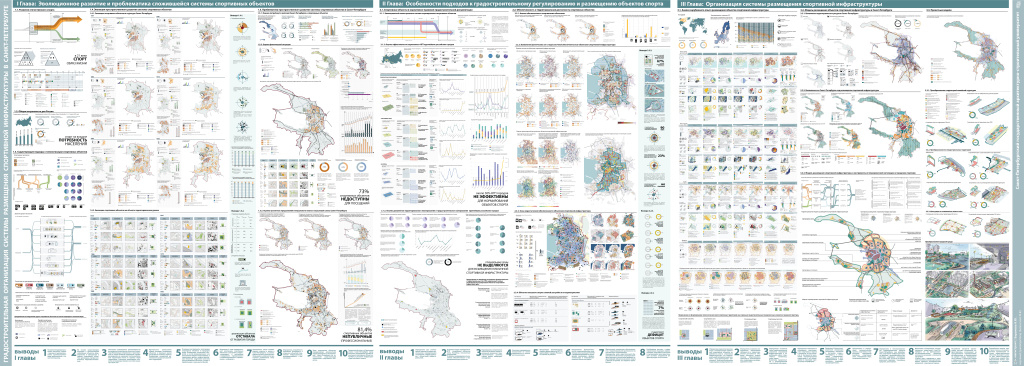
    In the nomination “Urban development of territories. Master’s degree” the Grand Prix was won by Anna Baranova with the topic “Urban development organization of the system of placement of sports infrastructure in St. Petersburg” (supervised by Mikhail Vilensky). In the nomination “Urban development of territories. Bachelor’s degree” the Grand Prix was won by Maxim Kolosov with the work “Refunctionalization of the territory of the Kirov plant in St. Petersburg” (supervised by Mikhail Vilensky, Ksenia Veretennikova, Elena Karpenko).

    Project by Maxim Kolosov. Open full size image

    The graduates’ supervisors and teachers of the Department of Urban Planning were also awarded laureate diplomas: Head of the Department Yulia Yankovskaya, Associate Professors Ksenia Veretennikova, Mikhail Vilensky, Oksana Peslyak, Assistant Elena Karpenko.

    “It was not easy to choose a direction for the research, but I settled on the topic of sports, since it is an integral part of people’s lives, regardless of whether we are talking about regular sports activities or recreational shooting at a shooting range on a weekend. Today, mass sports are not only leisure, but also a way of life for many city dwellers; it has a direct impact on the general condition of a person, as well as the urban environment in which sports facilities are located. Therefore, the issue of providing the population with the necessary quantity and quality of sports infrastructure for mass sports is very relevant, and its placement and regulation in the city is a problem that requires attention,” said Anna Baranova.

    Project by Anna Baranova. Open full size image

    According to the author of the project, the study of the evolution in the regulation of sports facilities and the assessment of modern urban planning standards for a number of major cities showed that the shortage of sports infrastructure facilities is largely due to the loss of the binding of the regulation system to territorial planning and urban zoning documents. As a possible solution, Anna proposed a territorial model of placement and a model of regulation of sports infrastructure based on the placement and regulation of sports areas.

    “Work on the study was constantly accompanied by curiosity, which was “ignited” by newly discovered facts or random observations of people playing sports in various places in St. Petersburg. My curiosity in this topic has not exhausted itself, so I intend to continue the study,” shared Anna Baranova.

    Please note: This information is raw content directly from the source of the information. It is exactly what the source states and does not reflect the position of MIL-OSI or its clients.

    Please note; This information is raw content directly from the information source. It is accurate to what the source is stating and does not reflect the position of MIL-OSI or its clients.

    https://vvv.spbgasu.ru/nevs-and-events/nevs/graduates-spbgasu-winners-of-the-international-competition-archgeneration-2024/

    MIL OSI Russia News

  • MIL-OSI Russia: Rosneft opened comfortable filling stations on the tourist route of the North-West region

    MILES AXLE Translation. Region: Russian Federation –

    Source: Rosneft – Rosneft – An important disclaimer is at the bottom of this article.

    The RN-North-West company, which manages the Rosneft retail network in five northwestern regions of the country, opened two new-format Zerno filling stations after reconstruction. The filling stations on the federal highway R-21 Kola with spacious parking lots have become significant road infrastructure facilities for travelers. The parking area will comfortably accommodate not only several tourist buses, but also campers, which makes the complexes an attractive stopping place for auto tourists.

    Rosneft actively supports initiatives to expand domestic automobile tourism and aims to create comfortable conditions for travelers. Developing roadside service and improving the level of customer service provided at Rosneft filling stations is one of the Company’s priority areas of activity.

    The new complexes are located on the popular automobile tourist route from St. Petersburg to Karelia. Recently, the Company, together with the Information Tourist Center of the Republic, launched the project “Autoroutes of Karelia”.

    The new petrol stations on the Kola highway are comfortable, created using modern technologies and equipment. The 24-hour cafes have coffee complexes, which have expanded the range of hot drinks to 40 types. Customers can independently select options on the order tablet – add alternative milk, sugar or syrup with different flavors, for example, macadamia or mango. The cafe’s offer also includes fresh pastries, hot dogs, sandwiches and desserts. The sales areas of the petrol stations offer more than a thousand products for the road. Customers have access to digital services for remote refueling of the car, and the loyalty program “Family Team” is in effect.

    The territory and the main premises of the filling complexes are divided into functional zones, which increases the speed and level of customer service. The premises also have a barrier-free environment for people with disabilities. The complexes meet all environmental and industrial safety requirements.

    The capabilities of the new gas stations have made it possible to create conditions for the most comfortable long-distance trips. Rosneft is implementing a large-scale program to update retail stations, which is aimed at increasing the comfort of travelers, expanding and improving the offers in the cafes under the Zerno brand. During this year, eight gas stations were updated in the Northwestern Federal District and the work will continue.

    Reference:

    The retail network of NK Rosneft is the largest in the Russian Federation in terms of geographic coverage and number of stations. It covers 61 regions of Russia. The Company’s network of petrol stations includes about 3,000 stations. The Rosneft petrol station brand is one of the leaders in Russia in terms of recognition and fuel quality.

    Earlier, Rosneft signed memorandums of cooperation in the development of domestic tourism with the Moscow Tourism Committee, the Krasnoyarsk, Stavropol and Altai Territories, the Republic of Bashkortostan and the Udmurt Republic, as well as the Arkhangelsk, Samara, Voronezh and Ulyanovsk Regions.

    RN-Severo-Zapad LLC is a sales enterprise of Rosneft Oil Company in the fuel market of St. Petersburg, Leningrad, Novgorod, Pskov and Arkhangelsk regions, with a network of petrol stations/gas stations, oil depots and a fleet of petrol tankers.

    Department of Information and Advertising of PJSC NK Rosneft October 10, 2024

    Please note: This information is raw content directly from the source of the information. It is exactly what the source states and does not reflect the position of MIL-OSI or its clients.

    Please note; This information is raw content directly from the information source. It is accurate to what the source is stating and does not reflect the position of MIL-OSI or its clients.

    http://vvv.rosneft.ru/press/nevs/item/220853/

    MIL OSI Russia News

  • MIL-OSI Russia: About two thousand engineering structures will be washed in the capital by winter

    MILES AXLE Translation. Region: Russian Federation –

    Source: Moscow Government – Government of Moscow –

    Specialists from the city’s municipal services complex will wash engineering structures during preparation for winter. This was reported by the Deputy Mayor of Moscow for Housing and Public Utilities and Improvement Petr Biryukov.

    “Before the onset of stable negative air temperatures, we will carry out large-scale work to flush engineering structures. In total, we will put in order about two thousand objects – bridges, tunnels, underground and overground pedestrian crossings, embankments, piers, fountains and monuments,” noted Pyotr Biryukov.

    Specialists will clean and wash structural elements, concrete, metal and glass surfaces, railings and stairways.

    Each structure is washed using a special technology with neutral solutions that do not damage the surface. Particular attention is paid to small parts of monuments and fountains, which are cleaned manually. Alkaline solutions are used to wash tunnels and bridges.

    The head of the city services complex emphasized that about two thousand workers and over 250 units of equipment (including aerial platforms, watering and tunnel washing machines) will be involved in the work.

    Please note: This information is raw content directly from the source of the information. It is exactly what the source states and does not reflect the position of MIL-OSI or its clients.

    Please note; This information is raw content directly from the information source. It is accurate to what the source is stating and does not reflect the position of MIL-OSI or its clients.

    https://vvv.mos.ru/nevs/item/145076073/

    MIL OSI Russia News

  • MIL-OSI Russia: Marat Khusnullin: Since the beginning of the year, 33 road facilities have been built and reconstructed thanks to the national project “Safe High-Quality Roads”

    MILES AXLE Translation. Region: Russian Federation –

    Source: Government of the Russian Federation – An important disclaimer is at the bottom of this article.

    Previous news Next news

    Section of the new street 280th Anniversary of Barnaul, Barnaul, Altai Krai

    As part of the national project “Safe High-Quality Roads”, road sections and artificial structures are being built in Russian regions. This year, work is planned to be completed on 221 road construction and reconstruction sites. Some have already opened for traffic, and some sites are at a high level of readiness. 33 sites have been put into operation, Deputy Prime Minister Marat Khusnullin reported.

    “For the sixth year in a row, the national project “Safe High-Quality Roads” helps not only to bring existing roads into compliance – repair them, but also to build new ones, as well as to modernize major highways, city bypasses, interchanges, bridges and overpasses. Thanks to this, the transport and logistics infrastructure of our country is developing: convenient routes are being laid, the road network is becoming more modern, which has a positive effect on the sustainable development of the regional economy. This year, it is planned to complete construction and reconstruction work on 221 objects on the regional and local road network. Many are in the final stage of readiness, and some have already opened for traffic. Since the beginning of the year, 33 objects have been put into operation,” said Marat Khusnullin.

    Transport Minister Roman Starovoit noted that the main goal of the national project “Safe High-Quality Roads” is to improve the quality of life of Russians. The construction of new and reconstruction of existing road facilities contributes to achieving this goal. “New road sections help relieve high-traffic highways. Thanks to new bypasses of populated areas, transit transport is removed from them, the noise level in the populated area itself is reduced, the environment is improved, road safety is increased, and the carrier does not lose time on the road. In general, by the end of this year, it is planned to put into operation almost 380 km – these are construction and reconstruction sections on the regional and local network,” said Roman Starovoit.

    The implementation of large-scale projects for the development of the road network of Russian regions is carried out thanks to federal support.

    “The changes that have taken place in the road sector over the past few years are hard to miss. Thanks to the support of the President of the country Vladimir Vladimirovich Putin and the Government of the Russian Federation, we are gradually managing to solve problems that have not been solved for decades. And the professionalism of our road workers and bridge builders, competent work on organizing the production process and uninterrupted financing allow us to complete large-scale projects ahead of schedule. In 2024, 47.8 billion rubles have been allocated for the implementation of major road projects, of which 13.2 billion rubles are federal budget funds. We all understand how people in the regions are waiting for new and renovated roads, and we strive to ensure that the work is completed not only on time, but also with high quality,” emphasized Deputy Head of Rosavtodor Igor Kostyuchenko.

    Thus, in the capital of the Altai Territory, the construction of the 280th Anniversary of Barnaul Street has been completed on the section from 65 Let Pobedy Street to Popova Street. The length of the facility is 0.5 km. The new section of the street and road network is located in a densely populated area of Barnaul. Construction and installation work began in the spring and was completed ahead of schedule. Now car traffic from 65 Let Pobedy Street to Popova Street is open.

    In the Yemelyanovsky district of the Krasnoyarsk region, the second stage of the reconstruction of the Krasnoyarsk-Elita highway has been completed. The work took place on the section from 0.5 to 3.5 km in the area of the intersection with the Minino-Bugachevo direction.

    In the Sovietsky District of Volgograd, traffic has opened on a new overpass located at the intersection of the Novy Rogachik – Volgograd highway and the Gornopolyansky – Kanalnaya railway section. Work on the site was completed two months ahead of schedule. The length of the overpass junction is more than 1.2 km.

    In Leningrad Oblast, traffic has been launched on the reconstructed section of Koltushi Highway within the boundaries of Yanino. Koltushi Highway connects a significant part of the Vsevolozhsk District with St. Petersburg. The road is used by residents of Vsevolozhsk, Koltushi and Yanino. Because of this, the traffic intensity here exceeds 20 thousand cars per day. The expansion to four lanes will remove the “bottleneck” on the border with St. Petersburg.

    Please note: This information is raw content directly from the source of the information. It is exactly what the source states and does not reflect the position of MIL-OSI or its clients.

    Please note; This information is raw content directly from the information source. It is accurate to what the source is stating and does not reflect the position of MIL-OSI or its clients.

    http://government.ru/nevs/52955/

    MIL OSI Russia News

  • MIL-OSI Russia: Construction of a road to an educational complex in Troitsk is nearing completion

    MILES AXLE Translation. Region: Russian Federation –

    Source: Moscow Government – Government of Moscow –

    In Troitsk, the construction of an access road to a comprehensive school and kindergarten, which were built in microdistrict B using city budget funds, is nearing completion. This was reported by the Deputy Mayor of Moscow for Urban Development Policy and Construction Vladimir Efimov.

    “The access road to educational facilities in the V microdistrict of Troitsk runs from Polkovnika Militsii Kurochkina Street to Oktyabrsky Prospekt. Its length is 1.3 kilometers. Three underground pedestrian crossings will also be installed as part of the project. They will connect educational institutions with residential areas and public transport stops, ensuring safety and comfort. The facility is planned to be completed by the end of the year,” said Vladimir Efimov.

    Two pedestrian crossings are being built by tunneling into the road embankment. Their lengths are 27 and 28 meters. The third crossing is 40 meters long. Elevators and ramps for people with limited mobility will be installed there.

    All crossings are equipped with lighting with automatic control systems. The 40-meter crossing is equipped with ventilation, heating, electric automatic snow removal systems, and fire alarms. Staircases and tunnels are lined with frost-resistant heat-treated granite tiles. A protective anti-vandal coating is applied to the walls.

    “Finishing works and installation of communications are currently underway. Installation of equipment has begun, as well as commissioning work,” said the head of the Department for the Development of New Territories of the City of Moscow

    Vladimir Zhidkin.

    The giant school, built in microdistrict B in Troitsk, is designed for 2.1 thousand students, the kindergarten – for 350 pupils. Nearby there is a surface parking lot for 66 cars.

    On the instructions of Sergei Sobyanin, close attention is being paid to the quality of work on road infrastructure facilities in the capital.

    The progress of construction of each such facility is regularly checked by inspectors. Committee for State Construction Supervision of the City of Moscow (Mosgosstroynadzor). As part of the control and supervision activities, a comprehensive study of the road surface is carried out, including assessing the class of concrete by compressive strength, the coefficient of water saturation of asphalt concrete, measuring the thickness and number of layers of road surface, the chairman of Mosgosstroynadzor specified Anton Slobodchikov.

    Since 2012, more than 400 kilometers of roads have been built in the territory of TiNAO. The total length of roads in the districts has increased by one and a half times since their annexation to the capital. Today it is about a thousand kilometers. According to the Address Investment Program of the City of Moscow, by the end of 2026 it is planned to build about 100 kilometers of roads here.

    Please note: This information is raw content directly from the source of the information. It is exactly what the source states and does not reflect the position of MIL-OSI or its clients.

    Please note; This information is raw content directly from the information source. It is accurate to what the source is stating and does not reflect the position of MIL-OSI or its clients.

    https://vvv.mos.ru/nevs/item/145055073/

    MIL OSI Russia News

  • MIL-OSI Russia: IMF Reaches Staff Level Agreement on the Third Review of the EFF/ECF Arrangements and Second Review of the RSF Arrangement and Concludes the 2024 Article IV Consultation with Cote d’Ivoire

    Source: IMF – News in Russian

    October 10, 2024

    End-of-Mission press releases include statements of IMF staff teams that convey preliminary findings after a visit to a country. The views expressed in this statement are those of the IMF staff and do not necessarily represent the views of the IMF’s Executive Board. Based on the preliminary findings of this mission, staff will prepare a report that, subject to management approval, will be presented to the IMF’s Executive Board for discussion and decision.

    • IMF staff and The Ivorian authorities have reached a staff-level agreement on both the third review of Côte d’Ivoire’s economic reform program supported by the EFF and ECF arrangements, and the second review of their climate change reform program supported by the RSF arrangement. Discussions were also held in the context of the 2024 Article IV consultation.
    • The authorities are advancing their reform agendas for safeguarding macroeconomic stability, deepening economic transformation towards meeting upper-middle income status, and building greater climate resilience through adaptation and mitigation reforms. In addition, to boost inclusive growth, they are advancing reforms in reducing informality and social inequality and tackling gender disparities.
    • Completion of the reviews by the IMF Executive Board will lead to two disbursements for a total of about US$825 million of which US$498 million and US$327 million will respectively be on account of the EFF/ECF and RSF arrangements.

    Abidjan, Côte d’Ivoire: An International Monetary Fund (IMF) staff team, led by Mr. Olaf Unteroberdoerster, held discussions with the Ivoirian authorities during Sept. 23 – Oct 9 on progress under both the authorities’ economic and financial program supported by the Extended Fund Facility (EFF) and Extended Credit Facility (ECF), and the climate reform program supported by the Resilience and Sustainability Facility (RSF), as well as on the 2024 Article IV consultation. The EFF/ECF arrangement for an amount of SDR 2.6 billion (about US$3.5 billion) and the RSF arrangement for an amount of SDR 975.6 million (about US$1.3 billion) were approved by the IMF Executive Board respectively on May 24, 2023, and March 15, 2024.

    “After constructive discussions with the Ivoirian authorities, I am pleased to announce that performance under the two programs has been satisfactory so far and that we reached staff-level agreement on all policies and reform measures in line with the programs’ objectives. On the EFF/ECF arrangement, the authorities and staff agreed on additional revenue measures to meet 2024 fiscal targets, on the 2025 key policy measures including further revenue-based fiscal consolidation to reduce the fiscal deficit to 3 percent of GDP by 2025, and on structural measures to further strengthen domestic revenue mobilization, public financial management, and governance.

    “On the RSF, understandings were reached on the timely implementation of reform measures falling due in the remainder of 2024, focusing on strengthening climate policies governance , reducing greenhouse gas emissions, and increasing green and sustainable financing for private and public companies. Discussions also focused on the coordination between stakeholders and national development plans, and the next steps following the Climate Financing Round table of July 2024 with a view to announcing specific financing and technical assistance pledged at the COP29 in mid-November 2024.

    “The completion of the programs’ reviews and disbursement of the next tranches for a total of about US$[825] million will be subject to approval of the IMF’s Executive Board.

    “Côte d’Ivoire’s economy remains resilient, notwithstanding a slight moderation of growth in 2024 to 6.1 percent from 6.2 percent in 2023, in part reflecting weaker agricultural production and construction activity in first half of the year and a challenging regional and external environment. More favorable terms of trade, led by higher cocoa prices, is expected to narrow the current account deficit to less than 5 percent of GDP in 2024. The budget deficit is expected to fall to 4 percent of GDP in line with program targets. The medium-term outlook remains favorable. Growth is projected to average 6.7 percent over the period 2025-2029 supported by a recovery in cocoa production and higher hydrocarbon and mining production. Inflation is projected to average 4 percent in 2024 and continue to decline over the medium term within the BCEAO target range by end 2025.

    “Thanks to continued strong domestic revenue mobilization (DRM) efforts under the government’s comprehensive medium-term revenue mobilization strategy (MTRS) adopted in May 2024, the fiscal deficit is expected to further decline to 3 percent of GDP in 2025, converging to the WAEMU target. Prudent fiscal and debt management will also help safeguard a moderate risk of debt distress rating for public and external sector debt. The current account deficit is projected to decline further to average about 2 percent of GDP on the back of favorable terms of trade, a rebound in agricultural exports, and further increases in hydrocarbon exports. As a result, Côte d’Ivoire is expected to contribute significantly to the recovery of regional official reserves.

    “In the 2024 Article IV consultation, discussions highlighted the links between informality, socio-economic and gender disparities, growth, and the tax system. Reducing informality across the economy could help deliver higher and more inclusive growth, support poverty reduction, boost human capital, sustain domestic revenue mobilization, and steadfast efforts to reach upper-middle income status.”

    The IMF team met with His Excellency Mr. Tiémoko Meyliet Koné, Vice President of the Republic; His Excellency Robert Beugré Mambé, Prime Minister; Mr. Kobenan Kouassi Adjoumani, Minister of State, Minister of Agriculture, Rural Development and Food Production; Mrs. Nialé Kaba, Minister of Economy, Planning and Development; Mr. Adama Coulibaly, Minister of Finance and Budget; Mr. Sangafowa Coulibaly, Minister of Mines, Petroleum and Energy; Mr. Souleymane Diarrassouba, Minister of Trade and Industry; Mr. Moussa Sanogo, Minister of Assets, the State Portfolio and Public Enterprises, and senior officials of the Government and the BCEAO, as well as representatives of the business community and donors.

    IMF Communications Department
    MEDIA RELATIONS

    PRESS OFFICER: Tatiana Mossot

    Phone: +1 202 623-7100Email: MEDIA@IMF.org

    @IMFSpokesperson

    https://www.imf.org/en/News/Articles/2024/10/10/pr24364-cote-divoire-imf-reaches-sla-3rd-rev-eff-ecf-arr-2nd-rev-rsf-arr-concludes-2024-aiv-consult

    MIL OSI

    MIL OSI Russia News

  • MIL-OSI Russia: Transformer bench and therapy dogs: results of Accessibility Week at SPbGASU

    MILES AXLE Translation. Region: Russian Federation –

    Source: Saint Petersburg State University of Architecture and Civil Engineering – Saint Petersburg State University of Architecture and Civil Engineering – Sergey Chisty

    From September 30 to October 4, SPbGASU hosted Accessibility Week. The program included lectures by experts and other events aimed at developing students’ professional competencies.

    Sergey Chisty, Chairman of the Board of the Charitable Foundation “City for All”, gave a lecture on October 1, “Reasonable adaptation as a tool for designing a barrier-free environment”. According to Sergey Vladimirovich, regulatory documentation is constantly “catching up” with life. There are more and more codes of rules, which slows down business and creativity. Therefore, there is now a transition from directive regulation to more effective parametric regulation.

    The lecture by Sergey Sokhranskiy, editor-in-chief of the magazine “Accessible Environment” and a member of the author’s teams for the development of a number of codes of practice, took place on October 2 and began with a short interactive session. As he was climbing the podium, Sergey Serafimovich tripped over a ledge in the floor and exclaimed: “This is also a barrier!” In this way, he clearly demonstrated that the issues of creating a barrier-free environment concern everyone and are relevant in all spheres of life. During the lecture, Sergey Sokhranskiy drew the attention of the audience to the problems that arise in the course of developing regulatory documents for the creation of a barrier-free environment.

    Kirill Morozov, head of the KMK Landscape Workshop, discussed with students on October 3 what means can be used to achieve barrier-free and convenient conditions for everyone. In particular, what width should doorways and open openings in the wall of a building be, how parking lots should be arranged, what tactile surfaces exist, etc. Dmitry Potaralov, head of a personal architectural workshop, shared information about his projects, including those related to solving inclusive problems, during a lecture on October 4.

    The final event of the week was a discussion of the projects of SPbGASU student teams, which were presented at the All-Russian competition of student works in the field of universal design and design of barrier-free urban environments for people with limited mobility. The final of the competition was held in Moscow on May 15–17.

    As Oleg Fedorov, leading specialist of the Educational Center for Project-Based Learning at SPbGASU, explained, our university planned to send eight projects to the competition. However, the organizers limited the number of works from one university. The university competition committee selected four projects, and three works made it to the final. All of them won awards, including the Grand Prix.

    “We decided to hold this informal meeting so that all the guys could get feedback. Including those who did not get into the competition and did not make it to the finals. The second reason was the desire to introduce other students to these wonderful competition projects,” said Oleg Fyodorov.

    The contestants focused on the urban environment of Azov in the Rostov Region. They had to create four tablets: the first was dedicated to the conceptual development of the city, the second presented the results of a comprehensive analysis of one of its sections, the third was to formulate proposals for the improvement of the selected section, and the fourth was to consider a separate building, proposing a reconstruction option for an existing facility or new construction.

    The team consisting of Sofia Malysheva (captain), Maxim Shemetillo, Dmitry Erofeev, Daniil Medvedev and Yulia Makhneva failed to take part in the competition. However, the students developed solutions worthy of prizes. Among them are an inclusive playground and a pavilion for canister therapy (a type of therapy with animals, when specially selected and trained dogs are used for rehabilitation and treatment). The students emphasized that the equipment they chose was from catalogs, it can be easily ordered and purchased. The team was led by Oleg Fyodorov and Elena Bobrova, senior lecturer of the Department of Urban Development.

    The multifunctional bench designed by the LINKK team consisting of Inga Khafizova (captain), Elizaveta Abdullina, Anastasia Fedorova, Ksenia Saifullina and Kristina Nosovaya cannot be found in any catalog yet. This bench can be made with armrests, with a backrest or without a backrest. It has built-in trash containers, it can be placed both in the center and along the road. It can be used for flowerbed arrangement classes. And it has an unlimited length.

    According to the competition committee of our university, the LINKK team did not make it to the final only because the students did not limit themselves and complicated the task by choosing several areas at once. And all these areas were developed in detail. The team’s work was supervised by Oleg Fedorov, Alexey Perov, senior lecturer of the Department of Architectural Environment Design, and Alesya Boyko, assistant of this department.

    The team consisting of Daria Krasnova (captain), Arina Bezzubenkova, Anastasia Glukhova, Polina Fait and Ekaterina Kholshchigina, under the leadership of Oleg Fedorov, spoke about their competition project at the meeting. The competitors focused on the area next to the city hospital and proposed adding landscaping, new driveways, parking spaces and pedestrian paths.

    The winners of the competition also presented their projects: the Delta team, which included Varvara Dericheva (captain), Alina Lagkueva, Angelina Savitskaya and Mikhail Rakhimov, and the Faces of the City team, consisting of captain Alisa Mikhailova, Sofia Nikolaeva and Vladislava Savelyeva.

    More about the laureates’ works

    Please note: This information is raw content directly from the source of the information. It is exactly what the source states and does not reflect the position of MIL-OSI or its clients.

    Please note; This information is raw content directly from the information source. It is accurate to what the source is stating and does not reflect the position of MIL-OSI or its clients.

    http://www.spbgasu.ru/nevs-and-events/nevs/bench-transformer-and-therapy-dogs-results-of-the-week-of-barrier-free-environment-in-spbgasu/

    MIL OSI Russia News

  • MIL-OSI Russia: Polytechnic University Rector Andrey Rudskoy spoke at the St. Petersburg International Gas Forum

    MILES AXLE Translation. Region: Russian Federation –

    Source: Peter the Great St Petersburg Polytechnic University – Peter the Great St Petersburg Polytechnic University –

    On the third day of the St. Petersburg International Gas Forum, a meeting of the Scientific and Educational Interuniversity Council of PJSC Gazprom was held with the participation of the heads of the corporation and its partner universities. The Polytechnic University was represented by the Rector of SPbPU, Chairman of the St. Petersburg Branch of the Russian Academy of Sciences Andrey Rudskoy, Vice-Rector for Research Yury Fomin, Vice-Rector for Educational Activities Lyudmila Pankova, Vice-Rector for Continuing and Pre-University Education Dmitry Tikhonov, Director of the Scientific and Educational Center for Information Technology and Business Analysis of Gazprom Neft Irina Rudskaya, and Scientific Secretary Dmitry Karpov.

    Opening the discussion, Deputy Chairman of the Management Committee of PJSC Gazprom Sergey Khomyakov named the main areas of joint activities with universities: education of the younger generation, professional orientation and training, training of qualified personnel and scientific research work.

    At the meeting, the rector of SPbPU, chairman of the St. Petersburg branch of the Russian Academy of Sciences Andrey Rudskoy made a report. He recalled that in 2024, important legislative regulations were signed at the federal level regulating strategic guidelines, national goals and priority areas of scientific and technological development of Russia, and noted that almost every such document speaks of close interaction between the university and academic communities with industrial partners.

    The cooperation between Polytechnic University and Gazprom is developing in many areas — from educational (starting with work with schoolchildren) to scientific and technological. Of the significant results, Andrey Rudskoy highlighted several joint events this year: the Gazprom student Olympiad, a job fair and a tournament on flexible skills; modernization of the laboratory and educational base through financing from PJSC Gazprom.

    In the scientific and technological sphere, the rector of the Polytechnic University noted the rapid development of the field of additive printing with metals at the university and the production of high-quality products for Gazprom using this method, the development of fundamentally new technological solutions for laser cladding, heat treatment, defect detection methods, the assembly of a mobile laser cladding complex by specialists from the Institute of Mechanical Engineering, Materials and Transport, and projects of the Advanced Engineering School “Digital Engineering” in the areas of the fuel and energy complex.

    In conclusion, Andrey Rudskoy made several proposals to strengthen cooperation between Polytechnic University and Gazprom.

    “Undoubtedly, the existing forms of interaction between the Polytechnic University and PJSC Gazprom are effective, but they need to be expanded and scaled up,” the Rector of SPbPU believes. “One of the forms of integrating science and production could be the creation of research and production associations (RPAs), whose participants could be universities and high-tech industrial companies. In the USSR, RPAs demonstrated high efficiency in consolidating the resources of scientific and industrial organizations. Modern RPAs will be able to receive federal support. Following his trip to the Sverdlovsk and Chelyabinsk regions, the President of Russia instructed the Ministry of Science and Higher Education, as well as the Ministry of Industry and Trade of the Russian Federation to develop mechanisms to support RPAs. In the near future, it is planned to launch a federal pilot project to create RPAs, and the Polytechnic University is ready to join this experiment. We invite you to join the joint work to create RPAs for the further development of cooperation for the benefit of science and industry in our country.”

    Andrey Rudskoy also proposed creating an association of Gazprom’s flagship universities and establishing a joint journal.

    It is important that the advanced experience and knowledge that have accumulated over all this time in our flagship universities are recorded and made publicly available, Andrey Rudskoy emphasized. He asked Alexey Miller to become the editor-in-chief of the journal.

    Russian Energy Minister Sergey Tsivilev and Chairman of the Management Committee of PAO Gazprom Alexey Miller took time out of their schedule to attend the meeting of the Interuniversity Council and thank its participants for their cooperation.

    “Today, at this forum, higher education has the opportunity to see with its own eyes the results of our common work,” Alexey Miller addressed the audience. “The first forum took place eight years ago, we set priorities, and now every year we see fundamentally new technological developments, new equipment, at the stands, above the world level.”

    At the council meeting, speaking about the interaction of the Polytechnic University and Gazprom in the field of higher education, Andrey Rudskoy cited as an example two educational systems developed this year based on VR technologies. One of them was presented at the SPbPU stand and aroused genuine interest among the forum guests, especially among young people. One of the teenagers who visited the stand even thought: Maybe I should go to the Polytechnic University?

    The “Maintenance and Repair of Piston Compressor and Auxiliary Equipment for Underground Gas Storage Systems” complex is a virtual model of the real Nevskaya station and is designed to study the main actions during maintenance and operation of compressor equipment used at underground gas storage facilities. This virtual training complex is a joint effort of two departments of the Polytechnic University. The compressor engineering sector of the Higher School of Power Engineering of the Institute of Power Engineering is responsible for the technical side and implementation in the educational process, and the software implementation is performed by the Laboratory of Streaming Data Processing.

    “To train students in compressor and related specialties, practical classes at compressor stations are necessary. But it is difficult to get to these facilities, or students cannot do anything with their hands. Our joint work consists of preparing a scenario and technical actions, and programmers create a virtual gas-pumping unit with all the necessary control elements, on which students can practice the necessary actions according to the scenarios of the actions of a gas-pumping unit operator and a shift engineer,” said Vasily Semenovsky, associate professor at the Higher School of Power Engineering. “The simulator has been introduced into the educational process of bachelors and masters, and if necessary, we also work with this virtual model in additional education courses.

    According to Vasily Semenovsky, another virtual model is 90 percent ready: an automatic gas-filling compressor station for refueling passenger and freight vehicles with methane.

    This year, Polytechnic University and the St. Petersburg Branch of the Russian Academy of Sciences presented a joint stand at the St. Petersburg International Gas Forum. Among the developments of the RAS institutes: Voron and Strizh unmanned aerial vehicles of the St. Petersburg Federal Research Center (FRC RAS), the small-sized quadrupole mass spectrometer MS7-200 for analyzing the composition of gas mixtures at atmospheric pressure of the Institute of Analytical Instrumentation of the Russian Academy of Sciences, etc.

    The Voron model is a multi-base UAV for solving a wide range of tasks. The most popular applications are: real-time aerial monitoring, signal retransmission, delivery of small-sized cargo, terrain mapping, search and rescue operations, aerial photography and aerial video filming.

    The Strizh UAV can perform aerial monitoring in real time, deliver small-sized cargo, participate in search and rescue operations, and conduct aerial photography and aerial video filming.

    Traditionally, the SPbPU History Museum also takes part in the exhibition. This year, the museum staff introduces the guests of the stand to the Polytechnic gas plant, which produced lighting gas for laboratories. Combustible gas was obtained by dry distillation of coal at a temperature of 1000 °C.

    Every day, the institute consumed over 900 cubic meters of gas: the chemical laboratory – 425 m³, metallurgical – 283 m³, the rest – 198 m³.

    Light gas prepared at the plant was collected in a gas holder (gas storage) before entering the gas network, where it was under pressure. The gas holder was designed on the principle of a caisson – an engineering structure for forming an empty chamber under water.

    With the advent of main gas pipelines, the work of the institute’s gas plant became irrelevant. In the 1960s, a laboratory building appeared on the site of the gas plant. The gas holder was built into the building. The round projections in the laboratory building can still be seen today.

    Please note: This information is raw content directly from the source of the information. It is exactly what the source states and does not reflect the position of MIL-OSI or its clients.

    Please note; This information is raw content directly from the information source. It is accurate to what the source is stating and does not reflect the position of MIL-OSI or its clients.

    https://vvv.spbstu.ru/media/nevs/partnership/rector-polytechnic-andrei-rudskoy-spoke-at-the-St. Petersburg-international-gas-forum/

    MIL OSI Russia News

  • MIL-OSI Russia: Works by HSE graduates at Cosmoscow 2024 fair

    MILES AXLE Translation. Region: Russian Federation –

    Source: State University Higher School of Economics – State University Higher School of Economics –

    The educational program “ART VYSHKA. Contemporary Art” at the HSE School of Design was created to train artists and curators, photographers and video artists, theorists and practitioners in all areas of contemporary art. The program offers bachelor’s, master’s and postgraduate programs.

    In the bachelor’s degree program, you can choose one of the educational profiles: “Contemporary Art”, “Screen Arts”, “Sound Art and Sound Design”, “Concept Art and Digital Art”, “Event. Theater. Performance”, “Design and Contemporary Art” and “Curating and Art Management”.

    For applicants to the Master’s program who have clearly decided on the direction of their development, we offer the profiles “Practices of Contemporary Art”, “Contemporary Painting”, “Performance”, Sound Art

    Please note: This information is raw content directly from the source of the information. It is exactly what the source states and does not reflect the position of MIL-OSI or its clients.

    Please note; This information is raw content directly from the information source. It is accurate to what the source is stating and does not reflect the position of MIL-OSI or its clients.

    http://desizhn.hse.ru/nevs/4248

    MIL OSI Russia News

  • MIL-OSI Russia: Sergei Sobyanin opened the overpass — the exit from the Moscow Highway to Volgogradsky Prospekt

    MILES AXLE Translation. Region: Russian Federation –

    Source: Moscow Government – Government of Moscow –

    Sergei Sobyanin opened traffic on a new overpass – an exit from the Moscow High-Speed Diameter (MSD) to Volgogradsky Prospekt.

    It is one of the components of the city’s powerful transport framework, including metro stations, Moscow Central Diameters and roads. Without it, it is impossible to implement such large-scale projects as the creation of the new business center “Yuzhny Port – Tekstilshchiki”, the project for the creation of which was launched by the Mayor of Moscow.

    “Projects of such a scale are impossible without the development of the transport system. First, we created a powerful framework here from the MCC, BKL, MCD, TTK, MSD and Kozhukhovsky Bridge. Today we opened an important facility of this framework – an overpass-exit from the Moscow High-Speed Diameter to Volgogradsky Prospekt. In the future, we will build the Yuzhny Port metro station of the Lyublinsko-Dmitrovskaya Line. And on the bank of the Moskva River, we will make an embankment and a stop for regular river transport,” Sergei Sobyanin wrote in his

    telegram channel.

    Source: Sergei Sobyanin’s Telegram channel @mos_sobyanin 

    The construction of the 710-meter-long two-lane overpass was completed in October 2024. The artificial structure, which runs over the tracks of the Second Moscow Central Diameter and Lyublinskaya Street, was built in difficult conditions of cramped urban development.

    The new overpass provides a direct exit from the main southern route of the Moscow High-Speed Diameter onto Volgogradsky Prospekt in the direction of the Moscow Ring Road.

    As a result, motorists do not need to make a detour via Shosseynaya Street, and the excess mileage of vehicles will thus be reduced by half. Transport accessibility of the Pechatniki and Tekstilshchiki districts, where about 200 thousand people live, has been improved.

    By redistributing traffic flows, the load on adjacent sections of Volgogradsky Prospekt, Volzhsky Boulevard, Zelenodolskaya, Shosseynaya and Lyublinskaya Streets will be reduced by up to 10 percent.

    Traffic along the main route of the Moscow Ring Road was opened on September 9, 2023. Motorists can travel from the north to the east of Moscow from the Businovskaya interchange to the M-12 highway and south to the 32nd kilometer of the Moscow Ring Road.

    Every day, about 400 thousand cars travel along the Moscow High-Speed Diameter. The highway is one of the three most popular routes in the city. Thanks to the creation of the Moscow High-Speed Diameter, travel time in some directions has decreased by 25-50 percent. Sections of the Garden Ring, the Third Transport Ring, and the Moscow Ring Road have been relieved by up to 15 percent.

    In the coming years, it is planned to complete the construction of two road facilities that will increase the efficiency of the Moscow Highway. There will be connections with the Solntsevo-Butovo-Varshavskoye Shosse route. In addition, the Moscow Highway will be straightened – the road from Kantemirovskaya Street to the Paveletsky direction of the Moscow Railway will be shortened.

    Please note: This information is raw content directly from the source of the information. It is exactly what the source states and does not reflect the position of MIL-OSI or its clients.

    Please note; This information is raw content directly from the information source. It is accurate to what the source is stating and does not reflect the position of MIL-OSI or its clients.

    https://vvv.mos.ru/major/themes/11878050/

    MIL OSI Russia News

  • MIL-OSI Russia: Sobyanin: Moscow is implementing the world’s largest project to reorganize a former industrial zone

    MILES AXLE Translation. Region: Russian Federation –

    Source: Moscow Government – Government of Moscow –

    Sergei Sobyanin launched the project to create a new business center, Yuzhny Port – Tekstilshchiki. It will appear on the site of a former industrial zone, where 18.8 million square meters of real estate will be built.

    “Moscow continues to develop actively, and one of the main support points for development is old industrial areas, which amount to thousands of hectares. Based on architectural and urban planning analysis, about six such main development points were selected, which are, in fact, new centers of Moscow. One of them is Pechatniki. The main attention was paid to the fact that here, in addition to a huge number of abandoned industrial zones, there is a powerful development of the transport framework. The Big Circle Line, the Moscow Central Circle, the Moscow High-Speed Diameter passed nearby, new metro stations and railway stations were built. As a result, one of the largest transport hubs was created here. Based on the analysis of the development of this territory, which was done, a concept was adopted to create, perhaps, the largest industrial zone reorganization project in the world – 18 million square meters. Of these, nine million are business construction, new high-tech enterprises, offices, technology parks, and the second half is complex housing construction, starting from Volgogradsky Prospekt and ending with the Moscow River,” the Mayor of Moscow noted.

    According to Sergei Sobyanin, one of these main clusters is the special economic zone (SEZ) of Moscow, where enterprises with a total area of half a million square meters have been built. In the coming years, another 700 thousand square meters of industrial buildings will be erected there.

    “Yuzhny Port – Tekstilshchiki is one of six new centers of business and public activity that we are creating within the Moscow Ring Road. It will become a place for the concentration of high-tech companies and the development of the automotive industry,” Sergei Sobyanin wrote in his

    telegram channel.

    Source: Sergei Sobyanin’s Telegram channel @mos_sobyanin

    New centers of economic activity

    The key priority of Moscow’s urban development policy has become the formation of new centers of economic activity. This allows for a reduction in excessive pendulum migration, the creation of additional jobs and attractive places for recreation outside the historical center.

    For the construction of centers, industrial zones located in close proximity to major transport hubs are actively used: intersections of metro lines, the Moscow Central Circle (MCC) and the Moscow Central Diameters (MCD).

    At present, six promising centers located within the Moscow Ring Road can be identified. These are Likhobory – Okruzhnaya, Khoroshevskaya – Shelepikha, Ochakovo – Ryabinovaya, Varshavskaya – Biryulevo, Aviamotornaya – Nizhegorodskaya, Yuzhny Port – Tekstilshchiki.

    In particular, the Likhobory-Okruzhnaya center could become a cluster of technological development, Yuzhny Port-Tekstilshchiki could become a place of concentration of high-tech companies and development of the automotive industry, and Ochakovo-Ryabinovaya could become a logistics center.

    Business activity centers will be formed in Zelenograd (special economic zone sites) and in TiNAO (Kommunarka, Moskino cinema park, Shcherbinka, Salaryevo and others).

    According to preliminary estimates, in the next 15 years (until 2040), at least 60 million square meters of industrial, public, business and other non-residential real estate will be built on the territory of new centers of economic activity, and almost 1.3 million new jobs will be created.

    “Yuzhny Port – Tekstilshchiki”

    The new economic activity center “Yuzhny Port – Tekstilshchiki” will appear on the basis of the reorganized industrial zone “Yuzhny Port”, which occupies 633 hectares (35 percent) of the Pechatniki district. The natural continuation of the business center will be the production site “Pechatniki” of the special economic zone “Technopolis Moscow”.

    In total, it is planned to construct 18.8 million square meters of public, business, industrial and residential buildings on this territory.

    Large-scale development of the territory “Yuzhny Port – Tekstilshchiki” became possible thanks to the creation of a powerful transport framework, which included the Dubrovka and Ugreshskaya stations of the Moscow Central Circle, Pechatniki of the Big Circle Line of the metro and the station of the same name of the Second Moscow Central Diameter, as well as the Third Transport Ring, the Moscow High-Speed Diameter and the Kozhukhovsky Bridge across the Moskva River, connecting Pechatniki with the Nagatinsky Zaton district.

    In the future, it is planned to build a new station “Yuzhny Port” on the Lyublinsko-Dmitrovskaya metro line and develop the local street and road network, including the reconstruction of Yuzhnoportovaya Street, 1st and 2nd Yuzhnoportovykh Proezds, the construction of a new highway that will connect the Third Transport Ring and Lyublinskaya Street, as well as roads in the new quarters of “Yuzhny Port”.

    On the banks of the Moscow River, under the program of integrated development of territories, a marina for yachts, an embankment and a stop for river transport will be built, which will become a center of attraction for residents of not only the district, but the entire city. Along the coastline, in particular in the widest part of the water area, a pontoon pool, sports areas, an amphitheater on the water, a museum, restaurants and cafes with terraces will be located.

    Today, residential complexes of the first stage of development and the necessary social infrastructure are being built on the reorganized territory.

    Four projects for the integrated development of territories with a total area of about 115 hectares are under development, on which it is planned to build almost two million square meters of housing and about 1.6 million square meters of industrial, public, business and social facilities. Investments in the development of sites are estimated at almost 950 billion rubles. As a result, over 36 thousand jobs will appear.

    Active development of the Pechatniki site of the Technopolis Moscow SEZ continues.

    About 500 thousand square meters of real estate have been put into operation here to accommodate high-tech production in a wide range of industries. These include mechanical engineering, electric vehicle manufacturing, instrument making, machine tool manufacturing, microelectronics, aerospace, medical technology and other areas. There are 130 high-tech companies operating on the site, creating 7.5 thousand jobs.

    By 2030, it is planned to build another 680 thousand square meters of facilities at the SEZ site in Pechatniki to accommodate 70 high-tech enterprises and create 17.5 thousand new jobs. In particular, divisions of such large companies as JSC Transmashholding, JSC MAZ Moskvich, JSC Vane Hydraulic Machines, JSC Hydromash, LLC Lassard, LLC Renera, and others will open here.

    Thus, in total, about 1.2 million square meters of modern production space will be built at the Pechatniki site of the Technopolis Moscow SEZ.

    Currently, construction is underway on two of the five buildings of the modern public and business complex on Kolomnikova Street. The buildings of different heights with a total area of over 300 thousand square meters will be connected by a pedestrian and exhibition gallery with panoramic windows.

    The first building is planned to house offices and R

    The second building will house laboratory and office space for current and potential residents of the special economic zone.

    Companies will be able to begin operating in these buildings as early as 2025.

    The stylobate part of the buildings will house bank branches, shops, cafes, restaurants, public services and other infrastructure facilities. A parking lot for 370 cars will be built on the adjacent territory. Thus, the new public and business complex will become a place of attraction for residents of Pechatniki and neighboring areas.

    Construction of the remaining three buildings on Kolomnikova Street is planned to begin in the coming years.

    Please note: This information is raw content directly from the source of the information. It is exactly what the source states and does not reflect the position of MIL-OSI or its clients.

    Please note; This information is raw content directly from the information source. It is accurate to what the source is stating and does not reflect the position of MIL-OSI or its clients.

    https://vvv.mos.ru/major/themes/11879050/
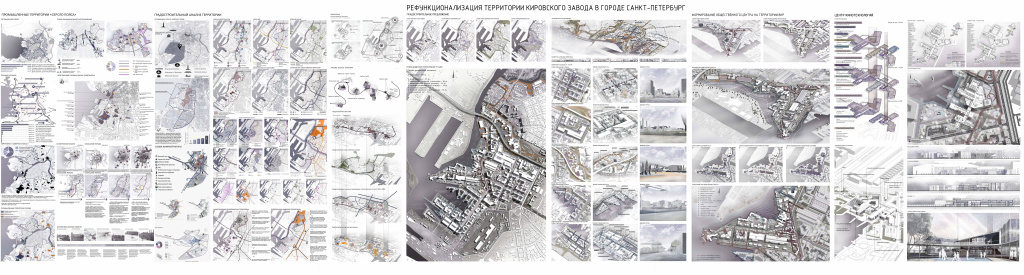
    MIL OSI Russia News

  • MIL-OSI Russia: Moscow Fashion Week was visited by 65 thousand people

    MILES AXLE Translation. Region: Russian Federation –

    Source: Moscow Government – Government of Moscow –

    The third Moscow Fashion Week has ended in the capital. It was held from October 4 to 9 in the Central Exhibition Hall “Manezh”. Collections were presented by about 200 designers from 41 cities of Russia, as well as seven other countries. Among them are China, the United Arab Emirates, Costa Rica and India. This was reported by Natalia Sergunina, Deputy Mayor of Moscow.

    “The participants were able to demonstrate their skills, find new business partners, and exchange experiences with colleagues from different parts of the world. As in previous years, the event generated great interest. Over the course of six days, the venue was visited by 65,000 people,” said Natalia Sergunina.

    During Moscow Fashion Week, 83 fashion shows took place. Many brands relied on the cultural codes and national characteristics of their native land. For example, a designer from Cheboksary presented a collection based on the national Chuvash costume. A representative of the Republic of South Africa created evening and casual looks in a bright color scheme. Some wardrobe elements were shaped like butterfly wings.

    In addition, a market was open during the fashion week. Anyone could buy clothes and accessories from 80 brands. A business showroom was opened for the professional community, with over 50 Russian specialists taking part. They held meetings with potential partners and wholesale buyers.

    Industry leaders gave 25 lectures to the event’s guests. The audience was told about trends and how they changed over time, as well as the influence of neural networks on the creation of collections. More than two million people watched the online broadcasts of the meetings with experts.

    In addition, the World Fashion Short short film festival took place. It brought together directors not only from Russia, but also from other countries, including Belarus, Colombia, Mexico and Turkey. The works selected by the international expert council were shown at the Artplay design center.

    Please note: This information is raw content directly from the source of the information. It is exactly what the source states and does not reflect the position of MIL-OSI or its clients.

    Please note; This information is raw content directly from the information source. It is accurate to what the source is stating and does not reflect the position of MIL-OSI or its clients.

    https://vvv.mos.ru/nevs/item/145082073/

    MIL OSI Russia News

  • MIL-OSI Russia: Nine-hour board game marathon to take place at SUM

    MILES AXLE Translation. Region: Russian Federation –

    Source: State University of Management – Official website of the State –

    On October 16, 2024, the State University of Management will host a board game marathon.

    The organizer of the marathon is the club “Mind Games”. It will last 9 hours! At the event you can play any game from our large collection of the club, and this is more than 30 titles.

    Date: October 16 Time: 11:00-20:00 Place: Hall of the Central Control Center

    We also invite students from other universities. To do this, you must register before October 13 (inclusive). Enter the data as in your passport, and do not forget to take it with you so that you are let through. The address, instructions and route are in the same form. It is not necessary to arrive exactly at 11:00, but it is advisable to be no later than 18:30.

    Play boldly, think strategically! See you at the marathon!

    Subscribe to the tg channel “Our State University” Announcement date: 10.10.2024

    Please note: This information is raw content directly from the source of the information. It is exactly what the source states and does not reflect the position of MIL-OSI or its clients.

    Please note; This information is raw content directly from the information source. It is accurate to what the source is stating and does not reflect the position of MIL-OSI or its clients.

    Nine-hour board game marathon to take place at SUM

    MIL OSI Russia News

  • MIL-OSI Russia: Kuwait: Staff Concluding Statement of the 2024 Article IV Mission

    Source: IMF – News in Russian

    October 10, 2024

    A Concluding Statement describes the preliminary findings of IMF staff at the end of an official staff visit (or ‘mission’), in most cases to a member country. Missions are undertaken as part of regular (usually annual) consultations under Article IV of the IMF’s Articles of Agreement, in the context of a request to use IMF resources (borrow from the IMF), as part of discussions of staff monitored programs, or as part of other staff monitoring of economic developments.

    The authorities have consented to the publication of this statement. The views expressed in this statement are those of the IMF staff and do not necessarily represent the views of the IMF’s Executive Board. Based on the preliminary findings of this mission, staff will prepare a report that, subject to management approval, will be presented to the IMF Executive Board for discussion and decision.

    Washington, DC: Kuwait has a window of opportunity to implement needed fiscal and structural reforms to boost private sector-led inclusive growth and diversify its economy away from oil:

    • Gradual fiscal consolidation of about 12 percent of GDP is needed to reinforce intergenerational equity.
    • Structural reforms should focus on improving the business environment, attracting FDI, and unifying the labor market.
    • These reforms should be underpinned by continued prudent monetary and financial sector policies.
    • Economic statistics should be strengthened to support well-informed policymaking.

    Recent Developments, Outlook, and Risks

    1. Kuwait has a window of opportunity to implement needed fiscal and structural reforms. Political turmoil has gripped Kuwait in recent years, stalling reforms. The political gridlock was broken in May 2024, when H.H. the Amir Sheikh Meshaal al‑Ahmad al‑Jaber al‑Sabah dissolved the Parliament and suspended parts of the Constitution for up to 4 years, allowing reforms to be expedited.
    2. The economic recovery was disrupted in 2023, and inflation is moderating. Real GDP contracted by 3.6 percent in 2023. This economic downturn was concentrated in the oil sector, which contracted by 4.3 percent in 2023 due to an OPEC+ oil production cut. In addition, the non-oil sector is estimated to have contracted by 1.0 percent in 2023, primarily reflecting lower manufacturing activity in oil refining. Headline CPI inflation declined to 3.6 percent in 2023 reflecting lower core and food inflation. More recently, headline inflation moderated further to 2.9 percent (y-o-y) in August 2024, given lower housing and transport inflation.
    3. The external position remained strong in 2023. The current account surplus moderated to 31.4 percent of GDP in 2023, with a 10.3 percent of GDP reduction in the trade surplus from lower oil prices and production largely offset by a 7.4 percent of GDP increase in the income surplus. Official reserve assets amounted to a comfortable 9.0 months of projected imports at end-2023. However, the external position was substantially weaker than the level implied by fundamentals and desirable policies in 2023, partly reflecting inadequate public saving of oil revenue.
    4. The fiscal balance weakened in FY2023/24. The fiscal balance of the budgetary central government swung from a surplus of 11.7 percent of GDP in FY2022/23 to a deficit of 3.1 percent of GDP in FY2023/24. This mainly reflected a 5.8 percent of GDP reduction in oil revenue given lower oil prices and production, and a 9.7 percent of GDP increase in current spending, of which 5.7 percent of GDP went to the public sector wage bill while 3.4 percent of GDP went to subsidies. Nonetheless, the fiscal balance of the general government (which includes the income from SWF investments) was an estimated 26.0 percent of GDP in FY2023/24.
    5. Financial stability has been maintained. Banks have sustained strong capital and liquidity buffers to satisfy the CBK’s prudent regulatory requirements, while NPLs remain low given judicious lending practices and are well provisioned for.
    6. Under the baseline assuming current policies, the economy is projected to remain in recession in 2024, then to recover over the medium term:
    • Real GDP will contract by a further 3.2 percent in 2024 due to an additional OPEC+ oil production cut, then will expand by 2.8 percent in 2025 as the cuts get unwound, and will grow broadly in line with potential thereafter.
    • The incipient recovery of the non-oil sector will continue in 2024, with non-oil GDP expanding by 1.3 percent despite fiscal consolidation, after which it will gradually converge to its potential of 2.5 percent.
    • Headline CPI inflation will continue to moderate to 3.0 percent in 2024 as excess demand pressure dissipates and imported food prices fall, then will gradually converge to 2.0 percent as the non-oil output gap closes.
    • The current account surplus will moderate further to 28.4 percent of GDP in 2024 as lower oil prices and production reduce the trade surplus, then will gradually decline over the medium term alongside oil prices.
    • The fiscal deficit of the budgetary central government will increase to 5.1 percent of GDP in FY2024/25 as lower oil revenue more than offsets expenditure rationalization, then will steadily rise by about 1 percent of GDP per year over the medium term under current policies.
    1. The risks surrounding these baseline economic projections are skewed to the downside. The economy is highly exposed to a variety of global risks through its oil dependence, in particular to commodity price volatility, a global growth slowdown or acceleration, and the further intensification of regional conflicts. The materialization of these risks would be transmitted to Kuwait mainly via their impacts on oil prices and production. Domestic risks are primarily associated with the implementation of fiscal and structural reforms, which could get further delayed or accelerated. These reforms are needed to diversify the economy away from oil, which would enhance its resilience and stimulate private investment.

    Economic Reforms—Transitioning to a Dynamic and Diversified Economy

    1. The authorities aspire to implement reforms to support the transition to a dynamic and diversified economy. To achieve this goal, a well-sequenced package of fiscal and structural reforms is needed. Structural reforms to improve the business environment and attract foreign investment are needed to boost private sector-led inclusive growth. Meanwhile, fiscal reforms should be implemented to reinforce intergenerational equity while incentivizing Kuwaitis to pursue newly created job opportunities in the private sector, in particular gradual fiscal consolidation.

    Fiscal Policy—Reinforcing Intergenerational Equity

    1. The contractionary stance of fiscal policy is appropriate. Fiscal policy was strongly procyclical in FY2023/24, with a fiscal expansion of 6.9 percent of non-oil GDP contributing to excess demand pressure. Under the FY2024/25 Budget, the non-oil fiscal balance of the budgetary central government should increase by 4.7 percent of non-oil GDP relative to FY2023/24. This large fiscal consolidation will help close the non-oil output gap while reinforcing intergenerational equity. It is mainly driven by current expenditure rationalization, concentrated in planned subsidy cuts worth 4.3 percent of non-oil GDP.
    2. Substantial further fiscal consolidation is needed to ensure intergenerational equity. Under the baseline, the projected fiscal balance of the general government is far below the level needed to maintain the living standards of Kuwaitis for generations to come. A prudent approach calls for gradual fiscal consolidation of about 12 percent of GDP to reinforce intergenerational equity, alongside structural reforms to diversify the economy away from oil. These reforms would also reinforce external sustainability.
    3. Expenditure and tax policy reforms would be needed to support the transition to a dynamic and diversified economy:
    • Fiscal consolidation should be implemented at a pace of 1 to 2 percent of GDP per year until the PIH fiscal balance target is achieved. This would offset or reverse the projected roughly 1 percent of GDP per year increase in the fiscal deficit of the budgetary central government over the medium term, without reducing growth much.
    • Compensation of government employees surged over the past decade, to the top of the GCC. A public sector wage setting mechanism should be introduced to gradually reduce the 41 percent premium over the private sector, while a hiring cap should be used to steadily lower the public sector employment share, both towards high-income country levels.
    • Hydrocarbon consumption subsidies are the highest in the GCC. They should be phased out by gradually raising retail fuel and electricity prices to their cost-recovery levels while providing targeted transfers to vulnerable groups.
    • On-budget public investment plummeted over the past decade, to near the bottom of the GCC. It should be raised to build up the quantity and quality of infrastructure towards high-income country levels.
    • The hydrocarbon share of government revenue remains the highest in the GCC. In the context of the global minimum corporate tax agreement, the government’s plan to extend the CIT to all large domestic companies is welcome. To boost non-oil revenue mobilization, Kuwait should introduce the GCC-wide VAT and excise tax.
    1. The conduct of fiscal policy should be strengthened with Public Financial Management reforms. To align budget planning and execution with fiscal policy objectives, the Ministry of Finance should introduce a medium-term fiscal framework—including a fiscal rules framework with a public debt ceiling and non-oil fiscal balance target—underpinned by a medium-term macroeconomic framework. To inform fiscal policymaking and assess reform proposals, the capacity of the Macro-Fiscal Unit should be strengthened. To facilitate orderly fiscal financing, the Liquidity and Financing Law should be enacted expeditiously.

    Monetary and Financial Sector Policies—Maintaining Macrofinancial Stability

    1. The exchange rate peg to an undisclosed basket of currencies remains an appropriate nominal anchor for monetary policy. It has supported low and stable inflation for many years. Sustaining this successful monetary policy track record requires preserving the independence of the CBK. The monetary transmission mechanism should be strengthened by deepening the interbank and domestic sovereign debt markets, establishing an efficient capital market, and phasing out interest rate caps.
    2. The restrictive stance of monetary policy is appropriate. The exchange rate regime gives the CBK relative flexibility to conduct monetary policy. The policy rate is currently in line with controlling inflation and stabilizing non-oil output while supporting the exchange rate peg, and is above neutral. Under the baseline, monetary normalization is warranted, as inflation further moderates and the non-oil output gap closes.
    3. Systemic risk remains contained and prudently managed. The credit cycle downturn triggered by the pandemic has been gradually unwinding, with the credit gap estimated to be nearly closed. Under the CBK’s latest stress tests, the capitalization and liquidity of the banking system generally exceeded Basel III minimum requirements, while individual bank shortcomings were limited. The stance of macroprudential policy is appropriate given contained systemic risk and subdued credit growth. Given that capital requirements exceed Basel III minimum requirements, the CBK could consider reclassifying part of its country specific capital buffer as a positive neutral countercyclical capital buffer. It should also continue its practice of regularly reviewing the adequacy of its financial regulatory perimeter and macroprudential toolkit. Finally, the CBK should continue its risk-based supervisory approach to assessing banks and effectively addressing any vulnerabilities.
    4. Structural financial sector reforms are needed to enhance financial intermediation efficiency. The unlimited guarantee on bank deposits should be gradually replaced with a limited deposit insurance framework to address moral hazard, while the interest rate caps on loans should be phased out to support efficient risk pricing.

    Structural Reforms—Boosting Private Sector-Led Inclusive Growth

    1. A comprehensive and well-sequenced structural reform package is needed to increase non-oil potential growth. The initial priorities are to improve the business environment by enhancing transparency, raising efficiency, and further opening up the economy. Meanwhile, labor market reforms should be gradually phased in to incentivize private sector-led inclusive growth.
    2. The business environment should be further improved to raise economic competitiveness and promote private investment. To boost transparency, data disclosure on secondary market real estate transactions should be enhanced, while universal auditing standards for corporate balance sheets should be adopted. To raise efficiency, the government should improve public infrastructure, conduct regulatory impact assessments with public consultations, integrate digital public service delivery across ministries, and further streamline business establishment processes. To attract FDI, full foreign ownership of businesses should be permitted, while foreign ownership restrictions on land should be relaxed. Finally, public land sales for residential and commercial development should be scaled up.
    3. Major labor market reforms are needed to promote economic diversification. To incentivize Kuwaitis to seek employment in the private sector, compensation and working conditions should be better harmonized across the public and private sectors. Enhancing the quality of education and aligning it with private sector needs would raise productivity and support economic diversification. Employment of highly-skilled expatriate workers should be supported by introducing targeted visa programs and reforming job sponsorship frameworks, promoting knowledge transfer. Higher female labor force participation should be encouraged by further improving the working environment for women, including by fully implementing the legal requirements for childcare in the private sector.
    4. Reforms are needed to strengthen AML/CFT effectiveness. The AML/CFT framework should be strengthened expeditiously following a risk-based approach to protect its effectiveness.
    5. Progress with climate change adaptation and mitigation should be accelerated. The government has made progress with implementing the 2019 National Adaptation Plan, but is delayed in developing its mitigation plan.
    6. Data provision has some shortcomings that somewhat hamper surveillance, which the authorities should address within their legal constraints. An expenditure-side National Accounts decomposition remains unavailable for 2023, while multi-year delays in the publication of GDP data after the pandemic confounded surveillance and policymaking. The CSB urgently needs additional funding to boost its capacity and resume its annual Establishment Survey, which has not been conducted since 2019. The exclusion of government investment income and SOE profit transfers from the Government Finance statistics hampers fiscal policy analysis, while the omission of government foreign assets from the IIP statistics generates stock-flow inconsistencies with the BOP statistics.

    The mission thanks the authorities for their warm hospitality and constructive engagement.

    IMF Communications Department
    MEDIA RELATIONS

    PRESS OFFICER: Angham Al Shami

    Phone: +1 202 623-7100Email: MEDIA@IMF.org

    @IMFSpokesperson

    https://www.imf.org/en/News/Articles/2024/10/10/mcs-101024-kuwait-staff-concluding-statement-of-the-2024-aiv-mission

    MIL OSI

    MIL OSI Russia News

  • MIL-OSI Russia: International Monetary Fund and World Bank Group Announce Tanzania as the Second Country Benefitting from the Enhanced Cooperation Framework for Scaled-Up Climate Action

    Source: IMF – News in Russian

    October 10, 2024

    Washington, DC: The World Bank Group (WBG) and the International Monetary Fund (IMF) are pleased to announce that Tanzania is the second country benefiting from the Enhanced Cooperation Framework for Climate Action (the Framework). This follows the approval of an arrangement under the Resilience and Sustainability Facility (RSF) in June 2024 by the IMF Executive Board, and the WBG’s active engagement on climate action in the country.

    Tanzania is highly vulnerable to climate change which poses significant risks to its macroeconomic, fiscal, and social development. Through the Framework, the IMF and WBG working closely with other development partners, will coordinate their efforts to support Tanzania’s ambitious policy reform agenda to address risks and challenges associated with climate change and enhance the resilience of the Tanzanian economy.

    The Framework aims to support efforts by Tanzania’s authorities to bring together development partners, the private sector and civil society to address the adverse impacts of climate change. Building on their respective analytical expertise and financing instruments, the IMF and WBG will jointly provide critical support to Tanzania’s authorities in advancing climate action. This will be done through an integrated, country-led approach to policy reforms and public and private climate investments, including through complementary and well-sequenced reform measures.

    Tanzania is the second country to benefit from this Framework, which builds on technical analysis such as the IMF’s Climate Policy Diagnostics (CPD). The country authorities, the WBG and the IMF identified several areas where synergies in capacity development and policy support will be most beneficial, such as (i) climate resilient public financial management, (ii) energy, water and other reforms that will build resilience and promote sustainable development, (iii) disaster risk management and social protection, and (iv) supervision of financial sector climate-related risks.

    Under the Framework, the IMF-WBG will support Tanzania to consider climate change as a key element of medium-term public investment planning and prioritization. The IMF will back the introduction of climate resilient public investment regulations and reporting, while the WBG will focus on supporting sectors that help strengthen Tanzania’s resilience to climate change, such as energy, water, social protection, and agriculture. The two institutions will also support improvements to Tanzania’s disaster risk management policy and implementation, including a disaster risk financing framework and enhancements to the social safety net to make it responsive to climate shocks.

    The WBG and the IMF will also support policies to improve water resource management, while IMF-supported reforms will help expand villages’ land use planning and management. Tanzania will also develop supervision of financial sector climate-related risks with support from the IMF and WBG.

    Finally, the Framework will help catalyze official technical and financial assistance and private sector financing. The IMF and WBG stand ready to support a country-led platform to mobilize additional programmatic and project climate financing that could be implemented in 2025.

    IMF Communications Department
    MEDIA RELATIONS

    PRESS OFFICER: Julie Ziegler

    Phone: +1 202 623-7100Email: MEDIA@IMF.org

    @IMFSpokesperson

    https://www.imf.org/en/News/Articles/2024/10/09/pr-24363-tanzania-imf-and-wb-announce-2nd-country-benefitting-from-ecf-for-climate-action

    MIL OSI

    MIL OSI Russia News

  • MIL-OSI Russia: Dmitry Chernyshenko: The Board of Directors of the Tourism.RF Corporation has adopted the master plan for the Novaya Anapa resort

    MILES AXLE Translation. Region: Russian Federation –

    Source: Government of the Russian Federation – An important disclaimer is at the bottom of this article.

    Previous news Next news

    Dmitry Chernyshenko held a meeting of the board of directors of JSC Corporation “Tourism.RF”

    Deputy Prime Minister Dmitry Chernyshenko held a meeting of the board of directors of JSC Corporation Tourism.RF. At the meeting, the participants reviewed and adopted a master plan for the development of the tourist territory Novaya Anapa in Krasnodar Krai. The launch of the first stage of infrastructure facilities is scheduled for 2030.

    The meeting was attended by the Minister of Natural Resources and Environment Alexander Kozlov, the Minister of Construction and Housing and Public Utilities Irek Faizullin, the Deputy Minister of Economic Development Dmitry Vakhrukov, the Deputy Minister of Finance Pavel Kadochnikov, the General Director of Tourism.RF Sergey Sukhanov, the General Director of the ANO Agency for Strategic Initiatives to Promote New Projects Svetlana Chupsheva, the Deputy Governor of Krasnodar Krai Alexander Ruppel and others.

    Dmitry Chernyshenko recalled that in March of this year the project of the resort “New Anapa” was presented to the President by the Governor of Krasnodar Krai Veniamin Kondratyev and the head of state supported it.

    “The project will be implemented on the instructions of President Vladimir Putin and will become part of the federal project “Five Seas and Lake Baikal” of the new national project “Tourism and Hospitality”. In November last year, an open all-Russian architectural competition with international participation for the development of the tourist territory “New Anapa” was held. The competition became a platform for joint work of experts, government representatives and potential investors. More than 60 applications from 11 countries were submitted. The original architectural solutions of the winner and finalists of the competition became the basis for the formation of the external appearance of the resort and were taken into account when developing the master plan,” said Dmitry Chernyshenko.

    The Deputy Prime Minister emphasized that the master plan for “New Anapa” was developed by the corporation over the course of a year and was approved by the coordinating council, which included leading Russian experts in urban development, architecture, ecology, representatives of interested federal and regional authorities, including the administration of Krasnodar Krai and the resort city of Anapa.

    “The project of the family resort “New Anapa” provides for the construction of more than 15 thousand rooms of categories from three to five stars. 100 investment lots have been formed for investors: 69 lots of collective accommodation facilities, 31 lots of tourist and service infrastructure. The facilities will be introduced in stages until 2034,” said Sergey Sukhanov, General Director of “Tourism.RF”.

    The investment volume is estimated at 457.9 billion rubles, of which 148.9 billion rubles is provisional infrastructure, 309 billion rubles is tourist infrastructure created by private investors.

    The master plan provides for the creation of a thematic aqua complex and amusement park, health and balneological centers, schools of water and wind sports, a congress and exhibition center, a phygital center and other modern infrastructure facilities on the resort territory. It also provides for the construction of a multi-level embankment, the arrangement of a large number of recreational areas, squares and parks.

    The master plan includes solutions to issues of supporting and transport infrastructure, such as the reconstruction and expansion of the flat structures of the Vityazevo airport, the construction of access and internal roads to the resort, electricity, gas, water supply and sanitation networks, the creation of sports, recreational, health, educational and event centers.

    In implementing the project, it is planned to use government support measures from the Ministry of Economic Development and the Ministry of Construction with the assistance of the Ministry of Natural Resources and Environment.

    The next stage of work on the project should be the joint development with the region of documentation on the planning of the territory of the future resort.

    The all-Russian beach family resort “New Anapa” will be located near the village of Blagoveshchenskaya, 36 km from Anapa and 24 km from the international airport Anapa (Vityazevo) named after V.K. The resort will be built on an area of 940 hectares, along the sand spit between the Black Sea and picturesque estuaries.

    Please note: This information is raw content directly from the source of the information. It is exactly what the source states and does not reflect the position of MIL-OSI or its clients.

    Please note; This information is raw content directly from the information source. It is accurate to what the source is stating and does not reflect the position of MIL-OSI or its clients.

    http://government.ru/nevs/52963/

    MIL OSI Russia News

  • MIL-OSI Russia: Financial news: 10.10.2024, 10-31 (Moscow time) the values of the upper limit of the price corridor and the range of market risk assessment for the security RU000A105666 (Sber Sb40R) were changed.

    MILES AXLE Translation. Region: Russian Federation –

    Source: Moscow Exchange – Moscow Exchange –

    10.10.2024 10:31

    In accordance with the Methodology for determining the risk parameters of the stock market and the deposit market of Moscow Exchange PJSC by NCO NCC (JSC) on 10.10.2024, 10-31 (Moscow time), the values of the upper limit of the price corridor (up to 105.7) and the range of market risk assessment (up to 1132.96 rubles, equivalent to a rate of 9.38%) of the security RU000A105666 (Sber Sb40R) were changed

    Please note: This information is raw content directly from the source of the information. It is exactly what the source states and does not reflect the position of MIL-OSI or its clients.

    Please note; This information is raw content directly from the information source. It is accurate to what the source is stating and does not reflect the position of MIL-OSI or its clients.

    https://www.moex.com/n73882

    MIL OSI Russia News

  • MIL-OSI Russia: Financial news: 10.10.2024, 12-08 (Moscow time) the values of the upper limit of the price corridor and the range of market risk assessment for the security RU000A0JW6P7 (VEB PBO1R1) were changed.

    MILES AXLE Translation. Region: Russian Federation –

    Source: Moscow Exchange – Moscow Exchange –

    10.10.2024 12:08

    In accordance with the Methodology for determining the risk parameters of the stock market and the deposit market of Moscow Exchange PJSC by NCO NCC (JSC), on 10.10.2024, 12-08 (Moscow time), the values of the upper limit of the price corridor (up to 102.35) and the range of market risk assessment (up to 1140.26 rubles, equivalent to a rate of 9.38%) of the security RU000A0JW6P7 (VEB PBO1R1) were changed

    Please note: This information is raw content directly from the source of the information. It is exactly what the source states and does not reflect the position of MIL-OSI or its clients.

    Please note; This information is raw content directly from the information source. It is accurate to what the source is stating and does not reflect the position of MIL-OSI or its clients.

    https://www.moex.com/n73886

    MIL OSI Russia News

  • MIL-OSI Russia: Financial news: 10.10.2024, 10-44 (Moscow time) the values of the upper limit of the price corridor and the range of market risk assessment for the security RU000A0JVYG8 (ROSEXIMB1) were changed.

    MILES AXLE Translation. Region: Russian Federation –

    Source: Moscow Exchange – Moscow Exchange –

    10.10.2024 10:44

    In accordance with the Methodology for determining the risk parameters of the stock market and the deposit market of Moscow Exchange PJSC by NCO NCC (JSC) on 10.10.2024, 10-44 (Moscow time), the values of the upper limit of the price corridor (up to 101.83) and the range of market risk assessment (up to 1126.21 rubles, equivalent to a rate of 10.0%) of the security RU000A0JVYG8 (ROSEXIMB1) were changed

    Please note: This information is raw content directly from the source of the information. It is exactly what the source states and does not reflect the position of MIL-OSI or its clients.

    Please note; This information is raw content directly from the information source. It is accurate to what the source is stating and does not reflect the position of MIL-OSI or its clients.

    https://www.moex.com/n73884

    MIL OSI Russia News

  • MIL-OSI Russia: Financial news: Three Federal Treasury deposit auctions will take place on 11.10.2024

    MILES AXLE Translation. Region: Russian Federation –

    Source: Moscow Exchange – Moscow Exchange –

    Application selection parameters
    Date of the selection of applications 10/11/2024
    Unique identifier of the application selection 22024518
    Deposit currency rubles
    Type of funds funds of the single treasury account
    Maximum amount of funds placed in bank deposits, million monetary units 670,000
    Placement period, in days 4
    Date of deposit 10/11/2024
    Refund date 10/15/2024
    Interest rate for placement of funds (fixed or floating) FIXED
    Minimum fixed interest rate for placement of funds, % per annum 18.14
    Basic floating interest rate for placement of funds
    Minimum spread, % per annum
    Terms of conclusion of a bank deposit agreement (fixed-term, replenishable or special) Urgent
    Minimum amount of funds placed for one application, million monetary units 1,000
    Maximum number of applications from one credit institution, pcs. 5
    Application selection form (open or closed) Open
    Application selection schedule (Moscow time)
    Venue for the selection of applications PAO Moscow Exchange
    Applications accepted: from 09:30 to 09:40
    Pre-applications: from 09:30 to 09:35
    Applications in competition mode: from 09:35 to 09:40
    Formation of a consolidated register of applications: from 09:40 to 09:50
    Setting a cut-off percentage rate and/or recognizing the selection of applications as unsuccessful: from 09:40 to 10:00
    Submission of an offer to credit institutions to conclude a bank deposit agreement: from 10:00 to 11:00
    Receiving acceptance of an offer to conclude a bank deposit agreement from credit institutions: from 10:00 to 11:00
    Deposit transfer time In accordance with the requirements of paragraph 63 and paragraph 64 of the Order of the Federal Treasury dated 04/27/2023 No. 10n
    Application selection parameters
    Date of the selection of applications 10/11/2024
    Unique identifier of the application selection 22024519
    Deposit currency rubles
    Type of funds funds of the single treasury account
    Maximum amount of funds placed in bank deposits, million monetary units 30,000
    Placement period, in days 91
    Date of deposit 10/14/2024
    Refund date 01/13/2025
    Interest rate for placement of funds (fixed or floating) FLOATING
    Minimum fixed interest rate for placement of funds, % per annum
    Basic floating interest rate for placement of funds RUONmDS
    Minimum spread, % per annum 0.00
    Terms of conclusion of a bank deposit agreement (fixed-term, replenishable or special) Urgent
    Minimum amount of funds placed for one application, million monetary units 1,000
    Maximum number of applications from one credit institution, pcs. 5
    Application selection form (open or closed) Open
    Application selection schedule (Moscow time)
    Venue for the selection of applications PAO Moscow Exchange
    Applications accepted: from 15:30 to 15:40
    Preliminary applications: from 15:30 to 15:35
    Applications in competition mode: from 15:35 to 15:40
    Formation of a consolidated register of applications: from 15:40 to 15:50
    Setting a cut-off percentage rate and/or recognizing the selection of applications as unsuccessful: from 15:40 to 16:00
    Submission of an offer to credit institutions to conclude a bank deposit agreement: from 16:00 to 17:00
    Receiving acceptance of an offer to conclude a bank deposit agreement from credit institutions: from 16:00 to 17:00
    Deposit transfer time In accordance with the requirements of paragraph 63 and paragraph 64 of the Order of the Federal Treasury dated 04/27/2023 No. 10n

    RUONmDS = RUONIA – DS, where

    RUONIA – the value of the indicative weighted rate of overnight ruble loans (deposits) RUONIA, expressed in hundredths of a percent, published on the official website of the Bank of Russia on the Internet on the day preceding the day for which interest is accrued. In the absence of a publication of the RUONIA rate value on the day preceding the day for which interest is accrued, the last of the published RUONIA rate values is taken into account.

    DS – discount – a value expressed in hundredths of a percent and rounded (according to the rules of mathematical rounding) to two decimal places, calculated by multiplying the value of the Key Rate of the Bank of Russia by the value of the required reserve ratio for other liabilities of credit institutions for banks with a universal license, non-bank credit institutions (except for long-term ones) in the currency of the Russian Federation, valid on the date for which interest is accrued, and published on the official website of the Bank of Russia on the Internet.

    Application selection parameters
    Date of the selection of applications 10/11/2024
    Unique identifier of the application selection 32024021
    Deposit currency rubles
    Type of funds funds of the Social Fund of Russia (ROPS)
    Maximum amount of funds placed in bank deposits, million monetary units 3 300
    Placement period, in days 66
    Date of deposit 10/11/2024
    Refund date 12/16/2024
    Interest rate for placement of funds (fixed or floating) FLOATING
    Minimum fixed interest rate for placement of funds, % per annum
    Basic floating interest rate for placement of funds RUONmDS
    Minimum spread, % per annum 0.00
    Terms of conclusion of a bank deposit agreement (fixed-term, replenishable or special) Special
    Minimum amount of funds placed for one application, million monetary units 1
    Maximum number of applications from one credit institution, pcs. 5
    Application selection form (open or closed) Open
    Application selection schedule (Moscow time)
    Venue for the selection of applications PAO Moscow Exchange
    Applications accepted: from 12:30 to 12:40
    Pre-applications: from 12:30 to 12:35
    Applications in competition mode: from 12:35 to 12:40
    Formation of a consolidated register of applications: from 12:40 to 12:50
    Setting a cut-off percentage rate and/or recognizing the selection of applications as unsuccessful: from 12:40 to 13:00
    Submission of an offer to credit institutions to conclude a bank deposit agreement: from 13:00 to 14:00
    Receiving acceptance of an offer to conclude a bank deposit agreement from credit institutions: from 13:00 to 14:00
    Deposit transfer time In accordance with the requirements of paragraph 63 and paragraph 64 of the Order of the Federal Treasury dated 04/27/2023 No. 10n

    RUONmDS = RUONIA – DS, where

    RUONIA – the value of the indicative weighted rate of overnight ruble loans (deposits) RUONIA, expressed in hundredths of a percent, published on the official website of the Bank of Russia on the Internet on the day preceding the day for which interest is accrued. In the absence of a publication of the RUONIA rate value on the day preceding the day for which interest is accrued, the last of the published RUONIA rate values is taken into account.

    DS – discount – a value expressed in hundredths of a percent and rounded (according to the rules of mathematical rounding) to two decimal places, calculated by multiplying the value of the Key Rate of the Bank of Russia by the value of the required reserve ratio for other liabilities of credit institutions for banks with a universal license, non-bank credit institutions (except for long-term ones) in the currency of the Russian Federation, valid on the date for which interest is accrued, and published on the official website of the Bank of Russia on the Internet.

    Contact information for media 7 (495) 363-3232PR@moex.com

    Please note: This information is raw content directly from the source of the information. It is exactly what the source states and does not reflect the position of MIL-OSI or its clients.

    Please note; This information is raw content directly from the information source. It is accurate to what the source is stating and does not reflect the position of MIL-OSI or its clients.

    https://www.moex.com/n73897

    MIL OSI Russia News

  • MIL-OSI Russia: Financial News: The autumn cycle of webinars “Fintrek” for students and teachers will begin on October 23

    MILES AXLE Translation. Region: Russian Federation –

    Source: Central Bank of Russia –

    In the new season, participants will have 5 webinars with representatives of the Bank of Russia and financial market experts. “Fintrek” is a unique opportunity to learn first-hand why inflation occurs, what generative artificial intelligence is, who are drops and what should a person do who is involved in droppering. They will also tell you where to start your career path and how to achieve success. The topics were selected taking into account the feedback from participants of the last season of “Fintrek”.

    Alexander Auzan, Dean of the Faculty of Economics at Lomonosov Moscow State University, speaker of the 2023 Fintrek fall season, notes: “The financial market is a puzzle of a thousand pieces that can only be assembled by understanding how these pieces are interconnected. The Fintrek webinar series will help students discover these connections with the help of experts who see every detail from the inside, find common ground between them, and assemble them into a single picture.”

    Classes will be held on Wednesdays at 10:00 Moscow time. It is no longer necessary to adjust your plans to the webinar schedule – the recordings will be posted on the Fintrek platform, and you can watch them at any convenient time. You only need to register onproject website.

    Every week, registered participants will be given away a prize of branded merch.

    Upon completion of the classes, students will be able to receive a personal certificate, which will be useful for a personal portfolio. To do this, you need to pass the entrance test until October 23 inclusive, watch all the webinars and successfully pass the final test.

    The autumn season will last until November 20. All information will be posted in the project community VKontakteAndtelegram channelHere you can also send a question to the speakers and receive an answer.

    Students from 1,500 universities from 89 regions of Russia took part in the last season of Fintrek, which took place in the spring of 2024. The most popular topics were “Investment Trends 2024”, “Loans and Installments”.

    Please note: This information is raw content directly from the source of the information. It is exactly what the source states and does not reflect the position of MIL-OSI or its clients.

    Please note; This information is raw content directly from the information source. It is accurate to what the source is stating and does not reflect the position of MIL-OSI or its clients.

    http://vvv.kbr.ru/press/event/?id=21072

    MIL OSI Russia News