NewzIntel.com

    • Checkout Page
    • Contact Us
    • Default Redirect Page
    • Frontpage
    • Home-2
    • Home-3
    • Lost Password
    • Member Login
    • Member LogOut
    • Member TOS Page
    • My Account
    • NewzIntel Alert Control-Panel
    • NewzIntel Latest Reports
    • Post Views Counter
    • Privacy Policy
    • Public Individual Page
    • Register
    • Subscription Plan
    • Thank You Page

Category: Russian Federation

  • MIL-OSI Europe: Answer to a written question – Establishing a European Day for Energy Saving and Sustainable Lifestyles – E-000234/2025(ASW)

    Source: European Parliament

    The Commission agrees on the importance of promoting energy efficiency, including energy savings. Energy efficiency is the cheapest, safest and cleanest way to reduce our reliance on fossil fuel imports from Russia, contribute to decarbonisation and increase EU’s competitiveness.

    However, the Commission is currently not considering making 16 February the ‘European Day for Energy Saving and Sustainable Lifestyles’.

    The Commission is dedicated to energy efficiency policy, including energy savings. The recently revised Energy Efficiency Directive (EED)[1] made the headline EU target for energy efficiency binding and raised the ambition for energy efficiency across the board.

    This includes the obligations for Member States to step up information awareness measures, including campaigns, and establish one-stop shops for energy efficiency.

    Energy efficiency was one of the three main pillars of the REPowerEU Communication of 18 May 2022, which was accompanied by the EU Save Energy Communication.

    In 2022, the Commission partnered with the International Energy Agency and launched the ‘Playing my part’ campaign[2], which outlined simple steps that citizens can take to reduce their energy use.

    In 2024, the Commission organised a Citizens’ Panel on energy efficiency to promote the topic among citizens. The Panel convened 150 randomly selected citizens representing all Member States, who discussed actions which could be taken on energy efficiency and adopted 13 final recommendations for the Commission.

    The importance of energy efficiency for competitiveness, energy security and decarbonisation was recently confirmed in the Clean Industrial Deal and the Affordable Energy Action Plan.

    • [1] https://eur-lex.europa.eu/legal-content/EN/TXT/?uri=OJ%3AJOL_2023_231_R_0001&qid=1695186598766
    • [2] https://energy.ec.europa.eu/topics/markets-and-consumers/actions-and-measures-energy-prices/playing-my-part_en

    MIL OSI Europe News –

    April 25, 2025
  • MIL-OSI Europe: Answer to a written question – Wholesale natural gas prices and increasing costs of storage refill – E-000111/2025(ASW)

    Source: European Parliament

    The Commission is committed to bring down energy prices for households and businesses to support the energy transition and EU’s competitiveness.

    As part of the Clean Industrial Deal[1], the Commission adopted an Action Plan for affordable Energy[2] outlining key actions to lower energy costs for European consumers, including by ensuring well-functioning and transparent gas markets.

    Mandatory filling targets in the Gas Storage Regulation (EU) 2022/1032[3] have increased transparency and predictability of market participants’ behaviour, contributing to market stability, especially during the 2022-2023 energy crisis[4].

    Although the situation has improved, the gas market remains tight and competition for global liquified natural gas has increased. This is why the Commission has proposed to extend this regulation by 2 years[5].

    At the same time, understanding the need for greater flexibility, the Commission issued a recommendation[6] to support Member States on how to identify and apply flexibility existing within the existing legislative framework to better coordinate and smartly design their storage filling policies ahead of winter 2025/2026.

    The Commission on the other hand will consider actual market conditions when deciding on enforcement of the storage filling targets.

    The Commission is carefully monitoring the internal energy market and has a good overview of the situation in individual Member States, including the effects the war against Ukraine may have on their security of supply.

    Analysis shows that the impact of the end of Russian gas transit via Ukraine on gas prices has been limited. To address specific challenges, the Commission has established a High-Level Working Group with Slovakia, and is going to launch one with Hungary.

    • [1] The Clean Industrial Deal: A Joint roadmap for competitiveness and decarbonisation COM(2025) 85 final.
    • [2] Action Plan for Affordable Energy: Unlocking the true value of our Energy Union to secure affordable, efficient and clean energy for all Europeans COM(2025) 79 final.
    • [3] https://eur-lex.europa.eu/eli/reg/2022/1032/oj/eng
    • [4] Report from the Commission on solidarity and certain aspects concerning gas storage based on Regulation (EU) 2017/1938 of the European Parliament and of the Council COM(2025) 98 final.
    • [5] Proposal for Regulation of the European Parliament and the Council amending Regulation (EU) 2017/1938 as regards the role of gas storage for securing gas supplies ahead of the winter season.
    • [6] Commission Recommendation on the implementation of the gas storage filling targets in 2025 COM(2025) 1481 final.

    MIL OSI Europe News –

    April 25, 2025
  • MIL-OSI Europe: Briefing – EU-UK trade flows: Continuities, changes and trends – 24-04-2025

    Source: European Parliament

    The Trade and Cooperation Agreement (TCA) between the European Union (EU) and the United Kingdom (UK), which entered into force in May 2021, governs the EU’s relationship with the UK, following its withdrawal from the EU. In addition to the European Commission evaluating the implementation of the TCA on an annual basis, Article 776 of the TCA provides for a joint review of the deal’s implementation five years after its entry into force, in 2026. On 20 November 2024, the European Parliament’s Conference of Presidents approved a joint request from the Committees on Foreign Affairs (AFET) and on International Trade (INTA) to draw up an implementation report in response to the European Commission’s 21 March 2024 report on the implementation and application of the EU-UK TCA. This briefing seeks to inform the drafting of the joint AFET–INTA implementation report. The briefing provides an analysis of the data on trade flows between the EU and the UK in the last two years (2023 and 2024), in the context of the implementation of the TCA. It should be read in tandem with the European Implementation Assessment on the EU-UK TCA, published by the European Parliamentary Research Service (EPRS) in December 2023, which analyses EU-UK trade flows in the first two years of the TCA’s implementation. That EPRS study was requested by AFET and INTA to inform their 2023 joint implementation report on the same subject. Similar to the 2023 EPRS study, this briefing concludes that the TCA continues to have a stronger impact on the UK than on the EU in the trade relationship. Trade between the EU and the UK continues to be more complex and challenging compared to when the UK was an EU Member State, even if the implementation of the TCA in the last four years has been generally smooth, with some exceptions. The UK has managed to bounce back from COVID and Brexit less successfully than the EU and has, like the EU-27, been affected by Russia’s war in Ukraine and inflation. EU-UK trade in goods decreased slightly in 2023 and 2024, and it is still below pre-Brexit levels. EU-UK trade in services (the TCA does not cover financial services), continues to be less disrupted, and surpassed pre-COVID 19 levels as of 2023. At a time of uncertainty on the future direction of trade policy, geopolitical upheaval, and the United States administration’s (potential) new tariffs on imports from its trading partners (including the UK and the EU), the TCA offers an opportunity to deepen EU-UK trade relations.

    MIL OSI Europe News –

    April 25, 2025
  • MIL-OSI Europe: Answer to a written question – Future trade agreement with Ukraine – E-000792/2025(ASW)

    Source: European Parliament

    As the autonomous trade measures for imports from Ukraine will expire on 5 June 2025, the Commission is committed to pursuing the review of the current trade conditions under Article 29 of the Deep and Comprehensive Free Trade Area (DCFTA)[1] with Ukraine.

    The Commission is confident that this review will be the best way to provide stability and predictability for producers and other stakeholders in the EU as well as in Ukraine.

    The review of the DCFTA should take into account as much as possible the concerns of the EU producers and other stakeholders . It will be crucial to find the right balance between the necessity to continue facilitating the movement of Ukrainian agricultural goods, thereby supporting the Ukrainian economy in its efforts in sustaining its fight against the Russian aggressor, and at the same time address the concerns of EU stakeholders about the increased agri-food imports from Ukraine.

    Furthermore, the Commission is considering including a strong safeguard clause as well as a link to compliance with relevant EU production standards. The Commission is currently working on the details of its position.

    • [1] https://eur-lex.europa.eu/legal-content/EN/TXT/PDF/?uri=CELEX:22014A0529(01)
    Last updated: 24 April 2025

    MIL OSI Europe News –

    April 25, 2025
  • MIL-OSI Europe: Answer to a written question – Injection of EU funding for Moldova – legitimate support or election meddling? – E-002252/2024(ASW)

    Source: European Parliament

    On 20 October 2024, the people of the Republic of Moldova voted in a referendum on Moldova’s EU path. Despite massive interference and hybrid campaigns by Russia, including blatant vote-buying, they expressed majority support for anchoring their future within the EU.

    The Commission took note of the results reflecting diverse opinions among Moldova’s citizens and will keep working closely with the country to build consensus on its path towards EU membership.

    Moldova has continued to make progress as recognised by the EU leaders during the European Council in March 2024. However, since the start of Russia’s war of aggression against Ukraine, Moldova has been tackling challenges related to slow economic growth, supporting a large number of Ukrainian refugees, inflation, disruption to its energy supplies and cyber-attacks.

    For this reason, in October 2024, the President of the Commission announced the Commission’s proposal for a Growth Plan for the Republic of Moldova[1]. Its aim is to support the Moldovan economy with EUR 1.8 billion between 2025 and 2027.

    It also provides Moldova with similar financial support to that offered to Western Balkan countries and to Ukraine, reflecting their aspirations to join the EU.

    The co-legislators adopted Regulation (EU) 2025/535 of the European Parliament and of the Council of 18 March 2025 establishing the Reform and Growth Facility for the Republic of Moldova[2].

    The EU condemns the unprecedented malign interference by Russia into Moldova’s elections and will continue supporting Moldova’s resilience and progress on its EU accession path.

    • [1] https://ec.europa.eu/commission/presscorner/detail/en/ip_24_5124
    • [2] https://enlargement.ec.europa.eu/regulation-eu-2025535-european-parliament-and-council-18-march-2025-establishing-reform-and-growth_en
    Last updated: 24 April 2025

    MIL OSI Europe News –

    April 25, 2025
  • MIL-OSI Europe: Answer to a written question – The development of the EU’s common foreign and security policy towards Iran – E-000836/2025(ASW)

    Source: European Parliament

    The EU policy vis-à-vis Iran is outlined in the Council conclusions of December 2022[1] and is complemented by the European Council conclusions of March 2024[2], April 2024[3] and October 2024[4].

    EU Foreign Ministers discussed Iran in the Council most recently in March 2025 under the chairmanship of the High Representative/Vice-President.

    The EU will use all tools at its disposal to react to issues of concern with Iran, including the adoption of new restrictive measures (‘sanctions’), which are decided by the Council of the European Union.

    The EU has listed more than 500 Iran-related individuals and entities under different sanctions regimes[5]. Those sanctioned are subject to a travel ban (individuals) and an asset freeze (both individuals and entities).

    Moreover, EU individuals and entities are prohibited from making funds or economic resources available to those listed. Finally, a number of sectoral restrictions apply, which prevent Iranian individuals and entities from procuring certain sensitive items[6].

    At the same time, the EU is committed to avoiding and mitigating any potential unintended impacts of EU sanctions on humanitarian action. Food, medicine and other emergency supplies do not fall under EU sanctions.

    • [1] https://www.consilium.europa.eu/en/press/press-releases/2022/12/12/iran-council-approves-conclusions/
    • [2] https://www.consilium.europa.eu/media/70880/euco-conclusions-2122032024.pdf
    • [3] https://www.consilium.europa.eu/en/press/press-releases/2024/04/18/european-council-conclusions-on-ukraine-and-turkiye/
    • [4] https://www.consilium.europa.eu/media/2pebccz2/20241017-euco-conclusions-en.pdf
    • [5] E.g. Restrictive measures in view of Iran’s military support to Russia’s war of aggression against Ukraine and to armed groups and entities in the Middle East and the Red Sea region; restrictive measures in relation to the non-proliferation of weapons of mass destruction; restrictive measures in relation to serious human rights violations in Iran; restrictive measures in respect of actions undermining or threatening the territorial integrity, sovereignty and independence of Ukraine.
    • [6] E.g. An embargo on equipment which may be used for internal repression and on equipment that may be used to monitor or intercept the Internet and telephone communications on mobile or fixed networks; the arms embargo, restrictive measures related to missile technology, restrictions on certain nuclear-related transfers and activities, and provisions concerning certain metals and software which are subject to an authorisation regime.
    Last updated: 24 April 2025

    MIL OSI Europe News –

    April 25, 2025
  • MIL-OSI Global: Ukraine’s path to peace appears to be rapidly disappearing

    Source: The Conversation – UK – By Jonathan Este, Senior International Affairs Editor, Associate Editor

    It’s getting hard to figure out who all the US-sponsored talks over ending the conflict in Ukraine are supposed to benefit. Listening to Donald Trump over recent weeks, you could be forgiven for thinking it’s all about him.

    In the past 48 hours, the US president has berated both the Ukrainian president, Volodymr Zelensky, and Russia’s Vladimir Putin for apparently dragging their heels over an agreement.

    At present it’s Putin who is on the naughty step (although as we know this can change quite rapidly). After Russia launched strikes against Kyiv overnight on Wednesday, killing eight people and injuring dozens more, Trump used his TruthSocial platform to give the Russian president a piece of his mind.


    TruthSocial

    But hours previously, the US president had been giving Zelensky both barrels after he rejected a peace proposal that included the US recognising Crimea as part of Russia. Trump wrote: “It’s inflammatory statements like Zelenskyy’s that makes it so difficult to settle this War. He has nothing to boast about! The situation for Ukraine is dire — He can have Peace or, he can fight for another three years before losing the whole Country.”

    For the past week or so, US officials, including the president and his secretary of state, Marco Rubio, have been warning that if a deal isn’t done “in a matter of days” they could just decide to walk away.


    Sign up to receive our weekly World Affairs Briefing newsletter from The Conversation UK. Every Thursday we’ll bring you expert analysis of the big stories in international relations.


    It’s hard to see how there is a credible pathway to peace at the moment, write Stefan Wolff and Tetyana Malyarenko, international security experts at the University of Birmingham and the National University Odesa Law Academy, respectively. They point out that even if all sides can agree to a formula for a ceasefire (remembering that Russia couldn’t even hold to the agreed truce over the Easter holiday) then a lasting peace deal that is supposed to follow is even more difficult to imagine.

    And, as the abortive attempts to end the war drag on and Russia’s attritional tactics continue, at a massive cost – both economically and in human lives – there are signs that western resolve and unity is coming under pressure. Partly it’s because many of Ukraine’s allies, particularly in Europe, are already scrambling to work out how they might adjust their own security arrangements in the eventuality of a new world order developing, dominated by the US, China and Russia, in which Washington’s friends find themselves on the outside.

    Then there’s the inescapable question of whether Putin can be trusted to hold to any deal he strikes, given the likelihood of the US president’s attention wandering once he has been able to boast of brokering an “end” to the war. As Wolff and Malyarenko put it: “Given Russia’s track record of reneging on the Minsk ceasefire agreements of September 2014 and February 2015, investing everything in a ceasefire deal might turn out not just a self-fulfilling but a self-defeating prophecy for Ukraine and its supporters.”


    Read more:
    Ukraine war: path to peace looks increasingly narrow as Kyiv’s western backers scramble to focus on their own interests


    As Trump 2.0 nears the 100-day mark (more of which next week), it’s worth pausing to ask what the American public thinks about the war in Ukraine. Paul Whiteley of the University of Essex has been looking at polling on the issue over the past six months or so and concludes that the US president looks out of step with the people when it comes to what Whiteley construes as Trump’s apparently Russia-friendly approach. Whiteley quotes a recent Economist/YouGov poll which finds that far more people see Ukraine as an ally that view Russia in the same light.

    Meanwhile a much larger poll taken at the time of the US election last year, found that significant numbers of people support sending humanitarian aid to Ukraine and only a slightly smaller proportion of respondents backed providing military aid.

    American attitudes to policy alternatives for dealing with the Ukraine War:


    Cooperative Election Survey, CC BY-SA

    “A key point is that only 23% said the US should not get involved,” Whiteley concludes. “There is not much support among Americans for abandoning Ukraine.”


    Read more:
    Do Americans support Trump’s attitudes to Ukraine and Russia? Here’s what recent data shows


    India reels from terror attack

    Tensions are high between India and Pakistan after at least 26 people were killed in the bitterly contested Kashmir region. The atrocity in a the picturesque resport of Pahalgam, targeted tourists – specifically Hindu men. Victims were told to recite verses from the Qur’an before being killed if they couldn’t.

    A hitherto relatively unknown group, the Resistance Front (TRF) has claimed responsibility for the attack. But Sudhir Selvaraj, a specialist in religious nationalism at the University of Bradford, says that TRF is actually associated with, or a front for, the notorious Lashkar-e-Taiba (lET) which carried out the 2008 Mumbai massacre in which at least 176 people were murdered.

    Selvaraj says TRF has deliberately chosen a non-Islamist sounding name. “By doing so,” he writes “it supposedly aims to project a “neutral” (read as non-religious) front, rather emphasising the fight for Kashmiri nationalism.“


    Read more:
    What is the Resistance Front? An expert explains the terror group that carried out the latest Kashmir attack?


    Coming just as the tourist season is getting under way in Kashmir, the attack has undermined the strategy of the Modi government to portray the region as a major attraction for visitors. Nitasha Kaul, an expert in Hindu nationalism at the University of Westminster, says this is mainly aimed at the Indian public as a propaganda coup to show the success of the 2019 decision to split Kashmir in two and reduce it to the status of a “union territory” run from New Delhi.

    In reality, she writes Kashmiris – especially Kashmiri Muslims – have little say in their own affairs and are vulnerable to reprisals in response to any attacks by Pakistani or Pakistani-backed militants. Kashmir’s chief minister, Omar Abdullah, was actually excluded from security briefings when India’s home minister, Amit Shah, visited Kashmir after the attack.

    Meanwhile some of the noisier Hindutva (Hindu nationalist) voices in politics and the media are demanding reprisals against Pakistan. It’s a very dangerous moment, Kaul concludes.


    Read more:
    Kashmir attacks: Kashmiris trapped between tourism and terrorism as an insecure nation looks to Modi for accountability


    Remembering Pope Francis I

    We’ve had some standout stories about the life and times of Jorge Mario Bergoglio, better known to the world’s 1.4 billion Catholics as Pope Francis I. We’ve covered his burning ambition to modernise the Catholic church, as well as his achievements in promoting women to more senior church positions than any potiff before him.

    And we’ve considered his influence on the global environmental movement which, as Oxford theologian Celia Deane-Drummond writes, made her feel as if “something momentous was happening at the heart of the church”.

    But the anecdote about the late pope which moved me the most was related by Sara Silvestri of City, who recalls meeting Pope Francis back in 2019. It was as part of a symposium at the Vatican at which migration, an issue she’d been deeply engaged with in her work, was the central issue for discussion. Silvestri recalls delivering a research paper and then being invited with to meet Francis in a room next to the Sistine Chapel.

    “Francis made a speech and we greeted him one by one,” she recalled this week. “I had my 21 month-old daughter with me that day, thinking of the rare opportunity we would both enjoy. But I’d underestimated the length of the formalities involved. My daughter screamed ‘Open the doors, let me out!’ through the whole of the pope’s speech. I was distraught, but Francis responded very gently to the disruption.”

    Francis she says, stopped what he was saying and “commented how sweet and lovely it was to hear the voice of a child. I could feel it was not just a platitude – he meant it.”


    Read more:
    Pope Francis: ‘ethical helmsman’ whose feel for international relations steered church in turbulent times


    World Affairs Briefing from The Conversation UK is available as a weekly email newsletter. Click here to get updates directly in your inbox.


    – ref. Ukraine’s path to peace appears to be rapidly disappearing – https://theconversation.com/ukraines-path-to-peace-appears-to-be-rapidly-disappearing-255272

    MIL OSI – Global Reports –

    April 25, 2025
  • MIL-OSI NGOs: The relentless and indiscriminate bombing in Ukraine must cease

    Source: Médecins Sans Frontières –

    Kyiv – Last night, Kyiv, Ukraine, faced yet another wave of massive bombardment. This follows devastating attacks in Dnipro region, and Kryvyi Rih, all of which resulted in mass casualties. The massive use of force employed by Russian forces across Ukraine is relentless. Hospitals, residential buildings, humanitarian workers, and patients are not spared; with the use of drones and long-range missiles, no-one in the country is safe.

    Last night’s strikes in Kyiv saw a missile hit a residential building. Emergency services are still searching through the rubble for survivors. Twelve people have been confirmed killed, and over 70 injured—among them, six children. Many remain in hospital, with life-threatening injuries.

    Kyiv is home to the coordination offices of Médecins Sans Frontières (MSF) in Ukraine. MSF teams live and work in the city.

    “Right now, our staff—like millions of others—face almost nightly bombing raids,” says Thomas Marchese, MSF Programme Director in Ukraine. “Last night, some of our colleagues spent the night in metro stations; others had no choice but to wake their children and shelter at home as best they could, while explosions shook the ground, and rattled windows. No-one is safe, people are exhausted and many live in fear.”

    This latest attack in Kyiv continues a pattern of bombardments in Ukraine: attacks on residential buildings, hospitals, and schools occur daily. On 5 April, MSF ambulance teams responded to a strike in Kryvyi Rih, where 20 people were killed, including nine children. One survivor referred by MSF paramedics was just seven years old; she suffered a fractured hip, haemorrhagic shock, and shrapnel wounds.

    On 23 April, a drone strike by Russian forces hit a bus in Marhanets, Dnipro region, reportedly killing nine people and wounding 50. MSF ambulance teams supported the Ministry of Health in the mass casualty plan, referring patients suffering from significant blood loss and shrapnel wounds.

    Around 2,000 medical facilities have been damaged or destroyed since the war in Ukraine escalated in 2022. In recent months, hospitals across the country have faced multiple mass casualty events, and have even become targets, particularly in areas near the frontline, where the health system is already under immense pressure.

    “The scale of attacks people endure are huge, our mobile clinics have seen a rise in cases of heart attacks and strokes—conditions directly linked to prolonged stress,” says Marchese. “In Ukraine, no part of daily life is untouched by the war.” 

    “People can be hit while commuting, buying bread, or dropping their children at kindergarten,” continues Marchese. “There’s no warning, no safe place—just seconds between normal life and extreme violence. Civilians must never be targets.”

    MSF paramedic teams are currently supporting emergency responses in Sumy, Dnipropetrovsk, Kharkiv, Kherson, and Mykolaiv regions, while surgical teams continue to provide lifesaving care in hospitals close to active conflict areas. Rehabilitation care, including physiotherapy and mental health care continue in Cherkasy and Odesa, while in Vinnytsia, the mental health team provides treatment for post traumatic stress syndrome caused by the war. Among medical facilities in Ukraine, one thing is a constant: the influx of wounded never truly stops.

    You could also be interested in


    Ukraine

    Ongoing medical needs amid relentless attacks in Dobropillia, eastern Ukraine

    Project Update 14 Mar 2025


    Ukraine

    The medical humanitarian needs in Ukraine remain as urgent as ever

    Press Release 21 Feb 2025


    Democratic Republic of Congo

    Violence against civilians must end in DRC as second MSF staff killed in Masisi

    Press Release 24 Apr 2025

    MIL OSI NGO –

    April 25, 2025
  • MIL-OSI Global: What 2,000 years of Chinese history reveals about today’s AI-driven technology panic – and the future of inequality

    Source: The Conversation – UK – By Peng Zhou, Professor of Economics, Cardiff University

    In the sweltering summer of AD18, a desperate chant echoed across China’s sun-scorched plains: “Heaven has gone blind!” Thousands of starving farmers, their faces smeared with ox blood, marched toward the opulent vaults held by the Han dynasty’s elite rulers.

    As recorded in the ancient text Han Shu (the book of Han), these farmers’ calloused hands held bamboo scrolls – ancient “tweets” accusing the bureaucrats of hoarding grain while the farmers’ children gnawed tree bark. The rebellion’s firebrand warlord leader, Chong Fan, roared: “Drain the paddies!”

    Within weeks, the Red Eyebrows, as the protesters became known, had toppled local regimes, raided granaries and – for a fleeting moment – shattered the empire’s rigid hierarchy.

    The Han dynasty of China (202BC-AD220) was one of the most developed civilisations of its time, alongside the Roman empire. Its development of cheaper and sharper iron ploughs enabled the gathering of unprecedented harvests of grain.

    But instead of uplifting the farmers, this technological revolution gave rise to agrarian oligarchs who hired ever-more officials to govern their expanding empire. Soon, bureaucrats earned 30 times more than those tilling the soil.

    Revolutionary iron ploughs from the Han dynasty.
    Windmemories via Wikimedia, CC BY-NC-SA

    And when droughts struck, the farmers and their families starved while the empire’s elites maintained their opulence. As a famous poem from the subsequent Tang dynasty put it: “While meat and wine go to waste behind vermilion gates, the bones of the frozen dead lie by the roadside.”

    Two millennia later, the role of technology in increasing inequality around the world remains a major political and societal issue. AI-driven “technology panic” – exacerbated by the disruptive efforts of Donald Trump’s new administration in the US – gives the feeling that everything has been upended. New tech is destroying old certainties; populist revolt is shredding the political consensus.

    And yet, as we stand at the edge of this technological cliff, seemingly peering into a future of AI-induced job apocalypses, history whispers: “Calm down. You’ve been here before.”

    The link between technology and inequality

    Technology is humanity’s cheat code to break free from scarcity. The Han dynasty’s iron plough didn’t just till soil; it doubled crop yields, enriching landlords and swelling tax coffers for emperors while – initially, at least – leaving peasants further behind. Similarly, Britain’s steam engine didn’t just spin cotton; it built coal barons and factory slums. Today, AI isn’t just automating tasks; it’s creating trillion-dollar tech fiefdoms while destroying myriads of routine jobs.

    Technology amplifies productivity by doing more with less. Over centuries, these gains compound, raising economic output and increasing incomes and lifespans. But each innovation reshapes who holds power, who gets rich – and who gets left behind.

    As the Austrian economist Joseph Schumpeter warned during the second world war, technological progress is never a benign rising tide that lifts all boats. It’s more like a tsunami that drowns some and deposits others on golden shores, amid a process he called “creative destruction”.

    The Kuznets curve.
    Wikimedia Commons, CC BY

    A decade later, Russian-born US economist Simon Kuznets proposed his “inverted-U of inequality”, the Kuznets curve. For decades, this offered a reassuring narrative for citizens of democratic nations seeking greater fairness: inequality was an inevitable – but temporary – price of technological progress and the economic growth that comes with it.

    In recent years, however, this analysis has been sharply questioned. Most notably, French economist Thomas Piketty, in a reappraisal of more than three centuries of data, argued in 2013 that Kuznets had been misled by historical fluke. The postwar fall in inequality he had observed was not a general law of capitalism, but a product of exceptional events: two world wars, economic depression, and massive political reforms.

    In normal times, Piketty warned, the forces of capitalism will always tend to make the rich richer, pushing inequality ever higher unless checked by aggressive redistribution.

    So, who’s correct? And where does this leave us as we ponder the future in this latest, AI-driven industrial revolution? In fact, both Kuznets and Piketty were working off quite narrow timeframes in modern human history. Another country, China, offers the chance to chart patterns of growth and inequality over a much longer period – due to its historical continuity, cultural stability, and ethnic uniformity.


    The Insights section is committed to high-quality longform journalism. Our editors work with academics from many different backgrounds who are tackling a wide range of societal and scientific challenges.


    Unlike other ancient civilisations such as the Egyptians and Mayans, China has maintained a unified identity and unique language for more than 5,000 years, allowing modern scholars to trace thousand-year-old economic records. So, with colleagues Qiang Wu and Guangyu Tong, I set out to reconcile the ideas of Kuznets and Piketty by studying technological growth and wage inequality in imperial China over 2,000 years – back beyond the birth of Jesus.

    To do this, we scoured China’s extraordinarily detailed dynastic archives, including the Book of Han (AD111) and Tang Huiyao (AD961), in which meticulous scribes recorded the salaries of different ranking officials. And here is what we learned about the forces – good and bad, corrupt and selfless – that most influenced the rise and fall of inequality in China over the past two millennia.

    Chinese dynasties and their most influential technologies:

    Black text denotes historical events in the west; grey text denotes important interactions between China and the west.
    Peng Zhou, CC BY-NC-SA

    China’s cycles of growth and inequality

    One of the challenges of assessing wage inequality over thousands of years is that people were paid different things at different times – such as grain, silk, silver and even labourers.

    The Book of Han records that “a governor’s annual grain salary could fill 20 oxcarts”. Another entry describes how a mid-ranking Han official’s salary included ten servants tasked solely with polishing his ceremonial armour. Ming dynasty officials had their meagre wages supplemented with gifts of silver, while Qing elites hid their wealth in land deals.

    Map of the Han dynasty in AD2.
    Yeu Ninje via Wikimedia, CC BY-NC-SA

    To enable comparison over two millennia, we invented a “rice standard” – akin to the gold standard that was the basis of the international monetary system for a century from the 1870s. Rice is not just a staple of Chinese diets, it has been a stable measure of economic life for thousands of years.

    While rice’s dominion began around 7,000BC in the Yangtze river’s fertile marshes, it was not until the Han dynasty that it became the soul of Chinese life. Farmers prayed to the “Divine Farmer” for bountiful harvests, and emperors performed elaborate ploughing rituals to ensure cosmic harmony. A Tang dynasty proverb warned: “No rice in the bowl, bones in the soil.”

    Using price records, we converted every recorded salary – whether paid in silk, silver, rent or servants – into its rice equivalent. We could then compare the “real rice wages” of two categories of people we called either “officials” or “peasants” (including farmers), as a way of tracking levels of inequality over the two millennia since the start of the Han dynasty in 202BC. This chart shows how real-wage inequality in China rose and fell over the past 2,000 years, according to our rice-based analysis.

    Official-peasant wage ratio in imperial China over 2,000 years:

    The ratio describes the multiple by which the ‘real rice wage’ of the average ‘official’ exceeds that of the average ‘peasant’, giving an indication of changing inequality levels over two millennia.
    Peng Zhou, CC BY-SA

    The chart’s black line describes a tug-of-war between growth and inequality over the past two millennia. We found that, across each major dynasty, there were four key factors driving levels of inequality in China: technology (T), institutions (I), politics (P), and social norms (S). These followed the following cycle with remarkable regularity.

    1. Technology triggers an explosion of growth and inequality

    During the Han dynasty, new iron-working techniques led to better ploughs and irrigation tools. Harvests boomed, enabling the Chinese empire to balloon in both territory and population. But this bounty mostly went to those at the top of society. Landlords grabbed fields, bureaucrats gained privileges, while ordinary farmers saw precious little reward. The empire grew richer – but so did the gap between high officials and the peasant majority.

    Even when the Han fell around AD220, the rise of wage inequality was barely interrupted. By the time of the Tang dynasty (AD618–907), China was enjoying a golden age. Silk Road trade flourished as two more technological leaps had a profound impact on the country’s fortunes: block printing and refined steelmaking.

    Block printing enabled the mass production of books – Buddhist texts, imperial exam guides, poetry anthologies – at unprecedented speed and scale. This helped spread literacy and standardise administration, as well as sparking a bustling market in bookselling.

    Meanwhile, refined steelmaking boosted everything from agricultural tools to weaponry and architectural hardware, lowering costs and raising productivity. With a more literate populace and an abundance of stronger metal goods, China’s economy hit new heights. Chang’an, then China’s cosmopolitan capital, boasted exotic markets, lavish temples, and a swirl of foreign merchants enjoying the Tang dynasty’s prosperity.

    While the Tang dynasty marked the high-water mark for levels of inequality in Chinese history, subsequent dynasties would continue to wrestle with the same core dilemma: how do you reap the benefits of growth without allowing an overly privileged – and increasingly corrupt – bureaucratic class to push everyone else into peril?

    2. Institutions slow the rise of inequality

    Throughout the two millennia, some institutions played an important role in stabilising the empire after each burst of growth. For example, to alleviate tensions between emperors, officials and peasants, imperial exams known as “Ke Ju” were introduced during the Sui dynasty (AD581-618). And by the time of the Song dynasty (AD960-1279) that followed the demise of the Tang, these exams played a dominant role in society.

    They addressed high levels of inequality by promoting social mobility: ordinary civilians were granted greater opportunities to ascend the income ladder by achieving top marks. This induced greater competition among officials – and strengthened emperors’ authority over them in the later dynasties. As a result, both the wages of officials and wage inequality went down as their bargaining power gradually diminished.

    However, the rise of each new dynasty was also marked by a growth of bureaucracy that led to inefficiencies, favouritism and bribery. Over time, corrupt practices took root, eroding trust in officialdom and heightening wage inequality as many officials commanded informal fees or outright bribes to sustain their lifestyles.

    As a result, while the emergence of certain institutions was able to put a break on rising inequality, it typically took another powerful – and sometimes highly destructive – factor to start reducing it.

    3. Political infighting and external wars reduce inequality

    Eventually, the rampant rise in inequality seen in almost every major Chinese dynasty bred deep tensions – not only between the upper and lower classes, but even between the emperor and their officials.

    These pressures were heightened by the pressures of external conflict, as each dynasty waged wars in pursuit of further growth. The Tang’s three century-rule featured conflicts such as the Eastern Turkic-Tang war (AD626), the Baekje-Goguryeo-Silla war (666), and the Arab-Tang battle of Talas (751).

    The resulting demand for more military spending drained imperial coffers, forcing salary cuts for soldiers and tax hikes on the peasants – breeding resentment among both that sometimes led to popular uprisings. In a desperate bid for survival, the imperial court then slashed officials’ pay and stripped away their bureaucratic perks.

    The result? Inequality plummeted during these times of war and rebellion – but so did stability. Famine was rife, frontier garrisons mutinied, and for decades, warlords carved out territories while the imperial centre floundered.

    So, this shrinking wage gap cannot be said to have resulted in a happier, more stable society. Rather, it reflected the fact that everyone – rich and poor – was worse off in the chaos. During the final imperial dynasty, the Qing (from the end of the 17th century), real-terms GDP per person was dropping to levels that had last been seen at the start of the Han dynasty, 2,000 years earlier.

    4. Social norms emphasise harmony, preserve privilege

    One other common factor influencing the rise and fall of inequality across China’s dynasties was the shared rules and expectations that developed within each society.

    A striking example is the social norms rooted in the philosophy of Neo-Confucianism, which emerged in the Song dynasty at the end of the first millennium – a period sometimes described as China’s version of the Renaissance. It blended the moral philosophy of classical Confucianism – created by the philosopher and political theorist Confucius during the Zhou dynasty (1046-256BC) – with metaphysical elements drawn from both Buddhism and Daoism.

    Neo-Confucianism emphasised social harmony, hierarchical order and personal virtue – values that reinforced imperial authority and bureaucratic discipline. Unsurprisingly, it quickly gained the support of emperors keen to ensure control of their people, and became the mainstream school of thought in the Ming and Qing dynasties.

    However, Neo-Confucianist thinking proved a double-edged sword. Local gentry hijacked this moral authority to fortify their own power. Clan leaders set up Confucian schools and performed elaborate ancestral rites, projecting themselves as guardians of tradition.

    Over time, these social norms became rigid. What had once fostered order and legitimacy became brittle dogma, more useful for preserving privilege than guiding reform. Neo-Confucian ideals evolved into a protective veil for entrenched elites. When the weight of crisis eventually came, they offered little resilience.

    The last dynasty

    China’s final imperial dynasty, the Qing, collapsed under the weight of multiple uprisings both from within and without. Despite achieving impressive economic growth during the 18th century – fuelled by agricultural innovation, a population boom, and the roaring global trade in tea and porcelain – levels of inequality exploded, in part due to widespread corruption.

    The infamous government official Heshen, widely regarded as the most corrupt figure in the Qing dynasty, amassed a personal fortune reckoned to exceed the empire’s entire annual revenue (one estimate suggests he amassed 1.1 billion taels of silver, equivalent to around US$270 billion (£200bn), during his lucrative career).

    Imperial institutions failed to restrain the inequality and moral decay that the Qing’s growth had initially masked. The mechanisms that once spurred prosperity – technological advances, centralised bureaucracy and Confucian moral authority – eventually ossified, serving entrenched power rather than adaptive reform.

    When shocks like natural disasters and foreign invasions struck, the system could no longer respond. The collapse of the empire became inevitable – and this time there was no groundbreaking technology to enable a new dynasty to take the Qing’s place. Nor were there fresh social ideals or revitalised institutions capable of rebooting the imperial model. As foreign powers surged ahead with their own technological breakthroughs, China’s imperial system collapsed under its own weight. The age of emperors was over.

    The world had turned. As China embarked on two centuries of technological and economic stagnation – and political humiliation at the hands of Great Britain and Japan – other nations, led first by Britain and then the US, would step up to build global empires on the back of new technological leaps.

    In these modern empires, we see the same four key influences on their cycles of growth and inequality – technology, institutions, politics and social norms – but playing out at an ever-faster rate. As the saying goes: history does not repeat itself, but it often rhymes.

    Rule Britannia

    If imperial China’s inequality saga was written in rice and rebellions, Britain’s industrial revolution featured steam and strikes. In Lancashire’s “satanic mills”, steam engines and mechanised looms created industrialists so rich that their fortunes dwarfed small nations.

    In 1835, social observer Andrew Ure enthused: “Machinery is the grand agent of civilisation.” Yet for many decades, the steam engines, spinning jennies and railways disproportionately enriched the new industrial class, just as in the Han dynasty of China 2,000 years earlier. The workers? They inhaled soot, lived in slums – and staged Europe’s first symbolic protest when the Luddites began smashing their looms in 1811.

    A spinning jenny.
    Wikimedia Commons, CC BY-SA

    During the 19th century, Britain’s richest 1% hoarded as much as 70% of the nation’s wealth, while labourers toiled 16-hour days in mills. In cities like Manchester, child workers earned pennies while industrialists built palaces.

    But as inequality peaked in Britain, the backlash brewed. Trade unions formed (and became legal in 1824) to demand fair wages. Reforms such as the Factory Acts (1833–1878) banned child labour and capped working hours.

    Although government forces intervened to suppress the uprisings, unrest such as the 1830 Swing Riots and 1842 General Strike exposed deep social and economic inequalities. By 1900, child labour was banned and pensions had been introduced. The 1900 Labour Representation Committee (later the Labour Party) vowed to “promote legislation in the direct interests of labour” – a striking echo of how China’s imperial exams had attempted to open paths to power.

    Slowly, the working class saw some improvement: real wages for Britain’s poorest workers gradually increased over the latter half of the 19th century, as mass production lowered the cost of goods and expanding factory employment provided a more stable livelihood than subsistence farming.

    And then, two world wars flattened Britain’s elite – the Blitz didn’t discriminate between rich and poor neighbourhoods. When peace finally returned, the Beveridge Report gave rise to the welfare state: the NHS, social housing, and pensions.

    Income inequality plummeted as a result. The top 1%’s share fell from 70% to 15% by 1979. While China’s inequality fell via dynastic collapse, Britain’s decline resulted from war-driven destruction, progressive taxation, and expansive social reforms.

    Wealth share of top 1% in the UK

    Evidence for UK inequality before 1895 is not well documented; dotted curve is conjectured based on Kuznets curve. Sources: Alvaredo et al (2018), World Inequality Database.
    Peng Zhou, CC BY-SA

    However, from the 1980s onwards, inequality in Britain has begun to rise again. This new cycle of inequality has coincided with another technological revolution: the emergence of personal computers and information technology — innovations that fundamentally transformed how wealth was created and distributed.

    The era was accelerated by deregulation, deindustrialisation and privatisation — policies associated with former prime minister Margaret Thatcher, that favoured capital over labour. Trade unions were weakened, income taxes on the highest earners were slashed, and financial markets were unleashed. Today, the richest 1% of UK adults own more 20% of the country’s total wealth.

    The UK now appears to be in the worst of both worlds – wrestling with low growth and rising inequality. Yet renewal is still within reach. The current UK government’s pledge to streamline regulation and harness AI could spark fresh growth – provided it is coupled with serious investment in skills, modern infrastructure, and inclusive institutions geared to benefit all workers.

    At the same time, history reminds us that technology is a lever, not a panacea. Sustained prosperity comes only when institutional reform and social attitudes evolve in step with innovation.

    The American century

    While China’s growth-and-inequality cycles unfolded over millennia and Britain’s over centuries, America’s story is a fast-forward drama of cycles lasting mere decades. In the early 20th century, several waves of new technology widened the gap between rich and poor dramatically.

    By 1929, as the world teetered on the edge of the Great Depression, John D. Rockefeller had amassed such a vast fortune – valued at roughly 1.5% of America’s entire GDP – that newspapers hailed him the world’s first billionaire. His wealth stemmed largely from pioneering petroleum and petrochemical ventures including Standard Oil, which dominated oil refining in an age when cars and mechanised transport were exploding in popularity.

    Yet this period of unprecedented riches for a handful of magnates coincided with severe imbalances in the broader US economy. The “roaring Twenties” had boosted consumerism and stock speculation, but wage growth for many workers lagged behind skyrocketing corporate profits. By 1929, the top 1% of Americans owned more than a third of the nation’s income, creating a precariously narrow base of prosperity.

    When the US stock market crashed in October 1929, it laid bare how vulnerable the system was to the fortunes of a tiny elite. Millions of everyday Americans – living without adequate savings or safeguards – faced immediate hardship, ushering in the Great Depression. Breadlines snaked through city streets, and banks collapsed under waves of withdrawals they could not meet.

    Unemployed men queued outside a Great Depression soup kitchen in Chicago, 1931.
    National Archives at College Park via Wikimedia

    In response, President Franklin D. Roosevelt’s New Deal reshaped American institutions. It introduced unemployment insurance, minimum wages, and public works programmes to support struggling workers, while progressive taxation – with top rates exceeding 90% during the second world war. Roosevelt declared: “The test of our progress is not whether we add more to the abundance of those who have much – it is whether we provide enough for those who have too little.”

    In a different way to the UK, the second world war proved a great leveller for the US – generating millions of jobs and drawing women and minorities into industries they’d long been excluded from. After 1945, the GI Bill expanded education and home ownership for veterans, helping to build a robust middle class. Although access remained unequal, especially along racial lines, the era marked a shift toward the norm that prosperity should be shared.

    Meanwhile, grassroots movements led by figures like Martin Luther King Jr. reshaped social norms about justice. In his lesser-quoted speeches, King warned that “a dream deferred is a dream denied” and launched the Poor People’s Campaign, which demanded jobs, healthcare and housing for all Americans. This narrowing of income distribution during the post-war era was dubbed the “Great Compression” – but it did not last.

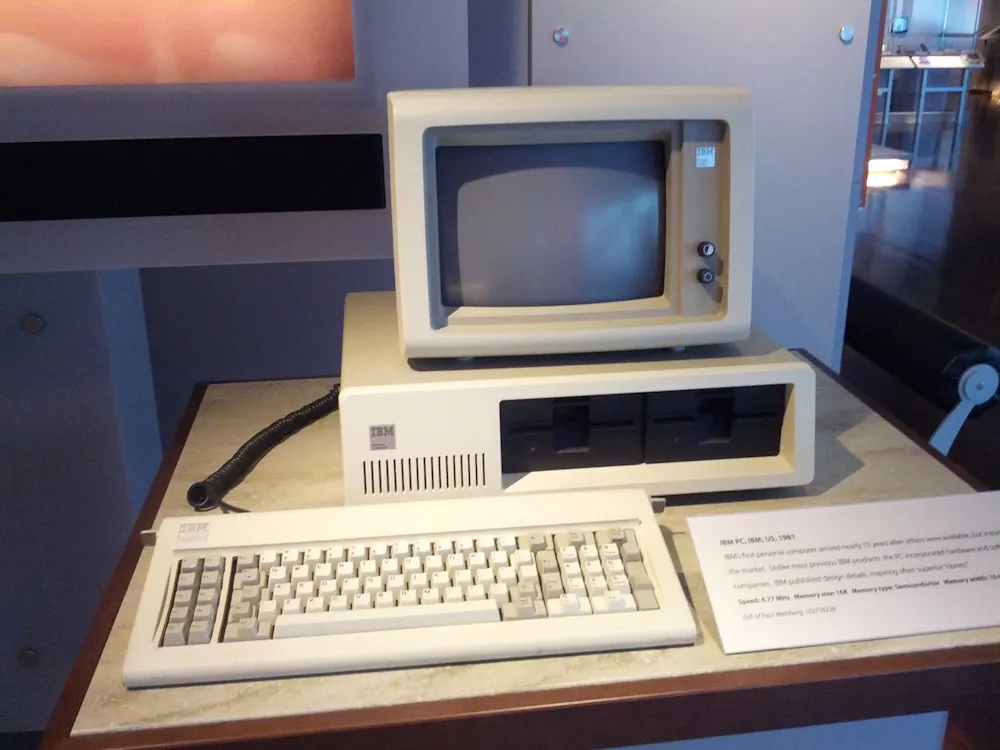
    As oil crises of the 1970s marked the end of the preceding cycle of inequality, another cycle began with the full-scale emergence of the third industrial revolution, powered by computers, digital networks and information technology.

    The first personal computer, made by IBM.
    Wikimedia Commons, CC BY-ND

    As digitalisation transformed business models and labour markets, wealth flowed to those who owned the algorithms, patents and platforms – not those operating the machines. Hi-tech entrepreneurs and Wall Street financiers became the new oligarchs. Stock options replaced salaries as the true measure of success, and companies increasingly rewarded capital over labour.

    By the 2000s, the wealth share of the richest 1% climbed to 30% in the US. The gap between the elite minority and working majority widened with every company stock market launch, hedge fund bonus and quarterly report tailored to shareholder returns.

    But this wasn’t just a market phenomenon – it was institutionally engineered. The 1980s ushered in the age of (Ronald) Reaganomics, driven by the conviction that “government is not the solution to our problem; government is the problem”. Following this neoliberalist philosophy, taxes on high incomes were slashed, capital gains were shielded, and labour unions were weakened.

    Deregulation gave Wall Street free rein to innovate and speculate, while public investment in housing, healthcare and education was curtailed. The consequences came to a head in 2008 when the US housing market collapsed and the financial system imploded.

    The Global Financial Crisis that followed exposed the fragility of a deregulated economy built on credit bubbles and concentrated risk. Millions of people lost their homes and jobs, while banks were rescued with public money. It marked an economic rupture and a moral reckoning – proof that decades of pro-market policies had produced a system that privatised gain and socialised loss.

    Inequality, long growing in the background, now became a glaring, undeniable fault line in American life – and it has remained that way ever since.

    Fig 5. Wealth share and income share of top 1% in the US

    Sources: wealth inequality: World Inequality Database; income share: Picketty & Saez (2003). Dotted curves are conjectured based on Kuznets curve.
    Peng Zhou, CC BY-SA

    So is the US proof that the Kuznets model of inequality is indeed wrong? While the chart above shows inequality has flattened in the US since the 2008 financial crisis, there is little evidence of it actually declining. And in the short term, while Donald Trump’s tariffs are unlikely to do much for growth in the US, his low-tax policies won’t do anything to raise working-class incomes either.

    The story of “the American century” is a dizzying sequence of technological revolutions – from transport and manufacturing to the internet and now AI – crashing one atop the other before institutions, politics or social norms could catch up. In my view, the result is not a broken cycle but an interrupted one. Like a wheel that never completes its turn, inequality rises, reform stutters – and a new wave of disruption begins.

    Our unequal AI future?

    Like any technological explosion, AI’s potential is dual-edged. Like the Tang dynasty’s bureaucrats hoarding grain, today’s tech giants monopolise data, algorithms and computing power. Management consultant firm McKinsey has predicted that algorithms could automate 30% of jobs by 2030, from lorry drivers to radiologists.

    Yet AI also democratises: ChatGPT tutors students in Africa while open-source models such as DeepSeek empower worldwide startups to challenge Silicon Valley’s oligarchy.

    The rise of AI isn’t just a technological revolution – it’s a political battleground. History’s empires collapsed when elites hoarded power; today’s fight over AI mirrors the same stakes. Will it become a tool for collective uplift like Britain’s post-war welfare state? Or a weapon of control akin to Han China’s grain-hoarding bureaucrats?

    The answer hinges on who wins these political battles. In 19th-century Britain, factory owners bribed MPs to block child labour laws. Today, Big Tech spends billions lobbying to neuter AI regulation.

    Meanwhile, grassroots movements like the Algorithmic Justice League demand bans on facial recognition in policing, echoing the Luddites who smashed looms not out of technophobia but to protest exploitation. The question is not if AI will be regulated but who will write the rules: corporate lobbyists or citizen coalitions.

    The real threat has never been the technology itself, but the concentration of its spoils. When elites hoard tech-driven wealth, social fault-lines crack wide open – as happened more than 2,000 years ago when the Red Eyebrows marched against Han China’s agricultural monopolies.

    To be human is to grow – and to innovate. Technological progress raises inequality faster than incomes, but the response depends on how people band together. Initiatives like “Responsible AI” and “Data for All” reframe digital ethics as a civil right, much like Occupy Wall Street exposed wealth gaps. Even memes – like TikTok skits mocking ChatGPT’s biases – shape public sentiment.

    There is no simple path between growth and inequality. But history shows our AI future isn’t preordained in code: it’s written, as always, by us.


    For you: more from our Insights series:

    • DeepSeek: how China’s embrace of open-source AI caused a geopolitical earthquake

    • To understand the risks posed by AI, follow the money

    • Sex machina: in the wild west world of human-AI relationships, the lonely and vulnerable are most at risk

    To hear about new Insights articles, join the hundreds of thousands of people who value The Conversation’s evidence-based news. Subscribe to our newsletter.

    Peng Zhou does not work for, consult, own shares in or receive funding from any company or organisation that would benefit from this article, and has disclosed no relevant affiliations beyond their academic appointment.

    – ref. What 2,000 years of Chinese history reveals about today’s AI-driven technology panic – and the future of inequality – https://theconversation.com/what-2-000-years-of-chinese-history-reveals-about-todays-ai-driven-technology-panic-and-the-future-of-inequality-254505

    MIL OSI – Global Reports –

    April 25, 2025
  • MIL-OSI Global: Do Americans support Trump’s attitudes to Ukraine and Russia? Here’s what recent data shows

    Source: The Conversation – UK – By Paul Whiteley, Professor, Department of Government, University of Essex

    Donald Trump has threatened to walk away from the Ukraine peace talks if there is no progress soon. The implicit threat here is that the US will no longer get involved, perhaps withdrawing arms shipments and even humanitarian aid to Ukraine.

    It is understood that the proposed plan the Trump team has been working on has involved Ukraine giving up territory including Crimea and giving up any possibility of joining Nato. The plan favours Russia’s recent demands and Trump has recently said he has found Russia much easier to deal with than Ukraine.

    But which country do US voters feel closer to and which do they feel is more of an ally to their nation?

    An Economist/YouGov poll conducted on March 17 asked Americans whether they thought Russia and Ukraine were allies or enemies. Some 2% thought Russia was an ally, compared with 46% who saw it as an enemy. In the case of Ukraine, the figures were 26% ally and 4% enemy. Given these figures, Trump’s Russia-friendly policy looks unpopular.

    Meanwhile, the Cooperative Election Study data in the US has just been released. This project involves a large group of researchers who conducted a survey of 60,000 Americans at the time of the presidential election last year. This very large sample provides an accurate picture of US public opinion.

    American attitudes to policy alternatives for dealing with the Ukraine war


    Coopeartive Election Survey, CC BY-SA

    The survey included the following question: “As you may know Russia invaded Ukraine in February 2022. What should the U.S. do about the situation in Ukraine?”
    Respondents were asked to choose as many of the options shown in the above chart which they favoured, with some choosing one or two and others several.

    This technique means that failing to choose an option does not mean they disagreed with it, since they may not have thought about it, were indifferent to it, or did not believe it would work.

    It is clear from the chart that Americans do not want their troops to get involved in combat in the Ukraine, since only 5% chose this option. However, 22% agreed with the idea of sending military support staff, 33% agreed with sending military aid and 51% favoured sending humanitarian aid.

    A key point is that only 23% said the US should not get involved. There is not much support among Americans for abandoning Ukraine.

    Can President Trump abandon Ukraine?

    This raises the question as to whether the US can simply walk away from the war as the president suggested. However, this could cause political problems for the Trump administration.

    The US has already provided US$66.5 billion (£49.9 billion) of aid to the Ukraine. Abandoning the country would call into question Trump’s much vaunted negotiation skills and mean that achieving a peace deal, supported by 41% in the survey, had clearly failed.

    When former president Joe Biden withdrew US forces from Afghanistan in 2021, he was heavily criticised by Republicans in the US Congress, despite the fact that the previous Trump administration had negotiated the agreement to withdraw. Rapid withdrawal now from Ukraine could attract even stronger criticisms in light of his earlier claims that he would settle conflict in 24 hours.

    The chart below, based on questions in the survey, shows that American voters are not that reluctant to send troops abroad if they agree with the reasons for doing it. They were asked to choose as many of five policy alternatives relating to military interventions abroad.

    Once again, different respondents chose different numbers of alternatives. The chart makes clear they are not enthusiastic about using military force to assist in the spread of democracy, or to ensure that the US has a regular supply of oil.

    American support for using US military forces abroad


    Cooperative Election Study, CC BY-SA

    At the same time, it shows that 38% support using troops to prevent a genocide happening and 46% support using them to protect allies being attacked, or as part of a United Nations peacekeeping force. Finally, a majority support the idea of destroying a terrorist camp, a response probably influenced by the elimination of Osama Bin Laden by US special forces when Barack Obama was president in 2011.

    There is no contradiction between a generalised willingness to use force in various circumstances and a reluctance to do this in Ukraine. Americans fighting in Ukraine would mean involvement in a war with Russia with all the risks that would entail.

    But there was a strong willingness to support Ukraine prior to Trump’s second term and these attitudes suggest that if he tried to withdraw from Nato or continues to put forward a pro-Putin deal large numbers of American voters would be unhappy with this, and it could affect his support.

    There has been global criticism of the Trump administration’s introduction of high tariffs and warnings of the consequences of these for the world economy. And what might be seen by many Americans as an abandonment for Ukraine would also alienate many international allies of the US, but so far Trump has not shown many signs of worrying about that.

    Paul Whiteley has received funding from the British Academy and the ESRC.

    – ref. Do Americans support Trump’s attitudes to Ukraine and Russia? Here’s what recent data shows – https://theconversation.com/do-americans-support-trumps-attitudes-to-ukraine-and-russia-heres-what-recent-data-shows-255169

    MIL OSI – Global Reports –

    April 25, 2025
  • MIL-OSI Global: How racialized voters are reshaping Canadian politics through digital networks

    Source: The Conversation – Canada – By Kashif Raza, Postdoctoral Fellow, Faculty of Education, University of British Columbia

    With Canada’s federal election approaching, political parties are focused on mobilizing voters. However, they may be overlooking how ethnic communities are already shaping the country’s political life.

    Immigrants and diaspora communities make up a growing segment of Canada’s population. In 2021, a record 23 per cent of the Canadian population, more than 8.3 million people, were current or former immigrants, the highest share since 1921. People from Asia constituted 51.4 per cent of this immigrant population.

    I am a postdoctoral fellow at the University of British Columbia’s Faculty of Education. My doctoral research focused on the integration practices of South Asian immigrants from Pakistan, India and Bangladesh living or working in northeast Calgary.

    Using the Canadian Index for Measuring Integration, I explored how they engaged with Canadian society across economic, social, health and political dimensions. Much of this engagement is driven by multilingualism and ethnic networks, increasingly mediated by platforms like WhatsApp, X and Facebook.

    Researching political integration in a multilingual digital world

    Since the federal election was called in late March, I’ve been conducting a digital ethnography of social media pages run by South Asian community influencers. Digital ethnography involves observing how people use internet technologies to communicate, engage and make meaning in online spaces.

    The influencers in my study are individuals who manage digital platforms, such as Facebook groups, WhatsApp chats and other community networks, and play a key role in shaping how community members access, discuss and act on political information. The pages I examined — mostly on WhatsApp, Facebook and X — continue to show how multilingualism and ethnic networks shape political awareness and influence voter behaviour.

    Too often, political engagement is narrowly defined by voter turnout. But my research with the South Asian diaspora in Calgary shows that political integration extends far beyond the ballot box. It happens on social media, at mosques, temples and gurdwaras, through multilingual volunteering and in community spaces where language, culture and civic life intersect.

    Crucially, it also extends to transnational issues. Many community members discuss global events — such as the Israel-Hamas conflict, the Russia-Ukraine war or United States trade policies — as well as Canadian issues like immigration.

    For my research, I interviewed 19 first-generation South Asians from Bangladesh, India and Pakistan, living in Calgary. Participants in my study described the wide range of civic and democratic activities they take part in: volunteering, joining online discussions and attending cultural or religious events where political issues were discussed — mostly in both English and their heritage languages.

    Participation spans both formal volunteering, often in English-dominant spaces, and informal volunteering at religious institutions, festivals or on social media. Many preferred to volunteer where they could speak Hindi, Punjabi, Bangla or Urdu or sometimes a mixture of multiple languages, referred to as translanguaging.

    One participant, a banker and social media influencer who runs a Pakistani Facebook group, said:

    “I often volunteer on Facebook. I also join politicians in their campaigns. My entire social media work is based on Urdu. It allows me to connect with people.”

    During digital ethnography, this participant was observed combining artificial intelligence (AI) generated images with multilingual postings to campaign for a political party.

    Beyond voter turnout

    South Asians are Canada’s largest visible minority group and their civic participation offers a vital lens into how democracy functions in a multicultural, multilingual society. There’s a widespread belief that if people aren’t engaging with politics in the dominant language, then they must not be engaging at all.

    However, my research shows otherwise. Societal multilingualism — the ability to use both English and heritage languages — is protected under Canada’s Multiculturalism Act and supports more inclusive participation. A participant who works for a settlement agency explained that multilingual political activities help “in communication, explaining policies, responding to people’s questions, understanding their concerns and addressing them.”

    There’s also a common misconception that nominating a candidate from a specific ethnic background guarantees community support. While that may influence local elections, federal voting decisions are often more complex. Participants in my research emphasized party platforms, past performance and national and international issues alongside identity. Ethnic concentration alone does not determine electoral success.

    Ethnic networks — made up of extended family, faith groups, digital communities and neighbourhood ties — act as civic incubators. They are not isolated enclaves but dynamic platforms where newcomers develop political literacy and trust.

    Rethinking political participation

    Canada’s official languages are English and French, but multilingualism plays a central role in immigrant communities. In my research, language is dynamic — a social and cultural resource that fosters identity and engagement.

    Participants translated political materials, explained policies to others and used multilingual platforms to discuss topics like housing, health care and immigration. These practices are visible in this election cycle too, as South Asian community members use language, digital tools, artificial intelligence and hot-button issues to engage voters. Language in these settings is cultural capital. It enables participation through familiarity, emotional connection and social belonging.

    Faith-based spaces like gurdwaras, mosques and mandirs are civic forums. Candidates visit during campaigns and community leaders help shape political dialogue and participation. These institutions offer cultural fluency and language access that mainstream systems often lack.

    As immigration reshapes Canada’s demographics, political integration is more than a trend — it’s essential to a functioning democracy. While some parties provide translations or host cultural events, they often miss how deep civic engagement already exists within these communities.

    Immigrants are not passive recipients anymore. They are active participants, shaping conversations in their own languages and networks. Ahead of the 2025 election, it’s time to move beyond ethnic voting myth and recognize the full civic ecosystem — from WhatsApp groups to mosque courtyards.

    Political parties must go beyond hiring translators or leaning on community leaders. Multilingual civic participation is not an afterthought — it’s foundational. It’s time to engage people in the languages they speak, in the spaces they trust.

    If we want a truly inclusive democracy, we must meet people where they are linguistically, culturally and locally. Ethnic networks are not detours from political life. They are on-ramps. And multilingualism is not a barrier to participation. It’s the language of democracy.

    Kashif Raza receives funding from the Social Sciences and Humanities Research Council (SSHRC) of Canada.

    – ref. How racialized voters are reshaping Canadian politics through digital networks – https://theconversation.com/how-racialized-voters-are-reshaping-canadian-politics-through-digital-networks-253895

    MIL OSI – Global Reports –

    April 25, 2025
  • MIL-OSI Russia: Spring Meetings 2025 Press Briefing Transcript: Intergovernmental Group of Twenty-Four (G24)

    Source: IMF – News in Russian

    April 24, 2025

    SPEAKERS:

    Chair: Pablo Quirno, Secretary of Finance, Ministry of Economy of Argentina

    First Vice‑Chair:  Olawale Edun, Federal Minister of Finance of Nigeria

    Second Vice‑Chair: Jameel Ahmad, Governor, State Bank of Pakistan

    Director: Iyabo Masha, G‑24 Secretariat

    MODERATOR:

    Pavis Devahasadin, Communications Officer, IMF

    Mr. Devahasadin: Good morning, ladies and gentlemen. My name is Pavis Devahasadin, Communication Officer from the IMF’s Communication Department. I would like to welcome everyone here in this room and our online audience to the press conference on the Intergovernmental Group of 24 on International Monetary Affairs and Development or G‑24.

    Before we begin, I would like to remind you that we have simultaneous translation in English, French and Spanish. It is my honor to introduce the distinguished panel at this table, the Chair of the Ministry of the G‑24 at the center is Mr. Pablo Quirno, Secretary of Finance of Argentina. To his right is Mr. Vice Chair, Mr. Olawale Edun, Nigeria’s Minister of Finance and Coordinating Minister of the Economy. To the left of Mr. Chair is Second‑Vice Chair Mr. Jameel Ahmad, Governor of the State Bank of Pakistan. Of course, at the other end of the table is Director of G‑24 Secretariat Ms. Iyabo Masha. Without further ado, may I invite Mr. Quirno to give some remarks. Mr. Chair, the floor is yours.

    Mr. Quirno (Argentina): Thank you, Pavis. Dear members of the press, I would like to extend a warm welcome to each and every one of you as we gather for this press conference. You have at your disposal our comprehensive communiqué and press release encapsulating the discussions held today. Allow me to briefly highlight the key takeaways.

    We are witnessing a major transition in how the global economy works and processes of change such as these always involve intervals of great volatility and uncertainty. Our communiqué reflects that the recent economic developments have driven uncertainty to elevated levels. In this context, emerging market and developing economies face additional challenges stemming from both external conditions and domestic factors.

    On the external front, many EMDEs continue to face elevated public debt levels and rising debt servicing burdens. The prevailing environment of still tight global financial conditions is exacerbating these challenges, constraining fiscal space, and forcing difficult tradeoffs between repaying creditors and investing in critical areas for productivity, growth and development. These also represent a risk to macroeconomic stability, as debt maturities and rising debt service payments hinder fiscal consolidation plans, which are necessary to tackle domestic imbalances, maintain price stability, and foster a stable macroeconomic environment for investment and growth.

    On the domestic front, weak fiscal fundamentals are at the core of macroeconomic instability, while many of us face longstanding structural policy challenges that hold back productivity and competitiveness.

    The building up of external and fiscal imbalances amid public spending pressures that exceed revenues and with constrained access to international financial markets further erodes macroeconomic stability.

    Furthermore, domestic environments perceived as unsafe for investment dominated by overly complex legislation and inefficient and burdensome tax systems add to macroeconomic instability to further discourage much‑needed private capital inflows.

    As stated in the communiqué, domestic policymaking is the first line of defense. The best way to enhance short‑term domestic responsiveness, as well as medium‑term growth capacity is through solid macroeconomic frameworks combined with clear rules that foster a predictable environment for private investment.

    Pivoting to our fiscal consolidation to set debt on a sustainable path and rebuild buffers while advancing with productivity‑enhancing‑market reoriented structural reforms must remain priorities for the domestic policymaking. Whereas doing so while maintaining social cohesion and protecting the most vulnerable can be challenging, it can be achieved with careful policy calibration.

    But as these measures may take some time to deliver, mobilizing sufficient international support is also crucial to help countries meet their financing needs while they navigate the waters towards a healthier economy. The Bretton Woods Institutions remain crucial, necessitating decisive actions to fortify the Global Financial Safety Net and broaden development finance. The IMF’s role as a centerpiece of the Global Financial Safety Net is vital in addressing multilateral challenges and supporting vulnerable countries. We appreciate the IMF’s recent reforms to better support EMDEs, such as the recent review of the charges and surcharges policies.

    However, countries with limited access to affordable short‑term and crisis‑related liquidity continue to face vulnerabilities. It is essential to address liquidity pressures and strengthen crisis prevention and response capabilities, including enhancing existing financial safety nets. Surveillance and internal and external stability should be intensified, including on spillover effects from systematically important countries. The World Bank has made progress in implementing the Evolution Program, but further progress is required in operationalizing key aspects of the framework of financial incentives and reducing IBRD loan pricing. Faster implementation of the remaining G‑20 Independent Experts Groups Recommendations on MDB reforms is needed, including mitigating currency risks through local currency lending and domestic capital market reforms, de‑risking private‑sector investment, and increasing capital within the WBG and across the MDB system.

    Swift progress on the 2025 shareholding review is necessary to address misalignments, strengthen voice and representation, enhance IBRD legitimacy, and ensure equitable voting power.

    In sum, the path to sharp growth and a steady growing economy is multifaceted. We must do our part and commit to strengthen fiscal and monetary frameworks, build robust institutions, and embrace structural reforms that promote competitiveness, productivity gains, and job creation, but at the same time we need global financial institutions that recognize domestic efforts and are willing and well‑prepared to step up for these countries. Thank you, and with these remarks, I am now ready to entertain your questions.

    Mr. Devahasadin: Thank you, Mr. Chair. Before we begin the Q&A section, I kindly ask that all questions remain within the scope of the G‑24’s mandate and responsibilities. Other questions outside of its purview, of course, should be raised during the regional press conferences that are going to be taking place in the coming days. And please kindly identify yourself, your organization, your news outlet, and specify to whom your questions would like to be addressing. With that, any questions? Yes, sir.

    QUESTION: Good morning to everybody. Mr. Quirno, you just said that the Bretton Woods Institutions are crucial. Does any of you feel that their role, their functioning is endangered currently? Thank you for answering this question.

    Mr. Devahasadin: Thank you.

    Mr. Quirno: I think globally we are facing a period of volatility and uncertainty. As such, the Bretton Woods Institutions are crucial in providing the safety net and the channels of communication that remain open among the different countries that participate in those institutions. And I think the role is very, very important. And we do not see them—I mean, we are always rebalancing their role and their task, and it is something that is a process that we do constantly. At the end of the day, the role is vital. It is very important, and we do not see them at risk as you put it.

    Mr. Devahasadin: Minister Edun.

    Mr. Edun (Nigeria): Thank you. I agree with the Chair that there is nothing that we have heard that says that the Bretton Woods Institutions stands ready to do anything other than on the one hand, provide safety net. On the other hand, continue to provide development finance. If anything, this time of heightened global uncertainty, what we have heard from them is that they stand ready and are very much willing and capable to help countries to navigate this particular time and to continue to encourage good policymaking, to encourage resilience, building of resilience, building of buffers and effectively staying the course for those who are actually on a path that will take them further along the road to growth development and reduction of poverty.

    Mr. Devahasadin: Thank you. Governor Ahmad or Ms. Masha, would you like to add anything?

    Mr. Ahmad: No, it is OK. I think we fully agree with the views expressed by the Chair and the Vice. I think the increased uncertainty and the prevailing situation, it has become much more important for the Bretton Woods Institutions to continue to play their role and particularly as the financial safety net providers and also as the development partners. I think they have a role which will continue to be there, and they will be contributing in the performance of the road previously—that they have been doing previously, so I fully agree.

    Mr. Devahasadin: Thank you. Ms. Masha?

    Ms. Masha (G-24 Secretariat): Yes. We believe that the organizations are very useful, and the usefulness is very much appreciated, and so we do not have any uncertainty about their continued relevance. And we do hope that whatever actions countries are taking, the advanced economies are taking, they will factor into their decision the very good usefulness of these organizations. Thank you.

    Mr. Devahasadin: Thank you. Going back to the floor. Any question? Right here, lady with the glasses.

    QUESTION: My question is for Mr. Jameel Ahmad. What steps is the State Bank of Pakistan taking? Is it engaging with other central banks to mitigate risks, particularly in the G‑24 framework? Thank you.

    Mr. Ahmad: I think as initially said that if there is any specific questions pertaining to the State Bank, we can discuss that during the separate conferences, which we have, but for the time being, since we are in the G-24 platform, we are coordinating with other central banks, and we discussed all these issues during the yesterday’s Deputies Meeting as well as today’s meeting also of the G-24. These are the issues faced by the G-24 members and have been thoroughly discussed and the stance has been agreed upon. This is what is contained in the communiqué which is being issued today.

    Mr. Devahasadin: Going back to the floor, maybe in the midsection I saw some hands. I will start with you in the black. Thank you. We are going to make our way back. Yes.

    QUESTION: So, I have a couple questions for everyone here. First of all, how concerned are your members from the fallout from tariffs and what are they trying to do to try to mitigate the impacts? Also, are you planning to work more closely with each other, for instance, increasing trade with each other? And lastly, specifically, are you planning on working more closely with China, for instance?

    Mr. Devahasadin: Just to add to that, I got an advanced question Sri Lanka. In the light of reciprocal tariff currently in place, what strategy is the G‑24 considering as a working group to alleviate the pressure on emerging economies? So that is related to your question as well. Mr. Chair.

    Mr. Quirno: Thank you. Thank you for the questions. I think that it is important to understand that the G‑24 is a very diverse group of countries, and everyone, each of us has its own peculiarities, strengths, and weaknesses in the midst of the current trade situation. So, what I would say is that the fallout of this uncertainty that we are facing creates more volatility. And as emerging market countries and developing countries, what you face is a situation in which, in addition to the trade tensions, you have a situation on the capital markets and the capital flows, things that are based on the uncertainty. What happens is flows are expecting a solution. As one of the members said today, we can deal with good news. We can deal with bad news. We need to know what to do under uncertainty. You know, as we are going through this process of trade negotiations globally and as definitions are set, then we will know how to react. In the meantime, as we said in the communiqué and as we said in my opening remarks, the first line of defense, the thing that is within our country’s contro, is around the domestic agenda. We need to bring resilience into our own economies in such a way that we have a fiscal path that is credible, that we have sound monetary policies as well that back that fiscal consolidation program, because at the end of the day that is what investors are looking at.

    Investors are looking at the different countries’ situation and see how they can cope with this level of uncertainties. We have faced different levels, different crises in the past — globally, the pandemic being the last one. And we have, as a collective number of countries, been able to achieve a level of resilience that is very good. I mean, that resilience is being tested once again. That is why we also need to work in conjunction among the different countries, not only G‑24 but in a global context to address the situation. But I think the homework also needs to be consolidated at home in order to then continue moving forward. And as such, we are also obviously fostering our trade relationships among the different countries. We are doing it among the G‑24, among G‑20, so there are various areas of cooperation and consolidation there as well.

    Mr. Devahasadin: Any perspective from Ms. Masha in terms of coordination, collaboration across nations?

    Ms. Masha: Well, I think the Chair has pointed out some of those issues regarding macroeconomic stability, that is when these shocks manifest, there’s need for fiscal policies, sound monetary policies. But more along that line, it also provides opportunities for countries to pivot towards a different development pathway. Maybe going into sectors that are going to satisfy domestic demand will make them less prone to external shocks and diversifying their markets, the different markets, so they can better cope with the future tariff or trade policies. Thank you.

    Mr. Devahasadin: Thank you. Going back to the floor, I see hands right there all the way in the back, the lady in beige. We will come back to the front.

    QUESTION: Thank you for taking our questions. A question for everyone, sort of piggybacking off of my colleague’s question on tariffs. How does the G‑24 weigh the inflationary risks versus risks of recession from the current tariff environment? And then one for the Argentina Secretary, you spoke about debt maturities and rising debt payments, more than 4 billion in debt many coming due for Argentina in July right after an ambitious reserve target accumulation from the IMF. How does Argentina plan to confront those payments and is there a target that it is looking back to return to capital markets? Thank you.

    Mr. Quirno: In terms of the first question related to inflationary pressures and related to the trade situation, we had this morning the World Economic Outlook conference in which we had details on that perspective, but I think also it is very early to tell on how this is going to at the end of the day be moving forward. We are not in the business—at least I am not in the business of projecting inflation in my own country. It is very difficult to try to project inflationary pressures on a global basis, but I think it is—as I said before, we are living in uncertain times. We expect that trade negotiations that are currently underway reach a good point that is satisfactory to everyone involved, and that will normalize trade flows from that perspective onwards. In terms of Argentina—I mean, despite the fact that it is a common theme throughout the G‑24—what we are trying to do in Argentina for the last 15 months is basically gain our credibility back. And as such, we have elected a very conservative and unorthodox approach to the problems that Argentina had. And one of the problems that Argentina had was on the fiscal front. And we have done a tremendous fiscal consolidation. We put our house in order, on the monetary front as well. And that track record is one that will put us in a path to regaining market access eventually.

    Having said that, from my perspective, as the CFO of the country, what I can say is that we work at it very conservatively. I am not assuming that Argentina will be able to re‑access markets at a given time. But we have certainty that the maturities are coming due. That is why we have worked in the past in showing our willingness to pay. We have honored all our commitments. We have now a new IMF program, which has started to work very well, as expected. And in addition to that, because of that conservative, look, we have already accumulated reserves. The Treasury has bought a significant amount of dollars that it has at the central bank to honor those obligations. So, we do not expect to—we cannot speculate about when Argentina will be able to re‑access international markets. When those will happen, when that situation happens, we will address it. But in the meantime, we still work as if we have no access, and we have to pay down our obligations as we did in this last 15 months.

    Mr. Devahasadin: Thank you, I see three remaining hands. I will come back to the front with the lady in the brown jacket first and then I go to that side of the room. I see two hands. Please keep your questions short. We have limited time. Thank you.

    QUESTION: Hi. My question is regarding—we have seen the U.S. called back on some of the financings that it gives to developing economies, so in terms of financing the sustainable development goals, as well as climate action, could you talk about some of the challenges there?

    Mr. Devahasadin: Are your questions related to climate so we can collect them both? Anyone on climate here.

    Mr. Quirno: We face several challenges and as such, for that, many countries rely on the World Bank and the IMF, to basically be able to develop tools to finance that development, finance climate action, to finance infrastructure, and as such, we are at a period in which you have to—countries have to balance that in turn with their own macroeconomic situation in that respect. We need to—we have many of our countries in the G‑24 have significant natural resources that need to be developed. Those are the ones that are part of the transition energy, for example. And those are situations in which you cannot access private financing. The role of development financing in terms of climate, in terms of energy transition, et cetera, is very important. But those are challenges that are on the table that we need to address, and we are addressing together as a group and as an individual country as well.

    Mr. Devahasadin: Thank you. Go back to the floor. Gentleman back here and we can go all the way back to you, sir.

    QUESTION: Thank you. Two questions. You brought back fiscal discipline to Argentina, but can you quantify the harmful effects on the lives of the citizens? That is what want to talk about, the strikes, the protests, the fact that people do not have money in their pockets. Secondly, you also talked about building resilience, how do we build resilience where most of the countries in the G‑24 have one similar problem, a lot of visionless leadership, definitely, and a lot of poverty. Our arms are already tied behind our hands economically. How do you expect us to build resilience?  We are just led to the slaughter slap.

    Mr. Devahasadin: Thank you. Can I go all the way back to the back, the gentleman in the back, please?

    QUESTION: Thank you for taking my question. I wanted to touch on debt restructuring. In October you called on the reform of the Common Framework, and I am curious to know more about what sort of reform moves you have seen since then and also what types of reforms the G‑24 would like to see to the Common Framework. Thank you.

    Mr. Quirno: To the first question, I hate to make reference to Argentina, but the question was directly addressed to that situation. Argentina was facing a very dire situation—55 percent poverty rate before this administration took office. We have worked very, very strongly to do a couple of things that basically went straight to address that situation by having done our fiscal consolidation. We basically reduced 5 percentage points of GDP deficit in a month, something that has not been done probably anywhere else in the world so far. But we did it because we knew that we had no alternative. And at the end of the day, what happened is that the myth is that by doing such an adjustment, you would enter into a deep recession. Argentina rebounded out of its recession that was two and a half years long two months after that fiscal consolidation.

    Since then, real wages have increased for 10 months straight. Poverty levels have been reduced from 54 percent to 38 percent in about a year. And economic activity has increased 6 percent December 2024 from December 2023 when we took over. It can be done. That is the message. You know, there is preoccupations before, during such a big adjustment as we did, but it pays out. It takes the political will to do it. Everyone knows what needs to be done on the fiscal and monetary fronts. The books have been written about it. What happens is you need the political willingness to attack the problem because that may hurt politicians when they make those decisions. We have a very strong leadership in President Milei — the one that has said we need to go in this. What he has said is we need to take care of the most vulnerable. We doubled in real terms, while being able to achieve our financial surplus. We were able to double in real terms the assistance to the most vulnerable. And that is something that basically shows the amount of corruption and intermediation that was on the social plans that the national government was spending on. So now those funds have been redirected. It is funny that we doubled the expenditures in real terms, but the amount that people received more than tripled. We spent 100, and we are now spending 200 in real terms. People got 60. They received 60, and then they are receiving 200. That is a big—very big realization from the most vulnerable population that they have been robbed for years. Because by maintaining fiscal consolidation, by maintaining a financial surplus, we were still able to double the assistance to the most vulnerable.

    Mr. Devahasadin: We go to Ms. Masha on debt restructuring because you spoke about it last time.

    Ms. Masha: Debt restructuring?

    Mr. Devahasadin: The Common Framework. Yes, the progress on that.

    Ms. Masha: I want to add a little to what the Chair said in response to the question before I go to the Common Framework.

    Mr. Devahasadin: Yes.

    Ms. Masha: That is just to say that the G‑24 member countries, we have some of the largest economies in the world as members of G‑24, and the good thing is that the growth, the size of their economy, most of them over the past two or three decades, China, India and Brazil. So that takes a lot of vision. That takes a lot of implementations of the right policies. So, it is not quite a visionless leadership, but they have had to take policies that enable the countries to achieve what they have been able to achieve over such a short period of time.

    On the Common Framework — where we are on the Common Framework is that some countries have used it. Some have found it beneficial. The only complaint—well, some of the complaints we have heard about is that the process takes a very long time. And during that long time, they are not able to access the market, or they have to take some difficult decisions when they do not know how it is going to play out. And we also made that position known. The second, the other issue is we need more participation of the private market, maybe of also multilateral development banks, and also to have some precise idea of how it will play out. Some middle‑income countries have been asked to be a part of it. That is not really in discussion now, but all in all, countries have benefited from it, but there could be more benefit. Thank you.

    Mr. Devahasadin: Mr. Chair, you would like to add anything?

    Mr. Quirno (Argentina): No.

    Mr. Devahasadin: We are out of time. Unfortunately, Minister Edun had another obligation. If you have any follow‑up question, send it to press@G24.org. That was in the advisory, how to contact the G‑24. The communiqué should have been posted on IMF.org and the transcript of this press conference will be made available later. Thank you very much for joining this press conference and have a good rest of your day. Thank you.

    IMF Communications Department
    MEDIA RELATIONS

    PRESS OFFICER: Pavis Devahasadin

    Phone: +1 202 623-7100Email: MEDIA@IMF.org

    @IMFSpokesperson

    https://www.imf.org/en/News/Articles/2025/04/24/tr-04242025-g24-press-briefing

    MIL OSI

    MIL OSI Russia News –

    April 25, 2025
  • MIL-OSI Russia: Spring Meetings 2025 Press Briefing Transcript: The Managing Director’s Press Briefing on the Global Policy Agenda

    Source: IMF – News in Russian

    April 24, 2025

    Speaker: Kristalina Georgieva, Managing Director, IMF

    Moderator: Julie Kozack, Director, Communications Department, IMF

    Ms. Kozack: Good morning, everyone. Welcome to this IMF press briefing. I am Julie Kozack, Director of the Communications Department. Thank you so very much for joining us this morning and, as usual, we are going to begin with some opening remarks from our Managing Director, Kristalina Georgieva, after which we will turn to your questions. Without further ado, Kristalina, over to you.

    Ms. Georgieva: Thank you, Julie. And a very warm welcome to all the journalists who got up early to be with us on this beautiful Thursday morning, and also to those who are online. Great to have you with us.

    As you saw earlier this week in our latest World Economic Outlook, we have significantly downgraded our projections for global growth. Major trade policy shifts have spiked uncertainty off the charts, accompanied by tighter financial conditions and higher market volatility. Simply put, the world economy is facing a new and major test, and it faces it with policy buffers depleted by the shocks of recent years. That puts countries in a difficult position. It also creates urgency for action to strengthen the economies for a world of rapid change.

    Today, I want to zoom in on how countries can actually do it. This is the main question we are getting from our members in every single meeting I have had this week. In my Global Policy Agenda, let me, for the audience, remind you that it is a very nicely crafted document. In parentheses this year we have very informative charts, and I hope you will look into those as well. In it, we focus on both the immediate challenges and our medium-term directions. I emphasize three overarching priorities. First and most urgent, for countries to work constructively to resolve trade tensions as swiftly as possible, preserving openness and removing uncertainty. A trade policy settlement among the main players is essential, and we are urging them to do it swiftly because uncertainty is very costly. I cannot stress this strongly enough.

    Without certainty, businesses do not invest, households prefer to save rather than to spend, and this further weakens prospects for already weakened growth.

    Countries also need to address the imbalances that fuel many of the tensions we see. Among major economies, some countries like China need to act to boost private consumption and embrace a shift to services. Others, like the United States, need to reduce fiscal deficits. And in Europe, it is time to complete the Single Market, Banking Union, Capital Markets Union, removing internal barriers to intra-EU trade. Get it done. All countries should seize this moment to lower their trade barriers, both tariff and nontariff.

    The second overarching priority, countries must act to safeguard economic and financial stability. The best way to do that is to get their own house in order. On fiscal policy, most countries need to rebuild buffers and ensure debt sustainability, although some may see shocks that warrant temporary and targeted fiscal support.

    We urge countries to define credible adjustment paths, gradual in most cases, protecting key investments, maximizing spending efficiency, and making space for longer term needs.

    Tradeoffs will be tough for all, but they will be toughest for low-income countries, which face both tight financial conditions and global growth slowdown and falling aid flows. To help ease the tradeoffs there, domestic resource mobilization must be part of the mix. We cannot have countries with a tax to GDP below 15 percent where it is difficult to sustain the functioning of the state. For central banks, the times when countries marched in lockstep is over. Different countries will face different conditions. Inflation pressures in some countries are easing. In others, pressures are yet to abate.

    What is our advice? Watch the data, watch inflation expectations. Central banks will need to strike a delicate balance between supporting growth and containing inflation. To do so, they must not only adjust policy interest rates but also rely on credibility to anchor expectations. Central bank independence is critical for credibility, protect it.

    Open economies, including many emerging markets, are exposed to the trade shocks and tighter financial conditions. They must preserve exchange rate flexibility as a shock absorber.

    In the event of unwarranted currency market volatility, these countries can find policy guidance in the IMF’s integrated policy framework.

    My third and final overarching priority, double down on growth oriented reforms to lift productivity. Even before the latest shock, we were living in a low growth, high debt world, sounding the alarm on weak medium-term growth for quite some time. You heard me saying that many times. Now is the time for long needed but often delayed reforms that can create a good business environment, put entrepreneurship in the front seat, reform labor markets, create conditions for innovation and in a world of rapid technological advancements, give countries a chance to catch the benefits of these advancements for their people.

    The IMF, of course, as always, will be there for our members. We are focusing on what we do best, helping them secure economic and financial stability, resolve or, even better, prevent balance of payments problems, and put in place strong policies and institutions to underpin vibrant economies.

    We will help countries with surveillance, with diagnostics, with policy advice and, when necessary, by providing financial support.

    As part of crisis resolution, we must ensure that the Global Financial Safety Net is strong. We will look for ways to further strengthen our collaboration with regional financing arrangements, and with [major] swap-providing central banks. When we have a cohesive, effective, and efficient Global Financial Safety Net, this will deliver confidence to our members in this more shock prone world.

    We will continue to foster cooperative policy solutions for promoting a healthy rebalancing of the world economy to help countries address debt vulnerabilities. Here, I want to acknowledge the important work of the Global Sovereign Debt Roundtable. This week, we agreed to publish a playbook that provides guidance for predictable and faster debt restructuring processes. And I was very pleased to see [the] support of all traditional, nontraditional creditors, private sector, and debtor countries to have that predictability.

    Finally, we will reiterate the need for continued cooperation in a multipolar world. The shared objective for all must be a better balanced and more resilient world economy.

    Before I wrap it up, I want to recognize Secretary Bessent’s remarks yesterday in which he laid out the U.S. administration’s vision for the Bretton Woods Institutions. The United States is our largest shareholder. And even more, the United States is the home of my colleagues and me. So, of course, we greatly value the voice of the United States. I very much appreciate Secretary Bessent’s reiteration of the U.S.’s commitment to the Fund and its role. He raised a number of issues and priorities for the institution that I look forward to discussing with the U.S. authorities and the membership as a whole. We will have opportunities to do so here, and we will also have opportunities to continue with our Executive Board as we carry out important policy reviews–the Comprehensive Surveillance Review, it will set our surveillance priorities for the next five years, and the Review of Program Design and Conditionality, which will carefully consider how our lending can best help countries address the low growth challenge and durably resolve balance of payments weaknesses. So, we have a way to go, and we are laser focused on it.

    Are there cyclists in this room, people who bike, bikers? As bikers would pay, ‘pedalare,’ step on the pedal. With that, I am very happy to take your questions.

    Ms. Kozack: Thank you very much, Kristalina. We will now turn to your questions. I see you have hands up already. Very good. Please just give your name and outlet when called on. I am going to start right here, woman right in the front row here.

    Questioner: Thanks very much for the opportunity to ask you—to put a question to you. You mentioned Secretary Bessent’s remarks yesterday. He accused the IMF and the World Bank of mission creep and specifically the IMF on mission creep in areas such as climate change, gender policies and also social issues. Do you think there is a role in the future for the IMF in areas such as climate, gender, and social issues?       

    Ms. Georgieva: Thank you for your question. So, what do we do here? We concentrate on macroeconomic and financial stability for growth and employment. We have 191 members. They face different challenges. They face different types of risks to their balance of payment. And what we do is to analyze what these risks and what the Fund in our mandate and what we do on the fiscal side, on the monetary policy side, on the financial sector side, what can we do to help them be more resilient to shocks. So, when we have, for example, Caribbean countries that are wiped out by extreme weather events regularly, naturally they are very concerned about that, and they say how can we be more resilient to these shocks? Again, we focus on balance of payment. What are the risks and what can be done to protect the balance of payments in these countries.

    I want to say that I actually agree with the Secretary on one thing. It is a very complicated world, a world of massive challenges of all kinds. We are a small institution. We are 4,000 people. Not very well-known, but a very fiscally disciplined institution. Our budget today in real terms is what it was 20 years ago. So, yes, we have to focus. And that is exactly why we engage with the membership, so we can make best use of the staff of the Fund. I really like to run a tight ship. Yes.

    Ms. Kozack: I can attest to that. Let us go here, the gentleman in the third row, blue shirt.

    Questioner: Just to follow-up on Claire’s question. Does Secretary Bessent’s prescriptions here for the Fund, will it cause you to sort of rethink some of the lending programs like the RSF and the RST? And then secondly, a lot of economists in the private sector have sort of a more pessimistic view, especially when you look at sort of the prospects for U.S. recession. You are not predicting that. Some of the Ministers here that we have been interviewing feel that the Fund is being too conservative. Can you just sort of explain the differences between yourselves and the private sector?

    Ms. Georgieva: Thank you very much. Actually, in the paper that I just flagged to you, we have a slide that shows Fund lending. You need a magnifying glass to see the share of the Resilience and Sustainability Trust in this lending. It is really small, but as I was explaining in the answer to the previous question, for countries that are highly vulnerable to extreme weather events, having policy advice strictly on the macro side, there is a bit of confusion. People think that we have climate experts. We do not. That is not our job. Our job is to say, OK, if you are Dominica and a hurricane can wipe out the equivalent of 200 percent of your GDP, what are reasonable policies to put in place, or to be more specific, because we have a program with Barbados, if you are Barbados natural disasters are highly damaging to your economy, what are the policy measures you can put in place. In the case of Barbados, we came up with creating an additional buffer for them that would actually prevent a balance of payments shock from derailing the economic development of the country. So, of course, we are a membership institution. What our members decide, this is what we do. We periodically review all of our instruments. At this point, we have the function of the Fund on balance of payments support defined with a number of instruments being deployed.

    To your second question, I am going to do this illustration. My glass, when you look at it, it is more than 60 percent full. This is where we are. This is what it is. How can I call it empty? I cannot. When we look at the data, what we see is that for the United States, recession risks have increased now to 37 percent, but we are not yet—we do not see either in the labor market or indicators for the functioning of the economy such a dramatic block of economic activities that would drag growth in the United States all the way to below zero.

    So, as you remember, I mean, this is something that people may not appreciate enough. Our earlier projections for a very vibrant U.S. economy were for 2.7 percent growth for this year. We have downgraded the United States—actually this is the largest of our downgrades—by 0.9 percent, to 1.8 percent for this year. But we see enough that carries the United States forward. And, of course, we recognize that there is work underway to resolve trade disputes and reduce uncertainty. I want to reiterate my message. Uncertainty is really bad for business, so the sooner this cloud that is hanging over our heads is lifted, the better for prospects for growth.

    For the world economy, as you know we are—you saw it in the WEO, we are also projecting an increase in recession risk from 17 to 30 percent. But again—and by the way, there we talk about growth falling below 2 percent, not below zero, so there is a lot that is carrying the world economy—actually the real economy is functioning in a way that we are seeing no predominant risk. Is there risk? Yes. But it is in our, we used to say, downside scenario and not in what is our—the scenario we anchor our projections.

    This being said—and I am sorry I am dwelling on that. It is a very important question. I get it from delegations when we talk about our projections a lot. This being said, countries can—they are not passive observers. They can act. And one thing that is amazing in these meetings is how much that sense of urgency to act is penetrating our membership. And I do hope that Ministers will go back and say, OK, tough reform, I have postponed it, postpone no more.

    Ms. Kozack: We are going to this side of the room. I am going to go all the way to the end. There is a woman in the third row at the end in a brown suit.

    Questioner: My question is many emerging markets, particularly in Asia, are feeling the pinch of escalating trade tensions and global uncertainties. So, from the IMF’s perspective, how has China and ASEAN countries been affected so far and is there any policy recommendations in the near term that are available from the IMF to navigate these countries through this thank you.

    Ms. Georgieva: Thank you for your question. Indeed, Asia is a continent that is quite significantly impacted because economies that rely a lot on exports, when tariffs are announced, feel the pinch more. When we look at China, we have downgraded growth projections for China from 4.6 to 4 percent. We would have downgraded it much more—we actually would have had not .06 but 1.3 percent downgrade if it was not for the policy accommodation that China is already putting in place. It helps. And that is the first piece of advice. If you have policy space, now is a good time to use it. With regard to China, we are emphasizing four points. First, rebalance your economy towards domestic consumption more.

    Second, to help with this, bring to an end the turmoil in the property sector. And, of course, add social protection for people so they do not feel compelled to save rather than spend.

    Third, lift up services, a warm embrace from healthcare to education to basically the service sector, vis-à-vis the goods consumption. And four—and the fourth is very important. Get the government to pull back from too much intervention in the economy. Let the private sector function to its full capacity.

    We are currently working on a paper, and that is in consultation, collaboration with the Chinese authorities, to document in details what are the ways in which the government may be supporting businesses and by doing so shifting the competitive position of these businesses. And this will be one of our contributions to China.

    I am particularly concerned about ASEAN. Why? Because ASEAN, very open economies. They find themselves in a very tough spot with announced tariffs quite significant across the board in ASEAN countries.

    ASEAN has done really well to build resilience over the last years. Their growth has been quite sound. They have prudently brought inflation down. They have disciplined fiscal policy. It helps. This is our number one advice to ASEAN. You have some policy space in monetary policy, in fiscal policy. Carefully and prudently use it, of course, being mindful that if you deplete it entirely and there is another shock, that would be a problem.

    We have been working with ASEAN on their external sector, especially forex. We have integrated the policy framework. It allows good thinking around how to apply the exchange rate flexibility, how to look at this from the perspective of sudden exogenous shocks. I am very pleased to see that ASEAN is doing something that other regions are doing, strengthening economic cooperation, policy coordination, and intra-ASEAN trade. Currently the ASEAN countries trade only 21 percent among themselves. Well, they sure can go up.

    And I think that we will see not only in ASEAN, we will see it in other places, Gulf Cooperation Council, Central Asia, the African continent with the Continental Free Trade Agreement, more being done to compensate, if global trade is going down, then regional trade can be a compensator and actually inject growth energy.

    I want to finish by saying that ASEAN has been remarkably prudent over the last years to build resilience. And that puts them in a good position to have the reputation to deploy their policy space if needed.

    Ms. Kozack: OK. I am going to stay on this side of the room. I will go to the gentleman in the second row with the red tie.

    Questioner: You said these present tensions could disproportionately impact low-income countries, and I am glad you mentioned the African Continental Free Trade Area Agreement because my question is on Africa. You met with the Nigerian delegation earlier this week. What is the strategy or your advice for the African continent? As you have noted in the past, Africa is not a country. It is a continent. Egypt cut rates for the first time in five years seven days ago. Prior to that, Ghana hiked its interest rate for the first time in almost three years. In these tough times, what is your advice for the continent?

    Ms. Georgieva: Well, we have seen over the last years the African continent having some of the fastest growing economies, but we also have seen low-income countries primarily, and among them fragile conflict affected countries, falling further behind. And now this is a shock for the continent. The direct impact of tariffs on most of Africa, not on all of Africa, but on most of Africa is relatively small, but the indirect impact is quite significant. Slowing global growth means that all other things equal, they will see a downgrade. And actually, we have downgraded growth prospects for the continent.

    For the oil producers like Nigeria, falling oil prices creates additional pressure on their budgets. On the other hand, for the oil importers, this is a breath of fresh air. In other words, as you indicated in your question, different countries face different challenges. If I were to come with some basic recommendations that apply to Africa, I would say—and actually they apply to Nigeria, they apply to Egypt, they apply to Ghana, they apply to Coté d’Ivoire. First, continue on a path of strengthening your fundamentals. There is still a lot that can be done on the fiscal side to have strength. As I was talking about ASEAN, to have buffers for a moment of shock. And do not use any excuses, oh, it is difficult, we cannot really go for more tax because, yes, you can. There is a lot that can be done to broaden the tax base and a lot that can be done to reduce tax evasion and tax avoidance.

    Using technology as some countries are doing to chase the tax dollar when there is the foundation for that is a very good thing to do.

    Second, on the monetary policy side, we know more as I said in the opening—we are no more in a place when you can look at the book of the Central Bank Governor of the neighboring country and say, oh, they are doing this, I will do the same, because you have to really assess domestic resource mobilization, what is your inflationary pressures and do the right thing for your country.

    But above all, make it so that the image of the whole continent changes because now everybody suffers from wrongdoing, from corruption or from conflict in one country. It throws a shadow on the rest of the continent.

    Finally, like with ASEAN, deepen interregional trade and cooperation. Remove the obstacles to it. Sometimes there are infrastructure obstacles. The World Bank is working on reducing that infrastructure obstacle to growth and trade.

    Africa has so much to offer the world. Obviously, they have the minerals, the natural disasters, and the young population. I think a more unified, more collaborative continent can go a long, long way to [becoming] an economic powerhouse.

    Ms. Kozack: I will go to this side of the room. I am going to have the woman in the red jacket, third row.

    Questioner: Ms. Georgieva, you have been very complementary of the economic reform that the Argentinian government is implementing. You have said that Argentina is an example of a country that has made great strides through structural reforms and fiscal discipline. I would like to ask you about the challenges that now the new program is facing right now, and above all what are the risks that Argentina can face in these times of global uncertainty? Thank you.

    Ms. Georgieva: Argentina has demonstrated that this time it is different. This time there is decisiveness to put the economy on a soundtrack from high deficit to surplus, from double-digit inflation to inflation that in February dipped under 3 percent, from poverty over 50 percent to now around 37 percent. Still very high but going down. The state is stepping out from where it does not belong to allow more dynamism in the private sector. Actually, if you are interested, today we will have the global debate, and Federico is going to be one of the speakers to talk about smart regulation, how you make the economy more vibrant by not being an obstacle to private initiative.

    We saw that when the program was announced, the immediate impact on markets was positive because, among other things, you ask about risks. One risk for Argentina would be if it is alone in this macroeconomic stabilization, now the country is not alone. We are there. The World Bank is there. The InterAmerican Bank is stepping up. What are the risks? And I am sorry, and there is a very important opportunity for Argentina in a world hungry for what Argentina produces, both in agriculture and in minerals, mining, gas, lithium. What are the risks?

    First, external. A worsening global environment of all other things equal, it would impact Argentina negatively. Domestic resource mobilization, the country is going to go to elections, as you know, in October. And it is very important that they do not derail the will for change. So far, we do not see that. We do not see that risk materializing, but I would urge Argentina, stay the course.

    Ms. Kozack: All right. Let us go right here in the front, end of the first row.

    Questioner: Managing Director, we had a lot of news this week, for example, mixed signals on tariffs on China, commentary on the position of the Fed Chair, and of course now the U.S. support of the IMF. How would you sum up the mood of the meetings of your members this week, please? 

    Ms. Georgieva: The membership is anxious because we were just about to step on a road to more stability after multiple shocks. We were projecting 3.3 percent growth. And actually, we were worried that this is not strong enough. And here we are, growth prospects weakened. The membership is also recognizing—and I hear it time and again—that it is very important to have a rules based global economy in which there is predictability of planning for action, both for governments and for the private sector. I actually hear a lot of support from the membership for the Fund because we have actually, the same way Argentina earned the Fund to support it, we have earned the support of the members by being there for them.

    Where the expectations are for the outcome of the meetings is to get more consistency in how all countries are going to go about pursuing their interests, which is legitimate. Of course, every country has to think about its own people but doing it so in a way that enlarges the global pie. It does not shrink it.

    Ms. Kozack: We have time for one last question. I am going to go over here.

    Ms. Georgieva: I am sorry. What I would say is the worry I hear more often is actually not even the tariffs. It is uncertainty. Let us have clarity. And that is why we are—with my apologies to the audience—so repetitive to say we need to bring uncertainty down.

    Ms. Kozack: We have time for one last question, the woman in the burgundy suit.

    Questioner:  I wanted to ask you about the MENA region. How concerned are you with all of this turmoil around the dollar and its effect on the MENA region, especially that many countries there are exporters of intermediate goods that go into major industries and many of them are exporters of energy and what is happening to the dollar is definitely of effect. And you have mentioned uncertainty many times today in this press conference. So, this uncertainty, how will it affect the countries in our region that are trying to get out of a lot of geopolitical uncertainty with the help of the IMF and special programs, such as Egypt? So, will this make the IMF revisit some of those programs amid all of this turmoil?

    Ms. Georgieva: Thank you very much. The MENA region actually got quite a downgrade. It is still doing better this year than last year, but we were projecting that growth would go to 4 percent and now we downgraded it to 2.6. A little bit like Africa, most of the impact is indirect. While countries in the MENA region, of course, trade with the United States, but most of them do not have very high exposure. And where it bites is slowing down of the global economy. And MENA has many oil exporters. The price of oil is going down.

    The dollar has historically, it goes up, it goes down. It is not a new thing. So, if you have an oil exporter and you get your revenues in dollars, when the dollar weakens, that creates a bit of a problem for your fiscal position. But if you are an oil exporter, this is a gift because then you can deal more easily with the challenges you face.

    My take for the MENA region is a very diverse region, like the African continent. You have the Gulf Cooperation Council. I have a lot of praise to offer because they have been pursuing reforms and diversification of the economies. Most countries have done really well. So now they see oil growth down, but non-oil economies are still doing quite well.

    We have the more kind of middle-income countries that are faced with difficulties impacted by regional conflicts like Jordan, like Egypt. And there we have been engaged, we have been providing support, as you know. We have countries like Morocco that have done really well to get their house in order, to have sound fiscal monetary policy and the only country in the region that is eligible for Flexible Credit Line from the IMF. And then we have countries like Sudan or Syria that are severely impacted by conflicts.

    I was very pleased that the attention of our membership, despite difficulties at home, across-the-board on low-income countries and conflict affected states, has sharpened. There is a recognition that what happens there impacts the rest of the world.

    We had a Syria meeting during the week of the meetings. The first time in more than 20 years, the Central Bank Governor and the Minister of Finance from Syria are here at the meetings. Our intention is to first and foremost help them rebuild institutions so they can plug themselves in the world economy.

    You are asking me whether we are revisiting program assumptions. Of course, we will be carefully watching what is happening. Then I had a meeting with the Prime Minister of Jordan. We are not talking about amending the program for Jordan right now, but we are talking about the importance of the Fund as an anchor of stability and how we can exercise this role.

    Ms. Kozack: Thank you very much, Managing Director, and thank you very much to all of our journalists who have joined us today. I am bringing this press conference to an end. As always, the transcript will be made available on our website, and I want to wish all of you a very wonderful rest of your day. Thank you very much.

    Ms. Georgieva: Thank you very much. Have a good rest of your day.

    IMF Communications Department
    MEDIA RELATIONS

    PRESS OFFICER: Wafa Amr

    Phone: +1 202 623-7100Email: MEDIA@IMF.org

    @IMFSpokesperson

    https://www.imf.org/en/News/Articles/2025/04/24/tr-042425-managing-directors-press-briefing-on-gpa

    MIL OSI

    MIL OSI Russia News –

    April 25, 2025
  • MIL-OSI Russia: Representatives of the Ministry of Education and Science, universities and trade unions discussed the future of education workers at the State University of Management

    Translation. Region: Russian Federal

    Source: State University of Management – Official website of the State –

    On April 24, a joint meeting of the Ministry of Science and Higher Education of the Russian Federation and the All-Russian Trade Union of Education was held at the State University of Management with the participation of rectors of higher education institutions and members of the coordinating council of chairmen of primary trade union organizations of employees of higher education institutions.

    In his speech, Konstantin Mogilevsky noted the importance of building systematic work with participants and veterans of the special military operation, as well as members of their families who are employees of universities subordinate to the Ministry. The Deputy Head of the Ministry of Education and Science of Russia emphasized that veterans arriving from the SVO zone should receive all the necessary support from their employers for a speedy return to civilian life.

    “I would like to emphasize that it is important for rectors to know such employees by name. I know that the universities of the DPR, LPR, Zaporizhzhya and Kherson regions have already set up the corresponding records. If this work has not yet been done, I ask you to set the corresponding task to the heads of your personnel departments,” Konstantin Mogilevsky addressed the participants of the meeting.

    Rector of GUU Vladimir Stroev spoke about why the meeting is taking place at our university.

    “At one of the previous congresses, we agreed that such meetings should take place not only at external venues, but also in the educational institutions themselves, where our main activities take place. Today, many heads of educational organizations, trade unions, and ministry departments have gathered at the State University of Management, which provides an excellent opportunity to discuss problems, listen to criticism, and agree on many issues. I am confident that this work will not be in vain; many useful decisions will be made,” concluded Vladimir Stroyev.

    The Chairperson of the Trade Union of Public Education and Science Workers of the Russian Federation Larisa Solodilova emphasized the role of higher education in shaping the future of the country.

    “Our organization maintains a constant dialogue with ministries and the rector’s corps. And the experience of meetings with trade union members, where they discuss socio-economic issues, the legal framework, etc., is especially valuable. Our main resource is specialists, professionals, the most proactive of whom are often elected as chairmen of the trade unions of their institutions. In addition to their main educational, scientific, and upbringing work, they also manage to engage in this side of the activity. We must understand that the realization of youth is impossible without higher education. Together we are preparing a new generation of professionals for the future,” noted Larisa Solodilova.

    Larisa Aleksandrovna also announced the awarding of the Badge of Honor “For Social Partnership” to Deputy Minister of Science and Higher Education Andrey Omelchuk, Director of the Department of Personnel Policy of the Ministry of Education and Science of Russia Alexey Svistunov and Director of the Department of Economic Policy of the Ministry of Education and Science of Russia Aslan Kanukoev. Honorary certificates were awarded to Director of the Department for Coordination of Activities of Educational Organizations of the Ministry of Education and Science of Russia Vitaly Grishkin, Deputy Director of the Department of Personnel Policy of the Ministry of Education and Science of Russia Nikolay Tsumerov and Head of the Department of the Department of Personnel Policy of the Ministry of Education and Science of Russia Tatyana Gazizova.

    Director of the Department of Economic Policy of the Ministry of Education and Science of Russia Aslan Kanukoev, who received an MPA degree from the State University of Management, gave a report and noted the well-coordinated joint work with representatives of trade unions.

    “First of all, I would like to thank the management of the State University of Management for organizing the meeting. We have good constructive relations with the trade unions: we meet regularly and sum up the results of the year and discuss plans for the next one. And such a joint event is very important and useful, since here you can raise and resolve issues of interest directly,” noted Aslan Kanukoev.

    Director of the Department of Personnel Policy of the Ministry of Education and Science of Russia, graduate of the State University of Management Alexey Svistunov emphasized the uniqueness of the meeting.

    “The Ministry and the All-Russian Trade Union conceived of the joint event as a discussion platform for pressing issues, and I am sincerely glad that we have managed to do it on an even larger scale than planned. Today we will outline the main areas of interaction, and these are not only issues of labor relations, labor protection and teachers’ salaries, but also the importance of increasing the prestige of work in educational organizations, attracting young specialists. I hope that this format of communication will be useful and in demand,” said Alexey Svistunov.

    In total, about 200 people took part in the meeting.

    Representatives of the Ministry of Education and Science, heads of educational and trade union organizations from different parts of the country presented reports and discussed issues of fair labor relations, increasing the prestige of the profession in the field of higher education and directions for further joint work.

    Subscribe to the TG channel “Our GUU” Date of publication: 04/24/2025

    Please note: This information is raw content directly from the source of the information. It is exactly what the source states and does not reflect the position of MIL-OSI or its clients.

    MIL OSI Russia News –

    April 25, 2025
  • MIL-OSI United Kingdom: PM remarks at the IEA Future of Energy Security summit: 24 April 2025

    Source: United Kingdom – Government Statements

    Speech

    PM remarks at the IEA Future of Energy Security summit: 24 April 2025

    Prime Minister’s remarks from the IEA Future of Energy Security summit.

    Good afternoon, everyone – it’s really fantastic to see so many people here, in London, welcome to London, I’m so pleased we have got so many representatives from so many places and in a sense we’re here today for one simple reason:

    Because the world has changed.

    From defence and national security on the one hand, much discussed in recent months…

    To the economy and trade…

    Old assumptions have fallen away.

    We are living through an era of global instability…

    Which is felt by working people as an age of local insecurity.

    Factory workers, builders, carers, nurses, teachers… 

    Working harder and harder for the pound in their pocket…

    But feeling at the same time that they have less control of their lives.

    *

    And energy security is right at the heart of this.

    Every family and business across the UK…

    Has paid the price for Russia weaponizing energy. And it has.

    But it’s not just that.

    *

    Let’s be frank.

    When it comes to energy…

    We’re also paying the price for our over-exposure…

    Over many years…

    To the rollercoaster of international fossil fuel markets.

    Leaving the economy – and therefore people’s household budgets…

    Vulnerable to the whims of dictators like Putin…

    To price spikes…

    And to volatility that is beyond our control. 

    Since the 1970s, half of the UK’s recessions have been caused by fossil fuel shocks. 

    That’s true for many of the other nations represented here this afternoon.

    So what’s different today is not the information we have.

    It’s not our awareness of the problem.

    No.

    What’s different now… 

    Is our determination…

    In a more uncertain world…

    To fix it.

    It’s our determination that working people…

    Should not be exposed like this anymore.

    *

    So, to the British people, I say:

    This government will not sit back…

    We will step up.

    We will make energy a source…

    Not of vulnerability, but of strength.

    We will protect our critical infrastructure, energy networks and supply chains…

    And do whatever it takes…

    To protect the security of our people.

    Because this is the crucial point – 

    Energy security is national security…

    And it is therefore a fundamental duty of government.

    And I’m very clear – 

    We can’t deliver that by defending the status quo…

    Or trying to turn the clock back…

    To a world that no longer exists.

    *

    Of course, fossil fuels will be part of our energy mix for decades to come.

    But winning the fight for energy security depends on renewal –

    It depends on change…

    It depends on cooperation with others.

    And that’s why we’re all here today – so many countries, so many communities represented.

    *

    The IEA was founded in 1974,

    In the midst of an energy crisis,

    To help us work together to secure energy supplies…

    And reduce future energy shocks.

    Well, that has taken on a new urgency today. 

    So our task is clear – 

    To act – together… 

    To seize the opportunity of the clean energy transition. 

    Because homegrown clean energy…

    Is the only way…

    To take back control of our energy system… 

    Deliver energy security…

    And bring down bills for the long term.

    *

    And I want to tell you –  

    That is in the DNA of my government.

    When we came into office last year… 

    We knew there was no time to waste.

    So in our first 100 days…

    We launched Great British Energy –

    As a national champion to drive investment and transform clean power.

    We scrapped the ban on onshore wind…

    And became the first G7 economy to phase out coal power.

    While we won’t turn off the taps…

    We’re going all out –  

    Through our Plan for Change…

    To make Britain a clean energy superpower… 

    To secure home grown energy…

    And set a path to achieving clean power by 2030.

    *

    Now, I know, some in the UK don’t agree with that.

    They think energy security can wait.

    They think tackling climate change can wait.

    But do they also think that billpayers can wait too?

    Do they think economic growth can wait?

    Do they think we can win the race for green jobs and investment by going slow?

    That would serve no one. 

    Instead, this government is acting now…

    With a muscular industrial policy –

    To seize these opportunities…

    To boost investment…

    Build new industries…

    Drive UK competitiveness…

    And unlock export opportunities –

    In wind, nuclear, hydrogen, carbon capture, heat pumps and so much more.

    That is the change we need.

    We won’t wait – 

    We’ll accelerate.

    *

    Because we’re already seeing the benefits.

    The UK’s net zero sectors are growing three times faster than the economy as a whole.

    They have attracted £43 billion of private investment since last July. 

    And now they support around 600,000 jobs across the UK.

    That means more opportunities…

    And more money in people’s pockets.

    And we’re going further.

    We’ve stripped out unnecessary red tape…

    To put Britain back in the global race for nuclear energy…

    And allow for Small Modular Reactors for the first time.

    We’re speeding up planning for clean energy projects –

    Including onshore wind…

    To power millions of homes and unlock further investment of £40 billion each year.

    *

    It’s really clear to me – 

    That investors want policy certainty.

    They want ambition.

    That is what we’re providing.

    And now we are raising our ambition even further.

    I am really pleased to announce today…

    That we’re creating a new Supply Chains Investment Fund –

    As part of Great British Energy.

    It will be backed by an initial £300 million of new funding… 

    For domestic offshore wind…

    Leveraging billions of new private investment…

    Supporting tens of thousands of jobs…

    And driving economic growth.

    When companies are looking to invest in clean energy…

    When partners are looking to build new turbines, blades or cables…

    Our message is simple:

    Build it in Britain.

    I am determined to seize this opportunity –

    To win our share of this trillion-dollar market…

    And secure the next generation of great jobs.

    I’ve met apprentices at the docks in Grimsby – fantastic individuals…

    I’ve been to Holyhead in Wales…

    And the National Nuclear Laboratory in Preston…

    And I’ve seen the brilliant clean power infrastructure that we are building in this country.

    But more than that…

    I’ve seen the pride that these jobs bring.

    This is skilled, well-paid work…

    Meaningful work –

    A chance to reignite our industrial heartlands…

    To rekindle the sense of community pride and purpose…

    That comes from being part of something that is bigger than yourself.

    And so I’m pleased to tell you…

    That I can share some more good news this afternoon.

    Earlier today, we finalised a deal with ENI.

    It will see them award £2 billion in supply chain contracts…

    For the Hynet Carbon Capture and Storage project…

    Creating 2,000 jobs, across North Wales and the North West.

    I want to thank all those here today who are part of this success story.

    Because it is all built on stability, yes…

    But our ruthless focus on delivery…

    But it is also built on partnership.

    *

    So let me say –

    It is a real pleasure today to welcome my friend –

    President von der Leyen.

    Ursula – it is so good to have you with us this afternoon. Last time we were in this building, Ursula and I stood together with other colleagues here at Lancaster House, that was just last month, six weeks ago…

    Standing shoulder-to-shoulder with President Zelenskyy…

    Working together for European security.

    Today we stand, again together with Fatih and others and the IEA…

    United behind European energy security.

    Europe must never again be in a position where Russia thinks they can blackmail us on energy.

    And until Russia comes to the table and agrees a full and unconditional ceasefire…

    We must continue to crack down on their energy revenues which are still fuelling Putin’s war chest.

    This is the moment to act. 

    And it is the moment to build a partnership with the EU that meets the needs of our time –

    Facing up to the global shocks of recent years…

    And working together to minimise the impact on hard-working people.

    So we’re doing more with the EU to improve our interconnections…

    And make the most of our shared energy systems…

    As well as building on the fantastic partnerships that we already have…

    With countries like the Netherlands, Germany, Norway and so many others.

    We have a common and important resource in the North Sea…

    Which can help us meet common challenges –

    To me, this is just common sense.

    So let’s seize this potential…

    To drive down bills…

    And drive up investment, growth and energy security.

    I was elected with a mandate to deliver change.

    So I make no apologies for pursuing every avenue…

    To deliver in the national interest and secure Britain’s future.

    That is always my priority. 

    And of course this has to be a global effort as well.

    We need to see a wider coalition…

    That unites the north and south…

    In a global drive for clean power.

    That’s why I launched the Global Clean Power Alliance at the G20 last year…

    Working alongside the EU’s Global Energy Transitions Forum.

    And that’s why we’re joining forces to take this forward.

    We want to tackle the barriers and bottlenecks that are holding countries back.

    So I am pleased to announce today…

    That, under the Global Clean Power Alliance…

    We are establishing a first-of-its-kind global initiative…

    To unblock and diversify clean energy supply chains.

    We are harnessing the political leadership needed to make this happen.

    Because, ultimately…

    That is what this is about:

    Leadership.

    In this moment of instability and uncertainty…

    Where we are buffeted by global forces…

    We are taking control.

    We are working together with partners from around the world…

    With the IEA and all of you here today…

    To accelerate this vital global transition.

    And in the UK…

    We are stepping up now…

    To make energy a source…

    Not of vulnerability, and worry…

    Which it is at the moment and it has been for so long…

    But a source of strength, of security and pride.

    With British energy, powering British homes, creating British jobs –  

    A collective effort, to boost our collective security…

    For generations to come.

    Thank you very much.

    *

    And now it is my very great pleasure and privilege to introduce…

    President von der Leyen, my friend Ursula, thank you very much for being here. Ursula, the stage is yours.

    Updates to this page

    Published 24 April 2025

    MIL OSI United Kingdom –

    April 25, 2025
  • MIL-OSI USA: Communities Prepared for Disasters: Older Adults webinar series

    Source: US State of Oregon

    em>Salem, OR — Please join the Oregon Department of Emergency Management (OEM), in partnership with the Oregon Advocacy Commissions Office, AARP, Oregon Association of Area Agencies on Aging and Disabilities, and the Oregon State University Extension Service for a two-part virtual educational series on how to help older adults prepare for the disasters we face every year in Oregon such as ice storms, wildfires, and extreme heat. This series is intended for organizations, community groups, faith-based organizations serving older adults, emergency management professionals, and anyone else interested in this topic.

    Older adults often face unique challenges when it comes to disaster preparedness—such as living on fixed incomes, relying on mobility devices, or experiencing social isolation. This educational series will offer practical guidance for individuals and organizations working with older adults to strengthen emergency readiness across the state.

    Part 1: April 23, 2025 | 10 a.m. – 12 p.m. PST
    Topics include:

    • Building partnerships between emergency managers and aging service providers
    • Planning for evacuation, sheltering, and medical equipment needs
    • Signing up for emergency alert systems

    Part 2: May 21, 2025 | 10 a.m. – 12 p.m. PST
    Topics include:

    • Managing medications during disasters
    • Avoiding scams and misinformation post-disaster
    • Supporting mental health and reducing social isolation

    Who Should Attend:
    Organizations, faith groups, and individuals who support older adults, along with emergency management professionals and community preparedness advocates.

    Access & Registration:
    The series is free and open to the public. Sessions will be offered in English with interpretation in Spanish, Vietnamese, Russian, Chinese, and American Sign Language (ASL). Recordings will be available on OEM’s YouTube channel.

    Register here: Virtual Event Registration

    For questions or accommodation requests, contact:
    community.preparedness@oem.oregon.gov

    MIL OSI USA News –

    April 25, 2025
  • MIL-OSI USA: Kaptur Response To Vance And Rubio Statements On United States Abandoning Peace Talks Unless Ukraine Capitulates

    Source: United States House of Representatives – Congresswoman Marcy Kaptur (OH-09)

    Toledo, Ohio —  Today, Congresswoman Marcy Kaptur (OH-09), Co-Founder and Co-Chair of the Congressional Ukraine Caucus released the following statement in response to public statements by Secretary of State Marco Rubio and Vice President JD Vance that the United States of America should abandon being part of peace talks between Russia and Ukraine unless Ukraine agrees to surrender portions of its sovereign territory which were illegally annexed by Russia.

    “Please let me remind the US Vice President and Secretary of State — Freedom means never Surrender, and Liberty must never capitulate to Dictatorship.  America does not live alone on this Earth. Our nation lives in a Free World alliance that is tested every day.

    “Our leaders cannot turn America’s back to the murderous forces from Russia illegally bearing down on Ukraine. History is clear: Russian dictators if given an inch have always invaded further into territory that is not theirs. The facts speak for themselves — just ask Georgia, Poland, Estonia, Latvia, and Lithuania.  Russia now taunts our nation’s closest military Allies on the European continent. We honor them and our collective memory of the historic sacrifice and bloodshed that built the Free World bequeathed to us.

    “The Trump Administration proposes that the US abandon our European Allies. With them, our nation intergenerationally has painstakingly built NATO — a global fortress of democratic nations. Across Europe from the ruins of World Wars I and II lie the precious graves of 411,516 American soldiers. These heroes and heroines fought for the cause of Liberty and a world order that enshrines it, and our joint commitment to defend it above all else. This moment for Ukraine is a crucial test of our common purpose — freedom or subjugation?

    “No succor can be allowed to a murderous dictatorship. No matter how many of Russia’s rich oligarchs seek to plunder and steal from the sacred soils and minerals of Ukraine, the Free West must stand united and say ‘No!’ Freedom lovers must not ignore history and allow Putin’s illegal invasion of Crimea and other stolen territories in Ukraine.

    “No stolen territory should be ceded to Putin. Spanning 11 time zones, Russia holds enough territory. Putin has no need for Ukraine, which is among the poorest nations in Europe. His plunder seeks to reconstitute the vanquished Soviet dictatorship as he longs for more that is not his. Putin now issues an ultimatum: unless Ukraine agrees to surrender territory Russia ruthlessly and illegally invaded and seized there will be no peace deal. 

    “The United States as leader of the Free world must never ever genuflect to tyrants. Aggressor Putin wants the United States to walk away from the negotiating table according to the terms the U.S. Vice President and Secretary of State laid out today. Those terms include ceding Ukraine’s territory to Russia. 

    “Russia is losing the war it started without provocation in 2014. It is losing a war that Putin started and escalated in bloody fashion when he initiated a full-scale invasion in 2022. Sadly, at every step of the way, the Trump Administration has conceded to Putin’s demands without Ukraine‘s consent.  Russia does not recognize international agreements. It never has. 

    “During World War II, it reneged on the Ribbentrop-Molotov agreement. Following World War II, Russia broke its commitments, made at the Yalta conference with its conquest of Poland. Russia signed the Budapest Memorandum to guarantee Ukrainian security and yet it invaded Ukraine. Putin even violated the cease-fire on targeting energy and civilian infrastructure targets negotiated by the Trump administration just weeks ago. Vladimir Putin and Russia, simply cannot be trusted.

    “Why would the Vice President, Secretary of State or any world leader believe that communist dictator Vladimir Putin and the Russian regime will hold to a peace agreement?  They never have. 

    “The only way to force Russia to abide by such agreement is to include strong security guarantees for Ukraine, to ensure Russia will remain in its own borders or face, serious, global sanctions, and consequence so severe they would collapse the Russian economy. Short of that, with the Vice President’s and Secretary of State’s abdication, Ukraine has everything to lose and Russia has everything to gain.  The White House isn’t leading a legitimate peace process. It is enabling the globally aggressive reach of the most lethal Dictatorship in Europe.”

    # # #

    MIL OSI USA News –

    April 25, 2025
  • MIL-OSI Russia: BIMAC 2025 discussed TIM as a generator of integration of technologies, data, organizations and specialists

    Translation. Region: Russian Federal

    Source: Saint Petersburg State University of Architecture and Civil Engineering – Saint Petersburg State University of Architecture and Civil Engineering – Elena Kolosova, Victoria Vinogradova and Alexander Ladygin

    The speakers of the BIMAC plenary session considered information modeling technologies (IMT) as a driving force for the integration of technologies, data, organizations and specialists. The moderators – General Director of Roseko-Stroyproekt Alexander Ladygin and Deputy Director of the Center for Digital Competences of SPbGASU Denis Nizhegorodtsev noted: this topic is in the center of attention of all industry participants and specialized educational institutions, since everyone understands that this integration is necessary.

    TIM as a pattern

    Advisor to the Minister of Digital Development, Communications and Mass Media of Russia, Deputy General Director of Renga Software (part of the company “ASCON”) Maxim Nechiporenko recalled that the company, together with the market, studied and automated everyday tasks for a quarter of a century and assessed the prospects in the construction sector. Therefore, it was ready for digitalization.

    “From process automation, software creation to mechanisms that allowed integrating three-dimensional models, we approached the development of new products, so there was no doubt about the need for TIM. After the departure of foreign vendors, there were quite a lot of companies developing various software on the domestic market. We had a whole set of products with different functionality, implementation methods, so we began to study with partners how these products can interact with each other, how the customer will use them. But in practice, nuances still arise, and our task is to adapt them at customer enterprises taking into account their activities, planned deadlines for the implementation of production work, assigned resources, and existing competencies. We agree with developers on a more complex technological meaning and simpler interaction for users,” noted Maksim Nechiporenko.

    He added that there is a need to improve the system of design documentation for construction (SPDS). During the study, ASCON analysts found that its founder is the temporary instruction on the composition and design of construction working drawings of 1974. The expert believes that it would be good to return to it as a laconic and simple document that helped in work better than modern regulations.

    Operational data is the key to success on construction sites

    Elena Kolosova, Development Director of K4 LLC, noted that the entire construction process can be stopped due to documentation that is not prepared on time and is late for the construction site, or materials are not delivered on time. Due to such nuances, downtime occurs, and as a result, maintaining one worker at the construction site costs the company up to a million rubles per month. “TIM will be widely used when builders appreciate its advantages, efficiency, and want to implement it. While they are hesitating, designers are torn apart, processes are delayed, and the builders themselves do not receive value from the implementation. As a result, the situation is: the data has not reached the construction site, and the team is idle. How to avoid this? Provide the construction site with complete data. The designer can give the builder almost all the information. Therefore, the designer can either organize the construction or kill it. In order to prevent the latter, he must provide the construction in advance. With the highest organization of processes, this requires at least a quarter.

    Designing “on the fly” leads to failure. What prevents us from building a data system in which everyone will use the same information collected from different sources? We need to encode information so as not to re-enter data, rewriting it from documents sent in different formats, for example, PDF. As a result, documentation takes more time than production work. All these problems are solved by an information model, in which all participants in the construction process see the information in real time. Models do not operate with words, so the encoding system is important here,” said Elena Kolosova.

    Reference books, classification, identification

    Kira Besprozvannaya, Head of the BIM Department at ASCON-North-West LLC and a graduate of St. Petersburg State University of Architecture and Civil Engineering, agreed that TIM is, first and foremost, information, and for it to bring value, the entire process needs to be automated: competencies, interaction with other information systems, libraries, and model export settings are important.

    “It is important to implement technologies not by obligation, but by choice. We begin our work with the customer by finding out what software products they work with, with whom and how they exchange data, we are interested in the scenario and goals of implementation, we study the standards of their activities. Then the technologies are adapted, and the implementation is effective. Then we provide training and support to the customer. This approach leads us to the creation of successful cases,” said Kira Besprozvannaya.

    Kirill Voytyuk, Development Director of Aibim LLC, confirmed that when implementing information systems, it is necessary to bring reference books to a common form, and the company is doing this successfully.

    “TIM should be implemented to solve specific problems. Today, there are planning tools, but the construction schedule printed on wallpaper still lives on. It’s strange. We work out the model with clients before construction, conduct scenario analysis, thus we conduct optimization, which, in turn, can be absolutely different, and its effectiveness is confirmed in practice. We have a product that allows you to check all collisions,” said Kirill Voytyuk.

    Technical expert of Tangle LLC Alla Zemlyanskaya reminded that data is a connecting component of processes, people, regulations, rules and technologies themselves. But here it is necessary to differentiate the concept of data and information.

    “Data is a set of facts, observations, numbers, presented in raw form. Information is processed structured data that is useful. To identify data, you need to designate its specific characteristics and purpose. Automation is needed to process it faster. We do this for specific requests for specific specialists, so that the data is a working tool. Throughout their life cycle, they must be handled correctly, so we are working on integration,” Alla Zemlyanskaya clarified.

    She cited real cases as examples that have proven their effectiveness in practice.

    Estimators advocate for innovation

    Maxim Gorinsky, President of the Association for the Development of Digital Solutions in Cost Engineering, Pricing and Information Modeling Technologies, Vice President of the Union of Cost Engineers for Regional Development, Director of Galaktika IT LLC, Editor-in-Chief of the Telegram channel “Just about Estimates,” clarified that today in our country there are three areas of the industry: the register of requirements, digitalization, and pricing. “The interest of experts and banks in this will help spur the transition to TIM, since we are talking about transparency and volumes. The more companies start working on TIM, the more feedback there will be and the faster these digital products will develop. Today, everyone wants to do it cheaply first, and then well and quickly. Meanwhile, process automation is an aid in decision making. If an estimator picks up standards with his eyes from morning to night or recalculates a project in a rush, then obviously there will be no increase in personnel. We need to try to transform the industry, including by changing processes innovatively, in order to attract young people who prefer to work where there are projects that are interesting to them,” noted Maxim Gorinsky.

    According to him, an Association for the Development of Information Modeling Technologies will be created, and a practical course with assignments for teachers will be launched, which can be used for teaching students.

    Interaction between industry and education

    Director of programs for developing interaction with educational and scientific organizations of Nanosoft Development LLC Oleg Egorychev emphasized that any software or toolkit during digitalization is impossible without specialists with the relevant competencies. Therefore, the interaction of educational organizations and vendors is the basis for the transition to the use of TIM.

    “Our company’s interaction with educational institutions is based on one main goal – to prepare and attract highly qualified personnel with modern competencies to the industry. For our part, we provide educational institutions with licenses for our products to conduct educational activities in any quantity, conduct training for faculty, help in developing educational programs for academic disciplines, integrate our products as tools and provide teaching aids for them. We provide all this free of charge. The integration and implementation of TIM in the first and second years of basic education is going well, but there is still a lot of work to do in this direction at graduating and specialized departments,” Oleg Egorychev noted.

    According to him, free online courses, advanced training, and student project competitions in which winning students and their mentors are awarded prizes are in demand.

    Maksym Nechyporenko confirmed that interaction with universities is a good example of combining efforts to promote TIM. Future and already working designers need to be given knowledge on how to use these tools, how to achieve maximum effect.

    “Summer schools are proving their effectiveness in this area. An important synergistic effect occurs when developers, users and educational institutions unite,” concluded Maksym Nechyporenko.

    Vice-Rector for Continuing Education at SPbGASU Victoria Vinogradova reported that given the digital transformation of the construction industry, it is important to develop digital competencies, including in TIM technologies and artificial intelligence, at all levels of education, so the university launched TIM classes in schools. The project is aimed at attracting motivated applicants who will subsequently grow into highly qualified specialists.

    “The educational organization is the contractor, it fulfills industry orders. In order to minimize the difference between the requirements of the labor market and educational programs, our university has created an Educational and Methodological Council, which also includes experts from the industry community. All our educational programs and projects are practice-oriented. TIM classes opened in schools have proven their demand: the growth of students has doubled. Next year, we plan to transform them into digital classes, since, in addition to TIM, we will include classes on artificial intelligence. We also plan to expand the geography through regional operators, which can be any organization. We will provide everything necessary. The educational process is based on two points: we impart knowledge and test it in practice. The school TIM championship, the digital GTO show the demand for all projects in this area, and the projects themselves are organized in close cooperation with industry companies,” noted Victoria Vinogradova.

    She also noted the demand for additional education programs implemented by the university.

    Please note: This information is raw content directly from the source of the information. It is exactly what the source states and does not reflect the position of MIL-OSI or its clients.

    MIL OSI Russia News –

    April 25, 2025
  • MIL-OSI: Best Instant Withdrawal and Fast Payout Casinos: JACKBIT Wins Best Choice

    Source: GlobeNewswire (MIL-OSI)

    LARNACA, Cyprus, April 24, 2025 (GLOBE NEWSWIRE) — After extensively researching dozens of online casinos—evaluating payout speed, deposit processing times, no KYC policies, rakeback bonuses, free spins, and overall user experience—we confidently concluded that JACKBIT Casino ranks as the best. It stood out for its blazing-fast payouts, instant withdrawals, and a wealth of player-friendly features.

    From generous rakeback offers and crypto-friendly banking to a no-hassle registration process and massive game selection, JACKBIT consistently outperformed the competition across the board.

    This review covers all the essentials, helping you decide if JACKBIT is the right fit for your gaming journey for instant deposits and fast withdrawals.

    JACKBIT Casino Features for Players

    JACKBIT sets itself apart as the ultimate destination for players seeking fast payouts and instant withdrawals, making it a top-tier choice in the crypto casino space. The platform supports over 20 cryptocurrencies with zero transaction fees, ensuring speedy and seamless payments every time. With a strict no KYC policy, JACKBIT is also a leading anonymous casino, safeguarding player privacy and enabling quick access to winnings.

    To cater to a global audience, JACKBIT offers multilingual support, including English, German, French, Spanish, and Russian. Players enjoy 24/7 live chat assistance in multiple languages and a generous VIP program that offers up to 30% rakeback. The mobile-optimized interface delivers smooth gameplay across all devices, and with a dedicated app launching in Q3 2025, JACKBIT is designed for the modern gamer who values speed, privacy, and convenience.

    READY TO PLAY? CHECK OUT JACKBIT CASINO’S OFFERINGS TODAY!

    Our Favourite Overall Casino

    JACKBIT excels among the best instant withdrawal casinos with its 7,000+ games, including slots, table games, live dealer options, and a sportsbook covering 140+ sports. Its intuitive interface, paired with instant withdrawal and fast payout casino capabilities, caters to diverse players.

    Generous promotions, a focus on privacy, and a blend of traditional and crypto gaming solidify its reputation as a leading crypto casino. Whether you’re chasing jackpots or betting on esports, JACKBIT offers a dynamic, player-centric experience that sets it apart.

    Pros and Cons of JACKBIT

    Pros:

    • 7,000+ games, including the best online pokies and live dealer tables
    • 20+ cryptocurrencies for instant withdrawal and fast payout casino transactions
    • No KYC, ideal for the best anonymous casinos
    • 100 wager-free spins in the welcome bonus
    • Sportsbook with 4,500+ betting types
    • 24/7 multilingual support
    • Mobile-optimized with cross-device compatibility
    • Regular tournaments and community engagement

    Cons:

    • No mobile app currently
    • Fewer fiat withdrawal options than crypto
    • Responsible gaming tools could be more prominent
    • Some promotions have time-limited conditions

    How To Join JACKBIT Casino

    Joining JACKBIT, a best payout casino, is quick and user-friendly:

    1. Visit JACKBIT’s official website (Click Here)
    2. Click ‘Register’ and choose the welcome bonus.
    3. Enter your email and create a password.
    4. Provide basic details like name and date of birth (no ID verification required).
    5. Make a first deposit to claim 30% rakeback and 100 free spins.
    6. Start playing slots, table games, or sports betting instantly.

    The process takes under two minutes, emphasizing JACKBIT’s commitment to privacy and accessibility for players seeking a no ID verification casino.

    How We Selected the JACKBIT as Best Instant Withdrawal & Fast Paying Casino

    Our evaluation of JACKBIT as a top online casino focused on critical factors to ensure an exceptional gaming experience. We assessed licensing, security, game variety, payment options, bonuses, customer support, and user experience to confirm its suitability for a global audience. JACKBIT’s ability to balance innovation with reliability made it a standout in our rigorous selection process.

    License and Security

    JACKBIT operates under a Curacao eGaming License, adhering to strict regulatory standards. It employs 256-bit SSL encryption and blockchain verification for crypto games, ensuring fairness and security.

    As a no ID verification casino, JACKBIT prioritizes player privacy with robust firewalls and regular audits, fostering trust across its platform.

    Bonuses and Promotions

    JACKBIT’s promotions are a highlight among the best crypto casinos. New players receive 30% rakeback and 100 wager-free spins. Ongoing offers include:

    • Weekly $10,000 giveaways and 10,000 free spins
    • €2,000,000 Pragmatic Play Drops & Wins
    • VIP rakeback up to 30%, scaling with player activity
    • Social media bonuses via Twitter and Telegram engagement

    These promotions reward both new and loyal players with transparent terms, enhancing the gaming experience.

    CLAIM YOUR 30% RAKEBACK + 100 FIRST DEPOSIT FREE SPINS + NO KYC

    Casino Games

    JACKBIT’s 7,000+ games include best online pokies, table games, live dealer options, crypto mini-games, and a sportsbook with 82,000+ live monthly events and 75,000+ pre-match events. From casual slot spins to high-stakes sports betting, the platform caters to all preferences, with new titles added weekly to keep the library fresh and engaging.

    Casino Game Providers

    JACKBIT partners with 91 providers, including Pragmatic Play, Evolution Gaming, NetEnt, Play’n Go, Yggdrasil, Microgaming, and Spribe. These ensure high-quality graphics, immersive gameplay, and provably fair mechanics, particularly for crypto games like Aviator, Plinko, and Crash, enriching the gaming experience.

    Banking Methods

    JACKBIT excels as an instant withdrawal and fast payout casino, supporting 20+ cryptocurrencies, including: Bitcoin, Ethereum, Tether, Solana, Ripple, Dogecoin, Binance Coin, and Litecoin.

    Fiat options include: Visa, Mastercard, Google Pay, Apple Pay, and bank transfers.

    Crypto withdrawals process in minutes, while fiat takes 1-3 days. Pay ID Casino methods are available in select regions, streamlining fiat transactions for added convenience.

    Customer Support

    JACKBIT offers 24/7 support via live chat (under 2-minute responses) and email (support@jackbit.com, replies within 4 hours). The multilingual team handles queries in English, French, German, and more, with a 97% resolution rate. A detailed FAQ covers payments, bonuses, and responsible gaming, ensuring accessibility for all players.

    How We Choose Top-Rated Casino Sites

    We evaluate the best online casinos based on:

    • Security: Licensing and encryption for safe play
    • Game Variety: Extensive libraries for all players
    • Payout Speed: Prioritizing instant withdrawal and fast payout casino options
    • Bonuses: Fair, generous promotions
    • Support: Responsive, multilingual assistance
    • Anonymity: Preference for no ID verification casinos
    • Mobile Play: Seamless cross-device experience
    • Community Engagement: Tournaments and social interaction

    JACKBIT’s excellence across these areas makes it a 2025 leader among the best online casinos.

    The Selection Process: Defining Excellence

    JACKBIT’s Curacao license, SSL encryption, and no KYC policy align with the best anonymous casinos. It’s 7,000+ games, instant crypto payouts, and wager-free free spins showcase excellence. Mobile optimization ensures smooth play across devices, with an app in beta testing for Q3 2025. Regular game and promotion updates keep the platform dynamic, catering to evolving player needs.

    A Gaming Paradise: 7,000+ Ways to Play

    JACKBIT’s expansive library includes:

    • Slots: Classic, video, and jackpots like Book of Dead, Mega Moolah, and Gates of Olympus
    • Table Games: Blackjack, roulette, baccarat, poker
    • Live Dealer: 250+ tables, including Crazy Time and Dream Catcher
    • Crypto Games: Provably fair Crash, Plinko, Dice
    • Sportsbook: 140+ sports (soccer, esports, horse racing, virtual sports) with 4,500+ betting types

    Search and filter tools simplify navigation, and weekly additions ensure a fresh selection for players seeking the best online pokies or live betting thrills.

    Craps at JACKBIT includes Crapless Craps and live tables with a 1.41% house edge on Pass Line bets. Live tables, powered by Evolution Gaming, offer dynamic gameplay, appealing to strategic players looking for fast-paced action.

    • Live Dealer Games

    JACKBIT’s 250+ live dealer tables, from Evolution and Pragmatic Play, include blackjack, roulette, baccarat, and game shows like Dream Catcher and Crazy Time. HD streaming, customizable bet limits, and instant withdrawal and fast payout casino options create an immersive, rewarding experience.

    Texas Hold’em, Omaha, 3 Card Poker, and video poker options like Jacks or Better offer 0.5%-2% house edges. Live poker tables deliver real-time interaction, making JACKBIT a go-to for both casual and skilled players.

    European (2.7% house edge) and French (1.35% with La Partage) roulette, plus live tables with interactive chat, cater to all skill levels. Intuitive betting controls enhance accessibility for beginners and seasoned players alike.

    Atlantic City, European, and Vegas Strip blackjack variants (0.5%-1% house edge) and live tables with side bets provide strategic depth. The game’s low house edge makes it a favorite among fans of classic casino games.

    Over 5,000best online pokies, from high-RTP titles like Blood Suckers to progressive jackpots like Mega Moolah and Divine Fortune, feature cascading reels, multipliers, and bonus rounds. Regular updates ensure a fresh, exciting experience for slot enthusiasts.

    Customer Support

    JACKBIT’s 24/7 live chat (under 2 minutes) and email (4-hour replies) ensure accessibility. Multilingual support in English, French, German, and more, plus Telegram assistance, caters to diverse players. The FAQ covers deposits, withdrawals, bonuses, and responsible gaming, reinforcing JACKBIT’s status among the best online casinos.

    Responsible Gaming at JACKBIT

    JACKBIT promotes responsible gaming with deposit limits, session time reminders, loss limits, cool-off periods, and self-exclusion options. Links to external resources like GamCare and Gambling Therapy provide professional support. While these tools are effective, they could be more prominently displayed to encourage proactive use, aligning with the standards of best online casinos.

    JACKBIT’s Community and Social Engagement

    JACKBIT fosters a vibrant community through social media platforms like Twitter, Telegram, and Instagram, where players can engage with the brand, participate in exclusive giveaways, and claim free spins. Regular tournaments, such as slot races and live dealer challenges, offer cash prizes and leaderboard rewards, enhancing player interaction.

    The platform’s blog provides valuable content, including game strategies, crypto transaction guides, and industry news, helping players stay informed and connected. This community focus distinguishes JACKBIT among the best crypto casinos, creating a sense of belonging for players worldwide.

    The Most Popular Payout Methods at Best Online Casinos

    JACKBIT’s payout methods cater to diverse preferences:

    • Bitcoin: 10-60 minute withdrawals
    • Ethereum: Fast transactions, potential gas fees
    • Tether: Instant payouts, minimal fees
    • Solana: High-speed, low-cost transfers
    • Ripple: Near-instant, low fees
    • Dogecoin: Ideal for microtransactions
    • Visa/Mastercard: 1-3 day withdrawals
    • Google Pay/Apple Pay: Instant deposits
    • Bank Transfer: Secure, up to 5 days
    • Pay ID Casino: Regional fiat payouts

    Crypto’s speed and privacy make JACKBIT a top instant withdrawal and fast payout casino, and the best anonymous casino. No fees and low minimums ($10 equivalent) add significant value for players.

    Final Thoughts

    JACKBIT redefines online gaming with its no KYC policy, 7,000+ games, and instant withdrawal and fast payout casino features. As a best payout casino, it seamlessly blends variety, security, and player rewards. From wager-free free spins to esports betting and a vibrant community, JACKBIT delivers a dynamic, private experience.

    Its upcoming mobile app and ongoing updates further elevate its appeal. Join today to explore why JACKBIT is a leader in 2025, and always play responsibly.

    PLAY AT JACKBIT NOW – CLAIM YOUR BONUS AND START WINNING!

    Frequently Asked Questions

    1. What makes JACKBIT a leading best no KYC casino?
    JACKBIT’s no KYC policy, instant crypto withdrawals, and 7,000+ games prioritize privacy and speed, making it a top choice for the best anonymous casinos.

    2. How fast are JACKBIT’s withdrawals compared to other instant withdrawal and fast payout casinos?
    Crypto payouts process in 10-60 minutes, often under 10, positioning JACKBIT as a leader. Fiat withdrawals take 1-3 days, still competitive.

    3. Are JACKBIT’s free spins truly wager-free, and how do they benefit players?
    Yes, 100 welcome free spins have no wagering requirements, allowing players to keep winnings as real cash, a rare perk among the best online casinos.

    4. Does JACKBIT support fiat currencies alongside its crypto offerings?
    Yes, JACKBIT offers Visa, Mastercard, Google Pay, Apple Pay, and Pay ID Casino options, but crypto is preferred for no ID verification casino benefits and faster payouts.

    5. What game categories are available at JACKBIT to suit different preferences?
    JACKBIT’s 7,000+ games include best online pokies, table games, live dealer options, crypto mini-games, and a sportsbook with 140+ sports, ensuring variety for all players.

    6. How does JACKBIT ensure fairness in its crypto-based games?
    Provably fair technology allows players to verify outcomes on the blockchain, ensuring transparency and trust in the best crypto casinos.

    EMAIL: support@jackbit.com

    Disclaimer and Affiliate Disclosure – JACKBIT Casino

    Disclaimer
    This content is intended for informational and entertainment purposes only. It does not constitute financial, legal, or professional advice. All information about JACKBIT Casino is based on publicly available data and research at the time of writing; however, accuracy is not guaranteed. Readers are encouraged to verify all details independently.

    Gambling Notice
    Gambling online involves risk and may not be suitable for all users. Please ensure you meet the legal age requirements and follow applicable laws in your jurisdiction. We do not own or operate JACKBIT Casino and are not responsible for any financial losses, gameplay issues, or disputes with the platform.

    Affiliate Disclosure
    Some links in this content may be affiliate links. This means we may earn a commission at no additional cost to you if you choose to sign up or make a purchase through them. Our reviews and opinions remain impartial and are based on thorough research. Always do your own research before playing at any online casino.

    The MIL Network –

    April 25, 2025
  • MIL-OSI: ESET to Present on Ransomware Gangs and Threat Groups at RSAC 2025

    Source: GlobeNewswire (MIL-OSI)

    SAN DIEGO, April 24, 2025 (GLOBE NEWSWIRE) — ESET, a global leader in cybersecurity solutions, today announced its participation in the upcoming RSAC ™ Conference in San Francisco from April 28-May 1, 2025. On May 1 at 9:40am PT, ESET Malware Researcher Robert Lipovský will lead a session titled, “Typhoons? Bears? Ransomware Gangs? Threats That Keep Defenders Up at Night.” The session will examine the latest tactics, techniques and procedures (TTPs) of leading threat groups—including Salt Typhoon’s telco attacks, Russian campaigns by Sandworm and Gamaredon targeting Signal, and RansomHub’s use of EDR killers—exploring what unites them, how they innovate, and what defenders should watch for next.

    At the event, which brings together IT experts from around the world, ESET will also host a range of live demos, expert talks and giveaways at Booth N-5245.

    “RSAC is an essential meeting place for the global cybersecurity community. It presents an opportunity to connect with partners, engage with prospective customers and share insights that drive stronger defenses,” said Ryan Grant, VP of Sales and Marketing at ESET North America. “As threat actors grow more coordinated and creative, it’s critical for defenders to understand not just who these groups are, but how they operate. Attendees at Robert Lipovský’s session will get a rare, technical look into the latest campaigns from some of the most notorious threat groups—helping security teams anticipate what’s coming next and better protect their organizations.”

    Visitors to ESET’s booth will hear about AI-native prevention for future threats and enjoy presentations from ESET and its partners at the booth including “Accelerating on silicon: ESET running on Intel® Core™ Ultra processors,” “MDR: tales from the frontline,” “Preventing advanced ransomware with Stellar Cyber and ESET,” “FamousSparrow: A suspicious hotel guest,” and more.

    Visitors who schedule a demo will have the opportunity to participate in an exclusive book signing with Richard Stiennon, Chief Research Analyst for IT-Harvest, the firm he founded in 2005 to cover the 4,150+ vendors that make up the IT security industry. He is the author of Surviving Cyberwar (Government Institutes, 2010) and Washington Post best-seller There Will Be Cyberwar.

    Additional demos at the booth include:

    • ESET PROTECT – Experience ESET’s MDR service in action. Witness firsthand how swiftly ESET PROTECT identifies and mitigates complex cyber threats, from ransomware to more sophisticated attacks, ensuring your digital environment remains secure.
    • ESET Threat Intelligence – Explore the newly launched ESET Threat Intelligence portal, featuring the innovative generative AI Advisor, and learn how ESET Threat Intelligence feeds and premium APT reports help fortify your defenses.
    • MSP Program – Learn about ESET’s flexible and profitable model, which features tier-based volume pricing and real-time license usage tracking for efficiency in security management, optimizing resource allocation and elevating service quality. Whether MSPs serve a few clients or manage a large portfolio, ESET solutions support their growth.

    For more information on ESET’s presence at RSAC ™ and after-show happy hours & events, visit RSAC 2025 ESET.

    About ESET

    ESET® provides cutting-edge digital security to prevent attacks before they happen. By combining the power of AI and human expertise, ESET stays ahead of emerging global cyberthreats, both known and unknown— securing businesses, critical infrastructure, and individuals. Whether it’s endpoint, cloud, or mobile protection, our AI-native, cloud-first solutions and services remain highly effective and easy to use. ESET technology includes robust detection and response, ultra-secure encryption, and multifactor authentication. With 24/7 real-time defense and strong local support, we keep users safe and businesses running without interruption. The ever-evolving digital landscape demands a progressive approach to security: ESET is committed to world-class research and powerful threat intelligence, backed by R&D centers and a strong global partner network. For more information, visit www.eset.com or follow our social media, podcasts and blogs.

    The MIL Network –

    April 25, 2025
  • MIL-OSI Russia: Financial news: 04/24/2025, 10:05 (Moscow time) the values of the upper limit of the price corridor and the range of market risk assessment for the security RU000A0JVZB6 (DeloPorts1) were changed.

    Translation. Region: Russian Federal

    Source: Moscow Exchange – Moscow Exchange –

    04.24.2025

    10:05

    In accordance with the Methodology for determining the risk parameters of the stock market and deposit market of Moscow Exchange PJSC by NCO NCC (JSC) on 24.04.2025, 10-05 (Moscow time), the values of the upper limit of the price corridor (up to 134.8) and the range of market risk assessment (up to 1591.75 rubles, equivalent to a rate of 62.5%) of the RU000A0JVZB6 security (DeloPorts1) were changed.

    Please note: This information is raw content directly from the source of the information. It is exactly what the source states and does not reflect the position of MIL-OSI or its clients.

    Please Note; This Information is Raw Content Directly from the Information Source. It is access to What the Source Is Stating and Does Not Reflect

    HTTPS: //VVV. MEEX.K.MO/N89757

    MIL OSI Russia News –

    April 25, 2025
  • MIL-OSI Russia: Financial news: 04/24/2025, 10-10 (Moscow time) the values of the upper limit of the price corridor and the range of market risk assessment for the security RU000A10A6B8 (RusGid2P02) were changed.

    Translation. Region: Russian Federal

    Source: Moscow Exchange – Moscow Exchange –

    04.24.2025

    10:10

    In accordance with the Methodology for determining the risk parameters of the stock market and deposit market of Moscow Exchange PJSC by NCO NCC (JSC) on 24.04.2025, 10-10 (Moscow time), the values of the upper limit of the price corridor (up to 128.3) and the range of market risk assessment (up to 1348.94 rubles, equivalent to a rate of 10.0%) of the security RU000A10A6B8 (RusGid2P02) were changed.

    Please note: This information is raw content directly from the source of the information. It is exactly what the source states and does not reflect the position of MIL-OSI or its clients.

    Please Note; This Information is Raw Content Directly from the Information Source. It is access to What the Source Is Stating and Does Not Reflect

    HTTPS: //VVV. MOEX.K.MO/N89759

    MIL OSI Russia News –

    April 25, 2025
  • MIL-OSI Russia: Financial news: 04/24/2025, 10-15 (Moscow time) the values of the upper limit of the price corridor and the range of market risk assessment for the security RU000A100ET6 (DOM 1P-6R) were changed.

    Translation. Region: Russian Federal

    Source: Moscow Exchange – Moscow Exchange –

    04.24.2025

    10:15

    In accordance with the Methodology for determining the risk parameters of the stock market and deposit market of Moscow Exchange PJSC by NCO NCC (JSC) on 24.04.2025, 10-15 (Moscow time), the values of the upper limit of the price corridor (up to 104.72) and the range of market risk assessment (up to 1181.5 rubles, equivalent to a rate of 7.5%) of the RU000A100ET6 security (DOM 1P-6R) were changed.

    Please note: This information is raw content directly from the source of the information. It is exactly what the source states and does not reflect the position of MIL-OSI or its clients.

    Please Note; This Information is Raw Content Directly from the Information Source. It is access to What the Source Is Stating and Does Not Reflect

    HTTPS: //VVV. MEEX.K.M.M.

    MIL OSI Russia News –

    April 25, 2025
  • MIL-OSI Russia: Financial news: 04/24/2025, 10:24 (Moscow time) the values of the lower boundary of the price corridor and the range of market risk assessment for the security RU000A1093G2 (IADOM 1P46) were changed.

    Translation. Region: Russian Federal

    Source: Moscow Exchange – Moscow Exchange –

    04.24.2025

    10:24

    In accordance with the Methodology for determining the risk parameters of the stock market and deposit market of Moscow Exchange PJSC by NCO NCC (JSC) on 24.04.2025, 10-24 (Moscow time), the values of the lower limit of the price corridor (up to 86.93) and the range of market risk assessment (up to 648.5 rubles, equivalent to a rate of 23.75%) of the security RU000A1093G2 (IADOM 1P46) were changed.

    Please note: This information is raw content directly from the source of the information. It is exactly what the source states and does not reflect the position of MIL-OSI or its clients.

    Please Note; This Information is Raw Content Directly from the Information Source. It is access to What the Source Is Stating and Does Not Reflect

    HTTPS: //VVV. MOEX.K.MO/N89764

    MIL OSI Russia News –

    April 25, 2025
  • MIL-OSI Russia: Financial news: 04/24/2025, 12:10 (Moscow time) the values of the upper limit of the price corridor and the range of market risk assessment for the security RU000A0JWV89 (Akron B1P1) were changed.

    Translation. Region: Russian Federal

    Source: Moscow Exchange – Moscow Exchange –

    04.24.2025

    12:10

    In accordance with the Methodology for determining the risk parameters of the stock market and deposit market of Moscow Exchange PJSC by NCO NCC (JSC) on 24.04.2025, 12-10 (Moscow time), the values of the upper limit of the price corridor (up to 84.87) and the range of market risk assessment (up to 882.53 rubles, equivalent to a rate of 10.0%) of the security RU000A0JWV89 (Akron B1P1) were changed.

    Please note: This information is raw content directly from the source of the information. It is exactly what the source states and does not reflect the position of MIL-OSI or its clients.

    Please Note; This Information is Raw Content Directly from the Information Source. It is access to What the Source Is Stating and Does Not Reflect

    HTTPS: //VVV. MEEX.K.MO/N89768

    MIL OSI Russia News –

    April 25, 2025
  • MIL-OSI Russia: Financial news: Marketplace Finuslugi begins calculating mutual fund yield indices

    Translation. Region: Russian Federal

    Source: Moscow Exchange – Moscow Exchange –

    The Moscow Exchange’s Finuslugi money marketplace is starting to calculate mutual fund yield indices, allowing tracking and analyzing the dynamics of the Russian collective investment market’s yield. The indices show the average yield of open-end and exchange-traded mutual investment funds on the market that invest in securities, real estate, precious metals, and other assets.

    The calculation base for the market index of Finuslugi mutual funds for March 2025 included 297 open-end and exchange-traded funds, for the first quarter of 2025 – 324 mutual funds available for purchase from Russian brokers and management companies during the calculation period. The platform index of Finuslugi mutual funds is calculated based on the yield data of 17 open-end mutual investment funds available for investment on the marketplace.

    The average yield of the platform index of mutual funds for January 2025 was 3.84%, for February – 3.15%. In March, the yield of mutual funds showed a negative value (-2.56%), which was a consequence of the correction in the Russian securities market. According to the results of the first quarter of 2025, the average yield of the platform index of mutual funds was 3.1%, or approximately 13% per annum.

    The average yield of the mutual fund market index for January 2025 was 2.05%, for February – 2.55%. In March, the indicator showed a negative value (-2.78%). According to the results of the first quarter, the average yield of the market index showed a negative value (-0.3%).

    A third (34.6%) of open-end mutual funds and mutual funds available on the Russian market showed positive returns in March 2025. Of the 17 funds presented on the Finuslugi marketplace, six demonstrated positive returns at the end of the month and 13 at the end of the quarter.

    Igor Alutin, Senior Managing Director for Retail Business, Development of Electronic Platforms and the Finuslugi Project at Moscow Exchange:

    “Financial services strive to provide their clients with the most objective picture of not only savings and savings products available on the market, but also investment products. We hope that indices will become another benchmark for investors and will help in making informed decisions based on a high-quality comparison of instruments presented on the collective investment market.”

    Index data will be updated monthly and published on the websites of Finuslugi and the Moscow Exchange.

    Finuslugi is a marketplace for money created by the Moscow Exchange. Currently, shares of 17 open-end mutual investment funds (OUIF) are available for purchase on Finuslugi. When purchasing investment shares on Finuslugi, no commission is charged from the client for the transaction either by the marketplace or by the management companies. You can top up your accounts on Finuslugi using the Fast Payment System (FPS). The service can be used regardless of the region, anywhere in Russia and the world. More details on the websiteHTTPS: //finumlius.ru.

    Contact information for media 7 (495) 363-3232Pr@moex.kom

    Please note: This information is raw content directly from the source of the information. It is exactly what the source states and does not reflect the position of MIL-OSI or its clients.

    Please Note; This Information is Raw Content Directly from the Information Source. It is access to What the Source Is Stating and Does Not Reflect

    HTTPS: //VVV. MEEX.K.M.M.

    MIL OSI Russia News –

    April 25, 2025
  • MIL-OSI Russia: Dmitry Chernyshenko: To achieve technological leadership, it is necessary to develop priority areas in personnel training

    Translation. Region: Russian Federal

    Source: Government of the Russian Federation – An important disclaimer is at the bottom of this article.

    Deputy Prime Minister Dmitry Chernyshenko held a meeting of the Commission on Scientific and Technological Development (S&TD).

    It was attended by Deputy Chairperson of the State Duma Victoria Abramchenko, Deputy Ministers of Science and Higher Education Denis Sekirinsky and Andrey Omelchuk, President of the Russian Academy of Sciences Gennady Krasnikov, Head of the Federal Medical and Biological Agency Veronika Skvortsova, Governor of Krasnoyarsk Krai Mikhail Kotyukov, Head of Rospatent Yuri Zubov, representatives of other ministries and organizations, heads of regions and deputy heads of subjects responsible for scientific and technological development of industries and regions.

    The meeting discussed the main measures and instruments of state policy in the field of scientific and technological development, including the results of the implementation of the state program “Scientific and Technological Development of the Russian Federation”, the indicators of which were fully met by the end of 2024.

    In particular, the Russian Federation ranks 8th in the world in terms of volume of scientific research and development, including through the creation of an effective system of higher education. The final assessment of the effectiveness of the implementation of all state programs will be carried out by the Ministry of Economic Development.

    The meeting also noted the successful completion of the national project “Science and Universities” in 2024, with all its indicators achieved. Over 5 years, it covered 76 regions, 991 universities, 1,584 research organizations, attracted 340 scientists and 4.17 million students. The implementation of the national project has become a key factor in achieving development goals and in determining new priorities, including technological leadership and increasing domestic research spending to 2% of GDP.

    Over the past 2 years, we have managed to overcome the negative trend in the reduction of the number of personnel employed in research and development. In 2024, 500 postgraduate students became winners of the presidential scholarship competition, the amount of which is 75 thousand rubles per month.

    More than 200 laboratories have been created under the leadership of young scientists, including 30 in new regions. In total, more than 940 laboratories are currently operating in Russia.

    An important area of state policy is the development of scientific infrastructure. Efforts are focused on the development of megascience class installations, such as the SKIF synchrotron, created using domestic equipment.

    Over the past 6 years, about 300 universities and research organizations have updated their equipment base, and about 30 thousand units of equipment have been purchased. This has allowed the technical base to be updated by more than 60%. An important step was the approval of the Strategy for Scientific and Technological Development of the Union State of Russia and Belarus. The development of the “Science” domain and the involvement of regions in scientific projects continues.

    Dmitry Chernyshenko also instructed that work on the formation of a single list of priority professions and specialties to ensure scientific and technological development be carried out as soon as possible.

    “President Vladimir Putin has set a national goal – technological leadership, which requires an influx of qualified personnel into strategically important industries. We need to determine priority areas of training, attract motivated students and stimulate them. Thus, it is planned to distribute at least 50% of budget places through government procurement, provide preferential educational loans for students who have chosen priority specialties,” the Deputy Prime Minister said.

    At the end of the commission meeting, Dmitry Chernyshenko announced the creation of an interdepartmental working group (IWG) on issues of developing secondary vocational education (SVE). The decision to create the IWG was made earlier following the commission’s instructions and during government hour in the State Duma on the initiative of its Chairman Vyacheslav Volodin.

    The Deputy Prime Minister noted that when choosing the head of the International Working Group, the opinion of Vyacheslav Volodin was taken into account: the leadership of the group was entrusted to Deputy Chairman of the State Duma Victoria Abramchenko.

    “The key task of the IWG will be to build effective interaction with the regions and coordinate their efforts in the field of secondary vocational education. Particular attention will be paid to the analysis of the needs of each entity for personnel and resources for the secondary vocational education system, including production sites, plans of state corporations, the number of students, equipment of colleges and training of teachers,” emphasized Dmitry Chernyshenko.

    He added that the IWG will have to develop specific solutions to support secondary vocational education, including teacher retraining programs.

    Please note: This information is raw content directly from the source of the information. It is exactly what the source states and does not reflect the position of MIL-OSI or its clients.

    MIL OSI Russia News –

    April 25, 2025
  • MIL-OSI Russia: Dmitry Patrushev met with the Ambassador of the United Arab Emirates Mohammad Ahmad Al-Jaber

    Translation. Region: Russian Federal

    Source: Government of the Russian Federation – An important disclaimer is at the bottom of this article.

    Deputy Prime Minister of the Russian Federation Dmitry Patrushev held a working meeting with Ambassador Extraordinary and Plenipotentiary of the United Arab Emirates to Russia Mohammad Ahmad Al-Jaber.

    “The relations between our countries are developing dynamically. We sincerely appreciate the dialogue that has been built in many areas of cooperation. One of the key areas is the agro-industrial complex. Last year, the turnover of agricultural products between Russia and the United Arab Emirates increased by almost a third. We expect that this positive trend will continue this year,” said Dmitry Patrushev.

    The Deputy Prime Minister recalled that this year, domestic companies took part in the Galfood exhibition for the tenth time. Russia is ready to increase supplies of grain, halal meat, oil and fat, and confectionery products to the UAE.

    The meeting discussed the creation of a special working group to develop dialogue between the two countries in the field of ecology and environmental protection. Among other things, it will discuss issues of preserving biodiversity. The first meeting is planned to take place in May of this year. Dmitry Patrushev noted that Russia is also ready to exchange experience in the field of geology and subsoil use.

    “I am confident that mutually beneficial relations will continue to develop intensively. This, in turn, will contribute to strengthening trade and economic ties between our countries and enhancing food security between Russia and the United Arab Emirates,” Dmitry Patrushev stated.

    Please note: This information is raw content directly from the source of the information. It is exactly what the source states and does not reflect the position of MIL-OSI or its clients.

    MIL OSI Russia News –

    April 25, 2025
  • MIL-OSI Russia: Marat Khusnullin: About 26 thousand km of roads will be updated under the national project “Infrastructure for Life” in 2025

    Translation. Region: Russian Federal

    Source: Government of the Russian Federation – An important disclaimer is at the bottom of this article.

    This year, the subjects participating in the national project “Infrastructure for Life” plan to build, reconstruct, repair, including major repairs, about 26 thousand km of roads. This was reported by Deputy Prime Minister Marat Khusnullin.

    “Last year, we successfully completed the implementation of the national project “Safe High-Quality Roads”, the new national project – “Infrastructure for Life” – became the successor to its best initiatives. In 2025, the road works program included 26 thousand km of the federal, regional and local road network of the country. As before, we will pay special attention to updating social routes to medical, educational, sports institutions. Another important aspect of the work is the phased renewal of sections of the backbone network of highways. All these efforts are aimed at improving the quality of life of the population and the socio-economic development of the regions and the country as a whole,” said Marat Khusnullin.

    Transport Minister Roman Starovoit emphasized that the national project “Infrastructure for Life” is one of the key instruments for achieving the national development goals of the country, defined by President Vladimir Vladimirovich Putin. “Russian road workers face ambitious challenges and tasks. In particular, in 2025, in order to achieve the national project indicators, it is planned to repair, reconstruct and build 21 thousand km of roads on the regional and local network under all road activity programs. For these purposes, the national project provides funding in the amount of 586.2 billion rubles, of which 339.2 billion are federal budget funds,” said Roman Starovoit.

    The national project “Infrastructure for Life” provides for large-scale measures, including the renovation of federal highways of Rosavtodor and roads under the trust management of the state company “Avtodor”.

    “In 2025, it is planned to repair, including major repairs, over 4.5 thousand km of federal highways on the network subordinate to Rosavtodor. Of these, about 200 km will be converted to four-lane design. In addition, it is planned to complete the construction and reconstruction of sections with a total length of 150.6 km. By the end of 2025, the share of federal highways in normal condition should be at least 72.9%,” said the head of the Federal Road Agency, Roman Novikov.

    In most of the subjects participating in the national project, road works have already begun. Thus, in the Republic of Dagestan, a 19-kilometer section of the Buynaksk-Kizilyurt highway is being repaired, which provides transport links between the settlements of the Buynaksk district and municipal districts located in the mountainous part with Makhachkala. In the Kizilyurt district of Dagestan, a section of the Kizilyurt-Kostek highway from the 0th to the 10th km is being repaired. This road plays a key role in providing communication between the settlements of the district and the cities of Kizilyurt, Makhachkala and Khasavyurt, and also provides access to the federal highway R-217 “Kavkaz”. In total, in the Republic of Dagestan, under the national project this year, work will be carried out at 24 sites of the regional and local road network with a total length of more than 141 km.

    In the Amur Region, a section of the Blagoveshchensk-Svobodny highway (from the 83rd to the 90th km) is being repaired. The highway is part of the country’s backbone network, connecting the regional center and the international airport of Blagoveshchensk with the Vostochny Cosmodrome and the city of Svobodny, where the largest gas chemical projects in Russia are currently being implemented. This year, road works under the national project “Infrastructure for Life” are planned in the region at 38 sites with a total length of almost 86 km.

    The Arkhangelsk Region is repairing the Arkhangelsk-Belogorsky-Pinega-Kimzha-Mezen highway. It is part of the backbone network and provides transport links between the settlements of the Primorsky, Kholmogorsky, Pinezhsky, Leshukonsky and Mezensky districts and the regional center. This year, repair work will be carried out on three sections with a total length of more than 50 km. In total, in 2025, thanks to the national project “Infrastructure for Life”, the Arkhangelsk Region plans to bring 169.65 km of the road network and 10 bridge structures up to standard.

    Please note: This information is raw content directly from the source of the information. It is exactly what the source states and does not reflect the position of MIL-OSI or its clients.

    MIL OSI Russia News –

    April 25, 2025
  • MIL-OSI Russia: Tatyana Golikova took part in the annual all-Russian scientific and practical conference “From the Year of the Family to the Century of the Family”

    Translation. Region: Russian Federal

    Source: Government of the Russian Federation – An important disclaimer is at the bottom of this article.

    The All-Russian scientific and practical conference “From the Year of the Family to the Century of the Family” was held at the international information agency “Russia Today”. The conference was attended by Deputy Prime Minister Tatyana Golikova, Presidential Plenipotentiary Representative in the Central Federal District Igor Shchegolev, Head of the Presidential Administration for Public Projects Sergei Novikov, Minister of Transport Roman Starovoit, State Secretary – Deputy Minister of Defense Anna Tsivileva, Chairperson of the Federation Council Committee on Science, Education and Culture Liliya Gumerova. The conference was organized by the D.I. Mendeleev Institute of Demographic Policy.

    “Supporting families, preserving health, and preserving the population is the main national goal defined by the President of our country, Vladimir Vladimirovich Putin. To achieve it, we need a steady increase in the birth rate. The well-being of Russia depends on how many of us there are and at what rate we grow. The result of the Year of the Family was that the total fertility rate in 2024 was maintained at the 2023 level – 1.4. In 18 regions, an increase in the birth rate is recorded, including in those where this indicator had previously declined. In addition, last year, the growth in the birth of third and subsequent children was maintained – by 1.1%. Over the past two years, the number of large families and children in them has increased by 1.2 times,” said Tatyana Golikova.

    Last year, the Government approved the Strategy of Actions for the implementation of family and demographic policies, support for large families until 2036. On January 1, 2025, the national project “Family” was launched, including measures to support young, large families, the older generation, develop children’s healthcare, strengthen reproductive health, and promote family values.

    The Decree of the President of Russia “On social support for large families” established the permanent status of a large family and retained the right of regions to expand this category. In 40 regions, decisions have already been made to provide support measures for large families without taking into account the criteria of need.

    Since October 1, 2024, thanks to the created register of large families, the issuance of an electronic certificate has been launched without collecting additional documents. To date, more than 1.6 million electronic certificates have been issued.

    Since 2022, the title of “Mother Heroine” has been revived; in terms of the level of social guarantees, it is equal to the title of Hero of Labor.

    It is important to pay special attention to preserving the reproductive health of the population and working with women in a situation of reproductive choice. For this purpose, since 2024, the program of state guarantees has included medical examination of the adult population to assess reproductive health. A serious task for the regions is to increase the popularity of reproductive medical examination among residents.

    At the same time, work on preserving already conceived lives – reducing the number of abortions – is extremely important. A set of measures of legal, psychological, medical and social assistance to women in the situation of reproductive choice has been developed. Thanks to this, more than 41 thousand pregnancies were saved last year.

    The quality and availability of medical care in small towns and rural areas is improving. Within the framework of the national project “Family”, 336 additional women’s consultations will be created, 142 perinatal centers, maternity hospitals and 180 children’s hospitals will be modernized, children’s clinics will be equipped with 536 mobile medical complexes.

    Particular attention is paid to promoting family values, creating conditions for family leisure, creativity, sports, modernization of cultural centers, regional theaters, museums, libraries, and clubs.

    In addition, measures are being taken to successfully combine professional development with the birth and upbringing of children.

    Over the past two years, insurance guarantees for working women have been significantly expanded, including an increase in the maximum benefit amounts. In 2025, the amount of maternity benefits and monthly child care benefits increased by 1.4 times compared to 2024. The right to child care benefits for up to one and a half years in the event of early return to work of a parent has been retained.

    To develop corporate social and demographic policy, a corporate demographic standard was developed, which was adopted at the end of last year by the Russian Tripartite Commission for the Regulation of Social and Labor Relations and is now recommended for implementation in the practice of enterprises and organizations.

    Attention is paid to supporting student families. Universities are opening support centers for them, creating conditions for living together in dormitories, including for spouses from different universities, opening short-term stay groups for children and mother-and-child rooms, and developing the practice of transferring young mothers-students from paid education to a budget place.

    “For the birth of a child, it is important to have confidence in the future, in a job with a growing salary, in the prospective development of the city or town where the family lives – the creation of new jobs, a comfortable and safe environment, improvement of social infrastructure. Therefore, everything that is done in the regions should be family-oriented. Issues of construction of residential and social facilities, transport accessibility, ecology – each project implemented should be aimed at creating favorable conditions for families, so that there are more of us, Russians,” said Tatyana Golikova.

    Please note: This information is raw content directly from the source of the information. It is exactly what the source states and does not reflect the position of MIL-OSI or its clients.

    MIL OSI Russia News –

    April 25, 2025
←Previous Page
1 … 308 309 310 311 312 … 530
Next Page→
NewzIntel.com

NewzIntel.com

MIL Open Source Intelligence

  • Blog
  • About
  • FAQs
  • Authors
  • Events
  • Shop
  • Patterns
  • Themes

Twenty Twenty-Five

Designed with WordPress