Annalena Baerbock, the German foreign minister, spoke for much of the European diplomatic community when she reacted to news of Donald Trump’s phone chat with Vladimir Putin: “This is the way the Trump administration operates,” she declared. “This is not how others do foreign policy, but this is now the reality.”
The resigned tone of Baerbock’s words was not matched by her colleague, defence minister Boris Pistorius, whose criticism that “the Trump administration has already made public concessions to Putin before negotiations have even begun” was rather more direct.
Their sentiments were echoed, not only by European leaders, but in the US itself: “Putin Scores a Big Victory, and Not on the Battlefield” read a headline in the New York Times. The newspaper opined that Trump’s call had succeeded in bringing Putin back in from the cold after three years in which Russia had become increasingly isolated both politically and economically.
This was not lost on the Russian media, where commentators boasted that the phone call “broke the west’s blockade”. The stock market gained 5% and the rouble strengthened against the dollar as a result.
Reflecting on the call, Putin’s spokesman, Dmitry Peskov, continued with operation flatter Donald Trump by comparing his attitude favourably with that of his predecessor in the White House, Joe Biden. “The previous US administration held the view that everything needed to be done to keep the war going. The current administration, as far as we understand, adheres to the point of view that everything must be done to stop the war and for peace to prevail.
“We are more impressed with the position of the current administration, and we are open to dialogue.”
Trump’s conversation with Putin roughly coincided with a meeting of senior European defence officials in Brussels which heard the new US secretary of defense, Pete Hegseth, outline America’s radical new outlook when it comes to European security. Namely that it’s not really America’s problem any more.
Hegseth also told the meeting in Brussels yesterday that the Trump administration’s position is that Nato membership for Ukraine has been taken off the table, that the idea it would get its 2014 borders back was unrealistic and that if Europe wanted to guarantee Ukraine’s security as part of any peace deal, that would be its business. Any peacekeeping force would not involve American troops and would not be a Nato operation, so it would not involve collective defence.
Sign up to receive our weekly World Affairs Briefing newsletter from The Conversation UK. Every Thursday we’ll bring you expert analysis of the big stories in international relations.
International security expert David Dunn believes that the fact that Trump considers himself a consummate deal maker makes the fact that his administration is willing to concede so much ground before negotiations proper have even got underway is remarkable. And not in a good way.
Dunn, who specialises in US foreign and security policy at the University of Birmingham, finds it significant that Trump spoke with Putin first and then called Ukraine’s president Volodymyr Zelensky to fill him in on the call. This order of priority, says Dunn, is a sign of the subordination of Ukraine’s role in the talks.
He concludes that “for the present at least, it appears that negotiations will be less about pressuring Putin to bring a just end to the war he started than forcing Ukraine to give in to the Russian leader’s demands”.
Hegseth’s briefing to European defence officials, meanwhile, came as little surprise to David Galbreath. Writing here, Galbreath – who specialises in defence and security at the University of Bath – says the US pivot away from a focus on Europe has been years in the making – “since the very end of the cold war”.
There has long been a feeling in Washington that the US has borne too much of the financial burden for European security. This is not just a Donald Trump thing, he believes, but an attitude percolating in US security circles for some decades. Once the Berlin Wall fell and the Soviet Union disintegrated, the focus for Nato become not so much collective defence as collective security, where “conflict would be managed on Nato’s borders”.
But it was then the US which invoked article 5 of the Nato treaty, which establishes that “an armed attack against one or more [member states] in Europe or North America shall be considered an attack against them all”. The Bush government invoked Article 5 the day after the 9/11 attacks and Nato responded by patrolling US skies to provide security.
Pete Hegseth dashes Ukraine’s hopes of a future guaranteed by Nato.
Galbreath notes that many European countries, particularly the newer ones such as Estonia and Latvia, sent troops to Iraq and Afghanistan. “The persistent justification I heard in the Baltic states was “we need to be there when the US needs us so that they will be there when we need them”.
The prospect of a profound shift in the world order are daunting after 80 years in which security – in Europe certainly – was guaranteed by successive US administrations and underpinned, not just by Nato but by a whole set of international agreements.
Now, instead of the US acting as the “world’s policeman”, we have a president talking seriously about taking control of Greenland, one way or another, who won’t rule out using force to seize the Panama Canal and who dreams of turning Gaza into a coastal “riviera” development.
Meanwhile Russia is engaged in a brutal war of conquest in Ukraine and is actively meddling in the affairs of several other countries. And in China, Xi Jinping regularly talks up the idea of reunifying with Taiwan, by force if necessary, and is fortifying islands in the South China Sea with a view to aggressively pursuing territorial claims there as well.
And we thought the age of empires was in the rear view mirror, writes historian Eric Storm of Leiden University. Storm, whose speciality is the rise of nation states, has discerned a resurgence of imperial tendencies around the world and fears that the rules-based order that has dominated the decades since the second world war now appears increasingly tenuous.
In any given week, you’d expect the imminent prospect of the collapse of the Gaza ceasefire to be the big international story. And certainly, while Trump and Putin were “flooding the zone” (see last week’s round-up for the origins of this phrase) the prospects of the deal lasting beyond its first phase have become more and more uncertain.
Hamas has recently pulled back from its threat not to release any more hostages. Earlier in the week it threatened to call a halt to the hostage-prisoner exchange, claiming that the Israel Defense Forces (IDF) had breached the terms of the ceasefire deal. Israeli prime minister, Benjamin Netanyahu, responded – with Trump’s backing – saying that unless all hostages were released on Saturday, all bets were off and the IDF would resume its military operations in the Gaza Strip. Trump added that “all hell is going to break out”.
The US president has also doubled down on his idea for a redeveloped Gaza and has continued to pressure Jordan and Egypt to accept millions of Palestinian refugees. This, as you would expect, has not made the population of Gaza feel any more secure.
Nils Mallock and Jeremy Ginges, behavioural psychologists at the London School of Economics, were in the region last month and conducted a survey of Israelis and Palestinians in Gaza to get a feel for how the two populations regard each other. It makes for depressing reading.
The number of Israelis who reject the idea of a two-state solution has risen sharply since the October 7 2023 attacks by Hamas, from 46% to 62%. And roughly the same proportion of people in Gaza can now no longer envisage living side by side with Israelis. Both sides think that the other side is motivated by hatred, something which is known to make any diplomatic solution less feasible.
We also asked Scott Lucas, a Middle East specialist at University College Dublin, to assess the likelihood of the ceasefire lasting into phase two, which is when the IDF is supposed to pull out of Gaza, allowing the people there room to being to rebuild, both physically and in terms of governance.
He responded with a hollow laugh and a shake of the head, before sending us this digest of the key developments in the Middle East crisis this week.
We’ve become very used to seeing apocalyptic photos of the devastation of Gaza: the pulverised streets, choked with rubble, that make the idea of rebuilding seem so remote. But the people of Gaza also cultivated a huge amount of crops – about half the food they ate was grown there. Gazan farmers grew tomatoes, peppers, cucumbers and strawberries in open fields as well as cultivating olive and citrus trees.
Geographers Lina Eklund, He Yin and Jamon Van Den Hoek have analysed satellite images across the Gaza Strip over the past 17 months to work out the scale of agricultural destruction. It makes for terrifying reading.
Flighttime Enterprises Inc., an American subsidiary of a Russian aircraft parts supplier, along with three of its current and former employees, have been charged federally with crimes related to a scheme to illegally export aircraft parts and components from the United States to Russia and Russian airline companies without the required licenses from the Department of Commerce.
The three individuals charged include Daniela Friery, 43, a naturalized U.S. citizen residing in Loveland, Ohio; Pavil Iglin, 46, a citizen of Russia who currently resides in Florida pursuant to a non-immigrant visa; and Marat Aysin, 39, a legal permanent resident of the United States who currently resides in Florida.
According to the 11-count indictment unsealed today, the three defendants worked for Flighttime Enterprises Inc., an aircraft equipment supplier with office locations near West Chester, Ohio, and Miami.
As alleged in the indictment, following Russia’s further invasion of Ukraine in February 2022, Flighttime and the individual defendants knowingly and willfully violated and evaded the export restrictions imposed on Russia to ship aviation parts to Russia and Russian end users, including airlines subject to Department of Commerce Temporary Denial Orders, by mislabeling shipments, providing false certifications, and using intermediary companies and countries to obscure the true end destination and end users. The indictment details four specific export transactions totaling more than $2 million.
For example, in June 2022, Flighttime employees allegedly negotiated the purchase of an auxiliary power unit from an American supplier for $395,000. The U.S. supplier initially expressed hesitation about the transaction due to the company’s connections to Russia. In connection with the purchase, Aysin falsely told the American supplier that the part would be used to replenish stock in West Chester. Through Aysin, Iglin allegedly signed and dated a Russia end-user certificate with the supplier falsely certifying that the part would not be exported to Russia. The part was thereafter illegally exported to Russia for a Russian aviation company without the required license.
The company and three defendants are each charged with one count of conspiring to violate the Export Control Reform Act (ECRA), and multiple counts of violating the ECRA, which are federal crimes punishable by up to 20 years in prison.
They are also charged with conspiracy to commit smuggling, which carries a maximum penalty of five years in prison, and multiple counts of smuggling, which carry maximum penalties of 10 years in prison. Finally, they are each charged with one count of conspiring to launder monetary instruments, a federal crime punishable by up to 10 years in prison.
Sue J. Bai, head of the Justice Department’s National Security Division; U.S. Attorney Kenneth L. Parker for the Southern District of Ohio; Special Agent in Charge Elena Iatarola of the FBI Cincinnati Field Office; and Special Agent in Charge Jeffrey Levine of the Office of Export Enforcement, Bureau of Industry and Security (BIS) announced the case.
The FBI and BIS are investigating the case.
Assistant U.S. Attorney Timothy S. Mangan for the Southern District of Ohio is prosecuting the case with assistance from Trial Attorneys Maria Fedor and Menno Goedman of the National Security Division’s Counterintelligence and Export Control Section.
An indictment is merely an allegation. All defendants are presumed innocent until proven guilty beyond a reasonable doubt in a court of law.
Flighttime Enterprises Inc., an American subsidiary of a Russian aircraft parts supplier, along with three of its current and former employees, have been charged federally with crimes related to a scheme to illegally export aircraft parts and components from the United States to Russia and Russian airline companies without the required licenses from the Department of Commerce.
The three individuals charged include Daniela Friery, 43, a naturalized U.S. citizen residing in Loveland, Ohio; Pavil Iglin, 46, a citizen of Russia who currently resides in Florida pursuant to a non-immigrant visa; and Marat Aysin, 39, a legal permanent resident of the United States who currently resides in Florida.
According to the 11-count indictment unsealed today, the three defendants worked for Flighttime Enterprises Inc., an aircraft equipment supplier with office locations near West Chester, Ohio, and Miami.
As alleged in the indictment, following Russia’s further invasion of Ukraine in February 2022, Flighttime and the individual defendants knowingly and willfully violated and evaded the export restrictions imposed on Russia to ship aviation parts to Russia and Russian end users, including airlines subject to Department of Commerce Temporary Denial Orders, by mislabeling shipments, providing false certifications, and using intermediary companies and countries to obscure the true end destination and end users. The indictment details four specific export transactions totaling more than $2 million.
For example, in June 2022, Flighttime employees allegedly negotiated the purchase of an auxiliary power unit from an American supplier for $395,000. The U.S. supplier initially expressed hesitation about the transaction due to the company’s connections to Russia. In connection with the purchase, Aysin falsely told the American supplier that the part would be used to replenish stock in West Chester. Through Aysin, Iglin allegedly signed and dated a Russia end-user certificate with the supplier falsely certifying that the part would not be exported to Russia. The part was thereafter illegally exported to Russia for a Russian aviation company without the required license.
The company and three defendants are each charged with one count of conspiring to violate the Export Control Reform Act (ECRA), and multiple counts of violating the ECRA, which are federal crimes punishable by up to 20 years in prison.
They are also charged with conspiracy to commit smuggling, which carries a maximum penalty of five years in prison, and multiple counts of smuggling, which carry maximum penalties of 10 years in prison. Finally, they are each charged with one count of conspiring to launder monetary instruments, a federal crime punishable by up to 10 years in prison.
Sue J. Bai, head of the Justice Department’s National Security Division; U.S. Attorney Kenneth L. Parker for the Southern District of Ohio; Special Agent in Charge Elena Iatarola of the FBI Cincinnati Field Office; and Special Agent in Charge Jeffrey Levine of the Office of Export Enforcement, Bureau of Industry and Security (BIS) announced the case.
The FBI and BIS are investigating the case.
Assistant U.S. Attorney Timothy S. Mangan for the Southern District of Ohio is prosecuting the case with assistance from Trial Attorneys Maria Fedor and Menno Goedman of the National Security Division’s Counterintelligence and Export Control Section.
An indictment is merely an allegation. All defendants are presumed innocent until proven guilty beyond a reasonable doubt in a court of law.
Annalena Baerbock, the German foreign minister, spoke for much of the European diplomatic community when she reacted to news of Donald Trump’s phone chat with Vladimir Putin: “This is the way the Trump administration operates,” she declared. “This is not how others do foreign policy, but this is now the reality.”
The resigned tone of Baerbock’s words was not matched by her colleague, defence minister Boris Pistorius, whose criticism that “the Trump administration has already made public concessions to Putin before negotiations have even begun” was rather more direct.
Their sentiments were echoed, not only by European leaders, but in the US itself: “Putin Scores a Big Victory, and Not on the Battlefield” read a headline in the New York Times. The newspaper opined that Trump’s call had succeeded in bringing Putin back in from the cold after three years in which Russia had become increasingly isolated both politically and economically.
This was not lost on the Russian media, where commentators boasted that the phone call “broke the west’s blockade”. The stock market gained 5% and the rouble strengthened against the dollar as a result.
Reflecting on the call, Putin’s spokesman, Dmitry Peskov, continued with operation flatter Donald Trump by comparing his attitude favourably with that of his predecessor in the White House, Joe Biden. “The previous US administration held the view that everything needed to be done to keep the war going. The current administration, as far as we understand, adheres to the point of view that everything must be done to stop the war and for peace to prevail.
“We are more impressed with the position of the current administration, and we are open to dialogue.”
Trump’s conversation with Putin roughly coincided with a meeting of senior European defence officials in Brussels which heard the new US secretary of defense, Pete Hegseth, outline America’s radical new outlook when it comes to European security. Namely that it’s not really America’s problem any more.
Hegseth also told the meeting in Brussels yesterday that the Trump administration’s position is that Nato membership for Ukraine has been taken off the table, that the idea it would get its 2014 borders back was unrealistic and that if Europe wanted to guarantee Ukraine’s security as part of any peace deal, that would be its business. Any peacekeeping force would not involve American troops and would not be a Nato operation, so it would not involve collective defence.
Sign up to receive our weekly World Affairs Briefing newsletter from The Conversation UK. Every Thursday we’ll bring you expert analysis of the big stories in international relations.
International security expert David Dunn believes that the fact that Trump considers himself a consummate deal maker makes the fact that his administration is willing to concede so much ground before negotiations proper have even got underway is remarkable. And not in a good way.
Dunn, who specialises in US foreign and security policy at the University of Birmingham, finds it significant that Trump spoke with Putin first and then called Ukraine’s president Volodymyr Zelensky to fill him in on the call. This order of priority, says Dunn, is a sign of the subordination of Ukraine’s role in the talks.
He concludes that “for the present at least, it appears that negotiations will be less about pressuring Putin to bring a just end to the war he started than forcing Ukraine to give in to the Russian leader’s demands”.
Hegseth’s briefing to European defence officials, meanwhile, came as little surprise to David Galbreath. Writing here, Galbreath – who specialises in defence and security at the University of Bath – says the US pivot away from a focus on Europe has been years in the making – “since the very end of the cold war”.
There has long been a feeling in Washington that the US has borne too much of the financial burden for European security. This is not just a Donald Trump thing, he believes, but an attitude percolating in US security circles for some decades. Once the Berlin Wall fell and the Soviet Union disintegrated, the focus for Nato become not so much collective defence as collective security, where “conflict would be managed on Nato’s borders”.
But it was then the US which invoked article 5 of the Nato treaty, which establishes that “an armed attack against one or more [member states] in Europe or North America shall be considered an attack against them all”. The Bush government invoked Article 5 the day after the 9/11 attacks and Nato responded by patrolling US skies to provide security.
Pete Hegseth dashes Ukraine’s hopes of a future guaranteed by Nato.
Galbreath notes that many European countries, particularly the newer ones such as Estonia and Latvia, sent troops to Iraq and Afghanistan. “The persistent justification I heard in the Baltic states was “we need to be there when the US needs us so that they will be there when we need them”.
The prospect of a profound shift in the world order are daunting after 80 years in which security – in Europe certainly – was guaranteed by successive US administrations and underpinned, not just by Nato but by a whole set of international agreements.
Now, instead of the US acting as the “world’s policeman”, we have a president talking seriously about taking control of Greenland, one way or another, who won’t rule out using force to seize the Panama Canal and who dreams of turning Gaza into a coastal “riviera” development.
Meanwhile Russia is engaged in a brutal war of conquest in Ukraine and is actively meddling in the affairs of several other countries. And in China, Xi Jinping regularly talks up the idea of reunifying with Taiwan, by force if necessary, and is fortifying islands in the South China Sea with a view to aggressively pursuing territorial claims there as well.
And we thought the age of empires was in the rear view mirror, writes historian Eric Storm of Leiden University. Storm, whose speciality is the rise of nation states, has discerned a resurgence of imperial tendencies around the world and fears that the rules-based order that has dominated the decades since the second world war now appears increasingly tenuous.
In any given week, you’d expect the imminent prospect of the collapse of the Gaza ceasefire to be the big international story. And certainly, while Trump and Putin were “flooding the zone” (see last week’s round-up for the origins of this phrase) the prospects of the deal lasting beyond its first phase have become more and more uncertain.
Hamas has recently pulled back from its threat not to release any more hostages. Earlier in the week it threatened to call a halt to the hostage-prisoner exchange, claiming that the Israel Defense Forces (IDF) had breached the terms of the ceasefire deal. Israeli prime minister, Benjamin Netanyahu, responded – with Trump’s backing – saying that unless all hostages were released on Saturday, all bets were off and the IDF would resume its military operations in the Gaza Strip. Trump added that “all hell is going to break out”.
The US president has also doubled down on his idea for a redeveloped Gaza and has continued to pressure Jordan and Egypt to accept millions of Palestinian refugees. This, as you would expect, has not made the population of Gaza feel any more secure.
Nils Mallock and Jeremy Ginges, behavioural psychologists at the London School of Economics, were in the region last month and conducted a survey of Israelis and Palestinians in Gaza to get a feel for how the two populations regard each other. It makes for depressing reading.
The number of Israelis who reject the idea of a two-state solution has risen sharply since the October 7 2023 attacks by Hamas, from 46% to 62%. And roughly the same proportion of people in Gaza can now no longer envisage living side by side with Israelis. Both sides think that the other side is motivated by hatred, something which is known to make any diplomatic solution less feasible.
We also asked Scott Lucas, a Middle East specialist at University College Dublin, to assess the likelihood of the ceasefire lasting into phase two, which is when the IDF is supposed to pull out of Gaza, allowing the people there room to being to rebuild, both physically and in terms of governance.
He responded with a hollow laugh and a shake of the head, before sending us this digest of the key developments in the Middle East crisis this week.
We’ve become very used to seeing apocalyptic photos of the devastation of Gaza: the pulverised streets, choked with rubble, that make the idea of rebuilding seem so remote. But the people of Gaza also cultivated a huge amount of crops – about half the food they ate was grown there. Gazan farmers grew tomatoes, peppers, cucumbers and strawberries in open fields as well as cultivating olive and citrus trees.
Geographers Lina Eklund, He Yin and Jamon Van Den Hoek have analysed satellite images across the Gaza Strip over the past 17 months to work out the scale of agricultural destruction. It makes for terrifying reading.
Based on the results of the qualifying stage competition The members of the competition committee selected 12 subjects of the Russian Federation that will continue the competition for the title of “Capital of Financial Culture”. They are Altai Krai, Bryansk Oblast, Kaliningrad Oblast, Kemerovo Oblast – Kuzbass, Krasnoyarsk Krai, Nizhny Novgorod Oblast, Primorsky Krai, the Republic of Bashkortostan, the Republic of Sakha (Yakutia), Stavropol Krai, Ulyanovsk Oblast, and the Chuvash Republic.
The finalists will present projects to improve financial literacy and form a financial culture, which they plan to implement in the region. The results of the competition will be announced in March 2025 at the site of the National Center “Russia”.
Please note: This information is raw content directly from the source of the information. It is exactly what the source states and does not reflect the position of MIL-OSI or its clients.
Please Note; This Information is Raw Content Directly from the Information Source. It is access to What the Source Is Stating and Does Not Reflect
On February 13, 2025, due to the discovery of problems with data transmission and at the request of market participants, Moscow Exchange decided to suspend trading on the stock market from 20:40 Moscow time.
After consultations with market participants, taking into account their opinions and in order to protect the interests of investors, Moscow Exchange decided not to resume trading during the evening session.
Moscow Exchange apologizes for the inconvenience caused.
Contact information for media 7 (495) 363-3232Pr@moex.kom
Please note: This information is raw content directly from the source of the information. It is exactly what the source states and does not reflect the position of MIL-OSI or its clients.
Please Note; This Information is Raw Content Directly from the Information Source. It is access to What the Source Is Stating and Does Not Reflect
Source: United States Senator Ron Wyden (D-Ore)
February 13, 2025
U.S. Must Resist Reported U.K. Efforts to Spy on Americans’ Encrypted Files, They Write in Bipartisan Letter
Washington, D.C. – U.S. Senator Ron Wyden, D-Ore., and Representative Andy Biggs, R-Ariz., today urged Director of National Intelligence Tulsi Gabbard to protect U.S. communications from demands by the United Kingdom that will leave all Americans less secure and more vulnerable to spying by China, Russia, and other adversaries.
Wyden and Biggs wrote in response to reports that the U.K. ordered Apple to build a backdoor into encrypted iCloud backups to enable government surveillance of messages, photos and other files. Apple is barred from even disclosing the U.K. order to the public, or members of Congress, according to the Washington Post.
“If the U.K. does not immediately reverse this dangerous effort, we urge you to reevaluate U.S.-U.K. cybersecurity arrangements and programs as well as U.S. intelligence sharing with the U.K.,” Wyden and Biggs wrote. “The bilateral U.S.-U.K. relationship must be built on trust. If the U.K. is secretly undermining one of the foundations of U.S. cybersecurity, that trust has been profoundly breached.”
Creating a backdoor for the U.K. government would open a glaring new security weakness in all encrypted products subject to the reported order. Weakening American cybersecurity is particularly shortsighted following China’s “Salt Typhoon” hack of U.S. phone networks — which included tapping President Trump and Vice President Vance’s calls. In response, U.S. cybersecurity officials publicly recommended Americans to use encrypted services to secure their calls, texts, and other communications against foreign hackers and criminals.
According to a public report published by the U.K. Parliament’s intelligence oversight committee in 2023, the U.K. benefits greatly from a “mutual presumption towards unrestricted sharing of [Signals Intelligence]” between the U.S. and U.K. and that “[t]he weight of advantage in the partnership with the [National Security Agency] is overwhelmingly in [the U.K.’s] favour.”
Read the full letter to DNI Gabbard here.
Source: Government of the Russian Federation – An important disclaimer is at the bottom of this article.
Alexander Novak held a meeting of the interdepartmental working group on the creation of special economic zones (SEZ)
February 13, 2025
Alexander Novak held a meeting of the interdepartmental working group on the creation of special economic zones (SEZ)
February 13, 2025
Previous news Next news
Alexander Novak held a meeting of the interdepartmental working group on the creation of special economic zones (SEZ)
Deputy Prime Minister Alexander Novak held a meeting of the interdepartmental working group on the creation of special economic zones (SEZ). It was attended by representatives of the Ministry of Economic Development, the Ministry of Finance, the Ministry of Industry and Trade, the Ministry of Transport, the Ministry of Internal Affairs, the Federal Customs Service, the Governor of the Vologda Region Georgy Filimonov, the Governor of the Novosibirsk Region Andrei Travnikov, the Governor of the Orenburg Region Denis Pasler, the Deputy Chairman of the Government of the Moscow Region Ekaterina Zinovieva, as well as representatives of investors and industry business associations.
The working group supported plans to create industrial-production SEZs “Vologda”, “Bolshoy Serpukhov” and “Novosibirsk”. In addition, an increase in the area of the existing industrial-production SEZ “Orenburg” was approved.
The Vologodskaya SEZ is being created in the Vologda region in the format of a compact industrial site on a territory of 76 hectares. At the first stage, we are talking about the implementation of six investment projects worth over 8.7 billion rubles with plans to create 788 jobs. Two clusters are being formed on the basis of the SEZ: metalworking and woodworking.
The SEZ “Big Serpukhov” and the SEZ “Novosibirsk” are private projects.
At the first stage, the SEZ “Big Serpukhov” includes an area of about 30 hectares, where a cluster of medicine and innovations will be concentrated, consisting of at least seven enterprises with a declared investment volume in projects of over 8 billion rubles and plans to create 896 jobs in modern production.
SEZ “Novosibirsk” is an industrial zone on an area of 406 hectares within the city of Novosibirsk in the format of a “dry port”, where logistics and construction products clusters will be formed. In total, five projects are planned at the first stage for an investment amount of over 9.2 billion rubles with plans to create 700 jobs.
The already operating Orenburg SEZ currently consists of two sites in Orenburg and Orsk, which were created in the fall of 2021 and have already been filled with residents in a relatively short period of time. 20 investment projects are being actively implemented in the SEZ, and plans include launching two more worth 1.6 billion rubles with the creation of over 160 jobs. The projects involve localizing the production of thermal insulation, translucent products and metal structures to provide the domestic construction industry with its own products.
“The President of the Russian Federation in his May decree set an ambitious goal to increase investments by 2030 to 60% of the 2020 level. Today, we are in a situation associated with a period of tight monetary policy and the need to reduce inflation. Investors who come to special economic zones in the current conditions create jobs – this is very valuable. We see that special economic zones are an effective tool that allows us to attract investments in the infrastructure of regions,” the Deputy Prime Minister noted.
Alexander Novak instructed regional authorities to oversee the attraction of new residents to special economic zones, provide support to existing residents, and monitor the effectiveness of decision-making on the work of the SEZ.
Please note: This information is raw content directly from the source of the information. It is exactly what the source states and does not reflect the position of MIL-OSI or its clients.
A spontaneous memorial of flowers in St Petersburg, Russia, on the day of Alexei Navalny’s death, February 16 2024.Aleksey Dushutin/Shutterstock
This is the best day of the past five months for me … This is my home … I am not afraid of anything and I urge you not to be afraid of anything either.
These were Alexei Navalny’s words after landing at Moscow’s Sheremetyevo Airport on January 17 2021. Russia’s leading opposition figure had spent the past months recovering in Germany from an attempt on his life by the Russian Federal Security Service (FSB). Minutes after making his comments, Navalny was detained at border control. And he would remain behind bars until his death on February 16 2024, in the remote “Polar Wolf” penal colony within the Arctic Circle.
“Why did he return to Russia?” That’s the question I’m asked about Navalny most frequently. Wasn’t it a mistake to return to certain imprisonment, when he could have maintained his opposition to Russia’s president, Vladimir Putin, from abroad?
But Navalny’s decision to return didn’t surprise me. I’ve researched and written about him extensively, including co-authoring Navalny: Putin’s Nemesis, Russia’s Future?, the first English-language, book-length account of his life and political activities. Defying the Kremlin by returning was a signature move, reflecting both his obstinacy and bravery. He wanted to make sure his supporters and activists in Russia did not feel abandoned, risking their lives while he lived a cushy life in exile.
The Insights section is committed to high-quality longform journalism. Our editors work with academics from many different backgrounds who are tackling a wide range of societal and scientific challenges.
Besides, Navalny wasn’t returning to certain imprisonment. A close ally of his, Vladimir Ashurkov, told me in May 2022 that his “incarceration in Russia was not a certainty. It was a probability, a scenario – but it wasn’t like he was walking into a certain long-term prison term.”
Also, Navalny hadn’t chosen to leave Russia in the first place. He was unconscious when taken by plane from Omsk to Berlin for treatment following his poisoning with the nerve agent Novichok in August 2020. Navalny had been consistent in saying he was a Russian politician who needed to remain in Russia to be effective.
In a subsequent interview, conducted in a forest on the outskirts of the German capital as he slowly recovered, Navalny said: “In people’s minds, if you leave the country, that means you’ve surrendered.”
Video: ACF.
Outrage, detention and death
Two days after Navalny’s final return to Russia, the Anti-Corruption Foundation (ACF) – the organisation he established in 2011 – published its biggest ever investigation. The YouTube video exploring “Putin’s palace” on the Black Sea coast achieved an extraordinary 100 million views within ten days. By the start of February 2021, polling suggested it had been watched by more than a quarter of all adults in Russia.
Outrage at Navalny’s detention, combined with this Putin investigation, got people on to the streets. On January 23 2021, 160,000 people turned out across Russia in events that did not have prior approval from the authorities. More than 40% of the participants said they were taking part in a protest for the first time.
But the Russian authorities were determined to also make it their last time. Law enforcement mounted an awesome display of strength, detaining protesters and sometimes beating them. The number of participants at protests on January 31 and February 2 declined sharply as a result.
Between Navalny’s return to Russia in January 2021 and his death in February 2024, aged 47, he faced criminal case after criminal case, adding years and years to his time in prison and increasing the severity of his detention. By the time of his death, he was in the harshest type of prison in the Russian penitentiary system – a “special regime” colony – and was frequently sent to a punishment cell.
The obvious intent was to demoralise Navalny, his team and supporters – making an example of him to spread fear among anyone else who might consider mounting a challenge to the Kremlin. But Navalny fought back, as described in his posthumously published memoir, Patriot. He made legal challenges against his jailers. He went on hunger strike. And he formed a union for his fellow prisoners.
He also used his court appearances to make clear his political views, including following Russia’s full-scale invasion of Ukraine in February 2022, declaring: “I am against this war. I consider it immoral, fratricidal, and criminal.”
Navalny’s final public appearance was via video link. He was in good spirits, with his trademark optimism and humour still on display. Tongue firmly in cheek, he asked the judge for financial help:
Your Honour, I will send you my personal account number so that you can use your huge salary as a federal judge to ‘warm up’ my personal account, because I am running out of money.
Navalny died the following day. According to the prison authorities, he collapsed after a short walk and lost consciousness. Although the Russian authorities claimed he had died of natural causes, documents published in September 2024 by The Insider – a Russia-focused, Latvia-based independent investigative website – suggest Navalny may have been poisoned.
A mourner adds her tribute to Alexei Navalny’s grave in Moscow after his burial on March 1 2024. Aleksey Dushutin/Shutterstock
Whether or not Putin directly ordered his death, Russia’s president bears responsibility – for leading a system that tried to assassinate Navalny in August 2020, and for allowing his imprisonment following Navalny’s return to Russia in conditions designed to crush him.
Commenting in March 2024, Putin stated that, just days before Navalny’s death, he had agreed for his most vocal opponent to be included in a prisoner swap – on condition the opposition figure never returned to Russia. “But, unfortunately,” Putin added, “what happened, happened.”
‘No one will forget’
Putin is afraid of Alexei, even after he killed him.
Yulia Navalnaya, Navalny’s wife, wrote these words on January 10 2025 after reading a curious letter. His mother, Lyudmila Navalnaya, had written to Rosfinmonitoring – a Russian state body – with a request for her son’s name to be removed from their list of “extremists and terrorists” now he was no longer alive.
The official response was straight from Kafka. Navalny’s name could not be removed as it had been added following the initiation of a criminal case against him. Even though he was dead, Rosfinmonitoring had not been informed about a termination of the case “in accordance with the procedure established by law”, so his name would have to remain.
This appears to be yet another instance of the Russian state exercising cruelty behind the veil of bureaucratic legality – such as when the prison authorities initially refused to release Navalny’s body to his mother after his death.
“Putin is doing this to scare you,” Yulia continued. “He wants you to be afraid to even mention Alexei, and gradually to forget his name. But no one will forget.”
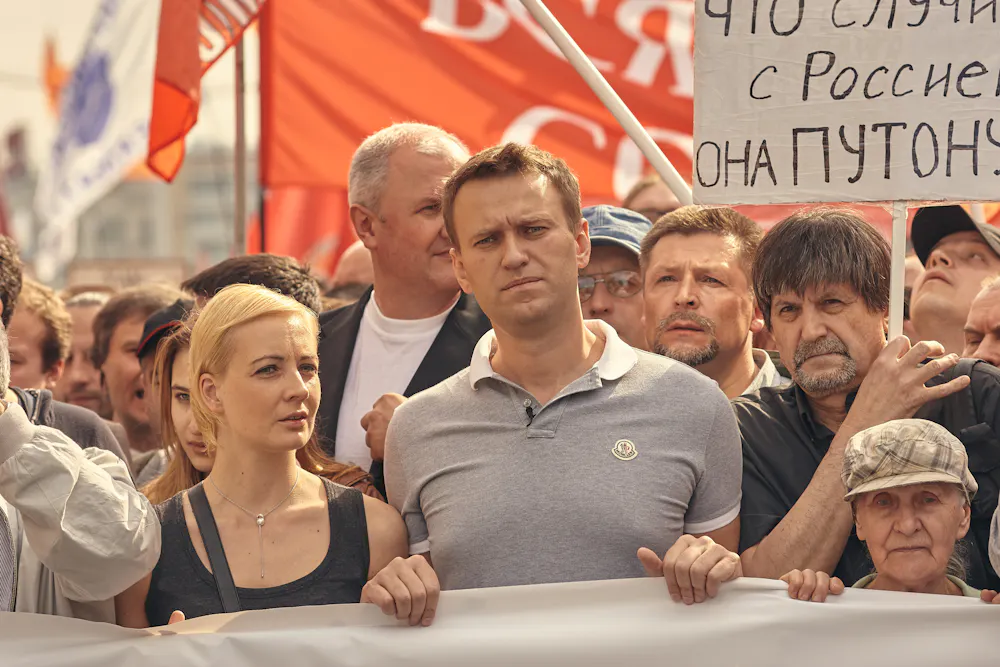
Alexei Navalny and his wife, Yulia Navalnaya, at a protest rally in Moscow, May 2012. Dmitry Laudin/Shutterstock
Today, Navalny’s family and team continue his work outside of Russia – and are fighting to keep his name alive back home. But the odds are against them. Polling suggests the share of Russians who say they know nothing about Navalny or his activities roughly doubled to 30% between his return in January 2021 and his death three years later.
Navalny fought against an autocratic system – and paid the price with his life. Given the very real fears Russians may have of voicing support for a man still labelled an extremist by the Putin regime, it’s not easy to assess what people there really think of him and his legacy. But we will also never know how popular Navalny would have been in the “normal” political system he fought for.
What made Navalny the force he was?
Navalny didn’t mean for the humble yellow rubber duck to become such a potent symbol of resistance.
In March 2017, the ACF published its latest investigation into elite corruption, this time focusing on then-prime minister (and former president), Dmitry Medvedev. Navalny’s team members had become masters of producing slick videos that enabled their message to reach a broad audience. A week after posting, the film had racked up over 7 million views on YouTube – an extraordinary number at that time.
The film included shocking details of Medvedev’s alleged avarice, including yachts and luxury properties. In the centre of a large pond in one of these properties was a duck house, footage of which was captured by the ACF using a drone.
Video: ACF.
Such luxuries jarred with many people’s view of Medvedev as being a bit different to Putin and his cronies. As Navalny wrote in his memoir, Medvedev had previously seemed “harmless and incongruous”. (At the time, Medvedev’s spokeswoman said it was “pointless” to comment on the ACF investigation, suggesting the report was a “propaganda attack from an opposition figure and a convict”.)
But people were angry, and the report triggered mass street protests across Russia. They carried yellow ducks and trainers, a second unintended symbol from the film given Medvedev’s penchant for them.
Another reason why so many people came out to protest on March 26 2017 was the organising work carried out by Navalny’s movement.
The previous December, Navalny had announced his intention to run in the 2018 presidential election. As part of the campaign, he and his team created a network of regional headquarters to bring together supporters and train activists across Russia. Although the authorities had rejected Navalny’s efforts to register an official political party, this regional network functioned in much the same way, gathering like-minded people in support of an electoral candidate. And this infrastructure helped get people out on the streets.
The Kremlin saw this as a clear threat. According to a December 2020 investigation by Bellingcat, CNN, Der Spiegel and The Insider, the FSB assassination squad implicated in the Novichok poisoning of Navalny had started trailing him in January 2017 – one month after he announced his run for the presidency.
At the protests against Medvedev, the authorities’ growing intolerance of Navalny was also on display – he was detained, fined and sentenced to 15 days’ imprisonment.
The Medvedev investigation was far from the beginning of Navalny’s story as a thorn in the Kremlin’s side. But this episode brings together all of the elements that made Navalny the force he was: anti-corruption activism, protest mobilisation, attempts to run as a “normal” politician in a system rigged against him, and savvy use of social media to raise his profile in all of these domains.
Courting controversy
In Patriot, Navalny writes that he always “felt sure a broad coalition was needed to fight Putin”. Yet over the years, his attempts to form that coalition led to some of the most controversial points of his political career.
In a 2007 video, Navalny referred to himself as a “certified nationalist”, advocating for the deportation of illegal immigrants, albeit without using violence and distancing himself from neo-Nazism. In the video, he says: “We have the right to be Russians in Russia, and we’ll defend that right.”
Although alienating some, Navalny was attempting to present a more acceptable face of nationalism, and he hoped to build a bridge between nationalists and liberals in taking on the Kremlin’s burgeoning authoritarianism.
But the prominence of nationalism in Navalny’s political identity varied markedly over time, probably reflecting his shifting estimations of which platform could attract the largest support within Russia. By the time of his thwarted run in the 2018 presidential election, nationalist talking points were all but absent from his rhetoric.
However, some of these former comments and positions continue to influence how people view him. For example, following Russia’s annexation of Crimea in 2014, Navalny tried to take a pragmatic stance. While acknowledging Russia’s flouting of international law, he said that Crimea was “now part of the Russian Federation” and would “never become part of Ukraine in the foreseeable future”.
Many Ukrainians take this as clear evidence that Navalny was a Russian imperialist. Though he later revised his position, saying Crimea should be returned to Ukraine, some saw this as too little, too late. But others were willing to look past the more controversial parts of his biography, recognising that Navalny represented the most effective domestic challenge to Putin.
Another key attempt to build a broad political coalition was Navalny’s Smart Voting initiative. This was a tactical voting project in which Navalny’s team encouraged voters to back the individual thought best-placed to defeat the ruling United Russia candidate, regardless of the challenger’s ideological position.
The project wasn’t met with universal approval. Some opposition figures and voters baulked at, or flatly refused to consider, the idea of voting for people whose ideological positions they found repugnant – or whom they viewed as being “fake” opposition figures, entirely in bed with the authorities. (This makes clear that Navalny was never the leader of the political opposition in Russia; he was, rather, the leading figure of a fractious constellation of individuals and groups.)
But others relished the opportunity to make rigged elections work in their favour. And there is evidence that Smart Voting did sometimes work, including in the September 2020 regional and local elections, for which Navalny had been campaigning when he was poisoned with Novichok.
In an astonishing moment captured on film during his recovery in Germany, Navalny speaks to an alleged member of the FSB squad sent to kill him. Pretending to be the aide to a senior FSB official, Navalny finds out that the nerve agent had been placed in his underpants.
How do Russians feel about Navalny now?
It’s like a member of the family has died.
This is what one Russian friend told me after hearing of Navalny’s death a year ago. Soon afterwards, the Levada Center – an independent Russian polling organisation – conducted a nationally representative survey to gauge the public’s reaction to the news.
The poll found that Navalny’s death was the second-most mentioned event by Russian people that month, after the capture of the Ukrainian city of Avdiivka by Russian troops. But when asked how they felt about his death, 69% of respondents said they had “no particular feelings” either way – while only 17% said they felt “sympathy” or “pity”.
And that broadly fits with Navalny’s approval ratings in Russia. After his poisoning in 2020, 20% of Russians said they approved of his activities – but this was down to 11% by February 2024.
Video: BBC.
Of course, these numbers must be taken for what they are: polling in an authoritarian state regarding a figure vilified and imprisoned by the regime, during a time of war and amid draconian restrictions on free speech. To what extent the drop in support for Navalny was real, rather than reflecting the increased fear people had in voicing their approval for an anti-regime figure, is hard to say with certainty.
When asked why they liked Navalny, 31% of those who approved of his activities said he spoke “the truth”, “honestly” or “directly”. For those who did not approve of his activities, 22% said he was “paid by the west”, “represented” the west’s interests, that he was a “foreign agent”, a “traitor” or a “puppet”.
The Kremlin had long tried to discredit Navalny as a western-backed traitor. After Navalny’s 2020 poisoning, Putin’s spokesman, Dmitry Peskov, said that “experts from the United States’ Central Intelligence Agency are working with him”. The Russian state claimed that, rather than a patriot exposing official malfeasance with a view to strengthening his country, Navalny was a CIA stooge intent on destroying Russia.
Peskov provided no evidence to back up this claim – and the official propaganda wasn’t believed by all. Thousands of Russians defied the authorities by coming out to pay their respects at Navalny’s funeral on March 1 2024. Many, if not all, knew this was a significant risk. Police employed video footage to track down members of the funeral crowd, including by using facial recognition technology.
The first person to be detained was a Muscovite the police claimed they heard shouting “Glory to the heroes!” – a traditional Ukrainian response to the declaration “Glory to Ukraine!”, but this time referencing Navalny. She spent a night in a police station before being fined for “displaying a banned symbol”.
Putin always avoided mentioning Navalny’s name in public while he was alive – instead referring to him as “this gentleman”, “the character you mentioned”, or the “Berlin patient”. (The only recorded instance of Putin using Navalny’s name in public when he was alive was in 2013.)
However, having been re-elected president in 2024 and with Navalny dead, Putin finally broke his long-held practice, saying: “As for Navalny, yes he passed away – this is always a sad event.” It was as if the death of his nemesis diminished the potency of his name – and the challenge that Navalny had long presented to Putin.
Nobody can become another Navalny
Someone else will rise up and take my place. I haven’t done anything unique or difficult. Anyone could do what I’ve done.
So wrote Navalny in the memoir published after his death. But that hasn’t happened: no Navalny 2.0 has yet emerged. And it’s no real surprise. The Kremlin has taken clear steps to ensure nobody can become another Navalny within Russia.
In 2021, the authorities made a clear decision to destroy Navalny’s organisations within Russia, including the ACF and his regional network. Without the organisational infrastructure and legal ability to function in Russia, no figure has been able to take his place directly.
More broadly, the fate of Navalny and his movement has had a chilling effect on the opposition landscape. So too have other steps taken by the authorities.
Russia has become markedly more repressive since the start of its war on Ukraine. The human rights NGO First Department looked into the number of cases relating to “treason”, “espionage” and “confidential cooperation with a foreign state” since Russia introduced the current version of its criminal code in 1997. Of the more than 1,000 cases, 792 – the vast majority – were initiated following Russia’s full-scale invasion of Ukraine in 2022.
Russian law enforcement has also used nebulous anti-extremism and anti-terrorism legislation to crack down on dissenting voices. Three of Navalny’s lawyers were sentenced in January 2025 for participating in an “extremist organisation”, as the ACF was designated by a Moscow court in June 2021. The Russian legislature has also passed a barrage of legislation relating to so-called “foreign agents”, to tarnish the work of those the regime regards as foreign-backed “fifth columnists”.
Mass street protests are largely a thing of the past in Russia. Restrictions were placed on public gatherings during the COVID pandemic – but these rules were applied selectively, with opposition individuals and groups being targeted. And opportunities for collective action were further reduced following the full-scale invasion of Ukraine.
Freedom of speech has also come under assault. Article 29, point five of the Russian constitution states: “Censorship shall be prohibited.” But in September 2024, Kremlin spokesperson Peskov said: “In the state of war that we are in, restrictions are justified, and censorship is justified.”
Legislation passed very soon after the 2022 invasion of Ukraine made it illegal to comment on the Russian military’s activities truthfully – and even to call the war a war.
YouTube – the platform so central to Navalny’s ability to spread his message – has been targeted. Without banning it outright – perhaps afraid of the public backlash this might cause – the Russian state media regulator, Roskomnadzor, has slowed down internet traffic to the site within Russia. The result has been a move of users to other websites supporting video content, including VKontakte – a Russian social media platform.
In short, conditions in Russia are very different now compared to when Navalny first emerged. The relative freedom of the 2000s and 2010s gave him the space to challenge the corruption and authoritarianism of an evolving system headed by Putin. But this space has shrunk over time, to the point where no room remains for a figure like him within Russia.
In 2019, Navalny told Ivan Zhdanov, who is now director of the ACF: “We changed the regime, but not in the way we wanted.” So, did Navalny and his team push the Kremlin to become more authoritarian – making it not only intolerant of him but also any possible successor?
There may be some truth in this. And yet, the drastic steps taken by the regime following the start of the war on Ukraine suggest there were other, even more significant factors that have laid bare the violent nature of Putin’s personal autocracy – and the president’s disdain for dissenters.
Plenty for Russians to be angry about
How can we win the war when dedushka [grandpa] is a moron?
In June 2023, Evgeny Prigozhin – a long-time associate of Putin and head of the private military Wagner Group – staged an armed rebellion, marching his forces on the Russian capital. This was not a full-blown political movement against Putin. But the target of Prigozhin’s invective against Russia’s military leadership had become increasingly blurry, testing the taboo of direct criticism of the president – who is sometimes referred to, disparagingly, as “grandpa” in Russia.
And Prigozhin paid the price. In August 2023, he was killed when the private jet he was flying in crashed after an explosion on board. Afterwards, Putin referred to Prigozhin as a “talented person” who “made serious mistakes in life”.
In the west, opposition to the Kremlin is often associated with more liberal figures like Navalny. Yet the most consequential domestic challenge to Putin’s rule came from a very different part of the ideological spectrum – a figure in Prigozhin leading a segment of Russian society that wanted the Kremlin to prosecute its war on Ukraine even more aggressively.
Video: BBC.
Today, there is plenty for Russians to be angry about, and Putin knows it. He recently acknowledged an “overheating of the economy”. This has resulted in high inflation, in part due to all the resources being channelled into supporting the war effort. Such cost-of-living concerns weigh more heavily than the war on the minds of most Russians.
A favourite talking point of the Kremlin is how Putin imposed order in Russia following the “wild 1990s” – characterised by economic turbulence and symbolised by then-president Boris Yeltsin’s public drunkenness. Many Russians attribute the stability and rise in living standards they experienced in the 2000s with Putin’s rule – and thank him for it by providing support for his continued leadership.
The current economic problems are an acute worry for the Kremlin because they jeopardise this basic social contract struck with the Russian people. In fact, one way the Kremlin tried to discredit Navalny was by comparing him with Yeltsin, suggesting he posed the same threats as a failed reformer. In his memoir, Navalny concedes that “few things get under my skin more”.
Although originally a fan of Yeltsin, Navalny became an ardent critic. His argument was that Yeltsin and those around him squandered the opportunity to make Russia a “normal” European country.
Navalny also wanted Russians to feel entitled to more. Rather than be content with their relative living standards compared with the early post-Soviet period, he encouraged them to imagine the level of wealth citizens could enjoy based on Russia’s extraordinary resources – but with the rule of law, less corruption, and real democratic processes.
‘Think of other possible Russias’
When looking at forms of criticism and dissent in Russia today, we need to distinguish between anti-war, anti-government, and anti-Putin activities.
Despite the risk of harsh consequences, there are daily forms of anti-war resistance, including arson attacks on military enlistment offices. Some are orchestrated from Ukraine, with Russians blackmailed into acting. But other cases are likely to be forms of domestic resistance.
Criticism of the government is still sometimes possible, largely because Russia has a “dual executive” system, consisting of a prime minister and presidency. This allows the much more powerful presidency to deflect blame to the government when things go wrong.
There are nominal opposition parties in Russia – sometimes referred to as the “systemic opposition”, because they are loyal to the Kremlin and therefore tolerated by the system. Within the State Duma, these parties often criticise particular government ministries for apparent failings. But they rarely, if ever, now dare criticise Putin directly.
Nothing anywhere close to the challenge presented by Navalny appears on the horizon in Russia – at either end of the political spectrum. But the presence of clear popular grievances, and the existence of organisations (albeit not Navalny’s) that could channel this anger should the Kremlin’s grip loosen, mean we cannot write off all opposition in Russia.
Navalny’s wife, Yulia, has vowed to continue her husband’s work. And his team in exile maintain focus on elite corruption in Russia, now from their base in Vilnius, Lithuania. The ACF’s most recent investigation is on Igor Sechin, CEO of the oil company Rosneft.
But some have argued this work is no longer as relevant as it was. Sam Greene, professor in Russian politics at King’s College London, captured this doubt in a recent Substack post:
[T]here is a palpable sense that these sorts of investigations may not be relevant to as many people as they used to be, given everything that has transpired since the mid-2010s, when they were the bread and butter of the Anti-Corruption Foundation. Some … have gone as far as to suggest that they have become effectively meaningless … and thus that Team Navalny should move on.
Navalny’s team are understandably irritated by suggestions they’re no longer as effective as they once were. But it’s important to note that this criticism has often been sharpest within Russia’s liberal opposition. The ACF has been rocked, for example, by recent accusations from Maxim Katz, one such liberal opposition figure, that the organisation helped “launder the reputations” of two former bank owners. In their response, posted on YouTube, the ACF referred to Katz’s accusations as “lies” – but this continued squabbling has left some Russians feeling “disillusioned and unrepresented”.
So, what will Navalny’s long-term legacy be? Patriot includes a revealing section on Mikhail Gorbachev – the last leader of the Soviet Union, whom Navalny describes as “unpopular in Russia, and also in our family”. He continues:
Usually, when you tell foreigners this, they are very surprised, because Gorbachev is thought of as the person who gave Eastern Europe back its freedom and thanks to whom Germany was reunited. Of course, that is true … but within Russia and the USSR he was not particularly liked.
At the moment, there is a similar split in perceptions of Navalny. Internationally, he was nominated for the Nobel Peace Prize, awarded the Sakharov Prize by the European Parliament, and a documentary about him won an Oscar.
But there are also those outside of Russia who remain critical: “Navalny’s life has brought no benefit to the Ukrainian victory; instead, he has caused considerable harm,” wrote one Ukrainian academic. “He fuelled the illusion in the west that democracy in Russia is possible.”
Trailer for the Oscar-winning documentary Navalny.
Inside Russia, according to Levada Center polling shortly after his death, 53% of Russians thought Navalny played “no special role” in the history of the country, while 19% said he played a “rather negative” role. Revealingly, when commenting on Navalny’s death, one man in Moscow told RFE/RL’s Russian Service: “I think that everyone who is against Russia is guilty, even if they are right.”
But, for a small minority in Russia, Navalny will go down as a messiah-like figure who miraculously cheated death in 2020, then made the ultimate sacrifice in his battle of good and evil with the Kremlin. This view may have been reinforced by Navalny’s increasing openness about his Christian faith.
Ultimately, Navalny’s long-term status in Russia will depend on the nature of the political system after Putin has gone. Since it seems likely that authoritarianism will outlast Putin, a more favourable official story about Navalny is unlikely to emerge any time soon. However, how any post-Putin regime tries to make sense of Navalny’s legacy will tell us a lot about that regime.
While he was alive, Navalny stood for the freer Russia in which he had emerged as a leading opposition figure – and also what he called the “Beautiful Russia of the Future”. Perhaps, after his death, his lasting legacy in Russia remains the ability for some to think – if only in private – of other possible Russias.
To hear about new Insights articles, join the hundreds of thousands of people who value The Conversation’s evidence-based news. Subscribe to our newsletter.
Ben Noble has previously received funding from the British Academy and the Leverhulme Trust. He is an Associate Fellow of Chatham House.
European defence ministers left their meeting in Brussels on February 12 in shock after the new US secretary of defence, Pete Hegseth, told them they could no longer rely on the US to guarantee their security.
Hegseth said he was there “to directly and unambiguously express that stark strategic realities prevent the United States of America from being primarily focused on the security of Europe”.
He also insisted that European countries provide the “overwhelming” share of funding for Ukraine in the future. The US has been the biggest source of military aid to Ukraine, with its weapons, equipment and financial assistance crucial in helping Kyiv resist the Russian invasion.
Hegseth’s comments are in keeping with the stance of the US president, Donald Trump, on the Nato transatlantic military alliance. Trump sees Nato as an excessive financial burden on the US and has repeatedly called on its members to increase their defence spending.
But Hegseth’s remarks could also be seen as a sign of America’s waning commitment to the terms of Nato’s founding treaty. Signed in 1949 by the US, Canada and several western European nations, Article 5 of the treaty requires member states to defend each other in the event of an armed attack.
The US has the largest military – and the biggest stockpile of nuclear weapons – in Nato. So, on the face of it, efforts to recast the alliance appear a drastic shift in Europe’s security landscape in the post-cold war era.
However, those familiar with the political sentiment around Nato and the defence of Europe in the US will see that this move follows in the footsteps of what others have sought to do – starting from the very end of the cold war.
Changing over time
In 1991, following the collapse of the Soviet Union, Nato was under considerable pressure to change for the new world order. A rising China was not yet on the minds of many in Washington, but the feeling was that the financial commitments the US had made to defend western Europe during the cold war could not continue.
The so-called “peace dividend”, a slogan popularised by former US president George H.W. Bush and former UK prime minister Margaret Thatcher, allowed nearly all Nato states to reduce their military spending at this time.
In 1992, almost as soon as European Nato countries were shrinking their forces and moving away from mass armies to professional soldiering, the alliance became actively engaged in maintaining a no-fly zone over Yugoslavia.
A new Nato was becoming apparent. It was transitioning from being a collective defence organisation to one of collective security, where conflicts were managed on Nato’s borders.
This collective security arrangement worked well to keep the alliance together until 2001, when the administration of George W. Bush entered the White House and involved the US in wars in Afghanistan and Iraq. Following the 9/11 terrorist attacks in the US, Nato invoked Article 5 and returned to the principle of collective defence.
Many European countries, including the new, smaller Nato states like Estonia and Latvia, sent troops to Iraq and Afghanistan. The persistent justification I heard in the Baltic states was “we need to be there when the US needs us so that they will be there when we need them”.
Yet in 2011, before the wars in Iraq and Afghanistan were over, the administration of Barack Obama introduced a foreign policy strategy known as the “pivot to Asia”. The implication was that the US would shift its attention from primarily the western hemisphere to China.
By this point, China had become the second-largest economy in the world and was rapidly developing its military. The reaction to this US policy shift in European capitals was one of shock and disappointment. They saw it as the US deciding that its own security did not sit in Europe like it had since 1945.
Then, in 2014, Russia invaded Crimea and the Donbas in eastern Ukraine. The pivot to Asia looked like it had stalled. But US interest and investment in European defence continued to decline, with American military bases across Europe closed down. The first Trump administration continued the pattern set by Obama.
President Joe Biden, who entered office in 2021, used Russia’s invasion of Ukraine in 2022 to show European leaders that the US still saw its own security in Europe and that it would stand beside Ukraine.
But the US continued to insist that European countries invest in their own defence. The UK, Poland and France have all committed to increase their defence spending over recent years – though spending by European Nato states as a whole continued to fall.
There has been a long-held belief in the US that Europe is “freeriding” on American power. While the US saw its own security in Europe, this freeriding was allowed to continue.
But as the perspective of the US has changed, with the focus now on countering China, it has been keen to suggest that European defence should increasingly become the job of Europe itself.
Nato will not go out with a bang. It is much more likely to gradually disappear with a whimper. After all, who did Trump meet on his second day in office? Not Nato but the Quad: an alliance between Australia, India, Japan and the US in the Indo-Pacific.
David J. Galbreath has received research funding from the UKRI.
Source: The Conversation – UK – By David Hastings Dunn, Professor of International Politics in the Department of Political Science and International Studies, University of Birmingham
Donald Trump likes to portray himself as the great deal maker. Typically, his idea of the “Art of the Deal” had tended to involve outlandishly bullish opening demands – whether that’s on tariffs or trade deals – before settling on more moderate, but still exacting conditions. This context makes what happened when the US president spoke with his Russian counterpart Vladimir Putin about Ukraine so remarkable.
The very fact that Trump spoke with Putin at all was a diplomatic gift to the pariah state and its leader. For three years Russia has been diplomatically isolated by most western leaders, many of whom have called for Putin to face war crimes charges (there is currently an ICC arrest warrant out for Putin for the alleged illegal transfer of children from, Ukraine to Russia).
Indeed, the fact that Trump spoke with Putin and only then called the Ukrainian president, Volodymyr Zelensky, to inform him of their conversation indicates the subordination of Ukraine’s role in the talks.
Trumpeting the call as “highly productive” on his TruthSocial website, Trump wrote that the two leaders had spoken about the “strengths of our respective nations, and the great benefit that we will someday have in working together”. He said they had arranged to visit each other’s nations. In fact, the two will initially meet in Saudi Arabia – where Putin would not be arrested under the ICC’s warrant.
At the same time, Trump’s new defense secretary spelled out to a meeting of European defence officials the administration’s position on some of the key issues. It was clear that several of Ukraine’s “red lines” had already fallen by the wayside as far as the US is concerned.
Hegseth said that returning to Ukraine’s pre-2014 borders is “an unrealistic objective” and an “illusionary goal” and that any deal must be based on “a realistic assessment of the battlefield.”
Likewise Ukraine’s future Nato membership – something the US committed to support in the 2008 Budapest Declaration, was also a non-starter. And he said the US would not onlynot join any international force deployed to ensure Ukrainian security, but that if such a force were constituted it would not be a Nato operation. As such, he said, it would not be covered by the alliance’s article 5 pledge for collective security. This effectively dooms this initiative to failure.
As important as what was announced by the Trump administration on this subject, was what was omitted. Trump has never condemned Putin for his illegal invasion of Ukraine. And there has been no mention in his social media posts that Russia’s invasion of Ukraine was a violation of international law. Or the inviolability of Ukraine’s borders or the issue of Russian reparations for the material and human damage inflicted on Ukraine.
Russia celebrates
Russia, meanwhile, is cock-a-hoop. Kremlin spokesman Dmitri Peskov reported that Putin talked about Moscow’s demands, telling Trump of “the need to eliminate the root causes of the conflict”. This suggests that while Ukraine’s red lines are going to be ignored by the US, Russia will continue to insist on its maximalist demands that the Russians intend to take in their approach to the negotiation.
In addition to the concessions that Hegseth indicated the Trump administration has already decided to go along with, Russia is also likely to press for the demilitarisation of Ukraine. It will demand control, not just of the territory that it occupies, but of the remainder of the Ukrainian provinces that Putin has already declared to be “Russian”: Luhansk, Donetsk, Zaporizhzhia and Kherson, in the south and east of Ukraine.
Both the Russian stock market and the ruble rose sharply on the US announcement of the talks, and the government-controlled press in Russian could hardly hide their glee, reporting that: “Russia is ready for talks. But on its terms”.
European leaders shocked
The pace and scale of US concessions on Ukraine seen to have caught the US’s European Nato allies off guard. Like Ukraine itself, they have been sidelined by Trump’s decision to seek direct negotiations with Putin. The UK’s defence secretary, John Healey, issued a statement appealing that “that there can be no negotiation about Ukraine without Ukraine and Ukraine’s voice must be at the heart of any talks”.
German foreign minister, Anna Baerbock, meanwhile, said the call had come out of the blue without any consultation with Europe: “This is the way the Trump administration operates,” she said, adding: “This is not how others do foreign policy, but this is now the reality.” Baerbock said a deal must not be imposed on Ukraine and that Europe should be involved in negotiations: “This is about European peace. That’s why we Europeans must be involved.”
The French foreign ministry put out a statement saying that: “Ukraine and Europe must be part of any negotiations. Ukraine should be provided with strong security guarantees.”
Other commentators have been less diplomatic. Michael McFaul, who served as US ambassador to Russia under Barack Obama, took to X to question Trump’s tactics: “Diplomacy 101: Don’t give anything without getting something in return. Don’t negotiate in public. Don’t negotiate about Ukraine’s future without first coordinating your position with Ukrainians.”
We’ll know more about what – if any – agency Volodymyr Zelensky and his diplomats have in the future of their country after US secretary of state, Marco Rubio, and vice-president, JD Vance, meet with Zelensky at the Munich Security Conference on February 14-16.
But for the present at least, it appears that negotiations will be less about pressuring Putin to bring a just end to the war he started, than forcing Ukraine to give in to the Russian leader’s demands.
David Hastings Dunn has previously received funding from the ESRC, the Gerda Henkel Foundation, the Open Democracy Foundation and has previously been both a NATO and a Fulbright Fellow.
In accordance with the Methodology for determining the risk parameters of the stock market and deposit market of Moscow Exchange PJSC by NCO NCC (JSC), on 13.02.2025, 17-34 (Moscow time), the values of the upper limit of the price corridor (up to 135.04) and the range of market risk assessment (up to 145.09 rubles, equivalent to a rate of 21.25%) of the GMKN (GMKNorNik) security were changed.
Please note: This information is raw content directly from the source of the information. It is exactly what the source states and does not reflect the position of MIL-OSI or its clients.
Please Note; This Information is Raw Content Directly from the Information Source. It is access to What the Source Is Stating and Does Not Reflect
In accordance with the Methodology for determining the risk parameters of the stock market and deposit market of Moscow Exchange PJSC by NCO NCC (JSC) on 13.02.2025, 17-55 (Moscow time), the values of the upper limit of the price corridor (up to 70.97) and the range of market risk assessment (up to 872.79 rubles, equivalent to a rate of 15.0%) of the SU52005RMFS4 security (OFZ 52005) were changed.
Please note: This information is raw content directly from the source of the information. It is exactly what the source states and does not reflect the position of MIL-OSI or its clients.
Please Note; This Information is Raw Content Directly from the Information Source. It is access to What the Source Is Stating and Does Not Reflect
Source: State University of Management – Official website of the State –
On February 12, 2025, the Institute of Distance Education of the State University of Management awarded diplomas to bachelors who completed their studies in the accelerated program “Human Resources Management”.
The students of the Institute of Distance Education, who studied in their field after technical schools, colleges or received a second higher education, passed the final certification tests at the State University of Management earlier than others. For three and a half years, they combined their studies at the university with work in institutions and enterprises of various sectors of the economy and are now ready to continue their career in a new capacity.
At the award ceremony, the bachelor’s degree students were congratulated by the Director of the Institute of Distance Education, Sergei Lenshin, the Institute’s staff, and representatives of the Distance Learning Student Council, who wished the graduates not to stop there, to realize themselves in their professions, and to continue their education in the university’s Master’s program.
We wish that the acquired education will help our graduates in their career growth, and that the knowledge obtained at the State University of Management will become the basis and a serious bid for a successful life.
Subscribe to the TG channel “Our GUU” Date of publication: 02/13/2025
Please note: This information is raw content directly from the source of the information. It is exactly what the source states and does not reflect the position of MIL-OSI or its clients.
Source: State University Higher School of Economics – State University Higher School of Economics –
Pavel Voloshchuk has been developing and researching educational products for 14 years. Since August 2024, he has headed two master’s programs at the HSE Faculty of Computer Science:Research and Entrepreneurship in AI” And “Master of Science in Data Science” Pavel Voloshchuk spoke about his career path, time management and the specifics of academic leadership in an interview.
— Tell us about your background.
— I have two main interests. The first is teaching adults. For the last 14 years, I have been creating educational products: first in consulting and corporations (the Sochi-2014 organizing committee, Russian Railways, Sber), and for the last five years at HSE. The second interest is product research and product management, especially in the area of customer research and working with product hypotheses. This year, AST publishing house released my textbook, “Shake the Client: How to Create Products Inspired by Real People.”
Thus, I have a managerial, product background.
— What are your scientific interests?
— I’m interested in how people learn, especially in face-to-face programs that are delivered online. How user behavior and their perception of product value change. How we can easily assess the value of a product before investing in expensive design and development stages.
— How did you get into HSE?
— I worked at SberUniversity, a division that trains Sber executives and develops external educational programs for partner companies. At a certain point, I was offered to transfer to the Higher School of Economics.
— What are your responsibilities?
— I am responsible for two master’s programs.
“Research and Entrepreneurship in Artificial Intelligence” is a classic full-time program with 30 students. It is designed for those who want to dedicate themselves to scientific work in the field of DS – to become an employee of a corporate or university laboratory, a founder or a member of a team of a technology startup.
The Master of Science in Data Science is a large online program, currently enrolling around 450 students. The online master’s degree is suitable for those who have no technical experience and are looking to learn the Data Scientist profession from scratch.
These programs differ in everything from the format of study (face-to-face vs. online) to the requirements for admission (having technical experience and a desire for scientific work vs. lack of technical knowledge and mastering the profession from scratch).
I also, of course, teach product research and mentor seminars in my master’s programs.
— How does your working day go?
— My working day can vary greatly depending on the season.
During the admissions campaign, I conduct consultations with applicants and prepare for the new academic year. In May and June, I participate in examination committees and accept defenses from students.
At the same time, a typical day always includes meetings – with the program team, teachers and colleagues from different departments of the HSE – communication with students, preparation of materials and much more, which ends with evening classes.
The role of an academic director is not about a fixed schedule. The program is not just a set of tasks, but people: students, teachers, university staff, the market and the situation. This means that every day you have a variety of tasks to ensure the effective operation of the program.
— How do you manage to combine academic leadership of two such different master’s programs?
“It’s difficult, and without a team it would not have been possible to cope with such a workload.”
We are implementing the program “Research and Entrepreneurship in AI” together with our partner – MTS, the guys are very helpful. And we also have an amazing manager of the training office – Ilona Yakovleva.
If we talk about the Master of Data Science program, there is also a huge amount of work. Several factors help: previous experience in online education, the project team and the amazing involvement of teachers, with whom we are friends and solve all the problems together. For such a large program, connections with the industry are important. For example, in the 2024/25 academic year, through joint efforts, we found academic supervisors for 190 students in two weeks.
— Are there any special features in managing an online master’s degree program?
— There are many, I will give a couple of examples. First of all, it is a much larger volume of communication with students and teachers. Due to the format, they cannot simply ask questions at a meeting, it is a little more difficult for them to remain involved. Therefore, we have special curators who work with students’ questions. Special attention is also paid to community management, so that students have the opportunity to get to know those with whom they study and expand their circle of social and professional connections.
— What are the prospects for your educational programs?
— In 2024, we launched the first intake for the AI Research and Entrepreneurship program. On the one hand, it is difficult to be the first, on the other hand, students receive maximum attention from partners and the program team. Now we are actively preparing for the start of a new admissions campaign, analyzing feedback and preparing the program design for the next academic year. In addition, the internship season is approaching, colleagues from MTS are preparing to accept our students who have applied for an internship.
For the Master of Data Science program, 2025 is a very important year — we are completely redesigning the program: it has become Russian-language, classes are synchronous. That is, students will be able to attend online classes, and the studies will be as similar as possible to the full-time program. This is an important transition that will improve the quality of training in the program and maintain the maximum relevance of the competencies that students receive.
— What do you do in your free time?
— Tennis. I also like quizzes. This fall we picked up a kitten, named her Amber, and now our family leisure time is treating the cat. She is almost healthy, we will soon choose another hobby.
Please note: This information is raw content directly from the source of the information. It is exactly what the source states and does not reflect the position of MIL-OSI or its clients.
Source: Saint Petersburg State University of Architecture and Civil Engineering – Saint Petersburg State University of Architecture and Civil Engineering –
From February 3 to April 4, the Saint Petersburg State University of Architecture and Civil Engineering is once again implementing the educational initiative “TIM-elective of SPbGASU for SPO”. It is being held jointly with Association SRO “OsnovaProekt” with the support of the National Association of Surveyors and Designers (NOPRIZ) and the industry Consortium of Secondary Vocational Education in Construction. The TIM elective is part of the innovative educational project of SPbGASU “Innovative Methodology for Forming Digital Professional Competencies of Students and Specialists in the Construction Industry”, implemented under the auspices of the Ministry of Education and Science of Russia.
The purpose of the elective is to develop design skills using information modeling technologies (IMT) among students majoring in construction.
SPbGASU teachers and invited specialists conduct classes in such areas as architect, designer, heating and ventilation engineer, water supply and sanitation engineer, TIM coordinator, estimator. Training in each competency is implemented in the form of modular advanced training programs, within the framework of which teachers and students become familiar with working in specialized domestic software products (Renga, nanoCAD, Pilot-BIM, CADLib Model and Archive, SmetaWIZARD, BIM WIZARD).
More than 750 people (including more than 140 teachers) from 31 colleges across Russia are taking part in the elective course.
The elective will result in the qualifying TIM championships of SPbGASU in the SPO League, which each participating organization will hold on its own site according to the uniform regulations of the TIM championships of SPbGASU. Students will be able to apply the acquired knowledge and skills to solving a practical problem in a competitive format.
Please note: This information is raw content directly from the source of the information. It is exactly what the source states and does not reflect the position of MIL-OSI or its clients.
In accordance with the Methodology for determining the risk parameters of the stock market and deposit market of Moscow Exchange PJSC by NCO NCC (JSC) on 13.02.2025, 15-27 (Moscow time), the values of the upper limit of the price corridor (up to 104.61) and the range of market risk assessment (up to 1108.31 rubles, equivalent to a rate of 8.13%) of the RU000A0JUKX4 security (DOM.RF30ob) were changed.
Please note: This information is raw content directly from the source of the information. It is exactly what the source states and does not reflect the position of MIL-OSI or its clients.
Please Note; This Information is Raw Content Directly from the Information Source. It is access to What the Source Is Stating and Does Not Reflect
In accordance with the Methodology for determining the risk parameters of the stock market and deposit market of Moscow Exchange PJSC by NCO NCC (JSC), on 13.02.2025, 15-28 (Moscow time), the values of the upper limit of the price corridor (up to 38.83) and the range of market risk assessment (up to 41,723 rubles, equivalent to a rate of 21.25%) of the MAGN (MMK) security were changed.
Please note: This information is raw content directly from the source of the information. It is exactly what the source states and does not reflect the position of MIL-OSI or its clients.
Please Note; This Information is Raw Content Directly from the Information Source. It is access to What the Source Is Stating and Does Not Reflect
In accordance with the Methodology for determining the risk parameters of the stock market and deposit market of Moscow Exchange PJSC by NCO NCC (JSC) on 13.02.2025, 16-19 (Moscow time), the values of the upper limit of the price corridor (up to 85.39) and the range of market risk assessment (up to 945.15 rubles, equivalent to a rate of 15.0%) of the security SU26246RMFS7 (OFZ 26246) were changed.
Please note: This information is raw content directly from the source of the information. It is exactly what the source states and does not reflect the position of MIL-OSI or its clients.
Please Note; This Information is Raw Content Directly from the Information Source. It is access to What the Source Is Stating and Does Not Reflect
In accordance with the Methodology for determining the risk parameters of the stock market and deposit market of Moscow Exchange PJSC by NCO NCC (JSC) on 13.02.2025, 16-23 (Moscow time), the values of the upper limit of the price corridor (up to 81.42) and the range of market risk assessment (up to 888.09 rubles, equivalent to a rate of 10.0%) of the SU26242RMFS6 security (OFZ 26242) were changed.
Please note: This information is raw content directly from the source of the information. It is exactly what the source states and does not reflect the position of MIL-OSI or its clients.
Please Note; This Information is Raw Content Directly from the Information Source. It is access to What the Source Is Stating and Does Not Reflect
In accordance with the Methodology for determining the risk parameters of the stock market and deposit market of Moscow Exchange PJSC by NCO NCC (JSC) on 13.02.2025, 17-09 (Moscow time), the values of the upper limit of the price corridor (up to 65.33) and the range of market risk assessment (up to 709.9 rubles, equivalent to a rate of 12.5%) of the SU26235RMFS0 security (OFZ 26235) were changed.
Please note: This information is raw content directly from the source of the information. It is exactly what the source states and does not reflect the position of MIL-OSI or its clients.
Please Note; This Information is Raw Content Directly from the Information Source. It is access to What the Source Is Stating and Does Not Reflect
End-of-Mission press releases include statements of IMF staff teams that convey preliminary findings after a visit to a country. The views expressed in this statement are those of the IMF staff and do not necessarily represent the views of the IMF’s Executive Board. This mission will not result in a Board discussion.
Harare, Zimbabwe: Following the request for a Staff-Monitored Program (SMP) by the authorities in 2023, an International Monetary Fund (IMF) staff team led by Mr. Wojciech Maliszewski conducted a mission to Harare from January 30 to February 13, 2024, to advance discussions on the SMP.
At the conclusion of the IMF mission, Mr. Maliszewski issued the following statement:
“Zimbabwe’s economic activity has started recovering after the El Niño-induced drought. Growth slowed from 5.3 percent to an estimated 2 percent in 2024, as the drought lowered agricultural output by 15 percent. This was compounded by reduced electricity production and declining prices for key mineral exports (platinum and lithium). That said, strong remittances continued supporting activity in domestic trade, services, and construction, and improved the current account surplus to an estimated US$500 million (1.4 percent of GDP) in 2024. The ZiG willing-buyer willing-seller (WBWS) exchange rate was stable from the ZiG’s introduction in April 2024—with the ZiG month-on-month inflation averaging 2.3 percent—until September, when the currency weakened. Relative stability returned with the tightening of monetary policy since September, and the WBWS and parallel market exchange rates have stabilized, and the gap between these rates has narrowed. Meanwhile, fiscal pressures intensified—owing, in large part, to the transfer of the RBZ’s quasi-fiscal operations to the Treasury. Strong revenue collection helped limit the 2024 budget deficit to an estimated 1 percent of GDP, but fiscal pressures resulted in an accumulation of domestic expenditure arrears, leading to the government implementing emergency spending cuts. Going forward, growth in 2025 is projected to increase to 6 percent, with the recovery in agriculture output due to better climate conditions and the projected improvement in the terms-of-trade.
“Against this background, the Zimbabwe authorities had requested an SMP to support their efforts to stabilize the economy and re-engage with the international community on the arrears clearance and debt resolution process. The main objective of the SMP would be to durably anchor macroeconomic stability, building on policy recommendations from the 2024 Article IV consultation.
“Building on progress achieved during the mission on the ongoing SMP discussions, Fund staff will continue working closely with the authorities on defining the key parameters and modalities of the program. Discussions include (1) adjusting the fiscal position to avoid a recourse to monetary financing and new arrears and building foundations for a durable fiscal consolidation; (2) fiscal risks residing off-budget (including from the operations of the Mutapa Investment Fund); (3) the effectiveness of the monetary policy framework for the ZiG; and (4) reforms to strengthen economic governance.
“International reengagement remains critical for debt resolution and arrears clearance, which would open the door for access to external financing. The authorities’ reengagement efforts, through the Structured Dialogue Platform (SDP), are key for attaining debt sustainability and gaining access to concessional financial support. In this context, the SMP will help in enhancing policy credibility and advancing the reform agenda embedded in the SDP.
“The IMF continues to provide policy advice and extensive technical assistance in the areas of revenue mobilization, expenditure control, financial supervision, debt management, economic governance, as well as macroeconomic statistics. However, the IMF is currently precluded from providing financial support to Zimbabwe due to its unsustainable debt situation—based on the IMF’s Debt Sustainability Analysis (DSA)—and official external arrears. An IMF financial arrangement would require a clear path to comprehensive restructuring of Zimbabwe’s external debt, including the clearance of arrears and a reform plan that is consistent with durably restoring macroeconomic stability; enhancing inclusive growth; lowering poverty; and strengthening economic governance.
“The IMF mission held meetings with the Minister of Finance, Economic Development and Investment Promotion Hon. Professor Mthuli Ncube, his Permanent Secretary Mr. George Guvamatanga; the Reserve Bank of Zimbabwe Governor Dr. John Mushayavanhu; the Chief Secretary to the President and Cabinet Dr. Martin Rushwaya, other senior government and RBZ officials, honorable members of Parliament, representatives of the private sector, civil society, and Zimbabwe’s development partners.
“The IMF staff wishes to express its gratitude to the Zimbabwean authorities and stakeholders for the constructive and open discussions and support during the mission.”
The Institute for Statistical Studies and Economics of Knowledge at the National Research University Higher School of Economics, based on statistical data and a specialized survey called “Making Science in Russia,” analyzes the prevalence of practices in scientific organizations and universities in the country that use AI solutions to carry out research and development.
Reference: The “Doing Science in Russia” study is a continuation of the Doing Science project (the first two waves were conducted in 2017 and 2022). As part of the third wave (October-November 2024), representatives of 719 scientific organizations and universities (heads or their deputies for research activities) were asked to rate on a five-point scale the level of provision with AI systems for research and development.
This issue of the series “Artificial Intelligence” was prepared within the framework of the project “Monitoring scientific support for measures to achieve technological leadership of the Russian Federation” of the thematic plan of research work provided for by the State assignment of the National Research University Higher School of Economics.
Modern AI-based technologies are changing the usual way of life in all areas of activity, and science is no exception. SurveyA 2023 Nature study found that more than a quarter of scientists already using AI in their research expect the technology to become an essential tool for their field in the next 10 years, with another 47% believing it will be very useful. Related study Oxford University Press shows that we won’t have to wait that long: 75% of surveyed scientists publishing in leading journals have already used various AI tools in 2024, including machine translation services (49%), chatbots (43%) and search engines (25%). According to respondents, AI-based solutions are useful at all stages of the research cycle and for a wide range of tasks: 41% of respondents used them to search for literature, about 35% – for its generalization and/or editing of text (e.g., an article manuscript), 25% – for idea generation, data collection and/or its analysis.
According to statistics, the implementation of AI solutions in the field of science in Russia is only gaining momentum. In 2023, about 5% of scientific organizations and about 10% of universities used AI for their purposes, but these figures do not fully reflect the real scale of the use of this technology by scientists, since they characterize only the practices of the organizations themselves, and not their employees.
In the future, we should expect the expansion of AI implementation in the field of science and higher education: every second organization sees prospects for further use of relevant tools in their activities here. In addition, almost 25% of scientific organizations and 38% of universities that are already using AI believe that such technologies will radically change internal processes in science in the coming years; many of them consider intelligent decision support technologies to be the most promising for these tasks (33%).
It is obvious that the possibility of realizing these expectations largely depends on the level of development of the necessary digital infrastructure. As shown by a survey of 719 scientific organizations and universities conducted by the HSE ISSEK as part of the Doing Science in Russia project (October-November 2024), access to AI systems for research and development is still difficult. The surveyed executives rated the availability of such foreign-developed systems (ChatGPT, Trinka, Mendeley, Scite, Google Jax, etc.) at 2.71 points out of a possible five, and domestic systems (GigaChat, GitVerse, YaLM, SOVA, RAZUM AI, GOLEM, NeuroMark, AI BAUM PLATFORM, NNWizard, etc.) even lower, at 2.60 points. The situation is somewhat better in universities than in other organizations (Fig. 1).
Against the background of restrained assessments of the current situation, forecasts for the next three years look more optimistic: organizations of all types expect a significant increase in the use of AI systems for research and development. Of course, to ensure such dynamics, it is necessary to remove barriers that hinder the spread of AI in science. Among the most significant of them, universities and scientific organizations note: a shortage of financial resources, a shortage of qualified personnel, an insufficiently developed ICT infrastructure, a shortage/low quality of big data for the implementation of AI. Half of the universities and about 40% of scientific organizations point to the influence of these restraining factors.
Overcoming barriers to the spread of AI in Russian science could be facilitated by a special program that would provide for the development of research standards using AI; grants for young scientists and research teams studying and using AI in their work (with priority given to those areas of science where such technologies are rarely used); support for the development of AI applications for scientific tasks; compensation for the costs of universities and research organizations for the purchase of big data for the purposes of training and development of generative models.
This HSE ISSEK material may be reproduced (copied) or distributed in full only with prior consent from HSE (please contact Issek@mse.ru). It is permitted to use parts (fragments) of the material provided that the source and an active link to the HSE ISSEK website are indicated (Issek.hse.ru), as well as the authors of the material. Use of the material beyond the permitted methods and in violation of the specified conditions will result in a violation of copyright.
Suggested citation:
Streltsova E. A., Popov E. V., Gershman M. A. (2025) Artificial Intelligence in Science. Moscow – ISSEK HSE. Access mode: https://issek.hse.ru/news/1015931860.html.
Please note: This information is raw content directly from the source of the information. It is exactly what the source states and does not reflect the position of MIL-OSI or its clients.
PALM BEACH, Fla., Feb. 13, 2025 (GLOBE NEWSWIRE) — FN Media GroupNews Commentary – The Military Drone Market is expected to see substantial growth in the coming years. A recent report from Straits Research. Said that the global military drone market size was valued at USD 21.81 billion in 2024 and is expected to grow from USD 24.25 billion in 2025 to reach USD 56.69 billion by 2033, growing at a CAGR of 11.20% during the forecast period (2025-2033). The report said: “A military drone, also known as an unmanned aerial vehicle (UAV), is a type of aircraft that operates without a human pilot on board. These drones are equipped with advanced technologies for surveillance, reconnaissance, intelligence gathering, and, in some cases, targeted strikes. Military drones are used extensively in modern warfare for a variety of roles, including combat, surveillance, logistical support, and search-and-rescue missions. The global market is experiencing rapid growth, driven by technological advancements and increasing global demand for enhanced surveillance, intelligence, and reconnaissance capabilities. As nations recognize the strategic advantages of unmanned aerial systems (UAS) in military operations, drones are increasingly deployed in both combat and non-combat roles. This expansion is further supported by rising defense budgets, particularly in regions such as Asia-Pacific, Europe, and the Middle East. Despite the promising growth, there are significant challenges facing the global market, including complex regulatory issues and ethical concerns surrounding the use of autonomous weapons. However, innovations in artificial intelligence (AI), miniaturization, and battery life are expected to open new growth opportunities, enabling more advanced, efficient, and versatile drone capabilities in the near future.” Active Companies in the markets today include ZenaTech, Inc. (NASDAQ: ZENA), AgEagle Aerial Systems Inc. (NYSE: UAVS), EHang Holdings Limited (NASDAQ: EH), Vertical Aerospace (NYSE: EVTL), The Boeing Company (NYSE: BA).
Straits Research continued: “Geopolitical tensions, especially in regions like Asia-Pacific, the Middle East, and Eastern Europe, are driving a significant demand for military drones. As nations seek to strengthen their surveillance, intelligence, and tactical capabilities, military drones have become integral to modern defense strategies. For example, the Indo-Pacific region increasingly views drones as vital for maintaining a strategic balance in contested areas. Similarly, Russia’s actions in Ukraine have highlighted the tactical advantages of drones, prompting Eastern European nations near the conflict zone to prioritize drone investments to enhance border security and ensure readiness in case of escalations.
ZenaTech (NASDAQ:ZENA) ZenaDrone Subsidiary Develops and Tests Proprietary Drone Communications System Enabling Secure and Reliable Communications for US Defense Applications – ZenaTech, Inc. (FSE: 49Q) (BMV: ZENA) (“ZenaTech”), a technology company specializing in AI (Artificial Intelligence) drones, Drone as a Service (DaaS), enterprise SaaS and Quantum Computing solutions, announces that its subsidiary ZenaDrone has developed and is currently testing a proprietary drone communications management system called “DroneNet” that enables direct and secure drone communications in situations without reliable internet, cellular or satellite communications. The internally developed system is specifically built for use with the Company’s ZenaDrone 1000 and IQ series of drone products. A drone communications system is a two-way link between a drone and its base station used to direct the drone and relay real-time drone video and sensor data.
“We believe our proprietary DroneNet communications system will improve both the reliability and performance of our drones ensuring we are not dependent on third-party products with compatibility issues. This internal development ensures we gain more customization of our products, cost management, and control of our supply chain, all of which results in what we believe to be superior drone solutions. Once we’ve tested this initial version, our plan for future advancements includes developing and testing our own microchips with multilayer encryption suitable for NDAA-compliant use required for US Defense applications,” said CEO Shaun Passley, Ph.D.
Drones used by the military for intelligence, surveillance and reconnaissance applications require reliable communications systems for uninterrupted data transmission, mission effectiveness, and operational security. Drones must relay real-time video, sensor data, and telemetry to command centers, allowing defense operators to make time-sensitive decisions. This is especially critical for Beyond Visual Line of Sight (BVLOS) operations, where drones operate over longer distances often in harsh or contested environments. Without secure and resilient communications links, drones risk losing control, can face signal jamming, or data latency, which can compromise mission success. Advanced proprietary communication solutions, using satellite and 4G help ensure connectivity in GPS-denied or high-interference environments and can safeguard data against jamming and cyber threats.
The ZenaDrone 1000 is an autonomous drone, in a VTOL (Vertical Takeoff and Landing) quadcopter design with eight rotors; it is considered a medium-sized drone measuring 12X7 feet in size. It is designed for stable flight, maneuverability, heavy lift capabilities up to 40 kilos, incorporating innovative software technology, AI, sensors, and purpose-built attachments, along with compact and rugged hardware engineered for industrial and defense use. Continued…Read this full release by visiting:https://www.financialnewsmedia.com/news-zena/
Other recent developments in the markets include:
AgEagle Aerial Systems Inc. (NYSE: UAVS) recently announced it recently completed a successful demonstration of its eBee VISION Intelligence Safety and Reconnaissance (ISR) UAS platform for key officials of the U.S. Department of Defense (DOD).
AgEagle CEO Bill Irby commented, “As we continue to expand our presence in the defense sector, this demonstration underscores AgEagle’s commitment to delivering innovative UAV solutions that meet the rigorous demands of diverse military applications. By providing enhanced intelligence, surveillance, and reconnaissance capabilities, the eBee VISION ensures our defense customers have the operational efficiency and situational awareness information they require for mission success.”
EHang Holdings Limited (NASDAQ: EH) recently announced the launch of its Exhibition (Experience) Center in Shenzhen’s Luohu Sports and Leisure Park. It is the world’s first EH216-S takeoff and landing site featuring a fully automated vertical lift vertiport. It also marks a new smart infrastructure in Shenzhen dedicated to the commercial operations of the EH216-S pilotless passenger-carrying aerial vehicle, establishing a groundbreaking model for electric vertical takeoff and landing (“eVTOL”) aircraft operations in urban areas.
The Luohu UAM Center, designed by EHang, boasts an automated three-dimensional vertical lift vertiport. This innovative facility reduces labor costs and optimizes space usage through its automated operations. The Luohu UAM Center, spanning approximately 753 square meters, has brought this advanced design to life. The first floor is dedicated to a hangar and boarding area, providing passengers with a seamless and comfortable experience. The integrated takeoff and landing pad with the hangar enables rapid charging, thereby streamlining flight operations. During the launch ceremony on January 21, an EH216-S aircraft was lifted from the first to the second floor by the vertical lift platform. It then took to the skies, completing a lap over the Luohu Sports and Leisure Park before landing smoothly, marking its first flight at the Luohu UAM Center. The demonstration received widespread acclaim from attendees.
Vertical Aerospace (NYSE: EVTL) has successfully completed the second stage of piloted thrustborne testing of its full scale VX4 prototype. The company is now preparing for a new chapter in its history, with the VX4 entering the penultimate phase of flight testing: wingborne flight. This phase will mark a defining moment in the VX4’s development, pushing beyond the limits of the secure airspace of Cotswold Airport’s airfield and into real-world operating conditions for the first time.
During Phase 2, the aircraft completed over thirty piloted test flights. Flight tests included completing successful hover and low speed flight maneuvers, as well as executing handling and performance procedures including roll, yaw, and spot-turns.
Shift5, the observability platform for onboard operational technology, and The Boeing Company (NYSE: BA) have recently entered into a global strategic reseller partnership to offer Shift5’s Compliance Module to automate Aircraft Network Security Program (ANSP) compliance efforts for commercial and civil aviation operators. The partnership will drastically reduce the time and manual effort required by maintenance and security teams to identify and report anomalies in onboard data in e-enabled aircraft, allowing them to address credible cyber threats and potential safety issues to improve the safety and operations of fleets.
Federal Aviation Administration’s (FAA) guidelines in Advisory Circular (AC) 119-1 and European Union Aviation Safety Agency’s (EASA) guidelines in Common Requirements Regulation (EU) 2017/373 and the Single European Sky Framework require operators flying connected or e-enabled aircraft with advanced connectivity capabilities to create an ANSP to ensure their safety, integrity, and reliability are in alignment with regulatory standards.
About FN Media Group: At FN Media Group, via our top-rated online news portal at www.financialnewsmedia.com, we are one of the very few select firms providing top tier one syndicated news distribution, targeted ticker tag press releases and stock market news coverage for today’s emerging companies. #tickertagpressreleases #pressreleases
DISCLAIMER: FN Media Group LLC (FNM), which owns and operates FinancialNewsMedia.com and MarketNewsUpdates.com, is a third party publisher and news dissemination service provider, which disseminates electronic information through multiple online media channels. FNM is NOT affiliated in any manner with any company mentioned herein. FNM and its affiliated companies are a news dissemination solutions provider and are NOT a registered broker/dealer/analyst/adviser, holds no investment licenses and may NOT sell, offer to sell or offer to buy any security. FNM’s market updates, news alerts and corporate profiles are NOT a solicitation or recommendation to buy, sell or hold securities. The material in this release is intended to be strictly informational and is NEVER to be construed or interpreted as research material. All readers are strongly urged to perform research and due diligence on their own and consult a licensed financial professional before considering any level of investing in stocks. All material included herein is republished content and details which were previously disseminated by the companies mentioned in this release. FNM is not liable for any investment decisions by its readers or subscribers. Investors are cautioned that they may lose all or a portion of their investment when investing in stocks. For current services performed FNM has been compensated fifty four hundred dollars for news coverage of the current press releases issued by ZenaTech, Inc. by the Company. FNM HOLDS NO SHARES OF ANY COMPANY NAMED IN THIS RELEASE.
This release contains “forward-looking statements” within the meaning of Section 27A of the Securities Act of 1933, as amended, and Section 21E the Securities Exchange Act of 1934, as amended and such forward-looking statements are made pursuant to the safe harbor provisions of the Private Securities Litigation Reform Act of 1995. “Forward-looking statements” describe future expectations, plans, results, or strategies and are generally preceded by words such as “may”, “future”, “plan” or “planned”, “will” or “should”, “expected,” “anticipates”, “draft”, “eventually” or “projected”. You are cautioned that such statements are subject to a multitude of risks and uncertainties that could cause future circumstances, events, or results to differ materially from those projected in the forward-looking statements, including the risks that actual results may differ materially from those projected in the forward-looking statements as a result of various factors, and other risks identified in a company’s annual report on Form 10-K or 10-KSB and other filings made by such company with the Securities and Exchange Commission. You should consider these factors in evaluating the forward-looking statements included herein, and not place undue reliance on such statements. The forward-looking statements in this release are made as of the date hereof and FNM undertakes no obligation to update such statements.
Contact Information: Media Contact email: editor@financialnewsmedia.com – +1(561)325-8757
Source: State University of Management – Official website of the State –
We haven’t reported anything about the achievements of athletes from the State University of Management for a long time, we are correcting the situation.
Hockey
The new 2025 year has started off stunningly for the GUU hockey team! GUUSI won three out of three games in the regular tournament of the Moscow Student Hockey League of the XXXVII Moscow Student Sports Games. The teams of MADI, EMERCOM and the Financial University were defeated (8:4, 15:2, 6:3, respectively). The atmosphere at all the games was simply incredible. The team showed excellent preparation, demonstrating strength and coherence in each attack.
We wish you to continue in the same spirit and strive for new victories! And to help our guys morally, we invite you to their next game, which will take place on February 15 at 18:15 at the Yuzhny Led arena at the address: ul. Marshal Savitsky, 7. GUSI will play against the RANEPA team.
Basketball
On February 2, the GUU women’s basketball team defeated the Eagles Team with a score of 70:64. The game was held in the WBL LOV Division of the Amateur Basketball League – ABL.
Volleyball
On February 11, the women’s team of the State University of Management confidently beat the team from Moscow University of Finance and Law with a score of 3:1. The game was held as part of the 2nd stage of the XXXVII Moscow Student Sports Games.
eSports
On February 9, a friendly tournament “Battle of Universities” was held in the Tekken 8 competitive program. The following universities took part in the competition: GUU, Plekhanov Russian University of Economics, RANEPA, MAI, MSU, HSE. Our team of cyber athletes took 8th place out of 16 possible. This is the golden mean, and we know that many more victories await us ahead.
We wish all our athletes good luck and high results in future tournaments!
Subscribe to the TG channel “Our GUU” Date of publication: 02/13/2025
Please note: This information is raw content directly from the source of the information. It is exactly what the source states and does not reflect the position of MIL-OSI or its clients.
We forecast that worldwide production of petroleum and other liquids in 2025 and 2026 will grow more in non-OPEC+ countries than in OPEC+ countries in our February Short-Term Energy Outlook (STEO). We estimate that total world petroleum and other liquids supply increased by about 0.6 million barrels per day (b/d) in 2024 and will increase by 1.9 million b/d in 2025 and 1.6 million b/d in 2026. Increasing crude oil production from four countries in the Americas—the United States, Guyana, Canada, and Brazil—drives this growth. Because of ongoing production restraint among OPEC+ countries, we forecast the group’s production to grow by 0.1 million b/d in 2025 and 0.6 million b/d in 2026.
Global petroleum liquids production outside of OPEC+ grew by 1.8 million b/d in 2024 and grows by 1.8 million b/d in 2025 and 1.0 million b/d in 2026 in our forecast. We forecast production will grow from 2024 to 2026 by 0.5 million b/d in Canada, 0.3 million b/d in Guyana, and 0.3 million b/d in Brazil. Most of the forecast growth comes from the United States, where we expect production to grow by 1.1 million b/d over the same period.
The United States continues to produce more crude oil and petroleum liquids than any other country. U.S. crude oil production increased to 13.2 million b/d in 2024 due partly to improved efficiency with fewer rigs. We expect production of petroleum liquids in the United States to increase by 0.6 million b/d in 2025 and by 0.5 million b/d in 2026. The Permian region accounts for about 50% of U.S. crude oil production of 13.7 million b/d in 2026 in our forecast. Further, the growth in the Permian offsets contractions in other regions.
In 2024, Canada was the fourth-largest oil producing nation, trailing only the United States, Saudi Arabia, and Russia. We forecast production of petroleum and other liquids to grow in Canada by 0.3 million b/d in 2025 and 0.2 million b/d in 2026, starting at 6.0 million b/d in 2024. Production growth in Canada is supported by the start-up of the Trans Mountain Pipeline expansion that transports oil to Canada’s West Coast for access to export markets from landlocked Alberta.
We expect producers in Brazil to add new Floating Production Storage and Offloading (FPSO) units to existing fields in the Santos Basin. The Alexandre de Gusmão will be the fifth FPSO installed at the Mero field and will begin production in mid-2025. Also in 2025, the FPSOs Almirante Tamandaré and P-78 in the Búzios field in the Santos Basin plan to begin operations. We forecast that these new projects will increase petroleum liquids production in Brazil by 0.1 million b/d in 2025 and 0.2 million b/d in 2026.
We forecast that petroleum liquids production in Guyana will increase by 0.2 million b/d in 2025 and 0.1 million b/d in 2026, driven by the start-up of the Yellowtail project within the Stabroek block. The development of the Stabroek block includes three projects, Yellowtail, Uaru, and Whiptail, where we expect the combined production capacity to reach approximately 1.3 million b/d by the end of 2027.
Production from OPEC+ members accounted for 47% (35.7 million b/d) of global crude oil production in 2024. We forecast that OPEC+ crude oil production will increase by 0.1 million b/d in 2025 as the group gradually increases production in line with the timeline agreed to at the meeting held in December 2024. In addition, the voluntary cuts of 2.2 million b/d that were announced in November 2023 will be extended until the end of March 2025 and then gradually phased out by the end of September 2026. The additional voluntary production cuts of 1.65 million b/d that were announced in April 2023 were extended until the end of December 2026.
We expect OPEC+’s share of global oil production to decrease by one percentage point to 46% in 2025 and 2026, compared with 53% in 2016 when the expanded group was initially formed. OPEC’s surplus crude oil production capacity was 4.6 million b/d in 2024, 103% (2.3 million b/d) more than in 2019.
Saudi Arabia is the largest oil producer in OPEC by volume, representing about a third of the group’s total supply. In 2024, Saudi Arabia produced 9.0 million b/d, down 13% (1.4 million b/d) compared with 2022—before OPEC+ announced the extension of its additional voluntary cuts.
Among the OPEC+ members, Russia was the largest crude oil producer in 2024, averaging 9.2 million b/d. After Russia and Saudi Arabia, the largest producers by volume were Iraq (4.4 million b/d), the United Arab Emirates (2.9 million b/d), and Kuwait (2.5 million b/d).
Source: Government of the Russian Federation – An important disclaimer is at the bottom of this article.
2.5 billion rubles have been allocated from the Cabinet’s reserve fund to support agricultural producers who suffered in the Kursk region. The order to this effect was signed by Prime Minister Mikhail Mishustin.
The allocated funds will be used to compensate farmers for losses in livestock and aquaculture facilities. Support will be provided to 20 agricultural producers.
The decision was made on the instructions of the President. The head of state gave it following a meeting on the situation in border regions in 2024.
Also, on the instructions of the head of state, a whole range of support measures have been envisaged in these regions, including the provision of subsidies to organizations and individual entrepreneurs for partial compensation of expenses for paying employees for forced downtime, an annual deferment of taxes and insurance premiums for individuals and organizations, expanded budget financing of medical institutions, grants for the restoration or relocation of production, the supply of vehicles for mobile trade, benefits for equipment leasing, free economic zones with special conditions for entrepreneurial activity.
“I would like to draw the attention of the Ministry of Agriculture: resources must be sent to Kursk farmers as soon as possible. Despite the complexity of the situation in the region, people continue to work and strive to preserve their farms. It is important to help them with this,” Mikhail Mishustin emphasized.
The document will be published…
Please note: This information is raw content directly from the source of the information. It is exactly what the source states and does not reflect the position of MIL-OSI or its clients.
Source: State University of Management – Official website of the State –
On February 11, 2025, the Congress Hall of the Free Economic Society of Russia hosted the scientific forum “Abalkin Readings” on the topic: “Prospects for the Development of the Labor Market in Russia”, in which the Vice-Rector of the State University of Management Dmitry Bryukhanov took part.
According to the results of the first three quarters of 2024, the unemployment rate in the country was at a historically low level of 2.6% (1.9 million people). During a meeting of the Council on Science and Education, Russian President Vladimir Putin emphasized that “the acute and sensitive shortage of personnel for Russian enterprises requires non-standard solutions.” Finding these solutions became one of the goals of the “Abalkin Readings.”
Opening the scientific forum, the President of the Russian Economic Society, Corresponding Member of the Russian Academy of Sciences Sergei Bodrunov emphasized that the labor shortage is one of the key internal risks for the development of the Russian economy.
“Resolving the problem of personnel shortage will allow realizing the growth potential of the Russian economy. This problem is structural in nature; in some industries, the labor shortage is felt very acutely. Among its causes are not only factors related to negative demographic trends. The sectors of the economy that employ a large number of low-skilled specialists have been greatly affected by the mass outflow of migrants. The shortage of employees is aggravated, among other things, by the forced structural restructuring of the economy. One of the solutions to the problem of personnel shortage is to increase labor productivity. Accordingly, investments in high technologies are necessary,” noted Sergei Bodrunov.
According to estimates by the Institute of Economic Forecasting of the Russian Academy of Sciences, annual growth in labor productivity could amount to 3.4% in the long term up to 2050.
“Russia has enormous potential for growth in labor productivity. In such activities as finance and insurance, the average annual growth rate of labor productivity up to 2035 could be 6% per year,” believes Alexander Shirov, Director of the Institute of Economic Forecasting of the Russian Academy of Sciences, Corresponding Member of the Russian Academy of Sciences, and Member of the Presidium of the Russian VEO.
There is a great need for workers and mid-level specialists in key sectors of the economy. According to experts, increasing the prestige of blue-collar jobs and developing secondary vocational education will help overcome the shortage of personnel in the short term.
“According to statistics, two-thirds of school graduates receive higher education, and one-third – secondary specialized education. There is a shortage of personnel in blue-collar jobs. From the point of view of production and the labor market, this is the most important resource for reducing the labor shortage,” says Andrey Klepach, chief economist of the state development corporation VEB.RF and member of the Board of the VEO of Russia.
Summing up the discussion, the head of the economics section of the Department of Social Sciences of the Russian Academy of Sciences, academician of the Russian Academy of Sciences Boris Porfiryev noted that the problem of labor shortage is complex, therefore a comprehensive, systemic approach is required from experts and politicians and their effective interaction so that the labor market is balanced and meets the needs of dynamic and sustainable development of the country’s economy in the long term.
Subscribe to the TG channel “Our GUU” Date of publication: 02/13/2025
Please note: This information is raw content directly from the source of the information. It is exactly what the source states and does not reflect the position of MIL-OSI or its clients.
Ahead of the start of the trial in Kazakhstan of Temirlan Ensebek, a blogger who has been charged with “inciting interethnic discord” and faces up to seven years in jail for a year-old post on his Instagram page, Marie Struthers, Amnesty International’s Director for Eastern Europe and Central Asia, said:
“This is not the first time that the Kazakh authorities have targeted Temirlan Ensebek for his free expression.
This politically motivated prosecution is part of a wider crackdown on civil society
“This politically motivated prosecution, which relies on a vague and overly broad definition of ‘incitement’ within Kazakhstan’s Criminal Code, is part of a wider crackdown on civil society.
“Free expression is not a crime and the authorities must end their misuse of the criminal justice system and the charge of ‘discord’ to suppress dissent and silence critical voices. These baseless charges must be dropped and Temirlan Ensebek should be immediately released from detention.”
Background
Temirlan Ensebek, manages the satirical Instagram account Qaznews24. He was arrested on 17 January and remanded in pretrial detention for two months.
He has been charged under article 174 of Kazakhstan’s Criminal Code on vague charges of “inciting interethnic discord”.
Ensebek’s post on the Qaznews24 Instagram account featured a Russian TV presenter, with a song conveying hostile feelings against Russians.
The Rwandan government must withdraw its troops from the Democratic Republic of Congo’s territory and cease cooperation with the M23 rebels, Parliament says.
In a resolution adopted on Thursday, 13 February, MEPs strongly condemn the occupation of Goma and other territories in eastern Democratic Republic of Congo (DRC) by M23 rebels and the Rwandan defence forces as an anacceptable breach of the DRC’s sovereignty and territorial integrity.
MEPs denounce the indiscriminate attacks involving explosive weapons as well as unlawful killing, rape, and other apparent war crimes in populated areas of North Kivu by all parties. They deplore the use of forced labour, forced recruitment, and other abusive practices, by M23 with the support of Rwanda’s military, and by the Congolese Armed Forces (FARDC).
Critical humanitarian situation
Calling for an immediate end to the violence, particularly the mass killings and the use of rape as a strategic weapon of war, Parliament urges the DRC and Rwanda to investigate and prosecute those responsible for war crimes, including sexual violence, under the principle of command responsibility. MEPs also say that any attack on United Nations-mandated forces is inexcusable and may be considered a war crime.
MEPs are extremely concerned about the critical humanitarian situation in the country and demand the immediate reopening of Goma airport and the creation of humanitarian corridors to re-establish humanitarian operations in eastern DRC.
Immediate suspension of EU Memorandum of Understanding with Rwanda
Parliament regrets the European Union’s failure to take appropriate measures to address the crisis and pressure Rwanda to end its support for M23. It urges the European Commission and the Council to immediately suspend the EU’s Memorandum of Understanding on Sustainable Raw Materials Value Chains with Rwanda, until the country ceases all interference in the DRC, including exporting minerals mined from M23-controlled areas.
MEPs also call on the Commission, EU member states and international financial institutions to freeze direct budget support for Rwanda until it allows for humanitarian access to the crisis area and breaks all links with M23. The Commission and EU countries should also halt their military and security assistance to the Rwandan armed forces to avoid contributing directly or indirectly to abusive military operations in eastern DRC.
MEPs are concerned about the consequences of Russian interference in the conflict, as well as the increasing presence of Chinese actors in the DRC’s mining sector and in wider region and working without respect for economic and social responsibility.
Support for peace negotiations
Parliament welcomes the joint SADC and EAC peace summit held in Dar es Salaam on 8 February and expresses its full support for the Luanda and Nairobi peace processes. MEPs call on all countries in the Great Lakes region, in particular the DRC and Rwanda, to urgently pursue negotiations under these frameworks.
The resolution was adopted with 443 votes in favour, 4 against and 48 abstentions.