Category: Russian Federation

  • MIL-OSI Russia: NSU entered the top 10 of the rating of universities for technological entrepreneurship by the Expert Analytical Center

    MILES AXLE Translation. Region: Russian Federation –

    Source: Novosibirsk State University – Novosibirsk State University –

    This week, the analytical center “Expert” published annual rating universities that are leaders in technological entrepreneurship. NSU is among the top 10 strongest universities in this indicator. Among other leading universities, there are mainly those located in Moscow.

    Since 2016, the Expert AC has been annually assessing the publication activity of Russian universities, their ability to create and implement innovations, and generate local and global technology entrepreneurs.

    The 2024 Techpred-50 study covers 863 local technology startups founded by 1,127 entrepreneurs between 2014 and 2023, headquartered in about 60 cities in Russia, as well as 2,303 startups from 2,367 entrepreneurs founded abroad during the same period. The study included universities with at least 5 active startups in Russia.

    In this edition of the rating, the selection of universities in the top 50 was carried out on a point scale of Effectiveness, which took into account the assessment of local and foreign startups from graduates of Russian universities according to several parameters.

    As an experimental approach to assessing the university’s potential for generating technology entrepreneurs, indicators of the university’s participation in federal competitions and selections, the region’s potential, as well as the presence of a large innovative infrastructure, which includes, for example, modern campuses built within the framework of a federal project, were used.

    Associate Professor of the Department of Management, Head of the Master’s Program “Innovative Entrepreneurship and Management” Faculty of Economics Elena Alyabina, Head of the Novosibirsk State University, commenting on the results of the rating, noted that in 2024 the methodology for calculating the rating of universities-leaders of technological entrepreneurship has changed somewhat: a block of “Local startups” of companies with headquarters in Russia has been added.

    — Despite this, NSU has once again entered the top ten. It is stability that distinguishes NSU from some economic universities that have only recently entered the ranking, — Elena emphasized.

    Technological entrepreneurship is successfully developing at NSU. Thus, at the moment, more than 50 startups founded by university students have received 1 million rubles each for the implementation of projects from the Innovation Assistance Fund; 24 teams have become residents of the Akadempark of the Novosibirsk Akademgorodok.

    — In my opinion, the secret of NSU’s success is in the combination of formal and informal approaches to the development of technopreneurial education. We have learned to integrate acceleration programs into the curricula for training students in various areas, to form mixed teams of “physicists” and “lyricists,” and to involve active technology entrepreneurs in teaching. NSU has formed a productive innovation infrastructure, represented by Center for Technology Transfer and Commercialization, Startup studio, with many student initiative associations with a business focus,” noted Elena.

    NSU has been implementing this for several years now Master’s program “Innovative Entrepreneurship and Management”. It introduces disciplines related to product management that are useful for tech entrepreneurs, and also develops cooperation with NSU Advanced Engineering School. In addition, many entrepreneurial courses are built into the curricula of various bachelor’s degree programs. NSU also prepares and defends theses in the “Startup as a Diploma” format. At the same time, the number of teams is increasing: in 2023 and 2024, it is 2 times larger than the first graduating class in 2022.

    — The plans include involving more students in project activities, where kids can try themselves in the role of a startup team member and understand how close this development trajectory is to them. There are ideas on how to extend the “campus courses” approach to faculties that have not yet been covered. Another promising area is involving schoolchildren: students SUNC NSU are already creating interesting projects that win at the International Scientific Student Conference from a technological point of view. By adding an entrepreneurial component to them, you can get a reserve for future startups, – Elena added.

    Please note: This information is raw content directly from the source of the information. It is exactly what the source states and does not reflect the position of MIL-OSI or its clients.

    Please note; This information is raw content directly from the information source. It is accurate to what the source is stating and does not reflect the position of MIL-OSI or its clients.

    http://vvv.nsu.ru/n/media/nevs/education/ngu-entered-top-10-rating-of-universities-technological-entrepreneurship-ats-expert/

    EDITOR’S NOTE: This article is a translation. Apologies should the grammar and or sentence structure not be perfect.

    MIL OSI Russia News

  • MIL-OSI Russia: Polytechnic University held radiation protection exercises

    MILES AXLE Translation. Region: Russian Federation –

    Source: Peter the Great St Petersburg Polytechnic University – Peter the Great St Petersburg Polytechnic University –

    The Polytechnic University held a staff training exercise entitled “Conducting civil defense on the territory of the Russian Federation in conditions of a radiation situation.”

    The exercises were attended by the Vice-Rector for Security of SPbPU – Chairman of the Evacuation Commission Alexey Sokolov, employees of the Civil Security Department, heads of non-staff formations to ensure the implementation of civil defense measures and other responsible employees.

    The event was opened by Vladimir Glukhov, Chairman of the Commission for the Prevention and Elimination of Emergencies and Fire Safety of SPbPU. He noted that the exercises are being held in accordance with the letter of the Ministry of Science and Higher Education of the Russian Federation “On conducting a staff training exercise on civil defense.” Vladimir Viktorovich named the objectives of the exercise: to ensure decision-making on the protection of workers, their family members, material and cultural values, archival documents in the conditions of a radiation situation; to check the readiness of civil defense forces and means; to clarify civil defense plans in the conditions of a radiation situation.

    In conclusion of his speech, Vladimir Glukhov congratulated the meeting participants on Russian Civil Defense Day, which is celebrated on October 4.

    The head of the SPbPU civil defense department, Aleksandr Palagin, explained that the training includes practicing the implementation of the university civil defense plan approved by the Ministry of Education and Science and the head of the SPbPU civil defense department, Andrey Rudskoy, as well as implementing measures to protect the population, material and cultural values, and archival documents in a radiation environment. The training is being held with the participation of the deputy head of the Kalininsky District Department of the Main Directorate of the Ministry of Emergency Situations of Russia for the city of St. Petersburg, Colonel of the Internal Service Konstantin Groshev and the head of the department of supervision and preventive work of the Kalininsky District Department of the Main Directorate of the Ministry of Emergency Situations of Russia for the city of St. Petersburg, Major of the Internal Service Anastasia Oblizina.

    Leading engineer of the civil protection department of SPbPU Nikolay Peganov said that the causes of the radiation situation could be a nuclear strike or an accident at the Leningrad Nuclear Power Plant, which would lead to possible irradiation of people and contamination of the area with radioactive substances. In the event of an accident at the Leningrad Nuclear Power Plant, the zone of possible radioactive contamination would be 100 km, and the whole of St. Petersburg would be included in it. During the first 24 hours, unprotected people could receive a dose higher than the permissible norm. The work of organizations does not stop during this time, but measures are taken to protect the population.

    The main danger is internal radiation from radioactive iodine, which can enter the body simply by inhaling air. You can protect yourself by taking cover in the nearest shelter, fallout shelter, or in the subway. If there are none, then in the room where the person is, you need to seal all the windows and doors, if possible, turn on all sources of information and monitor the development of the situation. It is also necessary to carry out iodine prophylaxis. Currently, the university has purchased 1,300 individual anti-radiation civil protection systems for this purpose. There are also 3,000 respirators and 1,000 gas masks.

    Alexander Palagin provided information about the types of civil defense protective structures (ZSGO) and how they differ. There are three types: a simple shelter, an anti-radiation shelter, and a shelter that protects against nuclear, chemical, and biological weapons. There are 12 shelters at the Polytechnic University: eight in the Kalininsky District (one in the GZ, four in the second professorial building, three in the 9th), and four in the Vyborgsky District (in the Lesnaya Student City). In order to maintain their working condition, four ZSGO maintenance units have been formed.

    Basements can also be used to accommodate staff and students.

    Leading engineer of the civil defense department Andrey Kruglov spoke about what the heads of non-staff civil defense formations should do in the conditions of a radiation situation.

    Vice-Rector for Security Alexey Sokolov summed up the results of the staff training and gave orders to prepare a report for the Ministry of Education and Science.

    Please note: This information is raw content directly from the source of the information. It is exactly what the source states and does not reflect the position of MIL-OSI or its clients.

    Please note; This information is raw content directly from the information source. It is accurate to what the source is stating and does not reflect the position of MIL-OSI or its clients.

    https://vvv.spbstu.ru/media/nevs/student_life/trainings on-protection-from-radiation were held at the Polytechnic University/

    EDITOR’S NOTE: This article is a translation. Apologies should the grammar and or sentence structure not be perfect.

    MIL OSI Russia News

  • MIL-OSI Russia: We invite you to the advanced track of the Acceleration program “Healthy Life Technologies 2.0”

    MILES AXLE Translation. Region: Russian Federation –

    Source: State University of Management – Official website of the State –

    The State University of Management and LAB Business Studio LLC are opening enrollment for the advanced track of the Healthy Life Technologies 2.0 Acceleration Program.

    Both students and graduates of Russian universities who completed their bachelor’s, specialist’s, master’s or postgraduate studies no earlier than 2022 are invited to participate.

    The advanced track program will have 3 key areas:

    Business model, competencies and pitch Market, data and analytics Thinking and readiness for responsibility

    Over the course of 6 weeks, participants will be able to check the completeness of the team and distribute areas of responsibility, focus the product on market needs, confirm the presence of a large market for the product, choose a suitable investment strategy, prepare a professional pitch deck and data room.

    Participation in the program is free. The number of places is limited.

    The accelerator will be held online, the in-person final will take place at the Boiling Point of the State University of Management on December 7, 2014.

    Applications are accepted until October 9 via the link. The decision on the team composition will be made on October 14, and the accelerator is scheduled to start on October 21, 2024.

    Additional information can be found on the official website of the project.

    The acceleration program is being implemented with the financial support of the ANO “National Technology Initiative Platform”.

    Subscribe to the TG channel “Our GUU” Date of publication: 10/4/2024

    Технологии здоровой жизни 2.0»….” data-yashareImage=”https://guu.ru/wp-content/uploads/yaSE_A58TI.jpg” data-yashareLink=”https://guu.ru/%d0%bf%d1%80%d0%b8%d0%b3%d0%bb%d0%b0%d1%88%d0%b0%d0%b5%d0%bc-%d0%bd%d0%b0-%d0%bf%d1%80%d0%be%d0%b4%d0%b2%d0%b8%d0%bd%d1%83%d1%82%d1%8b%d0%b9-%d1%82%d1%80%d0%b5%d0%ba-%d0%b0%d0%ba%d1%81%d0%b5%d0%bb/”>

    Please note: This information is raw content directly from the source of the information. It is exactly what the source states and does not reflect the position of MIL-OSI or its clients.

    Please note; This information is raw content directly from the information source. It is accurate to what the source is stating and does not reflect the position of MIL-OSI or its clients.

    We invite you to the advanced track of the Acceleration program “Healthy Life Technologies 2.0”

    EDITOR’S NOTE: This article is a translation. Apologies should the grammar and or sentence structure not be perfect.

    MIL OSI Russia News

  • MIL-OSI Russia: HSE to Expand Cooperation with Agency for Strategic Initiatives to Develop Advanced Solutions

    MILES AXLE Translation. Region: Russian Federation –

    Source: State University Higher School of Economics – State University Higher School of Economics –

    The Higher School of Economics hosted the Day of Acquaintance between the University and the Agency for Strategic Initiatives (ASI). The parties presented their research and analytical projects and outlined areas for joint work. The task of scientists and experts is to increase efficiency and accelerate the implementation of breakthrough scientific developments in a wide range of areas – from economic forecasts to neuroprosthetics.

    First Vice-Rector, Director Institute for Statistical Studies and Economics of Knowledge (ISSEK) of the National Research University Higher School of Economics Leonid Gokhberg, opening the meeting, noted that the focus of the cooperation between the university and ASI is neurotechnology, development of regions and cities, artificial intelligence, digital transformation, etc. The university has strong teams of scientists in many disciplines, modern databases on various aspects of the country’s socio-economic development have been formed, Leonid Gokhberg emphasized. HSE teachers and research staff annually publish more than 3 thousand articles in leading world journals, including 40% of all Russian reports on artificial intelligence at international A* conferences, and also carry out more than 600 research projects.

    HSE is one of the most important partner universities for the Agency for Strategic Initiatives, which has the potential to develop breakthrough solutions, which is extremely important for ASI, said Georgy Belozerov, Deputy Director General of ASI. “We are not a financial institution, we do not allocate money, but we help overcome administrative barriers that can hinder the emergence and implementation of new initiatives,” he said. Georgy Belozerov believes that an important task of ASI is to identify and scale up successful regional practices and transfer advanced experience to other territories.

    During the meeting, representatives of ASI and HSE presented promising projects. Thus, Director of the Center for Creative Economy Development of the Agency for Strategic Initiatives Ekaterina Cherkes-zade believes that the creative economy can become one of the key drivers of the country’s development. “We are striving to build a new block of the economy so that artists in Russia are not hungry, so that creative industries influence the social sphere and related industries,” she said. Among the possible joint areas of work, Ekaterina Cherkes-zade highlighted strategies and forecasts for the development of creative industries until 2030 and 2036 and the creation of regulations aimed at stimulating the creative economy.

    Director of the ASI National Ratings Center Mikhail Utkin noted: “The main objective of our ratings is not to rank, but to offer the best solutions.” Currently, the center, in cooperation with the HSE, is improving methods in accordance with new challenges, including refining indicators and algorithms for their calculation. A promising task for joint efforts is the creation of an evidence-based information base.

    HSE representatives spoke about fundamental and applied projects. Director of the HSE ISSEK Center for Strategic Forecasting Mikhail Goland reported on the preparation of the report “Scenarios for the Development of the Russian Economy in the Context of Geopolitical Turbulence” dedicated to the analysis of possible scenarios for the development of key areas of the economy and social sphere for the period up to 2030-2036. The report is updated annually, it is registered as know-how, and access to it is provided under a license. A number of large state and private companies have already acquired the corresponding licenses. Along with the report, HSE specialists regularly prepare accompanying materials, including reviews of Russian and foreign forecasts, unique databases, specialized consensus forecasts based on a survey of more than 500 leading Russian experts, and quarterly reviews of the Russian economy and social sphere in 14 key areas. Access to all of this analytics is provided to businesses on a commercial basis.

    HSE Director for Regional Cooperation Natalia Ryazantseva recalled that HSE projects are being implemented in 62 regions of Russia. The university has implemented 250 urban and regional development projects, created integrated systems for monitoring and forecasting key indicators of the socio-economic development of regions and cities. They objectively reflect the development of entrepreneurship and human potential, demographic processes and the situation on the labor market. Particular attention was paid to projects for the integrated development of territories. Striking examples of the university’s developments were the renovation projects of Norilsk and the expansion of its green and park areas, as well as the creation of a health quarter on the basis of the National Center of Medicine in Yakutsk.

    Deputy Director of the HSE ISSEK Pavel Rudnik added: “Machine learning and big data analysis methods play an increasing role in our research on regional development. Thus, to assess a wide range of socio-economic development indicators in an automated mode, we actively use the ISSEK system for intelligent analysis of large volumes of dataiFORA“.

    Director Center “Russian Cluster Observatory” ISSEK HSE Evgeny Kutsenko reported that his team has been systematically studying innovations in regions and cities since 2012. Thus, in September of this year, the third issue was presented at the forum “Cloud Cities. Forum on the Future of BRICS Cities”Innovative attractiveness ranking of world cities — HSE Global Cities Innovation Index 2024, covering more than 1,000 agglomerations in 144 countries. By collecting data on 90 different indicators, it was possible to fully cover three areas: technological development, creative industries and the quality of the urban environment. Among the longest-running studies of the center, he also named the Rating of Innovative Development of Subjects of the Russian Federation, the 9th issue of which was published in August of this year. Among the landmark works, the Atlas of Economic Specialization of Russian Regions, the Rating of Creative Regions of Russia, reports on creative specializations of Russian cities, import dependence of Russian subjects and the potential for their cooperation with the EAEU countries in the industrial sphere, as well as monitoring of entrepreneurial activity were noted.

    Deputy Director Institute “Development Center” HSE University Sergey Smirnov reported that the institute is completing the development of a database of regional forecast indicators up to 2030, comparable with the overall forecast for Russia. The nowcasting method is used for current forecasts, and longer-term forecasts are developed based on the production function.

    Director Geodata Center Faculty of Geography and Geoinformation Technologies, National Research University Higher School of Economics Tatyana Aniskina spoke about the rating of regions by the level of climate risks, which assesses the risks and probability of natural disasters. Another major area was the assessment and support of climate projects aimed at increasing carbon absorption through afforestation.

    Director of the National Research University Higher School of Economics scientific research and development Igor Sokolov spoke about neurocognitive research, including the development of clinical neurotechnologies for preserving cognitive functions. Currently, the HSE neurocluster has an international team of researchers and unique scientific equipment, including an automated system of non-invasive brain stimulation with the ability to synchronously record brain biocurrents and eye movement. A system of evidence of the influence of the urban environment on the physical and mental health of residents is being developed, which will make it possible to develop indices of the psychological well-being of the city. HSE scientists have created a neuroorthosis based on the principles of neurofeedback to restore motor functions of the upper limb in children with congenital or traumatic motor disorders, allowing for faster return of arm and hand functions. These developments can be extended to adults. According to Igor Sokolov, it is necessary to develop proposals in cooperation with the ASI to change the legal regulation of experimental medicine, which, on the one hand, will make it possible to expand the clinical base for the development of technologies, and on the other, will allow people in need of the latest treatment methods to receive modern medical care. “Everything is done in accordance with the HSE motto ‘Not for school, but for life’,” he is confident.

    At the end of the meeting, Georgy Belozerov emphasized that many of HSE’s developments could become the basis for creating specific solutions, and proposed supplementing the cooperation plans and intensifying coordination in areas where HSE and ASI are conducting projects on similar topics. “The list of areas of our activity is not limited to the topics discussed today; during the discussion, I sketched out several dozen ideas. We have great potential for cooperation, and together with the agency team, we will continue to develop initiatives in the format of bilateral cooperation,” Leonid Gokhberg concluded.

    Please note: This information is raw content directly from the source of the information. It is exactly what the source states and does not reflect the position of MIL-OSI or its clients.

    Please note; This information is raw content directly from the information source. It is accurate to what the source is stating and does not reflect the position of MIL-OSI or its clients.

    http://vvv.hse.ru/nevs/expertise/969586992.html

    EDITOR’S NOTE: This article is a translation. Apologies should the grammar and or sentence structure not be perfect.

    MIL OSI Russia News

  • MIL-OSI Russia: Slavic Horizon: Polytechnic and KRSU Joined Forces

    MILES AXLE Translation. Region: Russian Federation –

    Source: Peter the Great St Petersburg Polytechnic University – Peter the Great St Petersburg Polytechnic University –

    On September 26, the Polytechnic University hosted the second summit of Slavic universities “Slavic Horizon – 2024”, where SPbPU and KRSU signed agreements on nine network educational programs in the following areas: infocommunication technologies and communication systems, electronics and nanoelectronics, instrumentation, electric power engineering, mechanics, architectural environment design, software engineering, construction, technosphere safety.

    This year, 30 KRSU students have already started a long-term internship under this agreement. The guys shared their impressions of studying at the Polytechnic.

    Daniel Kutmanov, a student at the Institute of Computer Science and Cybersecurity majoring in software engineering, is a volunteer and organizer of a youth initiative dedicated to helping children with disabilities.

    We had events where children played basketball and volleyball, which helped them escape from everyday life through sports. When selecting students for the Polytechnic, the average score and social achievements were taken into account. When I arrived in St. Petersburg, I was pleasantly surprised. It is a very beautiful city, I like it here. I was also impressed by the reputation of the Polytechnic, I am glad to be in one of the best international universities in Russia, – said Daniel Kutmanov.

    Daniel’s classmate Anatoly Toropov has visited St. Petersburg several times as a tourist, and is now doing an internship at a leading engineering university in Russia.

    All teachers have a unique style. Some use interactive methods, involving students in discussions and group projects, which helps to deepen the understanding of the topic. Others prefer a traditional approach, focusing on lectures and theoretical aspects. Their passion for the subject and desire to inspire students create an atmosphere of trust and openness, where we can freely share our thoughts and ask questions, – Anatoly noted.

    Baigeldi Musaev studies at the Institute of Civil Engineering of St. Petersburg Polytechnic University.

    At first, studying was intense because our knowledge differs from the level of training of polytechnics. The study programs in St. Petersburg begin with what we study only by the end of the second year. But over time, we began to adapt and build a schedule so as to catch up with our classmates. St. Petersburg is an amazing city, and our new friends give us excursions. Now I feel part of this community and am glad to have the opportunity to study here, – shared Baigeldi.

    Please note: This information is raw content directly from the source of the information. It is exactly what the source states and does not reflect the position of MIL-OSI or its clients.

    Please note; This information is raw content directly from the information source. It is accurate to what the source is stating and does not reflect the position of MIL-OSI or its clients.

    http://www.spbstu.ru/media/nevs/international_activize/Slavic-horizon-polytech-and-krsu-joined-efforts/

    EDITOR’S NOTE: This article is a translation. Apologies should the grammar and or sentence structure not be perfect.

    MIL OSI Russia News

  • MIL-OSI Europe: From White Supremacy to the Global South: Radical Right Is Not a National Phenomena

    Source: Universities – Science Po in English

    How does the radical right discourse fit with the growing anti-imperialism & anti-western sentiment in Africa?

    This is also a really interesting and important question. To many, the very idea that the radical Right has an appeal or alliances in Africa and other parts of the Global South is counter-intuitive. This perspective risks badly underestimating the influence and reach of the radical Right. In The World of the Right, we explain this at length in the final chapter. The key themes are nativism or ethno-nationalism, anti-universalism, and recognition.

    While the radical Right is often associated with white supremacy – and there is no doubt that many of its followers can be classified as such – it is nevertheless critical to recognise that the ideology of the contemporary radical Right is profoundly anti-universalist. Briefly put, they argue that liberalism has destroyed the distinctiveness of cultures and that this is the great failure, or tragedy, of liberalism, including its drive to spread human rights and impose democracy or regime change around the word.

    For the contemporary radical Right, cultures or civilisations are incommensurably different, but none have a claim to universal or global superiority. In this sense, they are nativist or ethno-nationalist, arguing that all cultures have a right to their difference (providing, of course, that difference is elsewhere). It is this anti-universalism and anti-imperialism that allow the radical Right to make common cause with many individuals, activists, groups, and governments in Africa and other parts of the Global South that also feel dominated or oppressed by the demands of global liberalism.

    So we see, for example, African cultural nativists making common cause with their analogical global allies – a good example is the relationship between the radical pan-Africanist Kemi Seba, the éminence grise of the French Nouvelle Droite Alain de Benoit, and the Russian radical Right ideologue Alexander Dugin. In the book we explore this through the concept of “recognition” and show how transversal alliances join together very diverse forces from the radical Right, religious organisations, African politicians, and activists around the notion of the “natural family” in opposition to the promotion of liberal rights such as abortion and LGBTQ+.

    There is much, much more to be said about this topic, but it is important to recognise that the anti-universalism and ethno-nationalism of the radical Right allows for and facilitate often surprising alliances with anti-imperialist activists and agendas in the global South.

    MIL OSI Europe News

  • MIL-OSI Economics: ASEAN convenes 45th ASOD and Related Meetings

    Source: ASEAN

    The 45th ASEAN Senior Officials Meeting on Drug Matters (ASOD) and Its Related Meetings, which included six ASOD + Dialogue Partner(s) Consultations, namely with Australia, India, Japan, the Republic of Korea (ROK), Russia and Plus Three, were held via videoconference on 3-4 October 2024. The Meetings were attended by the ASOD Leaders of all ASEAN Member States, Dialogue Partners and the Deputy Secretary-General of ASEAN for ASEAN Political-Security Community. Timor-Leste attended as Observer. The Meetings were preceded by meetings of the five ASOD Working Groups (WG), namely on Preventive Education, Treatment and Rehabilitation, Law Enforcement, Research and Alternative Development, that were held on 2 October 2024. The series of meetings discussed, among others, the latest drug situation, emerging trends, best practices and potential cooperation against illicit drugs in the region.

    The post ASEAN convenes 45th ASOD and Related Meetings appeared first on ASEAN Main Portal.

    MIL OSI Economics

  • MIL-OSI Banking: Our ongoing work to build and deploy responsible AI

    Source: Google

    Editor’s note: This week, at the Google Responsible AI Summit in Paris, our VP of Trust & Safety Laurie Richardson delivered a keynote address to an audience of experts across academia, industry, startups, government and civil society. The following excerpt has been edited for brevity.

    AI has the potential to solve big challenges, from saving lives by predicting when and where floods may occur, to transforming our understanding of the biological world and drug discovery. However, in order to realize these opportunities, it is critically important that we build and maintain trust in AI’s potential.

    That’s why, as people begin to use AI in their daily lives, we are building technology in ways that seek to maximize benefits and minimize risks.

    Our AI Responsibility Lifecycle

    Our Trust & Safety teams are pioneering testing, training and red-teaming techniques to ensure that when our GenAI products go to market, they are both bold and responsible. Every day, we learn more about how to test for safety, neutrality, fairness and dangerous capabilities, and we’re committed to sharing our approach more broadly.

    This year we launched our AI Responsibility Lifecycle framework to the public. This is a four-phase process — covering Research, Design, Governance and Sharing — that guides responsible AI development end-to-end at Google.

    Detecting abuse at scale

    Our teams across Trust & Safety are also using AI to improve the way we protect our users online. AI is showing tremendous promise for speed and scale in nuanced abuse detection. Building on our established automated processes, we have developed prototypes that leverage recent advances, to assist our teams in identifying abusive content at scale.

    Using LLMs, our aim is to be able to rapidly build and train a model in a matter of days — instead of weeks or months — to find specific kinds of abuse on our products. This is especially valuable for new and emerging abuse areas, such as Russian disinformation narratives following the invasion of Ukraine, or for nuanced scaled challenges, like detecting counterfeit goods online. We can quickly prototype a model and automatically route it to our teams for enforcement.

    LLMs are also transforming training. Using new techniques, we can now expand coverage of abuse types, context and languages in ways we never could have before — including doubling the number of languages covered with our on-device safety classifiers in the last quarter alone. Starting with an insight from one of our abuse analysts, we can use LLMs to generate thousands of variations of an event and then use this to train our classifiers.

    We’re still testing these new techniques to meet rigorous accuracy standards, but prototypes have demonstrated impressive results so far. The potential is huge, and I believe we are at the cusp of dramatic transformation in this space.

    Boosting collaboration and transparency

    Addressing AI-generated content will require industry and ecosystem collaboration and solutions; no one company or institution can do this work alone. Earlier this week at the summit, we brought together researchers and students to engage with our safety experts to discuss risks and opportunities in the age of AI. In support of an ecosystem that generates impactful research with real-world applications, we doubled the number of Google Academic Research Awards recipients this year to grow our investment into Trust & Safety research solutions.

    Finally, information quality has always been core to Google’s mission, and part of that is making sure that users have context to assess the trustworthiness of content they find online. As we continue to bring AI to more products and services, we are focused on helping people better understand how a particular piece of content was created and modified over time.

    Earlier this year, we joined the Coalition for Content Provenance and Authenticity (C2PA), as a steering committee member. We are partnering with others to develop interoperable provenance standards and technology to help explain whether a photo was taken with a camera, edited by software or produced by generative AI. This kind of information helps our users make more informed decisions about the content they’re engaging with — including photos, videos and audio — and builds media literacy and trust.

    ​​Our work with the C2PA directly complements our own broader approach to transparency and the responsible development of AI. For example, we’re continuing to bring our SynthID watermarking tools to additional gen AI tools and more forms of media including text, audio, visual and video.

    We’re committed to deploying AI responsibly — from using AI to strengthen our platforms against abuse to developing tools to enhance media literacy and trust — all while focused on the importance of collaborating, sharing insights and building AI responsibly, together.

    MIL OSI Global Banks

  • MIL-OSI Russia: Students of the State University of Management were told about the nuances of implementing state and municipal programs

    MILES AXLE Translation. Region: Russian Federation –

    Source: State University of Management – Official website of the State –

    On October 1, 2024, a master class was held at the State University of Management with Professor, Deputy Governor of the Oryol Region, Head of the Representative Office of the Oryol Region to the Government of the Russian Federation Alexander Biryukov on the topic “State and Municipal Projects and Programs”.

    The event was held as part of a series of open lectures with invited speakers, organized by the Department of Project Management. The participants of the meeting were 2nd-year students of the Master’s program “Project and Program Management”.

    During the master class, Alexander Biryukov spoke about the experience of using various methods of project and program management in the development of the Oryol region, about the specifics of planning and change management in the implementation of state and municipal programs.

    The speaker provided a comparative analysis of the approach to implementing projects in the Belgorod, Kaluga and Oryol regions, and examined examples of implementing a portfolio of PPP projects in the field of agriculture.

    At the end of the event, a discussion with the students took place, during which Alexander Petrovich spoke about the specifics of interaction with various stakeholder groups, with state and federal authorities, and also answered questions about the implementation and planning of projects in an unstable environment using the example of the Belgorod Region.

    Subscribe to the TG channel “Our GUU” Date of publication: 10/4/2024

    Please note: This information is raw content directly from the source of the information. It is exactly what the source states and does not reflect the position of MIL-OSI or its clients.

    Please note; This information is raw content directly from the information source. It is accurate to what the source is stating and does not reflect the position of MIL-OSI or its clients.

    Students of the State University of Management were told about the nuances of implementing state and municipal programs

    EDITOR’S NOTE: This article is a translation. Apologies should the grammar and or sentence structure not be perfect.

    MIL OSI Russia News

  • MIL-OSI Europe: Euro area quarterly balance of payments and international investment position: second quarter of 2024

    Source: European Central Bank

    04 October 2024

    • Current account surplus at €381 billion (2.6% of euro area GDP) in four quarters to second quarter of 2024, after a €76 billion surplus (0.5% of GDP) a year earlier.
    • Geographical counterparts: largest bilateral current account surpluses vis-à-vis United Kingdom (€215 billion) and Switzerland (€79 billion) and largest deficits vis-à-vis China (€78 billion) and United States (€18 billion).
    • International investment position showed net assets of €1.2 trillion (8.0% of euro area GDP) at end of second quarter of 2024.

    Current account

    The current account of the euro area recorded a surplus of €381 billion (2.6% of euro area GDP) in the four quarters to the second quarter of 2024, following a €76 billion surplus (0.5% of GDP) a year earlier (Table 1). This development was mainly driven by a larger surplus for goods (from €72 billion to €358 billion) and, to a lesser extent, by widening surpluses for services (from €134 billion to €149 billion) and for primary income (from €34 billion to €37 billion). Moreover, the deficit for secondary income decreased slightly from €164 billion to €163 billion.

    The estimates on goods trade broken down by product group show that, in the four quarters to the second quarter of 2024, the increase in the goods surplus was mainly due to a smaller deficit in energy products (from €454 billion to €275 billion). In addition, the surplus for machinery and manufactured products increased from €240 billion to €318 billion, while the balance for other products switched from a €28 billion deficit to a €2 billion surplus.

    The higher surplus for services in the four quarters to the second quarter of 2024 was mainly due to larger surpluses for telecommunication, computer and information (from €159 billion to €184 billion) and for travel (from €47 billion to €57 billion), and a lower deficit for other business services (from €54 billion to €42 billion). This was partly offset by a widening deficit for other services (from €55 billion to €75 billion) and a decreasing surplus for transport (from €16 billion to €1 billion).

    The increase in the primary income surplus in the four quarters to the second quarter of 2024 was mainly due to larger surpluses in direct investment (from €73 billion to €100 billion) and other primary income (from €5 billion to €14 billion), partly offset by a larger deficit in portfolio equity (from €143 billion to €182 billion).

    Table 1

    Current account of the euro area

    (EUR billions, unless otherwise indicated; transactions during the period; non-working day and non-seasonally adjusted)

    Source: ECB.
    Notes: “Equity” comprises equity and investment fund shares. Goods by product group is an estimated breakdown using a method based on statistics on international trade in goods. Discrepancies between totals and their components may arise from rounding.

    Data for the current account of the euro area

    Data on the geographical counterparts of the euro area current account (Chart 1) show that in the four quarters to the second quarter of 2024, the euro area recorded its largest bilateral surpluses vis-à-vis the United Kingdom (€215 billion, up from €184 billion a year earlier) and Switzerland (€79 billion, down from €89 billion). The euro area also recorded a surplus vis-à-vis the residual group of other countries of €96 billion, after a €21 billion deficit a year earlier. The largest bilateral deficits were recorded vis-à-vis China (€78 billion, down from €135 billion a year earlier) and the United States (€18 billion, down from €32 billion).

    The most significant changes in the geographical components of the current account relative to the previous year were as follows: the goods deficit vis-à-vis China declined from €166 billion to €105 billion, while the balance vis-à-vis Russia shifted from a deficit (€41 billion) to a surplus (€3 billion). Furthermore, the balance vis-à-vis the residual group of Other countries shifted from a deficit (€104 billion) to a surplus (€39 billion), which was partly explained by a smaller deficit vis-à-vis Norway (from €39 billion to €21 billion) and a shift from a deficit (€6 billion) to a surplus (€5 billion) vis-à-vis Saudi Arabia. The goods surplus increased vis-à-vis the United Kingdom (from €116 billion to €148 billion) and vis-à-vis the United States (from €169 billion to €191 billion). In services, the deficit vis-à-vis the United States increased (from €117 billion to €141 billion), which was more than offset by a shift from a deficit (€15 billion) to a surplus (€18 billion) vis-à-vis Offshore centres. In primary income, the deficit vis-à-vis Offshore centres (€11 billion) turned to a surplus (€21 billion), while a smaller deficit is recorded vis-à-vis the United States (from €82 billion to €67 billion). The deficit in secondary income vis-à-vis the EU Member States and EU institutions outside the euro area decreased (from €77 billion to €71 billion).

    Chart 1

    Geographical breakdown of the euro area current account balance

    (four-quarter moving sums in EUR billions; non-seasonally adjusted)

    Source: ECB.
    Note: “EU non-EA” comprises the non-euro area EU Member States and those EU institutions and bodies that are considered for statistical purposes as being outside the euro area, such as the European Commission and the European Investment Bank. “Other countries” includes all countries and country groups not shown in the chart, as well as unallocated transactions.

    Data for the geographical breakdown of the euro area current account

    International investment position

    At the end of the second quarter of 2024, the international investment position of the euro area recorded its largest net assets on record, increasing to €1.18 trillion vis-à-vis the rest of the world (8.0% of euro area GDP), up from €0.76 trillion in the previous quarter (Chart 2 and Table 2).

    Chart 2

    Net international investment position of the euro area

    (net amounts outstanding at the end of the period as a percentage of four-quarter moving sums of GDP)

    Source: ECB.

    Data for the net international investment position of the euro area

    The €423 billion increase in net assets was mainly driven by lower net liabilities in other investment (down from €0.76 trillion to €0.63 trillion) and in portfolio equity (from €3.31 trillion to €3.19 trillion), as well as larger net assets in direct investment (up from €2.41 trillion to €2.52 trillion) and in reserve assets (up from €1.22 trillion to €1.27 trillion).

    Table 2

    International investment position of the euro area

    (EUR billions, unless otherwise indicated; amounts outstanding at the end of the period, flows during the period; non-working day and non-seasonally adjusted)

    Source: ECB.
    Notes: “Equity” comprises equity and investment fund shares. Net financial derivatives are reported under assets. “Other volume changes” mainly reflect reclassifications and data enhancements. Discrepancies between totals and their components may arise from rounding.

    Data for the international investment position of the euro area

    The developments in the euro area’s net international investment position in the second quarter of 2024 were driven mainly by positive price changes, transactions and other volume changes which were slightly offset by negative exchange rate changes (Table 2 and Chart 3). The large positive price changes reflect the divergent evolution of the stock exchange markets in the euro area and outside the euro area.

    At the end of the second quarter of 2024, direct investment assets of special purpose entities (SPEs) amounted to €3.52 trillion (28% of total euro area direct investment assets), down from €3.59 trillion at the end of the previous quarter (Table 2). Over the same period, direct investment liabilities of SPEs decreased from €3.26 trillion to €3.25 trillion (33% of total direct investment liabilities).

    At the end of the second quarter of 2024 the gross external debt of the euro area amounted to €16.52 trillion (112% of euro area GDP), down by €78 billion compared with the previous quarter.

    Chart 3

    Changes in the net international investment position of the euro area

    (EUR billions; flows during the period; non-working day and non-seasonally adjusted)

    Source: ECB.
    Note: “Other volume changes” mainly reflect reclassifications and data enhancements. 

    Data for changes in the net international investment position of the euro area

    Data revisions

    This statistical release incorporates revisions to the data for the reference periods between the first quarter of 2020 and the first quarter of 2024. The revisions reflect revised national contributions to the euro area aggregates as a result of the incorporation of newly available information, including from major regular revisions.

    MIL OSI Europe News

  • MIL-OSI Russia: Rosneft presented innovative digital developments in the oil and gas industry

    MILES AXLE Translation. Region: Russian Federation –

    Source: Rosneft – Rosneft – An important disclaimer is at the bottom of this article.

    From October 1 to 4, the Rosneft Research Institute in Ufa held a unique oil and gas conference, “Digital Technologies in Hydrocarbon Production: Modern Challenges.” This year, more than 700 participants from 54 Russian cities registered for the large-scale event.

    On the first day, the conference venue featured an alley of Rosneft’s science-intensive software. Participants were given a unique opportunity to get acquainted with the functionality of 17 software packages designed to support exploration, design, and development of oil and gas fields.

    12 conference sections were devoted to current issues of geological exploration and oil production using digital products. Industry experts discussed modern technologies of artificial intelligence, extraction of reserves in complex geological conditions, as well as trends in professional training of personnel. Participants demonstrated the latest achievements in seismic exploration, robotics, 3D printing.

    The conference announced the release of new software “RN-Alpha” for joint modeling of field development, underground and surface infrastructure. With the help of this software, it will be possible to implement a seamless format for data transfer from field developers to designers. To date, 24 software modules and 9 calculation services have been created and tested. More than 200 conceptual design projects have been digitized and loaded into the software database. A distinctive feature of “RN-Alpha” is the prompt calculation of hundreds of options. This helps to make engineering and management decisions quickly and efficiently.

    The conference also included a series of tournaments using digital simulators created by specialists from a scientific institute in Ufa. Participants solved tasks related to the work of a chief geologist at an oil-producing enterprise and a geonavigator.

    Department of Information and Advertising of PJSC NK Rosneft October 4, 2024

    Please note: This information is raw content directly from the source of the information. It is exactly what the source states and does not reflect the position of MIL-OSI or its clients.

    Please note; This information is raw content directly from the information source. It is accurate to what the source is stating and does not reflect the position of MIL-OSI or its clients.

    http://vvv.rosneft.ru/press/nevs/item/220881/

    EDITOR’S NOTE: This article is a translation. Apologies should the grammar and or sentence structure not be perfect.

    MIL OSI Russia News

  • MIL-OSI Russia: Dmitry Patrushev: More than 2 billion rubles have been allocated for the development of the agro-industrial complex of the Novosibirsk region

    MILES AXLE Translation. Region: Russian Federation –

    Source: Government of the Russian Federation – An important disclaimer is at the bottom of this article.

    Dmitry Patrushev met with the Governor of Novosibirsk Region Andrey Travnikov

    Deputy Prime Minister Dmitry Patrushev visited Novosibirsk Oblast as part of a working trip to the regions of the Siberian Federal District, where he discussed issues of the region’s socio-economic development with Governor Andrei Travnikov.

    According to Dmitry Patrushev, Novosibirsk Region is traditionally one of the centers of attraction for competent personnel, scientific community and business. This year, active growth of investments is noted. The manufacturing sector is developing, in particular, technological and knowledge-intensive production.

    Speaking about agriculture, the Deputy Prime Minister separately noted the positive dynamics in livestock farming. Novosibirsk Oblast is the first region in Siberia in terms of livestock and poultry production, and is among the top three in terms of milk production. The new harvest is currently being harvested here in full swing. Despite the difficult weather conditions, more than 2 million tons of grain have already been harvested, the Deputy Prime Minister noted, and wished farmers worthy results.

    “The government, for its part, supports the development of the region’s agro-industrial complex. In 2024, more than 2 billion rubles have been allocated for these purposes. But the pace of delivery needs to be increased. It is also necessary to analyze the work within the framework of the state programs “Land” and “Comprehensive Development of Rural Territories,” Dmitry Patrushev emphasized.

    He also noted the work of the Novosibirsk Region in the field of nature management and environmental protection. The region participates in the activities of the national project “Ecology” to eliminate illegal dumps and preserve forests. This year, the Government allocated 281 million rubles for them. In the national project “Ecological Well-being”, the list of areas will be expanded. In particular, the region will continue to work on creating a waste management system within the framework of the new federal project “Closed Cycle Economy”.

    The Deputy Prime Minister expressed confidence that all this will improve the level of comfort and quality of life of the population of the Novosibirsk Region.

    Please note: This information is raw content directly from the source of the information. It is exactly what the source states and does not reflect the position of MIL-OSI or its clients.

    Please note; This information is raw content directly from the information source. It is accurate to what the source is stating and does not reflect the position of MIL-OSI or its clients.

    http://government.ru/nevs/52893/

    EDITOR’S NOTE: This article is a translation. Apologies should the grammar and or sentence structure not be perfect.

    MIL OSI Russia News

  • MIL-OSI Russia: Rosneft specialists are winners of the International Engineering Championship

    MILES AXLE Translation. Region: Russian Federation –

    Source: Rosneft – Rosneft – An important disclaimer is at the bottom of this article.

    The team of the company “Slavneft-Krasnoyarskneftegaz” took 1st place in the International Engineering Championship “CASE-IN” within the framework of “Russian Energy Week”. Young specialists of the enterprise created a software algorithm based on a neural network, allowing to predict failures in the operation of production equipment and take timely measures to prevent them. The award for the developed project was personally presented to the oil workers by Deputy Chairman of the Government of the Russian Federation Alexander Novak.

    The algorithm, built on the basis of a neural network, regulates the content of chloride salts in oil and warns of possible failures of pump units and jumps in liquid levels in devices. The flexibility of the algorithm allows it to be used in any area, which can significantly increase production efficiency.

    The neural network module has been successfully tested on real data obtained at the Kuyumbinskoye field in Eastern Siberia. The studies have shown that the developed software improves the accuracy of forecasts by 80-90% compared to traditional methods. The new technology makes the process of oil preparation and equipment management as predictable as possible, thereby ensuring stability and continuity of production.

    Rosneft is a leader in IT developments and innovative changes in the Russian oil and gas industry. The company is betting on digitalization in all areas of activity, which is one of the key elements of the Rosneft-2030 strategy. The emphasis on the implementation of digital technologies allows for increased transparency, controllability and speed of decision-making throughout the Company’s production chain.

    Reference:

    Slavneft-Krasnoyarskneftegaz, a joint venture between NK Rosneft (operator) and PJSC Gazprom Neft, carries out geological survey, exploration and production of hydrocarbons in five license areas with a total area of over 18 thousand km2 in the Evenki municipal district of Krasnoyarsk Krai. Thanks to the use of highly effective methods of geological exploration, drilling and well testing, Slavneft-Krasnoyarskneftegaz is one of the industry leaders in terms of growth rates of hydrocarbon reserves.

    Department of Information and Advertising of PJSC NK Rosneft October 4, 2024

    Please note: This information is raw content directly from the source of the information. It is exactly what the source states and does not reflect the position of MIL-OSI or its clients.

    Please note; This information is raw content directly from the information source. It is accurate to what the source is stating and does not reflect the position of MIL-OSI or its clients.

    http://vvv.rosneft.ru/press/nevs/item/220880/

    EDITOR’S NOTE: This article is a translation. Apologies should the grammar and or sentence structure not be perfect.

    MIL OSI Russia News

  • MIL-OSI Economics: Scam Information and Event Management

    Source: Securelist – Kaspersky

    Headline: Scam Information and Event Management

    While trying to deliver malware on victims’ devices and stay on them as long as they can, sometimes attackers are using quite unusual techniques. In a recent campaign starting in 2022, unknown malicious actors have been trying to mine cryptocurrency on victims’ devices without user consent; they’ve used large amounts of resources for distribution, but what’s more, used multiple unusual vectors for defense evasion and persistence. One of these vectors was abusing the open-source SIEM “Wazuh” agent.

    We are quite sure that this campaign was a global one, but in this article, we’ll focus on an infection chain that, according to our telemetry, was targeting mainly Russian-speaking users. The attackers distributed the malicious files using websites for downloading popular software (uTorrent, Microsoft Office, Minecraft, etc.) for free. These websites were shown to users in the top search results in Yandex. Malware was also distributed through Telegram channels targeted at crypto investors and in descriptions and comments on YouTube videos about cryptocurrency, cheats and gambling.

    Infection

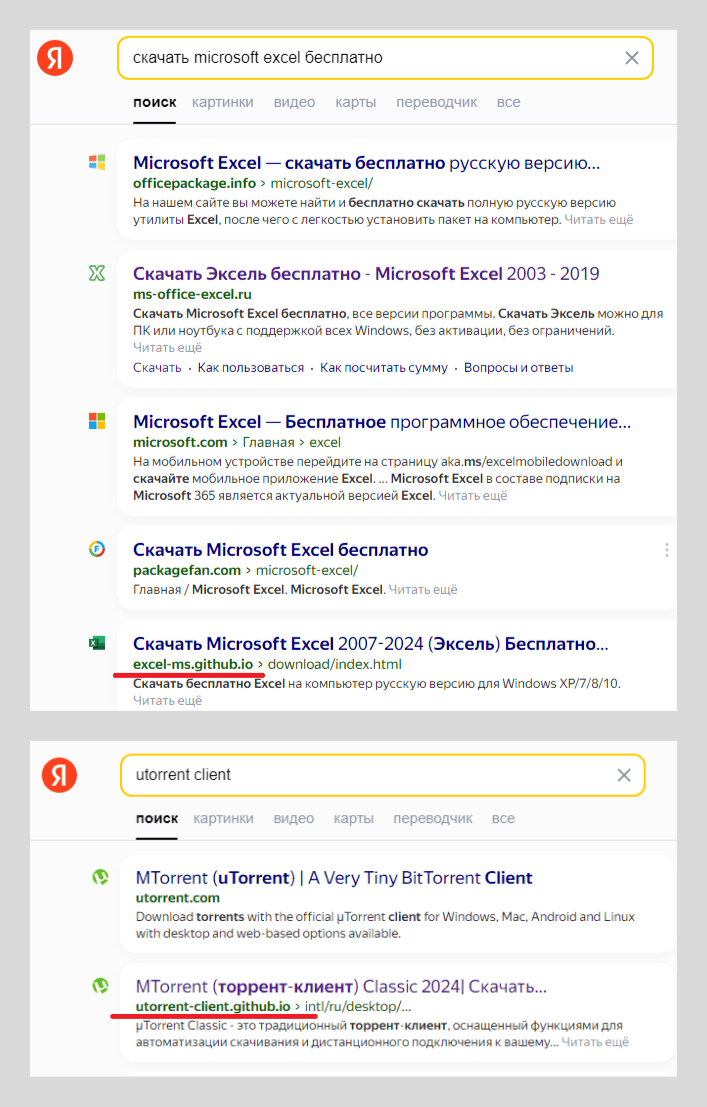
    The attackers were advertising their websites in Yandex search results. Users would see these malicious sites in the top results when searching for resources freely distributing popular software like uTorrent, MS Excel, MS Word, Minecraft, Discord and so on.

    Links to malicious websites in Yandex search results

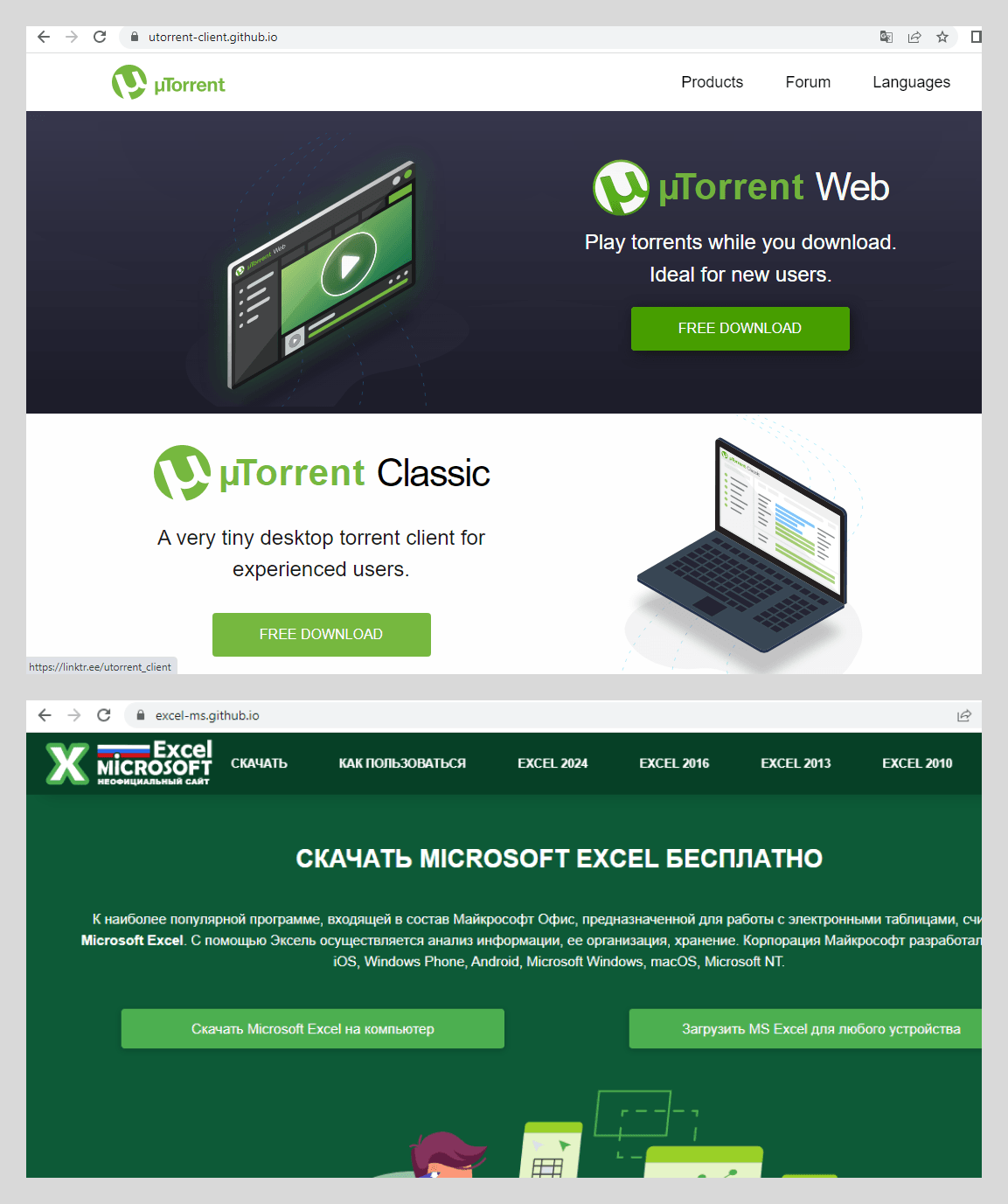
    The frontend of these websites is a copy of either the official software website or a known piracy website distributing this kind of software:

    Malicious websites

    The attackers are running multiple Telegram channels distributing the malware in question. These channels are most definitely targeted at cryptocurrency owners or cheating gamers: they are offered to download specific software that presumably might be of interest to them. To prevent anyone trying to disclose information about these channels and the fraudulent activity of their creators, the administrators disabled message forwarding, screenshots, and previews of these channels in the Telegram web-version.

    Malware in the attackers’ Telegram channel

    Even more, the malware was also distributed via YouTube. The attackers uploaded numerous videos in English from multiple accounts which were presumably stolen. It’s also possible that the video content was downloaded from other YouTube channels and reuploaded without the authors’ consent. In the video description and in the top comment the attackers left links to their resources and instructions on how to launch the malware. Some of these links redirected users immediately to malicious websites, while others led to the aforementioned Telegram channels. We have also seen links to known IP logging websites, allowing the malicious actors to collect the IP addresses of anyone who follows the link and gets redirected to the malware-carrying website.

    Examples of videos with malicious links in their description or comments

    Comment with a link to a malicious Telegram channel

    Persistence and defense evasion

    After visiting the attackers’ website or channel, users might download a ZIP file being falsely advertised as popular software. Inside the archive is an MSI file and a TXT file with a password required for installation. There are also instructions on how to install the software, in which the attackers recommend disabling any installed antivirus and Windows Defender beforehand. In many cases, the instructions and the password are also provided on the websites and channels from which the user downloaded the malicious archive.

    Content of text file

    When launched, the MSI file asks for the password from the TXT file, which is one of the first countermeasures against sandbox analysis. If the user specifies the right password, the CustomAction field value of the MSI file is executed — this is effectively a VB script. This script launches a BAT file which extracts the next element of the attack chain from an encrypted archive. The first step is to escalate privileges by adding another BAT file to autorun, granting SYSTEM privileges for a single execution. After that, the system reboots.

    CustomAction field value in the MSI file

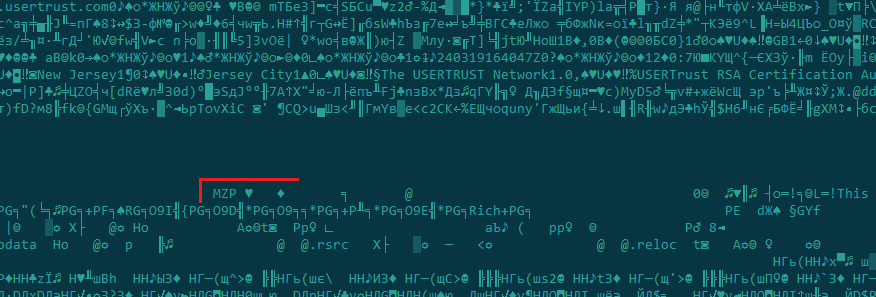
    The BAT file from autorun extracts the encrypted RAR archive and runs the “start” command with two DLL files as arguments — these were previously extracted from the archive. One of these files is a legitimate AutoIt interpreter and the second is a legitimate dynamic library with a valid digital signature. The malicious payload is an A3X script which was compiled into an EXE file and injected right inside the second DLL file signature.

    Malicious payload hidden inside a legit dynamic library signature

    This technique is interesting for two reasons. First, the A3X script is added to the signature in such a way that its validity remains intact and the whole file is still considered as signed, even with the payload. Such a malicious addition is almost impossible to detect without file content analysis. Second, the AutoIt interpreter has an interesting way of reading files that were specified in its launch argument. The file is scanned for a specific AutoIt signature which is present only in compiled scripts, and all other contents of the file are ignored. This behavior allows the attackers to hide their malicious payload anywhere in the file where it won’t be harmful for the container itself.

    Signature at the beginning of the A3X script

    Placing malicious payloads in an arbitrary section of a file is not new. Such techniques have been used not only with AutoIt, but with other platforms too. But what makes this attack stand out is the bypass of signature verification, making it possible for the payload-bearing file to seem legitimate.

    File with payload successfully bypasses signature verification

    If the “start” command failed, the BAT file removes the entire directory with the installed files, including itself. Otherwise, the malicious A3X implant is launched, which checks all active processes in attempt to find anything related to debugging or anti-malware products. If anything is found, the script immediately exits, as you can see in the snippet of deobfuscated code below.

    Security process name check by malicious implant

    The compiled A3X script contains multiple FileInstall function calls. This function takes two arguments: a path to the file that will be installed, and its destination path. Before compilation, this call just copies the file from its source path to its destination, but during the compilation the interpreter stores the files for installation right inside the compiled script.

    The resulting file contains not only the executable code itself, but also additional malicious files which will be installed directly from the implant. These files are required for persistence and to execute the next steps of the infection chain. The files are installed to the following paths:

    For persistence purposes, the directories containing the installed files have system, hidden and read-only attributes. In addition, using the icacls utility, the implant forbids all users across all domains to remove these folders, change their permissions, own them, add any files or subdirectories, write to them any attributes (including extended ones), or remove files from them.

    Files are copied to directories with unusual names for a reason. For example, the folder name “Classic.{BB64F8A7-BEE7-4E1A-AB8D-7D8273F7FDB6}” is treated specially by Windows Shell: Explorer will find the GUID in its name and treat it as a link — in this case to the Action Center. As a result, the user will not be able to view the contents of the directory.

    Malicious directory in Explorer

    After installing all the necessary files, the implant establishes persistence using WMI by creating filters which are activated by common events — common enough to guarantee filter activation. For each created filter, a polling frequency is specified. When a filter is activated, a specific command is executed using the __FilterToConsumerBinding class.

    • Once every three minutes, the netcat utility masked as StartMenuExperienceHost.exe is launched with the C&C address of the attackers (sportjump[.]ru) and “-e cmd.exe” as its arguments. It is then used as a reverse shell by the attackers.
    • Once every five to ten minutes, files named “nun.bat” are executed. They are copies of the same file which starts the next step of the infection chain. The attackers created two copies to increase the chance of malware execution, but if there are no outages, both of them are launched.
    • Once every fifteen minutes, the next step of the infection chain is launched directly via the “start” command.

    All these methods are used again for a better persistence by launching the “insta.bat” file right before the end of the A3X implant execution.

    Launch of the netcat utility

    Persistence is established not only through WMI; the implant also directly starts netcat, the “nun.bat” files, and the “start” command. After that, it also abuses the registry keys “Image File Execution Options”, “Debugger” and “MonitorProcess” with the same goals.

    One of the most interesting things about some variants of the malware is the download and use of the Wazuh SIEM agent for remote access and telemetry harvesting. To ensure that the attackers can execute any arbitrary command on the victim’s device, during the agent installation, the “remote_commands” option is set.

    Installation and launch of the Wazuh agent

    The first stage of the A3X implant collects the following information: computer name, username, OS version and architecture, CPU name, data about the GPU and installed AV software. All this information along with the current time is sent to a special Telegram bot chat controlled by the attackers. We’ve also seen some of the malware variants sending a screenshot of the user’s desktop or installing a malicious browser extension, which may replace cryptocurrency wallets in the clipboard.

    Malicious browser extension

    The next stage of the infection chain consists of two DLL files, that use the same technique as the first stage: a legitimate AutoIt interpreter and another A3X implant, located in the signature of the legitimate dynamic library. This implant is the final payload in the malware variant described here. It injects into a newly created explorer.exe process memory an open-source miner named SilentCryptoMiner, which contains the URL of the attacker’s mining configuration. This configuration specifies the cryptocurrency to be mined, the wallet, and so on. In the analyzed variants, we could see that the attackers mostly use anonymous cryptocurrencies like Monero or Zephyr.

    Example of the miner configuration

    Aside from its main purpose of generating cryptocurrency, SilentCryptoMiner can also hide its own activity from the processes specified in the “stealth-targets” argument and stop processes from the “kill-targets” process names list.

    Attack geography

    Most of the attacks with this infection chain targeted Russian users (87.63%). After that, the other top ten countries with the highest number of users affected by these attacks were Belarus, India, Uzbekistan, Kazakhstan, Germany, Algeria, Czech Republic, Mozambique, and Turkey.

    TOP 10 countries where users were affected by the described infection chain, June — August 2024 (download)

    Conclusion

    The attack described in this article vividly illustrates the fact that even mass campaigns can be quite complex and open up a wide range of opportunities for attackers. As a result of the multistage infection chain, the attackers can establish persistence in users’ systems in multiple ways, gaining full access. Even though the main goal of the attackers is to make profit by stealthily mining cryptocurrency, some variants of the malware can perform additional malicious activity, such as replacing cryptocurrency wallets in the clipboard and taking screenshots. The most interesting action in this attack was the implementation of unusual techniques like using an SIEM agent as backdoor, adding the malicious payload to a legitimate digital signature, and hiding directories containing malicious files.

    It’s important to mention that the websites, videos, and Telegram channels created by the attackers primarily target users seeking free versions of popular software or videogame cheats. This audience makes an easy target for the attackers because they are open to installing unofficial software from obscure sources and disabling security measures.

    Our products detect this malware with the following names:

    • HEUR:Trojan-Dropper.OLE2.Agent.gen
    • HEUR:Trojan.BAT.Agent.gen
    • HEUR:Trojan.VBS.Agent.gen
    • Trojan.Script.AutoIt.ak
    • Trojan.BAT.Agent.cix
    • Trojan.BAT.Miner.id
    • HEUR:Trojan.Multi.Agent.gen
    • PDM:Trojan.Win32.Generic

    MITRE ATT&CK Matrix

    Tactic Technique ID Technique
    Resource Development T1608.006 Stage Capabilities: SEO Poisoning
    T1608.001 Stage Capabilities: Upload Malware
    Execution T1204.001 User Execution: Malicious Link
    T1204.002 User Execution: Malicious File
    T1059.010 Command and Scripting Interpreter: AutoHotKey & AutoIT
    T1059.003 Command and Scripting Interpreter: Windows Command Shell
    T1059.005 Command and Scripting Interpreter: Visual Basic
    Persistence T1546.012 Event Triggered Execution: Image File Execution Options Injection
    T1546.003 Event Triggered Execution: Windows Management Instrumentation Event Subscription
    Privilege Escalation T1053.005 Scheduled Task/Job: Scheduled Task
    Defense Evasion T1055 Process Injection
    T1562.001 Impair Defenses: Disable or Modify Tools
    T1497 Virtualization/Sandbox Evasion
    T1027.009 Obfuscated Files or Information: Embedded Payloads
    T1027.010 Obfuscated Files or Information: Command Obfuscation
    T1036.008 Masquerading: Masquerade File Type
    T1564.001 Hide Artifacts: Hidden Files and Directories
    Discovery T1518.001 Software Discovery: Security Software Discovery
    T1033 System Owner/User Discovery
    T1082 System Information Discovery
    T1497 Virtualization/Sandbox Evasion
    Collection T1113 Screen Capture
    Impact T1496 Resource Hijacking
    Exfiltration T1041 Exfiltration Over C2 Channel

    Indicators of compromise

    Hashes
    b5b323679524d52e4c058b1a3dd8dee7
    4efa8ca01d7c566ff1b72f4ebf57cf2c
    10f888a9aa8082651adeff4790675fd5
    30dd26075a5ca7a4861e9214a99d0495
    60efc41c30fd9ab438e88c6011df5c38
    961fa114e9eb92016977940f7c97cdd9
    1457e18b453d8cefc34047e1b0fbf76f
    284418b6a9c70cc30ef14df3a87c24da
    5788631016d8bc495f4f2614f9a7bbe0
    a9bc00e5e8a17df95bd5b8c289a12b31
    a9bd813679517c846dcf36454baa6170
    a99f3f8736d7d3001aa5eb6202123948
    a802ce130be6546b76d4b54f72d14645
    ae9e83d1031462cb5e58b4525036670c
    b25f9490f6d80f9de5a9c02cc344f9f9
    cffc70e4fb7363024fcc3590755fa846
    e9154a7613a8f8baf67ec3b696c9cb12
    f213f94729b294c01a0df21800c4e395
    2e68f4438ce59c868af01b535c98060d
    839471243f9c4a294c42fabf636f7cad
    4b0d76262dd82985d330b02190a880c0
    1a5d955be79046a3288b869e44e87404
    f8342fd3e32dcf9832dff3e923ef530b
    20b6ac10f657963245940c9bcd25a346
    33c7c22e33e134ec3ddfc6be8ee1f1ee
    2e4146c1a93c0bfe0f4e9ea53b8da7ee
    827eca9ec457f3c5180f602832f44955
    e3b6142df6a7c73a99736082fbae2fa6
    4bdcbc7ec1929d9b1ebcc4d01d605b05
    0da6e1036ca5d8231ee94a4db8c48728
    098872e9e39bd4cd0e4debd4b397b555
    0305f8a9dee464f56023411e7b0924df
    be8b6452aa874904f116f9b7cdfe343b
    6c0416f719ceca15f9e9c4f210c64fb0
    25b90fa3b21875157c6f33b7e1b6e8d7
    14b7429205955056f1763553f82fe244

    URL-addresses
    excel-ms.github[.]io/Windows/MS-Excel.zip
    utorrent-client.github[.]io
    gta-5rp.github[.]io/Windows/GTArp.zip
    mssg[.]me/eahcu
    linktr[.]ee/excel_ms
    linktr[.]ee/utorrent_client
    nyaera[.]ru/wp-includes/uploads/art/utorrent.zip
    nyaera[.]ru/wp-includes/uploads/My/MS-Excel.zip
    github[.]com/lidiyakamalova89/www/raw/main/Ver.1.4.1.zip
    raw.githubusercontent[.]com/lidiyakamalova89/www/main/Ver.1.4.1.zip
    raw.githubusercontent[.]com/radominator7204/dsz/main/Install.zip
    sportjump[.]ru
    gamesjumpers[.]com
    gamejump[.]site
    alljump[.]ru
    pastebin[.]com/raw/F87y7zJV
    pastebin[.]com/raw/uU34Qunt
    rentry[.]co/mi9fomgo/raw

    MIL OSI Economics

  • MIL-OSI Russia: San Marino: Staff Concluding Statement of the 2024 Article IV Mission

    Source: IMF – News in Russian

    October 4, 2024

    A Concluding Statement describes the preliminary findings of IMF staff at the end of an official staff visit (or ‘mission’), in most cases to a member country. Missions are undertaken as part of regular (usually annual) consultations under Article IV of the IMF’s Articles of Agreement, in the context of a request to use IMF resources (borrow from the IMF), as part of discussions of staff monitored programs, or as part of other staff monitoring of economic developments.

    The authorities have consented to the publication of this statement. The views expressed in this statement are those of the IMF staff and do not necessarily represent the views of the IMF’s Executive Board. Based on the preliminary findings of this mission, staff will prepare a report that, subject to management approval, will be presented to the IMF Executive Board for discussion and decision.

    Washington, DC – October 4, 2024:

    San Marino’s economy remains resilient, supported by a more diversified growth model with manufacturing and the nonfinancial service exporting sectors as key drivers. Prudent fiscal policy and access to international capital markets helped weather the pandemic and energy crises. However, additional fiscal consolidation is warranted given the still high debt level and contingent liabilities from the financial sector. Notwithstanding important progress in resolving legacy issues, further efforts are needed to improve asset quality and strengthen banks’ capitalization and profitability. With the recently negotiated European Union (EU) association agreement, San Marino has a unique opportunity to accelerate much-needed public and financial sector reforms and to further the integration with the EU’s single market to boost confidence in the economy and lift potential growth.

    San Marino’s economic growth remained positive despite adverse external shocks, including a regional slowdown and higher interest rates. After an exceptionally strong post-pandemic recovery in 2021-22, growth slowed in 2023 to 0.4 percent following a decline in external demand. Manufacturing, which has been operating at high levels, has decelerated as export orders declined, in part due to the phase-out of fiscal incentives in Italy and a related slowdown in the construction sector. The strong service sector performance, benefiting from the tourism boom and healthy domestic demand, kept employment growing at a robust pace.

    Growth is projected to edge up in 2024, strengthening further in 2025, as external demand improves. Stronger consumption on the back of rising real wages and higher investment, facilitated by easing financial conditions, will support domestic and external demand next year. However, there are risks ahead. Downside risks are related to the weakening of external demand while remaining vulnerabilities in the financial sector constitute one of the key domestic risks. The underlying strength of the manufacturing sector, the healthy private sector balance sheets, and prompt implementation of the EU association agreement constitute upside risks to the baseline.

    The fiscal position was stronger than expectedlast year but further efforts are needed to ensure sustainability.The government has saved the cyclical tax revenues, kept expenditures in check and primary balance stable in 2023. However, moderate government spending pressures arose in 2024 ―as real spending compression reached its limits and the cost of interest subsidies for the private sector expanded. The public debt-to-GDP ratio continued declining, but its level remains high.

    Additionalfiscal consolidation is needed to mitigate financing risks, build fiscal buffers, and reduce the debt-to-GDP ratio below 60 percent.San Marino is an euroized small open economy with a vulnerable financial sector and limited fiscal buffers. The government’s goal of reducing public debt below 60 percent of GDP over the medium term is an important anchor to guide fiscal policy. To achieve this target a moderate additional fiscal effort totaling 1 percent of GDP over the next three years is recommended through:

    • Designing and implementing a tax reform package introducing a value-added tax (VAT) and broadening the income tax base. With a low tax-to-GDP ratio, introducing a VAT in San Marino can simultaneously enhance fiscal revenues and tax efficiency while minimizing related distortions, increasing fairness and progressivity, and aligning indirect tax procedures with international standards, benefitting the ease of exports. Redesigning tax rebates to avoid overlaps with other exemptions—such as San Marino Card (SMaC) discounts and income tax deductions—can further rationalize the system. The authorities should leverage the technology used for the SMaC in combination with electronic invoicing to mitigate tax avoidance in the new VAT system. Equallyimportant, income tax revenues can be significantly enhanced by rationalizing income tax deductions.
    • Improving the efficiency of public spending.San Marino should shift from real expenditure compression across all spending areas to prioritizing consolidation of spending with low social return. In this context, it will be important to review transfers to the private sector―including interest subsidy programs―to ensure that transfers are more targeted. Reviewing extra-budgetary funds is also needed to rationalize spending. Large investment plans require sound prioritization based on rigorous cost-benefit analyses.
    • Keeping public wages and pensions growth in check. Moderate public wage and pension growth was key to improving the primary balance. Looking forward, given the limited fiscal space, it is critical to avoid public wage and pension growth above domestic inflation.

    Long-term demographic challenges will require additional parametric pension recalibration. The 2022 pension reform has increased contributions, delaying the depletion of the pension fund for a decade. However, ensuring the long-term sustainability of the pension system will require further parametric calibrations to address generous benefits. In addition, there is a need to continue the gradual diversification of the investments of the pension fund towards international markets to mitigate concentration of risks and increase returns.

    The debt management strategy needs strengthening to minimize refinancing risks. The recently published fiscal strategy marks an important advancement in the predictability of fiscal policy and communication with investors, but further efforts are needed to upgrade San Marino’s debt management capacity, including more autonomy to implement the financing plan approved in the budget. To smooth the debt amortization of the Eurobond in 2027, the authorities should consider liability management operations, including smaller international issuances with longer maturities.

    Banks’ liquidity and reported profits improved in 2023, but declining interest margins, high personnel costs, and remaining legacy non-performing loans (NPLs) pose risks going forward. Higher interest rates last year have improved banks’ cyclical profits without deteriorating the quality of loan portfolios, but structural profitability remains low. The safeguarding of profits to increase capital, as requested by the Central Bank, is welcome. However, with limited income-generating assets, high operating costs, and tight reported capitalization in some banks, the financial sector remains vulnerable.

    A speedy adjustment of banks’ costs is a priority to improve long-term viability and capital positions. Most banks’ profitability remains significantly lower than regional peers. The continuing reduction of income-generating assets in recent years has not been followed by a scale-down of banking sector employment. San Marino’s banking system also has the largest number of branches per capita in Europe. With the EU association agreement, the opening of the banking sector will bring new opportunities, but San Marino banks need to improve efficiency to be competitive.

    Important progress has been made in implementing the authorities’ strategy to reduce nonperforming loans (NPLs) through an Asset Management Company (AMC) and calendar provisioning. The write-off of a large NPL position and AMC securitization have reduced the NPL ratio from 53 to 21 percent. The asset recovery of the AMC has progressed better than expected, with the principal of state-guaranteed senior securities declining from 70 to 44½ million euros in the first half of 2024. Meanwhile, calendar provisioning has prompted banks to expedite the recovery and write-offs of NPLs. However, it will be important to improve dissemination of the information about the AMC asset recovery to anticipate and address any bottlenecks. The risk weights for junior securities should be increased faster to reflect the difference between the net book value and the real economic value of NPLs on banks’ balance sheets. Any undercapitalization that could arise from the securitization process and the implementation of calendar provisioning should be promptly addressed with credible capitalization plans. To strengthen CBSM supervisory powers and to help attract external capital, legal limits on banks’ shareholding structure should be lifted.

    The bank resolution framework needs to be updated to widen burden-sharing. The bank resolution law should be updated to gradually complete the alignment with EU standards. The process needs to be coordinated with addressing existing issues in the banking system.

    San Marino should continue to make progress to strengthen its AML/CFT framework. The domestic legal framework was amended in 2023 to incorporate the 5th EU AML Directive and improve technical compliance with the FATF standards. This resulted in an upgrade by MONEYVAL on technical compliance for AML/CFT sanctions regime. The National ML/TF Risk Assessment will be updated next year. San Marino should continue working to enhance the adequacy, accuracy, and up-to-dateness of its central beneficial ownership registry.

    The EU association agreement sets an ambitious financial sector reform agenda. The agreement requires the central bank of San Marino (CBSM) to complete the alignment of the regulatory framework with the EU. To that end, the CBSM will need additional staff and financial resources. The CBSM financial position should be strengthened to safeguard its independence and support financial sector stability through an effective lender of last resort capacity. To comply with EU standards, legacy issues should be addressed, including through a gradual conversion of the perpetual bond owned by the state-owned bank into liquid instruments. Overall, while the banking sector has 15 years to meet the requirements, earlier implementation, as envisaged by the authorities, will boost confidence.

    The conclusion of the EU association negotiations signals strong commitment to deeper integration with the EU and could lift potential growth by accelerating structural reforms. The successful implementation of the agreement is a priority and will support the competitiveness of the manufacturing sector and help consolidate gains in tourism. The authorities should ensure sufficient resources and staff are available to support implementation without undermining the fiscal consolidation path. In addition, further labor market flexibility is needed to improve labor reallocation, including in the banking sector. Real estate market reforms to facilitate price and market information dissemination and foreign ownership, will be key to support NPL resolution. Finaly, the authorities should foster energy safety and green transition, including by allowing households to sell back excess solar generated electricity.

    The mission would like to thank the authorities and other counterparts for their warm hospitality as well as candid and productive discussions.

    IMF Communications Department
    MEDIA RELATIONS

    PRESS OFFICER: Boris Balabanov

    Phone: +1 202 623-7100Email: MEDIA@IMF.org

    @IMFSpokesperson

    https://www.imf.org/en/News/Articles/2024/10/04/cs-san-marino-2024

    MIL OSI

    MIL OSI Russia News

  • MIL-OSI Africa: Deputy President confident his working visit will attract international investors

    Source: South Africa News Agency

    Deputy President Paul Mashatile says he is confident that his working visit to the United Kingdom and Ireland will improve trade and investment relations, which have been stagnant for years. 

    The Deputy President spoke during an engagement with the South African Chamber of Commerce (SACC) in London on Thursday. The SACC is an umbrella organisation and conduit for trade, community and investment into and out of South Africa.

    The country’s second-in-command is in the United Kingdom for the second leg of his working visit to improve trade and investment relations between the nations and to woo investors following his travels to Ireland. 

    READ | SA, Ireland eye improved trade

    His interactions were centred on various issues, including the Government of National Unity (GNU), energy, infrastructure, and the measures to foster a favourable environment for trade and investment.

    The country’s second-in-command reiterated that the political environment in South Africa is stable for investment because of the newly established GNU, which has been operational for less than 100 days and is already yielding results.

    “Our numerous meetings with potential investors have revealed a shift in their attitudes and perceptions towards South Africa, indicating an optimistic outlook. 

    “Our alliance, based not on personal sentiments but on the aspiration to enhance South Africa and, consequently, the lives of our citizens, will undoubtedly sustain the GNU administration for five years.” 

    However, he said they will measure the GNU’s success based on the number of employment and entrepreneurs they assist in establishing sustainable enterprises.

    “Businesses hope to continue working with the government in the public-private partnership that has reduced load shedding, improved transport and logistics infrastructure, and strengthened national capacity to combat crime and corruption,” the Deputy President said. 

    Shifting his focus to energy, he stated that investors have demonstrated that ending the load shedding that began in 2007 is the most positive news. 

    “They confirmed that it allows them to conduct business without uncertainty. The elimination of power outages was largely due to a series of measures implemented by the State-owned power utility, Eskom and government over the past two years.”

    He also told the SACC that government was addressing the obstacles in the freight logistics system that continue to impede competitiveness and undermine economic growth. 

    “We are on a mission to create and sustain a bankable investment pipeline of priority, credible, quality and high-impact projects that span the country through Infrastructure South Africa, the primary driver of the National Infrastructure Plan 2050,” he explained. 

    Mashatile believes that the SACC plays an essential role in engaging with businesses to promote bilateral trade and investment links between the United Kingdom and South Africa. 

    “It is our responsibility as leaders in our respective regions to foster an atmosphere that encourages entrepreneurship, fosters innovation, and drives inclusive growth.”

    In addition, he expressed his desire to increase South Africa’s exports of valuable goods and services to the United Kingdom. 

    “It is excellent that the two countries already exchange food and beverages. It is critical that we collaborate to create strategies to accelerate international trade and investment.”

    Mashatile announced that the State was simplifying regulatory procedures through the Red Tape Task Team, making it easier for businesses to operate and invest locally.

    READ | Govt determined to deal with SA’s mounting challenges – Mashatile

    He concluded his address with South Africa’s stance on peace and stability in Africa and globally, stressing that the nation is anti-war and pro-peace. 

    “We reaffirm our commitment to the inviolability of sovereignty and the importance of national security.

    “More immediately, we support [silencing the guns]. We want to see peaceful and mutual coexistence between Russia, Ukraine, Israel, Sudan, and the rest of the globe, because war is terrible for business.” – SAnews.gov.za

    MIL OSI Africa

  • MIL-OSI Banking: ASEAN convenes 45th ASEAN Senior Officials Meeting on Drug Matters and Related Meetings

    Source: ASEAN – Association of SouthEast Asian Nations

    The 45th ASEAN Senior Officials Meeting on Drug Matters (ASOD) and Its Related Meetings, which included six ASOD + Dialogue Partner(s) Consultations, namely with Australia, India, Japan, the Republic of Korea (ROK), Russia and Plus Three, were held via videoconference on 3-4 October 2024. The Meetings were attended by the ASOD Leaders of all ASEAN Member States, Dialogue Partners and the Deputy Secretary-General of ASEAN for ASEAN Political-Security Community. Timor-Leste attended as Observer. The Meetings were preceded by meetings of the five ASOD Working Groups (WG), namely on Preventive Education, Treatment and Rehabilitation, Law Enforcement, Research and Alternative Development, that were held on 2 October 2024. The series of meetings discussed, among others, the latest drug situation, emerging trends, best practices and potential cooperation against illicit drugs in the region.

    The post ASEAN convenes 45th ASEAN Senior Officials Meeting on Drug Matters and Related Meetings appeared first on ASEAN Main Portal.

    MIL OSI Global Banks

  • MIL-OSI Russia: Nikita Blagoy: “Exchange education is a colossal development and skills”

    MILES AXLE Translation. Region: Russian Federation –

    Source: Peter the Great St Petersburg Polytechnic University – Peter the Great St Petersburg Polytechnic University –

    Nikita Blagoy, a postgraduate student at the Institute of Industrial Management, Economics and Trade, and an assistant at the Higher School of Engineering and Economics, received a scholarship from the President of the Russian Federation for students and postgraduates studying abroad. In early September, Nikita went to China. Before leaving, he told us about his academic path at the Polytechnic University, and how his ideas about life and science changed. And after a while, he contacted us to share his first impressions of his internship at the Dalian University of Technology.

    Interview with a graduate student Read in our traditional section “Person”.

    Please note: This information is raw content directly from the source of the information. It is exactly what the source states and does not reflect the position of MIL-OSI or its clients.

    Please note; This information is raw content directly from the information source. It is accurate to what the source is stating and does not reflect the position of MIL-OSI or its clients.

    http://www.spbstu.ru/media/nevs/polytech-media/nikita-blagoy-exchange-training-is-colossal-development-and-skills/

    EDITOR’S NOTE: This article is a translation. Apologies should the grammar and or sentence structure not be perfect.

    MIL OSI Russia News

  • MIL-OSI Russia: Financial news: 10/04/2024, 10:38 (Moscow time) the values of the upper limit of the price corridor and the range of market risk assessment for the security RU000A0JXXD3 (Rosnft1P6) were changed.

    MILES AXLE Translation. Region: Russian Federation –

    Source: Moscow Exchange – Moscow Exchange –

    04.10.2024 10:38

    In accordance with the Methodology for determining the risk parameters of the stock market and deposit market of PJSC Moscow Exchange by NCO NCC (JSC), on 10/04/2024, 10:38 (Moscow time), the values of the upper limit of the price corridor (up to 106.96) and the range of market risk assessment (up to 1152.78 rubles, equivalent to a rate of 11.25%) of the security RU000A0JXXD3 (Rosnft1P6) were changed

    Please note: This information is raw content directly from the source of the information. It is exactly what the source states and does not reflect the position of MIL-OSI or its clients.

    Please note; This information is raw content directly from the information source. It is accurate to what the source is stating and does not reflect the position of MIL-OSI or its clients.

    https://www.moex.com/n73749

    EDITOR’S NOTE: This article is a translation. Apologies should the grammar and or sentence structure not be perfect.

    MIL OSI Russia News

  • MIL-OSI Russia: Financial news: 10/04/2024, 10:38 (Moscow time) the values of the upper limit of the price corridor and the range of market risk assessment for the security RU000A0JXXE1 (Rosnft1P7) were changed.

    MILES AXLE Translation. Region: Russian Federation –

    Source: Moscow Exchange – Moscow Exchange –

    04.10.2024 10:38

    In accordance with the Methodology for determining the risk parameters of the stock market and the deposit market of Moscow Exchange PJSC by NCO NCC (JSC) on 10/04/2024, 10:38 (Moscow time), the values of the upper limit of the price corridor (up to 106.21) and the range of market risk assessment (up to 1139.83 rubles, equivalent to a rate of 10.0%) of the security RU000A0JXXE1 (Rosnft1P7) were changed

    Please note: This information is raw content directly from the source of the information. It is exactly what the source states and does not reflect the position of MIL-OSI or its clients.

    Please note; This information is raw content directly from the information source. It is accurate to what the source is stating and does not reflect the position of MIL-OSI or its clients.

    https://www.moex.com/n73748

    EDITOR’S NOTE: This article is a translation. Apologies should the grammar and or sentence structure not be perfect.

    MIL OSI Russia News

  • MIL-OSI Russia: 13 Polytechnicians Among the World’s Most Cited Scientists

    MILES AXLE Translation. Region: Russian Federation –

    Source: Peter the Great St Petersburg Polytechnic University – Peter the Great St Petersburg Polytechnic University –

    Elsevier has published updated lists of the most cited scientists in the world over the past year and throughout my entire scientific career.

    Stanford University (USA) annually collects and analyzes information from the international scientometric database Scopus about the most authoritative scientists. When compiling the ratings, both qualitative and quantitative citation metrics are taken into account. The obtained information is posted on the Elsevier website. According to the company, the scientists presented in the lists make up 2% of the most influential scientific specialists. Among them are 13 SPbPU scientists.

    Nine of the university’s researchers were included in both rankings at once: the most cited authors at the end of 2023 and for their entire research career. The greatest successes were achieved by:

    Nikolay Vatin is the director of the Scientific and Technological Complex “Digital Engineering in Civil Engineering”, chief researcher at the Laboratory of Protected and Modular Structures, Professor at the Higher School of Advanced Digital Technologies NIS “Digital Engineering”, Doctor of Technical Sciences;
    Vladimir Mostepanenko is the chief researcher at the Scientific Laboratory “Micro- and Nanoelectronic Systems on a Chip” at the NIS “Digital Engineering”, Doctor of Physical and Mathematical Sciences;
    Vadim Davydov is a leading engineer at the Center for New Materials of the Research and Modeling of Materials Research Center of the Institute of Mechanical Engineering, Materials and Transport, Doctor of Physical and Mathematical Sciences;
    Galina Klimchitskaya is the chief researcher at the Scientific Laboratory “Micro- and Nanoelectronic Systems on a Crystal” at the NIS “Digital Engineering”, Doctor of Physical and Mathematical Sciences;
    Anatoly Popovich – Director of the Institute of Mechanical Engineering, Materials and Transport, Professor of the Research Center “Structural and Functional Materials” of the Institute of Mechanical Engineering and Technology, Chief Researcher of the Laboratory “Synthesis of New Materials and Structures” of the Advanced Engineering School “Digital Engineering”, Doctor of Technical Sciences;
    Lev Utkin is a professor at the Higher School of Artificial Intelligence Technologies at the Institute of Computer Science and Cybersecurity; Leading Researcher at the Research Laboratory “Supercomputer Technologies and Machine Learning” NIS “Digital Engineering”, Doctor of Technical Sciences;
    Anton-Jiri Krivtsov – Director of the Higher School of Theoretical Mechanics and Mathematical Physics of the Institute of Physics and Mechanics, Corresponding Member of the Russian Academy of Sciences, Doctor of Physical and Mathematical Sciences;
    Mikhail Shur is a leading researcher at the Laboratory of Computational Hydro-Aeroacoustics and Turbulence at the Scientific and Technical Complex “Mathematical Modeling and Intelligent Control Systems” of the NIS “Digital Engineering”, Candidate of Physical and Mathematical Sciences.
    Andrey Travin is a senior researcher at the laboratory “Computational hydroaeroacoustics and turbulence” of the Scientific and Technical Complex “Mathematical modeling and intelligent control systems” of the NIS “Digital Engineering”, Candidate of Physical and Mathematical Sciences.

    In addition, two Polytechnic University researchers are included in the list of the most cited researchers for the past year. The 2023 ranking includes Mikhail Strelets, head of the Computational Hydroaeroacoustics and Turbulence Laboratory at the Mathematical Modeling and Intelligent Control Systems Scientific and Technical Complex at the Digital Engineering Institute, Doctor of Physical and Mathematical Sciences, and Sergey Barykin, professor at the Higher School of Service and Trade at the Institute of Industrial Management, Economics and Trade, Doctor of Economic Sciences.

    Also, two SPbPU scientists are included in the annual list of the most cited authors by indicators for the entire career path. These are Sergey Shevkunov, a leading researcher at the Center for Technological Projects, Doctor of Technical Sciences, and Sergey Roshchupkin, a professor at the Higher School of Fundamental Physical Research of the Physics and Mechanics Institute, Doctor of Technical Sciences.

    We are proud that Polytechnics have entered the ranking of the most cited scientists in the world. This is a clear confirmation of the high level of scientific research conducted at our university and the significance of contributions to global science. Being included in such rankings is not only a sign of recognition of individual merits, but also the result of the hard work of the entire scientific team, which strives for innovation and high research standards. I am sure that many discoveries and achievements await us ahead, which will inspire students and young scientists to new achievements, – commented Vice-Rector for Research Yuri Fomin.

    Please note: This information is raw content directly from the source of the information. It is exactly what the source states and does not reflect the position of MIL-OSI or its clients.

    Please note; This information is raw content directly from the information source. It is accurate to what the source is stating and does not reflect the position of MIL-OSI or its clients.

    https://vvv.spbstu.ru/media/nevs/achivments/13-polytechnicians-among-the-most-cited-scientists-in-the-world/

    EDITOR’S NOTE: This article is a translation. Apologies should the grammar and or sentence structure not be perfect.

    MIL OSI Russia News

  • MIL-OSI Russia: Financial news: 10/04/2024, the deposit auction of the Moscow Small Business Lending Assistance Fund will take place

    MILES AXLE Translation. Region: Russian Federation –

    Source: Moscow Exchange – Moscow Exchange –

    Please note: This information is raw content directly from the source of the information. It is exactly what the source states and does not reflect the position of MIL-OSI or its clients.

    Please note; This information is raw content directly from the information source. It is accurate to what the source is stating and does not reflect the position of MIL-OSI or its clients.

    https://www.moex.com/n73754

    Category24-7, MIL-AXIS, Moscow, Moskov Stotsk Exchange, Russians Savings, Russian Federation, Russians Language, Russian economy

    Post navigation


    Archives

    Archives Privations of the Police Proudly would trust WordPress

    Parameters
    Date of the deposit auction 10/04/2024
    Placement currency RUB
    Maximum amount of funds placed (in placement currency) 235,000,000.00
    Placement period, days 11
    Date of deposit 10/04/2024
    Refund date 10/15/2024
    Minimum placement interest rate, % per annum 19.00
    Conditions of imprisonment, urgent or special Urgent
    Minimum amount of funds placed for one application (in placement currency) 235,000,000.00
    Maximum number of applications from one Participant, pcs. 1
    Auction form, open or closed Open
    Basis of the Agreement General Agreement
     
    Schedule (Moscow time)
    Preliminary applications from 12:00 to 12:10
    Applications in competition mode from 12:10 to 12:15
    Setting a cut-off percentage or declaring the auction invalid until 12:25
       
    Additional terms Placement of funds with the possibility of early withdrawal of the entire deposit amount and payment of interest accrued on the deposit amount at the rate established by the deposit transaction, in the event of non-compliance of the Bank with the requirements established by paragraph 2.1. of the Regulation “On the procedure for selecting banks for placing funds of the Moscow Small Business Lending Assistance Fund in deposits (deposits) under the GDS” (as amended on the date of the deposit transaction), early withdrawal at the “on demand” rate, payment of interest at the end of the term, without replenishment

    EDITOR’S NOTE: This article is a translation. Apologies should the grammar and or sentence structure not be perfect.

    MIL OSI Russia News

  • MIL-OSI Russia: Financial news: 10/04/2024, 11:04 (Moscow time) the values of the lower limit of the price corridor and the range of market risk assessment for the security RU000A0JT6B2 (VEB.RF 19) were changed.

    MILES AXLE Translation. Region: Russian Federation –

    Source: Moscow Exchange – Moscow Exchange –

    04.10.2024 11:04

    In accordance with the Methodology for determining the risk parameters of the stock market and the deposit market of Moscow Exchange PJSC by NCO NCC (JSC) on 10/04/2024, 11-04 (Moscow time), the values of the lower limit of the price corridor (up to 97.83) and the range of market risk assessment (up to 948.91 rubles, equivalent to a rate of 7.5%) of the security RU000A0JT6B2 (VEB.RF 19) were changed

    Please note: This information is raw content directly from the source of the information. It is exactly what the source states and does not reflect the position of MIL-OSI or its clients.

    Please note; This information is raw content directly from the information source. It is accurate to what the source is stating and does not reflect the position of MIL-OSI or its clients.

    https://www.moex.com/n73752

    EDITOR’S NOTE: This article is a translation. Apologies should the grammar and or sentence structure not be perfect.

    MIL OSI Russia News

  • MIL-OSI Russia: Financial news: 10/04/2024, 11:45 (Moscow time) the values of the lower boundary of the price corridor and the range of market risk assessment for the security RU000A0JT6B2 (VEB.RF 19) were changed.

    MILES AXLE Translation. Region: Russian Federation –

    Source: Moscow Exchange – Moscow Exchange –

    04.10.2024 11:45

    In accordance with the Methodology for determining the risk parameters of the stock market and the deposit market of Moscow Exchange PJSC by NCO NCC (JSC) on 10/04/2024, 11:45 (Moscow time), the values of the lower limit of the price corridor (up to 94.76) and the range of market risk assessment (up to 918.13 rubles, equivalent to a rate of 10.5%) of the security RU000A0JT6B2 (VEB.RF 19) were changed

    Please note: This information is raw content directly from the source of the information. It is exactly what the source states and does not reflect the position of MIL-OSI or its clients.

    Please note; This information is raw content directly from the information source. It is accurate to what the source is stating and does not reflect the position of MIL-OSI or its clients.

    https://www.moex.com/n73757

    EDITOR’S NOTE: This article is a translation. Apologies should the grammar and or sentence structure not be perfect.

    MIL OSI Russia News

  • MIL-OSI Russia: Financial news: 10/04/2024, 11:38 (Moscow time) the values of the lower limit of the price corridor and the range of market risk assessment for the security RU000A0JT6B2 (VEB.RF 19) were changed.

    MILES AXLE Translation. Region: Russian Federation –

    Source: Moscow Exchange – Moscow Exchange –

    04.10.2024 11:38

    In accordance with the Methodology for determining the risk parameters of the stock market and the deposit market of Moscow Exchange PJSC by NCO NCC (JSC) on 10/04/2024, 11:38 (Moscow time), the values of the lower limit of the price corridor (up to 96.3) and the range of market risk assessment (up to 933.52 rubles, equivalent to a rate of 9.0%) of the security RU000A0JT6B2 (VEB.RF 19) were changed

    Please note: This information is raw content directly from the source of the information. It is exactly what the source states and does not reflect the position of MIL-OSI or its clients.

    Please note; This information is raw content directly from the information source. It is accurate to what the source is stating and does not reflect the position of MIL-OSI or its clients.

    https://www.moex.com/n73755

    EDITOR’S NOTE: This article is a translation. Apologies should the grammar and or sentence structure not be perfect.

    MIL OSI Russia News

  • MIL-OSI Russia: Financial news: 10/04/2024, 11:50 (Moscow time) the values of the upper limit of the price corridor and the range of market risk assessment for the RU000A0ZYBM4 (AlphaBO-21) security were changed.

    MILES AXLE Translation. Region: Russian Federation –

    Source: Moscow Exchange – Moscow Exchange –

    04.10.2024 11:50

    In accordance with the Methodology for determining the risk parameters of the stock market and the deposit market of PJSC Moscow Exchange by NCO NCC (JSC), on 10/04/2024, 11:50 (Moscow time), the values of the upper limit of the price corridor (up to 105.1) and the range of market risk assessment (up to 1185.24 rubles, equivalent to a rate of 16.25%) of the security RU000A0ZYBM4 (AlphaBO-21) were changed

    Please note: This information is raw content directly from the source of the information. It is exactly what the source states and does not reflect the position of MIL-OSI or its clients.

    Please note; This information is raw content directly from the information source. It is accurate to what the source is stating and does not reflect the position of MIL-OSI or its clients.

    https://www.moex.com/n73759

    EDITOR’S NOTE: This article is a translation. Apologies should the grammar and or sentence structure not be perfect.

    MIL OSI Russia News

  • MIL-OSI: Shell plc Announces Final Results of Exchange Offers

    Source: GlobeNewswire (MIL-OSI)

    Press Release

    October 4, 2024

    Shell plc Announces Final Results of Exchange Offers

    Shell plc (“Shell”) (LSE: SHEL) (NYSE: SHEL) (EAX: SHELL) today announced the final results of its previously announced offers to exchange (the “Exchange Offers” and each, an “Exchange Offer”) up to a maximum aggregate principal amount of $12 billion (the “Maximum Amount”) of any and all validly tendered (and not validly withdrawn) and accepted notes of twelve series issued by Shell International Finance B.V. (“Shell International Finance” and such notes, the “Old Notes”) for a combination of cash and a corresponding series of new notes to be issued by Shell Finance US Inc. (“Shell Finance US”) and fully and unconditionally guaranteed by Shell plc (the “New Notes”). A Registration Statement on Form F-4 (File Nos. 333-281941 and 333-281941-01) (the “Registration Statement”), including a prospectus, dated September 19, 2024 (the “Prospectus”), relating to the issuance of the New Notes was filed with the Securities and Exchange Commission (the “SEC”) and was declared effective by the SEC on September 30, 2024.

    As announced on September 5, 2024, Shell is conducting the Exchange Offers to migrate the existing Old Notes from Shell International Finance B.V. to Shell Finance US Inc. in order to optimize the Shell Group’s capital structure and align indebtedness with its U.S. business.

    The total aggregate principal amount of Old Notes that were validly tendered (and not validly withdrawn) and accepted for exchange in the Exchange Offers was $11,462,980,000.   The aggregate principal amount of each series of Old Notes that was accepted for exchange was based on the order of acceptance priority for such series as set forth in the table below (the “Acceptance Priority Levels”), with Acceptance Priority Level 1 being the highest and Acceptance Priority Level 12 being the lowest, subject to the applicable Minimum Size Condition and the Maximum Amount Condition (each as described in the Prospectus). Because the total aggregate principal amount of Old Notes that were validly tendered (and not validly withdrawn) as of 5:00 p.m., New York City time, on October 3, 2024 (the “Expiration Time”) exceeded the Maximum Amount, we did not accept for exchange all such Old Notes and only accepted for exchange those Old Notes as set forth in the table below under the heading “Aggregate Principal Amount Accepted.” All Old Notes validly tendered (and not validly withdrawn) as of the Expiration Time in Acceptance Priority Levels 1 through 8 satisfied the applicable Minimum Size Condition and the Maximum Amount Condition and were accepted for exchange. No Old Notes tendered in Acceptance Priority Levels 9 through 12 were accepted for exchange.

    The following table, based on information provided by D.F. King & Co. Inc., the exchange agent and information agent for the Exchange Offers, indicates, among other things, the total aggregate principal amount of Old Notes and the aggregate principal amount of each series of Old Notes validly tendered (and not validly withdrawn) and accepted for exchange in the Exchange Offers.

    Series of Old Notes Offered for Exchange Old CUSIP/ISIN
    No.
    Acceptance Priority Level  

    Aggregate Principal Amount Outstanding ($MM)

    Aggregate Principal Amount Tendered Aggregate Principal Amount Accepted  

    New CUSIP/ISIN No.

    4.375% Guaranteed Notes due 2045 822582BF8/

    US822582BF88

    1 $3,000 $2,446,755,000   $2,446,755,000 822905AA3 / US822905AA35  
    2.750% Guaranteed Notes due 2030 822582CG5/

    US822582CG52

    2 $1,750 $1,355,391,000   $1,355,391,000 822905AB1 / US822905AB18  
    4.125% Guaranteed Notes due 2035 822582BE1/

    US822582BE14

    3 $1,500 $1,192,346,000   $1,192,346,000 822905AC9 / US822905AC90  
    4.550% Guaranteed Notes due 2043 822582AY8/

    US822582AY86

    4 $1,250 $960,281,000   $960,281,000 822905AD7 / US822905AD73  
    4.000% Guaranteed Notes due 2046 822582BQ4/

    US822582BQ44

    5 $2,250 $1,764,084,000   $1,764,084,000 822905AE5 / US822905AE56  
    2.375% Guaranteed Notes due 2029 822582CD2/

    US822582CD22

    6 $1,500 $1,075,279,000   $1,075,279,000 822905AF2 / US822905AF22  
    3.250% Guaranteed Notes due 2050 822582CH3/

    US822582CH36

    7 $2,000 $1,664,464,000   $1,664,464,000 822905AG0 / US822905AG05  
    3.750% Guaranteed Notes due 2046 822582BY7/

    US822582BY77

    8 $1,250 $1,004,380,000   $1,004,380,000 822905AH8 / US822905AH87  
    3.125% Guaranteed Notes due 2049 822582CE0/

    US822582CE05

    9 $1,250 $1,037,100,000   $0  
    3.000% Guaranteed Notes due 2051 822582CL4/

    US822582CL48

    10 $1,000 $888,919,000   $0  
    2.875% Guaranteed Notes due 2026 822582BT8/

    US822582BT82

    11 $1,750 $987,472,000   $0  
    2.500% Guaranteed Notes due 2026 822582BX9/

    US822582BX94

    12 $1,000 $622,831,000   $0  
                     
    Total amount tendered and accepted in the Exchange Offers       $11,462,980,000    

    Settlement and issuance of the New Notes to be issued in exchange for Old Notes validly tendered (and not validly withdrawn) and accepted for exchange is expected to occur on October 8, 2024.

    The dealer managers for the Exchange Offers were:

    Deutsche Bank Securities Inc.

    1 Columbus Circle

    New York, New York 10019

    Attention: Liability Management Group

    Telephone: (U.S. Toll-Free): +1 (866) 627-0391

    Telephone (U.S. Collect): +1 (212) 250-2955

    Telephone (London): +44 207 545 8011

    Goldman Sachs & Co. LLC

    200 West Street

    New York, New York 10282

    Attention: Liability Management Group

    Telephone (U.S. Toll-Free): +1 (800) 828-3182

    Telephone (U.S. Collect): +1 (212) 902-6351

    Telephone (London): +44 207 774 4836

    Email: gs-lm-nyc@ny.email.gs.com

    Wells Fargo Securities, LLC

    550 South Tryon Street, 5th Floor

    Charlotte, North Carolina 28202

    Attention: Liability Management Group

    Telephone (U.S. Toll-Free): +1 (866) 309-6316

    Telephone (U.S. Collect): +1 (704) 410-4235

    Telephone (Europe): +33 1 85 14 06 62

    Email: liabilitymanagement@wellsfargo.com

    The exchange agent and information agent for the Exchange Offers was:

    D.F. King & Co., Inc.

    48 Wall Street, 22nd Floor
    New York, NY 10005
    Banks and Brokers call: +1 (212) 269-5550
    Toll-free (U.S. only): +1 (877) 783-5524
    Email: Shell@dfking.com
    By Facsimile (for eligible institutions only): +1 (212) 709-3328
    Confirmation: +1 (212) 269-5552
    Attention: Michael Horthman
    Website: http://www.dfking.com/shell

    This press release is not an offer to sell or a solicitation of an offer to buy any of the securities described herein. The Exchange Offers were made solely pursuant to the terms and conditions of the Prospectus, which forms a part of the Registration Statement.

    This press release shall not constitute an offer to sell or the solicitation of an offer to buy any securities nor will there be any sale of these securities in any state or other jurisdiction in which such offer, solicitation or sale would be unlawful prior to registration or qualification under the securities laws of any such state or other jurisdiction.

    Non-U.S. Distribution Restrictions

    European Economic Area

    The New Notes are not intended to be offered, sold or otherwise made available to and should not be offered, sold or otherwise made available to any retail investor in the European Economic Area (“EEA”). For these purposes, a retail investor means a person who is one (or more) of: (i) a retail client as defined in point (11) of Article 4(1) of Directive 2014/65/EU (as amended, “MiFID II”); or (ii) a customer within the meaning of Directive 2002/92/EC (as amended, the “Insurance Mediation Directive”), where that customer would not qualify as a professional client as defined in point (10) of Article 4(1) of MiFID II; or (iii) not a qualified investor as defined in Directive 2003/71/EC (as amended, the “Prospectus Directive”). Consequently no key information document required by Regulation (EU) No 1286/2014 (as amended, the “PRIIPs Regulation”) for offering or selling the New Notes or otherwise making them available to retail investors in the EEA has been prepared and therefore offering or selling the New Notes or otherwise making them available to any retail investor in the EEA may be unlawful under the PRIIPs Regulation. The Prospectus has been prepared on the basis that any offer of New Notes in any Member State of the EEA will be made pursuant to an exemption under the Prospectus Directive from the requirement to publish a prospectus for offers of New Notes. The Prospectus is not a prospectus for the purposes of the Prospectus Directive.

    MiFID II product governance / Professional investors and ECPs only target market—In the EEA and solely for the purposes of the product approval process conducted by any Dealer Manager who is a manufacturer with respect to the New Notes for the purposes of the MiFID II product governance rule under EU Delegated Directive 2017/593 (each, a “manufacturer”), the manufacturers’ target market assessment in respect of the New Notes has led to the conclusion that: (i) the target market for the New Notes is eligible counterparties and professional clients only, each as defined in MiFID II; and (ii) all channels for distribution of the New Notes to eligible counterparties and professional clients are appropriate. Any person subsequently offering, selling or recommending the New Notes (a “distributor”) should take into consideration the manufacturers’ target market assessment; however, a distributor subject to MiFID II is responsible for undertaking its own target market assessment in respect of the New Notes (by either adopting or refining the manufacturers’ target market assessment) and determining appropriate distribution channels.

    Belgium

    Neither the Prospectus nor any other documents or materials relating to the Exchange Offers have been submitted to or will be submitted for approval or recognition to the Belgian Financial Services and Markets Authority (“Autorité des services et marchés financiers”/”Autoriteit voor Financiële Diensten en Markten”). The Exchange Offers are not being, and may not be, made in Belgium by way of a public offering, as defined in Articles 3, §1, 1° and 6, §1 of the Belgian Law of April 1, 2007 on public takeover bids (“loi relative aux offres publiques d’acquisition”/”wet op de openbare overnamebiedingen”) (the “Belgian Takeover Law”) or as defined in Article 3, §1 of the Belgian Law of June 16, 2006 on the public offer of investment instruments and the admission to trading of investment instruments on a regulated market (“loi relative aux offres publiques d’instruments de placement et aux admissions d’instruments de placement à la négociation sur des marchés réglementés”/”wet op de openbare aanbieding van beleggingsinstrumenten en de toelating van beleggingsinstrumenten tot de verhandeling op een gereglementeerde markt”) (the “Belgian Prospectus Law”), both as amended or replaced from time to time. Accordingly, the Exchange Offers may not be, and are not being, advertised and the Exchange Offers will not be extended, and neither the Prospectus nor any other documents or materials relating to the Exchange Offers (including any memorandum, information circular, brochure or any similar documents) has been or shall be distributed or made available, directly or indirectly, to any person in Belgium other than (i) to persons which are “qualified investors” (“investisseurs qualifiés”/”gekwalificeerde beleggers”) as defined in Article 10, §1 of the Belgian Prospectus Law, acting on their own account, as referred to in Article 6, §3 of the Belgian Takeover Law or (ii) in any other circumstances set out in Article 6, §4 of the Belgian Takeover Law and Article 3, §4 of the Belgian Prospectus Law. The Prospectus has been issued only for the personal use of the above qualified investors and exclusively for the purpose of the Exchange Offers. Accordingly, the information contained in the Prospectus or in any other documents or materials relating to the Exchange Offers may not be used for any other purpose or disclosed or distributed to any other person in Belgium.

    France

    The Exchange Offers are not being made, directly or indirectly, to the public in the Republic of France. Neither the Prospectus nor any other documents or materials relating to the Exchange Offers have been or shall be distributed to the public in France and only (i) providers of investment services relating to portfolio management for the account of third parties (“personnes fournissant le service d’investissement de gestion de portefeuille pour compte de tiers”) and/or (ii) qualified investors (“investisseurs qualifiés”) other than individuals, in each case acting on their own account and all as defined in, and in accordance with, Articles L.411-1, L.411-2, D.321-1 and D.411-1 of the French Code Monétaire et Financier, are eligible to participate in the Exchange Offers. The Prospectus and any other document or material relating to the Exchange Offers have not been and will not be submitted for clearance to nor approved by the Autorité des marchés financiers.

    Italy

    None of the Exchange Offers, the Prospectus or any other documents or materials relating to the Exchange Offers or the New Notes have been or will be submitted to the clearance procedure of the Commissione Nazionale per le Società e la Borsa (“CONSOB”). The Exchange Offers are being carried out in the Republic of Italy as exempted offers pursuant to article 101-bis, paragraph 3-bis of the Legislative Decree No. 58 of 24 February 1998, as amended (the “Financial Services Act”) and article 35-bis, paragraph 3, of CONSOB Regulation No. 11971 of 14 May 1999, as amended (the “Issuers’ Regulation”) and, therefore, are intended for, and directed only at, qualified investors (investitori qualificati) (the “Italian Qualified Investors”), as defined pursuant to Article 100, paragraph 1, letter (a) of the Financial Services Act and Article 34-ter, paragraph 1, letter (b) of the Issuers’ Regulation. Accordingly, the Exchange Offers cannot be promoted, nor may copies of any document related thereto or to the New Notes be distributed, mailed or otherwise forwarded, or sent, to the public in Italy, whether by mail or by any means or other instrument (including, without limitation, telephonically or electronically) or any facility of a national securities exchange available in Italy, other than to Italian Qualified Investors. Persons receiving the Prospectus must not forward, distribute or send it in or into or from Italy. Noteholders or beneficial owners of the Old Notes that are resident or located in Italy can offer to exchange the notes pursuant to the Exchange Offers through authorized persons (such as investment firms, banks or financial intermediaries permitted to conduct such activities in Italy in accordance with the Financial Services Act, CONSOB Regulation No. 16190 of 29 October 2007, as amended from time to time, and Legislative Decree No. 385 of 1 September 1993, as amended) and in compliance with applicable laws and regulations or with requirements imposed by CONSOB or any other Italian authority. Each intermediary must comply with the applicable laws and regulations concerning information duties vis-à-vis its clients in connection with the Old Notes, the New Notes, the Exchange Offers or the Prospectus.

    United Kingdom

    Each dealer manager has further represented and agreed that:

    • it has complied and will comply with all the applicable provisions of the Financial Services and Markets Act 2000 (the “FSMA”) with respect to anything done by it in relation to the New Notes in, from or otherwise involving the United Kingdom (the “U.K.”); and it has only communicated or caused to be communicated and will only communicate or cause to be communicated an invitation or inducement to engage in investment activity (within the meaning of Section 21 of the FSMA) received by it in connection with the issue or sale of any New Notes in circumstances in which Section 21(1) of the FSMA does not apply to Shell Finance US or Shell.

    The Prospectus is only being distributed to and is only directed at (i) persons who are outside the U.K. or (ii) investment professionals falling within Article 19(5) of the Financial Services and Markets Act 2000 (Financial Promotion) Order 2005 (the “Order”) or (iii) high net worth entities, and other persons to whom it may lawfully be communicated, falling within Article 49(2)(a) to (d) of the Order (all such persons together being referred to as “relevant persons”). The New Notes are only available to, and any invitation, offer or agreement to subscribe, purchase or otherwise acquire the New Notes will be engaged in only with, relevant persons. Any person who is not a relevant person should not act or rely on this document or any of its contents.

    Hong Kong

    The New Notes may not be offered or sold by means of any document other than (i) in circumstances which do not constitute an offer to the public within the meaning of the Companies Ordinance (Cap.32, Laws of Hong Kong), or (ii) to “professional investors” within the meaning of the Securities and Futures Ordinance (Cap.571, Laws of Hong Kong) and any rules made thereunder, or (iii) in other circumstances which do not result in the document being a “prospectus” within the meaning of the Companies Ordinance (Cap.32, Laws of Hong Kong), and no advertisement, invitation or document relating to the New Notes may be issued or may be in the possession of any person for the purpose of issue (in each case whether in Hong Kong or elsewhere), which is directed at, or the contents of which are likely to be accessed or read by, the public in Hong Kong (except if permitted to do so under the laws of Hong Kong) other than with respect to New Notes which are or are intended to be disposed of only to persons outside Hong Kong or only to “professional investors” within the meaning of the Securities and Futures Ordinance (Cap. 571, Laws of Hong Kong) and any rules made thereunder.

    Japan

    The New Notes have not been and will not be registered under the Financial Instruments and Exchange Law of Japan (the “Financial Instruments and Exchange Law”) and each underwriter has agreed that it will not offer or sell any New Notes, directly or indirectly, in Japan or to, or for the benefit of, any resident of Japan (which term as used herein means any person resident in Japan, including any corporation or other entity organized under the laws of Japan), or to others for re-offering or resale, directly or indirectly, in Japan or to a resident of Japan, except pursuant to an exemption from the registration requirements of, and otherwise in compliance with, the Financial Instruments and Exchange Law and any other applicable laws, regulations and ministerial guidelines of Japan.

    Singapore

    The Prospectus has not been registered as a prospectus with the Monetary Authority of Singapore. Accordingly, and if the Issuer has not notified the dealer(s) on the classification of the New Notes under and pursuant to Section 309(B)(1) of the Securities and Futures Act, Chapter 289 Singapore (the “SFA”), the Prospectus and any other document or material in connection with the offer or sale, or invitation for subscription or purchase, of the New Notes may not be circulated or distributed, nor may the New Notes be offered or sold, or be made the subject of an invitation for subscription or purchase, whether directly or indirectly, to persons in Singapore other than (i) to an institutional investor under Section 274 of Chapter 289 of the SFA, (ii) to a relevant person, or any person pursuant to Section 275(1A), and in accordance with the conditions, specified in Section 275 of the SFA or (iii) otherwise pursuant to, and in accordance with the conditions of, any other applicable provision of the SFA.

    Where the New Notes are subscribed or purchased under Section 275 of the SFA by a relevant person which is: (a) a corporation (which is not an accredited investor) the sole business of which is to hold investments and the entire share capital of which is owned by one or more individuals, each of whom is an accredited investor; or (b) a trust (where the trustee is not an accredited investor) whose sole purpose is to hold investments and each beneficiary is an accredited investor, shares, debentures and units of shares and debentures of that corporation or the beneficiaries’ rights and interest in that trust shall not be transferable for six months after that corporation or that trust has acquired the New Notes under Section 275 except: (1) to an institutional investor under Section 274 of the SFA or to a relevant person, or any person pursuant to Section 275(1A), and in accordance with the conditions, specified in Section 275 of the SFA; (2) where no consideration is given for the transfer; or (3) by operation of law.

    Singapore Securities and Futures Act Product Classification—Solely for the purposes of its obligations pursuant to sections 309B(1)(a) and 309B(1)(c) of the SFA, the Issuer has determined, and hereby notifies all relevant persons (as defined in Section 309A of the SFA) that the New Notes are “prescribed capital markets products” (as defined in the Securities and Futures (Capital Markets Products) Regulations 2018) and Excluded Investment Products (as defined in MAS Notice SFA 04-N12: Notice on the Sale of Investment Products and MAS Notice FAA-N16: Notice on Recommendations on Investment Products).

    Contacts:

    Media: International +44 (0) 207 934 5550; USA +1 832 337 4355

    Cautionary Statement

    The companies in which Shell plc directly and indirectly owns investments are separate legal entities. In this press release, “Shell” refers to Shell plc; “Shell Group” refers to Shell and its subsidiaries; “Shell Finance US” or “Issuer” refers to Shell Finance US Inc.; “Shell International Finance” refers to Shell International Finance B.V.; the terms “we,” “us,” and “our” refer to Shell or the Shell Group, as the context may require.

    This press release contains certain forward-looking statements. Forward-looking statements are statements of future expectations that are based on management’s current expectations and assumptions and involve known and unknown risks and uncertainties that could cause actual results, performance or events to differ materially from those expressed or implied in these statements. Forward-looking statements include, among other things, statements concerning the potential exposure of the Shell Group to market risks and statements expressing management’s expectations, beliefs, estimates, forecasts, projections and assumptions. These forward-looking statements are identified by their use of terms and phrases such as “aim”; “ambition”; ‘‘anticipate’’; ‘‘believe’’; “commit”; “commitment”; ‘‘could’’; ‘‘estimate’’; ‘‘expect’’; ‘‘goals’’; ‘‘intend’’; ‘‘may’’; “milestones”; ‘‘objectives’’; ‘‘outlook’’; ‘‘plan’’; ‘‘probably’’; ‘‘project’’; ‘‘risks’’; “schedule”; ‘‘seek’’; ‘‘should’’; ‘‘target’’; ‘‘will’’; “would” and similar terms and phrases. There are a number of factors that could affect the future operations of the Shell Group and could cause those results to differ materially from those expressed in the forward-looking statements included in this press release (without limitation):

    • price fluctuations in crude oil and natural gas;
    • changes in demand for the Shell Group’s products;
    • currency fluctuations;
    • drilling and production results;
    • reserves estimates;
    • loss of market share and industry competition;
    • environmental and physical risks;
    • risks associated with the identification of suitable potential acquisition properties and targets, and successful negotiation and completion of such transactions;
    • the risk of doing business in developing countries and countries subject to international sanctions;
    • legislative, judicial, fiscal and regulatory developments including regulatory measures addressing climate change;
    • economic and financial market conditions in various countries and regions;
    • political risks, including the risks of expropriation and renegotiation of the terms of contracts with governmental entities, delays or advancements in the approval of projects and delays in the reimbursement for shared costs;
    • risks associated with the impact of pandemics, such as the COVID-19 (coronavirus) outbreak, regional conflicts, such as the Russia-Ukraine war, and a significant cybersecurity breach; and
    • changes in trading conditions.

    All forward-looking statements contained in this press release are expressly qualified in their entirety by the cautionary statements contained or referred to in this section. Readers should not place undue reliance on forward-looking statements. Additional risk factors that may affect future results are contained in Shell’s Form 20-F for the year ended December 31, 2023 (available at http://www.shell.com/investors/news-and-filings/sec-filings.html and 

    http://www.sec.gov).

    These risk factors also expressly qualify all forward-looking statements contained in this press release and should be considered by the reader. Each forward-looking statement speaks only as of the date of this press release, October 4, 2024. Neither Shell nor any of its subsidiaries undertake any obligation to publicly update or revise any forward-looking statement as a result of new information, future events or other information. In light of these risks, results could differ materially from those stated, implied or inferred from the forward-looking statements contained in this press release.

    The contents of websites referred to in this press release do not form part of this content.

    Readers are urged to consider closely the disclosure in our Form 20-F, File No 1-32575, available on the SEC website www.sec.gov.

    The MIL Network

  • MIL-OSI Asia-Pac: Govt is committed to make defence industry export-oriented with India as a global manufacturing hub, says Raksha Mantri at 7th annual session of SIDM

    Source: Government of India

    Govt is committed to make defence industry export-oriented with India as a global manufacturing hub, says Raksha Mantri at 7th annual session of SIDM

    Exhorts the industry to reduce import to export ratio with a target-oriented approach

    Shri Rajnath Singh urges SIDM to prepare a roadmap to encourage big companies & foreign OEMs to invest in India or open joint ventures on a firm-to-firm basis

    Calls for increased investment in cutting-edge tech, such as AI, cyber defence & autonomous systems to be future ready

    Posted On: 04 OCT 2024 2:34PM by PIB Delhi

    Raksha Mantri Shri Rajnath Singh has reaffirmed the Government’s commitment to empower India’s defence industry by working hand-in-hand with them, and realise Prime Minister Shri Narendra Modi’s vision of making the country a global manufacturing hub. Addressing the seventh annual session of Society of Indian Defence Manufacturers (SIDM) in New Delhi on October 04, 2024, Raksha Mantri described the ongoing Russia-Ukraine conflict as a reminder to build a strong defence industrial base, which can be bolstered and expanded with time.

    Shri Rajnath Singh asserted that the Government, in its third consecutive term, will provide a renewed thrust to its ongoing efforts towards developing a robust, innovative and self-reliant defence ecosystem. He enumerated the steps taken to attain ‘Aatmanirbharta’ in defence, including creation of defence industrial corridors in Uttar Pradesh & Tamil Nadu, issuance of positive indigenisation lists (PILs), corporatisation of Ordnance Factory Board, handholding of private industries by DRDO, and unveiling of Defence Acquisition Procedure 2020.

    On the 10 PILs notified with over 5,500 items, Raksha Mantri stated that the idea is to equip the Armed Forces with platforms/equipment manufactured on Indian soil. Terming the lists as dynamic & not static, he exhorted the industry to achieve complete self-reliance for these items within the stipulated time, and keep shortening the list. He also urged them to assess and identify products that can be added to the PILs in view of the rapid changes being witnessed in the field of defence across the globe.

    Shri Rajnath Singh emphasised that due to the Government’s efforts, an environment conducive to ease of doing business in the country has been created, and a target set for making India’s defence industry export-oriented. While he lauded the major contribution of the private sector in taking the defence exports to a record high of over Rs 21,000 crore in Financial Year (FY) 2023-24, he called upon the industry to keep in mind the export and import figures, and strive to reduce the ratio between the two with a target-oriented approach. 

    Raksha Mantri expressed happiness over the fact that the annual defence production touched a record high of Rs 1.27 lakh crore in FY 2023-24. While the share of DPSUs was Rs one lakh crore, private companies contributed with about Rs 27,000 crore. He stated that there is a huge scope for increasing the share of private industries, and the next target should be to bring their participation to at least half of the total defence production. He promised full support of the Government in achieving this target.

    Highlighting the Government’s focus to encourage foreign companies and Original Equipment Manufacturers (OEMs) to invest in India or open joint ventures with the private industry, Shri Rajnath Singh called upon SIDM to prepare a roadmap for collaboration on a firm-to-firm basis. He was of the view that the Indian industry has the potential of bringing niche technologies or processes to India.

    Recognising the potential of small & medium enterprises (SMEs) and start-ups in the defence sector, Raksha Mantri acknowledged the challenges they face in achieving ease of doing business. He urged SIDM to work closely with the government to address ground-level issues & help these enterprises to play a larger role in defence manufacturing. “It is important to ensure that our policies translate into ease of doing business at the ground level. SIDM can help in identifying the practical challenges faced by start-ups and SMEs so that we can address them,” he said.

    Shri Rajnath Singh urged the industry to invest more in cutting-edge technologies, such as artificial intelligence (AI), cyber defence, & autonomous systems. “India’s defence industry must keep pace with global trends and focus on high-end technology. There is a need to increase investments in areas like AI & autonomous systems, which will define the future of warfare. The government is ready to provide all necessary support,” he said.

    During the session, Raksha Mantri also presented the SIDM Champion Awards, which recognise outstanding achievements in defence manufacturing. He termed the awards as a reflection to the dedication & excellence of Indian manufacturers, which will serve as a benchmark for best practices in the sector.

    Chief of Defence Staff General Anil Chauhan, Secretary (Defence Production) Shri Sanjeev Kumar, SIDM President Shri Rajinder Singh Bhatia and captains of the industry were among those present on the occasion. The theme of the session was Empowering Indian Defence Industry: Catalysing Exports and Indigenous Innovation. It served as a forum for stakeholders to discuss India’s growing role as a global defence exporter and innovation hub.

    ****

    VK/Savvy/KB

    (Release ID: 2061953) Visitor Counter : 16

    MIL OSI Asia Pacific News

  • MIL-OSI Russia: From September 30 to October 4, 2024, a series of popular science events for mathematics teachers of basic schools of the Russian Academy of Sciences took place in Novosibirsk

    MILES AXLE Translation. Region: Russian Federation –

    Source: Novosibirsk State University – Novosibirsk State University –

    Over the course of a week, unique popular science events for mathematics teachers of the RAS basic schools (hereinafter referred to as the School) were held in Novosibirsk at the S.L. Sobolev Institute of Mathematics of the Siberian Branch of the Russian Academy of Sciences and Novosibirsk State University. The project was launched in 2022 and is aimed at popularizing science, discussing significant discoveries, exchanging experiences among specialists, developing a scientific worldview among young people and adolescents, increasing the prestige of science, and expanding the scientific horizons of schoolchildren.

    This year, 29 teachers from 14 regions of Russia took part in the School: Arkhangelsk, Voronezh, Irkutsk, Kemerovo, Moscow, Novosibirsk, Omsk, Rostov, Sverdlovsk, Chelyabinsk regions, as well as from Krasnoyarsk, Perm, Primorsky Krai and the Udmurt Republic.

    Summing up the results of the school, Deputy Governor of the Novosibirsk Region Irina Manuilova noted:

    — Such schools that unite professionals from different regions are extremely useful, so I would like to see as many of them as possible in different parts of Russia. Their goals are in line with the strategy of the Decade of Science and Technology in the Russian Federation, announced by the President of the Russian Federation, as well as the new national projects “Youth and Children” and “Personnel”. I would like to note that recently our region hosted a satellite event of the Technoprom forum, the Big Mathematical Workshop, where student and school teams are involved in solving specific mathematical problems. It is very important that the policy of forming specialized classes and taking a serious attitude towards mathematical education is gaining momentum today. People who come to such training programs are people, thinking people, who are passionate about the cause. Therefore, your thoughts and your experience are extremely important in order to make the right decisions at the level of the Government of the country. I am sure that you have received a good professional background and will continue to work with each other and cooperate. I think that mathematics will take the place it rightfully deserves in school education.

    Dean Faculty of Mechanics and Mathematics, NSU Igor Marchuk spoke in more detail about the training of mathematicians at the university and noted that NSU offers the main profiles of mathematical education.

    — The faculty has created a whole space for applicants, they can choose any of the profiles — someone wants to be a researcher, someone wants to do engineering, and someone — programming. At the same time, there is a principle of openness, when, having passed certain exams, a student can transfer to another profile during their studies.

    On the basis of the S.L. Sobolev Institute of Mathematics of the Siberian Branch of the Russian Academy of Sciences and NSU, a Mathematical center in Akademgorodok, which supports many events, including events with schoolchildren. For example, this is the winter school of the young mathematician “Lobachevsky”, the Workshop of Creative Mathematics. Also, active cooperation with the educational center “Sirius” is now beginning.

    The School program included practical classes and master classes, where issues of organizing research activities for schoolchildren, solving Olympiad problems in mathematics, and conducting in-class and extracurricular activities for students were discussed. This year, in addition to the traditional participant, Gymnasium No. 6 “Gornostay”, one of the Basic Schools of the Russian Academy of Sciences, the School was also joined by SUNC NSUTherefore, the sessions were held in both educational centers.

    The participants of the School visited the leading institutes of the country and educational institutions located in the Novosibirsk Akademgorodok: Sobolev Institute of Mathematics SB RAS, Budker Institute of Nuclear Physics SB RAS, Lavrentyev Institute of Hydrodynamics SB RAS, Sobolev Institute of Geology and Mineralogy SB RAS, SUNC NSU, Educational Center – Gymnasium No. 6 “Gornostay”.

    Popular science lectures were given by leading scientists, including Pavel Vladimirovich Logachev, Doctor of Physical and Mathematical Sciences, Academician of the Russian Academy of Sciences, Director of the G.I. Budker Institute of Nuclear Physics of the Siberian Branch of the Russian Academy of Sciences; Andrey Mikhailovich Raigorodsky, Doctor of Physical and Mathematical Sciences, Professor of Mathematics, Director of the Phystech School of Applied Mathematics and Computer Science of MIPT; Alexey Vladimirovich Savvateev, Doctor of Physical and Mathematical Sciences, Corresponding Member of the Russian Academy of Sciences, Professor of MIPT, Leading Researcher of the Laboratory of Mathematical Economics of the Department of Theoretical Economics and Mathematical Research of the Central Economics and Mathematical Institute of the Russian Academy of Sciences. Also, teachers and associate professors of the NSU Specialized Scientific Center and the Gornostay Educational Center took part in the event as experts.

    For reference: a series of events for mathematics teachers of the RAS basic schools is being held in the Novosibirsk Akademgorodok as part of the implementation of the RAS Basic Schools project, in which 108 general education organizations from 32 regions of the Russian Federation are participating.

    Please note: This information is raw content directly from the source of the information. It is exactly what the source states and does not reflect the position of MIL-OSI or its clients.

    Please note; This information is raw content directly from the information source. It is accurate to what the source is stating and does not reflect the position of MIL-OSI or its clients.

    http://vvv.nsu.ru/n/media/nevs/education/from-September-30-to-October-4-2024-a series-of-popular-scientific-events took place in-Novosibirsk-

    EDITOR’S NOTE: This article is a translation. Apologies should the grammar and or sentence structure not be perfect.

    MIL OSI Russia News

  • MIL-OSI Russia: IMF Reaches Staff-Level Agreement on a New 38-Month Extended Credit Facility Arrangement with Sierra Leone and Completes 2024 Article IV Mission

    Source: IMF – News in Russian

    September 20, 2024

    End-of-Mission press releases include statements of IMF staff teams that convey preliminary findings after a visit to a country. The views expressed in this statement are those of the IMF staff and do not necessarily represent the views of the IMF’s Executive Board. Based on the preliminary findings of this mission, staff will prepare a report that, subject to management approval, will be presented to the IMF’s Executive Board for discussion and decision.

    • IMF staff and the Sierra Leonean authorities have reached a staff-level agreement on economic policies and reforms that could be supported by a new 38-month Extended Credit Facility (ECF) arrangement, with requested access of SDR 187 million (about US$253 million).
    • The ECF would support restoring stability through continued macroeconomic adjustment to address debt vulnerabilities, reduce inflation, and rebuild international reserves; bolster inclusive growth and poverty reduction through structural reforms and targeted social spending; and revitalize the reform agenda to strengthen governance and institutions – all advancing the poverty reduction and growth aspirations outlined in the country’s Medium Term National Development Plan (MTNDP) 2024-30.
    • The Article IV consultation focused on fiscal and debt sustainability, monetary policy operations, drivers of inflation, external sector stability, trade facilitation, macroeconomic implications of gender inequality, climate-related risks, and the adequacy of social policies.

    Washington, DC –  An International Monetary Fund (IMF) mission, led by Mr. Christian Saborowski, visited Sierra Leone from September 4 to 13, 2024, to conduct the 2024 Article IV consultation and discuss with the Sierra Leonean authorities economic and financial policies that could be supported by a new 38-month ECF arrangement, with requested access of SDR 187 million (about US$253 million). The staff-level agreement is subject to approval by the IMF’s Management and Executive Board.

    Today, Mr. Saborowski made the following statement:

    “A new economic team took over last year and has since taken bold measures to tackle Sierra Leone’s macroeconomic imbalances including a severe cost-of-living crisis. The authorities reduced the domestic primary deficit by 2.8 percent of GDP in 2023 and are on track toward reducing it by another 2.1 percent this year. They also tightened monetary policy sharply by reducing year-on-year base money growth from a peak of 63.4 percent in June 2023 to 8.8 percent in June 2024, and raising the policy rate by 7.25 percentage points since end-2022.

    “The reform momentum has borne fruit. Inflation declined to 25 percent in August 2024, down from a peak of 55 percent in October 2023, and the sharp exchange rate depreciation experienced in 2022 and early 2023 was arrested. However, T-bill rates remain stubbornly high at over 40 percent, international reserves have fallen to less than two months of imports, and the electricity distribution company (EDSA) continues to make losses, resulting in significant fiscal pressures.

    “Economic growth reached more than 5 percent in 2022 and 2023, buoyed by strong mining activity. Sierra Leone’s public debt continues to be assessed as sustainable but at high risk of distress, while its external position in 2023 is assessed as broadly in line with the level implied by fundamentals and desirable policies.

    “The new ECF arrangement would aim to (i) restore stability by bolstering debt sustainability, addressing fiscal dominance, bringing down inflation, and rebuilding reserves; (ii) support inclusive growth through reforms—including to narrow gender gaps—and targeted social spending; and (iii) confront corruption, as well as strengthen governance, institutions, and the rule of law. These objectives would advance the poverty reduction and growth aspirations outlined in Sierra Leone’s Medium Term National Development Plan (MTNDP) 2024-30.

    “Restoring stability in the Sierra Leonean economy will require a continued ambitious macroeconomic adjustment over the program period. Enhancing revenue mobilization, boosting spending efficiency, and managing fiscal risks will be critical to make room for priority spending on social policies and investment. Strengthening the monetary policy framework and maintaining appropriately tight monetary conditions will be important to safeguard internal and external stability.

    “Making durable progress in fighting poverty and raising standards of living will require a commitment to reform, sustained political and social consensus, and well-targeted social policies. Promoting gender equality and increasing women’s economic participation are crucial to boosting Sierra Leone’s growth potential. So too are reforms to enhance the business environment by improving EDSA’s operational and technical efficiency, strengthening customs administration and transparency, and addressing climate change risks. Guided by the MTNDP 2024-30, steadfast progress in addressing these challenges will be critical.

    “The staff team is grateful to the authorities for the open and productive discussions. The team met with President Bio, Finance Minister Bangura, Deputy Finance Ministers Alie and Kalokoh, Financial Secretary Dingie, Bank of Sierra Leone (BSL) Governor Stevens, Deputy Governors Tucker and Sesay, Commissioner General Bangura of the National Revenue Authority, and senior government and BSL officials. The mission also had fruitful discussions with representatives from the private sector and development partners.”

    More information about ECF: Extended Credit Facility

    IMF Communications Department
    MEDIA RELATIONS

    PRESS OFFICER: Pavis Devahasadin

    Phone: +1 202 623-7100Email: MEDIA@IMF.org

    @IMFSpokesperson

    https://www.imf.org/en/News/Articles/2024/09/20/imf-reaches-sla-on-38-month-ecf-with-sierra-leone

    MIL OSI

    MIL OSI Russia News