Category: Scandinavia

  • BWF US Open: Ayush Shetty clinches men’s singles title, Tanvi Sharma finishes as runner-up

    Source: Government of India

    Source: Government of India (4)

    Ayush Shetty clinched his maiden title on the BWF World Tour after defeating Canada’s Brian Yang in the final of the US Open, a BWF Super 300 badminton tournament, held at the Mid-America Center on Monday (IST).

    The 2023 World Junior Championships bronze medallist Ayush registered a commanding 21-18, 21-13 victory over World No. 33 Yang in just 47 minutes, capping off a stellar week.

    “Ayush Shetty clinches maiden BWF Super 300 title, winning the US Open 2025! He dismantled Brian Yang in straight games — 21-13, 21-18 — with commanding flair right from start to finish. A breakthrough triumph that cements his arrival among badminton’s elite and marks the rise of a new Indian powerhouse,” the Badminton Association of India (BAI) said in a post on X.

    The fourth-seeded Ayush began his campaign with a 21-17, 21-19 win over Danish World No. 85 Magnus Johannesen, before defeating compatriot Tharun Mannepalli 21-12, 13-21, 21-15 in the round of 16. In the quarterfinals, he registered a 22-20, 21-9 win over World No. 70 Kuo Kuan Lin.

    His biggest win came in the semifinal, where he defeated World No. 6 Chou Tien Chen 21-23, 21-15, 21-14 — avenging his loss to Chou in the Taipei Open 2025 semifinal.

    Meanwhile, in the women’s singles, 16-year-old Tanvi Sharma’s dream run ended with a runner-up finish after a hard-fought final against 34-year-old veteran Beiwen Zhang, which ended 11-21, 21-16, 10-21.

    “What a run! 16-year-old Tanvi Sharma stuns the badminton world with a dream performance at the US Open 2025 finals! She defeated WR23, WR58, WR50 & WR40 before falling just short in a gripping final vs 34-year-old veteran Beiwen Zhang — 11-21, 21-16, 10-21. She may have missed the title, but Tanvi won hearts, turned heads, and sparked a new dawn for Indian women’s badminton,” the BAI said on X.

    On Saturday, Tanvi became the youngest Indian badminton player to reach a BWF World Tour final, having already defeated second seed Nguyễn Thùy Linh of Vietnam and former junior world champion Pitchamon Opatniputh of Thailand in earlier rounds.

    Tanvi has two international badminton titles to her name, both at the BWF International Challenge level — including a recent win in Denmark in May. She also reached the final of the Odisha Masters BWF Super 100 tournament last year.

    IANS

  • MIL-OSI Global: Earth is trapping much more heat than climate models forecast – and the rate has doubled in 20 years

    Source: The Conversation – Global Perspectives – By Steven Sherwood, Professor of Atmospheric Sciences, Climate Change Research Centre, UNSW Sydney

    NASA, CC BY-NC-ND

    How do you measure climate change? One way is by recording temperatures in different places over a long period of time. While this works well, natural variation can make it harder to see longer-term trends.

    But another approach can give us a very clear sense of what’s going on: track how much heat enters Earth’s atmosphere and how much heat leaves. This is Earth’s energy budget, and it’s now well and truly out of balance.

    Our recent research found this imbalance has more than doubled over the last 20 years. Other researchers have come to the same conclusions. This imbalance is now substantially more than climate models have suggested.

    In the mid-2000s, the energy imbalance was about 0.6 watts per square metre (W/m2) on average. In recent years, the average was about 1.3 W/m2. This means the rate at which energy is accumulating near the planet’s surface has doubled.

    These findings suggest climate change might well accelerate in the coming years. Worse still, this worrying imbalance is emerging even as funding uncertainty in the United States threatens our ability to track the flows of heat.

    Energy in, energy out

    Earth’s energy budget functions a bit like your bank account, where money comes in and money goes out. If you reduce your spending, you’ll build up cash in your account. Here, energy is the currency.

    Life on Earth depends on a balance between heat coming in from the Sun and heat leaving. This balance is tipping to one side.

    Solar energy hits Earth and warms it. The atmosphere’s heat-trapping greenhouse gases keep some of this energy.

    But the burning of coal, oil and gas has now added more than two trillion tonnes of carbon dioxide and other greenhouse gases to the atmosphere. These trap more and more heat, preventing it from leaving.

    Some of this extra heat is warming the land or melting sea ice, glaciers and ice sheets. But this is a tiny fraction. Fully 90% has gone into the oceans due to their huge heat capacity.

    Earth naturally sheds heat in several ways. One way is by reflecting incoming heat off of clouds, snow and ice and back out to space. Infrared radiation is also emitted back to space.

    From the beginning of human civilisation up until just a century ago, the average surface temperature was about 14°C. The accumulating energy imbalance has now pushed average temperatures 1.3-1.5°C higher.

    Ice and reflective clouds reflect heat back to space. As the Earth heats up, most trapped heat goes into the oceans but some melts ice and heats the land and air. Pictured: Icebergs from the Jacobshavn glacier in Greenland, the largest outside Antarctica.
    Ashley Cooper/Getty

    Tracking faster than the models

    Scientists keep track of the energy budget in two ways.

    First, we can directly measure the heat coming from the Sun and going back out to space, using the sensitive radiometers on monitoring satellites. This dataset and its predecessors date back to the late 1980s.

    Second, we can accurately track the build-up of heat in the oceans and atmosphere by taking temperature readings. Thousands of robotic floats have monitored temperatures in the world’s oceans since the 1990s.

    Both methods show the energy imbalance has grown rapidly.

    The doubling of the energy imbalance has come as a shock, because the sophisticated climate models we use largely didn’t predict such a large and rapid change.

    Typically, the models forecast less than half of the change we’re seeing in the real world.

    Why has it changed so fast?

    We don’t yet have a full explanation. But new research suggests changes in clouds is a big factor.

    Clouds have a cooling effect overall. But the area covered by highly reflective white clouds has shrunk, while the area of jumbled, less reflective clouds has grown.

    It isn’t clear why the clouds are changing. One possible factor could be the consequences of successful efforts to reduce sulfur in shipping fuel from 2020, as burning the dirtier fuel may have had a brightening effect on clouds. However, the accelerating energy budget imbalance began before this change.

    Natural fluctuations in the climate system such as the Pacific Decadal Oscillation might also be playing a role. Finally – and most worryingly – the cloud changes might be part of a trend caused by global warming itself, that is, a positive feedback on climate change.

    Dense blankets of white clouds reflect the most heat. But the area covered by these clouds is shrinking.
    Adhivaswut/Shutterstock

    What does this mean?

    These findings suggest recent extremely hot years are not one-offs but may reflect a strengthening of warming over the coming decade or longer.

    This will mean a higher chance of more intense climate impacts from searing heatwaves, droughts and extreme rains on land, and more intense and long lasting marine heatwaves.

    This imbalance may lead to worse longer-term consequences. New research shows the only climate models coming close to simulating real world measurements are those with a higher “climate sensitivity”. That means these models predict more severe warming beyond the next few decades in scenarios where emissions are not rapidly reduced.

    We don’t know yet whether other factors are at play, however. It’s still too early to definitively say we are on a high-sensitivity trajectory.

    Our eyes in the sky

    We’ve known the solution for a long time: stop the routine burning of fossil fuels and phase out human activities causing emissions such as deforestation.

    Keeping accurate records over long periods of time is essential if we are to spot unexpected changes.

    Satellites, in particular, are our advance warning system, telling us about heat storage changes roughly a decade before other methods.

    But funding cuts and drastic priority shifts in the United States may threaten essential satellite climate monitoring.

    Steven Sherwood receives funding from the Australian Research Council and the Mindaroo Foundation.

    Benoit Meyssignac receives funding from the European Commission, the European Space Agency and the French National Space Agency.

    Thorsten Mauritsen receives funding from the European Research Council, the European Space Agency, the Swedish Research Council, the Swedish National Space Agency and the Bolin Centre for Climate Research.

    ref. Earth is trapping much more heat than climate models forecast – and the rate has doubled in 20 years – https://theconversation.com/earth-is-trapping-much-more-heat-than-climate-models-forecast-and-the-rate-has-doubled-in-20-years-258822

    MIL OSI – Global Reports

  • MIL-OSI Russia: World’s first pure ammonia demonstration vessel makes maiden voyage in China

    Translation. Region: Russian Federal

    Source: People’s Republic of China in Russian – People’s Republic of China in Russian –

    Source: People’s Republic of China – State Council News

    HEFEI, June 29 (Xinhua) — The world’s first demonstration ship running on clean ammonia fuel, the Anhui, has successfully completed its maiden voyage in Hefei, east China’s Anhui Province, marking a major step forward in the development of green shipping.

    Ammonia, a key raw material for the chemical industry, has a high energy density. Being a carbon-free substance, it produces only water and nitrogen when completely burned. This makes it a very promising fuel for decarbonizing shipping.

    In recent years, several shipping companies in Japan, Norway and other countries have been actively investing in developing ammonia-fueled ships. A 2021 report by the International Energy Agency estimated that up to 45 percent of global marine fuel demand would be met by ammonia by 2050 to achieve a “net zero scenario.” However, ammonia fuel also faces challenges such as difficulty in ignition and combustion instability.

    The ammonia-powered vessel Anhui was jointly developed by the Institute of Energy of Hefei National Comprehensive Science Center and its subsidiary Shenzhen Haixu New Energy Co., Ltd. It is equipped with a 200 kW high-speed gas combustion generator, two 100 kW electric motors and a twin-screw propulsion system. Its full deadweight is 50 tons and its rated speed is 10 knots.

    Wu Dianwu of the aforementioned institute said that the research team has overcome several key technological difficulties. These include plasma ignition of pure ammonia fuel, stable combustion, efficient catalytic cracking of ammonia gas to produce hydrogen, and efficient combustion and combustion control of hydrogen-ammonia fuel mixture in internal combustion engines. In addition, the team has also developed a pure ammonia fuel burner and various catalytic cracking devices for ammonia gas.

    During the maiden voyage, it was possible to achieve stable and complete combustion of pure ammonia fuel, almost zero carbon dioxide emissions and effective control of nitrogen oxides. This confirms the potential for widespread use of hydrogen-ammonia fuel in marine and land transport, industrial boilers and fuel cells, Wu Dianwu noted.

    Wang Junli, secretary general of the China Society of Shipbuilding, said the vessel’s successful voyage marked a milestone in building a clean, low-carbon energy system for waterborne transport. With pure ammonia engines reaching megawatt-class power, there will be broad prospects for their deployment. This is of particular significance in the context of China’s efforts to achieve “dual carbon goals” of peaking carbon dioxide emissions by 2030 and achieving carbon neutrality by 2060. -0-

    MIL OSI Russia News

  • MIL-Evening Report: A return to Nature.

    Headline: A return to Nature. – 36th Parallel Assessments

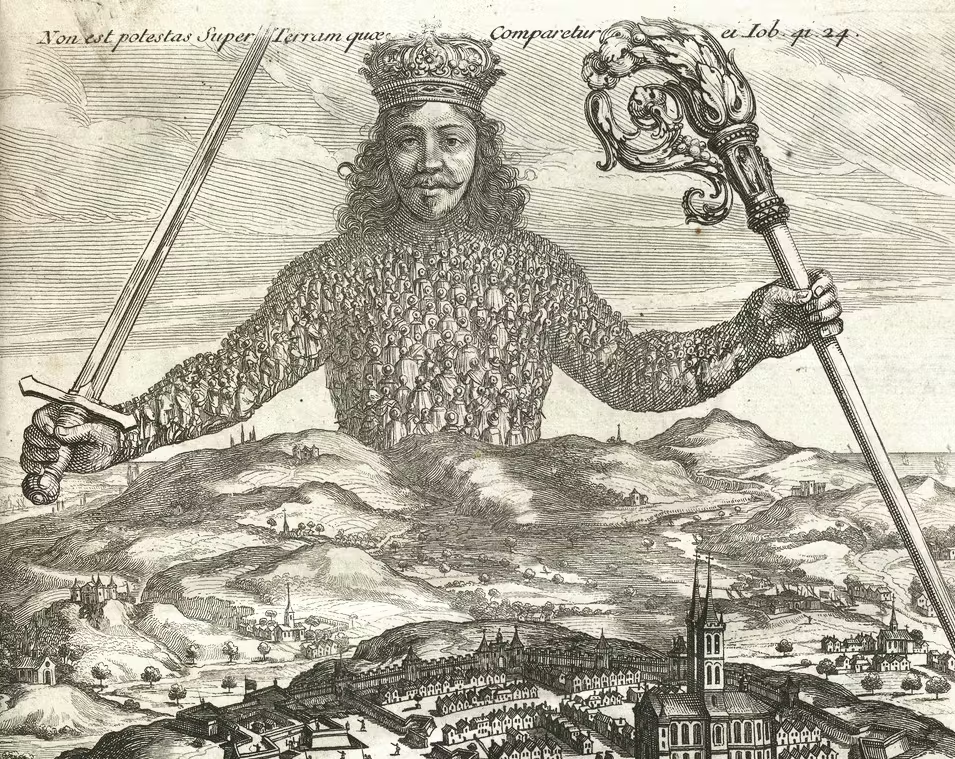
    Thomas Hobbes wrote his seminal work Leviathan in 1651. In it he describes the world system as it was then as being in “a state of nature,” something that some have interpreted as anarchy. However, anarchy has order and purpose. It is not chaos. In fact, if we think of Adam Smith’s “invisible hand of the market” we get something similar to what anarchy is in practice: the aggregate of individual acts of self-interest can lead to the optimisation of value and outcomes at the collective level. Anarchy clears; chaos does not.

    For Hobbes, the state of nature was chaos. Absent a “Sovereign” (i.e. a government) that could impose order on global and domestic societies, humans were destined to lead lives the were “solitary, poor, nasty, brutish and short.” This has translated into notions of “might makes right,” “survival of the fittest,” “to the victor goes the spoils” and other axioms of so-called power politics. The most elaborate of these, international relations realism, is a school of thought that is based on the belief that because the international system has no superseding Sovereign in the form of world government with comprehensive enforcement powers, and because there are no universally shared values and mores throughout the globe community that ideologically bind cultures, groups and individuals, global society exists as a state of nature where, even if there are attempts to manage the relationships between States (and other actors) via rules, norms, institutions and the like, the bottom line is that States (and other actors) have interests, not friends.

    Interests are pursued in a context of power differentials. Alliances are temporary and based on the convergence of mutual interests. Values are not universal and so are inconsequential. International exchange is transactional, not altruistic. Actors with greater resources at their disposal (human, natural, intellectual) prevail over those that have less. In case of resource parity between States or other actors, balances of power become systems regulators, but these are fluid and contingent, not permanent. Geography matters in that regard, which is why geopolitics (the relationship of power to geography) is the core of international relations.

    It is worth remembering this when evaluating contemporary international relations. It has been well established by now that the liberal international order of the post WW2 era has largely been dismantled in the context of increasing multipolarity in inter-State relations and the rise of the Global South within the emerging order. As I have written before, the long transition and systemic realignment in international affairs has led to norm erosion, rules violations, multinational institutional and international organizational decay or irrelevance and the rise of conflict (be it in trade, diplomacy or armed force) as the new systems regulator.

    These developments have accentuated over the last decade and now have a catalyst for a full move into a new global moment–but not into a multipolar or multiplex constellation arrangement in which rising and established powers move between multilateral blocs depending on the issues involved. Instead, the move appears to be one towards a modern Hobbesian state of nature, with the precipitant being the MAGA administration of Donald Trump and its foreign policy approach.

    We must be clear that it is not Trump who is the architect of this move. As mentioned in pervious posts, he is an empty vessel consumed by his own self-worth. That makes him a useful tool of far smarter people than he, people who work in the shadow of relative anonymity and who cut their teeth in rightwing think tanks and policy centres. In their view the liberal internationalist order placed too many constraints on the exercise of US power while at the same time requiring the US to over-extend itself as the “world’s policeman” and international aid donor . Bound by international conventions on the one hand and besieged by foreign rent-seekers and adversaries on the other, the US was increasingly bent under the weight of overlapped demands in which existential national interests were subsumed to a plethora of frivolous diversions (such as human rights and democracy promotion).

    For these strategists, the solution to the dilemma was not to be found in any new multipolar (or even technopolar) constellation but in a dismantling of the entire edifice of international order, something that was based on an architecture of rules, institutions and norms nearly 500 years in the making. Many have mentioned Trump’s apparent mercantilist inclinations and his admiration for former US president William McKinley’s tariff policies in the late 1890s. Although that may be true, the Trump/MAGA agenda is far broader in scope than trade. In fact, the US had its greatest period of (neo-imperial) expansion during McKinley’s tenure as president (1897-1901), winning the Spanish-American War and annexing Hawai’i, Puerto Rico, Guam, American Samoa and the Philippines, so Trump’s admiration for him may well be based on notions of territorial expansionism as well.

    Whatever Trump’s views of McKinley, the basic idea under-riding his foreign policy team’s approach is that in a world where the exercise of power is the ultimate arbiter of a State’s international status, the US remains the greatest Power of them all. It does not matter if the PRC or Russia challenge the US or if other emerging powers join the competition. Without the hobbling effect of its liberal obligations the US can and will dominate them all. This involves trade but also the exercise of raw (neo) imperialist ambitions in places like Greenland, the Panama Canal and even Canada. It involves sidelining the UN, NATO, EU and other international organisations where the US had to share equal votes with lesser powers who flaunted the respect and tribute that should naturally be given in recognition of the US’s superior power base.

    There appears to be a belief in this approach that the US can be a new hegemon–but not Sovereign–in a unipolar world, even more so than during the post-USSR-pre 9/11 interregnum. In a new state of nature it can sit at the core of the international system, orbited by constellations of lesser Great Powers like the PRC, Russia, the EU, perhaps India, who in turn would be circled by lesser powers of various stripes. The US will not seek to police the world or waste time and resources on well-meaning but ultimately futile soft power exercises like those involving foreign aid and humanitarian assistance. Its power projection will be sharp on all dimensions, be it trade, diplomacy or in military-security affairs. It will use leverage, intimidation and varying degrees of coercion as well as persuasion (and perhaps even bribery) as diplomatic tools. It will engage the world primarily in bilateral fashion, eschewing multilateralism for others to pursue according to their own interests and power capabilities. That may suit them, but for the US multilateralism is just another obsolescent vestige of the liberal internationalist past.

    Source: Northrop-Grumman.

    A possible (and partial) explanation for the change in the US foreign policy approach may be the learning effect in the US of Russia’s invasion of Ukraine and Israel’s scorched earth campaign in Gaza. Trump and his advisors may have learned that impunity has its own rewards, that no country or group of countries other than the US (if it has the will) can effectively confront a state determined to pursue its interests regardless of international law, the laws of war or institutional censorship (say, by the UN or International Criminal Court), or any other type of countervailing power. The Russians and Israelis have gotten away with their behaviour because, all rhetoric and hand-wringing aside, there is no actor or group of actors who have the will or capability to stop them. For Trump strategists, these lesser powers are pursuing their interests regardless of diplomatic niceties and international conventions, and they are prevailing precisely because of that. Other than providing military assistance to Ukraine, no one has lifted a serious finger against the Russians other than the Ukrainians themselves, and even fewer have seriously moved to confront Israel’s now evident ethnic cleansing campaign in part because the US has backed Israel unequivocally. The exercise of power in each case occurred in a norm enforcement vacuum in spite of the plethora of agencies and institutions designed to prevent such egregious violations of international standards.

    Put another way: if Israel and Russia can get away with their disproportionate and indiscriminate aggression, imagine what the US can do.

    If we go on to include the PRC’s successful aggressive military “diplomacy” in East/SE Asia, the use of targeted assassinations, hacking, disinformation and covert direct influence campaigns overseas by various States and assorted other unpunished violations of international conventions, then it is entirely plausible that Trump’s foreign policy brain trust sees the moment as ripe for finally breaking the shackles of liberal internationalism. Also recall that many in Trump’s inner circle subscribe to chaos or disruption theory, in which a norms-breaking “disruptor” like Trump seizes the opportunities presented by the breakdown of the status quo ante.

    Before the US could hollow out liberal internationalism abroad and replace it with a modern international state of nature it had to crush liberalism at home. Using Executive Orders as a bludgeon and with a complaint Republican-dominated Congress and Republican-adjacent federal courts. the Trump administration has openly exercised increasingly authoritarian control powers with the intention of subjugating US civil society to its will. Be it in its deportation policies, rollbacks of civil rights protections, attacks on higher education, diminishing of federal government capacity and services (except in the security field), venomous scapegoating of opponents and vulnerable groups, the Trump/MAGA domestic agenda not only seeks to turn the US into a illiberal or “hard” democracy (what Spanish language scholars call a “democradura” as a play on words mixing the terms democracia and dura (hard)). It also serves notice that the US under Trump/MAGA is willing to do whatever is necessary to re-impose its supremacy in world affairs, even if it means hurting its own in order to prove the point. By its actions at home Trump’s administration demonstrates capability, intent and steadfast resolve as it establishes a reputation for ruthless pursuit of its policy agenda. Foreign interlocutors will have to take note of this and adjust accordingly. Hence, for Trump’s advisors, authoritarianism at home is the first step towards undisputed supremacy abroad.

    The Trump embrace of international state of nature differs from Hobbes because it does not see the need for a superseding global governance network but instead believes that the US can dominate the world without the encumbrances of power-sharing with lesser players. In this view hegemony means domination, no more or less. It implies no attempt at playing the role of a Sovereign imposing order on a disorderly and recalcitrant community of Nation-States and non-State actors that do not share common values, much less interests.

    This is the core of the current US foreign policy approach. It is not about reorganising the international order within the extant frameworks as given. It is about removing those frameworks entirely and replacing them with an America First, go it alone agenda where the US, by virtue of its unrivalled power differential relative to all other States and global actors, can maximise its self-interest in largely unconstrained fashion. Some vestiges of the old international order may remain, but they will be marginalised and crippled the longer the US project is in force.

    What does not seem to be happening in Trump’s foreign policy circle are three things. First, recognition that other States and international actors may band together against the US move to unipolarity in a new state of nature and that for all its talk the US may not be able to impose unipolar dominance over them. Second, understanding that States like the PRC, Russia and other Great Powers and communities (like the EU) may resist the US move and challenge it before it can consolidate the new international status quo. Third, foreseeing that the technology titans who today are influential in the Trump administration may decide to transfer there loyalties elsewhere, especially if Trump’s ego starts becoming a hindrance to their (economic and digital) power bases. The fusion of private technology control and US State power may not be as compatible over time as presently appears to be the case, something that may not occur with States such as the PRC, India or Japan that have different corporate cultures and political structures. As the current investment in the Middle Eastern oligarchies shows, the fusion of State and private techno power may be easier to accomplish in those contexts rather than the US.

    In any event, whether it be a short-term interlude or a longue durée feature of international life, a modern state of nature is now our new global reality.

    Analysis syndicated by 36th Parallel Assessments

    MIL OSI AnalysisEveningReport.nz

  • MIL-OSI China: World’s first pure ammonia-fueled demonstration vessel completes maiden voyage in China

    Source: People’s Republic of China – State Council News

    The world’s first pure ammonia-powered demonstration vessel, the “Anhui,” successfully completed its maiden voyage in Hefei, east China’s Anhui Province, marking a major step forward for green shipping.

    An aerial drone photo taken on June 28, 2025 shows the pure ammonia-powered demonstration vessel, the “Anhui,” making its maiden voyage at the water area of Chaohu Lake in Hefei, east China’s Anhui Province. (Xinhua/Zhou Mu)

    Ammonia, a major chemical industry feedstock, has a high energy density and due to its carbon-free nature, produces only water and nitrogen when fully combusted. This makes it a highly promising fuel for decarbonizing shipping.

    In recent years, several shipping companies in countries like Japan and Norway have been investing in the development of ammonia-powered vessels. A report by the International Energy Agency published in 2021 estimated that by 2050, ammonia could account for around 45 percent of global energy demand for shipping in 2050 in the net-zero emissions. However, ammonia fuel also faces challenges such as ignition difficulties and unstable combustion.

    Ammonia-powered Anhui was jointly developed by the Institute of Energy of the Hefei Comprehensive National Science Center and its subsidiary, Shenzhen Haixu New Energy Co., Ltd. It is equipped with a 200kW high-speed gas internal combustion generator, two 100kW propulsion motors, and a twin-screw propulsion system. It has a full load capacity of 50 tonnes and a rated speed of 10 knots.

    According to Wu Dianwu from the institute, the research team overcame several key technological challenges. These include pure ammonia fuel plasma ignition, sustained combustion, efficient catalytic cracking of ammonia gas to produce hydrogen, and efficient combustion and control of hydrogen-ammonia mixed gas in internal combustion engines. The team also developed a pure ammonia fuel burner and various ammonia gas catalytic cracking devices.

    The maiden voyage achieved stable combustion of pure ammonia fuel, nearly zero carbon dioxide emissions, and effective control of nitrogen oxides. This confirms the potential for ammonia-hydrogen fuels to be widely used in marine and land transport, as well as in industrial boilers and fuel cells, Wu noted.

    Wang Junli, secretary-general of the Chinese Society of Naval Architects and Marine Engineers, said the vessel’s successful voyage marked a major milestone in creating a clean, low-carbon energy system for water transport. If pure ammonia engines reach the megawatt level, their applications will expand significantly, holding significant importance in achieving China’s dual carbon goals. 

    MIL OSI China News

  • MIL-OSI Europe: Romina Pourmokhtari takes part in UN Ocean Conference in Nice

    Source: Government of Sweden

    Minister for Climate and the Environment Romina Pourmokhtari is participating in the UN’s third Ocean Conference, UNOC-3, in Nice. At the Conference, a declaration is expected to be adopted on the implementation of measures to protect and preserve oceans.

    MIL OSI Europe News

  • MIL-OSI Europe: Government launches strategy for technology-leading and competitive industry

    Source: Government of Sweden

    The industrial investments of today lay the foundations for Sweden’s future competitiveness. For this reason, the Government is now launching a strategy that outlines the direction of industrial policy. The focus is on developing strategic technologies from research to commercialisation and on improving incentives for industry establishment.

    MIL OSI Europe News

  • MIL-OSI Europe: UN Ocean Conference highlights the need for more global measures to protect the world’s oceans

    Source: Government of Sweden

    The UN Ocean Conference in Nice concluded on 13 June with the adoption of the Nice Ocean Action Plan, a political declaration to strengthen global efforts to protect oceans. Minister for Climate and the Environment Romina Pourmokhtari headed Sweden’s delegation.

    MIL OSI Europe News

  • MIL-OSI Europe: Minister for Social Services and Minister for Older People and Social Security visit Ukraine

    Source: Government of Sweden

    On 21–23 May, Minister for Social Services Camilla Waltersson Grönvall and Minister for Older People and Social Security Anna Tenje visited Lviv, Ukraine. While in Ukraine, Ms Waltersson Grönvall and Ms Tenje took part in the Ministerial Social Policy Summit, which Sweden co-hosted together with Ukraine, Moldova and Lithuania. Ministers from several EU countries were also in attendance.

    MIL OSI Europe News

  • MIL-OSI Europe: New EU pharmaceutical legislation – a win for Sweden and EU patients

    Source: Government of Sweden

    After two years of negotiations, EU Member States have agreed on a proposal for a revised pharmaceutical legislation in Europe. The process has met many obstacles along the way and the countries’ positions have been far apart on many fundamental issues, not least in regard to data protection issues and incentives for the development of priority antimicrobials.

    MIL OSI Europe News

  • MIL-OSI Canada: Joint statement on International LGBTQI+ Pride Day 2025

    Source: Government of Canada News

    June 28, 2025 – Ottawa, Ontario – Global Affairs Canada

    The foreign ministers of Canada, Spain, Australia, Belgium, Brazil, Cape Verde, Chile, Colombia, Iceland, Ireland, Netherlands, Norway, Portugal, Slovenia and Uruguay today issued the following statement:

    “On the occasion of International LGBTQI+ Pride Day 2025, we, the Foreign Ministers of Canada, Spain, Australia, Belgium, Brazil, Cape Verde, Chile, Colombia, Iceland, Ireland, Netherlands, Norway, Portugal, Slovenia and Uruguay are speaking and acting as one to champion the rights of LGBTQI+ people.

    “At a time when hate speech and hate crimes are on the rise, and in view of efforts to strip LGBTQI+ people of their rights, we reject all forms of violence, criminalization, stigmatization or discrimination, which constitute human rights violations.

    “It is our understanding that respect for diversity, equality and tolerance require the support, at the international level, of measures aimed at decriminalization, and at preventing and eliminating harassment of all kinds—including homophobic and transphobic harassment. Also measures to advance the implementation of diversity policies and the fight against discrimination, and to favour the inclusion of LGBTQI+ people, especially transgender people in society and in the workplace.

    “We recognize that LGBTQI+ people face multiple and intersecting forms of discrimination, particularly when they are also part of other historically marginalized groups, communities, and populations, such as indigenous peoples, afro-descendants, people with disabilities, migrants, elderly people, or those who living in poverty. Promoting their full and effective inclusion requires an intersectional approach that structurally addresses these inequalities.

    “We are joining forces to work hand in hand for the equal rights of LGBTQI+ people and to bring the criminalization of same-sex relations worldwide to an end.

    “We call on all States to join us on this path, repealing discriminatory laws and refusing to adopt new laws that criminalize relations between persons of the same sex or punish people for their sexual orientation or gender identity. We call for an end to the prosecution of LGBTI+ people, and especially to the application of imprisonment and capital punishment. We further call for an end to so-called conversion “therapy” practices intended to change a person’s sexual orientation or gender identity, which can cause psychological and physical pain and suffering and are inherently discriminatory. What is at stake here is a matter of full respect for human rights and human dignity, of strengthening equality, diversity and prosperity, leaving no one behind.

    “Therefore, we, the public authorities, must implement policy that, in alignment with international human rights standards, pursues effective equality of LGBTQI+ people and seeks to combat all forms of discrimination. We celebrate sexual diversity and family diversity, in the conviction that inclusive, equitable, and tolerant societies founded on solidarity are also stronger, healthier and more resilient.

    “Lastly, we reassert our commitment to respecting the human rights of LGBTQI+ people, to ensuring that their equality before the law is incontestable and that no one is prosecuted or subject to discriminated because of their sexual orientation or gender identity. Let us build societies in which all human beings are free to live and love as they choose.”

    MIL OSI Canada News

  • MIL-OSI Russia: Lithuania, Latvia and Estonia notify the UN of their withdrawal from the Ottawa Convention banning anti-personnel mines

    Translation. Region: Russian Federal

    Source: People’s Republic of China in Russian –

    Source: People’s Republic of China – State Council News

    VILNIUS, June 28 (Xinhua) — Lithuania, Latvia and Estonia on Friday formally submitted notifications to the UN Secretary-General on their withdrawal from the Ottawa Convention banning anti-personnel mines.

    The three Baltic states cited changing national security needs as the main reason for their coordinated decision to withdraw from the convention, which bans the use, stockpiling, production and transfer of anti-personnel mines.

    Lithuanian Foreign Minister Kęstutis Budrys announced the move on Friday on the social media platform X. “Today, Lithuania officially notified the UN Secretary General of its withdrawal from the Ottawa Convention. This decision was not taken lightly,” said K. Budrys.

    The Latvian Foreign Ministry noted that the security situation in the region has changed significantly since Latvia joined the convention. “Withdrawal from the Ottawa Convention will provide Latvia with the flexibility to act to strengthen deterrence and ensure the protection of the country and its population,” the Foreign Ministry said.

    “By withdrawing from the Ottawa Convention, the Estonian Defence Forces will be able to more flexibly choose the weapons systems, means and methods necessary to strengthen the country’s defence capability,” said Estonian Foreign Minister Margus Tsahkna.

    The Ottawa Convention banning anti-personnel mines was signed in 1997 and entered into force in 1999. Lithuania, Estonia and Latvia acceded to the convention in 2003, 2004 and 2005, respectively.

    In recent months, the three Baltic countries have carried out internal legislative procedures to facilitate their withdrawal from the convention.

    According to European media, Poland and Finland have also launched procedures to withdraw from the convention.

    Under the convention’s rules, the withdrawal will take effect six months after the UN secretary general receives formal notification from each country. –0–

    MIL OSI Russia News

  • MIL-OSI Security: Man jailed for Leytonstone murder after detectives extradite him from Sweden

    Source: United Kingdom London Metropolitan Police

    A man who fled the UK in an attempt to evade justice has been jailed for murder.

    Sabajet Shuti – 31 (04.07.93) of Upney Lane, Barking was sentenced to life imprisonment to serve a minimum of 27 years following a hearing at Southwark Crown Court on 27 June.

    Shuti had been found guilty of murdering 27-year-old Lumturi Zeqja, along with possession of a knife and GBH relating to a second man at the conclusion of a trial at the same court on 14 April.

    Shuti’s brother, Emirlion Shuti – 30 (13.12.94) of Blake Avenue, Barking was found guilty of affray during the same trial. He received a 20-month sentence, suspended for two years.

    The court heard how Sabajet Shuti launched his fatal attack on the evening of 16 October 2022 in Church Lane, Leytonstone.

    Lumturi was standing outside a café with his friend when the Shuti brothers arrived at around 22:40hrs in two cars. The brothers went to a separate café but shortly after Emirlion Shuti returned to one of the cars and began to drive it erratically along the road, revving the engine and causing a disturbance.

    Lumturi’s friend approached Emirlion and told him to stop but instead of doing this, Emirlion got out of the car and spoke to his brother and others who were outside the neighbouring café. The situation quickly escalated after Emirlion Shuti threw a punch at Lumturi’s friend. During the ensuing altercation Sabajet Shuti produced a knife and stabbed Lumturi twice, and his friend once.

    Both Shuti brothers then fled the scene leaving Lumturi collapsed and dying on the pavement. The emergency services attended but despite their efforts they could not save him. His friend was taken to hospital for emergency surgery and thankfully survived the attack.

    Detectives began to piece together evidence and from accessing CCTV and mobile phone footage were able to identify who was responsible.

    The day after the murder, Sabajet Shuti made plans to leave the UK. He changed his appearance by shaving off his beard and then travelled to Folkestone before crossing the Channel into France. A warrant for his arrest was issued and around a year after the attack, on 3 October 2023 Sabajet Shuti was arrested in Sweden. He was extradited back to the UK to face the consequences of his actions.

    In the intervening period, detectives had arrested and charged Emirlion Shuti for his role in the attack.

    Detective Inspector Brett Hagen who led the investigation said: “Sabajet Shuti went to great lengths to try and evade justice, fleeing the country and regularly changing location in an attempt to avoid being arrested.

    “However, his efforts were in vain as while he was on the run, our team of tenacious detectives had built a file of evidence and, working in liaison with international law enforcement colleagues, the net closed in on him.

    “The level of violence Sabejet Shuti used was completely unnecessary – he went out that night armed with a knife so had clear intent of causing someone significant harm if the chance arose.

    “His actions cost Lumturi Zeqja his life and has caused untold pain to his family and friends. While nothing I can say can alleviate their suffering, I hope they can take some small measure of comfort in seeing the Shuti brothers held to account for their actions.”

    MIL Security OSI

  • MIL-OSI Europe: Paulina Brandberg participating in annual UN Commission on the Status of Women

    Source: Government of Sweden

    Minister for Gender Equality and Working Life Paulina Brandberg is taking part in the 69th session of the Commission on the Status of Women (CSW69) on 10–14 March. This year also marks 30 years since the adoption of the Beijing Declaration and Platform for Action, and the main focus of the this year’s session will be to review and evaluate its implementation.

    MIL OSI Europe News

  • MIL-OSI Europe: Paulina Brandberg participating in annual UN Commission on the Status of Women

    Source: Government of Sweden

    Minister for Gender Equality and Working Life Paulina Brandberg is taking part in the 69th session of the Commission on the Status of Women (CSW69) on 10–14 March. This year also marks 30 years since the adoption of the Beijing Declaration and Platform for Action, and the main focus of the this year’s session will be to review and evaluate its implementation.

    MIL OSI Europe News

  • MIL-OSI Europe: Sweden’s first national strategy to strengthen Jewish life and combat antisemitism

    Source: Government of Sweden

    The Swedish Government has adopted a national strategy to strengthen Jewish life and combat antisemitism. This strategy will provide a structure for national efforts in the period 2025–2034. The objective is to lay the foundations for more targeted and coordinated efforts and create better conditions for Jewish life in Sweden.

    MIL OSI Europe News

  • MIL-OSI NGOs: New wealth of top 1% surges by over $33.9 trillion since 2015 – enough to end poverty 22 times over, as Oxfam warns global development “abysmally off track” ahead of crunch talks

    Source: Oxfam –

    • Oxfam condemns “private finance takeover” of development efforts, as over 3.7 billion people remain in poverty ten years after the Sustainable Development Goals were agreed. 
       
    • New Oxfam analysis unveils “astronomical rise in private wealth”. Between 1995 and 2023, global private wealth grew by $342 trillion – 8 times more than public wealth.  
       
    • Oxfam analysis also shows governments are making the largest cuts to life-saving aid since aid records began. Aid cuts could cause 2.9 million more children and adults to die by 2030, from HIV/AIDS causes alone. 
    • Results of a new global survey show 9 out of 10 people support paying for public services and climate action through taxing the super-rich. 
    • Oxfam urges new strategic alliances to address inequality; urgently revitalize aid and tax the super-rich; and assert new “public-first” approach over private finance. 

    The world’s richest 1% increased their wealth by more than $33.9 trillion in real terms since 2015, reveals new Oxfam analysis ahead of the world’s largest development financing talks in a decade, in Seville, Spain. This is more than enough to eliminate annual poverty 22 times over at the World Bank’s highest poverty line of $8.30 a day. The wealth of just 3,000 billionaires has surged $6.5 trillion in real terms since 2015, and now comprises the equivalent of 14.6% of global GDP.

    Oxfam’s new briefing paper, “From Private Profit to Public Power: Financing Development, Not Oligarchy”, launches today ahead of the June 30 fourth International Conference on Financing for Development, hosted by Spain and joined by over 190 countries.  

    Wealthy governments are making the largest cuts to life-saving development aid since aid records began in 1960. Oxfam analysis finds that G7 countries alone, who account for around three-quarters of all official aid, are cutting aid by 28% for 2026 compared to 2024. Whilst critical aid is cut, the debt crisis is bankrupting governments – 60% of low-income countries are at the edge of a debt crisis – with the poorest countries paying out far more to repay their rich creditors than they are able to spend on classrooms or clinics. Only 16% of the targets for the Global Goals are on track for 2030. 

    Oxfam’s new analysis examines the failures of a private investor-focused approach to funding development. A decade-long effort by major development actors to recast their mission as one of supporting powerful Global North financial actors has led in fact to a host of harms and at the same time only mobilized paltry sums. The analysis also looks at the role of private creditors, who now outpace bilateral lenders by five times and account for more than half the debt owed by low- and middle-income countries, in exacerbating the debt crisis with their refusal to negotiate and their punitive terms. 

    Seville is the first major gathering of countries worldwide at a time that life-saving aid is being decimated, a trade war has started, and multilateralism being fractured – all in the backdrop of the second Trump administration. There is glaring evidence that global development is desperately failing because – as the last decade shows – the interests of a very wealthy few are put over those of everyone else,” said Amitabh Behar, Executive Director of Oxfam International. 

    What the World Bank described as a “billions to trillions” paradigm shift has been a boon for wealthy investors the richest 1% own 43% of global assets but now faces overwhelming evidence of failure, even according to former champions. Alarmingly, there is new momentum behind the idea of diverting the little aid that remains to private financial actors. 

    Rich countries have put Wall Street in the driver’s seat of global development. It’s a global private finance takeover which has overrun the evidence-backed ways to tackle poverty through public investments and fair taxation. It is no wonder governments are abysmally off track, be it on fostering decent jobs, gender equality, or ending hunger. This much wealth concentration is choking efforts to end poverty”, said Behar. 

    New Oxfam analysis shows that between 1995 and 2023, global private wealth grew by $342 trillion – 8 times more than global public wealth, which grew by just $44 trillion. Global public wealth as a share of total wealth actually fell between 1995 and 2023.  

    Oxfam is urging governments to rally behind policy and political proposals that offer a change in course by tackling extreme inequality and transforming the development financing system:  

    • New strategic alliances against inequality. Governments must band together in new coalitions to oppose extreme inequality. Countries such as Brazil, South Africa and Spain are offering leadership to do so internationally. A new ‘Global Alliance Against Inequality’ supported by Germany, Norway, Sierra Leone and others sets an example for nations to back.  
    • Public-first approach – reject the Wall Street Consensus. Governments should reject private finance as the silver bullet to funding development. Instead, governments should invest in state-led development – to ensure universal high-quality healthcare, education and care services, and explore publicly-delivered goods in sectors from energy to transportation.  
    • Total rethink of development financing – tax the ultra-rich, revitalize aid, reform debt architecture, and move beyond GDP indicators. Global North donors must urgently reverse catastrophic cuts to lifesaving aid and meet the 0.7% ODA target as minimum. Governments must back efforts for a new UN debt convention, and support the UN tax convention, building on Brazil’s G20 effort to tax high-net-worth-individuals.   

    “Trillions of dollars exist to meet the global goals, but they’re locked away in private accounts of the ultra-wealthy. It’s time we rejected the Wall Street Consensus and instead put the public in the driving seat. Governments should heed widespread demands to tax the rich – and match it with a vision to build public goods from healthcare to energy. It’s a hopeful sign that some governments are banding together to fight inequality – more should follow their lead, starting in Seville”, said Behar. 

    Oxfam’s media briefing note, “From Private Profit to Public Power: Financing Development, Not Oligarchy” can be downloaded here 

    Oxfam’s analysis of the historic cuts to development aid and their impact on the poorest can be found here. The modelling on HIV/AIDS deaths was published in the Lancet HIV. 

    The study that surveyed global opinion on taxing the super-rich was commissioned by Greenpeace and Oxfam International. The research was conducted by first party data company Dynata in May-June 2025, in Brazil, Canada, France, Germany, Kenya, Italy, India, Mexico, the Philippines, South Africa, Spain, the UK and the US. The survey had approximately 1200 respondents per country, with a margin of error of +-2.83%. Together, these countries represent close to half the world’s population. See the results here. 

    The cost of ending poverty is based on the annual cost of ending poverty in 2024 for one year, for the over 3.7 billion people living below the $8.30 a day poverty line, according to World Bank data. The increase in wealth of the 1% since 2015 would be more than enough to meet this cost 22 times over. Another way of expressing this is that the total amount is more than enough to completely end poverty for 22 years. This is only indicative, as the cost of ending poverty would likely fall over the next 22 years anyway as the numbers living in poverty reduce, and the value of the wealth would increase as it would not be spent all at once. But nevertheless this comparison indicates the extent to which more wealth, which is being greatly concentrated in the hands of a few, could be directed to ending poverty instead of further inflating the fortunes of the richest. For further information on the calculations see the media briefing paper. 

    Oxfam will be hosting a major high-level event together with Club de Madrid, at 7pm on July 1, 2025, in Seville, joined by high-level government representatives on the media briefing note. Journalists are invited to attend and will be prioritized for questions. Please register here. 

    Moreover, an official side event on inequality and tax reform will take place at 2.30pm on July 1, 2025, at the FIBES Exhibition Centre room 20 joined by high-level government representatives from Brazil, Spain and South Africa, international organizations and global experts. See note here. 

    MIL OSI NGO

  • MIL-OSI Europe: Recession lingers, but economic recovery in sight

    Source: Government of Sweden

    The Swedish economy is in a protracted recession, but recovery is expected to begin in early 2025. Inflation is expected to be around the inflation target going forward. These are the conclusions of the Ministry of Finance in a new economic forecast.

    MIL OSI Europe News

  • MIL-OSI Europe: Legislation to enable applications for state aid for investments in new nuclear power

    Source: Government of Sweden

    Sweden needs new nuclear power to cover energy needs, provide a secure supply of electricity to the national grid and carry out the energy transition. As of 1 August 2025, companies seeking to build reactors will be able to apply for state aid. The Government has now approved a new ordinance regulating the application process.

    MIL OSI Europe News

  • MIL-OSI Europe: Final 2024 meeting of the Task force for Jewish life in Sweden

    Source: Government of Sweden

    On Thursday 28 November, the Task Force for Jewish life in Sweden held its final meeting of the year. The main topic was education, which has been the task force’s main focus in 2024. Representatives from a number of organisations were invited to take part and talk about their work in this area.

    MIL OSI Europe News

  • MIL-OSI Europe: Excellent research and innovation are encouraged in largest-ever research and innovation bill

    Source: Government of Sweden

    Sweden aims to be one of the world’s leading countries in research and innovation. In the research and innovation bill, the Government is investing SEK 6.5 billion on research and innovation of the highest quality. Investments include funding for excellent research, increased and competitive funding for higher education institutions, enhanced research infrastructure and investments in groundbreaking technologies to position Sweden at the forefront.

    MIL OSI Europe News

  • MIL-OSI Europe: New action plan for a society free from racism

    Source: Government of Sweden

    The Government is announcing a new action plan to combat racism and hate crime. Through this concerted action, the Government is taking important steps in the efforts to free Sweden from racism and hate crime. The efforts in this area will be accurate, measurable and long-term. Schools, judiciary, welfare and working life will be in focus.

    MIL OSI Europe News

  • MIL-OSI Europe: Government initiatives for Jewish life and Holocaust remembrance

    Source: Government of Sweden

    In 2025, the 250th anniversary of established Jewish life in Sweden will be celebrated. This will be an opportunity to highlight the Jewish minority, culture and cultural heritage throughout the country. The Government has therefore, in appropriation directions for 2025, instructed a number of government agencies to help highlight the 250th anniversary. The year 2025 also marks 80 years since the liberation of the Auschwitz-Birkenau concentration camp.

    MIL OSI Europe News

  • MIL-OSI Europe: Guidelines for central government debt management in 2025

    Source: Government of Sweden

    Today, the Government adopted new guidelines for the Swedish National Debt Office’s central government debt management in 2025. The Swedish National Debt Office will continue to issue inflation-linked bonds, but the outstanding volume will be reduced. The aim is inflation-linked debt of around SEK 80 billion by the end of 2029. In addition, from now on, the central government debt’s term to maturity will be measured in average time to refixing (ATR).

    MIL OSI Europe News

  • MIL-OSI Europe: Minister for Public Administration highlights 150 years of diplomatic relations between Sweden and Colombia

    Source: Government of Sweden

    In connection with the 150th anniversary of diplomatic relations between Sweden and Colombia, Minister for Public Administration Erik Slottner is visiting Colombia this week. The aim of his visit is to further develop cooperation on digitalisation and cybersecurity, and to present Sweden as an innovative, sustainable country in the area of digitalisation, with an advanced security approach.

    MIL OSI Europe News

  • MIL-OSI Canada: Tariff-rate quotas on imports of steel mill products

    Source: Government of Canada News

    Backgrounder

    The Government of Canada announced the implementation of tariff rate quotas (TRQs) on imports of steel mill products from non-free trade agreement partners, effective June 27, 2025. This measure will help stabilize the Canadian market and prevent harmful diversion of foreign steel from third countries into Canada while minimizing impacts on Canadian importers and downstream users.

    The TRQs will be administered on the basis of five steel product categories: flat, long, pipe and tube, semi-finished, and stainless steel (see Annex A for list of tariff classifications applicable to each category). A 50 per cent surtax will be applied on imports of covered products that exceed the specified quantity threshold from non-FTA partners.

    The quotas will be reviewed in 30 days to ensure their appropriateness and effectiveness in light of evolving market circumstances, and periodically thereafter. The reviews will be supported by the newly established industry-government steel task force.

    Administration of the Tariff-Rate Quotas

    Global Affairs Canada will be responsible for administering the quota of products that may be imported without this additional surtax through the issuance of shipment-specific import permits. To facilitate the administration of the TRQs, the subject products are being added to the Import Control List. Importations made without the applicable shipment-specific import permit will be assessed the 50 per cent surtax by the CBSA. This surtax would be additive to any existing surtaxes or anti-dumping and countervailing duty measures, as well as forthcoming tariff measures based on the country of “melt and pour” for steel or “smelt and cast” for aluminum.

    Key elements of the tariff-rate quota include:

    • Total quota volume: For each of the five steel product categories, a limit is imposed on the quantity of goods that may be imported without a surtax. The one-year limit corresponds to  all of 2024 imports from non-FTA countries. 
    • Quota periods: The annual quota will be administered on the basis of three-month quarterly periods. Once the quota for a category in a quarter has been filled, imports under that category will be subject to a surtax for the remainder of that period. Any quota remaining at the end of a quarter will be rolled over into the following one.
    • Country share limit: For each category, there is a limit on the share of the total quarterly quota that imports from a single country of origin can fill. The limits are based on historical trade patterns. If imports from a country reaches the specified limit in a category, all subsequent imports from that country in that category will be subject to the surtax, until the end of the quarter.

    See Annex B for additional details on the tariff-rate quota volume and limits.

    The TRQs will apply to imports originating in any country that does not have a free trade agreement in force with Canada. The list of countries excluded from the tariff-rate quotas are set out in Annex C.

    Global Affairs Canada and the Canada Border Services Agency will be responsible for administering the tariff-rate quota for each steel product category. Additional information on the administration of these measures can be found at the links below:

    • GAC Notice to Importers (will follow)
    • CBSA Customs Notice (will follow)

    Annex A – Steel Products Subject to Provisional Safeguards

    Steel Products Subject to Provisional Safeguards
    Product Category

    Applicable Tariff Classifications

    Flat

    7208.10.00; 7208.25.00; 7208.26.00; 7208.27.00; 7208.36.00; 7208.37.00; 7208.38.00; 7208.39.00; 7208.40.00; 7208.51.00; 7208.52.00; 7208.53.00; 7208.54.00; 7208.90.00; 7209.15.00; 7209.16.00; 7209.17.00; 7209.18.00; 7209.25.00; 7209.26.00; 7209.27.00; 7209.28.00; 7209.90.00; 7210.11.00; 7210.12.00; 7210.49.00; 7210.50.00; 7210.61.00; 7210.69.00; 7210.70.00; 7210.90.00; 7211.14.00; 7211.19.00; 7211.23.00; 7211.29.00; 7211.90.00; 7212.10.00; 7212.30.00; 7212.40.00; 7212.50.00; 7225.19.00; 7225.30.00; 7225.40.00; 7225.50.00; 7225.91.00; 7225.92.00; 7225.99.00; 7226.91.00; 7226.92.00; 7226.99.00

    Long

    7213.10.00; 7213.20.00; 7213.91.00; 7213.99.00; 7214.10.00; 7214.20.00; 7214.91.00; 7214.99.00; 7216.10.00; 7216.21.00; 7216.22.00; 7216.31.00; 7216.32.00; 7216.33.00; 7216.40.00; 7216.50.00; 7216.99.00; 7217.10.00; 7217.20.00; 7217.30.00; 7217.90.00; 7224.10.00; 7227.10.00; 7227.20.00; 7227.90.00; 7228.30.00; 7228.40.00; 7228.50.00; 7228.60.00; 7228.70.00; 7228.80.00; 7229.20.00; 7229.90.00; 7301.10.00; 7301.20.00

    Pipe and Tube

    7304.19.00; 7304.22.00; 7304.23.00; 7304.24.00; 7304.29.00; 7304.39.00; 7304.59.00; 7304.90.00; 7305.11.00; 7305.12.00; 7305.19.00; 7305.20.00; 7305.31.00; 7305.39.00; 7305.90.00; 7306.19.00; 7306.29.00; 7306.30.00; 7306.50.00; 7306.61.00; 7306.69.00; 7306.90.00

    Semi-finished

    7206.10.00; 7206.90.00; 7207.11.00; 7207.12.00; 7207.19.00; 7207.20.00; 7224.90.00

    Stainless

    7218.10.00; 7218.91.00; 7218.99.00; 7222.30.00; 7222.40.00; 7304.49.00

    Annex B – Tariff-Rate Quota Volumes

    Tariff-Rate Quota Volumes
    Product Quota for each three-month quarterly period (tonnes) Maximum Share of Total Quota per Country
    Flat 186,856 36%
    Long 178,512 28%
    Pipe and Tube 117,406 47%
    Semi-finished 152,383 72%
    Stainless 5,568 91%

    Annex C – Excluded Countries of Origin

    • Australia
    • Austria
    • Belgium
    • Brunei Darussalam
    • Bulgaria
    • Canada
    • Chile
    • Colombia
    • Costa Rica
    • Croatia
    • Cyprus
    • Czechia
    • Denmark
    • Estonia
    • Finland
    • France
    • Germany
    • Greece
    • Honduras
    • Hungary
    • Iceland
    • Ireland
    • Israel
    • Italy
    • Japan
    • Jordan
    • South Korea
    • Latvia
    • Liechtenstein
    • Lithuania
    • Luxembourg
    • Malaysia
    • Malta
    • Mexico
    • Netherlands
    • New Zealand
    • Norway
    • Panama
    • Peru
    • Poland
    • Portugal
    • Romania
    • Singapore
    • Slovakia
    • Slovenia
    • Spain
    • Sweden
    • Switzerland
    • Ukraine
    • United Kingdom
    • United States
    • Vietnam

    MIL OSI Canada News

  • MIL-OSI Europe: 250 years of Jewish life in Sweden – anniversary year is underway

    Source: Government of Sweden

    This year marks the 250th anniversary of Jewish life in Sweden. The anniversary is an opportunity to highlight the Jewish minority, Jewish culture and Jewish cultural heritage that is found all over the country. The Government has therefore tasked a number of agencies with contributing to the observance of the anniversary.

    MIL OSI Europe News

  • MIL-OSI Europe: Government investing in more reading time and less screen time

    Source: Government of Sweden

    Pupils’ ability to read and understand what they read is the foundation of their learning in all school subjects. The Swedish Government’s school policy aims to get back to basics and re establish a strong knowledge-based school system, with the focus in early grades on fundamental skills such as reading, writing and arithmetic. Digital learning aids should only be introduced in teaching at an age when they encourage, rather than hinder, pupils’ learning.

    MIL OSI Europe News

  • MIL-OSI Europe: Business leaders from 28 countries take part in Join Sweden Summit, the Government’s investment conference

    Source: Government of Sweden

    More than 600 leading Swedish and international companies, investors and decision-makers gathered in Stockholm on 19 February for the Join Sweden Summit, the Government’s international investment conference that set a new attendance record this year. Prime Minister Ulf Kristersson hosted the conference.

    MIL OSI Europe News

  • MIL-OSI Economics: Piero Cipollone: The quest for cheaper and faster cross-border payments: regional and global solutions

    Source: European Central Bank

    Speech by Piero Cipollone, Member of the Executive Board of the ECB, at the BIS Annual General Meeting

    Basel, 27 June 2025

    Cross-border retail payments are the subject of increasing attention. This is for two main reasons.

    First, they play a growing role in the world economy, as international transaction volumes have been increasing at a faster pace than GDP growth. However, despite some improvements in recent years, many payment corridors remain poorly served, which results in slow transaction times and high costs and ultimately hinders economic growth and social cohesion. Moreover, this inefficiency undermines the benefits of globalisation, as the economic gains from lower trade barriers are diverted into rents within cross-border payment markets, rather than benefiting the businesses and households that make use of them.

    Second, new risks are emerging. Geopolitical tensions, for instance, could lead to further fragmentation of global payment systems. Moreover, the expansion of stablecoins could introduce several additional challenges, including currency substitution risks and over-reliance on a limited number of dominant private issuers.

    This is not a situation we can accept passively. We need continuous efforts to enhance cross-border payments, in line with the G20 Roadmap.[1] And central banks, given their role in ensuring the smooth functioning of payment systems, have a major role to play. Significant work has already been undertaken at international level, notably by the Bank for International Settlements (BIS) and the Financial Stability Board (FSB).

    Today, I would like to share our experience with cross-border payments from a regional perspective, emphasising how regional payment infrastructures can be part of the solution. I will then discuss our vision for advancing cross-border payments at the global level.

    The case for enhancing cross-border retail payments

    Let me begin by underscoring the costs and risks of inaction.

    Over the past few decades, the world has witnessed a surge in cross-border payments, driven by the globalisation of trade, capital and migration flows. According to some estimates, the value of cross-border retail payments could grow from close to USD 200 trillion last year to USD 320 trillion by 2032.[2]

    Yet, the average cost of international retail payments remains high. For nearly one-quarter of global payment corridors, costs exceed 3%. And in too many cases, they are slow – one-third of retail cross-border payments took more than one business day to be settled in 2024.[3]

    Worryingly, there are signs that progress is stalling. The FSB’s 2024 progress report revealed no improvements in costs and noted a deterioration in both costs and speed compared with 2023.[4]

    Geopolitical tensions further compound these challenges, as they risk fragmenting global payment systems and undermining the rules-based international order. This could challenge established correspondent banking networks and lead to greater complexity, higher costs and, in a worst-case scenario, the splintering of the global payment system into multiple, non-communicating blocs.

    This raises three pressing issues.

    First, high costs and slow transaction times are hampering economic integration and growth, with small and medium-sized enterprises (SMEs) bearing the brunt. For SMEs operating on tight margins, exorbitant fees discourage them from participating in cross-border trade.

    Second, the world’s most vulnerable groups – such as migrant workers sending remittances home – shoulder a disproportionate share of these costs. In many regions, sending money internationally remains prohibitively expensive. For example, the average costs of remittances to sub-Saharan Africa and South Asia stand at 7.7% and 6.2% respectively.[5] As it stands, the global Sustainable Development Goal target of lowering remittance costs to 3% remains a distant goal. The impact that reducing these fees would have on financial inclusion and well-being cannot be overstated.

    Third, inefficiencies in cross-border payments have created a gap that alternative players, particularly in the crypto-asset space, are eager to fill. However, many of these solutions come with significant risks. Unbacked crypto-assets, for instance, are highly volatile and speculative in nature, creating risks for unsuspecting households and businesses and lending themselves to illicit activities.[6]

    Furthermore, stablecoins come with their own set of challenges, which the BIS described in detail in a special chapter of its Annual Economic Report published this week.[7] Stablecoins carry credit risk, making them susceptible to runs, and pose fragmentation risks due to the multitude of stablecoins being issued. Some of these could end up trading at a discount, undermining the singleness of money.[8] Moreover, because a small number of issuers currently dominate the market, this could also give rise to concentration risks. Lastly, a key concern is the prevalence of US dollar stablecoins, which currently account for 99% of the global stablecoin market.[9] These stablecoins provide an easy way to store value in dollars, considerably increasing the risk of currency substitution in the form of “digital dollarisation”.[10] This phenomenon could have destabilising effects, particularly on emerging markets and less developed economies by impairing the effectiveness of domestic monetary policy. It may also increase the risk of capital flight in response to adverse economic shocks.

    Enhancing cross-border retail payments at the regional and global level

    To address inefficiencies in cross-border payments, we must offer an alternative that connects various parts of the global payments system and delivers tangible benefits in terms of speed and cost. At the same time, this solution must respect the integrity, sovereignty and stability of all countries involved.

    At the ECB, we are pursuing this on two levels – regional and global.

    Regional cross-border payments: the European experience

    At the regional level, Europe serves as a compelling example of what an interconnected payments landscape might look like.

    Of course, this has been facilitated by the creation of a single European market and the establishment of a monetary union. One of the key reasons for creating the euro was to support trade and investment by facilitating cross-border transactions. And the launch of our single currency offered a first solution to pay throughout the euro area – in the form of euro cash.

    The logical next step was to develop European instruments for electronic euro payments. The Single Euro Payments Area (SEPA) emerged from close cooperation between the public and private sector to harmonise electronic euro transactions. As a result, individuals and businesses can make payments across the euro area at very low costs using credit transfers or direct debit.

    The success of SEPA led to its expansion beyond the euro area and even beyond the European Union. Today, customers in 41 European countries can make euro payments quickly, safely and efficiently via credit transfer and direct debit, just as they would for domestic transactions.

    We have also developed the TARGET Instant Payment Settlement (TIPS) service, which enables the settlement of instant payments across the euro area. Instant payments are further supported by a payment scheme – the SEPA Instant Credit Transfer scheme – that provides harmonised rules, standards and protocols. Moreover, EU legislation has made it mandatory for banks to allow their customers to send and receive instant payment at low cost.

    A key feature of TIPS is that it’s a multi-currency platform. Taking advantage of this, Sweden and Denmark are using TIPS to facilitate fast payments in their respective currencies.[11] Norway will do the same as of 2028.[12] Furthermore, we are implementing a cross-currency settlement service that will allow instant payments initiated in one TIPS currency to be settled in another. Initially, this service will support cross-currency payments between the euro area, Sweden and Denmark.[13]

    Within Europe, we are also supporting the Western Balkans in developing a regional fast payment system.[14] As a service provider for TIPS, the Banca d’Italia is collaborating with the central banks of Albania, Bosnia and Herzegovina, Kosovo and Montenegro to develop an instant, multi-currency payment system based on TIPS software. North Macedonia may join the initiative at a later stage.[15] The new platform will facilitate instant payments both within each participating country and across borders.

    Going global: interlinking fast payment systems

    This shows the potential for strengthening regional integration in payments. However, let me be clear: regional integration must not come at the expense of global connectivity. It should not be used as a means to sever ties with global payment networks.

    Our approach is that regional and global integration can go hand in hand through the interlinking of fast payment systems across regions and countries. Today, over 100 jurisdictions worldwide have implemented their own fast payment systems.[16] Interlinking these systems has the potential to address inefficiencies and build lasting connections that are rooted in trade openness and balanced relationships between partners.

    This approach offers several advantages. It would reduce costs, increase the speed and transparency of cross-border payments and shorten transaction chains. It would also enable payment service providers to conduct transactions without having to use multiple payment systems or a long chain of correspondent banks. Moreover, it would ensure that the platform for connecting and converting currencies is managed as a public good, thus avoiding closed loops and discriminatory pricing. Accordingly, the G20 Roadmap for Enhancing Cross-border Payments has identified interlinking as a key strategy for enhancing cross-border payments.[17] In this respect, the excellent work the Committee on Payments and Market Infrastructures (CPMI) is carrying out on payee verification could make a significant difference.

    Last October, the ECB’s Governing Council decided to take concrete steps towards interlinking TIPS with other fast payment systems to improve cross-border payments globally.[18]

    We will implement a cross-currency settlement service for the exchange of cross-border payments between TIPS and other fast payment systems worldwide.[19] This will allow us to explore interlinking TIPS with fast payment systems that have a compatible scheme, are interested in being involved and fully comply with the standards set by the Financial Action Task Force for combating money laundering and terrorist financing.

    In addition, we are exploring the possibility of creating bilateral and multilateral links with other fast payment systems.

    One possibility under consideration is connecting TIPS to a multilateral network of instant payment systems through Project Nexus, led by the BIS.[20] By joining Nexus, TIPS could serve as a hub for processing instant cross-border payments to and from the euro area and other countries that use TIPS.[21]

    We are also currently assessing the feasibility of creating a bilateral link between TIPS and India’s Unified Payments Interface[22], which handles the highest volume of instant payment transactions in the world[23].

    Interlinking fast payment systems has the potential to solve the shortcomings related to the messaging leg of cross-border transactions, by facilitating the message that the payer’s bank in country A sends to the payee’s bank in country B about the incoming transfer of funds. This would already go a long way towards improving the efficiency of cross-border payments.

    However, what interlinking does not fully resolve is the settlement leg, through which money moves from the payer’s to the payee’s account. This still requires a bank that has access to both payment systems that are interlinked, or a credit relationship between a bank in country A and a bank in country B. This is particularly challenging, given the increasing retrenchment of the correspondent banking model.

    In this context, we need to collectively exercise our creativity. I do not envisage a solution that could cover all possible corridors and use cases: there may be scope for tokenised forms of money, as well as a revival of the correspondent banking model, especially if we can reduce the associated risks.

    In the realm of sovereign money, jurisdictions could agree to use their respective central bank digital currencies as settlement assets. In this respect, the current draft legislation on the digital euro provides for an approach that respects the sovereignty of non-euro area countries and mitigates potential risks for them. It does so by opening the possibility for residents of a partner country to use the digital euro, subject to an agreement with that country, complemented by an arrangement between the ECB and the respective central bank.[24]

    Appropriate safeguards – such as individual holding limits for users – would ensure that the digital euro is used primarily as a means of payment and does not fuel currency substitution. Furthermore, the digital euro’s design would include multi-currency functionality, similar to that of TIPS. In practice, this means that non-euro area countries could use the digital euro infrastructure to offer their own digital currencies, thereby facilitating transactions across these currencies.

    Conclusion

    Let me conclude.

    We find ourselves at a pivotal moment for cross-border payments. If we want to make decisive progress and increase their efficiency, we need to work together to develop new solutions. We must, however, be aware of the risks that some of the alternatives on offer may pose.

    I would like to thank the BIS – and in particular the CPMI – for the active role they play in this area, not least by bringing us all together today, with representatives from A (Angola) to Z (Zambia). Each of us brings different needs and circumstances to the table. This raises two fundamental questions. What do we have in common? And what principles can guide our collective efforts?

    First, we must harness responsible innovation to solve persistent challenges while mitigating the risks I have noted today. Central banks – by ensuring the safety and integrity of payment systems – play an important role in this regard. And by interlinking fast payment systems and exploring the use of central bank digital currencies, we can address settlement inefficiencies while safeguarding monetary sovereignty and financial stability.

    Second, regional solutions can serve as a foundation for global progress. I have argued that regional payment integration can be an important part of the solution – provided it remains open to, and actively facilitates, interlinking at a global level. We firmly believe that this open, multi-currency interlinking approach can lay the groundwork for cheaper, faster and more transparent cross-border payments – without compromising the integrity, stability or sovereignty of the countries involved. By designing payment systems that are open, interoperable and multi-currency ready, we can ensure that regional initiatives contribute to global integration rather than fragmentation.

    Finally, collaboration is central to our collective success. Forums such as the CPMI community of practice, as well as today’s workshop, provide valuable opportunities for sharing knowledge and experiences. We will continue to find ways to work together to build resilient, inclusive and interconnected payment infrastructures that meet the needs of our people and economies. And we at the ECB remain committed to sharing our expertise and collaborating wherever we can add value.

    Thank you for your attention.

    MIL OSI Economics