Category: Scandinavia

  • MIL-OSI: Ress Life Investments A/S, Decisions of annual general meeting 2025

    Source: GlobeNewswire (MIL-OSI)

                                                                            
    Ress Life Investments A/S
    Nybrogade 12
    DK-1203 Copenhagen K
    Denmark
    CVR nr. 33593163
    www.resslifeinvestments.com

    To: Nasdaq Copenhagen
    Date: 16 April 2025

    Corporate Announcement 15/2025

    Ress Life Investments A/S announces the events of the annual general meeting held on 16 April 2025.

    At the annual general meeting of Ress Life Investments A/S held on Wednesday 16 April 2025, the following decisions were taken:

    •      The Annual Report for the period 1 January – 31 December 2024 was approved – cf item 1 of the agenda.

    •       Appropriation of the year’s result was approved – cf item 2 of the agenda.

    •      Gitte Aggerholm was elected to the Board of Directors. Søren Andersen, Jeppe Buskov and Henrik Franck were re-elected to the Board of Directors – cf item 3 of the agenda.

    •      The Remuneration Report was approved – cf item 4 of the agenda.

    •      The remuneration for the Board of Directors for the financial year 2025 was approved – cf item 5 of the agenda.

    •      Deloitte Statsautoriseret Revisionspartnerselskab was re-elected as auditor – cf item 6 of the agenda.

    Questions related to this announcement can be made to the company’s AIF-manager, Resscapital AB.

    Contact person:
    Gustaf Hagerud
    gustaf.hagerud@resscapital.com
    Tel + 46 8 545 282 27

    Attachment

    The MIL Network

  • MIL-OSI Global: Europe’s elderly need migrant caregivers – whether we like it or not

    Source: The Conversation – UK – By Zuzanna Marciniak-Nuqui, Senior Analyst, RAND Europe

    Yuri A/Shutterstock

    Who will care for your ageing relatives when you can’t? It’s a question that many families in Europe are having to answer, as demographic changes caused by Europe’s ageing populations become more deeply embedded.

    As loved ones get older or face long-term illnesses and disabilities, the demand for care is skyrocketing. But the workforce isn’t keeping up. One in five Europeans is already 65 or older, and by 2050, that number will hit 30%. This demographic shift will drive a 23.5% increase in demand for long-term care workers – but where will they come from?

    Right now, the numbers don’t add up. Europe’s long-term care sector employs around 6.3 million people, yet there is already a massive shortfall of carers. Millions of families are stepping in, with 44 million Europeans – mostly women – providing unpaid, informal care for elderly relatives. This burden is neither sufficiently acknowledged nor sustainable. Our recent research shows the extent to which migrant care workers bridge this gap.

    Across the EU, nearly 10% of long-term care workers are foreign-born. Some come from within the EU, but many arrive from South America (20%), Africa (12%), and Asia (10%). Once in Europe, they plug a critical gap in the care system, taking on jobs that local workers won’t or can’t do.

    Despite their essential role, migrant care workers frequently suffer poor treatment. Many work on temporary contracts, earning lower wages than their European counterparts and contending with exploitative conditions. Some work in undeclared jobs, leading to informal roles with no legal protections, making them vulnerable to abuse.

    In Norway, migrant carers tend to be given lower-status jobs, even when their qualifications match or exceed those of their local colleagues. They are also perceived as less professional, despite their experience and training. In Germany, a family hiring a Polish caregiver through an agency was shocked to learn she received just €1,000 (£860) per month, while they were paying €2,800 (£2400) – with the agency pocketing the difference.

    In some EU countries, restrictive immigration policies make things harder for migrant care workers. In Cyprus and Malta, for example, migrant care workers on temporary visas are denied access to social benefits, even after years of service. Many also struggle with language barriers, making it harder to assert their rights or have their qualifications recognised.

    Labour shortages

    Nearly all EU countries face critical labour shortages in long-term care. The problem is worse in lower-income EU countries, where attracting and retaining care workers is more difficult. Low wages and difficult working conditions make these jobs unattractive to locals, pushing many to seek employment in western European countries with better pay.

    The disparities are stark. In the Netherlands, long-term care workers earn 96% of the national average hourly wage. In Bulgaria, it is just 62%. Many eastern European and Baltic states also suffer from a lack of home care services, forcing families to rely on underfunded nursing homes or informal, unregulated care.

    shutterstock.
    M-Production/Shutterstock

    The European Commission introduced the skills and talents package in 2022, to improve conditions and legal migration processes for workers in sectors with shortages. This included a proposal for the EU Talent Pool – a digital platform to connect employers in the EU with skilled workers from non-EU countries. The European Parliament’s civil liberties committee endorsed the plan in March of this year, paving the way for a new approach to international recruitment.

    If properly implemented, this initiative could help fill Europe’s care workforce gap and provide a legal, structured pathway for skilled migrants to join the sector. But public resistance to migration remains a huge barrier.

    Anti-immigration sentiment

    Europeans want their elderly relatives to receive quality care, but many are unwilling to accept that foreign workers are one of the ways to make that happen. This tension between public attitudes and economic realities threatens the future of long-term care in Europe.

    Research shows that western European Millennials (born 1982–1991) are now more anti-immigrant than those born between 1952–1961.

    The EU recognises the need for foreign workers, yet politicians are reluctant to make the case publicly. Public attitudes towards migration remain deeply divided, with preference often given to migrants from other EU countries or from Ukraine, following Russia’s 2022 invasion.


    Read more:
    What Britons and Europeans really think about immigration – new analysis


    The EU’s reliance on migrant care workers will only increase in the coming decades. However, simply recruiting more foreign workers is not a sustainable solution unless the system itself changes.

    Several measures could help ensure that migrant care workers receive fair treatment. Firstly, introducing a specific care visa for non-EU workers would ensure they have legal status and job security. Stronger legal protections against exploitative contracts and unfair wages are necessary. And making it easier to recognise foreign qualifications would allow skilled workers to take on roles that better match their experience.

    Fairer wages and working conditions are essential to attract and retain both migrant and local workers. International cooperation between the EU and third countries could also create ethical, regulated migration pathways.

    The bottom line is this: Europe’s population is getting older, and without migrant workers, millions of families will struggle to find care for their loved ones. Europe must support and protect workers, both migrant and local, in the care system for its own sake.

    The authors do not work for, consult, own shares in or receive funding from any company or organisation that would benefit from this article, and have disclosed no relevant affiliations beyond their academic appointment.

    ref. Europe’s elderly need migrant caregivers – whether we like it or not – https://theconversation.com/europes-elderly-need-migrant-caregivers-whether-we-like-it-or-not-250121

    MIL OSI – Global Reports

  • MIL-OSI: Ress Life Investments A/S publishes portfolio composition for Q1 2025

    Source: GlobeNewswire (MIL-OSI)

    Ress Life Investments A/S
    Nybrogade 12
    DK-1203 Copenhagen
    Denmark
    CVR nr. 33593163
    resslifeinvestments.com

    To: Nasdaq Copenhagen
    Date: 16 April 2025

    Corporate Announcement 14/2025

    Ress Life Investments A/S publishes portfolio composition for Q1 2025

    Ress Life Investments A/S hereby publishes a portfolio overview for the benefit of the company’s shareholders.

    Questions related to this announcement can be made to the company’s AIF-manager, Resscapital AB.

    Contact person:
    Gustaf Hagerud
    gustaf.hagerud@resscapital.com
    Tel + 46 8 545 282 09

    Note: The terms for subscription of shares, minimum subscription amount and redemption of shares are provided in the Articles of Association, Information Brochure and in the PRIIPS KIID documentation available on the Company’s website, www.resslifeinvestments.com.

    As per 31 March 2025, the number of life insurance policies owned is 377. The total face value of the portfolio is USD 1.1 billion.

    Portfolio composition as of 2025-03-31

    Top 10 Carriers Weight % of portfolio value
    John Hancock Life Insurance Company USA 16.3%
    Lincoln National Life Insurance Company 15.0%
    AXA Equitable Life Insurance Company 6.3%
    American General Life Insurance Company 4.8%
    Pruco Life Insurance Company Inc 4.5%
    Brighthouse Life Insurance Company 4.0%
    Pacific Life Insurance Company 3.7%
    Protective Life Insurance Company 3.3%
    Transamerica Life Insurance Company 3.2%
    Principal Life Insurance Company 3.0%
    Carrier Rating Weight % of face value
    A++ 6.7%
    A+ 46.0%
    A 42.2%
    A- 0.1%
    B++ 4.3%
    B+ 0.0%
    B 0.0%
    B- 0.2%
    C++ 0.5%
    Top 10 States Weight % of face value 
    FLORIDA 15.7%
    CALIFORNIA 12.3%
    NEW YORK 7.4%
    PENNSYLVANIA 6.8%
    TEXAS 6.2%
    MASSACHUSETTS 4.7%
    OHIO 4.4%
    NEW JERSEY 4.1%
    MISSOURI 3.8%
    ARIZONA 3.5%
    Face Group Weight % of face value  
    100,000-250,000 0.2%
    250,001-500,000 1.5%
    500,001-1,000,000 8.3%
    1,000,001-2,000,000 13.4%
    2,000,001-3,000,000 10.7%
    3,000,001-5,000,000 22.2%
    5,000,001-10,000,000 29.3%
    10,000,001-15,000,000 7.3%
    15,000,001- 7.1%
    Age Group Weight % of face value
    < 65 5.4%
    65 – 69 13.7%
    70 – 74 22.5%
    75 – 79 19.8%
    80 – 84 15.5%
    85 – 89 12.6%
    90 – 94 7.6%
    95 < 2.9%
    Gender Weight % of face value
    Female 13.8%
    Male 63.3%
    Joint 22.9%

    Note: The terms for subscription of shares, minimum subscription amount and redemption of shares are provided in the Articles of Association, Information Brochure and in the Key Information Document available on the Company’s website, www.resslifeinvestments.com.

    Attachment

    The MIL Network

  • MIL-OSI: JLT Mobile Computers AB (publ) Publishes 2024 Annual Report

    Source: GlobeNewswire (MIL-OSI)

    Växjö, Sweden, April 16, 2025 * * * JLT Mobile Computers, a leading provider of rugged computers for demanding environments, publishes its 2024 annual report today.

    Report in brief

    1. Order intake MSEK 103.0 (135.4)
    2. Net revenues MSEK 118.4 (158.8)
    3. Gross margin 45.8% (41.4)
    4. EBITDA -2.1 MSEK (4.8)
    5. Operating profit MSEK -9.7 (1.9)
    6. Profit after taxes MSEK -7.7 (1.6)
    7. Cash flow +7.2 MSEK (-21.5)
    8. No dividend proposed (0.00)

    Summary

    A Challenging Year for the Industry, with Signs of Recovery

    The year was characterized by low demand in warehousing/logistics, one of JLT’s largest target markets, which led to reduced order intake and net sales. In 2024, the company conducted a strategic review to address the challenges during the year. Software development has been integrated with other product development and the operations of the subsidiary JLT Software Solutions AB have been discontinued. The new structure is cost-effective and market-oriented which enables efficient maintenance and customer-driven development of the JLT software solutions together with the company’s other product portfolio.

    Capitalized development expenses were written down, which, together with other decommissioning costs, impacted on the Group’s earnings in the fourth quarter by MSEK 5.0, of which MSEK 1.2 will affect cash flow. Despite non-recurring costs, organizational and R&D expenses decreased by MSEK 5.4 for the year.

    To strengthen its position in the market, JLT has launched upgraded versions of its core products and invested in sales and marketing. The company has recruited a senior marketing manager for its US subsidiary and expanded the organization and carried out a planned generational change in the leadership, of its French subsidiary.

    JLT has actively worked to reduce inventory and improve cash flow, which has resulted in an increase in cash flow of MSEK 7.2.

    In 2024, JLT celebrated thirty years as a player in the rugged computing industry and continues to adapt to industry trends and customer needs.

    In early 2025, the market rebounded, and the company won several major deals in the first months of the year. With the implemented measures and structural changes, JLT looks forward to a solid foundation for growth as the market recovers in 2025.

    The annual report is attached to this press release and published on JLT’s website, jltmobile.com.

    Printed copies, English and Swedish, can be requested over email to investor@jltmobile.com, by phone: +46 470 53 03 00, or by mail to the following address: 

    JLT Mobile Computers AB (publ) 
    Isbjörnsvägen 3 
    352 45 Växjö, SWEDEN 

    About JLT Mobile Computers

    JLT Mobile Computers is a leading supplier of rugged mobile computing devices and solutions for demanding environments. 30 years of development and manufacturing experience have enabled JLT to set the standard in rugged computing, combining outstanding product quality with expert service, support and solutions to ensure trouble-free business operations for customers in warehousing, transportation, manufacturing, mining, ports and agriculture. JLT operates globally from offices in Sweden, France, and the US, complemented by an extensive network of sales partners in local markets. The company was founded in 1994, and the share has been listed on the Nasdaq First North Growth Market stock exchange since 2002 under the symbol JLT. Eminova Fondkommission AB acts as Certified Adviser. Learn more at jltmobile.com.

    Attachment

    The MIL Network

  • MIL-OSI USA: Cook, 2025 Distinguished Alumna Award Acceptance Remarks

    Source: US State of New York Federal Reserve

    Thank you, Dr. Rogers, and go Bears!
    Thank you to the Cal Alumni Club of Washington, D.C. for this honor.1 It is humbling to be in the company of so many other accomplished Cal alumni. And it is especially meaningful to receive this award from a university that has already given me so much. I am eternally grateful for my time at Berkeley and in my economics Ph.D. program, because it was a transformative experience that shaped me not only as an economist, but more importantly as a person. Again, I am deeply grateful for this honor.
    I know there is a lot going on in the news at the moment, so let me just start by saying that I do not plan to discuss policy or the current economic situation this evening. Instead, I want to keep the attention on the energetic and dedicated Cal alums here tonight and the wonderful university we all call home. I will talk about the way in which Berkeley profoundly influenced my thinking, which has served me well throughout my career, and will share a few memories from my time on campus.
    I would love to see who we have here tonight. First, where are the econ majors? Who lived in the International House? Now, where are the recent alums, say those who graduated in the past 5 years? (Congratulations, welcome to Washington.) Who here has graduated since 2010? Who here is in my generation and graduated in the 90s or early 2000s? And do we have some true Cal legends among us that are celebrating 40 or more years as a Golden Bear this spring? (Let’s give them a round of applause.)
    No matter when you attended Cal or how long you have been away, I think we can all agree that Berkeley is a special place that stays in your heart. I grew up in the South, and by the time I arrived at Berkeley, I had the good fortune to have spent time living in Africa and Europe. Even with this experience, what immediately stood out to me was the campus’s openness to many different cultures and ideas. And a clear way this was expressed, as I am sure you will recall, was through the abundance of delicious food. Berkeley was truly like heaven for this former founder of a cooking school. Better coffee and cuisine than anywhere else in the country. Dim sum everywhere, vegan and vegetarian options galore, and that sourdough at Great Harvest Bread. (You cannot blame a hungry grad student for stopping in for samples.) When I was there, Berkeley was at the forefront of the farm-to-table and healthy eating movements. I remember being in awe of the produce at Berkeley Bowl. They had five or six types of yams and sweet potatoes. I am from Georgia, and I had never seen so many yams!
    The wonderful food served as a perfect canvas upon which to share ideas. Sometimes that was having dinner at each other’s apartments, and sometimes it was slipping over to the cafeteria between Bechtel and Evans to have lunch with my friends in engineering and computer science. Shockingly, the Cal engineers had nicer facilities than the econ students in Evans Hall. By the way, Evans Hall is described on Cal’s own websites as a “dark, closed-in design. . . spoiling the main east-west axis of the campus.” Ouch, but I told you, open to ideas!2
    From these lunches and many other conversations at Berkeley, I learned the value of exchanging ideas and the free disposal of ideas. The next idea will come; be unafraid to try new things. Do not be wedded to bad ideas. I learned the value of working in teams and acknowledging and leveraging everyone’s varied scholarly and lived expertise. I learned the value of sharing and collaboration. This fosters the spirit of innovation that drives the Bay area. You can see why many of the greatest advancements in the past century have come from that region of the country, many directly from Cal alumni.
    It was awe-inspiring to be surrounded by so many outstanding students and stellar faculty members from many disciplines. The work of Cal researchers has changed the world. I often wondered what inspired these great minds. Then one day, while traversing the always congested campus, I saw it—the real incentive for great minds: Nobel laureates received reserved parking spaces. All of you who have fought Bay Area traffic and Berkeley campus parking restrictions know that tops any prize you can receive in Sweden!
    But seriously, I was extremely lucky to have an amazing group of professors and supporters at Cal. Barry Eichengreen was my dissertation adviser, and George Akerlof was an informal adviser who was just curious about economies undergoing market transitions. Janet Yellen and Laura Tyson were inspirations. They epitomized the commitment to public service that flows through the Berkley campus. When I arrived, Dr. Tyson had recently left to become chair of President Clinton’s Council of Economic Advisers (CEA). Of course, Dr. Yellen would soon serve as chair of CEA as well as those of Fed chair and Treasury Secretary, the only person in history to hold all three positions. I had the mentorship and support of a whole bunch of Romers: Christina, David, and Paul. Christina would also serve as CEA Chair as we climbed out of the Global Financial Crisis
    I arrived on campus in 1991 the very week the Soviet Union started breaking up and the Russian Soviet Socialist Republic became just Russia. This series of events gave the world an unfiltered view of a Russian economy blinking into the sunlight after decades of central planning and stagnation. I asked, what would happen next, and what could we learn from this historic event? I was desperate to explore those questions and to explore them with Greg Grossman. No one in the world knew more about the Soviet and Russian economies than he did.
    However, he had other thoughts—namely, retirement. When I asked him to advise me, he was hesitant. So, he presented me with a challenge. He said the only way to study the Russian banking system and economy was to become fluent in Russian. If I could learn the language, he would delay his retirement to advise me, along with Eichengreen. I could tell he thought his retirement plans were safe with that lofty goal. A year and a half later, I walked into his office and struck up a conversation in Russian. I could see his heart sink. I had won the challenge. (What he did not know then was that I had already learned four other languages and was blessed with the ability to pick up new ones quickly.) Once he agreed to stay on, I was off and running.
    I plowed through Tsarist-era statistical tables stashed in the depths of Bancroft Library. Later, I would travel to Moscow and collect data from the Russian Statistical Agency and eventually survey and conduct interviews with Russian bankers and entrepreneurs. I credit my Berkeley professors, particularly Barry, Greg, George, and Paul, for supporting the curiosity that took me to Moscow and many other distant places to do research and push forward the field of economics with new questions, data, and analysis. I especially thank them for asking tough, thoughtful questions that prepared me to approach any situation of heightened uncertainty and in which standard models and the conventional wisdom in economics may not apply.
    One aspect that stood out about the Berkeley experience was that we defended our dissertations at the proposal stage rather than upon completion. This arrangement was not common at the time but is now becoming a more frequent practice at other schools. It sets up the dynamic of these experienced, knowledgeable professors looking for constructive ways to allow experimentation to ultimately bring ideas to fruition. It is this sense of collaboration and openness that I have taken from Berkeley and brought with me everywhere I have gone—through universities, banks, the government, and now at the Federal Reserve.
    There is a special way you learn to think at Berkeley. I hope you continue to carry that spirit in all you do here in Washington and beyond.
    Thank you again for this tremendous honor. I will always be a proud Cal alumna.

    1. The views expressed here are my own and are not necessarily those of my colleagues on the Federal Reserve Board or the Federal Open Market Committee. Return to text
    2. Evans Hall, University of California, Berkeley. Return to text

    MIL OSI USA News

  • MIL-OSI: LanzaTech Announces Fourth-Quarter and Full-Year 2024 Financial Results

    Source: GlobeNewswire (MIL-OSI)

    CHICAGO, April 15, 2025 (GLOBE NEWSWIRE) — LanzaTech Global, Inc. (NASDAQ: LNZA) (“LanzaTech” or the “Company”), a carbon management solutions company, today filed its annual report for the fiscal year ended December 31, 2024 (the “Form 10-K”).

    Key Takeaways:

    • Reported total revenue of $12.0 million for fourth-quarter 2024 as compared to $20.5 million for fourth-quarter 2023. The decrease was driven primarily by fourth-quarter 2023 benefiting from engineering services performed across several projects which were subsequently completed. Fourth-quarter 2024 revenue was within the forecasted range of potential outcomes previously provided, albeit at the low end of the range due to continued timing delays with several large biorefining projects that remain underway.
    • Reported revenue of $49.6 million for full-year 2024 as compared to $62.6 million for full-year 2023. The year-over-year decrease was primarily driven by 2023 results benefiting from projects that have since reached the completion of their current development phase, coupled with timing delays related to several large biorefining projects experienced throughout 2024.
    • Shifting the Company’s core operational focus from research and development to global deployment LanzaTech’s commercially proven technology is underway, with actions being taken to sharpen the business focus and improve the Company’s cost structure.
    • Evaluating liquidity enhancing initiatives, including capital raising, partnership or asset-related opportunities, and other strategic options. Management has concluded that these initiatives and cost reduction plans do not alleviate substantial doubt about the Company’s ability to continue as a going concern, per applicable GAAP requirements.

    Fourth-Quarter and Full-Year 2024 Financial Results

    The table below outlines key reported fourth-quarter and full-year 2024 results ($ millions, unless noted):

      Three Months Ended December 31,   Years Ended December 31,
        2024       2023       2024       2023  
    Revenue $ 12.0     $ 20.5     $ 49.6     $ 62.6  
    Cost of revenue   5.6       12.0       26.0       45.0  
    Gross Profit   6.5       8.5       23.6       17.7  
    Operating expenses   33.5       27.1       132.6       124.0  
    Net loss   (27.0 )     (18.7 )     (137.7 )     (134.1 )
    Adjusted EBITDA loss (1) $ (21.2 )   $ (19.6 )   $ (88.2 )   $ (80.1 )

    (1)   See “Non-GAAP Financial Measures” and “Reconciliations of GAAP Net Loss to Adjusted EBITDA” sections herein for an explanation and reconciliations of non-GAAP measures used throughout this release.

    Revenue

    • Reported total revenue of $12.0 million and $49.6 million for fourth-quarter and full-year 2024, respectively, as compared to total revenue of $20.5 million and $62.6 million for fourth-quarter and full-year 2023, respectively. The decrease during both periods was driven primarily by 2023 results benefiting from engineering and other services contracts with existing customers and government entities whose projects have since reached completion of their current development phase. Additionally, several large projects experienced timing delays during 2024, which impacted their transferring to the phase where revenue is recognized. Fourth-quarter 2024 revenues were within the forecasted range of potential outcomes previously provided, albeit at the low end of the range due to the aforementioned project delays. Two key projects that did not transfer to a third party, the phase in which revenues are recognized for these projects, were Project Drake in the European Union, and LanzaTech’s site under development in Norway. In addition, LanzaTech continues to expect additional LanzaJet shares to be issued with sublicensing events of LanzaJet’s alcohol-to-jet technology. These projects remain underway during 2025. Fourth-quarter 2024 results include revenue attributable to Project SECURE, which, in December of 2024, was awarded Department of Energy funding for the initiation of phase one of the project. Project SECURE is led by Technip Energies, in partnership with LanzaTech.
    • Joint Development Agreement (“JDA”) & Contract Research revenue for fourth-quarter and full-year 2024 was $1.7 million and $10.6 million, respectively, as compared to $4.2 million and $14.6 million for fourth-quarter and full-year 2023, respectively. The year-over-year decline in both cases was attributable to certain government projects being completed, compounded by a period of downtime prior to new projects commencing, primarily during the second half of 2024.
    • CarbonSmart™ revenue for fourth-quarter and full-year 2024 was $3.9 million and $7.9 million, respectively, as compared to $2.1 million and $5.3 million for fourth-quarter and full-year 2023, respectively. Fourth-quarter 2024 revenues increased by 88 percent as compared to fourth-quarter 2023 due to incremental direct fuel sales as a result of establishing licensing arrangements, partners, and supply chain infrastructure during third-quarter 2024.

    Cost of Revenue

    • Fourth-quarter and full-year 2024 cost of revenue was $5.6 million and $26.0 million, respectively, as compared to $12.0 million and $45.0 million for fourth-quarter and full-year 2023, respectively. Cost of revenue for fourth-quarter 2024 was largely comprised of the cost of the CarbonSmart product sold and headcount allocations related to the delivery of biorefining services and JDA work. Gross margin for fourth-quarter 2024 was 54 percent largely as a function of revenue mix, including additional lower-margin CarbonSmart sales.

    Operating Expenses

    • Fourth-quarter and full-year 2024 operating expenses were $33.5 million and $132.6 million, respectively, as compared to $27.1 million and $124.0 million for fourth-quarter and full-year 2023. The increase year-over-year was driven primarily by project-related expenses, like those incurred for Project Drake and LanzaTech’s project in Norway, that are expected to be recovered once the projects advance to Final Investment Decision (“FID”).

    Net Loss

    • Fourth-quarter and full-year 2024 net losses were $27.0 million and $137.7 million, respectively, as compared to fourth-quarter and full-year 2023 net losses of $18.7 million and $134.1 million, respectively. The increase was attributable to a non-cash expense on financial instruments, as well as the same factors that drove the reduction in revenue as compared to prior periods.

    Adjusted EBITDA Loss

    • Fourth-quarter and full-year 2024 adjusted EBITDA losses were $21.2 million and $88.2 million, respectively, as compared to adjusted EBITDA losses of $19.6 million and $80.1 million for fourth-quarter and full-year 2023, respectively. The increases in losses year-over-year are mainly attributable to the same factors that drove the reduction in revenue for the comparative periods.

    Balance Sheet and Liquidity

    As of December 31, 2024, LanzaTech had $58.1 million in total cash, restricted cash, and investments, compared to total cash of $89.1 million at the end of third-quarter 2024.

    About LanzaTech

    LanzaTech Global, Inc. (NASDAQ: LNZA) is the carbon recycling company transforming waste carbon into sustainable fuels, chemicals, materials, and protein. Using its biorecycling technology, LanzaTech captures carbon generated by energy-intensive industries at the source, preventing it from being emitted into the air. LanzaTech then gives that captured carbon a new life as a clean replacement for virgin fossil carbon in everything from household cleaners and clothing fibers to packaging and fuels. For more information about LanzaTech, please visit https://lanzatech.com.

    Forward Looking Statements

    This press release includes forward-looking statements regarding, among other things, the plans, strategies and prospects, both business and financial, of LanzaTech. These statements are based on the beliefs and assumptions of LanzaTech’s management. Although LanzaTech believes that its plans, intentions and expectations reflected in or suggested by these forward-looking statements are reasonable, LanzaTech cannot assure you that it will achieve or realize these plans, intentions or expectations. Forward-looking statements are inherently subject to risks, uncertainties and assumptions. Generally, statements that are not historical facts, including statements concerning possible or assumed future actions, business strategies, events or results of operations, are forward-looking statements. These statements may be preceded by, followed by or include the words “believes,” “estimates,” “expects,” “projects,” “forecasts,” “may,” “will,” “should,” “seeks,” “plans,” “scheduled,” “anticipates,” “intends” or similar expressions. The forward-looking statements are based on projections prepared by, and are the responsibility of, LanzaTech’s management. These forward-looking statements are not guarantees of future performance, conditions or results, and involve a number of known and unknown risks, uncertainties, assumptions and other important factors, many of which are outside LanzaTech’s control, that could cause actual results or outcomes to differ materially from those discussed in the forward-looking statements, including the Company’s ability to continue to operate as a going concern. LanzaTech may be adversely affected by other economic, business, or competitive factors, and other risks and uncertainties, including those described under the header “Risk Factors” in its Form 10-K and in future SEC filings. New risk factors that may affect actual results or outcomes emerge from time to time and it is not possible to predict all such risk factors, nor can LanzaTech assess the impact of all such risk factors on its business, or the extent to which any factor or combination of factors may cause actual results to differ materially from those contained in any forward-looking statements. Forward-looking statements are not guarantees of performance. You should not put undue reliance on these statements, which speak only as of the date hereof. All forward-looking statements attributable to LanzaTech or persons acting on its behalf are expressly qualified in their entirety by the foregoing cautionary statements. LanzaTech undertakes no obligations to update or revise publicly any forward-looking statements, whether as a result of new information, future events or otherwise, except as required by law.

    Non-GAAP Financial Measures

    To supplement our financial statements presented in accordance with US GAAP and to provide investors with additional information regarding our financial results, we have presented adjusted EBITDA, a non-GAAP financial measure. Adjusted EBITDA is not based on any standardized methodology prescribed by US GAAP and is not necessarily comparable to similarly titled measures presented by other companies.

    We define adjusted EBITDA as our net loss, excluding the impact of depreciation, interest income, net, stock-based compensation, change in fair value of warrant liabilities, change in fair value of SAFE liabilities, change in fair value of the FPA Put Option liability and Fixed Maturity Consideration, change in fair value of our outstanding convertible note, transaction costs on issuance of Forward Purchase Agreement, (loss) gain from equity method investees and other one-time costs related to the Business Combination and securities registration on Form S-4 and our registration statement on Form S-1. We monitor adjusted EBITDA because it is a key measure used by our management and Board of Directors to understand and evaluate our operating performance, to establish budgets, and to develop operational goals for managing our business. We believe adjusted EBITDA helps identify underlying trends in our business that could otherwise be masked by the effect of certain expenses that we include in net loss. Accordingly, we believe adjusted EBITDA provides useful information to investors, analysts, and others in understanding and evaluating our operating results and enhancing the overall understanding of our past performance and future prospects.

    Adjusted EBITDA is not prepared in accordance with US GAAP and should not be considered in isolation of, or as an alternative to, measures prepared in accordance with US GAAP. There are a number of limitations related to the use of adjusted EBITDA rather than net loss, which is the most directly comparable financial measure calculated and presented in accordance with US GAAP. For example, adjusted EBITDA: (i) excludes stock-based compensation expense because it is a significant non-cash expense that is not directly related to our operating performance; (ii) excludes depreciation expense and, although this is a non-cash expense, the assets being depreciated and amortized may have to be replaced in the future; (iii) excludes gain or losses on equity method investee; and (iv) excludes certain income or expense items that do not provide a comparable measure of our business performance. In addition, the expenses and other items that we exclude in our calculations of adjusted EBITDA may differ from the expenses and other items, if any, that other companies may exclude from adjusted EBITDA when they report their operating results. In addition, other companies may use other measures to evaluate their performance, all of which could reduce the usefulness of our non-GAAP financial measures as tools for comparison.

    LANZATECH GLOBAL INC.
    CONSOLIDATED BALANCE SHEETS
    (In thousands, except share and per share data)
      December 31,
        2024       2023  
    Assets      
    Current assets:      
    Cash and cash equivalents         $         43,499     $         75,585  
    Held-to-maturity investment securities                   12,374               45,159  
    Trade and other receivables, net of allowance                   9,456               11,157  
    Contract assets                   18,975               28,238  
    Other current assets                   15,030               12,561  
    Total current assets                   99,334               172,700  
    Property, plant and equipment, net                   22,333               22,823  
    Right-of-use assets                   26,790               18,309  
    Equity method investment                   4,363               7,066  
    Equity security investment                   14,990               14,990  
    Other non-current assets                   6,873               5,736  
    Total assets         $         174,683     $         241,624  
    Liabilities and Shareholders’ Equity      
    Current liabilities:      
    Accounts payable         $         5,289     $         4,060  
    Other accrued liabilities                   8,876               7,316  
    Warrants                   3,531               7,614  
    Fixed Maturity Consideration and current FPA Put Option liability                   4,123               —  
    Contract liabilities                   6,168               3,198  
    Accrued salaries and wages                   2,302               5,468  
    Current lease liabilities                   158               126  
    Total current liabilities                   30,447               27,782  
    Non-current lease liabilities                   30,619               19,816  
    Non-current contract liabilities                   5,233               8,233  
    Fixed Maturity Consideration                   —               7,228  
    FPA Put Option liability                   30,015               37,523  
    Brookfield SAFE liability                   13,223               25,150  
    Convertible Note                   51,112               —  
    Other long-term liabilities                   587               1,421  
    Total liabilities                   161,236               127,153  
           
    Shareholders’ Equity      
    Common stock, $0.0001 par value, 600,000,000 and 400,000,000 shares authorized; 194,915,711 and 196,642,451 shares issued and outstanding as of December 31, 2024 and December 31, 2023, respectively                   19               19  
    Additional paid-in capital                   981,638               943,960  
    Accumulated other comprehensive income                   1,393               2,364  
    Accumulated deficit                   (969,603 )             (831,872 )
    Total shareholders’ equity         $         13,447     $         114,471  
    Total liabilities and shareholders’ equity         $         174,683     $         241,624  
    LANZATECH GLOBAL INC.
    CONSOLIDATED STATEMENTS OF OPERATIONS
    (In thousands, except share and per share data)
      Three Months Ended December 31,   Years Ended December 31,
        2024       2023       2024       2023  
    Revenues:              
    Contracts with customers and grants $ 5,311     $ 13,834     $ 22,995     $ 45,953  
    CarbonSmart product sales   3,933       2,072       7,943       5,337  
    Collaborative arrangements   1,104       2,413       5,573       5,529  
    Related party transactions   1,682       2,144       13,081       5,812  
    Total revenues   12,030       20,463       49,592       62,631  
    Costs and operating expenses:              
    Contracts with customers and grants(1)   985       8,818       15,341       37,653  
    CarbonSmart product sales(1)   3,894       2,390       7,543       4,889  
    Collaborative arrangements(1)   532       761       2,566       2,265  
    Related party transactions(1)   157       22       520       172  
    Research and development expense   16,459       16,303       77,007       68,142  
    Depreciation expense   1,278       1,471       5,567       5,452  
    Selling, general and administrative expense   15,745       9,343       49,981       50,438  
    Total cost and operating expenses   39,050       39,108       158,525       169,011  
    Loss from operations   (27,020 )     (18,645 )     (108,933 )     (106,380 )
    Other income (expense):              
    Interest income, net   710       1,408       3,162       4,572  
    Other expense, net   5,616       524       (17,726 )     (29,388 )
    Total other expense, net   6,326       1,932       (14,564 )     (24,816 )
    Loss before income taxes   (20,694 )     (16,713 )     (123,497 )     (131,196 )
    Income tax expense                      
    Loss from equity method investees, net   (6,299 )     (1,961 )     (14,234 )     (2,902 )
    Net loss $ (26,993 )   $ (18,674 )   $ (137,731 )   $ (134,098 )
                   
    Other comprehensive loss:              
    Changes in credit risk of fair value instruments   (1,096 )           (1,096 )      
    Foreign currency translation adjustments   322       578       124       (376 )
    Comprehensive loss $ (27,767 )   $ (18,096 )   $ (138,703 )   $ (134,474 )
                   
    Unpaid cumulative dividends on preferred stock                     (4,117 )
    Net loss allocated to common shareholders $ (26,993 )   $ (18,674 )   $ (137,731 )   $ (138,215 )
                   
    Net loss per common share – basic and diluted $ (0.14 )   $ (0.10 )   $ (0.70 )   $ (0.79 )
    Weighted-average number of common shares outstanding – basic and diluted   197,789,128       196,227,601       197,579,945       176,023,219  

    (1) exclusive of depreciation

    LANZATECH GLOBAL INC.
    CONSOLIDATED STATEMENTS OF CASH FLOWS
    (In thousands)
      Years Ended December 31,
        2024       2023  
    Cash Flows From Operating Activities:      
    Net loss $ (137,731 )   $ (134,098 )
    Adjustments to reconcile net loss to net cash used in operating activities:      
    Share-based compensation expense   13,208       15,199  
    Gain on change in fair value of SAFE and warrant liabilities   (17,887 )     (14,471 )
    Loss on change in fair value of the FPA Put Option and the Fixed Maturity Consideration liabilities   23,510       44,300  
    Loss on change in fair value of Convertible Note   11,894        
    Provisions for losses on trade and other receivables, net of recoveries   961       700  
    Depreciation of property, plant and equipment   5,592       5,452  
    Amortization of discount on debt security investment   (854 )     (1,301 )
    Non-cash lease expense   1,713       1,526  
    Non-cash recognition of licensing revenue   (11,532 )     (1,805 )
    Loss from equity method investees, net   14,234       2,902  
    Gain from disposal of PPE   (25 )      
    Unrealized (Gain)/loss on net foreign exchange   (284 )     182  
    Changes in operating assets and liabilities:      
    Accounts receivable, net   557       104  
    Contract assets   9,162       (10,049 )
    Accrued interest on debt investment   183       (266 )
    Other assets   (2,066 )     (2,658 )
    Accounts payable and accrued salaries and wages   (1,790 )     (4,991 )
    Contract liabilities   311       95  
    Operating lease liabilities   641       (337 )
    Other liabilities   1,143       2,220  
    Net cash used in operating activities   (89,060 )     (97,296 )
    Cash Flows From Investing Activities:      
    Purchase of property, plant and equipment   (5,312 )     (8,553 )
    Proceeds from disposal of property, plant and equipment   25        
    Purchase of debt securities   (27,083 )     (93,858 )
    Proceeds from maturity of debt securities   60,722       50,000  
    Purchase of additional interest in equity method investment         (288 )
    Origination of related party loan         (5,212 )
    Net cash provided by/(used in) investing activities   28,352       (57,911 )
    Cash Flows From Financing Activities:      
    Proceeds from the Business Combination and PIPE, net of transaction expenses (Note 3)         213,381  
    FPA prepayment         (60,096 )
    Proceeds from exercise of options   300       2,550  
    Repurchase of equity instruments of the Company   (48 )     (7,650 )
    Settlement of FPA   (10,039 )      
    Proceeds from issuance of Convertible Note, net   40,000        
    Net cash provided by financing activities   30,213       148,185  
    Effects of currency translation on cash, cash equivalents and restricted cash   (52 )     (404 )
    Net decrease in cash, cash equivalents and restricted cash   (30,547 )     (7,426 )
    Cash, cash equivalents and restricted cash at beginning of period   76,284       83,710  
    Cash, cash equivalents and restricted cash at end of period $ 45,737     $ 76,284  
           
    Supplemental disclosure of non-cash investing and financing activities:      
    Acquisition of property, plant and equipment under accounts payable $ 132     $ 279  
    Right-of-use asset additions   10,194       12,866  
    Non-cash partial reversal of FPA upon settlement   24,084        
    Third-party issuance costs for the Convertible Note   3,169        
    Reclassification of capitalized costs related to the business combination to equity         1,514  
    Cashless conversion of warrants on preferred shares         5,890  
    Recognition of public and private warrant liabilities in the Business Combination         4,624  
    Reclassification of AM SAFE warrant to equity         1,800  
    Conversion of AM SAFE liability into common stock         29,730  
    Conversion of Legacy LanzaTech NZ, Inc. preferred stock and in-kind dividend into common stock         722,160  
    Reclassification of FPA Warrants to equity $     $ 3,063  
                                       
    Reconciliation of GAAP Net Loss to Adjusted EBITDA
    (In thousands)
    Unaudited
        Three Months Ended December 31,   Years Ended December 31,
        2024       2023       2024       2023  
    Net Loss $ (26,993 )   $ (18,674 )   $ (137,731 )   $ (134,098 )
    Depreciation   1,278       (1,471 )     5,567       5,452  
    Interest income, net   (710 )     (1,408 )     (3,162 )     (4,572 )
    Stock-based compensation expense and change in fair value of SAFE and warrant liabilities (1)   6,191             (4,679 )     728  
    Change in fair value of the FPA Put Option and Fixed Maturity Consideration liabilities (net of interest accretion reversal)               23,283       44,300  
    Change in fair value of Convertible Note and related transaction costs   (7,296 )           14,276        
    Transaction costs on issuance of FPA                     451  
    Loss from equity method investees, net   6,299       1,961       14,234       2,902  
    One-time costs related to the Business Combination, initial securities registration and non-recurring regulatory matters(2)                     4,693  
    Adjusted EBITDA $ (21,231 )   $ (19,592 )   $ (88,212 )   $ (80,144 )
                     
    (1 ) Stock-based compensation expense represents expense related to equity compensation plans.
                     
    (2 ) Represents costs incurred related to the Business Combination that do not meet the direct and incremental criteria per SEC Staff Accounting Bulletin Topic 5.A to be charged against the gross proceeds of the transaction, but are not expected to recur in the future, as well as costs incurred subsequent to deal close related to our securities registration on Form S-4 and our registration statement on Form S-1. Regulatory matters includes fees related to non-recurring items during the year ended December 31, 2023.


    Investor Relations Contact

    Kate Walsh

    VP, Investor Relations & Tax

    Investor.Relations@lanzatech.com

    The MIL Network

  • MIL-Evening Report: Safe seat syndrome? Why some hospitals get upgrades and others miss out

    Source: The Conversation (Au and NZ) – By Anam Bilgrami, Senior Research Fellow, Macquarie University Centre for the Health Economy, Macquarie University

    On his campaign trail, Prime Minister Anthony Albanese pledged A$200 million to upgrade St John of God Midland Public Hospital in Perth. He promised more beds and operating theatres, and a redesigned obstetrics and neonatal unit.

    It followed other recent election promises from the Labor government, including $120 million for new birthing facilities at Sydney’s planned Rouse Hill Hospital and $150 million to build a health centre in southern Adelaide.

    New and expanded health facilities are welcome in fast-growing communities. But are hospital funding pledges in election campaigns based on health-care or political needs?

    Does pork-barrelling drive health funding decisions?

    Labor and the Coalition have faced allegations of pork-barrelling this election campaign.

    Pork-barrelling means using public funds to target specific electorates to win votes, rather than allocating resources based on need. Four in five Australians consider pork-barrelling to be corrupt.

    Former New South Wales Premier Gladys Berejiklian suggested pork-barrelling was “business as usual” in her government.

    It also seems to occur at the federal level. The Australian National Audit Office found a $1.25 billion Community Health and Hospitals Program implemented by the former Morrison government “fell short of ethical requirements” and deliberately breached Commonwealth grant guidelines.

    Of the 63 major projects funded, only two were rated “highly suitable” – the usual benchmark for shortlisting. In fact, most approved projects were picked by the government outside of the established expression of interest processes.

    Who funds and manages public hospitals?

    The National Health Reform Agreement makes states and territories responsible for managing public hospitals. States and territories contribute around 58% of hospital funding. They also oversee planning and infrastructure.

    Local hospital networks help plan and implement capital projects such as new hospitals and facility upgrades.

    Under the National Health Reform Agreement, the Commonwealth government also contributes public hospital funding through:

    • activity-based funding. This is tied to the number and type of patients treated

    • block funding for smaller regional and rural hospitals

    • public health funding for initiatives such as vaccination programs.

    The reform agreement outlines the Commonwealth’s responsibility for supporting public hospital services. But it doesn’t restrict the Commonwealth from making hospital infrastructure promises.

    The Commonwealth often pledges direct hospital funding through supplementary agreements or ad hoc initiatives. Earlier this year, it announced an additional one-off $1.7 billion payment to ease pressure on public hospitals.

    State planning vs federal politics: who decides?

    States use formal planning frameworks to plan and prioritise health infrastructure projects. NSW Health, for example, applies a structured Facility Planning Process for projects over $10 million. This considers local population needs, health and community benefits, costs and workforce capacity.

    These types of frameworks help ensure health capital investment decisions are transparent and evidence-based.

    What is less transparent is how the Commonwealth decides which specific hospitals to pledge money to, particularly during election campaigns.

    While some federal funding announcements may align with state priorities, picking one hospital over another comes with an “opportunity cost”. For every community that benefits from a new or upgraded hospital, another potentially higher-need community may miss out.

    To prevent Commonwealth funding decisions being swayed by political priorities, more transparent processes for setting priorities and making decisions are needed.

    What would a better system look like?

    The way funds are allocated to medicines listed on the Pharmaceutical Benefits Scheme (PBS) provides the federal government with an exemplary approach to good health-care investment decisions.

    The Pharmaceutical Benefits Advisory Committee (PBAC) provides independent advice to the Minister for Health on whether the government should allocate millions to new medicines. The PBAC uses rigorous, transparent processes to make listing recommendations based on patient need and cost-effectiveness.

    Federal government hospital infrastructure funding decisions should also follow open, competitive, merit-based processes.

    Prioritising evidence and having transparent decision-making guidelines would mean funding is more likely to be allocated based on the greatest population need rather than electoral considerations.

    Other ways to improve federal government hospital funding decisions may include:

    • incorporating nationally agreed principles for hospital capital funding in future National Health Reform Agreements

    • increasing transparency. This could be achieved through a national public register of hospital development proposals, ranked by urgency and need

    • strengthening safeguards on election-period pledges. This could improve disclosures and ensure hospital funding decisions align with independent needs assessments.

    More hospitals or better prevention?

    Former St Vincent’s Health CEO Toby Hall put it bluntly:

    If Australia is to make the most of its healthcare future, it will likely need fewer hospitals, not more.

    He pointed to Denmark, which cut its number of hospitals by 67% over 1999–2019. This was achieved by shifting as many services as possible from hospitals to other types of health care including primary care, health centres and outpatient clinics.

    While more hospitals in Australia may be inevitable as the population ages, health policy should also focus on keeping people out of hospital in the first place. That means investing in prevention, early intervention and technology to support care at home.

    Australia lags behind other wealthy nations in this space, ranking 20th out of 33 OECD countries in per capita spending on prevention. It ranks 27th when measured as a share of total health expenditure.

    Some local health districts are showing what’s possible. This includes using home monitoring to help people manage chronic conditions. These kinds of innovations can improve health and reduce pressure on hospital infrastructure.

    While new hospitals and wards make for compelling election promises, a better health system will come not just from “bricks and mortar”. It will come from smarter investments in prevention, early intervention and innovative care that keeps people healthier and out of hospital.

    Henry Cutler was a member of an Expert Advisory Panel where he received remuneration from the Department of Health and Aged Care for this role. Henry has also previously received funding from NT Health.

    Anam Bilgrami does not work for, consult, own shares in or receive funding from any company or organisation that would benefit from this article, and has disclosed no relevant affiliations beyond their academic appointment.

    ref. Safe seat syndrome? Why some hospitals get upgrades and others miss out – https://theconversation.com/safe-seat-syndrome-why-some-hospitals-get-upgrades-and-others-miss-out-253750

    MIL OSI AnalysisEveningReport.nz

  • MIL-OSI Security: Cooperation of joint investigation team into crimes against Ezidi victims in Syria and Iraq leads to first two convictions

    Source: Eurojust

    With Eurojust’s support, the JIT was set up in October 2021 by the judicial authorities of Sweden and France, with Belgium joining in October 2022 and the Netherlands in June 2023. The main aim of this judicial cooperation is to identify FTFs linked to ISIL (Da’esh) who have returned from Syria or Iraq and were involved in core international crimes, mainly perpetrated against Ezidi victims. Core international crimes are crimes such as genocide, war crimes and crimes against humanity.

    The Netherlands had its first conviction for crimes against the Ezidi in December 2024. A Dutch citizen was convicted of crimes against humanity for the enslavement of a female Ezidi victim, participation in ISIL (Da’esh), promoting crimes with a terrorist objective and abandoning the victim’s son in a helpless position in a war zone. She was sentenced to ten years’ imprisonment and identified through the work of the JIT.

    Recently, a Swedish citizen was sentenced to twelve years imprisonment for genocide, crimes against humanity and war crimes, committed against nine Ezidi victims. Six of the victims were children under the age of seven. The extensive cooperation through the JIT proved to be crucial for this conviction in Sweden.

    In 2026, a French citizen might be tried on charges of genocide and crimes against humanity.

    Based on the principle of universal jurisdiction, EU Member States can start investigations into core international crimes committed outside their own territory. Such cases are actively supported and coordinated by Eurojust and the Genocide Network Secretariat (GNS), which the Agency hosts.

    With the financial and operational support of Eurojust, the JIT partners and investigating judicial authorities from Germany, United Kingdom, United States, Canada and Australia fully intend to continue the investigations into crimes against Ezidi victims committed by ISIL (Da’esh). However, they stress the need to receive adequate information and analytical support.

    In view of this, they regret the closure of the United Nations Investigative Team to Promote Accountability for Crimes Committed by Da’esh/Islamic State in Iraq and the Levant (UNITAD), which ceased its activities in September 2024. With the conclusion of UNITAD’s mandate, information from its database, which is highly relevant to the work of the JIT, has been transferred to the United Nations headquarters. Unfortunately, they have limited capacity to respond to requests for access from national authorities.

    Leading Swedish prosecutor and co-founder of the Eurojust-supported JIT, Ms Reena Devgun, stated: Unfortunately, the closure of UNITAD has slowed down the investigations of the joint investigation team. However, all its members hope that the UNITAD archive will be made easily accessible again soon to all practitioners who investigate core international crimes against Ezidi victims. This is of prime importance to continue their work to end impunity for these atrocities.

    The work of the JIT is also actively supported by the International, Impartial and Independent Mechanism to assist in the investigation and prosecution of persons responsible for the most serious crimes under international law committed in the Syrian Arab Republic (IIIM). Eurojust remains fully at the disposal of the JIT partners to assist with the coordination and support of investigations.

    For further information:

    Belgium and Netherlands sign up to joint investigation team targeting crimes against Yezidi victims in Syria and Iraq (26 June 2023)

    Support to joint investigation team of Sweden and France targeting crimes against Yezidi victims in Syria and Iraq (7 January 2022)

    MIL Security OSI

  • MIL-OSI Asia-Pac: Prime Minister Shri Narendra Modi holds telephonic conversation with the Prime Minister of Denmark H.E. Ms. Mette Frederiksen

    Source: Government of India

    Prime Minister Shri Narendra Modi holds telephonic conversation with the Prime Minister of Denmark H.E. Ms. Mette Frederiksen 

    The leaders discussed various aspects of bilateral relations as well global developments

    The leaders looked forward to their meeting in Norway on the sidelines of the forthcoming India-Nordic Summit

    Posted On: 15 APR 2025 6:02PM by PIB Delhi

    Prime Minister Shri Narendra Modi and Prime Minister of Denmark H.E. Ms. Mette Frederiksen had a telephonic conversation today. Both leaders discussed various aspects of bilateral relations as well as global developments.

    2.     Recalling high-level exchanges between both countries ever since the launch of the Green Strategic Partnership in 2020, the leaders noted the expansion of the Green Strategic Partnership in various fields which have created favorable conditions for Danish investments in India to contribute to green transition. The leaders also discussed regional and global issues of mutual interest.

    3.     Prime Minister Narendra Modi said that he was looking forward to the 3rd India- Nordic Summit scheduled to be held later this year in Norway, and his meeting with Prime Minister Frederiksen at that time.

    ***

    MJPS/SR/SKS

    (Release ID: 2121900) Visitor Counter : 15

    MIL OSI Asia Pacific News

  • MIL-OSI Global: What caused the crisis at British Steel?

    Source: The Conversation – UK – By Hossein Zarei, Assistant Professor of Operations Management, Aston University

    The two blast furnaces at British Steel’s Scunthorpe plant are the last of their kind in the UK. Baxter Media/Shutterstock

    The two blast furnaces at British Steel’s Scunthorpe plant in England are the last of their kind in the UK. The UK steel industry was once a world leader, powering the industrial revolution. But these days it is in crisis.

    The Chinese owner of the plant, Jingye Group, stopped ordering the raw materials needed for steel production and recently announced the furnaces would close down for good. Around 2,700 jobs are at risk at the plant – which is reportedly losing £700,000 a day.

    In response, the UK government introduced emergency powers to take control of production in a scramble to stop the furnaces from going cold. But its future remains uncertain.

    So why couldn’t the government just buy the raw materials needed to keep the furnaces burning? With steel, there are peculiarities around the production and supply chain.

    Virgin steel is the strongest form of the material and is used in key industries like railways, construction and manufacturing. It will be vital for the government’s ambitions to invest in UK infrastructure, from housing to green energy. Virgin steel is made using the extreme heat from a blast furnace, which must run 24 hours a day all year round.

    Manufacturing in other industries can be paused when demand goes down and then resumed once products are needed again. But for blast furnaces, if paused, the molten iron inside solidifies. And once reheated, it expands and cracks the furnace.

    To keep the blast furnaces running, it needs steady supplies (and “steady” is a key word here) of coking coal and iron ore. These are the two main raw materials needed for virgin steel.

    Planning for a steady supply requires inventory management, a science that aims to avoid either over-supply or shortages in the production process.

    Within inventory management, there are various models. For the steel industry, the “economic order quantity” model minimises the costs of ordering and holding raw materials to work out the best order size.

    When ordering costs go up, for example, due to increased shipping costs, the model adjusts the order size by buying larger batches. This should eventually keep the total inventory cost to a minimum.

    Ordering steel supplies builds on models like this, accompanied by other inventory management techniques. This ensures that costs are minimised while keeping enough iron ore and coking coal on hand to keep the furnaces burning.

    This is opposite to the “just-in-time” model, which recommends smaller quantities are ordered only when and where needed. Models like just-in-time are a better fit further downstream in supply chains, closer to the end customers. Here there is more variability in demand as customers’ tastes change.


    Read more:
    The past, present and uncertain future of the UK’s steel industry


    Virgin steel, on the other hand, follows a much more stable demand pattern. It prioritises cost-efficiency over agility.

    But problems arise when supply chains are distorted by external factors. The UK government has questioned whether Jingye was guilty of neglecting the plant. There is no doubt that if the furnaces in Scunthorpe went cold, the UK would become the only country in the G7 without the ability to produce its own virgin steel.

    It would then have to turn to China, the single largest global producer of steel (subsidised by the Chinese state), for imports.

    Where did it go wrong?

    Research on geopolitical tensions in supply chains shows that larger firms often adopt a “wait and see” strategy, rather than a proactive one in the face of these tensions. And geopolitical risks are less damaging to firms that have planned their supply chain resilience better, and that have greater cash holdings.

    Both of these were overlooked at British Steel, which has been struggling with financial problems and inefficient planning in recent years.

    Research on supply chains also shows that in the face of disruptions, firms can reconfigure their supplier networks. They can adopt a more diversified base of suppliers, create parallel supply chains, and consider reshoring (moving operations back from overseas).

    Again, the opposite is true for British Steel. It transitioned from domestic coking coal suppliers to international ones due to stricter UK environmental regulations and cheaper prices overseas.

    Another factor is lead times – the time from when an order is placed until it reaches the plant’s gate. Unlike the downstream of the supply chain, which is based on agile response to changing customer demands (the “pull” concept), the upstream of supply chains, where commodities like steel are manufactured, works in anticipation of demand (“push”) for the weeks and even months to come.

    Here, the lead times are long and cost-efficiency, not responsiveness, is the main objective. For steel production supplies, the lead time is around 45 days in normal times. The government has been able to secure emergency shipments from US, Australia and Sweden to tackle the supply shortage for now.

    But there are other factors that exacerbate British Steel’s problems. The 25% tariffs imposed by the US on steel imports and fears of a global trade war may drive down the already declining global demand for steel.

    The energy demands of blast furnaces are immense.
    ABCDstock/Shutterstock

    Second, producing virgin steel in blast furnaces is extremely energy-intensive compared to other methods of production like electric arc furnaces (although these cannot produce virgin steel). And the UK already has higher energy costs than rival steel-producing nations.

    Third, after years of apparent neglect, the Scunthorpe furnaces are now near the end of their lives. They should retire soon, even without Jingye’s decision to shut them down. All these elements have accelerated British Steel’s loss of competitive edge, leading to it filing those huge daily losses.

    Supply chain issues compounded by global tensions and an uncertain market create a perfect storm for the demise of British Steel. Government efforts to secure supplies are half measures that will merely keep the old furnaces operational for another few years. Whether it is eventually nationalised or acquired by a new parent company, the long-term sustainability of British Steel lies in investment in newer, greener virgin steel production methods – and getting a hold of the supply chain.

    Hossein Zarei does not work for, consult, own shares in or receive funding from any company or organisation that would benefit from this article, and has disclosed no relevant affiliations beyond their academic appointment.

    ref. What caused the crisis at British Steel? – https://theconversation.com/what-caused-the-crisis-at-british-steel-254557

    MIL OSI – Global Reports

  • MIL-OSI Europe: Popular course on security and defence issues concludes

    Source: Government of Iceland

    The Ministry for Foreign Affairs, in cooperation with the Ministry of Justice, concluded its fourth biannual course on security and defence issues last week.

    The course is designed to strengthen knowledge and awareness of security and defence affairs among professionals in government ministries, public agencies, academia, the private sector, and civil society. It forms part of the Ministry’s continued efforts to broaden understanding of Iceland’s approach to security and defence in a shifting strategic environment.

    “At a time when the security environment in Europe and the North Atlantic is undergoing rapid change, it is more important than ever to deepen public understanding and dialogue about Iceland’s security and defence,” says Þorgerður Katrín Gunnarsdóttir, Minister for Foreign Affairs. “These courses have proven immensely valuable, and I am confident that participants leave with a stronger grasp of the issues and their relevance to Iceland’s role internationally.”

    Specialists from the Ministry for Foreign Affairs offered participants an overview of Iceland’s security and defence policy and the Government’s main priorities in the field. As part of the week-long course, participants visited Keflavík Air Base, the National Commissioner of the Icelandic Police, and the Icelandic Coast Guard.

    MIL OSI Europe News

  • MIL-OSI Europe: EU invests €86 million in climate resilience and water quality projects

    Source: European Union 2

    The EU is investing €86 million in several projects in the EU and Iceland that will work on water quality and availability, cleaning up polluted rivers, improving fire and flood protection, and reducing greenhouse gas emissions. Their work will help Europe become a climate-neutral continent by 2050.

    MIL OSI Europe News

  • MIL-OSI USA: Law Library Publishes New Report on Permitted Uses of Antimicrobials in Animal Agriculture

    Source: US Global Legal Monitor

    Antimicrobials are medicines used to prevent and treat infections in humans, animals, and plants. However, the misuse and overuse of antimicrobials in people and animals, especially food-producing animals, may lead to antimicrobial resistance (AMR), meaning “the ability of bacteria, parasites, viruses and fungi to resist these medicines.” In 2019, the World Health Organization (WHO) named AMR one of the top 10 threats to global health. Similarly, in 2022, the European Union’s (EU’s) Health Emergency Preparedness and Response Authority (HERA), together with the EU member states, identified threats resulting from AMR as one of the top three serious cross-border health threats in the EU. Data from the WHO shows that AMR resulted in over 1.27 million global deaths in 2019 and contributed to 4.95 million deaths. The U.S. Centers for Disease Control and Prevention (CDC) has reported that more than 2.8 million antimicrobial-resistant infections occur each year in the U.S., and that more than 35,000 people die as a result.

    The Global Legal Research Directorate (GLRD) of the Law Library of Congress recently completed research on the permitted uses of antimicrobials in animal agriculture in selected jurisdictions, namely Argentina, Brazil, Canada, the EU, Great Britain, Japan, New Zealand, Norway, and Russia. The report that resulted from this research focuses on whether antimicrobials are allowed as food and feed additives to promote growth and increase yield, or to prevent, control, or treat disease in animals. In addition, it provides information on whether the surveyed jurisdictions follow a “One Health Approach” concerning AMR. One Health recognizes that the health of humans, domestic and wild animals, plants, and the environment are closely linked and interdependent. Lastly, the report includes statistics on antimicrobial use (AMU), antimicrobial consumption (AMC), and AMR.

    We invite you to review the information provided in our report here. 

    The report is an addition to the Law Library’s Legal Reports (Publications of the Law Library of Congress) collection, which includes over 4,000 historical and contemporary legal reports covering a variety of jurisdictions, researched and written by foreign law specialists with expertise in each area. To receive alerts when new reports are published, you can subscribe to email updates and the RSS feed for Law Library Reports (click the “subscribe” button on the Law Library’s website). The Law Library also regularly publishes articles related to agriculture and food, animals, and the food industry in the Global Legal Monitor.


    Subscribe to In Custodia Legis – it’s free! – to receive interesting posts drawn from the Law Library of Congress’s vast collections and our staff’s expertise in U.S., foreign, and international law.

    MIL OSI USA News

  • MIL-OSI Global: Volcanic ash is a silent killer, more so than lava: What Alaska needs to know with Mount Spurr likely to erupt

    Source: The Conversation – USA – By David Kitchen, Associate Professor of Geology, University of Richmond

    One of two main craters on Alaska’s Mount Spurr, shown in 1991. Earthquake activity suggests the volcano is close to erupting again in 2025. R.G. McGimsey/Alaska Volcano Observatory/U.S. Geological Survey, CC BY

    Volcanoes inspire awe with spectacular eruptions and incandescent rivers of lava, but often their deadliest hazard is what quietly falls from the sky.

    When a large volcano erupts, as Mount Spurr appears close to doing about 80 miles from Anchorage, Alaska, it can release enormous volumes of ash. Fine ash can infiltrate the lungs of people and animals who breathe it in, poison crops and disrupt aquatic life. Thick deposits of ash can collapse roofs, cripple utilities and disrupt transport networks.

    Ash may lack the visual impact of flowing lava, but as a geologist who studies disasters, I’m aware that ash travels farther, lasts longer and leaves deep scars.

    Ash buried cars and buildings after the 1984 eruption of Rabaul in Papua New Guinea.
    Volcano Hazards Program, U.S. Geological Survey

    Volcanic ash: What it is, and why it matters

    Volcanic ash forms when viscous magma – molten rock from deep beneath Earth’s surface – erupts, exploding into shards of rock, mineral and glass carried in a near-supersonic stream of hot gas.

    Towering clouds of ash rise several miles into the atmosphere, where the ash is captured by high-altitude winds that can carry it hundreds or even thousands of miles.

    As the volcanic ash settles back to Earth, it accumulates in layers that typically decrease in thickness with distance from the eruption source. Near the vent, the ash may be several feet deep, but communities farther away may see only a dusting.

    When Mount Spurr erupted in 1992, a dark column of ash and gas shot into the atmosphere from the volcano’s Crater Peak vent. Wind patterns determine where the ash will fall.
    U.S. Geological Survey

    Breathing danger: Health risks from ash

    Breathing volcanic ash can irritate the throat and lungs, trigger asthma attacks and aggravate chronic respiratory conditions such as COPD.

    The finest particles pose the greatest risk because they can penetrate deep into the lungs and cause death by asphyxiation in the worst cases. Mild, short-term symptoms often resolve with rest. However, the long-term consequences of ash exposure can include silicosis, a lung disease and a possible cause of cancer.

    The danger increases in dry regions where fallen ash can be kicked up into the air again by wind or human activity.

    Risks to pets and livestock

    Humans aren’t the only ones at risk. Animals experience similar respiratory symptoms to humans.

    Domestic pets can develop respiratory distress, eye inflammation and paw irritation from exposure to ash.

    Ash covers sheep in Argentina after the 2011 Puyehue volcanic eruption in Chile.
    Federico Grosso/U.S. Geological Survey

    Livestock face greater dangers. If grazing animals eat volcanic ash, it can damage their teeth, block their intestines and poison them.

    During the 2010 Eyjafjallajökull eruption in Iceland, farmers were advised to shelter sheep and cattle because the ash contained fluoride concentrations above the recognized safety threshold of 400 parts per million. Animals that remained exposed became sick and some died.

    Harm to crops, soil and water

    Soil and crops can also be damaged. Volcanic ash alters the acidity of soil and introduces harmful elements such as arsenic and sulfur into the environment.

    While the ash can add nutrients such as potassium and phosphorus that enhance fertility, the immediate impact is mostly harmful.

    Ash can smother crops, block sunlight and clog the tiny stomata, or pores, in leaves that allow plants to exchange gases with the atmosphere. It can also introduce toxins that render food unmarketable. Vegetables, fruit trees and vines are particularly vulnerable, but even sturdy cereals and grasses can die if ash remains on leaves or poisons emerging shoots.

    Following the 1991 Mount Pinatubo eruption, vast tracts of farmland in central Luzon in the Philippines were rendered unproductive for years due to acidic ash and buried topsoil. If multiple ashfalls occur in a growing season, crop failure becomes a near certainty. It was the cause of a historic famine that followed the eruption of Mount Tambora in 1815.

    Ash from a 1953 eruption of Mount Spurr included very fine grains, like powder. The ash cloud reached about 70,000 feet high and left Anchorage under a blanket of ash up to a quarter-inch deep, according to a U.S. Geological Survey report at the time.
    James St. John via Wikimedia Commons, CC BY
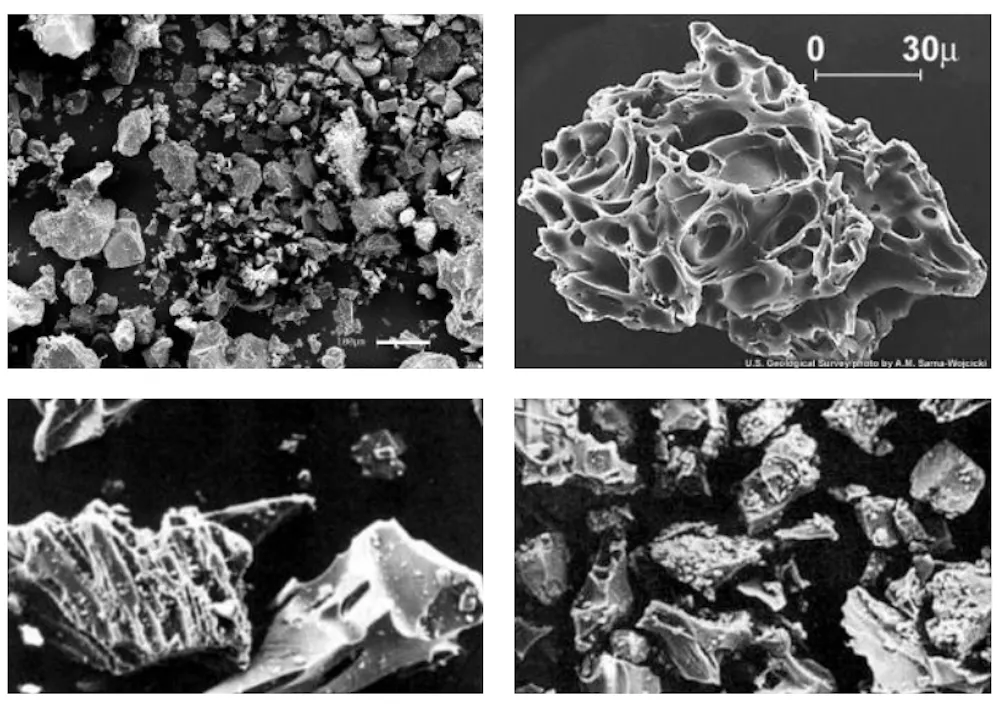
    Electron microscope images of ash show how sharp the shards are. The top left image of shards from Mount Etna in 2002 is 1 mm across. Top right is an ash particle from Mount St. Helens magnified 200 times. The shards in the lower images are less than 0.064 mm.
    Volcano Hazards Program, U.S. Geological Survey

    Ash can also contaminate surface water by introducing toxins and increasing the water’s acidity. The toxins can leach into groundwater, contaminating wells. Fine ash particles can also settle in waterways and smother aquatic plants and animals. During the 2008 Chaitén eruption in Chile, ash contamination led to widespread fish deaths in the Río Blanco.

    Ash can ground airplanes, gum up infrastructure

    Ash clouds are extremely dangerous to aircraft. The glassy ash particles melt when sucked into jet turbines, clog fuel systems and can stall engines in midair.

    In 1982, British Airways Flight 9 lost power in all four engines after flying through an ash cloud. A similar incident occurred in 1989 to KLM Flight 867 over Alaska. In 2010, Iceland’s Eyjafjallajökull eruption grounded more than 100,000 flights across Europe, disrupting travel for over 10 million passengers and costing the global economy billions of dollars.

    Volcanic ash can also wreak havoc on infrastructure by clogging water supplies, short-circuiting electrical systems and collapsing roofs under its weight. It can disrupt transportation, communication, rescue and power networks, as the 1991 eruption of Mount Pinatubo in the Philippines dramatically demonstrated.

    What to do during ashfall

    During an ashfall event, the most effective strategy to stay safe is to stay indoors as much as possible and avoid inhaling ash particles.

    Anyone who must go outside should wear a properly fitted N95 or P2 mask. Cloth masks provide little protection against fine ash. Rainwater tanks, troughs and open wells should be covered and monitored for contamination. Livestock should be moved to clean pastures or given uncontaminated fodder.

    The challenges Alaska is facing if Mount Spurr erupts.

    To reduce structural damage, ash should be cleared from roofs and gutters promptly, especially before rainfall.

    Older adults, children and people who are sick are at greatest risk, particularly those living in poorly ventilated homes. Rural communities that are dependent on agriculture and livestock are disproportionately affected by ashfall, as are low-income people who lack access to clean water, protective masks or safe shelter.

    Communities can stay informed about ash risks through official alerts, including those from the Volcanic Ash Advisory Centers, which monitor ash dispersion and issue timely warnings. The International Volcanic Health Hazard Network also offers guidelines on personal protection, emergency planning and ash cleanup.

    The long tail of ash

    Volcanic ash may fall quietly, but its effects are widespread, persistent and potentially deadly. It poses a chronic threat to health, agriculture, infrastructure and aquatic systems.

    Recognizing the risk is a crucial first step to protecting lives. Effective planning and public awareness can further help reduce the damage.

    David Kitchen does not work for, consult, own shares in or receive funding from any company or organization that would benefit from this article, and has disclosed no relevant affiliations beyond their academic appointment.

    ref. Volcanic ash is a silent killer, more so than lava: What Alaska needs to know with Mount Spurr likely to erupt – https://theconversation.com/volcanic-ash-is-a-silent-killer-more-so-than-lava-what-alaska-needs-to-know-with-mount-spurr-likely-to-erupt-254461

    MIL OSI – Global Reports

  • MIL-OSI Europe: Albanian authorities make social media work for youth crime prevention at OSCE workshop

    Source: Organization for Security and Co-operation in Europe – OSCE

    Headline: Albanian authorities make social media work for youth crime prevention at OSCE workshop

    Participants in an OSCE workshop on leveraging social media for youth crime prevention in Tirana, 14 April 2025. (OSCE) Photo details

    Representatives from Albanian authorities joined child-protection specialists and young people in Tirana on 14–15 April to explore how social media can be used to prevent youth involvement in crime. The workshop was organized by the OSCE Transnational Threats Department and the Office of the Co-ordinator of OSCE Economic and Environmental Activities, in co-operation with the OSCE Presence in Albania.
    “Social media can be a powerful tool for prevention,” said Klaudia Hasanllari, Director of the Juvenile Crime Prevention Center under Albania’s Ministry of Justice. “It helps de-glamorize criminal lifestyles, highlight positive alternatives, and amplify the voices of people who’ve left that life behind, as well as youth thought leaders.”
    The workshop brought together 40 participants, including professionals from the justice, law enforcement, health, social services, child protection, anti-corruption and education sectors, alongside young people themselves. They discussed current trends in youth crime, such as how criminal groups use social media for recruitment, and examined ways to turn these platforms into tools for awareness, prevention and resilience-building.
    The event also aimed to lay the groundwork for a targeted social media awareness campaign on youth crime prevention in Albania. Participants explored how to shape compelling messages, identify the right audiences, and choose the most effective online platforms. A strong emphasis was placed on involving young people in promoting a culture of integrity online.
    The workshop is part of the multi-year OSCE extrabudgetary project “Enhancing youth crime and drug use prevention through education on legality and awareness campaigns addressing threats of organized crime and corruption” funded by Italy. Other donors supporting this project are Andorra, Finland, Germany, Norway and Poland.

    MIL OSI Europe News

  • MIL-OSI: OTC Markets Group Welcomes Blue Moon Metals Inc. to OTCQX

    Source: GlobeNewswire (MIL-OSI)

    NEW YORK, April 15, 2025 (GLOBE NEWSWIRE) — OTC Markets Group Inc. (OTCQX: OTCM), operator of regulated markets for trading 12,000 U.S. and international securities, today announced Blue Moon Metals Inc. (TSX-V: MOON; OTCQX: BMOOF), a company advancing three brownfield polymetallic projects, has qualified to trade on the OTCQX® Best Market. Blue Moon Metals Inc. upgraded to OTCQX from the OTCQB® Venture Market.

    Blue Moon Metals Inc. begins trading today on OTCQX under the symbol “BMOOF.” U.S. investors can find current financial disclosure and Real-Time Level 2 quotes for the company on www.otcmarkets.com.

    The OTCQX Market is designed for established, investor-focused U.S. and international companies. To qualify for OTCQX, companies must meet high financial standards, follow best practice corporate governance, and demonstrate compliance with applicable securities laws. Graduating to the OTCQX Market from the OTCQB Market marks an important milestone for companies, enabling them to demonstrate their qualifications and build visibility among U.S. investors.

    “We are pleased to be upgraded to the OTCQX Best Market from the OTCQB Venture Market,” said Christian Kargl-Simard, CEO of Blue Moon Metals Inc. “With our zinc-gold-silver-copper Blue Moon Mine in the United States ready for underground exploration and development, we have many US Investors ready to invest in the Company. Our Blue Moon Mine should be producing metals critical to the global economy and national security by the end of this decade, and the OTCQX Market will facilitate that path.”

    About Blue Moon Metals Inc.
    Blue Moon is advancing three brownfield polymetallic projects, including the Nussir copper-gold-silver project in Norway, the NSG copper-zinc-gold-silver project in Norway and the Blue Moon zinc-gold-silver-copper project in the United States. All three projects are well located with existing local infrastructure including roads, power and historical infrastructure. Zinc and copper are currently on the USGS and EU list of metals critical to the global economy and national security.

    About OTC Markets Group Inc.

    OTC Markets Group Inc. (OTCQX: OTCM) operates regulated markets for trading 12,000 U.S. and international securities. Our data-driven disclosure standards form the foundation of our three public markets: OTCQX® Best Market, OTCQB® Venture Market, and Pink® Open Market.

    Our OTC Link® Alternative Trading Systems (ATSs) provide critical market infrastructure that broker-dealers rely on to facilitate trading. Our innovative model offers companies more efficient access to the U.S. financial markets.

    OTC Link ATS, OTC Link ECN, OTC Link NQB, and MOON ATSTM are each an SEC regulated ATS, operated by OTC Link LLC, a FINRA and SEC registered broker-dealer, member SIPC.

    To learn more about how we create better informed and more efficient markets, visit www.otcmarkets.com.

    Subscribe to the OTC Markets RSS Feed

    Media Contact:
    OTC Markets Group Inc., +1 (212) 896-4428, media@otcmarkets.com

    The MIL Network

  • MIL-OSI Global: First UK birth after womb transplant is a medical breakthrough – but raises important ethical questions

    Source: The Conversation – UK – By Laura O’Donovan, Lecturer in Law, University of Sheffield

    Costs and who will get access to the treatment are key questions that will need to be answered. Antonio Marca/ Shutterstock

    A baby girl named Amy Isabel has become the first child in the UK to be born to a mother who has had a womb transplant. Amy is one of around 65 children worldwide born as a result of pioneering research into the procedure.

    This breakthrough provides hope for many of the estimated 15,000 UK women with uterine factor infertility – which means they are unable to have children naturally due to problems with their womb, or because they were born without one. Previously, adoption and surrogacy were their only reproductive options. This latest success could some day make womb transplantation another option for these patients.

    However, before this new treatment is offered more widely, complex questions will need to be answered about how it will be resourced, how wombs will be procured and who will get access to the treatment.

    The cost of a transplant

    The first birth by a mother following a womb transplant happened in Sweden in 2014. Since then, the number of womb transplant programmes being established globally has greatly increased.

    The past 12 years have seen significant advances in the field. These include live births following a womb transplant from a deceased donor and the expansion of donor and recipient acceptance criteria. We’ve also seen the introduction of robotic-assisted surgery, which has made it possible to perform donor retrieval surgery in a faster, less invasive and more precise way.

    While most transplant centres only offer the procedure as part of research trials, several now offer it in clinic – including in the UK.

    The UK’s womb-transplant programme is currently funded by charitable donations from Womb Transplant UK, who currently only have plans to fund up to 15 living donor procedures. The procedure is expensive – costing the charity an estimated £25,000-£30,000. And it appears that this amount only covers the cost of the transplant, despite the fact that many other costs need to be factored in – such as IVF treatment, medications and follow-up care.

    At present, prospective recipients normally bear the costs of the IVF treatment needed themselves. To be eligible for the transplant, women must have first produced and stored at least five embryos. IVF is necessary as the transplanted uterus will not be connected to the patient’s ovaries. This means that pregnancy through sexual intercourse is not possible. But before womb transplants can become routinely available within the NHS, commissioners will have to decide whether this treatment should be publicly funded – and under what circumstances.

    On the face of it, public funding seems justified in the interests of patient autonomy and well-being. There are many psychological harms associated with infertility – such as depression, anxiety, stress and diminished quality of life. These harms must be taken seriously.

    However, NHS resources are constrained – and there is already a “postcode lottery” of unequal access to IVF, with people in certain areas of England being less able to access NHS treatment. So there’s a risk that similar inequalities will arise for womb transplants if the procedure is NHS-funded.

    Who gets priority?

    If womb transplants are ever to become a routine procedure in the UK, difficult decisions will also need to be made about organ allocation policies.

    According to the law in England, adults are considered to have agreed to become organ donors when they die unless they have opted out or are in an excluded group (such as those lacking mental capacity). However, this “deemed consent” only applies to commonly transplanted organs and tissues such as skin, hearts and lungs. It doesn’t apply to novel or rare transplants, which would include wombs. The NHS organ donor register also excludes the womb. Family members would therefore need to give explicit consent to the donation of their relative’s womb after death.

    Living organ donors in the UK are able to specify a named recipient (such as a family member). Deceased donors can also request for directed allocation to a specific person. But this is only permitted so long as the offer to donate is unconditional and certain criteria are met, such as the recipient being able to receive the organ and being in need of a transplant.

    More generally, since organs and tissues are scarce resources, complex policies are currently used to ensure fair and transparent allocation. Clinical need also guides allocation so that the sickest patients are prioritised for a transplant.

    However, the same logic cannot apply to womb transplants. This is because absolute uterine factor infertility does not come in degrees. All women with the condition have a 0% chance of becoming pregnant.

    As such, considerations that normally play no role in allocating life-saving organs could be explored in the context of womb transplantation. For instance, priority might be given to those who are childless. Age may also be relevant, especially given that the fertility treatment needed to create embryos is only funded by the NHS if a woman is below a certain age. The age limit varies by region, but can be as low as 35 in some places.

    Policy decisions will also be needed about whether wombs are included in donor registers to increase their supply. Even if they are, people may prove less willing to donate reproductive organs than lifesaving organs and tissues. These decisions could also have knock-on effects on public trust in transplantation and organ-donation willingness more widely. And the inclusion of novel and rare organs could lead to more blanket opt-outs from organ donation altogether.

    Next steps

    Given the relative novelty and experimental nature of the procedure, there has not yet been a comprehensive roll-out of womb transplants as a mainstream fertility treatment anywhere in the world. In the UK, we’re not even at the beginning of that journey. Before that happens, womb transplants would need to be demonstrably cost-effective relative to other NHS-funded fertility treatments.

    Nevertheless, there’s an opportunity here for the UK to become a world leader in creating and applying equitable access policies for womb transplants. To do this well, it will be necessary to carefully consider the clinical and health economic data, the ethical and legal issues, and the views of all those affected – especially those with uterine factor infertility.

    Laura O’Donovan has previously collaborated with members of the Womb Transplant UK research team.

    Nicola J. Williams currently receives funding from The Wellcome Trust (grant number: 222858_Z_21_Z) and previously held a Leverhulme ECR fellowship (grant number: ECF-2018-113). She is currently chair of the Special Interest Group: Ethics and Law for the European Society for Human Reproduction and Embryology and has previously collaborated with members of Womb Transplant UK.

    Stephen Wilkinson currently receives funding from Wellcome (grant number: 222858_Z_21_Z). He has previously collaborated with members of Womb Transplant UK. He is a member of the Nuffield Council on Bioethics (NCoB) but this article is a personal view and unrelated to his NCoB role.

    ref. First UK birth after womb transplant is a medical breakthrough – but raises important ethical questions – https://theconversation.com/first-uk-birth-after-womb-transplant-is-a-medical-breakthrough-but-raises-important-ethical-questions-254154

    MIL OSI – Global Reports

  • MIL-OSI United Nations: WFP welcomes a contribution from Finland to boost school meals programme in Zambia

    Source: World Food Programme

    LUSAKA – The United Nations World Food Programme (WFP) welcomes a contribution of EUR 500,000 from the Government of Finland to strengthen Zambia’s national school meals programme. The one-year initiative will enhance the nutrition of over 34,000 learners in thirty-three schools across Zambia while promoting climate-resilient agriculture and sustainable food systems.

    Finland, as the co-chair of the School Meals Coalition, is a strong and longstanding supporter of school meals globally. For years, Finland has provided continuous support to several WFP school meals operations and remains committed to strengthening these efforts. 

    With Finland’s support, and in collaboration with the Ministries of Education and Agriculture, WFP will procure ninety-eight metric tonnes of beans to complement cereals provided for school meals by the Zambian government. The initiative will directly link the demand for nutritious food in schools with supply from local smallholder farmers, creating a stable market for their produce. In addition, irrigated school gardens will be established to further improve the diversity and quality of school meals.

    “Finland and Zambia share longstanding warm relations,” said Saana Halinen, Ambassador of Finland to Zambia. “School meals are an investment in the future of Zambia, and I am incredibly happy that Finnish support is complimenting the government’s efforts in expanding the school meals programme. Allocating resources to child nutrition is the single and most important investment any country can make.”

    To further boost sustainability and resilience, schools will receive energy efficient stoves and handwashing stations, while teachers, learners, and surrounding communities will benefit from training in sustainable agriculture, nutrition, and hygiene practices.

    “This support from Finland comes at a critical time for Zambia as we address the aftermath of last year’s drought, working closely with the Ministry of Education and the Ministry of Agriculture” said Cissy Kabasuuga, WFP Country Representative in Zambia. “The funding will not only meet the immediate nutritional needs of thousands of learners but also help build a stronger, more resilient food system for the future.” 

    WFP, in partnership with the Government of Zambia launched a comprehensive five-year strategic plan in 2023 which seeks to eliminate hunger, improve nutrition, and strengthen the resilience of vulnerable communities to food shocks. The plan allows for national institutions to take the lead, reducing the need for humanitarian interventions. 

    Finland, as the co-chair of the School Meals Coalition, is a strong and longstanding supporter of school meals globally. For years, Finland has provided continuous support to several WFP school meals operations and remains committed to strengthening these efforts. 

    About WFP

    The United Nations World Food Programme is the world’s largest humanitarian organization, saving lives in emergencies, building prosperity and supporting a sustainable future for people recovering from conflict, disasters and the impact of climate change.

    Follow us on X @wfp_media @WFP_Zambia, @wfp_southernafrica.

    MIL OSI United Nations News

  • MIL-OSI Europe: Written question – Blue Card scheme in the EU – E-001405/2025

    Source: European Parliament

    Question for written answer  E-001405/2025
    to the Commission
    Rule 144
    Ewa Zajączkowska-Hernik (ESN)

    The revision of Directive (EU) 2021/1883 on the conditions of entry to and residence in the European Union of non-EU nationals for the purpose of highly qualified employment (‘the Blue Card Directive’) has raised concerns among citizens about the origins of the changes introduced and the scope of Member States’ powers under the scheme.

    In light of the above:

    • 1.What is at the root of the exclusion of Ireland and Denmark from the Blue Card scheme?
    • 2.What scope for decision-making do Member States enjoy under the Blue Card scheme?
    • 3.What persons are covered by family reunification opportunities under the Blue Card scheme?

    Submitted: 7.4.2025

    Last updated: 15 April 2025

    MIL OSI Europe News

  • MIL-Evening Report: Trump’s tariffs rollercoaster is really about Republican unity

    Source: The Conversation (Au and NZ) – By Lester Munson, Non-Resident Fellow, United States Studies Centre, University of Sydney

    After announcing Liberation Day – stiff “retaliatory” tariffs on every country and penguin-inhabited island in the world – US President Donald Trump rescinded the vast majority of tariffs eight days later when stock and bond markets crashed.

    He followed that with more exemptions for phones, computers and computer chips two days later. Ten percent tariffs remain across the board, along with rates up to 145% on China.

    Is Trump aligned with previous Reagan on tariffs?

    As with anything related to Trump, perceptions overwhelm reality. Trump’s showmanship – call him a carnival barker if you must – obfuscates what is really happening.

    Trump is seen as a protectionist and a populist. By comparison, former president Ronald Reagan was seen as a principled free trader and more ideologically conservative. Both images are misleading.

    Reagan slapped tariffs on cars, steel, lumber, computers, computer chips, motorcycles, machine tools, even clothes pins. The great guru of free markets, Milton Friedman, is reported to have said that the Reagan administration has been “making Smoot-Hawley look positively benign.” (Smoot-Hawley was an infamous tariff law enacted in 1930 at the beginning of the Great Depression.)

    Reagan went back and forth on tariffs, even attacking them in a radio address when Japan tried to impose them. At the end of the day, his record on the issue was as mixed as that of any American president.

    Trump’s politics, if not his showmanship, look a lot more like traditional Republican approaches in the cold light of day. The showmanship – provocative statements, grand exaggerations, outright falsehoods and even stand-up-comic-like aspects – is purposeful.

    Keeping Republicans united

    The main goal of Trump’s tariff showmanship, largely unreported in the press, is keeping congressional Republicans unified as he pushes his domestic policy agenda of lower taxes, budget cuts, expanded energy production and tougher immigration policies.

    Congressional Republicans have been working for months on legislating this agenda through the complex budget reconciliation process. This legislative process is difficult and involves passing budget resolutions through the Senate and the House on a specific schedule. This process is required because it allows for a path around the 60-vote filibuster in the Senate. With only 53 Republican senators and a Democratic Party that is committed to resisting Trump on almost every policy choice, Trump needs the reconciliation process to work this year.

    In one sense, all of Trump’s activities since his inauguration – the “waste”-cutting DOGE, spending cuts, ending foreign aid programs, laying off federal workers – have given him the political space with congressional Republicans, particularly fiscal conservatives, to advance his legislative agenda. It is important to know that Congressional Republicans have been ungovernable for quite some time.

    Over the past ten years, there have been five Republican Speakers of the House – John Boehner, Paul Ryan, Kevin McCarthy, Patrick McHenry (acting) and now Mike Johnson. This unprecedented turnover is caused by a virtually unmanageable Republican coalition of mainstream business-oriented conservatives and the fiscal hawks who generally populate the Freedom Caucus. The Freedom Caucus is more than willing to vote against other Republicans – indeed they are proud of it. Because of this, speaker after speaker has had to reach out to Democrats for votes to pass legislation, ultimately dooming their time in the position.

    Trump has managed to keep this ungovernable group of House Republicans united, and this may be his true political gift.

    To achieve this, he has engaged in a comprehensive campaign of maximum pressure on just about everything: Canada, Greenland, NATO, Europe, China, Ukraine, American universities, federal workers, illegal immigrants, big law firms and even paper straws.

    Congressional Republicans, in appreciation of this shock and awe campaign, have stayed united. This means Trump’s legislative agenda can move forward.

    With his global tariff plan, Trump saw Republicans beginning to defect. In one Senate vote in April, four Republicans sided with Democrats against tariffs on Canada. Senator Ted Cruz warned that Republicans might lose the 2026 election because of tariffs. Chuck Grassley of Iowa, the oldest senator and one of the most conservative, indicated he would support bringing tariff authority back to Congress and away from the president.

    Trump can read a room as well as anyone. When he saw Republican unity was at risk because of his tariff plan, he quickly pivoted to a much more moderate version. While Trump’s grandiosity is often highly criticised, it is that quality that gives him the ability to keep his party together, and therefore to govern.

    Sparking panic among Democrats

    The other major effect of Trump’s tariffs strategy is to sow discord among his opponents.

    Democrats, who want to criticise Trump but know their own party has often endorsed tariffs in the past, are reeling. Democratic Michigan Governor Gretchen Whitmer said she understood Trump’s “motivation behind the tariffs” and even agreed with Trump that we “need to make more stuff in America”. She was immediately criticised by fellow Democrats.

    Hakeem Jeffries, the top Democrat in the House of Representatives, tried a slightly more aggressive anti-Trump approach. He said:

    Tariffs, when properly utilized, have a role to play in trying to make sure that you have a competitive environment for our workers and our businesses. That’s not what’s going on right now. This is a reckless economic sledgehammer that Donald Trump and compliant Republicans in the Congress are taking to the economy, and the American people are being hurt enough.

    This response won’t help Democrats climb out of their deep hole of unpopularity, measured last month at an historic low.

    Lester Munson receives funding from the U.S. Studies Centre at the University of Sydney.

    ref. Trump’s tariffs rollercoaster is really about Republican unity – https://theconversation.com/trumps-tariffs-rollercoaster-is-really-about-republican-unity-254471

    MIL OSI AnalysisEveningReport.nz

  • MIL-OSI United Kingdom: UK announces new humanitarian funding for Sudan

    Source: United Kingdom – Executive Government & Departments

    Press release

    UK announces new humanitarian funding for Sudan

    The UK has announced new support to Sudan ahead of the Sudan conference which will bring together international representatives.

    • The UK will commit further life-saving aid for over 650,000 people affected by the ongoing violence as Sudan faces the worst humanitarian crisis on record.
    • A one-day conference will unite foreign ministers and leading humanitarian leaders at a conference in London to mark the two-year anniversary of the brutal conflict in Sudan.   
    • International representatives will discuss how to achieve a peaceful end to the conflict and address the issues preventing aid reaching those most in need. 

    Today [15th April] the UK will co-host a conference in London alongside the African Union, EU, France and Germany to mark the two-year anniversary of the conflict in Sudan with attendees including major donors and multilateral institutions.   

    Bringing together foreign ministers from across the globe, the Foreign Secretary will step up international efforts to protect civilians and work towards an end to the conflict.   

    During a one-day conference, he will announce new life-saving aid to support over 650,000 Sudanese people. Alongside international counterparts, he will also identify steps to improve humanitarian access and find a long-term political solution.   

    Sudan is facing the worst humanitarian crisis on record, with over 30 million people in desperate need of aid, over 12 million people are displaced, and famine is spreading throughout Sudan. Over 12 million women and girls are also at risk of gender-based violence.

    The new £120 million funding announced today will deliver lifesaving food and nutrition supplies, including for vulnerable children and will provide emergency support to survivors of sexual violence. 

    The Foreign Secretary, David Lammy said:   

    Two years is far too long – the brutal war in Sudan has devastated the lives of millions – and yet much of the world continues to look away.  We need to act now to stop the crisis from becoming an all-out catastrophe, ensuring aid gets to those who need it the most.

    As I saw earlier this year on a visit to Chad’s border with Sudan, the warring parties have shown an appalling disregard for the civilian population of Sudan. This conference will bring together the international community to agree a pathway to end the suffering. 

    Instability must not spread – it drives migration from Sudan and the wider region, and a safe and stable Sudan is vital for our national security. The UK will not let Sudan be forgotten.

    African Union Commissioner for Political Affairs, Peace and Security, H.E. Ambassador Bankole Adeoye said:

    Achieving peace in Sudan depends on valuing every voice and everyone playing a role in building a prosperous Sudan. The African Union is committed to assisting all the people of Sudan build a brighter democratic future by working to silence the guns.

    The ongoing conflict and instability risks spilling over into the wider region, driving Sudanese people away from their homes, with some taking dangerous onward journeys to the UK and Europe. Instability in Sudan also directly impacts the UK’s national security. 

    The UK wants to help tackle instability in Sudan and reduce the level of irregular migration from the region to Europe and the UK as part of its Plan for Change.  

    In January 2025, the Foreign Secretary visited the Chad-Sudan border at Adré to see first-hand the impact of the conflict on refugees.    

    Background

    • Countries and organisations attending the Sudan conference include the United Kingdom, the African Union (AU), the European Union (EU), France, Germany, Canada, Chad, Egypt, Ethiopia, Kenya, Kingdom of Saudi Arabia, Norway, Qatar, South Sudan, Switzerland, Türkiye, United Arab Emirates, Uganda, United States of America, alongside high-level Representatives of the Intergovernmental Authority on Development (IGAD), the League of Arab States (LAS) and the United Nations (UN).
    • On 17 November, the Foreign Secretary announced a £113 million aid package, which will support over a million people affected by violence in Sudan.  
    • The new £120 million funding announced today is for the 2025/2026 financial year and will deliver food including pulses, oils, salts and cereals.   
    • The UK welcomes the 13 February decision to keep the critical Chad-Sudan Adré border crossing open for three more months. But the Sudanese Armed Forces must keep it open permanently, and without restrictions.     
    • The parties to the conflict continue to obstruct the work of humanitarian agencies, through delaying visas for aid workers and limiting their movements throughout Sudan.

    • Funding announced today aims to reach over 600,000 people including:
    • 670,000 people reached with food assistance for three months.
    • 205,000 people reached through a cash-based response.
    • 600,000 people reached through nutrition and water and sanitation.

    Media enquiries

    Email newsdesk@fcdo.gov.uk

    Telephone 020 7008 3100

    Contact the FCDO Communication Team via email (monitored 24 hours a day) in the first instance, and we will respond as soon as possible.

    Updates to this page

    Published 15 April 2025

    MIL OSI United Kingdom

  • MIL-OSI Global: Canada is lagging in innovation, and that’s a problem for funding the programs we care about

    Source: The Conversation – Canada – By Andrew Maxwell, Bergeron Chair in Technology Entrepreneurship, Lassonde School of Engineering, York University, Canada

    As Canadians prepare to vote in another federal election, the country’s economy faces a sobering reality. As the Organization for Economic Co-operation and Development (OECD) notes, productivity is stagnating, our innovation performance lags global peers and high-potential startups often fail to scale.

    Despite these warning signs, innovation policy remains largely absent from political discourse. Canadians hear a great deal about how political parties are going to spend money, but little about where the money is going to come from.

    This is a critical oversight. Canada’s enduring productivity gap is more than an economic statistic — it’s why the country is struggling to sustain the social programs, such as health care and education, that Canadians value.

    If Canadians want to maintain their standard of living, Canada must close that gap through a more deliberate, strategic approach to innovation.

    Innovation is economic strategy

    In today’s knowledge-based economy, as business executive and innovator Jim Balsillie observes, power flows to countries that own digital data and their “value-added applications” (like apps or platforms) and intellectual property.

    Countries like the United States, China and South Korea have embedded innovation into national strategy, investing in sectors like artificial intelligence (AI), clean technology and biotech to drive growth and resilience. Canada, by contrast, has taken a fragmented, reactive approach.

    Canada’s over-reliance on research and development (R&D) spending and patent counts has failed to translate into commercial success. According to the OECD, Canada ranks among the highest in public R&D investment but among the lowest in innovation outcomes such as productivity growth and technology adoption.

    Canada also often conflates research with innovation. While both are vital, innovation is about turning knowledge into use through deployment, adoption, commercialization and scaling. Much of today’s transformative innovation, particularly in AI and software, depends on the transfer of tacit knowledge (related to things like user insights, execution experience and expertise in a particular domain) not just codified knowledge (for example, patents, technical drawings and licenses).

    Why innovation policy fails

    Governments struggle with innovation because it defies conventional policymaking:

    • It requires failure tolerance. Innovation is iterative. But political systems fear failure.

    • It demands long-term vision. Results may take years, beyond typical electoral cycles.

    • It’s technically complex. Few policymakers have deep expertise in emerging technologies or understand the research and development process.

    • It’s often misunderstood. Funding research is not the same as building innovation capacity or developing innovation processes.

    • It’s hard to quantify. Quantifying innovation outcomes is complex and challenging to measure, making it also difficult to measure return.

    As economist and innovation policy expert Mariana Mazzucato argued in The Entrepreneurial State: Debunking Public vs. Private Sector Myths, innovation success depends on bold missions, cross-sector collaboration and a willingness to learn from failure. Canada’s current model lacks these ingredients.

    Breaking the cycle of failure

    To break this cycle, Canada needs a non-partisan national innovation institution — an agency empowered to advise on strategy, evaluate outcomes and embed technical expertise into policy at the federal, provincial and municipal levels.

    Models like DARPA from the U.S., Vinnova from Sweden and the Israel Innovation Authority show how long-term, high-impact innovation can be achieved with the right institutional scaffolding and appropriate knowledge.

    Video about Vinnova, Sweden’s national innovation agency.

    Canadians have created a number of innovation organizations with national implications, such as the Council of Canadian Academies, the CD Howe Institute, Canada Foundation for Innovation and the Institute for Competitiveness and Prosperity (ICP), which closed in 2019.

    Yet none have been national organizations that addressed the broad proposed mandate to explicitly advise governments on technology and policy strategy, evaluate innovation outcomes and embed technical expertise into recommendations.

    A non-partisan national innovation institution must:

    1. Track outcomes more than inputs. Innovation success can be measured by a number of project- or industry-specific outcomes, such as productivity, firm growth and export revenue. The ICP proposed measuring the “prosperity gap,” comparing innovation performance to peer jurisdictions.

    2. Support long-term strategic objectives, focusing on Canada’s strengths in critical areas like AI, clean technology, energy health-care technology, and leveraging expertise and experience in these and other areas.

    3. Embed technology experts alongside health-care and education experts in the decision-making process. Recruit scientists, engineers and entrepreneurs to anticipate technology and market trends, guiding both implementation and policy development.

    4. Differentiate innovation from research. Support both, but recognize the differences and explicitly link innovation to adoption and new use cases.

    5. Promote value capture. Ensure Canadian firms and the country benefit from and retain control of key technologies that enable them to scale domestically.

    6. Recognize the inherent risks in innovation and the potential for failure. Evaluate and build on impact and learn from failure to enhance innovation processes and improve future outcomes.

    7. Align our educational institutions with innovation goals revising programs, creating more flexible learning options and enhancing entrepreneurship so that more research outcomes are commercialized.

    These steps aren’t hypothetical. They’re backed by evidence from countries that have succeeded in turning innovation into sustained economic performance.

    Why now?

    Canada’s economy is heavily dependent on resource exports and vulnerable to technological disruption. Meanwhile, the global AI and clean tech races are accelerating. Canada is at risk of falling further behind — not just economically, but geopolitically.

    But Canada also has strengths: world-class researchers, diverse entrepreneurial talent and global partnerships. What’s missing is a cohesive national strategy to harness this potential. Creating a non-partisan innovation institution would be a powerful first step.

    If Canadians want to provide revenue for governments decide how to fund education, health care and climate adaptation, they must grow their economy. And to do that, Canada needs smarter innovation policy.

    It’s time to stop celebrating activity and start rewarding outcomes. Let’s build the structures that allow Canadian ingenuity to thrive — not in theory, but in practice.

    Andrew Maxwell works for York University, but received no direct benefit from comments in this article. He receives funding from various research agencies for his work in the area, but none of which creates the potential for conflict. He is a member of the Academy of Management, the International Society for Professional Innovation Management and Professional Engineers Ontario..

    ref. Canada is lagging in innovation, and that’s a problem for funding the programs we care about – https://theconversation.com/canada-is-lagging-in-innovation-and-thats-a-problem-for-funding-the-programs-we-care-about-254423

    MIL OSI – Global Reports

  • MIL-Evening Report: Why is it so hard for everyone to have a house in Australia?

    Source: The Conversation (Au and NZ) – By Ehsan Noroozinejad, Senior Researcher, Urban Transformations Research Centre, Western Sydney University

    Bilalnol/Shutterstock

    Home ownership in Australia was once regarded as proof of success in life. However, it remains elusive for many people today.

    Prices have soared beyond wage growth, rents keep rising, and even some well-intentioned government initiatives, including those announced by Labor and the Coalition at their election campaign launches on the weekend, risk driving up demand.

    What’s gone wrong?

    The Grattan Institute says increasing housing supply is essential to maintain price stability over time, but notes we are not making enough progress.

    Australia will miss its goal to build 1.2 million new homes within five years if we stick to the current housing policies and construction practices.

    Why it’s not working

    There is a wide range of reasons why Australia is failing to provide enough housing:

    Fragmented policy approach: A national approach involving all levels of government aligning their policies, rules and regulations is needed.

    Planning bottlenecks: Some projects face years of delay due to local council regulations and zoning requirements. The Productivity Commission has reported Australia’s planning system has excessive barriers to new projects, including medium-density developments.

    Land release delays: State governments are slow to release new land for housing. This is often because of community opposition, political considerations and market dynamics. This results in limited availability, which leads to higher costs for land that can be developed.

    Skills shortages: Recent immigration restrictions have worsened the shortage of skilled tradespeople in the residential construction sector.

    Demand-side subsidies: Government programs, such as first home buyer grants, help some people buy homes. However, they also make housing less affordable because they can result in increased prices.

    What could work without raising prices

    There are various changes that could be made without necessarily raising prices.

    Duplication and logjams could be removed if a national housing strategy was introduced. This should integrate policies and regulations across federal, state and local jurisdictions.

    Federal grants and incentives should be tied to states meeting targets for land release, re-zoning permits and streamlined approvals.

    Using innovative construction technologies can cut construction time by as much as 50%. These include prefabricated and modular building parts, which are made in factories and later assembled at the construction site.

    A government update of land use and zoning permits would make it easier and faster to build medium-density housing near transport and job hubs. This is a quick way to add dwellings without sprawl.

    Governments could also offer tax or planning concessions for developments that lock in affordable rents. This would help create stable, long-term rental options.

    Learning from other countries

    Australia can get ideas for increasing housing supply without raising prices from the experience of other countries.

    Through substantial investments in social housing, Finland has significantly reduced homelessness and created stable housing options for families with limited income.

    Large-scale prefab public housing originated in Singapore decades ago as a method to accelerate construction timelines and reduce expenses. Prefabrication is only used in 8% of projects in Australia at the moment.

    Prefabrication is widely used in building sectors in other countries as a cheaper and faster way of responding to housing shortages.
    brizmaker/Shutterstock

    Sweden has adopted advanced modular construction techniques, which result in 80% of homes being built off-site.

    Germany employs municipal-led housing associations along with rent controls to maintain price stability and tenant protection.

    And in the UK, inclusionary zoning regulations mandate that new developments either contain affordable housing units or contribute to a fund that supports affordable housing in different locations. This helps create diverse housing options in most neighborhoods.

    Election promises versus real change

    Significant reforms are needed – not election sweeteners. To make genuine progress, we need to invest heavily in modern construction techniques, transform housing approval processes and ensure states promptly release essential land.

    The solution requires a coordinated response from federal, state and local governments. This would enable more Australians to obtain homeownership and secure rental options.

    Our politicians must avoid short-term promises during elections because these threaten to return us to the destructive pattern of escalating prices and dissatisfied homebuyers. Long-term policy reform is what we need.

    Dr. Ehsan Noroozinejad has received funding from both national and international organisations to support research addressing housing and climate crises. His most recent funding on integrated housing and climate policy comes from the James Martin Institute for Public Policy (soon to be the Australian Public Policy Institute).

    ref. Why is it so hard for everyone to have a house in Australia? – https://theconversation.com/why-is-it-so-hard-for-everyone-to-have-a-house-in-australia-254464

    MIL OSI AnalysisEveningReport.nz

  • MIL-OSI United Kingdom: UK sends multi-million pound military equipment loan to Ukraine

    Source: United Kingdom – Executive Government & Departments

    Press release

    UK sends multi-million pound military equipment loan to Ukraine

    The UK makes second £752 million payment to Ukraine through the Extraordinary Revenue Acceleration Loans for Ukraine scheme.

    A £752 million payment has today (14 April) been sent to Ukraine through the Extraordinary Revenue Acceleration Loans for Ukraine scheme. The funding will support Ukraine to procure vital military equipment, including urgently needed air defence. This comes as Russia continues its air assault on Ukraine, striking the city of Sumy.

    The loan, which will be paid for through the profits of sanctioned Russian sovereign assets in the EU, forms part of a wider £2.26 billion loan agreed between the Chancellor and Minister Marchenko on 1 March.

    The payment highlights the UK’s steadfast support to Ukraine whilst building on the Chancellor’s Spring Statement pledge to go further and faster to protect our national security and maximise the economic growth potential of the UK defence sector. The equipment support and maintenance elements will be mainly spent in the UK, boosting the UK economy and skilled jobs.

    Rachel Reeves, Chancellor of the Exchequer said:

    The world is changing before our eyes, reshaped by global instability, including Russian aggression in Ukraine. 

    A strong Ukraine is vital to UK national security and this second tranche of funding will help put them in the strongest possible position, and contribute towards our collective security.

    Defence Secretary, John Healey MP said:

    2025 is the critical year for Ukraine and this is the critical moment. This is the moment for our defence industries to step up, and they are; a moment for our militaries to step up, and they are; a moment for our Governments to step up, and we are.

    This new tranche of funds is part of our £4.5 billion of military support this year – more than ever before – and will be used to buy urgently needed air defence, artillery, and parts to help repair vehicles and equipment to get them back into the fight.

    We are stepping up support for Ukraine to deter Russian aggression and bolster Britain’s national security as the foundation of our Plan for Change.

    Today’s payment forms the second part of the UK’s £2.26 billion loan, which has been spaced into three separate tranches to give Ukraine more flexibility and allow them to swiftly adapt to the ever-changing battlefield. The first payment was made on 6 March, with the final payment to follow in 2026.

    The multi-billion payment forms part of the UK’s contribution to the Extraordinary Revenue Acceleration Loans for Ukraine scheme, which is a G7 commitment to collectively support Ukraine through a total of $50 billion.

    It follows a £450 million surge in military support that was announced by the UK last week, which includes £350 million from this year’s record £4.5 billion military support funding for Ukraine. Further funding is being provided by Norway, via the UK-led International Fund for Ukraine.

    In addition to providing financial support, the Ministry of Defence will also support Ukraine to procure the equipment needed to fight Russia’s invasion. This will include a new ‘close fight’ military aid package – with funding for radar systems, anti-tank mines and hundreds of thousands of drones – worth more than £250 million, using funding from the UK and Norway.

    The government’s Plan for Change will see UK defence spending increased to 2.5% of GDP by 2027. The UK’s world-leading defence sector is vital to the economy, supporting 430,000 high-skilled, high-paid jobs across the UK and strengthening our security. 68% of defence spending is outside of London and the South East, benefitting every nation and region of the UK.

    Updates to this page

    Published 14 April 2025

    MIL OSI United Kingdom

  • MIL-OSI United Nations: 14 April 2025 Departmental update New study highlights multiple long-term health complications from female genital mutilation

    Source: World Health Organisation

    Female genital mutilation (FGM) affects almost all dimensions of the health of women and girls, according to a new study published today from the World Health Organization (WHO) together with the United Nations’ Human Reproduction Programme (HRP). Health complications of the practice can be severe and life-long, causing both mental and physical health risks.

    Published in BMC Public Health, the publication analyzes evidence from more than 75 studies in around 30 countries to paint a comprehensive picture of the ways that FGM impacts survivors’ health at different life stages.

    It shows that women with FGM are significantly more likely to experience a wide range of complications during childbirth compared to those without, for instance. They have more than double the risk of enduring prolonged or obstructed labour or haemorrhage, while being significantly more likely to require emergency caesarean sections or forceps delivery.

    In addition, women with FGM have an almost three-times greater risk of depression or anxiety, and a 4.4 times higher likelihood of experiencing post-traumatic stress disorder.

    There is a critical need to ensure timely, high-quality health care for survivors, to engage communities for prevention and ensure families are aware of FGM’s harmful effects, alongside serious political commitment to stop the practice and educate and empower women and girls.

    Dr Pascale Allotey / Director of SRHR at WHO and head of HRP

    “This study paints a devastating picture of the manifold health implications of female genital mutilation, spanning mental and physical health and undermining emotional well-being,” said Dr Pascale Allotey, Director of Sexual and Reproductive Health and Research at WHO and head of HRP. “There is a critical need to ensure timely, high-quality health care for survivors, to engage communities for prevention and ensure families are aware of FGM’s harmful effects, alongside serious political commitment to stop the practice and educate and empower women and girls.”

    FGM is a harmful practice that involves the partial or total removal of the external female genitalia, or other injury to the female genital organs such as cutting or burning. It is an extreme form of gender discrimination and a stark violation of women and girls’ human rights.

    It is estimated that around 230 million women and girls alive today have undergone FGM. While evidence shows the overall proportion of those who experience FGM is declining, absolute numbers could increase given rising youth populations in countries where it is practiced. Abandonment of FGM is challenging, given that it is driven by deep-set cultural beliefs and norms.

    Also of concern, evidence shows more cases of FGM are now performed by health workers – its so-called medicalization – due in part to misperceptions that their involvement makes it safer and reduces risks. In fact, some studies have shown that longer-term damage from “medicalized” FGM may be greater, since it can result in deeper, more severe cuts.

    FGM’s immediate risks can be life-threatening and include severe infections, heavy blood loss, as well as extreme pain and emotional trauma. Longer-term consequences for survivors include, as well as those described above, menstrual difficulties; urological complications, including urinary tract infections and difficulty urinating; and painful sexual intercourse.

    In addition to various obstetric risks for women, the paper highlights that FGM can also have impacts on babies during or following childbirth. Babies born to women who had FGM are more likely to experience birth complications like fetal distress or asphyxia, resulting in lower newborn survival rates.

    Recognizing FGM’s devastating health impacts, WHO supports efforts to strengthen prevention efforts within the health sector, engaging health workers to educate communities and family members, while providing clinical guidance on effective care for survivors.

    Understanding the range of complications FGM can cause – spanning acute risks as well as impacts on obstetric and neonatal, gynaecological, urological, sexual and mental health – is critical for ensuring survivors receive appropriate treatment and support. Drawing on this evidence, WHO will shortly release a new guideline covering both FGM prevention and clinical care for affected women and girls. FGM is currently common in around 30 countries across Africa and Asia.

    About

    The present study, titled Exploring the health complications of female genital mutilation through a systematic review and meta-analysis, updates and expands previous reviews, compiling all available data on health complications from studies with comparison groups of women with and without FGM, and by the different types of FGM. The result of this process is a comprehensive summary of its various health complications.

    The study was supported by the Governments of Norway and the United Kingdom of Great Britain and Northern Ireland alongside HRP (the UNDP/UNFPA/UNICEF/WHO/World Bank Special Programme of Research, Development and Research Training in Human Reproduction). HRP is the main research institution within the United Nations system for sexual and reproductive health.

    MIL OSI United Nations News

  • MIL-OSI Economics: AGNICO EAGLE LAUNCHES NEW PODCAST SERIES – THE ARCTIC EDGE

    Source: Agnico Eagle Mines

    New podcast showcases stories from Canada’s frontier and the unique identity of Nunavut

    April 14, 2025, Toronto, ON – Agnico Eagle Mines Limited (Agnico Eagle) is proud to introduce a special podcast series, The Arctic Edge: Stories from Canada’s Frontier. The trailer is live, and listeners can subscribe now to be notified when the first two episodes drop on May 1, 2025. Hosted by award-winning journalist, Hannah Thibedeau, the podcast focuses on a series of engaging stories and insightful interviews that explore Nunavut’s, and the broader Canadian North’s, social, economic and environmental opportunities and responsibilities, highlighting the importance of sustainable change.

    “As the Arctic region grows in strategic importance, not only for Canadians, but for many of our neighbours, it is vital that we come together as a nation to implement a comprehensive Arctic vision and strategy,” says Sean Boyd, Chair of the Board, Agnico Eagle. “Our goal is that listeners of The Arctic Edge will leave with a deeper appreciation for the North’s rich heritage and its immense potential.”

    “Agnico Eagle is deeply honoured by the opportunity to help share stories from Canada’s North to a broader audience,” says Ammar Al-Joundi, President & Chief Executive Officer, Agnico Eagle. “The stories shared on this podcast are engaging, insightful and moving. I am confident the podcast will spark curiosity and pride across Canada and beyond.”

    Nunavut is a land of immense potential, stunning landscapes and rich cultural heritage. While the future holds great promise, challenges remain that need to be addressed. Through this podcast, Agnico Eagle aims to foster meaningful discussions, and believes it is essential to ensure that Inuit voices are heard and respected.

    Special guests that will be heard throughout the series include:

    • Kono Tattuinee, President of Kivalliq Inuit Association
    • Peter Tapatai, President of Peter’s Expediting Limited
    • Dennis Patterson, Former Senator for Nunavut
    • Mads Qvist Frederiksen, Executive Director, Arctic Economic Council
    • Scott Clancy, Former Director General for the Royal Canadian Air Force
    • Sean Boyd, Chair of the Board, Agnico Eagle

    Listen to the trailer and subscribe to The Arctic Edge so you don’t miss the first two episodes dropping on May 1, 2025, by visiting: https://thearcticedge.ca/.

    The podcast will be available in English wherever you listen to podcasts, including Apple Podcasts and Spotify. The podcast will also be available in Inuktitut, date of release to be announced.

    About Agnico Eagle

    Agnico Eagle is a Canadian-based and led senior gold mining company and the third largest gold producer in the world, producing precious metals from operations in Canada, Australia, Finland and Mexico, with a pipeline of high-quality exploration and development projects. Agnico Eagle is a partner of choice within the mining industry, recognized globally for its leading sustainability practices.

    For further information regarding Agnico Eagle, contact:

    Natalie Frackleton
    Director, External Communications, Agnico Eagle
    Email: natalie.frackleton@agnicoeagle.com

    For media enquiries, contact:

    Taylor Jantzi
    Global Public Affairs
    Email: tjantzi@globalpublic.com

    MIL OSI Economics

  • MIL-OSI Economics: Ásgeir Jónsson: Speech – 64th Annual Meeting of the Central Bank of Iceland

    Source: Bank for International Settlements

    Madame Prime Minister, other Ministers, Chair of the Supervisory Board, honoured guests:

    An hour before noon on Friday 15 April 1904, all stores in Reykjavík were closed, and children were given the day off school. At noon, city merchants gathered at the square in Lækjartorg and “marched” to the tune of band music to the cemetery on Suðurgata. The weather was delightful, and the Icelandic flag, which was then blue and white, and the Danish flag were held aloft as the parade moved along. When it reached the cemetery, a garland was placed on the grave of Jón Sigurdsson, speeches were given, those gathered sang “Ó Guð vors lands [O God of our Land]”, and the group returned to midtown.

    That parade marked the fifty-year anniversary of free trade and the end of the Danish trade monopoly, the last vestiges of which had been lifted on 15 April 1854. The celebrations continued through the evening with gatherings all over town. Freedom was eulogised with a nineteen verse “ode to trade freedom” written by editor and Alaska explorer Jón Ólafsson. The last verse translates loosely as follows:

    Let freedom to trade be the beacon that guides us

    and helps us change boulders to bread.

    Let freedom to trade be the bedrock beneath us,

    the bulwark of freedoms ahead.

    Independence leader Jón Sigurdsson had certainly prioritised free trade. In 1843, he wrote an article for the magazine Ný félagsrit [New Association Writings] entitled “On Trade in Iceland”, in which he explored Icelandic history through the lens of classical economics in the spirit of Adam Smith and David Ricardo. He attributed Iceland’s poverty to the Danish trade monopoly, thereby staking out a new political policy: Free trade would be a cornerstone of Iceland’s sovereignty. The 1904 event was therefore a victory celebration, as much had been gained over the preceding half-century. Iceland had home rule and a new bank registered in Copenhagen. Motorised boats and urbanisation were just over the horizon. Perhaps more importantly, the Icelandic nation had gained the confidence to stand on its own feet.

    Honoured guests:

    The period from 1860 until 1914 is often referred to as the First Globalisation – when trade in goods and capital was unrestricted and countries were interlinked by railroads, steamships, and the telegraph. The British were in the vanguard of global trade at that time, harnessing their industrial power, their might as a colonial empire, and the strength of the gold-pegged pound sterling.

    This openness came to an end with the outbreak of World War I in 1914. The US took the helm from Britain as the twentieth century’s leading industrialised country but did not take the lead in world trade. This became obvious after the stock market crash of October 1929. In June 1930, the US responded by levying protective tariffs of 20% on the rest of the world. Other countries immediately responded in kind and world trade shrank by 60-70% over the ensuing two years, undeniably deepening the Great Depression.

    Iceland’s fight for independence was grounded not least in its having unrestricted access to foreign markets. It was in the shelter of this certainty that the nation chose to separate from Denmark and become a sovereign state on 19 October 1918. A mere 23 days later, on 11 November 1918, World War I ended with the signing of an armistice agreement on the Western Front, and soon afterwards, Europe stopped buying Icelandic herring. Iceland was close to insolvent by October 1920, and consumer goods had to be rationed in Reykjavík over the ensuing winter. The situation was only remedied after the króna had been devalued by 30% and a loan from Britain obtained – on onerous terms.

    Only two years after having gained sovereignty, Iceland had been battered by the fragility of international trade. Numerous shocks have shaken the country since then, and we have usually been poorly prepared for the headwinds. Perhaps it is not in Icelanders’ nature to make hay while the sun shines, as we are advised in to do in the Book of Proverbs. I believe the COVID pandemic in 2020 was the first and only severe shock we have weathered without staring down the barrel of a balance of payments crisis, a currency implosion, the imposition of capital controls, or goods rationing. But our relative strength in 2020 did not materialise out of nowhere.

    Honoured guests:

    Ever since the financial crisis struck in October 2008, we as a nation have given top priority to shoring up the economy’s resilience to external shocks. Of course, this is not the work of any single individual but a joint effort involving many, many people. With the passage of the new Central Bank Act in 2019 and the merger between the Bank and the Financial Supervisory Authority in 2020, Iceland endeavoured to integrate monetary policy, macroprudential policy, and financial supervision into a comprehensive strategy. Five years after the merger, the boundaries between the two institutions have vanished, but the improvement is plain to see.

    Anyone who doubts the efficacy of macroprudential tools should read the Bank’s most recent Financial Stability report, issued this March. According to the analysis in that report, households’ and businesses’ balance sheets have seldom been healthier than they are right now, owing to moderate debt levels and ample equity. There are few signs of increased arrears as yet. Iceland’s balance of payments is broadly satisfactory, and the króna has been relatively stable. In short, we are very well prepared to face headwinds.

    The application of macroprudential tools has also supported monetary policy effectively by restricting both debt levels in the real estate market and derivatives contracts in the foreign exchange market. It has enabled us both to prevent bubble formation amidst rising house prices and to limit opportunities for speculation and carry trade in the wake of a significant tightening of the monetary stance. It is also clear that capital requirements on credit institutions strengthen the transmission of the monetary stance along the credit channel by limiting the multiplier effects on deposits and lending, or the money creation associated with increased leverage.

    The Central Bank has now lowered its key interest rates four times since last autumn, and inflation has been on a more or less constant downward path for well over a year. Although inflation is still too high, it is moving steadily towards the 2½% inflation target. Monetary policy works. As long as private sector balance sheets remain strong and resilience is sufficient, it is quite likely that the economy will achieve a soft landing after a period of very buoyant GDP growth. This is the scriptural lesson that truly matters.

    Honoured guests:

    The voices insisting that we as a nation cannot afford the macroprudential buffers we have accumulated in recent years have grown ever louder. Icelandic banks, they say, are fenced in and their competitive position weakened by excessive capital requirements. Resolving this would involve either bank mergers or a relaxation of capital requirements. In this context, I want to ask everyone to pause for a minute and look back over the past five years, and to recognise that it is indeed possible to strengthen operations without increasing leverage and indebtedness in the system.

    In 2019, the three systemically important banks’ net interest income totalled 100 b.kr. or so. By 2024, it had grown to 150 b.kr. This is an increase of 16% in real terms. Over the same period, the banks’ operating expenses rose by 7 b.kr., which is equivalent to a decrease of 19% in real terms. Their expense ratios in terms of regular income fell from 57% in 2019 to 43% as of 2024. Their interest rate spreads have held broadly unchanged. Simply put, this is a revolution in Icelandic banking operations! And no wonder that the three banks’ returns were twice as strong over the past four years as over the four-year period immediately preceding. In 2017-2020, the banks’ average returns were 5.7%, but in 2021-2024 they were 11.7%. Strong returns and strong macroprudential policy therefore go hand-in-hand!

    I cannot resist quoting the closing line in Voltaire’s Candide: “We must cultivate our garden.” It seems crystal-clear to me that the three large banks have made astonishing progress in cultivating their gardens over the past five years – and that a host of opportunities still await them.

    I want to emphasise here that the best foundation for sound long-term returns in the financial system is economic policy that ensures stability. This should be obvious – and it is a lesson we ought to have learned many times over. The heart of the matter is this: Strong macroprudential policy and robust financial supervision create more stable revenues for the financial system and reduce the likelihood of loan losses and collapse. Macroprudential tools lay the groundwork for preventing competition in the lending market from devolving into a game of leapfrog where participants vie with each other to see who can make the most lenient requirements, as was the case during the years preceding the collapse of 2008. Being a systemically important bank in a small system brings with it both responsibilities and benefits, which must inevitably be reflected in higher capital requirements. But I want to mention that just this winter the Central Bank lowered capital buffers on Icelandic financial institutions not designated as systemically important. This is a reflection of the Bank’s assessment that systemic risk has subsided with the application of macroprudential tools.

    I also want to emphasise the importance of financial supervision for the credibility of the financial system, where transparency is a key to trust. It is vital to monitor risks within individual institutions because temptation within one entity can so easily become another’s problem. In this context, it is important that we be able to investigate such cases and conclude them appropriately without giving rise to doubts about the financial system or the market as a whole. It is also important that we increase the efficacy of supervision to the extent possible, given the international commitments we have undertaken under the EEA Agreement. I would like to point out that the capital requirements imposed on Icelandic credit institutions due to specific credit risk have declined in recent years, partly because the banks’ loan books are far better diversified and carry less concentration risk now that the share of real estate-backed loans has increased. The outlook is also for capital requirements due to mortgages with relatively low loan-to-value ratios to decline even further with the implementation of the third Capital Requirements Regulation (CRR III) in coming months.

    Not only have real estate-backed loans generated secure interest income for the banks and reduced capital requirements, they have also created new, favourable possibilities for foreign funding. I am convinced that, once the dust settles after the period of rapid price rises and supply shortages in the housing market, we will see continued growth in the banks’ mortgage lending, similar to that seen in neighbouring countries, and Icelandic households will then be able to borrow on the best possible terms. It is very important for the Government to support this loan form – one that is funded with deposits, on the one hand, and covered bonds, on the other – instead of launching a new system and/or sponsoring large-scale State-guaranteed lending. In this context, we should be chastened by the past, for the Housing Financing Fund’s remaining assets are hopefully being settled virtually as I speak, and at a large loss to the Treasury.

    Honoured guests:

    From the beginning of Iceland’s sovereignty in 1918 until November 2008, the country’s international reserves were too small to enable us to weather large external shocks. We changed course with loans taken in cooperation with the IMF in the wake of the financial crisis. But it was not until the Central Bank embarked on large-scale foreign currency purchases in the domestic interbank market in 2014-2017 that we acquired sizeable reserves financed in Icelandic krónur. These purchases created a glut of liquidity in the monetary system. Subsequently, the Central Bank’s key interest rate became its deposit rate rather than the rate on collateralised loans. Instead of receiving interest income from its collateralised loans to the banks, as it had previously, the Central Bank paid interest on banks’ deposits. If foreign interest income on the reserves were enough to cover these payments of deposit interest, the Central Bank’s finances would be broadly in balance. As things stand, however, interest rates on deposits with the Central Bank have far exceeded returns on the reserves, owing to Iceland’s interest rate differential with abroad. Furthermore, because of their prudential role, the reserves are invested in high-quality liquid assets, which generally yield lower returns than higher-risk assets would. This, in turn, entails a negative interest rate differential for the Central Bank and has eroded its capital in recent years. In 2024, the Bank took measures to curb this trend, as I explained in my speech at the Bank’s annual meeting a year ago.

    The shift was of direct benefit to the commercial banks. The foreign currency purchases of previous years expanded the stock of deposits and liquid assets in the system. Thus the banks’ gross interest income is higher than it would be otherwise, which should reduce their average expenses. Furthermore, financial institutions enjoy risk-free returns on their accounts with the Central Bank. The benefits of this stem from the difference between the deposit interest the banks pay to their customers and the deposit interest they receive from the Central Bank. Here it is worth noting that liquid assets such as the banks’ deposits with the Central Bank are not subject to reserve requirements. In view of all this, it should be beyond doubt that the commercial banks derive a net benefit from the past few years’ glut of liquidity in the Icelandic monetary system – not to mention the international reserves themselves.

    The advantages of large reserves should also be patently obvious. The reserves confer benefits such as improved credit ratings, easier access to foreign credit markets, and better interest rate terms, and moreover, they are available to ensure liquidity in the foreign exchange market when needed. The commercial banks benefit in particular, as they are the only domestic entities apart from the Treasury and State-owned companies that have issued bonds in foreign credit markets. The direct advantage to the three banks can be seen, among other things, in last year’s credit rating upgrades and in more favourable interest terms abroad, which ultimately deliver benefits to the banks’ customers.

    The international reserves currently total 865 b.kr., or 19% of GDP. They are held jointly by the Central Bank and the Treasury, although of course, the Icelandic nation is ultimately the owner. The 300 b.kr. worth of reserves owned by the Treasury are actually borrowed, as they are financed with foreign bond issues. The Central Bank’s share in the reserves, which are financed primarily in krónur, comes to 565 b.kr. At present, the Bank and the Treasury bear the cost of the reserves jointly, together with deposit institutions via the 3% reserve requirement.

    The Bank bases its assessment of the optimum size of the international reserves on the IMF’s reserve adequacy metric, or RAM. The Bank’s current assessment is that the reserves should not be below 120% of that metric. The reserves have shrunk in recent years, and their funding has changed markedly, owing in particular to the Bank’s programme of foreign currency sales during the pandemic and the Treasury’s foreign currency need. In 2024, the reserves were equivalent to 118% of the RAM. The outlook is for the reserves to shrink marginally in the coming term, all else being equal, owing to foreign payments made by the Bank on the Treasury’s behalf. The Central Bank is therefore of the opinion that the reserves need to be strengthened. As a result, and as a step in that direction, the Bank will initiate a new programme of regular foreign currency purchases in the domestic interbank market on 15 April 2025, the 171st anniversary of free trade in Iceland. The Bank plans to buy a total of 6 million euros, the equivalent of 870 b.kr., each week. The programme will be explained in more detail in a press release posted on the Bank’s website.

    Honoured guests:

    The foundations for the post-war renaissance of free global trade were laid at a conference of 44 nations in the small US town of Bretton Woods, New Hampshire, in July 1944. Iceland was among them. At the Bretton Woods conference, the groundwork was laid for the establishment of the International Monetary Fund, the World Bank, and the so-called Bretton Woods fixed exchange rate system. Three years later, groundrules were created for the cancellation of tariffs and quotas in world trade with the signing in 1947 of the General Agreement on Tariffs and Trade, or GATT Treaty. In a total of eight rounds of negotiations, the world was opened up again, and GATT led to the establishment of the World Trade Organization in 1995, a year after the North American Free Trade Agreement (NAFTA) came into being.

    The political capital for the endeavour came from the US, as did the political conviction that trade liberalisation was the only way to guarantee world peace and that big countries should not strong-arm smaller ones by levying tariffs on them. This perspective on the link between peace and free trade has been a leitmotif in US foreign policy for over 80 years – until 2025, that is.

    It is unclear what short- and long-term impact the tariffs introduced by the current US administration this April will have on the global economy or on the future of liberalised world trade. It is obvious, though, that the side-effects will be felt not least by the American people, who have benefited enormously from free international trade.

    I firmly believe in common sense: World trade will adjust to a new reality and will continue to grow. That does not change the fact that we Icelanders must always be prepared to respond to shocks and changed circumstances – to ensure the resilience of our economy. There is no question that strong macroprudential policy enabled us to weather the COVID storm without significant problems. And we have recouped our previous output capacity with 20% accumulated GDP growth since 2020. With this in mind, I want to encourage stakeholders and elected officials alike to avoid short-sightedness. Solid macroprudential policy is a good investment for the Icelandic nation.

    It would be highly appropriate for us to gather at Lækjartorg next Tuesday, the 15th of April, walk together to Jón Sigurdsson’s grave in the cemetery, and celebrate the abolition of the Danish trade monopoly. Jón’s political policy – that free trade is a cornerstone of sovereignty and prosperity – is still valid.

    MIL OSI Economics

  • MIL-OSI: BW Energy: Makes Final Investment Decision for the Golfinho Boost project in Brazil

    Source: GlobeNewswire (MIL-OSI)

    BW Energy makes Final Investment Decision for the Golfinho Boost project in Brazil  

    BW Energy is pleased to announce final investment decision (FID) for the Golfinho Boost project, aiming to increase uptime, reduce operating expenses and add approximately 3,000 barrels per day of incremental oil production from 2027 at the Golfinho field offshore Brazil.   

    The project includes multiple measures aimed at boosting production efficiency and increasing recoverable reserves by approximately 12 million barrels. The measures include upgrades to the subsea boosting system by replacing gas lift with Electrical Submersible Pumps (ESPs) at the seabed, reopening of shut-in wells, umbilicals replacement, improved field logistics and FPSO capacity enhancements. The total investment budget is USD 107 million.  

    “BW Energy continues to strengthen its position in Brazil through targeted measures on the Golfinho field to increase production, uptime and operational independence. The planned low-risk enhancements to field assets and operations offer very attractive returns and are expected to help unlock material long-term value creation for the company and its stakeholders,” said Carl K. Arnet, the CEO of BW Energy.       

    The Golfinho field is in the Espírito Santo Basin with water depths between 800 and 1,700 metres. BW Energy is the operator with 100% working interest in the Golfinho licence following the August 2023 acquisition of the Golfinho and Camarupim Clusters. Hydrocarbons are produced to the FPSO Cidade de Vitória, which BW Energy acquired and has operated since November 2023. The field has been producing since 2007.  

    More information on the Golfinho Boost project will be shared in connection with the first quarter 2025 earnings release and presentation to be held at Hotel Continental in Oslo, Norway, on 5 May.  

    For further information, please contact:  

    Brice Morlot, CFO BW Energy, +33.7.81.11.41.16 

    ir@bwenergy.com  

    About BW Energy  

    BW Energy is a growth E&P company with a differentiated strategy targeting proven offshore oil and gas reservoirs through low risk phased developments. The Company has access to existing production facilities to reduce time to first oil and cashflow with lower investments than traditional offshore developments. The Company’s assets are 73.5% of the producing Dussafu Marine licence offshore Gabon, 100% interest in the Golfinho and Camarupim fields, a 76.5% interest in the BM-ES-23 block, a 95% interest in the Maromba field in Brazil, a 95% interest in the Kudu field in Namibia, all operated by BW Energy. In addition, BW Energy holds approximately 6.6% of the common shares in Reconnaissance Energy Africa Ltd. and a 20% non-operating interest in the onshore Petroleum Exploration License 73 (“PEL 73”) in Namibia. Total net 2P+2C reserves and resources were 599 million barrels of oil equivalent at the start of 2025. 

    This information is subject to the disclosure requirements pursuant to section 5-12 of the Norwegian Securities Trading Act. 

    The MIL Network

  • MIL-OSI: Sydbank share buyback programme: transactions in week 15

    Source: GlobeNewswire (MIL-OSI)

    Company Announcement No 15/2025

    Peberlyk 4
    6200 Aabenraa
    Denmark

    Tel +45 74 37 37 37
    Fax +45 74 37 35 36

    Sydbank A/S
    CVR No DK 12626509, Aabenraa
    sydbank.dk

    14 April 2025  

    Dear Sirs

    Sydbank share buyback programme: transactions in week 15
    On 26 February 2025 Sydbank announced a share buyback programme of DKK 1,350m. The share buyback programme commenced on 3 March 2025 and will be completed by 31 January 2026.

    The purpose of the share buyback programme is to reduce the share capital of Sydbank and the programme is executed in compliance with the provisions of Regulation (EU) No 596/2014 of the European Parliament and of the Council of 16 April 2014 and Commission Delegated Regulation (EU) 2016/1052 of 8 March 2016, collectively referred to as the Safe Harbour rules.

    The following transactions have been made under the share buyback programme:

      Number of shares VWAP Gross value (DKK)
    Accumulated, most recent
    announcement

    360,000


    156,409,900.00

    07 April 2025
    08 April 2025
    09 April 2025
    10 April 2025
    11 April 2025
    30,000
    30,000
    33,000
    25,000
    25,000
    357.99
    373.69
    366.11
    383.41
    381.72
    10,739,700.00
    11,210,700.00
    12,081,630.00
    9,585,250.00
    9,543,000.00
    Total over week 15 143,000   53,160,280.00
    Total accumulated during the
    share buyback programme

    503,000


    205,570,180.00

    All transactions were made under ISIN DK 0010311471 and effected by Danske Bank A/S on behalf of Sydbank A/S.

    Further information about the transactions, cf Article 5 of Regulation (EU) No 596/2014 of the European Parliament and of the Council on market abuse and Commission delegated regulation, is available in the attachment.

    Following the above transactions, Sydbank holds a total of 3,890,670 own shares, equal to 7.12% of the Bank’s share capital.

    Yours sincerely
            
    Mark Luscombe        Jørn Adam Møller
    CEO        Deputy Group Chief Executive

    Attachment

    The MIL Network

  • MIL-OSI Economics: Danmarks Nationalbank launches search for Danes’ older banknotes

    Source: Danmarks Nationalbank

    14 April 2025

    Danmarks Nationalbank today launches its final campaign to have Danes hand in older banknotes and 1000-kroner banknotes before they seize to be legal tender on 31 May 2025.

    “It is important for us to collect as many banknotes as possible in time to make the phasing out of these banknotes as smooth as possible for all citizens,” says Camilla Penn, Head of Secretariat, Communication and Strategy at Danmarks Nationalbank. “A lot of people know that 1000-krone banknotes and older banknotes will become invalid, but exactly when it happens appears slightly more difficult to remember. Thus, this campaign focuses on the expiration date and creating awareness that it’s quite soon,” she continues.

    Danmarks Nationalbank announced the phasing out of the 1000-krone banknotes and banknote series from 1944, 1952, 1972 and 1997 almost a year and a half ago. Since then, Danes have handed in expiring banknotes worth 20.6 billion kroner.

    Danmarks Nationalbank carried out a previous “cash” campaign last autumn, which featured digital and physical letters sent to all Danes. Subsequently, surveys showed that more than 90 per cent of Danes are aware 1000-krone banknotes will become invalid, and more than 80 per cent know old banknotes will be discontinued. Nevertheless, there are still banknotes worth as much as kr. 4.6 billion in circulation that cannot be used after 31 May 2025.

    The new campaign features TV and radio spots and train station adds. In addition, several retail chains, banks and municipalities are working with Danmarks Nationalbank to build awareness of the banknotes becoming invalid on 31 May 2025.

    The focus of the new campaign is to alert citizens to hand in older banknotes and 1000-krone banknotes before 31 May, just over six weeks from now, when they become invalid as means of payment.

    Despite the high level of knowledge that a number of banknotes will become invalid, Danmarks Nationalbank expects banknotes worth up to 3 billion kroner will not be handed in before the deadline. Partly because banknotes are physical products, partly because some of the banknotes being discontinued have been in circulation since World War II.

    “We’ve experienced a very high rate of submission compared to phasing out old banknotes in other countries, and we know that we probably won’t get all of the expiring banknotes back, but we’re still trying to achieve that goal,” says Camilla Penn.

    The campaign starts on Monday 14 April in Denmark, and Monday 28 April in Greenland and the Faroe Islands. Danmarks Nationalbank expects that 95 per cent of the population over the age of 18 will encounter the campaign messages more than 5 times during the four-week campaign period.

    After 31 May 2025, the expired banknotes can still be redeemed for another 12 months at Danmarks Nationalbank’s three depositing points in Aarhus, Odense and Copenhagen.

    Inquiries about the campaign can be directed to press adviser Peter Levring on 2620 1809 and pnbl@nationalbanken.dk.

    MIL OSI Economics