Source: United States Senator for Massachusetts Ed Markey
Letter Text (PDF)
Washington (February 7, 2025) – Senator Edward J. Markey (D-Mass.), member of the Senate Commerce, Science, and Transportation Committee, and Senator Elizabeth Warren (D-Mass.), member of the Armed Services Committee, today urged National Football League (NFL) Commissioner Roger Goodell, to cancel the planned V-22 Osprey flyover at Sunday’s Super Bowl.
The V-22 has been involved in 21 major accidents since 1992, resulting in 64 deaths. In March 2022, Marine Corps Captain Ross A. Reynolds of Leominster, Massachusetts was piloting a V-22 when it crashed near Norway, killing Captain Reynolds and three other Marines onboard. The most recent crash, off the coast of Japan in November 2023, killed eight service members, including Staff Sergeant Jacob Galliher – a young father from Pittsfield, Massachusetts. Japan and the United States grounded the Osprey after this incident, but flights have since been resumed. As recently as December 2024, an Osprey was forced to land due to an engine failure.
In the letter, the lawmakers write, “On the 250th anniversary of the Marine Corps, we appreciate the NFL’s effort to honor servicemembers. But we believe that it is inappropriate to feature the Osprey in this way and that the aircraft should not be included in the flyover.”
The lawmakers continued, “The families of these brave servicemembers are still grieving the loss of their loved ones. They should not have to be reminded of their loss while watching the Super Bowl. Out of respect for the military families and in deference to the safety concerns about the aircraft, we strongly urge you to cancel the planned V-22 Osprey Super Bowl flyover this Sunday.”
In November 2024, the Senators wrote to the Pentagon that the increase in V-22 incidents over the last five years raises serious safety concerns regarding the aircraft, and that it should be grounded until those concerns are resolved.
SAN DIEGO – Alexander Dmitrienko of Finland became the last of eight defendants extradited so far to admit participating in the worldwide conspiracy to distribute ANOM hardened encrypted communication devices to criminal syndicates. The ANOM enterprise facilitated drug trafficking, money laundering, and obstruction of justice crimes.
The eight defendants were among 17 indicted in San Diego in 2021 in connection with Operation Trojan Shield, a first-of-its-kind, international law enforcement effort in which the FBI secretly operated an encrypted messaging network. The ANOM criminal enterprise was responsible for the distribution of more than 12,000 devices in 100 countries. While ANOM’s criminal users unknowingly communicated on the system operated by law enforcement, agents catalogued more than 27 million messages between users around the world whose criminal discussions were covertly obtained and reviewed by the FBI.
ANOM devices were sold to and used by over 300 criminal syndicates, including outlaw motorcycle gangs, Italian and Balkan organized crime groups, and international drug trafficking organizations. The investigation culminated in a worldwide takedown on June 7, 2021. During the takedown, more than 10,000 law enforcement officers made over 500 arrests and searched over 700 locations around the world.
Of the 17 indicted in San Diego, eight have been extradited to date. Dmitrienko pleaded guilty in federal court yesterday; defendants Seyyed Hossein Hosseini and Aurangzeb Ayub of the Netherlands and Shane Ngakuru of New Zealand entered their guilty pleas on January 23, 2025; Dragan Nikitovic, Edwin Harmendra Kumar, Miwand Zakhimi, and Osemah Elhassen pleaded guilty between May and September 2024. All pleaded guilty to Count 1 of a superseding indictment charging them with a racketeering conspiracy in connection with the ANOM enterprise.
Prior to their guilty pleas, the defendants filed motions to dismiss the indictment and a motion to suppress the ANOM evidence. The District Court denied those motions, concluding the Fourth Amendment did not apply to the defendants and the ANOM data collection did not violate the U.S. Constitution.
In total, the investigation resulted in approximately 1,200 arrests; the seizure of more than 12 tons of cocaine, three tons of methamphetamine or amphetamines; 17 tons of precursor chemicals, 300 firearms, and $58 million in various currencies. Dozens of public corruption investigations, too, have been pursued, and more than 50 drug labs have been dismantled. Further, over 150 threats to life were prevented.
According to their plea agreements, the defendants promoted the ANOM platform as “Built by criminals for criminals,” and touted security features such as the ability to wipe devices remotely when seized by law enforcement. The defendants admitted that the conspiracy’s purposes included money laundering and laundering with cryptocurrency. As to drugs, specifically, the four defendants who pleaded guilty in January and February 2025—Hosseini, Dmitrienko, Ayub, and Ngakuru—all admitted that they sold ANOM devices knowing that they would be used to traffic at last 50 kilograms of cocaine; Ngakuru also admitted the importation, exportation, and distribution of at least five kilograms of methamphetamine. Based on their plea agreements and other court filings, what these defendants also did as part of the conspiracy included:
Hosseini was a part of a team of ANOM distributors, “Team Wijzijn,” based in the Netherlands. He and Dmitrienko discussed the distribution of “90% pure, Peruvian” cocaine, for example, and he and Kumar messaged each other about bringing “kilos” from Belgium and getting drugs to Australia by “Fisher boats.” Hosseini promoted ANOM’s security features and told other distributors about vulnerabilities of competitors SkyECC and No. 1 BC. Hosseini also admitted to obstructing justice through wiping ANOM devices when they were seized by law enforcement.
Dmitrienko distributed ANOM devices from Spain. He frequently used ANOM for cocaine and other drug distribution: “5 blocks of colombian coke” and “32 blocks,” he offered in two instances, in addition to conversations about “cook[ing] cocaine.” Dmitrienko wrote about “gateways” and “interesting opportunities” for the enterprise in Russia and Ukraine, including through Latvia and Lithuania. He also promoted money laundering through a company he had in Delaware, telling Hosseini that it involved “0% tax and no book[k]eeping…Yes this is pure moneylaund[e]ring 😂.”
Ayub was an ANOM distributor in Europe, who also sold encrypted communications devices in the U.A.E.—and he had been imprisoned in Dubai for distributing these types of platforms. Ayub was involved in cocaine distribution as he talked about “top” (cocaine) from Colombia, and delivery to London, and sending “100k at a time” to pay for the drugs. He promoted ANOM through his own experience and contrasts with Encrochat and SkyECC, both of which were taken down by law enforcement in 2020 and 2021. Ayub, too, admitted to the obstruction of justice through wiping ANOM devices.
Ngakuru was based in Thailand, distributing ANOM devices there and in New Zealand and Australia. He used the platform for extensive cocaine and methamphetamine distribution and money laundering. He was tied to two seizures of methamphetamine; discussed quality, repressing, and prices for “rack” and “bird” (cocaine); and detailed in messages how seven kilograms of methamphetamine was concealed in boxes of “full scan proof” “commercial lights.” Among other times he laundered proceeds, Ngakuru coordinated cash pickup in Sydney, Australia and directed deposits into “Thai accounts.”
“The statistics of this case are staggering,” said U.S. Attorney Tara McGrath. “The FBI led this unprecedented collaboration for years, harnessing the evidence to bring down cocaine, meth, and cash traffickers across the globe. These guilty pleas underscore the impact of international partnerships in dismantling organized crime.”
“Operation Trojan Shield was a massive, innovative, and unprecedented case having immeasurable implications to criminal organizations across the globe,” said FBI San Diego Special Agent in Charge Stacey Moy. “This extraordinary impact came from an investigative strategy that relied on ingenuity, partnerships, and perseverance, designing a blueprint for disrupting organized crime within the United States and abroad. The guilty pleas of all extradited defendants highlight the effectiveness of this strategy and reinforces the FBI’s collaborative approach aimed at dismantling Transnational Criminal Organizations worldwide.”
Matthew Allen, Special Agent in Charge of the DEA Los Angeles Field Division, said, “The triumph of this vast-scale operation demonstrates the immense value of partnerships, both domestic and international. Expert investigators in the DEA Los Angeles Division, working alongside innovative and exceptionally experienced federal and foreign-based partners, took an intricate investigation to the next level. Our multi-agency alliance managed to infiltrate these transnational criminal organizations, ultimately exposing and pummeling their schemes. DEA will continue to foster this type of unprecedented collaboration and offer a core presence.”
Elhassen and Zakhimi were previously sentenced to 63 and 60 months in prison, respectively. The other six defendants who have pleaded guilty are scheduled to be sentenced in February, April, and May, 2025. They were extradited to the Southern District of California from Australia (Kumar), Colombia (Elhassen), The Netherlands (Hosseini, Ayub, and Zakhimi), Spain (Dmitrienko and Nikitovic), and Thailand (Ngakuru). Eight other defendants in the case have been arrested in locations outside the United States and are yet to be extradited, and one remains a fugitive.
This case is being prosecuted by Assistant U.S. Attorneys Joshua C. Mellor, Mikaela L. Weber, and Peter S. Horn.
Operation Trojan Shield is part of an Organized Crime Drug Enforcement Task Forces (OCDETF) investigation. OCDETF identifies, disrupts, and dismantles the highest-level drug traffickers, money launderers, gangs, and transnational criminal organizations that threaten the United States by using a prosecutor-led, intelligence-driven, multi-agency approach that leverages the strengths of federal, state, and local law enforcement agencies against criminal networks.
The Justice Department’s Office of International Affairs provided significant assistance in securing the arrests and extraditions of the defendants to the United States.
DEFENDANTS Case Number 21cr1623-JLS
Seyyed Hossein Hosseini Age: 41 The Netherlands
Alexander Dmitrienko Age: 49 Finland
Aurangzeb Ayub Age: 48 The Netherlands
Dragan Nikitovic Age: 50 Croatia and Switzerland
aka Dr. Djek
Shane Ngakuru Age: 45 New Zealand
Edwin Harmendra Kumar, Age: 37 Australia
aka Edwin Harmendra Valentine
Miwand Zakhimi, Age: 30 The Netherlands
aka Maiwand Zakhimi
Osemah Elhassen Age: 52 Australia
SUMMARY OF CHARGES
Count 1: Racketeering Conspiracy – Title 18, United States Code, Section 1962(d)
Maximum penalty: Twenty years in prison, and fine of up to $250,000 or twice the gain or loss
INVESTIGATING AGENCIES
Federal Bureau of Investigation
Drug Enforcement Administration
United States Marshals Service
Department of Justice, Office of International Affairs
Nokia Corporation Stock Exchange Release 7 February 2025 at 22:30 EET
Nokia Corporation: Repurchase of own shares on 07.02.2025
Espoo, Finland – On 7 February 2025 Nokia Corporation (LEI: 549300A0JPRWG1KI7U06) has acquired its own shares (ISIN FI0009000681) as follows:
Trading venue (MIC Code)
Number of shares
Weighted average price / share, EUR*
XHEL
1,400,000
4.64
CEUX
–
–
BATE
–
–
AQEU
–
–
TQEX
–
–
Total
1,400,000
4.64
* Rounded to two decimals
On 22 November 2024, Nokia announced that its Board of Directors is initiating a share buyback program to offset the dilutive effect of new Nokia shares issued to the shareholders of Infinera Corporation and certain Infinera Corporation share-based incentives. The repurchases in compliance with the Market Abuse Regulation (EU) 596/2014 (MAR), the Commission Delegated Regulation (EU) 2016/1052 and under the authorization granted by Nokia’s Annual General Meeting on 3 April 2024 started on 25 November 2024 and end by 31 December 2025 and target to repurchase 150 million shares for a maximum aggregate purchase price of EUR 900 million.
Total cost of transactions executed on 7 February 2025 was EUR 6,492,780. After the disclosed transactions, Nokia Corporation holds 242,303,874 treasury shares.
Details of transactions are included as an appendix to this announcement.
On behalf of Nokia Corporation
BofA Securities Europe SA
About Nokia At Nokia, we create technology that helps the world act together.
As a B2B technology innovation leader, we are pioneering networks that sense, think and act by leveraging our work across mobile, fixed and cloud networks. In addition, we create value with intellectual property and long-term research, led by the award-winning Nokia Bell Labs which is celebrating 100 years of innovation.
With truly open architectures that seamlessly integrate into any ecosystem, our high-performance networks create new opportunities for monetization and scale. Service providers, enterprises and partners worldwide trust Nokia to deliver secure, reliable and sustainable networks today – and work with us to create the digital services and applications of the future.
Inquiries:
Nokia Communications Phone: +358 10 448 4900 Email: press.services@nokia.com Maria Vaismaa, Global Head of External Communications
Human Rights Council Opens Special Session on the Situation of Human Rights in the Democratic Republic of the Congo
The Human Rights Council this morning opened its thirty-seventh special session on the situation of human rights in the Democratic Republic of the Congo.
Volker Türk, United Nations High Commissioner for Human Rights, said since the beginning of the year, the M23 armed group, supported by the Rwanda Defence Forces, had intensified its offensive in the provinces of North and South Kivu. If nothing was done, the worst may be yet to come for the people of the eastern Democratic Republic of the Congo, but also beyond the country’s borders. Once again, civilians were trapped in a spiral of violence in this crushing conflict. Since 26 January, nearly 3,000 people had lost their lives and 2,880 had been wounded. Sexual violence had been an appalling feature of this conflict for a long time and was likely to worsen in the current circumstances. The fighting had exacerbated a chronic humanitarian crisis, which was the upshot of persistent human rights violations.
Mr. Türk called on all parties to lay down their weapons and resume dialogue within the framework of the Luanda and Nairobi processes. In the meantime, all parties to the conflict must respect international human rights law and international humanitarian law. The M23, Rwandan forces and all those supporting them must facilitate access to humanitarian aid. Air, land and lake routes must be reopened to establish humanitarian corridors and guarantee the safety of humanitarian actors. In these circumstances, it was crucial to establish the facts and bring the perpetrators to justice. An independent and impartial investigation must be opened up into human rights violations and abuses, and violations of international humanitarian law, committed by all parties
Surya Deva, Chair of the Coordination Committee of the Special Procedures, said the intensification of hostilities, particularly in North Kivu, following the renewed offensive by the Rwandan-backed M23 armed group, had led to widespread violence, forced displacement and serious violations of international human rights and humanitarian law. The scale and severity of the violence had reached unprecedented levels. The humanitarian consequences were devastating. Mr. Deva called for all parties to the conflict to adhere to their obligations under international humanitarian and human rights law; for the immediate cessation of attacks against civilians; for the protection of civilian infrastructure; and for unimpeded access for humanitarian actors to deliver assistance to those in need.
Bintou Keita, Special Representative of the Secretary-General in the Democratic Republic of the Congo and Chief of the United Nations Organization Stabilisation Mission in the Democratic Republic of the Congo (MONUSCO), said this conflict had continued for 30 years, and the population continued to live in fear. The attacks and pillaging against the United Nations and the Blue Helmets were condemned. It was urgent to restore peace and allow for a lasting rebuilding of the region. The Democratic Republic of the Congo and Rwanda must pursue diplomatic negotiations, particularly in the context of the Luanda process. Unless compelling measures were taken to cease the escalation of violence, there would be grave consequences. Ms. Keita hoped the session would pave the way to an end to the conflict and inclusive and sustainable development.
Patrick Muyaya Katembwe, Minister of Communication and Media of the Democratic Republic of the Congo, speaking as a country concerned, expressed deep gratitude to the Human Rights Council for holding the Special Session, a response to the urgent situation and massive human rights violations and attacks on civilians in North and South Kivu. Acts of unacceptable brutality compounded by unspeakable brutalities, like attacks against civilians, forced displacement, murders, rape, forced conscription of children and others were the responsibility of Rwanda as it supported its proxies. Peacekeeping forces, as well as humanitarian facilities, had been targeted, undermining their ability to protect civilians. The Democratic Republic of the Congo called for the establishment of an international commission of inquiry to investigate the human rights violations in the country, establish the truth as to who was responsible, and issue recommendations for holding them to account.
James Ngango, Permanent Representative of Rwanda to the United Nations Office at Geneva, speaking as a country concerned, said the current session was called for at a time when the situation was evolving rapidly. A chance should be given to regional initiatives to bear fruit before taking up the situation in the United Nations. The Democratic Republic of the Congo had unilaterally decided to expel the East African Community Force, a peacekeeping force, replacing it with the Southern African Development Community Mission with an offensive mandate. The current situation was due to imposing a military solution to a political problem. Rwanda opposed the attempts of the Democratic Republic of the Congo at portraying Rwanda as being responsible for the instability in that country, as this was a well-known deflection tactic used to escape being accountable for the atrocities Kinshasa and its allied armed forces were perpetrating against its own citizens. Rwanda would respond appropriately to the actions of the Democratic Republic of the Congo.
Speaking in the discussion, some speakers said they were deeply concerned about the escalating violence in the eastern Democratic Republic of the Congo and urged the M23 to stop its advance and withdraw immediately. Alarm was expressed about reports of widespread violations and abuses of human rights and international humanitarian law by multiple actors, including sexual and gender-based violence, the recruitment and use of child soldiers, and extrajudicial executions. Innocent civilians, including women and children, were enduring extreme suffering due to widespread violence, displacement, and deprivation of essential services such as food, water, and healthcare. Many speakers spoke in support of the establishment of an independent fact-finding mission to investigate serious human rights violations and breaches of international humanitarian law.
Speaking in the discussion were Sweden on behalf of the Nordic-Baltic countries, European Union, Morocco, Kenya, France, North Macedonia, Spain, Ghana, Germany, Switzerland, Albania, Cyprus, Belgium, Costa Rica, Burundi, Japan, Brazil, Republic of Korea, China, Ethiopia, Mexico, Netherlands, South Africa, Algeria, Gambia, Kyrgyzstan, Bulgaria, Malawi, Bolivia, Colombia, Liechtenstein, Luxembourg, Ireland, Russian Federation, Republic of Moldova, United Kingdom, Egypt, Sierra Leone, Italy, Holy See, Austria, Ukraine, Cameroon, Uruguay, Uganda, Canada, Australia, Paraguay, Türkiye, Guatemala, Zambia, Pakistan, India, Mauritania, Angola, Malta, Peru, Zimbabwe, Timor-Leste, Slovenia, Tanzania, and South Sudan.
Also speaking were Human Rights Watch, International Federation for Human Rights Leagues, World Organization against Torture, Rencontre Africaine pour la defense des droits de l’homme, Interfaith International,Centre du Commerce International pour le Développement, Amnesty International, International Bar Association, International Federation of ACAT (Action by Christians for the Abolition of Torture), International Catholic Child Bureau, International Human Rights Council, and TRIAL International.
The session was called for by the Democratic Republic of the Congo and was supported by 27 Member States of the Council and 21 Observer States.
The next meeting of the special session of the Human Rights Council will be at 3 p.m. on Friday, 7 February, when it will conclude the session after adopting a resolution on the situation of human rights in the east of the Democratic Republic of the Congo.
Keynote Statements
VOLKER TÜRK, United Nations High Commissioner for Human Rights, said his Office had long been sounding the alarm about this crisis, and he was deeply disturbed to see the violence escalate once again. Since the beginning of the year, the M23 armed group, supported by the Rwanda Defence Forces, had intensified its offensive in the provinces of North and South Kivu. If nothing was done, the worst may be yet to come, for the people of the eastern Democratic Republic of the Congo, but also beyond the country’s borders. There had been attacks by the M23 and their allies, with heavy weapons used in populated areas, and intense fighting against the armed forces of the Democratic Republic of the Congo and their allies. This raised serious concern in terms of respect for human rights and international humanitarian law.
Once again, civilians were trapped in a spiral of violence in this crushing conflict. Since 26 January, nearly 3,000 people had lost their lives and 2,880 had been wounded. Sexual violence had been an appalling feature of this conflict for a long time and was likely to worsen in the current circumstances. According to judicial authorities, during the prison break from Muzenze Prison in Goma on 27 January, at least 165 female prisoners were raped. Most of them were subsequently killed in a fire, the circumstances of which remain unclear. The High Commissioner said his team was also currently verifying multiple allegations of rape, gang rape and sexual slavery throughout the conflict zones. Hundreds of human rights defenders, journalists and members of civil society had reported that they had been threatened or were being pursued by the M23 and Rwandan forces.
Mr. Türk was also very concerned about the proliferation of weapons and the high risk of forced recruitment and conscription of children. The fighting had exacerbated a chronic humanitarian crisis, which was the upshot of persistent human rights violations. More than 500,000 people had been displaced since the beginning of January, in addition to the more than 6.4 million already displaced. The risk of violence escalating throughout the sub-region had never been higher. All those with influence over the parties involved, be they States or non-state actors, must step up their efforts to avert a conflagration and to support peace processes.
Mr. Türk called on all parties to lay down their weapons and resume dialogue within the framework of the Luanda and Nairobi processes. In the meantime, all parties to the conflict must respect international human rights law and international humanitarian law. The M23, Rwandan forces and all those supporting them must facilitate access to humanitarian aid. Air, land and lake routes must be reopened to establish humanitarian corridors and guarantee the safety of humanitarian actors.
In these circumstances, it was crucial to establish the facts and bring the perpetrators to justice. An independent and impartial investigation must be opened up into human rights violations and abuses, and violations of international humanitarian law, committed by all parties. The military path was not the answer to the roots of this conflict. States must ensure that any support, financial or otherwise, did not fuel serious human rights violations. All those with influence must act urgently to put an end to this tragic situation.
SURYA DEVA, Chair of the Coordination Committee of the Special Procedures, said the intensification of hostilities, particularly in North Kivu, following the renewed offensive by the Rwandan-backed M23 armed group, had led to widespread violence, forced displacement, and serious violations of international human rights and humanitarian law. The scale and severity of the violence had reached unprecedented levels. The humanitarian consequences were devastating, as those displaced often found themselves with no access to shelter, water, sanitation, food, medical care or education. Women and children were particularly at risk, facing heightened exposure to gender-based violence and trafficking for purposes of sexual slavery. There was also concern for the devastating impact on children, who were at serious risk of all six grave violations against children in armed conflict.
Mr. Deva called for all parties to the conflict to adhere to their obligations under international humanitarian and human rights law; for the immediate cessation of attacks against civilians; for the protection of civilian infrastructure; and for unimpeded access for humanitarian actors to deliver assistance to those in need. All parties involved in the conflict should refrain from supporting or using mercenary-related actors, as they would prolong the conflict.
The international community had a moral and legal obligation to act decisively. Member States should increase humanitarian funding to ensure the continued provision of essential services and assistance to displaced populations. Coordinated diplomatic efforts must be intensified to support peace negotiations and to hold accountable those responsible for violations of international human rights and humanitarian law.
The international community should step up efforts to support humanitarian operations, ensuring that adequate resources were allocated to assist displaced populations and those affected by violence. Women should be fully included in conflict resolution and peacebuilding efforts. There must be independent investigations into all reported human rights violations, including attacks on civilians, sexual and gender-based violence, and other abuses perpetrated during the conflict.
BINTOU KEITA, Special Representative of the Secretary-General in the Democratic Republic of the Congo and Chief of the United Nations Organization Stabilisation Mission in the Democratic Republic of the Congo (MONUSCO), said this conflict had continued for 30 years, and the population continued to live in fear. The attacks and pillaging against the United Nations and the Blue Helmets were condemned. Since the beginning of the year, an unprecedented advance of the M23 and the Rwandan forces had been seen, preceded by violent clashes between the two sides, injuring thousands, and with alarming mid- and long-term consequences. The risks of gender-based violence and violence against children were of great concern. Violations and abuse of human rights had increased, and the humanitarian situation declined. Agricultural and mining activities were paralysed.
Fighting impunity against the serious crimes committed could be impeded due to the damage done to the judicial forces in Goma. It was urgent to restore peace and allow for a lasting rebuilding of the region. The Democratic Republic of the Congo and Rwanda must pursue diplomatic negotiations, particularly in the context of the Luanda process. Unless compelling measures were taken to cease the escalation of violence, there would be grave consequences.
The clashes in densely settled areas, including Goma, had had devastating consequences on the human population, with an increase in crime and violence. Civil society actors and human rights defenders were a major population at risk. The suspension of social networks was an infringement of the right to information. In a region with a sensitive history, ethnically motivated attacks remained a serious concern. The humanitarian situation in Goma was catastrophic. The international community must advocate for humanitarian access to Goma immediately. Ms. Keita hoped the session would pave the way to an end to the conflict and inclusive and sustainable development.
Statements by Countries Concerned
PATRICK MUYAYA KATEMBWE, Minister of Communication and Media of the Democratic Republic of the Congo, speaking as a country concerned, expressed deep gratitude to the Human Rights Council for holding the special session, a response to the urgent situation and massive human rights violations and attacks on civilians in North and South Kivu, the result of attacks and offenses by the Rwandan Defence Forces and their M23 and AFC proxies. Indiscriminate attacks had deliberately targeted the vulnerable, a flagrant violation of international obligations. Areas of shelter had been turned into military targets, imperilling the lives of thousands of innocent people.
Acts of unacceptable brutality compounded by unspeakable brutalities, like attacks against civilians, forced displacement, murders, rape, forced conscription of children and others were the responsibility of Rwanda as it supported its proxies. Peacekeeping forces, as well as humanitarian facilities, had been targeted, undermining their ability to protect civilians. The Democratic Republic of the Congo called for the establishment of an international commission of inquiry to investigate the human rights violations in the country, establish the truth as to who was responsible, and issue recommendations for holding them to account.
It was vital to strengthen early-warning mechanisms and prevent further escalations of violence. There must be immediate and unfettered humanitarian access to evacuate the injured and reduce the risk of the spread of epidemics. The Council must hold Rwanda accountable for its war crimes and crimes against humanity. It was vital that international pressure be applied to Rwanda so that it ceased to support the armed groups and withdrew from Congolese territory.
The Democratic Republic of the Congo remained ready to work with all regional and international actors to put a stop to this crisis and an end to the suffering in the east of the country, calling on Rwanda to act responsibly and take immediate measures to cease supporting armed groups.
JAMES NGANGO, Permanent Representative of Rwanda to the United Nations Office at Geneva, speaking as a country concerned, said the current session was called for at a time when the situation was evolving rapidly. A chance should be given to regional initiatives to bear fruit before taking up the situation in the United Nations. The Democratic Republic of the Congo had unilaterally decided to expel the East African Community Force, a peacekeeping force, replacing it with the Southern African Development Community Mission with an offensive mandate. The current situation was due to imposing a military solution to a political problem. This was due to the preservation of the Democratic Forces for the Liberation of Rwanda that had perpetrated genocide in Rwanda and then fled to the Democratic Republic of the Congo, where they continued to spread their genocidal ideology, and also to the marginalisation of the Kinyarwanda-speaking Congolese communities, particularly Tutsi, by the Democratic Republic of the Congo.
There had been no condemnation of the Democratic Republic of the Congo leadership. There was no special session of the Human Rights Council when a Special Rapporteur had warned about war crimes and crimes against humanity in the Democratic Republic of the Congo previously. Rwanda opposed the attempts of the Democratic Republic of the Congo at portraying Rwanda as being responsible for the instability in that country, as this was a well-known deflection tactic used to escape being accountable for the atrocities Kinshasa and its allied armed forces were perpetrating against its own citizens. Rwanda would respond appropriately to the actions of the Democratic Republic of the Congo.
Discussion
Some speakers said they were deeply concerned about the escalating violence in eastern Democratic Republic of the Congo and urged the M23 to stop its advance and withdraw immediately. Rwanda must cease its support for the M23 and withdraw its armed forces. Rwanda’s military presence in the Democratic Republic of the Congo was strongly condemned as a clear violation of international law, the United Nations Charter, and the territorial integrity of the Democratic Republic of the Congo.
Alarm was expressed about reports of wide-spread violations and abuses of human rights and international humanitarian law by multiple actors, including sexual and gender-based violence, the recruitment and use of child soldiers, and extrajudicial executions. Innocent civilians, including women and children, were enduring extreme suffering due to widespread violence, displacement, and deprivation of essential services such as food, water, and healthcare. Reports of explosive weapons used in populated areas and attacks on internally displaced person sites were particularly alarming.
Some speakers said all sides must prioritise the protection of civilians, ensure safe and unhindered humanitarian access, and fully respect their obligations under international law, including human rights law and international humanitarian law. For decades, the area had witnessed instability and conflict, for a range of causes. Reports of grave human rights violations, including summary executions, demanded immediate attention. The attacks on peacekeepers constituted violations of international law. The Rwandan Government must respect the territorial integrity of the Democratic Republic of the Congo, which latter must cease cooperation with the Democratic Forces for the Liberation of Rwanda.
All parties must reopen negotiations, respect international law, and honour their commitments made under the Nairobi and Luanda process, committing fully to the peace process. All allegations of human rights violations and abuses must be investigated, and perpetrators held accountable for their crimes. An independent fact-finding mission must be established to investigate all accounts. Acts of violence targeting civilians and civilian infrastructure were condemned, and must come to an end.
The role of the Blue Helmets was essential, speakers said, and they must be protected, with several speakers expressing condolences to the families of those Blue Helmets who paid the ultimate price in defence of the fundamental rights of the Congolese people. The United Nations Organization Stabilisation Mission in the Democratic Republic of the Congo (MONUSCO) must ensure the protection of civilians, and a speaker called for its mandate to be supported and renewed further. The international community must strengthen its support for peacekeeping operations and humanitarian assistance. A sustainable solution demanded coordinated efforts, including dialogue, reconciliation, and development initiatives that fostered stability and social cohesion.
A number of speakers said this was a critical juncture in the region, with a potential for over-spill in the region as a whole. Dialogue and cooperation must be encouraged and supported, including through the Luanda and Nairobi processes. The deliberations in the Council must not undermine these, and instead support a return to peace, with the discussions aimed at building consensus and agreement. Political fragmentation must be addressed in Rwanda, with an end put to public negative ethnic discourse, and the international community must work together to build a just and peaceful world. The Council must address the challenges under its mandate. Members of the Council must work to ensure that there was no further deterioration of the situation.
The M23 must immediately withdraw from the territories under its control, a speaker said, and there must be a return to the negotiating table: all efforts must be made to put an end to the humanitarian disaster. All those involved in the conflict must put an end to human rights violations and protect the rights and lives of civilians. The population was exhausted from the decades of suffering. Rwanda must withdraw its support for the M23, which must immediately cease its attacks and withdraw.
Some speakers said the sovereignty and territoriality of the Democratic Republic of the Congo must be protected and supported, and many speakers supported this, urging all sides to respect it and for the international community to support it. All armed groups must lay down their weapons and withdraw from the sovereign territory of the Democratic Republic of the Congo, and respect the United Nations Charter, engage in dialogue, and work towards re-establishing peace and stability in the country. There was a risk of this igniting the Great Lakes region, a speaker said, supporting the peaceful coexistence of nations.
Many speakers spoke in support of the establishment of an independent fact-finding mission to investigate serious human rights violations and breaches of international humanitarian law committed in North and South Kivu, in the eastern Democratic Republic of the Congo, as stipulated in the proposed resolution. The humanitarian community must rally support to protect the most vulnerable segments of the population, in particular women and children. The fact-finding mission must be fully funded and staffed appropriately, a speaker urged. Given the sheer scale of human suffering, the Council could not afford to turn a blind eye to the earnest appeal of the country concerned to ensure that the perpetrators of these heinous crimes were held accountable.
Profound alarm was expressed with regard to the increasing risk of violence against women and girls and the recruitment of children into the conflict. It was imperative that those responsible for human rights violations and atrocities were brought to justice. There was no military solution to the crisis, and only a political, negotiated solution could bring an end to the situation. Those who put their economic interests above human dignity must cease to do so. Peace and security must be brought to the region.
At this critical juncture, all parties must exercise restraint, de-escalate tensions, and prioritise dialogue to prevent further loss of life, uphold international humanitarian law and human rights, ensure the protection of civilians, and safeguard fundamental freedoms. It was vital to ensure immediate and unimpeded access to humanitarian aid for the civilian population.
It was crucial that the Human Rights Council provided necessary support for thorough investigations into grave human rights violations and abuses, with a view to bringing the perpetrators to justice and ensuring comprehensive accountability. A sustained and inclusive dialogue was crucial to achieving a long-term and peaceful resolution to the crisis. Diplomatic negotiations were, a speaker said, the only way to resolve the situation. All parties must respect international humanitarian law, and must support the mediation efforts made both internationally and regionally. A political solution must be found that respected the independence and territoriality of the Democratic Republic of the Congo.
The need for the Council to make efforts to alleviate the sufferings of victims of human rights violations and abuses was crucial, and all parties involved must respect their obligations under international humanitarian law and international human rights law. There must be an immediate end to hostilities and a permanent solution found through peaceful means and inclusive dialogue among all parties concerned, and speakers pointed out the need for “African solutions to African problems”, supporting the Luanda and Nairobi processes. African regional solutions were fully supported by several speakers, who spoke of the efforts of the Southern African Development Community Mission.
Produced by the United Nations Information Service in Geneva for use of the media; not an official record. English and French versions of our releases are different as they are the product of two separate coverage teams that work independently.
European Union leaders met in Brussels on 3 February 2025, for their first-ever meeting dedicated solely to defence issues. In the current challenging geopolitical context, the purpose of this first meeting of EU Heads of State or Government in 2025 – described as an ‘informal retreat’ – was to make ‘progress in discussions on building the Europe of defence’. The ‘frank, open, and free discussion’ covered three main issues: i) defence capabilities, ii) financing EU defence priorities, and iii) strengthening EU defence partnerships, with a focus on cooperation with the North Atlantic Treaty Organization (NATO), the transatlantic partnership, and the relationship with the United Kingdom (UK). The informal retreat was not intended to produce formal conclusions, but rather to provide the European Commission President and the High Representative with political guidance for the upcoming white paper on defence due on 19 March 2025. It also aimed at preparing the ground for important decisions on defence to be taken by the EU and the Member States in the coming months. Following recent statements by the President of the United States (US) Donald Trump, discussions also covered Greenland, and trade relations with the US in the context of the transatlantic partnership.
Source: United States Senator for Illinois Dick Durbin
February 06, 2025
WASHINGTON – U.S. Senate Democratic Whip Dick Durbin (D-IL) and U.S. Senator Chuck Grassley (R-IA), Co-Chairs of the Senate Baltic Freedom Caucus, met today with Baltic Foreign Ministers and their ambassadors. During the meeting, they discussed the increase in Russian hybrid attacks in the Baltics and across Europe, and the need to maintain allied support for Ukraine and NATO. The meeting comes not long after Finland seized a Russian shadow fleet ship suspected of destroying an energy cable linking Estonia and Finland, and growing evidence of Russian arson, assassination, malign cyber activities, and sabotage on NATO soil. In addition to Durbin and Grassley, U.S. Senators Amy Klobuchar (D-MN), Jeanne Shaheen (D-NH), Ranking Member of the Senate Foreign Relations Committee, and Pete Ricketts (R-NE) also attended.
The Senators met with Lithuanian Foreign Minister Kestutis Budrys and Ambassador Audra Plepyte; Latvian Foreign Minister Baiba Braže and Ambassador Elita Kuzma; and Estonian Foreign Minister Margus Tsahkna and Ambassador Kristjan Prikk.
“Not only do I have strong personal ties to the region, but the Baltic countries are essential NATO partners in upholding democratic values and transatlantic security,” said Durbin. “The nations whose foreign ministers we met with today are among Ukraine’s staunchest supporters—and the United States must continue to do its part to stand alongside them. Considering the new Administration’s foreign policy views, we must remain steadfast in the need to strengthen the NATO alliance and in our support for the Baltic States as they work to combat increasing Russian aggression around the region.”
“The Baltic nations of Estonia, Latvia and Lithuania kept the flame of liberty alive during 50 years of Soviet occupation. Now, they stand united as global leaders helping to combat foreign aggression and authoritarianism,” Grassley said. “As Co-Chair of the Senate Baltic Freedom Caucus, I was proud to welcome the Baltic Ministers of Foreign Affairs to Capitol Hill and I look forward to our nations’ continued partnership.”
Photos of the meeting are availablehere.
Last Congress, Durbin and Grassley introduced a resolution recognizing the importance of the alliance between the United States and the Baltic States.
Over the years, Durbin and Grassley have introduced the Baltic Security Initiative Act, bipartisan and bicameral legislation to codify the Baltic Security Initiative (BSI), which enhances and strengthens U.S. security cooperation with the Baltics amid Russia’s unprovoked war in Ukraine and heightened tensions with China. In Fiscal Year 2024, Durbin secured $228 million in defense appropriations funding for the BSI.
In 2022, Durbin traveled to Vilnius, Lithuania, where he received the Aleksandras Stulginskis Star Award—only the second individual and first American to receive this award. It was granted to Durbin for his decades-long support of Lithuanian independence and democracy and his promotion of parliamentary values. He was in Vilnius almost three years ago on the morning Russia launched its full-scale invasion of Ukraine.
”My and the entire Government’s warmest congratulations to Princess Sofia, Prince Carl Philip and their sons Prince Alexander, Prince Gabriel and Prince Julian, on the addition of a new family member today. We wish the family all the best,” says Prime Minister Ulf Kristersson.
US Drug Enforcement Administration images accompanying a warning about the emergence of nitazenes in Washington DC, June 2022USDEA
In the early hours of September 14 2021, three men parked in a quiet car park in the southern English market town of Abingdon-on-Thames. The men, returning from a night out, had pulled over to smoke heroin.
Unknown to them, the drug had been fortified with a nitazene compound called isotonitazene, a highly potent new synthetic opioid. Two of the men, Peter Haslam and Adrian Davies, overdosed and went into cardiac arrest. The third, Michael Parsons, tried to save them and himself by injecting naloxone, an opioid overdose antidote. Despite paramedics also trying to resuscitate Haslam and Davies, both died at the scene.
Their deaths were among at least 27 fatalities linked to nitazenes that year in the UK. Since then, nitazenes – otherwise known as 2-benzylbenzimidazole opioids – have become more prevalent in the UK’s illegal drug supply, leading some experts to warn that they are a major new threat because of their extreme potency.
In June 2023, the UK’s most recent outbreak of deaths linked to synthetic opioids emerged in the West Midlands when drug dealers used nitazenes to fortify low-purity heroin. By August, there were 21 nitazene-related fatalities in Birmingham alone. In some cases, dealers also added xylazine (colloquially known as “tranq”), a non-opioid sedative used by vets.
The increasing availability of these and other synthetic drugs led the UK’s National Crime Agency (NCA) to warn in August 2024 that “there has never been a more dangerous time to take drugs”. Like Haslam and Davies, many heroin users are unaware they might also be consuming nitazenes, which significantly increase the risk of overdose.
Given their potency, only a small amount of nitazene is required to produce a fatal dose. While some studies have concluded that nitazenes are even more potent than the synthetic opioid fentanyl, which causes many thousands of deaths in the US, the NCA judges it a “realistic possibility” that the potency of both substances are “broadly equivalent” – making them roughly 50 times more potent than heroin.
Illicit drug use is damaging large parts of the world socially, politically and environmentally. Patterns of supply and demand are changing rapidly. In our new longform series Addicted, leading drug experts bring you the latest insights on drug use and production as we ask: is it time to declare a planetary emergency?
Officially, more than 400 deaths plus many non-fatal overdoses were linked to nitazenes in the UK between June 2023 and January 2025. But this is likely to be an underestimate because of gaps within forensic and toxicology reporting. These figures come amid record levels of drug-related deaths in England and Wales. In 2023, there were 5,448 deaths related to drug poisoning, an 11% increase on the previous year and the highest total since records began in 1993.
This is of particular concern given that the UK has the largest heroin market in Europe, comprising around 300,000 users in England alone. While nitazene-related deaths are still relatively low (although by no means insignificant) compared with those from heroin and other opioids, these new synthetic opioids are cheap and easy to buy, and offer dealers multiple advantages over traditional plant-based drugs.
Unlike opium, nitazenes and other synthetic opioids can be produced anywhere in the world using precursor chemicals that are often uncontrolled and widely available. Producer countries including China and India have not yet banned all nitazene compounds, meaning they are sold legally – mostly online. Chemical manufacturing companies in these countries can synthesise nitazenes at scale using a comparatively easy three or four-step process.
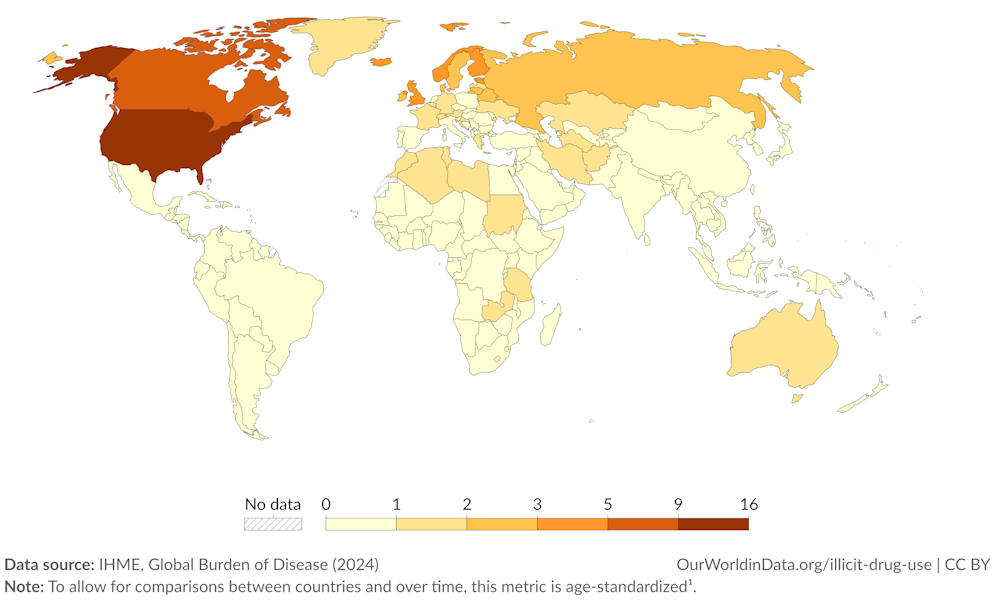
Opioid use death rates around the world:
Estimated deaths from opioid use disorders per 100,000 people in 2021. Our World In Data, CC BY
For the past 15 years, I have researched and advised on the international narcotics industry, especially the Afghan drug trade, as an academic, UK Home Office official and consultant. I’ve observed many shifts within global drug markets, and I believe the increasing availability of synthetic drugs in the UK and Europe may represent a new chapter in illicit drug use here – with the emergence of nitazenes only adding to these concerns.
A brief history of synthetic opioids
New synthetic opioids (NSOs) are one of the fastest-growing groups of new psychoactive substances around the world. The EU Drugs Agency (EUDA) currently monitors 81 NSOs – the fourth-largest group of drugs under observation.
NSOs largely fall into two broad groups: fentanyl and its analogues, and non-fentanyl-structured compounds – these include nitazenes, among many other substances.
Many of these “new” synthetic opioids have, in fact, existed for decades. Nitazenes were first synthesised in the 1950s by the Swiss pharmaceutical company, Ciba Aktiengesellschaft, as pain-relieving analgesics, although they were never approved for medical use.
Prior to 2019, there had only been limited reports of nitazenes in the illegal drug supply – including a “brownish looking powder” found in Italy in 1966; the discovery of a lab in Germany in 1987; several nitazene-related deaths in Moscow in 1998; and a US chemist illegally producing the drug for personal use in 2003. But since nitazenes re-emerged at the end of the last decade, over 20 variants have been discovered.
Paul Janssen, the Belgian chemist who first made fentanyl. Johnson & Johnson
The most common NSO in the illegal drug market, fentanyl, was first synthesised by Belgian chemist Paul Janssen in 1960. Fentanyl, which is roughly 100 times more potent than morphine, was approved in the US in 1968 for pharmaceutical use as an analgesic.
Over the next four decades, however, illegally produced fentanyl resulted in three relatively small outbreaks of deaths in the US. A fourth, larger fentanyl outbreak in Chicago, Detroit and Philadelphia resulted in about 1,000 deaths between 2005 and 2007.
The current US fentanyl crisis started in 2013, expanding to affect much of the country. Between 2014 and 2019, Chinese companies were the main manufacturers of finished fentanyl substances in the US – to combat this, both the Obama and Trump administrations lobbied Beijing to curtail the fentanyl industry.
The Chinese government responded by controlling specific fentanyl analogues. However, every time an analogue was banned, chemists there would slightly adjust the formula to produce a new compound that mirrored the banned substance.
China finally banned all fentanyl-related substances in May 2019, prompting two significant changes in the drug’s supply: a slowdown in the development of new fentanyl analogues, and a reduction in their direct sale to the US from China. Instead, Chinese companies increasingly sent fentanyl precursors to Mexican drug cartels who would synthesise fentanyl (or counterfeit medication) in clandestine labs, before smuggling it across the US border. Consequently, Mexico is now the primary source of fentanyl in the US.
But these supply changes led to another shift in the global drugs arena, as China’s chemical and pharmaceutical businesses – keen to develop new markets – adjusted their focus to producing uncontrolled synthetic substances, including nitazenes. At the same time, they expanded their geographical focus from North America to include Europe and the UK.
The nitazene supply chain
Producing nitazenes is a relatively low-cost exercise. They are largely manufactured in laboratories – both legal and illegal – in China, before being smuggled to the UK and Europe via fast parcel and post networks.
Nitazenes’ high potency means only small quantities are required, making them easier to transport and harder for border officials to detect. Some Chinese vendors have reportedly been offering to hide nitazenes in legitimate goods such as dog food and catering supplies, to circumvent custom controls. All of this decreases the risk to sellers, and lessens the price of doing business.
In March 2024, two China-based sellers operating on the dark web were selling a kilo of nitazene for between €10,000 and €17,000 (£12,000-£20,000). During roughly the same period, a kilo of heroin at the wholesale level in the UK was selling for between £23,000 and £26,000. Once bought, nitazenes are largely used to fortify low-purity heroin, although the drug can also be made into pills.
Video by The Guardian.
Nitazenes are not limited to the dark web. They are widely and openly advertised on the internet, social media and music streaming platforms. In February 2024, one China-based e-commerce site displayed 85 advertisements for nitazenes. Such sites also sell a range of other synthetic drugs, including fentanyl analogues and precursors, xylazines, cannabinoids and methamphetamine.
This means drug dealers in the UK and across the world no longer need to have established connections to underworld figures to source illegal drugs. With a click of a mouse, they can have them delivered to their home address. In this sense, the internet has democratised the drug trade by widening access beyond “traditional” criminals.
In the UK, while the supply of nitazenes is currently assessed as “low”, a number of smaller-scale organised crime groups are importing them to fortify low-purity heroin, before largely dealing it at the “county lines” level. This involves organised crime groups moving drugs – primarily heroin and crack cocaine – across towns, cities and county borders within the UK, using mobile phones or another form of “deal line” to sell to customers.
In November 2023, Leon Brown from West Bromwich was imprisoned for seven years for dealing drugs containing nitazenes – a verdict described as “a great result in our ongoing efforts to tackle county lines drug dealing” by detective sergeant Luke Papps of the South Worcestershire county lines team.
A few larger UK criminal networks have also been involved in nitazene distribution. In October 2023, the police and Border Force conducted raids across north London, arresting 11 people. They dismantled a drug processing site and seized 150,000 tablets containing nitazene – the UK’s largest ever seizure of synthetic opioids – as well as a pill-pressing machine, a firearm, more than £60,000 in cash and £8,000 in cryptocurrency. The police suspected the group had been selling the tablets on the dark web.
Anecdotal reports suggest there have been mixed reactions to the introduction of nitazenes into the illegal drug supply. Richard, a recovering heroin user from Bristol, told Vice magazine that, given their potency, some “people are scared of [nitazenes]” while others are “actively seeking” them.
As has been the case with fentanyl in the US, users build up tolerance and therefore seek stronger doses. Manny, a heroin user from Bristol, told Vice: “I smoked [heroin cut with nitazenes] and it felt like the first time I’d ever taken drugs.”
Video by Vice.
UK-based criminals also use the dark web to export nitazenes abroad. In October 2023, the Australian Border Force identified 22 nitazene discoveries in packages shipped to the country via mail cargo from the UK. British criminals have also trafficked counterfeit medicines containing nitazenes to Ireland and Norway.
Use of nitazenes is now being detected all over the world. Within Europe, Ireland experienced several nitazene outbreaks in 2023-24 while in Estonia, nitazenes now account for a large share of overdose deaths – a trend also seen (to a lesser extent) in Latvia. Preliminary data suggests at least 150 deaths were linked to nitazenes in Europe in 2023.
Nitazenes have also been discovered in fake pain medication such as benzodiazepines, oxycodone and diazepam, which widens the number of people at risk to include those with no opioid tolerance. The death in July 2023 of Alex Harpum, a 23-year-old British student who was preparing for a career as an opera singer, was a stark reminder of the danger of buying fake medicine online that may have been contaminated with nitazenes.
The nitazene ‘boom’ and the global heroin trade
For decades, Afghanistan was the world’s largest opium producer and the source of most of Europe’s heroin. Then in April 2022, the ruling Taliban announced a comprehensive prohibition on the use, trade, transport, production, import and export of all drugs. As a result, poppy cultivation has fallen to historically low levels for a second consecutive year.
While this has not, as yet, translated into a shortage of heroin on European streets, including in the UK and Germany, some indicators suggest a slowdown in heroin supplies to the UK. In the year March 2023-24, the quantity of heroin seized in the UK fell by 54%, from 950kg to 441kg. This is the lowest quantity of heroin seized since 1989, when about 350kg was intercepted.
The NCA assesses that the Taliban ban has created market “uncertainty”. The wholesale price of heroin has increased from roughly £16,000 per kilo prior to the COVID-19 pandemic to about £26,000, while anecdotal reports suggest average heroin purity for users dropped to under 30% (often to 10-20%) in 2024, compared with around 35% in 2023 and 45% in 2022.
Video by UN Story.
Even without the Taliban’s ban, heroin is not easy to produce and supply. Cultivating opium poppy is labour-intensive, taking five or six months. The static nature of opium fields means they are visible and susceptible to eradication; poppy crops can also be negatively affected by blight or drought.
Converting opium into heroin base is also a labour-intensive process that can involve (depending on the production method) at least 17 steps. Acetic anhydride, the main chemical used to convert morphine into heroin, is relatively expensive compared with synthetic precursors. Moreover, heroin is a bulky product, which means it is harder to move in large volumes.
While the relationship between events in opiate-producer countries and the introduction of synthetic opioids to consumer markets should not be overstated, this new type of drug offers economic advantages to criminals whose “sole motivation is greed”.
For decades, Turkish, Kurdish and Pakistani criminal networks have been responsible for importing heroin into the UK. Once in the UK, both Turkish and British groups largely control its wholesale supply, with some participation of Albanian gangs.
To date, there is little evidence to suggest these groups have transitioned to supplying NSOs, including nitazenes. The shifting dynamics in the global drug supply chain, however, could upend traditional markets and the gangs who profit from them.
America’s synthetic drug crisis
The synthetic opioid fentanyl has devastated the US, having been linked to about 75,000 deaths in 2023 alone. It is the primary cause of death for Americans aged 18-49. Canada, too, has experienced a wave of deaths: between January 2016 and June 2024, there were 49,105 apparent opioid deaths there, with fentanyl implicated in a large proportion.
More than 4,300 reports of nitazenes have reached the US National Forensic Laboratory Information System since 2019. They are typically used to fortify fentanyl and other opioids, which can produce a fatal concoction.
Efforts to stem the flow of NSOs, including nitazenes, from China to the US and elsewhere will prove challenging. And even if China does implement stricter controls, other countries could step in to fill the void. According to the Commission on Combating Synthetic Opioid Trafficking:
The overall sizes of these industries, limited oversight efforts and political incentives contribute to an atmosphere of impunity among firms and individuals associated with those industries.
While US and Chinese counter-narcotics cooperation ended in 2022 amid increasing geopolitical tensions, the following November’s summit in Woodside, California, between presidents Joe Biden and Xi Jinping saw them agree to recommence collaboration.
As a result, China recently closed several chemical companies that were shipping fentanyl precursors and nitazenes to the US. These vendors used encrypted platforms and cryptocurrency to conduct the deals, and mislabelled the consignments to try to ensure the substances evaded border controls. China has also outlawed more chemicals and substances, including several nitazene variants.
But President Trump’s imposition of tariffs on imports from China – which sit alongside proposed taxes on imports from Canada and Mexico, in part for supposedly not doing enough to curb the trafficking of fentanyl and its precursors to the US – threatens this counter-narcotics cooperation.
While nitazenes are not yet widely available in the US, their presence within some fentanyl batches is complicating the US opioid crisis – and according to some experts, has the potential to further increase the already shocking number of synthetic opioid-related deaths.
The UK response to nitazenes
Successive UK governments have made tackling NSOs a high priority. Shortly after the most recent nitazene-related deaths were discovered in the UK in summer 2023, the NCA launched Project Housebuilder to lead and coordinate the law enforcement and public health response.
This was soon followed by the establishment of a government-wide Synthetic Opioids Taskforce “to improve…understanding, preparedness and mitigation against this evolving threat”. Chris Philp, then the UK’s combatting drugs minister, stated that “synthetic opioids are at the top of [this government’s] list because of the harm they cause”.
The taskforce has taken a range of measures, such as controlling more NSOs as class A drugs, conducting more intelligence operations at UK borders, widening access to naloxone, and enhancing the UK’s real-time, multi-source drug surveillance system. The government also worked with the US and Canada to learn from their experiences.
Recently, the current UK government banned a further six synthetic opioids and introduced a generic definition of nitazenes as class A drugs. And the UK’s current government, unlike its Conservative predecessor, has also indicated its willingness to consider evidence from the UK’s first drug consumption facility, which recently opened in Glasgow.
Other policy measures worthy of consideration include expanding drug checking services whereby drug users submit drugs to a lab to test what is in them, then are provided with information about the sample. These services offer vital information to the public and authorities about current drug trends.
While there is high uncertainty about what is going to happen next in the UK regarding illicit drug trends, the evolution of the US drug landscape over generations provides some important lessons.
Lessons from the US
The US fentanyl crisis shows drug markets can change quickly with long-lasting consequences. Most heroin on US streets contains – or has been replaced by – fentanyl. According to DEA seizure data, US heroin seizures declined by nearly 70% between 2019 and 2023, whereas fentanyl seizures have increased by 451%.
However, illegal drug markets evolve in different ways and at different paces. In May 1989, Douglas Hogg, a UK Home Office minister, travelled to the US and the Bahamas on a fact-finding mission about crack cocaine, a drug that was predicted to spread from the US to the UK. Upon his return, Hogg noted:
The ethnic, social and economic characters of many of our big cities are very similar to those in the US. If they have a crack problem, why should not we? … The use of crack in Great Britain is likely to develop very substantially over the next few years.
But this “crack invasion”, as some called it, did not materialise in the UK to the extent it had in the US – and the same was true about a predicted wave of methamphetamine use in the UK, which remains low compared with the US.
It is also unlikely the UK and Europe will experience a synthetic opioid crisis on the same scale as the US. The first wave of the US crisis was driven by extensive overprescription of opioids for pain relief. This increased the number of people addicted to opioids, some of whom later turned to heroin, before transitioning to fentanyl. In contrast, large-scale opioid prescriptions have not been a major issue in the UK or Europe, although there is some diversion of legal fentanyl into the illegal drug market in Europe.
Video by The Brookings Institution.
According to Alex Stevens, professor of criminology at the University of Sheffield, another factor differentiating the US and Europe is the provision of drug treatment and harm reduction programmes. Opioid users in Europe, and to a lesser extent in the UK, are much more likely to be in medication-assisted treatment than their US counterparts, thus reducing the number of people at risk. These interventions are reinforced by different socioeconomic factors in much of Europe, such as lower economic inequality, stronger social protections, and better healthcare systems.
None of this, though, means the nitazene threat in the UK and Europe should be underestimated, nor that use and supply of these drugs (and other NSOs) will not increase from its current relatively low base. As the NCA recently warned:
While a zero-tolerance approach from law enforcement, plus advice to users on the heightened dangers, may contain or slow the current uptake, we must prepare for these substances to become widely available, both unadvertised in fortified mixes and in response to user demand as a more potent high.
The future of new synthetic opioids
Predicting the future of NSO use and trafficking is a challenging task. Projections for Europe range from existing opiate stockpiles ensuring that heroin consumer markets remain serviced (assuming the Taliban ban is short-lived), to a heroin shortage which results in more drug dealers turning to NSOs to plug the shortfall, which in turn could lead to lasting changes in European drug markets (as happened in a few countries following the Taliban’s first opium ban in 2000-01).
In such a scenario, it is possible that Turkish criminal networks may exploit their links with Mexico’s Sinaloa cartel to source NSOs. Mexican criminal gangs also operate in Europe, which may increase the likelihood of them trying to open a new NSO market on the continent.
There is also evidence that some Italian criminal organisations have entered the NSO marketplace. In November 2023, Italian authorities announced the seizure of 100,000 doses of synthetic drugs, including fentanyl, as part of operation Painkiller, a joint Italian-American initiative.
Given the many advantages for criminal groups of NSOs, it seems likely they are here to stay. A key question is whether nitazenes (or other NSOs) will supplant traditional heroin as the opioid of choice, as they have done in the US, or remain at relatively low levels in Europe, co-existing with or mixed into the heroin supply.
In December 2023, Paul Griffiths, the EUDA’s scientific director, told Vice: “We’re not seeing much new initiation of heroin use in Europe. So in five to ten years … as heroin users get older and more vulnerable, we’re not going to have much of an opiate problem left.”
But he warned that if heroin use does dry up: “You might then see opioids appearing in other forms and preparations, such as pills, that could potentially become popular among younger age groups who currently do not appear attracted to injecting heroin.”
While previous NSO outbreaks in the UK were relatively short-lived and limited in scale, the most recent nitazene outbreak, which started in summer of 2023, has been more sustained, covered more parts of the UK, and involved more fatalities. The broader trend in Europe also suggests the prevalence and variations of NSOs are increasing at a faster pace than in previous years.
Notwithstanding, nitazene use and supply in the UK currently remains relatively low. In fact, the rate of nitazene-linked deaths – at least those officially reported – decreased between spring 2024 and the end of the year.
In the short term, then, it seems unlikely there will be a nitazene “explosion”. Rather, criminal groups will probably try to increasingly embed nitazenes into the UK drug market at a similar pace to the last 18 months.
However, this situation could change rapidly in future, especially if larger criminal networks involved in heroin importation switch to smuggling NSOs, and there is a genuine shortage of Afghan heroin. This problem would be compounded if drug users start seeking nitazenes, thus creating demand for them.
Either way, the UK government, along with its European partners, should continue to reinforce the whole drug system, to prepare for the worst-case scenario.
To hear about new Insights articles, join the hundreds of thousands of people who value The Conversation’s evidence-based news. Subscribe to our newsletter.
Philip A. Berry does not work for, consult, own shares in or receive funding from any company or organisation that would benefit from this article, and has disclosed no relevant affiliations beyond their academic appointment.
Every scientific discovery, breakthrough, and innovation we celebrate has been shaped by brilliant minds. However, the minds with more opportunities to shine have predominantly been male. While women constitute 48% of doctoral graduates in the EU, they represent only one third of the total number of researchers in Europe. According to the UN, female researchers also tend to have shorter, less well-paid careers.
Though progress has been made, women remain underrepresented in many fields, in senior academic and decision-making positions. These disparities are driven by challenges such as unconscious bias, a lack of mentorship, and limited access to resources – barriers that continue to hinder the full participation of women in research and innovation.
The International Day of Women and Girls in Science on 11 February is both a celebration and a call to action to inspire young girls and women around the world, to ignite their curiosity and creativity – and to reflect on how best to support their scientific aspirations.
The European Commission is committed to upholding gender equality – one of the core values of the EU. Read how the Commission is supporting equality with some key actions in research and innovation.
Gender equality plans
Gender equality is a priority of the European Research Area (ERA), with actions focused on driving institutional change in research careers at all levels. In 2022, this commitment was strengthened further, with all higher education establishments, research organisations, and public bodies from Member States and Associated Countries applying for Horizon Europe funding now required to implement a Gender Equality Plan (GEP).
These plans must address several areas, including work-life balance, gender balance in leadership and decision-making, gender equality in recruitment and career progression, integration of an inclusive gender dimension into research that acknowledges intersectionality, and measures against gender-based violence.
The EU Award for Gender Equality Champions celebrates and recognises the outstanding results achieved by some change-driving academic and research organisations in the implementation of GEPs. The prize is shaping a community of changemakers who inspire others to adopt gender equality policies and drive meaningful, transformative institutional change.
To date, two award ceremonies have been held, honouring seven champions from Ireland, Spain, Sweden, and France. This year’s ceremony will take place in March 2025.
One of the previous winners is Universitat Rovira I Virgili in Spain where now the majority of research groups in the university are led by women as principal investigators. The university has also run a campaign to prevent sexual harassment and gender-based discrimination among their teaching staff.
Another notable champion is South East Technological University in Ireland. This institution has made impressive strides in achieving gender balance, particularly within its executive management team and across its teaching staff. From assistant lecturers to senior lecturers, the university has worked diligently to ensure that both women and men are equally represented.
Discover how you can apply to become one of the next EU gender equality champions.
EU-funded projects strengthen the gender equality balance in STEM
Strengthening women’s participation in Science, Technology, Engineering and Mathematics (STEM) is not only a matter of equal opportunities and social justice, but also crucial to meet pressing societal challenges, such as the green and digital transitions. According to the “She figures 2021” report, women remain underrepresented among doctoral graduates in most narrow STEM fields.
To tackle this imbalance, the EU is funding research and innovation projects aimed at increasing young girls’ participation in STEM activities, improving the recruitment, retention and promotion of women in science across the EU and beyond.
The Horizon Europe project STREAM IT tackles barriers for underrepresented groups in STEM, focusing on young girls, creating inclusive educational tools. The project aims to provide widely applicable solutions for various stakeholders, including workshop series for supporting girls to orient towards STEM, hands-on activities at science centres and museums, mentoring programme, and establishing collaborative networks on national and international level.
To further boost interest and female participation in STE(A)M (where “A” stands for creative thinking and applied arts), while deconstructing gender stereotypes, three EU-funded projects – Road-STEAMer, The SEER and SENSE – are collaborating to develop and deliver a roadmap for science education in Horizon Europe, in synergy with the EU’s Erasmus programme.
Meet some of the inspiring women behind European R&I
EU actions to eliminate gender inequalities in research and innovation have already yielded significant results, as seen in the stories of several remarkable women in science.
One such example is Dr. Anne L’Huillier, the 2023 Nobel Prize Laureate in Physics, who works on the interaction between short and intense laser fields and atoms. She credits the MSCA programme’s early support for kickstarting her career.
Prof Rana Sanyal, the winner of the 2024 European Prize for Women Innovators and a leading expert in biotechnology, is another prime illustration of the vital role EU funding plays in supporting women researchers.
Alba García-Fernández and Erika Pineda Ramirez are other two EU-funded women researchers dedicated to developing more effective treatments for cancer patients. In honour of the International Day of Women and Girls in Science, they offer inspiring advice for the next generation of female researchers.
“The contribution of women in science is invaluable. We have so much talent and ideas to offer. As Marie Skłodowska-Curie once said: ‘I was taught that the way of progress was neither swift nor easy.’ So, my advice is: believe in yourself and go after what truly excites you. Stay curious, keep learning!” – Alba García-Fernández, MSCA fellow.
Erika Pineda Ramirez emphasises that while the work environment can sometimes make things harder, women researchers should keep trying and never give up because science needs more of their contributions.
A concerted effort for long-term excellence, competitiveness and increased patient benefit – Government.se
Published
Sweden’s national life sciences strategy serves as a long-range framework, and the strategy’s eight priority areas remain the starting point for this update of the previous strategy from 2019.
Download:
The updated objectives indicate the Government’s policy for the development of the sector and aim to encourage a mobilisation at the local, regional and national levels. By being an active partner in both Sweden and the EU, the Government wants to contribute to a sustainable and advantageous development of Sweden’s life sciences.
Shortcut
Sweden’s national life sciences strategy was launched in December 2019.
Over the past few weeks the new US president, Donald Trump, has repeatedly claimed that the United States should “take back” the Panama Canal and that it should assume control of Greenland – one way or another. He has talked of Canada becoming America’s 51st state and now he even wants to “take over” the Gaza Strip to convert it into a “Riviera” on the eastern Mediterranean.
It’s as if the US president believes that his country should be an empire. In this Trump seems to be emulating China’s Xi Jinping and Vladimir Putin of Russia, leaders he has said he admires and who have themselves shown some clear imperial tendencies in recent years.
Under Putin, Russia has supported secessionist regions, such as Transnistria and Abkhazia, fought wars in Georgia and Ukraine and actively interfered in the affairs of Syria and assorted African countries. In 2022 Russia even launched a full-scale invasion of Ukraine, claiming that Ukraine was historically inseparable from Russia, but that hostile western influences were trying to destroy that unity.
China, meanwhile, has militarised a number of small uninhabited islands in the South China Sea. It has built 27 installations on disputed islands in the Spratly and Paracel island group that are also claimed by other countries including Vietnam, Taiwan, the Philippines and Malaysia. This has prompted a flurry of development, as other countries in the region have raced to establish their own footholds in the disputed, but very resource-rich, region.
Beijing also maintains its claim over Taiwan, which it says is an inalienable part of China which it wants to “come home”.
Empires and nation states
Most people assumed that the age of empires had been relegated to the dustbin of history. But this is by no means a straightforward proposition. Until relatively recently, the rise and fall of empires had dominated much of recorded history. Nation-states only appeared at the end of the 18th century. And as those states rose to prominence many too displayed imperial inclinations.
So the US, fresh from throwing off the yoke of the British empire, wasted little time in expanding its borders westward, acquiring – whether by conquest or purchase – large swaths of new territory in what effectively turned a small group of east coast states into a continental empire.
Meanwhile other newly minted nation-states such as Italy and Germany also aspired to acquire overseas empires and involved themselves, with varying success, building what turned out to be relatively shortlived colonial empires in Africa and elsewhere.
Most traditional dynastic empires, meanwhile, began to adopt various aspects of the nation-state model, such as conscription, legal equality and political participation. The decades following the second world war are often seen by historians as a period of decolonisation by traditional imperial powers such as Britain and France. But the transition from empire to nation-states was far from smooth. Most imperial governments hoped to transform their empires into more egalitarian commonwealths, while retaining a degree of influence.
This they did with varying degrees of success and often under extreme duress, as with France in Algeria and Vietnam, or under great economic pressure, such as with Britain and India. The real age of the nation-state didn’t begin until the 1960s.
The return of empire?
Today, the world consists of about 200 independent countries, the overwhelming majority nation-states. Nonetheless, one could argue that empires – or at least imperial tendencies – have never totally disappeared. France, for instance, frequently interfered in many of its former colonies in Africa. However, these military interventions were not meant to permanently occupy new territories.
Today, imperial tendencies seem to resurface around the world. The past, however, tends not to repeat itself. Massive wars of conquest or attempts to create new overseas empires are unlikely in the immediate future. Most imperial expansions are currently sought close to home.
What is striking is that Putin, Xi and Trump all use fierce nationalist rhetoric to justify their imperialist designs. Putin, as we have seen, claims the indivisibility of Ukraine and Russia and blames “Nazis” for trying to turn Russia’s sister state towards the west. He used it as a justification for invading Ukraine in February 2022.
Xi, in turn, often maintains that Communist China has finally overcome the century of humiliation, in which the country was the plaything of foreign powers. They both seem to yearn for past imperial greatness. The Russian Federation aims to undo the dissolution of the Soviet Union, communist China looks back to the Qing empire. Interestingly, under its increasingly authoritarian leader Recep Tayyip Erdoğan, Turkey – another regional power with imperial inclinations – similarly finds inspiration in the Ottoman Empire.
The US case seems to be more complex, but in fact is very similar. Thus, Trump argues that the Panama Canal, which has long been administered by the US, was foolishly returned to Panama by Jimmy Carter and claims that it is now controlled by China. He will, he says, return it to the US.
Trump also refers to America’s “Manifest Destiny”, the 19th-century belief that American settlers were destined to expand to the Pacific coast. These days his aspirations are northwards rather than to the west. The president also wants to plant the US flag on Mars, taking his imperial dreams into outer space.
If the US joins China and Russia in violating recognised borders, the international, rights-based order could be in danger. The signs are not very positive. Taking steps to illegally annex territories could blow up the entire international edifice.
Eric Storm does not work for, consult, own shares in or receive funding from any company or organisation that would benefit from this article, and has disclosed no relevant affiliations beyond their academic appointment.
On 30–31 January, State Secretary Anders Hall took part in an informal meeting of the EU Justice and Home Affairs Council (JHA) in Warsaw, Poland. In conjunction with the meeting, Mr Hall paid a visit to Frontex, the European Border and Coast Guard Agency.
State Secretary Anders Hall and Frontex’s Deputy Executive Director for Returns and Operations Lars Gerdes.
Photo: Frontex
At the meeting of the EU Justice and Home Affairs Council (JHA) in Warsaw, where State Secretary Anders Hall met with Poland’s Minister of the Interior and Administration Tomasz Siemoniak.
Photo: The Chancellery of the Prime Minister / PAP S.A
Frontex is the EU Border and Coast Guard Agency that supports EU Member States with issues such as enforcing return decisions. Frontex provides support to EU Member States at all stages of a return procedure: everything from obtaining travel documents and contact with relevant third countries, to offering funded and chartered flights and reintegration assistance.
At the meeting, discussions centred on the EU Agency’s cooperation with Swedish government agencies, something that Frontex considers a success. Over the past two years, Swedish government agencies have increasingly started using Frontex’s services in their work on return procedures. This enhanced cooperation has increased the number of return operations organised by Sweden together with Frontex.
“The Government’s priority is to increase the returns of those who have received an expulsion order. That’s why it’s positive that Frontex is verifying that the work of the Government and its agencies is yielding results. Achieving an effective return procedure is a prerequisite for a responsible and well-functioning migration policy,” says Mr Hall.
At the meeting with Frontex, Mr Hall met with Frontex’s Deputy Executive Director for Returns and Operations Lars Gerdes and Head of Sector Return Operations/Head of Unit Return Operations and Voluntary Returns Mauro Petriaggi.
A MAJOR retrospective of the work of a renowned local artist opens at Leicester Museum & Art Gallery next weekend.
Satta Hashem, who was born in Iraq in 1959, studied mural painting and decorative arts in Leningrad (now St Petersburg), before moving to Sweden and settling in the UK.
Since moving to Leicester in 2000, the artist has created hundreds of paintings and drawings that reflect a broad range of themes – from his response to the US occupation of Iraq in 2003, to his compassion for the victims of war and sectarianism, and his exploration of colour to represent moments in his daily life.
From Saturday 15 February, more than 80 pieces of Satta Hashem’s work will be on display at Leicester Museum, making it one of the most comprehensive exhibitions ever of the artist’s work.
His stunning portraits evoke the earliest depictions of the human face found in masks from the ancient civilisation of Sumer – now part of modern-day Iraq. These historical influences are referenced in the exhibition by a number of ancient Sumerian artefacts, kindly loaned by the Ashmolean Museum in Oxford.
In addition to paintings, drawings and murals, the retrospective will also include book and magazine illustrations, rare archive material and samples of the artist’s sketchbooks.
“Our capacity to manage a pandemic is better today than it was in 2020. However, a crisis requires more than preparedness in the form of regulatory frameworks,” writes Minister for Social Affairs and Public Health Jakob Forssmed (Christian Democrats).
This week marks five years since the first COVID-19 case was reported in Sweden. In this short time, society has undergone a comprehensive crisis and long since returned to normality. But for the people and families in our country, COVID-19 has left lasting scars in the form of grief and loss. Many lost their lives and many still experience long-term health issues as a result of COVID-19. Long-term isolation and loneliness have also left deep scars.
Sweden could face a new crisis
Other crises and difficulties have arisen in place of the pandemic, and seemingly part of human nature – in our country at least – is the wish to leave the preceding crisis behind us. But we must not forget the lessons of the COVID-19 pandemic, because unfortunately, we cannot rule out that Sweden will be faced with another pandemic – it is actually very likely that we will. That is why I am grateful for all the efforts that we are currently undertaking and that have been undertaken within the Government Offices to ensure that Sweden is better equipped to deal with any future pandemics.
A few examples:
Inquiry Chair Professor Jan Albert has been tasked with reviewing the regulation of communicable diseases to better adapt it to situations of extensive spread of infectious diseases. He will also submit information for a strategy for future pandemic management, including analyses of issues of allocation of responsibilities in the event of another pandemic.
The Public Health Agency of Sweden has been tasked with ensuring continued access to vaccines for the population in the event of an influenza pandemic. Currently, the avian influenza H5N1 has caused extensive outbreaks globally among both tame and wild animals in a short period of time. There are cases of the infection passing from animals to humans as well.
The Public Health Agency of Sweden has also been tasked with ensuring continued access to antiviral medicines in the event of a pandemic.
The National Board of Health and Welfare has been tasked with establishing a national collaboration structure for health and welfare’s supply preparedness of medical care products and any other equipment required to ensure the provision of proper care, together with the Medical Products Agency, the Swedish eHealth Agency, the Public Health Agency of Sweden and the Swedish Association of Local Authorities and Regions.
The Public Health Agency of Sweden’s mandate in relation to communication and information for the public has been clarified. The Agency plays a natural role in the dissemination of information and communication to the public.
Critical flaws in pandemic management
Important measures have been taken within the Public Health Agency of Sweden as well, including building a stronger system for surveillance of communicable diseases. This system includes increased epidemiological and microbiological surveillance with a higher degree of automation than previously.
The Agency is also working to integrate its different surveillance systems and automate the collection of data on infectious diseases within the health policy platform. This will enable real-time data sharing between national and regional actors, gathered within a shared user interface with different authorisation levels and tools to analyse cases of illness and outbreaks.
The Agency was tasked with strengthening its capacity to discover and analyse viruses spread via wastewater. All the above will ensure that we are better equipped to manage a pandemic today than in 2020. There were critical flaws at that time, which the COVID-19 Commission has highlighted.
But the COVID-19 Commission also points out that crisis management requires more than preparedness in the form of regulatory frameworks. It also requires a capacity to act in an entirely new set of circumstances where one does not have all the answers. One needs to be able to be act proactively and with force in peacetime crisis situations as well as in wartime and when there is a risk of war. In relation to this, the Government has made changes to the instructions to the Public Health Agency of Sweden to include a clear expectation for the Agency to act.
Sweden is better equipped
A clear conclusion from the pandemic is the requirement for clear political responsibility. The Government governs the state in times of crisis as well and that responsibility cannot be handed over to public authorities. Finally, it is important to remember what was perhaps the COVID-19 Commission’s main conclusion – everything centres around our society, values and people.
Sweden made it through the COVID-19 pandemic, despite the errors in management and initial passivity. This was achieved by virtue of a strong sense of duty, particularly among health and social care staff, caring for others and a fundamental trust in society. These assets, together with all the initiatives taken by the Government and public authorities, mean that Sweden is now much better equipped should another pandemic befall our country.
On 4 February Minister for Defence Pål Jonson and Minister for Civil Defence Carl-Oskar Bohlin received the Republic of Moldova’s Minister of Defence Anatolie Nosatîi at Karlberg Palace.
Minister for Civil Defence Carl-Oskar Bohlin, Minister of Defense of the Republic of Moldova Anatolie Nosatîi and Minister for Defence Pål Jonson at Karlberg Palace.
Photo: Niklas Forsström/Government Offices
The flag of the Republic of Moldava and the flag of Sweden.
Photo: Niklas Forsström/Government Offices
Minister of Defense of the Republic of Moldova Anatolie Nosatîi and Minister for Defence Pål Jonson at Karlberg Castle.
Photo: Niklas Forsström/Government Offices
The aim of the visit was to intensify and expand defence cooperation between Sweden and the Republic of Moldova and signal robust support for the Republic of Moldova’s territorial integrity and sovereignty.
In addition to bilateral defence cooperation, issues regarding the security situation in the region, the war in Ukraine and related EU and NATO matters were discussed.
Representatives of the Swedish Armed Forces, the Defence Materiel Administration and the Psychological Defence Agency also attended the meeting.
During his visit to Stockholm Mr Nosatîi also met Minister for Foreign Affairs Maria Malmer Stenergard, Diana Janse, State Secretary to Minister for International Development Cooperation and Foreign Trade Benjamin Dousa, and representatives of the Riksdag.
The visit followed the Government’s 30 January proposal to donate m/86 AT4 anti-tank weapons to the Republic of Moldova within the framework of the additional amending budget that includes the 18th support package to Ukraine.
Related
The meeting on 4 February was held after Sweden and the Republic of Moldova signed a Letter of Intent on 20 August 2024 on deepened defence cooperation during a visit to the Republic of Moldova by Minister for Defence Pål Jonson and Minister for Civil Defence Carl-Oskar Bohlin. The Letter of Intent enables both countries’ armed forces and other defence agencies to expand existing cooperation and promote new initiatives. The Letter of Intent enables both countries’ armed forces and other defence agencies to expand existing cooperation and promote new initiatives.
“The latest PISA results from 2022 show that Alberta is a world leader in education. Alberta students rank first in financial literacy among Canadian provinces, ahead of Ontario and British Columbia, which tied for second place.
“Alberta students also performed exceptionally well against international competitors in financial literacy. Globally, Alberta students placed first ahead of Denmark, the top-ranked country.
“Alberta’s students’ achievement in financial literacy builds off the previously released 2022 PISA results. Across Canada, Alberta students rank first in science, reading and creative thinking and second in mathematics. Globally, Alberta students rank second only to Singapore in science, reading and creative thinking.
“Ensuring Alberta’s youth can build the financial literacy skills they need to make informed decisions about their finances and their future continues to be a focus for our government.
“That’s why we have invested $5 million to support practical, hands-on financial literacy programming for students from Kindergarten to Grade 12 and our renewed K–6 curriculum that includes a stronger foundation in financial literacy.
“As we look forward, we will continue to develop new curriculum for grades 7–12 and ensure financial literacy is incorporated throughout all grades where appropriate.”
Related information
Programme for International Student Assessment 2022 results
Financial literacy grants
Related news
International success for Alberta students: Minister Nicolaides (Dec. 5, 2023)
Le ministre de l’Éducation, Demetrios Nicolaides, a fait la déclaration suivante sur les derniers résultats du Programme international pour le suivi des acquis des élèves (PISA) de 2022 :
« Les derniers résultats du PISA de 2022 montrent que l’Alberta est un leader mondial en matière d’éducation. Les élèves de l’Alberta se classent au premier rang en matière de littératie financière parmi les provinces canadiennes, devant l’Ontario et la Colombie-Britannique, qui se classent au deuxième rang ex æquo.
Les élèves de l’Alberta ont également obtenu des résultats exceptionnels par rapport à leurs concurrents internationaux en matière de littératie financière. À l’échelle mondiale, les élèves de l’Alberta se classent premiers, devant le Danemark, le pays le mieux classé.
Les résultats des élèves de l’Alberta en matière de littératie financière s’appuient sur les résultats du PISA de 2022 déjà publiés. Au Canada, les élèves de l’Alberta se classent premiers en sciences, en lecture et en pensée créative et deuxièmes en mathématiques. À l’échelle mondiale, les élèves de l’Alberta se classent au deuxième rang, après Singapour, en sciences, lecture et pensée créative.
Veiller à ce que les jeunes de l’Alberta puissent acquérir les compétences en littératie financière dont ils ont besoin pour prendre des décisions éclairées concernant leurs finances et leur avenir continue d’être une priorité pour notre gouvernement.
C’est pour cela que nous avons investi 5 millions de dollars pour soutenir des programmes pratiques de littératie financière pour les élèves de la maternelle à la 12e année, ainsi que notre programme d’études renouvelé de la maternelle à la 6e année, avec une base plus solide en littératie financière.
À l’avenir, nous continuerons d’élaborer de nouveaux programmes pour la 7e à la 12e année et nous veillerons à ce que la littératie financière soit intégrée à tous les niveaux, le cas échéant. »
Renseignements connexes
Résultats du Programme international pour le suivi des acquis des élèves de 2022
Subventions pour la littératie financière
Nouvelles connexes
Réussite internationale pour les élèves de l’Alberta : Ministre Nicolaides (5 décembre 2023)
Danske Bank Bernstorffsgade 40 DK-1577 København V Tel. + 45 45 14 14 00
7 February 2025
Progress in customer activity as well as core banking activities continued, and credit quality remained strong Record-high net profit of DKK 23.6 billion, improving return on equity to 13.4% Dividend of DKK 9.35 per share for the second half of 2024 as well as an extraordinary dividend of DKK 5.35 per share, in total DKK 14.7 per share The Board of Directors has decided to initiate a new share buy-back programme of DKK 5 billion
Danske Bank has announced its financial results for 2024. Carsten Egeriis, Chief Executive Officer, comments on the financial results:
“For Danske Bank, 2024 was a year in which we consistently delivered positive results from quarter to quarter, driven by increased customer activity, continually strong credit quality and a sustained, dedicated effort from the entire organisation. Consequently, we maintained our positive commercial momentum, resulting in a solid financial performance.
One year into the execution of our Forward ’28 strategy, we have made substantial progress within our technology transformation and customer engagement, and we can see that our investments in enhancing the customer experience have resulted in increasingly positive customer satisfaction scores.
Our continued focus on cost discipline and on maintaining strong credit quality resulted in two upward adjustments of our financial guidance in 2024. On the basis of our strong financial results and solid capital position, the total distribution in 2024 amounts to 100% of net profit, thus honouring the commitment we have made to our shareholders.
With our advanced customer offerings, deep expertise and solid financial position, Danske Bank is strongly positioned to create value for customers, shareholders and society. In a time of heightened geopolitical uncertainty, rapid technological shifts and increasing sustainability challenges, we will continue to focus on opportunities and solutions for households and businesses alike.”
The annual report is available at www.danskebank.com. Highlights are shown below:
2024 vs 2023 Total income of DKK 56.4 billion (up 8%) Operating expenses of DKK 25.7 billion (up 1%) Loan impairments of DKK -543 million (2023: DKK 262 million) Net profit of DKK 23.6 billion (up 11%) Return on shareholders’ equity of 13.4% (2023: 12.7%) Strong capital position, with a CET1 capital ratio of 17.8% (2023: 18.8%). The ratio reflects strong capital generation and the full deduction of the announced 40% additional capital distribution. Solid progress towards Forward ’28 ambitions and 2026 targets 2024 was the first full year of our Forward ’28 strategy, and we are well-positioned for future growth as we maintain our trajectory towards strengthening our position as a leading bank in the Nordic region and make significant investments in our customer offerings.
For personal and private banking customers, with Forward ’28, a sharpened focus in each of our markets has allowed us to further strengthen our relations with existing customers and attract new ones. For business and institutional customers, we want to be a leading bank in the markets in which we operate. Our approach focuses on meeting evolving market demands while fostering high long-term customer and employee satisfaction.
Significant progress with our technology transformation paved the way for a better customer experience and improved efficiency. In 2024, we made substantial progress in terms of using digitalisation, data, AI and technology to improve customer engagement while reducing costs and operational risks. We developed a new version of our District online banking platform that is tailored to small businesses and is expected to launch in Denmark in the first half of 2025. We also launched a new welcoming app that makes it both easier and faster to become a personal customer with us.
Across the bank, we have made GenAI a strategic priority, and our GenAI-powered solutions offer key opportunities to unlock productivity gains. During 2024, we launched DanskeGPT, which has been adopted by almost 16,000 users across the organisation, corresponding to 74% of all employees. We have also deployed GenAI-powered tools for our software developers, and these tools are driving solid productivity improvements.
In 2024, Danica developed its new commercial strategy, Forward ’28 – Danica, which aims to make Danica the preferred pension company in Denmark by 2028. The strategy, which took effect on 1 January 2025, focuses on the importance of making customer interactions with Danica easy and convenient through digital solutions and on offering comprehensive healthcare offerings, attractive returns and quality advice. These elements are expected to be key growth drivers over the next few years. The strategy aligns with the strategic direction set in Danske Bank’s Forward ’28 strategy, underscoring the significant potential in synchronising services between the bank and the pension business.
As the success of our strategy relies on solid execution, we have a significant focus on our employees, supported by investments in development activities, leadership and the workplace. Employee satisfaction and engagement scores continued to improve from already high levels and are now above the industry benchmark.
Sustainability is a key focus area in Forward ’28, and our ambition is to be a leading Nordic bank in terms of supporting the sustainability transition of customers, businesses and the Nordic societies that we are a part of. Our efforts are reinforced by new ESG advisory services, comprehensive staff training, recruitment of specialists and strategic partnerships, all aimed at supporting our customers’ sustainability transition. In line with European regulation, for the 2024 annual report, Danske Bank has prepared a sustainability statement in accordance with the Corporate Sustainability Reporting Directive (CSRD) and the European Sustainability Reporting Standards (ESRS).
Better-than-expected macroeconomic conditions Macroeconomic conditions developed more favourably than expected in the markets in which we operate. Especially in Denmark, the inflation and growth outlook improved during the year, and this development is forecast to continue as central banks continue their easing trajectories, leading to lower rates for both households and businesses. Although the growth outlook has improved broadly speaking in the Nordic region, the uncertainty related to Europe’s long-term growth prospects and ability to innovate persists.
In times of uncertainty for both Danske Bank and our customers, our well-capitalised balance sheet has enabled us to be a strong financial partner for our customers, and we have continued to support them with risk management expertise and expert advice.
Strong financial performance An improved commercial momentum in our business, supported by better-than-expected macroeconomic conditions and strong credit quality have enabled us to strengthen profitability and generate record-high net profit. The return on equity thus increased from 12.7% to 13.4%, highlighting our positive trajectory and progress towards our 2026 targets.
In 2024, total income grew 8%, driven by a sustained uplift in core banking income. Despite central bank rate cuts and lower deposit margins as well as overall muted credit demand, net interest income showed the expected strong development, with increasing net interest income throughout the year. Net fee income continued the positive traction throughout the year, reflecting our overall strong development and ability to do more business with existing customers and to attract new customers. We saw a higher level of fee income from cash management products, and customer activity generally remained high. Furthermore, we saw an increase in investment fees generated by strategic investments in our private banking offerings as well as a strong development in fees from asset management.
Net trading income remained stable, and net income from insurance business benefited from stable financial markets, with the health and accident business continuing to be challenged, however.
Operating expenses developed according to plan and were at the same level as in 2023. The minor year-on-year increase was caused mainly by higher investments in our technology transformation made under our Forward ’28 strategy and staff costs that were impacted by wage inflation. Costs related to financial crime prevention and legacy remediation decreased in line with our plan for a normalisation of costs, and together with prudent cost management, this led to an improvement in the cost/income ratio to 46% from 49%.
Loan impairment charges amounted to a net reversal of DKK 543 million, reflecting strong credit quality and modest impairments against single-name exposures coupled with a review of post-model adjustments. We continue to apply significant post-model adjustments as well as a scenario-based macroeconomic model to cater for potential tail risks that are not evident in our portfolio. Overall, the macroeconomic environment improved during 2024 and was characterised by lower inflation, lower interest rates and an enhanced growth momentum.
Overall, we ended the year with the same positive momentum that we saw in the first nine months of 2024. This resulted in record-high net profit of DKK 23.6 billion, up 11% from 2023.
“The first year of execution of our Forward ’28 strategy,2024 was an important year for Danske Bank’s financial performance: With income growth driven by our growing core income as well as our continued efforts to support customers and drive the commercial momentum, net profit represents a record-high result,” says Stephan Engels, Chief Financial Officer. We continue to create value to the benefit of our customers, our shareholders and society: Our tax expense amounted to DKK 7.6 billion, and given our strong capital position, and in line with the Forward ’28 strategy, the financial year 2024 enables us to make a significant payout to our shareholders.
Delivering on capital distribution Given our strong balance sheet, and as planned in the Forward ’28 strategy, the financial year 2024 yields a significant payout to our shareholders. We paid a dividend of DKK 7.50 per share in connection with the interim report for the first half of 2024, and we propose a dividend of DKK 9.35 per share for the second half of 2024 as well as an extraordinary dividend of DKK 5.35 per share. Furthermore, on 6 December 2024, we announced a special dividend of DKK 6.50 per share following the successful transfer of the personal customer business in Norway. In total, our distribution for 2024 amounts to DKK 28.70 per share.
It remains crucial for us to create value for all our stakeholders, including our shareholders, customers, employees and the societies we are part of, and as a bank we need to attract capital from shareholders to lend and do business. Besides large institutional investors, our capital distribution benefits most major pension funds in Denmark as well as private individuals in Denmark, who have invested part of their savings in Danske Bank shares. In total, we have more than a quarter of a million investors, of which more than half are private individuals in Denmark.
Danske Bank’s dividend policy for 2025 remains unchanged, targeting a dividend payout of 40-60% of net profit in the form of annual dividend payments.
Share buy-back The share buy-back programme launched in February 2024 of DKK 5.5 billion was completed in January 2025.
On the basis of the financial results for 2024, the Board of Directors has decided to initiate a new share buy-back programme of DKK 5 billion, taking the total payout ratio to 100% of net profits when including the dividend for 2024 but excluding the special dividend related to the transfer of the personal customer business in Norway. The programme, which has been approved by the Danish Financial Supervisory Authority, will start on 10 February 2025.
Outlook for 2025 We expect net profit for 2025 to be in the range of DKK 21-23 billion. The outlook is subject to uncertainty and depends on economic conditions.
Danske Bank
Contact: Helga Heyn, Head of Media Relations, tel. +45 45 14 14 00
More information about Danske Bank’s financial results is available at www.danskebank.com/reports.
Ress Life Investments A/S Nybrogade 12 DK-1203 Copenhagen K Denmark CVR nr. 33593163 www.resslifeinvestments.com To: Nasdaq Copenhagen Date: 7 February 2025
Corporate Announcement 05/2025
Ress Life Investments A/S publishes financial calendar
The current financial year runs from 1 January to 31 December.
Financial Calendar
19th March 2025 Annual Report ending 31 December 2024
16th April 2025 Annual General Meeting
9th September 2025 Interim financial statement for the period from 1 January 2025 through 30 June 2025
Questions related to this announcement can be made to the company’s AIF-manager, Resscapital AB.
Contact person: Gustaf Hagerud gustaf.hagerud@resscapital.com Tel + 46 8 545 282 27
Source: People’s Republic of China – State Council News
BEIJING, Feb. 6 — As winter settles across China, excitement for winter sports is in full swing, with skiers carving down slopes and ice skaters gliding across rinks from north to south. Enthusiasm is especially high as the 9th Asian Winter Games opens Friday in Harbin, marking another milestone for China’s winter sports development.
At the heart of this movement is Chinese President Xi Jinping, whose lifelong passion for sports has fueled the rapid expansion of winter activities nationwide.
The foundation for this boom was laid more than a decade ago when Xi, attending the Sochi Winter Olympics, met with International Olympic Committee (IOC) President Thomas Bach. During their meeting, Xi set an ambitious goal: to engage 300 million people in winter sports. That vision has since become a reality.
By April 2024, following the Beijing 2022 Winter Olympics, around 313 million people – over 22% of China’s population – had actively participated in ice and snow activities.
FROM CHILDHOOD PASSION TO NATIONAL LEGACY
Xi’s love for winter sports dates back to his childhood. In the 1950s and 1960s, skating on Beijing’s Shichahai Lake was a popular winter pastime. Young Xi often rushed home from school to skate on the frozen lake.
That early connection to winter sports evolved into a national mission. Historically, winter sports in China were largely confined to the colder northern regions and were practiced in harsh conditions. Xi sought to change that.
From the successful bid for the 2022 Beijing Winter Olympics to the Games’ execution, Xi played a leading role. Between 2015 and 2022, he visited Olympic venues in Beijing and Zhangjiakou five times, overseeing venue construction, management, and volunteer operations. During a 2021 inspection visit, he emphasized using the Winter Olympics as a catalyst to elevate the nation’s ice and snow sports culture.
Beijing’s hosting of the Winter Games proved transformative. Today, seniors and children alike are skating and skiing in places where snow was once rare. Increased investment in facilities has made winter sports more accessible and affordable.
By the end of 2023, the number of winter sports venues in China had reached 2,847, a 16.1% year-over-year increase, with new facilities even emerging in southern regions.
Xi’s vision for China’s winter sports development has reshaped the landscape. From his childhood struggles to afford skates to today’s youth training in state-of-the-art facilities, the progress is evident.
“You now have excellent training facilities and a wonderful environment to strengthen your bodies and foster teamwork and bravery,” Xi told young ice hockey players in 2017. “The future of China’s ice and snow sports depends on your generation.”
RISE OF ICE AND SNOW ECONOMY
The 9th Asian Winter Games, running from February 7 to 14 in Harbin, highlights China’s growing influence in global winter sports.
Xi has described the ice and snow industry as a “mountain of gold and silver,” emphasizing the need to leverage natural winter resources. His vision includes a comprehensive winter sports economy encompassing equipment manufacturing, tourism, and cultural industries.
China’s ice and snow economy is projected to exceed 1 trillion yuan (about 138 billion U.S. dollars) in 2025, with estimates reaching 1.2 trillion yuan by 2027 and 1.5 trillion yuan by 2030.
Last winter, China recorded more than 385 million winter leisure visits, a 38% year-over-year increase, with related revenue rising 50%.
Harbin, one of China’s top winter tourism destinations, welcomed 87 million visitors – up 300% year-over-year – generating 124.8 billion yuan in tourism revenue, a 500% increase.
China’s winter sports equipment industry is also expanding, bolstered by advancements in 5G, artificial intelligence, and virtual reality. The country now produces a full range of 15 ice and snow equipment categories, with innovations such as smart ski insoles, heated snow boots, and VR skiing simulators.
In 2023, Xi visited a village in Mohe, China’s northernmost city, and emphasized the importance of utilizing snow and ice resources for economic growth. Today, the village has become a top destination for southern tourists, reflecting a broader trend across the country.
Chongli, Hebei province, is a prime example of this transformation. Once a poverty-stricken area, it has become a world-renowned ski resort, with one in four locals now employed in winter sports-related jobs.
“The ultimate goal of building a sporting powerhouse and a healthy China is to strengthen people’s fitness,” Xi said. “This is also an essential part of China’s effort to build a modern socialist country in all respects.”
STRONGER GLOBAL TIES THROUGH WINTER SPORTS
Xi’s leadership in winter sports has not only transformed China’s ice and snow culture but has also fostered international cooperation. Through strategic policies and personal commitment, he has positioned sports as a bridge for global friendship and mutual understanding.
In August 2023, Xi wrote to the U.S.-China Youth and Student Exchange Association and friendly personages in the U.S. state of Washington, stating, “Sport is a bond that promotes friendship among peoples.” This principle has guided China’s efforts to use winter sports as a tool for diplomacy.
During a 2017 visit to Finland, Xi and then-Finnish President Sauli Niinisto met with Chinese and Finnish winter athletes, highlighting the role of sports in strengthening bilateral relations. Similarly, in 2018, Xi and Russian President Vladimir Putin watched a youth ice hockey match in Tianjin, reinforcing China-Russia ties.
Beyond individual partnerships, China has collaborated with multiple Asian nations to promote winter sports by sharing expertise, resources, and experiences. The upcoming Asian Winter Games exemplifies this spirit of unity and cooperation, with Cambodia and Saudi Arabia making their debut at the Games.
At the 2022 Beijing Winter Olympics, Xi underscored how the Games fostered global unity during challenging times. “It has also brought confidence and hope to a world overshadowed by instability,” he said, reinforcing the Games’ motto: “Together for a Shared Future.”
Xi’s contributions have long been recognized by the international sports community. IOC Vice President Juan Antonio Samaranch Jr. praised his leadership, saying, “It’s great to have such an important partner for sports and international Olympic matters.”
Bach also commended Xi as a “true champion” with a clear vision for the role of sports in society.
UK and others regret cancellation of OSCE election observation and call on Tajikistan to engage constructively with ODIHR.
Mr. Chair,
I am delivering this statement on behalf of the following participating States: Iceland, Liechtenstein, Norway, Switzerland, the United Kingdom and my own country Canada.
We thank the European Union for adding this item to the agenda today.
In Istanbul in 1999, participating States committed to invite observers to elections from other participating States, ODIHR, and the OSCE Parliamentary Assembly, and to follow up on ODIHR’s election assessment and recommendations.
In this context, we deeply regret that the authorities of Tajikistan have not accredited OSCE/ODIHR election observers in a timely manner, nor made assurances that they would do so.
This has resulted in the cancellation of the ODIHR Election Observation Mission for the upcoming parliamentary elections and has denied the people of Tajikistan an impartial and independent assessment of the elections.
As ODIHR has stated, host governments need to provide the necessary conditions for the effective and unrestricted operation of election observation missions. Prolonged uncertainty surrounding accreditation undermines the integrity of the process.
Fulfilling these necessary conditions is an integral part of meeting OSCE commitments on the invitation of observers. We regret that not all OSCE participating States have chosen to uphold their commitments in this regard.
We thank ODIHR for its efforts in preparing and deploying the Election Observation Mission to Tajikistan. We fully support ODIHR’s mandate, autonomy and their well-proven and objective election monitoring methodology.
We encourage Tajikistan to engage constructively with ODIHR on previous election recommendations, as well as on ODIHR’s support for meeting OSCE commitments to strengthen democracy and human rights, including on free, fair and genuine elections.
The University of Aberdeen has been awarded funding by the European Space Agency (ESA) to create a digital twin of the Arctic islands at the forefront of climate change.
Aberdeen will lead the development of a real-time digital replica for the Norwegian archipelago Svalbard (SvalbardDT; www.svalbarddt.org), which is said to be warming six times faster than the global average.
Lying within the Arctic Circle, Svalbard is one of the areas where the visible consequences of climate change can be seen most clearly. The drastic decline in its ice areas over recent years has serious implications for wildlife, diminishing the natural hunting grounds of polar bears and increasing competition for resources affecting other Arctic species such as walruses, seals, and seabirds.
Svalbard lies at the boundary between the warm Atlantic and the cold Polar region, therefore even a small change in temperature can have a dramatic impact.
The warming seen in recent years has shifted this boundary and now Svalbard is responding much faster anticipated to climate change but understanding this requires greater understanding of the interconnections between different environments such as glaciers, sea ice, snow and weather that cannot be done with current tools.
The creation of a digital twin – designed to behave as closely as possible to its real-world counterpart – will enable these changes to be monitored in real time and forms part of ESAs ambitious goal to create a digital twin of the Earth, called Destination Earth (https://destination-earth.eu/).
Aberdeen researchers, working in collaboration with Swansea University, Svalbard Integrated Arctic Earth Observing System (SIOS), Norwegian Research Centre (NORCE), EarthWave, University of Edinburgh, and Uppsala University will develop real-time models of Svalbard’s ice and snow in order to generate more up-to-date information on their state.
Having a digital twin will enable us to see what is happening in real time, from anywhere in the world” Dr William Harcourt
Glaciologist Dr William Harcourt from the University of Aberdeen will lead the project. He said:
“Svalbard is really important in our understanding of climate change impacts on the fragile Arctic it is a location where we have seen accelerated warming.
“The creation of its digital twin is a major step forward in understanding the changes – and importantly the speed of change – happening there.
“Having a digital twin will enable us to see what is happening in real time, from anywhere in the world.
“Unlike isolated field campaigns that reflect data at one point in time and rely on new funding and logistical support to collect, we will use satellite data and develop real-time models of Svalbard’s snow and ice. The project will develop an end-to-end workflow to ingest data from satellites into Artificial Intelligence (AI) models and produce real-time data cubes describing Svalbard’s cryosphere.”
The project team develop tools for decision-making processes and to understand the impact of extreme weather events on Svalbard’s ice and snow. These will be developed in direct consultation with local stakeholders in Svalbard to ensure the new tool will provide tangible impacts to communities.
European space Agency funding of 400,000 Euros (£310,000) has been allocated to the Svalbard project.
Municipality Finance Plc Stock exchange release 7 February 2025 at 10:00 am (EET)
Municipality Finance issues a GBP 25 million tap under its MTN programme
On 10 February 2025 Municipality Finance Plc issues a new tranche in an amount of GBP 25 million to an existing benchmark issued on 4 October 2023. With the new tranche, the aggregate nominal amount of the benchmark is GBP 275 million. The maturity date of the benchmark is 2 January 2026. The benchmark bears interest at a fixed rate of 5.000 % per annum.
The new tranche is issued under MuniFin’s EUR 50 billion programme for the issuance of debt instruments. The offering circular, the supplemental offering circular and final terms of the notes are available in English on the company’s website at https://www.kuntarahoitus.fi/en/for-investors.
MuniFin has applied for the new tranche to be admitted to trading on the Helsinki Stock Exchange maintained by Nasdaq Helsinki. The public trading is expected to commence on 10 February 2025. The existing notes in the series are admitted to trading on the Helsinki Stock Exchange.
NatWest Markets N.V. acts as the Dealer for the issue of the new tranche.
MUNICIPALITY FINANCE PLC
Further information:
Joakim Holmström Executive Vice President, Capital Markets and Sustainability tel. +358 50 444 3638
MuniFin (Municipality Finance Plc) is one of Finland’s largest credit institutions. The owners of the company include Finnish municipalities, the public sector pension fund Keva and the Republic of Finland. The Group’s balance sheet totals over EUR 50 billion.
MuniFin builds a better and more sustainable future with its customers. Our customers include municipalities, joint municipal authorities, wellbeing services counties, joint county authorities, corporate entities under the control of the above-mentioned organisations, and affordable social housing. Lending is used for environmentally and socially responsible investment targets such as public transportation, sustainable buildings, hospitals and healthcare centres, schools and day care centres, and homes for people with special needs.
MuniFin’s customers are domestic but the company operates in a completely global business environment. The company is an active Finnish bond issuer in international capital markets and the first Finnish green and social bond issuer. The funding is exclusively guaranteed by the Municipal Guarantee Board.
The information contained herein is not for release, publication or distribution, in whole or in part, directly or indirectly, in or into any such country or jurisdiction or otherwise in such circumstances in which the release, publication or distribution would be unlawful. The information contained herein does not constitute an offer to sell or the solicitation of an offer to buy, nor shall there be any sale of, any securities or other financial instruments in any jurisdiction in which such offer, solicitation or sale would be unlawful prior to registration, exemption from registration or qualification under the securities laws of any such jurisdiction.
This communication does not constitute an offer of securities for sale in the United States. The notes have not been and will not be registered under the U.S. Securities Act of 1933, as amended (the “Securities Act”) or under the applicable securities laws of any state of the United States and may not be offered or sold, directly or indirectly, within the United States or to, or for the account or benefit of, U.S. persons except pursuant to an applicable exemption from, or in a transaction not subject to, the registration requirements of the Securities Act.
Municipality Finance Plc Stock exchange release 7 February 2025 at 10:00 am (EET)
Municipality Finance issues GBP 14,6 million notes under its MTN programme
Municipality Finance Plc issues GBP 14,6 million notes on 10 February 2025. The maturity date of the notes is 10 February 2026. The notes bear interest at a fixed rate of 4.30% per annum.
The notes are issued under MuniFin’s EUR 50 billion programme for the issuance of debt instruments. The offering circular, the supplemental offering circular and the final terms of the notes are available in English on the company’s website at https://www.kuntarahoitus.fi/en/for-investors.
MuniFin has applied for the notes to be admitted to trading on the Helsinki Stock Exchange maintained by Nasdaq Helsinki. The public trading is expected to commence on 10 February 2025.
Morgan Stanley & Co. International plc acts as the dealer for the issue of the notes.
MUNICIPALITY FINANCE PLC
Further information:
Joakim Holmström Executive Vice President, Capital Markets and Sustainability tel. +358 50 444 3638
MuniFin (Municipality Finance Plc) is one of Finland’s largest credit institutions. The company is owned by Finnish municipalities, the public sector pension fund Keva and the Republic of Finland. The Group’s balance sheet totals over EUR 50 billion.
MuniFin builds a better and more sustainable future with its customers. MuniFin’s customers include municipalities, joint municipal authorities, wellbeing services counties, corporate entities under their control, and non-profit organisations nominated by the Housing Finance and Development Centre of Finland (ARA). Lending is used for environmentally and socially responsible investment targets such as public transportation, sustainable buildings, hospitals and healthcare centres, schools and day care centres, and homes for people with special needs.
MuniFin’s customers are domestic but the company operates in a completely global business environment. The company is an active Finnish bond issuer in international capital markets and the first Finnish green and social bond issuer. The funding is exclusively guaranteed by the Municipal Guarantee Board.
The information contained herein is not for release, publication or distribution, in whole or in part, directly or indirectly, in or into any such country or jurisdiction or otherwise in such circumstances in which the release, publication or distribution would be unlawful. The information contained herein does not constitute an offer to sell or the solicitation of an offer to buy, nor shall there be any sale of, any securities or other financial instruments in any jurisdiction in which such offer, solicitation or sale would be unlawful prior to registration, exemption from registration or qualification under the securities laws of any such jurisdiction.
This communication does not constitute an offer of securities for sale in the United States. The notes have not been and will not be registered under the U.S. Securities Act of 1933, as amended (the “Securities Act”) or under the applicable securities laws of any state of the United States and may not be offered or sold, directly or indirectly, within the United States or to, or for the account or benefit of, U.S. persons except pursuant to an applicable exemption from, or in a transaction not subject to, the registration requirements of the Securities Act.
Innofactor Plc Stock Exchange Release – Changes in Board/Management/Auditing February 7, 2025, at 9:30 Finnish time
Innofactor’s Board of Directors has appointed Aki Rahunen as the CFO for Innofactor Group, and he will assume the position no later than May 8, 2025. Rahunen is currently serving as the CFO of Avidly. Previously, Rahunen has held the position of CFO at Fluido, among others. M.Sc. (Econ.) Rahunen will become a member of Innofactor’s Executive Board in his role as the CFO and will report to the Group’s CEO Sami Ensio.
“I am excited about my new role at Innofactor. It is great to join this journey. I believe that with my broad experience, I can support Innofactor’s business and help Innofactor continue on the path of profitable growth,” says Aki Rahunen.
“I am very pleased that we have Aki joining our team. He has exactly the right kind of practical expertise for Innofactor’s new strategic phase. I am convinced that in his role as CFO, Aki will further develop Innofactor’s financial management and support our business leadership in achieving our business goals,” says CEO Sami Ensio.
Espoo, February 7, 2025
INNOFACTOR PLC
Sami Ensio, CEO
Additional information: Sami Ensio, CEO Innofactor Plc Tel. +358 50 584 2029 sami.ensio@innofactor.com
Innofactor Innofactor is the leading driver of the modern digital organization in the Nordic Countries for its about 1,000 customers in commercial and public sector. Innofactor has the widest solution offering and leading know-how in the Microsoft ecosystem in the Nordics. Innofactor has about 600 enthusiastic and motivated top specialists in Finland, Sweden, Denmark and Norway. The Innofactor Plc share is listed in the technology section of the main list of NASDAQ Helsinki Oy. www.innofactor.com #AIDriven #PeopleFirst #CreatingSmiles #BeTheRealYou
Danske Bank Bernstorffsgade 40 DK-1577 København V Tel. + 45 45 14 14 00
7 February 2025
Progress in customer activity as well as core banking activities continued, and credit quality remained strong Record-high net profit of DKK 23.6 billion, improving return on equity to 13.4% Dividend of DKK 9.35 per share for the second half of 2024 as well as an extraordinary dividend of DKK 5.35 per share, in total DKK 14.7 per share The Board of Directors has decided to initiate a new share buy-back programme of DKK 5 billion
Danske Bank has announced its financial results for 2024. Carsten Egeriis, Chief Executive Officer, comments on the financial results:
“For Danske Bank, 2024 was a year in which we consistently delivered positive results from quarter to quarter, driven by increased customer activity, continually strong credit quality and a sustained, dedicated effort from the entire organisation. Consequently, we maintained our positive commercial momentum, resulting in a solid financial performance.
One year into the execution of our Forward ’28 strategy, we have made substantial progress within our technology transformation and customer engagement, and we can see that our investments in enhancing the customer experience have resulted in increasingly positive customer satisfaction scores.
Our continued focus on cost discipline and on maintaining strong credit quality resulted in two upward adjustments of our financial guidance in 2024. On the basis of our strong financial results and solid capital position, the total distribution in 2024 amounts to 100% of net profit, thus honouring the commitment we have made to our shareholders.
With our advanced customer offerings, deep expertise and solid financial position, Danske Bank is strongly positioned to create value for customers, shareholders and society. In a time of heightened geopolitical uncertainty, rapid technological shifts and increasing sustainability challenges, we will continue to focus on opportunities and solutions for households and businesses alike.”
The annual report is available at www.danskebank.com. Highlights are shown below:
2024 vs 2023 Total income of DKK 56.4 billion (up 8%) Operating expenses of DKK 25.7 billion (up 1%) Loan impairments of DKK -543 million (2023: DKK 262 million) Net profit of DKK 23.6 billion (up 11%) Return on shareholders’ equity of 13.4% (2023: 12.7%) Strong capital position, with a CET1 capital ratio of 17.8% (2023: 18.8%). The ratio reflects strong capital generation and the full deduction of the announced 40% additional capital distribution. Solid progress towards Forward ’28 ambitions and 2026 targets 2024 was the first full year of our Forward ’28 strategy, and we are well-positioned for future growth as we maintain our trajectory towards strengthening our position as a leading bank in the Nordic region and make significant investments in our customer offerings.
For personal and private banking customers, with Forward ’28, a sharpened focus in each of our markets has allowed us to further strengthen our relations with existing customers and attract new ones. For business and institutional customers, we want to be a leading bank in the markets in which we operate. Our approach focuses on meeting evolving market demands while fostering high long-term customer and employee satisfaction.
Significant progress with our technology transformation paved the way for a better customer experience and improved efficiency. In 2024, we made substantial progress in terms of using digitalisation, data, AI and technology to improve customer engagement while reducing costs and operational risks. We developed a new version of our District online banking platform that is tailored to small businesses and is expected to launch in Denmark in the first half of 2025. We also launched a new welcoming app that makes it both easier and faster to become a personal customer with us.
Across the bank, we have made GenAI a strategic priority, and our GenAI-powered solutions offer key opportunities to unlock productivity gains. During 2024, we launched DanskeGPT, which has been adopted by almost 16,000 users across the organisation, corresponding to 74% of all employees. We have also deployed GenAI-powered tools for our software developers, and these tools are driving solid productivity improvements.
In 2024, Danica developed its new commercial strategy, Forward ’28 – Danica, which aims to make Danica the preferred pension company in Denmark by 2028. The strategy, which took effect on 1 January 2025, focuses on the importance of making customer interactions with Danica easy and convenient through digital solutions and on offering comprehensive healthcare offerings, attractive returns and quality advice. These elements are expected to be key growth drivers over the next few years. The strategy aligns with the strategic direction set in Danske Bank’s Forward ’28 strategy, underscoring the significant potential in synchronising services between the bank and the pension business.
As the success of our strategy relies on solid execution, we have a significant focus on our employees, supported by investments in development activities, leadership and the workplace. Employee satisfaction and engagement scores continued to improve from already high levels and are now above the industry benchmark.
Sustainability is a key focus area in Forward ’28, and our ambition is to be a leading Nordic bank in terms of supporting the sustainability transition of customers, businesses and the Nordic societies that we are a part of. Our efforts are reinforced by new ESG advisory services, comprehensive staff training, recruitment of specialists and strategic partnerships, all aimed at supporting our customers’ sustainability transition. In line with European regulation, for the 2024 annual report, Danske Bank has prepared a sustainability statement in accordance with the Corporate Sustainability Reporting Directive (CSRD) and the European Sustainability Reporting Standards (ESRS).
Better-than-expected macroeconomic conditions Macroeconomic conditions developed more favourably than expected in the markets in which we operate. Especially in Denmark, the inflation and growth outlook improved during the year, and this development is forecast to continue as central banks continue their easing trajectories, leading to lower rates for both households and businesses. Although the growth outlook has improved broadly speaking in the Nordic region, the uncertainty related to Europe’s long-term growth prospects and ability to innovate persists.
In times of uncertainty for both Danske Bank and our customers, our well-capitalised balance sheet has enabled us to be a strong financial partner for our customers, and we have continued to support them with risk management expertise and expert advice.
Strong financial performance An improved commercial momentum in our business, supported by better-than-expected macroeconomic conditions and strong credit quality have enabled us to strengthen profitability and generate record-high net profit. The return on equity thus increased from 12.7% to 13.4%, highlighting our positive trajectory and progress towards our 2026 targets.
In 2024, total income grew 8%, driven by a sustained uplift in core banking income. Despite central bank rate cuts and lower deposit margins as well as overall muted credit demand, net interest income showed the expected strong development, with increasing net interest income throughout the year. Net fee income continued the positive traction throughout the year, reflecting our overall strong development and ability to do more business with existing customers and to attract new customers. We saw a higher level of fee income from cash management products, and customer activity generally remained high. Furthermore, we saw an increase in investment fees generated by strategic investments in our private banking offerings as well as a strong development in fees from asset management.
Net trading income remained stable, and net income from insurance business benefited from stable financial markets, with the health and accident business continuing to be challenged, however.
Operating expenses developed according to plan and were at the same level as in 2023. The minor year-on-year increase was caused mainly by higher investments in our technology transformation made under our Forward ’28 strategy and staff costs that were impacted by wage inflation. Costs related to financial crime prevention and legacy remediation decreased in line with our plan for a normalisation of costs, and together with prudent cost management, this led to an improvement in the cost/income ratio to 46% from 49%.
Loan impairment charges amounted to a net reversal of DKK 543 million, reflecting strong credit quality and modest impairments against single-name exposures coupled with a review of post-model adjustments. We continue to apply significant post-model adjustments as well as a scenario-based macroeconomic model to cater for potential tail risks that are not evident in our portfolio. Overall, the macroeconomic environment improved during 2024 and was characterised by lower inflation, lower interest rates and an enhanced growth momentum.
Overall, we ended the year with the same positive momentum that we saw in the first nine months of 2024. This resulted in record-high net profit of DKK 23.6 billion, up 11% from 2023.
“The first year of execution of our Forward ’28 strategy,2024 was an important year for Danske Bank’s financial performance: With income growth driven by our growing core income as well as our continued efforts to support customers and drive the commercial momentum, net profit represents a record-high result,” says Stephan Engels, Chief Financial Officer. We continue to create value to the benefit of our customers, our shareholders and society: Our tax expense amounted to DKK 7.6 billion, and given our strong capital position, and in line with the Forward ’28 strategy, the financial year 2024 enables us to make a significant payout to our shareholders.
Delivering on capital distribution Given our strong balance sheet, and as planned in the Forward ’28 strategy, the financial year 2024 yields a significant payout to our shareholders. We paid a dividend of DKK 7.50 per share in connection with the interim report for the first half of 2024, and we propose a dividend of DKK 9.35 per share for the second half of 2024 as well as an extraordinary dividend of DKK 5.35 per share. Furthermore, on 6 December 2024, we announced a special dividend of DKK 6.50 per share following the successful transfer of the personal customer business in Norway. In total, our distribution for 2024 amounts to DKK 28.70 per share.
It remains crucial for us to create value for all our stakeholders, including our shareholders, customers, employees and the societies we are part of, and as a bank we need to attract capital from shareholders to lend and do business. Besides large institutional investors, our capital distribution benefits most major pension funds in Denmark as well as private individuals in Denmark, who have invested part of their savings in Danske Bank shares. In total, we have more than a quarter of a million investors, of which more than half are private individuals in Denmark.
Danske Bank’s dividend policy for 2025 remains unchanged, targeting a dividend payout of 40-60% of net profit in the form of annual dividend payments.
Share buy-back The share buy-back programme launched in February 2024 of DKK 5.5 billion was completed in January 2025.
On the basis of the financial results for 2024, the Board of Directors has decided to initiate a new share buy-back programme of DKK 5 billion, taking the total payout ratio to 100% of net profits when including the dividend for 2024 but excluding the special dividend related to the transfer of the personal customer business in Norway. The programme, which has been approved by the Danish Financial Supervisory Authority, will start on 10 February 2025.
Outlook for 2025 We expect net profit for 2025 to be in the range of DKK 21-23 billion. The outlook is subject to uncertainty and depends on economic conditions.
Volcano Watch is a weekly article and activity update written by U.S. Geological SurveyHawaiian Volcano Observatoryscientists and affiliates. Today’s article is by HVO geologist Kendra J. Lynn.
This cartoon schematic depicts the Kīlauea 2018 lower East Rift Zone eruption and coincident summit collapse. It is the logo for the American Geophysical Union Chapman Meeting on Caldera-Forming Eruptions at Basaltic Volcanoes, to be held in Hilo, Hawaii, from February 9-14, 2025. More info: https://www.agu.org/chapman-basaltic-caldera-forming-eruptions.
Next week, during February 9-14, volcano scientists from around the world are gathering in Hilo, united by the common goal of understanding caldera-forming eruptions at basaltic volcanoes.
The occasion for the assembly is the American Geophysical Union Chapman Conference on Caldera-forming Eruptions at Basaltic Volcanoes: Insights and Puzzles from Kīlauea 2018 and Beyond. The meeting is directly aligned with the U.S. Geological Survey’s Volcano Hazards Program mission—“to enhance public safety and minimize social and economic disruption from volcanic unrest and eruption.”
Basaltic caldera-forming rift eruptions, like the 2018 eruption of Kīlauea, represent an underappreciated hazard for many global communities, but also a chance to better understand some of Earth’s most active volcanoes. A handful of these eruptions have been documented globally in the last half-century, including at Miyakejima (Japan), Piton de la Fournaise (La Réunion), and Bárðarbunga (Iceland). Kīlauea’s 2018 eruption was its most impactful in centuries, was documented in remarkable detail, and it involved more than one cubic kilometer of basaltic lava flows, a magnitude-6.9 flank earthquake, and a major summit collapse.
Observations from Kīlauea and similar eruptions around the globe offer an unprecedented opportunity to understand calderas and associated rift systems and the dynamics of their interplay, but a community-driven synthesis has been lacking, and numerous fundamental scientific questions remain. The experts who will gather on the Island of Hawaiʻi will assess current understanding, share insights, and map out work on critical outstanding issues. Resulting insights should prove valuable when the next large basaltic caldera collapse takes place somewhere on Earth.
This conference will bring together an interdisciplinary assembly of volcano scientists to contrast observations from historic global caldera-rift eruptions, establish the state-of-the-art understanding, identify important questions, and initiate lasting new research efforts. We will address the causes of these eruptions, the dynamics of basaltic caldera collapses, the interaction between summit calderas and rift zones, the geometry and physical properties of magma storage, and the challenges in forecasting associated hazards.
A significant investment in research and monitoring of Hawaii’s volcanoes was made through the Additional Supplemental Appropriations for Disaster Relief Act of 2019 (H.R. 2157), which provided Supplemental funding to USGS for recovery and rebuilding activities in the wake of the 2018 Kīlauea eruption. Results from recent large-scale science experiments at Kīlauea supported by this funding will be shared and discussed at the Chapman. Field trips will give participants an opportunity to visit important sites on the volcano. Finally, teams will be formed to discuss science questions in detail and establish priorities for additional work following the meeting.
The conference is being organized by U.S. Geological Survey and academic volcano researchers, bringing over 150 scientists together for presentations, discussions, workshops, and field trips. Participants represent 15 countries outside the United States and will include presentations about volcanoes around the world. Roughly 25% of presenters are undergraduate or graduate students, representing a new generation of volcano scientists tackling our field’s biggest challenges. We are very excited that several University of Hawai‘i at Hilo and Mānoa students will be presenting their research at the meeting. Additionally, partners from Hawai‘i County Civil Defense, Hawai‘i Volcanoes National Park, the Hawaiian Volcano Education & Resilience Institute, the Pacific Tsunami Museum, and the Pacific Tsunami Warning Center will participate.
During the week of the conference, winning art and haiku submissions from the USGS Hawaiian Volcano Observatory (HVO) Volcano Awareness Month competition will be on display. In addition, a public After Dark in the Park presentation by Icleandic Meteorological Office scientist Gro Pederson will summarize the ongoing volcanic crisis on Reykjanes Peninsula, Southwest Iceland on February 6 in the Kīlauea Visitor Center Auditorium in Hawai‘i Volcanoes National Park. Dr. Pederson is a former USGS HVO volunteer, and her presentation will highlight parallels between Hawaiian and Icelandic volcanoes and their hazards to our communities.
We look forward to a productive week learning from our colleagues and partners. E komo mai to the assembly of volcanologists that is soon to arrive!
Volcano Activity Updates
Kīlauea is not erupting. Its USGS Volcano Alert level is WATCH.
The summit eruption at Kīlauea volcano that began in Halemaʻumaʻu crater on December 23 continued over the past week, with one eruptive episode. Episode 8 was active from the evening of February 3 until the evening of February 4. Kīlauea summit has been inflating since episode 8 ended. Resumption of eruptive activity is possible between February 8-11 if summit inflation continues at current rate. Sulfur dioxide emission rates are elevated in the summit region during active eruption episodes. No unusual activity has been noted along Kīlauea’s East Rift Zone or Southwest Rift Zone.
Mauna Loa is not erupting. Its USGS Volcano Alert Level is at NORMAL.
No earthquakes were reported felt in the Hawaiian Islands during the past week.
HVO continues to closely monitor Kīlauea and Mauna Loa.
Please visit HVO’s website for past Volcano Watch articles, Kīlauea and Mauna Loa updates, volcano photos, maps, recent earthquake information, and more. Email questions to askHVO@usgs.gov.
Around US$40 billion is allocated annually from the U.S. federal budget for humanitarian and development aid. If USAID is dismantled, it raises questions about how these funds will be redirected and the long-term impacts it will have on global development efforts.
While the future of U.S. foreign assistance remains uncertain, other world powers have a role to play. European donors, despite some limitations in resources, remain committed to the 2030 Sustainable Development agenda.
Beyond humanitarianism
If the agency is shut down, it may be widely condemned on moral and humanitarian grounds. However, its closure would respond to a logic of strategic and ideological interests that has long shaped the international development system. This a key finding from my longstanding field research with organizations that receive funding, not only from USAID, but also from Canadian and European donors.
International development largely unfolded in the aftermath of the Second World War when global powers competed to establish a new world order. This led to the creation of international agreements and multilateral institutions, with major industrialized nations emerging as the primary donors of foreign aid.
In my research, I have interviewed many people involved in the foreign aid chain, including directors and offices of international non-governmental organizations and governmental co-operation agencies. Many said development relationships are shaped by both the interests of donors and those of recipient populations and organizations.
While these relationships may be based on humanitarian objectives, such as disaster relief or human rights advocacy, they can also be influenced by ideological, geopolitical, economic and social agendas.
In this context, the American move to eliminate USAID could be seen as one that prioritizes national security and economic goals over traditional global humanitarian concerns. Governments steer the wheel of international development according to their political ideologies and interests, regardless of the shock this may generate among citizens.
Canada’s role in this unfolding situation remains uncertain. With the resignation of Prime Minister Justin Trudeau as head of the Liberal Party and the upcoming federal election, it’s unclear what will happen to Canada’s international development strategy going forward.
The answer to these questions will depend on the direction that our political leaders decide to take, and the sentiments of citizens. Still, Canada’s approach to development aid will probably remain in a trade-off between moral imperatives of humanitarianism and strategic national interests.
Nelson Duenas receives funding from the Social Sciences and Humanities Research Council (SSHRC)
Nelson Duenas is a researcher associated to l’Observatoire canadien sur les crises et l’action humanitaires
Nokia Corporation Stock Exchange Release 6 February 2025 at 22:30 EET
Nokia Corporation: Repurchase of own shares on 06.02.2025
Espoo, Finland – On 6 February 2025 Nokia Corporation (LEI: 549300A0JPRWG1KI7U06) has acquired its own shares (ISIN FI0009000681) as follows:
Trading venue (MIC Code)
Number of shares
Weighted average price / share, EUR*
XHEL
1,379,268
4.64
CEUX
–
–
BATE
–
–
AQEU
–
–
TQEX
–
–
Total
1,379,268
4.64
* Rounded to two decimals
On 22 November 2024, Nokia announced that its Board of Directors is initiating a share buyback program to offset the dilutive effect of new Nokia shares issued to the shareholders of Infinera Corporation and certain Infinera Corporation share-based incentives. The repurchases in compliance with the Market Abuse Regulation (EU) 596/2014 (MAR), the Commission Delegated Regulation (EU) 2016/1052 and under the authorization granted by Nokia’s Annual General Meeting on 3 April 2024 started on 25 November 2024 and end by 31 December 2025 and target to repurchase 150 million shares for a maximum aggregate purchase price of EUR 900 million.
Total cost of transactions executed on 6 February 2025 was EUR 6,405,596. After the disclosed transactions, Nokia Corporation holds 240,903,874 treasury shares.
Details of transactions are included as an appendix to this announcement.
On behalf of Nokia Corporation
BofA Securities Europe SA
About Nokia At Nokia, we create technology that helps the world act together.
As a B2B technology innovation leader, we are pioneering networks that sense, think and act by leveraging our work across mobile, fixed and cloud networks. In addition, we create value with intellectual property and long-term research, led by the award-winning Nokia Bell Labs which is celebrating 100 years of innovation.
With truly open architectures that seamlessly integrate into any ecosystem, our high-performance networks create new opportunities for monetization and scale. Service providers, enterprises and partners worldwide trust Nokia to deliver secure, reliable and sustainable networks today – and work with us to create the digital services and applications of the future.
Inquiries:
Nokia Communications Phone: +358 10 448 4900 Email: press.services@nokia.com Maria Vaismaa, Global Head of External Communications
The ceasefire agreed between Israel and Hamas makes provisions for the passage of food and humanitarian aid into Gaza. This support is much needed given that Gaza’s agricultural system has been severely damaged over the course of the war.
Over the past 17 months we have analysed satellite images across the Gaza Strip to quantify the scale of agricultural destruction across the region. Our newly published research reveals not only the widespread extent of this destruction but also the potentially unprecedented pace at which it occurred. Our work covers the period until September 2024 but further data through to January 2025 is also available.
Before the war, tomatoes, peppers, cucumbers and strawberries were grown in open fields and greenhouses, and olive and citrus trees lined rows across the Gazan landscape. The trees in particular are an important cultural heritage in the region, and agriculture was a vital part of Gaza’s economy. About half of the food eaten there was produced in the territory itself, and food made up a similar portion of its exports.
By December 2023, only two months into the war, there were official warnings that the entire population of Gaza, more than 2 million people, was facing high levels of acute food insecurity. While that assessment was based on interviews and survey data, the level of agricultural damage across the whole landscape remained out of view.
Most olive and citrus trees are gone
To address this problem, we mapped the damage to tree crops – mostly olive and citrus trees – in Gaza each month over the course of the war up until September 2024. Together with our colleagues Dimah Habash and Mazin Qumsiyeh, we did this using very high-resolution satellite imagery, detailed enough to focus on individual trees.
We first visually identified tree crops with and without damage to “train” our computer program, or model, so it knew what to look for. We then ran the model on all the satellite data. We also looked over a sample of results ourselves to confirm it was accurate.
Our results showed that between 64% and 70% of all tree crop fields in Gaza had been damaged. That can either mean a few trees being destroyed, the whole field of trees completely removed, or anything in between. Most damage took place during the first few months of the war in autumn 2023. Exactly who destroyed these trees and why is beyond the scope of our research or expertise.
In some areas, every greenhouse is gone
As greenhouses look very different in satellite images, we used a separate method to map damage to them. We found over 4,000 had been damaged by September 2024, which is more than half of the total we had identified before the start of the war.
Greenhouses and the date of initial damage between October 2023 and September 2024. Yin et al (2025)
In the south of the territory, where most greenhouses were found, the destruction was fairly steady from December 2023 onwards.
But in north Gaza and Gaza City, the two most northerly of the territory’s five governorates, most of the damage had already taken place by November and December 2023. By the end of our study period, all 578 greenhouses there had been destroyed.
North Gaza and Gaza City have also seen the most damage to tree crop fields. By September 2024, over 90% of all tree crops in Gaza City had been destroyed, and 73% had been lost in north Gaza. In the three southern governorates, Khan Younis, Deir al-Balah and Rafah, around 50% of all tree crops had been destroyed.
The exact impact can differ from conflict to conflict. War may directly damage lands, as we have seen in Gaza, or it may lead to more fallow areas as infrastructure is damaged and farmers are forced to flee. A conflict also increases the need for local agricultural production, especially when food imports are restricted.
Our assessment shows a very high rate of direct and extensive damage to Gaza’s agricultural system, both compared to previous conflict escalations there in 2014 and 2021, and in other conflict settings. For example, during the July-August war in 2014, around 1,200 greenhouses were damaged in Gaza. This time round at least three times as many have been damaged.
Agricultural attacks are unlawful
Attacks on agricultural lands are prohibited under international law. The Rome Statute of the International Criminal Court from 1998 defines the intentional use of starvation of civilians through “depriving them of objects indispensable to their survival” as a war crime. The Geneva conventions further define such indispensable objects as “foodstuffs, agricultural areas for the production offoodstuffs, crops, livestock, drinking water installations and supplies and irrigation works”.
Our study provides transparent statistics on the extent and timing of damage to Gaza’s agricultural system. As well as documenting the impacts of the war, we hope it can help the massive rebuilding efforts that will be required.
Restoring Gaza’s agricultural system goes beyond clearing debris and rubble, and rebuilding greenhouses. The soils need to be cleaned from possible contamination. Sewage and irrigation infrastructure need to be rebuilt.
Such efforts may take a generation or more to complete. After all, olive and citrus trees can take five or more years to become productive, and 15 years to reach full maturity. After previous attacks on Gaza the trees were mostly replanted, and perhaps the same will happen again this time. But it’s for good reason they say that only people with hope for the future plant trees.
Lina Eklund receives funding from the Swedish National Space Agency and the Strategic Research Area: The Middle East in the Contemporary World (MECW) at the Centre for Advanced Middle Eastern Studies, Lund University, Sweden.
Under MeitY’s research initiatives, CDAC-Noida Sign Letter of Intent (LoI) with LeGO Group to boost indigenous electronics Toy industry ecosystem MeitY initiative to empower Young Engineers from SC/ST and NER Backgrounds in Toy Innovation
Young Indian Engineers to Receive Global Mentorship from LEGO India and CDAC-Noida
Posted On: 06 FEB 2025 7:49PM by PIB Delhi
CDAC-Noida a research organization of MeitY signed a Letter of Intent (LoI) with Creative Play Lab, a department of the LEGO Group under the project ‘Development of Electronics and IT-based Control and Automation Solutions for Consumer Electronic Goods (Toy Industry)’.
The project is a tailored made initiative of R&D group of the Ministry to foster the growth of the Indian electronic toys industry by developing prototypes and equipping young engineers, including from under-represented communities, with the skills needed to design such toys.
Under this MeitY initiative, young engineers were selected from across India from SC/ST and NER background and engaged in R&D activities for a year, getting hands-on experience in designing and developing electronic toys for first six months working and learning in the toy labs at C-DAC, Noida followed by a six-month training at industry to create toy prototypes based on industry needs.
To provide global exposure to the interns, LEGO India is joining hands with CDAC Noida supported by CPL to provide mentorship to 1-2 students per batch on their toy prototypes. The batch of students from India will get the opportunity to visit the LEGO Group’s headquarters in Billund, Denmark. CPL will share knowledge for the 3rd Batch of young engineers through webinars, providing insights on CPL’s experimentation mindset, guidance on toy development and standards, and feedback on toy prototypes developed by the engineering students.
This event was held on February 6, 2025 at MeitY was graced by Shri Bhuvnesh Kumar, Additional Secretary, MeitY, Shri Abhishek Singh, Additional Secretary, MeitY, Ms. Sunita Verma, GC R&D, MeitY, Shri Vivek Khaneja, ED, CDAC-Noida, Ms. Colette Burke, Global Chief Commercial Officer LEGO Group, Denmark, Mr. Claus Kristensen, Senior Vice President APAC Market Group, Singapore and senior Officers from Ministry and Industry.