Category: Science

  • MIL-OSI NGOs: IAEA Director General’s Introductory Statement to the Board of Governors

    Source: International Atomic Energy Agency (IAEA) –

    (As prepared for delivery)

    As the armed conflict in Ukraine enters its fourth year, the nuclear safety and security situation throughout the country continues to be highly precarious. The presence of the IAEA at all Ukrainian nuclear facilities has been and continues to be an invaluable asset to the international community and must be preserved.

    The IAEA remains present at Ukraine’s nuclear power plant facilities. Difficult conditions have in the past month complicated and delayed one rotation of experts, which was safely completed in recent days. Back in December, a drone hit and severely damaged an IAEA official vehicle during a rotation. As I reported to you in the special Board meeting shortly afterward, staff survived this unacceptable attack unharmed, but the rear of the vehicle was destroyed. Other episodes followed, confirming the dangerous situation.

    Around Ukraine, the Khmelnitsky NPP, the Rivne NPP and the South Ukraine NPP, continue to operate amid serious challenges, including on the electricity infrastructure, a major risk to the reliable and stable supply of power crucial for the safe operation of NPPs. The electrical grid’s ability to provide a reliable off-site power supply to Ukrainian NPPs was further reduced by damage sustained following military attacks in November and December 2024, a mission of IAEA experts that visited and assessed seven critical electrical substations concluded late last year. Considering the seriousness of the situation, I visited the Kyivska electrical substation last month to observe the damage sustained first hand. On what was my 11th visit to Ukraine since the start of the war, I also met with President Volodymyr Zelenskyy, reiterating the IAEA’s commitment to supporting nuclear safety and security in Ukraine and our readiness to support the country’s plans to expand nuclear power at Khmelnytskyy NPP. Consultations with Moscow have also taken place and will continue, in the interest of nuclear safety and security at Zaporizhzhya Nuclear Power Plant.

    At Ukraine’s Zaporizhzhya Nuclear Power Plant (ZNPP), where the 6 reactor units are in cold shutdown, the status of the off-site power supply remains extremely vulnerable. For about one week ZNPP had to rely on a single off-site power line following the loss of its only remaining back-up line, confirming the extremely fragile situation. 

    Last month at the Chornobyl site a drone caused significant damage to the structure built to prevent any radioactive release from the reactor damaged in the 1986 accident and to protect it from external hazards. Although this attack did not result in any radioactive release, it nevertheless underlines the persistent risk to nuclear safety during this military conflict.

    Since the Board gathered for its last regular meeting in November 2024, the Agency has arranged 31 deliveries of nuclear safety, security and medical equipment and supplies to Ukraine, bringing the total so far to 108 deliveries valued at more than EUR 15.6 million. The Agency also has initiated the first phase of its support on safety and security of radioactive sources in Ukraine.

    We are grateful to all 30 donor states and the European Union for their extrabudgetary contributions, and I encourage those who can, to support the delivery of the comprehensive assistance programme, for which EUR 22 million are necessary.

    As reflected in my latest report to the Board on Nuclear Safety, Security and Safeguards in Ukraine, I would like to reiterate that all the IAEA’s activities in Ukraine are being conducted in line with relevant resolutions of the UN General Assembly and of the IAEA policy-making organs.

    Madame Chairperson,

    In February, I travelled to Fukushima to participate in collecting water samples off the coast of the Fukushima Daiichi Nuclear Power Station. I did this together with scientists from China, Korea and Switzerland as part of additional measures to promote transparency and build trust in the region during the ongoing release of ALPS-treated water from the plant. Additional measures focus on expanding international participation and transparency, allowing hands-on independent measurements of the concentration level of the water. This work is conducted within agreed parameters set by the IAEA in its role as an independent, impartial and technical organization.  IAEA officials and experts from laboratories from China, France, the Republic of Korea, and Switzerland also sampled ALPS -treated water – prior to dilution – from measurement/confirmation tanks on the premises at the site. The IAEA has maintained its independent monitoring and analysis efforts, confirming that tritium concentrations in the discharged batches remain far below operational limits.

    In December 2024, an IAEA Task Force concluded that the approach TEPCO, and the Government of Japan are taking continues to align with international safety standards.

    While in Japan, I also visited facilities where soil removed after the Fukushima Daiichi Nuclear Power Station accident is safely stored, managed, and recycled, an effort the IAEA has been supporting by working to ensure it meets international safety standards.

    You have before you the Nuclear Safety Review 2025 and the Nuclear Security Review 2025. Both documents present, in their respective areas, an analytical overview, the global trends, and the Agency’s main activities in 2024. They also identify the top priorities for the years ahead.

    This month the inaugural meeting of the Nuclear Security Working Group established under the Nuclear Harmonization and Standardization Initiative’s Regulatory Track will identify nuclear security topics of common interest amongst participating States and share regulatory approaches, good practices and lessons learned in ensuring the security of SMRs.

    Our preparatory work in advance of the launch of Atomic Technology Licensed for Applications at Sea (ATLAS) later this year is progressing. ATLAS will provide a framework to enable the peaceful maritime uses of nuclear technology, a prospect that is generating significant interest.

    Contracting Parties to the Joint Convention on the Safety of Spent Fuel Management and on the Safety of Radioactive Waste Management (Joint Convention) later this month will participate in the 8th Review Meeting to study National Reports with the aim of improving safety in radioactive waste and spent fuel management.

    December saw the start of a new project supporting the establishment of sustainable regulatory infrastructure for radiation safety and the security of radioactive material in Central East Asia and the Pacific Islands.

    In June, Romania will host ConvEx-3, the IAEA’s highest level and most complex emergency exercise. In the event of an incident with transboundary implications, Member States will be called upon to implement a harmonized response and therefore this exercise will have a particular focus on regional collaboration.

    The International Conference on Nuclear and Radiological Emergency Preparedness and Response will be held in December in Riyadh in the Kingdom of Saudi Arabia.

    Madame Chairperson,

    Today, 417 nuclear power reactors operating in 31 countries make up almost 377 gigawatts of installed capacity, providing just under 10 per cent of the world’s total electricity and a quarter of its low-carbon supply.

    It is clear that countries are turning more and more to nuclear energy. In the IAEA’s high case scenario, global nuclear electricity generating capacity is seen increasing two and a half times by 2050.  Delivering on that promise will require public support. That is why the first IAEA International Conference on Stakeholder Engagement for Nuclear Power Programmes will gather governments, industry and practitioners from around the world in the final week of May. Mayors of municipalities with nuclear power facilities from around the world will share their experiences. No one is better placed to assess the impact and contribution to the community of nuclear facilities than those living there.

    Following our first Nuclear Stakeholder Engagement School, hosted by the Abdus Salam International Centre for Theoretical Physics in Trieste, Italy last November, we are now planning two more later this year. In addition, we have also established a new Stakeholder Engagement Advisory Service, which will help countries assess and strengthen their stakeholder engagement programmes.

    The use of Artificial Intelligence (AI) is rapidly evolving and growing in all spheres of life, including in nuclear science and technology. AI data centres require a lot of energy and nuclear reactors provide clean, reliable, and adaptable options, including in the form of SMRs and micro reactors.  Meanwhile, the integration of AI into the nuclear sector offers the chance to streamline operations across the nuclear power project life cycle. In this context the IAEA will host the International Symposium on Artificial Intelligence and Nuclear Energy this December. We look forward to welcoming as many of you as possible to this important and first-of-a-kind event here at the Agency’s headquarters.

    Within the Secretariat we are also intent on making the most of AI while mitigating its risks, therefore we have established official guidelines, a portal and a community of practice.

    Our work on fusion continues apace with the publication of Experiences for Consideration in Fusion Plant Design Safety and Safety Assessment.

    Madame Chairperson,

    The Nuclear Technology Review before you highlights key advancements in nuclear applications that support Member States in addressing critical priorities. This year’s review places particular emphasis on innovations in food safety and authenticity, energy security, early disease detection and cancer treatment, environmental sustainability, and advanced manufacturing.

    In November, the IAEA hosted the Ministerial Conference on Nuclear Science, Technology and Applications and the Technical Cooperation Programme. The Ministerial Declaration recognized both the critical role of nuclear science, technology, and applications in tackling global challenges, and the important role of the Technical Cooperation programme as a key mechanism in transferring, expanding and further accelerating Member State access to nuclear technology, materials, equipment and expertise for peaceful purposes.

    I am pleased to report the IAEA’s technical cooperation programme achieved an implementation rate of 86% in 2024. We provided our emergency assistance to Türkiye and Syria, assessing damage to civil structures following the earthquakes and building the capacities of Turkish and Syrian experts in non-destructive testing. We initiated procurement to reinstate X-ray and laboratory services in Grenada and Honduras in the aftermath of Hurricane Beryl and Tropical Storm Sara, and we aided oil-spill clean-up efforts in Trinidad and Tobago.

    In 2024, the Rate of Attainment for contributions to the TC Fund was 95%, underscoring Member States’ commitment to our work. To ensure resources for the TC programme are sufficient, assured and predicable, I urge Member States to contribute on time, and in full, to the TC Fund.

    Our flagship initiatives are making progress across the globe. Under Atoms4Food, about 27 countries from all regions have officially requested support. Member States have pledged almost EUR 9 million, two thirds of which was contributed by Japan to support livestock production in Côte d’Ivoire, food safety in Mauritania, and molecular laboratories in Vietnam, among other projects.

    Our network of international partnerships has grown with Memoranda of Understanding having been signed with Anglo American, CGIAR, and the Inter-American Institute of Cooperation in Agriculture (IICA). The partnership with Anglo American focuses on combating soil salinization through climate-smart agricultural practices.

    While I was in Japan last month, I signed a partnership with Sumitomo Corporation, one of the world’s largest integrated trading companies, to cooperate particularly in the area of sustainable uses of nuclear related technologies for multiple areas, including healthcare, shipping, fusion and capacity building efforts.  

    Under Rays of Hope, the Anchor Centre in Argentina held its first capacity-building event to strengthen paediatric radiotherapy services in Latin America and the Caribbean, creating a regional network for knowledge exchange and support.

    In January 2025, the IAEA conducted its first national-level quality assurance audit in diagnostic radiology, reviewing 16 hospitals in Qatar.

    The International Conference on Advances in Radiation Oncology (ICARO-4) will take place in the first week of June, focusing on emerging radiotherapy techniques to address global health challenges.

    Under the Zoonotic Disease Integrated Action (ZODIAC), a novel surveillance technology for high-risk pathogens was transferred to the IAEA’s Animal Production and Health Laboratory in November and will soon be passed on to Member States. New funding pledges from the Republic of Korea, Portugal, and Japan are supporting ZODIAC’s coordinated research projects in Asia and Africa, as well as the development of AI-driven platforms for zoonotic disease monitoring.

    Under NUTEC Plastics 104 Member States are engaged in microplastic monitoring, with 42 developing recycling technologies. Four countries in Asia-Pacific and Latin America have validated radiation-based upcycling technology at lab scale, with private sector collaboration helping to build up operations. China is developing a pilot-scale facility, bringing the total number of countries promoting the technology to nine.

    In November this year, the International High-Level Forum on NUclear TEChnology for Controlling Plastic Pollution (NUTEC-Plastics): Scaling Solutions and Partnerships for Global Impact will take place in the Philippines. I thank the Philippines Government for hosting this important milestone.

    The Global Water Analysis Laboratory Network (GloWAL) baseline survey has received 85 responses from 65 countries, informing future activities. Its first coordination meeting for the Spanish-speaking Latin America and the Caribbean is underway.

    Under ReNuAL 2, the construction of new greenhouses in Seibersdorf is nearing completion and the modernized laboratories will be ready to welcome staff soon.  

    Madame Chairperson,

    Regarding the issue of Iran’s nuclear programme, you have before you my latest report on verification and monitoring in the Islamic Republic of Iran in light of United Nations Security Council Resolution 2231 (2015).

    Following my last report, Iran’s stockpile of uranium enriched up to 60% U‑235 has increased to 275 kg, up from 182 kg in the past quarter. Iran is the only non-nuclear weapon State enriching to this level, causing me serious concern.

    It has been four years since Iran stopped implementing its nuclear-related commitments under the Joint Comprehensive Plan of Action (JCPOA), including provisionally applying its Additional Protocol and therefore it is also four years since the Agency was able to conduct complementary access in Iran.

    You also have before you my report on the NPT Safeguards Agreement with the Islamic Republic of Iran. Iran says it has declared all nuclear material, activities and locations required under its NPT Safeguards Agreement. However, this statement is inconsistent with the Agency’s findings of uranium particles of anthropogenic origin at undeclared locations in Iran. The Agency needs to know the current location(s) of the nuclear material and/or of contaminated equipment involved.

    There is also a discrepancy in the material balance of uranium involved in uranium metal production experiments conducted at Jaber Ibn Hayan Mutlipurpose Laboratory, for which Iran has not accounted.

    Having stated it had suspended such implementation, Iran still is not implementing modified Code 3.1, which is a legal obligation for Iran.

    I am seriously concerned that the outstanding safeguards issues remain unresolved. They stem from Iran’s obligations under its Comprehensive Safeguards Agreement and need to be resolved for the Agency to be in a position to provide assurance that Iran’s nuclear programme is exclusively peaceful.

    I deeply regret that Iran, despite having indicated a willingness to consider accepting the designation of four additional experienced Agency inspectors, did not accept their designation.

    There has been no significant progress towards implementing the Joint Statement of 4 March 2023. I call upon Iran urgently to implement the Joint Statement through serious engagement.

    In response to the Board’s request in its resolution of November 2024, I will produce a comprehensive and updated assessment on the presence and use of undeclared nuclear material in connection with past and present outstanding issues regarding Iran’s nuclear programme.

    High-level engagement is indispensable to making real progress. My visit to Tehran last November, and meetings with President Masoud Pezeshkian and Foreign Minister Abbas Araghchi indicate that there may be room for constructive compromises. I hope to see them again soon and pursue effective dialogue and tangible results.

    The Board has before it for approval a draft Additional Protocol for Saint Vincent and the Grenadines.

    I have made it a priority to strengthen the legal framework for safeguards. Since the last Board meeting in November, Oman, Mongolia, Cyprus, Saint Vincent and the Grenadines and Zambia have amended their original Small Quantities Protocols and Saudi Arabia has rescinded its original SQP. The number of States with safeguards agreements in force remains 191, and 143 of these States have additional protocols in force. I call upon the remaining three States Parties to the Treaty on the Non-Proliferation of Nuclear Weapons without comprehensive safeguards agreements to bring such agreements into force without delay. I also encourage States that have not yet concluded additional protocols to do so as soon as possible, and I reiterate my repeated calls for the remaining 14 States with SQPs based on the original standard text to amend or rescind them as soon as possible. Let me assure you that I will continue to use my good offices to strengthen the indispensable legal framework on which the continued peaceful uses of nuclear science and technology rest.

    The IAEA continues to monitor the Democratic People’s Republic of Korea’s nuclear programme.

    The Agency has observed that the 5MW(e) reactor at Yongbyon resumed operation in mid-October 2024, following a shutdown period of approximately 60 days. This shutdown is assessed to be of sufficient length to refuel the reactor and start its seventh operational cycle. Strong indicators of preparations for a new reprocessing campaign, including the operation of the steam plant serving the Radiochemical Laboratory, have been observed.

    In late-January 2025, the DPRK released photographs of General Secretary Kim Jong Un visiting “the nuclear material production base and the Nuclear Weapons Institute”. The depicted centrifuge cascades and infrastructure are consistent with the layout of a centrifuge enrichment facility and with the structure of the Yongbyon Uranium Enrichment Plant. This development follows the DPRK’s publication in September 2024 of photographs of an undeclared enrichment facility at the Kangson Complex. The undeclared enrichment facilities at both Kangson and Yongbyon, combined with General Secretary Kim’s call for “overfulfilling the plan for producing weapons-grade nuclear materials,” are of serious concern. There are indications that the uranium enrichment plants at Kangson and Yongbyon continue to operate, and there are indications that the light water reactor (LWR) at Yongbyon continues to operate. Additions to the support infrastructure have been observed adjacent to the LWR.

    There were no indications of significant changes at the Nuclear Test Site at Punggye-ri, which remains prepared to support a nuclear test.

    The continuation and further development of the DPRK’s nuclear programme are clear violations of relevant UN Security Council resolutions and are deeply regrettable. I call upon the DPRK to comply fully with its obligations under relevant UN Security Council resolutions, to cooperate promptly with the Agency in the full and effective implementation of its NPT Safeguards Agreement and to resolve all outstanding issues, especially those that have arisen during the absence of Agency inspectors from the country. The Agency continues to maintain its enhanced readiness to play its essential role in verifying the DPRK’s nuclear programme.

    Concerning the safety of the LWR, we lack the necessary information to make an assessment. Safety should always be a paramount consideration when operating a reactor. Nuclear safety is a sovereign responsibility of the State and the IAEA supports the States in this area.

    Following the change of Government in the Syrian Arab Republic towards the end of 2024, I have written to the new Minister of Foreign Affairs and Expatriates. I requested cooperation with the Agency to enable us to fulfill our obligation to verify nuclear material and facilities under Syria’s safeguards agreement. I conveyed the importance of continuing and reinforcing cooperation between Syria and the Agency to address unresolved issues. Clarifying these issues remains essential to Syria demonstrating its commitment to nuclear non-proliferation and international peace and security.

    I hope to be able to engage with the new government soon. Bringing total clarity to the situation regarding past activities in this field in Syria is indispensable to the realization of current efforts to modernize the country and put it on a firm path to peace and development.

    In April and May, the IAEA will participate in the Third Preparatory Meeting for the 2026 Review Conference of the Nuclear Non-Proliferation Treaty (NPT) in New York.

    Madame Chairperson,

    The IAEA’s Marie Sklodowska‑Curie Fellowship Programme has been expanding the talent base for the nuclear field since 2020 with 760 female students and graduates from 121 Member States so far having been supported in studying in 72 countries. In the current, fifth cycle, we selected 200 candidates from 109 countries. I would like to thank Member States that have contributed so far. For this programme to continue accepting new fellowship candidates it urgently needs further support. I ask those who can, to support this endeavor. 

    This year, we have planned three Lise Meitner Programme cohorts, in Argentina, Canada and Japan. They are focused on nuclear power, advanced nuclear technologies and research reactors.

    I am happy to report that we have reached parity, women now make up half the staff in the professional and higher categories. This is up from about 30% when I took office in 2019.

    I thank Member States who have paid their regular budget contributions, including some who paid in advance. It is important that all Member States pay their contributions in a timely manner. This will ensure liquidity of the regular budget throughout the year, allowing the Agency to carry out its activities effectively.

    You recently received for your consideration my proposed programme and budget for the 2026-2027 biennium.

    It has been prepared with due consideration of the constraints of the prevailing financial environment. Despite increasing demands and higher operational costs, I have decided for the third time in a row to propose a zero real growth budget. The proposal maintains balance among the different programmes and emphasises my commitment to ensuring our resources are managed with discipline, efficiency and restraint so that we maximize the impact of the Agency’s work.

    This being our first Board meeting of 2025, I want to conclude by saying that I look forward to making 2025 a successful year in which the IAEA benefits all Member States as we advance our common goals of peace and development.
    MIL OSI NGO

  • MIL-OSI NGOs: IAEA and FAO Conduct First Atoms4Food Assessment Mission to Burkina Faso

    Source: International Atomic Energy Agency (IAEA) –

    The joint IAEA and FAO Assessment Mission team examine new rice varieties during the first Atoms4Food Initiative Assessment Mission in Burkina Faso. (Photo: Victor Owino/IAEA)

    In a critical step toward addressing food insecurity in West Africa, the International Atomic Energy Agency (IAEA) and the Food and Agriculture Organization (FAO) of the United Nations have launched their first joint Atoms4Food Initiative Assessment Mission in Burkina Faso. 

    This mission aims to identify key gaps and opportunities for delivering targeted technical support to Burkina Faso for food and agriculture in a country where an estimated 3.5 million people—nearly 20% of the population—are facing food insecurity. By leveraging nuclear science and technology, Atoms4Food seeks to bolster agricultural resilience and agrifood systems in one of the region’s most vulnerable nations.

    The mission, conducted from 26 May to 1 June, assessed how nuclear and related technologies are being used in Burkina Faso to address challenges in enhancing crop production, improving soil quality and in animal production and health, as well as human nutrition.

    The Atoms4Food Initiative was launched jointly by IAEA and FAO in 2023 to help boost food security and tackle growing hunger around the world. Atoms4Food will support countries to use innovative nuclear techniques such as sterile insect technique and plant mutation breeding to enhance agricultural productivity, ensure food safety, improve nutrition and adapt agrifood systems to the challenges of climate change. Almost €9 million has been pledged by IAEA donor countries and private companies to the initiative so far.

    As part of the Atoms4Food initiative, Assessment Missions are used to evaluate the specific needs and priorities of participating countries and identify critical gaps and opportunities where nuclear science and technology can offer impactful solutions. Based on the findings, tailored and country-specific solutions will be offered.

    Burkina Faso is one of 29 countries who have so far requested to receive support under Atoms4Food, with more expected this year. Alongside Benin, Pakistan, Peru and Türkiye, Burkina Faso was among the first countries to request an Atoms4Food Assessment Mission in 2025.

    A large proportion of Burkina Faso’s population still live in poverty and inequality.  Food insecurity has been compounded by rapid population growth, gender inequality and low levels of educational attainment. In addition, currently, 50% of rice consumed in Burkina Faso is imported. The government aims to achieve food sovereignty by producing sufficient rice domestically to reduce reliance on imports.

    “Hunger and malnutrition are on the rise globally, and Burkina Faso is particularly vulnerable to this growing challenge,” said IAEA Director General Rafael Mariano Grossi. “This first Atoms4Food assessment mission marks a significant milestone in our collective efforts to harness the power of nuclear science to enhance food security. As the Atoms4Food Initiative expands worldwide, we are committed to delivering tangible, sustainable solutions to reduce hunger and malnutrition.”

    The mission was conducted by a team of ten international experts in the areas of crop production, soil and water management, animal production and health and human nutrition. During the mission, the team held high-level meetings with the Burkina Faso Ministries of Agriculture, Health and Environment and conducted site visits to laboratories including the animal health laboratory and crop breeding facility at the Institute of Environment and Agricultural Research, the crop genetics and nutrition laboratories at the University Joseph Ki-Zerbo, and the bull station of the Ministry of Agriculture in Loumbila.

    “The Government of Burkina Faso is striving to achieve food security and sovereignty, to supply the country’s population with sufficient, affordable, nutritious and safe food, while strengthening the sustainability of the agrifood systems value-chain,” said Dongxin Feng, Director of the Joint FAO/IAEA Centre for Nuclear Techniques in Food and Agriculture and head of the mission to Burkina Faso. “Though much needs to be done, our mission found strong dedication and commitment from the Government in developing climate-resilient strategies for crops, such as rice, potato, sorghum and mango, strengthening sustainable livestock production of cattle, small ruminants and local poultry, as well as reducing malnutrition among infants and children, while considering the linkages with food safety.”

    The Assessment Mission will deliver an integrated Assessment Report with concrete recommendations on areas for intervention under the Atoms4Food Initiative. This will help develop a National Action Plan in order to scale up the joint efforts made by the two organizations in the past decades, which will include expanding partnership and resource mobilization. “Our priority now is to deliver a concrete mission report with actionable recommendations that will support the development of the National Action Plan aimed at improving the country’s long term food security,” Feng added.

    MIL OSI NGO

  • MIL-OSI NGOs: Nuclear Techniques Make Waves at UN Ocean Conference

    Source: International Atomic Energy Agency (IAEA) –

    IAEA Director General Rafael Grossi during the high-level event on combatting marine pollution at the United Nations Conference in Nice, France  (Photo: E. McDonald/IAEA)

    The IAEA highlighted the role of nuclear science in protecting our oceans at the 2025 United Nations Oceans Conference held last week in Nice, France.

    Co-hosted by France and Costa Rica, the conference convened over 10,000 participants, including scientists, diplomats and politicians, to address the triple planetary crisis of climate change, biodiversity loss and pollution. It aimed to accelerate progress towards SDG14, Life Below Water, through innovative technologies and action. The IAEA took center stage at the event to share how nuclear technology is boosting ocean health and tackling critical threats such as marine plastic pollution.

    The IAEA organized and participated in more than a dozen events at the conference, and on research vessels in the Port of Nice. Experts from the IAEA’s Marine Environment Laboratories in Monaco highlighted how isotopic tools can help monitor and reduce plastic pollution in the ocean.

    Plastic waste is not only infiltrating our oceans, but also the human body in the form of microplastics. Without urgent action, the amount of plastic entering the ocean each year could reach 37 million metric tons by 2040, according to UN estimates, becoming a threat to marine and human life.

    Plastic pollution featured prominently throughout the conference, with a focus on the ongoing negotiations for the development of an internationally legally binding instrument to end plastic pollution, including in the marine environment. The negotiations for the United Nations Environment Programme (UNEP)-led treaty are expected to conclude later this year in Geneva, following five previous sessions.

    At the conference, IAEA Director General Rafael Grossi spoke about the IAEA’s work to combat plastic pollution and emphasized the need to share data data between scientists, policymakers and environmental agencies.

    “Four years ago, at the last UN Ocean Conference, I announced NUTEC Plastics, an initiative that gives countries the tools they need to address the issue of marine microplastic pollution. Today, I am delighted to report that we have made significant progress with 99 countries involved, and we have been equipping more than 100 Member State laboratories all over the world. We are building the capacity that countries need to translate data into policies and action.”

    NUTEC Plastics is an IAEA flagship initiative that supports countries in researching microplastics and using nuclear techniques to improve recycling techniques.

    Director of the IAEA Marine Environment Laboratories Florence Descroix-Comanducci (left), highlighted the work of the IAEA’s Marine environment laboratories at the 2025 UN Ocean Conference in France (Photo: E.McDonald/IAEA)

    “Nuclear and isotopic techniques add incredible value to boost ocean health,” said Florence Descroix-Comanducci, Director of the IAEA Marine Environment Laboratories. “Our laboratories in Monaco support Member States in the implementation and use of these techniques, and to develop harmonized methods to generate globally comparable data, especially in light of the forthcoming plastics treaty.”

    At events organized by the IAEA, panelists highlighted the need to address the top of the plastic life cycle to prevent further pollution, employing a “source to sea approach” to reduce marine litter and, by extension, marine plastic pollution. “Our metrics on marine litter are moving in the right direction,” said Martin Adams, Head of the Environment Department at the European Environment Agency. “Timely and relevant data are increasingly important, but we don’t need to know everything. We just need to know enough to act.” Other events organized by the IAEA focused on ocean-based carbon dioxide removal, ocean acidification, IAEA support for Small Island Developing States (SIDS), and nuclear energy and ocean health.

    The IAEA’s unique expertise in nuclear applications is contributing to both mitigations, by using radiation technology for waste recycling, and monitoring, by using isotopic techniques to monitor and assess impacts of microplastic pollution. Through the NUTEC Plastics initiative, 99 countries are participating in marine monitoring of microplastics, and 52 around the world are developing innovative recycling technology.

    The International High-Level Forum on NUTEC Plastics, organized by the IAEA on 25–26 November 2025, in Manila, Philippines, will highlight the progress achieved to date, address current challenges, and chart course to strengthen regional and international cooperation in the sustainable management of plastic waste through innovative nuclear technologies.

    MIL OSI NGO

  • Yoga: India’s timeless gift of peace and holistic well-being to a badly divided world

    Source: Government of India

    Source: Government of India (4)

    ‘Yoga’ is now widely considered as one of India’s most profound gifts to the world. This enlightening practice embodies a timeless Indian tradition of physical, psychological and spiritual well-being. Embedded in ancient Indian philosophy, now majority of the people globally accept that it is much more than just physical postures- termed as ‘asanas’ in great Hindu religious traditions and scriptures.

    This holistic practice integrates breath control, meditation and a moral principle for a harmonious life, which is the ultimate goal of the ‘Hindu Sanatam Tradition’, which is the world’s oldest living spiritual and philosophical way of life. It is worth-mentioning here that unlike other religions of the world, Hinduism or Sanatam Dharma is not based on a single founder or scripture, rather it’s a cosmic and ever-evolving way of life rooted in the eternal truths of life.

    Yoga’s immense value to life, can be traced back in great Hindu scriptures like the Bhagavad Gita, which is revered as one of the most influential spiritual books globally. Gita says- ‘Yoga is the journey of the self, through the self, to the self,’ which explains how holistic it is for our life irrespective of one’s roots, ideological affiliations or leanings.

    The Vedas- the oldest and most sacred scriptures of Hinduism, composed between 1500–500 BCE, contain the earliest references to Yoga, though not in the systematized form seen in later great texts like the Yoga Sutras of Patanjali. Vedic Yoga is more about mental discipline, meditation and the union of the individual soul with the cosmic reality. It is worth-mentioning that Vedas also form the foundation of Hindu philosophy, rituals and spirituality.

    Earlier, scholars dated the origins of Yoga to around 500 BCE, coinciding with the rise of Buddhism. However, archaeological discoveries from the Indus-Saraswati Valley Civilization suggest that yogic practices existed much earlier. Excavations have revealed seals depicting figures seated in meditative postures, strongly resembling yogic asanas. Additionally, artifacts such as the Mother Goddess idols indicate ritualistic and spiritual traditions that may have been precursors to Yoga. These findings push back the timeline of Yoga’s origins, linking it to one of the world’s oldest urban cultures.

    However, Patanjali’s Yoga Sutras, which is a foundational text of classical yoga and composed around 400 BCE, gave Yoga a greater meaning and wider relevance, re-establishing that Yoga is not just about physical postures but a complete science of mind control and self-realization. Yoga Sutras also systematically outlines the philosophy and practice of Rajya Yoga. It moves from ethical discipline to meditation and finally liberation, emphasizing direct experience over theoretical knowledge.

    The practice of Yoga also finds expression across a diverse range of ancient Indian texts and traditions including the Upanishads, Smritis, Puranas, Buddhist and Jain scriptures and the epics Mahabharata and Ramayana. Theistic traditions such as Shaivism, Vaishnavism and Tantra further preserved and refined yogic wisdom, emphasizing mystical experiences and meditative disciplines. This widespread presence suggests the existence of a pure form of Yoga that deeply influenced the spiritual landscape of South Asia long before its formal systematization.

    The modern evolution and global dissemination of Yoga owe much to the profound contributions of revered spiritual masters like Ramana Maharshi, Ramakrishna Paramahamsa, Paramahansa Yogananda, Swami Vivekananda and a few others. Among these spiritual Gurus, Swami Vivekananda played a pivotal role by introducing Yoga and Vedanta philosophy to international audiences through his historic address at the 1893 Parliament of Religions in Chicago. His groundbreaking efforts not only revived ancient yogic wisdom but also established Indian spiritual traditions as a significant force in the global discourse on consciousness and self-realization.

    These visionary saints collectively bridged the gap between traditional yogic practices and contemporary spiritual seeking, ensuring Yoga’s enduring relevance across cultures and geographical boundaries. In last few decades, Yoga gained further momentum through the contributions of Swami Sivananda, T. Krishnamacharya, Swami Kuvalayananda, Sri Aurobindo, B.K.S. Iyengar and Pattabhi Jois, who explored Yoga’s healing, psychological and spiritual dimensions.

    There came a marked change when on 27th September 2014, Indian Prime Minister Narendra Modi’s UNGA address highlighted Yoga’s holistic benefits, leading to the UN’s unanimous declaration of 21st June as International Yoga Day. This Indian spiritual practice now draws participation from world leaders and celebrities in its annual global celebrations.

    Now, when world is facing a number of wars, conflicts and confrontations, Yoga being more than just physical exercises, acquires greater relevance as it offers people timeless values of harmony and well-being, transcending all boundaries and offering everyone a path to balanced living and inner peace, which is fast depleting.

    On the one hand, the asanas enhance flexibility and strength, while pranayama regulates vital energy and calms the nervous system. Meditation cultivates mental clarity and emotional balance, creating inner stillness amidst life’s challenges. Together, these elements form an integrated approach to health that addresses modern lifestyle diseases also at their core. In today’s fast-paced world, yoga provides an antidote to fragmented and conflict-ridden living.

    The practice of Yoga teaches balance between activity and rest, effort and surrender, individuality and interconnectedness. By integrating yoga into daily life, practitioners develop resilience, compassion and a deeper understanding of life’s unity. This complete system of self-care continues to gain global recognition as an essential tool for comprehensive wellness in our modern era.

    This global phenomenon is now practiced in nearly every country worldwide. The United States leads with over 36 million practitioners, followed by European nations like Germany, France and the UK, where yoga studios flourish. Australia and Canada have embraced yoga as part of mainstream wellness culture. In Asia, China, Japan and Singapore have seen exponential growth in yoga adoption, while traditional practices continue in Nepal and Sri Lanka. Middle Eastern countries like UAE and Israel host thriving yoga communities. Even conflict zones like Syria and Ukraine use yoga for trauma relief. African countries like South Africa, Kenya and Nigeria show growing interest.

    From megacities to remote villages, yoga’s universal appeal transcends borders, cultures and religions, making it truly global while maintaining its Indian spiritual roots. The UN’s recognition through International Yoga Day, has further cemented its worldwide acceptance as a great tool for holistic health.

  • MIL-OSI United Kingdom: Fast, Expert and Open – how the MHRA is poised to become a global leader in risk-proportionate regulation

    Source: United Kingdom – Executive Government & Departments

    Press release

    Fast, Expert and Open – how the MHRA is poised to become a global leader in risk-proportionate regulation

    New MHRA CEO puts safety, accelerated access and innovation at the centre of agency’s refreshed strategic direction.

    New MHRA CEO and other senior leaders from the UK Medicines and Healthcare products Regulatory Agency (MHRA) have set out the agency’s refreshed strategic direction at DIA Global in Washington DC, 17 June 2025.

    Speaking to DIA Global delegates, MHRA CEO Lawrence Tallon said:  

    “If I were to summarise our emerging strengths, I’d say we are increasingly fast, expert and open.  

    “By this, I mean we put patients first and can be relied on to apply our expertise quickly, innovatively and in collaboration with our rich network of partners across the UK healthcare system as well as globally.  

    “We will now capitalise on our strengths to cement the UK as global leader in risk-proportionate regulation by setting out a clear and focused strategic direction.” 

    The strategic aims laid out by the MHRA at today’s event are:  

    • Patient and public safety: To build a world-class safety and surveillance system enabled by comprehensive real-world data for the protection of patients and the public. 

    • Accelerated access: To accelerate access to new medicines, medical products and technologies with rapid, efficient decisions on clinical trials and core licensing.

    • 10X innovation: Driving up the MHRA’s contribution to UK life sciences for the benefit of the public, the NHS and economic growth.  

    Dr Alison Cave, MHRA Chief Safety Officer said:  

    “It is absolutely vital that patient and public safety continues to underpin the MHRA’s strategic focus.  

    “Already, 95% of urgent adverse reaction reviews for medicines and medical devices completed in 24 hours and 100% in 5 working days. 

    “Underpinned by our data strategy, our priority now is to take advantage of new analytical methods to drive innovation in safety surveillance to strengthen patient safety even further.”  

    Julian Beach, MHRA Interim Director of Healthcare Quality and Access said:   

    “Our latest performance data shows our approval decisions are made on time, every time. 

    “Our focus now is on capitalising on our national decision-making ability with new guidance that will enable innovation in new and existing areas, and enhancing our collaborative working with NICE to provide a new joined-up licensing and guidance pathway.  

    “Critical to this is working with international partners to establish the best outcomes for patients in the UK.” 

    James Pound, Interim Executive Director of Innovation and Compliance said: 

    “I see three key pillars for success in this next chapter.   

    “We must continue to cement the UK as a research powerhouse through our world-class infrastructure, research base and rapid approvals.  

    “We must move upstream – positioning the MHRA as an engine of innovation to help get cutting-edge new treatments and technologies to patients and the NHS faster.  

    “And we must turbocharge the AI revolution in healthcare, in medical devices and in driving efficiencies in our own risk-proportionate processes.” 

    MHRA Executives have led a number of events across DIA Global 2025, including on the future of pharmacovigilance, on use of AI across the product lifecycle and on applying principles of global regulatory collaboration to address chronic disease. 

    Notes to editors:

    • The MHRA is responsible for regulating all medicines and medical devices in the UK by ensuring they work and are acceptably safe. All our work is underpinned by robust and fact-based judgements to ensure that the benefits justify any risks.
    • The MHRA is an executive agency of the Department of Health and Social Care.
    • For media enquiries, please contact the newscentre@mhra.gov.uk, or call on 020 3080 7651.

    Updates to this page

    Published 18 June 2025

    MIL OSI United Kingdom

  • MIL-OSI Global: How pterosaurs learned to fly: scientists have been looking in the wrong place to solve this mystery

    Source: The Conversation – UK – By Davide Foffa, Research Fellow in Palaeobiology, University of Birmingham

    Ever since the first fragments of pterosaur bone surfaced nearly 250 years ago, palaeontologists have puzzled over one question: how did these close cousins of land-bound dinosaurs take to the air and evolve powered flight? The first flying vertebrates seemed to appear on the geological stage fully formed, leaving almost no trace of their first tentative steps into the air.

    Taken at face value, the fossil record implies that pterosaurs suddenly originated in the later part of the Triassic period (around 215 million years ago), close to the equator on the northern super-continent Pangaea. They then spread quickly between the Triassic and the Jurassic periods, about 10 million years later, in the wake of a mass extinction that was most likely caused by massive volcanic activity.

    Most of the handful of Triassic specimens come from narrow seams of dark shale in Italy and Austria, with other fragments discovered in Greenland, Argentina and the southwestern US. These skeletons appear fully adapted for flight, with a hyper-elongated fourth finger supporting membrane-wings. Yet older rocks show no trace of intermediate gliders or other transitional forms that you might expect as evidence of pterosaurs’ evolution over time.

    There are two classic competing explanations for this. The literal reading says pterosaurs evolved elsewhere and did not reach those regions where most have been discovered until very late in the Triassic period, by which time they were already adept flyers. The sceptical reading notes that pterosaurs’ wafer-thin, hollow bones could easily vanish from the fossil record, dissolve, get crushed or simply be overlooked, creating this false gap.

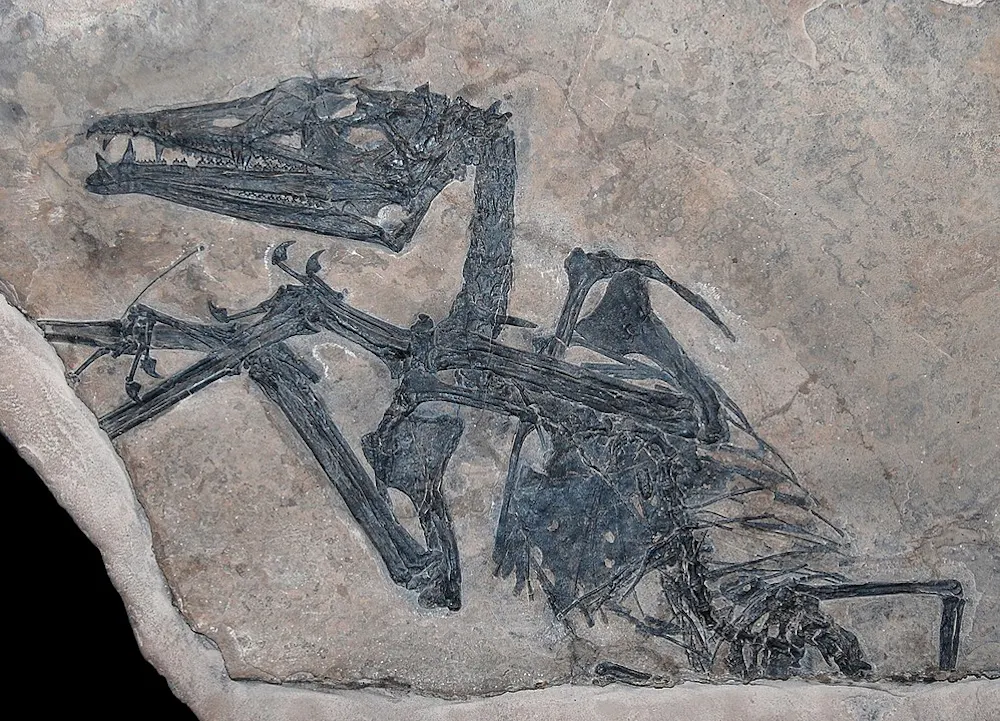
    Eudimorphodon ranzii fossil from Bergamo in 1973 is one of many pterosaur discoveries from southern Europe.
    Wikimedia, CC BY-SA

    For decades, the debate stalled as a result of too few fossils or too many missing rocks. This impasse began to change in 2020, when scientists identified the closest relatives of pterosaurs in a group of smallish upright reptiles called lagerpetids.

    From comparing many anatomical traits across different species, the researchers established that pterosaurs and lagerpetids shared many similarities including their skulls, skeletons and inner ears. While this discovery did not bring any “missing link” to the table, it showed what the ancestor of pterosaurs would have looked like: a rat-to-dog-sized creature that lived on land and in trees.

    This brought new evidence about when pterosaurs may have originated. Pterosaurs and lagerpetids like Scleromochlus, a small land-dwelling reptile, diverged at some point after the end-Permian mass extinction. It occurred some 250 million years ago, 35 million years before the first pterosaur appearance in the fossil record.

    Scleromochlus is one of the lagerpetids, the closest known relatives to the pterosaurs.
    Gabriel Ugueto

    Pterosaurs and their closest kin did not share the same habitats, however. Our new study, featuring new fossil maps, shows that soon after lagerpetids appeared (in southern Pangaea), they spread across wide areas, including harsh deserts, that many other groups were unable to get past. Lagerpetids lived both in these deserts and in humid floodplains.

    They tolerated hotter, drier settings better than any early pterosaur, implying that they had evolved to cope with extreme temperatures. Pterosaurs, by contrast, were more restricted. Their earliest fossils cluster in the river and lake beds of the Chinle and Dockum basins (southwest US) and in moist coastal belts fringing the northern arm of the Tethys Sea, a huge area that occupied today’s Alps.

    Scientists have inferred from analysing a combination of fossil distributions, rock features and climate simulations that pterosaurs lived in areas that were warm but not scorching. The rainfall would have been comparable to today’s tropical forests rather than inland deserts.

    This suggests that the earliest flying dinosaurs may have lived in tree canopies, using foliage both for take-off and to protect themselves from predators and heat. As a result of this confined habitat, the distances that they flew may have been quite limited.

    Changing climates

    We were then able to add a fresh dimension to the story using a method called ecological niche modelling. This is routinely used in modern conservation to project where endangered animals and plants might live as the climate gets hotter. By applying this approach to later Triassic temperatures, rainfall and coastlines, we asked where early pterosaurs lived, regardless of whether they’ve shown up there in the fossil record.

    Many celebrated fossil sites in Europe emerge as poor pterosaur habitat until very late in the Triassic period: they were simply too hot, too dry or otherwise inhospitable before the Carnian age, around 235 million years ago. The fact that no specimens have been discovered there that are more than about 215 million years old may be because the climate conditions were still unsuitable or simply because we don’t have the right type of rocks preserved of that age.

    In contrast, parts of the south-western US, Morocco, India, Brazil, Tanzania and southern China seem to have offered welcoming environments several million years earlier than the age of our oldest discoveries. This rewrites the search map. If pterosaurs could have thrived in those regions much more than 215 million years ago, but we have not found them there, the problem may again lie not with biology but with geology: the right rocks have not been explored, or they preserve fragile fossils only under exceptional conditions.

    Our study flags a dozen geological formations, from rivers with fine sediment deposits to lake beds, as potential prime targets for the next breakthrough discovery. They include the Timezgadiouine beds of Morocco, the Guanling Formation of south-west China and, in South America, several layers of rock from the Carnian age, such as the Santa Maria Formation, Chañares Formation and Ischigualasto Formation.

    Pterosaurs were initially confined to tropical treetops near the equator. When global climates shifted and forested corridors opened, pterosaurs’ wings catapulted them into every corner of the planet and ultimately carried them through one of Earth’s greatest extinctions. What began as a tale of missing fossils has become a textbook example of how climate, ecology and evolutionary science have come together to illuminate a fragmentary history that has intrigued paleontologists for over two centuries.

    Davide Foffa is funded by Marie Skłodowska-Curie Actions: Individual (Global) Fellowship (H2020-MSCA-IF-2020; No.101022550), and by the Royal Commission for the Exhibition of 1851–Science Fellowship

    Alfio Alessandro Chiarenza receives funding from The Royal Society (Newton International Fellowship NIFR1231802)

    Emma Dunne does not work for, consult, own shares in or receive funding from any company or organisation that would benefit from this article, and has disclosed no relevant affiliations beyond their academic appointment.

    ref. How pterosaurs learned to fly: scientists have been looking in the wrong place to solve this mystery – https://theconversation.com/how-pterosaurs-learned-to-fly-scientists-have-been-looking-in-the-wrong-place-to-solve-this-mystery-259063

    MIL OSI – Global Reports

  • MIL-OSI Africa: Electoral Commission hosts first symposium on political funding in SA

    Source: South Africa News Agency

    The Electoral Commission of South Africa (IEC) has launched a two-day symposium on political funding, aimed at evaluating and enhancing the regulatory framework governing the use of money in politics.

    The first-ever symposium on political funding, follows four years of implementing the Political Funding Act of 2018, which came into effect on 1 April 2021.

    Held under the theme: “Sustaining Multi-Party Democracy through Enhancing Political Funding Regulation in South Africa” the symposium aims to foster informed dialogue on the matters related to the use of money in politics, promote transparency and accountability models, as well as possible reforms to ensure an effective political finance regulatory regime in South Africa.

    According to a statement issued by the Commission on Wednesday, the key highlights of the symposium include opening remarks by the Chairperson of the Electoral Commission, Mosotho Moepya, presentation by Chief Electoral Officer Sy Mamabolo, and the Political Funding Unit outlining the Commission’s experience in implementing the law since its promulgation. 

    “This aspect will naturally involve the points of success and areas of challenge. Furthermore, the Human Sciences Research Council (HSRC) will outline the preliminary outcomes of the research study which, amongst others, gathered the views and perspectives of stakeholders and the public on political financing in the country,” the Commission said. 

    Finance Minister, Enoch Godongwana is scheduled to address the symposium on Thursday morning, where he is expected to provide a perspective on the public funding of elected representative to enhance multi-party democracy.

    Several scholars will also present their work in this area of money and politics. 

    Highlights of the programme include the following:

    • A global perspective on political funding and campaign finance.

    • The role and mandate of the political funding framework in strengthening democratic governance.

    • Assessing the capacity and commitment of key stakeholders in improving the regulation of political funding.

    • Transparency in public and private political party funding: challenges and prospects.

    The symposium brings together a wide range of stakeholders, including representatives from political parties, members of parliament, academia, civil society, the media, the business sector, as well as international and intergovernmental organisations.

    Speaking ahead of the symposium, Mamabolo emphasised the need for a collective commitment to enhance transparency in the political funding landscape, to foster a vibrant system of multiparty democracy. 

    “By convening diverse stakeholders, we aim to critically assess our progress and explore avenues for strengthening the current regulatory framework and thus ensure that our democracy remains robust and resilient,” he said.

    The symposium is taking place at Umhlanga, north of Durban, from 18-19 June 2025. – SAnews.gov.za

    MIL OSI Africa

  • MIL-OSI Russia: Central Asian countries are becoming important trading partners of China’s Sichuan province

    Translation. Region: Russian Federal

    Source: People’s Republic of China in Russian –

    Source: People’s Republic of China – State Council News

    CHENGDU, June 18 (Xinhua) — Trade volume between southwest China’s Sichuan Province and five Central Asian countries increased 57.3 percent year on year to 2.78 billion yuan (about 386.8 million U.S. dollars) in January-April 2025, data from Chengdu Customs showed.

    In recent years, Central Asian countries have become important partners for Sichuan Province, which is seeking to build a highly open economy. Data show that in the first four months, the province’s exports to countries in the region totaled 2.61 billion yuan, up 57.9 percent year-on-year, while imports rose 48.5 percent to 170 million yuan.

    Automobiles, semiconductors, batteries and other products account for a large share of the goods exported from Sichuan to Central Asia, while rapeseed oil, ferroalloys and food are mainly imported from Central Asia.

    Sichuan Province and the Central Asian countries have great complementarity and enormous potential for cooperation in the fields of industry, economy, trade, culture, tourism, science and education. In terms of trade with Sichuan Province, Uzbekistan ranks first among the five Central Asian countries, being an important investment destination for the province in the Central Asian region. Thanks to this province, chemical products, porcelain and barley from Uzbekistan enter the Chinese market.

    The cooperation models between Sichuan and Central Asian countries also continue to be updated. For example, a service center of Sichuan Port and Shipping Investment Group Co., Ltd., responsible for international sales, was commissioned in Tashkent, as well as a bonded automobile demonstration center, where over 100 types of products from more than 40 Sichuan enterprises are presented. In addition, China-Central Asia freight trains annually deliver about 5,000 tons of tea from Chengdu to Tashkent. -0-

    MIL OSI Russia News

  • MIL-OSI Russia: Congratulations to Denis Orlov on the successful defense of his PhD dissertation

    Translation. Region: Russian Federal

    Source: Saint Petersburg State University of Architecture and Civil Engineering – Saint Petersburg State University of Architecture and Civil Engineering – Denis Orlov

    Congratulations to Denis Romanovich Orlov, a document specialist at the Department of Ground Transport and Technological Machines at SPbGASU, on successfully defending his dissertation for the degree of Candidate of Technical Sciences.

    Scientific supervisor: Sergey Vasilyevich Repin, Doctor of Technical Sciences, Professor, Professor of the Department of Ground Transport and Technological Machines at St. Petersburg State University of Architecture and Civil Engineering.

    Dissertation topic: “Method for calculating the parameters of hydropneumatic shock absorbers of transport and technological machines”. Scientific specialty – 2.5.11. Ground transport and technological vehicles and complexes.

    The defense took place on May 27 in the dissertation council 24.2.380.05, created on the basis of our university.

    Please note: This information is raw content directly from the source of the information. It is exactly what the source states and does not reflect the position of MIL-OSI or its clients.

    MIL OSI Russia News

  • MIL-OSI Russia: Sergei Sobyanin: The second stage of modernization of Moscow schools has begun

    Translation. Region: Russian Federal

    Source: Moscow Government – Government of Moscow –

    The second stage of school modernization has begun in the capital. This was reported in his telegram channel Sergei Sobyanin.

    “We are renovating not only the buildings, but also the environment in which children study. The work will take place in 10 districts. All buildings included in the program

    “My school”, we are bringing them to a single standard. We are updating facades and roofs, all engineering systems, interior spaces of schools, including classrooms, corridors and common areas. New furniture, equipment, lighting – we select everything taking into account convenience and safety,” the Mayor of Moscow wrote.

    Source: Sergei Sobyanin’s Telegram channel @mos_sobyanin

    According to him, the city has rethought its approach to modernizing schools. Now they will have modern specialized classrooms for studying computer science and natural sciences, new sports and gymnastics halls, media libraries, spaces for creativity, project work, extracurricular activities and recreation. Soft furniture will be installed in common areas.

    Sports zones and parking areas for bicycles and scooters will be equipped in the territories, benches and new lights will be installed. And playgrounds will appear near the primary schools.

    All work is planned to be completed in 2026. And by the beginning of this academic year, as part of the first stage of the renovation, a 51 schoolIn total, it is planned to modernize about 700 school buildings in the capital.

    Sobyanin approved priorities for the development of the Moscow education system

    Please note: This information is raw content directly from the source of the information. It is exactly what the source states and does not reflect the position of MIL-OSI or its clients.

    Please Note; This Information is Raw Content Directly from the Information Source. It is access to What the Source Is Stating and Does Not Reflect

    HTTPS: //vv.mos.ru/mayor/tkhemes/12956050/

    MIL OSI Russia News

  • MIL-OSI Russia: Congratulations to Daria Denisikhina on successfully defending her doctoral dissertation

    Translation. Region: Russian Federal

    Source: Saint Petersburg State University of Architecture and Civil Engineering – Saint Petersburg State University of Architecture and Civil Engineering – Daria Denisikhina

    Congratulations to Daria Mikhailovna Denisikhina, associate professor of the Department of Heat and Gas Supply and Ventilation at St. Petersburg State University of Architecture and Civil Engineering, for successfully defending her dissertation for the degree of Doctor of Technical Sciences.

    Scientific consultant – Tamara Aleksandrovna Datsyuk, Doctor of Technical Sciences, Professor, Professor of the Department of Construction Physics, Electric Power Engineering and Electrical Engineering at St. Petersburg State University of Architecture and Civil Engineering.

    Dissertation topic: “Scientific foundations of mathematical modeling of air exchange and air distribution in public buildings”. Scientific specialty – 2.1.3. Heat supply, ventilation, air conditioning, gas supply and lighting.

    The defense took place on June 17 in the dissertation council 24.2.380.03, created on the basis of our university.

    Please note: This information is raw content directly from the source of the information. It is exactly what the source states and does not reflect the position of MIL-OSI or its clients.

    MIL OSI Russia News

  • MIL-OSI Africa: Mashatile arrives in Moscow to boost SA-Russia trade relations

    Source: South Africa News Agency

    Deputy President Paul Mashatile has arrived in Moscow for a working visit aimed at strengthening economic and trade ties between South Africa and Russia. 

    The Deputy President was received at the airport by the Deputy Head of State Protocol, Andrei Milyaev, the Deputy Director of the African Department, Andrei Stolyarov, and South Africa’s Deputy Minister of International Relations and Cooperation, Alvin Botes. 

    According to the Deputy President’s Office, the visit will focus on enhancing economic cooperation between the two countries in sectors such as agriculture, automotive, energy, and mining industries, as well as cooperation in science and technology. 

    “It will take place in two cities, namely Moscow and St. Petersburg, for high-level engagements as well as economic diplomacy activities,“ the Deputy President’s Office said in a statement. 

    In Moscow, Mashatile will meet with the Prime Minister of Russia, Mikhail Mishutin, and lay a wreath at the memorial site dedicated to South Africa’s liberation stalwarts, John Beaver (JB) Marks and Moses Kotane. 

    Following this, he will participate in the 28th St. Petersburg International Economic Forum (SPIEF2025). This year’s forum will be held from 19 – 21 June under the theme: “Shared Values: The Foundation of Growth in a Multipolar World”.

    The Deputy President will participate in the plenary session of SPIEF2025 and has also received an invitation to speak at the Russia-Africa Business Dialogue.

    In addition, he is scheduled to deliver a public lecture at St. Petersburg State University on the topic: “South Africa’s G20 Presidency in a Rapidly Changing Geopolitical Environment”.

    He will also address attendees at the opening of the South African Trade and Investment Seminar.

    The St. Petersburg leg of the visit aims to enhance South Africa’s trade relationships and establish the country as a prime investment destination.

    According to the Deputy President’s Office, this trip is Mashatile’s first visit to Russia since he took office under the seventh administration. 

    He is accompanied by a delegation of Ministers and Deputy Ministers, who are part of the Economic Sectors, Investment, Employment and Infrastructure Development Cabinet Cluster. 

    This includes the Science, Technology and Innovation Minister, Dr Blade Nzimande; Water and Sanitation Minister Pemmy Majodina; Trade, Industry and Competition Minister Parks Tau; Agriculture Deputy Minister Nokuzola Capa; Public Works and Infrastructure Deputy Minister Sihle Zikalala; Mineral and Petroleum Resources Deputy Minister, Phumzile Mgcina, and Sport, Arts and Culture Deputy Minister,  Peace Mabe. – SAnews.gov.za

    MIL OSI Africa

  • MIL-OSI China: Xi urges China, Central Asian countries to promote high-quality Belt and Road cooperation 2025-06-18 15:08:08 Chinese President Xi Jinping on Tuesday called on China and Central Asian countries to promote high-quality Belt and Road cooperation and forge ahead toward the goal of building a China-Central Asia community with a shared future under the guidance of the China-Central Asia Spirit.

    Source: People’s Republic of China – Ministry of National Defense

    Chinese President Xi Jinping delivers a keynote speech during the second China-Central Asia Summit in Astana, Kazakhstan, June 17, 2025. The second China-Central Asia Summit was held in Astana on Tuesday. Kazakh President Kassym-Jomart Tokayev chaired the summit. Xi, Kyrgyz President Sadyr Japarov, Tajik President Emomali Rahmon, Turkmen President Serdar Berdimuhamedov and Uzbek President Shavkat Mirziyoyev attended the summit. (Xinhua/Huang Jingwen)

    ASTANA, June 17 (Xinhua) — Chinese President Xi Jinping on Tuesday called on China and Central Asian countries to promote high-quality Belt and Road cooperation and forge ahead toward the goal of building a China-Central Asia community with a shared future under the guidance of the China-Central Asia Spirit.

    Xi made the remarks in his keynote speech at the second China-Central Asia Summit hosted by Kazakh President Kassym-Jomart Tokayev. Kyrgyz President Sadyr Japarov, Tajik President Emomali Rahmon, Turkmen President Serdar Berdimuhamedov and Uzbek President Shavkat Mirziyoyev also attended the summit.

    Xi pointed out that during their meeting in Xi’an two years ago, they jointly outlined the Xi’an Vision for China-Central Asia cooperation. Two years on, China and Central Asian countries have further deepened and substantiated Belt and Road cooperation, he said, recalling advanced cooperation in various fields.

    The core framework of the China-Central Asia mechanism is largely in place, and the consensus at the first Summit has been implemented across the board, Xi said, adding that the path of cooperation among the countries is steadily widening, and their friendship is blooming ever more brightly.

    Xi stressed that the cooperation between China and Central Asian countries is rooted in more than 2,000 years of friendly exchanges, cemented by solidarity and mutual trust cultivated through more than three decades of diplomatic ties, and taken forward via openness and win-win cooperation of the new era.

    Xi said building on their collective efforts over the years, the six countries have forged a China-Central Asia Spirit of “mutual respect, mutual trust, mutual benefit and mutual assistance for the joint pursuit of modernization through high-quality development.”

    The spirit connotes four aspects of practices. First, Xi said that China and Central Asian countries practice mutual respect and treat each other as equals, and all countries, big or small, are equal, adding that the six countries handle issues through consultation and make decisions by consensus.

    Second, he said that China and Central Asian countries seek to deepen mutual trust and enhance mutual support, firmly support each other in safeguarding independence, sovereignty, territorial integrity and national dignity, and do not do anything harmful to the core interests of any party.

    Third, Xi said China and Central Asian countries pursue mutual benefit and win-win cooperation and strive for common development, view each other as priority partners, and share development opportunities together, adding that they accommodate each other’s interests, and work to build a win-win and symbiotic relationship.

    Fourth, he said China and Central Asian countries help each other in time of need and stand together through thick and thin, supporting each other in choosing development paths suitable to respective national conditions and in taking domestic matters into their own hands, adding that the countries work together to address various risks and challenges, and uphold regional security and stability.

    This China-Central Asia Spirit is an important guideline for their endeavor to carry forward friendship and cooperation from generation to generation, and the six countries should always uphold it and let it shine forever, Xi noted.

    Today, unprecedented changes are unfolding at a faster pace across the globe, thrusting the world into a new state of heightened turbulence and volatility, Xi pointed out, noting that a strong belief in fairness and justice, and an unyielding commitment to mutual benefit and win-win cooperation are the only way to maintain world peace and achieve common development.

    There is no winner in tariff wars or trade wars, and unilateralism, protectionism and hegemonism will surely backfire while hurting others, he noted.

    Maintaining that history should move forward, not backward, and the world should be united, not divided, Xi said humanity must not regress to the law of the jungle, but should instead build a community with a shared future for mankind.

    Xi called on the six countries to act on the China-Central Asia Spirit, and enhance cooperation with renewed vigor and more practical measures.

    To achieve this, he made five points.

    First, China and Central Asian countries should stay committed to the fundamental goal of unity, and always trust and support each other, he said.

    China consistently takes Central Asia as a priority in its neighborhood diplomacy, Xi noted, adding that with a firm belief in an amicable, secure and prosperous neighborhood as well as a strong dedication to amity, sincerity, mutual benefit and inclusiveness, China interacts with Central Asian countries on the basis of equality and sincerity, and the six countries always wish their neighbors well.

    The six countries will sign together a treaty on eternal good-neighborliness, friendship and cooperation to enshrine the principle of everlasting friendship in the form of law, he said, deeming it as a new landmark in the history of the relations of the six countries and a pioneering initiative in China’s diplomatic engagement with its neighbors, which constitutes a milestone for today and a foundation for tomorrow.

    Second, China and Central Asian countries should optimize the cooperation framework to make it more results-oriented, more efficient and more deeply integrated, Xi said.

    Recalling that the six countries have agreed to designate 2025 and 2026 as the Years of High-Quality Development of China-Central Asia Cooperation, he said that all sides should focus the cooperation on smooth trade, industrial investment, connectivity, green mining, agricultural modernization and personnel exchanges, roll out more projects on the ground and foster new quality productive forces.

    He said China has decided to establish three cooperation centers, i.e. on poverty reduction, on education exchange, and on desertification prevention and control, as well as a cooperation platform on smooth trade under the China-Central Asia cooperation framework.

    China supports Central Asian countries in developing livelihood and development projects, Xi said, adding that China will provide 3,000 training opportunities to Central Asian countries in the next two years.

    Third, China and Central Asian countries should develop a security framework for peace, tranquility and solidarity, step up regional security governance, deepen law enforcement and security cooperation, jointly prevent and thwart extreme ideologies, and resolutely fight terrorism, separatism and extremism, so as to maintain peace and stability in the region, Xi said.

    China will do its best to help Central Asian countries combat terrorism and transnational organized crime and safeguard cybersecurity and biosecurity, he said.

    Fourth, China and Central Asian countries should cement the bonds of shared vision, mutual understanding and mutual affection between peoples, he noted, saying that China will enhance cooperation between legislatures, political parties, women, youth, media and think tanks with Central Asian countries, conduct in-depth exchange of governance experience, and is ready to set up more cultural centers, university branches and Luban Workshops in Central Asia to train more high-caliber talent for Central Asian countries.

    China supports deepening subnational cooperation with Central Asia, Xi said, adding that China and Central Asian countries should nurture heart-to-heart connections at central and subnational levels, between official and non-governmental actors, and from adjacent to broader areas.

    Fifth, China and Central Asian countries should uphold a fair and equitable international order and an equal and orderly world structure, stand ready to work with all parties to defend international fairness and justice, oppose hegemonism and power politics, and promote an equal and orderly multipolar world and a universally beneficial and inclusive economic globalization, Xi said.

    This year marks the 80th anniversary of the victory of the Chinese People’s War of Resistance Against Japanese Aggression and the World Anti-Fascist War, and the 80th anniversary of the founding of the United Nations, he said, recalling that in the strenuous times of war, Chinese and Central Asian peoples supported each other through adversity, and jointly made important contributions to the cause of justice of humanity.

    He also noted the need to promote the correct view of history, defend the fruits of the victory of World War II, uphold the UN-centered international system, and provide more stability and certainty for world peace and development.

    Xi pointed out that China is building a great modern socialist country in all respects and advancing the great rejuvenation of the Chinese nation on all fronts through Chinese modernization.

    No matter how the international situation changes, China will remain unwavering in opening up to the outside world, he said, noting that China is ready to embrace higher-quality cooperation and deepen the integration of interests with Central Asian countries, so as to achieve common development and strive for new progress in China-Central Asia cooperation.

    Tokayev and the other four Central Asian leaders unanimously stated that the China-Central Asia mechanism has become an important platform for promoting dialogue and cooperation, as well as for advancing the economic and social development of Central Asian countries.

    In a world full of uncertainties, the strategic significance of the mechanism has become increasingly prominent, and China’s growing prosperity and strength are benefiting its neighboring countries, they said, noting that China is a strategic partner and a true friend that Central Asian countries can always count on.

    The Central Asian countries highly value the model of cooperation with China based on mutual respect, equality and mutual benefit, and look forward to deepening all-round cooperation with China and expanding trade and investment, the five leaders added.

    They also expressed the hope to jointly pursue high-quality Belt and Road cooperation, promote cooperation in such fields as industry, agriculture, science and technology, infrastructure, new energy and connectivity, strengthen regional security collaboration, and enhance people-to-people and cultural exchanges in fields like culture, education and tourism.

    The leaders of the five Central Asian countries expressed their intention to build the China-Central Asia mechanism into a model of regional cooperation, share development and prosperity, jointly promote peace and stability, and build a closer community with a shared future.

    The five parties highly appreciate China’s constructive role in international and regional affairs, and actively support the concept of building a community with a shared future for mankind, as well as the three major global initiatives proposed by President Xi.

    They also expressed the willingness to closely coordinate and cooperate with China to firmly safeguard free trade and the multilateral trading system, and jointly defend international equity and justice.

    During the summit, Xi and the heads of state of the Central Asian nations signed the Astana Declaration of the second China-Central Asia Summit, and a treaty on eternal good-neighborliness, friendship and cooperation.

    The meeting also announced the signing of 12 cooperation agreements regarding the Belt and Road cooperation, facilitation of personnel exchanges, green mining, trade, connectivity, industry and customs.

    At the summit, China signed multiple sister city agreements with the five Central Asian countries, thus the pairs of sister cities between the two sides have exceeded 100.

    Xi and other leaders also witnessed the inauguration of three China-Central Asia cooperation centers and a trade platform, namely the China-Central Asia poverty reduction cooperation center, the China-Central Asia education exchange cooperation center, the China-Central Asia desertification prevention and control cooperation center, as well as the China-Central Asia smooth trade cooperation platform.

    All parties also agreed that China will host the third China-Central Asia Summit in 2027.

    Chinese President Xi Jinping, Kazakh President Kassym-Jomart Tokayev, Kyrgyz President Sadyr Japarov, Tajik President Emomali Rahmon, Turkmen President Serdar Berdimuhamedov and Uzbek President Shavkat Mirziyoyev pose for a group photo in Astana, Kazakhstan, June 17, 2025. The second China-Central Asia Summit was held in Astana on Tuesday. Tokayev chaired the summit. Xi, Japarov, Rahmon, Berdimuhamedov and Mirziyoyev attended the summit. (Xinhua/Xie Huanchi)

    Chinese President Xi Jinping walks into the venue of the second China-Central Asia Summit in Astana, Kazakhstan, June 17, 2025. The second China-Central Asia Summit was held in Astana on Tuesday. Kazakh President Kassym-Jomart Tokayev chaired the summit. Xi, Kyrgyz President Sadyr Japarov, Tajik President Emomali Rahmon, Turkmen President Serdar Berdimuhamedov and Uzbek President Shavkat Mirziyoyev attended the summit. (Xinhua/Ding Lin)

    Chinese President Xi Jinping shakes hands with Kazakh President Kassym-Jomart Tokayev in Astana, Kazakhstan, June 17, 2025. The second China-Central Asia Summit was held in Astana on Tuesday. Tokayev chaired the summit. Xi, Kyrgyz President Sadyr Japarov, Tajik President Emomali Rahmon, Turkmen President Serdar Berdimuhamedov and Uzbek President Shavkat Mirziyoyev attended the summit. (Xinhua/Xie Huanchi)

    Chinese President Xi Jinping delivers a keynote speech during the second China-Central Asia Summit in Astana, Kazakhstan, June 17, 2025. The second China-Central Asia Summit was held in Astana on Tuesday. Kazakh President Kassym-Jomart Tokayev chaired the summit. Xi, Kyrgyz President Sadyr Japarov, Tajik President Emomali Rahmon, Turkmen President Serdar Berdimuhamedov and Uzbek President Shavkat Mirziyoyev attended the summit. (Xinhua/Yin Bogu)

    Chinese President Xi Jinping, Kazakh President Kassym-Jomart Tokayev, Kyrgyz President Sadyr Japarov, Tajik President Emomali Rahmon, Turkmen President Serdar Berdimuhamedov and Uzbek President Shavkat Mirziyoyev witness inauguration of the China-Central Asia poverty reduction cooperation center, the China-Central Asia education exchange cooperation center, the China-Central Asia desertification control cooperation center and the China-Central Asia trade facilitation cooperation platform in Astana, Kazakhstan, June 17, 2025. The second China-Central Asia Summit was held in Astana on Tuesday. Tokayev chaired the summit. Xi, Japarov, Rahmon, Berdimuhamedov and Mirziyoyev attended the summit. (Xinhua/Yin Bogu)

    MIL OSI China News

  • MIL-OSI Europe: Sciences Po and Its CIVICA Partners Stand for Academic Freedom & University Autonomy

    Source: Universities – Science Po in English

    In times of global uncertainty, CIVICA – a European alliance of ten leading universities in the social sciences – reaffirms its stance against political or financial interference in science and education. The alliance is concerned by attempts across the globe to restrict academic inquiry or reshape institutions for ideological ends. Such actions erode the autonomy of higher education institutions and undermine the quality of academic research and teaching.

    During a Presidents’ meeting at SGH Warsaw last week, the CIVICA partners decided on a joint statement to reaffirm the importance of academic freedom and institutional autonomy, as essential pillars of democratic and open societies.

    In keeping with the core values of their mission, CIVICA partners express their solidarity with institutions, scholars, and students facing pressure or discrimination. CIVICA remains committed to fostering free and open spaces for academic inquiry and critical debate, encouraging diversity of views and pluralism.

    CIVICA partners’ presidents and team at SGH Warsaw, June 2025. (credits: Piotr Potapowicz / SGH Warsaw)

    The joint statement is endorsed by:

    • Sciences Po,
    • Bocconi University,
    • Central European University,
    • European University Institute,
    • Hertie School,
    • National University of Political Studies and Public Administration,
    • SGH Warsaw School of Economics,
    • Stockholm School of Economics.

    Following a report co-authored by Florence Haegel, Marie Mawad, and Jeremy Perelman, submitted to the President of Sciences Po, Sciences Po adopted its own doctrine on the same topics in March 2025.

    Sciences Po applies a general principle of institutional restraint. This refocusing ensures the pluralism of opinions within the human, intellectual, and academic community that is Sciences Po.

    This principle is distinct from that of “neutrality” and does not imply the institution’s disengagement from all public debate. Positions taken by Sciences Po are indeed considered legitimate if they are linked to the primary missions of the institution.

    MIL OSI Europe News

  • Axiom Mission 4 launch to ISS rescheduled for June 22

    Source: Government of India

    Source: Government of India (4)

    NASA has once again rescheduled the launch of the fourth private astronaut mission to the International Space Station (ISS), Axiom Mission 4 (Ax-4), to no earlier than June 22.

    The decision comes as NASA, in collaboration with Axiom Space and SpaceX, continues to evaluate recent repair work conducted in the aft (rear) segment of the ISS’s Russian Zvezda service module.

    Originally scheduled for May 29, the launch has been deferred multiple times. It was first deferred to June 8, then to June 10, June 11, and June 19.

    The crew is now scheduled to lift off aboard a SpaceX Falcon 9 rocket from Launch Complex 39A at NASA’s Kennedy Space Center in Florida.

    ISRO confirmed the revised launch timeline in a statement on X: “Teams from @isro, Poland, and Hungary engaged in a detailed discussion with @Axiom_Space regarding the probable launch timeline of Axiom Mission 4. Following this, @Axiom_Space held consultations with @NASA and @SpaceX to assess multiple readiness parameters. Based on the readiness status of the @SpaceX Falcon 9 launch vehicle, the Dragon spacecraft, repairs in the Zvezda module of the @Space_Station, ascent corridor weather conditions, and the health and preparedness of the crew in quarantine, @Axiom_Space has informed that the next probable launch date is 22 June 2025.”

    Union Minister of State for Science and Technology Jitendra Singh also confirmed the postponement of Axiom-4 on X. He said, “Update | Axiom Mission 04 to International Space Station (ISS). After assessing the key parameters including Module Fitness, Crew Health, Weather etc… Axiom Space has indicated that 22 June 2025 may be the next likely launch date of Axiom-04 Mission carrying, among others, the Indian astronaut Shubhanshu Shukla, to the International Space Station. Further updates, if any, shall be shared accordingly.”

    The Ax-4 mission marks another milestone in the growing field of commercial spaceflight, showcasing international collaboration and private sector innovation. The mission will be led by Peggy Whitson, a veteran former NASA astronaut and now Director of Human Spaceflight at Axiom Space. She will serve as the mission commander.

    Joining Whitson on the SpaceX Dragon spacecraft are three other astronauts: Shubhanshu Shukla, an astronaut from the Indian Space Research Organisation (ISRO), who will serve as the mission’s pilot; Sławosz Uznanski-Wiśniewski, a Polish project astronaut from the European Space Agency (ESA); and Tibor Kapu from Hungary—both serving as mission specialists.

    Once aboard the ISS, Shukla will conduct pioneering experiments related to food and space nutrition. These experiments, developed through a collaboration between ISRO and the Department of Biotechnology (DBT), with support from NASA, aim to enhance understanding of sustainable life-support systems—a crucial aspect of future long-duration space travel.

    Indian Air Force Group Captain Shubhanshu Shukla will become the second Indian to travel to space after Rakesh Sharma’s 1984 mission.

    The Ax-4 mission is Axiom Space’s fourth private astronaut flight to the ISS. The Ax-4 crew includes astronauts from India, Poland, and Hungary. According to Axiom, this will be the first government-sponsored human spaceflight for the three nations since the 1980s.

    (With inputs from IANS)

  • Axiom Mission 4 launch to ISS rescheduled for June 22

    Source: Government of India

    Source: Government of India (4)

    NASA has once again rescheduled the launch of the fourth private astronaut mission to the International Space Station (ISS), Axiom Mission 4 (Ax-4), to no earlier than June 22.

    The decision comes as NASA, in collaboration with Axiom Space and SpaceX, continues to evaluate recent repair work conducted in the aft (rear) segment of the ISS’s Russian Zvezda service module.

    Originally scheduled for May 29, the launch has been deferred multiple times. It was first deferred to June 8, then to June 10, June 11, and June 19.

    The crew is now scheduled to lift off aboard a SpaceX Falcon 9 rocket from Launch Complex 39A at NASA’s Kennedy Space Center in Florida.

    ISRO confirmed the revised launch timeline in a statement on X: “Teams from @isro, Poland, and Hungary engaged in a detailed discussion with @Axiom_Space regarding the probable launch timeline of Axiom Mission 4. Following this, @Axiom_Space held consultations with @NASA and @SpaceX to assess multiple readiness parameters. Based on the readiness status of the @SpaceX Falcon 9 launch vehicle, the Dragon spacecraft, repairs in the Zvezda module of the @Space_Station, ascent corridor weather conditions, and the health and preparedness of the crew in quarantine, @Axiom_Space has informed that the next probable launch date is 22 June 2025.”

    Union Minister of State for Science and Technology Jitendra Singh also confirmed the postponement of Axiom-4 on X. He said, “Update | Axiom Mission 04 to International Space Station (ISS). After assessing the key parameters including Module Fitness, Crew Health, Weather etc… Axiom Space has indicated that 22 June 2025 may be the next likely launch date of Axiom-04 Mission carrying, among others, the Indian astronaut Shubhanshu Shukla, to the International Space Station. Further updates, if any, shall be shared accordingly.”

    The Ax-4 mission marks another milestone in the growing field of commercial spaceflight, showcasing international collaboration and private sector innovation. The mission will be led by Peggy Whitson, a veteran former NASA astronaut and now Director of Human Spaceflight at Axiom Space. She will serve as the mission commander.

    Joining Whitson on the SpaceX Dragon spacecraft are three other astronauts: Shubhanshu Shukla, an astronaut from the Indian Space Research Organisation (ISRO), who will serve as the mission’s pilot; Sławosz Uznanski-Wiśniewski, a Polish project astronaut from the European Space Agency (ESA); and Tibor Kapu from Hungary—both serving as mission specialists.

    Once aboard the ISS, Shukla will conduct pioneering experiments related to food and space nutrition. These experiments, developed through a collaboration between ISRO and the Department of Biotechnology (DBT), with support from NASA, aim to enhance understanding of sustainable life-support systems—a crucial aspect of future long-duration space travel.

    Indian Air Force Group Captain Shubhanshu Shukla will become the second Indian to travel to space after Rakesh Sharma’s 1984 mission.

    The Ax-4 mission is Axiom Space’s fourth private astronaut flight to the ISS. The Ax-4 crew includes astronauts from India, Poland, and Hungary. According to Axiom, this will be the first government-sponsored human spaceflight for the three nations since the 1980s.

    (With inputs from IANS)

  • MIL-OSI United Kingdom: Lesley Cowley OBE appointed as Chair of Building Digital UK

    Source: United Kingdom – Executive Government & Departments

    Press release

    Lesley Cowley OBE appointed as Chair of Building Digital UK

    Lesley Cowley OBE has been appointed by Technology Secretary Peter Kyle to chair Building Digital UK (BDUK).

    Lesley Cowley OBE has been appointed by Technology Secretary Peter Kyle to chair Building Digital UK (BDUK) – the government agency responsible for rolling out fast and reliable broadband and mobile coverage to hard-to-reach places across the UK.

    The British businesswoman is widely regarded as an accomplished leader in the digital and technology sectors, offering decades of experience leading a variety of public services and businesses.

    The role will see Lesley advise and support BDUK’s executive team on the delivery of BDUK’s two main programmes: Project Gigabit, the government’s rollout of lightning-fast broadband to areas that would otherwise be stuck with slower speeds, and the Shared Rural Network, a joint programme with mobile network operators to boost 4G mobile coverage in rural communities all over the country.

    Chair of BDUK Lesley Cowley OBE said:

    It is a privilege to join Building Digital UK at such a pivotal moment in its journey. The challenge of ensuring every corner of the UK benefits from fast, reliable digital infrastructure is one I am deeply passionate about.

    BDUK is a critical enabler of the Prime Minister’s Plan for Change, helping to grow the economy while ensuring communities are not left behind in the digital age. Working alongside the talented team at BDUK, we will continue to deliver on our mission of creating a more connected, inclusive, and digitally empowered nation.

    Technology Secretary Peter Kyle said:

    Lesley’s commitment to making a positive difference to public facing services, together with her track record in leading digital transformation and delivering innovative solutions, make her an outstanding choice for Chair of Building Digital UK.

    She will be instrumental in helping us deliver on our growth mission, by continuing to drive forward our ambitious plans for better connectivity across the every part of UK, making communities and businesses better off.

    Lesley will take up the post on 1 July 2025, taking over from Hazel Hobbs who has served as interim Chair since August 2024.

    Her previous executive career culminated in her role as Chief Executive Officer of Nominet, the .uk domain name registry, where for over a decade she led significant growth and evolution from a technical organisation into a key player in the global internet space. She was appointed OBE in recognition of her services to the internet and digital economy.

    In her subsequent career, Lesley was the first Chair of the Driver and Vehicle Licensing Agency (DVLA), Chair of Companies House and Lead Non-Executive Director and then first ever Chair of The National Archives. Her current roles include Chair of ACL Ltd and a Non-Executive Director of Public Digital Ltd., both private companies.

    She was the Institute of Directors UK NED of the Year Winner, 2019 and has a strong track record of driving technology transformation and customer-first approaches.

    ENDS

    Notes to editors

    Chair appointment

    The appointment is for a term of three years.

    Building Digital UK

    Building Digital UK (BDUK) is an executive agency of the Department for Science, Innovation and Technology (DSIT). It is responsible for the rollout of gigabit-capable broadband and the expansion of 4G mobile coverage in hard-to-reach areas of the UK. BDUK works with suppliers and communities to ensure that people can access fast and reliable digital connectivity that can transform their lives and drive economic growth.

    Project Gigabit

    Project Gigabit is a government-funded programme to enable hard-to-reach communities to access fast, reliable gigabit-capable broadband. It targets homes and businesses that are not included in broadband suppliers’ commercial plans, reaching parts of the UK that might otherwise miss out on upgrades to next-generation speeds.

    The connections delivered by Project Gigabit will benefit rural and remote communities, as well as tackling pockets of poor connectivity in urban areas. Project Gigabit is crucial to the government’s mission to break down barriers to opportunity and kickstart economic growth across the country.

    Shared Rural Network

    Jointly funded by the government and the UK’s main mobile network operators, the Shared Rural Network is delivering new 4G coverage to places where there is either limited or no 4G coverage at all.

    The public and private investment in a shared network of phone masts is driving increases in coverage across all four nations, with the biggest coverage improvements in rural parts of Scotland, Northern Ireland and Wales.

    Updates to this page

    Published 18 June 2025

    MIL OSI United Kingdom

  • MIL-OSI Russia: Astana Declaration of the Second Central Asia-China Summit

    Translation. Region: Russian Federal

    Source: People’s Republic of China in Russian – People’s Republic of China in Russian –

    Source: People’s Republic of China – State Council News

    ASTANA, June 18 (Xinhua) — The second China-Central Asia Summit was held in Astana, the capital of Kazakhstan, on June 17, 2025. Below is the full text of the Astana Declaration of the Second Central Asia-China Summit.

    Astana Declaration of the Second Central Asia-China Summit

    On June 17, 2025, the second Central Asia-China summit was held in Astana with the participation of the President of the Republic of Kazakhstan K.K. Tokayev, the Chairman of the People’s Republic of China Xi Jinping, the President of the Kyrgyz Republic S.N. Japarov, the President of the Republic of Tajikistan E.Rahmon, the President of Turkmenistan S.G. Berdimuhamedov and the President of the Republic of Uzbekistan Sh.M. Mirziyoyev.

    The heads of state of the Central Asia-China format, recognizing the strategic importance of the region and recognizing the importance of further deepening multilateral cooperation based on equality, mutual respect and mutual benefit, declare their commitment to further strengthening friendly relations, deepening political trust and expanding economic cooperation between the countries of Central Asia and China.

    In a friendly atmosphere, the parties summed up the results of comprehensive cooperation between the Central Asian states and China, summarized the experience of multifaceted mutually beneficial cooperation, outlined guidelines for further cooperation and stated the following.

    1. The Parties highly appreciate the results of the first Summit of Heads of State of the Central Asia-China format (May 19, 2023, Xi’an), the meeting of foreign ministers of the Central Asia-China format (December 1, 2024, Chengdu and April 26, 2025, Almaty), and also actively support the development of priority areas of cooperation at the level of heads of relevant ministries, departments and various forms of interaction.

    The Parties agree that the development of fruitful multifaceted cooperation between the Central Asian states and China meets the fundamental interests of all countries and their peoples. Against the backdrop of changes unprecedented in a century, the Parties, based on favorable prospects for the peoples of the region, confirm their desire to jointly create a closer community of common destiny for Central Asia and China.

    Based on a comprehensive review of the experience of cooperation between Central Asia and China, the Parties noted the formation of the “Central Asia-China spirit”, characterized by mutual respect, mutual trust, mutual benefit, mutual assistance and the promotion of joint modernization through high-quality development. It is important to fully develop this spirit, which is intended to serve as a basis for the development of friendship and mutually beneficial cooperation between the states of the Format.

    2. The Parties reaffirm their support for the protection of each other’s fundamental interests in the spirit of mutual understanding and respect.

    China firmly supports the development path of the Central Asian states, their efforts to safeguard their national independence, sovereignty and territorial integrity, as well as their independent foreign and domestic policies. The Central Asian states reaffirm their commitment to the one-China principle and recognize that there is only one China in the world, Taiwan is an inalienable part of Chinese territory, and the PRC government is the sole legitimate government representing the whole of China. The Central Asian states oppose “Taiwan independence” in any form and firmly support the Chinese government’s efforts to reunify the country.

    The parties reaffirmed their determination to strengthen centuries-old good-neighborliness, lasting friendship and reliable partnership, and noted the high relevance of signing a multilateral Treaty on Eternal Good-Neighborliness, Friendship and Cooperation, which will contribute to the long-term, healthy and sustainable development of relations between China and the Central Asian states.

    The Parties reaffirm their commitment to the purposes and principles of the UN Charter, including respect for the state independence, equality, sovereignty and territorial integrity of states.

    The Parties express their firm determination to uphold multilateralism, the generally recognized principles and norms of international law and international relations, promote an equal and orderly multipolar world and accessible and inclusive economic globalization, and jointly defend international justice and equality.

    The parties will make efforts to further develop fruitful, multifaceted interaction within the framework of strengthening cooperation in various areas of the “Central Asia – China” format.

    3. The heads of state of the participating countries of the Secretariat of the Central Asia-China format note the important role of the Secretariat of the Central Asia-China format in implementing the initiatives and tasks set by the heads of state, and also expressed their readiness to fully support the work of the Secretariat and provide it with favorable conditions and guarantees for development.

    The Heads of State of the participating States of the Secretariat of the Central Asia-China format, on the basis of consensus, welcome the assumption of office of Secretary-General Sun Weidong from 1 May 2025.

    4. The Parties confirm their commitment to strengthening the central role of the UN in ensuring international peace, security and sustainable development, disseminating universal human values – peace, development, justice, equality, democracy and freedom, and oppose attempts to politicize human rights issues. In this regard, they agreed to co-author the UN General Assembly resolution “On world unity for a just peace, harmony and development.”

    The parties confirm their commitment to strengthening political dialogue and cooperation within the UN and other international organizations, exchanging views and coordinating positions on current regional and international issues.

    The Parties welcome the proclamation of 2025 as the “International Year of Peace and Trust” in accordance with UN General Assembly Resolution No. 78/266 of 21 March 2024 and the holding of the “International Forum for Peace and Trust” in 2025 in Ashgabat.

    The parties welcomed the UN General Assembly Resolution declaring Central Asia a “Zone of Peace, Trust and Cooperation,” adopted at the initiative of Turkmenistan.

    The parties also welcome the adoption by the UN General Assembly of the Resolution “Permanent Neutrality of Turkmenistan”, dedicated to the 30th anniversary of the status of permanent neutrality of Turkmenistan.

    The Parties note the importance of developing a Global Security Strategy based on UN principles and generally recognized principles and norms of international law, taking into account current realities and trends in global inequality.

    The Parties reaffirm their strong commitment to the principles and objectives of international humanitarian law and highly appreciate the efforts of Kazakhstan and China as co-initiators of the Global Initiative to Strengthen Political Commitment to International Humanitarian Law. The Parties take note of the Global Initiative aimed at strengthening the principles of humanity and creating conditions conducive to achieving peace and breaking the endless cycle of violence in armed conflicts.

    The parties participating in the SCO support China’s chairmanship of the SCO in 2024-2025 and are ready to provide all possible assistance in the successful holding of the SCO Summit in Tianjin.

    5. The parties highly value the “One Belt, One Road” initiative and will continue to increase work to align this initiative with their national development strategies for the Central Asian states.

    6. The Parties shall make efforts to strengthen the multilateral trading system based on WTO rules, support the adaptation of international trade rules to the changing world, and promote the liberalization and simplification of trade and investment procedures.

    The Parties reaffirm the importance of intensifying the WTO discussion on development issues and emphasize the need to support open, inclusive, sustainable, resilient, diversified and secure global supply chains.

    WTO member states also support the aspirations of Turkmenistan and Uzbekistan to join the WTO.

    The interested parties intend to develop cooperation in six priority areas, including unimpeded trade, industry, investment, infrastructure connectivity, green subsoil use and agricultural modernization, and simplification of mutual travel for citizens.

    The parties note the significant potential for trade and economic cooperation between the countries of the Format, express their readiness to use the role of the meeting of ministers of economy and trade “Central Asia – China”, promote high-quality development of trade, promote diversification of trade structure and simplification of trade procedures, update agreements on the promotion and mutual protection of investments between the countries of Central Asia and China, reveal the potential of the working group on unimpeded trade, the Roundtable on Digital Trade and the mechanism “Dialogue on Cooperation in the Field of Electronic Commerce”, as well as intensify interaction in new industries.

    The parties intend to strengthen investment and industrial cooperation in the field of “green” minerals, alternative energy sources and infrastructure projects, as well as in ensuring the stable and uninterrupted operation of the production chain in the region. The parties expressed interest in strengthening exchanges and cooperation in housing and communal construction, increasing the interconnectivity of digital and green infrastructure, and jointly developing cooperation in the field of infrastructure and engineering construction.

    The parties will continue their efforts to increase the contribution of the Central Asian states and China to ensuring international energy and food security, to develop international transport and logistics routes, and to prevent disruptions in the supply of key products.

    The parties intend to expand the possibilities of transport corridors and cargo containerization in every possible way to simplify transportation as much as possible, strengthen cooperation in the framework of container train movement along the China-Europe route through Central Asia, develop transit and logistics potential, and promote joint projects that serve the interests of the states in the region.

    The parties welcome the start of the implementation of the China-Kyrgyzstan-Uzbekistan railway project, which is of great importance for the Central Asian region and China.

    The Parties are interested in the active use of the Turkmenbashi International Sea Port and the Aktau International Sea Trade Port by large transport and logistics companies of the Parties when transporting goods.

    The parties, with the active participation of multimodal operators and based on geographical location, are developing a logistics mechanism for the railway, automobile and maritime industries in order to develop regular container transportation to expand the export of goods from Central Asian countries and further to world markets.

    The parties welcomed the holding of the Third UN Conference on Landlocked Developing Countries (LLDC 3) in Turkmenistan in 2025.

    The Parties support raising the level of favourable conditions for international road transport by digitalising permits for international road transport and jointly increasing the exchange of experience and cooperation in the field of sustainable transport.

    The parties noted the importance of the established Central Asia-China Business Council and expressed their readiness to support trade promotion agencies, chambers of commerce and interested organizations in strengthening cooperation in the areas of trade and investment in order to make a greater contribution to the development of trade and economic cooperation between the Central Asian states and China.

    The parties noted the important role of the Central Asia-China Industrial and Investment Cooperation Forum in promoting investment cooperation between the Central Asian states and China, expanding industrial cooperation, and ensuring the stability and efficiency of production and supply chains.

    The parties highly appreciate the mechanism of the meeting of heads of customs services within the framework of the “Central Asia-China” format, are ready to expand the exchange of experience and mutual cooperation in the implementation of the “Smart Customs, Smart Borders and Smart Communications” project, effectively promote practical cooperation in the field of interconnection of relevant services within the framework of the work of checkpoints, “single window”, risk management, simplification of customs procedures, mutual assistance in customs matters.

    7. The Parties believe that building and expanding scientific and technological partnerships and continuously deepening scientific and technological cooperation based on complementary advantages and mutual benefits are of great importance.

    The parties are ready to further intensify the dialogue on scientific and technological development, regularly exchange information on national strategies, priority areas and programs for scientific and technological development, share development experience, and support the holding of the China (XUAR)-Central Asia Cooperation Forum on Scientific and Technological Innovation.

    The parties will actively support exchanges between research institutes and employees, the establishment of a network of partner institutes for the implementation of joint and exemplary projects on the application of technologies, and the creation of platforms for interaction on this basis.

    The Parties support efforts to transfer technology and implement scientific and technological achievements in order to promote economic and social development through scientific and technological innovation.

    The parties shall strengthen cooperation in the field of science and technology, including the exchange of best practices.

    China welcomes the participation of the Parties in the Group of Friends of International Cooperation on AI Capacity Building. The Parties are willing to jointly promote the implementation of the UN General Assembly Resolution on Strengthening International Cooperation on AI Capacity Building.

    The parties noted the importance of the draft UN General Assembly Resolution “The Role of Artificial Intelligence in Creating New Opportunities for Socioeconomic Development and Acceleration of the Achievement of the SDGs in Central Asia,” initiated by Tajikistan.

    8. The Parties express their readiness to utilize the potential of cooperation in the field of agriculture, including promoting investment in agriculture, industry interaction and cooperation in the field of trade in agricultural products. The Chinese side welcomes the active promotion of agricultural products of Central Asian countries, including through such important exhibitions as the China International Import Expo in Shanghai.

    The parties will intensify efforts in the development of “smart” agriculture, exchange of experience in the implementation of water-saving, green and other highly efficient technologies, as well as best practices in this area.

    The parties agreed to intensify the exchange of technologies and specialists in the field of melioration of arid, saline and alkaline soils, water-saving irrigation, pest control, livestock farming and veterinary medicine, and to strengthen the stress resistance of the agricultural sector with the aim of its sustainable development.

    The Parties reaffirm the need for concerted efforts to ensure food security in the context of a changing climate, and also note the importance of farming in the most environmentally friendly ways that support biodiversity and make efficient use of land resources.

    The parties welcomed the UN General Assembly Resolution “Central Asia Facing Environmental Challenges: Strengthening Regional Solidarity for Sustainable Development and Prosperity”, adopted at the initiative of the Republic of Uzbekistan, which confirms that climate change is one of the most complex problems of our time and creates serious difficulties on the path to sustainable development of all countries.

    The parties also welcomed the UN General Assembly Resolutions “Promoting sustainable forest management, including afforestation and reforestation, on degraded lands, including in drylands, as an effective solution to environmental problems” and “The United Nations Decade of Afforestation and Reforestation in accordance with the Principles of Sustainable Forest Management (2027-2036)”, adopted at the initiative of the Republic of Uzbekistan.

    The parties note the importance of consolidating efforts to improve policies in the area of poverty reduction, increasing employment and incomes of the population and creating jobs. The parties expressed their readiness to intensify cooperation in this area by implementing effective social support programs for the population, exchanging specialists and modern methodologies.

    9. The parties support the establishment of a Central Asia-China partnership on energy development, strengthening cooperation along the entire industrial chain, further expanding cooperation in traditional energy sources, including oil, natural gas and coal, strengthening cooperation in hydropower, solar, wind, hydrogen and other environmentally friendly energy sources, deepening cooperation in the peaceful use of nuclear energy, implementing projects using green technologies and clean energy sources, and implementing the concept of innovative, coordinated, green, open and common development.

    The Parties highlight cooperation in the energy sector as an important component of sustainable development of the region. The Parties express their readiness to continue deepening energy cooperation for the purpose of joint high-quality development of the energy industry of all countries in the spirit of mutually beneficial cooperation and taking into account the interests of the Parties.

    10. The interested parties support further expansion of cooperation between China and the Central Asian states along the entire industrial chain of development and use of mineral resources. The Parties will explore the possibility, within the framework of the current legislation of the Parties, of conducting joint work on geological research, exploration of mineral resources and the development of green subsoil use.

    11. The Parties confirm their readiness to hold joint events in such areas as culture, cultural heritage and tourism. The Parties also intend to expand youth exchange mechanisms, develop cooperation in conducting joint archaeological expeditions, research into the history and heritage of the Great Silk Road, preserving and restoring cultural heritage, museum exchanges, and searching for and returning missing and stolen cultural valuables.

    The parties highly appreciated the successful holding of the International High-Level Conference on Glacier Conservation, as well as the documents adopted following the results of this conference (Dushanbe, May 29-31, 2025).

    The parties also welcomed the decision of the UNESCO General Conference to hold its 43rd session in Samarkand in 2025. This event will be an important step in advancing UNESCO’s global agenda and promoting international dialogue in the field of cultural, educational and scientific cooperation.

    The Parties will support the holding of youth festivals, forums and sports competitions, including the organization of the World Nomad Games in 2026, initiated by the Kyrgyz Republic, as a unique event that promotes traditional sports and cultural diversity.

    Interested parties will continue their efforts to mutually establish cultural centers.

    The parties support the joint practice of declaring cultural and tourist capitals in the “Central Asia-China” format.

    The parties highly appreciate the successful holding of the first meeting of education ministers in the “Central Asia – China” format.

    The parties support cooperation between higher education institutions and businesses, the integration of production and education, and the acceleration of the implementation of international cooperation projects in vocational training, including within the framework of the Lu Ban Workshop.

    The Parties support joint scientific research by higher education institutions in such areas as energy, agriculture, medicine and healthcare, and artificial intelligence. The Parties support the establishment of Confucius Institutes and the teaching of the Chinese language in Central Asian countries.

    The parties highly appreciate the establishment by China of the Central Asia-China Poverty Alleviation Cooperation Center, the Central Asia-China Education Exchange and Cooperation Center, the Central Asia-China Desertification Cooperation Center, and the Central Asia-China Unimpeded Trade Cooperation Platform.

    The parties noted the initiative of the Republic of Kazakhstan to create a Global Coalition on Primary Health Care, the purpose of which is to support the fundamental reorientation of health systems towards primary health care throughout the world.

    12. The Parties reaffirmed their commitment to the UN Framework Convention on Climate Change and the Paris Agreement, which are the main platform and legal basis for the international community to make joint efforts to combat climate change, and emphasized the need to comply with the goals, principles and institutional framework enshrined in the Framework Convention and the Paris Agreement, in particular the principle of common but differentiated responsibilities, and to promote the full and effective implementation of the provisions of the Framework Convention and the Paris Agreement with an emphasis on the formation of a fair, rational, cooperative and generally beneficial global climate governance system.

    The parties expressed their readiness to hold dialogues within the framework of the “Central Asia – China” format to study the issue of developing and implementing measures to preserve biological diversity and adapt to climate change.

    The parties noted the importance of implementing the Resolution adopted at the 77th session of the UN General Assembly “Sustainable Mountain Development”, which declared 2023-2027 the “Five Years of Action for Mountain Development”, in order to strengthen international cooperation on the mountain agenda and its further effective implementation.

    The parties welcomed the initiatives of the Kyrgyz side aimed at promoting the issues of the mountain agenda and climate change, as well as the holding of the “High-Level Dialogue: Advancing the Mountain Agenda and Mainstreaming the Theme of Mountains and Climate Change” on the sidelines of COP-29 on November 13, 2024 in Baku, and expressed their readiness to explore the possibility of joining the “Declaration on Climate Change, Mountains and Glaciers” initiated by the Kyrgyz side, presented during the said Dialogue.

    The parties took into account the proposal of the Tajik side to create transboundary specially protected natural areas, transboundary corridors and buffer zones for the conservation of individual species of fauna, the restoration and maintenance of populations of rare endangered and migratory species of animals, as well as the exchange of relevant experience and technologies.

    The parties welcomed the accession of Uzbekistan and Kazakhstan to the Mountain Partnership Negotiating Group, representing the interests of mountain countries on the basis of the UNFCCC.

    The Parties welcome the successful holding of the International Conference “Global Mountain Dialogue for Sustainable Development” in Bishkek on 24-25 April 2025, and also support the holding of the World Mountain Youth Festival (August 2025) and the Second Global Mountain Summit “Bishkek 25” (2027) in the Kyrgyz Republic.

    The parties welcome the initiative to open a regional climate technology center for Central Asia under the auspices of the UN in Ashgabat as a platform for the transfer of technologies for adaptation to climate change and mitigation of its consequences.

    The parties noted the significance of the results of the First Climate Forum, held in Samarkand on April 4-5, 2025, as an important step towards deepening regional dialogue and coordinating approaches to the climate agenda.

    The Parties welcome the successful holding of the Central Asian Climate Change Conference 2025 in Ashgabat in May 2025 on the theme “Achieving the global goal on climate finance through regional and national actions in Central Asia”.

    The parties support the holding of the Regional Climate Summit in Kazakhstan in 2026 under the auspices of the UN, which will give new impetus to climate action in Central Asia and consolidate the climate efforts of the countries of the region.

    In this regard, the Parties call for exploring ways of cooperation within the framework of the Project Office for Central Asia on Climate Change and Green Energy, whose work is aimed at accelerating the climate transition in Central Asia through support for policies, innovation and partnership.

    13. The Parties believe that stability, development and prosperity in Central Asia meet the common interests of the peoples not only of the six countries, but of the entire world community.

    While strongly condemning terrorism, separatism and extremism in all their forms and manifestations, the Parties expressed their readiness to work together to combat the “three forces of evil”, in particular the cross-border movement of terrorist groups, illegal drug trafficking, transnational organized crime and cybercrime, to ensure the stable and successful progress of cooperation projects and to jointly counteract security threats.

    The parties consider the platform for dialogue on security within the framework of the Dushanbe process on combating terrorism, as well as the initiative put forward by Tajikistan “Decade of Strengthening Peace for Future Generations”, to be important.

    The parties will take joint measures to strengthen cooperation in the field of environmental protection, prevention of large-scale disasters and crises, joint response to the epidemiological situation, as well as in other relevant areas of security.

    The parties confirmed the importance of UN General Assembly Resolution 72/283 of 22 June 2018 on strengthening regional and international cooperation to ensure peace, stability and sustainable development in Central Asia, adopted at the initiative of Uzbekistan.

    The parties welcomed the UN General Assembly Resolution “Readiness of Central Asian countries to act as a united front and cooperate to effectively address and eliminate drug-related problems,” adopted at the initiative of Uzbekistan.

    The parties noted the need to strengthen cybersecurity in the region against the backdrop of the rapid development of information technology and artificial intelligence. The parties intend to use the infrastructure of IT parks in Central Asian countries to implement innovations, launch startups, conduct joint projects and exchange experiences.

    The parties expressed their readiness to regularly exchange information, as well as to apply best practices and advanced experience aimed at ensuring the stable functioning of the information infrastructure in the region.

    The parties are ready, together with the international community, to continue to provide assistance to the people of Afghanistan in maintaining peace and stability, restoring social infrastructure, and integrating into the regional and global economic system.

    The Parties support and advocate the development of Afghanistan as a peaceful, stable, prosperous country free from terrorism and drugs.

    The Parties reaffirm their commitment to actively participate in the Doha process under the auspices of the UN and welcome the efforts in this area undertaken by UNAMA and the UN Office on Drugs and Crime.

    The parties welcomed the inclusion of the regional humanitarian logistics centre in Termez, Republic of Uzbekistan, into the UNHCR global network of warehouses for emergency humanitarian response, which will strengthen the ability of the international community to quickly deliver essential supplies to internally displaced persons around the world.

    The Parties highly appreciate the efforts of Kazakhstan to institutionalize the initiative to establish in Almaty the UN Regional Centre for Sustainable Development Goals for Central Asia and Afghanistan with the aim of accelerating the achievement of the SDGs in the region and addressing development challenges in Afghanistan, and also welcome the efforts of the Government of Tajikistan to provide its logistical capabilities for the delivery of international humanitarian aid to the people of Afghanistan.

    The Parties welcomed Turkmenistan’s efforts to create appropriate conditions for the transportation of goods to/from Afghanistan, as well as humanitarian aid through its territory. In this regard, the Parties highly appreciated the commissioning of the Serhetabat-Turgundi and Kerki-Imamnazar railway links, as well as the start of work on the construction of a warehouse complex in the dry port of the Turgundi railway station.

    The Parties note the need for joint efforts in combating the illegal trafficking of drugs and their precursors, the problem of the spread of new psychoactive substances, including through the use of new technologies and means for these purposes, and consideration of the possibility of developing a Joint Anti-Drug Action Plan with the participation of the United Nations Office on Drugs and Crime.

    14. The Parties are ready to actively cooperate within the framework of the Global Development Initiative, the Global Security Initiative, the Global Civilization Initiative, and, through joint efforts, accelerate the implementation of the UN Agenda for Sustainable Development, ensure peace and security in the region and throughout the world, and promote the exchange and mutual enrichment of civilizations.

    The Parties express their readiness to jointly hold relevant events based on the Resolution of the International Day of Dialogue among Civilizations adopted by the UN General Assembly, and to jointly promote the exchange and mutual enrichment of civilizations.

    The Parties support the development of a peaceful, open, secure, cooperative and orderly cyberspace within the framework of the Global Data Security Initiative, emphasize the importance of jointly promoting the Central Asia-China Digital Data Security Cooperation Initiative, deepening practical cooperation in the field of ensuring international information security, jointly combating cybercrime and cyberterrorism, emphasize the key role of the UN in countering threats in the information space, in particular relevant rules in the field of data security, support the development within the UN of universal rules of responsible behavior of states in the information space, call on the international community to sign as soon as possible the UN Comprehensive Convention on Countering the Use of Information and Communication Technologies for Criminal Purposes, approved by UN General Assembly Resolution 79/243 of December 24, 2024.

    The Parties emphasize the significant role of the Treaty on a Nuclear-Weapon-Free Zone in Central Asia in strengthening the global nuclear non-proliferation regime. In this regard, the Parties note the need for further development of cooperation between countries within the framework of the Treaty, as well as the establishment of interaction with other regional nuclear-weapon-free zones in the world.

    The parties note the importance of expanding cooperation in the field of biological safety.

    The parties noted Kazakhstan’s efforts to establish the UNESCAP Digital Solutions Centre for Sustainable Development in the Asia-Pacific region.

    15. The Parties declare that, starting from the Second Central Asia-China Summit, they will hold thematic years every two years, with 2025-2026 being declared the “Years of High-Quality Development of Central Asia-China Cooperation”.

    16. The parties express their gratitude to the Kazakh side for the high level of organization of the second Central Asia-China summit.

    The parties decided to hold the third Central Asia-China summit in 2027 in China.

    President of the Republic of Kazakhstan K. Tokayev

    Chairman of the People’s Republic of China Xi Jinping

    President of the Kyrgyz Republic S. Japarov

    President of the Republic of Tajikistan E.Rahmon

    President of Turkmenistan S. Berdimuhamedov

    President of the Republic of Uzbekistan Sh. Mirziyoyev

    Astana, June 17, 2025

    MIL OSI Russia News

  • MIL-OSI Russia: Treaty on Eternal Good-Neighborliness, Friendship and Cooperation between the Republic of Kazakhstan, the Kyrgyz Republic, the Republic of Tajikistan, Turkmenistan, the Republic of Uzbekistan and the People’s Republic of China

    Translation. Region: Russian Federal

    Source: People’s Republic of China in Russian – People’s Republic of China in Russian –

    Source: People’s Republic of China – State Council News

    ASTANA, June 18 (Xinhua) — The second China-Central Asia Summit was held in Astana, the capital of Kazakhstan, on June 17, 2025. Below is the full text of the Treaty on Eternal Good-Neighborliness, Friendship and Cooperation among the Republic of Kazakhstan, the Kyrgyz Republic, the Republic of Tajikistan, Turkmenistan, the Republic of Uzbekistan and the People’s Republic of China.

    TREATY on eternal good-neighborliness, friendship and cooperation between the Republic of Kazakhstan, the Kyrgyz Republic, the Republic of Tajikistan, Turkmenistan, the Republic of Uzbekistan and the People’s Republic of China

    The Republic of Kazakhstan, the Kyrgyz Republic, the Republic of Tajikistan, Turkmenistan, the Republic of Uzbekistan and the People’s Republic of China, hereinafter referred to as the Parties,

    considering that the comprehensive strengthening of good-neighborliness, friendship and mutually beneficial cooperation meets the fundamental interests of the peoples of the Parties,

    Noting that ensuring peace, stability and development in the region and strengthening comprehensive cooperation meets the common aspirations and fundamental interests of the peoples of all countries and is of great importance for Asia and the entire world,

    Reaffirming their commitment to the purposes of the Charter of the United Nations and other generally recognized principles and norms of international law,

    based on the provisions of the legislation of each Party,

    reaffirming strong support for the independence, state sovereignty, territorial integrity and principles of sovereign equality and inviolability of borders of the Parties,

    striving to ensure sustainable development of relations between the Parties and an increase in the level of cooperation between States in various areas,

    wishing to strengthen and pass on from generation to generation the friendship of the peoples of their states,

    reaffirming their commitment to jointly creating a closer community of shared destiny for Central Asia and China,

    agreed on the following:

    Article 1

    The Parties, in accordance with the generally recognized principles and norms of international law, shall comprehensively develop long-term and strong strategic partnership relations based on the principles of mutual respect for sovereignty and territorial integrity, mutual non-aggression, non-interference in internal affairs, equality, mutual benefit and peaceful coexistence.

    The Parties also confirm the mutual non-use of force or threat of force, and the peaceful settlement of disputes.

    Article 2

    The parties comprehensively strengthen mutual trust and strategic interaction, support each other in choosing development paths and models that correspond to their national realities, support each other’s positions on key issues affecting their fundamental interests, and support the economic development strategies being implemented.

    Article 3

    The Parties, respecting the principles of state sovereignty and territorial integrity, shall take measures to prevent any activity on their territory that is contrary to these principles.

    The Parties do not participate in alliances or blocs directed against other Parties, and do not support any actions hostile to other Parties.

    Article 4

    The parties attach great importance to holding political consultations and use the mechanism of meetings at all levels, including visits at the highest and high levels, to regularly exchange and coordinate positions on relations between the Central Asian countries and China, global and regional issues of mutual interest.

    Article 5

    The parties are ready to develop cooperation on the principles of equality and mutual benefit in such areas as trade, economics, investment, infrastructure connectivity, engineering, energy, including hydropower, renewable energy sources, transport, minerals, agriculture, environmental protection, processing industry, science and technology, and in other areas of mutual interest.

    Article 6

    The Parties shall take the necessary measures to develop exchanges and cooperation in the fields of culture, education, healthcare and medical services, tourism, sports, mass media, as well as in other areas of mutual interest.

    Article 7

    The Parties, in accordance with their legislation and international obligations, develop cooperation in bilateral and multilateral formats in the joint fight against terrorism, separatism, extremism and transnational organized crime, illegal migration, illegal trafficking of weapons and narcotic drugs, psychotropic substances and their precursors.

    Article 8

    The Parties, in accordance with their legislation and international obligations, shall strengthen mutual trust in the areas of defense, defense industry and security, and shall expand bilateral and multilateral cooperation on other issues in these areas.

    Article 9

    The Parties shall strengthen contacts and interaction within the framework of the United Nations and other multilateral organizations and mechanisms of which they are members, and shall make efforts to ensure global and regional peace, stability and sustainable development.

    Article 10

    Any disputes and disagreements that may arise during the interpretation and implementation of this Agreement shall be resolved by the Parties through friendly negotiations and consultations.

    Article 11

    This Treaty does not affect the rights and obligations of the Parties arising from other bilateral and multilateral international treaties to which they are parties, and is not directed against any third state.

    Article 12

    In order to implement the provisions of this Agreement, the Parties shall, if necessary, conclude separate international agreements in specific areas of cooperation of mutual interest.

    Article 13

    By agreement of the Parties, amendments and additions may be made to this Agreement, which shall be formalized in separate protocols that shall be an integral part thereof.

    Article 14

    The depositary of this Treaty shall be the Ministry of Foreign Affairs of the People’s Republic of China.

    The Depository shall send a certified copy of this Agreement to all signatory Parties within 15 (fifteen) days from the date of its signing.

    Article 15

    This Agreement is concluded for an indefinite period and shall enter into force on the date of receipt by the depositary through diplomatic channels of the last written notification of the completion by the Parties of the internal state procedures necessary for the entry into force of this Agreement.

    The Depository shall notify the Parties of the date of entry into force of this Agreement.

    Each Party shall have the right to withdraw from this Agreement by notifying the Depository in writing through diplomatic channels.

    In relation to such Party, this Agreement shall terminate upon expiration of 12 (twelve) months from the date of receipt of such notice by the depository. The depository shall notify the other Parties of such decision.

    The Depository shall inform the other Parties of the termination of this Agreement with respect to such Party.

    Done in the city of Astana on June 17, 2025, in one copy in the Russian and Chinese languages, both texts being equally authentic.

    For the Republic of Kazakhstan K. Tokayev

    For the People’s Republic of China Xi Jinping

    For the Kyrgyz Republic S. Japarov

    For the Republic of Tajikistan E.Rahmon

    For Turkmenistan S. Berdimuhamedov

    For the Republic of Uzbekistan Sh. Mirziyoyev

    MIL OSI Russia News

  • MIL-OSI Russia: High nanotechnology: Polytechnic scientists presented research results at the Elbrus Educational and Scientific Complex

    Translation. Region: Russian Federal

    Source: Peter the Great St Petersburg Polytechnic University – Peter the Great St Petersburg Polytechnic University –

    Representatives of the Higher School of Engineering and Physics of SPbPU – professor, advisor to the rector’s office Alexey Filimonov and associate professor Vyacheslav Bondarenko – took part in the work of the XV International Scientific and Technical Conference “Micro- and Nanotechnologies in Electronics”, which was held in the Elbrus Educational and Scientific Complex of the Kabardino-Balkarian State University named after Kh. M. Berbekov.

    At the conference, representatives of the scientific community from different regions of Russia, as well as Azerbaijan and Belarus, discussed current issues in research into the structure and properties of nanomaterials and nanosystems, and prospects for their application. 82 reports were presented on topics such as: physical and chemical properties of materials and structures of micro- and nanoelectronics; phase equilibria and transformations in materials of electronic equipment; technologies of nanomaterials and thin-film structures for micro- and nanoelectronics; devices and instruments; information and digital intelligent technologies and mathematical modeling in micro- and nanoelectronics.

    Alexey Filimonov gave a plenary report on the topic “Nanoheterogeneous structures in solid solutions of antiferroelectrics and their dynamic nature”. Antiferroelectrics and their solid solutions have been known for almost 70 years. For a long time, the main attention was attracted by solid solutions of the PbZrxTi1-xO3 (PZT) type in the field of morphotropic compositions demonstrating ferroelectric properties and high values of piezoelectric coefficients. In the last two decades, compounds that are antiferroelectrics at room temperature have attracted great interest. The reason is the broad prospects for using such materials in fast capacitor-type electrical energy storage systems, as well as for creating electrocaloric devices or the basis for information storage systems on nanodomains and, first of all, on domain walls. The reason for using these materials is their high “compliance” with respect to external influences, due to the complex mesoscopic structure of the compounds.

    Alexey Filimonov presented the results of a comprehensive study of incommensurate, modulated and nanodomain structures in PbZr1-xTixO3 crystals using synchrotron radiation scattering methods, which have been carried out for many years at the SPbPU Research and Educational Center for Physics of Nanocomposite Materials in Electronic Engineering together with colleagues from the Ioffe Institute of the Russian Academy of Sciences. The speaker presented the formation of antiphase domains of the antiferroelectric phase, antiphase domain boundaries and the effect of an electric field on them. In solid solutions of such compounds, polar antiphase domain boundaries with a width of about 4 nm are formed in the antiferroelectric phase, which can be oriented in a given direction upon cooling and application of an electric field. In solid solutions of antiferroelectrics of this group, a complex system of modulated and disproportionate structures arises, which are very labile with respect to external influences, which determines their high prospects for practical use.

    Vyacheslav Bondarenko in the report “Natural size effect on the surface of alloyed III-nitrids in conditions of self-compensation” highlighted the problem of contact phenomena on the boundaries of semiconductor structures that is relevant for modern microelectronics. Nitriand technologies conquer the world. Already now, on the basis of the III-nitrides (Aln, Gan, Inn), devices of power microwave electronics and optoelectronic devices in the short-wave region of the spectrum are produced. Due to a number of electrophysical parameters of the indicated nitride materials, for example, the corresponding powerful field transistors with high -moving two -dimensional electronic gas can operate at frequencies of up to 100 GHz at temperatures up to 400 degrees. However, the widespread introduction of nitride materials is still prevented by the complexity of the technology for growing crystals of the III-nitrides due to the lack of suitable substrates. The presence of the difference in the parameters of the lattices means that synthesized crystals, as a rule, contain more than a billion linear defects (dislocations) of inconsistencies on a square centimeter of the surface. Dislocations in the III-nitrides-electrical defects-have a compensating effect and form random electric fields that modify the properties of the surface of the semiconductor data and contact structures, where the dimensional effects are significant. In the previously conducted studies, it was found that in the wide range of semiconductor systems on the surface and in contacts, there is a natural dimensional effect – the comparability of the lengths of screenings and the average distance between charged defects.

    The report considered the natural size effect on the surface of alloyed III-nitrides using n-type gallium nitride as an example. It was shown that at high degrees of self-compensation, inhomogeneities of charged dislocation fields dominate on the surface. Thus, technologically permissible densities of misfit dislocations were established.

    The conference participants went on an excursion to the Baksan Neutrino Observatory of the Institute for Nuclear Research of the Russian Academy of Sciences. This is the first (operating since 1973) and one of two large-scale underground laboratories operating in the world today, including a complex of unique installations that complement each other for interdisciplinary research at the intersection of fundamental physics, astrophysics and geophysics. Only in laboratories located deep underground can an extremely low level of background radiation be achieved, which is necessary for the majority of key studies in the field of neutrino physics and experiments aimed at searching for rare events in the physics of elementary particles. Only underground laboratories can provide conditions for the creation of ultra-low-background gamma spectrometers for determining trace amounts of radioactive impurities in materials used in low-background experiments.

    In general, the works presented at the conference covered both the results of fundamental studies of the structure and properties of nanomaterials and nanosystems, and methods of their practical application. Based on the results of the conference, a collection of materials was published, posted on the Internet and indexed in the Russian Science Citation Index.

    Photo: KVSU.ru

    Please note: This information is raw content directly from the source of the information. It is exactly what the source states and does not reflect the position of MIL-OSI or its clients.

    MIL OSI Russia News

  • MIL-OSI Asia-Pac: LCQ15: Providing support for non-local students

    Source: Hong Kong Government special administrative region

    LCQ15: Providing support for non-local students 
    Question:
     
         In recent years, Hong Kong has spared no effort in building the “Study in Hong Kong” brand to develop Hong Kong into an international hub for post-secondary education, and has been gradually enhancing support measures for non-local students while they are studying in Hong Kong. In this connection, will the Government inform this Council:
     
    (1) of the respective numbers of non-local students applying through different ways for studying full-time locally-accredited programmes in Hong Kong who have obtained bachelor’s degrees or higher qualifications and those who have eventually been admitted, as well as the percentages of non-local students in the number of places of the relevant programmes, in each of the past three years;
     
    (2) given that full-time non-local undergraduate and postgraduate students were required to obtain a “No Objection Letter” (NOL(s)) issued by the Immigration Department before they were allowed to take up part-time jobs in Hong Kong in the past, of the number of non-local students who took up part-time jobs after obtaining NOLs in each of the past three years and, among them, the respective numbers of those who were pursuing undergraduate and postgraduate studies;
     
    (3) given that the Government temporarily exempted full-time non-local postgraduate and undergraduate students from the restrictions on taking up part-time jobs in November 2023 and November last year respectively (the temporary exemption arrangements), whether the authorities have compiled statistics afterwards on the number of non-local students who have taken up part-time jobs under the temporary exemption arrangements; if they have not compiled the statistics, whether they will collect the relevant data and review the effectiveness of such measure in future; whether they will consider regularising the temporary exemption arrangements in the long run;
     
    (4) as some non-local students have relayed to me that some local employers are deterred from employing non-local students to take up part-time jobs because they are not clear about the temporary exemption arrangements, how the authorities will publicise and promote the temporary exemption arrangements, and whether they have co-operated with the relevant tertiary institutions to provide non-local students with the relevant employment information and support services; and
     
    (5) as it has been reported that the Chief Executive has indicated earlier that Hong Kong fully welcomes students who suffer from unfair treatment as a result of the policies of the United States to study in Hong Kong, and that he will do his best to provide the most appropriate support and assistance to students in collaboration with the local universities, of the work progress made by the authorities in supporting such students so far; whether they have set up task forces with various local universities to provide one-stop transfer services for such students, e.g. expediting their admission, transfer of credits, as well as urgent support measures such as providing accommodation arrangements, so as to attract more outstanding students to Hong Kong?
     
    Reply:
     
    President,
     
         Hong Kong has sound education infrastructure and our overall competitiveness in education ranked top five in the world. Among others, Hong Kong’s post-secondary education is highly internationalised and diversified, and we boast five of the world’s top 100 universities with outstanding talent in technology and research, making Hong Kong an international hub for exchange and collaboration among high-calibre talent. To fully leverage the distinctive advantages of the post-secondary education sector in Hong Kong under “one country, two systems”, and to develop Hong Kong into an international post-secondary education hub, we strive to build the “Study in Hong Kong” brand and attract more non-local students to study and conduct research in Hong Kong.
     
         After consultation with the Labour and Welfare Bureau, our consolidated replies to Hon Kenneth Leung’s questions are as follows:
     
    (1) In the 2022/23 to 2024/25 Academic Year (AY), the numbers of non-local students pursuing locally-accredited programmes at undergraduate level or above in Hong Kong, and the number of non-local students as a percentage of relevant undergraduate student places are tabulated below:
     

     (Note 2) Non-UGC-funded programmes cover publicly-funded programmes offered by the Hong Kong Academy for Performing Arts (HKAPA) and self-financing programmes offered by UGC-funded universities, the HKAPA, and other institutions. Relevant figures refer to the headcounts of full-time and part-time programmes.
    (Note 3) Referring to non-local student enrolment as a percentage of local student places in UGC-funded undergraduate programmes.
    (Note 4) The percentages of non-local students of non-UGC-funded undergraduate programmes refer to the percentages of intakes of non-local students as a share of the estimated intake places of relevant programmes. Estimated intake places are based on estimates made by institutions for planning purposes and may not necessarily represent the maximum approved intake quotas or admission targets.
     
         In the 2022/23 to 2024/25 AY, the number of applications from non-local students for UGC-funded first-year-first-degree undergraduate programmes ranged between 70 000 and 80 000. The Education Bureau (EDB) does not maintain information on the number of applicants of other taught programmes.
     
    (2), (3) and (4) The Government has temporarily exempted full-time non-local postgraduate students of local programmes from the restriction on taking up part-time jobs since November 2023, and has extended the temporary exemption arrangement to full-time non-local undergraduate students from November 2024 onwards. Since November 2023, the Immigration Department (ImmD) has issued “No Objection Letters” to nearly 150 000 eligible non-local students, who are allowed to take up part-time jobs under the temporary exemption arrangement without making applications. There is no restriction on the number of hours or the location of the part-time employment. The breakdown of the numbers of “No Objection Letters” issued by the ImmD under this arrangement by student category are tabulated below:
     

    Student category(November to December)(as of May) 
         Non-local students benefitting from this arrangement are eligible to apply to stay in Hong Kong after graduation for development through the “Immigration Arrangement for Non-local Graduates”. Allowing them to take up part-time jobs during their studies enables them to gain personal exposure and knowledge for working in Hong Kong, enhances their incentives to stay in Hong Kong for development after graduation, and helps attract more outside students to study in Hong Kong.
     
         Under the temporary exemption arrangement, non-local students are not required to apply to the ImmD or notify their institutions for part-time employment. Therefore, the Government does not maintain statistics of non-local students taking up part-time jobs. According to the institutions, many non-local students have made use of the arrangement to take up various types of part-time jobs, including business support, retailing, and marketing, etc. The institutions generally agree that this arrangement helps attract non-local students to stay in Hong Kong for development after graduation, thereby expanding the city’s potential talent pool.
     
         The Government promotes this temporary exemption arrangement through various channels such as press releases, the ImmD’s website and communications with employers, etc, and introduces the arrangement to chambers of commerce, employers and human resources practitioners through meetings with chambers of commerce, joint meetings of Human Resources Managers’ Clubs, and other occasions. The Government also encourages relevant institutions to assist in enhancing on-campus promotion and providing appropriate support to eligible students. The Government will review the entire temporary exemption arrangement this year.
     
    (5) In the light of the changes in the global higher education landscape, the EDB has promptly called on all universities in Hong Kong to introduce facilitation measures for affected students and scholars with a view to safeguarding their legitimate rights and interests, while attracting top talent in accordance with their diversified admissions and talent policies. The EDB is pleased to see that local universities are responding proactively and closely monitoring the situation, fully utilising the Government’s facilitation initiatives that support the capacity expansion and quality enhancement of post-secondary institutions in Hong Kong.
     
         The EDB will continue to keep a close eye on the development and accordingly consider support measures for them in a holistic approach so as to give full play to Hong Kong’s role as an international post-secondary education hub. Apart from the recruitment measures of the institutions, the Government attracts more top talent to pursue their studies in Hong Kong through a range of initiatives, including doubling the cap on non-local students in publicly funded post-secondary institutions to 40 per cent, increasing scholarship quotas, and gradually increasing the number of places under the Hong Kong PhD Fellowship Scheme. We remain committed to pursuing various policies and initiatives, fostering networks and partnerships at the national, regional, and international levels, and will continue to work collaboratively with stakeholders to promote the “Study in Hong Kong” brand. These efforts align with the national strategies to invigorate the country through science and education, cultivate high-calibre talent, and advance innovation and development, thereby contributing to meeting the needs of our nation.
    Issued at HKT 14:58

    NNNN

    MIL OSI Asia Pacific News

  • MIL-OSI Asia-Pac: LCQ19: Facilitating admission of high-calibre overseas students and scholars to Hong Kong

    Source: Hong Kong Government special administrative region

         Following is a question by the Hon Tang Fei and a written reply by the Secretary for Education, Dr Choi Yuk-lin, in the Legislative Council today (June 18):
     
    Question:
     
         It has been reported that the United States (US) Government has recently barred Harvard University from enrolling international students. There are views that, due to political factors, it is expected that more top-tier institutions will face restrictions on international student recruitment in the future. This could lead to significant shifts in the global talent mobility within the higher education sector. As such, Hong Kong, as an international education hub, should seize the opportunity to actively attract and retain high-calibre international students and scholars, so as to consolidate its position as a regional hub for knowledge, innovation and technology. In this connection, will the Government inform this Council:
     
    (1) whether, in the face of the aforesaid abrupt change in overseas higher education policies, the Government has formulated a systematic plan to assist Hong Kong institutions in attracting high-calibre students affected by the turbulent international situation to pursue studies in Hong Kong, and to ensure that they can stay in Hong Kong for career development after graduation; if so, of the details; if not, the reasons for that;
     
    (2) how the University Grants Committee (UGC) will avoid resource misallocation and vicious competition in the course of promoting talent competition among the eight UGC-funded universities, and whether UGC will take the lead in establishing a unified platform to foster collaboration among institutions, so as to enhance their overall international competitiveness; if so, of the details; if not, the reasons for that; and
     
    (3) whether, in the face of the China-US confrontation and competition, the Government will introduce specific policy measures to encourage Hong Kong’s higher education institutions to capitalise on new opportunities arising from the shifting geopolitical landscape, with a view to further strengthening Hong Kong’s position as an international education hub; if so, of the details; if not, the reasons for that?
     
    Reply:
     
    President,
     
         Hong Kong’s overall competitiveness in education ranks among the top five in the world, and our post-secondary education is highly internationalised and diversified. To date, five University Grants Committee (UGC)-funded universities have been ranked among the top 100 in the world, six are ranked among the top 50 in Asia, a number of them have been ranked among the top universities in the most international universities ranking, and they have excellent research talent, which make them attractive to students and scholars from all over the world. Under the leadership of the Committee on Education, Technology and Talents led by the Chief Secretary for Administration, the Government will continue to promote Hong Kong as an international hub for high-calibre talent, co-ordinate and drive the integrated development of education, technology and talent, expand connections, formulate policies to attract and cultivate talent, and foster the co-ordinated development of technologies, so as to strengthen Hong Kong’s position as an international post-secondary education hub and an international innovation and technology centre.
     
         Our reply to the Hon Tang Fei’s question is as follows:
     
    (1) and (3) In the light of the changes in the global higher education landscape, the Education Bureau (EDB) has promptly called on all universities in Hong Kong to introduce facilitation measures for affected students and scholars with a view to safeguarding their legitimate rights and interests, while attracting top talent in accordance with their diversified admissions and talent policies. The EDB is pleased to see that local universities are responding proactively and closely monitoring the situation, fully utilising the Government’s facilitation initiatives that support the capacity expansion and quality enhancement of post-secondary institutions in Hong Kong.
     
         We will continue to keep a close eye on the development and accordingly consider support measures for them in a holistic approach so as to give full play to Hong Kong’s role as an international post-secondary education hub. Apart from the recruitment measures of the institutions, the Government attracts more top talent to pursue their studies in Hong Kong through a range of initiatives, including doubling the cap on non-local students in publicly funded post-secondary institutions to 40 per cent, increasing scholarship quotas, and gradually increasing the number of places under the Hong Kong PhD Fellowship Scheme. We remain committed to pursuing various policies and initiatives, fostering networks and partnerships at the national, regional, and international levels, and will continue to work collaboratively with stakeholders to promote the “Study in Hong Kong” brand. These efforts align with the national strategies to invigorate the country through science and education, cultivate high-calibre talent, and advance innovation and development, thereby contributing to meeting the needs of our country.
     
    (2) The EDB and the UGC have been actively fostering collaboration among the eight UGC-funded universities, including supporting the jointly-established Heads of Universities Committee’s Standing Committee on Internationalisation (HUCOMSCI) to promote the “Study in Hong Kong” brand around the world. We will continue to deepen institutional collaboration through the HUCOMSCI to attract more talent from around the world and accelerate the development of Hong Kong into an international post-secondary education hub.
     
         Each of the eight UGC-funded universities has its own strengths and characteristics, and is making full use of the Government’s facilitation policies and measures to bring their strengths into full play in recruiting and attracting more outstanding students and academics. With the Government increasing the non-local student quota for UGC-funded universities from 20 per cent to 40 per cent from the 2024/25 academic year onwards, the proportion of non-local students enrolled in UGC-funded undergraduate programmes has increased from about 19.9 per cent in 2023/24 academic year to 23.2 per cent. Universities will adopt the principle of meritocracy to attract more non-local students to study in Hong Kong. Non-local students will also make choices of further studies that suit their own strengths and interests.
     
         As for academic staff, the UGC-funded universities have also been actively expanding capacity while enhancing quality by increasing the number of academic staff in the UGC-funded universities from 4 974 in the 2021/22 academic year to 5 398. The universities will continue to recruit top scholars from around the world through various measures to create a favourable environment for scientific research and contribute to the development of our country and Hong Kong.

    MIL OSI Asia Pacific News

  • MIL-OSI: Novian’s consolidated revenue increased 2.4% in 2024 to EUR 38.9 million

    Source: GlobeNewswire (MIL-OSI)

    The Novian IT group’s consolidated revenue in 2024 amounted to EUR 38.9 million and grew 2.4% compared to 2023. The group’s EBITDA for the 12-month period was EUR 2.57 million and was 2.1 times the previous year’s figure. The operating profit for last year was EUR 1.5 million, or 14.3 times the amount in 2023.

    Novian last year earned most of its revenue – 59% – from activities related to IT solutions, with another 24% coming from software development and 17% from IT services. Its companies conducted operations in 37 countries, earning 77% of their revenue in Lithuania, 12% elsewhere in Europe, and 11% in other countries of the world.

    “We are pleased with last year’s results, which again show that the success of an IT business depends not just on experience and the application of relevant innovations but also work together with clients to create innovations. I am grateful to the team, which has contributed to this,” says Tomas Vitkus, the CEO of the Novian group.

    He says that, looking forward, the priority areas for Novian’s work include not only projects for national institutions and businesses, but also defence projects, artificial intelligence and high-performance computing solutions to address the challenges of climate change, and potential applications of quantum technologies.

    “In the context of the digital era, with Lithuania and Europe actively considering ways to strengthen their defences, advanced technological and programming solutions that leverage artificial intelligence and other innovations should be among the top priorities for the country and the region. We are confident that Novian’s experience and know-how can be useful, and we are ready to contribute to projects in this area,” Vitkus says.

    In the area of software services, the past year stood out not only for the creation of modern national-level information systems, but also for advanced defence, aviation and space projects carried out together with European partners.

    Novian has undertaken a wide range of defence projects since as far back as 2004. In 2024 alone, Novian took part in a total of seven defence projects funded by the European Commission. This year it is continuing four such projects: PEONEER (implementing Activity Based Intelligence to complement geo-spatial activities), SESIOP (enhancing the interoperability of military Air C2 systems and integrating Single European Sky rules), FIRES 2 (developing next generation ammunition), and ODINS’ EYE 2 (developing a European space-based missile early warning system).

    Another project currently underway is HIPSTER, which is developing an innovative software solution for effectively identifying, analysing and resolving hybrid threats. Using advanced OSINT, SocMINT, NLP, and AI technologies, HIPSTER will automatically detect threats and deploy countermeasures to prevent potential damage. The project is linked to EU initiatives.

    “In the area of IT solutions and services, last year stood out for new public sector cloud computing architecture and procurement consulting projects in African countries. We also expanded our business client portfolio by offering IT infrastructure services and introduced high-performance computing solutions for weather forecasting and climate change modelling,” notes Gytis Umantas, the CEO of Novian Technologies. He says the company has played an active role too in creating a quantum technology ecosystem in Lithuania. Early this year, guidelines for the development of quantum technologies in Lithuania were presented, setting out the priorities and opportunities in that field.

    Also noteworthy with regard to innovations is Novian’s membership of a consortium for implementing the Massachusetts Institute of Technology (MIT) International Science and Technology Initiatives Programme (MISTI) in Lithuania. The consortium signed a cooperation agreement with MIT in early 2025. In the course of this project, Novian aims to expand the uses of AI-related innovations, to create technologies for increasing public safety and resilience and for using high-performance computing to combat climate change, and to develop quantum technologies.

    According to an independent valuation carried out by the financial consultancy Deloitte Verslo Konsultacijos, the fair value of the Novian group at the end of 2024 was almost EUR 22 million and was 11.7% higher than at the end of 2023. This figure reflects not only the financial performance of the group’s companies, but also the estimated one-off impact that could arise if there is an adverse court decision regarding the contract for a project undertaken by the group company Novian Systems to provide modernisation services for the Central Public Procurement Information System.

    The Novian group consists of Novian Technologies, Novian Systems and Novian Pro in Lithuania, Novian Eesti of Estonia, Andmevara of Moldova, Zissor of Norway, and Novian Rwanda of Rwanda. The Novian group’s results for 2024 are based on the audited results of Novian Technologies, Novian Systems, Novian Pro, and Zissor, and the unaudited results of the group’s other companies. The Novian group is owned by INVL Technology, a company that invests in IT businesses.

    The person authorized to provide additional information:
    Kazimieras Tonkūnas
    INVL Technology Managing Partner
    E-mail k.tonkunas@invltechnology.lt

    Attachment

    The MIL Network

  • MIL-OSI Russia: China’s space program provides platform for expanded international cooperation: experts

    Translation. Region: Russian Federal

    Source: People’s Republic of China in Russian – People’s Republic of China in Russian –

    Source: People’s Republic of China – State Council News

    BEIJING, June 18 (Xinhua) — China’s space endeavors are creating a platform for broader international cooperation, the State Council Information Office said at a press conference on Tuesday.

    Li Yingliang, head of the General Technology Department of the China Manned Space Program Office, told reporters that China’s space station will make significant discoveries related to fundamental and cutting-edge questions such as the origin of life, the evolution of the universe and the structure of matter.

    This will effectively promote innovative development in human space science, space technology and space utilization, he said, adding that China’s space endeavors represented by the space station and manned lunar exploration will provide a greater platform for broader international cooperation.

    During the press conference, four space experts and astronaut Fei Junlong shared their experiences and opinions on the domestic manned space program.

    Sun Wei, deputy chief designer of the program’s landing system, noted that China is building more TT ground stations

    Sun Wei noted that China, in turn, is a member of several international organizations, including the International Telecommunication Union and the Consultative Committee for Space Data Systems. This TT expert

    “Every time I flew into space, I looked back at the Earth, the common home of mankind, through the window of the spacecraft,” said astronaut Fei Junlong. “I can imagine that my colleagues from abroad do the same during their space flights,” he said. Fei Junlong is a former commander of the Shenzhou-6 and Shenzhou-15 missions and the first astronaut to conduct an extravehicular activity after the completion of China’s space station.

    Fei Junlong called space exploration and development “a common mission of mankind” and invited astronauts from around the world to visit China’s space station.

    China’s space station has hosted nine crews to date. The crew currently on board is on the Shenzhou-20 mission, which launched on April 24, 2025. -0-

    MIL OSI Russia News

  • MIL-OSI Russia: During the holidays, Moscow schoolchildren will master the basics of sailing

    Translation. Region: Russian Federal

    Source: Moscow Government – Government of Moscow –

    Summer educational shifts have begun at the Moscow City Children’s Maritime Center named after Peter the Great. Here, young city residents learn about the history of shipbuilding and maritime affairs and learn to operate boats and yachts. This was reported by the press service of the capital’s Department of Education and Science.

    “Every summer, the Hermes Children and Youth Creativity Development Center organizes educational shifts on the shore of the Khimki Reservoir. Under the guidance of experienced teachers, children learn the basics of sailing: they learn to steer ships, use maps and satellite systems, recognize signs of weather changes, and effectively interact with team members. It is planned that more than a thousand schoolchildren will attend the shifts this summer,” the department’s press service noted.

    During classes, schoolchildren learn to determine the direction and strength of the wind, use a life jacket and provide first aid, and also get acquainted with the structure of lifeboats and master rowing on boats Yal-6, Yal-4, Sava 470 and control of the yacht “Optimist”. For teenagers from 15 to 17 years old, a separate program has been prepared for the control of a small vessel. This will allow them to pass the exam to obtain a license immediately upon reaching adulthood.

    “The most important thing that children learn is to communicate with each other. This skill is transferred to the shore, to school. Children become more relaxed. As practice shows, they are also more physically prepared: after all, we have strength-based exercises, such as rowing,” said Mikhail Turevich, a teacher at the Peter the Great Moscow City Children’s Marine Center.

    During classes, schoolchildren construct ship models using drawings that they request from archives if necessary. The children also complete quests, go on excursions to museums, and participate in quizzes, sports competitions, and creative contests.

    Summer shift programs are available for children aged seven to 17. You can register on the website of the Center for the Development of Children and Youth Creativity “Hermes”.

    More information about additional education in the capital is available in Telegram channels “Moscow education” And“Moscow Center for Educational Practices”.

    Supplementary education programs develop creative and critical thinking in schoolchildren and form skills for a future profession. The events held within the framework of these initiatives contribute to the project “All the best for children” of the national project “Youth and Children”.

    Get the latest news quicklyofficial telegram channel the city of Moscow.

    Please note: This information is raw content directly from the source of the information. It is exactly what the source states and does not reflect the position of MIL-OSI or its clients.

    Please Note; This Information is Raw Content Directly from the Information Source. It is access to What the Source Is Stating and Does Not Reflect

    https: //vv.mos.ru/nevs/ite/155387073/

    MIL OSI Russia News

  • MIL-OSI Submissions: Universities – Sustainability researcher wins $1.5m global award for visionary work tackling the climate crisis – UoS

    Source: University of Sydney (UoS)

    Largest individual monetary prize for research in the University’s history – 18 June 2025 – The Frontiers Planet Prize, a global initiative of the Frontiers Research Foundation in Switzerland, has announced Associate Professor Arunima Malik as one of its three 2025 International Champions, awarding her US$1 million (A$1.54 million) to advance her and her research team’s pioneering work in sustainability science.

    By providing innovative, scalable solutions to help keep humanity within planetary sustainability boundaries, Associate Professor Malik received the award for, ‘Polarising and equalising tr

    MIL OSI – Submitted News

  • MIL-OSI Submissions: World’s Top Science Competition Awards $1M to Australia’s Visionary Scientist Tackling Global Climate Crisis

    Source:  Frontiers Planet Prize

    • The Frontiers Planet Prize has named its three 2024/25 International Champions, including Australia’s Dr Arunima Malik. The winners are scientists offering innovative, scalable solutions to help keep humanity safely within planetary boundaries.
    • Dr Arunima Malik will receive a prize of one million dollars (USD) to further her research and impact.
    • The winning research focuses on the environmental and social impacts of international trade and its effect on meeting the UN’s Sustainable Development Goals (SDGs).
    • Following an independent scientific assessment involving 100 experts, chaired by Professor Johan Rockström, the developer of the Planetary Boundaries framework, the prize ensures faster global scientific consensus around the innovative ideas with greatest potential to drive change. 


    On 17 June, the Frontiers Planet Prize announced Dr Arunima Malik, from The University of Sydney, as one of its 2025 International Champions, awarding her $1 million to advance her and her research team’s pioneering work in sustainability science. Providing groundbreaking, scalable solutions to help keep humanity within planetary boundaries, Dr Malik received the award for the publication, Polarizing and equalizing tr

    MIL OSI – Submitted News

  • MIL-OSI Russia: More than 108 thousand young Muscovites attended educational days at the museum

    Translation. Region: Russian Federal

    Source: Moscow Government – Government of Moscow –

    Last academic year, over 108 thousand schoolchildren took part in the project “School Day at the Museum”. Young Muscovites attended over 4.2 thousand educational classes. This was reported by the press service of the capital’s Department of Education and Science.

    “The “School Day at the Museum” project allows students in grades 1-11 to attend educational lessons at cultural institutions, where they study school subjects and complete various assignments. This format helps to better absorb the material and practice research skills. The project unites more than 40 different sites in city, federal, departmental and private museums. Among the most popular in the past academic year were the Cosmonautics Museum, the Moscow Zoo, the Tsaritsyno Museum-Reserve, the State Sports Museum and the State Museum of the Defense of Moscow,” the department’s press service reported.

    More than 250 interactive lessons in all subjects have been developed for students in grades 1–11. More than 110 of them can be used online. For example, in a math lesson at the Cosmonautics Museum, fourth-graders learn how Yuri Gagarin landed, down to the mileage and time. They determine at what altitude and for how long the cosmonauts can find themselves in zero gravity on board the laboratory aircraft. Young researchers also analyze infographics from the Soyuz-Apollo program to build a chronology of the crews’ flights. And in a chemistry lesson at the State Sports Museum, eighth-ninth-graders study the properties of metals and alloys from which sports awards from different years are made.

    Each school day has three to five lessons taught by school subject teachers. They use materials developed by museum staff and specialists from the Institute for the Development of Specialized Education at the Moscow City Pedagogical University.

    Elizaveta Illarionova, a sixth-grader at School No. 2087 Otkrytie, said that this year she attended study days at the Timiryazev State Biological Museum and the Cosmonautics Museum. She liked the biological museum the most because she loves biology and wants to become an anesthesiologist in the future. Elizaveta noted that there was a large exposition with plants and animals, and they also carried out interesting tasks. The children compared the characteristics of various fungi and bacteria, looked for answers to questions in the halls, redrew tree bark and found out what it was needed for. According to the schoolgirl, it was as dark as space in the Cosmonautics Museum. She remembered the models of asteroids and rockets, as well as the story of the launch of the first artificial satellite and animal flights.

    New sites regularly join the project. This year, its participants included the Borodino Battle Panorama Museum, the State Archives of the Russian Federation, the Alfred Mirek Museum of Russian Accordion, and the Radio and Television Museum of the Interactive Polytechnic Museum Dedushkin Attic.

    “The “School Day at the Museum” project allows schoolchildren to leave the formal environment for an informal one, learn to work in a team and expand their horizons with the help of the educational opportunities of Moscow museums. Every year, new sites join the project, which are able to give children an interesting experience in studying school subjects. This format allows for the best use of the museum exposition opportunities to achieve subject results, familiarize themselves with the rich history and culture of our country, and effectively use the socio-cultural space of the capital in the educational activities of schoolchildren,” the press service noted.

    Department of Culture of the City of Moscow.

    The project “Educational Day at the Museum” was launched in 2017. It was developed by the capital’s Department of Education and Science AndDepartment of CultureThe operator on behalf of the Department of Education and Science was the Institute for the Development of Specialized Education Moscow City Pedagogical University, and from the Department of Culture – Moscow Directorate for the Development of Cultural Centers (Mosrazvitie).

    Any school in the city can join the project. To do this, the teacher needs to fill out an electronic application atproject websiteThe materials necessary for conducting classes are also located here.

    A conscious choice of a professional trajectory, as well as providing conditions for satisfying the creative interests and abilities of schoolchildren are the key tasks of the “Professionalism” and “All the Best for Children” projects of the national project “Youth and Children”.

    Get the latest news quicklyofficial telegram channel the city of Moscow.

    Please note: This information is raw content directly from the source of the information. It is exactly what the source states and does not reflect the position of MIL-OSI or its clients.

    Please Note; This Information is Raw Content Directly from the Information Source. It is access to What the Source Is Stating and Does Not Reflect

    https: //vv.mos.ru/nevs/ite/155379073/

    MIL OSI Russia News

  • MIL-OSI Russia: Scientists have uncovered the genetic basis behind the evolution of ants

    Translation. Region: Russian Federal

    Source: People’s Republic of China in Russian – People’s Republic of China in Russian –

    Source: People’s Republic of China – State Council News

    SHENZHEN, June 18 (Xinhua) — Scientists from the Global Ant Genomics Alliance (GAGA) published a groundbreaking study in the international scientific journal Cell on Monday, revealing the genetic basis behind major adaptive changes in ants’ evolution and their social traits that evolved in parallel.

    Despite their small size, ants demonstrate impressive organizational skills. They are able to build intricate nests without using “language” to communicate, and they have the most rigorous system of division of labor.

    By analyzing whole-genome data from 163 ant species collected from around the world, the research team reconstructed the evolutionary tree of the ant family, covering 12 of the 16 extant subfamilies.

    The study sheds light on the complex phylogenetic relationships between ant species and traces the common ancestor of modern ants back to the late Jurassic period – about 157 million years ago – shedding light on the origins of ant organizational structure during the age of dinosaurs.

    Scientists have found that ant gene families associated with olfactory perception were significantly expanded in the common ancestor’s genome, suggesting that it already possessed key molecular mechanisms for social communication.

    The study also found that different ant species exhibit different mechanisms that regulate which ants become queens and which become workers, reflecting their adaptive evolution through natural selection.

    The study involved scientists from Zhejiang University, the Chinese Academy of Sciences (CAS), Nanchang University and BGI Research in China, as well as scientists from the University of Copenhagen in Denmark and the University of Münster in Germany. -0-

    MIL OSI Russia News

  • MIL-Evening Report: ‘Guerrilla rewilding’ aims for DIY conservation – but it may do more harm than good

    Source: The Conversation (Au and NZ) – By Patrick Finnerty, Postdoctoral Research Fellow in conservation and wildlife management, University of Sydney

    Fidel Fernando / Unsplash

    Ever since modern environmentalism took off in the 1960s, people have tried to undo the damage humans have caused to nature. Efforts have ranged from reducing threats, to restoring habitats, to reintroducing vanished species – and the results have been mixed.

    However, these efforts have helped shape modern conservation science. This branch of knowledge uses ecological, genetic and behavioural insights to guide smarter, more ethical conservation actions.

    Governments often use this science to decide whether restoration projects should be approved. However, approval processes may be slow, under-resourced and complex, leaving passionate people feeling shut out.

    In response, some have turned to “guerilla rewilding” without approval, and often without due consideration of the potential for unintended impacts. As a recent ABC investigation showed, these passionate souls may release species into the wild or build self-managed sanctuaries, often dismissing scientists as “purists”.

    What is rewilding?

    Rewilding aims to restore wildlife and natural processes to ecosystems where they’ve been lost, often due to land clearing, agriculture or other human activities.

    It may involve reintroducing a species that has disappeared from a landscape, or using a similar surrogate species to revive lost ecological functions. The goal is to rebuild functioning, self-sustaining systems. It’s not just about individual species, but the roles they play in sustaining nature.

    In Australia, rewilding typically takes place in fenced reserves or on islands where invasive predators such as foxes and cats have been removed. These barriers offer protection, but require intensive planning, long-term management and ongoing funding.

    Rewilding often occurs in fenced sanctuaries.
    Stephen Mabbs / Unsplash

    The term “rewilding” itself has been criticised for harking back to a pre-colonial “wilderness”, overlooking First Nations’ connections to Country. But the goal of these projects is to restore ecological function and self-sustaining wildlife populations in shared, lived-in landscapes – including urban environments.

    When done well, rewilding can support species recovery, repair ecosystems, and help reconnect people with nature. But success depends on evidence-based design, clear goals, ongoing monitoring, and (often) additional management over time (such as adding or removing animals).

    Guerilla rewilding is risky

    Guerrilla rewilding can go wildly wrong. Ecology, evolution, behaviour and welfare are deeply complex — and every species is a unique part of a much larger puzzle.

    Scientists and conservationists are still learning how different animals survive and thrive in changing environments. Restoring these delicate systems without unintended consequences is also a challenge.

    Without rigorous planning, there is a risk of inbreeding or a mismatch between animals and their environment. Animals raised inside fences may become overabundant, or too naive to survive in the wild. Disease, overgrazing and long-term habitat degradation are other risks.

    Learning from science, not bypassing it

    Successful rewilding draws on decades of ecological insight — genetics, behaviour, predator-prey dynamics, health, and ecosystem function.

    Guerilla rewilders may see these as unnecessary academic add-ons. But when reintroductions fail, it’s often because one of these elements was overlooked. Frequently reported problems include animal behaviour, monitoring difficulties, quality of release habitat, and lack of baseline knowledge.

    However, accessing the science – and navigating the approvals that rely on it – isn’t always easy. Conservation processes are often slow, under-resourced and opaque. It’s no surprise some view them as “green tape”.

    In Australia, it can be easier to get permission to clear land than to restore it.
    Matt Palmer / Unsplash

    Indeed, in Australia, it’s harder to get a restoration project approved than it is to get approval for land clearing.

    Yet bypassing this system risks repeating old mistakes. So if we want rewilding to work, we need to make it easier to engage with evidence, expertise and ethical safeguards.

    Engagement may be as simple as working with the right partners from the outset. This may include Traditional Owners, universities, non-government organisations, and local conservation and environmental community groups.

    Collaboration, not conflict

    A lot of people and groups have the same goal: to restore thriving wild animal populations as part of more complete, diverse and resilient ecosystems. That outcome is best achieved through collaboration, sharing of expertise, and trust.

    Traditional Owners, scientists, carers, zoos, non-government organisations and government agencies all bring crucial knowledge. By turning shared passion into practical, evidence-based action, we can ensure rewilding efforts contribute to real, lasting outcomes for Australian and global biodiversity.

    So what does this look like in practice? First of all, it’s about getting connected.

    People with land or passion to contribute can contact organisations such as the Australian Wildlife Conservancy, WWF-Australia, Arid Recovery, several universities, or state parks and wildlife services. These groups have likely already done the groundwork, from habitat assessment to long-term planning. Joining existing efforts may get more done than starting solo.

    Policymakers can contribute not only funding, but also transparency. More open and understandable approval processes may lower the barriers for community-led rewilding efforts.

    As for scientists like us, we need to step beyond peer-reviewed papers. That means clearer communication, real-world partnerships, and embracing outreach – particularly in urban or accessible rewilding projects.


    The authors wish to acknowledge the contributions of Peter Banks, Donna Houston, Phil McManus, Catherine Grueber and Mareshell Wauchope to this article.

    Patrick Finnerty is the current director for early career ecology at the Ecological Society of Australia, the Early Career Coordinator at the Australasian Wildlife Management Society, and a council member for the Royal Zoological Society of NSW. He receives funding from the Australian Research Council.

    Alex Carthey is the founding Director of ReHabitat Pty Ltd. She receives funding from the Australia Research Council and the Hermon Slade Foundation. She is the immediate past-Treasurer and recently ex-Council member of the NSW Royal Zoological Society.

    Benjamin Pitcher is a Co-funded Research Fellow in Behavioural Biology at Macquarie University and Taronga Conservation Society Australia. He receives funding from the Australian Research Council and NSW Environmental Trust.

    John Martin receives funding from the Australian Research Council.

    Thomas Newsome receives funding from the Australian Research Council. He is immediate past-president of the Australasian Wildlife Management Society and President of the Royal Zoological Society of New South Wales.

    ref. ‘Guerrilla rewilding’ aims for DIY conservation – but it may do more harm than good – https://theconversation.com/guerrilla-rewilding-aims-for-diy-conservation-but-it-may-do-more-harm-than-good-258818

    MIL OSI AnalysisEveningReport.nz