NewzIntel.com

    • Checkout Page
    • Contact Us
    • Default Redirect Page
    • Frontpage
    • Home-2
    • Home-3
    • Lost Password
    • Member Login
    • Member LogOut
    • Member TOS Page
    • My Account
    • NewzIntel Alert Control-Panel
    • NewzIntel Latest Reports
    • Post Views Counter
    • Privacy Policy
    • Public Individual Page
    • Register
    • Subscription Plan
    • Thank You Page

Category: Science

  • MIL-OSI USA: Study Demonstrates Health Disparities in U.S. Territories

    Source: US State of Connecticut

    A new study found that people living in Puerto Rico, Guam, and the U.S. Virgin Islands reported worse overall physical health than those living in the states.

    This research, led by Anna-Michelle McSorley, assistant professor of allied health sciences at UConn Waterbury, was recently published in the Journal of the American Medical Association.

    McSorley and her co-author were able to conduct this study because, unlike many federal data collection systems, the Behavioral Risk Factor Surveillance System (BRFSS) includes data from three U.S. territories – Puerto Rico, Guam, and the Virgin Islands.

    “That is something that is pretty unique,” McSorley says. “That was the motivation for this paper. I found a data system in which [these populations are] represented, and I have the opportunity to tell a story about some key health-related quality of life indicators for those particular regions of the United States.”

    In a previous paper, McSorley and co-authors found that territories are often not included in federal data systems for several reasons. In some instances, a state or territory must apply to the federal government for funding to conduct the work at the local level. The work must align with the methodological standards set by the Centers for Disease Control and Prevention. However, territories are not always eligible for these grants, and even when they are, it is not always clear if they can apply.

    McSorley identified significant disparities in the percentage of people living in the territories who reported having fair/poor general health compared to the states. In the states, this percentage is 16.1%, compared to 17.7% in Guam, 18.6% in the U.S. Virgin Islands, and 27.8% in Puerto Rico.

    “From the data that I saw, it was pretty remarkable to note that Puerto Rico had the most disparities when compared to the 50 states,” McSorley says.

    In the case of mental health, however, both the territories and the states had similar levels of people reporting poor outcomes.

    In Puerto Rico this was 12.8%, 12.4% in Guam, 11.7% in the U.S. Virgin Islands, and 14.9% in the states.

    “There actually wasn’t this stark disparity,” McSorley says. “There were quite poor mental health outcomes when looking at all three territories as compared to the United States, which was also pretty alarming, and it indicates that there’s a need to really increase attention to mental health at a population level for the United States overall.”

    Given these findings, McSorley says she plans to expand upon the work she has been a part of surrounding the 988 mental health crisis hotline in the states to the territories.

    “Finding that the pattern of poor mental health is high for each of the jurisdictions that I looked at, it provides further evidence for the need to dig into that area.”

    McSorley has been working on issues of data equity as they relate to U.S. territories for years. Her work, including this paper, aims to increase the inclusion of the territories in federal data collection systems.

    “This is a baseline-level attempt to insert these data into the literature because they’re often missing,” McSorley says. “If the data are not there, we don’t have the ability to tell the story about what the population health characteristics look like at baseline.”

    McSorley, a member of the Data Capacity Subgroup for the Association of State and Territorial Health Officials, will disseminate these findings to territorial health officials and intends to continue contributing to reports that promote territorial data equity. She says that this kind of work is even more important now as federal databases are being taken down under the current administration. BRFSS has not been removed at this point to the best of her knowledge.

    “It’s really important to be able to add this to the literature at this time to describe some of the findings that are present within systems that traditionally have been publicly available, and we’re not certain for how much longer they might be,” McSorley says.

    This work relates to CAHNR’s Strategic Vision areas focused on Enhancing Health and Promoting Diversity, Equity, Inclusion and Justice. This research was conducted at UConn Waterbury, where there is a growing emphasis on health research.

    Follow UConn CAHNR on social media

    MIL OSI USA News –

    May 15, 2025
  • MIL-OSI: Heads up! Alectra reminds residents to stay safe around powerlines

    Source: GlobeNewswire (MIL-OSI)

    MISSISSAUGA, Ontario, May 14, 2025 (GLOBE NEWSWIRE) — Powerline Safety Week is here, and Alectra Utilities is urging the public to be extra cautious around powerlines, whether working on job sites or tackling spring projects at home.

    According to the Electrical Safety Authority, more than 40 per cent of Ontarians mistakenly believe that direct contact is required to get a shock or burn from a powerline. However, electricity can arc from the line to any object that comes within three metres, such as a ladder, branch or tool, and cause serious injury or death.

    “Powerline Safety Week is an important time to remind everyone about the serious and frequently misunderstood risks that powerlines present,” said Patience Cathcart, Director of Data Science and Public Safety Officer, Electrical Safety Authority. “Public safety is one of our highest priorities. By working together to raise awareness, we can help reduce the risk of accidents and protect lives.”

    “Ensuring the safety of Alectra employees, customers and the public remains our top priority,” said Chris Hudson, Senior Vice President, Network Operations at Alectra Utilities. “Together, we can ensure an electrically safe and secure community for all.”

    Every year, injuries and even fatalities occur when people inadvertently come into contact with overhead, often during routine activities like landscaping, digging, or operating equipment under overhead powerlines.

    Here are six essential safety tips to always follow:

    1. Look up and look out: Always maintain awareness of overhead powerlines when engaging in outdoor activities. Identify all powerlines, including those obscured by foliage, near residential and work areas.
    2. Stay back 3 meters from overhead powerlines: You do not have to touch a powerline to get a deadly shock. Electricity can jump or “arc” to you or your tools if you get too close. Always keep a 3-metre gap between you, your tools and powerlines.
    3. Stay 10 metres from a downed powerline: There is no way of knowing if a powerline is live just by looking at it. Wires do not have to spark to indicate they are live. Always assume a downed powerline is energized and dangerous. Call 9-1-1 and the local utility immediately and ensure everyone stays at least 10 metres back—about the length of a school bus—from fallen powerlines.
    4. Call before you dig: Prioritize safety by contacting Ontario One Call at 1-800-400-2255 before initiating any excavation or construction project, ensuring the detection of underground utilities, including powerlines. The locate will only identify utility owned underground line. Customer owned underground lines will require a private locate.
    5. Be mindful of equipment: Avoid flying kites, drones, or other objects near powerlines, as even non-metallic items can conduct electricity, posing severe risks.
    6. Talk to your kids about powerline safety: Help children find safe places to play, away from utility poles and powerlines. Remind children never to climb trees near powerlines, since leaves and branches can hide the wires.

    For more information about powerline safety, visit: Powerline Safety | Alectra Utilities.

    About Alectra Utilities

    Serving more than one million homes and businesses in Ontario’s Greater Golden Horseshoe area, Alectra Utilities is now the largest municipally-owned electric utility in Canada, based on the total number of customers served. We contribute to the economic growth and vibrancy of the 17 communities we serve by investing in essential energy infrastructure, delivering a safe and reliable supply of electricity, and providing innovative energy solutions. Our mission is to be an energy ally, helping our customers and the communities we serve to discover the possibilities of tomorrow’s energy future.

    X: https://x.com/alectranews
    Facebook: https://www.facebook.com/alectranews/
    Instagram: https://www.instagram.com/alectranews/?hl=en
    LinkedIn: https://www.linkedin.com/company/16178435/admin/
    Bluesky: https://bsky.app/profile/alectranews.bsky.social
    YouTube: https://www.youtube.com/alectranews

    Media Contact

    Ashley Trgachef, Media Spokesperson | Email: ashley.trgachef@alectrautilities.com | Telephone: 416.402.5469 | 24/7 Media Line: 1-833-MEDIA-LN

    An image accompanying this announcement is available at https://www.globenewswire.com/NewsRoom/AttachmentNg/1ff1df77-3979-4d30-9568-6392cda7596f

    The MIL Network –

    May 15, 2025
  • MIL-OSI Global: Social platform Stocktwits and other sources of ‘alternative data’ may be hurting financial analysts’ long-term forecasts

    Source: The Conversation – France – By Thierry Foucault, Professeur de Finance, HEC Paris Business School

    Since the beginning of the century, the number of satellites orbiting Earth has increased more than 800%, from less than 1,000 to more than 9,000. This profusion has had a number of strange and disturbing repercussions. One of them is that companies are selling data from satellite images of parking lots to financial analysts. Analysts then use this information to help gauge a store’s foot traffic, compare a retailer to competitors and estimate its revenue.

    This is just one example of the new information, or “alternative data”, that is now available to analysts to help them make their predictions about future stock performance. In the past, analysts would make predictions based on firms’ public financial statements.


    A weekly e-mail in English featuring expertise from scholars and researchers. It provides an introduction to the diversity of research coming out of the continent and considers some of the key issues facing European countries. Get the newsletter!

    According to our research, the plethora of new sources of data has improved short-term predictions but worsened long-term analysis, which could have profound consequences.

    Tweets, twits and credit card data

    In a paper on alternative data’s effect on financial forecasting, we counted more than 500 companies that sold alternative data in 2017, a number that ballooned from less than 50 in 1996. Today, the alternative data broker Datarade lists more than 3,000 alternative datasets for sale.

    In addition to satellite images, sources of new information include Google, credit card statistics and social media such as X or Stocktwits, a popular X-like platform where investors share ideas about the market. For instance, Stocktwits users share charts showing the evolution of the price of a given stock (e.g. Apple stock) and explanations of why the evolution predicts a price increase or decrease. Users also mention the launch of a new product by a firm and whether it makes them bullish or bearish about the firm’s stock.

    Using data from the Institutional Brokers’ Estimate System (I/B/E/S) and regression analyses, we measured the quality of 65 million equity analysts’ forecasts from 1983 to 2017 by comparing analysts’ predictions with the actual earnings per share of companies’ stock.

    We found, as others had, that the availability of more data explains why stock analysts have become progressively better at making short-term projections. We went further, however, by asking how this alternative data affected long-term projections. And we found that over the same period that saw a rise in accuracy of short-term projections, there was a drop in validity of long-term forecasts.

    More data, but limited attention

    Because of its nature, alternative data – information about firms in the moment – is useful mostly for short-term forecasts. Longer-term analysis – from one to five years into the future – is a much more important judgment.

    Previous papers have proved the common-sense proposition that analysts have a limited amount of attention. If analysts have a large portfolio of firms to cover, for example, their scattered concentration begins to yield diminishing returns.

    We wanted to know whether the increased accuracy of short-term forecasts and declining accuracy of long-term predictions – which we had observed in our analysis of the I/B/E/S data – was due to a concomitant proliferation of alternative sources for financial information.

    To investigate this proposition, we analyzed all discussions of stocks on Stocktwits that took place between 2009 and 2017. As might be expected, certain stocks like Apple, Google or Walmart generated much more discussion than those of small companies that aren’t even listed on the Nasdaq.

    We conjectured that analysts who followed stocks that were heavily discussed on the platform – and so, who were exposed to a lot of alternative data – would experience a larger decline in the quality of their long-term forecasts than analysts who followed stocks that were little discussed. And after controlling for factors such as firms’ size, years in business and sales growth, that’s exactly what we found.

    We inferred that because analysts had easy access to information for short-term analysis, they directed their energy there, which meant they had less attention for long-term forecasting.

    The broader consequences of poor long-term forecasting

    The consequences of this inundation of alternative data may be profound. When assessing a stock’s value, investors must take into account both short- and long-term forecasts. If the quality of long-term forecasts deteriorates, there is a good chance that stock prices will not accurately reflect a firm’s value.

    Moreover, a firm would like to see the value of its decisions reflected in the price of its stock. But if a firm’s long-term decisions are incorrectly taken into account by analysts, it might be less willing to make investments that will only pay off years away.

    In the mining industry, for instance, it takes time to build a new mine. It’s going to take maybe nine, 10 years for an investment to start producing cash flows. Companies might be less willing to make such investments if, say, their stocks may be undervalued because market participants have less accurate forecasts of these investments’ impacts on firms’ cash flows – the subject of another paper we are working on.

    The example of investment in carbon reduction is even more alarming. That kind of investment also tends to pay off in the long run, when global warming will be an even bigger issue. Firms may have less incentive to make the investment if the worth of that investment is not quickly reflected in their valuation.

    Practical applications

    The results of our research suggest that it might be wise for financial firms to separate teams that research short-term results and those that make long-term forecasts. This would alleviate the problem of one person or team being flooded with data relevant to short-term forecasting and then also expected to research long-term results. Our findings are also noteworthy for investors looking for bargains: though there are downsides to poor long-term forecasting, it could present an opportunity for those able to identify undervalued firms.

    Thierry Foucault a reçu des financements du European Research Council (ERC).

    – ref. Social platform Stocktwits and other sources of ‘alternative data’ may be hurting financial analysts’ long-term forecasts – https://theconversation.com/social-platform-stocktwits-and-other-sources-of-alternative-data-may-be-hurting-financial-analysts-long-term-forecasts-244102

    MIL OSI – Global Reports –

    May 15, 2025
  • MIL-OSI Global: Do people really want to know their risk of getting Alzheimer’s?

    Source: The Conversation – UK – By Claudia Cooper, Professor of Psychological Medicine, Queen Mary University of London

    Tricky Shark/Shutterstock.com

    A new study has highlighted the complex emotions and ethical dilemmas of learning your future risk of Alzheimer’s disease. Among 274 healthy research participants from the US aged 65 and over, 40% declined to receive their personal risk estimates – despite having initially expressed an interest in doing so.

    These risk estimates were based on demographic data, brain imaging and blood biomarkers, offering an 82 to 84% accuracy in predicting the likelihood of developing Alzheimer’s disease within five years. By comparison, age alone can predict this risk with 79% accuracy.

    So the value of these tests is modest in people without any cognitive symptoms, and there are potential risks to disclosing them. People told they are at increased risk of dementia describe how this can feel like an illness in itself – or being in limbo between health and disease – and cause distress.

    Participants who did not want to be tested cited the uncertainty of the result, the burden of knowing, and their negative experiences of witnessing Alzheimer’s disease in others. Those with a family history of Alzheimer’s were less likely to want to know their results – perhaps because of greater exposure to these negative experiences.


    Get your news from actual experts, straight to your inbox. Sign up to our daily newsletter to receive all The Conversation UK’s latest coverage of news and research, from politics and business to the arts and sciences.


    Black participants were less likely to want to know, too, which the researchers suggest could relate to greater experiences of stress, stigma and discrimination, making the prospect of a positive test result feel more threatening.

    Perhaps the question here is not why more people didn’t want to know the result, but whether researchers should routinely offer them at all, given the lack of certainty of the results and the potential for distress.

    Another issue is their limited usefulness for people without symptoms. Addressing lifestyle risk factors, such as eating a healthy diet and getting regular exercise, can reduce cognitive decline, a message the public is increasingly aware of. But knowing your risk doesn’t change the advice.

    In contrast to areas like breast cancer, where people at high risk of the disease can be offered preventative measures, such as drugs, surgery or enhanced screening, there are no comparable interventions to reduce dementia risk in people without symptoms.

    The authors of the new study explain that researchers used to be cautious about not sharing test results with participants in Alzheimer’s studies. But now there’s a growing expectation that people will be given their results. A proposed “bill of rights” for dementia research participants includes the right to get their results and have them clearly explained.

    It’s hard to explain how uncertain these results can be. People often worry about getting dementia in general, not just Alzheimer’s, which makes up about two-thirds of all cases. Some people who are told they have a low risk of Alzheimer’s may still develop another form of dementia, such as vascular dementia.

    The wider science that produced these future risk estimates has enabled the development of new diagnostic technologies unimaginable ten years ago. Similar blood tests can detect Alzheimer’s disease pathology in people with cognitive symptoms with over 90% accuracy, potentially enabling more accurate and timely dementia diagnoses.

    Blood tests

    Two major UK research programmes are piloting these blood tests in the NHS to support the more accurate diagnoses of some forms of dementia, including Alzheimer’s disease. Improved and earlier detection is needed: a third of people with dementia in England and Northern Ireland are never diagnosed.

    The benefits of the first drugs to slow the progression of Alzheimer’s disease are modest. In the UK, the National Institute for Health and Care Excellence hasn’t yet been convinced that these drugs are worth the cost for the NHS.

    The NHS is trialling blood tests to spot early signs of Alzheimer’s.
    AntonSAN/Shutterstock.com

    Some might question a focus on identifying future risks for dementia before we have good treatments. But developing better treatments depends on the new scientific discoveries that are helping us detect Alzheimer’s earlier. Finding a treatment for an illness requires a detailed understanding of how that illness develops.

    We are closer to delivering accurate detection of Alzheimer’s disease than curative treatment. This presents a dilemma of how much to know about personal risk. Rights-based approaches situate this dilemma with the participant, to decide whether to know rather than researchers to decide whether to tell.

    For researchers, disclosing results compassionately and clearly is difficult and for some, the knowledge will cause distress, however well it is conveyed. The option to receive results should come with warnings.

    Claudia Cooper receives funding from the National Institute for Health and Care Research (NIHR) Dementia and Neurodegeneration Policy Research Unit (NIHR206110) and is supported by an NIHR Senior Investigator award (NIHR205009). The views expressed are those of the author and not necessarily those of the NIHR, the NHS or the Department of Health and Social Care. She received funding from ESRC/NIHR for the APPLE-Tree secondary dementia prevention programme from 2019-24 (ES/S010408/1). She works as a Professor of Psychological Medicine at Wolfson Institute of Population Health, Queen Mary University of London.

    – ref. Do people really want to know their risk of getting Alzheimer’s? – https://theconversation.com/do-people-really-want-to-know-their-risk-of-getting-alzheimers-256340

    MIL OSI – Global Reports –

    May 15, 2025
  • MIL-OSI Global: How 7,000 steps a day could help reduce your risk of cancer

    Source: The Conversation – UK – By Mhairi Morris, Senior Lecturer in Biochemistry, Loughborough University

    PeopleImages.com – Yuri A/Shutterstock

    Physical inactivity costs the UK an estimated £7.4 billion each year — but more importantly, it costs lives. In today’s increasingly sedentary world, sitting too much is raising the risk of many serious diseases, including cancer. But could something as simple as walking offer real protection?

    It turns out the answer may be yes.

    A growing body of research shows that regular physical activity can lower the risk of cancer. Now, recent findings from the University of Oxford add more weight to that idea. According to a large study involving over 85,000 people in the UK, the more steps you take each day, the lower your chances of developing up to 13 different types of cancer.

    In the study, participants wore activity trackers that measured both the amount and intensity of their daily movement. On average, researchers followed up with participants six years later. They found a clear pattern: more steps meant lower cancer risk, regardless of how fast those steps were taken.


    Get your news from actual experts, straight to your inbox. Sign up to our daily newsletter to receive all The Conversation UK’s latest coverage of news and research, from politics and business to the arts and sciences.


    The benefits began to appear at around 5,000 steps a day – anything below that didn’t seem to offer much protection.

    At 7,000 steps, the risk of developing cancer dropped by 11%. At 9,000 steps, it dropped by 16%. Beyond 9,000 steps, the benefits levelled off. The difference in risk reduction became marginal, and varied slightly between men and women.

    These findings support the popular recommendation of aiming for 10,000 steps a day – not just for general health, but potentially for cancer prevention too. These associations also held up when results were adjusted for demographic, BMI and other lifestyle factors, such as smoking, suggesting that the observed changes in cancer risk were indeed down to the average number of daily steps a participant took.

    Step intensity was also analysed – essentially, how fast participants were walking. Researchers found that faster walking was linked with lower cancer risk. However, when total physical activity was taken into account, the speed of walking no longer made a statistically significant difference. In other words: it’s the total amount of walking that counts, not how brisk it is.

    Likewise, replacing sitting time with either light or moderate activity lowered cancer risk – but swapping light activity for moderate activity didn’t offer additional benefits. So just moving more, at any pace, appears to be what matters most.

    The researchers looked at 13 specific cancers, including oesophageal, liver, lung, kidney, gastric, endometrial, myeloid leukaemia, myeloma, colon, head and neck, rectal, bladder and breast.

    Over the six year follow-up period, around 3% of participants developed one of these cancers. The most common were colon, rectal, and lung cancers in men, and breast, colon, endometrial, and lung cancers in women.

    Higher physical activity levels were most strongly linked to reduced risk of six cancers: gastric, bladder, liver, endometrial, lung and head and neck.

    Break it up

    Previous studies have relied on self-reported activity logs, which can be unreliable – people often forget or misjudge their activity levels. This study used wearable devices, providing a more accurate picture of how much and how intensely people were moving.

    The study also stands out because it didn’t focus solely on vigorous exercise. Many past studies have shown that intense workouts can reduce cancer risk – but not everyone is able (or willing) to hit the gym hard. This new research shows that even light activity like walking can make a difference, making cancer prevention more accessible to more people.

    Walking just two miles a day – roughly 4,000 steps, or about 40 minutes of light walking – could make a significant impact on your long-term health. You don’t have to do it all at once either. Break it up throughout the day by: taking the stairs instead of the lift; having a stroll at lunchtime; walking during phone calls; parking a bit further away from your destination.

    Getting more steps into your routine, especially during middle age, could be one of the simplest ways to lower your risk of developing certain cancers.

    Of course, the link between physical activity and cancer is complex. More long-term research is needed, especially focused on individual cancer types, to better understand why walking helps – and how we can make movement a regular part of cancer prevention strategies.

    But for now, the message is clear: sit less, move more – and you could walk your way toward better health.

    Mhairi Morris does not work for, consult, own shares in or receive funding from any company or organisation that would benefit from this article, and has disclosed no relevant affiliations beyond their academic appointment.

    – ref. How 7,000 steps a day could help reduce your risk of cancer – https://theconversation.com/how-7-000-steps-a-day-could-help-reduce-your-risk-of-cancer-255564

    MIL OSI – Global Reports –

    May 15, 2025
  • MIL-OSI Global: From boomers to Gen Z: How to solve the public sector succession crisis

    Source: The Conversation – Canada – By W. Dominika Wranik, Professor, Faculty of Management, Dalhousie University

    Public servants are the backbone of Canadian government. Canadians expect them to act in the best interest of society, to uphold Canadian democratic institutions, to steward public monies and to deliver programs and services.

    But as retirements surge, how can governments attract young people to work for them? It’s difficult when governments suffer from poor reputations, low public trust and offer working conditions that may not appeal to young people.

    What do young Canadians want from their careers, and what will it take for public service to win them over?

    This issue, among others concerning Canadian public servants, are currently being studied at the Professional Motivations Research Lab at Dalhousie University. The lab is led by the lead author of this piece, Dominika Wranik, whose work focuses on measuring and explaining the motivations of professionals in the public service.

    The lab’s insights shed light on the factors that influence how young people make decisions about whether to work for the public sector.

    Looming labour shortage

    In 1966, there were 7.7 working-age individuals for every senior in Canada. But in 2022, the ratio dropped to 3.4 and is projected to drop further over the next decade.

    A labour shortage will create increased competition for top talent between the public and private sector, an issue for governments as research has shown a growing disinterest among youth in pursuing civil service careers.

    Recruitment to the public service is further complicated by declining perceptions of competence and trust in Canadian public institutions. With studies demonstrating that applicants’ perceptions of an organization’s competence affect their attraction to working there, Canadian governments also run the risk of losing potential applicants who don’t view Canada’s public institutions as being competent or trustworthy.

    These challenges come as young Canadians enter the workforce with more career options than ever before, and different expectations from previous generations.

    Salary not the sole motivator

    Young Canadians are not solely interested in high incomes, but also in workplaces that provide a healthy work/life balance and align with their values.

    Data collected in 2024, for example, shows that 87 per cent of British Columbians between the ages of 18 and 34 prefer employers that are socially and environmentally responsible, with 61 per cent stating they would only work for such companies.

    This means Canadian governments are currently finding themselves in a perilous situation, where rising suspicion about their trustworthiness and competence, paired with growing disinterest in the public sector as a whole, means they’re not positioned well to navigate an impending labour shortage.

    Strengthening their capacity to attract and recruit the next generation of workers is therefore imperative, not only for upholding public institutions, but also for rebuilding trust in government.

    In the effort to resolve this issue and enhance recruitment to the public service, Canadian government officials must pore over existing research into the factors that determine why youth and those just entering the labour market — people between the ages of 13 to 27, known as Gen Z — pursue or refrain from pursing public service jobs.

    Some research suggests the three variables that potentially predict whether a member of Gen Z is inclined to pursue a career in the public sector are:

    • Their perception of the public sector’s reputation;
    • Their public service motivation;
    • Their desired job attributes.

    Perceptions

    In terms of perceptions of the public sector, a recent study found that when choosing between the public and private sectors, university students in Norway and Poland were most influenced by their views of the public sector.

    The more positive the outlook — for example, that public sector work is considered less bureaucratic and less inefficient — the higher the preference to work in the public sector, and vice versa.

    This finding was echoed by racialized minorities in the United States. A 2022 study found that Black, Asian and Latinx young adults between the ages of 18-36 were largely turned off by government work due to perceptions that they weren’t represented or well-served by their “largely white, male and wealthy” local, state or federal government representatives.

    In Canada, a study led by the Public Policy Forum discovered that perceptions of the nature of government work also had a significant impact on a student’s decision to pursue a career in the public sector. Students who chose to enter the public service cited “opportunities to examine a wide range of complex challenges and help create policy solutions that can have a positive impact on many communities.”

    Motivations

    In terms of having public service motivation (PSM) — which refers to an individual’s inclination to serve the public interest — studies have found that members of Gen Z are more likely to be drawn to the public sector if they are high in PSM.

    Specifically, a study of Gen Z students in criminal justice programs found that those who identified with PSM tenets — such as “meaningful public service is very important to me” and “making a difference in society means more to me than personal achievements” — had a significantly higher likelihood of choosing the public sector over the private sector.

    Similarly, an interdisciplinary sample of undergraduate students with higher levels of PSM — and who therefore identified with the PSM dimensions of self-sacrifice, compassion and commitment to public values — were more likely to have a preference for the public sector.

    Job attributes

    Preferred job attributes also influence the employment choices of members of Gen Z. The aforementioned research on Norwegian and Polish youth and another 2017 study by Canada’s Public Policy Forum (2017) find that when Gen Z students are interested in public sector work, it’s due to the semblance of financial and job security.

    Given the growing disinterest among the Canadian population in pursuing employment in the public sector, new insights about what attracts Gen Z workers to the public sector should be required reading by governments across Canada.


    Read more:
    Public service reflections: Why the role of civil servants must evolve to ensure public trust


    Understanding Gen Z’s misgiving about public sector work will help better position governments to compete with the private sector to recruit the next generation of employees.

    With perceptions of government competence and trustworthiness continuing to fall, it is imperative that Canadian public policymakers take significant steps to engage with Gen Z students and workers to create employment conditions that are attractive and aligned with their values.

    The next generation of government leaders in Canada are currently in high school, college or university classrooms across the country, meaning that research centred in educational institutions is uniquely positioned to uncover valuable regarding how public sector employment is perceived.

    Therefore, government-led engagement that is conducted through town halls, workshops and focus groups can help strengthen trust in government while familiarizing Gen Z students with government careers.

    W. Dominika Wranik receives funding from the Social Sciences and Humanities Research Council. In the past, she has held funding from the Canadian Institutes of Health Research, Mitacs, Research Nova Scotia, and the EU Horizon 2020, as well as short-term funding from several provincial and federal government departments. Dr. Wranik serves as an expert consultant for Canada’s Drug Agency (CDA-AMC).

    Alec Brooks and Payton Nicol do not work for, consult, own shares in or receive funding from any company or organisation that would benefit from this article, and have disclosed no relevant affiliations beyond their academic appointment.

    – ref. From boomers to Gen Z: How to solve the public sector succession crisis – https://theconversation.com/from-boomers-to-gen-z-how-to-solve-the-public-sector-succession-crisis-255077

    MIL OSI – Global Reports –

    May 15, 2025
  • MIL-OSI Global: Pacific voyagers’ remarkable environmental knowledge allowed for long-distance navigation without Western technology

    Source: The Conversation – USA – By Richard (Rick) Feinberg, Professor Emeritus of Anthropology, Kent State University

    An outrigger canoe would typically have several paddlers and one navigator. AP Photo/David Goldman

    Wet and shivering, I rose from the outrigger of a Polynesian voyaging canoe. We’d been at sea all afternoon and most of the night. I’d hoped to get a little rest, but rain, wind and an absence of flat space made sleep impossible. My companions didn’t even try.

    It was May 1972, and I was three months into doctoral research on one of the world’s most remote islands. Anuta is the easternmost populated outpost in the Solomon Islands. It is a half-mile in diameter, 75 miles (120 kilometers) from its nearest inhabited neighbor, and remains one of the few communities where inter-island travel in outrigger canoes is regularly practiced.

    A documentary team made a recent visit to Anuta.

    My hosts organized a bird-hunting expedition to Patutaka, an uninhabited monolith 30 miles away, and invited me to join the team.

    We spent 20 hours en route to our destination, followed by two days there, and sailed back with a 20-knot tail wind. That adventure led to decades of anthropological research on how Pacific Islanders traverse the open sea aboard small craft, without “modern” instruments, and safely arrive at their intended destinations.

    Wayfinding techniques vary, depending upon geographic and environmental conditions. Many, however, are widespread. They include mental mapping of the islands in the sailors’ navigational universe and the location of potential destinations in relation to the movement of stars, ocean currents, winds and waves.

    Western interest in Pacific voyaging

    Disney’s two “Moana” movies have shined a recent spotlight on Polynesian voyaging. European admiration for Pacific mariners, however, dates back centuries.

    In 1768, the French explorer Louis Antoine de Bougainville named Sāmoa the “Navigators’ Islands.” The famed British sea captain James Cook reported that Indigenous canoes were as fast and agile as his ships. He welcomed Tupaia, a navigational expert from Ra‘iātea, onto his ship and documented Tupaia’s immense geographic knowledge.

    European explorers were impressed by the navigational skills of the people they encountered in the Pacific islands.
    Science & Society Picture Library via Getty Images

    In 1938, Māori scholar Te Rangi Hīroa (aka Sir Peter Buck) authored “Vikings of the Sunrise,” outlining Pacific exploration as portrayed in Polynesian legend.

    In 1947, Thor Heyerdahl, a Norwegian explorer and amateur archaeologist, crossed from Peru to the Tuamotu Islands aboard a balsa wood raft that he named Kon-Tiki, sparking further interest and inspiring a sequence of experimental voyages.

    Ten years later Andrew Sharp, a New Zealand-based historian and prominent naysayer, argued that accurate navigation over thousands of miles without instruments is impossible. Others responded with ethnographic studies showing that such voyages were both historic fact and current practice. In 1970, Thomas Gladwin published his findings on the Micronesian island of Polowat in “East Is a Big Bird.” Two years later, David Lewis’ “We, the Navigators” documented wayfinding techniques across much of Oceania.

    Many anthropologists, along with Indigenous mariners, have built on Gladwin’s and Lewis’ work.

    A final strand has been experimental voyaging. Most celebrated is the work of the Polynesian Voyaging Society. They constructed a double-hull voyaging canoe named Hōkūle‘a, built from modern materials but following a traditional design. In 1976, led by Micronesian navigator Mau Piailug, they sailed Hōkūle‘a over 2,500 miles, from Hawai‘i to Tahiti, without instruments. In 2017, Hōkūle‘a completed a circumnavigation of the planet.

    In traversing Earth’s largest ocean, one can travel thousands of miles and see nothing but sky and water in any direction. Absent a magnetic compass, much less GPS, how is it possible to navigate accurately to the intended destination?

    Looking to the stars

    Most Pacific voyagers rely on celestial navigation. Stars rise in the east, set in the west, and, near the equator, follow a set line of latitude. If a known star either rises or sets directly over the target island, the helmsman can align the vessel with that star.

    However, there are complications.

    Which stars are visible, as well as their rising and setting points, changes throughout the year. Therefore, navigation requires detailed astronomical understanding.

    Also, stars are constantly in motion. One that is positioned directly over the target island will soon either rise too high to be useful or sink below the horizon. Thus, a navigator must seek other stars that follow a similar trajectory and track them as long as they are visible and low on the horizon. Such a sequence of guide stars is often called a “star path.”

    Of course, stars may not align precisely with the desired target. In that case, instead of aiming directly toward the guide star, the navigator keeps it at an appropriate angle.

    A navigator must modify the vessel’s alignment with the stars to compensate for currents and wind that may push the canoe sideways. This movement is called leeway. Therefore, celestial navigation requires knowledge of the currents’ presence, speed, strength and direction, as well as being able to judge winds’ strength, direction and effect on the canoe.

    During daylight, when stars are invisible, the Sun may serve a similar purpose. In early morning and late afternoon, when the Sun is low in the sky, sailors use it to calculate their heading. Clouds, however, sometimes obscure both Sun and stars, in which case voyagers rely on other cues.

    Navigating requires deep understanding of waves, in the form of both swells and seas.
    AP Photo/Esteban Felix

    Waves, wind and other indicators

    A critical indicator is swells. These are waves produced by winds that blow steadily across thousands of miles of open sea. They maintain their direction regardless of temporary or local winds, which produce differently shaped waves called “seas.”

    The helmsman, feeling swells beneath the vessel, gleans the proper heading, even in the dark. In some locations, as many as three or four distinct swell patterns may exist; voyagers distinguish them by size, shape, strength and direction in relation to prevailing winds.

    Once sailors near their target island, but before it is visible, they must determine its precise location. A common indicator is reflected waves: swells that hit the island and bounce back to sea. The navigator feels reflected waves and sails toward them. Pacific navigators who have spent their lives at sea appear quite confident in their reliance on reflected waves. I, by contrast, find them difficult to differentiate from waves produced directly by the wind.

    Birds headed for home at the end of the day provide a clue about where land lies.
    Ecaterina Leonte/Photodisc via Getty Images

    Certain birds that nest on land and fish at sea are also helpful. In early morning, one assumes they’re flying from the island; in late afternoon, they’re likely returning to their nesting spots.

    Navigators sometimes recognize a greenish tint to the sky above a not-yet-visible island. Clouds may gather over a volcanic peak.

    And sailors in the Solomon Islands’ Vaeakau-Taumako region report underwater streaks of light known as te lapa, which they say point toward distant islands. One well-known researcher has expressed confidence in te lapa’s existence and utility. Some scholars have suggested that it could be a bioluminescent or electromagnetic phenomenon. On the other hand, despite a year of concerted effort, I was unable to confirm its presence.

    Estimating one’s position at sea is another challenge. Stars move along a given parallel and indicate one’s latitude. To gauge longitude, by contrast, requires dead reckoning. Navigators calculate their position by keeping track of their starting point, direction, speed and time at sea.

    Some Micronesian navigators estimate their progress through a system known as etak. They visualize the angle between their canoe, pictured as stationary, and a reference island that is off to one side and represented as moving. Western researchers have speculated on how etak works, but there is no consensus yet.

    For millennia, Pacific voyagers have relied on techniques such as these to reach thousands of islands, strewn throughout our planet’s largest ocean. They did so without Western instruments. Instead, they held sophisticated knowledge and shared understandings, passed by word of mouth, through countless generations.

    Richard (Rick) Feinberg has, in the past, received research funding from the National Science Foundation, the National Institute for Mental Health, and Kent State University. He is a member of the American Anthropological Association, the Association of Senior Anthropologists, and the Association for Social Anthropology in Oceania. He has maintained connections with people of the islands on which he has conducted research.

    – ref. Pacific voyagers’ remarkable environmental knowledge allowed for long-distance navigation without Western technology – https://theconversation.com/pacific-voyagers-remarkable-environmental-knowledge-allowed-for-long-distance-navigation-without-western-technology-247547

    MIL OSI – Global Reports –

    May 15, 2025
  • MIL-OSI Global: M&S cyberattacks used a little-known but dangerous technique

    Source: The Conversation – UK – By Paul Rincon, Commissioning Editor, Science, Technology and Business

    Richard OD / Shutterstock

    The cyberattack that has targeted Marks & Spencer’s (M&S) is the latest in a growing wave of cases involving something called sim-swap fraud. While the full technical details remain under investigation, a report in the Times suggests that cyber attackers used this method to access M&S internal systems, possibly by taking control of an employee’s mobile number and convincing IT staff to reset critical login credentials.

    Sim-swap fraud is not a new phenomenon, but it is becoming increasingly dangerous
    and more prevalent. According to CIFAS, the UK’s national fraud prevention service, Sim-swap incidents have surged from under 300 in 2022 to almost 3,000 in 2023. What had been mainly a risk to cryptocurrency investors or online influencers is now much more prevalent.

    This form of cyberattack shows how major companies and ordinary people can be compromised through a tactic that exploits human factors, such as trust and how we have built our digital identities around mobile phones.

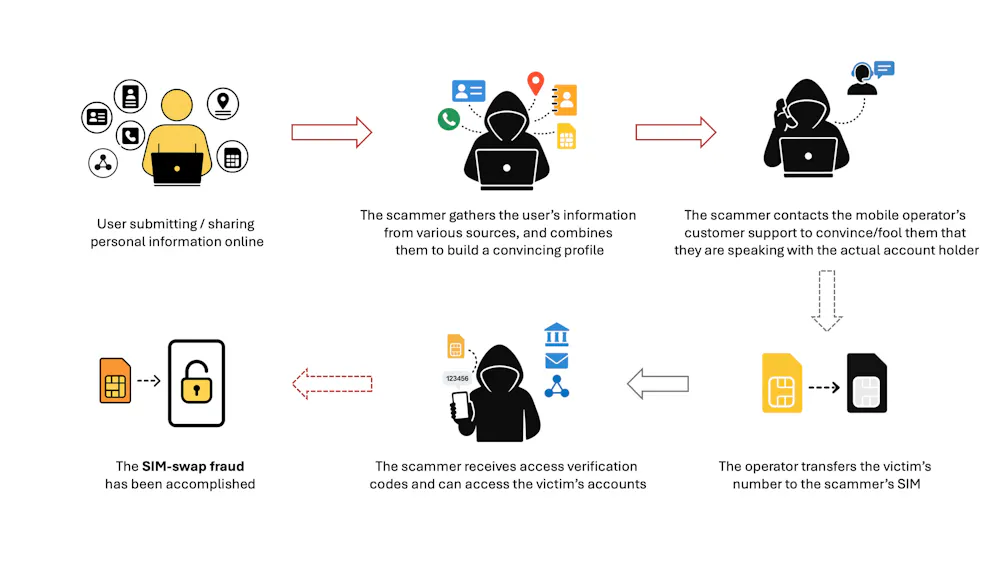
    Sim-swap fraud begins when a scammer convinces a mobile operator to transfer a victim’s number to a new sim card, or even an esim (one that’s embedded in the device), under the scammer’s control.

    This can be done over the phone, through an online chat, or even with the help of a
    bribed insider. Once the number is transferred, all calls and texts intended for the victim are redirected to the scammer. This includes those crucial verification codes used for logging into email, banking, messaging apps such as WhatsApp, and government services such as HMRC.

    This alone would be dangerous. But what makes sim-swap fraud so influential is
    that the cyber scammer often already has access to a patchwork of personal data
    about their target. That information may have been collected from data breaches,
    phishing attacks, low-reputation websites, or even the victim’s social media.

    People often underestimate the extent to which they reveal themselves online: a birthday posted on Instagram, a phone number included in a job posting, or a home address used in an online giveaway. Scammers combine this data to build a convincing profile, enough to fool a mobile operator’s customer service staff into believing they’re talking to the real account holder.

    How the sim-swap fraud works

    Once the scammer gains control of a number, the consequences are extensive.
    Attackers can access sensitive information, including personal documents and
    request and receive password reset links for the user’s other accounts. They can log in to WhatsApp or Telegram accounts, read private messages, impersonate the user, and even contact friends or family members to conduct further scams.

    The victims might see false messages posted in their names or fraudulent transactions made from their accounts. This can lead to financial loss, reputation damage, as well as emotional and mental health issues on the part of the victims.

    In the case of M&S, attackers apparently used this access to manipulate internal
    processes and gain access to sensitive systems. This highlights a broader risk:
    many companies still rely on phone numbers as a secondary verification method for
    staff, making their systems vulnerable to the same cyberattack used against
    individuals.

    How sim-Swap fraud works.
    Hossein Abroshan

    Reducing the risk

    While real-time detection of mobile number hijacking remains difficult, taking specific steps can significantly reduce the likelihood of being targeted and victimised. People should avoid sharing personal data unnecessarily, especially across multiple platforms and, very importantly, on unknown or untrusted websites.

    Many attackers don’t obtain all the necessary information from a single source. Instead, they collect it incrementally, using public profiles, marketing databases and past leaks to form a comprehensive picture.

    Being mindful of where you share your phone number, birthday or other identifiers can make it harder for others to impersonate you. It is also crucial to learn how phishing works and how to recognise it, so you will not submit your sensitive information to phishing or fake websites.

    Avoiding SMS-based authentication, where possible, is another key step. Many
    services now support authenticator apps, such as Google Authenticator, Microsoft Authenticator, Due or Authy, which are not tied to your mobile number. For mobile
    accounts themselves, setting up a unique pin or password to your account, which
    must be provided to authorise any changes, can add an extra layer of protection. This makes it harder for someone to initiate a sim swap without that code. However, users alone cannot fulfil this duty.

    Mobile network operators must strengthen identity verification practices, moving beyond basic questions about names and addresses that can be easily gathered or guessed. Banks and other financial institutions should reconsider using SMS or, at the very least, SMS-only as the default method for sensitive authentication. And companies, particularly those handling personal data or financial assets, need to train their IT and customer service teams to recognise the signs of identity based attacks.

    Sim-swap fraud is effective not because it’s highly technical, but because it exploits our trust in phone numbers for identity verification. The M&S case and similar examples show how fragile that trust can be – and why securing our mobile identities is no longer optional.

    – ref. M&S cyberattacks used a little-known but dangerous technique – https://theconversation.com/mands-cyberattacks-used-a-little-known-but-dangerous-technique-256601

    MIL OSI – Global Reports –

    May 15, 2025
  • MIL-OSI Russia: Among the winners of the second competition of student research papers on Moscow studies is a postgraduate student of the Higher School of Economics

    Translation. Region: Russian Federal

    Source: State University Higher School of Economics – State University Higher School of Economics –

    Stepan Orlov, Elizaveta Novokreshchenova, Irina Martusevich

    Photo: MGD

    How reports Moscow City Duma (MCD) website, On May 13, the A.S. Pushkin Library and Reading Room hosted an awards ceremony for the participants of the Second Student Research Paper Competition. The competition was held as part of the V annual scientific and practical conference “History of Moscow: Methodology, Source Studies, Historiography, Popularization.” The initiator and main organizer was the Moscow City Duma. The winners included a postgraduate student Faculty of Humanities HSE University Elizaveta Novokreshchenova.

    Deputy Chairman of the Moscow City Duma, head of the working group on Moscow studies and development of the Parliamentary Library of the Moscow City Duma Stepan Orlov (United Russia faction) shared his impressions of the competition with the Moscow City Duma website. “The history of Moscow is very important for the formation of a true patriot, a citizen,” he emphasized. “Of course, we want our students, and even better, schoolchildren, to be interested in the history of their hometown. You can’t be a patriot and a citizen if you don’t know and don’t love the history of the place where you were born and where you live.”

    This time, 12 higher education institutions of Moscow took part in the competition — these are the best capital universities; 51 works were submitted to the competition, Stepan Orlov told the Moscow City Duma website. “We had a very authoritative jury. And here in the old building, in the A.S. Pushkin Library and Reading Room, which was created before the revolution, we awarded the best of the best, the students who took prize places. But I believe that everyone is a winner,” he said. The students did not just write some papers, but prepared real scientific works, the Deputy Chairman of the Moscow City Duma emphasized.

    On May 15, the winners of the competition will be able to present their work at a scientific and practical conference at the Museum of Moscow together with academics, professors, teachers of leading Moscow universities and research fellows. The reports of the winners of the student work competition will also be included in the conference collection of scientific papers.

    In an interview with the Moscow City Duma website, member of the expert council of the competition, candidate of historical sciences Elena Maksimenko, noted that the competition is not simply engaged in historical research and the preservation of historical traditions of universities. “We are engaged in the preservation of historical memory – the memory of those people who lived in Moscow, of those places that they created for us and that exist to this day, having a long history. They left us the beauty of Moscow, its history, and we support this memory and this tradition,” she said.

    “I am very happy to take part in the award ceremony, which is taking place in the beautiful mansion of the A.S. Pushkin Library and Reading Room,” HSE Vice-Rector Irina Martusevich shared with the Moscow City Duma website. “I sincerely love Moscow architecture and I want to note that in addition to the fact that we walk with you every day along the most diverse streets of the capital, the city speaks to us in different languages – the languages of the names of its districts and streets. That is, we talk with architecture too. It is great that you are full participants in this dialogue and understand what is happening in our home city. Even if we become Muscovites for the time of our studies at university or graduate school, it is especially pleasant when the city becomes a part of us. We become friends for many years.

    Therefore, I sincerely support this competition. I hope that we will expand and multiply this initiative. And of course, I congratulate the participants of the competition, who, in conditions of such high competition, were able to reach the final and become winners.”

    The winner of the first place, postgraduate student of the Faculty of Humanities at the Higher School of Economics Elizaveta Novokreshchenova, participated in the competition for the first time. She presented a work entitled “The polisher of the Kremlin Palace Yegor Borisov – an attempt to reconstruct his biography.” An appeal to the documents of the Moscow Palace Fund of the Russian State Archive of Ancient Acts showed that it is possible to study the biography of this representative of the palace servants using the lists of palace servants, meeting logs, and inventories of destroyed files, Elizaveta noted in an interview with the Moscow City Duma website. “Thus, as part of the study, I was able to establish the names of his wife and children, the date of death, and trace his career path – from a freelance to a full-time polisher,” says the HSE postgraduate student. “The research conducted shows that the Moscow Palace Fund contains a sufficient number of documents to trace the life path of the lowest rank of palace servants, which, in turn, makes it possible to study their social portrait and further scientific generalizations. I am happy with the first place in the competition, but I think that I still have something to strive for with this scientific work. I cannot help but mention the venue of the award ceremony – a beautiful mansion. It was nice that they arranged a real celebration for us with a concert. This victory is very significant for me.”

    Please note: This information is raw content directly from the source of the information. It is exactly what the source states and does not reflect the position of MIL-OSI or its clients.

    MIL OSI Russia News –

    May 15, 2025
  • MIL-OSI: Texas Capital Foundation Awards $250,000 to Texas Nonprofits

    Source: GlobeNewswire (MIL-OSI)

    DALLAS, May 14, 2025 (GLOBE NEWSWIRE) — Texas Capital Bancshares, Inc. (NASDAQ: TCBI), the parent company of Texas Capital, today announced the recipients of its 2025 Honors Awards. Launched in 2022, the Honors Awards are a signature initiative of the Texas Capital Foundation, awarding $250,000 in total annually to four organizations dedicated to addressing community needs across the state.

    “We are proud to honor four nonprofits as the recipients of this year’s Honors Awards for their dedication to improving the lives of Texans,” said Rob C. Holmes, Chairman, President & CEO of Texas Capital. “Through the Texas Capital Foundation, we are able to shine a light on organizations that are shaping a better future for all of Texas.”

    The Texas Capital Foundation’s approach to grantmaking focuses on nonprofit organizations that operate in areas within the firm’s footprint. Through the Honors Awards, the Texas Capital Foundation aims to fund small to mid-sized organizations that serve the greatest needs of communities through a competitive grant application process.

    The third annual Honors Awards recipients are:

    • The Art Station, a Fort Worth-based nonprofit focused on improving mental health through art therapy. The Art Station is using its grant to hire additional art therapists and expand services by offering a second location to increase accessibility to mental health services for individuals and families across Tarrant County.
    • Center for Applied Science and Technology (CAST) Schools, a San Antonio-based nonprofit network of schools that prepare students for the future through hands-on, project-based learning rooted in science, technology, engineering, arts and math. The grant will be used to bolster the drone program across the CAST STEM High School and CAST Imagine Middle School.
    • ScholarShot, a Dallas-based nonprofit focused on increasing college graduation rates for first-generation students will use the grant to hire an additional Academic Manager to expand support for students through academic support, mentorship and career guidance – increasing the number of Scholars served from 160 to 200.
    • STAR Award (Supporting our Troops Active and Remembered): Folds of Honor is a national nonprofit, with a strong presence in Central Texas and Houston, dedicated to providing educational scholarships to the spouses and children of America’s fallen or disabled military service members and first responders. The organization plans to use the STAR Award to expand its operations and provide college scholarships for 20 Texas families in Houston and Austin, covering tuition, fees, housing, meal plans and textbooks.

    For more information about the Honors Awards, visit the Texas Capital Foundation website.

    About Texas Capital
    Texas Capital Bancshares, Inc. (NASDAQ®: TCBI), a member of the Russell 2000® Index and the S&P MidCap 400®, is the parent company of Texas Capital Bank (“TCB”). Texas Capital is the collective brand name for TCB and its separate, non-bank affiliates and wholly owned subsidiaries. Texas Capital is a full-service financial services firm that delivers customized solutions to businesses, entrepreneurs and individual customers. Founded in 1998, the institution is headquartered in Dallas with offices in Austin, Houston, San Antonio and Fort Worth, and has built a network of clients across the country. With the ability to service clients through their entire lifecycles, Texas Capital has established commercial banking, consumer banking, investment banking and wealth management capabilities. All services are subject to applicable laws, regulations, and service terms. Deposit and lending products and services are offered by TCB. For deposit products, member FDIC. For more information, please visit www.texascapital.com.

    The MIL Network –

    May 15, 2025
  • MIL-OSI: Farmers & Merchants Bancorp (FMCB) Increases Cash Dividend for the 60th Consecutive Year

    Source: GlobeNewswire (MIL-OSI)

    LODI, Calif., May 14, 2025 (GLOBE NEWSWIRE) — Farmers & Merchants Bancorp (OTCQX: FMCB) (the “Company” or “FMCB”), the parent company of Farmers & Merchants Bank of Central California (the “Bank” or “F&M Bank”), the Board of Directors declared a mid-year cash dividend of $9.30 per share, an increase of 5.7% over the $8.80 per share paid in July of 2024. The cash dividend is payable on July 1, 2025, to shareholders of record on June 10, 2025. Net income over the trailing twelve months was $88.7 million compared with $87.5 million for the same trailing period a year earlier. Diluted earnings per share over the trailing twelve months totaled $123.32, up 5.97% compared with $116.37 for the same trailing period a year ago.

    For the quarter ended March 31, 2025, Farmers & Merchants Bancorp reported net income of $23.0 million, or $32.86 per diluted common share, compared with $22.7 million, or $30.56 per diluted common share for the first quarter of 2024. Annualized return on average assets for the first quarter of 2025 was 1.70% and return on average equity was 15.65%. Total assets at quarter-end were $5.7 billion. The Company’s credit quality remained solid with only $193,000 in non-accrual loans and leases as of March 31, 2025 and a negligible delinquency ratio of 0.01% of total loans and leases. At quarter-end, the Company’s allowance for credit losses was $75.4 million, or 2.10% of total loans and leases. The Company’s common equity tier 1 ratio was 13.75% at March 31, 2025, and the total risk-based capital ratio was 15.23%. All F&M Bank capital ratios exceeded the regulatory requirements to be classified as “well-capitalized”. For further details on our first quarter results please see our press release dated April 16, 2025.

    Kent A. Steinwert, Chairman, President and CEO noted, “The Board is very pleased with the Company’s strong first quarter 2025 and record full-year 2024 financial results and unanimously approved the cash dividend. This year marks the 90th consecutive year that Farmers & Merchants Bancorp has paid cash dividends and the 60th consecutive year we have increased dividends. As a result of the reliability of our cash dividends over many decades, we remain a member of a select group of only 55 publicly traded companies designated as “Dividend Kings” by Sure Dividend where Farmers & Merchants Bancorp is currently ranked 17th.”

    About Farmers & Merchants Bancorp

    Farmers & Merchants Bancorp, trades on the OTCQX under the symbol FMCB, and is the parent company of Farmers & Merchants Bank of Central California, also known as F&M Bank. Founded in 1916, F&M Bank is a locally owned and operated community bank, which proudly serves California through 33 convenient locations. F&M Bank is financially strong, with $5.7 billion in assets, and is consistently recognized as one of the nation’s safest banks by national bank rating firms. The Bank has maintained a 5-Star rating from BauerFinancial for 35 consecutive years, longer than any other commercial bank in the State of California.

    Farmers & Merchants Bancorp has paid dividends for 90 consecutive years and has increased dividends for 60 consecutive years. As a result, Farmers & Merchants Bancorp is a member of a select group of only 55 publicly traded companies referred to as “Dividend Kings,” and is ranked 17th in that group based on consecutive years of dividend increases. A “Dividend King” is a stock with 50 or more consecutive years of dividend increase.

    In August 2024, Farmers & Merchants Bancorp was named by Bank Director’s Magazine as the #2 best performing bank in the nation across all asset categories in their annual “Ranking Banking” study of the top performing banks for 2023. In August 2023, the Bank was named by Bank Director’s Magazine as the #1 best performing bank in the nation across all asset categories in their annual “Ranking Banking” study of the top performing banks for 2022.

    In April 2024, F&M Bank was ranked 6th on Forbes Magazine’s list of “America’s Best Banks” in 2023. Forbes’ annual “America’s Best Banks” list looks at ten metrics measuring growth, credit quality, profitability, and capital for the 2023 calendar year, as well as stock performance in the 12 months through March 18, 2024.

    In December 2023, F&M Bank was ranked 4th on S&P Global Market Intelligence’s “Top 50 List of Best-Performing Community Banks” in the US with assets between $3.0 billion and $10.0 billion for 2023. S&P Global Market Intelligence ranks financial institutions based on several key factors including financial returns, growth, and balance sheet risk profile.

    In October 2021, F&M Bank was named the “Best Community Bank in California” by Newsweek magazine. Newsweek’s ranking recognizes those financial institutions that best serve their customers’ needs in each state. This recognition speaks to the superior customer service the F&M Bank team members provide to its clients.

    F&M Bank is the 15th largest bank lender to agriculture in the United States. F&M Bank operates in the mid-Central Valley of California, including Sacramento, San Joaquin, Solano, Stanislaus, and Merced counties and the east region of the San Francisco Bay Area, including Napa, Alameda and Contra Costa counties.

    F&M Bank was inducted into the National Agriculture Science Center’s “Ag Hall of Fame” at the end of 2021 for providing resources, financial advice, guidance, and support to the agribusiness communities as well as to students in the next generation of agribusiness workforce. F&M Bank is dedicated to helping California remain the premier agricultural region in the world and will continue to work with the next generation of farmers, ranchers, and processors. F&M Bank remains committed to servicing the needs of agribusiness in California as has been the case since its founding over 109 years ago.

    F&M Bank offers a full complement of loan, deposit, equipment leasing and treasury management products to businesses, as well as a full suite of consumer banking products. The FDIC awarded F&M Bank the highest possible rating of “Outstanding” in their last Community Reinvestment Act (“CRA”) evaluation.

    Forward-Looking Statements

    This press release may contain certain forward-looking statements that are based on management’s current expectations regarding the Company’s financial performance. Forward-looking statements can be identified by the fact that they do not relate strictly to historical or current facts. They often include words such as “believe,” “expect,” “intend,” “estimate” or words of similar meaning, or future or conditional verbs such as “will,” “would,” “should,” “could” or “may.” Forward-looking statements in this press release include, without limitation, statements regarding loan and deposit production levels of net interest margin, the ability to control costs and expenses, the competitive environment, financial and regulatory policies of the United States government, general economic conditions, inflation, recessions, tariffs, economic uncertainty in the United States, and changes in interest rates. Forward-looking statements in this press release include matters that involve known and unknown risks, uncertainties and other factors that may cause actual results to differ materially from results expressed or implied by such forward-looking statements. Such risk factors include, among others: the effects of and changes in monetary and fiscal policies, including the interest rate policies of the Federal Reserve Board and their effects on inflation risk; political and economic uncertainty, including any decline in global, domestic or local economic conditions or the stability of credit and financial markets; and other relevant risks detailed in the Company’s Form 10-K, Form 10-Qs, and various other securities law filings made periodically by the Company, copies of which are available from the Company’s website. All such factors are difficult to predict and are beyond the Company’s ability to control or predict. There also may be additional risks that the Company does not presently know, or that the Company currently believes to be immaterial, that could also cause actual results to differ materially and adversely from those contained in these forward-looking statements. The Company undertakes no obligation to publicly update or revise any forward-looking statements, whether as a result of new information, future events or circumstances after the date of this press release or otherwise, except as may be required by applicable law.

    For more information about Farmers & Merchants Bancorp and F&M Bank, visit fmbonline.com.

    Investor Relations Contact

    Farmers & Merchants Bancorp
    Bart R. Olson
    Executive Vice President and Chief Financial Officer

    Phone: 209-367-2485
    bolson@fmbonline.com

    The MIL Network –

    May 15, 2025
  • MIL-OSI: Dan Starr and Mindy Creighton Truex Appointed to Lakeland Financial Corporation and Lake City Bank Boards of Directors

    Source: GlobeNewswire (MIL-OSI)

    WARSAW, Ind., May 14, 2025 (GLOBE NEWSWIRE) — Lakeland Financial Corporation (Nasdaq Global Select/LKFN) and Lake City Bank announced today that Dan Starr and Mindy Creighton Truex have been appointed to their respective Boards of Directors.

    “Our boards represent the foundational building blocks of stable corporate governance, leadership and engagement in our Indiana communities and provide balanced and thoughtful feedback to our leadership team. The addition of Dan and Mindy brings two proven business and community leaders to the table,” said David M. Findlay, Chairman and CEO. “Our boards are an extension of the bank in our Indiana markets and are active partners in the focus to drive long-term shareholder value. Both Dan and Mindy share a strong commitment to building long-term relationships within their industries and communities, which fits perfectly with Lake City Bank’s community banking philosophy.”

    Starr is CEO of Do it Best Corp., a Fort Wayne-based member-owned hardware, lumber and building materials buying cooperative in the home improvement industry with thousands of member-owned locations across the United States and in more than 60 countries. He has been with Do it Best Corp. for two decades and held several leadership roles prior to becoming President and CEO in 2016. Before joining Do it Best Corp., Starr was a partner with Barnes & Thornburg LLP and served as the firm’s Business, Tax & Real Estate departmental administrator in Fort Wayne.

    “Lake City Bank plays a vital role in many communities across our state and joining the board is an exciting opportunity,” said Starr. “I look forward to contributing to the continued growth and momentum of the bank.”

    Starr has a juris doctor degree magna cum laude from the Indiana University School of Law. He has served in numerous board leadership roles within the greater Fort Wayne community, including the Northeast Indiana Innovation Center, St. Francis Family Business Center and Fort Wayne Ballet. He currently serves as chairman of the Parkview Health Board of Directors, as well as on the Manchester University Board of Trustees Outreach Committee and the Do it Best Foundation.

    Mindy Creighton Truex is President of Creighton Brothers Farms LLC, a Warsaw-based family-owned farm founded in 1925. With extensive experience in the agricultural sector, she has been instrumental in developing innovative initiatives with Creighton Brothers Farms, including educational and farm-to-table experiences. She has served in leadership roles with national and local agricultural advocacy organizations, including the American Egg Board, United Egg Producers, Indiana State Poultry Association and Purdue University Animal Science Department Dean’s Advisory Committee.

    “As a sixth generation Kosciusko County farmer, I’m honored to join the Lake City Bank and Lakeland Financial Corporation boards,” said Creighton Truex. “Lake City Bank has been a part of the fabric of our community since 1872 and I’m excited to help the bank continue to grow.”

    Creighton Truex has a bachelor’s degree in agribusiness management from Purdue University. She has served on the boards of many nonprofit organizations that impact her local community, including the Kosciusko County Visitor’s Bureau, Kosciusko County Community Foundation, Kosciusko County Leadership Academy, Purdue University’s Kosciusko County Agricultural Extension, Kosciusko County Farm Bureau, and United Way of Kosciusko County.

    Lakeland Financial Corporation (Nasdaq Global Select/LKFN) is a $6.9 billion bank holding company headquartered in Warsaw, Indiana. Lake City Bank, its single bank subsidiary, was founded in 1872 and serves Central and Northern Indiana communities with 54 branch offices and a robust digital banking platform. Lake City Bank’s community banking model prioritizes building in‐market long‐term customer relationships while delivering technology‐forward solutions for retail and commercial clients. For more information visit www.lakecitybank.com.

    Contact
    Luke Weick
    Marketing Manager
    574 267-9198, x47279 office
    260 431-7061 mobile
    luke.weick@lakecitybank.com

    The MIL Network –

    May 15, 2025
  • MIL-OSI: Fiera Capital Corporation announces $60 million bought deal offering of 7.75% Senior Subordinated Unsecured Debentures

    Source: GlobeNewswire (MIL-OSI)

    MONTREAL, May 14, 2025 (GLOBE NEWSWIRE) — Fiera Capital Corporation (“Fiera Capital” or the “Company”) (TSX: FSZ) is pleased to announce that it has entered into an agreement with Scotiabank, CIBC Capital Markets, Desjardins Capital Markets and RBC Capital Markets, as joint bookrunners, on behalf of a syndicate of underwriters which also included National Bank Financial Inc., BMO Capital Markets, TD Securities Inc., Canaccord Genuity Corp., iA Private Wealth Inc. and Raymond James Ltd. (collectively, the “Underwriters”), whereby the Underwriters have agreed to purchase $60 million aggregate principal amount of senior subordinated unsecured debentures due June 30, 2030 (the “Debentures”) at a price of $1,000 per Debenture (the “Offering”). Fiera Capital has also granted the Underwriters an option to purchase up to an additional $9 million aggregate principal amount of Debentures, on the same terms and conditions, exercisable in whole or in part, for a period of 30 days following closing of the Offering. The Offering is expected to close on or about June 3, 2025.

    The Debentures will bear interest at a rate of 7.75% per annum, payable semi-annually in arrears on June 30 and December 31 of each year, with the first interest payment on December 31, 2025. The December 31, 2025 interest payment will represent accrued interest from the closing of the Offering, to but excluding December 31, 2025. The Debentures will mature on June 30, 2030 (the “Maturity Date”).

    The Debentures will not be redeemable prior to June 30, 2028 (the “First Call Date”), except upon the occurrence of a change of control of the Company in accordance with the terms of the indenture (the “Indenture”) governing the Debentures. On and after the First Call Date and prior to June 30, 2029, the Debentures will be redeemable in whole or in part from time to time at the Company’s option at a redemption price equal to 103.875% of the principal amount of the Debentures redeemed plus accrued and unpaid interest, if any, up to but excluding the date set for redemption. On and after June 30, 2029 and prior to the Maturity Date, the Debentures will be redeemable, in whole or in part, from time to time at the Company’s option at par plus accrued and unpaid interest, if any, up to but excluding the date set for redemption. The Company shall provide not more than 60 nor less than 30 days’ prior notice of redemption of the Debentures.

    The Company will have the option to satisfy its obligation to repay the principal amount of the Debentures due at redemption or maturity by issuing and delivering that number of freely tradeable Class A subordinate voting shares (the “Class A Shares”) in accordance with the terms of the Indenture.

    The Debentures will not be convertible into Class A Shares at the option of the holders at any time.

    The net proceeds of the Offering will be used to fund the redemption of the Company’s 8.25% Senior Subordinated Unsecured Debentures due December 31, 2026 (the “2026 Debentures”) that the Company intends to effect on the first call-date, December 31, 2025, and for general corporate purposes. Pending such use, the net proceeds from the Offering will temporarily be used by the Company to reduce indebtedness under the Company’s unsecured revolving credit facility. The foregoing is not a redemption notice with respect to the 2026 Debentures. Any redemption of the 2026 Debentures will be made pursuant to a notice of redemption under the indenture governing those securities.

    The Debentures will be direct, senior subordinated unsecured obligations of the Company which will rank pari passu with one another and will rank (a) effectively subordinate to any existing and future secured indebtedness of the Company but only (other than with respect to the Senior Credit Facilities (as defined in the Indenture)) to the extent of the value of the assets securing such secured indebtedness, (b) subordinate to the obligations under the current and future Senior Credit Facilities (as defined in the Indenture), (c) pari passu with the Company’s existing 2026 Debentures and 6.00% Senior Subordinated Unsecured Debentures due June 30, 2027 and, except as prescribed by law, all existing and future unsecured indebtedness (other than the Senior Credit Facilities) that by its terms is not subordinated in right of payment to the Debentures, including indebtedness to trade creditors, and (d) senior to all existing and future unsecured indebtedness that by its terms is subordinated in right of payment to the Debentures, including any convertible unsecured subordinated debentures which may be issued by the Company in the future. In addition, the Debentures will be structurally subordinated to all existing and future indebtedness and other liabilities of the Company’s subsidiaries.

    A preliminary short form prospectus will be filed with securities regulatory authorities in all provinces of Canada. The Offering is subject to customary regulatory approvals, including the approval of the Toronto Stock Exchange.

    The securities to be offered have not been and will not be registered under the U.S. Securities Act of 1933, as amended, and may not be offered or sold in the United States absent registration or an applicable exemption from the registration requirements of such Act. This news release shall not constitute an offer to sell or the solicitation of an offer to buy nor shall there be any sale of the securities in any jurisdiction in which such offer, solicitation or sale would be unlawful.

    Legal advisors

    Legal advice is being provided to Fiera Capital by Fasken Martineau DuMoulin LLP. Legal advice is being provided to the Underwriters by Norton Rose Fulbright Canada LLP.

    Forward-Looking Statements

    This document may contain certain forward-looking statements relating to future events or, future performance reflecting management’s expectations or beliefs regarding future events, including, without limitation, business and economic conditions, outlook and trends, Fiera Capital’s growth, results of operations, performance, business prospects and opportunities, objectives, plans and strategic priorities, new initiatives, such as those related to sustainability and other statements that do not refer to historical facts. In particular, this press release includes forward-looking statements relating to the proposed timing of completion of the Offering and the anticipated use of the net proceeds of the Offering. Such forward-looking statements reflect management’s current beliefs and are based on information currently available to management. These forward-looking statements may typically be identified by words and expressions such as “assumption, “continue”, “estimate”, “forecast”, “goal”, “guidance”, “likely”, “plan”, “objective”, “outlook”, “potential”, “foresee”, “project”, “strategy”, “target”, and other similar words or expressions or future or conditional verbs (including in their negative form), such as “aim”, “anticipate”, “believe”, “could”, “expect”, “foresee”, “intend”, “may”, “plan”, “predict”, “seek”, “should”, “strive” and “would”.

    Forward-looking statements, by their very nature, are subject to inherent risks and uncertainties and are based on several assumptions, which make it possible for actual results or events to differ materially from management’s expectations and that predictions, forecasts, projections, expectations, conclusions or statements will not prove to be accurate. As a result, Fiera Capital does not guarantee that any forward-looking statement will materialize and readers are cautioned not to place undue reliance on these forward-looking statements. These risks include, but are not limited to, the failure or delay in satisfying any of the conditions to the completion of the Offering. Additional factors include, but are not limited to, market and general economic conditions, the nature of the financial services industry, and the risks and uncertainties detailed from time to time in Fiera Capital’s interim condensed and annual consolidated financial statements, and its latest Annual Report and Annual Information Form filed on www.sedarplus.ca. These forward-looking statements are made as of the date of this document, and Fiera Capital assumes no obligation to update or revise them to reflect new events or circumstances.

    About Fiera Capital Corporation

    Fiera Capital is a leading independent asset management firm with a growing global presence. The Company delivers customized and multi-asset solutions across public and private market asset classes to institutional, financial intermediary and private wealth clients across North America, Europe and key markets in Asia and the Middle East. Fiera Capital’s depth of expertise, diversified investment platform and commitment to delivering outstanding service are core to our mission of being at the forefront of investment management science to create sustainable wealth for clients. Fiera Capital trades under the ticker FSZ on the Toronto Stock Exchange.

    Headquartered in Montreal, Fiera Capital, with its affiliates in various jurisdictions, has offices in over a dozen cities around the world, including New York (U.S.), London (UK), Hong Kong (SAR) and Abu Dhabi (ADGM).

    Each affiliated entity (each an “Affiliate”) of Fiera Capital only provides investment advisory or investment management services or offers investment funds in the jurisdictions where the Affiliate is authorized to provide services pursuant to the relevant registrations, an exemption from such registrations and/or the relevant product is registered or exempt from registration.

    Fiera Capital does not provide investment advice to U.S. clients or offer investment advisory services in the U.S. In the U.S., asset management services are provided by Fiera Capital’s Affiliates who are investment advisers that are registered with the U.S. Securities and Exchange Commission (SEC) or exempt from registration. Registration with the SEC does not imply a certain level of skill or training. For details on the particular registration of, or exemptions therefrom relied upon by, any Fiera Capital entity, please consult https://www.fieracapital.com/en/registrations-and-exemptions

    Additional information about Fiera Capital, including its Annual Information Form, is available on SEDAR+ at www.sedarplus.ca

    SOURCE Fiera Capital Corporation

    The information contained in press releases and company news is valid as of the date indicated. You should not assume that statements remain accurate or valid after the date.

    For more information: Analysts and investors, Marie-France Guay, Senior Vice President, Treasury and Investor Relations, Fiera Capital Corporation, 514 294-5878, mguay@fieracapital.com

    The MIL Network –

    May 15, 2025
  • MIL-OSI: Sustain SoCal to Host Agriculture, Food Systems and Waste Stream Innovations event on May 15

    Source: GlobeNewswire (MIL-OSI)

    NEWPORT BEACH, Calif., May 14, 2025 (GLOBE NEWSWIRE) — via InvestorWire — Sustain Southern California (“Sustain SoCal”) is excited to announce the upcoming Agriculture, Food Systems and Waste Stream Innovations event, scheduled for Thursday, May. 15, 2025 from 1pm to 7pm. The event will take place in person at UCI Beall Applied Innovation, 5270 California Ave # 100, Irvine, CA 92617.

    With the extensive overlap between the themes of Agriculture and Food Systems, as well as Waste and Circularity, these two series are being strategically combined into a single event which will take place on the above mentioned date. The synergistic agenda shall drive comprehensive discussions along the entire spectrum of the supply chain right from agtech, farm to table, packaging innovations, and waste management policy.

    Bringing together renowned experts with decades of combined agriculture, waste management and sustainable circularity experience, this event promises to be a can’t-miss gathering for those interested in ensuring abundant food security, maintaining enviro-human health securing the farming future of the Southern California region, and waste management innovations.

    Recognized pioneers and policy experts from Southern California and surrounding regions will converge to share their invaluable perspectives, practical insights, and vision with attendees across a broad spectrum of areas.

    Speaker sessions and panel discussions shall be primarily explore the following thematic areas:

    1. Urban Agriculture

    Key experts shall discuss fundamental issues such as encouraging locally-sourced food ecosystems including farm-to-table initiatives; developing incentive structures to enable businesses to switch to affordable, eco-packaging; and exploration of ‘beyond the green bin’ end-of-life strategies in the secondary markets.

    Speakers shall delve into Case Study A on AgTech and Soil Health, weaving together issues related to regenerative practices, soil health and agtech advancements.

    2. Combating the “Ick” Factor Associated with SB1383

    One of the key challenges in sustainable waste management is the separation of green waste at the household and business levels. Some of the foremost minds at the intersection of behaviour change and sustainability shall enlighten attendees on designing educational and infrastructure systems that encourage a high-level of compliance to strenghten SB1383 (“California’s Short-Lived Climate Pollutant Reduction Strategy”).

    Moreover, innovations on managing kitchen and bin odors that present a challenge to our cities shall be discussed.

    In a special session, experts from Sustain SoCal and OC Waste and Recycling shall review their findings in the Multifamily Roundtable series.

    Case Study B on SB54 and Regulatory Burdens (“Plastic Pollution Prevention and Packaging Producer Responsibility Act”) shall also be presented, including issues of extended producer responsibility (EPR) and encouraging the streamlining of waste management efforts.

    3. Hazardous Waste Management

    In the third section of the event, invited speakers shall unpack efforts to improve the waste management of dangerous items such as paint and batteries; and share their perspectives on business opportunities in secondary life systems.

    The event also offers attendees a unique opportunity to directly engage with thought leaders and leverage their expertise to better understand cutting-edge concepts, technologies, future market opportunities, products, services, and the regulatory landscape.

    C. Scott Kitcher, President, and CEO of Sustain SoCal, emphasized the importance of the event, stating,

    “We are pleased to offer a new initiative – Agriculture, Food Systems and Waste Stream Innovations which shall provide a new-age forum for industry experts, businesspersons and agricultural enterprises, policymakers and academics. To drive progress on sustainability, it is more important than ever to take a multi-pronged strategy integrating our knowledge of farmers’ challenges, restaurant business practices, technology-enabled sustainability practices, end-of-life strategies, wider educational initiatives and public innovations, and sharpen the design, adoption and implementation of supportive regulatory regimes and outreach activities. At the May event, invited experts will also share their perspectives and practical opportunities on agricultural science, business, behavorial and policy innovation, and sustainable circularity in the farm-to-restaurant supply chain and other secondary waste markets. We would like to extend special thanks to UCI Beall Applied Innovation that have remained incredibly steadfast in their support for our mission for over a decade. Their profound expertise would be a great asset to anyone in the industry making this a must-attend event for farmers, local food service workers and waste management professionals, both in Southern California and beyond.”

    For more information and registration details, visit: https://sustainsocal.org/event/ag-food-waste/.

    About Sustain SoCal

    Sustain SoCal, a non-profit organization, accelerates sustainability and economic growth through innovation, collaboration and education in Southern California. The organization has a ten-year history of exploring and implementing pragmatic, real-world solutions to the challenges created by growth, change and inefficiency. It conducts conferences, workshops and networking events that lead to initiatives that positively impact our region’s economic progress and sustainability. For more information, please visit www.sustainsocal.org.

    About IBN

    IBN consists of financial brands introduced to the investment public over the course of 18+ years. With IBN, we have amassed a collective audience of millions of social media followers. These distinctive investor brands aim to fulfill the unique needs of a growing base of client-partners. IBN will continue to expand our branded network of highly influential properties, leveraging the knowledge and energy of specialized teams of experts to serve our increasingly diversified list of clients.

    Through our Dynamic Brand Portfolio (DBP), IBN provides: (1) access to a network of wire solutions via InvestorWire to reach all target markets, industries and demographics in the most effective manner possible; (2) article and editorial syndication to 5,000+ news outlets; (3) Press Release Enhancement to ensure maximum impact; (4) full-scale distribution to a growing social media audience; (5) a full array of corporate communications solutions; and (6) total news coverage solutions.

    For more information, please visit https://www.InvestorBrandNetwork.com

    Please see full terms of use and disclaimers on the InvestorBrandNetwork website applicable to all content provided by IBN, wherever published or re-published: http://IBN.fm/Disclaimer.

    Corporate Communications

    IBN
    Austin, Texas
    www.InvestorBrandNetwork.com
    512.354.7000 Office
    Editor@InvestorBrandNetwork.com

    The MIL Network –

    May 15, 2025
  • MIL-OSI Global: Lady Gaga bomb plot: Thwarted plan lifts veil on the gamification of hate and gendered nature of online radicalization

    Source: The Conversation – Global Perspectives – By David Nemer, Associate Professor in the Department of Media Studies, University of Virginia

    Lady Gaga performs at Copacabana Beach on May 3, 2025, in Rio de Janeiro, Brazil. Kevin Mazur/WireImage for Live Nation

    The more than 2 million people who attended Lady Gaga’s free concert on Copacabana Beach on May 3, 2025, had no idea of a plot that, if successful, would have turned the event into a tragedy fueled by hate. Just hours before a sea of admirers waved fans in sync with the singer during the event, the Rio de Janeiro Civil Police thwarted a planned attack involving Molotov cocktails and improvised bombs – and targeting the American singer’s LGBTQ following.

    Two people have since been arrested over the plot, which was organized by users of digital platforms such as Discord. The intent, authorities say, was radicalizing and recruiting teenagers to carry out the planned attack.

    Those responsible hoped to entice these young people into actions that would gain online notoriety.

    More than 2 million people are said to have attended the Lady Gaga concert in Rio.
    Daniel Ramalho/AFP via Getty Images

    Although authorities were able to prevent the attack, the incident stands as a stark warning about the growth of hate networks among youth − and how platforms fuel the radicalization of teenagers, especially boys and young men.

    As experts in the anthropology of technology and information science, we see something deeply generational about this phenomenon. The recent Netflix series “Adolescence” broke viewership records by portraying an environment in which young people live in hyperconnected online spheres, absent of state oversight and parental supervision. In these spheres, bullying toxic masculinity permeates, and violence – often targeted at women and sexual minorities – is normalized.

    The show was set in the U.K., but it holds up a mirror to the world. Data from polling company Gallup reveals a growing ideological divide between young men and women in Gen Z across the globe. Too often, that divide, in which young men and boys are turning against progressive values, is being expressed through actions associated with the “manosphere,” such as misogyny and incel behavior.

    Platforms for hate

    In the United States, women aged 18 to 30 are now 30 percentage points more liberal than their male counterparts, according to Gallup’s surveys. In Germany, where a right-wing coalition recently won national elections and the extreme-right AfD party is rising in popularity at an alarming rate, the gap is also 30 points. In Poland, although the far-right left power at the end of 2023 after eight years, nearly half of men ages 18 to 21 support far-right parties − compared with just one-sixth of women in the same age range.

    This polarization is emerging just as online platforms such as Discord, TikTok and Reddit have become formative spaces of identity.

    Instead of promoting diversity, however, many of these platforms have been used as machines for producing and spreading hate. The 2021 study Mapping Discord’s Darkside, published in the journal New Media & Society, shows that despite marketing efforts to distance itself from the far right, Discord hosts thousands of servers associated with neo-Nazi, misogynistic, racist, transphobic and conspiratorial discourse. Researchers identified 2,741 such servers − with more than 850,000 active members.

    These networks end up functioning as recruitment hubs, where young people − especially boys − are lured in by edgy memes, promises of belonging and identity games based on excluding others. Discord’s structure, which prioritizes privacy and decentralization, has become fertile ground for the emergence of what scholar Adrienne Massanari calls “toxic technocultures.”

    Services such as Disboard − an informal search engine for Discord servers − are used to recruit teens into communities that glorify Nazism, encourage hatred toward women and people from the LGBTQ+ community, and even offer “services” for coordinated attacks on other servers. And this appears to be the case in the thwarted attack on the Lady Gaga concert.

    Presenting a challenge

    A significant factor in the success of these radicalizing environments is gamification − the use of gamelike elements such as challenges, rewards and leaderboards in nongame contexts. When applied to social networks and extremist forums, gamification turns engagement into competition and hate speech into a playful challenge.

    This practice makes the entrance into extremism more palatable for young, impressionable people by masking violence behind seemingly harmless mechanics. As noted in the European Commission’s 2021 report Gamification and Online Hate Speech, gamification has become a powerful tool for normalizing and spreading hate, particularly among young people seeking recognition and belonging.

    This process, known as “bottom-up gamification,” occurs when users create the rules, symbolic rewards and challenges. For example, by turning hate speech into “challenges” that involve humiliating women or people from the LGBTQ+ community online, the dehumanization of targets is presented in playful, viral ways.

    Turning hate into entertainment

    The investigation into the foiled attack on Lady Gaga’s Copacabana concert revealed exactly this mechanism: The attack was treated as a “collective challenge,” with youths recruited to build Molotov cocktails and explosive backpacks in order to gain notoriety on social media.

    The logic of gamification also creates a structure of “achievement” and “scoring” that fosters competition and reinforces radical ideology. As shown in the 2022 study by criminologists Suraj Lakhani and Susann Wiedlitzka, attacks such as the 2019 mosque attack in Christchurch, New Zealand, in which 51 people were killed, were planned and executed with strong inspiration from gaming, including live broadcasts similar to “Let’s Play” sessions, in which people offer live commentary during walk-throughs of games, typically first-person shooting games, and viewer comments that treat the number of deaths as a “score.”

    More than 50 people were killed in the terrorist attack on Christchurch mosques in New Zealand on March 15, 2019.
    Omer Kablan/Anadolu Agency via Getty Images

    This aestheticization of violence serves as a bonding element among young men in digital spaces, especially those who already feel marginalized or frustrated and who find in these games of hate a sense of belonging and affirmation. In this way, gamification transforms hate into entertainment, strengthening ties in toxic communities and making it harder to recognize the behavior as extremism.

    Turning a generation off hate

    Society is, we believe, facing a dual challenge: the need for moderation of platforms and for support for measures preventing men and boys from being drawn into toxic digital spaces.

    The gender divide within Gen Z is no small matter, too. It reflects, in broad terms, a rift between a generation of young women who, empowered by #MeToo and other feminist movements, have embraced progressive causes, and a generation of men who, threatened by their perceived diminished power in this new environment, are being co-opted by far-right and misogynistic discourse in digital spaces.

    This gap has real consequences in personal relationships, in schools and for democracy at large. But it also reveals something that we believe must be stated clearly: Platform regulation is not just a technical issue. The future of a generation cannot be built on algorithms that reward hate and radicalization.

    This article is a translated and adapted version of a story that was originally published by The Conversation Brazil on May 8, 2025.

    The authors do not work for, consult, own shares in or receive funding from any company or organization that would benefit from this article, and have disclosed no relevant affiliations beyond their academic appointment.

    – ref. Lady Gaga bomb plot: Thwarted plan lifts veil on the gamification of hate and gendered nature of online radicalization – https://theconversation.com/lady-gaga-bomb-plot-thwarted-plan-lifts-veil-on-the-gamification-of-hate-and-gendered-nature-of-online-radicalization-256199

    MIL OSI – Global Reports –

    May 15, 2025
  • MIL-OSI Global: Territorial concessions will be central to any Ukraine peace deal, and to Russia’s long-term plan

    Source: The Conversation – Global Perspectives – By Stefan Wolff, Professor of International Security, University of Birmingham

    If the Ukrainian president, Volodymyr Zelensky, and his Russian counterpart, Vladimir Putin, meet in Istanbul on May 15, territory – and who controls it – will be high on their agenda.

    Putin offered to start direct talks between Russia and Ukraine at a press conference on May 11. Donald Trump pushed Zelensky to accept this offer in a social media post, saying that “Ukraine should agree to this, IMMEDIATELY.”

    The Ukrainian president, still buoyed by a meeting with the British, French, German and Polish leaders that called for an unconditional 30-day ceasefire, agreed shortly afterwards.

    Russia has said it wants to focus on the Istanbul communique of March 2022 and a subsequent draft agreement that was negotiated, but never adopted, by the two sides in April 2022.


    Get your news from actual experts, straight to your inbox. Sign up to our daily newsletter to receive all The Conversation UK’s latest coverage of news and research, from politics and business to the arts and sciences.


    These 2022 negotiations focused on Ukraine becoming a permanently neutral state and on which nations would provide security guarantees for any deal. They also relegated discussions over Crimea to separate negotiations with a ten-to-15-year timeframe.

    Russia uses the phrase “the current situation on the ground” as thinly disguised code for territorial questions that have become more contentious over the past three years. This relates to Russian gains on the battlefield and the illegal annexation of four Ukrainian regions in September 2022 (in addition to Crimea, which Russia also illegally annexed in 2014).

    Russia’s position, as articulated recently by the country’s foreign minister, Sergey Lavrov, is that “the international recognition of Crimea, Sevastopol, the DPR, the LPR, the Kherson and Zaporozhye regions as part of Russia is … imperative”.

    This is clearly a non-starter for Ukraine, as repeatedly stated by Zelensky. There could, however, be some flexibility on accepting that some parts of sovereign Ukrainian territory are under temporary Russian control. This has been suggested by both Trump’s Ukraine envoy, Keith Kellogg, and Kyiv’s mayor, Vitali Klitschko.


    Institute for the Study of War.

    Black Sea’s strategic value

    The territories that Russia currently occupies, and claims, in Ukraine have varying strategic, economic and symbolic value for Moscow and Kyiv. The areas with the greatest strategic value include Crimea and the territories on the shores of the Azov Sea, which provide Russia with a land corridor to Crimea.

    The international recognition of Crimea as part of Russia, as apparently suggested under the terms of an agreement hashed out by Putin and Trump’s envoy Steve Witkoff, could expand the areas of the Black Sea that Russia can claim to legally control.

    This could then be used by the Kremlin as a launchpad for renewed attacks on Ukraine and to threaten Nato’s eastern maritime flank in Romania and Bulgaria. Any permanent recognition of Russia’s control of these territories is, therefore, unacceptable to Ukraine and its European partners.


    Read more:
    Russia-China ties on full display on Victory Day – but all is not as well as Putin is making out


    Donetsk and Luhansk are of lower strategic value, compared with Crimea and the Kherson and Zaporizhzhia regions. However, they do have economic value because of the substantial resources located there. These include some of the mineral and other resources that were the subject of a separate deal which the US and Ukraine concluded on April 30.

    They also include Europe’s largest nuclear power plant in Zaporizhzhia and a large labour force among their estimated population of between 4.5 million to 5.5 million people who will be critical to Ukraine’s post-war reconstruction.

    Beyond the strategic and economic value of the illegally occupied territories, the symbolism that both sides attach to their control is the most significant obstacle to any deal, given how irreconcilable Moscow’s and Kyiv’s positions are. For both sides, control of these territories, or loss thereof, is what defines victory or defeat in the war.

    Putin may be able to claim that some territorial gains in Ukraine since the start of the full-scale invasion in February 2022 are a victory for Russia. But even for him any compromise that would see Russia give up territory that it has conquered – often at exceptionally high cost – would be a risky gamble for the stability of his regime.

    Anything less than the complete restoration of the country’s territorial integrity in its 1991 borders would imply recognition of defeat in the war for Ukraine. This would critically threaten the stability of the Zelensky government, whose political programme rests on exactly the premise of a return to the 1991 borders.

    Long-term consequences

    As a result, the Ukrainian leadership has become hostage to its own information strategy, which has placed the “return of all territories” at the top of the criteria for victory. This is a goal widely shared among Ukrainians, according to a poll conducted by the Razumkov Center in March 2025. But it will be hard to achieve.


    Read more:
    US-Ukraine minerals deal looks better for Kyiv than expected – but Trump is an unpredictable partner


    Apart from the potential domestic fall-out from any territorial compromises that Ukraine may be forced to make, there is another reason why the territorial question has become so intractable.

    Beyond any strategic, economic and symbolic value that the occupied Ukrainian territories hold from the Kremlin’s perspective, control over territory has always been an instrument for Russia to pursue its broader geopolitical agenda of exercising influence over its neighbours – from Moldova, to Georgia, Armenia and Ukraine.

    It is also important to remember that Russia’s territorial claims in Ukraine have gradually expanded since 2014. Until September 2022, when it annexed the other four regions, Russia laid claim to Crimea only.

    There is no guarantee that any territorial concession from Kyiv now would put a permanent end to Moscow’s territorial expansionism. It is therefore worrying that Trump envoy Witkoff, in an interview with the Breitbart news website, reiterated the US view that the two sides need to find compromises on who controls which territories.

    Russia’s aggression against Ukraine was not a war over territory as such, but was part of Moscow’s agenda to restore the sphere of influence that it lost at the end of the cold war. This agenda is far from finished.

    The strategy of both Moscow and Washington to focus on territorial consequences may lead to a ceasefire. But it will not address the fundamental issue of how to deal with a vengeful and revisionist autocracy on Europe’s doorsteps.

    Stefan Wolff is a past recipient of grant funding from the Natural Environment Research Council of the UK, the United States Institute of Peace, the Economic and Social Research Council of the UK, the British Academy, the NATO Science for Peace Programme, the EU Framework Programmes 6 and 7 and Horizon 2020, as well as the EU’s Jean Monnet Programme. He is a Trustee and Honorary Treasurer of the Political Studies Association of the UK and a Senior Research Fellow at the Foreign Policy Centre in London.

    Tetyana Malyarenko does not work for, consult, own shares in or receive funding from any company or organisation that would benefit from this article, and has disclosed no relevant affiliations beyond their academic appointment.

    – ref. Territorial concessions will be central to any Ukraine peace deal, and to Russia’s long-term plan – https://theconversation.com/territorial-concessions-will-be-central-to-any-ukraine-peace-deal-and-to-russias-long-term-plan-256347

    MIL OSI – Global Reports –

    May 15, 2025
  • MIL-OSI United Kingdom: expert reaction to media reports that a ‘reset’ with the EU could require the precision breeding act to be dropped from UK legislation

    Source: United Kingdom – Science Media Centre

    May 14, 2025

    Scientists comment on reports of an EU ‘reset’ which could mean the precision breeding act is dropped from UK legislation. 

    Dr Penny Hundleby, Senior Scientist at the John Innes Centre, said:

    “As a scientist with over thirty years in genetic technologies, I’ve seen how innovation can transform agriculture. The UK now has a rare opportunity to lead globally in precision breeding — with the legislation passed and the science ready.

    “To delay this progress in order to align with slower EU processes would undermine our ability to deliver resilient, sustainable crops at a time when food security and climate resilience are more urgent than ever. We risk forfeiting a clear post-Brexit advantage grounded in science, safety, and evidence.”

    Prof Huw Jones, Chair in Translational Genomics for Plant Breeding, Aberystwyth University, said:

    “Closer ties with the EU are a good thing but let’s not lose the logical regulatory progress we have made this side of the Channel. Simple gene editing is a speedier and more reliable breeding method to develop the crops we need in a changing world. It’s illogical to regulate these crops as GMOs and it is the EU that has been slow to follow the broad consensus on this. If there are no foreign genes, and the changes could have been generated by conventional breeding, they need regulation – but not as GMOs.”


    Prof Neil Hall, Director of the Earlham Institute, said:

    “Given the pressures on global food security, driven by climate change, the growing population and new diseases, it’s important that we harness all of the technical innovations at our disposal to ensure the sustainability of our agricultural systems. 

    “Over the past three years, including these last few months, Parliament has demonstrated important and legitimate leadership by passing the primary and secondary legislation to enable precision breeding in plants. It’s time to enable science research to help farmers adapt to our changing world.”


    Prof Jonathan Jones FRS, Group Leader at The Sainsbury Laboratory, said:

    “The Precision Breeding Act (PBA) provides an opportunity to protect our crops from pests and disease with biology rather than chemistry, and also enables new routes to more nutritious food, and I applaud this government and its predecessor for taking the legislation through to final approval and implementation.  It is to my mind the sole Brexit dividend. 

    “However, it takes a long time between producing an improved plant in a lab and creating and obtaining approval for a variety that farmers can plant.  I think it’s highly likely that by the time any precision bred varieties in the UK are ready to plant (likely at least 5 years from now) the EU will have approved its own version of the PBA.

    “So, the government should stick to its guns on the PBA but quietly point out to the EU that, although there are no scientifically credible safety concerns with using these methods, the timelines in this industry are such that it will be a long time before any products are authorized in the UK and thus before any potential problems might arise.”


    Prof Sarah Gurr, Chair in Food Security at Exeter University, said:

    “It is sad to realise that whilst we  embraced the need for GM vaccines during the recent COVID epidemic and we seem reticent to embrace gene edited crops. The need for climate proofed and disease resilient gene edited crops is paramount in our quest for sustainable agriculture.”


    https://www.thetimes.com/article/08fe3606-e6ab-4a66-bb31-017165028f08

    https://www.dailymail.co.uk/news/article-14710677/Concessions-Starmer-Brexit-reset-EU-demands-UK-abandons-GM-crops.html


    Declared interests

    Jonathan Jones “is a senior investigator at The Sainsbury Laboratory in Norwich, and uses molecular and genetic approaches to study disease resistance in plants. Jones co-founded Norfolk Plant Sciences in 2007 with Prof Cathie Martin of JIC, with the goal of bringing flavonoid-enriched tomatoes to market (www.norfolkplantsciences.com). Jones is on the board of www.isaaa.org, the science advisory board of the 2Blades foundation (www.2blades.org) and the board of NIAB Cambridge University Farm. Jones has isolated and is deploying new resistance genes against potato late blight from wild relatives of potato, and conducting field trials to evaluate how well they work to protect the crop in the field and to generate improved varieties of potato (see http://www.tsl.ac.uk/news/blight-resistant-maris-piper/). See also http://www.tsl.ac.uk/groups/jones-group/.”

    Penny Hundleby “is part of the Crop Transformation Group at the John Innes Centre and using genetic technologies to better understand the role of plant genes. The group provides gene editing resources to the UK and international research community and have been working with gene editing technologies in crops since 2014.”

    Huw Jones: “I am speaking as a researcher at Aberystwyth University and not representing other organisations that I am affiliated with.  I am a member of the FSA ACNFP and Defra ACRE. My declarations of interest are listed on the websites of those Depts.”

    For all other experts, no reply to our request for DOIs was received.

    MIL OSI United Kingdom –

    May 15, 2025
  • MIL-OSI China: China to strengthen financial support for sci-tech innovation

    Source: People’s Republic of China – State Council News

    BEIJING, May 14 — China will increase its financial support for sci-tech innovation to improve the country’s self-reliance and strength in science and technology, according to a set of guidelines issued by seven authorities on Wednesday.

    The document — issued by the Ministry of Science and Technology, the People’s Bank of China, the National Development and Reform Commission, and other authorities — proposes 15 concrete measures to promote financial services for sci-tech innovation, including those to boost venture investment, credit supply and insurance support.

    Among efforts to serve the country’s key strategies in the field of science and technology, China will scale up financial support for enterprises that undertake major national sci-tech tasks, and for sci-tech-oriented small and medium-sized enterprises, according to the guidelines.

    China will leverage the role of its national venture capital guidance fund, encourage the development of secondary-market private equity funds, and optimize structural monetary policy tools such as re-lending loans for sci-tech innovation, per the document.

    The country will take advantage of the capital market in serving sci-tech innovation, and prioritize the public offerings of enterprises that achieve breakthroughs in critical core technologies.

    In terms of enhancing fiscal policies, the guidelines call for the full use of fiscal tools such as loan interest subsidies and risk compensation to support enterprises in sci-tech innovation, and for the effective implementation of related tax policies for angel investment and venture capital.

    MIL OSI China News –

    May 15, 2025
  • MIL-OSI Global: How does the EPA know a pesticide is safe to use in my yard?

    Source: The Conversation – USA – By Jeffrey Gore, Professor of Agricultural Science and Plant Protection, Mississippi State University

    A mosquito-control technician sprays a mixture including insecticides in a yard in Michigan. AP Photo/John Flesher

    Environmental Protection Agency head Lee Zeldin has said he wants the federal agency to accelerate scientific safety evaluations of various chemicals, including pesticides.

    The EPA reportedly has more than 500 pending reviews of proposed new pesticides and more than 12,000 overdue reevaluations of pesticides currently in use. The agency is under pressure from the chemical and agricultural industries to catch up, while health and environmental advocates demand it maintain high safety standards.

    The review process is careful for a reason – and perhaps the only real method of speeding it up is the one Zeldin has proposed: reassigning staff so there are more people to share the work.

    As a faculty member at a land-grant university who has studied the effectiveness of commercial and experimental pesticides in the southern U.S., I have seen how the federal pesticide regulatory process identifies risks to humans and the environment and mitigates them with specific use instructions. Here’s how the process works.

    First, what is a pesticide?

    The EPA, which regulates pesticides in the U.S., defines a pesticide as any substance or mixture of substances intended to prevent, destroy, repel or mitigate any pest, such as weeds, insects and organisms, that attack plants.

    Pesticides are often referred to as toxins when found in food, water bodies or other places where they are not intended. But just because something is detected doesn’t mean it’s harmful to humans or wildlife. Toxicity depends on how much of the substance a person or animal is exposed to, how they are exposed to it – such as breathing it, or getting it on their skin – and for how long.

    The Department of Agriculture began regulating pesticides in 1947 with the Federal Insecticide, Fungicide, and Rodenticide Act. Most of the department’s interest was whether a particular pesticide was effective against the target pests.

    In 1970, the newly formed EPA took over responsibility for pesticides. It shifted its focus to the safety of consumers, farmworkers and the environment after the Federal Environmental Pesticide Control Act took effect in 1972.

    A wide range of pesticides are available to consumers for use in their homes and yards.
    Jeffrey Greenberg/Universal Images Group via Getty Images

    Risk-benefit analysis

    Federal law requires the EPA to evaluate both the risks and the benefits of each pesticide – and to revisit that analysis at least every 15 years for every pesticide used in the U.S.

    The EPA determines whether the risks to people, animals or the environment are too high for the benefits the pesticide provides and whether any of those risks can be reduced. Sometimes a chemical’s risk can be lessened by recommending mitigation strategies such as wearing protective clothing, reducing environmental spread by barring the use of pesticides near the edges of a property, or decreasing the amount of a pesticide that’s legal to use.

    In its analysis of any given pesticide, the EPA requires a massive amount of data from the manufacturer about what ingredients the pesticide contains and how they work. The agency also reviews scientific research on the pesticide and uses its own scientists and independent experts to evaluate any studies that were submitted by the manufacturer.

    The EPA uses all the available data on a pesticide to evaluate the dose that would be toxic to a range of organisms, as well as what residues the pesticide may leave on plants, in the soil and in water. The data is incorporated into computer models that estimate the potential amount of the chemical that may come in contact with humans, animals and the environment. Those models’ results are then combined with toxicity data to determine risk.

    The models used by EPA scientists are very conservative. They often use significant overestimates of exposure, which means that when the models determine the risk of a pesticide is below a particular level, they are evaluating the risk posed by far higher quantities of the chemical than will ever actually be used. The risk from the amount actually used, therefore, is even less likely to cause harm.

    The EPA also provides opportunities for public comment on a pesticide and uses that information in its evaluations as well.

    Pesticides are commonly used in commercial agriculture.
    Charlie Neibergall/AP

    Additional scrutiny

    The Endangered Species Act also requires the EPA to evaluate the effects of pesticides on threatened and endangered species.

    If a pesticide is found to potentially be dangerous to a protected species or its habitat, the EPA will discuss those findings with the U.S. Fish and Wildlife Service and the National Marine Fisheries Service, which enforce the Endangered Species Act, and determine what to do to ensure the species aren’t harmed.

    The law’s requirement to reevaluate each pesticide every 15 years is based on the fact that science evolves and information becomes more precise. New data can shed light on potential risks and benefits, and even lead to pesticides being banned or more closely restricted.

    Until recently, for instance, pesticide residues on plants, food and in the environment were measured in parts per million. Newer equipment can measure even smaller amounts, determining parts per billion, which is as precise as identifying one single second in 32 years. Some chemicals can even be measured in parts per trillion, equivalent to one drop of water in 20 Olympic-size swimming pools. That means exposures can be more accurately measured. While some chemicals can be toxic in very small concentrations, most pesticides can be detected at levels that do not pose a biological risk.

    Allowing a pesticide to be used

    If the EPA determines that a pesticide’s risks outweigh its benefits, then its staff will conduct additional analyses to determine how to mitigate the risks enough to justify using it. If that’s not possible, the EPA will reject the application and not allow the pesticide to be used in the U.S.

    If the agency determines that the benefits outweigh the risks, the EPA approves the pesticide for sale and use in the U.S. The law requires the pesticide come with a label providing a strict set of guidelines for how, when and where to use the pesticide.

    The guidelines define amounts and timing for applying the pesticide safely, and specific restrictions or protection strategies to control the target pests while eliminating or minimizing harm to the environment, workers and the public.

    The EPA also makes information on pesticides available to the public, so anyone can find out how to use them safely. Using the pesticide without following those directions is a violation of federal law.

    Jeffrey Gore receives funding from the USDA-ARS and has received funding from various state and national commodity boards, and chemical and biotechnology companies in the past.

    Jeffrey Gore served on the EPA’s Farm, Ranch and Rural Communities Committee from 2019 to 2024.

    – ref. How does the EPA know a pesticide is safe to use in my yard? – https://theconversation.com/how-does-the-epa-know-a-pesticide-is-safe-to-use-in-my-yard-256027

    MIL OSI – Global Reports –

    May 15, 2025
  • MIL-OSI Global: How your genes interact with your environment changes your disease risk − new research counts the ways

    Source: The Conversation – USA – By Arun Durvasula, Assistant Professor of Population and Public Health Sciences, University of Southern California

    Nature and nurture both determine how likely you are to develop a particular disease. Hiroshi Watanabe/DigitalVision via Getty Images

    Sitting in my doctor’s examination room, I was surprised when she told me, “Genetics don’t really matter for chronic disease.” Rather, she continued, “A person’s lifestyle, what they eat, and how much they exercise, determine whether they get heart disease.”

    As a researcher who studies the genetics of disease, I don’t fully disagree – lifestyle factors play a large role in determining who gets a disease and who doesn’t. But they are far from the entire story. Since scientists mapped out the human genome in 2003, researchers have learned that genetics also play a large role in a person’s disease risk.

    Studies that focus on estimating disease heritability – that is, how much genetic differences explain differences in disease risk – usually attribute a substantial fraction of disease variation to genetics. Mutations across the entire genome seem to play a role in diseases such as Type 2 diabetes, which is about 17% heritable, and schizophrenia, which is about 80% heritable. In contrast to diseases such as Tay-Sachs or cystic fibrosis, where mutations in a single gene cause a disease, chronic diseases tend to be polygenic, meaning they’re influenced by multiple mutations at many genes across the whole genome.

    Every complex disease has both genetic and environmental risk factors. Most researchers study these factors separately because of technical challenges and a lack of large, uniform datasets. Although some have devised techniques to overcome these challenges, they haven’t yet been applied to a comprehensive set of diseases and environmental exposures.

    In our recently published research, my colleague Alkes Price and I developed tools to leverage newly available datasets to quantify the joint effects that genetic and environmental risk factors have on the biology underlying disease.

    Aspirin, genetics and colon cancer

    To illustrate the effect gene-environment interactions have on disease, let’s consider the example of aspirin use and colon cancer.

    In 2001, researchers at the Fred Hutchinson Cancer Research Center were studying how regularly taking aspirin decreased the risk of colon cancer. They wondered whether genetic mutations that slowed down how quickly the body broke down aspirin – meaning aspirin levels in the body would stay high longer – might increase the drug’s protective effect against colon cancer. They were right: Only patients with slow aspirin metabolism had a decreased risk of colon cancer, indicating that the effectiveness of a drug can depend on a person’s genetics.

    This raises the question of how genetics and different combinations of environmental exposures, such as the medications a patient is taking, can affect a person’s disease risk and how effective a treatment will be for them. How many cases of genetic variations directly influencing a drug’s effectiveness are there?

    Rather than ‘nature versus nurture,’ a more accurate way of describing gene-environment interactions is ‘nature through nurture.’

    The gene-environment interaction of colon cancer and aspirin is unusual. It involves a mutation at a single location in the genome that has a big effect on colon cancer risk. The past 25 years of human genetics have shown researchers that these sorts of large-effect mutations are rare.

    For example, an analysis found that the median effect of a genetic variant on height is only 0.14 millimeters. Instead, there are usually hundreds of variations that each have small but cumulative effects on a person’s disease risk, making them hard to find.

    How could researchers detect these small gene-environment interactions across hundreds of spots in the genome?

    Polygenic gene-environment interactions

    We started by looking for cases where genetic variants across the genome showed different effects on a person’s biology in different environments. Rather than trying to detect the small effects of each genetic variant one at a time, we aggregated data across the entire genome to turn these small individual effects into a large, genome-wide effect.

    Using data from the UK Biobank – a large database containing genetic and health data from about 500,000 people – we estimated the influence of millions of genetic variants on 33 complex traits and diseases, such as height and asthma. We grouped people based on environmental exposures such as air pollution, cigarette smoking and dietary patterns. Finally, we developed statistical tests to study how the effects of genetics on disease risk and biomarker levels varied with these exposures.

    We found three types of gene-environment interactions.

    First, we found 19 pairs of complex traits and environmental exposures that are influenced by genetic variants across the genome. For example, the effect of genetics on white blood cell levels in the body differed between smokers and nonsmokers. When we compared the effects of genetic mutations between the two groups, the strength of gene-environment interaction suggested that smoking changes the way genetics influence white blood cell counts.

    Second, we looked for cases where the heritability of a trait varies depending on the environment. In other words, rather than some genetic variants having different effects in different environments, all of them are made stronger in some environments. For example, we found that the heritability of body mass index – the ratio of weight to height – increased by 5% for the most active people. This means genetics plays a larger role in BMI the more active you are. We found 28 such trait-environment pairs, including HDL cholesterol levels and alcohol consumption, as well as neuroticism and self-reported sleeplessness.

    Third, we looked for a type of gene-environment interaction called proportional or joint amplification. Here, genetic effects grow with increased environmental exposures, and vice versa. This results in a relatively equal balance of genetic and environmental effects on a trait. For example, as self-reported time spent watching television increased, both genetic and environmental variance increased for a person’s waist-to-hip ratio. This likely reflects the influence of other behaviors related to time spent watching television, such as decreased physical exercise. We found 15 such trait-environment pairs, including lung capacity and smoking, and glucose levels and alcohol consumption.

    Environmental factors, such as cigarette smoke and the medications you take, can interact with your genes in unexpected ways.
    jaouad.K/iStock via Getty Images Plus

    We also looked for cases where biological sex, instead of environmental exposures, influenced interactions with genes. Previous work had shown evidence of these gene-by-sex interactions, and we found additional examples of the effects of biological sex on all three types of gene-environment interactions. For example, we found that neuroticism had genetic effects that varied across sex.

    Finally, we also found that multiple types of gene-environment interactions can affect the same trait. For example, the effects of genetics on systolic blood pressure varied by sex, indicating that some genetic variants have different effects in men and women.

    New gene-environment models

    How do we make sense of these distinct types of gene-environment interactions? We argue that they can help researchers better understand the underlying biological mechanisms that lead from genetic and environmental risks to disease, and how genetic variation leads to differences in disease risk between people.

    Genes related to the same function work together in a unit called a pathway. For example, we can say that genes involved in making heme – the component of red blood cells that carries oxygen – are collectively part of the heme synthesis pathway. The resulting amounts of heme circulating in the body influence other biological processes, including ones that could lead to the development of anemia and cancer. Our model suggests that environmental exposures modify different parts of these pathways, which may explain why we saw different types of gene-environment interactions.

    In the future, these findings could lead to treatments that are more personalized based on a person’s genome. For example, clinicians might one day be able to tell whether someone is more likely to decrease their risk of heart disease by taking weight loss drugs or by exercising.

    Our results show how studying gene-environment interactions can tell researchers not only about which genetic and environmental factors increase your risk of disease, but also what goes wrong in the body where.

    Arun Durvasula has received funding from the National Institutes of Health and the National Institute of Science.

    – ref. How your genes interact with your environment changes your disease risk − new research counts the ways – https://theconversation.com/how-your-genes-interact-with-your-environment-changes-your-disease-risk-new-research-counts-the-ways-252139

    MIL OSI – Global Reports –

    May 15, 2025
  • MIL-OSI Global: Challenges to high-performance computing threaten US innovation

    Source: The Conversation – USA – By Jack Dongarra, Emeritus Professor of Computer Science, University of Tennessee

    Oak Ridge National Laboratory’s Frontier supercomputer is one of the world’s fastest. Oak Ridge Leadership Computing Facility, CC BY

    High-performance computing, or HPC for short, might sound like something only scientists use in secret labs, but it’s actually one of the most important technologies in the world today. From predicting the weather to finding new medicines and even training artificial intelligence, high-performance computing systems help solve problems that are too hard or too big for regular computers.

    This technology has helped make huge discoveries in science and engineering over the past 40 years. But now, high-performance computing is at a turning point, and the choices the government, researchers and the technology industry make today could affect the future of innovation, national security and global leadership.

    High-performance computing systems are basically superpowerful computers made up of thousands or even millions of processors working together at the same time. They also use advanced memory and storage systems to move and save huge amounts of data quickly.

    With all this power, high-performance computing systems can run extremely detailed simulations and calculations. For example, they can simulate how a new drug interacts with the human body, or how a hurricane might move across the ocean. They’re also used in fields such as automotive design, energy production and space exploration.

    Lately, high-performance computing has become even more important because of artificial intelligence. AI models, especially the ones used for things such as voice recognition and self-driving cars, require enormous amounts of computing power to train. High-performance computing systems are well suited for this job. As a result, AI and high-performance computing are now working closely together, pushing each other forward.

    Lawrence Livermore National Laboratory’s supercomputer El Capitan is currently the world’s fastest.

    I’m a computer scientist with a long career working in high-performance computing. I’ve observed that high-performance computing systems are under more pressure than ever, with higher demands on the systems for speed, data and energy. At the same time, I see that high-performance computing faces some serious technical problems.

    Technical challenges

    One big challenge for high-performance computing is the gap between how fast processors are and how well memory systems can keep up with the processors’ output. Imagine having a superfast car but being stuck in traffic – it doesn’t help to have speed if the road can’t handle it. In the same way, high-performance computing processors often have to wait around because memory systems can’t send data quickly enough. This makes the whole system less efficient.

    Another problem is energy use. Today’s supercomputers use a huge amount of electricity, sometimes as much as a small town. That’s expensive and not very good for the environment. In the past, as computer parts got smaller, they also used less power. But that trend, called Dennard scaling, stopped in the mid-2000s. Now, making computers more powerful usually means they use more energy too. To fix this, researchers are looking for new ways to design both the hardware and the software of high-performance computing systems.

    There’s also a problem with the kinds of chips being made. The chip industry is mainly focused on AI, which works fine with lower-precision math like 16-bit or 8-bit numbers. But many scientific applications still need 64-bit precision to be accurate. The greater the bit count, the more digits to the right of the decimal point a chip can process, hence the greater precision. If chip companies stop making the parts that scientists need, then it could become harder to do important research.

    This report discusses how trends in semiconductor manufacturing and commercial priorities may diverge from the needs of the scientific computing community, and how a lack of tailored hardware could hinder progress in research.

    One solution might be to build custom chips for high-performance computing, but that’s expensive and complicated. Still, researchers are exploring new designs, including chiplets – small chips that can be combined like Lego bricks – to make high-precision processors more affordable.

    A global race

    Globally, many countries are investing heavily in high-performance computing. Europe has the EuroHPC program, which is building supercomputers in places such as Finland and Italy. Their goal is to reduce dependence on foreign technology and take the lead in areas such as climate modeling and personalized medicine. Japan built the Fugaku supercomputer, which supports both academic research and industrial work. China has also made major advances, using homegrown technology to build some of the world’s fastest computers. All of these countries’ governments understand that high-performance computing is key to their national security, economic strength and scientific leadership.

    The U.S.-China supercomputer rivalry explained.

    The United States, which has been a leader in high-performance computing for decades, recently completed the Department of Energy’s Exascale Computing Project. This project created computers that can perform a billion billion operations per second. That’s an incredible achievement. But even with that success, the U.S. still doesn’t have a clear, long-term plan for what comes next. Other countries are moving quickly, and without a national strategy, the U.S. risks falling behind.

    I believe that a U.S. national strategy should include funding new machines and training for people to use them. It would also include partnerships with universities, national labs and private companies. Most importantly, the plan would focus not just on hardware but also on the software and algorithms that make high-performance computing useful.

    Hopeful signs

    One exciting area for the future is quantum computing. This is a completely new way of doing computation based on the laws of physics at the atomic level. Quantum computers could someday solve problems that are impossible for regular computers. But they are still in the early stages and are likely to complement rather than replace traditional high-performance computing systems. That’s why it’s important to keep investing in both kinds of computing.

    The good news is that some steps have already been taken. The CHIPS and Science Act, passed in 2022, provides funding to expand chip manufacturing in the U.S. It also created an office to help turn scientific research into real-world products. The task force Vision for American Science and Technology, launched on Feb. 25, 2025, and led by American Association for the Advancement of Science CEO Sudip Parikh, aims to marshal nonprofits, academia and industry to help guide the government’s decisions. Private companies are also spending billions of dollars on data centers and AI infrastructure.

    All of these are positive signs, but they don’t fully solve the problem of how to support high-performance computing in the long run. In addition to short-term funding and infrastructure investments, this means:

    • Long-term federal investment in high-performance computing R&D, including advanced hardware, software and energy-efficient architectures.
    • Procurement and deployment of leadership-class computing systems at national labs and universities.
    • Workforce development, including training in parallel programming, numerical methods and AI-HPC integration.
    • Hardware road map alignment, ensuring commercial chip development remains compatible with the needs of scientific and engineering applications.
    • Sustainable funding models that prevent boom-and-bust cycles tied to one-off milestones or geopolitical urgency.
    • Public-private collaboration to bridge gaps between academic research, industry innovation and national security needs.

    High-performance computing is more than just fast computers. It’s the foundation of scientific discovery, economic growth and national security. With other countries pushing forward, the U.S. is under pressure to come up with a clear, coordinated plan. That means investing in new hardware, developing smarter software, training a skilled workforce and building partnerships between government, industry and academia. If the U.S. does that, the country can make sure high-performance computing continues to power innovation for decades to come.

    Jack Dongarra receives funding from the NSF and the DOE.

    – ref. Challenges to high-performance computing threaten US innovation – https://theconversation.com/challenges-to-high-performance-computing-threaten-us-innovation-255188

    MIL OSI – Global Reports –

    May 15, 2025
  • MIL-OSI Global: Taking intermittent quizzes reduces achievement gaps and enhances online learning, even in highly distracting environments

    Source: The Conversation – USA – By Jason C.K. Chan, Professor of Psychology, Iowa State University

    More Americans are learning remotely. Drazen/E+ via Getty Images

    Inserting brief quiz questions into an online lecture can boost learning and may reduce racial achievement gaps, even when students are tuning in remotely in a distracting environment.

    That’s a main finding of our recent research published in Communications Psychology. With co-authors Dahwi Ahn, Hymnjyot Gill and Karl Szpunar, we present evidence that adding mini-quizzes into an online lecture in science, technology, engineering or mathematics – collectively known as STEM – can boost learning, especially for Black students.

    In our study, we included over 700 students from two large public universities and five two-year community colleges across the U.S. and Canada. All the students watched a 20-minute video lecture on a STEM topic. Each lecture was divided into four 5-minute segments, and following each segment, the students either answered four brief quiz questions or viewed four slides reviewing the content they’d just seen.

    This procedure was designed to mimic two kinds of instructions: those in which students must answer in-lecture questions and those in which the instructor regularly goes over recently covered content in class.

    All students were tested on the lecture content both at the end of the lecture and a day later.

    When Black students in our study watched a lecture without intermittent quizzes, they underperformed Asian, white and Latino students by about 17%. This achievement gap was reduced to a statistically nonsignificant 3% when students answered intermittent quiz questions. We believe this is because the intermittent quizzes help students stay engaged with the lecture.

    To simulate the real-world environments that students face during online classes, we manipulated distractions by having some participants watch just the lecture; the rest watched the lecture with either distracting memes on the side or with TikTok videos playing next to it.

    Surprisingly, the TikTok videos enhanced learning for students who received review slides. They performed about 8% better on the end-of-day tests than those who were not shown any memes or videos, and similar to the students who answered intermittent quiz questions. Our data further showed that this unexpected finding occurred because the TikTok videos encouraged participants to keep watching the lecture.

    For educators interested in using these tactics, it is important to know that the intermittent quizzing intervention only works if students must answer the questions. This is different from asking questions in a class and waiting for a volunteer to answer. As many teachers know, most students never answer questions in class. If students’ minds are wandering, the requirement of answering questions at regular intervals brings students’ attention back to the lecture.

    This intervention is also different from just giving students breaks during which they engage in other activities, such as doodling, answering brain teaser questions or playing a video game.

    Why it matters

    Online education has grown dramatically since the pandemic. Between 2004 and 2016, the percentage of college students enrolling in fully online degrees rose from 5% to 10%. But by 2022, that number nearly tripled to 27%.

    Relative to in-person classes, online classes are often associated with lower student engagement and higher failure and withdrawal rates.

    Research also finds that the racial achievement gaps documented in regular classroom learning are magnified in remote settings, likely due to unequal access to technology.

    Our study therefore offers a scalable, cost-effective way for schools to increase the effectiveness of online education for all students.

    What’s next?

    We are now exploring how to further refine this intervention through experimental work among both university and community college students.

    As opposed to observational studies, in which researchers track student behaviors and are subject to confounding and extraneous influences, our randomized-controlled study allows us to ascertain the effectiveness of the in-class intervention.

    Our ongoing research examines the optimal timing and frequency of in-lecture quizzes. We want to ensure that very frequent quizzes will not hinder student engagement or learning.

    The results of this study may help provide guidance to educators for optimal implementation of in-lecture quizzes.

    The Research Brief is a short take on interesting academic work.

    Jason C.K. Chan receives funding from the USA National Science Foundation.

    Zohara Assadipour does not work for, consult, own shares in or receive funding from any company or organization that would benefit from this article, and has disclosed no relevant affiliations beyond their academic appointment.

    – ref. Taking intermittent quizzes reduces achievement gaps and enhances online learning, even in highly distracting environments – https://theconversation.com/taking-intermittent-quizzes-reduces-achievement-gaps-and-enhances-online-learning-even-in-highly-distracting-environments-254046

    MIL OSI – Global Reports –

    May 15, 2025
  • MIL-OSI: PMGC Capital LLC, a Subsidiary of PMGC Holdings Inc. (Nasdaq: ELAB), To File Schedule 13D Reporting 5.09% Stake in Alaunos Therapeutics, Inc. (Nasdaq: TCRT)

    Source: GlobeNewswire (MIL-OSI)

    NEWPORT BEACH, Calif., May 14, 2025 (GLOBE NEWSWIRE) — PMGC Capital LLC (“PMGC Capital,” “we,” “our,” or “us”), a wholly owned subsidiary of PMGC Holdings Inc. (Nasdaq: ELAB), today announced its planned filing of a Schedule 13D with the U.S. Securities and Exchange Commission disclosing beneficial ownership of common stock in Alaunos Therapeutics, Inc. (Nasdaq: TCRT).

    PMGC Capital has acquired 83,500 shares of Alaunos Therapeutics, representing approximately 5.09% of the company’s outstanding shares of common stock, based on Alaunos’ Preliminary Schedule 14A filed with the U.S. Securities and Exchange Commission, indicating 1,639,521 shares of common stock outstanding as of May 5, 2025.

    Alaunos Therapeutics, Inc. (“Alaunos Therapeutics” or “Alaunos”), headquartered in Houston, Texas, is a clinical-stage oncology-focused cell therapy company. Alaunos is currently exploring strategic alternatives, including but not limited to acquisitions, mergers, reverse mergers, sale of assets, strategic partnerships, capital raises, or other transactions.

    PMGC Capital believes Alaunos is undervalued and has significant potential to create shareholder value. PMGC Capital intends to engage constructively with Alaunos’ management and board of directors to explore strategic opportunities, including potential mergers, acquisitions or partnerships in sectors such as financial technology and cryptocurrency.

    We commend Alaunos Therapeutics for maintaining a clean capital structure and exercising prudent financial stewardship during challenging market conditions. PMGC Capital looks forward to collaborating with the Alaunos’ leadership to pursue initiatives that align with its shared objective of enhancing long-term shareholder value.

    About PMGC Capital LLC
    A multi-strategy investment firm focused on direct investments, strategic lending, and acquiring undervalued companies and assets across diverse markets. Our mission is to identify and seize high-potential opportunities, delivering sustainable growth and maximizing returns on capital.

    About PMGC Holdings Inc.

    PMGC Holdings Inc. (“PMGC Holdings”) is a diversified holding company that manages and grows its portfolio through strategic acquisitions, investments, and development across various industries. Currently, our portfolio consists of three wholly owned subsidiaries: Northstrive Biosciences Inc., PMGC Research Inc., and PMGC Capital LLC. We are committed to exploring opportunities in multiple sectors to maximize growth and value. For more information, please visit https://www.pmgcholdings.com.

    Forward-Looking Statements

    This press release contains forward-looking statements, including statements regarding potential strategic opportunities and the expected benefits thereof. These statements are based on current expectations and involve risks and uncertainties that may cause actual results to differ materially. Therefore, you should not rely on any of these forward-looking statements. These and other risks are described more fully in the Company’s filings with the United States Securities and Exchange Commission (“SEC”), including the “Risk Factors” section of PMGC Holdings’ Annual Report on Form 10-K for the year ended December 31, 2024, filed with the SEC on March 28, 2025, and its other documents subsequently filed with or furnished to the SEC. Investors and security holders are urged to read these documents free of charge on the SEC’s web site at www.sec.gov. All forward-looking statements contained in this press release speak only as of the date on which they were made. Except to the extent required by law, the Company undertakes no obligation to update such statements to reflect events that occur or circumstances that exist after the date on which they were made.

    IR Contact:

    IR@pmgcholdings.com

    The MIL Network –

    May 15, 2025
  • MIL-OSI: Construction begins on New York’s largest solar energy project

    Source: GlobeNewswire (MIL-OSI)

    ELBA, N.Y., May 14, 2025 (GLOBE NEWSWIRE) — Greenbacker Renewable Energy Company LLC (“Greenbacker”), an energy transition-focused investment manager and independent power producer, today announced the start of major construction activities on its Cider Solar Farm (“Cider”) in Genesee County, New York. Cider, which broke ground on early construction activities in late 2024, was the first renewable energy project of its kind to receive a siting permit from the state’s Office of Renewable Energy Siting and Transmission (“ORES”) under Section 94-c rules and, upon completion in late 2026, will be New York’s largest solar farm to date.

    “We are pleased to begin major construction on New York’s largest solar energy project yet,” said Dan de Boer, Greenbacker Interim CEO and Head of Infrastructure. “Cider offers tangible economic benefits to Genesee County communities and the broader region, and it represents an important milestone in New York’s clean energy transition that will power the state forward for years to come.”

    Cider will deliver significant energy and economic benefits to its surrounding communities. Once it enters commercial operation, Cider is expected to supply about one million megawatt-hours of renewable electricity per year – enough to power approximately 120,000 New York households.1 The project is also projected to generate roughly $100 million in revenue to the Genesee County community over its operational lifespan through property taxes, host community agreements, and tax benefits.

    Cider’s initial construction phase will focus on substantive civil and mechanical activities, including placement of steel piling and racking for solar modules. All phases of construction are expected to be fully underway by mid-summer, including electrical wiring and installation of the high-voltage utility interconnection infrastructure.

    The utility-scale photovoltaic solar project, which spans approximately 2,500 acres, will also support hundreds of construction jobs. Since day one, Greenbacker has committed to working with local Genesee County organized labor whenever possible and seeks to meet – and exceed – all wage and hiring requirements outlined by the state. Additionally, Greenbacker has secured a Project Labor Agreement with a New York-based bona fide building and construction trade organization to ensure Cider is staffed with experienced, skilled, and trained union workers.

    “Our union is pleased to provide local, highly skilled labor supporting Cider’s construction,” said Carpenter’s Local 276 Business Manager Chris Austin. “While this is an important moment for New York’s green energy ambitions, it is an even bigger indicator of the growing strength of our state’s specialized workforce—which is drawn chiefly from labor unions like ours—to support projects like Cider in the Empire State.”

    Greenbacker became Cider’s long-term owner and operator following its acquisition of the project from Hecate Energy LLC (“Hecate”), a leading developer of renewable power projects and energy storage solutions in the U.S. Cider is Greenbacker’s largest clean energy project to date, for which it secured $950 million in aggregate financing to support its acquisition, construction, and operation.

    The project also plans to employ agrivoltaics—the practice of utilizing a site for both solar photovoltaic power generation and agricultural activities. Initially, Cider plans to host rotational sheep grazing on over 300 acres, with the potential to host additional acreage over Cider’s operational lifetime, as part of a more cost-effective, nature-based approach to vegetation management at the site.

    The start of Cider’s construction marks an important milestone in New York’s efforts to build a robust green energy workforce and achieve its clean energy goals. Solar projects like Cider have created 14,000 good-paying jobs statewide.2 During its first year of operation, the energy generated by Cider is expected to offset approximately 680,000 metric tons of carbon dioxide,3 which according to the U.S. Environmental Protection Agency is equivalent to the annual emissions from over 150,000 passenger vehicles.

    As of December 31, 2024, Greenbacker’s clean energy assets had cumulatively produced more than 11 million MWh of clean power since January 2016, abating over 7 million metric tons of carbon4 and saving nearly 8 billion gallons of water.5 Greenbacker’s fleet of operating and pre-operating projects currently support, or are expected to support, thousands of green jobs.6

    Additional information regarding Greenbacker can also be found in the company’s impact report. For more information on Hecate Energy and the Cider Solar Farm, visit www.CiderSolarFarm.com.

    About Greenbacker Renewable Energy Company
    Greenbacker Renewable Energy Company LLC is a publicly reporting, non-traded limited liability sustainable infrastructure company that both acquires and manages income-producing renewable energy and other energy-related businesses, including solar and wind farms, and provides asset management services to other renewable energy investment vehicles. We seek to acquire and operate high-quality projects that sell clean power under long-term contracts to high-creditworthy counterparties such as utilities, municipalities, and corporations. We are long-term owner-operators, who strive to be good stewards of the land and responsible members of the communities in which we operate. Greenbacker conducts its asset management business through its wholly owned subsidiary, Greenbacker Capital Management, LLC, an SEC-registered investment adviser. We believe our focus on power production and asset management creates value that we can then pass on to our shareholders—while facilitating the transition toward a clean energy future. For more information, please visit https://greenbackercapital.com.

    1Governor Hochul Announces Siting Approval of New York’s Largest Solar Facility to Date, governor.ny.gov.

    2New York State Has Achieved Major Solar Milestone A Year Early, NYSERDA, October 2024.

    3Greenhouse Gas Equivalencies Calculator, US EPA.

    4 Data is as of December 31, 2024. When compared with a similar amount of power generation from fossil fuels. Carbon abatement is calculated using the EPA Greenhouse Gas Equivalencies Calculator which uses the Avoided Emissions and generation Tool (AVERT) US national weighted average CO2 marginal emission rate to convert reductions of kilowatt-hours into avoided units of carbon dioxide emissions.

    5 Data is as of December 31, 2024. Water saved by Greenbacker’s clean energy projects is compared to the amount of water needed to produce the same amount of power by burning coal. Gallons of water saved are calculated based on Operational water consumption and withdrawal factors for electricity generating technologies: a review of existing literature – IOPscience, J Macknick et al 2012 Environ. Res. Lett. 7 045802.

    6 Data is as of December 31, 2024. Green jobs calculated using The National Renewable Energy Laboratory (NREL) State Clean Energy Employment Projection Support, nrel.gov.

    The MIL Network –

    May 14, 2025
  • MIL-OSI Global: South African companies aren’t innovating enough: why support during tough economic times matters

    Source: The Conversation – Africa – By Amy Kahn, Research Specialist at the Centre for Science, Technology and Innovation Indicators, Human Sciences Research Council

    South Africa’s innovation fund, announced by President Cyril Ramaphosa in the 2025 state of the nation address, was a response to the country’s urgent need for inclusive and sustainable economic growth.

    Evidence from South Africa shows that public financial support for innovation influences the investment that businesses make in innovation.

    The fund will focus on providing venture capital to tech start-ups from higher education institutions. In practice, its activities will complement several programmes that offer different forms of investment for innovation. These include the long-standing research and development tax incentives; the Technology Acquisition and Development Fund; and the SA SME Fund.

    For these programmes to be effective, it’s important to understand the factors that either prohibit or enable innovation activity and innovation in businesses.

    The South African Business Innovation Survey provides unique data on innovation activity and performance in the industry and services sectors. It’s performed over a three-year cycle by the Human Sciences Research Council’s Centre for Science, Technology and Innovation Indicators for the Department of Science, Technology and Innovation.

    Analysis of data from 2019-2021 provides important evidence for designing effective innovation policy support.

    A key finding of the survey was that 62% of South African businesses carried out innovation activities between 2019 and 2021. This was noticeably lower than in the previous (2014-2016) survey round, when the rate was 70%. The reason might be the impact of the COVID-19 pandemic. Many businesses said that they had to make changes to their existing innovation activities between 2019 and 2021.

    It is expected that the innovation-active rate may rise again in the next round. (Data for the 2022-2024 reference period will be collected in 2025.)

    These results show that support for businesses is more pressing during times of economic crisis. It allows them to adapt and mitigate the negative impacts on their innovation projects.

    South Africa’s business innovation picture

    Less than two-thirds of South African businesses were innovation-active during 2019-2021. In addition, a significant proportion had innovation activities that did not result in product or process innovations.

    An innovation-active business is one that undertakes activities intended to result in an innovation. Examples include research and experimental development, training or acquiring new equipment or machinery.

    An innovation can be a new or improved product (including goods or services), introduced to the market. Or it can be a new or improved business process, implemented by the business.

    Businesses that are innovation-active make a greater contribution to the economy and society compared with businesses that don’t innovate. The most recent Business Innovation Survey found that the computer sector had the highest proportion of businesses with innovation activities. It also found that innovation-active businesses had more skilled labour and greater access to external knowledge than other businesses.

    Building human capabilities was an important component of innovation activity. Nearly half (47%) of innovation-active businesses reported training as an activity.

    Businesses that did not carry out formal innovation activities (such as R&D or patenting), and did not collaborate with other institutions, were most likely to have abandoned or not completed their innovation activities.

    Innovations tended to be incremental rather than radical. More businesses with product innovations reported improving existing goods and services rather than making new goods and services available to their customers. Only 10% of product innovators had “new to the world” innovations. Just over 50% had innovations that were new to their business only.

    Innovation-active businesses were more likely to sell their goods and services in international markets. Businesses with novel product innovations that were attractive to international markets were likely to be from the technical sectors and acquired more intellectual property rights.

    Over a third (36%) of innovative businesses considered the high costs of innovating to be highly important. Competition and the dominance of established businesses were also commonly cited barriers. Just over 40% of businesses that operated in domestic markets only, and innovated by modifying existing products from elsewhere, had more than 50 competitors. Businesses that introduced new-to-market (more novel) products faced less competition.

    Innovation has two types of social effects. New goods or services can affect the lives of consumers and end users; and the innovation that happens within a business can have positive impacts on employees.

    The survey revealed both effects. The most important outcomes of innovations were improved working conditions, improved quality of goods and services, and improved quality of life and well-being.

    Growing South Africa’s innovation economy

    Encouraging innovation requires targeted incentives for business. But can the precision of the support be improved?

    We make a number of recommendations:

    • Support mechanisms, including funding, should be tailored for different targets. This can be done by grouping businesses according to the types of activities they undertake to innovate.

    • Businesses should also be grouped according to their R&D and collaboration activities. That makes it possible to design more targeted support mechanisms.

    For example, we recommend that businesses that perform R&D and that collaborate with others require interventions to support those activities.

    • Improve South Africa’s R&D as a proportion of its GDP. At the moment it is too low. Countries that innovate with a healthy ratio of gross domestic expenditure on R&D have delivered robust economic growth. Government can promote business R&D through policy tools like tax incentives.

    • Policy instruments for businesses that do not perform R&D or collaborate should encourage knowledge-intensive innovation and building interactive capabilities.

    • Group businesses based on their innovation outcomes to help design more tailored support. We suggest several examples of policy interventions based on the novelty of innovations, market reach, and the ability of businesses to develop innovations in-house.

    Finally, policymakers should recognise that most businesses aren’t able to produce radical innovations. Support should rather help them take smaller innovative steps.

    Gerard Ralphs and Katharine McKenzie contributed to the research for this article.

    The Human Sciences Research Council (HSRC) receives funding from the Department of Science, Technology and Innovation (DSTI) to conduct the Business Innovation Survey (BIS). Amy Kahn is the project manager of the BIS.

    – ref. South African companies aren’t innovating enough: why support during tough economic times matters – https://theconversation.com/south-african-companies-arent-innovating-enough-why-support-during-tough-economic-times-matters-253881

    MIL OSI – Global Reports –

    May 14, 2025
  • MIL-OSI Africa: South African companies aren’t innovating enough: why support during tough economic times matters

    Source: The Conversation – Africa – By Amy Kahn, Research Specialist at the Centre for Science, Technology and Innovation Indicators, Human Sciences Research Council

    South Africa’s innovation fund, announced by President Cyril Ramaphosa in the 2025 state of the nation address, was a response to the country’s urgent need for inclusive and sustainable economic growth.

    Evidence from South Africa shows that public financial support for innovation influences the investment that businesses make in innovation.

    The fund will focus on providing venture capital to tech start-ups from higher education institutions. In practice, its activities will complement several programmes that offer different forms of investment for innovation. These include the long-standing research and development tax incentives; the Technology Acquisition and Development Fund; and the SA SME Fund.

    For these programmes to be effective, it’s important to understand the factors that either prohibit or enable innovation activity and innovation in businesses.

    The South African Business Innovation Survey provides unique data on innovation activity and performance in the industry and services sectors. It’s performed over a three-year cycle by the Human Sciences Research Council’s Centre for Science, Technology and Innovation Indicators for the Department of Science, Technology and Innovation.

    Analysis of data from 2019-2021 provides important evidence for designing effective innovation policy support.

    A key finding of the survey was that 62% of South African businesses carried out innovation activities between 2019 and 2021. This was noticeably lower than in the previous (2014-2016) survey round, when the rate was 70%. The reason might be the impact of the COVID-19 pandemic. Many businesses said that they had to make changes to their existing innovation activities between 2019 and 2021.

    It is expected that the innovation-active rate may rise again in the next round. (Data for the 2022-2024 reference period will be collected in 2025.)

    These results show that support for businesses is more pressing during times of economic crisis. It allows them to adapt and mitigate the negative impacts on their innovation projects.

    South Africa’s business innovation picture

    Less than two-thirds of South African businesses were innovation-active during 2019-2021. In addition, a significant proportion had innovation activities that did not result in product or process innovations.

    An innovation-active business is one that undertakes activities intended to result in an innovation. Examples include research and experimental development, training or acquiring new equipment or machinery.

    An innovation can be a new or improved product (including goods or services), introduced to the market. Or it can be a new or improved business process, implemented by the business.

    Businesses that are innovation-active make a greater contribution to the economy and society compared with businesses that don’t innovate. The most recent Business Innovation Survey found that the computer sector had the highest proportion of businesses with innovation activities. It also found that innovation-active businesses had more skilled labour and greater access to external knowledge than other businesses.

    Building human capabilities was an important component of innovation activity. Nearly half (47%) of innovation-active businesses reported training as an activity.

    Businesses that did not carry out formal innovation activities (such as R&D or patenting), and did not collaborate with other institutions, were most likely to have abandoned or not completed their innovation activities.

    Innovations tended to be incremental rather than radical. More businesses with product innovations reported improving existing goods and services rather than making new goods and services available to their customers. Only 10% of product innovators had “new to the world” innovations. Just over 50% had innovations that were new to their business only.

    Innovation-active businesses were more likely to sell their goods and services in international markets. Businesses with novel product innovations that were attractive to international markets were likely to be from the technical sectors and acquired more intellectual property rights.

    Over a third (36%) of innovative businesses considered the high costs of innovating to be highly important. Competition and the dominance of established businesses were also commonly cited barriers. Just over 40% of businesses that operated in domestic markets only, and innovated by modifying existing products from elsewhere, had more than 50 competitors. Businesses that introduced new-to-market (more novel) products faced less competition.

    Innovation has two types of social effects. New goods or services can affect the lives of consumers and end users; and the innovation that happens within a business can have positive impacts on employees.

    The survey revealed both effects. The most important outcomes of innovations were improved working conditions, improved quality of goods and services, and improved quality of life and well-being.

    Growing South Africa’s innovation economy

    Encouraging innovation requires targeted incentives for business. But can the precision of the support be improved?

    We make a number of recommendations:

    • Support mechanisms, including funding, should be tailored for different targets. This can be done by grouping businesses according to the types of activities they undertake to innovate.

    • Businesses should also be grouped according to their R&D and collaboration activities. That makes it possible to design more targeted support mechanisms.

    For example, we recommend that businesses that perform R&D and that collaborate with others require interventions to support those activities.

    • Improve South Africa’s R&D as a proportion of its GDP. At the moment it is too low. Countries that innovate with a healthy ratio of gross domestic expenditure on R&D have delivered robust economic growth. Government can promote business R&D through policy tools like tax incentives.

    • Policy instruments for businesses that do not perform R&D or collaborate should encourage knowledge-intensive innovation and building interactive capabilities.

    • Group businesses based on their innovation outcomes to help design more tailored support. We suggest several examples of policy interventions based on the novelty of innovations, market reach, and the ability of businesses to develop innovations in-house.

    Finally, policymakers should recognise that most businesses aren’t able to produce radical innovations. Support should rather help them take smaller innovative steps.

    Gerard Ralphs and Katharine McKenzie contributed to the research for this article.

    – South African companies aren’t innovating enough: why support during tough economic times matters
    – https://theconversation.com/south-african-companies-arent-innovating-enough-why-support-during-tough-economic-times-matters-253881

    MIL OSI Africa –

    May 14, 2025
  • MIL-OSI United Kingdom: Alexandra Jones, Sally McInnes, Sally Sheard, James Strachan, Aruna Verma and Simon Wessely appointed to the ACNRA Board.

    Source: United Kingdom – Executive Government & Departments

    News story

    Alexandra Jones, Sally McInnes, Sally Sheard, James Strachan, Aruna Verma and Simon Wessely appointed to the ACNRA Board.

    The Secretary of State has appointed 6 Board Members to the Advisory Council on National Records and Archives for four years from 10 March 2025 to 09 March 2029.

    Alexandra Jones

    Alexandra Jones, the Director of Anti-Money Laundering at the Solicitors Regulation Authority, brings a wealth of experience in governance, compliance, and leadership to her role. At the SRA, Alexandra leads the development and implementation of AML policies, ensuring regulatory compliance across the legal sector. Her career spans diverse sectors, including finance and regulation, providing her with a unique perspective on risk management and ethical considerations.

    Before joining the SRA, Alexandra served as CEO of the Registry Trust, where she gained deep insight into legal and ethical issues related to data access, copyright, and privacy. She also held senior roles at the Financial Ombudsman Service and HSBC Bank, where she managed teams while upholding confidentiality and compliance standards. Her leadership experience is complemented by her commitment to professional development, including studying data ethics at the London School of Economics.

    Alexandra’s career reflects a dedication to promoting transparency and integrity. She is motivated by the vision of safeguarding collective heritage and leveraging it as a resource for education and public engagement.

    Sally McInnes

    Sally McInnes was formerly Head of Unique and Contemporary Content at the National Library of Wales. A professionally trained archivist, she has extensive experience in promoting, preserving and providing access to unique content of national significance, as well as policy development within the Welsh cultural sector.

    Sally has a particular interest in managing digital content, as well as improving professional competence in digital preservation, for which she has earned international recognition. As a former Director of the Digital Preservation Coalition, she worked to raise public and institutional awareness of digital preservation issues in Wales and beyond.

    She has played a leading role in a number of national and international professional networks. In recognition of her contribution to recordkeeping, she was awarded an MBE in 2024 for Services to Documentary History. She is a Fellow of the Archives and Records Association.

    Sally Sheard

    Professor Sally Sheard is Executive Dean of the Institute of Population Health at the University of Liverpool, where she also holds the Andrew Geddes and John Rankin Chair of Modern History. She is a health policy analyst and historian, with a research focus on the interface between expert advisers and policymakers. 

    Sally has extensive experience of using history in public and policy engagement, including working with national and local government organisations and health authorities. She has written for and appeared in numerous television and radio programmes. In 2018 she wrote and presented the twenty-part BBC Radio 4 series National Health Stories, to mark the seventieth anniversary of the NHS. Her books include The Passionate Economist: how Brian Abel-Smith shaped global health and social welfare (Policy Press, 2013); Making Genetics and Genomics Policy in Britain: from Personal to Population Health (co-authored with Philip Begley; Routledge, 2022) and NICE: A Contemporary History of the National Institute for Health and Care Excellence (co-authored with Paul Atkinson; Routledge, 2025).

    James Strachan

    James is Chief Executive of Eastleigh Borough Council in south Hampshire, and has been a senior leader in Hampshire local government for 16 years.  In addition to overseeing local services such as waste collection, planning, homelessness support and elections, James is ultimately responsible for information governance at the Council.  Prior to moving to Hampshire, James was Director of Public Services and Marketing at The National Archives, and served as Secretary to the official review of the 30-year rule, which was commissioned by Prime Minister Gordon Brown. 

    James has also worked at the Cabinet Office, and had a career in publishing prior to joining the civil service.  He oversaw the online launch of Encyclopaedia Britannica in Europe and was among the first employees of the mobile network ‘3’, negotiating the first ever mobile highlights deal with the Premier League.  James lives in Salisbury and serves as a magistrate on the West Hampshire Bench, based in Southampton.

    Aruna Verma

    Aruna Verma is a distinguished lawyer, associate professor, and Campus Dean at The University of Law, Moorgate. With a strong background in legal education and practice, she has played a pivotal role in shaping the next generation of legal professionals. As an academic leader, she combines her expertise in law with a passion for teaching, ensuring that students gain both theoretical knowledge and practical skills essential for success in the legal profession.

    Her career spans legal practice, academia, and educational leadership, making her a respected figure in the field. At The University of Law, she oversees academic programs, fosters student engagement, and works closely with industry professionals to bridge the gap between law school and legal practice.

    Beyond academia, Aruna is known for her contributions to legal scholarship, mentorship, and commitment to advancing diversity in the legal profession. Her leadership ensures that the Moorgate campus remains a hub for aspiring solicitors and barristers, preparing them for the challenges of the ever-evolving legal Landscape.

    With her wealth of experience and dedication to legal education, Aruna Verma continues to make a lasting impact on both students and the legal community. Aruna also sits as a Chair at The Valuation Tribunal and the Chair of Governors at a local school. Aruna is a trained mediator and online dispute resolution specialist.

    Simon Wessely

    Sir Simon Wessely FRS is the Regius Chair of Psychiatry at the Institute of Psychiatry, Psychology and Neuroscience (IOPPN), part of King’s College London (KCL), the first such chair in the United Kingdom. He is also a Consultant Liaison Psychiatrist at the Maudsley and King’s College Hospitals.

    After studying medicine and History of Art at Cambridge, he finished his medical training at Oxford. He is an active clinical academic psychiatrist with >1000 publications, a Fellow of the Academy of Medical Sciences and a Fellow of the Royal Society (FRS). He is a Past President of the Royal College of Psychiatrists and the Royal Society of Medicine. He was Dean of the IOPPN (2022-23) and is now a Non Executive Director of NHS-England.

    In 2003 he founded the King’s Centre for Military Health Research, which is now ranked 1st globally for publications on military health. He remains the Honorary Consultant Advisor in Psychiatry to the British Army, and works with several charities for Veterans. He was knighted in 2013 for services to military health and psychological medicine. He continues to have a broad interest in how people and populations react to adversity, past present and future.

    He chaired the government’s Independent Review of the Mental Health Act (2017-19), which should receive Royal Assent at Easter. He also was a member of the Judicial Appointments Commission (2017-23). His amateur interests revolve around history, and he is proud of having written some papers in “proper” history journals. Finally, if you are a follower of “Desert Island Discs” you will know his favourite occupation is arguing in Viennese cafes , perhaps reflecting the fact that his father was born in Central Europe, coming over to the UK in 1939.

    Remuneration and Governance Code

    Board Members will be remunerated at a rate of £386 per day. James Strachan requested not to be remunerated for this role. This appointment has been made in accordance with the Cabinet Office’s Governance Code on Public Appointments.

    The appointments process is regulated by the Commissioner for Public Appointments. Under the Code, any significant political activity undertaken by an appointee in the last five years must be declared. This is defined as including holding office, public speaking, making a recordable donation, or candidature for election. None of the candidates have declared any significant political activity.

    Share this page

    The following links open in a new tab

    • Share on Facebook (opens in new tab)
    • Share on Twitter (opens in new tab)

    Updates to this page

    Published 14 May 2025

    MIL OSI United Kingdom –

    May 14, 2025
  • MIL-OSI United Kingdom: Aberdeen Youth Movement member attends United Nations forum in New York

    Source: Scotland – City of Aberdeen

    Aberdeen Youth Movement member, Mariah Ichakpa was honoured to be selected to attend the 2025 United Nations Economic and Social Council Youth Forum in New York last month.

    Mariah was 1 out of 20,000 people who applied to be selected to attend the forum that offered young people a visible platform to meaningfully engage with Member States, have their voices heard and be included in the global dialogue on key issues affecting the world’s population.

    Held at the United Nations headquarters, the forum’s theme of ‘youth at the forefront: leveraging science and social inclusion for sustainable development’, allowed Mariah to make a speech to the forum attendees from across the world and her inspired message was ‘If you want to see a nation’s future, look into the eyes of its youth – we are the mirror and the map’.

    Mariah said: “Representing Aberdeen and Scotland was an unforgettable experience. Sharing Scotland’s story and how we became the first part of the UK to incorporate the UN Convention on the Rights of the Child (UNCRC) into Scots law was a huge achievement in helping spread awareness.

    “One of the biggest takeaways for me was that impact doesn’t always have to come from the top down. Youth-led initiatives when supported and given a platform can drive real and measurable change.

    “Leaving New York, I felt inspired. But more than that I felt responsible. We have a lot of work to do. And I’m ready to keep showing up and working alongside other passionate youths in Aberdeen Youth Movement (AYM), Scottish Youth Parliament (SYP) and across the world to make a difference.”

    Councillor Martin Greig, Convenor of Aberdeen City Council’s Education and Children’s Services Committee, said: “I was delighted to hear about Mariah’s incredible experience in New York. She spoke eloquently at the UN Youth Forum to represent young people in our city and on behalf of the rest of Scotland.

    “It is a major achievement to promote youth justice from the local perspective on a global stage. I am grateful to Mariah and to all the team who have given support for this important human rights action.”

    Aberdeen Youth Movement is the official voice of young people in Aberdeen, working closely with multiple organisations to improve the representation of young people in the city. The group consists of young people aged between 16 and 25 from different areas and interest groups.

    MIL OSI United Kingdom –

    May 14, 2025
  • MIL-OSI Russia: Construction of the second stage of the Novosibirsk State University campus has crossed the “equator”

    Translation. Region: Russian Federal

    Source: Novosibirsk State University – Novosibirsk State University –

    Construction readiness of the second stage of the campus on the basis of Novosibirsk State University (NGU) is more than 50%. This was reported by the head of the Directorate for the construction of unique objects of the Unified Customer PPC Natalia Zarubina at a press tour that took place on May 14, 2025.

    The public-law company “Single Customer in the Sphere of Construction” acts as the state customer for the work and is responsible for the implementation of the facility.

    — Unified Customer is implementing the second stage of the project. At the moment, the overall readiness of the facilities is 57%. The builders are working according to the established schedule and in 2026 we plan to put all three buildings with a total area of about 40 thousand square meters into operation. Almost three thousand students will have the opportunity to study in new modern buildings, — noted Natalia Zarubina, Head of the Directorate for the Construction of Unique Facilities of the Unified Customer PPC.

    The construction of the campus opens up broad opportunities for the creation of innovative infrastructure that will promote the development of science, technology and education.

    — The development of modern educational infrastructure, including the construction of world-class campuses, is an important area of work for the Russian Construction Complex. We are currently creating such a campus at Novosibirsk State University. The construction is being carried out by the “Single Customer in the Sphere of Construction”. Three academic buildings will be built here. The largest of them, the building for continuous classrooms, is already ready, and the delivery and installation of technological equipment is underway. The construction of two more buildings — the educational and scientific center of the Institute of Medicine and Medical Technologies and the scientific research center — is ongoing. Here, the installation of facades and roofs, internal walls and partitions, external and internal utility networks, as well as finishing work are underway. I am confident that the creation of modern and comfortable conditions for learning will help students and researchers develop Russian science, — said Deputy Prime Minister Marat Khusnullin.

    The building of flow auditoriums was put into operation back in December 2024. Four auditoriums were equipped there, one of which is designed for 400 people, the building houses a scientific library, a student project center, coworking spaces, and a conference hall. In addition, for the convenient movement of students and teachers, an overhead passage with stained glass appeared there. It connects the building with the current educational building of NSU.

    — The cohesive, well-organized work of all specialized structures headed by the regional government yields results: an educational building and a leisure center Specialized educational and scientific center of NSU, as well as the NSU dormitory complex were put into operation.

    The building of flow auditoriums has been put into operation and is preparing to receive students. This is a high-tech multifunctional space. The objects that are located here can be called unique. A scientific library with elements of artificial intelligence and a collection of more than 1 million books. Four flow auditoriums, accommodating about a thousand people, and the auditorium for 400 people will be one of the largest among Novosibirsk universities. The locations in the building will be equipped with technologies of the NSU Artificial Intelligence Center according to the “smart home” principle.

    Construction of two other second-stage campus facilities, the educational and scientific center of the Institute of Medicine and Medical Technologies and the scientific research center of NSU, is continuing at a good pace.

    The project, aimed at creating a scientific and educational environment integrated into the city, will give a completely new dynamic to the development of the university, Akademgorodok and the entire region, commented Deputy Governor of the Novosibirsk Region Irina Manuilova.

    Modern campuses often include not only study spaces, but also recreation areas, coworking spaces, and libraries. According to the university’s rector, Mikhail Fedoruk, the new buildings will have everything necessary for student learning.

    — The building of continuous auditoriums will significantly increase our educational capabilities: about 2 thousand students will be able to study here at the same time. The educational process will begin here in September 2025. The fact that the library will receive a modern building and space is also very important. The total area of the building of continuous auditoriums is about 16 thousand square meters. This is the largest building among the second stage of construction. The commissioning of new buildings will certainly give further impetus to the development of the university in both educational and scientific research, technological terms. Thus, on the basis of the research center, we will develop promising scientific and technological areas. Among them are space instrumentation, new functional materials, platform software solutions in the oil and gas sector, photonics and sensorics, biotechnology and biomedical research, synchrotron-neutron research, advanced areas of applied mathematics (artificial intelligence and big data processing), — emphasized the rector of NSU, academician of the Russian Academy of Sciences Mikhail Fedoruk.

    The campus is being implemented within the framework of the federal project “Creation of a network of modern campuses” and the national project “Youth and Children” on behalf of the President of Russia Vladimir Putin and the Government of the Russian Federation. Currently, three more world-class campuses are being built by the Unified Customer PPC in Yekaterinburg, Kaliningrad and Orel.

    Please note: This information is raw content directly from the source of the information. It is exactly what the source states and does not reflect the position of MIL-OSI or its clients.

    MIL OSI Russia News –

    May 14, 2025
  • MIL-OSI: DTEX Exposes North Korea’s Cybercrime Syndicate, Urges Rethink of Threat

    Source: GlobeNewswire (MIL-OSI)

    SAN JOSE, Calif., May 14, 2025 (GLOBE NEWSWIRE) — DTEX Systems, the trusted leader of insider risk management, has released a groundbreaking report exposing North Korea’s (DPRK) global cybercrime network – revealing a mafia-like operation fuelled by survival, not ideology. The report details a comprehensive blueprint of DPRK’s cyber hierarchy, a covert talent pipeline, and direct ties to the regime’s Weapons of Mass Destruction (WMD) program.

    For the first time, researchers link DPRK cyber operatives to sanctioned WMD efforts and warn of an escalating AI-enabled threat from Research Center 227, a cyber-physical warfare hub. The findings underscore the urgency of developing a new security paradigm for mitigating this type of threat.

    Going beyond traditional threat models, the report homes in on the underreported human drivers behind DPRK’s operations: in a state defined by scarcity, cybercrime offers operatives access to food, shelter, and healthcare. This survival-based incentive structure underpins the regime’s cyber expansion and complicates attribution efforts.

    “While traditional attribution models like numbered Advanced Persistent Threats (APTs) have served the community well, DPRK’s operations present a more complex picture – one that blends cybercrime, espionage, and geopolitical influence,” said Michael Barnhart, DTEX Principal i3 Insider Risk Investigator and lead author of the report.

    “This is less a typical state actor and more akin to a globally dispersed, mafia-style network, where motivations are driven not just by political power, but by a survival mentality rooted in deep economic hardship and familial obligations. Our goal is to expose the human and organizational factors critical to anticipating their next move.”

    World-leading cybersecurity expert Kevin Mandia, founder of Mandiant and now on DTEX’s Advisory Board, said the DPRK threat is bigger than many people realise.

    “Every business leader and security professional needs to recognize the risks of accommodating remote workers. To empower companies to trust their remote resources is paramount – especially with North Korea leveraging the opportunity to fund its weapons program,” Mandia said.

    “The threat of unintentionally hiring North Korean IT workers is larger than most people realize. It’s covert, it’s global, and it’s active right now – which is why industry and government need to work together to come up with solutions to counter the threat.”

    National security expert and former Principal Deputy Director of National Intelligence, the Honorable Sue Gordon (also a member of DTEX’s Advisory Board) said the DPRK operates unlike any other nation state.

    “DPRK’s cyber operations challenge the traditional nation-state playbook – merging cryptocurrency theft, espionage, and nuclear ambition within a self-funded system driven by profit, loyalty, and survival,” Gordon said.

    “Recognizing it as a family-run mafia syndicate unblurs the lines between cybercrime and statecraft. This report pulls back the curtain on their inner workings and psychology, revealing how deeply embedded they already are within our workforce – providing the context needed to anticipate their next move.”

    Key findings from the report include:

    • DPRK Organizational Blueprint: For the first time, an unclassified organizational chart maps the structure, roles, and communication chains within the DPRK’s cyber ecosystem, providing a roadmap for more accurate attribution and proactive defense strategies.
    • Human Motivations Behind DPRK Cyber Operations: The report reveals that DPRK operatives are motivated not by ideology but by survival. In a country with limited resources, participation in cybercrime offers rare access to basic needs, fuelling persistence and loyalty among its workforce.
    • Decades-Long Cyber Talent Pipeline: The report traces North Korea’s investment in a scalable cyber education system that nurtures talent from childhood through college, continuously feeding technically trained operatives into Research Center 227 as well as other threat groups and offensive military units.
    • Early Warning Indicators for Embedded Threats: By connecting the full lifecycle of DPRK’s cyber workforce – from recruitment to deployment – this report offers behavioral and technical markers that can help organizations identify and remove DPRK operatives before significant damage occurs.
    • Evidence of Unit 227’s Coordinated Global Infiltration: The report reveals how DPRK’s elite Research Center 227 is infiltrating critical infrastructure worldwide, moving beyond espionage into sustained, embedded access within commercial and government systems.
    • Identification of Active DPRK Operatives: Two active DPRK IT operatives are identified, with detailed profiles, digital aliases, and a breakdown of their tradecraft, including image manipulation and credential fraud used to gain access to sensitive systems.
    • Direct Links to WMD Programs: The report identifies a North Korean academic institution funnelling resources and personnel to a sanctioned weapons program, with verified evidence that IT workers are being deployed to directly support WMD production.

    DTEX CEO Marshall Heilman emphasized that the speed and sophistication of DPRK-linked infiltration – amplified by AI – requires a unified defense response.

    “This report reflects the ongoing collaboration across the intelligence community, supported by DTEX, to better understand an evolving and increasingly complex threat landscape,” Heilman said.

    “North Korea is blending AI, cybercrime, and kinetic capabilities into a hybrid threat model that challenges conventional defense boundaries. This isn’t a forecast – it’s a call to action. Our goal is not to alarm, but to provide the foresight needed to address the growing sophistication of this global threat.”

    The report represents the culmination of research from a network of intelligence professionals and cybersecurity experts, with supporting investigative findings from DTEX. It provides a structured framework for security practitioners, policymakers, and risk leaders to anticipate DPRK’s next move and proactively defend against these increasingly complex and multifaceted threats.

    About DTEX Systems
    As the trusted leader of insider risk management, DTEX transforms enterprise security by displacing reactive tools with a proactive solution that stops insider risks from becoming data breaches. DTEX InTERCEPT™ consolidates Data Loss Prevention, User Activity Monitoring, and User Behavior Analytics in one lightweight platform to enable organizations to achieve a trusted and protected workforce. Backed by behavioral science, powered by AI, and used by governments and organizations around the world, DTEX is the trusted authority for protecting data and people at scale with privacy by design.

    To learn more about DTEX, please visit dtexsystems.com

    Connect with DTEX: LinkedIn | Twitter | YouTube

    Media Contact
    Mariah Gauthier
    dtex@highwirepr.com

    The MIL Network –

    May 14, 2025
←Previous Page
1 … 204 205 206 207 208 … 542
Next Page→
NewzIntel.com

NewzIntel.com

MIL Open Source Intelligence

  • Blog
  • About
  • FAQs
  • Authors
  • Events
  • Shop
  • Patterns
  • Themes

Twenty Twenty-Five

Designed with WordPress