Category: Science

  • MIL-OSI United Nations: Secretary-General’s Press Encounter on Climate

    Source: United Nations secretary general

    Ladies and gentlemen of the media, may I first express to the Government and people of Türkiye my full solidarity in this difficult moment. 

    President Lula of Brazil and I just concluded a unique meeting with a cross-section of world leaders focused on climate action and a just transition.

    The gathering included 17 participants at level of heads of state and government representing some of the world’s largest economies — including China and the European Union — and some of the world’s most climate vulnerable countries.

    We also had leaders currently chairing important regional partnerships — the African Union, ASEAN, and the Alliance of Small Island States and CARICOM, along with many others.   

    It was among the most diverse meetings of heads of state focused exclusively on climate in some time.

    Yet I heard a unifying message.

    Yes, our world faces massive headwinds and a multitude of crises.

    But we cannot allow climate commitments to be blown off course.

    We must keep building momentum for action at COP30 in Brazil — and today was an important part of that effort. 

    We don’t have a moment to lose.

    No region is being spared from the ravages of accelerating climate catastrophes.   

    And the crisis is deepening poverty, displacing communities, and fuelling conflict and instability.

    At the same time, countries are waking up to a clear fact: 

    Renewables are the economic opportunity of the century.

    Dissenters and fossil fuel interests may try to stand in the way.  

    But as we heard today, the world is moving forward.  Full-speed ahead.

    No group or government can stop the clean energy revolution.  

    Science is on our side — and economics have shifted.

    Prices for renewables have plummeted and the sector is booming — creating jobs and boosting competitiveness and growth worldwide.

    The pathway out of climate hell is paved by renewables.

    They offer the surest route to energy sovereignty and security, and ending dependence on volatile and expensive fossil fuel imports.

    We also know collective climate action works. 

    Since the adoption of the Paris Agreement, the projected global warming-curve has been bent down — from over four degrees of temperature rise within this century, to 2.6 degrees if current national climate action plans are fully implemented.

    But that is catastrophic so we must go further and faster. 

    Today, I urged leaders to take action on two fronts.  

    First — to step up efforts to submit the strongest possible national climate plans well ahead of COP30.

    And leaders today committed to put forward ambitious and robust plans as soon as possible what was a strong message of hope.  

    These new climate plans offer a unique opportunity to lay out a bold vision for a just green transition over the next decade.

    They should align with 1.5 degrees and set emissions-reduction targets that cover all greenhouse gases and the whole economy as several today mentioned clearly.

    Most importantly, they should help speed-up a just transition away from fossil fuels to renewables… 

    Link national energy and development strategies with climate goals…

    And signal to policymakers and investors alike a total commitment to achieving global net-zero carbon emissions by 2050.

    Second — as leaders turbocharge their own transitions, I urged them to scale-up support for developing countries.

    Those least responsible for climate change are suffering from its worst effects.

    Africa and other parts of the developing world are experiencing faster warming —and the Pacific islands are seeing faster sea-level rise — even while the global average itself is accelerating. 

    Meanwhile, despite being home to 60 per cent of the world’s best solar resources, Africa has only around 1.5 per cent of installed solar capacity – and receives just two per cent of global investment into renewables.

    We need to change this — fast.

    At COP30, leaders must deliver a credible roadmap to mobilize $1.3 trillion a year for developing countries by 2035.

    Developed countries must honour their promise to double adaptation finance to at least $40 billion a year, by this year.

    And we need significantly increased contributions and innovative sources of finance to support the Fund for responding to Loss and Damage.

    Across all these fronts, we will keep up the push — including at a special event in September in the final weeks to COP30.

    As today’s meeting made clear, we cannot, must not, and will not let up on climate action.

    Thank you.
     

    MIL OSI United Nations News

  • MIL-OSI: EverGen Infrastructure Corp. Announces Private Placement of Common Shares and Entering Into of Share Purchase and Reorganization Agreement

    Source: GlobeNewswire (MIL-OSI)

    Not for distribution to U.S. Newswire Services or for dissemination in the United States. Any failure to comply with this restriction may constitute a violation of U.S. Securities Laws.

    VANCOUVER, British Columbia, April 23, 2025 (GLOBE NEWSWIRE) — EverGen Infrastructure Corp. (“EverGen” or the “Company”) (TSXV: EVGN) is pleased to announce that it has entered into a share purchase and reorganization agreement (the “Agreement”) on April 22, 2025, with Ask America, LLC (the “Purchaser”), an arm’s length limited liability company existing under the laws of New Jersey. Pursuant to the terms of the Agreement, the Purchaser has agreed to act as the lead investor in a private placement of common shares of the Company (“Common Shares”) for total gross proceeds of up to CAD$7,000,000 (the “Private Placement”). A copy of the Agreement will be accessible on the Company’s SEDAR+ profile at www.sedarplus.ca.

    Private Placement

    Pursuant to the terms of the Agreement, the Company intends to complete the Private Placement of up to an aggregate of 11,666,667 Common Shares at a price of $0.60 per Common Share with the Purchaser and other subscribers for total gross proceeds of up to CAD$7,000,000. In connection with the Private Placement, Purchaser has agreed to subscribe for and purchase 8,333,333 Common Shares in the Private Placement, for gross aggregate proceeds of CAD$5,000,000 (the “Share Purchase”) on the terms and conditions set forth in the Agreement. Upon execution of the Agreement, the Purchaser paid a deposit of CAD$1,800,000 to the Company for the Share Purchase, with the remaining CAD$3,200,000 to be paid by the Purchaser to the Company upon closing of the Private Placement. The Common Shares issued pursuant to the Private Placement will be subject to a four month hold period. The Company anticipates using the proceeds of the Private Placement for working capital and general corporate purposes.

    Pursuant to the terms of the Agreement, subject to and concurrent with the closing of the Private Placement, the majority of the executive officers and directors of the Company will resign and be replaced with a new management team consisting of Chase Edgelow as Chief Executive Officer, Ron Green as Chief Operating Officer, with Sean Hennessey continuing as Chief Financial Officer and a new board of directors of the Company (the “Board”) consisting of: Chase Edgelow, Varun Anand, Blake Almond, and Mischa Zajtmann (collectively, the “Change of Management”). The foregoing changes will constitute a “Change of Management” (as defined in the policies of the TSX Venture Exchange). The closing of the Private Placement may also result in the Purchaser becoming a new “Control Person” of the Company (as defined in the policies of the TSX Venture Exchange). The completion of the Private Placement and the Change of Management is expected to occur in early May 2025.

    It is also anticipated that, prior to closing of the Private Placement, 1,211,026 options, warrants and other equity settled incentive securities held by current and former members of the Company’s management and the Board will be surrendered for cancellation. Upon completion of the Private Placement, EverGen will have issued and outstanding up to 25,686,352 Common Shares (up to 25,806,225 Common Shares on a fully diluted basis).

    New Management Team & Board

    The new management team and board brings unparalleled knowledge of the Company and its assets, a focused strategy dedicated to improving operational efficiencies and cost structure, and a long-term vision to continue to grow EverGen into a highly strategic and valuable infrastructure platform.

    Chase Edgelow (Director & Chief Executive Officer): Brings a direct hands-on approach as co-founder and former CEO of EverGen, along with 20 years of financial and operational expertise in the energy and infrastructure sectors. He is the founding partner of Chase Capital, a private capital platform dedicated to investing in, advising and growing businesses with a focus on the circular economy and energy transition. He spent over a decade with Macquarie Group specializing in sourcing, structuring and managing private energy and infrastructure investments on behalf of Macquarie and other co-investment partners, in addition to providing traditional M&A, capital raising and advisory services for corporate clients. Holds a degree in Engineering Physics from Queen’s University and is a Chartered Financial Analyst (CFA) charterholder and Professional Engineer of Alberta (non-practising).

    Ron Green (Chief Operating Officer): An accomplished leader with over 30 years of experience in the energy & infrastructure sectors, specializing in operational excellence and team development. Proven track record of driving success in turnaround situations, with expertise in optimizing operations and aligning strategic incentives. Throughout his career, Mr. Green has held key executive roles, including CEO of Promeita Energy, Vice President of Rockwater Energy Solutions, Chief Operating Officer of Pure Energy Services Ltd., and Executive Vice President of Delaney Energy. In addition to his executive leadership roles, Mr. Green is a founding board member of Beyond Energy Services & Technology Corp, which he has guided from a start-up to a >$100m revenue business. He is a graduate of Queens University’s Executive Program and Northern Alberta Institute of Technology. With extensive experience in operational leadership and people management, he is a trusted expert in driving sustainable growth and value creation.

    Sean Hennessy (CFO): Sean is a chartered accountant with over 15 years of finance and accounting experience in the clean energy and infrastructure industries, which includes ten years at Altera Infrastructure (previously Teekay Offshore Partners), a global energy infrastructure group and a Brookfield Business Partners portfolio company. Sean obtained his Chartered Accountant designation at PwC New Zealand, where he worked in both the tax and assurance practices, before transitioning to Canada. He is experienced with financial reporting for public companies under both IFRS and US GAAP, on both the New York Stock Exchange and the Toronto Stock Exchange. Sean completed a Bachelor of Commerce and Administration (Accounting, Finance and Commercial Law) degree and a Bachelor of Science (Mathematics) degree at Victoria University of Wellington.

    Varun Anand (Director): Varun serves as the Outsourced Chief Investment Officer and representative of ASK America LLC. He brings over a decade of global investment experience across public and private markets, with a strong track record of identifying and executing high-quality infrastructure opportunities. An award-winning portfolio manager, Varun has developed particular expertise in the renewable energy sector, having invested extensively in both Canadian and international renewable energy assets. During his tenure at Starlight Capital, he led the investment in the Company’s IPO in 2021 and built one of its largest shareholder positions by 2022. Varun holds a Bachelor of Mathematics with a Finance specialization from the University of Waterloo and is a Chartered Financial Analyst (CFA).

    Blake Almond (Director): Blake has 17 years of experience in M&A and private & public capital markets including 8 years focused on organics, bioenergy and other circular economy infrastructure assets. He spent 10 years with Macquarie Capital in Sydney where he executed M&A and public & private capital markets deals in bioenergy and natural resources. Today he leads the financial advisory business Circ Partners where he advises global infrastructure private equity funds and industrial sponsor clients on circular economy infrastructure investments. Notably, while at Macquarie Capital, Blake advised on cross-border M&A transactions between Canada and Australia including Viterra Inc on the A$1.6bn acquisition of ABB Grain Ltd and Eldorado Gold Corporation on the A$2.1bn acquisition of Sino Gold Mining Limited. Blake is a Member of the Australian Organics Recycling Association (AORA) and the Waste Management and Resource Recovery Association of Australia (WMRR).

    Mischa Zajtmann (Director): Mischa has 15 years of experience providing consulting and executive management expertise for Canadian and American listed companies in the resource sector with projects in South America, Africa, and Asia. He is a co-founder of EverGen. Mischa was a corporate securities lawyer who began his career at Blake, Cassels & Graydon LLP, focused primarily on corporate securities transactions, including M&A and corporate finance. He has advised both purchasers and target companies in a wide variety of M&A transactions—including issuers listed on the Toronto Stock Exchange and TSX Venture Exchange and underwriters, in connection with public offerings and private placements of equity securities, regulatory compliance, and general corporate and commercial matters. Mischa has a Juris Doctor Degree from the University of Saskatchewan Law School and is a member of the British Columbia Bar.

    Corporate Strategy

    With a strengthened balance sheet following the private placement and the appointment of the new management team and board, EverGen is strategically positioned to unlock substantial shareholder value. The Company’s immediate focus is on driving operational excellence, enhancing capital efficiency, and establishing a foundation for scalable growth through the following key pillars:

    Operational Excellence to Maximize Returns: Deployment of performance-driven systems and accountability frameworks across core facilities to drive margin expansion and operational reliability.

    Cost Optimization and Capital Discipline: Allocation of capital to high-impact optimization projects aimed at reducing operating volatility and improving unit economics. Overhead will be streamlined, and opportunities to lower financing costs will be actively pursued to reinforce a lean, agile cost structure.

    Strategic Growth: Upon stabilization of core operations, the Company will leverage industry relationships and execution capabilities to re-initiate disciplined project development and pursue accretive partnership opportunities that support long-term growth and shareholder value creation.

    Shareholder and Stock Exchange Approvals

    Completion of the Private Placement and the Change of Management is subject to approval of the TSX Venture Exchange and disinterested holders of Common Shares holding more than 50% of the Common Shares giving consent to the Private Placement and the Change of Management, in accordance with the policies and requirements of the TSX Venture Exchange by executing a written consent (the “Shareholder Written Consent”).

    EverGen Board Approval and Recommendation

    EverGen previously announced on February 28, 2025 that the Board formed a special independent committee (the “Special Committee”) to evaluate and review potential strategic transactions with the goal of maximizing value for EverGen shareholders and other stakeholders of the Company. Based on the recommendation of the Special Committee, the Board has unanimously approved the Agreement and the Private Placement and has determined that the completion of the Change of Management and the Private Placement is in the best interests of EverGen. The Board recommends that the EverGen shareholders execute the Shareholder Written Consent. Any EverGen shareholder wishing to obtain and execute the Shareholder Written Consent should contact EverGen as set forth below.

    About EverGen Infrastructure Corp.

    EverGen, Canada’s Renewable Natural Gas Infrastructure Platform, is combating climate change and helping communities contribute to a sustainable future. Headquartered on the West Coast of Canada, EverGen is an established independent renewable energy producer which acquires, develops, builds, owns and operates a portfolio of Renewable Natural Gas, waste to energy, and related infrastructure projects. EverGen is focused on Canada, with continued growth expected across other regions in North America and beyond.

    For more information about EverGen Infrastructure Corp. and our projects, please visit www.evergeninfra.com.

    About ASK America LLC

    ASK America LLC is backed by a multi-generational U.S. family office with several decades of investment experience across a broad spectrum of asset classes. The family office has amassed substantial assets under management, fueled by the success of its wholly owned consumer products business as well as the consistent growth of its investment portfolio. Through ASK America LLC, the group brings a combination of operational acumen and patient, long-term capital to its partnerships, with a steadfast commitment to fostering sustainable growth and delivering superior risk-adjusted returns.

    Cautionary Statements Regarding Forward Looking Information

    This press release contains forward-looking statements and forward-looking information within the meaning of applicable securities laws. Any statements that are contained in this press release that are not statements of historical fact may be deemed to be forward-looking statements. Forward-looking statements are often identified by terms such as “may”, “should”, “anticipate”, “will”, “estimates”, “believes”, “intends” “expects” and similar expressions which are intended to identify forward-looking information or statements. More particularly and without limitation, this press release contains forward looking statements and information concerning: the completion of the Private Placement and the terms thereof, including the issuance of Common Shares, the completion of the Change of Management, the acceptance of the TSX Venture Exchange of the Private Placement and the Change of Management, the offering price of the Common Shares, the cancellation of certain options, warrants and other equity settled incentive securities of the Company, and receipt of the Shareholder Written Consent. EverGen cautions that all forward-looking statements are inherently uncertain, and that actual performance may be affected by a number of material factors, assumptions and expectations, many of which are beyond the control of EverGen, including expectations and assumptions concerning EverGen, the Private Placement, the Change of Management, the timely receipt of all required TSX Venture Exchange, shareholder and regulatory approvals and exemptions (as applicable, including the Shareholder Written Consent) and the satisfaction of other closing conditions. The reader is cautioned that assumptions used in the preparation of any forward-looking information may prove to be incorrect. Events or circumstances may cause actual results to differ materially from those predicted as a result of numerous known and unknown risks, uncertainties, and other factors, many of which are beyond the control of EverGen. The reader is cautioned not to place undue reliance on any forward-looking information. Such information, although considered reasonable by management at the time of preparation, may prove to be incorrect and actual results may differ materially from those anticipated. Forward-looking statements contained in this press release are expressly qualified by this cautionary statement.

    The forward-looking statements contained in this press release are made as of the date of this press release, and EverGen does not undertake any obligation to update publicly or to revise any of the included forward-looking statements, whether as a result of new information, future events or otherwise, except as expressly required by securities law.

    This press release is not an offer of the securities for sale in the United States. The securities offered have not been, and will not be, registered under the United States Securities Act of 1933, as amended (the “U.S. Securities Act”)) or any U.S. state securities laws and may not be offered or sold in the United States absent registration or an available exemption from the registration requirement of the U.S. Securities Act and applicable U.S. state securities laws. This press release shall not constitute an offer to sell or the solicitation of an offer to buy, nor shall there be any sale of these securities, in any jurisdiction in which such offer, solicitation or sale would be unlawful.

    Neither TSX Venture Exchange nor its Regulation Services Provider (as that term is defined in the policies of the TSX Venture Exchange) accepts responsibility for the adequacy or accuracy of this release.

    Contacts
    EverGen Infrastructure Corp.
    Co-founder & Chief Executive Officer
    Mischa Zajtmann
    604-202-7004
    mischa@evergeninfra.com 

    The MIL Network

  • MIL-OSI Global: US universities lose millions of dollars chasing patents, research shows

    Source: The Conversation – USA – By Joshua M. Pearce, John M. Thompson Chair in Information Technology and Innovation and Professor, Western University

    Every year, American universities spend millions of dollars patenting inventions developed on their campuses. Big names such as Stanford and the University of California system lead the pack in patent activity, but hundreds of other universities are also trying to strike gold by monetizing intellectual property. The idea is simple: By investing in patents and selling or licensing them to industry, the university will profit.

    But in practice, this strategy rarely pays off.

    Indeed, the results of a recent study I conducted using full-cost accounting shows the average American research university is losing millions of dollars on patents annually. One school I examined as a case study lost a staggering $9 million on intellectual property investments in one year.

    These findings come at a critical moment. Universities across the U.S. are under serious financial strain and at risk of losing federal funding under the current administration. Speaking as an engineer and innovation expert, I believe universities can no longer afford to be losing money on schemes meant to generate revenue.

    How universities got into the patent business

    The current system was born out of the 1980 Bayh-Dole Act, which standardized federal policy to encourage university grant recipients to patent their inventions. The goal was to commercialize taxpayer-funded research and to make universities money in the process.

    One result was the rapid expansion of technology transfer offices at universities across the country. These offices are designed to support the commercialization of academic research and development.

    On the surface, this strategy might seem promising. Years of data from the Association of University Technology Managers, which surveys tech transfer offices, suggested large, growing revenues from licensing intellectual property.

    But there’s a major caveat: It costs money for a university to do all this, and the association’s figures don’t take all of those costs into account. They exclude big expenses such as the costs of running technology transfer offices and litigation. When these are included, previous research has shown, just under half of the tech transfer offices pay for themselves.

    And even these analyses are incomplete, as they ignore the opportunity costs to faculty participating in the time-consuming patenting process. After all, every hour a professor spends on patenting is an hour not spent writing grant proposals.

    This raises a crucial question: Do university investments in patenting, taking into account all the costs, actually deliver a positive return on investment?

    To answer this, I developed a formula to determine exactly how much universities spend in patenting, including the costs of faculty time. I then applied that formula to an average R1 research university − about halfway down the list of annual National Science Foundation funding − using real numbers.

    The hidden cost of faculty time

    For the case study university, I found that every single cost category exceeded the intellectual property-related income. The opportunity cost for writing patents instead of grants was more than 33 times the income realized.

    This means that the average U.S. university is literally losing millions of dollars pursuing patents. Research universities could increase research income by simply ignoring intellectual property entirely.

    Using this full-cost accounting method is something university administrators would be wise to consider in their decision-making, given the real opportunity costs of faculty time.

    Administrators may argue that because faculty are salaried, there’s no additional cost to making them spend time writing patents. But this ignores reality: Faculty are among the university’s most productive assets. They generate income through tuition and research grants. Their time isn’t free − and using it inefficiently can come at a steep cost.

    My study looked only at one university that happens to have a very high invention disclosure rate and would, if viewed from afar, seem to be doing really well on intellectual property investment. When all costs are accounted for the university, it becomes apparent that its intellectual property policy is causing the school to hemorrhage money.

    The easy-to-follow methodology I set up can be used by any university to determine its intellectual property’s real return on income. Each university will be slightly different, but for the vast majority, the return on investment will be strongly negative.

    As the costs of university education become increasingly challenging for many Americans, I think it’s time to take a hard look at university “investments” in technology transfer with a negative return.

    Joshua M. Pearce has received funding for research from the Natural Sciences and Engineering Research Council of Canada, the Canada Foundation for Innovation, Mitacs, the U.S. Department of Energy and the Advanced Research Projects Agency-Energy, U.S. Department of Defense, The Defense Advanced Research Projects Agency, and the National Science Foundation. His past and present consulting work and research is funded by the United Nations, the National Academies of Science, Engineering and Medicine, and many companies in the energy and solar photovoltaic fields. He does not have any direct conflicts of interest.

    ref. US universities lose millions of dollars chasing patents, research shows – https://theconversation.com/us-universities-lose-millions-of-dollars-chasing-patents-research-shows-244270

    MIL OSI – Global Reports

  • MIL-OSI Global: Trump administration pauses new mine safety regulation − here’s how those rules benefit companies as well as workers

    Source: The Conversation – USA – By Jeremy M. Gernand, Associate Professor of Environmental Health and Safety Engineering, Penn State

    Federal officials in white hard hats speak with miners in an Indiana coal mine in 2015. AP Photo/Timothy D. Easley

    President Donald Trump’s administration has announced its intention to pause or reverse regulations on mine safety, saying it wants to loosen rules that constrain companies. But as a scholar of both engineering and public policy, with a focus on the risk of exposures to air pollutants and other safety issues, I have seen how safety regulations are designed to benefit not only workers but also companies and the public as a whole.

    Federal laws and other regulations require that rules written by federal agencies use scientific evidence about how to minimize risk. And under an executive order signed by President Bill Clinton in 1993 that is still in effect, regulations must be evaluated to make sure they produce more economic benefit for the nation than they cost.

    This is not a simple or quick process. Let’s look at one rule as an example of how this plays out, and how the democratic process of scientific study, public debate and comment helps regulators arrive at a rule that balances the needs and interests of workers, companies and the public.

    Silica dust exposure in mines

    The Trump administration is pausing enforcement of a rule that requires coal-mining companies to protect their workers from exposure to silica dust, a fine powder generated when pulverizing rock that can damage their lungs to the point of needing supplemental oxygen or a lung transplant. Since the 1930s, federal officials have warned about this problem, which was identified in miners as far back as 1700.

    In 1938, the U.S. secretary of labor made a short video warning miners of the dangers of inhaling silica dust.

    The first U.S. regulations about miners’ exposure to silica dust were created in the early 1970s. But over time, safety practices and technology advances become less costly. And life expectancy and national wealth increase, raising the value of preventing a fatality or a disability.

    Efforts to tighten the regulations began in earnest in 1996. Much of that work involved research into how inhaling silica affects a person’s health and how much exposure is required to lead to disease.

    In 2019, the federal Mine Safety and Health Administration, part of the U.S. Department of Labor, opened an opportunity for the public, including mining companies, independent experts, regular citizens and anyone interested, to comment on the idea of reducing mine workers’ exposure to silica.

    Based on all that information, in July 2023 the agency published a proposed rule. Then the agency held three public hearings – in Virginia, West Virginia and Colorado – which were collectively attended by 525 people, with 48 speakers and 157 submissions of written comments.

    In April 2024 the agency published a final rule, which included responses to those comments. It was slated to take effect in April 2025 for coal mines and April 2026 for other types of mines. That final rule runs to 268 pages in the Federal Register, the official publication of all federal documents. It cut in half the amount of silica dust allowed in the air in mines from 100 micrograms per cubic meter to 50.

    The rule was set to begin protecting coal miners on April 14, 2025. But just days before that deadline, the Trump administration announced it would pause enforcement of the rule for an undetermined period.

    National Black Lung Association President Gary Hairston speaks during a public hearing hosted by the federal Mine Safety and Health Administration in August 2023 about its draft rule to limit worker exposure to silica dust.
    AP Photo/Leah Willingham

    Costs and benefits

    Evaluating costs and benefits of rule changes can be complicated. Each instance of injury, illness or death that is avoided doesn’t need medical treatment, doesn’t cause people to miss work, earn less and be less productive, and doesn’t shorten someone’s life.

    The Mine Safety and Health Administration estimated that across the mining industry, its rule would avoid 531 deaths and 1,836 cases of silica-related illnesses over the next 60 years. Officials calculated those benefits were worth $294 million a year.

    Regulations do have costs. Some rules may require buying equipment, such as new respirators, ventilation machinery and sensors to monitor dust levels in mines. Workers need to be trained on new procedures and equipment, too. Often, as with the silica dust rule, companies must monitor employees’ health to ensure the measures are working and take steps to correct problems that arise. The estimated total cost of the silica dust rule to all affected companies was $89 million a year.

    The value of the benefits and the expenses of the costs, including of this regulation, often end up being debated in court. Ultimately, the estimated costs of compliance with the rule not only are far less than the estimated benefits, but are just 0.07% of the $124.2 billion in estimated annual revenues for the mining industry.

    Uneven effects

    The effects of the costs and benefits are not always spread evenly. Some companies that are struggling to remain profitable and are using aging, inefficient equipment or working in a particularly challenging mining environment may not have enough money to comply. They might have to shut down operations or sell to a new owner.

    But companies that are more successful would have the money to invest to comply – and perhaps less need for new or upgraded equipment to meet the standards while keeping their workers productive.

    And in fact, many companies already met the standard, even before it was slated to take effect. In a study running from 2016 to 2021, the Mine Safety and Health Administration found that more than 93% of coal miners were exposed to lower levels of silica dust than the proposed new limit. But that meant that about 7% of coal miners were not – and 1.3% of them were exposed to levels higher than the then-current limit of 100 micrograms per cubic meter.

    The effect of a reversal

    When regulations are paused or rescinded, companies may be able to save a little money. They don’t have to immediately take action to reduce exposure and avoid fines.

    Rescinding a regulation is not a trivial task. That process must also involve risk assessment and economic justifications, according to the Administrative Procedure Act.

    And even if a rule is paused or reversed, the dangers still exist. The documentation in the rulemaking history provides a ready recipe for a liability claim against an organization that ignores that information. A worker who developed cancer due to heightened silica exposure would have a mountain of public evidence available for a lawsuit seeking damages.

    Why are regulations necessary?

    Regulations help workers by giving them an understanding of the risks they face in these jobs. Workers don’t have the time, equipment or expertise to conduct their own analyses in each mine operated by each company.

    Regulations also help companies: They ensure competition is on an even playing field by preventing some firms from cutting corners and lowering their prices at the expense of worker safety and health. The companies also have a lower risk of losing experienced workers to illness, injury, death or better working conditions elsewhere. More experienced workers are more productive, earning the companies more money. And longtime workers contribute to safer workplaces, which incur fewer company costs for workers’ compensation claims.

    The public benefits too. Without regulations, companies may be able to escape paying the long-term costs of chronic diseases that appear years after exposure. That cost then falls on the overall health insurance marketplace, or on taxpayer-funded Medicare and Medicaid services, driving up expenses for everyone.

    Jeremy M. Gernand receives funding from the Health Effects Institute and the National Institute for Occupational Safety and Health.

    ref. Trump administration pauses new mine safety regulation − here’s how those rules benefit companies as well as workers – https://theconversation.com/trump-administration-pauses-new-mine-safety-regulation-heres-how-those-rules-benefit-companies-as-well-as-workers-254178

    MIL OSI – Global Reports

  • MIL-OSI Global: Controlled burns reduce wildfire risk, but they require trained staff and funding − this could be a rough year

    Source: The Conversation – USA – By Laura Dee, Associate Professor of Ecology, University of Colorado Boulder

    Prescribed burns like this one are intentional, controlled fires used to clear out dry grass and underbrush that could fuel more destructive wildfires. Ethan Swope/Getty Images

    Red skies in August, longer fire seasons and checking air quality before taking my toddler to the park. This has become the new norm in the western United States as wildfires become more frequent, larger and more catastrophic.

    As an ecologist at the University of Colorado Boulder, I know that fires are part of the natural processes that forests need to stay healthy. But the combined effects of a warmer and drier climate, more people living in fire-prone areas and vegetation and debris built up over years of fire suppression are leading to more severe fires that spread faster. And that’s putting humans, ecosystems and economies at risk.

    To help prevent catastrophic fires, the U.S. Forest Service issued a 10-year strategy in 2022 that includes scaling up the use of controlled burns and other techniques to remove excess plant growth and dry, dead materials that fuel wildfires.

    However, the Forest Service’s wildfire management activities have been thrown into turmoil in 2025 with funding cuts and disruptions and uncertainty from the federal government.

    The planet just saw its hottest year on record. If spring and summer 2025 are also dry and hot, conditions could be prime for severe fires again.

    More severe fires harm forest recovery and people

    Today’s severe wildfires have been pushing societies, emergency response systems and forests beyond what they have evolved to handle.

    Extreme fires have burned into cities, including destroying thousands of homes in the Los Angeles area in 2025 and near Boulder, Colorado, in 2021. They threaten downstream public drinking water by increasing sediments and contaminants in water supplies, as well as infrastructure, air quality and rural economies. They also increase the risk of flooding and mudslides from soil erosion. And they undermine efforts to mitigate climate change by releasing carbon stored in these ecosystems.

    In some cases, fires burned so hot and deep into the soil that the forests are not growing back.

    While many species are adapted to survive low-level fires, severe blazes can damage the seeds and cones needed for forests to regrow. My team has seen this trend outside of Fort Collins, Colorado, where four years after the Cameron Peak fire, forests have still not come back the way ecologists would expect them to under past, less severe fires. Returning to a strategy of fire suppression − or trying to “go toe-to-toe with every fire” − will make these cases more common.

    Parts of Cameron Peak, burned in a severe fire in 2020, still showed little evidence of recovery in 2024. Efforts have been underway to try to replant parts of the burned areas by hand.
    Bella Oleksy/University of Colorado

    Proactive wildfire management can help reduce the risk to forests and property.

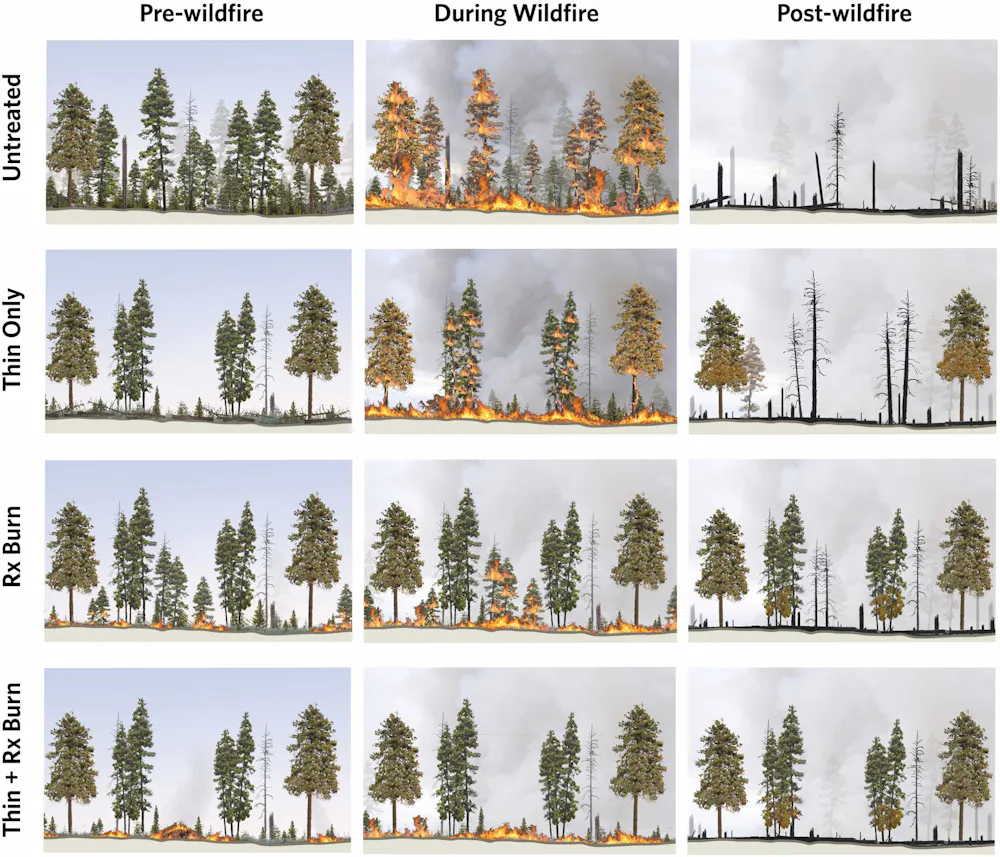
    Measures such as prescribed burns have proven to be effective for maintaining healthy forests and reducing the severity of subsequent wildfires. A recent review found that selective thinning followed by prescribed fire reduced subsequent fire severity by 72% on average, and prescribed fire on its own reduced severity by 62%.

    Prescribed burns and forest thinning tend to reduce the risk of extremely destructive wildfires.
    Kimberley T. Davis, et al., Forest Ecology and Management, 2024, CC BY

    But managing forests well requires knowing how forests are changing, where trees are dying and where undergrowth has built up and increased fire hazards. And, for federal lands, these are some of the jobs that are being targeted by the Trump administration.

    Some of the Forest Service staff who were fired or put in limbo by the Trump administration are those who do research or collect and communicate critical data about forests and fire risk. Other fired staff provided support so crews could clear flammable debris and carry out fuel treatments such as prescribed burns, thinning forests and building fire breaks.

    Losing people in these roles is like firing all primary care doctors and leaving only EMTs. Both are clearly needed. As many people know from emergency room bills, preventing emergencies is less costly than dealing with the damage later.

    Logging is not a long-term fire solution

    The Trump administration cited “wildfire risk reduction” when it issued an emergency order to increase logging in national forests by 25%.

    But private − unregulated − forest management looks a lot different than managing forests to prevent destructive fires.

    Logging, depending on the practice, can involve clear-cutting trees and other techniques that compromise soils. Exposing a forest’s soils and dead vegetation to more sunlight also dries them out, which can increase fire risk in the near term.

    Forest-thinning operations involve carefully removing young trees and brush that could easily burn, with a goal of creating conditions less likely to send fire into the crowns of trees.
    AP Photo/Godofredo A. Vásquez

    In general, logging that focuses on extracting the highest-value trees leaves thinner trees that are more vulnerable to fires. A study in the Pacific Northwest found that replanting logged land with the same age and size of trees can lead to more severe fires in the future.

    Research and data are essential

    For many people in the western U.S., these risks hit close to home.

    I’ve seen neighborhoods burn and friends and family displaced, and I have contended with regular air quality warnings and red flag days signaling a high fire risk. I’ve also seen beloved landscapes, such as those on Cameron Peak, transform when conifers that once made up the forest have not regrown.

    Recovery has been slow on Cameron Peak after a severe fire in 2020. This photo was taken in 2024.
    Bella Oleksy/University of Colorado

    My scientific research group and collaborations with other scientists have been helping to identify cost-effective solutions. That includes which fuel-treatment methods are most effective, which types of forests and conditions they work best in and how often they are needed. We’re also planning research projects to better understand which forests are at greatest risk of not recovering after fires.

    This sort of research is what robust, cost-effective land management is based on.

    When careful, evidence-based forest management is replaced with a heavy emphasis on suppressing every fire or clear-cutting forests, I worry that human lives, property and economies, as well as the natural legacy of public lands left to every American, are at risk.

    Laura Dee receives funding from NASA.

    ref. Controlled burns reduce wildfire risk, but they require trained staff and funding − this could be a rough year – https://theconversation.com/controlled-burns-reduce-wildfire-risk-but-they-require-trained-staff-and-funding-this-could-be-a-rough-year-251705

    MIL OSI – Global Reports

  • MIL-OSI Global: Trump is stripping protections from marine protected areas – why that’s a problem for fishing’s future, and for whales, corals and other ocean life

    Source: The Conversation – USA – By David Shiffman, Faculty Research Associate in Marine Biology, Arizona State University

    The coral reefs of Palmyra Atoll, part of Pacific Islands Heritage Marine National Monument, provide nurseries for many fish species. Andrew S. Wright/U.S. Fish and Wildlife Service via Flickr, CC BY-SA

    The single greatest threat to the diversity of life in our oceans over the past 50 years, more than climate change or plastic pollution, has been unsustainable fishing practices.

    In much of the ocean, there is little to no regulation or oversight of commercial fishing or other human activities. That’s part of the reason about a tenth of marine plant and animal species are considered threatened or at risk.

    It’s also why countries around the world have been creating marine protected areas.

    These protected areas, covering over 11.6 million square miles (30 million square kilometers) in 16,000 locations, offer refuge away from human activities for a wide variety of living creatures, from corals to sea turtles and whales. They give fish stocks a place to thrive, and those fish spread out into the surrounding waters, which helps fishing industries and local economies.

    In the U.S., however, marine protection is being dismantled by President Donald Trump.

    Marine protected areas as of 2022. Fully or highly protected areas represented less than 3% of the ocean, according to the Marine Protection Atlas.
    Marine Conservation Institute via Wikimedia Commons, CC BY-SA

    Trump issued a proclamation on April 17, 2025, titled “Unleashing American commercial fishing in the Pacific,” ordering the removal of key protections to allow commercial fishing in parts of a nearly-500,000-square-mile marine protected area called the Pacific Island Heritage National Marine Monument.

    He also called for a review of all other marine national monuments to decide if they should be opened to commercial fishing too. In addition, the Trump administration is proposing to redefine “harm” under the Endangered Species Act in a way that would allow for more damage to these species’ habitats.

    I’m a marine biologist and scuba diver, and it’s no accident that all my favorite dive sites are within marine protected areas. I’ve found what scientific studies from across the world show: Protected areas have much healthier marine life populations and healthier ecosystems.

    What’s at risk in the Pacific

    The Pacific Island Heritage National Marine Monument, about 750 miles west of Hawaii, is dotted by coral reefs and atolls, with species of fish, marine mammals and birds rarely found anywhere else.

    It is home to protected and endangered species, including turtles, whales and Hawaiian monk seals. Palmyra Atoll and Kingman Reef, both within the area, are considered among the most pristine coral reefs in the world, each providing habitats for a wide range of fish and other species.

    These marine species are able to thrive there and spread out into the surrounding waters because their habitats have been protected.

    A tour of several marine protected areas and their inhabitants in 2016.

    President George W. Bush, a conservative Republican, created this protected area in 2009, restricting fishing there, and President Barack Obama later expanded it. Trump, whose administration has made no secret of its aim to strip away environmental protections across the country’s land and waters, is now reopening much of the marine protected area to industrial-scale fishing.

    The risks from industrial fishing

    When too many fish are killed and too few young fish are left to replace them, it’s considered overfishing, and this has become a growing problem around the world.

    In 1974, about 10% of the world’s fish stocks were overfished. By 2021, that number had risen to 37.7%, according to the United Nations Food and Agriculture Organization’s annual State of Fisheries and Aquaculture Report.

    A fishing net caught on a coral reef can destroy habitat.
    Kampee Patisena/Moment/Getty Images

    Modern industrial-scale fishing practices can also harm other species.

    Bycatch, or catching animals that fishermen don’t want but are inadvertently caught up in nets and other gear, is a threat to many endangered species. Many seabirds, sea turtles and whales die this way each year. Some types of fishing gear, such as trawls and dredges that drag along the sea floor to scoop up sea life, can destroy ocean habitat itself.

    Without regulations or protected areas, fishing can turn into a competitive free-for-all that can deplete fish stocks.

    How marine protected areas protect species

    Marine protected areas are designed to safeguard parts of the ocean from human impacts, including offshore oil and gas extraction and industrial fishing practices.

    Studies have found that these areas can produce many benefits for both marine life and fishermen by allowing overfished species to recover and ensuring their health for the future.

    A decade after Mexico established the Cabo Pulmo protected area, for example, fish biomass increased by nearly 500%.

    How marine protected areas help marine life and local economies.

    Successful marine protected areas tend to have healthier habitats, more fish, more species of fish, and bigger fish than otherwise-similar unprotected areas. Studies have found the average size of organisms to be 28% bigger in these areas than in fished areas with no protections. How many babies a fish has is directly related to the size of the mother.

    All of this helps create jobs through ecotourism and support local fishing communities outside the marine protected area.

    Marine protected areas also have a “spillover effect” – the offspring of healthy fish populations that spawn inside these areas often spread beyond them, helping fish populations outside the boundaries thrive as well.

    Ultimately, the fishing industry benefits from a continuing supply. And all of this happens at little cost.

    A need for more protected areas, not fewer

    Claims by the Trump administration that marine protected areas are a heavy-handed restriction on the U.S. fishing industry do not hold water. As science and my own experience show, these refuges for sea life can instead help local economies and the industry by allowing fish populations to thrive.

    For the future of the planet’s whales, sea turtles, coral reefs and the health of fishing itself, scientists like me recommend creating more marine protected areas to help species thrive, not dismantling them.

    David Shiffman has consulted for many environmental non-profit groups including the Ocean Conservancy, as well as fishing industry groups and fisheries managment agencies.

    ref. Trump is stripping protections from marine protected areas – why that’s a problem for fishing’s future, and for whales, corals and other ocean life – https://theconversation.com/trump-is-stripping-protections-from-marine-protected-areas-why-thats-a-problem-for-fishings-future-and-for-whales-corals-and-other-ocean-life-254925

    MIL OSI – Global Reports

  • MIL-OSI Global: What does the UK Supreme Court’s gender ruling mean for trans men?

    Source: The Conversation – UK – By Daniel Alge, Senior Lecturer in Criminology & Criminal Justice, Brunel University of London

    Alex Segre/Shutterstock

    The UK Supreme Court ruling backing the “biological” definition of a woman has been hailed by many as providing clarity on the law. But far from the matter being settled, it has raised complex questions, particularly when we consider that half of all transgender people are trans men. It even raises the possibility of trans men being excluded from both men and women’s spaces.

    The court unanimously agreed that, regardless of any gender reassignment or possession of a gender recognition certificate (GRC) recognising them as female, transgender women should not be recognised as women for the purposes of the Equality Act 2010. This means that access to single-sex spaces should be determined by biological gender assigned at birth.

    Meanwhile, the Equality and Human Rights Commission has said it will “pursue” the NHS unless it changes its gender policies. The NHS policies currently state that transgender patients should be accommodated in accordance with their self-identified gender, based on appearance, name and pronouns.


    Want more politics coverage from academic experts? Every week, we bring you informed analysis of developments in government and fact check the claims being made.

    Sign up for our weekly politics newsletter, delivered every Friday.


    For many complex reasons, trans men generally feature far less in the public discourse around trans issues. Trans men are currently under-researched and rarely considered by the mainstream media or academic literature.

    The Supreme Court’s own summary of the case sets out the issue in terms of the definition of “woman”. But it is clear that the judgment applies equally to trans men as it finds that each of the terms “man”, “woman” and “sex” in the Equality Act refer to biological sex. The court concludes that any other definition would be “incoherent and unworkable”.

    The Office for National Statistics estimates there are roughly equal numbers (48,000) of trans men and trans women in England and Wales. This is supported by data from the US, which also shows roughly equal populations of trans men and trans women.

    Issues for trans men

    Those who support a biological definition of sex have framed their position as one which protects women’s rights and keeps women’s spaces safe by excluding men. By legal definition, that now includes trans women. However, it does not include trans men, who would have been born biologically female.

    This judgment means that trans men can be excluded from men’s single-sex spaces. But there may also be cases where they are excluded from women’s spaces too, despite being considered women under the ruling.

    The court found that it might be proportionate to exclude a trans man from a women’s single-sex service such as counselling for survivors of sexual abuse where “reasonable objection is taken to their presence … because the gender reassignment process has given them a masculine appearance…”.

    This statement highlights the flawed legal reasoning around trans men. In most circumstances they are to be treated as women, even if that creates absurdities in practical implementation. And yet, they can also be excluded from some women’s spaces if they appear too masculine. It could be argued that it is this decision which is “incoherent and unworkable”.

    The ruling could create more confusion over who can access single-sex spaces.
    Iryna_Kolesova/Shutterstock

    The Supreme Court decision repeatedly makes the point that “neither possession of a GRC [gender recognition certificate] nor the protected characteristic of gender reassignment require any physiological change or even any change in outward appearance”.

    However, in practice a GRC can’t be issued without a medical diagnosis of gender dysphoria. It is very difficult for an individual to meet the diagnostic criteria for gender dysphoria without making changes to their appearance or pursuing medical transition.

    Testosterone treatment means that trans men may find it easier to “pass” (be perceived as the gender they identify with) than trans women. Testosterone generally causes facial hair to grow, and creates a more masculine physique and a deeper voice without the need for any additional procedures.

    There are no official statistics, but a 2022 report by the advocacy group TransActual found that around 90% of trans respondents have accessed hormone therapy or surgery, or hope to do so in the future.

    This likely means that a majority of the 48,000 estimated trans men in England and Wales are likely to present as masculine, and be perceived as cisgender men. This is where any implementation of the Supreme Court’s ruling becomes complicated.

    Single-sex spaces

    The decision, subject to any future clarification, means that trans men are not permitted to enter men’s single-sex spaces such as men’s toilets, gym changing rooms or hospital wards. Instead, they should use the women’s single-sex spaces including communal changing areas, in accordance with their biological sex.

    The justices briefly considered this issue when they gave the example of an employer requiring that a warden in a women’s or girls’ hostel be female. Before this ruling, such a role would be open to a trans woman with a GRC, but not to a trans man with a GRC.

    The court stated that “a biological definition of sex would correct this perceived anomaly”. However, this means that the warden in the girls’ hostel can now be a trans man, who could well be indistinguishable from a cis man to the residents of the hostel.

    There is also the concern that both trans men and trans women will expose themselves to a greater risk of harassment, which has already increased considerably, if they are forced to out themselves by using facilities which don’t align with the gender they present as.

    Daniel Alge does not work for, consult, own shares in or receive funding from any company or organisation that would benefit from this article, and has disclosed no relevant affiliations beyond their academic appointment.

    ref. What does the UK Supreme Court’s gender ruling mean for trans men? – https://theconversation.com/what-does-the-uk-supreme-courts-gender-ruling-mean-for-trans-men-254868

    MIL OSI – Global Reports

  • MIL-OSI USA: Welch Joins Schiff, Reed, Lawmakers Call on Trump Administration to Reverse Plans to Defund Libraries and Museums

    US Senate News:

    Source: United States Senator Peter Welch (D-Vermont)
    “The consequences of eliminating IMLS will be devastating for states, local communities, and the millions of Americans who rely on these institutions every day.”
    WASHINGTON, D.C. – U.S. Senator Peter Welch (D-Vt.) joined U.S. Senators Adam Schiff (D-Calif.), Jack Reed (D-R.I.) and 23 lawmakers in writing to the Acting Director of the Institute of Museum and Library Services (IMLS) about serious concerns regarding President Trump’s call to eliminate IMLS which was created by a Republican-led Congress in 1996 and is the only federal agency dedicated to supporting the nation’s libraries and museums. In the letter, the Senators call on the Administration to ensure there is continued funding in accordance with federal law for libraries and museums and to reverse any actions that jeopardize their provision of critical services on which many communities rely on. 
    “The consequences of eliminating IMLS will be devastating for states, local communities, and the millions of Americans who rely on these institutions every day. These institutions are critical pillars of educational opportunity, cultural preservation, civic engagement, and economic development in our communities,” wrote the lawmakers.  
    “We urge you to uphold the law, immediately disburse all LSTA grant funding to our states, including California, Connecticut and Washington, and reverse any actions that jeopardize the future of the libraries and museums our communities rely on,” the lawmakers concluded.  
    Libraries serve as essential lifelines for families, students, and workers throughout California providing literacy programs, access to technology, job training, small business support, and more. 
    This letter is also signed by U.S. Senators Alex Padilla (D-Calif.), Richard Blumenthal (D-Conn.), Tammy Duckworth (D-Ill.), Kristen Gillibrand (D-N.Y.), Amy Klobuchar (D-Minn.), Jeff Merkley (D-Ore.), Jacky Rosen (D-Nev.), and Bernie Sanders (I-Vt.). In the U.S. House of Representatives, this letter is signed by Representatives Eric Swalwell (D-Calif.-15), Julia Brownley (D-Calif.-26), Scott Peters (D-Calif.-50), Jim Costa (D-Calif.-21), Raul Ruiz (D-Calif.-25), Juan Vargas (D-Calif.-52), Mark Takano (D-Calif.-39), George Whitesides (D-Calif.-27), Mike Thompson (D-Calif.-04), Norma Torres (D-Calif.-35), Jimmy Gomez (D-Calif.-34), J. Luis Correa (D-Calif.-46), Salud Carbajal (D-Calif.-24) Nanette Barragan (D-Calif.-44) and Zoe Lofgren (D-Calif.-18). 
    The full text of the letter is available here and below.   
    Dear Mr. Sonderling,
    We write to express our serious concerns regarding President Trump’s call to eliminate the Institute of Museum and Library Services (IMLS), the only federal agency dedicated to supporting the nation’s libraries and museums. On March 14, 2025 President Trump issued the Executive Order “Continuing the Reduction of the Federal Bureaucracy” which includes IMLS to be eliminated “to the maximum extent consistent with applicable law” and for IMLS to submit a report to the Office of Management and Budget (OMB) to confirm compliance. We are reminding the Administration of its obligation to fully execute the law as authorized by Congress under the Museum and Library Services Act (MLSA) of 2018 (PL 115-40), as signed by President Trump. Beginning on April 3, 2025, several grantees— including the states of California, Connecticut and Washington— received written notice from IMLS that their federal Fiscal Year 2024–25 grants under the Library Services and Technology Act (LSTA) had been terminated. We strongly urge the Administration to reverse these terminations and ensure continued funding in accordance with federal law.
    For Fiscal Year 2024, Congress appropriated $294.8 million for IMLS, specifying funding should be allotted across the programs in the following manner:
    Library Services Technology Act
    Grants to States                                                                                            $180,000,000
    Native American Library Services                                                             $5,763,000
    National Leadership: Libraries                                                                  $15,287,000
    Laura Bush 21st Century Librarian                                                            $10,000,000
    Museum Services Act
    Museums for America                                                                                 $30,330,000      
    Native American/Native Hawaiian Museum Services                           $3,772,000
    National Leadership: Museums                                                                 $9,348,000
    African American History and Culture Act                                                $6,000,000
    National Museum of the American Latino Act                                         $6,000,000
    Research, Analysis, and Data Collection                                                   $5,650,000
    Program Administration                                  $22,650,000
    We expect the Administration to fully implement the Full-Year Continuing Appropriations and Extensions Act of 2025 consistent with the Fiscal Year 2024 allocations. We also urge the Administration to allow IMLS to continue to engage with and support libraries and museums as Congress intended and as authorized in the MLSA, including maintaining the expertise of the IMLS staff to carry out the functions of the agency.
    Libraries and museums are deeply embedded in local communities across the country and millions of Americans rely on their services and programs, particularly the most rural and underserved areas. In 2024, IMLS funding reached 140,000 libraries and museums across all 50 states and U.S. territories. Public, school, academic, and specialty libraries provide a wide range of local services such as summer reading programs for youth, high-speed internet, workforce training, and support for small businesses. Libraries are especially vital for low-income families, students, and workers who depend on them for free access to technology, educational resources, and job search support. In California, local libraries serve as critical lifelines for families experiencing homelessness and those displaced by natural disasters, offering space for community gathering and access to emergency information. Every year, more than 1.2 billion people visit libraries in-person—and they are deeply valued by the American public.
    Museums serve as crucial sources of information for history, art, science, and culture and have broad public support. In fact, 96 percent of surveyed Americans believe lawmakers should support museums. Museums support more than 726,000 American jobs and contribute $50 billion to the U.S. economy every year. Beyond their cultural significance, museums play a vital role in education, offering hands-on learning opportunities for students of all ages and providing resources that supplement school curricula, especially in underserved communities. For states like California, Connecticut, and Washington, museums are essential pillars of local identity, tourism, and community development.
    The consequences of eliminating IMLS will be devastating for states, local communities, and the millions of Americans who rely on these institutions every day. These institutions are critical pillars of educational opportunity, cultural preservation, civic engagement, and economic development in our communities.
    As such, please provide us with a written response to the questions below no later than May 1, 2025.
    How many IMLS employees have been fired, put on administrative leave, accepted the deferred resignation program offer, or accepted the Voluntary Early Retirement Authority or Voluntary Separation Incentive Payment offer since January 20, 2025?  Please provide the number of employees in each category.
    How many individuals are currently employed at the agency?  Please provide their titles and duties.
    How many of these employees were responsible for, or assisted in, administering grants?
    Which officials at IMLS were involved in the staffing reduction decisions and what planning, if any, was undertaken prior to these reductions?
    What factors are being used to determine the cancellation of grants, including the Grants to States funding?
    Please provide a full list of cancelled grants, including the date of cancellation, type of grant, and dollar amount.
    Please share what the agency’s “updated priorities” are and how grants are being assessed for alignment and plans for grant competitions in Fiscal Year 25.
    Which officials at IMLS are involved in developing the report to the Director of OMB?
    What are such officials’ expertise in IMLS administration and the Museum and Library Services Act statute?
    Please share with Congress the report detailing the functions of IMLS and what is statutorily required and to what extent.
    Museums and libraries are the cornerstone of our society that serve as protected spaces for people to learn, engage with their community, and build curiosity. We urge you to uphold the law, immediately disburse all awarded LSTA grant funding to our states, including California, Connecticut and Washington, and reverse any actions that jeopardize the future of the libraries and museums our communities rely on.

    MIL OSI USA News

  • MIL-OSI Russia: The All-Russian Student Olympiad in Applied Mechanics is being held at the Polytechnic University

    Translartion. Region: Russians Fedetion –

    Source: Peter the Great St Petersburg Polytechnic University – Peter the Great St Petersburg Polytechnic University –

    The All-Russian Student Olympiad in Applied Mechanics with international participation has started in Saint Petersburg. The event is held with the support of the Ministry of Education and Science of Russia, the Association of Technical Universities and the Federal Educational and Methodological Association in the field of “Mechanical Engineering” at the Advanced Engineering School “Digital Engineering” of Peter the Great Saint Petersburg Polytechnic University (PISh SPbPU).

    The All-Russian Student Olympiad in Applied Mechanics with international participation was held regularly from 1999 to 2020.

    At the opening of the Olympiad in the Technopolis Polytech research building, the participants were greeted in a video message by the Minister of Science and Higher Education of the Russian Federation, Valery Falkov:

    “Dear friends! Welcome to the All-Russian Student Olympiad in Applied Mechanics with International Participation. It is gratifying that after almost a five-year hiatus, we are reviving the platform for interaction between talented students and their mentors. I would like to express special gratitude to the Advanced Engineering School “Digital Engineering”, which organized this meeting within its hospitable walls. The profile of the Olympiad is of particular importance today in the context of strengthening Russia’s ties with its closest foreign partners in the scientific and technological sphere. Mechanics allows us to solve key problems in the creation of technologies and science-intensive products in many industries, including mechanical engineering and engine building, shipbuilding, aircraft manufacturing, medical and biomechanical systems. I am sure that the revival of the Olympiad will become one of the effective tools for supporting talented students. Friends, I wish you fruitful work, success and all the best!”

    In 2025, the main goals of the revived All-Russian Student Olympiad in Applied Mechanics were to improve the academic and extracurricular work of students, develop deeper knowledge in the field of applied mechanics, develop creative activity and independent thinking, identify gifted students and develop human resources.

    Vice-Governor of Saint Petersburg Vladimir Knyaginin conveyed his greetings to the participants, in which he also noted the contribution of Peter the Great Saint Petersburg Polytechnic University and the Advanced Engineering School of SPbPU “Digital Engineering” to the revival and development of the Olympiad: “The All-Russian Student Olympiad in Applied Mechanics is gaining particular relevance not only as a significant event in the personal and professional development of students. It also helps to synchronize watches and unite efforts in achieving common goals of technological development of representatives of the scientific and educational community, industry and government. It is no coincidence that this event is being held at the Advanced Engineering School of SPbPU “Digital Engineering” – one of the leaders of the corresponding federal project, which was previously part of the national project “Science and Universities”, and since 2025 has been implemented within the framework of the new national project “Youth and Children”. I am confident that participation in the Olympiad will give students a positive and useful experience, and it will become an important annual event in the world of training new generation engineers, developing advanced technologies and strengthening the technological leadership of our country. I thank the St. Petersburg Polytechnic for organizing the Olympiad and wish all its participants interesting tasks and success in finding new promising solutions!”

    This year, 29 teams from the Republic of Belarus, Kazakhstan, Kyrgyzstan and Russia are participating in the Olympiad: Moscow, St. Petersburg, Arkhangelsk, Belgorod, Volgograd, Ivanovo, Kaliningrad, Samara, Tver, Tyumen, Chelyabinsk, Yaroslavl regions, Krasnoyarsk Krai, Perm Krai, Khabarovsk Krai.

    “The advanced engineering school of SPbPU “Digital Engineering” has been training personnel for almost three years now, who will form the engineering elite of the country, the so-called engineering special forces. Therefore, the revival of the All-Russian Student Olympiad in Applied Mechanics, which has decades of history behind it, at the site of the SPbPU PISh – a modern and proven method of training engineering personnel in close cooperation with industrial partners – is a bright symbol that reflects the changes that are currently taking place in Russian engineering education in the broadest sense of the word. We see great interest in applied mechanics and potentially in engineering, including because teams from all over the country – from Kaliningrad to Khabarovsk, as well as students from foreign countries – participate in the Olympiad. I want to wish all participants success, and may the smartest win!” — the rector of Peter the Great St. Petersburg Polytechnic University, chairman of the St. Petersburg branch of the Russian Academy of Sciences Andrey Rudskoy announced the start of the Olympiad.

    The All-Russian Student Olympiad in Applied Mechanics with International Participation is held in person and includes two blocks: theoretical and practical. In the theoretical block, participants are offered six problems to solve: three on the strength of materials and three on theoretical mechanics. Each problem will be assessed by an expert jury on a 10-point scale. The topics of the problems on the strength of materials include: tension-compression, bending and complex resistance. On theoretical mechanics: statics, kinematics and dynamics.

    The practical block is a wide range of events that will allow the Olympiad participants to immerse themselves in the world of modern digital engineering. Thus, students will be able to take part in master classes on the use of domestic software packages for solving computer modeling problems from leading Russian vendors of engineering software: APM (STC “APM”), FlowVision (OOO “Tesis”), “Logos” (FSUE “RFNC-VNIIEF”).

    Participants will be able to try their hand at the engineering championship, as well as visit leading high-tech industry enterprises such as Gazprom Neft Scientific and Technical Center and CentroTech-Engineering (part of the management structure of the Fuel Company JSC TVEL of Rosatom State Corporation) and get acquainted with their activities. In addition, Olympiad participants will visit the new laboratories of the Advanced Engineering School of SPbPU. An extensive cultural and entertainment program has been organized for the guests.

    The results of the Olympiad will be announced on April 25, 2025. The Olympiad website is HTTPS: // Applied-Mechanics.ru/

    Please note: This information is raw content directly from the source of the information. It is exactly what the source states and does not reflect the position of MIL-OSI or its clients.

    MIL OSI Russia News

  • MIL-OSI Global: London marathon: why you need a plan to prevent the post-race blues

    Source: The Conversation – UK – By Helen Owton, Lecturer in Sport and Fitness, The Open University

    IR Stone/Shutterstock

    As the sun rises over the river Thames on marathon day this year, tens of thousands of cheering spectators will fill the streets and a record-breaking 56,000 adrenaline-fuelled runners will gather at the starting line of the TCS London marathon.

    At the start of the gun, the stampede of runners will surge forward bringing the streets of London alive with the rhythmic thud of trainers, the sweat of determination, and the roaring of the crowd shouting: “Come on, you can do it!”

    The race isn’t just about competition; it’s a celebration of perseverance, passion and overcoming adversity. “Every marathon is up and down, very emotional” says “Britain’s bladerunner” double Paralympic gold medallist Richard Whitehead, who holds the Guinness World Record for fastest double amputee marathon in 2024.

    At the finish line, exhaustion is mixed with triumph and runners share in a sense of collective achievement. But, once the race is over, it’s back home to daily tasks; the gruelling demands of the training schedule vanish, and the highs of the marathon can fade quickly.

    The low after the high

    While marathon runners usually experience a great sense of accomplishment and euphoria after completing a race, it can often be followed by a lingering sense of emptiness.

    A 2024 study found that endurance athletes often face a mixture of emotions after a race, both physically and mentally. Their feelings seem to depend on factors like how much time they spent training and their ability to set new goals for the next phase of training.

    A comedown after a major event is a common experience for many athletes. After the months of intense training, physical exertion and the emotional high of participating in such a momentous event, the mind and body can experience a crash and “post-marathon blues” can set in as the excitement, adrenaline and sense of purpose and meaning fades.


    Read more:
    ‘Olympic comedown’ is a common ailment after the games – here’s what it is and how athletes cope


    The post-marathon blues describes mild depression and feelings of emptiness. It’s characterised by increased anxiety levels, depression, burnout and challenges in adjusting back to everyday life.

    Set goals, rest and recover

    Marathon runners report that it can take between one to eight weeks before they feel their wellbeing return to pre-race levels. While setting goals ahead of time could help alleviate negative emotions after the marathon, attempting to achieve another goal too soon also has its risks, including injury and training plateau.

    Eddie Izzard, who ran 43 marathons in 51 days in 2009 and 31 in 31 days in 2020 has been open about the physical toll of running multiple marathons. For some, though, marathon running is a way of life, as “ ultramarathon man” Dean Karnazes explains:

    I run because if I didn’t, I’d be sluggish and glum and spend too much time on the couch. I run to breathe in fresh air. I run to explore. I run to escape the ordinary. I run … to savour the trip along the way. Life becomes a little more vibrant, a little more intense. I like that.

    Setting a new goal, however, doesn’t have to be another marathon or even another sports-related goal. Reflect on and enjoy the sense of achievement from running a marathon and channel this into other aspects of your life and explore other interests like a DIY project or a hobby.

    A post-marathon plan is just as crucial as the pre-marathon training schedule. Proper recovery and continued maintenance of your physical and mental wellbeing are essential for long-term performance, injury prevention and overall health. While there is no one-size-fits-all recovery plan, some suggest a phased recovery, building up to a return to training after adequate recovery time.

    In the end, post-marathon blues is a real challenge. Despite the euphoria of such an incredible achievement, experiencing negative emotions is inevitable and something you might not be able to avoid. But post-marathon blues doesn’t have to define the journey. It’s all part of the process. And athletes, if physically and psychologically prepared, can turn the finishing line into a new starting point.

    Helen Owton does not work for, consult, own shares in or receive funding from any company or organisation that would benefit from this article, and has disclosed no relevant affiliations beyond their academic appointment.

    ref. London marathon: why you need a plan to prevent the post-race blues – https://theconversation.com/london-marathon-why-you-need-a-plan-to-prevent-the-post-race-blues-253978

    MIL OSI – Global Reports

  • MIL-OSI USA: NIH researchers supercharge ordinary clinical device to get a better look at the back of the eye

    Source: US Department of Health and Human Services – 2

    News Release
    Wednesday, April 23, 2025

    New technique brings retina into sharper focus .

    Scientists at the National Institutes of Health (NIH) have leveraged artificial intelligence to transform a device designed to see tissues in the back of the eye into one sharp enough to make out individual cells. The technique provides imaging resolution that rivals the most advanced devices available and is cheaper, faster, and doesn’t require specialized equipment or expertise. The strategy has implications for early detection of disease and for the monitoring of treatment response by making what was once invisible now visible.  
    “AI potentially puts next-generation imaging in the hands of standard eye clinics. It’s like adding a high-resolution lens to a basic camera.” said Johnny Tam, Ph.D., investigator at NIH’s National Eye Institute and senior author of the study report, which published in Communications Medicine.
    Imaging devices, known as ophthalmoscopes, are widely used to examine the light-sensing retina in the back of the eye. A scanning laser ophthalmoscope is standard in eye clinics, but its resolution can only make out structures at the tissue level—things such as lesions, blood vessels, and the optic nerve head. Next-generation ophthalmoscopes enabled with adaptive optics—a technology that compensates for light distortion—can make out cellular features, providing greater diagnostic information. However, adaptive optics-enabled imaging is still in the experimental phase.
    Tam and collaborators developed a custom AI system to digitally enhance images of a layer of tissue beneath the light-sensing photoreceptors, known as the retina’s pigmented epithelium (RPE). The first step was to teach the system to recognize image quality as poor, moderate, or good. The researchers did this by feeding the system more than 1,400 images from different areas of the retina, obtained using adaptive-optics ophthalmoscopy. Next, they fed the system corresponding images from the same retinal locations but obtained using standard ophthalmoscopy. An image sharpness test showed that AI improved clarity eightfold.
    “Our system used what it learned from rating the images obtained from adaptive optics to digitally enhance images obtained with standard ophthalmoscopy,” said Tam. “It’s important to point out that the system is not creating something from nothing. Features that we see in RPE cells with standard imaging are there, they’re just unclear.”
    These techniques involve injection of a dye called indocyanine green (ICG) into the bloodstream to increase contrast of anatomical features. In the eye clinic, ICG is usually used to image the blood vessels of the eye.
    “Our ICG imaging strategy allows RPE cells to be quickly and routinely assessed in the clinic,” said Joanne Li, Ph.D., first author of the report and a biomedical engineer in Tam’s lab. “With AI, high quality images of the RPE cells can be obtained in a matter of seconds, using standard clinical imaging instruments.”
    The RPE cells’ function is to nourish and support photoreceptors. A variety of blinding conditions first affect RPE cells, including age-related macular degeneration, vitelliform macular dystrophy, and Stargardt disease. However, RPE cells cannot be easily imaged in the clinic. AI-enhanced ICG ophthalmoscopy puts RPE imaging within reach of the typical eye clinic.##
    This press release describes a basic research finding. Basic research increases our understanding of human behavior and biology, which is foundational to advancing new and better ways to prevent, diagnose, and treat disease. Science is an unpredictable and incremental process— each research advance builds on past discoveries, often in unexpected ways. Most clinical advances would not be possible without the knowledge of fundamental basic research. To learn more about basic research, visit https://www.nih.gov/news-events/basic-research-digital-media-kit.
    NEI leads the federal government’s efforts to eliminate vision loss and improve quality of life through vision research…driving innovation, fostering collaboration, expanding the vision workforce, and educating the public and key stakeholders. NEI supports basic and clinical science programs to develop sight-saving treatments and to broaden opportunities for people with vision impairment. For more information, visit   https://www.nei.nih.gov.  
    About the National Institutes of Health (NIH): NIH, the nation’s medical research agency, includes 27 Institutes and Centers and is a component of the U.S. Department of Health and Human Services. NIH is the primary federal agency conducting and supporting basic, clinical, and translational medical research, and is investigating the causes, treatments, and cures for both common and rare diseases. For more information about NIH and its programs, visit www.nih.gov.
    NIH…Turning Discovery Into Health®

    References
    Li J, Liu J, Das V, Le H, Aguilera N, Bower Aj, Giannini JP, Lu R, Abouassali S, Chew EY, Brooks BP, Zein WM, Huryn LA, Volkov A, Liu T, Tam J “Artificial intelligence assisted clinical fluorescence imaging achieves in vivo cellular resolution comparable to adaptive optics ophthalmology”. Published April 28, 2025, Communications Medicine

    ###

    MIL OSI USA News

  • MIL-OSI Asia-Pac: Reading day activities held

    Source: Hong Kong Information Services

    This year’s April 23 marks the second Hong Kong Reading for All Day. Hong Kong Public Libraries (HKPL) today collaborated with stakeholders to set up reading locations for “Read Together for Half an Hour” activities to promote reading among the public.

    Director of Leisure & Cultural Services Manda Chan attended the “Read Together for Half an Hour” activity at the Hong Kong Central Library to share her reading experience with the participating students, remarking that reading while broadening one’s horizons is also life-enriching. She encouraged students to keep reading.

    HKPL also invited renowned online content creator SaiDorSi to explore the relationship between reading and creativity with the participating students.

    “Read Together for Half an Hour” is one of the highlight activities of Hong Kong Reading Week 2025.

    The department provided a variety of books at different reading locations today, including the Museum of Art, the Science Museum, the Oil Street Art Space, the Railway Museum, Choi Hung Road Sports Centre, Tsuen Wan Sports Centre, Sun Yat Sen Memorial Park and individual public libraries.

    In addition, “Read Together for Half an Hour” activities were held at 2025 Hong Kong Reading+ at New Town Plaza in Sha Tin, as well as at individual community libraries and community centres.

    Furthermore, HKPL, in collaboration with the Hans Andersen Club, carried out the “Read together for Half an Hour” event and carnival at Lok Fu Place, featuring storytelling sessions, game booths and handicraft workshops. A reading area with selected books was also set up to promote reading.

    Hong Kong Reading Week is being held from April 19 to 27. Under the theme “Zoom/LIBRARY”, it offers about 450 online and on-site events to encourage the public to develop a reading habit.

    Activities include fun days, sharing sessions, videos and audio clips in which celebrities share their reading experiences and more. QR codes for selected e-books are available at different government venues for easy public access.

    All Hong Kong Reading Week activities are free of charge, with seat reservations required for individual events.

    Click here for more details.

    MIL OSI Asia Pacific News

  • MIL-OSI United Kingdom: Greens challenge “con artist” Farage to climate TV debate

    Source: Green Party of England and Wales

    Responding to Nigel Farage’s comments on Radio 4’s Today Programme where he refused to accept that carbon emissions are leading to climate change, Green Party Co-Leader, Adrian Ramsay MP, hit back saying: 

    “Nigel Farage is a performer, a con artist. He will say or do anything. He will happily dance to a populist tune regardless of its impact. Let’s not forget he’s bankrolled by fossil fuel interests, climate deniers, and major polluters—taking in £2.3 million since the 2019 election.

    This morning’s performance suggested he hasn’t got the slightest grasp of even the most basic climate science. But I think it’s worse than that. He understands all too well human-made climate change, but he is willing to pretend he doesn’t and stand in the way of climate action for his party’s populist agenda.

    If he really does believe what he says, let’s see if his ridiculous rhetoric stands up to actual scrutiny – let’s see if he is prepared to take part in an hour-long TV debate about climate change and the challenge of reaching net zero?”

    MIL OSI United Kingdom

  • MIL-OSI USA: Student Activities Building a Sense of Belonging at UConn’s Regional Campuses

    Source: US State of Connecticut

    To watch Aylanie Bonilla in action as a UConn Waterbury student ambassador, it’s easy to imagine she’s always been the sociable go-getter who leads campus tours, meets with high schoolers, and participates in multiple clubs.

    But it’s those very activities she credits with giving her a sense of belonging at UConn, where the Storrs campus felt so large to her in her first semester that she transferred to her hometown campus in Waterbury.

    Like thousands of other students at UConn’s four regional campuses, Bonilla ’26 (CLAS) found her voice and her community through student clubs, an on-campus learning community, and other extracurricular activities.

    She jokes that she’s not sure many of her high school teachers would even remember her name since she was so shy and barely spoke up in class. They’d certainly be surprised now to see her comfortably chatting with strangers, joining clubs, and serving as a program assistant for the Walkbury community initiative.

    “When I became an orientation leader on campus, I just started talking, and I haven’t really stopped,” says Bonilla ’26 (CLAS). “It was really easy to get involved here and to make friends in the clubs and the classes. The feeling is like being part of a big family.”

    UConn Avery Point Women’s Basketball team practicing at UConn Avery Point. (Sean Flynn/UConn Photo)

    Overall, about 5,100 of UConn’s estimated 19,800 undergraduates count one of those locations as their home campus.

    With the vast majority of all regional campus students being Connecticut natives, those locations offer the benefits of a UConn education with the convenience of being in communities where students can live, work, and socialize.

    Like the flagship Storrs campus, the campuses in Avery Point, Hartford, Stamford, and Waterbury each have student government groups, academic and social clubs, and a range of formal and informal activities.

    Regional campus students can also participate in many of the clubs based at Storrs, including having local versions at their own locations. The events are tailored to the unique goals and experiences shared by regional campus students, many of whom balance their classes and clubs with jobs, family obligations, and community activities.

    “It is widely known from student development research, along with the experience of our own students, that engagement in clubs and organizations has dramatic and positive impact on a student’s experience. They also help UConn to attract increasing numbers of top students to our campuses,” says Nathan Fuerst, UConn’s vice president for student life and enrollment.

    Having robust campus activities also helps UConn retain and continue to improve its strong retention and graduation rates as students meet peers, mentors, and others to whom they can turn for help if they’re facing obstacles.

    UConn has prioritized a commitment to expanding its regional campus offerings as part of its Strategic Plan, building on each location’s strengths to make them destinations for students interested in specific majors or programs.

    The clubs are a perfect complement to that work, and part of a wider network of services that also include more advising support and expanded on-site Student Health & Wellness offerings such as nurse navigators, mental health clinical care case workers, and health promotion programs.

    Students playing a game of chess at UConn Hartford. (Sean Flynn/UConn Photo)

    In addition to the academic and social clubs, each regional campus offers library and research resources, small courses with experienced faculty, and programs to help students engage with the communities in which the campuses are located.

    Each campus offers clubs in which students connect with each other through common cultural backgrounds, volunteer activities, religious affiliations, and other attributes. The clubs also build on the academic, social, and community ties unique to each regional campus.

    At UConn Avery Point, for instance, clubs for sailing and paddling, scuba diving, and marine sciences help students take advantage of the waterfront location and resources – in addition to clubs for learning, relaxation, and cultural connections.

    UConn Hartford’s location in Connecticut’s capital city provides an ideal setting for clubs helping students advance their aspirations in business, social work, healthcare and other professions, while also offering fun opportunities to connect through gaming, dance, and other pursuits.

    At the Stamford campus, students participate in a variety of political, cultural, and professional clubs that take advantage of its curriculum and location, and they can also have some fun in groups for debating, K-pop music, sports, and other activities.

    Bonilla, the UConn Waterbury student, has been active in the K-pop group on that campus, where students participate in clubs that range from a business society focused on networking and professional development to ping pong and improv drama.

    The campuses also provide many informal opportunities for students to connect, be it through casual slime-making sessions or building Chipotle-style burrito bowls – recent activities at UConn Waterbury that drew scores of students, including a line that stretched down the hallway for the burrito bowls.

    Students celebrate the opening of the new Center for Academic Success and Engagement (CASE) at UConn Stamford (Sean Flynn/UConn Photo)

    Bonilla is transferring to UConn Stamford this fall and expects to remain just as actively involved there, finishing her degree in communications and looking forward to finding the same sense of community that she discovered in Waterbury.

    “I’m excited to be in a new area and meet new people, and to look for an internship in my field,” she says. “I know it’s a bigger campus than Waterbury, but I also feel like I have a good start and it’ll be fun to get really involved there like I’ve been here.”

    MIL OSI USA News

  • MIL-OSI USA: From UConn to the White House: A Conversation with Anita McBride ’81 (CLAS)

    Source: US State of Connecticut

    Anita McBride ’81 (CLAS) has spent decades working alongside some of the most influential women in American government: the first ladies who shaped national conversations both in the spotlight and behind the scenes.

    This spring, McBride returned to UConn to share what she’s learned with students in the College’s Women’s Leadership Collective and First-Generation Mentorship Program, offering candid reflections on leadership, resilience, and public service.

    “Anita McBride’s career reflects the many directions a UConn education can take you,” says Ofer Harel, dean of the College of Liberal Arts and Sciences. “Her visit gave students a valuable opportunity to hear how mentorship and public service have shaped her path — and how they might shape their own.”

    A veteran of three presidential administrations, McBride held senior roles under Presidents Ronald Reagan, George H.W. Bush, and George W. Bush. As chief of staff to First Lady Laura Bush, she directed initiatives in global health, education, literacy, women’s empowerment, and historic preservation, and led diplomatic travel to 67 countries.

    Today, she serves as executive-in-residence at American University’s Center for Congressional and Presidential Studies, where she leads the First Ladies Initiative. She is also a founding member of the First Ladies Association for Research and Education and sits on the board of the White House Historical Association.

    McBride is the co-author of the first-ever textbook on first ladies, “U.S. First Ladies: Making History and Leaving Legacies”; its public-market adaptation, “Remember the First Ladies: The Legacies of America’s History-Making Women”; and a recent children’s book she co-wrote with her daughter, “First Ladies Make History.”

    “Anita’s keynote brought lived experience, insight, and a sense of purpose that resonated with everyone in the room,” says Jessica Alexander, associate director of alumni relations for CLAS. “Our mentorship programs create meaningful connections between students and alumni.”

    UConn Today caught up with McBride to discuss her path from UConn to the White House, and what she’s learned from a career at the highest levels of American government.

    What advice do you have for first-generation students navigating college life and what comes after?

    There is no one path — It’s constantly changing and moving. You need to be open to changes.

    I came to UConn knowing exactly what I wanted to do. I was pre-med — until I failed. It was the first time I’d been hit with failure. I went to meet with an advisor, and while I was there, I saw a sign for a new study abroad program in Italy. I grew up in an Italian immigrant household, so I figured this might be a way for me to reset my academic path and also see where my family came from. I applied and was accepted.

    It was the most transformative experience of my life on so many levels. I just gained so much confidence. I’m a big believer in fate, so walking into that building that day and seeing that sign, something about it felt so familiar.

    It’s scary to make a real pivot like that — and it wasn’t the last one I’ve made. When you go into politics, you never know what’s coming from one day to the next. The person you work for can win or lose. You’re in, you’re out. There’s a lot to navigate. What got me through all those changes was the belief that there’s always a new opportunity.

    How did UConn prepare you for success?

    UConn helped me navigate some turns, pivots, and challenges. It was a formative time for me. I built friendships that I still hold close today. It gave me a platform to make choices and changes, and I’ve always appreciated that.

    I’ve never really left my experience at UConn behind — I’ve just carried it with me and have used it in different ways throughout my life.

    You’re considered one of the foremost experts on U.S. first ladies. How did you become interested in this subject?

    I had a front-row seat to history, watching this position up close in three administrations, with Nancy Reagan, Barbara Bush, and Laura Bush. It’s a powerful platform, despite having no official authority, position description, salary, or mention in the Constitution. I really appreciated the impact they could have, and that they’re not required to do anything with the role if they choose not to.

    After I left the White House, the president of American University met with me and expressed interest in developing a program to study the growing influence of first ladies. That conversation led me to launch a conference series on the legacies of first ladies that eventually grew into an established academic initiative at American University. It covers their influence not only on the president, but on the presidency and the White House in general.

    Who, in your opinion, is the most influential first lady?

    Eleanor Roosevelt, bar none. She held the role for 12 years — longer than anyone else — and came in highly educated, politically active, and already in the public eye. She gave paid speeches, had a radio show, and wrote a daily newspaper column before becoming First Lady.

    Her husband didn’t want her to have a public role, but she pushed back. She held press conferences for female reporters, who were excluded from the president’s briefings, and gave them a platform during a critical time for women in journalism.

    She also took controversial stances, especially on civil and human rights. When the Daughters of the American Revolution refused to let [renowned Black opera singer] Marian Anderson perform at Constitution Hall, Roosevelt not only resigned from the group, but she also helped arrange Anderson’s now-historic performance at the Lincoln Memorial.

    These were bold steps. She didn’t get everything right and was controversial, but she set a standard for activism that went unmatched for a long time.

    What inspired you to write a children’s book, and what do you hope young readers will take away from it?

    The children’s book grew out of my academic work. I initially set out to fill a gap in the literature with a textbook, highlighting the contributions of first ladies — often unsung and underappreciated.

    Turning it into a children’s book was an exciting new challenge, especially because I did it with my daughter, who is studying to be an elementary school teacher. She had her own front-row seat to history — watching me work and having some exposure to the White House. Together, we adapted the stories from my book for children and worked with an illustrator. I brought the content, and she helped shape it for a young audience.

    For me, this book is about civic education. If we want people to truly understand and care about our history, we have to start at an earlier age. As divided as we are right now, I still believe this is one of the best systems of government — and it’s up to all of us to be part of it.

    You’ve served several presidential administrations. What’s one thing that sticks with you about that experience?

    I’ve met a lot of people in politics with different views. But one of the most lasting lessons I learned came from Laura Bush, the First Lady to former President George W. Bush, who served from 2001 to 2009 during a very turbulent time. Those eight years included two wars, the Sept. 11 attacks, Hurricane Katrina, and the economic collapse. Her husband faced a lot of criticism, and I’d often ask her how she handled it.

    She never took the political bait. She kept things calm and steady, no matter the pressure. If she was disappointed, you could tell — but she expressed it with quiet resolve, she used her voice but didn’t raise her voice.

    What she taught me was this: In public service, you can’t take criticism personally. She would say, “I know who George is. We know who we are as a family. That’s what gets us through.” That mindset has stayed with me. In politics, you have to realize that not everyone will agree with you.

    It’s a challenging time, both economically and politically. What advice do you have for students on how to succeed through the challenges?

    Be respectful of other people’s opinions. Try and not respond in a way that’s adversarial, even if that’s what you see all around you. You don’t have to be that person.

    MIL OSI USA News

  • MIL-OSI: OTC Markets Group Welcomes ONWARD Medical N.V. to OTCQX

    Source: GlobeNewswire (MIL-OSI)

    NEW YORK, April 23, 2025 (GLOBE NEWSWIRE) — OTC Markets Group Inc. (OTCQX: OTCM), operator of regulated markets for trading 12,000 U.S. and international securities, today announced ONWARD Medical N.V. (Euronext Brussels: ONWD; OTCQX: ONWRF, ONWRY), a medical technology company creating innovative spinal cord stimulation therapies to restore movement, function, and independence in people with spinal cord injury (SCI) and other movement disabilities now trades on the OTCQX market.

    ONWARD Medical N.V. begins trading today on OTCQX under the symbols “ONWRF and ONWRY.” US investors can find current financial disclosure and Real-Time Level 2 quotes for the company on www.otcmarkets.com.

    “We are pleased to expand access to US investors, many of whom have expressed interest in supporting ONWARD after learning about our mission to help people with spinal cord injury,” said Dave Marver, CEO of ONWARD Medical. “Trading on OTCQX provides greater visibility and the opportunity for improved liquidity. We have also established a sponsored Level 1 ADR program to facilitate ease of trading for qualified US financial institutions, with our ADRs also trading on OTCQX. Broader US investor participation is an important step in our journey to a potential US IPO.”

    “We are proud to announce the addition of ONWARD Medical to the OTCQX Market,” said Jason Paltrowitz, EVP of Corporate Services at OTC Markets. “This milestone not only marks a significant achievement for the company but also highlights the interplay between the European capital markets and U.S. investors seeking new investment opportunities.”

    Upgrading to the OTCQX Market is an important step for companies seeking to provide transparent trading for their U.S. investors. For companies listed on a qualified international exchange, streamlined market standards enable them to utilize their home market reporting to make their information available in the U.S. To qualify for OTCQX, companies must meet high financial standards, follow best practice corporate governance and demonstrate compliance with applicable securities laws.

    ONWARD has also established a Level 1 ADR program to facilitate trading by qualified financial institutions. BNY acts as the depositary bank and transfer agent for the Company’s ADR program, with one ADR representing one ordinary share. The Company’s ADRs can also be traded on OTCQX under the ticker symbol ONWRY.

    About OTC Markets Group Inc.

    OTC Markets Group Inc. (OTCQX: OTCM) operates regulated markets for trading 12,000 U.S. and international securities. Our data-driven disclosure standards form the foundation of our three public markets: OTCQX® Best Market, OTCQB® Venture Market and Pink® Open Market.

    Our OTC Link® Alternative Trading Systems (ATSs) provide critical market infrastructure that broker-dealers rely on to facilitate trading. Our innovative model offers companies more efficient access to the U.S. financial markets.

    OTC Link ATS, OTC Link ECN, OTC Link NQB, and MOON ATS™ are each an SEC regulated ATS, operated by OTC Link LLC, a FINRA and SEC registered broker-dealer, member SIPC.

    To learn more about how we create better informed and more efficient markets, visit www.otcmarkets.com.

    Subscribe to the OTC Markets RSS Feed

    About ONWARD Medical

    ONWARD Medical is a medical technology company creating therapies to restore movement, function, and independence in people with SCI and other movement disabilities. Building on more than a decade of scientific discovery, preclinical research, and clinical studies conducted at leading hospitals, rehabilitation clinics, and neuroscience laboratories, the Company has developed ARC Therapy, which has been awarded ten Breakthrough Device Designations from the US Food and Drug Administration (FDA). The Company’s ARC-EX System is now cleared for commercial sale in the US. In addition, the Company is developing an investigational implantable system called ARC-IM with and without an implanted brain-computer interface (BCI).

    Headquartered in the Netherlands, the Company has a Science and Engineering Center in Switzerland and a US office in Boston, Massachusetts. The Company is listed on Euronext Paris, Brussels, and Amsterdam (ticker: ONWD).

    For more information, visit ONWD.com and connect with us on LinkedIn and YouTube.

    To be kept informed about the Company’s technologies, research studies, and the availability of therapies in your area, please complete this webform.

    Media Contacts:

    For OTC Markets Group Inquiries:
    media@otcmarkets.com
    +1 (212) 896-4428

    For ONWARD Media Inquiries:  
    media@onwd.com 

    For ONWARD Investor Inquiries: 
    investors@onwd.com

    The MIL Network

  • MIL-OSI Africa: CSIR developing digital systems to support NHI

    Source: South Africa News Agency

    Government needs several systems in place to implement the National Health Insurance (NHI), which is aimed at providing universal health coverage.

    The Council for Scientific and Industrial Research (CSIR), an entity of the Department of Science, Technology and Innovation (DSTI), is supporting the implementation of the NHI by developing some of the technology required.

    The Minister of Science, Technology and Innovation, Professor Blade Nzimande, recently hosted President Cyril Ramaphosa at the CSIR.  

    The President toured various facilities and was given information and demonstrations on several aspects of the CSIR’s work. These included the development of systems to support the NHI, which the President found impressive.

    Matthew Chetty, a trailblazer in digital transformation and the CSIR’s Impact Area Manager for e-Government, briefed the President about the CSIR’s efforts to modernise South Africa’s public sector through the development of smart, integrated digital systems, particularly in the vital arena of healthcare.

    Chetty presented the work done to support the national Department of Health, which will lay the digital foundation for the NHI, explaining that the systems developed were “not just systems,“ but “national digital assets that will support the future of healthcare in this country”.

    One of the core systems displayed was the Health Patient Registration System, which enables the accurate and consistent registration of patients across all public health facilities.  

    By creating a unified digital identity for each beneficiary, the system ensures the continuity of care and strengthens data-driven decision-making.

    Another vital system to which the CSIR contributed is the Electronic Vaccine Data System, which played a central role in the country’s COVID-19 vaccination campaign.  

    The system facilitated the real-time scheduling and tracking of millions of vaccine doses, proving that large-scale digital health solutions are both feasible and effective in South Africa.

    The National Electronic Health Record System revolutionises how patient information is stored, accessed and shared across the healthcare network, facilitating the seamless and secure flow of person-centred healthcare information across institutional and provincial boundaries.

    “These systems are critically important in the context of our health environment, especially as we transition towards NHI,“ explained Chetty.

    He believes that the CSIR’s role is to support the State in building robust, secure and scalable systems that make a real difference in people’s lives. 

    “We are not just developing software; we are helping to shape a health system that is future-ready, citizen-focused, and built on trust.

    “It is essential for government leaders, including the President, to understand the progress we’ve made and the strategic role the CSIR plays in enabling these digital solutions.“

    Chetty and his team, driven by the belief that technology should serve people, enhance service delivery, ensure accessibility and promote equity, are committed to building a digitally empowered public sector, not only in the health sphere.

    The CSIR’s e-government initiatives are not only intended to meet current challenges, but also to anticipate future needs, moving South Africa towards an era in which technology, governance and service delivery converge to create meaningful change. – SAnews.gov.za

    MIL OSI Africa

  • MIL-OSI United Kingdom: Joint statement between the Prime Minister of the United Kingdom and the Prime Minister of New Zealand

    Source: United Kingdom – Executive Government & Departments

    Press release

    Joint statement between the Prime Minister of the United Kingdom and the Prime Minister of New Zealand

    This Joint Statement follows the meeting of the United Kingdom and New Zealand Prime Ministers in London on 22 April 2025.

    This Joint Statement follows the meeting of the United Kingdom and New Zealand Prime Ministers in London on 22 April 2025.

    Reflecting on the enduring UK-NZ partnership, underpinned by shared values, rich connections between our people, and profound mutual trust, and cognisant of these uncertain times, the Prime Ministers expressed high ambition to deepen cooperation to ensure our modern and dynamic partnership continues to thrive, and contributes to our security and prosperity. We are energised by our shared commitment to deliver for our people.

    The Prime Ministers reiterated their commitment to upholding the fundamental principles that underpin our partnership – democracy, human rights and the rule of law – which are central to a stable international order. They reaffirmed their commitment to international cooperation to address global challenges, supported by effective and efficient multilateral institutions, and recognised the indivisibility of the security and prosperity of the Euro-Atlantic and Indo-Pacific regions.

    The Prime Ministers reiterated their unwavering support for Ukraine and welcomed US-led efforts to achieve a just and lasting peace for Ukraine. The United Kingdom and New Zealand called on Russia to withdraw its forces immediately and end its illegal invasion. They called on those supporting Russia’s Military-Industrial Complex through the supply of dual use components and weapons, to cease fuelling Russia’s war against Ukraine. The Prime Ministers expressed gratitude to the military personnel of the United Kingdom and New Zealand who have trained over 54,000 Ukrainians through Operation Interflex the UK-led multinational training effort. As the conflict evolves, both Leaders agreed to coordinate on training to meet Ukraine’s evolving needs.

    The Prime Ministers welcomed on-going discussions on future support for Ukraine as part of the UK and France-led Coalition of the Willing – a multinational reassurance force to support Ukraine’s long-term defence and security. Prime Minister Starmer thanked New Zealand for its ongoing participation in military and diplomatic discussions about possible post-conflict support for Ukraine.

    Noting the mounting threats to international peace and security, the Prime Ministers noted the decisions taken by both governments to substantially increase defence spending. They agreed to renew our historic defence partnership to make it fit for the future, and to deepen cooperation in our defence capabilities and industries.

    The Prime Ministers acknowledged the ongoing cooperation between our defence forces on global challenges, including in the Middle East and Indo-Pacific. Prime Minister Starmer welcomed New Zealand’s upcoming participation in the UK-led Carrier Strike Group deployment in the Indo-Pacific, and welcomed ongoing consultations as New Zealand continues to explore potential opportunities for participation in AUKUS Pillar II.    

    The Prime Ministers agreed that maintaining peace and stability across the Taiwan Strait is indispensable to international security and prosperity. They reiterated their concern at China’s recent military exercises around Taiwan and called for the peaceful resolution of cross-Strait Issues.

    The Prime Ministers reaffirmed their commitment to work together to promote the prosperity, security and resilience of Pacific Small Island Developing States. In the context of climate change they welcomed joint work on the TIDES renewable energy investment fund.

    Free trade is a cornerstone of prosperity in both countries. Recognising that open markets, and reliable legal and regulatory frameworks are essential for trade, the Prime Ministers committed to strengthening and modernising the rules-based trading system. The Prime Ministers welcomed our enhanced trading relationship since the entry into force of the UK-NZ Free Trade Agreement, with the United Kingdom now one of New Zealand’s fastest growing export markets.

    The Prime Ministers agreed to work together to strengthen the role that free trade plays in increasing prosperity, including the Comprehensive and Progressive Agreement for Trans-Pacific Partnership (which the United Kingdom and New Zealand are Parties to). This includes growing the agreement ambitiously through further accessions and pursuing concrete updates through the ongoing General Review.

    Noting that economic growth and improving the lives of British and New Zealand citizens are fundamental priorities for both governments, the Prime Ministers welcomed the signing of commercial deals including on clean technology and infrastructure.

    The Prime Ministers agreed to further enhance our mutual security and prosperity by: 

    • Forging a new Clean Energy Partnership to encourage two-way investment in renewable energy and low and zero emissions technologies.
    • Launching an investor partnership for New Zealand investment into agritech SMEs in the UK, and collaboration on Earth Observation from space.
    • Affirming our partnership with, and support for, Pacific Island countries’ climate resilience through clean energy, ecosystem resilience, and climate adaptation.
    • Continuing close cooperation to protect Antarctica as a place for peace and science and upholding the Antarctic Treaty System.
    • Strengthening cooperation in support of the rules-based system, including through reform of multilateral institutions.
    • Updating our Double Taxation Agreement to provide long term certainty and stability to business.
    • Recognising the renewed mutual recognition of professional qualifications between Engineering New Zealand and UK’s Engineering Council.
    • Modernising our Film and TV Co-production Treaty to promote the growth of our world-class screen industries and bring more iconic stories to the screen.

    Updates to this page

    Published 23 April 2025

    MIL OSI United Kingdom

  • MIL-OSI USA: Governor Newsom announces appointments 4.22.25

    Source: US State of California 2

    Apr 22, 2025

    SACRAMENTO – Governor Gavin Newsom today announced the following appointments:

    Claire Cullis, of Carmichael, has been appointed Deputy Secretary of Business and Consumer Relations at the California Business, Consumer Services, and Housing Agency. Cullis has been Chief of Staff to the First Partner in the Governor’s Office since 2021. She was Founder of Claire Cullis Consulting, LLC from 2018 to 2021. Cullis was the Executive Director of the Institute for Democracy and Justice from 2018 to 2021. She was the Director of Dignitary and Speaker Engagement at the Global Climate Action Summit for the United Nations Foundation in 2018. Cullis was a Consultant to the Special Olympics for the Austria Winter World Games in 2017. She held multiple positions at the United States Department of the Treasury from 2013 to 2017, including Director of Scheduling, Advance, and Administration, and Associate Director of Scheduling and Advance for the Treasury Secretary. Cullis was an Advance Associate at The White House from 2013 to 2017. She was Deputy Parade Director at the Presidential Inaugural Committee from 2012 to 2013. Cullis was National Advance Staff for Obama for America in 2012. She was a Senior Associate at the Dewey Square Group from 2006 to 2012. She was a Teacher at the Japanese Exchange and Teaching Program from 2005 to 2006. Cullis was National Advance Staff for the John Kerry presidential campaign in 2004. Cullis earned her Master of Business Administration degree from Virginia Tech, and her Bachelor of the Arts degree in International Studies and Studio Art from the University of Iowa. This position does not require Senate confirmation, and the compensation is $195,564. Cullis is a Democrat.

    Sophia Carrillo, of Santa Monica, has been appointed Assistant General Counsel of Enforcement at the California Environmental Protection Agency. Carrillo was an Assistant United States Attorney at the United States Attorney’s Office, Central District of California from 2023 to 2025. She was a Deputy Attorney General at the California Department of Justice from 2019 to 2023. Carrillo was a Judicial Law Clerk at the United States District Court, Eastern District of California from 2018 to 2019. She was an Associate Director of the Mayor’s Office of Talent and Appointments/D.C. Human Resources at the Executive Office of Mayor Muriel Bowser in 2015. Carrillo is a member of the Latino Community Foundation’s Los Angeles Giving Circle. She earned her Juris Doctor degree from Stanford Law School and a Bachelor of the Arts degree in Political Science and Sociology from the University of San Diego. This position does not require Senate confirmation and compensation is $174,000. Carrillo is a Democrat. 

    Iris “Marlene” De La O, of Berkeley, has been appointed Deputy Secretary of Public Policy at the California Environmental Protection Agency. De La O held several positions at Chemonics International from 2021 to 2025, including Senior Partnerships Manager and Director of Climate Change and Resiliency. She was the Director of Resiliency and Acquisitions at the Department of Housing, Preservation, and Development in 2019. De La O was Deputy Director at the California Strategic Growth Council from 2017 to 2018. She was a Consultant at Inter-American Development Bank from 2015 to 2016. De La O was a Manager and Regional Contracts Specialist at Chemonics International from 2012 to 2015. She earned a Master of Public Policy degree in City Planning from the Massachusetts Institute of Technology and a Bachelor of the Arts degree in Development Studies from the University of California, Berkeley. This position does not require Senate confirmation, and compensation is $175,512. De La O is a Democrat.

    Adam Ebrahim, of Carmichael, has been appointed Chief Deputy Director at the Commission on Teacher Credentialing. Ebrahim has been the Senior Director of Policy and Continuous Improvement at the Commission on Teacher Credentialing since 2024. He was the Principal Consultant at Azimuth Learning Partners from 2016 to 2024. Ebrahim was the Director of Education Strategy at Parsec Education in 2024. He was a Staff Consultant at the California Teachers Association from 2020 to 2024. Ebrahim was the Director of Local Control and Accountability Plan and Continuous Improvement at San Juan Unified School District from 2019 to 2020. He was a Project Director at Californians Dedicated to Education Foundation from 2016 to 2019. Ebrahim was a Staff Consultant at Fresno County Superintendent of Schools from 2015 to 2016. He was a Teacher at Fresno Unified School District from 2010 to 2015. Ebrahim was an Enlisted Soldier and Commissioned Officer at the California Army National Guard from 2007 to 2012. He received his Master of Education degree in United States Education in a Global Context from National University, a Master of Arts degree in International Affairs from Washington University in Saint Louis, and a Bachelor of Arts degree in Political Science from University of California, Berkeley. This position does not require Senate confirmation, and the compensation is $181,344. Ebrahim is a Democrat.

    Vanessa Ejike, of Cerritos, has been appointed to the State Board of Education. Ejike was a Poll Worker for the Los Angeles County Registrar-Recorder/County Clerk and an Intern for Assemblymember Sharon Quirk-Silva in the California State Assembly in 2024. She is the National Partnerships Director for the High School Democrats of America, Local Affairs Director for California High School Democrats, Communications Coordinator for the Pacific Coast Coalition of Girl Up USA, Student Representative for the Legislative and Policy Committee at the ABC Unified School District, and Founder and Chair of the Principal’s Advisory Council at Gretchen Whitney High School. This position does not require Senate confirmation, and the compensation is $100 per diem. Ejike is not registered to vote. 

    Niki Woodard, of Sacramento, has been appointed Deputy Director of Communications and External Affairs at the California Energy Commission. Woodard has been the Senior Communications Officer at Resources Legacy Fund since 2019. She was the Deputy Assistant Director at the California Department of Water Resources from 2016 to 2019. Woodard was the Communications and Marketing Director at the Center for Climate Protection from 2015 to 2016. She was Founder and Principal of Spiral-PR from 2011 to 2016. Woodard was the Communications Director at Sequoia Riverlands Trust from 2008 to 2011. She was a Research Associate at the Pew Research Center from 2006 to 2008. Woodard earned a Master of the Arts degree in Communications from Georgetown University and a Bachelor of the Arts degrees in Rhetoric and Economics from the University of California, Berkeley. This position does not require Senate confirmation, and compensation is $160,968. Woodard is a Democrat.

    Lee Herrick, of Fresno, has been reappointed California’s Poet Laureate, where he has served since 2022. Herrick has been an English Professor at Fresno City college since 1997 and an Adjunct Professor at the University of Nevada, Reno at Lake Tahoe since 2012. He was the Poet Laureate of the City of Fresno from 2015 to 2017. Herrick was an Adjunct English Professor at Modesto Junior College from 1995 to 1997. He is the Founder of LitHop and an Advisory Board Member of Terrain.org, Sixteen Rivers Press, and Anacapa review, and a Member of the Association of Writers and Writing Programs. Herrick earned a Master of Arts degree in English, Composition and Rhetoric and a Bachelor of Arts degree in English and American Literature from California State University, Stanislaus. This position requires Senate confirmation, and the California Arts Council provides an annual stipend. Herrick is a Democrat.

    Press Releases, Recent News

    Recent news

    News What you need to know: The Governor and First Partner marked Earth Day at Chico State University with students from the Center for Regenerative Agriculture and Resilient Systems. CHICO –  Governor Gavin Newsom and First Partner Jennifer Siebel Newsom celebrated…

    News What you need to know: Classes resumed in person at Palisades Charter High School today at a new temporary site in Santa Monica. All eight public schools that were damaged in the fires are now back to learning in person. LOS ANGELES – Today, Governor Gavin Newsom…

    News What you need to know: The Cradle-to-Career Data System displays key milestones in students’ experience over time and provides insights about education and career pathways. Sacramento, California – Today, Governor Gavin Newsom unveiled a first-of-its-kind…

    MIL OSI USA News

  • MIL-OSI Russia: Intellectual property is the capital of the future

    Translartion. Region: Russians Fedetion –

    Source: Peter the Great St Petersburg Polytechnic University – Peter the Great St Petersburg Polytechnic University –

    From April 17 to 25, the VI International Forum-Festival “Intellectual Property for the Future” is taking place in St. Petersburg. The opening and plenary session took place in the building of the St. Petersburg government, where more than 150 representatives of government bodies, business, science, education, and leading experts in the field of intellectual property gathered. The participants were welcomed by the First Deputy Minister of Economic Development of the Russian Federation Maxim Kolesnikov. He noted the growth of patent activity in the country and the involvement of science and business in the formation of an innovation-oriented economy.

    The Chairperson of the Organizing Committee, General Director of NEVA-PATENT LLC Natalia Petrova reported that this year the project brought together more than 200 speakers and over 1000 participants from 61 regions of Russia and 9 countries. Natalia Borisovna also moderated the round table “Best Practices of Commercialization of Intellectual Property in Education, Science, Industry and Business” together with the Director of the Center for Intellectual Property and Technology Transfer of SPbPU, the Head of the Regional Center for Support of Technology and Innovation Ismail Kadiev.

    Ismail Gadzhievich welcomed the participants of the round table, which was held at the Polytechnic, on behalf of the Vice-Rector for Research at SPbPU, Yuri Fomin. Yuri Vladimirovich recalled that intellectual property plays a key role in achieving technological leadership of the state and industrial enterprises. In his address, the Vice-Rector emphasized that the Polytechnic creates conditions for the development of the intellectual potential of young people and increasing the inventive activity of scientists.

    The roundtable participants discussed the specifics of commercialization of intellectual property in universities, the risks of commercialization of intellectual property in the process of import substitution, commercialization models in the context of technological leadership in the medical industry, and other issues.

    Ismail Kadiev spoke about the experience of commercializing the results of intellectual activity of SPbPU, where over the past three years, a significant increase in sales of patents and certificates of intellectual property has been achieved. Thanks to an effective marketing strategy and active work to promote patents, the university has expanded the client base of its partners interested in licensing unique technologies and developments. In 2024, the amount of funds received for the granted rights to use RIA reached 49.5 million rubles, which is 120% compared to the previous year.

    Please note: This information is raw content directly from the source of the information. It is exactly what the source states and does not reflect the position of MIL-OSI or its clients.

    MIL OSI Russia News

  • MIL-OSI Asia-Pac: New optical sensing platform for detecting cholesterol could indicate probability of diseases

    Source: Government of India

    Posted On: 23 APR 2025 2:55PM by PIB Delhi

    A highly sensitive, eco-friendly and cost-effective optical sensing platform developed for cholesterol detection can help identify early symptoms of diseases like atherosclerosis, venous thrombosis, cardiovascular diseases, heart disease, myocardial infarction, hypertension, and cancer.

    Detecting fatal diseases at their earliest symptoms is essential, as abnormal biochemical markers may sometimes accompany such disorders. Therefore, reliable point-of-care (POC) detection of biomarkers associated with these diseases is necessary for personalized health monitoring.

    Cholesterol is an essential lipid in humans, produced by the liver. It is the precursor for vitamin D, bile acids, and steroid hormones. Cholesterol is necessary for animal tissues, blood, and nerve cells, and it is transported by blood in mammals. There are two types of cholesterol: LDL (low-density lipoprotein), often referred to as ‘bad’ cholesterol because it can accumulate in the walls of arteries and contribute to severe diseases, and HDL (high-density lipoprotein), known as ‘good’ cholesterol.

    However, maintaining a balance in cholesterol levels is crucial. Both high and low cholesterol levels can lead to various diseases, including atherosclerosis, venous thrombosis, cardiovascular diseases, heart disease, myocardial infarction, hypertension, and cancer. Atherosclerotic plaques form when excess cholesterol builds up on artery walls, hindering proper blood flow.

    A team of interdisciplinary researchers at the Institute of Advanced Study in Science and Technology (IASST) in Guwahati, an autonomous institute under the Department of Science and Technology (DST, has developed an optical sensing platform for cholesterol detection based on silk fibre functionalized using phosphorene quantum dots.

    A point-of-care (POC) device has been developed in the laboratory scale for detecting cholesterol using this. It can sense cholesterol in trace amounts, even below the preferred range. It can be an efficient tool for routine monitoring of cholesterol levels in the human body.

    The project, led by Prof. Neelotpal Sen Sarma, a retired Professor; Dr. Asis Bala, an Associate Professor; and Ms. Nasrin Sultana, a DST INSPIRE Senior Research Fellow incorporated the material – the silk fibre, into a cellulose nitrate membrane to create an electrical sensing platform for cholesterol detection.

    Fig: Schematic representation of the work done on the detection of cholesterol based on silk fiber functionalized phosphorene quantum dots.

    The synthesized sensors were highly sensitive as well as selective for cholesterol detection. Furthermore, the electrical sensing platform generates no e-waste, a key advantage of the fabricated device. Both sensing platforms respond similarly to real-world media such as human blood serum, experimental rat blood serum, and milk. The work was published in the “Nanoscale” Journal, published by Royal Society of Chemistry.

    ***

    NKR/PSM

    (Release ID: 2123766) Visitor Counter : 54

    MIL OSI Asia Pacific News

  • MIL-OSI Asia-Pac: DELIVERY OF 10th AMMUNITION CUM TORPEDO CUM MISSILE (ACTCM) BARGE, LSAM 24 (YARD 134)

    Source: Government of India

    Posted On: 23 APR 2025 9:00AM by PIB Delhi

    Induction ceremony of 10th ACTCM Barge, LSAM 24 (Yard 134) was held on 22 Apr 25 at Naval Dockyard, Mumbai. Chief Guest for Induction Ceremony was Cmde AKK Reddy, AGM(PR), ND(Mbi).

    The contract for construction and delivery of eleven (11) Ammunition Cum Torpedo Cum Missile (ACTCM) Barges was concluded with M/s Suryadipta Projects Pvt Ltd, Thane on 05 Mar 21, an MSME Shipyard. The Shipyard has indigenously designed these Barges in collaboration with an Indian Ship Design firm and subsequently model tested at Naval Science and Technological Laboratory, Visakhapatnam successfully to ensure seaworthiness. These barges are built in accordance with relevant Naval Rules and Regulations of Indian Register of Shipping (IRS). These Barges are proud flag bearers of “Make in India” and “Aatmanirbhar Bharat” initiatives of Government of India. Nine ACTCM Barges have already been delivered and the shipyard has also been awarded a contract for construction and delivery of four Sullage Barges to the Indian Navy thereby highlighting the Indian Navy’s commitment towards encouraging MSMEs.

    Induction of these Barges would provide impetus to operational commitments of Indian Navy by facilitating Transportation, Embarkation and Disembarkation of articles/ ammunition to Indian Navy platforms both alongside jetties and at outer harbours.

    *****

    VM/SKS                                          

    (Release ID: 2123750) Visitor Counter : 84

    MIL OSI Asia Pacific News

  • MIL-OSI Asia-Pac: Welcome remarks by STL at Guangdong-Hong Kong-Macao Clean Energy Supply Chain Conference (English only)

    Source: Hong Kong Government special administrative region

    Following are the welcome remarks by the Secretary for Transport and Logistics, Ms Mable Chan, at the Guangdong-Hong Kong-Macao Clean Energy Supply Chain Conference today (April 23):

    Mr CY Leung (Vice-Chairman of the National Committee of the Chinese People’s Political Consultative Conference and Adviser of the Hong Kong Chamber of Shipping), Professor Ip (President of the Hong Kong University of Science and Technology, Professor Nancy Ip), Mr Hing Chao (Chairman of the Hong Kong Chamber of Shipping), distinguished guests, ladies and gentlemen,

    MIL OSI Asia Pacific News

  • MIL-OSI Global: Severance: what the hit show can teach us about cybersecurity and human risk

    Source: The Conversation – UK – By Oli Buckley, Professor in Cyber Security, Loughborough University

    What if your work self didn’t know about your personal life, and your home self had no idea what you did for a living? In Apple TV’s Severance, that’s exactly the deal: a surgical procedure splits the memories of employees into “innies” (who only exist at work) and “outies” (who never recall what they do from nine to five).

    On the surface, it sounds like an ideal solution to a growing cybersecurity problem of insider threats, such as leaks or sabotage by employees. After all, if an employee can’t remember what they accessed at work, how can they leak it, sabotage it, or sell it?

    As someone who has researched insider threats for the last decade I can’t help but see Severance as a cautionary tale of what happens when we try to eliminate threats without understanding people.

    The threat from within

    Insider threats really hit prominence in the wake of high-profile incidents like Chelsea Manning and Edward Snowden, who both leaked top secret government information. These threats are one of the most persistent challenges in security because unlike “traditional” hackers, insiders already have access to sensitive systems and information.

    They might act maliciously, stealing trade secrets or exposing data, or accidentally, through phishing links or lost devices. Either way, the consequences can be more serious because of the unprecedented levels of access someone has while working within an organisation.

    While we often think of the high-profile cases in the first instance, the reality of most insider incidents is far less dramatic. Think of the disgruntled employee who downloads a client database before leaving, or the well-meaning staff member who shares a sensitive file via the wrong link.

    In fact, one of the most iconic examples of an insider threat in fiction is Jurassic Park. The entire catastrophe begins, not with a dinosaur, but with a software engineer, Dennis Nedry, who disables the park’s security in an attempt to steal trade secrets. It’s a reminder that even the most sophisticated systems can be undone by a single rogue employee.

    Organisations try to manage this through access controls, behaviour monitoring and training. But people are unpredictable. Insider threats sit at the messy intersection of human behaviour, organisational culture and digital systems.

    This is where Severance strikes a chord. What if you could eliminate the human risk altogether, by turning employees into separate, tightly compartmentalised selves? In the show, workers at the shadowy Lumon Corporation have no memory of their job outside the office and vice versa.

    In a sense, it’s the ultimate form of “need to know.” An “innie” can’t tell anyone what they do because they don’t know anything beyond their desk. It’s a very elegant, although ethically problematic, solution for someone working in security. However, as the series unfolds, it becomes clear that the levels of control on offer through the process of severance come with a terrible cost.

    The problem with control

    The innies in Severance are trapped in an endless workday, unable to understand the meaning or value of their tasks. They form bonds, question authority and ultimately rebel. Ironically, it is the severed employees, the ones who are most closely controlled in the company, who become the greatest insider threat to Lumon.

    This mirrors something we know from real organisations: excessive surveillance, control and secrecy often backfires. For instance, Amazon has faced repeated criticism over its use of tracking technologies to monitor warehouse workers’ movements and productivity, with reports suggesting this has contributed to high stress, burnout and even rule-breaking as workers try to “game” the system.

    A 2022 study published in Harvard Business Review found that employees who feel overly monitored are significantly more likely to break rules or engage in counterproductive behaviour – undermining the very goals of workplace surveillance. If people feel undervalued or mistreated, they’re more likely to become disengaged or actively hostile. Security systems that ignore culture and trust are therefore often brittle.

    What Severance gets right is that insider threats are emotional and ethical problems as much as technical ones. They stem from how people feel about their role, their autonomy and their identity within a system. This is something that we can’t simply patch within a piece of software.

    Lessons from fiction

    Thankfully, no company in the real world is proposing surgical memory separation, at least not yet. But in an age of algorithmic management, increasing surveillance, and growing concerns about privacy, Severance resonates. It forces us to ask just how far should we go in the name of security?

    The answer isn’t to separate people from their work, but to build systems that are secure and respectful of the people within them; something increasingly backed by research.

    That means better design, clearer boundaries and a workplace culture that values openness, not just compliance. For example, implementing clear expectations around work hours and communication norms can help prevent burnout and promote wellbeing.

    Encouraging open communication channels, such as anonymous feedback systems, empowers employees to voice concerns without fear, fostering a culture of trust. Additionally, designing physical workspaces that promote collaboration, like open-plan areas and communal lounges, can enhance team cohesion and reflect organisational values.

    If we follow the example set by Lumon and try to remove all risk then we lose something far more essential – the humanity at the centre of our systems and organisations. Ultimately, removing that human focus could be the most significant vulnerability of all.

    Oli Buckley receives funding from Jason R.C. Nurse receives funding from The Engineering and Physical Sciences Research Council (EPSRC) and Responsible AI UK.

    ref. Severance: what the hit show can teach us about cybersecurity and human risk – https://theconversation.com/severance-what-the-hit-show-can-teach-us-about-cybersecurity-and-human-risk-255024

    MIL OSI – Global Reports

  • MIL-OSI Russia: Cook with a Chemist and Play Chess with an Artist: How the Science and Ice Cream FEST Festival Will Be Held at VDNKh

    Translartion. Region: Russians Fedetion –

    Source: Moscow Government – Government of Moscow –

    The first Science and Ice Cream FEST festival will be held at VDNKh from May 23 to 25. More than 30 events are planned, with about three thousand people expected to attend. All events will be free. You can view the full program and pre-register for the events from April 28 on the website.

    The program will be held at 10 VDNKh sites, such as the Cosmonautics and Aviation Center, the Atom Museum, Pavilion No. 1 Central, the Moscow Transport Museum, the Biotech Museum, the Moscow Municipal Economy Museum, the summer cinema, Pavilion No. 25 Oil, the Books Pavilion Rosiso, and the Moscow Longevity Center. The festival is organized by VDNKh and the Future Time Foundation.

    Guests will meet with famous scientists and popularizers of science, including Doctor of Physical and Mathematical Sciences Alexey Semikhatov, famous chemist and crystallographer Artem Oganov, popularizer of evidence-based medicine Alexey Vodovozov, artist Rostan Tavasiev and candidate of psychological sciences Olga Svarnik.

    The Science and Ice Cream FEST festival will offer you to try yourself in unexpected roles and take a fresh look at familiar communication formats, erasing the boundaries between science, creativity and entertainment.

    Chess with an artist, cooking with a chemist, science with a film critic and more

    One of the most exciting events of the festival will be the “Chemical Party” at the Atom Museum. Guests will become part of an exciting scientific show, where chemical experiments by Artem Oganov, a crystallographer, doctor of physical and mathematical sciences and professor of the Russian Academy of Sciences (RAS), will turn into an exciting game. Participants will learn how chemical processes work. In addition, a culinary master class by Maria Kalinina, an expert in the field of colloid chemistry, will be organized. Everyone will be able to find out whether and how exactly to disassemble products into components in order to eat right, and talk about how exactly food chemistry affects our everyday life.

    At the Cosmonautics and Aviation Center, festival guests will be able not only to discuss quantum physics with Doctor of Physical and Mathematical Sciences Alexey Semikhatov, but also to take part in a photo shoot with the famous scientist. And in the dome space of the center, visitors will be greeted by artist Rostan Tavasiev, with whom they can talk about contemporary art inspired by space, and play chess.

    A master class on neurographics will be held at the Biotech Museum. Olga Svarnik, PhD in Psychology and leading researcher at the RAS Laboratory of Psychophysiology, will explore their unconscious together with the participants. During the class, guests will learn how this creative method helps solve personal and psychological problems, and will also be able to check how the human brain reacts to the process.

    Several events will be held at the Moscow Transport Museum. The public talk on bicycle transport design will appeal to those interested in innovations in transport technologies and design, as well as those wishing to participate in the development of the urban environment. The meeting “Teenage Vibe. Where Should We Get Off?” will discuss how modern teenagers see the world, and at the interactive lecture “Science Under the Hood: How Does an Internal Combustion Engine Work?” visitors will learn about the structure of the heart of a car.

    At the festival, you will also be able to join the program “Superschool Rules”, which will be hosted by science journalist and host of the podcast on Channel One “Schrödinger’s Cat” Grigory Tarasevich. Together with the guests, he will develop original mnemonic rules for memorizing scientific terms, the best of which will be offered to school teachers for use in the educational process.

    In addition, guests of all ages will be able to discuss science with a film critic and listen to medical folklore, play board games with scientists and writers, take part in botanical walks and scientific battles, create their own literary comics based on famous books, and join public lectures, live discussions, interactive master classes, and author’s programs from the country’s leading universities.

    Please note: This information is raw content directly from the source of the information. It is exactly what the source states and does not reflect the position of MIL-OSI or its clients.

    Please Note; This Information is Raw Content Directly from the Information Source. It is access to What the Source Is Stating and Does Not Reflect

    https: //vv.mos.ru/nevs/ite/152922073/

    MIL OSI Russia News

  • MIL-OSI Russia: Academic Commonwealth of St. Petersburg and Belarus

    Translartion. Region: Russians Fedetion –

    Source: Peter the Great St Petersburg Polytechnic University – Peter the Great St Petersburg Polytechnic University –

    A delegation from the St. Petersburg Branch of the Russian Academy of Sciences (SPbB RAS) visited the National Academy of Sciences of the Republic of Belarus (NAS of Belarus). The purpose of the visit was to establish a long-term and meaningful scientific partnership between the two academies based on the existing close ties between Peter the Great St. Petersburg Polytechnic University and the institutes of the SPbB RAS with scientific organizations of the Republic of Belarus.

    The Russian delegation was headed by the Chairman of the St. Petersburg Branch of the Russian Academy of Sciences, Rector of Peter the Great St. Petersburg Polytechnic University, Academician of the Russian Academy of Sciences Andrey Rudskoy. The delegation also included Deputy Chairman of the St. Petersburg Branch of the Russian Academy of Sciences, Vice-Rector for International Affairs of St. Petersburg Polytechnic University, Corresponding Member of the Russian Academy of Sciences Dmitry Arsenyev and Director of the Institute of Mechanical Engineering, Materials and Transport of St. Petersburg Polytechnic University Anatoly Popovich.

    The visit began with a visit to the Center for Systems Analysis and Strategic Research of the National Academy of Sciences of Belarus and the permanent exhibition “Achievements of Domestic Science for Production”, dedicated to unique developments and technologies that were created in the institutes of the National Academy of Sciences and have already been implemented in real production.

    The First Deputy Chairman of the Presidium of the National Academy of Sciences of Belarus, Academician Sergei Chizhik, and the Academician-Secretary of the Department of Physics, Mathematics and Informatics of the National Academy of Sciences of Belarus, Alexander Shumilin, presented the guests with the latest developments completed by order of industrial enterprises of Belarus, including joint projects with Russia, including nuclear energy and the space program.

    The central event of the visit was the official meeting at the Presidium of the National Academy of Sciences of Belarus. The Belarusian side was represented by the First Deputy Chairman of the Presidium of the National Academy of Sciences of Belarus Sergei Chizhik and academician-secretaries of the relevant departments of the National Academy of Sciences. The event is taking place in a significant year for both countries – the 80th anniversary of the Victory in the Great Patriotic War and the 25th anniversary of the establishment of partnership relations between St. Petersburg and the Republic of Belarus. The context of common historical heritage and sustainable cooperation in our days gave the event a special symbolic meaning.

    Andrey Rudskoy gave a report in which he spoke about the history of the creation of the SPbB RAS, about great scientists and academicians of Russia and Belarus, including graduates of SPbPU. He gave examples of successful scientific projects, fundamental and applied research implemented in partnership between the institutes of the two academies.

    “Scientific organizations of St. Petersburg and Belarus have been cooperating for many years. We are united not only by common cultural and scientific traditions, but also by common goals: technological sovereignty, sustainable development and strengthening of positions in world science,” noted Andrei Rudskoy.

    At the end of the official meeting, a ceremonial signing of an agreement on scientific and technical cooperation between the St. Petersburg Branch of the Russian Academy of Sciences and the National Academy of Sciences of Belarus took place.

    The agreement is aimed at developing fundamental and applied research, training highly qualified scientific personnel, joint implementation of scientific and technical projects and exchange of scientific information. The parties also agreed to support applications for national and international grants, develop educational programs and organize joint conferences and seminars.

    Particular attention is paid to creating conditions for the formation of scientific schools, promoting jointly created technologies and attracting partners from third countries to scientific interaction.

    The visit of the Russian delegation continued with a visit to the leading scientific institutes of the National Academy of Sciences of Belarus. At the B. I. Stepanov Institute of Physics (IPh), the guests from St. Petersburg were met by the director, Academician of the National Academy of Sciences of Belarus Sergei Gaponenko. After the official part, the representatives of the SPbB RAS got acquainted with the practical developments of the institute’s scientists. One of the most interesting projects is research in the field of creating transistors based on gallium nitride, in which the B. I. Stepanov Institute of Physics can compete with Chinese developers and manufacturers. In addition, unique devices developed at the Center for Laser and Optical Technologies for Medicine and Biology were presented.

    The next stop on the visit was the Institute of Applied Physics (IAP). Its director, Mikhail Kheifets, is a frequent guest of SPbPU and heads the dissertation council of SPbPU in the specialty “Technology and equipment for mechanical and physical-technical processing.” The institute he heads conducts important research, including with a number of scientific organizations and enterprises in St. Petersburg. For example, magnetometers are calibrated and verified using standards developed at the IAP, and then the devices are certified at the Mendeleyev Research Institute in St. Petersburg. Among other projects, a contactless ore measurement technology developed by the IAP in the interests of Severstal was presented. Significant potential for cooperation between the IAP and scientific and educational institutions of St. Petersburg is contained in the joint program for space research of Belarus and Russia, which is supervised by Academician Pyotr Vityaz, Head of the Aerospace Activities Department of the National Academy of Sciences of Belarus. This topic was actively discussed during the recent visit of the delegation of the National Academy of Sciences of Belarus to SPbPU, when visiting the laboratories of the Institute of Electronics and Telecommunications.

    The day’s program ended at the Institute of Powder Metallurgy named after Academician O. V. Roman. The guests were introduced to the exhibition of scientific and technical developments and products of the institute, the test stand, and the additive technologies section. After the inspection of the production sites, a scientific seminar was held, where representatives of the SPbB RAS and SPbPU heard reports on the institute’s developments in the field of additive technologies, obtaining metal and alloy powders for them, filled filaments. The head of the test stand presented methods for studying metal, ceramic and composite materials using the center’s equipment.

    SPbPU and the Roman Institute of Powder Metallurgy have been successfully cooperating for a long time. A joint project, “Development of a technology for producing composite materials based on ceramics and products using additive manufacturing,” is being implemented using a grant from the St. Petersburg Science Foundation. A joint monograph, “Additive Technologies. Materials and Technological Processes,” co-authored by SPbPU and the National Academy of Sciences of the Republic of Belarus, has been published. Director General Alexander Ilyushchenko proposed new topics for joint research, including in the field of surgical implants, new composite filaments for additive technologies, effective materials, and coatings made of radio-absorbing materials. The parties agreed to prepare a new program for the Union State in the field of modern materials science.

    “Today’s visit is a step towards a deeper scientific union. Belarus has always been and will be a key strategic partner for us,” Andrey Rudskoy, Chairman of the St. Petersburg Branch of the Russian Academy of Sciences, summed up the results of the visit to the NAS of Belarus.

    Please note: This information is raw content directly from the source of the information. It is exactly what the source states and does not reflect the position of MIL-OSI or its clients.

    MIL OSI Russia News

  • MIL-OSI USA: MATSUI AND BLUMENTHAL SLAM TERMINATION OF CRITICAL CRUISE LINE SANITATION PROGRAM AMID GROWING REPORTS OF ILLNESS OUTBREAKS

    Source: United States House of Representatives – Congresswoman Doris Matsui (D-CA)

    WASHINGTON, D.C. – Today, Congresswoman Doris Matsui (D-CA) and U.S. Senator Richard Blumenthal (D-CT) wrote to Acting Director of the Center for Disease Control and Prevention (CDC) Susan Monarez criticizing the elimination of all full-time staff at the CDC’s Vessel Sanitation Program (VSP), a vital program that works to prevent and control public health incidents and disease outbreaks aboard cruise ships. In their letter, Matsui and Blumenthal cite recent reports of illnesses spreading on cruise ships, including norovirus. The decimation of the VSP comes at a time of cuts, freezes, and firings at the CDC from the Trump Administration’s Department of Government Efficiency.

    “Through routine inspections, training of cruise ship personnel, and responses to and documentation of outbreaks aboard cruise ships, the VSP protects and promotes public health for cruisegoers everywhere. This critical information helps the traveling public make informed decisions before they sail,” wrote the lawmakers. “It is therefore confounding that the VSP has been swept up in the indiscriminate cuts that were initiated recently at the CDC.”

    “As we saw with the rampant spread of COVID-19 aboard cruise ships in the early days of the pandemic, these environments provide a prime opportunity for the transmission of disease. That is why it is absolutely critical that the CDC maintains the office and staff responsible for dealing with outbreaks on cruise ships. Severely reducing or eliminating the program that holds CDC’s subject matter expertise on this issue is short-sighted, and will ultimately lead to more illnesses,” continued Matsui and Blumenthal.

    The full text of the letter can be found below.

     Dear Acting Director Monarez,

     We are extremely alarmed by reports that all full-time employees of the Center for Disease Control’s (CDC) Vessel Sanitation Program (VSP) have been terminated.[1] As news of the worst outbreak aboard a cruise ship this year is making headlines, it is incomprehensible that the officials responsible for protecting the health of the cruise-going public would be abruptly terminated.[2]

     The VSP is a vital program that works to prevent, control, and publicize public health incidents aboard cruise ships.[3] Through routine inspections, training of cruise ship personnel, and responses to and documentation of outbreaks aboard cruise ships, the VSP protects and promotes public health for cruisegoers everywhere.[4] Among its most important functions are VSP’s maintenance of databases of outbreaks in its jurisdiction and inspection scores for cruise ships.[5] This critical information helps the traveling public make informed decisions before they sail. It is therefore confounding that the VSP has been swept up in the indiscriminate cuts that were initiated recently at the CDC. According to reports, the CDC’s Division of Environmental Health Science and Practice, which housed the VSP, was decimated by staff losses.[6] 

    Elimination of the VSP is especially concerning now, when just last month a massive norovirus outbreak was reported on a luxury cruise liner travelling from England to the Caribbean.[7] This outbreak aboard the Queen Mary 2 sickened 224 passengers and 17 crew members.[8] And indeed, while this is the most widespread cruise ship outbreak so far this year, it is far from the first. According to the database maintained by the VSP, there have already been thirteen confirmed outbreaks aboard cruise ships in the first three months of 2025, sickening almost 1,400 people this year alone.[9]

     As we saw with the rampant spread of COVID-19 aboard cruise ships in the early days of the pandemic, these environments provide a prime opportunity for the transmission of disease. That is why it is absolutely critical that the CDC maintains the office and staff responsible for dealing with outbreaks on cruise ships. Severely reducing or eliminating the program that holds CDC’s subject matter expertise on this issue is short-sighted, and will ultimately lead to more illnesses. 

    It is therefore critical to understand CDC’s plan to continue its vital cruise ship monitoring efforts, in the absence of the VSP. To that end, we request answers to the following questions by May 6, 2025:

    1. Please describe what plans, if any, the CDC has for eliminating the VSP.
      1. Please describe what metrics, if any, were used when evaluating the potential elimination of the VSP.
    2. Please describe how the CDC intends to fulfill its statutory obligations to protect public health aboard cruise ships in the absence of the VSP.
    3. How many employees working for the VSP have left since January 20, 2025? Please include employees who accepted a deferred resignation offer, had their employment terminated, or were placed on administrative leave.
    4. Will CDC continue to update its inspection scores database so the travelling public can make informed decisions when planning a cruise?
    5. Will CDC continue to update its database of outbreaks to ensure the public has access to critical public health information about illnesses on cruise ships?

     We appreciate your attention to this matter and look forward to your timely response. 

    # # #

    MIL OSI USA News

  • MIL-OSI USA: MATSUI, NEGUSE, COHEN, MCCLELLAN LEAD RESOLUTION TO CELEBRATE EARTH DAY

    Source: United States House of Representatives – Congresswoman Doris Matsui (D-CA)

    WASHINGTON, D.C. – Today, Congresswoman Doris Matsui (CA-07), co-chair of the House Sustainable Energy and Environment Coalition (SEEC), Assistant Democratic Leader Joe Neguse (CO-02), and Reps. Steve Cohen (TN-09), and Jennifer McClellan (VA-04) led a group of 48 lawmakers in introducing a resolution to commemorate Earth Day 2025. The resolution celebrates recent historic environmental actions that have improved the health and wellbeing of our planet, while also reaffirming the work that still needs to be done to secure a livable future for the next generation. 

    “Since the first declaration of Earth Day fifty-five years ago, we have made incredible progress towards protecting and restoring the natural world that we rely on and enjoy,” said Congresswoman Matsui. “However, in less than 100 days, President Trump has worked to erase decades of progress, dismantling climate science, weakening critical environmental agencies, and launching an all-out assault on clean air and clean water. This unprecedented assault on clean air and clean water is a stark reminder that Earth Day remains as important and revolutionary today as it was in 1970. This Earth Day, I am honored to join my colleagues in reaffirming and celebrating our shared responsibility to protect and preserve our planet for future generations, and I will never stop fighting to uphold these ideals at every level of government.”

    “On Earth Day, communities across the country reaffirm their commitment to protecting the environment and our treasured public lands,” said Congressman Neguse. “And for me, as a proud Coloradan, the fight to ensure future generations can enjoy the outdoors the same way we have is deeply personal. Which is why I’m proud to join my colleagues in continuing to charge forward in Congress with efforts that prioritize protecting our planet.” 

    “Fifty-five years after the first Earth Day, our commitment to environmental protection must be stronger than ever,” said Congressman Cohen. “The Trump administration is once again doing the bidding of polluters—rolling back clean air and clean water standards, halting enforcement of environmental safeguards, and illegally freezing congressionally authorized funding meant to combat climate change, reduce pollution, and protect public health. Climate change is accelerating. Our air, water, and communities are under threat. Earth Day is not just a reminder of what’s at stake—it’s a call to rededicate ourselves to the fight for a cleaner, healthier, and more sustainable planet for the next generation.”

    “Our children deserve a future where clean air, safe water, and a stable climate are not luxuries, but guarantees,” said Congresswoman McClellan. “This Earth Day, we must reaffirm our commitment to climate action and environmental justice. We are not just responding to a crisis today — we are building a better, more just world that our children will inherit tomorrow.”

    Congresswoman Matsui has long been a champion of strong environmental protections, life-saving pollution regulations, and bold climate action. In Congress, she has led efforts to strengthen vehicle and power plant pollution standards and supported energy efficiency programs that save American families money. As Co-Chair of the SEEC Lands, Waters, and Nature Task Force, Congresswoman Matsui also coordinates the coalition’s work to preserve the environment, protect public lands and critical habitat, and advance nature-based approaches to addressing climate change. 

    Read the full resolution HERE.


    # # #

    MIL OSI USA News

  • MIL-OSI Africa: South Africa: state of the nation 30 years into democracy

    Source: The Conversation – Africa – By Sandy Africa, Director Research, MISTRA and Research Associate, Department of Political Sciences, University of Pretoria

    Just over 30 years after South Africa’s first democratic elections, public opinion is divided over how to evaluate the post-apartheid, democratic state. Characterisations range from “failed or failing state”, to “mafia state” to the more optimistic “developmental state” committed to addressing historical patterns of injustice through decisive state intervention.

    The characterisations vary so widely because interpretations of the state are shaped not only by a complex empirical reality but also by competing theoretical and ideological perspectives. Some parts of the state appear dysfunctional, marked by failure, corruption, or capture. Others are viewed as evolving, contested, or in need of transformation. The perspective depends on the framework of analysis applied.

    Theoretical approaches reinforce these divisions. Some emphasise state failure and breakdowns. Some highlight illicit networks and patronage. Others focus on whether the state is supported by strong institutions and leadership, has the necessary operational know-how, or operates within a clear ethical matrix.

    These overlapping dimensions produce divergent conclusions. To some, the proverbial glass is half empty, while to others it is half full.

    The ongoing debate about the successes and failures of the South African state is the subject of a book that followed a call for papers in 2023 – The State of the South African State: Capability, Capacity and Ethics.

    The book poses the question of whether South Africa’s future lies in hope or despair. Contributors cover a range of themes through the lens of a range of disciplines in the social sciences. The themes include financing of the state’s responsibilities, managing the energy transition, water provision, the political economy, foreign policy, the state of the security sector, traditional leadership, the role of civil society and the capacity of the public service.

    Capacity, capability and ethics

    In assessing the state’s performance, the book addresses three interdependent components: capacity, capability and ethics.

    Capacity refers to the state’s institutional make-up (its tangible infrastructure).

    Capability refers to the means at the society’s disposal to enable the state to deliver on its mandate. It includes the operational know-how, including how effectively the state uses its resources.

    Ethics refers to the behaviours displayed by those entrusted with leadership and implementation responsibilities across the state.

    A state with ample capacity and high capability but lacking in ethical grounding may misuse its resources. This leads to corruption and public disillusionment. Conversely, strong ethical commitments without sufficient capacity or capability may result in well-intentioned but ineffective policies.

    When ethics guide the accumulation of capacity as well as the effective, strategic use of those resources, the state is more likely to fulfil its public mandate and uphold constitutional values.

    Historical evolution

    The volume situates this framework within broader theoretical debates. It explains how past and present challenges (such as state capture or institutional decay) have emerged. It also charts a pathway for renewal.

    The democratic South African state’s formal evolution has passed through four phases:

    • transition and transformation (1994-1999)

    • policy orientation and compromise (mid-1990s to early 2000s)

    • erosion and institutional decay (2008-2018)

    • attempts at recovery and renewal (2019-July 2024)

    • the government of national unity agenda (July 2024 to present).

    In the immediate post-1994 era, the state transformed its capacity. It replaced apartheid-era structures with new bodies designed to uphold constitutional principles and reflect democratic values.

    The guiding ethical operating system was strong. Ideals of dignity, equality, and inclusivity were central to the nation-building project. This set the stage for policies intended to redress historical injustices, even if practical know‐how was still maturing.

    In the second phase of state-building (after the first five years of democracy) there was a shift from the initial promise of the Reconstruction and Development Programme towards a market-oriented approach. This policy change was an attempt to manage economic realities through market mechanisms. But some policy actors saw it as a betrayal of the poor and the working class.

    During this period, the ethical underbelly began to show signs of strain. As pragmatic and market-driven ideas took precedence, some of the original ethical commitments were diluted. These included broad-based development and social justice. This contributed to compromises that would later affect public trust.

    In the third phase from about 2009 onwards, the state’s institutional capacity suffered from high levels of mismanagement and poor oversight. The robustness of institutions was undermined by chronic neglect and corruption.

    State capture and corruption impaired the state’s ability to use its capacity effectively. The result was policy failures. This made it more difficult to meet social and economic challenges.

    The weakening of accountability allowed unethical practices to flourish. It also undermined the very ideas that had originally set the state on a path of inclusive development.

    In the phases that followed reform efforts focused on rebuilding operational capacity. There were attempts to improve administrative efficiency and strategic planning, and build compacts for social change and redress.

    Measures were introduced – albeit gradually – to reinforce accountability and transparency. The aim was to renew the social compact between the state and society around inclusive growth and accountability.

    After the 2024 national and provincial government elections, the African National Congress (ANC) had to form a unity government in July 2024. Since then, there has been a renewed effort to strengthen the state’s capacity. The unity government’s agenda places some emphasis on improving operational efficiency and strategic planning.

    Hope or despair?

    Despite both domestic and international pressures, including a change in administration in the US, recent unity government efforts highlight that a positive turnaround is possible, though it is far from guaranteed.

    The framework set out in the book suggests that building an effective, capable and developmental depends on:

    • bolstering institutional capacity

    • improving the effective use of resources

    • embedding strong ethical standards into all levels of state activity.

    To some observers, the post-apartheid state was doomed to failure from the start, due to the negotiated settlement that brought it about. To others, the legitimacy of the state has been eroded by poor policy choices, and that’s why it now faces a polycrisis.

    And to others, the state has been captured and repurposed by opportunistic and self-serving forces.

    Understanding the state of the South African state is contested territory. And probably will be for a long time to come.

    The upcoming book was the subject of a webinar hosted by the Mapungubwe Institute for Strategic Reflection, MISTRA, earlier this year: A YouTube recording of the webinar can be found here.

    – South Africa: state of the nation 30 years into democracy
    – https://theconversation.com/south-africa-state-of-the-nation-30-years-into-democracy-251724

    MIL OSI Africa

  • MIL-OSI Africa: Flooding incidents in Ghana’s capital are on the rise. Researchers chase the cause

    Source: The Conversation – Africa – By Stephen Appiah Takyi, Senior Lecturer, Department of Planning, Kwame Nkrumah University of Science and Technology (KNUST)

    Urban flooding is a major problem in the global south. In west and central Africa, more than 4 million people were affected by flooding in 2024. In Ghana, cities suffer damage from flooding every year.

    Ghana’s president, John Dramani Mahama, has established a task force to find ways of improving flood resilience in the country. This is partly driven by an increase in flooding incidents in cities such as Accra and Kumasi in the last decade.

    We are urban planning and sustainability scholars. In a recent paper we analysed whether flooding in Accra, Ghana’s capital, was caused by climate change or poor land use planning.

    We conclude from our analysis that flooding is caused by poor and uncoordinated land use planning rather than climate change. We recommend that the physical planning department and other regulatory agencies are equipped to ensure the effective enforcement the relevant land use regulations.

    Mixed push factors

    The Accra metropolitan area is one of the 29 administrative units of Ghana’s Greater Accra region. It is the most populous region in Ghana, with over five million residents, according to the 2021 Housing and Population Census.

    We interviewed 100 households living in areas such as Kaneshie, Adabraka and Kwame Nkrumah Circle. These areas experience a high incidence of floods. Representatives of agencies such as the Physical Planning Department of the Accra Metropolitan Assembly, the National Disaster Management Organisation and the Environmental Protection Agency were interviewed too, about:

    • the nature and areas most prone to flooding in the study area

    • the frequency of flooding

    • land use planning and regulations and their influence on flooding.

    About 40% of the people we interviewed attributed flooding to both weak enforcement of land use regulation and changes in rainfall patterns. Most of the households (52%) said floods in Accra were the result of weak enforcement of land use regulations, while 8% blamed changes in land use regulations.

    We also analysed recorded data on flood incidence and rainfall. We found no correlation between increased rainfall and flooding. For example in 2017 there was a decrease in rainfall, but an increase in flooding.

    This finding points to the fact that rainfall isn’t the only factor contributing to flooding in the city.

    The agencies and city residents reported that between 2008 and 2018, they could see that more people were encroaching on the city’s wetlands by building homes and commercial infrastructure. This has changed the natural flow of water bodies. The Greater Accra Metropolitan and its environs has major wetlands such as Densu Delta, Sakumo Lagoon and Songor Lagoon.

    Interview respondents noted that the siting of unauthorised buildings and the encroachment on buffer zones of water bodies in the city could have been averted. They blamed political interference in the enforcement of land use regulation. The government makes the situation worse in two ways, they said:

    • planning standards and regulations are neglected in the development process. The processes involved in acquiring development permits are cumbersome and expensive, so people go ahead and develop without permits.

    • regulatory institutions and authorities are ineffective. This is clear from the fact that planning happens chaotically. No attention is given to the ecological infrastructure that’s needed.

    The way forward

    We conclude that land use malpractices remain the dominant causes of flooding in Accra. They include:

    • poor disposal of solid waste, which eventually blocks drains and results in water overflow during heavy rains

    • building on wetlands as a result of non-compliance or non-enforcement of land use regulations.

    There is an urgent need for Ghana’s cities to adopt best practices in waste management. These include recycling of plastic waste and composting for urban agriculture. An environmental excise tax was introduced in 2011 to fund plastic waste recycling and support waste management agencies.

    The increasing encroachment on wetlands should be addressed through the strict enforcement of buffer regulations. Planning authorities and the judiciary can collaborate on this. The city must also encourage green infrastructure, like rain gardens, green roofs, permeable pavement, street trees and rain harvesting systems. Research has shown these to be environmentally sustainable and cost-effective approaches to managing storm water.

    Another suggested approach is the introduction of the polluter pays principle in city management. This is a system where city residents who are involved in the pollution of the environment are made to pay for the cost of mitigating the impact. Residents who dispose of waste indiscriminately and encroach on wetlands would be made to pay for the cost of the environmental degradation. Cities such as Barcelona and Helsinki have applied this principle in the management of their industrial discharge and contaminated waste.

    Finally, there should be incentives for city residents to promote environmental sustainability. For example, a deposit refund system has been introduced in several states in the US and Australia. In this system, consumers are made to pay a deposit after purchasing items that can be recycled, such as plastic bottles, and the deposit is reimbursed to the consumer after the return of the empty bottles to a retail store.

    – Flooding incidents in Ghana’s capital are on the rise. Researchers chase the cause
    – https://theconversation.com/flooding-incidents-in-ghanas-capital-are-on-the-rise-researchers-chase-the-cause-254000

    MIL OSI Africa