NewzIntel.com

    • Checkout Page
    • Contact Us
    • Default Redirect Page
    • Frontpage
    • Home-2
    • Home-3
    • Lost Password
    • Member Login
    • Member LogOut
    • Member TOS Page
    • My Account
    • NewzIntel Alert Control-Panel
    • NewzIntel Latest Reports
    • Post Views Counter
    • Privacy Policy
    • Public Individual Page
    • Register
    • Subscription Plan
    • Thank You Page

Category: Science

  • MIL-OSI Russia: Trends of Literate People: State University of Management Conducts Financial Security Lessons

    Translartion. Region: Russians Fedetion –

    Source: State University of Management – Official website of the State –

    Recently, financial fraudsters have become more active, actively using not only artificial intelligence, but also modern achievements of social engineering to involve young people in their criminal schemes. The onslaught of fraudsters can only be effectively countered by raising public awareness in the field of financial security, legal, economic and financial literacy.

    The traditional lesson on financial security, which has been the first stage of the International Financial Security Olympiad for several years, is aimed at developing critical thinking skills and raising awareness among young people about threats to financial security. This year, the lesson is called “Not Child’s Play: 2.0. Drop Against Your Will” and is dedicated to issues of involving young people in schemes for cashing out funds obtained through criminal means.

    The State University of Management, as an active participant of the International Network Institute in the field of AML/CFT, did not remain aloof from conducting the lesson. On February 18, Deputy Head of the Department of Finance and Credit of the Institute of Economics and Finance of the State University of Management, PhD in Economics, Associate Professor Valentina Polyakova conducted a lesson with 10th-grade students of School No. 1935 of the socio-economic and technological profile.

    On February 20 and 21, Galina Sorokina, Director of the Institute of Economics and Finance, together with specialists from the Center for Inter-Olympiad Training of Schoolchildren and Students of the P.N. Lebedev Physical Institute of the Russian Academy of Sciences, organized a training seminar on conducting a thematic lesson on financial security and preparing schoolchildren for the V International Olympiad on Financial Security for teachers of the DPR, LPR, Kherson and Zaporizhia regions.

    And this Wednesday, February 26, at 11:30, you will be able to join the lesson conducted by the Director of the Institute of Economics and Finance Galina Sorokina for students of the Pre-University of the State University of Management, using the link to the broadcast on the official channel of the State University of Management on Rutube.

    We remind you that from February 1 to 28, the invitational stage of the V International Financial Security Olympiad is taking place on the Sodruzhestvo platform. First of all, students in grades 8-11 and undergraduates are invited to participate. Upon completion of the stage, participants who have completed the tasks will receive a certificate. To participate, you must register on the Sodruzhestvo platform.

    Subscribe to the tg channel “Our State University” Announcement date: 02/25/2025

    Please note: This information is raw content directly from the source of the information. It is exactly what the source states and does not reflect the position of MIL-OSI or its clients.

    MIL OSI Russia News –

    February 25, 2025
  • MIL-OSI: Karolinska Development’s portfolio company AnaCardio includes first patient in a phase 2a study of its drug candidate AC01

    Source: GlobeNewswire (MIL-OSI)

    STOCKHOLM, SWEDEN February 25, 2025. Karolinska Development AB (Nasdaq Stockholm: KDEV) today announces that its portfolio company AnaCardio has dosed the first patient in the phase 2a part of the GOAL-HF1 clinical study. The study will evaluate AnaCardio’s drug candidate AC01 in patients with heart failure and reduced ejection fraction. Study results from GOAL-HF1 are expected by the end of the year.

    AnaCardio AB is a privately held Swedish clinical-stage biopharmaceutical company developing novel drugs to treat heart failure. The company´s lead asset, AC01, is currently being evaluated in a clinical phase 1b/2a study, GOAL-HF1, in patients with heart failure and reduced ejection fraction (HFrEF).

    The phase 2a part of the GOAL-HF1 study is randomized, double-blind and placebo-controlled, aiming to evaluate the safety, tolerability, pharmacokinetics and pharmacodynamics of AC01 in patients with HFrEF following 28 days of treatment. The study is being conducted at 13 highly specialized heart failure centers in Sweden, the Netherlands, Italy and the UK.

    ”Following the promising results from the first part of the phase 1b/2a study, we are pleased to see our portfolio company AnaCardio advancing the clinical development of AC01 by initiating the second part of the study,” says Viktor Drvota, CEO, Karolinska Development.

    Karolinska Development’s ownership interest in AnaCardio amounts to 10%.

    For further information, please contact:

    Viktor Drvota, CEO, Karolinska Development AB
    Phone: +46 73 982 52 02, e-mail: viktor.drvota@karolinskadevelopment.com 

    Johan Dighed, General Counsel and Deputy CEO, Karolinska Development AB
    Phone: +46 70 207 48 26, e-mail: johan.dighed@karolinskadevelopment.com

    TO THE EDITORS

    About Karolinska Development AB

    Karolinska Development AB (Nasdaq Stockholm: KDEV) is a Nordic life sciences investment company. The company focuses on identifying breakthrough medical innovations in the Nordic region that are developed by entrepreneurs and leadership teams. The Company invests in the creation and growth of companies that advance these assets into commercial products that are designed to make a difference to patients’ lives while providing an attractive return on investment to shareholders.

    Karolinska Development has access to world-class medical innovations at the Karolinska Institutet and other leading universities and research institutes in the Nordic region. The Company aims to build companies around scientists who are leaders in their fields, supported by experienced management teams and advisers, and co-funded by specialist international investors, to provide the greatest chance of success.

    Karolinska Development has a portfolio of eleven companies targeting opportunities in innovative treatment for life-threatening or serious debilitating diseases.

    The Company is led by an entrepreneurial team of investment professionals with a proven track record as company builders and with access to a strong global network.

    For more information, please visit www.karolinskadevelopment.com.

    Attachment

    • AnaCardio PM FPI_ENG

    The MIL Network –

    February 25, 2025
  • MIL-OSI Russia: Dmitry Chernyshenko: World-class research centers ensure rapid entry of technologies to the market

    Translartion. Region: Russians Fedetion –

    Source: Government of the Russian Federation – An important disclaimer is at the bottom of this article.

    A meeting on the results of the activities of world-class scientific centers was held under the chairmanship of Dmitry Chernyshenko

    February 24, 2025

    A meeting on the results of the activities of world-class scientific centers was held under the chairmanship of Dmitry Chernyshenko

    February 24, 2025

    A meeting on the results of the activities of world-class scientific centers was held under the chairmanship of Dmitry Chernyshenko

    February 24, 2025

    Previous news Next news

    A meeting on the results of the activities of world-class scientific centers was held under the chairmanship of Dmitry Chernyshenko

    A meeting on the results of the activities of world-class scientific centers (WCSC) was held at the Government Coordination Center under the chairmanship of Deputy Prime Minister Dmitry Chernyshenko. The meeting presented the results of the WCSC’s work over the five years of the program’s implementation – from 2020 to 2024.

    “World-class research centers were created in 2020 as part of the national project “Science and Universities”, the implementation of which was completed last year. On the instructions of President Vladimir Putin, a new stage of the centers’ development will be implemented as part of the state program “Scientific and Technological Development of the Russian Federation”. Over time, they were reoriented from fundamental centers to applied tasks, while showing high results. NCMUs ensure the rapid entry of in-demand technologies into the market. Today, we see good indicators of their extra-budgetary financing – 34% of the budget part, which indicates their demand in the market,” the Deputy Prime Minister emphasized.

    Last year, President Vladimir Putin clarified the strategic goal-setting in the field of science. Dmitry Chernyshenko noted that it is especially important to concentrate efforts on the tasks set by the head of state. In accordance with current challenges, the country’s strategic priorities in the field of science and technology have been updated. State support measures will be focused on them.

    The competition for support of world-class scientific centers will be announced this week.

    “This year’s competition will be aimed at creating centers of the same format as the existing ones, but with an eye on the development and implementation of the most important science-intensive technologies up to and including the sixth level of technological readiness. The Ministry of Education and Science has carried out work to take into account the areas of the humanitarian and social profile,” said Dmitry Chernyshenko.

    The head of the Ministry of Education and Science, Valery Falkov, paid special attention to attracting young specialists to world-class scientific centers. According to him, the NCMU creates opportunities for young researchers to manage scientific projects, thereby motivating talented young people to engage in science and increasing the prestige of the scientific profession. Thus, 38% of the research conducted by the centers was carried out under the supervision of young (under 39 years of age) promising researchers.

    The NCMU employees have been awarded the highest level of prizes and awards for the results they have created. In particular, Irek Mukhamatdinov, a senior researcher at the NCMU “Rational Development of Liquid Hydrocarbon Reserves of the Planet”, became a laureate of the Russian Presidential Prize in Science and Innovation for Young Scientists for 2022.

    Representatives of world-class scientific centers also spoke about developments that have practical significance.

    Rector of Peter the Great St. Petersburg Polytechnic University Andrey Rudskoy reported that the National Center for Advanced Digital Technologies has created a platform for the development and application of digital twins CML-Bench®. Compared to traditional approaches, the development of products and goods based on digital twin technology can reduce time, financial and other resource costs by 10 times or more. The prototype of the digital platform has been demonstrated and tested in operational conditions.

    In addition, technologies have been developed for producing metal-matrix composite materials using additive manufacturing. This is a reserve for the production of lithium-ion batteries with controlled three-dimensional micro- and macrostructure, improved energy capacity characteristics.

    Rector of the Russian State Agrarian University – Moscow Timiryazev Agricultural Academy Vladimir Trukhachev reported that the NCMU “Agrotechnologies of the Future” created 11 new varieties of peas using genetic technologies that accelerated the ripening process twice as much as traditional selection. Several large Russian producers have already begun to purchase peas of the new varieties.

    Vice-Rector of Kazan (Volga Region) Federal University Danis Nurgaliev noted that the National Center for Mining and Metallurgical Research “Rational Development of Liquid Hydrocarbon Reserves of the Planet” has implemented industrial scaling of in-situ oil refining technology using catalysts that can increase well flow rates by 20–100% and reduce the content of toxic metals in oil within the formation.

    A number of effective technologies of the NCMU are currently being replicated not only in Russian but also in foreign companies and act as import substitutes for products of such companies as Shell and Schlumberger.

    More than 20 low-tonnage chemical products developed by the center to improve the efficiency of oil field development are already being successfully used in practice.

    Efim Khazanov, chief researcher at the Gaponov-Grekhov Institute of Applied Physics of the Russian Academy of Sciences, reported that the Center for Photonics has developed a fractional rejuvenation device based on a powerful ytterbium fiber laser used in medical cosmetology for skin rejuvenation by laser exposure. In 2024, serial production of a cosmetology device based on a laser developed at the center was launched.

    Kirill Sypalo, Director General of the Central Aerohydrodynamic Institute named after Professor N.E. Zhukovsky, said that the NCMU “Supersonic” has created a unique infrastructure to support work on the layout of a supersonic passenger aircraft. The use of such optimal layouts will reduce operating costs per flight by three to four times (in relation to first-generation supersonic passenger aircraft).

    Intelligent systems for monitoring and ensuring cybersecurity of onboard equipment and systems of supersonic passenger aircraft have also been developed.

    Leonid Gokhberg, First Vice-Rector of the National Research University Higher School of Economics, noted that the Center for Interdisciplinary Research of Human Potential has created 40 unique databases on human potential development, half of which are international. The total number of users is more than 20 thousand people worldwide. The databases are used to evaluate family, demographic and economic policies and international research.

    In conclusion, Dmitry Chernyshenko instructed world-class scientific centers, together with the Ministry of Education and Science, federal authorities – curators and industrial partners, to present plans for the further use of the results obtained within the framework of the centers’ programs.

    The meeting was also attended by Vice President of the Russian Academy of Sciences Stepan Kalmykov, representatives of the Ministry of Labor and Social Protection, the Ministry of Agriculture, the Ministry of Industry and Trade, the Ministry of Digital Development, the Ministry of Energy, the Federal Agency for Subsoil Use and others.

    Please note: This information is raw content directly from the source of the information. It is exactly what the source states and does not reflect the position of MIL-OSI or its clients.

    MIL OSI Russia News –

    February 25, 2025
  • MIL-OSI Russia: Where in Siberia did dinosaurs live?

    Translartion. Region: Russians Fedetion –

    Source: Novosibirsk State University – Novosibirsk State University –

    At the popular science marathon “Darwin Week” junior researcher of the A. A. Trofimuk Institute of Oil and Gas Geology and Geophysics of the Siberian Branch of the Russian Academy of Sciences, engineer of the scientific and educational center “Evolution of the Earth” Faculty of Geology and Geography of Novosibirsk State University, paleontologist Vsevolod Efremenko told which dinosaurs lived in Chukotka and Sakhalin, where to look for their remains and how representatives of the paleofauna adapted to life beyond the Arctic Circle. At present, it is reliably known that 12 species of dinosaurs lived in Siberia. Scientists have discovered about 30 places in Russia where their remains have been preserved to this day, but this does not mean that dinosaurs lived only in those places. It is possible that they lived everywhere, but, unfortunately, bones and teeth, and even more rarely – imprints of feathers and fur, are preserved only in certain conditions.

    — Scientists very rarely find complete dinosaur skeletons. Even finding bone joints is a great success for paleontologists. In 95% of cases, they find teeth, vertebrae, bones or their fragments, parts of skulls and jaw fragments. A significant part of the finds are shells, remains of insects and other invertebrates, imprints of fish and fossil plants — in terms of biomass, they all significantly exceeded dinosaurs. In addition, for their remains to be preserved for tens of millions of years, special conditions are required, which are possible when many factors come together, which is a rather rare phenomenon. Nevertheless, all this makes our work more interesting, — said Vsevolod Efremenko.

    The remains of dinosaurs should be looked for in sedimentary rocks, which are the compressed remains of ancient lakes, rivers and swamps. They are usually formed in an aquatic environment, contain fossils and are destroyed fairly quickly on the earth’s surface. The remains of prehistoric animals are not preserved in volcanic and metamorphic rocks. Success in the search for dinosaurs can be expected if it is possible to determine the places where the shores of seas, rivers or lakes, as well as swamps, used to be, and to determine the excavation sites by their contours.

    At the beginning of the Cretaceous period, 145 million years ago, the position of the continents on our planet was already close to the modern one, only the oceans occupied a significantly larger area, and there were no polar ice caps in the polar region. In Siberia and Asia there was a mountainous terrain, and dinosaurs could have lived in the intermountain plains along the banks of rivers and lakes. Closer to the extinction – 66 million years ago – the continents occupied an even closer position to the modern one, and sedimentary basins are almost no longer observed in Siberia. Accordingly, there are almost no sedimentary rocks in which paleontologists can count on finds from that period. Therefore, the remains of dinosaurs of that period could not have been preserved. But in the Far East, the situation was different, so paleontologists discover very interesting finds there.

    — The climate in the Cretaceous period was quite comfortable for dinosaurs — moderate in the Arctic, warm northern in Siberia, and close to subtropical in the Transbaikal Territory. This is evidenced by the climatic reconstruction made on the basis of paleoflora. Dinosaurs could easily settle throughout the territory of Eurasia, Siberia, including Chukotka and Sakhalin. Even in Antarctica, fossil birds are found that once felt quite comfortable in those places, — explained Vsevolod Efremenko.

    The most ancient dinosaurs discovered in Russia lived in the Jurassic period (201-145 million years ago). In Siberia, two of their locations are known – in the Krasnoyarsk and Transbaikal regions.

    The most famous dinosaur of Transbaikalia was found in the vicinity of the village of Kulinda. Scientists have named it Kulindadromeus transbaikaliensis. It lived in these places about 168 million years ago. It was a small non-avian dinosaur of modest size (about the size of an average dog) covered in feathers and scales. It combined bird and reptilian features and was most likely warm-blooded.

    In the Krasnoyarsk Territory, in the vicinity of the village of Sharypovo, the remains of two dinosaurs of the Jurassic period were discovered: several bones of the predatory tyrannosaurid kilesk (a distant relative of the tyrannosaurus) and many bones of several stegosaurs, from which a whole skeleton was later assembled. Surprisingly, the bones of this herbivorous dinosaur were found among numerous shells of prehistoric turtles in a coal quarry.

    — Paleontology is a very creative science. We can guess from individual bones what genus and species of dinosaur they belong to, and then reconstruct the entire skeleton. This was the case with the kileskos, which hunted stegosaurs. The remains of these ancient animals are found next to each other. But in order not to damage the priceless finds, the paleontologist must work very carefully in the excavation. Since all the bones are scattered, it is necessary to clearly record the position of each of them, so that when assembling the dinosaur skeleton, you do not end up with a chimera, — the paleontologist explained.

    In the Cretaceous period (145-66 million years ago), the diversity of dinosaurs was enormous. At least a dozen sites of their remains have been discovered in Siberia. One of the largest is in the vicinity of the village of Shestakovo in the Kemerovo region. It was here that paleontologists found a large number of bones and even entire skeletons of Psittacosaurus sibirica, a small dinosaur that lived here 125-100 million years ago. The remains of the sauropod Sibirotitan were also found at this location — large cervical vertebrae. These 20-ton giants shared this territory with Psittacosaurus, as well as the recently discovered Ceratosaurus kiyakursor. It was a very mobile, long-legged, small dinosaur. Scientists have found parts of its skeleton — the humerus, cervical vertebrae, a fragment of the girdle of the forelimb, as well as the bones of the hind limb in anatomical articulation. Unfortunately, neither the skull nor its parts were found, and scientists cannot yet say with complete certainty whether this dinosaur was a predator or a herbivore.

    The northernmost dinosaur site is Teete in the Republic of Sakha (Yakutia). During the Cretaceous period, the climate here was warm and mild. Here, paleontologists have discovered stegosaurid teeth and vertebrae, as well as sauropod teeth.

    — Over three field seasons, expedition members collected a rich collection of teeth and vertebrae of small therapsids and salamanders. Remains of turtles, fish, lizards and extinct reptiles were also found. Surprisingly, this territory is a refugium — a region where species of ancient animals that have already become extinct in other places have survived for a long time, — said Vsevolod Efremenko.

    The scientist also spoke about other paleontological finds indicating that dinosaurs lived in Chukotka, Sakhalin and the Far East. Herbivorous duck-billed hadrosaurs lived in Chukotka, as well as ceratopsians – it was previously believed that they inhabited only North America. Eggshells were also found, which means that dinosaurs did not end up in the polar latitudes as a result of migration. They constantly lived and reproduced in these places.

    Many significant finds were made in Blagoveshchensk in the Far East. One of the most striking is the duck-billed dinosaur Olorotitan. The uniqueness of the find was that at the time of its discovery it was the most complete articulated dinosaur skeleton discovered in Russia. Its body length was approximately 8 meters, height – 3.5 meters, and weight could reach 3 tons.

    The richest finds were made in the Transbaikal Territory. They belong to the Jehol biota – these are fossil remains of feathered dinosaurs, birds, mammals and plants, which are found in large quantities in the Lower Cretaceous deposits of North-Eastern China. So far, these unique locations of ancient fauna have not been fully studied and, according to Vsevolod Efremenko, there is enough work for many generations of paleontologists.

    Please note: This information is raw content directly from the source of the information. It is exactly what the source states and does not reflect the position of MIL-OSI or its clients.

    MIL OSI Russia News –

    February 25, 2025
  • MIL-Evening Report: The major parties want 9 in 10 GP visits bulk billed by 2030. Here’s why we shouldn’t aim for 100%

    Source: The Conversation (Au and NZ) – By Yuting Zhang, Professor of Health Economics, The University of Melbourne

    Drazen Zigic/Shutterstock

    Unaffordable GP visits has become a pressing issue amid the increasing cost-of-living crisis. About 30% of Australians delayed or didn’t see a GP in 2023–24.

    To solve this problem, Labor has proposed extending bulk billing incentives to all Australians. It hopes to increase bulk billing from 78% to 90% by 2030.

    The Coalition has promised to match Labor’s plan.

    Why not aim for 100%? It might seem a worthy goal to make GP care free for everyone, for every visit. But the evidence suggests there’s benefit to getting those on higher incomes to contribute a small amount to the cost of seeing a GP.

    GP care should be free for these Australians

    We should aim for access to GP care to be affordable and equitable. For some people, this should mean they can access the services for free.

    Appointments for children should be free. Making health checks regular and accessible during childhood is an effective long-term investment which can delay the onset of disease.

    GP visits should also be free for people with low incomes. Free primary care can mean people who would otherwise avoid seeing a GP can have their ongoing conditions managed, undergo preventive health checks, and fill prescriptions.

    When people skip GP visits and can’t afford to fill their prescriptions, their conditions can worsen. This can reduce the person’s quality of life, and require higher-cost emergency department visits and hospital care.

    Appointments in rural and remote areas should also be free. Australians living in rural and remote areas currently pay more to see a GP, have less access to care when they need it, and experience poorer health outcomes and shorter lives than their city counterparts.

    Making GP visits free for rural and remote Australians would help reduce this rural–urban gap.

    Rural Australians find it harder to see a GP when they need one.
    Michael Leslie/Shutterstock

    However, providing free GP care for everyone can cause unnecessary strain on health budgets and make the policy unsustainable in the long run.

    What can happen if you make care free for all?

    In general, when the price is low, or something is free, people use these services more. This includes medical care and medications. Free GP care may encourage more people to see their GP more than is necessary.

    Previous research showed that free care increased the use of health care but does not necessarily improve health outcomes, especially for those who are relatively healthy.

    If people are using GP services when they’re not really needed, this takes limited resources from those who really need them and can increase waiting times.

    Australia is already experiencing a GP shortage. Higher patient volumes could leave existing GPs overwhelmed and overstretched. This can reduce the quality of care.

    Countries that have made primary health care free for all, such as Canada and the United Kingdom, still report issues with access and equity. In Canada, 22% of Canadian adults do not have access to regular primary care. In the United Kingdom, people who live in poor areas struggle to get access to care.

    Make co-payments more affordable

    To balance affordability for patients with the financial viability of primary care, Australians who can afford to contribute to the cost of their GP care should pay a small amount.

    However, the A$60 many of us currently pay to visit a GP is arguably too expensive, as it may prompt some to forego care when they need it.

    A relatively smaller co-payment in the range of around $20 to $30 to visit the GP would help discourage unnecessary visits when resources are limited, but be less likely to turn patients off seeking this care.

    Providing free GP visits for all may not be efficient or sustainable, but making it more affordable and equitable can lead to a more efficient and sustainable care system and doing so is within our reach.


    Read more:
    Should we aim to bulk-bill everyone for GP visits? We asked 5 experts


    Yuting Zhang has received funding from the Australian Research Council (future fellowship project ID FT200100630), Department of Veterans’ Affairs, the Victorian Department of Health, and National Health and Medical Research Council. In the past, Professor Zhang has received funding from several US institutes including the US National Institutes of Health, Commonwealth fund, Agency for Healthcare Research and Quality, and Robert Wood Johnson Foundation. She has not received funding from for-profit industry including the private health insurance industry.

    Karinna Saxby has previously received funding from the Department of Health and Aged Care,

    – ref. The major parties want 9 in 10 GP visits bulk billed by 2030. Here’s why we shouldn’t aim for 100% – https://theconversation.com/the-major-parties-want-9-in-10-gp-visits-bulk-billed-by-2030-heres-why-we-shouldnt-aim-for-100-249605

    MIL OSI Analysis – EveningReport.nz –

    February 25, 2025
  • MIL-OSI Global: The gold price has surged to record highs. What’s behind the move?

    Source: The Conversation – Global Perspectives – By Dirk Baur, Professor of Finance, The University of Western Australia

    The gold price has surged to a new all-time high above US$2,900 (A$4,544) an ounce this month.

    It has risen by 12% since the start of the year and clearly outperformed US and Australian stock markets. The US stock index S&P500 is up 4% and the ASX 200 has gained just 2% in that time.

    That follows an extraordinary run in 2024, when the precious metal surged 27%, the biggest rise in 14 years.

    The drivers behind this surge include heightened uncertainty and fear of inflation that has been stoked by US President Donald Trump’s threats of tariffs, together with increased demand from central banks.


    What explains gold’s recent rally?

    There are many factors at play.

    The supply of gold through gold mine production and recycling is relatively constant over time. But the demand is more variable, and consists of four major components: jewellery, technology, investment and central banks.

    In 2024, jewellery accounted for about 50% of total demand, technology or industrial demand was 5%, investment demand was 25% and central bank demand was 20%.

    Investment demand refers to investors who buy gold as an asset. Central banks generally buy gold to diversify their reserve holdings.

    As all four demand components vary over time (some more than others), gold price movements are sometimes driven by jewellery demand, sometimes by investor demand, and sometimes – as has happened recently – by central bank demand.

    What adds to the difficulty is that both the gold supply and gold demand are global. The supply comes from gold mines across the globe, from emerging countries in Africa and industrial countries such as Australia and Canada.

    The same is true for demand. While China and India dominate jewellery demand, the demand comes from many countries, as does investment demand. Central bank demand stems from large and small central banks around the world.

    Why is there demand for gold?

    One key reason for the popularity of gold is that it is considered to be a store of value. This means gold rises with inflation and maintains its value in the long run.

    In other words, an ounce of gold buys the same basket of goods (or more) today than 20 years ago. This is not the case for money (or fiat currency) such as the US or Australian dollars.

    Due to inflation, the value of money is not constant but depreciates over time. Because gold holds its value, it is also called an inflation hedge.

    While the store of value property holds in the long run, there is another important property that is more short-lived and particularly relevant during crisis periods.

    Gold is seen as a safe haven in troubled times

    The safe haven property of gold means gold prices increase when investors seek shelter in response to a shock or crisis. For example, investors bought gold in reaction to the September 11 2001 terrorist attacks, the start of the global financial crisis in 2008, and the outbreak of COVID in 2020.

    The safe haven effect of gold is generally short-lived, often resulting in falling gold prices after about 15 days.

    Russia’s invasion of Ukraine in February 2022, and the subsequent sanctions on Russia – especially the freeze of Russia’s foreign government bond holdings abroad – has highlighted the risk to governments of losing access to foreign currency holdings.

    It appears some governments or central banks reacted to this with increased gold purchases. This led to a record high of 1,082 tonnes of central bank gold purchases in 2022.

    2023 saw the second-highest annual purchase in history at 1,051 tonnes, followed by 1,041 tonnes in 2024.

    The potential reaction of central banks to the Russian invasion of Ukraine is akin to investors seeking a safe haven, but is a rather new phenomenon for central banks.


    There is an additional, secondary, effect of such central bank purchases and rebalancing from US dollars to gold.

    Selling US dollars for gold implies a weakening US dollar, which increases the price of gold. (If the US dollar weakens, you need more US dollars to buy gold.) The inverse relationship between gold prices and currencies also makes gold a currency hedge. That means gold can protect investors from potential losses due to fluctuating exchange rates. This effect is particularly strong for rather volatile currencies such as the Australian dollar.

    In contrast to the shock caused by the Russian invasion of Ukraine, the more recent increase in gold prices is harder to associate with a single shock.

    Broader economic worries

    The election of Trump has not only increased the risk of higher inflation due to tariffs and a trade war, it has also increased geopolitical risk as the US government reassesses its alliances with other countries.

    The relative unpredictability of Trump compared with his predecessors and with politicians more generally may have increased uncertainty and gold prices.
    The recent gold price trend highlights that “gold loves bad news”.

    Gold prices may anticipate geopolitical shocks or higher inflation. Gold prices rose well before inflation increased after the pandemic and started to fall when inflation had peaked in 2022.

    It is not clear exactly why gold has risen to all-time highs in 2025, but it’s possibly not good news for the world economy.

    Dirk Baur does not work for, consult, own shares in or receive funding from any company or organisation that would benefit from this article, and has disclosed no relevant affiliations beyond their academic appointment.

    – ref. The gold price has surged to record highs. What’s behind the move? – https://theconversation.com/the-gold-price-has-surged-to-record-highs-whats-behind-the-move-250391

    MIL OSI – Global Reports –

    February 25, 2025
  • MIL-Evening Report: The gold price has surged to record highs. What’s behind the move?

    Source: The Conversation (Au and NZ) – By Dirk Baur, Professor of Finance, The University of Western Australia

    The gold price has surged to a new all-time high above US$2,900 (A$4,544) an ounce this month.

    It has risen by 12% since the start of the year and clearly outperformed US and Australian stock markets. The US stock index S&P500 is up 4% and the ASX 200 has gained just 2% in that time.

    That follows an extraordinary run in 2024, when the precious metal surged 27%, the biggest rise in 14 years.

    The drivers behind this surge include heightened uncertainty and fear of inflation that has been stoked by US President Donald Trump’s threats of tariffs, together with increased demand from central banks.


    What explains gold’s recent rally?

    There are many factors at play.

    The supply of gold through gold mine production and recycling is relatively constant over time. But the demand is more variable, and consists of four major components: jewellery, technology, investment and central banks.

    In 2024, jewellery accounted for about 50% of total demand, technology or industrial demand was 5%, investment demand was 25% and central bank demand was 20%.

    Investment demand refers to investors who buy gold as an asset. Central banks generally buy gold to diversify their reserve holdings.

    As all four demand components vary over time (some more than others), gold price movements are sometimes driven by jewellery demand, sometimes by investor demand, and sometimes – as has happened recently – by central bank demand.

    What adds to the difficulty is that both the gold supply and gold demand are global. The supply comes from gold mines across the globe, from emerging countries in Africa and industrial countries such as Australia and Canada.

    The same is true for demand. While China and India dominate jewellery demand, the demand comes from many countries, as does investment demand. Central bank demand stems from large and small central banks around the world.

    Why is there demand for gold?

    One key reason for the popularity of gold is that it is considered to be a store of value. This means gold rises with inflation and maintains its value in the long run.

    In other words, an ounce of gold buys the same basket of goods (or more) today than 20 years ago. This is not the case for money (or fiat currency) such as the US or Australian dollars.

    Due to inflation, the value of money is not constant but depreciates over time. Because gold holds its value, it is also called an inflation hedge.

    While the store of value property holds in the long run, there is another important property that is more short-lived and particularly relevant during crisis periods.

    Gold is seen as a safe haven in troubled times

    The safe haven property of gold means gold prices increase when investors seek shelter in response to a shock or crisis. For example, investors bought gold in reaction to the September 11 2001 terrorist attacks, the start of the global financial crisis in 2008, and the outbreak of COVID in 2020.

    The safe haven effect of gold is generally short-lived, often resulting in falling gold prices after about 15 days.

    Russia’s invasion of Ukraine in February 2022, and the subsequent sanctions on Russia – especially the freeze of Russia’s foreign government bond holdings abroad – has highlighted the risk to governments of losing access to foreign currency holdings.

    It appears some governments or central banks reacted to this with increased gold purchases. This led to a record high of 1,082 tonnes of central bank gold purchases in 2022.

    2023 saw the second-highest annual purchase in history at 1,051 tonnes, followed by 1,041 tonnes in 2024.

    The potential reaction of central banks to the Russian invasion of Ukraine is akin to investors seeking a safe haven, but is a rather new phenomenon for central banks.


    There is an additional, secondary, effect of such central bank purchases and rebalancing from US dollars to gold.

    Selling US dollars for gold implies a weakening US dollar, which increases the price of gold. (If the US dollar weakens, you need more US dollars to buy gold.) The inverse relationship between gold prices and currencies also makes gold a currency hedge. That means gold can protect investors from potential losses due to fluctuating exchange rates. This effect is particularly strong for rather volatile currencies such as the Australian dollar.

    In contrast to the shock caused by the Russian invasion of Ukraine, the more recent increase in gold prices is harder to associate with a single shock.

    Broader economic worries

    The election of Trump has not only increased the risk of higher inflation due to tariffs and a trade war, it has also increased geopolitical risk as the US government reassesses its alliances with other countries.

    The relative unpredictability of Trump compared with his predecessors and with politicians more generally may have increased uncertainty and gold prices.
    The recent gold price trend highlights that “gold loves bad news”.

    Gold prices may anticipate geopolitical shocks or higher inflation. Gold prices rose well before inflation increased after the pandemic and started to fall when inflation had peaked in 2022.

    It is not clear exactly why gold has risen to all-time highs in 2025, but it’s possibly not good news for the world economy.

    Dirk Baur does not work for, consult, own shares in or receive funding from any company or organisation that would benefit from this article, and has disclosed no relevant affiliations beyond their academic appointment.

    – ref. The gold price has surged to record highs. What’s behind the move? – https://theconversation.com/the-gold-price-has-surged-to-record-highs-whats-behind-the-move-250391

    MIL OSI Analysis – EveningReport.nz –

    February 25, 2025
  • MIL-OSI Australia: 150 years since one of Australia’s worst maritime disasters

    Source: Government of Queensland

    Issued: 25 Feb 2025

    Underwater photo of the Gothenburg shipwreck

    It has been 150 years since the steam ship Gothenburg tragically sunk off the coast of Queensland in blinding rain.

    At the time, the Northern Territory was an outpost of South Australia, where prominent members of political and legal circles often travelled for business.

    On 24 February 1875, on its usual route from Darwin to Adelaide, Gothenburg ran into the Great Barrier Reef at low tide in monsoonal rain, 16 miles too far east, and sunk over the next 24 hours.

    Sadly, many prominent public figures were swept away or drowned trying to board the four lifeboats during the wrecking – including a former premier of South Australia, a French Vice-Consul, a judge and all women and children – with only 22 recorded survivors.

    As many as 112 people perished, which represented one seventh of the total European population of Darwin.

    The vessel had £43,000 of uninsured gold on board that was salvaged soon after news of its sinking broke.

    The historic shipwreck is situated in a protected zone and managed by the Department of the Environment, Tourism, Science and Innovation (DETSI) under the Commonwealth Underwater Cultural Heritage Act 2018.

    Principal Heritage Officer Celeste Jordan said the shipwreck was discovered in 1971 and is managed by DETSI as it remains in Queensland waters.

    “The ripple effects of this tragedy were widespread and extremely significant.

    “It is etched into Australia’s history as a significant maritime tragedy. Adelaide went into mourning with relief funds set up in Melbourne and Sydney. No family in Darwin or Adelaide was left untouched by Gothenburg’s sinking.

    “We manage the shipwreck to ensure it is preserved and protected for generations to come. It is an offence to interfere with the remains.”

    Department for Environment and Water SA Principal Maritime Heritage Officer, Mark Polzer, said that although Gothenburg did not wreck in South Australian waters, the vessel’s loss had a profound impact on the South Australian community.

    “Among those that perished were residents of Adelaide, Port Adelaide, Woodville, Northfield, Gawler and Angaston,” Mr Polzer said.

    “The South Australian Maritime Museum holds a commemorative turtle-shell plaque carved by South Australian survivor and rescuer James Fitzgerald in 1925 as a private act of remembrance of the tragedy.

    “Immediately after the shipwreck, Fitzgerald, along with John Cleland and Robert Brazil, were presented with gold meals and gold watches for bravery by Governor Musgrave for the South Australian Government.

    “He inscribed the names of the survivors on the shell, which is said to have been taken from a turtle killed for food while he and the other survivors waited on Holborne island for rescue. Fitzgerald gifted the plaque to the museum in 1932.”

    To dive around the Gothenburg you will need a free permit which can be applied for through the Australasian Underwater Cultural Heritage Database.

    MIL OSI News –

    February 25, 2025
  • MIL-Evening Report: What do young people want to see in politics? More than 20,000 pieces of their writing hold some answers

    Source: The Conversation (Au and NZ) – By Philippa Collin, Professor, Institute for Culture and Society, Western Sydney University

    Shutterstock

    Ahead of the Australian election, candidates, advisers and political parties might be paying attention to what young people think. And if they’re not, they should be.

    This election will be the first in which Gen Z and Millennial voters (aged 18–40) will outnumber Baby Boomers (aged 60–79). Many of these young people were in high school during the previous two elections.

    While there are concerns about the effectiveness of civics and citizenship education, there is also evidence young people are interested in, and active on, many issues.

    So what do young people care about most? We analysed thousands of pieces of writing by young Australians to find out.

    What matters to young people?

    For the past 20 years, young people have been telling us what matters to them as part of the Whitlam Institute’s What Matters? writing competition. Students in years 5–12 can write about whatever they like. Most are directed by their schools to contribute as a part of their civics curriculum. Some opt to enter the competition out of interest.

    A unique sample, our analysis of 22,500 entries from 2019 to 2024 provides insight into the issues that resonate most with this generation.

    We identified common themes: society and democracy, mental health, environment and climate change, intergenerational justice and (social) media.

    1. Society and democracy

    We found young people were actively grappling with complex and diverse issues in an increasingly fragmented political landscape. They are also concerned about anti-democratic forces.

    They reflect on what makes this moment exceptional – climate change, war and violence, rapid technological change – and consider actions needed from individuals, communities and institutions for them to have a future.

    Our research shows young people prioritise care in local and global futures, valuing peer support, family, intergenerational ties, and connections across communities and borders. The most common topic was family, followed by pollution, racism and poverty.

    An ethics of care shapes their sense of belonging and responsibility –
    and the responsibilities of government. As a senior student wrote in 2022:

    Children are being abused, or watching one of their parents be abused countless times. The Government needs to step up and do their job properly by using more effective ways of helping children and their parents get out of unsafe environments.

    Our sentiment analysis shows that they write with hope – and frequently with anxiety and fear.

    2. Mental health

    Many young people write about “health”, including physical health and the health of communities and natural environments. Most often, though, they write about mental health and the causes of worry, distress and illness.

    Young people want governments and leaders to tackle the causes of the causes of ill-health. In other words, they want action on what creates the drivers of ill-health, including climate change, inequality and loneliness.

    For policymakers and advocates, this means recognising mental health as deeply connected to broader social and political issues – issues young people believe governments must address if they are serious about improving wellbeing.

    3. Environment and climate change

    Environmental issues, particularly climate change, were dominant themes — more so than in previous years. Students write about their relationship to the environment and the benefits of connecting to nature.

    Concerns about climate change were a common theme across the entries.
    Shutterstock

    Some are calling out extractive relationships with the environment, particularly by large corporations. They demand urgent action from individuals and institutions, advocating for policies that prioritise future generations and the planet.

    A senior student wrote in 2019:

    our future is under threat because of climate change […] it is our generation’s future that is on the line, yet we continue to be unheard.

    4. Intergenerational justice

    Young people see intergenerational justice and social justice as interconnected, demanding climate action, economic opportunity and democratic participation. Their concerns reflect a commitment to human rights including refugee rights, gender equality and Indigenous justice.

    Their writing shows awareness of Australia’s role in the world. Many discuss global conflicts and the responsibilities of nations in promoting peace and security. They want to contribute to efforts to address these issues.

    Young people want to trust and have more of a role in Australian democracy. They want those in power, and the institutions and agencies over which they preside, to be more transparent, to communicate regularly and honestly, and to show how they are taking action for a better future for all generations.

    Key areas where young people want greater accountability are in government, the media and business. Twelve-year-old Ivy said in an interview:

    young children should have a direct voice to parliament […] adults would take us more seriously instead of just viewing us as just kids. If issues affect kids right now or this generation, they should have a say about that to parliament.

    Young people want their activism and efforts recognised and supported. They hope for a democracy in which they’re not just heard, but are actively engaged by leaders, with a direct voice in government (at all levels) and institutions.

    5. (Social) media

    Young people highlight social media’s pros and cons, calling for strategies that better engage with them to reduce harm and maximise benefits.

    Young Australians painted a nuanced picture of social media.
    Shutterstock

    They stress the need for digital literacy to navigate online information critically, and they want online environments to be supportive and safe.

    Young people are concerned about how they are represented in the media generally. They argue that inclusive and accurate portrayals are key to having their voices heard and respected – crucial for meaningful civic participation.

    Candidates on notice

    Young people are not just future constituents – they are voting at the next election.

    The young people whose writing we analysed have formed civic and political values during a turbulent time in Australian and world history: catastrophic bushfires and floods, a climate crisis, a pandemic, and digital technologies that are changing our lives.

    They reject the idea they are too young to understand issues, and instead want a participatory democracy in which their voices influence real decisions. Indeed, the public has shown a desire to let young people have more of a say.

    Our analysis tells us many of this year’s 18–24-year-old voters are informed, engaged and ready to hold leaders accountable. They want action on climate, mental health, economic justice and democratic accountability. They’re tired of being ignored and sidelined.


    The authors would like to acknowledge research assistant Ammar Shoukat Randhawa for their work on the research this article reports.

    Philippa Collin receives funding from the Australian Research Council, Telstra Foundation, Google, batyr, Whitlam Institute, Academy Of The Social Sciences In Australia and NSW Health. In recent years she has received funding from the NHMRC, the Federal Department of Education, Centre for Resilient and Inclusive Societies.

    Azadeh Dastyari is the Director, Research and Policy at the Whitlam Institute. She also receives funding from the Australian Communications Consumer Action Network (ACCAN).

    Michael Everitt Hartup has no conflict of interest.

    Sky Hugman receives funding from The Whitlam Institute

    – ref. What do young people want to see in politics? More than 20,000 pieces of their writing hold some answers – https://theconversation.com/what-do-young-people-want-to-see-in-politics-more-than-20-000-pieces-of-their-writing-hold-some-answers-250062

    MIL OSI Analysis – EveningReport.nz –

    February 25, 2025
  • MIL-Evening Report: Want a side of CO₂ with that? Better food labels help us choose more climate-friendly foods

    Source: The Conversation (Au and NZ) – By Yi Li, Senior Lecturer in Marketing, Macquarie University

    udra11, Shutterstock

    When you’re deciding what to eat for lunch or dinner, do you consider the meal’s greenhouse gas emissions? How do you compare the carbon footprint of a beef sandwich with that of a falafel wrap?

    Most people can’t tell what’s better for the climate. Even those who care deeply about making sustainable food choices can struggle.

    In Australia, meat products are responsible for almost half (49%) the greenhouse gas emissions of products consumed at home. Switching from these high-emission foods to lower-emission foods, such as plant-based meals, can significantly reduce household emissions. But a lack of knowledge may be stopping people doing the right thing.

    The good news is my colleagues and I have a simple solution. Highlighting the source of the food as animal- or plant-based on carbon labels makes a big difference to consumer choices. In our latest research, we show this new carbon label encourages switching from animal-based to plant-based foods.

    Closing the knowledge gap

    Previous research has shown consumers consistently underestimate the vast difference in greenhouse gas emissions between animal- and plant-based foods. For instance, producing one kilogram of beef emits 60kg of greenhouse gases, whereas producing the same quantity of peas emits just 1kg of greenhouse gases. However, most people think the gap between the two is much smaller.

    This matters because collectively, our food choices have a big impact on climate change. Agriculture generates almost a third of global greenhouse gas emissions, with animal products the biggest contributors.

    Making carbon labels more informative

    A “carbon footprint” refers to the greenhouse gas emissions associated with a product.

    Globally, there is increasing interest in carbon food labelling, given its potential to nudge consumers towards more sustainable food choices. In Australia, such labelling is voluntary and not yet widespread.

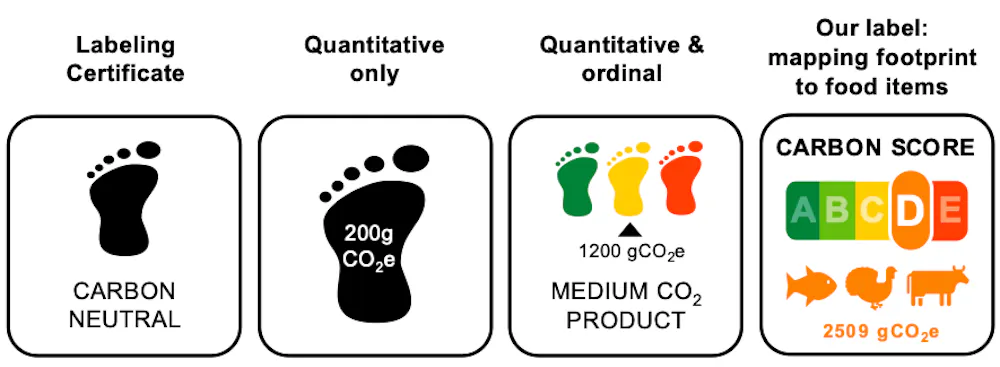
    Most carbon labels follow a similar approach. They typically display a number representing greenhouse gas emissions, and a traffic-light system indicating the level of environmental impact from green (low) to red (high). But such labels do not indicate whether the food is animal- or plant-based. So a high carbon score does not help people identify the source of the emissions.

    Our label maps the carbon footprint to the source of the food, whether plant or animal, along with information about the greenhouse gas emissions.
    Romain Cadario, Yi Li, Anne-Kathrin Klesse, (2025) Appetite., CC BY

    We designed a new type of label. It clearly displays whether the food is sourced mainly from animals or plants, along with the standard emissions score and traffic-light colour code. This approach is especially useful for the growing segment of pre-prepared and packaged foods such as soups and other ready-to-eat meals, which often contain a mix of meat and plant-based food.

    Our label creates a mental link between a food source and its carbon impact. When a consumer sees high carbon scores and red traffic lights appearing more frequently on meat and other animal products, they begin to make the connection between those products and higher emissions. This is key to addressing a lack of knowledge around food carbon emissions.

    We tested our label against the existing labels in a series of experiments with 1,817 everyday consumers from Australia, the United States and the Netherlands.

    One experiment involved soup. Compared with the group exposed to the standard carbon label, the group exposed to our label learned to associate animal-based soups with higher greenhouse gas emissions more effectively. They were more accurate at estimating the greenhouse gas emissions of a second batch of soups without labels.

    This improved knowledge also translates to more climate-friendly food choices. In another experiment with Australian consumers, we encouraged participants to choose five meals from ten options. Five were animal-based and five were plant-based.

    Half the participants saw the meal options with our carbon labels, and the other half did not see the carbon labels. The group exposed to our carbon labels chose fewer animal-based options in their weekly meal plan. In this case, we don’t know whether a third group exposed to the standard label would also make more climate-friendly choices, but our earlier experiments suggested our label was more effective.

    In the final experiment conducted in the Netherlands, displaying our carbon label made university students more likely to choose the plant-based snack option rather than the animal-based option.

    Providing information about the source of the food, whether plant or animal, influenced choices of meal plans.
    Romain Cadario, Yi Li, Anne-Kathrin Klesse, (2025) Appetite., CC BY

    When knowledge isn’t enough

    While people who care most about sustainable eating may think they know better than others, we found that is not the case. These people were not better able than other participants to tell the difference in greenhouse gas emissions between animal- and plant-based foods without seeing our carbon label.

    But they were better learners. When confronted with the facts about the differences between animal and plant-based foods on our labels, they were more likely to change their choices and switch to plant-based foods.

    What this means for consumers and businesses

    A simple change to food labels could help consumers make more informed environmental choices. For businesses and policymakers, it shows displaying only carbon numbers isn’t enough – the food source is crucial.

    Some forward-thinking restaurants and food companies are already experimenting with adding carbon labels to the menu to encourage diners to choose climate-friendly dishes. Our research suggests this approach could be more effective when combined with the new carbon labels we designed.

    Meat products make a significant contribution to climate change.
    Valmedia, Shutterstock

    Implications for climate action

    As Australia grapples with meeting its climate commitments, helping consumers understand the environmental impact of their food choices will become increasingly important.

    The challenge for businesses, policymakers and researchers isn’t convincing people to care about sustainability – they already do. Almost half of Australian shoppers (46%) say sustainability is important to them and influences their purchases, despite cost-of-living pressures.

    But most sustainable actions in retail involve recyclable packaging, products and materials, and local produce. The carbon emission implications of these actions, sadly, are far less than reducing animal-based food consumption.

    Instead, we need to focus on giving people the tools to make their environmental concerns count. Our carbon labels could be the key to helping consumers turn their sustainable intentions into meaningful climate action.

    Yi Li does not work for, consult, own shares in or receive funding from any company or organisation that would benefit from this article, and has disclosed no relevant affiliations beyond their academic appointment.

    – ref. Want a side of CO₂ with that? Better food labels help us choose more climate-friendly foods – https://theconversation.com/want-a-side-of-co-with-that-better-food-labels-help-us-choose-more-climate-friendly-foods-250513

    MIL OSI Analysis – EveningReport.nz –

    February 25, 2025
  • MIL-Evening Report: Calculating the economic cost of climate change is tricky, even futile – it’s also a distraction

    Source: The Conversation (Au and NZ) – By Dennis Wesselbaum, Associate Professor, Department of Economics, University of Otago

    Piyaset/Shutterstock

    Climate change is no longer a distant threat. It’s here, it’s real and it increasingly affects us all.

    But predicting climate change and its associated costs, particularly over long periods of time, is inherently uncertain. And based on the best available evidence from organisations such as the United Nations’ Intergovernmental Panel on Climate Change, the economic costs of climate change appear to be small – making this a relatively weak argument for environmental action.

    At its most basic, climate is the long-term average of the weather we experience. Or, as former president of the American Meteorological Society, Marshall Shepherd, famously put it, “weather is your mood, and climate is your personality”.

    It’s widely accepted that climate change refers to a shift in long-term weather patterns, typically driven by human activities.

    But the impact of climate change, ranging from rising temperatures and extreme weather events to health impacts and disruptions to food and water supply, varies greatly. Some areas experience more extreme impacts than others, exacerbating social and economic disparities.

    There also appears to be a false sense about our state of knowledge. For example, many believe climate change already causes more frequent and intense storms, but the evidence for this is inconclusive.

    Trying to predict the unpredictable

    To understand the economic costs of climate change, we must first grasp how climate affects socioeconomic outcomes.

    The relationship between temperature and socioeconomic outcomes can be modelled using a “dose-response” function, which shows how much a given change in temperature (the “dose”) influences the outcome (for example, temperature-related mortality).

    A key challenge is to understand the shape of the dose-response function. Is the relationship between temperature and mortality linear or is it more complex? Does it have thresholds beyond which the effects substantially change? Is there only one function or are there different ones for different populations?

    As climate change shifts the distribution of weather variables, it alters the outcomes as well. Yet, predicting how these distributions will evolve is difficult.

    The further into the future we look, the harder it is to make reliable predictions about both weather and the associated economic costs.

    If you were asked in 1925 to predict the economy in 2000, for example, how accurate would you have been? In 1925 you drove a Ford Model T, used coal-fired steam trains and passenger ships for travel, and a trip from London to Auckland took up to eight weeks by sea. You used a telegraph for long-distance communication and a radio for entertainment.

    Compare that with the globalised, interconnected economy of the year 2000. Given the technological advancements, would your prediction have been even close?

    Rather than focusing on the uncertain future economic costs of climate change, we should be addressing how it is affecting human life now.
    James Andrews1/Shutterstock

    Cost estimates

    There are a wide range of estimates on the economic costs of climate change. But one of the most reliable has come from the UN’s Intergovernmental Panel on Climate Change.

    The panel’s latest assessment report avoids quantifying the economic costs of climate change. So, to understand the economic costs of climate change, we can use the best estimate based on the previous report and the insights from meta studies. These analyses posit a temperature rise of 3.7°C will reduce global gross domestic product (GDP) by about 2.6% (ranging from 0.5 to 8.2%) by 2100.

    For New Zealand, this is equivalent to about NZ$11 billion, or twice the cost of Auckland’s City Rail Link.

    However, this comparison is extremely misleading. The value of 2.6% today will differ substantially from 2.6% in 75 years.

    The New Zealand economy grew at a compound annual rate of 1.4% between 1960 and 2000. Using this same average growth rate, New Zealanders will have a 184% higher standard of living in 2100. If nothing is done to address climate change, and given the best cost estimate, our standard of living would still be 176% higher than it is now.

    Reporting costs

    There are also issues with how some people report costs. For instance, while the total damage caused by floods and hurricanes in the United States has gone up in dollar amounts, it has not actually increased as a percentage of peoples’ incomes.

    In this context, it is crucial to distinguish between the damage caused by climate change and that resulting from human activities – such as the construction of more houses, higher property prices and river management practices.

    The economic costs of climate change based on the best available evidence appear to be small and highly uncertain.

    Shifting the focus

    Even if we accept our best estimates, economic costs are not the issue, but saving the environment is.

    Instead of focusing the debate of climate change around economic costs, we need to refocus the debate on tangible impacts happening right now: retreating glaciers, species extinction, shifting seasons and coastal erosion, to name a few.

    Addressing these issues is costly, but action will be needed to save the environment and ensure a liveable world into the future.

    Dennis Wesselbaum does not work for, consult, own shares in or receive funding from any company or organisation that would benefit from this article, and has disclosed no relevant affiliations beyond their academic appointment.

    – ref. Calculating the economic cost of climate change is tricky, even futile – it’s also a distraction – https://theconversation.com/calculating-the-economic-cost-of-climate-change-is-tricky-even-futile-its-also-a-distraction-248862

    MIL OSI Analysis – EveningReport.nz –

    February 25, 2025
  • MIL-OSI China: US’ restrictive trade moves to be self-harming

    Source: China State Council Information Office

    China has called on the United States to adhere to international rules and end misguided policies, warning that it will take necessary measures to safeguard its legitimate rights, the Ministry of Commerce said on Sunday.

    On Friday, the Office of the United States Trade Representative invited comments from the public on proposed Section 301 actions aimed at China’s maritime, logistics and shipbuilding sectors.

    The US’ proposed restrictive measures, such as levying port fees, would be self-harming and have detrimental effects, according to an online statement issued by the Commerce Ministry.

    The statement said these moves would not only fail to revive the US shipbuilding industry, but also increase transportation costs on US-related shipping routes and intensify domestic inflationary pressures.

    The moves would diminish the global competitiveness of US goods and negatively affect the interests of US port and terminal operators, as well as their workers, it added.

    Since March 2024, China and the US have held multiple rounds of talks on the proposed actions. China has repeatedly expressed its stance on the Section 301 investigation, urging the US to be rational and objective, and to stop blaming China for its own industrial development issues.

    The ministry noted that a panel of the World Trade Organization has ruled that US imposition of Section 301 tariffs on China is in breach of WTO regulations. The misuse of the Section 301 investigation mechanism, driven by the US’ domestic political needs, continues to erode the multilateral trading system, the ministry said.

    Liao Fan, a professor of international law at the University of Chinese Academy of Social Sciences in Beijing, said that to counter rising protectionism and the weaponization of unilateral sanctions, WTO reform is urgently needed to address systemic issues, such as chronic underfunding and weak enforcement mechanisms.

    John Quelch, executive vice-chancellor of Duke Kunshan University in Kunshan, Jiangsu province, warned that international trade is entering a dangerous “Wild West” era, in which weaker economies and small countries more dependent on international trade are likely to suffer the most.

    “China needs to redouble its efforts to increase trade with Global South countries, gradually reducing dependence on traditional markets,” Quelch said, adding, “China should further stimulate domestic consumption if a global tariff war slows down international trade.”

    Guangxi Yuchai Machinery Co, an automotive engine manufacturer in Yulin, Guangxi Zhuang autonomous region, is already expanding into emerging markets.

    “We have leveraged multiple cooperation mechanisms and trade deals, such as the Belt and Road Initiative and the Regional Comprehensive Economic Partnership, to actively participate in international trade shows and establish new plants in Thailand and Vietnam in recent years. Our export value jumped 73 percent year-on-year in January, hitting a record high for a single month,” said Liu Hongbo, president of marketing at Guangxi Yuchai’s overseas business unit.

    “We have broadened our customer base in key regions, including Southeast Asia and the Middle East, while diversifying our market structure to reduce risks associated with overreliance on any single market,” Liu added.

    MIL OSI China News –

    February 25, 2025
  • MIL-OSI China: Parkinson’s possible to be blocked thanks to Chinese scientists’ breakthrough research

    Source: China State Council Information Office 2

    Chinese scientists have discovered a novel therapeutic target for Parkinson’s disease, a neurodegenerative condition with high disability and mortality rates, and have successfully identified a potentially effective small molecule drug.
    The breakthrough, achieved by a team from Huashan Hospital affiliated with Fudan University in Shanghai, holds promise for early intervention in Parkinson’s disease, offering patients renewed hope for delaying its progression. The research was published in the prestigious academic journal Science on Friday (Beijing time).
    The battle against Parkinson’s disease, the second most common neurodegenerative disorder after Alzheimer’s, has been ongoing for years. There are approximately 3 million Parkinson’s patients in China, roughly half of the global total.
    People diagnosed with Parkinson’s disease may initially experience a reduced sense of smell and sleep disorders, eventually developing more severe movement-related symptoms. As the disease progresses, the effectiveness of medications often declines, leading to a significant deterioration in quality of life.
    Unfortunately, previous drugs and surgical therapies have only addressed the symptoms of Parkinson’s disease, failing to prevent its progression. As a result, further in-depth research into the disease’s pathophysiology and targeted treatments is crucial, according to the scientists.
    After five years of persistent efforts, the team identified FAM171A2 as a key risk gene for neurodegeneration. Using artificial intelligence, they screened over 7,000 approved compounds and pinpointed bemcentinib, an anti-cancer agent currently in clinical trials, as a promising lead candidate.
    The small molecule drug has been shown to effectively block the binding between FAM171A2 and the pathogenic protein, according to the research team.
    Yu Jintai, leader of the team, said that, based on an international patent, they will focus on the pre-clinical research and development of small-molecule drugs, antibodies and gene therapies for Parkinson’s disease in the coming years, with the aim of advancing clinical trials and applications to develop an innovative therapeutic system.
    People over the age of 60 are more susceptible to Parkinson’s disease. As China’s population continues to age, this new medical breakthrough has sparked hope within both the academic and medical communities, as well as among patients, with the expectation that the research will have practical applications in the near future.
    “The experimental results have helped us accurately figure out the pathophysiological mechanisms of Parkinson’s disease, creating a real chance of overcoming a battle that has long seemed insurmountable,” said Wang Jian, director of the neurology department at Huashan Hospital, which is also a national medical center for neurological diseases.
    A referee for Science praised the discovery as a “holy grail” in Parkinson’s research, highlighting its potential to lead to therapies that can block the spread of pathology and, consequently, the disease itself.
    Neurological diseases, particularly those affecting the brain, such as Alzheimer’s and Parkinson’s, have become a major global public health and social challenge.
    Chinese experts have called for greater efforts in brain science research, noting that it will be crucial for developing new treatment methods, enhancing early diagnosis, detection and intervention, and ultimately improving the quality of life for patients. 

    MIL OSI China News –

    February 25, 2025
  • MIL-OSI China: Chinese researchers develop system for quantum direct communication

    Source: China State Council Information Office 2

    A team of Chinese researchers proposed a theory of one-way quantum direct communication and successfully developed a practical system, advancing quantum direct communication from a concept to the stage of practical application.
    According to a study recently published in Science Advances, researchers from the Beijing Academy of Quantum Information Sciences, Tsinghua University, and North China University of Technology set a record in a standard optical fiber communication test with a transmission distance of 104.8 km. They achieved stable transmission at a rate of 2.38 kilobit per second for 168 consecutive hours.
    Quantum direct communication was previously proposed by a team led by Long Guilu from Tsinghua University, one of the corresponding authors of the study paper. It enables secure communication by utilizing quantum states and features characteristics such as eavesdropping detection and prevention, compatibility with existing networks, simplified management processes, and covert transmission.
    The core challenge in this field is achieving secure and reliable communication using quantum states with extremely low energy. These states are highly susceptible to interference in quantum channels characterized by high noise, high loss, and the risk of eavesdropping.
    Previous research used bidirectional protocols, in which both communicating parties had to transmit quantum states back and forth. This resulted in significant system loss and severely limited communication performance improvement.
    “In 2022, we set a world record for quantum direct communication over 100 kilometers, but the rate was only 0.5 bit per second, which allowed transmission of messages with very few characters,” Long recalled.
    He explained that one-way transmission could halve the distance of quantum state transmission, significantly reducing loss, which is the key to improving the performance of quantum direct communication.
    The researchers developed high-noise and high-loss channel coding and other key technologies to propose a theoretical method for one-way quantum direct communication. They resolved the technical challenges and completed the development of the communication terminal.
    The new system’s communication rate has increased by 4,760 times compared with the one developed in 2022, significantly enhancing the performance of quantum direct communication.
    According to Long, quantum direct communication systems are expected to be widely applied in fields with extremely high requirements for information security, such as government affairs and finance.
    There are two main types of quantum secure communication. One is quantum key distribution, which uses quantum states to generate keys while transmitting encrypted information through classical communication. Its advantage is the high transmission rate.
    The other is quantum direct communication, which directly transmits information using quantum states. In the event of eavesdropping, the quantum states can self-destruct to ensure information security. 

    MIL OSI China News –

    February 25, 2025
  • MIL-OSI China: China completes 2 new-generation marine vessels

    Source: China State Council Information Office 2

    China’s self-developed marine engineering installation vessels Zhigao and Zhiyuan were completed on Sunday in Nantong, east China’s Jiangsu Province, according to Science and Technology Daily.
    The main tasks of the two vessels are transporting wind turbines to the deep sea and conducting installations. They can operate 100 kilometers offshore, providing strong support for the country’s offshore wind power projects.
    They are the fourth generation of China’s offshore wind power engineering equipment, meaning they have strong wind and wave resistance, excellent comprehensive installation capabilities, and high operating efficiency and intelligence levels, according to the report.
    The vessels are capable of installing a set of offshore wind turbines in three days — 30 percent faster than third-generation equipment, said Zhang Weifeng, chief engineer of an ocean engineering construction company affiliated with PowerChina.
    Moreover, they are designed to withstand winds of up to force 16 and waves as high as 12 meters, Zhang said.

    MIL OSI China News –

    February 25, 2025
  • MIL-OSI China: Consumers warned over AI courses

    Source: China State Council Information Office 2

    While the rapid rise of China’s homegrown artificial intelligence reasoning model DeepSeek has sparked a host of enterprises seeking to cash in by offering training courses on how to use it, experts have warned consumers to be wary of wasting their money on courses that provide guidance that is already freely available.
    On Chinese lifestyle app Xiaohongshu, or RedNote, some users share guides on using DeepSeek, with prices ranging from a few yuan to several hundred yuan.
    “If you don’t learn how to use AI today, you’ll be left behind tomorrow,” several posts say. “How to use DeepSeek to earn money” is another trending topic on the platform. These posts are typically followed by links to purchase courses or join group chats.
    On WeChat, multiple accounts use DeepSeek user guides as clickbait, though full content often requires additional payment. Paid online communities focused on AI are also emerging, offering “exclusive” resources to subscribers.
    According to the course descriptions, these paid tutorials typically cover basic AI tool usage, including prompt writing, skill-building, applications in various fields and even strategies for making money with AI.
    “The rise of new technologies is always accompanied by a boom in paid training courses,” said Yan Huaizhi, an associate professor of the School of Computer Science &Technology at the Beijing Institute of Technology, in an interview with Workers’ Daily.
    “On one hand, this trend reflects people’s desire to learn new skills. On the other hand, it epitomizes how some agencies exploit the knowledge gap to make quick profits,” Yan said.
    “The popularity of these paid courses also highlights that selling tools to those eager to make money is a lucrative business model,” he added.
    Since the release of DeepSeek R1 on Jan 20, a tag for a DeepSeek training course on Xiaohongshu has been viewed almost 20 million times.
    While some courses and online communities offer value, the quality of many paid offerings is sometimes questionable. Some simply repackage materials from other AI models or provide low-quality content under the DeepSeek name.
    “By touting AI as a necessary survival tool, these people are selling anxiety,” one user wrote online.
    Bao Ran, vice-president of the Interactive Media Technical Standards Promotion Committee of the China Communications Standards Association, said there is no need to pay for these tutorials since the basics are freely available online.
    On video-sharing platform Bilibili, free DeepSeek and AI tutorials have attracted millions of views. One video explaining DeepSeek’s local deployment, published on Jan 27, has more than 2 million views.
    Chinese universities such as Tsinghua University and Zhejiang University have also offered free AI-related lectures and guides to students.
    While certain consumers such as the elderly may gain value from being walked through how to use AI models step by step, others may feel cheated when they realize they paid for something that they could have easily accessed for free.

    MIL OSI China News –

    February 25, 2025
  • MIL-OSI United Kingdom: expert reaction to observational study of antidepressant prescriptions and cognitive decline in people with dementia

    Source: United Kingdom – Executive Government & Departments

    February 25, 2025

    An observational study published in BMC Medicine looks at antidepressant use and cognitive decline in people with dementia. 

    Prof Tara Spires-Jones, Director of the Centre for Discovery Brain Sciences at the University of Edinburgh, Group Leader in the UK Dementia Research Institute, and President of the British Neuroscience Association said:

    “Mo and colleagues’ study examined data from over 18,000 people with dementia enrolled in a Swedish national registry to look for associations between antidepressant use and dementia symptoms.  They observed faster cognitive decline in people with dementia who were taking selective serotonin reuptake inhibitor (SSRI) type antidepressants. This was a large study that looked at data over time, which is a strong design. However, this type of data cannot prove that it was antidepressant use that caused the faster decline.  People who needed antidepressants may have had more aggressive disease or the depression itself could have been affecting disease progression.  It is also worth noting that the effect was not the same for all types of dementia; people with frontotemporal dementia (FTD) did not have accelerated cognitive decline when taking antidepressants. In people with FTD, antidepressants were associated with slightly slower decline. Previous studies have also reported mixed results, highlighting the need for more research before we have a full understanding of the effects of antidepressant use on dementia progression.”


    Dr Richard Oakley, Associate Director for Research and Innovation at Alzheimer’s Society, said:  

    “This study suggested that antidepressants led to faster rates of memory and thinking decline in people with dementia. But it did not rule out the possibility that the changes were due to the presence of depression rather than antidepressant use, so further research is needed to understand the effects of antidepressants. 

    “Alzheimer’s Society wants to see the severity of an individual’s dementia recorded on their primary care records as either mild, moderate or severe. This is especially important as the study shows a decline in memory and thinking skills was stronger in people with more severe dementia who took antidepressants than those who didn’t. 

    “It’s vital that regular reviews are carried out when prescribing antidepressants, but recent research showed that less than half of people with a dementia diagnosis had their medication reviewed in the preceding 12 months.  

    “Alzheimer’s Society is funding research to better understand depression and anxiety in people living with dementia, how to manage it, and how genetics might be involved.” 


    Dr Emma L Anderson, Associate Professor of Epidemiology, University College London, said:

    “As the authors themselves acknowledge, there is substantial risk with this study design for confounding by indication, which could explain the results either in part, or entirely. Confounding by indication is where the outcomes we observe are actually due to the underlying reason people take these medications in the first place (e.g. mental health conditions), rather than the medication itself. More robust study designs, which overcome this very important limitation, are needed before such bold conclusions can be made. When based on limited evidence, these claims can be very damaging for public understanding of antidepressants, which we know help millions of people around the world.”

    Dr Prasad Nishtala, Reader, University of Bath, said:

    “This large population-level study from Sweden uses real-world data and is well-conducted. However, there are some important limitations that should be considered. One major issue is that the severity of depression in dementia patients wasn’t fully accounted for, which has the potential to bias the results. Additionally, there may be a “channelling bias,” meaning that certain antidepressants like citalopram and sertraline might have been more commonly prescribed to patients with severe dementia, which could also bias the results.

    “Another key limitation is that the study found only a small change in MMSE (Mini-Mental State Examination) scores, which may not be meaningful in everyday clinical practice. Previous research has shown that older adults taking tricyclic antidepressants can experience faster cognitive decline because these drugs interfere with the activity of acetylcholine—a chemical in our brain critical for maintaining cognition. Even among SSRIs (a common type of antidepressant), some, like paroxetine, are known to have stronger anticholinergic effects that could impact cognition negatively. There is also a problem of “residual confounding”,- meaning there could be other risk factors that can affect cognition, and it is unclear if they have accounted for other anticholinergic drugs like oxybutynin, which many dementia patients take to treat their urinary incontinence. The analyses were done on dispensed data (medication sold by pharmacists), and it is unclear if patients actually took them.

    “This study suggests that SSRIs like citalopram and sertraline might also speed up cognitive decline. However, it doesn’t explain how or why this happens at a biological level. Because of these limitations, the study’s findings should be interpreted with caution and ideally replicated using other real-world data sources.”

    ‘Antidepressant use and cognitive decline in patients with dementia: a national cohort study’ by Minjia Mo et al. was published in BMC Medicine at 01:00 UK time on Tuesday 25th February. 

    DOI: https://doi.org/10.1186/s12916-025-03851-3

    Declared interests

    Prof Tara Spires-Jones: I have no conflicts with this study but have received payments for consulting, scientific talks, or collaborative research over the past 10 years from AbbVie, Sanofi, Merck, Scottish Brain Sciences, Jay Therapeutics, Cognition Therapeutics, Ono, and Eisai. I am also Charity trustee for the British Neuroscience Association and the Guarantors of Brain and serve as scientific advisor to several charities and non-profit institutions.

    Dr Emma L Anderson: I have no declarations or conflicts of interest. 

    Dr Prasad Nishtala: I sit on the editorial board for BMC Medicine.

    MIL OSI United Kingdom –

    February 25, 2025
  • MIL-OSI China: China establishes flagship hospital alliance to boost Chinese, Western medicine integration

    Source: China State Council Information Office 2

    An alliance of 62 China-based flagship hospitals that offer treatments integrating traditional Chinese and Western medicine has been established, with the aim of enhancing the country’s healthcare services.
    The alliance consists of some of China’s most prestigious hospitals, including Peking Union Medical College Hospital in Beijing and Ruijin Hospital in Shanghai, according to a conference on integrative medicine held in Beijing on Sunday.
    These hospitals are blazing a trail for the coordinated development of traditional Chinese and Western medicine, promoting the integration of traditional Chinese medicine research with technologies such as artificial intelligence and big data, according to the conference.
    “We must chart a distinctive path for integrating traditional Chinese and Western medicine in the new era,” said Chen Xiangmei, president of the Chinese Association of Integrative Medicine.
    Experts believe that the approaches of “Western medicine learning from Chinese medicine” and “Chinese medicine learning from Western medicine” represent distinct pathways toward the collaborative development of both fields, with the ultimate goal of deeply integrating traditional Chinese medicine with modern medical practices.
    Tong Xiaolin, an academician with the Chinese Academy of Sciences, noted that integrative medicine is not simply about combining techniques but aims to catalyze a revolutionary breakthrough in medical paradigms with the help of emerging disciplines such as systems biology and big data science.
    Currently, a number of general hospitals in China have established mechanisms for the collaborative development of Chinese and Western medicine, along with multidisciplinary treatment systems, significantly improving clinical outcomes. 

    MIL OSI China News –

    February 25, 2025
  • MIL-OSI New Zealand: A Journey from Biomedical Science to Digital Marketing Entrepreneurship

    Source: Press Release Service – Press Release/Statement:

    Headline: A Journey from Biomedical Science to Digital Marketing Entrepreneurship

    In a rapidly changing digital landscape, Deesha Bhatia, COO and Co-founder of Adclics, reflects on her journey from biomedical science to entrepreneurship in the world of digital marketing.

    The post A Journey from Biomedical Science to Digital Marketing Entrepreneurship first appeared on PR.co.nz.

    – –

    MIL OSI New Zealand News –

    February 25, 2025
  • MIL-OSI USA: Following Dangerous Cuts to Transportation Workforce, Rosen Joins Colleagues to Demand Trump Administration Prioritize Safety

    US Senate News:

    Source: United States Senator Jacky Rosen (D-NV)

    WASHINGTON, DC – U.S. Senator Jacky Rosen, a member of the Senate Commerce, Science, and Transportation Committee, joined colleagues in a letter urging Secretary of Transportation Sean Duffy to stop the mass layoffs and firing of essential transportation safety employees and instead focus on prioritizing safety. In the letter, the lawmakers demand information regarding Department of Transportation plans to protect passengers and prevent future airline crashes. 
    “At the Department of Transportation, safety must come first, but that commitment appears in doubt as the Trump administration promotes cost-cutting over protecting the public,” wrote the Senators. “By offering to buy out federal employees, ordering government agencies to prepare for mass layoffs, firing employees with critical safety functions, giving Elon Musk and the Department of Government Efficiency (DOGE) free reign to cut the federal workforce, and turning Musk, DOGE, and their unqualified staff loose on the air traffic control system, the Trump administration risks undermining decades of safety improvements.”
    “We urge you to cease this dangerous approach to governing and request important information on how the Department of Transportation (DOT) plans to prioritize safety in this environment,” they continued.
    The lawmakers requested responses by March 3 to questions that include:  

    How many DOT employees were offered the buyout? How many accepted? 
    How many DOT employees have lost their jobs since January 20, 2025?  
    What is Musk’s and DOGE’s role in reviewing DOT personnel and program information? 
    What steps is the Department taking to ensure that Musk and the DOGE do not compromise public safety? 

    The full letter can be found HERE.
    As a member of the Committee on Commerce, Science, and Transportation, Senator Rosen has been an advocate for Nevada’s transportation and infrastructure interests. Earlier this year, she announced more than $700,000 to improve transportation for tribal communities in Nevada. She worked to write and pass the Bipartisan Infrastructure Law to create good-paying jobs and upgrade Nevada’s infrastructure. Last year, she secured $275 million to improve and expand I-80 to reduce congestion in Northern Nevada.

    MIL OSI USA News –

    February 25, 2025
  • MIL-OSI Economics: Samsung Develops Groundbreaking Achromatic Metalens With POSTECH

    Source: Samsung

    Samsung Electronics today announced that it has published a joint research paper with Pohang University of Science and Technology (POSTECH) detailing the development of an innovative achromatic metalens in the renowned academic journal Nature Materials.
     
    The paper, titled “Roll-to-plate printable RGB-achromatic metalens for wide-field-of-view holographic near-eye displays,” reflects the findings of research conducted by Samsung and POSTECH’s joint research team, wherein they developed an achromatic metalens free from color distortions and combined it with holographic displays to overcome various optical aberrations. This innovation paves the way for compact yet high-quality holographic XR wearable devices and applications in cameras and sensors.
     
    Dr. Seokil Moon from Samsung Research and Professor Junsuk Rho from POSTECH led the study, with researchers Minseok Choi, Joohoon Kim and Kilsoo Shin from POSTECH also listed as co-authors of the paper.
     
     
    Overcoming Conventional Chromatic Aberration Limitations To Achieve a Compact Achromatic Metalens
    A metalens is a flat lens composed of nanoscale structures capable of controlling light diffraction, which can drastically reduce the size and thickness compared to traditional convex optical lenses.1 For this reason, it has been recognized as a next-generation optical component for applications in displays and cameras, sparking over a decade of research.
     
    Despite these advantages, metalenses have encountered technical challenges in product development due to severe chromatic aberration,2 which leads to significant image distortion.

     
    Previous efforts to eliminate chromatic aberration in metalenses relied on designing individual metastructures independently and subsequently assembling them onto a substrate. As a result, the interrelationships between structures were overlooked during the design phase, preventing the complete reduction of chromatic aberration in the final lens.
     
    The research team overcame the challenge of chromatic aberration reduction by redefining the conventional design approach for metalenses. By accounting for the interrelationships between all metastructures during the design phase and designing them simultaneously, the team has successfully eliminated chromatic aberration after fabrication.
     
    In addition to eliminating chromatic aberration, the achromatic metalens developed by the team also achieves a shorter focal length, significantly reducing the lens’ size and weight.3
     
     
    Higher Resolution and Less Eye Strain With a Single Lens
    Typically, metalenses exhibit various optical aberrations beyond chromatic aberration, with image distortion worsening as screen size increases. These issues have traditionally been addressed by combining multiple lenses. However, the research team has resolved various optical aberrations within the device by integrating a single achromatic metalens with a holographic display, achieving a wide field of view and distortion-free, high-quality images.
     
    Additionally, through technical validation, the research team has demonstrated that substituting conventional optical lenses and displays with achromatic metalenses and holographic displays enables the delivery of compact, lightweight and virtual images that cause less eye strain.4

     
    The findings of this study are anticipated to be applied to immersive media devices such as those equipped with extended reality (XR) capabilities. They will also be used in various optical systems — including displays, cameras and sensors — to enhance performance and reduce size.
     
    Through this collaboration between industry and academia, Samsung has validated the entire process — from conceptualizing innovative ideas to implementation — confirming the potential for advancing various future optical systems and securing next-generation display technologies.
     
    Samsung remains committed to ongoing research efforts, aiming to secure groundbreaking technologies that will shape the future through continued collaborations with academia and other industry-leading initiatives.
     
     
    1 A convex lens typically has a thickness of several millimeters, sometimes exceeding a centimeter, whereas metalenses are much thinner, usually less than 0.5 mm.2 Chromatic aberration, also called color fringing, occurs when a lens fails to focus all colors to the same point, creating colored fringes along the edges of objects in photographs.3 Compared to previously proposed achromatic metalenses, this research has fabricated metalenses that are 3–5 times larger in size while maintaining the same focusing power (numerical aperture).4 The image quality is enhanced by 13% after aberrations are corrected using the holographic display. The image quality is measured using the peak signal-to-noise ratio (PSNR), which is widely used in image and signal processing.

    MIL OSI Economics –

    February 25, 2025
  • MIL-OSI United Kingdom: Professor Sir Ian Chapman appointed next CEO of UK Research and Innovation with renewed focus on economic growth

    Source: United Kingdom – Executive Government & Departments

    Press release

    Professor Sir Ian Chapman appointed next CEO of UK Research and Innovation with renewed focus on economic growth

    Sir Ian will lead the team at UKRI in backing thousands of researchers and innovators in developing solutions which improve people’s lives and help grow the economy

    Professor Sir Ian Chapman appointed as new UKRI CEO

    Professor Sir Ian Chapman will become the next CEO of UK Research and Innovation (UKRI), leading a refreshed mission that puts economic growth at the heart of public investment in R&D, helping to fulfil the potential of science and technology in improving lives, Science Minister Lord Vallance has announced today (Tuesday 25 February).

    UKRI is the country’s largest public research funder, with a budget of £9 billion per year, giving it a central role in ensuring public funding is invested in ambitious, pioneering research that will benefit the whole of the UK and provide a clear return on investment for hardworking taxpayers.

    Its work in recent years includes backing the Oxford-AstraZeneca Covid-19 vaccine, which has saved countless lives and the construction of the world’s most advanced wind turbine test facility, helping the UK to become a clean energy superpower. It has also been a major contributor to the £1 billion of UK public investment in AI R&D so far so the UK captures the technology’s opportunities to enhance growth and productivity as the third largest AI market in the world.

    Sir Ian will lead its team in supporting thousands of bright researchers and innovators in developing solutions from life-saving medicines to protecting our environment – ultimately making a visible, positive difference to people’s lives and supporting the missions at the heart of the Government’s Plan for Change.

    His experience will be a major asset in drawing on the UK’s world-leading research talent, facilities, universities and businesses, as drivers of R&D which will kickstart economic growth, make Britain a clean energy superpower and build an NHS fit for the future.

    During his time as CEO of the UK Atomic Energy Authority, Sir Ian has led the transition from an organisation rooted in deep R&D excellence, to one that is now also delivering a major infrastructure project to design and build a prototype powerplant; driving inward investment and economic growth; and enabling development of a skilled workforce and supply chain.

    Science Minister, Lord Vallance, said:

    “Growing the economy is this government’s number one mission and taking full advantage of the innovative ideas, talent and facilities across our country is key to reaching that goal and improving lives across the UK.

    “Sir Ian’s leadership experience, scientific expertise and academic achievements make him an exceptionally strong candidate to lead UKRI in pursuing ambitious, curiosity-driven research, as well as innovations that will unlock new benefits for the UK’s people and drive our Plan for Change.

    “We also thank Dame Ottoline Leyser ahead of her stepping down this summer, recognising her pivotal work in guiding UKRI through challenging times, notably during the Covid pandemic and through the UK’s return to participation in Horizon Europe.”

    Incoming UKRI CEO, Professor Sir Ian Chapman, said:

    “I am excited to be joining an excellent team at UKRI focussed on improving the lives and livelihoods of UK citizens.

    “Research and innovation must be central to the prosperity of our society and our economy, so UKRI can shape the future of the country.

    “I was tremendously fortunate to represent UKAEA, an organisation at the forefront of global research and innovation of fusion energy, and I look forward to building on those experiences to enable the wider UK research and innovation sector.”

    Through our world-class universities and institutes, UKRI develops and nurtures future talent who can maintain the UK’s position as a global hub of research, development and deployment in the long term while collaborating with partners around the world so that scientific and technological advances driven in the UK can benefit lives at home and around the world.

    UKRI plays a key part in driving up UK participation in the world’s largest research programme, Horizon Europe, helping to build a more efficient and joined-up approach to research funding and unleashing the power of UK research and innovation.

    UKRI will also play an increasing role in steering our long-term industrial strategy, removing barriers to growth and building on the UK’s strategic advantage in its fundamental science capability.

    UKRI Chairman, Sir Andrew Mackenzie, said:

    “The board and I are delighted that Ian will become UKRI’s next CEO in the summer. 

    “Research and Innovation are fundamental to UK growth. Ian has the skills, experience, leadership and commitment to unlock this opportunity to improve the lives and livelihoods of everyone. We look forward to working with him on the next phase of UKRI’s development and our stewardship of the UK’s innovation culture and systems.  

    “We thank Ottoline for an outstanding five years as UKRI’s CEO. She has delivered a step-change in operational effectiveness and cross-discipline work through collective and inclusive leadership and secured more social and commercial impacts from our investments.” 

    Climate Minister Kerry McCarthy said: 

    “I’d like to thank Sir Ian for his many years of dedicated service at UK Atomic Energy Agency, the last nine as CEO. In that time, he has transformed the organisation into a world leading hub for fusion energy commercialisation and driven the UK and global strategy for fusion development forward.

    “I am delighted that the UK will continue to benefit from his drive and expertise in his new role. We will shortly begin recruiting a new UKAEA CEO to lead the UK’s world-class fusion programme into the next decade.”

    Notes to editors

    • Established in 2018, UKRI is a non-departmental public body that combines the strengths of nine distinct research and innovation funders:

    • Arts and Humanities Research Council (AHRC)
    • Biotechnology and Biological Sciences Research Council (BBSRC)
    • Engineering and Physical Sciences Research Council (EPSRC)
    • Economic and Social Research Council (ESRC)
    • Innovate UK (IUK)
    • Medical Research Council (MRC)
    • Natural Environment Research Council (NERC)
    • Research England (RE)
    • Science and Technology Facilities Council (STFC)

    • Sir Ian – who currently sits on UKRI’s Board – will take up the post in the summer, bringing strong leadership experience from his role as CEO of the UK Atomic Energy Authority since 2016 and links to academia. He is a Fellow of the Royal Society, the Royal Academy of Engineering, and the Institute of Physics, and a visiting Professor at Durham University.
    • With a background in fusion and firm grasp of the part that ambitious and targeted R&D can play in improving lives, he has published over 100 journal papers and received several awards for his research.
    • His appointment follows an open recruitment process launched in August 2024, after Professor Dame Ottoline Leyser announced her intention to stand down as UKRI’s CEO from June 2025.
    • Having held the post since 2020, Dame Ottoline leaves a strong foundation to build on, from navigating the continued delivery of research through the pandemic to supporting the UK’s return to participation in Horizon Europe – putting UKRI in a strong position to bolster its role as an engine for delivering pioneering research to improve lives and grow our economy.
    • The UKAEA Board has provisionally agreed that Tim Bestwick (UKAEA deputy CEO) will take over as interim CEO of UKAEA after Sir Ian leaves, whilst a permanent replacement is appointed.

    Share this page

    The following links open in a new tab

    • Share on Facebook (opens in new tab)
    • Share on Twitter (opens in new tab)

    Updates to this page

    Published 25 February 2025

    MIL OSI United Kingdom –

    February 25, 2025
  • MIL-OSI USA: Putting Fish on Ice: Designer Flows to Stop an Invasion in Grand Canyon

    Source: US Geological Survey

    Title:  Putting Fish on Ice: Designer Flows to Stop an Invasion in Grand Canyon 

    Date:  February 28, 2025, at 2:00-2:30 pm Eastern/11:00 -11:30 am Pacific 

    Speaker:  Drew Eppehimer, Research Fish Biologist, USGS Grand Canyon Monitoring and Research Center, USGS Southwest Biological Science Center

    MIL OSI USA News –

    February 25, 2025
  • MIL-OSI Australia: Samstag explores the chaos of communication to open its 2025 exhibition program

    Source: University of South Australia

    25 February 2025

    Chunxiao Qu, An artist doesn’t need a label (Biannual Façade Commission), 2004, Borchardt Library, La Trobe University, Bundoora. La Trobe Art Institute, La Trobe University. Photograph by AJ Taylor. Image courtesy the artist.

    The absurdity of contemporary communication will be on display at the University of South Australia’s Samstag Museum of Art, delivering an insightful and humorous take on how humans are easily misunderstood between the translation of what is said and what is heard.

    Direct, Directed, Directly will kickstart Samstag’s 2025 program for the Parnati season (Parnati meaning autumn in Kaurna culture) from Friday 28 February, coinciding with the launch of the Adelaide Festival.

    Installed across the two levels of the art museum, the exhibition is one of many in Samstag’s annually curated program of innovative and experimental contemporary art from SA and around the world.

    Direct, Directed, Directly explores communication – speaking directly, speaking indirectly, looking for meaning (and not finding it), double meanings and breakdowns.

    Featuring performances, moving images and sounds created by national and international artists, the installation dives into the difficulties between what is said and what is heard. This group exhibition suggests that amid frustration, futility and misunderstanding, there is catharsis to be found in the humour and absurdity of our attempts to connect.

    Director of Samstag Museum of Art Erica Green says the year ahead for Samstag will be a celebration of innovative and thought-provoking contemporary arts practice.

    “Delving into a diverse range of themes – from the absurdity of contemporary communication to the formal qualities of light and movement – our 2025 program will deliver a year of surprising and insightful visual art experiences for everyone to enjoy,” she says.

    Parnati season
    Friday 28 February to Friday 30 May
    2025 Adelaide Festival
    Direct, Directed, Directly

    Artists: Richard Bell (Kamilaroi, Kooma, Jiman and Gurang Gurang), Madison Bycroft, Kuba Dorabialski, Danielle Freakley, Christine Sun Kim and Thomas Mader, Monte Masi and Chunxiao Qu.

    Kudlila season
    20 June to 26 September
    Frank Bauer

    Samstag’s Kudlila Season, Kudlila meaning winter in Kaurna culture, will begin in June with works by Adelaide-based designer, jeweller, silversmith and artist Frank Bauer. Over a career spanning 45 years, the German-born artist’s cross-disciplinary practice is hallmarked by exceptional quality and a breadth of skill. His process begins with the hand – first drawing then progressing to handling, touching, making in his workshop – and results in works that bear human nature first and foremost in mind. A former lecturer at SACAE, an antecedent of the University of South Australia, who has exhibited in Europe and Australia, his work is held in major museums around the world.

    Caption Frank Bauer, Flag pole, detail, 2024. Photograph by Sia Duff.

    North Terrace: worlds in relief
    Artists:
    Andrew Burrell, Allison Chhorn, Louise Haselton, the ArcHitects (Gary Carsley and Renjie Teoh), with poetry by Natalie Harkin (Narungga).
    As the city’s cultural boulevard, North Terrace is emblematic of Tarntanya/Adelaide’s founding on Kaurna Yarta and the conduct of colonial relations today. In this suite of new works, curated by guest curator Jasmin Stephens, artists from Adelaide, NSW and Singapore respond to the city’s environs and the world views that they convey. The exhibition begins with Narungga poet/activist Natalie Harkin’s text Cultural Precinct, first published in 2016. The artists cast a critical eye over North Terrace’s familiar and lesser-known aspects. Invoking histories of sculpture, moving image and design, the exhibition draws on the collection of UniSA’s Architecture Museum.

    Wirltuti Season
    16 October to 5 December
    Sean Cordeiro and Claire Healy: Psychopomp
    NSW-based artistic duo and Samstag scholars (2006) Sean Cordeiro and Claire Healy will premiere their vibrant moving image work Psychopomp alongside a selection of past works for Samstag’s Wirltuti season in 2025 (Wirltuti meaning ‘spring’ in Kaurna culture). Psychopomp is the outcome of the 2024 UniSA Jeffrey Smart Commission. This vibrant moving image work explores the porous relationship between science and mysticism, and rocket technology and spirituality. From NASA’s Apollo, Mercury and Gemini mission names, which are directly inspired by the gods of antiquity, to pioneer rocket scientist Jack Parson’s conversion to Aleister Crowley’s Church of Thelema, Cordeiro and Healy identify a strong spiritual thread in the history of rocket and space exploration. Melding the significant historical text, the poem Hymn to Pan, with footage of farming fertility festivals in Thailand and Laos, Psychopomp explores the expressive potential of motion, technology and pagan rituals.

    5 STEPS FOR BETTER LIVING, MAXIMUM GAINS AND MANIFESTING YOUR MOST OPTIMISED SELF!!
    Adelaide Film Festival Expand Moving Image Commission
    Artists: Nisa East, Anna Lindner and Yasemin Sabuncu.
    5 STEPS… originates from the 2023 AFF EXPAND Lab, a development initiative bringing together filmmakers, artists and screen-based practitioners to develop collaborative approaches to making moving images. 5 STEPS… offers a satirical, critical reflection on the trends of commodified, masculine ‘wellness’ in times of existential crisis. The multi-channel installation draws on experimental performance, surrealism and dark humour to examine the way wellness subcultures can be used to promote self-centred ideas of freedom and success. A series of compelling character studies of the ‘alpha’ personalities and fitness evangelists that populate the manosphere, this work examines the psychological mechanisms of rejecting failure, vulnerability and introspection, and the pursuit of infinite growth at any cost.

    Nisa East, Anna Lindner and Yasemin Sabuncu, 5 STEPS FOR BETTER LIVING, MAXIMUM GAINS AND MANIFESTING YOUR MOST OPTIMISED SELF!!, production still 2024. Still courtesy the artists.

    Ryan Presley
    In 2024, UniSA commissioned Marri Ngarr artist Ryan Presley to paint a portrait of its Chancellor, The Honourable John Hill. To accompany the unveiling of this commission, Samstag will display a selection of works by Presley. Presley’s figurative paintings weave personal and cultural motifs with art historical references. Raised a Catholic, his art practice explores religious iconography, often featuring intricate patterning and human figures set against seductive and lyrical dreamscapes composed of clouds, sand dunes and industrial motifs.

    Samstag Museum of Art is located at UniSA’s City West campus, an easy 15-minute walk from the city centre. Free city trams operate daily. Samstag is open Tuesday to Saturday 10am to 5pm. Visit the website for more information.

    …………………………………………………………………………………

    Media contact: Erica Green, Director Samstag Museum of Art M: +438 821 239 E: erica.green@unisa.edu.au

    MIL OSI News –

    February 25, 2025
  • MIL-Evening Report: Scientists have discovered a 3 billion-year-old beach buried on Mars

    Source: The Conversation (Au and NZ) – By Aaron J. Cavosie, Senior lecturer, School of Earth and Planetary Sciences, Curtin University

    A view of the Utopia Planitia region on Mars which is believed to be the site of an ancient ocean. ESA/DLR/FU Berlin, CC BY-SA

    In the 1970s, images from the NASA Mariner 9 orbiter revealed water-sculpted surfaces on Mars. This settled the once-controversial question of whether water ever rippled over the red planet.

    Since then, more and more evidence has emerged that water once played a large role on our planetary neighbour.

    For example, Martian meteorites record evidence for water back to 4.5 billion years ago. On the young side of the timescale, impact craters formed over the past few years show the presence of ice under the surface today.

    Today the hot topics focus on when water appeared, how much was there, and how long it lasted. Perhaps the most burning of all Mars water-related topics nowadays is: were there ever oceans?

    A new study published in PNAS today has made quite a splash. The study involved a team of Chinese and American scientists led by Jianhui Li from Guangzhou University in China, and was based on work done by the China National Space Administration’s Mars rover Zhurong.

    Data from Zhurong provide an unprecedented look into rocks buried near a proposed shoreline billions of years old. The researchers claim to have found beach deposits from an ancient Martian ocean.

    An illustration of Mars 3.6 billion years ago, when an ocean may have covered nearly half the planet. The orange star (right) is the landing site of the Chinese rover Zhurong. The yellow star is the landing site of NASA’s Perseverance rover.
    Robert Citron/Southwest Research Institute/NASA

    Blue water on a red planet

    Rovers exploring Mars study many aspects of the planet, including the geology, soil and atmosphere. They’re often looking for any evidence of water. That’s in part because water is a vital factor for determining if Mars ever supported life.

    Sedimentary rocks are often a particular focus of investigations, because they can contain evidence of water – and therefore life – on Mars.

    For example, the NASA Perseverance rover is currently searching for life in a delta deposit. Deltas are triangular regions often found where rivers flow into larger bodies of water, depositing large amounts of sediment. Examples on Earth include the Mississippi delta in the United States and the Nile delta in Egypt.

    The delta the Perseverance rover is exploring is located within the roughly 45km wide Jezero impact crater, believed to be the site of an ancient lake.

    Zhurong had its sights set on a very different body of water – the vestiges of an ancient ocean located in the northern hemisphere of Mars.

    Topography of Utopia Planitia. Lower parts of the surface are shown in blues and purples, while higher altitude regions show up in whites and reds, as indicated on the scale to the top right.
    ESA/DLR/FU Berlin

    The god of fire

    The Zhurong rover is named after a mythical god of fire.

    It was launched by the Chinese National Space Administration in 2020 and was active on Mars from 2021 to 2022. Zhurong landed within Utopia Planitia, a vast expanse and the largest impact basin on Mars which stretches some 3,300km in diameter.

    Zhurong is investigating an area near a series of ridges – described as paleoshorelines – that extend for thousands of kilometres across Mars. The paleoshorelines have previously been interpreted as the remnants of a global ocean that encircled the northern third of Mars.

    However, there are differing views among scientists about this, and more observations are needed.

    On Earth, the geologic record of oceans is distinctive. Modern oceans are only a few hundreds of millions of years old. Yet the global rock record is riddled with deposits made by many older oceans, some several billions of years old.

    This diagram shows how a series of beach deposits would have formed at the Zhurong landing site in the distant past on Mars.
    Hai Liu/Guangzhou University

    What lies beneath

    To determine if rocks in Utopia Planitia are consistent with having been deposited by an ocean, the rover collected data along a 1.3km measured line known as a transect at the margin of the basin. The transect was oriented perpendicular to the paleoshoreline. The goal was to work out what rock types are there, and what story they tell.

    The Zhurong rover used a technique called ground penetrating radar, which probed down to 100 metres below the surface. The data revealed many characteristics of the buried rocks, including their orientation.

    Rocks imaged along the transect contained many reflective layers that are visible by ground penetrating radar down to at least 30 metres. All the layers also dip shallowly into the basin, away from the paleoshoreline. This geometry exactly reflects how sediments are deposited into oceans on Earth.

    The ground penetrating radar also measured how much the rocks are affected by an electrical field. The results showed the rocks are more likely to be sedimentary and are not volcanic flows, which can also form layers.

    The study compared Zhurong data gathered from Utopia Planitia with ground penetrating radar data for different sedimentary environments on Earth.

    The result of the comparison is clear – the rocks Zhurong imaged are a match for coastal sediments deposited along the margin of an ocean.

    Zhurong found a beach.

    Photograph of frosted terrain on Utopia Planitia, taken by the Viking 2 lander in 1979.
    NASA/JPL

    A wet Mars

    The Noachian period of Martian history, from 4.1 to 3.7 billion years ago, is the poster child for a wet Mars. There is abundant evidence from orbital images of valley networks and mineral maps that the surface of Noachian Mars had surface water.

    However, there is less evidence for surface water during the Hesperian period, from 3.7 to 3 billion years ago. Stunning orbital images of large outflow channels in Hesperian land forms, including an area of canyons known as Kasei Valles, are believed to have formed from catastrophic releases of ground water, rather than standing water.

    From this view, Mars appears to have cooled down and dried up by Hesperian time.

    However, the Zhurong rover findings of coastal deposits formed in an ocean may indicate that surface water was stable on Mars longer than previously recognised. It may have lasted into the Late Hesperian period.

    This may mean that habitable environments, around an ocean, extended to more recent times.

    Aaron J. Cavosie has received funding from Australian Research Council and the Space Science and Technology Centre at Curtin University.

    – ref. Scientists have discovered a 3 billion-year-old beach buried on Mars – https://theconversation.com/scientists-have-discovered-a-3-billion-year-old-beach-buried-on-mars-250496

    MIL OSI Analysis – EveningReport.nz –

    February 25, 2025
  • MIL-OSI Submissions: Environment – Invasive predators from the ocean: not only ships, but also many fish use the Panama Canal

    Source: Leibniz Institute of Freshwater Ecology and Inland Fisheries (IGB)

    The Panama Canal is a busy maritime route, with 14,000 ships passing through it every year. But this canal is also a potential pathway for the spread of non- native fishes from one ocean to another. 

    Researchers at the Leibniz Institute of Freshwater Ecology and Inland Fisheries (IGB), Freie Universität Berlin, Smithsonian Tropical Research Institute in Panama and Harvard University have now compared the fish communities of Lake Gatun in the Panama Canal aquatic corridor before and after the canal’s expansion in 2016. 

    Since the extensive structural changes to the canal’s lock system, significantly more marine fish species have entered the freshwater lake; they now make up 76 percent of the total biomass of the fish population and are primarily large predatory fishes. 

    As a result, the lake’s food web is changing and local fisheries are heavily impacted. There is also an increased risk that some species will pass through the canal and colonize the opposite ocean – with important ecological and evolutionary consequences.

    Maritime shipping is one of the most important introduction pathways for invasive species. Historically, species introductions through the Panama Canal have been relatively low, largely due to the existence of a soft barrier – the freshwater artificial Lake Gatun – inside the Canal. However, the 2016 expansion of the Panama Canal involved major structural changes to the canal’s lock system, which may have increased the likelihood that more marine fish species and greater numbers of them enter the lake and eventually cross the canal. This is because the new locks for the passage of mega-ships (called Neopanamax) are substantially larger than the old ones. So for every ship transit through the new locks, more freshwater flows into the sea, but also more seawater enters Lake Gatun – and therefore potentially more marine fishes.

    The research team compared the fish populations before (2013-2016) and after (2019-2023) the expansion of the canal. They used a unique long-term series of scientific standardized catch data on the number, biomass and spatial distribution of the fish community. “The Panama Canal has the potential to connect the marine biota of the Atlantic and Pacific Oceans, which have been separated for three million years. Before the canal’s expansion, this potential was relatively low. Now it looks that the permeability of the canal to interoceanic invasions is increasing after its expansion”, said Gustavo A. Castellanos-Galindo. He is one of the two lead authors of the study and a researcher at IGB, FU Berlin and the Smithsonian Tropical Research Institute.

    After the canal expansion: the proportion of marine fish species in total mass increased from 26 to 76 percent

    Since 2016, the composition of the fish community in Lake Gatun has significantly shifted from freshwater to marine fish species. Before the canal’s expansion, marine fishes made up only 26 percent of the total fish biomass; now they account for 76 percent. Of these species, 18 are originally from the Atlantic and five from the Pacific. Prior to 2016, around 57 percent of the biomass of the lake’s fish community consisted of non-native freshwater fishes, particularly the Peacock Bass (Cichla ocellaris var. monoculus) and the Nile Tilapia (Oreochromis niloticus), while native freshwater fishes made up 17 percent. After the expansion, native and non-native freshwater fish species make up only 11 and 13 percent of the total fish biomass, respectively.

    Large predatory fishes from the ocean change the food web and thus the fish stocks for local fisheries

    The researchers also looked at functional groups. These are groups of fish species that use environmental resources in a similar way. With this approach, the impact of the altered fish community on the ecosystem can be better assessed. The team found 15 new functional groups in the fish community of Lake Gatun following the canal’s expansion. The most representative group (by weight) are large pelagic predators, such as the Atlantic Tarpon (Megalops atlanticus). Conversely, eight groups from the pre-enlargement period are missing: they correspond mainly to native freshwater fish species, mostly small in size, that feed on detritus or are omnivores, for example Brycon petrosus. “The food web in Lake Gatun is being severely altered by the novel marine fish species. This has also important impacts on local fisheries”, said Prof. Jonathan Jeschke, co-author of the study and researcher at IGB and FU Berlin.

    Risk of interoceanic invasions

    The researchers also investigated the risk that these changes pose for possible interoceanic migrations. “The increase in marine organisms in this water corridor could represent a potential invasion in progress, increasing the likelihood that some species will pass through the canal and colonize the opposite ocean. Since most of these marine fish are apex predators with a broad niche range, their colonization of the Atlantic and Pacific is likely to alter ecological interactions and possibly lead to ecosystem-level changes”, said Gustavo A. Castellanos-Galindo.

    Publication:

    Gustavo A. Castellanos-Galindo, Diana M.T. Sharpe, D. Ross Robertson, Victor Bravo, Jonathan M. Jeschke, Mark E. Torchin, New fish migrations into the Panama Canal increase likelihood of interoceanic invasions in the Americas, Current Biology, 2025, ISSN 0960-9822, https://doi.org/10.1016/j.cub.2025.01.049

    Gustavo A. Castellanos-Galindo, IGB: https://www.igb-berlin.de/en/profile/gustavo-castellanos-galindo

    About the Leibniz Institute of Freshwater Ecology and Inland Fisheries (IGB):

    IGB is Germany’s largest and one of the leading international centres for freshwater research. It is also one of the oldest institutions in this field. The roots of the predecessor institutions can be traced back to the end of the 19th century. Today, science at IGB covers a wide range of disciplines – from hydrology, physics, geography, ecology and evolution to socio-ecology, from molecular biology to the study of entire ecosystems and catchments, and from microbial ecology to fish behaviour. 

    Our findings and methods provide an excellent basis to train young scientists and to promote an open knowledge exchange with society. Thus, we contribute to coping with ecological and societal challenges, such as the adaptation to global change, the conservation of aquatic biodiversity and the sustainable use and management of inland waters. https://www.igb-berlin.de/en/

    IGB Newsroom: https://www.igb-berlin.de/en/newsroom

    IGB Newsletter: https://www.igb-berlin.de/en/newsletter

    IGB at Bluesky: @leibnizigb.bsky.social 

    MIL OSI – Submitted News –

    February 25, 2025
  • MIL-OSI USA: Fischer Announces Commerce Subcommittee Assignments & Chairmanship

    US Senate News:

    Source: United States Senator for Nebraska Deb Fischer
    Today, U.S. Senator Deb Fischer (R-Neb.) released her subcommittee assignments for the Senate Committee on Commerce, Science, and Transportation in the 119th Congress:
    Chair, Subcommittee on Telecommunications and Media
    Member, Subcommittee on Surface Transportation, Freight, Pipelines, and Safety
    Member, Subcommittee on Consumer Protection, Technology, and Data Privacy
    “Nebraska’s communities rely on connectivity—in both transportation and telecommunications—to thrive. This is especially true in our rural communities, which are too often neglected in policy conversations. I look forward to continuing my work on the Commerce Committee this Congress where I will advocate for Nebraskans’ needs, especially as Chair of the Subcommittee on Telecommunications and Media,” said Senator Fischer.The Subcommittee on Telecommunications and Media has broad jurisdiction over communications matters, including telephone, internet, satellite, broadcast, wireline and wireless broadband, spectrum management, and public safety communications. In the 119th Congress, Senator Fischer will lead the subcommittee’s efforts to keep Americans connected along with Ranking Member Ben Ray Luján (D-NM).

    MIL OSI USA News –

    February 25, 2025
  • MIL-OSI United Nations: Experts offer guidance on using the World Heritage Convention in support of the Kunming-Montreal Global Biodiversity Framework

    Source: United Nations

    UNESCO convened an expert meeting to identify actions to harness the World Heritage Convention in support of the Kunming-Montreal Global Biodiversity Framework. The meeting confirmed the relevance of the World Heritage Convention to almost all of the 23 global targets of the Global Biodiversity Framework and made recommendations for further action, which will be presented to the World Heritage Committee at its 47th session.

    The 2019 Global Assessment Report of Biodiversity and Ecosystem Services issued by the Intergovernmental Science-Policy Platform on Biodiversity and Ecosystem Services (IPBES) provided the scientific evidence that biodiversity is deteriorating worldwide at rates unprecedented in human history. Yet, biodiversity is fundamental to human well-being, a healthy planet, and economic prosperity.

    The World Heritage Convention is among the most successful site-based conservation instruments, with a significant contribution to biodiversity conservation, according to a UNESCO study.

    The Kunming-Montreal Global Biodiversity Framework adopted by the Parties to the Convention on Biological Diversity is a real opportunity for the biodiversity conventions to work together. We should make use of the extraordinary capacity of the World Heritage Convention to support biodiversity conservation.

    In response to the Committee’s decisions 45 COM 7.2 and 46 COM 7, UNESCO organized in collaboration with the Advisory Bodies an expert meeting on the synergies and opportunities between the World Heritage Convention and the Kunming-Montreal Global Biodiversity Framework. The workshop was hosted by the German Federal Agency for Nature Conservation (Bundesamt für Naturschutz) at its International Academy for Nature Conservation on the Isle of Vilm, Germany, and took place from 25 to 29 November 2024.

    The meeting experts reaffirmed the unique contribution of the World Heritage Convention to the conservation and sustainable use of biodiversity, and the relevance of the Global Biodiversity Framework to both natural and cultural sites. They identified a range of recommendations for the World Heritage Committee, States Parties, and the UNESCO Secretariat and Advisory Bodies, including 19 priority actions.

    Among the key actions, States Parties should integrate priorities for the implementation of the World Heritage Convention into their National Biodiversity Strategies and Action Plans, as requested by the World Heritage Committee (Decision 45 COM 7.2). This is important to ensure that current World Heritage properties and potential new sites become an international priority for dedicated funding mechanisms for the Global Biodiversity Framework.

    The Global Biodiversity Framework also sets targets for respecting the rights of Indigenous Peoples and local communities in biodiversity conservation and provides new opportunities for cultural sites to contribute to nature conservation. States Parties, Indigenous Peoples and World Heritage properties can work with initiatives such as the Joint Programme of Work on the links between Biological and Cultural Diversity to support the implementation of the targets.

    World Heritage properties often overlap with other international designations such as Ramsar wetland sites, Biosphere Reserves and UNESCO Global Geoparks. In addition, the protection and management of World Heritage properties may be relevant to the implementation of other biodiversity- or culture-related conventions, such as the Convention for the Safeguarding of the Intangible Cultural Heritage, Convention on International Trade in Endangered Species of Wild Fauna and Flora (CITES) and the Convention on Migratory Species (CMS). Improved cooperation between the Conventions and programmes could create greater coherence and have results at a larger scale.

    The meeting was made possible thanks to the support of the German Federal Agency for Nature Conservation, and the financial contributions of the Swiss Federal Office for Environment (FOEN) and the Government of Norway to the World Heritage Fund.

    About the Kunming-Montreal Global Biodiversity Framework

    The 15th Conference of the Parties to the Convention on Biological Diversity (CBD), convened under the auspices of the United Nations, adopted the Kunming-Montreal Global Biodiversity Framework. Through four goals and 23 targets, it sets out an ambitious plan to take urgent action to halt and reverse biodiversity loss to put nature on a path to recovery for the benefit of people and planet by 2030, in line with the 2030 Agenda for Sustainable Development, and to ensure that the shared vision of living in harmony with nature is realised by 2050.

    About the Joint Programme of Work on the links between Biological and Cultural Diversity

    The Joint Programme of Work (JPoW) on the links between Biological and Cultural Diversity was initially adopted at COP10 of the CBD in 2010 to explore the links and opportunities for improving the protection of biological and cultural diversity. It was a way for UNESCO to help connect the nature and culture themes under the Aichi Targets, in cooperation with the Secretariat of the CBD. Parties at COP15 renewed the mandate of the JPoW, including inviting UNESCO, the Secretariat of the CBD, the IUCN, the International Indigenous Forum on Biodiversity (IIFB) and advisory bodies to work together on a roadmap for improve an integrated approach to supporting biodiversity, linguistic and cultural diversity. UNESCO is currently the lead agency for the International Decade of Indigenous Languages (2022-2032), providing an important platform to achieve such cooperation in policy and in action. 

    Summary recommendations 

    English

    Meeting report 

    English

    MIL OSI United Nations News –

    February 25, 2025
  • MIL-OSI: Skyline Bankshares, Inc. Announces Appointment of Director

    Source: GlobeNewswire (MIL-OSI)

    FLOYD, Va. and INDEPENDENCE, Va., Feb. 24, 2025 (GLOBE NEWSWIRE) — Skyline Bankshares, Inc. (the “Company”) (OTC QX: SLBK) – the holding company for Skyline National Bank (the “Bank”), announces the appointment of Israel O’Quinn as a director of the Company and the Bank effective immediately. The Company’s Board of Directors approved the appointment on February 18, 2025.

    Mr. O’Quinn is President and CEO of The United Company Foundation as well as the James W. and Francis G. McGlothlin Foundation.  He has also served as an elected member of the Virginia House of Delegates since 2011.  For almost all of his tenure in the House of Delegates, Mr. O’Quinn has been a member of the Commerce and Energy committee, among others, which has provided him an in-depth knowledge of the laws and regulations related to banking and other businesses.  Before his current role leading the two charitable foundations, Mr. O’Quinn was a key executive at KVAT Food Stores (Food City) for seventeen years, serving in roles of increasing responsibility across the organization, including strategy, regulatory issues and community relations.  Born and raised in Southwest Virginia, and having represented the area for over a decade in the legislature, he is well-versed in the needs and opportunities of the region.  Mr. O’Quinn is a member of the Emory & Henry University Board of Trustees and he earned Bachelors Degrees in Political Science and History from the college.  In addition to his legislative and professional work, Mr. O’Quinn has served on a number of other boards and commissions, including as Chairman of the Bristol Chamber of Commerce, and provided leadership to economic development projects as Co-Chair of InvestSWVA. 

    President and CEO Blake Edwards stated, “Israel’s professional experience, service in the legislature, and in-depth knowledge of the region, will make him a tremendous addition to Skyline as we continue to expand our presence in the southwest Virginia and eastern Tennessee markets. We are excited to welcome Israel to the Skyline family.”

    Skyline National Bank is the wholly-owned subsidiary of Skyline Bankshares, Inc. and serves southwestern Virginia, northwestern North Carolina, and eastern Tennessee with 28 branches and 2 loan production offices.

    For more information contact:
    Blake Edwards, President & CEO – 276-773-2811
    Lori Vaught, EVP & CFO – 276-773-2811

    The MIL Network –

    February 25, 2025
  • MIL-OSI: Diamondback Energy, Inc. Announces Fourth Quarter and Full Year 2024 Financial and Operating Results; Increases Base Dividend

    Source: GlobeNewswire (MIL-OSI)

    MIDLAND, Texas, Feb. 24, 2025 (GLOBE NEWSWIRE) — Diamondback Energy, Inc. (NASDAQ: FANG) (“Diamondback” or the “Company”) today announced financial and operating results for the fourth quarter and full year ended December 31, 2024.

    FOURTH QUARTER 2024 HIGHLIGHTS

    • Average production of 475.9 MBO/d (883.4 MBOE/d)
    • Net cash provided by operating activities of $2.3 billion; Operating Cash Flow Before Working Capital Changes (as defined and reconciled below) of $2.3 billion
    • Cash capital expenditures of $933 million
    • Free Cash Flow (as defined and reconciled below) of $1.3 billion; Adjusted Free Cash Flow (as defined and reconciled below) of $1.4 billion
    • Increased annual base dividend by 11% to $4.00 per share; declared Q4 2024 base cash dividend of $1.00 per share payable on March 13, 2025; implies a 2.6% annualized yield based on February 21, 2025 closing share price of $156.12
    • Repurchased 2,326,247 shares of common stock in Q4 2024 for $402 million, excluding excise tax (at a weighted average price of $172.91 per share); repurchased 1,254,600 shares of common stock to date in Q1 2025 for $210 million, excluding excise tax (at a weighted average price of $167.42 per share)
    • Total Q4 2024 return of capital of $694 million; represents ~51% of Adjusted Free Cash Flow (as defined and reconciled below) from stock repurchases and the declared Q4 2024 base dividend
    • Closed previously announced TRP Energy (“TRP”) transaction in December 2024

    FULL YEAR 2024 HIGHLIGHTS

    • Average production of 337.0 MBO/d (598.3 MBOE/d)
    • Net cash provided by operating activities of $6.4 billion; Operating Cash Flow Before Working Capital Changes (as defined and reconciled below) of $6.5 billion
    • Cash capital expenditures of $2.9 billion
    • Free Cash Flow (as defined and reconciled below) of $3.6 billion; Adjusted Free Cash Flow (as defined and reconciled below) of $4.0 billion
    • Declared total base-plus-variable dividends of $6.21 per share for the full year 2024
    • Repurchased 5,525,276 shares of common stock in 2024 for $959 million, excluding excise tax (at a weighted average price of $173.57 per share)
    • Total full year 2024 return of capital of $2.3 billion; represents ~57% of FY 2024 Adjusted Free Cash Flow (as defined and reconciled below)
    • As previously announced, closed merger with Endeavor Energy Resources, L.P. (“Endeavor”) on September 10, 2024
    • Proved reserves as of December 31, 2024 of 3,557 MMBOE (1,761 MMBO, 50% oil), up 63% year over year; proved developed producing (“PDP”) reserves of 2,385 MMBOE (1,121 MMBO, 47% oil, 67% of proved reserves), up 59% year over year

    2025 GUIDANCE HIGHLIGHTS

    Please note the guidance below gives effect to the pending acquisition of Double Eagle IV Midco, LLC (“Double Eagle”) from April 1, 2025 onward.

    • Full year 2025 oil production guidance of 485 – 498 MBO/d (883 – 909 MBOE/d)
    • Full year 2025 cash capital expenditures guidance of $3.8 – $4.2 billion
    • The Company expects to drill between 446 – 471 gross (406 – 428 net) wells and complete between 557 – 592 gross (526 – 560 net) wells with an average lateral length of approximately 11,500 feet in 2025
    • Q1 2025 oil production guidance of 470 – 475 MBO/d (860 – 875 MBOE/d)
    • Q1 2025 cash capital expenditures guidance of $900 million – $1.0 billion
    • Implies Q2 2025 – Q4 2025 run-rate oil production of 490 – 505 MBO/d (891 – 920 MBOE/d)
    • Full year 2025 Midland Basin well costs per lateral foot guidance of $555 – $605
    • Implies full year 2025 oil production per million dollars of cash capital expenditures (“MBO per $MM of CAPEX”) of 44.8, 10% better than the Company’s original pro forma 2025 outlook provided in February 2024

    OPERATIONS UPDATE

    The tables below provide a summary of operating activity for the fourth quarter of 2024.

    Total Activity (Gross Operated):          
      Number of Wells Drilled
      Number of Wells Completed
    Midland Basin 131     124  
    Delaware Basin 6     4  
    Total 137     128  
    Total Activity (Net Operated):          
      Number of Wells Drilled
      Number of Wells Completed
    Midland Basin 124     113  
    Delaware Basin 5     4  
    Total 129     117  

    During the fourth quarter of 2024, Diamondback drilled 131 gross wells in the Midland Basin and six gross wells in the Delaware Basin. The Company turned 124 operated wells to production in the Midland Basin and four gross wells in the Delaware Basin, with an average lateral length of 11,810 feet. Operated completions during the fourth quarter consisted of 26 Wolfcamp A wells, 26 Lower Spraberry wells, 24 Wolfcamp B wells, 19 Jo Mill wells, 15 Middle Spraberry wells, four Wolfcamp D wells, four Dean wells, three Upper Spraberry wells, three Barnett wells, two Second Bone Spring wells and two Third Bone Spring wells.

    For the year ended December 31, 2024, Diamondback drilled 342 gross wells in the Midland Basin and 30 gross wells in the Delaware Basin. The Company turned 391 operated wells to production in the Midland Basin and 19 operated wells to production in the Delaware Basin. The average lateral length for wells completed during the year ended December 31, 2024 was 11,719 feet, and consisted of 98 Lower Spraberry wells, 87 Wolfcamp A wells, 69 Wolfcamp B wells, 59 Jo Mill wells, 49 Middle Spraberry wells, 13 Wolfcamp D wells, 13 Dean wells, nine Upper Spraberry wells, six Third Bone Spring wells, four Barnett wells and three Second Bone Spring wells.

    FINANCIAL UPDATE

    Diamondback’s fourth quarter 2024 net income was $1.1 billion, or $3.67 per diluted share. Adjusted net income (as defined and reconciled below) for the fourth quarter was $1.1 billion, or $3.64 per diluted share. For the full year ended December 31, 2024, Diamondback’s net income was $3.3 billion, or $15.53 per diluted share. Adjusted net income for the full year was $3.6 billion, or $16.57 per diluted share.

    Fourth quarter 2024 net cash provided by operating activities was $2.3 billion. For the full year ended December 31, 2024, Diamondback’s net cash provided by operating activities was $6.4 billion.

    During the fourth quarter of 2024, Diamondback spent $834 million on operated and non-operated drilling and completions, $93 million on infrastructure and environmental and $6 million on midstream, for total cash capital expenditures of $933 million. For the full year ended 2024, Diamondback spent $2.6 billion on operated and non-operated drilling and completions, $221 million on infrastructure and environmental and $14 million on midstream, for total cash capital expenditures of $2.9 billion.

    Fourth quarter 2024 Consolidated Adjusted EBITDA (as defined and reconciled below) was $2.6 billion. Adjusted EBITDA net of non-controlling interest (as defined and reconciled below) for the fourth quarter was $2.5 billion. For the full year ended December 31, 2024, Consolidated Adjusted EBITDA was $7.7 billion. Adjusted EBITDA net of non-controlling interest for the full year was $7.3 billion.

    Diamondback’s fourth quarter 2024 Free Cash Flow (as defined and reconciled below) was $1.3 billion. Adjusted Free Cash Flow (as reconciled and defined below) for the fourth quarter was $1.4 billion. For the full year ended December 31, 2024, Diamondback’s Free Cash Flow was $3.6 billion, with $4.0 billion of Adjusted Free Cash Flow over the same period.

    Fourth quarter 2024 average unhedged realized prices were $69.48 per barrel of oil, $0.48 per Mcf of natural gas and $19.27 per barrel of natural gas liquids (“NGLs”), resulting in a total equivalent unhedged realized price of $42.71 per BOE.

    Diamondback’s cash operating costs for the fourth quarter of 2024 were $10.30 per BOE, including lease operating expenses (“LOE”) of $5.67 per BOE, cash general and administrative (“G&A”) expenses of $0.69 per BOE, production and ad valorem taxes of $2.77 per BOE and gathering, processing and transportation expenses of $1.17 per BOE.

    As of December 31, 2024, Diamondback had $134 million in standalone cash and no borrowings outstanding under its revolving credit facility, with approximately $2.5 billion available for future borrowings under the facility and approximately $2.6 billion of total liquidity. As of December 31, 2024, the Company had consolidated total debt of $13.2 billion and consolidated net debt (as defined and reconciled below) of $13.0 billion, up from consolidated total debt of $13.1 billion and consolidated net debt of $12.7 billion as of September 30, 2024.

    DIVIDEND DECLARATIONS

    Diamondback announced today that the Company’s Board of Directors declared a base cash dividend of $1.00 per common share for the fourth quarter of 2024 payable on March 13, 2025 to stockholders of record at the close of business on March 6, 2025.

    Future base and variable dividends remain subject to review and approval at the discretion of the Company’s Board of Directors.

    COMMON STOCK REPURCHASE PROGRAM

    During the fourth quarter of 2024, Diamondback repurchased ~2.3 million shares of common stock at an average share price of $172.91 for a total cost of approximately $402 million, excluding excise tax. To date, Diamondback has repurchased ~25.8 million shares of common stock at an average share price of $136.82 for a total cost of approximately $3.5 billion and has approximately $2.5 billion remaining on its current share buyback authorization. Subject to factors discussed below, Diamondback intends to continue to purchase common stock under the common stock repurchase program opportunistically with cash on hand, free cash flow from operations and proceeds from potential liquidity events such as the sale of assets. This repurchase program has no time limit and may be suspended from time to time, modified, extended or discontinued by the Board at any time. Purchases under the repurchase program may be made from time to time in privately negotiated transactions, or in open market transactions in compliance with Rule 10b-18 under the Securities Exchange Act of 1934, as amended, and will be subject to market conditions, applicable regulatory and legal requirements and other factors. Any common stock purchased as part of this program will be retired.

    RESERVES

    Estimates of Diamondback’s proved reserves as of December 31, 2024 were prepared by Diamondback’s internal reservoir engineers and audited by Ryder Scott Company, L.P., an independent petroleum engineering firm. Reference prices of $75.48 per barrel of oil and $2.13 per Mmbtu of natural gas were used in accordance with applicable rules of the Securities and Exchange Commission. Realized prices with applicable differentials were $76.15 per barrel of oil, $0.54 per Mcf of natural gas and $22.02 per barrel of natural gas liquids.

    Proved reserves at year-end 2024 of 3,557 MMBOE represent a 63% increase over year-end 2023 reserves. Proved developed reserves increased by 59% to 2,385 MMBOE (67% of total proved reserves) as of December 31, 2024, reflecting the continued development of the Company’s horizontal well inventory. Proved undeveloped reserves (“PUD” or “PUDs”) increased to 1,173 MMBOE, a 72% increase over year-end 2023, and are comprised of 1,381 horizontal locations in which we have a working interest, of which 1,310 are in the Midland Basin. Crude oil represents 50% of Diamondback’s total proved reserves.

    Net proved reserve additions of 1,599 MMBOE resulted in a reserve replacement ratio of 730% (defined as the sum of extensions and discoveries, revisions, purchases and divestitures, divided by annual production). The organic reserve replacement ratio was 68% (defined as the sum of extensions and discoveries and revisions, divided by annual production).

    Net purchases of reserves were the primary contributor to the increase in reserves totaling 1,449 MMBOE followed by Extensions and discoveries of reserves totaling 279 MMBOE, with downward revisions of 129 MMBOE. PDP extensions were the result of 1,172 new wells in which the Company has an interest, and PUD extensions were the result of 445 new locations in which the Company has a working interest. Net purchases of reserves of 1,449 MMBOE were the net result of acquisitions of 1,569 MMBOE and divestitures of 121 MMBOE. Downward revisions of 129 MMBOE were primarily the result of negative revisions of 89 MMBOE associated with lower commodity prices, 49 MMBOE due to PUD downgrades related to changes in the corporate development plan and 17 MMBOE due to a decline in well performance. These were partially offset by positive performance revisions of 26 MMBOE related to ownership and acquisition variance revisions.

    The SEC PUD guidelines allow a company to book PUD reserves associated with projects that are to occur within the next five years. With its current development plan, the Company expects to continue its strong PUD conversion ratio in 2025 by converting an estimated 33% of its PUDs to a Proved Developed category, and develop approximately 78% of the consolidated 2024 year-end PUD reserves by the end of 2027.

      Oil (MBbls)   Gas (MMcf)   Liquids (MBbls)   MBOE
    As of December 31, 2023 1,143,944     2,997,422     534,247     2,177,761  
    Extensions and discoveries 168,375     310,421     58,696     278,808  
    Revisions of previous estimates (78,142 )   (158,468 )   (24,518 )   (129,071 )
    Purchase of reserves in place 697,702     2,391,264     473,236     1,569,482  
    Divestitures (47,505 )   (240,044 )   (33,080 )   (120,592 )
    Production (123,325 )   (275,680 )   (49,700 )   (218,972 )
    As of December 31, 2024 1,761,049     5,024,915     958,881     3,557,416  

    Diamondback’s exploration and development costs in 2024 were $3.2 billion. PD F&D costs were $10.51/BOE. PD F&D costs are defined as exploration and development costs, excluding midstream, divided by the sum of reserves associated with transfers from proved undeveloped reserves at year-end 2023 including any associated revisions in 2024 and extensions and discoveries placed on production during 2024. Drill bit F&D costs were $19.12/BOE including the effects of all revisions including pricing revisions. Drill bit F&D costs are defined as the exploration and development costs, excluding midstream, divided by the sum of extensions, discoveries and revisions.

      Year Ended December 31,
        2024       2023       2022  
      (In millions)
    Acquisition costs:          
    Proved properties $ 21,275     $ 1,314     $ 778  
    Unproved properties   15,568       1,701       1,536  
    Development costs   2,992       1,962       566  
    Exploration costs   194       768       1,698  
    Total $ 40,029     $ 5,745     $ 4,578  


    FULL YEAR 2025 GUIDANCE

    Below is Diamondback’s guidance for the full year 2025, which includes first quarter production, cash tax and capital guidance. This guidance gives effect to the estimated contribution related to the pending Double Eagle acquisition, which is expected to close on April 1, 2025, subject to the satisfaction of customary closing conditions and regulatory approval.

      2025 Guidance 2025 Guidance
      Diamondback Energy, Inc. Viper Energy, Inc.
         
    2025 Net production – MBOE/d 883 – 909  
    2025 Oil production – MBO/d 485 – 498  
    Q1 2025 Oil production – MBO/d (total – MBOE/d) 470 – 475 (860 – 875) 30.0 – 31.0 (54.0 – 56.0)
         
    Unit costs ($/BOE)    
    Lease operating expenses, including workovers $5.90 – $6.30  
    G&A    
    Cash G&A $0.60 – $0.75  
    Non-cash equity-based compensation $0.25 – $0.35  
    DD&A $14.00 – $15.00  
    Interest expense (net of interest income) $0.25 – $0.50  
    Gathering, processing and transportation $1.20 – $1.40  
         
    Production and ad valorem taxes (% of revenue) ~7%  
    Corporate tax rate (% of pre-tax income) 23%  
    Cash tax rate (% of pre-tax income) 17% – 20%  
    Q1 2025 Cash taxes ($ – million) $280 – $340  
         
    Capital Budget ($ – million)    
    Operated drilling and completion $3,130 – $3,440  
    Capital workovers, non-operated properties and science $280 – $320  
    Infrastructure, environmental and midstream(1) $390 – $440  
    2025 Total capital expenditures $3,800 – $4,200  
    Q1 2025 Capital expenditures $900 – $1,000  
         
    Gross horizontal wells drilled (net) 446 – 471 (406 – 428)  
    Gross horizontal wells completed (net) 557 – 592 (526 – 560)  
    Average lateral length (Ft.) ~11,500′  
    FY 2025 Midland Basin well costs per lateral foot $555 – $605  
    FY 2025 Delaware Basin well costs per lateral foot $860 – $910  
    Midland Basin completed net lateral feet (%) ~95%  
    Delaware Basin completed net lateral feet (%) ~5%  

    (1) Includes approximately $60 million in estimated midstream capital expenditures for the full year 2025.

    CONFERENCE CALL

    Diamondback will host a conference call and webcast for investors and analysts to discuss its results for the fourth quarter of 2024 on Tuesday, February 25, 2025 at 8:00 a.m. CT. Access to the webcast, and replay which will be available following the call, may be found here. The live webcast of the earnings conference call will also be available via Diamondback’s website at www.diamondbackenergy.com under the “Investor Relations” section of the site.

    About Diamondback Energy, Inc.

    Diamondback is an independent oil and natural gas company headquartered in Midland, Texas focused on the acquisition, development, exploration and exploitation of unconventional, onshore oil and natural gas reserves primarily in the Permian Basin in West Texas. For more information, please visit www.diamondbackenergy.com.

    Forward-Looking Statements

    This news release contains “forward-looking statements” within the meaning of Section 27A of the Securities Act and Section 21E of the Exchange Act, which involve risks, uncertainties, and assumptions. All statements, other than statements of historical fact, including statements regarding Diamondback’s: future performance; business strategy; future operations (including drilling plans and capital plans); estimates and projections of revenues, losses, costs, expenses, returns, cash flow, and financial position; reserve estimates and its ability to replace or increase reserves; anticipated benefits or other effects of strategic transactions (including the recently completed Endeavor merger, the pending Double Eagle acquisition and other acquisitions or divestitures); and plans and objectives of management (including plans for future cash flow from operations and for executing environmental strategies) are forward-looking statements. When used in this news release, the words “aim,” “anticipate,” “believe,” “continue,” “could,” “estimate,” “expect,” “forecast,” “future,” “guidance,” “intend,” “may,” “model,” “outlook,” “plan,” “positioned,” “potential,” “predict,” “project,” “seek,” “should,” “target,” “will,” “would,” and similar expressions (including the negative of such terms) as they relate to Diamondback are intended to identify forward-looking statements, although not all forward-looking statements contain such identifying words. Although Diamondback believes that the expectations and assumptions reflected in its forward-looking statements are reasonable as and when made, they involve risks and uncertainties that are difficult to predict and, in many cases, beyond Diamondback’s control. Accordingly, forward-looking statements are not guarantees of future performance and Diamondback’s actual outcomes could differ materially from what Diamondback has expressed in its forward-looking statements.

    Factors that could cause the outcomes to differ materially include (but are not limited to) the following: changes in supply and demand levels for oil, natural gas, and natural gas liquids, and the resulting impact on the price for those commodities; the impact of public health crises, including epidemic or pandemic diseases and any related company or government policies or actions; actions taken by the members of OPEC and Russia affecting the production and pricing of oil, as well as other domestic and global political, economic, or diplomatic developments, including any impact of the ongoing war in Ukraine and the Israel-Hamas war on the global energy markets and geopolitical stability; instability in the financial markets; inflationary pressures; higher interest rates and their impact on the cost of capital; regional supply and demand factors, including delays, curtailment delays or interruptions of production, or governmental orders, rules or regulations that impose production limits; federal and state legislative and regulatory initiatives relating to hydraulic fracturing, including the effect of existing and future laws and governmental regulations; physical and transition risks relating to climate change; those risks described in Item 1A of Diamondback’s Annual Report on Form 10-K, filed with the SEC on February 22, 2024, and those risks disclosed in its subsequent filings on Forms 10-K, 10-Q and 8-K, which can be obtained free of charge on the SEC’s website at http://www.sec.gov and Diamondback’s website at www.diamondbackenergy.com/investors.

    In light of these factors, the events anticipated by Diamondback’s forward-looking statements may not occur at the time anticipated or at all. Moreover, Diamondback operates in a very competitive and rapidly changing environment and new risks emerge from time to time. Diamondback cannot predict all risks, nor can it assess the impact of all factors on its business or the extent to which any factor, or combination of factors, may cause actual results to differ materially from those anticipated by any forward-looking statements it may make. Accordingly, you should not place undue reliance on any forward-looking statements. All forward-looking statements speak only as of the date of this letter or, if earlier, as of the date they were made. Diamondback does not intend to, and disclaims any obligation to, update or revise any forward-looking statements unless required by applicable law.

     
    Diamondback Energy, Inc.
    Consolidated Balance Sheets
    (unaudited, in millions, except share amounts)
           
      December 31,   December 31,
        2024       2023  
    Assets      
    Current assets:      
    Cash and cash equivalents ($27 million and $26 million related to Viper) $ 161     $ 582  
    Restricted cash   3       3  
    Accounts receivable:      
    Joint interest and other, net   198       192  
    Oil and natural gas sales, net ($149 million and $109 million related to Viper)   1,387       654  
    Inventories   116       63  
    Derivative instruments   168       17  
    Prepaid expenses and other current assets   77       110  
    Total current assets   2,110       1,621  
    Property and equipment:      
    Oil and natural gas properties, full cost method of accounting ($22,666 million and $8,659 million excluded from amortization at December 31, 2024 and December 31, 2023, respectively) ($5,713 million and $4,629 million related to Viper and $2,180 million and $1,769 million excluded from amortization related to Viper)   82,240       42,430  
    Other property, equipment and land   1,440       673  
    Accumulated depletion, depreciation, amortization and impairment ($1,081 million and $866 million related to Viper)   (19,208 )     (16,429 )
    Property and equipment, net   64,472       26,674  
    Funds held in escrow   1       —  
    Equity method investments   375       529  
    Derivative instruments   2       1  
    Deferred income taxes, net ($185 million and $57 million related to Viper)   173       45  
    Other assets   159       131  
    Total assets $ 67,292     $ 29,001  
    Liabilities and Stockholders’ Equity      
    Current liabilities:      
    Accounts payable – trade $ 253     $ 261  
    Accrued capital expenditures   690       493  
    Current maturities of debt   900       —  
    Other accrued liabilities   1,020       475  
    Revenues and royalties payable   1,491       764  
    Derivative instruments   43       86  
    Income taxes payable   414       29  
    Total current liabilities   4,811       2,108  
    Long-term debt ($1,083 million and $1,083 million related to Viper)   12,075       6,641  
    Derivative instruments   106       122  
    Asset retirement obligations   573       239  
    Deferred income taxes   9,826       2,449  
    Other long-term liabilities   39       12  
    Total liabilities   27,430       11,571  
    Stockholders’ equity:      
    Common stock, $0.01 par value; 800,000,000 shares authorized; 290,984,373 and 178,723,871 shares issued and outstanding at December 31, 2024 and December 31, 2023, respectively   3       2  
    Additional paid-in capital   33,501       14,142  
    Retained earnings (accumulated deficit)   4,238       2,489  
    Accumulated other comprehensive income (loss)   (6 )     (8 )
    Total Diamondback Energy, Inc. stockholders’ equity   37,736       16,625  
    Non-controlling interest   2,126       805  
    Total equity   39,862       17,430  
    Total liabilities and stockholders’ equity $ 67,292     $ 29,001  
     
    Diamondback Energy, Inc.
    Consolidated Statements of Operations
    (unaudited, $ in millions except per share data, shares in thousands)
                   
      Three Months Ended December 31,   Year Ended December 31,
        2024       2023       2024       2023  
    Revenues:              
    Oil, natural gas and natural gas liquid sales $ 3,471     $ 2,165     $ 10,100     $ 8,228  
    Sales of purchased oil   225       52       923       111  
    Other operating income   15       11       43       73  
    Total revenues   3,711       2,228       11,066       8,412  
    Costs and expenses:              
    Lease operating expenses   461       254       1,286       872  
    Production and ad valorem taxes   225       104       638       525  
    Gathering, processing and transportation   95       78       356       287  
    Purchased oil expense   225       52       921       111  
    Depreciation, depletion, amortization and accretion   1,156       469       2,850       1,746  
    General and administrative expenses   72       39       213       150  
    Merger and integration expense   30       —       303       11  
    Other operating expenses   35       27       103       140  
    Total costs and expenses   2,299       1,023       6,670       3,842  
    Income (loss) from operations   1,412       1,205       4,396       4,570  
    Other income (expense):              
    Interest expense, net   (34 )     (29 )     (135 )     (159 )
    Other income (expense), net   (7 )     (9 )     80       52  
    Gain (loss) on derivative instruments, net   36       99       137       (259 )
    Gain (loss) on extinguishment of debt   —       —       2       (4 )
    Income (loss) from equity investments, net   (2 )     9       21       48  
    Total other income (expense), net   (7 )     70       105       (322 )
    Income (loss) before income taxes   1,405       1,275       4,501       4,248  
    Provision for (benefit from) income taxes   115       264       800       912  
    Net income (loss)   1,290       1,011       3,701       3,336  
    Net income (loss) attributable to non-controlling interest   216       51       363       193  
    Net income (loss) attributable to Diamondback Energy, Inc. $ 1,074     $ 960     $ 3,338     $ 3,143  
                   
    Earnings (loss) per common share:              
    Basic $ 3.67     $ 5.34     $ 15.53     $ 17.34  
    Diluted $ 3.67     $ 5.34     $ 15.53     $ 17.34  
    Weighted average common shares outstanding:              
    Basic   291,851       178,811       213,545       179,999  
    Diluted   291,851       178,811       213,545       179,999  
     
    Diamondback Energy, Inc.
    Consolidated Statements of Cash Flows
    (unaudited, in millions)
                   
      Three Months Ended December 31,   Year Ended December 31,
        2024       2023       2024       2023  
    Cash flows from operating activities:              
    Net income (loss) $ 1,290     $ 1,011     $ 3,701     $ 3,336  
    Adjustments to reconcile net income (loss) to net cash provided by (used in) operating activities:              
    Provision for (benefit from) deferred income taxes   (165 )     193       15       378  
    Depreciation, depletion, amortization and accretion   1,156       469       2,850       1,746  
    (Gain) loss on extinguishment of debt   —       —       (2 )     4  
    (Gain) loss on derivative instruments, net   (36 )     (99 )     (137 )     259  
    Cash received (paid) on settlement of derivative instruments   (15 )     (48 )     (51 )     (110 )
    (Income) loss from equity investment, net   2       (9 )     (21 )     (48 )
    Equity-based compensation expense   16       14       65       54  
    Other   12       28       89       5  
    Changes in operating assets and liabilities:              
    Accounts receivable   (103 )     147       (42 )     (71 )
    Income tax receivable   (3 )     16       9       283  
    Prepaid expenses and other current assets   (24 )     (94 )     54       (89 )
    Accounts payable and accrued liabilities   114       11       (376 )     57  
    Income taxes payable   138       (9 )     87       (5 )
    Revenues and royalties payable   59       (16 )     168       123  
    Other   (100 )     10       4       (2 )
    Net cash provided by (used in) operating activities   2,341       1,624       6,413       5,920  
    Cash flows from investing activities:              
    Drilling, completions, infrastructure and midstream additions to oil and natural gas properties   (933 )     (649 )     (2,867 )     (2,701 )
    Property acquisitions   (926 )     (820 )     (8,920 )     (2,013 )
    Proceeds from sale of assets   8       7       467       1,407  
    Other   (4 )     (2 )     99       (16 )
    Net cash provided by (used in) investing activities   (1,855 )     (1,464 )     (11,221 )     (3,323 )
    Cash flows from financing activities:              
    Proceeds under term loan agreement   —       —       1,000       —  
    Repayments under term loan agreement   (100 )     —       (100 )     —  
    Proceeds from borrowings under credit facilities   2,190       313       3,375       4,779  
    Repayments under credit facilities   (2,044 )     (300 )     (3,377 )     (4,668 )
    Proceeds from senior notes   —       400       5,500       400  
    Repayment of senior notes   —       —       (25 )     (134 )
    Repurchased shares under buyback program   (402 )     (131 )     (959 )     (840 )
    Repurchased shares/units under Viper’s buyback program   —       (28 )     —       (95 )
    Proceeds from partial sale of investment in Viper Energy, Inc.   —       —       451       —  
    Net proceeds from Viper’s issuance of common stock   —       —       476       —  
    Dividends paid to stockholders   (262 )     (603 )     (1,578 )     (1,444 )
    Dividends/distributions to non-controlling interest   (70 )     (45 )     (227 )     (129 )
    Other   (7 )     (11 )     (149 )     (45 )
    Net cash provided by (used in) financing activities   (695 )     (405 )     4,387       (2,176 )
    Net increase (decrease) in cash and cash equivalents   (209 )     (245 )     (421 )     421  
    Cash, cash equivalents and restricted cash at beginning of period   373       830       585       164  
    Cash, cash equivalents and restricted cash at end of period $ 164     $ 585     $ 164     $ 585  
     
    Diamondback Energy, Inc.
    Selected Operating Data
    (unaudited)
                   
      Three Months Ended December 31,   Year Ended December 31,
        2024       2023       2024       2023  
    Production Data:              
    Oil (MBbls)   43,785       25,124       123,325       96,176  
    Natural gas (MMcf)   107,249       50,497       275,680       198,117  
    Natural gas liquids (MBbls)   19,615       9,016       49,700       34,217  
    Combined volumes (MBOE)(1)   81,275       42,556       218,972       163,413  
                   
    Daily oil volumes (BO/d)   475,924       273,087       336,954       263,496  
    Daily combined volumes (BOE/d)   883,424       462,565       598,284       447,707  
                   
    Average Prices:              
    Oil ($ per Bbl) $ 69.48     $ 76.42     $ 73.52     $ 75.68  
    Natural gas ($ per Mcf) $ 0.48     $ 1.29     $ 0.32     $ 1.32  
    Natural gas liquids ($ per Bbl) $ 19.27     $ 19.96     $ 18.99     $ 20.08  
    Combined ($ per BOE) $ 42.71     $ 50.87     $ 46.12     $ 50.35  
                   
    Oil, hedged ($ per Bbl)(2) $ 68.72     $ 75.59     $ 72.68     $ 74.72  
    Natural gas, hedged ($ per Mcf)(2) $ 0.82     $ 1.31     $ 0.91     $ 1.48  
    Natural gas liquids, hedged ($ per Bbl)(2) $ 19.27     $ 19.96     $ 18.99     $ 20.08  
    Average price, hedged ($ per BOE)(2) $ 42.76     $ 50.40     $ 46.38     $ 49.98  
                   
    Average Costs per BOE:              
    Lease operating expenses $ 5.67     $ 5.97     $ 5.87     $ 5.34  
    Production and ad valorem taxes   2.77       2.44       2.91       3.21  
    Gathering, processing and transportation expense   1.17       1.83       1.63       1.76  
    General and administrative – cash component   0.69       0.59       0.68       0.59  
    Total operating expense – cash $ 10.30     $ 10.83     $ 11.09     $ 10.90  
                   
    General and administrative – non-cash component $ 0.20     $ 0.33     $ 0.30     $ 0.33  
    Depreciation, depletion, amortization and accretion $ 14.22     $ 11.02     $ 13.02     $ 10.68  
    Interest expense, net $ 0.42     $ 0.68     $ 0.62     $ 0.97  

    (1)   Bbl equivalents are calculated using a conversion rate of six Mcf per one Bbl.
    (2)   Hedged prices reflect the effect of our commodity derivative transactions on our average sales prices and include gains and losses on cash settlements for matured commodity derivatives, which we do not designate for hedge accounting. Hedged prices exclude gains or losses resulting from the early settlement of commodity derivative contracts.


    NON-GAAP FINANCIAL MEASURES

    ADJUSTED EBITDA

    Adjusted EBITDA is a supplemental non-GAAP financial measure that is used by management and external users of our financial statements, such as industry analysts, investors, lenders and rating agencies. The Company defines Adjusted EBITDA as net income (loss) attributable to Diamondback Energy, Inc., plus net income (loss) attributable to non-controlling interest (“net income (loss)”) before non-cash (gain) loss on derivative instruments, net, interest expense, net, depreciation, depletion, amortization and accretion, depreciation and interest expense related to equity method investments, (gain) loss on extinguishment of debt, if any, non-cash equity-based compensation expense, capitalized equity-based compensation expense, merger and integration expenses, other non-cash transactions and provision for (benefit from) income taxes, if any. Adjusted EBITDA is not a measure of net income as determined by United States generally accepted accounting principles (“GAAP”). Management believes Adjusted EBITDA is useful because the measure allows it to more effectively evaluate the Company’s operating performance and compare the results of its operations from period to period without regard to its financing methods or capital structure. The Company adds the items listed above to net income (loss) to determine Adjusted EBITDA because these amounts can vary substantially from company to company within its industry depending upon accounting methods and book values of assets, capital structures and the method by which the assets were acquired. Further, the Company excludes the effects of significant transactions that may affect earnings but are unpredictable in nature, timing and amount, although they may recur in different reporting periods. Adjusted EBITDA should not be considered as an alternative to, or more meaningful than, net income as determined in accordance with GAAP or as an indicator of the Company’s operating performance or liquidity. Certain items excluded from Adjusted EBITDA are significant components in understanding and assessing a company’s financial performance, such as a company’s cost of capital and tax structure, as well as the historic costs of depreciable assets. The Company’s computation of Adjusted EBITDA may not be comparable to other similarly titled measures of other companies or to such measure in our credit facility or any of our other contracts.

    The following tables present a reconciliation of the GAAP financial measure of net income (loss) attributable to Diamondback Energy, Inc. to the non-GAAP financial measure of Adjusted EBITDA:

    Diamondback Energy, Inc.
    Reconciliation of Net Income (Loss) to Adjusted EBITDA
    (unaudited, in millions)
                   
      Three Months Ended December 31,   Year Ended December 31,
        2024       2023       2024       2023  
    Net income (loss) attributable to Diamondback Energy, Inc. $ 1,074     $ 960     $ 3,338     $ 3,143  
    Net income (loss) attributable to non-controlling interest   216       51       363       193  
    Net income (loss)   1,290       1,011       3,701       3,336  
    Non-cash (gain) loss on derivative instruments, net   (51 )     (147 )     (188 )     149  
    Interest expense, net   34       29       135       159  
    Depreciation, depletion, amortization and accretion   1,156       469       2,850       1,746  
    Depreciation and interest expense related to equity method investments   30       18       91       70  
    (Gain) loss on extinguishment of debt   —       —       (2 )     4  
    Non-cash equity-based compensation expense   24       21       95       80  
    Capitalized equity-based compensation expense   (8 )     (7 )     (30 )     (26 )
    Merger and integration expenses   30       —       303       11  
    Other non-cash transactions   2       12       (62 )     (52 )
    Provision for (benefit from) income taxes   115       264       800       912  
    Consolidated Adjusted EBITDA   2,622       1,670       7,693       6,389  
    Less: Adjustment for non-controlling interest   118       82       411       290  
    Adjusted EBITDA attributable to Diamondback Energy, Inc. $ 2,504     $ 1,588     $ 7,282     $ 6,099  

    ADJUSTED NET INCOME

    Adjusted net income is a non-GAAP financial measure equal to net income (loss) attributable to Diamondback Energy, Inc. plus net income (loss) attributable to non-controlling interest (“net income (loss)”) adjusted for non-cash (gain) loss on derivative instruments, net, (gain) loss on extinguishment of debt, if any, merger and integration expense, other non-cash transactions and related income tax adjustments, if any. The Company’s computation of adjusted net income may not be comparable to other similarly titled measures of other companies or to such measure in our credit facility or any of our other contracts. Management believes adjusted net income helps investors in the oil and natural gas industry to measure and compare the Company’s performance to other oil and natural gas companies by excluding from the calculation items that can vary significantly from company to company depending upon accounting methods, the book value of assets and other non-operational factors. Further, in order to allow investors to compare the Company’s performance across periods, the Company excludes the effects of significant transactions that may affect earnings but are unpredictable in nature, timing and amount, although they may recur in different reporting periods.

    The following table presents a reconciliation of the GAAP financial measure of net income (loss) attributable to Diamondback Energy, Inc. to the non-GAAP measure of adjusted net income:

    Diamondback Energy, Inc.
    Adjusted Net Income
    (unaudited, $ in millions except per share data, shares in thousands)
               
      Three Months Ended
    December 31, 2024
      Year Ended
    December 31, 2024
      Amounts   Amounts Per
    Diluted
    Share
      Amounts   Amounts Per
    Diluted
    Share
    Net income (loss) attributable to Diamondback Energy, Inc.(1) $ 1,074     $ 3.67     $ 3,338     $ 15.53  
    Net income (loss) attributable to non-controlling interest   216       0.74       363       1.70  
    Net income (loss)(1)   1,290       4.41       3,701       17.23  
    Non-cash (gain) loss on derivative instruments, net   (51 )     (0.17 )     (188 )     (0.88 )
    (Gain) loss on extinguishment of debt   —       —       (2 )     (0.01 )
    Merger and integration expense   30       0.10       303       1.42  
    Other non-cash transactions   2       —       (62 )     (0.29 )
    Adjusted net income excluding above items(1)   1,271       4.34       3,752       17.47  
    Income tax adjustment for above items   2       0.01       (9 )     (0.04 )
    Adjusted net income(1)   1,273       4.35       3,743       17.43  
    Less: Adjusted net income attributable to non-controlling interest   206       0.71       183       0.86  
    Adjusted net income attributable to Diamondback Energy, Inc.(1) $ 1,067     $ 3.64     $ 3,560     $ 16.57  
                   
    Weighted average common shares outstanding:              
    Basic     291,851           213,545  
    Diluted     291,851           213,545  

    (1) The Company’s earnings (loss) per diluted share amount has been computed using the two-class method in accordance with GAAP. The two-class method is an earnings allocation which reflects the respective ownership among holders of common stock and participating securities. Diluted earnings per share using the two-class method is calculated as (i) net income attributable to Diamondback Energy, Inc, (ii) less the reallocation of $4 million and $21 million in earnings attributable to participating securities for the three months ended December 31, 2024 and the year ended December 31, 2024, respectively, (iii) divided by diluted weighted average common shares outstanding for the respective periods.

    OPERATING CASH FLOW BEFORE WORKING CAPITAL CHANGES AND FREE CASH FLOW

    Operating cash flow before working capital changes, which is a non-GAAP financial measure, represents net cash provided by operating activities as determined under GAAP without regard to changes in operating assets and liabilities. The Company believes operating cash flow before working capital changes is a useful measure of an oil and natural gas company’s ability to generate cash used to fund exploration, development and acquisition activities and service debt or pay dividends. The Company also uses this measure because changes in operating assets and liabilities relate to the timing of cash receipts and disbursements that the Company may not control and may not relate to the period in which the operating activities occurred. This allows the Company to compare its operating performance with that of other companies without regard to financing methods and capital structure.

    Free Cash Flow, which is a non-GAAP financial measure, is cash flow from operating activities before changes in working capital in excess of cash capital expenditures. The Company believes that Free Cash Flow is useful to investors as it provides measures to compare both cash flow from operating activities and additions to oil and natural gas properties across periods on a consistent basis as adjusted for non-recurring tax impacts from divestitures, merger and integration expenses, the early termination of derivative contracts and settlements of treasury locks. These measures should not be considered as an alternative to, or more meaningful than, net cash provided by operating activities as an indicator of operating performance. The Company’s computation of Free Cash Flow may not be comparable to other similarly titled measures of other companies. The Company uses Free Cash Flow to reduce debt, as well as return capital to stockholders as determined by the Board of Directors.

    The following tables present a reconciliation of the GAAP financial measure of net cash provided by operating activities to the non-GAAP measure of operating cash flow before working capital changes and to the non-GAAP measure of Free Cash Flow:

    Diamondback Energy, Inc.
    Operating Cash Flow Before Working Capital Changes and Free Cash Flow
    (unaudited, in millions)
                   
      Three Months Ended December 31,   Year Ended December 31,
        2024       2023       2024       2023  
    Net cash provided by operating activities $ 2,341     $ 1,624     $ 6,413     $ 5,920  
    Less: Changes in cash due to changes in operating assets and liabilities:              
    Accounts receivable   (103 )     147       (42 )     (71 )
    Income tax receivable   (3 )     16       9       283  
    Prepaid expenses and other current assets   (24 )     (94 )     54       (89 )
    Accounts payable and accrued liabilities   114       11       (376 )     57  
    Income taxes payable   138       (9 )     87       (5 )
    Revenues and royalties payable   59       (16 )     168       123  
    Other   (100 )     10       4       (2 )
    Total working capital changes   81       65       (96 )     296  
    Operating cash flow before working capital changes   2,260       1,559       6,509       5,624  
    Drilling, completions, infrastructure and midstream additions to oil and natural gas properties   (933 )     (649 )     (2,867 )     (2,701 )
    Total Cash CAPEX   (933 )     (649 )     (2,867 )     (2,701 )
    Free Cash Flow   1,327       910       3,642       2,923  
    Tax impact from divestitures(1)   —       —       —       64  
    Merger and integration expenses   30       —       303       —  
    Early termination of derivatives   —       —       37       —  
    Treasury locks   —       —       25       —  
    Adjusted Free Cash Flow $ 1,357     $ 910     $ 4,007     $ 2,987  

    (1) Includes the tax impact for the disposal of certain Midland Basin water assets and Delaware Basin oil gathering assets.

    NET DEBT

    The Company defines the non-GAAP measure of net debt as total debt (excluding debt issuance costs, discounts, premiums and unamortized basis adjustments) less cash and cash equivalents. Net debt should not be considered an alternative to, or more meaningful than, total debt, the most directly comparable GAAP measure. Management uses net debt to determine the Company’s outstanding debt obligations that would not be readily satisfied by its cash and cash equivalents on hand. The Company believes this metric is useful to analysts and investors in determining the Company’s leverage position because the Company has the ability to, and may decide to, use a portion of its cash and cash equivalents to reduce debt.

    Diamondback Energy, Inc.
    Net Debt
    (unaudited, in millions)
                           
      December 31,
    2024
      Net Q4
    Principal
    Borrowings/
    (Repayments)
      September 30,
    2024
      June 30,
    2024
      March 31,
    2024
      December 31,
    2023
      (in millions)
    Diamondback Energy, Inc.(1) $ 12,069     $ (215 )   $ 12,284     $ 11,169     $ 5,669     $ 5,697  
    Viper Energy, Inc.(1)   1,091       261       830       1,007       1,103       1,093  
    Total debt   13,160     $ 46       13,114       12,176       6,772       6,790  
    Cash and cash equivalents   (161 )         (370 )     (6,908 )     (896 )     (582 )
    Net debt $ 12,999         $ 12,744     $ 5,268     $ 5,876     $ 6,208  

    (1)  Excludes debt issuance costs, discounts, premiums and unamortized basis adjustments.

    DERIVATIVES

    As of February 21, 2025, the Company had the following outstanding consolidated derivative contracts, including derivative contracts at Viper Energy, Inc. The Company’s derivative contracts are based upon reported settlement prices on commodity exchanges, with crude oil derivative settlements based on New York Mercantile Exchange West Texas Intermediate pricing and Crude Oil Brent pricing and with natural gas derivative settlements based on the New York Mercantile Exchange Henry Hub pricing. When aggregating multiple contracts, the weighted average contract price is disclosed.

      Crude Oil (Bbls/day, $/Bbl)
      Q1 2025     Q2 2025     Q3 2025     Q4 2025     FY2026  
    Long Puts – Crude Brent Oil 52,000     48,000     27,000     12,000     —  
    Long Put Price ($/Bbl) $60.00     $58.44     $56.85     $55.00     —  
    Deferred Premium ($/Bbl) $-1.48     $-1.50     $-1.54     $-1.56     —  
    Long Puts – WTI (Magellan East Houston) 83,000     86,000     72,000     35,000     —  
    Long Put Price ($/Bbl) $55.84     $55.12     $55.00     $55.00     —  
    Deferred Premium ($/Bbl) $-1.59     $-1.58     -1.60     $-1.62     —  
    Long Puts – WTI (Cushing) 142,000     137,000     101,000     41,000     —  
    Long Put Price ($/Bbl) $56.58     $55.58     $55.00     $55.00     —  
    Deferred Premium ($/Bbl) $-1.59     $-1.58     $-1.58     $-1.61     —  
    Costless Collars – WTI (Cushing) 13,000     —     —     —     —  
    Long Put Price ($/Bbl) $60.00     —     —     —     —  
    Short Call Price ($/Bbl) $89.55     —     —     —     —  
    Basis Swaps – WTI (Midland) 64,000     66,000     66,000     66,000     —  
    $1.09     $1.05     $1.05     $1.05     —  
    Roll Swaps – WTI 16,389     25,000     25,000     25,000     —  
    $0.93     $0.93     $0.93     $0.93     —  
      Natural Gas (Mmbtu/day, $/Mmbtu)
      Q1 2025   Q2 2025   Q3 2025   Q4 2025   FY 2026   FY 2027  
    Costless Collars – Henry Hub 750,000     690,000     690,000     690,000     500,000     —  
    Long Put Price ($/Mmbtu) $2.52     $2.49     $2.49     $2.49     $2.64     —  
    Ceiling Price ($/Mmbtu) $5.26     $5.28     $5.28     $5.28     $6.31     —  
    Natural Gas Basis Swaps – Waha Hub 670,000     610,000     610,000     610,000     230,000     200,000  
    $-0.82     $-0.84     $-0.84     $-0.84     $-1.41     $-1.42  

    Investor Contact:
    Adam Lawlis
    +1 432.221.7467
    alawlis@diamondbackenergy.com

    The MIL Network –

    February 25, 2025
←Previous Page
1 … 376 377 378 379 380 … 542
Next Page→
NewzIntel.com

NewzIntel.com

MIL Open Source Intelligence

  • Blog
  • About
  • FAQs
  • Authors
  • Events
  • Shop
  • Patterns
  • Themes

Twenty Twenty-Five

Designed with WordPress