Category: Science

  • MIL-OSI United Nations: Expand Educational, Workplace Opportunities for Women and Girls to Build Careers in Science, Secretary-General Urges in Observance Message

    Source: United Nations General Assembly and Security Council

    Following is UN Secretary-General António Guterres’ message for the International Day of Women and Girls in Science, observed on 11 February:

    Ten years ago, the first International Day of Women and Girls in Science recognized a fundamental truth:  women’s participation is essential for building a better world through science and technology.  I saw that enormous potential firsthand when I was teaching engineering, and I saw the remarkable talent, creativity, and determination of countless women scientists.

    Yet today, women still represent just one third of the global scientific community.  Deprived of adequate funding, publishing opportunities and leadership positions in universities, women and girls continue to face an uphill battle in building careers in science, technology, engineering and math (STEM).

    Look no further than the development of new digital technologies.  Men dominate the field at every level — including in artificial intelligence.  The result is a surge of biased algorithms and embedded inequality, risking a new era of digital chauvinism.

    The more that women are excluded from STEM, the more we limit our collective power to address urgent global challenges, from climate change and food security to public health and technological transformation. 

    We can and must do more to level the playing field.  By expanding scholarships, internships and mentorship opportunities to open doors for women and girls in STEM; creating workplaces that attract, retain and advance women in science; encouraging girls’ engagement in STEM from an early age; championing women leaders in science through the media; and dismantling gender stereotypes.

    The Pact for the Future, agreed last September by Member States, gives renewed momentum to these goals by committing to address barriers preventing the full, equal and meaningful access for women and girls in scientific fields.

    On the tenth anniversary of this important day, and as we reflect on 30 years since the Beijing Declaration, let’s help pave a path to STEM careers that women and girls deserve — and our world needs.

    MIL OSI United Nations News

  • MIL-Evening Report: Mark Zuckerberg wants business to ‘man up’, but what it really needs is more women entrepreneurs

    Source: The Conversation (Au and NZ) – By Rod McNaughton, Professor of Entrepreneurship, University of Auckland, Waipapa Taumata Rau

    Sergey Nivens/Getty Images

    By claiming workplaces need to “man up”, Meta CEO Mark Zuckerberg is ignoring one of the biggest untapped opportunities for economic growth – women entrepreneurs.

    A 2024 study found promoting female entrepreneurship can greatly enhance women’s workforce participation and drive significant economic growth. And in 2015, the McKinsey Global Institute found advancing women’s workforce equality could add US$12 trillion to global growth.

    Yet, women remain significantly underrepresented as startup founders, particularly in high-growth industries.

    According to Startup Genome, which analyses global startup ecosystems, just 26% of founders in New Zealand are women (still one of the higher rates globally). But only about 4% of Australia’s venture capital investment goes to startups founded solely by women, and about 7% in New Zealand.

    Encouraging women to develop entrepreneurial mindsets could help address both countries’ stagnating productivity. So what stops women from pursuing this path?

    Our latest research explores why fewer women undergraduate students at the University of Auckland pursue entrepreneurship and how universities can help close the gap.

    Lagging behind

    We used data from the 2021 Global University Entrepreneurial Spirit Students’ Survey (GUESSS) of more than 267,000 students in 57 countries to assess the gender gap. Among them, 1,050 were undergraduate students from the University of Auckland.

    During the early stages of their undergraduate degrees, male and female students at the university showed similar interest in founding a business at the beginning of their careers – 8% versus 6%. However, both genders significantly lagged behind the 21% and 15% global averages.

    Asked about what they hope to be doing five years later, 28% of men and 18% of women at the University of Auckland said they wished to run their own business. While interest in entrepreneurship increases, the gender gap widens. And both genders still lagged the global averages of 37% for men and 30% for women.

    While university experience influences career ambitions, external factors after graduation can also discourage women from entrepreneurship.

    Societal expectations, industry norms, and lack of access to funding all play a role. Confidence is also a factor. In the survey, women reported lower confidence in their ability to start a business.

    Recent global research has found female entrepreneurship can greatly enhance women’s workforce participation, but women are still lagging behind men when it comes to founding businesses.
    loreanto/Shutterstocl

    The link between STEM and entrepreneurship

    The subjects students choose to study also shape their exposure to entrepreneurship.

    Women at the University of Auckland are underrepresented in STEM (science, technology, engineering and mathematics) and business disciplines.

    This matters because these fields of study are associated with higher interest in business formation. Students in business and STEM programmes are more likely to encounter entrepreneurial concepts, role models and develop relevant industry networks.

    Without efforts to introduce entrepreneurship into a broader range of disciplines, many women may miss out on these vital opportunities and networks.

    Closing the gender gap

    Female participation in the University of Auckland’s Centre for Innovation and Entrepreneurship (CIE) programmes has increased from 23% in 2015 to 44% in 2024. Last year, two of the centre’s alumni were named Cartier Women’s Initiative Fellows.

    Yet our research shows women still enrol in entrepreneurship courses and extracurricular activities less often than men. These experiences matter. Women who engage in them are more likely to see themselves as future entrepreneurs.

    To close the gap, universities must embed entrepreneurship across disciplines. In addition to STEM and business students, those in health, law and social sciences can also benefit from early exposure to entrepreneurial thinking. Tailored programs that show how entrepreneurship applies in these fields can make a difference.

    Role models and mentorship are also essential. Women students need to see successful female entrepreneurs to believe they can follow the same path. Universities should actively recruit women founders as speakers, mentors, and industry partners.

    Hands-on experience is a game-changer. Universities must ensure their startup incubators, pitch competitions and funding programs are accessible to female students. Special funding streams for women-led ventures can help level the playing field.

    Finally, the way entrepreneurship is framed matters.

    Many women are drawn to careers that create social impact. Universities should highlight how startups can drive change in sustainability, healthcare and community development. A broader definition of entrepreneurship will make it more appealing.

    By integrating entrepreneurship into all disciplines, increasing the visibility of female founders, and fostering inclusive networks, universities can help break down the barriers that hold women back.

    If universities take action now, they can unlock untapped potential and drive future economic and social impact.

    The authors do not work for, consult, own shares in or receive funding from any company or organisation that would benefit from this article, and have disclosed no relevant affiliations beyond their academic appointment.

    ref. Mark Zuckerberg wants business to ‘man up’, but what it really needs is more women entrepreneurs – https://theconversation.com/mark-zuckerberg-wants-business-to-man-up-but-what-it-really-needs-is-more-women-entrepreneurs-248440

    MIL OSI AnalysisEveningReport.nz

  • MIL-Evening Report: The butterfly effect: this obscure mathematical concept has become an everyday idea, but do we have it all wrong?

    Source: The Conversation (Au and NZ) – By Milad Haghani, Associate Professor & Principal Fellow in Urban Risk & Resilience, The University of Melbourne

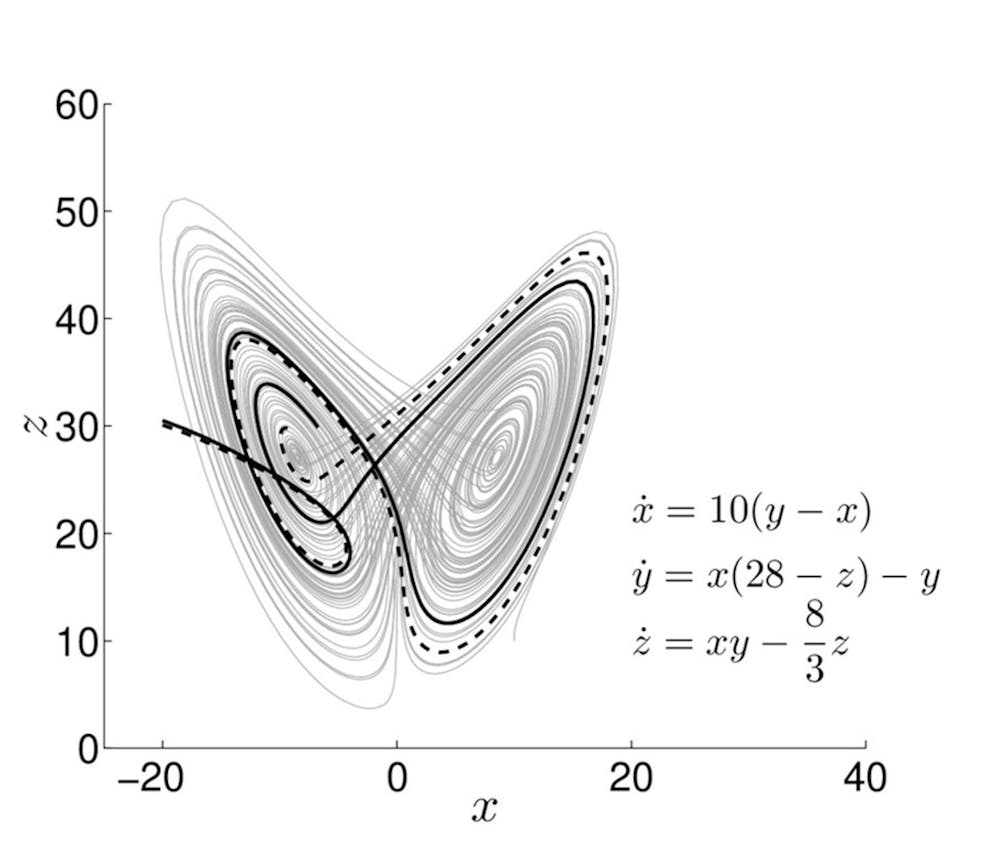
    Edward Lorenz’s mathematical weather model showed solutions with a butterfly-like shape. Wikimol

    In 1972, the US meteorologist Edward Lorenz asked a now-famous question:

    Does the flap of a butterfly’s wings in Brazil set off a tornado in Texas?

    Over the next 50 years, the so-called “butterfly effect” captivated the public imagination. It has appeared in movies, books, motivational and inspirational speeches, and even casual conversation.

    The image of the tiny flapping butterfly has come to stand for the outsized impact of small actions, or even the inherent unpredictability of life itself. But what was Lorenz – who is now remembered as the founder of the branch of mathematics called chaos theory – really getting at?

    A simulation goes wrong

    Our story begins in the 1960s, when Lorenz was trying to use early computers to predict the weather. He had built a basic weather simulation that used a simplified model, designed to calculate future weather patterns.

    One day, while re-running a simulation, Lorenz decided to save time by restarting the calculations from partway through. He manually inputted the numbers from halfway through a previous printout.

    But instead of inputting, let’s say, 0.506127, he entered 0.506 as the starting point of the calculations. He thought the small difference would be insignificant.

    He was wrong. As he later told the story:

    I started the computer again and went out for a cup of coffee. When I returned about an hour later, after the computer had generated about two months of data, I found that the new solution did not agree with the original one. […] I realized that if the real atmosphere behaved in the same manner as the model, long-range weather prediction would be impossible, since most real weather elements were certainly not measured accurately to three decimal places.

    There was no randomness in Lorenz’s equations. The different outcome was caused by the tiny change in the input numbers.

    Lorenz realised his weather model – and by extension, the real atmosphere – was extremely sensitive to initial conditions. Even the smallest difference at the start – even something as small as the flap of a butterfly’s wings – could amplify over time and make accurate long-term predictions impossible.

    The ‘Lorenz Attractor’ found in models of a chaotic weather system has a characteristic butterfly shape.
    Milad Haghani, CC BY

    Lorenz initially used “the flap of a seagull’s wings” to describe his findings, but switched to “butterfly” after noticing a remarkable feature of the solutions to his equations.

    In his weather model, when he plotted the solutions, they formed a swirling, three-dimensional shape that never repeated itself. This shape — called the Lorenz attractor — looked strikingly like a butterfly with two looping wings.

    Welcome to chaos

    Lorenz’s efforts to understand weather led him to develop chaos theory, which deals with systems that follow fixed rules but behave in ways that seem unpredictable.

    These systems are deterministic, which means the outcome is entirely governed by initial conditions. If you know the starting point and the rules of the system, you should be able to predict the future outcome.

    There is no randomness involved. For example, a pendulum swinging back and forth is deterministic — it operates based on the laws of physics.

    Systems governed by the laws of nature, where human actions don’t play a central role, are often deterministic. In contrast, systems involving humans, such as financial markets, are not typically considered deterministic due to the unpredictable nature of human behaviour.

    A chaotic system is a system that is deterministic but nevertheless behaves unpredictably. The unpredictability happens because chaotic systems are extremely sensitive to initial conditions. Even the tiniest differences at the start can grow over time and lead to wildly different outcomes.

    Chaos is not the same as randomness. In a random system, outcomes have no definitive underlying order. In a chaotic system, however, there is order, but it’s so complex it appears disordered.

    A misunderstood meme

    Like many scientific ideas in popular culture, the butterfly effect has often been misunderstood and oversimplified.

    One common misconception is that the butterfly effect implies every small action leads to massive consequences. In reality, not all systems are chaotic, and for systems that aren’t, small changes usually result in small effects.

    Another is that the butterfly effect carries a sense of inevitability, as though every butterfly in the Amazon is triggering tornadoes in Texas with each flap of its wings.

    This is not at all correct. It’s simply a metaphor pointing out that small changes in chaotic systems can amplify over time, making long-term outcomes impossible to predict with precision.

    Taming butterflies

    Systems that are very sensitive to initial conditions are very hard to predict. Weather systems are still tricky, for example.

    Forecasts have improved a lot since Lorenz’s early efforts, but they are still only reliable for a week or so. After that, small errors or imprecisions in the starting data grow larger and larger, eventually making the forecast inaccurate.

    To deal with the butterfly effect, meteorologists use a method called ensemble forecasting. They run many simulations, each starting with slightly different initial conditions.

    By comparing the results, they can estimate the range of possible outcomes and their likelihoods. For example, if most simulations predict rain but a few predict sunshine, forecasters can report a high probability of rain.

    However, even this approach works only up to a point. As time goes on, the predictions from the models diverge rapidly. Eventually, the differences between the simulations become so large that even their average no longer provides useful information about what will happen on a given day at a given location.

    A butterfly effect for the butterfly effect?

    The journey of the butterfly effect from a rigorous scientific concept to a widely popular metaphor highlights how ideas can evolve as they move beyond their academic roots.

    While this has helped bring attention to a complex scientific concept, it has also led to oversimplifications and misconceptions about what it really means.

    Attaching a metaphor to a scientific phenomenon and releasing it into popular culture can lead to its gradual distortion.

    Any tiny inaccuracies or imprecision in the initial description can be amplified over time, until the final outcome is a long way from reality. Sound familiar?

    Milad Haghani does not work for, consult, own shares in or receive funding from any company or organisation that would benefit from this article, and has disclosed no relevant affiliations beyond their academic appointment.

    ref. The butterfly effect: this obscure mathematical concept has become an everyday idea, but do we have it all wrong? – https://theconversation.com/the-butterfly-effect-this-obscure-mathematical-concept-has-become-an-everyday-idea-but-do-we-have-it-all-wrong-246577

    MIL OSI AnalysisEveningReport.nz

  • MIL-OSI USA: Sens. Markey, Cruz Statement on Commerce Committee Vote to Advance AM Radio for Every Vehicle Act

    US Senate News:

    Source: United States Senator for Massachusetts Ed Markey

    Washington (February 5, 2025) – Senator Edward J. Markey (D-Mass.) member of the Science, Commerce, and Transportation Committee, and Ted Cruz (R-Texas), Chairman of the Science, Commerce, and Transportation Committee today released the following statement on the committee’s vote to advance the AM Radio for Every Vehicle Act, bipartisan and bicameral legislation that would direct federal regulators to require automakers to include AM broadcast radio in their new vehicles at no additional charge.

    “Today’s vote to advance the AM Radio for Every Vehicle Act broadcasts a clear message to car manufacturers that AM radio is an essential communication tool for millions of Americans across the country. From emergency response to sports, entertainment, and news, AM radio is a lifeline that must be protected. Our bill ensures that no one is cut off from their communities and that AM radio stays a part of our constituents’ daily lives.”

    In May 2023, Senators Markey and Cruz led their colleagues in introducing the AM Radio for Every Vehicle Act.  The AM Radio for Every Vehicle Act passed through the Senate Commerce Committee in July 2023 and passed through the House Energy and Commerce Committee in September 2024.

    MIL OSI USA News

  • MIL-OSI: Truxton Continues to Add Talent and Depth to the Team

    Source: GlobeNewswire (MIL-OSI)

    NASHVILLE, Tenn., Feb. 05, 2025 (GLOBE NEWSWIRE) — Truxton is pleased to announce the addition of several new colleagues over the last two months. Truxton continues to attract some of the nation’s top talent in the finance industry.

    “Truxton is always looking for talented professionals who can enhance the way we serve our clients,” said Tom Stumb, CEO and Chairman. “Over the past twenty years, we have been fortunate to build a team of dedicated individuals who are committed to doing the right thing for our clients. We truly believe we have the finest team in the industry.”

    Steve Pelmore Jr., CPA joins the Wealth team as Vice President, Tax Strategist and Wealth Advisor. Mr. Pelmore has nearly 20 years of experience in public accounting. Prior to Truxton, he served as a Senior Tax Manager for Blankenship CPA Group and has held various roles with the Internal Revenue Service. Steve is a graduate of the University of Illinois Urbana with a MS in Taxation, a graduate of Tennessee State University with a BBA in Economics and Finance and is a Certified Public Accountant (CPA) and an Enrolled Agent (EA). Prior to his career as a CPA, Steve served as a Captain in the US Army & US Army Reserve, participated in various overseas tours of duty and earned numerous service awards.

    “Steve is an accomplished tax professional that brings considerable capabilities to Truxton which will meaningfully benefit our clients,” said Drew Mallory, Senior Managing Director and Chief Fiduciary Officer. “His strong command of income and transfer taxation immediately strengthens our team’s ability to provide strategic tax advice to Ultra High Net Worth families and business owners.”

    “We are thrilled that Steve has joined our team.  His decades of experience and knowledge and commitment to excellence will serve our clients, colleagues and shareholders well,” remarks Peter Deming, CPA, Senior Wealth and Tax Strategist.

    The Truxton Banking team adds Carson Walter as a Credit Analyst. Mr. Walter is a graduate of The Citadel with Master’s of Business Administration and a graduate of Birmingham-Southern College, earning his BS in Business Administration.

    Nathan Johnson joins the Finance team as an Accountant after five years working as a finance associate for the Middle Tennessee School of Anesthesia. He earned his Master’s of Business Administration from Regis University and his BBA in Accounting from Southern Adventist University.

    Also, Truxton adds Keegan Fornoff as an Office Coordinator. Prior to Truxton, Ms. Fornoff worked in communications and served as an assistant volleyball coach. She is a graduate of Southeast Missouri State University, earning her BS in Psychology, and was a 4-year member of the Division I Women’s Volleyball Team, and later earning her Master’s of Science in Exercise and Sport Psychology at Southern Illinois University Edwardsville.

    “We are excited to welcome this exceptional group of professionals,” said Derrick Jones, President of Truxton. “They bring a wealth of talent, experience, and energy, as well as an unwavering dedication to serving sophisticated clients at the highest level. We look forward to the impact they will have on improving client outcomes and driving our business forward.”

    About Truxton
    Truxton is a premier provider of wealth, banking, and family office services for wealthy individuals, their families, and their business interests. Serving clients across the world, Truxton’s vastly experienced team of professionals provides customized solutions to its clients’ complex financial needs. Founded in 2004 in Nashville, Tennessee, Truxton upholds its original guiding principle: do the right thing. Truxton Trust Company is a subsidiary of financial holding company, Truxton Corporation (OTCPK: TRUX). For more information, visit truxtontrust.com.

    The MIL Network

  • MIL-OSI Global: First new non-opioid painkiller approved in the US for decades – here’s how it works

    Source: The Conversation – UK – By Alistair Mathie, Professor of Pharmacology and Head of Life Sciences, University of Westminster

    S L/Shutterstock

    A new non-opioid painkiller, suzetrigine, has just been approved by the US drug regulator, the FDA. It is the first non-opioid painkiller the agency has approved in over two decades.

    Because of their addictive nature, medical professionals have done a lot in recent years to minimise the use of opioids, especially the length of time they are taken for following surgery. Patients receiving opioids for longer than a week post-surgery were found to double their risk of using these drugs for more than a year.

    In the US, a study showed that around 6% of all patients who underwent surgery became persistent opioid users, even if they had never taken opioids before. So the arrival of a relatively safe and effective non-opioid drug to treat acute pain without the risk of addiction is a huge deal.

    Suzetrigine works by blocking the activity of proteins called sodium channels in nerve cells that send pain signals. This stops the pain signal in its tracks, before it reaches your brain and therefore before you experience it.

    This is exactly how existing local anaesthetic drugs, such as lidocaine, work. Unfortunately, these drugs block all sodium channels throughout your body, including those that control the activity of your heart, your brain and your breathing. This is why, as their name implies, they can only be applied locally.

    In dentistry, this is usually done using a syringe and accompanied by another drug (called a “vasoconstrictor”) to stop the anaesthetic from escaping into the bloodstream.

    Targeting sodium channels to alleviate pain is a wonderful idea in principle. However, it is hampered by the widespread presence of these proteins – which initiate electrical signalling in almost all the cells of your body – and the consequent risks associated with blocking them. Not least the very real risk of sudden death.

    In Japan, fugu, a dish made from puffer fish, is an exotic delicacy. At least part of its attraction is the slight tingle in the tongue that can be experienced when eating it. This tingling is caused by a poison, tetrodotoxin, that is a potent blocker of sodium channels. Too much tetrodotoxin is fatal. In Japanese restaurants, only qualified fugu handlers are permitted to prepare the dish.

    So why is the discovery and development of suzetrigine so important? We have nine different genes that code for sodium channels (they run from Nav1.1 to Nav1.9). Each of these channels is present at different levels in the different cells and organs of your body. But only one of these channels, Nav1.8, is present in peripheral pain-sensing neurons and not in other parts of the body.

    There is no evidence of Nav1.8 expression in either your heart or your brain. This selective expression suggests that this particular sodium channel might be a good target to alleviate pain.

    This idea received further credence following the discovery that people with genetic mutations that increase the activity of this channel suffered nerve pain despite there being no obvious cause of the pain.

    Highly selective

    Over several years, Vertex Pharmaceuticals, the company that makes suzetrigine (brand name Journavx), screened many potential drugs to try to identify a safe, selective blocker of these channels that could be taken orally. Suzetrigine was found to be both a potent and very selective blocker of these channels. It is, staggeringly, at least 30,000 times more potent at blocking Nav1.8 channels than all the other types of sodium channels that we have.

    In two clinical trials with over 1,000 patients in each, suzetrigine was found to be equally as effective as opioids at blocking acute pain following moderately painful surgery – either removal of bunions or a tummy-tuck.

    Suzetrigine also produced far fewer side-effects than opioid treatment and had no risk of addiction. So far, however, there is no convincing evidence that suzetrigine is effective in chronic, long-term pain relief.

    The discovery and approval for the use of suzetrigine opens up the possibility of treating acute pain by selectively blocking specific sodium channels, without the risk of addiction. More generally, selective targeting of the many different ion channels that underlie pain signalling may pave the way for new, non-addictive treatments for all forms of acute and chronic pain.

    Alistair Mathie has previously received funding from the Royal Society, BBSRC and LifeArc to study the role of ion channels in pain

    Emma Veale has previous received funding from BBSRC and LifeArc to study the role of ion channels in pain. Also from NIHR to deliver a feasibility study in primary care aimed at managing post-surgical opioid use.

    ref. First new non-opioid painkiller approved in the US for decades – here’s how it works – https://theconversation.com/first-new-non-opioid-painkiller-approved-in-the-us-for-decades-heres-how-it-works-248858

    MIL OSI – Global Reports

  • MIL-OSI Global: Companion review: this sleek but violent film asks interesting ethical questions about our relationship with AI

    Source: The Conversation – UK – By Sarah Artt, Lecturer in English and Film, Edinburgh Napier University

    Science fiction film and television has long been fascinated by robots. But stories that show us uncannily human cyborgs have often tended to veer towards either comedy or horror. Fritz Lang’s Metropolis (1927) and Ridley Scott’s Blade Runner (1982) both imagine a world where beautiful female cyborgs threaten to overstep their original programming. Rarer are stories that suggest it might be possible to love a cyborg, such as Susan Seidelman’s underseen romantic comedy, Making Mr. Right (1987).

    Companion picks up where Alex Garland’s Ex Machina (2014) leaves off. Ex Machina was about a young man tasked with testing the artificial intelligence (AI) of a female robot. Companion, however, posits a world where synthetic humans have become common.

    Companion’s plot also owes much to the themes of rivalry and revenge present in Karyn Kusama’s horror films Jennifer’s Body (2009) and The Invitation (2022), as well as the TV show Battlestar Galactica’s (2004 to 2009) imagining of full cyborg autonomy.

    Companion is a particularly post-Black Mirror (2011) example of science fiction. With its glossy aesthetics, and ubiquitously friction-less technology, it’s a vision of a future where AI and advanced robotics have made our lives easier. But, in typical Black Mirror fashion, this parable offers a warning.


    Looking for something good? Cut through the noise with a carefully curated selection of the latest releases, live events and exhibitions, straight to your inbox every fortnight, on Fridays. Sign up here.


    We meet Iris (Sophie Thatcher) and Josh (Jack Quaid) as they head to a chic, modern lake house for a weekend with friends. At this point, our only real indication that this is science fiction is the fact that the GPS in Josh’s car is a bit better than usual.

    At first, Iris seems like yet another incarnation of the Manic Pixie Dream Girl – quirky and kittenish, but too bland to really be a protagonist. It is only Thatcher’s subtle physical performance that lets us question whether Iris is entirely human. Besotted with Josh and anxious to please, Iris seems like just another girl who has wished for her prince to come and been rewarded with a supermarket meet cute.

    What makes Companion unsettling is not so much its depiction of cyborgs but rather its portrayal of misogyny.

    Survivors of intimate partner violence will recognise Josh. Particularly his ironclad belief that he is a “a nice guy” who is entitled to an attractive partner who places his needs above all else.

    For some audiences, Companion may not feel firmly rooted enough in either science fiction or horror. But then, it’s really only a horror film if you too are kept awake at night by the thought that some people really want a sex robot with customisable intelligence levels (Josh keeps Iris’s at 40%).

    Thatcher’s performance as Iris is fascinatingly glitchy. There is something about her walk – a precision that isn’t quite human. She stands with a stillness that reminds us she is more object than woman. There is a grimace she makes that conveys how she finds it troubling to process veiled commands from a man who isn’t her partner. It represents a feeling female viewers may have had before, when the social programming that tells women to be nice smacks up against their fight or flight response.

    Iris is a sex robot designed with charming slightly buck teeth – a flaw to offset her pore-less skin. The goal is to prevent her from falling into to the uncanny valley (that discomfited feeling when you encounter an object that is a little too life-like) and make her seem more real.

    Some people argue that you should only have sex with a robot if you think that robot would want to have sex with you. But most science fiction doesn’t really go that way – from Bride of Frankenstein (1935) to Black Mirror, most cyborg figures are programmed to consent without question.

    Companion shows us Iris’s point of view as Josh looms over her during sex. Afterwards, her romance-trope laden chatter is shut down by his command that she go to sleep.

    Companion contains aspects of both comedy and horror. But like the best science fiction, it’s central warning is against those who believe that technology can offer them absolute control.

    Sarah Artt does not work for, consult, own shares in or receive funding from any company or organisation that would benefit from this article, and has disclosed no relevant affiliations beyond their academic appointment.

    ref. Companion review: this sleek but violent film asks interesting ethical questions about our relationship with AI – https://theconversation.com/companion-review-this-sleek-but-violent-film-asks-interesting-ethical-questions-about-our-relationship-with-ai-249062

    MIL OSI – Global Reports

  • MIL-OSI Global: 360-degree videos are making social issues and educational content more engaging for Canadians

    Source: The Conversation – Canada – By Victoria (Vicky) McArthur, Associate Professor, School of Journalism and Communication, Carleton University

    Immersive film using virtual reality (VR) or 360-degree video is being used increasingly as a tool for eliciting empathy and emotional identification in fact-based stories. Unlike traditional flat film, immersive films allow viewers to look in any direction while watching the video.

    This immersive quality is what makes these films such an intriguing medium. Nearly a decade ago, American filmmaker Chris Milk described VR as the “ultimate empathy machine” because it can fully immerse viewers in another person’s environment and perspective.

    This sentiment has been echoed by VR journalism pioneer Nonny de la Peña, whose early work explored the unique storytelling characteristics of the medium. Her first VR film, Hunger in Los Angeles, was the first VR documentary to be showcased at the Sundance Film Festival in 2012.

    The film depicts a diabetic man collapsing outside a food bank due to low blood sugar. Viewers reported feeling a great deal of empathy for the man, with some reaching out to try and help him.

    In March 2015, YouTube launched support for publishing and viewing 360-degree videos. Today, anyone can film and share 360-degree video content using commercially available cameras, expanding the possibilities for storytelling and audience engagement.

    Rise of 360-degree video content

    Countless content creators, filmmakers and journalists have produced immersive content using these cameras. In 2016, for instance, CBC produced Highway of Tears, a short 360-degree video about 16-year-old Ramona Wilson, a young Indigenous woman from the Gitxsan Nation who disappeared along Highway 16 near Prince George, B.C., in 1994.

    CBC has produced other 360-degree videos to highlight real-world challenges and experiences, including Ice Rescue from the Victim’s Perspective and Accessibility Advocate Shows What It’s Like to Use a Wheelchair in Winter.

    ‘Highway of Tears: 360 Video’ from CBC.

    Canadian researchers have also been using immersive technologies like virtual reality and 360-degree video as tools for education and empathy-building.

    A group of Canadian researchers conducted an experiment with VR to see if they could foster empathy for the impact of climate change on oceans. Using a VR simulation, they showed participants optimistic and pessimistic future impacts of climate change on oceans. After experiencing the simulation, participants expressed increased empathy and concern for the issue.

    Similarly, at Toronto Metropolitan University, researchers used 360-degree videos to deepen empathy and understanding for people taking care of individuals with dementia. Participants watched 360-degree videos filmed from the perspective of two fictional characters living with dementia. They reported strong emotional responses to the videos and a deeper understanding of living with dementia.

    As immersive technology becomes more accessible, its potential to foster empathy and understanding across a range of social issues continues to grow.

    Is VR truly the ‘ultimate empathy machine’?

    Is immersive technology truly the “ultimate empathy machine?” Presently, there’s no agreement among experts. Some question the scientific rigour used to support such claims. Past research has suffered from small sample sizes, a lack of diversity among research participants and a lack of longitudinal studies investigating the effects of empathy.

    Other researchers suggest that, while empathetic gains have been demonstrated, these effects tend to fade after a short time. One study found that while VR increased emotional empathy for refugees, those feelings were mostly gone after just 10 days. More importantly, these empathic responses didn’t translate into actions like charitable donations.

    Some researchers have taken a more nuanced approach by distinguishing between emotional and cognitive empathy. Cognitive empathy involves knowing how other people think and feel, while emotional empathy involves feeling another person’s emotions. The findings from one research study indicate that VR can improve emotional empathy, but not cognitive empathy.

    This distinction is crucial in assessing VR’s potential as an empathy-building tool. While immersive experiences may create strong emotional responses, their long-term influence and ability to drive meaningful action remain uncertain.

    Knowledge mobilization

    Other research suggests VR and 360-degree video have the potential to be knowledge-transfer tools. Canadian researchers are encouraged to engage the Canadian public through knowledge mobilization — the process of sharing research findings with organizations, people and government.

    Several Canadian research institutions have started using 360-degree video as a knowledge-mobilization tool. For example, researchers at the National Research Council Canada’s (NRC) Hydrogen Laboratory in British Columbia produced a 360-degree video allowing audiences to see the lab and learn more about the research conducted there.

    360-degree video of the Hydrogen Laboratory in Vancouver.

    The NRC has produced other 360-degree video explainers, including one about the Aerial Robotics Laboratory in Montréal and another about the Climatic Testing Facility located in Ottawa.

    At a time when Canadians are inundated with information, immersive video explainers offer a unique way to learn about science and society. While it remains unclear whether VR is truly the “ultimate empathy machine,” its ability to place audiences at the centre of stories and events has been shown to have positive effects on learning, information retention and the transfer of knowledge.

    Immersive film may not be a guaranteed empathy-builder, but it’s far from being an apathy machine. Ultimately, it offers unique perspectives to Canadians wishing to learn more about the world we live in.

    Victoria (Vicky) McArthur receives funding from the Natural Sciences and Engineering Research Council of Canada and the Social Sciences and Humanities Research Council of Canada.

    ref. 360-degree videos are making social issues and educational content more engaging for Canadians – https://theconversation.com/360-degree-videos-are-making-social-issues-and-educational-content-more-engaging-for-canadians-248398

    MIL OSI – Global Reports

  • MIL-OSI Global: Three pop beefs that were more cutting than Matty Healy and Taylor Swift’s

    Source: The Conversation – UK – By Glenn Fosbraey, Associate Dean of Humanities and Social Sciences, University of Winchester

    There has been a sharp intake of breath among Taylor Swift fans following reports that 1975 frontman and songwriter Matty Healy is soon to release a song addressing their public romance from 2023.

    The song in question, God Has Entered My Body, is reportedly the title track of an upcoming 1975 album. According to a report in the Sun, the song includes the lyric “Keep your head up princess, your tiara is falling”. It is reported to be Healy’s response to Swift’s 2024 song The Smallest Man Who Ever Lived, which many fans believe was about their relationship.

    The 1975 frontman has responded to the rumours in typical Healy style, commenting “huge if true” under a post about the story on social media site Reddit.

    This lyrical back and forth is just the latest entry in a rich history of public beefs between pop stars that have been committed to record. Here are some of the most notable examples.


    Looking for something good? Cut through the noise with a carefully curated selection of the latest releases, live events and exhibitions, straight to your inbox every fortnight, on Fridays. Sign up here.


    1. Lennon v McCartney (1971)

    The first mainstream pop “diss track” exchange took place long before the term was even coined. It occurred in 1971 through Paul and Linda McCartney’s Too Many People and John Lennon’s How Do You Sleep?

    Lennon was incensed by the McCartney lyrics “too many people going underground” and “too many people preaching practices”, which he took as attacks on his and Yoko Ono’s avant garde albums and bed-in escapades. In response, he launched a stinging tirade that accused (Paul) McCartney of creating “Muzak”, being only a “pretty face”, and hanging around with sycophants who fed his ego.

    How Do You Sleep? by John Lennon & The Plastic Ono Band.

    The on-record beef ended there, perhaps because McCartney was too busy to focus on his new band Wings, or simply because he didn’t want to risk another lashing from Lennon’s famously sharp tongue.

    Either way, to the relief of Beatles fans everywhere, the two made amends before Lennon’s death in 1980, and Paul finally concluded their lyrical back and forth two years later with the touching Here Today.

    2. Buckingham v Nicks (1977)

    Recorded amid a backdrop of romantic tension and heavy drug use, it’s a wonder that Fleetwood Mac were even able to complete their 12th studio album Rumours, let alone create something that would go on to sell 40 million copies and spend more than a 1,000 weeks in the UK album charts.

    It’d be unfair to say the massive success of the album is due to the lyrical exchanges between the by then estranged couple Lindsey Buckingham and Stevie Nicks, but it certainly didn’t hurt.

    Dreams by Fleetwood Mac.

    Buckingham lit the fuse with Go Your Own Way, which accused Nicks of “packing up and shacking up” with different men. It caused Nicks to write Dreams, where she encouraged him to “listen carefully to the sound of your loneliness, like a heartbeat, drives you mad, in the stillness of remembering what you had”.

    Decades later, one of the bitterest feuds in pop music continues to rumble on, with Buckingham currently sidelined from the group after being fired in 2018. It won’t come as a surprise that their version of events differs, with Buckingham claiming Nicks was behind his sacking, and Nicks accusing him of revisionism. No Lennon and McCartney thawing of the ice here, then. Yet.

    3. Perry v Swift (2014-18)

    Swift was involved in another public spat back in the 2010s. If reports are to be believed, the two pop icons Katy Perry and Swift became close friends in 2009, but by 2013, things seemed to have soured.

    A rift over some backup dancers, some thinly veiled interview comments and a mutual ex-boyfriend have all been the subject of fan theories about the shift in mood.

    Bad Blood by Taylor Swift ft. Kendrick Lamar.

    In terms of diss tracks, Swift struck first, and relatively mildly, with Bad Blood in 2014, stating in an interview shortly after its release that it was about “a female musical artist”. Although she refused to name names, internet sleuths soon believed they’d figured out it was Perry.

    A Twitter spat between Swift and rapper Nicki Minaj then broke out. Minaj complained that her song Anaconda wasn’t nominated for the video-of-the-year award when Swift’s Bad Blood was (stay with me – this will become relevant soon).

    If the near-journalistic speed of those Lennon and McCartney tracks were indicative of the music industry in the early 1970s, Perry’s delayed response to Swift’s (perceived) barb is indicative of modern times, where her releases were kept to a strict three- or four-year cycle.

    Three years on, then, comes Swish Swish, which included lyrics like “you’re a joke / And I’m a court-side killer queen” and “Your game is tired / You should retire”. It featured Nicki Minaj in the music video to further fan the flames (told you it’d become relevant).

    Swish Swish by Katy Perry ft. Nicki Minaj.

    The only problem was that, in the years between their falling out, Swift had transitioned from mere pop musician to word-dominating superstar, so Perry’s insults carried little weight.

    When it comes to diss tracks, then, the old adage of striking while the iron is hot is definitely applicable. The pair have since made up, with Perry sending Swift an actual olive branch in 2018.

    The pair are pictured embracing during the closing scene of Swift’s 2019 music video for You Need To Calm down. Even the Bad Blood controversy seems to be water under the proverbial bridge now, with Perry videoed singing along to the track by fans earlier this year during one of Swift’s Eras tour concerts.

    Glenn Fosbraey does not work for, consult, own shares in or receive funding from any company or organisation that would benefit from this article, and has disclosed no relevant affiliations beyond their academic appointment.

    ref. Three pop beefs that were more cutting than Matty Healy and Taylor Swift’s – https://theconversation.com/three-pop-beefs-that-were-more-cutting-than-matty-healy-and-taylor-swifts-248076

    MIL OSI – Global Reports

  • MIL-OSI USA: Sen. RaShaun Kemp Introduces Legislation to Ban Use of Three-Cueing System

    Source: US State of Georgia

    ATLANTA (February 5, 2025) — This week, Sen. RaShaun Kemp (D–South Fulton) introduced legislation that would ban schools from using the three-cueing system in educational materials for teaching reading. The three-cueing method relies on meaning, structure and syntax, and visual cues to help students identify words. Senate Bill 93, which has bipartisan support, would also establish rules for curricula in state-approved educator preparation programs.

    “This method, which encourages students to guess words rather than decode them, sets our kids up for failure and contradicts the principles of the science of reading,” said Sen. Kemp. “I’ve seen firsthand how this flawed approach leaves too many children struggling to read. It’s well past time we give them all the tools they need to succeed.”

    Sen. Kemp added, “This legislation will build on two critical bills passed during the 2023 Legislative Session: House Bill 538, or the “Georgia Early Literacy Act,” and Senate Bill 211, which established the Georgia Council on Literacy. It is essential that our children continue to receive instruction based on evidence-based principles, as outlined in these bills. I look forward to collaborating with my colleagues across the aisle to ensure this vital legislation is passed.”

    If passed, Georgia would join 11 other states that have banned three-cueing, including Ohio, where the method was originally developed and widely used.

    SB 93 can be found here.

    # # # #

    Sen. RaShaun Kemp represents the 38th Senate District, which includes a portion of Fulton County. He may be reached by phone at (404) 656-0105 or by email at rashaun.kemp@senate.ga.gov.

    For all media inquiries, please reach out to SenatePressInquiries@senate.ga.gov.

    MIL OSI USA News

  • MIL-OSI Global: Why personal climate action matters – according to experts

    Source: The Conversation – UK – By Jack Marley, Environment + Energy Editor, UK edition

    EL_Images/Shutterstock

    Do you feel powerless?

    You probably aren’t responsible for the investment decisions of an energy company, nor do you have a hand in government policy. But still, you are reading about climate change – a problem that can easily seem intractable to most people.

    The Veganuary campaign reported record participation this year: 25.8 million people worldwide tried a lighter lifestyle without meat and dairy in January, knowing that enormous emission sources sit beyond their immediate control. If such resolve to fix our planet exists, how can people exercise it?


    This roundup of The Conversation’s climate coverage comes from our award-winning weekly climate action newsletter. Every Wednesday, The Conversation’s environment editor writes Imagine, a short email that goes a little deeper into just one climate issue. Join the 40,000+ readers who’ve subscribed.


    You might be used to thinking of climate change in terms of your carbon footprint. That’s no accident, says science communicator Sam Illingworth (Edinburgh Napier). A public relations firm, hired by oil giant BP, invented the concept in 2004 as part of a deliberate effort to shift attention from corporate culpability, he says.

    “In my research into climate communication, I see how stories of guilt resonate with communities already facing misplaced blame,” Illingworth adds.

    You’re not alone

    “Net zero heroes” are set up to fail, Illingworth says. But realising this only makes collective action more important, and shows the futility of trying to bear the weight of the problem on your own.


    Read more:
    You don’t have to be a net zero hero – how focus on personal climate action can distract from systemic problems


    Your choices do not exist in a vacuum. Earth is an interconnected community of living and non-living things says ethicist Patrick Effiong Ben of the University of Manchester. African philosophers like Jonathan Chimakonam and Aïda Terblanché-Greeff have a helpful concept for thinking through the weightiness of your decisions: complementarity.

    Life on Earth is connected in often subtle and unpredictable ways.
    Lois GoBe/Shutterstock

    “Complementarity holds that the relationships that unite individual things can extend to prove the value of every contribution, no matter its size,” Ben says.


    Read more:
    Think your efforts to help the climate don’t matter? African philosophers disagree


    You can test this notion by choosing to eat a plant-based diet or forgo flying and observing your influence on others. If you’re sceptical, just think how many of your habits or turns of phrase are borrowed from loved ones. Steve Westlake, a behavioural psychologist at Cardiff University, says that your pro-environment choices can ultimately alter what other people consider “normal”.

    “In a survey I conducted, half of the respondents who knew someone who has given up flying because of climate change said they fly less because of this example. That alone seemed pretty impressive to me,” he says.


    Read more:
    Climate change: yes, your individual action does make a difference


    “They explained that the bold and unusual position to give up flying had: conveyed the seriousness of climate change and flying’s contribution to it; crystallised the link between values and actions; and even reduced feelings of isolation that flying less was a valid and sensible response to climate change.”

    What’s stopping us?

    Often, is is not apathy that holds us back, but a seeming lack of options. In the UK, where I live, a train is by far the better travel choice emissions-wise but it is usually much more expensive than a flight that covers the same distance.

    Environmental psychologists Christina Demski (University of Bath) and Stuart Capstick (Cardiff University) criticise the laissez-faire approach of successive governments that have “[gone] with the grain of consumer choice” while failing to recognise that many people would gladly choose the green option if they could afford or access it.


    Read more:
    To address climate change, lifestyles must change – but the government’s reluctance to help is holding us back


    This desire to do something meaningful is continually frustrated, they say, but it will not vanish as the crisis worsens. Everyone alive and yet to live needs a liveable climate. Securing it is within our technical and material means.

    The human species has no home but this one.
    Canities/Shutterstock

    Just listen to this from sustainability researcher Joel Millward-Hopkins (Université de Lausanne, previously University of Leeds):

    “Fortunately, in new research we found that using 60% less energy than today, decent living standards could be provided to a global population of 10 billion by 2050. That’s 75% less energy than the world is currently forecast to consume by 2050 on our present trajectory – or as much energy as the world used in the 1960s.”


    Read more:
    How 10 billion people could live well by 2050 – using as much energy as we did 60 years ago


    Instead of seeing your new vegan diet as a personal choice, think of it as a political act taken in solidarity with people and other species bearing the brunt of climate change say political philosophers Alasdair Cochrane (University of Sheffield) and Mara-Daria Cojocaru (Munich School of Philosophy).


    Read more:
    Veganism: why we should see it as a political movement rather than a dietary choice


    And remember that it isn’t all sacrifice. The joy that is possible with more expensive and more energy-hungry lifestyles is fleeting says Capstick, but contentment, he argues, is low-carbon.


    Read more:
    Climate change: greener lifestyles linked to greater happiness – in both rich and poor countries


    ref. Why personal climate action matters – according to experts – https://theconversation.com/why-personal-climate-action-matters-according-to-experts-248960

    MIL OSI – Global Reports

  • MIL-OSI USA: Cantwell Takes to Senate Floor to Oppose Trump’s Trade Philosophy: No to Tariffs, Yes to Innovation, Collaboration & Growth

    US Senate News:

    Source: United States Senator for Washington Maria Cantwell

    02.05.25

    Cantwell Takes to Senate Floor to Oppose Trump’s Trade Philosophy: No to Tariffs, Yes to Innovation, Collaboration & Growth

    In speech on Senate floor, Cantwell advocates for new U.S. trade agreements with Southeast Asia, the Middle East, & the Americas to strengthen ties with allies & grow the economy at home; Cantwell slams proposed Trump tariffs: “The payers in this dispute are never the government leaders … it’s the workers who lose their job.”

    WASHINGTON, D.C. – Today, U.S. Senator Maria Cantwell (D-WA), the ranking member of the Senate Committee on Commerce, Science, and Transportation, delivered a speech on the Senate floor calling for the United States to establish new trade agreements with Southeast Asia, the Middle East, and Latin America – and to repudiate the trade philosophy of President Donald Trump, whose proposed tariffs on goods from Canada, Mexico, and China would spark a trade war, drive up costs for American consumers, harm domestic businesses across hundreds of industries, and compromise the United States’ global leadership in the free trade ecosystem.

    It’s better to have a job than be attracted to join a terrorist organization. It’s better to create economic stability than fueling poverty and migration […] Last week, I spoke about additional investments the United States needs to make in Panama, Latin America, and others, to link and modernize bilateral agreements that help us counter China,” Sen. Cantwell said. “Free trade agreements are a way for us — not tariffs — to gain the leverage we want. South Asia could play an important role in this coalition building, particularly in the Indo-Pacific region. But I want us to go further. I want us to understand that U.S.-led negotiations in a Middle East free trade agreement to build on the momentum of a ceasefire in Gaza could further stabilize that region.”

    In her speech, Sen. Cantwell railed against President Donald Trump’s tariff’s proposal, likening his isolationist trade policies to an attempt to make time stand still – a futile goal at any point, but especially during the modern information age, when countries are more interconnected than ever and the United States is locked in an innovation race in artificial intelligence and quantum technology. She also called on the United States to invest in its workforce, research & development, science, and capital investment to modernize its manufacturing and stay competitive.

    “To outcompete our adversaries, we need coalitions, not go-it-alone strategies. Why do we fear this if we think our principles are correct? But somehow the current administration thinks that we’ve been hurt more than we’ve been helped in this global equation, and they want us to believe that somehow there is a win-win situation on tariffs that they can deliver on,” Sen. Cantwell said.

    “Tariffs are a distortion of markets. Tariffs mean we disagree. It very rarely means the disagreement will be resolved quickly. It usually means people will retaliate, and the escalation of that retaliation will hurt consumers so much so that eventually someone will blink,” she continued. “The payers in this dispute, though, are never the government leaders. No, it’s the workers who lose their job. It’s the family that pays higher cost. It’s the community that loses their economic activity and tax revenue.”

    In Washington state: Two out of every five jobs are tied to trade and related industries. In 2023, the state imported $19.9 billion of goods from Canada – primarily oil, gas, lumber, and electrical power — making our northern neighbors Washington state’s largest trade partner. Also in 2023, the state imported $1.7 billion in goods from Mexico, including motor vehicles, vehicle parts, and household appliances. More information about how President Trump’s proposed tariffs will impact businesses and consumers in the State of Washington is HERE.

    Sen. Cantwell has remained a steadfast supporter of free trade to grow the economy in the State of Washington and nationwide. Sen. Cantwell was the leading voice in negotiations to end India’s 20% retaliatory tariff on American apples, which devastated Washington state’s apple exports.  India had once been the second-largest export market for American apples, but after then-President Trump imposed tariffs on steel and aluminum in his first term, India imposed retaliatory tariffs in response and U.S. apple exports plummeted.  The impact on Washington apple growers was severe:  apple exports from the state dropped from $120 million in 2017 to less than $1 million by 2023.  In September 2023, India ended its retaliatory tariffs on apples and pulse crops following several years of Sen. Cantwell’s advocacy, which was welcome news to the state’s more than 1,400 apple growers and the 68,000-plus workers they support.

    In May 2023, Sen. Cantwell sent a letter urging the Biden Administration to help U.S. potato growers finally get approval to sell fresh potatoes in Japan. In June 2023, Sen. Cantwell hosted U.S. Sen. Debbie Stabenow (D-MI), then-chair of the Committee on Agriculture, Nutrition, and Forestry, in Washington state for a forum with 30 local agricultural leaders in Wenatchee to discuss the Farm Bill.

    In 2022, Sen. Cantwell spearheaded passage of the Ocean Shipping Reform Act, a law to crack down on skyrocketing international ocean shipping costs and ease supply chain backlogs that raise prices for consumers and make it harder for U.S. farmers and exporters to get their goods to the global market.

    In August 2020, during the height of the COVID-19 pandemic, Sen. Cantwell sent a letter to then-Secretary of Agriculture Sonny Perdue requesting aid funds be distributed to wheat growers. In December 2018, Sen. Cantwell celebrated the passage of the Farm Bill, which included $500 million of assistance for farmers, including those who grow wheat.

    In 2019, Sen. Cantwell helped secure a provision in the $16 billion USDA relief package, ensuring sweet cherry growers could access emergency funding to offset the impacts of tariffs and other market disruptions.

    Video of today’s speech is available HERE; and a transcript of Sen. Cantwell’s remarks is available HERE.

    MIL OSI USA News

  • MIL-OSI United Kingdom: Innovating to detect deepfakes and protect the public

    Source: United Kingdom – Executive Government & Departments

    Case study

    Innovating to detect deepfakes and protect the public

    Collaborating to find ways to mitigate the growing threat from AI-generated deepfakes is an urgent national priority. 

    The rise in deepfakes generated by artificial intelligence (AI) has been scarily rapid – a projected eight million will be shared in 2025, up from 500,000 in 2023. This sheer scale combined with greater sophistication and convincingness means finding ways to quickly detect and mitigate this ever-growing threat is an increasingly urgent priority. 

    Concerns over criminal manipulation of digital text, images and video are not new, but the proliferation in recent months of generative AI tools that enable anyone, anywhere to quickly, easily and cheaply create deepfake images has significantly changed the game.

    As deepfakes threaten to hit the mainstream across a range of harmful activity, from online child sexual exploitation and abuse (CSEA) to fraud and election interference, there is a corresponding drive to develop the tools and methods needed to tackle them at the required scale and pace. 

    In its role as an innovative enabler connecting frontline government and law enforcement with cutting-edge technology from industry, the Accelerated Capability Environment (ACE) is at the heart of this ramp-up in activity designed to find practical solutions to arguably the greatest challenge of the online age. And 2024 was a year where the marriage of cutting-edge technology, collaboration and fresh thinking enabled significant strides forward. 

    Circular collaboration 

    Clear results that accelerate crucial deepfake detection in a range of domains have been made across a series of focused commissions carried out by ACE. And just as importantly, learnings and practical experiences developed in one commission have been shared with others to pass on deeper knowledge and skills.  

    The biggest event in this space was the Deepfake Detection Challenge. Initiated by the Home Office, the Department for Science, Innovation and Technology, ACE and the renowned Alan Turing Institute, this visionary idea brought together academic, industry and government experts to develop innovative and practical solutions focused on detecting fake media.

    More than 150 people attended the initial briefing where five challenge statements pushing the boundaries of current capabilities were launched. The critical importance of collaboration and sharing of skills and knowledge was a recurring theme, and major tech companies including Microsoft and Amazon Web Services (AWS) provided practical support.  

    Eight weeks were spent developing innovative ideas and solutions on a specially created platform, which hosted approximately two million assets made up of both real and synthetic data for training and testing. Following this, 17 submissions were received, and six teams from our community – Frazer-Nash Consulting, IBM, Oxford Wave Research, Open Origins, Safe and Sound from the University of Southampton, and Naimuri – were selected to demonstrate their ideas in front of more than 200 stakeholders. 

    Solutions from Frazer-Nash, Oxford Wave, the University of Southampton and Naimuri, a combination of existing products that have been identified as potentially showing operational value as well as early-stage proof of concepts being developed against specific use cases including CSEA, disinformation and audio, are now going through benchmark testing and user trials. 

    Key insights from the initial challenge work, alongside the clear success in accelerating the state-of-the art in deepfake detection possibilities, included that curated data was critical to be able to make as much progress as possible in the time and conditions available, and that creating a dataset that was more representative of real-world operational scenarios would have been helpful.  

    Using better data to detect child abuse deepfakes 

    When another significant commission to further deepfake detection was brought to ACE by the government’s Defence Science and Technology Laboratory (DSTL) and the Office of the Chief Scientific Adviser (OCSA), data development was a top priority.  

    To mature the EVITA (Evaluating video, text and audio) AI content detection tool the focus shifted away from volume.  

    As part of developing next-step recommendations, ACE leveraged its expertise from the Deepfake Detection Challenge to create a reusable ‘gold standard’ dataset. This dataset was designed to effectively test detection models, including those targeting child sexual abuse material (CSAM).

    By combining this ‘gold standard’ dataset with ACE’s extensive domain and community expertise – drawing on insights from Naimuri and Bays Consulting – ACE delivered rapid insights into the maturation of EVITA through comprehensive and diverse testing. 

    This work not only enabled ACE to deliver the requested next-step recommendations for the EVITA programme but also led to the development of a repeatable testing and evaluation approach for deepfake detection. This approach enhances the ability to interpret and understand the results generated by detection tools. 

    Alongside this, another piece of work was taking place exploring how AI can be used to detect deepfakes in policing. The biggest challenge is in digital forensics where, the ACE team heard, officers can be faced with up to a million child abuse images on a single seized phone.  

    This commission, working with community members Blueprint, Camera Forensics and TRMG, seeks to understand where deepfake detection tooling fits into the investigation stage to add most value. Next steps in this particular project are ‘making this real’ – working towards commissioning a proof of concept or trial of an existing capability.  

    And so the learning is becoming circular once more as the next stage of the Deepfake Detection Challenge progresses. This will push further than any work in this field so far, focusing on making the initial solutions presented more user-centric and deeply relevant to practitioners in the field. 

    Deepfakes are both a growing menace and an evolving threat, but bridging the gap between models and reality will be critical to tackling them at scale and at pace. ACE, its customers and suppliers remain laser focused on this evolution from the theoretical to the practical. The potential of innovation combined with collaboration has already proved to be a potent force in this area, the challenge – in all ways – is maximising the potential of what comes next.

    Updates to this page

    Published 5 February 2025

    MIL OSI United Kingdom

  • MIL-OSI USA: IAM Union, Rail Labor Leaders Demand Safety Reform on Two-Year Anniversary of East Palestine Disaster

    Source: US GOIAM Union

    IAM Rail Division representatives joined members of Congress and leaders from fellow U.S. rail unions in calling on Congress to act on rail safety two years after the toxic East Palestine train derailment. 

    “On behalf of all our members, our hearts still go out to the people of East Palestine. They want answers, they want results and so do we,” said Transportation Communications Union (TCU/IAM) National Legislative Director David Arouca. “The so-called Precision Scheduled Railroading (PSR) era has been nothing short of just cutting head counts to the bone and then harassing those who remain to pick up the slack.”

    TCU/IAM represents various crafts, one of the largest being carmen, who maintain, repair and critically inspect rail cars all across the country. 

    “Whether it’s our carmen being harassed to perform safety inspections on insane timelines or signalmen maintaining our national network of safety detectors, we’ve all been saying the same thing: PSR is going to kill people,” said Arouca. “We need legislation passed now to reduce the risk of another East Palestine. The time to act was yesterday. Rail safety is not, nor should it ever, be a partisan issue.”

    IAM District 19 President and Directing General Chair Reece Murtagh was also present to answer questions for the press. Members of Congress joining rail included House Transportation Committee Vice Ranking Member Emilia Sykes (D-Ohio), House Rail Subcommittee Ranking Member Dina Titus (D-Nev.), House Transportation Committee Member Troy Nehls (R-Texas) and House Transportation Committee Member Chris Deluzio (D-Pa.).

    The rail leaders demanded that Class I railroad companies adopt the Federal Railroad Administration’s (FRA) Confidential Close Call Reporting System (C3RS), which allows rail workers to report safety concerns without retaliation from employers. 

    While addressing the public with his own press conference in East Palestine, Ohio on the disaster’s anniversary, U.S. Vice President JD Vance, who co-sponsored the bipartisan Railway Safety Act as Senator, said that passing legislation “is a very viable and a very reasonable goal.” 

    Senator Maria Cantwell sent a letter to U.S. Senate Committee on Commerce, Science, and Transportation Chairman Ted Cruz urging him to “advance the re-introduced Railway Safety Act to ensure President Trump and Vice President Vance have the tools they need to hold the railroads accountable for improving safety. “

    “Rail safety is not a partisan issue or a regional issue, it is a human issue,” said Congresswoman Sykes. “I am proud to work with my colleagues on both sides of the aisle on and off the Transportation Committee to put forth a piece of legislation we can be proud of, but we can only truly make it right for the people of East Palestine if we actually pass meaningful rail safety legislation.”

    “I think we have a real opportunity here,” said Congresswoman Titus. “I think we can get it done, just reintroduce those bills, bring it together in a package, and move it forward. I’m committed to it, other members of Congress and the great representatives from unions are, so I’m leading this with optimism.”

    Share and Follow:

    MIL OSI USA News

  • MIL-OSI Global: Turkey’s earthquake reconstruction efforts must balance speed with fairness

    Source: The Conversation – Canada – By Fatma Ozdogan, PhD Candidate & Researcher, Université de Montréal

    Earthquake survivors in Hatay Province, Turkey, on Sept. 6, 2024. (Fatma Özdoğan)

    Two years after the devastating 2023 earthquakes in Turkey that killed about 60,000 people and caused the collapse of 57,000 buildings, the country’s recovery remains slow, fragmented, and heavily politicized.

    Despite large-scale reconstruction efforts, branded the “Reconstruction of the Century,” there is no clear strategy or timeline, and affected communities are still excluded from decision-making.

    Given the scale of destruction, reconstruction efforts will likely take years. Large-scale government housing projects on city outskirts are being prioritized due to their speed and the ease of land acquisition. However, these developments often come at the cost of uprooting established communities, pushing people into peripheral areas with limited access to services like transport and education and fewer economic opportunities.

    Temporary accommodations like container cities continue to deteriorate. Overcrowding, inadequate sanitation and unreliable access to clean water, electricity, health care and education are widespread. Women face heightened safety risks, and schools are overwhelmed, forcing many families to relocate unwillingly or leaving children with no option but to hitchhike to school.

    ‘Disaster of the century’ narrative

    From the outset, Turkey’s political leadership framed the 2023 earthquakes as the “disaster of the century,” using their scale to deflect scrutiny from governance failures. Weak enforcement of earthquake regulations and systemic negligence played a key role in the destruction, yet officials have avoided accountability.

    This narrative was reinforced by contractors facing trial, who claimed the devastation was caused by an extraordinary natural event rather than poor construction practices or regulatory failures. By portraying the disaster as unavoidable, they have sought to shift responsibility away from those who contributed to the destruction.

    The rapid removal of debris further weakened efforts to establish accountability. Clearing ruins so quickly erased critical evidence that could have explained why some buildings collapsed while others remained standing. Many structures were never properly assessed, and legal cases against those responsible have struggled to move forward due to missing documentation.

    Survivors seeking justice remain trapped in lengthy legal battles with little hope for accountability. Among them are initiatives like Families in Pursuit of Justice and the Association for the Survival of the Champion Angels, led by relatives of victims, continue to demand accountability from contractors and officials.

    It is important to note that earthquake-induced ground motions in a few localities did exceed the parameters defined in the building codes, but this should only have resulted in damage, not total building collapses.

    Land expropriation and legal battles

    Turkey’s construction industry, closely tied to political power, has benefited from disaster recovery, reinforcing existing economic and political hierarchies. Large-scale reconstruction projects serve as an economic engine, giving firms with close government ties an advantage while sidelining local communities.

    The awarding of large-scale projects without competitive bidding has fuelled concerns that reconstruction is prioritizing political and economic interests over the needs of local communities.

    One of the key mechanisms enabling top-down reconstruction is the designation of reserve areas, a legal tool allowing the state to expropriate land for redevelopment under the justification of disaster recovery and urban renewal. This process has often led to forced displacement, particularly in areas with high land value or where redevelopment aligns with broader political and economic interests.

    This is evident in Akevler, a neighbourhood in central Antakya, where residents received sudden expropriation orders, even for structurally sound or repaired homes. Many launched legal challenges, marking their buildings with signs reading “Do not demolish; in court” to resist state-led destruction.

    In November 2024, there was a significant legal victory for residents when a court issued a stay within the reserve area in Akevler. The court cited “irreparable harm” and ruled that demolitions and evictions could not proceed without due legal process. This decision also extended to vacant parcels, reinforcing concerns about arbitrary land seizures.

    Beyond urban areas, rapid recovery decisions have also disregarded environmental concerns. In Defne, Hatay, earthquake survivor Çiğdem Mutlu Arslan has been fighting to protect her family’s ancestral olive grove. In July 2024, a contractor — citing post-disaster road construction — cut down 32 of 40 trees, some more than 150 years old, without an expropriation decision.

    Determined to resist further encroachment, Arslan set up camp on her land, documenting the destruction and raising awareness of how recovery policies are exacerbating environmental degradation. Her struggle reflects broader post-disaster consequences, where recovery efforts threaten communities, heritage and the environment.

    ‘Building Back Better’

    While these struggles highlight the shortcomings of post-disaster recovery, there are potentially better and fairer ways to approach reconstruction. Building Back Better (BBB) has become a central principle globally accepted, shaping expectations for reconstruction.

    Introduced by the United Nations after the 2004 Indian Ocean tsunami, BBB promotes rebuilding stronger, more resilient and more equitable communities rather than simply restoring pre-disaster conditions. BBB prioritizes disaster-resistant infrastructure, social equity and sustainability to reduce future risks.

    Yet, BBB faces significant challenges. The tension between rapid reconstruction and long-term resilience often leads to trade-offs, where speed takes priority over equity and sustainability. Vulnerable communities, particularly low-income groups with insecure land tenure rights, frequently receive inadequate attention, exacerbating pre-existing inequalities.

    For BBB to be effective, recovery strategies must be inclusive and adapted to local contexts. However, many disaster-prone regions lack the social safety nets and institutional capacity to implement BBB successfully. Additionally, the framework’s broad and ambiguous goals often result in inconsistent applications, where vulnerabilities are reinforced rather than addressed.

    A more effective path forward

    Drawing from these examples and considering the global discourse around post-disaster recovery, a more effective approach must prioritize social justice, transparency and long-term resilience. Several key measures should be considered:

    A people-centred recovery: Reconstruction must prioritize affected communities rather than external economic or political interests. Ensuring access to stable housing, education and health care while addressing existing inequalities is crucial. Organized civil society groups can assist with articulating needs and developing community-driven plans. Decentralized access to financing for communities coupled with technical support can help with realizing these plans.

    Transparency and accountability: Decision-making must be open to public scrutiny, and legal rulings must be enforced.

    Challenging dominant narratives: Moving beyond narratives that frame disasters as inevitable is critical. Acknowledging governance failures and addressing systemic issues will be key to preventing future tragedies.

    Balancing speed with resilience: While urgent needs must be met, reconstruction should incorporate more sustainable planning to prevent future displacement and social impacts.

    Reforming the construction industry: Ensuring the effective enforcement of regulations and addressing systemic gaps in oversight are essential to reducing vulnerability to future disasters.

    Without these measures, Turkey risks repeating past mistakes, deepening inequalities and failing to provide stability for disaster-affected communities.

    Cassidy Johnson receives funding from UK Engineering and Physical Sciences Research Council, “Learning from Earthquakes: Building Resilient Communities Through Earthquake Reconnaissance, Response and Recovery,” grant EP/P025951/1.

    Fatma Ozdogan does not work for, consult, own shares in or receive funding from any company or organisation that would benefit from this article, and has disclosed no relevant affiliations beyond their academic appointment.

    ref. Turkey’s earthquake reconstruction efforts must balance speed with fairness – https://theconversation.com/turkeys-earthquake-reconstruction-efforts-must-balance-speed-with-fairness-248730

    MIL OSI – Global Reports

  • MIL-OSI United Kingdom: Net Zero Council relaunched to supercharge Clean Energy Superpower Mission

    Source: United Kingdom – Executive Government & Departments

    Government relaunches an expanded Net Zero Council, bringing together business, civil society and local authorities to drive the clean energy transition as part of the Plan for Growth.

    • New Net Zero Council is tasked with ensuring the clean energy transition drives economic growth and creates jobs as part of government’s Plan for Change
    • brings together a broader range of representatives from organisations including World Wildlife Fund, Design Council and Local Government Association, alongside others including Siemens, HSBC and Nestle
    • Council to deepen public-private partnership to maximise economic opportunities for the UK

    Leaders from major businesses, civil society and local authorities have backed the government’s pro-growth and clean energy superpower missions following a meeting of the relaunched Net Zero Council (5 February), with a plan to help sectors accelerate to net zero and support thousands of jobs.

    Co-chaired by Energy Secretary Ed Miliband and Co-operative Group CEO Shrine Khoury-Haq, the Council brings together leaders from some of the UK’s biggest businesses, charities and organisations, as well as trade unions and local authorities.  

    New members include representatives from the Trades Union Congress and Design Council, bringing expertise of green skills and jobs creation to the council to support the government’s mission for clean energy growth on the path to net zero.  

    This broader coalition strengthens the Council’s ability to unlock the opportunities of decarbonisation, with major industry players such as Siemens, Nestle and HSBC returning to the Council alongside new members including the Local Government Association and Aviva Investors to seize the growth opportunities of decarbonising the economy. 

    The first meeting focused on agreeing the Council’s priorities for 2025/26, which will include: 

    • a new focus on providing expert input to inform government strategies relating to net zero
    • supporting the development and delivery of sector roadmaps, helping businesses to develop transition plans and investors to identify opportunities
    • supporting small and medium-sized enterprises to decarbonise while maximising the benefits of the transition
    • informing the government’s approach to public engagement and developing products to support public participation with net zero

    A new Delivery Group will oversee the Council’s workstreams and help to drive progress. 

    The relaunch reflects a new mission-led approach, ensuring government actively engages with a broad range of industry leaders and stakeholders to drive progress towards net zero. This will support the Plan for Change to help deliver new jobs and economic opportunities while ensuring a fair transition. 

    Energy Secretary Ed Miliband said: 

    Businesses and leaders across our country recognise that clean power and accelerating towards net zero represents the economic opportunity of the 21st century.  

    It is one which will protect bills, create jobs, and tackle the climate crisis. This Council is about mission-driven leadership, bringing government, business and civil society together to turn ambition into action. 

    By working in partnership, we can drive the investment, innovation and industrial transformation needed to make the UK a clean energy superpower.  

    Climate Minister Kerry McCarthy said: 

    The relaunch of the Net Zero Council comes at a critical moment in the UK’s journey towards a clean energy future.  

    Bringing together leaders from across business, finance and civil society, the Council will play a crucial role in accelerating net zero ambitions, driving economic growth and creating thousands of jobs. 

    Shirine Khoury-Haq, CEO of The Co-operative Group, said: 

    Working urgently for a faster, fairer transition to a greener, cleaner economy is an absolute imperative. For the sake of our planet and for every community here in the UK and around the globe, it’s crucial we work together to unlock the significant opportunities the transition will bring for economic growth too. 

    I’m therefore delighted to be continuing in my role as Co-chair of the Net Zero Council. The science couldn’t be clearer that we must act collectively and decisively, and co-operation between businesses, civic society and government is what we need now more than ever. 

    While the Council itself is made up of senior leaders from key sectors, it is committed to an inclusive engagement strategy, ensuring a broad range of voices contribute to net zero delivery beyond formal members. This approach will ensure that businesses, communities and experts across the UK have opportunities to inform strategy, share best practices and help shape the transition. 

    Statements from Net Zero Council and Delivery Group members  

    Bev Cornaby, Director of the UK Corporate Leaders Group (CLG UK), said:

    The relaunch of the Net Zero Council marks an important step in strengthening collaboration between government, business, civil society, and local government to accelerate the UK’s transition to net zero. Businesses are ready to lead, invest, and innovate, but they need the right policy framework and long-term clarity to unlock the full potential of a clean, competitive economy. The UK Corporate Leaders Group welcomes the opportunity to bring business leadership and ambition to the Council, supporting accelerated delivery and ensuring that government strategies are informed by real-world insights and that industry can play a central role in delivering a net zero future.

    David Thomas, Chief Executive of Barratt Redrow, said:  

    I’m pleased to join the Net Zero Council at a critical time for the environment and as we scale up to build the new high quality, energy efficient homes the UK desperately needs. 

    Government has set out its clear ambition to shift to clean energy, meanwhile the homebuilding industry is making good progress towards delivering net zero homes and places – but we must unite behind one plan and work together to build a sustainable future.

    Minnie Moll, Chief Executive of the Design Council, said:   

    I am honoured to join the Net Zero Council to contribute to this crucial national mission and represent the voice of design as a transformative tool for innovation. Design has the power to cut across sectors, fuelling innovative thinking, embracing circular approaches, and turning the challenges of climate change into opportunities for economic growth, improved quality of life, and a cleaner, more sustainable future for all. We are excited to bring our expertise to this ambitious mission and support the UK’s leadership in becoming a clean energy superpower.

    John Scanlon, Chief Executive Officer for SUEZ recycling and recovery UK said: 

    I am delighted to bring SUEZ’s expertise in the circular economy to the Net Zero Council. Often unseen, the work of the waste and resources sector sits at the core of the delivery of the Industrial Strategy – at the same time as we are taking steps to decarbonise our own operations, the sector is helping other sectors to decarbonise by providing secondary resources for manufacturing, and energy and fuels for transport, homes and industry. A resource efficient economy is a thriving economy and I’m looking forward to working in partnership with industry peers to advance the Government’s mission to become a Clean Energy Superpower.

    Ian Simm, Founder & Chief Executive, Impax Asset Management said:  

    It’s very encouraging to see the Net Zero Council relaunched and I welcome the decision to expand its membership to include representatives from civil society and local government. The Council has a vital role to play at a moment when pivotal decisions are being made that will decide the future shape of the UK economy, not least on housing, infrastructure, and energy supply. I look forward to providing an investor’s view regarding how the Council can maximise its impact and effectiveness, both in helping to shape the shift to a net-zero economy and in supporting the Government’s broader and much needed growth agenda.

     Jennifer Beckwith, Senior Manager, CBI, said: 

    Accelerating to net zero and achieving growth is society’s defining economic challenge – one that can only be achieved through industry and government partnership. Inaction on the transition is costlier than action and business wants to play its part in achieving sustainable growth. 

    Increasing decarbonisation beyond the power sector is the big opportunity to grow clean energy markets, scale infrastructure and advance green technologies. The government leading collaboration across business and finance sectors powerfully signals to investors a focus on delivery that can help get capital moving.

    Ed Lockhart, Convenor, Broadway Initiative, said: 

    UK businesses need certainty, including on the transition to a clean energy future, to invest, grow and ultimately improve living standards. 

    By launching the Net Zero Council aligned to the clean energy mission, the Government is providing a much-needed platform for the business community, financial institutions, civil society and Government to work in partnership on a shared and inclusive long-term plan. 

    The Broadway Initiative looks forward to bringing business and environmental organisations together to make the most of this opportunity.

    Updates to this page

    Published 5 February 2025

    MIL OSI United Kingdom

  • MIL-OSI Security: Fresno Man with Prior Fraud Conviction Pleads Guilty to Running a $4.2 Million Fraud Scheme Through His Technology Startup

    Source: Federal Bureau of Investigation (FBI) State Crime News

    FRESNO, Calif. — Royce Newcomb, 62, of Fresno, pleaded guilty today to wire fraud and money laundering charges today for a long-running fraud scheme where he stole $4.2 million from investors, lenders, and the federal government, Acting U.S. Attorney Michele Beckwith announced.

    According to court documents, from 2017 through 2022, Newcomb owned Strategic Innovations, which was a technology startup company that purported to make smart home and business products meant to stop package theft, prevent weather damage to packages, and make it easier for emergency responders and delivery services to find homes and businesses. Newcomb developed prototypes of his products and received local and national media attention for them. For example, Time Magazine included his eLiT Address Box & Security System, which used mobile networks to pinpoint home and business locations, on its Best Inventions of 2021 list.

    Newcomb made several false representations to his investors to deceive and cheat them out of their money. The false representations included that he had been awarded a grant by the National Science Foundation and that he would use the investors’ money to further develop and bring his products to market. That was not true. Instead, Newcomb used the money to pay for gambling, a Mercedes and Jaguar, and a mansion. He also used the money to pay for refunds to other investors who wanted out, and to pay for new, unrelated projects without the investors’ authorization.

    During this period, Newcomb also received a fraudulent COVID-19 loan for more than $70,000 from the Small Business Administration and fraudulent loans for more than $190,000 from private lenders. He lied about Strategic Innovations having hundreds of thousands and even millions in revenue to get these loans.

    Newcomb was previously convicted federally in 2011 for running a real estate fraud scheme in Sacramento. He was sentenced to more than five years in prison for that offense, and he was on federal supervised release for that offense when he committed the offenses charged in this case.

    This case is the product of an investigation by the Federal Bureau of Investigation. Assistant U.S. Attorneys Joseph Barton and Jeffrey Spivak are prosecuting the case.

    Newcomb is scheduled to be sentenced on May 5, 2025. Newcomb faces maximum statutory penalties of 20 years in prison and a $250,000 fine for the wire fraud charge, and 10 years in prison and a $250,000 fine for the money laundering charge. The actual sentence, however, will be determined at the discretion of the court after consideration of any applicable statutory factors and the Federal Sentencing Guidelines, which take into account a number of variables.

    This effort is part of a California COVID-19 Fraud Enforcement Strike Force operation, one of five interagency COVID-19 fraud strike force teams established by the U.S. Department of Justice. The California Strike Force combines law enforcement and prosecutorial resources in the Eastern and Central Districts of California and focuses on large-scale, multistate pandemic relief fraud perpetrated by criminal organizations and transnational actors. The strike forces use prosecutor-led and data analyst-driven teams to identify and bring to justice those who stole pandemic relief funds. 

    MIL Security OSI

  • MIL-OSI Africa: US health funding cuts: what Nigeria stands to lose

    Source: The Conversation – Africa – By Oyewale Tomori, Fellow, Nigerian Academy of Science

    US president Donald Trump’s decision to withdraw the US from the World Health Organization is threatening funding for critical health programmes like HIV/Aids and tuberculosis in different parts of the world, including Nigeria.

    The Conversation Africa’s Adejuwon Soyinka asked professor of virology and former WHO Africa regional virologist Oyewale Tomori why Nigeria is heavily dependent on US funding for some of its health programmes, what’s at risk and how to mitigate the impact.

    How dependent is Nigeria on US funding for health?

    Sadly, Nigeria and many African countries are too dependent on US funding and other donor funding for basic health activities and interventions. These activities are the normal function of a good and responsive government which is committed to the welfare of citizens.

    According to a US embassy publication, since 2021, the US has committed to providing nearly US$20 billion in health programmes in Africa. The report says in 2023 alone, the US invested over US$600 million in health assistance in Nigeria. That is about 21% of Nigeria’s 2023 annual health budget.

    Nigeria has, over the years, allocated on the average about 5% of the national budget to health. Three quarters of that covers recurrent expenditure like salaries.

    Nigeria’s proposed 2025 budget is ₦49.74 trillion (US$33 billion), of which ₦2.4 trillion (US$1.6 billion) (4.8%) is allocated to health. This is lower than the 5.15% allocated to health in the 2024 budget.

    The private sector plays a significant role in the Nigeria’s healthcare system, providing close to 60% of healthcare services.

    In recent years, traditional medicine is increasingly offering complementary and alternative medicine in support of the services provided by the federal, state and local government areas levels.

    What health programmes does the US fund in Nigeria?

    The US support is focused on preventing malaria, under the US President’s Malaria Initiative; ending HIV, through the US President’s Emergency Plan for AIDS Relief; and delivering vaccines (COVID, polio, rotavirus, IPV2 and HPV).

    Malaria is a major public health concern in Nigeria. In 2021, there were an estimated 68 million cases of malaria and 194,000 deaths. Nigeria has the highest burden of malaria globally, nearly 27% of the global malaria burden.

    Nigeria has a high burden of HIV – fourth in the world. A large number of Nigerians live with the virus. The national agency responsible for AIDS control reported a rate of 1,400 new HIV cases per week in 2023.

    Nigeria has experienced outbreaks of yellow fever, meningitis, cholera, Lassa fever and COVID-19.

    In addition to helping with managing these major diseases, the US government also provided funds to strengthen the country’s ability to prevent, detect, respond to and recover from emerging public health threats.

    With these funds, a Public Health Emergency Management Programme was established and national disease surveillance systems were upgraded. Nigeria’s laboratory diagnostics were enhanced to test for Ebola, mpox, yellow fever, measles, Lassa fever, cholera and cerebrospinal meningitis.

    Other countries (Japan, Germany, Canada, the UK) also provided support through building and equipping laboratories and training health workers.

    What’s most at risk?

    Interventions most at risk are those of which the Nigerian government has abdicated its responsibilities to the donors. They include provision of rapid diagnostic tests for malaria, insecticide-treated bed nets, malaria preventive treatments in pregnancy, provision of fast acting malaria medicines and insecticide for home spraying.

    The following HIV interventions are likely to be adversely affected: HIV counselling and testing services, especially for pregnant women to prevent mother-to-child transmission of HIV, and the care of people living with HIV with TB/HIV services, as well as care and support for orphans and vulnerable children.

    Sustaining laboratory capacity for rapid disease diagnosis will suffer a major setback with reduced or lack of reagents and consumables.

    A huge amount of laboratory equipment is provided by donors. Servicing and replacement of equipment will be affected.

    The Nigerian health sector’s challenges include inadequate funding, shortage of healthcare professionals, poor access to healthcare due to cost, poor infrastructure, and high prevalence of preventable diseases.

    Cutting off US money is not likely to affect the shortage of healthcare professionals, as the major reason for the shortage is their deteriorating work environment and unsafe social environment. This environment was created by years of economic downturn and social insecurity in Nigeria.

    Why is Nigeria still so reliant on US funding?

    I think Nigeria lacks national pride as it begs for assistance to provide what it already has the resources for. The government seems to place the well-being of the citizens on a secondary status.

    Many African governments assume the world owes Africa compensation for colonial activities. But to me, the danger to Nigeria’s freedom from dependency is not truly knowing what we are, who we are, and how endowed we are.

    The world describes Nigeria as “resource limited” and, without thinking, Nigerians accept such name calling. Nigeria is not resource-limited, it is resource wasteful. Nigeria is not resource constrained; it is corruption constrained. Until Nigerians know who and what we are, we will never find the solution to our problems.

    Nigeria’s acceptance of the tag “resource-limited” drives it to beg for assistance even in areas of its highest capability, capacity and competence and where it has highly trained people. Like disease prevention and control.

    Africa has since the 1960s experienced numerous outbreaks of diseases and has acquired significant expertise in disease prevention and control. An example is the 2014 Ebola outbreak in Nigeria, which was brought under control within three months with only 20 cases and eight deaths.

    This was a disease that raged for three years and ravaged three countries: Guinea, Liberia and Sierra Leone. It was reported in seven others with 28,600 cases and 11,326 deaths.

    In Nigeria, the country coordinated response activities which were anchored on the participation of the community. The community was part of disease investigation, contact tracing, isolation of cases and adoption of infection, prevention and control interventions.

    How can Nigeria mitigate the impact?

    Nigeria must immediately provide emergency funds to cover the shortfall arising from the action of the US government. What Trump has done should have been anticipated, because he did the same things during his first term of office.

    Nigeria must re-order its priorities, and provide funds to create and sustain an enabling environment for talented human resources to function effectively for disease control and prevention.

    The country must prioritise disease prevention and control (in that order) through adequate and sustained funding of disease surveillance activities at all levels of governance.

    Nigeria needs to decentralise disease surveillance, prevention and control by enabling states and local government areas to take responsibility. The Nigeria Centre for Disease Control and Prevention should coordinate state and local government areas activities, instead of acting as the controller of diseases in Nigeria.

    – US health funding cuts: what Nigeria stands to lose
    – https://theconversation.com/us-health-funding-cuts-what-nigeria-stands-to-lose-248921

    MIL OSI Africa

  • MIL-OSI Security: Attorney General Loretta E. Lynch Delivers Remarks at the National Action Network’s Annual Dr. Martin Luther King Jr. Day Breakfast

    Source: United States Attorneys General 13

    Remarks as prepared for delivery

    Thank you, Reverend [Al] Sharpton, for that kind introduction and for your tireless efforts to shine a light in dark places and to draw attention to our nation’s unfulfilled promises.  For more than 20 years, the National Action Network has been part of the vanguard of this country’s ongoing movement for progressive change through expanded equality and opportunity.  Together, you have spoken out to ensure that our criminal justice system is fair and effective.  You have stood up for every eligible citizen’s right to vote.  And on issues as diverse as job access, corporate responsibility, education, and nonviolence, you have driven important conversations and prompted meaningful action to help create the more perfect Union to which we continue to aspire. 

    I want to thank my colleague, Acting Secretary [John] King of the Department of Education, for his service in that mission.  I also want to thank Jennifer Pinckney for being a part of this gathering and for her extraordinary example of charity and grace – not only in the last few months, but throughout her life.  And I want to acknowledge my predecessor at the Department of Justice – Attorney General Eric Holder, who richly deserves the honor you bestow on him today.  Attorney General Holder is a powerful advocate, a visionary leader and a devoted public servant who feels deeply the “fierce urgency of now” that fueled Dr. King’s extraordinary work.  I am proud to lead an institution that bears his indelible imprint and I am indebted to – and inspired by – his legacy there.  Finally, I want to thank all of you for being here today and for the work that you do every day across the country.  It is a pleasure – and a tremendous honor – to join you here this morning as we come together to celebrate the life and enduring legacy of the Reverend Dr. Martin Luther King Jr. – and to rally the next generation of leaders and advocates behind the cause of his life’s work: civil rights, social justice and opportunity for all.

    Every year, our nation pauses on this day to reflect on the immeasurable contributions and extraordinary sacrifices of a transformational leader.  From a remarkably early age, Dr. King was an unwavering champion of liberty and opportunity and a tireless proponent of unity and progress.  He spoke out for those who were silenced.  He stood up for those who were oppressed.  Most importantly, he took action, over and over again, in the face of clear threats and grave violence.  His words and deeds prodded the conscience of a nation that had long failed to deliver on the promises set forth in its founding documents.  And In the midst of what he had called a “long night of racial injustice,” he and countless other brave men, women, and children swept away Jim Crow, tore down barriers to the ballot box and enshrined new protections of freedom and dignity in our codes of law.  The victories of the Civil Rights Movement were extraordinary achievements and it is fitting that we celebrate them today.  But even more than celebrate, it is fitting that we act.  Dr. King knew that complacency and apathy were as dangerous to the mind as a billy club or fire hose to the body.  He knew that progress was not inevitable, but belonged instead to those willing to seize the moment, and that, as he stated so eloquently in his Letter from a Birmingham Jail, “injustice anywhere is a threat to justice everywhere.”   

    Dr. King’s words and deeds – and those of the millions who stood with him – are not vestiges of history, but timeless calls to action. 

    That call – that mission – has animated the Department of Justice since the inception of this Administration and it fuels our ongoing work to ensure that everyone in this country can achieve the full blessings of American life.  Our revitalized Civil Rights Division – the conscience of the department, led by the outstanding Vanita Gupta – is committed to ensuring that access to the ballot box is as fair and unencumbered as Dr. King dreamed it would be.  Wherever the franchise is being diminished – whether through historical barriers or newly erected ones – we stand prepared to use every tool at our disposal to protect the sacred American right to vote.  The Civil Rights Division is making significant progress bringing criminal civil rights cases, as well.  Over the course of this Administration, we have filed more criminal civil rights cases and prosecuted and convicted more defendants on hate crimes charges than at any other point in the Justice Department’s history.  And we’re working to protect civil rights within criminal justice, in part by strengthening relationships between law enforcement and the communities we serve and ensuring constitutional policing across the country.  We have launched a variety of new programs and innovative efforts at the local level – including my own six-city listening tour – to promote community policing and to build the relationships of trust that are so vital to effective law enforcement. 

    More broadly, we are working to ensure the fundamental fairness of the criminal justice system.  At the federal level, we are continuing to implement the “Smart on Crime” initiative – a bold reorientation of our prosecutorial approach that Attorney General Holder initiated in 2013.  In its first two years, Smart on Crime has not only been a bipartisan rallying point, but also a resounding success, with federal prosecutors using their resources conscientiously to bring the most serious wrongdoers to justice and with the overall crime rate declining in tandem with the overall incarceration rate for the first time in four decades.  But for fairness to be consistent and to have meaning, we have to look at every stage of the criminal justice process.  That is why we are working to end the school-to-prison pipeline to keep our children on the right path and out of the criminal justice system.  That is why we are investing in diversion and treatment programs that take an evidence-based approach to public health and criminal justice.  And that is why we are making sure that formerly incarcerated individuals have the tools and resources they need to successfully rejoin society and contribute to their communities.  We recently partnered with the Department of Education to extend Pell Grant support to some incarcerated individuals so that they can pursue an education that will not only reduce their likelihood of recidivism, but also throw open doors to opportunity.

    This is vital and in some cases life-changing work, but as you know all too well, we still have a long way to go.  Even today, with the progress we have made, we hear concerns so strikingly similar to the early days of the civil rights movement.  As I travel this great nation of ours I speak to people afraid to turn to law enforcement for help and thus stranded between fear and violence.  I hear from people who see the right to vote – the fundamental way in which we determine our destiny – becoming part of an elusive shell game and held just out of reach.  I hear from those who worry that a country founded on the freedom of all religions may devolve into one diminished by a fear of some religions.  And I hear the question – how far, in fact, have we actually come? 

    Yes, these are difficult times.  But my friends, these issues have always been hard.  We have always had to move forward, with no guarantees of success.  And we have always faced resistance.  That too, is the human condition.  But we have prevailed before and will prevail again.  And it is the challenge of every generation to learn this lesson and follow the path that keeps the dream alive.  

    That is why it is so fitting that on a day dedicated to justice, decency and equal opportunity, we are gathered by an organization called the National Action Network – because progress is never passive.  Progress does not simply arrive.  Instead, in this extraordinary nation created by and for the people, it is the product of a steady drumbeat of marching feet.  It is the result of a sustained campaign through hardship and oppression.  As President Obama said in his final State of the Union address last week, “Progress is not inevitable.  It is the result of choices we make together.”

    At a time when nothing about their success seemed foreordained, the foot soldiers of the Civil Rights Movement chose to keep going.  After each night in jail; after each thud of a billy club; after each cross burning and church bombing, Dr. King and his followers confronted their doubts and fears and chose to march on.  Rosa Parks chose to take her seat on a segregated bus.  John Lewis chose to take that first step onto the Edmund Pettus Bridge.  Time and time again, no matter how tired or bloodied they were, the men and women of the Civil Rights Movement summoned their courage, invoked their faith, and chose to take that next step, no matter what lay ahead.  

    And so, as we come together to celebrate the life of Dr. King, and as we seek to apply his lessons to the challenges we face today, here is the question facing all of us: what will we choose?  When we witness discrimination against others, what will we choose?  When we see the right to vote rolled back, what will we choose?  When we hear voices saying that we should be satisfied with the progress we have already made – that we have achieved enough – what will we choose?  Will we choose to remain silent?  Will we choose to stand aside and quietly acquiesce to the forces of apathy and inertia?  Or will we choose to remember that “the only thing necessary for the triumph of evil is for good men to do nothing”?  Will we choose to keep this country marching towards freedom?  Will we choose to stand up and speak out against the voices of bigotry and prejudice?  Will we choose love over hate?

    I commit to you now that this Department of Justice will always choose to act.  We choose to act to ensure that the promise of America – the equality and opportunity of America – is within the grasp of all Americans.  We choose to act to lift up the essential humanity and equal rights of every American, regardless of what they look like, where they live, whom they love or the God they worship.  We choose to act – on behalf of those who have been left out and left behind. 

    This does not mean that the road ahead will be easy for any of us.  I wish that I could bring tolerance to every heart and humanity to every soul.  But while I cannot guarantee the absence of prejudice – I can guarantee the presence of justice.

    As I stand here in the company of so many determined advocates and foot soldiers of justice, I am optimistic about all that we will achieve, and I am excited about the road ahead that we will travel together.  Thank you for your dedication to this mission.  Thank you for your partnership in this cause.  And thank you for all that you have done, and all that you will continue to do, to make that dream – our dream; Dr. King’s dream – a reality for all. 

    MIL Security OSI

  • MIL-OSI Global: US health funding cuts: what Nigeria stands to lose

    Source: The Conversation – Africa – By Oyewale Tomori, Fellow, Nigerian Academy of Science

    US president Donald Trump’s decision to withdraw the US from the World Health Organization is threatening funding for critical health programmes like HIV/Aids and tuberculosis in different parts of the world, including Nigeria.

    The Conversation Africa’s Adejuwon Soyinka asked professor of virology and former WHO Africa regional virologist Oyewale Tomori why Nigeria is heavily dependent on US funding for some of its health programmes, what’s at risk and how to mitigate the impact.

    How dependent is Nigeria on US funding for health?

    Sadly, Nigeria and many African countries are too dependent on US funding and other donor funding for basic health activities and interventions. These activities are the normal function of a good and responsive government which is committed to the welfare of citizens.

    According to a US embassy publication, since 2021, the US has committed to providing nearly US$20 billion in health programmes in Africa. The report says in 2023 alone, the US invested over US$600 million in health assistance in Nigeria. That is about 21% of Nigeria’s 2023 annual health budget.

    Nigeria has, over the years, allocated on the average about 5% of the national budget to health. Three quarters of that covers recurrent expenditure like salaries.

    Nigeria’s proposed 2025 budget is ₦49.74 trillion (US$33 billion), of which ₦2.4 trillion (US$1.6 billion) (4.8%) is allocated to health. This is lower than the 5.15% allocated to health in the 2024 budget.

    The private sector plays a significant role in the Nigeria’s healthcare system, providing close to 60% of healthcare services.

    In recent years, traditional medicine is increasingly offering complementary and alternative medicine in support of the services provided by the federal, state and local government areas levels.

    What health programmes does the US fund in Nigeria?

    The US support is focused on preventing malaria, under the US President’s Malaria Initiative; ending HIV, through the US President’s Emergency Plan for AIDS Relief; and delivering vaccines (COVID, polio, rotavirus, IPV2 and HPV).

    Malaria is a major public health concern in Nigeria. In 2021, there were an estimated 68 million cases of malaria and 194,000 deaths. Nigeria has the highest burden of malaria globally, nearly 27% of the global malaria burden.

    Nigeria has a high burden of HIV – fourth in the world. A large number of Nigerians live with the virus. The national agency responsible for AIDS control reported a rate of 1,400 new HIV cases per week in 2023.

    Nigeria has experienced outbreaks of yellow fever, meningitis, cholera, Lassa fever and COVID-19.

    In addition to helping with managing these major diseases, the US government also provided funds to strengthen the country’s ability to prevent, detect, respond to and recover from emerging public health threats.

    With these funds, a Public Health Emergency Management Programme was established and national disease surveillance systems were upgraded. Nigeria’s laboratory diagnostics were enhanced to test for Ebola, mpox, yellow fever, measles, Lassa fever, cholera and cerebrospinal meningitis.

    Other countries (Japan, Germany, Canada, the UK) also provided support through building and equipping laboratories and training health workers.

    What’s most at risk?

    Interventions most at risk are those of which the Nigerian government has abdicated its responsibilities to the donors. They include provision of rapid diagnostic tests for malaria, insecticide-treated bed nets, malaria preventive treatments in pregnancy, provision of fast acting malaria medicines and insecticide for home spraying.

    The following HIV interventions are likely to be adversely affected: HIV counselling and testing services, especially for pregnant women to prevent mother-to-child transmission of HIV, and the care of people living with HIV with TB/HIV services, as well as care and support for orphans and vulnerable children.

    Sustaining laboratory capacity for rapid disease diagnosis will suffer a major setback with reduced or lack of reagents and consumables.

    A huge amount of laboratory equipment is provided by donors. Servicing and replacement of equipment will be affected.

    The Nigerian health sector’s challenges include inadequate funding, shortage of healthcare professionals, poor access to healthcare due to cost, poor infrastructure, and high prevalence of preventable diseases.

    Cutting off US money is not likely to affect the shortage of healthcare professionals, as the major reason for the shortage is their deteriorating work environment and unsafe social environment. This environment was created by years of economic downturn and social insecurity in Nigeria.

    Why is Nigeria still so reliant on US funding?

    I think Nigeria lacks national pride as it begs for assistance to provide what it already has the resources for. The government seems to place the well-being of the citizens on a secondary status.

    Many African governments assume the world owes Africa compensation for colonial activities. But to me, the danger to Nigeria’s freedom from dependency is not truly knowing what we are, who we are, and how endowed we are.

    The world describes Nigeria as “resource limited” and, without thinking, Nigerians accept such name calling. Nigeria is not resource-limited, it is resource wasteful. Nigeria is not resource constrained; it is corruption constrained. Until Nigerians know who and what we are, we will never find the solution to our problems.

    Nigeria’s acceptance of the tag “resource-limited” drives it to beg for assistance even in areas of its highest capability, capacity and competence and where it has highly trained people. Like disease prevention and control.

    Africa has since the 1960s experienced numerous outbreaks of diseases and has acquired significant expertise in disease prevention and control. An example is the 2014 Ebola outbreak in Nigeria, which was brought under control within three months with only 20 cases and eight deaths.

    This was a disease that raged for three years and ravaged three countries: Guinea, Liberia and Sierra Leone. It was reported in seven others with 28,600 cases and 11,326 deaths.

    In Nigeria, the country coordinated response activities which were anchored on the participation of the community. The community was part of disease investigation, contact tracing, isolation of cases and adoption of infection, prevention and control interventions.

    How can Nigeria mitigate the impact?

    Nigeria must immediately provide emergency funds to cover the shortfall arising from the action of the US government. What Trump has done should have been anticipated, because he did the same things during his first term of office.

    Nigeria must re-order its priorities, and provide funds to create and sustain an enabling environment for talented human resources to function effectively for disease control and prevention.

    The country must prioritise disease prevention and control (in that order) through adequate and sustained funding of disease surveillance activities at all levels of governance.

    Nigeria needs to decentralise disease surveillance, prevention and control by enabling states and local government areas to take responsibility. The Nigeria Centre for Disease Control and Prevention should coordinate state and local government areas activities, instead of acting as the controller of diseases in Nigeria.

    Oyewale Tomori does not work for, consult, own shares in or receive funding from any company or organisation that would benefit from this article, and has disclosed no relevant affiliations beyond their academic appointment.

    ref. US health funding cuts: what Nigeria stands to lose – https://theconversation.com/us-health-funding-cuts-what-nigeria-stands-to-lose-248921

    MIL OSI – Global Reports

  • MIL-OSI Security: Attorney General Loretta E. Lynch Delivers Remarks at Funeral for U.S. Marshals Service Deputy Commander Patrick Carothers

    Source: United States Attorneys General 13

    Good afternoon, everyone. To the pastor and members of the Buford Church of God – the spiritual home of the Carothers family; to the President and staff of the Greater Atlanta Christian Academy – the educational home of the Carothers family, who have come together and given us this beautiful service in this special place; Deputy Attorney General [Sally] Yates; Director [David] Harlow; distinguished guests; family and friends; and, most importantly, Terry, Michael, Matthew, Paul, Jessica, and Connor: 

    I bring you condolences from the entire Department of Justice family, of which Patrick Carothers was a beloved member. And I also bring you condolences from the President and First Lady of the United States, which I will share with you now.

    We gather here today with bruised spirits and broken hearts. Whether we knew Patrick Carothers as a colleague, a friend, a father – even if we did not have the privilege of knowing him personally – we feel his loss deeply. And we feel his presence still. I did not have the privilege of meeting Deputy Commander Carothers, but after meeting with his teammates and family today, I feel as if I knew him.  

    I see him in the heartfelt regard and honor and loyalty of his colleagues; I see him not just in the faces but the faith, the fortitude, and the light in the children he was raising and the family he loved so much. And we all see him in the respect and regard and love of the people whose lives he touched, so many of whom are here today to honor him.

    For he was the kind of person we hope our children will grow up to become. He was a person of integrity, who loved his family, strengthened his community, and served his country.  He was a person of strength, possessed of quiet courage and deep compassion. And he was a person of action, who chose a career in law enforcement in order to protect the vulnerable and help those who cannot help themselves.  

    Deputy Commander Carothers represented the very best that our country has to offer. That someone like him should be taken from us in such a senseless way shocks our conscience. It chills our hearts. And it can shake our faith.  

    I do not claim to have any answers for why this horrible deed happened. Nor do I pretend that our pain can be erased with a few words; true comfort comes only through time and the grace of God. But I do know that Deputy Commander Carothers did not die in vain. For he served the cause of justice. Where justice is present, we glimpse a gentler and more peaceful world, one where every person lives in safety and dignity. Justice challenges us to do our part to bring that world into being. It challenges us to close the gap between the world as it is and the world as it should be. It calls each of us to devote our lives to something larger than ourselves.  

    Patrick Carothers accepted that challenge. For 26 years, he answered that call. He pledged his energy, his talent – and, if necessary, his life – to the safety and well-being of the American people. Taking that pledge made him a U.S. Marshal – a proud member of the nation’s oldest law enforcement agency. Keeping that pledge until his last breath made him a hero. He can stand before his maker and echo Paul’s words to Timothy: “I have fought the good fight. I have finished the race. I have kept the faith.”

    To Deputy Commander Carothers’ fellow Marshals: I want you to know that as your Attorney General, there is nothing more difficult than burying a member of our department – our family. The dangers that you and your fellow law enforcement officers face; the sacrifices that you make; the hazards that you accept: these are never far from my mind and I want you to know how humbled I am by your valor and dedication.

    To Deputy Commander Carothers’s relatives and loved ones: my heart aches for you. I can only imagine the depth of your sorrow and the intensity of your pain. Terry, you were clearly Patrick’s light and his strength. And the children that you raised together are a testament to the bond you shared. I especially want to say to Michael, Matthew, Paul, Jessica, and Connor that your father lives on in you. You have clearly inherited his spirit, his strength and his compassion, and he will continue to shape and improve our world through your lives. Please know that the entire Department of Justice family grieves with you and is here for you. In the days ahead, we will strive to honor his legacy not only with our words, but with our deeds; not only by remembering his name, but by continuing his work – his work for a stronger, a safer and a more just United States.

    May God bless the memory of Deputy Commander Patrick Carothers, and may He grant him eternal rest and peace.

    MIL Security OSI

  • MIL-OSI Security: Deputy Attorney General Sally Q. Yates Delivers Remarks at Civil Rights Division Awards Ceremony

    Source: United States Attorneys General 13

    Thank you, Vanita [Gupta], for that kind introduction – and for your extraordinary leadership of the Civil Rights Division. I so admire your confidence and clear vision for what the Division is and should be, and you’ve made the last two years some of the most impactful in the Division’s long history.

    It’s a privilege to stand with you today, and it’s a pleasure to welcome all of you to the Department of Justice – not only today’s honorees, but also the many proud friends, family members and colleagues who have joined us to celebrate this special occasion. You know better than anyone what this job entails – both the passion it inspires and the dedication it demands. Your loved ones have accepted the formidable challenge of defending – and expanding – the civil and constitutional rights of everyone who calls this nation home. Thank you for sharing them with us as they pursue that vital mission and thank you for joining us today to help honor this outstanding group of attorneys, investigators and support staff.

    Today’s awardees stood out in a crowded field of accomplishment in the Division this year – a level of accomplishment that is both wildly impressive and precisely what we have come to expect from the Civil Rights Division. I am incredibly proud of what this Division has achieved, not just in 2016, but from the earliest days of the Obama Administration. In fact, since this will be my last opportunity to speak to all of you as a group, if you’ll indulge me for a few minutes, I’d like to take a step back, and take stock of some of the many ways that this Division has used its inimitable strengths and boundless talent to write a new chapter in our nation’s history. This was already a storied Division. But these last eight years have added to that story in once-unimaginable ways.

    When former Attorney General [Eric] Holder and former Assistant Attorney General [Tom] Perez arrived in 2009, they came ready to rev up the engine of the Civil Rights Division – and many of you were ready to be empowered, too. It took a serious commitment to restoring this Division’s traditional role as the conscience of the Justice Department. AG Holder liked to refer to the Civil Rights Division as the “crown jewel” of the Department, but you all know that that reputation didn’t come easily. It was hard-earned and painstakingly built by many of the people sitting in this hall today.

    In 2009, it was impossible to imagine just how far we’d come, just how far you would take us, in eight short years. For example, at the dawn of this Administration, only two states – Massachusetts and Connecticut – allowed same-sex couples to marry. But in the years that followed, thanks to the courage and struggle of leaders both within and far beyond these walls, we saw that number climb rapidly to 50 – and 50 is where it will stay.

    Building on that success, the Civil Rights Division took a groundbreaking stance this year in support of the fundamental equality and dignity of the transgender community. That’s exactly what the Civil Rights Division was created to do. And if you ask me, in the not-too-distant future, the nation will look back on our position and wonder how this issue could ever have been so fiercely contested.

    Of course, adversity often comes with the job. On voting rights, we all remember the day in 2013 when the Division and the country suffered a major setback in the protection of the most fundamental of all rights in the Shelby County case. While the Supreme Court eliminated our most powerful tool to combat discrimination in our voting laws, true to the spirit of this Division, you absorbed the blow, sharpened our remaining tools and stood ready the next day to fight even harder to combat voter suppression. And with what feels like new assaults every day to the voting rights that are at the very foundation of our democracy, the potentially disenfranchised need you now more than ever.

    In recent years, as the interaction between the police and the communities they serve has revealed a festering distrust that threatens the safety of those communities and our police officers and undermines confidence in law enforcement, the nation has looked to the Civil Rights Division for leadership born of experience, and guidance born of expertise. You have taken up the charge and while there is still much to be done, you have offered a blueprint for moving forward with mutual trust and respect.

    And, when it comes to our nation’s criminal justice system, this Division has done vital work to ensure that we treat all our citizens with the fairness and compassion they deserve. Whether it’s scrutinizing bail practices, making our legal views known in local courts, or giving guidance on courthouse fines and fees, you are lighting a path forward for courts and law enforcement bodies nationwide and demonstrating how critical it is that we end the criminalization of poverty once and for all.

    In these and so many other ways, this Division has made a powerful difference by fighting for the core rights and freedoms of every individual – no matter where they live, who they are, or how much money they make. These are not just theoretical concepts. In every corner of our country, from schools to mosques, in housing and lending markets, from border areas to boardrooms, you have made real – and lasting – differences in the lives of the people of our country.

    Recounting these past victories, I know that many of you are thinking of the future, as well. With change on the horizon, you might be uncertain about whether these accomplishments will last. But I don’t believe that these achievements are as precarious as you might assume. The progress that you have forged is now woven into the fabric of our country. The Supreme Court has held that the right to marry the person you love is protected within the timeless words of our nation’s founding document. The injustices of poverty that you’ve brought to the nation’s attention will not be soon forgotten. Transgender Americans will always remember the recognition and validation they felt when the Department of Justice stood with them. And the citizens of this country will demand that every American’s right to vote is not something merely recited in our Constitution, but rather that this cornerstone of our democracy lives and breathes in every community.

    One of the promises we make to young people who come to the Department – whether as interns, paralegals, assistants, or attorneys – is that, if they’re here long enough, they’ll get their chance to touch history. It’s no secret that, in the Civil Rights Division, that chance can come around more often than elsewhere. But what distinguishes all of you is not that you had a chance to touch history – but that, when you did, you grabbed hold of it with confidence and bent it, inexorably, toward justice.

    Not long ago, I was drawn to visit the Lincoln Memorial again. I stood on that step where Dr. King stood for the March on Washington and looked out over the reflecting pool. And I thought about all of you. You are civil rights leaders in our day; you are trailblazers. You open minds and change hearts through your unshakable commitment to fairness and justice, to opportunity and equality. That commitment is contagious – and your voice  as the protectors of our fundamental rights is every bit as potent now and in the years to come as it has been over the years that have passed.

    Come January 20th, political appointees like Vanita and I will be private citizens. But the fact of the matter is that political appointees are just a tiny fraction of this legendary workforce. It’s you, the career men and women of the Department of Justice, who have always defined this Department –  defined who we are and what we stand for. So even though I will no longer be a part of this Department, I, like millions of your fellow citizens, will be counting on you going forward – counting on you to continue to bend the arc toward justice. And I know that responsibility couldn’t be in better hands. I take heart in that. And you should take heart in yourselves. 

    I know that you have fought hard battles. But progress without resistance is just inevitability – simple and easy.  But nothing you have achieved in these eight years was simple or easy. None of it was inevitable. It happened because you made it happen. Because you made it happen.

    Thank you once again for allowing me to join you on this important occasion and for allowing me the privilege, for a moment in our nation’s history, of standing shoulder to shoulder with you. It’s an honor to count you as colleagues and friends.

    At this time, I’ll turn things over to your truly fearless leader, Vanita Gupta.

    MIL Security OSI

  • MIL-OSI United Nations: New Permanent Observer for International Committee of Red Cross Presents Letter of Appointment

    Source: United Nations General Assembly and Security Council

    (Based on information provided by the Protocol and Liaison Service) 

    The new Permanent Observer for the International Committee of the Red Cross (ICRC), Elyse Mosquini, presented her letter of appointment to UN Secretary-General António Guterres today.

    Prior to her appointment, Ms. Mosquini served at the organization in various roles including as Secretary-General to the Assembly, ad interim, between April and December 2024, and Chief of Staff to the Office of the President from March 2019 to March 2024.  She was Deputy Head of Resource Mobilization from June 2018 to March 2019 and Deputy Regional Director for Movement Affairs for the Near and Middle East between November 2016 and June 2018. 

    Prior to her career with ICRC, Ms. Mosquini worked as coordinator at the International Conference of the Red Cross and Red Crescent between June 2014 and November 2016.  She also worked in multiple positions for the International Federation of the Red Cross and Red Crescent Societies (IFRC), including as Senior Disaster Law Officer, Legal Counsel, Senior Humanitarian Affairs Adviser, Senior Legal Office and Legal Delegate — all spanning between July 2005 and June 2014. 

    Ms. Mosquini has a graduate law degree from Georgetown University in Washington, D.C., and a bachelor’s degree in economics, political science and international relations from the University of Wisconsin, United States.

    MIL OSI United Nations News

  • MIL-OSI Security: Deputy Attorney General Rod J. Rosenstein Delivers Remarks at the Department of Justice American Indian and Alaska Native Heritage Month Observance Program

    Source: United States Attorneys General 13

    Remarks as prepared for delivery

    Thank you, Tracy, for your kind introduction. I appreciate your devoted service as Director of the Office of Tribal Justice. I first met Tracy more than 20 years ago when we were young attorneys in the Criminal Division.  I am grateful to the employees of the Office of Tribal Justice for everything that they do to promote public safety in Indian Country.

    I also want to thank everyone throughout the Department who works to improve our relationship with tribes and to further tribal justice, as well as those who worked to create today’s event.

    It is my great privilege to join you in celebrating American Indian and Alaska Native Heritage Month.

    The theme for this year’s observance is, “Sovereignty, Trust and Resilience.” It encourages us to reflect on the important contributions of Native Americans and Alaska Natives to the Department, and to our nation’s economic, academic, and cultural institutions.

    American Indians and Alaska Natives are an indispensable part of our national fabric. They are business owners, teachers, first responders, law enforcement offices, and community leaders. They serve with honor in our Armed Forces. And they work proudly in the Department of Justice.

    President Donald Trump said last month, “Native Americans have fortified our country with their traditions and values, making tremendous contributions to every aspect of our national life.  We remain committed to preserving and protecting Native American cultures, languages, and history, while ensuring prosperity and opportunity for all Native Americans.”

    Consistent with the President’s words, we recognize the many contributions and sacrifices by members of this community. Today, we recommit ourselves to ensuring opportunities for all Americans. Every American enriches the quality and character of our great nation.

    The Department of Justice plays a unique role in the government-to-government relationship between the United States and Tribal Nations.

    Our U.S. Attorney’s Offices and law enforcement components, such as the FBI and the DEA, are responsible for investigations, prosecutions, and victim services in 51 judicial districts that include Indian country. Federal prosecutors exercise criminal jurisdiction over 250 distinct regions of Indian country, covering more than 55 million acres of land.

    Our offices work together with Tribal law enforcement, state and local law enforcement agencies, and the Bureau of Indian Affairs to improve the safety and security of Native American and Alaska Native communities.

    The Justice Department also handles a large caseload of civil litigation in Indian country. Our civil cases include matters relating to environmental and natural resources, Tribal treaty rights, and Native Americans’ civil rights.

    Our grant making components provided over $259 million to Tribes last year. Those components include the Office of Justice Programs, the Office for Victims of Crime, the Office on Violence Against Women, and the Office of Community Oriented Policing Services. Their grants support police, serve victims, combat domestic violence and sexual abuse, and strengthen tribal justice systems.

    We are particularly proud of the Tribal Access Program. That effort is coordinated by the Office of Tribal Justice and the Department’s Chief Information Officer. It provides computer kiosks that allow Tribes to access federal crime databases. The kiosks allow Tribes to protect victims of domestic violence, identify sex offenders, keep guns out of criminals’ hands, and help locate missing people.

    There are many success stories involving the kiosks.

    Last year, the Gila River Police Department received a report about a sexual assault against a juvenile. Police quickly identified a suspect, and a warrant followed. But the suspect fled.

    Using a kiosk, tribal police entered the warrant into the FBI’s National Crime Information Center, which we call NCIC. NCIC is a computerized index of criminal justice information. One of its most important functions is to help police apprehend fugitives.

    When police encountered the suspect outside Tribal territory, an NCIC check revealed the tribal warrant. Police took the suspect into custody and transported him to the tribal jail where he was booked using a federal workstation.

    Successes likes that would not be possible without the kiosk system. Since the program started in 2015, 47 participating Tribes have entered more than 600 sex offender registrations into the system. Participating Tribes also have entered arrest data that prevents criminals from purchasing firearms. And Tribes have conducted more than 4,500 fingerprint-based record checks for civil purposes, including employment.

    The total number of tribes with kiosk access will expand to 114 by the end of 2019.

    We are also proud of the Department’s new program to appoint Special Assistant United States Attorneys to work on Tribal issues. The initiative, funded through the Office on Violence Against Women, hires prosecutors to bring cases in both tribal and federal courts. That increases prosecution capacity and helps to prevent criminals from avoiding prosecution because of jurisdiction or sovereignty issues. It will promote the goal of ensuring that every perpetrator of domestic or sexual violence is brought to justice.

    These initiatives demonstrate our Department’s steadfast commitment to improving public safety in Indian country by promoting coordination among tribal, state, and federal law enforcement agencies.

    As part of our observance today, we are fortunate that John Tahsuda is here as a guest speaker.

    Mr. Tahsuda is an enrolled member of the Kiowa Tribe of Oklahoma. He earned a Bachelor of Science degree from Oklahoma State University, and a law degree from Cornell Law School.

    Mr. Tahsuda then worked as the acting general counsel of the Oneida Indian Nation of New York. He also taught classes at Cornell Law School about federal Indian law, policy, and history.

    Mr. Tahsuda later served as general counsel and legislative director of the National Indian Gaming Association, where he monitored legislation and policy issues affecting the organization’s 180 member tribes and assisted with their lobbying efforts.

    In 2002, Mr. Tahsuda joined the staff of the U.S. Senate Committee on Indian Affairs, first as senior counsel and later as staff director. He handled policy and legislation affecting gaming, federal recognition, self-governance, and Indian health care.

    From 2007 through 2017, Mr. Tahsuda worked in the private sector, providing clients with advocacy and counsel services about tribal affairs policy issues.

    Last year, Mr. Tahsuda was appointed as the Principal Deputy Assistant Secretary for Indian Affairs at the Department of the Interior. Indian Affairs manages Federal trust, treaty, and other responsibilities to 573 federally recognized Indian Tribes. Mr. Tahsuda helps to develop and interpret policies affecting Indian Affairs bureaus, offices, and programs.

    He is a strong advocate for Indian country issues, and we are grateful to him for joining us today. Please welcome John Tahsuda.

    MIL Security OSI

  • MIL-OSI Security: Assistant Attorney General Delrahim Delivers Remarks at the Antitrust Division’s Seventh Annual Diversity Celebration

    Source: United States Attorneys General 13

    Thank you, Matthew, for that kind introduction.

    And good afternoon everyone.  It is great to be joined by so many colleagues from across the Antitrust Division and beyond. 

    I would also like to acknowledge our special guest from the FBI, Special Agent Voviette Morgan.  I’m honored to be introducing Ms. Morgan and grateful she accepted my invitation to this year’s Annual Diversity Celebration. 

    This is my fourth Annual Diversity Celebration as Assistant Attorney General of the Antitrust Division.  In my tenure, we have had some incredibly inspiring speakers: former Treasurer of the United States Anna Cabral, former FTC Chairwoman Edith Ramirez, and former U.S. Attorney for the District of Columbia Jessie Liu. This annual event complements the regular opportunities we have throughout the year to discuss diversity and inclusion with distinguished guests.  Some of those outstanding events included Roberta Cordano, the President of Gallaudet University; Leslie Overton, a former DAAG at the Division; and Dr. Kay Redfield Jamison of Johns Hopkins University. 

    Before I hand things over to Special Agent Morgan, I’d like to pick up where Matthew left off and touch briefly on the Antitrust Division’s enduring commitment to diversity and inclusion.  When I rejoined the Division in 2017 as AAG, I pledged to build upon the Division’s robust support for diversity and inclusion to ensure a workplace tolerant and representative of a full diversity of ideas and backgrounds.  The Diversity Committee has helped ensure we honor that pledge, and I thank them for constantly bringing new ideas for furthering the Antitrust Division’s record as a place that welcomes diversity in all its forms. 

    This has been an extraordinarily challenging year for all of us.  We’ve been trying to do our part to advance the Division’s mission while trying to stop the spread of coronavirus in our communities, homeschooling our kids, providing eldercare, and supporting our families and neighbors in countless other ways.  All of this against a backdrop of recent events in our country that strike at our collective conscience. 

    I commend the Diversity Committee for juggling all of these challenges and yet remaining incredibly productive.  The Division remains a leader in advancing diversity within the Department because of this Committee’s innovation and sustained diligence.

    Matthew spoke about some of the recent Diversity Committee initiatives.  I’ll note that several of these key recommendations are the work of the newest subcommittee, the Women’s subcommittee.  Launched in 2019, this subcommittee hit the ground running and has made an indelible impact on the Division with initiatives such as the Stork program, the Parental Leave Q&A, and the Wellness/Lactation Rooms, all initiatives I am proud to have worked with you on these past several years.   

    Not to put too much pressure on the 2021 members of the Diversity Committee, but it is my hope that you will be just as successful as the 2020 and 2019 members have been.  Indeed, you’ll have an early opportunity to leave your mark on the Division as well with the creation of a new Subcommittee within the Diversity Committee – the Veterans Subcommittee.

    This subcommittee will launch next year with a focus on increasing awareness of reservists’ and veterans’ valuable contributions to the Division’s mission, and addressing some of the issues unique to their circumstances, with the overarching goal of improving recruiting and retention of veterans and reservists. 

    As you all know, in addition to recapping the Committee’s recent accomplishments, and previewing plans for the coming year, the Annual Celebration is also an opportunity to hear from a special guest speaker.

    Today’s speaker is in the mold of the impressive leaders who have celebrated with us in past years: I could not be happier to introduce FBI Special Agent in Charge, Voviette Morgan.  

    Special Agent Morgan is a trailblazing public servant that has inspired others to careers in public service and law enforcement.  A Los Angeles native, she joined the Bureau more than two decades ago focusing on white-collar crime.  She’s risen through the ranks and held several leadership positions in the Office of Public and Congressional Affairs and the Counterterrorism Division.  She has also served as the chief of the Internal Investigations Section in the Inspection Division at FBI Headquarters in Washington, D.C. 

    In August 2017, FBI Director Christopher Wray named Special Agent Morgan as the Special Agent in Charge of the Criminal Division for the Los Angeles Field Office, which is responsible for investigating all federal crimes in the Los Angeles area.[1]  

    Her office investigates everything from public corruption including police, law enforcement, legislative and judicial corruption, to organized crime and drug offenses, to a laundry list of white-collar crimes including antirust, financial institution and healthcare fraud.  Her office also investigates civil rights violations and human trafficking.  

    We know just how busy Special Agent Morgan is and we very much appreciate her spending time with us this afternoon. 

    From one Angeleno to another, I thank you, Voviette, for your tireless work protecting my beloved hometown.  It is my distinct privilege to welcome you to the Antitrust Division.

    I now will hand things over to our moderator, Michelle, and thank you for being with us today.

    MIL Security OSI

  • MIL-OSI USA: Attorney General James and Coalition of 13 Attorneys General Issue Joint Statement on Protecting Access to Gender-Affirming Care 

    Source: US State of New York

    NEW YORK – New York Attorney General Letitia James today joined a coalition of 13 attorneys general to reaffirm their commitment to protecting access to gender-affirming care in the face of the Trump administration’s recent Executive Order. The coalition released the following statement: 

    “As state attorneys general, we stand firmly in support of health care policies that respect the dignity and rights of all people. Health care decisions should be made by patients, families, and doctors, not by a politician trying to use his power to restrict your freedoms. Gender-affirming care is essential, life-saving medical treatment that supports individuals in living as their authentic selves.

    “The Trump administration’s recent Executive Order is wrong on the science and the law. Despite what the Trump administration has suggested, there is no connection between ‘female genital mutilation’ and gender-affirming care, and no federal law makes gender-affirming care unlawful. President Trump cannot change that by Executive Order.  

    “Last week, attorneys general secured a critical win from a federal court that directed the federal government to resume funding that had been frozen by the Trump administration. In response to the court’s order, the Department of Justice has sent a notice stating that ‘federal agencies cannot pause, freeze, impede, block, cancel, or terminate any awards or obligations on the basis of the OMB memo, or on the basis of the President’s recently issued Executive Orders.’ This means that federal funding to institutions that provide gender-affirming care continues to be available, irrespective of President Trump’s recent Executive Order. If the federal administration takes additional action to impede this critical funding, we will not hesitate to take further legal action. 

    “State attorneys general will continue to enforce state laws that provide access to gender-affirming care in states where such enforcement authority exists, and we will challenge any unlawful effort by the Trump administration to restrict access to it in our jurisdictions.” 

    Joining Attorney General James in issuing this statement are the attorneys general of California, Colorado, Connecticut, Delaware, Hawaii, Illinois, Maine, Maryland, Massachusetts, New Jersey, Nevada, Rhode Island, and Vermont. 


    MIL OSI USA News

  • MIL-OSI: Avid Bioservices poised for significant growth with new partners GHO Capital and Ampersand Capital Partners

    Source: GlobeNewswire (MIL-OSI)

    Avid Bioservices poised for significant growth with new partners GHO Capital and
    Ampersand Capital Partners

    • Acquisition of biologics Contract Development and Manufacturing Organisation Avid Bioservices now completed
    • GHO and Ampersand’s deep experience in CDMO investing to support Avid’s next stage of rapid growth including expanded offerings, talent investment and greater geographic reach

    London, UK, Boston, MA and Tustin, CA, February 5, 2025 — GHO Capital Partners LLP (“GHO”), the European specialist investor in global healthcare, and Ampersand Capital Partners (“Ampersand”), a private equity firm specialising in growth equity investments in the life sciences and healthcare sectors, today announced the successful closing of the previously announced acquisition of Avid Bioservices (“Avid” or the “Company”), a dedicated biologics Contract Development and Manufacturing Organisation (“CDMO”) working to improve patient lives by providing high quality development and manufacturing services to biotechnology and pharmaceutical companies.

    Avid has experienced significant growth in recent years, offering its clients full lifecycle capabilities—from concept to commercial supply. With substantial investment already made by the Company in its capacity at its state-of-the art facilities and its expertise in bioprocess optimisation, analytical testing, and regulatory compliance, Avid delivers high-quality, industry leading complex biologics to a roster of international customers.

    GHO has considerable expertise in the CDMO sector through investments in its portfolio in companies like Ardena, Sterling Pharma Solutions, RoslinCT, and Alcami Corporation. Its strategy focuses on expanding technological capabilities, driving acquisitions, and supporting transatlantic expansion across the CDMO value chain, from early-stage development to commercial manufacturing. Leveraging its healthcare expertise and network, GHO transforms CDMOs to enhance their services and market reach, ultimately delivering better, faster and more accessible healthcare.

    Alan MacKay and Mike Mortimer, Managing Partners of GHO, commented: “We are delighted to start 2025 with the completion of this transaction, our first public to private deal. GHO has a deep understanding of the CDMO sector and Avid perfectly exemplifies a company that is operating in high growth markets supporting the growing biotech sector in research and development and big pharma and large biotech for the commercialisation of cutting-edge biologics. Avid’s recent investments, both in capacity and its exemplary team, have created a strong foundation for future growth. We look forward to partnering closely with the Avid team to unlock the business’s full potential.”

    Nick Green, President and CEO of Avid, said: “Avid has succeeded by evolving and adapting to meet our customers’ complex development and manufacturing needs. The completion of this transaction marks an exciting milestone as we move forward with new owners in GHO Capital and Ampersand who will provide us with access to resources that will accelerate our growth. With their support, we are well-positioned to enhance our capabilities, expand our service offerings, and deliver even greater value to our customers in this next phase of our journey.”

    David Anderson, General Partner of Ampersand, added: “Avid has earned its reputation as a leader in biopharmaceutical development and manufacturing through technical excellence, customised solutions, and consistent regulatory compliance. By combining our deep industry expertise with Avid’s established capabilities, we are positioned to deliver enhanced value and accelerate innovation for clients globally.”

    On 7 November 2024, GHO and Ampersand entered into a definitive merger agreement for Avid to be acquired by funds managed by GHO and Ampersand in an all-cash transaction valued at approximately $1.1 billion. With the completion of the transaction, Avid’s stockholders are entitled to receive $12.50 per share in cash. The Company’s common stock has ceased trading and will be delisted from Nasdaq.

    Advisors
    William Blair served as buyside financial advisers, Ropes & Gray served as legal counsel, ClearView Healthcare Partners served as commercial advisor and Alvarez & Marsal served as financial advisors to GHO and Ampersand.

    Contacts:

    GHO Capital

    Amber Fennell / Kris Lam
    ICR Healthcare
    +44 7739658783
    ghocapital@icrhealthcare.com

    Avid Bioservices

    Stephanie Diaz
    Vida Strategic Partners
    415-675-7401
    sdiaz@vidasp.com

    Tim Brons
    Vida Strategic Partners
    415-675-7402
    tbrons@vidasp.com

    Aaron Palash / Allison Sobel
    Joele Frank, Wilkinson Brimmer Katcher
    (212) 355-4449

    About GHO Capital

    Global Healthcare Opportunities, or GHO Capital Partners LLP, is a leading specialist healthcare investment advisor based in London. GHO Capital applies global capabilities and perspectives to unlock high growth healthcare opportunities, targeting Pan-European and transatlantic internationalisation to build market leading businesses of strategic global value. GHO Capital’s proven investment track record reflects the unrivalled depth of our industry expertise and network. GHO Capital partners with strong management teams to generate long-term sustainable value, improving the efficiency of healthcare delivery to enable better, faster, more accessible healthcare. For further information, please visit www.ghocapital.com.

    About Avid Bioservices, Inc.

    Avid Bioservices is a dedicated CDMO focused on development and CGMP manufacturing of biologics. The Company provides a comprehensive range of process development, CGMP clinical and commercial manufacturing services for the biotechnology and biopharmaceutical industries. With more than 30 years of experience producing biologics, Avid’s services include CGMP clinical and commercial drug substance manufacturing, bulk packaging, release and stability testing and regulatory submissions support. For early-stage programs the Company provides a variety of process development activities, including cell line development, upstream and downstream development and optimization, analytical methods development, testing and characterization. The scope of our services ranges from standalone process development projects to full development and manufacturing programs through commercialization. www.avidbio.com

    About Ampersand Capital Partners

    Ampersand Capital Partners, founded in 1988, is a middle-market private equity firm with $3 billion of assets under management, dedicated to growth-oriented investments in the healthcare sector. With offices in Boston, MA, and Amsterdam, Netherlands, Ampersand leverages a unique blend of private equity and operating experience to build value and drive long-term performance alongside its portfolio company management teams. Ampersand has helped build numerous market-leading companies across each of the firm’s core healthcare sectors. For additional information, visit www.ampersandcapital.com or follow us on LinkedIn.

    The MIL Network

  • MIL-OSI USA: Attorney General Bonta and 14 Attorneys General Issue Joint Statement on Protecting Access to Gender-Affirming Care

    Source: US State of California Department of Justice

    Wednesday, February 5, 2025

    Contact: (916) 210-6000, agpressoffice@doj.ca.gov

    OAKLAND  Attorney General Bonta today joined a coalition of 14 attorneys general to reaffirm their commitment to protecting access to gender-affirming care in the face of the Trump Administration’s recent Executive Order. The coalition released the following statement:  

    “As state attorneys general, we stand firmly in support of healthcare policies that respect the dignity and rights of all people. Health care decisions should be made by patients, families, and doctors, not by a politician trying to use his power to restrict your freedoms. Gender-affirming care is essential, life-saving medical treatment that supports individuals in living as their authentic selves.  

    The Trump Administration’s recent Executive Order is wrong on the science and the law. Despite what the Trump Administration has suggested, there is no connection between “female genital mutilation” and gender-affirming care, and no federal law makes gender-affirming care unlawful. President Trump cannot change that by Executive Order.  

    Last week, attorneys general secured a critical win from a federal court that directed the federal government to resume funding that had been frozen by the Trump Administration. In response to the Court’s Order, the Department of Justice has sent a notice stating that “federal agencies cannot pause, freeze, impede, block, cancel, or terminate any awards or obligations on the basis of the OMB memo, or on the basis of the President’s recently issued Executive Orders.” This means that federal funding to institutions that provide gender-affirming care continues to be available, irrespective of President Trump’s recent Executive Order. If the federal administration takes additional action to impede this critical funding, we will not hesitate to take further legal action. 

    State attorneys general will continue to enforce state laws that provide access to gender-affirming care, in states where such enforcement authority exists, and we will challenge any unlawful effort by the Trump Administration to restrict access to it in our jurisdictions.” 

    Joining Attorney General Bonta in issuing this statement are the attorneys general of Colorado, Connecticut, Delaware, Hawaii, Illinois, Maine, Maryland, Massachusetts, New Jersey, New York, Nevada, Rhode Island, Vermont, and Wisconsin.

    # # #

    MIL OSI USA News

  • MIL-OSI USA: Attorney General Bonta and 13 Attorneys General Issue Joint Statement on Protecting Access to Gender-Affirming Care

    Source: US State of California

    Tuesday, February 4, 2025

    Contact: (916) 210-6000, agpressoffice@doj.ca.gov

    OAKLAND  Attorney General Bonta today joined a coalition of 13 attorneys general to reaffirm their commitment to protecting access to gender-affirming care in the face of the Trump Administration’s recent Executive Order. The coalition released the following statement:  

    “As state attorneys general, we stand firmly in support of healthcare policies that respect the dignity and rights of all people. Health care decisions should be made by patients, families, and doctors, not by a politician trying to use his power to restrict your freedoms. Gender-affirming care is essential, life-saving medical treatment that supports individuals in living as their authentic selves.  

    The Trump Administration’s recent Executive Order is wrong on the science and the law. Despite what the Trump Administration has suggested, there is no connection between “female genital mutilation” and gender-affirming care, and no federal law makes gender-affirming care unlawful. President Trump cannot change that by Executive Order.  

    Last week, attorneys general secured a critical win from a federal court that directed the federal government to resume funding that had been frozen by the Trump Administration. In response to the Court’s Order, the Department of Justice has sent a notice stating that “federal agencies cannot pause, freeze, impede, block, cancel, or terminate any awards or obligations on the basis of the OMB memo, or on the basis of the President’s recently issued Executive Orders.” This means that federal funding to institutions that provide gender-affirming care continues to be available, irrespective of President Trump’s recent Executive Order. If the federal administration takes additional action to impede this critical funding, we will not hesitate to take further legal action. 

    State attorneys general will continue to enforce state laws that provide access to gender-affirming care, in states where such enforcement authority exists, and we will challenge any unlawful effort by the Trump Administration to restrict access to it in our jurisdictions.” 

    Joining Attorney General Bonta in issuing this statement are the attorneys general of Colorado, Connecticut, Delaware, Hawaii, Illinois, Maine, Maryland, Massachusetts, New Jersey, New York, Nevada, Rhode Island and Vermont.

    # # #

    MIL OSI USA News

  • MIL-OSI: E Ink to Showcase 75” E Ink Kaleido™ 3 Outdoor Large Area Color Signage at Integrated Systems Europe 2025

    Source: GlobeNewswire (MIL-OSI)

    BILLERICA, Mass., Feb. 05, 2025 (GLOBE NEWSWIRE) — E Ink (8069.TWO), the originator, pioneer, and global commercial leader in ePaper technology, today announced they will be showing their largest color signage offering to date, a 75” E Ink Kaleido™ 3 Outdoor, at the Integrated Systems Europe 2025 (ISE) show in Barcelona starting February 4. Attendees of ISE can experience the 75” display at the Fira Barcelona from February 4 through February 7 in the Samsung Electronics booth (#3F500), LG Electronics booth (#3K100), the DynaScan booth (#3C700) and the Agile Display Solutions booth (#4A500).

    “As more countries look to reduce their carbon footprint and increase the sustainability of their communities, the benefits of an E Ink display, with its low power consumption and non-light pollution characteristics, can bring real change to indoor and outdoor DOOH signage,” said Dr. F.Y. Gan, President of E Ink. “Our largest E Ink Kaleido display to date offers a compelling solution to address the need for a dynamic display that also provides environmental solutions.”

    The 75” E Ink Kaleido 3 Outdoor display offers print-color ePaper designed specifically for Digital Out-of-Home (DOOH) advertising signage market, and it is suitable for outdoor use in varying temperature ranges. It offers dynamic color display capabilities, poster-like visual quality, and a low-carbon and eco-friendly display solution.

    E Ink Kaleido Outdoor 3 is based on print-color ePaper technology and utilizes an RGB color filter array on black and white electronic paper film to create a warm and colorful display, offering 4,096 colors and clear text, providing a comfortable and non-irritating color digital content viewing experience with a visual impact close to that of color printed paper signage. E Ink Kaleido 3 Outdoor’s operating temperature range is between -15°C to 65°C, which allows it to operate in extremely cold or hot areas without the need for expensive, high-energy-consuming heating or cooling devices, reducing additional power consumption.

    Many European countries are facing an energy crisis and new regulations have been put in place to limit the operating hours of digital signage. However, E Ink Kaleido 3 Outdoor uses very little power, and can even run on renewable energy from solar panels, without relying on electricity from the grid. That means it can replace energy-hungry digital signage and conform to the new restrictions. When used for outdoor information displays, E Ink Kaleido 3 Outdoor color ePaper allows for quick and easy updates of information. It’s much more functional and environmentally friendly than traditional paper posters and display boards.

    E Ink adheres to its commitment to sustainable development by leveraging its unique PESG framework to provide low-carbon display solutions, contributing to the realization of a net-zero society. According to FTSE Russell’s assessment, 99.9% of E Ink’s product sales revenue qualifies as green revenue. Additionally, Moody’s Ratings has issued a Second Party Opinion (SPO) on E Ink’s green loans, confirming their compliance with the Green Loan Principles (2023) and assigning a high sustainability score of “SQS2 Very Good,” recognizing the exceptional environmental contributions and international standards compliance of E Ink’s ePaper products.

    E Ink is dedicated to providing energy-efficient, light-pollution-free, eco-friendly, and visually beneficial products for smart cities and broader communities. Research from the Harvard T.H. Chan School of Public Health highlights that ePaper, operating without self-lighting and emitting no blue light, does not harm human eyes, and provides up to three times better eye health compared to LCD displays. Furthermore, ePaper is the first display technology globally to receive certification from the International Dark-Sky Association. Compared to paper and LCD displays, ePaper offers significant energy savings and low-carbon benefits. For example, ePaper used in smart bus stop signage, powered by solar energy systems, enables 100% renewable energy usage without requiring connection to the power grid, making it an ideal solution for achieving global net-zero carbon goals.

    About E Ink
    E Ink Holdings Inc. (8069.TWO), based on technology from MIT’s Media Lab, provides an ideal display medium for applications spanning eReaders and eNotes, retail, home, hospital, transportation, logistics, and more, enabling customers to put displays in locations previously impossible. E Ink’s electrophoretic display products make it the worldwide leader for ePaper. Its low power displays enable customers to reach their sustainability goals, and E Ink has pledged using 100% renewable energy in 2030 and reaching net zero carbon emissions by 2040. E Ink has been recognized for their efforts by receiving, validation from Science-Based Targets (SBTi) and is listed in both the DJSI World and DJSI Emerging Indexes. Listed in Taiwan’s Taipei Exchange (TPEx) and the Luxembourg market, E Ink Holdings is now the world’s largest supplier of ePaper displays. For more information please visit www.eink.com. E Ink. We Make Surfaces Smart and Green.

    Contacts
    V2 Communications on behalf of E Ink
    eink@v2comms.com

    A photo accompanying this announcement is available at https://www.globenewswire.com/NewsRoom/AttachmentNg/83d1ff0d-018c-459d-87fe-b2295ec0050e

    The MIL Network