A virulent strain of bird flu continues to spread across the world. Australia, New Zealand and Pacific nations are the only countries free from the infection, but this will no doubt change.
Known as “Highly Pathogenic Avian Influenza” or H5N1, the bird flu strain had killed more than 300 million birds worldwide as of December last year, including both poultry and wild bird populations.
Birds have always been part of the cultures and livelihoods of Australia Indigenous people. They feature in songs and dance, and are used for food and customary practices such as ceremonies and craft. Many of these practices continue today.
To date however, Indigenous peoples have not been adequately included in federal government planning for the arrival of H5N1.
So what is the likely result? Agencies and organisations will be ill-prepared to support Indigenous people experiencing intense social and cultural shock. And the opportunity to draw from the strengths of Indigenous organisations to tackle this impending disaster will have been squandered.
What is H5N1?
First identified in Hong Kong in 1997, H5N1 has since spread globally.
H5N1 is a viral infection primarily affecting birds – both poultry and wildlife. As overseas experience has shown, it can lead to population declines in wild birds and disrupt local ecosystems. Infected birds may exhibit symptoms such as lethargy, respiratory distress and neurological signs such as paralysis, seizures and tremors, and sudden death.
The virus also affects mammals including humans.
Since November 2003, more than 900 human cases have been reported across 24 countries. About half these people died.
Birds are highly significant to many Indigenous groups.
The adult magpie goose and its eggs, for example, are an important food source for groups in the Kakadu region.
In Tasmania, Indigenous groups are revitalising customary practices by harvesting mutton birds. And bird feathers are used by Indigenous artisans in fashion and jewellery-making.
If H5N1 makes birds sick and diminishes their populations, Indigenous people’s livelihoods and wellbeing – social, emotional, and spiritual – will be severely affected.
Many birds are already struggling
Of greatest concern are the fate of threatened and endangered bird species. Indeed, Australia’s Threatened Species Commissioner, Dr Fiona Fraser, has warned the forthcoming H5N1 event may be more ecologically devastating than the 2019–20 bushfires.
Migratory birds, such as waders that travel from Siberia to lake systems throughout Australia, may take years or decades to return – if they return at all.
Even relatively healthy bird populations, such as emus, may be at risk in areas where local populations are dwindling.
The challenge has become more pronounced following the 2019–20 bushfires that affected vast areas of Australia’s southeast. Biodiversity in these burnt forests was later found to have declined, especially in bird populations.
These challenges mean Australia’s native bird populations may struggle to remain healthy and sustainable, and their availability to Indigenous groups is likely to diminish.
Mobilising Indigenous know-how
Indigenous people are deeply engaged in caring for Country and caring for their communities. This makes them a strategic asset when planning for the arrival of H5N1.
For example, Indigenous rangers are deeply engaged in land and water management including habitat restoration and biodiversity surveys. So, they are well placed to protect and monitor native species.
Indigenous health organisations will also be crucial to identifying human illness, should rare animal-to-human transmissions occur.
Shire councils and land councils are also well-placed to identify and monitor the impacts of bird flu.
It’s time for Indigenous inclusion
Indigenous inclusion in the federal government’s response to the threat H5N1 has been late and inadequate
This means Australia is already behind in supporting Indigenous groups to understand the threat and how to respond if they observe it – including how to deal with sick or dead birds.
To fill these gaps in public information, National Indigenous Disaster Resilience at Monash University has produced a bird flu fact sheet.
Indigenous community organisations demonstrated an extraordinary capacity for leadership during COVID-19. The muscle memory to mobilise in response to another outbreak remains strong.
Indigenous groups must be centred in preparing and responding to H5N1. What’s more, Indigenous culture needs to be foregrounded when considering how the virus might affect the social, psychological, spiritual, and economic wellbeing of communities.
In response to concerns raised in this article, a spokesperson for the Department of Agriculture, Fisheries and Forestry said the federal government was “working to engage with First Nations communities to ensure we meet community needs” before and during an outbreak of H5N1.
The department’s Northern Australia Quarantine Strategy was surveilling for avian influenza in northern Australia, including working with Indigenous Rangers. Indigenous engagement has also included presentations delivered virtually and on-country.
“By fostering close partnerships with First Nations communities and Indigenous rangers, and leveraging access to a broad collaborative network, NAQS is able to facilitate trusted avenues for First Nations communities and Indigenous rangers to report concerns about wild bird health across northern Australia,” the spokesperson said.
States and territories were planning local responses, and nationally coordinated, culturally appropriate communication activities were being developed. The spokesperson said Parks Australia was also working with Traditional Owners at jointly managed national parks, and with the Indigenous Protected Areas network, in developing plans to prepare and respond to any H5N1 detection.
Bhiamie Williamson is a director of Country Needs People, and the Australian Indigenous Governance Institute
Vinod Balasubramaniam receives funding from Ministry of Higher Education (MOHE) Malaysia.
Nell Reidy does not work for, consult, own shares in or receive funding from any company or organisation that would benefit from this article, and has disclosed no relevant affiliations beyond their academic appointment.
Source: The Conversation – UK – By Takahiro Kubo, Senior Researcher in National Institute for Environmental Studies (NIES) & Visiting Researcher in ICCS, University of Oxford
Governments often use bans to protect wildlife that’s most threatened by trade. However, in our recent study we ask the question: could banning wildlife trade in one threatened species increase the trade in other threatened species?
The expansion of online markets has made it easier for people to buy and sell wildlife. This potential for larger-scale commercial trade creates a potential threat to wildlife, particular when populations are small, which is often the case for species that inhabit islands.
To deal with the risk of overexploitation, the government of Japan, one of the world’s largest wildlife markets, banned the trade of three threatened species: the giant water bug, the Tokyo salamander and the golden venus chub.
While the ban successfully halted legal sales of the policy-targeted species, it had an unintended consequence: an increase in the sales of similar, non-banned species, some of which are threatened.
This pattern, known as the “spillover effect”, suggests that when a species is no longer available, demand often moves to alternative species rather than disappearing entirely. However, these effects affected different species in different ways, with the spillover lasting for more than a year for water bugs, but disappearing over the same period for the salamanders and freshwater fish.
These spillovers can be problematic as they can drive buyers to seek exotic pet species from other countries or even continents. Based on past experience in Japan and elsewhere, we know that these are often then released into nature by those that can no longer keep them. This increases the pressure on native fauna through competition and the spread of disease which may threaten not only native wildlife but also human health. Our findings highlight the need for a more comprehensive approach to wildlife trade regulations – one that considers both direct conservation efforts and indirect global impacts.
Balancing bans
While wildlife trade bans can play an important step, their ability to address overexploitation on their own is limited. To conserve species, we need complementary strategies that can manage demand and monitor supply.
Prior to a ban, it is key to work to reduce the demand for the species to be targeted or redirect it to species that are well managed and not of conservation concern. This would be likely to minimise the effects of any unintended spillover after the trade ban comes into effect. If buyers understand why a species is at risk and are offered sustainable alternatives, they may be less likely to shift their interest to other vulnerable wildlife.
Governments also need to enforce stronger monitoring to be able to track which species are traded and in what amount. This may be hard to implement across all trade but is feasible when we talk about online legal trade, which represents a large part of the global wildlife trade. Instead of focusing only on banned species, authorities should keep an eye on similar species that could become the next target for trade.
For this to be effective, international cooperation, in the form of data sharing, for example, is critical since wildlife trade crosses borders. Countries need to work together to track and regulate trade so that bans don’t simply push demand to other regions.
Finally, promoting legal, ethical and sustainable alternatives – such as responsible captive breeding programs or well-managed wild source populations – can help meet consumer demand without harming wild species.
Our study serves as an important reminder: conservation has no silver bullets and we must be willing to embrace a multitude of tools if we are to deal with the different sides of an issue as complex as the wildlife trade. If we only focus on banning species without considering how the market will react, we risk simply moving the risk of extinction from one species to the next. A well-rounded approach – one that includes consumer behaviour change, improved monitoring and sustainable alternatives – offers the best chance of protecting wildlife for the long term.
Don’t have time to read about climate change as much as you’d like?
Takahiro Kubo receives funding from Japan Society for the Promotion of Science (JSPS). He is a member of the IUCN SSC CEC Behaviour Change Taskforce.
Diogo Veríssimo is the Chair of the IUCN SSC CEC Behaviour Change Taskforce.
Taro Mieno does not work for, consult, own shares in or receive funding from any company or organisation that would benefit from this article, and has disclosed no relevant affiliations beyond their academic appointment.
In January, the United States’ Office of the Surgeon General, the country’s leading public health spokesperson, recommended warnings about alcohol’s cancer risks should be displayed on drink packaging.
So, do they work? And should we mandate them here?
Isn’t a glass of wine or two good for me?
Most of us know heavy drinking is unhealthy.
Yet the belief a few glasses of wine helps protect against heart disease and other conditions has persisted. That is despite evidence in recent years showing the benefits have been overestimated and the harms underplayed.
In fact, any level of alcohol use increases the risk for several types of cancer, including colorectal cancer (affecting the large intestine and rectum) and breast cancer.
One study estimated how many new cancer cases will develop across the lifetimes of the 18.8 million Australian adults who were alive in 2016. It predicted a quarter of a million (249,700) new cancers – mostly colorectal – will arise due to alcohol.
We know what causes this harm. For example, acetaldehyde – a chemical produced by the body when it processes alcohol – is carcinogenic.
Alcohol also increases cancer risk through “oxidative stress”, an imbalance in the body’s antioxidants and free radicals which causes damage to DNA and inflammation.
It can also affect hormone levels, which raises the risk for breast cancer in particular.
Australians unaware of the risk
While the harms are well-known to researchers, many Australians remain unaware.
This follows Ireland, the first country to mandate cancer labels for alcohol. From 2026, alcohol packaging will include the warning: “there is a direct link between alcohol and fatal cancers”.
Since 2017, alcohol producers in South Korea have had to choose between three compulsory warning labels – two of which warn of cancer risks. However they can instead opt for a label which warns about alcohol’s risks for dementia, stroke and memory loss.
Currently, whether to include warnings about alcohol’s general health risks is at the discretion of the manufacturer.
Many use vague “drink responsibly” messages or templates provided by DrinkWise, an organisation funded by the alcohol industry.
Pregnancy warning labels (“Alcohol can cause lifelong harm to your baby”) only became obligatory in 2023. Although this covers just one of alcohol’s established health effects, it has set an important precedent.
We now have a template for how introducing cancer and other health warnings might work.
Cancer warnings already feature on some tobacco products in Australia. Galexia/Shutterstock
Would it work?
We know the existing “drink responsibly”-style warnings are not enough. Research shows consumers find these messages ambiguous.
But would warnings about cancer be an improvement? Ireland’s rules are yet to come into effect, and it’s too early to tell how well South Korea’s policy has worked (there are also limitations give manufacturers can choose a warning not related to cancer).
But a trial of cancer warnings in one Canadian liquor store found they increased knowledge of the alcohol–cancer link by 10% among store customers.
Cancer messages would likely increase awareness about risks. But more than that – a 2016 study that tested cancer warnings on a group of 1,680 adults across Australia found they were also effective at reducing people’s intentions to drink.
It may take years before Australia changes its rules on alcohol labelling.
In the meantime, it’s important to familiarise yourself with the current national low-risk drinking guidelines, which aim to minimise harm from alcohol across a range of health conditions.
Rachel Visontay receives funding from the University of Sydney and the University of New South Wales.
Louise Mewton receives funding from the National Institutes of Health (NIH), Dementa Australia, Australian Rotary Health, National Health and Medical Research Council (NHMRC), Australian Government Department of Health and Aged Care (DoHAC).
For much of the 20th century, efforts to remake government were driven by a progressive desire to make the government work for regular Americans, including the New Deal and the Great Society reforms.
But they also met a conservative backlash seeking to rein back government as a source of security for working Americans and realign it with the interests of private business. That backlash is the central thread of the Heritage Foundation’s “Project 2025” blueprint for a second Trump Administration.
But Project 2025 does so with particular detail and urgency, hoping to galvanize dramatic change before the midterm elections in 2026. As its foreword warns: “Conservatives have just two years and one shot to get this right.”
The standard for a transformational “100 days” – a much-used reference point for evaluating an administration – belongs to the first administration of Franklin D. Roosevelt.
President Franklin D. Roosevelt signs the Social Security Bill in Washington on Aug. 14, 1935. AP Photo, file
Social reforms and FDR
In 1933, in the depths of the Great Depression, Roosevelt faced a nation in which business activity had stalled, nearly a third of the workforce was unemployed, and economic misery and unrest were widespread.
But Roosevelt’s so-called “New Deal” unfolded less as a grand plan to combat the Depression than as a scramble of policy experimentation.
Roosevelt did not campaign on what would become the New Deal’s singular achievements, which included expansive relief programs, subsidies for farmers, financial reforms, the Social Security system, the minimum wage and federal protection of workers’ rights.
A generation later, another wave of social reforms unfolded in similar fashion. This time it was not general economic misery that spurred actions, but the persistence of inequality – especially racial inequality – in an otherwise prosperous time.
LBJ’s Great Society
President Lyndon B. Johnson’s Great Society programs declared a war on poverty and, toward that end, introduced a raft of new federal initiatives in urban, education and civil rights.
As with the New Deal, the substance of these policies rested less with national policy designs than with the aspirations and mobilization of the era’s social movements.
Resistance to policy change
Since the 1930s, conservative policy agendas have largely taken the form of reactions to the New Deal and the Great Society.
The central message has routinely been that “big government” has overstepped its bounds and trampled individual rights, and that the architects of those reforms are not just misguided but treasonous. Project 2025, in this respect, promises not just a political right turn but to “defeat the anti-American left.”
After the 1946 midterm elections, congressional Republicans struck back at the New Deal. Drawing on business opposition to the New Deal, popular discontent with postwar inflation, and common cause with Southern Democrats, they stemmed efforts to expand the New Deal, gutting a full employment proposal and defeating national health insurance.
They struck back at organized labor with the 1947 Taft-Hartley Act, which undercut federal law by allowing states to pass anti-union “right to work” laws. And they launched an infamous anti-communist purge of the civil service, which forced nearly 15,000 people out of government jobs.
In 1971, the U.S. Chamber of Commerce commissioned Lewis Powell – who would be appointed by Republican President Richard Nixon to the Supreme Court the next year – to assess the political landscape. Powell’s memorandum characterized the political climate at the dawn of the 1970s – including both Great Society programs and the anti-war and Civil Rights movements of the 1960s – as nothing less than an “attack on the free enterprise system.”
In a preview of current U.S. politics, Powell’s memorandum devoted special attention to a disquieting “chorus of criticism” coming from “the perfectly respectable elements of society: from the college campus, the pulpit, the media, the intellectual and literary journals, the arts and sciences, and from politicians.”
Powell characterized the social policies of the New Deal and Great Society as “socialism or some sort of statism” and advocated the elevation of business interests and business priorities to the center of American political life.
A copy of Project 2025 is held during the Democratic National Convention on Aug. 21, 2024, in Chicago. AP Photo/J. Scott Applewhite
Building a conservative infrastructure
Powell captured the conservative zeitgeist at the onset of what would become a long and decisive right turn in American politics. More importantly, it helped galvanize the creation of a conservative infrastructure – in the courts, in the policy world, in universities and in the media – to push back against that “chorus of criticism.”
In national politics, the conservative resurgence achieved full expression in President Ronald Reagan’s 1980 campaign. The “Reagan Revolution” united economic and social conservatives around the central goal of dismantling what was left of the New Deal and Great Society.
Publicly, the Reagan administration argued that tax cuts would pay for themselves, with the lower rates offset by economic growth. Privately, it didn’t matter: Either growth would sustain revenues, or the resulting budgetary hole could be used to “starve the beast” and justify further program cuts.
Project 2025, the latest in this series of blueprints for dramatic change, draws most deeply on two of those plans.
As in the congressional purges of 1940s, it takes aim not just at policy but at the civil servants – Trump’s “deep state” – who administer it.
In the wake of World War II, the charge was that feckless bureaucrats served Soviet masters. Today, Project 2025 aims to “bring the Administrative State to heel, and in the process defang and defund the woke culture warriors who have infiltrated every last institution in America.”
Whatever their source – party platforms, congressional bomb-throwers, think tanks, private interests – the success or failure of these blueprints rested not on their vision or popular appeal but on the political power that accompanied them. The New Deal and Great Society gained momentum and meaning from the social movements that shaped their agendas and held them to account.
The lineage of conservative responses has been largely an assertion of business power. Whatever populist trappings the second Trump administration may possess, the bottom line of the conservative cultural and political agenda in 2025 is to dismantle what is left of the New Deal or the Great Society, and to defend unfettered “free enterprise” against critics and alternatives.
Colin Gordon receives funding from the National Endowment for the Humanities, the Mellon Foundation, and the Russell Sage Foundation.
Source: Government of the Russian Federation – An important disclaimer is at the bottom of this article.
Dmitry Chernyshenko held a meeting of the organizing committee for the preparation and holding of the International Financial Security Olympiad
February 3, 2025
Dmitry Chernyshenko held a meeting of the organizing committee for the preparation and holding of the International Financial Security Olympiad
February 3, 2025
Dmitry Chernyshenko held a meeting of the organizing committee for the preparation and holding of the International Financial Security Olympiad
February 3, 2025
Dmitry Chernyshenko held a meeting of the organizing committee for the preparation and holding of the International Financial Security Olympiad
February 3, 2025
Dmitry Chernyshenko held a meeting of the organizing committee for the preparation and holding of the International Financial Security Olympiad
February 3, 2025
Previous news Next news
Dmitry Chernyshenko held a meeting of the organizing committee for the preparation and holding of the International Financial Security Olympiad
The first meeting of the organizing committee for the preparation and holding of the International Financial Security Olympiad in 2025 was held under the chairmanship of Deputy Prime Minister Dmitry Chernyshenko.
Dmitry Chernyshenko noted that the Olympiad has been held for the fifth year with the support of President Vladimir Putin. Interest in it grows every year.
In 2023, the head of state personally met with the participants of the third Olympiad finals, as a result of which the International Movement for Financial Security was created – representatives of 36 countries are participating in it.
“Over four years, more than 1,900 people have taken part in the final stage of the Olympiad, including 514 prize winners and winners. President Vladimir Putin has decided to organize the final stage of the Olympiad in different regions. In 2025, Krasnoyarsk has been chosen as the venue. The Olympiad is celebrating its first anniversary, and during this time it has acquired its own list of events and traditions. I believe that they should be expanded. Each new host city will make more and more new proposals,” the Deputy Prime Minister emphasized.
Dmitry Chernyshenko and Director of Rosfinmonitoring Yuri Chikhanchin thanked the educational foundation “Talent and Success” and its director Elena Shmeleva, the federal territory “Sirius”, the administration of Krasnodar Krai and the city of Sochi, as well as the Plenipotentiary Representative of the President of Russia in the Southern Federal District for their assistance in organizing the first four Olympiads.
Yuri Chikhanchin noted the need to expand the geography of the Olympiad, as well as to attract more interested countries to conduct the thematic lesson “Financial Security”, which in 2025 is dedicated to the problem of droppering (a fraudulent scheme for cashing out funds).
“Interest of foreign countries in our Olympiad is growing. Schoolchildren and students from 36 countries, members of the CIS, BRICS, SCO and other international organizations, took part in the final of the fourth Olympiad. This year, new countries are going to fully participate in the Olympiad stages,” said the director of Rosfinmonitoring.
Following the meeting, Dmitry Chernyshenko supported this idea and instructed to work on the issue of increasing the representation of countries.
In 2025, the Siberian Federal University will be the venue for the Olympiad in Krasnoyarsk. Events for experts will traditionally be held on the sidelines of the finals.
Governor of Krasnoyarsk Krai Mikhail Kotyukov noted that it is a great honor for the region to host the final stage of the Financial Security Olympiad, and expressed gratitude to the President of the country for supporting the idea of holding the competition in the region. Mikhail Kotyukov emphasized that the region has extensive experience in holding major events of federal and international scale (including the XXIX World Winter Universiade 2019), all the necessary infrastructure, which will allow organizing the main part of the Olympiad final, as well as its sports and cultural program, at a high level.
From February 1 to 28, the invitational stage of the fifth Olympiad is being held in Russian and English on the international social and educational platform “Commonwealth”. Pupils of grades 8-11 and students are invited to participate first. Upon completion of the stage, participants who have completed the tasks will receive a certificate. To participate, you must register on the platformKHTTPS: // Society. Org/ru.
The meeting of the organizing committee was attended by the Director of the Federal Service for Financial Monitoring Yuri Chikhanchin, Deputy Minister of Science and Higher Education Dmitry Afanasyev, Governor of Krasnoyarsk Krai Mikhail Kotyukov, representatives of the Administration of the President of Russia, the Ministry of Education, the Ministry of Foreign Affairs of Russia, Rossotrudnichestvo, ANO National Priorities, financial organizations and rectors of universities participating in the Olympiad.
The lesson “Financial Security” will be held from February 1 to April 30, 2025. The invitational stage of the Olympiad – from February 1 to 28, 2025. The selection stage will consist of two rounds: the first round – from March 31 to April 4, 2025, the second round – from April 9 to 15, 2025. The qualification stage – from August 1 to September 3, 2025. The final stage will be held in person from September 28 to October 3, 2025.
Please note: This information is raw content directly from the source of the information. It is exactly what the source states and does not reflect the position of MIL-OSI or its clients.
Source: United States Senator for Illinois Tammy Duckworth
January 31, 2025
[WASHINGTON, D.C.] – U.S. Senator Tammy Duckworth (D-IL)—a member of the U.S. Senate Committee on Commerce, Science and Transportation (CST)—helped reintroduce bipartisan legislation alongside U.S. Senator Deb Fischer (R-NE) aimed at addressing freight fraud. The Household Goods Shipping Consumer Protection Act would help provide the Federal Motor Carrier Safety Administration (FMCSA) with the tools needed to protect consumers from fraud by scammers in the interstate transportation of household goods.
“Bad actors are constantly developing new ways to defraud hardworking Americans, so it’s critical we keep our legislation up to speed so we can protect our constituents from the latest scamming techniques,” said Senator Duckworth. “Moving is stressful enough without worrying about whether your movers are actually scammers trying to steal your money and belongings. I’m proud to help introduce this bipartisan legislation alongside Senator Fischer to help ensure FMCSA has the tools it needs to shield American consumers from these thieves.”
“We cannot allow bad actors in the shipping and moving industry to violate consumer trust and harm our nation’s supply chain,” said Senator Fischer. “Our bipartisan, bicameral legislation will give the Federal Motor Carrier Safety Administration the tools they need to hold these thieves accountable. I look forward to working with my colleagues in both the House and the Senate to get our bill signed into law.”
Freight fraud, particularly in the household goods sector, is a growing problem that continues to undermine the integrity of the shipping and logistics industry. The bipartisan Household Goods Shipping Consumer Protection Act seeks to help address the issue of household goods fraud by empowering FMCSA with the tools it needs to combat fraudulent actors in the shipping industry. Duckworth is an advocate for stronger consumer protections—in 2023, she and several Senate colleagues called on the Consumer Financial Protection Bureau (CFPB) to improve their oversight over financial firms offering “buy now, pay later” products to ensure they comply with consumer protection laws.
Have you ever bought a souvenir from a local market on holiday? Or tried to travel overseas with a guitar? If so, you may have been stopped at the airport if your item contains animal or plant parts. This is because most countries, and also the EU, implement Cites, the Convention on International Trade in Endangered Species of Wild Fauna and Flora.
Cites is the main global agreement regulating international wildlife trade to ensure the protection of the 41,000 species covered by the convention. Under Cites, trade measures are established for species to ensure that international trade is legal and ecologically sustainable. For most species (96%), this comprises close regulation of trade. For more threatened species (3%), commercial international trade in wild animals and plants is banned (the remaining 1% refers to a third category of species protected in at least one country).
Under Cites, countries must prohibit international trade in violation of the convention. They are also encouraged to restrict or prohibit the collection of – and domestic trade in – Indigenous species included under Cites. Crucially, countries must enact laws to implement the convention. By design, Cites relies mainly on state-led law-enforcement to achieve its goals.
This year, as Cites marks its 50th anniversary, our new study evaluates the convention’s effectiveness. It asks whether it solves the problem for which it was designed, as well as outlining how it could be more effective.
Taking stock
Cites has had several successes. It can boast an effective system of international cooperation among 184 countries and the EU. Much international trade in Cites-listed species is legally permitted and has been determined to be sustainable. The convention has helped raise the profile of, and catalysed conservation action for, species threatened by international trade, such as pangolins and seahorses.
The convention has also supported the recovery of species, such as crocodiles and vicuña, a member of the camel family that lives in South America. Since 2010, Cites has generated awareness of, and coordinated action to address, illegal wildlife trade, most notably through the establishment of the International Consortium on Combating Wildlife Crime.
However, there are some major problems with the Cites approach. Illegal or unsustainable wildlife trade involving thousands of Cites-listed species occurred in at least 162 signatory countries from 2015 to 2021. This includes countries such as the US that are well resourced to deter it. A predominant focus on state-led law enforcement is therefore proving ineffective in many instances.
We find that many law enforcement agencies are not well enough resourced to deter illegal collection and trade of species. Simply creating laws does not necessarily mean that people or businesses will comply with them.
Also, regulating or prohibiting international wildlife trade does not necessarily reduce the threat to the species concerned. These measures may signal scarcity and lead to price increases, which could accelerate over-exploitation by incentivising speculative collection and stockpiling. In this context, there is much room for improvement.
What needs to change
Deciding on appropriate Cites trade measures for species relies primarily on biological criteria, such as population size. Typically, that process does not involve consultation with the people extracting or trading wildlife. Nor does it really consider insights from the social sciences, including economics, on the likely impact of trade measures on wildlife and people. Decisions by the world’s governments to establish these measures are therefore highly uncertain.
To better prevent species from being overexploited for international trade through Cites, countries need to have a greater understanding of how different species are traded. This would enable them to identify the most appropriate combination of rights, rules and decision-making procedures along supply chains, and then pre-test and implement interventions specific to these systems.
Countries therefore need to analyse how species are traded. This would include looking at the relevant property rights and other laws that affect people involved in the trade, as well as understanding factors such as incentives for people to harvest species, the extent to which trade contributes to peoples’ income, and market size for traded species and products.
Countries could then reconfigure rights and rules so that they are aligned along supply chains. This is needed to avoid creating loopholes and facilitating illegal trade. Where trade (both within countries and between countries) is taking place, these arrangements should support it to be legal and sustainable. That’s the ultimate aim of Cites. The relevant actors, including collectors and traders should also be consulted – or better yet involved in co-designing regulations – so that the rules are legitimate to them.
The most appropriate interventions will depend on each country’s analysis of its own trading situation and their role in the trade of given species. They may include devolving land or use rights to Indigenous peoples so that they manage and can benefit from the species. Or interventions may be programmes to reduce consumer demand or develop responsible markets for wildlife products as appropriate.
The approach we propose in our study has the potential to reduce reliance on state-led law enforcement along international supply chains. Pluralist regulatory approaches, including self-regulation, community monitoring or the engagement of appropriate third parties, could be used to support compliance with new rules at each stage of supply chains. Where property rights are appropriately assigned, clear and enforceable, this could mean less reliance on state law-enforcement. This is because local people with a sense of ownership of wildlife are more likely to help protect it rather than overexploit it.
How could Cites be more effective? By understanding the dynamic trade systems for species in greater detail. Then, identifying the most appropriate combination of rights, rules and decision-making procedures to achieve sustainability throughout supply chains. And, finally, integrating Cites trade measures within these broader systems.
Don’t have time to read about climate change as much as you’d like?
Dan Challender receives funding from the Global Challenges Research Fund through the Trade, Development, and the Environment Hub, the A. G. Leventis Foundation, and the Paul G. Allen Family Foundation. He serves as CITES Focal Point for the IUCN Species Survival Commission (SSC) Pangolin Specialist Group, and is a member of the IUCN Commission on Environmental, Economic, and Social Policy (CEESP)/SSC Sustainable Use and Livelihoods Specialist Group.
Michael ‘t Sas-Rolfes has consulted as a technical advisor to Rhinomics, an initiative working to develop an ethical and sustainable trading model for the benefit of rhino conservation. He serves on the IUCN Species Survival Commission (SSC) African Rhino Specialist Group, and is a member of the IUCN Commission on Environmental, Economic, and Social Policy (CEESP)/SSC Sustainable Use and Livelihoods Specialist Group.
Source: The Conversation – UK – By Sofia Nilsson Warkander, PhD Candidate, 17th-Century Literature, Stockholm University
José Lourenço’s film adaptation of German author Johann Wolfgang von Goethe’s epistolary novel The Sorrows of Young Werther opens with a line on screen stating it is “based on the smash hit 1774 novel of tragic romance”. Set in contemporary Canada, it revolves around Werther (Douglas Booth), who falls tragically in love with Charlotte (Alison Pill), who is already engaged to Albert (Patrick J. Adams).
Goethe’s “smash hit” was written in a new literary landscape, where both readers and writers increasingly belonged to the growing middle class. It was one of the most influential works of the Sturm und Drang movement, also called Geniezeit (the age of genius), which cultivated individual emotion and expression, rejecting antiquated class structures in favour of an “aristocracy of feeling”.
The movement’s interest in the individual’s inner life was revolutionary at the time. Today, it has become an integral part of western ideology and culture, and is arguably part of the reason that romantic comedy is such a popular genre.
Looking for something good? Cut through the noise with a carefully curated selection of the latest releases, live events and exhibitions, straight to your inbox every fortnight, on Fridays. Sign up here.
In recent years, movie adaptations of early modern works have been made with a tongue-in-cheek style far removed from BBC adaptations of the 1990s. One notable example is Carrie Cracknell’s 2022 adaptation of Jane Austen’s Persuasion, where much of the original novel’s tone was changed for a strong flavour of the television series Fleabag. But still, successful reworkings generally show a director’s appreciation for the original.
Lourenço’s comedy, however, strips away much of the complexity of Goethe’s masterpiece. In I’ve Never Wanted Anyone More, the literary genius of The Sorrows of Young Werther is metamorphosed into tropes so contemporary that they already seem dated.
The jovial movie Werther is a trust-fund baby who loves gelato and bespoke tailoring. Instead of an artist, here he is an aspiring science-fiction writer. And although they share an enthusiasm for J.D. Salinger, the film’s Werther and Charlotte generally find more joy in sample sales and smoking joints than poetry.
The trailer for I’ve Never Wanted Anyone More.
The film also has a bizarre penis fixation. Werther’s confidant, Paul, has an obsession with semen, and his uncle repeatedly urges him to avoid condoms. In the moment of their greatest confrontation, Charlotte’s fiancé Albert and Werther agree that linden trees (a passing reference to the ones the literary Werther is buried between) smell like semen.
Apparently, after a fistfight, this is all two romantic rivals have to talk about. As the seminal male bond prevails, I can’t help feeling that the film would have been more credible without trying to be American Pie.
Adapting Goethe
Beyond passion, Goethe’s novel also depicts different social dilemmas. In the book, Werther leaves a promising bureaucratic career because he cannot overcome a sense of disgust at having to navigate social hierarchies with flattery and falseness. In fact, it often seems that it is this social order that he cannot survive, rather than his infatuation with Charlotte.
Unlike Werther, in the novel Charlotte can’t give in to her feelings, because of the expectations of female modesty of the time as well as her duty to provide for her younger siblings by marrying the well-to-do Albert.
In the film version, Charlotte is despondent about how much of her own life she has had to sacrifice to care for her family. The film’s exploration of this sacrifice, and her loneliness as Albert neglects her in favour of his work, shows the potential for a more nuanced characterisation of the heroine.
Unfortunately, I’ve Never Wanted Anyone More is typical of much contemporary screenwriting in its over-explanation of actions and desires, telling rather than showing.
Lourenço often appears inspired by Whit Stillman’s deftly crafted romantic comedies. Love and Friendship (2016), Stillman’s brilliantly funny adaptation of Jane Austen’s novella Lady Susan, could be a model for any attempt to rework centuries-old prose. However, I’ve Never Wanted Anyone More lacks the light touch and meticulous writing that made that adaptation glimmer, exposing original genius alongside the new version’s appeal.
Instead, the film turns both social analysis and tragedy into pat, moral lessons. The literary Werther’s reluctance to partake in a society still ruled by arbitrary privilege is excised from the movie. After being chastised by a friend for being unhappy instead of recognising the advantages he already possesses, Werther instead helps Albert and Charlotte improve their marital relationship.
This therapy speak seems oddly in touch with contemporary pop psychology touting the benefits of gratitude. Instead of suicide, in the film Werther’s despair is transmuted into an artistic breakthrough and an exultant trip to Berlin with Paul, as Charlotte and Albert settle into wedded bliss.
Touching on the novel’s social critique would have made for a more complex and satisfying adaptation. It also has its own interest in times of increasing income disparity and the eradication of the middle class. Keeping more such characteristic marks could have made this reworking stand out among blander cinematic fare.
I’ve Never Wanted Anyone More’s problem is that it cannot decide whether to be burlesque or emotional, whether it’s adapting a novel or its Sparknotes summary. Again, differences between model and adaptation might not be a work’s most important quality. But if the director wants to deviate so consistently, why choose a literary model at all?
Sofia Nilsson Warkander does not work for, consult, own shares in or receive funding from any company or organisation that would benefit from this article, and has disclosed no relevant affiliations beyond their academic appointment.
It has taken decades for some to accept the devastating effects of climate change on our planet. Despite scientific evidence that was available years ago, many people were reluctant to make the connection between increasing use of fossil fuels, rising global temperatures and devastating weather events.
A key reason for this reluctance is the dislocation of cause and effect, both in time and geography. And here there are clear parallels with another deadly human activity that is causing increasing levels of suffering across the planet: the production, trafficking and consumption of illicit drugs. Here are some troubling “highlights” from the UN’s latest World Drugs Report:
Cocaine production is reaching record highs, with production climbing in Latin America coupled with drug use and markets expanding in Europe, Africa and Asia.
Synthetic drugs are also inflicting great harm on people and communities, caused by an increase in methamphetamine trafficking in south-west Asia, the near and Middle East and south-eastern Europe, and fentanyl overdoses in North America.
Meanwhile, the opium ban imposed by the de facto authorities in Afghanistan is having a significant impact on farmers’ livelihoods and incomes, necessitating a sustainable humanitarian response.
The report notes how organised criminal groups are “exploiting instability and gaps in the rule of law” to expand their trafficking operations, “while damaging fragile ecosystems and perpetuating other forms of organised crime such as human trafficking”.
Illicit drug use is damaging large parts of the world socially, politically and environmentally. Patterns of supply and demand are changing rapidly. In our new longform series Addicted, leading drug experts bring you the latest insights on drug use and production as we ask: is it time to declare a planetary emergency?
At every stage of the process of producing drugs such as cocaine, there are not only societal impacts but environmental ones too. An example of the interconnected relationship between climate change and drugs is demonstrated in the use of land.
Demand for cocaine has grown rapidly across many western countries, and meeting this can only be met by changing how land is used. Forests are cleared in South America to make way for growing coca plants. The refinement of coca into cocaine involves toxic chemicals that pollute the soil and nearby watercourses. This in turn compromises those living in these areas as access to clean water and fertile land is reduced.
Until this is reversed, these local communities will not be able to cultivate the land to earn an income or rely on water sources to live. And each year, some of their number will add to the hundreds of thousands of people around the world who die, directly or indirectly, as a result of illicit drug use.
People in the world with drug use disorders (1990-2021)
Having spent most of my career researching the human toll of drug use at almost every stage of the supply and consumption chain, I believe a complete shift in the way we think about the world’s drug problem is required.
We already have many years of evidence of the ways that drugs – both natural and (increasingly) synthetic – are destabilising countries’ legal and political institutions, devastating entire communities, and destroying millions of lives. My question is, as with climate change, why are we so slow to recognise the existential threat that drug use poses to humanity?
The disconnect between users and producers
For decades, problems with drugs have been viewed as a mainly western issue, affecting Europe, North America and Australasia in terms of drug taking. This perception was fostered in part by US president Richard Nixon’s “war on drugs” announcement in June 1971, when he declared drug abuse to be “public enemy number one”.
This western-centric focus has come at a cost – we still have little data and information about drug use and problems in Africa, for example. But we are beginning to see how far drugs and their associated devastation has reached beyond traditional western borders.
Illicit drug use has increased by 20% over the past decade, only partly due to population growth. Almost 300 million people are estimated to consume illicit drugs regularly, with the three most popular being cannabis (228 million users), opioids (60 million) and cocaine (23 million). According to the UN report:
The range of drugs available to consumers has expanded, making patterns of use increasingly complex and polydrug use a common feature in most drug markets. One in 81 people (64 million) worldwide were suffering from a drug use disorder in 2022, an increase of 3% compared with 2018.
There are multiple harmful consequences of drug use. The largest global burden of disease continues to be attributed to opioids, use of which appears to have remained stable at the global level since 2019, in contrast to other drugs.
In the same way that climate change has threatened whole populations, so too have drugs. Yet many of us remain disconnected from how they are produced and distributed – and the misery they cause throughout the supply chain, all over the world.
The production of cocaine, for example, is associated with violence and exploitation at every stage of the manufacturing process. Death threats to farmers and unwilling traffickers have all increased in parallel with the growing demand for cocaine in the US and Europe.
Global drug use disorder deaths by substance (2000-21):
Organised crime groups not only supply and distribute drugs but also trade in people, whether for the commercial sex trade or other forms of modern slavery. This makes sense as the infrastructure and contacts to move drugs are similar to those used to move humans across borders and even continents. Yet many cocaine users are oblivious – wilfully or otherwise – of the violence associated with how this drug is supplied to them. As the UK National Crime Agency points out:
Reducing demand is another critical factor in reducing the supply of illegal drugs. Many people see recreational drug use as a victimless crime. The reality is that the production of illegal drugs for western markets has a devastating impact in source countries in terms of violence, exploitation of vulnerable and indigenous people and environmental destruction.
While some of the suffering associated with the production of drugs like cocaine makes the headlines, it’s often overshadowed by the glamorisation of criminal drug gangs in films and on TV. To the extent that people worry about the impact of drugs, it’s usually focused on those in our immediate communities, such as people dependent on heroin who are sleeping rough and vulnerable to exploitation. But there have already been other victims before the drug reaches our streets.
Shifts in the global supply chain
Tracking heroin routes demonstrates the way that drug supply is an international effort which affects every community on its journey, from the Afghan farmer to officials who are bribed so the drug can cross borders or be let through ports without being seized, to the person injecting or smoking the finished product.
Much of Europe’s heroin is produced in Afghanistan by small farming operations growing opium, which is then transformed into the drug. Most Afghan farmers are simply surviving growing the crop, and don’t reap significant wealth from their harvest. It is those supplying and distributing the opium as heroin who can make serious money from it.
Meanwhile, following the return of the Taliban to power in Afghanistan in August 2021, those farmers’ livelihoods have faced a new threat.
The Taliban is ideologically opposed to the production of opium. Soon after assuming control, its leaders issued a decree banning farmers from growing opium. They have enforced this by destroying crops when farmers have ignored the ban – although there is still believed to be a significant stockpile of heroin in the country, meaning that as yet, there has not been a big impact on supply to Europe and the UK. But this could change amid the emergence of more deadly synthetic alternatives, including nitazenes and other new synthetic opioids.
Heroin trafficking flows based on reported seizures (2019-22):
Either way, the drug gangs who traffic heroin won’t worry about the opium farmers’ wellbeing. As so often happens with changes in the availability of illicit drugs, when there is a shortage, these groups prove adaptable and nimble at providing alternatives quickly.
While gathering intelligence about organised crime gangs is difficult and potentially dangerous, the European Union Drugs Agency (EUDA) has provided some insights about who these groups are and how they operate. The Netherlands remains an important hub for the distribution of heroin, with several Dutch criminal groups involved in importing and distributing heroin from Afghanistan.
But others are involved too: the EUDA’s intelligence shows that criminal networks with members from Kurdish background are central to the wholesale supply and have control over many parts of the supply chain. These professional, well-organised groups have established legal businesses throughout the route of supply that facilitate their illicit activities – largely along the Balkan route with hubs in Europe.
Intermediate & final recipients of heroin shipments (2019-22):
Unlike these organised crime gangs, governments and law enforcement appear to respond to emerging threats slowly and lack the flexibility and ingenuity that the gangs repeatedly demonstrate.
As drug detection techniques have improved, organised crime has shown how inventive it can be. Taking advantage of the COVID-19 pandemic, dealers used consignments of surgical masks to conceal large quantities of cocaine being trafficked to China and Hong Kong from South America.
And as western markets for cocaine become saturated, organised crime gangs have exploited new markets in Asia, where cocaine seizures, a proxy for use of cocaine, have increased. But the shifting landscape is also reflected in changes in consumption, with use of the synthetic stimulant methamphetamine growing rapidly in Asia – reflected in record levels of seizures in the region in 2023.
For the organised crime gangs, production and supply of synthetic drugs is in many ways easier, as it is not reliant on an agricultural crop in the way that heroin and cocaine are and can be manufactured locally. This reduces the distribution logistics and distance needed for an effective supply chain. According to the UN Office on Drugs and Crime, organised crime gangs are exploiting gaps in law enforcement and state governance to both traffic large volumes of drugs and expand their production in the region.
Where there is destabilisation, there is opportunity for those who seek to profit from drug addiction. In Syria, Russia and Ukraine, war has made some people very rich.
Syria and Russia: the new drug hotspots
The wars in Syria and Ukraine bear testament to the way drugs provide solutions to people who are experiencing the worst of times – and to governments that are ready to exploit evolving situations.
As the war in Syria progressed, the Bashar Al-Assad regime actively developed a strategy to dominate the captagon market in the Middle East and North Africa. First produced in the 1960s in Germany to treat conditions such as attention deficit disorders and narcolepsy and other conditions, captagon is a stimulant that staves off hunger and sleep, making it ideal for military use – particularly in countries where food supplies are inconsistent. It has been referred to as the “drug of jihad” used by Islamic fighters in the region.
As the war progressed in Syria, the country and its leader became increasingly isolated, its economy crashed creating the perfect conditions to develop the trade in captagon. Rather than drug production leading to the collapse of law and order, it was the other way round.
Isolated by the west and with a historically strained relationship with its neighbours including Saudi Arabia, the Assad regime – under the guidance, reportedly, of Assad’s brother Maher al-Assad– ruthlessly positioned itself as the world’s main producer and distributor of this drug, then used this position to leverage its influence and try to reintegrate into the Arab world.
Video by TRT World.
Captagon also provided much-needed revenue for the Assad regime. The drug was estimated to be worth US$5.7 billion annually to the Syrian economy – at a time when western governments have placed severe sanctions on the country, restricting its ability to raise revenue. Saudi Arabia was one of the main countries being supplied captagon by Syria. Until the fall of Assad, it was the senior leadership in Syria that controlled the supply and distribution of the drug – giving rise to the label “the world’s largest narco state”.
The Assad government achieved this position by making captagon good value – a viable alternative to alcohol in terms of price and for those who don’t drink. Exploiting many of its own citizens, the regime encouraged individuals and businesses to participate in manufacturing and distributing the drug.
The fall of Assad and his hurried escape to Russia left the rebel fighters to pick up vast hauls of captagon and other drug ingredients. “We found a large number of devices that were stuffed with packages of captagon pills meant to be smuggled out of the country. It’s a huge quantity,” one fighter belonging to the Hayat Tahrir al-Sham (HTS) group told the Guardian. What this will do to drug production and supply in the region is unclear.
While the latest UN World Drug Report highlights “a rapid increase in both the scale and sophistication of drug trafficking operations in the region over the past decade”, it goes on to highlight that “one of the most striking changes worldwide in drug trafficking and drug use over the past decade has taken place in Central Asia, Transcaucasia [Armenia, Azerbaijan and Georgia] and eastern Europe”, where there has been a shift “away from opiates, mostly originating in Afghanistan – towards the use of synthetic stimulants, notably cathinones … There is hardly any other region where cathinones play such a significant role.”
This is part of “a groundbreaking shift in the global drug trade, pioneered in Russia and now spreading globally,” according to the Global Initiative Against Transnational Organized Crime. This shift is changing the nature of drug sales, using “darknet markets and cryptocurrency for anonymous transactions, allowing buyers to retrieve drugs from hidden physical locations or ‘dead drops’, rather than direct exchanges.”
The rise of Russia’s dead drop drug trade stems from several unique national factors: restrictive anti-drug policies, strained western trade relations, and a strong technological foundation. Enabled by these conditions, the dead drop model has reshaped how drugs are distributed in Russia.
Drug transactions now involve no face-to-face interactions; instead, orders are placed online, paid for with cryptocurrency, and retrieved from secret locations across cities within hours. This system, offering convenience and anonymity, has seen synthetic drugs – especially synthetic cathinones like mephedrone – overtake traditional imported substances like cocaine and heroin in Russia … These potent synthetic drugs are cheap, easy to manufacture, and readily distributed through Russia’s vast delivery networks.
The report notes that this shift in drug distribution has been accompanied by rising levels of violence including punishment beatings, and a public health crisis.
Podcast by the Global Initiative Against Transnational Organized Crime.
Yet officially, there is very little reliable data about drug use in Russia. Under the premiership of Vladimir Putin, Russia has no sympathy with those who are dependent, viewing them as weak and without value. And its invasion of Ukraine three years ago has had ramifications for Ukraine’s users too.
Prior to the war, Ukraine had demonstrated an increasingly progressive policy towards those who had problems with drugs, establishing treatment centers and encouraging access to treatment. Since Russia invaded Ukraine in February 2022, this strategy has been severely set back, with many people who need access to substitute treatments such as methadone unable to secure consistent supply of these drugs.
Another global blind spot is China, where, like Russia, little is known about the extent or type of problems that drugs are causing. Both regimes are ideologically opposed to recreational or problem drug use and, as far as we know, there is no state-funded rehabilitation provided in either country; the approach is to criminalise people rather than offer health-based interventions.
We shouldn’t be too critical as many western countries, including the UK, also need to pivot from a criminal approach to drug problems towards a health-focused one. Portugal made such a policy change several years ago, recognising that people who develop problems with drugs such as dependency need help rather than punishment.
This radical shift in thinking has made a significant change to the way those using drugs are treated, in the main offered help and specialist support rather than being arrested and sent to jail, only to be released and then repeat the same cycle of drug use, arrest and prison.
The evidence of this policy change is impressive: not only have drug-related deaths fallen, but population-level drug use is among the lowest in Europe. Nowhere is this policy shift more urgent than the US.
North America: epicentre of the opioid crisis
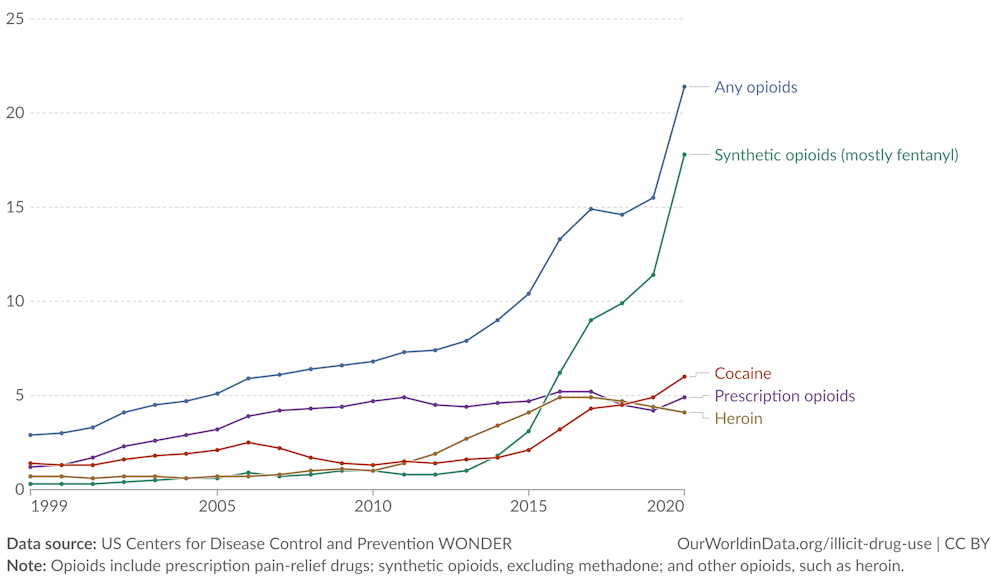
In the US, the synthetic opioids fentanyl and oxycodone have contributed to more than 100,000 fatal overdoses each year since 2021. While there are signs this deaths toll is at last beginning to fall, the harm and pain of addiction and overdose affects every strata of American society – as shown in moving portrayals of America’s opioid crisis such as Painkiller and Dopesick. Most fatalities are caused by respiratory depression where breathing is significantly slowed or stops altogether.
Official trailer for Painkiller (Netflix)
Fentanyl is an analgesic drug that is 50-100 times more potent than heroin or morphine. Where China used to be the principal manufacturer and supplier of fentanyl to the US, Mexico is now the primary source. In December 2024, Mexican authorities announced “the largest mass seizure of fentanyl pills ever made” – amounting to more than 20 million doses of fentanyl pills worth nearly US$400 million. The pills were found in Mexico’s Sinaloa state, home of the Sinaloa drug cartel and a hub of fentanyl production,
“This is what makes us rich,” one fentanyl cook recently told the New York Times. He was scathing about the idea that Donald Trump would be able to stamp out the supply of fentanyl from Mexico to the US by threatening Mexico’s government with tariffs. “Drug trafficking is the main economy here.”
However, the introduction of synthetic opioids to the US came not via organised crime but through a deliberate strategy of the pharmaceutical industry. Upon launching its prescription opioid painkiller OxyContin (a brand name for oxycodone) in 1996, Perdue Pharma, owned by the Sackler family, devised a plan to increase prescriptions of the drug by incentivizing and rewarding doctors to give these drugs to their patients. On a business level, this was a success; on a human level, it has been a disaster.
As patients quickly developed tolerance to drugs such as OxyContin, they had to take higher doses to avoid withdrawal symptoms or the positive feelings it gave them. Taking more of these opiates increases the risk of accidental overdose, many of which proved to be fatal. It has also driven those dependent on drugs to the black market, and into the hands of organised drug gangs, as they seek the drugs in greater quantities.
Dependency on fentanyl and other opioids is all-consuming. When not using these drugs, people are entirely focused on ensuring sufficient supply of the next dose. This includes funding supply which can take people to places they thought they would never be, for example breaking the law, shoplifting or getting involved in commercial sex to make enough money to buy drugs.
Synthetic opiates like OxyContin and fentanyl have proved to be classless, ageless and sex blind. The first-hand experience of addiction and fatalities have radically altered the way many Americans think about drugs and the problems they cause. Canada, too, is suffering a major crisis.
Compounding this tragedy is the failure of the state to provide interventions and treatment that could have reduced fatal and non-fatal overdoses. It is only now that evidence-based interventions are beginning to be made widely available, such as access to Naloxone – a drug that can reverse the effects of opiates and potentially save a life.
Of course, it isn’t just hospitals and health professionals that are challenged by the results of widespread use of opioids, but public services like the police and fire service. In some areas of the US, there have been so many daily overdoses that every service was called on to try and deal with it. Local mayors have made it a priority to train police and fire personnel to be trained as first responders, such is the scale of the problem.
But it is not just in North America that we see the failure of politicians and the state to act when faced with growing problems with drugs. In the UK, where record numbers are dying because of using drugs such as heroin, the government has not invested in overdose prevention strategies. At a time when fatal overdoses increase year on year, budgets for specialist treatment have been reduced. It remains to be seen what the recently elected Labour government will do, if anything, to tackle the tragic rise in drug related fatalities.
What connects both examples from the US and UK is the attitude and perception of drug use many of us have. Drug use and the heavy use of prescription painkillers is still heavily stigmatised. Many of us still view this as something individuals bring on themselves or have a choice about.
So, if we don’t care about what happens to people who develop problems with drugs, why should our elected representatives? In part, it is our bigotry that is enabling the lack of timely intervention, despite us possessing the knowledge and evidence of how drug harms can be minimised.
Latin America: breakdown of the rule of law
Under the last Conservative government, the UK Home Office asserted that people who used cocaine recreationally are supporting violence not only in the UK but in the countries that produce its raw ingredients. It’s not clear if this has made any difference to those using cocaine in the UK – personally, I doubt many people consider or are aware of how cocaine is produced or its provenance.
Perhaps if those using cocaine, mainly in western countries, realised the extent of violence and suffering that cocaine manufacture causes they might think again. Latin America has suffered enormously, with few countries there not touched in some way by the violence and breakdown of law associated with drug production and supply. According to the latest UN World Drugs Report:
Global cocaine supply reached a record high in 2022, with more than 2,700 tons of cocaine produced that year, 20% more than in the previous year … The impact of increased cocaine trafficking has been felt in Ecuador in particular, which has seen a wave of lethal violence in recent years linked to both local and transnational crime groups, most notably from Mexico and the Balkan countries.
Cocaine seizures and homicide rates increased five-fold between 2019 and 2022 in Ecuador, with the highest such rates reported in the coastal areas used for trafficking the drug to major destination markets in North America and Europe.
Cocaine trafficking flows based on reported seizures (2019-22):
As with opium production in Afghanistan, it is small-scale farmers in Colombia, Peru and Bolivia that grow the coca plant that will be turned into cocaine. Like their Afghan counterparts, they grow coca as it is more profitable than alternatives such as coffee. While it may be profitable in the short term, there are greater costs to them and their society.
Cocaine production brings with it violence as those further up the drug production chain try to control its trade. Few parts of these societies are unscathed, from bribing local politicians through to whole regions that are controlled by organised crime. Keeping control means that the use of firearms and violence increases. Against this backdrop, it is unsurprising that basic health and social services suffer.
So, while a coca grower may have more money, every other aspect of their life is negatively impacted. Whether it is regional or state institutions, both are compromised by the drug trade and those that control it. While this may not lead to the total collapse of law and order, it does create injustice and distorts the rule of law in many areas of Latin America and the Caribbean, where competition between gangs has also resulted in an increase in homicides.
The impact is on all sectors of society, now and into the future. For example, while historically the role of women has been largely underrepresented in research and drug policy, the UN report recognises that this is changing:
As women increasingly participate in economic activities, the role that women play in the drug phenomenon may become increasingly important. For example, a shift away from plant-based drug production may affect many women in rural households involved in opium poppy and coca bush cultivation.
The UN also identifies the specific risk to young people and the drugs trade, highlighting:
Long-term efforts to dismantle drug economies must provide socioeconomic opportunities and alternatives, which go beyond merely replacing illicit crops or incomes and instead address the root structural causes behind illicit crop cultivation, such as poverty, underdevelopment, and insecurity. They must also target the factors driving the recruitment of young people into the drug trade, who are at particular risk of synthetic drug use.
Meanwhile, demand for treatment in Europe due to problems with cocaine has risen significantly in recent years, since 2011 there has been an 80% increase in treatment presentations. This reflects the growing number of people using cocaine and the rise in purity of the drug.
Amid what may seem to be a story of unrelenting despair and hopelessness, there are local initiatives and even a few state-wide policies that provide optimism that change is possible.
In my roles both as clinician and scientist, I’ve often been amazed by how ingenious people can be when faced with the apparently impossible. For example, the way some people use heroin to dampen their psychotic symptoms, such as auditory and visual hallucinations – or the development of Naloxone, a drug that can temporarily reverse the effects of opioids, providing a short window for emergency services to treat people who have overdosed.
Early in my career, I witnessed the emergence of HIV in the UK in the 1980s. The speed at which this disease spread was not matched by our ability to treat it. Our response to HIV was undoubtedly hampered by prejudice and stigma towards marginalised groups in society, namely gay men and those using drugs (particularly injecting them).
However, unexpectedly and courageously, the Conservative government recognised those who were most at risk of contracting HIV, and organised a package of measures to contain the spread of infection. One part of this was a media campaign based on public health messaging designed to reduce the risk of contracting the disease. But the government also invested in treatment for those who had been infected and engaged with people at high risk, such as those intravenously injecting drugs.
I worked in specialist HIV clinics for those using drugs. At the time, methadone and diamorphine were provided as an alternative to heroin. Regulations and protocols that restricted the prescribing of these medical opioids were eased, so we could ensure patients attending these clinics were given sufficient oral and injectable opioids that they didn’t need to source street heroin.
This meant they had access to medical grade opioids and, crucially, were given regular supplies of sterile injecting equipment. It was this that reduced the risk of contracting HIV, as some people would share injecting equipment when using heroin.
This impressive policy ran counter to the Conservative party’s ideology at the time, which was to punish rather than help those using drugs like heroin. It showed me how, even with traditional mindsets, it is possible to shift policy thinking in the face of a health crisis. And make no mistake, the global drug problem is an ongoing health crisis. Today, the UN points to the risks that intravenous users of drugs still face:
An estimated 13.9 million people injected drugs in 2022, with the largest number living in North America and East and South-East Asia … The relative risk of acquiring HIV is 14 times higher for those who inject drugs than in the wider population globally.
There are, though, signs of positive change in the way some countries and regions are changing their drug policies. Scotland recently opened a drug consumption facility in Glasgow – a safe place for people to use their drugs, usually injecting drugs like heroin. Such spaces provide access to sterile injecting equipment, reducing the risk of blood-borne infections such as HIV or Hepatitis. At the same time, they offer the opportunity to engage with people who have not accessed traditional health services.
Portugal, as mentioned earlier, has made substantial changes to the way it approaches drug use and the problems associated with it. This policy shift since 2000 has saved lives and brought a more humane way of treating people who develop problems with drugs.
Contrast this with the wasted effort and resources ploughed into the war on drugs – initiated by Nixon and followed by so many western governments ever since. My plea to policymakers is simple: employ the same evidence-based science you use for health issues towards drugs and problem drug use.
Science and research can help in many ways, if given the chance. Some of it might seem radical, like providing safe drug consumption spaces. Some of it is more mundane, but vital – like tackling inequality, a clear driver of problem drug use across the world.
But while we often look to politicians to take the lead on change, it is people – us – that really hold the solution. By far the greatest threat to people and society from drugs is ignorance and bigotry. So many lives have been lost to drugs because of shame, either as a driver of drug use or a barrier to seeking help.
Beliefs are notoriously difficult to shift. As with climate change, the most powerful driver of change is personal experience. We know that when a family or community is affected by a drug overdose, their beliefs and perceptions change. But this is not the way any of us should want to see change happen.
To hear about new Insights articles, join the hundreds of thousands of people who value The Conversation’s evidence-based news. Subscribe to our newsletter.
Ian Hamilton does not work for, consult, own shares in or receive funding from any company or organisation that would benefit from this article, and has disclosed no relevant affiliations beyond their academic appointment.
The UK government’s new plan to foster innovation through artificial intelligence (AI) is ambitious. Its goals rely on the better use of public data, including renewed efforts to maximise the value of health data held by the NHS. Yet this could involve the use of real data from patients using the NHS. This has been highly controversial in the past and previous attempts to use this health data have been at times close to disastrous.
Patient data would be anonymised, but concerns remain about potential threats to this anonymity. For example, the use of health data has been accompanied by worries about access to data for commercial gain. The care.data programme, which collapsed in 2014, had an similar underlying idea: sharing health data across the country to both publicly funded research bodies and private companies.
Poor communication about the more controversial elements of this project and a failure to listen to concerns led to the programme being shelved. More recently, the involvement of the US tech company Palantir in the new NHS data platform raised questions about who can and should access data.
The new effort to use health data to train (or improve) AI models, similarly relies on public support for success. Yet perhaps unsurprisingly, within hours of this announcement, media outlets and social media users attacked the plan as a way of monetising health data. “Ministers mull allowing private firms to make profit from NHS data in AI push,” one published headline reads.
These responses, and those to care.data and Palantir, reflect just how important public trust is in the design of policy. This is true no matter how complicated technology becomes – and crucially, trust becomes more important as societies increase in scale and we’re less able to see or understand every part of the system. It can, though, be difficult, if not impossible, to make a judgement as to where we should place trust, and how to do that well. This holds true whether we are talking about governments, companies, or even just acquaintances – to trust (or not) is a decision each of us must make every day.
The challenge of trust motivates what we call the “trustworthiness recognition problem”, which highlights that determining who is worthy of our trust is something that stems from the origins of human social behaviour. The problem comes from a simple issue: anyone can claim to be trustworthy and we can lack sure ways to tell if they genuinely are.
If someone moves into a new home and sees ads for different internet providers online, there isn’t a sure way to tell which will be cheaper or more reliable. Presentation doesn’t need – and may not even often – reflect anything about a person or group’s underlying qualities. Carrying a designer handbag or wearing an expensive watch doesn’t guarantee the wearer is wealthy.
Luckily, work in anthropology, psychology and economics shows how people – and by
consequence, institutions like political bodies – can overcome this problem. This work is known as signalling theory, and explains how and why communication, or what we can call the passing of information from a signaller to a receiver, evolves even when the individuals communicating are in conflict.
For example, people moving between groups may have reasons to lie about their identities. They might want to hide something unpleasant about their own past. Or they might claim to be a relative of someone wealthy or powerful in a community. Zadie Smith’s recent book, The Fraud, is a fictionalised version of this popular theme that explores aristocratic life during Victorian England.
Yet it’s just not possible to fake some qualities. A fraud can claim to be an aristocrat, a doctor, or an AI expert. Signals that these frauds unintentionally give off will, however, give them away over time. A false aristocrat will probably not fake his demeanour or accent effectively enough (accents, among other signals, are difficult to fake to those familiar with them).
The structure of society is obviously different than that of two centuries ago, but the problem, at its core, is the same — as, we think, is the solution. Much as there are ways for a truly wealthy person to prove wealth, a trustworthy person or group must be able to show they are worth trusting. The way or ways this is possible will undoubtedly vary from context to context, but we believe that political bodies such as governments must demonstrate a willingness to listen and respond to the public about their concerns.
The care.data project, was criticised because it was publicised via leaflets dropped at people’s doors that did not contain an opt-out. This failed to signal to the public a real desire to alleviate people’s concerns that information about them would be misused or sold for profit.
The current plan around the use of data to develop AI algorithms needs to be different. Our political and scientific institutions have a duty to signal their commitment to the public by listening to them, and through doing so develop cohesive policies that minimise the risks to individuals while maximising the potential benefits for all.
The key is to place sufficient funding and effort to signal – to demonstrate – the honest motivation of engaging with the public about their concerns. The government and scientific bodies have a duty to listen to the public, and further to explain how they will protect it. Saying “trust me” is never enough: you have to show you are worth it.
Richard Milne receives funding from Wellcome under grant 220540/Z/20/A to the Wellcome Sanger Institute and the Kavli Foundation, grant G115418 to the University of Cambridge.
Jonathan R Goodman does not work for, consult, own shares in or receive funding from any company or organisation that would benefit from this article, and has disclosed no relevant affiliations beyond their academic appointment.
Flood-Risk Classifications Can Drive Risky Development
A new study by Southeast CASC researchers highlights the “safe development paradox,” where areas adjacent to regulatory “high risk” zones are less expensive to develop and viewed as safe for home buyers, driving up risky development in potentially vulnerable areas.
The “safe development paradox” highlights how classifying land areas as “high risk” for flooding can unintentionally encourage high levels of risky development just outside of these zones. Though the risk continues beyond the high-risk label, the implication is that if an area is not listed as “high risk,” then it must be “safe.” This misconception arises from how flood risk is communicated and used to guide regulations, such as mandatory flood insurance and structural requirements. Because developers are able to avoid these regulations, building just outside of these “high risk” zones is more affordable, leading to clustering of development in areas that are still vulnerable to flooding from rivers, lakes, and coastlines.
A new study, titled “The Safe Development Paradox of the United States Regulatory Floodplain,” analyzed national development trends and 100-year floodplain maps from more than 2,300 U.S. counties. Supported by the Southeast CASC, the researchers found that 24% of development occurs within 250 meters of high-risk flood zones. That distance is less than the length of three football fields, or, in a dense urban grid like Manhattan, about 1-3 city blocks. The researchers also looked at future projections, and assuming current policies remain the same, they predicted that 22% of new development by 2060 will also occur within the 250-meter zone next to the “high risk” area, likely increasing the number of people who live in risky areas just outside of the regulatory zone.
By linking historical and future development trends to 100-year floodplain (1% annual flood risk) classifications that guide safety regulations, this national assessment reveals some unintended consequences of these designations and emphasizes the need to align actual and perceived flood risks. This information can aid regulatory agencies making flood risk designations and communications to support effective planning.
This research was supported by the Southeast CASC Project:“Improving Scenarios of Future Patterns of Urbanization, Climate Adaptation, and Landscape Change in the Southeast.”
Related
link
Improving Scenarios of Future Patterns of Urbanization, Climate Adaptation, and Landscape Change in the Southeast
Arguably the most direct, intense, and long-lasting modification that humans can make to a landscape is converting rural lands to urbanized areas. As human populations grow, the demand for urbanized areas will increase, and scientists can help natural resource managers plan for these changes by creating models that predict potential patterns of future urbanization. The Southeast U.S. is experienci
NC CASC Tackles Climate Threats to Sagebrush Ecosystems
The North Central CASC leads initiative, holds workshop, to address threats to the “Sagebrush Sea,” one of the most expansive ecosystems in the United States.
The eastern sagebrush ecosystem, sometimes called the “Sagebrush Sea” for its vast expanse and rolling waves of silvery-green plants, is the largest continuous ecosystem in the continental United States. It provides essential habitat for wildlife like mule deer, pronghorn antelope, and greater sage-grouse, while also supporting livestock grazing, recreation, and cultural traditions. Despite its vast size, nearly half of this ecosystem has been lost under the pressures of land conversions and development, overgrazing, and invasive species – and now, these threats are compounded by changing climate conditions, like rising temperatures, shifting precipitation patterns, and more frequent extreme events.
To address these challenges, the North Central CASC (NC CASC) gathered 24 experts at a workshop at the University of Colorado Boulder. Their goal: to identify the most pressing research needs and practical solutions for adapting sagebrush ecosystems to a changing climate. Discussions focused on evaluating management practices, clarifying how ecosystems respond to environmental changes, strengthening connections with stakeholders and local communities, and understanding community values of sagebrush landscapes, as well as developing tools and datasets to support conservation efforts.
Building on the momentum of the workshop, the NC CASC is launching a two-year Science Synthesis Working Group. This collaborative effort will address the research gaps identified at the workshop and provide actionable climate-informed guidance to safeguard the Sagebrush Sea for future generations.
Source: United Kingdom – Executive Government & Departments
The Government has announced the appointment of three non-executive directors to the Board of the UK Statistics Authority.
The Authority’s statutory objective is to promote and safeguard the production and publication of official statistics that serve the public good.
The three appointees are:
Peter Barron, who is a Northern-Irish communications expert with senior experience in consumer technology and public affairs. He spent more than 20 years working in television news and current affairs at the BBC, ITV, and Channel 4, before working in external relations at Google from 2008 to 2018, and then at Stripe from 2021 to 2023. Peter holds a BSc in European Studies and Modern Languages from the University of Manchester (UMIST) and is a trustee of the Disasters Emergency Committee and the Quentin Blake Centre for Illustration.
Professor Mairi Spowage, who is Director of the Fraser of Allander Institute, Scotland’s leading economic research institute at the University of Strathclyde. Mairi leads research on modelling economic impact, economic measurement, regional economic and trade performance and public sector finances. Mairi has previously held roles as the Deputy Chief Executive of the Scottish Fiscal Commission and Head of National Accounts at the Scottish Government, with almost 20 years of experience of working in statistics and analysis, including transport, household surveys and performance measurement.
Dr Sarah Walsh, a risk and governance specialist who is currently advising clients in different sectors. Sarah has 20 years’ generalist experience, including Risk Director roles at Telegraph Media Group, Guardian Media Group, Save the Children and Imperial College London. Presently, she serves as a non-executive director at the Royal College of Nursing Publishing, including membership of the Royal College of Nursing’s Audit Committee and Equity, Diversity and Inclusion Committee. She also serves as independent non-executive member of the Audit and Risk Committees for Science Museum Group, St John’s Ambulance and the Royal Institute of Chartered Surveyors. Sarah holds a Master’s degree in Astronautics and Space Engineering from Cranfield University, and a PhD in Aerodynamics from the University of Manchester.
Appointments to the Board of the UK Statistics Authority are regulated. These appointments were made by Rt Hon Nick Thomas–Symonds MP, Minister for Cabinet Office. The advisory assessment panel was: Sir Robert Chote, Chair, UKSA (Chair of the panel); Steffan Jones, Director, Joint Data and Analysis Centre, Cabinet Office and Zarin Patel, Non Executive Director, HM Treasury.
Appointees began their roles at the end of January 2025.
BEVERLY HILLS, California, Feb. 03, 2025 (GLOBE NEWSWIRE) — Bio-Convert ApS (“Bio-Convert”), a subsidiary of Nordicus Partners Corporation (OTCQB: NORD) (“Nordicus” or the “Company”), a financial consulting company specializing in supporting Nordic and U.S. life sciences companies in establishing themselves in the U.S. market, announces the groundbreaking development of QR-02, a unique and proprietary oral topical treatment designed to address oral leukoplakia with moderate to severe dysplasia, a potentially precancerous condition affecting millions worldwide.
Addressing a Critical Unmet Medical Need
Oral leukoplakia is characterized by white patches or plaques in the mouth, and when accompanied by dysplasia (abnormal cell growth), it becomes a marker of disease progression. Alarmingly, 10-30% of these patients may develop oral cancer, which has a five-year mortality rate exceeding 50%.
With 15.5 million oral leukoplakia patients in the U.S. and EU alone, there is an urgent need for an effective treatment to prevent disease progression. Given that 80% of leukoplakia lesions occur in the oral cavity, a therapy that remains in place for an extended period is critical for success.
QR-02: A Game-Changing Approach
Bio-Convert’s QR-02 introduces a novel mucoadhesive oral formulation designed to adhere to the oral cavity for an extended period of 12-24 hours—a major advancement over traditional treatments, which last only 15-20 minutes due to the washout effect of saliva. This extended retention period significantly enhances drug efficacy and improves patient outcomes.
QR-02’s active ingredient, imiquimod, is already FDA-approved for treating Actinic Keratosis, External Genital Warts, and Superficial Basal Cell Carcinoma (sBCC)—all superficial skin conditions. However, QR-02 is uniquely formulated for oral application, providing new hope for patients with oral leukoplakia and may also be beneficial in treating conditions that subsequently could occur in such patients.
Potential for a Transformative Impact
The goal of QR-02 is to treat and reduce dysplasia levels, potentially offering a curative solution for oral leukoplakia, an outcome that would mark a significant breakthrough in oral medicine. By treating oral leukoplakia at an early stage, QR-02 may potentially have a positive health impact in patients with collateral symptoms.
Advancing Toward Clinical Validation
Bio-Convert is actively progressing QR-02 through its development pipeline, with plans to validate its efficacy through pilot clinical trials and bring this life-changing treatment to market. As Bio-Convert continues to push the boundaries of oral medicine innovation, QR-02 is a major step forward in preventing oral leukoplakia from developing into more severe conditions.
“We are incredibly proud of this invention and the impact it will have on patients,” said Allan Wehnert, CEO & Founder of Bio-Convert. “Our hope is that patients may return to a normal life and, potentially, be cured of their illness.”
Nordicus Partners Corporation is the only U.S. publicly traded business accelerator and holding company for Nordic life sciences companies. Leveraging decades of combined management experience in domestic and global corporate sectors, Nordicus excels in corporate finance activities including business and market development, growth strategies, talent acquisition, partnership building, capital raising, and facilitating company acquisitions and sales. In 2024, Nordicus acquired 100% of Orocidin A/S, a Danish preclinical-stage biotech company developing next-generation therapies for periodontitis and 100% of Bio-Convert ApS, a Danish preclinical-stage biotech company dedicated to revolutionizing the treatment of oral leukoplakia. For more information about Nordicus, please visit: www.nordicuspartners.com, and follow us on LinkedIn, X, Threads and BlueSky.
This press release may contain forward-looking statements that involve substantial risks and uncertainties. You can identify these statements by the use of forward-looking terminology such as “may,” “will,” “should,” “expect,” “anticipate,” “project,” “estimate,” “intend,” “continue” or “believe” or the negatives thereof or other variations thereon or comparable terminology. You should read statements that contain these words carefully because they discuss our plans, strategies, prospects and expectations concerning our business, operating results, financial condition and other similar matters. We believe that it is important to communicate our future expectations to our investors. There may be events in the future, however, that we are not able to predict accurately or control. Any forward-looking statement made by us in this press release speaks only as of the date on which we make it. Factors or events that could cause our actual results to differ may emerge from time to time, and it is not possible for us to predict all of them. We undertake no obligation to update or revise publicly any forward-looking statements, whether as a result of new information, future events or otherwise, except as required by law.
Source: United Kingdom – Executive Government & Departments
A study published in Nature Medicine looks at microplastic accumulation in human organs.
Prof Oliver Jones, Professor of Chemistry, RMIT University, said:
“I can see this paper getting a lot of attention due to its scary-sounding title, but I’d urge caution. Before we get headlines like “Our brains are now made of plastics,” we need to step back and look at how this study was conducted and what that might mean for the results.
“There are two main questions to consider with this study: 1) Are the results correct (exceptional claims need exceptional evidence)? 2) If so, what would that mean for human health?
“Let’s look at the data first. I have questions here.
“The press release says the authors tested 28 brain samples from 2016 and 24 from 2024, which is only 52 samples in total. There is not enough data to make firm conclusions on the occurrence of microplastics in New Mexico, let alone globally.
“Only data from two years – 2016 and 2024 are presented. It is not explained why only these two years were studied, but regardless, you simply can’t make a trend from data from just two years. Data from 2017-2023 would be needed to say if there was an actual trend or if it was just a random variation.
“The concentrations of microplastics in brain samples from 2024 have much less variation than any of the other data. This does not seem likely to me, but it is not explained. Similarly, in 2016, the kidney samples seemed to contain a more diverse range of plastics than liver samples, but in 2024, the liver had a more diverse range. The brain samples are consistent at both time points. This also seems odd but is not discussed.
“The main analytical method used in this study was pyrolysis gas chromatography-mass spectrometry. This method can give false results when used to measure plastics because fats (which the brain is mainly made of) give the same pyrolysis products as polyethylene (the main plastic reported) [1]. The authors did try to address this concern but I am not certain they were able to account for everything.
“It is also challenging to properly account for potential contamination while handling or analysing samples in microplastic studies. This paper says that the findings are not likely to be lab contamination because samples were consistently handled and processed. I don’t think this is necessarily true. After all, consistent protocols could potentially result in consistent contamination. Even standard lab equipment, such as disposable lab gloves, can give false microplastic readings [2]. We also don’t know what happened to the samples during the original autopsy (bodybags are made of polyethylene, for example). There is also the issue of background contamination in any laboratory that needs to be controlled for [3]. Plastic contamination is almost everywhere, so how can we be confident that any particles found are evidence that plastic is crossing membranes in the human body or if it is just contamination from plastic in the clothes or lab equipment or background contamination in the air, etc?
“But let’s assume there are plastics in our brains. What would that mean?
“There is a suggestion that microplastics might be associated with brain disease based on testing the brains from 12 people with dementia. This is not enough data to base this conclusion on (the patients didn’t all have the same kind of dementia).
“To get to the brain, microplastics would need to cross the gut wall (which is relatively thick and well-regulated), be transported in the blood, and then cross the blood-brain barrier, which is also very well-regulated. Certainly, more work would be needed to see if this was even possible.
“If microplastics could get into the brain, then theoretically, so could other small particulates that we are exposed to every day, e.g. from air pollution. If so any actual effects might be down to those substances – but the authors only tested for microplastics.
“We don’t know if microplastics or any other particles would stay in the brain or if they would be removed by the body. Again more work would be needed to test this.
“Overall, the work is interesting, but the low sample numbers and potential analytical issues mean that care should be taken when interpreting the results. While it is not impossible that there are microplastics in the brains of some people, this study does not prove that this occurs, and, as the authors themselves note, there is as yet no strong evidence of any health effects.”
[1] Rauert C. et al. Extraction and pyrolysis-GC-MS analysis of polyethylene in samples with medium to high lipid content. Journal of Environmental Exposure Assessment 2022. 1(2): p. 13. http://dx.doi.org/10.20517/jeea.2022.04
[2] Witzig C.S. et al. When good intentions go bad—false positive microplastic detection caused by disposable gloves. Environmental Science & Technology 2020. 54(19): p. 12164-12172. https://doi.org/10.1021/acs.est.0c03742
[3] Rauert C. et al. Blueprint for the design construction and validation of a plastic and phthalate-minimised laboratory. Journal of Hazardous Materials 2024. 468: p. 133803. https://doi.org/10.1016/j.jhazmat.2024.133803
Prof Tamara Galloway, Professor of Ecotoxicology, University of Exeter, said:
“Microplastics are a ubiquitous consequence of modern life, present in air, water and food and it should come as no surprise to find that most people have microplastics present in their bodies. What we don’t yet know is what the implications are for human health.
“To understand more about this, Nihart and colleagues took a detailed look at how microplastics were distributed in the human brain, using postmortem samples. Their study identified tiny shards and flakes of plastic in the brains they studied, most of which were made out of polyethylene, a plastic widely used in food and drinks packaging and the most common component of plastic litter.
“Two things stand out from this study. The first is that there was no relationship between the age of the subjects and the amount of microplastics present in the brain samples. This is important because it suggests that microplastics do not accumulate continuously in brain tissues as we age.
“The second thing to stand out is the increase in levels of contamination over time, with a 50% increase in levels of microplastics present in the brain samples collected over the last 8 years, reflecting the increased production and use of plastics over a similar timeframe. This is significant because it suggests that if we were to reduce environmental contamination with microplastics, the levels of human exposure would also decrease, offering a strong incentive to focus on innovations that reduce exposure.
“A final note of interest is in the nature of the contamination. Polyethylene (PE) is the most widely encountered polymer in environmental plastic litter, it is used for making disposable food and drinks packaging amongst other uses and its abundance in human brain tissues reflects its abundance in wildlife samples. Perhaps of more concern is the apparent presence of other polymers including polyvinylchloride (PVC) and styrene butadiene rubber (SBD), both of which were present in smaller amounts in the samples. PVC has many uses eg. in construction and packaging, and SBD rubber is used in car tyres and other items.
“Both substances have raised concerns over their potential environment and human health effects and whilst the current study offers no evidence that they are causing harm, it does highlight the importance of understanding more about the many materials we use in daily life.”
Prof Theodore B. Henry, Professor of Environmental Toxicology from the School of Energy, Geoscience, Infrastructure and Society at Heriot-Watt University, said:
“The Nihart et al. (2025) article presents interesting initial results about contamination of human tissues by plastics, and, as with any such results, we must be careful not to speculate about the implications until independent confirmation can validate the findings.
“Without doubt the increasing presence of plastic particles in the environment and potential negative effects on humans are a concern.
“The difficulty in assessing the accumulation of plastic particles in internal organs because of a lack of analytical methods is addressed to some extent in this paper and this advancement is noteworthy.
“A disadvantage of the pyrolysis-GC-MS analytical method used in the study is that because any plastic polymers present are disintegrated into small fragments in the process it is then not possible to determine the size, characteristics, or number of particles present in the original sample. Another challenge of interpretation of these results is the difficulty in finding suitable control tissues, or tissues that have not been exposed to plastics, for which presence of polymers does not occur and the presence in the tissues can be compared (essentially all tissues had plastic polymers, which does suggest that there could be artifacts or analytical issues that are affecting the analyses that are not accounted for).
“The reported presence of plastic particles in histological sections of tissues by polarised wave microscopy should be verified independently and could readily be done within existing banks of preserved human tissue sections held at many institutions. Given the levels of particles that are reported in the present study it is surprising that similar particles have not been detected in other studies or examinations of the same tissues that have applied the same techniques. The authors of this article correctly note in their conclusion that their results of detection of plastic polymers in tissues are associative and not linked to any negative health outcome.”
Dr Antonis Myridakis, Lecturer in Environmental Sciences, Brunel University of London, said:
“The study by Nihart et al. provides compelling evidence that microplastics (MPs) and nanoplastics (NPs) (plastic particles from 500 µm down to 1 nm) can cross the blood-brain barrier (the security filter protecting the brain from harmful entities) and accumulate in human brain tissue, particularly polyethylene, with concentrations increasing over time. The authors employ state-of -the-art and complimentary methodologies to detect, identify and quantify these particles (Py-GC-MS, SEM-EDS, ATR-FTIR), strengthening the credibility of their findings.”
Does the press release accurately reflect the science?
“Yes, the study does support convincingly the claim that these particles are detectable in human brains. However, it is crucial to emphasise that the study does not establish causality between MPs/NPs and any negative health impacts.”
Is this good quality research? Are the conclusions backed up by solid data?
“The methodology is robust and multidisciplinary, using complementary analytical techniques to measure MPs and NPs. The data show a trend of increasing microplastic accumulation over time and higher concentrations in dementia cases. However, the sample size remains relatively small, and causation cannot be inferred at this stage.”
How does this work fit with existing evidence?
“This study aligns with recent findings that MPs/NPs are present in blood and major organs. The discovery of MPs in cerebrovascular walls and immune cells adds new insight into their potential role in neuroinflammation and warrants further investigation.”
Have the authors accounted for confounders? Are there important limitations?
“The study controls for key demographic factors (age, sex, cause of death) and finds no correlation between age and MP accumulation, suggesting environmental exposure may be increasing over time. However, it does not account for lifestyle-related factors (diet, occupation, regional pollution exposure), which could influence individual MP burdens. The inevitable use of post-mortem samples also limits the ability for functional assessments of MP toxicity in living brains.”
Real-world implications: Over-speculation or justified concern?
“The finding that MPs are accumulating in human brains is concerning, however, it is too early to draw conclusions about direct health risks. Further research is needed to determine whether MPs actively contribute to neurological disorders or if they are merely bystanders in an increasingly plastic-polluted environment.”
‘Bioaccumulation of microplastics in decedent human brains’by Nihart et al. was published in Nature Medicine at 16:00 UK time on Monday 3rd February.
DOI:10.1038/s41591-024-03453-1
Declared interests:
Prof Oliver Jones “I am a Professor of Chemistry at RMIT University in Melbourne. I have no conflicts of interest to declare, but I have previously published research on microplastics in the environment. I have in the past received funds from the Environment Protection Authority Victoria and various Australian Water utilities for research into environmental pollution.”
Days away from the Paris AI Action Summit, the elaboration of the emerging framework to govern the development and adoption of AI technologies is at the heart of heated, sometimes overwhelming debates and controversies. While new AI models are being released at an accelerating pace, with ever greater promises of game-changing applications, revolutionary disruptions, and prophecies of geopolitical shifts, AI governance remains partially undertheorised.
To help scaffold coherent, coordinated, and enforceable rules and institutions, Dame Wendy Hall, DBE, FRS, FREng, Regius Professor of Computer Science, Associate Vice President (International Engagement) and Director of the Web Science Institute at the University of Southampton, Kieron O’Hara, emeritus fellow in Electronics and Computer Science at the University of Southampton, and Pierre Noro, advisor of the PSIA Tech & Global Affairs Innovation Hub, reinterpret the Four Internet models elaborated by Hall and O’Hara in their 2018 article and in their influential book Four Internets: Data, Geopolitics, and the Governance of Cyberspace (Oxford UP, 2021) in regard to AI technologies.
This translation, grounded in an analysis of the historical, socio-economic, and ideological differences distinguishing the context that shaped Internet governance and the current one, yields many enlightening insights and is the foundation of five Artificial Intelligence Management Strategies (AIMS):
Open AIMS: Fostering openness and transparency, common ownership and collaboration, interoperability.
Bourgeois AIMS: Fostering rights and civility with procedural rules and codes
Paternal AIMS: Mandating outcomes and confining uses.
Commercial AIMS: Allowing market solutions to resource allocation problems.
Hacker AIMS: Libertarian, anti-authoritarian, decentralised approach valorising software skills, resisting censorship, and empowering individuals and communities to make and reshape the information space.
As narratives, the AIMS do not aspire to crystal clarity, but rather are intended as sensemaking aids; the characterisations above […] may already help categorize and interpret discourses, stances, and proposals.
With many illustrations to exemplify their core tenets, their limits and their intersections, this paper offers the Five AIMS as cardinal concepts to help AI governance stakeholders, especially public and private decisionmakers, navigate the upcoming AI Action Summit and future governance conversation.
Concluding on a set of ongoing research questions reflecting open policy challenges, it is a foundational step towards cementing the Five AIMS as a suitable framework for understanding the governance of AI.
Capt. Colin Price relieved Capt. Matthew Kiser and assumed duties as the ship’s commanding officer in a ceremony aboard the ship. Vice Adm. J. T. Anderson, commander of U.S. Sixth Fleet, and Striking and Support Forces NATO, presided over the ceremony and delivered remarks about Kiser’s time aboard the Mount Whitney.
“One unique aspect of serving as the commanding officer of the U.S. Sixth Fleet flagship is how the ship and crew represent the U.S. Navy in Europe and Africa, participating in many exercises, key leader engagements, and strengthening our relationships with allies and partners,” Anderson said. “Capt. Kiser built a great team that accomplished all we could ask of them.”
Kiser, a graduate of Texas A&M University and a native of Bedford, Texas assumed command in April 2023. During his tour, he led the flagship of U.S. Sixth Fleet and Naval Striking and Support Forces NATO while participating in several exercises and activities, including Baltic Operations (BALTOPS) 2023 and 2024, Large Scale Exercise (LSE) 23, as well as support to Joint Task Force 406 as it conducted multi-national maritime crisis response and contingency planning.
During his speech that he gave in the change of command ceremony, Kiser credited the success of his tour to the hard work that Mount Whitney Sailors exhibited.
“I couldn’t be prouder of our Team 20 Sailors and Civil Service Mariners, and their achievements over the last two years,” Kiser said. “It has been a privilege as commanding officer to witness the hard work and dedication in supporting command and control exercises and activities with our partner branches in the U.S. armed forces and our allies in NATO.
“My time is highlighted by the efforts of Team 20 that went into demonstrating our new capability to support two separate staffs embarked simultaneously while each were engaged with their own mission – on the only ship that can do this in the world. I am eager to watch the ship’s continued progress over the next several months as the Mount Whitney gets back out to sea.”
Price is a graduate of the United States Naval Academy with a Bachelor of Science in systems engineering. He was commissioned in 2001, and designated a Naval Aviator in January 2004.
As a junior officer he was assigned to Strike Fighter Squadron (VFA) 137 in Lemoore, California, with deployments embarked aboard USS Abraham Lincoln (CVN 72), and as a global war on terror support assignment as an intelligence, surveillance and reconnaissance operator in support of Operation Enduring Freedom in Afghanistan.
In August 2005, he participated in Joint Task Force Katrina providing humanitarian assistance to the citizens of New Orleans. In 2015, after completion of Navy Nuclear Power training he was assigned as the 25th executive officer of the USS Dwight D. Eisenhower (CVN 69).
“I want to express my sincere congratulations to Capt. Kiser for a job well done and for the great service he did for our nation and Navy,” Price said. “It is an honor and pleasure to assume the watch from you. I promise to take exemplary care of your Sailors and ship.”
Mount Whitney, forward deployed to Gaeta, Italy operates with a combined crew of U.S. Sailors and Military Sealift Command civil service mariners in the U.S. 6th Fleet area of operations in support of U.S. national security interests in Europe and Africa.
U.S. 6th Fleet, headquartered in Naples, Italy, conducts the full spectrum of joint and naval operations, often in concert with allied, and interagency partners, in order to advance U.S. national interests and security and stability in Europe and Africa. USS Mount Whitney (LCC 20) is the U.S. 6th Fleet flagship, homeported in Gaeta, and operates with a combined crew of U.S. Sailors and Military Sealift Command civil service mariners.
Source: Saint Petersburg State University of Architecture and Civil Engineering – Saint Petersburg State University of Architecture and Civil Engineering – Business game “Interview”
On January 31, SPbGASU held a large-scale event for students of grades 8–11 of St. Petersburg Lyceum No. 126. The students celebrated Russian Science Day at our university. They visited departments, museums, laboratories, the exhibition hall of the architectural faculty and the scientific and technical library, listened to lectures, took part in business games and master classes.
On behalf of the university’s management and staff, Marina Malyutina, Vice-Rector for Youth Policy, welcomed the guests: “SPbGASU was founded in 1832 under Emperor Nicholas I as the School of Civil Engineers. Throughout our history, we have had different names, but the meaning has remained the same – our university has always been the center of engineering thought and construction science.”
“Macaroni Builder”, “First-Year Grant” and other reasons to study at SPbGASU
Alevtina Ragimova and Marina Malyutina
Marina Viktorovna informed that more than 12 thousand students study at the university. Every year more than 2 thousand graduates leave its walls. All of them are at the cutting edge of new technologies and knowledge and are in demand by the industry: more than 70 percent of graduates find employment in their specialty.
The university closely cooperates with industry partners – the largest developers of St. Petersburg, Leningrad Oblast and other regions. More than 500 teachers are involved in the educational process, 70 percent of whom have academic titles and degrees, many of whom are members of various state and public academies, including the Russian Academy of Architecture and Construction Sciences.
You can study at SPbGASU throughout your life – full-time, part-time, part-time, improving your qualifications, undergoing retraining. Students have the opportunity to study in additional educational programs, master a second qualification. The university provides scope for research in more than 10 scientific areas. Scientists report the results of their scientific activities at conferences and symposiums.
SPbGASU organizes intra-university and all-Russian TIM championships, participates in the International Engineering Championship CASE-IN, and holds the international competition “Macaroni Builder”. An active student life is in full swing here: the Student Leisure and Creativity Center “Kirpich”, the Center for Physical Culture and Sports operate, and student projects are supported. One of such projects is “Adapters”, within the framework of which senior students help first-year students for six months. Curators – teachers who help first-year students study, communicate, and solve everyday problems – also work with the first-year students.
“Our university is especially proud of the SPbGASU personal scholarship, the so-called “First-Year Grant”. We support the guys who have shown themselves in school and in secondary vocational education – in public life, research, studies, and pay them an additional scholarship on a competitive basis. In general, we have 17 scholarships that our students can receive upon fulfilling certain requirements,” said Marina Malyutina.
At the end of her speech, the vice-rector presented the lyceum with a book about the architects of St. Petersburg. Alevtina Ragimova, the director of Lyceum No. 126, in her response expressed confidence that many graduates will become students of SPbGASU.
Students from the Kirpich Student Leisure and Creativity Center performed a concert program that drew thunderous applause. In addition, the winners of the Olympiads that the university holds for future applicants were awarded. Then the lyceum students were treated to a tour of the university and numerous events that immersed them in the world of science.
What were university lectures about?
Lecture by Ekaterina Voznyak “Architects of St. Petersburg and Architectural Education”
Ekaterina Voznyak, Dean of the Faculty of Architecture, spoke about the architects of St. Petersburg and architectural education in her lecture. The Dean said that she does not encourage the audience to become architects, since an architect is a calling that either exists or does not. The students will be able to decide on this issue not now, but at the age of 18-19, however, according to the Dean, it is useful for everyone to know about the architecture and architects of St. Petersburg. Ekaterina Ryurikovna emphasized that in the Northern capital they love and know their architects, who, being different people, create an ensemble, build a single city. This is what distinguishes St. Petersburg architects.
The lecture by Dmitry Ulrich, Dean of the Faculty of Environmental Engineering and Urban Management, was called “Excursion into the World of Science.” He spoke about the prerequisites for the development of science, the classification of sciences, and scientific discoveries that changed the world. Students learned about the role of chemistry, physics, and mathematics in construction, heat supply, land management, and their importance for engineering education.
Galina Tokunova, Dean of the Faculty of Economics and Management, offered to look into the future of the construction industry. The speaker’s focus was on TIM design, 3D printing, the Internet of Things and smart sensors, robots and drones. The audience learned why artificial intelligence will not replace specialists in economics and management, what specialists in business informatics and economic security do, what is happening in the Laboratory of Digital Information Models in Construction at SPbGASU and much more.
What was taught in the master classes
You could feel like an artist at the master class “City Landscape”. Before it began, Konstantin Tarasov, senior teacher of the drawing department, explained that the children would first make an air space “on the wet”, and then introduce into it the silhouette of St. Petersburg – the Peter and Paul Fortress, the Kazan Cathedral. The lesson helped the lyceum students to reveal their creative abilities.
The model workshop hosted a master class called “Architectural Fantasies”. The children were divided into five teams and created a model of a skyscraper. Olga Belousova, associate professor of the architectural design department, said: “As a starting point, the teams received handouts – photos, pictures, discussed the concept and began to assemble a fantasy model. Forty-five minutes later, the captains presented their work. In this case, they were required not only to write a short story about their skyscraper, but also to come up with a motto for it.”
Due to the expansion of its activities, the organization calculated its personnel needs. The calculation showed that there were not enough workers in certain areas… This is how the business game “Interview” began, in which the participants learned to present themselves to the employer.
The guys were divided into two groups: the HR department and job seekers. Olga Bochkareva, Deputy Dean for Academic Affairs of the Faculty of Economics and Management, Associate Professor of the Construction Management Department, and Marina Egorova, Deputy Dean for Educational Work, Senior Lecturer of the same department, suggested choosing professional skills that correspond to the professions: economic security specialist, marketer, construction economist, HR department employee. The HR department developed a list of interview questions. Job seekers prepared resumes and talked about themselves. As in real life, only the best got the job.
At the master classes of the Faculty of Forensic Expertise and Law in Construction and Transport, it was possible to acquire practical skills of legal literacy in relations with unscrupulous employers, take psychological training “How to negotiate with any person”, learn about the criminal liability of minors and receive a lot of other useful information.
The Automobile and Road Faculty prepared an interesting program. The students learned about the operation of vehicles and transport infrastructure in Arctic conditions, about digital twins of the roads of the future, and reverse engineering. The Automobile and Road Faculty is confident that today the road industry is developing at an incredible speed, and the task of teachers is to prepare specialists who will not only follow modern trends, but also create them.
“Students of SPbGASU master advanced technologies, participate in research on the introduction of sustainable materials in road construction and the design of safe transport interchanges. SPbGASU is a leader in training personnel for the transport complex, actively cooperates with leading enterprises in the industry and provides students with the opportunity to undergo practical training at the largest construction and transport sites,” commented Andrey Zazykin, Dean of the ADF.
“Our graduates are in demand – they are invited to work even at the training stage, because employers know that at SPbGASU they receive not only a theoretical base, but also valuable practical experience,” added Igor Chernyaev, head of the department of technical operation of vehicles.
“SPbGASU is an interesting option”
We asked ninth-grade students what they remember about Russian Science Day at SPbGASU and where they plan to study next.
“We are still searching, but this is an interesting option. I will consider it. My father studied here,” shared Timur Bukhtiyarov.
“I liked the business game the most. It was very fun, interesting, and exciting,” said Zlata Khudyakova.
Galina Avdeeva, deputy director of Lyceum No. 126 for educational work, said that the Lyceum is very happy with such invitations – not only students, but also teachers learn a lot of new things here.
The Admissions Committee, which organized the celebration for the lyceum students, thanks the university teachers for their participation, as well as students from the Kirpich Center for Social and Cultural Development, the student media center, and the SPbGASU Volunteer Club.
Please note: This information is raw content directly from the source of the information. It is exactly what the source states and does not reflect the position of MIL-OSI or its clients.
The Parkinson’s disease (PD) market across the seven major markets (7MM*) is projected to grow at a compound annual growth rate (CAGR) of 8.9% from $3.4 billion in 2023 to $7.9 billion in 2033, driven by the introduction of 10 pipeline products, the increased adoption of novel levodopa delivery methods, and the rising prevalence of PD due to the aging population across the 7MM, according to GlobalData, a leading data and analytics company.
GlobalData’s latest report, “Parkinson’s Disease: Seven-Market Drug Forecast and Market Analysis,” anticipates an increase in sales across most currently marketed PD drug classes. Specifically, levodopa therapies, catechol-o-methyltransferase (COMT) inhibitors, dopamine agonists, monoamine oxidase B (MOA-B) inhibitors, other antiparkinsonian agents, and PD dementia agents.
Among the pre-existing drug-classes, the agents targeting PD dementia are expected to see the greatest growth with a CAGR of 24.5% during the forecast period. Additionally, the launch of 10 late-stage pipeline therapies—including two disease-modifying therapies (DMT) and several symptomatic treatments targeting diverse PD needs—will collectively drive an estimated $3.5 billion in sales by 2033.
Lorraine Palmer, Pharma Analyst at GlobalData, comments: “The treatment of PD dementia is consistently rated one of the highest unmet needs by key opinion leaders (KOLs) and high-prescribers. Currently, there is only one agent, rivastigmine, indicated for the treatment of PD dementia within the 7MM. However, it is anticipated that two agents—Anavex’s blarcamesine and Irlab Therapeutics’s pirepemat—targeting PD dementia will launch by 2033.”
The expansion of the levodopa delivery system AbbVie’s Produodopa/Vyalev across the 7MM (following its launch in Japan in 2023, expansion into the 5EU in 2024, and anticipated launch in the US in 2025) is expected to drive it into the highest-grossing PD treatment by 2033, with projected sales of $1.2 billion by 2033. This also reflects strong enthusiasm from KOLs regarding its broader availability.
Palmer adds: “The anticipated launch of Roche/Prothena’s prasinezumab and Annovis Bio’s buntanetap as the first DMTs for PD will reshape the treatment space. These treatments aim to address the underlying biology of the disease by targeting α-synuclein aggregation, a key factor in disease progression. While KOL opinions are divided on their efficacy, the introduction of these DMTs will be an important step towards addressing the field’s most pressing unmet need. Therefore, it is expected that these two therapies alone will make up a large portion of the market come 2033. GlobalData forecasts sales of $1.5 billion by 2033.”
GlobalData’s analysis also highlights the growing prevalence of PD, with diagnosed cases expected to increase from 2.6 million in 2023 to 3.1 million by 2033 across the 7MM. The number of treated cases is forecasted to rise in parallel, from 1.9 million in 2023 to 2.3 million in 2033, reflecting the aging population within the 7MM.
However, the patent expiry of key therapies including Nuplazid (pimavanserin), Rytary (carbidopa/levodopa), Ongentys (opicapone), and Xadago (safinamide mesylate) is expected to curtail the market growth. Collectively, the therapies anticipated to lose their patent protection within the forecast period accounted for $1.1 billion in 2023 sales across the 7MM but are forecasted to decline to $202.8 million by 2033.
Palmer concludes: “The PD market is extremely dynamic. However, the next decade is promising transformative growth. With the expansion and launch of groundbreaking therapies, particularly DMTs and novel mechanisms of action to address PD dementia and motor complications. The late-stage pipeline is well positioned to meet the needs of a growing patient population.”
*7MM = The US, France, Germany, Italy, Spain, the UK, and Japan.
Commuting in Kinshasa, the capital of the Democratic Republic of Congo, presents challenges for its 17 million residents. Massive traffic jams and unsafe driving cause chaos on the roads, leading to long delays.
The chaos has become a pressing concern for residents. Reaching Gombe, Kinshasa’s central business district, for instance, can take up to five hours from surrounding neighbourhoods.
When he came to power in January 2019, President Felix Tshisekedi promised to combat Kinshasa’s traffic chaos by targeting road infrastructure. This included constructing an interchange and flyover. One-way traffic was introduced on certain streets. These have had little effect. Kinshasa’s traffic issues persist.
While congestion in the capital is usually blamed on poor infrastructure, there are some harder-to-see causes. As social science researchers, we set out to understand what institutional factors might be behind the city’s gridlock.
In a recent paper, we analysed an illegal revenue-generating scheme inside Kinshasa’s traffic police agency involving a coalition of traffic police agents, their managers and judicial officers. We studied the role this scheme plays in the city’s traffic conditions.
Under the scheme, known as the quota system, station managers (police commanders) assign street agents a daily quota of drivers to escort to the station, often based on fabricated allegations.
Our findings and analysis provide insights into how the quota system causes traffic jams and accidents, undermining the police agency’s mandate of traffic regulation. We also detail how corruption operates as a coordinated system rather than as isolated acts of individual misconduct.
The problem
Like many traffic police agencies worldwide, Kinshasa’s traffic police are tasked with managing key intersections and enforcing traffic rules.
A major way in which this is done is through a specific scheme involving traffic police agents. We found that station managers assign different street agents a daily quota of drivers to bring to the station.
To meet this quota, agents often use brute force and have the discretion to invent infractions that they report at the police station. The dilapidated state of most cars in Kinshasa helps police officers with this task.
At the station, agents pass the allegations to judicial officers, who have the power to issue charges – or demand bribes so drivers avoid formal penalties. Many drivers try to avoid this extortion by developing relationships with influential protectors. These are people who can intervene on a driver’s behalf and are often high-placed security officers or politicians.
Our research
After three years of qualitative fieldwork, we built trust with a large number of individuals inside and around the traffic police agency. This enabled us to design data collection systems in 2015 to study the traffic police agency’s practices.
We relied on the cooperation of 160 individuals and generated the following data:
direct observations of over 13,000 interactions between officers and drivers at intersections
station records of 1,255 escorted vehicles, including bribe negotiations and outcomes
traffic flow and accident data from 6,399 hourly observations.
To quantify the cost of this scheme on public service, we added an experiment: we collaborated with police commanders to reduce the daily quotas for some teams and days.
We encouraged commanders to temporarily cut their teams’ quotas in half. Reducing quotas could be expected to lower corruption demands on agents, reducing corruption overall. It would also enable agents to focus more of their time on managing traffic – an outcome later confirmed by our findings.
To ensure this approach worked, we compensated commanders for the private income losses they would experience due to the quota reduction, which we carefully estimated before implementing the study. This compensation is not unlike traditional anti-corruption incentives routinely used across the world, except that rather than it being targeted at street-level agents, it targeted the node of this particular scheme: the police commanders.
What we found
The scheme generates large illicit revenue. The traffic police agency’s real revenue is five times larger than its official income from fines. We found that 68% of the illicit revenue generated through the quota scheme came from bribes paid by drivers after they’d been escorted to the station. The rest of the illicit revenue comes from street-level bribes outside of this quota scheme.
The revenue raised relies on extortion at police stations. Judicial police officers had the power to threaten to issue arbitrary charges. We found that, first, 82% of the allegations were unverifiable by third parties. Second, the amount raised in station bribes was strongly linked to whether a driver was able to call a powerful “protector”.
Extortion in police stations relies on the street agents’ power to arbitrarily escort drivers. These agents use their discretion to fabricate allegations and/or physical force to bring drivers to the station. When a driver was not seen making an infraction, force was more likely to be used.
Overall, this means that the scheme hinged on a coalition of managers, agents and judicial officers.
Through the reduction in the quota scheme levels, our scheme also revealed some social costs of this scheme. We found two important results.
Worse traffic: the quota scheme was accountable for a significant share of traffic jams and accidents observed at street intersections from where the agents operate. Partly through their induced absence and partly through their behaviour, the police officers also create numerous traffic jams and accidents. While this is suggestive rather than conclusive, our estimates suggest that 40% of traffic jams at the main intersections of the city are due to the scheme.
Diluted incentives to respect the law: the scheme made it less likely that drivers would respect the law. They could be escorted to a police station regardless of whether they complied with the traffic code.
Why the findings matter
Our study, which provides rare, detailed evidence of how corruption operates, has three policy implications.
Target officials’ managers, rather than the officials themselves. Visible corruption is only the tip of the iceberg, and hinges on relationships of power and coalitions inside the state.
Limit the discretion of judicial officers to charge the public, or that of agents to escort drivers to police stations arbitrarily.
Incentivise “good” corruption. Encouraging station officials to take a significant share of fines for genuine infractions could give agents an incentive to escort drivers who actually break traffic rules. However, the trade-offs between traffic flow, safety and compliance must be carefully weighed, as quotas tied to fines could worsen congestion.
Raúl Sanchez de la Sierra is a co-founder of Marakuja Kivu Research, a data collection organization specialized in data collection in war-torn zones especially eastern Democratic Republic of the Congo.
Kristof Titeca is an associate Senior Research Fellow at the Egmont Institute in Belgium.
Albert Malukisa Nkuku and Haoyang (Stan) Xie do not work for, consult, own shares in or receive funding from any company or organisation that would benefit from this article, and have disclosed no relevant affiliations beyond their academic appointment.
We live in a golden age for space exploration. Scientists are gathering massive amounts of new information and scientific evidence at a record pace. Yet the age-old question remains unanswered: are we alone?
New telescope technologies, including space-based tools such as the James Webb Telescope, have enabled us to discover thousands of potentially habitable exoplanets that could support life similar to that on Earth.
Gravitational wave detectors have opened a new avenue for space exploration by detecting space-time distortions caused by black holes and supernovae millions of light-years away.
Commercial space ventures have further accelerated these advancements, leading to increasingly sophisticated spacecraft and reusable rockets, signifying a new era in space exploration.
NASA’s OSIRIS-REx mission successfully touched down on asteroid Bennu when it was 207 million miles away from Earth and brought back rock and dust samples.
Several countries have developed the ability to deploy robots on the moon and Mars, with plans to send humans to these celestial bodies in the future.
A central driver of all these ambitious endeavours is still that fundamental question of whether life exists — or ever existed — elsewhere in the universe.
The James Webb telescope was launched in 2021, and is the most powerful telescope ever sent into space. (Shutterstock)
Defining life
Defining life is surprisingly challenging. While we intuitively recognize living organisms as having life, a precise definition remains elusive. Dictionaries offer various descriptions, such as the ability to grow, reproduce and respond to stimuli.
But even these definitions can be ambiguous.
A more comprehensive definition considers life as a self-sustaining chemical system capable of processing information and maintaining a state of low entropy, with little disorder or randomness.
Living things constantly require energy to sustain their molecular organization and maintain their highly organized structures and functions. Without this energy, life would quickly descend into chaos and disrepair. This definition encompasses the dynamic and complex nature of life, emphasizing its ability to adapt and evolve.
Life on Earth, as we currently understand it, is based on the interplay of DNA, RNA and proteins. DNA serves as the blueprint of life, containing the genetic instructions necessary for an organism’s development, survival and reproduction. These instructions are converted into messages that guide the production of proteins, the workhorses of the cell that are responsible for a vast array of functions.
This intricate system of DNA replication, protein synthesis and cellular processes — all based on long strings of molecules linked by carbon atoms — is fundamental to life on Earth. However, the universe may harbour life forms based on entirely different principles and biochemistries.
An illustration of NASA’s Perseverance Mars rover, which uses an X-ray spectrometer to help search for signs of ancient microbial life in rocks. (NASA/JPL-Caltech)
If they exist, silicon-based life forms may exhibit unique characteristics and adaptations. For instance, they might use silicon-based structures for support, analogous to bones or shells in carbon-based organisms.
Even though silicon-based organisms have not yet been found on Earth, silicon plays an important role in many existing life forms. It is an important secondary component for many plants and animals, serving structural and functional roles. For example, diatoms, a type of algae found in the ocean, feature glassy cell walls made of transparent silicon dioxide.
This doesn’t make diatoms silicon-based life forms, but it does prove silicon can indeed act as a building block of a living organism. But we still don’t know if silicon-based life forms exist at all, or what they would look like.
There are competing hypotheses on how life arose on Earth. One is that that life’s building blocks were delivered on or in meteorites. The other is that those building blocks came together spontaneously via geochemistry in our planet’s early environment.
Meteorites have indeed been found to carry organic molecules, including amino acids, which are essential for life. It’s possible that organic molecules formed in deep space and were then brought to Earth by meteorites and asteroids.
On the other hand, geochemical processes on early Earth, such as those occurring in warm little ponds or in hydrothermal vents deep in the ocean, could have also provided the necessary conditions and ingredients for life to emerge.
However, no lab has yet been able to present a comprehensive, certain pathway to the formation of RNA, DNA and the first cellular life on Earth.
Many biological molecules are chiral, meaning they exist in two forms that are mirror images of each other, like left and right hands. While both left- and right-handed molecules are typically naturally produced in equal amounts, recent analyses of meteorites have revealed a slight asymmetry, favouring the left-handed form by as much as 60 per cent.
Chirality refers to the existence in nature of mirror images of the same thing. (Shutterstock)
This asymmetry in space-derived organic molecules is also observed in all biomolecules on Earth (proteins, sugars, amino acids, RNA and DNA), suggesting it could have arisen from the slight imbalance delivered from space, supporting the theory that life on Earth is extraterrestrial in origin.
Chances of life
The slight imbalance in chirality observed in many organic molecules could be an indicator that life on Earth originated from the delivery of organic molecules by extraterrestrial life. We could well be descendants of life that originated elsewhere.
The Drake equation, developed by astronomer Frank Drake in 1961, provides a framework for estimating the number of detectable civilizations within our galaxy.
This equation incorporates factors such as the rate of star formation, the fraction of stars with planets, and calculates the fraction of those planets where intelligent life may emerge. An optimistic estimate using this formula suggests that 12,500 intelligent alien civilizations might exist in the Milky Way alone.
The primary argument for extraterrestrial life remains probabilistic: considering the sheer number of stars and planets, it seems highly improbable that life wouldn’t have arisen elsewhere.
The probability of humanity being the sole technological civilization in the observable universe is considered to be less than one in 10 billion trillion. Additionally, the chance of a civilization developing on any single habitable planet is better than one in 60 billion.
With an estimated 200 billion trillion stars in the observable universe, the existence of other technological species is highly likely, potentially even within our Milky Way galaxy.
Maikel Rheinstadter receives funding from the National Science and Engineering Council Canada (NSERC), the Canadian Foundation for Innovation (CFI), the Province of Ontario and McMaster University..
Source: The Conversation – Africa – By Raúl Sanchez de la Sierra, Assistant Professor, University of Chicago
Commuting in Kinshasa, the capital of the Democratic Republic of Congo, presents challenges for its 17 million residents. Massive traffic jams and unsafe driving cause chaos on the roads, leading to long delays.
The chaos has become a pressing concern for residents. Reaching Gombe, Kinshasa’s central business district, for instance, can take up to five hours from surrounding neighbourhoods.
When he came to power in January 2019, President Felix Tshisekedi promised to combat Kinshasa’s traffic chaos by targeting road infrastructure. This included constructing an interchange and flyover. One-way traffic was introduced on certain streets. These have had little effect. Kinshasa’s traffic issues persist.
While congestion in the capital is usually blamed on poor infrastructure, there are some harder-to-see causes. As social science researchers, we set out to understand what institutional factors might be behind the city’s gridlock.
In a recent paper, we analysed an illegal revenue-generating scheme inside Kinshasa’s traffic police agency involving a coalition of traffic police agents, their managers and judicial officers. We studied the role this scheme plays in the city’s traffic conditions.
Under the scheme, known as the quota system, station managers (police commanders) assign street agents a daily quota of drivers to escort to the station, often based on fabricated allegations.
Our findings and analysis provide insights into how the quota system causes traffic jams and accidents, undermining the police agency’s mandate of traffic regulation. We also detail how corruption operates as a coordinated system rather than as isolated acts of individual misconduct.
The problem
Like many traffic police agencies worldwide, Kinshasa’s traffic police are tasked with managing key intersections and enforcing traffic rules.
A major way in which this is done is through a specific scheme involving traffic police agents. We found that station managers assign different street agents a daily quota of drivers to bring to the station.
To meet this quota, agents often use brute force and have the discretion to invent infractions that they report at the police station. The dilapidated state of most cars in Kinshasa helps police officers with this task.
At the station, agents pass the allegations to judicial officers, who have the power to issue charges – or demand bribes so drivers avoid formal penalties. Many drivers try to avoid this extortion by developing relationships with influential protectors. These are people who can intervene on a driver’s behalf and are often high-placed security officers or politicians.
Our research
After three years of qualitative fieldwork, we built trust with a large number of individuals inside and around the traffic police agency. This enabled us to design data collection systems in 2015 to study the traffic police agency’s practices.
We relied on the cooperation of 160 individuals and generated the following data:
direct observations of over 13,000 interactions between officers and drivers at intersections
station records of 1,255 escorted vehicles, including bribe negotiations and outcomes
traffic flow and accident data from 6,399 hourly observations.
To quantify the cost of this scheme on public service, we added an experiment: we collaborated with police commanders to reduce the daily quotas for some teams and days.
We encouraged commanders to temporarily cut their teams’ quotas in half. Reducing quotas could be expected to lower corruption demands on agents, reducing corruption overall. It would also enable agents to focus more of their time on managing traffic – an outcome later confirmed by our findings.
To ensure this approach worked, we compensated commanders for the private income losses they would experience due to the quota reduction, which we carefully estimated before implementing the study. This compensation is not unlike traditional anti-corruption incentives routinely used across the world, except that rather than it being targeted at street-level agents, it targeted the node of this particular scheme: the police commanders.
What we found
The scheme generates large illicit revenue. The traffic police agency’s real revenue is five times larger than its official income from fines. We found that 68% of the illicit revenue generated through the quota scheme came from bribes paid by drivers after they’d been escorted to the station. The rest of the illicit revenue comes from street-level bribes outside of this quota scheme.
The revenue raised relies on extortion at police stations. Judicial police officers had the power to threaten to issue arbitrary charges. We found that, first, 82% of the allegations were unverifiable by third parties. Second, the amount raised in station bribes was strongly linked to whether a driver was able to call a powerful “protector”.
Extortion in police stations relies on the street agents’ power to arbitrarily escort drivers. These agents use their discretion to fabricate allegations and/or physical force to bring drivers to the station. When a driver was not seen making an infraction, force was more likely to be used.
Overall, this means that the scheme hinged on a coalition of managers, agents and judicial officers.
Through the reduction in the quota scheme levels, our scheme also revealed some social costs of this scheme. We found two important results.
Worse traffic: the quota scheme was accountable for a significant share of traffic jams and accidents observed at street intersections from where the agents operate. Partly through their induced absence and partly through their behaviour, the police officers also create numerous traffic jams and accidents. While this is suggestive rather than conclusive, our estimates suggest that 40% of traffic jams at the main intersections of the city are due to the scheme.
Diluted incentives to respect the law: the scheme made it less likely that drivers would respect the law. They could be escorted to a police station regardless of whether they complied with the traffic code.
Why the findings matter
Our study, which provides rare, detailed evidence of how corruption operates, has three policy implications.
Target officials’ managers, rather than the officials themselves. Visible corruption is only the tip of the iceberg, and hinges on relationships of power and coalitions inside the state.
Limit the discretion of judicial officers to charge the public, or that of agents to escort drivers to police stations arbitrarily.
Incentivise “good” corruption. Encouraging station officials to take a significant share of fines for genuine infractions could give agents an incentive to escort drivers who actually break traffic rules. However, the trade-offs between traffic flow, safety and compliance must be carefully weighed, as quotas tied to fines could worsen congestion.
– Kinshasa’s traffic cops run an extortion scheme generating five times more revenue than fines – https://theconversation.com/kinshasas-traffic-cops-run-an-extortion-scheme-generating-five-times-more-revenue-than-fines-246786
Source: The Conversation – USA – By Sara Hughes, Adjunct Professor of Environment and Sustainability, University of Michigan
Las Vegas’ water supplier offers rebates to residents who tear out their grass lawns to save water.LPETTET/iStock/Getty Images Plus
Water scarcity is often viewed as an issue for the arid American West, but the U.S. Northeast’s experience in 2024 shows how severe droughts can occur in just about any part of the country.
Cities in the Northeast experienced record-breaking drought conditions in the second half of 2024 after a hot, dry summer in many areas. Wildfires broke out in several states that rarely see them.
Parts of the Northeastern U.S. were so dry in summer 2024 that several large wildfires burned in New Jersey, as well as in New York, Connecticut, Massachusetts and even in New York City. New Jersey Department of Environmental Protection via AP
Before the drought, many people in the region weren’t prepared for water shortages or even paying much attention to their water use.
As global temperatures rise, cities throughout the U.S. are more likely to experience hotter, drier conditions like this. Those conditions increase evaporation, drying out vegetation and soil and lowering groundwater tables.
The Northeast drought was easing in much of the region in early 2025, but communities across the U.S. should take note of what happened. They can learn from the experiences of cities that have had to confront major water supply crises – such as Cape Town, South Africa; São Paulo, Brazil; Melbourne, Australia; Las Vegas; and New Orleans – and start planning now to avoid the worst impacts of future droughts.
Lessons from cities that have seen the worst
Our new analysis of these five cities’ experiences provides lessons on how to avoid a water supply crisis or minimize the effects through proactive policies and planning.
Many cities have had to confront major water supply crises in recent years. Perhaps the most well-known example is Cape Town’s “Day Zero.”
After three years of persistent drought in the region, Cape Town officials in fall 2017 began a countdown to Day Zero – the point at which water supplies would likely run so low that water would be turned off in neighborhoods and residents would need to fetch a daily allocation of water at public distribution points. Initially it was forecast to occur in April 2018.
Residents in Cape Town, South Africa, line up to fill water jugs during a severe drought in 2018. AP Photo/Bram Janssen
Water rates were raised, and some households installed flow restrictors, which would automatically limit the amount of water that could be used. Public awareness and conservation efforts cut water consumption in half, allowing the city to push back its estimate for when Day Zero would arrive. And when the rains finally came in summer 2018, Day Zero was canceled.
A second example is São Paulo, which similarly experienced a severe drought between 2013 and 2015. The city’s reservoirs were reduced to just 5% of their capacity, and the water utility reduced the pressure in the water system to limit water use by residents.
Water pricing adjustments were used to penalize high water users and reward water conservation, and a citywide campaign sought to increase awareness and encourage conservation. As in Cape Town, the crisis ended with heavy rains in 2016. Significant investments have since been made in upgrading the city’s water distribution infrastructure, preventing leaks and bringing water to the city from other river basins.
Planning ahead can reduce the harm
The experiences of Cape Town and São Paulo – and the other cities in our study – show how water supply crises can affect communities.
When major changes are made to reduce water consumption, they can affect people’s daily lives and pocketbooks. Rapidly designed conservation efforts can have harmful effects on poor and vulnerable communities that may have fewer alternatives in the event of restrictions or shutoffs or lack the ability to pay higher prices for water, forcing tough choices for households between water and other necessities.
Planning ahead allows for more thoughtful policy design.
Lake Mead, a huge reservoir on the Colorado River that Las Vegas relies on for water, reached record low levels in 2022. AP Photo/John Locher
Since 2023, the Las Vegas Valley Water District has implemented water rates that encourage conservation and can vary with the availability of water supplies during droughts. In its first year alone, the policy saved 3 billion gallons of water and generated US$31 million in fees that can be used by programs to detect and repair leaks, among other conservation efforts. A state law now requires businesses and homeowner associations in the Las Vegas Valley to remove their decorative grass by the end of 2026.
Since 2002, per capita water use in Las Vegas has dropped by an impressive 58%.
Solutions and strategies for the future
Most of the cities we studied incorporated a variety of approaches to building water security and drought-proofing their community – from publishing real-time dashboards showing water use and availability in Cape Town to investing in desalination in Melbourne.
But we found the most important changes came from community members committing to and supporting efforts to conserve water and invest in water security, such as reducing lawn watering.
Prioritizing green infrastructure, such as retention ponds and bioswales, that help absorb rain when it does fall and investing in water recycling can also diversify water supplies.
Taking these steps now, ahead of the next drought, can prepare cities and lessen the pain.
Michael Wilson is an employee of RAND, a nonprofit, nonpartisan research organization. This research was funded by the RAND Center for Climate and Energy Futures.
Sara Hughes does not work for, consult, own shares in or receive funding from any company or organization that would benefit from this article, and has disclosed no relevant affiliations beyond their academic appointment.
On Jan 26, 2025, Colombian President Gustavo Petro turned away American military planes carrying people being deported from the United States. In response, U.S. President Donald Trump threatened 25% tariffs and travel bans on Colombian government officials. Despite insisting that “the U.S. cannot treat Colombian migrants as criminals” and needed to “establish a protocol for the dignified treatment of migrants before we receive them,” Petro’s government backed down and resumed cooperation with U.S. immigration officials.
All this took place in the span of just a few hours. But “migration diplomacy” – the use of diplomatic tools and threats to control the number and flow of migrants – isn’t new. Indeed, it was a feature of Trump’s first administration. And it is not unique to Trump; it has been in the foreign policy playbook of previous U.S. presidents as well as the European Union and governments around the world.
Richer countries with increasingly populist, nationalist bases are putting in place anti-migrant policies. But these same nations depend on poorer countries to accept deportations and host the majority of the world’s refugees – governments can’t unilaterally “dump” deported immigrants back into the home country, or in a third country.
And while migration diplomacy can be cooperative, there’s always the possibility a disagreement will spiral into diplomatic spats or outright conflict.
Threats to control migration
Migration diplomacy is a relatively recent academic term. But the practice of using foreign policy tools to control migration is centuries old. Common tools of migrant diplomacy fall between the “carrots” of bilateral treaties, development aid and infrastructure investment, and the “sticks” of tariffs, travel bans and sanctions.
Trump, during his first term, focused more on the sticks, frequently threatening tariffs or cuts in aid to push through deals on migration. For example, in 2018, Trump posted on Twitter that if Honduras and other Central American governments did not stop migrant caravans to the U.S., he would cut all aid: “no more money or aid will be given … effective immediately!”
A few months later, Trump followed through with the threat, suspending US$400 million in aid to Guatemala, Honduras and El Salvador.
Trump then upped the ante, posting: “Now we are looking at the ‘BAN,’ … Tariffs, Remittance Fees, or all of the above. Guatemala has not been good.”
Within three days, Guatemala signed a deal with the U.S. to cooperate on asylum and deportations. Honduras and El Salvador followed suit two months later.
Similarly, in 2019, Trump threatened Mexico that the U.S. would impose a 5% tariff on goods “until such time as illegal migrants coming through Mexico, and into our Country, STOP.”
Within 11 days, Mexico signed the Migrant Protection Protocols, known as the “Remain in Mexico” policy, institutionalizing what human rights groups called “illegal pushbacks” that put people at risk of torture, sexual violence and death.
And during his first term, Trump imposed visa restrictions on people from Cambodia, Eritrea, Ghana, Guinea, Laos, Myanmar, Pakistan and Sierra Leone because those countries were deemed to be not cooperating with deportations.
Nations also use migration policy as tools to push other foreign policy goals not necessarily related to migration. As political scientist Kelly Greenhill explored in her book “Weapons of Mass Migration,” governments are using coercive engineered migration to create pressure against other rival nations. This was seen in 2021 when Belarus bused asylum seekers to the Polish border in an apparent effort to overwhelm the EU’s asylum system.
Similarly, Trump used migration policies to bully other nations into cooperating with the United States. The “Muslim ban” of his first administration – rebranded in later iterations as travel bans – banned entry of citizens from Chad, Iran, Iraq, Libya, Somalia, Sudan, Syria and Yemen. While the first executive order pertaining to the ban was immediately criticized as Islamophobic, the administration changed legal reasoning in front of the Supreme Court, arguing that the ban stemmed from nations not sharing information about potential terrorists and due to their passports being vulnerable to fraud.
The travel bans were an attempt to coerce nations into sharing information with the U.S. and enforcing U.S. standards of identity documents. Indeed, Chad was later removed from the ban when it adopted these standards.
The use of migration diplomacy by the U.S. government predates Trump. Tit-for-tat restrictions on travel were common throughout the Cold War. In 2001, President George W. Bush applied visa sanctions to Guyana when its government refused to cooperate on deportations. In 2016, President Barack Obama also applied retaliatory visa restrictions on Gambia for failing to accept U.S. deportation flights.
Conditional aid from EU
The European Union tends to use carrots rather than sticks to encourage cooperation on deportations. For example, a 2016 EU-Turkey deal provided 6 billion euros (US$6.25 million) in aid for refugees in Turkey in exchange for accepting the deportation of what the EU describes as “irregular migrants.” In 2023, the EU also struck a 105 million euro ($109 million) deal with Tunisia in return for the North African country’s cooperation on preventing irregular migration.
Trump’s threats and EU migration deals reveal a type of migration interdependence: Rich states in the Global North don’t want to host large numbers of migrants and refugees and need willing partners in the Global South to accept deportations, enforce emigration restrictions and continue hosting the majority of the world’s refugees.
This interdependence is typically balanced by rich countries footing the bill and poor countries accepting deportations. But migration diplomacy is also used by less powerful nations aware of the opportunity of exacting concessions out of countries, blocs or international bodies. For example, the Kenyan government repeatedly threatened to close the Dadaab refugee camp and expel all Somali refugees unless it received more international aid. Similarly, Pakistan threatened to deport Afghan refugees unless the international community did more, but backed down after significant increases in aid.
Similarly, the small South Pacific island nation of Nauru was paid more than $118 million with the aim of hosting all asylum seekers to Australia. The policy broke down after reports of abysmal conditions in Nauru’s detention facilities.
While migration diplomacy does work both ways, richer countries by and large have the upper hand. And Trump’s threats against Colombia – and others – are just one example of this hardball migration diplomacy.
Nicholas R. Micinski does not work for, consult, own shares in or receive funding from any company or organization that would benefit from this article, and has disclosed no relevant affiliations beyond their academic appointment.
For much of the 20th century, efforts to remake government were driven by a progressive desire to make the government work for regular Americans, including the New Deal and the Great Society reforms.
But they also met a conservative backlash seeking to rein back government as a source of security for working Americans and realign it with the interests of private business. That backlash is the central thread of the Heritage Foundation’s “Project 2025” blueprint for a second Trump Administration.
But Project 2025 does so with particular detail and urgency, hoping to galvanize dramatic change before the midterm elections in 2026. As its foreword warns: “Conservatives have just two years and one shot to get this right.”
The standard for a transformational “100 days” – a much-used reference point for evaluating an administration – belongs to the first administration of Franklin D. Roosevelt.
President Franklin D. Roosevelt signs the Social Security Bill in Washington on Aug. 14, 1935. AP Photo, file
Social reforms and FDR
In 1933, in the depths of the Great Depression, Roosevelt faced a nation in which business activity had stalled, nearly a third of the workforce was unemployed, and economic misery and unrest were widespread.
But Roosevelt’s so-called “New Deal” unfolded less as a grand plan to combat the Depression than as a scramble of policy experimentation.
Roosevelt did not campaign on what would become the New Deal’s singular achievements, which included expansive relief programs, subsidies for farmers, financial reforms, the Social Security system, the minimum wage and federal protection of workers’ rights.
A generation later, another wave of social reforms unfolded in similar fashion. This time it was not general economic misery that spurred actions, but the persistence of inequality – especially racial inequality – in an otherwise prosperous time.
LBJ’s Great Society
President Lyndon B. Johnson’s Great Society programs declared a war on poverty and, toward that end, introduced a raft of new federal initiatives in urban, education and civil rights.
As with the New Deal, the substance of these policies rested less with national policy designs than with the aspirations and mobilization of the era’s social movements.
Resistance to policy change
Since the 1930s, conservative policy agendas have largely taken the form of reactions to the New Deal and the Great Society.
The central message has routinely been that “big government” has overstepped its bounds and trampled individual rights, and that the architects of those reforms are not just misguided but treasonous. Project 2025, in this respect, promises not just a political right turn but to “defeat the anti-American left.”
After the 1946 midterm elections, congressional Republicans struck back at the New Deal. Drawing on business opposition to the New Deal, popular discontent with postwar inflation, and common cause with Southern Democrats, they stemmed efforts to expand the New Deal, gutting a full employment proposal and defeating national health insurance.
They struck back at organized labor with the 1947 Taft-Hartley Act, which undercut federal law by allowing states to pass anti-union “right to work” laws. And they launched an infamous anti-communist purge of the civil service, which forced nearly 15,000 people out of government jobs.
In 1971, the U.S. Chamber of Commerce commissioned Lewis Powell – who would be appointed by Republican President Richard Nixon to the Supreme Court the next year – to assess the political landscape. Powell’s memorandum characterized the political climate at the dawn of the 1970s – including both Great Society programs and the anti-war and Civil Rights movements of the 1960s – as nothing less than an “attack on the free enterprise system.”
In a preview of current U.S. politics, Powell’s memorandum devoted special attention to a disquieting “chorus of criticism” coming from “the perfectly respectable elements of society: from the college campus, the pulpit, the media, the intellectual and literary journals, the arts and sciences, and from politicians.”
Powell characterized the social policies of the New Deal and Great Society as “socialism or some sort of statism” and advocated the elevation of business interests and business priorities to the center of American political life.
A copy of Project 2025 is held during the Democratic National Convention on Aug. 21, 2024, in Chicago. AP Photo/J. Scott Applewhite
Building a conservative infrastructure
Powell captured the conservative zeitgeist at the onset of what would become a long and decisive right turn in American politics. More importantly, it helped galvanize the creation of a conservative infrastructure – in the courts, in the policy world, in universities and in the media – to push back against that “chorus of criticism.”
In national politics, the conservative resurgence achieved full expression in President Ronald Reagan’s 1980 campaign. The “Reagan Revolution” united economic and social conservatives around the central goal of dismantling what was left of the New Deal and Great Society.
Publicly, the Reagan administration argued that tax cuts would pay for themselves, with the lower rates offset by economic growth. Privately, it didn’t matter: Either growth would sustain revenues, or the resulting budgetary hole could be used to “starve the beast” and justify further program cuts.
Project 2025, the latest in this series of blueprints for dramatic change, draws most deeply on two of those plans.
As in the congressional purges of 1940s, it takes aim not just at policy but at the civil servants – Trump’s “deep state” – who administer it.
In the wake of World War II, the charge was that feckless bureaucrats served Soviet masters. Today, Project 2025 aims to “bring the Administrative State to heel, and in the process defang and defund the woke culture warriors who have infiltrated every last institution in America.”
Whatever their source – party platforms, congressional bomb-throwers, think tanks, private interests – the success or failure of these blueprints rested not on their vision or popular appeal but on the political power that accompanied them. The New Deal and Great Society gained momentum and meaning from the social movements that shaped their agendas and held them to account.
The lineage of conservative responses has been largely an assertion of business power. Whatever populist trappings the second Trump administration may possess, the bottom line of the conservative cultural and political agenda in 2025 is to dismantle what is left of the New Deal or the Great Society, and to defend unfettered “free enterprise” against critics and alternatives.
Colin Gordon receives funding from the National Endowment for the Humanities, the Mellon Foundation, and the Russell Sage Foundation.
Your genes play a major role in determining your height, hair and eye color, and skin tone, but they don’t tell the entire story of who you are. Your environment is incredibly important in shaping your personality, your likes and dislikes, and your health. In fact, your diet, social interactions, exposure to pollution, physical activity and education often exceed the influence of genetics on many of the features that define you.
Figuring out how your genes and environment increase your likelihood of developing asthma, heart disease, cancer, dementia and other conditions can have life-changing consequences. The field of genomics has made it relatively straightforward to test both in the hospital and at home for a wide range of genetic variations linked to disease risk.
And in recent years, science has been making progress on tracking down the environmental culprits that drive risk for several diseases – and on identifying ways to optimize treatments based on your personal environmental exposures.
My work as a pharmacologist and toxicologist has led me to the emerging science of exposomics – the study of all of the physical, chemical, biological and social factors that affect your biology. While your genome comprises all of the genes that encode your biology, your exposome is a concept that comprises all your environmental exposures. Like how researchers use DNA sequencers to study genomics, scientists in exposomics use chemistry and high-tech sensors to measure the effects of thousands of environmental factors on health.
Medications don’t always work
For many people, standard drug therapies to treat certain conditions simply don’t work. Controlling blood pressure often requires months of trial and error. It can take months or even years to identify an adequate treatment plan for depression.
Adverse events caused by medications account for more than 1 million visits to emergency departments each year in the U.S. What drives these differences in drug effects between patients? Is it their genes? Are they not taking their medication as prescribed due to side effects? Or something else?
As it turns out, your environment can have a major effect on how well specific treatments work for you. Think about the warning labels advising you not to drink grapefruit juice while taking a specific drug, for example. This is because a natural chemical in grapefruit inhibits the enzymes that break down those medications. Some common statins used to control high cholesterol can build up to toxic levels because the chemical in grapefruit juice blocks its normal processing.
Grapefruit isn’t the only environmental factor affecting how you respond to your medications. Over 8,600 chemicals are used in commerce in the U.S., and you are exposed to thousands of these chemicals on a daily basis. It is more likely than not that many of these chemicals can interact with the drugs you take.
Some of the chemicals we use to keep fleas and ticks off pets can actually increase the levels of the same enzyme blocked by grapefruit juice, meaning a statin may be broken down so fast that it doesn’t control elevated cholesterol.
Byproducts from the combustion of organic matter, such as engine exhaust and burning wood, can also interfere with drug-metabolizing enzymes. Some of these chemicals, called polyaromatic hydrocarbons, can inactivate medications used to treat asthma. The environmental factor triggering your asthma could prevent the drugs used to treat it from working.
A chemical solution?
Advances in chemistry are helping researchers figure out what chemicals are getting in the way of treatment.
Your hospital laboratory can already measure dozens of molecules in your blood. Measuring your salt levels can tell doctors how your kidneys are working, cholesterol levels indicate your risk of heart disease, and specific enzymes reveal your liver’s health. These common tests are routine and useful for nearly every patient.
There are many additional tests that can help determine how a specific condition is progressing or responding to therapy. Hemoglobin A1c levels help determine how well glucose levels are being controlled in those with prediabetes or diabetes. And thousands of other human diseases have their own corresponding biomarkers.
In research laboratories, scientists can detect the presence of thousands of molecules at once using instruments called mass spectrometers. Each chemical in a sample has a unique mass, and these devices measure these masses for scientists to categorize. Thus, scientists can identify all of the pesticides, plasticizers, plastics, pollution and other chemicals present in a given sample. They can also measure your own internal biology, such as the compounds involved in processing the food you eat and the hormones influencing how you behave.
Moreover, mass spectrometers can measure drug metabolites. When you take a drug, it is typically broken down or metabolized to several different compounds. Some of these compounds contribute to the drug’s effects, while others are inactive. Analyzing what metabolites are present in your body provides information about how you process drugs and whether the drugs you’re taking will interact with each other.
Taking all these factors together, scientists can study how your environment may be interfering with the effectiveness of your medications.
A better prescription – for you
Together with dozens of scientists across many institutions, my colleagues and I are developing methods to measure all of the chemicals in your body. The project, dubbed IndiPHARM – short for individualized pharmacology – is designing tools to measure a wide range of drugs, drug metabolites and environmental chemicals at the same time.
By combining environmental data with genetic information, we hope to improve how drugs work in people by figuring out whether chemicals in their environment or diet are altering how they process a given drug. This includes whether the administered drugs are at therapeutic levels, how the drugs and chemicals are interacting with each other, and determining whether other variables are affecting intended drug effects. This could lead to changing the amount of drug prescribed, switching to a different medication or even redesigning the medicines themselves.
Our team is starting with identifying the environmental and biological factors associated with metabolic diseases, including obesity and diabetes, along with common co-occurring conditions such as hypertension, high cholesterol and depression. For example, there are significant differences in how well people respond to anti-obesity or anti-diabetes drugs, and we hope to figure out why that is so all patients can benefit through tailored treatment.
Getting the right drug to the right person at the right time requires a better understanding of the environmental factors that influence how they work. We envision a future where a doctor can use your genetic and environmental history to figure out the best drug treatment that would work for you from the start, reducing the need for trial and error.
Gary W. Miller receives funding from the National Institutes of Health, the Advanced Research Project Agency for Health, the Department of Defense, Cancer Research UK, and the European Commission. He is co-founder of Exposome Therapeutics.
Where does black fall on the color spectrum? – Utsav, age 17, Navi Mumbai, Maharashtra, India
People love the rainbow of ROYGBIV colors: red, orange, yellow, green, blue, indigo and violet. Human eyes perceive visible light as this array of colors.
You may notice that some colors you can perceive aren’t part of the classic rainbow, though. Where is black, for example?
I’m an associate professor of color science, a field that combines physics and perception. Color scientists are interested in learning more about human vision and applying that knowledge to make color systems – such as in cameras, screens or lighting systems – work better.
To understand where black falls on the color spectrum, first consider what light actually is.
Light is radiation visible to the human eye
Light is energy called electromagnetic radiation. It’s made up of a stream of energy particles called photons.
Each photon has its own energy level. There are two characteristics you can use to describe a photon. Its frequency is how fast it vibrates back and forth – or oscillates – as it travels. And its wavelength is the distance between those oscillations in space.
As photons with wavelengths within a range of about 400–700 nanometers stream into your eyes, your brain perceives them as light. Scientists call these photons visible radiation. You perceive photons with different wavelengths as different colors.
Photons outside that range of wavelengths are invisible to human eyes. Shorter wavelength energy includes ultraviolet, X-ray and gamma radiation, while longer wavelength energy includes infrared and radio waves.
Color perception is also affected by the quantity of photons – what physicists call the power – at different visible wavelengths. More photons means more powerful light, which looks brighter. A very vivid color consists mostly of photons of similar wavelength. For example, a pure red may consist of photons that all share the same wavelength near 620 nanometers.
A stream of photons with a wider range of wavelengths will appear as a paler, less saturated color. White light, such as natural daylight, consists of photons with wavelengths spread fairly evenly across a wide range of the visible spectrum. LEDs and other electric light sources are not quite as uniform across the spectrum, but they still appear white or achromatic, meaning without color.
Mixtures of wavelengths combine and appear as new colors. The human visual system interprets pure red light and pure green light combined as yellow. Add in pure blue, and this mix of radiation appears white. Scientists and engineers take advantage of this quality in display devices, which are able to create a huge range of perceived colors by mixing the primary colors red, green and blue.
Black on the color spectrum
While there’s no black in a rainbow, photons anywhere in the electromagnetic spectrum can be seen as black. Or in some cases, they can’t be seen at all!
Radiation within the visible spectrum can appear black if it is low in power – more specifically, lower in power than its surroundings.
Additionally, radiation outside the visible range of wavelengths appears black to our eyes. For example, infrared radiation appears black because it is invisible to humans.
Perception is subjective
Our eyes detect the wavelength and power of the light, but our brains interpret it. So color perception always depends on the context.
People are good at adapting to a wide range of light levels, from sunlight to starlight. So our perception of color and brightness depends on what’s around and what we’ve been looking at recently. If you step from outdoor daylight into a dark theater, at first you probably perceive the whole environment as black, and you may even have trouble finding your way.
However, your visual system immediately begins to adapt to the low light level. Soon, visual details begin to emerge. What appeared black now has different levels of lightness and color.
Color perception depends on the surrounding environment. Michael J. Murdoch
Consider the optical illusion that consists of a light rectangle next to a dark rectangle. Each rectangle contains a circle. The circles appear to be different shades but in fact are identical. Against the light background, the circle is dark enough to appear black. Surrounded by the black background, it becomes clear that the circle is merely dark gray. Even when you know the circles are the same, it’s hard to believe because the effect of the surrounding background is so strong.
In a smooth gradient from gray to black, where does black begin? Michael J. Murdoch
You might be asking yourself, how dark must a color be to appear black? Another way to ask the question is, how low in power must the physical light be in order to look black?
For a visual answer, look at a gradient from dark gray to black. Where in the gradient is the boundary, or threshold, at which you call it black? What if you dim your display or view the screen in a much brighter or much darker environment? Probably the best answer for how dark it must be is, “It depends.”
Color perception is a fascinating topic, and we color scientists are continuing to uncover details of how the human visual system works while also applying our knowledge to many other useful things, including dyes, cameras, printers, LED lighting systems and AR/VR displays.
Hello, curious kids! Do you have a question you’d like an expert to answer? Ask an adult to send your question to CuriousKidsUS@theconversation.com. Please tell us your name, age and the city where you live.
And since curiosity has no age limit − adults, let us know what you’re wondering, too. We won’t be able to answer every question, but we will do our best.
Michael Murdoch is a member and former board member of the Inter-Society Color Council, part of the Color Literacy Project.
The ratios of strontium isotopes in fossil shark teeth can be used to better understand how coastal environments evolved in ancient times, according to our newly published work.
Our study was one of the first to date Florida coastal deposits using fossil shark teeth and a technique that looks at variations in ocean strontium. Strontium is a chemical element that occurs naturally in rock, soil and water.
Changes in strontium isotope ratios have multiple causes. Land erosion deposits strontium into oceans, while carbonate-producing marine life produce and release strontium when building their skeletons. Strontium is also released by deep-sea vents.
Geochemist Donald DePaolo and geologist B. Lynn Ingram discovered variations in ocean strontium by examining strontium isotopes ratios in marine sediments, including fossils. The levels of strontium isotopes in marine sediments provide a “time stamp” that correlates to the strontium value of the seawater at that time.
That data allowed scientists to map out ratios of strontium isotopes in seawater over time. This global strontium seawater curve correlates to the geologic timescale. Scientists use the curve to reconstruct past ocean chemistry and climate conditions, as well as the age of mollusks and other shell-producing marine fossils.
Why it matters
Properly dating ancient sites is key to understanding how Earth and its living creatures evolved over time.
But historically, strontium dating, while reliable, had limitations.
For example, it works best in fully marine environments and is challenging to use in fossil sites along coastlines. That’s because the strontium values might be influenced by land sediments and freshwater rivers.
Additionally, material used for strontium dating must not have undergone considerable physical and chemical change during fossilization, the preservation of once living things from the past. Any major chemical alteration to the fossil can affect the strontium value and give an inaccurate date.
Our study shows that fossil shark teeth are more resistant to these types of changes due to their outer enamel-like surface.
Florida fossil sites are unique in that they possess some of the richest fossil sediments for important times in geologic history. These sites can help us understand changing climates, vegetation and sea levels over time.
We analyzed the strontium present in powdered samples collected by shaving a thin layer from the surfaces of the teeth. The age of the teeth helped to clarify the age of the fossil sites where they were collected. This data enabled us to calibrate and differentiate the ages of our two sites, Montbrook and Palmetto Fauna Bone Valley, by about 600,000 years.
Before our study, scientists could estimate the age of the sites based only on mammal fossils. The sites were thought to be the same age. Our work provides a more precise date.
These ages offer new insights into what happened in the southeastern region of North America, some 5 million to 6 million years ago. Our revised age calibrations coincide with global events, including major sea-level fluctuations and the Great American Biotic Interchange – the migration of land mammals between North and South America after the formation of the Isthmus of Panama 4 million to 5 million years ago.
For example, because certain species of ground sloths are not found at the Montbrook site (5.85 million years old) but are found at the Palmetto Fauna Bone Valley site (5.22 million years old), it suggests the immigration of ground sloths into North America occurred between these two dates.
The Research Brief is a short take on interesting academic work.
Bruce J. MacFadden receives funding from the National Science Foundation.
Stephanie Killingsworth does not work for, consult, own shares in or receive funding from any company or organization that would benefit from this article, and has disclosed no relevant affiliations beyond their academic appointment.
Source: Government of the Russian Federation – An important disclaimer is at the bottom of this article.
First Deputy Prime Minister of the Russian Federation Denis Manturov held a meeting on the development of the machine tool industry as part of a working trip to Krasnodar Krai and visited the production facilities of the Southern Heavy Machine Tool Plant (YuZTS).
Over the past ten years, the Russian machine tool industry has demonstrated continuous growth. By the end of 2024, machine tool production increased by 40% in value terms, and tool production by more than 10%. The First Deputy Prime Minister noted the high workload of Russian manufacturers and the mass order generated by the defense industry. At the same time, according to him, the peak of the defense industry production capacity modernization program has already passed and the influence of this factor will gradually decrease.
“The main support for the further development of the industry is the new national project, which is already being implemented. Its priorities are well known to you. Budget financing of 52 billion rubles is provided for this year. And now the key point is prompt contracting. I ask that no delays be allowed in this area. Let me remind you that the first results of the national project should be reported to the President in June,” Denis Manturov said.
In his speech, the First Deputy Prime Minister noted that in order to achieve planned indicators, it is necessary to synchronize the efforts of science, the state, regions, development institutions and the production sector.
“In particular, plants, using the national project measures, need to focus on maximizing the development of a new product line and technical re-equipment of their own facilities. Customers need to formulate technical specifications ahead of time, provide technical support for contracts, and give unconditional priority in purchases to Russian machines. Unfortunately, there are still many cases of purchasing imports when there are analogues on the market. Anton Andreevich, I believe that it is necessary to legally prohibit the purchase of foreign equipment when there is Russian equipment,” said Denis Manturov.
In turn, it is important for regions where the main enterprises of the industry are concentrated to ensure control over the execution of work and consider the possibility of expanding support measures for machine tool builders. In terms of state support, the Ministry of Industry and Trade of Russia must monitor the balance of supply and demand for machine tools and, if necessary, expand protective mechanisms.
“This is especially relevant for critical machine tool components. We must fully ensure technological sovereignty for them by 2030,” Denis Manturov emphasized.
The head of the Russian Ministry of Industry and Trade Anton Alikhanov spoke about the measures of state support for machine tool manufacturing that are being developed.
“Together with the Innovation Assistance Fund, we are currently preparing a third program with grants of up to 50 million rubles to facilitate the commercialization of R&D results. This year, together with the SME Corporation, we want to launch a mechanism for preferential lending to small and medium-sized machine tool manufacturers. In terms of non-financial support measures, the Federal Competence Center in Productivity will consult companies on improving production efficiency. Today, a list of 25 companies that will be the first to take part in this event has already been developed,” shared Anton Alikhanov.
“Thanks to the support of the Russian Government, we have managed to make industry one of the key sectors of the economy of our traditionally agricultural and resort region. This year, we plan to increase the capitalization of the regional Industrial Development Fund to 10 billion rubles. We continue to develop a network of industrial parks. There are already 8 industrial parks and 2 industrial technology parks operating in the region,” said Veniamin Kondratyev, Governor of Krasnodar Krai.
Together with the head of the Ministry of Industry and Trade of Russia and the governor of the region, the First Deputy Prime Minister got acquainted with the current activities of the Southern Heavy Engineering Plant, whose main production buildings are located on the territory of the former machine-tool plant named after G.M. Sedin. In 2024, a new branch of YUZTS was also put into operation on the territory of the industrial park “VB Kuban”. Modern machines and machining centers were purchased, which expanded the company’s technological capabilities, increased productivity and significantly improved the quality of finished products.
The First Deputy Prime Minister was presented with the entire product line developed and manufactured by YUZTS in 2023. In particular, a horizontal milling and boring machining center and a five-axis milling machining center. All machines are equipped with a CNC system developed by the domestic company Mechatronika.
Denis Manturov was also shown 3D metal printers developed by YUZTS. The equipment operates using selective laser melting technology. These systems are fully ready for serial production with minimal delivery times — up to 4 months. Multi-laser systems with large processing zones are also under development. These printers use stainless steel, aluminum, nickel, titanium and copper alloys in their work.
Over the last year of operation, YUZTS has increased its production area from 16 to 90 thousand square meters. Production volumes are also growing: from 2021 to 2025, taking into account current plans, they have increased 14 times.
The company’s immediate plans include launching a new modern foundry to provide its own production with parts that include operations requiring casting as part of the production technology. Another priority area is the launch of contract manufacturing, within the framework of which YUZTS will offer the market services for major repairs and reconstruction of heavy machine tools.
Please note: This information is raw content directly from the source of the information. It is exactly what the source states and does not reflect the position of MIL-OSI or its clients.
Source: The Conversation – UK – By Adam Hanieh, Professor of Political Economy and Global Development, Institute of Arab and Islamic Studies, University of Exeter
In early December 2024, hopes for a landmark global treaty to curb plastic pollution were dashed as negotiations in South Korea stalled. Leading the campaign against the deal were major oil-producing nations, especially Saudi Arabia and Russia, who argued for a more flexible approach to any legally binding limits on plastic manufacturing.
The collapse of any agreement came despite scientific research delivering ever more alarming warnings about the dangers of plastic pollution. Over the last two years, an avalanche of studies have revealed the pervasive presence of tiny plastic particles in human blood, brains, and even placental tissue.
These particles, which stem from the breakdown of larger plastic waste, have been linked to everything from inflammation to hormonal disruption, and potential long-term health risks such as cancer. Aside from their effects on human health, plastics are wreaking havoc on marine ecosystems, with microplastics now found in Arctic ice and in the bodies of fish and birds.
Behind these alarming studies stands a seemingly unstoppable juggernaut of plastic production. The annual global production of plastics reportedly grew nearly two hundredfold between 1950 (two million tonnes) and 2015 (381 million tonnes), and the pace of growth is accelerating.
Over half of all plastics ever made were produced in the past 25 years, and production levels are estimated to double or triple again by 2050. And more production brings more waste.
Less than 10% of all plastics ever produced have been recycled. And the volume of “mismanaged plastics” – those which are not recycled, incinerated, or sealed in landfills – is also estimated to double by 2050.
It seems as if humans have become the organic detritus within a plastic world of our own creation.
Plastic elephants
But despite growing awareness around the problems associated with plastic, there is a fundamental flaw in how we tend to think about it as a product.
For there is a tendency to frame plastic as a problem of pollution and recycling, rather than as an integral part of our fossil fuel-driven world. This narrative is also promoted by major oil companies, such as the American giant, ExxonMobil, which stated in the lead up to the South Korean summit: “The issue is pollution. The issue is not plastic.”
The problem with this perspective is that it obscures the fact that plastics are petrochemical products: substances which are ultimately derived from oil and gas.
Indeed, the future of fossil fuels is increasingly tied to the future of plastics. It has been estimated that by 2040, plastics will account for as much as 95% of net growth in oil demand.
This is perhaps why 220 fossil fuel lobbyists attended those recent treaty discussions, outnumbering all other delegations. It could also explain why Saudi Arabia, home to one of the world’s largest petrochemical companies, led the opposition to any global limits on plastic production.
At the core of capitalism
The problem we confront is not simply the presence of an oil lobby, it is the systemic role that plastics play within capitalism.
Plastics, and the wider petrochemical industry, played a crucial part in the transformation of global capitalism from the mid-20th century onwards.
As I explore in my book, Crude Capitalism, the things we used to need to build and make things previously relied on sourcing naturally occurring, labour-intensive goods like timber, cotton or metals. But the invention of plastics and other synthetic materials separated commodity production from nature.
Oil became more than a fuel – it was the substance that came to dominate our lives. A petrochemical shift to the rise of an oil-dominated world. With capitalism untethered from natural cycles, there was a radical reduction in the time taken to produce commodities and an end to any limits on the quantity and diversity of goods produced.
Along with this, consumption habits became centred around notions of disposability and obsolescence. Plastics made the essential features of contemporary capitalism possible: a drive to limitless growth, continual acceleration of production and consumption, and the frenzied expansion of markets.
The emergence of fast fashion is just one example. Alongside poorly paid garment workers in countries such as Bangladesh, really cheap clothing was only made possible through the massive expansion of polyester production (a kind of plastic), which freed the industry from its dependence on supplies of wool and cotton.
The consumption of plastics looms large in today’s ecological crisis. And having become so accustomed to thinking about oil and gas as primarily an issue of energy and fuel choice, perhaps we have lost sight of how much of our lives depend upon the products of petroleum.
These synthetic materials drove a post-war revolution in productivity, bringing labour-saving technology and mass consumption. It is now almost impossible to identify an area of life that has not been radically transformed by the presence of plastics and other petrochemicals.
Plastic products have become normalised as natural parts of our daily existence. And it is this paradox which must be fully confronted if we are to move beyond fossil fuels.
Adam Hanieh’s research into petrochemicals has been supported by a Political Economy Fellowship from the Independent Social Research Foundation (ISRF).