Category: Sport

  • MIL-Evening Report: What are the greatest upsets in NRL grand final history?

    Source: The Conversation (Au and NZ) – By Wayne Peake, Adjunct research fellow, School of Humanities and Communication Arts, Western Sydney University

    The Penrith Panthers and Melbourne Storm will contest the National Rugby League (NRL) grand final on Sunday.

    Betting markets have them pretty much equal favourites. However, history shows grand finals don’t always go to plan.

    But what are the biggest upsets in NRL grand final history?

    Using a combination of formlines during the season and in finals, betting odds, media coverage and past performances, here are some of the most outlandish upsets in rugby league’s history.

    1944: Balmain 12, Newtown 8

    In 1944, Newtown was the minor premier while Balmain was second.

    Newtown entered the finals series as hot favourite and looked even hotter after destroying third-placed St George 55–7 in the first semi-final.

    However, in the final, Balmain won 19–6. That wasn’t the end of the story, though.

    Under the rules of the day, Newtown, as minor premier, could seek a rematch in a grand final “challenge”.

    Newton fielded a much stronger side and most expected it to reverse the final result. However, Balmain won again, 12–8.

    1952: Western Suburbs 22, South Sydney 12

    In 1952, Wests were minor premiers, while Souths finished third.

    Souths won the first semi-final 18–10 but Wests, as minor premiers, went straight to the grand final challenge three weeks later anyway. Meanwhile, Souths beat North Sydney to advance.

    According to the Sydney Truth, Wests were “regarded in some quarters as rank outsiders”.

    Then, rumours spread that Wests had “thrown” the first game and the referee assigned to the decider, George Bishop, had placed £400 on them, causing their price to shorten.

    Bishop sent off a player from each team ten minutes into the second half. Souths scored a try with 20 minutes to go to take the lead before Wests scored four tries in the last ten minutes to win.

    Bishop retired after the grand final.

    1963: St George 8, Western Suburbs 3

    In 1963, St George was minor premiers, while Wests were second. However, Wests, which had lost the previous two grand finals to St George, had beaten them twice in the regular rounds and again in the major semi-final, and went into the game favourite.

    On grand final day, the field deteriorated into a quagmire and led to the famous post-match “gladiators” photograph of captains Arthur Summons and Norm Provan shaking hands while coated in mud.

    The foul conditions contributed to a low-scoring game, which St George won 8–3.

    Once more it was suspected the referee, this time Darcy Lawler, had a financial interest in the outcome. He, too, retired immediately.

    Today we view St George’s victory in the context of a huge winning streak of premierships from 1955 to 1966.

    1989: Canberra 19, Balmain 14

    South Sydney had been minor premiers while Balmain finished third, one point clear of Canberra.

    Balmain were generally considered to have been more impressive than Canberra and were favourites for the grand final.

    One media expert, Harry Craven, was so confident Balmain would win he had his “weatherboard” (house) on the Tigers.

    In the grand final, Balmain led 14-8 with 15 minutes to play before Canberra levelled at 14–14 with 90 seconds remaining.

    After 20 minutes of extra time, Canberra won 19–14 and became the first team to win from further back than third in the regular season.

    1995: Canterbury 17, Manly 4

    Possibly the hottest grand final favourites of the past half-century, Manly lost just two games in the regular season and shared the minor premiership with Canberra.

    Canterbury (officially, the “Sydney Bulldogs” in 1995) were sixth and needed to win four straight games to be premier.

    The two sides met once in the regular season, with Manly winning 26-0.

    In the grand final, the Bulldogs led 6–4 at half-time and disaster loomed when Terry Lamb was sin-binned early in the second term.

    Somehow, the Dogs held Manly out until his return, then gained the ascendancy and won comfortably.

    1997: Newcastle 22, Manly 16

    In 1997 we had the first season of the News Limited-funded “Super League”.

    The glamourous Manly side was once more expected to be easy winners over Newcastle, which was contesting its first grand final.

    Only two teams in 70 years had won at their first attempt, while Manly had won its past 11 matches against the Knights.

    The grand final followed its anticipated plot until Newcastle’s Robbie O’Davis evened the score at 16–16. Newcastle missed with two field goal attempts, but after the second, Darren Albert regathered the ball and pierced the Manly defence to score under the posts with six seconds remaining.

    In 1997, the Newcastle Knights secured a maiden title against the Manly Sea Eagles.

    1999: Melbourne 20, St George Illawarra 18

    Odds for the 1999 grand final are unknown but the press anointed St George “hot favourites” while Canterbury champion Ricky Stuart rated them “unbeatable”.

    Melbourne was in just its second year of NRL competition and had never beaten St George.

    Melbourne had pulled off “escapes” against Canterbury and Parramatta to make the decider but the Saints were winning with ease and even crushed Melbourne 34–10 in the qualifying final.

    In the decider, St George led 14–0 and was looking good. Then, in the 51st minute, Anthony Mundine kicked the ball to a vacant try line but fumbled it touching down.

    The Melbourne Storm shocked the NRL world when they won the 1999 grand final.

    Nevertheless, St George maintained an 18–6 advantage midway through the second half, before a Storm fightback.

    With minutes remaining, Melbourne received a penalty try which it converted to win the game.

    The biggest upset: 1969, Balmain 11, South Sydney 2

    Most agree the biggest grand final upset is Balmain’s 11-2 defeat of South Sydney in 1969.

    Bookies had Souths as heavy favourites – they had won the previous two grand finals, while Balmain was a young team lacking grand final experience.

    However, the form lines of the two teams were not dissimilar.

    At the end of the regular season, South Sydney was the minor premier with Balmain just one win behind them.

    Souths defeated Balmain by one point in the semi-final, and a week later, Balmain beat Manly by a point to scrape into the grand final.

    Despite South’s heavy favouritism, Balmain were not friendless. Of six “experts” whose opinion was sought by one newspaper on the morning of the game, two picked Balmain outright and another conceded them an even-money chance.

    It was perhaps the circumstances of the game, as much as the result, that has lent the 1969 grand final its legend status.

    Souths, noted for their attacking potency, were unable to score a try. Balmain scored a single try early in the second half but then several Balmain players set about disrupting the Souths attack by, allegedly, feigning injuries to give their teammates a breather.

    The game has since become known as the “sit-down grand final”.

    Wayne Peake does not work for, consult, own shares in or receive funding from any company or organisation that would benefit from this article, and has disclosed no relevant affiliations beyond their academic appointment.

    ref. What are the greatest upsets in NRL grand final history? – https://theconversation.com/what-are-the-greatest-upsets-in-nrl-grand-final-history-239380

    MIL OSI AnalysisEveningReport.nz

  • MIL-Evening Report: From cheeky thrill to grande dame – the Moulin Rouge celebrates 135 years of scandal and success

    Source: The Conversation (Au and NZ) – By Will Visconti, Teacher and researcher, Art History, University of Sydney

    Henri de Toulouse-Lautrec At the Moulin Rouge – The Dance, 1890 Henri de Toulouse-Lautrec/Wikimedia Commons

    When the Moulin Rouge first opened on October 6 1889, it drew audiences from across classes and countries.

    The Moulin offered an array of fin-de-siècle (end-of-the-century) entertainments to Paris locals and visitors. Located in Montmartre, its name, the “red windmill”, alluded to Montmartre’s history as a rural idyll. The neighbourhood was also associated with artistic bohemia, crime, and revolutionary spirit. This setting added a certain thrill for bourgeois audiences.

    From irreverent newcomer to a French institution, the Moulin Rouge has survived scandal, an inferno and found new ways to connect with audiences.


    Read more:
    How the Eiffel Tower became silent cinema’s icon


    Red and electric

    In 1889, the Moulin Rouge was not the only red landmark to open in Paris. The Eiffel Tower, built as part of the Universal Exhibition and originally painted red, had opened earlier that same year. What set them apart, however, was their popularity.

    The Moulin Rouge was an instant hit, capitalising on the global popularity of a dance called the cancan. Dancers like Moulin Rouge headliner La Goulue (“The Glutton”, real name Louise Weber) were seen as more appropriate emblems for the city than the Tower, which many considered an eyesore.

    In an illustration from Le Courrier Français newspaper, a dancer modelled on a photograph of La Goulue holds her leg aloft, flashing her underwear with the caption “Greetings to the provinces and abroad!”.

    Every aspect of the Moulin spoke to the zeitgeist, from its design to the performances, the use of electric lights that adorned its façade, and its advertising.

    Its managers, the impresario team of Joseph Oller and Charles Harold Zidler, had a string of successful venues and businesses to their names. They recognised the importance of modern marketing, using print media, publicity photographs, and posters to spark public interest.

    Among the most iconic images of the Moulin is Henri de Toulouse-Lautrec’s 1891 poster. At its centre is La Goulue, kicking her legs amid swirling petticoats.

    Henri Toulouse-Lautrec’s 1891 poster.
    Shutterstock

    She certainly can cancan

    Found primarily in working-class dance halls from as early as the 1820s, the cancan became a staple of popular entertainment the world over.

    Part of the dance’s thrill lay in the dancers’ freedom of movement and titillation of spectators, as well as its anti-establishment energy. Women used the cancan to thumb their nose at authority via steps like the coup de cul (“arse flash”) or coup du chapeau (removing men’s hats with a high kick).

    The cancan was not the only attraction at the Moulin. There were themed spaces, sideshows, and variety performances ranging from belly dancers and conjoined twins to Le Pétomane (“The Fartomaniac”) who was a flatulist and the highest-paid performer. People watching was equally popular.

    Famous farter, Le Pétomane (Joseph Pujol).
    Wikimedia Commons

    Scandals, riots, and royalty

    Over the years, the Moulin has been no stranger to controversy.

    In its early years, it cultivated an air of misbehaviour and featured in pleasure guides for visiting sex tourists.

    In 1893 it hosted the Bal des Quat’z’Arts (Four-Arts Ball) held by students from local studios. Accusations of public indecency were made against the models and dancers in attendance, and violent protests followed after the women were arrested.

    In 1907 the writer Colette appeared onstage at the Moulin in an Egyptian-inspired pantomime with her then-lover, Missy, the Marquise de Belbeuf. When the act culminated in a passionate kiss, a riot broke out.

    Historical footage shows the Moulin Rouge as it was.

    Kicking on and on

    Over time, the Moulin Rouge shows changed their format to keep pace with public taste, though the cancan remained. The venue hosted revues and operettas, and various stars including Edith Piaf, Ella Fitzgerald, Frank Sinatra and Liza Minnelli.

    Famous guests have included British royalty: from Edward VII (while Prince of Wales) to his great-granddaughter, Queen Elizabeth II, and her son, Prince Edward.

    Since its opening, the Moulin’s fortunes have waxed and waned.

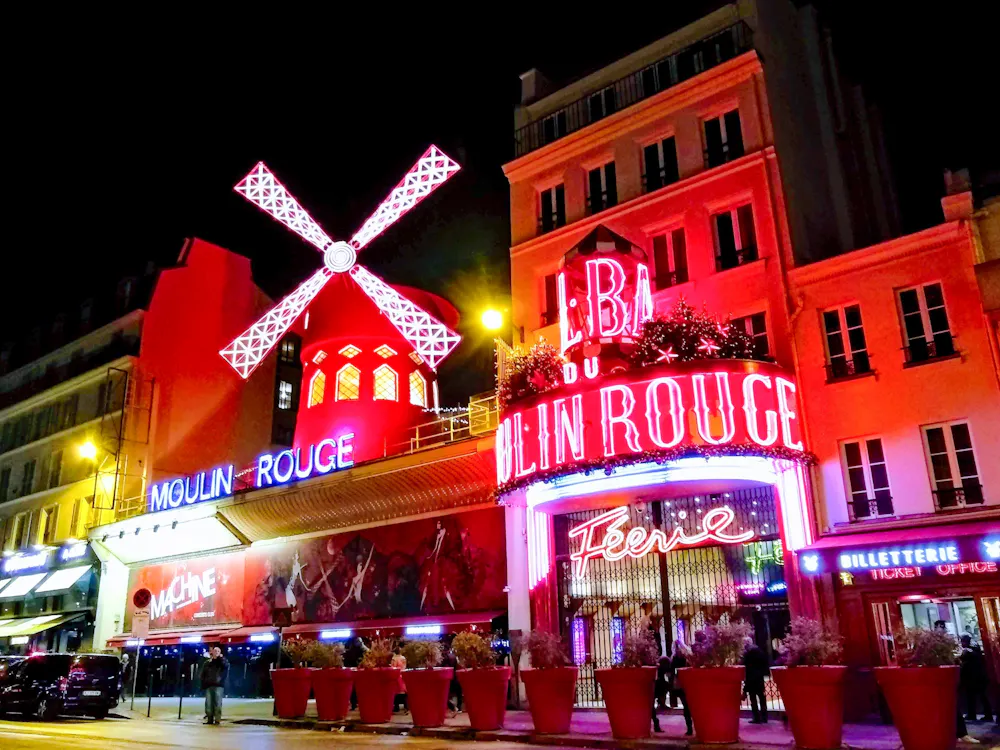
    In 1915 the Moulin Rouge burned down but was rebuilt in 1921. Its famous windmill sails fell off overnight earlier this year but were swiftly repaired.

    In the 1930s, it survived the Depression and rise of cinema (also capturing the attention of several filmakers). It also survived the Nazi occupation of Paris in the 1940s.

    By the early 1960s, Jacki Clerico was managing the Moulin’s show after his father had revamped the venue as a dinner theatre destination. The younger Clérico oversaw additions like a giant aquarium where dancers swam with snakes, and its now-famous “nude line” – a chorus of topless dancers – in its shows.

    In 1963, the Moulin Rouge struck upon a winning formula: revues, all named by Clérico with titles beginning with the letter “F” – from Frou Frou to Fantastique and Formidable. Since 1999, the revue Féerie (“Fairy”, also a French genre of stage extravaganza) has been performed almost without interruption.

    The Moulin Rouge or ‘red mill’ today, with its famous windmill.
    Rafa Barcelos/Shutterstock

    Ticket sales were boosted thanks to Baz Luhrmann’s 2001 film Moulin Rouge! and more recently Moulin Rouge! The Musical.

    Since COVID, the Moulin Rouge management have diversified. The windmill’s interior has been rented out via AirBnB and the Moulin’s dance troupe has performed on France’s televised New Year’s Eve celebrations. This year, the Moulin Rouge and its dancers were part of the Paris Olympics celebrations, dancing in heavy rain.

    Though people have come to appreciate the Eiffel Tower too, the Moulin Rouge can still argue its status as the pinnacle of live entertainment in the French capital: immediately recognisable, internationally visible, and quintessentially Parisian.

    Will Visconti is the author of Beyond the Moulin Rouge: The Life & Legacy of La Goulue (2022), published by the University of Virginia Press.

    ref. From cheeky thrill to grande dame – the Moulin Rouge celebrates 135 years of scandal and success – https://theconversation.com/from-cheeky-thrill-to-grande-dame-the-moulin-rouge-celebrates-135-years-of-scandal-and-success-239849

    MIL OSI AnalysisEveningReport.nz

  • MIL-OSI Asia-Pac: Dr. Mansukh Mandaviya Chairs 4th General Council Meeting of Khelo India Scheme

    Source: Government of India (2)

    Dr. Mansukh Mandaviya Chairs 4th General Council Meeting of Khelo India Scheme

    Draft Sports Policy Released for Public Consultation

    Union Minister Directs Reconstitution of Sub-Committees for Athlete Welfare, Talent Identification, and Strengthening Sports Ecosystem

    Union Minister Stresses Whole-of-Government Approach for Coordinated Talent Identification Efforts Across Agencies

    Ministry to Develop Dedicated Portal for Sports Recruitment in Collaboration with States and Central Ministries

    Unified National Database to Capture and Consolidate All Existing Sports Infrastructure in the Country

    Posted On: 03 OCT 2024 6:34PM by PIB Delhi

    The 4thmeeting of the General Council (GC) of the Khelo India Scheme was held under the chairmanship of Union Minister of Youth Affairs & Sports and Labour & Employment, Dr. Mansukh Mandaviya in New Delhi today. The meeting was attended by senior officials from States, prominent Sports Control Boards, National Sports Federations, and key representatives from Central Ministries.

    In a significant announcement, the Union Minister informed that a Draft Sports Policy has been released on the Ministry’s website for public consultation. This policy aims to modernize and update the current framework in line with the evolving sports landscape of the country. Stakeholders, including the governments of States and Union Territories, as well as the general public, are invited to submit their feedback. Once finalized, this policy will also serve as a model for states that have yet to establish their own sports policies.

    During the meeting, Dr. Mandaviya reviewed the progress of the Khelo India Scheme and held detailed discussions on improving sports infrastructure and facilities to enhance athlete performance. He emphasized the need for a Whole-of-Government Approach to ensure coordination among various agencies involved in talent identification and nurturing under different Central and State Government schemes, Public Sector Undertakings (PSUs), and National Sports Federations.

    The Union Minister directed the reconstitution of sub-committees to focus on:

    1. Improving recruitment policies and procedures across Ministries and Departments to ensure better career progression for sportspersons.
    2. Enhancing welfare and support systems for athletes.
    3. Developing effective programs for talent identification at the grassroots level.

    In another key decision, Union Minister announced the creation of a dedicated portal that will contain information on sports recruitment across Central Ministries. States will also be encouraged to use this platform to advertise sports quota vacancies, improving accessibility and transparency in recruitment.

    The meeting also included a review of the progress on the unified sports infrastructure database under PM Gati Shakti. Dr. Mandaviya directed the collation of data from States, Sports Federations, and other entities to create a comprehensive inventory of all sports infrastructure in the country.

    ******

    Himanshu Pathak

    (Release ID: 2061612) Visitor Counter : 144

    MIL OSI Asia Pacific News

  • MIL-OSI USA: Tuberville, Britt Announce NCAA Championship Events Return to Birmingham in March 2028

    US Senate News:

    Source: United States Senator Tommy Tuberville (Alabama)
    WASHINGTON – U.S. Senators Tommy Tuberville (R-AL) and Katie Britt (R-AL) announced that the National Collegiate Athletic Association (NCAA) first and second rounds of March Madness men’s and women’s basketball games will return to Birmingham on March 17-19, 2028.
    This announcement follows the letter Senators Tuberville and Britt sent to NCAA President Charlie Baker advocating for future events to be held in Alabama.
    “The State of Alabama has a long legacy of supporting intercollegiate athletics. Birmingham has the facilities, businesses, and infrastructure to make this a successful tournament. Our state is no stranger to the spotlight of big games and I’m confident fans from across the country will enjoy their time in Birmingham,” said Senator Tuberville.
    “This is a slam dunk for Birmingham. I am thrilled the first two rounds of March Madness in 2028 will be held in our great state,” said Senator Britt. “I was proud to join Senator Tuberville and local officials in advocating for the NCAA to pick the Magic City. I look forward to the tournament, and wouldn’t be surprised if more than one of Alabama’s incredible teams end up kicking off their road to the Final Four in our home state.”
    BACKGROUND:
    From 1982 through 2008, Birmingham was a stop on the road to the Final Four 11 times, 10 for men’s basketball and once for women’s basketball. 
    After a nearly 15-year hiatus, Birmingham hosted the first and second-round games of March Madness in 2023. It was a huge success with every game being sold out and both Auburn and Alabama playing in the tournament. The city also hosted the 2022 World Games. The City of Birmingham recently completed a $125 million renovation of the Birmingham-Jefferson Civic Center.
    Senator Tommy Tuberville represents Alabama in the United States Senate and is a member of the Senate Armed Services, Agriculture, Veterans’ Affairs, and HELP Committees.
    Senator Katie Britt represents Alabama in the United States Senate and is a member of the Senate Appropriations, Banking, and Rules and Administration Committees.

    MIL OSI USA News

  • MIL-OSI Australia: A-League Central Coast Mariners take a stand against betting advertising

    Source: New South Wales Premiere

    Published: 4 October 2024

    Released by: Minister for the Central Coast, Minister for Gaming and Racing


    Fans of the Central Coast Mariners FC will continue to enjoy A-League games with less sports betting advertising thanks to a new Reclaim the Game partnership with GambleAware.

    Under the new partnership, the Club will turn down sports betting sponsorships and eliminate sports betting advertising at their home games across both the men’s and women’s A-League teams.

    The Mariners will also work to educate fans, players and staff about the risks and harms which can arise from gambling.

    Reclaim the Game launched in 2020 and has grown to include 19 teams across six codes in NSW. It has reached millions of sports fans, both on TV and in stadiums.

    The Mariners, who continue to grow in popularity, particularly off their back-to-back men’s A-League titles over the past two seasons, are the first Central Coast sporting club to sign on for this awareness initiative.

    The Central Coast has a high rate of gambling participation and Reclaim the Game will remind fans that they can enjoy watching their team without spending their hard-earned money on betting.

    A recent survey conducted by Reclaim the Game suggests that Mariners’ fans are on board with the new partnership. In the survey, 85% of fans agreed that there is too much gambling advertising.

    As well as the new Mariners’ partnership, GambleAware has extended its partnerships with the Western Sydney Wanderers, and Cricket NSW which includes Sydney Sixers and Sydney Thunder.

    For more information on Reclaim the Game visit: http://www.gambleaware.nsw.gov.au/resources-and-education/awareness-campaigns/reclaim-the-game.

    The Minns Labor Government has a strong track record on reducing gambling harm since coming into office, including:

    • Committing $100 million to harm minimisation – investing in research, treatment, services and reform
    • Establishing an Independent Panel of experts overseeing a cashless gaming trial
    • Banning all external gambling signage in venues and introducing Responsible Gambling Officers for venues with more than 20 machines
    • Forbidding political donations from clubs with electronic gaming machines.

    For free and confidential gambling support 24/7 call GambleAware on 1800 858 858.

    Minister for Gaming and Racing and Minister for the Central Coast David Harris said:

    “Sports betting advertising and sponsorship is just about everywhere. We see it across most codes and many fans don’t know sport without it.

    “The NSW Government, through Reclaim the Game, is partnering with sporting clubs to take a stand and challenge the impact that sports betting advertising has on fans.

    “All our partners are committed to eliminating sports betting advertising at their home games, and to take action in educating their fans, players and staff about the potential harms of sports betting.

    “It’s no secret I’m a big fan of the mighty Mariners, so I am absolutely delighted by this new partnership, which will have a positive impact on the Central Coast.”

    Mariners CEO Alyssar Narey said:

    “We are proud to partner with the NSW Government’s Reclaim the Game initiative.

    “This collaboration underscores our commitment to promoting a healthy and positive environment in sports, where our players and fans can thrive without the influence of gambling.

    “Together, we can create a stronger community and ensure that the joy of the game remains at the forefront.” 

    About Reclaim the Game:

    Reclaim the Game was launched in 2020. 19 teams from six codes are partners in the program:

    Rugby League:
    1. Canterbury-Bankstown Bulldogs
    2. South Sydney Rabbitohs

    Basketball:
    3. Illawarra Hawks
    4. Sydney Kings
    5. Sydney Flames

    Football (Soccer):
    6. Western Sydney Wanderers (A-League men’s)
    7. Western Sydney Wanderers (A-League women’s)

    8. Central Coast Mariners (A-League men’s)

    9. Central Coast Mariners (A-League women’s)

    Cricket:
    10. Sydney Sixers (BBL)
    11. Sydney Sixers (WBBL)
    12. Sydney Thunder (BBL)
    13. Sydney Thunder (WBBL)
    14. NSW Blues
    15. NSW Breakers

    Australian Football League (AFL):
    16. Sydney Swans (AFL)
    17. Sydney Swans (AFLW)

    Netball:
    18. NSW Swifts
    19. GIANTS Netball

    MIL OSI News

  • MIL-OSI Australia: Shine bright at the City of Wanneroo’s events series

    Source: Government of Western Australia

    The City of Wanneroo’s 2024/25 free events series guarantees to entertain residents and visitors from this October through to May 2025.

    We have 12 fun-filled family friendly events lined up, from toe-tapping concerts and buzzing festivals, to laid-back evenings in the park.

    Mayor Linda Aitken said the series was all about highlighting the importance of community and encouraging everybody to get involved and attend an event in their suburb.

    “Get ready for the return of our crowd-favourite, Symphony Under the Stars! This year, we’re turning up the spotlight on some incredible local talent,” she said. “Enter our Search for a Star competition and you might just find yourself performing with a 70-piece orchestra!”

    “This concert is always popular, and it’s easy to see why – it’s a night of unforgettable music under the open sky.

    “From the carnival vibes of the Banksia Grove Fun Fest that kicks off the season, to the City-wide celebration of art at the Beach to Bush Arts Festival in May, our event season has something for everyone.

    “Wherever you are in the City, don’t miss out on the fun, there’s something to please everyone.”

    The 2024/25 City of Wanneroo events series includes:

    • Banksia Grove Fun Fest, Saturday 26 October 2024, Grandis Park, Banksia Grove
    • Evening in the Park, Saturday 9 November 2024, Ridgewood Park, Ridgewood
    • Sunset Sounds Alkimos, Saturday 30 November 2024, Leatherback Park, Alkimos
    • Aquamotion Outdoor Cinema, Saturday 7 December 2024, Wanneroo Aquamotion
    • Christmas Fiesta, Saturday 14 December 2024, Wanneroo Town Centre
    • Aquamotion Family Fun Day, 11 January 2025, Wanneroo Aquamotion
    • Sunset Sounds Landsdale, Saturday 18 January 2025, Warradale Park, Landsdale
    • Wanneroo Festival, Saturday 1 February 2025, Wanneroo Showgrounds, Wanneroo
    • Symphony under the Stars, Saturday 22 February 2025, Kingsway Sporting Complex, Madeley *includes Search for a Star competition
    • Fun Fest Clarkson, Saturday 8 March 2025, Riverlinks Park, Clarkson
    • Multicultural Evening in the Park, Friday 21 March 2025, Hudson Park, Girrawheen
    • Beach to Bush Arts Festival, Friday 9 May to Sunday 25 May, various locations across the City.

    All events are free to attend, with no registration required.

    Visit our events page for more information or to submit an application for our Search for a Star competition.

    MIL OSI News

  • MIL-OSI China: Jackie Chan stars in panda-themed action comedy

    Source: China State Council Information Office 3

    Internationally known kung fu megastar Jackie Chan stars in a new comedy-action film featuring China’s treasured giant panda while advocating for the beloved species.

    Kung fu star Jackie Chan interacts with the audience at the premiere of “Panda Plan” in Beijing, Sept. 28, 2024. [Photo courtesy of Maoyan Entertainment]

    The new film “Panda Plan,” directed by Zhang Luan, stars Chan as himself alongside actors Wei Xiang, Shi Ce, Andy Friend and Temur Mamisashvili. The story follows Chan as he’s invited to adopt a panda cub at an island wildlife zoo, only to discover a Middle Eastern tycoon has hired mercenaries to kidnap the bear for a $100 million bounty. Chan enlists his agent and the cub’s caretaker in an outrageous adventure to outsmart the villains.

    Chan has long been passionate about giant pandas, often carrying panda plush toys at events, including the Oscars red carpet. Since 2009, he’s served as a panda ambassador for the Chengdu Giant Panda Research and Breeding Base, adopting two pandas and advocating for their protection. He was also previously associated with pandas in Hollywood’s iconic franchise “Kung Fu Panda,” where he voiced the character Monkey in the first three installments. However, he had long hoped to be involved in a Chinese panda film but didn’t know where to start until this project emerged.

    A poster for “Panda Plan.” [Image courtesy of Emei Film Group]

    Initially, Chan refused the role. “The director asked me to play myself in the film. I don’t want to be myself in a film; I want to be somebody, a character, not me,” Chan revealed at a premiere held in Beijing on Sept. 28. However, after reading the script, he agreed, understanding it as family entertainment with interesting ideas.

    “And also, now I do movies with purpose,” Chan said. “I want to make this film to promote this animal, our national treasure, and the culture associated with it. I want more children around the world to know about pandas and discover their cuteness. If you look at it, the giant panda is very Chinese, representing love and peace. This is what the world needs right now.”

    Chan is known for action comedies like “Project A” (1983), its sequel “Project A II” (1987) and “Rob-B-Hood” (2006). “Panda Plan,” initially titled “Project P,” returns to Chan’s classic kung fu comedy roots with nostalgic stunts and hilarious actions. No real pandas were harmed during filming; the panda cub was created using CGI.

    Kung fu star Jackie Chan and the cast and crew pose for a group photo at the “Panda Plan” premiere in Beijing, Sept. 28, 2024. [Photo courtesy of Maoyan Entertainment]

    Playing himself at 70, Chan delivers a heartfelt line in “Panda Plan.”

    “When I was young on set, as soon as I heard the word ‘Action!’ I felt an inexplicable excitement and endless energy throughout my body,” he says in the film. “Later, this ‘Action!’ became my signature, my rallying call, my starting gun. Before I heard ‘Action!’, I was just like you — afraid, feeling pain, and tired. But as soon as I heard ‘Action!’, I became that invincible hero who could conquer the heavens and the earth. Wow, just like that, decades have passed, like a dream. What should I do when I wake up from the dream? I’d just turn over and continue dreaming.”

    “Panda Plan” opened in Chinese theaters nationwide during the weeklong National Day holiday, starting Oct. 1.

    MIL OSI China News

  • MIL-OSI Australia: Wollongong to host Multicultural Water Safety Day

    Source: New South Wales Government 2

    Headline: Wollongong to host Multicultural Water Safety Day

    Published: 4 October 2024

    Released by: Minister for Planning and Public Spaces, Minister for Regional Health, Minister for Sport


    As summer approaches, local government, sporting and community organisations have come together to host a free Multicultural Water Safety Day at Wollongong City Beach next Friday.

    In the 12 months to 30 June 2024, 61 people drowned at beaches, coastal waterways and the ocean according to Surf Life Saving NSW data.

    The Multicultural Water Safety Day aims to empower multicultural communities in the Illawarra with the skills and confidence to safely enjoy local waters.

    The initiative is a collaboration between the NSW Office of Sport, Illawarra Multicultural Services, Multicultural Communities Council Illawarra, Surf Life Saving NSW, Royal Life Saving, University of Wollongong, and other local stakeholders designed to educate multicultural communities on vital water safety skills and knowledge, particularly the beach, inland water and rock fishing safety.

    As well as interactive educational sessions including a live rip dye and resuscitation demonstrations, there will be hands-on practical activities and the opportunity to engage with facilitators and local organisations.

    The event will be held at Wollongong City Beach from 10am on Friday, 11 October. 

    Minster for the Illawarra and the South Coast, Ryan Park, said:

    “The Illawarra and South Coast is home to some of the best beaches in the State and the NSW Government is committed to making sure that all members of our community can enjoy them safely.

    “With a focus on inclusivity and community engagement, this initiative aims to make a lasting impact on the water safety in the region.”

    “We hope that this event is the first step in instilling a lifelong understanding and appreciation of water safety among our multicultural communities.”

    Minister for Sport, Steve Kamper, said:

    “Swimming and being on or near the water is a key part of the Australian lifestyle, but too many people, particularly those from multicultural backgrounds, continue to lose their lives to drowning.”

    “The NSW Government wants to ensure that people participating in water activities or just enjoying a swim at the beach have the skills and knowledge to do so safely.”

    Member for Wollongong, Paul Scully, said:

    “Wollongong is a diverse community and events such as these allow us to provide targeted resources to our multicultural residents, particularly those who may not have grown up around the water.

    “Many newer residents and visiting students have little or no experience in the surf, it’s important they gave a good understand of water safety. 

    “I encourage as many members of our community as possible to come down, participate and learn potentially life-saving lessons.”

    Projects Coordinator for Illawarra Multicultural Services, Amro Zoabe said:

    “Working with multicultural communities, IMS understands the importance of having vital information available in language. By having our multilingual community workers provide language support for this event, we ensure everyone has equitable access.

    “We are lucky to be living on Dharawal land on waters. This event helps make sure our multicultural communities, access these waters safely.”
     

    MIL OSI News

  • MIL-OSI Asia-Pac: DEPwD successfully concludes the Swachhata Hi Seva 2024 Campaign: A significant step towards improved facilities for Persons with Disabilities

    Source: Government of India

    Posted On: 04 OCT 2024 1:43PM by PIB Delhi

    The Department of Empowerment of Persons with Disabilities (DEPwD) and its affiliated National Institutes successfully concluded the Swachhata Hi Seva (SHS) 2024 campaign. Various events, including Divya Kala Shakti, ADIP camps, Sign Language Day, and the Indian Board of Rehabilitation Education, were organized by the department under the Swachhata Pakhwada. During these events, Union Minister for Social Justice and Empowerment (SJE), Dr. Virendra Kumar, administered the Swachhata Pledge.

    At the National Institute for Empowerment of Persons with Visual Disabilities (NIEPVD) in Dehradun, Union Minister of State (SJE), Shri B.L. Verma graced the SHS programme as the chief guest. He participated in the ‘Ek Ped Maa Ke Naam’ tree plantation drive and inaugurated the newly constructed ‘Accessible Library’ for visually impaired students, which is equipped with state-of-the-art technology to facilitate easy learning.

    Similarly, at the National Institute for the Empowerment of Persons with Intellectual Disabilities (NIEPID), the concluding event of the cleanliness campaign saw officials and staff reaffirm their commitment to maintaining hygiene and promoting cleanliness in their community.

    Additionally, the Atal Bihari Vajpayee Divyang Sports Training Center in Gwalior marked its foundation day with a sanitation awareness rally. The rally saw participation from 150 wheelchair athletes, national managers, referees, coaches, social workers, and Gwalior Municipal Corporation’s sanitation ambassadors, raising widespread awareness about the importance of cleanliness.

    The fortnight-long campaign placed special emphasis on upgrading facilities for Divyang employees and staff, including the construction and inauguration of accessible toilets. A special medical camp was also held to ensure the well-being of sanitation workers.

    The SHS campaign aims not only to ensure cleanliness and hygiene facilities for persons with disabilities but also to promote awareness about sanitation throughout society. The department remains committed to this cause and will continue to run such campaigns in the future.

    *****

    VM

    (Release ID: 2061934) Visitor Counter : 45

    MIL OSI Asia Pacific News

  • MIL-OSI Russia: From September 30 to October 4, 2024, a series of popular science events for mathematics teachers of basic schools of the Russian Academy of Sciences took place in Novosibirsk

    MILES AXLE Translation. Region: Russian Federation –

    Source: Novosibirsk State University – Novosibirsk State University –

    Over the course of a week, unique popular science events for mathematics teachers of the RAS basic schools (hereinafter referred to as the School) were held in Novosibirsk at the S.L. Sobolev Institute of Mathematics of the Siberian Branch of the Russian Academy of Sciences and Novosibirsk State University. The project was launched in 2022 and is aimed at popularizing science, discussing significant discoveries, exchanging experiences among specialists, developing a scientific worldview among young people and adolescents, increasing the prestige of science, and expanding the scientific horizons of schoolchildren.

    This year, 29 teachers from 14 regions of Russia took part in the School: Arkhangelsk, Voronezh, Irkutsk, Kemerovo, Moscow, Novosibirsk, Omsk, Rostov, Sverdlovsk, Chelyabinsk regions, as well as from Krasnoyarsk, Perm, Primorsky Krai and the Udmurt Republic.

    Summing up the results of the school, Deputy Governor of the Novosibirsk Region Irina Manuilova noted:

    — Such schools that unite professionals from different regions are extremely useful, so I would like to see as many of them as possible in different parts of Russia. Their goals are in line with the strategy of the Decade of Science and Technology in the Russian Federation, announced by the President of the Russian Federation, as well as the new national projects “Youth and Children” and “Personnel”. I would like to note that recently our region hosted a satellite event of the Technoprom forum, the Big Mathematical Workshop, where student and school teams are involved in solving specific mathematical problems. It is very important that the policy of forming specialized classes and taking a serious attitude towards mathematical education is gaining momentum today. People who come to such training programs are people, thinking people, who are passionate about the cause. Therefore, your thoughts and your experience are extremely important in order to make the right decisions at the level of the Government of the country. I am sure that you have received a good professional background and will continue to work with each other and cooperate. I think that mathematics will take the place it rightfully deserves in school education.

    Dean Faculty of Mechanics and Mathematics, NSU Igor Marchuk spoke in more detail about the training of mathematicians at the university and noted that NSU offers the main profiles of mathematical education.

    — The faculty has created a whole space for applicants, they can choose any of the profiles — someone wants to be a researcher, someone wants to do engineering, and someone — programming. At the same time, there is a principle of openness, when, having passed certain exams, a student can transfer to another profile during their studies.

    On the basis of the S.L. Sobolev Institute of Mathematics of the Siberian Branch of the Russian Academy of Sciences and NSU, a Mathematical center in Akademgorodok, which supports many events, including events with schoolchildren. For example, this is the winter school of the young mathematician “Lobachevsky”, the Workshop of Creative Mathematics. Also, active cooperation with the educational center “Sirius” is now beginning.

    The School program included practical classes and master classes, where issues of organizing research activities for schoolchildren, solving Olympiad problems in mathematics, and conducting in-class and extracurricular activities for students were discussed. This year, in addition to the traditional participant, Gymnasium No. 6 “Gornostay”, one of the Basic Schools of the Russian Academy of Sciences, the School was also joined by SUNC NSUTherefore, the sessions were held in both educational centers.

    The participants of the School visited the leading institutes of the country and educational institutions located in the Novosibirsk Akademgorodok: Sobolev Institute of Mathematics SB RAS, Budker Institute of Nuclear Physics SB RAS, Lavrentyev Institute of Hydrodynamics SB RAS, Sobolev Institute of Geology and Mineralogy SB RAS, SUNC NSU, Educational Center – Gymnasium No. 6 “Gornostay”.

    Popular science lectures were given by leading scientists, including Pavel Vladimirovich Logachev, Doctor of Physical and Mathematical Sciences, Academician of the Russian Academy of Sciences, Director of the G.I. Budker Institute of Nuclear Physics of the Siberian Branch of the Russian Academy of Sciences; Andrey Mikhailovich Raigorodsky, Doctor of Physical and Mathematical Sciences, Professor of Mathematics, Director of the Phystech School of Applied Mathematics and Computer Science of MIPT; Alexey Vladimirovich Savvateev, Doctor of Physical and Mathematical Sciences, Corresponding Member of the Russian Academy of Sciences, Professor of MIPT, Leading Researcher of the Laboratory of Mathematical Economics of the Department of Theoretical Economics and Mathematical Research of the Central Economics and Mathematical Institute of the Russian Academy of Sciences. Also, teachers and associate professors of the NSU Specialized Scientific Center and the Gornostay Educational Center took part in the event as experts.

    For reference: a series of events for mathematics teachers of the RAS basic schools is being held in the Novosibirsk Akademgorodok as part of the implementation of the RAS Basic Schools project, in which 108 general education organizations from 32 regions of the Russian Federation are participating.

    Please note: This information is raw content directly from the source of the information. It is exactly what the source states and does not reflect the position of MIL-OSI or its clients.

    Please note; This information is raw content directly from the information source. It is accurate to what the source is stating and does not reflect the position of MIL-OSI or its clients.

    http://vvv.nsu.ru/n/media/nevs/education/from-September-30-to-October-4-2024-a series-of-popular-scientific-events took place in-Novosibirsk-

    EDITOR’S NOTE: This article is a translation. Apologies should the grammar and or sentence structure not be perfect.

    MIL OSI Russia News

  • MIL-OSI United Kingdom: Coming up next week at the London Assembly W/C 7 October

    Source: Mayor of London

    PUBLIC MEETINGS

    Wednesday 9 October

    Policing protests in London

    Police and Crime Committee – The Chamber, City Hall, Kamal Chunchie Way, 10am

    Policing protests and large-scale events in the capital is putting increased strain on the Metropolitan Police Service, with the Met describing protests since October 2023 as the “greatest period of sustained pressure since the Olympics in 2012.”

    The Police and Crime Committee will hold the first meeting of its investigation into public order policing in London.

    Panel 1: 10:00am – 11:30am

    • Matt Parr, former Inspector, HMICFRS
    • Lord Walney, former Government Independent Adviser on Political Violence and Disruption
    • Kirsty Brimelow KC, Barrister, Doughty Street Chambers

    Panel 2: 11:35am – 1:00pm

    • Jodie Beck, Policy and Campaigns Officer, Liberty
    • Professor Geoff Pearson, Professor of Law at the University of Manchester and Academic Director of the N8 Policing Research Partnership
    • Tom Southerden, Programme Director, Law & Human Rights, Amnesty International
    • David Spencer, Head of Crime and Justice, Policy Exchange

    MEDIA CONTACT: Tony Smyth on 07763 251727/ [email protected]

    Wednesday 9 October

    ‘Social value’ in planning and regeneration

    Planning and Regeneration Committee – The Chamber, City Hall, Kamal Chunchie Way, 2pm

    The London Plan does not define ‘social value’, but it is referred to in various policies and supporting texts.

    In the first meeting of its investigation into how social value is considered in planning decisions for markets and arches, the Planning and Regeneration Committee will question experts, local authorities and industry representatives about what it means, how it’s measured, and how it can make a difference to Londoners.

    The guests are:

    Panel 1: 2.00pm – 3.15pm

    • Maria Adebowale-Schwarte, Commissioner for the London Sustainable Development Commission
    • Tony Burton, Founder of Civic Voice and Chair of Community Review Panels in Old Oak & Park Royal and Dacorum
    • Dr Myfanwy Taylor, Lecturer in Urban Economics and Planning, University College London
    • Guy Battle, Chief Executive Officer at Social Value Portal
    • Stephanie Edwards, Co-Founding Director Urban Symbiotics

    Panel 2: 3.30pm – 4.45pm

    • Krissie Nicolson, CEO London Trades Guild
    • Nicholas Kasic, manager of Portobello Road Market and convener of the London Street Trading Benchmarking Group 
    • Sarah Goldzweig, Research and Project Officer at Latin Elephant
    • Stephen Biggs, Corporate Director, Community Wealth Building, London Borough of Islington 
    • Bryce Tudball, Head of Spatial Planning, London Borough of Haringey

    MEDIA CONTACT: Josh Hunt on 07763 252310 / [email protected]

    Thursday 10 October

    Mayor’s Question Time

    The Chamber, City Hall, Kamal Chunchie Way, 10am

    The Mayor of London, Sadiq Khan, will face questions from London Assembly Members.

    Topics include:

    • Aligning the Budget with Manifesto Commitments
    • Night-Time Economy
    • Net zero targets and advertising on the TfL network
    • Cleaning Up London’s Waterways

    MEDIA CONTACT: Alison Bell on 07887 832 918 / [email protected]

    MIL OSI United Kingdom

  • MIL-OSI Translation: Calgary’s South Fish Creek Complex Receives Funding for Green Improvements

    MIL OSI Translation. Canadian French to English –

    Source: Government of Canada – MIL OSI Regional News in French

    Press release

    Calgary, Alberta, May 2, 2024 — Energy upgrades are coming to the South Fish Creek complex thanks to a joint investment of more than $1.2 million from the federal government, the YMCA of Calgary and the complex’s partners.

    Announced by MP George Chahal and Shannon Doram, President and CEO of the YMCA of Calgary, this project will extend the life of the facility and improve energy efficiency. The South Fish Creek complex has served the needs of Calgarians for over twenty years. These renovations will extend the life of the facility, improve air quality and energy efficiency, and reduce greenhouse gas emissions. By replacing the systems that keep the complex running, the YMCA will be able to continue to provide important services and programs that meet the needs of children, youth, newcomers and residents of all ages and backgrounds.

    The YMCA of Calgary will replace its current heating systems with more efficient models and upgrade air handling units. These upgrades are expected to generate cost savings that can be reallocated to meet the community’s future needs. The upgrades will allow the systems that help operate the complex to adapt to a changing environment, maintaining a comfortable atmosphere and improved air quality during the cold winter months and the scorching summer months.

    The Green and Inclusive Community Buildings (GICB) program aims to improve the places where Canadians work, learn, play, live and gather by reducing pollution and costs, while supporting thousands of good jobs. By making green and other improvements to existing public community buildings and constructing new buildings in underserved communities, the Green and Inclusive Community Buildings program helps ensure the inclusivity, accessibility and longevity of community facilities, while helping Canada achieve its net-zero emissions targets by 2050.

    Quotes

    “The Shawnessy YMCA plays an important role in our community by preparing our children, youth, newcomer neighbours and people of all ages and backgrounds for success. The Green and Inclusive Community Buildings program encourages innovative and clean solutions to help Canada adapt to a greener, lower-carbon economy. With the funding announced today, the South Fish Creek complex will be able to continue to meet the needs of Calgarians for years to come.”

    George Chahal, Member of Parliament for Calgary Skyview, on behalf of the Honourable Sean Fraser, Minister of Housing, Infrastructure and Communities

    “The Shawnessy YMCA is an important community hub that provides Calgary’s rapidly growing southwest quadrant with a place to play, grow and connect. The Government of Canada’s investment through the Green and Inclusive Community Buildings Program will enable the YMCA Calgary to be more energy efficient and help us deliver the programs and services that are essential to building vibrant communities for years to come. We are pleased to partner with the Government of Canada to address climate change and build community resilience.”

    Shannon Doram, President and CEO of the YMCA of Calgary

    “As the building owner of the South Fish Creek Recreation Centre, the City of Calgary is pleased with the energy efficiency upgrades made by the YMCA of Calgary. Not only will these upgrades ensure the facility will be available for future generations of Calgarians, they will also reduce the building’s carbon footprint. Addressing climate change is a strategic priority for the City of Calgary, and supporting our partners to reduce emissions is a key part of delivering on City Council’s commitment.”

    Tim Mowrey, Manager, Recreation, Sports and Community Partners, City of Calgary

    Quick Facts

    The federal government is investing $979,800 in this project through the Green and Inclusive Community Buildings (GICB) Program, and the YMCA of Calgary is providing $244,950.

    These improvements are expected to result in annual fuel savings of approximately 20.5% for the facility and a reduction in greenhouse gas emissions of 268 tonnes.

    The Green and Inclusive Community Buildings (GICB) program was created to support Canada’s Strengthened Climate Plan: A Healthy Environment and a Healthy Economy. It supports the first pillar of the Plan by reducing greenhouse gas emissions and increasing energy efficiency, and by helping to build resilience to climate change.

    The program provides $1.5 billion over five years for modernization, repair or improvement work that promotes the environment and accessibility.

    At least 10% of the funds are allocated to projects for First Nations, Inuit and Métis communities, which includes Indigenous populations in urban centres.

    The application period for the Green and Inclusive Community Buildings program is now closed.

    On December 18, 2023, the federal government launched the Prairie Green Economy Framework, which highlights the need for a collaborative, regional approach to sustainability, focused on strengthening the coordination of federal programs and initiatives with significant investments. The Framework is the first step in a journey that will bring together many stakeholders. PrairiesCan, the federal department responsible for diversifying Canada’s Prairie economy, has committed $100 million over three years to support projects aligned with priority areas identified by Prairie stakeholders to create a stronger, more sustainable and inclusive economy for the Prairie provinces and Canada.

    Infrastructure Canada supports the Prairie Green Economy Framework to encourage greater collaboration on investment opportunities, leverage additional funding and attract new investment to the Prairies to better meet needs.

    Related links

    Contact persons

    For further information (media only), please contact:

    Micaal Ahmed Manager, CommunicationsOffice of the Minister of Housing, Infrastructure and Communities343-598-3920micaal.ahmed@infc.gc.ca

    Media Relations Infrastructure Canada613-960-9251Toll free: 1-877-250-7154Email: media-medias@infc.gc.caFollow us on Twitter, Facebook, Instagram And LinkedInWebsite: Infrastructure Canada

    Dean Paddock Vice President, Community EngagementYMCA of CalgaryDean.Paddock@calgary.ymca.ca

    EDITOR’S NOTE: This article is a translation. Apologies should the grammar and/or sentence structure not be perfect.

    MIL Translation OSI

  • MIL-OSI Asia-Pac: Dr. Mansukh Mandaviya Spearheads Coastal Cleanup Drive from Porbandar, Gujarat; Kicks Off Nationwide Beach Cleanliness Drive as part of 10 Years of Swachh Bharat Mission

    Source: Government of India

    Dr. Mansukh Mandaviya Spearheads Coastal Cleanup Drive from Porbandar, Gujarat; Kicks Off Nationwide Beach Cleanliness Drive as part of 10 Years of Swachh Bharat Mission

    Union Minister Pays Tribute to Mahatma Gandhi Ji on his Birth Anniversary

    Over 1,00,000 MY Bharat Youth Volunteers Join Effort to Remove Single-Use Plastic Across 1,000 Locations Along India’s Coastline

    As part of Swachhata Hi Seva campaign, over 60 Lakh MY Bharat Youth Volunteers Removed Millions of Kilograms of Waste Across India

    Posted On: 02 OCT 2024 5:43PM by PIB Delhi

    Union Minister for Youth Affairs & Sports and Labour & Employment, Dr. Mansukh Mandaviya, spearheaded a nationwide Coastal and Beach Cleanliness Drive organized by MY Bharat from Porbandar, Gujarat on Mahatma Gandhi Jayanti today. This large-scale event marked the culmination of the “Swachhata Hi Seva” campaign, which has been ongoing since September 17, 2024, under the theme “Swabhav Swachhata – Sanskaar Swachhata.”

    Leading by example, Dr. Mandaviya inaugurated the drive from Porbandar, the birthplace of Mahatma Gandhi, while over 1,00,000 MY Bharat youth volunteers simultaneously took part in cleanup efforts across 1,000 locations along India’s coastline. Volunteers focused on removing single-use plastic and other waste materials from beaches, contributing to cleaner coastal environments.

    Dr. Mandaviya, addressing volunteers in Porbandar, acknowledged Prime Minister Narendra Modi’s vision and leadership in launching the Swachh Bharat Mission a decade ago. “As we celebrate 10 years of the Swachh Bharat Mission, this nationwide effort is a fitting tribute to Prime Minister Narendra Modi’s vision of a clean India. Our youth, through their remarkable participation today, have taken Mahatma Gandhiji’s ideals forward by committing to environmental responsibility and sustainability. Eliminating single-use plastic is just one step in this journey, and the dedication displayed today will propel India toward a cleaner, greener future,” he said.

    After participating in the coastal cleanliness drive, Union Minister Dr. Mansukh Mandaviya paid tribute to Mahatma Gandhi at the Kirti Mandir in Porbandar. Reflecting on Mahatma Gandhi’s ideals and principles, he offered floral tributes in remembrance of his invaluable contributions to India’s freedom movement and philosophy of non-violence.

    Following this, Dr. Mandaviya honoured Mahatma Gandhi’s vision of self-reliance by purchasing Khadi garments from the Porbandar Khadi Bhandar. He highlighted the significance of Khadi, which Mahatma Gandhi had elevated as a symbol of the Swadeshi movement and a cornerstone of India’s journey towards self-sufficiency.  

    The nationwide drive, conducted across India’s coastline, resulted in the removal of significant amounts of waste, particularly single-use plastics. Volunteers from coastal areas participated enthusiastically in the initiative, demonstrating the collective power of youth in environmental stewardship.

    Since the beginning of the Swachhata Hi Seva campaign on 17th September 2024, more than 60 lakh MY Bharat youth volunteers have engaged in cleanliness drives across the country. Their combined efforts have led to the removal of millions of kilograms of waste from over 1.19 lakh villages, 17,000+ community centres, and 9,900+ Amrit Sarovars, making a notable impact in both rural and urban India.

    ******

    Himanshu Pathak

    (Release ID: 2061144) Visitor Counter : 46

    MIL OSI Asia Pacific News

  • MIL-OSI Europe: Written question – Turkish Foreign Minister Hakan Fidan’s participation in the informal meeting of EU Foreign Affairs Ministers in Brussels on 29 August – E-001805/2024

    Source: European Parliament

    Question for written answer  E-001805/2024
    to the Vice-President of the Commission / High Representative of the Union for Foreign Affairs and Security Policy
    Rule 144
    Michalis Hadjipantela (PPE)

    The participation of Turkish Foreign Minister, Hakan Fidan, in the informal meeting of EU Foreign Affairs Ministers in Brussels on 29 August this year was, among other things, a gesture of goodwill on the part of the Republic of Cyprus. The aim remains the resumption of negotiations with a view to resolving the Cyprus invasion and occupation issue.

    In its conclusions of April 2024, the European Council, as in past conclusions, linked the progress in EU-Türkiye relations with the Cyprus issue, stating: ‘the European Union attaches particular importance to the resumption of and progress in the Cyprus settlement talks in further enhancing EU-Türkiye cooperation’.

    However, the situation in the occupied territories of the Republic of Cyprus is getting worse. Examples of this include the recent opening up of the enclaved city of Famagusta and the fact that the Turkish side turned down an invitation from the General Secretary of the United Nations to attend an informal meeting.

    In view of this, could the Vice-President of the Commission and High Representative of the Union for Foreign Affairs and Security Policy answer the following:

    • 1.What is your take on the Turkish Foreign Minister’s participation in the Gymnich meeting?
    • 2.What are your thoughts concerning the need for Türkiye to change its stance on the Cyprus issue?
    • 3.What progress is being made in EU-Türkiye relations given that Türkiye is distancing itself from the proposed solution and is now openly and officially promoting a two-state solution?

    Submitted: 24.9.2024

    Last updated: 2 October 2024

    MIL OSI Europe News

  • MIL-OSI Video: TheBLUF: Army Soldiers & Veterans on Team USA, Nt’l Veterans Summer Sports Clinic, Golden Age Games

    Source: United States of America – Federal Government Departments (video statements)

    In this episode of The BLUF, it’s all about our Veteran athletes – and some Army Soldiers – as we look at how they represented Team USA at the 2024 Olympic Games. We also take a look at this summer’s other events – the National Veterans Summer Sports Clinic and the National Veterans Golden Age Games.

    Army Soldiers and Veterans compete on Team USA at the 2024 Paris Olympics

    Army Soldiers and Veterans compete on Team USA at the 2024 Paris Olympics


    National Veterans Summer Sports Clinic:

    National Veterans Summer Sports Clinic

    National Veterans Golden Age Games:

    National Veterans Golden Age Games

    VA Adaptive Sports and Arts
    Follow @Sports4Vets on social media

    Home


    The BLUF
    A VA Rocky Mountain Network Production
    This show is made by Veterans for Veterans

    Executive Producer: Shawn Spitler
    Producer, Director, Editor: Matt Murray
    Host, Producer: Sarah Kallassy
    Technical Director: Patrick Battle
    Audiovisual Production Specialist: Adam Desaulniers
    Stories by: Katie Beall, Jesus Flores, Sarah Kallassy, and Matt Murray

    Chapters:
    00:00 – 00:12 Intro
    00:13 – 01:16 Team USA
    01:17 – 01:54 National Veterans Summer Sports Clinic
    01:55 – 04:01 National Veterans Golden Age Games
    04:02 – 04:19 Thanks for watching!

    https://www.youtube.com/watch?v=ePjCtNt-PWM

    MIL OSI Video

  • MIL-OSI: Plains All American Pipeline and Plains GP Holdings Announce Quarterly Distributions and Timing of Third Quarter 2024 Earnings

    Source: GlobeNewswire (MIL-OSI)

    HOUSTON, Oct. 02, 2024 (GLOBE NEWSWIRE) — Plains All American Pipeline, L.P. (Nasdaq: PAA) and Plains GP Holdings (Nasdaq: PAGP) today announced their quarterly distributions with respect to the third quarter of 2024 and also announced timing of third quarter 2024 earnings.

    Third Quarter Distribution Declaration 

    PAA and PAGP announced the following quarterly cash distributions:

    • PAA Common Units – $0.3175 per Common Unit ($1.27 per unit on an annualized basis), which is unchanged from the distribution paid in August 2024.
    • PAGP Class A Shares – $0.3175 per Class A Share ($1.27 per Class A Share on an annualized basis), which is unchanged from the distribution paid in August 2024.
    • PAA Series A Preferred Units – $0.61524 per Series A Preferred Unit (approximately $2.46 per unit on an annualized basis).
    • PAA Series B Preferred Units – $24.25 per Series B Preferred Unit (based on the applicable quarterly floating rate).

    The distributions on the PAA Common Units, PAGP Class A Shares and PAA Series A Preferred Units are payable on November 14, 2024 to holders of each respective security as of October 31, 2024. The distribution on the PAA Series B Preferred Units is payable on November 15, 2024 to holders of such security as of November 1, 2024.

    Although equity holders should consult their own tax advisor regarding their particular circumstances, the PAGP cash distribution per Class A Share is expected to be a non-taxable return of capital to the extent of a Class A Shareholder’s tax basis in each PAGP Class A Share and a reduction in such tax basis. In addition, to the extent any cash distribution exceeds a Class A Shareholder’s tax basis, it should be taxable as a capital gain. Qualified Notices under Treasury Regulation Section 1.1446 with respect to the PAA Common Unit distribution and PAA Series B Preferred Unit distribution will be posted on the Plains website under “Investor Relations – Tax Information.”

    Third Quarter 2024 Earnings Timing

    PAA and PAGP also announced that they will release third quarter 2024 earnings before market open on Friday, November 8, 2024. Following the announcement, PAA and PAGP will host a conference call at 9:00 a.m. CT (10 a.m. ET) with analysts and investors to discuss earnings. The call will be webcast live on the internet and may be accessed through the “Investors Relations” section of the website at http://www.plains.com. An audio replay will be available on the website after the call.

    PAA is a publicly traded master limited partnership that owns and operates midstream energy infrastructure and provides logistics services for crude oil and natural gas liquids (NGL). PAA owns an extensive network of pipeline gathering and transportation systems, in addition to terminalling, storage, processing, fractionation and other infrastructure assets serving key producing basins, transportation corridors and major market hubs and export outlets in the United States and Canada. On average, PAA handles approximately eight million barrels per day of crude oil and NGL.

    PAGP is a publicly traded entity that owns an indirect, non-economic controlling general partner interest in PAA and an indirect limited partner interest in PAA, one of the largest energy infrastructure and logistics companies in North America.

    PAA and PAGP are headquartered in Houston, Texas. More information is available at http://www.plains.com.

    Investor Relations Contacts:        

    Blake Fernandez
    Michael Gladstein
    (866) 809-1291

    The MIL Network

  • MIL-Evening Report: Lessons from Cyclone Gabrielle: 5 key health priorities for future disaster response

    Source: The Conversation (Au and NZ) – By Holly Thorpe, Professor in Sociology of Sport and Gender, University of Waikato

    Getty Images

    “The climate crisis is a health crisis.” So says World Health Organization Director-General Tedros Ghebreyesus.

    The World Economic Forum agrees. Its report this year highlighted how climate change is taking a toll on global health due to increasingly frequent extreme weather events.

    These issues are on the official agenda here too, especially since severe tropical cyclone Gabrielle caused extensive damage in the South-west Pacific and northern New Zealand in early 2023.

    Between February 13 and 14 it slammed into Te Tairāwhiti/East Coast and Te Matau a Māui/Hawkes Bay, with disastrous results for the land and its inhabitants. Communities were displaced, homes destroyed, power and telecommunications cut, water systems compromised, and many roads and bridges badly damaged.

    Shortly after Gabrielle hit, Manatū Hauora/Ministry of Health commissioned us to investigate the impacts of adverse weather events on health systems and community health and wellbeing.

    Our community research teams interviewed 143 residents in the two affected regions. They included first responders, heath workers, council staff and members of the public. Their stories were emotional, powerful and insightful.

    Our recently published report amplifies these community voices and local knowledge, and offers recommendations about planning for future, inevitable events. Here we offer five key messages.

    1. Prioritise vulnerable people

    Many older people and those with disabilities or existing health conditions were deprioritised or simply forgotten during evacuations and in the days and weeks after the cyclone. As one community responder in Tairāwhiti recalled:

    Some of them couldn’t move out because they were so old and frail. The water was so powerful, they couldn’t move anywhere. Some just stayed in their room until somebody turned up. For instance, there was a lady [who] was stuck in her wheelchair, and by the time people found her, the water was at her neck.

    Our report identified the need for health and social services to work more closely to ensure at-risk, vulnerable older people and those with disabilities or complex needs are prioritised during evacuations, so their medical and physical needs are met during and after an extreme weather event.

    2. Invest in mental health support and trauma recovery

    Those in the most affected communities had high levels of stress, grief and trauma during and after emergencies and evacuations.

    Staff and volunteers in front-line roles during the state of emergency experienced similar mental health effects. Many felt mental health support was not there when they needed it most.

    Almost everyone we spoke to had some negative mental health impacts. These included sleep disruption, rain anxiety and stress from road closures, insurance claims and land instability.

    Māori participants also told of their grief over environmental damage and destruction, highlighting the links between whenua (land) and hauora (health). They described drawing on cultural practices to support whānau recovery. For example, a leader of local volunteer efforts spoke about the personal impact of the cyclone:

    I was not good […] it was seeing the impact on how it was for your own community whānau. I think it hit me quite a bit later on. I fell into depression […] It just built up over time. I’m still in healing therapy for the last probably six to seven months since Gabrielle, just trying to get my wairua [spirit] and my tinana [body] and everything back in place.

    Overall, the research shows a need for greater awareness and investment in weather-related trauma recovery and mental health support.

    3. Ensure medical supplies can reach remote areas

    Rural and isolated communities had heightened health challenges, particularly due to road and communication failures.

    Transporting medical staff into these communities often required creative solutions (driving, using helicopters or hiking through bush and across farmland when roads were damaged, for example).

    Access to medicines was a major concern. It took co-ordinated effort to get pharmaceuticals to such communities. Helicopters were crucial in getting supplies and patients in and out of remote areas. Not everyone who needed attention received it, however.

    The most effective responses involved organisations (such as the NZ Police and Civil Defence) working together with communities. As one police officer told us:

    Our whānau up the coast needed medicine, prescriptions. Getting access from the helicopter to the home was a challenge. So, the police leant in and helped out. We used [an all-terrain vehicle] to get to places and spaces to get medicine in.

    People need to be prepared for power and telcommunications failures.
    Getty Images

    4. Resource and co-ordinate local support networks

    Fiscally challenged health systems were stretched during the emergency and struggled with power and telecommunications outages. But we heard of many health workers going “above and beyond” to care for patients and communities.

    Many continued working even when their own families, homes and communities were directly under threat. Anticipating this and supporting these workers will be important as adverse weather becomes more frequent with climate change.

    We also found marae, schools, local social services and non-profit organisations played key roles after the cyclone, but were often outside the direct ambit of the health system.

    Often the people working in these organisations have strong community relationships and knowledge that is essential to supporting emergency and recovery processes. These connections should be mapped and integrated for future events.

    5. Shift resources and build common will

    Local communities are full of knowledge. Many have learnt from recent events to better prepare their families, workplaces and organisations.

    Whānau told us about the importance of having cash in case of power outages and telecommunications failure. Others identified battery-powered radio as a critical source of information when systems were down. Pharmacists and doctors told of the importance of hard-copy evidence of prescriptions, to be able to dispense when electronic systems are out.

    Checking in on neighbours, sharing resources and making time for a cup of tea were all important for people in the recovery and rebuilding phases. A key lesson is to harness the power of community connections, trust and relationships in climate change resilience and recovery.

    Although knowledge, experience and wisdom lie in the hands of communities, our research highlights how financial resources mostly sit with central government. The challenge is to shift resources and build common will for climate action, before the inevitable next event.

    The report is receiving attention in parliament. We hope local experience can be central to planning around the health impacts of climate change and decision-making at all levels.


    We acknowledge the important contributions of our wider research team and community partners, particularly Manu Caddie (Te Weu Charitable Trust), Josie McClutchie (project lead), Dayna Chaffey, Haley Maxwell and Hiria Philip-Barbara (community researchers) in Tairāwhiti, and Emma Horgan and John Bell (Sustainable HB Centre for Climate & Resilience) in Hawkes Bay.


    Holly Thorpe received support from the Manatū Hauora/Ministry of Health funding secured to conduct this research.

    Fiona Langridge received support from the Ministry of Health funding secured to conduct this research.

    George Laking received funding from The Ministry of Health to conduct the research. He is an Executive Board member of OraTaiao, the New Zealand Climate and Health Council.

    Judith McCool receives funding from the Ministry of Health (Polynesia Health Corridors) and the Health Research Council.

    ref. Lessons from Cyclone Gabrielle: 5 key health priorities for future disaster response – https://theconversation.com/lessons-from-cyclone-gabrielle-5-key-health-priorities-for-future-disaster-response-239392

    MIL OSI AnalysisEveningReport.nz

  • MIL-Evening Report: When even fringe festival venues exclude people with disability, cities need to act on access

    Source: The Conversation (Au and NZ) – By Shane Clifton, Associate Professor of Practice, School of Health Sciences and the Centre for Disability Research and Policy, University of Sydney

    Sanit Fuangnakhon/Shutterstock

    It’s about time city councils did more to make our cities accessible. I recently tried to buy tickets to two Sydney Fringe Festival events, only to be told by the box office that the venues were not wheelchair-accessible.

    Sydney remains a place where people with disability feel like they don’t belong. The same is true of other Australian cities. But local councils don’t bear all the blame.

    Event organisers are responsible for selecting venues. In the case of the Fringe Festival, they chose locations inaccessible to wheelchair users and others with mobility challenges. It’s a bitter irony that a fringe festival, which ostensibly empowers artists and creatives on the margins, would exclude people with disability.

    If event organisers (and every one of us) decided never to hire inaccessible venues, then the market might solve the issue. But those of us with disability are realistic enough to know most people don’t care – or don’t give us a thought. The market hasn’t solved the problem, so it’s up to governments.

    The problems go beyond arts venues

    Inaccessible venues are only the tip of the iceberg. Countless restaurants, shops and offices are inaccessible, with steps on entry, inaccessible bathrooms and narrow and cluttered aisles.

    “Spend the day in my wheelchair” programs are sometimes criticised for trivialising the challenge of disability. However, they do unmask how frustrating and alienating our cities and towns can be.

    Google Maps now indicates whether premises are accessible. Those that are bear the universal symbol of disability access – the stylised blue wheelchair. Even then, a person with a disability is just as likely as not to turn up and discover a lift has broken down, a doorway has been blocked off, a bathroom has been used for storage, or a venue is only partially accessible (it’s always the cool spaces that are out of reach).

    The Commonwealth and states brought in disability discrimination laws in the 1990s. These have made some difference, but their many exemptions let businesses off the hook. (See the Disability Royal Commission’s recommendations to amend the Disability Discrimination Act 1992.)

    More than 30 years down the track, our cities and towns remain bastions of exclusion.

    Newtown Hotel is marked as accessible on Google Maps, but the upstairs room used for a Sydney Fringe Festival event was not.
    Slow Walker/Shutterstock


    Read more:
    What does a building need to call itself ‘accessible’ – and is that enough?


    Better access benefits everyone

    Landowners and businesses typically complain providing access for the few affected people is too costly. In reality, making our public spaces accessible often requires little more than determined creative design. The costs are a mere fraction of what we spend on other things we judge as more important.

    We also underestimate the value added by accessible design.

    The Kerb-Cut Effect, for example, describes how designing for people with disability often benefits everyone. The term refers to the impact of activist action in California in the 1970s. Disability advocates in the city of Berkeley poured concrete onto road kerbs to create ramps giving wheelchair users access to footpaths.

    These ramps also proved valuable to parents pushing children in strollers, older people and cyclists. Refined into kerb cuts, they spread rapidly around the world.

    There are many other examples. Television captioning, developed for people who are deaf and hard of hearing, is now widely used by non-disabled people. Audiobooks, developed for people who are blind, are now a common way that many other people enjoy books.

    Accessible venues will not just benefit wheelchair users. Older people, those with impaired mobility and people who push prams and tow suitcases all benefit. Indeed, if we make venues accessible to those on the margins, no one is excluded.

    The UN Convention on the Rights of Persons with Disabilities highlights the importance of universal design. The convention insists on

    the design of products, environments, programs and services to be usable by all people, to the greatest extent possible, without the need for adaptation or specialised design.

    Why use steps that exclude some people when everyone can use a ramp or a lift?

    Kerb cuts are now common since it became obvious how many people benefited from designing ramps into road-crossing points.
    John Robert McPherson/Wikimedia Commons, CC BY-SA

    Why councils must lead the way

    Accessibility in cities is about more than just wheelchairs; it requires a comprehensive approach to urban planning to meet the varied needs of all citizens. This includes providing sensory aids like audio signals, braille signage and visual measures for people who are blind, deaf or hard of hearing. It’s also crucial that information on public services and events is easily available to everyone in formats they can access and understand.

    My focus has been on access to public spaces, but we also need to turn our attention to private homes. Wheelchair users and people with other mobility impairments can’t access most private houses in Australia. There is a drastic lack of accessible housing for people with disability and the cost of retrofitting access is exorbitant.

    New South Wales is yet to follow the lead of other states and territories by signing up to the Silver Liveable Housing Design Standards. These standards are part of the revised National Construction Code. They require new housing developments to offer basic accessibility for all people.

    We can and must do better. Every level of government can contribute to change.

    However, new builds and renovations are often decided upon at the regional level. This means local councils should bear much of the responsibility.

    A determined effort by our mayors and councillors to insist premises are accessible will be better for everyone. From a selfish perspective, it might mean I could go out to dinner or a festival without worrying if I can get in the door.

    Shane Clifton is affiliated with the Centre for Disability Research and Policy at the University of Sydney.

    ref. When even fringe festival venues exclude people with disability, cities need to act on access – https://theconversation.com/when-even-fringe-festival-venues-exclude-people-with-disability-cities-need-to-act-on-access-239937

    MIL OSI AnalysisEveningReport.nz

  • MIL-OSI Global: Lebanon: the killing of Hassan Nasrallah leaves Hezbollah leaderless and vulnerable

    Source: The Conversation – UK – By Ori Wertman, Research fellow, Faculty of Life Sciences and Education, University of South Wales

    The assassination of Hezbollah chief, Hassan Nasrallah, in an Israeli airstrike on September 28 is a decisive blow – not only to Hezbollah, but also to Iran, which has lost its greatest ally in the Middle East.

    In recent days, the conflict between Israel and Hezbollah has risen to its most intense level since the end of the second Lebanon war in the summer of 2006. The day after Hamas’ brutal October 7 terror attack, in which 1,200 Israelis were massacred – many of them civilians murdered in their homes in towns near the Gaza border or at the nearby Nova music festival – Hezbollah opened another front against Israel.

    Hezbollah, which has been designated by the US and UK governments as a terror organisation, was quick to express support and solidarity with Hamas and immediately began launching rockets at civilian and military targets in northern Israel.

    Fearing that Hezbollah might carry out a similar incursion in Galilee, resulting in a massacre of the Jewish civilian population, the Israeli government evacuated roughly 100,000 citizens living near the Lebanese border. These people have now been displaced from their homes for a year.

    Until recently, the fighting between the parties was characterised by a relatively low intensity. Hezbollah has launched thousands of rockets and drones at Israeli civilian and military targets. These have mainly been in the north of the country, killing dozens of Israelis since October 2023. The IDF has responded with airstrikes and artillery fire against Hezbollah targets in Lebanon, including rocket depots and other military infrastructure. But to an extent, the exchanges were seen as being below the level that might escalate into all-out war betweeen Israel and Hezbollah.

    In July, a Hezbollah rocket attack killed 12 children in a football field in the Druze village of Majdal Shams in the Golan Heights. In response, three days later, Israel assassinated Hezbollah’s most senior commander, the head of its strategic unit, Fuad Shukr, in an airstrike in Beirut.

    The violence has steadily escalated since. On August 25, as Hezbollah was preparing a major rocket attack on the north and centre of Israel, the IDF launched a preemptive strike against Hezbollah missile launchers that were poised to strike at targets within Israel. In mid-September, the Israeli security cabinet announced it had added the return of displaced residents from the cuntry’s north to its war goals.

    Days later, in a highly complex operation thousands of Hezbollah pagers exploded, killing dozens and wounding thousands of Hezbollah militants. The following day Hezbollah’s network of walkie talkies was targeted in the same way. Israel has not claimed responsibility for either of these incidents, but what cannot be denied is that they caused considerable damage to Hezbollah’s command and control.

    Two days after that, on September 20, Shukr’s successor, Ibrahim Akil, was killed in an Israeli airstrike in the Dahieh suburb of Beirut, along with dozens of senior commanders of Hezbollah’s elite Radwan force.

    Operation Northen Arrows

    Yet all these moves were only the prelude to Operation Northern Arrows, which began on September 23. The Israeli air force attacked 1,600 Hezbollah targets, including thousands of rocket and missile launchers that had been stored among the civilian population throughout Lebanon.

    Hezbollah has responded by firing rockets at Israel, most of which were intercepted by Israel’s air defence systems. It is estimated that Hezbollah had an arsenal of 150,000 rockets, including medium and long-range missiles. Many of these have now been eliminated by Israeli airstrikes. Hezbollah still has precision-guided munitions and drones, but recent Israeli strikes have eliminated much of Hezbollah’s chain of command and severely disrupted its operational equilibrium. The assassination of many of Hezbollah’s senior leadership – and now Nasrallah himself – has all but destroyed the group’s military chain of command.

    So far there has been no sign from Tehran that Iran intends to intervene militarily to help Hezbollah. This must call into question the advantage of acting as one of the country’s most important proxies in the region. In this context, many in Beirut, Damascus, Sana’a and Gaza are surely asking themselves now what is the advantage of being Iran’s emissaries, if the latter leaves them alone to face Israel.

    Ceasefire unlikely?

    As a result, the main hope for Hezbollah – and Lebanon itself, into whose economic and political structures Hezbollah has become so firmly embedded – is that the international community will impose a ceasefire on both sides in an effort to avoid this becoming a wider regional conflict. The US and France have pushed for a 21-day ceasefire. But it seems that, like its fight against Hamas in Gaza, Israel is determined to continue the military operation against Hezbollah.

    Now the world is waiting to see whether Israel will send troops into in Lebanon. Already thousands of citizens in the south of the country have fled north. But despite a statement from IDF chief of staff, Maj Gen Herzi Halevi, that the IDF is preparing to launch a ground operation in Lebanon, it is not at all certain that Israel wants to return to Lebanese soil.

    In May 2000 the IDF pulled back from southern Lebanon to the international border after 18 years of occupation and in 2006 it did the same in compliance with UN security council resolution 1701.

    There’s also a good chance that, given the success of its campaign of airstrikes in neutralising the military threat from Hezbollah, an actual ground invasion may be postponed for now.

    The US and other countries, including the UK, have urged Israel to put a hold on any invasion plans and agree a ceasefire. It presents the Biden administration, which is keenly aware of the need to keep both Jewish and Arab voters onside, with a tough choice. But it is hard to believe that Biden, especially during an election campaign and in light of the special relationship between the countries, will put pressure on Jerusalem to stop its fight against Iranian proxy terrorism.

    Ori Wertman does not work for, consult, own shares in or receive funding from any company or organisation that would benefit from this article, and has disclosed no relevant affiliations beyond their academic appointment.

    ref. Lebanon: the killing of Hassan Nasrallah leaves Hezbollah leaderless and vulnerable – https://theconversation.com/lebanon-the-killing-of-hassan-nasrallah-leaves-hezbollah-leaderless-and-vulnerable-239992

    MIL OSI – Global Reports

  • MIL-OSI Asia-Pac: Tennis tournament awarded ‘M’ Mark

    Source: Hong Kong Information Services

    The Major Sports Events Committee announced today that it has awarded “M” Mark status to Prudential Hong Kong Tennis 125 set to be held at the Tennis Centre Court in Victoria Park from September 30 to October 6.

    Major Sports Events Committee Chairman Wilfred Ng said the tournament can showcase Hong Kong’s vibrancy and bring a wide variety of experiences to citizens, thereby facilitating sports development in Hong Kong and strengthening the city as a centre for major international sports events.

    MIL OSI Asia Pacific News

  • MIL-OSI Asia-Pac: “M” Mark status awarded to Prudential Hong Kong Tennis 125

    Source: Hong Kong Government special administrative region

    “M” Mark status awarded to Prudential Hong Kong Tennis 125
    “M” Mark status awarded to Prudential Hong Kong Tennis 125
    ********************************************************************

    The following is issued on behalf of the Major Sports Events Committee:     The Major Sports Events Committee (MSEC) has awarded “M” Mark status to Prudential Hong Kong Tennis 125 which will be held at the Tennis Centre Court in Victoria Park from September 30 to October 6.     The Chairman of the MSEC, Mr Wilfred Ng, said today (September 29) that like all other “M” Mark events, the above event can showcase the vibrancy of Hong Kong and bring a wide variety of experiences to citizens, thereby facilitating the development of sports in Hong Kong and strengthening Hong Kong as a centre for major international sports events.     The “M” Mark System aims to encourage and help local “national sports associations” and private or non-government organisations to organise more major international sports events and nurture them into sustainable undertakings. Sports events meeting the assessment criteria will be granted “M” Mark status by the MSEC. Funding support will also be provided to some events.     For details of “M” Mark events, please visit http://www.mevents.org.hk.

     
    Ends/Sunday, September 29, 2024Issued at HKT 17:00

    NNNN

    MIL OSI Asia Pacific News

  • MIL-OSI Africa: Springboks cruise to victory 

    Source: South Africa News Agency

    Sunday, September 29, 2024

    The Springboks brought joy to the nation after beating Argentina 48-7 and winning the Castle Lager Rugby Championship for the first time in five years.

    The world cup winning side beat the Pumas at the Mbombela Stadium in Mpumalanga on Saturday evening.
    The match saw the Boks lead 27-7 at half time.

    “The win was never in doubt after the Springboks – celebrating a new Test record for Eben Etzebeth (128 caps) – had a sublime start that had the sold-out crowd of 43 578 in raptures and hardly gave them time to either sit down or catch a breath in a spellbinding first 15 minutes,” said the SA Rugby in match report.

    Department of Sport, Arts and Culture Minister, Gayton McKenzie described Etzebeth as a warrior.

    “On behalf of South Africa, I would like to acknowledge a warrior of SA, a man that donned the green and gold shirt 128 times doing duty for his country. You have done so much for us and the sport of rugby. You are truly a role model with the most magnificent teammates and coaches,” the Minister said in a post on X.

    The Springboks scored a total seven tries in their victory on Saturday.

    “A crowd of 43 578 celebrated as the Springboks scored seven tries to claim the southern hemisphere crown for the first time since 2019 – scoring more tries in a match in the competition since scoring nine in beating the same opponents at the FNB Stadium 73-13 in 2013,” said SA Rugby.

    Proteas

    Meanwhile, the Proteas Men are set to face Ireland in their T20i clash today.

    “The Proteas are ready to bring the heat in the final T20i against Ireland! With the series on the line, they’re focused on sealing the deal,” Cricket South Africa said in a post on X ahead of Sunday’s match. The match will get underway at 5:30 pm.

    Cricket SA called on the nation to “get behind the Proteas as they aim to dominate and finish strong.” –SAnews.gov.za

    MIL OSI Africa

  • MIL-OSI China: China holds ceremony awarding highest state honors

    Source: People’s Republic of China – State Council News

    China holds ceremony awarding highest state honors

    Updated: September 29, 2024 15:17 Xinhua
    Guard of honor escorting the national medals and honorary titles enter the venue of the presentation ceremony at the Great Hall of the People in Beijing, capital of China, Sept. 29, 2024. China held a high-profile ceremony on Sunday morning to award the highest state honors ahead of the 75th founding anniversary of the People’s Republic of China. [Photo/Xinhua]
    Guard of honor enter the venue of the presentation ceremony at the Great Hall of the People in Beijing, capital of China, Sept. 29, 2024. [Photo/Xinhua]
    Guard of honor escort the national medals and honorary titles during the presentation ceremony at the Great Hall of the People in Beijing, capital of China, Sept. 29, 2024. [Photo/Xinhua]
    Guard of honor escorting the national medals and honorary titles enter the venue of the presentation ceremony at the Great Hall of the People in Beijing, capital of China, Sept. 29, 2024. [Photo/Xinhua]
    Guard of honor enter the venue of the presentation ceremony at the Great Hall of the People in Beijing, capital of China, Sept. 29, 2024. [Photo/Xinhua]
    Guard of honor escorting the national medals and honorary titles enter the venue of the presentation ceremony at the Great Hall of the People in Beijing, capital of China, Sept. 29, 2024. [Photo/Xinhua]
    Guard of honor escort the national medals and honorary titles during the presentation ceremony at the Great Hall of the People in Beijing, capital of China, Sept. 29, 2024. [Photo/Xinhua]
    Guard of honor escorting the national medals and honorary titles enter the venue of the presentation ceremony at the Great Hall of the People in Beijing, capital of China, Sept. 29, 2024. [Photo/Xinhua]
    Guard of honor escorting the national medals and honorary titles enter the venue of the presentation ceremony at the Great Hall of the People in Beijing, capital of China, Sept. 29, 2024. [Photo/Xinhua]
    Members of the Chinese Young Pioneers present flowers to the recipients of national medals and national honorary titles at the Great Hall of the People in Beijing, capital of China, Sept. 29, 2024. [Photo/Xinhua]
    Members of the Chinese Young Pioneers salute to the recipients of national medals and national honorary titles at the Great Hall of the People in Beijing, capital of China, Sept. 29, 2024. [Photo/Xinhua]
    Huang Zongde, a recipient of the Medal of the Republic, speaks during the presentation ceremony at the Great Hall of the People in Beijing, capital of China, Sept. 29, 2024. [Photo/Xinhua]
    Huang Zongde, a recipient of the Medal of the Republic, salutes during the presentation ceremony at the Great Hall of the People in Beijing, capital of China, Sept. 29, 2024. [Photo/Xinhua]
    Huang Zongde, a recipient of the Medal of the Republic, salutes during the presentation ceremony at the Great Hall of the People in Beijing, capital of China, Sept. 29, 2024. [Photo/Xinhua]
    Huang Zongde, a recipient of the Medal of the Republic, speaks during the presentation ceremony at the Great Hall of the People in Beijing, capital of China, Sept. 29, 2024. [Photo/Xinhua]
    Huang Zongde, a recipient of the Medal of the Republic, speaks during the presentation ceremony at the Great Hall of the People in Beijing, capital of China, Sept. 29, 2024. [Photo/Xinhua]
    Dilma Rousseff, a recipient of the Friendship Medal, speaks during the presentation ceremony at the Great Hall of the People in Beijing, capital of China, Sept. 29, 2024. [Photo/Xinhua]
    Dilma Rousseff, a recipient of the Friendship Medal, speaks during the presentation ceremony at the Great Hall of the People in Beijing, capital of China, Sept. 29, 2024. [Photo/Xinhua]
    Dilma Rousseff, a recipient of the Friendship Medal, speaks during the presentation ceremony at the Great Hall of the People in Beijing, capital of China, Sept. 29, 2024. [Photo/Xinhua]
    Members of the Chinese Young Pioneers enter the venue of the presentation ceremony to present flowers to the recipients of national medals and honorary titles at the Great Hall of the People in Beijing, capital of China, Sept. 29, 2024. [Photo/Xinhua]
    Huang Zongde, a recipient of the Medal of the Republic, arrives at the Great Hall of the People in Beijing, capital of China, Sept. 29, 2024. [Photo/Xinhua]
    Zhao Zhongxian, a recipient of the title of People’s Scientist, arrives at the Great Hall of the People in Beijing, capital of China, Sept. 29, 2024. [Photo/Xinhua]
    Lu Shengmei, a recipient of the title of People’s Health Worker, arrives at the Great Hall of the People in Beijing, capital of China, Sept. 29, 2024. [Photo/Xinhua]
    Zhao Zhongxian, a recipient of the title of People’s Scientist, is about to head for the Great Hall of the People in Beijing, capital of China, Sept. 29, 2024. [Photo/Xinhua]
    Zhang Jinfan, a recipient of the title of People’s Educator, is about to head for the Great Hall of the People in Beijing, capital of China, Sept. 29, 2024. [Photo/Xinhua]
    The motorcade carrying recipients of national medals and national honorary titles is about to head for the Great Hall of the People in Beijing, capital of China, Sept. 29, 2024. [Photo/Xinhua]
    The motorcade carrying recipients of national medals and national honorary titles heads for the Great Hall of the People in Beijing, capital of China, Sept. 29, 2024. [Photo/Xinhua]
    Dilma Rousseff, a recipient of the Friendship Medal, arrives at the Great Hall of the People in Beijing, capital of China, Sept. 29, 2024. [Photo/Xinhua]
    Tian Hua, a recipient of the title of People’s Artist, arrives at the Great Hall of the People in Beijing, capital of China, Sept. 29, 2024. [Photo/Xinhua]
    Huang Zongde, a recipient of the Medal of the Republic, is about to head for the Great Hall of the People in Beijing, capital of China, Sept. 29, 2024. [Photo/Xinhua]
    Zhang Xielin, a recipient of the title of Outstanding Contributor to Sports, arrives at the Great Hall of the People in Beijing, capital of China, Sept. 29, 2024. [Photo/Xinhua]
    Huang Zongde, a recipient of the Medal of the Republic, is about to head for the Great Hall of the People in Beijing, capital of China, Sept. 29, 2024. [Photo/Xinhua]
    Zhang Jinfan, a recipient of the title of People’s Educator, arrives at the Great Hall of the People in Beijing, capital of China, Sept. 29, 2024. [Photo/Xinhua]
    Lu Shengmei, a recipient of the title of People’s Health Worker, arrives at the Great Hall of the People in Beijing, capital of China, Sept. 29, 2024. [Photo/Xinhua]
    Bayika Kalidibek, a recipient of the title of People’s Guard, arrives at the Great Hall of the People in Beijing, capital of China, Sept. 29, 2024. [Photo/Xinhua]
    Xu Zhenchao, a recipient of the title of People’s Craftsman, arrives at the Great Hall of the People in Beijing, capital of China, Sept. 29, 2024. [Photo/Xinhua]
    Zhang Jinfan, a recipient of the title of People’s Educator, arrives at the Great Hall of the People in Beijing, capital of China, Sept. 29, 2024. [Photo/Xinhua]
    Zhang Zhuoyuan, a recipient of the title of Outstanding Contributor to Economic Research, arrives at the Great Hall of the People in Beijing, capital of China, Sept. 29, 2024. [Photo/Xinhua]

    MIL OSI China News

  • MIL-OSI China: China to hold ceremony awarding highest state honors

    Source: People’s Republic of China – State Council News

    The motorcade carrying recipients of national medals and national honorary titles is accompanied by motorcycle escorts on the way to the Great Hall of the People in Beijing, capital of China, Sept. 29, 2024. China will hold a high-profile ceremony on Sunday morning to award the highest state honors ahead of the 75th founding anniversary of the People’s Republic of China. [Photo/Xinhua]

    BEIJING, Sept. 29 — China will hold a high-profile ceremony on Sunday morning to award the highest state honors ahead of the 75th founding anniversary of the People’s Republic of China.

    Escorted by a motorcade, the recipients of national medals and national honorary titles are en route to the Great Hall of the People, where the ceremony will be held.

    The motorcade carrying recipients of national medals and national honorary titles is accompanied by motorcycle escorts on the way to the Great Hall of the People in Beijing, capital of China, Sept. 29, 2024. [Photo/Xinhua]
    The motorcade carrying recipients of national medals and national honorary titles is accompanied by motorcycle escorts on the way to the Great Hall of the People in Beijing, capital of China, Sept. 29, 2024. [Photo/Xinhua]
    This photo taken on Sept. 29, 2024 shows the Great Hall of the People in Beijing, capital of China. [Photo/Xinhua]
    This photo taken on Sept. 29, 2024 shows the Great Hall of the People in Beijing, capital of China. [Photo/Xinhua]
    This photo taken on Sept. 29, 2024 shows the Great Hall of the People in Beijing, capital of China. [Photo/Xinhua]
    The motorcade carrying recipients of national medals and national honorary titles is accompanied by motorcycle escorts on the way to the Great Hall of the People in Beijing, capital of China, Sept. 29, 2024. [Photo/Xinhua]
    The motorcade carrying recipients of national medals and national honorary titles is accompanied by motorcycle escorts on the way to the Great Hall of the People in Beijing, capital of China, Sept. 29, 2024. [Photo/Xinhua]
    Members of the Chinese Young Pioneers prepare to welcome recipients of national medals and national honorary titles at the Great Hall of the People in Beijing, capital of China, Sept. 29, 2024. [Photo/Xinhua]
    Members of the Chinese Young Pioneers prepare to welcome recipients of national medals and national honorary titles at the square outside the east gate of the Great Hall of the People in Beijing, capital of China, Sept. 29, 2024. [Photo/Xinhua]
    Huang Zongde, a recipient of the Medal of the Republic, heads for the Great Hall of the People aboard a motorcade in Beijing, capital of China, Sept. 29, 2024. [Photo/Xinhua]
    Huang Zongde, a recipient of the Medal of the Republic, heads for the Great Hall of the People aboard a motorcade in Beijing, capital of China, Sept. 29, 2024. [Photo/Xinhua]
    Huang Zongde, a recipient of the Medal of the Republic, heads for the Great Hall of the People aboard a motorcade in Beijing, capital of China, Sept. 29, 2024. [Photo/Xinhua]
    Huang Zongde, a recipient of the Medal of the Republic, is prepared to leaves Jingxi Hotel for the Great Hall of the People in Beijing, capital of China, Sept. 29, 2024. [Photo/Xinhua]
    Huang Zongde, a recipient of the Medal of the Republic, arrives at the Great Hall of the People in Beijing, capital of China, Sept. 29, 2024. [Photo/Xinhua]
    Dilma Rousseff, a recipient of the Friendship Medal, arrives at the Great Hall of the People in Beijing, capital of China, Sept. 29, 2024. [Photo/Xinhua]
    Xu Zhenchao, a recipient of the title of People’s Craftsman, arrives at the Great Hall of the People in Beijing, capital of China, Sept. 29, 2024. [Photo/Xinhua]
    Zhang Zhuoyuan, a recipient of the title of Outstanding Contributor to Economic Research, arrives at the Great Hall of the People in Beijing, capital of China, Sept. 29, 2024. [Photo/Xinhua]
    Zhao Zhongxian, a recipient of the title of People’s Scientist, arrives at the Great Hall of the People in Beijing, capital of China, Sept. 29, 2024. [Photo/Xinhua]
    Zhang Xielin, a recipient of the title of Outstanding Contributor to Sports, arrives at the Great Hall of the People in Beijing, capital of China, Sept. 29, 2024. [Photo/Xinhua]
    Zhang Jinfan, a recipient of the title of People’s Educator, arrives at the Great Hall of the People in Beijing, capital of China, Sept. 29, 2024. [Photo/Xinhua]
    Lu Shengmei, a recipient of the title of People’s Health Worker, arrives at the Great Hall of the People in Beijing, capital of China, Sept. 29, 2024. [Photo/Xinhua]
    Recipients of national honorary titles aboard a motorcade arrive at the Great Hall of the People in Beijing, capital of China, Sept. 29, 2024. [Photo/Xinhua]
    Recipients of national honorary titles aboard a motorcade are about to arrive at the Great Hall of the People in Beijing, capital of China, Sept. 29, 2024. [Photo/Xinhua]

    MIL OSI China News

  • MIL-Evening Report: Scientists recently studied the body of one of the world’s strongest men. This is what they found

    Source: The Conversation (Au and NZ) – By Justin Keogh, Associate Dean of Research, Faculty of Health Sciences and Medicine, Bond University

    The development of “superhuman” strength and power has long been admired in many cultures across the world.

    This may reflect the importance of these physical fitness characteristics in many facets of our lives from pre-history to today: hunting and gathering, the construction of large buildings and monuments, war, and more recently, sport.

    Potentially, the current peak of human strength and power is demonstrated in the sport of strongman.

    What is strongman?

    Strongman is becoming more common, with competitions now available at regional, national and international levels for men and women of different ages and sizes.


    Read more:
    Strongman used to be seen as a super-human novelty sport. Now more women and novices are turning to it


    Strongman training and competitions typically involve a host of traditional barbell-based exercises including squats, deadlifts and presses but also specific strongman events.

    The specific strongman events – such as the vehicle pull, farmer’s walk, sandbag/keg toss or stones lift – often require competitors to move a range of awkward, heavy implements either higher, faster or with more repetitions in a given time period than their competitors.

    Researching one of the greats

    Strongman has enjoyed substantial growth and development since the introduction of the World’s Strongest Man competition in the late 1970s.

    However, from a scientific perspective, there are few published studies focusing on athletes at the elite level.

    In particular, very little is currently known about the overall amount of muscle mass these athletes possess, how their mass is distributed across individual muscles and to what extent their tendon characteristics differ to people who are not training.

    However a recent study sought to shed some light on these extreme athletes. It examined the muscle and tendon morphology (structure) of one of the world’s strongest ever men – England’s Eddie Hall.

    Measuring an exceptionally strong person such as Hall – who produced a 500kg world record deadlift and won the “World’s Strongest Man” competition in 2017 – provided the opportunity to understand what specific muscle and tendon characteristics may have contributed to his incredible strength.

    Eddie Hall is one of world strongman’s finest competitors.

    What can we learn from a single case study?

    A limited number of athletes reach the truly elite level of strongman and even fewer set world records or win premier events.

    Because it’s so difficult to recruit even a small group of such rare athletes, conducting a case study with one elite strongman provided a unique opportunity to understand more about his muscle and tendon characteristics.

    Case studies have many limitations, including an inability to determine cause and effect or generalise findings to other individuals from the same group.

    However, the study of Hall was insightful, as his muscle and tendon results could be compared directly with various groups from the authors’ earlier published research.

    These groups included untrained people, people who have regularly resistance trained for several years, and competitive track sprinters.

    The inclusion of these comparative populations allowed meaningful interpretation of what makes Hall’s muscle and tendon characteristics so special.

    What they found

    Hall’s lower body muscle size was almost twice that of an untrained group of healthy active young men.

    And the manner in which his muscle mass was distributed across his lower body exhibited a very specific pattern.

    Three long thin muscles, referred to as “guy ropes”, were particularly large (some 2.5 to three times bigger) compared to untrained people.

    The guy rope muscles connect to the shin bone via a shared tendon and provide stability to the thigh and hips by fanning out and attaching to the pelvis at diverse locations.

    Highly developed guy rope muscles would be expected to offer enhanced stability with heavy lifting, carrying and pulling.

    Hall’s thigh (quadriceps) muscle structure was more than twice that of untrained people, yet the tendon at the knee that is connected to this muscle group was only 30% larger than an untrained population.

    This finding indicates muscle and tendon growth, within this case of extreme quadriceps muscle development, do not occur to the same extent.

    What do the results mean?

    The obvious implication is, the larger the relevant muscles, the greater the potential for strength and power.

    However, sports like strongman and even everyday activities like climbing stairs, carrying groceries and lifting objects off the ground require the coordinated activity of many stabilising muscles as well as major propulsive muscles such as the quadriceps.

    While Hall’s quadriceps were substantially bigger than untrained people, the largest relative differences occurred in the calves and the long thin “guy rope” muscles that help stabilise the hip and knee.

    These results pose a question about whether additional or more specific training for these smaller muscles may further enhance strength and power.

    This could benefit strongman athletes as well as everyday people.

    Also, the relatively small differences in tendon size between Hall and untrained populations suggests tendons do not grow to the same extent as muscles do.

    As muscular forces are transmitted through tendons to the bones, the substantially greater growth of muscle than tendon may mean athletes such as Hall have a greater relative risk of tendon than muscle injury.

    This view is somewhat consistent with the high proportion of tendinitis and strains reported in strength sport athletes, including strongman and weightlifters.

    Justin Keogh is the Associate Dean of Research, Faculty of Health Sciences and Medicine, Bond University, an exercise scientist and a former strongman competitor.

    Tom Balshaw is a Lecturer in Kinesiology, Strength and Conditioning employed by Loughborough University

    ref. Scientists recently studied the body of one of the world’s strongest men. This is what they found – https://theconversation.com/scientists-recently-studied-the-body-of-one-of-the-worlds-strongest-men-this-is-what-they-found-238873

    MIL OSI AnalysisEveningReport.nz

  • MIL-OSI China: Experts report big boom in summer travel

    Source: China State Council Information Office

    China’s tourism market rebounded strongly this summer, with travel experts reporting significant growth in passenger numbers, spending, and both inbound and outbound trips as the country continues to emerge from the COVID-19 pandemic.

    Domestically, travel surged during the summer holiday, which typically runs from early July to late August. The Civil Aviation Administration reported that domestic airlines transported 117 million passengers from July 1 to Aug 20.

    Meanwhile, China Railway Group said it handled 887 million passengers from July 1 to Aug 31, a 6.7 percent increase year-on-year.

    “Summer is always peak season for domestic tourism, but this year, tourists showed more interest in lesser-known destinations and traveled with more reasonable budgets,” said a spokesperson for Tuniu, a travel portal.

    The domestic tourism market performed more evenly throughout the summer, with demand peaking in mid-July and lasting through the end of August.

    Long-distance tours and family trips were the most popular choices — in fact, over half Tuniu’s summer bookings were for far-flung destinations. Besides traditional tourist hot spots like Beijing and Shanghai, smaller destinations such as Yanbian Korean autonomous prefecture in Jilin province, Datong in Shanxi province and Chengde in Hebei province gained popularity for their cultural offerings and cooler climates.

    “I took my 6-year-old daughter to Yanji in late July,” said Ye Xiao, a 31-year-old teacher from Beijing, speaking of the county-level city that serves as the seat of Yanbian. “The weather was pleasant, and we enjoyed exploring the Korean ethnic culture. It was a memorable trip with fewer tourists and great food at reasonable prices.”

    China’s inbound tourism also experienced robust growth, buoyed by relaxed visa policies, including the 144-hour transit policy for citizens of 54 countries and the “ChinaTravel” topics that trended on international social media platforms.

    And the 2024 Paris Olympics provided an additional boost to outbound travel, with LY.com reporting a 300 percent increase in hotel bookings in Paris and neighboring areas and an 80 percent surge in flight bookings from China’s major cities to the French capital.

    Qunar, another travel portal, noted that bookings for domestic flights by travelers using non-Chinese passports were 1.8 times higher compared to last year. Trip.com Group reported a 70 percent year-on-year increase in mainland tourism bookings, with South Korea, Thailand, Singapore, and the United States contributing the most visitors. Shanghai, Beijing and Guangzhou were the top destinations for international tourists.

    Southeast Asia remained the top choice for Chinese traveling overseas due to cheaper flights, affordable hotels and favorable visa policies.

    Dai Bin, president of the China Tourism Academy, told China Central Television that this summer marked the highest level of travel enthusiasm in recent years, with increases in the number of travelers, tourism spending and cross-border trips.

    MIL OSI China News

  • MIL-OSI New Zealand: After foray into plumbing, love for teaching leads student to study at EIT | EIT Hawke’s Bay and Tairāwhiti

    Source: Eastern Institute of Technology – Tairāwhiti

    1 hour ago

    Corey Boocock is currently in the second year of the Bachelor of Teaching (Primary) at EIT Tairāwhiti.

    After a brief foray into plumbing, an EIT student has pursued his dream of being in a classroom by studying for a Bachelor of Teaching (Primary) at EIT Tairāwhiti.

    Born and bred in Gisborne, Corey Boocock did his schooling at Mangapapa Primary School, Gisborne Intermediate and then Gisborne Boys High School.

    Despite having always liked teaching, Corey decided to pursue a plumbing apprenticeship after finishing school in 2020.

    “I fell into the mindset of not wanting to study after I left school. I just wanted to get a job and start earning money. I did a gateway programme and got offered a job out of school but after probably six months I found that I was not enjoying it too much anymore, so I left.”

    Corey says that he decided to visit Mangapapa School where his mother works as a teacher aide and observed a teacher teaching for a couple of hours. He had been told by his mother and a Careers Advisor at school that he would make a good teacher, so he decided to give it a go.

    He got a job as a teacher aide where he worked until the end of 2021, before enrolling at EIT in 2022.

    However, his tenure at EIT was not straightforward as he initially only completed semester one before taking a dream job teaching softball for Softball NZ for six months. Corey has a long history with softball, having represented New Zealand in the sport. This has seen him play overseas as well. He also travels to Hawke’s Bay each weekend to compete.

    After working for six months in flood restoration after Cyclone Gabrielle, he rejoined the EIT Bachelor of Teaching (Primary) mid last year.

    Part of the programme sees students doing practicums throughout the year with partnerships schools and a placement as well. In 2023 Corey did his placement and Practicum at Mangapapa School. In 2024 his placement and first practicum was at Makaraka School. His last practicum for this year is at Sonrise Christian School in Gisborne.

    Corey has no doubt in recommending EIT as a place to study.

    “What I enjoy about the programme is the school based learning aspect of it in comparison to other places. I’m pretty sure that’s something exclusive to EIT so I quite appreciate that.”

    Currently in his second year, Corey is looking forward to becoming a teacher when he finishes his degree.

    Emma McFadyen, EIT Tairāwhiti Site Coordinator and Lecturer, Primary Education, said: “Corey’s experience prior to entering the Bachelor of Teaching provides a diverse perspective to his studies. His insights enrich class discussion and the learning environment.”

    “Corey’s commitment to becoming an effective educator serves as an inspiration to his peers and for future students thinking of enrolling in the programme.”

    MIL OSI New Zealand News

  • MIL-OSI Translation: 500 Years of the Three Leagues Free State – Learning Setting “In the Footsteps of the Three Leagues”

    MIL OSI Translation. Region: Italy –

    Source: Switzerland – Canton Government of Grisons in Italian

    On the occasion of the anniversary of “500 years of the Three Leagues Free State”, the Office for Popular Education and Sports has developed a learning concept for the new teaching medium “Grisons at a Glance”. The learning concept entitled “In the Footsteps of the Three Leagues” promotes historical awareness among pupils and is available in digital format in all eight languages of schooling.

    History surrounds us and the past leaves traces that reach the present. For the Canton of Grisons, it is very important to pass on its history and culture. Before Grisons became part of the Helvetic Republic, the Three Leagues laid the foundations for today’s Canton with its borders, culture and linguistic diversity.

    In collaboration with the publishing house «Schulverlag plus», the Office for Popular Education and Sports has designed and developed a digital learning approach on the Free State of the Three Leagues. This learning approach is available to teachers as well as pupils in the form of entertaining and informative teaching units. Starting with the 500th anniversary celebrations, pupils engage with the history of the Canton of Graubünden and follow in the footsteps of the Three Leagues, exploring various questions about the origin and development of the Canton. Among other things, they discuss what happened in 1524, why there is talk of a Free State and why this alliance was signed. With the fictional story of Maurizio, Bertilla and Jovin address historical questions about the origins of the Canton, analysing various sources.

    In digital format and in eight school languages«Colpo d’occhio Grigioni» is a digital teaching aid for the subject nature, human beings, society (NEUS) for the second cycle and takes into account the specific regional requirements of the Study Plan 21 Grigioni. Both the teaching aid and the learning approach «In the footsteps of the Three Leagues» have been published in the eight school languages: German, Sursilvan, Sutsilvan, Surmiran, Puter, Vallader, Rumantsch Grischun and Italian.

    Further jubilee activities and projectsThe numerous projects and activities in all language regions can be found at https://500.gr.ch.

    Attached images:

    Web view learning settingExample of illustration of educational content

    Contact persons:

    Questions about the 500th anniversary celebrations:

    Prime Minister Dr. Jon Domenic Parolini, Director of the Department of Education, Culture and Environmental Protection, Tel. 41 81 257 27 01, e-mailJondomenic.Parolini@ekud.gr.ch
    Daniel Camenisch, project manager “500 years of the Three Leagues Free State”, tel. 41 78 659 63 60 (reachable between 10:00 and 12:00), e-mailcamenisch@vinavant.ch

    Questions about learning setup:

    Josy Marie Künzler, Project Manager, Teaching Materials Service, Office for Popular Education and Sports, Tel. 41 81 257 22 61 (reachable from 10:00 to 12:00), e-mailJosy.Kuenzler@avs.gr.ch

    Competent body: Department of Education, Culture and Environmental Protection

    EDITOR’S NOTE: This article is a translation. Apologies should the grammar and/or sentence structure not be perfect.

    MIL Translation OSI

  • MIL-OSI Europe: AI in cyberattacks – the NCSC’s focus during European Cyber Security Month

    Source: Switzerland – Department of Defence, Civil Protection and Sport

    Bern, 30.09.2024 – Artificial intelligence (AI) is increasingly being used in cyberattacks, particularly social engineering attacks. For this year’s European Cyber Security Month (ECSM), the National Cyber Security Centre (NCSC) will be raising public awareness of this cyberthreat. The ECSM takes place every October and is organised by the European Union Agency for Cybersecurity (ENISA) together with the European member states.

    The use of AI is becoming increasingly important – even in the world of cybercrime. In particular, we are seeing a trend in social engineering attacks where AI is being used by criminals to impersonate someone else. For example, AI can easily be used to write authentic-looking emails, mimic voices or fake images. These fake identities give the cybercriminals more credibility and make it easier for them to gain the trust of their victims. In light of these developments, the NCSC is focusing on the influence of artificial intelligence in social engineering attacks as part of this year’s ECSM.

    A spotlight on deepfake videos

    From 1 October, the NCSC will run a campaign to raise public awareness of the risks of social engineering attacks using deepfake technology. Together with Youth and Media and Ralph Landolt, partner of Seniorweb.ch, the NCSC has developed targeted content for young people, professionals and seniors. The campaign includes a short video that shows how easy it is for cyber criminals to use AI to create deepfake videos. There will also be an online lunch meeting to discuss the issue, an explanatory video for older people and more information on the NCSC website. The campaign will run until 31 October.

    The European Cyber Security Month

    The ECSM is organised by ENISA together with the European member states. As a cooperation partner of ENISA, the NCSC plays an active role in the campaign. Social engineering was already the focus of ECSM 2023: the NCSC’s campaign was built around a dance video, which generated a lot of interest from the public. Because it is still so relevant today, the 2024 campaign will once again address the issue of social engineering in the context of cyberattacks.


    Address for enquiries

    NCSC Communication
    +41 58 465 04 64
    media@ncsc.admin.ch


    Publisher

    National Cyber Security Centre
    https://www.ncsc.admin.ch/ncsc/en/home.html

    General Secretariat DDPS
    https://www.vbs.admin.ch/

    MIL OSI Europe News

  • MIL-OSI Global: Joan: ITV drama introduces a magnetic anti-heroine you can’t help but root for

    Source: The Conversation – UK – By Laura Minor, Lecturer in Television Studies, University of Salford

    This article contains minor spoilers for episode one of Joan.

    The new six-part ITV crime series, Joan, opens with The Pretenders’ rebellious rock anthem Brass in Pocket. It’s a fitting choice that immediately sets the tone for the series. As Chrissie Hynde’s vocals kick in, we’re introduced to our protagonist – a woman who, like the song, will soon exude self-assurance and a touch of defiance, even in the face of overwhelming adversity.

    Sophie Turner stars as Joan Hannington, whose journey from impoverished victim to notorious jewel thief unfolds in 1980s London. Based on true events, the series chronicles Hannington’s transformation into “the godmother” – the most infamous woman in the city’s criminal underworld.

    The first episode establishes Hannington’s dire circumstances and the spark that ignites her criminal career. She is trapped in an abusive marriage to a violent man who physically abuses her and neglects their six-year-old daughter, Kelly. When he goes on the run, Hannington seizes the opportunity to escape, but not before facing the harsh realities of her situation – from being assaulted by gangsters to whom her husband owes money, to being pressured by undercover police to inform on him.

    Circumstances force Hannington to place Kelly with an emergency foster family. This decision is made all the more poignant by the revelation of Joan’s own childhood in care, which explains her fierce determination to provide a better life for her daughter. Their relationship forms the first episode’s emotional core. It is why Joan takes her first tentative steps into illegality, beginning with stealing a car to visit Kelly at her new home.

    The trailer for Joan.

    This initial transgression evolves into more sophisticated cons. Her method of learning about jewellery by eavesdropping on wealthy women before landing a job at a jeweller’s offers a pointed commentary on class barriers. Hannington’s ability to mimic the accents and mannerisms of the affluent underscores the performative nature of social class and foreshadows her future success in high-end theft.

    Joan doesn’t shy away from the darker aspects of its world, where the threat of male violence is a constant shadow. From her husband’s brutal abuse to the unwelcome advances of her new boss at the jewellers, the series portrays a reality where Hannington’s safety is perpetually at risk.

    Yet these very threats fuel her determination to carve out a safer life for herself and Kelly. We watch as she takes increasingly bold steps, culminating in a scene where she swallows several diamonds to smuggle them out of the store. This moment marks a turning point for Hannington, signalling her commitment to her new life of crime.

    Anti-heroines in British crime drama

    Joan takes its place in a rich tradition of anti-heroines in British crime TV, a lineage that has been slowly but steadily growing since the turn of the millennium.

    As noted by professor of television studies, Milly Buonanno in Television Antiheroines: Women Behaving Badly in Crime and Prison Drama (2017), it wasn’t until the noughties that “the rule of male prominence and power [was] challenged by a wave of anti-heroines who have made inroads into the criminal underworlds and have provided evidence of women’s capacity to be ‘good at being bad’ against the myth of female innocence”.

    Hannington joins this pantheon of complex female characters, trail-blazed in the 90s by Jane Tennison (Helen Mirren) from Prime Suspect (1991). As TV critic Rebecca Nicholson has observed, Tennison’s influence “looms larger than is often acknowledged within modern television”. More recent additions to this lineage include characters such as Alice (Ruth Wilson) in Luther (2010) and Villanelle (Jodie Comer) in Killing Eve (2018) – each pushing the boundaries of how female characters are portrayed in British crime dramas.

    Speaking about bringing Hannington to life on screen, Turner has said that she “was captivated by the character of Joan, she’s such a complex and extraordinary woman, both vulnerable and strong. She makes some terrible choices, unfortunately, but I think someone that a lot of people can relate to, and I just wanted to read more and more about her.”

    Turner’s words encapsulate the hallmarks of the anti-heroine archetype – moral ambiguity, inner conflict, and a strange magnetism that draws viewers in despite (or perhaps because of) the character’s flaws. Her emphasis on Hannington’s relatability – even in the face of “terrible choices” – speaks to the human core of these anti-heroine stories.

    But it’s crucial to approach these characters with a sense of discernment. As Buaonanno cautions, we should refrain from “uncritically celebrating characters of women in the business of crime”. The mere presence of criminal anti-heroines doesn’t equate to feminist achievement. But Joan does offer an opportunity for a nuanced exploration of themes such as gender, class and morality.

    Whether Hannington’s journey will serve as a cautionary tale or a celebration of resilience remains to be seen. One thing is certain: Joan will challenge audiences to grapple with moral ambiguities as it explores the story of a working-class woman who forges her own path in the ruthless world of organised crime.


    Looking for something good? Cut through the noise with a carefully curated selection of the latest releases, live events and exhibitions, straight to your inbox every fortnight, on Fridays. Sign up here.


    Laura Minor does not work for, consult, own shares in or receive funding from any company or organisation that would benefit from this article, and has disclosed no relevant affiliations beyond their academic appointment.

    ref. Joan: ITV drama introduces a magnetic anti-heroine you can’t help but root for – https://theconversation.com/joan-itv-drama-introduces-a-magnetic-anti-heroine-you-cant-help-but-root-for-239673

    MIL OSI – Global Reports