Category: Statistics

  • CPI inflation at 2.10% in June 2025; food inflation turns negative

    Source: Government of India

    Source: Government of India (4)

    India’s retail inflation for June 2025 has dropped to its lowest level in more than six years, according to the latest data released by the Ministry of Statistics and Programme Implementation. The provisional Consumer Price Index (CPI) shows that headline inflation for June stood at 2.10 percent for the country overall, with rural inflation at 1.72 percent and urban inflation at 2.56 percent. This marks the lowest headline CPI since January 2019, offering a significant respite to households grappling with cost pressures over recent years.

    Food inflation, which has often been the primary driver of household expenses, remained in the negative for the second month in a row. The Combined Consumer Food Price Index (CFPI) recorded a deflation of 1.06 percent in June, with rural areas seeing a 0.92 percent decline and urban areas witnessing a 1.22 percent fall in food prices. Compared to the same period last year, the drop in food inflation has been substantial, mainly due to easing prices of vegetables, pulses, cereals, milk, meat and fish, sugar and spices.

    On a month-on-month basis, headline inflation in June rose by 0.62 percent, while food inflation increased by 1.08 percent, largely in line with seasonal trends and normal price movements. Meanwhile, certain core categories continue to show moderate yet steady increases. Housing inflation in urban areas came in at 3.24 percent, slightly higher than May’s 3.16 percent. Education inflation was recorded at 4.37 percent compared to 4.12 percent in the previous month, while health expenses rose by 4.43 percent, up from 4.34 percent. Transport and communication costs remained stable, increasing marginally to 3.90 percent from 3.85 percent. Fuel and light inflation dropped to 2.55 percent from 2.84 percent in May.

    The ministry highlighted that the price data for this calculation was gathered from over 1,100 urban markets and 1,181 villages, with 100 percent coverage in rural areas and over 98 percent coverage in urban centres. This robust coverage ensures that the estimates reflect prevailing market conditions across the country.

    Economists believe that the sustained decline in food prices will offer relief to households, but they also point out that the persistent rise in services such as health, education and housing requires careful monitoring. The latest figures suggest that inflation is well within the Reserve Bank of India’s target range of 2 to 6 percent, giving policymakers more room to focus on growth and employment in the coming months.

    The final inflation report for June will be released on August 12. Until then, the latest numbers present a clear picture of easing consumer prices and a cautious optimism for economic planners who have been grappling with fluctuating global commodity prices and unpredictable weather patterns affecting agricultural output.

  • MIL-OSI New Zealand: Stats NZ information release: Electronic card transactions: June 2025

    MIL OSI New Zealand News

  • MIL-OSI Economics: Forensic journey: Breaking down the UserAssist artifact structure

    Source: Securelist – Kaspersky

    Headline: Forensic journey: Breaking down the UserAssist artifact structure

    Introduction

    As members of the Global Emergency Response Team (GERT), we work with forensic artifacts on a daily basis to conduct investigations, and one of the most valuable artifacts is UserAssist. It contains useful execution information that helps us determine and track adversarial activities, and reveal malware samples. However, UserAssist has not been extensively examined, leaving knowledge gaps regarding its data interpretation, logging conditions and triggers, among other things. This article provides an in-depth analysis of the UserAssist artifact, clarifying any ambiguity in its data representation. We’ll discuss the creation and updating of artifact workflow, the UEME_CTLSESSION value structure and its role in logging the UserAssist data. We’ll also introduce the UserAssist data structure that was previously unknown.

    UserAssist artifact recap

    In the forensics community, UserAssist is a well-known Windows artifact used to register the execution of GUI programs. This artifact stores various data about every GUI application that’s run on a machine:

    • Program name: full program path.
    • Run count: number of times the program was executed.
    • Focus count: number of times the program was set in focus, either by switching to it from other applications, or by otherwise making it active in the foreground.
    • Focus time: total time the program was in focus.
    • Last execution time: date and time of the last program execution.

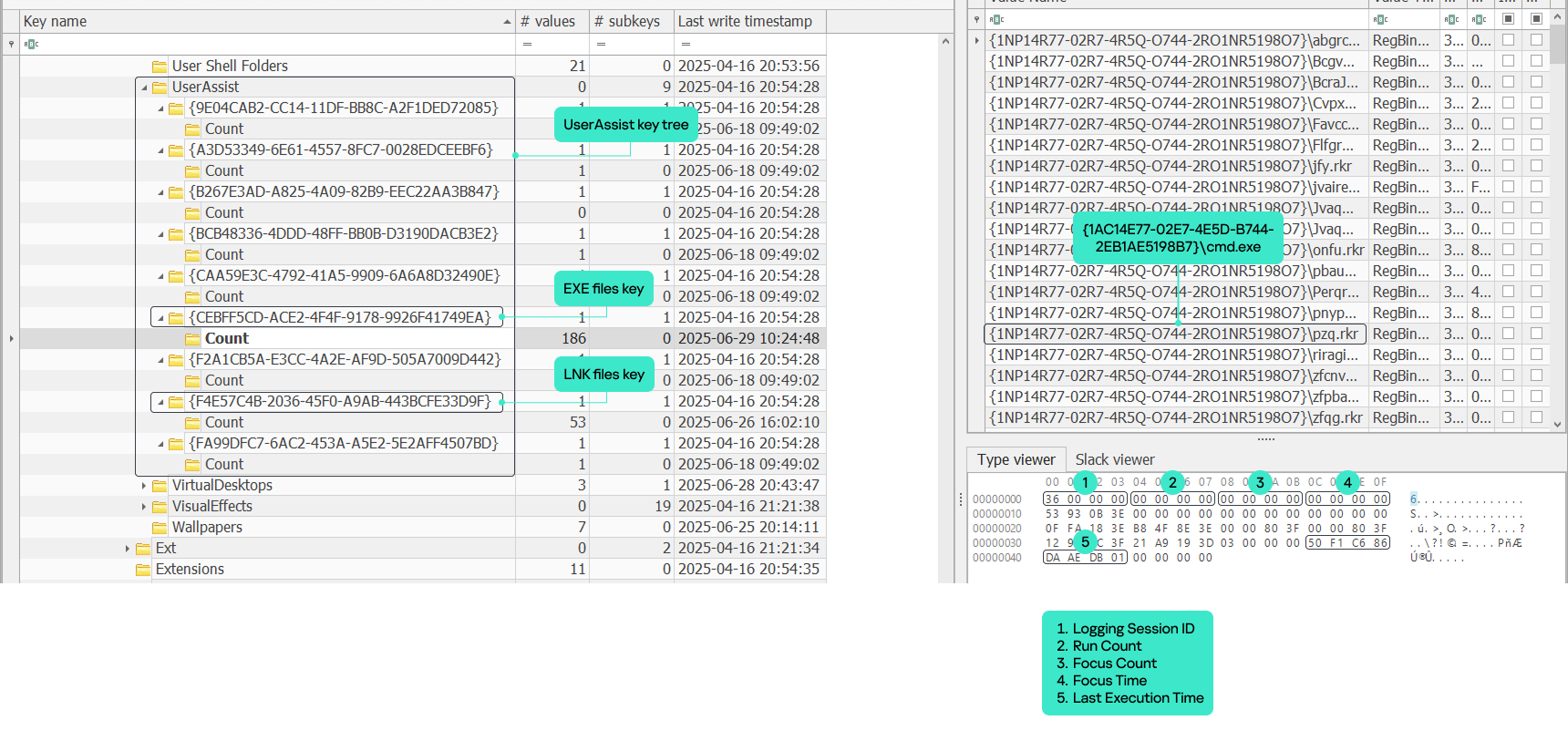
    The UserAssist artifact is a registry key under each NTUSER.DAT hive located at SoftwareMicrosoftWindows‌CurrentVersionExplorerUserAssist. The key consists of subkeys named with GUIDs. The two most important GUID subkeys are:

    • {CEBFF5CD-ACE2-4F4F-9178-9926F41749EA}: registers executed EXE files.
    • {F4E57C4B-2036-45F0-A9AB-443BCFE33D9F}: registers executed LNK files.

    Each subkey has its own subkey named “Count”. It contains values that represent the executed programs. The value names are the program paths encrypted using the ROT-13 cipher.

    The values contain structured binary data that includes the run count, focus count, focus time and last execution time of the respective application. This structure is well-known and represents the CUACount object. The bytes between focus time and last execution time have never been described or analyzed publicly, but we managed to determine what they are and will explain this later in the article. The last four bytes are unknown and contained a zero in all the datasets we analyzed.

    UserAssist artifact

    Data inconsistency

    Over the course of many investigations, the UserAssist data was found to be inconsistent. Some values included all of the parameters described above, while others, for instance, included only run count and last execution time. Overall, we observed five combinations of UserAssist data inconsistency.

    Cases Run Count Focus Count Focus Time Last Execution Time
    1
    2
    3
    4
    5

    Workflow analysis

    Deep dive into Shell32 functions

    To understand the reasons behind the inconsistency, we must examine the component responsible for registering and updating the UserAssist data. Our analysis revealed that the component in question is shell32.dll, more specifically, a function called FireEvent that belongs to the CUserAssist class.

    The FireEvent arguments are as follows:

    • Argument 1: GUID that is a subkey of the UserAssist registry key containing the registered data. This argument most often takes the value {CEBFF5CD-ACE2-4F4F-9178-9926F41749EA} because executed programs are mostly EXE files.
    • Argument 2: integer enumeration value that defines which counters and data should be updated.
      • Value 0: updates the run count and last execution time
      • Value 1: updates the focus count
      • Value 2: updates the focus time
      • Value 3: unknown
      • Value 4: unknown (we assume it is used to delete the entry).
    • Argument 3: full executable path that has been executed, focused on, or closed.
    • Argument 4: focus time spent on the executable in milliseconds. This argument only contains a value if argument 2 has a value of 2; otherwise, it equals zero.

    Furthermore, the FireEvent function relies heavily on two other shell32.dll functions: s_Read and s_Write. These functions are responsible for reading and writing the binary value data of UserAssist from and to the registry whenever a particular application is updated:

    The s_Read function reads the binary value of the UserAssist data from the registry to memory, whereas s_Write writes the binary value of the UserAssist data to the registry from the memory. Both functions have the same arguments, which are as follows:

    • Argument 1: pointer to the memory buffer (the CUACount struct) that receives or contains the UserAssist binary data.
    • Argument 2: size of the UserAssist binary data in bytes to be read from or written to registry.
    • Argument 3: undocumented structure containing two pointers.
      • The CUADBLog instance pointer at the 0x0 offset
      • Full executable path in plain text that the associated UserAssist binary data needs to be read from or written to the registry.

    When a program is executed for the first time and there is no respective entry for it in the UserAssist records, the s_Read function reads the UEME_CTLCUACount:ctor value, which serves as a template for the UserAssist binary data structure (CUACount). We’ll describe this value later in the article.

    It should be noted that the s_Read and s_Write functions are also responsible for encrypting the value names with the ROT-13 cipher.

    UserAssist data update workflow

    Any interaction with a program that displays a GUI is a triggering event that results in a call to the CUserAssist::FireEvent function. There are four types of triggering events:

    • Program executed.
    • Program set in focus.
    • Program set out of focus.
    • Program closed.

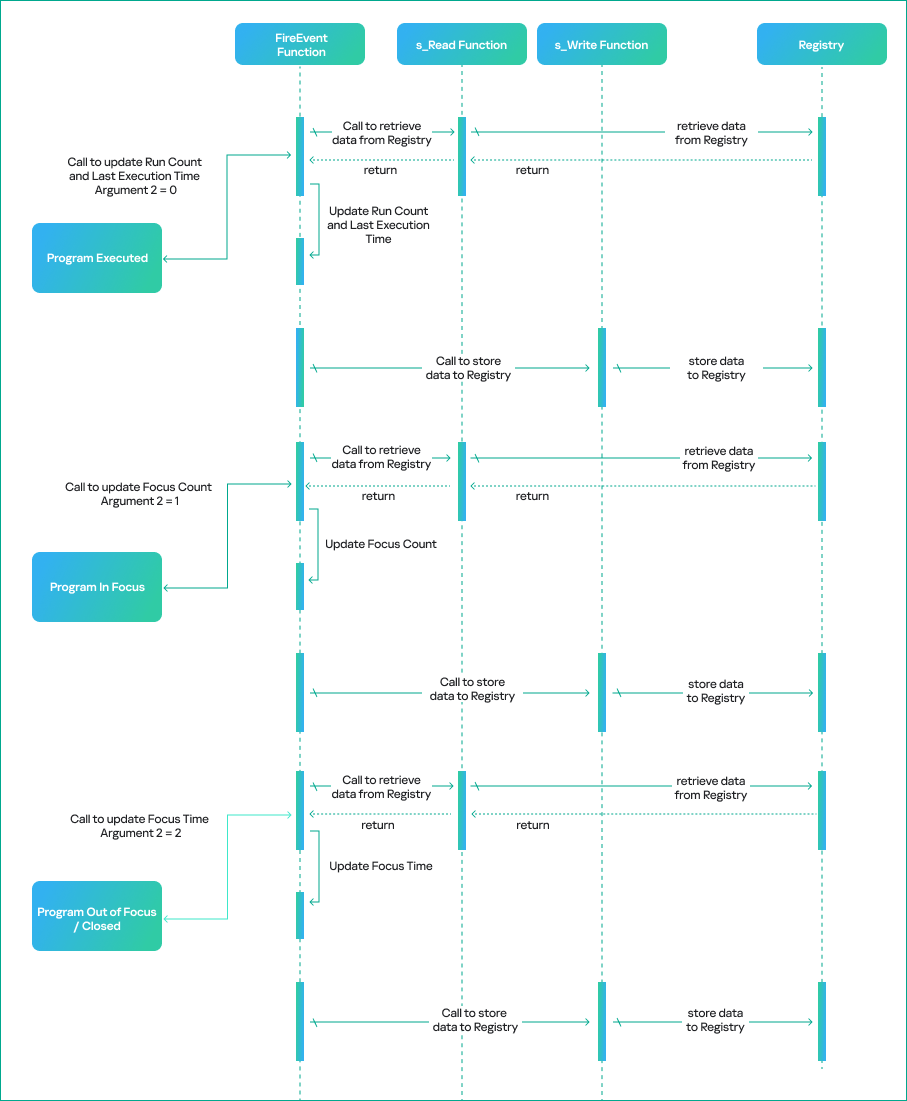
    The triggering event determines the execution workflow of the CUserAssist::FireEvent function. The workflow is based on the enumeration value that is passed as the second argument to FireEvent and defines which counters and data should be updated in the UserAssist binary data.

    The CUserAssist::FireEvent function calls the CUADBLog::s_Read function to read the binary data from registry to memory. The CUserAssist::FireEvent function then updates the respective counters and data before calling CUADBLog::s_Write to store the data back to the registry.

    The diagram below illustrates the workflow of the UserAssist data update process depending on the interaction with a program.

    UserAssist data update workflow

    The functions that call the FireEvent function vary depending on the specific triggering event caused by interaction with a program. The table below shows the call stack for each triggering event, along with the modules of the functions.

    Triggering event Module Call Stack Functions Details
    Program executed (double click) SHELL32 CUserAssist::FireEvent This call chain updates the run count and last execution time. It is only triggered when the executable is double-clicked, whether it is a CLI or GUI in File Explorer.
    Windows.storage UAFireEvent
    Windows.storage NotifyUserAssistOfLaunch
    Windows.storage CInvokeCreateProcessVerb::
    _OnCreatedProcess
    Program in focus SHELL32 CUserAssist::FireEvent This call chain updates the focus count and only applies to GUI executables.
    Explorer UAFireEvent
    Explorer CApplicationUsageTracker::
    _FireDelayedSwitch
    Explorer CApplicationUsageTracker::
    _FireDelayedSwitchCallback
    Program out of focus SHELL32 CUserAssist::FireEvent This call chain updates the focus time and only applies to GUI executables.
    Explorer UAFireEvent
    Explorer ac47d9dd501738f1>::operator()
    Explorer shell::TaskScheduler::
    CSimpleRunnableTaskParam
    ac47‌d9dd501738f1>‌,
    CMemString_PolicyCoTaskMem>
    >::InternalResumeRT
    Program closed SHELL32 CUserAssist::FireEvent This call chain updates the focus time and applies to GUI and CLI executables. However, CLI executables are only updated if the program was executed via a double click or if conhost was spawned as a child process.
    Explorer UAFireEvent
    Explorer shell::TaskScheduler::
    CSimpleRunnableTaskParamlambda_5b4995a8d0f55408566e‌10
    b459ba2cbe>‌,CMemStringCMemString‌_PolicyCoTaskMem> >
    ::InternalResumeRT

    Inconsistency breakdown

    As previously mentioned, we observed five combinations of UserAssist data. Our thorough analysis shows that these inconsistencies arise from interactions with a program and various functions that call the FireEvent function. Now, let’s examine the triggering events that cause these inconsistencies in more detail.

    1.   All data

    The first combination is all four parameters registered in the UserAssist record: run count, focus count, focus time, and last execution time. In this scenario, the program usually follows the normal execution flow, has a GUI and is executed by double-clicking in Windows Explorer.

    • When the program is executed, the FireEvent function is called to update the run count and last execution time.
    • When it is set in focus, the FireEvent function is called to update the focus count.
    • When it is set out of focus or closed, the FireEvent function is called to update focus time.

    2.   Run count and last execution time

    The second combination occurs when the record only contains run count and last execution time. In this scenario, the program is run by double-clicking in Windows Explorer, but the GUI that appears belongs to another program. Examples of this scenario include launching an application with an LNK shortcut or using an installer that runs a different GUI program, which switches the focus to the other program file.

    During our test, a copy of calc.exe was executed in Windows Explorer using the double-click method. However, the GUI program that popped up was the UWP app for the calculator Microsoft.WindowsCalculator_8wekyb3d8bbwe!App.

    There is a record of the calc.exe desktop copy in UserAssist, but it contains only the run count and last execution time. However, both focus count and focus time are recorded under the UWP calculator Microsoft.WindowsCalculator_8wekyb3d8bbwe!App UserAssist entry.

    3.   Focus count and focus time

    The third combination is a record that only includes focus count and focus time. In this scenario, the program has a GUI, but is executed by means other than a double click in Windows Explorer, for example, via a command line interface.

    During our test, a copy of Process Explorer from the Sysinternals Suite was executed through cmd and recorded in UserAssist with focus count and focus time only.

    4.   Run count, last execution time and focus time

    The fourth combination is when the record contains run count, last execution time and focus time. This scenario only applies to CLI programs that are run by double-clicking and then immediately closed. The double-click execution leads to the run count and last execution time being registered. Next, the program close event will call the FireEvent function to update the focus time, which is triggered by the lambda function (5b4995a8d0f55408566e10b459ba2cbe).

    During our test, a copy of whoami.exe was executed by a double click, which opened a console GUI for a split second before closing.

    5.   Focus time

    The fifth combination is a record with only focus time registered. This scenario only applies to CLI programs executed by means other than a double click, which opens a console GUI for a split second before it is immediately closed.

    During our test, a copy of whoami.exe was executed using PsExec instead of cmd. PsExec executed whoami as its own child process, resulting in whoami spawning a conhost.exe process. This condition must be met for the CLI program to be registered in UserAssist in this scenario.

    We summed up all five combinations with their respective interpretations in the table below.

    Inconsistency combination Interpretation Triggering events
    All Data GUI program executed by double
    click and closed normally.
    ·        Program Executed
    ·        Program In Focus
    ·        Program Out of Focus
    ·        Program Closed
    Run Count and Last Execution Time GUI program executed by double
    click but focus switched to another
    program.
    ·        Program Executed
    Focus Count and Focus Time GUI program executed by other means. ·        Program In Focus
    ·        Program Out of Focus
    ·        Program Closed
    Run Count, Last Execution Time and Focus Time CLI program executed by double
    click and then closed.
    ·        Program Executed
    ·        Program Closed
    Focus Time CLI program executed by other
    means than double click, spawned
    conhost process and then closed.
    ·        Program Closed

    CUASession and UEME_CTLSESSION

    Now that we have addressed the inconsistency of the UserAssist artifact, the second part of this research will explain another aspect of UserAssist: the CUASession class and the UEME_CTLSESSION value.

    The UserAssist database contains value names for every executed program, but there is an unknown value: UEME_CTLSESSION. Unlike the binary data that is recorded for every program, this value contains larger binary data: 1612 bytes, whereas the regular size of values for executed programs is 72 bytes.

    CUASession is a class within shell32.dll that is responsible for maintaining statistics of the entire UserAssist logging session for all programs. These statistics include total run count, total focus count, total focus time and the three top program entries, known as NMax entries, which we will describe below. The UEME_CTLSESSION value contains the properties of the CUASession object. Below are some functions of the CUASession class:

    CUASession::AddLaunches(uint) CUASession::GetTotalLaunches(void)
    CUASession::AddSwitches(uint) CUASession::GetTotalSwitches(void)
    CUASession::AddUserTime(ulong) CUASession::GetTotalUserTime(void)
    CUASession::GetNMaxCandidate(enum _tagNMAXCOLS, struct SNMaxEntry *) CUASession::SetNMaxCandidate(enum _tagNMAXCOLS, struct SNMaxEntry const *)

    In the context of CUASession and UEME_CTLSESSION, we will refer to run count as launches, focus count as switches, and focus time as user time when discussing the parameters of all executed programs in a logging session as opposed to the data of a single program.

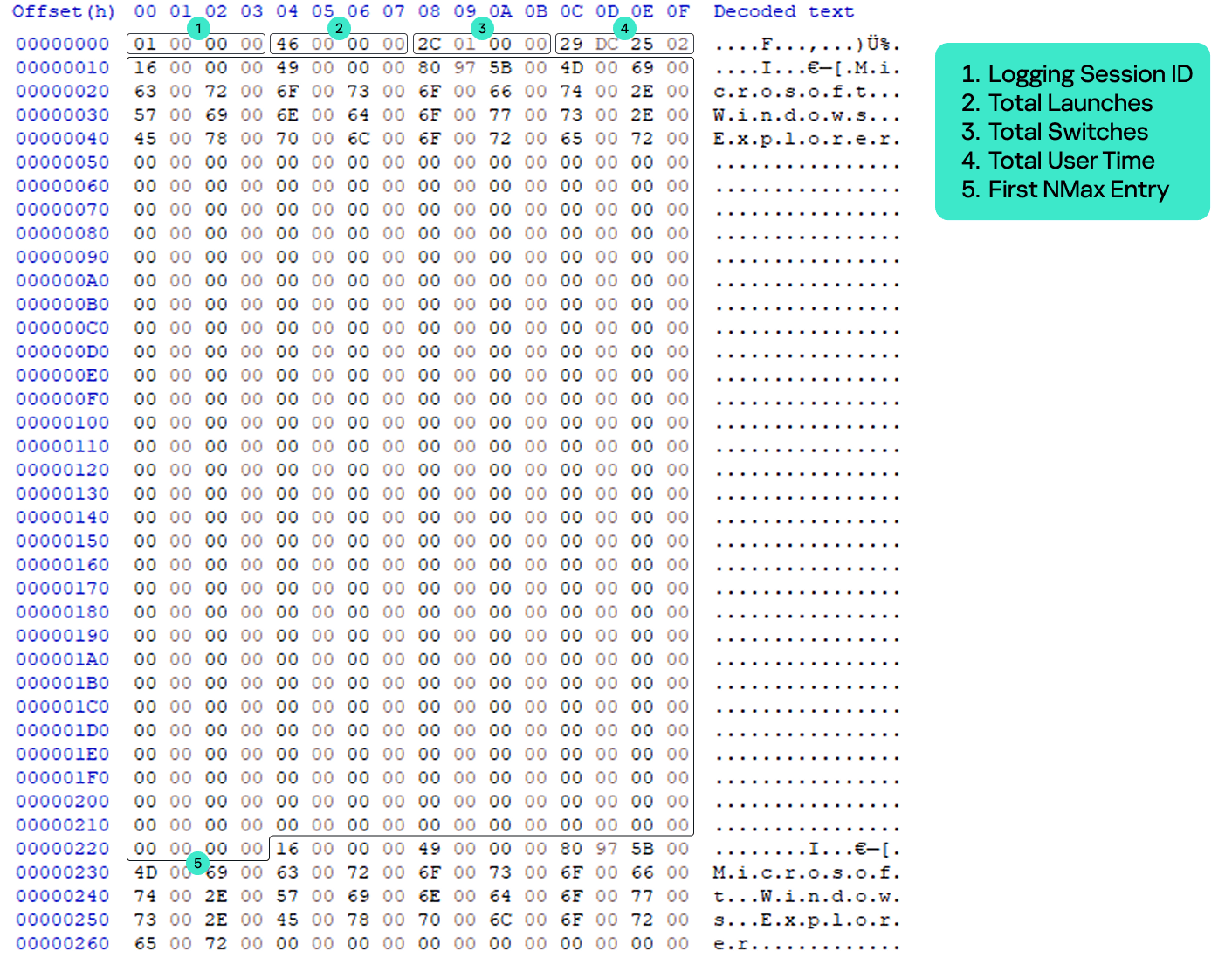
    The UEME_CTLSESSION value has the following specific data structure:

    • 0x0 offset: general total statistics (16 bytes)
      • 0x0: logging session ID (4 bytes)
      • 0x4: total launches (4 bytes)
      • 0x8: total switches (4 bytes)
      • 0xC: total user time in milliseconds (4 bytes)
    • 0x10 offset: three NMax entries (1596 bytes)
      • 0x10: first NMax entry (532 bytes)
      • 0x224: second NMax entry (532 bytes)
      • 0x438: third NMax entry (532 bytes)

    UEME_CTLSESSION structure

    Every time the FireEvent function is called to update program data, CUASession updates its own properties and saves them to UEME_CTLSESSION.

    • When FireEvent is called to update the program’s run count, CUASession increments Total Launches in UEME_CTLSESSION.
    • When FireEvent is called to update the program’s focus count, CUASession increments Total Switches.
    • When FireEvent is called to update the program’s focus time, CUASession updates Total User Time.

    NMax entries

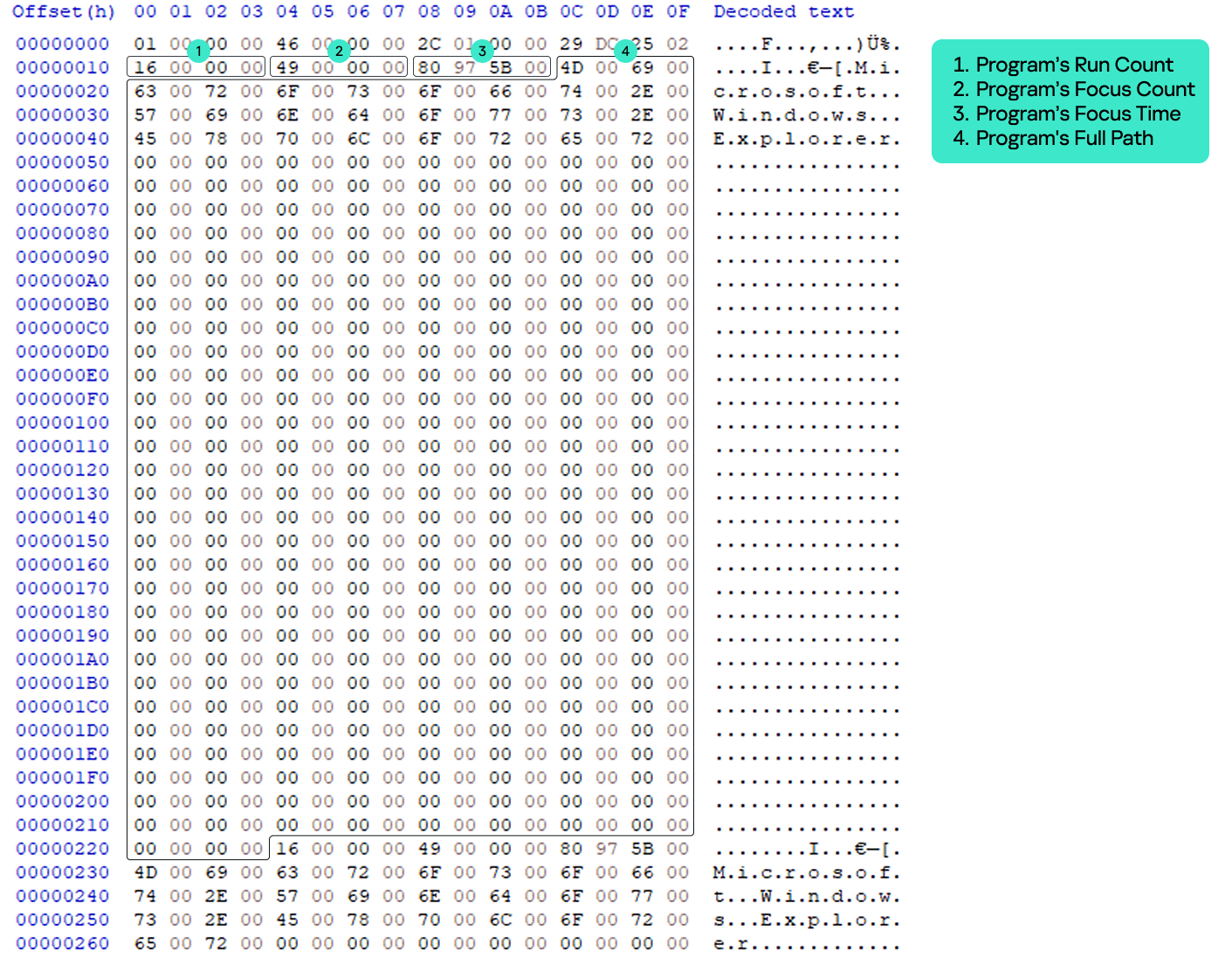
    The NMax entry is a portion of the UserAssist data for the specific program that contains the program’s run count, focus count, focus time, and full path. NMax entries are part of the UEME_CTLSESSION value. Each NMax entry has the following data structure:

    • 0x0 offset: program’s run count (4 bytes)
    • 0x4 offset: program’s focus count (4 bytes)
    • 0x8 offset: program’s focus time in milliseconds (4 bytes)
    • 0xc offset: program’s name/full path in Unicode (520 bytes, the maximum Windows path length multiplied by two)

    NMax entry structure

    The NMax entries track the programs that are executed, switched, and used most frequently. Whenever the FireEvent function is called to update a program, the CUADBLog::_CheckUpdateNMax function is called to check and update the NMax entries accordingly.

    The first NMax entry stores the data of the most frequently executed program based on run count. If two programs (the program whose data was previously saved in the NMax entry and the program that triggered the FireEvent for update) have an equal run count, the entry is updated based on the higher calculated value between the two programs, which is called the N value. The N value equation is as follows:

    N value = Program’s Run Count*(Total User Time/Total Launches) + Program’s Focus Time + Program’s Focus Count*(Total User Time/Total Switches)

    The second NMax entry stores the data of the program with the most switches, based on its focus count. If two programs have an equal focus count, the entry is updated based on the highest calculated N value.

    The third NMax entry stores the data of the program that has been used the most, based on the highest N value.

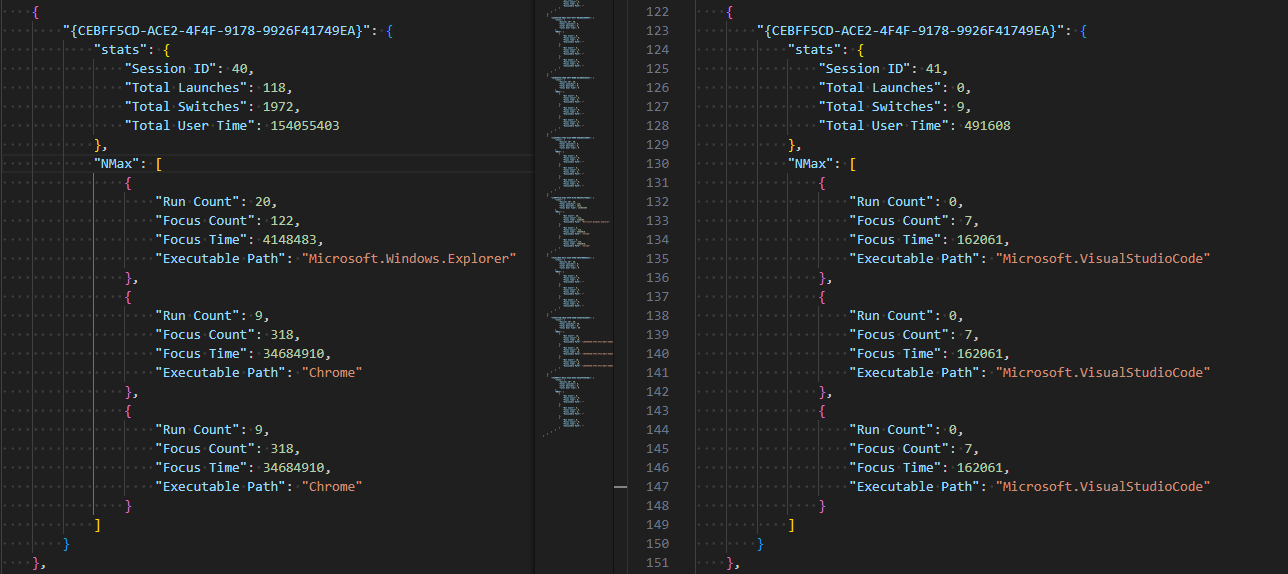
    The parsed UEME_CTLSESSION structure with NMax entries is shown below.

    UEME_CTLSESSION data

    UserAssist reset

    UEME_CTLSESSION will persist even after logging off or restarting. However, when it reaches the threshold of two days in its total user time, i.e., when the total focus time of all executed programs of the current user equals two days, the logging session is terminated and almost all UserAssist data, including the UEME_CTLSESSION value, is reset.

    The UEME_CTLSESSION value is reset with almost all its data, including total launches, total switches, total user time, and NMax entries. However, the session ID is incremented and a new logging session begins.

    UEME_CTLSESSION comparison before and after reset

    The newly incremented session ID is copied to offset 0x0 of each program’s UserAssist data. Besides UEME_CTLSESSION, other UserAssist data for each program is also reset including run count, focus count, focus time, and the last four bytes, which are still unknown and always contain zero. The only parameter that is not reset is the last execution time. However, all this data is saved in the form of a usage percentage before resetting.

    Usage percentage and counters

    We analyzed the UserAssist data of various programs to determine the unknown bytes between the focus time and last execution time sections. We found that they represent a list of a program’s usage percentage relative to the most used program at that session, as well as the rewrite counter (the index of the usage percentage last written to the list) for the last 10 sessions. Given our findings, we can now revise the structure of the program’s UserAssist binary data and fully describe all of its components.

    UserAssist revised structure

    • 0x0: logging session ID (4 bytes).
    • 0x4: run count (4 bytes).
    • 0x8: focus count (4 bytes).
    • 0xc: focus time (4 bytes).
    • 0x10: element in usage percentage list [0] (4 bytes).
    • 0x14: element in usage percentage list [1] (4 bytes).
    • 0x18: element in usage percentage list [2] (4 bytes).
    • 0x1c: element in usage percentage list [3] (4 bytes).
    • 0x20: element in usage percentage list [4] (4 bytes).
    • 0x24: element in usage percentage list [5] (4 bytes).
    • 0x28: element in usage percentage list [6] (4 bytes).
    • 0x2c: element in usage percentage list [7] (4 bytes).
    • 0x30: element in usage percentage list [8] (4 bytes).
    • 0x34: element in usage percentage list [9] (4 bytes).
    • 0x38: index of last element written in the usage percentage list (4 bytes).
    • 0x3c: last execution time (Windows FILETIME structure) (8 bytes).
    • 0x44: unknown value (4 bytes).

    The values from 0x10 to 0x37 are the usage percentage values that are called r0 values and calculated based on the following equation.

    r0 value [Index] = N Value of the Program / N Value of the Most Used Program in the session (NMax entry 3)

    If the program is run for the first time within an ongoing logging session, its r0 values equal -1, which is not a calculated value, but a placeholder.

    The offset 0x38 is the index of the last element written to the list, and is incremented whenever UEME_CTLSESSION is reset. The index is bounded between zero and nine because the list only contains the r0 values of the last 10 sessions.

    The last four bytes equal zero, but their purpose remains unknown. We have not observed them being used other than being reset after the session expires.

    The table below shows a sample of the UserAssist data broken down by component after parsing.

    UserAssist revised data structure parsed

    Forensic value

    The r0 values are a goldmine of valuable information about a specific user’s application and program usage. These values provide useful information for incident investigations, such as the following:

    • Programs with many 1 values in the r0 values list are the programs most frequently used by the user.
    • Programs with many 0 values in the r0 values list are the programs that are least used or abandoned by the user, which could be useful for threat hunting and lead to the discovery of malware or legitimate software used by adversaries.
    • Programs with many -1 values in the r0 values list are relatively new programs with data that has not been reset within two days of the user interactive session.

    UserAssist data template

    As mentioned above, when the program is first executed and doesn’t yet have its own UserAssist record (CUACount object), a new entry is created with the UEME_CTLCUACount:ctor value. This value serves as a template for the program’s UserAssist binary data with the following values:

    • Logging session ID = -1 (0xffffffff). However, this value is copied to the UserAssist entry from the current UEME_CTLSESSION session.
    • Run count = 0.
    • Focus count = 0.
    • Focus time = 0.
    • Usage percentage list [0-9] = -1 (0xbf800000) because these values are float numbers.
    • Usage percentage index (counter) = -1 (0xffffffff).
    • Last execution time = 0.
    • Last four bytes = 0.

    UEME_CTLCUACount:ctor data

    New parser

    Based on the findings of this research, we created a new parser built on an open source parser. Our new tool parses and saves all UEME_CTLSESSION values as a JSON file. It also parses UserAssist data with the newly discovered r0 value structure and saves it as a CSV file.

    Conclusion

    We closely examined the UserAssist artifact and how its data is structured. Our thorough analysis helped identify data inconsistencies. The FireEvent function in shell32.dll is primarily responsible for updating the UserAssist data. Various interactions with programs trigger calls to the FireEvent function and they are the main reason for the inconsistencies in the UserAssist data.

    We also studied the UEME_CTLSESSION value. It is mainly responsible for coordinating the UserAssist logging session that expires once the accumulated focus time of all programs reaches two days. Further investigation of UEME_CTLSESSION revealed the purpose of previously undocumented UserAssist binary data values, which turned out to be the usage percentage list of programs and the value rewrite counter.

    The UserAssist artifact is a valuable tool for incident response activities, and our research can help make the most of the data it contains.

    MIL OSI Economics

  • MIL-OSI Analysis: Cycling can be 4 times more efficient than walking. A biomechanics expert explains why

    Source: The Conversation – Global Perspectives – By Anthony Blazevich, Professor of Biomechanics, Edith Cowan University

    You’re standing at your front door, facing a five kilometre commute to work. But you don’t have your car, and there’s no bus route. You can walk for an hour – or jump on your bicycle and arrive in 15 minutes, barely breaking a sweat. You choose the latter.

    Many people would make the same choice. It’s estimated that there are more than a billion bikes in the world. Cycling represents one of the most energy-efficient forms of transport ever invented, allowing humans to travel faster and farther while using less energy than walking or running.

    But why exactly does pedalling feel so much easier than pounding the pavement? The answer lies in the elegant biomechanics of how our bodies interact with this two-wheeled machine.

    A wonderfully simple machine

    At its heart, a bicycle is wonderfully simple: two wheels (hence “bi-cycle”), pedals that transfer power through a chain to the rear wheel, and gears that let us fine-tune our effort. But this simplicity masks an engineering that perfectly complements human physiology.

    When we walk or run, we essentially fall forward in a controlled manner, catching ourselves with each step. Our legs must swing through large arcs, lifting our heavy limbs against gravity with every stride. This swinging motion alone consumes a lot of energy. Imagine: how tiring would it be to even swing your arms continuously for an hour?

    On a bicycle, your legs move through a much smaller, circular motion. Instead of swinging your entire leg weight with each step, you’re simply rotating your thighs and calves through a compact pedalling cycle. The energy savings are immediately noticeable.

    But the real efficiency gains come from how bicycles transfer human power to forward motion. When you walk or run, each footstep involves a mini-collision with the ground. You can hear it as the slap of your shoe against the road, and you can feel it as vibrations running through your body. This is energy being lost, literally dissipated as sound and heat after being sent through your muscles and joints.

    Walking and running also involve another source of inefficiency: with each step, you actually brake yourself slightly before propelling forward. As your foot lands ahead of your body, it creates a backwards force that momentarily slows you down. Your muscles then have to work extra hard to overcome this self-imposed braking and accelerate you forward again.

    Kissing the road

    Bicycles use one of the world’s great inventions to solve these problems – wheels.

    Instead of a collision, you get rolling contact – each part of the tyre gently “kisses” the road surface before lifting off. No energy is lost to impact. And because the wheel rotates smoothly so the force acts perfectly vertically on the ground, there’s no stop-start braking action. The force from your pedalling translates directly into forward motion.

    But bicycles also help our muscles to work at their best. Human muscles have a fundamental limitation: the faster they contract, the weaker they become and the more energy they consume.

    This is the famous force-velocity relationship of muscles. And it’s why sprinting feels so much harder than jogging or walking – your muscles are working near their speed limit, becoming less efficient with every stride.

    Bicycle gears solve this problem for us. As you go faster, you can shift to a higher gear so your muscles don’t have to work faster while the bike accelerates. Your muscles can stay in their sweet spot for both force production and energy cost. It’s like having a personal assistant that continuously adjusts your workload to keep you in the peak performance zone.

    Cycling can be at least four times more energy-efficient than walking and eight times more efficient than running.
    The Conversation, CC BY

    Walking sometimes wins out

    But bicycles aren’t always superior.

    On very steep hills of more than about 15% gradient (so you rise 1.5 metres every 10 metres of distance), your legs struggle to generate enough force through the circular pedalling motion to lift you and the bike up the hill. We can produce more force by pushing our legs straight out, so walking (or climbing) becomes more effective.

    Even if roads were built, we wouldn’t pedal up Mount Everest.

    This isn’t the case for downhills. While cycling downhill becomes progressively easier (eventually requiring no energy at all), walking down steep slopes actually becomes harder.

    Once the gradient exceeds about 10% (it drops by one metre for every ten metres of distance), each downhill step creates jarring impacts that waste energy and stress your joints. Walking and running downhill isn’t always as easy as we’d expect.

    Not just a transportation device

    The numbers speak for themselves. Cycling can be at least four times more energy-efficient than walking and eight times more efficient than running. This efficiency comes from minimising three major energy drains: limb movement, ground impact and muscle speed limitations.

    So next time you effortlessly cruise past pedestrians on your morning bike commute, take a moment to appreciate the biomechanical work of art beneath you. Your bicycle isn’t just a transport device, but a perfectly evolved machine that works in partnership with your physiology, turning your raw muscle power into efficient motion.

    Anthony Blazevich does not work for, consult, own shares in or receive funding from any company or organisation that would benefit from this article, and has disclosed no relevant affiliations beyond their academic appointment.

    ref. Cycling can be 4 times more efficient than walking. A biomechanics expert explains why – https://theconversation.com/cycling-can-be-4-times-more-efficient-than-walking-a-biomechanics-expert-explains-why-257120

    MIL OSI Analysis

  • MIL-OSI China: Equipment manufacturers driving trade growth

    Source: People’s Republic of China – State Council News

    A drone photo shows the shipbuilding site of the subsidiary of China State Shipbuilding Corp Ltd in the Guangxi Zhuang autonomous region on March 20. [Photo/Xinhua]

    In early July, a shipyard along the Yangtze River in Jiangyin, East China’s Jiangsu province, was humming with the sounds of welding and hammering.

    In one berth, work on an oil tanker was nearing completion, while a hospital ship was undergoing a major retrofit. A little distance away, dry docks were operating at full throttle.

    CSSC Chengxi Shipyard Co, a subsidiary of China State Shipbuilding Corp, saw its export value surge by more than 28 percent year-on-year in the first five months. With orders lined up through 2028 and a growing appetite for high-tech vessels, this shipyard is powering full steam ahead.

    “We are steering toward transformation,” said Yang Haibo, the shipyard’s assistant president. “Take the 41,800-ton self-unloading vessel we built last year; its value hit $96 million, triple that of a conventional bulk carrier. We just secured an overseas order to build a 44,000-ton self-discharger in May.”

    As global demand shifts, Yang said Chinese shipyards are embracing greener and smarter solutions to remain competitive, including ramping up investment in next-generation shipbuilding technologies.

    Much like China’s new energy vehicle, industrial robot and energy storage sectors, the shipbuilding industry exemplifies how domestic manufacturers are adopting innovation and green development to rise above the challenges posed by unilateralism and geoeconomic fragmentation.

    In the process, they are playing a vital role in supporting the country’s foreign trade and industrial upgrade.

    As a high value-added sector, the equipment manufacturing industry has become a key driver of China’s export restructuring.

    The country’s exports of equipment manufacturing products amounted to 6.22 trillion yuan ($853.3 billion) between January and May, up 9.2 percent year-on-year, accounting for 58.3 percent of the country’s total exports, data from the General Administration of Customs showed.

    Meanwhile, China’s exports of electric vehicles grew by 19 percent year-on-year, construction machinery by 10.7 percent, ships by 18.9 percent and industrial robots by an impressive 55.4 percent.

    Equipment manufacturing accounted for 73 percent of China’s export growth in the first five months, with the contribution rising to 76.9 percent in May alone, providing strong support for the steady growth of foreign trade, said Lyu Daliang, director-general of the administration’s department of statistics and analysis.

    The ongoing upgrade of China’s equipment manufacturing industry is not only fueling the growth of domestic manufacturers, but also delivering energy-efficient, high-tech and competitively priced products to its trading partners, said Chen Jianwei, a researcher at the University of International Business and Economics’ Academy of China Open Economy Studies in Beijing.

    This progress is accelerating the digital and green advancement of developed economies, while also supporting industrialization and urbanization in many developing and emerging markets, contributing to more balanced global development and long-term sustainability, said Chen.

    Among the key drivers of this momentum, industrial robots have rapidly become a standout export category. These multijoint robotic arms and other advanced robotic systems are widely used in sectors such as automotives, electronics, chemicals and consumer goods.

    As China’s production capabilities in this field continue to advance, a growing number of industrial robots are being exported to markets such as Thailand, Germany, the United States and the United Arab Emirates — underscoring the global appeal of the nation’s smart manufacturing solutions.

    At AgileX Robotics, a robotic arm manufacturer in Dongguan, Guangdong province, workers were busy packing robotic arms in late June. This batch of products, designed for data collection, plays a key role in the development and training of humanoid robots, and has gained strong traction in overseas markets.

    “We really can’t ship fast enough and demand is overwhelming. Our exports this year are expected to rise by 70 to 80 percent compared with 2024,” said Chen Peng, the company’s marketing director.

    Chen said that orders from overseas research institutions, particularly in the artificial intelligence field, are growing the fastest. These clients often require rapid delivery due to time-sensitive needs.

    This growth is not merely the success of a single robot manufacturer. Rather, it reflects a broader trend in Dongguan.

    The city’s exports of industrial robots, including industrial robotic arms, handling and welding robots, and robots with other functions, exceeded 190 million yuan during the January-May period, representing a year-on-year increase of 116.4 percent, data from Huangpu Customs showed.

    From an industrial chain perspective, China’s industrial robot sector has seen significant advancements over the past decade, especially in core components such as reducers, servo motors, controllers and control units, said Lei Lei, deputy secretary-general of the robotics branch of the Beijing-based China Machinery Industry Federation.

    Lei said Chinese industrial robot manufacturers are evolving their export models as they expand globally. This shift is already playing out among many companies in the sector.

    Xu Hongchun, vice-president of Suzhou JiBOT Technology Co, a Suzhou, Jiangsu province-based manufacturer of collaborative robotic arms and mobile robot platforms, said the company has already shifted toward providing customized end-to-end solutions for overseas factories and warehouses.

    “Our material handling robots are primarily used in the new energy and electronic semiconductor sectors,” said Xu. “Currently, more than 70 percent of our exports in this category include solution-based packages.”

    The Chinese company achieves this by integrating data from various robots into a centralized control system. A smart dispatching platform enables real-time coordination, allowing multiple robots to operate efficiently across different zones and meet the specific needs of its foreign clients.

    While industrial robots and intelligent automation are shifting manufacturing and logistics, traditional heavy industries are also embracing innovation and seizing more market opportunities across the world.

    In sectors such as mining and construction, Chinese companies are combining durable engineering with localization strategies to meet the needs of emerging markets.

    Sany Heavy Equipment Co, a mining and construction machinery manufacturer based in Shenyang, Liaoning province, has been actively expanding its presence in the African market. Its wide-body dump trucks, electric-powered dumpers and engineering excavators are widely used in countries including South Africa, Ghana, Angola and Zambia.

    “Africa is rich in mineral resources and has significant demand for mining machinery. Our mining equipment is built to withstand harsh operating conditions and is well-suited for the complex terrains found in mining areas,” said Sun Bo, head of the company’s sales unit.

    Sun said that Sany Heavy Equipment Co’s mining dump trucks have significantly improved operational efficiency and earned high praise from clients in countries such as Eritrea and Mozambique in recent years.

    The company’s exports amounted to 1.44 billion yuan in the first half, while its exports to Africa surged 230 percent year-on-year to 330 million yuan, the latest data from Shenyang Customs showed.

    Experts said the continued rise of China’s equipment manufacturing exports reflects both industrial progress and the country’s deeper integration into global supply chains.

    Zhao Ping, head of the academy of the Beijing-based China Council for the Promotion of International Trade, said that China is no longer just a source of affordable goods. It is increasingly a provider of complex, high-value equipment that meets the needs of developed and emerging markets alike.

    Zhao said that the combination of strong research and development capabilities, digitalized manufacturing processes and mature supply chains has enabled Chinese manufacturers to evolve from volume-driven to value-driven exports.

    “This transformation not only enhances China’s competitiveness, but also contributes to global industrial development and technological diffusion,” said Ji Xuehong, a professor at the School of Economics and Management at Beijing-based North China University of Technology.

    In the face of a complex and volatile external environment, China will steadfastly expand its high-standard opening-up and address the uncertainty of drastic changes in the external environment with the certainty of its own high-quality development, said Xiao Lu, deputy director-general of the department of foreign trade at the Ministry of Commerce.

    MIL OSI China News

  • MIL-OSI: BAY Miner Unveils Cutting-Edge Cloud Mining Platform for BTC, ETH, DOGE and More

    Source: GlobeNewswire (MIL-OSI)

    San Francisco, California, July 13, 2025 (GLOBE NEWSWIRE) — The global crypto market is evolving rapidly. Investors everywhere are chasing smarter, greener, and more stable ways to grow their portfolios. BAY Miner steps forward with a major breakthrough, unveiling a next-generation cloud mining platform designed for today’s realities. Whether you’re looking to mine Bitcoin (BTC), Ethereum (ETH), XRP, Dogecoin (DOGE), Litecoin (LTC), or Solana (SOL), BAY Miner makes it easier, safer, and more profitable.

    This is not just another cloud mining project. BAY Miner blends advanced technology, eco-friendly operations, and multi-asset flexibility to give investors an edge. As the crypto space grows more competitive, choosing the right mining partner matters more than ever.

    What Makes BAY Miner Stand Out in the Crypto Market?

    Many platforms promise fast returns. Few can back it up with real innovation and trust. BAY Miner sets itself apart by focusing on four crucial pillars:

    • Multi-Asset Mining Capabilities: Mine BTC, ETH, DOGE, XRP, LTC, and SOL all under one roof. Shift strategies anytime to adapt to market swings.
    • AI-Powered Optimization: Their smart algorithms constantly tweak mining operations, cutting waste and boosting profits.
    • Green Energy Commitment: BAY Miner uses renewable energy across its facilities, lowering costs and protecting the planet.
    • Full Transparency: Access live dashboards that show your earnings and mining stats. No shady math. No hidden deductions.

    On top of this, BAY Miner is fully mobile-optimized. Manage your entire mining portfolio straight from your phone. This is a huge advantage for investors in emerging markets who rely on mobile over desktop.

    Taking Advantage of BTC Halving and Rising Energy Prices

    The latest Bitcoin halving event sliced mining rewards in half. That means only the most efficient miners stay profitable. BAY Miner’s tech-driven operations use AI to adapt instantly to changing difficulty levels, ensuring your investment stays on track.

    Meanwhile, global energy costs continue to climb. BAY Miner’s reliance on renewable sources shields investors from these spikes. It’s a win for your wallet and for long-term sustainability.

    Why Registering with BAY Miner is the Smart Move

    1. One-click registration, enter the crypto mining field immediately

    BAY Miner registration provides a simple and clear process, allowing you to easily enter the crypto mining field without complex technical background, and seize the market opportunities of assets such as BTC, SOL, XRP, DOGE, etc.

    2. Eliminate cumbersome hardware and high electricity bills

    Without the need to purchase mining machines, manage noisy equipment or pay high electricity bills, the BAY Miner cloud mining platform allows users to be exempted from the burden of traditional mining and directly use funds for mining itself.

    3. Flexible selection of mining assets and plans

    After registration, users can freely choose mining assets such as BTC, SOL, XRP, DOGE, etc. according to personal preferences and strategies, and flexibly configure contract plans to adapt to market dynamics.

    4. Newbie-friendly participation experience

    The BAY Miner platform interface is intuitive. Register to get a $15 welcome bonus and a complete visual mining monitoring experience. Whether you are a crypto novice or a senior investor, you can easily follow the daily mining dynamics.

    5. Professional support ensures peace of mind

    BAY Miner provides 24/7 professional support to help users understand market dynamics, optimize mining strategies, and always get the assistance they need during cloud mining..

    BAY Miner Builds Trust Through Community and Education

    BAY Miner isn’t just a platform; it’s a thriving community of investors. They regularly host online webinars and publish updates to keep users informed. Learn strategies to maximize your returns, understand crypto market cycles, and connect with like-minded investors from around the globe.

    This approach builds a level of trust that’s rare in the crypto mining world. With BAY Miner, you’re not just a customer — you’re part of a growing network dedicated to smart, sustainable crypto growth.

    A Clear Path to Profits and Diversification

    Flexibility is key in crypto. BAY Miner lets you diversify without juggling multiple platforms. Mine BTC for stability, DOGE for community-driven growth, or hedge with ETH and SOL. You can adjust your focus anytime as market trends shift.

    Plus, with daily payouts, you see results fast. This keeps your cash flow healthy and your investment goals on track.

    Join BAY Miner Today and Secure Your Crypto Future

    Thousands across the globe have already put their trust in BAY Miner — and it’s easy to see why. This platform stands out for its rock-solid security, complete transparency, and resilience, even when crypto markets turn rough. Plus, BAY Miner’s commitment to ESG standards means you’re not just chasing profits; you’re supporting sustainable, low-impact mining that helps protect the planet.

    Now’s your chance to take charge of your crypto journey. Sign up today and start mining BTC, ETH, DOGE, XRP, LTC, and SOL without the headaches of managing hardware or paying steep electricity bills. With BAY Miner, you gain a dedicated partner focused on your long-term success.

    Ready to experience mining the smarter way?
    Visit BAY Miner’s official website to explore your options and see why so many investors rely on BAY Miner for steady growth, true flexibility, and complete peace of mind.

    Want to mine right from your phone?
    Download the app here: https://bayminer.com/xml/index.html#/app

    Website: https://www.bayminer.com
    Register and begin mining in just a few minutes.

    Press Contact:
    Alicia Thorne
    Global Communications Manager
    Email: info@bayminer.com

    Disclaimer: The information provided in this press release does not constitute an investment solicitation, nor does it constitute investment advice, financial advice, or trading recommendations. Cryptocurrency mining and staking involve risks. There is a possibility of financial loss. You are advised to perform due diligence before investing or trading in cryptocurrencies and securities, including consulting a professional financial advisor.

    Attachment

    The MIL Network

  • MIL-Evening Report: Cycling can be 4 times more efficient than walking. A biomechanics expert explains why

    Source: The Conversation (Au and NZ) – By Anthony Blazevich, Professor of Biomechanics, Edith Cowan University

    You’re standing at your front door, facing a five kilometre commute to work. But you don’t have your car, and there’s no bus route. You can walk for an hour – or jump on your bicycle and arrive in 15 minutes, barely breaking a sweat. You choose the latter.

    Many people would make the same choice. It’s estimated that there are more than a billion bikes in the world. Cycling represents one of the most energy-efficient forms of transport ever invented, allowing humans to travel faster and farther while using less energy than walking or running.

    But why exactly does pedalling feel so much easier than pounding the pavement? The answer lies in the elegant biomechanics of how our bodies interact with this two-wheeled machine.

    A wonderfully simple machine

    At its heart, a bicycle is wonderfully simple: two wheels (hence “bi-cycle”), pedals that transfer power through a chain to the rear wheel, and gears that let us fine-tune our effort. But this simplicity masks an engineering that perfectly complements human physiology.

    When we walk or run, we essentially fall forward in a controlled manner, catching ourselves with each step. Our legs must swing through large arcs, lifting our heavy limbs against gravity with every stride. This swinging motion alone consumes a lot of energy. Imagine: how tiring would it be to even swing your arms continuously for an hour?

    On a bicycle, your legs move through a much smaller, circular motion. Instead of swinging your entire leg weight with each step, you’re simply rotating your thighs and calves through a compact pedalling cycle. The energy savings are immediately noticeable.

    But the real efficiency gains come from how bicycles transfer human power to forward motion. When you walk or run, each footstep involves a mini-collision with the ground. You can hear it as the slap of your shoe against the road, and you can feel it as vibrations running through your body. This is energy being lost, literally dissipated as sound and heat after being sent through your muscles and joints.

    Walking and running also involve another source of inefficiency: with each step, you actually brake yourself slightly before propelling forward. As your foot lands ahead of your body, it creates a backwards force that momentarily slows you down. Your muscles then have to work extra hard to overcome this self-imposed braking and accelerate you forward again.

    Kissing the road

    Bicycles use one of the world’s great inventions to solve these problems – wheels.

    Instead of a collision, you get rolling contact – each part of the tyre gently “kisses” the road surface before lifting off. No energy is lost to impact. And because the wheel rotates smoothly so the force acts perfectly vertically on the ground, there’s no stop-start braking action. The force from your pedalling translates directly into forward motion.

    But bicycles also help our muscles to work at their best. Human muscles have a fundamental limitation: the faster they contract, the weaker they become and the more energy they consume.

    This is the famous force-velocity relationship of muscles. And it’s why sprinting feels so much harder than jogging or walking – your muscles are working near their speed limit, becoming less efficient with every stride.

    Bicycle gears solve this problem for us. As you go faster, you can shift to a higher gear so your muscles don’t have to work faster while the bike accelerates. Your muscles can stay in their sweet spot for both force production and energy cost. It’s like having a personal assistant that continuously adjusts your workload to keep you in the peak performance zone.

    Cycling can be at least four times more energy-efficient than walking and eight times more efficient than running.
    The Conversation, CC BY

    Walking sometimes wins out

    But bicycles aren’t always superior.

    On very steep hills of more than about 15% gradient (so you rise 1.5 metres every 10 metres of distance), your legs struggle to generate enough force through the circular pedalling motion to lift you and the bike up the hill. We can produce more force by pushing our legs straight out, so walking (or climbing) becomes more effective.

    Even if roads were built, we wouldn’t pedal up Mount Everest.

    This isn’t the case for downhills. While cycling downhill becomes progressively easier (eventually requiring no energy at all), walking down steep slopes actually becomes harder.

    Once the gradient exceeds about 10% (it drops by one metre for every ten metres of distance), each downhill step creates jarring impacts that waste energy and stress your joints. Walking and running downhill isn’t always as easy as we’d expect.

    Not just a transportation device

    The numbers speak for themselves. Cycling can be at least four times more energy-efficient than walking and eight times more efficient than running. This efficiency comes from minimising three major energy drains: limb movement, ground impact and muscle speed limitations.

    So next time you effortlessly cruise past pedestrians on your morning bike commute, take a moment to appreciate the biomechanical work of art beneath you. Your bicycle isn’t just a transport device, but a perfectly evolved machine that works in partnership with your physiology, turning your raw muscle power into efficient motion.

    Anthony Blazevich does not work for, consult, own shares in or receive funding from any company or organisation that would benefit from this article, and has disclosed no relevant affiliations beyond their academic appointment.

    ref. Cycling can be 4 times more efficient than walking. A biomechanics expert explains why – https://theconversation.com/cycling-can-be-4-times-more-efficient-than-walking-a-biomechanics-expert-explains-why-257120

    MIL OSI AnalysisEveningReport.nz

  • MIL-OSI Russia: 12 cooperation projects in the field of digital economy were signed at the SCO Digital Economic Forum

    Translation. Region: Russian Federal

    Source: People’s Republic of China in Russian – People’s Republic of China in Russian –

    An important disclaimer is at the bottom of this article.

    Source: People’s Republic of China – State Council News

    BEIJING, July 13 (Xinhua) — China, Kazakhstan, Pakistan, Egypt and other countries signed a total of 12 cooperation projects in the field of digital economy at the Digital Economic Forum of the Shanghai Cooperation Organization (SCO), according to the official website of the Central People’s Government of the People’s Republic of China.

    These projects reportedly cover areas such as cross-border e-commerce, smart cities, etc.

    Let us recall that the SCO Digital Economic Forum was held in Tianjin from July 10 to 11. The event, entitled “New Links of the Digital Economy, Jointly Expanding New Horizons of Cooperation,” consisted of an opening ceremony, a main forum, four thematic sub-forums, and other specialized events.

    The forum, jointly organized by the State Data Administration and the Tianjin People’s Government, was attended by more than 1,500 guests representing governments, enterprises, universities and think tanks of SCO member states.

    In recent years, the SCO countries have made significant progress in developing the digital economy. According to statistics, the online retail market of the SCO member states exceeded USD 3.2 trillion in 2024. -0-

    Please note: This information is raw content obtained directly from the source of the information. It is an accurate report of what the source claims and does not necessarily reflect the position of MIL-OSI or its clients.

    .

    MIL OSI Russia News

  • MIL-OSI Russia: Uzbekistan’s dried apricot exports up 36 percent in first five months of 2025

    Translation. Region: Russian Federal

    Source: People’s Republic of China in Russian – People’s Republic of China in Russian –

    An important disclaimer is at the bottom of this article.

    Source: People’s Republic of China – State Council News

    Tashkent, July 13 (Xinhua) — Uzbekistan exported 6,832 tons of dried apricots in January-May 2025, up 36 percent year-on-year, UzDaily.uz reported on Sunday, citing the National Statistics Committee of Uzbekistan.

    Uzbekistan reportedly exported 6,832 tons of dried apricots worth $10.6 million in January-May 2025. “Export volumes increased by 1,800 tons compared to the same period last year, representing a 36 percent increase,” the report said.

    The main export destinations are reportedly Kazakhstan /1,792 tons/, China /1,078 tons/, and Türkiye /1,023 tons/.

    In November 2024, the press service of the President of Uzbekistan reported that in 2025, the export of fruits and vegetables could reach $3.5 billion. –0–

    Please note: This information is raw content obtained directly from the source of the information. It is an accurate report of what the source claims and does not necessarily reflect the position of MIL-OSI or its clients.

    .

    MIL OSI Russia News

  • MIL-OSI: Topnotch Crypto launches innovative cloud mining app, allowing you to mine Bitcoin, Dogecoin, and Litecoin with just a few taps

    Source: GlobeNewswire (MIL-OSI)

    London, UK, July 12, 2025 (GLOBE NEWSWIRE) — Topnotch Crypto is a recognizable leader in the blockchain and digital asset space, and we are proud to announce the launch of our new mobile cloud mining app. Our easy, secure, and scalable app allows you to begin mining cryptocurrencies, like Bitcoin (BTC), Dogecoin (DOGE), and Litecoin (LTC), directly from your mobile device.

    Our app eliminates barriers to entry in crypto mining, like expensive hardware, complicated configurations, and large energy consumption, and allows mining to be accessible to anyone—no previous mining experience required, no upfront investment, and no ongoing overhead cost to start, you can enter the mining ecosystem with a few simple clicks.

    Start Mining Now—No Hardware or Technical Setup Required

    With our new mobile solution, Topnotch Crypto is change the way regular users can contribute to the crypto economy. You don’t have to have expensive mining rigs or need to worry about cooling, electricity costs, or complicated configurations. Our app is based on the cloud, so you will be using the mobile application, but everything is hosted on secure and efficient, remote servers.

    Download the app and start mining today! The interface is simple, and user-friendly, intuitive, from sign-up to start mining should be less than two minutes.

    Cloud Mining Powered by Clean Energy

    Topnotch Crypto takes environmental responsibility seriously. All cloud servers used in the app are powered by renewable energy sources, including solar, wind, and hydroelectric power. This green approach ensures the mining process remains sustainable while reducing the industry’s overall carbon footprint.

    By combining cutting-edge cloud technology with environmentally friendly energy, the company offers an innovative solution for users who want to support a cleaner future without compromising performance.

    Smart Mining Engine Built for All Skill Levels

    The app features a smart mining engine that automatically allocates computing power for maximum efficiency. It adjusts mining intensity in real time based on network conditions and the selected crypto asset. This automation ensures stable operation without user intervention, making it ideal for those who want to mine passively.

    Beginners benefit from its simplicity, while experienced users enjoy the reliability and transparency of a performance-optimized mining system.

    Clear Dashboard with Real-Time Monitoring

    The app has an individual mining dashboard where users can track performance statistics, contract length, and energy consumption. All information is dynamic, so users can see exactly how their mining operations are performed.

    The dashboard provides:

    •Live mining status

    •Daily progress tracking

    •Remaining time on active contracts

    •Performance summaries per coin

    There’s no guesswork—everything is displayed clearly and simply.

    Flexible Mining Contracts and Instant Setup

    Topnotch Crypto’s app offers multiple contract options to fit different needs. Whether users prefer to try mining with a short-term contract or commit to longer plans, the app offers complete flexibility. No prior experience is required.

    New users can register for an instant bonus, enabling users to trial the platform with no liability. The app provides trial plans and full 30-day mining contracts so users can start small and ensure they fully understand how it works before allocating further resources.

    Secure, Private, and Transparent

    Security is a top priority for Topnotch Crypto. All user accounts are protected with encrypted communication and secure wallet integration. The platform never compromises on user privacy or safety.

    All mined assets are stored in confirmation wallets under the user’s control. Withdrawal is simple and seamless with many currencies available, so users always have access to their digital assets.

    Accessible Worldwide with Multilingual Support

    Topnotch Crypto’s mobile app is available and accessible to users around the world. It hosts numerous languages and performs functionally in a range of mobile environments. Everything in the app is small in size and delivers functionality in places where users have awful or no connectivity. It can be used by any user regardless of their urban or rural location. The platform prioritizes superb customer service with the intention of being responsive with any challenges or issues presented to them, maximizing that every user experience is as smooth as possible from start to finish.

    How to Get Started

    Getting started is quick and effortless:

    1.Visit https://topnotchcrypto.com

    2.Download the official mobile app

    3.Create a free account and receive a welcome bonus

    4.Select a contract and start mining instantly

    No technical knowledge is required, and there are no hidden fees or complex terms.

    A New Standard in Mobile Mining

    Topnotch Crypto’s mobile mining app is a significant advancement toward making cryptocurrency more inclusive and environmentally sustainable. It removes financial and technical barriers, allowing anyone with a smartphone to participate in the digital asset ecosystem with ease and confidence.

    Start Now: https://topnotchcrypto.com

    Need Help? Contact: info@topnotchcrypto.com

    Mining made easy — the Topnotch way.

    Disclaimer: The information provided in this press release does not constitute an investment solicitation, nor does it constitute investment advice, financial advice, or a trading recommendation. Cryptocurrency mining and staking involve risks and may result in loss of funds. It is strongly recommended that you perform due diligence before investing or trading in cryptocurrencies and securities, including consulting a professional financial advisor.

    Attachment

    The MIL Network

  • MIL-OSI China: More policy options in H2 to spur growth

    Source: People’s Republic of China – State Council News

    Staff members operate at an assembly line of the north China base of FAW-Volkswagen in Tianjin, July 7, 2025. [Photo/Xinhua]

    Despite persistent global headwinds, recent economic data from China have demonstrated resilience in the first half of this year, coupled with a potential de-escalation of tensions between Beijing and Washington, prompting major foreign financial institutions to revise upward their full-year growth projections.

    As the economy faces external uncertainties and a high base effect from the previous year, experts said additional fiscal and monetary policies will be needed in the second half of the year to achieve the annual growth target of around 5 percent.

    The consumer price index, according to the National Bureau of Statistics on Wednesday, rose 0.1 percent in June from a year earlier — a turnaround from the previous four months’ decline, as the country’s consumption-boosting initiatives are translating into greater consumer confidence and spending.

    The purchasing managers’ index for China’s manufacturing sector also rose for a second straight month in June to 49.7, with more industries returning to growth, and high-tech and consumer goods production remaining robust, the bureau said late last month.

    Given that China’s pro-growth policies are helping the domestic economy maintain its growth momentum in recent months, Goldman Sachs raised its forecast for China’s GDP growth in 2025 by 0.6 percentage points, from 4 percent to 4.6 percent.

    Similarly, JPMorgan has revised China’s GDP growth forecast to 4.8 percent year-on-year from 4.1 percent, while Morgan Stanley has raised its projection by 0.3 percentage points to 4.5 percent.

    “The complexity, severity, and uncertainty of the current external environment are on the rise, which will undoubtedly have an impact on the stable operation of our economy,” Li Chao, a spokesman for the National Development and Reform Commission, said at a news conference in late June.

    Achieving China’s 5 percent annual growth target will demand a more forceful policy push in the coming months, with fiscal measures poised to take center stage, economists said.

    “In the second half of the year, China should continue to expedite the issuance and use of the remaining quotas for ultra-long-term special treasury bonds and special-purpose local government bonds, in order to better leverage their effects in boosting investment and promoting consumption,” Luo Zhiheng, chief economist at Yuekai Securities, said.

    Earlier this month, the Ministry of Finance announced the issuance of 11 ultra-long-term special treasury bonds in the third quarter, with four of them seeing their timelines accelerated compared with the previous plan released in April. This will help maintain a continuous flow of funding to support policies meant to boost consumption, analysts said.

    It is possible for policymakers to expand the issuance of ultra-long-term special treasury bonds this year to provide sustained support to the consumer goods trade-in program, should the remaining funding run out ahead of schedule, said Wang Qing, chief macroeconomic analyst at Golden Credit Rating International.

    Meanwhile, ramping up the issuance of special-purpose local government bonds is also a viable option, as it can help accelerate infrastructure investment and stabilize economic recovery, Wang added.

    Analysts also expect the People’s Bank of China, the country’s central bank, to leverage its policy tool kit to maintain ample liquidity in the financial system and support domestic demand.

    Citing the improved near-term growth outlook, Japanese investment bank Nomura trimmed its rate-cut forecast for the fourth quarter this year to 10 basis points from 15 basis points, while retaining estimates for a 50-basis-point cut in the reserve requirement ratio.

    MIL OSI China News

  • MIL-OSI Russia: For the first time, blueberries from the Chinese city of Dandong will be served on the tables of residents of the capital of Belarus

    Translation. Region: Russian Federal

    Source: People’s Republic of China in Russian – People’s Republic of China in Russian –

    An important disclaimer is at the bottom of this article.

    Source: People’s Republic of China – State Council News

    BEIJING, July 12 (Xinhua) — Blueberries from the Chinese city of Dandong in Liaoning Province (Northeast China) will soon be served on the tables of residents of the capital of Belarus for the first time.

    According to the Liaoning Daily newspaper, 2 tons of blueberries from the city of Dandong recently passed customs inspection and will be delivered to Minsk via the Manzhouli road checkpoint on the Chinese-Russian border.

    Dandong City is located on the Liaodong Peninsula, where the climate is moderately warm. Due to the excellent natural conditions, the city’s blueberry industry has been rapidly expanding in recent years. Now the city has formed a production chain in this industry from blueberry cultivation to export.

    “Dandong blueberries are in great demand in the domestic market, which prompted us to actively develop the overseas market,” said Li Xian’ao, director of one of the local trading companies.

    Blueberries contain anthocyanin pigments, phenolic compounds, carotenoids, tannins, organic acids and vitamins. In folk medicine, blueberries are used as a fixative for children’s stomach upset, and for inflammation of the mouth and throat. Blueberries are considered one of the best sources of phytonutrients with antioxidant action, they are used to prevent and treat cardiovascular diseases, dementia and Alzheimer’s disease. Fruit extracts improve visual acuity and eye accommodation.

    According to statistics, in 2024, the total area of blueberry cultivation in China exceeded 73 thousand hectares. Thus, China has become one of the countries with the fastest growth rate of production of these nutritious berries. -0-

    Please note: This information is raw content obtained directly from the source of the information. It is an accurate report of what the source claims and does not necessarily reflect the position of MIL-OSI or its clients.

    .

    MIL OSI Russia News

  • MIL-OSI Europe: Text adopted – 2023 and 2024 reports on North Macedonia – P10_TA(2025)0157 – Wednesday, 9 July 2025 – Strasbourg

    Source: European Parliament

    The European Parliament,

    –  having regard to the Stabilisation and Association Agreement between the European Communities and their Member States, of the one part, and the Republic of North Macedonia, of the other part(1),

    –  having regard to North Macedonia’s application for membership of the European Union, submitted on 22 March 2004,

    –  having regard to the European Council decision of 16 December 2005 to grant North Macedonia EU candidate country status,

    –  having regard to the European Council conclusions of 19-20 June 2003, including the annex thereto entitled ‘The Thessaloniki agenda for the Western Balkans: Moving towards European integration’,

    –  having regard to Regulation (EU) 2021/1529 of the European Parliament and of the Council of 15 September 2021 establishing the Instrument for Pre-Accession assistance (IPA III)(2),

    –  having regard to Regulation (EU) 2024/1449 of the European Parliament and of the Council of 14 May 2024 on establishing the Reform and Growth Facility for the Western Balkans(3),

    –  having regard to the Commission communication of 5 February 2020 entitled ‘Enhancing the accession process – A credible EU perspective for the Western Balkans’ (COM(2020)0057),

    –  having regard to the Commission communication of 8 November 2023 entitled ‘2023 Communication on EU Enlargement Policy’ (COM(2023)0690), accompanied by the Commission staff working document entitled ‘North Macedonia 2023 Report’ (SWD(2023)0693),

    –  having regard to the Commission communication of 8 November 2023 entitled ‘New growth plan for the Western Balkans’ (COM(2023)0691),

    –  having regard to the Commission communication of 20 March 2024 on pre-enlargement reforms and policy reviews (COM(2024)0146),

    –  having regard to the Commission communication of 24 July 2024 entitled ‘2024 Rule of Law Report’ (COM(2024)0800), accompanied by the Commission staff working document entitled ‘2024 Rule of Law Report – Country Chapter on the rule of law situation in North Macedonia’ (SWD(2024)0830),

    –  having regard to the Commission communication of 30 October 2024 entitled ‘2024 Communication on EU enlargement policy’ (COM(2024)0690), accompanied by the Commission staff working document entitled ‘North Macedonia 2024 Report’ (SWD(2024)0693),

    –  having regard to the Reform Agenda of North Macedonia as approved by the Commission under the Reform and Growth Facility on 23 October 2024,

    –  having regard to the declarations of the EU-Western Balkans summits of 13 December 2023 and of 18 December 2024 in Brussels as well as the declarations of the EU-Western Balkans summits held in Sofia, Zagreb and Brdo pri Kranju in 2018, 2020 and 2021 respectively, and the Declaration on the Common Regional Market and the Declaration on the Green Agenda for the Western Balkans agreed on 10 November 2020 at the Sofia Summit within the Berlin Process,

    –  having regard to the Council conclusions of 18 July 2022 on Enlargement – North Macedonia and Albania and the Council conclusions on Enlargement of 17 December 2024,

    –  having regard to the final report of 23 September 2024 of the Organization for Security and Co-operation in Europe (OSCE) Office for Democratic Institutions and Human Rights (ODIHR) Election Observation Mission on North Macedonia’s presidential election on 24 April 2024 and parliamentary elections on 8 May 2024,

    –  having regard to the Berlin Process launched on 28 August 2014,

    –  having regard to the Treaty of friendship, good neighbourliness and cooperation between Bulgaria and North Macedonia, signed on 1 August 2017 and ratified in January 2018;

    –  having regard to the Final Agreement for the settlement of the differences as described in the United Nations Security Council resolutions 817 (1993) and 845 (1993), the termination of the Interim Accord of 1995, and the establishment of a strategic partnership between Greece and North Macedonia, agreed on 17 June 2018, also known as the Prespa Agreement,

    –  having regard to the joint staff working document entitled ‘Objectives and Indicators to frame the implementation of the Gender Action Plan III (2021-25)’ (SWD(2020)0284) accompanying the joint communication of the Commission and the High Representative of the Union for Foreign Affairs and Security Policy of 25 November 2020 entitled ’EU Gender Action Plan (GAP) III – An ambitions vision for gender equality and women’s empowerment in EU external action (JOIN(2020)0017), as well as the Country Level Implementation Plan (CLIP) for North Macedonia,

    –  having regard to the 2023 European Commission against Racism and Intolerance (ECRI) Report on North Macedonia, adopted on 29 June 2023 and published on 20 September 2023,

    –  having regard to the declaration and joint recommendations adopted at the 23rd meeting of the EU-North Macedonia Joint Parliamentary Committee, held on 27 and 28 February 2025 in Skopje,

    –  having regard to its previous resolutions on North Macedonia, and in particular its resolution of 24 October 2019 on opening accession negotiations with North Macedonia and Albania(4),

    –  having regard to Rule 55 of its Rules of Procedure,

    –  having regard to the report of the Committee on Foreign Affairs (A10-0118/2025),

    A.  whereas North Macedonia has held EU candidate country status since 2005 and successfully completed the screening process in December 2023;

    B.  whereas the aspirations of citizens of North Macedonia to become part of the EU have led to progress in terms of democracy and socio-economic reforms, while the EU accession process continues to experience regrettable delays for various reasons;

    C.  whereas the EU has mobilised approximately EUR 210 million in macro-financial assistance loans since 2020, aimed at stabilising the Macedonian economy, aiding its recovery from the COVID-19 pandemic and accelerating its reform progress;

    D.  whereas North Macedonia is a partner that is aligned with the EU’s common foreign and security policy in the vast majority of cases and has played a constructive role in the region; whereas North Macedonia’s recent abstention from United Nations General Assembly Resolution ES-11/7 of 24 February 2025 on Ukraine and its co-sponsorship of an alternative resolution led by the United States indicates an unexpected and regrettable shift in its foreign policy alignment;

    E.  whereas North Macedonia participates in EU military crisis management operations, including EUFOR Althea in Bosnia and Herzegovina;

    F.  whereas the Council reached new conclusions in July 2022 which mean that North Macedonia needs to adopt the outstanding constitutional changes, in line with its commitments, so that the opening phase of accession negotiations can be completed immediately;

    G.  whereas the geopolitical changes, the war in Ukraine, disinformation and misinformation have a strong impact on all European countries, both politically and economically;

    H.  whereas North Macedonia remains a target of foreign malign influence operations, including efforts to fracture the country’s social fabric and weaponise anti-EU sentiment, notably via Serbian-language tabloids and media outlets, which function as regional amplifiers of Kremlin narratives and enjoy considerable influence; whereas North Macedonia expelled 13 Russian diplomats between 2018 and 2023 for activities incompatible with their diplomatic status, suggesting an ongoing presence of covert influence networks; whereas China has sought to expand its influence through information control, investment diplomacy and coercive clauses in infrastructure loan agreements;

    I.  whereas North Macedonia’s authorities have proposed solutions for constitutional change that did not meet the conditions of the July 2022 Council conclusions;

    J.  whereas any accession country is expected to respect democratic values, the rule of law and human rights, and to abide by EU law;

    K.  whereas the Council has not excluded unequivocally the adoption of further new conditions for the starting of accession negotiations;

    1.  Reiterates its full support for North Macedonia’s continued and persistent commitment to join the EU and for the necessary transformative changes that are required to fulfil the accession criteria; commends the country’s commitment to European integration and encourages continued efforts in advancing EU-aligned reforms, despite the challenges and setbacks that have tested the patience and trust of the Macedonian society;

    2.  Underlines that EU accession remains a matter of political will in fulfilling the criteria and implementing the commitments undertaken, in terms of both making the necessary reforms and adopting the necessary constitutional amendments;

    3.  Recalls the need to maintain the momentum and credibility of the EU integration process; notes that North Macedonia continues to demonstrate commitment to EU integration and alignment with EU policies; calls for the swift advancement of accession negotiations, while noting the importance of adopting the constitutional amendments; urges the European Council to signal, publicly and unequivocally, that the Council intends to swiftly and unconditionally take the positive decision to enter into the next phase of accession negotiations with North Macedonia once the conditions of its conclusions of 18 July 2022 have been fulfilled; encourages all political parties in North Macedonia to engage in constructive dialogue to achieve the necessary consensus on these amendments, which would strengthen the country’s multi-ethnic character and accelerate its progress towards EU membership; believes that strengthening the links between the multiple ethnicities is essential for improving social cohesion and ensuring more effective governance; calls on the Member States, the Council and the Commission to safeguard the predictability and credibility of the accession process, also with a view to maintaining popular support for accession in enlargement countries;

    4.  Welcomes the successful completion of the screening process for North Macedonia at the end of 2023; encourages North Macedonia to adopt the constitutional amendments that the country committed to making and implementing, as required by the Council, in order for the accession negotiation process to proceed;

    5.  Commends the commitment of the Macedonian people to EU integration and the support they show to this project two decades on from starting the process; urges the Commission to do the utmost to help the authorities of North Macedonia accomplish the necessary steps before entering into the next negotiation phase as well as further along the negotiation process, to help deliver on the expectations of citizens and the country and to explore all measures for gradual integration into the EU structures, thus increasing trust in the EU and its democratic values;

    6.  Recalls that the accession process should not be used to settle bilateral disputes, obstruct merit-based progress on the European path or outweigh the broader strategic interests of the Union, but that such disputes must rather be addressed through open dialogue and genuine cooperation; underlines that accession negotiations should follow a clear path, guided by objective criteria and solely based on merit and the fulfilment of the accession criteria (Copenhagen criteria), which require in-depth reforms across fundamental areas, as well as the presence of stable institutions that guarantee democracy, the rule of law, human rights and respect for and the protection of minorities;

    7.  Reaffirms that the respect for linguistic, cultural and national identity is a fundamental component of the EU accession process and a cornerstone of democratic societies which will be further affirmed with the accession to the family of European nations;

    8.  Repeats its calls for the EU’s capacity to act to be enhanced through a reform of its decision-making, including through the introduction of qualified majority voting on the intermediate steps in the accession process, in particular at the start of negotiations and the opening and closing of individual negotiating clusters and chapters;

    9.  Welcomes the new Reform and Growth Facility for the Western Balkans which will provide EUR 750 million in grants and loans to North Macedonia when it meets the conditions set out in its Reform Agenda; welcomes, in this context, the excellent and ambitious Reform Agenda, which sets clear, transparent goals and targets, and calls on the authorities to focus on its rigorous implementation; underlines the need to focus on incentivising reforms and reinforcing economic stability as well as on public administration, governance, the rule of law and the fight against corruption, decarbonisation and the green transition, digitalisation, connectivity and human capital development, while addressing social challenges;

    10.  Notes the funds being received by North Macedonia from individual Member States and the good cooperation between them; warns however about strengthening alliances with illiberal regimes;

    11.  Commends North Macedonia on its continued commitment to the EU integration process and regrets the delays in the accession process; welcomes the stability of and encourages continued efforts to secure interethnic relations and the implementation of the Ohrid Framework Agreement;

    12.  Encourages North Macedonia to achieve tangible results in complying with the EU’s expectations under the negotiating framework and the Council conclusions of July 2022, including relevant constitutional changes, in line with the country’s commitments;

    13.  Urges North Macedonia to intensify efforts to strengthen the rule of law and judicial independence, including in judicial appointments and the functioning of the Judicial Council, to counter corruption, reform its public administration and improve the transparency and concentration of media ownership; encourages further implementation of systemic measures to ensure transparency and efficiency in governance;

    14.  Expresses its profound sorrow and heartfelt solidarity following the tragic Kočani nightclub fire that led to the death of more than 50 young people and injuries to more than 150 others and offers its condolences to the victims and their families; commends the rapid use of the EU Civil Protection Mechanism and the help provided by the Member States to save as many lives as possible; commends neighbouring and EU countries, in particular Greece and Bulgaria, for the immediate support and solidarity they showed and the medical treatment they provided to victims;

    Functioning of democratic institutions

    15.  Notes that, while democratic institutions in North Macedonia function satisfactorily, political polarisation remains a major stumbling block to necessary reforms; calls on the political parties represented in the country’s parliament to work together to reach an agreement on those reforms;

    16.  Welcomes the adoption of new rules of procedure by the Assembly of the Republic of North Macedonia (Sobranie), facilitated by the European Parliament within the framework of the Jean Monnet Dialogue; stresses, however, that persistent political polarisation continues to delay important reforms and appointments; emphasises that cross-party collaboration and an improved political climate remain vital to accelerate the implementation of EU-related reforms and strengthen democratic institutions;

    17.  Notes with concern that about half of all laws enacted by the Sobranie in 2023 were approved through shortened procedures; calls on the Sobranie to improve its legislative planning, coordination and quality through proper consultation procedures and parliamentary oversight, in particular with a view to the conclusions of the Jean Monnet Dialogue and to avoid fast-track procedures;

    18.  Stresses that, while the 2024 parliamentary and presidential elections were competitive, and democratic and amendments to the Electoral Code have been made, comprehensive electoral reform is still needed; calls strongly for the implementation of the outstanding recommendations made by the OSCE/ODIHR and the Venice Commission through an inclusive revision of the Electoral Code, while underlining the importance of insulating future electoral processes from malign foreign interference and information manipulation, including through the adoption of robust cybersecurity and online campaign transparency rules;

    19.  Calls for improved regulation of the financing of political parties and campaigns, including measures to increase transparency regarding the funds and expenses of political parties; urges a revision of the rules on state advertising in commercial media and paid political advertisement; emphasises the need for functioning oversight mechanisms to ensure integrity in party financing and for equal and adequate media access for political parties and independent candidates;

    20.  Calls for the continued modernisation of a merit-based public administration, addressing systemic challenges of politicisation, strengthening transparent recruitment processes, and reforming local self-government to provide better social services for citizens and to develop tailor-made local and regional development strategies; urges the authorities to step up their efforts and adopt and implement the necessary legislation with a view to improving public trust in the administration and fostering a resilient and capable public service that can effectively respond to contemporary challenges and serve the needs of the community; commends the 2023-2030 public administration strategy and the related action plan for 2023-2026 adopted in July 2023; acknowledges that they cover all relevant reform areas and set out a clear baseline, objectives and targets, thus identifying crucial policy challenges; regrets, however that the implementation rate remains low;

    21.  Calls for further steps to ensure the systemic accountability of public institutions through meaningful and public stakeholder consultations, including with regard to the implementation of the Reform Agenda, and to provide feedback from the consultations conducted; commends the law on general administrative procedures that is providing for simplification, but strongly recommends that it be implemented systematically across the administration;

    22.  Urges the authorities of North Macedonia to refrain from opaque, politicised dismissals from, and appointments to, positions within independent bodies and agencies, as well as to ensure that the institutions are adequately funded and that decisions and recommendations are implemented consistently; notes with regret the continued lack of progress in strengthening the office of the Ombudsman;

    Media and civil society

    23.  Welcomes North Macedonia’s steady progress in assuring media freedom; recalls however, the need for continued reforms to ensure an independent and resilient media landscape, including reforming the legal framework governing online and offline media to align fully with the European Media Freedom Act(5), addressing persistent challenges in media ownership transparency, digital media disclosure and media concentration; underlines the need for media reform that prioritises anti-concentration measures to safeguard journalistic integrity; emphasises the urgent need to counter malign foreign influence in the media landscape, including disinformation disseminated by actors linked to Russia and China;

    24.  Calls on the authorities to adopt a legal framework that effectively protects journalists, human rights defenders, environmental activists and other stakeholders from strategic lawsuits against public participation (SLAPPs), and to implement the provisions of the EU Anti-SLAPP Directive(6);

    25.  Urges the authorities to ensure full transparency and unimpeded access to information for citizens;

    26.  Notes with concern the reinstatement of government advertising in commercial media in North Macedonia; stresses the heightened risk of this measure opening the media market to disruption and undue political influence, thus endangering media independence and media pluralism; reiterates its calls for the comprehensive reform of the rules governing state financing and political party advertising in the media, noting the lack of transparency, the ongoing misuse of state funds for political advertising, and the continued risk of compromising media independence through opaque funding mechanisms; calls strongly for these reforms to be adopted and implemented before the local elections planned for autumn 2025;

    27.  Underlines the need to strengthen the independence and capacity of the media regulator, the public service broadcaster and the regulator of electronic communication;

    28.  Encourages action to enhance the editorial and financial independence, impartiality and professionalism of public service broadcasters and media regulators, while noting the continued delay in appointing key oversight bodies and the need for comprehensive modernisation efforts; calls for stricter transparency and ownership rules to expose covert influence, including foreign-sponsored media content, and for the establishment of mechanisms to identify and disrupt coordinated foreign disinformation networks;

    29.  Notes that certain Chinese diplomatic entities have financed paid content and opinion pieces in Macedonian media outlets without clear labelling; recalls that a 2023 analysis found that Russian state-affiliated actors had used Serbian media proxies to disseminate narratives hostile to NATO and to claim that the EU is pressuring North Macedonia to ‘abandon its identity’;

    30.  Expresses concern over the ongoing threats and attacks against independent journalists and media professionals, including misogynistic online harassment targeting women journalists, often targeting those reporting on the rule of law, corruption and justice; welcomes the assignment of a dedicated prosecutor to monitor these attacks on journalists and oversee the establishment of cyberbullying reporting mechanisms; calls for stronger measures to protect media professionals from physical and non-physical threats, harassment and the inappropriate use of language by public figures;

    31.  Encourages North Macedonia to continue the efforts to combat hate speech in all of its forms and targeting all groups, to proactively prevent and thoroughly investigate all instances of hate speech, hate crimes and intimidation, systematically prosecute related attacks, with a view to achieving convictions and ensuring the safety and security of their targets, such as journalists, people belonging to minorities, communities such as Bulgarians, and other vulnerable groups;

    32.  Expresses concern about the rise in hate speech and growing threats from disinformation in online media, over which the national Agency for Audio and Audiovisual Media Services has no regulatory authority; calls for strengthened measures to support investigative journalism, fact-checking capabilities and media literacy and to improve the legal framework and interinstitutional capacity in order to combat hate speech, disinformation and foreign interference; is concerned by widespread disinformation campaigns which call into question democratic values and the country’s goal of EU membership; calls, in this regard, for the support of the EU institutions to help the country mitigate these malicious effects; welcomes civil society initiatives promoting media fact-checking, digital literacy in schools and the combating of the spread of hate speech, and notes that nearly 50 % of the citizens of North Macedonia have adopted false narratives about international events, particularly regarding the war in Ukraine, underscoring the urgency of reinforcing societal resilience against malign information manipulation;

    33.  Underlines that civil society is vital in fostering democracy and pluralism and promoting good governance and social progress; welcomes the country’s vibrant and constructive civil society, which plays a very crucial and positive role in the reform process, and recalls that further efforts are needed to ensure inclusive, timely and meaningful consultation and transparency, as well as formal mechanisms for cooperation; welcomes, against this backdrop, the recent initiation of the process for re-establishing the Council for Cooperation with and Development of the Civil Society Sector and calls for enhanced cooperation between the government and civil society, especially in mitigating the implications for civil society of the recent ‘freeze’ of US Agency for International Development (USAID) funds; notes that, while civil society organisations operate in an overall enabling environment, legal and financial frameworks need to be implemented to ensure that their public funding is increased and that public funding mechanisms are transparent; is concerned about reports of an increase in hostile statements towards civil society and encourages the Ministry of Internal Affairs to work with civil society organisations to develop a security protocol for human rights defenders to ensure their protection against threats from non-state actors; calls strongly for further enhancement of the role of civil society by ensuring that it continues to be meaningfully included in the decision-making process and by consulting the Venice Commission before adopting future legislation related to non-governmental organisations (NGOs);

    Fundamental rights

    34.  Commends North Macedonia for ratifying most international human rights instruments; expresses concern, however, about the level of implementation, the lack of progress in gender equality, the rise of anti-gender movements and the increase in their influence, which have a negative impact on legislative and policymaking processes; urges the government to fully implement the Istanbul Convention; calls on the authorities to adopt the new Law on Gender Equality and to strengthen formal government structures designed to promote gender equality and improve the status and rights of women at all levels, as well as to ensure the effective implementation of the gender equality strategy and the national action plan, notably by ensuring adequate funding, enhancing interinstitutional coordination and aligning national policies with the EU acquis;

    35.  Urges the authorities to ensure the full and effective implementation of the existing legal framework for the protection of victims of gender-based and domestic violence, by allocating sufficient budgetary resources for prevention, and by improving access to support services, protection mechanisms and the enforcement of legally guaranteed social and economic rights of survivors; notes, against this background, the adoption in 2023 of the Law on Payment of Monetary Compensation to Victims of Violent Crimes, which integrates the standards of the Istanbul Convention to provide better protection for victims of gender-based violence; urges the authorities, furthermore, to strengthen their efforts to reduce and mitigate gender-based violence and domestic violence, and to increase shelter capacity and personnel, as well as the number of well-trained and gender-sensitive law enforcement officers, judges, medical personnel and social workers;

    36.  Notes, with concern, the dire situation of young women in prison, including juvenile girls aged between 14 and 16, who lack education and job skills training and are often overmedicated, with insufficient healthcare; urges the authorities of North Macedonia to take urgent measures to improve the detention conditions for all inmates, to reduce corruption and stop inhuman treatment, and to enhance the probation and reintegration of ex-prisoners into society;

    37.  Urges North Macedonia to fully implement the recommendations outlined in the 2023 ECRI report on North Macedonia in order to effectively address the human rights violations identified;

    38.  Welcomes the fact that interethnic relations remain stable and the Ohrid Framework Agreement continues to be implemented; commends North Macedonia’s efforts in strengthening minority rights protections, while encouraging further financial support; calls for adequate funding and staffing for institutions protecting the rights of non-majority communities; calls on political representatives of minority communities to avoid promoting divisive ethnic narratives echoing policies that caused profound suffering and wars in the region’s recent past; urges North Macedonia to fully implement the recommendations of the Advisory Committee on the Framework Convention for the Protection of National Minorities as regards the ‘One society for all and interculturalism’ strategy; calls on North Macedonia to provide sufficient funding and staff for the Language Implementation Agency and the Agency for Community Rights Realization; regrets that North Macedonia did not ratify the European Charter for Regional or Minority Languages; awaits a final decision on the contested Law on the Use of Languages, which may have an impact on interethnic relations;

    39.  Welcomes the progress the country has achieved in aligning its legislative and institutional framework for the rights of the child with the EU acquis and international human rights standards; notes the progress in implementing the strategy for deinstitutionalisation and welcomes the successful relocation of children from institutions to foster care or small group homes; notes with concern, however, the continued instances of child violence and discrimination, including against Roma children; calls, therefore, for the country to set up a national body responsible for coordinating all policies relating to the implementation of the UN Convention on the Rights of the Child and the optional protocols thereto;

    40.  Encourages North Macedonia to take meaningful steps toward recognising and incorporating national minorities and communities into its constitution, fostering inclusivity, protecting diversity, fighting discrimination and strengthening social cohesion in line with European values and democratic principles; calls on North Macedonia to fully guarantee equal rights and opportunities for all ethnic communities in the country;

    41.  Notes that persons with disabilities continue to face significant barriers as the country’s legislation is still not aligned with the UN Convention on the Rights of Persons with Disabilities; welcomes the national strategy for the rights of persons with disabilities for 2023-2030 and calls strongly for its proper implementation, including in regard to ensuring a sufficient number of educational assistants, in order to effectively and smoothly include children with disabilities in the education process;

    42.  Welcomes the first court ruling on hate speech against the LGBTIQ+ community, but calls strongly for the systematic prosecution of all instances of hate speech, hate crimes and intimidation, as well as for the inclusion of hate speech in the Criminal Code and for the state institutions responsible to keep adequate statistics on cases of hate speech and hate crimes;

    43.  Notes with concern the widespread hate speech on social media, particularly towards Roma, LGBTIQ+ persons and other marginalised groups; urges all political actors to amend the Law on Civil Registry and ensure swift and unimpeded legal gender recognition on the basis of self-determination, to uphold human rights, ensure dignity, and establish a clear and accessible legal process in line with international standards; recommends that the new Law on Primary Education maintain explicit protection against discrimination based on gender, sexual orientation and gender identity, ensuring alignment with national and international commitments; encourages the Assembly of North Macedonia to promptly (re-)establish an active interparliamentary LGBTIQ+ group to support and advance LGBTIQ+ rights;

    44.  Calls on North Macedonia to strengthen migration management, improve alignment with the EU acquis and address persistent challenges in handling regular and irregular migration while upholding fundamental human rights; welcomes enhanced cooperation on border management and the strengthening of the country’s capacity to manage migration flows and combat migrant smuggling, human trafficking and other organised crime; encourages the continued development of asylum procedures and integration policies and the improvement of reception conditions, in alignment with EU migration frameworks; stresses the importance of regional cooperation in migration management and urges the EU to provide further support in terms of resources, technical assistance and capacity-building in order to address migration challenges effectively;

    45.  Calls on North Macedonia to step up its efforts in the fight against human trafficking, notably by further aligning the Criminal Code with the EU acquis and its legislation on drugs;

    Rule of law

    46.  Notes, with serious concern, that the country’s track record in fighting corruption, including high-level corruption, has worsened, as also evidenced by its decline in Transparency International’s Corruption Perceptions Index, particularly owing to Criminal Code amendments that have weakened the legal framework, resulting in the termination of many ongoing cases; reiterates that this decline underscores the urgent need for comprehensive reforms; calls strongly for the anti-corruption framework to be strengthened and for effective accountability to be ensured, in particular in high-level corruption cases, through proper investigation, prosecution and convictions; urges a review of recent amendments to the Criminal Code in relation to sentencing standards and the statute of limitations, in order to ensure that the prosecution of corruption, especially of complex and high-level cases, is not negatively affected;

    47.  Recalls that sufficient financial and human resources are needed to ensure effective and consistent application of dissuasion, prevention, detection, investigation and sanction mechanisms for public office holders through broad measures covering conflicts of interest, lobbying, codes of ethics and whistle-blower protection;

    48.  Notes that the perceived level of trust in the judiciary remains very low and that further efforts are needed to prevent undue influence and intimidation; underlines the lack of progress in the implementation of the 2020 strategies for human resources management in the courts and in the public prosecutor’s office; calls strongly for the critical shortage of judges and prosecutors, which impacts the quality and efficiency of justice, to be addressed; calls for the independence and transparency of judicial bodies to be strengthened and for the funds necessary for their effective functioning to be allocated;

    49.  Calls for the strengthening of the Judicial Council and the Council of Prosecutors and for the allocation of necessary funds, while ensuring their independence; strongly urges political actors to cease interfering in judicial institutions;

    50.  Notes, with concern, the lack of progress in preventing and fighting corruption, and that financial investigations remain problematic; underlines how corruption continues to severely affect crucial policy areas; calls for the operational capacity and cooperation of agencies responsible for fighting organised crime and financial crime to be significantly strengthened, including through ensuring the necessary financial resources; encourages the country to improve its fight against organised and economic crime and cybercrime through a strengthened partnership with Europol, the European Cybercrime Centre and Eurojust; calls on North Macedonia to enhance its efforts to combat money laundering;

    51.  Calls for all necessary measures to be put in place to effectively counter organised crime; urges the authorities to improve coordination through the National Coordination Centre for the Fight Against Organised Crime as well as to allocate the necessary funds and staffing to the Office of the Basic Public Prosecutor for Organised Crime and Corruption; underlines the need to direct particular attention and resources towards uncovering money-laundering schemes;

    52.  Notes, with concern, North Macedonia’s partial alignment with the EU acquis in the fight against organised crime; reiterates its call for further alignment with the EU acquis and for systematic financial investigations, stepping up the freezing, confiscation, management and disposal of illegally acquired assets;

    53.  Calls for a thorough and transparent investigation of the Kočani nightclub fire on 16 March 2025, to bring to justice the persons responsible, and also for the legislation to be updated and thoroughly implemented to prevent similar tragedies and ensure better public safety and regulatory compliance to protect citizens;

    54.  Calls for the swift implementation of the ongoing reforms in the security and intelligence sectors, and for the independence of security and intelligence bodies to be strengthened through the establishment of appropriate regulatory frameworks, while also enhancing democratic oversight mechanisms; notes, with concern, that the National Security Agency is still located on the premises of the Ministry of Internal Affairs, calling into question its status as an independent state administration body;

    55.  Commends North Macedonia’s strong determination to counter hybrid threats; welcomes the government’s initiative to create a national strategic framework to counter disinformation as well as the adoption of the national cybersecurity strategy 2025-2028; calls for further efforts to build resilience against foreign interference and information manipulation; underlines the need to work on a national strategy to build resilience against disinformation as a security threat to the state, including through enhanced cybersecurity measures and strategic communication as well as education and media literacy; calls for the full operationalisation of EU mechanisms, such as the rapid alert system, to detect malign foreign influence in real time during key democratic processes, including elections;

    56.  Is deeply concerned that North Macedonia and other EU accession countries in the Western Balkans are being particularly hard hit by foreign interference and disinformation campaigns, including hybrid threats, strategic corruption, opaque financial flows and coercive investment practices, notably originating in Russia and China; is alarmed by the roles of the Hungarian and Serbian Governments in advancing China’s and Russia’s geopolitical objectives; notes, in this context, the risk of dependence on China caused by asymmetrical loan agreements, as well as the recent loan from the Hungarian bank Eximbank, which appears to be sourced from China;

    Socio-economic reforms

    57.  Recommends that North Macedonia continue to pursue steps to improve the business climate and infrastructure, strengthen education and digital infrastructure, and enhance social protection systems and their connection to employment initiatives; welcomes the inclusion of human capital-related reforms in the Growth Plan Reform Agenda and calls on North Macedonia to dedicate sufficient effort to implementing these reforms to achieve sustainable results in the development of human capital for children and young people, as the foundation of resilient societies and sustainable growth;

    58.  Welcomes the adoption of the Reform Agenda and the multiannual work programme under the Reform and Growth Facility for North Macedonia, which will provide support for small and medium-sized enterprises, cut red tape and digitalise the public system, and welcomes the steps provided for in the Reform Agenda regarding the digital infrastructure roll-out and the new Law on Electronic Communications, aligning the national legislation with the relevant EU acquis and keeping up with the digital transition worldwide;

    59.  Encourages labour market activation strategies for young people, the long-term unemployed, and low-skilled individuals, as well as for women, persons with disabilities and Roma, and calls for these measures to be properly evaluated; takes note of the long-term improvement in unemployment rates, notes, however, that this must be accompanied by a rise in real wages, the improvement of working conditions and the protection of workers’ rights, including trade union rights; calls for the full implementation of the Law on the Peaceful Settlement of Labour Disputes;

    60.  Encourages North Macedonia to advance its digital transformation, particularly by improving the digital skills of all citizens and by providing online access to public services; recognises the demographic challenges faced by North Macedonia, including population decline, the emigration of young professionals, and an ageing workforce, and underlines the need to address the brain drain, especially in the medical, technological and educational fields; calls for the implementation of targeted policies to reverse the brain drain, enhance family-friendly social policies and attract return migration; encourages cooperation with the EU on demographic resilience strategies, including labour market incentives, housing support for young families, and investment in education and skills development to align with future job market needs; calls for increased support for innovation and competitiveness;

    61.  Welcomes the positive effects of the Youth Guarantee on the reduction of youth unemployment; calls on North Macedonia to intensify its efforts to reduce the unemployment rate of young people aged between 15 and 24, which remains high at 29.3 %; underlines the need to address social challenges, ensure quality employment policies, foster upward social cohesion and convergence towards EU standards and support progress on the principles of the European Pillar of Social Rights;

    62.  Welcomes the efforts to amend the labour law; urges full alignment of the Law on Working Relations with EU directives to effectively guarantee the right to equal pay for equal work, ensure pay transparency and enhance protection against discrimination based on pregnancy and maternity; insists on the need to strengthen the competencies and capacities of the State Labour Inspectorate to ensure effective protection of workers’ rights, including safeguards against labour discrimination;

    63.  Commends North Macedonia for joining the single euro payments area (SEPA), recognising this as an important step toward deeper financial integration with the European market and the facilitation of faster, more efficient cross-border transactions; urges North Macedonia to introduce structural reforms to strengthen the economy and secure the country’s debt sustainability;

    64.  Welcomes the calls for the prompt integration of all of the Western Balkans into the EU’s digital single market at the earliest opportunity, which would crucially benefit the creation of a digitally safe environment;

    65.  Urges the authorities to fully implement existing legal provisions to ensure access to primary healthcare services, with a particular focus on sexual and reproductive health for women, mothers and children, and eliminate barriers related to geography, finances or other hardships; calls for targeted measures to support vulnerable groups of women in accessing healthcare, including Roma women, rural women and those living in poverty;

    66.  Welcomes the progress made in the implementation of the Strategy for Inclusion of Roma 2022-2030; regrets, however, that the strategy lacks a clear approach to participation, empowerment and capacity building; calls on the authorities to implement the respective action plans, ensuring proper monitoring and meaningful and transparent participation of civil society organisations, notably from the Roma community;

    Environment, biodiversity, energy and transport

    67.  Welcomes the adoption of the Energy Law in 2025 and underscores its importance for guaranteeing a safe, secure and high-quality supply of energy as well as for creating an efficient, competitive and financially sustainable energy sector; encourages the authorities to continue on this ambitious path and recalls that additional efforts are needed to fully meet the targets for energy efficiency, renewable energy, security of supply and emissions reductions; urges the country’s authorities to align their environment and climate change legislation with the EU acquis and to ensure its enforcement; notes, with concern, the lack of progress on climate action and the pending adoption of key legislation; stresses the need to integrate gender equality and social inclusion into climate action planning so that women, low-income households and marginalised communities are actively consulted and benefit equitably from the transition;

    68.  Welcomes the European Investment Bank’s continued financial and technical support in North Macedonia, including strategic infrastructure projects such as the Rail Corridors VIII and X, the Skopje wastewater treatment plant, and municipal water infrastructure development; calls for an inclusive and just transition which protects the socially vulnerable, by mobilising public and private financing for the green transition, fully operationalising dedicated funding mechanisms and leveraging EU and international support; stresses the need to address the problems of a lack of specialised staff and weak institutional and administrative capacity, which undermine quality control and the adequate performance of environmental impact assessments;

    69.  Notes, with concern, that air and water quality and wastewater management remain particularly challenging issues for the country; urges the central government and local authorities to step up their efforts in order to improve air quality and reduce potentially lethal pollution; recalls that the situation is particularly alarming in Skopje, which has consistently been one of the most polluted cities in Europe;

    70.  Recognises North Macedonia’s great potential as a regional hub with regard to the use of renewable energy sources; urges North Macedonia to fully align its environmental impact assessment with the EU acquis, with a particular focus on secondary legislation concerning small hydropower projects;

    71.  Stresses the urgent need to prioritise environmental protection; strongly urges the authorities to adopt the necessary legislation and to step up measures on biodiversity, water, air and climate action, and regional waste management, including through comprehensive impact assessments, rigorous prosecution of environmental crime and proper public consultation that allows for the meaningful and transparent involvement of local communities, NGOs and scientific institutions;

    72.  Calls on North Macedonia to establish legal protections for Emerald Sites designated under the Convention on the Conservation of European Wildlife and Natural Habitats (the Bern Convention) to safeguard them from environmentally harmful projects; encourages the country to expand its protected areas, with a view to fulfilling the Kunming-Montreal Global Biodiversity Framework targets; reiterates the urgent need to adopt the law on the re-proclamation of Mavrovo National Park to ensure the continuation and completion of its essential conservation efforts; encourages North Macedonia to include Jablanica on its list of protected areas, thus ensuring the conservation of habitats that are critical to the survival of species;

    73.  Encourages the authorities of North Macedonia to implement stricter protection and management strategies for the habitats of endangered species, as well as for the species themselves, particularly the Balkan lynx, including rigorous enforcement of laws against wildlife crimes, specifically illegal killing and poaching, to safeguard biodiversity;

    74.  Welcomes North Macedonia’s continued cooperation with Kosovo and Albania regarding the transboundary Sharr Mountains National Park; encourages North Macedonia to intensify and speed up collaborative efforts with its neighbouring countries to designate transboundary protected areas and establish coherent transboundary management plans;

    75.  Stresses the need to tackle financial challenges faced by national parks to improve various aspects, including human resources and overall management, with the aim of strengthening their role in biodiversity conservation, providing recreational opportunities and supporting local economies;

    76.  Welcomes the progress made in the construction of Corridors VIII and X of the Trans-European Transport Network (TEN-T) and commends the completion of the Kriva Palanka–Dlabochica–Stracin expressway; urges, however, the authorities of North Macedonia to step up their efforts to prioritise sustainable transport and upgrade energy infrastructure work towards integration in European networks and regional connectivity as well as to address persistent delays in the development of critical infrastructure, including through bilateral negotiations; calls on the Commission to assist in these efforts where needed;

    77.  Calls for additional efforts to accelerate progress on all priority sections of the core network for both rail and road, including by increasing the number of border crossings wherever possible; notes the strategic importance of Corridor VIII for the EU’s and NATO’s geostrategic autonomy, serving as a key logistics route along NATO’s southern flank;

    Regional cooperation and foreign policy

    78.  Welcomes North Macedonia’s valuable and significant contributions to regional cooperation and stability via its engagement in regional economic and diplomatic initiatives such as the Berlin Process, the Growth Plan for the Western Balkans, and the implementation of common regional market agreements, underlining the importance of their inclusiveness;

    79.  Welcomes the country’s commitment to nurturing good neighbourly relations and acknowledges its role as a model for the peaceful resolution of bilateral disputes through dialogue and mutual understanding; emphasises, in this regard, the importance of full implementation of international agreements with tangible results in good faith by all sides, including the Prespa Agreement with Greece and the Treaty of friendship, good neighbourliness and cooperation with Bulgaria; calls for consistent commitment to dialogue and cooperation with neighbouring countries to strengthen regional stability and foster mutual trust; calls for the further promotion of people-to-people contacts across south-eastern Europe;

    80.  Expresses concern about the so-called ‘Serbian world’ project and that some representatives of the Government of North Macedonia have been advocating and promoting this concept; condemns the participation in meetings that attempt to establish a sphere of influence undermining the sovereignty of other countries and the stability of the region;

    81.  Recalls the need to open up Yugoslav secret service archives (UDBA and KOS), kept in both North Macedonia and Serbia; emphasises the need to open these archives region-wide to deal with the totalitarian past in a transparent way, with a view to strengthening democracy, accountability and institutions in the Western Balkans;

    82.  Welcomes North Macedonia’s continued commitment to Euro-Atlantic security; commends North Macedonia’s active role in the OSCE, in particular its chairmanship of the OSCE in 2023 in a complex geopolitical environment, and substantial contributions to EU crisis management missions and military operations; commends the country’s alignment with the EU’s foreign, security and defence policy, including its clear-cut response to Russia’s war of aggression in Ukraine by aligning with the EU’s restrictive measures against Russia and Belarus and providing support to Ukraine; welcomes the signing of a security and defence partnership with the EU in 2024;

    83.  Regrets, however, that North Macedonia, was the only country in the Western Balkans to abstain on the European resolution on Ukraine in the UN General Assembly in February 2025 and instead co-sponsored the US resolution, alongside countries such as Georgia and Hungary, representing a negative signal regarding North Macedonia’s alignment with the EU’s common foreign and security policy and with the collective European commitment to upholding peace, international law and democratic principles;

    84.  Acknowledges North Macedonia’s NATO membership as a significant geostrategic contribution to regional security and Euro-Atlantic stability, including through the country’s active participation in NATO missions and operations and its strategic role in fostering peace and cooperation in the Western Balkans, as well as through the ongoing modernisation of its armed forces and reforms in the fields of crisis management, critical infrastructure and cyber defence; highlights the fact that NATO membership strengthens North Macedonia’s defence capabilities, enhances security coordination with EU and NATO allies, and serves as a deterrent against external destabilisation efforts; encourages North Macedonia to deepen cooperation with the EU and NATO on countering hybrid threats, including through cybersecurity coordination, joint disinformation tracking and resilience-building, and to pursue its efforts to deter external destabilisation attempts; encourages North Macedonia to continue its investment in defence modernisation and alignment with NATO strategic priorities in order to further solidify its role as a reliable security partner;

    85.  Welcomes the agreement concluded at the EU-Western Balkans summit in Tirana on reduced roaming costs; calls, in this respect, on the authorities, private actors and all stakeholders to facilitate achieving the agreed targets of a substantial reduction of data roaming charges between the Western Balkans and the EU and further reductions leading to prices close to the domestic prices by 2027; welcomes the entering into force of the first phase of implementation of the roadmap for roaming between the Western Balkans and the EU;

    o
    o   o

    86.  Instructs its President to forward this resolution to the President of the European Council, the Council, the Commission, the Vice-President of the Commission / High Representative of the Union for Foreign Affairs and Security Policy, the governments and parliaments of the Member States, and the President, Government and Assembly of the Republic of North Macedonia.

    (1) OJ L 84, 20.3.2004, p. 13, ELI: http://data.europa.eu/eli/agree_internation/2004/239(2)/oj.
    (2) OJ L 330, 20.9.2021, p. 1, ELI: http://data.europa.eu/eli/reg/2021/1529/oj.
    (3) OJ L, 2024/1449, 24.5.2024, ELI: http://data.europa.eu/eli/reg/2024/1449/oj.
    (4) OJ C 202, 28.5.2021, p. 86.
    (5) Regulation (EU) 2024/1083 of the European Parliament and of the Council of 11 April 2024 establishing a common framework for media services in the internal market and amending Directive 2010/13/EU (European Media Freedom Act) (OJ L, 2024/1083, 17.4.2024, ELI: http://data.europa.eu/eli/reg/2024/1083/oj).
    (6) Directive (EU) 2024/1069 of the European Parliament and of the Council of 11 April 2024 on protecting persons who engage in public participation from manifestly unfounded claims or abusive court proceedings (‘Strategic lawsuits against public participation’) (OJ L, 2024/1069, 16.4.2024, ELI: http://data.europa.eu/eli/dir/2024/1069/oj).

    MIL OSI Europe News

  • MIL-OSI Russia: Financial news: MTPL: key facts.

    Translation. Region: Russian Federal

    Source: Central Bank of Russia –

    An important disclaimer is at the bottom of this article.

    Performance indicators of insurers based on the Report on the structure of financial results by insurers

    Feedback

    Due to changes in the methodology for generating reporting indicators in Form 0420162 “Information on the insurer’s activities”, the amount of insurance premiums, starting with data for the first quarter of 2023, may not be fully comparable with the indicators for the comparative periods of the previous year. For a correct comparison of the volume of insurance premiums for reporting periods with similar periods of the previous year, information has been published on form 0420158 “Report on the structure of financial results by accounting groups”.

    Please note: This information is raw content obtained directly from the source of the information. It is an accurate report of what the source claims and does not necessarily reflect the position of MIL-OSI or its clients.

    MIL OSI Russia News

  • MIL-OSI Canada: More People Working in Saskatchewan Than Ever With 26,300 Full Time Jobs Added in June

    Source: Government of Canada regional news

    Released on July 11, 2025

    The latest labour force numbers from Statistics Canada show that in spite of US and Chinese tariffs, Saskatchewan continues to have the strongest labour market in Canada. Saskatchewan has the lowest unemployment rate among provinces at 4.9 per cent, which is well below the national average of 6.9 per cent. Saskatchewan added 20,500 jobs year-over-year in June.  

    “Saskatchewan heads into the second half of 2025 with the strongest labour market in Canada,” Deputy Premier and Immigration and Career Training Minister Jim Reiter said. “Our government is committed to maintaining this continued growth ensuring that Saskatchewan people are prepared for the jobs provided by our strong economy.”  

    June 2025 saw all time historical highs (aged 15 and over), with:  

    • Saskatchewan Employment: 636,800
    • Saskatchewan Full-Time employment: 533,800
    • Off-Reserve Indigenous Employment: 67,900
    • Off-Reserve Indigenous Full-Time Employment: 56,500

    Year-over-year, full time employment increased 26,300, an increase of 5.2 per cent. Off-reserve Indigenous employment was up 6,300, or 10.2 per cent, for the 12th consecutive month of year-over-year increases. Indigenous youth employment was up 2,200, or 21.8 per cent, for the seventh consecutive month of year-over-year increases. Women employment is up 13,200 which is an increase of 4.6 per cent, and employment for men is up 7,300 an increase of 2.2 per cent.

    Saskatchewan’s two biggest cities saw impressive year-over-year growth. Compared to June 2024, Saskatoon’s employment was up 7,600, an increase of 3.8 per cent, and Regina’s employment was up 6,400, an increase of 4.4 per cent. Regina’s seasonally adjusted unemployment rate was 4.9 per cent, the fifth lowest among 41 major cities in Canada, and Saskatoon’s seasonally adjusted unemployment rate was 4.6 per cent, ranked fourth lowest among major cities.  

    Major year-over-year gains were reported for healthcare and social assistance, up 11,800, which is an increase of 12.7 per cent. Construction is up 6,500, an increase of 14.5 per cent and public administration is up 5,000, an increase of 13.6 per cent.  

    The province continues to see economic growth in other areas. Year-over-year, Saskatchewan ranked 1st among the provinces for growth in the value of building permits an increase of 31.5 per cent and 2nd amongst the provinces for growth in urban housing starts, a significant increase of 211.0 per cent.

    This economic growth is backed by the Government of Saskatchewan’s recently released Building the Workforce for a Growing Economy: The Saskatchewan Labour Market Strategy, a roadmap to build the workforce needed to support Saskatchewan’s strong and growing economy, and Securing the Next Decade of Growth: Saskatchewan’s Investment Attraction Strategy, a plan to increase investment in the province and to further advancing Saskatchewan’s Growth plan goal of $16 billion in private capital investment annually.

    -30-

    For more information, contact:

    MIL OSI Canada News

  • MIL-OSI Analysis: Overhauling the NHS app is at the heart of UK healthcare plans, but it could leave some people behind

    Source: The Conversation – UK – By Catia Nicodemo, Professor of Health Economics, Brunel University of London

    The ‘doctor in your pocket’ will see you soon. CeltStudio/Shutterstock

    The UK government’s ten-year health plan promises a radical digital transformation of the NHS. A key part of this change is said to come from developing the NHS app, which is being hailed as a “doctor in your pocket”.

    The upgraded app will apparently offer features like instant health advice, appointment booking, prescription management and access to personal health records. It is hoped the software will become users’ “front door” to the NHS.

    It’s an ambitious vision which aims to empower patients, streamline services and reduce red tape. And for tech-savvy users, these innovations could significantly improve access to care, reduce waiting times and enhance patient autonomy.

    But while it may herald a new era of convenience for many, it risks leaving behind anyone who struggles with an increasingly digital world. This could then exacerbate health inequalities which already exist – and increase pressure on some areas of already strained services.


    Get your news from actual experts, straight to your inbox. Sign up to our daily newsletter to receive all The Conversation UK’s latest coverage of news and research, from politics and business to the arts and sciences.


    In particular, a digital-first approach to healthcare risks excluding older adults, who may lack the skills or resources to confidently navigate the necessary software. The media regulator Ofcom estimates that around 6% of UK households still lack internet access at home. Figures from the charity Age UK suggest that 33% of people over 75 in the UK lack basic digital skills.

    With regard to health specifically, a 2024 study found that older patients were more likely to misunderstand automated symptom checkers, leading to unnecessary anxiety or delayed care.

    For these people, the planned shift to app-based services could create new barriers to accessing care, potentially leading to delayed diagnoses and worsening health outcomes.

    The NHS plan does at least acknowledge this divide, and says it will confer with patient groups and work with other establishments (such as libraries) to support digital literacy. But these measures will not be enough without guaranteed funding.

    And older people, even those who are comfortable with technology, may face other challenges such as visual impairment or cognitive decline, which can make using apps difficult.

    Others who struggle to use the NHS App for routine care may delay seeking help until their conditions worsen, placing avoidable strain on overstretched hospitals.

    Digital diversion

    This strain might include digital triage inadvertently funnelling non-urgent cases to A&E if users misinterpret symptoms or find the app’s guidance unclear, a risk compounded by the lack of human oversight in automated systems. Or a patient with chronic pain might avoid the app due to digital anxiety or confusion, and end up going to A&E when their condition becomes unbearable and more costly to treat.

    Not everyone is comfortable with apps.
    Halfpoint/Shutterstock

    To avoid all of this, the NHS needs to maintain traditional communication options. Telephone and in-person services must remain accessible and widely available. The ten-year plan’s focus on “digital by default” should not become “digital only”.

    There should also be plenty of investment to help people feel digitally empowered and included. Places like libraries and community centres can certainly help, but targeted outreach will also be necessary, such as partnerships with charities.

    This is not to say the NHS should be overly wary of the benefits of increased digital capabilities. The ten-year plan highlights, for example, the app’s potential to alleviate some of the burdens on healthcare staff, with AI able to take care of admin, saving clinicians time which can be used for patient care instead.

    Such efficiencies are critical for a system grappling with workforce shortages and rising demand. Yet if digital tools are not universally accessible or usable, not everyone will benefit.

    So while the NHS’s digital ambitions are commendable, their success hinges on inclusivity. If it’s not careful, the system risks entrenching a two-tier system where younger, tech-literate patients benefit while older and disadvantaged groups face greater exclusion. As the NHS embraces innovation, it must ensure no one is left behind – especially those who rely on it the most.

    Catia Nicodemo does not work for, consult, own shares in or receive funding from any company or organisation that would benefit from this article, and has disclosed no relevant affiliations beyond their academic appointment.

    ref. Overhauling the NHS app is at the heart of UK healthcare plans, but it could leave some people behind – https://theconversation.com/overhauling-the-nhs-app-is-at-the-heart-of-uk-healthcare-plans-but-it-could-leave-some-people-behind-260540

    MIL OSI Analysis

  • MIL-OSI Analysis: Channel crossings: what is a safe and legal route?

    Source: The Conversation – UK – By Gillian McFadyen, Lecturer in International Politics, Aberystwyth University

    Since figures were first recorded in 2018, more than 170,000 people have crossed the Channel in small boats, hoping to claim asylum in the UK. Over 20,000 have crossed this year alone, and many dozens have died.

    Over the years, UK governments have tried a number of tactics – returns agreements, increased law enforcement, deportation schemes, and “smashing” organised smuggling gangs – to try and put an end to this dangerous practice. The latest attempt is the government’s new “one in, one out” pilot migration deal with France, which would see the UK accept some asylum seekers with legitimate claims to life in the UK, while sending an equivalent number back to France.


    Read more:
    How UK-France ‘one in, one out’ migration deal will work – and what the challenges could be


    Campaigners, academics and groups that support asylum seekers have long called for the UK to introduce “safe and legal routes”. They argue that this is the only way to reduce demand for unsafe Channel crossings. The logic is that people seeking protection are turning to smugglers and small boats because, for most, there are no other options to enter the UK and claim asylum.

    But what are these routes?


    Get your news from actual experts, straight to your inbox. Sign up to our daily newsletter to receive all The Conversation UK’s latest coverage of news and research, from politics and business to the arts and sciences.


    A safe and legal route is a scheme or journey approved by the UK government that allows people to enter the country without a visa in order to claim asylum. The 1951 refugee convention says that people have the right to claim asylum. But UK law requires someone to be physically present in the country to do so.

    A safe and legal route stresses that arriving irregularly – for instance, by crossing the Channel in a small boat – is illegal, even though the UN refugee convention is explicit that refugees should not be penalised for how they arrive to claim refuge.

    Does the UK have safe and legal routes?

    The UK has had safe and legal routes available for refugees in the recent past.

    Most schemes are restricted to certain populations and limited in accessibility. For example, two nationality-specific schemes for Afghans were set up in January 2022, after the fall of Kabul to the Taliban. These have resettled roughly 34,000 Afghans in the UK.

    The schemes prioritised those who had worked or assisted UK efforts in Afghanistan, as well as assisting vulnerable people such as women and girls at risk, and minority groups. Both routes are now shut.

    The UK also has schemes for Ukrainians and Hong Kongers. The Ukrainian schemes (Homes for Ukrainians and the now-closed Ukrainian Family Scheme), established in March 2022, have resettled 217,000 to the UK. The Hong Kong scheme is only eligible for British National Overseas status holders and their dependants. Most of these are not recognised, and nor do they identify, as refugees. Since opening in January 2021, 179,000 have been granted a visa to live in the UK.

    There is also the family reunion pathway for those already granted protection in the UK, who can invite spouses or other dependants to join them. This can be viewed as a safe route, but it is specifically for those already with status (refugee or otherwise) in the country. Importantly, those who gain access this way are not given refugee status in their own right, but granted leave to remain that is connected to their family member’s status.

    The UK has also worked closely with UNHCR, the UN refugee agency, since March 2021. The UNHCR identifies vulnerable candidates for resettlement direct from regions of conflict, primarily the Middle East and North Africa. This scheme highlights the value of safe and legal routes and the potential for developing a humane asylum route, but at present it is limited in scope, with only 3,798 people granted safe and dignified resettlement in the UK via this route.

    The prime minister, Keir Starmer, has stressed that the new pilot with France will be limited to people “who have not tried to enter the UK illegally” and who have a strong case for asylum in the UK – again highlighting the strict access and eligibility for this “safe and legal” route.

    A refugee camp in Greece in 2016.
    Ververidis Vasilis/Shutterstock

    If we look at the map of international conflict today, the majority of people in conflict zones would be ineligible for these schemes. Afghans, Eritreans, Syrians, Iranian and Sudanese are some of the top nationalities arriving via the Channel crossing to the UK, but are provided with no safe or legal routes to sanctuary. Yet, in claiming asylum, 68% of small boat arrivals are ultimately granted status.

    Conflicts in Gaza, the Democratic Republic of Congo and Sudan have not led to any bespoke humanitarian refugee protection rights from the UK. In practice, it is legally impossible for most asylum seekers to reach the UK via a safe and legal route as the schemes are so limited in scope.

    Smashing the gangs

    In January 2025, the Refugee Council, an organisation that supports asylum seekers and refugees in the UK, urged the UK to introduce a safe and legal route – in the form of a limited number of refugee visas – in order to stop deaths in the Channel.

    Between 2018 and April 2025, 147 people have died attempting to cross the Channel in small boats, with 2024 being the deadliest year for child migrant deaths.

    The UK government’s most recent approach has been to “smash the gangs” to prevent small boat crossings. But evidence shows that a criminal justice approach, while popular, ultimately leads smugglers to change their business practices – often jeopardising people further as they take longer routes or put more people into boats.

    More safe and legal routes would, on the other hand, reduce demand for smuggling across the Channel, by giving people another option.

    Crucially, even if the UK were to successfully “smash the gangs”, this does not eradicate peoples’ need for protection when fleeing war zones. Safe and legal routes would introduce a compassionate and humane refugee system which adheres with the UK’s obligations under international refugee law.

    Gillian McFadyen receives funding from ACE Hub Wales, Public Health Wales for the project ‘A Welsh Pathways to Peace: Digital Storytelling and Forced Migration’ (2025-2026).

    ref. Channel crossings: what is a safe and legal route? – https://theconversation.com/channel-crossings-what-is-a-safe-and-legal-route-246931

    MIL OSI Analysis

  • MIL-OSI Canada: Minister’s statement on June Labour Force Survey results

    Source: Government of Canada regional news

    Diana Gibson, Minister of Jobs, Economic Development and Innovation, has issued the following statement on the release of Statistics Canada’s  Labour Force Survey for June 2025:

    “Today’s Labour Force Survey data demonstrates the work B.C. is doing to push forward on job creation, investment and economic development, despite the uncertain and challenging geopolitical climate we are facing from south of the border.

    “In June, B.C. held steady with a gain of 5,000 jobs compared to last month with overall increases for six of B.C.’s seven regions. So far this year, B.C. has gained 50,700 full-time jobs, the highest increase among provinces.

    “Women’s employment increased by 6,700 this month. So far this year, B.C. has had the highest increase in women’s full-time employment among provinces at 28,700.  

    “Our unemployment rate is 5.6%, down from 6.4% last month, the third-lowest in Canada and below the national average of 6.9%. And B.C. continues to lead the country with an average hourly wage of $37.62, the second-highest among provinces.

    “The data shows that in June, B.C. had employment increases in the accommodation and food-services sector at 8,000 jobs, and retail trade increased by 2,800 jobs.

    “We know that the uncertainty of U.S. President Donald J. Trump’s tariff threats is proving extremely challenging for businesses. We’re doing everything we can to defend B.C. businesses and help open new markets and new opportunities so they can continue to grow.

    “This past month, B.C. continued to drive forward the work to grow a stronger, more diverse economy and help protect and create good-paying jobs. We doubled down on our efforts to diversify trade in Asia and Europe, and remove interprovincial trade barriers across Canada.

    “This week, British Columbia became one of the 10 signatories to the Committee on Internal Trade’s memorandum of understanding on direct-to-consumer sales of wine, spirits, beer or other alcoholic beverages, effective May 2026. There are already positive results for businesses due to the work to advance B.C. and Alberta’s direct-to-consumer wine sales, with a seven-fold increase in product moving across our border. 

    “In the face of significant headwinds from south of the border, we’re standing strong for B.C., working with communities, workers and businesses to strengthen our economy and continue to create good jobs and prosperity throughout B.C.”

    Learn More:

    To learn more about B.C.’s response to tariffs, visit:
    https://www2.gov.bc.ca/gov/content/employment-business/tariffs

    To see the July 8, 2025, communique from the Committee of Internal Trade, visit:
    https://www.canada.ca/en/intergovernmental-affairs/news/2025/07/committee-on-internal-trade-meets-to-strengthen-canadas-economy.html

    MIL OSI Canada News

  • MIL-OSI Analysis: How UK-France ‘one in, one out’ migration deal will work – and what the challenges could be

    Source: The Conversation – UK – By Matilde Rosina, Assistant Professor in Global Challenges, Brunel University of London

    After weeks of rising Channel crossing figures, the UK government has agreed on a long-awaited migration deal with France. Keir Starmer and Emmanuel Macron announced a “one in, one out” pilot – and the UK prime minister said the “groundbreaking” scheme could start returning migrants to France within weeks. The deal was announced alongside a separate agreement to coordinate the use of French and British nuclear weapons.

    The migration agreement will allow the UK to return selected numbers of small boat arrivals to France. In exchange, the UK will admit an equal number of asylum seekers with legitimate ties to the UK (such as family), who have not previously attempted to enter the country illegally.

    The plan will start as a pilot, with initial reports suggesting the UK could return up to 50 people per week (2,600 per year). That is roughly 6% of small boat arrivals in 2024. The remaining arrivals will continue to be processed under the UK’s existing system.

    The “one in, one out” system appears similar to an agreement in 2016 between the EU and Turkey. Under that scheme, for every irregular migrant returned from the Greek islands to Turkey, one Syrian refugee who had stayed in Turkey could be legally resettled in the EU. Under the EU–Turkey deal, only 2,140 migrants were returned to Turkey by 2022, compared with over 32,000 who were resettled in the EU.

    The British government’s hope is that this pilot will lay the groundwork for a broader EU-UK return framework that would allow it to return more people. Before Brexit, the UK was part of the EU’s asylum framework, the Dublin regulation. This allowed any EU country, including the UK, to return asylum seekers to the first EU country they entered or passed through.

    From 2008 to 2016, the UK was a net sender of asylum seekers: it returned more people to EU states than it accepted, receiving fewer than 500 people annually. The trend reversed after 2016, with the UK accepting more migrants than it returned.

    But southern EU countries could complicate any expansion or permanent implementation of the pilot. Italy, Spain, Greece, Malta and Cyprus have opposed a UK–France agreement, fearing it would lead to more people being sent back to them – southern European states are where migrants typically arrive in the EU first.

    Challenges ahead

    The deal is a significant step for a UK government that has struggled to control the narrative on migration. Losing ground to Reform, the government has recently proposed tightening legal immigration rules, including by making it harder and longer to acquire British citizenship, and by cutting legal migration routes.

    It also marks a notable shift in the UK’s post-Brexit migration strategy. But questions remain about the details and implementation.

    The French president hailed it as a “major deterrent” to Channel crossing, as migrants would not remain in the UK but be returned to France. Macron said that one-third of arrivals in France are heading towards the UK. So it follows that any deterrent from Channel crossings would also lead to a reduction in people coming to France.

    Yet, as I have shown in my research, deterrence is rarely effective. This is because information about deterrence factors does not necessarily reach the asylum seekers or stop smugglers. It also does not address the underlying drivers of migration, such as poverty, conflict and corruption.

    Moreover, returns are notoriously difficult to enforce. Many asylum seekers lack documentation, and complex legal processes raise administrative and financial costs.

    Scalability also poses a challenge, given EU countries’ divided stances on an EU-wide deal.

    It is, however, promising that the UN refugee agency has given the agreement its backing, stating: “If appropriately implemented, it could help achieve a more managed and shared approach, offering alternatives to dangerous journeys while upholding access to asylum.”

    The last UK government’s attempts to deter Channel crossings, such as the Rwanda scheme, had led to the agency raising serious concerns.

    How many asylum seekers does the UK take?

    This deal comes amid an increase in asylum applications in the UK. Annual applications rose from 38,483 in 2018 to over 108,000 in 2024.

    In just the first half of 2025, small boat arrivals increased 48% compared with the same period in 2024, exceeding 20,000. By contrast, irregular arrivals to the EU decreased by 20% in the first half of 2025, mainly driven by a drop in arrivals to Greece and to Spain’s Canary Islands.

    When accounting for population, the UK receives fewer asylum applications – 16 for every 10,000 people living in the UK – than the EU average (22 per 10,000).

    Data shows that between 2018 and 2024, 68% of small boat asylum applications processed in the UK were approved, indicating that most were made by people in genuine need.

    UK–France migration cooperation dates back to the 1990s, but since 2019, the focus has been on addressing the rise in Channel crossings.

    A significant step was the UK-France joint declaration of March 2023, under which the UK committed €541 million (approximately £476 million) between 2023 and 2026. Funds were allocated for assets including drones, helicopters and aircraft, and for the creation of a migration centre in France. Importantly, the agreement sought to increase surveillance along the French border, rather than return migrants.

    This cooperation deepened in February 2025, when both countries agreed to extend their partnership to 2027 and reallocate €8 million for new enforcement measures.

    Joint maritime activities have played a role too: since October 2024, UK Border Force vessels have entered French waters on three occasions to assist boats in distress and return people to the French coast.

    Overall, this new agreement represents a milestone in UK–France migration cooperation, and the UK’s first significant post-Brexit returns scheme with an EU country. While questions remain over its scalability – given the modest return numbers, legal and logistical hurdles, and European political divides – it is a crucial step in cross-Channel cooperation on migration and asylum, making progress on what has been an intractable problem for UK governments.

    Matilde Rosina does not work for, consult, own shares in or receive funding from any company or organisation that would benefit from this article, and has disclosed no relevant affiliations beyond their academic appointment.

    ref. How UK-France ‘one in, one out’ migration deal will work – and what the challenges could be – https://theconversation.com/how-uk-france-one-in-one-out-migration-deal-will-work-and-what-the-challenges-could-be-260864

    MIL OSI Analysis

  • MIL-OSI Submissions: Inequality has risen from 1970 to Trump − that has 3 hidden costs that undermine democracy

    Source: The Conversation – USA (2) – By Nathan Meyers, Ph.D. candidate in sociology (September 2025 degree conferral), UMass Amherst

    Demonstrators march outside the U.S. Capitol during the Poor People’s Campaign rally at the National Mall in Washington on June 23, 2018. AP Photo/Jose Luis Magana

    America has never been richer. But the gains are so lopsided that the top 10% controls 69% of all wealth in the country, while the bottom half controls just 3%. Meanwhile, surging corporate profits have mostly benefited investors, not the broader public.

    This divide is expected to widen after President Donald Trump’s sweeping new spending bill drastically cuts Medicaid and food aid, programs that stabilize the economy and subsidize low-wage employers.

    Moreover, the tax cuts at the heart of the bill will deliver tens of billions of dollars in benefits to the wealthiest households while disproportionately burdening low-income households, according to analyses by the nonpartisan Congressional Budget Office and Joint Committee on Taxation. By 2033, the bottom 20% will pay more in taxes while the top 0.1% receive $43 billion in cuts.

    I am a sociologist who studies economic inequality, and my research demonstrates that the class-based inequalities exacerbated by the Trump bill are not new. Rather, they are part of a 50-year trend linked to social cleavages, political corruption and a declining belief in the common good.

    The roots of class-based inequality

    The decades following World War II were broadly prosperous, but conditions began changing in the 1970s. Class inequality has increased enormously since then, according to government data, while income inequality has risen for five decades at the expense of workers.

    Economists usually gauge a country’s economic health by looking at its gross domestic product as measured through total spending on everything from groceries to patents.

    But another way to view GDP is by looking at whether the money goes to workers or business owners. This second method – the income approach – offers a clearer picture of who really benefits from economic growth.

    The money that goes to labor’s share of GDP, or workers, is represented by employee compensation, including wages, salaries and benefits. The money left over for businesses after paying for work and materials is called gross operating surplus, or business surplus.

    The share of GDP going to workers rose 12% from 1947 to 1970, then fell 14% between 1970 and 2023. The opposite happened with the business surplus, falling 18% in the early postwar decades before jumping 34% from 1970 to today.

    Meanwhile, corporate profits have outpaced economic growth by 193% since 1970. Within profits, shareholder dividends as a share of GDP grew 274%.

    As of 2023, labor had lost all of the economic gains made since 1947. Had workers kept their 1970 share of GDP, they would have earned $1.7 trillion more in 2023 alone. And no legislation or federal action since 1970 has reversed this half-century trend.

    When more of the economy goes to businesses instead of workers, that poses serious social problems. My research focuses on three that threaten democracy.

    1. Fraying social bonds and livelihoods

    Not just an issue of income and assets, growing class inequality represents the fraying of American society.

    For instance, inequality and the resulting hardship are linked to worse health outcomes. Americans die younger than their peers in other rich countries, and U.S. life expectancy has decreased, especially among the poor.

    Moreover, economic struggles contribute to mental health issues, deaths of despair and profound problems such as addiction, including tobacco, alcohol and opioid abuse.

    Inequality can disrupt families. Kids who experience the stresses of poverty can develop neurological and emotional problems, putting them at risk for drug use as adults. On the other hand, when minimum wages increase and people begin saving wealth, divorce risk falls.

    Research shows inequality has many other negative consequences, from reduced social mobility to lower social trust and even higher homicide rates.

    Together, these broad social consequences are linked to misery, political discontent and normlessness.

    2. Increasing corruption in politics

    Inequality is rising in the U.S. largely because business elites are exercising more influence over policy outcomes, research shows. My related work on privatization explains how 50 years of outsourcing public functions – through contracting, disinvestment and job cuts – threatens democratic accountability.

    Research across different countries has repeatedly found that higher income inequality increases political corruption. It does so by undermining trust in government and institutions, and enabling elites to dominate policymaking while weakening public oversight.

    Since 2010, weakened campaign finance laws driven by monied interests have sharply increased corruption risks. The Supreme Court ruled then in Citizens United to lift campaign finance restrictions, enabling unlimited political spending. It reached an apex in 2024, when Elon Musk spent $200 million to elect Trump before later installing his Starlink equipment onto Federal Aviation Administration systems in a reported takeover of a $2.4 billion contract with Verizon.

    Research shows that a large majority of Americans believe that the economy is rigged, suggesting everyday people sense the link between inequality and corruption.

    Demonstrators gather outside the Supreme Court in Washington as the court heard arguments on campaign finance in 2013.
    AP Photo/Susan Walsh

    3. Undermining belief in the common good

    National aspirations have emphasized the common good since America’s founding. The Declaration of Independence lists the king’s first offense as undermining the “public good” by subverting the rule of law. The Constitution’s preamble commits the government to promoting the general welfare and shared well-being.

    But higher inequality historically means the common good goes overlooked, according to research. Meanwhile, work has become more precarious, less unionized, more segmented and less geographically stable. Artificial intelligence may worsen these trends.

    This tends to coincide with a drop in voting and other forms of civic engagement.

    The government has fewer mechanisms for protecting community when rising inequality is paired with lower taxes for the wealthy and reduced public resources. My research finds that public sector unions especially bolster civic engagement in this environment.

    Given increasing workplace and social isolation, America’s loneliness epidemic is unsurprising, especially for low earners.

    All of these factors and their contribution to alienation can foster authoritarian beliefs and individualism. When people become cold and distrustful of one another, the notion of the common good collapses.

    Inequality as a policy outcome

    News coverage of the Trump bill and policy debate have largely centered on immediate gains and losses. But zoomed out, a clearer picture emerges of the long-term dismantling of foundations that once supported broad economic security. That, in turn, has enabled democratic decline.

    As labor’s share of the economy declined, so too did the institutional trust and shared social values that underpin democratic life. Among the many consequences are the political discontent and disillusionment shaping our current moment.

    Republicans hold both chambers of Congress through 2026, making significant policy changes unlikely in the short term. Democrats opposed the bill but are out of power. And their coalition is divided between a centrist establishment and an insurgent progressive wing with diverging priorities in addressing inequality.

    Yet democratic decline and inequality are not inevitable. If restoring broad prosperity and social stability are the goals, they may require revisiting the New Deal-style policies that produced labor’s peak economic share of 59% of GDP in 1970.

    Nathan Meyers does not work for, consult, own shares in or receive funding from any company or organization that would benefit from this article, and has disclosed no relevant affiliations beyond their academic appointment.

    ref. Inequality has risen from 1970 to Trump − that has 3 hidden costs that undermine democracy – https://theconversation.com/inequality-has-risen-from-1970-to-trump-that-has-3-hidden-costs-that-undermine-democracy-259104

    MIL OSI

  • MIL-OSI USA: New Foreign Direct Investment in the United States, 2024

    Source: US Bureau of Economic Analysis

    Expenditures by foreign direct investors to acquire, establish, or expand U.S. businesses totaled $151.0 billion in 2024, according to preliminary statistics released today by the U.S. Bureau of Economic Analysis. Expenditures decreased $24.9 billion, or 14.2 percent, from $176.0 billion (revised) in 2023 and were below the annual average of $277.2 billion for 2014–2023. As in previous years, acquisitions of existing U.S. businesses accounted for most of the expenditures.

    Expenditures in 2024 for acquisitions were $143.0 billion, expenditures to establish new U.S. businesses were $6.3 billion, and expenditures to expand existing foreign-owned businesses were $1.8 billion. Planned total expenditures, which include both first-year and planned future expenditures, were $157.0 billion.

    Employment in 2024 at newly acquired, established, or expanded foreign-owned businesses in the United States was 204,200 employees.

    Expenditures by industry, country, and state

    By industry, expenditures for new direct investment were largest in the manufacturing sector at $67.7 billion, which accounted for 44.9 percent of total expenditures. Within manufacturing, expenditures were largest in chemical manufacturing ($23.7 billion). There were also notable expenditures in the finance and insurance sector ($23.2 billion) and utilities ($16.0 billion).

    The country with the largest investment was Ireland ($30.1 billion), followed by Canada ($23.9 billion).1  By region, Europe contributed the most new investment, $96.7 billion, or 64.0 percent of all new investment in 2024. Asia and Pacific was the second-largest investing region, with $23.2 billion in expenditures.

    By state, Texas received the most investment in 2024, with $22.8 billion in investment expenditures. Other states with significant investment expenditures included Georgia ($16.3 billion) and California ($12.9 billion).

    Greenfield expenditures

    Greenfield investment expenditures—expenditures to establish a new U.S. business or to expand an existing foreign-owned U.S. business—were $8.1 billion in 2024. By industry, greenfield expenditures were largest in the professional, scientific, and technical services sector, totaling $2.8 billion, led by management, scientific, and technical consulting ($1.6 billion). By region, Europe ($3.8 billion), Latin America and Other Western Hemisphere ($1.4 billion), and Asia and Pacific ($1.2 billion) had the largest greenfield expenditures. Wyoming ($2.0 billion) and New Mexico ($1.4 billion) received the highest levels of greenfield investment by state.

    Planned total expenditures for greenfield investment initiated in 2024, which include both first-year and planned future expenditures, were $14.1 billion.

    Employment by industry, country, and state

    In 2024, current employment of acquired enterprises was 203,600. Total planned employment, which includes the current employment of acquired enterprises, the planned employment of newly established business enterprises when fully operational, and the planned employment associated with expansions, was 213,200.

    By industry, the manufacturing sector accounted for the largest number of current employees (73,600). Ireland (43,100) and Canada (37,500) accounted for the largest number of current employees by country. Florida (32,700) was the state with the largest current employment resulting from new investment, followed by Texas (18,200) and New York (14,200).

    Updates to 2023 Expenditures for New Foreign Direct Investment in the United States
    Billions of dollars

      Previously Published Revised
    First-year expenditures 148.8 176.0
        U.S. businesses acquired 136.5 158.7
        U.S. businesses established 7.4 9.0
        U.S. businesses expanded 5.0 8.3
    Planned total expenditures 175.9 218.8
        U.S. businesses acquired 136.5 158.7
        U.S. businesses established 23.5 26.3
        U.S. businesses expanded 16.0 33.8
    U.S. Bureau of Economic Analysis

    Related Data Tables

    Starting with this release, BEA is not including tables in the body of the news release. For the 2024 new foreign direct investment statistics highlighted in this release, as well as estimates for earlier years, see the below data tables in BEA’s Interactive Data Application and Supplemental Data Tables.

    First-year and planned total expenditures
    First-Year and Planned Total Expenditures, Industry of Affiliate by Type of Investment
    First-Year and Planned Total Expenditures, Country of UBO by Type of Investment
    First-Year and Planned Total Expenditures, State by Type of Investment

    First-Year and Planned Total Expenditures, Industry of UBO by Type of Investment
    First-Year and Planned Total Expenditures, by Industry of Affiliate (All Industries)
    First-Year and Planned Total Expenditures, by Country of UBO (All Countries)

    First-Year Expenditures, Country of UBO by Industry of Affiliate
    First-Year Expenditures, Country of Foreign Parent and UBO
    Planned Total Expenditures for Establishments and Expansions, by Type of Expenditure

    Greenfield investments (expenditures for U.S. businesses established and expanded)
    Planned Expenditures for Greenfield Investments, Type of Investment by Year
    Planned Expenditures for Greenfield Investments, Industry of Affiliate by Year
    Planned Expenditures for Greenfield Investments, Country of UBO by Year
    Planned Expenditures for Greenfield Investments, State by Year
    Expenditures for Greenfield Investments, Year of Investment Expenditure by Year Investment Was Initiated

    Number of investments by size (supplemental data tables)
    Number of Investments Initiated, Distribution of Planned Total Expenditures, Size by Type of Investment

    Employment
    Current and Planned Employment, Industry of Affiliate by Type of Investment
    Current and Planned Employment, Country of UBO by Type of Investment
    Current and Planned Employment, State by Type of Investment

    Discontinued tables
    Some data tables previously produced alongside this news release have been discontinued as of July 11, 2025. Data tables on sales, net income, and balance sheets of new affiliates were discontinued and have been archived. These tables have never been part of the data tables included in the body of the news releases.

    Note. With the release of 2025 new foreign direct investment statistics in July 2026, the 2024 data will be superseded and can then be accessed in BEA’s Data Archive.

    Next release: July 2026
    New Foreign Direct Investment in the United States, 2025


    1 As measured by country of ultimate beneficial owner (UBO; see “Additional Information” for a description).

    MIL OSI USA News

  • MIL-OSI Europe: Debates – Thursday, 10 July 2025 – Strasbourg – Revised edition

    Source: European Parliament

    Verbatim report of proceedings
     455k  820k
    Thursday, 10 July 2025 – Strasbourg
    1. Opening of the sitting
      2. Council position at first reading (Rule 64)
      3. Post-2027 Common Agricultural Policy (debate)
      4. European Citizens’ Initiative ‘Cohesion policy for the equality of the regions and sustainability of the regional cultures’ (debate)
      5. Resumption of the sitting
      6. Voting time
        6.1. Motion of censure on the Commission (B10-0319/2025) (vote)
        6.2. Case of Ryan Cornelius in Dubai (RC-B10-0328/2025, B10-0328/2025, B10-0333/2025, B10-0336/2025, B10-0340/2025, B10-0341/2025) (vote)
        6.3. Arbitrary arrest and torture of Belgian-Portuguese researcher Joseph Figueira Martin in the Central African Republic (RC-B10-0327/2025, B10-0323/2025, B10-0327/2025, B10-0334/2025, B10-0339/2025, B10-0342/2025) (vote)
        6.4. Urgent need to protect religious minorities in Syria following the recent terrorist attack on Mar Elias Church in Damascus (RC-B10-0335/2025, B10-0325/2025, B10-0335/2025, B10-0338/2025, B10-0343/2025, B10-0344/2025, B10-0345/2025, B10-0346/2025, B10-0347/2025) (vote)
        6.5. Amending Regulation (EU) 2023/1542 as regards obligations of economic operators concerning battery due diligence policies (A10-0134/2025 – Antonio Decaro) (vote)
        6.6. Future of the EU biotechnology and biomanufacturing sector: leveraging research, boosting innovation and enhancing competitiveness (A10-0123/2025 – Hildegard Bentele) (vote)
        6.7. Tackling China’s critical raw materials export restrictions (RC-B10-0324/2025, B10-0324/2025, B10-0326/2025, B10-0329/2025, B10-0330/2025, B10-0331/2025, B10-0332/2025) (vote)
      7. Resumption of the sitting
      8. Approval of the minutes of the sitting
      9. Composition of committees and delegations
      10. Endometriosis: Europe’s wake-up call on the gender health gap (debate)
      11. Oral explanations of vote (Rule 201)
        11.1. Motion of censure on the Commission (B10-0319/2025)
        11.2. Tackling China’s critical raw materials export restrictions (RC-B10-0324/2025)
      12. Explanations of votes in writing (Rule 201)
      13. Approval of the minutes of the sitting and forwarding of texts adopted
      14. Dates of the next part-session
      15. Closure of the sitting
      16. Adjournment of the session


    IN THE CHAIR: CHRISTEL SCHALDEMOSE
    Vice-President

     
    1. Opening of the sitting


    (The sitting opened at 09:00)


    2. Council position at first reading (Rule 64)


      President. – The President has received from the Council its position at first reading regarding amending Directive 2008/98/EC on waste.

    The President has also received the reasons which led to its adoption and the position and opinion of the Commission. The full title will be published in the minutes of today’s sitting.

    The three-month period available to Parliament to adopt its position begins tomorrow, 11 July 2025.


    3. Post-2027 Common Agricultural Policy (debate)


      Christophe Hansen, Member of the Commission. – Madam President, honourable Members, dear colleagues, thank you very much for putting this important point up for the plenary debate today. I believe this is a testimony of how important the common agricultural policy is for this House. I can reassure you that it is equally important for the European Commission.

    The CAP is one of our oldest policies at the heart of the European project. In December 1964, Sicco Mansholt stated: ‘the governments, the Member countries burnt the individual boats in which they have sailed home to the harbours of national agricultural policy. Henceforth there is only a common policy, a policy of European solidarity.’ This statement is as relevant as it was 60 years ago.

    The CAP is a true common policy, a policy of solidarity, an anchor of European food sovereignty and an integral part of European integration. While in the 1960s, we were rebuilding our continent after the devastation of the war, we are now building a stronger Europe. A stronger Europe, that can withstand the multiple challenges it is facing.

    The security architecture that we relied on for decades can no longer be taken for granted. Russia’s unprovoked aggression has brought war back to our continent. Extreme weather events are more and more frequent due to climate change. The new normal is anything but normal. Therefore, our future budget and our policies must keep pace with that changing world.

    Yet, if the changing geopolitical realities teach us one thing, it is the strategic importance of food production. You cannot build a strong continent on an empty stomach, ladies and gentlemen. This was the driving force behind Mansholt’s policy and it is just as relevant today. Therefore, as the Commission President stated, in our next budget, there will be a central place for cohesion policy and the common agricultural policy.

    Our regions and our farmers will always be at the heart of the Union. The Commission fully acknowledges that the CAP plays a pivotal and strategic role in maintaining Europe’s food sovereignty at all times, in particular in the current challenging geopolitical setting. At the same time, thanks to our farmers, the EU is also a major exporter of food, contributing to global food security. Our farmers and rural areas feel the increasing pressure, from the impact of global uncertainties and climate change to the major challenge of generational renewal. At the same time, they are, as custodians of their land, making great efforts to contribute to our environmental and climate objectives, while ensuring also food security.

    The Commission’s communication, ‘The Road to the next Multiannual Financial Framework’, clearly puts food security among the key priority areas for funding in the future MFF. But our CAP must be modernised and better adapted to today’s challenges. We need a common agricultural policy that is fit for purpose and better targeted, enhances environmental and social outcomes, and fosters thriving rural areas.

    For this, we have over time built a policy with a coherent toolbox that helps provide a fair income for farmers, safe and affordable food for consumers, and respect for the environment we work in. I fully agree that we need to maintain this coherent toolbox, and the commonness and integrity of the common agricultural policy. I want to reassure you that we are working in this direction.

    While we should build our future based on our past successes, we need a CAP that is simpler and finds the right balance between incentives, investment and regulation, and must ensure that farmers have a fair and sufficient income. With the simplification package, we have chartered the way for the future CAP by streamlining overlapping requirements and prioritising incentives, building on the current eco‑schemes and agri‑environmental measures, while reducing red tape for our farmers and administrations.

    We intend to continue on this path and I hope that this Parliament will soon have a common position on that simplification package in order to deliver for our farmers already for the next calendar year. This will be crucial that they feel that our efforts are felt on the farm as well. We will also make sure our policy is better targeted, in particular towards the farmers that actively farm and contribute to our food security and the preservation of the environment.

    We must improve also the fairness in the distribution of funds. Our tools have to deliver the most disadvantaged sectors and regions. We have many regions in the EU that depend on livestock as the only source of income. The added value the EU can bring to these regions is real and is tangible.

    Without agricultural activity, land abandonment will cause demographic, environmental and societal problems. In certain regions, we would even have a security problem on top. Look at our eastern border regions that I visited, the Baltics and Finland, which have a common border to Russia, and I have to say, without agriculture and forestry, there would not be much economic activity and human presence left, and that would represent a huge weakness to us. In this sense, these freedom farmers greatly contribute to the EU’s line of defence.

    I would also like to emphasise the crucial role that cohesion policy plays in strengthening our rural areas and regions. Investments in local infrastructure, transport, clean energy, SMEs, broadband, health and education all enhance economic and societal cohesion. This is of growing importance in the context of ensuring the right to stay for all in the place they call home by supporting what a community needs.

    Furthermore, the mid‑term review of cohesion policy provides incentives and flexibilities for objectives such as water resilience, housing, energy transition, and greater competitiveness and innovation. It also provides specific incentives to eastern border regions, which face the dual challenge of increasing security and relaunching their economies.

    Furthermore, with the rising uncertainties due to climate and geopolitical impacts, the EU must continue ensuring an adequate safety net for our farmers in the form of risk and crisis management – a true unity safety net to alleviate the pressure and de‑risk the operations of our farmers and food industry.

    Honourable Members, these elements must, in my view, be recognised when we shape our future policy and also spend the future budget, while we are building on the success of the CAP. This has brought us up here till today. How exactly to do that will be the subject of the discussion with the co‑legislators and with you. Therefore, I look forward as well to hearing your views.

    In conclusion, I believe that the new financial framework presents an opportunity to build on the current CAP and to strengthen our policy response to achieve competitiveness, resilience, innovation and sustainability objectives in a more effective manner, while also ensuring that solutions are designed by taking into account local specificities and sectorial challenges.

    Finally, I would like to thank as well especially the agriculture committee for accelerating its work on the own‑initiative report by Ms Crespo Díaz. This will also allow me to take on board the main points and the main requests of this House when it comes to designing the future of our common agricultural policy, and that is how it has to be. I would like to thank you as well for that very valuable contribution.


      Herbert Dorfmann, im Namen der PPE-Fraktion. – Frau Präsidentin, Herr Kommissar, Kolleginnen und Kollegen! In wenigen Tagen werden wir einen Vorschlag für die GAP und deren Finanzierung bis zum Jahr 2035 auf dem Tisch haben, und ich habe den Eindruck, die Vorzeichen sind – gelinde gesagt – nicht die besten. Da plant man wohl offensichtlich aus jenen Politiken, die bisher das Herz der Europäischen Union ausgemacht haben – die Landwirtschaft, aber auch die Kohäsion, grenzüberschreitende Zusammenarbeit, auch andere –, so eine Art Eintopf zu machen, wo man dann nicht mehr sieht, welche Zutaten im Topf wirklich drinnen sind. Ich habe ein bisschen den Eindruck, es ist, wie wenn man so einen Eintopf kocht: Man will den Topf voll haben, aber nicht zeigen, dass man zu wenig Fleisch hat.

    Nur zwei Zahlen: Wenn wir die finanzielle Ausstattung der Gemeinsamen Agrarpolitik in absoluten Zahlen unverändert lassen im Verhältnis zu heute, dann wird diese Politik 2035 rund ein Drittel weniger Geld, in Kaufkraft gemessen, haben als 2020. Wenn wir um 15 % kürzen, dann bleibt noch die Hälfte von dem Geld übrig, das wir in Kaufkraft 2020 hatten. Wir hungern die Politik also systematisch aus.

    Der sichere Zugang zu Lebensmitteln wird aber eine zentrale Herausforderung für die Gesellschaft von morgen werden. Wenn wir in der Europäischen Union nicht mehr bereit sind, in diesen Sektor zu investieren, junge Leute anzuziehen, die bereit sind, in die Landwirtschaft zu gehen, dann werden wir unsere Ernährungssouveränität Schritt für Schritt verlieren.

    Das bedeutet natürlich nicht, Herr Kommissar, da gebe ich Ihnen recht, dass man nicht auch Veränderungen machen muss in der Politik – und meine Fraktion ist bereit, darüber zu diskutieren und auch zu schauen, wie man Geld effizienter ausgeben kann. Aber wir brauchen keinen Finanzierungseintopf, wir brauchen einen gesicherten und ausreichenden Haushalt für die Landwirtschaft. Und wir brauchen vor allem eine eigenständige Gesetzgebung für die gemeinsame Agrarpolitik und keine generellen Richtlinien für nationale Landwirtschaftspolitiken. Wir brauchen keine Renationalisierung dieser Politik, das würde am Ende auch die Regionen schwächen in der Zuständigkeit.

    Ich hoffe wirklich, dass wir am nächsten Mittwoch eine selbstbewusste Kommission erleben, eine Kommission, die ihre Kompetenzen verteidigt und die auch ihre Politiken verteidigt und dafür kämpft, dass diese finanziert werden. Herr Kommissar, seien Sie versichert, dann werden wir mit Ihnen kämpfen. Ich werde aber nicht bereit sein, einer Gemeinsamen Agrarpolitik zuzustimmen, welche die europäische Landwirtschaft aufs Spiel setzt.


      Dario Nardella, a nome del gruppo S&D. – Era per chiarire meglio la nostra preoccupazione sui possibili tagli al bilancio pluriennale per le politiche agricole, una preoccupazione che sappiamo di condividere con il signor Commissario, perché, senza risorse, la redditività dei nostri agricoltori sarà ancora più a rischio, la sicurezza alimentare sarà ancora più a rischio, lo sviluppo delle aree regionali europee sarà ancora più a rischio.

    Dunque, noi diciamo con forza che non accetteremo alcun tipo di taglio e neanche la riduzione o limitazione dell’autonomia legislativa sulla politica agricola attraverso un modello di negoziazione nazionale o un bilancio unificato europeo. Degli indirizzi abbiamo detto con chiarezza che vogliamo un’agricoltura sostenibile, aiutare i piccoli agricoltori, migliorare le condizioni dei consumatori e le filiere.

    Per questo siamo accanto a Lei, signor Commissario, in una battaglia che dobbiamo portare avanti insieme perché l’agricoltura è un pilastro del modello dell’integrazione europea.


      Raffaele Stancanelli, a nome del gruppo PfE. – Signora Presidente, grazie per la Sua presenza, signor Commissario, onorevoli colleghi, lunedì abbiamo votato in commissione la INI sul futuro dell’agricoltura.

    Come Patrioti abbiamo votato a favore per oltre 50 compromessi, apprezzando il no al fondo unico, un budget adeguato nel quadro finanziario pluriennale e la semplificazione amministrativa.

    Ci siamo astenuti, invece, sul voto finale, per il modo vago con cui sono difesi i pagamenti diretti alla presenza ancora del 25 % per gli ecoschemi, un’astensione di denuncia, anche.

    Il Parlamento europeo non può limitarsi ad affrontare una proposta sulla futura PAC discutendola solo in commissione AGRI, senza un voto in plenaria. Il Parlamento, di fatto, ha rinunciato al suo ruolo.

    Questa battaglia la perderemo, se non saremo capaci, Commissario, di contrastare una proposta che stravolge il concetto stesso di sostegno, subordinando i fondi destinati agli agricoltori a una logica di condizionalità. Gli agricoltori ci hanno chiesto una politica agricola più vicina a loro, più concreta: ripristiniamola quale sostegno al reddito e togliamo gli elementi che lo deprivano.

    Si sta perdendo un’occasione per ribadire che il Parlamento vuole una politica diversa da quella di qualche funzionario della Commissione. Non volete affrontare i temi fondamentali che gli agricoltori hanno sollevato nel 2024? Noi siamo al loro fianco, e Le chiedo, signor Commissario, e chiedo a ogni parlamentare che ha a cuore l’agricoltura…

    (La Presidente toglie la parola all’oratore)


      Carlo Fidanza, a nome del gruppo ECR. – Signora Presidente, signor Commissario, onorevoli colleghi, oggi più che mai la politica agricola comune deve essere difesa e rafforzata, perché la PAC – e con essa il cibo che produciamo – non è soltanto uno strumento economico, è una garanzia di stabilità, di autonomia e di sicurezza per l’intera Unione europea.

    La sicurezza alimentare non può essere data per scontata: le guerre alle porte dell’Europa, le tensioni globali sulle catene di approvvigionamento, gli eventi meteorologici estremi, tutto ci dimostra che il cibo non è solo un bene, è una leva geopolitica, è una questione strategica, e non possiamo permetterci di dipendere sempre di più da paesi terzi, se vogliamo garantire cibo a sufficienza buono e sano ai nostri cittadini.

    Per questo, ogni proposta di taglio dei fondi PAC, dentro o fuori dal cosiddetto fondo unico, è non solo inaccettabile, ma miope. Tagliare la PAC significa indebolire i nostri agricoltori, mettere a rischio le aree rurali e consegnare all’instabilità esterna una parte cruciale della nostra sovranità.

    E allora chiediamo una PAC forte, autonoma, adeguatamente finanziata, ma anche una PAC più moderna, indirizzata a chi davvero produce, a chi fa innovazione, a chi fa qualità, a chi deve fare i conti con accordi commerciali senza reciprocità, a crisi di mercato, a patologie animali e calamità naturali sempre più frequenti; una PAC senza più follie ideologiche green, ma con incentivi e premialità per chi investe in sostenibilità.

    Questa è la PAC che chiediamo, questa è la PAC che difenderemo, come ci hanno chiesto e ci chiedono milioni di agricoltori europei.


      Elsi Katainen, Renew-ryhmän puolesta. – Arvoisa puhemies, hyvä komission jäsen, tämä kausi alkoi maatalouden ja ruokapolitiikan osalta todella vahvasti. Strateginen dialogi ja maatalouden visio antoivat ymmärtää, että maatalouden merkitys tässä kriittisessä maailman ajassa on vihdoinkin ymmärretty. Nyt vaikuttaa kuitenkin siltä, että komissio on leikkaamassa rajusti ruokaturvamme rahoituksesta.

    Kokonaisturvallisuuden yksi keskeinen kulmakivi on omavarainen ruuantuotanto. Tuotannosta vastaavat viljelijät kohtaavat epävarmuutta ilmastohaasteista ja geopolitiikasta – varsinkin meillä itärajalla – aina kannattavuusongelmiin saakka. Siksi EU:n on turvattava edellytykset kestävälle ja kannattavalle maataloudelle. On luotava vakaat poliittiset olot ja investointivarmuutta. Epävarmuutta tuovat myös vapaakaupan mukanaan tuoma kaksoisstandardin uhka, jota ei voi hyväksyä. Myös EU:n laajeneminen tuo paljon sumuisia näkymiä eteemme.

    Maatalouspolitiikan yksinkertaistaminen tukee myös ympäristö- ja ilmastotekoja. Digitaalisten työkalujen ja ilmastoälykkäiden ratkaisujen vieminen tilatasolle on jo arkipäivää. Sitä pitää edistää. Paljon on kuitenkin muututtava, jos haluamme nuorten hakeutuvan maaseudun elinkeinojen piiriin. Heille on luotava kannustava ilmapiiri, rahoitusta ja koulutusta niin, että he voivat edelleen kehittää kannattavaa ja kestävää maataloutta. Hyvä komission jäsen, arvostan ponnistelujanne ja toivon myös meidän ryhmämme puolesta, että nämä prioriteetit näkyvät tulevassa maatalouspolitiikassa.


      Thomas Waitz, im Namen der Verts/ALE-Fraktion. – Frau Präsidentin, Herr Kommissar! Dürre, extreme Hitze, Überschwemmungen und dann gefolgt von Hagel – das ist die Realität, mit der unsere Bäuerinnen und Bauern im Moment draußen arbeiten müssen. Sie sind die ersten Betroffenen der Auswirkungen der Klimakrise und des Artenverlustes, gepaart mit unfairen Preisen, mit Preisen, die oft unterhalb der Produktionskosten sind, mit einer Übermacht an Supermärkten. Das erzeugt 800 Betriebe jeden Tag, die in der Europäischen Union zusperren. Derweil liegen Lösungen am Tisch: Durch gestärkte regionale Vermarktung, lokale und regionale Beschaffung, durch Anpassungsmaßnahmen an den Klimawandel können wir unsere Landwirtschaft unterstützen. Eine Landwirtschaft im Einklang mit der Natur ist möglich. Eine Landwirtschaft, die nicht Tiere quält, ist möglich. Innovative Betriebe in ganz Europa zeigen das vor. Ob das regenerative Landwirtschaft, agrarökologische Methoden oder eben der biologische Landbau sind.

    Wir müssen sicherstellen, dass jene Anforderungen, die wir an europäische Landwirte stellen, auch bei importierten Produkten gleichermaßen gelten. Ein verringertes Budget für die europäische Landwirtschaft, gepaart mit Handelsverträgen wie Mercosur oder vielleicht jetzt neuerdings auch einem mit Trump, um Trump in seinem Zollwahnsinn zu beruhigen, das setzt unsere Landwirtschaft und unsere Bäuerinnen und Bauern aufs Spiel. Wir brauchen eine europäische Politik, die europäisches Steuergeld für europäische Bäuerinnen und Bauern, für die Produktion von naturfreundlichen, klimafreundlichen und tierfreundlichen Produkten in Europa unterstützt, für europäische Bürger und Bürgerinnen. Darauf müssen wir uns konzentrieren und endlich aus dieser Weltmarktideologie aussteigen. Europäisches Geld für europäische Landwirtschaft, für europäische Bürger und Bürgerinnen!


      Luke Ming Flanagan, on behalf of The Left Group. – Madam President, Commissioner, good to talk to you again. I actually think that the current structure of CAP could actually be quite good, and I think many of the people who complain about it have never read it and are just being populist. If they did actually read it and look at it, they could see that if it was applied correctly, it could actually be very good, and it’s why I voted for it in the first place.

    When it comes to fairness, the current CAP structure allows for more fairness. We have a maximum convergence rate of 85 %. Ireland never went any further than that. What I would suggest next time around is to put it at 100 %.

    When it comes to smaller farms, in the current CAP structure, we have CRISS, a minimum of 10 % has to go to smaller farms. Very few countries went higher than the 10 %. I would suggest in the new CAP that we actually put it higher than that, and countries and regions that have gone as high as 22 % have actually seen good results.

    When it comes to the environment, eco-schemes, the minimum you can do is 25 %, countries can go further if they wish. And I’ve seen countries with the Green Party in coalition that haven’t gone further – they should have and they could have.

    But ultimately this is about funding. We are at only 40 % of the funding that we were at in 1991 in Ireland. We need to increase that. You talk about strategic autonomy. European countries are talking about spending 5 % of GDP on weapons. We’re not even willing to spend 0.5 % of GDP on our food. We need to spend it on food before we spend it on weapons. That’s our…

    (The President cut off the speaker)


      Arno Bausemer, im Namen der ESN-Fraktion. – Frau Präsidentin, Herr Kommissar, meine sehr verehrten Damen und Herren! Die Zahl der Betriebe in der Landwirtschaft ist rückläufig, und das Durchschnittsalter unserer Landwirte steigt – gerade deshalb ist es wichtig, dass wir in der GAP keine weiteren Kürzungen vornehmen. Wer hier etwa zugunsten von Waffenlieferungen, NGO-Zuschüssen oder grünen Subventionsexzessen die Landwirtschaft opfern will, der muss hier im Parlament Gegenwind bekommen. Und dieser Gegenwind muss stark sein, und dieser Gegenwind muss laut sein!

    Landwirte sind keine Befehlsempfänger links-grüner Fantasieprojekte. Landwirte sind auch keine Bittsteller für ein paar kleine Zuschüsse. Im totalen Gegensatz zu ihren NGOs und fragwürdigen Vereinen schaffen Landwirte jeden Tag Werte, die man greifen, fühlen, riechen und sogar schmecken kann. Gesunde Lebensmittel für 500 Millionen EU-Bürger gibt es nämlich nur mit Landwirten, die auch selbst von ihrer Hände Arbeit leben können.

    Immer neue Ökoauflagen, immer neue Aufnahmefantasien von großen Agrarländern wie Ukraine oder Türkei, immer neue Abkommen zum Schaden unserer Landwirte wie das Billigimporteabkommen Mercosur. Wir werden diesen Unsinn stoppen: AfD, ESN stehen fest an Ihrer Seite.


      Carmen Crespo Díaz (PPE). – Señora presidenta, señor comisario, señorías, hemos empezado una legislatura adecuada para la agricultura. Comenzamos claramente teniendo una estrategia para la agricultura para simplificar todas nuestras normas, para dar recursos a los agricultores —hombres y mujeres—, y no podemos torcer esa situación. No se puede torcer con un marco financiero plurianual que mezcle los fondos; no se puede torcer para descafeinar la PAC, que está sirviendo a lo largo de los años para apuntalar las zonas rurales, para dar alimentación sana a los europeos, para exportar y para crear empleo. No se puede torcer porque la seguridad alimentaria es parte de la seguridad de la Unión Europea y, por tanto, tiene que tener un reflejo especial en ese marco financiero plurianual.

    Este Parlamento tiene competencia de codecisión, establecida por el Tratado de la Unión Europea, y la tenemos que ejercer, porque yo sé de la buena voluntad del comisario —sin lugar a dudas— y espero que la tenga también el Consejo. Tenemos que adoptar una decisión que venga a traer la revolución agraria a Europa —la nueva revolución—, que permita que luchemos contra el cambio climático con la economía circular, con las inversiones que propicien nuevos nichos de empleo en las zonas rurales, que permita equilibrar el agua y dar oportunidades a las nuevas generaciones, en este caso.

    Creo que no podemos traicionar lo que hemos empezado a hacer, que es el nuevo diálogo estratégico, bien hecho por parte del comisario, de la Comisión y, además, con el respaldo de este Parlamento.


      Cristina Maestre (S&D). – Señora presidenta, señor comisario, yo sé que usted hace lo que puede, pero los planes de la presidenta son otros: recortes y fondo único. Si no cambia las cosas, Ursula von der Leyen va a pasar a la historia por ser la presidenta que recortó la política agrícola común e hizo pagar a los agricultores la deuda del NextGenerationEU. Esto es una injusticia, porque fue el campo el que alimentó a Europa cuando estábamos encerrados por la COVID-19, porque la política agrícola común surgió para frenar las hambrunas de la posguerra y porque no entendemos a qué viene eso de renunciar a ser la mayor potencia agroalimentaria del mundo.

    Un recorte del 15 % o 20 % dejaría fuera de juego a miles de pequeños agricultores; también dejaría muchas zonas rurales sin inversiones, sin oportunidades y sin futuro. La propuesta de marco único, además de diluir la política agrícola común, rompe el mercado único: es un tremendo error económico, territorial y político. Para colmo, pretenden presentar esta reforma sin esperar la visión del Parlamento, es decir, de espaldas a los ciudadanos europeos.

    Los motores de los tractores empiezan a sonar de nuevo ahí fuera, señor comisario, y esta vez ya no confiarán en su palabra. Por favor, quítense esa idea de la cabeza.


      Mathilde Androuët (PfE). – Madame la Présidente, en tant que rapporteure pour avis de la commission de l’environnement sur la future PAC, je me réjouis d’avoir pu faire voter la fin de cette concurrence malsaine entre le monde agricole et celui de la défense de notre environnement. Pour nous, la ligne est claire: défendre nos agriculteurs, nos éleveurs, nos terroirs, et garantir leur avenir face à une concurrence étrangère qui piétine nos règles et nos traditions agricoles uniques et plus vertueuses.

    Bien que l’opinion change, y compris au sein de cet hémicycle, la Commission européenne s’apprête à faire passer en force l’accord avec le Mercosur, qui menace directement notre souveraineté agricole et sacrifie la qualité de notre production. Nous nous battons contre ce traité et, au minimum, pour l’inscription des clauses miroirs, et défendons cette simple mesure de bon sens: nos paysans d’abord, avant les cargaisons de viande sud-américaines, qui cassent les prix, dégradent la qualité et détruisent nos emplois locaux. Sans cela, pas de souveraineté alimentaire, laquelle est l’objectif initial de la PAC.

    Je le répète ici haut et fort: pas de PAC crédible sans frontières protégées! Pas de PAC ambitieuse sans remettre nos agriculteurs, notamment les jeunes, au centre! Avec le Rassemblement national, nous combattrons jusqu’au bout contre cet accord avec le Mercosur et contre tous les accords qui trahissent nos paysans et menacent de les faire disparaître.


      Arash Saeidi (The Left). – Madame la Présidente, monsieur le Commissaire, vous me trouverez toujours à vos côtés lorsqu’il s’agira de défendre un budget ambitieux pour la politique agricole commune, un soutien public qui s’applique aux deux piliers de la PAC – le revenu et le développement durable – afin de garantir un revenu digne à nos agriculteurs et d’assurer notre souveraineté alimentaire.

    Toutefois, ce soutien doit cesser de nourrir l’injustice. Aujourd’hui, 80 % des aides vont à 20 % des exploitations. Ce modèle favorise l’agrandissement sans fin, l’endettement, l’intensification. Il pousse à bout celles et ceux qui travaillent la terre. Nous voulons donc la fin des aides à l’hectare et une PAC équitable. L’argent public ne doit plus récompenser la taille, mais, comme vous l’avez dit, les agriculteurs actifs. Nous voulons un plafonnement strict des aides, un soutien ciblé aux petites et aux moyennes exploitations, une réforme agraire pour permettre l’installation de nouveaux paysans et une caisse de défaisance pour sortir de l’endettement ceux qui veulent changer de modèle. Nous demandons aussi des prix planchers garantis. Enfin, nous refusons que la PAC serve de variable d’ajustement à des accords de libre-échange potentiellement mortels pour notre agriculture, comme celui impliquant le Mercosur. On ne peut pas prôner de normes strictes ici et importer de la viande issue de la déforestation, d’élevages en batterie et du dumping aussi bien social que chimique.

    Monsieur le Commissaire, nous voulons des moyens pour une PAC juste et vertueuse.


      Sarah Knafo (ESN). – Madame la Présidente, chers collègues, à chaque réforme de la PAC, de nouveaux mots, de nouveaux sigles, plus de paperasse, plus de normes, et moins de revenus pour les agriculteurs. Nos agriculteurs sont des acteurs stratégiques essentiels, plus précieux que tous les minerais et que toutes les voitures contre lesquels vous les sacrifiez. Ces travailleurs de la terre magnifiques, vous les négligez. Pis, vous les maltraitez: à coups de normes, et en leur imposant une concurrence déloyale, comme vous vous apprêtez encore à le faire par le biais du traité avec le Mercosur. Vous interdisez le traitement des betteraves sucrières, mais vous allez lever les droits de douane pour importer 16 millions de tonnes de sucre. Vous assommez les éleveurs de normes qui n’existent nulle part ailleurs dans le monde – sur la taille de leurs étables, leur éclairage et leur ventilation, sur le passeport de leurs vaches et le temps qu’elles passent dans les prés –, et vous allez lever les droits de douane sur 99 000 tonnes de bœuf!

    Dans une semaine, les travaux parlementaires s’arrêtent pour les vacances. Vous allez prendre un repos que vous estimez bien mérité. Les agriculteurs, eux, ne partiront pas à la plage. Leur été, ce sera les moissons, les foins, déchaumer, labourer, semer, apporter de l’eau aux vaches et, bien sûr, remplir la paperasse que les bureaucrates éplucheront à la rentrée.

    Sans la politique agricole commune il n’y aurait pas eu d’Union européenne, et sans les agriculteurs il n’y aura plus d’Europe. Pour les aider, libérons-les!


      Katarína Roth Neveďalová (NI). – Vážená pani predsedajúca, poľnohospodárstvo je dnes naozaj veľmi inovatívny priestor. Máme nové technológie, máme satelitnú navigáciu a máme rôzne veci, ktoré sa využívajú v poľnohospodárstve. Ja sama som veľmi rada, že veľa mladých ľudí stále chce robiť poľnohospodárstvo. Môj brat si nedávno urobil vodičský preukaz na traktor, pretože sám vidí napríklad práve toto ako príležitosť. Ale aby sme tých mladých ľudí a tých ľudí v poľnohospodárstve zachovali, tak potrebujeme určite zachovať finančnú podporu pre poľnohospodársku politiku aj v Európskej únii. Ja som veľmi rada, pán komisár, že ste povedali, že poľnohospodárska politika bude mať dôležitú a kľúčovú úlohu pre Európsku úniu aj v nasledujúcom rozpočte.

    Ale dôležité je takisto, ako povedalo viacero kolegov predo mnou, aby sme zachovali aj finančnú podporu. Nielen hovorili o nejakom, možno o nejakých nových prioritách, ale takisto aj o tom, aby financie do poľnohospodárstva stále išli. Určite v tejto súvislosti treba hovoriť o dorovnaní priamych platieb a o ich zachovaní, pretože krajiny ako moja – Slovenská republika – po dvadsiatich rokoch členstva v Európskej únii sme stále na 85 % oproti západoeurópskym krajinám, čo sa týka napríklad priamych platieb. Pri medzinárodných zmluvách, ktoré uzatvárame s ďalšími krajinami, takisto musíme dbať na podporu poľnohospodárstva. Ja som veľmi zvedavá, ako dopadne nová zmluva s Ukrajinou, ktorá je podľa môjho názoru dosť nevýhodná. A naozaj, kvóty, ktoré ponúkame Ukrajine, sú oveľa vyššie, ako by bolo vhodné.


      Siegfried Mureşan (PPE). – Madam President, dear colleagues, the common agricultural policy is one of the core competences, the core responsibilities of the European Union. Through our implication in that area, through our support of farmers, we are guaranteeing millions of jobs in Europe in the agriculture sector. We are guaranteeing rural development, which goes way beyond agriculture, and we are guaranteeing food security and high consumer protection. Our food standards, our quality standards here in the European Union are better than anywhere else in the world.

    Let me say very clearly, in times of multiple security risks that we are facing from autocrats around the world, there cannot be national security without food security. Food security is now more important than ever.

    Farmers have faced difficult recent years. They made more efforts. They faced more pressure. They are doing more to protect the environment. They are the first victims, very often, of extreme weather conditions. They are facing price volatility. They are facing high inflation and they are also facing a shortage of labour force. We are asking more from them, so we have a duty to do more for them as well. It is in our fundamental interest. It is in the fundamental interest of the people, no matter what sector they are involved in.

    This is why this European Parliament has a clear position, Commissioner, particularly now with the beginning of the negotiations on the next seven‑year budget. We want to preserve the identity of the common agricultural policy. People in Europe – farmers, specifically – should know exactly that support will be coming in the next seven years as well so that they can plan their investment.

    So our demands are clear: the common agricultural policy should remain as a distinct policy with a separate budget, which is easily identifiable with the two pillars. We want a separate legal base, and in financial terms, the support for farmers should be at least the same as it was now, adjusted to inflation. The Parliament is united behind this position.


      André Rodrigues (S&D). – Senhora Presidente, Senhor Comissário, corremos o risco de ter uma PAC que é pouco mais do que uma sigla. Desfigurá‑la, reduzir‑lhe o orçamento ou transformá‑la num fundo nacional é pôr em causa o rendimento de milhões de produtores e suas famílias, a nossa segurança alimentar e a coesão territorial.

    A PAC pós‑2027 tem de respeitar quem trabalha a terra, tem de contar com um orçamento justo e estável, indexado à inflação, para que os apoios não se tornem cortes disfarçados.

    Uma PAC digna deste nome não pode suportar sozinha o peso da transição justa, nem deixar de apoiar os produtores quando tudo perdem em função das alterações climáticas.

    Uma PAC digna desse nome tem de proteger os pequenos e médios agricultores, garantir a renovação geracional e reforçar programas como o POSEI, essencial para regiões como os Açores.

    A Comissão não se deve iludir, nem deve iludir os outros. Menos regras, com menos apoios, tem apenas um nome: desresponsabilização.

    A História dirá quem defendeu a PAC e quem a abandonou.


      Mireia Borrás Pabón (PfE). – Señora presidenta, señor comisario, señorías, ¿cuál fue la primera gran lección que nos dejó la pandemia? Que sin agricultores no hay comida, y sin comida no hay Europa. Y allí estuvieron ellos, nuestros agricultores, los primeros, cuando más los necesitábamos. Y hoy, cinco años después, esta Comisión les da las gracias con un tijeretazo histórico a la PAC. ¿La excusa? Los 30 000 millones de euros que tenemos que pagar en intereses de unos fondos europeos despilfarrados. Y claro, Von der Leyen aprieta el cinturón, pero ¡qué casualidad que siempre al cuello del campo!

    Y mientras todos ustedes aquí asienten, hay una fuerza política en este hemiciclo que no se arrodilla ante burócratas ni ante lobbies ecologistas. Aquí hay un bastión que va a dar la batalla por cada ganadero y por cada agricultor de Europa, porque desde VOX y Patriotas por Europa vamos a seguir defendiendo una PAC digna, una PAC con un presupuesto fuerte que, por lo menos, se ajuste a la inflación. Una PAC libre, sin imposiciones ideológicas, como el Pacto Verde Europeo. Una PAC útil, ágil, productiva y justa, y, sobre todo, una PAC leal con quienes alimentan a Europa, porque ustedes dicen aquí todos los días que el futuro será verde o no será. Yo les digo que el futuro será con ellos o no será.

    (La oradora acepta responder a una pregunta formulada con arreglo al procedimiento de la «tarjeta azul»)


      Mireia Borrás Pabón (PfE), respuesta de «tarjeta azul». – Señoría, creo que la respuesta a esa pregunta es evidente: he visto vacas en muchísimas ocasiones, en persona, he visitado un montón de granjas cada semana. Le puedo decir que visito granjas, explotaciones agrarias, ganaderas, etcétera. Los que parece que no han visto una vaca en su vida ni han visitado una explotación agraria son todos ustedes, que legislan a espaldas del campo, que legislan sin hablar con el campo, que legislan totalmente de espaldas a nuestros agricultores y ganaderos, porque si lo hicieran, no aplicarían legislaciones como la del Pacto Verde Europeo y todas esas legislaciones. Solamente hace falta que ustedes salgan a la calle para ver cómo están cada día los tractores en la calle denunciando las políticas que hacen ustedes aquí en sus despachos…

    (la presidenta retira la palabra a la oradora)


      Asger Christensen (Renew). – Fru Formand! Vi skal sikre, at EU’s landbrugspolitik i fremtiden også er fælles. Den fælles landbrugspolitik skal forblive som EU-finansiering. Det skaber lige konkurrencevilkår, og det beskytter det indre marked og forhindrer renationalisering. Vi skal sikre en realistisk grøn omstilling, hvor klima og miljø går hånd i hånd med fødevareproduktion og konkurrenceevne. Og så skal vi sikre, at ny teknologi bliver gangbar for alle landmænd. Budget er fortsat nødvendigt især for unge og aktive landmænd. Vi skal bevæge os mod flere resultatorienterede betalinger som et supplement, og vi skal huske, at fødevareforsyning er sikkerhedspolitik. Europa har brug for stabile fødevarer og forsyningskæder, ikke mindst i denne urolige verden, vi har lige nu. Derfor skal vi simplificere reglerne, så det bliver lettere at være landmand. Lige så vigtigt er det at sikre et stærkt generationsskifte, fordi uden unge er der ingen fremtid for landbruget, sikker adgang til jord og kapital og fremtidstro. Vi skal huske, hvem vi arbejder for. Landmanden med støvlerne på, forbrugeren med indkøbsvognen og fremtidige generationer, som skal have et robust Europa at være i.


      Giuseppe Antoci (The Left). – Signora Presidente, onorevoli colleghi, mentre si discute sul futuro della PAC, nei nostri territori cresce l’allarme. Le ipotesi di tagli di 80 miliardi alla PAC, con 8 miliardi in meno per l’Italia, rischiano di mettere in ginocchio il sistema agricolo. Non si può investire in armi togliendo risorse a chi lavora per garantire cibo sano, presidio di territorio e coesione sociale.

    Ci sono regioni devastate dalla siccità e dagli incendi e con riserve idriche al collasso e mentre si parla di un fondo unico, l’agricoltura scompare.

    Per questo serve un capitolo autonomo, risorse dedicate e strutturali per affrontare l’emergenza climatica, garantendo la tenuta sociale.

    C’è poi il tema della legalità: ogni euro deve essere tracciabile e protetto da truffe e infiltrazioni mafiose, con un sistema efficace, che non faccia ricadere il costo burocratico sugli agricoltori onesti.

    Difendere l’agricoltura significa difendere il lavoro e la dignità nei nostri territori. Non possiamo permetterci di perdere questo presidio.


      David Cormand (Verts/ALE). – Madame la Présidente, les agriculteurs européens meurent, nos fermes disparaissent, les paysans croulent sous le poids des dettes, et les firmes agroalimentaires, agrochimiques, ainsi que la grande distribution exploitent leur travail. Pendant ce temps-là, la Commission européenne se prépare à les achever. Ursula von der Leyen veut non seulement fusionner les deux piliers de la PAC, mais elle veut en plus diluer celle-ci dans un budget qui va tuer la spécificité du budget européen de l’agriculture.

    Pourtant, cela ne suffit pas: avec le PPE, elle intrigue pour passer en force le traité de libre-échange avec le Mercosur. Au nom des Verts, je dis: «Ça suffit!». Il faut enfin une PAC qui assure des aides mieux réparties, qui rémunère les services rendus à la nature et qui encourage les pratiques vertueuses. Il faut casser les monopoles des mastodontes industriels de l’agro-alimentaire, qui étranglent les paysans en leur imposant des prix qui les spolient de leur travail. Il faut enfin une Europe qui garantisse aux agricultrices et aux agriculteurs une chose simple: leur travail doit payer.


      Camilla Laureti (S&D). – Signora Presidente, signor Commissario, onorevoli colleghi, se flessibilità del bilancio vuol dire meno fondi, noi diciamo no.

    Lunedì abbiamo votato la nostra relazione sulla PAC post‑2027 e il nostro no al fondo unico è stato chiaro da parte di tutti.

    Come socialisti continueremo a chiedere che i fondi dell’agricoltura arrivino a chi coltiva la terra e che accanto al sostegno per ettaro ci siano più fondi per giovani, donne, aree interne rurali e piccole aziende agricole. Abbiamo inserito anche filiere eque e misure anti‑sottocosto, benessere animale ed etichettatura trasparente.

    Al centro resta la condizionalità sociale: abbiamo fatto una visita a Borgo Mezzanone, Foggia, con 5 000 migranti sotto lo schiaffo del caporalato. La condizione ambientale anche resta una priorità, e negarla oggi – e negare la centralità della sfida climatica – è dannoso e irresponsabile.

    Al lavoro in queste direzioni ci vediamo mercoledì per la vostra proposta.


      Gilles Pennelle (PfE). – Madame la Présidente, la crise agricole est profonde, et elle s’aggrave. La PAC actuelle, qui a rompu avec l’esprit de 1962, en est la principale cause. Il faut donc tourner le dos à ses choix, souvent guidés par l’idéologie. Les agriculteurs ne vivront jamais de leur métier tant que vous organiserez la concurrence déloyale, comme l’illustre le funeste traité avec le Mercosur. Ils ne vivront jamais de leur métier tant que vous les étoufferez avec les règles décroissantes du pacte vert.

    Monsieur le Commissaire, nos agriculteurs vous demandent, pour la future PAC, un budget augmenté, un budget ajusté sur l’inflation, un budget sanctuarisé. Non seulement cela ne semble pas être au programme de vos choix futurs, mais votre volonté de faire rentrer l’Ukraine dans l’Union européenne promet en outre un effondrement des aides pour nos agriculteurs.

    L’Europe a besoin d’une agriculture puissante, capable d’assurer sa souveraineté alimentaire avec des produits de qualité. Nos agriculteurs nous demandent – vous demandent – de les protéger et de faire en sorte qu’ils puissent produire – tout ce que vous ne semblez pas vouloir leur assurer.


      Waldemar Buda (ECR). – Pani Przewodnicząca, panie Komisarzu! Wszystkie głosy osób, które wystąpiły przed przede mną, to głosy obawy, to głosy wątpliwości. Dzisiaj okazuje się, że Pan jako komisarz może być tym, który dopuści czy doprowadzi do tego wszystkiego, co poprzedni komisarz blokował, czyli do ograniczenia wspólnej polityki rolnej, do umowy z Mercosurem, liberalizacji handlu z Ukrainą. Czy Pan chce się zapisać w historii jako ten komisarz, który do tego doprowadził i na to się zgodził?

    Dzisiaj mamy głosy protestu i sprzeciwu. Wyraźmy więc ten sprzeciw, doprowadźmy w tym kluczowym momencie Komisję Europejską do realnego działania. Wszyscy mamy wątpliwości, w którym kierunku to idzie. Za chwilkę, w przyszłym tygodniu i w kolejnym, będą podejmowane bardzo ważne decyzje. Jeżeli Państwo nie są przeciwko, niech się Państwo wstrzymają z poparciem dla Komisji Europejskiej Ursuli von der Leyen. Niech się wezmą do roboty. Niech to będzie dla nich sygnał ostrzegawczy.

    Czy Pan naprawdę nie rozumie, że sprowadzanie żywności z całego świata nie jest rozwiązaniem dla Europy? Dzisiaj będzie tanio i wspaniale, ale za chwilę tej żywności po prostu może braknąć. Ona po prostu może nie przypłynąć do Europy, bo będzie jakiś konflikt, który do tego doprowadzi. Czy COVID nas niczego nie nauczył? Czy wojny na świecie nas niczego nie nauczyły? Dzisiaj chcemy handlować z Brazylią? Szanowni Państwo, to nie jest żadne rozwiązanie. Więc dzisiaj pokazujemy żółtą kartkę Ursuli von der Leyen. Doprowadźmy do tego, żeby dzisiaj były ambicje Unii Europejskiej, Komisji Europejskiej, a nie płynięcie i myślenie tak jak 20 lat temu. Świat się zmienił i Unia Europejska też powinna się zmieniać.


      Christine Singer (Renew). – Frau Präsidentin, Herr Kommissar! Die nächste Gemeinsame Agrarpolitik muss eines leisten: die Vielfalt unserer Betriebe erhalten. Europas Stärke liegt in seinen unterschiedlichen Regionen, und genau dort, auf unseren Höfen, entsteht Ernährungssicherheit – Tag für Tag und Generation für Generation. Ernährungssicherheit bedeutet Unabhängigkeit – Punkt.

    Und wenn wir das ernst meinen, dürfen wir keine Region, keinen Betrieb und keinen Standort aufgeben – vom Ackerbau bis zum Grünland und von der Gunstregion bis ins benachteiligte Gebiet. Ein besonderes Augenmerk müssen wir auch auf die Tierhaltung legen. Die Landwirtschaft muss überall möglich bleiben. Gerade Grünlandregionen leisten Enormes für Klima, für Humusaufbau, Biodiversität und für die Eiweißversorgung. Und doch fallen viele dieser Standorte durch das Förderraster – das darf so nicht bleiben.

    Wenn wir die GAP nach 2027 nicht richtig steuern, verlieren wir genau jene Betriebe, die unsere Landwirtschaft stabil und vielfältig machen. Und wer unsere bäuerlichen Strukturen verliert, verliert mehr als nur Lebensmittel: Er verliert Rückhalt, Resilienz und Realitätssinn.

    (Die Rednerin ist damit einverstanden, auf eine Frage nach dem Verfahren der „blauen Karte“ zu antworten.)


      Cristina Guarda (Verts/ALE). – Signora Presidente, onorevoli colleghi, la siccità ci sta mettendo in difficoltà, ci sta presentando il conto: 50 miliardi solo nel 2022, 5 milioni di lavoratori agricoli in ginocchio per la mancanza di acqua. I raccolti sono crollati, i suoli si stanno degradando, la perdita di biodiversità accelera: questa è la normalità climatica in Europa, di cui voi siete complici, oggi.

    Chi lavora la terra, prendendosene veramente cura, non viene valorizzato, non viene riconosciuto. Un suolo vivo che trattiene acqua, biodiversità necessaria per produrre cibo, che è bene comune: questo è quello che fanno loro, questi sono gli agricoltori, veri custodi del nostro futuro. E come tali devono essere sostenuti.

    A breve scopriremo la strategia della politica agricola comune del futuro. Servono strumenti concreti, stabili e accessibili, e questa strategia ha un nome: agroecologia. Commissario, smettiamo di rincorrere gli interessi di chi non vuole cambiare e costruiamo finalmente una politica agricola che protegge chi ci protegge.


      Konstantinos Arvanitis (The Left). – Κυρία Πρόεδρε, κύριε Επίτροπε, είναι πάρα πολύ σημαντικό για τους αγρότες μας, για όλους τους πολίτες, ο στρατηγικός προσανατολισμός της κοινής γεωργικής πολιτικής. Για τη διανομή των ευρωπαϊκών πόρων, δεν θα πρότεινα στον κύριο Weber και σε εσάς, κύριε Επίτροπε, να ζητήσετε το software της ευσυνειδησίας του κυρίου Μητσοτάκη από την Ελλάδα.

    Η ΚΓΠ είναι το βασικό μας εργαλείο χρηματοδότησης στην παραγωγή τροφίμων. Aλλά για μας, τις Ελληνίδες και τους Έλληνες, τους Ευρωπαίους πολίτες του Νότου, είναι καθοριστικός παράγοντας για την αντιμετώπιση του δημογραφικού προβλήματος. Τι κοινή γεωργική πολιτική θέλουμε; Πρέπει να διατηρηθεί ξεχωριστή η διακριτή γραμμή του προϋπολογισμού της ΚΓΠ για να αποτραπεί οποιαδήποτε μείωση του προϋπολογισμού. Χρειάζεται ανακατεύθυνση των πόρων και των πολιτικών της Ένωσης που να συνδέονται με την παραγωγή και να την ενθαρρύνουν χωρίς να αφαιρούν πόρους για εξοπλιστικές δαπάνες.

    Ιδιαίτερη μέριμνα στην ενίσχυση των ορεινών, μειονεκτικών, νησιωτικών περιοχών και των ποιοτικών προϊόντων. Ενίσχυση των παραδοσιακών μεθόδων καλλιέργειας, φιλικές προς το περιβάλλον, καθώς και την παράκτια αλιεία. Είμαστε φυσικά κατά της συμφωνίας Mercosur και, βεβαίως, αυτό το απαράδεκτο πραξικόπημα της κυρίας von der Leyen, που δεν πήρε την έγκριση του Ευρωπαϊκού Κοινοβουλίου. Σας έχουμε προτείνει δημιουργία ταμείου για την προσαρμογή της γεωργίας στην κλιματική κρίση με πόρους εκτός ΚΓΠ. Αυτές είναι οι προτάσεις της Αριστεράς.


      Daniel Buda (PPE). – Doamnă președintă, domnule comisar, bugetul Politicii Agricole Comune trebuie să rămână separat, nicidecum diluat în alte politici și, cu atât mai puțin, nu poate fi redus.

    A te atinge astăzi de bugetul PAC înseamnă a slăbi coloana vertebrală a Uniunii Europene. Această politică nu este despre subvenții. Este despre hrană, siguranță și viitorul satelor europene. Iar azi, aceste sate mor încet. 800 de ferme dispar în fiecare zi, punând în pericol securitatea noastră alimentară. Tinerii fermieri nu mai cred azi în noi.

    Dacă vom reduce bugetul, vom accelera abandonul agriculturii europene, satele noastre devenind muzee în aer liber, iar noi vom importa alimente pline de pesticide din țările terțe.

    Vă cer așadar astăzi, ferm, domnule comisar, și fără echivoc, ca bugetul PAC să rămână separat, cu o finanțare adecvată și garantată post-2027. Este o linie roșie, iar cine trece această linie își asumă începutul destrămării Uniunii Europene.


      Vytenis Povilas Andriukaitis (S&D). – Gerbiama Pirmininke, komisijos nary, be galo dėkui už gerą vizitą Lietuvoj ir puikų dialogą su ūkininkais. Aš paliudijo, kad ir ūkininkai, ir jūs esate už tai, kad žemės ūkis būtų progresyvus, tvarus, produktyvus, teisingas, atsparus ir perspektyvus. Ačiū už visas iniciatyvas, bet mums reikia atskiro biudžeto. Bet koks biudžeto fragmentavimas susilpnintų Europos Sąjungos žemės ūkio politiką, bet koks. Mums reikia didesnio biudžeto. Čia teisingai kalbėjo apie ūkininkus, į kuriuos nekreipiame… didesnio biudžeto. Čia mūsų visų užduotis turėti didesnį MFF, nes tai padėtų apsaugoti konkurencingumą, tvarumą. Kaimui reikia taip pat investicijų į infrastruktūrą, bet ir jaunimo reikia. Reikia patvaraus ūkininkavimo, daugiau inovacijų, daugiau pažangių idėjų, kad jaunimas užsidegtų būti ūkininkais. Ir tiesioginės išmokos, tiesioginių išmokų suvienodinimas yra senas pažadas. Komisare, turime tai padaryti, nes tai yra socialinio teisingumo reikalas visoje Europos Sąjungoje, solidarios Europos reikalas.


      Valérie Deloge (PfE). – Madame la Présidente, monsieur le Commissaire, la PAC est un ADN, la PAC est un esprit. Son ADN, c’est celui des premières nations européennes, qui ont bâti un espace de paix pour leurs peuples. Son esprit, c’est l’esprit PAC. Depuis 1962, cet esprit accompagne nos agriculteurs au rythme de leur développement avec une mission principale: leur garantir un niveau de vie équitable et nourrir notre population, afin de ne pas dépendre de pays tiers.

    La Commission européenne fait aujourd’hui le choix de ne pas augmenter substantiellement le budget de la PAC. Ce choix, c’est bafouer l’esprit de la PAC. Pis encore: ne pas augmenter substantiellement ce budget tout en finançant les concurrents directs de nos agriculteurs, comme l’illustre cette enveloppe de 15 millions d’euros allouée la semaine dernière aux vignobles d’Afrique du Sud, c’est piétiner l’esprit même de la PAC.

    Les Français le savent bien: un budget révèle une politique. Vous leur révélez donc que votre politique agricole n’est pas celle du sursaut, mais bien celle du surplace.


      Martin Häusling (Verts/ALE). – Frau Präsidentin, liebe Kolleginnen und Kollegen! Wir müssen das Geld besser ausgeben. Was machten wir denn in den letzten Jahren? Wir haben Landbesitz gefördert. Je mehr Landbesitz, desto mehr Geld. Nein, wir müssen die Landwirte fördern, die was für Umwelt, für Klima tun, für Biodiversität. Da muss das Geld hingehen. Ich glaube, da sind wir uns einig: Wir brauchen eine starke zweite Säule. Wir brauchen eine ländliche Entwicklung. Wir müssen für einen Erhalt der Infrastruktur im ländlichen Raum sorgen. Dazu gehören auch Bäcker, Handwerk, und dazu gehört auch ein gutes Internet. Wir brauchen eine stärkere Förderung von jungen Landwirten, auch von Quereinsteigern. Was brauchen die? Die brauchen Kapital, die brauchen Zugang zu Land, und vor allem Förderung von benachteiligten Regionen. Das muss ein Kernanliegen europäischer Agrarpolitik sein. Darauf müssen wir zusammen hinarbeiten.

    Was wir nicht fördern müssen, ist eine intensive Tierhaltung. Was wir auch nicht brauchen, ist eine Landwirtschaft, die auf Gentechnik basiert – ohne Kennzeichnung –und wir brauchen auch keine Patente auf Gentechnik. Das macht keinen Sinn für die Zukunft. Lieber Herr Kommissar, hören Sie nicht nur auf den Bauernverband, hören Sie auf die Ergebnisse des strategischen Dialogs. Dann kommen wir vorwärts und nicht rückwärts.


      Paulo Do Nascimento Cabral (PPE). – Senhora Presidente, Senhor Comissário, não há nada mais importante para a segurança e defesa do que colocar comida na mesa dos europeus sem depender de terceiros e quem o faz são os nossos agricultores, tantas vezes maltratados e mal‑amados. É por isso que é tão importante a mensagem positiva que o senhor comissário tem passado da agricultura e do mundo rural.

    A PAC tem de voltar à sua origem, com foco na produção sustentável de alimentos, e todos os restantes serviços que os agricultores prestam devem ser remunerados por outras vias, com incentivos em vez de obrigações. Tem de manter a sua estrutura com um orçamento robusto e recordo que os Estados‑Membros apenas contribuem com 0,36 % do seu PIB para este desígnio maior e tem de ficar de fora de qualquer fundo único. A atração de mais pessoas para o setor tem de ser uma prioridade e conseguimos isto com investigação, inovação e digitalização. E é fundamental termos um seguro europeu.

    E termino com o POSEI, para as regiões ultraperiféricas, que já tem uma depreciação superior a 40 % por não ser atualizado há cerca de 20 anos. O seu aumento é corrigir uma injustiça também para com os agricultores dos Açores.

    Contamos consigo, Senhor Comissário.


      Maria Grapini (S&D). – Doamnă președintă, domnule comisar, stimați colegi, Politica Agricolă Comună după 2027 trebuie să fie în primul rând o politică a echității, a responsabilității față de toți fermierii europeni.

    Vă mulțumesc, domnule comisar, pentru discuțiile pe care le-am purtat și sper să veniți în țara mea, în România, să discutați direct cu fermierii, pentru că iată ce vor fermierii. Eu îi reprezint astăzi pe ei, nu ideile mele. În primul rând, există un tratament inegal, așa cum am spus. Și aceste dezechilibre între zone, est, vest, nord, sud, fac să scadă încrederea în proiectul european, să scadă nu numai veniturile fermierilor, dar și coeziunea în Uniunea Europeană.

    Cred, domnule comisar, că s-a înțeles foarte clar că o linie roșie este să avem buget separat pentru Politica Agricolă Comună, să avem bugete pentru susținerea tinerilor fermieri, pentru că avem generații îmbătrânite, să avem susținerea fermierilor mici cu instrumente financiare directe, evident, să scădem și birocrația.

    Și cred, domnule comisar, că avem nevoie să construim o agricultură europeană puternică, viabilă și unită. Dar pentru asta trebuie să punem în centru fermierii, trebuie să-i ascultăm pe ei. Ei știu ce soluții sunt mai bune.


      Ton Diepeveen (PfE). – Voorzitter, commissaris, collega’s, de Europese landbouw zit klem. De Green Deal heeft de sector op slot gezet. En wat boeren nodig hebben is niet méér ideologie, maar ruimte voor voedselzekerheid, verdienvermogen en de vrijheid om te boeren.

    Het idee van één groot landbouwfonds met meer centralisatie is geen oplossing. Wat nodig is, is het terugdringen van de overregulering die innovatie blokkeert en ondernemerschap verstikt. Innovatie, dat is de sleutel, ook binnen de landbouw. Of het nu gaat om renure, precisielandbouw en NGT’s of om technieken die nog ontwikkeld moeten worden, we moeten ruimte geven. We moeten niet gaan remmen. Ik reken op de Commissie om bestaande wetgeving snel aan te passen, zodat innovatie mogelijk wordt, vandaag en morgen.

    Wat boeren nodig hebben is geen politieke labyrint, maar een duidelijk en werkbaar regelgevend kader. Alleen als we deze wijzigingen doorvoeren, versterken we hun concurrentiekracht, want zonder een duidelijk toekomstperspectief komt er geen nieuwe generatie boeren. Ik wens u succes, commissaris.


      Jacek Ozdoba (ECR). – Pani Przewodnicząca, panie Komisarzu! Będzie Pan grabarzem rolnictwa europejskiego. Ręce precz od polskiego rolnika. Ręce precz od wszystkich rolników Unii Europejskiej. Wasz pomysł w postaci Mercosur doprowadzi do tego, że was po prostu ludzie na taczkach wywiozą. W imię jakiegoś biznesu, który będzie musiał być wyjaśniony, być może komisja śledcza będzie tu najlepszym przedmiotem do tego, aby podjąć tą dyskusję kiedyś, chcecie zabić europejskie rolnictwo. Więc jeszcze raz podkreślę – zostawcie europejskie rolnictwo w spokoju.

    A jeżeli ktoś uważa inaczej, to za dwie godziny macie głosowanie nad Ursulą von der Leyen, wstrzymajcie się chociaż. Ale jeżeli popieracie Mercosur, Zielony Ład, kryzys migracyjny, kryzys ze Stanami Zjednoczonymi, to zagłosujecie za tym, żeby pozostała na stanowisku. A jeżeli chcecie to wszystko wyrzucić do kosza, czyli chcecie Europy, która stawia na rację stanu Europy narodów, zagłosujecie za tym, żeby opuściła budynek Komisji Europejskiej.


      Ciaran Mullooly (Renew). – Madam President, Mr Commissioner, when we speak about the future of agriculture, some suggest only viable professional farmers should receive EU funding.

    But I cannot agree, because in 2023 only 27 % of Irish farmers met that definition. I say so because I reject that approach, because that’s where I’m from. I’m from the centre of a country where arable farmland shares the landscape with peat land, which cannot be farmed. So part-time farmers are a part of the landscape, that is the way it is. We have both an opportunity and a responsibility to secure their future, because when my late brother farmed that land, he also prepared cattle for the factory, he also was part of the food chain, he played his part.

    The CAP budget must be stabilised. We must look at this issue of investment with the same urgency as we do with the EU defence budget. I say we must return to the core purpose of CAP: supporting sustainable food production for consumers. Food security also means generational renewal, and I know you will deliver on this, but I say it to you: new entrants and retiring farmers need strong, targeted incentives at both EU and national level, and I say specifically a CAP package for new entrants that includes at least the minimum, industrial wage so they will stay on the farm.


      Péter Magyar (PPE). – Tisztelt Elnök Asszony! Biztos Úr! A Tisza csak olyan bizottsági javaslatot tud támogatni, amely hozzájárul a magyar mezőgazdaság fejlődéséhez és fenntarthatóságához. Csak olyan javaslatot tudunk elfogadni, amely segíti a magyar termelőket és gazdákat, és hozzájárul ahhoz, hogy a magyar emberek asztalára egészséges és megfizethető élelmiszer kerüljön, és egyben a gazdáknak tisztes megélhetést nyújtson. Elvárjuk, hogy az Unió védje meg a magyar termelőket a külföldről beáramló, sokszor rossz minőségű és szennyezett termékektől. A Tisza-kormány az Orbán-kormánnyal ellentétben mindent meg fog azért tenni, hogy az elavult hűbéres típusú mezőgazdaság helyett egy XXI. századi agrárium alakuljon ki Magyarországon.

    A vidék és a kisgazdák pártjaként nem hagyjuk, hogy Orbánék végképp elsorvasszák az egykor volt világszínvonalú magyar mezőgazdaságot, amely ma csak évtizedek óta nem látott állategészségügyi járványokat, és az elmaradt öntözési beruházásoknak köszönhetően aszálykárokat kap a nyakába, és láthatóan lehúzza az egyébként is gyengélkedő magyar gazdaságot. A Tisza csak olyan javaslatot tud támogatni, amelyben továbbra is megjelenik egy önálló mezőgazdasági alap, és fenntartja a területalapú támogatási rendszert, és amelyből elegendő forrás jut a mezőgazdaság fenntarthatóvá és versenyképessé… (az elnök megvonja a szót a felszólalótól)


      Michal Wiezik (Renew). – Vážená pani predsedajúca, vítam vaše návrhy. Páči sa mi podpora mladých, malých, stredných farmárov, podpora rozvoja vidieka a zatraktívnenie farmárčenia. Nastavenie férových cien a pravidiel s tretími krajinami. No obávam sa, že to nemusí stačiť.

    Žime, prosím, v reálnom svete. V takom svete v roku 2027 bude klimatická kríza horšia, ako je dnes. Budeme čeliť väčším suchám, väčším záplavám, väčším výpadkom komodít a vstupov a potrebujeme sa na to dôsledne pripraviť. No nerobíme to, nerobíme to dostatočne, práve naopak. Uvoľňujeme zelené opatrenia na ochranu pôdy, biodiverzity, zachovávame status quo, nepodporujeme nové udržateľné postupy. Z nevyhnutných opatrení robíme dobrovoľné, a tým ich oslabujeme. Je to škodlivé a nebezpečné.

    A ešte jedna vec. Benevolentné pravidlá a dôvera boli často zneužívané na rozkrádanie dotácií. Slovensko s tým má, žiaľ, veľmi zlé skúsenosti. Preto mám obavy, aby sa ďalšie uvoľňovanie pravidiel nezvrhlo na novú vlnu rozkrádania a neefektívneho prejedania európskych verejných zdrojov. Žime, prosím, v reálnom svete.


      Jessika Van Leeuwen (PPE). – Madam President, Commissioner, the current form of the common agricultural policy was started by Sicco Mansholt, a Dutch visionary that reformed agriculture in Europe. And now we are at a crossroad for agriculture in Europe again.

    On Monday evening, with the vote in the AGRI Committee, we sent a very strong signal to you, Commissioner. A clear signal for an independent, separate agricultural policy and the responsibility of the AGRI Committee for simplification and reduction of bureaucracy, for strengthening agriculture as a strategic sector, for food security, for empowering farmers within the supply chain, for ensuring future for our young farmers – because those were the reasons that farmers took to the streets and we have taken their concerns very seriously. We listened to them, we stood up for them. But this is all now at stake. Losing a separate CAP budget threatens the survival of thousands of European family farms and puts European food sovereignty at risk.

    So, Commissioner, you are our only hope. Don’t let this happen. CAP is the very heart of the European Union. So let’s reform Europe together.


      Csaba Dömötör (PfE). – Tisztelt Elnök Asszony! Hansen biztos úr kedvenc kifejezésével élve, van egy elefánt a szobában. Eléggé nagy. Az a kérdés, hogy tényleg csökkenteni akarják-e az agrártámogatásokat. Brutális terveket hallunk. A Politico azt írja, hogy 20 százalékos vágásra készülnek. Na de miért? Azért, hogy helyet csináljanak az ukrán bővítés költségeinek és a korábban felvett hitelek törlesztőrészleteinek, amelyeket félreszámoltak. Hiába használnak szépen csengő kifejezéseket: célzott támogatások, fairness – mindannyian tudjuk, hogy ez mit jelent. Azt, hogy nem mindenki kap majd támogatást azok közül, akik most kapnak. A területalapú támogatások vannak célkeresztben.

    Önök is tudják, hogy ebből nagy balhé lesz. Nem véletlen, hogy csak az ülésszak vége után mernek előjönni a konkrét javaslatokkal, hogy ne lehessen róluk itt vitatkozni. De én a közzététel előtt megkérdezem biztos úrtól, igaz-e, hogy brutális vágást terveznek az agrártámogatásokban? Hogyha igen, akkor mekkorát? Konkrét válaszát előre is köszönöm!


      Céline Imart (PPE). – Madame la Présidente, monsieur le Commissaire, la PAC, ce sont les racines et les ailes de l’Europe. Soixante ans après ses débuts, elle reste plus stratégique que jamais, à l’heure où l’arme alimentaire est utilisée comme un hochet par les puissances de ce monde. L’agriculture est un pilier, pas une ligne d’ajustement d’un tableau Excel, et le budget qui lui est consacré ne survivrait pas à une baisse de 15 points. Une fusion dans le fonds unique mettrait le soutien à l’agriculture en concurrence avec le soutien à la construction de ronds-points.

    Monsieur le Commissaire, vous êtes un allié sincère du monde agricole. Vous l’avez prouvé en rompant avec les vieux démons du pacte vert et avec les annonces de la simplification, au printemps. Votre intelligence du terrain tranche avec la gestion verticale et déconnectée de la présidente von der Leyen, à qui vous transmettrez de ma part une piste d’économies sur les 5,4 milliards d’euros du programme LIFE. Ces financements servent une nébuleuse d’ONG qui sapent les fondements de notre agriculture en prétendant défendre l’environnement. Un exemple dans ma région, où l’une d’entre elles, qui reçoit 9 millions d’euros, s’engage dans des manifestations interdites pour se confronter aux forces de l’ordre en arborant fièrement des drapeaux palestiniens et LGBT. Cet argent serait mieux employé dans les cours de nos fermes.


    Catch-the-eye procedure


      Gabriel Mato (PPE). – Señora presidenta, señor comisario, todos coincidimos en un mensaje clave: sin agricultura nuestro futuro queda en entredicho y necesitamos un marco financiero adecuado.

    Si bien esto es cierto para la Europa continental, en las regiones ultraperiféricas como Canarias es una realidad más patente, si cabe. En nuestro caso, la necesidad de ser autosuficientes y de proveernos de alimentos de calidad a buen precio es imperativa. Es un objetivo que debemos lograr y que en buena medida logramos gracias al POSEI.

    Por ello es fundamental que, de cara a la revisión de este instrumento, como mínimo se actualice la ficha de financiación —que, le recuerdo, lleva estancada trece años— para poder responder a la inflación y a los aumentos de costes de producción. Necesitamos que esta partida se amplíe para responder a los desafíos.

    Creo que el camino a seguir es obvio: necesitamos una PAC fuerte, bien dotada y menos burocrática y un POSEI que permita asegurar que las regiones ultraperiféricas pueden continuar con su desarrollo rural.


      Ana Miranda Paz (Verts/ALE). – Senhora Presidente, Senhor Comissário, se há alguma coisa que podemos dizer da PAC dos últimos anos é que continuou a beneficiar os grandes latifundiários e deixou de lado os pequenos agricultores. É suficiente ver os dados do meu país, a Galiza. Desde 2009 fecharam 12 000 explorações agrárias. E não é estranho: aumento da burocracia, falta de flexibilidade e falta de políticas para a renovação geracional.

    Que futuro pode ter este setor quando governos, como o galego, querem instalar fábricas de celulose, como a Altri, fábricas do século passado que podem acabar com as terras agrárias mais produtivas do meu país?

    Que futuro pode ter quando esta Comissão quer assinar, a qualquer preço, um acordo com os países do Mercosul, que vai ser para os nossos agricultores uma situação ainda mais desfavorável?

    Que futuro pode ter quando parece que há uma possibilidade de que o fundo de agricultura seja reduzido para financiar o armamento?

    Menos armamentos e mais alimentos, Senhor Comissário.


      Nina Carberry (PPE). – Madam President, Commissioner, if you’re fighting a war, you don’t cut your defence budget. If you’re battling wildfires and drought, you don’t slash your resilience or preparedness funds. And if you’re serious about building a sustainable, secure food system, one that pays farmers fairly and protects rural life, you should not cut the Common Agricultural Policy.

    Yes, the CAP puts food on our tables, but it does so much more. Farmers are the guardians of our land. They are the first hit by climate change. They remain the foundation of our food security. The CAP is not a budget line – it’s a lifeline. It funds greener, smarter practices. It keeps families on their farms across generations.

    As I’ve said many times before, here, we need a ring-fenced CAP, we need an increased CAP, and we must invest in our young farmers. Because without them, without the next generation, there is no future.


      Arkadiusz Mularczyk (ECR). – Pani Przewodnicząca! Panie Komisarzu! Po 20 latach od rozszerzenia Unii Europejskiej wciąż mamy systemową nierówność między krajami Europy Centralnej – tymi, które dołączyły do Unii Europejskiej – a krajami starej Unii. Dopłaty dla rolników oraz dopłaty inwestycyjne są wciąż wyższe dla rolników starej Unii, niższe dla rolników w Europie Centralnej, chociażby w Polsce. Czas zakończyć tę systemową niesprawiedliwość.

    Drugą rzeczą, co do której wyrażamy głęboki sprzeciw, to uderzenie w rolników z centralnej Europy, zwłaszcza z Polski. Umowa, którą obecnie negocjujecie, umową Mercosur, doprowadzi do gigantycznego napływu taniej, niekontrolowanej żywności do Unii Europejskiej, podobnie jak otwarcie handlu z Ukrainą – te dwa elementy są niszczące dla rolników z Europy Centralnej. Panie Komisarzu, jeśli doprowadzicie do zniszczenia rolnictwa w Unii Europejskiej, to będzie to wasza świadoma decyzja. Dlatego Ursula von der Leyen powinna zostać odwołana.


    PRESIDENZA: PINA PICIERNO
    Vicepresidente


      Francisco José Millán Mon (PPE). – Señora presidenta, señor comisario, es necesario que en el próximo marco financiero plurianual tengamos una PAC sólida, con ayudas directas, en especial para los pequeños agricultores, las explotaciones familiares y las de zonas montañosas. También es importante que se mantenga el pilar del desarrollo rural, esencial para regiones como la mía, Galicia.

    Por otro lado, celebro, comisario, que nos hable de una PAC más simple y menos burocrática; desde el Partido Popular Europeo lo hemos pedido en múltiples ocasiones. Además, la PAC debe adaptarse a la realidad de la agricultura en cada territorio. Por ejemplo, el monitoreo por satélite —que evita controles in situ— puede acabar siendo contraproducente. Por ejemplo, en mi tierra, en Galicia, el minifundismo y los numerosos días nublados provocan numerosos errores de monitoreo. Esto acaba obligando a muchos agricultores a presentar alegaciones de subsanación, es decir, más burocracia.

    Y, para terminar, insisto en una PAC flexible. Por ejemplo, las islas de biodiversidad se compaginan muy mal con los minifundios y el clima de mi tierra, Galicia.


      Maria Walsh (PPE). – Madam President, Commissioner, in just a few days, we’ll know what the Commission’s proposal for the next CAP will look like. And I want to stress, like many colleagues here, how critical it is not to reduce our support to areas that depend on rural development funding.

    Let’s take young farmers: they’re struggling to enter farming and make a real living, yet they’re the ones that put food on our tables and will do so for decades to come. Let’s take women: despite their tremendous contribution to our rural areas, they continue to face challenges in accessing financing, land and training. And third, let’s take the leader programme: their community-led projects are essential for local development and rural employment, but they see their funds being threatened.

    I agree with what my colleague Mr Buda said earlier, without proper funding and effective incentives for them, we risk turning our rural areas into museums, and we cannot afford to leave them behind and still expect a thriving rural economy. So let’s help them. Let’s show that being risk averse is not right now. Let’s show them that we’re there for them.


      Stefan Köhler (PPE). – Frau Präsidentin, sehr geehrter Herr Kommissar Hansen, lieber Christophe! In weniger als einer Woche ist es so weit: Dann wirst du den Vorschlag zu der Gemeinsamen Agrarpolitik nach 2027 vorstellen. Seit dem letzten Herbst brodelt die Gerüchteküche, wie eure Pläne aussehen könnten. Unsere Bäuerinnen und Bauern stehen vor wahnsinnig großen Herausforderungen – es wurde hier schon öfters genannt –, und wir können sie damit einfach nicht alleine lassen. Deswegen möchte ich noch einmal unterstreichen, dass wir unbedingt ein eigenständiges, starkes Agrarbudget mit ausreichenden Mitteln brauchen.

    Die Landwirtschaft – und nicht die Verteidigung – ist eines der Herzstücke der EU-Politik, und wir arbeiten gut zusammen, hier für Vereinfachungen zu sorgen. Ich wurde gewählt als Bauer, um meine Stimme hier im Europäischen Parlament laut zu erheben, und ich möchte mir nicht durch eine Umstrukturierung der Agrargelder diese Stimme nehmen lassen. Ich bitte dich, dir das wirklich zu Herzen zu nehmen! Und wir haben als Landwirte schon gezeigt: Wenn wir nicht einverstanden sind, ist mit uns nicht zu spaßen.


      Λευτέρης Νικολάου-Αλαβάνος (NI). – Κυρία Πρόεδρε, ρουσφέτια, εξαγορά, πελατειακές σχέσεις στο σκάνδαλο του Οργανισμού Πληρωμών και Ελέγχων Κοινοτικών Ενισχύσεων, του περιβόητου ΟΠΕΚΕΠΕ, τα οποία φύτρωσαν πάνω στη σαπίλα της ευρωενωσιακής ΚΓΠ που τσακίζει τους βιοπαλαιστές αγρότες και κτηνοτρόφους. Με ευθύνη της κυβέρνησης της Νέας Δημοκρατίας, όλων των προηγούμενων που υλοποίησαν αυτή τη στρατηγική και τη συνενοχή της Ευρωπαϊκής Ένωσης, επιδοτήθηκε η αποσύνδεση κονδυλίων από την αγροτική παραγωγή και το ζωικό κεφάλαιο.

    Φαινόμενα ανάλογων σκανδάλων υπάρχουν παντού στην Ευρωπαϊκή Ένωση. Στην Ελλάδα είναι ένα σκάνδαλο στο οποίο εμπλέκονται κυβερνητικά, πολιτικά και διοικητικά στελέχη, κυβερνητικοί συνδικαλιστές, αγροτοπατέρες, τοπικοί παράγοντες που αποσκοπούσαν να νομιμοποιήσουν στους αγρότες την αντιλαϊκή πολιτική της ΚΓΠ και των κυβερνήσεων με το αζημίωτο. Οι βιοπαλαιστές αγρότες και κτηνοτρόφοι μαζί με τον λαό διεκδικούν, μεταξύ άλλων, να διερευνηθούν οι πολιτικές και ποινικές ευθύνες για όλους τους εμπλεκόμενους, να μην φορτωθούν αυτοί ο λαός τα πρόστιμα, και να δοθούν τα κλοπιμαία στους δικαιούχους βιοπαλαιστές αγρότες που στενάζουν από την κοινή γεωργική πολιτική της Ευρωπαϊκής Ένωσης και την αντιαγροτική πολιτική των κυβερνήσεων.


    (Fine della procedura “catch the eye”)


      Christophe Hansen, Member of the Commission. – Madam President, honourable Members, let me first of all start by thanking you for your thoughtful contributions, the broader lines of which I share and the entire Commission shares. I would like to particularly give thanks again to Carmen Crespo Díaz and all the people that have worked together with you to get the report done by this Monday in order to be able to take your input on board. I think it is very important, as I said, that I fully share many of the reflections voiced here, especially the call for a strong CAP able to deliver on multiple economic, social and environmental challenges.

    I quoted Sicco Mansholt at the beginning, and this has been repeated by my colleague Jessika Van Leeuwen and I think also Bert-Jan Ruissen mentioned our Treaty obligations. I think these Treaty obligations ensure food security, ensure a fair income for our farmers, but ensure as well affordable food for our consumers, and this is more important than ever.

    I think what we have to say as well is that you can’t win a war on an empty stomach, and you can’t build a continent on an empty stomach. Therefore, I believe that we are on the same idea that the identity of the common agricultural policy needs to be maintained. Many of you mentioned that – that we also need to maintain a big ‘C’ for common in the common agricultural policy.

    Also, I believe all of you shared that we need a coherent toolbox for the first and the second pillar obligations. I think rural development depends heavily on the common agricultural policy, and that needs to be taken into account. Mr Flanagan also mentioned that the structure of the common agricultural policy currently is not too bad, and that we have to build on the successes and maybe fix what is not working ideally. That is why I always pledge that we need an evolution of the common agricultural policy and not a revolution. This is largely shared as well by the ministers when I meet them at the Agrifish Council.

    Also, what most of you said is that we need the appropriate financial firing power in order to deal with the many challenges. The challenges have not become fewer over the last more than six decades; I think they have become greater. We face huge geopolitical challenges from the Russian war of aggression in Ukraine and the consequences, but as well from trade tensions with other economies, and also climate change and environmental challenges. I think these challenges have become bigger. Therefore, I also believe that we need to keep up the financial support for our farmers. But as you know, whatever the Commission proposal will be, it will heavily depend on what the Member States will be willing to contribute to that budget. So I think that is very important to recall and to work on that as well.

    Another shared point that I heard from many of you, and that is as well central in the vision for the future of agriculture and food, is the challenge of generational renewal, because currently, less than 12 % of our farmers in the European Union are below the age of 40, and the average age is above 57 years of age. In some Member States it’s better; in some it’s even worse. So I think that is a huge challenge that we need to take into account. But when we speak about that, there will as well be discussions that may be more painful. Some of you ask for more support financially for young farmers. Well, if we give more to one, we have to take it from somewhere. So this discussion will of course have to be addressed; that is very clear.

    Many of you mentioned a fairer distribution as well, but when it becomes fairer, there will always be winners and losers. That is something that we need to address together. In autumn, I will present a strategy for the generation renewal. And many of you have mentioned it is not only the EU policy, it is also initiatives that need to be taken at national level. They need to work together when it comes to, for example, pension systems, etc., and better support for young farmers. I think there is a lot that can be done in synergies between European and national politics. So this is very important to me. It is very dear to my heart because we can always speak about food security, but if there is nobody left to do it anymore, then we have a problem and then we will face dependency. I will never want to be dependent on somebody else outside the European Union for the quantity and the quality of our food that we consume three times a day. I think that has to be acknowledged.

    Also, when it comes to challenges such as climate change and environmental protection, I don’t see the farmers as the problem. They are the first victims of climate change, but I also say they are our best line of defence. So that’s why I want the farmers to be part of the solution and not of the problem. Therefore, it is our common duty to enable our farmers to be part of the solution – to design policies that are up for the task, to give incentives that are up to the task and sufficiently attractive for the farmers to allow them to combine productive agriculture with protecting our resources. I think that will be the key challenge, and therefore I would like to work together with you, and your own-initiative report is very helpful in that sense as well. I, of course, hope for a strong budget for the common agricultural policy to be able to tackle the many challenges that we are facing. Therefore, I am counting on your support and I will continue my fight in that direction.


      Presidente. – La discussione è chiusa.


    4. European Citizens’ Initiative ‘Cohesion policy for the equality of the regions and sustainability of the regional cultures’ (debate)


      Francesco Ventola, autore. – Signora Presidente, gentile Commissario, onorevoli colleghi, l’iniziativa dei cittadini europei è uno strumento straordinario che hanno i nostri concittadini per poter avanzare iniziative, proposte, idee e suggerimenti rispetto al percorso legislativo che compete alla Commissione e a noi.

    Anche nell’ambito della politica di coesione, non più tardi del 31 marzo di quest’anno sono state depositate oltre 1 270 000 firme di cittadini dell’Unione europea, di otto Stati diversi, che hanno proposto una serie di iniziative riguardanti la possibilità che ci sia maggiore coesione nelle nostre regioni, che vengano eliminate o superate le differenze tra regione e regione, che vengano valorizzate anche le minoranze linguistiche e tutte le attività socio‑culturali identitarie di ogni singola regione.

    Uno strumento – come dicevo prima – straordinario, perché rappresenta un po’ uno dei pilastri della nostra Unione europea, perché consente ai cittadini di potersi esprimere.

    A noi l’onere e l’onore di poter fare nostre queste iniziative.

    Ebbene, il 25 giugno 2025 la commissione REGI, unitamente alle commissioni LIBE, CULT e PETI, ha avviato un percorso di confronto. Ci sono state diverse audizioni, alle quali hanno partecipato anche i membri della direzione. Sono venuti fuori tantissimi spunti molto interessanti, che credo possano sicuramente far bene e dare suggerimenti importanti alle nuove politiche di coesione.

    Il dibattito di oggi ci offre un’altra occasione, quella non solo di poter ascoltare i commissari, di poter definire quelle che possono essere non voglio dire le conclusioni, ma sicuramente un dibattito proficuo che possa indicare la retta via per eliminare e favorire maggiori uguaglianze.

    Eliminare le disuguaglianze tra le diverse regioni è uno degli obiettivi della politica di coesione, e io aggiungerei anche quello di creare le condizioni affinché tutti i cittadini siano portati a poter scegliere del proprio futuro, dove poter vivere e non essere costretti a dover abbandonare la propria terra natia.

    Concludo: sicuramente è uno strumento straordinario di democrazia che rende ancora più importante la nostra Unione europea.


      Bogdan Rzońca, autor. – Pani Przewodnicząca! Z przyjemnością przyjęliśmy wszyscy informację o tym, że ponad 1,2 miliona Europejczyków poparło Europejską Inicjatywę Obywatelską. Ta inicjatywa wypływa z głębokiego przekonania, że Unia Europejska jest bardzo silna wtedy, kiedy jest różnorodna nie tylko pod względem narodów i języków, ale również regionów – regionów, ich kultur oraz specyfiki społeczno- gospodarczej. Zasada spójności terytorialnej została zapisana w Traktacie o funkcjonowaniu Unii Europejskiej. Jednakże różnice między regionami są nadal znaczne: nierówności gospodarcze, spadek liczby ludności, wyludnienie, ograniczony dostęp do usług publicznych czy erozja kultur lokalnych zagrażają spójności i jedności naszego wspólnego europejskiego projektu.

    Inicjatywa ta wzywa Komisję do podjęcia konkretnych kroków, aby polityka regionalna skuteczniej promowała równość między regionami, w szczególności tymi borykającymi się z trudnościami strukturalnymi, w szczególności gwarantując sprawiedliwy dostęp do funduszy unijnych dla wszystkich regionów, zwłaszcza tych o szczególnych wyzwaniach kulturowych, geograficznych czy gospodarczych, uznając i chroniąc regionalne tożsamości i kulturowe regionalne tradycje jako żywe elementy dziedzictwa kulturowego i społecznego tkanki europejskiej. Promując także zrównoważony rozwój i samowystarczalność regionów poprzez wspieranie lokalnych gospodarek oraz ożywienie demograficzne. Wzmacniając zarządzanie regionów i udział obywateli w kształtowaniu projektów i strategii rozwoju finansowego w Unii Europejskiej.

    Ta inicjatywa nie ma na celu podziału czy separacji. Wręcz przeciwnie – chodzi o wzmocnienie jedności przez sprawiedliwość, o umożliwienie wszystkim częściom Europy rozwoju i znaczącego wkładu w naszą wspólną przyszłość. Inicjatywa ta domaga się równości, a nie jednolitości w polityce unijnej. A polityka spójności powinna odzwierciedlać barwną mozaikę Unii Europejskiej.


      Hadja Lahbib, Member of the Commission. – Madam President, honourable Members, thank you for the opportunity to address you today.

    Cultural and linguistic diversity, respect for the rights of people belonging to minorities: these are founding values of the European Union, as well as the value of participatory democracy. It is in this light that the Commission is carefully examining this citizens’ initiative. Any action we take must be in line with the competences conferred by the Treaties, while matters outside those competences remain the responsibilities of the Member States. Within these limits and the framework set by the registration decision, the Commission is exploring if further measures are necessary to address the concerns raised by the initiative.

    Cohesion policy is Europe’s investment policy for regions, cities and rural areas to give Europeans the right to stay in the place they call home, ensuring access to job opportunities and public services and enhancing the quality of life for EU citizens. The European Regional Development Fund already invests around EUR 22 billion in inclusive growth and the integration of marginalised groups, together with EUR 2 billion from the European Social Fund Plus, which includes support for communities with specific linguistic and cultural characteristics. A further EUR 5.2 billion is being invested in culture and heritage initiatives.

    In delivering these actions, cohesion policy follows the shared management principle, which gives Member States, regional and local authorities key roles in the design and implementation of cohesion policy programmes. One of our key principles is partnership, which requires the meaningful involvement of stakeholders, including civil society and organisations representing marginalised groups, throughout the programme lifecycle.

    We also pay particular attention to the Charter of Fundamental Rights, including Article 21, which prohibits discrimination based on membership of a national minority. So cohesion policy already addresses many of the concerns raised by this initiative and, in fact, since this initiative was first discussed many years ago, we have strengthened provisions on non-discrimination. Our current legal framework requires compliance with the Charter of Fundamental Rights in the implementation of the funds. Effective mechanisms for compliance with the Charter are a precondition for funding, setting up appropriate measures to prevent discrimination at every stage of the programmes – in preparation, implementation, monitoring, reporting and evaluation. Furthermore, managing authorities must establish and apply transparent and non-discriminatory criteria and procedures for the selection of individual operations, with arrangements in place to ensure the effective examination of complaints.

    In conclusion, we believe that these measures in place – including measures implemented since the citizens’ initiative was introduced – go a large way to addressing these concerns. But the Commission is committed to the principles of non-discrimination and participatory democracy, so we are examining if further measures are necessary. We very much welcome the Parliament’s input and support, of course.


      Iuliu Winkler, a PPE képviselőcsoport nevében. – Tisztelt Elnök Asszony! Biztos Asszony! Teljes mértékben támogatom a „Kohéziós politika a Régiók egyenlőségéért” nevezetű európai polgári kezdeményezés céljait, és arra kérem Önöket is, tisztelt Kollegák, hogy hasonlóképpen tegyenek! Az európai polgári kezdeményezést azért hozta létre a Lisszaboni Szerződés, hogy segítsen közelebb hozni az embereket az Európai Unióhoz. Ma a hibrid háború és a félretájékoztatás korában erre igazán nagy szükség mutatkozik. Közelebb kell hozzuk a nemzeti kisebbségeket is az Unióhoz reájuk szabott eszközökkel, beleértve azokat az őshonos kisebbségeket is, amelyek tagjai nemzeti régiókban élnek. Emiatt csatlakozom a polgári kezdeményezés elindítóihoz, kérve az Európai Bizottságot arra, hogy indítson jogalkotási folyamatot, és keressen uniós hatáskörökön belüli megoldásokat.

    Mivel a kohéziós politika célja a régiók közötti különbségeknek az enyhítése, az egyenlőtlenségek csökkentése. Ezért egy lehetséges megoldás az Interreg programok, különösen a határokon átnyúló és a régiók közötti együttműködési programok kiterjesztése a nemzeti régiókban élő helyi közösségek támogatására. A kohéziós politika alapelve, hogy senki nem maradhat le, és ez nemcsak a társadalmi csoportokra, hanem a sajátos történelmi örökséggel rendelkező régiókra is vonatkozik, tehát a nemzeti régiókra is alkalmazandó. Bízom benne, hogy az Európai Bizottság érdemben fog reagálni a polgári kezdeményezés elindítóinak javaslataira, és jogalkotási folyamat elindításával fog válaszolni azoknak az embereknek az elvárásaira, akik aláírásukkal támogatták a “Kohéziós politika, a régiók egyenlőségéért és a regionális kultúrák fenntarthatóságáért” című kezdeményezést.


      Alex Agius Saliba, f’isem il-grupp S&D. – Sur President, kollegi, l-inizjattiva taċ-ċittadini Ewropej hija tfakkira b’saħħitha tar-rwol ċentrali li ċ-ċittadini għandu jkollhom fil-politika Ewropea. Fejn tidħol il-politika ta’ koeżjoni, ir-rwol taċ-ċittadini tagħna li jiġu affettwati b’mod dirett, fl-aħħar mill-aħħar, fejn tidħol din il-politika, fejn jidħlu l-fondi indirizzati direttament lejn il-koeżjoni, hija kruċjali aktar minn qatt qabel.

    U llum ħa nkun qiegħed nitkellem bħala rappreżentant ġej mill-iżgħar Stat Membru, Malta. Hu pajjiż li jaffaċċja diversi sfidi; sfidi ta’ insularità doppja, il-vulnerabilità demografika tagħna u l-aċċess mhux ugwali għal diversi opportunitajiet, b’mod ċentrali wkoll is-suq komuni Ewropew. U allura l-opportunitajiet u l-politika ta’ koeżjoni għal Stati Membri żgħar, Stati Membri insulari bħal Malta, huma kruċjali. Kruċjali sabiex jiġu protetti r-reġjuni tagħna b’karatteristiċi kulturali differenti, karatteristiċi lingwistiċi differenti, karatteristiċi etniċi li huma distinti.

    U għalhekk l-iffinanzjar, ir-rispett lejn il-vuċijiet lokali u l-preservazzjoni tad-diversità rikka tal-Unjoni Ewropea għandha tibqa’ kruċjali, ċentrali fil-politika ta’ koeżjoni tagħna. Ejja nirrikonoxxu din l-inizjattiva bħala kontribut importanti lejn il-politika ta’ koeżjoni Ewropea, ġustizzja, dinjità, il-progress tanġibbli tar-reġjuni kollha, irrispettivament mid-daqs u mill-istatus tagħhom.


      Kinga Gál, a PfE képviselőcsoport nevében. – Tisztelt Elnök Asszony, Biztos Asszony! Ez az európai polgári kezdeményezés szívügyem. Tizenkét éve követem figyelemmel küzdelmes alakulását, és ellentétben a biztos asszony által mondott szép szavakkal, gyakorlatilag a Bizottság mindent megtett, hogy ellehetetlenítse és akadályozza ezt a polgári kezdeményezést. Édesapám vidéke pedig épp egy olyan magyarlakta régió Romániában, amelynek szüksége lenne a kiemelt figyelemre. Ezek a régiók Európa-szerte ugyanazzal a problémával küzdenek: elvándorolni kényszerülnek a fiatalok, mert nem egyenlőek az esélyeik. Nincs egyértelmű jövőkép. kohéziós politikával és jogszabályalkotással a Bizottságnak meg lennének az eszközei, hogy támogassa e régiókban élő közösségek ügyét, a hagyományos nemzeti és nyelvi kisebbségekhez tartozó mintegy ötvenmillió állampolgárt.

    Sajnos a politikai akarat épp ezen közösségek esetében diszkriminatív módon mindig hiányzik, pedig konkrét helyzetekről és életekről van szó, nem elvont normaalkotásról. Konkrét cselekvésre van végre szükség. Előmozdítani ezen közösségek boldogulását szülőföldjükön, megőrizni a kulturális értékeket és hagyományokat. Olyan beruházásokat eszközölni, amelyekkel megelőzhetőek természeti katasztrófák, mint például a székelyföldi árvizek vagy a parajdi sóbánya esete. A bizottság ellenséges, megkülönböztető hozzáállása elfogadhatatlan. Most itt az idő, hogy végre cselekedjen, és több mint egymillió állampolgár kérését komolyan vegye!


      Antonella Sberna, a nome del gruppo ECR. – Signora Presidente, signora Commissaria, onorevoli colleghi, l’iniziativa dei cittadini europei, di cui discutiamo oggi, solleva un tema che migliaia di persone ci hanno portato all’attenzione con forza e convinzione: gli strumenti europei devono essere strutturati per servire di più e meglio i territori, con particolare riferimento anche alle aree interne.

    La politica di coesione, ad esempio, dispone già oggi di strumenti importanti, quali il principio di partenariato, la clausola di non discriminazione e il sostegno al patrimonio culturale, tutti meccanismi che aiutano a custodire le identità culturali, linguistiche e storiche distintive. Tale politica, nel preservare la ricchezza delle nostre culture regionali, non è solo uno strumento economico, ma un impegno sociale e culturale, che mira a colmare i divari territoriali garantendo pari opportunità di sviluppo e qualità della vita.

    Rafforzare gli strumenti esistenti, semplificare le procedure e valorizzare le diversità come risorsa significa costruire una coesione vera, concreta, decentrata e fondata sulla responsabilità condivisa.

    Il lavoro che ci attende è vigilare affinché ci sia un’applicazione più omogenea ed efficace, affinché nessun territorio venga escluso o trascurato, poiché solo attraverso un equilibrio tra crescita economica sostenibile e rispetto delle specificità culturali potremo costruire un’Europa più equa, inclusiva e forte.

    E il prossimo bilancio post‑2027 dovrà necessariamente tenere conto di queste esigenze, rendendo la coesione ancora più vicina ai cittadini e alle loro identità.


      Gabriella Gerzsenyi (PPE). – Tisztelt Elnök Asszony! Tisztelt Biztos Asszony! Tisztelt Képviselő Társak! Gyermekkoromban megtapasztaltam, milyen egy nemzet része lenni egy országhatáron kívüli régióban. Kárpátaljai magyarként láttam, milyen kihívásokkal kell szembenézni, ugyanakkor azt is, micsoda erőt ad a nemzeti közösség számára a közös nyelv, a kultúra és az összetartozás. A nemzeti régiókról szóló európai polgári kezdeményezést 1,4 millió uniós polgár írta alá. Ez az első lépés a sikerhez. Egyetértek az aláírókkal és az alapelvekkel. A kohéziós politika legfontosabb célja a regionális egyenlőtlenségek leküzdése, ezáltal valósul meg a „senkit nem hagyunk hátra elv. A kezdeményezést tanulmányozva úgy látom, a nemzeti régiók megfelelő jogi elismerése jó lehetőséget teremthet ehhez.

    Hiszem, hogy a kohéziós politika által a nemzeti régiók sokszínűsége erősödhet, kulturális és nyelvi sajátosságaik pedig kiteljesedhetnek. Az uniós támogatásoknak helyben kell hasznosulniuk, a közösségi összetartozást erősítve. Ez alól pedig a nemzeti régiók sem lehetnek kivételek. Biztosítani kell számukra az uniós forrásokhoz való egyenlő hozzáférést.


      Marcos Ros Sempere (S&D). – Señora presidenta, señora comisaria, la Unión Europea es la unión de nuestras culturas, un crisol de diferentes patrimonios que nos convierte en la tierra más rica del mundo.

    Sin embargo, en las regiones más pequeñas el acervo cultural está en riesgo: tradiciones, rituales, lenguas, canciones… constituyen una parte de la inmensa riqueza cultural de la Unión Europea y no podemos consentir que se pierdan.

    El mejor salvavidas para nuestras regiones es la política de cohesión; pero, comisaria, una política de cohesión que hoy, más que nunca, está en riesgo ante la propuesta del nuevo marco financiero. Necesitamos reforzar los fondos de la política de cohesión para proteger nuestro acervo cultural, que está en riesgo en muchas regiones. No podemos consentir que se pierda la política de cohesión y se diluya en un fondo único por Estado.

    Las regiones y ciudades deben seguir siendo el eje central de una política de cohesión modernizada, descentralizada y adaptada a los nuevos retos de la Unión Europea; porque perder cultura es perder Unión Europea.


      André Rougé (PfE). – Madame la Présidente, Madame le Commissaire, chers collègues, adapter la politique de cohésion de l’Union européenne aux nouveaux défis du temps est une ambition légitime. Nous y sommes d’autant plus sensibles que nos régions ultrapériphériques – je veux bien sûr parler ici des outre-mer français – cumulent les handicaps de l’insularité et de l’éloignement. La richesse de leur patrimoine culturel, valeur ajoutée pour la France, demeure aussi par trop méconnue.

    Parents pauvres de la politique de cohésion, ces régions doivent faire l’objet d’une meilleure attention. Des adaptations du cadre réglementaire, comme celles annoncées par le commissaire Fitto, vont dans le bon sens. Cependant, le principe de solidarité entre régions ne saurait se traduire éternellement par un transfert systématique des fonds des États contributeurs nets, comme la France, vers les mêmes bénéficiaires nets, au détriment de nos territoires en difficulté.

    Quant à la conditionnalité liée à l’état de droit, qui punit les peuples par le gel des fonds pour des motifs idéologiques, elle constitue un détournement inacceptable de la vocation de la politique de cohésion, qui est de réduire les écarts de développement.

    (L’orateur accepte une question carton bleu)


      Raquel García Hermida-Van Der Walle (Renew), blue-card question. – I will be speaking in English. Thank you, Madam President, and thank you, colleague, for your intervention. I appreciate your concern with cohesion policy and I really appreciate you mentioning the outermost regions, because the outermost regions are one of the most affected regions by climate change.

    And as the group of the Patriots, it’s very surprising to see that you’re so interested in the well-being of the outermost regions, also in France, but not the well-being of outermost regions when it comes to protecting them from climate change, which the European Union is trying to do. So could you please explain how you see the difference there working?


      Guillaume Peltier (ECR). – Madame la Présidente, «culture régionale», cette triste expression qui traduit le froid mépris de Bruxelles pour ce que nous appelons, nous les peuples, l’«identité des nations».

    Après des mois d’hiver dans les couloirs gris d’une institution déracinée, venez avec moi visiter les grandeurs de la France. Écoutez la petite fille Espérance qui vous conduit sur les chemins de notre apanage, par les pierres de saint Bernard à Vézelay, par les souvenirs de Jeanne d’Arc à Vaucouleurs, par la grand-route des cathédrales et des calvaires qui tissent le manteau éternel de la France. Vous y croiserez le Mont-Saint-Michel, les arènes de Nîmes, les hautes tuiles de mille couleurs des Hospices de Beaune, Notre-Dame ressuscitée ou encore le château des rois, à Chambord, bien sûr.

    Vous communierez avec l’héritage de la France et de la seule Europe que nous aimons, celle de la civilisation. Vous verrez que tout se réconcilie et s’éclaire au-devant des trésors de nos pères. La France n’est pas une culture régionale, elle est la fille aînée de la beauté du monde!


      Joachim Streit (Renew). – Frau Präsidentin! Diese Bürgerinitiative bietet uns die Möglichkeit, die Schätze unserer Regionen, unser kulturelles und geographisches Erbe, ins Licht zu rücken. Denken Sie nur an die Weinstraße in der Pfalz, die Mosel, die Nahe, die Lahn-Region, den Westerwald und die Eifel und viele mehr – das sind unsere Schätze, die nachhaltige Reiseziele sind. Wir brauchen mehr davon. Wir brauchen andere von der EU unterstützte Reiseziele in Rheinland-Pfalz und in ganz Deutschland. Darin liegt unser ungenutztes touristisches Potenzial.

    Es ist sicherlich nicht alles Gold, was glänzt, aber man muss das Quorum hier senken. Wir haben so viele Ziele, auf die wir stolz sein können. Mithilfe der EU werden wir diese Sterne glänzen lassen. Und als Freie Wähler in der künftigen Regierung von Rheinland-Pfalz werden wir einen Euro pro Übernachtung zusätzlich in das Marketing des Tourismus investieren. Denn Tourismus ist eine Leitökonomie des 21. Jahrhunderts.


      Volker Schnurrbusch (ESN). – Frau Präsidentin, meine Damen und Herren! Ich komme aus einer Region, in der nationale Minderheiten besonders geschützt sind. Ihre ethnische, kulturelle und sprachliche Eigenart ist es wert, erhalten zu werden. Sie gehören zu den 340 autochthonen Minderheiten mit 100 Millionen Menschen, die zur Kultur Europas beitragen. Sie stehen für echte Vielfalt und nicht irgendwelche absurden Umzüge unter der Regenbogenfahne. Die vorliegende Bürgerinitiative will, dass nationale Minderheiten in der Kohäsionspolitik besser berücksichtigt werden. Es ist eine Schande, dass diese Kommission eine ähnliche Bürgerinitiative vor vier Jahren abgelehnt hat. Ob es die ungarische Minderheit in Rumänien ist oder die deutschen Minderheiten in Schlesien, Südtirol oder Siebenbürgen – diese kulturellen Schätze müssen geschützt und gefördert werden. Ansonsten ist das Versprechen der EU, für gleiche Lebensverhältnisse zu sorgen, nicht mehr als bloßes Gerede. Übrigens: Das Land in Europa, das die Rechte der nationalen Minderheiten am meisten mit Füßen tritt, ist die Ukraine. Auch aus diesem Grund hat die Ukraine nichts in der EU zu suchen.


      Fidias Panayiotou (NI). – Madam President, the European Union wants to take money from its development funds and use it for war.

    Yes, my friends, it’s true: the European Union intends to take money from its cohesion policy, which accounts for 30 % of its total budget. This budget is meant for the development of Europe’s poorest regions, but they will use part of it for defence, which essentially means war.

    In fact, the reason why we are here today in the European Parliament debating it is because of an initiative signed by more than 1.2 million European citizens who have got together to give a clear message to us, the European politicians: they want our cohesion policy to focus on the development of our regions and the preservation of their culture.

    But here comes the European Commission and, instead of listening to its citizens, it proposes to use its cohesion funds for re-armament and war. I will be very clear with my message: forget about using our money for warmongering, be more creative. Thank you, I love you all.


      Daniel Buda (PPE). – Doamnă președintă, stimați colegi, doamnă comisar, Uniunea Europeană s-a construit pe principiul solidarității și al egalității. Politica de coeziune este menită să reducă decalajele dintre regiuni pe baza nevoilor obiective, economice și sociale, și nicidecum pe alte criterii.

    Am luat notă de această inițiativă și, respectând și susținând principiul diversității Europei, nu cred că fondurile europene pot fi alocate în funcție de criterii etnice sau identitare, deoarece acest lucru, în opinia mea, ar duce la o izolare a acestor regiuni. Europa înseamnă unitate în diversitate. Regiunile au nevoie de sprijin pentru a combate sărăcia, izolarea sau lipsa infrastructurii, indiferent de limbă sau religie. Politica de coeziune nu trebuie să fie transformată într-un instrument de fragmentare ori de creare a unor regiuni privilegiate, în care apartenența la o anumită minoritate să conteze mai mult decât nevoile reale ale populației.

    Minoritățile naționale, fără discuție, au nevoie de un cadru legal care să permită păstrarea valorilor tradiționale, culturale și identitare. Și mă bucur că astăzi țara mea, România, este un exemplu de bune practici la nivel internațional. Învățământul garantat în limba minorităților naționale, accesul în forurile de decizie, inclusiv la nivel guvernamental, dar și regional sunt doar câteva exemple.

    Înainte de toate însă, doamnă comisar, trebuie să spunem un lucru foarte clar. Avem nevoie de o politică de coeziune care să nu fie diluată în alte politici. Avem nevoie de o finanțare adecvată a acestei politici de coeziune, astfel încât să putem susține toate regiunile Uniunii Europene.


      Hannes Heide (S&D). – Frau Präsidentin, Frau Kommissarin! In Vielfalt geeint ist die Grundlage der Europäischen Union. So wie Kohäsion, also Zusammenhalt, das Herz der Europapolitik ist und auch bleiben muss. Sie darf sich nicht allein an wirtschaftlichen Kennzahlen orientieren, muss alle Bürgerinnen und Bürger erreichen und hat somit auch auf sprachliche, kulturelle und historische Besonderheiten einzugehen.

    Diese Bürgerinitiative richtet den Blick auf Regionen mit historisch gewachsenen kulturellen, sprachlichen oder religiösen Identitäten mit wenig oder keiner ausreichenden politischen Vertretung oder administrativen Zuständigkeit. Zu Recht setzt sich die Bürgerinitiative für einen Zugang zu EU-Fördermitteln ein. Das aktuelle Eurobarometer bestätigt diesen Anspruch eindrucksvoll: 79 % der Bürgerinnen und Bürger, die von der EU geförderte Projekte kennen, erleben sie als positiv für ihre Region, und fast zwei Drittel fordern, dass EU-Investitionen in alle Regionen fließen sollen.

    Das ist ein klarer Auftrag. Kohäsionspolitik muss gerecht, gezielt und sensibel kulturelle Vielfalt fördern und regionale Besonderheiten schützen.


      Rody Tolassy (PfE). – Madame la Présidente, chers collègues, la Commission européenne a une nouvelle fois démontré son incapacité à répondre aux besoins spécifiques des régions ultrapériphériques. Malgré les promesses de cohésion et d’égalité, les territoires d’outre-mer restent les oubliés de l’Europe. Les règles européennes, rigides et uniformes, ignorent nos réalités géographiques, économiques et culturelles. Où sont les adaptations concrètes des fonds structurels pour compenser leur éloignement? Où est le soutien spécifique pour préserver leur identité unique face à la mondialisation?

    La Commission se contente de belles paroles, mais les chiffres parlent: chômage endémique, dépendance économique et sous-financement chronique. Il est temps que Bruxelles cesse de traiter ces régions comme des marges et qu’elle propose des mesures audacieuses, taillées sur mesure, pour leur développement et pour leur dignité. Il a fallu l’initiative citoyenne et l’engagement des députés du groupe des Patriotes pour faire valoir ce droit: l’adaptation.

    Je demande ainsi, entre autres, à la Commission l’amplification du dispositif Archipel.eu pour soutenir une politique régionale ambitieuse en faveur de la culture et de la création. L’Europe doit être celle de toutes ses régions, pas seulement des capitales.


      Nora Junco García (ECR). – Señora presidente, señora comisaria, señorías, ¿de qué sirve tener la política de cohesión más ambiciosa del mundo si luego los Gobiernos no ejecutan ni un euro? España es el ejemplo más escandaloso: de los más de 36 000 millones EUR asignados en el período 2021‑2027, el Gobierno solo ha solicitado un 2,7 % y ha gastado exactamente 0 EUR.

    Lo ha dicho y nos lo está advirtiendo el Banco de España, no la oposición: nuestros pueblos pierden servicios, las provincias están más despobladas y en desigualdad, mientras que los fondos duermen en cajones. Esto es un insulto a los ciudadanos y a los principios de la Unión. Lo que tenemos no es falta de dinero, es falta de gobierno, incompetencia, propaganda y abandono del territorio.

    Comisión, desde aquí les pido con toda claridad que presionen al Gobierno español para que active de inmediato los mecanismos de ejecución. La política de cohesión solo tiene sentido si llega a la ciudadanía, si se ejecuta y si se transforma. Y para eso hacen falta Gobiernos que trabajen, no que vivan del relato.


      Rosa Estaràs Ferragut (PPE). – Señora presidenta, señor comisaria, la diversidad cultural y lingüística de toda la Unión Europea y el respeto a las personas que pertenecen a minorías son valores fundacionales de nuestra Unión. Velar por la conservación y el desarrollo del patrimonio cultural europeo es una prioridad.

    La política de cohesión ha sido, sin duda, un instrumento de inversión —uno de los más importantes de la Unión— para poder conseguir que no haya diferencias entre las regiones y para poder conseguir un crecimiento más equitativo de la Unión donde sea una realidad la cohesión económica, social y territorial.

    Sin duda, no se entiende la política de cohesión sin las regiones; tiene una dimensión territorial y, por esto, se hace un esfuerzo inversor precisamente con las regiones que tiene más dificultades: insulares, ultraperiféricas, de montaña y un sinfín.

    Como ya han dicho el comisario Fitto en la propia Comisión de Desarrollo Regional y la comisaria, aquí, se ha evolucionado mucho desde la petición que presentaron los peticionarios, con mucha fuerza y, además, en tiempos de pandemia. Con esta evolución, se ha apostado por un crecimiento inclusivo, por un crecimiento donde el patrimonio cultural y el patrimonio cultural regional sean una prioridad junto con la participación de toda la sociedad civil.

    La política de cohesión es el mejor antídoto contra los muros, contra la fragmentación de nuestros territorios. Saben que provengo de Baleares, yo amo profundamente la lengua que allí se habla, el mallorquín propio de las islas, pero también el español. Las lenguas tienen que ser siempre vehículo de comunicación, nunca de confrontación. Hay dos enemigos de las lenguas: los que las imponen y los que las prohíben, y también los que mercadean con ellas.


      Sabrina Repp (S&D). – Frau Präsidentin! Dat Plattdüütsch mutt blieven und eine starke Kohäsionspolitik auch. Kommende Woche werden die Vorschläge zum mehrjährigen Finanzrahmen seitens der Kommission vorgestellt. Der Eingangssatz steht nicht nur für eine Sprache, sondern für ein ganzes Lebensgefühl. Dass Sprache, Kultur und Zugehörigkeit nicht altmodisch sind, sondern ein Teil von dem, was Europa stark macht. Ob in Mecklenburg-Vorpommern, bei den Sorben oder anderswo: Überall in Europa gibt es Menschen, die ihre Sprache, ihre Traditionen und ihre regionale Identität bewahren wollen – oft ohne viel Unterstützung. Genau da setzt Kohäsionspolitik an. Sie will, dass auch kleine Regionen, kulturelle Minderheiten und regionale Sprachen in der EU endlich ernst genommen werden. Regionale Kultur und Sprache sind kein Luxus, sie sind Teil unserer gemeinsamen europäischen Identität. Wir brauchen eine Politik, die genau das unterstützt, mit Sichtbarkeit, mit Zugang zu Bildung, zu Förderung, zu grenzüberschreitender Kooperation und mit dem Raum, die eigene Sprache zu leben und zu sprechen – ganz selbstverständlich. Dat Plattdüütsch mutt blieven und all die anderen Sprachen und Kulturen auch. Das geht nur, wenn die Regionen auch im künftigen mehrjährigen Finanzrahmen eine zentrale Rolle spielen. Dazu rufe ich die Kommission auf. Denn das, was Europa stark macht, ist seine Vielfalt und sein Zusammenhalt. Das geht nur Seite an Seite mit den Regionen.


      Juan Fernando López Aguilar (S&D). – Señora presidenta, señora comisaria, es una iniciativa ciudadana. Consigue un millón de firmas en siete Estados miembros, al menos. Por tanto, merece respeto, además de ejercer un derecho reconocido en el artículo 11 del Tratado de la Unión Europea.

    Pero, además, se hace eco de preocupaciones muy compartidas en este Parlamento Europeo, entre ellas las mías: la primera, con un presupuesto de apenas un 1 % del PIB europeo, el contraste entre las ambiciones proclamadas y los medios es insoportable; la segunda, no se puede hacer más con menos, de manera que si tenemos nuevas ambiciones, como defensa y seguridad, no se puede hacer en perjuicio de la política de cohesión y de la política regional, que son la razón de ser de la Unión Europea —lo que incluye la política regional del artículo 164 del Tratado de Funcionamiento de la Unión Europea y la política social (que quiere crecer hacia la vivienda, un derecho), a que se refiere el artículo 162—; y la tercera, no puede haber sobres nacionales bajo ningún concepto, porque hace falta incluir activamente a las regiones, ese modelo de gobernanza multinivel que atiende las especialidades y las singularidades, incluidas las regiones ultraperiféricas, como es el caso de Canarias.

    Por tanto, un mensaje muy claro: la política regional debe preservarse y el Fondo Social Europeo también. Esa es la razón de ser de Europa.


      Loránt Vincze (PPE). – Madame la Présidente, madame la Commissaire, l’égalité est au cœur du projet européen. Pourtant, 50 millions de citoyens, issus des minorités traditionnelles des différentes régions d’Europe, restent ignorés par la Commission. Vous avez été mandatés pour défendre toutes les minorités, mais, lorsqu’il s’agit des communautés historiques enracinées depuis des siècles en Europe, on ne vous entend plus.

    Pourtant, ces communautés représentent près de 90 % de notre diversité linguistique et culturelle. Elles ne se manifestent pas bruyamment, mais elles défendent leurs langues, leurs traditions, leur identité avec dignité. Elles sont bretonne, alsacienne, frisonne, hongroise, sud-tyrolienne… Beaucoup d’entre elles subissent encore des discriminations et la perte de leur langue. L’exemple de la communauté germanophone de Belgique – aus Belgien –, avec ses droits garantis et ses institutions solides, prouve qu’une autre voie est possible.

    Il est temps que la Commission prenne ses responsabilités. Pas une seule des 11 initiatives citoyennes européennes n’a donné lieu à une initiative législative. Il est temps d’agir. Cette initiative le mérite pleinement.


      Isilda Gomes (S&D). – Senhora Presidente, a política de coesão é uma conquista fundamental do projeto europeu.

    O seu objetivo é que nenhuma região fique para trás, corrigindo desequilíbrios agravados pelo efeito centrípeto do mercado único, que são agravados pela deficiente arquitetura do euro. Os objetivos desta política estão consagrados nos Tratados porque são fundamentais, não podendo ser subordinados a outras prioridades.

    A coesão não é apenas uma questão económica. É uma condição de justiça social e territorial e de confiança dos cidadãos no projeto europeu.

    Apelo, por isso, à Comissão Europeia para reforçar a ambição da política de coesão na proposta que apresentará na próxima semana, em particular no que respeita ao Fundo Social Europeu Mais e na dotação de verbas suficientes para responder à crise de habitação, que é o problema mais premente que enfrentam as nossas regiões.

    Precisamos de mais coesão, mais solidariedade, para mais Europa.


      Łukasz Kohut (PPE). – Zjednoczona w różnorodności. To jest motto Unii Europejskiej. Taka powinna być Unia Europejska. Niestety, w zeszłej kadencji, mimo że tutaj, w Parlamencie Europejskim, przegłosowaliśmy inicjatywę obywatelską Minority Safe Park, Komisja zawetowała ten projekt. A to dla mniejszości narodowych i etnicznych w Europie jest ogromny problem.

    Jestem ze Śląska, reprezentuję tutaj nieuznaną śląską mniejszość etniczną. W ostatnim spisie powszechnym 600 tysięcy obywateli Polski zadeklarowało śląską tożsamość. Pół miliona ludzi zadeklarowało, że godo po śląsku. [Mówca wypowiada się w języku niebędącym językiem urzędowym UE.] Domagamy się zrozumienia i funduszy na nasze potrzeby.

    I najwyższy czas, 80 lat po czystkach etnicznych, które na Śląsku przeprowadzili Sowieci ręka w rękę z polskimi komunistami, uznać Ślązaków za mniejszość etniczną, a nasz język za język regionalny. Dlatego wzywam prezydenta elekta Karola Nawrockiego do podpisania ustawy o języku śląskim. I wzywam Komisję do ochrony mniejszości etnicznych i narodowych w całej Unii Europejskiej, bo my umieramy w ciszy. Pieknie dziekuja.


      Sandra Gómez López (S&D). – Señora presidenta, hoy hablamos de una iniciativa ciudadana europea. Eso significa que no surge de ningún Gobierno ni de ninguna élite, sino que surge de la voz directa de la ciudadanía: ciudadanos y ciudadanas que han dicho que valoran nuestras políticas de cohesión, pero que, además, quieren que respondan a la diversidad y a la riqueza de nuestros territorios.

    Yo, como valenciana, sé lo que es tener una identidad cultural y una riqueza lingüística propia dentro de un Estado miembro. Por lo tanto, les puedo decir que, si la ciudadanía pide más descentralización, ¿cómo puede la Comisión plantearse para el próximo marco financiero un único plan nacional centralizado? No tiene ningún sentido.

    Europa debe escuchar y debe defender la cohesión. Eso no significa imponer uniformidad, sino proteger la diversidad que nos une y… (la oradora se expresa en una lengua no oficial).


      Andi Cristea (S&D). – Doamnă președintă, „coeziune”, ce cuvânt frumos! Dar dincolo de coeziune este despre ce fel de jocuri alegem să jucăm. Vrem să alegem jocurile cooperării europene sau vrem să săpăm în același loc, să ne săpăm un șanț, să ne săpăm o groapă și după aceea să ne uităm la ceilalți cum se dezvoltă, iar noi rămânem pe loc?

    Vin din București, vin din România și în anul 2000, produsul intern brut al Bucureștiului era de 6 miliarde de euro. Anul acesta, anul trecut, Bucureștiul produce mai mult decât Bulgaria, mai mult decât Serbia, mai mult decât Moldova. Bucureștiul produce cât jumătate din Ungaria. De ce? Pentru că România a ales NATO, a ales Uniunea Europeană și a ales jocurile cooperării europene, jocurile competiției.

    Când tu ai o identitate unică, mai specială decât a celorlalți, acest lucru nu te duce la câștig. Câștigătorii sunt cei care aleg să coopereze și au mai mulți prieteni și aliați. Succes!


    Procedura “catch-the-eye”


      Gabriel Mato (PPE). – Señora presidenta, señora comisaria, en los últimos cinco años, Canarias se ha enfrentado a enormes desafíos: una crisis migratoria persistente, una erupción volcánica devastadora en la isla de La Palma, mi isla, sequías prolongadas y los efectos crecientes del cambio climático.

    Los canarios cumplimos los mismos requisitos que cualquier europeo, pero con muchas más dificultades derivadas de la lejanía y de la insularidad. Por eso, las ayudas de la Unión Europea no son un privilegio, son una necesidad. Canarias necesita asegurar su conectividad, su capacidad para afrontar la transición a una nueva economía verde y digital o la crisis generada por la falta de vivienda y el desempleo juvenil. Y todo ello pasa por recibir y aprovechar plenamente la ayuda que viene de la Unión Europea.

    Por todo ello, Canarias, como el resto de las regiones ultraperiféricas, necesita que los fondos de cohesión se mantengan y, además, que se refuercen y se nos permita adaptarlos a nuestras prioridades. Solo así podremos avanzar al mismo ritmo que el resto de Europa.


      Arkadiusz Mularczyk (ECR). – Pani Przewodnicząca, pani Komisarz! Wysoka Izbo! Chcę nawiązać do sprawy historycznej, która ma też związek z polityką spójności. W 40. roku dekretem Hermana Göringa został zdelegalizowany i znacjonalizowany Związek Polaków w Niemczech. Dziesiątki Polaków zostało zamordowanych, a ich majątek został zagrabiony przez nazistowskie Niemcy. I do dzisiaj, mimo upływu 80 lat, Niemcy nie chcą zwrócić tego majątku. Nie chcą zrehabilitować działaczy Związku Polaków w Niemczech.

    Mimo tego, iż niemal 2 miliony Polaków żyje w Niemczech, Niemcy nie chcą uznawać, że jest to mniejszość, mniejszość polska. W związku z powyższym nie desygnują środków na naukę języka polskiego, a w urzędach niemieckich nie ma informacji w języku polskim.

    Pani Komisarz, liczę, że zwróci się Pani do kanclerza Niemiec i zapyta co się dzieje ze Związkiem Polaków w Niemczech i dlaczego Niemcy nie chcą się rozliczyć z majątku zrabowanego podczas II wojny światowej.


      Oihane Agirregoitia Martínez (Renew). – Señora presidenta, nos alegramos muchísimo de que haya llegado esta iniciativa hoy aquí, al Parlamento Europeo, porque se le han puesto muchas dificultades en el camino y ya el Partido Nacionalista Vasco la apoyó en el año 2014.

    Somos muchos y muchas los que creemos en las regiones nacionales europeas y vamos a defender, siempre y en todos los sitios, el artículo 3 del Tratado de la Unión Europea, que habla de respetar su rica diversidad cultural y lingüística. Las regiones nacionales, las identidades nacionales europeas diversas, las culturas y las lenguas minorizadas deben reconocerse como parte del propio potencial europeo en esta nueva Europa reforzada que necesitamos. Son regiones transfronterizas, son macrorregiones, son regiones nacionales: la realidad va mucho más allá de los sentimientos y la Unión Europea debe atenderlas. Tiene la oportunidad de liderar este cambio y reforzar el proyecto europeo desde el reconocimiento de identidades nacionales diversas y realidades regionales diversas.


      Diana Iovanovici Şoşoacă (NI). – Doamnă președintă, în general, apreciez inițiativele cetățenești, numai că în această situație a fost inițiată de către etnici maghiari din România și vreau să vă spun că Transilvania este România. Și nu, nu suntem de acord cu autonomia, pentru că în România, etnicii maghiari au cele mai multe drepturi pe care le puteți afla în orice țară. Suntem exemplu de cum respectăm etnicii maghiari, de la limbă, până când, în aceste județe, Harghita, Covasna, Mureș, efectiv se vorbește numai maghiara și nu ai voie să vorbești româna.

    În acest context, am auzit-o pe o colegă din Ungaria vorbind de Salina Praid. Păi Salina Praid este administrată de un ONG numit Cholnoky Jenő, care funcționează cu bani din Ungaria. Îl pot admira pe Viktor Orbán pentru politica sa externă, dar nu pentru ceea ce face în România. Îi spun: România, Transilvania e România.

    Iar în ceea ce privește regiunile, uitați-vă în Ucraina. România are acolo Bucovina de Nord, Herța, Bugeacul și Hotinul, unde un milion de români sunt discriminați, nu au voie să vorbească limba română, nu au voie să se roage…

    (Președinta a retras cuvântul vorbitoarei)


      Sebastian Tynkkynen (ECR). – Arvoisa puhemies, mikä tekee Euroopasta Euroopan? Onko se paisuva unioni, virkamiehet ja heidän tuhannet toimistonsa Brysselissä?

    Ei, Euroopasta tekee Euroopan sen kansat.

    Huoli pienten kulttuurien, kielten ja perinteiden säilymisestä on täysin oikeutettua, mutta niiden säilyminen ei voi riippua liittovaltion rahasta. Se riippuu menestyvistä valtioista, jotka pystyvät huolehtimaan kansoista, kulttuureista ja perinteistä.

    EU:n koheesiorahaa ollaan nyt viemässä oikeaan suuntaan. Rahaa lisätään muun muassa puolustukseen ja itärajan alueiden tukemiseen.

    Koheesiorahasto ei kuitenkaan saa olla pohjaton sampo. Euroopan kulttuurien säilymistä voidaan tukea toistakin kautta: tiukemmalla maahanmuuttopolitiikalla, islamistisen kulttuurin leviämisen ehkäisemisellä ja liittovaltiokehityksen lopettamisella. Tehokkaita keinoja, jotka eivät vaadi yhtäkään uutta EU-rahastoa.


    (Fine della procedura “catch the eye”)


      Hadja Lahbib, Member of the Commission. – Madam President, honourable Members, thank you for this very rich debate. The Commission takes good note of the points you raised.

    The Commission, as you know, is currently reviewing the instruments and safeguards for partnership and non‑discrimination in light of this citizens’ initiative. We take the principle of non‑discrimination very seriously and we’ll assess how we can help advance the goal of the initiative.

    I would like also to reassure you that we take our citizens’ concerns very seriously. Since the launch of European citizens’ initiatives in 2012, the Commission replied to 10 successful initiatives – those that collected over 1 million verified signatures – and committed to follow up actions for nine of them.

    Our diversity is our power, ‘united in diversity’ is our motto, and respect of the rights of persons belonging to minorities is one of the founding values of the EU.

    All European regions are eligible for cohesion policy support. The cohesion policy funds can support specific linguistic cultural characteristics.

    As I said in my introduction, the EU Regional Development Fund already invests around EUR 22 billion in inclusive growth and integration of marginalised groups, EUR 2 billion to support communities with specific linguistic and cultural characteristics, and a further EUR 5.2 billion in cultural heritage initiatives.

    So, I will conclude by saying that the views expressed here in the European Parliament will feed our assessment and the Commission will present its conclusions by 4 September.


    (La seduta è sospesa alle 11:51)


    IN THE CHAIR: ROBERTA METSOLA
    President


    5. Resumption of the sitting


    (The sitting resumed at 12:00)


      President. – Dear colleagues, as we mark one year since this legislature began, I want to thank you all, your staff and Parliament’s services for your tireless work. When Europeans voted last year, they asked us to build a stronger, smarter and safer Europe, and that’s exactly what we’ve been doing. We’ve accelerated reforms. We’ve passed legislation to improve people’s lives, safeguard our industries, protect our neighbours and our way of life. I’m proud of what we have achieved together. Thank you very much to all of you.

    Our work continues. Next week, the Commission will present its proposal on the multiannual financial framework in our House. This period will be critical as we negotiate the EU’s long-term budget to match people’s priorities, and I’m counting on all of you to help get it right, because – and it is important that we say it today – regardless of where we sit in this chamber, we are all here for the same reason: to make a real difference in people’s lives. So thank you again, dear colleagues. Let’s keep delivering.


    6. Voting time


      President. – The next item is the vote.


      Özlem Demirel (The Left). – Frau Präsidentin! Ich berufe mich auf Artikel 188 Absatz 2. Sie haben unseren Änderungsantrag für unzulässig erklärt. Einen Antrag, der klarmacht, Rückführungen nach Syrien sind angesichts systematischer Gewalt gegen Alewiten, Drusen und Christen unverantwortlich. Ihre Entscheidung, Frau Präsidentin, war keine formale, sondern eine politische Entscheidung. Ja, unser Antrag hat den Finger in die Wunde gelegt. Die syrische Übergangsregierung besteht aus früheren Al-Qaida-Milizen und wird trotzdem von Trump und EU‑Präsidentinnen und ‑Präsidenten hofiert. Es geht Ihnen wie immer um geopolitischen Einfluss im Nahen Osten und um schnelle Rückführungen und Abschiebungen von geflüchteten Menschen um jeden Preis. Wenn die Linke das benennt in einer Entschließung, Frau Präsidentin, sagen Sie uns dann, das habe nichts mit dem Thema zu tun? Oh doch, Frau Präsidentin, das hat es. Schutz und das elementare Menschenrecht auf Asyl sind nicht politischer Willkür untergeordnet. Wir verteidigen universelle Menschenrechte. Die Politik der EU ist zynisch und Frau Präsidentin, es tut mir leid, aber Ihre Entscheidung zu unserem Änderungsantrag war klar und deutlich politisch von Ihnen motiviert. Das finden wir inakzeptabel. Wir werden weiterhin die Finger in die Wunde legen.


      President. – I can assure you that we take our job extremely seriously, especially on declaring and questioning the admissibility of amendments.

    Your amendment was declared inadmissible according to Rule 188(1)(a) of the Rules of Procedure, because it does not directly relate to the text which it seeks to amend.


      President. – The next vote is on the case of Ryan Cornelius in Dubai (see minutes, item 6.2).


      President. – The next vote is on the arbitrary arrest and torture of Belgian-Portuguese researcher Joseph Figueira Martin in the Central African Republic (see minutes, item 6.3).


      President. – The next vote is on the urgent need to protect religious minorities in Syria following the recent terrorist attack on Mar Elias Church in Damascus (see minutes, item 6.4).


    6.5. Amending Regulation (EU) 2023/1542 as regards obligations of economic operators concerning battery due diligence policies (A10-0134/2025 – Antonio Decaro) (vote)


      President. – The next vote is on amending Regulation (EU) 2023/1542 as regards obligations of economic operators concerning battery due diligence policies (see minutes, item 6.5).


    6.6. Future of the EU biotechnology and biomanufacturing sector: leveraging research, boosting innovation and enhancing competitiveness (A10-0123/2025 – Hildegard Bentele) (vote)


    – Before the vote:


      Hildegard Bentele, rapporteur. – Madam President, dear colleagues, I would like to thank you wholeheartedly for, hopefully, the broad support for this report on the future of biotechnology and manufacturing in Europe. With this report, we are a big step ahead of the European Commission. We are defining the criteria for our European biotechnology act, which will see the light only in a year’s time. Not least, the swift development and production of COVID vaccines in Europe has shown us the strong performance, the innovation potential and the huge productivity of this sector.

    But biotechnology is not only about pharma and life science. Thank you for subscribing, hopefully, to the broad scope we are advocating for in this report. This report is about a growth strategy for Europe about further igniting, but also about faster commercialising, innovation, about securing supply and value chains, about smarter financing, about globally compatible and lean regulation, and about speeding up our internal procedures.

    Thank you, colleagues, for sending – in the first year of our mandate – this clear signal of willingness to be competitive in one of the strategic future industry sectors, which provides solutions for our economic and food security, for sustainability and for public health. Let us now make sure that the Commission follows up closely, and I hope to see you all back full of energy in September.


    (The vote closed)


    (The sitting was suspended at 12:18)


    PRÉSIDENCE: YOUNOUS OMARJEE
    Vice-Président


    7. Resumption of the sitting


    (La séance est reprise à 15:00)


    8. Approval of the minutes of the sitting


      Le Président. – Le procès-verbal de la séance d’hier et les textes adoptés sont disponibles. Y a-t-il des observations?

    Il n’y en a pas. Le procès verbal est approuvé.


    9. Composition of committees and delegations


      Le Président. – Les députés non inscrits ont communiqué à la Présidente une décision relative à des modifications apportées aux nominations au sein des commissions et délégations. Ces décisions figureront au procès-verbal de la séance d’aujourd’hui et prendront effet à la date de cette annonce.


    10. Endometriosis: Europe’s wake-up call on the gender health gap (debate)


      Hadja Lahbib, Member of the Commission. – Mr President, honourable Members, endometriosis impacts millions of women across the EU. It puts a heavy burden on their health and well‑being, with consequences for their fertility and even their lives. This, in turn, has a wider impact on gender equality and on women’s empowerment.

    The Commission adopted the Roadmap for Women’s Rights on International Women’s Day this year. One of its key principles is to ensure high standards of physical and mental health for girls and women by taking into account their perspective and needs throughout research, health policies and actions.

    Some EU countries have launched respective national actions like France, Ireland and Spain. These actions reflect the fact that responsibility for health and social policies and for healthcare services lies with Member States. Union action complements national health policies. We do this, for instance, by helping Member States share knowledge and coordinate between themselves.

    For a long time, the EU has supported research into new treatments to improve citizens’ health. The Commission launched the EU‑wide ‘healthier together’ initiative in 2022 to help address the burden of non‑communicable diseases, which includes endometriosis. The EU4Health funding programme has allocated over EUR 280 million to this initiative.

    The Commission also hosts the EU Best Practice Portal on Public Health, where Member States can share information and insights. And in its meeting in June last year, the Expert Group on Public Health endorsed a comprehensive, prevention‑focused approach to non‑communicable diseases.

    On top of this, over EUR 2 million have been invested in more than 1 000 research and innovation projects on women’s health through Horizon 2020 and Horizon Europe. This portfolio includes 15 projects, worth EUR 47 million, conducting research related to endometriosis.

    Last but not least, in Horizon Europe, the integration of a gender dimension in R&I is a mandatory requirement. This ensures that women’s specific needs are consistently considered across all research domains, thereby promoting more inclusive, equitable and scientifically robust research outcomes.

    Honourable Members, I want to acknowledge the impact of endometriosis on women’s health and on society as a whole as well. We have come a long way, but more could still be done. Further research is needed to better understand the disease pathways and develop targeted treatments and prevention strategies. And we must make women and health professionals aware of the disease and the symptoms for earlier diagnosis and more accurate information.

    From the Commission side, we will keep supporting Member States’ work to address endometriosis and other non‑communicable diseases.


      András Tivadar Kulja, a PPE képviselőcsoport nevében. – Tisztelt Elnök Úr! Tisztelt Bizottság! Az endometriózis minden tizedik nőt érint. Nők százezrei szenvednek hazánkban, Magyarországon és milliók az Európai Unió más tagállamaiban. Egy olyan betegségtől, amely súlyos vakfolt az egészségpolitikában.

    Az endometriózis nem csupán fájdalmas menstruációt jelent. A valóság sokkal riasztóbb. Az endometriózis azt jelenti, hogy méhszövet jelenik meg a hasüregben vagy a test más pontjaiban, amely ugyanúgy menstruál, mint a méh. Ezzel pedig iszonyatos fájdalmat okoz az érintetteknek, hosszú távon pedig súlyosan károsítja szervezetüket. A diagnózisig gyakran 6-8 év is eltelik, miközben az érintettek folyamatosan együtt élnek a tudattal, hogy a fájdalom hónaprólhónapra visszatér. Fiatal lányok ezreinek tanulmányait akadályozza, mert hiányoznak az iskolából. Felnőtt nők egyenlő munkavállalását és nemi életét teszi tönkre a betegség.

    Mindennapos szorongást okoz azoknak is, akik családot, gyermeket szeretnének, ugyanis a késői felismerés meddőséget, hosszútávon más szervek súlyos károsodását is jelenti, miközben a terápiás lehetőségek szűkösek, sokszor műtétekkel járnak.

    Az Európai Unió több tagállama felismerte, milyen fontos időben cselekedni. Mégis azt látjuk, hogy egyesek csak szóban aktívak. A magyar kormány is többször ígérte, hogy segít az érintetteknek, azonban adókedvezményen kívül valódi támogatást nem nyújtott. És ahogy Európa sok más tagállamában, nálunk is hiányoznak a korai felismerést segítő oktatási és szűrési programok, a korszerű diagnosztikához való hozzáférés, és sok esetben éveket kell várni, hogy megfelelő orvoshoz jussanak el a betegek. Ez pedig súlyos társadalmi egyenlőtlenséghez vezethet.

    A valódi családcentrikus politika alapja a női egészség segítése. Az Európai Uniónak pedig kötelessége kiállni az érintett nők mellett, és segíteni a korai felismerést, az ellátáshoz való hozzáférést, hogy bármely tagállamban is éljenek az érintettek, egyenlő esélyeket kapjanak az életben.


      Vytenis Povilas Andriukaitis, on behalf of the S&D Group. – Mr President, dear Commissioner, let me start with some sentences. It is incredibly frustrating to see such a sensitive topic as women’s health repeatedly scheduled for the very end of the European Parliament plenary agenda. This consistent demotion of health-related discussions suggests a worrying undervaluation of their importance. Why are these vital conversations related to health being marginalised in this way? It is not the first time it is put last at the end of plenaries. It is such an important topic.

    I want to extend my congratulations to the Commission for taking new steps to address endometriosis, but only with robust actions at EU level do we have the potential to transform the lives of approximately 14 million women. To truly confront this debilitating condition across the EU, we need a focused, multi-pronged strategy that directly improves the daily reality for those affected.

    First and foremost, we must dramatically increase both EU and national funding for endometriosis research. More research will lead to a deeper understanding of this complex disease, paving the way for more effective treatment and, of course, crucially, to create hope because it is such a complicated issue – hope for a cure.

    The EU must also champion and implement supportive policies like paid menstrual leave, as just mentioned. France, Ireland and Spain did it. Furthermore, we need to ensure free and accessible fertility treatment and prioritise robust mental health support because a lot of women suffer. These aren’t just administrative measures; they are about restoring dignity, protecting livelihoods and, of course, offering a brighter future for women.

    Women’s health is so important, and of course the gap exists. We can’t be blind to this very sensitive topic.


      Margarita de la Pisa Carrión, en nombre del Grupo PfE. – Señor presidente, señora comisaria, señorías, llevamos décadas escuchando hablar de igualdad de género y de millones destinados supuestamente a mejorar la vida de las mujeres, pero este gasto no ha estado enfocado en algo tan importante como es nuestra salud. Hemos visto campañas dirigidas muchas veces a una ingeniería social, mientras los problemas reales que afectan a tantas mujeres, como la endometriosis, siguen completamente invisibilizados.

    Una de cada diez mujeres sufre esta enfermedad, con un dolor intenso y crónico e infertilidad. Sin embargo, no existe un diagnóstico precoz efectivo. La inversión es insuficiente para conseguir tratamientos eficaces. Yo le pregunto lo siguiente: ¿por qué no destinar el gasto en ideología para investigar sobre enfermedades que afectan a la mujer? En la última década, la Unión Europea ha invertido más de 400 000 millones de euros en proyectos relacionados con la igualdad de género y la promoción de políticas de igualdad de género. ¿Dónde está la urgencia política cuando el dolor es real y no solo es un eslogan? Reconozcamos que es poco lo que se ha invertido, pero, claro, ¿qué podemos esperar cuando se trata de una ideología que no puede acordar ni siquiera una definición para lo que quiere decir ser mujer?

    Es vital y urgente una reorientación clara de los fondos públicos de la Unión Europea. Las mujeres necesitamos soluciones reales para problemas reales. Esta enfermedad afecta a millones de mujeres en Europa y representa un coste anual estimado de 30 000 millones de euros solo en bajas laborales. Estoy segura de que toda mujer agradecería que se profundizara sobre las causas, la prevención y el tratamiento. La incidencia no para de aumentar y no se sabe todavía qué factores pueden estar afectando a que esto sea así.


      Chiara Gemma, a nome del gruppo ECR. – Signor Presidente, signora Commissaria, onorevoli colleghi, sei ipocondriaca? Hai la soglia del dolore bassa? Non esagerare, che cosa sarà mai?

    Con queste frasi superficiali e offensive si minimizza un problema molto serio, che può diventare addirittura invalidante. L’endometriosi colpisce oltre 14 milioni di donne in Europa e causa dolori pelvici per i quali si fa fatica persino a stare sedute, stanchezza, emicrania e, in alcuni casi, anche infertilità.

    Eppure, c’è chi ancora stenta a credere che si tratti di una patologia invalidante e da prendere in seria considerazione. Se colpisse gli uomini con la stessa incidenza, avremmo già linee guida uniformi, diagnosi tempestive e accesso garantito a cure e tutele lavorative. Per le donne, nulla.

    E allora è tempo che l’Unione europea riconosca l’endometriosi come una priorità di salute pubblica e promuova una strategia europea specifica. Abbiamo bisogno di più ricerca, più formazione per i medici e politiche concrete per il riconoscimento dei diritti delle donne che ne soffrono, anche in ambito lavorativo.

    Non possiamo più lasciare milioni di cittadine nel dolore invisibile. Abbattiamo questo muro di silenzio, qui, in Europa.


      Billy Kelleher, on behalf of the Renew Group. – Mr President, Commissioner Lahbib, gender inequality in our health system is systemic. It permeates from research through to diagnosis, from treatment to prognosis. There is a lot of research now which identifies the causes, both societal and medical. It is now for us as policymakers to address the root causes of these problems.

    The topic at hand today is endometriosis, a painful, progressive condition that can be debilitating at times and can affect fertility. It can plague women from their first menstrual cycle in their teens to their last menstrual cycle in life. It is estimated that 1 in 10 women, that’s 14 million women in Europe and around 155 000 in Ireland alone. And on average, Commissioner, it takes about eight years for diagnosis. And that is a significant issue in itself alone.

    So there are promising studies taking place in Europe at the moment, including the University College, Cork, University College Dublin, that these studies are making more use of machine learning and AI to find novel ways to identify endometriosis and the means of easing the pain.

    I see four things we should strive for: increase the funding in female‑specific health issues, and identifying the differences in how symptoms present and reactions to treatments and drugs; move away from the male‑centric approach to treatment and listen to women and their experience, give them back control of their health and their treatment; make it not into a postcode lottery ‑ have common guidelines for treatment and for gender‑specific health issues across the EU; and eliminate the taboo, many gender‑specific health issues are mired in stigma and secrecy.

    Society needs to work to eliminate the stigma, and we can start by enshrining sexual and reproductive health rights in the EU Charter of Fundamental Rights.

    Commissioner, I do have to say that I am worried sometimes from the tone of debates in this House and coming from some in the Commission as well, with regard to reproductive and sexual health rights for women. There can be no backsliding on this. There can be no weakening of a fundamental principle that a woman has a choice, and it is non-negotiable from my perspective. And I do find in terms of debates in this House, a disturbing drift to undermine all that we’ve achieved to ensure that women can make that choice.

    From an Irish perspective, we had this debate. We had a debate where we had to move from a very restrictive, aggressive view of a woman’s entitlement to abortion services, where it was completely banned by our Constitution, to a point where we now facilitate and support choice.

    But I do detect at times, particularly in this House and from the right, may I say, that they are trying to undermine and roll back on this, and that I hope the Commission and this Parliament will continue to stand up and vindicate sexual, reproductive and health rights for women across the entirety of the Union and promote and facilitate the basic principle of women having a choice. It is, in my view, a fundamental aspect of what we are as a European Union in terms of ensuring that women are put first and centre in control of their lives.

    So while I support and ensure that we find funding for endometriosis in terms of research, I think the broader issue of ensuring that women are put at the centre of health and sexual‑reproductive rights is a fundamental principle on which I, or my group, will not be bend.


      Majdouline Sbai, au nom du groupe Verts/ALE. – Monsieur le Président, Madame la Commissaire, chers collègues, une femme sur dix en Europe vit avec l’endométriose. Une femme sur dix souffre donc de douleurs chroniques invalidantes qui entravent sa vie quotidienne, son travail, sa santé mentale. L’endométriose est responsable de 40 % des cas d’infertilité, et pourtant il faut en moyenne sept ans pour obtenir un diagnostic. Sept ans à entendre que «c’est normal», sept ans à se débrouiller avec la souffrance et le silence.

    Non, ce n’est pas «normal»! Imaginez que cette pathologie touche les hommes, que chaque mois ils ressentent des douleurs équivalentes à celles d’un accouchement sans péridurale. Nous aurions eu un grand plan européen, des sommes colossales auraient été investies… Mais voilà, les 10 % d’Européennes concernées n’ont pas eu cette chance.

    Même si, grâce aux associations de patientes, des progrès ont été réalisés, l’avenir ne semble pas plus radieux. En effet, la Commission européenne envisage d’assouplir le contrôle des perturbateurs endocriniens, qui sont présents dans nos produits du quotidien et altèrent le système hormonal des femmes. L’endométriose est un révélateur de nos failles dans l’égalité réelle entre les femmes et les hommes. Je demande à la Commission européenne qu’elle s’exprime en faveur d’une stratégie européenne de lutte contre l’endométriose.

    Madame la Commissaire, imaginez que l’Europe contribue à trouver un traitement pour guérir l’endométriose. Imaginez qu’elle prévienne sa survenue. Imaginez que nous garantissions l’inclusion professionnelle pour les patientes, que nous prenions réellement en charge les soins: nous changerions la vie des Européennes et celle des générations futures!


      Catarina Martins, em nome do Grupo The Left. – Senhor Presidente, as dores menstruais foram historicamente invisibilizadas. A desvalorização das dores menstruais e da endometriose são mais uma expressão da desigualdade imposta pela sociedade patriarcal, que continua a desvalorizar a saúde das mulheres, e esse preconceito tem de ser combatido. Quando células do tecido endometrial, o tecido que reveste o útero, crescem anormalmente e noutros lugares, a menstruação é dolorosa — nalguns casos uma dor incapacitante. A endometriose é uma doença crónica e debilitante com impactos graves na qualidade de vida, incluindo na liberdade reprodutiva, e só o preconceito explica que continue a ser ignorada.

    Em Portugal, aprovámos uma lei para proteger mulheres nesta situação, garantindo três dias de faltas justificadas e pagas por mês a quem sofra de endometriose e de adenomiose. A lei é recente e as notícias são preocupantes. Não só há empregadores que recusam cumprir a lei, como há médicos que recusam passar a declaração e até escolas que também estão a recusar as declarações para justificar faltas de alunas que sofrem da doença. Uma enorme crueldade, assente em puro preconceito.

    Esse preconceito, infelizmente, estende‑se ainda por toda a Europa. Estima‑se que haverá cerca de 14 milhões de mulheres com endometriose na União Europeia, mas falta financiamento para o seu estudo. Ainda se sabe pouco sobre a doença e sobre como lidar com ela. O diagnóstico chega a demorar sete anos e, mesmo depois de feito, faltam as terapias. Na verdade, falta o reconhecimento do problema. Preconceito, pois. O preconceito patriarcal está presente em tudo, incluindo na saúde. E se hoje começamos a falar sobre esta desigualdade, é graças ao ativismo feminista, que impôs na agenda política o que estava condenado a um muro de silêncio.

    Mas se falamos hoje, temos também de agir. Falta investigação sobre a saúde das mulheres e sobre os seus corpos. O corpo e as condições de saúde dos homens não podem continuar a ser a medida da investigação médica e da prática clínica. Falta reconhecimento e valorização dos sintomas e condições de saúde das mulheres. Falta estabelecer metas concretas para a formação de profissionais de saúde e falta resposta nos sistemas públicos de saúde. Falta educação sexual e para a saúde nas escolas, incluindo educação menstrual. Falta reconhecer a todas as mulheres o direito ao seu corpo e aos cuidados de saúde que necessitem, incluindo o aborto.

    Senhora Comissária, a declaração da Comissão, reconhecendo a necessidade de acordar para a desigualdade de género persistente, também na saúde, é fundamental. Abordar a questão da endometriose é um passo importante e ainda bem que o fazemos hoje, mesmo que já no fim da sessão plenária e com tão pouca gente em Estrasburgo. Mas ainda bem que falamos.

    Mas o outro passo essencial será uma estratégia global para a saúde das mulheres, incluindo o direito à saúde sexual e reprodutiva em todo o espaço da União Europeia. E é para isso que vamos continuar a trabalhar.


      Tomasz Froelich, im Namen der ESN-Fraktion. – Frau Kommissarin, Herr Präsident! Ich kenne Personen, die an Endometriose leiden – in der Familie und im Freundeskreis. Und als ich mich das erste Mal intensiver mit dieser Krankheit auseinandergesetzt habe, war ich regelrecht schockiert. Bis zu 15 % der Frauen in Europa leiden darunter, also gut jede siebte Frau. Und ja, es ist richtiges Leid: schwere Schmerzen im Beckenbereich, Darmbeschwerden und ein massiv erhöhtes Risiko für Unfruchtbarkeit. Viele Frauen wollen Mütter werden, aber sie können es nicht wegen Endometriose. Aber gibt es etwas Schöneres auf der Welt, als Kinder zu haben? Als stolzer Vater einer kleinen Tochter kann ich Ihnen versichern: Nein, definitiv nicht. Der unerfüllte Kinderwunsch vieler Frauen schlägt oft in psychischen Schmerz über – ich wünsche das wirklich keiner Frau.

    Neben dem individuellen Leid verursacht Endometriose einen enormen volkswirtschaftlichen Schaden. Durch Krankheitsausfall entsteht EU-weit ein Verlust in Höhe von etwa 30 Milliarden Euro. Umso erstaunlicher ist es, dass seit Jahrzehnten so wenig in Endometriose-Forschung investiert wird. In Deutschland beispielsweise waren es bis zum Jahre 2022 über Jahrzehnte hinweg gerade einmal 500 000 Euro. 500 000 Euro über Jahrzehnte hinweg – das ist nichts, wirklich nichts. Danach wurde es zwar etwas mehr, aber immer noch deutlich zu wenig. Vor allem, wenn man bedenkt, für welchen Quatsch die deutsche Bundesregierung sonst so ihr Geld ausgibt. Brüssel macht es übrigens auch nicht wesentlich besser. Nur 0,02 % der geförderten Projekte betreffen Endometriose – viel zu wenig.

    Das ist einfach eine falsche Prioritätensetzung – falsche Prioritätensetzung zulasten wirklicher Probleme von Frauen, zulasten der Gesundheit, zulasten der Demokratie und zulasten der Wirtschaft. Hier muss also ein Umdenken stattfinden, und zwar wirklich über alle politischen Gräben hinweg. Deshalb habe ich auch im Juni eine entsprechende Entschließung hier im EU-Parlament eingereicht, die von Abgeordneten unterschiedlicher Fraktionen unterstützt wurde. Dafür an dieser Stelle mein ausdrücklicher Dank. Und wahrscheinlich war dieser Druck auch notwendig, damit das Parlament diese Debatte endlich auf die Tagesordnung setzt. Richtig so!

    Endometriose-Forschung ist chronisch unterfinanziert. Wir brauchen hier stärkere finanzielle Unterstützung, mehr Forschung, mehr Bewusstsein, mehr Aufklärung. Es ist in unser aller Interesse, und insbesondere die betroffenen Frauen haben das verdient.


      Sirpa Pietikäinen (PPE). – Arvoisa puhemies, erittäin kivuliaasta ja arkipäivästä elämää haittaavasta elinikäisestä jatkuvasta vaivasta, endometrioosista, kärsii kymmenen prosenttia hedelmällisessä iässä olevista naisista. Sen lisäksi se on merkittävä lapsettomuuden aiheuttaja. Se on alitutkittu, alidiagnostisoitu ja alihoidettu.

    Toivon, että tämä keskustelu todellakin toimii herätyskellona siihen, millainen sukupuolten välinen terveyskuilu meillä on. Naiset käyvät useammin lääkärissä, ovat puolikuntoisempia ja tulevat huonommin hoidetuiksi siksi, että heidän oireitaan tai sairauksiaan ei ymmärretä niin hyvin. Miehet taas käyvät lääkärissä usein liian myöhään ja liian vähän, ja lopputulos on aivan yhtä huono, luonnollisesti heidän kannaltaan.

    Kysymys ei ole siis siitä, kumpia hoidetaan, vaan meidän on hoidettava hyvin sekä miehiä että naisia, eurooppalaisia ihmisiä.

    Siksi toivonkin, että tämä toimii herätyskellona komissiolle ja komissio sitten myös valmistelee jatkossa kokonaisen naisten terveysohjelman, jossa kiinnitetään huomio tarvittavaan lisätutkimukseen eri sairauksien, hoitokeinojen, diagnostisoinnin, lääkärien koulutuksen ja yleisen tietoisuuden herättämisen osalta ja myös lääketutkimuksen osalta, jossa naiset ovat selvästi räikeästi aliedustettuina. Näitä ongelmia emme ratkaise yksin jäsenvaltioissa. Me tarvitsemme yhteistä eurooppalaista tahtoa, ja uskon, että komissiolta tätä myös löytyy.


      Evelyn Regner (S&D). – Herr Präsident, Frau Kommissarin! Stell dir vor, du hast jeden Monat so starke Schmerzen, dass sie dein Leben bestimmen, und niemand nimmt dich so richtig ernst. So geht es Millionen von Frauen mit Endometriose. 10 % aller Frauen im gebärfähigen Alter sind davon betroffen. Dennoch kennen viele Menschen nicht einmal den Begriff. Der Weg zur Endometriose-Diagnose dauert durchschnittlich sechs Jahre, begleitet von Schmerzen, von Falschdiagnosen und dem Gefühl, nicht so richtig ernst genommen zu werden. Starke Schmerzen während der Periode gelten oftmals als normal. Als Gesellschaft müssen wir umdenken. Schmerzen sind nie normal. Dazu kommt, dass Endometriose einen Kinderwunsch gefährden kann. Einen Lebenstraum, der wie eine Seifenblase platzen kann. All das zeigt ein strukturelles Problem. Frauen und ihre Beschwerden werden im Gesundheitssystem oft nicht ernst genommen. Das ist der Gender Health Gap. Es ist Zeit, ihn zu schließen – mit Forschung, Aufklärungskampagnen und mit echter Gleichstellung in der Medizin.

    (Die Rednerin ist damit einverstanden, auf eine Frage nach dem Verfahren der „blauen Karte“ zu antworten.)


      Petras Gražulis (ESN), pakėlus mėlynąją kortelę pateiktas klausimas. – Gerbiama pranešėja, aš manau, kad Europos Sąjungoje į visus žmones – vaikus, senelius, vaikus, moteris vyrus, atkreipiamas vienodas dėmesys ir niekas nediskriminuoja. Aš suprantu, kad kiekvienas dar žmogus ir serga įvairiomis ligomis. Ir man keista, kad čia labai skundžiasi moterys. Bet tikrai turėtų būti atkreiptas dėmesys, tikrai turėtų gydyti visas ligas, neišskiriant nei moterų, nei vaikų. Kodėl čia toks atskiras dėmesys? Tuo labiau, kad Jūs anksčiau va kėlėte, kad nėra nei vyrų, nei moterų. Jau dabar daug lyčių.


      Marie Dauchy (PfE). – Monsieur le Président, elles ne simulent pas, elles hurlent en silence; elles s’effondrent dans les toilettes d’un lycée, sur leur lieu de travail, dans un bus; elles encaissent; elles s’isolent; elles s’en veulent. Non, ce n’est pas dans leur tête. Voilà ce que vivent des millions de femmes atteintes d’endométriose. Parfois, oui, elles finissent par renoncer: à leur emploi, à leur maternité, à leur couple, voire dans certains cas à leur vie. C’est une souffrance invisible mais écrasante, qui se heurte à un mur d’indifférence. Depuis des années, nous avons les chiffres: sept à dix ans de retard de diagnostic, aucun traitement curatif, ce à quoi il faut ajouter les errements médicaux, la culpabilité, l’isolement, etc.

    J’ai moi-même déposé ici, il y a deux ans, une proposition de résolution pour réclamer une stratégie européenne, mais vous l’avez rejetée, en prétextant qu’il s’agissait d’une maladie parmi tant d’autres. Aujourd’hui, M. Froehlich reprend ces constats dans sa résolution, et je salue cette initiative. Mais posons les choses clairement: rien n’a changé. Depuis plus de dix ans, vous empilez les déclarations, les engagements creux, les rapports oubliés dans les tiroirs, mais, dans la vie réelle – celle des femmes, des mères, des jeunes filles –, le quotidien reste un parcours d’obstacles et d’humiliations.

    Vous ne pouvez plus continuer à détourner les yeux, et nous n’allons plus nous contenter d’un mot-dièse une fois par an. Nous réclamons des actions concrètes. Assez de mots: il est temps d’agir pour toutes celles qui souffrent en silence. Il est temps que vous preniez au sérieux la souffrance des femmes!


      Mariateresa Vivaldini (ECR). – Signor Presidente, signora Commissaria, onorevoli colleghi, in Italia oltre 1,8 milioni di donne in età fertile – 15‑50 anni – hanno una diagnosi confermata di endometriosi, in Europa 14 milioni e quasi 200 milioni nel mondo. Ecco perché dobbiamo iniziare a trattarla come un problema di salute pubblica.

    La malattia colpisce tra il 10 e il 20 % delle donne in età riproduttiva, ma la diagnosi richiede circa otto‑dieci anni, nei quali si hanno conseguenze fisiche, psicologiche, sociali e professionali.

    È anche dimostrato che le donne con endometriosi hanno un aumentato rischio di sviluppare il cancro alle ovaie, alla tiroide e al seno. L’endometriosi è anche causa di infertilità, tranne se la diagnosi è tempestiva, ma le terapie per affrontarla sono, ad oggi, ancora lunghe e costose.

    La mancanza di conoscenza della malattia e la sottovalutazione del dolore espresso dalle donne hanno contribuito a un lungo ritardo nella diagnosi e nella ricerca e a un’assistenza sanitaria inadeguata. L’accesso alle cure è iniquo per le donne che vivono in Stati membri con sistemi sanitari pubblici più deboli o economicamente svantaggiati.

    L’Europa deve pertanto fare di più per colmare l’accesso alle cure e alle terapie nei diversi Stati membri dell’UE, per garantire un’assistenza uniforme e un’alta qualità, implementando i finanziamenti dedicati, come ad esempio TRENDO Project o Horizon Europe.

    Quanto fatto ad oggi, evidentemente, non basta. È necessario intervenire con misure adeguate, non solo per l’impatto fortemente negativo della malattia per la singola persona, ma anche per combattere l’inverno demografico, infatti, il saldo naturale è da anni fortemente negativo.


      Tilly Metz (Verts/ALE). – Mr President, Madam Commissioner, dear colleagues, today I’m here to speak for millions of women across Europe. Women who have been ignored, misdiagnosed and dismissed for far too long. They are called hypochondriacs, pill poppers, hysterics or attention seekers simply because they are in pain. Real, chronic, paralysing pain.

    Women with endometriosis are told, that’s just the way you are. They are told pain is part of being a woman. They are told to keep on going because suffering has been normalised as feminine, but endometriosis is not an issue to endure. It is a disease, a disease that affects one out of ten women in the EU, a disease that can take up to a decade to diagnose, a disease that has destroyed organs, careers, relationships and lives.

    We face a gender‑health gap that is killing trust, delaying treatment, and violating the rights of women. The pain of women has been underestimated, pathologised and ignored simply because it is felt by women. There is not enough attention for endometriosis. Not enough research funding goes to women’s health research in general.

    For far too long, research has concentrated on male bodies. We must change that. It is changing already, but not fast enough. We call for investment in research both on diagnosis and treatment, but also on awareness raising about women’s health.


      Günther Sidl (S&D). – Herr Präsident, geschätzte Frau Kommissarin! Wir reden heute über die bessere Behandlung von Endometriose und in Wahrheit reden wir dabei gleichzeitig über ein tiefgreifendes Problem in unserer Gesundheitsversorgung. Unser Gesundheitssystem ist auf einem Auge ziemlich blind, nämlich auf dem Auge, das die weibliche Perspektive in der Medizin sehen sollte. Das kommt davon, weil wir die medizinische Sehschärfe bis jetzt immer nur auf den Prototyp Mann abgestimmt haben.

    Eine Medizin, die nicht erkennt, dass es unterschiedliche Ansätze braucht, um den Bedürfnissen von Frauen und Männern gerecht zu werden, wird am Ende gar keinem wirklich gerecht. Hier braucht es aber auch unter Männern eine noch viel stärkere Sensibilität. Jede Initiative, die dazu einen Beitrag liefert, ist herzlich willkommen.

    Entscheidend ist auch, dass wir als Parlament gemeinsam mit der EU-Kommission weiter Initiativen für mehr Forschung zur Endometriose setzen, auch in Zeiten von engen Budgetrahmen. Es gibt leider noch immer zu viele offene Fragen. Wir haben hier wirklich eine sehr große Verantwortung.


      Maria Grapini (S&D). – Domnule președinte, doamnă comisar, stimați colegi, sigur, dezbatem, așa cum spunea colegul meu, poate prea târziu. Și în ultima zi a plenarei noastre.

    Dar trebuie să punem odată la punct această problemă. Este o boală ignorată de prea mult timp, doamnă comisar. Și îmi amintesc că în 2023 am adresat scrisori și întrebări cu solicitare de răspuns oral Comisiei. Totuși, milioane de femei trăiesc în tăcere, fără diagnostic, fără tratament adecvat. Această lipsă de recunoaștere arată clar cât de profund este decalajul de gen în cercetare, finanțare și în prioritățile politicilor publice de sănătate.

    Eu cred că nu se mai poate ignora această realitate și avem nevoie de investiții în cercetare specifică pe sănătatea femeilor, formare medicală care să includă în mod serios bolile ginecologice. Simptomele, știți bine, sunt și la alte boli și de multe ori nu se cunosc. Apoi, educație sanitară. Femeile, mai ales în mediul rural, să poată să știe că trebuie să meargă. Prevenția este totdeauna mai bună decât tratamentul. Din păcate, această boală duce și la infertilitate și știm bine ce decalaj demografic, ce cădere demografică avem în Uniunea Europeană.

    Doamnă comisar, eu m-aș bucura dacă ne-ați da un răspuns. Concret, ce măsuri putem lua? Parlamentul European a calculat costuri de 30 de miliarde de euro pe concedii medicale. Și nu e vorba atât de problema banilor, cât de problema infertilității, suferinței femeilor. De aceea, vă rog, doamnă comisar, veniți către Parlament cu niște răspunsuri concrete. Ce măsuri vrem să luăm pentru această boală a femeilor, femei care suferă de mult timp în tăcere?


      Hadja Lahbib, Member of the Commission. – Mr President, honourable Members, thank you for this debate. It may be late, but let’s say that we keep the best for the end.

    I would like to say, first of all, that I’m glad to see so many men taking the floor with passion and awareness. Thank you Mr Kelleher and thank you Mr Andriukaitis for your awareness. I’m glad also to see that we all share a common starting point, because indeed it concerns all of us, not only women. We want to ease the burden of non-communicable diseases, we want to improve health equity and better address specific matters of women’s health, and we want to give citizens a better quality of life.

    The Commission is fully committed to these goals, as we build a strong European health union that supports every citizen. We can invest in support and early diagnosis, we can invest in high-quality treatments and in training and educating health professionals, and we will continue working towards lifelong prevention and pursuing innovation in health, because, indeed, health is one of the most important treasures in our life. And yet, in recent years, it is becoming increasingly clear that we often overlook differences between women and men when it comes to research, treatments, medical care and medical conditions. Biological differences that affect diagnosis, response to treatment or to rehabilitation have been completely Ignored. Women have been excluded as research subjects, for instance, for reasons related to hormonal cycles, which would entail a potential unpredictability of the results.

    That is why principle 2 of the roadmap for women’s rights focuses on ensuring the highest standards of physical and mental health for women. It promotes that a gender lens should be embedded in all health policies and actions, and this means the promotion of gender-sensitive medical research, clinical trials, diagnostics and treatments, and a systematic collection of sex-disaggregated data.

    The roadmap furthermore commits to supporting and complementing the health action by the Member States regarding women’s access to sexual and reproductive health and rights in full respect of the Treaties. This includes respectful and high-quality obstetric, gynaecological, antenatal, childbirth and postnatal care, free from discrimination and combating harmful practices.

    This roadmap, as you know, will pave the way for the next gender equality strategy to be adopted ahead of International Women’s Day next year. It will be an excellent opportunity to develop concrete actions and measures that promote fairness and inclusion in health policy and contribute to creating this European health union. I look forward to receiving the European Parliament’s input on this matter. Let’s keep up this important work together.


      Le Président. – Le débat est clos.


    11. Oral explanations of vote (Rule 201)


      Le Président. – L’ordre du jour appelle à présent les explications de vote.


      Cristian Terheş (ECR). – Domnule președinte, am semnat și am votat în favoarea moțiunii de demitere a Ursulei von der Leyen, pentru că și ea, asemenea oricărui oficial public, trebuie să răspundă pentru acțiunile sale contrare interesului public din perioada pandemiei COVID.

    Aceasta a susținut în pandemie, ca președintă a Comisiei Europene, că produsele medicale etichetate ca vaccinuri ar fi fost, citez, „sigure și eficiente”, lucru neadevărat. În privința eficacității, cu toții am văzut că acestea nu au oprit reinfectarea și transmisia virusului, persoane injectate cu aceste produse medicale reinfectându-se și transmițând virusul. Mai mult chiar, Pfizer a recunoscut în acest Parlament că ei nici nu au testat dacă produsul lor oprește transmisia virusului.

    Referitor la siguranța acestor produse medicale, zeci de mii de europeni au murit spontan la scurt timp după injectare, după cum arată statisticile EMA. Alte foarte multe persoane au complicații și probleme de sănătate după ce s-au injectat, lucru recunoscut de tot mai multe studii.

    Contractele pentru achizițiile acestor pretinse vaccinuri conțin clauze încă nepublice, astfel încât cei care suferă după vaccinuri nu știu pe cine să tragă la răspundere. Pentru aceste abuzuri, Ursula von der Leyen trebuie să răspundă.


    11.2. Tackling China’s critical raw materials export restrictions (RC-B10-0324/2025)


      Le Président. – Ce point de l’ordre du jour est clos.


    12. Explanations of votes in writing (Rule 201)


    (Les explications de vote données par écrit figurent sur les pages réservées aux députés sur le site internet du Parlement.)


    13. Approval of the minutes of the sitting and forwarding of texts adopted


      Le Président. – Le procès-verbal de la présente séance sera soumis à l’approbation du Parlement au début de la prochaine séance. S’il n’y a pas d’objection, je transmettrai dès à présent à leurs destinataires les résolutions adoptées au cours de la séance d’aujourd’hui.


    14. Dates of the next part-session


      Le Président. – La prochaine période de session aura lieu du 8 au 11 septembre 2025 à Strasbourg. À chacune et à chacun d’entre vous je souhaite de bonnes vacances et j’adresse également mes remerciements à toutes celles et à tous ceux qui ont assuré le bon fonctionnement de notre session.


    15. Closure of the sitting


    (La séance est levée à 15:47)


    16. Adjournment of the session


      Le Président. – Je déclare interrompue la session du Parlement européen. La séance est levée.


    MIL OSI Europe News

  • MIL-OSI United Kingdom: Dame Dorothy Street resurfacing works

    Source: City of Sunderland

    We collect anonymous web statistics from our website to help us understand how many people access it, how it is used, and to help us improve the user experience of our website. We use Google Analytics to do this. They store several cookies on users’ computers or mobiles which are used to collect information to analyse which parts of the site are most useful to our visitors. We also use this kind of cookie to track errors and missing files. The information is used only for web analytics and no personal details are stored.

    The information we collect includes:

    • The name of your internet service provider and the internet protocol (IP) address you are using. This may or may not identify a specific computer.
    • The date and time you visit our website, and the pages you look at.
    • The internet address of any websites which have linked you directly to our site.

    To opt out of being tracked by Google Analytics across all websites visit http://tools.google.com/dlpage/gaoptout.

    For more information visit Google’s privacy and terms

    MIL OSI United Kingdom

  • MIL-OSI Asia-Pac: Census and Statistics Department wins Outstanding Gold Award in Privacy-Friendly Awards for second consecutive time (with photos)

    Source: Hong Kong Government special administrative region

    Census and Statistics Department wins Outstanding Gold Award in Privacy-Friendly Awards for second consecutive time  
    The Commissioner for Census and Statistics, Mr Leo Yu, attended the awards presentation ceremony yesterday (July 10) and exchanged insights with representatives from other award-winning enterprises, public and privacy organisations, as well as government departments on their efforts to safeguard personal data privacy.
     
    Mr Yu said, “By upholding the values of respect for privacy and commitment to excellence, the C&SD has long been maintaining momentum for improvement. The department has been implementing various measures to continuously enhance personal data privacy and data security. Colleagues of all ranks of the department will continue to be committed to a high standard of personal data protection and data security. The general public can feel secure in providing data to us, for compiling relevant and accurate statistics. The statistics will be used by the Government as references when formulating public policies, and also be used by various sectors of society. The public can thus contribute together to the social and economic development of Hong Kong by this means.”
         
    The Privacy-Friendly Awards, organised by the PCPD, aims to recognise the efforts made by enterprises, public and private organisations as well as government departments in protecting personal data privacy. There are four categories of the Privacy-Friendly Awards, which are Outstanding Gold, Gold, Silver and Bronze Awards, with new special awards introduced this year to commend organisations for their outstanding performance in the relevant aspects of protecting personal data privacy.
     
    For details on personal data privacy protection at the C&SD, please visit: www.censtatd.gov.hk/en/page_1083.htmlIssued at HKT 17:45

    NNNN

    MIL OSI Asia Pacific News

  • MIL-OSI Europe: ASIA/VIETNAM – Summer training courses for Vietnamese catechists are on the rise

    Source: Agenzia Fides – MIL OSI

    by Andrew Doan Thanh PhongBac Ninh (Agenzia Fides) – In Vietnam, all pupils across the country have a 3-month summer vacation from June to August, and catechism classes are also on summer vacation. Therefore, catechists also have a break after 9 months of teaching catechism to children. This is also a reasonable time for catechists to improve their professional knowledge in teaching catechism. For that reason, most parishes across the country organize short-term courses for catechists.Recently, at the Pastoral Center of Bac Ninh Diocese, the Diocesan Catechetical Committee organized a summer training course for Catechists in the year 2025 for some parishes in the diocese. At the beginning of the training day, Father Dominic Nguyen Nhu Khue shared about the current situation of catechism teaching in the diocese, emphasizing the need to innovate content, methods and lesson plans to suit the current pastoral situation. He also affirmed: “The essential role of the team of catechist is as ‘bridges’ to bring the Word of God to children, and catechists should become people who inspire catechism learning through their living testimony and dedicated service”.In the current digital age today, young people are absorbed in their mobile phones playing games and participating in social networking sites. The Catechism Pedagogy presented by the nuns in the course do not only provide basic knowledge but also open up flexible approaches that are suitable for each locality and each specific group of students.In the homily at the opening Mas of the course training Catechism for 80 catechists in Bui Chu Diocese in Northern Vietnam, Father Joseph Nguyen Trong Tinh – in charge of the Committee for Catechism, mentioned the role of the Holy Spirit in evangelization. He said: “The Holy Spirit was the power that helps the apostles courageously go out to preach the Gospel despite the danger and the same for catechists, they need the help of the Holy Spirit.”According to statistics, the number of Catholics in Vietnam today is about 7,294,713 people, accounting for 7.21% of the population in 27 dioceses, of which there are about 56,133 catechists. They are a very important part of the parish, teaching catechism to children from 4 to 18 years old. Depending on the specific situation, the number of students and catechists in each parish is different. In addition to male and female religious, most of the catechists are parishioners who volunteer to serve the work of teaching catechism. The training and selection of catechists are also flexible in The Church of Vietnam, they are directly managed by the parish priest and under the guidance of male and female religious in tern of knowledge and skills to teach catechism to the parish’s children.Also in Hai Phong Diocese, in the north Vietnam, the Catechetical Committee organized training courses of catechetical pedagogy to the diocesan parishes with the participation of 140 catechists. Ms. Mary Magdalene Pham Thi Thuy – The Secretary of the Catechetical Committee of the Archdiocese of Saigon – introduced to the fundamental contents of catechetical pedagogy such as: principles of teaching, skills in presenting the Word of God, and methods of approaching children in the new era. In addition, the catechists also learned important topics such as: Psychology of children, methods of preparing lessons, and especially the presentation of the Word of God in relation with the inner life of prayer.Father Peter Hoang Van Do, Head of the Catechetical Committee, advised and invited each catechist to become a living witness of the Word of God in the environment of faith education. The mission of a catechist – he said – is also to be a companion, a sower of faith and a bridge connecting children with Christ, under the guidance of the Holy Spirit, to help children truly encounter the Word of God in a living way. (Agenzia Fides, 11/7/2025)
    Share:

    MIL OSI Europe News

  • MIL-OSI Europe: ASIA/VIETNAM – Summer training courses for Vietnamese catechists are on the rise

    Source: Agenzia Fides – MIL OSI

    by Andrew Doan Thanh PhongBac Ninh (Agenzia Fides) – In Vietnam, all pupils across the country have a 3-month summer vacation from June to August, and catechism classes are also on summer vacation. Therefore, catechists also have a break after 9 months of teaching catechism to children. This is also a reasonable time for catechists to improve their professional knowledge in teaching catechism. For that reason, most parishes across the country organize short-term courses for catechists.Recently, at the Pastoral Center of Bac Ninh Diocese, the Diocesan Catechetical Committee organized a summer training course for Catechists in the year 2025 for some parishes in the diocese. At the beginning of the training day, Father Dominic Nguyen Nhu Khue shared about the current situation of catechism teaching in the diocese, emphasizing the need to innovate content, methods and lesson plans to suit the current pastoral situation. He also affirmed: “The essential role of the team of catechist is as ‘bridges’ to bring the Word of God to children, and catechists should become people who inspire catechism learning through their living testimony and dedicated service”.In the current digital age today, young people are absorbed in their mobile phones playing games and participating in social networking sites. The Catechism Pedagogy presented by the nuns in the course do not only provide basic knowledge but also open up flexible approaches that are suitable for each locality and each specific group of students.In the homily at the opening Mas of the course training Catechism for 80 catechists in Bui Chu Diocese in Northern Vietnam, Father Joseph Nguyen Trong Tinh – in charge of the Committee for Catechism, mentioned the role of the Holy Spirit in evangelization. He said: “The Holy Spirit was the power that helps the apostles courageously go out to preach the Gospel despite the danger and the same for catechists, they need the help of the Holy Spirit.”According to statistics, the number of Catholics in Vietnam today is about 7,294,713 people, accounting for 7.21% of the population in 27 dioceses, of which there are about 56,133 catechists. They are a very important part of the parish, teaching catechism to children from 4 to 18 years old. Depending on the specific situation, the number of students and catechists in each parish is different. In addition to male and female religious, most of the catechists are parishioners who volunteer to serve the work of teaching catechism. The training and selection of catechists are also flexible in The Church of Vietnam, they are directly managed by the parish priest and under the guidance of male and female religious in tern of knowledge and skills to teach catechism to the parish’s children.Also in Hai Phong Diocese, in the north Vietnam, the Catechetical Committee organized training courses of catechetical pedagogy to the diocesan parishes with the participation of 140 catechists. Ms. Mary Magdalene Pham Thi Thuy – The Secretary of the Catechetical Committee of the Archdiocese of Saigon – introduced to the fundamental contents of catechetical pedagogy such as: principles of teaching, skills in presenting the Word of God, and methods of approaching children in the new era. In addition, the catechists also learned important topics such as: Psychology of children, methods of preparing lessons, and especially the presentation of the Word of God in relation with the inner life of prayer.Father Peter Hoang Van Do, Head of the Catechetical Committee, advised and invited each catechist to become a living witness of the Word of God in the environment of faith education. The mission of a catechist – he said – is also to be a companion, a sower of faith and a bridge connecting children with Christ, under the guidance of the Holy Spirit, to help children truly encounter the Word of God in a living way. (Agenzia Fides, 11/7/2025)
    Share:

    MIL OSI Europe News

  • MIL-OSI China: China harvests 149M tons of summer grain in 2025 despite adverse weather

    Source: People’s Republic of China – State Council News

    A farmer checks newly harvested wheat in Xiwangwen village of Boxing county, Binzhou city, East China’s Shandong province, June 5, 2025. [Photo/Xinhua]

    China secured a steady summer grain harvest in 2025, with a total output reaching about 149.74 million metric tons, official data showed on Thursday.

    According to the National Bureau of Statistics (NBS), summer grain output dipped slightly by 0.1 percent compared to last year amid challenging weather conditions.

    The slight decrease in summer grain output was minimal, with overall production remaining stable, said NBS official Wei Fenghua.

    “China’s stable and bumper summer grain harvest in 2025 lays a solid foundation for overall annual grain production, providing strong support for coping with complex international challenges and promoting sustained economic growth,” Wei said.

    Severe drought affected major producing areas, including Henan and Shaanxi provinces, creating some challenges. However, proactive irrigation efforts, including large-scale water diversion, ensured effective watering of most farmland, Wei said.

    As China enters its primary flood season, the Ministry of Agriculture and Rural Affairs has initiated a 100-day campaign to boost yields, mitigate disasters and secure autumn grain production, which is pivotal to China’s grain security.

    To achieve China’s grain production goal of approximately 700 million tons this year, the ministry will deploy teams to guide field management for robust seedlings, disaster prevention and pest control.

    MIL OSI China News

  • MIL-OSI China: China urges EU to view bilateral economic, trade ties in non-emotional, unprejudiced manner

    Source: People’s Republic of China – State Council News

    China on Thursday called on the European Union (EU) to view bilateral economic and trade relations in a non-emotional and unprejudiced manner, as this year marks the 50th anniversary of the establishment of diplomatic relations and there will be important high-level exchanges.

    China hopes that the EU side will engage in less criticism and more communication, less protectionism and more openness, less anxiety and more action, less labeling and more consultations, commerce ministry spokesperson He Yongqian remarked at a regular press briefing when responding to the recent comments made by European Commission President Ursula von der Leyen.

    The spokesperson noted that the EU leader’s comments did not accurately reflect the current state of China-EU economic relations nor the positive progress achieved through dialogue between economic and trade authorities from both sides.

    Regarding market access, the spokesperson said China had consistently expanded high-level opening-up, completely removing restrictions on foreign investment in the manufacturing sector and proactively increasing imports from Europe through platforms like the China International Import Expo.

    In contrast, the EU has in recent years practiced protectionism in the name of fair trade, abused trade remedy instruments, and exploited gaps in international trade rules to create unilateral tools that contradict fundamental principles of the World Trade Organization (WTO) and the spirit of free trade, said the spokesperson.

    The EU has frequently launched investigations against Chinese companies regarding foreign subsidies and other matters, leading to a continuous regression in market openness and deterioration of the business environment, the spokesperson added.

    On subsidies, the spokesperson highlighted the EU’s double standards, noting that the bloc itself is a major provider of subsidies, with those for aircraft, agriculture and other sectors all having been ruled as violations by the WTO.

    According to incomplete statistics, the EU plans to provide over 1.44 trillion euros in various subsidies between 2021 and 2030, with member states offering additional subsidies worth hundreds of billions of euros, said the spokesperson.

    On government procurement, the spokesperson said that the European public procurement market contains numerous implicit barriers despite claims of fairness and openness, with policies encouraging the purchase of European goods.

    The EU side has used international procurement instruments to adopt measures restricting Chinese companies and products from participating in its medical device public procurement, said the spokesperson, noting that it is against this background that China has had to adopt reciprocal countermeasures to protect the legitimate interests of Chinese companies.

    On export controls, the spokesperson emphasized that China’s measures are prudent and moderate, covering far fewer items than the EU’s control list. The spokesperson added that China has established a special green channel to expedite approval for European enterprises, while the EU’s high-tech export control approval process remains slow and cumbersome.

    Regarding so-called “overcapacity,” the spokesperson said output and export volumes alone cannot determine overcapacity, arguing that China’s new energy industry actually faces capacity shortages from a global and long-term perspective.

    What is excessive is not China’s production capacity, but rather the EU’s anxiety stemming from insufficient long-term R&D investment and declining industrial competitiveness, said the spokesperson.

    The spokesperson said that China is willing to work with the EU to expand mutual market access, strengthen dialogue on government procurement and export controls, deepen supply chain cooperation, and promote WTO reform, injecting more stability, certainty and positive energy into building an open global economy. 

    MIL OSI China News

  • MIL-OSI Russia: China urges EU to view bilateral trade and economic relations without emotions and prejudices — Ministry of Commerce of the PRC

    Translation. Region: Russian Federal

    Source: People’s Republic of China in Russian – People’s Republic of China in Russian –

    An important disclaimer is at the bottom of this article.

    Source: People’s Republic of China – State Council News

    BEIJING, July 10 (Xinhua) — China on Thursday called on the European Union to view bilateral economic and trade relations without emotion and prejudice, recalling that this year marks the 50th anniversary of the establishment of diplomatic ties between China and the EU and will see important high-level exchanges.

    Commenting on recent statements by European Commission President Ursula von der Leyen, Chinese Ministry of Commerce spokesperson He Yongqian said at a regular briefing for journalists that China hopes the European side will step up communication, openness, action and consultation, rather than resort to blaming, protectionism, worrying and labeling.

    The official representative drew attention to the fact that the EU leader’s statements do not reflect the objective state of the current Chinese-European trade and economic relations and the progress achieved as a result of dialogue between the relevant departments of the parties.

    On market access, He Yongqian pointed out that China has been steadily expanding high-level opening-up, completely lifting restrictions on foreign investment in the manufacturing sector and actively increasing imports from Europe through platforms such as the China International Import Expo.

    The European Union, on the contrary, has in recent years resorted to protectionism under the pretext of fair trade, abused trade protection instruments and exploited loopholes in international trade rules to create unilateral instruments that are contrary to the fundamental principles of the World Trade Organization (WTO) and the spirit of free trade, the official representative stated.

    According to He Yongqian, the EU often initiates investigations against Chinese enterprises over subsidies and other issues, which leads to continuous regression of market opening and deterioration of the business environment.

    On the topic of subsidies, the official representative pointed to the EU’s double standards, noting that the largest source of subsidies has traditionally been the EU itself. Its subsidies, which are provided to the aviation, agricultural and other sectors, have been recognized as violations by the WTO.

    According to incomplete statistics, the EU plans to provide various subsidies totaling more than 1.44 trillion euros from 2021 to 2030, with EU member states offering additional subsidies worth hundreds of billions of euros, He Yongqian noted.

    Speaking about public procurement, she noted that in reality there are many hidden barriers in the European public procurement market and it is not at all as fair and open as the European side claims, while the EU has measures in place that stimulate the purchase of European goods.

    The European side is using international procurement instruments to take measures to restrict the participation of Chinese companies and products in public procurement of medical equipment, He Yongqian noted, adding that it was against this backdrop that China had to take mirror measures to protect the legitimate interests of its enterprises.

    Touching on the topic of export controls, the official representative stressed that China’s measures are cautious and proportionate, covering far fewer items than the EU’s export control list. He Yongqian recalled that China has created a special “green corridor” for accelerated review and approval for European enterprises, while the EU’s export controls in the high-tech sector are characterized by lengthy approvals and cumbersome procedures.

    Speaking about so-called excess capacity, the spokeswoman said excess capacity should not be measured solely by production or export volume. She said China’s new energy sector is actually facing a shortage of capacity in the global and long-term.

    As He Yongqian noted, the problem is not China’s “overcapacity” but rather the EU’s excessive anxiety caused by chronic underinvestment in R&D and the declining competitiveness of European industry.

    The official added that China hopes to work with the EU to expand mutual market access, strengthen dialogue on government procurement and export controls, deepen cooperation in supply chains, and advance WTO reform to bring more stability, certainty and positive energy to the construction of an open global economy. –0–

    Please note: This information is raw content obtained directly from the source of the information. It is an accurate report of what the source claims and does not necessarily reflect the position of MIL-OSI or its clients.

    .

    MIL OSI Russia News

  • MIL-Evening Report: Albanese’s China mission – managing a complex relationship in a world of shifting alliances

    Source: The Conversation (Au and NZ) – By James Laurenceson, Director and Professor, Australia-China Relations Institute (UTS:ACRI), University of Technology Sydney

    Prime Minister Anthony Albanese leaves for China on Saturday, confident most Australians back the government’s handling of relations with our most important economic partner and the leading strategic power in Asia.

    Albanese’s domestic critics have lambasted him for meeting Chinese leader Xi Jinping before United States President Donald Trump. They are also aggrieved at his refusal to label China a security threat.

    But neither criticism really stacks up.

    An Albanese-Trump meeting would have happened last month on the sidelines of a G7 gathering in Canada. It was Trump who left early, standing up more leaders than just Albanese.

    Nor is Albanese the first Australian prime minister to meet a Chinese president before an American one. His predecessor Tony Abbott caught up with Xi a few weeks after coming to office in 2013, before he had a chance to meet President Barack Obama.

    ‘Friends, not foes’

    Meanwhile, polling indicates just one in five Australians see the relationship with China first and foremost as “a threat to be confronted”. Rather, a clear two-thirds majority see it as “a complex relationship to be managed”.

    Albanese is also regarded as more competent than his opposition counterpart in handling Australia’s foreign policy generally – and better at managing the China relationship specifically.

    The prime minister’s Chinese hosts also have an incentive to ensure his visit is a successful one.

    In the past fortnight, China’s ambassador in Canberra, Xiao Qian, has penned opinion pieces in two of Australia’s biggest media outlets, insisting Australia and China are “friends, not foes” and touting the “comprehensive turnaround” in bilateral ties since Labor won government in May 2022.

    Beijing and Washington view each other as their geopolitical priority. Beijing can make it harder for Washington to enlist security allies such as Canberra in this rivalry by maintaining its own strong and constructive bilateral ties with Australia.

    And quite apart from the competition with the US, China relied on Australia last year as its fifth largest import source.

    Plenty of complaints

    None of this is to say Albanese’s visit will be easy, because Australia-China relations are rarely smooth.

    Canberra continues to have many complaints about China’s international behaviour.

    For example, Foreign Minister Penny Wong recently signed a joint statement with her counterparts in Washington, Tokyo and New Delhi expressing “serious concerns regarding dangerous and provocative actions” by China in the East and South China Seas, and the “abrupt constriction […] of key supply chains”.

    Wong has also said the government remains “appalled” by the treatment of Australians imprisoned in China, including Dr Yang Jun, who is facing espionage charges he strongly denies.

    Defence Minister Richard Marles has voiced Canberra’s alarm at Beijing’s “no limits agreement” with Moscow, and claimed China has

    engaged in the biggest conventional military build-up since the end of the second world war.

    However, this assessment is contested by independent Australian analysts.

    Beijing also has plenty of complaints. They include Canberra’s ongoing pursuit of closer military cooperation with the US and UK through the AUKUS pact.

    There is also the commitment to forcing the sale of the lease to operate the Port of Darwin that is currently held by a Chinese company.

    Reliable trading partner

    Albanese has already made clear his visit to China will have a strong economic focus.

    While grappling with security challenges, any Australian government, Labor or Coalition, must face the reality that last year, local companies sold more to China – worth A$196 billion – than our next four largest markets combined.

    China is also, by far, Australia’s biggest supplier, putting downward pressure on the cost of living.

    Research produced by Curtin University, commissioned by the Australia-China Business Council, finds trade with China increases disposable income of the average Australian household by $2,600, or 4.6% per person.

    In an ideal world, Australia would have a more diversified trading mix.

    But again, any Australian government or business must grapple with the reality that obvious major alternative markets, like the US, are not only less interested in local goods and services, but are walking away from their past trade commitments.

    Under the Australia-US Free Trade Agreement signed two decades ago, Australian exporters selling to the US faced an average tariff of just 0.1%. But nowadays Washington applies a baseline tariff of 10% on most Australian imports.

    Meanwhile, owing to the China-Australia Free Trade Agreement struck in 2015, Beijing applies an average tariff of just 1.1%.

    No wonder more Australians now say China is a more reliable trading partner than the US.

    This also explains Alabese’s response when he was asked in April if he would support Trump’s trade war against China:

    It would be extraordinary if the Australian response was “thank you” and we will help to further hurt our economy

    Likewise, Trade Minister Don Farrell is adamant Australia’s interests will determine the Albanese government’s choices, not “what the Americans may or may not want”.

    We don’t want to do less business with China, we want to do more business with China.

    Deeper trade ties with Asia, including China, are not just about making a buck. Wong has stressed the national security implications of a strong economic relationship:

    [It is] an investment in our security. Stability and prosperity are mutually reinforcing.

    All of this means Albanese’s six-day visit to China is shaping up to be time well spent.

    James Laurenceson does not work for, consult, own shares in or receive funding from any company or organisation that would benefit from this article, and has disclosed no relevant affiliations beyond their academic appointment.

    ref. Albanese’s China mission – managing a complex relationship in a world of shifting alliances – https://theconversation.com/albaneses-china-mission-managing-a-complex-relationship-in-a-world-of-shifting-alliances-260404

    MIL OSI AnalysisEveningReport.nz