NewzIntel.com

    • Checkout Page
    • Contact Us
    • Default Redirect Page
    • Frontpage
    • Home-2
    • Home-3
    • Lost Password
    • Member Login
    • Member LogOut
    • Member TOS Page
    • My Account
    • NewzIntel Alert Control-Panel
    • NewzIntel Latest Reports
    • Post Views Counter
    • Privacy Policy
    • Public Individual Page
    • Register
    • Subscription Plan
    • Thank You Page

Category: Statistics

  • MIL-OSI United Kingdom: Government unleashes next generation of construction workers to build 1.5m homes

    Source: United Kingdom – Executive Government & Departments

    News story

    Government unleashes next generation of construction workers to build 1.5m homes

    New training will help deliver 1.5 million homes which will transform communities and drive growth through the Plan for Change.

    • Up to 60,000 more engineers, brickies, sparkies, and chippies to be trained by 2029, as Chancellor outlines how the government will train more workers to tackle skills shortages and inspire the next generation into the construction sector.
    • Reforms will get young people into well paid, high skilled, jobs in the construction sector by funding additional placements, establishing Technical Excellence Colleges, launching new foundation apprenticeships, and expanding Skills Bootcamps.
    • This injection of over £600 million over the next four years will also encourage experienced builders to help train and inspire the next generation.

    Ahead of the Spring Statement next week (Wednesday 26 March) the Chancellor has announced £600 million worth of investment to train up to 60,000 more skilled construction workers.

    This will deliver well paid jobs across the country in the construction sector and help build 1.5 million homes to transform communities by the end of this Parliament.

    Chancellor, Rachel Reeves said:

    We are determined to get Britain building again, that’s why we are taking on the blockers to build 1.5 million new homes and rebuild our roads, rail and energy infrastructure.

    But none of this is possible without the engineers, brickies, sparkies, and chippies to actually get the work done, which we are facing a massive shortage of. We’ve overhauled the planning system that is holding this country back, now we are gripping the lack of skilled construction workers, delivering on our Plan for Change to boost jobs and growth for working people.

    The sector is facing significant shortages, the latest Office for National Statistics figures show that there are over 35,000 job vacancies and employers report that over half of vacancies can’t be filled due to a lack of required skills – the highest rate of any sector. Demand is expected to increase further to deliver the homes and infrastructure that this country needs.

    Funding and reforms announced today will pay for more training places, ensure a sustainable flow of skilled construction workers and help businesses invest more in training. It will encourage the men and women who have spent decades working on building sites, to pass on their skills to the next generation of construction workers.

    Building the skilled workforce of the future is key to driving economic growth, the central mission of the government’s Plan for Change. These construction jobs are the type of secure, well paid, in demand jobs that will help put more money in working people’s pockets and fuel growth.

    Education Secretary, Bridget Phillipson said:

    Skills are crucial to this government’s mission to grow the economy under our Plan for Change, and nowhere is that clearer than in the construction industry.

    We are being held back by the largescale skills shortages in the construction sector which is a major barrier to the delivery of the growth mission.

    These measures will break down barriers to opportunity for thousands of young people, helping them to thrive in – and build – their local communities.

    Today’s announcement will provide £100 million of new investment to fund 10 new Technical Excellence Colleges and £165m of new funding to help colleges deliver more construction courses.

    Skills Bootcamps in the construction sector will also be expanded, with £100 million of funding to ensure new entrants, returners, or those looking to upskill within the industry will be able to do so. All Local Skills Improvement Plan (LSIP) areas will benefit from £20 million to form partnerships between colleges and construction companies, to boost the number of teachers with construction experience in colleges, sharing their vital expertise by training the next generation of workers.

    Construction will also be one of the key sectors that will benefit from new foundation apprenticeships backed by an additional £40 million, which will be launching in August 2025. This will inspire more young people into the construction industry and allow them to progress and specialise in advanced apprenticeships, giving them the tools they need for a sustained and rewarding career. As part of this new offer, employers will be provided with £2,000 for every foundation apprentice they take on and retain in the construction industry, on top of fully funding the training costs through the new Growth and Skills Levy.

    A further £100 million of government funding, alongside a £32 million contribution from the Construction Industry Training Board (CITB) will fund over 40,000 industry placements each year for all Level 2 and Level 3 learners, those studying NVQs, BTECs, T-levels, and advanced apprenticeships. This will help get learners ‘site-ready’ and address the ‘leaky pipeline’ of learners who don’t progress into the sector. The CITB will also double the size of their New Entrant Support Team (NEST) programme to support SMEs in recruiting, engaging, and retaining apprentices.

    An additional £80 million capital fund will support employers to deliver bespoke training based on their needs.

    To ensure employers are able to work collaboratively to secure the workforce needed to meet future demand, the government will sponsor a new Construction Skills Mission Board. Co-chaired by government and by Mark Reynolds, Executive Chair of Mace, the Board will be empowered to develop and deliver a construction skills action plan and provide strategic leadership to the construction sector.

    The government’s communications campaigns continue to promote skills and their contribution to opportunity and growth for individuals and employers.

    In collaboration with the Department for Work and Pensions (DWP) through Job Centre Plus, the DfE campaign highlights the construction industry’s value for growth, celebrating employers who contribute significantly to workforce training, and emphasising the benefits of careers in construction. 

    The announcement follows a series of reforms announced during National Apprenticeship Week, including changes to English and maths requirements that will see up to 10,000 more apprentices qualify each year in key sectors, and new shorter apprenticeships. Changes to end point assessments will also mean it is even easier for businesses and providers to support getting people into the workforce.

    Last year the Education Secretary announced new Construction Skills Hubs, funded by industry, which will also speed up the training of construction workers crucial to supporting the government’s homebuilding drive.

    Mark Reynolds, Executive Chair Mace, Co-Chair of the Construction Skills Mission Board and Co-Chair of the Construction Leadership said: 

    This is fantastic news and demonstrates that Government is committed to working with the construction industry to deliver 1.5m homes by the end of this Parliament and its ambitious plans for infrastructure delivery. It’s a hugely significant funding package, and the establishment of the Construction Skills Mission Board will enable us to collaborate with Government to drive change at pace.

    Understandably, construction firms across the country are looking for certainty of pipeline before they commit to investing in new jobs and skills – but this investment by the Chancellor will be critical in giving them the confidence they need. There is now no excuse – industry must embrace the Government’s growth mission and match their ambition.

    Tim Balcon, CITB (Construction Industry Training Board) Chief Executive said:  

    We are delighted with the support the Government is giving the construction sector with increased investment. This package will provide vital support, where it is needed most – it will cut straight to the heart of the construction industry being able to address the challenge of building 1.5m new homes for people that desperately need them.   

    As an industry, we now need to grasp this opportunity and play our part in delivering it. I genuinely believe this is a once-in-a-generation chance to us to recruit and train our workforce – equipping more people with the skills they urgently need now and in the future.

    Steven Boyes, Deputy CEO at Barratt Redrow said: 

    Construction faces a long-standing skills shortage at a time when we are challenging ourselves to build even more much-needed new homes across the country. I started out as a trainee on a Barratt Homes’ construction site 47 years ago, and so welcome this significant, long-term investment in skills, which will create real opportunities for people of all backgrounds to build a successful career in homebuilding.

    Leo Quinn, Balfour Beatty Group Chief Executive and Founder of The 5% Club said:

    We welcome this positive announcement today and the Government’s focus on skills in construction and infrastructure – sectors that are key to driving the UK’s growth. Balfour Beatty and others are investing heavily in skills, but gaps remain, and they’ll only grow as the demand for critical infrastructure – to support clean, secure energy and better connectivity – ramps up. 

    As NISTA takes shape, we’re looking to it to take a holistic view of both skills and supply chain needs to ensure the industry is ready to deliver the infrastructure pipeline. We’re also keen to see the full details of the Growth and Skills Levy, which could make a real difference.

    Share this page

    The following links open in a new tab

    • Share on Facebook (opens in new tab)
    • Share on Twitter (opens in new tab)

    Updates to this page

    Published 23 March 2025

    MIL OSI United Kingdom –

    March 24, 2025
  • MIL-Evening Report: This week’s federal budget will focus on cost-of-living measures – and a more uncertain global economy

    Source: The Conversation (Au and NZ) – By John Hawkins, Senior Lecturer, Canberra School of Politics, Economics and Society, University of Canberra

    Treasurer Jim Chalmers will bring down the federal budget on Tuesday.

    It’s likely most of the major spending initiatives have already been announced. An extra A$8.5 billion in spending on Medicare will aim to ensure nine out of ten GP visits will be bulk billed by 2030. Queensland’s Bruce Highway is to be upgraded with the Albanese Government providing $7.2 billion of the $9 billion cost.

    In a speech last week, Chalmers promised “meaningful and substantial” cost-of-living relief.

    He also stressed the global economy is more volatile and unpredictable. He said the budget bottom line would be little changed from the mid-year update released in December, when the deficit was forecast to be $26.9 billion this financial year.

    It was a comprehensive dress rehearsal for tomorrow evening’s budget speech.

    No rabbits out of the hat

    Australian budgets today are well signposted in advance in speeches such as this. That is deliberate. It is seen as a mark of responsible fiscal management to have few surprises, either positive or negative.

    In past decades, treasurers were prone to announcing surprise spending measures. No longer. The rationale for rejecting the “rabbit out of a hat” approach was spelled out by former treasurer Wayne Swan in his 2008 budget lockup press conference: he said the budget had to be “responsible”. Chalmers was Swan’s deputy chief of staff at the time.

    This means calls by economists such as Chris Richardson and Ken Henry for major tax reform are unlikely to be heeded.

    Bracket creep (increases in tax revenues as taxpayers move into higher tax brackets) will do most of the work in the very gradual windback of the budget deficit. In the mid-year budget update, it was projected to take a decade to return the budget to balance.


    Read more:
    If Treasury forecasts are right, it could be a decade before Australia is ‘back in black’


    Good luck rather than good management

    Not that a balanced or surplus budget is a sign of good budgeting. The driver of recent budget surpluses under both Labor and Coalition governments has not been government policy but stronger than expected commodity prices and exports. They have been accidental, not deliberate.

    While deficits add to debt, imposing costs on future generations, what matters is whether the debts can be paid. If the economy grows faster than the rate of debt, the situation is manageable. So we are likely to see a chart in Tuesday’s budget papers showing this, with debt gradually declining as a share of Gross Domestic Product over time.

    However, these forecasts for the bottom line do not include off-budget items such as special green energy funds or student debt write-offs that total close to $100 billion, according to Deloitte Access Economics.

    This is because the budget covers only the “general government sector” – public service departments and agencies and the defence force. It is not the whole of the public sector, which includes commercial or financial entities like government business enterprises, the Reserve Bank of Australia, and various funds.

    On Sunday, the government announced further cost-of-living relief with an extension of electricity rebates, giving households another $150 this year. This will avoid headline inflation rebounding above 3%, as the Reserve Bank is currently forecasting.

    The energy rebate last year cost the budget an estimated $3.5 billion in 2024-25. Extending it for six months will cost $1.8 billion. Chalmers has also promised another reduction in the maximum cost of prescription medicines to $25.

    In December’s budget update, the unemployment rate was forecast to be around 4½% in mid-2025 and stay around that level for the next couple of years. Given the unemployment rate was steady at 4.1% in February, that forecast may be lowered.

    Inflation was forecast to stay below 3%.

    The increasing risk of a global trade war will see some reduction in forecasts for global and Australian economic growth. The OECD has lowered its forecasts for global growth and emphasised the international outlook is highly uncertain.

    This means the Australian budget forecasts are more likely than usual to be wrong. We just don’t know in which direction they will be wrong – will they be too optimistic or pessimistic?

    What will it mean for interest rates?

    The Reserve Bank board is unlikely to feel it has enough additional information to cut interest rates again at the April 1 meeting.

    Nonetheless, the government will be constrained in how much support it can provide households. It does not want undermine its narrative of future interest rate cuts by stimulating household spending too much.

    Something to watch for will be “decisions taken but not yet announced”. These are additional initiatives the government will announce during the election campaign. They will be able to answer the “where’s the money coming from?” question by saying they are already included in the budget.

    Finally, will there be increases in defence spending? US President Donald Trump is pressing US allies to do this. Trouble is, defence spending does not address the political problem of cost-of-living pressures – if anything it adds to them.

    A potential way out is for government to support more defence spending, but only “in principle”, leaving the details for future budgets. That would help manage both domestic and international pressures.

    John Hawkins was a formerly a senior economist at the Treasury and Reserve Bank.

    Stephen Bartos does not work for, consult, own shares in or receive funding from any company or organisation that would benefit from this article, and has disclosed no relevant affiliations beyond their academic appointment.

    – ref. This week’s federal budget will focus on cost-of-living measures – and a more uncertain global economy – https://theconversation.com/this-weeks-federal-budget-will-focus-on-cost-of-living-measures-and-a-more-uncertain-global-economy-252515

    MIL OSI Analysis – EveningReport.nz –

    March 24, 2025
  • MIL-Evening Report: Adelaide Hills water crisis: a local problem is a global wake-up call

    Source: The Conversation (Au and NZ) – By Kate Holland, Principal Research Scientist, Water Security, CSIRO

    A dry farm dam in Montacute, Adelaide Hills, March 2025. Ilan Sagi.

    The Adelaide Hills are experiencing severe water shortages. The root cause? A prolonged dry period and not enough water tankers to meet unprecedented demand from people not connected to the mains water supply.

    Thousands of residents and farmers are hurting as dams, tanks and streams dry up. Water tankers are becoming a common sight, carting in desperately needed water. People are waiting weeks for expensive water deliveries.

    The South Australian government has set up emergency water collection points to cope with the demand from off-grid families. More water tankers have been secured. But despite recent rain, the situation is far from over.

    We found rainfall and flows into Adelaide’s reservoirs are at their lowest levels in 40 years. Reservoir levels have dropped to 44% – the lowest for more than 20 years.

    Adelaide is not currently at risk of running out of water; the state government built a desalination plant after the Millennium Drought. Production at the desal plant is four to six times higher than usual to meet demand. Without the desal plant and water from the River Murray, the city would be under severe water restrictions.

    But the crisis shows many off-grid families, farms and businesses need new options to plan for the future.

    Over the past 12 months, rainfall in parts of South Australia has been the lowest on record.
    Commonwealth of Australia 2025, Bureau of Meteorology

    Global water stress

    This is not the first time entire communities have run out of water.

    Cape Town in South Africa nearly ran out of water in 2018. The city of nearly 4 million people was weeks away from “Day Zero”.

    In Australia, several regional and rural country towns have hit their own Day Zero. Stanthorpe in Queensland officially ran out of water in January 2020. Truckloads of water were carted into town every day to meet residential demand.

    Scientists have coined a new term, “hydroclimate whiplash”, to describe the rapid swings between intensely wet and dangerously dry weather currently occurring across the globe. This climate volatility amplifies natural hazards such as flash floods, wildfires, landslides and disease.

    The January wildfires in Los Angeles happened when two wet winters were followed by an extremely dry autumn and winter, providing plenty of dry fuel for fire.

    These aren’t isolated events. The global water crisis didn’t go away.

    The bigger picture

    What’s happening in the Adelaide Hills – and in other very dry places worldwide – demonstrates the need for careful, long-term water security planning.

    The United Nations Sustainable Development Goal 6 is to “ensure availability and sustainable management of water and sanitation for all”. Water stress already affects more than 2 billion people – more than a quarter of the world’s population.

    By 2030, the UN predicts 2 billion people will still be living without safely managed drinking water, 3 billion without safely managed sanitation, and 1.4 billion without basic hygiene services.

    For many, this is literally a life-or-death matter.

    Investing in water security

    CSIRO is collaborating with industry, government and research organisations on research to overcome drought and build resilience for regional Australia. Our researchers are testing how well each of these strategies might work in different regions during extended dry periods. We calculate how much water can be collected and stored during the driest periods on record.

    Rainfall over Norfolk Island, a subtropical island in the Pacific Ocean roughly 1,500km southeast of Brisbane, has declined by 11% since 1970, with long runs of dry years in recent decades. The future is likely to be drier still.

    Our Norfolk Island Water Resource Assessment explored ways to help the community determine how to adapt and build resilience to drought.

    Since this project finished in 2020, residential and commercial rainwater tanks have been upgraded and a new seawater desalination plant installed. Other options to diversify water supplies included sharing groundwater bores, capturing runoff in gully dams, managing vegetation water use, and storing water underground.

    Excess water from rainwater or recycled wastewater can sometimes be stored underground in natural reservoirs called aquifers for use during drought. This is called “water banking” or “managed aquifer recharge”. The technique has been developed over the past 20 years and used to safely store water underground across Australia and overseas.

    Brackish (salty) groundwater is a potential water source that could be unlocked during drought. A National Water Grid funded project is investigating ways to use groundwater that would normally be too salty, along with renewable energy to power inland desalination plants. The project is investigating the prospect of using brackish groundwater across Western Australia for the first time.

    Future generations are likely to face more severe water shortages.
    Rosie Sheba

    A call to action

    The Adelaide Hills water crisis is a microcosm of a global issue. It’s a reminder action is needed now to secure our water future. Not when the water runs out.

    Deeper groundwater bores, water tankers on standby and bigger water storages are all potentially part of the portfolio of emergency plans. And due to climate change, the Adelaide Hills water crisis will happen again if we are unprepared. It is a question of when, not if.

    We have also seen the catastrophic effects of drought in Los Angeles – a tinderbox waiting to burn, and insufficient water on hand to fight the fires. We can and must prepare for natural disasters today. These are not unforeseen consequences. They are not “unknown unknowns”. We know them today. We will have no excuse when this happens.

    By adopting more sustainable water management policies and practices in the longer term, we can make sure the spectre of Day Zero does not become real for more communities around the world.

    With thanks to CSIRO Senior Research Scientist and Hydrologist Matt Gibbs and Principal Experimental Scientist in Hydrogeology Andrew Taylor.

    Kate Holland receives funding from the Australian Government Department of Climate Change, Energy, the Environment and Water, and Department of Industry, Science and Resources.

    Craig T. Simmons has received funding for water research from various government and non-government organisations in the past. He is currently serving as Chief Scientist for South Australia.

    – ref. Adelaide Hills water crisis: a local problem is a global wake-up call – https://theconversation.com/adelaide-hills-water-crisis-a-local-problem-is-a-global-wake-up-call-251265

    MIL OSI Analysis – EveningReport.nz –

    March 24, 2025
  • MIL-Evening Report: Despite some key milestones since 2000, Australia still has a long way to go on gender equality

    Source: The Conversation (Au and NZ) – By Janeen Baxter, Director, ARC Life Course Centre and ARC Kathleen Fitzpatrick Laureate Fellow, The University of Queensland

    Australia has a gender problem. Despite social, economic and political reform aimed at improving opportunities for women, gender gaps are increasing and Australia is falling behind other countries.

    The World Economic Forum currently places Australia 24th among 146 countries, down from 15th in 2006. At the current rate of change, the forum suggests it will take more than 130 years to achieve gender equality globally.

    Australia has taken important steps forward in some areas, while progress in other areas remains painfully slow. So how far have we come since 2000, and how much further do we have to go?

    The good stuff

    There are now more women in the labour market, in parliament, and leading large companies than at any other time.

    Over the past 25 years, there have been major social and political milestones that indicate progress.

    These include the appointment of Australia’s first female governor-general in 2008 and prime minister in 2010, the introduction of universal paid parental leave in 2011, a high-profile inquiry into workplace sexual harassment in 2020, and new legislation requiring the public reporting of gender pay gaps in 2023.

    Timeline of equality milestones

    • 2000

      Child Care Benefit introduced, subsidising cost of children for eligible families

    • 2008

      First female Governor-General (Dame Quentin Bryce)

    • 2010

      First female Prime Minister elected (Julia Gillard)

      First Aboriginal woman from Australia elected to UN Permanent Forum on Indigenous Issues (Megan Davis)

      Australia’s first national paid parental leave scheme

    • 2012

      Julia Gillard misogyny speech

      Workplace Gender Equality Act becomes law, Workplace Gender Equality Agency established

    • 2013

      Dad or Partner Pay Leave commenced

    • 2016

      First Indigenous woman elected to House of Representatives (Linda Burney)

    • 2017

      Launch of Women’s Australian Football League

      #metoo movement spreads globally to draw attention to sexual harassment and assault

    • 2020

      Respect@Work National Inquiry into sexual harassment in the Australian workplace chaired by Kate Jenkins released.

    • 2021

      Grace Tame named Australian of the Year for her advocacy in sexual violence/harassment campaigns

      Independent review into Commonwealth parliamentary workplaces launched

    • 2022

      National plan to end violence against women is finalised

    • 2023

      Closing the Gender Pay Gap Bill passes parliament

    • 2024

      Superannuation on government-funded paid parental leave from July 1, 2025

      Parental leave to be increased to 26 weeks from July 2026.

    There are, however, other areas where progress is agonisingly slow.

    Violence and financial insecurity

    Women are more likely to be in casual and part-time employment than men. This is part of the reason women retire with about half the superannuation savings of men.

    This is also linked to financial insecurity later in life. Older women are among the fastest-growing groups of people experiencing homelessness.

    The situation for First Nations women is even more severe. The most recent Closing the Gap report indicates First Nations women and children are 33 times more likely to be hospitalised due to violence compared with non-Indigenous women.

    They are also seven times more likely to die from family violence.

    Improving outcomes for Indigenous women and children requires tackling the long-term effects of colonisation, removal from Country, the Stolen Generations, incarceration and intergenerational trauma. This means challenging not only gender inequality but also racism, discrimination and violence.

    At work, the latest data from the Workplace Gender Equality Agency suggests the gender pay gap is narrowing, with 56% of organisations reporting improvements.

    On average, though, the pay gap is still substantial at 21.8% with women earning only 78 cents for every $1 earned by men. This totals an average yearly shortfall of $28,425.

    There are also some notable organisations where the gender pay gap has widened.

    The burden of unpaid work

    Another measure of inequality that has proved stubbornly slow to change is women’s unequal responsibilities for unpaid domestic and care work.

    Without real change in gender divisions of time spent on unpaid housework and care, our capacity to move towards equality in pay gaps and employment is very limited.

    Australian women do more unpaid and domestic work after having children.
    Shutterstock

    Australian women undertake almost 70% of unpaid household labour. The latest Australian Bureau of Statistics time use data show that of those who participate in domestic labour, women spend an average of 4.13 hours per day on unpaid domestic and care work, compared with men’s 2.14 hours.

    This gap equates to more than a third of a full-time job. If we add up all work (domestic, care and paid), mothers have the longest working week by about 10 hours. This has changed very little over time.

    These charts, based on analyses of data from the Households, Income and Labour Dynamics in Australia (HILDA) study, show what drives this gap.

    Women respond to increased demand for care and domestic work by doing more, while men do not. Parenthood significantly increases the time women spend on unpaid care and housework, while also reducing their time in employment.


    Men increase their time in unpaid care after a birth, but the jump is minor compared with women, and there is no change to men’s employment hours.

    Not surprisingly given these patterns, parenthood is associated with substantial declines in women’s employment hours, earnings, career progression, and mental health and wellbeing.

    The way forward

    Current policy priorities primarily incentivise women to remain in employment, while continuing to undertake a disproportionate share of unpaid family work, through moving to part-time employment or making use of other forms of workplace flexibility. This approach focuses on “fixing” women rather than on the structural roots of the problem.

    There is limited financial or cultural encouragement for men to step out of employment for care work, or reduce their hours, despite the introduction of a two-week Dad and Partner Pay scheme in 2013 and more recent changes to expand support and access.

    Fathers who wish to be more actively involved in care and family life face significant financial barriers, with current schemes only covering a basic wage. If one member of the family has to take time out or reduce their hours, it usually makes financial sense for this to be a woman, given the gender earning gap.

    The benefits of enabling men to share care work will not only be improvements for women, but will also improve family relationships and outcomes for children.

    Research shows relationship conflict declines when men do more at home. Time spent with fathers has been found to be especially beneficial for children’s cognitive development.

    Fixing the gender problem is not just about helping women. It’s good for everyone.

    Gender inequality costs the Australian economy $225 billion annually, or 12% of gross domestic product.

    Globally, the World Bank estimates gender inequality costs US$160.2 trillion. We can’t afford to slip further behind or to take more than a century to fix the problem.


    This piece is part of a series on how Australia has changed since the year 2000. You can read other pieces in the series here.

    Janeen Baxter receives funding from the Australian Research Council Centre of Excellence for Children and Families over the Life Course (CE200100025) and an Australian Research Council Kathleen Fitzpatrick Laureate Fellowship (FL230100104).

    – ref. Despite some key milestones since 2000, Australia still has a long way to go on gender equality – https://theconversation.com/despite-some-key-milestones-since-2000-australia-still-has-a-long-way-to-go-on-gender-equality-250250

    MIL OSI Analysis – EveningReport.nz –

    March 24, 2025
  • MIL-OSI United Nations: Outreach Seminar on the Updates of Statistical Manuals (2025 SNA and BPM7), online

    Source: United Nations Economic Commission for Europe

    06 – 07 March 2024

    Document title 

      Documents
    English Russian
    Agenda   PDF PDF
    Joint Session      
    Main Objectives, Priorities, and Procedures for Updating the Balance of Payments and International Investment Position Manual and the System of National Accounts   PDF PDF
    Building Blocks: Integrated Framework, Accounting Principles, Economic Territory, Institutional Sectors, and Residence   PDF PDF
    Globalization   PDF PDF
    Digitalization   PDF PDF
    Communicating and Disseminating Economic Statistics   PDF PDF
           
    Selected BPM7 issues      
    Main Features and Outline   PDF PDF
    Cross-cutting themes   PDF PDF
    Current and Capital Accounts   PDF PDF
    Integrated International Investment Position: Direct Investment and Portfolio Investment   PDF PDF
    Integrated International Investment Position: Financial Derivatives, Other Investment, and Reserve Assets   PDF PDF
    BPM7. Draft Annotated Outline (September 2023)   PDF PDF
           
    Selected 2025 SNA issues      
    Overview and Main Changes   PDF PDF
    Financial Issues   PDF PDF
    Wellbeing and Sustainability, Informal Economy   PDF PDF
    Thematic and Extended Accounts   PDF PDF

    MIL OSI United Nations News –

    March 22, 2025
  • MIL-OSI Europe: ASIA/CHINA – New church in Yiwu named after Saint Joseph: Home to the world’s largest wholesale market

    Source: Agenzia Fides – MIL OSI

    by Marta ZhaoBeijing (Agenzia Fides) – The new church, recently inaugurated in Yiwu, in the diocese of Hangzhou, capital of Zhejiang Province, is named after Saint Joseph, Patron Saint of missions in China. And the mission entrusted to the local parish is unique, considering the location of the new parish. Indeed, Yiwu is home to the world’s largest wholesale market for small goods. It is also the starting point for many of the devotional objects sold in churches, parishes, and religious shops around the world, including those around the Vatican. Chinese merchants and businessmen from all over the world can now also visit the new church to pray, receive the sacraments, or perhaps experience the Christian proclamation for the first time. The new church was consecrated by Bishop Joseph Yang Yongqiang of Hangzhou on March 18, the eve of St. Joseph’s Day. The following day, the Feast of the Spouse of the Virgin Mary, the bishop administered the sacrament of Confirmation to approximately 40 adults of the new parish. More than 2,000 faithful participated in the ordination liturgy, celebrated by 23 priests from Hangzhou, the Diocese of Wenzhou, and Ningbo, together with the bishop.Retracing the parish’s history, Bishop Joseph Yang recalled that “the church is a home, a place of love and affection,” and thanked St. Joseph, who intercedes for the local Church as Patron of the mission in China. The city of Yiwu is located 300 kilometers from Shanghai. According to local statistics, there are more than 1,000 Catholics and nearly 20,000 Christians of other denominations. In addition, baptized businessmen, both from China and abroad, come to the city to work.Until 2001, there was no Catholic place of worship in this international hub. With the region’s economic growth, Chinese and foreign Catholics who do business, run factories, study, and work in Yiwu began to gather for prayer in private homes. In 2007, 500 Catholics gathered to celebrate Christmas together. On June 14, 2008, a Catholic church was opened in Yiwu that could accommodate approximately 200 people. Gradually, a faithful and vibrant community has emerged in this center of global trade, welcoming those who come from far away to work in the city. The diocese has sent three priests to oversee the pastoral care of the local community, which can now also count on the new St. Joseph’s Church to fulfill its mission of proclaiming the Gospel to the merchants at the Yiwu wholesale market.Masses are already being celebrated in Chinese, English, and Korean in the new church. Yiwu is a county-level city in Zhejiang Province and belongs to the Diocese of Hangzhou. In 2005, the United Nations, the World Bank, Morgan Stanley, and other international financial agencies jointly published the report “Shocking the World of China’s Numbers,” which described the Yiwu market as “the world’s largest wholesale market for small goods.” (Agenzia Fides, 21/3/2025)
    Share:

    MIL OSI Europe News –

    March 22, 2025
  • MIL-OSI Global: Digital imperialism: How US social media firms are using American law to challenge global tech regulation

    Source: The Conversation – USA – By Yasmin Curzi de Mendonça, Research associate, University of Virginia

    The CEOs of Meta, Amazon, Google and X — Mark Zuckerberg, Jeff Bezos, Sundar Pichai and Elon Musk — attend the inauguration of Donald Trump on Jan. 20, 2025. Photo by Ricky Carioti – Pool/Getty Images

    Social media platforms tend not to be that bothered by national boundaries.

    Take X, for example. Users of what was once called Twitter span the globe, with its 600 millions-plus active accounts dotted across nearly every country. And each of those jurisdictions has its own laws.

    But the interests of national regulatory efforts and that of predominantly U.S.-based technology companies often don’t align. While many governments have sought to impose oversight mechanisms to address problems such as disinformation, online extremism and manipulation, these initiatives have been met with corporate resistance, political interference and legal challenges invoking free speech as a shield against regulation.

    What is brewing is a global struggle over digital platform governance. And in this battle, U.S. platforms are increasingly leaning on American laws to challenge other nation’s regulations. It is, we believe as experts on digital law – one an executive director of a forum monitoring how countries implement democratic principles – a form of digital imperialism.

    A rumble in the tech jungle

    The latest manifestation of this phenomenon occurred in February 2025, when new tensions emerged between Brazil’s judiciary and U.S.-based social media platforms.

    Trump Media & Technology Group and Rumble filed a lawsuit in the U.S. against Brazilian Supreme Court Justice Alexandre de Moraes, challenging his orders to suspend accounts on the two platforms linked to disinformation campaigns in Brazil.

    The case follows earlier unsuccessful efforts by Elon Musk’s X to resist similar Brazilian rulings.

    Together, the cases exemplify a growing trend in which U.S. political and corporate actors attempt to undermine foreign regulatory authority by pressing the case that domestic U.S. law and corporate protections should take precedence over sovereign policies globally.

    From corporate lobbying to lawfare

    At the core of the dispute is Allan dos Santos, a right-wing Brazilian influencer and fugitive from justice who fled to the U.S. in 2021 after De Moraes ordered his preventive arrest for allegedly coordinating disinformation networks and inciting violence.

    Dos Santos has continued his online activities abroad. Brazil’s extradition requests have gone unanswered due to claims by U.S. authorities that the case involves issues of free speech rather than criminal offenses.

    Trump Media and Rumble’s lawsuit attempts to do two things. First, it seeks to frame Brazil’s judicial actions as censorship rather than oversight. And second, it seeks to portray the Brazilian court action as territorial overreach.

    Their position is that as the target of the action was in the U.S., they are subject to U.S. free speech protections under the First Amendment. The fact that the subject of the ban was Brazilian and is accused of spreading disinformation and hate in Brazil should not, they argue, matter.

    For now, U.S. courts agree. In late February, a Florida-based judge ruled that Rumble and Trump Media need not comply with the Brazilian order.

    Big Tech pushback to regulation

    The case signals an important shift in the contest over platform accountability – a move from corporate lobbying and political pressure to direct legal intervention in foreign jurisdictions. U.S. courts are now being used to challenge overseas decisions regarding platform accountability.

    The outcome and the broader legal strategy behind the lawsuit could have far-reaching implications not only for Brazil but for any country or region – such as the European Union – attempting to regulate online spaces.

    The resistance against digital regulation predates the Trump administration.

    In Brazil, efforts to regulate social media platforms have long faced substantial opposition. Big Tech companies – including Google, Meta and X – have used their economic and political influence to lobby against tighter regulation, often framing such policies as a threat to free expression.

    In 2020, the Brazilian “Fake News Bill,” which sought to hold platforms accountable for the spread of disinformation, was met with strong opposition from these companies.

    Google and Meta launched high-profile campaigns to oppose the bill, warning it would “threaten free speech” and “harm small businesses.” Google placed banners on its Brazilian homepage urging users to reject the legislation, while Meta ran advertisements questioning its implications for the digital economy.

    These efforts, alongside lobbying and political resistance, were successful in helping to delay and weaken the regulatory framework.

    Mixing corporate and political power

    The difference now is that challenges are blurring the line between the corporate and the political.

    Trump Media was 53% owned by the U.S. president before he moved his stake into a revocable trust in December 2024. Elon Musk, the free speech fundamentalist owner of X, is a de facto member of the Trump administration.

    Their ascent to power has coincided with the First Amendment being wielded as a shield against foreign regulations on digital platforms.

    Free speech protections in the U.S. have been applied unequally, allowing authorities to suppress dissent in some cases while shielding hateful speech in others.

    This imbalance extends to corporate power, with decades of legal precedent expanding protections for private interests. The case law cemented corporate speech protections, a logic later extended to digital platforms.

    U.S. free speech advocates in Big Tech and the U.S. government are seemingly escalating this trend to an even more extreme interpretation: that American free speech arguments can be deployed to resist the regulation of other jurisdictions and challenge foreign legal frameworks.

    For instance, in response to the European Union’s Digital Services Act, U.S. Federal Communications Commission Chairman Brendan Carr, a Trump appointee, expressed concerns that the act could threaten American free speech principles.

    Brazilian Supreme Court Justice Alexandre de Moraes, who has fought disinformation on tech platforms, attends a session of the country’s high court on Feb. 26.
    Ton Molina/NurPhoto via Getty Images

    Such an argument may have been fine if the same interpretation of free speech – and its appropriate protections – were universally accepted. But they are not.

    The concept of free speech varies significantly across nations and regions.

    Countries such as Brazil, Germany, France and others adopt what legal experts refer to as a proportionality-based approach to free speech, balancing it against other fundamental rights such as human dignity, democratic integrity and public order.

    Sovereign countries using this approach recognize freedom of expression as a fundamental and preferential right. But they also acknowledge that certain restrictions are necessary to protect democratic institutions, marginalized communities, public health and the informational ecosystem from harms.

    While the U.S. imposes some limits on speech – such as defamation laws and protection against incitement to imminent lawless action – the First Amendment is generally far more expansive than in other democracies.

    The future of digital governance

    The legal battle over platform regulation is not confined to the current battle between U.S.-based platforms and Brazil. The EU’s Digital Services Act and the Online Safety Act in the United Kingdom are other examples of governments trying to assert control over platforms operating within their borders.

    As such, the lawsuit by Trump Media and Rumble against the Brazilian Supreme Court signals a critical moment in global geopolitics.

    U.S. tech giants, such as Meta, are bending to the free speech winds coming out of the Trump administration. Musk, the owner of X, has given support to far-right groups overseas.

    And this overlap in the policy priorities of social media platforms and the political interests of the U.S. administration opens a new era in the deregulation debate in which U.S. free speech absolutists are seeking to establish legal precedents that might challenge the future of other nations’ regulatory efforts.

    As countries continue to develop regulatory frameworks for digital governance – for instance, AI regulation imposing stricter governance rules in Brazil and in the EU – the legal, economic and political strategies platforms employ to challenge oversight mechanisms will play a crucial role in determining the future balance between corporate influence and the rule of law.

    Camille Grenier is Executive Director at the Forum on Information and Democracy, a non-profit entity led by civil society organisations and mandated to implement democratic principles.

    Yasmin Curzi de Mendonça does not work for, consult, own shares in or receive funding from any company or organization that would benefit from this article, and has disclosed no relevant affiliations beyond their academic appointment.

    – ref. Digital imperialism: How US social media firms are using American law to challenge global tech regulation – https://theconversation.com/digital-imperialism-how-us-social-media-firms-are-using-american-law-to-challenge-global-tech-regulation-252116

    MIL OSI – Global Reports –

    March 22, 2025
  • MIL-OSI Global: Helper bots in online communities diminish human interaction

    Source: The Conversation – USA – By John Lalor, Assistant Professor of IT, Analytics, and Operations, University of Notre Dame

    Bots can be helpful in online communities, but they can also come between people. mathisworks/DigitalVision Vectors via Getty Images

    When bots – automated agents that perform tasks on behalf of humans – become more active in online communities, it has profound effects on how humans interact with each other on those platforms. Bots designed to help users see more content increase the number of people users connect with but also decrease the interactions between people.

    In online communities, replies, likes and comments between users form a network of interactions. Analysis of these social networks shows patterns, such as who is connecting and who is popular or important in the community.

    My colleagues Nicholas Berente and Hani Safadi and I analyzed the network structure of communities on Reddit, called subreddits, that had seen increased use of bots from 2005 to 2019. Our goal was to see whether the presence of bots affected how the human community members interacted with each other.

    Based on recent research, we knew that we were looking for two types of bots: reflexive and supervisory bots.

    Reflexive bots are coded to plug into a community’s application programming interface. Based on how they are coded, they either post content based on specific rules or search for specific content and post a reply based on their preprogrammed rules. Supervisory bots have more permissions in the community and can delete or edit posts or even ban users based on preprogrammed community moderation rules.

    We found that when there is more reflexive bot activity in a community – more bots posting content – there are more human-to-human connections. This means that the reflexive bots posting content enable people to find novel content and engage with other users they otherwise would not have seen. However, this high bot activity leads to less back-and-forth discussion between users. If a user posts on a subreddit, it is more likely that a bot will reply or interject itself into the conversation instead of two human users engaging in a meaningful back-and-forth discussion.

    When there are supervisory bots moderating a community, we see less centralization in the human social network. This means that those key people who were important to the community have fewer connections than before. Without supervisory bots, these members would be the ones who establish and enforce community norms. With supervisory bots, this is less necessary, and those human members are less central to the community.

    Social media bots explained.

    Why it matters

    Bots are prevalent across online communities, and they can process vast amounts of data very quickly, which means they can react and respond to many more posts than humans can.

    What’s more, as generative AI improves, people could use it to create more and more sophisticated bot accounts, and the platforms could use it to coordinate content moderation. Tech companies investing heavily in generative AI technologies could also deploy generative AI bots to increase engagement on their platforms.

    Our study can help users and community leaders understand the impact of these bots on their communities. It can also help community moderators understand the impact of enabling automated moderation through supervisory bots.

    What’s next

    Bots are rigid because of their rules-based nature, but they are likely to become more advanced as they incorporate new technologies such as generative AI. More research will be needed to understand how complex generative AI bots affect human-to-human interactions in online communities.

    At the same time, automating platform moderation can lead to strange effects, because bots are more rigid in their enforcement and cannot deal with potential issues on a case-by-case basis. How generative AI changes moderator bots remains to be seen.

    The Research Brief is a short take on interesting academic work.

    John Lalor does not work for, consult, own shares in or receive funding from any company or organization that would benefit from this article, and has disclosed no relevant affiliations beyond their academic appointment.

    – ref. Helper bots in online communities diminish human interaction – https://theconversation.com/helper-bots-in-online-communities-diminish-human-interaction-251795

    MIL OSI – Global Reports –

    March 22, 2025
  • MIL-OSI Asia-Pac: Statistics of payment cards issued in Hong Kong for fourth quarter 2024

    Source: Hong Kong Government special administrative region

    Statistics of payment cards issued in Hong Kong for fourth quarter 2024 
    The payment card statistics (see Annex) include quarterly data on credit and debit cards issued in Hong Kong under the credit and/or debit card schemes of the eight payment card scheme operators (Note 1). The HKMA began to publish the payment card statistics on a quarterly basis in June 2010 to enhance transparency of the payment card industry in Hong Kong, in line with international practice.
     
    According to the quarterly statistics, the total number of credit cards in circulation (Note 2) was 20.94 million by the end of Q4/2024. The figure represents a 3.2 per cent increase from the previous quarter and a 6.4 per cent increase from the previous year. The number and value of credit card transactions (including retail sales and cash advances) (Note 3) are susceptible to seasonal factors and the general economic environment, making the trends more prone to fluctuation. The total number of credit card transactions was 339.27 million for Q4/2024, representing a 3.1 per cent increase from the previous quarter and a 11.9 per cent increase from the same period in 2023. The total value of credit card transactions was HK$271.4 billion for Q4/2024, representing a 9.1 per cent increase from the previous quarter and a 10.8 per cent increase from the same period in 2023. Of the total transaction value, HK$182.8 billion (67.4 per cent) was related to retail spending in Hong Kong, HK$79.3 billion (29.2 per cent) in retail spending overseas and HK$9.3 billion (3.4 per cent) in cash advances.
     
    The total number of debit cards in circulation is not available due to overlapping of debit card brands in a single card. Like the number and value of credit card transactions, the number and value of debit card transactions in relation to retail sales and bills payments (Note 4) are also affected by seasonal factors. On a quarterly basis, the total number of debit card transactions in relation to retail sales and bills payments increased by 2.7 per cent to 55.50 million while the total value increased by 6.6 per cent to HK$73.0 billion in Q4/2024. When compared to the same period in 2023, the total number increased by 14.1 per cent and the total value dropped by 0.2 per cent in Q4/2024.
     
    Note 1: The payment card statistics are compiled from data on credit and debit cards issued in Hong Kong by both authorized institutions (AIs) and non-authorized institutions (non-AIs) under the credit and/or debit card schemes of the eight payment card scheme operators (“the card operators”). The card operators, in alphabetical order, are American Express International, Inc., Discover Financial Services (Hong Kong) Limited, EPS Company (Hong Kong) Limited (EPSCO), JCB International (Asia) Ltd, Joint Electronic Teller Services Ltd. (JETCO), MasterCard Asia/Pacific Pte. Ltd., UnionPay International Co. Ltd and Visa Worldwide Pte. Limited.Issued at HKT 16:55

    NNNN

    Categories24-7, Asia Pacific, Hong Kong, Hong Kong Government special administrative region, MIL OSI

    MIL OSI Asia Pacific News –

    March 22, 2025
  • MIL-OSI Asia-Pac: Income and asset limits for public rental housing for 2025/26

    Source: Hong Kong Government special administrative region

    Income and asset limits for public rental housing for 2025/26 
         The Hong Kong Housing Authority (HA)’s Subsidised Housing Committee (SHC) today (March 21) discussed the outcome of the review of income and asset limits for public rental housing (PRH) for 2025/26, and endorsed the proposed income and asset limits for applicants of different household sizes. The adjusted limits will take effect from April 1, 2025 (as detailed in Annex).
     
         “The PRH income and asset limits are reviewed annually according to the established mechanism. In accordance with the established formula, the SHC endorsed adjusting the PRH income and asset limits for 2025/26 upwards for all household sizes, both increasing by an average of 1.7 per cent overall,” a spokesman for the HA said.
     
         PRH income limits are derived using a household expenditure approach, which consists of housing costs and non-housing costs, plus a 5 per cent contingency provision. Housing costs, which measure the costs of renting a private flat comparable to PRH, depend on the unit rents of private accommodation per square metre and reference flat sizes (i.e. average space of flats allocated to PRH applicants in the past three years). Non-housing costs are determined with reference to the results of the latest Household Expenditure Survey conducted by the Census and Statistics Department, and adjusted in the intervening years by the latest movement in the Consumer Price Index (CPI)(A) (excluding housing costs), or the change in the nominal wage index as the income factor, whichever is higher. As regards the PRH asset limits, they are adjusted with reference to movements in CPI(A) over the year.
     
     
    Issued at HKT 14:20

    NNNN

    Categories24-7, Asia Pacific, Hong Kong, Hong Kong Government special administrative region, MIL OSI

    MIL OSI Asia Pacific News –

    March 22, 2025
  • MIL-OSI Europe: Commission and national authorities take action to protect children from harmful practices in video games

    Source: EuroStat – European Statistics

    European Commission Press release Brussels, 21 Mar 2025 Coordinated by the European Commission, the Consumer Protection Cooperation Network (CPC) has launched an enforcement action against Star Stable Entertainment AB to ensure a safer, more transparent experience for players of the Star Stable Online game.

    MIL OSI Europe News –

    March 22, 2025
  • MIL-OSI Europe: Euro area monthly balance of payments: January 2025

    Source: European Central Bank

    21 March 2025

    • Current account recorded €35 billion surplus in January 2025, down from €38 billion in previous month
    • Current account surplus amounted to €408 billion (2.7% of euro area GDP) in the 12 months to January 2025, up from €280 billion (1.9%) one year earlier
    • In financial account, euro area residents’ net acquisitions of non-euro area portfolio investment securities totalled €677 billion and non-residents’ net acquisitions of euro area portfolio investment securities totalled €784 billion in the 12 months to January 2025

    Chart 1

    Euro area current account balance

    (EUR billions unless otherwise indicated; working day and seasonally adjusted data)

    Source: ECB.

    The current account of the euro area recorded a surplus of €35 billion in January 2025, a decrease of €3 billion from the previous month (Chart 1 and Table 1). Surpluses were recorded for goods (€35 billion), services (€12 billion) and primary income (€ 2 billion). These were partly offset by a deficit for secondary income (€14 billion).

    Table 1

    Current account of the euro area

    Source: ECB.

    Note: Discrepancies between totals and their components may be due to rounding.

    Data for the current account of the euro area

    In the 12 months to January 2025, the current account surplus widened to €408 billion (2.7% of euro area GDP), up from €280 billion (1.9% of euro area GDP) one year earlier. This increase was mainly driven by larger surpluses for goods (up from €296 billion to €380 billion) and for services (up from €122 billion to €163 billion). The primary income surplus (€33 billion) and the secondary income deficit (€168 billion) remained broadly unchanged.

    Chart 2

    Selected items of the euro area financial account

    (EUR billions; 12-month cumulated data)

    Source: ECB.

    Notes: For assets, a positive (negative) number indicates net purchases (sales) of non-euro area instruments by euro area investors. For liabilities, a positive (negative) number indicates net sales (purchases) of euro area instruments by non-euro area investors.

    In direct investment, euro area residents made net investments of €90 billion in non-euro area assets in the 12 months to January 2025, following net disinvestments of €333 billion one year earlier (Chart 2 and Table 2). Non-residents disinvested €107 billion in net terms from euro area assets in the 12 months to January 2025, following net disinvestments of €397 billion one year earlier.

    In portfolio investment, euro area residents’ net purchases of non-euro area equity increased to €134 billion and debt securities to €544 billion in the 12 months to January 2025, up from €74 billion and €406 billion, respectively, one year earlier. Non-residents’ net purchases of euro area equity increased to €334 billion and debt securities to €450 billion in the 12 months to January 2025, up from €201 billion and €419 billion, respectively, one year earlier.

    Table 2

    Financial account of the euro area

    Source: ECB.

    Notes: Decreases in assets and liabilities are shown with a minus sign. Net financial derivatives are reported under assets. “MFIs” stands for monetary financial institutions. Discrepancies between totals and their components may be due to rounding.

    Data for the financial account of the euro area

    In other investment, euro area residents recorded net acquisitions of non-euro area assets amounting to €465 billion in the 12 months to January 2025 (up from €131 billion one year earlier), while they recorded net incurrences of liabilities of €128 billion (following net disposals of €272 billion one year earlier).

    Chart 3

    Monetary presentation of the balance of payments

    (EUR billions; 12-month cumulated data)

    Source: ECB.

    Notes: “MFI net external assets (enhanced)” incorporates an adjustment to the MFI net external assets (as reported in the consolidated MFI balance sheet items statistics) based on information on MFI long-term liabilities held by non-residents, available in b.o.p. statistics. B.o.p. transactions refer only to transactions of non-MFI residents of the euro area. Financial transactions are shown as liabilities net of assets. “Other” includes financial derivatives and statistical discrepancies.

    The monetary presentation of the balance of payments (Chart 3) shows that the net external assets (enhanced) of euro area MFIs increased by €425 billion in the 12 months to January 2025. This increase was driven by the current and capital accounts surplus and, to a lesser extent, by euro area non-MFIs’ net inflows in portfolio investment equity and debt. These developments were partly offset by euro area non-MFIs’ net outflows in direct investment and other investment.

    In January 2025 the Eurosystem’s stock of reserve assets increased to €1,457.5 billion up from €1,394.0 billion in the previous month (Table 3). This increase was mainly driven by positive price changes (€65.6 billion) which were partly offset by net sales of assets (€1.5 billion) and negative exchange rate changes (€0.6 billion).

    Table 3

    Reserve assets of the euro area

    Source: ECB.

    Notes: “Other reserve assets” comprises currency and deposits, securities, financial derivatives (net) and other claims. Discrepancies between totals and their components may be due to rounding.

    Data for the reserve assets of the euro area

    Data revisions

    This press release does not incorporate revisions to previous periods.

    MIL OSI Europe News –

    March 22, 2025
  • MIL-OSI Economics: Euro area monthly balance of payments: January 2025

    Source: European Central Bank

    21 March 2025

    • Current account recorded €35 billion surplus in January 2025, down from €38 billion in previous month
    • Current account surplus amounted to €408 billion (2.7% of euro area GDP) in the 12 months to January 2025, up from €280 billion (1.9%) one year earlier
    • In financial account, euro area residents’ net acquisitions of non-euro area portfolio investment securities totalled €677 billion and non-residents’ net acquisitions of euro area portfolio investment securities totalled €784 billion in the 12 months to January 2025

    Chart 1

    Euro area current account balance

    (EUR billions unless otherwise indicated; working day and seasonally adjusted data)

    Source: ECB.

    The current account of the euro area recorded a surplus of €35 billion in January 2025, a decrease of €3 billion from the previous month (Chart 1 and Table 1). Surpluses were recorded for goods (€35 billion), services (€12 billion) and primary income (€ 2 billion). These were partly offset by a deficit for secondary income (€14 billion).

    Table 1

    Current account of the euro area

    Source: ECB.

    Note: Discrepancies between totals and their components may be due to rounding.

    Data for the current account of the euro area

    In the 12 months to January 2025, the current account surplus widened to €408 billion (2.7% of euro area GDP), up from €280 billion (1.9% of euro area GDP) one year earlier. This increase was mainly driven by larger surpluses for goods (up from €296 billion to €380 billion) and for services (up from €122 billion to €163 billion). The primary income surplus (€33 billion) and the secondary income deficit (€168 billion) remained broadly unchanged.

    Chart 2

    Selected items of the euro area financial account

    (EUR billions; 12-month cumulated data)

    Source: ECB.

    Notes: For assets, a positive (negative) number indicates net purchases (sales) of non-euro area instruments by euro area investors. For liabilities, a positive (negative) number indicates net sales (purchases) of euro area instruments by non-euro area investors.

    In direct investment, euro area residents made net investments of €90 billion in non-euro area assets in the 12 months to January 2025, following net disinvestments of €333 billion one year earlier (Chart 2 and Table 2). Non-residents disinvested €107 billion in net terms from euro area assets in the 12 months to January 2025, following net disinvestments of €397 billion one year earlier.

    In portfolio investment, euro area residents’ net purchases of non-euro area equity increased to €134 billion and debt securities to €544 billion in the 12 months to January 2025, up from €74 billion and €406 billion, respectively, one year earlier. Non-residents’ net purchases of euro area equity increased to €334 billion and debt securities to €450 billion in the 12 months to January 2025, up from €201 billion and €419 billion, respectively, one year earlier.

    Table 2

    Financial account of the euro area

    Source: ECB.

    Notes: Decreases in assets and liabilities are shown with a minus sign. Net financial derivatives are reported under assets. “MFIs” stands for monetary financial institutions. Discrepancies between totals and their components may be due to rounding.

    Data for the financial account of the euro area

    In other investment, euro area residents recorded net acquisitions of non-euro area assets amounting to €465 billion in the 12 months to January 2025 (up from €131 billion one year earlier), while they recorded net incurrences of liabilities of €128 billion (following net disposals of €272 billion one year earlier).

    Chart 3

    Monetary presentation of the balance of payments

    (EUR billions; 12-month cumulated data)

    Source: ECB.

    Notes: “MFI net external assets (enhanced)” incorporates an adjustment to the MFI net external assets (as reported in the consolidated MFI balance sheet items statistics) based on information on MFI long-term liabilities held by non-residents, available in b.o.p. statistics. B.o.p. transactions refer only to transactions of non-MFI residents of the euro area. Financial transactions are shown as liabilities net of assets. “Other” includes financial derivatives and statistical discrepancies.

    The monetary presentation of the balance of payments (Chart 3) shows that the net external assets (enhanced) of euro area MFIs increased by €425 billion in the 12 months to January 2025. This increase was driven by the current and capital accounts surplus and, to a lesser extent, by euro area non-MFIs’ net inflows in portfolio investment equity and debt. These developments were partly offset by euro area non-MFIs’ net outflows in direct investment and other investment.

    In January 2025 the Eurosystem’s stock of reserve assets increased to €1,457.5 billion up from €1,394.0 billion in the previous month (Table 3). This increase was mainly driven by positive price changes (€65.6 billion) which were partly offset by net sales of assets (€1.5 billion) and negative exchange rate changes (€0.6 billion).

    Table 3

    Reserve assets of the euro area

    Source: ECB.

    Notes: “Other reserve assets” comprises currency and deposits, securities, financial derivatives (net) and other claims. Discrepancies between totals and their components may be due to rounding.

    Data for the reserve assets of the euro area

    Data revisions

    This press release does not incorporate revisions to previous periods.

    Next releases:

    • Quarterly balance of payments: 04 April 2025 (reference data up to the fourth quarter of 2024)
    • Monthly balance of payments: 16 April 2025 (reference data up to February 2025)

    For media queries, please contact Philippe Rispal, tel.: +49 69 1344 5482.

    Notes

    • Current account data are always seasonally and working day-adjusted, unless otherwise indicated, whereas capital and financial account data are neither seasonally nor working day-adjusted.
    • Hyperlinks in this press release lead to data that may change with subsequent releases as a result of revisions.

    MIL OSI Economics –

    March 22, 2025
  • MIL-OSI Asia-Pac: NSO India and IIT Gandhinagar Launch Hackathon to Tackle Real-World Data Challenges by use of Emerging Technology

    Source: Government of India

    Posted On: 21 MAR 2025 4:33PM by PIB Delhi

    A three-day Hackathon, jointly organised by NSO, India and IIT Gandhinagar has commenced today in the campus of IIT Gandhinagar.

    Hackathon has received an overwhelming response and brings together bright young minds from across the country for solving the problems faced by practitioners. A total of 700 teams consisting of five members from different educational institutions applied for three uses cases related to application of AI/ML in the field of Official Statistics. Out of 700 teams, 19 teams from prestigious institutions such as Indian Institute of Information Technology , Indian Institute of Technology ,Thapar Institute of Engineering and Technology, VIT Vellore, University of Delhi, Rajiv Gandhi Institute of Petroleum Technology, National Institute of Technology, Jawaharlal Nehru University, Plaksha University, NMIMS Mumbai, and PSG Institute of Technology and Applied Research etc. have been shortlisted for participation in 36 hour Hackathon started today.

    During the inaugural session, ADG MoSPI highlighted modernisation initiatives of NSO, India including data innovation lab, eSankhyiki portal etc., emphasizing the role of data-driven solutions in shaping policy and governance. He encouraged participants to approach the problems with creativity and analytical rigor, in the spirit of contribution towards nation-building for Vikshit Bharat. He also profusely thanked Dr. Rajat Moona and IIT Gandhinagar for collaborating with MoSPI for the Hackathon.

    Dr. Rajat Moona, Director, IIT Gandhinagar complimented MoSPI for its endevour to use AI and data innovation for improving official statistics. He appreciated the problem statements shared by the Ministry for this Hackathon as being very relevant to real-world Statistical problems. He extended his best wishes to all teams, expressing confidence that the outcome would be useful to solve the problems in real world scenario. He also expressed his confidence that all the students will be winner, either by winning prize or by enriching their knowledge. He also urged students to seize this opportunity to refine their problem-solving skills and contribute innovative ideas to the field of data science and analytics. Several senior Officers from NSO India and faculty members from IIT Gandhinagar and other institutions were also in present to encourage and support the initiative.

    The event promises to be an exciting platform for innovation, collaboration, and learning, setting the stage for future advancements in statistical and data-driven decision-making. Hackathon would conclude with the announcement of winners on 23rd March 2025.

    ****

    Samrat/ Allen

    (Release ID: 2113702) Visitor Counter : 27

    MIL OSI Asia Pacific News –

    March 22, 2025
  • MIL-OSI Banking: Threat landscape for industrial automation systems in Q4 2024

    Source: Securelist – Kaspersky

    Headline: Threat landscape for industrial automation systems in Q4 2024

    Statistics across all threats

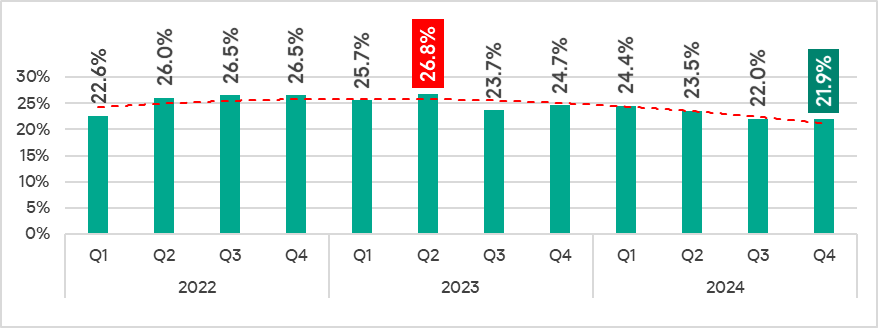
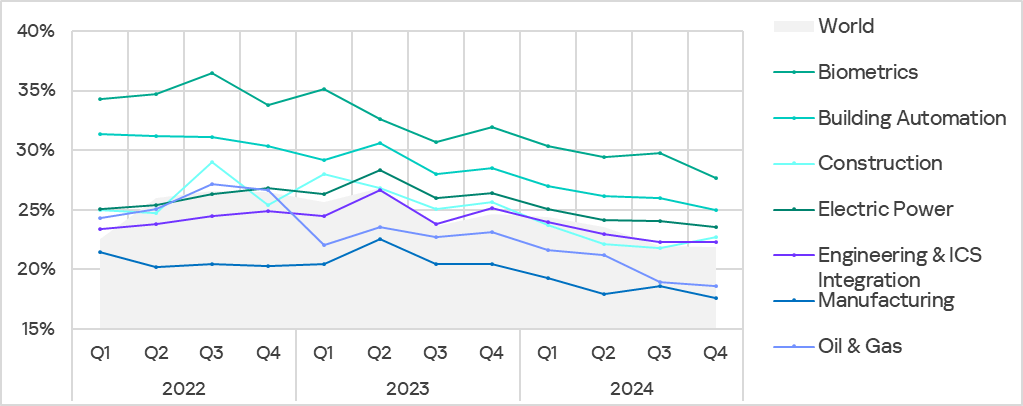
    In Q4 2024, the percentage of ICS computers on which malicious objects were blocked decreased by 0.1 pp from the previous quarter to 21.9%.

    Percentage of ICS computers on which malicious objects were blocked, by quarter, 2022–2024

    Compared to Q4 2023, the percentage decreased by 2.8 pp.

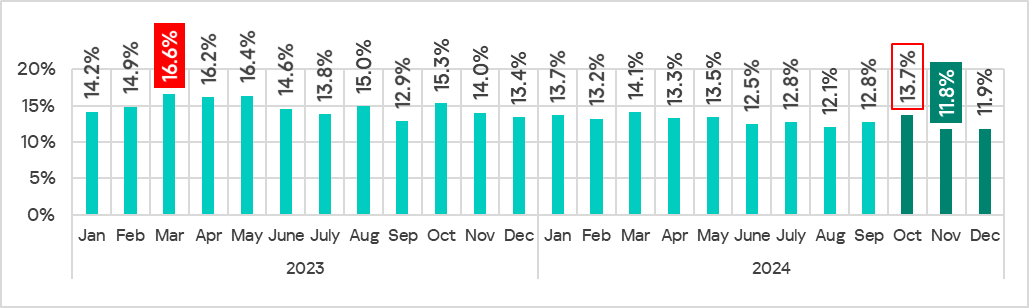
    The percentage of ICS computers on which malicious objects were blocked during Q4 2024 was highest in October and lowest in November. In fact, the percentage in November 2024 was the lowest of any month in two years.

    Percentage of ICS computers on which malicious objects were blocked, Jan 2023–Dec 2024

    Region rankings

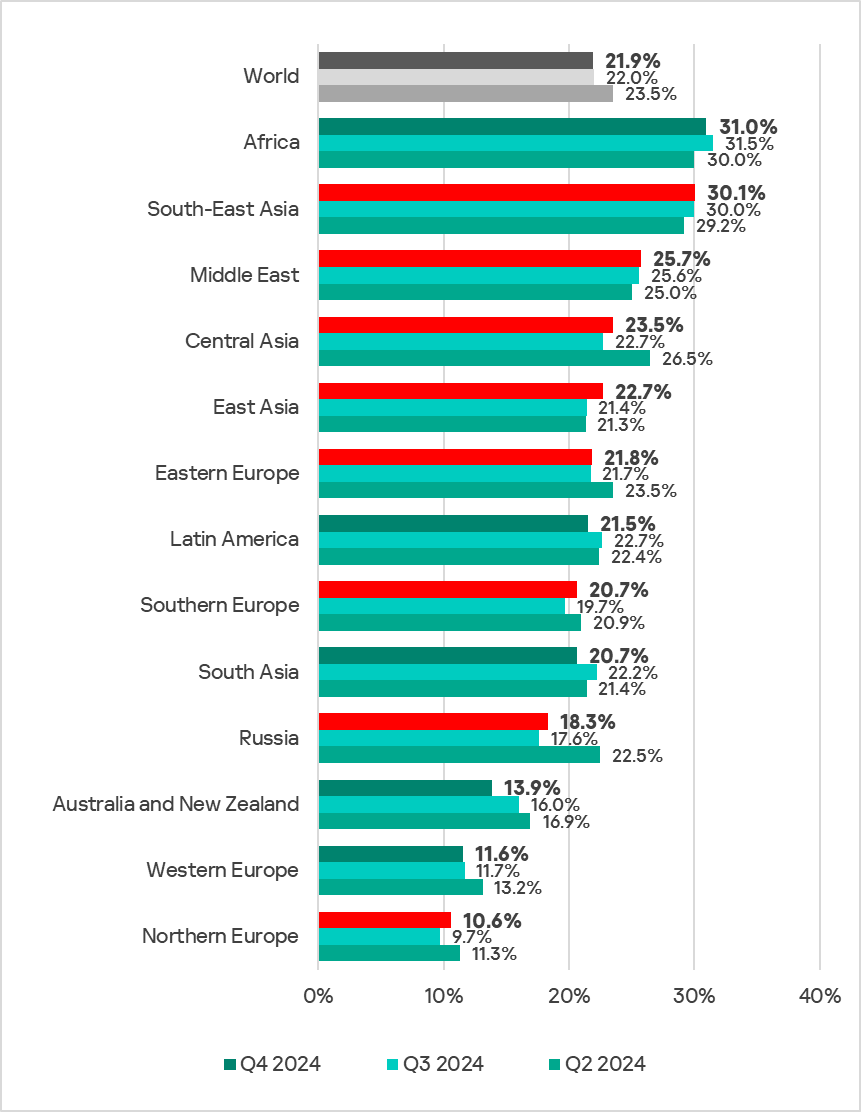
    Regionally, the percentage of ICS computers that blocked malicious objects during the quarter ranged from 10.6% in Northern Europe to 31% in Africa.

    Regions ranked by percentage of ICS computers where malicious objects were blocked, Q3 2024

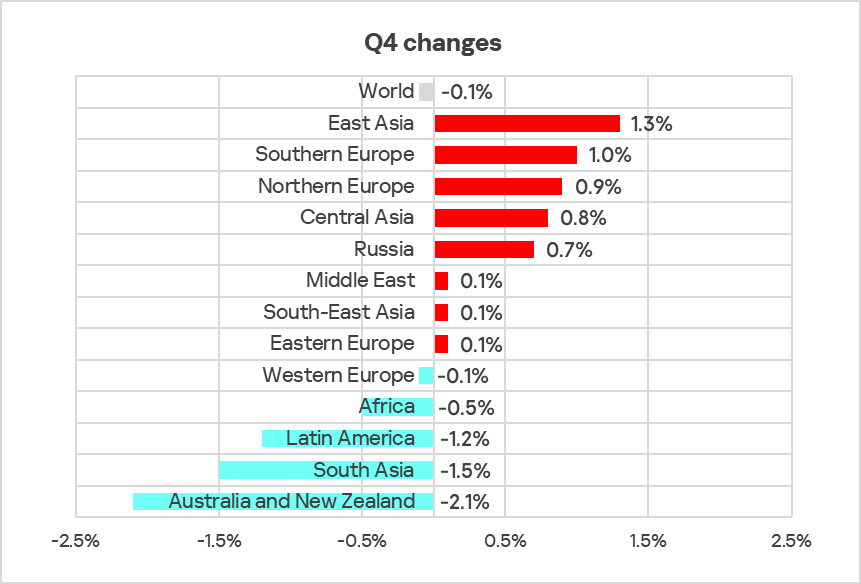
    Eight of 13 regions saw their percentages increase from the previous quarter.

    Regions and world. Changes in the percentage of attacked ICS computers in Q4 2024

    Selected industries

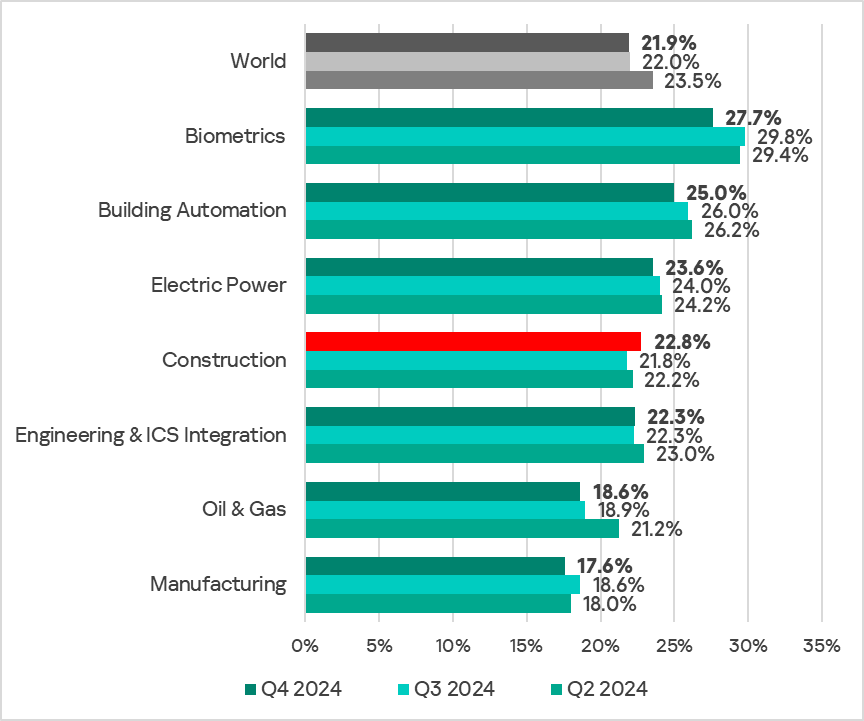
    The biometrics sector led the surveyed industries in terms of the percentage of ICS computers on which malicious objects were blocked.

    Percentage of ICS computers on which malicious objects were blocked in selected industries

    In Q4 2024, the percentage of ICS computers on which malicious objects were blocked decreased across most industries, with the exception of the construction sector.

    Changes in the percentage of ICS computers on which malicious objects were blocked in selected industries

    Diversity of detected malicious objects

    In Q4 2024, Kaspersky’s protection solutions blocked malware from 11,065 different malware families of various categories on industrial automation systems.

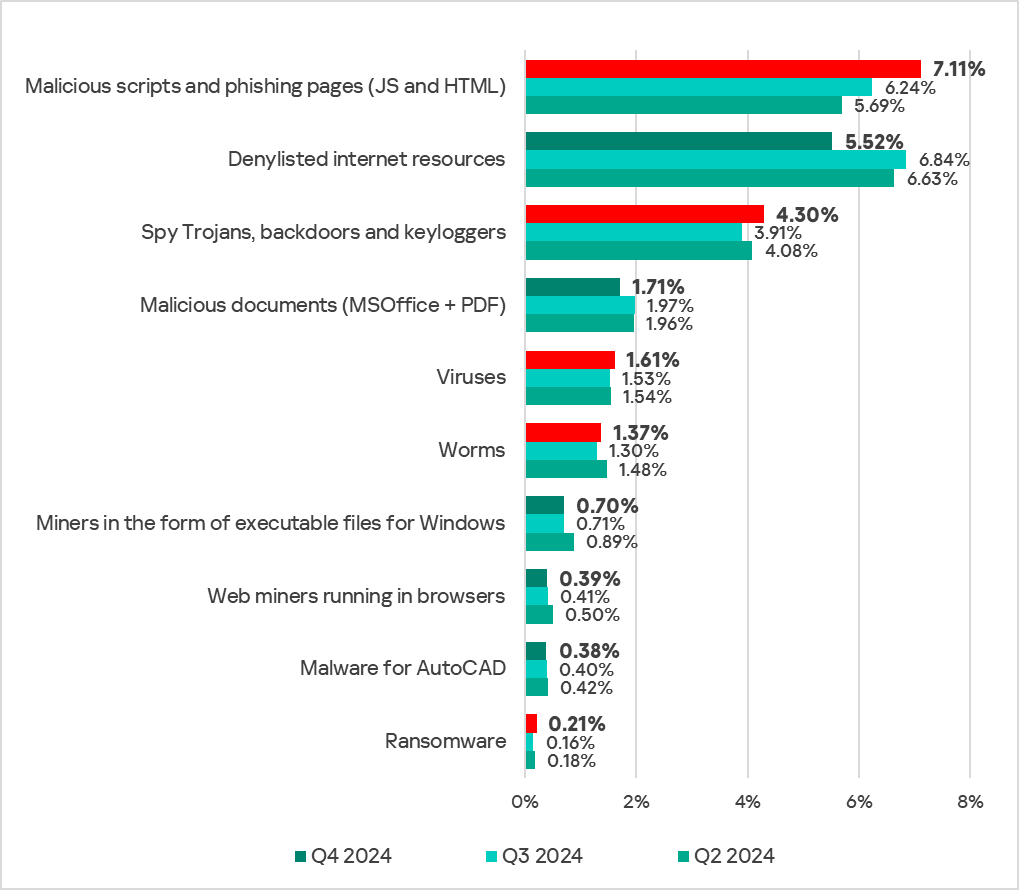
    Percentage of ICS computers on which the activity of malicious objects from various categories was blocked

    Main threat sources

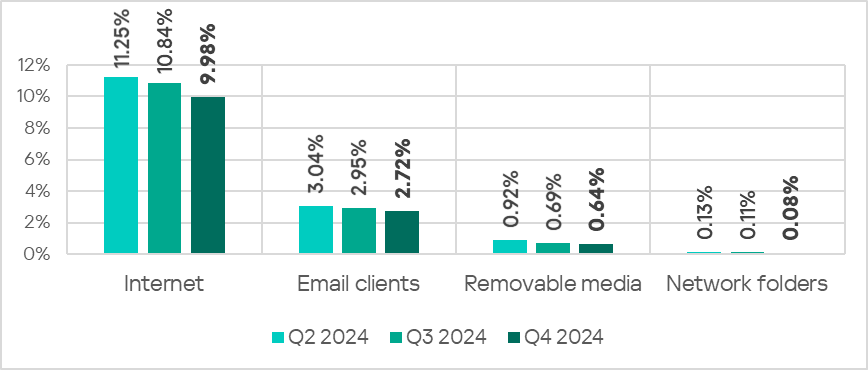
    The internet, email clients and removable storage devices remain the primary sources of threats to computers in an organization’s technology infrastructure. Note that the sources of blocked threats cannot be reliably identified in all cases.

    In Q4 2024, the percentage of ICS computers on which threats from various sources were blocked decreased for all threat sources described in this report. Moreover, all indicators recorded their lowest values for the observed period.

    Percentage of ICS computers on which malicious objects from various sources were blocked

    Threat categories

    Malicious objects used for initial infection

    Malicious objects used for initial infection of ICS computers include dangerous internet resources that are added to denylists, malicious scripts and phishing pages, and malicious documents.

    In the fourth quarter of 2024, the percentage of ICS computers on which malicious documents and denylisted internet resources were blocked decreased to 1.71% (by 0.26 pp) and 5.52% (by 1.32 pp), respectively and reached its lowest level since the beginning of 2022.

    As noted in the Q3 2024 report, the increase in blocked denylisted internet resources was primarily driven by an increase in the number of newly created domain names and IP addresses used by cybercriminals as command-and-control (C2) infrastructure for distributing malware and phishing attacks.

    The decline in the percentage of denylisted internet resources in November–December 2024 was likely influenced not only by proactive threat mitigation measures at various levels – from resource owners and hosting providers to ISPs and law enforcement agencies. Another contributing factor was the tendency of attackers to frequently change domains and IP addresses to evade detection in the initial stages, based on lists of known malicious resources.

    In practice, this means that until a malicious web resource is identified and added to a denylist, it may not immediately appear in threat statistics, leading to an apparent decrease in the percentage of ICS computers on which such resources were blocked.

    However, in Q4, we also saw a rise in the percentage of the next steps in the attack chain – malicious scripts and phishing pages (7.11%), spyware (4.30%), and ransomware (0.21%).

    A significant increase in the percentage of malicious scripts and phishing pages in October was driven by a series of widespread phishing attacks in late summer and early fall 2024, as mentioned in the Q3 2024 report. Threat actors used malicious scripts that executed in the browser, mimicking various windows with CAPTCHA-like interfaces, browser error messages and similar pop-ups to trigger the download of next-stage malware: either the Lumma stealer or the Amadey Trojan.

    Next-stage malware

    Malicious objects used to initially infect computers deliver next-stage malware – spyware, ransomware, and miners – to victims’ computers. As a rule, the higher the percentage of ICS computers on which the initial infection malware is blocked, the higher the percentage for next-stage malware.

    The percentage of ICS computers on which spyware (spy Trojans, backdoors and keyloggers) was blocked increased by 0.39 pp from the previous quarter to 4.30%.

    The percentage of ICS computers on which ransomware was blocked increased by a factor of 1.3 compared to the previous quarter, reaching 0.21%, its highest value in two years.

    The percentage of ICS computers on which miners in the form of executable files for Windows were blocked decreased by 0.01 pp to 0.70%.

    And, the percentage of ICS computers on which web miners were blocked decreased by 0.02 pp to 0.39%, reaching its lowest value in the observed period.

    Self-propagating malware

    Self-propagating malware (worms and viruses) is a category unto itself. Worms and virus-infected files were originally used for initial infection, but as botnet functionality evolved, they took on next-stage characteristics. To spread across ICS networks, viruses and worms rely on removable media, network folders, infected files including backups, and network attacks on outdated software.

    In Q4 2024, the percentage of ICS computers on which worms were blocked increased by 0.07 pp and reached 1,37%. The rate of viruses increased by 0.08 pp to 1.61%.

    AutoCAD malware

    AutoCAD malware is typically a low-level threat, coming last in the malware category rankings in terms of the percentage of ICS computers on which it was blocked.

    In Q4 2024, the percentage of ICS computers on which AutoCAD malware was blocked continued to decrease by losing 0.02 pp and reached 0.38%.

    You can find the full Q3 2024 report on the Kaspersky ICS CERT website.

    MIL OSI Global Banks –

    March 21, 2025
  • MIL-OSI China: Subsidies, services, social shifts: China’s strategic push for a birth-friendly future

    Source: China State Council Information Office 2

    Faced with the twin demographic challenges of a low fertility rate and a graying population, China is spearheading systemic policy innovations and people-oriented practices to bolster birth rates, boost consumption and drive sustainable socioeconomic growth in the coming decades and beyond.
    This strategic emphasis on encouraging childbirth was underscored earlier this month during China’s national “two sessions,” where the term “provide childcare subsidies” was included for the first time in the annual government work report.
    Additionally, a recently unveiled plan to increase consumption, proposes establishing a childcare subsidy system, expanding childbirth insurance coverage and enhancing pediatric services. These initiatives indicate that promoting childbirth has become a national strategic priority.
    China’s total fertility rate has remained at around 1 for a few years, less than half of the required replacement level of 2.1. Meanwhile, the country’s degree of aging continues to increase. Data from the National Bureau of Statistics showed that those aged 65 years and above made up about 15.6 percent of the total population last year.
    “Severe sub-replacement fertility will be China’s greatest economic and social challenge,” according to a recent article by veteran demographer James Liang, executive chair of China’s online travel service giant Trip.com Group.
    Liang noted that only by prioritizing birth rate improvement, leveraging institutional strengths, and mobilizing social resources can the problem be effectively addressed.
    In October 2024, a State Council directive outlined 13 targeted measures to enhance childbirth support services, expand child care systems, strengthen support in education, housing and employment, and foster a birth-friendly social atmosphere.
    Earlier data from China’s national health authorities revealed that over 20 provincial-level regions had explored offering childcare subsidies at different levels, with more comprehensive versions being introduced recently.
    The latest such measures were rolled out in north China’s Shanxi Province, where several counties introduced policies aimed at encouraging childbirth and alleviating family burdens by providing one-time childbirth subsidies, while partially covering hospitalization costs for childbirth.
    For example, families in Xingxian County of the city of Lyuliang in Shanxi that give birth to their first, second or third child on or after Jan. 1, 2025, are eligible for one-time subsidies of 2,000 yuan (about 279 U.S. dollars), 5,000 yuan or 8,000 yuan, respectively.
    Shenzhen in south China’s Guangdong Province, a city known for its economic vitality and inclusiveness and home to China’s largest migrant population, has also pledged to actively implement national initiatives by enhancing its childbirth support policy system and incentive mechanisms.
    These developments follow Hohhot’s earlier announcement of a new childcare subsidy initiative, which attracted nationwide attention to this city, which is the capital of north China’s Inner Mongolia Autonomous Region, an area known for producing top quality milk, resulting in a boost for market confidence.
    In Hohhot, couples having their first child will be offered a one-time payment of 10,000 yuan. For a second child, 50,000 yuan will be distributed in annual installments of 10,000 yuan. For all subsequent children, the same annual subsidy will be offered until the child turns 10, totaling 100,000 yuan, which is much higher than in other cities and amounts to roughly twice the annual income of local citizens.
    These tangible subsidies are expected to drive consumption momentum in the maternal and infant product sector, according to Han Fei, vice president of Hohhot-based Yili Group, Asia’s largest dairy company. Han added that the city also plans to provide a daily cup of free milk for new mothers, which will accelerate the consumption of fresh milk in China’s dairy industry heartland.
    Since 2013, China has implemented several rounds of progressive adjustments to adapt its population policies to evolving demographic and socioeconomic conditions. In 2021, it announced support for couples who wish to have a third child — and it is from that time onward that childbirth subsidies began to emerge.
    Notably, the first city in China to offer such subsidies, Panzhihua in southwest China’s Sichuan Province, has witnessed positive growth in its permanent resident population for four consecutive years.
    Meanwhile, Tianmen, a county-level city in central China’s Hubei Province, saw a year-on-year increase of 17 percent in its newborn population in 2024, significantly higher than the national average of 5.8 percent, and ending an eight-year decline. Among the 7,217 newborns in Tianmen, more than half were second or third children.
    From baby bonuses and childcare subsidies to maternity leave allowances and home purchase incentives, total rewards for second and third children in Tianmen amount to 96,300 yuan and 165,100 yuan, respectively.
    Tianmen’s tangible, holistic pro-birth policies also spurred a strong recovery in the real estate market of the city, where the average housing price is 5,000 yuan per square meter — attracting over 100 regions to conduct research and learn from its practices.
    These cases show that financial incentives are probably the fastest way to boost fertility rates, and yet they are far from sufficient. Increased childcare services, extended maternity leave, and strengthened support in the fields of education, housing and employment, as well as a healthy marriage and childbirth culture, are also crucial in fostering a birth-friendly society. Encouragingly, various regions have already begun exploring such avenues.
    Cash rewards ease financial burdens, but boosting birth rates requires tackling deeper issues like childcare challenges, work-life balance, and education costs, said Yue Ling, associate professor at the Beijing-based China University of Labor Relations.
    Liang also highlighted the need for comprehensive measures including tax breaks, housing subsidies, increased childcare facilities, and promoting flexible work arrangements, to effectively boost willingness to have children.
    Experts also emphasized the importance of coordinated consideration at both the national and local levels, to make support policies more reasonable, feasible and sustainable, as regional economic disparities can have an impact on the effectiveness of policies.

    MIL OSI China News –

    March 21, 2025
  • MIL-OSI China: Ceremony held in Tainan in southern Taiwan to honor Confucius

    Source: China State Council Information Office 3

    A solemn ceremony, accompanied by the rhythmic beat of traditional drums, was held at Tainan Confucius Temple in southern Taiwan early Thursday morning, coinciding with the spring equinox, to honor the revered ancient Chinese educator and philosopher.

    In keeping with ancient rites, the temple hosts biannual ceremonies in spring and autumn to promote Confucian values of reverence for teachers and scholarly traditions.

    Comprising 20 procedures, the ceremony adheres to traditions that trace back to Qufu in Shandong Province — the birthplace of Confucius. The ceremonial music is primarily rooted in Zhangzhou in Fujian. Local primary school students performed an ancient ritual dance at the ceremony, paying the highest tribute to Confucius.

    The Confucian philosophy is an important component of Chinese civilization and a cultural bedrock for social development in Taiwan. Incomplete statistics indicate that there are over 40 Confucius temples across the island, with the Tainan Confucius Temple, built in 1666, being the oldest.

    MIL OSI China News –

    March 21, 2025
  • MIL-OSI Submissions: Stats NZ information release: Overseas merchandise trade: February 2025

    Source: Statistics New Zealand

    Overseas merchandise trade: February 2025 – 21 March 2025 – Overseas merchandise trade statistics provide information on imports and exports of merchandise goods between New Zealand and other countries.

    Key facts
    This release refers to trade in goods only.

    In February 2025, compared with February 2024:

    • goods exports rose by $954 million (16 percent), to $6.7 billion
    • goods imports rose by $125 million (2.1 percent), to $6.2 billion
    • the monthly trade balance was a surplus of $510 million.

    Files:

    • Overseas merchandise trade: February 2025
    • Overseas merchandise trade datasets


    MIL OSI –

    March 21, 2025
  • MIL-OSI China: Subsidy program spurs digital product consumption

    Source: China State Council Information Office

    China’s efforts to spur consumer spending are off to a strong start this year, with government subsidy measures driving a surging demand in digital products, the Ministry of Commerce said on Thursday.

    Since the program’s launch on Jan. 20, more than 42 million consumers have applied for subsidies to purchase smartphones and other digital devices, resulting in total sales of 66.95 billion yuan (about 9.33 billion U.S. dollars) as of Tuesday, according to data from the ministry.

    In the first two months of the year, retail sales of communication equipment reached 159.4 billion yuan, increasing 26.2 percent year on year, according to the National Bureau of Statistics.

    This growth rate was 10 percentage points higher than the same period in 2024, and outpaced all other major consumer goods categories.

    China implemented the subsidy program as part of broader efforts to bolster domestic consumption. Under the plan, consumers purchasing smartphones, tablets, smartwatches, or wristbands priced below 6,000 yuan per item are eligible for a subsidy covering 15 percent of the sales price, up to a maximum of 500 yuan per item. The program applies to both domestic and foreign brands.

    MIL OSI China News –

    March 21, 2025
  • MIL-OSI Australia: Interview with Ross Solly, Canberra Breakfast, ABC Radio

    Source: Australian Parliamentary Secretary to the Minister for Industry

    Ross Solly:

    A couple of different reports out today. Good morning to you Andrew Leigh, how are you?

    Andrew Leigh:

    Good morning Ross. It’s great to be with you.

    Solly:

    You know what they say about lies, damn lies and statistics. So, we have 2 reports today. We have the McKell Institute report, which has shown Andrew Leigh, that we are just in the middle of the greatest run of low unemployment since the Whitlam government.

    Leigh:

    It is a remarkable story Ross. I mean, traditionally, when inflation has spiked in Australia, the way we’ve got it back down is through a recession or a prolonged bout of unemployment. That was the story of the 1970s, 1980s and 1990s and it’s what the British and New Zealanders have suffered in recent years.

    The Australian experience has been very different. We’ve maintained essentially full employment, an average unemployment rate of 3.8 per cent over the life of the Albanese government. Here in the ACT, 3.4 per cent, so the story of the labour market of the last 3 years is a remarkable one, and one which is really unique in Australian history.

    Solly:

    But then we have reports today that building companies in Australia are collapsing at record levels Andrew Leigh. 3,445 building firms have been plunged into insolvency just in the past 12 months. We’ve had a dramatic spike in strike numbers. We know here in the ACT the number of building firms that have collapsed. So that is a remarkable story, but for all the wrong reasons for the Albanese government.

    Leigh:

    Well, we know that we’ve had a pent‑up series of insolvencies delayed after COVID as a result of some of the rules that were changed around insolvency there. In terms of industrial days lost to disputes, there are fewer industrial days lost to disputes under this government than under the previous government.

    We know that there are huge challenges in construction sector productivity. There was an excellent Productivity Commission report on it recently, but it wasn’t about blaming the unions. It went through issues such as approval times, lack of innovation, lack of scale, and some of the issues around skills, which we’re addressing through our half a million free TAFE places.

    Solly:

    So are you saying Andrew Leigh, that some of these building companies, they would have collapsed ages ago, but only survived because of support that was handed out during COVID? Is that right?

    Leigh:

    Well, there were changes to the insolvency rules there Ross, which meant that there was a series of insolvencies that followed the reversion of those rules to the way in which they normally were. Every insolvency we take very seriously, and we do our best to assist those companies through, but we do know that there are serious issues in construction.

    Construction sector productivity has fallen slightly since 1994, so it has been an ongoing challenge. But that challenge is not, as some of the ideologues would have you believe, to do with unions. Indeed, the residential construction sector is essentially un‑unionised.

    Solly:

    Is it because of government policy then? Is it because of government policy? If it’s not to do with the unions, is it because of government policy or is it because people who shouldn’t be running building companies are running building companies?

    Leigh:

    I would urge any of your listeners who are interested in this to check out Productivity Commission report from last month. It’s not a sound bite answer. They talk about the complexity and the slowness of approvals. Approval rules put in place for good purposes that can sometimes have a cumulative effect of delaying and driving up the cost of housing.

    They also talk about the challenge of innovation. Only 35 per cent of construction firms are ‘innovation active’ and the average residential building construction firm employs less than 2 people, which is smaller than average. So, some of those challenges are not easily fixed, but what we’re doing with the Housing Australia Future Fund is making an unprecedented investment in Australian housing, working with the states…

    Solly:

    It’s hard to see… it’s hard to see you meeting your targets is it? For the amount of new houses you want built given the number of firms that are collapsing?

    Leigh:

    They are ambitious targets Ross, and we make no apologies for that. We’ve made more investment in this than any previous Australian Government. We’re taking homelessness seriously. We’re finally making a Commonwealth investment into social and affordable homes, and we’re working on those workforce issues – getting more apprentices, getting more free TAFE places.

    The work we’re doing – that Clare O’Neil is leading, working with states and territories around those regulation approval times – that’s really critical work but it’s not straightforward work. Neighbours have a right to have their say on new developments but we need to build more homes.

    Solly:

    Dr Andrew Leigh, appreciate your time as always. Thank you.

    Leigh:

    Thanks so much Ross.

    Solly:

    The Member for Fenner.

    MIL OSI News –

    March 21, 2025
  • MIL-OSI Asia-Pac: Leveraging Non-conventional Data Sources for Official Statistics

    Source: Government of India

    Posted On: 20 MAR 2025 6:45PM by PIB Delhi

    The brainstorming session on Leveraging Non-Conventional Data Sources for Official Statistics, of Ministry of Statistics and Programme Implementation (MoSPI), was concluded on 20th March, 2025 at Vigyan Bhawan, New Delhi.

    The inaugural session of the event was addressed by Sri Kris Gopalakrishnan, Chairman Axilor Ventures and Co-founder of Infosys, Sri Rana Hasan, Regional Lead Economist, South Asia, Asian Development Bank (ADB), Sri Shombi Sharp, UN Resident Coordinator (UNRC), and Dr. Saurabh Garg, Secretary, Ministry of Statistics and Programme Implementation.

    Sri Kris Gopalakrishnan, one of the co-founders of Infosys, Chairman, The Council, IISc Bangalore, and the Chairman, Board of Governors of IIIT, Bangalore, in his keynote address, underpinned the importance of the non-conventional data by citing success of Aadhar, primarily developed as a tool of citizen services, however, now used for developing various applications. He said that in view of India’s tremendous potential in technology, it can lead from front in respect of using non-conventional datasets for decision making.

    He impressed upon the need of standardization of various datasets, strengthening data processing capabilities, and developing data governance framework. He emphasized further that there is a need for evolving a framework enabling access to private data, legally backed and for rightful usages. In addition, he underlined that there is a need of fostering data literacy amongst all stakeholders so that the non-conventional sources are effectively used. Further, he opined that a single source of data would empower not only to the data producers but also to the entrepreneurs. He concluded by stating that the deliberations like this would strengthen formalizing the non-conventional data sources.

    Dr. Saurabh Garg, Secretary, MoSPI, impressed upon the importance of such sessions for encouraging a concerted effort of all stakeholders for the optimal usages of available in the ecosystem. He urged upon the representatives of the Central Ministries/Departments, including the Statistical Advisors to explore the possibility of reusing datasets generated by the other agencies. Further, he also mentioned that the culture of data sharing, however, maintaining the sanctity of Personally Identifiable Information (PII) must be fostered in the working of all the stakeholders.

    Sri Shombi Sharp, UNRC in his address shared some best practices regarding the citizen generated data and their usages in the official statistics especially in achieving the SDGs. Besides, he also emphasized upon a greater collaboration amongst the stakeholders to capitalize the full potentials of all possible alternate datasets.   

    Sri Rana Hasan in his presentation demonstrated the power of combining various datasets for an improved decision making.  He noted that the cities are hubs of growth and innovation, and thus India’s ongoing urbanization should be appropriately leveraged. He observed further that since the industrial parks are affecting neighboring settlements, they should be catalysed for structural transformation.

    The first technical session invited presentations from Shri. M. C. Gaur, Addl. Surveyor General (NZ), Survey of India; Shri. Ayago Wambile, Senior Economist, World Bank; Prof. Bappaditya Mukhopadhyay, Expert in Analytics, Great Lakes Institute of Management, New Delhi; and Shri. Ankur Bansal, Founder, GDi Partners. This session was moderated by Sh. P. R. Meshram, Director General (Data Governance), MoSPI.

    Sh. Gaur from Survey of India, in his presentation, highlighted the relevance of linking statistical data to geospatial locations and making the same easily accessible to various data users. While Shri. Wambile from World Bank, spoke about different non-traditional data sources such as, scanner data, mobile phone data, etc that can be leveraged to supplement the official statistical data in the country. Prof Mukhopadhyay from Great Lakes Institute of Management, presented a specific use case of using satellite data to assess SDG at district and sub-district levels over time. Shri Bansal from GDi Partners thereafter, brought attention to objectives, challenges, and potential way forward of using non-traditional data sources along with illustrations of use of such data sets by NSOs across the world.

    The second technical session invited presentations from Ms. Tanusree Deb Barma, Deputy Director General, UIDAI, M/o Electronics and Technology; Prof. Shalabh, Professor of Statistics & Data Science, IIT Kanpur; Shri Srinivasa Rao Sitiraju, DD, BGWSA, NRSC, Department of Space, ISRO; and Dr. Karan Nagpal, India Regional Director, IDinsight, New Delhi, India. The session was moderated by Ms. Geeta Singh Rathore, Director  General (NSS), MoSPI.

    Ms. Tansuree from M/o Electronics and Technology, provided an overview of the Aadhar Ecosystem and presented areas where non-traditional data is being used for authentication of data, identification of bugs, etc. Further, Shri Sitiraju from ISRO, presented various types and aspects of Geospatial data being collected by ISRO and products built using them within the official data ecosystem. Dr. Shalabh from IIT Kanpur, thereafter, presented a specific use case of grievance redressal mechanism leveraging emerging technologies for deriving insights from grievance data collected by Government of India, while Dr. Nagpal from IDinsight presented various use cases of alternative datasets and their usages in generating macro indicators. He, specifically, discussed various usages in price data in official statistics.

    The event has been attended by around 150 delegates, ranging representations from the central Ministries/Departments, UN agencies, Think Tanks, Independent organisations, and Universities and research institutions.

    The deliberations of the brainstorming session would be a sine qua non for the data innovation involving tapping into alternative data gathered from new or non-conventional data sources and combining and enhancing existing data sources with that new data to gain additional insights.

    One of the significant takeaways of the brainstorming session is that the digital revolution provides abundant opportunities to improve the way services are delivered, including harnessing valuable data and insights into products, services, and customer behaviors. Such data innovations are rapidly changing institutions and the data sources available to them. A well-designed intertwining of various data sources may provide better comprehension resulting into improved health care system, Strong supply chains and logistics, Convenient travel, Smart farming, and a transparent FinTech ecosystem.

    Further, it was discussed that the Ministries/Departments may use the alternative datasets for the real time monitoring and tracking the decision variables. In addition, it also emerged that the Ministries/Departments may make available Alternative/Administrative datasets to various stakeholders so that their integration with Census/Survey data may become possible.  Besides, it emerged that there should be concerted efforts of all the stakeholders for creation of enabling environment so that all possible data sources, Conventional and Non-Conventional are used for decision making.  

    ****

    Samrat/ Allen

    (Release ID: 2113347) Visitor Counter : 68

    MIL OSI Asia Pacific News –

    March 21, 2025
  • MIL-OSI Asia-Pac: PARLIAMENT QUESTION: “ONE DISTRICT, ONE EQUIPMENT” PROGRAMME UNDER I-STEM

    Source: Government of India

    Posted On: 20 MAR 2025 4:56PM by PIB Delhi

    I-STEM (Indian Science Technology and Engineering facility Map) is a National Portal for sharing of publicly funded scientific equipment available at various R&D and Academic institutions. It facilitates sharing of expensive R&D resources/equipment/software available at R&D and Academic institutions with other academic institutions and colleges, in order to optimize the usage of these resources across the country by researchers and start-ups. It is not true that the lab equipment in scientific and educational institutions remains underutilized. The facilities are widely utilized by scientific community, researchers, MSMEs, start-ups and industries and around 34,000 users have already been registered in I-STEM portal and more than 26,000 instruments are uploaded by 3300 institutes PAN-India. In addition to the usage data captured through I-STEM Portal, by numerous ways researchers from scientific and academic institutions book slots to utilise scientific facilities such as online booking through intranet system, spot booking and other booking methods.

    State-wise, Union Territory-wise and District-wise equipment distribution and region-wise number of Institutions registered their facilities in I-STEM portal, is indicated at Annexure.

    Annexure

    I-STEM Statistics as of 13-03-2025

    1) State-wise Equipment Distribution

    State

    Active Equipment

    Andhra Pradesh

    474

    Arunachal Pradesh

    132

    Assam

    780

    Bihar

    553

    Chhattisgarh

    1150

    Goa

    180

    Gujarat

    561

    Haryana

    802

    Himachal Pradesh

    451

    Jharkhand

    887

    Karnataka

    2397

    Kerala

    1560

    Madhya Pradesh

    982

    Maharashtra

    2050

    Manipur

    261

    Meghalaya

    286

    Mizoram

    90

    Nagaland

    71

    Odisha

    1264

    Punjab

    1239

    Rajasthan

    789

    Sikkim

    15

    Tamil Nadu

    3235

    Telangana

    1494

    Tripura

    316

    Uttar Pradesh

    1365

    Uttarakhand

    966

    West Bengal

    957

    • Union Territory-wise equipment counts

    Union Territory

    Active Equipment

    Andaman and Nicobar Islands

    1

    Chandigarh

    6

    Delhi

    1178

    Jammu and Kashmir

    220

    Ladakh

    11

    Pondicherry

    51

    1. District-wise Distribution

    Institutes from 192 districts have registered on the I-STEM Portal.

    Sr.

    No.

    District

    Equipment

    ( In Nos.)


    Sr.

    No.

    District

    Equipment

    ( In Nos.)

    1

    Bengaluru

    1741


    101

    Srinagar

    43

    2

    Chennai

    1395


    102

    Raigad

    41

    3

    New Delhi

    1154


    103

    Belagavi

    40

    4

    Hyderabad

    1131


    104

    Madurai

    40

    5

    Khurda

    916


    105

    Gurugram

    38

    6

    Raipur

    813


    106

    Puducherry

    38

    7

    Haridwar

    759


    107

    Rajouri

    35

    8

    Pune

    742


    108

    Salem

    34

    9

    Kozhikode

    697


    109

    Alappuzha

    30

    10

    Kurukshetra

    656


    110

    Bhavnagar

    30

    11

    Dhanbad

    621


    111

    Delhi

    30

    12

    Prayagraj

    550


    112

    Korba

    30

    13

    Indore

    543


    113

    Theni

    30

    14

    Coimbatore

    481


    114

    Kapurthala

    28

    15

    Tiruchirappalli

    461


    115

    Sonipat

    27

    16

    Jaipur

    445


    116

    Guntur

    26

    17

    Chandigarh

    440


    117

    West Godavari

    26

    18

    Patna

    366


    118

    Kangra

    25

    19

    Kolkata

    361


    119

    Nadia

    23

    20

    Warangal

    358


    120

    Ajmer

    22

    21

    West Tripura

    316


    121

    Aligarh

    21

    22

    Sundergarh

    315


    122

    Mandya

    21

    23

    Mandi

    305


    123

    Patiala

    21

    24

    Kamrup Metropolitan

    304


    124

    Sri Sathya Sai

    21

    25

    Bilaspur

    292


    125

    Anantpur

    21

    26

    Thiruvananthapuram

    290


    126

    Kalaburagi

    20

    27

    East Khasi Hills

    286


    127

    Dindigul

    19

    28

    Bhopal

    275


    128

    Jhansi

    19

    29

    Sangrur

    256


    129

    Palghar

    19

    30

    Manipur

    248


    130

    Erode

    18

    31

    Ghaziabad

    232


    131

    Ganjam

    18

    32

    Sonitpur

    214


    132

    Mahbubnagar

    18

    33

    Ernakulam

    204


    133

    Malappuram

    18

    34

    Surat

    204


    134

    Durg

    15

    35

    Malda

    198


    135

    Mahendergarh

    15

    36

    Dakshina Kannada

    196


    136

    South Sikkim

    15

    37

    Ranchi

    195


    137

    Udupi

    15

    38

    Jodhpur

    194


    138

    Anantnag

    14

    39

    Kancheepuram

    193


    139

    Kanyakumari

    14

    40

    Mumbai

    181


    140

    Khordha

    14

    41

    Bagalkot

    174


    141

    Ludhiana

    14

    42

    Jalandhar

    172


    142

    Vadodara

    14

    43

    Visakhapatnam

    169


    143

    Imphal

    13

    44

    Paschim Medinipur

    165


    144

    Jalgaon

    13

    45

    Jabalpur

    164


    145

    Karaikal

    13

    46

    Tirupati

    162


    146

    Muzaffarnagar

    12

    47

    Lucknow

    155


    147

    Tirunelveli

    12

    48

    Dehradun

    154


    148

    Leh

    11

    49

    Anand

    153


    149

    Mathura

    11

    50

    Mohali

    149


    150

    Chikkaballapur

    10

    51

    Paschim Bardhaman

    141


    151

    Hassan

    10

    52

    Samastipur

    136


    152

    Itanagar

    10

    53

    Thanjavur

    130


    153

    Amravati

    9

    54

    Amritsar

    123


    154

    Karnal

    9

    55

    Nagpur

    122


    155

    Nainital

    9

    56

    Papum Pare

    122


    156

    Shimoga

    8

    57

    Mysuru

    119


    157

    Bareilly

    7

    58

    Jhunjhunu

    117


    158

    Chitradurga

    7

    59

    Hamirpur

    116


    159

    Navsari

    7

    60

    Namakkal

    114


    160

    Bhagalpur

    6

    61

    Kolhapur

    112


    161

    Dibrugarh

    6

    62

    Kanpur

    111


    162

    Udham

    6

    63

    Virudhunagar

    111


    163

    Uttara Kannada

    6

    64

    North Goa

    109


    164

    Vizianagaram

    6

    65

    Gandhinagar

    107


    165

    Agra

    5

    66

    Cachar

    106


    166

    Ahmednagar

    5

    67

    Palakkad

    103


    167

    Hisar

    5

    68

    GautamBuddh Nagar

    100


    168

    Raichur

    5

    69

    Varanasi

    97


    169

    Thiruvarur

    5

    70

    Chandrapur

    95


    170

    Thoothukudi

    5

    71

    Dharwad

    95


    171

    Gwalior

    4

    72

    Aurangabad

    91


    172

    Sangli

    4

    73

    Kottayam

    91


    173

    Shimla

    4

    74

    Aizawl

    90


    174

    Thiruvallur

    4

    75

    Jorhat

    88


    175

    Vanasthali

    4

    76

    Kasaragod

    88


    176

    Bikaner

    3

    77

    Nashik

    83


    177

    Davanagere

    3

    78

    Faridabad

    79


    178

    Eluru

    2

    79

    South Goa

    78


    179

    Mau

    2

    80

    Jammu

    77


    180

    Nandyal

    2

    81

    Ahmedabad

    75


    181

    Sikar

    2

    82

    Tumkur

    74


    182

    Tonk

    2

    83

    East Singhbhum

    72


    183

    Cuttack

    1

    84

    Kokrajhar

    72


    184

    Gorakhpur

    1

    85

    Dimapur

    71


    185

    Kota

    1

    86

    Thane

    71


    186

    Pudukkottai

    1

    87

    Thrissur

    71


    187

    Rajkot

    1

    88

    Kollam

    67


    188

    Solan

    1

    89

    Meerut

    61


    189

    South Andaman

    1

    90

    Villupuram

    56


    190

    Tiruvallur

    1

    91

    Howrah

    55


    191

    Murshidabad

    1

    92

    Rupnagar

    55


    192

    Karimnagar

    1

    93

    Sagar

    55


    94

    Krishna

    53


    95

    Pulwama

    53


    96

    Sivagangai

    53


    97

    Vellore

    52


    98

    Bathinda

    46


    99

    Cuddalore

    46


    100

    Gaya

    45


    3. Total Institutions (Registered):

    Sr. No.

    Regions

    Institutions (Nos.)

    1

    Northern

    1639

    2

    Western

    294

    3

    Central

    86

    4

    Eastern

    202

    5

    North Eastern

    149

    6

    Southern

    939

    This information was given by Dr. Jitendra Singh, Union Minister of State (Independent Charge) for Science and Technology, Department of Atomic Energy, Department of Space, in a written reply in the Rajya Sabha today.

    ***

    NKR/PSM

    (Release ID: 2113274) Visitor Counter : 82

    MIL OSI Asia Pacific News –

    March 21, 2025
  • MIL-OSI Europe: Written question – Elimination of the warning triangle and replacement with light-signalling devices connected to national traffic control centres – E-001043/2025

    Source: European Parliament

    Question for written answer  E-001043/2025
    to the Commission
    Rule 144
    Borja Giménez Larraz (PPE)

    Statistics indicate that the stopping of vehicles due to breakdowns or accidents on high-speed roads is one of the situations in which accidents occur most frequently. In Europe, this accounts for 13.89% of fatalities on motorways and dual carriageways – in 2019, of the 1 800 deaths on high-capacity roads, 250 were pedestrians. Traditionally, the solution for signalling a broken-down vehicle has been the warning triangle, but rather than reducing danger, the placing of these triangles creates more danger.

    For this reason, Spain passed a regulation establishing the obligation to carry a light-signalling device in vehicles, which will gradually replace the warning triangles. This device will also have to be connected to the national Traffic Management Centre to provide information on the position and to warn the drivers of other vehicles.

    In order to increase road safety and to standardise rules and eliminate differences, does the Commission intend to recommend banning the use of warning triangles and replacing them with light-signals connected wirelessly to national traffic management centres?

    Submitted: 11.3.2025

    Last updated: 20 March 2025

    MIL OSI Europe News –

    March 21, 2025
  • MIL-Evening Report: Every generation thinks they had it the toughest, but for Gen Z, they’re probably right

    Source: The Conversation (Au and NZ) – By Intifar Chowdhury, Lecturer in Government, Flinders University

    Every generation thinks they had it tough, but evidence suggests young Australians today might have a case for saying they’ve drawn the short straw.

    Compared with young adults two or three decades ago, today’s 18–35-year-olds may earn more, but they also grapple with soaring living costs, rising education expenses, precarious employment and mounting debt.

    Shifts in the economy and labour market have restructured young adulthood, creating new barriers to financial security and delaying milestones such as home ownership, partnership and parenthood.

    How does this compare to what life was like for young Australians at the turn of the century?

    Increasing education, decreasing payoffs

    University participation has risen, but so has student debt. It’s now far beyond what was intended when HECS was introduced as a supposedly fair, income-contingent loan system.

    Indexation has outpaced wages, so much so that today’s 20-somethings carry debts that are more than $10,000 higher in real terms than their counterparts two decades ago.

    The Morrison government’s 2021 fee hikes only exacerbated the crisis, with some degrees nearly doubling in cost, leaving students with an even greater debt burden.

    University fees have increased over the past 25 years.
    Shutterstock

    Yet the financial return on education is increasingly uncertain.

    Credential inflation has reshaped the job market, with even low-wage positions now expecting a university degree.

    The widespread belief that a degree guarantees better pay is driving more students into higher education, yet there are many graduates saddled with debt and working in roles unrelated to their qualifications.

    In 1996, 28.5% of 21–25-year-olds found themselves in mismatched jobs.

    By 2019, that figure had climbed to 33% just among 25-year-olds.

    Salaries aren’t keeping up. Since 1996, graduate wages have risen by a factor of just 2.5, while student contributions have jumped between 1.7- and 6.2-fold. This leaves today’s graduates with debt that consumes a larger share of their income than ever before.

    The dwindling dream of home ownership

    Housing affordability has collapsed over the years.

    Twenty-five years ago, the average house cost nine years’ worth of the average household income.

    Now, it’s about 16.5 years.

    In 2001, property prices rose 1.3 times faster than incomes. Since then, they’ve surged at 2.3 times the rate.

    This is fuelled partly by tax incentive policies – for example, the Howard government’s 1999 capital gains tax changes – and, more recently, the COVID pandemic.

    Soaring prices have deepened the intergenerational housing wealth gap, reducing the home purchase opportunity for young people. While the First Home Owner Grant, introduced in 2000, provides some support, saving for a deposit remains a years-long struggle.

    That is, unless parents can help.

    For many young Australians, intergenerational wealth is now the key to home ownership. Inheritance is becoming nearly as important as employment.

    Since 2002, the total value of wealth transfers has more than doubled in real terms, with larger inheritances expected for younger generations due to rising parental wealth and fewer siblings.

    But parental wealth is far more unequally distributed than income – shaped by education and region.

    Therefore, inheritocracy is set to deepen economic inequality within today’s youth cohort.

    But this isn’t just about the ultra-wealthy passing down mansions. Most inheritances involve an ordinary home or proceeds from its sale.

    Housing, once central to middle-class stability, now determines who can build wealth and who will struggle financially for life.

    Mounting mental health pressures

    Meanwhile, Australians today are borrowing more than ever. Default risk is rising fastest among under-30s as soaring interest rates, rent hikes, and cost-of-living pressures squeeze finances.

    It’s then no surprise Gen Z is more concerned about finances than any other generation.

    Financial stress is taking a heavy toll on young people’s mental health. Between 2007 and 2022, the prevalence of mental health disorders among young Australians surged by nearly 50%.

    The burden of disease from non-fatal conditions – measured in years of healthy life lost – has risen 7% since 2003. This is largely due to mental health disorders and substance abuse, which disproportionately affect young people.

    Growing up Indigenous

    At the deepest end of these struggles are Indigenous youth, who face far greater challenges than their non-Indigenous peers.

    Across nearly every measure – education, employment, health and incarceration – outcomes for Aboriginal and Torres Strait Islander young people remain significantly worse.

    While today’s Indigenous youth have achieved better outcomes compared to previous generations – 39% of Indigenous Australians aged 20+ had completed Year 12 in 2021, up from 19.4% in 2001 – these gains still lag behind non-Indigenous youth.

    Systemic barriers, institutional racism and intergenerational trauma continue to limit fair access to opportunities. This compounds inequalities and contributes to higher rates of mental ill-health, stress and suicide among Indigenous youth.

    The changing politics of being young

    Undoubtedly, a continued period of instability and psychological distress in formative years is also shaping the youngest generation’s political attitudes and behaviours.

    With fewer assets to conserve compared to their parents or grandparents, they are more likely to lean more to the left politically, and this won’t change with age.

    Yet, they remain engaged, thanks in part to compulsory voting, but are also abandoning party loyalties.


    Read more:
    I looked at 35 years of data to see how Australians vote. Here’s what it tells us about the next election


    Australian Election Study data shows 18–30-year-olds were more interested in politics in 2022 than in 1998 (67% vs 63%). At the same time, they were more likely to change votes during campaigns (43% vs 30%) and less likely to consistently vote for the same party (28% vs 40%).

    Their right-wing identification has nearly halved since 1998, with the youth vote increasingly favouring left-wing parties (75% vs 61%).

    However, younger Australians’ diverse digital news habits add to their political unpredictability. With 60% of Gen Z relying short-form videos, podcasts, and social media platforms for news in 2024, they are increasingly exposed to fragmented, algorithm-driven content.

    This shift, coupled with rising concerns about misinformation, contributes to their volatility as voters.

    Overall, young Australians are coming of age in an era where hard work no longer guarantees security. How Australia adapts to this shifting economic and political reality will shape the country’s future for decades to come.


    This piece is part of a series on how Australia has changed since the year 2000. You can read other pieces in the series here.

    Intifar Chowdhury does not work for, consult, own shares in or receive funding from any company or organisation that would benefit from this article, and has disclosed no relevant affiliations beyond their academic appointment.

    – ref. Every generation thinks they had it the toughest, but for Gen Z, they’re probably right – https://theconversation.com/every-generation-thinks-they-had-it-the-toughest-but-for-gen-z-theyre-probably-right-249604

    MIL OSI Analysis – EveningReport.nz –

    March 21, 2025
  • MIL-OSI Global: England’s national curriculum is up for review – lessons from abroad show how it could work better for everyone

    Source: The Conversation – UK – By Mark Boylan, Professor of Education, Sheffield Hallam University

    arrowsmith2/Shutterstock

    A review of the English school curriculum is currently underway. The review’s recently released interim report makes clear that the current education system is not working well for all young people – in particular those with special educational needs and from more deprived backgrounds.

    However, the report does not recommend radical change. It proposes sticking with the curriculum approach brought in through reforms over the last decade or so under the previous Conservative government, but that these need to be built on to have a more inclusive approach.

    In 2014, there were significant changes in the national curriculum and to GCSE exams. These changes were branded a “knowledge-rich” curriculum, which meant more content to learn and a greater emphasis on memorising and final exams.

    Defenders of the changes, such as former schools minister Nick Gibb, say that the success of this curriculum is shown by improvements in England’s performance in the Programme for International Student Assessment (Pisa). This is a global series of tests for 15-year-olds in maths, science and reading, taken in each country’s national language, that run usually every three years.

    In 2022, the most recent round of tests, England’s country rank was 14th for maths, 14th for science and 13th for reading out of 81 countries. This compares with 2009’s rankings of 28th for maths, 16th for science and 25th for reading.

    Understanding the stats

    The story is that Pisa tests dropped in the noughties due to a “skills-based curriculum” but have risen under a knowledge-rich curriculum. Pisa is important to this argument because the changes to national examinations in England mean GCSE exam results 20 years ago cannot be directly compared with GCSE results today. The curriculum review interim report notes that England’s results compare well internationally.

    However, this proof of the success of a knowledge-rich curriculum is not clear cut. To understand why, we need to look at the Pisa tests and how Pisa sampling works, the importance of not cherry-picking evidence, and what has really changed and not changed in the curriculum in England.

    Reading is one of the measures assessed by Pisa.
    PeopleImages.com – Yuri A/Shutterstock

    To compare two people’s knowledge or how the knowledge of the same person changes over time, the same or equivalent tests need to be used. But the Pisa tests taken in 2022 are not the same as the ones taken previously. Each time Pisa tests are taken, some items from the last test are kept but other items are added. There are various ways that the OECD, who run Pisa, try to make sure that tests are equivalent, but changes do make a difference.

    What’s more, Pisa is not usually a test of everyone in a country. The government’s official research report on the 2022 Pisa results states that higher performing pupils were overrepresented and disadvantaged pupils underrepresented.

    Adjusting for the bias in the sample, the OECD estimated that the 2022 result might have been up to eight points lower. Still above the OECD national averages but very similar to 2009, and so hardly the resounding success claimed by some.

    All the evidence

    More generally, we need to be careful that evidence isn’t being cherry-picked – choosing the evidence that supports a case rather than all the evidence. Any success in Pisa 2022 for England appears to be due to success for those already doing well. The gap between advantaged and disadvantaged pupils in England is not closing. This backs up the headline goal of the curriculum review – to improve the curriculum so it works better for everyone.

    Regardless of pupil performance, the pupil survey done alongside the test contained some worrying findings. Pupils reported the second lowest levels of life satisfaction across OECD countries, and headteachers said that difficulties recruiting teachers are negatively affecting pupils.

    Pisa scores were not the main reason for changing the curriculum in 2014 in England. They were used to justify the changes. But the amount of change is overstated, and this also undermines the claims made for the success of the current curriculum and also the fear that any change would undermine England’s comparative success in tests like Pisa.

    It is a myth that the before the 2014 curriculum reforms, England had a skills-based national curriculum. With colleagues, I looked at skills in the curriculum in England in the past and now and found that generic life skills were hardly mentioned before the reforms. Looking at maths, the content of the curriculum hasn’t changed much at all.

    We also compared the current curriculum in England with other countries that do better than England in Pisa and are also seen as examples of knowledge-rich systems. These include Singapore, the world leader, and Estonia, who are top in Europe. What we found is that those countries’ Pisa success is based on a curriculum that works better for everyone.

    Part of that comes from including aspects of a skills-based approach. These curricula balance a focus on knowledge with inclusion of skills, particularly digital literacy. They pay attention to making sure school is a good basis for vocational education, working life and taking part in society, and not only for further academic study.

    Taking a closer look at Pisa outcomes and the differences between our curriculum and other countries’ backs up the central message of the curriculum review’s interim report. The English system works well for some but not well for everyone, and could do better as an education system. It also points to practical lessons from countries like Singapore and Estonia about how vocational education and skills can be valued without losing sight of the importance of knowledge.

    Mark Boylan currently receives funding for research from the Education Endowment Foundation and the Department for Education

    – ref. England’s national curriculum is up for review – lessons from abroad show how it could work better for everyone – https://theconversation.com/englands-national-curriculum-is-up-for-review-lessons-from-abroad-show-how-it-could-work-better-for-everyone-248509

    MIL OSI – Global Reports –

    March 21, 2025
  • MIL-OSI Global: Britain has almost 1 million young people not in work or education – here’s what evidence shows can change that

    Source: The Conversation – UK – By Peter Urwin, Director, Centre for Employment Research, University of Westminster

    amenic181/Shutterstock

    Keir Starmer says the current benefits system is unsustainable, unfair and needs changing to avoid a wasted generation of young people who are not in education, employment or training (Neet).

    The government is concerned about the rising number of young people aged 16 to 24 who are Neet, which in the quarter to December 2024 was estimated at 987,000 in the UK. This is 13.4% of all young people in this age group. The increase, from around 11% in the period prior to the start of the pandemic, is linked to long-term illness among the economically inactive.

    About 40% of young people who are Neet are unemployed (not in work but looking for work) and the other 60% are inactive (not looking for work). Over the period of the pandemic, the number of young people with a mental health issue who are inactive because of long-term sickness has risen sharply.

    This is clearly concerning, but it is not entirely new. The number of 16- to 34-year-olds with a mental health condition, who are economically inactive because of long-term sickness, increased from around 100,000 in 2013 to about 180,000 at the start of the pandemic. The figure is now over 250,000. This long-term trend is part of a wider increase in disability prevalence across the UK’s ageing population.

    When discussing young people specifically, social policy experts such as myself use the label Neet, because “inactivity” also includes those in education and just using the youth unemployment rate does not capture the scale of the challenge.

    Young people (and particularly lower-attaining young people) tend to become Neet when they make the transition from school to post-16 learning, and then from learning to work. But the lack of robust data on these transitions means we still don’t fully understand it.

    When looked at historically, the current economic inactivity rate across age groups is not actually very high. The Neet rate among young people is a longstanding challenge, but it seems most responsive to the economic cycle – falling in good times and rising in bad. For instance, Neet rates for 18- to 24-year-olds last peaked in the period after the 2008 financial crisis.

    What will help get young people into work?

    The welfare reforms announced recently are aimed at addressing some of these long-term issues, specifically: restrictions to personal independence payment (PiP) eligibility and proposals to prevent under-22s from qualifying for incapacity benefits, the health element within universal credit.

    Liz Kendall, the work and pensions secretary, says these and other changes will save over £5 billion a year by the end of the decade. But this isn’t just about saving money. As the government has repeatedly said, it is also about getting young people into work.

    But trying to save both money and a generation seems a tall order. Can we do both?

    Reducing the level of benefits and limiting eligibility does save money and it will certainly force (rather than “help”) some people into work. But it is not an approach that will tackle the mental and physical health challenges this generation is facing.

    In discussion of “what works”, we cannot ignore the need to increase employment opportunities for those who are most at risk of becoming Neet. Ideally, this will come from improved economic growth driven by investment. This boosts productivity, creates new jobs and, importantly, drives up the quality of jobs and wages.

    However, UK productivity growth since the financial crisis has been weak, and when worse economic times come, we once again face the same challenge. Many young people, even if they are qualified to degree level, face barriers to progress. For instance, it is not easy to access many of the jobs that pay better wages, as they are in parts of the country where the cost of living is particularly high.

    Liz Kendall announces welfare reforms that will affect disability benefits and introduce more work support.
    House of Commons/Flickr, CC BY-ND

    It’s positive to see that the government is also investing in mental health support as part if its reforms, and that it has highlighted a number of evidence-based interventions. On mental health, for example, there is strong evidence that relatively light touch cognitive behavioural therapy and NHS Talking Therapies can improve employment outcomes.

    The welfare reform package also contains £1 billion a year for employment support. Kendall suggests that this could be used for programmes such as Work Choice, a voluntary employment programme for people who have a disability that prevents them from working or puts them at risk of losing their job.

    There is compelling evidence that those who took part in this programme before the pandemic experienced increased employment rates by between 11 and 12 percentage points. We also know that even short entry-level training for very low-skilled unemployed young people can have significant impacts, increasing employment rates by five percentage points.

    The government’s programme for change is evidence-based and they are to be commended in recognising and beginning to tackle long-standing issues of Neet among young people. The announcements on welfare will help, but we still need to tackle the root causes of high Neet rates in the UK.

    Youth transitions need to be better managed by all agencies of government, especially for those who have mental health challenges. There also need to be better jobs available for young people who become disillusioned with the education system.

    Growing the economy, together with the package of measures announced, will go some way to help. But some support needs to start even earlier. Young people who do not perform well in school have few education or employment options – this is the real tragedy of lost generations.

    Peter Urwin has received funding from UK Research Councils, the Nuffield Foundation and government departments such as DWP and DfE to investigate the challenges that young people face in making the transition from education to employment.

    – ref. Britain has almost 1 million young people not in work or education – here’s what evidence shows can change that – https://theconversation.com/britain-has-almost-1-million-young-people-not-in-work-or-education-heres-what-evidence-shows-can-change-that-252222

    MIL OSI – Global Reports –

    March 21, 2025
  • MIL-OSI Global: Thousands of satellites are due to burn up in the atmosphere every year – damaging the ozone layer and changing the climate

    Source: The Conversation – UK – By Minkwan Kim, Associate Professor of Astronautics, University of Southampton

    The world’s first artificial satellite, the Soviet Union’s Sputnik 1, was launched in October 1957. Just three months later, it fell out of orbit. As Sputnik hit the upper atmosphere at incredible speed, the friction would have caused it to heat up and almost entirely burn off. Some small remnants of the satellite would have remained in the upper atmosphere, like smoke and ash after a fire: humankind’s first space debris.

    Seven decades on, scientists like us are only just beginning to piece together how this space debris might be damaging the ozone layer, the climate and even human health. We still don’t know how much of this debris the atmosphere can sustain before it causes significant environmental harm.

    Today, the number of objects in orbit has surged to over 28,000. More than 11,000 of these are active satellites, with most belonging to commercial “mega-constellations”: groups of satellites that work together to deliver internet access. Examples include Starlink, operated by Elon Musk’s SpaceX, Amazon’s Kuiper or China’s Guowang.

    Operators follow a 25-year rule: at this point, a satellite’s mission is deemed to have ended and it is lowered into the atmosphere where gravity and friction kicks in. While this helps clear space, it results in thousands of satellites burning up in the atmosphere each year.

    A new problem

    Until recently, the high-altitude destruction of satellites was not a concern. The amount of spacecraft debris was relatively small compared to debris from naturally occurring meteorites.

    But by 2030, the global satellite population is expected to exceed 60,000, and thousands of spacecraft will be re-entering the atmosphere and burning up each year. With each satellite weighing as much as a small car, it all adds up. We are conducting research on the problem, and our early estimates are that around 3,500 tonnes of aerosols will be added to the atmosphere each year by 2033.

    Aerosols are tiny particles suspended in the air. They can play an important role in Earth’s climate, either cooling or warming it depending on their type and colour. Light-coloured particles generally reflect incoming sunlight and cause cooling, while darker particles, usually containing soot, absorb sunlight and make the atmosphere warmer.

    Some of these aerosols are particularly worrying. In 2023, US scientists discovered particles containing various metals, including aluminium and lithium, in the stratosphere. These particles originated from spacecraft and debris such as the disposable rocket boosters attached to them. When spacecraft burn up during re-entry, they release chemicals such as metal oxides and nitrogen oxides.

    The full composition of these emissions remains unclear. But key pollutants found in satellite debris are known to affect the atmosphere’s thermal balance, potentially driving global climate change.

    Aluminium oxide, for instance, could actually help cool the Earth by reflecting away sunlight. In fact, some geoengineering scientists have proposed injecting tiny particles of it into the stratosphere to keep global warming in check.

    It’s way too early to say exactly how much cooling this will cause. And we don’t know how messing with Earth’s energy balance like this might trigger unintended consequences including extreme weather.

    But we do know how the process works. And we know the amount of aluminium oxides from satellite re-entries is now approaching levels produced by meteorites – and will soon far exceed it. At a bare minimum, this is something we must track closely.

    Reopening the ozone hole?

    Aluminium oxide and other pollutants also act as catalysts in the breakdown of the ozone layer, a section of the stratosphere that shields the Earth from the Sun’s radiation.

    Rare ‘polar stratospheric clouds’, like these in Norway, are linked to ozone depletion. Satellite debris can cause these clouds to form more often.
    Romija / shutterstock

    In the 1970s and 1980s, the ozone layer was devastated by a group of chemicals known as CFCs that were widely used in fridges, spray cans and cleaning products. The 1987 Montreal protocol phased out CFCs and other ozone-depleting substances, and led to significant progress in reversing the damage.

    According to the World Economic Forum, the economic benefits of protecting the ozone layer add up to around US$2.2 trillion (£1.7 trillion) in total. To take one example, a thinner ozone layer increases exposure to harmful ultra-violet (UV) radiation, leading to a higher incidence of skin cancer and cataracts.

    The re-entry of satellites and space debris therefore may not only affect the Earth’s atmosphere but also pose serious risks to global climate and public health. More critically, unlike ground-based pollutants, pollutants from old spacecraft can persist in the upper atmosphere for decades or centuries, remaining undetected until their effects on ozone concentrations become evident.

    New solutions required

    History provides us with valuable lessons, allowing us to learn from past mistakes. Despite the success of the Montreal protocol, the ozone layer is not expected to fully recover until 2066, meaning it will take an 80-year effort to restore what was harmed in just a few decades.

    Nasa astronaut Don Pettit captured SpaceX Starlink satellites swarming like ‘cosmic fireflies’ in this time-lapse.

    The disaster of 21st-century climate change was set in motion when humankind began burning fossil fuels on a global scale in the mid-19th century. We are still working to resolve this problem by reducing carbon emissions. We must not add further environmental damage through satellite debris accumulating at the edge of Earth’s atmosphere.

    There’s no simple solution, however. If we want the benefits of worldwide networks of satellites then we really do have to let them burn off in the atmosphere. It’s the only cost-effective disposal method at present.

    For now, the space industry’s contribution to ozone depletion and climate change is relatively small. But, as space activity continues to grow exponentially, we cannot afford to overlook the consequences of satellite debris.


    Don’t have time to read about climate change as much as you’d like?

    Get a weekly roundup in your inbox instead. Every Wednesday, The Conversation’s environment editor writes Imagine, a short email that goes a little deeper into just one climate issue. Join the 40,000+ readers who’ve subscribed so far.


    Minkwan Kim receives funding from the UK Space Agency (UK Space Agency Contract No: UKSAG23A_00100), which is entitled as “Beyond the Burning: Researching and Implementing Policy Solutions for Sustainable Debris Ablation”

    Ian Williams receives funding from EPSRC and AHRC.

    – ref. Thousands of satellites are due to burn up in the atmosphere every year – damaging the ozone layer and changing the climate – https://theconversation.com/thousands-of-satellites-are-due-to-burn-up-in-the-atmosphere-every-year-damaging-the-ozone-layer-and-changing-the-climate-251845

    MIL OSI – Global Reports –

    March 21, 2025
  • MIL-OSI Russia: Bringing dry numbers to life: the head of Mosstat presented representatives of the State University of Management with gratitude for popularizing statistics

    Translartion. Region: Russians Fedetion –

    Source: State University of Management – Official website of the State –

    On March 20, 2025, a presentation of projects by 2nd and 3rd year students of the State University of Management of the educational program “Business Analytics and Forecasting” was held at the Office of the Federal State Statistics Service for Moscow and the Moscow Region (Mosstat) and the presentation of gratitude from the head of Mosstat Leonid Kalimullin.

    The presentation featured two projects aimed at popularizing statistics and developing the Mosstat brand.

    The project “Visualization of agricultural statistics data by municipalities of the Moscow region” attracted great interest. Mosstat employees who attended the presentation were interested in the dashboard that resulted from the work.

    “Work on the dashboard inspired us with its dynamism – we literally “brought to life” dry numbers, turning them into interactive graphs and maps, which caused genuine delight. After the presentation, we felt proud of the result. We not only proved the value of the idea, but also felt how our analytics can really change the approach to managing the agro-industrial complex in the region,” commented second-year student Venera Chorbadzhyan.

    No one was left indifferent by the statistical board game developed by students, which will help them acquire not only knowledge in the field of statistics, but also teach them to communicate with others and work in a team.

    “Developing the game gave us the opportunity to show schoolchildren the diversity and greatness of statistics, making this product interesting and exciting, to convince them that statistics are not just boring numbers, but the result of research and events. The uniqueness of the project lies in the original idea of a game with statistics. It has different levels of difficulty, which allows people with different levels of knowledge and training to play. The game allows you to develop statistics skills in a game form, which makes the learning process more interesting and faster,” 3rd-year students of the Business Analytics and Forecasting program commented on their work.

    Following the speeches, the head of the Federal State Statistics Service for Moscow and the Moscow Region, Leonid Kalimullin, presented official thanks to the staff and students of the State University of Management.

    Subscribe to the TG channel “Our GUU” Date of publication: 03/20/2025

    Please note: This information is raw content directly from the source of the information. It is exactly what the source states and does not reflect the position of MIL-OSI or its clients.

    MIL OSI Russia News –

    March 21, 2025
  • MIL-OSI Russia: Press Release – IMF and the Statistical Community Release New Global Standards for Macroeconomic Statistics

    Source: IMF – News in Russian

    March 20, 2025

    Washington, DC: The International Monetary Fund (IMF) has released the seventh edition of the Integrated Balance of Payments and International Investment Position Manual (BPM7, the Manual) (https://www.imf.org/-/media/Files/Data/Statistics/BPM6/draft-bpm7-wcv.ashx). This new edition provides updated global standards for compiling external sector statistics, including balance of payments and integrated international investment position. It highlights key changes in the global economy, such as the increasing economic interconnectedness, digitalization, and innovations in financial markets since the time of the last update of the manual in 2009.

    The launch of BPM7 marks the culmination of several years of work by the IMF Statistics Department in consultation with the IMF Committee on Balance of Payments Statistics (BOPCOM), with support from the global balance of payments (BOP) community of statisticians and users. BPM7 serves as a key framework for member countries, guiding the preparation of internationally comparable statistics and the production of high-quality data that reflects economic realities.

    The release of BPM7 coincides with the release of the updated System of National Accounts, 2025 (2025 SNA) which was adopted by the United Nations Statistical Commission on March 5, 2025 (https://unstats.un.org/unsd/nationalaccount/sna2025.asp). The Government Finance Statistics Manual 2014 and Monetary and Financial Statistics Manual and Compilation Guide 2016 will also be revised in the near term to maintain their harmonization with the two updated standards. This uniform set of statistical methodologies ensures policymakers can make well-informed, data-driven decisions.

    Countries are encouraged to implement both standards by 2029–2030. The IMF will support implementation of the updated BPM7 by providing additional guidance and technical assistance.

    The white cover (pre-edited) version of BPM7 is available electronically in English, with publication in other languages—Arabic, Chinese, French, Russian, and Spanish—expected to be completed following the release of the final version.

    IMF Communications Department
    MEDIA RELATIONS

    PRESS OFFICER: Rahim Kanani

    Phone: +1 202 623-7100Email: MEDIA@IMF.org

    @IMFSpokesperson

    https://www.imf.org/en/News/Articles/2025/03/20/pr25072-imf-and-statistical-community-release-new-global-standards-for-macroeconomic-stats

    MIL OSI

    MIL OSI Russia News –

    March 21, 2025
  • MIL-OSI Global: 5 years on, true counts of COVID-19 deaths remain elusive − and research is hobbled by lack of data

    Source: The Conversation – USA – By Dylan Thomas Doyle, Ph.D. Candidate in Information Science, University of Colorado Boulder

    National COVID-19 memorial wall for the five-year anniversary on March 11, 2025, in London, England. Andrew Aitchison/In Pictures via Getty Images

    In the early days of the COVID-19 pandemic, researchers struggled to grasp the rate of the virus’s spread and the number of related deaths. While hospitals tracked cases and deaths within their walls, the broader picture of mortality across communities remained frustratingly incomplete.

    Policymakers and researchers quickly discovered a troubling pattern: Many deaths linked to the virus were never officially counted. A study analyzing data from over 3,000 U.S. counties between March 2020 and August 2022 found nearly 163,000 excess deaths from natural causes that were missing from official mortality records.

    Excess deaths, meaning those that exceed the number expected based on historical trends, serve as a key indicator of underreported deaths during health crises. Many of these uncounted deaths were later tied to COVID-19 through reviews of medical records, death certificates and statistical modeling.

    In addition, lack of real-time tracking for medical interventions during those early days slowed vaccine development by delaying insights into which treatments worked and how people were responding to newly circulating variants.

    Five years since the beginning of COVID-19, new epidemics such as bird flu are emerging worldwide, and researchers are still finding it difficult to access the data about people’s deaths that they need to develop lifesaving interventions.

    How can the U.S. mortality data system improve? I’m a technology infrastructure researcher, and my team and I design policy and technical systems to reduce inefficiency in health care and government organizations. By analyzing the flow of mortality data in the U.S., we found several areas of the system that could use updating.

    Critical need for real-time data

    A death record includes key details beyond just the fact of death, such as the cause, contributing conditions, demographics, place of death and sometimes medical history. This information is crucial for researchers to be able to analyze trends, identify disparities and drive medical advances.

    Approximately 2.8 million death records are added to the U.S. mortality data system each year. But in 2022 – the most recent official count available – when the world was still in the throes of the pandemic, 3,279,857 deaths were recorded in the federal system. Still, this figure is widely considered to be a major undercount of true excess deaths from COVID-19.

    In addition, real-time tracking of COVID-19 mortality data was severely lacking. This process involves the continuous collection, analysis and reporting of deaths from hospitals, health agencies and government databases by integrating electronic health records, lab reports and public health surveillance systems. Ideally, it provides up-to-date insights for decision-making, but during the COVID-19 pandemic, these tracking systems lagged and failed to generate comprehensive data.

    Getting real-time COVID-19 data from hospitals and other agencies into the hands of researchers proved difficult.
    Gerald Herbert/AP Photo

    Without comprehensive data on prior COVID-19 infections, antibody responses and adverse events, researchers faced challenges designing clinical trials to predict how long immunity would last and optimize booster schedules.

    Such data is essential in vaccine development because it helps identify who is most at risk, which variants and treatments affect survival rates, and how vaccines should be designed and distributed. And as part of the broader U.S. vital records system, mortality data is essential for medical research, including evaluating public health programs, identifying health disparities and monitoring disease.

    At the heart of the problem is the inefficiency of government policy, particularly outdated public health reporting systems and slow data modernization efforts that hinder timely decision-making. These long-standing policies, such as reliance on paper-based death certificates and disjointed state-level reporting, have failed to keep pace with real-time data needs during crises such as COVID-19.

    These policy shortcomings lead to delays in reporting and lack of coordination between hospital organizations, state government vital records offices and federal government agencies in collecting, standardizing and sharing death records.

    History of US mortality data

    The U.S. mortality data system has been cobbled together through a disparate patchwork of state and local governments, federal agencies and public health organizations over the course of more than a century and a half. It has been shaped by advances in public health, medical record-keeping and technology. From its inception to the present day, the mortality data system has been plagued by inconsistencies, inefficiencies and tensions between medical professionals, state governments and the federal government.

    The first national efforts to track information about deaths began in the 1850s when the U.S. Census Bureau started collecting mortality data as part of the decennial census. However, these early efforts were inconsistent, as death registration was largely voluntary and varied widely across states.

    In the early 20th century, the establishment of the National Vital Statistics System brought greater standardization to mortality data. For example, the system required all U.S. states and territories to standardize their death certificate format. It also consolidated mortality data at the federal level, whereas mortality data was previously stored at the state level.

    However, state and federal reporting remained fragmented. For example, states had no unifom timeline for submitting mortality data, resulting in some states taking months or even years to finalize and release death records. Local or state-level paperwork processing practices also remained varied and at times contradictory.

    Death record processing varies by state.
    eric1513/iStock via Getty Images Plus

    To begin to close gaps in reporting timelines to aid medical researchers, in 1981 the National Center for Health Statistics – a division of the Centers for Disease Control and Prevention – introduced the National Death Index. This is a centralized database of death records collected from state vital statistics offices, making it easier to access death data for health and medical research. The system was originally paper-based, with the aim of allowing researchers to track the deaths of study participants without navigating complex bureaucracies.

    As time has passed, the National Death Index and state databases have become increasingly digital. The rise of electronic death registration systems in recent decades has improved processing speed when it comes to researchers accessing mortality data from the National Death Index. However, while the index has solved some issues related to gaps between state and federal data, other issues, such as high fees and inconsistency in state reporting times, still plague it.

    Accessing the data that matters most

    With the Trump administration’s increasing removal of CDC public health datasets, it is unclear whether policy reform for mortality data will be addressed anytime soon.

    Experts fear that the removal of CDC datasets has now set precedent for the Trump administration to cross further lines in its attempts to influence the research and data published by the CDC. The longer-term impact of the current administration’s public health policy on mortality data and disease response are not yet clear.

    What is clear is that five years since COVID-19, the U.S. mortality tracking system remains unequipped to meet emerging public health crises. Without addressing these challenges, the U.S. may not be able to respond quickly enough to public health crises threatening American lives.

    Dylan Thomas Doyle does not work for, consult, own shares in or receive funding from any company or organization that would benefit from this article, and has disclosed no relevant affiliations beyond their academic appointment.

    – ref. 5 years on, true counts of COVID-19 deaths remain elusive − and research is hobbled by lack of data – https://theconversation.com/5-years-on-true-counts-of-covid-19-deaths-remain-elusive-and-research-is-hobbled-by-lack-of-data-244799

    MIL OSI – Global Reports –

    March 21, 2025
←Previous Page
1 … 87 88 89 90 91 … 149
Next Page→
NewzIntel.com

NewzIntel.com

MIL Open Source Intelligence

  • Blog
  • About
  • FAQs
  • Authors
  • Events
  • Shop
  • Patterns
  • Themes

Twenty Twenty-Five

Designed with WordPress