Category: Test

  • Canada’s proposed east-west energy corridors should prioritize clean energy

    Source: ForeignAffairs4

    Source: The Conversation – Canada – By Andy Hira, Professor of Political Science, Simon Fraser University

    Canadian Prime Minister Mark Carney has made establishing east-west energy corridors a priority for Canada. He suggested that such corridors would include new oil and natural gas pipelines, designed to reduce dependence on the United States.

    Energy and Natural Resources Minister Tim Hodgson has gone even further in pushing for subsidization of carbon capture and storage projects that would effectively underwrite the long-term continuation of the fossil fuel industry at taxpayer expense.

    While there might be short-term political reasons for backing fossil fuels, such an approach goes against Canada’s long-term interests. Prioritizing fossil fuels undermines the country’s commitments to reduce emissions and takes away the investment needed for it to realize its potential to become a green energy superpower.

    Creating energy corridors is in the national interest, and would allow Canada to take full advantage of its abundant and diverse energy and mineral resources. The government also needs to be involved, as the corridors are interprovincial and will require substantial investment. However, the government has limited resources and so Canada must think strategically about its priorities for such corridors.

    Canadian taxpayers should not be subsidizing an already lucrative oil and gas industry. Instead, the federal government should prioritize funding clean energy supply solutions.

    Oil and gas subsidies

    Canadian governments have long faced opposition to building new pipelines. The provinces of Québec and British Columbia and many First Nations have strongly opposed new pipeline proposals. More recently, there is some signs of softening under the duress of U.S. tariffs.

    Even if such shifts are lasting, it’s for the private sector to step up and invest into these projects. Previous federal investments, such as the Trans Mountain pipeline (TMX), were reflections of the private market’s unwillingness to invest in pipelines because they are bad investments. The 2024 Parliamentary Budget Office report estimated that selling the TMX would result in a loss.

    There are reasons to question the soundness of fossil fuels on a purely financial basis. A 2022 Parliamentary budget office report found that climate change reduced GDP by 0.8 per cent in 2021, or around $20 billion. This number is expected to rise to 5.8 per cent per year by 2100 (or $145 billion in 2021 dollars).

    By contrast, from 2017 to 2021, federal, provincial and territorial governments received an average of $12 billion annually in revenues from the the oil and gas industry.

    The gap between the costs and benefits is only going to increase over time. The costs cut across all aspects of life, including food security, health care, global instability and threats to coastal cities due to sea level rise.

    On the other hand, every dollar invested in adaptation today has an estimated return of $13-$15.

    Furthermore, a recent study indicates a likely glut in global natural gas markets, and the future prospects for oil are equally questionable. For example, one of Canada’s target markets, Japan, has been reselling its liquefied natural gas imports to other countries, suggesting the glut of oil and gas is likely to continue as cheaper producers, including those in the Middle East and Southeast Asia, who are cheaper and closer to consumers, flood the market.

    Cheaper and closer oil producers are also flooding markets in anticipation of declining prices.

    There are important opportunity costs of investing money in fossil fuels that could otherwise be invested in the clean energy economy. When new technologies arise, there is a limited window of opportunity for global competitors to enter into an emerging industry.

    In light of the shift to electric vehicles, heat pumps and artificial intelligence, it’s clear that energy demand is bound to increase significantly in Canada in the coming years. Canada can become a global competitor, but only if it enters the race now, while the window is open.

    An East-West clean energy system

    Solar and wind prices have declined by 83 per cent and 65 per cent respectively since 2009. However, they suffer from the fundamental issue of intermittency; the sun is not always shining and the wind isn’t always blowing.

    While battery prices are declining, they remain an expensive solution. An easier solution is at hand: Canada’s hydroelectric resources. Québec, B.C. and Manitoba have abundant hydro resources that can reduce energy costs throughout the rest of the country.

    Alberta and Saskatchewan have potential for significant geothermal power generation. Ontario and the Atlantic provinces could contribute wind and solar. Trading electricity through an integrated national grid increases the investment capital and reduces the need for batteries while diversifying the energy mix.

    But we need an east-west electricity market to make this happen.

    An east-west grid would reduce the need for every province to run its own power generation system. Creating a pooled market would allow provinces to trade electricity, giving consumers more choice and investors a larger market and potential return on their investment.

    More valuable still is the fact that electricity capacity has to be built for the few peak hours and seasons. But most of the time demand is well below full capacity, such as the middle of the night or early summer, when neither heat nor air conditioning is needed in many areas. As peak times and seasons vary across the country, Canada can reduce overall costs by trading the electricity in the lowest cost producing province at a given time to where it’s needed in the other.

    By locating some of the new clean energy in First Nations, Canada can also move reconciliation forward. There is potential for a win-win situation whereby Canada increases renewable energy generation while creating new jobs and income for First Nations wherever feasible.

    The first step is for regulatory reform across the provinces to support a Canada-wide electricity market, and to provide the funding for the massive infrastructure investment required to connect provincial grids. This would be a federal investment with incredible long-term payoffs for employment, taxpayers and future generations.

    Following this plan could truly make Canada an energy superpower on the right side of the energy transition, create thousands of jobs and give the country a global competitive edge — all while helping to save the planet in the process.

    This article was co-authored by energy consultant Sheldon Fernandes.

    The Conversation

    The authors do not work for, consult, own shares in or receive funding from any company or organisation that would benefit from this article, and have disclosed no relevant affiliations beyond their academic appointment.

    ref. Canada’s proposed east-west energy corridors should prioritize clean energy – https://theconversation.com/canadas-proposed-east-west-energy-corridors-should-prioritize-clean-energy-259530

  • Lemurs can help save Madagascan forests, but first we need to protect them

    Source: ForeignAffairs4

    Source: The Conversation – Canada – By Colombe Nirina Sehenomalala, PhD candidate, Anthropology, Université de Montréal

    Most people’s encounters with lemurs have occurred through their representations in popular children’s media, like Zoboomafoo or Madagascar. However, most people don’t know that lemurs play an important role in forest renewal and that they’re currently in grave danger from climate change.

    In my home country of Madagascar, there is an amazing array of creatures that are not found anywhere else in the world. Madagascar is a biodiversity hotspot, and approximately 90 per cent of plant and animal species on this island are endemic.

    Among them are lemurs, a group of primates that are not only the flagship symbols of the island’s fauna, but also one of the key players in the health and stability of Madagascar’s ecosystems because they do the very important work of dispersing seeds.

    I am a primatologist who researches the interactions between infant-and-mother lemur dyads in wild. Their bond is a reminder of what we stand to lose, as it shows care, learning and viability. When forests disappear, so does this fragile bond, and a whole way of life we can never replace.

    Lemurs’ habitats and survival are increasingly being threatened by human activities such as deforestation, forest resource exploitation and hunting. There is an urgent need for conservation projects that involve local communities in preserving Madagascar’s unique biodiversity.

    a bent over branch in a rainforest
    A lemur trap encountered in the field during our research.
    (C.N. Sehenomalala), CC BY

    Charismatic animals

    Due to their charisma, media attention and their biological significance, lemurs attract tourists and researchers to Madagascar. The viability of lemurs is essential to the island’s future, both economically but especially in terms of protecting biodiversity. As they eat fruits from trees like ebony, mammea and wild coffee and then scatter seeds through their droppings, they help new plants grow.

    Among the 105 lemur species of Madagascar, Propithecus candidus, commonly known as the silky sifaka, is one of the most endangered species. Only around 250 of them are currently living in the wild.

    As their name implies, silky sifakas have visually striking long white hair, and they can only be found in the misty, mountainous rainforests of northeastern Madagascar.

    Silky sifakas are primarily active during the daytime, and can travel very quickly through the trees by vertically clinging to them and leaping from tree to tree using their powerful legs. They have highly specialized diets consisting of leaves, flowers and fruits like Diospyros pervilleana, a native ebony species from Madagascar.

    A BBC Nature documentary clip on silky sifakas.

    Observing mothers and infants

    I have spent 10 years studying and following lemurs daily. During my fieldwork in northeastern Madagascar, I closely observed how deforestation and habitat fragmentation affect silky sifaka females and their young.

    I studied these females during their lactation season in three different forest contexts: Marojejy National Park (a mostly untouched primary rainforest), Makira Natural Park (a mix of old-growth and re-generating forest) and Anjanaharibe-Sud Special Reserve (known as COMATSA-Sud, a primary forest with heavily degraded areas).

    At each forest, the forest canopy, which provides both shelter and food for the lemurs, measured above 10 metres at all sites, but was semi-open, which is a sign of habitat degradation. A semi-open canopy allows more light to permeate the forest canopy, but it also exposes animals to predators and decreases the quantity of high-quality food.

    Mothers’ movements and behaviours

    One clear difference between the three sites is how mother–infant pairs move and use space. In Marojejy, where the forest is more continuous even if the canopy is partly open, mothers and babies stay within fairly fixed areas, following the same paths and resting spots.

    But in places like Makira and COMATSA-Sud, where the forest is broken up into separate patches, mothers have to travel farther and more unpredictably, moving between these isolated patches. This extra travelling causes them to burn more energy and face higher risks from predators and hunters.

    These differences show that fragmentation doesn’t just affect food availability, but also changes how these lemurs move and survive.

    Forest fragmentation affects lemurs’ social behaviour and grouping patterns to deal with low food availability. It also impacts their health and development; a poor diet causes malnourishment in the lemurs.

    a white lemur feeds another one
    Lemurs are social animals, but scarce resources can cause competitive behaviours to emerge.
    (Simponafotsy/Wikimedia Commons), CC BY

    Poor nutritional quality

    While the food availability for silky sifakas in northeastern Madagascar during the lactation season is relatively abundant, it is of low nutritional quality.

    This leads to increased stress and competition as dominant lactating females, desperate to feed their infants, attack subordinates to accumulate more nutrients to produce higher quality milk.

    As offspring start to feed on non-milk foods, the poor nutritional quality of available plants after weaning can lead to poor health and stunted growth.

    Engaging the community

    The decline of lemur populations, particularly silky sifakas, shows the need for urgent conservation action. Continued monitoring — as well as sustained support and funding for Malagasy scientists — is crucial for long-term lemur and biodiversity conservation.

    When it comes to the effects of human activity, this decline — habitat fragmentation, global climate change and deforestation — is the result of large-scale activites such as extraction, tourism and state infrastructural development.

    Education and awareness campaigns are crucial, both in Madagascar and internationally, to inform people about lemurs’ habitat needs and what can be done to prevent their extinction.

    Conservation will never be successful without building an appreciation of the environmental, cultural and economic value of lemurs and the forests they inhabit.

    The Conversation

    The authors do not work for, consult, own shares in or receive funding from any company or organisation that would benefit from this article, and have disclosed no relevant affiliations beyond their academic appointment.

    ref. Lemurs can help save Madagascan forests, but first we need to protect them – https://theconversation.com/lemurs-can-help-save-madagascan-forests-but-first-we-need-to-protect-them-256300

  • Guineafowl can outsmart extreme temperatures: we spent a year finding out how

    Source: ForeignAffairs4

    Source: The Conversation – Africa (2) – By Johann van Niekerk, Doctor, Department of Environmental Sciences, University of South Africa

    Have you ever wondered how wild birds cope with baking hot afternoons and freezing cold mornings? Our new study has taken a close look at one of Africa’s most familiar birds – the helmeted guineafowl – and uncovered surprising answers about how they deal with extreme temperatures.

    The helmeted guineafowl (Numida meleagris) is a common sight across sub-Saharan Africa’s savannas and semi-arid regions. They are instantly recognisable with their spotted plumage, bony helmet, bare blue head, and loud cackling calls. These birds are famously social, often seen roaming in noisy flocks.

    Helmeted guineafowl can endure air temperatures from -4°C up to 40°C in South Africa.

    The idea that animals huddle to stay warm – known as social thermoregulation – is well documented in mammals and birds like penguins. This theory proposes that animals huddle together to conserve heat in cold conditions, but is this what guineafowl are doing?

    Together with colleagues in Spain, we set out to find the answer because understanding whether birds group to keep warm or for other reasons helps ecologists uncover the true drivers of social behaviour. This can also inform how species will respond to changing climates and help guide conservation strategies.

    We studied a wild population of guineafowl in South Africa’s Madikwe Game Reserve, a protected area near the Botswana border. It’s known for its sharp daily temperature fluctuations during winter, with cold, frosty mornings dropping to 0°C and sweltering afternoons reaching up to 40°C.

    To spy on the birds without disturbing them, we set up a live-streaming webcam at a busy waterhole, recording their behaviour over an entire year. We watched how group size, body posture and daily routines shifted with the seasons and weather.

    What we found was striking.

    Our study challenges some common assumptions about how animals survive in extreme climates. Guineafowl don’t rely on cuddling for warmth like some penguins and some species of monkeys. Rather, they use behaviour – adjusting posture, timing their activity and changing group sizes according to food and safety needs – to navigate life’s temperature extremes.

    This strategy may help them cope with the growing unpredictability of climate.

    When they get together, it’s to exploit a food patch and nurture their offspring within close-knit social groups while foraging, or to fend off predators during coordinated mobbing behaviour.

    What we found

    The evidence we gathered shows that the guineafowl did not form bigger groups when temperatures dropped. There was no evidence they huddled together to stay warm. Even at night, when they roosted in trees, they perched in small family units – just two or three birds per branch.

    Our findings suggest that the reason guineafowl form groups has more to do with food and safety.

    During the dry winter months, when seeds and vegetation are scarce, the birds form large foraging flocks to help find food and stay safe from predators. More eyes mean better chances of spotting danger. This supports the widely recognised “many eyes” hypothesis, which shows that individuals in larger groups benefit from improved predator detection. But once the rains return and food becomes more plentiful and spread out, the guineafowl split into pairs or small groups to focus on breeding.

    While group size wasn’t tied to temperature, the birds used clever body postures to handle both heat and cold. On chilly mornings below 17°C, they puffed out their collar feathers and tucked their bare necks deep into their bodies, creating a rounded, fluffy ball that trapped heat.

    On warmer days, they stood tall with their necks fully extended, legs exposed, and feathers sleek to release excess heat. When temperatures soared above 30°C, they opened their beaks to pant, spread their wings slightly away from their bodies, and exposed bare skin to cool off, much as a dog pants on a hot day.

    One of the most delightful behaviours observed was “sunning”. On frosty winter mornings, guineafowl would fly down from their roosts and stand facing the rising sun, fluffing their feathers and soaking up warmth before starting their day. It’s a simple, effective way to heat up after a cold night.

    Another surprise was how rarely the birds drank water. Despite living in a dry environment, only about 2% of observed guineafowl visits were to the waterhole. In wet seasons, they likely get most of their moisture from eating green plants and insects. In the cold, dry season, when food is drier, drinking increased slightly, but still far less than expected.

    They drank even less when it was both hot and windy, possibly because the noise of the wind makes it harder to detect predators when standing out in the open. Avoiding water during hot periods is usual among helmeted guineafowl, which typically avoid exposing themselves during peak heat due to increased predation risk and the physiological stress of extreme temperatures. Most galliforms (gamebirds) and terrestrial species favour early morning or late afternoon activity patterns, limiting mid-day exposure.

    Every evening, the flock gathered at the same familiar “launching pad” near the waterhole and flew into nearby trees to roost. But once again, warmth wasn’t the reason for this behaviour. They roosted to avoid ground predators, not to share body heat. I have seen them for many years going into trees when predators or dogs chase them, unlike spurfowl and francolin just flying further on.

    Why insights are useful

    This research carries important lessons for understanding animal adaptation. Rather than relying on group warmth, guineafowl show how behavioural flexibility, adjusting posture, timing and habitat use, can buffer them against harsh conditions. It highlights how survival depends not just on temperature or water availability, but on having access to diverse habitat types: open grasslands for foraging and trees or dense bush for roosting and safety.

    As climates shift and ecosystems change, understanding how animals like guineafowl cope with extremes will be crucial for conservation planning.

    The Conversation

    Johann van Niekerk does not work for, consult, own shares in or receive funding from any company or organisation that would benefit from this article, and has disclosed no relevant affiliations beyond their academic appointment.

    ref. Guineafowl can outsmart extreme temperatures: we spent a year finding out how – https://theconversation.com/guineafowl-can-outsmart-extreme-temperatures-we-spent-a-year-finding-out-how-260439

  • Indonesia plans to rewrite its national history: A return to an incomplete narrative?

    Source: ForeignAffairs4

    Source: The Conversation – Indonesia – By Adrian Perkasa, Peneliti Pascadoktoral, Royal Netherlands Institute of Southeast Asian and Caribbean Studies

    Indonesia’s plan to rewrite its official national history was initially met with positive responses, particularly for its goal of better serving the younger generation. But the project to reshape the country’s mainstream historical narrative soon ignited widespread controversy for overlooking underrepresented groups and reinforcing authoritarian tendencies.

    By incorporating the latest data and expanding the coverage of historical events and figures, the initiative — launched by the Indonesian Historian Association (MSI) and backed by the Culture Ministry on May 2025 — raised hopes for a more inclusive, accurate, and relevant national history.

    However, backlash soon followed, with criticism intensifying after Culture Minister Fadli Zon’s controversial statement) dismissing the 1998 mass rapes as mere rumours.

    Various groups argue that the rewriting of national history is a calculated move to bolster an increasingly authoritarian government, as it relies solely on scholars and historians with ties to those in power.

    Many groups remain underrepresented

    A nation’s relationship with its history is deeply tied to how contemporary narratives are constructed or shaped. For national historiography to carry legitimacy, it must meaningfully include the voices of diverse groups, classes, communities, and entities.

    However, the project’s terms of reference fail to give due attention to space for women’s roles in the Indonesian independence movement].

    Its treatment of historical narratives from regions beyond Java also remains insufficient — let alone its neglect of non-political and non-economic themes, such as the arts or sports.

    Silent affirmation?

    In response to the controversy, few formal statements have been made from either MSI or the historians involved in the project, apart from the minister and the project’s principal editor.

    One notable exception came from a historian via his social media page, where he reflected on the dilemma of being both an intellectual and a public servant involved in the project.

    He argued that speaking from within, rather than criticising from the outside, demands greater courage and careful calculation – a stance he fears is likely to be overlooked.

    As a history-and-culture researcher, his remarks reinforce the perception that many of the historians involved in the revision project are civil servants at state universities or individuals closely aligned with those in power.

    Lessons from the past

    History itself tells us that the writing of national history is deeply intertwined with the interests of ruling authorities and their affiliated groups.

    From its inception, the genre of national history that emerged in 19th-century Europe and the United States was closely tied to efforts to legitimise territorial expansion and colonial rule.

    In the context of Indonesia’s current national history revision project, it is worth revisiting comparisons between how national histories were written under Ferdinand Marcos in the Philippines and Suharto in Indonesia.

    Historians in both countries should be recognised as active agents with their own interests and authority — not as passive participants or easily influenced figures.

    During Suharto’s regime, one historian even withdrew from the state-led national history writing project due to disagreements, particularly over methodological approaches.

    The project’s director marginalised historian Sartono Kartodirdjo — who championed a multidimensional approach — in favour of a more linear, state-centric narrative. Sartono’s more holistic perspective made space for a broader range of historical actors, including farmers and other often-overlooked communities.

    A similar precedent can be traced back to the early years of Indonesian independence, when the government initiated efforts to document the country’s national history in the 1950s. At the time, the National History Writing Committee — comprising prominent scholars — organised Indonesia’s first National History Seminar.

    Yet the initiative failed to produce an official national history, partly due to the same kind of unresolved methodological debates that resurfaced during Suharto’s rule.

    A project for whom?

    Marcus Tullius Cicero, the Roman philosopher-turned-statesman, once said, historia magistra vitae est – history is the teacher of life.

    Given the failures and controversies surrounding Indonesia’s earlier attempt to produce an official national history, the current revision project demands critical re-evaluation — and, if necessary, a complete halt.

    Merely involving more historians to boost representation is not an adequate solution either.

    The core issue lies not in revising history, but in advancing Indonesian historiography. Rather than pushing ahead with an extensive national history rewrite, the government should prioritise fostering diverse local history initiatives — through programmes such as the Cultural Endowment Fund or the Indonesiana Fund.

    This approach would enable a more comprehensive and representative account of Indonesian history — one that integrates local perspectives while remaining connected to national and global narratives.

    The Conversation

    Saya pernah dan masih berkolaborasi untuk riset dengan beberapa lembaga di lingkungan Kementerian Kebudayaan seperti Museum dan Cagar Budaya Nasional, Balai Pelestarian Kebudayaan, dan lainnya.

    ref. Indonesia plans to rewrite its national history: A return to an incomplete narrative? – https://theconversation.com/indonesia-plans-to-rewrite-its-national-history-a-return-to-an-incomplete-narrative-260298

  • FEMA’s flood maps often miss dangerous flash flood risks, leaving homeowners unprepared

    Source: ForeignAffairs4

    Source: The Conversation – USA (2) – By Jeremy Porter, Professor of Quantitative Methods in the Social Sciences, City University of New York

    A deadly flash flood on July 4, 2025, swept through Nancy Callery’s childhood home in Hunt, Texas. Brandon Bell/Getty Images

    Destructive flash flooding in Texas and other states is raising questions about the nation’s flood maps and their ability to ensure that communities and homeowners can prepare for rising risks.

    The U.S. Federal Emergency Management Agency’s flood maps are intended to be the nation’s primary tool for identifying flood risks.

    Originally developed in the 1970s to support the National Flood Insurance Program, these maps, known as Flood Insurance Rate Maps, or FIRMs, are used to determine where flood insurance is required for federally backed mortgages, to inform local building codes and land-use decisions, and to guide flood plain management strategies.

    A flood risk map.
    A federal flood map of Kerrville, Texas, with the Guadalupe River winding through the middle in purple, shows areas considered to have a 1% annual chance of flooding in blue and a 0.2% annual chance of flooding in tan. During a flash flood on July 4, 2025, the river rose more than 30 feet at Kerrville.

    FEMA

    In theory, the maps enable homeowners, businesses and local officials to understand their flood risk and take appropriate steps to prepare and mitigate potential losses.

    But while FEMA has improved the accuracy and accessibility of the maps over time with better data, digital tools and community input, the maps still don’t capture everything – including the changing climate. There are areas of the country that flood, some regularly, that don’t show up on the maps as at risk.

    I study flood-risk mapping as a university-based researcher and at First Street, an organization created to quantify and communicate climate risk. In a 2023 assessment using newly modeled flood zones with climate-adjusted precipitation records, we found that more than twice as many properties across the country were at risk of a 100-year flood than the FEMA maps identified.

    Even in places where the FEMA maps identified a flood risk, we found that the federal mapping process, its overreliance on historical data, and political influence over the updating of maps can lead to maps that don’t fully represent an area’s risk.

    What FEMA flood maps miss

    FEMA’s maps are essential tools for identifying flood risks, but they have significant gaps that limit their effectiveness.

    One major limitation is that they don’t consider flooding driven by intense bursts of rain. The maps primarily focus on river channels and coastal flooding, largely excluding the risk of flash flooding, particularly along smaller waterways such as streams, creeks and tributaries.

    This limitation has become more important in recent years due to climate change. Rising global temperatures can result in more frequent extreme downpours, leaving more areas vulnerable to flooding, yet unmapped by FEMA.

    A map overlay shows how two 100-year flood maps compare. First Street shows many more streams.
    A map of a section of Kerr County, Texas, where a deadly flood struck on July 4, 2025, compares the FEMA flood map’s 100-year flood zone (red) to First Street’s more detailed 100-year flood zone (blue). The more detailed map includes flash flood risks along smaller creeks and streams.
    Jeremy Porter

    For example, when flooding from Hurricane Helene hit unmapped areas around Asheville, North Carolina, in 2024, it caused a huge amount of uninsured damage to properties.

    Even in areas that are mapped, like the Camp Mystic site in Kerr County, Texas, that was hit by a deadly flash flood on July 4, 2025, the maps may underestimate their risk because of a reliance on historic data and outdated risk assessments.

    Political influence can fuel long delays

    Additionally, FEMA’s mapping process is often shaped by political pressures.

    Local governments and developers sometimes fight to avoid high-risk designations to avoid insurance mandates or restrictions on development, leading to maps that may understate actual risks and leave residents unaware of their true exposure.

    An example is New York City’s appeal of a 2015 FEMA Flood Insurance Rate Maps update. The delay in resolving the city’s concerns has left it with maps that are roughly 20 years old, and the current mapping project is tied up in legal red tape.

    On average, it takes five to seven years to develop and implement a new FEMA Flood Insurance Rate Map. As a result, many maps across the U.S. are significantly out of date, often failing to reflect current land use, urban development or evolving flood risks from extreme weather.

    This delay directly affects building codes and infrastructure planning, as local governments rely on these maps to guide construction standards, development approvals and flood mitigation projects. Ultimately, outdated maps can lead to underestimating flood risks and allowing vulnerable structures to be built in areas that face growing flood threats.

    How technology advances can help

    New advances in satellite imaging, rainfall modeling and high-resolution lidar, which is similar to radar but uses light, make it possible to create faster, more accurate flood maps that capture risks from extreme rainfall and flash flooding.

    However, fully integrating these tools requires significant federal investment. Congress controls FEMA’s mapping budget and sets the legal framework for how maps are created. For years, updating the flood maps has been an unpopular topic among many publicly elected officials, because new flood designations can trigger stricter building codes, higher insurance costs and development restrictions.

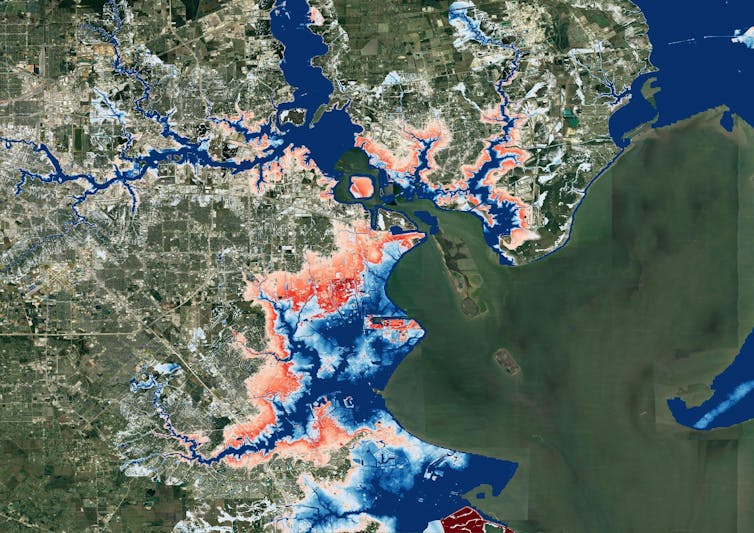
    A map of Houston showing flooding extending much farther inland.
    A map of Houston, produced for a 2022 study by researchers at universities and First Street, shows flood risk changing over the next 30 years as climate change worsens. Blue areas are today’s 100-year flood-risk zones. The red areas reflect the same zones in 2050.
    Oliver Wing et al., 2022

    In recent years, the rise of climate risk analytics models and private flood risk data have allowed the real estate, finance and insurance industries to rely less on FEMA’s maps. These new models incorporate forward-looking climate data, including projections of extreme rainfall, sea-level rise and changing storm patterns – factors FEMA’s maps generally exclude.

    Real estate portals like Zillow, Redfin, Realtor.com and Homes.com now provide property-level flood risk scores that consider both historical flooding and future climate projections. The models they use identify risks for many properties that FEMA maps don’t, highlighting hidden vulnerabilities in communities across the United States.

    Research shows that the availability, and accessibility, of climate data on these sites has started driving property-buying decisions that increasingly take climate change into account.

    Implications for the future

    As homebuyers understand more about a property’s flood risks, that may shift the desirability of some locations over time. Those shifts will have implications for property valuations, community tax-revenue assessments, population migration patterns and a slew of other considerations.

    However, while these may feel like changes being brought on by new data, the risk was already there. What is changing is people’s awareness.

    The federal government has an important role to play in ensuring that accurate risk assessments are available to communities and Americans everywhere. As better tools and models evolve for assessing risk evolve, FEMA’s risk maps need to evolve, too.

    The Conversation

    Jeremy Porter has nothing to disclose.

    ref. FEMA’s flood maps often miss dangerous flash flood risks, leaving homeowners unprepared – https://theconversation.com/femas-flood-maps-often-miss-dangerous-flash-flood-risks-leaving-homeowners-unprepared-260990

  • A wildfire’s legacy can haunt rivers for years, putting drinking water at risk

    Source: ForeignAffairs4

    Source: The Conversation – USA (2) – By Ben Livneh, Associate Professor of Hydrology, University of Colorado Boulder

    Burned ground can become hydrophobic and almost waxlike, allowing rainfall to quickly wash contaminants downslope. Carli Brucker

    A wildfire rages across a forested mountainside. The smoke billows and the flames rise. An aircraft drops vibrant red flame retardant. It’s a dramatic, often dangerous scene. But the threat is only just beginning for downstream communtiies and the water they rely on.

    After the smoke clears, the soil, which was once nestled beneath a canopy of trees and a spongy layer of leaves, is now exposed. Often, that soil is charred and sterile, with the heat making the ground almost water-repellent, like a freshly waxed car.

    When the first rain arrives, the water rushes downhill. It carries with it a slurry of ash, soil and contaminants from the burned landscape. This torrent flows directly into streams and then rivers that provide drinking water for communities downstream.

    As a new research paper my colleagues and I just published shows, this isn’t a short-term problem. The ghost of the fire can haunt these waterways for years.

    Scientists explain how wildfires can contaminate water supplies and the ways they measure the effects, summarized in their 2024 publication. University of Colorado-Boulder.

    This matters because forested watersheds are the primary water source for nearly two-thirds of municipalities in the United States. As wildfires in the western U.S. become larger and more frequent, the long-term security and safety of water supplies for downstream communities is increasingly at risk.

    Charting the long tail of wildfire pollution

    Scientists have long known that wildfires can affect water quality, but two key questions remained: Exactly how bad is the impact? And how long does it last?

    To find out, my colleagues and I led a study, coordinated by engineer Carli Brucker. We undertook one of the most extensive analyses of post-wildfire water quality to date. The results were published June 23, 2025, in the journal Nature Communications Earth & Environment.

    We gathered decades of water quality data from 245 burned watersheds across the western U.S. and compared them to nearly 300 similar, unburned watersheds.

    A map of watersheds in the western U.S.
    A map of the basins studied shows the outlines of fires in red and burned basins in black. The blue basins did not burn and were used for comparisons.
    Carli Brucker, et al., 2025, Nature Communications Earth & Environment

    By creating a computer model for each basin that accounted for its normal water quality variability, based on factors such as rainfall and temperature, we were able to isolate the impact of the wildfire. This allowed us to see how much the water quality deviated after the fire, year after year.

    The results were stark. In the first year after a fire, the concentrations of some contaminants skyrocketed. We found that levels of sediment and turbidity – the cloudiness of the water – were 19 to 286 times higher than prefire levels. That much sediment can clog filters at water treatment plants and require expensive treatment and maintenance. Think of trying to use a coffee filter with muddy water – the water just won’t flow through.

    Concentrations of organic carbon, nitrogen and phosphorus were three to 103 times greater in the burned basins. These dissolved remnants of burned plants and soil are particularly problematic. When they mix with the chlorine used to disinfect drinking water, they can form harmful chemicals called disinfection byproducts, some of which are linked to cancer.

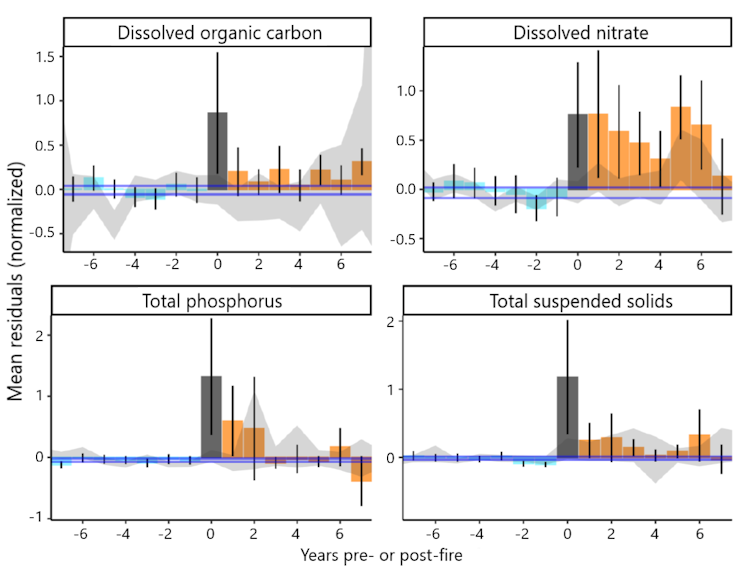
    More surprisingly, we found the impacts to be really persistent. While the most dramatic spikes in phosphorous, nitrate, organic carbon and sediment generally occurred in the first one to three years, some contaminants lingered for much longer.

    Charts show how contaminants lingered in water supplies for years after wildfires.
    Contaminants including phosphorus, organic carbon and nitrates lingered in water supplies for years after wildfires. The charts show the average among all burned basins eight years before fires (light blue) and all burned basins after fires (orange). The gray bars show levels in the year immediately after the fire. The horizontal purple line shows levels that would be expected without a fire, based on the prefire years.
    Carli Brucker, et al., 2025, Nature Communications Earth & Environment

    We saw significantly elevated levels of nitrogen and sediment for up to eight years following a fire. Nitrogen and phosphorus act like fertilizer for algae. A surge of these nutrients can trigger algal blooms in reservoirs, which can produce toxins and create foul odors.

    This extended timeline suggests that wildfires are fundamentally altering the landscape in ways that take a long time to heal. In our previous laboratory-based research, including a 2024 study, we simulated this process by burning soil and vegetation and then running water over them.

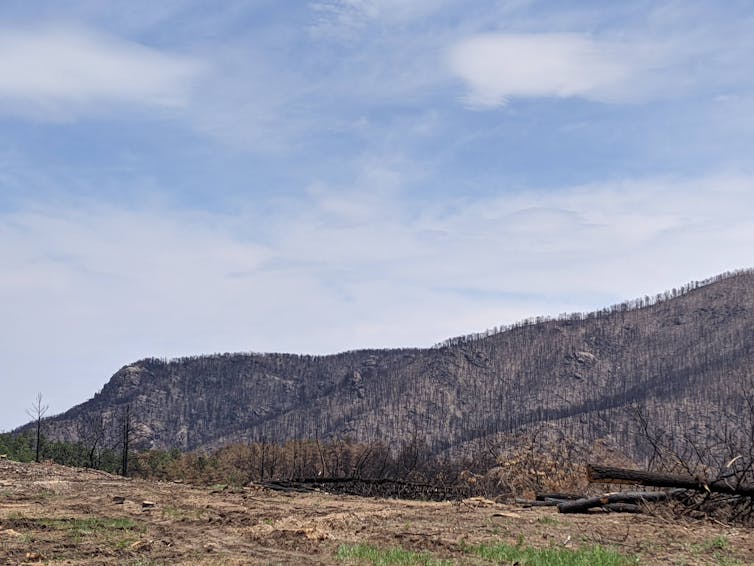
    A blackened mountain slope where all of the trees have burned.
    After mountain slopes burn, the rain that falls on them washes ash, charred soil and debris downstream.
    Carli Brucker

    The stuff that leaches out is a cocktail of carbon, nutrients and other compounds that can exacerbate flood risks and degrade water quality in ways that require more expensive treatment at water treatment facilities. In extreme cases, the water quality may be so poor that communities can’t withdraw river water at all, and that can create water shortages.

    After the Buffalo Creek Fire in 1996 and then the Hayman Fire in 2002, Denver’s water utility spent more than US$27 million over several years to treat the water, remove more than 1 million cubic yards of sediment and debris from a reservoir, and fix infrastructure. State Forest Service crews planted thousands of trees to help restore the surrounding forest’s water filtering capabilities.

    A growing challenge for water treatment

    This long-lasting impact poses a major challenge for water treatment plants that make river water safe to drink. Our study highlights that utilities can’t just plan for a few bad months after a fire. They need to be prepared for potentially eight or more years of degraded water quality.

    We also found that where a fire burns matters. Watersheds with thicker forests or more urban areas that burned tended to have even worse water quality after a fire.

    Since many municipalities draw water from more than one source, understanding which watersheds are likely to have the largest water quality problems after fires can help communities locate the most vulnerable parts of their water supply systems.

    As temperatures rise and more people move into wildland areas in the American West, the risk of wildfires increases, and it is becoming clear that preparing for longer-term consequences is crucial. The health of forests and our communities’ drinking water are inseparably linked, with wildfires casting a shadow that lasts long after the smoke clears.

    The Conversation

    Ben Livneh receives funding from the Western Water Assessment NOAA grant #NA21OAR4310309, ‘Western Water Assessment: Building Resilience to Compound Hazards in the Inter-Mountain West’.

    ref. A wildfire’s legacy can haunt rivers for years, putting drinking water at risk – https://theconversation.com/a-wildfires-legacy-can-haunt-rivers-for-years-putting-drinking-water-at-risk-259118

  • How citizenship chaos was averted, for now, by a class action injunction against Trump’s birthright citizenship order

    Source: ForeignAffairs4

    Source: The Conversation – USA – By Julie Novkov, Professor of Political Science and Women’s, Gender and Sexuality Studies, University at Albany, State University of New York

    Protesters support birthright citizenship on May 15, 2025, outside of the Supreme Court in Washington. AP Photo/Jacquelyn Martin

    Legal battles over President Donald Trump’s executive order to end birthright citizenship continued on July 10, 2025, after a New Hampshire federal district judge issued a preliminary injunction that will, if it’s not reversed, prevent federal officials from enforcing the order nationally.

    The ruling by U.S. District Judge Joseph Laplante, a George W. Bush appointee, asserts that this policy of “highly questionable constitutionality … constitutes irreparable harm.”

    In its ruling in late June, the Supreme Court allowed the Trump administration to deny citizenship to infants born to undocumented parents in many parts of the nation where individuals or states had not successfully sued to prevent implementation – including a number of mid-Atlantic, Midwest and Southern states.

    Trump’s executive order limits U.S. citizenship by birth to those who have at least one parent who is a U.S. citizen or legal permanent resident. It denies citizenship to those born to undocumented people within the U.S. and to the children of those on student, work, tourist and certain other types of visas.

    The preliminary injunction is on hold for seven days to allow the Trump administration to appeal.

    The June 27 Supreme Court decision on birthright citizenship limited the ability of lower-court judges to issue universal injunctions to block such executive orders nationwide.

    Laplante was able to avoid that limit on issuing a nationwide injunction by certifying the case as a class action lawsuit encompassing all children affected by the birthright order, following a pathway suggested by the Supreme Court’s ruling.

    Pathways beyond universal injunctions

    In its recent birthright citizenship ruling, Trump v. CASA, the Supreme Court noted that plaintiffs could still seek broad relief by filing such class action lawsuits that would join together large groups of individuals facing the same injury from the law they were challenging.

    And that’s what happened.

    Litigants filed suit in New Hampshire’s district court the same day that the Supreme Court decided CASA. They asked the court to certify a class consisting of infants born on or after Feb. 20, 2025, who would be covered by the order and their parents or prospective parents. The court allowed the suit to proceed as a class action for these infants.

    Several people raise their hands as a man at a podium answers questions.
    President Donald Trump takes questions on June 27, 2025, in Washington, D.C., after the Supreme Court ruled on the birthright citizenship case.
    Joe Raedle/Getty Images

    What if this injunction doesn’t stick?

    If the U.S. Court of Appeals for the 1st Circuit or the Supreme Court invalidates the New Hampshire court’s newest national injunction and another injunction is not issued in a different venue, the order will then go into effect anywhere it is not currently barred from doing so. Implementation could begin in as many as 28 states where state attorneys general have not challenged the Trump birthright citizenship policy if no other individuals or groups secure relief.

    As political science scholars who study race and immigration policy, we believe that, if implemented piecemeal, Trump’s birthright citizenship order would create administrative chaos for states determining the citizenship status of infants born in the United States. And it could lead to the first instances since the 1860s of infants being born in the U.S. being denied citizenship categorically.

    States’ role in establishing citizenship

    Almost all U.S.-born children are issued birth certificates by the state in which they are born.

    The federal government’s standardized form, the U.S. standard certificate of live birth, collects data on parents’ birthplaces and their Social Security numbers, if available, and provides the information states need to issue birth certificates.

    But it does not ask questions about their citizenship or immigration status. And no national standard exists for the format for state birth certificates, which traditionally have been the simplest way for people born in the U.S. to establish citizenship.

    If Trump’s executive order goes into effect, birth certificates issued by local hospitals would be insufficient evidence of eligibility for federal government documents acknowledging citizenship. The order would require new efforts, including identification of parents’ citizenship status, before authorizing the issuance of any federal document acknowledging citizenship.

    Since states control the process of issuing birth certificates, they will respond differently to implementation efforts. Several states filed a lawsuit on Jan. 21 to block the birthright citizenship order. And they will likely pursue an arsenal of strategies to resist, delay and complicate implementation.

    While the Supreme Court has not yet confirmed that these states have standing to challenge the order, successful litigation could bar implementation in up to 18 states and the District of Columbia if injunctions are narrowly framed, or nationally if lawyers can persuade judges that disentangling the effects on a state-by-state basis will be too difficult.

    Other states will likely collaborate with the administration to deny citizenship to some infants. Some, like Texas, had earlier attempted to make it particularly hard for undocumented parents to obtain birth certificates for their children.

    Protesters hold signs in front of a federal building.
    People demonstrate outside the Supreme Court of the United States on May 15, 2025, in Washington, D.C.
    Matt McClain/The Washington Post via Getty Images

    Potential for chaos

    If the Supreme Court rejects attempts to block the executive order nationally again, implementation will be complicated.

    That’s because it would operate in some places and toward some individuals while being legally blocked in other places and toward others, as Justice Sonia Sotomayor warned in her Trump v. CASA dissent.

    Children born to plaintiffs anywhere in the nation who have successfully sued would have access to citizenship, while other children possibly born in the same hospitals – but not among the groups named in the suits – would not.

    Babies born in the days before implementation would have substantially different rights than those born the day after. Parents’ ethnicity and countries of origin would likely influence which infants are ultimately granted or denied citizenship.

    That’s because some infants and parents would be more likely to generate scrutiny from hospital employees and officials than others, including Hispanics, women giving birth near the border, and women giving birth in states such as Florida where officials are likely to collaborate enthusiastically with enforcement.

    The consequences could be profound.

    Some infants would become stateless, having no right to citizenship in another nation. Many people born in the U.S. would be denied government benefits, Social Security numbers and the ability to work legally in the U.S.

    With the constitutionality of the executive order still unresolved, it’s unclear when, if ever, some infants born in the U.S. will be the first in the modern era to be denied citizenship.

    The Conversation

    The authors do not work for, consult, own shares in or receive funding from any company or organization that would benefit from this article, and have disclosed no relevant affiliations beyond their academic appointment.

    ref. How citizenship chaos was averted, for now, by a class action injunction against Trump’s birthright citizenship order – https://theconversation.com/how-citizenship-chaos-was-averted-for-now-by-a-class-action-injunction-against-trumps-birthright-citizenship-order-260175

  • The forgotten 80-year-old machine that shaped the internet – and could help us survive AI

    Source: ForeignAffairs4

    Source: The Conversation – UK – By Martin Rudorfer, Lecturer in Computer Science, Aston University

    Many years ago, long before the internet or artificial intelligence, an American engineer called Vannevar Bush was trying to solve a problem. He could see how difficult it had become for professionals to research anything, and saw the potential for a better way.

    This was in the 1940s, when anyone looking for articles, books or other scientific records had to go to a library and search through an index. This meant drawers upon drawers filled with index cards, typically sorted by author, title or subject.

    When you had found what you were looking for, creating copies or excerpts was a tedious, manual task. You would have to be very organised in keeping your own records. And woe betide anyone who was working across more than one discipline. Since every book could physically only be in one place, they all had to be filed solely under a primary subject. So an article on cave art couldn’t be in both art and archaeology, and researchers would often waste extra time trying to find the right location.


    Get your news from actual experts, straight to your inbox. Sign up to our daily newsletter to receive all The Conversation UK’s latest coverage of news and research, from politics and business to the arts and sciences.


    This had always been a challenge, but an explosion in research publications in that era had made it far worse than before. As Bush wrote in an influential essay, As We May Think, in The Atlantic in July 1945:

    There is a growing mountain of research. But there is increased evidence that we are being bogged down today as specialisation extends. The investigator is staggered by the findings and conclusions of thousands of other workers – conclusions which he cannot find time to grasp, much less to remember, as they appear.

    Bush was dean of the school of engineering at MIT (the Massachusetts Institute of Technology) and president of the Carnegie Institute. During the second world war, he had been the director of the Office of Scientific Research and Development, coordinating the activities of some 6,000 scientists working relentlessly to give their country a technological advantage. He could see that science was being drastically slowed down by the research process, and proposed a solution that he called the “memex”.

    The memex was to be a personal device built into a desk that required little physical space. It would rely heavily on microfilm for data storage, a new technology at the time. The memex would use this to store large numbers of documents in a greatly compressed format that could be projected onto translucent screens.

    Most importantly, Bush’s memex was to include a form of associative indexing for tying two items together. The user would be able to use a keyboard to click on a code number alongside a document to jump to an associated document or view them simultaneously – without needing to sift through an index.

    Bush acknowledged in his essay that this kind of keyboard click-through wasn’t yet technologically feasible. Yet he believed it would be soon, pointing to existing systems for handling data such as punched cards as potential forerunners.

    Woman operating a punched card machine
    Punched cards were an early way of storing digital information.
    Wikimedia, CC BY-SA

    He envisaged that a user would create the connections between items as they developed their personal research library, creating chains of microfilm frames in which the same document or extract could be part of multiple trails at the same time.

    New additions could be inserted either by photographing them on to microfilm or by purchasing a microfilm of an existing document. Indeed, a user would be able to augment their memex with vast reference texts. “New forms of encyclopedias will appear,” said Bush, “ready-made with a mesh of associative trails running through them, ready to be dropped into the memex”. Fascinatingly, this isn’t far from today’s Wikipedia.

    Where it led

    Bush thought the memex would help researchers to think in a more natural, associative way that would be reflected in their records. He is thought to have inspired the American inventors Ted Nelson and Douglas Engelbart, who in the 1960s independently developed hypertext systems, in which documents contained hyperlinks that could directly access other documents. These became the foundation of the world wide web as we know it.

    Beyond the practicalities of having easy access to so much information, Bush believed that the added value in the memex lay in making it easier for users to manipulate ideas and spark new ones. His essay drew a distinction between repetitive and creative thought, and foresaw that there would soon be new “powerful mechanical aids” to help with the repetitive variety.

    He was perhaps mostly thinking about mathematics, but he left the door open to other thought processes. And 80 years later, with AI in our pockets, we’re automating far more thinking than was ever possible with a calculator.

    If this sounds like a happy ending, Bush did not sound overly optimistic when he revisited his own vision in his 1970 book Pieces of the Action. In the intervening 25 years, he had witnessed technological advances in areas like computing that were bringing the memex closer to reality.

    Yet Bush felt that the technology had largely missed the philosophical intent of his vision – to enhance human reasoning and creativity:

    In 1945, I dreamed of machines that would think with us. Now, I see machines that think for us – or worse, control us.

    Bush would die just four years later at the age of 84, but these concerns still feel strikingly relevant today. While it’s great that we do not need to search for a book by flipping through index cards in chests of drawers, we might feel more uneasy about machines doing most of the thinking for us.

    A phone screen with AI apps
    Just 80 years after Bush proposed the Memex, AIs on smartphones are an everyday thing.
    jackpress

    Is this technology enhancing and sharpening our skills, or is it making us lazy? No doubt everyone is different, but the danger is that whatever skills we leave to the machines, we eventually lose, and younger generations may not even get the opportunity to learn them in the first place.

    The lesson from As We May Think is that a purely technical solution like the memex is not enough. Technology still needs to be human-centred, underpinned by a philosophical vision. As we contemplate a great automation in human thinking in the years ahead, the challenge is to somehow protect our creativity and reasoning at the same time.

    The Conversation

    Martin Rudorfer does not work for, consult, own shares in or receive funding from any company or organisation that would benefit from this article, and has disclosed no relevant affiliations beyond their academic appointment.

    ref. The forgotten 80-year-old machine that shaped the internet – and could help us survive AI – https://theconversation.com/the-forgotten-80-year-old-machine-that-shaped-the-internet-and-could-help-us-survive-ai-260839

  • Pets can get sunburned too – what you need to know

    Source: ForeignAffairs4

    Source: The Conversation – UK – By Jacqueline Boyd, Senior Lecturer in Animal Science, Nottingham Trent University

    While there is good awareness of the potential dangers of pets overheating in high temperatures during summer months, recognising that the sunburn itself can be a source of harm is also important.

    We might think that our furry friends are protected from the sun’s harmful rays thanks to their typical hairiness, but in reality, we need to protect them too.

    This is especially important for pets with light-coloured hair, pale, pink skin or those with fine or thin coats such as the sphynx cat or the xoloitzcuintle dog that lack natural protection.

    For pets that live outdoors or spend a lot of time in the sun, this can also be a significant problem.


    Get your news from actual experts, straight to your inbox. Sign up to our daily newsletter to receive all The Conversation UK’s latest coverage of news and research, from politics and business to the arts and sciences.


    Pink skin lacks the pigment, melanin, that provides a natural level of protection from sunlight. As a result, pets with exposed areas of pink skin can become painfully sunburned, even on days that might not appear overly sunny. The tips of cats’ ears are commonly affected, as are horses with pink muzzles and other lightly pigmented areas of their body.

    Dogs can also be affected on their noses and bellies – I have even known one unfortunate pooch to suffer sunburn on his scrotum after a period of garden sunbathing. Essentially, just like us, any unprotected area of skin that is exposed to the sun can become painfully burned, with both short and more prolonged effects.

    Even minor areas of sunburn are associated with reddening of the skin, irritation and discomfort. More severe cases of sunburn can cause blistering, crusting and scabs to form on affected areas. While these signs typically heal and resolve quickly, they can be painful and distressing for our pets.

    The longer-term consequences can include significant damage to the skin and may increase the risk of certain forms of skin cancer developing.

    There is also the potential for thermal burns to occur after exposure to intense sunlight, especially over the backs of animals. These can be severe, affecting the full thickness of the skin and causing significant distress.

    Consequently, protecting our pets from the pain of sunburn is important.

    How to protect your pet

    An easy way to keep your pet safe both from the damaging UV radiation in sunlight and high temperatures, is to limit their access outdoors during the sunniest and warmest times of the day. This might mean exercising your dog early in the morning and later in the evening, providing shade and shelter for horses and encouraging cats to sunbathe safely indoors.

    The use of sunscreen can be a useful protective method to limit harm to exposed areas of skin, but do select a pet-safe sunscreen. Many human sunscreen preparations contain ingredients that can be toxic for our pets, especially if accidentally licked and ingested.

    Reapply sunscreen regularly and don’t forget to apply it to the areas most likely to be exposed, such as ears, noses and pink-skinned or lightly coated areas of the body.

    For some pets, suitable protective clothing and coverings, including UV eye protection might be appropriate, although do take time to get your pet used to wearing and moving in these before use.

    What if your pet has been sunburned?

    If your pet gets a mild sunburn but seems comfortable and not in distress, a cold compress can offer some soothing relief. Gently apply it to the affected area to help ease discomfort. Keep a close eye on the healing process, and be sure to protect your pet from further sun exposure.

    In more severe cases, contact your vet for advice and additional treatment. Painkillers or antibiotics might be needed and these can only be prescribed for your pet by a veterinary surgeon.

    Equally, if you find unusual areas on your pet’s skin such as non-healing or unusually crusty sores and are concerned that it could be a sign of skin cancer, speak to your vet for guidance and support.

    Global UV levels are increasing. This means that in the same way that we have increased exposure to potentially harmful levels, our pets do too. By managing how our pets experience sunshine and by using protective options where possible, we can go some way to avoiding the pain and distress of sunburn, as well as the more serious possible long-term consequences such as skin cancer.

    The Conversation

    In addition to her academic affiliation at Nottingham Trent University (NTU) and support from the Institute for Knowledge Exchange Practice (IKEP) at NTU, Jacqueline Boyd is affiliated with The Kennel Club (UK) through membership, as advisor to the Health Advisory Group and membership of the Activities Committee. Jacqueline is also a full member of the Association of Pet Dog Trainers (APDT #01583). She also writes, consults and coaches on canine matters on an independent basis.

    ref. Pets can get sunburned too – what you need to know – https://theconversation.com/pets-can-get-sunburned-too-what-you-need-to-know-260076

  • How citizens’ assemblies could improve animal welfare

    Source: ForeignAffairs4

    Source: The Conversation – UK – By Heather Browning, Lecturer in Philosophy, University of Southampton

    Heather Browning speaks about animal welfare and ethics as part of the Citizens’ Assembly for Animal Welfare opening event in Birmingham. RSPCA, CC BY-NC-ND

    As an animal lover, should you visit zoos? Should you have pets? Should you make your garden friendly for birds, pollinators and other wildlife? Should you try to reduce meat in your diet or avoid consuming all animal products? Should you write to politicians about changing the laws for animals?

    As a lecturer in animal ethics and animal welfare science, and someone who’s spent a lot of time working with animals, these are the sorts of questions I think about.

    There are lots of ways to be kinder to animals. All have their merits. But the big question is: what sort of future do we want to see for animals in our society?

    We live in a time where animals are facing some of their biggest challenges, from the climate crisis to industrial farming. Combined with other social issues such as the cost of living crisis and global conflicts, we as citizens and consumers have many other competing claims on our capacity to care. This can mean less attention for animals and the harms they face.


    Get your news from actual experts, straight to your inbox. Sign up to our daily newsletter to receive all The Conversation UK’s latest coverage of news and research, from politics and business to the arts and sciences.


    This creates a big problem. Alongside the ethical reasons for improving animals’ lives, good animal welfare can benefit everyone – among other things, care for and connections with animals improves our own mental health, fosters compassion in our communities, and can lead to improvements in our natural environment. We don’t want to lose sight of the progress we’ve made in our thinking about and treatment of animals.

    It’s undeniable that there have been many welfare gains for animals over the years, but in the face of how far we still have to go, perhaps new approaches are needed. How can we conceive of new, and perhaps more radical, ways to help animals? And importantly, how do we keep animal welfare on the agenda, both socially and politically?

    For over two centuries, the Royal Society for the Prevention of Cruelty to Animals (RSPCA) has played a central role in this fight. Alongside their animal rescue work, they have campaigned for changes in over 400 laws, and worked with the public to find ways to improve welfare for pets, farmed animals and wildlife.

    This year they are stepping into a new frontier and have commissioned what is possibly the first ever citizens’ assembly focused entirely on animal welfare in the world, delivered with the assistance of experts from the New Citizen Project, a consultancy that specialises in citizen-led engagement. The assembly is part of the RSPCA’s Animal Futures project, which aims to examine what the future may hold for animals by 2050, and most importantly how everyone (citizens, consumers and policymakers) has a role in influencing this.

    chickens farmed outside, green grass and open air
    Citizens’ assemblies are being held to debate animal welfare issues, such as chicken farming for eggs.
    Dewald Kirsten/Shutterstock

    Citizens’ assemblies bring together a randomly selected representative sample of the population, who learn about and debate issues and make recommendations. It’s a form of deliberative democracy, where the people can have their say on important social and political issues.

    Assemblies are a means of overcoming some of the current problems with the democratic process, like the exclusion of people who often aren’t heard in politics (such as those with less money or education, or racial and religious minorities) and polarisation between major government parties that can slow down decision-making and action.

    Beyond just a focus group asking for existing opinions, citizen’s assemblies provide opportunities for members to learn and shape their thinking, to build expertise on the topics they deliberate.

    Assemblies have already been used around the world on issues as diverse as abortion rights, electoral reform and food waste. As they are independently facilitated, they don’t just follow the accepted institutional narratives and can instead encourage organisations and policymakers to envision new directions for thought and action – in line with the realities of what the public believe and value.

    There are now several examples of the recommendations coming from such assemblies successfully driving policy change, such as climate change reform in France.

    While organisations such as the RSPCA may know a lot about animals, hosting this assembly is an acknowledgement that they don’t have all the answers about what is best for society as a whole, as we consider our interactions with animals. The scope of this problem is far larger than any one organisation can tackle alone, and through initiatives such as the citizens’ assembly, we can gain a greater insight into the possible solutions for the future.

    Animal assembly

    I recently attended this assembly’s opening session in Birmingham, where members were gathered from all around England and Wales (neatly marked by pins scattered across a map of the country). Looking around the room there was obvious diversity in demographics and backgroun and as I spoke with the members it was also apparent there was a wide range of opinions and beliefs on the topics we discussed.

    What everyone shared was a commitment to the process – to learn from the experts who were there to introduce the topics, to deliberate and discuss carefully and thoughtfully – and a desire to contribute and influence the process. Being there felt like being part of an important moment for the future of animal welfare.

    In the weeks that followed, the members of the assembly met again several times to absorb and consider huge amounts of information about topics such as farming, responsible pet ownership, wildlife, and nature. Based on this, they will make a series of recommendations that will drive change at the RSPCA.

    What they produce will be used to shape its future direction, how it works, and how it lobbies governments. What these assembly members recommend could have a substantial and lasting impact on animal welfare in the UK.

    Like many animal welfare experts from academia, industry or charities, I might think I have the answers on what animals need. But successful solutions require public backing to have real impact. Improving the future for animals is something that everyone has a role in and a citizens’ assembly can be a catalyst for positive change.


    Don’t have time to read about climate change as much as you’d like?

    Get a weekly roundup in your inbox instead. Every Wednesday, The Conversation’s environment editor writes Imagine, a short email that goes a little deeper into just one climate issue. Join the 45,000+ readers who’ve subscribed so far.


    The Conversation

    Heather Browning does not work for, consult, own shares in or receive funding from any company or organisation that would benefit from this article, and has disclosed no relevant affiliations beyond their academic appointment.

    ref. How citizens’ assemblies could improve animal welfare – https://theconversation.com/how-citizens-assemblies-could-improve-animal-welfare-259755

  • Overhauling the NHS app is at the heart of UK healthcare plans, but it could leave some people behind

    Source: ForeignAffairs4

    Source: The Conversation – UK – By Catia Nicodemo, Professor of Health Economics, Brunel University of London

    The ‘doctor in your pocket’ will see you soon. CeltStudio/Shutterstock

    The UK government’s ten-year health plan promises a radical digital transformation of the NHS. A key part of this change is said to come from developing the NHS app, which is being hailed as a “doctor in your pocket”.

    The upgraded app will apparently offer features like instant health advice, appointment booking, prescription management and access to personal health records. It is hoped the software will become users’ “front door” to the NHS.

    It’s an ambitious vision which aims to empower patients, streamline services and reduce red tape. And for tech-savvy users, these innovations could significantly improve access to care, reduce waiting times and enhance patient autonomy.

    But while it may herald a new era of convenience for many, it risks leaving behind anyone who struggles with an increasingly digital world. This could then exacerbate health inequalities which already exist – and increase pressure on some areas of already strained services.


    Get your news from actual experts, straight to your inbox. Sign up to our daily newsletter to receive all The Conversation UK’s latest coverage of news and research, from politics and business to the arts and sciences.


    In particular, a digital-first approach to healthcare risks excluding older adults, who may lack the skills or resources to confidently navigate the necessary software. The media regulator Ofcom estimates that around 6% of UK households still lack internet access at home. Figures from the charity Age UK suggest that 33% of people over 75 in the UK lack basic digital skills.

    With regard to health specifically, a 2024 study found that older patients were more likely to misunderstand automated symptom checkers, leading to unnecessary anxiety or delayed care.

    For these people, the planned shift to app-based services could create new barriers to accessing care, potentially leading to delayed diagnoses and worsening health outcomes.

    The NHS plan does at least acknowledge this divide, and says it will confer with patient groups and work with other establishments (such as libraries) to support digital literacy. But these measures will not be enough without guaranteed funding.

    And older people, even those who are comfortable with technology, may face other challenges such as visual impairment or cognitive decline, which can make using apps difficult.

    Others who struggle to use the NHS App for routine care may delay seeking help until their conditions worsen, placing avoidable strain on overstretched hospitals.

    Digital diversion

    This strain might include digital triage inadvertently funnelling non-urgent cases to A&E if users misinterpret symptoms or find the app’s guidance unclear, a risk compounded by the lack of human oversight in automated systems. Or a patient with chronic pain might avoid the app due to digital anxiety or confusion, and end up going to A&E when their condition becomes unbearable and more costly to treat.

    Two women of different generations use a smartphone together.
    Not everyone is comfortable with apps.
    Halfpoint/Shutterstock

    To avoid all of this, the NHS needs to maintain traditional communication options. Telephone and in-person services must remain accessible and widely available. The ten-year plan’s focus on “digital by default” should not become “digital only”.

    There should also be plenty of investment to help people feel digitally empowered and included. Places like libraries and community centres can certainly help, but targeted outreach will also be necessary, such as partnerships with charities.

    This is not to say the NHS should be overly wary of the benefits of increased digital capabilities. The ten-year plan highlights, for example, the app’s potential to alleviate some of the burdens on healthcare staff, with AI able to take care of admin, saving clinicians time which can be used for patient care instead.

    Such efficiencies are critical for a system grappling with workforce shortages and rising demand. Yet if digital tools are not universally accessible or usable, not everyone will benefit.

    So while the NHS’s digital ambitions are commendable, their success hinges on inclusivity. If it’s not careful, the system risks entrenching a two-tier system where younger, tech-literate patients benefit while older and disadvantaged groups face greater exclusion. As the NHS embraces innovation, it must ensure no one is left behind – especially those who rely on it the most.

    The Conversation

    Catia Nicodemo does not work for, consult, own shares in or receive funding from any company or organisation that would benefit from this article, and has disclosed no relevant affiliations beyond their academic appointment.

    ref. Overhauling the NHS app is at the heart of UK healthcare plans, but it could leave some people behind – https://theconversation.com/overhauling-the-nhs-app-is-at-the-heart-of-uk-healthcare-plans-but-it-could-leave-some-people-behind-260540

  • ‘Come meet us in Dubai’: the new offshoring of grand corruption

    Source: ForeignAffairs4

    Source: The Conversation – UK – By John Heathershaw, Professor in International Relations, University of Exeter

    So-called professional enablers of grand corruption are increasing service provision out of jurisdictions where they can act without similar restraints. WaitForLight / Shutterstock

    During an interview one of us (Ricardo Soares de Oliveira) carried out in 2017, an African high net-worth individual said he was told by an executive whose business had long served him out of London: “Come meet us in Dubai”. This is part of a large but still misunderstood shift.

    In response to the hardening of rules for foreign money of dubious origins in traditional financial centres, sensitive business has been moving toward new, more permissive jurisdictions. This offshoring of services is giving corrupt strategies a new lease of life, while also making the fightback more difficult.

    For every corrupt dealing that materialises as legitimate wealth, a trail of service provision is indispensable. Bankers, lawyers, real estate executives, accountants, management consultants and PR agencies have acted as facilitators in western financial centres.

    Western governments have long indulged kleptocracy, a system where business success and political power are inextricably entwined. They have done so by condoning lax law enforcement and promoting deregulation, often through risible mechanisms of professional self-regulation.

    But in recent years, data leaks and brave championship of reform by politicians, as well as the work of civil society organisations, investigative journalists and academics, have shed light on the role of these so-called professional enablers.

    In June 2024, a month before becoming British foreign secretary, David Lammy promised to take aim at professionals who enable corruption through London and the UK’s overseas territories. This, he noted, included the “finest bankers, lawyers, estate agents and accountants that money could buy”.

    Lammy’s comments give the impression that the era of risk-free facilitation of corrupt behaviour is at an end. But this optimism is, at least for now, misplaced.

    The shift is largely in political discourse and media scrutiny. Enforcement seriously lags everywhere and is now in reverse gear in the US. Professional enablers still face no real sanction for engaging in such practices.

    At the same time, many professionals are reacting to a more tightly regulated ecosystem in western jurisdictions by engaging in so-called “jurisdictional arbitrage”. There is evidence that they are increasing service provision out of jurisdictions where they can act without similar restraints.

    Jurisdictional arbitrage

    Almost all cases of the professional enabling we have studied involve service provision in western hubs and “new” global financial centres.

    The professional network around Gulnara Karimova, the daughter of the former president of Uzbekistan, Islam Karimov, was dubbed “the office” by Swiss prosecutors. Karimova was jailed in 2014 for taking bribes for access to the country’s market.

    The criminal investigation into her involved 12 jurisdictions, including the UK, US and Uzbekistan as well as the United Arab Emirates (UAE) and Hong Kong.

    Isabel dos Santos, who is Africa’s richest woman and the daughter of former Angolan president José Eduardo dos Santos, also held a maze of global interests. These interests, as in the case of Karimova, spanned western jurisdictions and Asian financial centres such as Dubai, Singapore and Hong Kong.

    Alternative jurisdictions all offer very similar conditions. They are already well-connected, world-class financial centres that are attractive to international business executives.

    Their governments have created regulatory, fiscal and secrecy conditions, sometimes explicitly undercutting older centres such as Switzerland and London. In the latest edition of the Global Financial Centers index, which ranks the competitiveness of financial centres, Dubai rose four places to go above Dublin, Geneva and Paris.

    Crucially, they are also mostly authoritarian states where there is no media or civil society pressure regarding business activities. Even the intermittent sort of scrutiny one sees in western financial centres is absent there.

    Much activity in these financial centres is legal and based on their legitimate competitive advantages. Business interests are also attracted by their vast capital pools. But they are proving to be especially appealing for the sort of business that can no longer flock to other jurisdictions.

    This is the case with servicing clients from states under sanctions such as Russia or Iran. It also applies to regions like Africa and central Asia with high compliance barriers whose high net-worth individuals and firms can no longer get easy access to OECD jurisdictions.

    Researchers at the University of Sussex have shown a major shift in dirty money networks away from the west and towards what they call a “Dubai-Kong axis”.

    There is no exact portrait of the magnitude of this jurisdictional arbitrage. But our work tells us it is big. Two examples from Switzerland are commodity trading and wealth management.

    These sectors have long been under-scrutinised. But they have seen regulatory tightening and greater media attention in recent years. Both have reacted the same way, by sending important parts of their business away from Switzerland.

    The UAE has been dubbed the “new Swiss financial mecca”, with the Financial Times reporting in May 2025 that Swiss family offices are moving there “wholesale”. Far from downplaying the “Swiss brand”, they continue to advertise their multi-generational expertise and “old money” mystique, but from more amenable locations.

    What can be done?

    The many types of legal business involving professional services in these jurisdictions should not be affected. But national and international law must designate the “kleptocratic enterprise” of elites and professionals as a form of serious organised crime.

    This would allow prosecutors to target professionals for working with criminal kleptocrats rather than having to prove that the particular asset handled has criminal origin. This move was made by Swiss prosecutors in the Karimova case.

    It captures the reality that ill-gotten gains are layered and integrated into assets held overseas, just as enablers do for criminal gangs. It also means that the moving of the family office to Dubai will not prevent prosecution where an asset is held or registered.

    Finally, governments could stimulate the market in asset recovery by making it easier for foreign governments and civil society to bring cases, with expert law firms working on a for-profit basis.

    Illicit finance is always transnational, so there is no need to declare defeat just because dodgy business is on the move. However, we are entering a new stage in its global dissemination and complexity.

    The Conversation

    John Heathershaw receives funding from the Governance Integrity Anti-Corruption Evidence Programme funded by UK Aid from the UK Government for the benefits of developing countries. The views expressed are not necessarily those of the UK government’s official policies. He is affiliated with the UK Anti-Corruption Coalition.

    Ricardo Soares de Oliveira receives funding from the Governance Integrity Anti-Corruption Evidence Programme funded by UK Aid from the UK Government for the benefits of developing countries. The views expressed are not necessarily those of the UK government’s official policies.

    ref. ‘Come meet us in Dubai’: the new offshoring of grand corruption – https://theconversation.com/come-meet-us-in-dubai-the-new-offshoring-of-grand-corruption-258434

  • Pallets are the backbone of global trade but supplies are threatened by theft, loss – and giant bonfires

    Source: ForeignAffairs4

    Source: The Conversation – UK – By Liz Breen, Professor of Health Service Operations, School of Pharmacy & Medical Sciences, University of Bradford

    Craigyhill bonfire was declared the world’s tallest at a height of 203 feet (63 metres) in 2022. Thousands of pallets were used to build it. Stephen Barnes/Shutterstock

    Pallets don’t usually make headlines. But amid fresh controversy around the traditional July bonfires held in Northern Ireland this year, they’ve suddenly become a talking point. Wooden pallets used in these bonfires are popular due to their stacking ability, and also their colours – which include the red, white and blue of Britain.

    Ordinarily, pallets are used to transport products from manufacturers to retailers. But their numbers are shrinking due to theft and loss – and of course, they cost money to buy, store, use and replace. A study by one of us (Liz) in 2006 quoted a logistics firm that estimated 14 million pallets were generally missing throughout Europe, costing £140 million. And it’s an ongoing problem: millions of products such as pallets and packaging containers are still stolen each year across the continent.

    Just one bonfire in Larne, County Antrim, in July 2021 reportedly used 17,000 pallets in its construction. This year, police are investigating where the pallets used in the same community’s bonfire originated from. Amid speculation that some may belong to Australia-based supply chain firm Chep, that company has stated its pallets can never legally be bought, sold or destroyed.


    Get your news from actual experts, straight to your inbox. Sign up to our daily newsletter to receive all The Conversation UK’s latest coverage of news and research, from politics and business to the arts and sciences.


    Pallet losses can lead to logistical disruptions, delayed orders and bare shelves in supermarkets. And the impact is felt by pallet owners, manufacturers, customers and end-users alike.

    Pallets are big business. In the US, around 513 million – mainly wooden, some plastic – are produced each year. In 2021, 48.6 million wooden pallets were produced in the UK, up 8.3% from 2020.

    Rental companies can hold high numbers of pallets, which support the movement of “fast-moving” customer goods – including food, drinks and toiletries. North American firm Peco, for example, manages stock of over 20 million distinctive red wooden pallets across its 90 depots.

    Manufacturers rely on pallets being available to fulfil orders and distribute them to customers quickly. Also known as “returnable transit packaging”, they are valuable assets as they can be maintained and reused. They are usually owned by a pallet pooling agent, which must absorb the loss when they are not returned from customers.

    Why steal pallets?

    Good-condition pallets have a resale value. Both wood and plastic pallets can be deconstructed and sold as components to other industries. Some people even use them to create furniture for homes and gardens.

    Customers may feel these are legitimate upcycled products and won’t think to check where the pallets came from. However, some do have distinctive identification stamps that may remain in upcycled pallet products.

    The organised theft of these products takes its toll on companies. Cargo crime (which includes consumer goods and transportation pallets and containers) is said to cost the UK economy £700 million each year.

    If pallets are not available, production lines may be slowed down or stopped. And it may take longer to produce items, potentially leading to unnecessary transportation as well as greater fuel consumption and emissions.

    But it can also be challenging to map pallet movements and know, at any given time, how many are in transit, with retailers, or lost. Digital tracking solutions such as radio frequency identification can be expensive to implement and are not foolproof. This can make it easy for pallets to go “missing in action”.

    Pallets are a staple mechanism for stock to be received into retailers’ warehouses and distribution centres. Both the size of the pallets and their ownership can be colour-coded – at least some of the blue pallets making headlines this summer in Larne’s red, white and blue tower are thought to be owned by Chep. Warehouse bays are designed with specific pallets in mind – so changes to the pallets can bring extra costs.

    Similarly, replacing lost or stolen pallets comes at a price – which could ultimately be felt by consumers if these costs are passed on by retailers.

    Reducing theft and loss

    Pallet owners cannot afford to continue losing them to theft. Firms that are found using non-compliant or untracked pallets because they have bought them from unauthorised sources can face shipment fines, while other initiatives, such as deposit or voucher schemes or one-for-one exchange plans, could incentivise the return of pallets.

    These practices may influence corporate return behaviour, but the theft of pallets by organised crime gangs is increasing. Changing the materials used to construct pallets could reduce their financial attractiveness and resale value.

    At first glance, a used pallet might look no more useful than discarded wood and be considered fair game for reuse or selling on. But businesses or individuals who collect, sell or purchase stolen pallets are putting themselves at legal risk. Firms found stockpiling or selling-on pallets without permission have faced legal action and even jail in Europe.

    Aside from the legal implications, there are other operational and environmental costs. Each pallet taken out of circulation must be replaced, increasing demand for virgin timber, straining forest resources, and increasing labour costs.

    The humble pallet is the backbone of global trading, and businesses rely on a steady and dependable supply. Pallet services function only if they continue to circulate – but theft and losses undermine this. Without this simple product, everyone from producers to retailers and consumers could end up paying more for the goods they take for granted.

    The Conversation

    The authors do not work for, consult, own shares in or receive funding from any company or organisation that would benefit from this article, and have disclosed no relevant affiliations beyond their academic appointment.

    ref. Pallets are the backbone of global trade but supplies are threatened by theft, loss – and giant bonfires – https://theconversation.com/pallets-are-the-backbone-of-global-trade-but-supplies-are-threatened-by-theft-loss-and-giant-bonfires-260948

  • Channel crossings: what is a safe and legal route?

    Source: ForeignAffairs4

    Source: The Conversation – UK – By Gillian McFadyen, Lecturer in International Politics, Aberystwyth University

    Since figures were first recorded in 2018, more than 170,000 people have crossed the Channel in small boats, hoping to claim asylum in the UK. Over 20,000 have crossed this year alone, and many dozens have died.

    Over the years, UK governments have tried a number of tactics – returns agreements, increased law enforcement, deportation schemes, and “smashing” organised smuggling gangs – to try and put an end to this dangerous practice. The latest attempt is the government’s new “one in, one out” pilot migration deal with France, which would see the UK accept some asylum seekers with legitimate claims to life in the UK, while sending an equivalent number back to France.


    Read more:
    How UK-France ‘one in, one out’ migration deal will work – and what the challenges could be


    Campaigners, academics and groups that support asylum seekers have long called for the UK to introduce “safe and legal routes”. They argue that this is the only way to reduce demand for unsafe Channel crossings. The logic is that people seeking protection are turning to smugglers and small boats because, for most, there are no other options to enter the UK and claim asylum.

    But what are these routes?


    Get your news from actual experts, straight to your inbox. Sign up to our daily newsletter to receive all The Conversation UK’s latest coverage of news and research, from politics and business to the arts and sciences.


    A safe and legal route is a scheme or journey approved by the UK government that allows people to enter the country without a visa in order to claim asylum. The 1951 refugee convention says that people have the right to claim asylum. But UK law requires someone to be physically present in the country to do so.

    A safe and legal route stresses that arriving irregularly – for instance, by crossing the Channel in a small boat – is illegal, even though the UN refugee convention is explicit that refugees should not be penalised for how they arrive to claim refuge.

    Does the UK have safe and legal routes?

    The UK has had safe and legal routes available for refugees in the recent past.

    Most schemes are restricted to certain populations and limited in accessibility. For example, two nationality-specific schemes for Afghans were set up in January 2022, after the fall of Kabul to the Taliban. These have resettled roughly 34,000 Afghans in the UK.

    The schemes prioritised those who had worked or assisted UK efforts in Afghanistan, as well as assisting vulnerable people such as women and girls at risk, and minority groups. Both routes are now shut.

    The UK also has schemes for Ukrainians and Hong Kongers. The Ukrainian schemes (Homes for Ukrainians and the now-closed Ukrainian Family Scheme), established in March 2022, have resettled 217,000 to the UK. The Hong Kong scheme is only eligible for British National Overseas status holders and their dependants. Most of these are not recognised, and nor do they identify, as refugees. Since opening in January 2021, 179,000 have been granted a visa to live in the UK.

    There is also the family reunion pathway for those already granted protection in the UK, who can invite spouses or other dependants to join them. This can be viewed as a safe route, but it is specifically for those already with status (refugee or otherwise) in the country. Importantly, those who gain access this way are not given refugee status in their own right, but granted leave to remain that is connected to their family member’s status.

    The UK has also worked closely with UNHCR, the UN refugee agency, since March 2021. The UNHCR identifies vulnerable candidates for resettlement direct from regions of conflict, primarily the Middle East and North Africa. This scheme highlights the value of safe and legal routes and the potential for developing a humane asylum route, but at present it is limited in scope, with only 3,798 people granted safe and dignified resettlement in the UK via this route.

    The prime minister, Keir Starmer, has stressed that the new pilot with France will be limited to people “who have not tried to enter the UK illegally” and who have a strong case for asylum in the UK – again highlighting the strict access and eligibility for this “safe and legal” route.

    White tents with UNHCR printed on them
    A refugee camp in Greece in 2016.
    Ververidis Vasilis/Shutterstock

    If we look at the map of international conflict today, the majority of people in conflict zones would be ineligible for these schemes. Afghans, Eritreans, Syrians, Iranian and Sudanese are some of the top nationalities arriving via the Channel crossing to the UK, but are provided with no safe or legal routes to sanctuary. Yet, in claiming asylum, 68% of small boat arrivals are ultimately granted status.

    Conflicts in Gaza, the Democratic Republic of Congo and Sudan have not led to any bespoke humanitarian refugee protection rights from the UK. In practice, it is legally impossible for most asylum seekers to reach the UK via a safe and legal route as the schemes are so limited in scope.

    Smashing the gangs

    In January 2025, the Refugee Council, an organisation that supports asylum seekers and refugees in the UK, urged the UK to introduce a safe and legal route – in the form of a limited number of refugee visas – in order to stop deaths in the Channel.

    Between 2018 and April 2025, 147 people have died attempting to cross the Channel in small boats, with 2024 being the deadliest year for child migrant deaths.

    The UK government’s most recent approach has been to “smash the gangs” to prevent small boat crossings. But evidence shows that a criminal justice approach, while popular, ultimately leads smugglers to change their business practices – often jeopardising people further as they take longer routes or put more people into boats.

    More safe and legal routes would, on the other hand, reduce demand for smuggling across the Channel, by giving people another option.

    Crucially, even if the UK were to successfully “smash the gangs”, this does not eradicate peoples’ need for protection when fleeing war zones. Safe and legal routes would introduce a compassionate and humane refugee system which adheres with the UK’s obligations under international refugee law.

    The Conversation

    Gillian McFadyen receives funding from ACE Hub Wales, Public Health Wales for the project ‘A Welsh Pathways to Peace: Digital Storytelling and Forced Migration’ (2025-2026).

    ref. Channel crossings: what is a safe and legal route? – https://theconversation.com/channel-crossings-what-is-a-safe-and-legal-route-246931

  • Don’t let food poisoning crash your picnic – six tips to keep your spread safe

    Source: ForeignAffairs4

    Source: The Conversation – UK – By Edward Fox, Associate Professor, Department of Applied Sciences, Northumbria University, Newcastle

    Jenny_Tr/Shutterstock

    Nothing says summer quite like a picnic. Whether you’re lounging on a beach towel, stretched out in a park, or unpacking a hamper in your garden, picnics are a beloved way to enjoy good food in the great outdoors.

    In the UK alone, the picnic food market is worth over £2 billion each year, with millions of us heading out for an alfresco feast with family or friends when the sun is shining.

    But as idyllic as they may seem, picnics come with hidden risks, especially when it comes to food safety. Without access to fridges, ovens or running water, the chances of foodborne illness such as diarrhoea increase. So, how can you keep your spread both delicious and safe?

    Warm, sunny weather is perfect for picnics – and unfortunately, also for bacteria. High temperatures can cause harmful microbes to multiply quickly in certain foods – especially meat, eggs, dairy or salads with creamy dressings. Add in a few flies or some dirty hands, and your picnic could become a recipe for illness.


    Get your news from actual experts, straight to your inbox. Sign up to our daily newsletter to receive all The Conversation UK’s latest coverage of news and research, from politics and business to the arts and sciences.


    Food poisoning bacteria can find their way into picnic food from several sources: flies that land on uncovered dishes, unwashed hands, cross-contaminated utensils, or even from leaving perishable food out in the sun too long.

    This is not just a theoretical risk. There have been several well-documented outbreaks linked to picnics, including one event in Texas where more than 100 people developed diarrhoea and fever after eating food contaminated with salmonella. In another case at a church picnic in Ohio, clostridium botulinum – a bacterium that can be fatal – contaminated potato salad and led to one death.


    Read more:
    Salmonella cases are at ten-year high in England – here’s what you can do to keep yourself safe


    Six tips to enjoy your picnic safely

    However, with a few simple steps, you can protect yourself and others while enjoying that alfresco feast:

    1. Keep cold food cold. If you’re bringing dishes that normally need refrigeration (think meats, cheese, egg mayo), don’t pack them until the last minute. Use a cool bag or insulated box with ice packs or frozen water bottles to help keep things chilled. Once you’re out, only take food out of the cooler when it’s time to eat, and always try to keep it in the shade.

    2. Watch the clock. On hot days, perishable foods should be eaten within two hours (or four hours if it’s mild). After that, any leftovers should be thrown away. Don’t be tempted to take food home and refrigerate it “just in case” – one family in Belgium did just that with a salad, and ended up with severe food poisoning two days later.

    3. Wash those hands. Picnics often mean touching tables, grass, pets or public benches – all potential sources of bacteria. Hand sanitiser is your best friend. Use it before handling or eating any food.

    4. Cover up. Insects, especially flies, can carry bacteria and leave them behind when they land. Keep food in sealed containers or cover with foil or clean cloths to protect your spread. This helps keep animals (and rogue seagulls) away too.

    5. Prep fresh produce properly. Salads, fruits and veg are picnic staples, but they must be washed thoroughly before being packed. Even pre-washed leaves can benefit from a rinse. Pack them in clean containers and don’t let utensils touch dirty surfaces.


    Read more:
    New study: Salmonella thrives in salad bags


    6. Keep your utensils clean. Bring enough serving spoons, tongs and plates – and avoid putting them down on picnic tables or the ground. A spare clean plate is always a good idea when it comes to safe serving.

    Enjoy the food, not the fallout

    Picnics should leave you with warm memories – not stomach cramps. By following these food safety basics, you can enjoy your outdoor feast without any unwanted after-effects. From chilled pasta salads to hand-cut fruit or that classic homemade quiche, safe food is happy food.

    So, pack a blanket, grab your cool bag, and soak up the sunshine – just keep the bacteria at bay.


    Read more:
    Food safety: are the sniff test, the five-second rule and rare burgers safe?


    The Conversation

    Edward Fox has received funding from the Food Safety Research Network.

    ref. Don’t let food poisoning crash your picnic – six tips to keep your spread safe – https://theconversation.com/dont-let-food-poisoning-crash-your-picnic-six-tips-to-keep-your-spread-safe-260834

  • Women with ADHD three times more likely to experience premenstrual dysphoric disorder – new research

    Source: ForeignAffairs4

    Source: The Conversation – UK – By Jessica Agnew-Blais, Senior Lecturer in Psychology, Queen Mary University of London

    PMDD causes symptoms such as mood swings, irritability, depressed mood and anxiety. LightField Studios/ Shutterstock

    Attention-deficit hyperactivity disorder (ADHD) has historically been under-studied in women. This means we still have a limited understanding of how the condition may uniquely affect women – and what effect monthly hormonal changes may have on women with ADHD.

    But a recent study conducted by me and my colleagues has shown that women with ADHD are at higher risk for mental health struggles associated with the menstrual cycle. We found that having ADHD makes women around three times more likely to experience premenstrual dysphoric disorder.

    Premenstrual dysphoric disorder (PMDD), is a serious condition that affects about 3% of women worldwide. The condition can seriously interfere with a person’s everyday life, causing symptoms such as mood swings, irritability, depressed mood and anxiety.

    These symptoms occur in the days before menstruation, and resolve after the period starts. For some, PMDD may lead to severe outcomes, such as being at an increased risk of attempting suicide.


    Read more:
    Premenstrual dysphoric disorder: the frightening psychological condition suffered by Dixie D’Amelio


    Get your news from actual experts, straight to your inbox. Sign up to our daily newsletter to receive all The Conversation UK’s latest coverage of news and research, from politics and business to the arts and sciences.


    We conducted an online survey of 715 women aged 18 to 34 in the UK. We asked them whether they experienced different symptoms of ADHD or PMDD, whether they’d received an ADHD diagnosis from a doctor and how symptoms interfered with their lives.

    We found that about 31% of women with a clinical ADHD diagnosis also had PMDD, as did around 41% of women who scored high for ADHD symptoms (whether they had been formally diagnosed with ADHD or not). In comparison, only about 9% of women without ADHD met the criteria for PMDD. We also found that women who had ADHD and a clinical diagnosis of depression or anxiety had an even greater risk of PMDD.

    The research showed that the most common PMDD symptoms women experienced were irritability, feeling overwhelmed and depression. But women with ADHD may also be more likely to experience insomnia when they have PMDD.

    A young woman sits on a couch looking sad.

    The PMDD and ADHD link

    Our study isn’t the first to show a link between the two conditions, but it is the first to identify a similar PMDD risk among women with ADHD symptoms, not just among those who were in treatment. We’re also the first to show that people who have ADHD plus depression or anxiety are at an even greater risk of PMDD.

    Other research suggests that women with ADHD may also be at higher risk for mental health problems during other times of hormonal change. For instance, one study found women with ADHD experienced higher rates of depression and anxiety after starting combined oral hormonal contraceptives. Another study found that women with ADHD were more likely to experience depression after giving birth than those without the condition.

    More research is now needed to understand why women with ADHD appear to be more vulnerable to PMDD, and whether this affects what treatments work best.

    It should be noted that our study assesses “provisional PMDD diagnosis”. An official diagnosis requires two months of symptom tracking across the menstrual cycle. But we asked women to remember how they felt across their menstrual cycle rather than tracking how they feel in real-time.

    This means we could be over- or under-estimating PMDD prevalence as we’re relying on participants to recall their symptoms.

    Future research should assess PMDD symptoms among women in real-time as they experience their menstrual cycles to more accurately assess symptoms without having to rely on people’s memory. Additionally, it may be difficult to distinguish PMDD from other disorders that may worsen during the premenstrual period, such as depression or anxiety. Tracking symptoms across the menstrual cycle in real-time would help to disentangle this.

    PMDD can have profoundly negative effects on women’s lives. Some women even report it can make them feel “physically unable to see the joy in things”. Although symptoms can be managed with prescription treatments, this can only happen if the condition is diagnosed by a doctor.

    Our new research shows us that women with ADHD are an at-risk group for PMDD, especially if they also have depression or anxiety. This suggests doctors should consider screening for PMDD among women with ADHD to reduce distress and adverse outcomes associated with the condition.

    The Conversation

    Jessica Agnew-Blais receives funding from the UK Medical Research Council and GambleAware for her research.

    ref. Women with ADHD three times more likely to experience premenstrual dysphoric disorder – new research – https://theconversation.com/women-with-adhd-three-times-more-likely-to-experience-premenstrual-dysphoric-disorder-new-research-260222

  • Too much Lena Dunham, Lorde’s new album and a book to break your heart: what to watch, listen to and read this week

    Source: ForeignAffairs4

    Source: The Conversation – UK – By Jane Wright, Commissioning Editor, Arts & Culture, The Conversation UK

    When I first watched Girls, I remember marvelling at Lena Dunham’s four twenty-something New Yorkers. Sex and the City it was not. I realised wistfully just how much I wished the series had been around when I was in my twenties.

    Dunham’s character Hannah Horvath was like a beacon, illuminating the possibilities of how you could just be yourself in this world – good and bad – without apologising for it. I loved her boldness. Girls was messy, awkward, embarrassing, relatable and real. It was also very funny.

    Now Dunham brings her latest, similarly awkward comedy-drama, Too Much, to Netflix. The series follows the trials and tribulations of Jess (the brilliant Megan Stalter) as she flees New York for London with a broken heart.


    Looking for something good? Cut through the noise with a carefully curated selection of the latest releases, live events and exhibitions, straight to your inbox every fortnight, on Fridays. Sign up here.


    An American with a romanticised movie-informed idea of Britain, Jess sees Blighty as some kind of fantasy creation fashioned by Jane Austen with a little help from Richard Curtis.

    She spends her days obsessing over her ex-boyfriend’s new girlfriend on Instagram and trying to fit into London life. And then she meets laconic musician Felix (Will Sharpe), who is determined to demolish her romantic notions of a Notting Hill-esque London. Discovering they have an instant connection, Jess is thrust back into dating again, still reeling from the PTSD of her previous relationship.

    Too Much charts the tumultuous experience of becoming an adult, as Jess experiences all the thrills and vulnerabilities of meeting someone new. Mirroring her own relocation to London, Dunham mines a rich seam of fish-out-of-water comedy as Megan navigates a new city and different culture.

    Reviewer Jane Steventon finds the show is a hopeful paean to womanhood, a declaration that messiness, failure and fear are all part of becoming a woman just as much as joy, love and intimacy.

    The idea of intimacy takes on a much darker and more troubling meaning in David Cronenberg’s latest body horror Shrouds in which the protagonist Karsh (Vincent Kassel) finds that technology can help him with the grieving process.

    Discovering that a piece of wearable tech within a shroud can allow him to watch his wife’s corpse decompose via a video link, Karsh believes this can help reclaim her from her illness. But as the plot progresses, lines blur between Karsh’s dreams and reality and the film becomes darker and more ominous.

    This deeply disturbing premise, says film expert Laura Flanagan, allows Cronenberg to explore issues of technology, control and grief, and is all the more chilling when you learn that he embarked on the film after the death of his own wife.

    Musical autobiography

    Simone de Beauvoir, the great feminist French philosopher, once opined: “One is not born, but rather becomes, a woman.” Meaning, it is down to each woman to articulate and determine her own path and transcend any limits of “femininity” imposed by a patriarchal society.

    According to our reviewer Lillian Hingley, the New Zealand singer Lorde unveils that process in her latest album Virgin as she musically explores how her body is changed by what she has been through in her life.

    Hingley discovers a multi-layered collection of songs and videos that lead us through a piece of performance art examining identity, sexuality and a female reproductive system that comes fully loaded with both jeopardy and joy.

    Last week, the Disney musical Hercules opened in London so we sent along Emma Stafford, professor of Greek culture at the University of Leeds to give us her take.

    Despite finding Hercules’ trusty steed Pegasus has been written out of the show and Hades has been somewhat toned down, the innovative role of the five muses has been elevated to a spectacular cross between the chorus of a Greek tragedy and a gospel choir. A terrific cast, impressive visuals, slick stagecraft and magical special effects all mean this high-octane production will delight West End audiences.

    The book that won this year’s Women’s Prize for Non-Fiction, The Story of a Heart by Rachel Clarke, has two children at its centre. One is Max Johnson, a healthy nine-year-old whose heart begins to fail, and the other, nine-year-old Keira Ball, a vibrant, pony-mad little girl who is killed in a car accident. Despite their unimaginable grief, Keira’s parents decide to donate her organs. Her precious heart goes to Max, and in that unbearable gift, one child dies, and another child lives.

    Leah McLaughlin, a health services researcher who has spent her career working in the emotionally complex and often obscured world of organ donation, found the book a searingly honest account of the hope and despair of this devastating experience.

    The Conversation

    ref. Too much Lena Dunham, Lorde’s new album and a book to break your heart: what to watch, listen to and read this week – https://theconversation.com/too-much-lena-dunham-lordes-new-album-and-a-book-to-break-your-heart-what-to-watch-listen-to-and-read-this-week-260893

  • What would it take for a new British leftwing party to succeed?

    Source: ForeignAffairs4

    Source: The Conversation – UK – By Colm Murphy, Lecturer in British Politics, Queen Mary University of London

    Last week, the MP for Coventry South, Zarah Sultana, made an audacious decision. Having already lost the Labour party whip for opposing the two-child benefit cap, Sultana announced she would co-lead a new leftwing party with Jeremy Corbyn, who was expelled from Labour in 2024.

    From one angle, her decision may seem simple. Discontent with Keir Starmer’s Labour government, on everything from welfare cuts to Gaza, has never been higher, and Sultana is a vocal critic. Yet, launching a (still unnamed) new party is bold. It tackles head-on an old and vexing question for socialist critics of capitalism in the UK.

    In 1976, the socialist theorist Ralph Miliband (yes, Ed and David’s dad) described the faith in Labour’s capacity to become a socialist vehicle as “the most crippling of all illusions”. But socialists who agree with Miliband senior then have an almighty problem.

    Writing months after the 2019 defeat of Corbyn’s Labour party, the veteran “New Left” academics Colin Leys and Leo Panitch echoed Miliband in their book Searching for Socialism. But they also saw few immediate alternatives with “any prospect of electoral success”. This, they wrote, is the “central dilemma” for British democratic socialists.


    Get your news from actual experts, straight to your inbox. Sign up to our daily newsletter to receive all The Conversation UK’s latest coverage of news and research, from politics and business to the arts and sciences.


    The reaction to Sultana’s announcement from the British left has been accordingly mixed. Leaks revealed that Corbyn’s team was caught off guard. Responses from prominent potential supporters were reserved. Momentum, the leftwing grassroots organisation, hastily distributed the pamphlet Why Socialists Should Be in the Labour Party.

    It’s too early to know whether these issues are teething problems or portents. But the barriers to Sultana’s venture are formidable. What would it take for a new leftwing party to succeed? What would “success” even look like?

    A careful reading of political history can help us answer these questions. This is not the first time that new parties have emerged from Labour factionalism. Many readers will be aware of the 1981 departure of the “gang of four” Labour figures, who founded the Social Democratic party (SDP) that later merged with the Liberal party to form the Liberal Democrats.

    Nor is it the first time that smaller parties have appeared on Labour’s left. Between 1920 and 1991, the Communist party of Great Britain was a potent force in the trade union movement. From the 1990s to the 2010s, several vehicles contested local and national elections against Labour, from the Socialist Alliance to Left Unity.

    Challenges for a new party

    Each of these iterations had its historical peculiarities. But stepping back, we can identify three recurring challenges that any leftwing insurgent party must confront.

    First, they must agree on an electoral strategy and purpose, given the institutional brutality of British democracy. The UK has some proportional elections, including in Scotland and Wales (expected to be next contested in 2026). Councils are also possible avenues of influence.

    But there is no avoiding the fact that legislative and executive power is hoarded in the House of Commons, elected by first past the post. Labour will discourage possible defectors by warning that a split in the left vote will let in the right. Neil Kinnock, Labour’s former leader who found himself fighting off the SDP while trying to evict Thatcher in the 1980s, dubbed Sultana and Corbyn’s venture the “Farage assistance party”.

    Left of Labour parties are often aware of the risk. Indeed, far left activists have in the past advocated voting Labour, with “varying degrees of (un)enthusiasm”.

    Advocates of a new party will note that Labour is only polling in the low 20s, suggesting a pool of ex-Labour voters potentially interested in shopping around. However, there are others it could torpedo too.

    One recent poll on support for a hypothetical Corbyn-led party – which we should take with some salt – found that its 10% support comes partly from eating into the Green vote. An electoral arrangement with the Greens, on the other hand, may require shared policy platforms, raising the question of why a separate party is needed.

    A poll from More in Common conducted specifically about a Sultana-Corbyn party found 9% of Labour voters and 26% of current Green voters saying that would vote for such a party.

    The Socialist Labour party (SLP) – founded in 1996 by the prominent trade unionist Arthur Scargill in reaction to Tony Blair’s New Labour – is the obvious cautionary tale. Scargill wanted a purer, better Labour party. Yet, Labour looked set to kick out an 18-year-long Conservative government.

    Scargill could not convince many sympathetic activists to join. As historian Alfie Steer argues, the SLP instead became dominated by socialists hostile to the Labour party. The party could not overcome the resultant contradictions in its purpose and collapsed into acrimony.

    The SLP also illustrates the second key consideration: timing. The SLP struggled partly because it launched just as Labour was sweeping triumphantly into power. Sultana’s timing is arguably more astute. She has waited for Starmer’s bubble to burst and for disillusionment to fester.

    However, the broad left within Labour has also just found its voice by rebelling against government policy. The temptation for a risk-averse Labour activist may be to leap onto this critical bandwagon without taking the more dangerous step of defecting.


    Read more:
    The mistakes Keir Starmer made over disability cuts – and how he can avoid future embarrassment


    Starmer and Corbyn side by side
    Keir Starmer, then shadow Brexit secretary, accompanies then-Labour leader Corbyn to Brussels in 2019.
    Alexandros Michailidis/Shutterstock

    The final challenge is securing institutional durability without debilitating splits. It is telling that Sultana felt compelled to include Corbyn’s name despite his reported reservations.

    Sultana herself has an impressive political profile, especially on TikTok. Any new party will rely heavily on prominent spokespeople to force it into the national conversation. Yet, such vehicles can become trapped by their dependence on individuals. The Respect party of the 2000s, for example, was reliant on the charismatic but polarising figure of George Galloway.

    The fledgling party will also need a lasting structure that determines how candidates are selected and policy is formed. This risks dragging it into dreaded constitutional debates. It is already reportedly divided over the existence of co-leaders.

    Intra-party democracy is off-putting to outsiders. But as constitutional scholar Meg Russell argues, it speaks to fundamental questions about the extent, and limits, of democracy. Such disputes have frequently wracked the left (and the radical right, as Reform’s recent constitutional changes show).

    To what extent should policy be “democratically” decided? Should a new party limit who can join, and if so, on what criteria? How will leaders be selected? From the CPGB to the SLP, these questions have proven divisive in the past. They could easily prove so again.

    The new party faces severe challenges, but it would be unwise to write it off completely. In a volatile context, it has a chance to make its mark if it is clear in its strategic electoral purpose, cultivates an institutional and activist base and times its interventions astutely. But the obstacles to success are enormous – and with Reform currently polling top, the risks are high.

    The Conversation

    Colm Murphy is currently a member of the Labour Party, but he is writing purely in an academic capacity.

    ref. What would it take for a new British leftwing party to succeed? – https://theconversation.com/what-would-it-take-for-a-new-british-leftwing-party-to-succeed-260599

  • Why it can be hard to warn people about dangers like floods – communication researchers explain the role of human behavior

    Source: ForeignAffairs4

    Source: The Conversation – USA – By Keri K. Stephens, Professor & Co-Director, Technology & Information Policy Institute, The University of Texas at Austin

    How emergency alerts convey risks matters. AP Photo/Eric Gay

    Flash floods like the one that swept down the Guadalupe River in Texas on July 4, 2025, can be highly unpredictable. While there are sophisticated flood prediction models and different types of warning systems in some places, effective flood protection requires extensive preparedness and awareness.

    It also requires an understanding of how people receive, interpret and act on risk information and warnings. Technology can be part of the solution, but ultimately people are the critical element in any response.

    As researchers who study emergency communications, we have found that simply providing people with technical information and data is often not enough to effectively communicate the danger and prompt them to act.

    The human element

    One of us, Keri Stephens, has led teams studying flood risk communication. They found that people who have experienced a flood are more aware of the risks. Conversely, groups that have not lived through floods typically don’t understanding various flood risks such as storm surges and flash floods. And while first responders often engage in table-top exercises and drills – very important for their readiness to respond – there are only a few examples of entire communities actively participating in warning drills.

    Messages used to communicate flood risk also matter, but people need to receive them. To that end, Keri’s teams have worked with the Texas Water Development Board to develop resources that help local flood officials sort through and prioritize information about a flood hazard so they can share what is most valuable with their local communities.

    The commonly used “Turn Around Don’t Drown” message, while valuable, may not resonate equally with all groups. Newly developed and tested messages such as “Keep Your Car High and Dry” appeal specifically to young adults who typically feel invincible but don’t want their prized vehicles damaged. While more research is needed, this is an example of progress in understanding an important aspect of flood communication: how recipients of the information make decisions.

    Interviews conducted by researchers often include responses along these lines: “Another flash flood warning. We get these all the time. It’s never about flooding where I am.” This common refrain reveals a fundamental challenge in flood communication. When people hear “flood warning,” they often think of different things, and interpretations can vary depending on a person’s proximity to the flooding event.

    Some people equate flood warnings with streamflow gauges and sensors that monitor water levels – the technical infrastructure that triggers alerts when rivers exceed certain thresholds. Others think of mobile phone alerts, county- or geographic-specific notification systems, or even sirens.

    a small yellow triangle enclosing a black exclamation point sits above a block of text
    A typical alert from the National Weather Service.
    AP Photo/Lisa Rathke

    Beyond technologies and digital communication, warnings still come through informal networks in many communities. Emergency managers directly coordinate with and share information with major businesses and organizations, saying, “Hey, John, be sure you have somebody up tonight watching the National Weather Service alerts and rivers.”

    This human-centered approach, similar to neighborhood-level systems we have studied in Japan, can provide direct confirmation that warnings have been received. This is something mass media and mobile systems cannot guarantee, especially during infrastructure failures such as power and cell tower outages.

    Effective messages

    Research shows that effective warning messages need to include five critical components: a clear hazard description, location-specific information, actionable guidance, timing cues and a credible source. The Federal Emergency Management Agency’s integrated public alert and warning system message design dashboard assists authorities in rapidly drafting effective messages.

    This warning system, known as IPAWS, provides nationwide infrastructure for wireless emergency alerts and Emergency Alert System messages. While powerful, IPAWS has limitations − not all emergency managers are trained to use it, and messages may extend beyond intended geographic areas. Also, many older mobile devices lack the latest capabilities, so they may not receive the most complete messages when they are sent.

    Hyperlocal community opt-in systems can complement IPAWS by allowing residents to register for targeted notifications. These systems, which can be run by communities or local agencies, face their own challenges. People must know they exist, be willing to share phone numbers, and remember to update their information. Social media platforms add another communication channel, with emergency managers increasingly using social media to share updates, though these primarily reach only certain demographics, and not everyone checks social media regularly.

    The key is redundancy through multiple communication channels. Research has found that multiple warnings are needed for people to develop a sense of urgency, and the most effective strategy is simple: Tell another person what’s going on. Interpersonal networks help ensure the message is delivered and can prompt actions. As former Natural Hazards Center Director Dennis Mileti observed: The wireless emergency alerts system “is fast. Mama is faster.”

    A Colorado news report explains why emergency alerts have to be tailored for local needs and conditions and use multiple communication channels.

    Warning fatigue

    Professionals from the National Weather Service, FEMA and the Federal Communications Commission, along with researchers, are increasingly concerned about warning fatigue – when people tune out warnings because they receive too many of them.

    However, there is limited empirical data about how and when people experience warning fatigue – or about its impact.

    This creates a double bind: Officials have an obligation to warn people at risk, yet frequent warnings can desensitize recipients. More research is needed to determine the behavioral implications of and differences between warnings that people perceive as irrelevant to their immediate geographic area versus those that genuinely don’t apply to them. This distinction becomes especially critical when people might drive into flooded areas outside their immediate vicinity.

    The key to effective emergency communication is to develop messages that resonate with specific audiences and build community networks that complement technological systems. We are now studying how to do this effectively in the United States and internationally. It’s also important to apply behavioral insights to the design of every level of communication warning systems. And it’s important to remember to test not just the technology but the entire end-to-end system, from threat identification to community response.

    Finally, maintaining true redundancy across multiple communication channels is an important strategy when trying to reach as many people as possible. Technology supports human decision-making, but it doesn’t replace it.

    The Conversation

    Keri K. Stephens’ research reported here has been externally funded by the Texas Water Development Board, Texas General Land Office, and the National Science Foundation. Results published are peer-reviewed, and opinions reflect those of the author, not the funder.

    Hamilton Bean has earned research funding from U.S. Department of Homeland Security and the National Oceanic and Atmospheric Administration. Results published are peer-reviewed, and opinions reflect those of the author, not the funder.

    ref. Why it can be hard to warn people about dangers like floods – communication researchers explain the role of human behavior – https://theconversation.com/why-it-can-be-hard-to-warn-people-about-dangers-like-floods-communication-researchers-explain-the-role-of-human-behavior-260780

  • Berg winds in South Africa: the winter weather pattern that increases wildfire risks

    Source: ForeignAffairs4

    Source: The Conversation – Africa – By Sheldon Strydom, Senior Lecturer & Head of Department, Department of Geography, Rhodes University

    After a fire. Hendrik van den Berg, via Wikimedia Commons., CC BY

    Winter in some parts of South Africa is a time of low (or no) rainfall and high fire danger. Sheldon Strydom studies the relationship between weather and fire, in particular how Berg winds, also known as mountain flow events, are linked to periods of enhanced fire danger. Mid-July is typically a high risk period. He shares what he has learnt during his research in the midlands of KwaZulu-Natal province in South Africa, close to the country’s largest mountain range, the Drakensberg.

    What are Berg winds and how do they form?

    It’s long been known that mountain winds (“foëhn winds”, “chinook winds” and the like) increase fire danger. There’s case study evidence from around the globe.

    In South Africa, these mountain winds are known as Berg winds. They are generally experienced as warm and dry.

    A mountain wind starts when a mass of air is forced to rise along a windward slope (the side of the mountain that wind is blowing towards). As the mass of air rises it cools. When it reaches the peak of the slope or mountain it descends on the leeward (sheltered) side. As it gets lower, the air gets warmer.

    Berg winds commonly occur in South African winters when high atmospheric pressure systems are situated over the interior of the country and low pressure systems are situated off the coast. (Atmospheric pressure is the pressure of air over the land, and affects the movement of air.)

    Usually, a coastal low pressure system happens a day or two before a cold front. The pressure gradient (difference in pressure that drives wind) between the interior high pressure cell and coastal low pressure cell results in air flowing towards the coast from the interior of the country, down the mountain escarpment. The air reaches coastal areas as a warm, dry wind.

    Why study the relationship between Berg winds and fires?

    Winds can spread fires in the landscape.

    Our study, using data from four sites in the midlands of KwaZulu-Natal, quantified the effect of Berg winds on the microclimate (local weather conditions) and emphasised how these changes influence fire danger.

    The sources of fires in South Africa, as elsewhere, vary. For example, wildfires can be started when prescribed burning, or the planned use of fire, becomes uncontrolled due to changes in weather conditions. Accidental fires and arson are the most common causes of wildfires. Research shows that wildfires and fire disasters are common in areas where prescribed burning is used.

    Prescribed burning, or the planned use of fire, is an important aspect of agricultural management. It promotes the dispersal and germination of seeds from a number of species and also removes ground litter. Prescribed burning is used to manage grasslands and has been linked to decreasing the number of disease-borne vectors such as ticks.

    But if they get out of control, fires pose a threat to farmland and plantations.

    It’s therefore vital to have weather forecasts and monitoring systems that warn of conditions conducive to the development and spread of fires.

    Internationally, fire danger indices or meters are used to monitor conditions. In South Africa, the South African Weather Service and other interested and affected parties currently use the Lowveld fire danger index. The index is calculated using records of air temperature, relative humidity and wind speed and rainfall. These are measured once a day. Daily forecasts are available from the Weather Service and disseminated to local fire protection associations.

    Much research in South Africa has focused on pyrogeography (understanding when and where fires occur) and fire ecology. Little research has been done to quantify the effects of Berg winds on fire danger using available historical hourly meteorological data.

    The midlands of KwaZulu-Natal province serve as a perfect environment to study the effects of Berg winds on the microclimate and fire danger. The area is close to the Drakensberg mountains and experiences frequent fires. It’s also a largely agricultural area.


    Read more:
    Southern Africa’s rangelands do many jobs, from feeding cattle to storing carbon: a review of 60 years of research


    What did you discover?

    The study developed a fuzzy logic system (a mathematical method for handling uncertainty) to identify periods of Berg wind conditions using historical hourly meteorological data in four sites.

    We analysed variables like the air temperature, relative humidity, wind speed, and fire danger at different times of the day and night, before and during Berg winds.

    The analysis revealed the significance of change experienced in the local weather conditions (within 2km) during periods of Berg winds, and how these changes influence fire danger.

    It found that:

    • Berg winds were more common during daytime hours and affected the microclimate most during the day

    • during daytime Berg wind events, air temperatures rose by an average of 5.5°C; humidity fell by an average of 16%; and wind speed increased by an average of 5.2 metres per second

    • daytime Berg wind events significantly elevated fire danger

    • night-time Berg winds, while less common, did still result in significant change in the microclimate

    • at night, fire danger increases when a combination of variables change significantly.

    The fuzzy logic system can be useful in two ways: to quantify the effects of Berg winds on the microclimate and to complement any fire danger monitoring system. It can measure conditions at a higher temporal resolution, such as every 10 minutes, or hour – making it more useful for monitoring near real-time changes in fire danger.

    The system could be valuable for operational use by agencies like the KwaZulu-Natal Provincial Disaster Management Centre, and could be applied in other regions vulnerable to fire risk.

    The Conversation

    Sheldon Strydom receives funding from Rhodes University, and the National Research Foundation.

    Michael John Savage has received funding from the NRF.

    ref. Berg winds in South Africa: the winter weather pattern that increases wildfire risks – https://theconversation.com/berg-winds-in-south-africa-the-winter-weather-pattern-that-increases-wildfire-risks-260612

  • How UK-France ‘one in, one out’ migration deal will work – and what the challenges could be

    Source: ForeignAffairs4

    Source: The Conversation – UK – By Matilde Rosina, Assistant Professor in Global Challenges, Brunel University of London

    After weeks of rising Channel crossing figures, the UK government has agreed on a long-awaited migration deal with France. Keir Starmer and Emmanuel Macron announced a “one in, one out” pilot – and the UK prime minister said the “groundbreaking” scheme could start returning migrants to France within weeks. The deal was announced alongside a separate agreement to coordinate the use of French and British nuclear weapons.

    The migration agreement will allow the UK to return selected numbers of small boat arrivals to France. In exchange, the UK will admit an equal number of asylum seekers with legitimate ties to the UK (such as family), who have not previously attempted to enter the country illegally.

    The plan will start as a pilot, with initial reports suggesting the UK could return up to 50 people per week (2,600 per year). That is roughly 6% of small boat arrivals in 2024. The remaining arrivals will continue to be processed under the UK’s existing system.

    The “one in, one out” system appears similar to an agreement in 2016 between the EU and Turkey. Under that scheme, for every irregular migrant returned from the Greek islands to Turkey, one Syrian refugee who had stayed in Turkey could be legally resettled in the EU. Under the EU–Turkey deal, only 2,140 migrants were returned to Turkey by 2022, compared with over 32,000 who were resettled in the EU.

    The British government’s hope is that this pilot will lay the groundwork for a broader EU-UK return framework that would allow it to return more people. Before Brexit, the UK was part of the EU’s asylum framework, the Dublin regulation. This allowed any EU country, including the UK, to return asylum seekers to the first EU country they entered or passed through.

    From 2008 to 2016, the UK was a net sender of asylum seekers: it returned more people to EU states than it accepted, receiving fewer than 500 people annually. The trend reversed after 2016, with the UK accepting more migrants than it returned.

    But southern EU countries could complicate any expansion or permanent implementation of the pilot. Italy, Spain, Greece, Malta and Cyprus have opposed a UK–France agreement, fearing it would lead to more people being sent back to them – southern European states are where migrants typically arrive in the EU first.

    Challenges ahead

    The deal is a significant step for a UK government that has struggled to control the narrative on migration. Losing ground to Reform, the government has recently proposed tightening legal immigration rules, including by making it harder and longer to acquire British citizenship, and by cutting legal migration routes.

    It also marks a notable shift in the UK’s post-Brexit migration strategy. But questions remain about the details and implementation.

    The French president hailed it as a “major deterrent” to Channel crossing, as migrants would not remain in the UK but be returned to France. Macron said that one-third of arrivals in France are heading towards the UK. So it follows that any deterrent from Channel crossings would also lead to a reduction in people coming to France.

    Yet, as I have shown in my research, deterrence is rarely effective. This is because information about deterrence factors does not necessarily reach the asylum seekers or stop smugglers. It also does not address the underlying drivers of migration, such as poverty, conflict and corruption.

    Moreover, returns are notoriously difficult to enforce. Many asylum seekers lack documentation, and complex legal processes raise administrative and financial costs.

    Scalability also poses a challenge, given EU countries’ divided stances on an EU-wide deal.

    It is, however, promising that the UN refugee agency has given the agreement its backing, stating: “If appropriately implemented, it could help achieve a more managed and shared approach, offering alternatives to dangerous journeys while upholding access to asylum.”

    The last UK government’s attempts to deter Channel crossings, such as the Rwanda scheme, had led to the agency raising serious concerns.

    How many asylum seekers does the UK take?

    This deal comes amid an increase in asylum applications in the UK. Annual applications rose from 38,483 in 2018 to over 108,000 in 2024.

    In just the first half of 2025, small boat arrivals increased 48% compared with the same period in 2024, exceeding 20,000. By contrast, irregular arrivals to the EU decreased by 20% in the first half of 2025, mainly driven by a drop in arrivals to Greece and to Spain’s Canary Islands.

    When accounting for population, the UK receives fewer asylum applications – 16 for every 10,000 people living in the UK – than the EU average (22 per 10,000).

    Data shows that between 2018 and 2024, 68% of small boat asylum applications processed in the UK were approved, indicating that most were made by people in genuine need.

    UK–France migration cooperation dates back to the 1990s, but since 2019, the focus has been on addressing the rise in Channel crossings.

    A significant step was the UK-France joint declaration of March 2023, under which the UK committed €541 million (approximately £476 million) between 2023 and 2026. Funds were allocated for assets including drones, helicopters and aircraft, and for the creation of a migration centre in France. Importantly, the agreement sought to increase surveillance along the French border, rather than return migrants.

    This cooperation deepened in February 2025, when both countries agreed to extend their partnership to 2027 and reallocate €8 million for new enforcement measures.

    Joint maritime activities have played a role too: since October 2024, UK Border Force vessels have entered French waters on three occasions to assist boats in distress and return people to the French coast.

    Overall, this new agreement represents a milestone in UK–France migration cooperation, and the UK’s first significant post-Brexit returns scheme with an EU country. While questions remain over its scalability – given the modest return numbers, legal and logistical hurdles, and European political divides – it is a crucial step in cross-Channel cooperation on migration and asylum, making progress on what has been an intractable problem for UK governments.

    The Conversation

    Matilde Rosina does not work for, consult, own shares in or receive funding from any company or organisation that would benefit from this article, and has disclosed no relevant affiliations beyond their academic appointment.

    ref. How UK-France ‘one in, one out’ migration deal will work – and what the challenges could be – https://theconversation.com/how-uk-france-one-in-one-out-migration-deal-will-work-and-what-the-challenges-could-be-260864

  • IRS says churches may endorse political candidates despite a decades-old federal statute barring them from doing that

    Source: ForeignAffairs4

    Source: The Conversation – USA (3) – By Lloyd Hitoshi Mayer, Professor of Law, University of Notre Dame

    Former New York Gov. Andrew Cuomo speaks at a church in Harlem during his failed campaign to become the Democratic nominee in the 2025 New York City mayoral race. Mostafa Bassim/Anadolu via Getty Images

    Churches and other houses of worship can endorse political candidates without risking the loss of their tax-exempt status, the Internal Revenue Service said in a legal document the tax-collection agency filed on July 7, 2025. This guidance is at odds with a law Congress passed more than 70 years ago that’s known as the Johnson Amendment and applies to all charitable nonprofits, whether they are secular or religious.

    The Conversation U.S. asked Lloyd Hitoshi Mayer, a law professor who has studied the regulation of churches’ political activities, to explain what this statute is, how the IRS seeks to change its purview and why this matters.

    What’s the Johnson Amendment?

    The Johnson Amendment is a provision that Lyndon B. Johnson added to a tax bill passed by Congress in 1954, when he was a senator. It says that any charity that wants to be tax-exempt under section 501(c)(3) of the Internal Revenue Code cannot “participate in, or intervene in … any political campaign on behalf of … any candidate for public office.” In the U.S., all houses of worship are designated as charities by the IRS.

    The IRS has interpreted the Johnson Amendment for more than 70 years to mean that charities cannot speak in favor of political candidates or take any other action that supports or opposes them.

    The IRS is prohibited from publicly disclosing audits of specific tax-exempt nonprofits under taxpayer privacy laws, so there’s no way to know the extent to which the law has been enforced. The public only learns about audits tied to possible Johnson Amendment violations if the nonprofit discloses that information or the IRS revoked their tax-exempt status.

    However, the IRS did conduct a broad enforcement campaign in the 2000s known as the Political Activity Compliance Initiative. The reports it issued for 2004 and 2006 stated that it had audited hundreds of charities, including churches, for possible Johnson Amendment violations. The IRS generally found that most violations were minor and often inadvertent – warranting no more than a warning letter.

    It’s unknown whether any nonprofits lost their tax-exempt status as a result of this initiative, which the IRS appears to have ended in 2008.

    There’s only one known instance of a church losing its tax-exempt status because it violated the Johnson Amendment. In that case, a church in Binghamton, New York, published full-page newspaper ads criticizing Bill Clinton during his 1992 presidential campaign.

    Why does the Trump administration want to change its enforcement?

    The National Religious Broadcasters, two churches and another religious nonprofit sued the IRS in 2024, challenging the constitutionality of the Johnson Amendment on First Amendment free speech and free exercise of religion grounds and on Fifth Amendment due process grounds. The plaintiffs also argued that applying the Johnson Amendment to religious nonprofits violated the federal Religious Freedom Restoration Act.

    The plaintiffs and the IRS filed a joint motion on July 7 to settle the case. They asked the U.S. District Court for the Eastern District of Texas to order the IRS not to enforce the Johnson Amendment against the two church plaintiffs. They also asked the court to incorporate in its order a statement that the Johnson Amendment does not apply to “speech by a house of worship to its congregation, in connection with religious services through its customary channels of communication on matters of faith, concerning electoral politics viewed through the lens of religious faith.”

    This represents the first time the IRS has said there’s an exception to the Johnson Amendment for houses of worship. While lawmakers have periodically sought to repeal or modify the statute, neither chamber of Congress has ever passed such legislation.

    President Donald Trump asserted during his first term that he had “gotten rid of” the Johnson Amendment. But that referred to his 2017 executive order that directed the Treasury Department – to which the IRS belongs – to respect freedom of religion with respect to religious organizations speaking about political issues as “consistent with law.”

    Under the IRS interpretation of the Johnson Amendment at the time, it would not have been consistent with law for churches or other religious nonprofits to support or oppose candidates for elected public office.

    How might the IRS treat religious political activity differently?

    If the court approves this new joint motion, that order will only apply to the two churches that are plaintiffs in the case – not other religious nonprofits or the National Religious Broadcasters that joined them in suing the IRS. But the filing tells other houses of worship that the IRS will not enforce the Johnson Amendment against them for speech to their congregations, at least not during the Trump administration.

    I think that the government may have a hard time applying this exception for several reasons.

    The IRS will have to determine when a charity is a “church,” the term the IRS uses for a house of worship of any faith. That has become increasingly difficult in recent years, as some organizations that stretch the conventional definition of a church have won IRS recognition as such.

    The IRS will also have to clarify what constitutes speech made “in connection with religious services” and what are “customary channels of communication.” For example, it’s unclear whether inviting a political candidate to address the congregation about how their religious faith relates to their candidacy falls within the exception.

    Donald Trump shakes a woman's hand in a sanctuary with a large cross and several American flags.
    Donald Trump participates in a community roundtable at a church in Detroit during his successful 2024 presidential campaign.
    Jim Watson/AFP via Getty Images

    Will only conservative politicians benefit?

    Establishing this exception does not necessarily give conservative politicians any advantages.

    It is true that recent attempts to repeal or modify the Johnson Amendment are associated with conservative Christian groups such as the Alliance Defending Freedom, which represented the plaintiffs in this lawsuit.

    But historically, many progressive houses of worship have also pushed against the Johnson Amendment, including Black churches that often serve as political as well as religious centers for their communities.

    A Texas Tribune and ProPublica investigation documented apparent violations of the Johnson Amendment in the 2022 midterm elections by almost 20 churches in Texas from across the political spectrum. Interestingly, most of the church leaders involved were aware of the amendment.

    Many said they were not violating it because they avoided explicitly endorsing candidates, while at the same time clearly expressing their support for specific candidates by, for example, praying for an individual who was identified to the congregation as a candidate.

    How could this new guidance change political campaigning?

    Americans generally don’t want to see churches get involved in politics, including majorities in most denominations. Nonetheless, church leaders of all stripes who were already inclined to support particular candidates will probably feel emboldened to explicitly endorse candidates when preaching to their congregations.

    There are two ways that this new exception could do more than that.

    First, it isn’t limited to sermons by pastors, priests, rabbis, imams and other religious leaders. It extends to any speech to a house of worship’s congregation “in connection with religious services through its customary channels of communication on matters of faith.” It therefore almost certainly includes church bulletins and other written materials distributed as part of a religious service.

    What’s less clear is whether “customary channels of communication” includes people who watch religious services streamed over the internet or on TV, rather than just those who attend services in person.

    Second, the change will increase pressure on church leaders to support candidates.

    For example, George W. Bush’s 2004 campaign reportedly sought to recruit thousands of congregations to distribute campaign information. It’s natural to expect such efforts to multiply and become more direct for both Democratic and Republican candidates from now on.

    And church leaders will also likely face pressure from politically active congregants to endorse candidates, and have a harder time resisting it.

    The Conversation

    Lloyd Hitoshi Mayer previously worked at the law firm of Caplin & Drysdale, Chartered, including when the firm represented All Saints Episcopal Church of Pasadena, California with respect to an IRS audit of the church for allegedly violating the Johnson Amendment. He was not personally involved in this representation.

    ref. IRS says churches may endorse political candidates despite a decades-old federal statute barring them from doing that – https://theconversation.com/irs-says-churches-may-endorse-political-candidates-despite-a-decades-old-federal-statute-barring-them-from-doing-that-260854

  • Muscle weakness in cancer survivors may be caused by treatable weakness in blood vessels – new research

    Source: ForeignAffairs4

    Source: The Conversation – USA (3) – By Jalees Rehman, Department Chair and Professor of Biochemistry and Molecular Genetics, University of Illinois Chicago

    Poorly functioning blood vessels lead to the characteristic muscle weakness that so many cancer patients experience. Artur Plawgo/Science Photo Library via Getty Images

    Tumors can destroy the blood vessels of muscles even when the muscles are nowhere close to the tumor. That is the key finding of a new study that my colleagues and I recently published in the journal Nature Cancer.

    Muscle loss in cancer patients is a major health problem, but the exact causes of how precisely tumors affect muscles remain an active area of research.

    Scientists in my lab were curious whether one explanation for the muscle loss in cancer patients could be that the cancer impairs the blood vessels that are necessary to supply nutrients and oxygen to muscles. Healthy blood vessels ensure that blood containing oxygen and nutrients is transported from the heart to all tissues and organs in the body, and then circulates back to the heart. Unhealthy blood vessels lose the ability to circulate sufficient blood and develop leaks, with nutrients seeping into the tissue prematurely and thereby cutting off the supply of nutrients to tissues that are further downstream.

    To tackle this question, my colleagues and I worked with several other scientific research teams with expertise in advanced microscopy, cancer research and metabolism. We used animal models to study several kinds of tumors – lung cancer, skin cancer, colon cancer and pancreatic cancer. We consistently observed that the blood vessels in the muscles became fewer and leakier even before the muscle weakness set in.

    We also found that tumors release a protein called Activin-A, which acts on blood vessels to cause the leakiness and, ultimately, loss of blood vessels in the muscle. When we used a gene therapy to restore blood vessel health by counteracting the effects of Activin-A, we were able to prevent the muscle loss.

    So we examined the muscles of patients who had passed away because of cancer and found that the muscles of cancer patients contained fewer blood vessels than expected.

    Why Activin-A matters

    Millions of cancer survivors struggle with muscle weakness, which can be so profound that they may have difficulties walking up a couple of flights of stairs or going shopping for groceries on their own.

    Severe muscle weakness and muscle loss during cancer is called cancer cachexia, which occurs in up to 80% of patients with advanced cancer.

    Recent research indicates that cachexia is far more common among cancer patients than previously suspected, with approximately half the patients who see their cancer doctor for the first time already showing signs of muscle weakness.

    Importantly, cachexia can persist even after the cancer is successfully treated and cured. This can have a devastating impact on the quality of life for cancer survivors.

    Our discovery that the loss of blood vessel function in the muscles occurs early on during the progression of the cancer suggests that fixing blood vessels in cancer patients and cancer survivors could be a new way to prevent or reverse cachexia.

    The reasons for the muscle loss in cancer are complicated and involve poor nutrition due to loss of appetite and inflammation, which are initially caused by the tumor but persist even when the tumor is removed.

    Older man leaning forward over his kitchen sink, suggesting he is not feeling well.
    New research shows that lack of sufficient blood vessels could explain why many cancer survivors still experience muscle weakness even after the tumor is removed.
    FG Trade/E+ via Getty Images

    What other research is being done

    There are currently no treatments approved by the Food and Drug Administration for cachexia, but new therapies are on the horizon.

    One such therapy is an antibody drug that targets the molecule GDF-15, a protein that is thought to suppress appetite.

    Other studies are using a combination of targeted nutrition and exercise programs to help patients with cancer cachexia regain muscle mass and muscle strength.

    All these studies suggest that we will need a combination of approaches to enhance exercise, nutrition, appetite, muscle regeneration and – as we propose – blood vessel health.

    What’s next

    We are now evaluating drugs and exercise programs that are known to improve blood vessel health. Repurposing these treatments that are traditionally designed for cardiovascular patients could be a rapid way to help cancer patients regain muscle strength.

    We hope that our work highlights how important it is for cancer patients to receive comprehensive medical care, which includes improving cardiovascular health and overall quality of life.

    The Research Brief is a short take on interesting academic work.

    The Conversation

    Jalees Rehman receives funding from the National Institutes of Health.

    ref. Muscle weakness in cancer survivors may be caused by treatable weakness in blood vessels – new research – https://theconversation.com/muscle-weakness-in-cancer-survivors-may-be-caused-by-treatable-weakness-in-blood-vessels-new-research-259765

  • AI in health care could save lives and money − but change won’t happen overnight

    Source: ForeignAffairs4

    Source: The Conversation – USA (3) – By Turgay Ayer, Professor of Industrial and Systems Engineering, Georgia Institute of Technology

    AI will help human physicians by analyzing patient data prior to surgery. Boy_Anupong/Moment via Getty Images

    Imagine walking into your doctor’s office feeling sick – and rather than flipping through pages of your medical history or running tests that take days, your doctor instantly pulls together data from your health records, genetic profile and wearable devices to help decipher what’s wrong.

    This kind of rapid diagnosis is one of the big promises of artificial intelligence for use in health care. Proponents of the technology say that over the coming decades, AI has the potential to save hundreds of thousands, even millions of lives.

    What’s more, a 2023 study found that if the health care industry significantly increased its use of AI, up to US$360 billion annually could be saved.

    But though artificial intelligence has become nearly ubiquitous, from smartphones to chatbots to self-driving cars, its impact on health care so far has been relatively low.

    A 2024 American Medical Association survey found that 66% of U.S. physicians had used AI tools in some capacity, up from 38% in 2023. But most of it was for administrative or low-risk support. And although 43% of U.S. health care organizations had added or expanded AI use in 2024, many implementations are still exploratory, particularly when it comes to medical decisions and diagnoses.

    I’m a professor and researcher who studies AI and health care analytics. I’ll try to explain why AI’s growth will be gradual, and how technical limitations and ethical concerns stand in the way of AI’s widespread adoption by the medical industry.

    Inaccurate diagnoses, racial bias

    Artificial intelligence excels at finding patterns in large sets of data. In medicine, these patterns could signal early signs of disease that a human physician might overlook – or indicate the best treatment option, based on how other patients with similar symptoms and backgrounds responded. Ultimately, this will lead to faster, more accurate diagnoses and more personalized care.

    AI can also help hospitals run more efficiently by analyzing workflows, predicting staffing needs and scheduling surgeries so that precious resources, such as operating rooms, are used most effectively. By streamlining tasks that take hours of human effort, AI can let health care professionals focus more on direct patient care.

    But for all its power, AI can make mistakes. Although these systems are trained on data from real patients, they can struggle when encountering something unusual, or when data doesn’t perfectly match the patient in front of them.

    As a result, AI doesn’t always give an accurate diagnosis. This problem is called algorithmic drift – when AI systems perform well in controlled settings but lose accuracy in real-world situations.

    Racial and ethnic bias is another issue. If data includes bias because it doesn’t include enough patients of certain racial or ethnic groups, then AI might give inaccurate recommendations for them, leading to misdiagnoses. Some evidence suggests this has already happened.

    Humans and AI are beginning to work together at this Florida hospital.

    Data-sharing concerns, unrealistic expectations

    Health care systems are labyrinthian in their complexity. The prospect of integrating artificial intelligence into existing workflows is daunting; introducing a new technology like AI disrupts daily routines. Staff will need extra training to use AI tools effectively. Many hospitals, clinics and doctor’s offices simply don’t have the time, personnel, money or will to implement AI.

    Also, many cutting-edge AI systems operate as opaque “black boxes.” They churn out recommendations, but even its developers might struggle to fully explain how. This opacity clashes with the needs of medicine, where decisions demand justification.

    But developers are often reluctant to disclose their proprietary algorithms or data sources, both to protect intellectual property and because the complexity can be hard to distill. The lack of transparency feeds skepticism among practitioners, which then slows regulatory approval and erodes trust in AI outputs. Many experts argue that transparency is not just an ethical nicety but a practical necessity for adoption in health care settings.

    There are also privacy concerns; data sharing could threaten patient confidentiality. To train algorithms or make predictions, medical AI systems often require huge amounts of patient data. If not handled properly, AI could expose sensitive health information, whether through data breaches or unintended use of patient records.

    For instance, a clinician using a cloud-based AI assistant to draft a note must ensure no unauthorized party can access that patient’s data. U.S. regulations such as the HIPAA law impose strict rules on health data sharing, which means AI developers need robust safeguards.

    Privacy concerns also extend to patients’ trust: If people fear their medical data might be misused by an algorithm, they may be less forthcoming or even refuse AI-guided care.

    The grand promise of AI is a formidable barrier in itself. Expectations are tremendous. AI is often portrayed as a magical solution that can diagnose any disease and revolutionize the health care industry overnight. Unrealistic assumptions like that often lead to disappointment. AI may not immediately deliver on its promises.

    Finally, developing an AI system that works well involves a lot of trial and error. AI systems must go through rigorous testing to make certain they’re safe and effective. This takes years, and even after a system is approved, adjustments may be needed as it encounters new types of data and real-world situations.

    AI could rapidly accelerate the discovery of new medications.

    Incremental change

    Today, hospitals are rapidly adopting AI scribes that listen during patient visits and automatically draft clinical notes, reducing paperwork and letting physicians spend more time with patients. Surveys show over 20% of physicians now use AI for writing progress notes or discharge summaries. AI is also becoming a quiet force in administrative work. Hospitals deploy AI chatbots to handle appointment scheduling, triage common patient questions and translate languages in real time.

    Clinical uses of AI exist but are more limited. At some hospitals, AI is a second eye for radiologists looking for early signs of disease. But physicians are still reluctant to hand decisions over to machines; only about 12% of them currently rely on AI for diagnostic help.

    Suffice to say that health care’s transition to AI will be incremental. Emerging technologies need time to mature, and the short-term needs of health care still outweigh long-term gains. In the meantime, AI’s potential to treat millions and save trillions awaits.

    The Conversation

    Turgay Ayer owns shares in Value Analytics Labs, a healthcare technology company. He received funding from government agencies, including NSF, NIH, and CDC.

    ref. AI in health care could save lives and money − but change won’t happen overnight – https://theconversation.com/ai-in-health-care-could-save-lives-and-money-but-change-wont-happen-overnight-241551

  • Why do so many American workers feel guilty about taking the vacation they’ve earned?

    Source: ForeignAffairs4

    Source: The Conversation – USA (2) – By Karen Tan, Assistant Professor of Tourism and Hospitality Management, Middle Tennessee State University

    The U.S. is the only advanced economy that doesn’t legally mandate a minimum number of vacation days. Comstock Images/Stockbyte via Getty Images

    “My dedication was questioned.”

    “Managers or upper management have looked down upon taking time off.”

    “People think that maybe you’re not as invested in the job, that you’re shirking your duties or something.”

    These are just a few of the responses to questions I asked during a study I conducted on vacation guilt among American workers.

    More than 88% of full-time, private sector workers in the U.S. receive paid time off. This benefit is ostensibly in place to improve employee morale and well-being.

    Yet a 2024 Pew Research Center survey found that nearly half of American workers don’t take all the vacation days they’ve been allotted. And many of them feel as if they’re discouraged from using their time off. Ironically, what’s supposed to be a source of relaxation and restoration morphs into a stressor: As vacations approach, feelings of doubt and guilt creep in.

    I’m from Singapore. Upon moving to the U.S. in 2016, I was surprised at how pervasive vacation guilt appeared to be.

    Compared with many of the other countries where I’ve lived or worked, American culture seems to prioritize mental health and wellness. I assumed these attitudes extended to the American workplace.

    Surprisingly, though, I noticed that many of my American friends felt guilty about taking time off that they’d earned. So as a scholar of tourism and hospitality, I wanted to understand how and why this happened.

    Vacation guilt

    To carry out the study, I collaborated with tourism scholar Robert Li. We interviewed 15 workers who had experienced feelings of guilt over taking time off. We also administered an online survey to 860 full-time employees who received paid time off from their employers.

    We wanted to know whether employees felt less respected or believed that their bosses and colleagues saw them in a worse light for taking time off. Maybe they feared being seen as slackers or, worse, replaceable.

    We found that 1 in 5 respondents to our survey experienced vacation guilt, and these concerns made them think twice about following through with their vacation plans. For those who eventually did take a vacation, they often tried to ease their guilt by going for fewer days. They might also apologize for taking a vacation or avoid talking about their vacation plans at work.

    Some of the people we interviewed had pushed through their hesitation and taken their vacation as planned. Yet all of these employees believed that they’d been penalized for taking time off and that it led to poor performance reviews, despite the fact that their paid vacation days had been a clearly articulated, earned benefit.

    The US is an outlier

    The U.S. is the only advanced economy that doesn’t legally mandate a minimum number of vacation days. On top of that, only a handful of states require workers to be compensated for their unused vacation days.

    Meanwhile, the law in other advanced economies entitles employees to a minimum amount of annual paid leave. The EU, for example, mandates at least 20 days per year on top of paid public holidays, such as Christmas and New Year’s Day, with a number of EU member countries requiring more than 20 days of paid vacation for full-time employees. Even in Japan, which is notorious for its workaholic culture, employees are entitled to a minimum of 10 days of paid leave every year.

    Throughout much of the U.S., whether paid vacation time is offered at all depends on an employer’s generosity, while many employees face a “use-it-or-lose-it” situation, meaning unused vacation days don’t roll over from one year to the next.

    Of course, not all workers experience vacation guilt. Nonetheless, the guilt that so many workers do feel may be symbolic of broader issues: an unhealthy workplace culture, a toxic boss or a weak social safety net.

    For paid time off to serve its purpose, I think employers need to provide more than vacation days. They also need to have a supportive culture that readily encourages employees to use this benefit without having to worry about repercussions.

    The Conversation

    The journal publication on which this article was based was supported by the inaugural Seed Funding Forum, Fox
    School of Business, Temple University, USA.

    ref. Why do so many American workers feel guilty about taking the vacation they’ve earned? – https://theconversation.com/why-do-so-many-american-workers-feel-guilty-about-taking-the-vacation-theyve-earned-254913

  • Inequality has risen from 1970 to Trump − that has 3 hidden costs that undermine democracy

    Source: ForeignAffairs4

    Source: The Conversation – USA (2) – By Nathan Meyers, Ph.D. candidate in sociology (September 2025 degree conferral), UMass Amherst

    Demonstrators march outside the U.S. Capitol during the Poor People’s Campaign rally at the National Mall in Washington on June 23, 2018. AP Photo/Jose Luis Magana

    America has never been richer. But the gains are so lopsided that the top 10% controls 69% of all wealth in the country, while the bottom half controls just 3%. Meanwhile, surging corporate profits have mostly benefited investors, not the broader public.

    This divide is expected to widen after President Donald Trump’s sweeping new spending bill drastically cuts Medicaid and food aid, programs that stabilize the economy and subsidize low-wage employers.

    Moreover, the tax cuts at the heart of the bill will deliver tens of billions of dollars in benefits to the wealthiest households while disproportionately burdening low-income households, according to analyses by the nonpartisan Congressional Budget Office and Joint Committee on Taxation. By 2033, the bottom 20% will pay more in taxes while the top 0.1% receive $43 billion in cuts.

    I am a sociologist who studies economic inequality, and my research demonstrates that the class-based inequalities exacerbated by the Trump bill are not new. Rather, they are part of a 50-year trend linked to social cleavages, political corruption and a declining belief in the common good.

    The roots of class-based inequality

    The decades following World War II were broadly prosperous, but conditions began changing in the 1970s. Class inequality has increased enormously since then, according to government data, while income inequality has risen for five decades at the expense of workers.

    Economists usually gauge a country’s economic health by looking at its gross domestic product as measured through total spending on everything from groceries to patents.

    But another way to view GDP is by looking at whether the money goes to workers or business owners. This second method – the income approach – offers a clearer picture of who really benefits from economic growth.

    The money that goes to labor’s share of GDP, or workers, is represented by employee compensation, including wages, salaries and benefits. The money left over for businesses after paying for work and materials is called gross operating surplus, or business surplus.

    The share of GDP going to workers rose 12% from 1947 to 1970, then fell 14% between 1970 and 2023. The opposite happened with the business surplus, falling 18% in the early postwar decades before jumping 34% from 1970 to today.

    Meanwhile, corporate profits have outpaced economic growth by 193% since 1970. Within profits, shareholder dividends as a share of GDP grew 274%.

    As of 2023, labor had lost all of the economic gains made since 1947. Had workers kept their 1970 share of GDP, they would have earned $1.7 trillion more in 2023 alone. And no legislation or federal action since 1970 has reversed this half-century trend.

    When more of the economy goes to businesses instead of workers, that poses serious social problems. My research focuses on three that threaten democracy.

    1. Fraying social bonds and livelihoods

    Not just an issue of income and assets, growing class inequality represents the fraying of American society.

    For instance, inequality and the resulting hardship are linked to worse health outcomes. Americans die younger than their peers in other rich countries, and U.S. life expectancy has decreased, especially among the poor.

    Moreover, economic struggles contribute to mental health issues, deaths of despair and profound problems such as addiction, including tobacco, alcohol and opioid abuse.

    Inequality can disrupt families. Kids who experience the stresses of poverty can develop neurological and emotional problems, putting them at risk for drug use as adults. On the other hand, when minimum wages increase and people begin saving wealth, divorce risk falls.

    Research shows inequality has many other negative consequences, from reduced social mobility to lower social trust and even higher homicide rates.

    Together, these broad social consequences are linked to misery, political discontent and normlessness.

    2. Increasing corruption in politics

    Inequality is rising in the U.S. largely because business elites are exercising more influence over policy outcomes, research shows. My related work on privatization explains how 50 years of outsourcing public functions – through contracting, disinvestment and job cuts – threatens democratic accountability.

    Research across different countries has repeatedly found that higher income inequality increases political corruption. It does so by undermining trust in government and institutions, and enabling elites to dominate policymaking while weakening public oversight.

    Since 2010, weakened campaign finance laws driven by monied interests have sharply increased corruption risks. The Supreme Court ruled then in Citizens United to lift campaign finance restrictions, enabling unlimited political spending. It reached an apex in 2024, when Elon Musk spent $200 million to elect Trump before later installing his Starlink equipment onto Federal Aviation Administration systems in a reported takeover of a $2.4 billion contract with Verizon.

    Research shows that a large majority of Americans believe that the economy is rigged, suggesting everyday people sense the link between inequality and corruption.

    People attend a protest.
    Demonstrators gather outside the Supreme Court in Washington as the court heard arguments on campaign finance in 2013.
    AP Photo/Susan Walsh

    3. Undermining belief in the common good

    National aspirations have emphasized the common good since America’s founding. The Declaration of Independence lists the king’s first offense as undermining the “public good” by subverting the rule of law. The Constitution’s preamble commits the government to promoting the general welfare and shared well-being.

    But higher inequality historically means the common good goes overlooked, according to research. Meanwhile, work has become more precarious, less unionized, more segmented and less geographically stable. Artificial intelligence may worsen these trends.

    This tends to coincide with a drop in voting and other forms of civic engagement.

    The government has fewer mechanisms for protecting community when rising inequality is paired with lower taxes for the wealthy and reduced public resources. My research finds that public sector unions especially bolster civic engagement in this environment.

    Given increasing workplace and social isolation, America’s loneliness epidemic is unsurprising, especially for low earners.

    All of these factors and their contribution to alienation can foster authoritarian beliefs and individualism. When people become cold and distrustful of one another, the notion of the common good collapses.

    Inequality as a policy outcome

    News coverage of the Trump bill and policy debate have largely centered on immediate gains and losses. But zoomed out, a clearer picture emerges of the long-term dismantling of foundations that once supported broad economic security. That, in turn, has enabled democratic decline.

    As labor’s share of the economy declined, so too did the institutional trust and shared social values that underpin democratic life. Among the many consequences are the political discontent and disillusionment shaping our current moment.

    Republicans hold both chambers of Congress through 2026, making significant policy changes unlikely in the short term. Democrats opposed the bill but are out of power. And their coalition is divided between a centrist establishment and an insurgent progressive wing with diverging priorities in addressing inequality.

    Yet democratic decline and inequality are not inevitable. If restoring broad prosperity and social stability are the goals, they may require revisiting the New Deal-style policies that produced labor’s peak economic share of 59% of GDP in 1970.

    The Conversation

    Nathan Meyers does not work for, consult, own shares in or receive funding from any company or organization that would benefit from this article, and has disclosed no relevant affiliations beyond their academic appointment.

    ref. Inequality has risen from 1970 to Trump − that has 3 hidden costs that undermine democracy – https://theconversation.com/inequality-has-risen-from-1970-to-trump-that-has-3-hidden-costs-that-undermine-democracy-259104

  • Spotted lanternflies love grapevines, and that’s bad for Pennsylvania’s wine industry

    Source: ForeignAffairs4

    Source: The Conversation – USA (2) – By Flor Acevedo, Assistant Professor of Entomology, Penn State

    Adult spotted lanternflies infest areas of Pennsylvania from July to December. Lauren A. Little/MediaNews Group/Reading Eagle via Getty Images

    Spotted lanternfly season is back in Pennsylvania. The polka-dotted, gray-and-red-winged adult insects make their appearance each July and tend to hang around until December. It’s an unwelcome summer ritual that started in 2014 when the invasive pests were first detected in the U.S.

    The Conversation U.S. talked to Flor Acevedo, an assistant professor of entomology at Penn State University, about the bugs and her research on how lanternflies are threatening the state’s vineyards and wine industry.

    Does Pennsylvania have many vineyards?

    Pennsylvania has more than 400 wineries with about 14,000 acres planted in vineyards, according to the Pennsylvania Wine Association. The industry generates about US$7 billion in total economic activity. Erie County, where I live, has about 70% of Pennsylvania’s vineyard acreage, with the rest scattered across the state.

    What do lanternflies do to grapevines?

    The spotted lanternfly feeds on many plants, but its preferred hosts are the Tree of Heaven, an invasive plant introduced to Philadelphia from China in 1784, and grapevines.

    Person wearing beige protective hat inspects the leaves of a plant
    Entomologist Flor Acevedo counts spotted lanternflies on a Tree of Heaven plant.
    Flor E. Acevedo

    Extensive feeding by these sap-sucking insects can weaken grapevines and, when combined with other stressors such as diseases or frosty winters, can kill the vines. While spotted lanternflies feed on other important crops such as apple trees, they have been lethal only to grapevines and Tree of Heaven plants.

    Feeding can also reduce yield and fruit quality, which affects juice and wine quality.

    Tell us about your lanternfly experiments

    My lab initially investigated whether spotted lanternflies could survive to adulthood and reproduce when feeding exclusively on grapevines. This would help us determine whether the insects could thrive in regions with extensive grapevine cultivation.

    We found they do survive, but their fitness is severely reduced. Insects feeding solely on grapevines had high mortality, slower development and laid fewer eggs when compared with those that had access to a mixed diet of Tree of Heaven and grapevines.

    Our next question was whether different grapes would be equally suitable for spotted lanternfly survival and reproduction. In the U.S. we grow native grapevines such as Concord and muscadine as well as vines of European origin. We found that spotted lanternflies did not survive to adulthood when they fed only on muscadine grapevines.

    We have also partnered with colleagues specialized in plant science, food science and agricultural economics to investigate the effects of spotted lanternfly feeding on grapevine yield and wine and juice quality.

    This research group enclosed both red and white grapevines – Cabernet Franc and Chardonnay – in mesh cages in the field and infested them with between 20 and 350 spotted lanternflies per vine. We wanted to determine the effect of constant adult insect feeding on grapevine yield, fruit sugars and phenolics, which are chemical compounds that are important for wine color, flavor and aroma. We also wanted to know the density of infestation that would induce changes in yield and fruit and wine quality.

    Rows of small trees in a field, some of them covered with mesh curtains
    Researchers infested grapevines with lanternflies to see how they affect yield and fruit quality.
    Flor E. Acevedo

    We found a decrease in sugar content in the fruit within a single season, as well as a decrease in phenolics in red wine. We also found a reduction in yield after the second year of consecutive insect feeding.

    These findings suggest that, if not controlled, spotted lanternfly adult feeding could reduce income to growers by reducing yield and could affect the wine industry by reducing the quality of the drink.

    How worried are Pennsylvania winemakers and how are they responding?

    Perceptions vary depending on whether the winery or vineyard is in an area that has already been infested.

    Those that have been dealing with lanternflies for a few years have established protocols for pest monitoring and applying insecticides. But those that haven’t experienced it yet are concerned about the insect’s arrival on their properties.

    Owners of organic vineyards are also concerned, but there are few of those in this region.

    Wineries are being affected by spotted lanternflies in at least two ways. First, for those that grow grapes, lanternflies have increased their costs due to the extra labor and insecticide applications needed to control them. Second, for wineries that are agrotourism sites, they need to keep outdoor seating spaces neat and free from lanternflies.

    Black insects with white polka dots crawl across stem of plant with green leaves
    Spotted lanternfly nymphs crawl across a Tree of Heaven stem.
    Natalie Kolb/MediaNews Group/Reading Eagle via Getty Images

    As an entomologist, what do you find most fascinating about these creatures?

    Most insects that feed on plants lay their eggs close to a food source for the young to feed on when they hatch. But spotted lanternflies lay their eggs on almost anything – car tires, field equipment, rocks, fabrics, old wood, cardboard. This behavior facilitates the insect’s dispersal, as eggs can be easily transported without being noticed. Once the eggs hatch, the nymphs search for young plant shoots or herbaceous plants to eat.

    Anything else people in Pennsylvania should know as they see lanternflies again this summer?

    I think it’s important for the public to know that, as pretty as some of us may find spotted lanternflies, these insects are invasive, damaging and affecting the state economy. Everybody can help stop the spread of these insects by killing and avoiding transporting them at any living stage.

    Spotted lanternflies lay eggs in masses. These masses look like light grayish-brown, mudlike or puttylike patches, typically about an inch long, and they are found on various surfaces. At any life stage the insects can be killed by squishing them, immersing them in hand sanitizer or freezing them for several days.

    Read more of our stories about Philadelphia and Pennsylvania.

    The Conversation

    Flor Acevedo has received funding for her research from the USDA Crop Protection and Pest Management program (2023-70006-40597), the Pennsylvania Department of Agriculture, the Pennsylvania Wine Marketing and Research Board, the New York Wine and Grape Foundation, the Penn State University College of Agriculture, and the John H. and Timothy R. Crouch Endowment Grant for Viticulture, Enology, and Pomology Research.

    ref. Spotted lanternflies love grapevines, and that’s bad for Pennsylvania’s wine industry – https://theconversation.com/spotted-lanternflies-love-grapevines-and-thats-bad-for-pennsylvanias-wine-industry-260374

  • Spacecraft equipped with a solar sail could deliver earlier warnings of space weather threats to Earth’s technologies

    Source: ForeignAffairs4

    Source: The Conversation – USA – By Mojtaba Akhavan-Tafti, Associate Research Scientist, University of Michigan

    The SWIFT constellation, shown not to scale in this illustration, will fly farther than its predecessors to improve space weather warning time. Steve Alvey

    The burgeoning space industry and the technologies society increasingly relies on – electric grids, aviation and telecommunications – are all vulnerable to the same threat: space weather.

    Space weather encompasses any variations in the space environment between the Sun and Earth. One common type of space weather event is called an interplanetary coronal mass ejection.

    These ejections are bundles of magnetic fields and particles that originate from the Sun. They can travel at speeds up to 1,242 miles per second (2,000 kilometers per second) and may cause geomagnetic storms.

    They create beautiful aurora displays – like the northern lights you can sometimes see in the skies – but can also disrupt satellite operations, shut down the electric grid and expose astronauts aboard future crewed missions to the Moon and Mars to lethal doses of radiation.

    An animation shows coronal mass ejection erupting from the Sun.

    I’m a heliophysicist and space weather expert, and my team is leading the development of a next-generation satellite constellation called SWIFT, which is designed to predict potentially dangerous space weather events in advance. Our goal is to forecast extreme space weather more accurately and earlier.

    The dangers of space weather

    Commercial interests now make up a big part of space exploration, focusing on space tourism, building satellite networks, and working toward extracting resources from the Moon and nearby asteroids.

    Space is also a critical domain for military operations. Satellites provide essential capabilities for military communication, surveillance, navigation and intelligence.

    As countries such as the U.S. grow to depend on infrastructure in space, extreme space weather events pose a greater threat. Today, space weather threatens up to US$2.7 trillion in assets globally.

    In September 1859, the most powerful recorded space weather event, known as the Carrington event, caused fires in North America and Europe by supercharging telegraph lines. In August 1972, another Carrington-like event nearly struck the astronauts orbiting the Moon. The radiation dose could have been fatal. More recently, in February 2022, SpaceX lost 39 of its 49 newly launched Starlink satellites because of a moderate space weather event.

    Today’s space weather monitors

    Space weather services heavily rely on satellites that monitor the solar wind, which is made up of magnetic field lines and particles coming from the Sun, and communicate their observations back to Earth. Scientists can then compare those observations with historical records to predict space weather and explore how the Earth may respond to the observed changes in the solar wind.

    A drawing showing the Earth surrounded by a magnetic field with solar energy compressing one side.
    The Earth’s magnetic field acts as a shield that deflects most solar wind.
    NASA via Wikimedia Commons

    Earth’s magnetic field naturally protects living things and Earth-orbiting satellites from most adverse effects of space weather. However, extreme space weather events may compress – or in some cases, peel back – the Earth’s magnetic shield.

    This process allows solar wind particles to make it into our protected environment – the magnetosphere – exposing satellites and astronauts onboard space stations to harsh conditions.

    Most satellites that continuously monitor Earth-bound space weather orbit relatively close to the planet. Some satellites are positioned in low Earth orbit, about 100 miles (161 kilometers) above Earth’s surface, while others are in geosynchronous orbit, approximately 25,000 miles (40,000 km) away.

    At these distances, the satellites remain within Earth’s protective magnetic shield and can reliably measure the planet’s response to space weather conditions. However, to more directly study incoming solar wind, researchers use additional satellites located farther upstream – hundreds of thousands of miles from Earth.

    The U.S., the European Space Agency and India all operate space weather monitoring satellites positioned around the L1 Lagrange point – nearly 900,000 miles (1,450,000 km) from Earth – where the gravitational forces of the Sun and Earth balance. From this vantage point, space weather monitors can provide up to 40 minutes of advance warning for incoming solar events.

    A diagram showing the Earth, the Sun and the Moon, with the five Lagrange points labeled. L1 is beyond the Moon's orbital path around Earth, closer to the Sun.
    The Lagrange points are equilibrium points for smaller objects, like the Earth, that orbit around a larger object, like the Sun. The L1 point is between the Earth and the Sun, where the gravitational pulls of the two objects balance out. Since the Sun’s pull is so much stronger than the Earth’s, the point is much closer to Earth.
    Xander89/Wikimedia Commons, CC BY-SA

    Advance warning for space weather

    Increasing the warning time beyond 40 minutes – the current warning time – would help satellite operators, electric grid planners, flight directors, astronauts and Space Force officers better prepare for extreme space weather events.

    For instance, during geomagnetic storms, the atmosphere heats up and expands, increasing drag on satellites in low Earth orbit. With enough advance warning, operators can update their drag calculations to prevent satellites from descending and burning up during these events. With the updated drag calculations, satellite operators could use the satellites’ propulsion systems to maneuver them higher up in orbit.

    Airlines could change their routes to avoid exposing passengers and staff to high radiation doses during geomagnetic storms. And future astronauts on the way to or working on the Moon or Mars, which lack protection from these particles, could be alerted in advance to take cover.

    Aurora lovers would also appreciate having more time to get to their favorite viewing destinations.

    The Space Weather Investigation Frontier

    My team and I have been developing a new space weather satellite constellation, named the Space Weather Investigation Frontier. SWIFT will, for the first time, place a space weather monitor beyond the L1 point, at 1.3 million miles (2.1 million kilometers) from Earth. This distance would allow scientists to inform decision-makers of any Earth-bound space weather events up to nearly 60 minutes before arrival.

    Satellites with traditional chemical and electric propulsion systems cannot maintain an orbit at that location – farther from Earth and closer to the Sun – for long. This is because they would need to continuously burn fuel to counteract the Sun’s gravitational pull.

    To address this issue, our team has spent decades designing and developing a new propulsion system. Our solution is designed to affordably reach a distance that is closer to the Sun than the traditional L1 point, and to operate there reliably for more than a decade by harnessing an abundant and reliable resource – sunlight.

    SWIFT would use a fuelless propulsion system called a solar sail to reach its orbit. A solar sail is a hair-thin reflective surface – simulating a very thin mirror – that spans about a third of a football field. It balances the force of light particles coming from the Sun, which pushes it away, with the Sun’s gravity, which pulls it inward.

    While a sailboat harnesses the lift created by wind flowing over its curved sails to move across water, a solar sail uses the momentum of photons from sunlight, reflected off its large, shiny sail, to propel a spacecraft through space. Both the sailboat and solar sail exploit the transfer of energy from their respective environments to drive motion without relying on traditional propellants.

    A solar sail could enable SWIFT to enter an otherwise unstable sub-L1 orbit without the risk of running out of fuel.

    NASA successfully launched its first solar sail in 2010. This in-space demonstration, named NanoSail-D2, featured a 107-square-foot (10 m2 ) sail and was placed in low Earth orbit. That same year, the Japanese Space Agency launched a larger solar sail mission, IKAROS, which deployed a 2,110 ft2 (196 m2 ) sail in the solar wind and successfully orbited Venus.

    An illustration of a solar sail, which looks like a large, thin square of foil, flying through space.
    An illustration of the solar sail used on the IKAROS space probe. These sails use light particles as propulsion.
    Andrzej Mirecki, CC BY-SA

    The Planetary Society and NASA followed up by launching two sails in low Earth orbit: LightSail, with an area of 344 ft2 (32 m2 ), and the advanced composite solar sail system, with an area of 860 ft2 (80 m2 ).

    The SWIFT team’s solar sail demonstration mission, Solar Cruiser, will be equipped with a much larger sail – it will have area of 17,793 ft2 (1,653 m2 ) and launch as early as 2029. We successfully deployed a quadrant of the sail on Earth early last year.

    If successful, the Solar Cruiser mission will pave the way for a small satellite constellation that will monitor the solar wind.

    To transport it to space, the team will meticulously fold and tightly pack the sail inside a small canister. The biggest challenge to overcome will be deploying the sail once in space and using it to guide the satellite along its orbital path.

    If successful, Solar Cruiser will pave the way for SWIFT’s constellation of four satellites. The constellation would include one satellite equipped with sail propulsion, set to be placed in an orbit beyond L1, and three smaller satellites with chemical propulsion in orbit at the L1 Lagrange point.

    The satellites will be indefinitely parked at and beyond L1, collecting data in the solar wind without interruption. Each of the four satellites can observe the solar wind from different locations, helping scientists better predict how it may evolve before reaching Earth.

    As modern life depends more on space infrastructure, continuing to invest in space weather prediction can protect both space- and ground-based technologies.

    The Conversation

    Mojtaba Akhavan-Tafti receives funding from NASA. He is the Principal Investigator of Space Weather Investigation Frontier (SWIFT).

    ref. Spacecraft equipped with a solar sail could deliver earlier warnings of space weather threats to Earth’s technologies – https://theconversation.com/spacecraft-equipped-with-a-solar-sail-could-deliver-earlier-warnings-of-space-weather-threats-to-earths-technologies-259877

  • My artwork, A Virtuous Woman, has become the centre of a protest – it shows how our polarised society can affect art

    Source: ForeignAffairs4

    Source: The Conversation – UK – By Layla Khoo, PhD Candidate, Public Participatory Contemporary Art, University of Leeds

    My project A Virtuous Woman is both an artwork and a piece of ongoing research into the role of participatory artwork in heritage sites. As such, the artwork was always intended to be dynamic, responding to the ways in which people wanted to take part.

    The artwork was inspired by the embroideries of the ancient noble women commissioned by one of the most notable women in Elizabethan court and society, Bess of Hardwick, four of which are on display at the National Trust property, Hardwick Hall. The new work was intended to be a reimagining of the missing fifth embroidery, made from recycled fabrics donated by the National Trust staff and volunteers.

    Visitors to the hall could take part in sewing, cutting and adding their own expressions through embroidery. But after two participants added the name of author J.K. Rowling to the piece and another embroidered a line of stitches through both instances, things became complicated.

    A protest was staged at Hardwick Hall and the artwork became the centre of a media storm. I have been subject to accusations and abuse online for displaying the work complete with these conflicting pieces of participation and the National Trust have received a barrage of complaints. So where does this leave participatory arts, the artists who create and facilitate them and the sites which commission and host them?


    Looking for something good? Cut through the noise with a carefully curated selection of the latest releases, live events and exhibitions, straight to your inbox every fortnight, on Fridays. Sign up here.


    Participatory arts have to consider not only the freedom of expression of the artist, but of every person who participates. Both the National Trust and I had to attempt to balance the expressions of participants in a political polarised climate, while witnessing a media fallout when groups and individuals disagree with the choices made.

    Participation with the artwork took place between April and November 2024. Throughout this time, the work prompted discussion and debate around the subject of virtues and the women that visitors felt upheld these values.

    Thousands of people added their embroideries. In total 186 words of virtue or value, and 804 names were added to the piece. Some were embroidered by more than one person (a few stitches, or a letter each), some participants embroidered more than one contribution, and many virtues and names were repeated multiple times.

    The Hardwick Hall team and I had previously agreed that no names would be censored or removed from the work, and that participants would not be allowed to unpick each other’s embroidery. However, while not encouraged, participants would be allowed to interact with and adapt the embroidery of other participants.

    In August 2024, a complaint was raised after two people added Rowling’s name to the piece. The author has sparked controversy in the last few years as a result of her “gender critical” views, which many see as transphobic (a claim which Rowling denies), while others see her as a figurehead for women’s rights. A participant then embroidered a line of stitches through both instances of the name on two separate panels (in the colours of the trans pride flag), while leaving the name clearly visible.

    We now needed to consider whether staff, volunteers and visitors might feel offended, unsafe or unwelcome when encountering the recognition of a person seen by some as harmful. We also needed to think about the dismissal of someone admired by others for their cultural influence and beliefs.

    At the request of the National Trust, the project was “paused” for a month while advice was taken on the most appropriate way forward. Staff were prepared through workshops run by the National Trust team on how to deal with potentially difficult interactions with participants.

    I was asked by the National Trust team if I was willing to remove any embroidered names from the work, including repetitions. I said I was not, as participants had taken part in good faith and were expecting to see their contribution in the completed work.

    The Hardwick Hall team and I agreed that all names would remain, and all subsequent names added would not be subject to censorship. We agreed that the lines stitched through Rowling’s name would also remain. I felt that removing them would remove an act of protest – a valid act of participation – and that leaving it on display would demonstrate the difficulties and friction involved in creative expression and participation in our often-polarised society.

    Many participants saw Rowling’s crossed out name while embroidery was still taking place, and some responded by adding her name again. Participants discussed cancel culture, polarised views and the complexity of the people they admire.

    When the artwork was complete, Rowling’s name appeared seven times – twice with a line stitched through, five times unaltered. The completed artwork was placed on display at Hardwick Hall in January this year.

    On May 24, the Women’s Rights Network (WRN) posted a thread on X detailing a visitor complaint regarding the crossing out of Rowling’s name. They called for the National Trust to add a statement to the artwork, explaining why the crossing out remains on display. Members of the WRN subsequently carried out a protest on site and created a short film explaining their position.

    On May 31, two visitors to Hardwick Hall cut away the line of stitches and posted images and video of themselves doing so on X.

    The subsequent mainstream media coverage, blog posts and widespread social media attention resulted in threats of further activism.

    The National Trust initially covered the work to protect it, but then removed it from display on June 4, as there was now also a risk to other artworks and collection items at Hardwick Hall, and to the staff and volunteers on site.

    The National Trust released a statement on X, which appeared to do little to answer questions being raised. There are now growing calls for commentary from me, as the artist responsible for the work, to explain what has happened, how decisions were made and where I stand both on the actions taken and the wider gender debate this speaks to.

    Limitations in creative expression

    I believe that the arts are in a unique position to tackle difficult subjects, and participatory arts can provide an opportunity for more voices to be heard. But with this approach comes the inevitable balancing act of where freedom of expression ends and causing harm begins.

    Consideration must be given to intention versus impact. Making these editorial and ethical choices creates a changing power dynamic. The participants have been invited to take part and do so in a way that is meaningful to them in what they believe to be the overall context of the work.

    In participatory arts, the artist is part author, part facilitator of the expressions of others. The commissioning body or hosting site then holds the ultimate control, in being able to choose whether to display the work created.

    My part in the decision to allow the stitching through of Rowling’s name essentially comes from a shared belief in singer Nina Simone’s view that “an artist’s duty … is to reflect the times”.

    In my opinion, the acts of protest and activism in the crossing out of the name and the removal of that crossing out epitomise the lack of tolerance for other people’s views and beliefs that is becoming prevalent in our increasingly polarised society. As such, I think it is entirely appropriate to display these actions in the artwork. This polarisation and intolerance has been compounded in the subsequent outpouring of online vitriol and demands for what this work should and should not represent.

    Both acts of activism changed the artwork, and disregarded the previous participant’s contribution. The difference is that the crossing out took place while participation was invited and expected – the removal of that crossing out was not. As the artist responsible for the artwork I have faced increasing demands not just to clarify the events leading to this point, but also to openly share my views on the actions taken by all parties. However, an artist sharing their opinion is not simple, or necessarily safe.

    In its recent report, Freedom of Expression in the Arts (a five-year project aiming to tackle the culture of fear and intimidation some artists face for expressing their views) found that artists are increasingly afraid to express themselves on dangerous topics for fear of backlash from the public and cancellation of work opportunities by commissioning bodies.

    My own experience has shown that social media is neither the place for nuanced, balanced, nor reasonable debate. I have been accused of transphobia for allowing the inclusion of Rowling’s name in the first place, and called (among other things) a “gender traitor” for allowing her name to be crossed out. But when a commissioning body or host site cancels a work which speaks to these debates, how else are artists able to speak out?

    In a comment sent to The Conversation, a National Trust spokesperson said: “A Virtuous Woman is formed of people’s views from a variety of age groups, life experiences and beliefs … We understand that everyone may not agree on all the names included, but they are the choices of individual participants. Everyone is welcome at the National Trust, and the artwork reflects the diversity of the community and individuals we serve. Our approach is to make space for a variety of creative and personal responses to the collections and to encourage conversation.”

    At the time of writing, I have been told that the redisplay of a projection of the artwork and explanatory panels is under review and is unlikely to take place until September 2025. Participatory arts hold up a mirror first to those who take part, and then again in the reception and judgement of subsequent viewers. The difficulty comes when we don’t like what it reflects.

    The Conversation

    Layla Khoo receives funding from the Frank Parkinson Scholarship for her PhD research.

    ref. My artwork, A Virtuous Woman, has become the centre of a protest – it shows how our polarised society can affect art – https://theconversation.com/my-artwork-a-virtuous-woman-has-become-the-centre-of-a-protest-it-shows-how-our-polarised-society-can-affect-art-260349

  • What would it take for a new British left-wing party to succeed?

    Source: ForeignAffairs4

    Source: The Conversation – UK – By Colm Murphy, Lecturer in British Politics, Queen Mary University of London

    Last week, the MP for Coventry South, Zarah Sultana, made an audacious decision. Having already lost the Labour party whip for opposing the two-child benefit cap, Sultana announced she would co-lead a new left-wing party with Jeremy Corbyn, who was expelled from Labour in 2024.

    From one angle, her decision may seem simple. Discontent with Keir Starmer’s Labour government, on everything from welfare cuts to Gaza, has never been higher, and Sultana is a vocal critic. Yet, launching a (still unnamed) new party is bold. It tackles head-on an old and vexing question for socialist critics of capitalism in the UK.

    In 1976, the socialist theorist Ralph Miliband (yes, Ed and David’s dad) described the faith in Labour’s capacity to become a socialist vehicle as “the most crippling of all illusions”. But socialists who agree with Miliband senior then have an almighty problem.

    Writing months after the 2019 defeat of Corbyn’s Labour party, the veteran “New Left” academics Colin Leys and Leo Panitch echoed Miliband in their book Searching for Socialism. But they also saw few immediate alternatives with “any prospect of electoral success”. This, they wrote, is the “central dilemma” for British democratic socialists.


    Get your news from actual experts, straight to your inbox. Sign up to our daily newsletter to receive all The Conversation UK’s latest coverage of news and research, from politics and business to the arts and sciences.


    The reaction to Sultana’s announcement from the British left has been accordingly mixed. Leaks revealed that Corbyn’s team was caught off guard. Responses from prominent potential supporters were reserved. Momentum, the left-wing grassroots organisation, hastily distributed the pamphlet Why Socialists Should Be in the Labour Party.

    It’s too early to know whether these issues are teething problems or portents. But the barriers to Sultana’s venture are formidable. What would it take for a new left-wing party to succeed? What would “success” even look like?

    A careful reading of political history can help us answer these questions. This is not the first time that new parties have emerged from Labour factionalism. Many readers will be aware of the 1981 departure of the “gang of four” Labour figures, who founded the Social Democratic party (SDP) that later merged with the Liberal party to form the Liberal Democrats.

    Nor is it the first time that smaller parties have appeared on Labour’s left. Between 1920 and 1991, the Communist party of Great Britain was a potent force in the trade union movement. From the 1990s to the 2010s, several vehicles contested local and national elections against Labour, from the Socialist Alliance to Left Unity.

    Challenges for a new party

    Each of these iterations had its historical peculiarities. But stepping back, we can identify three recurring challenges that any left-wing insurgent party must confront.

    First, they must agree on an electoral strategy and purpose, given the institutional brutality of British democracy. The UK has some proportional elections, including in Scotland and Wales (expected to be next contested in 2026). Councils are also possible avenues of influence.

    But there is no avoiding the fact that legislative and executive power is hoarded in the House of Commons, elected by first past the post. Labour will discourage possible defectors by warning that a split in the left vote will let in the right. Neil Kinnock, Labour’s former leader who found himself fighting off the SDP while trying to evict Thatcher in the 1980s, dubbed Sultana and Corbyn’s venture the “Farage assistance party”.

    Left of Labour parties are often aware of the risk. Indeed, far left activists have in the past advocated voting Labour, with “varying degrees of (un)enthusiasm”.

    Advocates of a new party will note that Labour is only polling in the low 20s, suggesting a pool of ex-Labour voters potentially interested in shopping around. However, there are others it could torpedo too.

    One recent poll on support for a hypothetical Corbyn-led party – which we should take with some salt – found that its 10% support comes partly from eating into the Green vote. An electoral arrangement with the Greens, on the other hand, may require shared policy platforms, raising the question of why a separate party is needed.

    A poll from More in Common conducted specifically about a Sultana-Corbyn party found 9% of Labour voters and 26% of current Green voters saying that would vote for such a party.

    The Socialist Labour party (SLP) – founded in 1996 by the prominent trade unionist Arthur Scargill in reaction to Tony Blair’s New Labour – is the obvious cautionary tale. Scargill wanted a purer, better Labour party. Yet, Labour looked set to kick out an 18-year-long Conservative government.

    Scargill could not convince many sympathetic activists to join. As historian Alfie Steer argues, the SLP instead became dominated by socialists hostile to the Labour party. The party could not overcome the resultant contradictions in its purpose and collapsed into acrimony.

    The SLP also illustrates the second key consideration: timing. The SLP struggled partly because it launched just as Labour was sweeping triumphantly into power. Sultana’s timing is arguably more astute. She has waited for Starmer’s bubble to burst and for disillusionment to fester.

    However, the broad left within Labour has also just found its voice by rebelling against government policy. The temptation for a risk-averse Labour activist may be to leap onto this critical bandwagon without taking the more dangerous step of defecting.


    Read more:
    The mistakes Keir Starmer made over disability cuts – and how he can avoid future embarrassment


    Starmer and Corbyn side by side
    Keir Starmer, then shadow Brexit secretary, accompanies then-Labour leader Corbyn to Brussels in 2019.
    Alexandros Michailidis/Shutterstock

    The final challenge is securing institutional durability without debilitating splits. It is telling that Sultana felt compelled to include Corbyn’s name despite his reported reservations.

    Sultana herself has an impressive political profile, especially on TikTok. Any new party will rely heavily on prominent spokespeople to force it into the national conversation. Yet, such vehicles can become trapped by their dependence on individuals. The Respect party of the 2000s, for example, was reliant on the charismatic but polarising figure of George Galloway.

    The fledgling party will also need a lasting structure that determines how candidates are selected and policy is formed. This risks dragging it into dreaded constitutional debates. It is already reportedly divided over the existence of co-leaders.

    Intra-party democracy is off-putting to outsiders. But as constitutional scholar Meg Russell argues, it speaks to fundamental questions about the extent, and limits, of democracy. Such disputes have frequently wracked the left (and the radical right, as Reform’s recent constitutional changes show).

    To what extent should policy be “democratically” decided? Should a new party limit who can join, and if so, on what criteria? How will leaders be selected? From the CPGB to the SLP, these questions have proven divisive in the past. They could easily prove so again.

    The new party faces severe challenges, but it would be unwise to write it off completely. In a volatile context, it has a chance to make its mark if it is clear in its strategic electoral purpose, cultivates an institutional and activist base and times its interventions astutely. But the obstacles to success are enormous – and with Reform currently polling top, the risks are high.

    The Conversation

    Colm Murphy is currently a member of the Labour Party, but he is writing purely in an academic capacity.

    ref. What would it take for a new British left-wing party to succeed? – https://theconversation.com/what-would-it-take-for-a-new-british-left-wing-party-to-succeed-260599