Category: Trade

  • MIL-OSI United Kingdom: Meet the Council drop-in for business support

    Source: Scotland – City of Edinburgh

    Meet the Council event will be held on Tuesday 11 March at the Assembly Rooms on George Street between 10:00am and 2:00pm.

    Local businesses are encouraged to register in advance to secure a space to the drop-in, with opportunities throughout the day to meet with key Council teams and hear about opportunities for business growth.

    Offering a single point of access for business support, the event will bring together Council officers from:
    • Building standards
    • Business Gateway
    • Commercial property
    • Cultural events
    • Economic development
    • Edinburgh Convention Bureau
    • Environmental health
    • Film Edinburgh
    • Forever Edinburgh
    • JET (Jobs, Education & Training)
    • Licensing
    • Non-Domestic Rates
    • Parental Employability Support
    • Planning
    • Procurement
    • The Edinburgh Employer Recruitment Incentive
    • The Edinburgh Guarantee
    • Trading standards
    • Visitor Levy

    Throughout the day, external partners will also be on hand to present and share their expertise, including:
    • Edinburgh Chamber of Commerce, an independent membership organisation which supports over 1,000 organisations who employ more than 120,000 staff in the Capital
    • British Business Bank, a government-owned economic bank specialised in helping businesses in the UK access financial support
    • Federation of Small Businesses, a non-profit organisation that helps small businesses and the self-employed
    • Capital City Partnership, the anchor delivery body for Edinburgh’s employability strategy, working together to tackle inequality and poverty
    • Edinburgh Social Enterprise Network, which works to create opportunities for Edinburgh’s Social Enterprise community to develop and thrive
    • Forth Green Freeport, Scotland’s largest opportunity to deliver a just transition to net zero, to attract significant inward investment, to build international trade and export capability, and to create high quality and well paid jobs.

    Councillor Lezley Marion Cameron, Housing, Homelessness and Fair Work Convener, said: 

    Edinburgh continues to have the strongest local economy outside of London and the highest number of registered Living Wage employers in Scotland. The entrepreneurialism, success and resilience of Edinburgh business owners contributes hugely to what makes our City of Edinburgh a unique and special place to live and work.

    We would like to work much more closely with the business community in offering meaningful support, understand more fully the views, concerns and aspirations of business owners and work jointly in securing a vibrant, sustainable, and resilient economic future for Edinburgh.

    We recognise that the current economic climate is challenging, and in working together with businesses and other partners, there is much we can do collectively to grow and sustain Edinburgh’s economy, promote the benefits of Fair Work, and become a fairer city for all. That’s why the Council is hosting this opportunity for businesses to meet us face-to-face and engage with our staff teams across a variety of services which support business.

    Whether you’re looking for advice on funding, navigating licensing, or exploring how we can support employers, this event is an ideal place to connect directly with the right people, who can provide the advice and support you need.

    The Meet the Council event is designed to support Edinburgh’s business community and help foster a thriving, greener, and fairer economy – as outlined in the Council’s Business Plan 2023-27.

    MIL OSI United Kingdom

  • MIL-OSI Canada: Speech by Tiff Macklem, Governor of the Bank of Canada

    Source: Bank of Canada

    OTTAWA – On Friday, February 21, 2025, Tiff Macklem, Governor of the Bank of Canada, will speak before the Mississauga Board of Trade-Oakville Chamber of Commerce. 

    Topic

    Trade friction, structural change and monetary policy

    Time

    12:45 (Eastern Time)

    Place

    Hilton Meadowvale
    6750 Mississauga Road
    Mississauga, ON L5N 2L3

    Lock-Up

    At 11:00 (ET), journalists are invited to review copies of the speech, under embargo, at the Bank’s head office in Ottawa. Please use the Bank of Canada Museum entrance, located at 30 Bank Street (corner of Bank and Wellington), and bring photo ID.

    For security reasons, journalists wishing to attend must confirm their presence by contacting Media Relations before noon (ET) on Thursday, February 20, 2025. Those who have not registered will not be admitted to the lock-up.

    The embargo will be lifted at 12:30 (ET).

    Distribution

    The Governor’s text will be available on the Bank’s website at 12:30 (ET).

    Media Availability

    At approximately 14:10 (ET), the Governor will hold a press conference in Hazel McCallion D.

    Accredited journalists who wish to participate remotely must contact Media Relations for connection information before noon (ET) on Thursday, February 20, 2025.

    Audience Q&A

    There will be an audience Q&A period.

    Webcast

    Audio and video webcasts of the speech and press conference will be available.

    Note

    Those wishing to attend are asked to contact
    .

    For more information, please contact Media Relations.

    MIL OSI Canada News

  • MIL-OSI: Correction: Equinor ASA: Key information relating to cash dividend for third quarter 2024

    Source: GlobeNewswire (MIL-OSI)

    Correction: The below stock market announcement (SMA) is a correction of the SMA published on 24 October 2024 with messageID 630239. The reason for the correction is that the date for announcement of the dividend per share in NOK was stated incorrect in the SMA. The correct date for announcement of the dividend per share in NOK is 20 February 2025.

    Key information relating to the cash dividend to be paid by Equinor ASA (OSE: EQNR, NYSE: EQNR) for third quarter 2024.

    Ordinary cash dividend amount: 0.35

    Extraordinary cash dividend amount: 0.35

    Announced currency: USD

    Last day including rights: 12 February 2025

    Ex-date Oslo Børs: 13 February 2025

    Ex-date New York Stock Exchange: 14 February 2025

    Record date: 14 February 2025

    Payment date: 28 February 2025

    Date of approval: 23 October 2024

    Other information: The cash dividend per share in NOK will be communicated 20 February 2025.

    This information is published in accordance with the requirements of the Continuing Obligations and is subject to the disclosure requirements pursuant to Section 5-12 in the Norwegian Securities Trading Act.

    The MIL Network

  • MIL-OSI Africa: South Africa has failed to deliver access to enough water for millions – a new approach is needed

    Source: The Conversation – Africa – By Tracy Ledger, Head: Energy and Society Programme, University of Johannesburg

    South Africa is one of only 52 countries that guarantee access to water as a human right. “Access” from a human rights perspective means that water is physically accessible, clean and safe for consumption, and affordable. Section 27 of the country’s constitution stipulates that everyone has the right to access sufficient water.

    But South Africa is not doing well on meeting the standards of a full human rights approach to water access. In a recent paper, I and my colleagues at the Public Affairs Research Institute’s Just Transition Programme set out the extent of this failure, and mapped out what needs to be done to rectify the situation.

    The Just Transition Programme aims to contribute to a successful climate transition that prioritises social justice, equity and poverty reduction.

    Part of our research method is ethnography – spending time in communities struggling to access water. We do this to learn what concrete changes are required to improve people’s lives, from their own perspective.

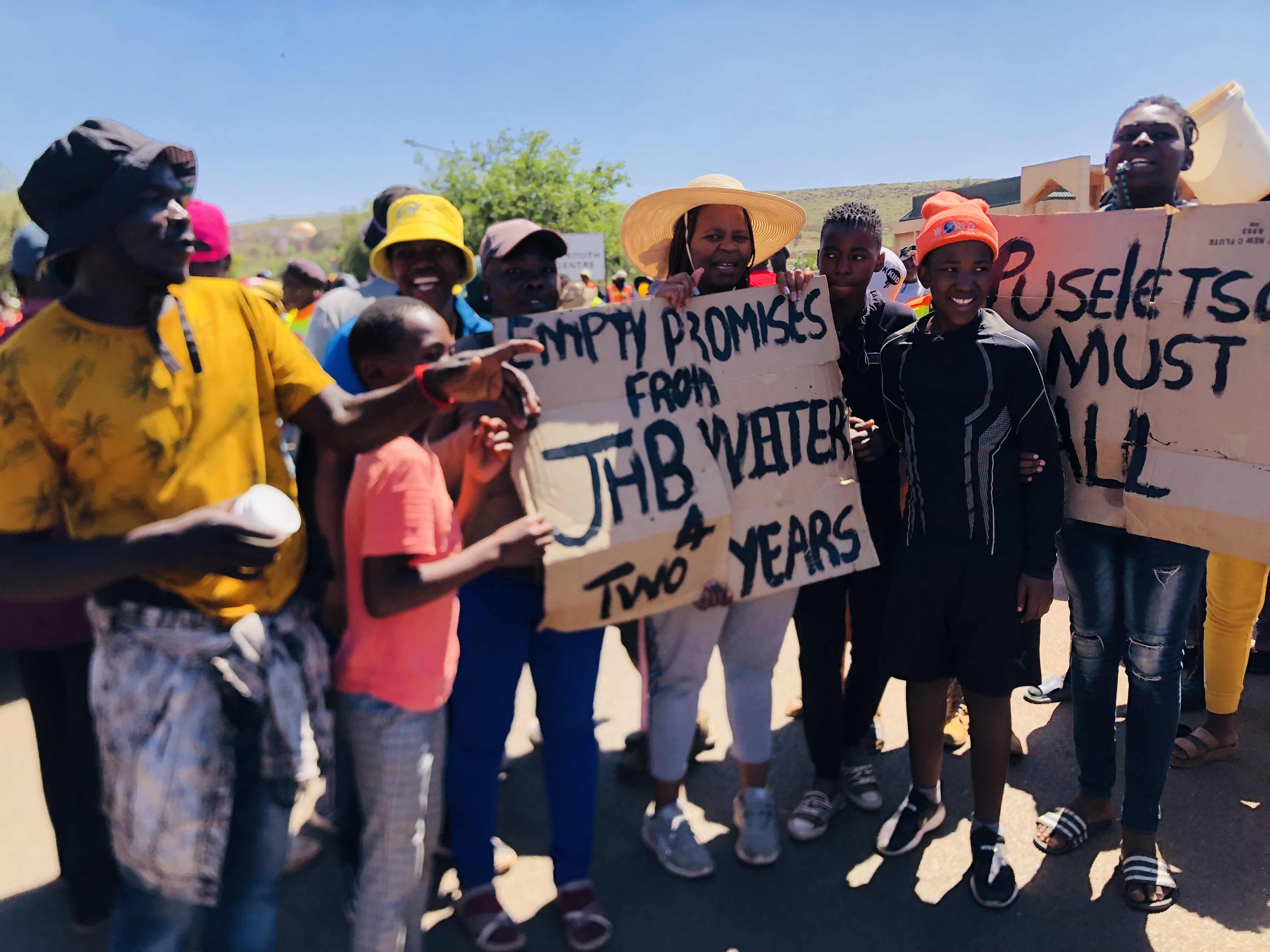
    December 2024 water protest in South Africa. Silver Sibiya/GroundUp

    Physical access to water for households has increased significantly since the country’s first democratic elections in 1994. Nevertheless, water quality and safety has declined over the past ten years. Almost half the country’s drinking water is considered unsafe for human consumption. Water service interruptions – sometimes lasting days – are becoming more common.


    Read more: Basic water services in South Africa are in decay after years of progress


    South Africa’s household poverty rate (the number of households who live below the upper bound poverty line) is now at 55%. We found that water is becoming more and more unaffordable for impoverished households. The result is that these families have to limit the amount of water they use. This worsens poverty and inequality.

    To solve this problem, the South African government needs to embrace a human rights approach to access to water, where people are given enough water to live a full life.

    What went wrong?

    The first problem is affordability. People cannot access water if they don’t have the money to pay for it, but most clean and safe water in South Africa must be paid for. Poverty is a key barrier to access.

    The United Nations special rapporteur on the human rights to water and sanitation has emphasised that it is the responsibility of the state to assess whether households can afford to pay for water, without sacrificing other basic essential items such as food. It is up to governments to take steps to make water affordable.

    The country’s Free Basic Water policy was originally intended to address this issue. It guaranteed impoverished households access to a free 6,000 litres of water per month. This is roughly 200 litres per household of eight people per day. However, in practice this policy is not a meaningful solution, for two reasons:

    • the amount provided is an average of 25 litres of water per person per day. This is way below the World Health Organization recommendation of a minimum water allowance of between 50 and 100 litres of water per person per day.

    • many millions of poor households are excluded from the benefit because of poor implementation of the policy by municipalities.

    This situation reflects the failure to create, implement and oversee a regulatory environment that is necessary to realise affordable access to sufficient, clean water for all South Africans.

    The policy failures

    Firstly, water policy – at both national and municipal levels – has failed to take a human rights approach. A human rights approach requires that access to sufficient, quality and affordable water is the starting point for all policy making and resource allocation decisions. This has not been the case.

    Secondly, access to water has been narrowly defined as making water physically available without considering affordability. Most water access policy in South Africa includes statements declaring that water must be affordable for everyone. Unfortunately, all of these policy promises have remained exactly that – just promises.

    Meeting the goal of affordability requires more from the government than stating that water should be affordable. The state must develop affordability standards – in other words, calculate a water tariff that everyone can afford – and monitor it. At the moment, there is no national government oversight of water tariffs and so the affordability policy is effectively meaningless.


    Read more: The lack of water in South Africa is the result of a long history of injustice — and legislation should start there


    The actual state practices of tariff setting and approval, particularly in local municipalities, have not translated any of these promises into reality.

    Thirdly, many households are denied access to even the 25 litres of free water per person per day, because municipalities don’t always implement the free basic water policy as intended.


    Read more: Why ordinary people must have a say in water governance


    Fourthly, the state has failed to acknowledge the contradiction between providing universal access to services, and requiring municipalities to generate enough money to cover 90% of their running costs. Tariffs for water have increased at rates well above inflation over the past 20 years. But in a very impoverished environment where many people cannot afford to pay for water, up to two thirds of South Africa’s municipalities have been classified as being in financial distress.

    There is a fundamental – and currently insoluble – conflict between the tariffs that municipalities must charge in order to maintain fully funded budgets, and the tariffs that could be defined as affordable.

    What needs to be done?

    These actions should be taken in the short term:

    • the free basic water allowance must be increased

    • the household indigent policy, which determines how households can access free municipal services like water, must be restructured.

    • affordability standards must be developed in close consultation with affected communities. This is the only way to set water tariffs that are based on what households are actually able to pay.

    • there must be oversight of the provision of sufficient, affordable water for everyone.

    In the longer term, these two additional problems must be solved:

    A 2022 water leak in South Africa. Joseph Chirume/GroundUp
    • municipalities are losing revenue from water, particularly from leaking pipes and other infrastructure

    • the local government fiscal framework requires that municipalities earn a surplus on trading services such as water. This must be changed so that municipal finances prioritise affordability of water instead.

    The ethnographic research team for this work was led by Mahlatse Rampedi, who holds a master’s degree and has ten years of experience, together with Ntokozo Ndhlovu, who holds an honours degree.

    – South Africa has failed to deliver access to enough water for millions – a new approach is needed
    – https://theconversation.com/south-africa-has-failed-to-deliver-access-to-enough-water-for-millions-a-new-approach-is-needed-247831

    MIL OSI Africa

  • MIL-OSI: James Bell Capital Corp. Announces Business Combination with Evolution Nickel

    Source: GlobeNewswire (MIL-OSI)

    VANCOUVER, British Columbia, Feb. 18, 2025 (GLOBE NEWSWIRE) — James Bell Capital Corp. (“JBCC” or the “Company”) is pleased to announce that it has entered into a definitive agreement effective February 18, 2025 (the “Business Combination Agreement“) setting out the terms of a proposed business combination (the “Transaction“) with Evolution Nickel Corp. (“Evolution“), an arm’s length company incorporated under the Business Corporations Act (Ontario).

    Evolution is a privately held company focused on the advancement and development of the South Thompson Nickel Project (the “Project”) in the Thompson Nickel Belt in Manitoba. The Project comprises more than 3,000 square kilometres of mineral exploration licenses on which extensive historic drilling and other exploration work has been conducted. Upon completion of the Transaction, it is the intention of the parties that Evolution will focus primarily upon the further evaluation, exploration, and advancement of the Project, while seeking additional corporate development opportunities that it believes will create value for Evolution’s stakeholders.

    Transaction Structure

    The Transaction will be structured as a three‐cornered amalgamation pursuant to which Evolution will amalgamate with a wholly‐owned subsidiary of JBCC and JBCC will acquire all of the issued and outstanding shares of Evolution from the shareholders of Evolution in exchange for the issuance of an aggregate of 52,000,000 common shares of JBCC (each, a “JBCC Share“) to such shareholders (being calculated based on a ratio of one JBCC Share for each one share of Evolution outstanding). The Transaction remains subject to the receipt of all applicable regulatory and third-party approvals and the satisfaction of other closing conditions set forth in the Business Combination Agreement. Subject to the completion of the Transaction, JBCC expects that it will change its corporate name to “Evolution Nickel Corp.”

    The Transaction will constitute a change of business for the Company, as JBCC was previously a non-resource issuer and upon completion of the Transaction, proposes to focus on natural resource development opportunities. The Transaction is not expected to be subject to the approval of shareholders of JBCC, on the basis that (i) shareholder approval is not required for a three‐cornered amalgamation under applicable corporate law; (ii) the Transaction is not a “related party transaction” and no other circumstances exist which may compromise the independence of the Company or other interested parties with respect to the Transaction; and (iii) the Company is not and will not be subject to a cease trade order and will not otherwise be suspended from trading on completion of the Transaction.

    Concurrent Financing

    As a condition of the closing of the Transaction, JBCC and Evolution shall complete a non-brokered private placement (the “Private Placement“) of common shares and flow-through common shares to raise minimum aggregate gross proceeds of $5,000,000.

    Following the completion of the Transaction, the net proceeds of the Private Placement are anticipated to be used to further assess and explore the Project, and for general corporate purposes.

    Conditions to Completion

    Completion of the Transaction is subject to a number of conditions. The Transaction cannot close until all required regulatory approvals are obtained. There can be no assurance that the Transaction will receive such approvals on acceptable terms, or at all. Completion of the Transaction is also subject to a number of conditions including, if applicable, disinterested shareholder approval. Where applicable, the Transaction cannot close until the required shareholder approval is obtained. There can be no assurance that the Transaction will be completed as proposed, or at all. Investors are cautioned that, except as disclosed in the management information circular or filing statement to be prepared in connection with the Transaction, neither Evolution nor JBCC can make any representation or warranty as to the completeness or the accuracy of any information regarding the transaction. Trading in the securities of JBCC should be considered highly speculative. Neither the Canadian Investment Regulatory Organization or any securities exchange has expressed an opinion on the merits of the proposed Transaction or has approved or disapproved the contents of this news release.

    On behalf of the Board of Directors

    Bruce Langstaff
    Executive Chairman
    info@copland-road.com

    Neither the TSX Venture Exchange nor its Regulation Services Provider (as that term is defined in the policies of the TSX Venture Exchange) accepts responsibility for the adequacy or accuracy of this release.

    Forward-Looking Statements

    This news release contains statements about the Company’s expectations regarding the proposed Transaction of the Company and the Private Placement which are forward‐looking in nature and, as a result, are subject to certain risks and uncertainties. Although the Company believes that the expectations reflected in these forward‐looking statements are reasonable, undue reliance should not be placed on them as actual results may differ materially from the forward‐looking statements. Factors that could cause the actual results to differ materially from those in forward‐looking statements include general business, economic, competitive and social uncertainties; and the delay or failure to receive all applicable regulatory and third party approvals, and availability of financing. The forward‐looking statements contained in this press release are made as of the date hereof, and the Company undertakes no obligation to update publicly or revise any forward‐looking statements or information, except as required by law.

    The MIL Network

  • MIL-OSI Global: South Africa has failed to deliver access to enough water for millions – a new approach is needed

    Source: The Conversation – Africa – By Tracy Ledger, Head: Energy and Society Programme, University of Johannesburg

    South Africa is one of only 52 countries that guarantee access to water as a human right. “Access” from a human rights perspective means that water is physically accessible, clean and safe for consumption, and affordable. Section 27 of the country’s constitution stipulates that everyone has the right to access sufficient water.

    But South Africa is not doing well on meeting the standards of a full human rights approach to water access. In a recent paper, I and my colleagues at the Public Affairs Research Institute’s Just Transition Programme set out the extent of this failure, and mapped out what needs to be done to rectify the situation.

    The Just Transition Programme aims to contribute to a successful climate transition that prioritises social justice, equity and poverty reduction.

    Part of our research method is ethnography – spending time in communities struggling to access water. We do this to learn what concrete changes are required to improve people’s lives, from their own perspective.

    Physical access to water for households has increased significantly since the country’s first democratic elections in 1994. Nevertheless, water quality and safety has declined over the past ten years. Almost half the country’s drinking water is considered unsafe
    for human consumption. Water service interruptions – sometimes lasting days – are becoming more common.


    Read more:
    Basic water services in South Africa are in decay after years of progress


    South Africa’s household poverty rate (the number of households who live below the upper bound poverty line) is now at 55%. We found that water is becoming more and more unaffordable for impoverished households. The result is that these families have to limit the amount of water they use. This worsens poverty and inequality.

    To solve this problem, the South African government needs to embrace a human rights approach to access to water, where people are given enough water to live a full life.

    What went wrong?

    The first problem is affordability. People cannot access water if they don’t have the money to pay for it, but most clean and safe water in South Africa must be paid for. Poverty is a key barrier to access.

    The United Nations special rapporteur on the human rights to water and sanitation has emphasised that it is the responsibility of the state to assess whether households can afford to pay for water, without sacrificing other basic essential items such as food. It is up to governments to take steps to make water affordable.

    The country’s Free Basic Water policy was originally intended to address this issue. It guaranteed impoverished households access to a free 6,000 litres of water per month. This is roughly 200 litres per household of eight people per day. However, in practice this policy is not a meaningful solution, for two reasons:

    • the amount provided is an average of 25 litres of water per person per day. This is way below the World Health Organization recommendation of a minimum water allowance of between 50 and 100 litres of water per person per day.

    • many millions of poor households are excluded from the benefit because of poor implementation of the policy by municipalities.

    This situation reflects the failure to create, implement and oversee a regulatory environment that is necessary to realise affordable access to sufficient, clean water for all South Africans.

    The policy failures

    Firstly, water policy – at both national and municipal levels – has failed to take a human rights approach. A human rights approach requires that access to sufficient, quality and affordable water is the starting point for all policy making and resource allocation decisions. This has not been the case.

    Secondly, access to water has been narrowly defined as making water physically available without considering affordability. Most water access policy in South Africa includes statements declaring that water must be affordable for everyone. Unfortunately, all of these policy promises have remained exactly that – just promises.

    Meeting the goal of affordability requires more from the government than stating that water should be affordable. The state must develop affordability standards – in other words, calculate a water tariff that everyone can afford – and monitor it. At the moment, there is no national government oversight of water tariffs and so the affordability policy is effectively meaningless.


    Read more:
    The lack of water in South Africa is the result of a long history of injustice — and legislation should start there


    The actual state practices of tariff setting and approval, particularly in local municipalities, have not translated any of these promises into reality.

    Thirdly, many households are denied access to even the 25 litres of free water per person per day, because municipalities don’t always implement the free basic water policy as intended.


    Read more:
    Why ordinary people must have a say in water governance


    Fourthly, the state has failed to acknowledge the contradiction between providing universal access to services, and requiring municipalities to generate enough money to cover 90% of their running costs. Tariffs for water have increased at rates well above inflation over the past 20 years. But in a very impoverished environment where many people cannot afford to pay for water, up to two thirds of South Africa’s municipalities have been classified as being in financial distress.

    There is a fundamental – and currently insoluble – conflict between the tariffs that municipalities must charge in order to maintain fully funded budgets, and the tariffs that could be defined as affordable.

    What needs to be done?

    These actions should be taken in the short term:

    • the free basic water allowance must be increased

    • the household indigent policy, which determines how households can access free municipal services like water, must be restructured.

    • affordability standards must be developed in close consultation with affected communities. This is the only way to set water tariffs that are based on what households are actually able to pay.

    • there must be oversight of the provision of sufficient, affordable water for everyone.

    In the longer term, these two additional problems must be solved:

    • municipalities are losing revenue from water, particularly from leaking pipes and other infrastructure

    • the local government fiscal framework requires that municipalities earn a surplus on trading services such as water. This must be changed so that municipal finances prioritise affordability of water instead.

    The ethnographic research team for this work was led by Mahlatse Rampedi, who holds a master’s degree and has ten years of experience, together with Ntokozo Ndhlovu, who holds an honours degree.

    Tracy Ledger does not work for, consult, own shares in or receive funding from any company or organisation that would benefit from this article, and has disclosed no relevant affiliations beyond their academic appointment.

    ref. South Africa has failed to deliver access to enough water for millions – a new approach is needed – https://theconversation.com/south-africa-has-failed-to-deliver-access-to-enough-water-for-millions-a-new-approach-is-needed-247831

    MIL OSI – Global Reports

  • MIL-OSI: Champion Safe Co. Surpasses Sales Goals at Recent Buying Group Shows, Achieving $2.4M Year-To-Date 2025 Sales and Outperforming Internal Projections

    Source: GlobeNewswire (MIL-OSI)

    Provo, UT, Feb. 18, 2025 (GLOBE NEWSWIRE) — Champion Safe Company (“Champion” or the “Company”) (championsafe.com) a leader in gun safes and vault doors, a wholly-owned subsidiary of American Rebel Holdings, Inc. (NASDAQ: AREB), America’s Patriotic Brand (americanrebel.com), is proud to announce its continued strong momentum in 2025. Champion has surpassed its internal sales projections, achieving over $2.4 million in year-to-date revenue, with more than $610,000 generated at recent Nation’s Best Sports (NBS) and Sports Inc. buying group shows.

    Innovation Driving Growth

    A key factor behind this success is Champion’s latest product innovations, featuring enhanced security, refined aesthetics, and superior craftsmanship. Dealers at the NBS and Sports Inc. shows responded enthusiastically to the 2025 product lineup, recognizing Champion’s commitment to quality and performance in an increasingly competitive market.

    “Attending these early-year buying group shows is essential for us, and Champion has received an outstanding response to our updated product lineup,” said Thomas Mihalek, CEO of Champion Safe Company. “Dealers understand that quality and attention to detail are more important than ever, and Champion Safe excels in both areas. The strong sales performance at NBS and Sports Inc demonstrates the trust and demand for our products. We are committed to continuous growth and expansion through our innovative programming and enhanced manufacturing procedures. Our goal is to ensure that Champion remains the top choice for firearm dealers and security-focused customers.”

    Commitment to Dealers and Market Leadership

    Champion Safe remains dedicated to supporting its dealer network with industry-leading service, reliable inventory, and premium products that drive retail success. The company values its partnerships with buying group members and continues to provide cutting-edge solutions and tools to help dealers grow their businesses.

    “We are just beginning to see the results of the dramatic improvements across all aspects at Champion Safe Company that began almost immediately after appointing Mr. Mihalek as CEO of Champion in April 2024,” said Andy Ross, CEO of American Rebel Holdings, Inc. “Mr. Mihalek is the type of seasoned and successful outdoor industry and consumer products executive that we were looking for to lead and grow Champion. We are encouraged by the early results in FY2025 and are optimistic about continued growth and market share gains at Champion Safe Co. under Mr. Mihalek’s leadership.”

    For more information about Champion Safe and its lineup of high-security safes, visit www.championsafe.com.

    About Champion Safe Company

    Champion Safe Company has been at the forefront of safe manufacturing for over 25 years, offering a range of high-quality safes designed for ultimate security and fire protection. With a commitment to craftsmanship and innovation, Champion Safes are trusted by homeowners, gun owners, and businesses across the nation.

    About American Rebel Holdings, Inc.

    American Rebel Holdings, Inc. (NASDAQ: AREB) has operated primarily as a designer, manufacturer and marketer of branded safes and personal security and self-defense products and has recently transitioned into the beverage industry through the introduction of American Rebel Beer. The Company also designs and produces branded apparel and accessories. To learn more, visit americanrebel.com and americanrebelbeer.com. For investor information, visit americanrebel.com/investor-relations.

    Forward-Looking Statements

    This press release contains forward-looking statements within the meaning of the Private Securities Litigation Reform Act of 1995. American Rebel Holdings, Inc., (NASDAQ: AREB; AREBW) (the “Company,” “American Rebel,” “we,” “our” or “us”) desires to take advantage of the safe harbor provisions of the Private Securities Litigation Reform Act of 1995 and is including this cautionary statement in connection with this safe harbor legislation. The words “forecasts” “believe,” “may,” “estimate,” “continue,” “anticipate,” “intend,” “should,” “plan,” “could,” “target,” “potential,” “is likely,” “expect” and similar expressions, as they relate to us, are intended to identify forward-looking statements. We have based these forward-looking statements primarily on our current expectations and projections about future events and financial trends that we believe may affect our financial condition, results of operations, business strategy, and financial needs. Important factors that could cause actual results to differ from those in the forward-looking statements include benefits of the 2025 product innovations, actual revenues for fiscal 2025, our ability to effectively execute our business plan, and the Risk Factors contained within our filings with the SEC, including our Annual Report on Form 10-K for the year ended December 31, 2023. Any forward-looking statement made by us herein speaks only as of the date on which it is made. Factors or events that could cause our actual results to differ may emerge from time to time, and it is not possible for us to predict all of them. We undertake no obligation to publicly update any forward-looking statements, whether as a result of new information, future developments or otherwise, except as may be required by law.

    Company Contacts:
    jon.minder@americanrebel.com
    thomas.mihalek@americanrebel.com

    The MIL Network

  • MIL-OSI: Prosafe SE: Prosafe enters agreement to sell Safe Concordia

    Source: GlobeNewswire (MIL-OSI)

    18 February 2025 – Prosafe SE, through a wholly owned subsidiary, has entered into an agreement to sell to an undisclosed party its 2005-built accommodation, safety and support semi-submersible vessel Safe Concordia, for a gross price of USD 5 million before commissions and expenses. The vessel is expected to be delivered to its new owner upon completion of her current charter obligations, within a window of March through June 2025. The sale of the vessel is subject to customary closing conditions and requirements.

    For further information, please contact:

    Terje Askvig, CEO Phone: +47 952 03 886
    Reese McNeel, CFO Phone: +47 415 08 186

    Prosafe is a leading owner and operator of semi-submersible accommodation vessels. The company is listed on the Oslo Stock Exchange with ticker code PRS. For more information, please refer to https://www.prosafe.com (https://www.prosafe.com/).

    This information is considered to be inside information pursuant to the EU Market Abuse Regulation and is subject to the disclosure requirements pursuant to Section 5-12 the Norwegian Securities Trading Act. This stock exchange announcement was published by Line Bliksmark, Marketing and Communications Manager, on February 18th, 2024, at approx.16:00 CET.

    The MIL Network

  • MIL-OSI Global: Trump’s lurking assault on Canada rests on endless lies and irrational populism

    Source: The Conversation – Canada – By Ilan Kapoor, Professor, Critical Development Studies, York University, Canada

    United States President Donald Trump has temporarily put his trade war against Canada and Mexico on hold after vowing to slap 25 per cent tariffs on most Canadian and Mexican imports, although he’s imposed tariffs on all steel and aluminum, including from Canada.

    He has also upped the ante by threatening to increase tariffs should Canada carry through on its own threat of retaliatory tariffs, with the possibility of further sanctions in the spring following a U.S. government study investigating ways to address the country’s trade deficits.

    This is nothing less than an attempt at the economic subordination of Canada by its giant and — until very recently — friendly neighbour and ally. But what makes Trump’s impending trade war even more absurd is that it is based on a series of lies.

    Trade, drugs, migrants, banks

    Trump has claimed that the U.S. has a “US$200 or $250 billion” trade deficit with Canada. The American government’s own data show that the trade in goods deficit with Canada in 2024 was US$55 billion.

    But when you factor in services (in technology or finance), an area in which the U.S. currently enjoys a trade surplus, the annual U.S.-Canada annual trade deficit falls to US$45 billion. And if you exclude energy exports, sold to the U.S. at a discount, the trade scales tip decidedly in favour of the U.S.

    Then we also have Trump’s claim that tariffs are needed to penalize Canada for allowing an “invasion” of drugs (mainly fentanyl) and undocumented migrants into the U.S.

    But once again, figures from his own government agencies show that only 1.5 per cent of migrants apprehended in 2024, and a mere 0.2 per cent of all fentanyl impounded at U.S. borders in 2024, originated in Canada.

    Finally, just hours before the American reprieve on tariffs, Trump raised a new red herring: that Canada does not allow American banks into the country. But many U.S. banks do operate in Canada, making up half of the country’s foreign banking assets.

    The grip of populism

    So why such lies? I suggest that we need to look to nationalist populism for an explanation. A deep, often irrational, emotional bond underpins this form of populism.

    Just as was the case in his 2016 election campaign, Trump’s 2024 campaign successfully tapped into people’s frustrations and anxieties over everything from high food prices to the housing crisis and rising precarious employment as he promised once more to “make America great again.”

    Tariffs featured prominently, with Trump bidding to put “America First” by punishing the country’s three largest trading partners — Mexico, Canada and China — for their alleged “unfair” trade practices.

    These types of seductive populist slogans unite people under a common banner, soothing their anxieties. But the accompanying peril is their dependence on the construction of national enemies to unify the nation. In 2016, Trump singled out Muslims and Mexicans. Today it is migrants, trans people and America’s supposed three main trading villains.

    Dangerous sentiments

    Trump’s populism is therefore built on irrational, if not dangerous, sentiments: blind fear, pridefulness, xenophobia, transphobia, racism and aggression.

    No wonder he engages in both blatant falsehoods and unabashed bullying. His lies are integral to his continuing attempts to paint the U.S. as a victim, despite its global supremacy in many areas, thereby justifying attempts at subordinating America’s putative “enemies” and even its friends. Populist sentiment, precisely because it is rooted in the irrational exuberance of pride and unity, cares little about facts, logic or veracity.

    A case in point is Trump’s affirmation that the U.S. is “subsidizing” Canada as a result of the trade deficit. The allegation contravenes any economic sense — trade deficits are the result of market-driven imports exceeding exports — yet its deployment here evokes the anxiety-producing prospect that Canada is ripping off American taxpayers.

    Populist passion trumps rational argument. Bluster whips up national fervour.

    Much ado about nothing

    This is also why Canada’s efforts to appease Trump have yielded little to date. Days after Trump’s election win, Prime Minister Justin Trudeau was quick to visit him at his Florida estate in an attempt to reassure him on fentanyl and migrants.

    The Canadian government then announced a $1.3 billion border security package and improved state oversight of the production of opioids.

    In the days leading up to Trump’s tariff executive order, Canadian federal ministers and provincial premiers also frantically engaged in a public relations offensive (interviews on American TV, meetings with congressional lawmakers and Trump’s cabinet nominees) aimed at changing minds. All to no avail.

    Trump finally blinked only a few hours before the Feb. 4 tariff deadline. All it took was the offer by Trudeau of measures that, for the most part, had already been included in the previously announced border security/fentanyl measures. It seems the repackaged deal was enough to allow the president to declare a victory, while granting Canada a mere temporary reprieve.


    Read more:
    Trump’s tariff threats show the brute power of an imperial presidency


    So all in all, much ado about not too much. Lots of theatrics and brinkmanship, but little advancement, especially on the supposed main problem to be addressed — trade deficits.

    The Trump administration has basically stuck to its populist platform, providing more evidence that rational decision-making does not play a role.

    Quite the opposite, in fact: attempts to appease Trump appear to have been taken as proof that his threats work, and more demands are undoubtedly in store. That’s evident by the continuing prospect of tariffs in March and the possibility of more to come afterwards (including on steel and aluminum).

    Self-defeating irrationality

    Trump’s tariff war is senseless. If the measures go ahead, they could plunge Canada into a painful recession requiring state stimulus to support the economy and jobs, and retaliatory and counter-retaliatory trade measures.

    This may well be Trump’s intention — he has declared he wants to annex Canada by “economic force” — but it is likely to backfire. Any future trade war will harm not just Canada, Mexico and China, but also the U.S.

    Canada’s counter-tariffs target Red States, where Trump derives most of his electoral support.

    And given the American dependence on Canada for some 50 per cent of its crude oil imports, Canada’s nuclear option is to impose export tariffs on oil to the U.S. That would cause American prices at the pump to increase dramatically overnight and prove highly unpopular.

    In the longer term, then, no one stands to win as a consequence of Trump’s irrational populist policy-making. In the meantime, expect not much else from Trump’s administration than more unpredictability, brinkmanship, intimidation … and, yes, lies.

    Ilan Kapoor does not work for, consult, own shares in or receive funding from any company or organisation that would benefit from this article, and has disclosed no relevant affiliations beyond their academic appointment.

    ref. Trump’s lurking assault on Canada rests on endless lies and irrational populism – https://theconversation.com/trumps-lurking-assault-on-canada-rests-on-endless-lies-and-irrational-populism-249256

    MIL OSI – Global Reports

  • MIL-OSI: BW Energy: Notification of trade by close associate to primary insider

    Source: GlobeNewswire (MIL-OSI)

    Oslo, 18 February 2025: BW Energy Limited (the “Company“) has been informed that Meridian Finance Limited, a close associate to a primary insider in the Company, has purchased 85,000 bonds in the Company’s bond issue BW Energy Limited 24/29 10,00% USD, with ISIN NO0013259663, in the secondary market. Please see the attached notification form for further details.

    This information is subject to the disclosure requirements pursuant to article 19 of the EU Market Abuse Regulation and section 5-12 of the Norwegian Securities Trading Act.

    For further information, please contact:
    Brice Morlot, CFO BW Energy
    ir@bwenergy.no

    Attachment

    The MIL Network

  • MIL-OSI: ServiceTrade Research Reveals Strategies for Attracting, Hiring, and Retaining Techs Amid Today’s Top Business Challenge: The Skilled Labor Shortage

    Source: GlobeNewswire (MIL-OSI)

    DURHAM, N.C., Feb. 18, 2025 (GLOBE NEWSWIRE) — ServiceTrade, an innovative software platform designed to optimize commercial service business operations for growth and profit, released the 2025 Technician Insights Report today to help commercial service business owners address the most significant challenge they face today – a critical shortage of skilled labor. There is currently a 14-20% skilled labor shortfall in the commercial fire and mechanical markets, further complicated by 6-8% industry growth and a rapidly aging workforce. ServiceTrade surveyed 650 technicians in the fire safety and mechanical services industries, discovering the top drivers of job satisfaction, common frustrations, and improvement opportunities shared across the profession.   

    “Skilled technicians are the heart of commercial service businesses, yet the industry is facing a critical shortage of these highly skilled professionals,” said William Chaney, CEO of ServiceTrade. “Building an efficient, satisfied, and dedicated workforce is essential to achieving business results. Our Technician Insights Report uncovers the factors that drive technician satisfaction and productivity, enabling business owners to differentiate their work environment and attract and retain a more satisfied workforce.”

    Unprecedented Market Growth Drives Technician Demand

    The ServiceTrade report reveals that 54% of technicians feel their profession provides a solid financial future. When asked what they like most about their profession, 17% cited competitive pay and benefits.  The survey reveals that techs prioritize earning potential, supportive management, and opportunities for training and growth provided by their companies. 

    In the U.S., the commercial HVAC market is expected to grow to $15.70 billion by 2029, necessitating an 8% increase in the technician workforce. The commercial fire protection sector is expected to increase by 4.1% annually, requiring a 6% increase in technicians over the same period.  Further exacerbating the lack of talent, about 26% of technicians are nearing retirement age, while 31% of business owners say retaining skilled technicians is already a significant challenge. 

    Tech Satisfaction is Key To Retaining Top Techs

    Technicians want to be productive, do good work, and be recognized for it.  The ServiceTrade report reveals techs are frustrated by non-maintenance tasks that consume valuable time, such as manual paperwork (49%), inefficient office communication (22%), and customer miscommunication (18%). Inefficient travel and job scheduling (11%) or arriving at the job site without the right equipment and tools (17%) also negatively affect job satisfaction. The report provides insights to help businesses improve technicians’ job satisfaction, ability to serve customers, perform daily tasks, and progress in their careers.

    • Technicians need easier access to job or customer information (24%)
    • They want more training (27%) and professional development opportunities (49%)
    • Most technicians surveyed say that more flexible schedules and a better work/life balance (59%) could improve their job satisfaction.

    ServiceTrade Enables Tech Satisfaction, Better Customer Service, and Business Performance

    “Addressing the skilled labor shortage is not just a challenge, but an opportunity to invest in the future of our workforce,” said Jim Pauley, NFPA CEO, in a statement. “In 2025, we can expect to see more organizations focused on talent development, embracing innovation, and supporting education and training to help bridge the gap…”

    In 2025, almost half of commercial fire service organizations (49%) plan to adopt more digital tools within day-to-day operations to streamline work, share knowledge, and collaborate with peers.  ServiceTrade’s service management platform enables techs to increase field performance by 52%, while business owners simplify back office operations by 12%, reduce time spent on communications and admin, and win and keep 36% more profitable customers. The platform automates customer communications and syncs data to the office without requiring manual paperwork. It guides techs through efficient job completion and helps them proactively identify needed repairs and inspections, increasing work orders by 15%. By harnessing the power of ServiceTrade, companies can improve technician satisfaction and operational excellence while ensuring quality customer service.

    For more information on the 2025 Technician Insights Report and to explore its full findings, please visit—https://servicetrade.com/knowledge-base/technician-insights-report/ 

    To learn more about ServiceTrade:

    About ServiceTrade

    ServiceTrade, Inc. is a software platform for commercial mechanical, fire, and life safety contractors. During a chronic skilled labor shortage, ServiceTrade helps commercial contractors increase profit by improving service and project operations, increasing technician productivity, selling more service agreements, and growing customer loyalty. Located in Durham, North Carolina, ServiceTrade was founded in 2012 to automate and streamline the commercial mechanical and fire protection industry and has grown to have more than 1,300 customers. More than 10% of the commercial or industrial buildings in the United States are serviced by contractors using ServiceTrade. Learn more at www.servicetrade.com.

    Media Contact:
    Media@Ktcmarketingandpr.com

    The MIL Network

  • MIL-OSI: NANO Nuclear Energy Strengthens Intellectual Property Portfolio with Four New Patent Applications Updated

    Source: GlobeNewswire (MIL-OSI)

    Protections Surrounding Key Enabling ALIP Technology Adds to NANO Nuclear’s Stable of Granted or Acquired Patents and Patent Applications

    New York, N.Y., Feb. 18, 2025 (GLOBE NEWSWIRE) — NANO Nuclear Energy Inc. (NASDAQ: NNE) (“NANO Nuclear” or “the Company”), a leading advanced nuclear energy and technology company focused on developing clean energy solutions, today announced that it has filed four new separate utility patent applications with the United States Patent and Trademark Office (USPTO) related to NANO Nuclear’s Annular Linear Induction Pump (ALIP) technology.

    The ALIP technology, a thermal management and distribution system which is based on electromagnetic (rather than mechanical) pumps, is a core technology in the development of advanced molten-salt and liquid-metal nuclear reactors. By utilizing a time-varying magnetic field, ALIPs enable the movement of conductive fluids without mechanical components, reducing wear and maintenance requirements while increasing efficiency.

    The ALIP technology, acquired by NANO Nuclear last year and part of its suite of energy systems, is considered a key-enabling technology for the development of advanced nuclear reactors, not only for NANO Nuclear’s microreactors in development but as a third-party commercial opportunity for other advanced nuclear reactor systems.

    In addition to enhancing energy conversion cycles, optimizing thermal management, and ensuring operational longevity in high-temperature applications across the energy, propulsion, and industrial sectors, applications of the ALIP technology extend beyond nuclear energy to space power and propulsion systems, industrial cooling systems, and defense applications, positioning NANO Nuclear at the forefront of emerging high-performance fluid control markets.

    A U.S. Department of Energy’s Small Business Innovation Research (SBIR) Phase III project is ongoing to refine the ALIP technology, led by inventor and NANO Nuclear’s Head of Thermal Hydraulics and Space Program Dr. Carlos O. Maidana, with a view to separately commercialize the technology as a component for liquid metal and all molten salt-based nuclear reactors.

    Figure 1 – NANO Nuclear Energy’s Annular Linear Induction Pump (ALIP) technology cross-sectional visualization.

    “The development and eventual commercialization of the ALIP technology is essential for advancing next-generation nuclear reactor solutions,” said Carlos O. Maidana, Ph.D., Head of Thermal Hydraulics and Space Program of NANO Nuclear Energy. “Filing these utility patents highlights our commitment to leading the charge in next-generation technologies that are critical to the ongoing evolution of advanced energy systems. I’m pleased to have housed these inventions within NANO Nuclear and to lead the team to progress and refine this technology.”

    The newly filed patent applications include:

    1. Patent Application # 19/030,148, titled “Integrated platform and method for optimizing an electromagnetic pump,” relates to the development of software for the design of annular linear induction pumps.
    2. Patent Application # 19/030,130, titled “Electromagnetic pump system and method for moving conducting fluid,” relates to the design of the next generation of annular linear induction pumps.
    3. Patent Application # 19/030,098, titled “Electromagnetic pump and method for manufacturing the same,” relates to the advanced manufacturing of annular linear induction pumps.
    4. Patent Application # 19/030,068, titled “Cooling system for electromagnetic pump system,” relates to the design of a micro-channel cooling system, using advanced manufacturing methods, for annular linear induction pumps operating at very high temperature.

    These intellectual properties are expected to provide enhanced component life span and operation metrics in all advanced molten-salt and liquid-metal reactors, including NANO Nuclear’s KRONOS MMR, LOKI MMR, and ODIN portable microreactor, all of which are currently in development.

    “The filing of these additional utility patents further bolsters our intellectual property portfolio and helps to ensure the protection of our progress in developing this key enabling technology,” said James Walker, Chief Executive Officer and Head of Reactor Development of NANO Nuclear Energy. “We believe that the ALIP technology will be instrumental in the development and optimization of the next generation of advanced nuclear reactors, and I’m pleased with the progress Dr. Maidana has overseen through the SBIR Phase III program. We look forward to continuing our progress with ALIP with a view towards including in it our own microreactors in development as well as seeking to separately commercialize it as soon as possible.”

    About NANO Nuclear Energy, Inc.

    NANO Nuclear Energy Inc. (NASDAQ: NNE) is an advanced technology-driven nuclear energy company seeking to become a commercially focused, diversified, and vertically integrated company across five business lines: (i) cutting edge portable and other microreactor technologies, (ii) nuclear fuel fabrication, (iii) nuclear fuel transportation, (iv) nuclear applications for space and (v) nuclear industry consulting services. NANO Nuclear believes it is the first portable nuclear microreactor company to be listed publicly in the U.S.

    Led by a world-class nuclear engineering team, NANO Nuclear’s reactor products in development include “ZEUS”, a solid core battery reactor, and “ODIN”, a low-pressure coolant reactor, each representing advanced developments in clean energy solutions that are portable, on-demand capable, advanced nuclear microreactors. NANO Nuclear is also developing patented stationary KRONOS MMR Energy System and space focused, portable LOKI MMR.

    Advanced Fuel Transportation Inc. (AFT), a NANO Nuclear subsidiary, is led by former executives from the largest transportation company in the world aiming to build a North American transportation company that will provide commercial quantities of HALEU fuel to small modular reactors, microreactor companies, national laboratories, military, and DOE programs. Through NANO Nuclear, AFT is the exclusive licensee of a patented high-capacity HALEU fuel transportation basket developed by three major U.S. national nuclear laboratories and funded by the Department of Energy. Assuming development and commercialization, AFT is expected to form part of the only vertically integrated nuclear fuel business of its kind in North America.

    HALEU Energy Fuel Inc. (HEF), a NANO Nuclear subsidiary, is focusing on the future development of a domestic source for a High-Assay, Low-Enriched Uranium (HALEU) fuel fabrication pipeline for NANO Nuclear’s own microreactors as well as the broader advanced nuclear reactor industry.

    NANO Nuclear Space Inc. (NNS), a NANO Nuclear subsidiary, is exploring the potential commercial applications of NANO Nuclear’s developing micronuclear reactor technology in space. NNS is focusing on applications such as the LOKI MMR system and other power systems for extraterrestrial projects and human sustaining environments, and potentially propulsion technology for long haul space missions. NNS’ initial focus will be on cis-lunar applications, referring to uses in the space region extending from Earth to the area surrounding the Moon’s surface.

    For more corporate information please visit: https://NanoNuclearEnergy.com/

    For further NANO Nuclear information, please contact:
    Email: IR@NANONuclearEnergy.com
    Business Tel: (212) 634-9206

    PLEASE FOLLOW OUR SOCIAL MEDIA PAGES HERE:

    NANO Nuclear Energy LINKEDIN
    NANO Nuclear Energy YOUTUBE
    NANO Nuclear Energy X PLATFORM

    Cautionary Note Regarding Forward Looking Statements

    This news release and statements of NANO Nuclear’s management in connection with this news release contain or may contain “forward-looking statements” within the meaning of Section 21E of the Securities Exchange Act of 1934, as amended, and the Private Securities Litigation Reform Act of 1995. In this context, forward-looking statements mean statements related to future events, which may impact our expected future business and financial performance, and often contain words such as “expects”, “anticipates”, “intends”, “plans”, “believes”, “potential”, “will”, “should”, “could”, “would” or “may” and other words of similar meaning. In this press release, forward-looking statements include those related to (i) the anticipated benefits to NANO Nuclear of the patent applications described herein and (ii) the future prospects for the ALIP technology generally as part of NANO Nuclear’s reactors in development or via separate commercialization. These and other forward-looking statements are based on information available to us as of the date of this news release and represent management’s current views and assumptions. Forward-looking statements are not guarantees of future performance, events or results and involve significant known and unknown risks, uncertainties and other factors, which may be beyond our control. For NANO Nuclear, particular risks and uncertainties that could cause our actual future results to differ materially from those expressed in our forward-looking statements include but are not limited to the following: (i) risks related to our U.S. Department of Energy (“DOE”) or related state or non-U.S. nuclear fuel licensing submissions, (ii) risks related the development of new or advanced technology and the acquisition of complimentary technology or businesses, including difficulties with design and testing, cost overruns, regulatory delays, integration issues, securing intellectual property protection, and the development of competitive technology, (iii) our ability to obtain contracts and funding to be able to continue operations, (iv) risks related to uncertainty regarding our ability to technologically develop and commercially deploy a competitive advanced nuclear reactor or other technology in the timelines we anticipate, if ever, (v) risks related to the impact of U.S. and non-U.S. government regulation, policies and licensing requirements, including by the DOE and the U.S. Nuclear Regulatory Commission, including those associated with the recently enacted ADVANCE Act, and (vi) similar risks and uncertainties associated with the operating an early stage business a highly regulated and rapidly evolving industry. Readers are cautioned not to place undue reliance on these forward-looking statements, which apply only as of the date of this news release. These factors may not constitute all factors that could cause actual results to differ from those discussed in any forward-looking statement, and NANO Nuclear therefore encourages investors to review other factors that may affect future results in its filings with the SEC, which are available for review at www.sec.gov and at https://ir.nanonuclearenergy.com/financial-information/sec-filings. Accordingly, forward-looking statements should not be relied upon as a predictor of actual results. We do not undertake to update our forward-looking statements to reflect events or circumstances that may arise after the date of this news release, except as required by law.

    Attachment

    The MIL Network

  • MIL-OSI: WSO2Con 2025 to Showcase How Enterprises Can Embrace ‘Platformless Modernization’ to Drive Innovation

    Source: GlobeNewswire (MIL-OSI)

    Austin, TX, Feb. 18, 2025 (GLOBE NEWSWIRE) — WSO2Con 2025 will empower enterprises to embrace ‘Platformless Modernization’ by showcasing real-world strategies, expert insights, and innovations that simplify development, accelerate digital transformation, and future-proof IT infrastructures. Keynotes, customer stories and technical discussions during the three-day event will explore and deep-dive into how enterprises can transform digital innovation by eliminating the complexities of traditional platforms either by adopting an enterprise-grade internal developer platform or leveraging software-as-a-service offerings to build your own. The event will take place from March 18 to 20, 2025, in Barcelona, Spain, at the Palau de Congressos de Catalunya.

    Delivering a platform experience without the complexity

    Platformless modernization aims to redefine how organizations build, deploy, and manage applications. Traditional platforms often come with operational overhead, requiring businesses to maintain infrastructure and navigate complex configurations. A platformless approach removes these burdens, making the platform layer invisible to developers, so they can focus on just building innovative applications and providing better digital experiences to their customers and users.

    At WSO2Con 2025, WSO2 executives and industry experts will explore what platformless modernization means for enterprises, offering insights into:

    • How businesses can deliver developer-friendly experiences without the overhead of managing platforms
    • Strategies for enabling rapid, secure, and scalable application development powered by API management, integration, and identity solutions
    • The role of internal developer platforms (IDPs) in modernizing software delivery with AI, Kubernetes, and cloud-native architectures

    Insightful keynotes and customer success stories

    The conference will feature a distinguished lineup of keynote speakers. In his opening keynote, WSO2’s Founder and CEO, Dr. Sanjiva Weerawarana will discuss the vision for platformless modernization with WSO2 technical experts providing in-depth sessions on how platformless is shaping the future of integration, API management and identity & access management. 

    Jeremy Schneider, Senior Partner & Co-Head of Global Software & High-Tech Practice, McKinsey and Company will provide a framework for navigating evolution in the digital economy in his keynote Every Company is a Software Company. In other keynote presentations, Amy Bingham, vice president & chief information officer at Pekin Insurance will share learnings on how Pekin turned a challenging year of unprecedented setbacks into a story of resilience, rebuilding, and long-term success in an increasingly unpredictable world. Jonathan Pearl, executive director – technology product management at financial services company, BNY Mellon, will explore the power of APIs and how they can be used to drive modernization, innovation and collaboration – both internally and externally. He will discuss the key principles and best practices for designing, building, discovering and governing APIs, as well as the cultural and organizational changes needed to successfully support an API first strategy.

    Registration for WSO2Con 2025 is still open with a flash sale from February 18 to 21, 2025. To register and view the full agenda, visit https://wso2.com/wso2con/2025/

    About WSO2

    Founded in 2005, WSO2 is the largest independent software vendor providing open-source API management, integration, and identity and access management (IAM) products. WSO2’s products and platforms—including our next-gen internal developer platform, Choreo—empower organizations to leverage the full potential of APIs for secure delivery of digital services and applications, enabling thousands of enterprises in over 90 countries globally to drive their digital transformation journeys. Our open-source, API-first approach frees developers and architects from vendor lock-in, enabling rapid digital product creation. Recognized as leaders by industry analysts, WSO2 has over 800 employees worldwide with offices in Australia, Brazil, Germany, India, Spain, Sri Lanka, the UAE, the UK, and the US, with USD100M in annual recurring revenue. Visit https://wso2.com to learn more. Follow WSO2 on LinkedIn and X (formerly Twitter).

    Trademarks and registered trademarks are the properties of their respective owners.

    ###

    The MIL Network

  • MIL-OSI Russia: Tatyana Golikova presented the national project “Personnel” to the State Duma Committee on Labor, Social Policy and Veterans’ Affairs

    Translartion. Region: Russians Fedetion –

    Source: Government of the Russian Federation – An important disclaimer is at the bottom of this article.

    Previous news Next news

    Tatyana Golikova presented the new national project “Personnel” to the State Duma Committee on Labor, Social Policy and Veterans’ Affairs

    Deputy Prime Minister Tatyana Golikova and representatives of the federal executive authorities presented the new national project “Personnel” to the State Duma Committee on Labor, Social Policy and Veterans’ Affairs. Tatyana Golikova and Minister of Labor and Social Protection Anton Kotyakov spoke about the prerequisites for the formation, main goals and directions of the national project. Representatives of the Ministry of Education and Science, the Ministry of Education, the Ministry of Economic Development, the Ministry of Industry and Trade, the Federal Agency for Youth Affairs and the Social Fund of Russia also took part in the presentation.

    As Tatyana Golikova noted, in his Address to the Federal Assembly in February last year, the President named Russia’s entry into the world’s four largest economies by 2030 as one of the country’s development priorities. And one of the most important tasks associated with this is providing the economy with personnel.

    The Deputy Prime Minister emphasized that currently there are 1.5 million vacancies available on the Rabota Rossii portal in the country, a third of which (471 thousand) are blue-collar jobs. At the same time, the unemployment rate at the end of 2024 did not exceed 2.3%. According to preliminary estimates, up to 3.1 million workers need to be additionally attracted to the economy by 2030 compared to 2022 as a basis. “This means that we need to additionally involve about 800 thousand people in the economy by 2030. But that’s not all, because during the same period, based on demographic trends that traditionally occur in the labor market every year, which we did not notice during the period of calm economic development, we will have to replace another 10.1 million people due to retirement. That is, the total estimate of both replacement and involvement in the economy today is 10.9 million people,” the Deputy Prime Minister explained.

    In the next five years, about 6.7 million graduates from universities and colleges will enter the labor market, and our task is to provide them with qualified advanced professional training in accordance with the labor market forecast. “On the one hand, this is our golden resource, and on the other hand, we must very clearly understand that the young people entering the labor market meet the needs of the labor market. This is the most difficult task, because in a number of industries and professions there is a discrepancy with the needs of the labor market. We see that the need for qualified labor today makes up 70% of the total need, the rest are specialists in higher education,” noted Tatyana Golikova.

    The established trends served as prerequisites for the development of a new interdepartmental national project “Personnel”.

    “Over 116 billion rubles will be allocated for the implementation of the national project in the next six years, of which over 113 billion rubles will come from the federal budget. We plan that as a result, a new model for managing the country’s personnel supply will be created, which will allow us to increase the rate of reduction of the personnel deficit by 2030 by increasing employment by 3.4%,” said Tatyana Golikova.

    The national project includes four federal projects: “Labour Market Management”, “Education for the Labour Market”, “Active Measures to Promote Employment”, and “The Working Person”.

    The first is aimed at managing the labor market. It is planned to create mechanisms and tools for effective involvement in employment. The average time of employment for citizens who applied to employment centers in search of suitable work will be reduced by 25%. This will be facilitated by the modernization of more than 1.5 thousand employment centers, the creation of new models of their work based on the annual updating of the forecast of the need of economic sectors for specialists for a five-year period, the development of services of the unified digital platform “Work in Russia”.

    The second federal project is aimed at creating a system for training personnel for priority sectors of the economy based on the forecast of demand. Other national projects are also aimed at training personnel, for example, “Youth and Children”, within the framework of which the “Professionality” project is being implemented.

    Within the framework of the national project “Personnel”, it is planned to create 298 career centers based at universities, and a routing of employment for graduates of both secondary and higher education will be introduced.

    The third federal project is aimed at creating an effective system of training, retraining and advanced training of personnel for priority sectors of the economy based on the forecast of demand for them. In parallel, issues related to providing opportunities for citizens experiencing difficulties in finding work will be resolved. Thus, the share of equipped workplaces for which people with disabilities are employed will be increased.

    The fourth federal project is a continuation of the policy of increasing the prestige of blue-collar jobs.

    Minister of Labor and Social Protection Anton Kotyakov emphasized that, based on the tasks set by the head of state, the main goal of the national project “Personnel” is to meet the economy’s need for personnel, primarily through our internal reserves. The main reserves of the labor market: increasing labor productivity; increasing the level of youth employment; increasing the employment of citizens with disabilities; involving citizens caring for loved ones in the economy; maintaining employment of workers with family responsibilities.

    One of the most important activities of the national project is the preparation of an annual five-year forecast of personnel needs and its linking with the target figures for admission.

    “The President set the task of calculating how many and what kind of specialists, in which regions we will need in order to ensure national development goals, technological leadership projects. We have formed a forecast of personnel needs for a five-year period. It took into account the forecast of socio-economic development, target economic indicators, projects included in strategic planning documents, demographic trends, and the rate of growth of labor productivity,” said Anton Kotyakov.

    Not only the new demand that arises due to the growth of industries was analyzed, but also the so-called replacement demand related to the annual retirement of workers. In addition, in order to break down the structure of demand in detail by skill levels and specialties, an all-Russian survey of employers was conducted, in which 260 thousand companies with 22 million employees took part. In preparing the forecast, experts processed 3 million unique job titles.

    “As a result of this large-scale and painstaking work, we have received for the first time a detailed forecast in the industry, regional and professional-qualification contexts. The forecast will be calculated annually and taken into account when forming the control figures for admission. Considering that the adaptation of educational processes to the needs of the economy does not happen at once, we understand that a longer forecasting corridor is needed. Therefore, from April 1, an all-Russian survey of employers on the prospective need of the economy for personnel will start for the next forecast. It is planned to calculate it for seven years at once – until 2032,” said Anton Kotyakov.

    In conclusion, Tatyana Golikova and representatives of the federal executive authorities answered questions from deputies regarding the national project “Personnel”.

    Please note: This information is raw content directly from the source of the information. It is exactly what the source states and does not reflect the position of MIL-OSI or its clients.

    MIL OSI Russia News

  • MIL-OSI: Bitget Releases January 2025 Transparency Report, Showcasing Market Growth and Innovation

    Source: GlobeNewswire (MIL-OSI)

    VICTORIA, Seychelles, Feb. 18, 2025 (GLOBE NEWSWIRE) — Bitget, the leading cryptocurrency exchange and Web3 company, has released its January 2025 Transparency Report, highlighting a dynamic start to the year marked by significant growth in trading volumes, platform engagement, and ecosystem innovation.

    Bitget expanded the BGB ecosystem through strategic initiatives, including launching a BGB liquidity pool on Uniswap and a $1.1 million liquidity pool on Bulbaswap following its integration with Morph Chain. These efforts enhance cross-chain compatibility and deepen liquidity, positioning BGB as a strong pillar of the Bitget ecosystem. Additionally, Bitget Research shared a report on 20% of Gen Z and Gen Alpha respondents who are open to incorporating crypto into pension plans, signaling a shift in long-term financial planning preferences toward digital assets.

    January saw the introduction of multiple platform enhancements. Bitget TraderPro Season 4 launched with a 10,000 USDT Grand Prize, enabling traders to test strategies and optimize returns. The HodlerYield service debuted, allowing users to earn passive income by holding USDE and weETH. Bitget Seed, an AI-powered algorithm, was unveiled to identify early-stage Web3 projects, while a strategic integration with Zen streamlined crypto payments across 11 fiat currencies. Bitget also became the first centralized exchange to offer TAO staking, expanding opportunities for users to earn rewards.

    Bitget Wallet strengthened its offerings with a $1 million airdrop for BGB holders, exclusive collaborations with Bitrefill for crypto-powered gift cards, and AI Agent Trading Zone features. The wallet’s limit order support on Base and Solana chains further enhances automated trading capabilities.

    Global engagement efforts included participation in the Crypto XR event in Auxerre, France, attended by over 3,000 enthusiasts, and New Year’s meetups in the Philippines, Vietnam, Russia, Spain, Portugal, Italy, Kenya, and other regions. These events fostered deeper connections with users and showcased Bitget’s expanding global footprint.

    Bitget’s January 2025 achievements build on its 2024 momentum, establishing the platform as a top-tier exchange focusing on security, innovation, and accessibility. As the crypto landscape evolves, Bitget remains poised to drive adoption through cutting-edge solutions and strategic partnerships, supporting users in navigating the opportunities and complexities of the digital asset era.

    For the full January 2025 transparency report, visit here.

    About Bitget

    Established in 2018, Bitget is the world’s leading cryptocurrency exchange and Web3 company. Serving over 100 million users in 150+ countries and regions, the Bitget exchange is committed to helping users trade smarter with its pioneering copy trading feature and other trading solutions, while offering real-time access to Bitcoin priceEthereum price, and other cryptocurrency prices. Formerly known as BitKeep, Bitget Wallet is a world-class multi-chain crypto wallet that offers an array of comprehensive Web3 solutions and features including wallet functionality, token swap, NFT Marketplace, DApp browser, and more.

    Bitget is at the forefront of driving crypto adoption through strategic partnerships, such as its role as the Official Crypto Partner of the World’s Top Football League, LALIGA, in EASTERN, SEA and LATAM markets, as well as a global partner of Turkish National athletes Buse Tosun Çavuşoğlu (Wrestling world champion), Samet Gümüş (Boxing gold medalist) and İlkin Aydın (Volleyball national team), to inspire the global community to embrace the future of cryptocurrency.

    For more information, visit: WebsiteTwitterTelegramLinkedInDiscordBitget Wallet

    For media inquiries, please contact: media@bitget.com

    Risk Warning: Digital asset prices are subject to fluctuation and may experience significant volatility. Investors are advised to only allocate funds they can afford to lose. The value of any investment may be impacted, and there is a possibility that financial objectives may not be met, nor the principal investment recovered. Independent financial advice should always be sought, and personal financial experience and standing carefully considered. Past performance is not a reliable indicator of future results. Bitget accepts no liability for any potential losses incurred. Nothing contained herein should be construed as financial advice. For further information, please refer to our Terms of Use.

    A photo accompanying this announcement is available at https://www.globenewswire.com/NewsRoom/AttachmentNg/9f7f064f-8f44-40ae-9096-c738e009aaa8

    The MIL Network

  • MIL-OSI Asia-Pac: Enhance Strengths and Thrive through Innovation and Connectivity (with photos)

    Source: Hong Kong Government special administrative region

         The Commissioner of Customs and Excise, Mr Chan Tsz-tat, chaired Customs’ 2024 year-end press conference held at the Customs Headquarters Building today (February 18) to review the department’s law enforcement results and sustainability in the provision of trade and clearance facilitation during the year. Mr Chan also outlined that, while carrying on its fine tradition of providing simple and efficient customs clearance that makes Hong Kong a trading and logistic hub for different sectors, the department will actively adopt new technology, adjust enforcement strategies and reinforce collaboration with other customs administrations to enhance enforcement efficiency. Hong Kong Customs will continue its efforts to strengthen and uphold its leading role in customs affairs and combat cross-boundary crimes in the Asia-Pacific region.  

    Overall enforcement situation
    ———————————
     
         In 2024, a total of 31 242 cases were detected, an increase of 63 per cent from the 2023 figure. About 68 per cent of the cases are related to illicit cigarettes, followed by cases related to dangerous drugs and intellectual property rights infringement.

    Illicit cigarettes
    ——————
     
         On the anti-illicit cigarette operation front, the number of detected cases in 2024 increased by 80 per cent to 21 284 cases from 2023, with 614 million cigarettes seized, representing a 6 per cent drop as compared to the figure for 2023.

         The significant increase in the number of illicit cigarette cases stemmed from a huge surge in cases involving inbound persons bringing in cigarettes exceeding the duty-free concessions by imposing a penalty on offences compoundable. Such cases rocketed by 94 per cent to 19 072 cases from 2023. Moreover, 40 large-scale illicit cigarette smuggling cases were detected last year, which was the same as 2023.

         In addition, 2 451 cases involving alternative smoking products, with seizures of over 12 million pieces of relevant products, including electronic cigarettes and heat-not burn products, and 2 255 arrestees in total, were detected last year.
     
    Dangerous drugs
    ——————-
     
         In 2024, 1 363 drug cases were detected, which was about the same as the 2023 figure. A total seizure of about 6.3 tonnes of drugs was made, representing a drop of 33 per cent from 2023.

         The five major drug seizures in order of quantity were cannabis (2 874.8 kilograms, a 22 per cent increase), ketamine (1 202.8kg, a 34 per cent decrease), methamphetamine (“Ice”) (1 111.7kg, a 50 per cent decrease), cocaine (711.4kg, a 64 per cent decrease) and MDMA (Ecstasy) (149.6kg, a 3 per cent decrease) compared to the figure for 2023.

         Customs noticed that drug syndicates resume to traffic drugs by exploiting inbound air passengers, and the number of such cases and seizure quantity showed a noticeable upward trend, with 113 relevant cases detected and 988kg drugs seized last year, representing an increase of 38 per cent and a 1.9-fold increase as compared to figures for 2023. Moreover, etomidate (the main ingredient of “space oil drug”) was put under control of the Dangerous Drugs Ordinance on February 14, and Customs has stepped up enforcement efforts to combat the dangerous drug on various fronts.
          
    Smuggling
    ————
     
         A total of 233 smuggling cases with a seizure value of $4.340 billion in total were detected last year, representing an increase of 5 per cent and 37 per cent from 2023 respectively.
          
         Smuggling syndicates still mainly conduct smuggling activities by sea. Apart from making use of barges, speedboats and fishing vessels, Hong Kong Customs also found criminals using river trade vessels to smuggle large amounts of goods to nearby Mainland cities and Macao, or even adopting more circuitous routes by shipping goods overseas and then re-exporting them to the Mainland to evade the department’s detection.

    Money laundering
    ——————–
     
         Customs last year detected eight money laundering cases with $19 billion involved.
     
    Intellectual property rights
    ——————————
     
         Customs detected 783 intellectual property rights infringement cases last year, representing an annual increase of 11 per cent. The seizure value of infringing items increased 7 per cent to around $309 million (4 million items) as compared to the figure for 2023.

         As for Internet infringement, 130 cases were detected, representing an increase of 29 per cent from 2023.

         Customs last year applied the “communication right” under the Copyright Ordinance for the first time to detect a case of unauthorised communication of live football matches to the public by a restaurant in the course of business.

    Consumer protection
    ————————

         Customs last year received 12 436 complaints regarding suspected cases of violating the Trade Descriptions Ordinance (TDO), a drop of 34 per cent from 2023. Among them, 11 601 complaints were handled:
     
    (i) Detailed investigations have been made on 7 492 complaints;
     
    (ii) The remaining 4 109 complaints have been closed since they were not in contravention of the TDO, or have been referred to other relevant departments or institutions for follow-up actions.
     
         There were 3 003 complaints involving fitness services last year, accounting for 47 per cent of the total number of complaints regarding services and an increase of 14-fold from 2023. This was mainly due to the announcement of business temporary closure of a chain fitness and beauty centre.

         Complaints on medicine shops involving quantities of unclear pricing units in selling ginseng and dried seafood, or Chinese medicine (also known as cases concerning catty, tael and mace) or sale of proprietary medicines slightly decreased to 497 cases in total, among which 86 percent were made by Mainland tourists. The department’s Quick Action Team has been deployed to handle and follow up with complaints by short-term visitors to Hong Kong, and 208 such complaints were handled last year, with 11 shop owners and staff arrested. Customs is also committed to conducting promotion and education through multiple channels, informing Mainland visitors about common unfair trade practices by medicine shops, deploying mobile promotion vehicles at popular tourist hotspots during festivals, conducting patrols with the Travel Industry Authority, and promoting compliance among traders.
     
    Clearance and trade facilitation
    ———————————–

         Customs has continued to facilitate clearance and trade and implement various related measures.
     
    (i) Since the full resumption of normal travel with the Mainland, the number of inbound and outbound passengers and vehicle trips at each control point was about 300 million and about 14.9 million. The number of inbound and outbound passengers has recovered to the number before the 2019 epidemic, while the number of vehicle trips has recovered to about 95 per cent. To further enhance clearance mode, Customs is actively participating in the redevelopment project of the boundary control point in Huanggang taken forward by the HKSAR Government and the Shenzhen Municipal Government, and will provide suggestions on the design and clearance mode of the boundary control point. Details are still under discussion.

    (ii) Based on the Smart Customs Blueprint, Customs has given full play to the advantages of innovative technologies, such as artificial intelligence, cloud computing and blockchain, and has introduced nine CT scanners that provide high-resolution three-dimensional scanning images and the function of automatically detecting contrabands, improving customs clearance efficiency and law enforcement capabilities. Also, the department is researching on the Customs Big Data Application System that could strengthen the capabilities to detect and crack down on smuggling and other crimes related to Customs through an integrated database.

    (iii) Customs actively expands the global network of the Hong Kong Authorized Economic Operator (AEO) Mutual Recognition Arrangement (MRA). Last year, Customs signed the AEO MRAs with the Bahrain and the South African Customs. The MRAs with Saudi Arabia and the Philippines Customs are expected to be signed in early 2025. As of now, there are a total of 16 MRAs ratified between Hong Kong Customs and other economies. AEO MRA Action Plans with the United Arab Emirates, Lao, Chilean and Peruvian Customs were also concluded last year, while the discussion about MRA with other countries along the Belt and Road Initiative is ongoing.

    (iv) Hong Kong Customs and the General Administration of Customs of the People’s Republic of China (GACC) actively enhanced the “Single Submission for Dual Declaration” Scheme. The Scheme was expanded to southbound cargo at all Shenzhen highway ports in November last year, and is planned to cover northbound cargo by the second quarter of 2025 or earlier. Under the Scheme, companies can synchronise cargo information declared with the system on the Mainland through the Hong Kong system, significantly reducing customs clearance time and possible declaration input errors. The Scheme is conducive to the design of system functions of the third phase of Hong Kong Trade Single Window.

    (v) Last year, Hong Kong and Mainland Customs actively extended the Single E-lock Scheme. As of December last year, the number of clearance points under the scheme has reached 93, including 66 in Guangdong, four in Hunan, six in Fujian, four in Macao and 13 in Hong Kong, providing the industries with more than 1 000 cross-boundary route options. Hong Kong Customs and the Nanning Customs are looking into extending the scheme to Guangxi.

    (vi) To cope with the rapid development of the global electronic commerce industry, Customs launched the Cross-boundary Express Cargo Clearance Facilitation Arrangement (CEFA), providing an innovative customs clearance model of “free flow through the first line and efficient control at the second line” to qualified logistics providers. A Memorandum of Understanding with an express courier company was signed at the end of last year, marking the official commencement of the CEFA. As of December last year, over 2 000 cargo vehicle trips and 470 000 declared goods were facilitated under the CEFA.
     
    Strengthen Mainland and international co-operation
    ———————————————————-
     
         Hong Kong Customs last year continued to reinforce connection with both the Mainland and the world, promoting two-way or multi-way communication and collaboration with different regions. These included meeting with the GACC on customs affairs and signing a co-operative arrangement about drug detector dogs; cohosting a conference on combating illicit cigarettes with the Australian authority; organising forums and workshops on combating money laundering and transnational organised crimes, and risk management and intelligence analysis with overseas law enforcement agencies.

         The co-operation between Hong Kong Customs and customs and enforcement agencies around the world has a long history, and the Customs Co-operative Arrangement (CCA) serves as the cornerstone for establishing and maintaining these co-operative relationships. As of last year, Hong Kong Customs signed the CCA with 31 customs authorities worldwide. Hong Kong Customs also signed a CCA with the Zakat, Tax and Customs Authority of Saudi Arabia and is actively seeking co-operation with other Middle East countries.

         Since assuming the office of the Vice-Chairperson for the Asia/Pacific (A/P) region of the World Customs Organization (WCO) in July last year, Hong Kong Customs has hosted a series of global or regional meetings and workshops, covering areas such as combatting illicit cigarettes, canine enforcement and anti-money laundering, and gathered representatives from around the world to communicate and exchange views on relevant issues, hence strengthening co-operation among law enforcement agencies in the region.
     
    Human resources
    ——————–
     
         On manpower recruitment, the department continued to adopt an active recruitment strategy last year, including participating in large-scale career fairs and organising seminars, promoting recruitment through social media platforms, visiting different tertiary institutions to facilitate on-the-spot applications. Mainland Hong Kong students are one of the target groups for Customs recruitment. The department held recruitment seminars on the Mainland in March last year and received more than 290 applications on the spot. Last year, more than 8 400 applications were received for the recruitment of Customs Inspectors, an increase of 12 per cent compared with 2023. About 9 600 applications were received for the recruitment of Customs Officers, representing an about 13 per cent increase compared with 2023. Last year, 82 Customs Inspectors and 355 Customs Officers were recruited. The department will continue its recruitment exercise to fill vacancies this year.

         To strengthen officers’ training in various professional aspects, co-operative Memoranda of Understanding were also signed with the National Academy of Governance, the Vocational Training Council and the University of Hong Kong last year.
     
    Youth development
    ———————-

         Customs continues with its commitment to youth development work. By end-2024, Customs YES recruited 7 935 individual members and 58 organisation members, and held over 490 activities. In addition, a 40-person Foot Drill and Flag Party of the Customs Youth Leader Corps, the first youth group under the Security Bureau to perform Chinese-style rifle foot drill, was set up last year.

    Future development
    ———————–
     
         Hong Kong Customs, as the Vice-Chairperson for the A/P region of the WCO, will continue to foster connection, and promote trade facilitation measures and development in the A/P region by continuing to organise large-scale meetings and workshops on multiple topics this year, including data strategies, e-commerce and Smart Customs.

         Furthermore, Hong Kong Customs has suggested introducing a duty stamp system to differentiate and crack down on duty-not-paid illicit cigarettes during a public consultation on tobacco control by the Health Bureau (HHB). A consultancy study on the duty stamp system was launched by Hong Kong Customs, the Financial Services and the Treasury Bureau and the HHB, and the report has been completed by end-2024. Affixing duty-paid labels on the packages of cigarettes is proposed. Based on the report, Hong Kong Customs will invite cigarette manufacturers to participate in a pilot scheme on the duty stamp system to assess the feasibility and technical issues concerning the stamp duty system, which will help with Customs’ improvement work and the implementation of the system in future. The pilot scheme is expected to be rolled out in mid-2025, while the system is expected to be officially launched within 2026. Hong Kong Customs will announce the details to the industry and the public in due course.
     
    Conclusion
    ————
     
         Concluding his briefing, Mr Chan pledged that the department will continue to leverage Hong Kong’s distinctive advantages of enjoying strong support of the motherland and being closely connected to the world under “one country, two systems” to consolidate Hong Kong’s status as an international financial, shipping and trade centre.      

    MIL OSI Asia Pacific News

  • MIL-OSI Asia-Pac: India-Qatar Joint Business Forum held to Strengthen Bilateral Economic Ties

    Source: Government of India (2)

    India-Qatar Joint Business Forum held to Strengthen Bilateral Economic Ties

    The Forum epitomised the strength of the India-Qatar relationship built on shared interests and mutual respect

    Economic collaboration for a shared future, promoting trade, energy security, technology, and sustainability formed the cornerstone of discussions

    Posted On: 18 FEB 2025 3:20PM by PIB Delhi

    On the sidelines of the visit of H.H. Sheikh Tamim bin Hamad bin Khalifa Al Thani, Amir of Qatar to India from 17-18 February, Confederation of Indian Industry, in partnership with the Department for Promotion of Industry and Internal Trade (DPIIT) organised the India-Qatar Joint Business Forum on 18th February 2025 in New Delhi. The Joint Business Forum was graced by Shri Piyush Goyal, Hon’ble Minister of Commerce and Industry, Government of India and H.E. Sheikh Faisal bin Thani bin Faisal Al Thani, Hon’ble Minister of Commerce and Industry, State of Qatar, who delivered keynote address at the Business Forum.

    Speaking in the Inaugural session of the Joint Business Forum, Union Minister, Shri Piyush Goyal reaffirmed India’s ambition to become a USD 30-35 trillion economy by 2047, in alignment with the Viksit Bharat vision. He emphasized that while India and Qatar share a long history of successful energy trade, the future of this partnership extends beyond hydrocarbons to cutting-edge sectors like AI, quantum computing, IoT, and semiconductors etc.

    He emphasized that as geopolitical dynamics shift and cybersecurity threats intensify, alongside the challenges of climate change, self-reliance i.e. Atmanirbharta has become a key priority. With each country possessing distinct competitive advantages, he stressed that India and Qatar are in a position to complement each other’s strengths and can be partners in driving innovation and shape the industries of tomorrow. As both nations embark on a transformational transition, this partnership will rest on the pillars of entrepreneurship, technology, and sustainability.

    He further highlighted India’s key reforms in reducing the cost of doing business and enhancing Ease of Doing Business (EoDB), positioning it as an oasis of credibility and consistency for global investors. Inviting Qatar to explore opportunities in India’s dynamic and resilient economy, he emphasized that India’s Vision 2047 and Qatar’s National Vision 2030 will shape a new era of strategic economic cooperation. He also suggested creating a Joint Working Group on sectors of mutual interest and further invited Qatari businesses to explore opportunities in GIFT City (Gujarat International Finance Tech-City).

    Speaking during the inaugural session, H.E. Sheikh Faisal bin Thani bin Faisal Al Thani, Hon’ble Minister of Commerce and Industry, State of Qatar echoed the sentiments and highlighted that the relationship between Qatar and India is not just a transaction, it is a tradition built on mutual respect, shared interests and a commitment to bolster economic cooperation. India-Qatar trade partnership has flourished with India becoming Qatar’s third largest trading partner. He further emphasized that Qatar remains a diverse, dynamic, and investor-friendly destination, warmly inviting Indian investors to explore the vast opportunities within Qatar’s economy and infrastructure.

    Shri Jitin Prasada, Union Minister of State of Commerce and Industry, Government of India highlighted India’s dynamic economic growth and innovation-driven ecosystem. He emphasized that India has attracted USD 709 billion in FDI inflows over the last decade, supported by 40,000 compliance reforms. He also emphasised upon India’s leadership in innovation, with over 1,55,000 startups across various industries, ranging from space technology to agriculture.

    He further stated that India Stack is revolutionizing digital access, financial inclusion, and internet democratization. The Qatar National Bank (QNB) – National Payments Corporation of India (NPCI) partnership will further enhance digital payments through QR Code-based UPI transactions. The Minister also highlighted the National Manufacturing Mission, which focuses on increasing industrial capability and delivering high-quality products. Additionally, he invited the Qatari delegation to participate in the upcoming Startup Mahakumbh in India, fostering deeper collaboration in the tech and innovation ecosystem.

    H.E. Dr. Ahmad Al-Sayed, Minister of State for Foreign Trade Affairs, Ministry of Commerce and Industry, State of Qatar, highlighted that India and Qatar are well-positioned to navigate the evolving global trade landscape. He emphasized the importance of enhancing the collaboration between two countries beyond traditional energy sector to explore into emerging industries such as electric vehicles (EVs), manufacturing and other non-oil & gas sectors.

    To support global investors, Qatar has established the Qatar Financial Centre (QFC)—a key initiative to attract businesses and facilitate private equity investments. He reiterated that Qatar stands as one of India’s strongest global partners, offering unparalleled access to international markets. Additionally, Qatar Science & Technology Park will serve as a foundation for research and development, while Media City in Qatar aims to attract top media companies, and Qatar Free Zone is designed to drive investment across key sectors.

    With India’s prowess in digitalisation, and Qatar’s ambitious plan for digital transformation, India is in a very unique position to provide technology and scale for digital transformation to Qatar. The discussions highlighted India’s position as a gateway to South Asia and Qatar’s role as a hub for the Middle East. There is high potential for collaboration between India and Qatar in high quality solar grid polysilicon manufacturing, among others, noted panelists.

    The India-Qatar Joint Business Forum convened business leaders, policymakers, and industry experts to explore new avenues of collaboration in relevant sectors. With bilateral trade surpassing USD 15 billion in FY 2023-24, investment flows have increased—ranking among the top three GCC investors in India—but there remains significant untapped potential. To solidify this growing partnership, two key Memorandums of Understanding (MoUs) were signed during the event:

    • Confederation of Indian Industry (CII) and Qatar Business Association
    • Invest India and Invest Qatar

    These agreements aim to facilitate business cooperation, enhance investment flows, and foster long-term collaboration in strategic sectors of mutual interest.

    Shri Sanjiv, Joint Secretary, DPIIT, emphasized that the India-Qatar business delegation will serve as a catalyst for stronger partnerships. He welcomed Qatar’s participation in Startup India Mahakumbh 2025, scheduled for April 3-5, 2025, which will serve as a landmark initiative fostering deeper startup collaborations and attracting Qatari investments into India’s technology and innovation ecosystem.

    Mr. Sanjiv Puri, President, CII, highlighted key areas for economic cooperation, including energy security, agriculture, the startup ecosystem, and skill development. He further emphasized Qatar’s crucial role in India’s energy landscape and stated that CII is committed to facilitating partnerships between Indian and Qatari entities as both nations plan their respective renewable energy goals.

    The event was also addressed by H.E. Sheikh Khalifa bin Jassim Al Thani, Chairman of Board of Directors, Qatar Chamber of Commerce and Industry and H.E. Sheikh Hamad Bin Faisal Al Thani, Board Member of the Qatari Businessmen Association. The Business forum showcased three panel discussions on investments, logistics and advanced manufacturing and futuristic areas such as AI, innovation, sustainability, etc.

    The India-Qatar Business Forum reaffirmed the unwavering commitment of both nations to advancing trade, investment, and technology collaboration. As India and Qatar strengthen their economic ties, they are set to drive prosperity, innovation, and sustainable growth, unlocking a new chapter in their historic partnership.

    *****

    Abhishek Dayal/Abhijith Narayanan

    (Release ID: 2104334) Visitor Counter : 20

    MIL OSI Asia Pacific News

  • MIL-OSI Asia-Pac: APEDA showcases India’s Organic Legacy at BIOFACH 2025 with leading Organic exporters from across India

    Source: Government of India (2)

    In a celebration of India’s rich agricultural heritage and the growing demand for sustainable farming, the Agricultural and Processed Food Products Export Development Authority (APEDA) organized participation of Indian exporters under India Pavilion at BIOFACH 2025 held from February 11 to 14, 2025 at Messezentrum in Nuremberg, Germany. The APEDA India pavilion at BIOFACH 2025 was inaugurated by Shri Shatrughna Sinha, Consul General of India, Munich along with Shri Abhishek Dev, Chairman, APEDA.

    The event also marked the signing of a Letter of Intent (LoI)  between APEDA and Nuremberg Messe on 11.02.2025 to make India the Partner Country of the Year at BIOFACH 2026. The LoI, signed by Ms. Victoria Vehse, Vice President and Member of the Management Board for Nuremberg Messe and Shri Abhishek Dev, Chairman APEDA in the presence of Shri Shatrughna Sinha, Consul General, Consulate General of India, Munich. The signing was a defining moment in the long-standing partnership between India and BIOFACH, with India previously holding the esteemed Partner Country title in 2012. It also sets the stage for India to take the spotlight in this global event next year and present INDIA’s strength as the organic food basket for the world at BIOFACH 2026.

    The India pavilion at this year’s event showcased a vast array of organic products including pulses, spices, rice, processed foods and essential oils. The thoughtfully curated display not only highlighted India’s agricultural prowess but also invited visitors to experience the deep-rooted cultural narratives that had shaped India’s organic farming tradition.

    To showcase the vast diversity of organic food products and offerings from India, APEDA facilitated the participation of more than 20 co exhibitors including exporters, FPOs and State Government Organisations  showcasing a vibrant display of products like Rice, Oilseeds, Herbs, Spices, Pulses, Cashew, Ginger, Turmeric, Large Cardamom, Cinnamon Mango Puree, Essential Oils amongst others.

    At the India pavilion, apart from display of  a wide range of organic products, Attendees were invited to journey through the vibrant flavours and aromas of India, with curated food tastings designed to evoke the essence of India’s organic bounty. From the fragrant, aromatic Biryani, made with premium organic Basmati rice and exotic spices, to the calming and immune-boosting properties of a Golden Turmeric Latte, every dish served as a celebration of India’s organic offerings. In addition, the pavilion featured live cooking demonstrations, where visitors savoured a range of authentic Indian dishes such as Millet Dosa.

    Furthermore, the cultural experience at the India Pavilion extended beyond the culinary delights, with visitors being treated to Henna Art, a symbol of India’s rich cultural diversity and artistic expression. This cultural element provided a tangible connection to India’s centuries-old traditions, bridging the gap between sustainable farming and the broader cultural heritage that defined the nation.

    As the world increasingly shifts its focus toward sustainability and eco-friendly living, APEDA’s participation at BIOFACH 2025 reinforced India’s role as a global leader in organic agriculture. With a rapidly growing organic market, India remains committed to offering high- quality, sustainably produced products that meet international standards. This commitment was further exemplified by APEDA’s focused approach to supporting Indian exporters, ensuring they are equipped to meet the demands of a global market that is progressively seeking more sustainable and organic food solutions. Amongst the Non-European Nations, India had the highest participation at the event.

    APEDA’s Pavilion at BIOFACH 2025 demonstrated the best of India’s organic excellence which was found in the products on display, the stories of exporters from the entire length and breadth of the country and their shared commitment to a healthier and more sustainable future.

    India’s organic farming sector with its deep-rooted history and evolving future is ready to take centre stage once again at BIOFACH 2026. As global attention turns to India’s agricultural innovations, APEDA aims to forge collaborations and partnerships that would pave the way for India to become the world’s most trusted and sought-after source of organic food products.


    ***

    Abhishek Dayal/Abhijith Narayanan

    MIL OSI Asia Pacific News

  • MIL-OSI Asia-Pac: Speech by SJ at opening ceremony of National Training Course for Talents Handling Foreign-related Arbitration (Hong Kong) (English only)

    Source: Hong Kong Government special administrative region

    Speech by SJ at opening ceremony of National Training Course for Talents Handling Foreign-related Arbitration (Hong Kong) (English only)
    Speech by SJ at opening ceremony of National Training Course for Talents Handling Foreign-related Arbitration (Hong Kong) (English only)
    ******************************************************************************************

         Following is the speech by the Secretary for Justice, Mr Paul Lam, SC, at the opening ceremony of the National Training Course for Talents Handling Foreign-related Arbitration (Hong Kong) today (February 18):      Director Yang (Director of Bureau of Public Legal Services Administration of Ministry of Justice, Mr Yang Xiangbin), Secretary Jiang (Council Chair of the China University of Political Science and Law, Mr Jiang Zeting), Director Liu (Director of China Legal Service (H.K.) Limited, Ms Liu Changchun), distinguished guests, ladies and gentlemen,           Good afternoon, and a warm welcome to you all to the National Training Course for Talents Handling Foreign-related Arbitration (Hong Kong). It is my pleasure to address such an accomplished gathering of professionals in foreign-related arbitration.       The Course           This Course is the first specialised training programme on arbitration under the Hong Kong International Legal Talents Training Academy. I would like to take this opportunity to express my heartfelt gratitude to the Ministry of Justice and the China University of Political Science and Law and also the China Legal Service (H.K.) Limited for their unwavering support in making this Course a reality. This Course in fact marks an important milestone to implement the record of meeting between the Ministry of Justice and our Department signed in July 2023 when Ms He Rong visited Hong Kong, to further deepen exchanges and co-operation on talent nurturing and legal and dispute resolution services between the Mainland and Hong Kong.           To contribute to the national strategy of developing foreign-related rule of law, it is our collective goal to cultivate a team of foreign-related arbitration professionals with a global vision, good understanding of international rules, and capability in providing specialised services in the cross-border legal service market.           This Course will provide a comprehensive overview of arbitration in Hong Kong, including comparative analyses with the Mainland and international frameworks. In addition to the informative lectures, there will be exchange sessions with arbitration institutions, professional legal bodies, and visits to barristers’ chambers, international law firms and also court visits, during which participants will have the chance to interact directly with experienced legal professionals, and gain first-hand experience of the legal and arbitration practice in Hong Kong. I hope that by the end of this Course, you will have developed a deeper understanding of international arbitration and its intricacies, and the various topics that we will explore together.           We are truly privileged to have a distinguished line-up of speakers who are prominent practitioners in the field of arbitration. I am confident that their expertise, insights, and practical experiences can be effectively applied and incorporated into practices. As talent handling foreign-related arbitration with different backgrounds, each of you brings a unique perspective to this Course. The diversity of experiences in this room is a tremendous asset that enriches our discussions and learning experience. In this regard, I invite you to actively engage in discussions, raise questions that come to mind, and share your thoughts. This Course offers more than just an opportunity to learn from our esteemed speakers; it is also about fostering an interactive learning atmosphere where we can all benefit from each other’s experiences and perspectives.           Furthermore, the lectures in this Course are primarily conducted in English. English is one of the official languages in Hong Kong, and is frequently the language of choice due to its global prevalence in business and legal matters. Many arbitration proceedings are conducted in English, particularly those involving international parties. As a bridge between East and West, Hong Kong’s bilingual proficiency facilitates cross-border transactions and dispute resolution, making it an attractive venue for international arbitration. By engaging with the lectures and course materials in English, you will have the opportunity to practise English in legal and business contexts, unlocking unparalleled opportunities for advancement for yourselves in the field of global arbitration.      Arbitration in Hong Kong           In fact, a significant number of our legal and dispute resolution professionals are bilingual, or even multilingual, and many are qualified in multiple jurisdictions. This ensures that that parties involved in arbitration can readily find suitable representation or arbitrators for their proceedings.           Hong Kong is a leading global hub for international arbitration, and one of the most preferred seats of international arbitrations worldwide. With the strong support from the Central People’s Government, the National 14th Five-Year Plan, the Belt and Road Initiative and the Outline Development Plan for the Guangdong-Hong Kong-Macao Greater Bay Area (GBA) all explicitly endorse Hong Kong’s development into a centre for international legal and dispute resolution services in the Asia-Pacific region.           While Hong Kong legal practitioners are trained in the common law, many have developed significant expertise and experience in handling issues involving Mainland elements. In particular, since 2020, the Central Authority has launched a pilot scheme permitting eligible Hong Kong and Macao legal practitioners to practise civil and commercial matters in nine Mainland cities in the GBA after passing the GBA Legal Professional Examination, and completed some practical training.           While we are confident in the depth and breadth of Hong Kong’s existing legal talent pool, participation of overseas professionals in international arbitrations conducted in Hong Kong is essential. The nationalities or qualifications of arbitrators or legal representatives are not restricted in any way under our Arbitration Ordinance. In other words, clients are completely free to choose their preferred arbitrators or legal representatives. We have put in place a scheme to further facilitate the participation of non-Hong Kong residents in arbitral proceedings on a short-term basis by offering immigration convenience, enabling all visitors to come and participate in arbitral proceedings in Hong Kong without any employment visa as arbitrators, counsel, and factual or expert witnesses.           Furthermore, two measures are introduced to the CEPA Agreement on Trade in Services to facilitate Hong Kong investors. First of all, Hong Kong-invested enterprises registered in the pilot cities of the GBA may adopt Hong Kong law or Macao law as the applicable law in their contracts. Secondly, Hong Kong-invested enterprises registered in the nine Mainland cities in the GBA may choose Hong Kong or Macao as the seat of arbitration. The expansion of these measures will not only facilitate the internationalisation of the GBA’s business environment and benefit the collaborative development of its legal and dispute resolution sectors, but also, more importantly, encourage Mainland enterprises to leverage Hong Kong as a springboard for overseas expansion and empower foreign investors to utilise Hong Kong as a gateway to the Mainland.           In recent years, the Hong Kong Special Administrative Region Government has actively pursued a range of initiatives to enhance its arbitration-related legal framework, for example the funding options for arbitration, attract leading international arbitration institutions to establish regional offices in Hong Kong, and host major international legal and dispute resolution events, with an aim of promoting Hong Kong as a premier centre for international legal and arbitration services.           Looking ahead, we anticipate sustained growth in demand for HK’s legal and dispute resolution services, especially in the GBA and in the Belt and Road region, and hence there is a growing need for nurturing talent for a sustainable supply of legal and dispute resolution professionals.       The Hong Kong International Legal Talents Training Academy           In this connection, the Chief Executive announced in his 2023 and 2024 Policy Address to establish the Hong Kong International Legal Talents Training Academy. Through the Academy, Hong Kong can build on the unique advantages and position in connecting our country to the rest of the world at the interface of the rule of law, contributing to the country’s efforts in training foreign-related legal talent and actively participating in the next decade of the Belt and Road Initiative as a capacity building hub.           The Academy will make good use of Hong Kong’s bilingual common law system and international status, and organise practical training courses, seminars, international exchange programmes to promote exchanges among talent in the regions along the Belt and Road. Training programmes will cover topics including international law, common law, civil law and national legal systems of other Belt and Road countries.           As this Course is the Academy’s first training programme in collaboration with the Ministry of Justice, we value your insights and encourage you to share your honest feedback on what worked well and what could be improved in this Course. Your input will directly shape the future of our training programs, ensuring they meet the evolving needs of the arbitration community.      Conclusion           Ladies and gentlemen, this Course is not just about acquiring knowledge about international arbitration; it is also about connecting with fellow professionals in Hong Kong and finding out why Hong Kong is a prime venue for dispute resolution in the world. I also encourage you to discover all that Hong Kong has to offer, from its bustling streets to its stunning views, before and after all the lectures and visits on each day.           In closing, I wish to reiterate my appreciation to the Ministry of Justice of the People’s Republic of China, the China University of Political Science and Law, the China Legal Service (H.K.) Limited, and to each and everyone of you for taking part in this Course. I look forward to the inspiring and productive training in the coming week. Thank you.

     
    Ends/Tuesday, February 18, 2025Issued at HKT 13:39

    NNNN

    MIL OSI Asia Pacific News

  • MIL-OSI: BlackRock® Canada Announces February Cash Distributions for the iShares® ETFs

    Source: GlobeNewswire (MIL-OSI)

    TORONTO, Feb. 18, 2025 (GLOBE NEWSWIRE) — BlackRock Asset Management Canada Limited (“BlackRock Canada”), an indirect, wholly-owned subsidiary of BlackRock, Inc. (NYSE: BLK), today announced the February 2025 cash distributions for the iShares ETFs listed on the TSX or Cboe Canada which pay on a monthly basis as well as XIU. Unitholders of record of a fund on February 25, 2025 will receive cash distributions payable in respect of that fund on February 28, 2025.

    Details regarding the “per unit” distribution amounts are as follows:

    Fund Name Fund Ticker Cash Distribution Per Unit
    iShares 1-10 Year Laddered Corporate Bond Index ETF CBH $0.049
    iShares 1-5 Year Laddered Corporate Bond Index ETF CBO $0.051
    iShares S&P/TSX Canadian Dividend Aristocrats Index ETF CDZ $0.112
    iShares Equal Weight Banc & Lifeco ETF CEW $0.059
    iShares 1-5 Year Laddered Government Bond Index ETF CLF $0.032
    iShares 1-10 Year Laddered Government Bond Index ETF CLG $0.037
    iShares S&P/TSX Canadian Preferred Share Index ETF CPD $0.058
    iShares US Dividend Growers Index ETF (CAD-Hedged) CUD $0.079
    iShares Convertible Bond Index ETF CVD $0.072
    iShares Global Monthly Dividend Index ETF (CAD-Hedged) CYH $0.080
    iShares Canadian Financial Monthly Income ETF FIE $0.040
    iShares U.S. Aggregate Bond Index ETF XAGG $0.105
    iShares U.S. Aggregate Bond Index ETF(1) XAGG.U $0.061
    iShares U.S. Aggregate Bond Index ETF (CAD-Hedged) XAGH $0.091
    iShares Core Canadian Universe Bond Index ETF XBB $0.079
    iShares Core Canadian Corporate Bond Index ETF XCB $0.069
    iShares ESG Advanced Canadian Corporate Bond Index ETF XCBG $0.119
    iShares U.S. IG Corporate Bond Index ETF XCBU $0.121
    iShares U.S. IG Corporate Bond Index ETF(1) XCBU.U $0.076
    iShares Core MSCI Global Quality Dividend Index ETF XDG $0.061
    iShares Core MSCI Global Quality Dividend Index ETF(1) XDG.U $0.042
    iShares Core MSCI Global Quality Dividend Index ETF (CAD-Hedged) XDGH $0.060
    iShares Core MSCI Canadian Quality Dividend Index ETF XDIV $0.115
    iShares Core MSCI US Quality Dividend Index ETF XDU $0.064
    iShares Core MSCI US Quality Dividend Index ETF(1) XDU.U $0.044
    iShares Core MSCI US Quality Dividend Index ETF (CAD-Hedged) XDUH $0.059
    iShares Canadian Select Dividend Index ETF XDV $0.114
    iShares J.P. Morgan USD Emerging Markets Bond Index ETF (CAD-Hedged) XEB $0.057
    iShares S&P/TSX Composite High Dividend Index ETF XEI $0.111
    iShares Core Canadian 15+ Year Federal Bond Index ETF XFLB $0.111
    iShares Flexible Monthly Income ETF XFLI $0.193
    iShares Flexible Monthly Income ETF(1) XFLI.U $0.145
    iShares Flexible Monthly Income ETF (CAD-Hedged) XFLX $0.179
    iShares S&P/TSX Capped Financials Index ETF XFN $0.140
    iShares Floating Rate Index ETF XFR $0.066
    iShares Core Canadian Government Bond Index ETF XGB $0.050
    iShares Global Government Bond Index ETF (CAD-Hedged) XGGB $0.040
    iShares Canadian HYBrid Corporate Bond Index ETF XHB $0.074
    iShares U.S. High Dividend Equity Index ETF (CAD-Hedged) XHD $0.083
    iShares U.S. High Dividend Equity Index ETF XHU $0.080
    iShares U.S. High Yield Bond Index ETF (CAD-Hedged) XHY $0.084
    iShares U.S. IG Corporate Bond Index ETF (CAD-Hedged) XIG $0.070
    iShares 1-5 Year U.S. IG Corporate Bond Index ETF (CAD-Hedged) XIGS $0.122
    iShares S&P/TSX 60 Index ETF XIU $0.275
    iShares Core Canadian Long Term Bond Index ETF XLB $0.062
    iShares S&P/TSX North American Preferred Stock Index ETF (CAD-Hedged) XPF $0.071
    iShares High Quality Canadian Bond Index ETF XQB $0.053
    iShares S&P/TSX Capped REIT Index ETF XRE $0.065
    iShares ESG Aware Canadian Aggregate Bond Index ETF XSAB $0.047
    iShares Core Canadian Short Term Bond Index ETF XSB $0.072
    iShares Conservative Short Term Strategic Fixed Income ETF XSC $0.057
    iShares Conservative Strategic Fixed Income ETF XSE $0.053
    iShares Core Canadian Short Term Corporate Bond Index ETF XSH $0.060
    iShares ESG Advanced 1-5 Year Canadian Corporate Bond Index ETF XSHG $0.118
    iShares 1-5 Year U.S. IG Corporate Bond Index ETF XSHU $0.127
    iShares 1-5 Year U.S. IG Corporate Bond Index ETF(1) XSHU.U $0.080
    iShares Short Term Strategic Fixed Income ETF XSI $0.060
    iShares ESG Aware Canadian Short Term Bond Index ETF XSTB $0.047
    iShares 0-5 Year TIPS Bond Index ETF (CAD-Hedged) XSTH $0.009
    iShares 0-5 Year TIPS Bond Index ETF XSTP $0.010
    iShares 0-5 Year TIPS Bond Index ETF(1) XSTP.U $0.007
    iShares 20+ Year U.S. Treasury Bond Index ETF (CAD-Hedged) XTLH $0.117
    iShares 20+ Year U.S. Treasury Bond Index ETF XTLT $0.125
    iShares 20+ Year U.S. Treasury Bond Index ETF(1) XTLT.U $0.087
    iShares Diversified Monthly Income ETF XTR $0.040
    iShares S&P/TSX Capped Utilities Index ETF XUT $0.090

    (1) Distribution per unit amounts are in U.S. dollars for XAGG.U, XCBU.U, XDG.U, XDU.U, XFLI.U, XSHU.U, XSTP.U, XTLT.U

    Estimated February Cash Distributions for the iShares Premium Money Market ETF

    The February cash distributions per unit for the iShares Premium Money Market ETF are estimated to be as follows:

    Fund Name Fund Ticker Estimated Cash Distribution Per Unit
    iShares Premium Money Market ETF CMR $0.124

    BlackRock Canada expects to issue a press release on or about February 24, 2025, which will provide the final amounts for the iShares Premium Money Market ETF.

    Further information on the iShares Funds can be found at http://www.blackrock.com/ca.

    About BlackRock

    BlackRock’s purpose is to help more and more people experience financial well-being. As a fiduciary to investors and a leading provider of financial technology, we help millions of people build savings that serve them throughout their lives by making investing easier and more affordable. For additional information on BlackRock, please visit www.blackrock.com/corporate | Twitter: @BlackRockCA

    About iShares ETFs

    iShares unlocks opportunity across markets to meet the evolving needs of investors. With more than twenty years of experience, a global line-up of 1500+ exchange traded funds (ETFs) and US$4.2 trillion in assets under management as of December 31, 2024, iShares continues to drive progress for the financial industry. iShares funds are powered by the expert portfolio and risk management of BlackRock.

    iShares® ETFs are managed by BlackRock Asset Management Canada Limited.

    Commissions, trailing commissions, management fees and expenses all may be associated with investing in iShares ETFs. Please read the relevant prospectus before investing. The funds are not guaranteed, their values change frequently and past performance may not be repeated. Tax, investment and all other decisions should be made, as appropriate, only with guidance from a qualified professional.

    Standard & Poor’s® and S&P® are registered trademarks of Standard & Poor’s Financial Services LLC (“S&P”). Dow Jones is a registered trademark of Dow Jones Trademark Holdings LLC (“Dow Jones”). TSX is a registered trademark of TSX Inc. (“TSX”). All of the foregoing trademarks have been licensed to S&P Dow Jones Indices LLC and sublicensed for certain purposes to BlackRock Fund Advisors (“BFA”),  which in turn has sub-licensed these marks to its affiliate, BlackRock Asset Management Canada Limited (“BlackRock Canada”), on behalf of the applicable fund(s). The index is a product of S&P Dow Jones Indices LLC, and has been licensed for use by BFA and by extension, BlackRock Canada and the applicable fund(s). The funds are not sponsored, endorsed, sold or promoted by S&P Dow Jones Indices LLC, Dow Jones, S&P, any of their respective affiliates (collectively known as “S&P Dow Jones Indices”) or TSX, or any of their respective affiliates. Neither S&P Dow Jones Indices nor TSX make any representations regarding the advisability of investing in such funds.

    MSCI is a trademark of MSCI, Inc. (“MSCI”). The ETF is permitted to use the MSCI mark pursuant to a license agreement between MSCI and BlackRock Institutional Trust Company, N.A., relating to, among other things, the license granted to BlackRock Institutional Trust Company, N.A. to use the Index. BlackRock Institutional Trust Company, N.A. has sublicensed the use of this trademark to BlackRock. The ETF is not sponsored, endorsed, sold or promoted by MSCI and MSCI makes no representation, condition or warranty regarding the advisability of investing in the ETF.

    Contact for Media:
    Sydney Punchard
    Email: Sydney.Punchard@blackrock.com

    The MIL Network

  • MIL-OSI Europe: Record employment levels in companies supported by EI, IDA and Údarás na Gaeltachta reflect strength and resilience

    Source: Government of Ireland – Department of Jobs Enterprise and Innovation

    Over 546,763 jobs in client companies of Government agencies in 2024, an increase of 7,030 jobs on 2023 

    The Minister for Enterprise, Tourism and Employment Peter Burke has today (18.02.2025) published two surveys on the Irish economy, which reflect the continued strength and resilience of industry in Ireland in the face of the challenges posed by global economic and political headwinds.

    The Annual Employment Survey 2024 finds that jobs in client companies of Enterprise Ireland, the IDA and Údarás na Gaeltachta, are now at their highest ever level, at over 546,763 jobs, which is a 1.3% increase on 2023 figures. 

    The Annual Business Survey of Economic Impact 2023 shows strong growth in sales, exports, value added and direct expenditures in the Irish economy for both Irish and foreign-owned companies in 2023.  

    The Minister said:

    “These results demonstrate the strength and resilience of our jobs market and industry in Ireland, in spite of the challenges posed by global economic and political headwinds. 

    “In 2024, employment growth in Irish owned firms was strong across the board, including in the Construction, Business Services and Food & Drink sectors. Total permanent, full-time jobs among Irish-owned companies has increased by another 2.3% this year, with Irish-owned companies growing in employment in every year over the past decade.  

    “Among Foreign owned firms, employment growth in Chemicals, Business Services and Medical Devices sectors has meant that we have maintained 300,000 roles across FDI, with 2,237 additional roles added this year. Sales and exports continue to grow strongly, and these companies purchase goods and services in the local economy.  

    “Government enterprise policy is working and making a significant impact on employment levels and wider society. My Department will maintain a laser focus on jobs, actively supporting and incentivising Irish businesses, while also investing in bringing new jobs to Ireland”

    Annual Employment Survey 2024 Key Findings: 

    • Employment in FDI firms increased by 0.3% since 2023, with 1,064 additional total jobs.  
    • In Irish-owned firms, employment increased by 2.7%, an increase of 5,966 total jobs since 2023. 
    • Among Irish owned firms the Energy, Water, Waste Construction sector gained the most jobs followed by Business Services with +1,444 and +995 full time jobs respectively. 
    • Among foreign owned firms Chemicals and Business Services gained the most jobs with +1,307 and +879 full time jobs respectively. 
    • Growth in employment between 2015-2024 was strongest in the Dublin region with an increase of 69.4% (+82,129), followed by the South-West (up 44.5%, +24,233 full time jobs). All regions grew employment over the ten-year period. 

    Annual Business Survey of Economic Impact (2023) Key Findings: 

    • Total sales amounted to €509.7 billion in 2023 which represents an increase of 6.8% in current prices on the previous year’s figure of €477.2 billion. 
    • Total exports in 2023 amounted to €459.4 billion, an increase of 7.0% on the previous year of €429.4 billion, with 92.4% of these exports being from foreign-owned enterprises.   
    • Value added (sales less materials and services costs) has also increased over this time-series and in 2023 amounted to €206.2 billion, up 6.4% on the previous year with 43.5% of this increase attributable to the foreign owned IT services sector.  
    • Direct Expenditure in the Irish Economy (Payroll, Irish Materials, Irish Services) has increased over 2022 by 4.8% to €78.5 billion in 2023. The level of direct expenditure in the Irish economy by foreign-owned client companies was €40.9 billion and €37.5 billion for Irish-owned client companies.  

    The Department of Enterprise, Trade and Employment co-ordinates these surveys of the client companies of the enterprise development agencies (Enterprise Ireland, IDA Ireland and Údarás na Gaeltachta). The results are presented by company ownership in terms of Irish and foreign-owned firms. 

    The indicators collected include annual sales and exports and payroll, materials and services costs. Data collected in 2023 and 2024 is merged with results of previous surveys to provide trend data and indicators are available by ownership and sector and are used by the agencies in their annual reports and end-of-year statements. 

    Agencies have commenced surveys of client companies for the 2024 Annual Business Survey of Economic Impact with all results expected early 2026. 

    ENDS

    MIL OSI Europe News

  • MIL-OSI Economics: StaryDobry ruins New Year’s Eve, delivering miner instead of presents

    Source: Securelist – Kaspersky

    Headline: StaryDobry ruins New Year’s Eve, delivering miner instead of presents

    Introduction

    On December 31, cybercriminals launched a mass infection campaign, aiming to exploit reduced vigilance and increased torrent traffic during the holiday season. Our telemetry detected the attack, which lasted for a month and affected individuals and businesses by distributing the XMRig cryptominer. This previously unidentified actor is targeting users worldwide—including in Russia, Brazil, Germany, Belarus and Kazakhstan—by spreading trojanized versions of popular games via torrent sites.

    In this report, we analyze how the attacker evades detection and launches a sophisticated execution chain, employing a wide range of defense evasion techniques.

    Kaspersky’s products detect this threat as Trojan.Win64.StaryDobry.*, TrojanDropper.Win64.StaryDobry.*, HEUR:Trojan.Win64.StaryDobry.gen.

    Initial infection

    On December 31, while reviewing our telemetry, we first detected this massive infection. Further investigation revealed that the campaign was initially distributed via popular torrent trackers. Trojanized versions of popular games—such as BeamNG.drive, Garry’s Mod, Dyson Sphere Program, Universe Sandbox, and Plutocracy—were designed to launch a sophisticated infection chain, ultimately deploying a miner implant. These malicious releases were created in advance and uploaded around September 2024.

    Infection timeline

    Although the malicious releases were published by different authors, they were all cracked the same way.

    Malicious torrent available for download

    Among the compromised installers are popular simulator and sandbox games that require minimal disk space. Below is the distribution of affected users by game as of January 2025:

    Infected users per game (download)

    These releases, often referred to as “repacks”, were usually distributed in an archive. Let’s now take a closer look at one of the samples. Upon unpacking the archive, we found a trojanized installer.

    Technical details

    Trojanized installer

    After launching the installer (a Windows 32-bit GUI executable), we were welcomed with a GUI screen showing three options: install the game, choose the language, or quit.

    Installer screen

    This installer was created with Inno Setup. After decompiling the installer, we examined its code and found an interesting functionality.

    Decompiled installer code

    This code is responsible for extracting the malicious files used in this attack. First, it decrypts unrar.dll using the DECR function, which is a proxy for the RARExtract function within the rar.dll library. RARExtract decrypts unrar.dll using AES encryption with a hard-coded key, clsprecompx.dll. Next, additional files from the archive are dropped into the temporary directory, and execution proceeds to the RARGetDllVersion function within unrar.dll.

    Unrar.dll dropper

    First of all, the sample runs a series of methods to check if it’s being launched in a debugging environment. These methods search for debugger and sandbox modules injected into processes, and also check the registry and filesystem for certain popular software. If such software is detected, execution immediately terminates.

    Anti-debug checks example

    If the checks are passed, the malware executes cmd.exe to register unrar.dll as a command handler with regsvr32.exe. The sample attempts to query the following list of sites to determine the user’s IP address.

    This is done to identify the infected user’s location, specifically their country. If the malware fails to detect the IP address, it defaults the country code to CNOrBY (meaning “China or Belarus”). Next, the sample sends a request to hxxps://pinokino[.]fun/donate_button/game_id=%s&donate_text=%s with the following substitutions:

    • game_id = appended with DST_xxxx, where x represents digits. This value is passed as an argument from the installer; in this campaign, we discovered the variant DST_1448;
    • donate_text = appended with the country code.

    After this generic country check, the sample collects a fingerprint of the infected machine. This fingerprint consists of various parameters, forming a unique identifier as follows:

    This fingerprint is then encoded using URL-safe Base64 to be sent successfully over the network. Next, the malware retrieves MachineGUID from HKLMSoftwareMicrosoftCryptography and calculates its SHA256 checksum. It then collects 10 characters starting from the 20th position ( SHA256(MachineGUID)[20:30]). This hexadecimal sequence is used as the filename for two newly created files: %SystemRoot%%hash%.dat and %SystemRoot%%hash%.efi. The first file contains the encoded fingerprint, while the second is an empty decoy. The creation time of the .dat file is spoofed with a random date between 01/01/2015 and 12/25/2021. This file stores the Base64-encoded fingerprint.

    After this step, unrar.dll starts preparing to drop the decrypted MTX64.exe to the disk. First, it generates a new filename for the decrypted payload. The malware searches for files in %SystemRoot% or %SystemRoot%Sysnative. If these directories are empty, the decrypted MTX64.exe is written to the disk as Windows.Graphics.ThumbnailHandler.dll. Otherwise, unrar.dll creates a new file and names it by choosing a random file from the specified directories, taking its name, trimming its extension and appending a random suffix from a predefined list. Besides suffixes, this list contains junk data, most likely added to evade signature-based detection.

    Suffix list and junk data

    For example, if the malware finds a file named msvc140.dll in %SystemRoot%, it removes the extension and appends the resulting msvc140 with handler.dll (a random suffix from the list), resulting in msvc140handler.dll. The malware then writes the decrypted payload to the newly generated file in the %SystemRoot% folder.

    After that, the sample opens the encrypted MTX64.exe and decrypts it using AES-128 with a hard-coded key, clsprecompx.dll.

    The loader also carries out resource spoofing. First of all, it scans the _res.rc file for DLL property names and values—such as CompanyName, FileVersion and so on—and creates a dictionary of (key, value) pairs. Then it takes a random DLL from the %SystemRoot% folder (exiting if nothing is found), extracts its property values using the VerQueryValueW WinAPI, and replaces the corresponding dictionary values. The resulting resources are embedded into the decrypted MTX64.exe DLL. This file is then saved under the name generated in the previous step. Finally, unrar.dll changes the creation time of the resulting DLL using the same spoofing method as for the fingerprint file.

    Spoofed resources

    The dropped DLL is installed using the following command:

    MTX64

    This DLL is based on a public project called EpubShellExtThumbnailHandler, a Windows Shell Extension Thumbnail Handler. This stage completely mimics the legitimate behavior up until the actual thumbnail handling. It gets registered as a .lnk (shortcut) file handler, so whenever a .lnk file is opened, the DLL tries to process its thumbnail. However, here the sample implements its own version of the GetThumbnail interface function, and creates a separate thread to perform its malicious activities.

    First, this thread writes the current date and month in ddmm format to the %TEMP%time_windows_com.ini file. This stage then retrieves MachineGUID from HKLMSOFTWAREMicrosoftCryptography, calculates SHA256(MachineGUID)[20 : 30], just like unrar.dll did. After that, it checks %SystemRoot% for the .dat file with this name. The presence of this file confirms that the infection is uninterrupted, prompting the DLL to extract the fingerprint and make a query to the hard-coded threat actors’ domain in the following format, where the UID is the fingerprint’s SHA256 hash.

    The server sends back a JSON that looks like {‘code’:‘reg’}. After this, the DLL makes another query to the server with an additional field, data, which is the Base64-encoded fingerprint ( uid remains the same):

    Upon receiving this request, the server also sends a JSON. The malware checks its code field, which must be equal to either 322 or 200. If it is, the sample proceeds to extract the MD5 checksum from the flmd field in the same JSON and download the next-stage payload from the following link:

    Next, the sample calculates the MD5 checksum of the received payload (a kickstarter PE file), and checks this hash against the MD5 checksum from the JSON. If they match, the malware parses the PE structure to locate the Export Address Table, retrieves the kickstarter function address, and executes it.

    Kickstarter running

    Kickstarter

    The kickstarter PE has an encrypted blob in its resources. This stage reads the blob and stores it in a C++ vector of bytes.

    Resource reading

    After that, it chooses a random name for the payload using the same method as for MTX64.exe during the execution of unrar.dll. However, there is a difference: if nothing is found in %SystemRoot% or %SystemRoot%Sysnative, it chooses Unix.Directory.IconHandler.dll as a default file name. The payload is saved to %appdataRoamingMicrosoftCredentials%InstallDate%. To locate the InstallDate directory, the DLL retrieves the system installation date from the registry subkey HKLMSOFTWAREMicrosoftWindows NTCurrentVersionInstallDate.

    Then the blob is decrypted using the CryptoPP AES-128 implementation. The key consists of the sequence of bytes from x00 to x10. The decrypted contents are written onto the disk. This executable also spoofs its resources using the same method as for MTX64.exe, after which it executes the following command:

    The first argument is the system installation date, while the second one is the path to the dropped DLL. A scheduled task to register a server with regsvr32.exe is created, using the first argument as its name, with a suppressed warning, set to trigger at 00:00. The loader sends a GET request to the hard-coded address 45.200.149[.]58/conf.txt, implicitly setting the request header to UserAgent: StupidSandwichAgentrn.
    The loader then waits for a response from the server. If the response begins with act, the sample stops execution after creating the scheduled task. If the response is noactive, meaning the targeted device has not been registered previously, the sample tries to delete itself with the following command, which clears everything in the %temp% directory:

    Cleanup

    Unix.Directory.IconHandler.dll

    Subsequently, Unix.Directory.IconHandler.dll creates a mutex named com_curruser_mttx. If this mutex has already been created, execution stops immediately. Then the DLL searches for the %TEMP%_cache.binary file. If the sample can’t find it, it downloads the binary directly from 45.200.149[.]58 using a GET 44912.f request, with the same StupidSandwichAgent User-Agent header. This file is written to the temporary directory and then decrypted using AES-128 with the same key consisting of the x00x10 byte sequence.

    The sample proceeds to open the current process, look for SeDebugPrivilege in the process token, and adjust it if applicable. We believe this is done to inject code into a newly created cmd.exe process. The author chose the easiest way possible, copying the entire open source injector, including its debug strings:

    Injector

    After injecting the code into the command interpreter, the sample enters an endless loop, continuously checking for taskmgr.exe and procmon.exe in the list of running processes. If either process is detected, the sample is shut down.

    Miner implant

    This implant is a slightly modified XMRig miner executable. Instead of parsing command-line arguments, it constructs a predefined command line.

    The last parameter is calculated from the CPU topology: the implant calls the GetSystemInfo API to check the number of processor cores. If there are fewer than 8, the miner does not start. Moreover, the attacker chose to host a mining pool server in their own infrastructure instead of using a public one.

    XMRig parses the constructed command line using its built-in functionality. The miner also creates a separate thread to check for process monitors running in the system, using the same method as in the previous stage:

    Anti-tracing

    Victims

    This campaign primarily targets regular users by distributing malicious repacks. Some organizations were also affected, but these seem to be compromised computers inside corporate infrastructures, rather than direct targets.

    Most of the infections have been observed in Russia, with additional cases in Belarus, Kazakhstan, Germany, and Brazil.

    Attribution

    There are no clear links between this campaign and any previously known crimeware actors, making attribution difficult. However, the use of Russian language in the PDB suggests the campaign may have been developed by a Russian-speaking actor.

    Conclusions

    StaryDobry tends to be a one-shot campaign. To deliver the miner implant, the actors implemented a sophisticated execution chain that exploited users seeking free games. This approach helped the threat actors make the most out of the miner implant by targeting powerful gaming machines capable of sustaining mining activity. Additionally, the attacker’s use of DoH helped conceal communication with their infrastructure, making it harder to detect and trace the campaign.

    Indicators of compromise

    File hashes

    15c0396687d4ff36657e0aa680d8ba42
    461a0e74321706f5c99b0e92548a1986
    821d29d3140dfd67fc9d1858f685e2ac
    3c4d0a4dfd53e278b3683679e0656276
    04b881d0a17b3a0b34cbdbf00ac19aa2
    5cac1df1b9477e40992f4ee3cc2b06ed

    Domains and IPs

    45.200.149[.]58
    45.200.149[.]146
    45.200.149[.]148
    hxxps://promouno[.]shop
    hxxps://pinokino[.]fun

    MIL OSI Economics

  • MIL-OSI Video: Young Trade Leaders: Yassine, France

    Source: World Trade Organization – WTO (video statements)

    The Young Trade Leaders Programme was established to connect young people with the work of the WTO. Yassine Krouk, from France, is a political science and international relations student at Sciences Po Lille.
    Yassine shares his plans as a Young Trade Leader.

    More about the Young Trade Leaders Programme:
    https://www.wto.org/english/forums_e/young_trade_leader_e/young_trade_leader_e.htm

    Download this video from the WTO website:
    https://www.wto.org/english/res_e/webcas_e/webcas_e.htm

    https://www.youtube.com/watch?v=_wsnqnJ5gjQ

    MIL OSI Video

  • MIL-OSI Asia-Pac: MOEA Makes an Affirmative Injury Determination in the Second Sunset Review Concerning Cold-Rolled Stainless Steel from China and Korea

    Source: Republic Of China Taiwan 2

    On February 18, 2025, the Trade Remedy Commission of the Ministry of Economic Affairs (MOEA) made a determination that revocation of antidumping duty order on certain cold-rolled stainless-steel products from China and Korea would be likely to lead to continuation or recurrence of injury to the domestic industry.

    The subject products in this case are SUS 300 series flat-rolled products of stainless steel, cold-rolled (cold-reduced), whether in coils or sheets. They primarily encompass grades such as SUS301, 304, 304L, 316, 316L, and 321, along with other corresponding specifications. Since August 15, 2013, the Ministry of Finance (MOF) has imposed antidumping duties on these products from China and Korea. This was the second sunset review following the first conducted earlier.

    The conditions for continuing to impose antidumping duties in Sunset Review investigations were determined by the MOF and MOEA since the revocation of the antidumping duties would be likely to the continuation or recurrence of dumping and injury. The MOEA shall notify the MOF of the aforementioned determination of injury by the Trade Remedy Commission, and the MOF shall then decide whether to maintain the antidumping duty order.

    After March 18, 2025, a public version of the injury investigation report, in Chinese, will be available on the International Trade Administration’s website (https://www.trade.gov.tw/).

    MIL OSI Asia Pacific News

  • MIL-OSI: NFG Acquires Controlling Stake in Cayman-Based Kessner Capital Management Ltd., Expanding African Investment Portfolio

    Source: GlobeNewswire (MIL-OSI)

    NEW YORK, Feb. 18, 2025 (GLOBE NEWSWIRE) — NFG SA (“NFG”), a Swiss private investment firm, today announced that it has signed an agreement to acquire a 76% controlling stake in Kessner Capital Management Ltd. (“Kessner”), a Cayman-based alternative investment management company specializing in debt solutions for African markets. Completion of the transaction is subject to customary regulatory approvals. This acquisition is accompanied by an investment of up to $50 million, aimed at expanding Kessner’s tailored debt solution across the continent.

    Economic projections for Africa show a GDP increase from 3.4% in 2024 to 4.0% by 2026, spurred by growth in key economies including Egypt, Nigeria, and South Africa. The African Continental Free Trade Area (AfCFTA) is enhancing trade and investment across the continent, presenting new opportunities for Kessner to expand its market presence.

    NFG, with offices in Geneva, London, and Los Angeles, is a global investment firm specializing in insurance and reinsurance, financial services, asset management, energy, and real estate. The firm operates extensively across Europe, the USA, the Caribbean, Africa, and the Asia Pacific region.

    This acquisition reflects a strategic enhancement of NFG’s global investment portfolio and a commitment to contributing positively to Africa’s economic development.

    Keith D. Beekmeyer, Chairman and CEO of NFG, commented “NFG and its affiliated companies have deep experience operating in emerging markets and specifically, the African markets. By combining and leveraging the strengths of both Kessner and NFG, I am confident we can position Kessner as a leading provider of alternative debt solutions for companies across Africa.”

    Bruno-Maurice Monny, Managing Partner of Kessner, remarked “With NFG’s resources and global reach, coupled with their anchor capital towards our new fund strategy, we are positioned to be the premier capital partner for African businesses. This partnership will enhance our ability to support and scale the region’s most promising companies.”

    NFG recently announced its strategic investment from Beverly Hills, California based private equity firm, NMS Capital Group, which values NFG at approximately $2.5 billion.

    About NFG SA
    NFG SA is a global private investment firm specializing in private equity and structured finance investments in companies across the insurance, financial services, energy, infrastructure, and real estate sectors. NFG focuses on transformative business combinations within North America, Europe, Africa, and the Middle East, establishing a strategic international presence. NFG was originally founded by Keith Beekmeyer and Andy Bye in 2017, emerging from the insurance industry to address the financing needs of underbanked companies. The firm quickly expanded its capabilities through key acquisitions, including a dedicated reinsurance company, asset manager and a Lloyd’s insurance brokerage, enhancing its position within the sector. For more information, please visit www.nfgsa.com.

    About Kessner Capital Management Ltd.

    Kessner Capital Management Ltd. is an alternative investment management company focused on providing innovative investment solutions aimed at providing exposure to African markets. The firm is led by a management team with over 150 years of combined management experience. For more information, please visit www.kessner.co.uk.

    NFG Media Contact
    Jessica Starman
    media@elev8newmedia.com

    The MIL Network

  • MIL-OSI: IDEX Biometrics ASA – Update on Arbitration Award

    Source: GlobeNewswire (MIL-OSI)

    Reference is made to the announcement by IDEX Biometrics ASA (“IDEX”) on 28 January 2025 regarding the arbitration decision on 27 January 2025 on the dispute between IDEX and Zwipe AS (“Zwipe”), whereby the arbitrator held in favor of IDEX on all counts. The due date for payments by Zwipe was 14 days from the date of the arbitration decision.

    Following such due date, because of Zwipe’s financial situation, as communicated by Zwipe on Euronext Oslo Børs, IDEX has engaged in discussions with Zwipe about a payment plan for the arbitration award. However, such discussions effectively ended when Zwipe on 17 February 2025 announced that it will file for bankruptcy with the Oslo District Court.

    While Zwipe has paid the arbitration costs, Zwipe has made no payment to IDEX in compliance with the arbitration award.

    This information is considered to be inside information pursuant to the EU Market Abuse Regulation (MAR) and is subject to the disclosure requirements pursuant to MAR article 17 and section 5 -12 of the Norwegian Securities Trading Act. This stock exchange release was published by Marianne Bøe, Head of Investor Relations, on 18 February 2025 at 08:50 CET.

    For further information contact:
    Marianne Bøe, Head of Investor Relations, +47 91800186
    Kristian Flaten, CFO, +47 95092322
    E-mail:ir@idexbiometrics.com

    About IDEX Biometrics
    IDEX Biometrics ASA (OSE: IDEX) is a global technology leader in fingerprint biometrics, offering authentication solutions across payments, access control, and digital identity. Our solutions bring convenience, security, peace of mind and seamless user experiences to the world. Built on patented and proprietary sensor technologies, integrated circuit designs, and software, our biometric solutions target card-based applications for payments and digital authentication. As an industry-enabler we partner with leading card manufacturers and technology companies to bring our solutions to market.

    For more information, visit www.idexbiometrics.com

    Trademark Statement
    IDEX, IDEX Biometrics and the IDEX logo are trademarks owned by IDEX Biometrics ASA. All other brands or product names are the property of their respective holders.

    The MIL Network

  • MIL-OSI: Nykredit extends the offer period concerning the recommended, voluntary public tender offer for Spar Nord Bank A/S until 20 March 2025 – Nykredit Realkredit A/S

    Source: GlobeNewswire (MIL-OSI)

    THIS ANNOUNCEMENT IS PUBLISHED PURSUANT TO SECTION 9(4) AND (5) AND SECTION 21(3) OF EXECUTIVE ORDER NO. 636 OF 15 MAY 2020

    NOT FOR RELEASE, PUBLICATION OR DISTRIBUTION, DIRECTLY OR INDIRECTLY, IN OR TO ANY JURISDICTION WHERE DOING SO WOULD CONSTITUTE A VIOLATION OF THE RELEVANT LAWS OR REGULATIONS OF SUCH JURISDICTION

    Publication of supplement concerning extension of offer period for Nykredit’s recommended, voluntary public tender offer for Spar Nord Bank A/S until 20 March 2025

    18 February 2025

    Nykredit extends the offer period concerning the recommended, voluntary public tender offer for Spar Nord Bank A/S until 20 March 2025

    In accordance with section 4(1) of the Danish Takeover Order1, Nykredit Realkredit A/S (“Nykredit”) announced on 10 December 2024 that Nykredit intended to submit a voluntary public tender offer (the “Offer”) to acquire all shares in Spar Nord Bank A/S (“Spar Nord Bank”), with the exception of Spar Nord Bank’s treasury shares, for a cash price of DKK 210 per share, valuing the aggregated issued share capital of Spar Nord Bank at DKK 24.7 billion.

    On 8 January 2025, Nykredit published the offer document regarding the Offer (the “Offer Document”), as approved by the Danish FSA in accordance with section 11 of the Danish Takeover Order.

    Today, Nykredit published a supplement (the “Supplement”) to the Offer Document, which extends the Offer Period for the Offer. The Supplement has been approved by the Danish FSA on 18 February 2025 in accordance with section 9(4) and section 9(5) of the Danish Takeover Order.

    Under the Offer document, the offer period is set to expire on 19 February 2025 at 23:59 (CET) (the “Initial Offer Period”).

    With the Supplement, Nykredit extends the Initial Offer Period, such that the Offer will expire on 20 March 2025 at 23:59 (CET). Subsequently, any reference to the “Offer Period” in the Offer Document or other documents relating to the Offer will refer to the period commencing on the day of publication of the Offer Document on 8 January 2025 and ending on 20 March 2025 at 23:59 (the “Extended Offer Period”).

    The purpose of the extension is to provide Nykredit with more time to obtain the approval from the Danish Competition and Consumer Authority required to complete the Offer. The process to obtain such approval from the Danish Competition and Consumer Authority is proceeding as planned.

    If the approval from the Danish Competition and Consumer Authority has not been granted by the expiry of the Extended Offer Period, Nykredit expects to extend the Extended Offer Period further.

    The extension of the Initial Offer Period entails that the expected completion of the Offer and settlement of the Offer Price to the Spar Nord Bank shareholders who have accepted the Offer will be extended correspondingly. Completion is subsequently expected to take place on 28 March 2025.

    At the time of this announcement, Nykredit holds 32.44 per cent of the shares in Spar Nord Bank, and on 4 February 2025 Nykredit released an announcement to the effect that a preliminary compilation of the acceptances that Nykredit is aware of indicates that the 67 per cent acceptance limit of the Offer has been achieved. The final result of the Offer will be determined on expiry of the Offer Period and published in accordance with section 21(3) of the Danish Takeover Order.

    The full terms and conditions of the Offer are contained in the Offer Document as amended by the Supplement. The Offer Document and the Supplement are published in the Danish FSA’s OAM database: https://oam.finanstilsynet.dk/ and can also, with certain restrictions, be accessed at https://www.nykredit.com/kobstilbud-spar-nord/ and https://www.sparnord.dk/investor-relations/overtagelsestilbud.

    About Spar Nord Bank

    Spar Nord Bank was founded in 1824 and is now a nationwide bank with 58 branches. Spar Nord Bank offers all types of financial services, consultancy and products, focusing its business on retail customers and primarily small and medium-sized enterprises (SMEs) in the local areas in which the bank is represented. The bank is also focused on leasing operations and large corporate customers, which are both business areas handled by the head offices.

    Spar Nord Bank has historically been rooted in northern Jutland and continues to be a market leader in this region. However, in the period from 2002 to 2024, Spar Nord Bank has established and acquired branches outside northern Jutland. Over the course of the years, the bank has adjusted its branch network in an ongoing process and now has a nationwide distribution network comprising 58 branches. These 58 branches are distributed on 32 banking areas, each of which is headed by a manager reporting directly to the bank’s executive board.

    The Spar Nord Bank Group consists of two earnings entities: Spar Nord Bank’s branches and the Trading Division. As an entity, the Trading Division serves customers from Spar Nord Bank’s branches as well as large retail customers and institutional clients in the field of equities, bonds, fixed income and forex products, asset management and international transactions. Finally, under the concept Sparxpres, the bank offers consumer loans to personal customers through Sparxpres’ platform as well as debt consolidation loans and consumer financing via retail stores and gift voucher solutions via shopping centres and city associations.

    About Nykredit

    Nykredit Realkredit A/S (“Nykredit”) is a public limited company incorporated under the laws of Denmark, company reg. (CVR) no. 12 71 92 80, having its registered office at Sundkrogsgade 25, 2150 Nordhavn, Denmark. Nykredit is a mortgage credit institution and, together with its wholly-owned subsidiary Totalkredit A/S, is a market leader of the Danish mortgage credit market with a market share of some 45.2 per cent. Nykredit offers mortgage financing for private individuals and businesses.

    Nykredit is part of the Nykredit Group, which historically dates back to 1851. In addition to carrying on mortgage credit business, the Group carries on banking business through Nykredit Bank – including banking and wealth management operations – and has a total of around 4,000 employees in Denmark.

    Nykredit is owned by an association of the Nykredit Group’s customers, Forenet Kredit. Forenet Kredit owns close to 80 per cent of Nykredit’s shares. Other major shareholders are five Danish pension funds: Akademikernes Pension AP Pension, PensionDanmark, PFA and PKA.

    Nykredit is known for the advantages offered through the association. Forenet Kredit makes capital contributions to the Nykredit Group when times are good, and Nykredit has decided to pass these on to its customers.

    Since, 2017, Forenet Kredit has paid over DKK 8 billion in capital contributions to the Nykredit Group, and in the period to 2027, Forenet Kredit has provided a further DKK 7 billion.

    Questions and further information

    Any questions concerning the Offer may be directed to:

    Nykredit Bank A/S

    Company reg. (CVR) no.: 10 51 96 08

    Sundkrogsgade 25

    2150 Nordhavn
    Denmark

    Telephone: +45 7010 9000

    and

    Carnegie Investment Bank

    Filial af Carnegie Investment Bank AB (publ), Sverige

    Company reg. (CVR) no. 35 52 12 67

    Overgaden Neden Vandet 9 B

    1414 Copenhagen K
    Denmark

    E-mail: annette.hansen@carnegie.dk

    For further information about the Offer, please see: https://www.nykredit.com/kobstilbud-spar-nord/.

    This announcement and the Offer Document (with Supplement) are not directed at shareholders of Spar Nord Bank A/S whose participation in the Offer would require the issuance of an offer document, registration or activities other than what is required under Danish law (and, in the case of shareholders in the United States of America, Section 14(e) of, and applicable provisions of Regulation 14E promulgated under, the US Securities Exchange Act of 1934, as amended). The Offer is not made and will not be made, directly or indirectly, to shareholders resident in any jurisdiction in which the submission of the Offer or acceptance thereof would be in contravention of the laws of such jurisdiction. Any person coming into possession of this announcement, the Offer Document or any other document containing a reference to the Offer is expected and assumed to independently obtain all necessary information about any applicable restrictions and to observe these.

    This announcement does not constitute an offer or an invitation to purchase securities or a solicitation of an offer to purchase securities in accordance with the Offer or otherwise. The Offer will be submitted only in the form of the Offer Document (with Supplement) approved by the FSA, which sets out the full terms and conditions of the Offer, including information on how to accept the Offer. The shareholders of Spar Nord Bank are advised to read the Offer Document and any related documents as they contain important information.

    Restricted jurisdictions

    The Offer is not made, and acceptance of the Offer to tender Spar Nord Bank Shares is not accepted, neither directly nor indirectly, in or from any jurisdiction in which the making or acceptance of the Offer would not be in compliance with the laws of such jurisdiction or would require any registration, approval or any other measures with any regulatory authority not expressly contemplated by the Offer Document (the “Restricted Jurisdictions”). Neither the United States nor the United Kingdom is a Restricted Jurisdiction.

    Restricted Jurisdictions include, but are not limited to: Australia, Canada, Hong Kong, Japan, New Zealand and South Africa.

    Persons obtaining documents or information relating to the Offer (including custodians, account holding institutions, nominees, trustees, representatives, fiduciaries or other intermediaries) should not distribute, communicate, transfer or send these in or into a Restricted Jurisdiction or use mail or any other means of communication in or into a Restricted Jurisdiction in connection with the Offer. Persons (including, but not limited to, custodians, custodian banks, nominees, trustees, representatives, fiduciaries or other intermediaries) intending to communicate this announcement, the Supplement, the Offer Document or any related document to any jurisdiction outside Denmark or the United States should inform themselves about these restrictions before taking any action. Any failure to comply with these restrictions may constitute a violation of the Laws of such jurisdiction, including securities Laws. It is the responsibility of all Persons obtaining announcement, the Supplement, the Offer Document, an acceptance form and/or other documents relating to the Offer, or into whose possession such documents otherwise come, to inform themselves about and observe all such restrictions.

    Nykredit is not responsible for ensuring that the distribution, dissemination or communication of this announcement, the Supplement or the Offer Document to Shareholders outside Denmark, the United States and the United Kingdom is consistent with applicable Law in any jurisdiction other than Denmark, the United States and the United Kingdom.

    Important Information for Shareholders in the United States

    The Offer concerns the shares in Spar Nord Bank, a public limited liability company incorporated and admitted to trading on a regulated market in Denmark, and is subject to the disclosure and procedural requirements of Danish law, including the Danish capital markets act and the Danish takeover order.

    The Offer is being made to shareholders in Spar Nord Bank in the United States in compliance with the applicable US tender offer rules under the U.S. Securities Exchange Act of 1934, as amended, (the “U.S. Exchange Act”), including Regulation 14E promulgated thereunder, subject to the relief available for a “Tier II” tender offer, and otherwise in accordance with the requirements of Danish law and practice

    Accordingly, US Spar Nord Bank shareholders should be aware that this announcement and any other documents regarding the Offer have been prepared in accordance with, and will be subject to, the disclosure and other procedural requirements, including with respect to withdrawal rights, the Offer timetable, settlement procedures and timing of payments of Danish law and practice, which may differ materially from those applicable under US domestic tender offer law and practice. In addition, the financial information contained in this announcement or the Offer Document has not been prepared in accordance with generally accepted accounting principles in the United States, or derived therefrom, and may therefore differ from, or not be comparable with, financial information of US companies.

    In accordance with the laws of, and practice in, Denmark and to the extent permitted by applicable law, including Rule 14e-5 under the U.S. Exchange Act, Nykredit, Nykredit’s affiliates or any nominees or brokers of the foregoing (acting as agents, or in a similar capacity, for Nykredit or any of its affiliates, as applicable) may from time to time, and other than pursuant to the Offer, directly or indirectly, purchase, or arrange to purchase, outside of the United States, shares in Spar Nord Bank or any securities that are convertible into, exchangeable for or exercisable for such shares in Spar Nord Bank before or during the period in which the Offer remains open for acceptance. These purchases may occur either in the open market at prevailing prices or in private transactions at negotiated prices. Any information about such purchases will be announced via Nasdaq Copenhagen and relevant electronic media if, and to the extent, such announcement is required under applicable law. To the extent information about such purchases or arrangements to purchase is made public in Denmark, such information will be disclosed by means of a press release or other means reasonably calculated to inform US shareholders of Spar Nord Bank of such information.

    In addition, subject to the applicable laws of Denmark and US securities laws, including Rule 14e-5 under the U.S. Exchange Act, the financial advisers to Nykredit or their respective affiliates may also engage in ordinary course trading activities in securities of Spar Nord Bank, which may include purchases or arrangements to purchase such securities.

    It may not be possible for US shareholders to effect service of process within the United States upon Spar Nord Bank, Nykredit or any of their respective affiliates, or their respective officers or directors, some or all of which may reside outside the United States, or to enforce against any of them judgments of the United States courts predicated upon the civil liability provisions of the federal securities laws of the United States or other US law. It may not be possible to bring an action against Nykredit, Spar Nord Bank and/or their respective officers or directors (as applicable) in a non-US court for violations of US laws. Further, it may not be possible to compel Nykredit and Spar Nord Bank or their respective affiliates, as applicable, to subject themselves to the judgment of a US court. In addition, it may be difficult to enforce in Denmark original actions, or actions for the enforcement of judgments of US courts, based on the civil liability provisions of the US federal securities laws.

    The Offer, if completed, may have consequences under US federal income tax and under applicable US state and local, as well as non-US, tax laws. Each shareholder of Spar Nord Bank is urged to consult its independent professional adviser immediately regarding the tax consequences of the Offer.

    NEITHER THE U.S. SECURITIES AND EXCHANGE COMMISSION NOR ANY SECURITIES COMMISSION OR OTHER REGULATORY AUTHORITY IN ANY STATE OF THE U.S. HAS APPROVED OR DECLINED TO APPROVE THE OFFER OR THIS ANNOUNCEMENT, PASSED UPON THE FAIRNESS OR MERITS OF THE OFFER OR PROVIDED AN OPINION AS TO THE ACCURACY OR COMPLETENESS OF THIS ANNOUNCEMENT OR ANY OFFER DOCUMENT. ANY REPRESENTATION TO THE CONTRARY IS A CRIMINAL OFFENCE IN THE UNITED STATES.


    1 Executive Order no. 636 of 15 May 2020

    Attachment

    The MIL Network

  • MIL-OSI: Morrisons Partners with Quadient for Convenient Parcel Delivery at its Morrisons Daily Stores

    Source: GlobeNewswire (MIL-OSI)

    Paris

    Quadient (Euronext Paris: QDT), a global automation platform powering secure and sustainable business connections, today announced a new partnership with Morrisons. The partnership will see Parcel Pending by Quadient parcel lockers installed at 230 Morrisons Daily stores by spring 2025.

    All of Morrisons circ. 1,000 wholly owned Morrisons Daily convenience stores have a parcel solution offer and this new partnership will enable consumers to pick up and return parcels securely from Royal Mail, Evri, DPD and UPS.

    Michael Weightman, Convenience Trading Director at Morrisons, said, “Customers have told us that they want a broader range of services when it comes to parcel pickups and returns so we’re delighted to be expanding the options available at our Morrisons Daily stores via this partnership with Quadient.”

    Quadient’s consumer research shows that people appreciate the positive impact businesses make by hosting lockers, for instance reducing traffic on local roads by decreasing the volume of delivery van journeys. The research also uncovered a tangible benefit for retailers; when visiting lockers hosted at stores, more than half of consumers make additional purchases.

    “Our lockers seamlessly integrate into people’s daily routines, making parcel pickup and drop-off more convenient than ever. This partnership with Morrisons Daily will enhance accessibility for communities across the UK,” said Katia Bourgeais Crémel, Director, Lockers Automation for Europe at Quadient. “Our vision is to build an open, carrier-agnostic locker network that provides consumers with greater flexibility and retailers with new opportunities to engage customers—driving footfall, enhancing the shopping experience and boosting in-store sales.”

    Quadient’s secure parcel lockers automatically notify customers when parcels are ready for collection, providing a pickup code and barcode customers use to open the secure locker compartments. Customers returning items may use the lockers’ built-in label printer, meaning they may send items back even if they don’t have a printer at home.

    Quadient continues to expand its locker network across key markets in the U.S., Japan and Europe. With more than 25,000 units now installed worldwide, the company continues to progress toward its long-term goal of deploying 40,000 units globally by 2030. Learn more at parcelpending.com/en-gb.

    About Morrisons

    Morrisons has a rich history that dates back to 1899 when William Morrison first opened an egg and butter stall in Bradford. 125 years on, customers continue to enjoy our great quality British food and our Market Street heritage is clear to see in our c. 500 stores where skilled colleagues such as our butchers, fishmongers, and bakers proudly make and serve customers fresh food every day.

    As well as our supermarkets, we also have 1,600 Morrisons Daily convenience stores—around 600 of which are franchise stores—and an online delivery service where our customers can order their groceries from the comfort of their own home and have them delivered by us or one of our partners including Amazon, Deliveroo and Just Eat.

    We also have our own manufacturing business – Myton Food Group – spread across 18 sites where we pack and process fresh meats and fish, savoury and sweet pies, fruit and veg, flower bouquets, bread and more. As a result, we’re proud to be British farming’s single biggest direct customer.

    Our wholesale business serves customers across the UK and further afield through our extensive network of national and regional distribution depots.

    About Quadient®
    Quadient is a global automation platform powering secure and sustainable business connections through digital and physical channels. Quadient supports businesses of all sizes in their digital transformation and growth journey, unlocking operational efficiency and creating meaningful customer experiences. Listed in compartment B of Euronext Paris (QDT) and part of the CAC® Mid & Small and EnterNext® Tech 40 indices, Quadient shares are eligible for PEA-PME investing. For more information about Quadient, visit www.quadient.com.

    Quadient UK press contact:
    Dominic Walsh, Spark Communications +44 (0)20 7436 0420 or quadient@sparkcomms.co.uk

    Attachments

    The MIL Network

  • MIL-OSI: Correction: Nykredit extends the offer period concerning the recommended, voluntary public tender offer for Spar Nord Bank A/S until 20 March 2025 – Nykredit Realkredit A/S

    Source: GlobeNewswire (MIL-OSI)

    THIS ANNOUNCEMENT IS PUBLISHED PURSUANT TO SECTION 9(4) AND (5) AND SECTION 21(3) OF EXECUTIVE ORDER NO. 636 OF 15 MAY 2020

    NOT FOR RELEASE, PUBLICATION OR DISTRIBUTION, DIRECTLY OR INDIRECTLY, IN OR TO ANY JURISDICTION WHERE DOING SO WOULD CONSTITUTE A VIOLATION OF THE RELEVANT LAWS OR REGULATIONS OF SUCH JURISDICTION

    Publication of supplement concerning extension of offer period for Nykredit’s recommended, voluntary public tender offer for Spar Nord Bank A/S until 20 March 2025

    18 February 2025

    Nykredit extends the offer period concerning the recommended, voluntary public tender offer for Spar Nord Bank A/S until 20 March 2025

    In accordance with section 4(1) of the Danish Takeover Order1, Nykredit Realkredit A/S (“Nykredit”) announced on 10 December 2024 that Nykredit intended to submit a voluntary public tender offer (the “Offer”) to acquire all shares in Spar Nord Bank A/S (“Spar Nord Bank”), with the exception of Spar Nord Bank’s treasury shares, for a cash price of DKK 210 per share, valuing the aggregated issued share capital of Spar Nord Bank at DKK 24.7 billion.

    On 8 January 2025, Nykredit published the offer document regarding the Offer (the “Offer Document”), as approved by the Danish FSA in accordance with section 11 of the Danish Takeover Order.

    Today, Nykredit published a supplement (the “Supplement”) to the Offer Document, which extends the Offer Period for the Offer. The Supplement has been approved by the Danish FSA on 18 February 2025 in accordance with section 9(4) and section 9(5) of the Danish Takeover Order.

    Under the Offer document, the offer period is set to expire on 19 February 2025 at 23:59 (CET) (the “Initial Offer Period”).

    With the Supplement, Nykredit extends the Initial Offer Period, such that the Offer will expire on 20 March 2025 at 23:59 (CET). Subsequently, any reference to the “Offer Period” in the Offer Document or other documents relating to the Offer will refer to the period commencing on the day of publication of the Offer Document on 8 January 2025 and ending on 20 March 2025 at 23:59 (the “Extended Offer Period”).

    The purpose of the extension is to provide Nykredit with more time to obtain the approval from the Danish Competition and Consumer Authority required to complete the Offer. The process to obtain such approval from the Danish Competition and Consumer Authority is proceeding as planned.

    If the approval from the Danish Competition and Consumer Authority has not been granted by the expiry of the Extended Offer Period, Nykredit expects to extend the Extended Offer Period further.

    The extension of the Initial Offer Period entails that the expected completion of the Offer and settlement of the Offer Price to the Spar Nord Bank shareholders who have accepted the Offer will be extended correspondingly. Completion is subsequently expected to take place on 28 March 2025.

    At the time of this announcement, Nykredit holds 32.44 per cent of the shares in Spar Nord Bank, and on 4 February 2025 Nykredit released an announcement to the effect that a preliminary compilation of the acceptances that Nykredit is aware of indicates that the 67 per cent acceptance limit of the Offer has been achieved. The final result of the Offer will be determined on expiry of the Offer Period and published in accordance with section 21(3) of the Danish Takeover Order.

    The full terms and conditions of the Offer are contained in the Offer Document as amended by the Supplement. The Offer Document and the Supplement are published in the Danish FSA’s OAM database: https://oam.finanstilsynet.dk/ and can also, with certain restrictions, be accessed at https://www.nykredit.com/kobstilbud-spar-nord/ and https://www.sparnord.dk/investor-relations/overtagelsestilbud.

    About Spar Nord Bank

    Spar Nord Bank was founded in 1824 and is now a nationwide bank with 58 branches. Spar Nord Bank offers all types of financial services, consultancy and products, focusing its business on retail customers and primarily small and medium-sized enterprises (SMEs) in the local areas in which the bank is represented. The bank is also focused on leasing operations and large corporate customers, which are both business areas handled by the head offices.

    Spar Nord Bank has historically been rooted in northern Jutland and continues to be a market leader in this region. However, in the period from 2002 to 2024, Spar Nord Bank has established and acquired branches outside northern Jutland. Over the course of the years, the bank has adjusted its branch network in an ongoing process and now has a nationwide distribution network comprising 58 branches. These 58 branches are distributed on 32 banking areas, each of which is headed by a manager reporting directly to the bank’s executive board.

    The Spar Nord Bank Group consists of two earnings entities: Spar Nord Bank’s branches and the Trading Division. As an entity, the Trading Division serves customers from Spar Nord Bank’s branches as well as large retail customers and institutional clients in the field of equities, bonds, fixed income and forex products, asset management and international transactions. Finally, under the concept Sparxpres, the bank offers consumer loans to personal customers through Sparxpres’ platform as well as debt consolidation loans and consumer financing via retail stores and gift voucher solutions via shopping centres and city associations.

    About Nykredit

    Nykredit Realkredit A/S (“Nykredit”) is a public limited company incorporated under the laws of Denmark, company reg. (CVR) no. 12 71 92 80, having its registered office at Sundkrogsgade 25, 2150 Nordhavn, Denmark. Nykredit is a mortgage credit institution and, together with its wholly-owned subsidiary Totalkredit A/S, is a market leader of the Danish mortgage credit market with a market share of some 45.2 per cent. Nykredit offers mortgage financing for private individuals and businesses.

    Nykredit is part of the Nykredit Group, which historically dates back to 1851. In addition to carrying on mortgage credit business, the Group carries on banking business through Nykredit Bank – including banking and wealth management operations – and has a total of around 4,000 employees in Denmark.

    Nykredit is owned by an association of the Nykredit Group’s customers, Forenet Kredit. Forenet Kredit owns close to 80 per cent of Nykredit’s shares. Other major shareholders are five Danish pension funds: Akademikernes Pension AP Pension, PensionDanmark, PFA and PKA.

    Nykredit is known for the advantages offered through the association. Forenet Kredit makes capital contributions to the Nykredit Group when times are good, and Nykredit has decided to pass these on to its customers.

    Since, 2017, Forenet Kredit has paid over DKK 8 billion in capital contributions to the Nykredit Group, and in the period to 2027, Forenet Kredit has provided a further DKK 7 billion.

    Questions and further information

    Any questions concerning the Offer may be directed to:

    Nykredit Bank A/S

    Company reg. (CVR) no.: 10 51 96 08

    Sundkrogsgade 25

    2150 Nordhavn
    Denmark

    Telephone: +45 7010 9000

    and

    Carnegie Investment Bank

    Filial af Carnegie Investment Bank AB (publ), Sverige

    Company reg. (CVR) no. 35 52 12 67

    Overgaden Neden Vandet 9 B

    1414 Copenhagen K
    Denmark

    E-mail: annette.hansen@carnegie.dk

    For further information about the Offer, please see: https://www.nykredit.com/kobstilbud-spar-nord/.

    This announcement and the Offer Document (with Supplement) are not directed at shareholders of Spar Nord Bank A/S whose participation in the Offer would require the issuance of an offer document, registration or activities other than what is required under Danish law (and, in the case of shareholders in the United States of America, Section 14(e) of, and applicable provisions of Regulation 14E promulgated under, the US Securities Exchange Act of 1934, as amended). The Offer is not made and will not be made, directly or indirectly, to shareholders resident in any jurisdiction in which the submission of the Offer or acceptance thereof would be in contravention of the laws of such jurisdiction. Any person coming into possession of this announcement, the Offer Document or any other document containing a reference to the Offer is expected and assumed to independently obtain all necessary information about any applicable restrictions and to observe these.

    This announcement does not constitute an offer or an invitation to purchase securities or a solicitation of an offer to purchase securities in accordance with the Offer or otherwise. The Offer will be submitted only in the form of the Offer Document (with Supplement) approved by the FSA, which sets out the full terms and conditions of the Offer, including information on how to accept the Offer. The shareholders of Spar Nord Bank are advised to read the Offer Document and any related documents as they contain important information.

    Restricted jurisdictions

    The Offer is not made, and acceptance of the Offer to tender Spar Nord Bank Shares is not accepted, neither directly nor indirectly, in or from any jurisdiction in which the making or acceptance of the Offer would not be in compliance with the laws of such jurisdiction or would require any registration, approval or any other measures with any regulatory authority not expressly contemplated by the Offer Document (the “Restricted Jurisdictions”). Neither the United States nor the United Kingdom is a Restricted Jurisdiction.

    Restricted Jurisdictions include, but are not limited to: Australia, Canada, Hong Kong, Japan, New Zealand and South Africa.

    Persons obtaining documents or information relating to the Offer (including custodians, account holding institutions, nominees, trustees, representatives, fiduciaries or other intermediaries) should not distribute, communicate, transfer or send these in or into a Restricted Jurisdiction or use mail or any other means of communication in or into a Restricted Jurisdiction in connection with the Offer. Persons (including, but not limited to, custodians, custodian banks, nominees, trustees, representatives, fiduciaries or other intermediaries) intending to communicate this announcement, the Supplement, the Offer Document or any related document to any jurisdiction outside Denmark or the United States should inform themselves about these restrictions before taking any action. Any failure to comply with these restrictions may constitute a violation of the Laws of such jurisdiction, including securities Laws. It is the responsibility of all Persons obtaining announcement, the Supplement, the Offer Document, an acceptance form and/or other documents relating to the Offer, or into whose possession such documents otherwise come, to inform themselves about and observe all such restrictions.

    Nykredit is not responsible for ensuring that the distribution, dissemination or communication of this announcement, the Supplement or the Offer Document to Shareholders outside Denmark, the United States and the United Kingdom is consistent with applicable Law in any jurisdiction other than Denmark, the United States and the United Kingdom.

    Important Information for Shareholders in the United States

    The Offer concerns the shares in Spar Nord Bank, a public limited liability company incorporated and admitted to trading on a regulated market in Denmark, and is subject to the disclosure and procedural requirements of Danish law, including the Danish capital markets act and the Danish takeover order.

    The Offer is being made to shareholders in Spar Nord Bank in the United States in compliance with the applicable US tender offer rules under the U.S. Securities Exchange Act of 1934, as amended, (the “U.S. Exchange Act”), including Regulation 14E promulgated thereunder, subject to the relief available for a “Tier II” tender offer, and otherwise in accordance with the requirements of Danish law and practice

    Accordingly, US Spar Nord Bank shareholders should be aware that this announcement and any other documents regarding the Offer have been prepared in accordance with, and will be subject to, the disclosure and other procedural requirements, including with respect to withdrawal rights, the Offer timetable, settlement procedures and timing of payments of Danish law and practice, which may differ materially from those applicable under US domestic tender offer law and practice. In addition, the financial information contained in this announcement or the Offer Document has not been prepared in accordance with generally accepted accounting principles in the United States, or derived therefrom, and may therefore differ from, or not be comparable with, financial information of US companies.

    In accordance with the laws of, and practice in, Denmark and to the extent permitted by applicable law, including Rule 14e-5 under the U.S. Exchange Act, Nykredit, Nykredit’s affiliates or any nominees or brokers of the foregoing (acting as agents, or in a similar capacity, for Nykredit or any of its affiliates, as applicable) may from time to time, and other than pursuant to the Offer, directly or indirectly, purchase, or arrange to purchase, outside of the United States, shares in Spar Nord Bank or any securities that are convertible into, exchangeable for or exercisable for such shares in Spar Nord Bank before or during the period in which the Offer remains open for acceptance. These purchases may occur either in the open market at prevailing prices or in private transactions at negotiated prices. Any information about such purchases will be announced via Nasdaq Copenhagen and relevant electronic media if, and to the extent, such announcement is required under applicable law. To the extent information about such purchases or arrangements to purchase is made public in Denmark, such information will be disclosed by means of a press release or other means reasonably calculated to inform US shareholders of Spar Nord Bank of such information.

    In addition, subject to the applicable laws of Denmark and US securities laws, including Rule 14e-5 under the U.S. Exchange Act, the financial advisers to Nykredit or their respective affiliates may also engage in ordinary course trading activities in securities of Spar Nord Bank, which may include purchases or arrangements to purchase such securities.

    It may not be possible for US shareholders to effect service of process within the United States upon Spar Nord Bank, Nykredit or any of their respective affiliates, or their respective officers or directors, some or all of which may reside outside the United States, or to enforce against any of them judgments of the United States courts predicated upon the civil liability provisions of the federal securities laws of the United States or other US law. It may not be possible to bring an action against Nykredit, Spar Nord Bank and/or their respective officers or directors (as applicable) in a non-US court for violations of US laws. Further, it may not be possible to compel Nykredit and Spar Nord Bank or their respective affiliates, as applicable, to subject themselves to the judgment of a US court. In addition, it may be difficult to enforce in Denmark original actions, or actions for the enforcement of judgments of US courts, based on the civil liability provisions of the US federal securities laws.

    The Offer, if completed, may have consequences under US federal income tax and under applicable US state and local, as well as non-US, tax laws. Each shareholder of Spar Nord Bank is urged to consult its independent professional adviser immediately regarding the tax consequences of the Offer.

    NEITHER THE U.S. SECURITIES AND EXCHANGE COMMISSION NOR ANY SECURITIES COMMISSION OR OTHER REGULATORY AUTHORITY IN ANY STATE OF THE U.S. HAS APPROVED OR DECLINED TO APPROVE THE OFFER OR THIS ANNOUNCEMENT, PASSED UPON THE FAIRNESS OR MERITS OF THE OFFER OR PROVIDED AN OPINION AS TO THE ACCURACY OR COMPLETENESS OF THIS ANNOUNCEMENT OR ANY OFFER DOCUMENT. ANY REPRESENTATION TO THE CONTRARY IS A CRIMINAL OFFENCE IN THE UNITED STATES.


    1 Executive Order no. 636 of 15 May 2020

    Attachments

    The MIL Network

  • MIL-Evening Report: Trump’s view of the world is becoming clear: America’s interests matter more than any set of rules

    Source: The Conversation (Au and NZ) – By John Blaxland, Professor, Strategic and Defence Studies Centre, Australian National University

    Last week in Europe, the United States sent some very strong messages it is prepared to upend the established global order.

    US Vice President JD Vance warned a stunned Munich Security Conference that Europe has an “enemy within”, referring to leaders who ignore their citizens’ concerns and values. He also advocated for right-wing political groups to be brought into the mainstream.

    Meanwhile, at a meeting of NATO defence ministers, US Defence Secretary Pete Hegseth talked about hard power, the warrior ethos and the need for NATO members to spend up to 5% of their GDPs on defence. Most have only just climbed to about 2%, the longstanding NATO guideline.

    In Poland, he reaffirmed the US commitment to the defence of Poland (and NATO) and committed to bolstering the US military presence there. So, despite the mixed messaging, the United States is not leaving Europe anytime soon.

    Meanwhile, President Donald Trump is reportedly demanding a significant levy from Ukraine as payback for US protection and support.

    The combination of remarks has left pundits and policymakers wondering – is the US-led international order, with its multilateral institutions, nearing its end?

    The demise of the rules-based order?

    The United States played a leading role in establishing the rules-based international order from the ashes of the second world war.

    Critics have decried the UN-related institutions that arose at this time. But the rules-based order is perhaps best viewed as Voltaire saw the Holy Roman Empire: “no way holy, nor Roman, nor an empire”. Those proclaiming the demise of the rules-based order should be careful what they wish for.

    Such a system of trusted international exchanges barely existed prior to 1945. And while superpowers have carved out many exceptions for themselves, the rules-based order has nonetheless resulted in a time of remarkable stability and prosperity for the world.

    So, why would the United States now appear to be retreating from this arrangement? The declining centrality of US influence goes some way to explain this.

    China’s rise and the rise of Trump

    To place the current events in proper context, we need to go back 25 years, when China joined the World Trade Organisation (WTO).

    This move was supported by and facilitated by then US President Bill Clinton in a belief that market liberalisation would eventually lead to political liberalisation.

    Since then, China’s growth has skyrocketed thanks to its ready access to global markets. But it’s retained a strong mercantilist approach, counter to the spirit of the WTO. This has generated much resentment and nervousness among Western powers about the changing global power balance.

    Since Xi Jinping’s rise to power in 2012, in particular, China has taken on an adversarial position to the rules-based order, following its own set of rules.

    In effect, the world got neither the political nor the trade liberalisation that it once sought from China. Rather, the rules as they applied in China (and to an extent in Russia) allowed state-owned enterprises to co-opt – if not outright steal – technology shared by their international industry partners.

    Foreign companies were squeezed out of China and had difficulty competing with lower-priced Chinese products at home.

    Trump’s rise is, in part, a reaction to these developments. During his first term from 2017–20, Trump fitfully attempted to take a retaliatory, transactional approach to international relations. Now, as he begins his second term, he has a much more clear-eyed plan of action.

    What Trump expects now

    What became startlingly clear at the Munich Security Conference was Trump’s new vision of transactional alliances with America’s traditional partners.

    In his view, the United States is not so much retreating into isolationism as much as it’s acting as a great power with its own economic interests at heart. Trump is eager for the US to assert its place in a world where spheres of influence matter as much – if not more – than any particular set of rules.

    Evidently, the US is no longer advocating for multilateralism, in which states cooperate as equals. Now, it’s focused more on multi-polarity – a world with several great powers, in which the US puts its own interests first. As Trump frequently reminds us, “America First”.

    According to this world view, allies and adversaries have equally been taking unfair advantage of:

    • America’s famous openness (notably its borders)
    • its liberal trade policies (which, according to Trump, has led to the de-industrialisation of the American heartland).

    Its allies have also taken advantage of the generosity of its security umbrella, leading to their cavalier approach to security.

    The Trump administration’s remedy to all of this involves doling out sanctimonious advice. An example of this: Vance telling European allies they should unwind their relaxed immigration policies.

    JD Vance’s speech to the Munich Security Conference.

    It’s also doling out some tough medicine, apparently trying to provoke a reaction in European capitals so they significantly increase their defence spending. This would enable the US to step back from being Europe’s security guarantor and finally undertake its long-talked-about pivot to Asia and focus on its main adversary: China.

    Russia evidently features as part of this plan. Trump appears intent to try to cleave Russia from its Chinese embrace in order to either isolate or weaken China. A hard-nosed deal with Russia over Ukraine may well be the price he’s willing to pay to make that happen.

    For America’s close security and economic partners, this presents an unprecedented challenge. The old preconceptions and expectations no longer seem to apply. What’s important now is not so much America’s shared values with Europe, it’s their overlapping interests.

    For America’s allies, as well as its adversaries, this is going to require some hard thinking and new strategies, both economically and militarily.

    John Blaxland does not work for, consult, own shares in or receive funding from any company or organisation that would benefit from this article, and has disclosed no relevant affiliations beyond their academic appointment.

    ref. Trump’s view of the world is becoming clear: America’s interests matter more than any set of rules – https://theconversation.com/trumps-view-of-the-world-is-becoming-clear-americas-interests-matter-more-than-any-set-of-rules-250144

    MIL OSI AnalysisEveningReport.nz