NewzIntel.com

    • Checkout Page
    • Contact Us
    • Default Redirect Page
    • Frontpage
    • Home-2
    • Home-3
    • Lost Password
    • Member Login
    • Member LogOut
    • Member TOS Page
    • My Account
    • NewzIntel Alert Control-Panel
    • NewzIntel Latest Reports
    • Post Views Counter
    • Privacy Policy
    • Public Individual Page
    • Register
    • Subscription Plan
    • Thank You Page

Category: Trade

  • MIL-OSI: Global Net Lease Announces Release Date for Third Quarter 2024 Results

    Source: GlobeNewswire (MIL-OSI)

    NEW YORK, Oct. 15, 2024 (GLOBE NEWSWIRE) — Global Net Lease, Inc. (NYSE: GNL) (“GNL” or the “Company”) announced today that it will release its financial results for the third quarter ended September 30, 2024 on Wednesday, November 6, 2024 after the close of trading on the New York Stock Exchange.

    The Company will host a conference call and audio webcast on Thursday, November 7, 2024, beginning at 11:00 a.m. ET, to discuss the third quarter results and provide commentary on business performance. The results will be released before the call which will be conducted by GNL’s management team. A question-and-answer session will follow the prepared remarks.

    Dial-in instructions for the conference call and the replay are outlined below. This conference call will also be broadcast live over the Internet and can be accessed by all interested parties through the GNL website, http://www.globalnetlease.com, in the “Investor Relations” section. To listen to the live call, please go to the “Investor Relations” section of the Company’s website at least 15 minutes prior to the start of the call to register and download any necessary audio software. For those who are not able to listen to the live broadcast, a replay will be available shortly after the call on the GNL website.

    Conference Call Details

    Live Call
    Dial-In (Toll Free): 1-877-407-0792
    International Dial-In: 1-201-689-8263

    Conference Replay*
    Domestic Dial-In (Toll Free): 1-844-512-2921
    International Dial-In: 1-412-317-6671
    Conference Replay Number: 13746750

    *Available from 2:00 p.m. ET on November 7, 2024 through February 7, 2025.

    About Global Net Lease, Inc.

    Global Net Lease, Inc. is a publicly traded real estate investment trust listed on the NYSE, which focuses on acquiring and managing a global portfolio of income producing net lease assets across the United States, and Western and Northern Europe. Additional information about GNL can be found on its website at http://www.globalnetlease.com.

    Important Notice

    The statements in this press release that are not historical facts may be forward-looking statements within the meaning of the Private Securities Litigation Reform Act of 1995. These forward-looking statements involve risks and uncertainties that could cause the outcome to be materially different. The words such as “may,” “will,” “seeks,” “anticipates,” “believes,” “expects,” “estimates,” “projects,” “potential,” “predicts,” “plans,” “intends,” “would,” “could,” “should” and similar expressions are intended to identify forward-looking statements, although not all forward-looking statements contain these identifying words. These forward-looking statements are subject to a number of risks, uncertainties and other factors, many of which are outside of the Company’s control, which could cause actual results to differ materially from the results contemplated by the forward-looking statements. These risks and uncertainties include the risks associated with realization of the anticipated benefits of the merger with The Necessity Retail REIT, Inc. and the internalization of the Company’s property management and advisory functions; that any potential future acquisition or disposition by the Company is subject to market conditions and capital availability and may not be identified or completed on favorable terms, or at all. Some of the risks and uncertainties, although not all risks and uncertainties, that could cause the Company’s actual results to differ materially from those presented in its forward-looking statements are set forth in the Risk Factors and “Quantitative and Qualitative Disclosures about Market Risk” sections in the Company’s Annual Report on Form 10-K, its Quarterly Reports on Form 10-Q, and all of its other filings with the U.S. Securities and Exchange Commission, as such risks, uncertainties and other important factors may be updated from time to time in the Company’s subsequent reports. Further, forward-looking statements speak only as of the date they are made, and the Company undertakes no obligation to update or revise any forward-looking statement to reflect changed assumptions, the occurrence of unanticipated events or changes to future operating results over time, unless required by law.

    Contacts:
    Investor Relations
    Email: investorrelations@globalnetlease.com
    Phone: (332) 265-2020

    The MIL Network –

    January 23, 2025
  • MIL-OSI United Kingdom: Industrial Strategy launch to ‘hardwire stability for investors’

    Source: United Kingdom – Executive Government & Departments

    Government launches a modern Industrial Strategy and new Advisory Council ahead of International Investment Summit

    Industrial Strategy logo

    • The Business Secretary and Chancellor announce steps to deliver long-term growth through a modern Industrial Strategy, including appointing a Chair of the new Industrial Strategy Advisory Council 
    • The Industrial Strategy will create a pro-business environment and play to the UK’s strengths, focusing on eight growth driving sectors including creative industries and financial services  
    • Business Secretary Jonathan Reynolds pledges an end to instability “our modern Industrial Strategy will hardwire stability for investors and give industry the confidence to plan for the next 10 years and beyond” 
    • Clare Barclay, CEO of Microsoft UK, will chair government’s new Industrial Strategy Advisory Council, which will provide expert advice developed in partnership with business, unions, and stakeholders from across the UK 
    • Announcements come ahead of International Investment Summit which will bring together business leaders from around the globe to boost investment and growth 
    • Government is also asking for business to help shape the industrial strategy with a green paper to develop the plans in partnership 

    The next generation of British industry has been fired-up and readied to reignite our industrial heartlands and kickstart economic growth, as the Government launches the first Industrial Strategy in seven years. 

    Business and Trade Secretary Jonathan Reynolds and the Chancellor of the Exchequer Rachel Reeves have published a green paper to kickstart delivery of the Government’s modern Industrial Strategy. The strategy will drive long-term growth in key sectors that is sustainable, resilient and distributed across the country.   

    Announcing the eight growth sectors will be the focus of the Strategy, alongside naming the new Industrial Strategy Advisory Council’s chair, the Business Secretary has promised to ‘give investors a ten year plan to choose Britain’.  

    The key sectors the government will focus its modern Industrial Strategy are on advanced manufacturing; clean energy industries, creative industries; defence; digital and technologies; financial services; life sciences; and professional and business services. 

    The green paper, which will be published on the day of the International Investment Summit, will bring together UK leaders, high-profile investors and businesses from across the world. There, Reynolds is expected to tell delegates the Industrial Strategy will put Britain back on the global stage and help attract investment into the most productive parts of the UK economy.  

    Business and Trade Secretary Jonathan Reynolds MP said: 

    Our modern Industrial Strategy will hardwire stability for investors and give them the confidence to plan not just for the next year, but for the next 10 years and beyond.  

    This is the next step in our pro worker, pro business plan which will see investors and workers alike get the security and stability they need to succeed. 

    Clare’s wealth of talent and experience will help ensure the Industrial Strategy delivers its mission of unleashing the potential of high productivity sectors to spur growth, spread wealth, and drive-up employment across the UK.

    Chancellor of the Exchequer Rachel Reeves MP said:  

    I have never been more optimistic about our country’s potential. We have some of the brightest minds and greatest businesses in the world. From the creative industries and life sciences to advanced manufacturing and financial services. 

    This Government is determined to deliver on Britain’s potential so we can rebuild Britain and make every part of the country better off.

    Clare Barclay, CEO of Microsoft UK, will chair the Industrial Strategy Advisory Council. The Council will inform the development of the Industrial Strategy through its expertise and latest evidence, working with business, trade unions, devolved governments, local leaders, academia and stakeholders.  

    In the King’s speech the Government committed to putting the Council on a statutory footing – giving it powers and responsibilities and ensuring it will be permanent and independent.  

    Ahead of establishing a statutory body, we are introducing an interim advisory Council. The first Council meeting and announcement of full membership is expected in the coming weeks.   

    Microsoft UK CEO Clare Barclay said: 

    As Chair of the Industrial Strategy Advisory Council, I will ensure the Council provides a clear and strong voice on behalf of business, nations, regions, and trade unions, as we invest for the future to ensure that our prosperity is underpinned by robust growth in key sectors right across the country. 

    Whilst we fully embrace the industries of today, we must also have a clear plan for future growth, and the Advisory Council will play a central role in shaping and delivering this plan.

    The government has also identified eight growth-driving sectors for the Industrial Strategy, focusing on sectors the UK excels in today and will excel tomorrow.  

    Over the last 25 years, the top 30% of sectors ranked by productivity in 1997 were responsible for generating roughly 60% of the economy’s entire productivity growth. That’s why our Industrial Strategy will channel support to sectors and geographical clusters that have the highest growth potential for the next decade. 

    Our strategy will create a pro-business environment to capture a greater share of internationally mobile investment in strategic sectors and motivate domestic business to boost their investment and scale up their growth. 

    Businesses up and down the country will also be invited to respond to the Industrial Strategy Green Paper, which will be published tomorrow.  

    The consultation will provide stakeholders with the opportunity to inform the Strategy’s continued development and ensure it delivers tangible impact to people and communities right across the UK.  

    Views are sought from business, international investors, unions and any other interested parties, on the overall vision, approach to growth sectors and the policy levers needed to drive investment.   

    Make UK CEO Stephen Phipson said: 

    We live in a world which is massively different to a decade ago and simply leaving the economy and, industrial strategy, to the free market is an ideology which is long past its sell by date. This is a welcome first step in addressing the achilles heel of the economy which has left the UK an outlier among advanced countries. It sets out a clarity of vision for how the resources of Government and, in particular, each department can be convened towards a single objective of long term growth across all regions.  

    With the welcome announcement of the Industrial Strategy Advisory Council Chair and, the Council being put on a statutory footing, industry will no longer fear the constant chop and change in policy we have seen over the last decade or so and can focus on the long term – it is important that the Government is delivering on its promises.

    WPP CEO Mark Read said: 

    WPP supports the Government’s objective to create and foster an investment environment that drives long-term growth. As a global marketing services company, we believe that the UK’s world-leading creative industries, powered by new technologies like AI and exceptional talent, can continue to play a key role in further advancing the UK’s investment case on the global stage.

    Airbus UK Chairman John Harrison said: 

    Airbus welcomes the inclusion of advanced manufacturing in the Government’s Industrial Strategy as a vital opportunity to build on the successful partnership between government and the aerospace sector.  

    As one of the most technologically advanced businesses in the UK, we also welcome the strong focus on innovation, which is crucial to driving future growth and maintaining the UK’s global competitiveness in aerospace and defence.

    For businesses to invest and thrive they need confidence in their supply chains. So, we are also establishing a new supply chains taskforce in government that will work to assess where supply chains critical to the UK’s economic security and resilience – including those in the growth driving sectors outlined in the industrial strategy – could be vulnerable to disruption. The taskforce will ensure that government works with business to address these risks, building the conditions required to deliver secure growth. 

    We want the UK to be a prime investment opportunity for business. The Industrial Strategy, and the Industrial Strategy Advisory Council, will be key to giving investors the solid foundation on which to build. 

    Notes to Editors:  

    • More information on sectors and productivity can be found here: https://www.ons.gov.uk/economy/economicoutputandproductivity/productivitymeasures/datasets/outputperhourworkeduk 

    • The Green Paper will be published tomorrow [Monday 14 October] at 9:30am. Businesses will have until 24 November to respond.  

    • Clare Barclay biography: Clare is Chief Executive Officer of Microsoft UK. She leads the strategy and delivery of Microsoft’s business in the UK, focused on helping organisations accelerate technology-driven growth. She is a thought leader and regular keynote speaker on how technology and AI presents a transformational opportunity to fuel UK economic growth. Clare engages at board level across industry sectors on how best to capitalise on the opportunity in harnessing the potential of AI. With nearly three decades in the technology industry, Clare has held a range of senior leadership roles with experience across all aspects of the business including partnerships to unlock opportunity across industries and empowering small and medium businesses, the beating heart of the UK economy, to prosper. In her prior role as Chief Operating Officer, she was also responsible for driving significant transformational change for Microsoft and in helping reshape its culture. Clare is passionate about the UK as a talent hub and the potential for UK industry to lead on the world stage, leveraging the latest scientific and technological advances. She is also deeply committed to diversity and inclusion and in helping young people succeed. She lives in London with her husband and two sons.  

    • The Summit will be sponsored by Barclays, HSBC, Lloyds, M&G plc, Octopus Energy, and TSL.

    Share this page

    The following links open in a new tab

    • Share on Facebook (opens in new tab)
    • Share on Twitter (opens in new tab)

    Updates to this page

    Published 13 October 2024

    MIL OSI United Kingdom –

    January 23, 2025
  • MIL-OSI Asia-Pac: PM GatiShakti National Master Plan completes 3 years of transforming India’s Infrastructure landscape

    Source: Government of India (2)

    PM GatiShakti National Master Plan completes 3 years of transforming India’s Infrastructure landscape

    PM GatiShakthi has reduced logistics cost and enabled better service delivery:Shri Piyush Goyal

    More than 44 central Ministries and 36 States and Union territories onboarded: Secretary DPIIT

    Posted On: 12 OCT 2024 3:57PM by PIB Delhi

    The PM GatiShakti National Master Plan (NMP) for muti-modal connectivity, launched by Hon’ble Prime Minister Shri Narendra Modi on 13th October 2021, completes three years today having achieved significant milestones in transforming the country’s infrastructure landscape.

    On this occasion, the Union Commerce and Industry Minister, Shri Piyush Goyal said, “PM GatiShakti has brought about a paradigm shift in how India plans and implements infrastructure projects. By integrating data from multiple Ministries and States, we have created a more efficient, transparent, and outcome-driven system. The impact is visible in faster project execution, lower logistics costs, and better services reaching every corner of the country.”

    According to Secretary DPIIT, Shri Amardeep Singh Bhatia, “PM GatiShakti NMP launched as the transformative approach 3 years ago by Hon’ble Prime Minister, has accelerated the infrastructure planning & development process leveraging geospatial technology and the Whole of the Government approach. During the last three years, more than 44 Central Ministries and 36 States/UTs have been onboarded, their data layers have been integrated and are provided with their own geospatial planning portal.”

    With its vision to bring synergy across Ministries/Departments, and States/UTs, the PM GatiShakti has successfully laid the groundwork for seamless, multi-modal connectivity and accelerated economic growth. The PM GatiShakti has redefined how India plans and executes large-scale infrastructure projects. By harnessing geospatial data from 44 Central Ministries and 36 States/UTs, the platform has significantly improved inter-ministerial coordination and streamlined project execution.

    Key Achievements:

    On boarding Whole of the Government on the Single platform

    PM GatiShakti has integrated 44 Central Ministries and 36 States/UTs with more than 1600 data layers, making it a crucial tool for planning and executing infrastructure projects. To date, over 200 big-ticket infrastructure projects have been evaluated by the Networking Planning Group (NPG) from the perspective of the principles of the PM GatiShakti viz. integrated planning & development of multimodal infrastructure, last-mile connectivity to economic and social nodes, intermodal connectivity, enhance logistics efficiency and synchronised implementation of projects.

    Social Sector Impact: Extending the PM GatiShakti to the Social Sector Ministries, the focus is on increasing the usage of the PM GatiShakti for social development, identifying social gaps (schools, hospitals, anganwadis) using, and developing applications and planning tools for capturing data. This has enabled better infrastructure planning in essential areas such as primary healthcare, education, postal services, and tribal development, ensuring that even remote and underserved areas are part of India’s infrastructure growth story.

    PM GatiShakti State Master Plans (SMPs): All 36 States/UTs have developed the PM GatiShakti State Master Plan (SMP) portals, aligned with the PM GatiShakti National Master Plan platform to synchronise infrastructure assets and enhance regional development. This unified approach has helped States streamline their capital investment for accelerating infrastructure development. Over 533 projects have been mapped by States/UTs on the PM GatiShakti portal.

    EXIM and Trade Facilitation: Aligned with the National Logistics Policy (NLP), the PM GatiShakti has been instrumental in addressing critical infrastructure gaps, reducing logistics costs, and improving India’s logistics performance. According to the World Bank’s ‘Logistics Performance Index Report (2023) India’s rank (38) has improved by six places from 44 in 2018.

    Regional Workshops and Stakeholder Engagement: Following the spirit of cooperative federalism, over the last three years, five regional workshops have been conducted, covering all 36 States/UTs to facilitate knowledge sharing, best practices, and project demonstration by Central and States Governments. These engagements have played a key role in strengthening local adoption and ownership of the GatiShakti framework.

    Driving Sustainable, Data-Driven Development: The PM GatiShakti’s data-driven approach is powered by GIS-based tools and a real-time monitoring system that enables faster and more informed decision-making. The platform ensures that projects are aligned with national priorities and completed on time, minimising delays and reducing cost overruns. This integration is key to meeting India’s Net Zero by 2070 commitments, as the platform promotes the use of green infrastructure and sustainable logistics solutions.

    Training and Capacity Building: As the PM GatiShakti is a new initiative with an advanced GIS platform, DPIIT has undertaken the task to train officials for build their capacities. The PM GatiShakti National Master Plan (PMGS NMP) has seen significant progress in capacity building through the institution of courses and workshops. A course on the PM GatiShakti, available on the iGoT platform, has already been completed by over 20,000 officials. Additionally, all Central Training Institutes (CTIs) have integrated a course module on the PM GatiShakti into their regular officers’ training curriculum. The resource persons and master trainers from DPIIT and BISAG-N conduct regular sessions on the PM GatiShakti across various CTIs and ATIs, including institutions like Lal Bahadur Shastri National Academy of Administration (LBSNAA), Sardar Vallabhbhai Patel National Police Academy (SVPNPA), and Sushma Swaraj Institute of Foreign Service (SSIFS). There have also been approximately 150 interactive training sessions on the PM GatiShakti with Ministries/Departments, and States/UTs, engaging over 1,000 officials.

    Extending PMGS to the Districts: As India moves forward, the PM GatiShakti is expected to continuously evolve to keep playing a pivotal role in expanding multi-modal infrastructure, developing Smart Cities, and enhancing the country’s industrial capabilities through Industrial Corridors and Mega Investment Regions. Building upon the vision of the PM GatiShakti National Master Plan and the significant usage demonstrated by Central Ministries/Departments as well as States/UTs, a PM GatiShakti District Master Plan (PMGS DMP) portal is being developed with technical support of BISAG-N (Bhaskaracharya National Institute for Space Applications and Geoinformatics) for collaborative planning at the District level by State/District authorities. The NMP platform’s emphasis on cross-sectoral cooperation and emerging technologies such as AI and IoT will further revolutionise infrastructure management and planning.

    Taking PMGS to international level and for promoting the use of  PM GatiShakti and Geospatial technology in the integrated planning of infrastructure, diplomatic engagements are underway with countries in the neighbourhood and other developing countries like Nepal, Bangladesh, Sri Lanka, Madagascar, Senegal and Gambia.

    The government is also considering providing access to non-government users for the data (non-sensitive and shareable) relevant to the planning of the infrastructure and developmental activities by the sector. Such access to the data shall be provided in the most secure manner.

    As India celebrates three years of the PM Gati Shakti, the initiative continues to fulfil its promise of creating a modern, interconnected infrastructure network that is key to India’s Atmanirbhar Bharat vision.

    ***

    AD/CNAN

    (Release ID: 2064378) Visitor Counter : 56

    MIL OSI Asia Pacific News –

    January 23, 2025
  • MIL-OSI: Discover the SEP (Smart Energy Pay) Listing on XT Exchange

    Source: GlobeNewswire (MIL-OSI)

    SINGAPORE, Oct. 13, 2024 (GLOBE NEWSWIRE) — SEP (Smart Energy Pay) is excited to announce the listing of Smart Energy Pay (SEP) on XT Exchange. The SEP/USDT trading pair will be available in the Innovation Zone, offering a new opportunity for traders to engage with a blockchain project focused on transforming the energy sector. Please find the go-live schedule below:

    • Deposit: 09:00 on October 13, 2024 (UTC)
    • Trading: 09:00 on October 14, 2024 (UTC)
    • Withdrawal: 09:00 on October 15, 2024 (UTC)

    Trading pair link: https://www.xt.com/en/trade/sep_usdt

    SEP’s listing on XT Exchange marks a significant step in bringing green energy to the forefront of the blockchain space. With this listing, SEP gains access to XT’s vast global community, enhancing its liquidity and providing exposure to a broader audience. By joining XT Exchange, SEP is poised to drive innovation in both the DeFi and renewable energy sectors, paving the way for a more sustainable future.

    Albin Warin, CEO of XT Exchange, shared his thoughts on the listing: “We are proud to welcome Smart Energy Pay to our platform. SEP’s commitment to sustainable energy and innovation resonates with our mission to support transformative projects that make a difference. We believe that the listing of SEP will provide our users with substantial value and contribute to the advancement of both the blockchain and energy sectors.”

    About XT

    Founded in 2018, XT serves more than 7.8M registered users, over 1M monthly active users, 40+ million users in the ecosystem, and more than 800 tokens with 1000+ trading pairs. XT crypto exchange offers a rich variety of trading categories to provide a secure, trusted, and intuitive trading experience for its large user base. This includes crypto futures trading (USDT-M Futures and coin-M futures perpetual contracts) and copy trading that allows users to replicate top traders in real-time with just one click. Additionally, the futures grid allows users to automate the buying and selling of futures contracts for profits.

    Website: https://www.xt.com/

    X: https://x.com/XTexchange

    Telegram: https://t.me/XTsupport_EN

    About SEP (Smart Energy Pay)

    Smart Energy Pay is at the forefront of combining blockchain technology with renewable energy solutions. SEP leverages its own blockchain to enable secure and transparent transactions within the energy sector. A unique feature of the SEP platform is its integration with a patented 3D wind device, which allows for the efficient generation of renewable energy. By blending decentralized finance (DeFi) with green energy, SEP aims to build sustainable and accessible energy markets that cater to both consumers and businesses.

    Blockchain Explorer: https://secexplorer.io/

    Whitepaper: https://smartenergypay.com/whitepaper

    Social Links

    LinkedIn: https://www.linkedin.com/company/smartenergypay/

    Facebook: https://www.facebook.com/smartenergypay/

    Telegram: https://t.me/+BtBJIPxsn21iOGQ8

    Tiktok: https://www.tiktok.com/@smart.energy.token

    CoinMarketCap: https://coinmarketcap.com/community/profile/smartenergytoken/

    Github: https://github.com/EtherAuthority/Smart-Contracts-Library

    Press Contact

    Brand: Smart Energy Provider Ltd.

    Contact: Mr. Tahssin Asfour

    Email: marketing@smartenergypay.com

    Website: https://smartenergypay.com/

    The MIL Network –

    January 23, 2025
  • MIL-OSI Africa: GITEX GLOBAL and Expand North Star set to accelerate world’s Artificial Intelligence (AI) economy with market projected to reach $2.7 trillion by 2032

    Source: Africa Press Organisation – English (2) – Report:

    DUBAI, United Arab Emirates, October 13, 2024/APO Group/ —

    GITEX GLOBAL (www.Gitex.com), the world’s largest tech and startup event, takes centre stage in the UAE next week with this year’s 44th edition destined to redefine the world’s digital economy and AI ecosystem.

    Held at Dubai World Trade Centre (DWTC) from 14-18 October, the incomparable international showpiece will be more influential than ever this time around – presenting an expanded events programme that transforms the UAE into an AI universe epicentre.

    Under the theme “Global Collaboration to Forge a Future AI Economy”, GITEX GLOBAL 2024 welcomes the world’s largest technology enterprises alongside governments, investors, experts, startups, academia, and researchers.  

    Expand North Star (http://apo-opa.co/405aSCm), the world’s largest startup and investment show, runs concurrently at Dubai Harbour from 13-16 October – hosted by Dubai Chamber of Digital Economy and organised by DWTC.

    With over 6,500 exhibiting companies, 1,800 startups, and 1,200 investors from more than 180 countries participating across 38 halls of innovation and business opportunities, these blockbuster events will see the UAE “strategically propel the next generation of AI-driven technologies”.

    Trixie LohMirmand, Executive Vice President of DWTC, the organiser of GITEX GLOBAL and Expand North Star, said: “At GITEX GLOBAL in Dubai, we shall close the year with significant manoeuvres from our tech community by doubling down on global collaborations and intensive engagements amongst all involved. Through these efforts, we shall forge competitive advantages in the race towards regional and international digital supremacy.

    “With international participation in GITEX GLOBAL 2024 rocketing by almost 40 per cent, it’s a barometer of the unstoppable ambitions of many young rising digital nations who are now confidently forging their ways into the future global AI economy through GITEX. As the world’s most global tech event brand with events in Germany, Singapore, Morocco, and Nigeria alongside Expand North Star, we are committed to strategically propelling the next generation of AI-driven technologies via startups, scale-ups and unicorns.”

    A global agenda for tomorrow’s AI economy

    According to Fortune Business Insights, the global AI market is projected to reach $621 billion in 2024 and soar to $2.7 trillion by 2032. Given its influence and impact now and in the future, the technology takes centre stage at GITEX GLOBAL 2024 with over 3,500 enterprises presenting the latest breakthrough innovations in AI, IoT, data, and the cloud.

    Amongst them is TECOM Group PJSC, which celebrates its 25th successive year at GITEX GLOBAL next week. Ahead of the event, Ammar Al Malik, Executive Vice President of Commercial at TECOM Group PJSC and Managing Director of Dubai Internet City, said: “Dubai’s pro-innovation frameworks are the bedrock of tech advancements that serve a greater purpose. GITEX GLOBAL is a springboard to unlock this potential, and as the region’s leading tech hub, Dubai Internet City has been a proud partner for decades in its mission towards a brighter future. Our community is pleased to connect innovators from more than 3,500 companies across fields like artificial intelligence (AI), Web3, digital transformation, and beyond to realise this vision.”

    Abu Dhabi’s most influential companies and organisations, including the Advanced Technology Research Council (ATRC) and G42 Group with its leading enterprises Presight and Khazna, will reinforce the Emirate’s position as an emerging global AI nexus. Other tech giants participating are Adobe, Alibaba Cloud, AWS, Builder Ai, Dell, Google, Honeywell, Huawei, IBM, Lenovo, Microsoft, Nvidia, Oracle, Salesforce, SAS, solutions by STC, and Tech Destination Pakistan.

    Presenting the year’s largest AI event, GITEX GLOBAL will deliver 120-plus hours of AI and deep tech-focused content across various topics, facilitating discussions on the implications of AI in Future Health, Digital Finance, and EdTech. Following the wildfire pace of AI adoption and the unprecedented growth in data storage demand, the event is also launching the region’s largest Data Centre Symposium in 2024, featuring the industry leaders Datalec, Kerno, Khazna, Legrand, NTT Data, Schneider Electric, Vertiv, among many others.

    The programme will build anticipation ahead of the all-new AI Everything Global 2025. This event – taking place in Abu Dhabi (4 February) and Dubai (5-6 February) will gather some of the world’s most visionary AI tech companies to construct an innovative, fair, and responsible AI industry of the future.

    Fast-tracking the next generation of startups

    The world’s largest startup and investment event, Expand North Star will foster the next frontier of tech and innovation. In another record-breaking edition, the event will connect the most innovative global founders with new markets, enterprise customers, and an influential pool of investors and venture capitalists with over $1.2 trillion in Assets Under Management (AUM). These include SOSV, Bessemer Ventures, Lightrock, Sinovation Ventures, and the European Innovation Fund.

    Additionally, Expand North Star will seek to redefine the future of money, blockchain, and creativity through leading co-located events GITEX Impact, Fintech Surge, Future Blockchain Summit, and Marketing Mania. Accelerating the next generation of scaleups, the world’s largest start-up pitch competition, Supernova Challenge 2.0, also graces GITEX GLOBAL with the winners claiming a share of the $200,000 prize pool.

    Historic international involvement

    GITEX GLOBAL 2024 will welcome the highest international attendance in its history, welcoming over 400 government and digital development agencies from around the world. Alongside GITEX GLOBAL regulars, the new nations debuting this year will showcase their latest groundbreaking tech innovations.

    Next week marks the largest European participation at GITEX GLOBAL with over 35 European countries exhibiting alongside 1,000-plus SMEs and 450-plus startups from debuting countries, including Austria, Bosnia and Herzegovina, Ireland, Latvia, Lithuania, Portugal, Serbia, and Slovenia.

    Many rising digital nations from Latin America are also behind the record-breaking international involvement, as are those from Central and Southeast Asia. Joining long-time GITEX GLOBAL participants such as China, Japan, South Korea, and India are several debutants – Singapore, Malaysia, Kazakhstan, and Kyrgyzstan amongst them.

    While promoting international business development, entrepreneurship, and investment engagements to benefit enterprises, organisations, and SMEs alike, GITEX GLOBAL welcomes the European Innovation Council for the first time, Europe’s biggest deep-tech investor.

    It will also see significant collaborations with global organisations from all continents, such as the European Innovation Council, Tech Destination Pakistan, IE University, University College London (UCL), Johns Hopkins University, the Massachusetts Institute of Technology (MIT), and key corporate ventures from leading tech enterprises such as Sony, Honda, Standard Chartered, QIC, and many more.

    An action-packed agenda

    Throughout its six-day duration, GITEX GLOBAL will become a microcosm of the world, launching industry-defining programmes such as GITEX Editions, an exclusive platform for late-stage advanced tech companies and a premier hub for unicorns, soonicorns and rhinos. In 2024, the event will connect 59 top global unicorns, such as Axelera, DeepL, Insilico Medicine, and Synthesis AI.

    The World Future Economy Digital Leaders Summit is another must-attend show with global innovators and influential leaders set to address critical priorities shaping the future of technology. Additionally, GITEX Cyber Valley is this year’s most anticipated cybersecurity showcase – hosted by the UAE Cyber Security Council. With specialists forecasting that damage costs could reach $10.5 trillion annually by 2025, the show will present a power-packed conference agenda as the world’s most influential CISOs, CIOs, and GRC leaders to discuss the risks of global cybercrime.  

    Leo Chen, Corporate Senior Vice President & President of Enterprise Sales at Huawei, which will be present with a flagship stand at the event, commented on the possibilities unlocked at the event for the industry: “GITEX GLOBAL offers a unique platform for us to engage in meaningful dialogues with industry peers about the trends and perspectives on industrial intelligence. We look forward to sharing our insights and learning from others to explore the endless possibilities of industrial digital and intelligent transformation.”

    For more information on GITEX GLOBAL 2024 and to secure your passes, please visit http://www.Gitex.com. 

    MIL OSI Africa –
    January 23, 2025
  • MIL-OSI Global: 2024 US presidential election: can we believe the polls?

    Source: The Conversation – France – By Jérôme Viala-Gaudefroy, Spécialiste de la politique américaine, Auteurs historiques The Conversation France

    Nationwide polls are often of limited relevance, considering the unique structure of the US electoral system. To gain a better understanding of the upcoming presidential election, we need to focus on surveys conducted in the pivotal battlegrounds – the so-called swing states. After the missteps in previous elections, it’s hard to place too much confidence in these polls, as many rely on unrepresentative samples.


    As we head toward the 2024 US presidential election, media large and small frequently fall into the trap of “horse race” journalism. Policy questions are rarely treated in depth, and the emphasis is often on the latest polls. One week they announce Kamala Harris as moving ahead, and the next, Donald Trump still has an edge. But how reliable are these polls?

    In the United States, rather than being elected by direct popular vote, the president is chosen indirectly through the Electoral College, an institution inscribed in the country’s constitution. Each state is assigned a number of electors based in part on its population, but also on its number of senators. As a result, smaller states get a larger voice than their population would indicate.

    One of the implications is that national election polls can be deceiving. In most states with established partisan majorities, the outcomes are predictable due to the winner-takes-all approach. This system awards all of a state’s electoral votes to the candidate who wins the popular vote in that state (with the exception of Maine and Nebraska, which use a proportional system). As a result, the most relevant polls are those conducted in “swing states”, where neither party holds a consistent advantage.

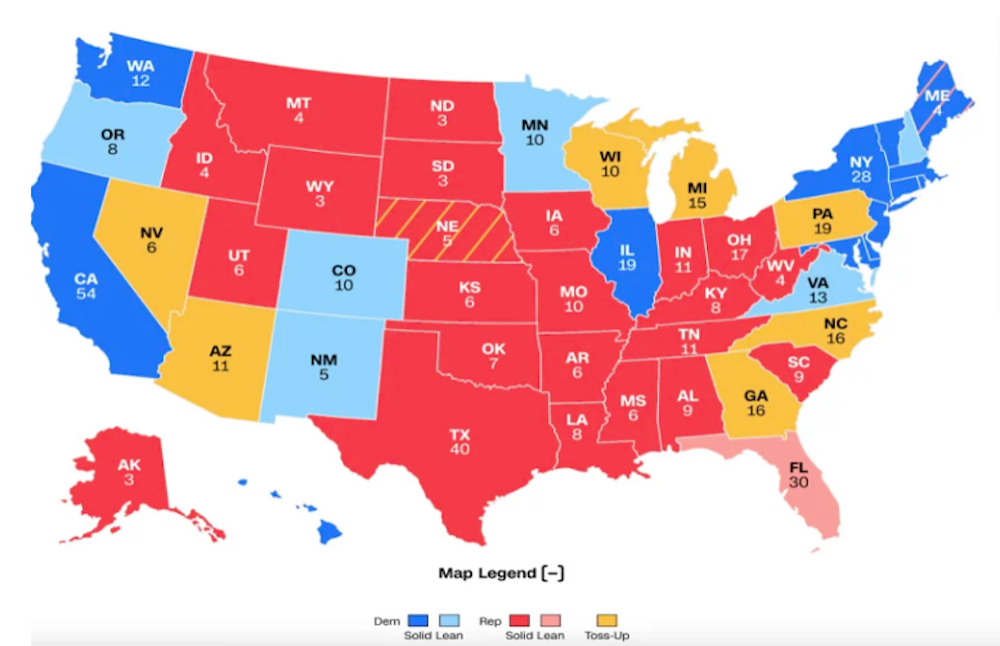
    According to recent analyses, around ten states are expected to be in play for 2024. Based on recent trends, there are seven swing states to watch: Nevada, Arizona, Wisconsin, Michigan, Pennsylvania, North Carolina, and Georgia. In the 2016 and 2020 elections, victory margins in these states were razor-thin, often less than 1%.

    With both Harris and Trump within striking distance of the 270 Electoral College votes needed to win the presidency, these swing states, with a combined 91 votes, will determine the outcome.

    Map published on 18 August 2024 by CNN. The number of electors for each state are show. The colors indicate the states that appear to be strongly (dark blue) or probably (light blue) leaning toward Kamala Harris, and strongly (red) or probably (pink) leaning toward Donald Trump. In yellow are the seven pivotal states where victory is likely to come down to a small number of votes. Click to zoom.

    The 2016 and 2020 polling failures: flukes or systemic issues?

    When the margins are so tight in these key states, accurately measuring voter intentions is an enormous challenge. In 2016, national polls correctly predicted Hillary Clinton’s popular-vote win – she had nearly 3 million more than Trump. However, they failed to foresee Trump’s Electorial College victories in critical states, which ultimately put him over the top.

    The American Association for Public Opinion Research (AAPOR) pointed out several reasons for these errors, including underrepresentation of Republican voters, over-representation of college-educated voters (who tend to lean Democratic), and an underestimation of undecided voters who eventually voted for Trump or third-party candidates.

    Despite efforts to fix these problems, other biases showed up in 2020. While graduate voters were not over-represented and undecideds were evenly split between Biden and Trump, the Covid-19 pandemic had made the pollsters’ task more complicated. AAPOR points out that the states with a higher proportion of Covid-19 cases were the ones with the highest polling errors. As a result, pollsters underestimated Trump’s vote share in key swing states and also overestimated Biden’s national lead, making the 2020 polls the least accurate in 40 years.

    Proportion of polling errors in presidential elections since 1936. Click to zoom.
    Pew Reseach Center

    Despite these errors, Biden still triumphed, winning 4 percent more of the popular vote and taking home 306 electoral votes to Trump’s 232. Biden’s victories in the swing states of Arizona, Georgia, Michigan, Nevada, Pennsylvania, and Wisconsin make all the difference.

    Polling errors and public distrust

    Errors of this magnitude naturally increase the public’s scepticism of polling, especially among Republicans, who are already wary of establishment institutions. Contrary to initial assumptions, Trump voters didn’t hesitate to express their preferences in 2016 and 2020. However, they were less likely to participate in polls due in part to their distrust of mainstream institutions. As a result, working-class white voters – and their opinions – were underrepresented in many polls.

    Pollsters also face technical challenges. Getting a respondent on the phone now requires calling hundreds of people, thanks to caller ID and call screening. Polls with smaller samples (fewer than 1,000 respondents) are less reliable. To deal with these hurdles, many pollsters are now using a mix of methods, including e-mail, online surveys, and robocalls.

    Though cheaper, online surveys often draw voluntary participants who are compensated, which leads to issues of accuracy and representation. This growing reliance on online polling has contributed to a doubling of polling companies from 2000 to 2022, according to Pew Research Center.

    Margin of error and identifying “likely” voters

    The margin of error is a critical component of polling that is often misunderstood by the public and media. It typically falls between 3 and 4 percentage points, but for smaller demographic groups (for example, young people, white men, or Hispanics), it can be even higher. Media headlines, however, frequently imply a candidate is leading, even when the difference is within the margin of error. University of California, Berkeley researchers suggest that to ensure 95% accuracy, the margin of error should be closer to 6%.

    However, the media sometimes amplify results, particularly in headlines, by implying that a candidate is ahead, even when the difference is within the margin of error. Moreover, researchers at the University of Berkeley have shown that to guarantee 95% accuracy, this margin should be increased to at least 6%. This means a candidate projected to receive 54% of the vote is likely, in reality, to secure anywhere between 48% and 60%, reflecting an actual margin of error of 12 percentage points.

    Another significant challenge for pollsters is identifying likely voters. Only around two-thirds of citizens eligible to vote actually go to the polls. In 2016, turnout on the Democratic side was overestimated, giving the false impression that Clinton was a lock for victory. This likely caused some of her supporters to stay home, while Trump’s base showed up in force when polls suggested he was behind. Accurately predicting who will turn out to vote is crucial to polling accuracy.

    Lessons from the 2022 midterms: A glimmer of hope for 2024?

    Polling showed notable improvements during the 2022 midterm elections, with the results being the most accurate since 1998. Importantly, there was no significant bias toward either party. However, midterm elections operate differently than presidential elections, and the dynamics for 2024 may be very different. That said, many polling institutions have adapted since 2016: as of 2022, 61% of polling firms had changed their methods, such as refining sampling techniques and improving question wording. More than a third have changed their methods after 2020.

    While these changes are positive, challenges remain, especially in predicting turnout and combating low response rates.

    What good are polls, then?

    At the end of the day, election polls offer snapshots – often imprecise – and can only provide general trends. Polling methods vary across firms, introducing biases that make it difficult to compare results.

    Survey aggregators offer averages that might be more reliable than individual polls, but they still come with a degree of uncertainty. This is true for FiveThirtyEight, the well-known website founded by statistics guru Nate Silver. After ABC took over in 2023, Silver left, taking his forecasting model with him to his new platform, Silver Bulletin, which continues to attract significant media attention.

    With the unpredictability of polls, political betting markets have become popular as polling alternatives. Platforms like Polymarket, which recently hired Silver, have multiplied rapidly. Some people, like Elon Musk, argue that markets provide better forecasts than traditional polls, though this claim is unproven. There are also concerns that these markets could be manipulated to sway public opinion.

    While opinion polls aren’t the best tools for predicting elections – as this could be one of the closest in recent history – their value lies in gauging public opinion on key issues. However, even in this role, polls can still be biased, often influenced by how questions are phrased.

    For example, in 2019 USA Today ran the headline “Poll: Half of Americans say Trump is victim of a ‘witch hunt’ as trust in Mueller erodes”. This was in reference to Special Counsel Robert Mueller’s investigation into Russian interference in the 2016 election. The question asked by the poll was:

    “President Trump has called the special counsel’s investigation a ‘witch hunt’ and said he has been investigated more than previous presidents for political reasons. Do you agree?”

    The problem with this wording is that it combined two different ideas: whether the investigation was a “witch hunt” and whether Trump had been unfairly targeted for political reasons. On top of that, the question lacked neutrality, presenting only his perspective.

    Naturally, Trump used the result to his advantage, even though other polls from sources such as The Washington Post, CBS News, and NPR-PBS told a different story.

    To use polling data wisely during this election, it’s crucial to recognize these limitations and pay attention to the fine print – details like the sample size, polling date, margin of error, and methodology. Additionally, consider the poll’s sponsors, who may only release results that align with their particular agenda.

    Ultimately, the best way to interpret polling data is with caution, focusing on general trends rather than any single poll. And always remember, election outcomes can be full of surprises.

    Jérôme Viala-Gaudefroy ne travaille pas, ne conseille pas, ne possède pas de parts, ne reçoit pas de fonds d’une organisation qui pourrait tirer profit de cet article, et n’a déclaré aucune autre affiliation que son organisme de recherche.

    – ref. 2024 US presidential election: can we believe the polls? – https://theconversation.com/2024-us-presidential-election-can-we-believe-the-polls-240834

    MIL OSI – Global Reports –

    January 23, 2025
  • MIL-OSI New Zealand: Stronger fuel reserves to drive economic stability

    Source: New Zealand Government

    New Zealand’s fuel resilience is being strengthened to ensure people and goods keep moving and connected to the world in case of disruptions, Associate Energy Minister Shane Jones says.

    “Fuel security is a priority for the Coalition Government. We are acutely aware of how important engine fuels are to our economy and the impacts a fuel disruption would have on New Zealanders. New Zealand imports nearly all of its engine fuels, making us particularly vulnerable to international and domestic supply disruptions,” Mr Jones says.

    “Ensuring we hold enough reserve stocks in the right place to ride out possible disruptions is a key pillar of fuel security. It is a critical insurance policy needed to safeguard against the potentially devastating impacts that a severe and sustained fuel disruption might have.

    “The previous government introduced a minimum stockholding obligation, which means from 1 January 2025 fuel importers will be required to hold 28 days’ cover for petrol, 24 days for jet fuel and 21 days for diesel.

    “Importantly, the minimum stockholding obligation regulations introduce a new information disclosure rule which enables government to have much clearer oversight over how much fuel is held in New Zealand.

    “However, I am not satisfied that 21 days’ cover for diesel is enough, nor is the jet fuel stockholding rule sufficient to avoid disruptions to international aviation such as that we experienced in 2017.

    “Diesel is our most important fuel – it keeps food and people moving through our country. Without it, New Zealanders would struggle to access everything they need. We need to hold enough diesel onshore to keep essential goods moving through the country and vital services running, even if fuel supply chains have been disrupted. 

    “For this reason, I am seeking feedback on increasing diesel reserves to 28 days’ stock to help reduce any potential impact of a disruption to supply.

    “I am also concerned about security of supply of jet fuel at Auckland Airport. In September I informed the fuel companies which own the jet fuel infrastructure at the airport of my plan to seek Cabinet agreement on regulations that would mandate sufficient jet fuel to be held near Auckland Airport.

    “Auckland Airport is New Zealand’s gateway to the world – 75 per cent of all international seat capacity into New Zealand and 90 per cent of all long haul flights come into Auckland. 

    “New Zealand found out the hard way in 2017 when jet fuel supply was disrupted, forcing planes to be diverted and reducing our connection with the world. Further issues with jet fuel quality in 2022 reinforce the need for action. 

    “Despite the 2019 Government Inquiry into the 2017 Auckland Fuel Supply Disruption recommending jet fuel companies urgently increase their jet fuel holdings near Auckland airport, little progress has been made. Establishing a location-specific jet fuel stockholding requirement would ensure the jet fuel companies act to secure enough fuel is on hand to ride out any disruption to supply.

    “Along with reversing the ban on oil and gas exploration, these actions will further strengthen New Zealand’s resilience and self-determination to ensure disruptions to our energy supply do not halt the economy,” Mr Jones says.

    Read the discussion document on increasing diesel reserves from 21 to 28 days and have your say here: https://www.mbie.govt.nz/have-your-say/options-for-improving-our-diesel-resilience. Consultation closes on December 6.

    MIL OSI New Zealand News –

    January 23, 2025
  • MIL-OSI New Zealand: Government and sector to improve Forestry ETS Registry

    Source: New Zealand Government

    Forestry Minister Todd McClay today announced the establishment of a Forestry Sector Reference Group to drive better outcomes from the Forestry Emissions Trading Scheme (ETS) Registry.

    “We are committed to working with the forestry sector to provide greater transparency and engagement on the forestry ETS registry as we work to reduce costs.  

    “This group will help the Government to restore confidence and certainty for Forestry”, Mr McClay says.

    The establishment of the Reference Group follows an independent review of the operational costs of the forestry ETS Register announced earlier this year.

    “Forest owners have raised concerns about the excessive costs that had been imposed upon them by the previous Labour government who put a $30.25 per hectare annual levy for participation in the Registry. 

    “I agree with the sector that this cost is unreasonable – the Reference Group is part of our response to reduce costs and drive greater efficiency.

    “In response, the Government has cancelled the 2023/24 annual charge that forest owners were required to pay to participate in the ETS Registry.

    “Today I am releasing the independent report that outlines where the current system fell short of the Coalition Government and sector’s expectations.

    “The 4,000 plus forestry participants deserve to have confidence in the system designed to manage their ETS obligations. There is a cost to the register, but they shouldn’t have to pay for the last government’s mistakes,” Mr McClay says.

    “any of the issues identified in the report have now been addressed, and the Reference Group will help prioritise work that can reduce the cost and unnecessary regulatory duplication in the ETS Registry. The Government will shortly consult on a new Forestry ETS Registry Levy for the 2024/2025 financial year.

    “Forestry plays an important role in helping New Zealand meet its emissions reductions obligations and grow our economy.”

    The independent review of the Forestry ETS Operational Costs report is available HERE

    MIL OSI New Zealand News –

    January 23, 2025
  • MIL-OSI New Zealand: Education – Te Rūnanganui o Te Āti Awa and WelTec team up again following successful Try-a-Trade programme

    Source: Whitireia and WelTec

    Following the introduction of the Try-a-Trade pilot in March, Te Rūnanganui o Te Āti Awa is excited to again offer the programme and encourage members of their community to consider pathways into further education or employment via trades training.
    Thanks to initial funding received from Oranga Tamariki, the Ministry of Social Development (MSD), and Te Puni Kōkiri, Te Rūnanganui o Te Āti Awa was able to co-design a pilot Try-a-Trade programme with WelTec which was delivered through March, April and May this year.
    We were thrilled to receive initial funding for the pilot and run the first Try-a-Trades programme, says Wirangi Luke, Te Tumu Whakarae (Chief Executive) of Te Rūnanganui o Te Āti Awa. “Feedback from those who took part in the pilot indicated that the training gave them more confidence in their skills and abilities and supported several of them to step into work.”
    “We heard from participants that they valued seeing what trades training was like, and that the programme developed skills they felt would help them into employment. Feedback indicated that it built self-awareness and confidence and participants said they felt more ready to gain experience through voluntary work or work placements, and plan for their future.”
    A second Try-a-Trade programme delivered by WelTec kicks off on 17 October and will run for 7 weeks. The programme is for those who are not currently working, studying or in training and offers the opportunity to develop skills and knowledge in foundational trades training. It is designed to give participants a snapshot of what training in different trades would be like, with workshops covering mechanical engineering, plastering, plumbing, carpentry, tiling, painting and electrical.
    Mark Oldershaw, Executive Director for Whitireia and WelTec, welcomes those who would like to give the Try-a-Trade programme a try. “We value our partnership with Te Rūnanganui o Te Āti Awa and this is an important way we can support their educational goals and our local Lower Hutt community.”

    MIL OSI New Zealand News –

    January 23, 2025
  • MIL-OSI New Zealand: Reminder of upcoming lane closure – SH1 Otaika Road, Whangārei

    Source: New Zealand Transport Agency

    NZ Transport Agency Waka Kotahi (NZTA) is reminding Northland motorists that on Sunday 20 October the northbound lane on SH1 Otaika Road between Rewa Rewa Road and Maunu Road will be closed for essential power pole maintenance.

    Prior to this, preparation work will occur on Thursday 17 October and Friday 18 October between 9am and 4pm under stop/go traffic control.

    The northbound detour will be in place between 7am and 4pm, with more information available on the Northpower outages page:

    Northpower outages(external link)

    Motorists are asked to follow marked detour routes and expect delays during this time. 

    Detour route for SH1 northbound:

    1. Turn right into Rewa Rewa Road/Kioreroa Road
    2. Turn left onto Port Road/Okara Drive
    3. Turn left onto Porowini Avenue
    4. Turn left onto Maunu Road before joining SH1 Otaika Road. 

    The detour route will add approximately eight minutes to your journey.

    Important note for Heavy Vehicles (HPMV)

    The detour route is not approved for HPMV. HPMV will be parked and grouped together, and escorted through the closure approximately every 20 minutes, as required.

    Please take care when travelling through our work sites and watch out for our crews as they undertake important work to improve our roads. Reduce your speed, adhere to the temporary speed limits and follow the directions of traffic management staff and signs.

    People are urged to plan ahead and use the NZTA Journey Planner for real time traffic information.

    Journey Planner(external link)

    MIL OSI New Zealand News –

    January 23, 2025
  • MIL-OSI China: Premier Li urges Chinese, Vietnamese entrepreneurs to boost cooperation

    Source: People’s Republic of China – State Council News

    HANOI, Oct. 13 — Chinese Premier Li Qiang said here Sunday it is hoped that Chinese and Vietnamese entrepreneurs actively follow the general trend, better seize opportunities and further strengthen cooperation for greater development of their own businesses and contribute to the common development of the two countries.

    He made the remarks when addressing a symposium gathering representatives of Chinese and Vietnamese entrepreneurs. Vietnamese Prime Minister Pham Minh Chinh also attended the symposium.

    Li noted that in recent years, with both sides’ joint efforts, China-Vietnam relations have developed steadily, and practical cooperation has yielded fruitful results.

    China and Vietnam are traditional socialist friendly neighbors, and their respective development is an important opportunity for each other, he said, adding that economic and trade cooperation has always been a highlight of China-Vietnam cooperation and an important source of driving force for advancing bilateral ties.

    Looking ahead, Li said, there is still more space for expansion and greater potential to be tapped in the further alignment of the development strategies of the two countries, stronger connectivity, the release of complementary advantages, as well as economic and trade cooperation.

    The two countries share the same social system, strong political mutual trust, geographical proximity and affinity among their people, and enjoy a profound friendship of “comrades and brothers,” which has laid a solid foundation for bilateral cooperation.

    The Chinese premier called on the entrepreneurs to more actively engage in national development strategies, and make full use of multilateral and bilateral economic and trade cooperation agreements and policy dividends such as the Regional Comprehensive Economic Partnership and the Version 3.0 China-ASEAN Free Trade Area.

    Li proposed that the entrepreneurs should jointly promote the integrated development of industries, deepen mutual integration of supply and demand, and build stable and smooth cross-border industrial and supply chains.

    He also urged the two countries’ entrepreneurs to pool innovation and creativity, and strengthen the whole-chain innovation cooperation between industry, academia, research and utilization, with a particular focus on clean energy, biomedicine and artificial intelligence, so as to jointly foster and strengthen new driving forces for the development of the two countries.

    Vietnamese Prime Minister Pham Minh Chinh said that under the guidance of the top leaders of the two parties and the two countries, Vietnam and China have deepened and solidified bilateral relations, bringing the ties into a new era of building a community with a shared future for Vietnam and China.

    Noting that China is Vietnam’s largest trading partner, and Vietnam is China’s largest trading partner in ASEAN, he said economic and trade cooperation has become a highlight and an important pillar of the friendly relations between the two countries.

    Pham Minh Chinh said Vietnam is willing to work with China in the spirit of mutual benefit and win-win cooperation, further give play to complementary advantages, fully tap potential, improve the level of corporate cooperation, promote cooperation on finance, technology, investment, transportation infrastructure, digital economy, green economy, and production and supply chain connectivity, and strengthen coordination within the framework of regional economic integration.

    “The Vietnamese government will continue to provide a sound business environment for enterprises and welcome Chinese enterprises to continue to expand their investment in Vietnam,” he said.

    The Vietnamese head of government also expressed the hope that enterprises from the two countries will jointly deepen practical cooperation, and boost the growth of bilateral relations and the respective development processes of Vietnam and China.

    Representatives of participating enterprises said that the strategic guidance of the two countries’ top leaders has injected strong impetus into China-Vietnam economic and trade cooperation.

    They said the Belt and Road initiative is highly compatible with the Two Corridors and One Economic Circle strategy, and the business communities of the two countries are optimistic about the development prospects in each other’s markets and have firm confidence in deepening cooperation.

    They expressed the willingness to seize opportunities to further promote cooperation on finance, transportation infrastructure construction, digital economy, green energy, communications and logistics.

    MIL OSI China News –

    January 23, 2025
  • MIL-OSI Australia: North Coast small business lights up Paris and the Premier’s NSW Export Awards

    Source: New South Wales Premiere

    Published: 12 October 2024

    Released by: Minister for Industry and Trade


    A small business from the state’s mid north coast which helped light up the Paris Olympics has been named NSW Exporter of the Year at the Premier’s NSW Export Awards.

    Bellingen business Planet Lighting supplied 1,600 red and amber LED lights for ramps and pathways around the Olympic Village as part of an interactive installation that’s now a permanent fixture in the French capital.

    Planet Lighting is a small business success story – they’ve been manufacturing lights since the 1930s.

    They are one of the leading Australian suppliers of medical and surgical lights and export their custom-built products throughout Asia, Europe and the Americas.

    With a team of 50 employees, Planet Lighting meticulously designed and manufactured the light fixtures, partnering with local suppliers and international distributors to bring its LED display to the global stage.

    Planet Lighting was among 17 other NSW businesses from a diverse range of industries including agribusiness, manufacturing, creative arts and advanced technologies honoured last night at a gala ceremony at Sydney Town Hall.

    Now in its 62nd year, the Premier’s NSW Export Awards celebrate the success and resilience of NSW exporters, whose export of goods and services is worth $150 billion annually to NSW.

    Winners were announced across five state categories and 13 national categories. The national category winners will now progress as finalists for the Australian Export Awards, to be held in Canberra next month.

    For a full list of NSW award winners visit the Export Council of Australia.

    Minister for Industry and Trade Anoulack Chanthivong said:

    “Exports not only benefit individual businesses, they are a critical part of our economy, with trade supporting one in five Australian jobs.

    “The NSW Government is proud to support our wonderful exporting community. Accessing overseas markets can be a game-changer for NSW businesses looking to accelerate their growth, and this year’s award winners are doing exactly that – capitalising on the incredible opportunities that come through exporting.

    “A big congratulations to Planet Lighting and all our other NSW Export Award winners who are shining bright overseas and showcasing the best of what NSW has to offer the world.”

    Planet Lighting Managing Director Mia Iggulden said: 

    “We’re incredibly proud to be recognised amongst a strong field of NSW exporters.

    “Innovation and collaboration are at the heart of everything we do at Planet Lighting. Our partnerships with local suppliers and dedicated overseas distributors have been instrumental in our journey, allowing us to invest in advanced manufacturing technologies and create new local jobs. We’re excited to continue pushing the boundaries of lighting design, all while supporting the community we call home.”

    Chair of the Export Council of Australia Dianne Tipping said:

    “There was strong interest in this year’s awards with nominations from more than 200 NSW exporters.

    “Through the awards, we have celebrated exporters who have by hard work and resilience succeeded in global markets, whilst inspiring others to grow their own businesses by going global. They are taking NSW innovation onto the world stage, supporting jobs and economic growth for all.” 

    MIL OSI News –

    January 23, 2025
  • MIL-OSI Asia-Pac: New York ETO and Chocolate Rain crossover to promote Hong Kong-United States cultural exchange (with photos)

    Source: Hong Kong Government special administrative region

         â€‹The Hong Kong Economic and Trade Office, New York (HKETONY), proudly hosted the “Hong Kong Meets America – Pop Art Exhibition” at the American Dream Mall in East Rutherford, New Jersey, on October 11 to 13 (New Jersey time). This vibrant event successfully promoted cultural exchange between Hong Kong and the United States (US), drawing in art lovers and families alike.

         Curated by the beloved Hong Kong creative brand Chocolate Rain, the exhibition showcased a dazzling array of exhibits featuring iconic landmarks and culinary delights from both Hong Kong and New York. Visitors enjoyed giant inflatables of Hong Kong’s signature pineapple bun with butter, egg tarts, fish balls, and milk tea, alongside whimsical 3D figurines of New York’s Statue of Liberty, Empire State Building, and classic yellow cabs.

         At the opening ceremony on October 12, the Director of the HKETONY, Ms Maisie Ho, spoke about the exhibition’s unique blend of tradition and contemporary aesthetics.

         “The exhibition’s title, ‘Hong Kong Meets America’ truly reflects our mission to celebrate the colorful cultural exchange between Hong Kong and the US. The American Dream Mall has transformed to an immersive showcase of iconic landmarks and culinary delights from both sides,” she said.

         Ms Ho also highlighted the Hong Kong Special Administrative Region Government’s commitment to advancing the city’s arts, cultural, and creative industries, with the aim of positioning Hong Kong as an East-meets-West hub for international cultural exchange.

         She also took the opportunity to invite audience to visit Hong Kong and experience its dynamic metropolitan charm, rich cultural heritage, and a full calendar of events year-round.

         “In the first eight months of this year alone, nearly 30 million visitors explored our dynamic city. The colorful exhibits you see here are just a glimpse of what awaits you in Hong Kong. We warmly invite you to experience its lively metropolitan charm, rich cultural heritage, and a calendar filled with exciting events throughout the year,” she added.

         The exhibition not only featured stunning art installations but also offered a variety of engaging activities, including seven DIY workshops conducted by the founder of Chocolate Rain, Prudence Mak, and her team over the three days. Participants had the opportunity to unleash their creativity and take home complimentary Hong Kong Meets America-themed souvenirs.                        

    MIL OSI Asia Pacific News –

    January 23, 2025
  • MIL-OSI Australia: Building the future – first of 100 public preschools open in South West Sydney

    Source: New South Wales Premiere

    Published: 14 October 2024

    Released by: The Premier, Deputy Premier, Minister for Education and Early Learning


    The first of 100 public preschools to be built by the Minns Labor Government has opened today, as work continues to ensure every child in New South Wales has the best possible start to their education.

    Attached to Gulyangarri Public School in Liverpool, the new public preschool will welcome up to 80 preschoolers each week, providing expanded access to quality, free, early education in South West Sydney.

    Importantly, this preschool is co-located with the primary school, easing students transition into kindergarten and full-time schooling, while easing pick up and drop off for parents with older students at the same school. 

    This is part of the Minns Labor Government’s historic $769 million investment to deliver 100 new public preschools by 2027, doubling the existing number of public preschools across the state. Once complete more than 9,000 families and children will benefit from access to fee-free, high quality early education in their local community.

    Tenders to build 85 of these public preschools are being released by the end of the year, with the first tranche of tenders out to market, including for preschools in the Illawarra and Shoalhaven regions.

    The NSW Government’s work towards delivering universal preschool across the state is in sharp contrast to the former Government, who over twelve years failed to build a single public preschool. 

    Research shows that children who participate in a quality preschool education program for at least five days a fortnight in the year before school are more likely to arrive at school equipped with the social, cognitive and emotional skills they need for learning.

    With the first preschool now open to students, the Minns Labor Government is on track to deliver its commitment of 100 public preschools in full by 2027.

    Children can enrol in public preschools if they turn 4 on or before 31 July in the year before starting school.

    NSW Premier Chris Minns said: 

    “This was one of the largest, and most important commitments we made prior to the election, and it’s fantastic to reach this milestone.

    “We know that early childhood education has lifelong benefits for our states young people and is key to getting parents back into the workforce.

    “As a government there is no better investment than young people and their education.

    “No matter where you decide to raise your family in New South Wales, you should have access to quality, fee-free early education for your children – and that’s exactly what we’re working to deliver.

    “One down, 99 to go!”

    NSW Deputy Premier and Minister for Education and Early Learning Prue Car said:

    “It is wonderful to open the first of our Government’s 100 new public preschools and see Liverpool’s youngest learners begin their educational journey here at the new Gulyangarri Public Preschool. 

    “This is the first step in a major expansion in access to preschool for families across NSW. The Minns Labor Government is investing in our future by giving many more children access to quality preschool before they start school.

    “We made this historic commitment to deliver the biggest expansion in public preschools in NSW’s history because we strongly believe all children should have access to high-quality early education, no matter their postcode.”

    Member for Liverpool Charishma Kaliyanda said:

    “Access to a free, public preschool is a gamechanger for so many families in Liverpool and beyond, and I am delighted that Liverpool will be the first of many communities to access this fantastic initiative.

    “We know how important early childhood education is in improving opportunities for children and families for years to come.

    “The cost of early childcare has previously limited access for many parents. This affordable option, co-located with local public schools, is a lifeline for those families to get their children into a quality preschool.”

    Gulyangarri Public School principal Ian Tapuska said: 

    “The new public preschool will help form strong connections between children, families and school staff, foster a sense of belonging, and help teachers understand and meet the individual needs of children when they start school.

    “The preschoolers will become part of our public education family, and we look forward to supporting a positive transition to school for our youngest learners.”

    MIL OSI News –

    January 23, 2025
  • MIL-OSI New Zealand: A year later, Kiwis already see ACT’s real change

    Source: ACT Party

    A year after the 2023 election, ACT is celebrating the long list of actions already taken to empower New Zealanders.

    “In Opposition, we spent six years listening to New Zealanders,” says ACT Leader David Seymour. “This resulted in a comprehensive election platform with a commitment not just to change the Government, but to deliver real change.

    “Thanks to New Zealanders’ support, on October 14 we were put in a position to deliver, and less than 11 months after signing the coalition agreement, we’ve made serious progress.

    “The breadth and intensity of our action in Government speaks for itself. Even our critics complain at how we’re punching above our weight for a small team. We call it value for your vote.

    “Below is a list of actions ACT has taken that reflect ideas we campaigned on, and on which Kiwis elected us to deliver. Together, these actions break down barriers for Kiwis working to succeed on their own terms. We’re addressing challenges in the economy, law and order, democracy, education, health and more.”

    THE ECONOMY:

    • Cut wasteful Government spending to get inflation under control.
    • Delivered tax cuts to ease the cost of living.
    • Restored the Reserve Bank’s focused on tackling inflation.
    • Restored the option of 90-day trials for all businesses.
    • Established the Ministry for Regulation to cut red tape to make doing business simpler.
    • Commenced two regulatory reviews for early childhood education and agricultural products.
    • Repealed the Auckland Fuel Tax.
    • Repealed the Ute Tax.
    • Repealed “Fair Pay” Agreements
    • Repealed Labour’s resource management regime.
    • Agreed on core design features for a replacement of the Resource Management Act centred on property rights.
    • Sped up timeframes for overseas investment applications.
    • Increased the use of sanctions for beneficiaries who can work but refuse to take steps to find a job.
    • Eased restrictions to accessing credit under the Credit Contracts and Consumer Finance Act.
    • Scrapped EECA’s “decarbonising industry” (GIDI) fund.
    • Scrapped Auckland Light Rail, the Lake Onslow hydro scheme, and funding for Let’s Get Wellington Moving.
    • Started phasing back in interest deductibility.
    • Suspended the requirement for new Significant Natural Areas.
    • Unveiled a new contracting gateway test to provide certainty to workers and businesses.
    • Began delivering regulatory relief for businesses dealing with anti-money laundering rules.
    • Launched consultation to improve the Holidays Act.
    • Launched a nationwide roadshow to inform improvements to health and safety law.
    • Launched a framework for Regional Deals between central and local government to deliver infrastructure.
    • Stopped blanket speed limit reductions and enabled faster speed limits on our safest roads.
    • Introduced legislation to reverse the oil and gas ban and promote the use of Crown minerals.
    • Introduced tenancy legislation to enable Pet Bonds, restore 90-day ‘no cause’ terminations, and restore tenants’ and landlords’ notice periods to 21 and 42 days.
    • Introduced legislation to improve access to building products available overseas.
    • Introduced a member’s bill to liberalise Easter Trading.

    LAW AND ORDER:

    • Increased funding for Corrections to lift prison capacity.
    • Abolished Labour’s prisoner reduction target.
    • Defunded Section 27 “cultural reports”.
    • Commenced a review of the Firearms Registry.
    • Strengthened consequences for Kāinga Ora tenants who engage in repeated antisocial behaviour.
    • Strengthened Firearms Prohibition Orders.
    • Made gang membership an aggravating factor at sentencing.
    • Introduced legislation to reinstate Three Strikes.
    • Introduced a member’s bill to make rehabilitation or education a condition of parole.
    • Introduced legislation to toughen sentences for attacks on workers and give weight to the victim’s circumstances at sentencing.
    • Introduced legislation to amend Part 6 of the Arms Act affecting clubs and ranges.

    STRENGTHENING DEMOCRACY:

    • Directed the public service to deliver services based on need, not race, and end “progressive procurement” quotas.
    • Abolished the Māori Health Authority.
    • Advanced the Treaty Principles Bill.
    • Restored local referendums on Māori Wards.
    • Scrapped Labour’s law to give 16-year-olds votes in local elections.
    • Broadened the terms of reference of the Covid-19 Royal Commission with a second phase.
    • Defunded the Christchurch Call.
    • Halted work on hate speech laws.
    • Introduced legislation to remove Section 7AA of the Oranga Tamariki Act.
    • Seen Otago University adopt a free speech policy in response to ACT’s coalition agreement.

    EDUCATION:

    • Restored charter schools, now with the option of state school conversion, with the first schools to open next year.
    • Streamlined early childhood education regulations.
    • Delivered an action plan to improve school attendance and started publishing attendance data weekly.
    • Improved the school lunch programme to feed more kids for less money.
    • Switched fees-free university from first year to third.

    HEALTH:

    • Delivered Pharmac its largest-ever budget, which has now funded life-saving medicines.
    • Repealed the Therapeutic Products Act.
    • Restored the sale of medicine containing pseudoephedrine.

    MIL OSI New Zealand News –

    January 23, 2025
  • MIL-Evening Report: There’s a plan for free school lunches in Queensland. Is this a good idea?

    Source: The Conversation (Au and NZ) – By Clare Dix, Lecturer In Nutrition & Dietetics, University of the Sunshine Coast

    Queensland Premier Steven Miles has announced free school lunches if Labor is re-elected at the state’s upcoming election on October 26.

    The A$1.4 billion policy would cover primary students in public schools and begin next year. Labor estimates it would save parents about $1,600 per child, per year. On Sunday, Miles said:

    [The program is] universal to avoid stigmatising the kids that need the food the most, but also to ensure that it supports every Queensland family.

    The meals will be delivered in partnership with P&Cs Queensland, Queensland Association of School Tuckshops, school principals, Health and Wellbeing Queensland and non-government food providers.

    The Greens are also campaigning on a pledge to deliver free breakfasts and lunches for every state primary and high school student, costed at $3 billion over the next four years.

    Would a school lunches program help students and families? How would it work in practice?

    An unusual approach for Australia

    Unlike the United Kingdom and United States, Australian does not have a national or state-based free or subsidised school meal program.

    Instead, parents are responsible for providing morning tea and lunch through a “lunchbox system”. Families can also usually pre-order food from a canteen or tuckshop. In some cases, state or territory governments fund charities and non-for-profits to provide breakfast or lunch programs for schools identified as most in need of support.

    Research shows the nutritional quality of food provided to Australian school children often does not meet dietary guidelines. There are mandatory guidelines for state school canteens and tuckshops to follow but these are not always reflected in practice. Research shows many canteen menus contain less-than-desirable options and pricing often does not encourage families to buy healthier options.

    Unfortunately, health survey data shows Australian children’s diets are high in energy dense and nutritionally poor foods. On top of this, the 2023 Foodbank Report shows 36% of Australians are food insecure and about one quarter of these households have children at home who may not have adequate food for school.

    Australia has a ‘lunchbox system’ where families provide the food for school.
    Halfpoint/ Shutterstock

    What are the potential opportunities?

    So the idea of a free school lunch program delivered by organisations familiar with providing food in schools sounds like a positive solution.

    Beyond improving nutrition and health outcomes for more than 326,000 Queensland students, it can also provide other benefits.

    We could see improved school attendance by creating an incentive for students to go to school and improved diets leading to reduced illness. Because well-nourished children are more ready to learn, concentrate and stay on task, school lunches could lead to improved academic performance.

    Importantly, school lunches can reduce inequality and stigma for families who experience food insecurity.

    The school kitchen can also provide a opportunities for students to learn about food preparation and service as well as healthy eating.

    What are the key challenges?

    But we need to make sure the program is properly and sustainably designed. There will be a cost to taxpayers, not just in terms of the set up, but ongoing maintenance.

    The initial implementation will require commercial kitchens and equipment, qualified and trained staff, secure food procurement and supply chains as well as all the policies and procedures to go with this. This raises the question of whether the timeline of starting in Term 1, 2025 is realistic for all schools.

    The roll out needs to be equitable – extra consideration is needed for how this plan will be delivered to rural and remote Queenslanders. We also know access to reliable supplies of food, staff, equipment and support varies greatly across the state.

    The program will also need to cater to children with food allergies and intolerances, food preferences experienced with conditions like autism and attention-deficit hyperactivity disorder (ADHD), and different cultural eating practices.

    This plan has the potential to improve Queensland children’s health and education outcomes, while saving families money, time and stress. But it is complex and success will lie in making sure all Queensland primary students are provided with nutritious and appropriate food at school.

    Clare Dix has received funding from the Australian Department of Health and Aged Care.

    – ref. There’s a plan for free school lunches in Queensland. Is this a good idea? – https://theconversation.com/theres-a-plan-for-free-school-lunches-in-queensland-is-this-a-good-idea-241242

    MIL OSI Analysis – EveningReport.nz –

    January 23, 2025
  • MIL-OSI Australia: 218-2024: Scheduled Service Disruption: Saturday 19 October to Sunday 20 October 2024 – DAFF messaging, SeaPest

    Source: Australia Government Statements – Agriculture

    14 October 2024

    Who does this notice affect?

    All users of the Seasonal Pests (SeaPest) system.

    All clients submitting the below declarations:

    • Full Import Declaration (FID)
    • Long Form Self Assessed Clearance (LFSAC)
    • Short Form Self Assessed Clearance (SFSAC)
    • Cargo Report Self Assessed Clearance (CRSAC)
    • Cargo Report Personal Effects (PE)

    Information

    Due to scheduled infrastructure maintenance at the Department of…

    MIL OSI News –

    January 23, 2025
  • MIL-OSI: Q3 2024 Trading Update and Invitation to Earnings Call

    Source: GlobeNewswire (MIL-OSI)

    Oslo, 14 October 2024 – DNO ASA, the Norwegian oil and gas operator, will publish its Q3 2024 operating and interim financial results on 7 November at 07:00 (CET). A videoconference call with executive management will follow at 14:00 (CET). Today the Company provides an update on production, sales volumes and other key information for the quarter.

    Volumes (boepd)

    Gross operated production Q3 2024 Q2 2024 Q3 2023
    Kurdistan 84,212 79,783 25,984
    North Sea – – –
           
    Net entitlement production Q3 2024 Q2 2024 Q3 2023
    Kurdistan 17,607 17,167 9,897
    North Sea 11,236 16,321 14,288
           
    Sales Q3 2024 Q2 2024 Q3 2023
    Kurdistan 17,607 17,167 9,897
    North Sea 15,306 12,871 15,749
           
    Equity accounted production (net) Q3 2024 Q2 2024 Q3 2023
          Côte d’Ivoire         2,843 3,256 3,373

    Selected cash flow items

    DNO’s share of crude oil from the Tawke license during the quarter has been sold to local buyers as the Iraq-Türkiye Pipeline remained closed. Payments are deposited directly into DNO’s international bank accounts in advance of loadings.

    In the third quarter, DNO paid a dividend of NOK 0.3125 per share (totaling USD 29 million), which was up 25 percent from prior quarterly distributions. The Company had no tax payments or refunds during the quarter.

    The acquisition of stakes in five oil and gas fields in the Norne area in the Norwegian Sea announced in May was completed on 30 August. Net cash consideration paid by DNO was approximately USD 24 million. The transfer of DNO’s 22.6 percent interest in Ringhorne East to Vår Energi, the other element of the swap, was completed on the same date.

    Other items and information

    DNO participated in two exploration wells in the Norwegian North Sea in the quarter. The Heisenberg/Angel well in PL827SB (49 percent interest) was spudded on 18 August and completed on 16 September. The well delineated the play-opening 2023 Heisenberg oil and gas discovery and confirmed the volume estimate of 24 to 56 MMboe but the deeper Angel exploration target was found to be mainly water wet. The operated Falstaff well (50 percent interest) was spudded on 20 September and drilling was ongoing as of end of Q3 2024.

    Other drilling activities during the quarter included the B-3 well in Kurdistan at the DNO-operated Baeshiqa license (64 percent interest), which was spudded on 21 February, completed on 26 July and was ongoing a testing program as of end of Q3 2024.

    Earnings call login details

    Please visit http://www.dno.no for login details ahead of the call.

    Disclaimer

    The information contained in this release is based on a preliminary assessment of the Company’s Q3 2024 operating and interim financial results and may be subject to change.

    –

    For further information, please contact:
    Media: media@dno.no
    Investors: investor.relations@dno.no

    –

    DNO ASA is a Norwegian oil and gas operator active in the Middle East, the North Sea and West Africa. Founded in 1971 and listed on the Oslo Stock Exchange, the Company holds stakes in onshore and offshore licenses at various stages of exploration, development and production in the Kurdistan region of Iraq, Norway, the United Kingdom, Côte d’Ivoire, Netherlands and Yemen.

    This information is subject to the disclosure requirements pursuant to section 5-12 of the Norwegian Securities Trading Act.

    The MIL Network –

    January 23, 2025
  • MIL-Evening Report: Australia has led the way regulating gene technology for over 20 years. Here’s how it should apply that to AI

    Source: The Conversation (Au and NZ) – By Julia Powles, Associate Professor of Law and Technology; Director, UWA Tech & Policy Lab, Law School, The University of Western Australia

    Since 2019, the Australian Department for Industry, Science and Resources has been striving to make the nation a leader in “safe and responsible” artificial intelligence (AI). Key to this is a voluntary framework based on eight AI ethics principles, including “human-centred values”, “fairness” and “transparency and explainability”.

    Every subsequent piece of national guidance on AI has spun off these eight principles, imploring business, government and schools to put them into practice. But these voluntary principles have no real hold on organisations that develop and deploy AI systems.

    Last month, the Australian government started consulting on a proposal that struck a different tone. Acknowledging “voluntary compliance […] is no longer enough”, it spoke of “mandatory guardrails for AI in high-risk settings”.

    But the core idea of self-regulation remains stubbornly baked in. For example, it’s up to AI developers to determine whether their AI system is high risk, by having regard to a set of risks that can only be described as endemic to large-scale AI systems.

    If this high hurdle is met, what mandatory guardrails kick in? For the most part, companies simply need to demonstrate they have internal processes gesturing at the AI ethics principles. The proposal is most notable, then, for what it does not include. There is no oversight, no consequences, no refusal, no redress.

    But there is a different, ready-to-hand model that Australia could adopt for AI. It comes from another critical technology in the national interest: gene technology.

    A different model

    Gene technology is what’s behind genetically modified organisms. Like AI, it raises concerns for more than 60% of the population.

    In Australia, it’s regulated by the Office of the Gene Technology Regulator. The regulator was established in 2001 to meet the biotech boom in agriculture and health. Since then, it’s become the exemplar of an expert-informed, highly transparent regulator focused on a specific technology with far-reaching consequences.

    Three features have ensured the gene technology regulator’s national and international success.

    First, it’s a single-mission body. It regulates dealings with genetically modified organisms:

    to protect the health and safety of people, and to protect the environment, by identifying risks posed by or as a result of gene technology.

    Second, it has a sophisticated decision-making structure. Thanks to it, the risk assessment of every application of gene technology in Australia is informed by sound expertise. It also insulates that assessment from political influence and corporate lobbying.

    The regulator is informed by two integrated expert bodies: a Technical Advisory Committee and an Ethics and Community Consultative Committee. These bodies are complemented by Institutional Biosafety Committees supporting ongoing risk management at more than 200 research and commercial institutions accredited to use gene technology in Australia. This parallels best practice in food safety and drug safety.

    The Gene Technology Regulator has a sophisticated decision-making structure.
    Office of The Gene Technology Regulator, CC BY

    Third, the regulator continuously integrates public input into its risk assessment process. It does so meaningfully and transparently. Every dealing with gene technology must be approved. Before a release into the wild, an exhaustive consultation process maximises review and oversight. This ensures a high threshold of public safety.

    Regulating high-risk technologies

    Together, these factors explain why Australia’s gene technology regulator has been so successful. They also highlight what’s missing in most emerging approaches to AI regulation.

    The mandate of AI regulation typically involves an impossible compromise between protecting the public and supporting industry. As with gene regulation, it seeks to safeguard against risks. In the case of AI, those risks would be to health, the environment and human rights. But it also seeks to “maximise the opportunities that AI presents for our economy and society”.

    Second, currently proposed AI regulation outsources risk assessment and management to commercial AI providers. Instead, it should develop a national evidence base, informed by cross-disciplinary scientific, socio-technical and civil society expertise.

    The argument goes that AI is “out of the bag”, with potential applications too numerous and too mundane to regulate. Yet molecular biology methods are also well out of the bag. The gene tech regulator still maintains oversight of all uses of the technology, while continually working to categorise certain dealings as “exempt” or “low-risk” to facilitate research and development.

    Third, the public has no meaningful opportunity to assent to dealings with AI. This is true regardless of whether it involves plundering the archives of our collective imaginations to build AI systems, or deploying them in ways that undercut dignity, autonomy and justice.

    The lesson of more than two decades of gene regulation is that it doesn’t stop innovation to regulate a promising new technology until it can demonstrate a history of non-damaging use to people and the environment. In fact, it saves it.

    The UWA Tech & Policy Lab receives funding from nationally competitive research grants and philanthropic partners. The present research was supported by GA308883: Effective Ethical Frameworks for the State as an Enabler of Innovation, funded by the Department of Foreign Affairs and Trade.

    Julia Powles is the Director of the Lab and has served as an independent member of the National AI Centre’s Think Tank on Responsible AI, the Australian Government’s National Robotics Strategy Advisory Committee, and the Advisory Panel supporting the Australian Parliamentary Inquiry into the Use of Generative AI in the Australian Education System. Through each of these bodies, she has provided advice on comparative AI regulation.

    Haris Yusoff does not work for, consult, own shares in or receive funding from any company or organisation that would benefit from this article, and has disclosed no relevant affiliations beyond their academic appointment.

    – ref. Australia has led the way regulating gene technology for over 20 years. Here’s how it should apply that to AI – https://theconversation.com/australia-has-led-the-way-regulating-gene-technology-for-over-20-years-heres-how-it-should-apply-that-to-ai-240571

    MIL OSI Analysis – EveningReport.nz –

    January 23, 2025
  • MIL-OSI Australia: 219-2024: Scheduled Outage: Friday 18 October to Saturday 19 October 2024 – BICON, DAFF messaging, EVE, SeaPest

    Source: Australia Government Statements – Agriculture

    14 October 2024

    Who does this notice affect?

    All clients required to use the following systems during this planned outage:

    • Biosecurity Import Conditions System (BICON)
    • External Verification for eCertificates (EVE)
    • Seasonal Pests (SeaPest)

    All clients submitting the below declarations during this planned outage:

    • Full Import Declaration (FID)
    • Long Form Self Assessed Clearance (LFSAC)
    • Short Form Self Assessed…

    MIL OSI News –

    January 23, 2025
  • MIL-OSI Asia-Pac: “The Chief Executive’s 2024 Policy Address” available to public on Wednesday

    Source: Hong Kong Government special administrative region

         The Chief Executive, Mr John Lee, will release “The Chief Executive’s 2024 Policy Address” on Wednesday (October 16).
     
         The full text of the Policy Address will be released at http://www.policyaddress.gov.hk after the Chief Executive has completed his speech.
     
         Copies of the Policy Address and other related publications will be available for public collection from the time the Chief Executive has completed his speech at the 20 Home Affairs Enquiry Centres (HAECs) of the Home Affairs Department (HAD). Please browse the HAD website (www.had.gov.hk/en/public_services/public_enquiry_services/ctec.htm) for the opening hours of the HAECs.
     
         Leaflets containing the highlights of the Policy Address will also be available at the following places:
     
    * 16 government office buildings:
     
    Queensway Government Offices, Admiralty
    Immigration Tower, Wan Chai
    Revenue Tower, Wan Chai
    Wanchai Tower, Wan Chai
    North Point Government Offices
    Cheung Sha Wan Government Offices
    Ho Man Tin Government Offices
    Lai Chi Kok Government Offices
    Mongkok Government Offices
    Trade and Industry Tower, Kowloon City
    To Kwa Wan Government Offices
    West Kowloon Government Offices, Yau Ma Tei
    Sha Tin Government Offices
    Tai Hing Government Offices, Tuen Mun
    Tai Po Government Offices
    Tsuen Wan Government Offices
     
    * Seven public libraries:
     
    Hong Kong Central Library, Causeway Bay
    City Hall Public Library, Central
    Kowloon Public Library, Kowloon City
    Ping Shan Tin Shui Wai Public Library, Yuen Long
    Sha Tin Public Library
    Tsuen Wan Public Library
    Tuen Mun Public Library
     
    *Five museums:

    Hong Kong Museum of Art
    Hong Kong Heritage Museum
    Hong Kong Museum of History
    Hong Kong Science Museum
    Hong Kong Space Museum

    * 61 shopping centres in public housing estates:
     
    Hong Kong
    ———–
    Siu Sai Wan Plaza, Chai Wan
    Wan Tsui Shopping Centre, Chai Wan
    Oi Tung Shopping Centre, Shau Kei Wan
    Hing Tung Shopping Centre, Shau Kei Wan
    Stanley Plaza, Stanley
    Wah Fu (II) Commercial Complex, Aberdeen
    Shek Pai Wan Shopping Centre, Aberdeen
     
    Kowloon
    ———
    Lei Yue Mun Plaza, Yau Tong
    Yau Lai Shopping Centre, Yau Tong
    Kai Tin Shopping Centre, Lam Tin
    Tsui Ping North Shopping Circuit, Kwun Tong
    Shun Lee Commercial Centre, Kwun Tong
    On Kay Commercial Centre, Ngau Tau Kok
    Lok Wah Commercial Centre, Ngau Tau Kok
    Sau Mau Ping Shopping Centre, Sau Mau Ping
    Tsz Wan Shan Shopping Centre, Tsz Wan Shan
    Choi Wan Commercial Complex, Ngau Chi Wan
    Chuk Yuen Plaza, Wong Tai Sin
    Temple Mall South, Wong Tai Sin
    Fung Tak Shopping Centre, Diamond Hill
    Lok Fu Place, Wang Tau Hom
    Shek Kip Mei Shopping Centre, Sham Shui Po
    Hoi Fu Shopping Centre, Mong Kok
    Oi Man Plaza, Ho Man Tin
    Homantin Plaza, Ho Man Tin
     
    New Territories East
    ———————
    Choi Yuen Plaza, Sheung Shui
    Ching Ho Shopping Centre, Sheung Shui
    Fu Shin Shopping Centre, Tai Po
    Tai Wo Plaza, Tai Po
    Heng On Commercial Centre, Ma On Shan
    Yan On Shopping Centre, Ma On Shan
    Mei Tin Shopping Centre, Sha Tin
    Hin Keng Shopping Centre, Sha Tin
    Kwong Yuen Shopping Centre, Sha Tin
    Sha Kok Commercial Centre, Sha Tin
    Mei Lam Commercial Centre, Sha Tin
    Wo Che Plaza, Sha Tin
    Pok Hong Shopping Centre, Sha Tin
    Yue Tin Court Commercial Centre, Sha Tin
    Shui Chuen O Plaza, Sha Tin
    Shek Mun Shopping Centre, Sha Tin
    Queens Hill Shopping Centre, Fanling
    TKO Gateway, Tseung Kwan O
    Po Lam Shopping Centre, Tseung Kwan O
    TKO Spot, Tseung Kwan O
     
    New Territories West and Islands
    ———————————-
    T Town, Tin Shui Wai
    Tin Shui Shopping Centre, Tin Shui Wai
    Tin Yan Shopping Centre, Tin Shui Wai
    Tin Ching Shopping Centre, Tin Shui Wai
    Long Ping Commercial Centre, Yuen Long
    Long Shin Shopping Centre, Yuen Long
    Butterfly Plaza, Tuen Mun
    Leung King Plaza, Tuen Mun
    Tai Hing Commercial Centre, Tuen Mun
    Siu Hong Commercial Centre, Tuen Mun
    Yan Tin Shopping Centre, Tuen Mun
    Hung Fuk Shopping Centre, Hung Shui Kiu
    Cheung Fat Plaza, Tsing Yi
    Lei Muk Shue Shopping Centre, Tsuen Wan
    Kwai Chung Shopping Centre, Kwai Chung
    Fu Tung Plaza, Tung Chung
     
         The public can watch the live broadcast of the delivery of the speech by the Chief Executive in the Legislative Council and the press conference with a simple click into the Policy Address webpage (www.policyaddress.gov.hk).
     
         They can also access “The Chief Executive’s 2024 Policy Address” webpage through the e-Stations located at the 20 HAECs in the 18 Districts.

    MIL OSI Asia Pacific News –

    January 23, 2025
  • MIL-OSI Video: Global Trade Outlook revision

    Source: World Trade Organization – WTO (video statements)

    Global goods trade is projected to post a 2.7% increase in 2024, up slightly from the previous estimate of 2.6%, WTO economists said in an updated forecast on 10 October. The volume of world merchandise trade is likely to increase by 3.0% in 2025; however, rising geopolitical tensions and increased economic policy uncertainty continue to pose substantial downside risks to the forecast. Services trade have a more favourable outlook compared to goods according to leading indicators.

    More info:
    https://www.wto.org/english/news_e/news24_e/stat_10oct24_e.htm

    Download this video from the WTO website:
    https://www.wto.org/english/res_e/webcas_e/webcas_e.htm

    https://www.youtube.com/watch?v=Ys5obTRp6tQ

    MIL OSI Video –

    January 23, 2025
  • MIL-OSI: Municipality Finance will redeem early notes issued under its MTN programme

    Source: GlobeNewswire (MIL-OSI)

    Municipality Finance Plc
    Stock exchange release
    14 October 2024 at 11:00 am (EEST)

    Municipality Finance will redeem early notes issued under its MTN programme

    Municipality Finance Plc will exercise its right to redeem in whole its USD 150 million notes (ISIN XS2548900146) on 28 October 2024.

    The notes are admitted to trading on the Helsinki Stock Exchange maintained by Nasdaq Helsinki. MuniFin has today filed an application to remove the notes from trading.

    MUNICIPALITY FINANCE PLC

    Further information:

    Joakim Holmström
    Executive Vice President, Capital Markets and Sustainability
    tel. +358 50 444 3638

    MuniFin (Municipality Finance Plc) is one of Finland’s largest credit institutions. The company is owned by Finnish municipalities, the public sector pension fund Keva and the Republic of Finland. The Group’s balance sheet totals over to EUR 50 billion.

    MuniFin’s customers include municipalities, joint municipal authorities, wellbeing services counties, corporate entities under their control, and non-profit organisations nominated by the Housing Finance and Development Centre of Finland (ARA). Lending is used for environmentally and socially responsible investment targets such as public transportation, sustainable buildings, hospitals and healthcare centres, schools and day care centres, and homes for people with special needs.

    MuniFin’s customers are domestic, but the company operates in a completely global business environment. The company is an active Finnish bond issuer in international capital markets and the first Finnish green and social bond issuer. The funding is exclusively guaranteed by the Municipal Guarantee Board.

    Read more: http://www.kuntarahoitus.fi/en

    Important Information

    The information contained herein is not for release, publication or distribution, in whole or in part, directly or indirectly, in or into any such country or jurisdiction or otherwise in such circumstances in which the release, publication or distribution would be unlawful. The information contained herein does not constitute an offer to sell or the solicitation of an offer to buy, nor shall there be any sale of, any securities or other financial instruments in any jurisdiction in which such offer, solicitation or sale would be unlawful prior to registration, exemption from registration or qualification under the securities laws of any such jurisdiction.

    This communication does not constitute an offer of securities for sale in the United States. The notes have not been and will not be registered under the U.S. Securities Act of 1933, as amended (the “Securities Act”) or under the applicable securities laws of any state of the United States and may not be offered or sold, directly or indirectly, within the United States or to, or for the account or benefit of, U.S. persons except pursuant to an applicable exemption from, or in a transaction not subject to, the registration requirements of the Securities Act.

    The MIL Network –

    January 23, 2025
  • MIL-OSI Submissions: Africa – ATIDI Announces Election of New Board Leadership

    Source: African Trade & Investment Development Insurance

    ·       At its recently concluded Board Meeting, Professor Kelly Mua Kingsley was elected as the new Chair of the Board and Ms. Christina Westholm- Schröder was elected as the new Vice Chair of the Board.

    ·       ATIDI was recently upgraded by Moody’s from A3/Positive to A2/Stable – while S&P affirmed its A/Stable rating, reflecting the organization’s strong financial management and strategic direction.

    Nairobi, 14 October 2024 — At its 101st meeting held on 5 October 2024, the Board of Directors of African Trade & Investment Development Insurance – ATIDI (commonly known as the African Trade Insurance Agency), announced the election of Professor Kelly Mua Kingsly as the new Chair of the Board. He is deputized by Ms. Christina Westholm- Schröder.

    The election of the new Board leadership follows the appointment of new Board Members by ATIDI’s Annual General Meeting in line with ATIDI’s continued commitment to strong corporate governance.

    The new Board, which includes ATIDI’s first Independent Director, will play a critical role in steering the organization’s strategic direction and governance, further enhancing the organization’s efforts to foster sustainable growth across the continent.

    Professor Kelly is the Director of Finance Operations at the Ministry of Finance’s Directorate General of Treasury in Cameroon. In this capacity, he has been instrumental in designing and implementing strategies for monitoring public revenue and expenditure, preparing comprehensive financial reviews and spearheading public finance reforms.

    In addition to his role at the Ministry of Finance, Professor Kelly serves as the Censor at the Central Bank of Central African States (BEAC) and represents Cameroon at the Regional Advisory Commission on Financial Markets (COSUMAF). His recent appointment as Cameroon’s designated representative with the United Nations Development Program and the European Investment Bank for GEF projects underscores his commitment to managing climate finance and enhancing regional debt resilience.

    Accepting his appointment, Prof. Kelly said his vision is to support best corporate governance practices within ATIDI and drive economic growth that benefits the continent by working closely with ATIDI’s leadership.

    “I aim to expand ATIDI’s outreach and visibility across Africa. I encourage all the Central African Economic and Monetary Community (CEMAC) countries to consider applying for membership in ATIDI, as this will further strengthen regional cooperation and open new avenues for economic collaboration,” prof. Kelly said.

    Prof. Kelly’s election as the first Cameroonian Board Chair has a significant impact on fostering relationships and networks within the CEMAC and the broader West African region. His role is set to facilitate collaboration among member states, enhance trade relations and promote regional integration. For more information on the membership process, visit  

    https://www.atidi.africa/investorrelations/membership-process/  

    Prof. Kelly succeeds Dr. Yohannes Ayalew Birru who has diligently served for two consecutive terms of three years. He was deputised by Ms. Hope Murera, the Managing Director of Zep-Re. During their leadership, ATIDI’s member states increased from 14 to 24 (current member states include Kenya, Cameroon, Nigeria, Ethiopia, Ghana, Malawi, South Sudan, Tanzania, Zimbabwe, Uganda, Zambia, Rwanda, Burundi, Côte d’Ivoire, Benin, Mali, Democratic Republic of Congo, Chad, Senegal, Togo, Madagascar, Niger, Burkina Faso, and Angola).  Similarly, gross exposure increased from USD 4.8 million to USD9.6 billion, profits from USD12 million to USD69.1 million and assets from USD419 million to USD837 million.

    “I take this opportunity to express my deep appreciation to the outgoing Board Chairman and his team for their outstanding leadership in bringing ATIDI to such a level of performance,” prof. Kelly said.

    The new Vice Chairperson, Ms. Westholm-Schröder is Sovereign’s Chief Underwriter and Senior Vice President, with more than 35 years of experience in the political risk insurance industry. She is responsible for all aspects of Sovereign’s transactional underwriting and also leads Sovereign’s successful cooperation with multilaterals and export credit agencies.

    Welcoming the new Board of Directors, ATIDI CEO Manuel Moses the new board’s vision and leadership would be instrumental in guiding ATIDI’s future.

    “With the Board’s diverse expertise, we expect that we will drive impactful initiatives that foster sustainable trade and investment across Africa. This new leadership team will further enhance our outreach efforts and engage our stakeholders more effectively, creating a stronger and more connected community. Together, we are poised to make a significant difference in the economic landscape of the continent,” Mr. Manuel said.  

    Rating upgrade

    ATIDI was recently upgraded by Moody’s from A3/Positive to A2/Stable – while S&P affirmed its A/Stable rating, reflecting the organization’s strong financial management and strategic direction. This positive assessment positions ATIDI well as it implements its 2024-2027 strategy, which aims to expand its footprint and strengthen its impact across the region. The Board’s support will be crucial in navigating this ambitious strategy, ensuring that ATIDI leverages its strengths and address challenges effectively. Their insights and networks will be vital ATIDI seeks to build new partnerships and enhance its investment initiatives.

    MIL OSI – Submitted News –

    January 23, 2025
  • MIL-OSI Russia: Mongolia: Concluding Statement of the 2024 IMF Staff Visit

    Source: IMF – News in Russian

    October 14, 2024

    A Concluding Statement describes the preliminary findings of IMF staff at the end of an official staff visit (or ‘mission’), in most cases to a member country. Missions are undertaken as part of regular (usually annual) consultations under Article IV of the IMF’s Articles of Agreement, in the context of a request to use IMF resources (borrow from the IMF), as part of discussions of staff monitored programs, or as part of other staff monitoring of economic developments.

    The authorities have consented to the publication of this statement. The views expressed in this statement are those of the IMF staff and do not necessarily represent the views of the IMF’s Executive Board. Based on the preliminary findings of this mission, staff will prepare a report that, subject to management approval, will be presented to the IMF Executive Board for discussion and decision.

    • A critical priority for the new coalition government is to manage the current commodity boom prudently to effectively implement its ambitious reform and investment agenda.
    • Building external and fiscal buffers will help create the necessary policy space to implement the ambitious investment program and other reforms in line with the economy’s absorptive capacity while maintaining external and internal balance. In the current situation, achieving these goals requires fiscal policy tightening, adherence to fiscal rules, tight monetary and macroprudential policies, and enhanced financial supervision.
    • Progress on soft infrastructure related to legislative, regulatory, and institutional frameworks is just as important as building hard infrastructure, to strengthen the business climate and governance. Priorities include upgrading important regulations, ensuring regulatory coherence, and boosting central bank operational independence. The introduction of a nominal debt ceiling with strong deterrence is a major and welcome step forward. So will be the planned and overdue energy tariff reforms, which will be essential to ensure reliable national energy supply. Infrastructure projects should be well prioritized and effectively implemented with proper feasibility studies, strengthened medium-term fiscal planning and sound public investment management.

    The economy: A commodity boom

    A booming mining sector, record high coal exports, and strong household and government spending have led to buoyant economic activity despite a large contraction in agriculture due to the severe winter. The large and permanent wage and pension increases in the 2023−2024 budgets, large dividend payouts by Erdenes Tavan Tolgoi, government support programs, and a minimum wage hike helped raise household incomes and salary‑backed consumer credit, boosting consumption and imports. Strong revenue collection and backloaded capex registration have contributed to a budget surplus despite significant public spending increases. Public debt declined to 47 percent of GDP at end-2023, consistent with IMF staff estimates of the appropriate debt anchor for Mongolia.

    Headline inflation has eased and lies within the BOM’s 6±2 target band. The decline is largely due to softer import prices, supported by a small exchange rate (ER) appreciation, and has led to policy rate cuts. However, core inflation remains sticky and has ticked up to the upper limit of the target band in August. Moreover, credit growth in the bank and non-bank financial (NBFI) sectors, especially consumer loans, has been rapid, exceeding long-term trends and has prompted the BOM to tighten reserve requirements and debt service to income (DSTI) limits for consumer loans. Household debt is rising rapidly, especially for some segments of borrowers.

    External vulnerabilities declined despite a marked deterioration in the current account deficit due to strong imports and softer coal export prices. FDI and other financing inflows have helped support gross international reserves (GIR) which remains broadly at end-2023 levels (US$4.7 billion at end-August, 3.3 months of imports or 96 percent of the ARA metric). Well-executed external debt refinancing and the BOM’s repayment of half of the outstanding PBOC swap line have reduced external debt risks, resulting in a sovereign credit ratings upgrade.

    Outlook: Continuing commodity boom, robust growth, but rising imbalances

    Growth is expected to remain robust in 2024−25 reflecting strong mining sector growth, bolstered by the increased production of higher‑grade copper and stronger coal exports to China, and the expansionary, and procyclical 2024 supplementary and draft 2025 budgets. Assuming the government’s spending plans on mega projects[1] is gradually phased in in line with external financing, fiscal deficits are expected to rise through 2029, raising gross financing needs, public debt, and fiscal risks. The output gap is estimated to remain positive through 2028.

    Expansionary fiscal policies are likely to widen Mongolia’s external and internal imbalances. Inflation is expected to continue to rise in 2024H2 and remain above target till 2026 due to the lagged effects of the substantial fiscal stimulus in the pipeline, additional stimulus from the 2024 supplementary and 2025 budgets, energy tariff increases, and strong credit growth. Current account deficits are expected to persist due to the high import intensity of investment projects, reducing GIR buffers, despite FDI and new external borrowing. 

    The forecasts are subject to considerable uncertainty related to the implementation pace, financing, and private sector participation in mega projects, which is still under discussion. The greater the reliance on domestic financing, the larger the impact on GIR, ER, and inflation given the high import intensity of capex. However, procuring external financing to the tune of 67 percent of 2024 GDP within 4−5 years will be difficult. Realistically, therefore, investments are likely to proceed gradually, as implementation runs into capacity and financing constraints, thereby improving macroeconomic outcomes relative to current forecasts.

    The outlook is also subject to downside risks stemming from commodity price volatility, uncertainty related to Chinese demand for coal, disruptions in fuel imports from Russia, and delays at China’s Tianjin port, a major transit point for Mongolia’s imports. Potential production and export delays in copper due to regulatory and procedural barriers pose risks. Natural disasters and geopolitical developments add uncertainty. On the upside, commodity prices or exports to China could be stronger than expected, especially in the near term. Moreover, new mining production could come onstream over the medium-term, boosting exports.

    Policies: Prudent commodity boom management to sustain growth momentum

    A. Fiscal tightening and adherence to fiscal rules: the top policy priority

    Fiscal policy tightening is necessary to ensure external and internal balance, build buffers during the current boom and to reduce the burden on monetary policy in confronting inflationary risks. To achieve fiscal consolidation while boosting investment, additional measures are needed to reduce current spending and boost non-mining revenues, such as containing the wage bill, targeting social assistance, increasing progressivity in personal income taxes, reducing tax exemptions, and tax and customs administration reforms (IMF 2023 Report).

    Reorienting spending toward infrastructure investment could enhance productivity, provided it is well managed and aligned with the economy’s absorptive capacity. The government should proceed cautiously given Mongolia’s external vulnerabilities, import dependence, limited domestic financing capacity, tighter global financing conditions, and weaknesses in public investment management (PIM). Building buffers during the boom helps create the fiscal space for a gradual, more effective implementation of critical public investment priorities. A more effective Medium-Term Fiscal Framework (MTFF) including capital expenditures is needed to guide capital spending and anchor fiscal and external risks. Investments should be well-prioritized based on proper feasibility studies, with sound implementation of PIM and PPP legislative frameworks to avoid corruption and unproductive projects.

    The adoption of a nominal debt ceiling of 60 percent of GDP is a major step forward in strengthening Mongolia’s fiscal rules, as it boosts transparency and accountability, and includes strong deterrence measures. Retaining the structural deficit ceiling helps contain excessive deteriorations in fiscal balances. Nevertheless, neither rule will be able to constrain spending sufficiently in the near term since the debt limit is not binding at present. The procyclicality of the new expenditure rules helps support spending when the economy is booming, and requires spending cuts when it is not, thereby aggravating economic cycles. The rules will need to place some constraints on total spending, which would also preempt potential spending misclassifications (IMF staff stand ready to assist the government in developing appropriate total spending constraints that could allow the government to undertake spending related to its reform and investment plans). Frequent changes in fiscal rules should be avoided as they undermine the effectiveness of the rules as a policy anchor.

    B. Ensuring tighter domestic financial conditions

    Monetary and macroprudential policies should continue to ensure that domestic financial conditions remain tight. Given the expected rise in inflation in the absence of fiscal consolidation, the BOM should ensure real policy rates remain high until there is greater certainty regarding the stabilization of inflation within the target band. In this regard, maintaining an unchanged monetary policy stance in September 2024 would have been better aligned with the BOM’s assessment of the inflationary outlook. The tightening of DSTI limits and reserve requirements to slow excessive credit growth in the banking sector, on the other hand, were timely and appropriate measures, though more maybe needed (below). The government’s plans to resume domestic debt issuances to establish a yield curve should help improve monetary policy transmission.

    C. Building external buffers to strengthen resilience, increase policy space for reforms

    External buffers should be increased to strengthen resilience to external shocks and create the room for an effective implementation of the government’s reform priorities. The BOM should allow greater ER flexibility to help absorb external shocks. The government should use its ability to monitor export contracts to better enforce SOE repatriation and the currency settlement law and undertake reforms to attract new FDI and external private financing (below). The newly established BOM-MOF-MOED working group to align the pace of investments with external stability considerations, is an excellent initiative and should help inform the government’s investment plans and the MTFF.

    D. Ensuring a sound financial sector

    Financial sector supervision should remain vigilant about emerging risks, notably credit risk, given the exceptionally strong credit growth across the financial sector. Enhanced financial soundness indicators during periods of strong economic and rapid credit growth can mask underlying vulnerabilities. It would be important to align the planned reduction in DSTI limits for NBFIs with the lower bank DSTI limits rapidly to prevent regulatory arbitrage to contain explosive consumer credit growth. Supervisors should ensure that DSTI limits are being effectively enforced, accelerate the use of FICO credit scoring, and discourage over‑leveraged consumers from additional borrowing by improving financial literacy. Adherence to NBFI regulations and a rapid approval of the upgraded NBFI regulatory framework would help reduce risks. BOM and FRC supervisors should identify and reduce interlinkages between banks and NBFIs to pre-emptively reduce financial sector vulnerabilities and systemic risks including through targeted onsite supervisions and special provisioning requirements, if necessary. The BOM Governor should be allowed to exercise powers granted by the Central Bank Law to nominate key personnel responsible for financial sector supervisory oversight immediately to facilitate financial sector risk management and reforms.

    The financial sector’s ability to lend to credit worthy entities should be strengthened through broader reforms. Insolvency and creditor rights must be improved to assist financial sector institutions address poor asset quality expeditiously. To keep banking sector reforms on track to meet the new end-2026 deadline, the BOM should continue to monitor the development of time-bound plans for shareholder diversification. Shareholder limits should be increased to ensure the effective management and operation of banks, including by allowing selected IFIs to invest in multiple banks.

    E. Strengthening soft infrastructure is just as important for sustainable growth

    Improving Mongolia’s business climate and governance is critical for strong and sustainable growth. Key priorities for soft infrastructure reform are—a strengthened Investment Law to cut red tape; accelerated overhaul of the Minerals Law; and approval of amendments to the SOE, Insolvency and the draft Whistleblower Laws. Effective enforcement of SOE governance reforms, and a strong judiciary is also necessary, as is ensuring the operational independence of BOM. The planned energy tariff reform is long overdue and necessary to secure energy supply to households and businesses while boosting long-term growth. Tariff increases should be well communicated, appropriately paced, and supported by targeted but temporary assistance to poor households to alleviate transition costs. Ensuring regulatory coherence with tax laws and effective tax dispute resolution processes would facilitate the operation of existing FDI projects and attract new FDI. The new Sovereign Wealth Fund is welcome but a strong governance framework for its sub-funds should be quickly established.

    An IMF team visited Ulaanbaatar to conduct the discussions during September 25–October 1, 2024. The IMF mission would like to thank the Mongolian authorities for frank and constructive discussions and their kind hospitality.

    Table 1. Mongolia: Selected Economic and Financial Indicators, 2021−29


    2021

    2022

    2023


    2024

    2025

    2026

    2027

    2028

    2029

    Actual

    Projections


    (In percent of GDP, unless otherwise indicated)


    National Accounts


       Nominal GDP (in USD million)

    15,286

    17,146

    20,315

    23,669

    27,242

    29,120

    31,569

    34,024

    36,400

       Real GDP growth (percent change)

    1.6

    5.0

    7.4

    5.5

    7.0

    6.0

    5.5

    5.5

    5.0

       Contributions to Real GDP (ppts)


          Domestic Demand

    17.6

    11.4

    5.6


    20.2

    8.3

    7.6

    10.0

    8.8

    7.2

             Exports of G&S

    -7.5

    13.9

    17.9


    1.6

    7.3

    6.5

    0.9

    2.8

    4.5

             Imports of G&S

    -8.5

    -20.3

    -16.2


    -16.4

    -8.6

    -8.2

    -5.4

    -6.1

    -6.6


       Consumption

    67.9

    65.8

    57.5


    61.5

    60.4

    61.5

    63.0

    63.6

    63.2

    Private

    53.0

    51.9

    44.5


    46.7

    45.8

    47.1

    48.7

    49.4

    48.9

    Public

    14.9

    13.9

    13.0


    14.7

    14.6

    14.4

    14.3

    14.2

    14.2

       Gross Capital Formation

    36.7

    42.3

    33.9


    35.9

    35.4

    35.3

    35.5

    35.8

    36.0

     Gross Fixed Capital Formation

    26.8

    29.8

    25.3


    26.6

    28.4

    29.3

    29.3

    29.6

    29.8

    Public

    6.8

    7.1

    7.4


    9.9

    10.3

    10.0

    10.0

    10.0

    10.0

    FDI

    13.5

    14.2

    10.7


    8.6

    9.3

    10.3

    9.9

    9.4

    9.1

    Domestic Private (including SOEs)

    6.5

    8.6

    7.3


    8.1

    8.8

    9.0

    9.4

    10.2

    10.6

       Gross national saving

    22.9

    28.9

    34.5


    29.0

    27.7

    27.0

    26.3

    26.2

    26.7


    Prices


       Consumer Prices (Avg; percent change) 1/

    7.4

    15.2

    10.3


    6.5

    9.0

    8.3

    7.6

    7.2

    6.7

       Consumer Prices (EoP; percent change) 1/

    13.9

    13.2

    7.9


    7.5

    9.5

    7.6

    7.5

    6.8

    6.5

       Copper prices (US$ per ton)

    9317

    8829

    8491


    9298

    9450

    9550

    9584

    9584

    9584

       Coal prices (US$ per ton)

    150

    123

    131


    115

    105

    105

    105

    105

    105

       GDP deflator (percent change)

    14.4

    17.7

    21.8

    10.0

    8.9

    6.7

    8.1

    7.1

    6.6

    General government accounts

       Primary balance (IMF definition)

    9.7

    2.2

    4.3

    1.8

    0.3

    0.3

    -0.3

    -0.4

    -0.1

       Total revenue and grants

    32.8

    34.4

    34.6

    37.6

    36.5

    35.6

    34.7

    34.4

    34.8

       Primary expenditure and net lending

    23.2

    32.2

    30.3

    35.9

    36.2

    35.4

    35.0

    34.9

    34.9

       Interest

    1.9

    1.5

    1.6

    1.4

    1.3

    1.3

    1.5

    1.5

    1.6

       Overall balance (IMF definition)

    7.8

    0.7

    2.7

    0.4

    -1.0

    -1.1

    -1.8

    -2.0

    -1.7

    Non-mineral primary balance (in percent of GDP)

    2.0

    -6.3

    -5.7

    -10.3

    -11.1

    -10.6

    -10.4

    -10.2

    -9.9

       Gross financing needs

    2.5

    3.8

    15.3

    5.2

    4.1

    10.1

    7.1

    7.8

    7.0

       General government debt 2/

    67.7

    64.5

    46.8

    42.4

    40.0

    40.7

    42.4

    44.8

    47.3

          Domestic

    3.2

    4.4

    3.4

    3.6

    3.0

    3.3

    3.5

    3.8

    4.0

          External

    64.6

    60.1

    43.4

    38.7

    37.0

    37.5

    38.9

    41.0

    43.3

    Monetary sector

    Broad money growth (percent change)

    13.8

    6.5

    26.8

    20.0

    15.9

    11.9

    12.3

    11.8

    14.2

    Reserve money growth (percent change)

    6.5

    39.9

    7.4

    20.1

    13.7

    11.9

    12.3

    11.8

    12.1

    Credit growth (percent change)

    18.1

    8.6

    22.0

    24.0

    16.0

    14.2

    13.5

    13.5

    13.5

    Balance of payments

    Current account balance

    -13.8

    -13.4

    0.6

    -6.9

    -7.7

    -8.3

    -9.2

    -9.5

    -9.3

    Exports of goods 3/

    53.2

    57.5

    68.5

    62.7

    60.0

    58.9

    55.1

    53.1

    53.3

    Imports of goods

    44.3

    50.3

    46.1

    48.8

    45.4

    45.4

    43.7

    43.7

    43.7

    Gross official reserves (in USD million) 4/

    4366

    3400

    4921

    5027

    5140

    5828

    6736

    7159

    7580

          (In months of imports)

    4.3

    3.0

    3.7


    3.6

    3.4

    3.7

    4.0

    4.0

    4.0

    Net International Reserves (NIR) 7/

    779.1

    -796.6

    570.3


    …

    …

    …

    …

    …

    …

    (net of bank’s FX deposits held at the BOM)

    3612

    1949

    3612


    …

    …

    …

    …

    …

    …

    Net international reserves (NIR) 5/

    779

    -797

    720

    …

    …

    …

    …

    …

    …


    Exchange rate


    Togrog per U.S. dollar (eop)

    2849

    3445

    3411


    …

    …

    …

    …

    …

    …


    Sources: Mongolian authorities; and IMF staff projections.                                                                                                                                      


    1/ Will be revised to reflect planned energy subsidy removal.

    2/ Excludes BOM liabilities to PBOC. Domestic debt includes government’s liabilities to BOM related to the TDB settlement with regard to Erdenet as well as DBM’s domestic FX borrowing and DBM’s borrowing from BOM.

    3/ The projections assume coal export volumes for 2024 and 2025 in line with the 2025 medium-term fiscal framework (75 and 80 million tons, respectively), gradually rising to 95 million tons by 2029, reflecting higher coal demand from China and better coal transportation services; Oyu Tolgoi’s revised medium-term copper production and FDI plans; and updated information on SOE off-take contracts.

    4/ Gross official reserves includes drawings from the PBOC swap line and IMF SDR allocation in 2021.

    5/ NIR is defined as GIR excl. commercial banks’ and government’s US$ deposits held at the BOM, the PBOC swap line, and liabilities to the IMF.

    IMF Communications Department
    MEDIA RELATIONS

    PRESS OFFICER: Pemba Sherpa

    Phone: +1 202 623-7100Email: MEDIA@IMF.org

    @IMFSpokesperson

    https://www.imf.org/en/News/Articles/2024/10/14/mcs-mongolia-concluding-statement-of-the-2024-imf-staff-visit

    MIL OSI

    MIL OSI Russia News –

    January 23, 2025
  • MIL-OSI Asia-Pac: English translation of India’s National Statement at the 21st ASEAN-India Summit delivered by Prime Minister Narendra Modi

    Source: Government of India

    Posted On: 10 OCT 2024 8:36PM by PIB Delhi

    Your Majesty,

    Excellencies,

    Thank you all for your valuable insights and suggestions. We are committed to strengthening the Comprehensive Strategic Partnership between India and ASEAN. I am confident that together we will continue to strive for human welfare, regional peace, stability, and prosperity.

    We will continue to take steps to enhance not only physical connectivity but also economic, digital, cultural, and spiritual ties.

    Friends,

    In the context of this year’s ASEAN Summit theme, “Enhancing Connectivity and Resilience,” I would like to share a few thoughts.

    Today is the tenth day of the tenth month, so I would like to share ten suggestions.

    First, to promote tourism between us, we could declare 2025 as the “ASEAN-India Year of Tourism.” For this initiative, India will commit USD 5 million.

    Second, to commemorate a decade of India’s Act East Policy, we could organise a variety of events between India and ASEAN countries. By connecting our artists, youth, entrepreneurs, and think tanks etc., we can include initiatives such as a Music Festival, Youth Summit, Hackathon, and Start-up Festival as part of this celebration.

    Third, under the “India-ASEAN Science and Technology Fund,” we could hold an annual Women Scientists’ Conclave.

    Fourth, the number of Masters scholarships for students from ASEAN countries at the newly established Nalanda University will be increased twofold. Additionally, a new scholarship scheme for ASEAN students at India’s agricultural universities will also be launched starting this year.

    Fifth, the review of the “ASEAN-India Trade in Goods Agreement” should be completed by 2025. This will strengthen our economic relations and will help in creating a secure, resilient and reliable supply chain.

    Sixth, for disaster resilience, USD 5 million will be allocated from the “ASEAN-India Fund.” India’s National Disaster Management Authority and the ASEAN Humanitarian Assistance Centre can work together in this area.

    Seventh, to ensure Health Resilience, the ASEAN-India Health Ministers Meeting can be institutionalised. Furthermore, we invite two experts from each ASEAN country to attend India’s Annual National Cancer Grid ‘Vishwam Conference.’

    Eighth, for digital and cyber resilience, a cyber policy dialogue between India and ASEAN can be institutionalised.

    Ninth, to promote a Green Future, I propose organising workshops on green hydrogen involving experts from India and ASEAN countries.

    And tenth, for climate resilience, I urge all of you to join our campaign, ” Ek Ped Maa Ke Naam” (Plant for Mother).

    I am confident that my ten ideas will gain your support. And our teams will collaborate to implement them.

    Thank you very much.

    DISCLAIMER – This is the approximate translation of Prime Minister’s remarks. Original remarks were delivered

    MIL OSI Asia Pacific News –

    January 23, 2025
  • MIL-OSI: Targa Resources Corp. Announces Quarterly Dividend and Timing of Third Quarter 2024 Earnings Webcast

    Source: GlobeNewswire (MIL-OSI)

    HOUSTON, Oct. 10, 2024 (GLOBE NEWSWIRE) — Targa Resources Corp. (NYSE: TRGP) (“Targa” or the “Company”) announced its quarterly dividend on common shares with respect to the third quarter of 2024.

    Targa announced today that its board of directors has declared a quarterly cash dividend of $0.75 per common share, or $3.00 per common share on an annualized basis, for the third quarter of 2024. This cash dividend will be paid November 15, 2024 on all outstanding common shares to holders of record as of the close of business on October 31, 2024.

    The Company will report its third quarter 2024 financial results before the market opens for trading on Tuesday, November 5, 2024 and will host a live webcast over the internet at 11:00 a.m. Eastern Time (10:00 a.m. Central Time) to discuss its 2024 third quarter financial results.

    Event Information
    Event: Targa Resources Corp. Third Quarter 2024 Earnings Webcast and Presentation
    Date: Tuesday, November 5, 2024
    Time: 11:00 a.m. Eastern Time
    Webcast: www.targaresources.com under “Events and Presentations” or directly at https://edge.media-server.com/mmc/p/yf8cw4hf

    Replay Information 
    A webcast replay will be available at the link above approximately two hours after the conclusion of the event. A quarterly earnings supplement presentation and updated investor presentation will also be available under Events and Presentations in the Investors section of the Company’s website prior to the start of the conference call, or directly at https://www.targaresources.com/investors/events.

    About Targa Resources Corp.

    Targa Resources Corp. is a leading provider of midstream services and is one of the largest independent midstream infrastructure companies in North America. The Company owns, operates, acquires and develops a diversified portfolio of complementary domestic midstream infrastructure assets and its operations are critical to the efficient, safe and reliable delivery of energy across the United States and increasingly to the world. The Company’s assets connect natural gas and NGLs to domestic and international markets with growing demand for cleaner fuels and feedstocks. The Company is primarily engaged in the business of: gathering, compressing, treating, processing, transporting, and purchasing and selling natural gas; transporting, storing, fractionating, treating, and purchasing and selling NGLs and NGL products, including services to LPG exporters; and gathering, storing, terminaling, and purchasing and selling crude oil.

    Targa is a FORTUNE 500 company and is included in the S&P 500.

    For more information, please visit the Company’s website at http://www.targaresources.com.

    Forward-Looking Statements

    Certain statements in this release are “forward-looking statements” within the meaning of Section 27A of the Securities Act of 1933, as amended, and Section 21E of the Securities Exchange Act of 1934, as amended. All statements, other than statements of historical facts, included in this release that address activities, events or developments that the Company expects, believes or anticipates will or may occur in the future, are forward-looking statements, including statements regarding our projected financial performance and capital spending. These forward-looking statements rely on a number of assumptions concerning future events and are subject to a number of uncertainties, factors and risks, many of which are outside the Company’s control, which could cause results to differ materially from those expected by management of the Company. Such risks and uncertainties include, but are not limited to, weather, political, economic and market conditions, including a decline in the price and market demand for natural gas, natural gas liquids and crude oil, the impact of pandemics or any other public health crises, commodity price volatility due to ongoing or new global conflicts, actions by the Organization of the Petroleum Exporting Countries (“OPEC”) and non-OPEC oil producing countries, the impact of disruptions in the bank and capital markets, including those resulting from lack of access to liquidity for banking and financial services firms, the timing and success of business development efforts and other uncertainties. These and other applicable uncertainties, factors and risks are described more fully in the Company’s filings with the Securities and Exchange Commission, including its most recent Annual Report on Form 10-K, and any subsequently filed Quarterly Reports on Form 10-Q and Current Reports on Form 8-K. The Company does not undertake an obligation to update or revise any forward-looking statement, whether as a result of new information, future events or otherwise.

    Contact the Company’s investor relations department by email at
    InvestorRelations@targaresources.com or by phone at (713) 584-1133.

    Sanjay Lad
    Vice President, Finance & Investor Relations

    William Byers
    Chief Financial Officer

    Jennifer Kneale
    President – Finance and Administration

    The MIL Network –

    January 23, 2025
  • MIL-OSI: Maris-Tech is Expanding its Operations in the U.S.

    Source: GlobeNewswire (MIL-OSI)

    Leading Video and AI-based Edge Computing Company Establishes U.S. Subsidiary to Accelerate Growth in the U.S. Defense and Homeland Security Sectors

    Rehovot, Israel, Oct. 10, 2024 (GLOBE NEWSWIRE) — Maris-Tech Ltd. (Nasdaq: MTEK, MTEKW) (“Maris-Tech” or the “Company”), a global leader in video and artificial intelligence (AI)-based edge computing technology, today announced a major expansion into the U.S. market with the establishment of its new subsidiary, Maris North America Inc. (“Maris North America”).

    The move marks a significant milestone in Maris-Tech’s ongoing global growth and reaffirms the Company’s commitment to delivering cutting-edge solutions for the defense and homeland security (HLS) sectors – both undergoing major growth in the U.S. The HLS market is predicted to be worth US$264.98 billion by 2034 at a CAGR of 6.01% from 2024 to 2034, and the defense market is forecasted to grow by US$169.43 billion at a CAGR of 4.91% between 2023 and 2028.

    Maris North America will serve as the strategic hub for Maris-Tech’s operations across the U.S., further enhancing its ability to deliver localized support and forge new business relationships in North America.

    In line with this expansion, we have entered into consulting agreements with two highly experienced business development, marketing and sales professionals, who we believe will be instrumental in driving growth and capturing new opportunities in the U.S. market. These new consultants bring extensive expertise in the defense and HLS industries, and their contributions will be essential as Maris-Tech continues to build its U.S. customer base.

    “Our decision to establish Maris North America is a significant step in our global expansion strategy,” said Israel Bar, CEO of Maris-Tech. “With the engagement of two industry-leading consultants, we are confident that we can establish a strong foothold in the U.S. defense and homeland security markets. We expect our U.S. presence to boost our sales efforts and enable us to deliver more tailored, localized support to our growing customer base across North America.”

    With its innovative AI-driven video solutions, Maris-Tech continues to deliver high-performance edge computing technology that enhances situational awareness and operational efficiency for customers worldwide.

    About Maris-Tech Ltd.

    Maris-Tech is a global leader in video and AI-based edge computing technology, pioneering intelligent video transmission solutions that conquer complex encoding-decoding challenges. Our miniature, lightweight, and low-power products deliver high-performance capabilities including raw data processing, seamless transfer, advanced image processing, and AI-driven analytics. Founded by Israel technology sector veterans, Maris-Tech serves leading manufacturers worldwide in defense, aerospace, Intelligence gathering, homeland security (HLS) and communication industries worldwide. We’re pushing the boundaries of video transmission and edge computing, driving innovation in mission-critical applications across commercial and defense sectors.

    For more information, visit https://www.maris-tech.com/

    Forward-Looking Statement Disclaimer

    This press release contains “forward-looking statements” within the meaning of Section 27A of the Securities Act of 1933, as amended, and Section 21E of the Securities Exchange Act of 1934, as amended, that are intended to be covered by the “safe harbor” created by those sections. Forward-looking statements, which are based on certain assumptions and describe our future plans, strategies and expectations, can generally be identified by the use of forward-looking terms such as “believe,” “expect”,” “may”, “should,” “could,” “seek,” “intend,” “plan,” “goal,” “estimate,” “anticipate” or other comparable terms. For example, we are using forward-looking statements when we are discussing Maris-Tech’s ongoing global growth and specifically growth and new future opportunities in the U.S. market, growth estimations of the HLS and the defense market, that Maris North America will increase sales efforts and further enhance the Company’s ability to deliver localized support and forge new business relationships in North America, that the two new consultants will be instrumental in driving growth and capturing new opportunities in the U.S. market, and that the U.S. presence will be critical as Maris-Tech continues to build its U.S. customer base. Because forward-looking statements relate to the future, they are subject to inherent uncertainties, risks and changes in circumstances that are difficult to predict and many of which are outside of our control. Our actual results and financial condition may differ materially from those indicated in the forward-looking statements. Therefore, you should not rely on any of these forward-looking statements. Important factors that could cause our actual results and financial condition to differ materially from those indicated in the forward-looking statements include, among others, the following: our ability to successfully market our products and services, including in the United States; the acceptance of our products and services by customers; our continued ability to pay operating costs and ability to meet demand for our products and services; the amount and nature of competition from other security and telecom products and services; the effects of changes in the cybersecurity and telecom markets; our ability to successfully develop new products and services; our success establishing and maintaining collaborative, strategic alliance agreements, licensing and supplier arrangements; our ability to comply with applicable regulations; and the other risks and uncertainties described in the Annual Report on Form 20-F for the year ended December 31, 2023, filed with the SEC on March 21, 2024, and our other filings with the SEC. We undertake no obligation to publicly update any forward-looking statement, whether written or oral, that may be made from time to time, whether as a result of new information, future developments or otherwise.

    Investor Relations:

    Nir Bussy, Chief Financial Officer
    Tel: +972-72-2424022
    Nir@maris-tech.com

    The MIL Network –

    January 23, 2025
  • MIL-OSI: TeraWulf Enters Into Long-Term Ground Lease at Lake Mariner Facility to Attract High-Quality Customers

    Source: GlobeNewswire (MIL-OSI)

    EASTON, Md., Oct. 10, 2024 (GLOBE NEWSWIRE) — TeraWulf Inc. (Nasdaq: WULF) (“TeraWulf” or the “Company”), a leading owner and operator of vertically integrated, next-generation digital infrastructure powered by predominantly zero-carbon energy, today announced a new, long-term ground lease agreement at Lake Mariner (“New Ground Lease”) that supports the Company’s expansion into high-performance computing (HPC) and AI data centers and positions TeraWulf to attract long-term, high-quality customers.

    The New Ground Lease with Somerset Operating Company, LLC (“Somerset”) replaces the original Lake Mariner lease, which was entered into in May 2021 and had ten years remaining. The New Ground Lease has a term of 35 years, with an option to extend for an additional 45 years, and increases the Lake Mariner land area by nearly 50%, expanding from 107 acres to 157 acres. Importantly, the New Ground Lease includes no escalation in annual lease payments on a per acre basis when compared to the original Lake Mariner lease and also grants TeraWulf exclusive access to infrastructure capacity of up to 750 MW, facilitating the Company’s future growth plans and value creation initiatives.

    The New Ground Lease was negotiated and approved by the Audit Committee of the Company’s Board of Directors (the “Committee”), which is comprised of three independent directors. The Committee consulted independent legal counsel and the Company’s financial advisor, as Somerset is owned by the Company’s Chief Executive Officer. The Committee received an opinion from the Company’s financial advisor that the consideration to be received by the Company is fair, from a financial point of view, to the Company.

    The consideration paid to Somerset’s parent company in exchange for Somerset’s termination of the original lease and entering into the New Ground Lease is comprised of 20 million shares of TeraWulf’s common stock and $12 million in cash. Under the terms of the New Lease, Somerset’s parent company will be prohibited from selling 15 million shares for 18 months and the remaining 5 million shares for 12 months. The primarily equity-based structure of the consideration further aligns the interests of TeraWulf’s Chief Executive Officer with the long-term financial and operational goals of the Company and its shareholders.

    About TeraWulf

    TeraWulf develops, owns, and operates environmentally sustainable, next-generation data center infrastructure in the United States, specifically designed for Bitcoin mining and high-performance computing. Led by a team of seasoned energy entrepreneurs, the Company owns and operates the Lake Mariner facility situated on the expansive site of a now retired coal plant in Western New York. Currently, TeraWulf generates revenue primarily through Bitcoin mining, leveraging predominantly zero-carbon energy sources, including nuclear and hydroelectric power. Committed to environmental, social, and governance (ESG) principles that align with its business objectives, TeraWulf aims to deliver industry-leading economics in mining and data center operations at an industrial scale.

    Forward-Looking Statements
    This press release contains forward-looking statements within the meaning of the “safe harbor” provisions of the Private Securities Litigation Reform Act of 1995, as amended. Such forward-looking statements include statements concerning anticipated future events and expectations that are not historical facts. All statements, other than statements of historical fact, are statements that could be deemed forward-looking statements. In addition, forward-looking statements are typically identified by words such as “plan,” “believe,” “goal,” “target,” “aim,” “expect,” “anticipate,” “intend,” “outlook,” “estimate,” “forecast,” “project,” “continue,” “could,” “may,” “might,” “possible,” “potential,” “predict,” “should,” “would” and other similar words and expressions, although the absence of these words or expressions does not mean that a statement is not forward-looking. Forward-looking statements are based on the current expectations and beliefs of TeraWulf’s management and are inherently subject to a number of factors, risks, uncertainties and assumptions and their potential effects. There can be no assurance that future developments will be those that have been anticipated. Actual results may vary materially from those expressed or implied by forward-looking statements based on a number of factors, risks, uncertainties and assumptions, including, among others: (1) conditions in the cryptocurrency mining industry, including fluctuation in the market pricing of bitcoin and other cryptocurrencies, and the economics of cryptocurrency mining, including as to variables or factors affecting the cost, efficiency and profitability of cryptocurrency mining; (2) competition among the various providers of cryptocurrency mining services; (3) changes in applicable laws, regulations and/or permits affecting TeraWulf’s operations or the industries in which it operates, including regulation regarding power generation, cryptocurrency usage and/or cryptocurrency mining, and/or regulation regarding safety, health, environmental and other matters, which could require significant expenditures; (4) the ability to implement certain business objectives and to timely and cost-effectively execute integrated projects; (5) failure to obtain adequate financing on a timely basis and/or on acceptable terms with regard to growth strategies or operations; (6) loss of public confidence in bitcoin or other cryptocurrencies and the potential for cryptocurrency market manipulation; (7) adverse geopolitical or economic conditions, including a high inflationary environment; (8) the potential of cybercrime, money-laundering, malware infections and phishing and/or loss and interference as a result of equipment malfunction or break-down, physical disaster, data security breach, computer malfunction or sabotage (and the costs associated with any of the foregoing); (9) the availability, delivery schedule and cost of equipment necessary to maintain and grow the business and operations of TeraWulf, including mining equipment and infrastructure equipment meeting the technical or other specifications required to achieve its growth strategy; (10) employment workforce factors, including the loss of key employees; (11) litigation relating to TeraWulf and/or its business; and (12) other risks and uncertainties detailed from time to time in the Company’s filings with the Securities and Exchange Commission (“SEC”). Potential investors, stockholders and other readers are cautioned not to place undue reliance on these forward-looking statements, which speak only as of the date on which they were made. TeraWulf does not assume any obligation to publicly update any forward-looking statement after it was made, whether as a result of new information, future events or otherwise, except as required by law or regulation. Investors are referred to the full discussion of risks and uncertainties associated with forward-looking statements and the discussion of risk factors contained in the Company’s filings with the SEC, which are available at http://www.sec.gov.

    Company Contact:
    Jason Assad
    Director of Corporate Communications
    assad@terawulf.com
    (678) 570-6791

    The MIL Network –

    January 23, 2025
  • MIL-OSI: iBio and AstralBio Provide Update on Myostatin Program for Obesity

    Source: GlobeNewswire (MIL-OSI)

    SAN DIEGO, Oct. 10, 2024 (GLOBE NEWSWIRE) — iBio, Inc. (NYSEA:IBIO), an AI-driven innovator of precision antibody immunotherapies, today provided an update on the myostatin program for cardiometabolic disease and obesity in collaboration with AstralBio. iBio’s technology stack enabled the Company to rapidly advance the joint myostatin program from inception to in vitro proof-of-concept in human muscle cells. Following early discovery, the companies have identified a molecule with therapeutic potential for treating muscle wasting and obesity, which is designed for subcutaneous administration and has potential for an extended half-life. The companies are currently working on plans to advance this molecule into non-cGMP in vivo studies in rodents and non-human primates (NHP) with potential early readouts of the NHP in early 2025.

    “Myostatin inhibitors hold great promise for treating obesity and cardiometabolic diseases by increasing muscle mass and boosting metabolism,” said Martin Brenner, Ph.D., DVM, iBio’s CEO and Chief Scientific Officer. “However, a best-in-class approach is essential to ensure the next generation of myostatin therapies can effectively address the needs of a large population of obese patients. This means focusing on two critical aspects: high potency and an extended half-life. While our work is still in the early stages, we are optimistic our novel molecule could overcome some of these challenges by offering an alternative to intravenous administration and a treatment paradigm with less frequent dosing.”

    As part of the collaboration, iBio has the exclusive option to license three cardiometabolic targets from AstralBio and will receive the rights to develop, manufacture and commercialize those targets upon exercise. In the event iBio triggers the option to in-license the myostatin program, its goal is to file an Investigational New Drug (IND) application by the end of 2025.

    “iBio’s AI-powered platform is an innovative tool for discovering and engineering potential new therapies, and we’re eager to use it in our shared mission to treat cardiometabolic diseases. By focusing on the TGFβ superfamily, including myostatin, we believe we can efficiently advance therapies that address conditions like obesity and muscle wasting,” said Patrick Crutcher, CEO of AstralBio. “By leveraging iBio’s expertise and team, we have built differentiated antibodies incorporating Fc-engineering to enable half-life extended therapeutics that could be potentially best-in-class. We are thrilled with the progress made on this program and look forward to advancing it further.”

    About iBio, Inc.

    iBio is an AI-driven innovator that develops next-generation biopharmaceuticals using computational biology and 3D-modeling of subdominant and conformational epitopes, prospectively enabling the discovery of new antibody treatments for hard-to-target cancers, and other diseases. iBio’s mission is to decrease drug failures, shorten drug development timelines, and open up new frontiers against the most promising targets. For more information, visit http://www.ibioinc.com.

    FORWARD-LOOKING STATEMENTS

    Certain statements in this press release constitute “forward-looking statements” within the meaning of the federal securities laws. Words such as “may,” “might,” “will,” “should,” “believe,” “expect,” “anticipate,” “estimate,” “continue,” “predict,” “forecast,” “project,” “plan,” “intend” or similar expressions, or statements regarding intent, belief, or current expectations, are forward-looking statements. These forward-looking statements are based upon current estimates and assumptions and include statement regarding the identification of a lead molecule with potential extended half-life and subcutaneous dosing; the identification of a molecule with therapeutic potential for treating muscle wasting and obesity; plans to advance the molecule into non-cGMP in vivo studies in rodents and non-human primates (NHP) with potential early readouts of the NHP in early 2025; myostatin inhibitors holding great promise for treating obesity and cardiometabolic diseases by increasing muscle mass and boosting metabolism; the novel molecule overcoming some challenges by offering an alternative to intravenous administration and a treatment paradigm with less frequent dosing; filing an Investigational New Drug (IND) application by the end of 2025 in the event iBio triggers the option to in-license the myostatin program; iBio’s AI-powered platform discovering and engineering potential new therapies; iBio efficiently advancing therapies that address conditions like obesity and muscle wasting; and the differentiated antibodies built that incorporate Fc-engineering being potentially best-in-class. While the Company believes these forward-looking statements are reasonable, undue reliance should not be placed on any such forward-looking statements, which are based on information available to us on the date of this release. These forward-looking statements are subject to various risks and uncertainties, many of which are difficult to predict that could cause actual results to differ materially from current expectations and assumptions from those set forth or implied by any forward-looking statements. Important factors that could cause actual results to differ materially from current expectations include, among others, the Company’s ability to develop a best-in-class lead molecule with an extended half-life and subcutaneous dosing that treats muscle wasting and obesity; the ability to advance the molecule into non-cGMP in vivo studies in rodents and non-human primates (NHP) with early readouts of the NHP in early 2025; the ability to file an IND by the end of 2025 in the event that iBio triggers the in-licensing option; and the ability of the molecule to overcome some challenges by offering an alternative to intravenous administration and a treatment paradigm with less frequent dosing; and the other factors discussed in the Company’s filings with the SEC including the Company’s Annual Report on Form 10-K for the year ended June 30, 2024. The information in this release is provided only as of the date of this release, and the Company undertakes no obligation to update any forward-looking statements contained in this release on account of new information, future events, or otherwise, except as required by law.

    Contact:

    iBio, Inc.
    Investor Relations
    ir@ibioinc.com

    Susan Thomas
    iBio, Inc.
    Media Relations
    susan.thomas@ibioinc.com

    The MIL Network –

    January 23, 2025
←Previous Page
1 … 380 381 382 383 384 … 410
Next Page→
NewzIntel.com

NewzIntel.com

MIL Open Source Intelligence

  • Blog
  • About
  • FAQs
  • Authors
  • Events
  • Shop
  • Patterns
  • Themes

Twenty Twenty-Five

Designed with WordPress