Source: Federal Bureau of Investigation (FBI) State Crime Alerts (b)
ALEXANDRIA, Va. – A federal judge convicted an Alexandria man, who worked for the Department of Commerce, yesterday on charges of receipt and possession of child sexual abuse material (CSAM).
According to court documents and evidence presented at trial, Rafferty Daniel Kelly, 40, worked for the Patent and Trademark Office. In March 2022, a federal CSAM investigation involving an Internet-based, peer-to-peer file sharing service led federal agents to execute a search warrant at Kelly’s home where they seized multiple devices. A review of those devices revealed that over a period of at least two years Kelly had downloaded and stored over 50,000 of images of CSAM and child erotica, including images of infants and prepubescent children. Kelly also possessed a handbook on how to groom children.
At the end of the bench trial, U.S. District Judge Michael S. Nachmanoff found Kelly guilty of one count of receipt of child pornography and one count of possession of child pornography. Kelly is scheduled to be sentenced on July 24 and faces a mandatory minimum sentence of five years and up to 40 years in prison. A federal district court judge will determine any sentence after considering the U.S. Sentencing Guidelines and other statutory factors.
Erik S. Siebert, U.S. Attorney for the Eastern District of Virginia; Matthew R. Galeotti, Head of the Justice Department’s Criminal Division; and Sean Ryan, Special Agent in Charge of the FBI Washington Field Office’s Criminal and Cyber Division, made the announcement after Judge Nachmanoff returned the verdict.
Assistant U.S. Attorney Vanessa K. Strobbe for the Eastern District of Virginia and Trial Attorney Nadia Prinz for the Criminal Division’s Child Exploitation & Obscenity Section are prosecuting the case.
This case was investigated by the FBI Washington Field Office’s Child Exploitation and Human Trafficking Task Force. The task force is composed of FBI agents, along with other federal agents and detectives from northern Virginia and the District of Columbia. The task force is charged with investigating and bringing federal charges against individuals engaged in the exploitation of children and those engaged in human trafficking.
This case was brought as part of Project Safe Childhood, a nationwide initiative launched in May 2006 by the Department of Justice to combat the growing epidemic of child sexual exploitation and abuse. Led by U.S. Attorney’s Offices and the Child Exploitation and Obscenity Section (CEOS), Project Safe Childhood marshals federal, state, and local resources to better locate, apprehend, and prosecute individuals who exploit children via the internet, as well as to identify and rescue victims. For more information about Project Safe Childhood, please visit www.justice.gov/psc.
A copy of this press release is located on the website of the U.S. Attorney’s Office for the Eastern District of Virginia. Related court documents and information are located on the website of the District Court for the Eastern District of Virginia or on PACER by searching for Case No. 1:24-cr-246.
Source: US Federal Deposit Insurance Corporation FDIC
WASHINGTON – The Federal Deposit Insurance Corporation (FDIC) today announced the issuance of three orders against Discover Bank, Greenwood, Delaware (Bank). Specifically, the FDIC issued an Amended and Restated Consent Order requiring corrective action, an Order for Restitution requiring a restitution plan to distribute at least $1.225 billion to adversely affected merchants, merchant acquirers, and other intermediaries (collectively, merchants), and an Order to Pay assessing a $150 million civil money penalty.
The FDIC determined that:
For approximately 17 years, the Bank misclassified millions of consumer credit cards as commercial, resulting in higher interchange fees for transactions processed on the Discover network.
As a result of the Bank’s misclassification, merchants were overcharged over $1 billion in interchange fees when accepting payments with the misclassified credit cards.
In a concurrent action, the Board of Governors of the Federal Reserve System issued an order requiring corrective action and assessing a civil money penalty of $100 million against the Bank’s parent holding company, Discover Financial Services, Riverwoods, Illinois, and its subsidiary, DFS Services LLC.
ATTACHMENT:
# # #
MEDIA CONTACT: LaJuan Williams-Young lwilliams-young@FDIC.gov
arlier today, Governor Hochul delivered remarks at McMahon Ryan’s Go Blue 4 Kids Breakfast to highlight her commitment to preventing child abuse in New York State.
VIDEO: The event is available to stream on YouTube here and TV quality video is available here (h.264, mp4).
AUDIO: The Governor’s remarks are available in audio form here.
PHOTOS: The Governor’s Flickr page will post photos of the event here.
A rush transcript of the Governor’s remarks is available below:
Good morning. I’m going to tell my scheduler, make sure I never go after Elijah when he speaks. What an extraordinary voice. And I want to thank him for coming from Virginia. I have a lot of family down the Richmond area. I was just so struck I was listening to every word he said and the passion that he brought to it.I want to make sure that his voice is elevated, maybe to run for office someday. Not for Governor of New York State, but maybe Governor of Virginia or something someday.
But thank you Elijah, and thank you Aaron and everyone, and Joanie and everyone who’s here this morning. You all look great in your blue. Most of you have blue on, I found all the blue I could find in my closet.
But I also want to say this – I’m in the middle of the budget negotiations, right? So what am I doing here in Syracuse this morning? I did a little escape away because I knew what you were gathering to talk about. And that is something that as New York’s first mom governor in history that I know a little bit about – a lot about how precious our children are.
And I think about the fact that even tomorrow at the Governor’s residence, I’m opening up the lawn and we’re going to have an Easter egg roll for children to be carefree and just enjoy life. And I’m bringing in kids from the neighborhood and from a sheltered workshop who come by. And I just want everyone to just embrace that sense of childhood uninterrupted by violence or abuse. But not every child has that.
That is what saddens me tremendously and why I wanted to come here and thank you for the work that you’re doing. And I want you to know you also have partners in government like myself – and one of the reasons those who keep track, and most people do not, I guarantee it – but our budget is a little delayed right now because I’m fighting to make sure that when we have victims, and we have people who are accused, people need to go to jail – or be at least tried – that we don’t have cases thrown out on technicalities. That is what our system has set up.
We had important reforms back in 2019. We needed to make a change because it was skewed way toward the prosecutor. It was unfair to our defendants that is not justice. But now it has gone in the other direction, 100 percent. And we had 94 percent of domestic violence cases thrown out on technicalities mostly. That is an injustice to the victims – whether they’re children, whether they’re teenagers, whether they’re adult women, whether they’re men. We cannot have a system that victimizes the victims all over again when someone finally has the courage to come forward and tell their story, whether it’s a child or an adult, they tell their story.
It is hard. It is hard to reveal that something has happened to you. There’s an amount of shame and you wonder, did I bring this on myself? There’s a lot of emotions involved. My mother was very involved in social work and helping children and women who are victims of violence, and I know that sense is strong.
But when someone has the courage to finally step up and tell a police officer what happened, and then they have to explain it to the prosecutors and have to tell their own story and have to find evidence and everything else. When you finally get to that point and you go to a judge who says, “Oh, we missed this bit of information. It may not be relevant, but under the law I have to throw it out,” or was missed by a day – that is justice as denied in a way that is incomprehensible to me. We must change that.
So I’m on the verge – I will be finishing up a budget hopefully soon, but I said I’m not signing this budget until it includes common sense reforms to those laws. And my friends, I’m about to get that done, and we’re going to do it together. And I care so deeply about the work that you do, and I have an extraordinary team.
I want to make sure you have a chance to get to know them. I have Bea Hanson here, who’s the head of the Office of Victim Services. Bea, would you please stand up and raise your hand? Dr. Harris-Madden is here as well, the Commissioner of the Office of Children and Family Services. Thank you, Dr. Harris-Madden. These are my champions, just like all of you are.
These are the voice, the faces of our state government who are out there saying, “We are working on this shoulder to shoulder, so we come to a time in our lives where we can finally banish the fear that children have to let them know that they’re allowed to live in peace and love and everything they’ve been promised.”
I think about the words of Kofi Annan: “There is no trust more sacred than the one the world holds with children. There is no duty more important than ensuring their rights are respected, that their welfare is protected, that their lives can be free from fear and want. And they can grow up in peace.” Every child deserves that. That’s the whole purpose of this organization that’s been doing this God’s work on Earth for 25 years.
And I just want to tell you how grateful I am and we have great individuals who are championing you, including our own Onondaga District Attorney, and I want to thank Bill Fitzpatrick. Is he here? He’s been working on these issues for such a long time and I’m so proud of him and the work that he is doing in helping us with some really complicated cases involving our prisons. So there’s a lot of good people, a lot of good angels out there, a lot of people out there to protect others.
I look at this organization and all of you, and that’s why I wanted to come here of all the places in the state, it’s really nice to be out of Albany. And I want to present this proclamation to Erin and thank her for everyone at the McMahon Ryan Advocacy Center and know that the lives that you’re touching are profoundly affected in a positive way people had given up hope.
And I agree with Elijah. No one’s really broken – they just need little mending sometimes. And sometimes their hearts need to heal. Let them grow into fully enriched adults who are capable of giving love to others, even if they’ve been denied it in their own lives and that trust has been broken, that someday they would have children that can trust them. We must stop this generational abuse. Stop it now, and children in the future will know that they are safer today because of the work that you have been doing for 25 years. And I’m saying for the next 25, 100 years – I thank you so much for everything you’re doing and let’s acknowledge children’s advocacy and ending domestic violence and domestic abuse of children in our lifetime. Can we do that together? Can we continue to fight for that? I believe we can as well.
You inspire me. Thank you very much everyone. And I’ve been in this business a long time – this is a really nice long proclamation. I believe in democracy. If there’s anyone who wants me to read the whole thing, raise your hands. Seeing none, I will just say that we are supporting the child abuse prevention awareness, and supporting Child and Family Wellness Month on behalf of the Governor, signed here, presented to you. Congratulations.
U.S. Army Southern European Task Force, Africa (SETAF-AF)
U.S. Air Force Tech. Sgt. Drew Schumann, a public affairs specialist with the 127th Wing, Michigan Air National Guard, poses with members of Armed Forces Liberia, Staff Sgt. Matthew Kakaris, broadcaster from Armed Forces Network Europe, Sembach, Germany, and Maj. Joe Legros, a public affairs officer from U.S. Army Southern European Task Force, Africa, Vicenza, Italy, following a public affairs workshop in Monrovia, Liberia, Jan. 23, 2025. Organized by U.S. Army Southern European Task Force, Africa (SETAF-AF), and as part of the State Partnership Program (SPP), three U.S. public affairs specialists took part in a military-to-military PA workshop from Jan. 19-24, 2025, bringing together a diverse team from across the military public affairs domain. (U.S. Air National Guard photo by Tech. Sgt. Drew Schumann) (Photo Credit: Tech. Sgt. Andrew Schumann) VIEW ORIGINAL
MONROVIA, Liberia — Arriving in Liberia for my first visit to the African continent, I was unsure of what to expect. However, I knew my purpose—to share my expertise as a public affairs specialist and state partner in the Michigan Air National Guard with the Armed Forces of Liberia (AFL).
Organized by U.S. Army Southern European Task Force, Africa (SETAF-AF), and as part of the State Partnership Program (SPP), I had the privilege of participating in a military-to-military workshop from Jan. 19–24, 2025. This mission brought together a diverse team from across the military public affairs domain.
Joining me were U.S. Army Staff Sgt. Matthew Kakaris, a broadcaster from Armed Forces Network Europe in Sembach, Germany, and U.S. Army Maj. Joe Legros, a public affairs officer currently assigned to SETAF-AF in Vicenza, Italy. Together, we provided public affairs training to a select group of AFL soldiers at a military training center in Mambah Kaba, Liberia.
Our lead partner, Maj. El Dorado Jebboe, AFL public affairs officer, guided a motivated and dedicated group of soldiers through the training. We covered topics such as media relations, photography, interviewing techniques and command messaging strategies—skills essential to telling their story and connecting with the Liberian public.
Although we were there to teach, the mission quickly became a collaboration. The AFL soldiers brought valuable perspectives and shared challenges, demonstrating a passion for building trust and transparency through public affairs.
One standout moment occurred during an interview exercise to practice strategic communication. As the soldiers applied their newly learned skills, their confidence grew with each response. By the end of the training, their progress was evident, showcasing an eagerness to learn and strengthen their communications capabilities.
“This training builds enthusiasm with our members to take on further missions,” said Maj. Jebboe. “With upcoming events such as Liberian Armed Forces Day and field training exercises, the skills learned here during this public affairs training will help sell the image of Armed Forces Liberia.”
His words highlighted the broader goal of our mission: not just teaching technical skills but fostering a foundation for lasting communication between the AFL, the Liberian public and the world audience.
The mission aligned seamlessly with the objectives of the U.S. Defense Department’s SPP, which pairs U.S. National Guard units with foreign military organizations to foster long-term relationships, enhance interoperability, and support regional stability.
As part of the Michigan National Guard’s partnership with Liberia—active since 2009—this mission underscored the enduring strength of the bonds we’ve built over the years.
Over the course of this partnership, Michigan and Liberia have collaborated on numerous initiatives, including disaster response training, medical readiness exercises and leadership development programs. These engagements have not only enhanced the AFL’s capabilities but have also created lasting friendships and mutual understanding. For example, previous missions focused on engineering and infrastructure development have helped Liberia improve its logistical networks and emergency preparedness, further strengthening the country’s resilience.
Managed by the National Guard Bureau, the State Partnership Program supports more than 100 partnerships worldwide. It leverages the expertise of National Guard members to build enduring connections and promote mutual understanding between the United States and partner nations.
However, the program is more than military training. It is about fostering relationships built on trust, cooperation and mutual respect.
For me, this mission underscored the importance of our role as public affairs professionals. It’s not just about capturing photos or writing stories—it’s about empowering others to share their narratives and foster meaningful connections.
In Liberia, I witnessed the power of these connections firsthand. I am proud to have contributed to strengthening the AFL’s capacity to communicate and engage with the public.
Returning to Michigan, I carry with me a deep appreciation for the AFL’s dedication and a renewed sense of purpose in my work. This mission was a powerful reminder of the value of partnerships and the impact of shared knowledge.
About the State Partnership Program
The Department of Defense’s State Partnership Program has been successfully building relations for more than 30 years and now includes 106 partnerships with 115 nations around the globe.
Current partnerships in U.S. Africa Command’s area of responsibility include:
Benin, Ghana, Togo | North Dakota National Guard (2004, 2014)
Botswana, Malawi, Zambia | North Carolina National Guard (2008, 2024, 2024)
Burkina Faso | District of Columbia National Guard (2018)
Cabo Verde | New Hampshire National Guard (2021)
Djibouti | Kentucky National Guard (2015)
Gabon | West Virginia National Guard (2024)
Kenya | Massachusetts National Guard (2015)
Liberia, Sierra Leone | Michigan National Guard (2009, 2024)
Morocco | Utah National Guard (2003)
Niger | Indiana National Guard (2017)
Nigeria | California National Guard (2006)
Rwanda | Nebraska National Guard (2019)
Senegal | Vermont National Guard (2008)
South Africa | New York National Guard (2003)
Tunisia | Wyoming National Guard (2004)
.About SETAF-AF
U.S. Army Southern European Task Force, Africa (SETAF-AF) prepares Army forces, executes crisis response, enables strategic competition and strengthens partners to achieve U.S. Army Europe and Africa and U.S. Africa Command campaign objectives.
Source: US National Oceanic and Atmospheric Administration
Mesoscale Discussion 0468 NWS Storm Prediction Center Norman OK 0936 AM CDT Fri Apr 18 2025
Areas affected…portions of Lake Michigan through southern and central Lower Michigan
Concerning…Severe potential…Watch unlikely
Valid 181436Z – 181630Z
Probability of Watch Issuance…20 percent
SUMMARY…A continuing risk for severe hail and/or increasing potential for strong, damaging wind gusts appears low, as a small, organizing cluster of storms, or its remnants, spreads inland of Lake Michigan across parts of central/southern Lower Michigan through midday. A new watch is not anticipated, but trends are being monitored.
DISCUSSION…Strongest convection has become focused above the convectively generated cold pool, within forcing associated with low-level warm advection, trailing to the southwest of a weakening MCV now approaching Michigan coastal areas near/north of Muskegon. Currently moving eastward at speeds of 45-50 kt, the small, organizing cluster is on track to overspread the Grand Rapids, Lansing and Flint vicinities of south central Lower Michigan through 15-17Z.
However, the latest Rapid Refresh suggests that southerly low-level wind fields and associated forcing for ascent will weaken through mid to late morning, while warmer and more strongly capping elevated mixed layer air advects northeastward across the region. So, it remains uncertain how much longer ongoing activity will be maintained.
Furthermore, while an initially cool, dry and stable boundary-layer across southern into central Lower Michigan is in the process of gradually warming and moistening ahead of the approaching convection, the extent to which low-level thermodynamic profiles become unstable to downdrafts and/or downward mixing of stronger momentum aloft remains unclear. Currently, potential for a continuing risk for severe hail and/or an increasing risk for damaging wind gusts appears low, at least in the near term, but trends will continue to be monitored.
Source: US Department of Health and Human Services – 3
This communication is part of the Communications Pilot to Enhance the Medical Device Recall Program. The FDA has become aware of a potentially high-risk device issue. The FDA will keep the public informed and update this web page as significant new information becomes available. Affected Product
The FDA is aware that Conavi has issued a letter to affected customers recommending certain Novasight Hybrid catheters be removed from where they are used or sold:
Novasight Hybrid Catheter TA-06-0001 UDI-DI: (01)00628055603054 Lot numbers: 230902, 240202, 240302, 240402, and 240502
What to Do
On March 12, 2025, Conavi sent all affected health care providers an Urgent Medical Device Product Removal notice recommending the following actions:
Search your inventory for the affected product listed above and return to Conavi Medical Inc.
Check this web page for updates. The FDA is currently reviewing information about this potentially high-risk device issue and will keep the public informed as significant new information becomes available.
Reason for Early Alert In one reported incident, the sheath of a Novasight Hybrid catheter detached during use and was left in the patient’s body. The full sheath was able to be removed from the patient without further injury. Risks associated with the removal of a detached catheter sheath inside a coronary artery include coronary artery spasm, dissection, perforation, thrombosis, embolism, and abrupt vessel closure. In addition, during the removal process there may be hemodynamic consequences such as heart rhythm conduction disturbances (bradyarrhythmia and tachyarrhythmia), hypotension, and respiratory insufficiency. If retrieval strategies fail, emergent cardiac surgical intervention may be required. Conavi has not reported any additional incidents or injuries associated with this issue. Device Use The Novasight Hybrid catheter is part of a system intended for intravascular imaging of coronary arteries. Contact Information Customers in the U.S. with adverse reactions, quality problems, or questions about this issue should contact the firm at julie@conavi.com or (416)-483-0100 Ext 109. Unique Device Identifier (UDI) The unique device identifier (UDI) helps identify individual medical devices sold in the United States from distribution to use. The UDI allows for more accurate reporting, reviewing, and analyzing of adverse event reports so that devices can be identified more quickly, and as a result, problems potentially resolved more quickly.
How do I report a problem? Health care professionals and consumers may report adverse reactions or quality problems they experienced using these devices to MedWatch: The FDA Safety Information and Adverse Event Reporting Program.
Source: Northern Territory Police and Fire Services
In summer, keep your dog healthy and happy by walking in the early morning or evening.
In brief:
There are a lot of things to think about during the summer holiday period.
It’s important to do what you can to keep yourself, your family and your things safe.
This article overviews some actions you can take.
From festive parties to trips away, there are so many things to do and enjoy at this time of year.
Taking a moment to read the following tips will help ensure you can celebrate free of unexpected problems.
Travel safely
If you’re hitting the road this summer, remember to take plenty of breaks and drive to the conditions.
It’s also a good idea to pack supplies just in case the car you’re travelling in breaks down.
Never leave a child or pet in the car, even with the windows down or for short periods. Car interiors can heat to over 60 degrees in just five minutes.
Protect your home while you’re away
House break-ins often increase over holiday periods, because offenders know an empty house can be an easy target.
Try to leave your house looking lived-in with the help of a neighbour or house-sitter.
Keeping windows and doors locked, your mail collected, and your lawn mown while you are away can help.
Staying in the ACT? It’s worth noting changes to bus and light rail timetables during the summer school holidays – from Monday 23 December 2024 to Sunday 2 February 2025.
School services and ‘s’ trip diversions will not be in place during the six-week holiday period.
Bus and light rail services will be free on Christmas Day and New Year’s Eve (from 5pm). There will be a special bus timetable in place. You don’t even need a MyWay+ card – but if you have one, please tap on and off.
If you choose to leave the car at home on New Year’s Eve, you can take advantage of an extended Tuesday timetable with additional bus and light rail services.
And remember, public transport is free on Fridays.
Make your trip even easier by using the MyWay+ app or TC Journey Planner.
As the temperature rises, pets rely on their owners to keep them happy, healthy and safe.
There are some easy ways to do this.
Avoid walks in heat of the day. Early morning and evening walks are best, and this will also protect their paws from burning.
Make sure they have access to fresh drinking water and shade around your house and backyard all day.
Help your pets stay cool with an icy pet treat. There are lots of online recipes to make your own pet-safe summer treats.
Visit one of the dog swimming spots or fill a kids’ splash pool with water to help your pooch cool down.
Arrange for someone to care for your pets if you go on holidays.
Make sure your pet is microchipped and registered so if they escape – such as during a storm – they can easily be returned.
And remember, never leave your dog in an unattended parked car. Even if you leave the windows down, your dog is still at risk of suffering heat exhaustion within minutes.
Source: State University of Management – Official website of the State –
On April 18, 2025, the Ministry of Science and Higher Education of the Russian Federation announced the winners of the first competition of student design bureaus, including the State University of Management.
“Today, there are 676 student design bureaus in Russia, which employ more than 100 thousand students, postgraduates and young scientists. They have the opportunity to design their own solutions, register patents for inventions in priority areas of scientific and technological development, and also decide on employment,” said Deputy Prime Minister of Russia Dmitry Chernyshenko.
The competition was held in two areas: “Student Design Leadership” and “Creation and Development of a Student Design Bureau”. The winners will receive grants of 20 and 5 million rubles, respectively.
178 applications from 101 cities in 81 regions of Russia were submitted to the selection round. 115 of them passed the expert assessment. 30 made it to the finals for in-person defense. 15 successfully defended and won grants.
“The Interuniversity Student Design Bureau of the State University of Management has been accepting and successfully fulfilling orders for several years now. One of our main customers is the leading engineering center of Russia in the field of transport engineering “TMH Engineering”. At the same time, GUU is the head university of the design bureau and not only carries out complex technological work, but also manages the system of commands from other universities,” said GUU Rector Vladimir Stroyev.
The State University of Management won in the category “Creation and development of a student design bureau” and will receive a grant of 5 million rubles for the creation of new and development of existing sites, including the purchase of modern equipment.
The areas of activity of the selected design bureaus cover key strategic areas for the country – unmanned systems, robotics, microelectronics, prototyping, cybersecurity, reverse engineering, electronics and electrical engineering, VR technologies, computer modeling and design, mechanical engineering and instrument making, bioengineering systems, engine building, nuclear and energy technologies, materials science, space technology, ground transport systems.
We congratulate our scientists on their victory and wish them further development of the inter-university design bureau and interesting orders!
Subscribe to the TG channel “Our GUU” Date of publication: 04/18/2025
Please note: This information is raw content directly from the source of the information. It is exactly what the source states and does not reflect the position of MIL-OSI or its clients.
PITTSBURGH, Pa. – A resident of Aliquippa, Pennsylvania, was sentenced in federal court to five years of imprisonment on his conviction for possession with intent to distribute 500 grams or more of cocaine, Acting United States Attorney Troy Rivetti announced today.
Senior United States District Judge Arthur J. Schwab imposed the sentence on James Louis Peronis, 61, on April 15, 2025.
According to information presented to the Court, beginning in May 2021, Peronis was the subject of a joint investigation by local, state, and federal law enforcement related to cocaine trafficking. During the investigation, law enforcement determined that Peronis would obtain kilogram quantities of cocaine in Ohio and then distribute the cocaine in Pennsylvania. On July 1, 2021, law enforcement conducted a traffic stop of Peronis as he entered the Western District of Pennsylvania from Ohio. During the traffic stop, law enforcement conducted a consensual search of the vehicle, which resulted in the seizure of nearly two kilograms of cocaine.
Assistant United States Attorney Brendan J. McKenna prosecuted this case on behalf of the government.
Acting United States Attorney Rivetti commended the High Intensity Drug Trafficking Areas program of Beaver County for the investigation leading to the successful prosecution of Peronis.
PENSACOLA, FLORIDA – Austin James McCastler II, 35, was indicted by a federal grand jury this week charging him with two counts of distribution of methamphetamine, possession with intent to distribute fentanyl and marijuana, possession of a firearm in furtherance of a drug trafficking offense, possession of a firearm and ammunition by a convicted felon, attempted prevention of the government’s authority to take property during an authorized search and seizure, attempted murder and assault of a Special Agent of the Drug Enforcement Administration, and discharging a firearm during a violent crime. Michelle Spaven, Acting United States Attorney for the Northern District of Florida, announced the charges today.
McCastler is scheduled for his arraignment in federal court before United States Magistrate Judge Hope Thai Cannon on April 22, 2025, at 2:00 p.m. in Pensacola, Florida. If convicted, McCastler faces up to life imprisonment.
The Bureau of Alcohol, Tobacco, Firearms and Explosives, the Drug Enforcement Administration, the Florida Department of Law Enforcement, the Escambia County Sheriff’s Office, the Pensacola Police Department, and the Santa Rosa County Sheriff’s Office are investigating the case. Assistant United States Attorneys David L. Goldberg and Jessica S. Etherton are prosecuting the case.
An indictment is merely an allegation by a grand jury that a defendant has committed a violation of federal criminal law and is not evidence of guilt. All defendants are presumed innocent and entitled to a fair trial, during which it will be the government’s burden to prove guilt beyond a reasonable doubt at trial.
This case is part of Operation Take Back America (https://www.justice.gov/dag/media/1393746/dl?inline ) a nationwide initiative that marshals the full resources of the Department of Justice to repel the invasion of illegal immigration, achieve the total elimination of cartels and transnational criminal organizations (TCOs), and protect our communities from the perpetrators of violent crime. Operation Take Back America streamlines efforts and resources from the Department’s Organized Crime Drug Enforcement Task Forces (OCDETFs) and Project Safe Neighborhood (PSN).
The United States Attorney’s Office for the Northern District of Florida is one of 94 offices that serve as the nation’s principal litigators under the direction of the Attorney General. To access available public court documents online, please visit the U.S. District Court for the NorthernDistrict of Florida website. For more information about the United States Attorney’s Office, Northern District of Florida, visit http://www.justice.gov/usao/fln/index.html.
APRA HARBOR, Guam – Aircraft carrier USS Nimitz (CVN 68), flagship of Carrier Strike Group (CSG 11), embarked Carrier Air Wing (CVW 17) and destroyers USS Gridley (DDG 101), USS Lenah Sutcliffe Higbee (DDG 123) arrived in Guam for a regularly scheduled port visit, April 18.
Source: The White House
President Donald J. Trump and Prime Minister Giorgia Meloni held their first official meeting yesterday in Washington, D.C., where they confirmed their resolve to promote a mutually beneficial relationship and further strengthen the U.S. – Italy strategic alliance across security, economic, and technological issues.
U.S.- Italy Cooperation for SecurityThe U.S. and Italy underscore that the war in Ukraine must end, and fully endorse President Trump’s leadership in brokering a ceasefire and delivering a just and lasting peace. The U.S. and Italy reiterate the unwavering commitment to NATO and to the principle of developing their collective and individual capacity to contribute to the Alliance’s goals. We therefore commit to ensuring our national security and defense are aligned and funded to meet the challenges of today, and critically, the risks of tomorrow. Our defense cooperation must rely on a deep and extensive transatlantic supply chain. We are facing a complex security environment, and we are ready to further increase defense equipment and technology cooperation, including co-production and co-development that strengthen U.S. and Italian defense industrial capacity and protect it from foreign adversaries. The U.S. and Italy reaffirm their shared commitment to counter illegal immigration and to ensure that legal migration is used as a tool to benefit our nations and not to create a security problem for our citizens. We will step up our common efforts to eradicate international organized crime groups engaged in migrant smuggling and human trafficking. The U.S. and Italy confirm their joint effort to fight the production, distribution, and sale of illicit synthetic drugs, especially synthetic opioids and the criminal networks trafficking these drugs, which collectively damage the health, security, and well-being of our citizens and people around the world.
U.S. – Italy Cooperation for Shared ProsperityThe United States and Italy agree to work to ensure that trade between the United States and Europe is mutually beneficial, fair, and reciprocal. We highlight the importance of information technology to enabling free enterprise across the Atlantic. We agreed that a non-discriminatory environment in terms of digital services taxation is necessary to enable investments from cutting-edge tech companies. We welcome American investments in AI computing and cloud services in Italy to maximize the opportunities of digital transformation and support Italy as the key regional data hub for the Mediterranean and North Africa. Developing a workforce that can deliver on the needs of our economies is vital. The United States and Italy are proud partners in industrial endeavors that will benefit employment in both countries, playing a vital role for each other’s supply chains and strengthening our industrial bases. Italy will contribute to the maritime renaissance of the U.S. shipbuilding sector, while the U.S. will look into the investment opportunities offered by the increasingly positive Italian business environment, including through the incentives granted by the new Single Special Economic Zone (SEZ) established in Italy. The U.S. and Italy cooperate to strengthen energy security by further encouraging the diversification of Italy’s energy supply source and by increasing exports of U.S. liquefied natural gas to Italy in a mutually beneficial manner. The U.S. and Italy will work together to develop the India–Middle East–Europe Economic Corridor, one of the greatest economic integration and connectivity projects of this century, connecting partners by ports, railways, and undersea cables and stimulating economic development and integration from India, to the Gulf to Israel, to Italy, and onward to the United States. Following the example of the President Trump’s successful Abraham Accords approach, the U.S. and Italy will cooperate on crucial infrastructural projects and consider leveraging on the Mattei Plan’s potential.
U.S. – Italy Cooperation for TechnologyThe United States and Italy recognize the need to protect our national critical and sensitive infrastructure and technology, which is why we commit to using only trusted vendors in these networks. There is no higher trust than our strategic alliance, which is why there can be no discrimination when it comes to U.S. and Italian vendors. We are proud to partner on Space Technology, including through two Mars Missions in 2026 and 2028, and lunar surface exploration on future Artemis missions. As we transition to and innovate on the technologies of the future, such as 6G, AI, quantum computing, and biotechnology, we also commit to exploring opportunities for enhanced partnerships in these critical industries that protect our data from adversaries that would exploit it.
Invitation to Visit ItalyPresident Trump accepted Prime Minister Meloni’s invitation to pay an official visit to Italy in the very near future. There is also consideration to hold, on such occasion, a meeting between U.S. and Europe.
Tampa, Florida – U.S. District Judge Charlene Honeywell has sentenced Zecki Halum (41, Tampa) to three years and five months in federal prison for conspiracy to possess with intent to distribute over 100 kilograms of marijuana. Halum pleaded guilty on July 24, 2024.
According to court records, in August 2009, the Drug Enforcement Administration received information that a recreational vehicle (RV) would be used to transport a significant quantity of marijuana from Arizona to the Middle District of Florida. Agents surveilled and tracked the RV as Halum’s co-conspirator drove the RV to Florida. During the cross-country trip, the driver maintained daily phone contact with Halum. When the RV arrived in Tampa, Halum and another co-conspirator met the driver. They then traveled to a church parking lot in Crystal Springs, where they planned to unload the marijuana from the RV. At that time, agents arrested Halum and the co-conspirators. Agents searched the RV and recovered more than 100 kilograms of marijuana packaged in bales and wrapped in a manner consistent with drug trafficking.
In February 2010, Halum failed to appear for court while his case was pending trial. Halum fled the country and remained a fugitive for nearly 15 years before surrendering to authorities.
This case was investigated by the Drug Enforcement Administration. It is being prosecuted by Assistant United States Attorney Jeff Chang and Kelley Howard-Allen.
Burlington, Vermont – The Office of the United States Attorney for the District of Vermont announced that on April 17, 2025, a federal grand jury returned an indictment charging Benjamin Gutierrez-Morales, 28, of Sonora, Mexico, with illegally bringing aliens to the United States.
Gutierrez-Morales’s arraignment will occur on April 21, 2025, at 1:00 PM in Burlington, Vermont.
According to court records, Gutierrez-Morales met two aliens north of the United States-Canada international border on April 5, 2025. He led those two aliens on foot south across the border. Law enforcement caught all three aliens near Lost Nation Road in Berkshire, Vermont. The two aliens who Gutierrez-Morales brought to the United States both pleaded guilty to illegally entering the United States on April 7, 2025.
The United States Attorney’s Office emphasizes that an indictment contains allegations only and that Gutierrez-Morales is presumed innocent until and unless proven guilty. Gutierrez-Morales faces up to 10 years of imprisonment if convicted. The actual sentence, however, would be determined by the District Court with guidance from the advisory United States Sentencing Guidelines and the statutory sentencing factors.
Acting United States Attorney Michael P. Drescher commended the investigatory efforts of the United States Border Patrol.
The prosecutor is Assistant United States Attorney Joshua L. Banker. Gutierrez-Morales is represented by Assistant Federal Public Defender Emily Kenyon.
This case is part of Operation Take Back America a nationwide initiative that marshals the full resources of the Department of Justice to repel the invasion of illegal immigration, achieve the total elimination of cartels and transnational criminal organizations (TCOs), and protect our communities from the perpetrators of violent crime. Operation Take Back America streamlines efforts and resources from the Department’s Organized Crime Drug Enforcement Task Forces (OCDETFs) and Project Safe Neighborhood (PSN).
Burlington, Vermont – The United States Attorney’s Office for the District of Vermont stated that on April 14, 2025. Anthony Phelps, 34, of Queens, New York, was sentenced by United States District Judge Frank P. Geraci, Jr. to a term of 57 months’ imprisonment to be followed by a three-year term of supervised release. Phelps previously pleaded guilty to possessing with intent to distribute cocaine and cocaine base as well as being a felon in possession of a firearm.
According to court records, Phelps distributed cocaine base to a confidential informant on three separate occasions, in March and September 2024. On April 17, 2024, law enforcement executed a search warrant at a residence in Essex, Vermont where Phelps was staying. During the search, law enforcement recovered approximately 705.12 grams of cocaine, 90.82 grams of cocaine base, and a 9mm pistol from one room, as well as approximately 92.24 grams of suspected cocaine, 86.78 grams of sodium-bicarbonate, and a rifle from another room. Phelps stipulated that he intended to distribute the cocaine and cocaine base to others. As a prior felon, Phelps was prohibited from possessing the 9mm pistol.
Acting United States Attorney Michael P. Drescher commended the collaborative investigatory efforts of Homeland Security Investigations and the Vermont State Police.
The case was prosecuted by Assistant U.S. Attorney Zachary B. Stendig. Phelps was represented by Kevin Henry, Esq.
TORONTO, April 18, 2025 (GLOBE NEWSWIRE) — ASUS today announced an all-new ASUS TUF Gaming A14 equipped with an AMD Ryzen™ AI 7 350 CPU and an NVIDIA® GeForce RTX™ 5060 Laptop GPU. Housed in an incredibly portable and lightweight 14-inch form factor chassis, the TUF Gaming A14 is the perfect companion for any gamer on the go.
Next-gen RTX™ 50 Series graphics
Backed by the incredible performance of the new NVIDIA® GeForce RTX™ 5060 Laptop GPU, the TUF Gaming A14 is truly primed and ready for the latest AAA and esports games. This card features the latest DLSS suite of technologies, which uses AI and neural rendering to boost FPS, reduce latency, and improve image quality. The latest breakthrough, DLSS 4, brings new Multi Frame Generation and enhanced Ray Reconstruction and Super Resolution, powered by GeForce RTX™ 50 Series GPUs and fifth-generation Tensor Cores. From old classics to the latest AAA titles, the A14 has the power to make your games look and perform better than ever before.
Upgraded processing and AI power
The TUF Gaming A14 is equipped with an AMD Ryzen™ AI 7 350 processor, with 8 cores, 16 threads, and a built-in NPU capable of 50 TOPS of AI performance. A gaming and multi-tasking workhorse, this chip is able to easily power the latest AAA and esports titles all while running your favorite communication apps or streams in the background. And, since local AI performance will become crucial to avoid long wait times and high costs in the cloud, the built-in NPU is a perfect companion to AMD Ryzen™ AI. Users can perform hand gesture detection, eye gaze correction, and use Windows Copilot tools like email summarization locally with less power consumption.
Ultraportable 14-inch form factor
Built to be ultra-portable with excellent performance, the new TUF Gaming A14 weighs only 1.46kg (3.22 lbs), and measures 1.69cm (0.67″) thick. Despite these dimensions, the A14 supports up to an NVIDIA GeForce RTX Laptop GPU with a 110W max TGP in Manual Mode — far more than many of its competitors for an exceptional gaming experience.
In addition, the TUF Gaming A14 comes with dual-channel LPDDR5 memory as well as two M.2 2280 SSD slots, so users can upgrade or add SSDs for extreme amounts of storage in a 14-inch laptop. USB power delivery rounds out this portable powerhouse, for easy charging on-the-go with wide compatibility between devices thanks to USB Type-C.
AVAILABILITY & PRICING1
The new ASUS TUF Gaming A14 will be available later in the beginning of Q3 2025 in Canada. The currently planned specification and pricing for Canada are available below.
For more information, please reach out to your ASUS representative.
SPECIFICATIONS2
ASUS TUF Gaming A14
Model Name
FA401KM-DS74-CA
Marketing Name
ASUS TUF Gaming A14
Color
Jaeger Gray
Processor
AMD Ryzen™ AI 7 350 processor (8 Cores 16 Threads, supporting AMD Ryzen™ AI and Windows Studio Effect, up to 50 TOPs AI Performance)
Graphics
NVIDIA® GeForce RTX™ 5060 Laptop GPU 8GB GDDR7 Max TGP 110 W (with Dynamic Boost)
Dolby Atmos® Hi-Res Audio Two-Way AI Noise Cancelation
WiFi / Bluetooth
WiFi 6E Bluetooth® v5.3
I/O Ports
1 x USB4® (supports DisplayPort™ / Power Delivery) 1 x USB 3.2 Gen 2 Type-C® 2 x USB 3.2 Gen 2 Type-A 1 x HDMI® 2.1 1 x Micro SD Card Reader (UHS II) 1 x Audio combo jack
ASUS is a global technology leader that provides the world’s most innovative and intuitive devices, components, and solutions to deliver incredible experiences that enhance the lives of people everywhere. With its team of 5,000 in-house R&D experts, the company is world-renowned for continuously reimagining today’s technologies. Consistently ranked as one of Fortune’s World’s Most Admired Companies, ASUS is also committed to sustaining an incredible future. The goal is to create a net zero enterprise that helps drive the shift towards a circular economy, with a responsible supply chain creating shared value for every one of us.
1 Laptop prices and configurations are an indication only and are subject to changes. 2 Specifications, content and product availability are all subject to change without notice and may differ from country to country. Actual performance may vary depending on applications, usage, environment and other factors. Full specifications are available at http://www.asus.com
DUBAI, UAE, April 18, 2025 (GLOBE NEWSWIRE) — With market volatility on the rise, Avenix Fzco has introduced FXSpire, an expert advisor built to enhance forex trading precision and filter out false breakouts. Market volatility presents both opportunities and challenges. In forex trading, one misstep can mean the difference between a smart entry and a costly mistake. That’s why the ability to spot false breakouts has become essential, and why tools like FXSpire, developed by Avenix Fzco, are helping traders better navigate today’s fast-moving markets.
Understanding False Breakouts and Why They Matter
False breakouts happen when price briefly breaks a support or resistance level before reversing course, often luring traders in and flipping direction. These traps can lead to losses and disrupt overall strategy. Identifying and avoiding them is key to staying consistent, especially in uncertain economic conditions.
Why False Breakout Detection Matters in 2025
As global economic uncertainty increases, detecting false breakouts is more crucial than ever. FXSpire’s technology helps traders filter misleading signals, focus on high-probability setups, and strengthen risk management, all essential for capital preservation and long-term profitability.
Smarter Detection in 2025
With global markets facing heightened unpredictability, distinguishing between real and false signals is more important than ever. FXSpire’s false breakout detection helps traders filter out the noise and zero in on setups that align with momentum, trend, and structure. The result? A more focused strategy with improved decision-making and stronger capital protection.
How FXSpire Works
FXSpire is an Expert Advisor (EA) for MetaTrader 4, tailored specifically for trading the EURUSD currency pair on the M30 chart. At its core, it combines pattern recognition, including formations like the Three White Soldiers and Three Black Crows, with algorithms designed to catch false breakouts before they turn into real losses.
It’s not just about automation, it’s about precision. By identifying high-probability entries and layering on risk safeguards, FXSpire aims to deliver more control and fewer surprises.
Core Features
FXSpire’s approach to trading includes a well-rounded toolset:
Pattern Recognition Engine: Detects chart formations and filters out false breakouts to highlight better trade opportunities.
Risk Protection Tools: Uses trend filters, RSI indicators, trailing stops, and filters for spread/slippage to reduce unwanted exposure.
Flexible Position Management: Offers auto-lot sizing, fixed stop-loss and take-profit levels, and supports up to four simultaneous positions.
In 2025’s forex environment, it’s not enough to automate, you need tools that think ahead. FXSpire offers traders a methodical, data-driven way to tackle volatility while keeping risk in check. Prioritizing precision and adaptability, it helps traders stay focused, confident, and in control of their next move.
About FXSpire
FXSpire is a precision-driven Expert Advisor for MetaTrader 4, optimized for EURUSD trading on the M30 timeframe. Using advanced pattern recognition, false breakout detection, and robust risk management, it helps traders achieve consistent results while minimizing unnecessary risks. Learn more at https://fxspire.com/.
Suffice it to say, many artists and arts organizations across the U.S. are worried: Will government arts funding dry up? Do these cuts signal a new war on arts and culture? How do artists make it through this period of change?
As scholarswho study the arts, activism and policy, we’re watching the latest developments with apprehension. But we think it’s important to point out that while the U.S. government has never been a global leader of arts funding, American artists have always been innovative, creative and scrappy during times of political turmoil.
A rocky relationship with the arts
For much of the country’s early history, government funding for the arts was rarely guaranteed or stable.
After the Civil War, the Second Industrial Revolution facilitated massive concentrations of wealth, in what became known as the the Gilded Age. Private arts funding soared during this period, with some titans of industry, such as Andrew Carnegie and John D. Rockefeller, seeing it as their duty to build museums, theaters and libraries for the public. The heavy reliance on private funding for the arts troubled some Americans, who feared these institutions would become too exposed to the whims of the wealthy.
Efforts to fund the arts expanded with the election of Franklin D. Roosevelt in 1932, as the country was reeling from the Great Depression. From 1935 to 1943, the Works Progress Administration provided jobs with stable wages for artists through the Federal Art Project. However, Congress famously terminated the program in response to a 1937 production of “The Revolt of the Beavers,” which conservative politicians denounced for containing overt Marxist themes.
Nonetheless, over the ensuing decades, the federal government generally signaled its support for the arts.
Congress established the National Endowment for the Arts and the National Endowment for the Humanities in 1965 to fund arts organizations and artists. And since 1972, the General Services Administration has commissioned public art for federal buildings and organized a registry of prospective artists.
The NEA gave US$8.4 million in direct funding to artists in 1989 via fellowships and grants. This might be considered the high-water mark for unrestricted government funding for individual artists.
Andres Serrano’s ‘Piss Christ’ spurred calls to restrict public funding of the arts. Fairfax Media/Getty Images
By the 1980s, sexuality, drugs and American morality had become hot-button political issues. The arts, from music to theater, were at the center of this culture war. Pressure escalated in 1989 when conservative leaders contested two NEA-funded exhibitions featuring work by Andres Serrano and Robert Mapplethorpe, which they deemed homoerotic and anti-Christian. In 1990, Congress instated a “decency clause” guiding all future NEA work. When Republicans regained control of Congress in 1994, they slashed direct funding for the arts.
With direct funding to artists largely eliminated, today’s artists can indirectly receive federal government support through federal arts agency grants, which are given to arts organizations that then dole out a portion to artists. Local and state government agencies also provide small amounts of direct support for artists.
The stage of democracy
Artists and arts organizations have a long legacy of persistence and strategic organizing during periods of political and economic upheaval.
In the pre-Revolutionary colonies, representatives of the British government banned theatrical performances to discourage revolutionary action. In response, activist playwrights organized underground parlor dramas and informal dramatic readings to keep arts-based activism alive.
These dramas, often organized by women, would take place in living rooms, outside of public view. The clandestine staged readings – the most famous of which was written by one of the earliest Black American playwrights, William Wells Brown – seeded enthusiasm and solidarity for the antislavery cause. These privately staged readings took place alongside public performances and lectures.
Supporting adult learners of all ages – but specifically young adults – they initially focused on arts-based techniques for training workers in labor activism. For example, students wrote short plays based on their experiences of factory work. In their rehearsals and performances, they imagined endings in which workers triumphed over cruel bosses.
Many programs were residential, rural and embraced early versions of mutual aid, where artists and activists support one another directly through pooling money and resources. Tuition was minimal and generally provided directly from labor organizations and allies, including the American Fund for Public Service. Most teachers were volunteers, and the learning communities often farmed to cover basic necessities.
Black artists have long created spaces for community connection and career development. The Great Migration brought many Black American artists and thinkers to New York City, famously spurring the Harlem Renaissance, which lasted from the end of World War I through the 1920s. During this period, the neighborhood became a fountain of culture, with Black artists producing countless plays, books, music and other visionary works.
This legacy continued at Just Above Midtown, or JAM, a gallery and arts laboratory led by Linda Goode Bryant from 1974 through 1986 on West 57th Street in Manhattan.
What’s more, new philanthropic models are reshaping arts funding by elevating the perspectives of artists, rather than those of wealthy funders. CAST in San Francisco helps arts organizations find affordable gallery and performance spaces. The Community and Cultural Power Fund uses a trust-based philanthropy model that allows artists and community members to decide who receives future grants. The Ruth Foundation for the Arts makes artists the decision-makers in giving grants to arts organizations.
While the current challenges are unprecedented – and funding threats will likely reshape arts organizations and further limit direct support for artists – we’re confident that the arts will persist with or without government support.
The authors do not work for, consult, own shares in or receive funding from any company or organization that would benefit from this article, and have disclosed no relevant affiliations beyond their academic appointment.
Nearly every country in the world has a central bank – a public institution that manages a country’s currency and its monetary policy. And these banks have an extraordinary amount of power. By controlling the flow of money and credit in a country, they can affect economic growth, inflation, employment and financial stability.
These are powers that many politicians – including, currently, U.S. President Donald Trump – would seemingly like to control or at least manipulate. That’s because monetary policy can provide governments with economic boosts at key times, such as around elections or during periods of falling popularity.
The problem is that short-lived, politically motivated moves may be detrimental to the long-term economic well-being of a nation. They may, in other words, saddle the economy with problems further down the line.
In fact, monetary policymaking that is data-driven and technocratic, rather than politically motivated, has since the early 1990s been seen as the gold standardof governance of national finances. By and large, this arrangement, in which central bankers keep politicians at arm’s length, has achieved its main purpose: Inflation has beenrelatively low and stable in countries with independent central banks, such as Switzerland or Sweden – certainly until the pandemic and war in Europe began pushing up prices globally.
In comparison, countries such as Lebanon and Egypt, where independence was never extended, or Argentina and Turkey, where it has been curtailed, have experienced more bouts of high inflation.
As political economists, we are not surprised to see politicians try to exert influence on central banks. Monetary policy, even with independence, has always been political. For one thing, central banks remain part of the government bureaucracy, and independence granted to them can always be reversed – either by changing laws or backtracking on established practices.
If monetary policy is such a coveted policy tool, how have central banks held off politicians and stayed independent? And is this independence being eroded?
Broadly, central banks are protected by laws that offer long tenures to their leadership, allow them to focus policy primarily on inflation, and severely limit lending to the rest of the government.
Of course, such legislation cannot anticipate all future contingencies, which may open the door for political interference or for practices that break the law. And sometimes central bankers are unceremoniously fired.
However, laws do keep politicians in line. For example, even in authoritarian countries, laws protecting central banks from political interference have helped reduce inflation and restricted central bank lending to the government.
Around the world, appointments to central bank leadership are political – elected politicians select candidates based on career credentials, political affiliation and, importantly, their dislike or tolerance of inflation.
But lawmakers in different countries exercise different degrees of political control.
A 2025 study shows that the large majority of central bank leaders – about 70% – are appointed by the head of government alone or with the intervention of other members of the executive branch. This ensures that the preferences of the central bank are closer to the government’s, which can boost the central bank’s legitimacy in democratic countries, but at the risk of permeability to political influence.
Alternatively, appointments can involve the legislative power or even the central bank’s own board. In the U.S., while the president nominates members of the Federal Reserve Board, the Senate can and has rejected unconventional or incompetent candidates.
Moreover, even if appointments are political, many central bankers stay in office long after the people who appointed them have been voted out. By the end of 2023, the most common length of the governors’ appointment is five years, and in 41 countries the legal mandate was six years or longer. Powell is set to stay on as Fed chair until his term expires in 2026. The Fed chair position has traditionally been protected by law, as Powell himself acknowledged in November 2024: “We’re not removable except for cause. We serve very long terms, seemingly endless terms. So we’re protected into law. Congress could change that law, but I don’t think there’s any danger of that.” But Trump’s firing of leaders of other independent federal agencies has set up a legal challenge that could affect the Fed, too.
In the 2000s, several countries shortened the tenure of their central banks’ governors to four or five years. Sometimes, this was part of broader restrictions in central bank independence, as was the case in Iceland in 2001, Ghana in 2002 and Romania in 2004.
The low inflation objective
As of 2023, all but six central banks globally had low inflation as their main goal. Yet many central banks are required by law to try to achieve additional and sometimes conflicting goals, such as financial stability, full employment or support for the government’s policies.
This is the case for 38 central banks that either have the explicit dual mandate of price stability and employment or more complex goals. In Argentina, for example, the central bank’s mandate is to provide “employment and economic development with social equity.”
Conflicting objectives can open central banks to politicization. In the U.S. the Federal Reserve has a dual mandate of stable prices and maximum sustainable employment. These goals are often complementary, and economists have argued that low inflation is a prerequisite for sustainable high levels of employment.
Since 2000, at least 23 countries have expanded the focus of their central banks beyond just inflation.
Limits on government lending
The first central banks were created to help secure finance for governments fightingwars. But today, limiting lending to governments is at the core of protecting price stability from unsustainable fiscal spending.
History is dotted with the consequences of not doing so. In the 1960s and 1970s, for example, central banks in Latin America printed money to support their governments’ spending goals. But it resulted in massive inflation while not securing growth or political stability.
Yet over the past two decades, almost 40 countries have made their central banks less able to limit central government funding. In the more extreme examples – such as in Belarus, Ecuador or even New Zealand – they have turned the central bank into a potential financier for the government.
And since mid-2021, major central banks have struggled to keep inflation low, raising questions from populist and antidemocratic politicians about the merits of an arm’s-length relationship.
But chipping away at central bank independence, as Trump appears to be doing with his open criticism of the Fed chair and implicit threats of dismissal, is a historically sure way to high inflation.
This is an updated version of an article that was originally published by The Conversation on June 14, 2024.
The authors do not work for, consult, own shares in or receive funding from any company or organization that would benefit from this article, and have disclosed no relevant affiliations beyond their academic appointment.
Kelsey Juliana, a lead plaintiff in a federal lawsuit over responsibility for climate change, speaks at a 2019 rally in Oregon.AP Photo/Steve Dipaola
The U.S. Supreme Court in March 2025 ended a decade-old lawsuit filed by a group of children who sought to hold the federal government responsible for some of the consequences of climate change. But just two months earlier, the justices allowed a similar suit from the city and county of Honolulu, Hawaii, to continue against oil and gas companies.
So local and state governments and citizens have asked the courts to force companies and public agencies to act. Their results have varied, with limited victories to date. But the cases keep coming.
Attacking the emissions themselves
In general, legal claims in the U.S. can be based on the U.S. and state constitutions, federal and state laws, or what is called “common law” – legal principles created by courts over time.
Lawsuits have used state and federal laws to try to limit greenhouse gas pollution itself and to seek financial compensation for alleged industry cover-ups of the dangers of fossil fuels, among many other types of claims.
In 2007 the U.S. Supreme Court determined that greenhouse gases such as carbon dioxide emitted from motor vehicles were a “pollutant” under the federal Clean Air Act. As a result, the court ordered the Environmental Protection Agency to either determine whether greenhouse gases from new vehicles contribute to climate change, and therefore endanger human health, or justify its refusal to study the issue.
In response to this federal executive seesaw of climate action, some legal claims use a court-based, or common law, approach to address climate concerns. For instance, in Connecticut v. American Electric Power, filed in 2004, nine states asked a federal judge to order power plants to reduce their emissions. The states said those emissions contributed to global warming, which they argued met the federal common law definition of a “public nuisance.”
That case ended when the U.S. Supreme Court ruled in 2011 that the existence of a statute – the federal Clean Air Act – meant common law did not apply. Other plaintiffs have tried to use the “public nuisance” claim or a related common-law claim of “trespass” to force large power plants or oil and gas producers to pay climate-related damages. But in those cases, too, courts found that the Clean Air Act overrode the common-law grounds for those claims.
With those case outcomes, many plaintiffs have shifted their strategies, focusing more on state courts and seeking to hold the fossil fuel industry responsible for allegedly deceiving the public about the causes and effects of climate change.
Rather than directly asking courts to order reduced carbon emissions, these cases tend to seek damages that will help governments cover the costs associated with climate change, such as construction of cooling centers
and repair of roads damaged by increased precipitation.
In legal terms, the lawsuits are saying oil and gas companies violated consumer-protection laws and committed common-law civil violations such as negligence. For instance, the city of Chicago alleges that major petroleum giants – along with the industry trade association the American Petroleum Institute – had “abundant knowledge” of the public harms of fossil fuels yet “actively campaigned” to hide that information and deceive consumers. Many other complaints by states and local governments make similar allegations.
Another lawsuit, from the state of Maine, lists and provides photographs of a litany of internal industry documents showing industry knowledge of the threat of climate change. That lawsuit also cites a 1977 memo from an Exxon employee to Exxon executives, which stated that “current scientific opinion overwhelmingly favors attributing atmospheric carbon dioxide increase to fossil fuel consumption,” and a 1979 internal Exxon memo about the buildup of carbon dioxide emissions, which warned that “(t)he potential problem is great and urgent.”
These complaints also show organizations supported by fossil fuel companies published ads as far back as the 1990s, with titles such as “Apocalypse No” and “Who told you the earth was warming … Chicken Little?” Some of these ads – part of a broader campaign – were funded by a group called the Information Council for the Environment, supported by coal producers and electric utilities.
Lead claimant Rikki Held, then 22, confers with lawyers before the beginning of a 2023 Montana trial about young people’s rights in a time of climate change. William Campbell/Getty Images
Other approaches
Still other litigation approaches argue that governments inadequately reviewed the effects of greenhouse gas emissions, or even supported or subsidized those emissions caused by private industry. Those lawsuits – some of which were filed by children, with help from their parents or legal guardians – claim the governments’ actions violated people’s constitutional rights.
For instance, children in the Juliana v. United States case, first filed in 2015, said 50 years of petroleum-supporting actions by presidents and various federal agencies had violated their fundamental “right to a climate system capable of sustaining human life.” The 9th U.S. Circuit Court of Appeals ruled that their claim was a “political question” – meant for Congress, not the courts. The U.S. Supreme Court declined to reconsider that ruling in March 2025.
Concerned people and groups continue to file climate-related lawsuits across the country and around the world. They are seeing mixed results, but as the cases continue and more are filed, they are drawing attention to potential corporate and government wrongdoing, as well as the human costs of climate change. And they are inspiring shareholders and citizens to demand more accurate information and action from fossil fuel companies and electric utilities.
Hannah Wiseman receives funding from the Alfred P. Sloan Foundation, Arnold Ventures, and the National Science Foundation for work researching the energy transition, renewable energy policy, hydrogen, and carbon capture and sequestration. She is a scholar member of the Center for Progressive Reform.
Weeks into his second term, Trump took action, signing an executive order on “Eradicating Anti-Christian Bias.” The order vowed to “protect the religious freedoms of Americans and end the anti-Christian weaponization of government” by identifying anti-Christian conduct and recommending policy changes. In mid-April, Secretary of State Marco Rubio instructed employees in the State Department to report any incidents of such bias that occurred during the Biden administration.
Many critics contestclaims of widespread discrimination against Christians in U.S. society, given that Christians are the country’s largest faith group and benefit from associated privileges. Consider how Christmas is recognized as a federal holiday, whereas other faiths’ major holidays are not.
Many scholars have argued that, at the root, some white and Christian Americans feel threatened by these demographic shifts. Increasing secularization and other cultural changes have added to some white Christians’ sense that their identity is under attack. According to FBI data, however, only 3% of hate crimes over the past five years targeted Christians. In comparison, 14% targeted Jews, Muslims or Sikhs – groups that make up just 3% of the population.
The Public Religion Research Institute found that 55% of white Americans believe discrimination against white people is as much of a problem as discrimination against minority groups. Meanwhile, 60% of white evangelicals say that Christians in the U.S. face discrimination.
In his executive order, Trump echoes these perceptions of threat, painting a picture of embattlement for Christians.
Historically, white peopleand Christians were often treated as the quintessential Americans – meaning race and religion are tightly connected in U.S. culture.
In our four experiments, published in Psychological Science in March 2024, we tested these connections between views of race and religion, focusing on claims about anti-Christian bias.
First, in two online experiments of about 3,000 participants, we randomly assigned white and Black Christians to one of four groups. One group did not read anything, while the other three were each given a brief blurb about discrimination. Each blurb summarized a different group’s fears that bias against them was increasing: white Americans, Black Americans and Christian Americans.
Afterward, we asked all the participants to assess how much bias they think those groups actually face. Compared to white Christians who did not read anything, white Christians who read the blurb about anti-Christian bias perceived greater anti-white bias. Black Christians who read the blurb about anti-Christian bias, however, did not perceive greater anti-white bias than Black Christians who did not read anything.
Thus, it appears that the white Christians mentally linked anti-Christian and anti-white bias.
In our other two experiments, we randomly assigned about 1,000 white and Black Christians to read an interview excerpt from a fictional local politician who was asked about the most pressing issue in their community. The politician either voiced concern about anti-Christian bias, anti-white bias, religious freedom or the economy.
Afterward, we asked participants several questions about the politician, including whether they thought this figure was liberal or conservative, and whether they thought this figure would be “concerned about bias against white people.” Black and white Christian respondents believed the politician who voiced concern about anti-Christian bias was also more likely to fight for the rights of white people, relative to the politician who discussed the economy.
We also asked participants whether they found the politician’s interview offensive. Both Black and white Christians viewed the message about anti-Christian bias as less offensive than the message about anti-white bias.
Importantly, these effects held regardless of whether participants believed the politician was conservative or liberal.
Taken together, these findings suggest that expressing concern for anti-Christian bias can be interpreted as signaling allegiance to white people – without the social cost of being accused of racism. Instead, allegations of anti-Christian bias can be presented in a positive way as issues of “religious freedom,” a core American value.
Whether intentionally or not, it seems that rallying around anti-Christian bias can serve as a “dog whistle” signaling support for people concerned about changes in America’s racial makeup, as well.
Michael Pasek receives funding from the Russell Sage Foundation.
Clara L. Wilkins and Rosemary (Marah) Al-Kire do not work for, consult, own shares in or receive funding from any company or organization that would benefit from this article, and have disclosed no relevant affiliations beyond their academic appointment.
Source: The Conversation – USA – By Zachary del Rosario, Assistant Professor of Engineering, Olin College of Engineering
When engineers design things, they use models to predict how the things will work in the natural world. But all models have limitations. MTStock Studio/E+ via Getty Images
Nicknamed “Galloping Gertie” for its tendency to bend and undulate, the Tacoma Narrows Bridge had just opened to traffic on July 1, 1940. In a now infamous failure, in the face of moderate winds the morning of Nov. 7, 1940, the bridge started to repeatedly twist. After an hour of twisting, the bridge collapsed. One fatal engineering assumption led the bridge to shake itself apart.
At the time, many designers believed that wind could not cause bridges to move up and down. That it actually can may seem like an obvious fact now, but that incorrect assumption cost about US$65 million in today’s dollars and a dog’s life.
Small vertical movements allowed the bridge to twist. Near the end, the bridge twisted in ways the designers had never anticipated. This twisting stressed the bridge until the Tacoma Narrows Bridge collapsed.
By assuming no vertical movement from wind, the engineers didn’t study how parts of the bridge would flutter in the wind before they built the bridge. This oversight ultimately doomed the bridge.
The Tacoma Narrows Bridge collapsed in 1940 because its designers assumed it wouldn’t flutter up and down in the wind, but it ended up being slender enough that the wind caused it to move up and down. University of Washington Libraries Digital Collections
This failure illustrates an idea that many engineering students learn during their coursework: All engineering calculations are based on models. Safe design requires engineers to recognize the assumptions in their models and to ensure the design’s safety despite any limitations.
I am an expert in computational modeling, which I teach at Olin College. In my classes, I talk about models and teach engineers to use them safely.
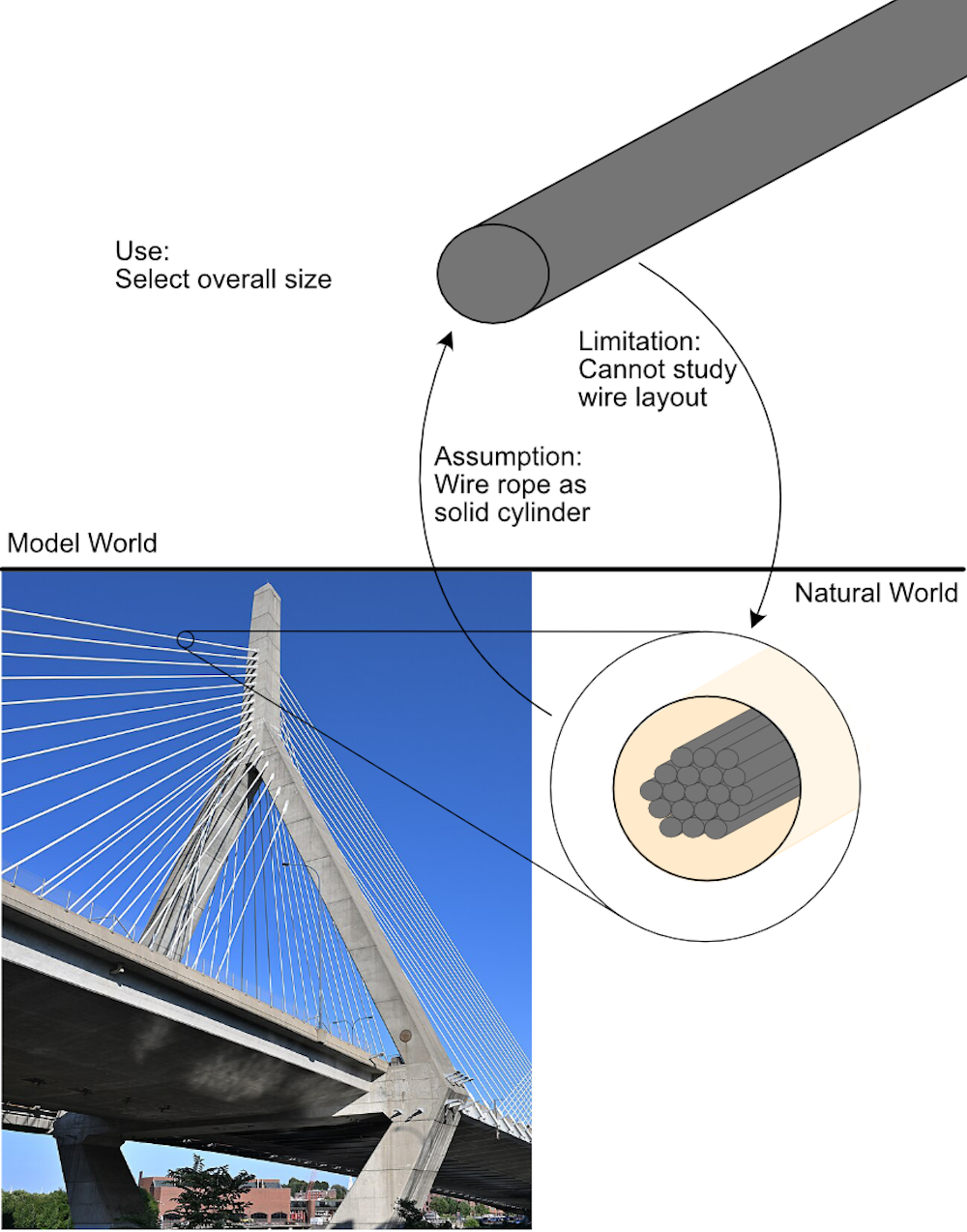
Models are interpretive frameworks that help scientists and engineers connect data to the real world. For instance, you likely have an everyday sense for the strength of objects: If you bend a piece of wood with enough force, it will break. A stronger board can take more force.
Engineers have models that make this everyday sense more precise.
Engineering strength depends on an interpretive framework that relates forces, the size of an object and their ratio − which represents mechanical stress. What engineers call “strength” relates to this computed stress.
Considering strength helps engineers select a material that is strong enough to build a bridge.
An interpretive framework − a model − for strength, used in engineering. Force, F, and size or area, A, are used to compute stress, sigma. Sigma is then used to determine strength. Jorge Stolfi/Wikimedia Commons, CC BY-SA
But all models leave out details from the real world. To compute stress, an engineer needs to describe the shape of an object. Real objects are complex, so the engineer simplifies their shape for the sake of computation.
For instance, an engineer may take a complex bundle of wires and assume they act together as a single cylinder. This simplified shape may help them choose how many wires to bundle together and set the overall thickness of the bundle.
However, assumptions introduce limitations: The cylinder simplification assumes the individual wires don’t exist, so it doesn’t help determine how to weave the wires together. Engineers can − and do − make more detailed models where they need to, but even those have assumptions and limitations.
Simplification of a wire rope as an assumed cylinder. This assumption may be appropriate for choosing the number of wires, but it is wholly inappropriate for determining the arrangement of wires. HaeB/Wikimedia Commons, modified by Zachary del Rosario, CC BY-SA
This interplay between assumptions and limitations is at the heart of all models. Engineers working on the Tacoma Narrows Bridge assumed no wind-driven vertical movement, which led to a limitation: They couldn’t predict the wind-driven flutter that shook the bridge apart.
The same idea holds true for more abstract models. Some companies that make facial recognition systems based on artificial intelligence assume their systems are accurate, given that they do a good job of picking out the correct face from a set of training data. However, outside researchers have shown that some training datasets introduce limitations.
The engineers who built these training datasets assumed their data had enough faces to represent most people, but these datasets underrepresented nonwhite people. This limitation led the systems to disproportionately target Black people.
The trick to using models safely is to pick assumptions where the limitations do not ruin their intended use. The gold standard is to test. But testing isn’t always possible. For example, building a test bridge isn’t a luxury that structural engineers can afford.
Carefully selecting and creating proper models requires good judgment.
Teaching modeling
Engineering judgment involves a careful balance of trust and skepticism toward mathematics − the bedrock of many engineering models. Developing engineering judgment is difficult, and it usually emerges from years of experience. I teach a modeling and simulation course that jump-starts students’ engineering judgment.
My co-instructors and I invite students to build their own models, which is a pretty uncommon experience for engineering students. Students then identify the assumptions in their models, state their limitations and, importantly, justify how those limitations do not prevent them from safely using the model.
Example diagram of a model intended for choosing the size of a wire rope. The model is based on the assumption that the rope will be a solid cylinder. This imposes limitations on studying how the wires are woven together, but it doesn’t hinder the model’s intended use. 4300streetcar/Wikimedia Commons, modified by Zachary del Rosario, CC BY-SA
Engineering failures like the Tacoma Narrows Bridge can occur when engineers are not aware of a model’s assumptions and limitations. While courses often teach young engineers to make assumptions and use models, they rarely focus on these models’ limitations. Helping students develop their engineering judgment can prevent failures like “Galloping Gertie” from happening again.
Zachary del Rosario receives funding from the National Science Foundation and Toyota Research Institute.
Source: People’s Republic of China – State Council News
PHNOM PENH, April 18 — China and Cambodia on Friday expressed readiness to fully implement the China-proposed Global Development Initiative, Global Security Initiative and Global Civilization Initiative.
The commitment was underscored in a joint statement issued when Chinese President Xi Jinping wrapped up his state visit to Cambodia, where both countries also highlighted their mutual goal of speeding up the building of an all-weather China-Cambodia community with a shared future in the new era.
The two sides underscored their willingness to be frontrunners in the Global Development Initiative and to inject strong impetus into global development, especially the development of the Global South.
To implement the initiative, the two sides agreed to accelerate the advancement of the Industrial Development Corridor plan, leverage the China-Cambodia railway cooperation mechanism to jointly formulate a general plan for Cambodia’s railway network, and speed up the implementation of the Fish and Rice Corridor cooperation plan.
They also agreed to work actively to promote the signing of the upgrade protocol of the China-ASEAN Free Trade Area at an early date within this year.
Cambodia supported Hong Kong’s accession to the Regional Comprehensive Economic Partnership and welcomed the Global AI Governance Initiative put forward by Xi.
They also agreed to jointly build a secure and stable industrial and supply chain, expand the use of local currencies in bilateral trade and investment, and enhance cooperation in the field of clean energy.
As for the Global Security Initiative, the two sides affirmed their commitment to the vision of common, comprehensive, cooperative and sustainable security, and to resolving differences and disputes between countries through dialogue and consultation in a peaceful manner, so as to make positive contributions to regional and global peace and stability.
China lauded Cambodia’s crackdown on illegal online gambling, and the two sides voiced their willingness to continue to carry out the Year of Law Enforcement Cooperation activities.
China has actively promoted the resolution of international and regional hotspot issues, and Cambodia welcomes China’s important and constructive role in this regard.
The two sides believe that the South China Sea issue should be resolved peacefully by sovereign states directly concerned through friendly consultations and negotiations, and any attempt to use the South China Sea issue to undermine regional peace and mutual trust will be counterproductive.
On the Global Civilization Initiative, they emphasized that both countries are ancient civilizations with long histories.
They jointly advocated for respecting the diversity of world civilizations, promoting the common values of humanity, and contributing to exchanges and mutual learning among human civilizations.
The two sides agreed to designate 2025 the China-Cambodia Year of Tourism and encourage their citizens to travel to each other’s countries.
They also expressed willingness to explore the establishment of China-Cambodia joint working group on cultural heritages to promote comprehensive cooperation in the field.
CALGARY, Alberta, April 18, 2025 (GLOBE NEWSWIRE) — A broad coalition of insurance and restoration leaders are launching the North American Green Council, a new industry body aimed at tackling carbon emissions across the property claims supply chain. The initiative will go public with its inaugural Earth Day webinar on April 22, 2025, at 11:00 a.m. MDT, signaling a coordinated push toward measurable climate action.
The webinar, titled “Sustainability in Insurance Claims: Can’t Afford to Do It, or Can’t Afford Not To?”, will be moderated by Maureen Cureton, Vice President of Climate & Sustainability at EcoClaim. Speakers include:
Jamie Madill, Director of Sustainability, Pro-Claim Group
Bill Moorman, SVP, Western Operations, First Onsite Property Restoration
These industry leaders will discuss the challenges they’re tackling through their climate action strategies and day-to-day operations. Dispelling myths around the burden of climate leadership, the group will explore ways to benefit from carbon management and the gains they are realizing.
The Green Council is being incubated by EcoClaim and will function as a collaborative, non-partisan platform for the entire claims ecosystem. Its mission: equip contractors, claims managers, insurers, franchise networks and service providers with the tools, data and insights to reduce environmental impact, comply with new Scope 3 disclosure mandates, and meet rising stakeholder expectations. “Scope 3 emissions from property claims are among the insurance industry’s biggest blind spots,” said Cureton. “The Council was born from a shared recognition that we need to work together to drive climate leadership in claims.”
Participation in the Council is open to all claims-related stakeholders. Founding members already committed include Clean Claims, Complete Care, EcoClaim, Federated Insurance, First Onsite, Humber Polytechnic, Northbridge Insurance, Pro-Claim Group, PuroClean, Specialty Program Group Canada, and more.
The Earth Day event will spotlight practical strategies for carbon reduction—from waste diversion to emissions tracking—while surfacing the cost-benefit dynamics of sustainable claims operations.
This week I’ve seen Disney’s latest bingeable series, The Stolen Girl, variously described as a “posh-house drama”, “the equivalent of an airport novel” and “enjoyably preposterous” – so what’s not to like?
One episode in, I’m lapping up the lavishly immaculate interiors and clipped tones of rich people who call everyone “darling”. And I always enjoy the hilariously shonky portrayal of journalists and the way dramatists think they speak to each other. Local hack Selma to her (extremely mild and unbothered) boss: “I’m sorry I missed the deadline! I was focused on the background story, it’s important.” Boss, rolling his eyes: “Can’t you put an alert on your phone or something?” Selma: “Next time I will, I promise!”
The fact that no newsroom boss has ever spoken like that to a reporter who missed a deadline is neither here nor there. This twisty-turny thriller grabs you by the lapels and doesn’t let go. Private-jet stewardess Elisa and criminal lawyer Fred are horrified to find their daughter Lucia has vanished, after a hastily arranged playdate-turned-sleepover with a new schoolfriend turns out to be a meticulously planned abduction.
But why their daughter? Is there more to Elisa and Fred and their perfect life than meets the eye? From leafy Cheshire to the south of France, their secrets and lies play out, unravelling their once-happy lives. Like the recent Netflix hit Adolescence, social media is a factor in facilitating the crime – but crucially, through the investigations of Selma, also an instrument of solving it.
The Stolen Girl is streaming on Disney now.
Painting and pain
A decade in the making, the National Gallery’s take on the most exciting 50 years of Siena’s artistic production showcases an astonishing array of works. Art history expert Louise Bourdua describes Siena: The Rise of Painting 1300-1350 as “a pleasure for the eye and commendable for its ability to make medieval religious art accessible”.
The exhibition focuses on so much more than the pre-eminent painters Duccio, Simone Martini and brothers Ambrogio and Pietro Lorenzetti. On show is a wealth of Siena’s visual culture represented in illuminated manuscripts, reliquaries (containers for holy relics), sculptures, gold and enamel work, rugs and silks.
Showstoppers include Duccio’s stunning gold-painted Crucifixion triptych, Pietro Lorenzetti’s five-panel altarpiece from the church of Santa Maria della Pieve in Arezzo, and the beautifully carved head of Christ by Lando di Pietro – identified as the creator of the work by the personal handwritten prayers concealed within the sculpture, also on display.
The child of immigrant Jamaican parents growing up in the turbulent Britain of the 1970s and ’80s, Donald Rodney’s artistic expression was shaped by his experience of a socially and racially fractured environment.
His first retrospective exhibition in more than 15 years, Donald Rodney: Visceral Canker at London’s Whitechapel Gallery, is a chance to see the remarkable work of an artist who died at just 36 from sickle-cell anaemia. Described by the Jamaican cultural theorist Stuart Hall as an “emblematically black disease”, it would eventually claim Rodney’s life and that of three of his siblings.
Encapsulating painting, drawing, pastels, photography, sculptural assemblages, installations and computer-generated art, the show reveals an artist who was angry, ambitious and audacious; who meshed his experience of racism with his illness to draw the poisonous connections of slavery and colonialism to a childhood blighted by anti-immigrant sentiment, the rise of the far right, and pain.
But as contemporary art specialist Richard Hylton explains, by the late 1970s and early 80s, these children of black immigrants were becoming adults, and new forms of British cultural identity were being explored – including a whole new wave of artistic expression that saw young black British artists rail against the idea of black youth as the public enemy. Rodney’s work endures as an invitation to look beneath the surface of images and society, to better understand the pernicious workings of inequality and racism.
Capturing an early 1970s charged with political unrest, anti-war sentiment and media saturation, the new documentary One to One: John & Yoko is a revealing exploration of John Lennon’s post-Beatles life and activism with his Japanese partner, Yoko Ono.
Often dismissed as a pop-star WAG, here Ono is firmly positioned as an artist in her own right. More crucially, we see the influential role she played in nudging Lennon into more radical territory beyond the political songs that emerged in the late-era Beatles. Musically and socially, the pair aimed to galvanise a generation disillusioned by the failure of 1960s “flower-power” to create any kind of genuine social change.
As a researcher of Ono’s performance art, Stephanie Hernandez found the film compelling in its portrayal of Ono’s avant-garde flair and Lennon’s energetic rock‘n’roll style as complementary forces driving their own brand of pop activism.
Since 2020, almost half of the 100 biggest tracks have been collaborations. John has done his fair share of musical hook-ups, with luminaries such as Little Richard, Aretha Franklin, George Michael, Eminem and even Luciano Pavarotti. Now his first post-retirement album with the Grammy-winning Carlile has just reached the top spot in the UK album charts.
John has described the making of the album as “one of the greatest musical experiences” of his life. So what is it about this collaboration that has so “utterly revitalised” the 78-year-old showman? Is he not quite ready to leave the limelight? Or is he seeking a challenge across new genres, in hitching his piano to a much younger star from a different part of the musical universe? Glenn Fosbraey, an expert in pop music and performance, explains why John (and many other music legends) won’t let the sun go down just yet.
Looking for something good? Cut through the noise with a carefully curated selection of the latest releases, live events and exhibitions, straight to your inbox every fortnight, on Fridays. Sign up here.
Source: The Conversation – UK – By Matthew Melia, Senior Lecturer and Course leader of the Humanities Foundation Degree, Kingston University
Nostalgia for the 1980s has been in vogue since the release of Stranger Things in 2016. The Netflix show brought about a renaissance of interest in the popular culture of the time firmly rooted in nostalgia – video game arcades, the role-playing game Dungeons and Dragons, horror films and a reverie for the horror of the VHS and video-nasty era.
Don’t get me wrong, I am a big fan of this form of nostalgia – if it’s done right. Freaky Tales, an anthology film that deals with 80s’ California punk, anti-fascism, hip-hop and VHS culture, could have been a great addition to this sort of nostalgia bait. Sadly, it is a mess, which, for most of its run time, feels like a film about the 80s generated by AI.
To go on TikTok is to be confronted by a gen-Z army cosplaying a neon-drenched and romanticised version of the 80s. Filters are used to replicate the low-fi aesthetics of VHS tape, super 8 and cinefilm, while the content creators dress in the styles of the decade and espouse a wishful nostalgia for an era they are at least three decades too young to have experienced firsthand. Freaky Tales seems aimed at this market.
But this is how the nostalgia industry (or nostalgia capitalism) works. Contemporary digital media facilitates and creates nostalgia in a way that gives the appearance of authenticity but is mostly all surface. Nostalgia is passed on, remediated and sanitised.
Looking for something good? Cut through the noise with a carefully curated selection of the latest releases, live events and exhibitions, straight to your inbox every fortnight, on Fridays. Sign up here.
It’s worth also noting that it’s always the Hollywood synthy, US version of 80s pop culture that dominates. Few young people have developed a fabricated sense of nostalgia for the dreariness of Thatcher’s Britain, for instance. A period that history academic Lucy Robinson writes was full of “pop culture and politics … that shaped modern Britain,” in her incisive critical assessment Now That’s What I Call A History of the 1980s.
Freaky Tales is comprised of four interlocking stories, which are bound in a way that is hard to really comprehend.
Are the stories connected through the two sets of characters – a couple of young punks and a pair of female hip-hop artists – leaving a screening of The Lost Boys who reappear in different stories? Is it the strange alien green glow that reappears across all the stories? The marker of a solid anthology film is a tight structure and a sense of place, which the film at least has with all stories based in Oakland, California. But for the most part, Freaky Tales feels half built and uncertain of itself.
Buried somewhere though is a better film trying to get out. Take the first story “Strength in Numbers: the Gilman Strikes Back about the denizens of the Gilman punk club in Oakland, taking a violent and gory stand against a band of neo-nazis they are being harassed by.
The sequence ends in a sort of bloody 1980s’ punk version of the Gunfight at the O.K. Corral (there are also clear references to Walter Hill’s 1979 cult classic The Warriors). Here there was an opportunity to look deeper into the emergence of California punk culture of the era, the Gilman is a place of real cultural significance where the scene fermented and bands like Rancid, The Offspring, Green Day and the East Bay punk scene in the 1990s got a start.
Dead Kennedy’s track Nazi Punks Fuck Off became a rallying cry of 80s anti-fascist punk as did Black Flag’s Rise Above (this is at least included on the film’s soundtrack). So why not look at least a little deeper into the antifascist movement within the US punk movement during the era? It can be done and I’d recommend Jeremy Saulnier’s harrowing 2015 film Green Room, which examines the subject from a more contemporary perspective.
Instead, the film adopts a rather more facile approach. This is most evident in its choice to use animated “bangs” and “thwocks” like a Batman comic during the big fight sequence. By and large this section (by far the worst of the four) feels like content devoid of substance.
In story two, “Don’t fight The Feeling”, the action centres around a pair of aspiring female hip-hop performers who enter into a rap battle with the performer Too Short (the real life Too Short appears in a cameo as a cop later in the film) and tackles misogyny and hip-hop culture. There are shades of seminal black indie director Spike Lee (Do The Right Thing, 1989) here in its foregrounding of black culture and subjects (although, it must be said, Ryan Fleck and Anna Boden are both white).
It could have potentially complemented the punk story if it dealt with the cultural impact of 80s’ hip-hop and the struggles of female performers. But again, it feels half formed – part of the problem being that the film is trying perhaps to do too much.
There are things to enjoy, however, in the film. It is pleasingly gory and has some clever moments. Man of the moment Pedro Pascal takes the lead in the third section (the best of the four), “Born to Mack”, as an enforcer trying to go straight and Ben Mendelsohn puts in an enjoyably sleazy turn as a corrupt cop. The success of the film rest’s chiefly on their shoulders.
Born to Mack clearly has shades of the king of pop culture nostalgia Quentin Tarantino, especially in its clever and surprising cameo from 80s’ icon Tom Hanks who plays a mysterious video store owner. Tarantino’s films (not least 1994’s Pulp Fiction – the blueprint for this type of anthologised nostalgia cinema) were at the forefront 1990s’ indie cinema, and were framed by his obsessions with 60s, 70s and 80s pop culture.
Freaky Tales has the potential to offer a more nuanced engagement with the era and its cultural references points while still maintaining a sense of Trashy exploitation fun. Sadly it falls short of the mark.
Freaky Tales is in selected cinemas from April 18 and on digital platforms from April 28.
Matthew Melia does not work for, consult, own shares in or receive funding from any company or organisation that would benefit from this article, and has disclosed no relevant affiliations beyond their academic appointment.
Source: Rosneft – Rosneft – An important disclaimer is at the bottom of this article.
On April 18, in honor of the International Day of Monuments and Historic Sites, Bashneft Oil Company (part of Rosneft) presented the tourist automobile project “Routes of Victory,” dedicated to the 80th anniversary of Victory in the Great Patriotic War.
The presentation of the project took place at the Bashneft petrol station in Ufa. Representatives of the company and the expert tourism community told motorists about unique and memorable places located near the company’s petrol stations in Bashkortostan and dedicated to the history of the Great Patriotic War.
“Victory Routes” cover 15 significant sites in different cities and districts of the republic, each of which keeps a unique story about the feat of our people during the Great Patriotic War. Thus, in the center of Ufa, on Sovetskaya Square, there is a majestic monument to Major General Minigali Shaimuratov, the legendary commander of the 112th Bashkir Cavalry Division. In the village of Verkhneyarkeevo, there is a unique museum of Musa Gareyev, twice Hero of the Soviet Union, an outstanding pilot. In Ishimbay, above the Belaya River, there is a monument to oil workers who died in battles for the Motherland. In the city of Oktyabrsky, there is a memorial ensemble “Thoughts of a Soldier”, opened in 1995. A memorial complex dedicated to four Heroes of the Soviet Union – Makhmut Aktuganov, Ishmay Ishkinin, Stepan Kazakov and Yegor Orsayev, as well as the national hero Gazi Zagitov, who on April 30, 1945, as part of an assault group under enemy fire, was one of the first to raise the Red Banner on the Berlin Reichstag, was opened in the village of Mishkino. Granite steles symbolizing banners have been installed along the central alley of the Ufa Victory Park, on which the names of 278 Heroes of the Soviet Union and 39 Full Cavaliers of the Order of Glory from Bashkiria are carved in gold letters.
Roll-ups installed at Bashneft petrol stations will tell you about memorable places that you can visit in the Republic of Bashkortostan. They are located next to monuments, museums and other objects related to the history of the Great Patriotic War. To build a route to a memorable place in the navigator, you just need to point the camera of your mobile phone at the QR code. Drivers can fill up with high-quality fuel at Bashneft petrol stations and go to a historical site located next to the petrol station.
Rosneft actively supports initiatives to develop domestic tourism and aims to create comfortable conditions for motorists. The development of roadside service and the improvement of the level of customer services provided at Rosneft and Bashneft filling stations is one of the Company’s priority areas of activity.
Reference:
ANK Bashneft is one of the oldest enterprises in the oil and gas industry of the country, operating in the extraction and processing of oil and gas. OOO Bashneft-Roznitsa is the operator of PAO ANK Bashneft for managing 540 filling stations in 14 regions of Russia. The company’s filling stations offer high-quality fuel produced by the Bashneft Oil Refinery – Euro-5 and Euro-6 gasolines, its own ATUM gasoline brands, and diesel fuel.
Department of Information and Advertising of PJSC NK Rosneft April 18, 2025
Please note: This information is raw content directly from the source of the information. It is exactly what the source states and does not reflect the position of MIL-OSI or its clients.
The Create in India Challenge (CIC) Season 1, launched as a flagship initiative under the World Audio Visual and Entertainment Summit (WAVES), is gearing up for a spectacular finale at the Jio World Centre, Mumbai, from 1st to 4th May 2025. With registrations now officially closed for all 32 challenges, CIC has achieved a significant milestone, receiving nearly 1 lakh registrations, including over 1,100 international participants. The challenges have attracted entries from over 60 countries, reflecting the global appeal and reach of this pioneering initiative. From this exceptional pool of talent, 750 finalists will be given the opportunity to showcase their creative skills and outcomes at Creatosphere, a specially curated platform featuring innovation across animation, comics, AI, XR, gaming, music, and more, as part of WAVES 2025. The winners of these challenges will be conferred the prestigious ‘WAVES Creator Awards’ in a grand red carpet ceremony on Day 2 of the event.
The Creatosphere at WAVES will witness remarkable global participation, with 43 international finalists showcasing their talents, adding a truly international dimension to this celebration of creativity. These finalists represent over 20 countries, including Argentina, Nepal, Germany, Bermuda (BOT), the United States, Greece, Indonesia, the United Kingdom, Canada, Italy, Laos, Thailand, Tajikistan, Egypt, Sri Lanka, Russia, Maldives, Malaysia, and Japan. Notably, Sri Lanka, Nepal and Tajikistan each contributes 6 finalists, followed by 5 each from Indonesia and Maldives, and 4 from Mauritius. The United States is represented by 2 finalists, while Russia, Canada, Argentina, Laos, Malaysia, Bermuda, Egypt, Thailand, and the United Kingdom each have 1 finalist. This diverse international presence underscores the global appeal and growing reach of the Create in India Challenge.
In India, the challenges saw enthusiastic participation from across all 28 states and 8 Union Territories, underscoring the truly national footprint of the initiative. The list of finalists across the challenges reflects remarkable regional representation, with participants hailing from across the country from Assam and Meghalaya in the East to Gujarat in the West and from Himachal Pradesh in the North to Kerala in the South.
Celebrating the energy of youth, the Create in India Challenges are overwhelmingly driven by young creators predominantly in their 20s, reflecting a vibrant ecosystem of college students, early-career professionals, and teen innovators. With the youngest finalist just 12 years old and the oldest at 66, the initiative showcases a truly inclusive creative platform that transcends age.
The Create in India initiative champions grassroots innovation while celebrating diversity in purpose and participation. From making education accessible through the Innovate 2 Educate Challenge to reviving India’s textile legacy with “Make the World Wear Khadi,” the challenges span tradition and technology. “India: A Bird’s Eye View” captures the nation’s spirit through breathtaking aerial visuals by filmmakers and Drone Didis, using drone technology for storytelling and community empowerment.
As excitement for WAVES 2025 reaches its crescendo, the Create in India Challenge has emerged as a powerful expression of India’s creative ambition, unlocking new opportunities for talent and reaffirming the nation’s rising leadership in the global media and entertainment landscape. With its vibrant mix of Indian and international participation, the Create in India Challenge has grown into a dynamic global platform, empowering voices across regions and generations, and truly embodying the Hon’ble Prime Minister’s vision that “WAVES should reach every home and every heart.”
Written by Margaret Deahn, Ph.D. Student at Purdue University Last week, NASA’s Mars 2020 rover continued its journey down lower ‘Witch Hazel Hill’ on the Jezero crater rim. The rover stopped along a boundary visible from orbit dividing light and dark rock outcrop (also known as a contact) at a site the team has called ‘Port Anson’. In addition to this contact, the rover has encountered a variety of neat rocks that may have originated from elsewhere and transported to their current location, also known as float.
Pictured above is an observation named ‘Skull Hill’ taken by the rover’s Mastcam-Z instrument. This float rock uniquely contrasts the surrounding light-toned outcrop with its dark tone and angular surface, and it features a few pits in the rock. If you look closely, you might even spot spherules within the surrounding regolith! See Alex Jones’ recent blog post for more information on these neat features: https://science.nasa.gov/blog/shocking-spherules/. The pits on Skull Hill may have formed via the erosion of clasts from the rock or scouring by wind. We’ve found a few of these dark-toned floats in the Port Anson region, and the team is working to better understand where these rocks came from and how they got here. Skull Hill’s dark color is reminiscent of meteorites found in Gale crater by the Curiosity rover: https://www.jpl.nasa.gov/news/curiosity-mars-rover-checks-odd-looking-iron-meteorite/. Chemical composition is an important factor in identifying a meteorite, and Gale’s meteorites contain significant amounts of iron and nickel. However, recent analysis of SuperCam data from nearby similar rocks suggests a composition inconsistent with a meteorite origin. Alternatively, ‘Skull Hill’ could be an igneous rock eroded from a nearby outcrop or ejected from an impact crater. On Earth and Mars, iron and magnesium are some of the main contributors to igneous rocks, which form from the cooling of magma or lava. These rocks can include dark-colored minerals such as olivine, pyroxene, amphibole, and biotite. Luckily for us, the rover has instruments that can measure the chemical composition of rocks on Mars. Understanding the composition of these darker-toned floats will help the team to interpret the origin of this unique rock!
Windswept dust blanketed southern Iraq and other parts of the Middle East in mid-April 2025. The airborne particles turned skies orange, reduced visibility, and worsened air quality near the ground where people live and breathe. Dust activity appears to have increased dramatically on April 14 between 9:30 a.m. and 1:50 p.m. local time (06:30 and 10:50 Universal Time), when the MODIS (Moderate Resolution Imaging Spectroradiometer) on NASA’s Terra and Aqua satellites acquired these images. Dust clouds are especially pronounced over arid regions of southern Iraq and northern Saudi Arabia in the later image (right) and in dust forecasts for the region that day. Breathing issues sent nearly 4,000 people to emergency rooms across multiple Iraqi provinces, according to news reports. Al Başrah (Basra) and An Najaf saw approximately 1,000 and 500 of those cases, respectively. Videos published by the BBC captured orange skies, low visibility, and strong winds whipping through those cities. The storm caused authorities to shut down several airports, they reported. Powerful westerly winds also carried dust into Kuwait that day. Weather stations measured wind gusts exceeding 80 kilometers (50 miles) per hour, news outlets reported, and Kuwaiti officials announced that schools would hold classes remotely on April 15 to reduce exposure to unhealthy air. Dust storms in Iraq are most common during late spring and summer, provoked by seasonal winds that blow from the north-northwest across abundant sources of dust. However, these storms can arise at other times of year, including in winter and spring. In April and May 2022, for example, a series of severe dust storms caused similar disruptions to the region. Declines in water resources may be amplifying the frequency and intensity of spring and summer dust events in Iraq. Dry conditions make it more likely that winds can loft and transport loose material. NASA Earth Observatory images by Wanmei Liang, using MODIS data from NASA EOSDIS LANCE and GIBS/Worldview. Story by Lindsey Doermann.