Category: Transport

  • MIL-OSI United Kingdom: Plans for future of Grangemouth

    Source: United Kingdom – Executive Government & Departments

    Press release

    Plans for future of Grangemouth

    Feasibility study published today sets out nine options for Grangemouth’s long term industrial future

    • Next steps to secure Grangemouth’s long-term future 

    • Nine low carbon and renewable options for the site identified in an independent report published today  

    • Plans to secure private investment and a long-term partnership with business backed by £200 million from the UK Government, and £25 million from the Scottish Government

    Plans to secure a long-term industrial future for Grangemouth have been stepped up as a feasibility study sets out nine options for its future.   

    The plan – which is backed by £200 million from the UK Government and £25 million from the Scottish Government – will support jobs, unlock investment and drive growth.   

    The £1.5 million feasibility study – published today by EY – follows the recent decision by Petroineos to decommission the oil refinery.    

    It has identified credible long-term industrial options for the Grangemouth site and explored how it can build on its skilled workforce, local expertise and long heritage as a fuel leader in Scotland to forge a new path in low carbon energy production.     

    The report provides nine proposals likely to attract private investment, including plastics recycling, hydrogen production and other projects that could create up to 800 jobs by 2040, grow the economy, and deliver on both Governments’ shared ambition to secure a long term future for Grangemouth.      

    To kickstart the process, Energy Minister Michael Shanks and Acting Cabinet Secretary for Net Zero and Energy Gillian Martin are co-chairing a meeting this morning (Wednesday 19 March) of the Grangemouth Future Industry Board with local industry leaders, Falkirk Council, trade bodies and unions. Scottish Enterprise and the UK Government’s Office for Investment will work with Petroineos to market the proposals set out in Project Willow and seek investor interest.     

    It follows the Prime Minister’s announcement last month of £200 million to help unlock Grangemouth’s full potential. First Minister John Swinney also announced £25 million to establish a Grangemouth Just Transition Fund, which will support businesses and stakeholders to bring forward investible propositions over the next 12 months for the site.   

    Energy Minister Michael Shanks said:   

    We committed to leaving no stone unturned in supporting an industrial future for Grangemouth delivering jobs and economic growth.   

    This report and the £200 million investment by the UK Government demonstrates that commitment.  

    We will build on Grangemouth’s expertise and industrial heritage to attract investors, secure a long-term clean energy future, and deliver on our Plan for Change.

    Scottish Secretary, Ian Murray, said:  

    The publication of the Project Willow report and the options it sets out marks a significant milestone in our commitment to deliver a long-term, sustainable future for the Grangemouth site which benefits the local community and the Scottish economy.  

    Working alongside the Scottish Government and local partners, we remain committed to supporting the skilled workforce at Grangemouth, and are already working to attract investors for the projects outlined in this report.  

    The Prime Minister recently announced a £200 million investment in Grangemouth through the National Wealth Fund which followed the £100 million Falkirk and Grangemouth Growth Deal, delivered jointly with the Scottish Government. Scotland is at the centre of our Plan for Change as we become a clean energy superpower over the next few years.

    First Minister John Swinney said: 

    We will leave no stone unturned in order to secure the future of the Grangemouth refinery site, and the Scottish Government has already committed or invested a total of £87 million to help do so. 

    Grangemouth is home to over a century of industrial expertise and employs thousands of highly skilled workers, placing the site at a massive competitive advantage and creating a unique opportunity for investors. 

    Everyone working at Grangemouth’s refinery – and in the wider industrial cluster – is a valued employee with skills that are key to Scotland’s economic and net zero future. 

    This report sets out a wide range of viable alternatives for the refinery site, demonstrating that a long term, new industrial future at Grangemouth is achievable. We will continue to work closely with the UK Government to realise these opportunities and Scottish Enterprise stands ready to support inward investors looking to progress any of these technologies.

    Alongside launching a search for investors, both governments have also committed to review the Project Willow policy recommendations and understand how government funding can be deployed to mature proposals from the private sector.  

    The £25 million Grangemouth Just Transition Fund and £200 million from the National Wealth Fund for co-investment are on top of existing investments to ensure the long-term economic future of the Grangemouth area and support the workforce. These include:  

    • The £100 million Falkirk and Grangemouth Growth Deal package, delivered jointly by the Scottish Government and UK Government, to support the community and its workers by investing in local energy projects to create new opportunities for growth in the region. 

    •  Joined up support from the Scottish Government and DESNZ to provide tailored skills support for refinery workers, this includes a training guarantee for all Grangemouth refinery staff to ensure that any worker who would like skills training at the local college is supported, with funding provided by the UK Government – this will help workers into new, good jobs with local employers.    

    Background information

    The nine projects include:  

    • Waste: hydrothermal upgrading (breaking down hard to recycle plastics), chemical plastics recycling, ABE biorefining (breaking down waste material)  

    • Bio-feedstock: breaking down Scottish timber into bioethanol, anaerobic digestion of bioresources and digestate pyrolysis, HEFA (conversion of Scottish cover crops into sustainable aviation fuel and renewable diesel using low carbon hydrogen).  

    • Offshore wind conduit: Replacing natural gas with hydrogen, using low carbon hydrogen to produce methanol and convert it to SAF, producing low carbon ammonia from hydrogen for shipping and chemicals.  

    Any National Wealth Fund investment will be subject to investible propositions and the Fund’s criteria – the proposition must deliver a positive return, drive regional and economic growth or support activity to tackle climate change, invest in key sectors, and crowd in private finance.

    Updates to this page

    Published 19 March 2025

    MIL OSI United Kingdom

  • MIL-OSI United Kingdom: Victims and survivors of terrorism to be given greater support

    Source: United Kingdom – Executive Government & Departments

    News story

    Victims and survivors of terrorism to be given greater support

    The government will set up a dedicated support hub to meet the needs of those affected by terrorism as well as consulting on a new national day.

    Image: Getty Images

    Victims and survivors of terrorism will receive strengthened support under new plans outlined by the government today. 

    As part of the Plan for Change, the government will set up a new dedicated support hub for victims and survivors, supporting their needs in the immediate and long-term aftermath of a terrorist attack.

    Proposals for a new national day for victims and survivors of terrorism will also be consulted on, helping the country to remember and honour those who have been tragically killed or impacted by terrorist attacks. 

    Security Minister, Dan Jarvis, said:

    The impact of a terrorist attack is long-lasting and evolving. Victims and survivors of terrorism need the highest levels of support to recover and rebuild their lives. These reforms will significantly enhance the support available to those affected.

    I would like to pay tribute to the bravery and courage of all those who helped to shape these reforms and pledge my commitment to ensuring victims and survivors of terrorism receive the support and recognition they deserve.

    The first duty of government is to keep our country safe, which is the foundation of our Plan for Change.

    Victims and survivors of terrorism have long campaigned for better recognition. Victims, survivors, their loved ones and the general public are all encouraged to offer their views to shape key aspects of the proposed national day including naming the day, date, and suggesting ways the day could be commemorated.

    Travis Frain OBE, survivor of the Westminster Bridge attack:

    Recognition and remembrance are key to building societal resilience against violent extremism, and I welcome today’s announcement that the government will be launching a consultation on the establishment of a ‘National Day of Remembrance for Victims of Terrorism’.

    This is something that I, and several other survivors, have been campaigning on for many years, and I’m pleased to see that this government recognises the importance of these issues and the role that they can play in facilitating the recovery of those impacted by horrific acts of terrorism.

    Brendan Cox, co-founder of Survivors Against Terror said:

    Survivors of terror attacks have been crying out for change for years. Today’s double announcement is a major step forward in giving survivors and victims the recognition they deserve and the support that they need.

    Terrorists aim to divide and weaken our society – our best response is to hold together – and stage one of that is looking after those who have suffered the most. 

    Other recommendations from the review will also be progressed including:

    • enhanced communications to victims to bolster awareness of the support package available to them
    • improving the support available for children and young people, to ensure they do not fall through the gaps

    Dr Cath Hill, survivor of the Manchester Arena attack:

    I wholeheartedly welcome this news. Sadly, we know as a society we are not immune from future terror attacks; therefore, it is essential that future survivors get the help and support they need.

    If we are to combat the devastation that terrorism can cause, as a society we must care for those who bear the brunt of these acts of terror. Developing a dedicated hub for support is a significant step forward and welcome by those of us who have campaigned for change.

    Cheryl Stollery (wife of the late John Stollery – Sousse, Tunisia) said:

    Today’s announcement is an important first step towards putting in place improved outcomes for all those impacted by terrorism, whether here in the UK or for UK citizens harmed in terrorism attacks overseas.

    As the survivor of a terrorist attack where my husband was killed, I know how important remembrance is so that our loved ones are not forgotten and we can come together and reflect on the importance of unity and gain strength in the face of adversity and terror.

    I am particularly keen to champion a Support Hub because I believe it will be a cornerstone for the future in being able to empower survivors to regain hope, strength, and resilience, not just in the weeks after the incident but also for the long term as needed.

    The reforms have been designed in response to direct engagement with victims and survivors, open-source literature reviews and learning from other countries’ approaches. 

    The Home Office Victims of Terrorism Unit will now work to deliver the findings of the review and will continue to engage with key stakeholders on progress. 

    This comes as the Terrorism (Protection of Premises) Bill, also known as Martyn’s Law, approaches its final stages in Parliament, delivering on the government’s manifesto commitment to strengthen the security of public events and venues.

    Updates to this page

    Published 19 March 2025

    MIL OSI United Kingdom

  • MIL-OSI United Kingdom: Plan for future of Grangemouth

    Source: Scottish Government

    Summary of Project Willow report published

    Plans to secure a long-term industrial future for Grangemouth have been stepped up as a feasibility study sets out nine options for its future.

    The plan – which is backed by £25 million from the Scottish Government and £200 million from the UK Government – will support jobs, unlock investment and drive growth.

    The £1.5 million feasibility study – published today by EY – follows the recent decision by Petroineos to decommission the oil refinery.

    It has identified credible long-term industrial options for the Grangemouth site and explored how Grangemouth can build on its skilled workforce, local expertise and long heritage as a fuel leader in Scotland to forge a new path in low carbon energy production.  

    The report provides nine proposals likely to attract private investment, including plastics recycling, hydrogen production and other projects that could create up to 800 jobs by 2040.

    It follows First Minister John Swinney’s announcement of £25 million to establish a Grangemouth Just Transition Fund, which will support businesses and stakeholders to bring forward investible propositions for the site over the next 12 months, and the Prime Minister’s announcement last month of £200 million to help unlock Grangemouth’s full potential.

    First Minister John Swinney said:

    “We will leave no stone unturned in order to secure the future of the Grangemouth refinery site, and the Scottish Government has already committed or invested a total of £87 million to help do so.

    “Grangemouth is home to over a century of industrial expertise and employs thousands of highly skilled workers, placing the site at a massive competitive advantage and creating a unique opportunity for investors.

    “Everyone working at Grangemouth’s refinery – and in the wider industrial cluster – is a valued employee with skills that are key to Scotland’s economic and net zero future.

    “This report sets out a wide range of viable alternatives for the refinery site, demonstrating that a long term, new industrial future at Grangemouth is achievable. We will continue to work closely with the UK Government to realise these opportunities and Scottish Enterprise stands ready to support inward investors looking to progress any of these technologies.”

    UK Energy Minister Michael Shanks said:  

    “We committed to leaving no stone unturned in supporting an industrial future for Grangemouth delivering jobs and economic growth. 

    “This report and the £200 million investment by the UK Government demonstrates that commitment. 

    “We will build on Grangemouth’s expertise and industrial heritage to attract investors, secure a long-term clean energy future, and deliver on our Plan for Change.” 

    To kickstart the process, Energy Minister Michael Shanks and Acting Cabinet Secretary for Net Zero and Energy Gillian Martin co-chaired a meeting this morning (Wednesday 19 March) of the Grangemouth Future Industry Board with local industry leaders, Falkirk Council, trade bodies and unions. Scottish Enterprise and the UK Government’s Office for Investment will work with Petroineos to market the proposals set out in Project Willow and seek investor interest.   

    Alongside launching a search for investors, both governments have also committed to review the Project Willow policy recommendations and understand how government funding can be deployed to mature proposals from the private sector. 

    Background

    Project Willow: Grangemouth investment opportunities

    The nine projects include: 

    • Waste: hydrothermal upgrading (breaking down hard to recycle plastics), chemical plastics recycling, ABE biorefining (breaking down waste material)
    • Bio-feedstock: breaking down Scottish timber into bioethanol, anaerobic digestion of bioresources and digestate pyrolysis, HEFA (conversion of Scottish cover crops into sustainable aviation fuel and renewable diesel using low carbon hydrogen).
    • Offshore wind conduit: Replacing natural gas with hydrogen, using low carbon hydrogen to produce methanol and convert it to SAF, producing low carbon ammonia from hydrogen for shipping and chemicals. 

    Any National Wealth Fund investment will be subject to investible propositions and the Fund’s criteria – the proposition must deliver a positive return, drive regional and economic growth or support activity to tackle climate change, invest in key sectors, and crowd in private finance. 

    The £25 million Grangemouth Just Transition Fund and £200 million from the National Wealth Fund for co-investment are on top of existing investments to ensure the long-term economic future of the Grangemouth area and support the workforce. These include: 

    – The £100 million Falkirk and Grangemouth Growth Deal package, delivered jointly by the Scottish Government and UK Government, to support the community and its workers by investing in local energy projects to create new opportunities for growth in the region.

    – Joined up support from the Scottish Government and DESNZ to provide tailored skills support for refinery workers; this includes a training guarantee for all Grangemouth refinery staff to ensure that any worker who would like skills training at the local college is supported, with funding provided by the UK Government – this will help workers into new, good jobs with local employers.   

    MIL OSI United Kingdom

  • MIL-OSI United Kingdom: Joint Statement from the International Partners Group on the US Withdrawal from the Just Energy Transition Partnership in South Africa

    Source: United Kingdom – Government Statements

    News story

    Joint Statement from the International Partners Group on the US Withdrawal from the Just Energy Transition Partnership in South Africa

    The United States has informed the Government of South Africa and the International Partners Group of its withdrawal from the Just Energy Transition Partnership (JETP).

    The partnership, originally announced at COP 26, aims to support South Africa to move away from coal and to accelerate its transition to a low emission, climate resilient economy. 

    The US contribution to South Africa’s Just Energy Transition (JET), as set out in the JET Investment Plan, was $56m in grant funds and $1bn in commercial debt/equity from the US International Development Finance Corporation (DFC).  

    While the withdrawal of the US is regrettable, the International Partners Group (IPG) remains fully committed to supporting South Africa to deliver its just energy transition. The level of investment made to date and remaining pledges demonstrate this. Over $2.5bn of the IPG pledge has been spent to date. The total pledged funding to support South Africa’s just energy transition also remains higher than the original pledge due to increases in pledges from both the IPG and other development partners who are not part of the IPG. Some partners are exploring possibilities for supporting work previously being carried out by the US.  

    We look forward to continuing to work with the government of South Africa and other stakeholders to allocate existing funding in support of a just energy transition that will benefit all South Africans. The political, technical and financial support from the IPG remains strong and steadfast. 

    On behalf of the International Partners Group – United Kingdom, Germany, France, the European Union, Denmark and the Netherlands.

    Further information

    • overall international pledges is $12.8bn total. This includes over $9bn from IPG and Spain, Switzerland and Canada (excluding Spanish export credits)

    Updates to this page

    Published 19 March 2025

    MIL OSI United Kingdom

  • MIL-OSI United Kingdom: Tasmanian ancestral remains to return home A ceremony to repatriate Tasmanian ancestral remains held in University of Aberdeen collections since the 1850s will take place on 21 March.

    Source: University of Aberdeen

    Neil Curtis preparing the ancestral remains for transporA ceremony to repatriate Tasmanian ancestral remains held in University of Aberdeen collections since the 1850s will take place on 21 March.
    The University contacted the Tasmanian Aboriginal Centre in 2019, which led to a proposal to return the remains of a young man. This was approved unconditionally by the University’s governing body, Court, in 2020 and the Centre is now in a position to take the remains back to Tasmania where they will be laid to rest in a traditional ceremony conducted by Aboriginal people.
    Details of how the remains were acquired by the University are limited, with records listing only that it was part of the collection of William MacGillivray, Regius Professor of Natural History in Marischal College. After his death in 1852, the collection was purchased by the University and in the sale catalogue it was described as ‘Native of Van Diemen’s Land, who was shot on the Shannon River’.
    There is no record surviving to indicate how the skull was acquired by MacGillivray.
    The Tasmanian Aboriginal Centre, a non-profit community-based organisation established in 1973 to provide legal, health, educational, cultural and welfare services to Aboriginal people, considers that ‘there can be no doubt that this skull was removed from the man shot at the Shannon River in order to service (the) trade in Aboriginal body parts. The decapitation was most likely performed by one of the killers, stock-keepers, property owners or lessees involved in or associated with the man’s murder’. This may have taken place in the 1820s or 1830s.
    It is unlikely that the identity of the man will ever be known beyond that of his tribal group. The ‘Big River’ tribe to which he belonged is one of the many original tribes entirely wiped out and for which there are no surviving direct descendants.
    The Tasmanian Aboriginal Centre is recognised by both Australian and international governments as the only appropriate organisation to which all repatriated Tasmanian Aboriginal skeletal remains and cultural property are returned.
    After acquisition by the University, the skull was kept as part of the Comparative Anatomy collection, before being transferred to the Human Culture collection in the early 2000s. It was used in medical education in the 19th and early 20th centuries but the collection is no longer used for teaching and there is no current or intended research associated with it.
    Andry Sculthorpe of the Tasmanian Aboriginal Centre said: “Aboriginal people feel the enormous responsibility of restoring to our own country both the physical remains, and through them, the spirits of our ancestral dead.
    “This is a record of racist attitudes to the study of humanity, including human remains acquired by grave robbing and other immoral activity; in this case, murder.
    “We applaud the institutions that have the courage to let go of their perceptions of intellectual supremacy, embrace their own humanity and do what is right by the people who are most impacted by the atrocities they have inflicted in the past. This young man’s murder will not be forgotten and we will bring him home to rest at last.”
    Neil Curtis, Head of University Collections at the University of Aberdeen, said: “Given the violence and racism that led to their acquisition, it would be unacceptable for these ancestral remains to be used for research, teaching or exhibitions purposes.
    “We are pleased that the remains of this young man can now be handed over to the Tasmanian Aboriginal Centre for appropriate burial in his homeland.”
    The University has a well-established procedure for considering repatriation from the collections in its care, and welcomes proposals for returning ancestral remains, sacred and other items, especially where they can be returned to the community from which they were taken. The University is also reviewing its collections to identify items that were looted or unethically returned so that it can initiate discussions as well as responding to proposals. This has included the return of a Benin Bronze in 2021, the first such return in the world by a museum.

    MIL OSI United Kingdom

  • MIL-OSI United Kingdom: Hop into Easter fun with free activities for children and young people 19 March 2025 Hop into Easter fun with free activities for Isle of Wight children and young people

    Source: Aisle of Wight

    Get ready for an egg-stravaganza of fun this Easter!

    Children and young people on the Isle of Wight are in for a treat with a diverse range of free activities, courtesy of the Holiday Activities and Food (HAF) programme.

    Organisations across the Island are teaming up to offer a cracking selection of activities for children aged five to 16. The initiative, which also includes a nutritious meal, aims to provide enriching experiences and support for families during the school break.

    Free places are available for children and young people who receive benefits-related free school meals, with additional paid options also available.

    Some spaces are also reserved for other vulnerable families. With limited spaces, families are encouraged to book early to avoid disappointment and ensure their youngsters don’t miss out on the fun.

    The Easter programme offers a fantastic selection of activities, including horse riding, football coaching, multi-sport games, animal care, theatre skills, and arts and crafts.

    These activities are designed to cater to a wide range of interests and help children develop new skills. It’s sure to be a hopping good time!

    For full details and booking information, please visit the Isle of Wight Family Information Hub webpage.

    Further information about eligibility can be found on the council’s updated holiday activities webpages.

    Councillor Jonathan Bacon, Cabinet member for children’s services, said: “Our goal is to provide children and young people with opportunities to explore new activities and make new friends.

    “This programme is a valuable support for many families during the school holidays. We understand that families are facing increasing pressures, and the dedication of organisations to supporting families in this way is incredibly meaningful.

    “By offering a diverse range of activities, we hope to inspire children and give them memorable experiences that they can cherish. Let’s make this Easter egg-stra special for everyone!”

    The Easter HAF scheme is funded by the Department for Education.

    Photo: Getty Images

    MIL OSI United Kingdom

  • MIL-OSI United Kingdom: Fishing’s hottest trend to be showcased by experts at North West Angling Fair

    Source: Northern Ireland – City of Derry

    Fishing’s hottest trend to be showcased by experts at North West Angling Fair

    19 March 2025

    The art of Euro Nymphing is the technique on every fly fisher’s lips these days and it will come to the River Mourne at the end of this month when expert demonstrator Peter Driver makes his first appearance at the North West Angling Fair.

    The ever evolving method of angling nymphs for trout got it’s name from the World and European fly fishing tournaments where it was developed and its efficacy has seen it sweep the globe in recent years.

    Kilkenny based Driver has competed in multiple World and European Fly-Fishing Championships and has a lifetime of experience in all types of fly fishing.

    A qualified casting instructor and fly dresser with the APAGI, he worked for most of his life as a carpenter in his native Wicklow and then with the HSE in a behavioural role when he moved to Kilkenny before deciding to make his hobby his job.

    He teamed up with his cousin Mark to set-up their own Fly Tying and Fly Fishing business, Piscari-Fly on the banks of the River Nore in Thomastown County Kilkenny.

    They impart their knowledge with the public through fly-fishing and fly tying demonstrations and manufacturing and selling their own equipment.

    As well as designing all his own rods. Peter is a developer for the American equipment provider Syndicate.

    The principle difference between euro nymphing and traditional nymphing is that the angler maintains a tight connection between the flies and the rod throughout the drift.

    Heavy weighted flies and light tippet are used to quickly sink flies and a multicoloured floating ‘sighter’ is used as an indicator.

    Peter is expected to draw a large crowd to the banks of the River Mourne in Strabane when he gives his demos at the event on Saturday March 29th and Sunday March 30th.

    “I’ve been taking part in competitions all over the world and picked up a wealth of knowledge, I love doing shows and sharing that information with others,” he said.

    “A lot of competitive anglers would have a reputation for keeping information to themselves but I believe in sharing it and allowing others to benefit.

    “Nymphing is evolving and developing all the time and the most minuscule of adjustments can make a huge difference so I believe the information I share in Strabane will be of value to anglers.

    “I like to look into the psychological theory of fly fishing in my presentations, I believe your approach to it, how you prepare and how you set up your gear can all have an impact on your results.”

    This year’s North West Angling Fair at the Melvin Sports Complex will host some of the UK and Ireland’s leading fly dressers, casters and angling specialists.

    The public will also have the opportunity to source angling merchandise from a wide range of fishing tackle producers, fly tying brands and fishing outfitters in the Melvin’s Main Hall.

    “Angling Fairs are a great opportunity to connect with anglers who are interested in learning more but they are a great chance for the experts to share ideas and learn new things as well,” Peter added.

    “We do a lot of demonstrations online but it is great to get that face to face contact, to meet and connect with people and pass on ideas.

    “It’s also a great chance to get an up close look and feel of the gear the traders have in the exhibition space so I’m really looking forward to it.”

    The North West Angling Fair is organised by Derry City and Strabane District Council with support from the Loughs Agency.

    Peter Driver’s demonstrations are part of a comprehensive line-up for the Fair, to see the full programme visit www.derrystrabane.com/anglingfair and follow Northwestangling on facebook for updates.

    MIL OSI United Kingdom

  • MIL-OSI United Kingdom: Local social workers recognised in national awards

    Source: City of York

    Published Tuesday, 18 March 2025

    City of York Council is proud to announce that 15 of its social workers have each received a nationwide award in recognition of their outstanding contribution to the social work profession.

    ‘Amazing Social Workers’ is a campaign run by the British Association of Social Workers (BASW) and champions exceptional work across the profession.

    The awards aim to highlight the achievements of individuals and teams in the profession, whilst also raising the profile and public understanding of the critical role of social work in our communities.

    Frontline practitioners, managers, leaders and educators are among the council’s social workers who have been nominated by colleagues, their managers or members of the public. 

    Councillor Lucy Steels-Walshaw, Executive Member for Adult Social Care at City of York Council, said:

    Every day, social workers in York go above and beyond advocating for the adults, children and families they support.

    “Their role helps uphold human rights, promote social justice and make a positive difference to people’s lives and York’s amazing social workers do just that. These awards let us shine a spotlight on exceptional social work practice, while thanking and paying tribute to the individuals and teams who make it happen.”

    Councillor Bob Webb, Executive Member for Children at City of York Council, said:

    Congratulations to all the city’s social workers who have been deservedly nominated for recognition this year.

    “We are delighted to share and champion their achievements as part of World Social Work Week. Anyone interested in training with us to become a social worker or qualified social workers are welcome to find out about the rewarding opportunities at the Council.”

    Commenting on the awards, Lewis Roberts, BASW UK Vice-Chair, said:

    BASW is delighted to once again run the Amazing Social Workers campaign. It’s a wonderful way for our profession to come together to celebrate, applaud and shine a spotlight on exceptional social work practice, while also thanking and paying tribute to the individuals and teams making it happen.”

    MIL OSI United Kingdom

  • MIL-OSI: TransUnion Canada Improves Credit Access for Newcomers and Young Canadians with New Credit Risk Score

    Source: GlobeNewswire (MIL-OSI)

    • TransUnion’s new TruVision Trended Risk Score expands lenders’ insights into consumers who may not otherwise be scoreable, helping increase financial inclusion.
    • The solution is Canada’s only credit score offering built using post-pandemic consumer data, with a view into borrowing and payment behaviour, calculated from more than 100 proprietary variables.

    TORONTO, March 19, 2025 (GLOBE NEWSWIRE) — TransUnion® (NYSE:TRU) Canada is helping expand credit access for new Canadians and those new to the credit market by providing a broader and more comprehensive view of a person’s payment behaviour and creditworthiness with TruVision® Trended Risk Score. The TruVision Trended Risk Score leverages new algorithms and attributes that provide deeper insights on consumers, utilizing data that captures how consumer credit spending and payment patterns have evolved since the pandemic. For New-to-Credit (NTC)1 consumers, TruVision Trended Risk Score leverages the power of signals early in their credit tenure to better predict future risk, giving lenders the insights they need to more confidently offer credit and grow with new consumers.

    “New Canadians and young consumers represent a significant portion of Canada’s population and economic power. They are actively working to build their credit profile and access to credit. With TruVision Trended Risk Score, consumers will be able to build their credit profile quicker and gain access to more credit opportunities,” said Juan Sebastian D’Achiardi, regional president of TransUnion Canada. “By offering lenders a more holistic view of consumers, they will now have better access to behavioural insights and information, increasing their ability to more confidently offer a wider range of products and services.”

    According to Statistics Canada, international migration, including permanent and temporary immigration, continues to drive population growth in Canada, accounting for 92% of all growth in the third quarter of 20242. In 2024, NTC consumers accounted for 28% of new credit cards opened, and 22% of all credit products opened, with new to Canada consumers estimated to account for more than half of that volume.

    Gen Z Canadians, born between 1997 and 2012, remain the fastest growing segment in credit card usage, with an 18% year-over-year (YoY) growth rate in balances, compared to a 4% YoY growth rate among other generations. Gen Z consumers have accumulated $142 billion in overall credit balances as of December 2024, representing a 29.5% YoY increase, significantly outpacing the overall 4.5% balance growth rate.

    While this generation represents a tremendous growth opportunity for lenders, these consumers exhibit higher risk, with a 0.57% delinquency rate (90 days or more days past due), compared to an average of 0.28% across other generations as of Q4 2024. Lenders can still turn to this generation to increase lending and grow by employing effective tools for credit decisioning to manage risk effectively.

    “While navigating an uncertain macroeconomic environment and turbulent market conditions, lenders can now modernize their credit strategies and more confidently grow their portfolios by extending credit to young Canadians, new immigrants, and other Canadians seeking to expand their credit portfolio,” said Pamela Dodaro, chief product officer at TransUnion Canada. “Those that explore innovative ways to monitor rapid changes in consumers’ financial health will be better positioned to capture new and growing consumer segments.”

    About TransUnion (NYSE: TRU)

    TransUnion is a global information and insights company with over 13,000 associates operating in more than 30 countries, including Canada, where we’re the credit bureau of choice for the financial services ecosystem and most of Canada’s largest banks. We make trust possible by ensuring each person is reliably represented in the marketplace. We do this by providing an actionable view of consumers, stewarded with care.

    Through our acquisitions and technology investments we have developed innovative solutions that extend beyond our strong foundation in core credit into areas such as marketing, fraud, risk and advanced analytics. As a result, consumers and businesses can transact with confidence and achieve great things. We call this Information for Good® — and it leads to economic opportunity, great experiences and personal empowerment for millions of people around the world.

    For more information visit: www.transunion.ca

    For more information or to request an interview, contact:

    Contact: Katie Duffy
    E-mail: katie.duffy@ketchum.com
    Telephone: +1 647-772-0969

    1 A New-to-Credit consumer has no prior history on their credit file.
    2 Statistics Canada, The Daily — Canada’s population estimates, third quarter 2024, 2024-12-17. This does not constitute an endorsement by Statistics Canada of this product.

    The MIL Network

  • MIL-OSI: Energy CEOs to Canadian leaders: An urgent plan to strengthen economic sovereignty

    Source: GlobeNewswire (MIL-OSI)

    • CEOs representing Canada’s energy industry released a letter to Canadian federal political leaders outlining an urgent action plan to strengthen Canadian economic sovereignty, through our energy industry.
    • The open letter calls for a rapid, dramatic regulatory restructuring to enable investment in critical oil and natural gas infrastructure across Canada.

    OTTAWA, Ontario, March 19, 2025 (GLOBE NEWSWIRE) — This morning, an open letter from 14 CEOs representing the four largest pipeline companies and 10 largest oil and natural gas companies was delivered to Canada’s political party leaders. This is in answer to inquiries on how Canada can respond to escalating global energy security challenges and the urgent need for pragmatic energy strategies.

    To read the full letter and view the signatories, please visit: http://www.tcenergy.com/open-letter-to-party-leaders

    Build Canada Now

    “It’s time for Canadians to claim our economic sovereignty. In recent months, each of us have been asked what needs to happen to ensure Canada has control over its economic destiny, and what we can do to make sure we have full access to global markets and trade. We are saying it’s time to roll up our sleeves as a country, and build needed energy structure,” says Adam Waterous, Executive Chairman, Strathcona Resources Ltd.

    “Canadians now recognize the need for us to grow our energy sector and build energy infrastructure, including new oil and natural gas pipelines, and Liquefied Natural Gas (LNG) export terminals. They want a country-wide push to champion our products and pipelines, and to unleash the potential of our natural resources. Everyone wants our country to continue to prosper and our export-focused economy to grow,” he adds.

    Canada has vast reserves of oil and natural gas, and credible forecasts predict they will remain amongst the world’s largest sources of energy for decades to come. Canada can provide for its own domestic needs, while also exporting around the world. The country can be a leader in global energy security by being a provider of affordable, lower emission, democratically and responsibly produced energy. Canada can compete against any major global energy producer.

    “Realizing Canada’s opportunity will take collaboration between industry, government and Canadians. Today, the federal government does not have the right policies, or the regulatory framework to support oil and natural gas investment. Delays in permitting processes for critical infrastructure often results in billions in lost economic opportunities for Canadians. It’s time for change. These are barriers we have imposed on ourselves that need to be removed, now,” says François Poirier, President and Chief Executive Officer, TC Energy.

    An action plan for Canadian leaders

    The letter outlines a clear plan with five calls for action. For the oil and natural gas sector to expand and for energy infrastructure to be built, Canada’s federal political leaders need to:

    • Simplify regulation. The federal government’s Impact Assessment Act and West Coast tanker ban are impeding development and need to be overhauled and simplified. Regulatory processes need to be streamlined, and decisions need to withstand judicial challenges.
    • Commit to firm deadlines for project approvals. The federal government needs to reduce regulatory timelines so that major projects are approved within 6 months of application.
    • Grow production. The federal government’s unlegislated cap on emissions must be eliminated to allow the sector to reach its full potential.
    • Attract investment. The federal carbon levy on large emitters is not globally cost competitive and should be repealed to allow provincial governments to set more suitable carbon regulations.
    • Incent Indigenous co-investment opportunities. The federal government needs to provide Indigenous loan guarantees at scale so industry may create infrastructure ownership opportunities to increase prosperity for communities and to ensure that Indigenous communities benefit from development.

    All CEO signatories of the letter are ready and willing to engage so that energy projects move forward promptly, and construction of critical infrastructure can begin for the benefit of Canada and all Canadians.

    -30-

    Media Inquiries:
    Media Relations
    media@tcenergy.com
    403-920-7859 or 800-608-7859

    A photo accompanying this announcement is available at: https://www.globenewswire.com/NewsRoom/AttachmentNg/1a4b87ee-4ff8-454a-a69b-bc80d7485bcf

    PDF available: http://ml.globenewswire.com/Resource/Download/cdb8d38d-0f01-4259-ab70-aafa5e1cae4c 

    The MIL Network

  • MIL-OSI: WOO X introduces Futures Credits to help users manage surging BTC volatility

    Source: GlobeNewswire (MIL-OSI)

    KINGSTOWN, St. Vincent and the Grenadines, March 19, 2025 (GLOBE NEWSWIRE) — WOO X has introduced Futures Credits, a new feature that allows traders to use USDT-denominated vouchers as collateral for futures trading. Futures Credits provide additional margin, help cover losses, and can offset trading and funding fees, while any profits remain withdrawable.

    With trade tensions and economic uncertainty fueling market swings, our newly launched WOO X Futures Credits provide traders with a crucial buffer—helping manage risk while staying flexible to seize opportunities. To be sure, Bitcoin’s volatility has surged, plunging nearly 25% from its $109,071 peak, causing many investors to realize significant losses. The spent output profit ratio has also dropped to its lowest in over a year, signaling widespread losses,” said Ben Yorke, VP of WOO Ecosystem.

    WOO X Futures Credits offer several key benefits, including the ability to increase your position size by providing additional margin. They also help with risk mitigation by covering a percentage of your losses, while offering flexibility to apply credits to any trades without restrictions. Best of all, you can retain the profits from successful trades.

    Earn a share of $30K in Futures Credits with KYC verification!

    Experience using WOO X Futures Credits. New users who complete KYC verification between March 19 to April 1, 2025, will receive $30 in Futures Credits. A total of $30,000 in Futures Credits is available on a first-come, first-served basis.

    Don’t miss out—get started and claim your WOO X Futures Credits today!

    About WOO X

    WOO X is a global centralized crypto futures and spot trading platform offering the best-in-class liquidity and price execution. WOO X has achieved a daily volume exceeding $1.6 billion and is home to hundreds of thousands of traders worldwide. WOO X traders benefit from radical transparency through our industry-first live Proof of Reserves & liabilities dashboard and the company’s mission to maintain the trust of its growing community of traders.

    To learn more about WOO X, download our app or visit our WOO X

    Contact: media@woo.network, paolo@woo.network

    Disclaimer

    The information provided in this article is for general informational purposes only and does not constitute financial, investment, legal advice or professional advice of any kind. While we have made every effort to ensure that the information contained herein is accurate and up-to-date, we make no guarantees as to its completeness or accuracy. The content is based on information available at the time of writing and may be subject to change.

    Please note that this article includes references to third-party websites and data, which are provided solely for convenience and informational purposes. We do not endorse or assume any responsibility for the content, accuracy, or reliability of any information, products, or services offered by third parties.

    Cryptocurrency trading and futures trading involve significant risk and may not be suitable for all investors. The value of digital currencies can be extremely volatile, and you should carefully consider your investment objectives, level of experience, and risk appetite before participating in any staking or investment activities.

    We strongly recommend that you seek independent advice from a qualified professional before making any investment or financial decisions related to cryptocurrencies or staking. We shall in NO case be liable for any loss or damage arising directly or indirectly from the use of or reliance on the information contained in this article.

    A photo accompanying this announcement is available at https://www.globenewswire.com/NewsRoom/AttachmentNg/8c6f9973-7c37-48d5-b34e-d7da262b75ac

    The MIL Network

  • MIL-OSI: Beam Global and Zero Motorcycles to Demonstrate Sustainable Product Bundles at Upcoming MotoGP and TEVCON Events

    Source: GlobeNewswire (MIL-OSI)

    SAN DIEGO, March 19, 2025 (GLOBE NEWSWIRE) — Beam Global (NASDAQ: BEEM), a leading provider of innovative and sustainable infrastructure solutions for the electrification of transportation and energy security, today announced that together with Zero Motorcycles, the global leader in electric motorcycles, it will demonstrate the BeamPatrol™ and Zero Motorcycles DSR/X and FX product bundles to military, law enforcement, first responder and civilian motorcycle enthusiasts. Demonstration attendees will experience both companies’ technology offerings, combining high performance, low maintenance, cutting edge motorcycles with rapidly deployed, zero construction, zero utility bill, secure and robust sustainable charging infrastructure.

    Beam Global and Zero Motorcycles will host a series of demonstrations starting at two major upcoming events: the prestigious MotoGP in Austin, Texas, on March 27, 2025, and the TEVCON at Broadway Pier in San Diego, California, from April 2 to 4, 2025. The BeamPatrol™ product bundle which includes four Zero Motorcycles DSR/X with law enforcement livery will be on display at TEVCON and attendees will be able to take test rides of DSR/X and FX models in Austin, powered by sunshine.

    “As a longtime Zero rider, I am thrilled to collaborate with Zero Motorcycles, a company that shares our commitment to sustainability and innovation,” said Beam Global CEO, Desmond Wheatley. “We know that law enforcement agencies and others in Europe, Asia and the United States are increasingly looking for the speed, silence and sustainability that Zero’s products deliver. We also know that a bundled product that includes the bikes, the charging infrastructure and all the fuel the bikes will ever consume under a single invoice and deployed in an hour without any on-site work, is a solution which has been welcomed by prospective customers. I’m looking forward to seeing our demo events at MotoGP and TEVCON which will demonstrate the power, performance and economic benefits of electric motorcycles charged by Beam Global’s products.”

    Beam Global’s event pages contain additional detail, and you can schedule a demonstration now by sending an email to beamteam@beamforall.com.

    “Working with Beam Global allows us to further our mission of making electric motorcycles accessible to everyone,” said Zero Motorcycles Christian Marti, SVP Marketing, Sales & Service. “Together, we aim to inspire individuals to embrace electric vehicles not just for their performance, but also for their positive impact on the environment. Riding on Sunshine delivers the ultimate combination of high performance, zero emissions and lower costs.”

    Join Beam Global and Zero Motorcycles at MotoGP and TEVCON to explore the future of transportation and learn more about how electric vehicles can change the world for the better. For more information about the events and to register, visit www.beamforall.com/events.

    About Beam Global
    Beam Global is a clean technology innovator which develops and manufactures sustainable infrastructure products and technologies. We operate at the nexus of clean energy and transportation with a focus on sustainable energy infrastructure, rapidly deployed and scalable EV charging solutions, safe energy storage and vital energy security. With operations in the U.S. and Europe, Beam Global develops, patents, designs, engineers and manufactures unique and advanced clean technology solutions that power transportation, provide secure sources of electricity, save time and money and protect the environment. Beam Global is headquartered in San Diego, CA with facilities in Chicago, IL and Belgrade and Kraljevo, Serbia. Beam Global is listed on Nasdaq under the symbol BEEM. For more information visit BeamForAll.comLinkedInYouTube and X (formerly Twitter).

    Forward-Looking Statements
    This Beam Global Press Release may contain forward-looking statements. All statements in this Press Release other than statements of historical facts are forward-looking statements. Forward-looking statements are generally accompanied by terms or phrases such as “estimate,” “project,” “predict,” “believe,” “expect,” “anticipate,” “target,” “plan,” “intend,” “seek,” “goal,” “will,” “should,” “may,” or other words and similar expressions that convey the uncertainty of future events or results. These statements relate to future events or future results of operations. These statements are only predictions and involve known and unknown risks, uncertainties and other factors, which may cause Beam Global’s actual results to be materially different from these forward-looking statements. Except to the extent required by law, Beam Global expressly disclaims any obligation to update any forward-looking statements.

    About Zero Motorcycles
    Zero Motorcycles is the global leader in electric motorcycles and powertrains. Designed and crafted in California, Zero Motorcycles combines Silicon Valley technology with traditional motorcycle soul to elevate the motorcycling experience for forward-thinking riders around the world.

    Media Contact
    Andy Lovsted
    +1-858-335-8465
    Press@BeamForAll.com

    Investor Relations
    Luke Higgins
    +1-858-799-4583
    IR@BeamForAll.com

    The MIL Network

  • MIL-OSI: The Ultimate Game Changers: Gate.io Joins Forces with Oracle Red Bull Racing in F1 to Usher in a New Era of Speed

    Source: GlobeNewswire (MIL-OSI)

    PANAMA CITY, Panama, March 19, 2025 (GLOBE NEWSWIRE) — In a world where extreme speed meets cutting-edge technology, only true game changers can maintain their lead. Recently, Gate.io officially announced its sponsorship of Oracle Red Bull Racing in F1, sparking widespread market attention and discussion. Whether it’s the eight-time championship-winning Red Bull Racing team in F1, or Gate.io, a Web3 pioneer driving industry transformation through innovation, both share the same relentless pursuit of excellence—pushing limits and continuously evolving to dominate their respective arenas.

    As the 2025 F1 season approaches, Gate.io and Oracle Red Bull Racing will join forces to drive innovation through technology, define the future through speed, and create a legacy worthy of game changers.

    Technology-Driven Excellence: The Relentless Pursuit of Game Changers

    In both the crypto market and F1, speed, precision, and innovation determine victory. The partnership between Gate.io and Oracle Red Bull Racing is more than just a branding collaboration—it is the convergence of two industry leaders who share a deep-rooted competitive spirit.

    • Leading with Speed: While Oracle Red Bull Racing team in F1 pushes the boundaries of aerodynamics, Gate.io builds its competitive edge through trading speed. In 2024, Gate.io launched 873 new tokens, including 437 first-listings worldwide, continuously accelerating industry innovation and helping users capture market opportunities.
    • Winning with Precision: Just as Oracle Red Bull Racing fine-tunes its race strategy through data analytics, Gate.io optimizes every trade with intelligent order matching and advanced algorithms, ensuring transactions are executed at the best possible price, giving users an edge in volatile markets.
    • Global Influence: With over 500 million F1 fans worldwide, and Gate.io’s user base surpassing 21 million and growing, this partnership strengthens the global presence of both game changers, extending their reach into new markets.

    Branding Momentum Transition: A Strategic Expansion for the Future

    Gate.io’s sponsorship of Oracle Red Bull Racing is more than just a branding opportunity—it’s a strategic global expansion plan.

    • Targeted Engagement: This partnership is not just about exposure; it’s about reaching the right audience. F1’s global fanbase includes high-net-worth individuals, tech enthusiasts, and finance professionals—key demographics for the crypto industry. Through this collaboration, Gate.io aims to bridge the gap between traditional investors and the future of digital finance.
    • Alliance of Champions: Just as Oracle Red Bull Racing dominates F1, Gate.io is a pioneer in crypto space. As one of the longest-standing exchanges, Gate.io continues to lead through technological innovation, security, and market leadership. This partnership is more than just brand exposure—it’s a union of two elite forces.
    • Brand Influence: Gate.io’s branding will be featured on Oracle Red Bull Racing’s rear wing, nose, headrests, wheel covers, and even on the helmet of four-time World Champion, Max Verstappen. This symbolizes Gate.io’s strength as an industry leader and reinforces its commitment to innovation and excellence on a global stage.

    In the race for market leadership, Gate.io is accelerating with precision and vision, steering toward a broader and more influential future.

    Digital Acceleration: Breaking Barriers to Stay Ahead

    Like the F1 circuit, the digital asset industry is a battlefield where every second defines the future. In this post-CEX era, Gate.io is not just witnessing the evolution of industry. It is actively driving it forward, redefining industry standards through technological breakthroughs and strategic brand expansion.

    • Industry Leader: In January 2025, Gate.io’s total reserves surpassed $10.328 billion, ranking fourth globally. The exchange continues to enhance security frameworks and risk management systems, ensuring a stable and trustworthy trading environment.
    • Brand Accelerator: By integrating blockchain technology with mainstream culture, Gate.io is reshaping public perceptions of crypto. In February 2025, Gate.io sponsored the Token of Love Music Festival, bridging the gap between blockchain technology and global pop culture, drawing Web3 enthusiasts worldwide and broadcasting the creativity and vitality of the crypto industry to the global audience.
    • Value Creator: Gate.io recently completed its Q4 2024 GT token burn, bringing the total burned supply to 177 million GT, reinforcing its commitment to the long-term value of its platform token. With GT surging over 300% in 2024, Gate.io once again proved its strategic foresight in the market.
    • Meme Ecosystem Pioneer: Through its Pilot Section and MemeBox, Gate.io is actively fostering the explosive growth of the Meme ecosystem, helping users capitalize on emerging market trends in real-time.

    In F1, only those who relentlessly optimize their technology and strategy can stay ahead. In crypto, only those who continuously innovate can remain dominant across market cycles. Gate.io understands this fundamental truth—and with over 12 years of technical expertise, it has solidified its position as a long-term leader.

    Game Changers Never Stop
    The F1 race never slows down, and neither does Gate.io’s evolution.As Oracle Red Bull Racing’s cars cut through the air, breaking limits to cross the finish line, and as Gate.io accelerates through market fluctuations to achieve new milestones, both are driven by the same belief: “Only game changers can shape the future.”

    Media Contact:
    Elaine Wang at elaine.w@gate.io

    Disclaimer: This content does not constitute an offer, solicitation, or recommendation. You should always seek independent professional advice before making investment decisions. Gate.io may restrict or prohibit certain services in specific jurisdictions. For more details, please read the User Agreement: https://www.gate.io/zh/user-agreement.

    Disclaimer: This press release is provided by Gate.io. The statements, views, and opinions expressed in this content are solely those of the content provider and do not necessarily reflect the views of this media platform or its publisher. We do not endorse, verify, or guarantee the accuracy, completeness, or reliability of any information presented. This content is for informational purposes only and should not be considered financial, investment, or trading advice. Investing in crypto and mining related opportunities involves significant risks, including the potential loss of capital. Readers are strongly encouraged to conduct their own research and consult with a qualified financial advisor before making any investment decisions. However, due to the inherently speculative nature of the blockchain sector–including cryptocurrency, NFTs, and mining–complete accuracy cannot always be guaranteed. Neither the media platform nor the publisher shall be held responsible for any fraudulent activities, misrepresentations, or financial losses arising from the content of this press release.Speculate only with funds that you can afford to lose.

    Legal Disclaimer: This media platform provides the content of this article on an “as-is” basis, without any warranties or representations of any kind, express or implied. We do not assume any responsibility or liability for the accuracy, content, images, videos, licenses, completeness, legality, or reliability of the information presented herein. Any concerns, complaints, or copyright issues related to this article should be directed to the content provider mentioned above.

    A photo accompanying this announcement is available at https://www.globenewswire.com/NewsRoom/AttachmentNg/51df6377-d9d4-4ede-ba67-8c9b8258d02a

    The MIL Network

  • MIL-OSI Global: Sand-sized fossils hold secrets to the history of climate change

    Source: The Conversation – Global Perspectives – By Yuhao Dai, Research Fellow in Earth Sciences, Australian National University

    N-2-s/Shutterstock

    Between 18,000 and 11,000 years ago, the amount of carbon dioxide in the atmosphere suddenly shot up. This caused rapid global warming, the mass melting of glaciers, and the end of the last ice age.

    Much of this sudden influx of atmospheric CO₂ came from the Southern Ocean around Antarctica, highlighting the key role this body of water plays in regulating the global climate.

    However, we have a poor understanding of how and why CO₂ release from this region changed during periods such as the end of the last ice age. But our new study, published in Nature Communications, reveals how much CO₂ was released to the atmosphere from the polar Southern Ocean during this period – and what factors were responsible.

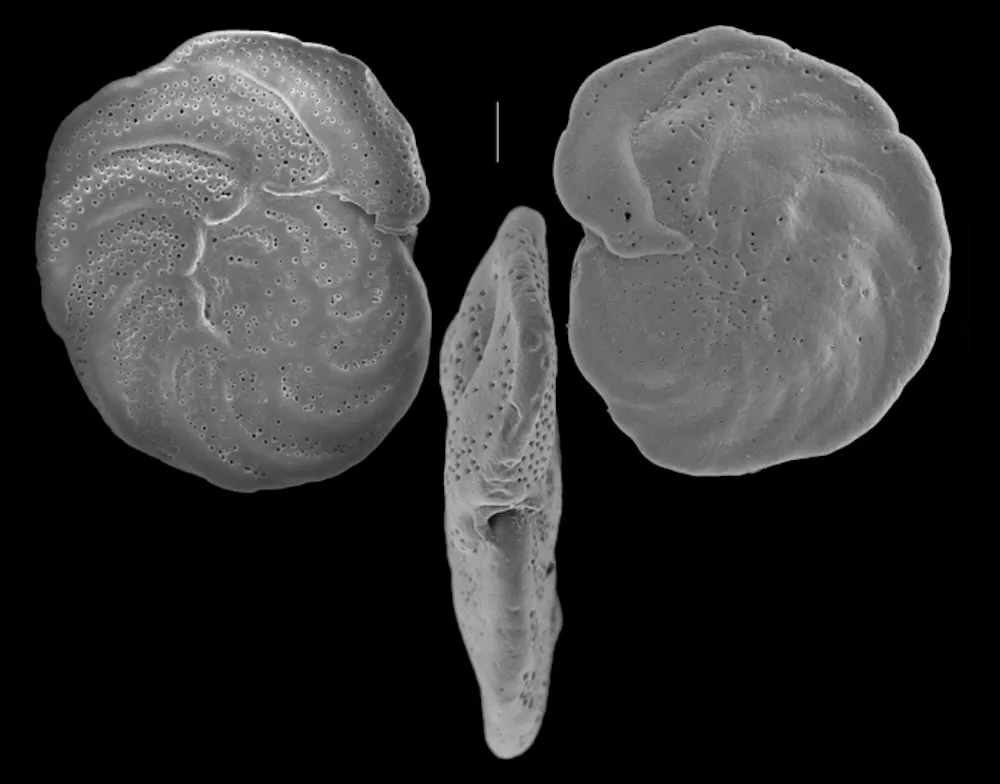
    We reached these conclusions by examining the chemistry of sand-sized fossils, called foraminifera, from the seafloor south of Tasmania.

    Tiny shells preserved in mud

    Foraminifera are tiny single-celled organisms, either floating in the ocean surface or living on the seabed. Most of them build shells made of calcium carbonate to protect themselves. After death, these foraminifera shells are preserved in the mud on the seabed.

    Newer generations of foraminifera shells stack over older ones, like adding new pages to a book. Over time, these foraminifera shells form a book on the seabed that can be dated back to millions of years ago.

    Even more fascinating, trace amounts of elements in the seawater are incorporated into the calcium carbonate shells of foraminifera. In some foraminifera species, the amount of these elements is sensitive to the environment they live in.

    For example, the amount of boron in a species called Cibicidoides wuellerstorfi is sensitive to carbonate ion concentrations, and the amount of cadmium in another species (Hoeglundina elegans) is sensitive to phosphate concentrations.

    By looking at trace elements in these foraminifera shells found in the sequence of mud on the seabed, we can decipher mysteries about the past seawater condition in the book left by foraminifera on the seabed.

    In some species of foraminifera, such as Cibicidoides wuellerstorfi (pictured here), the trace amount of elements found in their shells is sensitive to their environment.
    Le Coze, François/WoRMS, CC BY-SA

    A giant metal straw

    How do scientists do this? First we go out to the ocean to collect mud.

    In this process, a giant metal straw is dropped to the seabed and then raised to our research ships, fully filled with mud. We take these mud samples back to our lab. There, we slice them into pieces and examine them separately.

    This allows us to extract information from each page of the book in chronological order. Foraminifera shells are washed out of the mud, and specific shells are picked out under a microscope, cleaned, and finally analysed for their chemical composition.

    Foraminifera have lived almost everywhere in the ocean for millions of years. Based on their chemical composition, scientists have reconstructed a continuous record of seawater temperature during the past 66 million years in great detail.

    Among a few places in the ocean where you cannot find foraminifera is the polar Southern Ocean. Although some foraminifera live there, seawater in this region is often too corrosive for their shells to preserve on the seabed. The lack of foraminifera in the polar Southern Ocean brings a huge challenge for scientists eager to understand past changes in CO₂ exchanges between the ocean and the atmosphere.

    Among a few places in the ocean where you cannot find foraminifera is the polar Southern Ocean.
    Mathias Berlin/Shutterstock

    From Antarctica to Tasmania

    We decided to tackle the problem using mud on the seabed 3,300 metres below the surface just south of Tasmania.

    Seawater at that depth near Tasmania is ideal for studying the chemistry of the polar Southern Ocean. That’s because seawater from the polar Southern Ocean sinks to the bottom of the ocean, moves northwards, and eventually occupies the seabed south of Tasmania.

    Seawater chemistry – including concentrations of carbon, phosphate and oxygen – does change along its way at the bottom of the ocean.

    These changes are, however, generally proportional to each other. So if all these concentrations are known for seawater at depth near Tasmania, we can work out their concentrations in the polar Southern Ocean.

    Fortunately, there were plenty of foraminifera shells in the mud for all these reconstructions at the site we examined near Tasmania.

    Reconstructing ancient chemical concentrations

    Using the chemistry of foraminifera, we reconstructed changes in concentrations of carbonate ion (which is largely related to carbon), phosphate and oxygen at the bottom of the ocean near Tasmania during the end of the last ice age roughly 20,000–10,000 years ago. This period is known as the last deglaciation.

    Based on these reconstructions, we calculated the amount of CO₂ released from the polar Southern Ocean during the last deglaciation. Some of this CO₂ came from biological processes – changes in the amount of carbon used by microscopic organisms living near the ocean surface. The rest was from physical processes – CO₂ molecules escaping from seawater directly to the air.

    We found that biological processes were more important for CO₂ releases during the earlier stages of the deglaciation, while the physical processes contributed more during the later stages.

    From the polar Southern Ocean, seawater sinks to the bottom of the ocean and moves northwards to reach the seabed south of Tasmania.
    Steve Todd/Shutterstock

    So why is this important?

    Scientists use climate models to predict future climate and to reproduce past atmospheric CO₂ changes.

    Our results provide testing targets for climate models to reproduce.

    Better reproduction of past changes will improve climate model design for predicting future changes.

    This will help us understand how future changes in the polar Southern Ocean can affect atmospheric CO₂, contributing to making effective plans to mitigate CO₂ emissions.

    Yuhao Dai receives funding from the Australian Research Council Special Research Initiative, Australian Centre for Excellence in Antarctic Science.

    ref. Sand-sized fossils hold secrets to the history of climate change – https://theconversation.com/sand-sized-fossils-hold-secrets-to-the-history-of-climate-change-250928

    MIL OSI – Global Reports

  • MIL-OSI Global: Putin made Trump wait, then strung him along – it’s clear his war aims in Ukraine have not changed

    Source: The Conversation – Global Perspectives – By Jon Richardson, Visiting Fellow, Centre for European Studies, Australian National University

    US President Donald Trump’s phone call with his Russian counterpart, Vladimir Putin, didn’t take a tangible step towards ending the hostilities in Ukraine, let alone finding an enduring peace. Rather, it provided further evidence of Putin’s ability to string along and outsmart Trump.

    For starters, Putin sent a signal by making Trump wait for more than an hour to talk. Putin was speaking at a televised conference with Russian businesspeople and even made a joke about the delay when told the time for his call was approaching.

    This was clearly designed to show his alpha status, both to Trump and the Russian public. Steve Witkoff, Trump’s special envoy, was reportedly made to wait eight hours by Putin when he arrived in Moscow last week for talks.

    And after Tuesday’s call, Putin only agreed to pause attacks on Ukraine’s energy infrastructure for 30 days, rather than the total ceasefire proposed by Trump and agreed to by Ukrainian President Volodymyr Zelensky.

    And even this agreement lacked clarity. The lengthy Kremlin statement on the call said the pause would only apply to attacks on energy infrastructure, while the vaguer White House read-out said it included a much broader “energy and infrastructure” agreement. The Kremlin will doubtless stick to the narrow concept.

    The Kremlin’s statement also said Trump proposed this idea and Putin reacted positively. This seems implausible given that pausing attacks on energy infrastructure would be the least costly partial ceasefire for Russia to agree to.

    It seems more likely this proposal came from Putin as a “compromise”, even though Trump was earlier threatening fire and brimstone if Russia did not agree to a proper ceasefire.

    Russia will still be able to continue its ground offensive in Ukraine, where it has the upper hand thanks to Ukrainian manpower shortages (despite its own horrendous losses). It will also be able to maintain its bombardment of Ukrainian civilian targets that has already cost possibly as many as 100,000 civilian lives and half a trillion US dollars in mooted reconstruction costs.

    Ukraine, meanwhile, has only rarely hit residential areas in Russia. However, it has achieved considerable success with long-distance drone attacks on Russian oil refineries and energy infrastructure, threatening one of the main funding sources of Moscow’s war effort.

    Putin’s war aims remain unchanged

    The Kremlin’s read-out of the call also noted that various sticking points remain to achieve a full ceasefire in Ukraine.

    These included the Kyiv regime’s “inability to negotiate in good faith”, which has “repeatedly sabotaged and violated the agreements reached.” The Kremlin also accused Ukrainian militants of “barbaric terrorist crimes” in the Kursk region of Russia that Ukraine briefly occupied.

    This is not new language, but shows breathtaking chutzpah. It’s Russia, in fact, that has broken several agreements vowing to respect Ukraine’s borders, as well as numerous provisions of the Geneva Conventions on treatment of civilian populations and prisoners of war. It has even violated the Genocide Convention in the eyes of some scholars.

    That a US president could let this kind of statement go unchallenged underscores the extent of the White House’s volte-face on Ukraine.

    The Kremlin also asserted that a “key principle” for further negotiations must be the cessation of foreign military aid and intelligence to Ukraine.

    Given Trump has already frozen arms and intelligence support to Ukraine to make Zelensky more compliant, Putin no doubt thinks he might do so again. This, in turn, would strengthen Russia’s leverage in negotiations.

    Trump has already given away huge bargaining chips that could have been used to pressure Russia towards a just and enduring outcome. These include:

    • holding talks with Russia without Ukraine present
    • ruling out security guarantees for Ukraine and NATO membership in the longer term, and
    • foreshadowing that Ukraine should cede its sovereign territory in defiance of international law.

    Putin may be content to string out the ceasefire talks as long as he can in the hopes Russian troops can consolidate their hold on Ukrainian territory and completely expel Ukrainian forces from the Kursk region inside Russia.

    He shows no sign of resiling from his key aims since the beginning of the war – to reimpose Russian dominance over Ukraine and its foreign and domestic policies, and to retain the territories it has illegally annexed.

    The fact Moscow has signed treaties to formally incorporate and assimilate these Ukrainian regions fully into Russia – rather than merely occupying them – underlines how this has always been a war of imperial reconquest rather than a response to perceived military threat.

    At the same time, if he can get much of what he wants, Putin may just be tempted to end the war to further a more business-as-usual relationship with the US. Trump has dangled various carrots to encourage Putin to do this, from renewed US investment in Russia to easing sanctions to ice hockey games.

    Ukraine’s lines in the sand

    Ukraine’s immediate reaction to the Trump-Putin call appears to be cautiously accepting of a limited ceasefire on energy infrastructure. This is no doubt to avoid incurring Trump’s wrath.

    At the same time, Ukraine’s bottom line remains firm:

    • Ukraine’s territorial integrity and sovereignty are non-negotiable
    • it must be able to choose its own foreign alliances and partnerships, and
    • it must be able to defend itself, without limits on the size of its army or its weaponry.

    The only way to square the circle would be to freeze the conflict at the current front lines in Ukraine and leave the status of the annexed Ukrainian regions to be resolved in future negotiations.

    But even this would have little credibility unless Russia revoked its annexations and allowed international organisations and observers to enter the region to encourage a modicum of compliance with international law.

    Jon Richardson does not work for, consult, own shares in or receive funding from any company or organisation that would benefit from this article, and has disclosed no relevant affiliations beyond their academic appointment.

    ref. Putin made Trump wait, then strung him along – it’s clear his war aims in Ukraine have not changed – https://theconversation.com/putin-made-trump-wait-then-strung-him-along-its-clear-his-war-aims-in-ukraine-have-not-changed-252497

    MIL OSI – Global Reports

  • MIL-OSI China: Traveling back to the last days of Pompeii in Beijing

    Source: China State Council Information Office 3

    Have you ever imagined the life of the people in the ancient Roman city of Pompeii, and how they must have felt when Mount Vesuvius erupted?

    An exhibition at Universal Creative Park in Beijing, titled “The Last Days of Pompeii,” allows audiences to experience the final moments of Pompeii from a first-person perspective. Running from Tuesday this week to Aug. 31, the exhibition was jointly launched by China Dream Live Entertainment (CDE Live) and Madrid Artes Digitales (MAD).

    It not only showcases archaeological artifacts discovered in Italy, but also provides an immersive experience for visitors via video and projection. By putting on VR headsets, visitors can travel back in time to almost 1,900 years ago — finding themselves strolling in an ancient courtyard, exploring the villa of a Roman family, and attending a gladiator fight in a packed amphitheater.

    “Pompeii is one of the major topics in history, and the city is so well preserved due to the fact that all the volcano ash covered it and really captured that moment,” said Jelle de Jong, CEO of MAD.

    He also told Xinhua that by using modern technology, they are attempting to take audiences “back to the old days of Pompeii and let them feel what was like to live there.”

    Zhu Ranhua, CEO of CDE Live, which brought this exhibition to China, noted that they hope this exhibition will inspire people to cherish the happiness they encounter in their daily lives.

    The exhibition was previously staged in Madrid, Vienna and Berlin, where it attracted more than 500,000 visits combined.

    Zhu and her team made some changes for the China stop to make the exhibition more suitable for local audiences. For instance, they added the courtyard experience in a bid to reveal details of the artistic life of Roman people back then. They also launched postcards which can be stamped by people to document their visits — as stamp collecting has become a popular hobby among young Chinese.

    When asked if the volcano eruption scene would be scary for children, Zhu dismissed the concern. “I once asked a five-year-old girl if she was afraid, and she shook her head,” said Zhu. “They see disasters, but they also see more beautiful things at the exhibition, such as the prosperous culture that we marvel at.”

    Míriam Huéscar, curator of the exhibition, said that the ultimate aim of the exhibition is to bring people around the world closer by revealing the cultural roots and ancient foundations of many peoples, and not only that of Europe. “Culture is the key to communication between East and West,” she said in an interview with Xinhua. “It is a very useful tool to get to know other people, to learn about them and their customs — and thus understand them better.”

    This view was shared by Jelle de Jong, who believes that during the past week of preparation for the exhibition, he had already learned a lot about Chinese culture.

    The year 2025 marks the 50th anniversary of the establishment of diplomatic relations between China and the European Union. “I have noticed that cross-cultural exchanges between the cultures are getting more and more frequent,” he said.

    Thanks to this increase of exchanges, resulting from the improvement of people’s living standards and China’s opening up, Zhu has observed that Chinese people are increasingly interested in and accepting of cultural events with Western themes.

    Last year, a Mariah Carey concert in China attracted fans from across the country, while shows like “The Phantom of the Opera” also proved successful.

    Notably, Zhu is also witnessing Chinese culture becoming more and more popular among young people. “Our traditional culture is equally fascinating,” she said, while adding that they are now planning an exhibition featuring Chinese culture — which they will take to Europe.

    MIL OSI China News

  • MIL-OSI China: Getting world drawn to China

    Source: China State Council Information Office 3

    China is very, very different. Jessica Rawson repeatedly underlines this point.

    This idea might seem obvious, but she believes that people often underplay the divergence that China inherits.

    “The big trouble is Westerners don’t think they need to study China. They think, if China had a past, it would be like the Greeks, the Romans, or something they’re familiar with here,” she says. “The West doesn’t really notice China, doesn’t understand the difference, doesn’t understand why your culture is not like ours.”

    Rather than digging into the similarities we share, recognizing how ancient China charted its unique course may lead to adjustment, and then better mutual understanding, she argues.

    For the 82-year-old archaeologist, who is a former keeper of the Department of Oriental Antiquities at the British Museum — one of her many titles, her career over the past 50 years has been consistent: China’s distinctive path of development, explored through the eyes of objects, like ceramics, jades and bronze vessels.

    By looking into China’s material culture, Rawson has provided a new perspective on one of the world’s oldest civilizations, uncovering the values, beliefs, and customs embedded in the shapes, colors and motifs of its remains.

    China’s distinctiveness was revealed to Rawson long before she set foot in the country.

    During a trip to the British Museum at the age of 10 or 12, the Rosetta Stone, inscribed with Egyptian hieroglyphs — a writing system that used pictures as signs — taught her that there is a language in the world not based on alphabetic letters.

    “Why not look at Chinese if you’re interested in this,” her parents said and then gave her a small book called Teach Yourself Chinese.

    “When you’re 12, you can’t teach yourself Chinese,” she jokes. “But I started to copy the Chinese characters into a notebook.”

    “Pioneering” is a word often associated with her and her approach to looking beyond and looking around was described as “Rawsonian” by Robert Harrist Jr, professor of Chinese art history at Columbia University in the United States.

    And she has been determined to study Chinese archaeology and get inside the cosmology of others.

    “I’ve dedicated my entire life to this field,” she has written in a letter. “There had been a few resistance along the journey, but I have never thought of giving up.”

    “Since the Neolithic era, China’s developmental path has been uniquely its own. Throughout my academic career, I have increasingly recognized the importance of introducing more people to China’s history and the latest results in archaeology. Only by doing so can they cultivate a genuine interest in China.”

    Language of objects

    In 1968, when Rawson joined the British Museum, she was tasked with cataloging thousands of ceramics and jades from the Shang (c.16th-11th century BC), Zhou (c.11th century-256 BC) and Han (206 BC-AD 220) dynasties — relics she found “very surprising” at first sight.

    Seeing some objects as “China’s greatest works of art”, Rawson found that those exquisite things are often not vehicles for self-expression but functional forms for ancestor worship, crafted according to strict standards dictating their shapes, patterns, and decorations, exemplified by bronze vessels.

    She wondered why the Chinese were so obsessed with this particular type of object, but not gold or gems. Breaking it down step by step, what stands out to Rawson is that the ancients’ fascination with bronze vessels reveals the distinctiveness of China, from its climate and terrain to the cosmology of the inhabitants.

    The Loess Plateau in north-central China once buried the ores or metals under layers of heavy windblown dust. The mining alone required an immense workforce, not to mention the demanding craftsmanship needed to smelt and cast even a single piece, which explains why bronze vessels were mostly evacuated from the tombs of royalty and nobility, Rawson says.

    Life and the afterlife in China unveil fundamental differences in the nation’s ancient society, in how the ancestors were treated as being at the top of a generational hierarchy, and how families, united by shared ancestry and kinship ties, became central, she says.

    In her latest book Life and Afterlife in Ancient China Rawson explores 12 grand tombs and a major sacrificial deposit from across China.

    The “master interpreter”, as the former director of the National Gallery in London and British Museum Neil MacGregor describes Rawson, never treats an object in isolation but traces down to the usage, customs, and beliefs — shaped by climate and geology — all pointing to why the Chinese are not like Westerners or anyone else in the world.

    While China is fascinated with bronze, the West prizes gold and gems. While the Chinese eat rice from ceramic bowls, the West uses plates for salad. What Rawson believes is that every culture develops its material system.

    There are no shortcuts for a foreigner to study Chinese archaeology, Rawson once said.

    In 1975, she set foot in China for the first time. It was a time when the country only owned trains in green that chugged her through the vast landscape, from the plains with fields of rice to the endlessly stretching plateau.

    “It’s a shock to realize how big China is, how many regions are different from each other, and how they’re all different from the West and, above all, from Western Asia,” she says.

    To truly get an impression of the place, the only way is by traveling it, she believes. For the next 44 years, Rawson returned to China nearly every year, traveled alone sometimes, and even once slept at a train station to catch the earliest service.

    “China is not a quick thing to learn,” Rawson says. But she did not give up trying to get closer to that dream path. “I always wanted to work in China. In a way, people would say I am always addicted to China. I am happier thinking about China or reading about China than doing anything else.”

    What might be more difficult is introducing what sets China apart from the West, Rawson admits, yet she remains committed to doing so.

    As the British Museum stands as one of the most-visited attractions in the UK, the former keeper prioritized her work, especially the refurbishment of the China Gallery, both in 1992 and 2016, as a top priority.

    Her career as a curator did not mark a break, even after leaving the museum. She continued to curate blockbuster China-related exhibitions in the UK, such as China: The Three Emperors, 1662-1795, which was opened by Queen Elizabeth II in 2005 at the Royal Academy of Arts in London.

    During her years at the University of Oxford, a major grant by the Leverhulme Trust, which she bid on and received, not only supported the founding of a contemporary China studies program in 2002 but also led to the creation of a China center in 2008.

    Her efforts to promote exchanges somehow mirror another of her research achievements — the interactions in ornament culture between China, Inner Asia, and the West. While China’s path has been independent, it has never been completely isolated, and “we need to see how much we get from each other,” she says.

    MIL OSI China News

  • MIL-OSI China: Taiwan, EU hold 7th Human Rights Consultations, focusing on cooperation and emerging challenges

    Source: Republic of Taiwan – Ministry of Foreign Affairs

    March 7, 2025  

    No. 059  

    The 7th Taiwan-EU Human Rights Consultations were held in Taipei on March 5. The meeting was chaired by Minister without Portfolio Lin Ming-hsin, who led a group of representatives from various Taiwan government agencies. On the EU side, the consultations were attended by Nicoletta Pusterla, Deputy Head of the China, Hong Kong, Macao, Taiwan and Mongolia Division of the European External Action Service, and Domenica Bumma, Policy Officer from the EEAS Human Rights Team. This regular dialogue underscores the long-standing Taiwan-EU exchanges and cooperation on human rights and the two sides’ shared commitment to global human rights development.


    The consultations were conducted in an open and constructive manner, with the two sides first exchanging views on recent human rights developments, policy initiatives, actions following Constitutional Court Judgment no. 8 of 2024, and priority action plans. Taiwan shared the progress it has made on multiple national human rights action plans, emphasizing transparency and public participation to ensure an open, inclusive process that effectively responds to societal needs. The participants reaffirmed their steadfast commitment to promoting and defending human rights, democracy, and the rule of law and engaged in in-depth discussions on several key issues.

    With regard to business and human rights, the EU addressed the latest developments concerning the Corporate Sustainability Due Diligence Directive. Taiwan shared updates to its National Action Plan on Business and Human Rights, which stresses a soft-law approach to promoting corporate human rights protection while also exploring potential legislative measures.


    Furthermore, a working luncheon was cohosted by Minister Lin Ming-hsin and Deputy Minister of Foreign Affairs François Chihchung Wu. Discussions during the luncheon extended to digital human rights and human rights education. The EU side spoke about its Artificial Intelligence Act and Digital Services Act, which emphasize the need to balance technological development with human rights and privacy protection. Representatives from the Taiwan side provided an introduction to the draft AI basic act, which highlights risk management and data governance. On human rights education, Taiwan presented efforts it has made in schools and public institutions and proposed exploring the feasibility of establishing a Taiwan-EU human rights education cooperation framework to promote academic and educational exchanges.


    The consultations further explored gender equality and the rights of the elderly. The two sides reviewed the achievements under the Taiwan-EU Gender Equality Cooperation and Training Framework, and the Taiwan side proposed launching a second phase, focusing on combating online gender-based violence, protecting the rights of diverse gender communities, and deepening gender equality cooperation in the Asia-Pacific region. Regarding elderly rights, the two sides shared their policies on long-term care and age-friendly initiatives, discussing ways to safeguard the rights of older adults in an aging society, including economic security, healthcare, and social participation, while exchanging policy experiences.


    On migrant workers’ rights, Taiwan outlined measures to protect foreign domestic workers and distant-water fishermen, including setting up direct hiring mechanisms, improving working conditions, and strengthening legal supervision. The two sides also discussed ways to enhance the rights of disadvantaged migrant workers.


    The consultations were followed by an exchange between nongovernmental members of the Executive Yuan’s Human Rights Protection and Promotion Task Force and the EU representatives, marking the first time they engaged in dialogue on the challenges and opportunities in human rights policies faced by both sides.


    Taiwan and the EU both uphold the core values of democracy, freedom, and human rights. The two sides have laid a strong foundation for cooperation in these areas. The Taiwan government will continue to enhance human rights standards and ensure alignment with international norms, with the Executive Yuan coordinating interagency efforts. Both sides have expressed that they look forward to developing more concrete cooperation initiatives, fostering experience sharing and policy dialogues to further strengthen the Taiwan-EU partnership, jointly advancing global human rights, and benefiting the international community. (E)

    MIL OSI China News

  • MIL-OSI Asia-Pac: Taiwan, EU hold 7th Human Rights Consultations, focusing on cooperation and emerging challenges

    Source: Republic of China Taiwan 3

    March 7, 2025  
    No. 059  

    The 7th Taiwan-EU Human Rights Consultations were held in Taipei on March 5. The meeting was chaired by Minister without Portfolio Lin Ming-hsin, who led a group of representatives from various Taiwan government agencies. On the EU side, the consultations were attended by Nicoletta Pusterla, Deputy Head of the China, Hong Kong, Macao, Taiwan and Mongolia Division of the European External Action Service, and Domenica Bumma, Policy Officer from the EEAS Human Rights Team. This regular dialogue underscores the long-standing Taiwan-EU exchanges and cooperation on human rights and the two sides’ shared commitment to global human rights development.
     
    The consultations were conducted in an open and constructive manner, with the two sides first exchanging views on recent human rights developments, policy initiatives, actions following Constitutional Court Judgment no. 8 of 2024, and priority action plans. Taiwan shared the progress it has made on multiple national human rights action plans, emphasizing transparency and public participation to ensure an open, inclusive process that effectively responds to societal needs. The participants reaffirmed their steadfast commitment to promoting and defending human rights, democracy, and the rule of law and engaged in in-depth discussions on several key issues.
    With regard to business and human rights, the EU addressed the latest developments concerning the Corporate Sustainability Due Diligence Directive. Taiwan shared updates to its National Action Plan on Business and Human Rights, which stresses a soft-law approach to promoting corporate human rights protection while also exploring potential legislative measures.
     
    Furthermore, a working luncheon was cohosted by Minister Lin Ming-hsin and Deputy Minister of Foreign Affairs François Chihchung Wu. Discussions during the luncheon extended to digital human rights and human rights education. The EU side spoke about its Artificial Intelligence Act and Digital Services Act, which emphasize the need to balance technological development with human rights and privacy protection. Representatives from the Taiwan side provided an introduction to the draft AI basic act, which highlights risk management and data governance. On human rights education, Taiwan presented efforts it has made in schools and public institutions and proposed exploring the feasibility of establishing a Taiwan-EU human rights education cooperation framework to promote academic and educational exchanges.
     
    The consultations further explored gender equality and the rights of the elderly. The two sides reviewed the achievements under the Taiwan-EU Gender Equality Cooperation and Training Framework, and the Taiwan side proposed launching a second phase, focusing on combating online gender-based violence, protecting the rights of diverse gender communities, and deepening gender equality cooperation in the Asia-Pacific region. Regarding elderly rights, the two sides shared their policies on long-term care and age-friendly initiatives, discussing ways to safeguard the rights of older adults in an aging society, including economic security, healthcare, and social participation, while exchanging policy experiences.
     
    On migrant workers’ rights, Taiwan outlined measures to protect foreign domestic workers and distant-water fishermen, including setting up direct hiring mechanisms, improving working conditions, and strengthening legal supervision. The two sides also discussed ways to enhance the rights of disadvantaged migrant workers.
     
    The consultations were followed by an exchange between nongovernmental members of the Executive Yuan’s Human Rights Protection and Promotion Task Force and the EU representatives, marking the first time they engaged in dialogue on the challenges and opportunities in human rights policies faced by both sides.
     
    Taiwan and the EU both uphold the core values of democracy, freedom, and human rights. The two sides have laid a strong foundation for cooperation in these areas. The Taiwan government will continue to enhance human rights standards and ensure alignment with international norms, with the Executive Yuan coordinating interagency efforts. Both sides have expressed that they look forward to developing more concrete cooperation initiatives, fostering experience sharing and policy dialogues to further strengthen the Taiwan-EU partnership, jointly advancing global human rights, and benefiting the international community. (E)

    MIL OSI Asia Pacific News

  • MIL-OSI: BlackRock® Canada Announces March Cash Distributions for the iShares® ETFs

    Source: GlobeNewswire (MIL-OSI)

    TORONTO, March 19, 2025 (GLOBE NEWSWIRE) — BlackRock Asset Management Canada Limited (“BlackRock Canada”), an indirect, wholly-owned subsidiary of BlackRock, Inc. (NYSE: BLK), today announced the March 2025 cash distributions for the iShares ETFs listed on the TSX or Cboe Canada, which pay on a monthly or quarterly basis. Unitholders of record of the applicable iShares ETF on March 26, 2025, will receive cash distributions payable in respect of that iShares ETF on March 31, 2025.

    Details regarding the “per unit” distribution amounts are as follows:

    Fund Name
    Fund
    Ticker
    Cash
    Distribution
    Per Unit
    iShares 1-10 Year Laddered Corporate Bond Index ETF CBH $0.049
    iShares 1-5 Year Laddered Corporate Bond Index ETF CBO $0.051
    iShares S&P/TSX Canadian Dividend Aristocrats Index ETF CDZ $0.112
    iShares Equal Weight Banc & Lifeco ETF CEW $0.059
    iShares Global Real Estate Index ETF CGR $0.158
    iShares International Fundamental Index ETF CIE $0.077
    iShares Global Infrastructure Index ETF CIF $0.238
    iShares 1-5 Year Laddered Government Bond Index ETF CLF $0.032
    iShares 1-10 Year Laddered Government Bond Index ETF CLG $0.037
    iShares US Fundamental Index ETF CLU $0.173
    iShares US Fundamental Index ETF CLU.C $0.222
    iShares S&P/TSX Canadian Preferred Share Index ETF CPD $0.058
    iShares Canadian Fundamental Index ETF CRQ $0.181
    iShares US Dividend Growers Index ETF (CAD-Hedged) CUD $0.079
    iShares Convertible Bond Index ETF CVD $0.071
    iShares Global Water Index ETF CWW $0.069
    iShares Global Monthly Dividend Index ETF (CAD-Hedged) CYH $0.080
    iShares Canadian Financial Monthly Income ETF FIE $0.040
    iShares ESG Balanced ETF Portfolio GBAL $0.219
    iShares ESG Conservative Balanced ETF Portfolio GCNS $0.229
    iShares ESG Equity ETF Portfolio GEQT $0.166
    iShares ESG Growth ETF Portfolio GGRO $0.193
    iShares U.S. Aggregate Bond Index ETF XAGG $0.105
    iShares U.S. Aggregate Bond Index ETF(1) XAGG.U $0.061
    iShares U.S. Aggregate Bond Index ETF (CAD-Hedged) XAGH $0.091
    iShares Core Balanced ETF Portfolio XBAL $0.153
    iShares Core Canadian Universe Bond Index ETF XBB $0.079
    iShares Core Canadian Corporate Bond Index ETF XCB $0.069
    iShares ESG Advanced Canadian Corporate Bond Index ETF XCBG $0.119
    iShares U.S. IG Corporate Bond Index ETF XCBU $0.121
    iShares U.S. IG Corporate Bond Index ETF(1) XCBU.U $0.076
    iShares Canadian Growth Index ETF XCG $0.071
    iShares Core Conservative Balanced ETF Portfolio XCNS $0.135
    iShares S&P/TSX SmallCap Index ETF XCS $0.119
    iShares ESG Advanced MSCI Canada Index ETF XCSR $0.442
    iShares Canadian Value Index ETF XCV $0.373
    iShares Core MSCI Global Quality Dividend Index ETF XDG $0.061
    iShares Core MSCI Global Quality Dividend Index ETF(1) XDG.U $0.042
    iShares Core MSCI Global Quality Dividend Index ETF (CAD-Hedged) XDGH $0.060
    iShares Core MSCI Canadian Quality Dividend Index ETF XDIV $0.115
    iShares Core MSCI US Quality Dividend Index ETF XDU $0.064
    iShares Core MSCI US Quality Dividend Index ETF(1) XDU.U $0.044
    iShares Core MSCI US Quality Dividend Index ETF (CAD-Hedged) XDUH $0.059
    iShares Canadian Select Dividend Index ETF XDV $0.114
    iShares J.P. Morgan USD Emerging Markets Bond Index ETF (CAD-Hedged) XEB $0.057
    iShares S&P/TSX Capped Energy Index ETF XEG $0.133
    iShares S&P/TSX Composite High Dividend Index ETF XEI $0.111
    iShares Jantzi Social Index ETF XEN $0.219
    iShares Core Equity ETF Portfolio XEQT $0.090
    iShares ESG Aware MSCI Canada Index ETF XESG $0.189
    iShares Core Canadian 15+ Year Federal Bond Index ETF XFLB $0.111
    iShares Flexible Monthly Income ETF XFLI $0.194
    iShares Flexible Monthly Income ETF(1) XFLI.U $0.135
    iShares Flexible Monthly Income ETF (CAD-Hedged) XFLX $0.180
    iShares S&P/TSX Capped Financials Index ETF XFN $0.140
    iShares Floating Rate Index ETF XFR $0.063
    iShares Core Canadian Government Bond Index ETF XGB $0.049
    iShares Global Government Bond Index ETF (CAD-Hedged) XGGB $0.040
    iShares Core Growth ETF Portfolio XGRO $0.111
    iShares Canadian HYBrid Corporate Bond Index ETF XHB $0.073
    iShares U.S. High Dividend Equity Index ETF (CAD-Hedged) XHD $0.083
    iShares U.S. High Dividend Equity Index ETF XHU $0.080
    iShares U.S. High Yield Bond Index ETF (CAD-Hedged) XHY $0.084
    iShares Core S&P/TSX Capped Composite Index ETF XIC $0.273
    iShares U.S. IG Corporate Bond Index ETF (CAD-Hedged) XIG $0.070
    iShares 1-5 Year U.S. IG Corporate Bond Index ETF (CAD-Hedged) XIGS $0.122
    iShares Core Income Balanced ETF Portfolio XINC $0.133
    iShares Core Canadian Long Term Bond Index ETF XLB $0.062
    iShares S&P/TSX Capped Materials Index ETF XMA $0.043
    iShares S&P/TSX Completion Index ETF XMD $0.169
    iShares MSCI Min Vol USA Index ETF (CAD-Hedged) XMS $0.102
    iShares MSCI USA Momentum Factor Index ETF XMTM $0.070
    iShares MSCI Min Vol USA Index ETF XMU $0.242
    iShares MSCI Min Vol USA Index ETF(1) XMU.U $0.168
    iShares MSCI Min Vol Canada Index ETF XMV $0.298
    iShares S&P/TSX North American Preferred Stock Index ETF (CAD-Hedged) XPF $0.071
    iShares High Quality Canadian Bond Index ETF XQB $0.053
    iShares MSCI USA Quality Factor Index ETF XQLT $0.058
    iShares S&P/TSX Capped REIT Index ETF XRE $0.065
    iShares ESG Aware Canadian Aggregate Bond Index ETF XSAB $0.047
    iShares Core Canadian Short Term Bond Index ETF XSB $0.071
    iShares Conservative Short Term Strategic Fixed Income ETF XSC $0.057
    iShares Conservative Strategic Fixed Income ETF XSE $0.052
    iShares Core Canadian Short Term Corporate Bond Index ETF XSH $0.060
    iShares ESG Advanced 1-5 Year Canadian Corporate Bond Index ETF XSHG $0.119
    iShares 1-5 Year U.S. IG Corporate Bond Index ETF XSHU $0.127
    iShares 1-5 Year U.S. IG Corporate Bond Index ETF(1) XSHU.U $0.080
    iShares Short Term Strategic Fixed Income ETF XSI $0.061
    iShares S&P/TSX Capped Consumer Staples Index ETF XST $0.130
    iShares ESG Aware Canadian Short Term Bond Index ETF XSTB $0.047
    iShares 0-5 Year TIPS Bond Index ETF (CAD-Hedged) XSTH $0.037
    iShares 0-5 Year TIPS Bond Index ETF XSTP $0.042
    iShares 0-5 Year TIPS Bond Index ETF(1) XSTP.U $0.029
    iShares ESG Aware MSCI USA Index ETF XSUS $0.088
    iShares 20+ Year U.S. Treasury Bond Index ETF (CAD-Hedged) XTLH $0.117
    iShares 20+ Year U.S. Treasury Bond Index ETF XTLT $0.125
    iShares 20+ Year U.S. Treasury Bond Index ETF(1) XTLT.U $0.087
    iShares Diversified Monthly Income ETF XTR $0.040
    iShares Core S&P U.S. Total Market Index ETF (CAD-Hedged) XUH $0.108
    iShares S&P U.S. Financials Index ETF XUSF $0.160
    iShares ESG Advanced MSCI USA Index ETF XUSR $0.174
    iShares S&P/TSX Capped Utilities Index ETF XUT $0.090
    iShares Core S&P U.S. Total Market Index ETF XUU $0.142
    iShares Core S&P U.S. Total Market Index ETF(1) XUU.U $0.099
    iShares MSCI USA Value Factor Index ETF XVLU $0.148

    (1) Distribution per unit amounts are in U.S. dollars for XAGG.U, XCBU.U, XDG.U, XDU.U, XFLI.U, XMU.U, XSHU.U, XSTP.U, XTLT.U, XUU.U

    Estimated March Cash Distributions for the iShares Premium Money Market ETF

    The March cash distributions per unit for the iShares Premium Money Market ETF are estimated to be as follows:

    Fund Name Fund
    Ticker
    Estimated
    Cash Distribution
    Per Unit
    iShares Premium Money Market ETF CMR $0.121

    BlackRock Canada expects to issue a press release on or about March 25, 2025, which will provide the final amounts for the iShares Premium Money Market ETF.

    Further information on the iShares Funds can be found at http://www.blackrock.com/ca.

    About BlackRock

    BlackRock’s purpose is to help more and more people experience financial well-being. As a fiduciary to investors and a leading provider of financial technology, we help millions of people build savings that serve them throughout their lives by making investing easier and more affordable. For additional information on BlackRock, please visit www.blackrock.com/corporate | Twitter: @BlackRockCA

    About iShares ETFs

    iShares unlocks opportunity across markets to meet the evolving needs of investors. With more than twenty years of experience, a global line-up of 1500+ exchange traded funds (ETFs) and US$4.2 trillion in assets under management as of December 31, 2024, iShares continues to drive progress for the financial industry. iShares funds are powered by the expert portfolio and risk management of BlackRock.

    iShares® ETFs are managed by BlackRock Asset Management Canada Limited.

    Commissions, trailing commissions, management fees and expenses all may be associated with investing in iShares ETFs. Please read the relevant prospectus before investing. The funds are not guaranteed, their values change frequently and past performance may not be repeated. Tax, investment and all other decisions should be made, as appropriate, only with guidance from a qualified professional.

    Standard & Poor’s® and S&P® are registered trademarks of Standard & Poor’s Financial Services LLC (“S&P”). Dow Jones is a registered trademark of Dow Jones Trademark Holdings LLC (“Dow Jones”). TSX is a registered trademark of TSX Inc. (“TSX”). All of the foregoing trademarks have been licensed to S&P Dow Jones Indices LLC and sublicensed for certain purposes to BlackRock Fund Advisors (“BFA”),  which in turn has sub-licensed these marks to its affiliate, BlackRock Asset Management Canada Limited (“BlackRock Canada”), on behalf of the applicable fund(s). The index is a product of S&P Dow Jones Indices LLC, and has been licensed for use by BFA and by extension, BlackRock Canada and the applicable fund(s). The funds are not sponsored, endorsed, sold or promoted by S&P Dow Jones Indices LLC, Dow Jones, S&P, any of their respective affiliates (collectively known as “S&P Dow Jones Indices”) or TSX, or any of their respective affiliates. Neither S&P Dow Jones Indices nor TSX make any representations regarding the advisability of investing in such funds.

    MSCI is a trademark of MSCI, Inc. (“MSCI”). The ETF is permitted to use the MSCI mark pursuant to a license agreement between MSCI and BlackRock Institutional Trust Company, N.A., relating to, among other things, the license granted to BlackRock Institutional Trust Company, N.A. to use the Index. BlackRock Institutional Trust Company, N.A. has sublicensed the use of this trademark to BlackRock. The ETF is not sponsored, endorsed, sold or promoted by MSCI and MSCI makes no representation, condition or warranty regarding the advisability of investing in the ETF.

    Contact for Media:                
    Sydney Punchard                                                        
    Email: Sydney.Punchard@blackrock.com         
      

    The MIL Network

  • MIL-OSI New Zealand: Arts and Culture – New Zealand and India Forge Deeper Ties on the Big Screen

    Source: New Zealand Film Commission

    The New Zealand Film Commission’s (NZFC) strategic engagement with India’s screen industry is delivering results, with key milestones highlighting the growing creative and economic ties between the two nations. These connections are opening new opportunities for collaboration, not only with Bollywood, but also with Tollywood (Telugu-language cinema) and other regional industries.
    Milestone Film Releases
    For the first time, a major Indian film and a New Zealand film will be released in India in close succession, creating a unique opportunity for cultural and cinematic exchange. Ka Whawhai Tonu – Struggle Without End, a Māori-language historical drama and last year’s biggest local box office hit, is preparing for an Indian release. This opportunity follows the 25 April release in India of Kannappa, a high-profile Telugu-language epic that filmed extensively in New Zealand. While Kannappa was independently funded, its production highlights the value of New Zealand’s skilled crews, close collaboration with Māori, breathtaking landscapes, and reputation as a trusted partner for Indian filmmakers.
    Momentum behind these collaborations has been further strengthened by the New Zealand Prime Minister’s recent visit to India, which highlighted the value of these trusted partnerships. The visit showcased strengthened cultural ties and new opportunities for Indian filmmakers to collaborate with New Zealand’s vibrant screen industry.
    A Growing Exchange of Films
    Chief Executive of NZFC, Annie Murray, says recent years have seen a growing exchange between the film industries of New Zealand and India, fostering creative collaboration and cultural understanding.
    “Notable New Zealand films screened in India include Kāinga (Asian Premiere at International Film Festival of India IFFI 2022), Perianayaki (Dharamshala International Film Festival 2022, Best Short Film – IFFI Film Bazaar Recommends 2022), and Vai and Waru (Dharamshala International Film Festival 2020 and 2018),” she says.
    This cultural exchange goes both ways. Indian cinema continues to resonate with New Zealand audiences, with Hindi, Tamil, Telugu, and Malayalam films regularly featured in local cinemas. In 2023 alone, 128 Indian films were released in New Zealand, earning a box office of over $9.8 million.
    Further strengthening these ties, the Dharamshala International Film Festival and the New Zealand High Commission partnered with the NZFC, Whānau Mārama: New Zealand International Film Festival, and Asia Society India Centre in 2021 to present the IN->NZ Indigenous Connections film week. This special event showcased six films – three from each country – including New Zealand’s Cousins, Merata: How Mum Decolonised the Screen, and Loimata, the Sweetest Tears.
    In 2024, New Zealand audiences warmly welcomed Payal Kapadia’s All We Imagine As Light at the New Zealand International Film Festival, ahead of its local commercial release in 2024 and 2025.
    “These collaborations demonstrate the growing relationship between New Zealand and India’s film industries – a connection we are excited to continue building,” Annie says.
    Reciprocity: The Key to Success
    The key to success in working with India lies in the principle of reciprocity, says Chris Payne, NZFC’s Head of Co-Production and Incentives who attended the National Film Development Corporation of India (NFDC) Film Bazaar in Goa last November.
    “Our work to build meaningful connections with India’s screen sector creates opportunities that flow both ways, giving Indian filmmakers access to New Zealand’s stunning locations and skilled crews, while opening doors for Kiwi talent to collaborate with India’s vibrant and fast-growing industry.”
    “With a clear push for international partnerships, on both Indian and foreign IP, the doors are open. We just need to walk through them,” says Chris.
    The NZFC’s support extends to Indian New Zealand filmmakers, such as trailblazing filmmaker Shuchi Kothari, and industry organisations such as the Pan-Asian Screen Collective (PASC), further strengthening ties between the two countries’ creative communities.
    With these recent milestones marking a significant step forward, the NZFC remains committed to fostering creative opportunities that connect the two screen sectors and deliver long-term benefits for filmmakers in both nations.
    About the New Zealand Film Commission (NZFC)
    The New Zealand Film Commission is a government agency that invests in New Zealand feature films and short films, promotes them domestically and internationally, and attracts international productions to New Zealand.
    New Zealand has a co-production treaty with India, which gives Indian filmmakers significant advantages and came into force in October 2011. Beyond the Known World (2017) was the first feature film to utilise that arrangement, and the production was filmed largely in India.

    MIL OSI New Zealand News

  • MIL-OSI Asia-Pac: President Lai meets Arizona Governor Katie Hobbs  

    Source: Republic of China Taiwan

    Details
    2025-03-18
    President Lai meets delegation led by Minister of Foreign Affairs Denzil Douglas of Saint Christopher and Nevis
    On the afternoon of March 18, President Lai Ching-te met with a delegation led by Minister of Foreign Affairs Denzil Douglas of the Federation of Saint Christopher and Nevis. In remarks, President Lai thanked St. Kitts and Nevis for speaking up for Taiwan at major international venues and supporting Taiwan’s international participation. The president expressed hope that our two countries continue to achieve remarkable results through cooperation in such fields as education and training, agricultural development, women’s empowerment, and environmental sustainability, and create even greater well-being for our peoples. A translation of President Lai’s remarks follows: I welcome Minister Douglas and our esteemed guests to Taiwan. Last June, Minister Douglas accompanied Prime Minister Terrance Drew and his wife on their trip to Taiwan. I am delighted to be able to meet and exchange views with Minister Douglas again less than one year later. Your presence fully demonstrates the profound bond between Taiwan and St. Kitts and Nevis. I look forward to the further deepening of our partnership through our exchanges during this visit. Although our two nations are separated by a great distance, we share such universal values as democracy, freedom, and respect for human rights. We also continue to achieve remarkable results through cooperation in such fields as education and training, agricultural development, women’s empowerment, and environmental sustainability. Given that Prime Minister Drew, Minister Douglas, and I all share medical backgrounds, we deeply understand the importance of people’s health. I thus look forward to St. Kitts and Nevis’s climate-smart JNF General Hospital commencing operations as soon as possible thanks to our cooperation. The provision of even higher-quality public health and medical services will yield benefits for many more people. I also believe that by having Taiwan share its experiences in renewable energy and energy-saving technologies, our two countries will jointly drive green industrial transformation and stimulate sustainable development together. I would like to take this opportunity to thank St. Kitts and Nevis for actively speaking up for Taiwan and supporting Taiwan’s participation at such major international venues and organizations as the United Nations General Assembly, the World Health Organization, and the International Civil Aviation Organization. In the future, Taiwan will continue to make critical contributions to the international community. With the support of Minister Douglas and our guests, I look forward to our two countries backing each other on the global stage and continuing to build an even stronger foundation for bilateral cooperation. Let us work together to address the various challenges we face and create even greater well-being for our peoples. Minister Douglas then delivered remarks, first conveying greetings from Prime Minister Drew to President Lai, the government, and the people of Taiwan. He then stated that over the last 41 years since the dawn of their nationhood, the Republic of China Taiwan has steadfastly walked beside St. Kitts and Nevis as a strong and immovable partner. As we reflect on four decades of our journey together, he said, we recognize the unswerving and unwavering spirit that has guided both our nations through trials and challenges. The minister then acknowledged the generous support of Taiwan’s government that has helped St. Kitts and Nevis in its own economic and social development. He went on to say that Taiwan’s partnership with St. Kitts and Nevis has been instrumental in helping them achieve the goals of their sustainable island state agenda. Whether in enhancing food security through the diversification of their agricultural sector, fostering clean energy solutions through the solar PV farm, or advancing healthcare through assistance in building their smart hospital, he said, Taiwan has been a steadfast partner in shaping a much more resilient and sustainable future for the people of their federation. In the spirit of reciprocity and solidarity, Minister Douglas said, St. Kitts and Nevis continues to leverage opportunities on the global stage to request incessantly that Taiwan be given its rightful place in international organizations, where it can make a meaningful contribution to resolving the world’s most critical issues. Minister Douglas indicated that the global challenges we face today demand collective action, and that Taiwan has the innovation, the technology, the knowledge, and the expertise to make a tremendous positive impact on some of the world’s most urgent issues. He said that St. Kitts and Nevis will never grow weary in their own support, but shall continue to sound the clarion call of “let Taiwan in,” as well as advocate for peace to be maintained in the Taiwan Strait. To close, Minister Douglas expressed gratitude for the warm hospitality bestowed upon him and his delegation by Taiwan’s government, remarking that the engagements they had thus far were pregnant with promise, and that they are confident in witnessing a fruitful outcome as we work together to build a prosperous and sustainable future for our peoples. The delegation also included Permanent Secretary in the Ministry of Foreign Affairs Kaye Bass, Permanent Secretary of Economic Development and Investment Adina Richards, and Director in the Ministry of International Trade Sean Lawrence. The delegation was accompanied to the Presidential Office by St. Kitts and Nevis Ambassador Donya L. Francis.

    Details
    2025-03-18
    President Lai meets 2025 Yushan Forum participants
    On the afternoon of March 18, President Lai Ching-te met with participants in the 2025 Yushan Forum. In remarks, President Lai thanked the guests for gathering here in Taiwan and discussing ways to enhance regional cooperation, demonstrating that our democratic allies and friends are standing together as we take on the challenges of a new world and a new era. The president reiterated that Taiwan will continue to engage with the world, and we welcome the world to come closer to Taiwan. He stated that Taiwan will continue to work with international partners to deepen cooperation, exchanges, and partnership in various domains and resist the expansion of authoritarianism. Together, the president emphasized, we can pursue regional peace and security and realize a new vision for a free and open, stable and prosperous Indo-Pacific. A translation of President Lai’s remarks follows: I would like to begin by thanking Anders Fogh Rasmussen, former prime minister of Denmark and chairman of the Alliance of Democracies Foundation, for inviting then-President Tsai Ing-wen to address the Copenhagen Democracy Summit via video over five consecutive years since 2020, and for inviting myself to give remarks via video last year. Those opportunities allowed Taiwan to share with the world our motivation for, and our work toward, safeguarding freedom and democracy. I would also like to thank Mr. Janez Janša, former prime minister of the Republic of Slovenia, who has visited Taiwan many times already, for actively elevating the cordial ties between Taiwan and Slovenia during his term as prime minister, helping expand friendship for Taiwan throughout Europe. Today’s guests have traveled a long way to show their strong backing for Taiwan. For this, I express my deepest gratitude. Yesterday was my first time attending the Yushan Forum as president. I saw political leaders and representatives gather here in Taiwan and discuss ways to enhance regional cooperation. The event demonstrated that our democratic allies and friends are standing together as we take on the challenges of a new world and a new era. It was truly moving. As I stated at the opening ceremony, Taiwan will continue to engage with the world, and we welcome the world to come closer to Taiwan. Our government will help guide Taiwanese small- and medium-sized enterprises as they expand into the international market and extend Taiwan’s economic power. I hope that during this visit, our guests will be able to explore more opportunities for cooperation in such fields as AI, smart healthcare, and advanced technologies, and join hands in contributing to the prosperity and development of our democratic allies and friends. Taiwan will continue to work with international partners, building upon the shared values of freedom and democracy, to deepen cooperation, exchanges, and partnership in various domains and resist the expansion of authoritarianism. Together, we can pursue regional peace and security and realize a new vision for a free and open, stable and prosperous Indo-Pacific. And I hope, with the assistance of our guests here today, that we can further strengthen the ties between Taiwan and Europe so that we can all take up the work of maintaining global peace and stability. Once again, I welcome our guests to Taiwan. I look forward to hearing your thoughts in a few moments. I also hope you will visit Taiwan often in the future and continue to experience our vibrant democratic society and culture. Chairman Rasmussen then delivered remarks, saying that it is a great pleasure to be back here in Taipei after meeting with President Lai in 2023. He then thanked President Lai for the Taiwanese hospitality on behalf of the Yushan Forum international visitors and participants, who represent four continents and very different political parties but who are united by one thing – the commitment to democracy. Chairman Rasmussen mentioned that over the past few days, they have met with members of the government, legislature, and civil society in Taiwan. He said that he is more convinced than ever that in a very uncertain world, Taiwan continues to stand as a beacon of democracy, from which people in Europe and in the rest of the world have a lot to learn. Over the past eight years, he has been proud to step up his engagement with Taiwan, he said, as he has always subscribed to the view that freedom must advance everywhere, or else it is in decline everywhere. Chairman Rasmussen noted that they have many interests in making sure Taiwan remains free and that we must always stand up for freedom when it is under assault by a dictator. This is why Ukraine’s fight is also everyone’s fight, he explained. He then praised Taiwan for all of the support it has given to Ukraine since Russia’s invasion and honored the two Taiwanese volunteer soldiers who gave their lives for freedom in Ukraine. Chairman Rasmussen remarked that Taiwan is a strong feature of the Copenhagen Democracy Summit that he convenes each year. His foundation, the Alliance of Democracies, has even been sanctioned by the Chinese government due to its support of Taiwan, he said, which is something he takes as a badge of honor. He added that this year’s Copenhagen Democracy Summit in May will be no different, as they plan to focus on the new world order, urgent measures to strengthen Europe’s military, and the situation in Ukraine. But as the United States pulls back from the transatlantic alliance and Europe focuses more on its own defense, he said, Europe should not retreat from the world. He added that to ensure European security, we need more Europe in the Indo-Pacific, and that is why he has been making the argument for more political and economic cooperation with Taiwan. Chairman Rasmussen praised President Lai’s recent decision to increase Taiwan’s national defense budget to more than 3 percent of GDP, adding that it is important that each nation does what it can for its own defense. The chairman once again thanked President Lai for meeting with them today and for the opportunity to visit Taiwan, a beacon of democracy and liberty in Asia. Also in attendance at the meeting were Chairman of the Czech Senate Committee on Foreign Affairs, Defence and Security Pavel Fischer; Member of the National Security Advisory Board to India’s National Security Council Anshuman Tripathi; former Minister of Foreign Affairs of Poland Anna Fotyga; former Minister of Health of Canada Tony Clement; and former Vice-Minister of Foreign Affairs of the Republic of Lithuania and current Secretary General of the Polish-based Community of Democracies Mantas Adomėnas.

    Details
    2025-03-17
    President Lai meets Japan-ROC Diet Members’ Consultative Council Chairman Furuya Keiji
    On the afternoon of March 17, President Lai Ching-te met with a delegation led by Japanese House of Representatives Member and Japan-ROC Diet Members’ Consultative Council Chairman Furuya Keiji. In remarks, President Lai thanked the Consultative Council for doing its utmost to strengthen the relationship between Taiwan and Japan. He also stated that Taiwan and Japan are both part of the first island chain’s key line of defense, and in addition to continuing to bolster its economic strength and enhance its self-defense capabilities, Taiwan will work together with Japan and other like-minded countries to promote regional and global democracy, peace, and prosperity. A translation of President Lai’s remarks follows: I would like to extend a warm welcome to Chairman Furuya, who is visiting us once again. I am also delighted to meet House of Councillors Member Yamamoto Junzo and House of Representatives Member Hiranuma Shojiro today. Although the Japanese Diet is currently in session, our distinguished guests overcame many hurdles and organized a delegation to attend the 2025 Yushan Forum and deliver speeches, providing valuable insights into issues of mutual concern in the Indo-Pacific region and demonstrating the support for Taiwan in the Diet. Here, I would like to express my deepest gratitude. During the Yushan Forum, it was especially inspiring when Chairman Furuya spoke Taiwanese when he emphasized that “if Taiwan has a problem, then Japan has a problem.” Over the past few years under Chairman Furuya’s leadership, the Consultative Council has done its utmost to strengthen the relationship between Taiwan and Japan. In addition to passing resolutions every year supporting Taiwan’s participation in the World Health Organization and Comprehensive and Progressive Agreement for Trans-Pacific Partnership (CPTPP), the council has established four internal research groups regarding the CPTPP, exchanges for women legislators, encouraging local-level exchanges, and the Taiwan Relations Act, using an issue-oriented approach to deepen Taiwan-Japan relations. Thanks to the Consultative Council’s long-term assistance and promotional efforts, the Japanese Ministry of Justice has announced that beginning this May, members of the Taiwanese overseas community in Japan included in the country’s family registry system may list “Taiwan” in the field designating their nationality or region of origin. This demonstrates the friendly relations between Taiwan and Japan, and the Taiwanese people will always remember the council’s continued concrete actions in support of Taiwan. In his remarks at the Yushan Forum today, Chairman Furuya mentioned that there are many areas in which Taiwan and Japan can engage in industrial cooperation. We can continue to deepen our partnership in semiconductors, energy, AI, unmanned aerial vehicles, and other areas related to economic security and supply chain resilience, all of which have significant room for cooperation, creating win-win situations for both Taiwan and Japan. As authoritarianism consolidates, democratic nations must come closer in solidarity. Taiwan and Japan are both part of the first island chain’s key line of defense. In addition to bolstering our economic strength and enhancing our self-defense capabilities, Taiwan will also work with Japan and other like-minded countries to promote regional and global democracy, peace, and prosperity. All of our distinguished guests are good friends of Taiwan, and are very familiar with Taiwan. I hope to continue working together with you all to carry Taiwan-Japan relations to an even higher level. Chairman Furuya then delivered remarks, first thanking President Lai for taking time out of his busy schedule to see them. He then noted that Japan, Taiwan, and quite a few other nations around the world changed leaders last year, and conditions around the world are becoming increasingly unstable. One cannot see what the world will be like a few years from now, he said, which is why he is counting so heavily on the strong leadership of President Lai. Chairman Furuya said that, in addition to collaboration in foreign affairs and security matters, economic cooperation between Taiwan and Japan is also very important. He mentioned new technologies, and said he had spoken quite a bit on the topic that very morning at the Yushan Forum. The clearest example, he said, is the establishment by Taiwan Semiconductor Manufacturing Company of a wafer plant in Japan’s Kumamoto Prefecture, which has sparked robust economic activity. He added that cooperation addressing such matters as cyberattacks and supply chain resilience is also very important. Chairman Furuya noted that President Lai had mentioned in his remarks that beginning from May, Taiwanese overseas community members in Japan will be able to list “Taiwan” on their family registers. The chairman expressed his view that this is not a foreign affairs issue, but rather a human rights issue for the Taiwanese people, and an excellent way to show respect for Taiwan. He further noted President Lai’s mentioning of the four research groups that the Consultative Council has established, and said that these groups will ramp up their work. He also expressed hope that Taiwan and Japan will work together to address challenges that face both countries, such as issues pertaining to democracy and peace in the Taiwan Strait, so that they can together push for international peace and stability. Chairman Furuya stated that reciprocal visits by Taiwanese and Japanese people reached an all-time high last year. He said that in the future, in addition to further promoting local exchanges between the two countries, he also hopes that Japanese middle school and high school students planning to go on overseas study trips will choose Taiwan as their destination, because he feels that any student who visits Taiwan will become a fan of this place. Also in attendance was Japan-Taiwan Exchange Association Taipei Office Chief Representative Katayama Kazuyuki.

    Details
    2025-03-17
    President Lai addresses opening of 2025 Yushan Forum
    On the morning of March 17, President Lai Ching-te attended the opening of the 2025 Yushan Forum, the theme of which was “New Southbound Policy+: Taiwan, the Indo-Pacific, and a New World.” In remarks, President Lai stated that the New Southbound Policy has led to great success in economic and trade cooperation, professional exchanges, resource sharing, and building regional links. He said that in the past, Taiwanese industries went from moving westward across the Taiwan Strait, to shifting southbound, to working closer with the north, but that now, Taiwan is confidently stepping across the Pacific, reaching eastward, to the Americas and other regions. While staying firmly rooted in Taiwan, he said, Taiwan’s enterprises are expanding their global presence and marketing worldwide. The president stated that Taiwan will strive alongside its partners in democracy to bolster non-red supply chains and digital solidarity, and together respond to the threats and challenges posed by expanding authoritarianism. He indicated that the Yushan Forum is a place to share experiences, and more importantly, lay down firm foundations for exchanges and cooperation among participants’ countries to create greater stability for the region and greater prosperity for the world. A transcript of President Lai’s remarks follows: On behalf of all the people of Taiwan, I want to welcome our good friends joining us from around the world. Your presence shows support for a peaceful and stable Taiwan and a free and open Indo-Pacific region. The Yushan Forum has become more than just an important platform for the New Southbound Policy. Over these eight years, more than 3,600 participants from Taiwan and 28 other countries have helped deepen Taiwan’s connections with nations around the world. The New Southbound Policy has led to great success in economic and trade cooperation, professional exchanges, resource sharing, and building regional links. Looking ahead, the Yushan Forum will be taking on the important mission of carrying its legacy forward and transforming it into action. Not only must we turn consensus into action plans for close cooperation among countries in the region; we must also work with partners around the world to forge ahead with cooperative plans for mutual prosperity. We hope to envision a new world from Taiwan – and see Taiwan in this new world. We are also embracing an era of smart technology. The government sessions of this Yushan Forum are therefore centered around topics including smart healthcare, smart transportation, and resilient supply chains for semiconductors. Taiwan is intent on working side by side with other countries to face the challenges of this new era. Today’s Taiwan celebrates not only the democratic achievements that are recognized by the international community, but also our strengths in the semiconductor and other tech industries, which enable us to play a key role in restructuring global democratic supply chains and the economic order. We are building on Taiwan as a “silicon island” for semiconductors while accelerating innovation and AI applications for industry. These efforts will help Taiwan become an “AI island” as well. We are also developing forward-looking fields such as quantum technology and precision medicine, which will create an industry ecosystem that is highly competitive and innovative. The government will also develop economic models powered by innovation. This will help SMEs (small- and medium-sized enterprises) upgrade and transform through the power of digital transformation and net-zero transition. In the past, Taiwanese industries went from moving westward across the Taiwan Strait, to shifting southbound, to working closer with the north. But now, we are confidently stepping across the Pacific, reaching eastward, to the Americas and other regions. While staying firmly rooted in Taiwan, our enterprises are expanding their global presence and marketing worldwide. Taiwan will continue to engage with the world, and we welcome the world to come closer to Taiwan. As we gather here today, I am confident that we share the same goal: Through international cooperation, we hope to build an even more inclusive, resilient, prosperous Indo-Pacific, while jointly defending the democracy, freedom, and peace we so firmly believe in. I want to thank you all once again for supporting Taiwan. We will strive alongside our partners in democracy to bolster non-red supply chains and digital solidarity, and together respond to the threats and challenges posed by expanding authoritarianism. Yushan is also known as Jade Mountain. It is Taiwan’s highest peak and stands as firm as our unwavering spirit. During this critical time of global change and transformation, the Yushan Forum is a place where we can share our experiences, and more importantly, lay down firm foundations for exchanges and cooperation among our countries. This way, we can create greater stability for the region and greater prosperity for the world. I wish everyone a successful forum. Thank you. Also in attendance at the event were former Prime Minister of Denmark and Alliance of Democracies Foundation Chairman Anders Fogh Rasmussen, former Prime Minister of the Republic of Slovenia Janez Janša, Japan-ROC Diet Members’ Consultative Council Chairman Furuya Keiji, and American Institute in Taiwan Taipei Office Director Raymond Greene.

    Details
    2025-03-13
    President Lai attends Ministry of Foreign Affairs 2025 Spring Banquet  
    On the evening of March 13, President Lai Ching-te attended the Ministry of Foreign Affairs 2025 Spring Banquet for foreign ambassadors and representatives stationed in Taiwan. In remarks, President Lai thanked our diplomatic allies and like-minded countries for continuing to demonstrate their high regard and support for Taiwan at international venues. The president stated that a stronger Taiwan will be able to contribute even more to the world, explaining that is why he established the National Climate Change Committee, the Whole-of-Society Defense Resilience Committee, and the Healthy Taiwan Promotion Committee. He added that he hopes to pool our strengths so as to formulate national development strategies and enhance Taiwan’s international collaboration. The president also expressed hope of developing opportunities for cooperation with other countries across many domains to jointly advance democracy, peace, and prosperity throughout the region and around the world. A translation of President Lai’s remarks follows: Today is my first time attending the Ministry of Foreign Affairs Spring Banquet since becoming president. It is a pleasure to be able to meet and socialize with esteemed guests from other countries and good friends from all sectors of Taiwan. The global landscape has changed rapidly over the past year. Geopolitical volatility, the restructuring of supply chains, technological advancements, and other factors have had a profound impact on nations’ strategic plans. I want to take this opportunity to thank our diplomatic allies and like-minded countries for continuing to demonstrate their high regard and support for Taiwan at international venues. Last month, the leaders of the United States and Japan, the US secretary of state and the foreign ministers of Japan and the Republic of Korea, and the G7 foreign ministers all issued joint statements emphasizing the importance of peace and stability across the Taiwan Strait, underscoring Taiwan’s vital role in global progress and prosperity.  I would especially like to thank members of the diplomatic corps for working with us to build even closer partnerships between our countries. I have always believed that a stronger Taiwan will be able to contribute even more to the world. That is why, after taking office, I established the National Climate Change Committee, the Whole-of-Society Defense Resilience Committee, and the Healthy Taiwan Promotion Committee under the Office of the President. These committees continue to address global concerns and seek to solve important issues that impact our own people. I hope to pool our strengths so as to formulate national development strategies and enhance Taiwan’s international collaboration.  Last year, I visited our Pacific allies – the Republic of the Marshall Islands, Tuvalu, and the Republic of Palau. I deeply appreciated our friends’ warm hospitality and came to feel very deeply that we are like a family. Through local visits and mutual exchanges, we deepened our diplomatic alliances and cooperation, creating win-win outcomes. We also showed Taiwan’s determination to work with allies to tackle the many challenges related to climate change, net-zero transition, and digital transformation. At the start of this month, Taiwan hosted the first-ever workshop on whole-of-society defense resilience under the Global Cooperation and Training Framework. Experts and scholars from 30 countries participated in the discussions. I once again thank the diplomatic corps for their support and assistance. In the future, we look forward to developing opportunities for cooperation with other countries across many domains to jointly advance democracy, peace, and prosperity throughout the region and around the world. In the face of authoritarian expansion, Taiwan will continue to bolster its national defense capabilities. We will stand shoulder to shoulder with fellow democracies to demonstrate the strength of deterrence. We will also join hands to build non-red supply chains, strengthen our economic resilience, and promote an initiative on semiconductor supply chain partnerships for global democracies. All of this will ensure steady technological and economic development.  In my New Year’s Day address, I said that in this new year, we have many more brilliant stories of Taiwan to share with the world. Everyone gathered here tonight is a dear friend of Taiwan. And each of you plays an important role in the stories this land has to tell.  I am deeply grateful to you all for the incredible efforts you make in support of Taiwan. In so many ways, you connect Taiwan to the rest of the world and allow the world to see the many different sides of this amazing nation. I believe that through even deeper and more extensive cooperation, we will create many more wonderful stories of Taiwan and build an even brighter future together. I wish you all a pleasant evening. Also in attendance at the event were Dean of the Diplomatic Corps and Saint Vincent and the Grenadines Ambassador Andrea Clare Bowman and other members of the foreign diplomatic corps in Taiwan.

    Details
    2025-03-13
    President Lai holds press conference following high-level national security meeting
    On the afternoon of March 13, President Lai Ching-te convened a high-level national security meeting, following which he held a press conference. In remarks, President Lai introduced 17 major strategies to respond to five major national security and united front threats Taiwan now faces: China’s threat to national sovereignty, its threats from infiltration and espionage activities targeting Taiwan’s military, its threats aimed at obscuring the national identity of the people of Taiwan, its threats from united front infiltration into Taiwanese society through cross-strait exchanges, and its threats from using “integrated development” to attract Taiwanese businesspeople and youth. President Lai emphasized that in the face of increasingly severe threats, the government will not stop doing its utmost to ensure that our national sovereignty is not infringed upon, and expressed hope that all citizens unite in solidarity to resist being divided. The president also expressed hope that citizens work together to increase media literacy, organize and participate in civic education activities, promptly expose concerted united front efforts, and refuse to participate in any activities that sacrifice national interests. As long as every citizen plays their part toward our nation’s goals for prosperity and security, he said, and as long as we work together, nothing can defeat us. A translation of President Lai’s remarks follows: At many venues recently, a number of citizens have expressed similar concerns to me. They have noticed cases in which members of the military, both active-duty and retired, have been bought out by China, sold intelligence, or even organized armed forces with plans to harm their own nation and its citizens. They have noticed cases in which entertainers willingly followed instructions from Beijing to claim that their country is not a country, all for the sake of personal career interests. They have noticed how messaging used by Chinese state media to stir up internal opposition in Taiwan is always quickly spread by specific channels. There have even been individuals making careers out of helping Chinese state media record united front content, spreading a message that democracy is useless and promoting skepticism toward the United States and the military to sow division and opposition. Many people worry that our country, as well as our hard-won freedom and democracy and the prosperity and progress we achieved together, are being washed away bit by bit due to these united front tactics. In an analysis of China’s united front, renowned strategic scholar Kerry K. Gershaneck expressed that China plans to divide and conquer us through subversion, infiltration, and acquisition of media, and by launching media warfare, psychological warfare, and legal warfare. What they are trying to do is to sow seeds of discord in our society, keep us occupied with internal conflicts, and cause us to ignore the real threat from outside. China’s ambition over the past several decades to annex Taiwan and stamp out the Republic of China has not changed for even a day. It continues to pursue political and military intimidation, and its united front infiltration of Taiwan’s society grows ever more serious. In 2005, China promulgated its so-called “Anti-Secession Law,” which makes using military force to annex Taiwan a national undertaking. Last June, China issued a 22-point set of “guidelines for punishing Taiwan independence separatists,” which regards all those who do not accept that “Taiwan is part of the People’s Republic of China” as targets for punishment, creating excuses to harm the people of Taiwan. China has also recently been distorting United Nations General Assembly Resolution 2758, showing in all aspects China’s increasingly urgent threat against Taiwan’s sovereignty. Lately, China has been taking advantage of democratic Taiwan’s freedom, diversity, and openness to recruit gangs, the media, commentators, political parties, and even active-duty and retired members of the armed forces and police to carry out actions to divide, destroy, and subvert us from within. A report from the National Security Bureau indicates that 64 persons were charged last year with suspicion of spying for China, which was three times the number of persons charged for the same offense in 2021. Among them, the Unionist Party, Rehabilitation Alliance Party, and Republic of China Taiwan Military Government formed treasonous organizations to deploy armed forces for China. In a democratic and free society, such cases are appalling. But this is something that actually exists within Taiwan’s society today. China also actively plots ways to infiltrate and spy on our military. Last year, 28 active-duty and 15 retired members of the armed forces were charged with suspicion of involvement in spying for China, respectively comprising 43 percent and 23 percent of all of such cases – 66 percent in total. We are also alert to the fact that China has recently used widespread issuance of Chinese passports to entice Taiwanese citizens to apply for the Residence Permit for Taiwan Residents, permanent residency, or the Resident Identity Card, in an attempt to muddle Taiwanese people’s sense of national identity. China also views cross-strait exchanges as a channel for its united front against Taiwan, marking enemies in Taiwan internally, creating internal divisions, and weakening our sense of who the enemy really is. It intends to weaken public authority and create the illusion that China is “governing” Taiwan, thereby expanding its influence within Taiwan. We are also aware that China has continued to expand its strategy of integrated development with Taiwan. It employs various methods to demand and coerce Taiwanese businesses to increase their investments in China, entice Taiwanese youth to develop their careers in China, and unscrupulously seeks to poach Taiwan’s talent and steal key technologies. Such methods impact our economic security and greatly increase the risk of our young people heading to China. By its actions, China already satisfies the definition of a “foreign hostile force” as provided in the Anti-Infiltration Act. We have no choice but to take even more proactive measures, which is my purpose in convening this high-level national security meeting today. It is time we adopt proper preventive measures, enhance our democratic resilience and national security, and protect our cherished free and democratic way of life. Next, I will be giving a detailed account of the five major national security and united front threats Taiwan now faces and the 17 major strategies we have prepared in response. I. Responding to China’s threats to our national sovereignty We have a nation insofar as we have sovereignty, and we have the Republic of China insofar as we have Taiwan. Just as I said during my inaugural address last May, and in my National Day address last October: The moment when Taiwan’s first democratically elected president took the oath of office in 1996 sent a message to the international community, that Taiwan is a sovereign, independent, democratic nation. Among people here and in the international community, some call this land the Republic of China, some call it Taiwan, and some, the Republic of China Taiwan. The Republic of China and the People’s Republic of China are not subordinate to each other, and Taiwan resists any annexation or encroachment upon our sovereignty. The future of the Republic of China Taiwan must be decided by its 23 million people. This is the status quo that we must maintain. The broadest consensus in Taiwanese society is that we must defend our sovereignty, uphold our free and democratic way of life, and resolutely oppose annexation of Taiwan by China. (1) I request that the National Security Council (NSC), the Ministry of National Defense (MND), and the administrative team do their utmost to promote the Four Pillars of Peace action plan to demonstrate the people’s broad consensus and firm resolve, consistent across the entirety of our nation, to oppose annexation of Taiwan by China. (2) I request that the NSC and the Ministry of Foreign Affairs draft an action plan that will, through collaboration with our friends and allies, convey to the world our national will and broad social consensus in opposing annexation of Taiwan by China and in countering China’s efforts to erase Taiwan from the international community and downgrade Taiwan’s sovereignty. II. Responding to China’s threats from infiltration and espionage activities targeting our military (1) Comprehensively review and amend our Law of Military Trial to restore the military trial system, allowing military judges to return to the frontline and collaborate with prosecutorial, investigative, and judicial authorities in the handling of criminal cases in which active-duty military personnel are suspected of involvement in such military crimes as sedition, aiding the enemy, leaking confidential information, dereliction of duty, or disobedience. In the future, criminal cases involving active-duty military personnel who are suspected of violating the Criminal Code of the Armed Forces will be tried by a military court. (2) Implement supporting reforms, including the establishment of a personnel management act for military judges and separate organization acts for military courts and military prosecutors’ offices. Once planning and discussion are completed, the MND will fully explain to and communicate with the public to ensure that the restoration of the military trial system gains the trust and full support of society. (3) To deter the various types of controversial rhetoric and behavior exhibited by active-duty as well as retired military personnel that severely damage the morale of our national military, the MND must discuss and propose an addition to the Criminal Code of the Armed Forces on penalties for expressions of loyalty to the enemy as well as revise the regulations for military personnel and their families receiving retirement benefits, so as to uphold military discipline. III. Responding to China’s threats aimed at obscuring the national identity of the people of Taiwan (1) I request that the Ministry of the Interior (MOI), Mainland Affairs Council (MAC), and other relevant agencies, wherever necessary, carry out inspections and management of the documents involving identification that Taiwanese citizens apply for in China, including: passports, ID cards, permanent residence certificates, and residence certificates, especially when the applicants are military personnel, civil servants, or public school educators, who have an obligation of loyalty to Taiwan. This will be done to strictly prevent and deter united front operations, which are performed by China under the guise of “integrated development,” that attempt to distort our people’s national identity. (2) With respect to naturalization and integration of individuals from China, Hong Kong, and Macau into Taiwanese society, more national security considerations must be taken into account while also attending to Taiwan’s social development and individual rights: Chinese nationals applying for permanent residency in Taiwan must, in accordance with the law of Taiwan, relinquish their existing household registration and passport and may not hold dual identity status. As for the systems in place to process individuals from Hong Kong or Macau applying for residency or permanent residency in Taiwan, there will be additional provisions for long-term residency to meet practical needs. IV. Responding to China’s threats from united front infiltration into Taiwanese society through cross-strait exchanges  (1) There are increasing risks involved with travel to China. (From January 1, 2024 to today, the MAC has received reports of 71 Taiwanese nationals who went missing, were detained, interrogated, or imprisoned in China; the number of unreported people who have been subjected to such treatment may be several times that. Of those, three elderly I-Kuan Tao members were detained in China in December of last year and have not yet been released.) In light of this, relevant agencies must raise public awareness of those risks, continue enhancing public communication, and implement various registration systems to reduce the potential for accidents and the risks associated with traveling to China. (2) Implement a disclosure system for exchanges with China involving public officials at all levels of the central and local government. This includes everyone from administrative officials to elected representatives, from legislators to village and neighborhood chiefs, all of whom should make the information related to such exchanges both public and transparent so that they can be accountable to the people. The MOI should also establish a disclosure system for exchanges with China involving public welfare organizations, such as religious groups, in order to prevent China’s interference and united front activities at their outset. (3) Manage the risks associated with individuals from China engaging in exchanges with Taiwan: Review and approval of Chinese individuals coming to Taiwan should be limited to normal cross-strait exchanges and official interactions under the principles of parity and dignity, and relevant factors such as changes in the cross-strait situation should be taken into consideration. Strict restrictions should be placed on Chinese individuals who have histories with the united front coming to Taiwan, and Chinese individuals should be prohibited from coming to Taiwan to conduct activities related in any way to the united front. (4) Political interference from China and the resulting risks to national security should be avoided in cross-strait exchanges. This includes the review and management of religious, cultural, academic, and education exchanges, which should in principle be depoliticized and de-risked so as to simplify people-to-people exchanges and promote healthy and orderly exchanges. (5) To deter the united front tactics of a cultural nature employed by Chinese nationals to undermine Taiwan’s sovereignty, the Executive Yuan must formulate a solution to make our local cultural industries more competitive, including enhanced support and incentives for our film, television, and cultural and creative industries to boost their strengths in democratic cultural creation, raise international competitiveness, and encourage research in Taiwan’s own history and culture. (6) Strengthen guidance and management for entertainers developing their careers in China. The competent authorities should provide entertainers with guidelines on conduct while working in China, and make clear the scope of investigation and response to conduct that endangers national dignity. This will help prevent China from pressuring Taiwanese entertainers to make statements or act in ways that endanger national dignity. (7) The relevant authorities must adopt proactive, effective measures to prevent China from engaging in cognitive warfare against Taiwan or endangering cybersecurity through the internet, applications, AI, and other such tools. (8) To implement these measures, each competent authority must run a comprehensive review of the relevant administrative ordinances, measures, and interpretations, and complete the relevant regulations for legal enforcement. Should there be any shortcomings, the legal framework for national security should be strengthened and amendments to the National Security Act, Anti-Infiltration Act, Act Governing Relations between the People of the Taiwan Area and the Mainland Area, Laws and Regulations Regarding Hong Kong & Macao Affairs, or Cyber Security Management Act should be proposed. Communication with the public should also be increased so that implementation can happen as soon as possible. V. Responding to threats from China using “integrated development” to attract Taiwanese businesspeople and youth (1) I request that the NSC and administrative agencies work together to carry out strategic structural adjustments to the economic and trade relations between Taiwan and China based on the strategies of putting Taiwan first and expanding our global presence while staying rooted in Taiwan. In addition, they should carry out necessary, orderly adjustments to the flow of talent, goods, money, and skills involved in cross-strait economic and trade relations based on the principle of strengthening Taiwan’s foundations to better manage risk. This will help boost economic security and give us more power to respond to China’s economic and trade united front and economic coercion against Taiwan. (2) I request that the Ministry of Education, MAC, Ministry of Economic Affairs, and other relevant agencies work together to comprehensively strengthen young students’ literacy education on China and deepen their understanding of cross-strait exchanges. I also request these agencies to widely publicize mechanisms for employment and entrepreneurship for Taiwan’s youth and provide ample information and assistance so that young students have more confidence in the nation’s future and more actively invest in building up and developing Taiwan. My fellow citizens, this year marks the 80th anniversary of the end of the Second World War. History tells us that any authoritarian act of aggression or annexation will ultimately end in failure. The only way we can safeguard freedom and prevail against authoritarian aggression is through solidarity. As we face increasingly severe threats, the government will not stop doing its utmost to ensure that our national sovereignty is not infringed upon, and to ensure that the freedom, democracy, and way of life of Taiwan’s 23 million people continues on as normal. But relying solely on the power of the government is not enough. What we need even more is for all citizens to stay vigilant and take action. Every citizen stands on the frontline of the defense of democracy and freedom. Here is what we can do together: First, we can increase our media literacy, and refrain from spreading and passing on united front messaging from the Chinese state. Second, we can organize and participate in civic education activities to increase our knowledge about united front operations and build up whole-of-society defense resilience. Third, we can promptly expose concerted united front efforts so that all malicious attempts are difficult to carry out. Fourth, we must refuse to participate in any activities that sacrifice national interests. The vigilance and action of every citizen forms the strongest line of defense against united front infiltration. Only through solidarity can we resist being divided. As long as every citizen plays their part toward our nation’s goals for prosperity and security, and as long as we work together, nothing can defeat us.

    MIL OSI Asia Pacific News

  • MIL-OSI Australia: Minister Rishworth interview on ABC Adelaide

    Source: Ministers for Social Services

    E&OE TRANSCRIPT

    NIKOLAI BEILHARZ, HOST:    Well, if you are really struggling to pay for some of the basics, maybe your fridge has stopped working or you need a new one, or you’re struggling to pay medical bills. A new no interest loan program has been launched by the Federal Government. It’ll be run by Good Shepherd Australia, giving interest free loans, loans of up to $2,000. Amanda Rishworth is the Minister for Social Services and is with us this afternoon. Minister, thank you for your time.

    AMANDA RISHWORTH, MINISTER FOR SOCIAL SERVICES AND THE NDIS:    Great to be with you. 

    NIKOLAI BEILHARZ:    What does it say about our community that a service like this is needed and seems to be facing a lot of demand?

    AMANDA RISHWORTH:    This program has been going on for some time. In fact, the partnership between Good Shepherd and the NAB has been around for 20 years or so. But what the Federal Government’s saying is we think have a role to play as well. Of course, for a whole lot of unexpected reasons, people might find that their car breaks down or their fridge stops working. And rather than turn to typically buy now and pay later, which can get people into a bit of financial trouble or indeed payday loans, this is a really important alternative that is available to people. But more importantly than just the no interest loan, it also connects people up with financial counselling and other support they might need as well.

    NIKOLAI BEILHARZ:    So, why do you feel like the Government has needed to step in? What hasn’t been working if this scheme’s been going along for 20 years?

    AMANDA RISHWORTH:    Well, we’ve supported this scheme since 2009. We’ve been trialling first the NILS scheme and now we also trialled NILS for Vehicles, which is no interest loans for vehicles. And really the funding agreements were coming up for reassessment. We see a huge benefit in this and that’s why we have committed for five years of funding this program. So, what our funding goes to is supporting Good Shepherd do the casework that they need to do to support a person, whereas the NAB provides the loan directly. But people do need support and it was wonderful to hear some stories today. But what we’re committing to is $50 million to this program over the next five years to give it some certainty.

    NIKOLAI BEILHARZ:    And so it’s open to individuals who earn less than $70,000 a year. $100,000 for a couple or person with dependants is part of the challenge that, you know, maybe not that long ago $100,000 used to be seen as a liveable household wage, but wages have not been rising anywhere near inflation.

    AMANDA RISHWORTH:    Firstly, I’d say what the funding is for is to help with those unexpected items. People do have to demonstrate that they can pay this back, but rather than go and, for example, get a loan from a payday lender. I heard one example today where the car loan was going to have 36 per cent interest on it. So, that obviously would put the individual into a real crisis point. So, that’s where these loans come in. So, it really is looking for people that might need this extra support for the loans, the ordinary loans for sort of household goods, the maximum is $3,000. For vehicles, it’s $5,000. So, we’re talking about a small loan. The impact it’s had on some of the people I spoke to today has been life changing.

    NIKOLAI BEILHARZ:    How many people are in crisis? 

    AMANDA RISHWORTH:    In terms of how many people have applied for these loans, there’s about, in total, 37,000 people in the last financial year that applied for these loans. So, these people are looking for extra support. Of course, there’s other people in crisis that are not looking for loans. They might be looking for emergency relief. We’ve obviously got a range of different other supports. For example, if someone’s leaving a violent relationship, this may not be the option for them. It might actually be the Escaping Violence Payment, which gives people $5,000 to set up a new home. So, there are different programs for different people, but this one in particular provides approximately 35,000 loans in a year.

    NIKOLAI BEILHARZ:    It is 28 past five. 891. ABC Radio, Adelaide. Nikolai Beilharz’s with you for Drive. Also with you, Amanda Rishworth, the Minister for Social Services, is also the Minister for the National Disability Insurance Scheme. Yesterday we were talking about some articles that have been published online, including in the Australian Financial Review, which said that National Cabinet was going to move support services for children with mild autism and early developmental challenges back to the state and territory level and that services would be provided through schools, childcare centres and other government settings. Just quickly, a couple of issues there, starting with the shift of responsibility to schools, early childhood centres and the like. Can you confirm that responsibility is shifting?

    AMANDA RISHWORTH:    No, that’s not correct. I need to dispel that myth completely. What was agreed to at National Cabinet was making sure, and this was recommended in the NDIS Review, that there would be extra supports for people that may not need an individualised NDIS plan but still have needed some support in terms of their developmental trajectory. They were what the NDIS Review called foundational supports and they were disability specific supports. The locations of where they would be delivered are still being negotiated between the Commonwealth and the states and territories. There was a commitment of 50/50 funding from both the Commonwealth and the states and territories, but it was not about taking people and reducing access to the scheme. What it was is identifying that there are a group of children that are not getting the support now. And we needed to build that support up, but it is not being foisted onto schools or other places. The concept of foundational supports is being still worked up with states and territories to identify the best locations, deliver them.

    NIKOLAI BEILHARZ:    Is the reality though that schools’ early childhood care centres will need to put on some extra additional form of support though if responsibility is moved to them?

    AMANDA RISHWORTH:    Well, the responsibility is not going to be moved to them. What it was identified that these could be locations in which perhaps allied health could deliver support. So, I need to be clear, the responsibility is not being put onto schools or childcare centres. What we were talking about when it came to foundational support was making sure that perhaps they were the right settings to deliver these supports in. Now that doesn’t say that schools and other early childhood settings shouldn’t be looking at how they move to more inclusive education. That’s something that is in Australia’s Disability Strategy and something that we continue to work towards. But certainly it was never envisaged that schools and early childhood settings would have to take on this responsibility. The delivery of foundational support is being currently worked on between the states and territories about how best to deliver. But there is still access through the NDIS for those with developmental delay or that need early intervention. That they are the early intervention and developmental delay pathway. Where we were talking about foundational supports is where those supports might be better delivered outside the NDIS or indeed for children that are not being able to access those supports at the moment.

    NIKOLAI BEILHARZ:    OK, and just very quickly, the use of the term mild autism, should that have been included?

    AMANDA RISHWORTH:   Look, I’m not using that term. Everyone is individually assessed. But what we know is, for example, and I’ll give an example here, is that with putting the right support around a child very early on can actually, and this has been demonstrated through the Inklings program which we are jointly funding with the South Australian Government, putting the right parenting supports in place for a child might mean they don’t get a diagnosis of autism later on because they are on a strong developmental trajectory. So, for me it is about making sure that people are getting the right supports where they need it, when they need it. For some children, individualised clinical supports might not be the right answer. It might be another type of supports.

    NIKOLAI BEILHARZ:    OK Minister, just before you go back to the cost of living side of things, we heard from Linda who rang into Rory McLaren on 891 Mornings. This morning, here’s a bit of what she had to say.

    Audio of interview: 

    Linda: I’ve never been so insulted by a government giving a pensioner $4.60 a fortnight pay increase, saying it will give us a boost. And I am beyond anger, frustration, being insulted. How dare they think that $4.60 a fortnight is going to change my life? It’s appalling.

    Rory McLaren: Are you by yourself, Linda?

    Linda: I am. I live alone and I’m in a retirement village which I put all the money I had in the world in and it was great and I love it. My motor insurance has gone up 30 per cent. My health insurance gone up about 15 per cent. Everything I go, I ring around, I use a spreadsheet. I’m the best budgeter that you will ever know with what I do with that pension. And then I get the biggest insult and kick in the teeth by a government thinks that $4.60 a fortnight is going to help just beyond anger. There’s so many people I’ve spoken to who are in the same boat, they are devastated. I want to look at Albanese in the eyes and tell, ask him, what am I going to do with that $4.60, Anthony, what am I going to do with it?

    NIKOLAI BEILHARZ:    Amanda Rishworth, what would you say to Linda?

    AMANDA RISHWORTH:    I understand that a lot of people are doing it tough. What I would also say is the way that the indexation is applied to the pension has not changed. There’s a formula that gets applied twice a year and over the last, since we were elected, that formula has delivered about a 16 per cent increase in the pension. It’s based on basically a better off over all three tests. So, there’s three different measures and the best one is applied. So, this has been the same way that indexation has been applied since 2000 and 2009.

    NIKOLAI BEILHARZ:    Does that need to change, though?

    AMANDA RISHWORTH:   Well, it has been set in a way twice a year, it takes the best of three tests. But I would say what our Government has also been doing is looking at other ways we can help pensioners. For example, the cost of the PBS for concession cardholders has been frozen for three years. Sorry, for five years at $7.70. There’s been energy bill relief of $300 for households over the last two years. So, we’ve been looking at ways we can help, particularly pensioners. Rent Assistance has had, for example, a 45 per cent increase in the maximum rate. So, we’ve been looking at how we can best support people and support pensioners. Of course, it is tough, but back in 2009, it used to be only set by CPI. It was actually a Labor Government that changed these settings. Now, I would say also Peter Dutton has said that this type of indexation is wasteful and that he would review whether indexation is actually applied. He’s called it wasteful spending. So, while I understand it is difficult for people, it is the settings and the way it’s been set back since 2018, where it was changed to be a more generous indexation. And we’ve looked at other ways we can support pensioners with cost of living support as well.

    NIKOLAI BEILHARZ:    Minister, thank you for your time this afternoon. Amanda Rishworth, the Minister for Social Services.

    MIL OSI News

  • MIL-OSI Submissions: Business and Tech – Mobile service revenue in China to increase at 2.5% CAGR over 2024-2029, forecasts GlobalData

    Source: GlobalData

    The total mobile services revenue in China is poised to increase from $139.2 billion in 2024 to $157.3 billion in 2029 at a compound annual growth rate (CAGR) of 2.5%, mainly driven by healthy growth in mobile data services segment, reveals GlobalData, a leading data and analytics company.

    GlobalData’s research reveals that growth in mobile data service revenues will offset the decline in mobile voice service revenues during the forecast period. While mobile voice service revenue will decline at a CAGR of 10.4% between 2024 and 2029, mobile data revenue will increase at a CAGR of 5.2% over the same period, primarily driven by the increasing adoption of higher average revenue per user (ARPU) 5G services.

    Srikanth Vaidya, Telecom Analyst at GlobalData, says: “The average monthly mobile data usage in China is expected to increase from 15.2 GB in 2024 to 28.3 GB in 2029, driven by the growing consumption of online video and social media content over smartphones, thanks to the widespread availability of 5G services.”

    GlobalData is optimistic about the country’s mobile broadband services outlook with 5G services leading the way. 5G subscriptions are estimated to account for 89.6% of the total mobile subscriptions in 2029, driven by the ongoing 5G network expansion and modernization efforts of the operators. For instance, China Mobile has commercially deployed 5G-A network in more than 280 cities till June 2024, with the goal of establishing the world’s largest 5G commercial network.

    Government’s policies and initiatives for promoting 5G adoption in the industrial sector will also lend traction to the 5G market in the country. For instance, MIIT, China’s telecom regulator had announced to develop more than 10,000 5G factories to drive industrial applications of 5G, particularly in manufacturing.

    The advancements in 5G technology will also drive robust growth in M2M/IoT subscriptions, which are expected to increase at a CAGR of 13.3% over the period 2024 to 2029.

    Vaidya concludes: “China Mobile will retain its leading position through 2029, supported by its ongoing 5G network expansions to cater to the rising demand for high-speed services by residential and enterprise segments. Till June 2024, the operator deployed over 2.29 million 5G base stations, including 705,000 700MHz 5G base stations. China Mobile had invested about CNY31.4 billion ($4.3 billion) on 5G infrastructure in H1 2024, of the total CNY173 billion ($23.8 billion) planned for the entire year.”

    Notes:

    Quotes provided by Srikanth Vaidya, Telecom Analyst at GlobalData
    This press release is written using data and information sourced from proprietary databases, primary and secondary research, and in-house analysis conducted by GlobalData’s team of industry experts

    About GlobalData

    4,000 of the world’s largest companies, including over 70% of FTSE 100 and 60% of Fortune 100 companies, make more timely and better business decisions thanks to GlobalData’s unique data, expert analysis and innovative solutions, all in one platform. GlobalData’s mission is to help our clients decode the future to be more successful and innovative across a range of industries, including the healthcare, consumer, retail, financial, technology and professional services sectors.

    MIL OSI – Submitted News

  • MIL-OSI China: China to fast-track training for medical, elderly care professionals

    Source: People’s Republic of China – State Council News

    BEIJING, March 19 — China plans to accelerate the training of professionals in integrated medical and elderly care to address rising demands amid an aging population.

    The Ministry of Education and the National Health Commission made public a circular on Wednesday, urging vocational universities to establish bachelor’s programs in medical and elderly care services.

    Graduates from related vocational fields are encouraged to enroll, with institutions exploring seamless training models from secondary to undergraduate education.

    Schools are advised to tailor programs to regional elderly care needs and foster collaboration between general universities, vocational colleges and healthcare institutions.

    Partnerships with elderly care centers, hospitals and nursing homes will be fostered to provide students with hands-on experience, ensuring at least 50 percent of coursework focuses on practical training.

    The initiative underscores China’s commitment to addressing the challenges posed by its aging population by building a skilled workforce capable of delivering high-quality medical and senior care services.

    China, where people aged 60 and above now exceed 20 percent of its population, expects this figure to reach 30 percent by 2035, with the elderly population to exceed 400 million by then.

    MIL OSI China News

  • MIL-OSI: ELTFV Adopts Distributed Architecture to Build a Secure and Stable Trading System

    Source: GlobeNewswire (MIL-OSI)

    DENVER, March 19, 2025 (GLOBE NEWSWIRE) — The technical team at ELTFV Exchange recently announced the adoption of a distributed system architecture to further enhance the stability and scalability of cryptocurrency trading. By independently deploying modules such as the trading engine and user management, the platform ensures 24/7 stable operation. Additionally, automated monitoring and intelligent operation and maintenance systems provide users with an exceptional trading experience.

    The introduction of distributed architecture equips ELTFV Exchange with stronger defense capabilities against cyberattacks. Through multi-node distributed storage, the platform effectively mitigates risks associated with “single points of failure” or “single points of attack” in traditional centralized systems. Even if a hacker targets a specific node, they cannot easily access complete data or disrupt the entire system operations.

    ELTFV Exchange employs multi-factor authentication (MFA), encrypted communication, and dynamic risk control as part of its multi-layered security measures. To ensure the safety of funds and accounts, the platform separates user assets into cold and hot wallets and uses smart contract technology to enforce strict security checks for large-scale fund transfers. Even in the face of advanced attacks, user assets remain fully protected.

    To ensure the efficient operation of the distributed system, ELTFV Exchange has developed an intelligent operation and maintenance system with automated monitoring capabilities. The platform monitors the status of each module in real time and uses machine learning algorithms to analyze trading traffic, user behavior, and system performance, allowing it to predict and alert potential issues in advance. When the load on a specific node exceeds a predefined threshold, the system automatically triggers resource allocation and traffic routing to prevent transaction delays or downtime.

    The high scalability of the distributed architecture offers flexibility for future product iterations at ELTFV Exchange. As the platform continues to roll out new trading products and functional modules—supporting a wider variety of cryptocurrencies and financial derivatives—the distributed architecture can quickly adapt to these changes.

    This technical upgrade to a distributed architecture marks a significant step forward in the global expansion and future development of ELTFV Exchange. ELTFV will remain committed to leveraging technological innovation as a driving force, continuously striving to provide users with reliable cryptocurrency trading services they can trust.

    Media Contact:
    Company: ELTFV Blockchain Service Limited
    Contact Person: Faiz Razak
    Position in the company: Marketing Director
    Email: faiz@eltfv.org  
    Website: https://www.eltfv.org

    Disclaimer: This press release is provided by ELTFV Blockchain Service Limited. The statements, views, and opinions expressed in this content are solely those of the content provider and do not necessarily reflect the views of this media platform or its publisher. We do not endorse, verify, or guarantee the accuracy, completeness, or reliability of any information presented. This content is for informational purposes only and should not be considered financial, investment, or trading advice. Investing in crypto and mining related opportunities involves significant risks, including the potential loss of capital. Readers are strongly encouraged to conduct their own research and consult with a qualified financial advisor before making any investment decisions. However, due to the inherently speculative nature of the blockchain sector–including cryptocurrency, NFTs, and mining–complete accuracy cannot always be guaranteed. Neither the media platform nor the publisher shall be held responsible for any fraudulent activities, misrepresentations, or financial losses arising from the content of this press release.

    Legal Disclaimer: This media platform provides the content of this article on an “as-is” basis, without any warranties or representations of any kind, express or implied. We do not assume any responsibility or liability for the accuracy, content, images, videos, licenses, completeness, legality, or reliability of the information presented herein. Any concerns, complaints, or copyright issues related to this article should be directed to the content provider mentioned above.

    A photo accompanying this announcement is available at https://www.globenewswire.com/NewsRoom/AttachmentNg/09f54a7b-5b28-4fb9-84f5-24cdfbd7b62e

    The MIL Network

  • MIL-OSI: Nykredit extends the offer period concerning the recommended, voluntary public tender offer for Spar Nord Bank A/S until 3 April 2025 – Nykredit Realkredit A/S

    Source: GlobeNewswire (MIL-OSI)

    THIS ANNOUNCEMENT IS PUBLISHED PURSUANT TO SECTIONS 9(3)-(5) AND SECTION 21(3) OF EXECUTIVE ORDER NO. 636 OF 15 MAY 2020

    NOT FOR RELEASE, PUBLICATION OR DISTRIBUTION, DIRECTLY OR INDIRECTLY, IN OR TO ANY JURISDICTION WHERE DOING SO WOULD CONSTITUTE A VIOLATION OF THE RELEVANT LAWS OR REGULATIONS OF SUCH JURISDICTION

    Publication of supplement concerning extension of offer period for Nykredit’s recommended, voluntary public tender offer for Spar Nord Bank A/S until 3 April 2025

    19 March 2025

    Nykredit extends the offer period concerning the recommended, voluntary public tender offer for Spar Nord Bank A/S until 3 April 2025

    In accordance with section 4(1) of the Danish Takeover Order1, Nykredit Realkredit A/S (“Nykredit”) announced on 10 December 2024 that Nykredit intended to submit a voluntary public tender offer (the “Offer”) to acquire all shares in Spar Nord Bank A/S (“Spar Nord Bank”), with the exception of Spar Nord Bank’s treasury shares, for a cash price of DKK 210 per share, valuing the aggregated issued share capital of Spar Nord Bank at DKK 24.7 billion.

    On 8 January 2025, Nykredit published the offer document regarding the Offer (the “Offer Document”), as approved by the Danish FSA in accordance with section 11 of the Danish Takeover Order. In the Offer Document, the offer period was set to expire on 19 February 2025 at 23:59 (CET) (the “Initial Offer Period”). On 18 February 2025, Nykredit published a supplement to the Offer Document, which extended the offer period to 20 March 2025. The background for the extension was to provide Nykredit with more time to obtain the approval from the Danish Competition and Consumer Authority required to complete the Offer.

    Today, Nykredit published a supplement (the “Supplement”) to the Offer Document, which further extends the offer period for the Offer. The Supplement has been approved by the Danish FSA on 19 March 2025 in accordance with section 9(3)-(5) of the Danish Takeover Order. The Supplement should be read in conjunction with the Offer Document and the previous supplement as published on 18 February 2025.

    With this Supplement, Nykredit further extends the offer period, such that the Offer will expire on 3 April 2025 at 23:59 (CEST). Subsequently, any reference to the “Offer Period” in the Offer Document or other documents relating to the Offer will refer to the period commencing on the day of publication of the Offer Document on 8 January 2025 and ending on 3 April 2025 at 23:59 (CEST) (the “Extended Offer Period”).

    The purpose of the extension is to provide Nykredit with time to obtain the approval from the Danish Competition and Consumer Authority required to complete the Offer.

    If the approval from the Danish Competition and Consumer Authority has not been granted by the expiry of the Extended Offer Period, Nykredit expects to extend the offer period further.

    The extension of the offer period entails that the expected completion of the Offer and settlement of the offer price to the Spar Nord Bank shareholders who have accepted the Offer will be extended correspondingly. Completion is subsequently expected to take place on 11 April 2025 (provided that the offer period is not extended further than to 3 April 2025 23:59 (CEST)).

    At the time of this announcement, Nykredit holds 32.79 per cent of the shares in Spar Nord Bank. A preliminary compilation of the acceptances that Nykredit has information about shows that, including the irrevocable undertakings, acceptances corresponding to more than 46 per cent of the share capital of Spar Nord Bank has been submitted, and that Nykredit’s ownership interest in Spar Nord Bank, together with the irrevocable undertakings and the binding acceptances submitted that Nykredit has information about, totals more than 80 per cent of the total share capital (excluding treasury shares) of Spar Nord Bank, indicating that the 67 per cent acceptance limit stated in the Offer has been reached. The final result of the Offer will be determined on expiry of the offer period and published in accordance with section 21(3) of the Danish Takeover Order.

    Nykredit intends to delist Spar Nord Bank from trading on Nasdaq Copenhagen and complete a compulsory acquisition of the remaining Spar Nord Bank shareholders, provided that Nykredit has obtained the necessary ownership interest, and the Offer has been completed. Spar Nord Bank shareholders who have opted not to accept the Offer, should expect that Nykredit, provided that the Offer is completed, will take steps to combine Nykredit Bank A/S and Spar Nord Bank, which will result in a further increase in Nykredit’s ownership interest in Spar Nord Bank. Not later than in continuation of the combination, Nykredit thus expects to hold a sufficient ownership interest to be able to delist Spar Nord Bank from trading on Nasdaq Copenhagen and complete a compulsory acquisition of the remaining Spar Nord Bank shareholders.

    The full terms and conditions of the Offer are contained in the Offer Document as amended by the Supplement. The Offer Document and the Supplement are published in the Danish FSA’s OAM database: https://oam.finanstilsynet.dk/ and can also, with certain restrictions, be accessed at https://www.nykredit.com/kobstilbud-spar-nord/ and https://www.sparnord.dk/investor-relations/overtagelsestilbud.

    About Spar Nord Bank

    Spar Nord Bank was founded in 1824 and is now a nationwide bank with 58 branches. Spar Nord Bank offers all types of financial services, consultancy and products, focusing its business on retail customers and primarily small and medium-sized enterprises (SMEs) in the local areas in which the bank is represented. The bank is also focused on leasing operations and large corporate customers, which are both business areas handled by the head offices.

    Spar Nord Bank has historically been rooted in northern Jutland and continues to be a market leader in this region. However, in the period from 2002 to 2024, Spar Nord Bank has established and acquired branches outside northern Jutland. Over the course of the years, the bank has adjusted its branch network in an ongoing process and now has a nationwide distribution network comprising 58 branches. These 58 branches are distributed on 32 banking areas, each of which is headed by a manager reporting directly to the bank’s executive board.

    The Spar Nord Bank Group consists of two earnings entities: Spar Nord Bank’s branches and the Trading Division. As an entity, the Trading Division serves customers from Spar Nord Bank’s branches as well as large retail customers and institutional clients in the field of equities, bonds, fixed income and forex products, asset management and international transactions. Finally, under the concept Sparxpres, the bank offers consumer loans to personal customers through Sparxpres’ platform as well as debt consolidation loans and consumer financing via retail stores and gift voucher solutions via shopping centres and city associations.

    About Nykredit

    Nykredit Realkredit A/S (“Nykredit”) is a public limited company incorporated under the laws of Denmark, company reg. (CVR) no. 12 71 92 80, having its registered office at Sundkrogsgade 25, 2150 Nordhavn, Denmark. Nykredit is a mortgage credit institution and, together with its wholly-owned subsidiary Totalkredit A/S, is a market leader of the Danish mortgage credit market with a market share of some 45.2 per cent. Nykredit offers mortgage financing for private individuals and businesses.

    Nykredit is part of the Nykredit Group, which historically dates back to 1851. In addition to carrying on mortgage credit business, the Group carries on banking business through Nykredit Bank – including banking and wealth management operations – and has a total of around 4,000 employees in Denmark.

    Nykredit is owned by an association of the Nykredit Group’s customers, Forenet Kredit. Forenet Kredit owns close to 80 per cent of Nykredit’s shares. Other major shareholders are five Danish pension funds: Akademikernes Pension AP Pension, PensionDanmark, PFA and PKA.

    Nykredit is known for the advantages offered through the association. Forenet Kredit makes capital contributions to the Nykredit Group when times are good, and Nykredit has decided to pass these on to its customers.

    Since, 2017, Forenet Kredit has paid over DKK 8 billion in capital contributions to the Nykredit Group, and in the period to 2027, Forenet Kredit has provided a further DKK 7 billion.

    Questions and further information

    Any questions concerning the Offer may be directed to:

    Nykredit Bank A/S

    Company reg. (CVR) no.: 10 51 96 08

    Sundkrogsgade 25

    2150 Nordhavn
    Denmark

    Telephone: +45 7010 9000

    and

    Carnegie Investment Bank

    Filial af Carnegie Investment Bank AB (publ), Sverige

    Company reg. (CVR) no. 35 52 12 67

    Overgaden Neden Vandet 9B

    1414 Copenhagen K
    Denmark

    E-mail: annette.hansen@carnegie.dk

    For further information about the Offer, please see: https://www.nykredit.com/kobstilbud-spar-nord/.

    This announcement and the Offer Document (with supplements) are not directed at shareholders of Spar Nord Bank A/S whose participation in the Offer would require the issuance of an offer document, registration or activities other than what is required under Danish law (and, in the case of shareholders in the United States of America, Section 14(e) of, and applicable provisions of Regulation 14E promulgated under, the US Securities Exchange Act of 1934, as amended). The Offer is not made and will not be made, directly or indirectly, to shareholders resident in any jurisdiction in which the submission of the Offer or acceptance thereof would be in contravention of the laws of such jurisdiction. Any person coming into possession of this announcement, the Offer Document or any other document containing a reference to the Offer is expected and assumed to independently obtain all necessary information about any applicable restrictions and to observe these.

    This announcement does not constitute an offer or an invitation to purchase securities or a solicitation of an offer to purchase securities in accordance with the Offer or otherwise. The Offer will be submitted only in the form of the Offer Document (with supplements) approved by the FSA, which sets out the full terms and conditions of the Offer, including information on how to accept the Offer. The shareholders of Spar Nord Bank are advised to read the Offer Document and any related documents as they contain important information.

    Restricted jurisdictions

    The Offer is not made, and acceptance of the Offer to tender Spar Nord Bank shares is not accepted, neither directly nor indirectly, in or from any jurisdiction in which the making or acceptance of the Offer would not be in compliance with the laws of such jurisdiction or would require any registration, approval or any other measures with any regulatory authority not expressly contemplated by the Offer Document (the “Restricted Jurisdictions”). Neither the United States nor the United Kingdom is a Restricted Jurisdiction.

    Restricted Jurisdictions include, but are not limited to: Australia, Canada, Hong Kong, Japan, New Zealand and South Africa.

    Persons obtaining documents or information relating to the Offer (including custodians, account holding institutions, nominees, trustees, representatives, fiduciaries or other intermediaries) should not distribute, communicate, transfer or send these in or into a Restricted Jurisdiction or use mail or any other means of communication in or into a Restricted Jurisdiction in connection with the Offer. Persons (including, but not limited to, custodians, custodian banks, nominees, trustees, representatives, fiduciaries or other intermediaries) intending to communicate this announcement, the Supplement, the Offer Document or any related document to any jurisdiction outside Denmark or the United States should inform themselves about these restrictions before taking any action. Any failure to comply with these restrictions may constitute a violation of the laws of such jurisdiction, including securities laws. It is the responsibility of all Persons obtaining this announcement, the Supplement, the Offer Document, earlier supplements, an acceptance form and/or other documents relating to the Offer, or into whose possession such documents otherwise come, to inform themselves about and observe all such restrictions.

    Nykredit is not responsible for ensuring that the distribution, dissemination or communication of this announcement, the Supplement or the Offer Document to shareholders outside Denmark, the United States and the United Kingdom is consistent with applicable law in any jurisdiction other than Denmark, the United States and the United Kingdom.

    Important Information for Shareholders in the United States

    The Offer concerns the shares in Spar Nord Bank, a public limited liability company incorporated and admitted to trading on a regulated market in Denmark, and is subject to the disclosure and procedural requirements of Danish law, including the Danish capital markets act and the Danish takeover order.

    The Offer is being made to shareholders in Spar Nord Bank in the United States in compliance with the applicable US tender offer rules under the U.S. Securities Exchange Act of 1934, as amended, (the “U.S. Exchange Act”), including Regulation 14E promulgated thereunder, subject to the relief available for a “Tier II” tender offer, and otherwise in accordance with the requirements of Danish law and practice

    Accordingly, US Spar Nord Bank shareholders should be aware that this announcement and any other documents regarding the Offer have been prepared in accordance with, and will be subject to, the disclosure and other procedural requirements, including with respect to withdrawal rights, the Offer timetable, settlement procedures and timing of payments of Danish law and practice, which may differ materially from those applicable under US domestic tender offer law and practice. In addition, the financial information contained in this announcement or the Offer Document has not been prepared in accordance with generally accepted accounting principles in the United States, or derived therefrom, and may therefore differ from, or not be comparable with, financial information of US companies.

    In accordance with the laws of, and practice in, Denmark and to the extent permitted by applicable law, including Rule 14e-5 under the U.S. Exchange Act, Nykredit, Nykredit’s affiliates or any nominees or brokers of the foregoing (acting as agents, or in a similar capacity, for Nykredit or any of its affiliates, as applicable) may from time to time, and other than pursuant to the Offer, directly or indirectly, purchase, or arrange to purchase, outside of the United States, shares in Spar Nord Bank or any securities that are convertible into, exchangeable for or exercisable for such shares in Spar Nord Bank before or during the period in which the Offer remains open for acceptance. These purchases may occur either in the open market at prevailing prices or in private transactions at negotiated prices. Any information about such purchases will be announced via Nasdaq Copenhagen and relevant electronic media if, and to the extent, such announcement is required under applicable law. To the extent information about such purchases or arrangements to purchase is made public in Denmark, such information will be disclosed by means of a press release or other means reasonably calculated to inform US shareholders of Spar Nord Bank of such information.

    In addition, subject to the applicable laws of Denmark and US securities laws, including Rule 14e-5 under the U.S. Exchange Act, the financial advisers to Nykredit or their respective affiliates may also engage in ordinary course trading activities in securities of Spar Nord Bank, which may include purchases or arrangements to purchase such securities.

    It may not be possible for US shareholders to effect service of process within the United States upon Spar Nord Bank, Nykredit or any of their respective affiliates, or their respective officers or directors, some or all of which may reside outside the United States, or to enforce against any of them judgments of the United States courts predicated upon the civil liability provisions of the federal securities laws of the United States or other US law. It may not be possible to bring an action against Nykredit, Spar Nord Bank and/or their respective officers or directors (as applicable) in a non-US court for violations of US laws. Further, it may not be possible to compel Nykredit and Spar Nord Bank or their respective affiliates, as applicable, to subject themselves to the judgment of a US court. In addition, it may be difficult to enforce in Denmark original actions, or actions for the enforcement of judgments of US courts, based on the civil liability provisions of the US federal securities laws.

    The Offer, if completed, may have consequences under US federal income tax and under applicable US state and local, as well as non-US, tax laws. Each shareholder of Spar Nord Bank is urged to consult its independent professional adviser immediately regarding the tax consequences of the Offer.

    NEITHER THE U.S. SECURITIES AND EXCHANGE COMMISSION NOR ANY SECURITIES COMMISSION OR OTHER REGULATORY AUTHORITY IN ANY STATE OF THE U.S. HAS APPROVED OR DECLINED TO APPROVE THE OFFER OR THIS ANNOUNCEMENT, PASSED UPON THE FAIRNESS OR MERITS OF THE OFFER OR PROVIDED AN OPINION AS TO THE ACCURACY OR COMPLETENESS OF THIS ANNOUNCEMENT OR ANY OFFER DOCUMENT. ANY REPRESENTATION TO THE CONTRARY IS A CRIMINAL OFFENCE IN THE UNITED STATES.


    1 Executive Order no. 636 of 15 May 2020

    Attachments

    The MIL Network

  • MIL-OSI: Capgemini accelerates enterprise adoption of agentic AI for industries with NVIDIA

    Source: GlobeNewswire (MIL-OSI)

    Press contact:
    Mollie Mellows
    Tel.: + 44 (0) 7342 709384
    E-mail: mollie.mellows@capgemini.com

    Capgemini accelerates enterprise adoption of agentic AI for industries with NVIDIA

    Paris, March 19, 2025 – Capgemini today announced the introduction of customized agentic solutions designed in collaboration with NVIDIA to accelerate enterprise AI adoption. Capgemini will deliver end-to-end AI services tailored to meet the diverse needs of specific industries when implementing AI agents, from healthcare and financial services to manufacturing and telco. By leveraging the power of NVIDIA NIM and a dedicated agentic gallery, Capgemini will be able to streamline deployment and reduce complexity for enterprise clients looking to derive actionable insights to achieve agentic-driven business transformation.

    With the combination of Capgemini’s deep industry expertise and NVIDIA’s state-of-the-art technology, enterprises will benefit from faster time-to-value and agile implementation of AI agents. Built on NVIDIA AI Enterprise with NVIDIA NIM™, Capgemini offers a simplified, high-performance deployment process, enabling clients to seamlessly and securely integrate agentic capabilities into their existing technology infrastructure. 

    Enterprises will gain access to a dedicated agentic gallery, eliminating the complexities of developing AI agents from the ground up for each business process, resulting in significant time savings and cost reductions. In addition, Capgemini brings robust governance frameworks on top of NVIDIA AI stack, allowing compliance, scalability, and consistent performance. With a focus on scalability and governance, clients will benefit from AI agents that are designed to meet industry standards and regulatory requirements, providing long-term sustainability.

    Through this collaboration, Capgemini will help organizations navigate the complexities of implementing agentic AI solutions on the NVIDIA AI stack while addressing strategic objectives such as: 

    • Rapid prototyping and deployment: Accelerating AI agent rollouts with pre-configured workflows and optimized infrastructure, reducing time-to-market.
    • Seamless integration: Combining AI agent capabilities with existing business applications to unlock new levels of process automation, efficiency and data-driven decision-making. 
    • Scalability and governance: Implementing AI agents with robust governance frameworks, ensuring compliance, scalability, and consistent performance.  The dedicated agentic capabilities of Capgemini RAISE, including governance, real-time monitoring and orchestration, enables unified control of agentic solutions with tangible results.

    “Agentic AI is changing the way we live and work. There is vast potential for AI agents to drive innovation,” said Chris Penrose, Global Head of Business Development for Telco, NVIDIA. “Capgemini has a deep understanding of the complex challenges facing enterprises and the industry-specific agentic AI use cases that can unlock significant business value. By leveraging NVIDIA NIM, together we can accelerate deployment of AI agents that enhance productivity and revolutionize the way they operate, whilst addressing critical concerns like trust, safety, security and compliance.”

    Together with NVIDIA, Capgemini is building over 100 bespoke AI agent-driven solutions tailored to various industry use cases, including:

    • Automotive: Smart agents to monitor and improve autonomous and human driving performance; vehicle performance in varying urban, weather, and traffic conditions; digital twin test vehicles in omniverse settings.
    • Consumer: Central and interactive Edge AI access point in the home that can be used to oversee the elderly and infirm, locate mislaid items, and monitor home security.
    • Financial Services: Fraud alert agents to validate fraud activity and manage response; financial planning and investment management services to dynamically monitor client portfolios in real-time and provide personalized investment strategies.
    • Life Sciences: Drug discovery support​ to extract actionable insights from drug mechanisms, disease progression and clinical outcomes; clinical trial refinement​ to improve design and monitor real-time data for mid-trial adjustments.
    • Manufacturing: Smart camera-based process monitoring for improved shopfloor performance and safety compliance.
    • Public Sector: AI-driven assistants capable of executing various administrative and civic tasks; fraud detection and prevention agents that provide comprehensive insights​ and detect patterns and anomalies that may indicate fraudulent activities.
    • Retail and Supply Chain: AI-driven agents that monitor shelves in-store and in warehouses, and automatically trigger SKU replenishment.
    • Telco: Network automation, including AI-RAN, and contact center translation services.

    Capgemini has been working with Telenor to build Norway’s first sovereign and secure AI Cloud Service in collaboration with NVIDIA. Launched in November 2024, the Telenor AI Factory is designed to accelerate AI adoption across industries while ensuring security, sustainability, and full data sovereignty within Norwegian borders. The AI Factory provides businesses with the infrastructure to develop, scale, and integrate AI into their operations — whether for internal workflows, customer-facing applications, or advanced AI-driven solutions. The service runs on 100% renewable energy, supporting responsible innovation while minimizing environmental impact.

    “With the AI Factory, we are creating a secure and sustainable foundation for AI innovation in Norway,” said Jannicke Hilland, EVP and Head of Telenor Infrastructure. “Capgemini has played a crucial role in developing this service, working closely with us to build a platform that allows businesses to harness AI while maintaining full control over their data. Together, we are ensuring that organizations have access to cutting-edge AI solutions without compromising security or sustainability.”

    “This new collaboration with NVIDIA marks a pivotal step forward in our commitment to bringing cutting-edge AI-powered technology solutions to our clients for accelerated value creation,” said Roshan Gya, Capgemini Invent CEO and Group Executive Board member at Capgemini. “By leveraging the power of the NVIDIA AI Stack, Capgemini will help clients expedite their agentic AI journey from strategy to full deployment, enabling them to solve complex business challenges and innovate at scale. NVIDIA’s robust platform provides the necessary infrastructure and tools to make this acceleration possible. Our work with Telenor on its AI Factory showcases how we can help an enterprise to scale generative and agentic AI to gain competitive advantage and realize business value.” 

    About Capgemini
    Capgemini is a global business and technology transformation partner, helping organizations to accelerate their dual transition to a digital and sustainable world, while creating tangible impact for enterprises and society. It is a responsible and diverse group of 340,000 team members in more than 50 countries. With its strong over 55-year heritage, Capgemini is trusted by its clients to unlock the value of technology to address the entire breadth of their business needs. It delivers end-to-end services and solutions leveraging strengths from strategy and design to engineering, all fueled by its market leading capabilities in AI, generative AI, cloud and data, combined with its deep industry expertise and partner ecosystem. The Group reported 2024 global revenues of €22.1 billion.
    Get The Future You Want | www.capgemini.com

    Attachment

    The MIL Network

  • MIL-OSI USA: Padilla, Schiff Demand USDA Reverse $1 Billion in Canceled Local Food Purchases for Schools, Farmers

    US Senate News:

    Source: United States Senator Alex Padilla (D-Calif.)

    Padilla, Schiff Demand USDA Reverse $1 Billion in Canceled Local Food Purchases for Schools, Farmers

    Padilla joins effort to stop “further pain at a time of high food prices and instability within U.S. agricultural markets”

    WASHINGTON, D.C. — U.S. Senator Alex Padilla (D-Calif.) joined Senator Adam Schiff and 29 other Senators in demanding that the U.S. Department of Agriculture reverse its cancellation of food purchase programs across the United States. The Senators warned of the harmful impacts this move will have on both families and American farmers, asserting that the reported $1 billion in canceled purchases by the USDA adds further pain at a time of high food prices and instability within U.S. agricultural markets. 

    “We ask that you reverse the cancellation,” wrote the Senators. “We have grave concerns that the cancellation … poses extreme harm to producers and communities in every state across the country. At a time of uncertainty in farm country, farmers need every opportunity to be able to expand market access for their products.” 

    The purchases from American famers fund food for food banks, schools, and child care centers in all 50 states, territories, tribal governments, and the District of Columbia. 

    In California, cancellation of purchases through the Local Food Purchase Assistance Cooperative Agreement Program (LFPA) and the Local Food for Schools Cooperative Agreement Program (LFS) puts more than $118 million in food purchases at risk in Fiscal Year 2025. 

    The letter was led by Schiff and Senators Ben Ray Luján (D-N.M.), Amy Klobuchar (D-Minn.) and Jeanne Shaheen (D-N.H.). Senator Padilla signed the letter alongside Minority Leader Chuck Schumer (D-N.Y.) and Senators Tammy Baldwin (D-Wis.), Michael Bennet (D-Colo.), Richard Blumenthal (D-Conn.), Cory Booker (D-N.J.), Catherine Cortez Masto (D-N.M.), Richard Durbin (D-Ill.), Kirsten Gillibrand (D-N.Y.),  Martin Heinrich (D-N.M.), John Hickenlooper (D-Colo.), Angus King (I-Maine), Edward Markey (D-Mass.), Jeff Merkley (D-Ore.), Patty Murray (D-Wash.), Gary Peters (D-Mich.), Jack Reed (D-R.I.), Jacky Rosen (D-Nev.), Bernie Sanders (I-Vt.), Elissa Slotkin (D-Mich.), Tina Smith (D-Minn.), Raphael Warnock (D-Ga.), Elizabeth Warren (D-Mass.), Chris Van Hollen (Md.), Peter Welch (Vt.), Sheldon Whitehouse (D-R.I.), and Ron Wyden (D-Ore.). 

    Full text of the letter sent to USDA Secretary Brooke Rollins is available here and below: 

    Dear Secretary Rollins:  

    We write to express serious concerns regarding the cancellation of U.S. Department of Agriculture (USDA) programs supporting local and regional food purchases providing assistance to those in need. These successful programs, the Local Food Purchase Assistance Cooperative Agreement Program (LFPA) and the Local Food for Schools Cooperative Agreement Program (LFS), allow states, territories, and Tribes to purchase local foods from nearby farmers and ranchers to be used for emergency food providers, schools, and child care centers.  

    At a time when food insecurity remains high, providing affordable, fresh food to food banks and families while supporting American farmers is critical. Notably, LFPA and LFS have benefitted producers and consumers by providing funding for purchases through all 50 states, four territories, and 84 tribal governments. Through LFPA and LFS, USDA has prioritized the procurement and distribution of healthy, nutritious, domestic food. It has also taken an important step towards igniting rural prosperity by expanding and strengthening markets among farmers and rural economies. As of December 2024, the programs had supported over 8,000 producers, providing increased marketing opportunities.  

    Most importantly, we ask that you reverse the cancellation of LFPA and LFS. We also ask that you provide a thorough and complete update on USDA’s implementation of LFPA and LFS, including answers to the following questions:  

    1. What is the status of reimbursements for entities that have agreements with USDA through LFPA and LFS? What is the last date for which states, territories, and Tribes received reimbursements for food purchases under LFPA and LFS?

    2. Has the Administration conducted any assessments of how these program cancellations will impact producers and recipient organizations (e.g., food banks, schools, child care centers)? If so, please provide a copy of any such assessments.  

    We have grave concerns that the cancellation of LFPA and LFS poses extreme harm to producers and communities in every state across the country. At a time of uncertainty in farm country, farmers need every opportunity to be able to expand market access for their products.  

    Please provide responses to the information requested in our questions no later than Friday, April 4. Thank you for your attention to this urgent and important matter.  

    MIL OSI USA News

  • MIL-OSI: Soitec contributes to accelerated development of integrated optical connectivity solutions for AI datacentres with its silicon photonics SOI technology  

    Source: GlobeNewswire (MIL-OSI)

    Soitec contributes to accelerated development of integrated optical connectivity solutions for AI datacentres with its silicon photonics SOI technology

    • Industry development of co-packaged optics (CPO) accelerating towards commercialisation
    • CPO chip architectures directly integrate photonics for up to 30% energy saving
    • Soitec, a leader in SOI wafers for photonics, joins key industry alliance

    Bernin (France), March 19, 2025 – Soitec (Euronext – Tech Leaders), a world leader in the design and production of innovative semiconductor materials, welcomes recent industry steps to accelerate development and commercialisation of co-packaged optics (CPO) solutions for datacentres.

    The rapidly rising data requirements of AI and high-performance computing (HPC) are driving demand for silicon photonics-based CPO architectures, which integrate optical connectivity directly into processor housings or ‘packaging’, increasing both bandwidth and energy-efficiency.

    Recent industry initiatives to accelerate the commercialization of co-packaged optics include the unveiling of NVIDIA’s first CPO products, Spectrum-X and Quantum-X, on March 18, 2025. These innovations will be integrated into the next generation of NVIDIA servers designed for AI cloud infrastructure. These announcements follow the earlier introduction of groundbreaking CPO products and demonstrators by Broadcom, Intel, and Marvell.

    Processor architectures are being overhauled as growing data demand pushes them to current limits and drives higher electricity consumption. For datacentres, CPO adoption enables energy savings of around 30% compared with current optical transceiver-based solutions.

    Soitec is at the forefront of the transition from electrical to optical interconnects. CPO components are reliant on specialist silicon-on-insulator (Photonics-SOI) substrates, in which Soitec is a leader. With its two decades of experience in Photonics-SOI and industrial capacity to scale the technology, Soitec is uniquely placed to support market demand while maintaining high performance and reliability.

    Pierre Barnabé, Soitec Chief Executive Officer, said:

    The coming shift to CPO-based datacentre architectures is a major opportunity for Soitec’s advanced semiconductor materials, which already offer significant energy-efficiency and performance gains in applications ranging from mobile and wireless connectivity to electric cars. The latest industry initiatives and announcements show that momentum for widespread CPO adoption is building. This is further evidence that our strategic investments in innovation and technological diversification are paying off.”

    Soitec today separately announces that it has joined the SEMI Silicon Photonics Industry Alliance (SEMI SiPhIA), a group of more than 100 semiconductor industry partners, with TSMC and ASE serving as the alliance’s advocates. The alliance’s mission is to drive silicon photonics innovation and applications, advance industry standards, and foster knowledge-sharing, resource integration, and technical exchange. Through its membership, Soitec will contribute to strengthening supply chain partnerships and fostering international collaboration on the deployment of key next-generation technologies, including CPO.

    *****

    About Soitec

    Soitec (Euronext – Tech Leaders), a world leader in innovative semiconductor materials, has been developing cutting-edge products delivering both technological performance and energy efficiency for over 30 years. From its global headquarters in France, Soitec is expanding internationally with its unique solutions, and generated sales of 1 billion Euros in fiscal year 2023-2024. Soitec occupies a key position in the semiconductor value chain, serving three main strategic markets: Mobile Communications, Automotive and Industrial, and Edge and Cloud AI. The company relies on the talent and diversity of its 2,300 employees, representing 50 different nationalities, working at its sites in Europe, the United States and Asia. Soitec has registered over 4,000 patents.

    Soitec, SmartSiC™ and Smart Cut™ are registered trademarks of Soitec.

    For more information: https://www.soitec.com/en/ and follow us on LinkedIn and X: @Soitec_Official

    # # #

    Investor Relations: investors@soitec.com

    Media contact: media@soitec.com

    Attachment

    The MIL Network