Category: Transport

  • MIL-OSI Australia: 150 years since one of Australia’s worst maritime disasters

    Source: Government of Queensland

    Issued: 25 Feb 2025

    Underwater photo of the Gothenburg shipwreck

    It has been 150 years since the steam ship Gothenburg tragically sunk off the coast of Queensland in blinding rain.

    At the time, the Northern Territory was an outpost of South Australia, where prominent members of political and legal circles often travelled for business.

    On 24 February 1875, on its usual route from Darwin to Adelaide, Gothenburg ran into the Great Barrier Reef at low tide in monsoonal rain, 16 miles too far east, and sunk over the next 24 hours.

    Sadly, many prominent public figures were swept away or drowned trying to board the four lifeboats during the wrecking – including a former premier of South Australia, a French Vice-Consul, a judge and all women and children – with only 22 recorded survivors.

    As many as 112 people perished, which represented one seventh of the total European population of Darwin.

    The vessel had £43,000 of uninsured gold on board that was salvaged soon after news of its sinking broke.

    The historic shipwreck is situated in a protected zone and managed by the Department of the Environment, Tourism, Science and Innovation (DETSI) under the Commonwealth Underwater Cultural Heritage Act 2018.

    Principal Heritage Officer Celeste Jordan said the shipwreck was discovered in 1971 and is managed by DETSI as it remains in Queensland waters.

    “The ripple effects of this tragedy were widespread and extremely significant.

    “It is etched into Australia’s history as a significant maritime tragedy. Adelaide went into mourning with relief funds set up in Melbourne and Sydney. No family in Darwin or Adelaide was left untouched by Gothenburg’s sinking.

    “We manage the shipwreck to ensure it is preserved and protected for generations to come. It is an offence to interfere with the remains.”

    Department for Environment and Water SA Principal Maritime Heritage Officer, Mark Polzer, said that although Gothenburg did not wreck in South Australian waters, the vessel’s loss had a profound impact on the South Australian community.

    “Among those that perished were residents of Adelaide, Port Adelaide, Woodville, Northfield, Gawler and Angaston,” Mr Polzer said.

    “The South Australian Maritime Museum holds a commemorative turtle-shell plaque carved by South Australian survivor and rescuer James Fitzgerald in 1925 as a private act of remembrance of the tragedy.

    “Immediately after the shipwreck, Fitzgerald, along with John Cleland and Robert Brazil, were presented with gold meals and gold watches for bravery by Governor Musgrave for the South Australian Government.

    “He inscribed the names of the survivors on the shell, which is said to have been taken from a turtle killed for food while he and the other survivors waited on Holborne island for rescue. Fitzgerald gifted the plaque to the museum in 1932.”

    To dive around the Gothenburg you will need a free permit which can be applied for through the Australasian Underwater Cultural Heritage Database.

    MIL OSI News

  • MIL-OSI Australia: Man charged with drug trafficking

    Source: Tasmania Police

    Man charged with drug trafficking

    Tuesday, 25 February 2025 – 3:02 pm.

    A 33-year-old man has been charged with drug trafficking following a planned search at a Smithton residence today.
    Members of Western Drugs and Firearms Unit executed a search warrant alongside specialist resources, locating a traffickable quantity of Ice (methylamphetamine).
    Police also located drug paraphernalia and cash believed to be proceeds of crime.
    The man has been charged with trafficking in a controlled drug and other offences and was bailed to reappear in the Burnie Magistrates Court on 12 March.
    Anyone with information about this matter, or illicit drugs in the community, should contact police on 131 444 or Crime Stoppers on 1800 333 000 or at crimestopperstas.com.au.
    Information can be provided anonymously.

    MIL OSI News

  • MIL-Evening Report: What do young people want to see in politics? More than 20,000 pieces of their writing hold some answers

    Source: The Conversation (Au and NZ) – By Philippa Collin, Professor, Institute for Culture and Society, Western Sydney University

    Shutterstock

    Ahead of the Australian election, candidates, advisers and political parties might be paying attention to what young people think. And if they’re not, they should be.

    This election will be the first in which Gen Z and Millennial voters (aged 18–40) will outnumber Baby Boomers (aged 60–79). Many of these young people were in high school during the previous two elections.

    While there are concerns about the effectiveness of civics and citizenship education, there is also evidence young people are interested in, and active on, many issues.

    So what do young people care about most? We analysed thousands of pieces of writing by young Australians to find out.

    What matters to young people?

    For the past 20 years, young people have been telling us what matters to them as part of the Whitlam Institute’s What Matters? writing competition. Students in years 5–12 can write about whatever they like. Most are directed by their schools to contribute as a part of their civics curriculum. Some opt to enter the competition out of interest.

    A unique sample, our analysis of 22,500 entries from 2019 to 2024 provides insight into the issues that resonate most with this generation.

    We identified common themes: society and democracy, mental health, environment and climate change, intergenerational justice and (social) media.

    1. Society and democracy

    We found young people were actively grappling with complex and diverse issues in an increasingly fragmented political landscape. They are also concerned about anti-democratic forces.

    They reflect on what makes this moment exceptional – climate change, war and violence, rapid technological change – and consider actions needed from individuals, communities and institutions for them to have a future.

    Our research shows young people prioritise care in local and global futures, valuing peer support, family, intergenerational ties, and connections across communities and borders. The most common topic was family, followed by pollution, racism and poverty.

    An ethics of care shapes their sense of belonging and responsibility –
    and the responsibilities of government. As a senior student wrote in 2022:

    Children are being abused, or watching one of their parents be abused countless times. The Government needs to step up and do their job properly by using more effective ways of helping children and their parents get out of unsafe environments.

    Our sentiment analysis shows that they write with hope – and frequently with anxiety and fear.

    2. Mental health

    Many young people write about “health”, including physical health and the health of communities and natural environments. Most often, though, they write about mental health and the causes of worry, distress and illness.

    Young people want governments and leaders to tackle the causes of the causes of ill-health. In other words, they want action on what creates the drivers of ill-health, including climate change, inequality and loneliness.

    For policymakers and advocates, this means recognising mental health as deeply connected to broader social and political issues – issues young people believe governments must address if they are serious about improving wellbeing.

    3. Environment and climate change

    Environmental issues, particularly climate change, were dominant themes — more so than in previous years. Students write about their relationship to the environment and the benefits of connecting to nature.

    Concerns about climate change were a common theme across the entries.
    Shutterstock

    Some are calling out extractive relationships with the environment, particularly by large corporations. They demand urgent action from individuals and institutions, advocating for policies that prioritise future generations and the planet.

    A senior student wrote in 2019:

    our future is under threat because of climate change […] it is our generation’s future that is on the line, yet we continue to be unheard.

    4. Intergenerational justice

    Young people see intergenerational justice and social justice as interconnected, demanding climate action, economic opportunity and democratic participation. Their concerns reflect a commitment to human rights including refugee rights, gender equality and Indigenous justice.

    Their writing shows awareness of Australia’s role in the world. Many discuss global conflicts and the responsibilities of nations in promoting peace and security. They want to contribute to efforts to address these issues.

    Young people want to trust and have more of a role in Australian democracy. They want those in power, and the institutions and agencies over which they preside, to be more transparent, to communicate regularly and honestly, and to show how they are taking action for a better future for all generations.

    Key areas where young people want greater accountability are in government, the media and business. Twelve-year-old Ivy said in an interview:

    young children should have a direct voice to parliament […] adults would take us more seriously instead of just viewing us as just kids. If issues affect kids right now or this generation, they should have a say about that to parliament.

    Young people want their activism and efforts recognised and supported. They hope for a democracy in which they’re not just heard, but are actively engaged by leaders, with a direct voice in government (at all levels) and institutions.

    5. (Social) media

    Young people highlight social media’s pros and cons, calling for strategies that better engage with them to reduce harm and maximise benefits.

    Young Australians painted a nuanced picture of social media.
    Shutterstock

    They stress the need for digital literacy to navigate online information critically, and they want online environments to be supportive and safe.

    Young people are concerned about how they are represented in the media generally. They argue that inclusive and accurate portrayals are key to having their voices heard and respected – crucial for meaningful civic participation.

    Candidates on notice

    Young people are not just future constituents – they are voting at the next election.

    The young people whose writing we analysed have formed civic and political values during a turbulent time in Australian and world history: catastrophic bushfires and floods, a climate crisis, a pandemic, and digital technologies that are changing our lives.

    They reject the idea they are too young to understand issues, and instead want a participatory democracy in which their voices influence real decisions. Indeed, the public has shown a desire to let young people have more of a say.

    Our analysis tells us many of this year’s 18–24-year-old voters are informed, engaged and ready to hold leaders accountable. They want action on climate, mental health, economic justice and democratic accountability. They’re tired of being ignored and sidelined.


    The authors would like to acknowledge research assistant Ammar Shoukat Randhawa for their work on the research this article reports.

    Philippa Collin receives funding from the Australian Research Council, Telstra Foundation, Google, batyr, Whitlam Institute, Academy Of The Social Sciences In Australia and NSW Health. In recent years she has received funding from the NHMRC, the Federal Department of Education, Centre for Resilient and Inclusive Societies.

    Azadeh Dastyari is the Director, Research and Policy at the Whitlam Institute. She also receives funding from the Australian Communications Consumer Action Network (ACCAN).

    Michael Everitt Hartup has no conflict of interest.

    Sky Hugman receives funding from The Whitlam Institute

    ref. What do young people want to see in politics? More than 20,000 pieces of their writing hold some answers – https://theconversation.com/what-do-young-people-want-to-see-in-politics-more-than-20-000-pieces-of-their-writing-hold-some-answers-250062

    MIL OSI AnalysisEveningReport.nz

  • MIL-OSI Australia: $28 million for life-saving road upgrades in NSW

    Source: Australian Ministers 1

    Local roads across New South Wales will receive important safety upgrades thanks to more than $28 million in new Albanese Government funding.

    The Albanese Government recognises that local governments are crucial to maintaining and upgrading transport infrastructure.

    That’s why we’ve been progressively doubling our Roads to Recovery funding for councils to fix their local roads, and why we’ve lifted and back-dated the freeze on road maintenance indexation instated by the former Coalition Government. 

    Today’s significant investment will help fund 14 new projects under the Safer Local Roads and Infrastructure Program (SLRIP) throughout the state.

    This includes more than $3.7 million for Maitland City Council for upgrades to Haussman Drive in Thornton.

    The project will involve lane duplication between Raymond Terrace Road and Taylor Avenue to provide dual carriageways each direction, shared path and bicycles lanes and improved property accesses.

    These improvements will deliver significant benefits for the residents and visitors of Maitland and its surrounds by alleviating traffic congestion, reducing travel times and increasing road safety. 

    The SLRIP is part of the Albanese Government’s commitment to strengthen investment to support the delivery of safer and more productive roads across Australia. 

    For more information and the list of projects, visit Safer Local Roads and Infrastructure Program.

    Quotes attributable to Infrastructure, Transport, Regional Development and Local Government Minister Catherine King:

    “The Albanese Government recognises that local governments are crucial to maintaining and upgrading transport infrastructure.

    “We have increased funding under the Safer Local Roads and Infrastructure Program to make sure we continue to invest in better, safer local roads across New South Wales and Australia. 

    “We are committed to delivering the funding local councils need to improve road safety and in a way that reduces the burden on them, allowing more money to be spent on projects and less on administration.”

    Quotes attributable to Federal Member for Paterson Meryl Swanson:

    “I welcome this announcement of $3.7million for the duplication of Haussman Drive, Thornton as I have had many community members voice their safety concerns about this road.

    “This significant investment to upgrade Haussman Drive will alleviate congestion, reduce travel times and improve road safety for all who use this transport corridor.

    “As more families move into Thornton, Chisholm, and the broader Maitland area, these road upgrades will enhance connectivity and provide safer travel options across our region.”

    Funded projects:

    Local Council

    Project 

    AG Funding 

    Moree Plains Shire Council

    Terry Hie Hie Road Upgrade

    $ 5,000,000

    Bogan Shire Council

    Remove and replace the existing informal low-level crossing with Box Culvert at Monkey Bridge Bypass at Bogan River, Coolabah

    $ 412,000

    Wentworth Shire Council

    Design and upgrade of Milpara Road, Anabranch South

    $ 559,417

    Goulburn Mulwaree Council

    Glynmar Road Causeway Design and Upgrade Project 

    $ 1,219,092

    Gwydir Shire Council

    Design and Construction to upgrade Buckie Road, Croppa Creek.

    $ 5,000,000

    Lismore City Council

    Chelmsford Rd – Bridge Renewal

    $ 1,676,000

    Waverley Council

    Construction of Continuous Footpath Treatments on Mitchell Street, Bondi Beach 

    $ 121,750

    Lismore City Council

    Channon Rd, Dunoon Upgrade

    $ 2,015,708

    Mid-Coast Council

    Replacement of Mt. Coxcomb Rd Bridge No.1, Upper Lansdowne

    $ 1,433,225

    Waverley Council

    Construction of Raised Pedestrian Crossing on Newland Street at Walter Street, Bondi Junction 

    $ 96,250

    Waverley Council

    Construction of Bourke Street Upgrades, Bondi Junction

    $ 444,299

    Maitland City Council

    Thornton North Road Infrastructure Lane Duplication of Haussman Drive 

    $ 3,745,400

    Goulburn Mulwaree Council

    Lansdowne Street Heavy Vehicle Route Pavement Rehabilitation Project 

    $ 1,909,687

    Shellharbour City Council

    Yellow Rock Road Safety Upgrades, Tullimbar

    $ 5,000,000

    MIL OSI News

  • MIL-OSI Australia: Planning for Wagga Wagga’s bypass

    Source: Australian Ministers 1

    The Albanese Government is planning for Wagga Wagga’s future, investing $30 million to plan for a potential rail bypass of the city. 

    The Wagga Wagga Freight Bypass – Planning project will identify opportunities to enhance freight movement, productivity and the resilience of the rail network in the region. 

    The current Inland Rail route, as designed under the former Coalition Government, will travel through the centre of Wagga. 

    Consistent with the Independent Review of Inland Rail, Inland Rail Pty Ltd is ensuring appropriate modifications to limit noise and enable adequate cross-town access. The independent review also recommended planning for an alternative route once Inland Rail has been operational for some years. 

    We have heard the community feedback about potential disruptions Inland Rail could cause for Wagga, and we understand the importance of starting this work now. This will ensure that if those concerns are realised once Inland Rail is operational, a bypass could be delivered sooner.

    The planning works are expected to begin in 2025 and be completed by mid-2030.

    As at the 2024–25 MYEFO, the Government’s total commitment to NSW under the Infrastructure Investment Program over the next 10 years is $21 billion.

    Quotes attributable to Federal Minister for Infrastructure, Transport, Regional Development and Local Government Catherine King:

    “We’re investing in this critical first step towards a freight rail bypass that will build Wagga Wagga’s future. 

    “We’ve listened to the concerns of the local community here in Wagga Wagga, which is more than I can say for the Coalition Government who signed off on these designs in the first place.”   

    Quotes attributable to Senator for NSW Deborah O’Neill: 

    “Wagga Wagga is a powerhouse of agriculture and innovation, and a freight bypass could capitalise on its location and connection to national and interstate transport links.

    “This project will look at how we can make Wagga safer, and provide it with a better, more efficient freight route – supporting freight operators and businesses in the region.”

    MIL OSI News

  • MIL-OSI: Intchains Group Limited to Present at the 37th Annual ROTH Conference

    Source: GlobeNewswire (MIL-OSI)

    SINGAPORE, Feb. 24, 2025 (GLOBE NEWSWIRE) — Intchains Group Limited (Nasdaq: ICG) (“we,” or the “Company”), a provider of integrated solutions, including altcoin mining products, strategic acquisition and holding of ETH-based cryptocurrencies, and the active development on innovative Web3 applications, today announces that Company CFO Charles Yan, will be presenting at the 37th Annual ROTH Conference.

    Event 37th Annual ROTH Conference
    Date March 16~18, 2025
    Location Dana Point, CA, United States

    This year’s event will consist of 1-on-1 / small group meetings, analyst-selected fireside chats, industry keynotes and panels with executive management attending from approximately 450 private and public companies in a variety of growth sectors including: Business Services, Consumer, Healthcare, Industrial Growth, Insurance, Resources, Sustainability and Technology, Media & Entertainment.

    To learn more and submit a registration request, visit https://ibn.fm/Roth2025Registration

    About Intchains Group Limited

    Intchains Group Limited is a provider of integrated solutions, including altcoin mining products, strategic acquisition and holding of ETH-based cryptocurrencies, and the active development on innovative Web3 applications. For more information, please visit the Company’s website at: https://intchains.com/.

    About ROTH

    ROTH is a relationship-driven investment bank focused on serving growth companies and their investors. Their full service platform provides capital raising, high impact equity research, macroeconomics, sales and trading, technical insights, derivatives strategies, M&A advisory, and corporate access. Headquartered in Newport Beach, California, ROTH is a privately-held, employee owned organization and maintains offices throughout the U.S. For more information, please visit www.roth.com.

    Contacts:

    Intchains Group Limited

    Investor relations
    Email: ir@intchains.com

    Redhill

    Belinda Chan
    Tel: +852-9379-3045
    Email: belinda.chan@creativegp.com

    The MIL Network

  • MIL-Evening Report: Samoan Prime Minister Fiame survives in resounding no-confidence vote

    By Christina Persico, RNZ Pacific bulletin editor

    Samoan Prime Minister Fiame Naomi Mata’afa has survived a vote of no confidence after weeks of political turmoil.

    In a vote today, she defeated the motion by 34 votes in favour and 15 against.

    The motion was prompted by a split in the ruling FAST Party, which saw Fiame leading a minority government.

    But in a shock move today, FAST members voted alongside Fiame’s faction to register a resounding defeat against Opposition Leader Tuilaepa Sailele Malielegaoi’s motion.

    The Speaker of the Legislative Assembly, Papalii Lio Masipua, had granted the opposition’s formal request for a vote of no confidence against Fiame on Friday.

    Tuilaepa, who is also the head of the Human Rights Protection Party (HRPP), confirmed that the Speaker approved the motion in writing and allowed five members from the opposition bench to speak on it.

    According to Samoa’s constitutional requirements, the MP who commands the majority of MPs should be elected as Prime Minister or continue as Prime Minister.

    ‘Another desperate attempt’
    However, the Samoan government stated Tuilaepa’s move was “another desperate attempt to stir political drama” ahead of the no-confidence vote.

    Political upheaval hit Samoa just three days into 2025 when the chair of the ruling FAST party and Samoa’s Minister of Agriculture and Fisheries La’auli Leuatea Schmidt confirmed he was facing criminal charges.

    FAST Party chair Laauli Leuatea Schmidt (left to right), Prime Minister Fiame Naomi Mata’afa, and Opposition Leader Tuilaepa Sa’ilele Malielegaoi. Image: RNZ Pacific/123RF/Samoa Government/FAST Party

    On January 10, Mata’afa removed La’auli’s ministerial portfolio and subsequently removed three of her Cabinet ministers.

    But La’auli remained chair of the FAST Party, and went on to announce the removal of the prime minister and five Cabinet ministers from the ruling party.

    This decision was reportedly challenged by the removed members.

    Fiame then removed 13 of her associate ministers.

    Laauli acknowledged the challenge of holding a vote of no confidence, but refrained from disclosing the party’s position, stating they would wait until Tuesday.

    First female prime minister
    Fiame is Samoa’s first female prime minister. She had heritage — her father, Fiame Mata’afa Faumuina Mulinu’u, was the country’s first prime minister.

    She took office following the April 2021 election, but that devolved into political crisis.

    The caretaker HRPP government locked the doors to Parliament in an attempt to stop the then prime minister-elect from being sworn into office following her FAST Party’s one-seat election win.

    Two governments claimed a mandate to rule, and the United Nations urged the party leaders to find a solution through discussion.

    The Court of Appeal ruled that the country had a new government after it judged the impromptu swearing-in by the newcomer FAST party on May 24 was legitimate under the doctrine of necessity.

    It took until July for the incumbent, Tuilaepa Sailele Malielegaoi, to concede.

    Fiame went to school and university in Wellington, New Zealand, but her studies were interrupted in 1977 when she returned to Samoa to help with court cases around the succession of her father’s titles following his death in 1975.

    In 1985, she was elected as MP for Lotofaga, the same seat held by her father and then her mother after his death.

    This article is republished under a community partnership agreement with RNZ.

    MIL OSI AnalysisEveningReport.nz

  • MIL-OSI Video: You ask, we answer: careers, inflation and cooperation

    Source: European Central Bank (video statements)

    Your questions answered: whether it’s about careers at the ECB, how our work affects people and businesses, or how we plan to tackle global challenges, we tackle listeners’ questions in this #AskECB episode of The ECB Podcast.

    Join our host Stefania Secola as she talks to colleagues Eglantine Devaux and Gabriel Glöckler.

    The views expressed are those of the speakers and not necessarily those of the European Central Bank.

    Published on 25 February 2025 and recorded on 20 February 2025.

    In this episode:
    00:36 Your questions answered
    You, our listeners, sent us your burning questions on social media. What did you want to know? And who do we have onboard to answer your questions?

    01:54 Working at the European Central Bank
    What does it take to join the team? How do we nurture and grow talent? And what are the advantages of working in such a diverse environment?

    08:34 Small businesses and consumers
    How do our monetary policy decisions affect small businesses and consumers? How does this relate to our mission? We tackle these questions by looking at the example of a garden centre.

    08:54 Stable, predictable changes in prices
    How do we keep prices stable? What tools do we have available? And how does our price stability objective help motivate us?

    14:47 Facing global economic challenges
    What challenges lie ahead? How can we respond to uncertainty, geopolitical tensions and a changing climate?

    16:19 The challenge posed by tariffs
    How will tariffs impact our economies, and what about inflation?

    18:27 Europe’s potential
    What opportunities can we harness as Europeans? And what could they mean for our economy?

    22:43 Communication among central banks worldwide
    How do we work together? Are there particular structures in place? And what topics do we discuss?

    27:49 Our guests’ hot tips
    Eglantine and Gabriel share their hot tips with our listeners.

    Further reading:
    ECB vacancies
    https://talent.ecb.europa.eu/careers

    Graduate programme
    https://www.ecb.europa.eu/careers/what-we-offer/graduate/html/index.en.html

    Traineeship
    https://www.ecb.europa.eu/careers/what-we-offer/traineeship/html/index.en.html

    What we offer
    https://www.ecb.europa.eu/careers/what-we-offer/benefits/html/index.en.html

    IMF – Ask an Economist https://m.youtube.com/playlist?list=PLmYAE4wV1YQzDbnDZlNJoqMhIDUQpEPTZ

    IMF – Back to Basics https://m.youtube.com/playlist?list=PLmYAE4wV1YQyRb6H1_XJWY73HJVdR6oBX

    IMF- Analyze This! https://m.youtube.com/playlist?list=PLmYAE4wV1YQz_LzOLaKTpDWyH93SNuF7x

    IMF – Charts in Motion https://m.youtube.com/playlist?list=PLmYAE4wV1YQz6xXWx5eB7uT9zE-4KcmAZ

    ECB – Espresso Economics
    https://www.youtube.com/@Espresso_Economics

    ECB Instagram
    https://www.instagram.com/europeancentralbank/

    European Central Bank
    www.ecb.europa.eu

    ECB Banking Supervision
    https://www.bankingsupervision.europa.eu/home/html/index.en.html

    https://www.youtube.com/watch?v=N9slWx4FR28

    MIL OSI Video

  • MIL-OSI: DMG Blockchain Solutions Inc. Announces MOU to Purchase 10-Megawatt Data Center Infrastructure

    Source: GlobeNewswire (MIL-OSI)

    VANCOUVER, British Columbia, Feb. 24, 2025 (GLOBE NEWSWIRE) — DMG Blockchain Solutions Inc. (TSX-V: DMGI) (OTCQB: DMGGF) (FRANKFURT: 6AX) (“DMG” or the “Company”), a vertically integrated blockchain and data center technology company, announces it has signed a memorandum of understanding (MOU) with an undisclosed counterparty (“Counterparty”) to purchase the infrastructure for a prefabricated 10-megawatt air-cooled data center (“PDC”) that meets Sensitive Compartmented Information Facility (SCIF) specifications (which is generally a military requirement) for its deployment of Generative Artificial Intelligence (Gen AI) computation facilities. DMG and Counterparty have agreed to work towards a definitive agreement within the next 90 days, during which time DMG will perform its due diligence as a follow-up to its already performed initial inspection of the PDC at Counterparty’s site. DMG will issue an additional news release related to the final structure and terms of the potential transaction, and other material information if and when it becomes available.

    Upon execution of the definitive agreement, DMG would pay Counterparty for the PDC US$5 million as an upfront payment and the balance of the to-be-agreed-upon price based on future DMG revenue resulting from Gen AI computing off-take agreements as part of vendor financing being offered to DMG. Revenue from off-take agreements may be derived from either GPUs that DMG purchases or the colocation of customer-purchased GPUs. DMG is currently focused on securing off-take agreements, which may be sourced from entities that require SCIF requirements, such as federal government agencies/departments, non-governmental entities (potentially with enterprise SCIF requirements), Counterparty and/or with other parties with whom the Company has a relationship to develop Gen AI business opportunities, which may be outside of Canada.

    DMG intends to deploy the PDC at one or more locations, as the PDC can be partitioned into smaller units due to its modular nature. While the infrastructure forms the basis for a Gen AI data center, it does not include medium-voltage power distribution, battery storage or backup power generation, the configuration and amount of which have yet to be determined. Additionally, the PDC is not facilitated with computing, networking nor storage systems, all of which will need to be installed to realize revenue from off-take agreements.

    DMG’s CEO Sheldon Bennett stated, “This MOU catalyzes our entry into Generative AI in a very meaningful way. Not only does the PDC shorten our time to deployment by at least a year, but it also gives us the needed credibility as a new AI entrant to secure off-take agreements in a timely manner. Given the SCIF (military-grade) nature of the infrastructure, we will be focused on off-take opportunities that prioritize this need, as we believe we can garner a revenue premium for offering this capability. This MOU also enables us to proceed with our Gen AI strategy in a most-capital efficient manner, helping us to maximize our return to shareholders.”

    About DMG Blockchain Solutions Inc.

    DMG is a publicly traded and vertically integrated blockchain and data center technology company that manages, operates and develops end-to-end digital solutions to monetize the digital asset and artificial intelligence compute ecosystems. Systemic Trust Company, a wholly owned subsidiary of DMG, is an integral component of DMG’s carbon-neutral Bitcoin ecosystem, which enables financial institutions to move bitcoin in a sustainable and regulatory-compliant manner.

    For more information on DMG Blockchain Solutions visit: www.dmgblockchain.com
    Follow @dmgblockchain on X and subscribe to DMG’s YouTube channel.

    For further information, please contact:

    On behalf of the Board of Directors,

    Sheldon Bennett, CEO & Director
    Tel: +1 (778) 300-5406
    Email: investors@dmgblockchain.com
    Web: www.dmgblockchain.com

    For Investor Relations:
    investors@dmgblockchain.com

    For Media Inquiries:
    Chantelle Borrelli
    Head of Communications
    chantelle@dmgblockchain.com

    Neither the TSX Venture Exchange nor its Regulation Service Provider (as that term is defined in the policies of the TSX Venture Exchange) accepts responsibility for the adequacy or accuracy of this news release.

    Cautionary Note Regarding Forward-Looking Information

    This news release contains forward-looking information or statements based on current expectations. Forward-looking statements contained in this news release include the execution of a definitive agreement for the MDC and the timing thereof, the expected benefits and outcomes of the MDC including the potential Gen AI computing off-take agreements, the Company’s strategy for growth, the planned monetization of certain product and service offerings, developing and executing on the Company’s products, services and business plans, the launch of products and services, events, courses of action, and the potential of the Company’s technology and operations, among others, are all forward-looking information.

    Future changes in the Bitcoin network-wide mining difficulty or Bitcoin hashrate may materially affect the future performance of DMG’s production of bitcoin, and future operating results could also be materially affected by the price of bitcoin and an increase in hashrate and mining difficulty.

    Forward-looking statements consist of statements that are not purely historical, including any statements regarding beliefs, plans, expectations, or intentions regarding the future. Such information can generally be identified by the use of forwarding-looking wording such as “may”, “expect”, “estimate”, “anticipate”, “intend”, “believe” and “continue” or the negative thereof or similar variations. The reader is cautioned that assumptions used in the preparation of any forward-looking information may prove to be incorrect. Events or circumstances may cause actual results to differ materially from those predicted, as a result of numerous known and unknown risks, uncertainties, and other factors, many of which are beyond the control of the Company, including but not limited to, market and other conditions, volatility in the trading price of the common shares of the Company, business, economic and capital market conditions; the ability to manage operating expenses, which may adversely affect the Company’s financial condition; the ability to remain competitive as other better financed competitors develop and release competitive products; regulatory uncertainties; access to equipment; market conditions and the demand and pricing for products; the demand and pricing of bitcoin; security threats, including a loss/theft of DMG’s bitcoin; DMG’s relationships with its customers, distributors and business partners; the inability to add more power to DMG’s facilities; DMG’s ability to successfully define, design and release new products in a timely manner that meet customers’ needs; the ability to attract, retain and motivate qualified personnel; competition in the industry; the impact of technology changes on the products and industry; failure to develop new and innovative products; the ability to successfully maintain and enforce our intellectual property rights and defend third-party claims of infringement of their intellectual property rights; the impact of intellectual property litigation that could materially and adversely affect the business; the ability to manage working capital; and the dependence on key personnel. DMG may not actually achieve its plans, projections, or expectations. Such statements and information are based on numerous assumptions regarding present and future business strategies and the environment in which the Company will operate in the future, including the demand for its products, the ability to successfully develop software, that there will be no regulation or law that will prevent the Company from operating its business, anticipated costs, the ability to secure sufficient capital to complete its business plans, the ability to achieve goals and the price of bitcoin. Given these risks, uncertainties, and assumptions, you should not place undue reliance on these forward-looking statements. The securities of DMG are considered highly speculative due to the nature of DMG’s business. For further information concerning these and other risks and uncertainties, refer to the Company’s filings on www.sedarplus.ca. In addition, DMG’s past financial performance may not be a reliable indicator of future performance.

    Factors that could cause actual results to differ materially from those in forward-looking statements include, failure to obtain regulatory approval, the continued availability of capital and financing, equipment failures, lack of supply of equipment, power and infrastructure, failure to obtain any permits required to operate the business, the impact of technology changes on the industry, the impact of viruses and diseases on the Company’s ability to operate, secure equipment, and hire personnel, competition, security threats including stolen bitcoin from DMG or its customers, consumer sentiment towards DMG’s products, services and blockchain technology generally, failure to develop new and innovative products, litigation, adverse weather or climate events, increase in operating costs, increase in equipment and labor costs, equipment failures, decrease in the price of Bitcoin, failure of counterparties to perform their contractual obligations, government regulations, loss of key employees and consultants, and general economic, market or business conditions. Forward-looking statements contained in this news release are expressly qualified by this cautionary statement. The reader is cautioned not to place undue reliance on any forward-looking information. The forward-looking statements contained in this news release are made as of the date of this news release. Except as required by law, the Company disclaims any intention and assumes no obligation to update or revise any forward-looking statements, whether as a result of new information, future events, or otherwise. Additionally, the Company undertakes no obligation to comment on the expectations of or statements made by third parties in respect of the matters discussed above.

    The MIL Network

  • MIL-OSI New Zealand: Evolution Traffic Management collapse highlights NZ’s impending infrastructure crisis

    Source: First Union

    Financial pressures, Government inaction and the changing nature of work have proved insurmountable for Evolution Traffic Management and have ultimately led to the company’s liquidation and the loss of over 100 jobs, FIRST Union said today.
    Workers across three Evolution Traffic Management sites in Auckland, Hamilton and Taupo were informed on Friday last week that the business’s liquidation will result in job losses for over 100 employees, marking a difficult and uncertain future ahead.
    “The company’s collapse is a direct casualty of the shutdown of rebuilds, the slowdown in roading and infrastructure development, and the sluggish pace of the National Government’s commitment to infrastructure,” said Justin Wallace, FIRST Union organiser.
    “Delays in critical projects have forced hundreds of skilled and unskilled infrastructure workers to leave the country, creating a significant risk to New Zealand’s development and growth.”
    Mr Wallace said the union is supporting members through the process and pursuing entitlements and redundancy compensation for workers as a first priority for the company ahead of any other creditors and commitments: “There’s a lot of stress and anxiety, and a real fear that workers will walk away with nothing if we don’t prioritise their wellbeing.”
    Mr Wallace warned that Evolution Traffic Management will not be the last to fall.
    “The slowdown in infrastructure investment is putting entire sectors at risk. The Government has already dropped the ball on manufacturing, and now it seems we’re letting infrastructure slip through our fingers as well,” said Mr Wallace.
    “Across the industry, there is a clear and urgent warning: if the Government does not act to give infrastructure companies like Evolution some certainty about future projects and their financial viability, we will continue to lose more workers overseas where their experience and talent are more highly valued and compensated.”
    “New Zealand is experiencing an exodus of workers who are seeking better opportunities abroad – a trend exacerbated by the Government’s failure to deliver on its “Back on Track” commitments to working New Zealanders.”
    “Instead of putting the country back on track, the current trajectory looks more like an impending derailment.”
    “The inability to secure and sustain critical infrastructure jobs is having long-term economic consequences that will take years to recover from if left unaddressed.”
    “The loss of skilled workers, the stagnation of infrastructure development, and the ongoing economic instability pose a significant threat to the country’s future. It is time for this Government to get its priorities right to prevent further damage and restore confidence in the sector.”

    MIL OSI New Zealand News

  • MIL-OSI New Zealand: Back out there: Custody Unit reopens on the North Shore

    Source: New Zealand Police (National News)

    Police is re-opening a state-of-the-art custody unit, ready to support frontline policing operations across the North Shore and Rodney.

    Crucially, it will reduce the time frontline staff in the area spend transporting people in custody.

    The Waitematā East District Custody Unit, based at the North Shore Policing Centre, officially began accepting detainees this morning.

    Police Commissioner Richard Chambers, Minister of Police Mark Mitchell and Waitematā District Commander Superintendent Naila Hassan were in attendance at this morning’s opening.

    The North Shore facility has undergone improvement works in recent months and will support Waitematā District’s existing unit based in Henderson.

    Commissioner Chambers says the population across North Shore and Rodney communities continues to grow.

    “Waitematā is a vast district geographically and it’s important my staff aren’t unnecessarily taken of the road for lengthy periods of time,” he says.

    “The new District Custody Unit will mean reduced travel times for staff working as far north as Wellsford, down to Devonport.”

    Advanced facilities will also mean reduced processing times for arresting officers.

    “The facility is technologically advanced and future-focused for our custody staff,” Commissioner Chambers says.

    “At the end of the day we’ll have frontline staff back out there faster working to keep the community safe.”

    Around the country, Police manage more than 120,000 people in custody each year.

    “Our Custody Units are an important part of managing people in our care and custody safely.

    “In many instances those people in custody require intensive monitoring, and features such as high-quality CCTV and intercom systems will help custody staff.”

    Commissioner Chambers acknowledges the team involved in re-commissioning the unit.

    “It’s great to see the use of technology to make savings and efficiencies, such as the high-quality audio-visual link suite installed,” he says.

    “In many instances for those detainees appearing in court remotely this will remove some costs and complexities associate in transporting them.”

    Superintendent Hassan says the North Shore facility is a welcome addition to the district.

    “We are continuing to find ways to adapt to the growing demand and population across communities in Waitemata,” she says.

    “This facility will be supported by sworn Police staff, alongside additional Authorised Officers recruited into the roles.”

    The facility has been re-opened after being decommissioned in 2013.

    It has been utilised by Police periodically, as required, including periods to support police operations during the pandemic response.

    ENDS

    Jarred Williamson/NZ Police

    MIL OSI New Zealand News

  • MIL-OSI Security: Jury Convicts St. Louis Man of Drug Trafficking and Charges Connected to Nine Murders

    Source: Office of United States Attorneys

    ST. LOUIS – A jury in U.S. District Court in St. Louis on Monday found a St. Louis man guilty of a cocaine trafficking charge and charges related to the death of nine people during a nearly six-year period.

    Evidence and testimony presented at trial showed that Anthony “TT” Jordan, 38, was the leader of a cocaine trafficking ring. Jordan committed murders to protect that organization and hinder any investigation by law enforcement. He later committed additional murders to retaliate against a St. Louis gang he held responsible for the murder of a friend, gathering information and targeting gang members with the help of associates. Jordan and his co-conspirators also killed several bystanders, to include Clara Walker, a 51-year-old mother of nine, and Keairrah Johnson. Among those who testified were direct witnesses to the murders.

    Jordan was convicted of one count of conspiracy to distribute cocaine, one count of possession of firearms in furtherance of a drug trafficking crime and nine counts of use of a firearm in furtherance of a drug-trafficking crime resulting in death. Those counts relate to the following fatal shootings, with details according to trial testimony:

    •    The April 19, 2008, deaths of Al Walters, Linnie Jackson, and Keith Burks. Walters was Jordan’s target.
    •    The Feb. 3, 2010, deaths of Marquis Jones and Keairrah Johnson. Jones was the target.
    •    The June 25, 2013, death of Anthony “Blinky” Clark.
    •    The Dec. 29, 2013, deaths of Robert “Parker G” Parker and Clara Walker. Parker was the target.
    •    The Jan. 21, 2014, death of Michail “Yellow Mack” Gridiron.

    Jordan was also convicted of a nonfatal shooting on Dec. 23, 2013.  

    “I would like to thank the jury for their service over the last few weeks and commend all of our law enforcement partners, the Assistant United States Attorneys, and the support staff who worked tirelessly over the years to investigate and prosecute this case,” said U.S. Attorney Sayler A. Fleming. “With today’s guilty verdict, justice was served.  The evidence proved without a doubt that Anthony Jordan is a violent drug-trafficker and serial murderer who needed to be removed from the streets of St. Louis. Our office remains dedicated to working with our local, state, and federal counterparts to bring at least some measure of comfort and resolution to the families of the victims of such violence, as they deserve nothing less.”

    “These murders were committed to benefit a large-scale drug trafficking organization that flooded our communities with poison directly sourced from cartels in Mexico. Anthony Jordan is not only a drug trafficker, but a serial murderer whose job was to eliminate competition from other drug dealers,” said Special Agent in Charge Ashley Johnson of the FBI St. Louis Division. “St. Louis is a safer place with Jordan and his associates off the streets.”

    “Today’s verdict is the culmination of countless hours of investigative work,” DEA St. Louis Division Special Agent in Charge Michael Davis said. “Over a span of several years, we uncovered the extent of Anthony Jordan’s reach into our St. Louis neighborhoods. His acts of violence instilled fear in our communities, while the drugs he pushed destroyed lives. Let this serve as a reminder that no one is above the law. The DEA, in partnership with our fellow law enforcement agencies, will go to great lengths to bring justice to the families impacted by those who inflict pain and suffering in our neighborhoods.”

    The trial began with jury selection on January 31. Jordan is scheduled to be sentenced on May 29, and faces up to life in prison.

    Jordan’s cocaine was supplied by Adrian Lemons, who obtained cocaine in bulk from representatives of a Mexican cartel. Lemons, now 46, of St. Louis, was sentenced in 2020 to 20 years in prison. Lemons, Jordan and 32 others were indicted as part of a long-running investigation by the FBI and the Drug Enforcement Administration, with assistance from Homeland Security Investigations, the Bureau of Alcohol, Tobacco, Firearms and Explosives, the St. Louis Metropolitan Police Department and the St. Louis County Police Department. Assistant U.S. Attorneys Erin Granger and Donald Boyce are prosecuting the case.

    This effort is part of an Organized Crime Drug Enforcement Task Force (OCDETF) operation. OCDETF identifies, disrupts, and dismantles the highest-level criminal organizations that threaten the United States using a prosecutor-led, intelligence-driven, multi-agency approach. Additional information about the OCDETF Program can be found at https://www.justice.gov/OCDETF.

    MIL Security OSI

  • MIL-OSI: Nasdaq, Inc. Announces Early Results of Cash Tender Offers for Up to $218 Million Outstanding Debt Securities

    Source: GlobeNewswire (MIL-OSI)

    NEW YORK, Feb. 24, 2025 (GLOBE NEWSWIRE) — Nasdaq, Inc. (Nasdaq: NDAQ) (“Nasdaq” or the “Company”) announced today the early results of its previously announced offers to purchase for cash up to an aggregate principal amount of $218,053,000 (the “Aggregate Notes Cap”) (reflecting an $18,053,000 increase from the previously announced cap of $200,000,000) of its outstanding Notes, comprised of (i) up to $41,360,000 aggregate principal amount (the “2028 Notes Cap”) of the Company’s 5.350% Senior Notes due 2028 (the “2028 Notes”), (ii) up to $57,583,000 aggregate principal amount (the “2034 Notes Cap”) of the Company’s 5.550% Senior Notes due 2034 (the “2034 Notes”) and (iii) up to $119,110,000 aggregate principal amount (the “2052 Notes Cap”) of the Company’s 3.950% Senior Notes due 2052 (the “2052 Notes”). The 2028 Notes, the 2034 Notes and the 2052 Notes are referred to collectively herein as the “Notes,” such offers to purchase are referred to collectively herein as the “Tender Offers” and each a “Tender Offer,” and the 2028 Notes Cap, the 2034 Notes Cap and the 2052 Notes Cap are referred to collectively herein as the “Series Notes Caps” and each a “Series Notes Cap.” The Tender Offers are being made upon the terms and subject to conditions described in the Offer to Purchase, dated February 10, 2025 (as it may be amended or supplemented from time to time, the “Offer to Purchase”), which sets forth a detailed description of the Tender Offers. The Company refers investors to the Offer to Purchase for the complete terms and conditions of the Tender Offers.

    As of 5:00 p.m., New York City time, on February 24, 2025 (such date and time, the “Early Tender Date”), according to information provided by D.F. King & Co., Inc., the tender and information agent for the Tender Offers, the aggregate principal amount of each series of Notes listed in the table below has been validly tendered and not validly withdrawn in each Tender Offer. Withdrawal rights for the Notes expired at 5:00 p.m., New York City time, on the Early Tender Date.

      Title of
    Security
    Security
    Identifiers
    Principal Amount
    Outstanding
    Series Notes Cap Principal
    Amount
    Tendered at
    Early Tender
    Date
    Principal
    Amount
    Accepted
    Approximate
    Proration
    Factor
    2028
    Tender
    Offer
    5.350%
    Senior
    Notes
    due 2028
    CUSIP:
    63111X AH4
    ISIN:
    US63111XAH44
    $921,360,000 $41,360,000 $356,599,000 $41,360,000 12%
    2034
    Tender
    Offer
    5.550%
    Senior
    Notes
    due 2034
    CUSIP:
    63111X AJ0
    ISIN:
    US63111XAJ00
    $1,187,583,000 $57,583,000 $448,646,000 $57,583,000 13%
    2052
    Tender
    Offer
    3.950%
    Senior
    Notes
    due 2052
    CUSIP:
    631103 AM0
    ISIN:
    US631103AM02
    $549,105,000 $119,110,000 $244,562,000 $119,110,000 49%

    All conditions were satisfied or waived by the Company at the Early Tender Date. The Company has elected to exercise its right to make payment for Notes that were validly tendered on or prior to the Early Tender Date and that are accepted for purchase on February 27, 2025 (the “Early Settlement Date”).

    The Tender Offers for the Notes will continue to expire at 5:00 p.m., New York City time, on March 11, 2025, or any other date and time to which the Company extends the applicable Tender Offer, unless earlier terminated.

    As the aggregate principal amount of the Notes validly tendered and not validly withdrawn on or prior to the Early Tender Date exceeds the Aggregate Notes Cap, the Company will accept for purchase the Notes on a prorated basis and will not accept for purchase any Notes validly tendered after the Early Tender Date. The applicable consideration (the “Total Consideration”) for each $1,000 principal amount of the Notes validly tendered (and not validly withdrawn) on or prior to the Early Tender Date and accepted for purchase pursuant to each Tender Offer will be calculated in the manner described in the Offer to Purchase by reference to the applicable fixed spread for such Notes plus the applicable yield based on the bid-side price of the applicable U.S. Treasury Reference Security at 10:00 a.m., New York City time, on February 25, 2025 (the “Price Determination Date”) (excluding Accrued Interest (as defined below)). The Total Consideration includes an early tender premium of $30.00 per $1,000 principal amount of Notes accepted for purchase (the “Early Tender Premium”).

    In addition to the consideration described above, all holders of Notes accepted for purchase in the Tender Offers will receive accrued and unpaid interest on such Notes from the last interest payment date with respect to such Notes to, but not including, the Early Settlement Date (“Accrued Interest”).

    Promptly after the Price Determination Date, the Company will issue a press release specifying, among other things, the Total Consideration for each series of Notes.

    The Company intends to fund the purchase of validly tendered and accepted Notes with available cash on hand and other sources of liquidity.

    Information Relating to the Tender Offers

    The complete terms and conditions of the Tender Offers are set forth in the Offer to Purchase. J.P. Morgan Securities LLC is serving as dealer manager in connection with the Tender Offers. Investors with questions regarding the terms and conditions of the Tender Offers may contact the dealer manager as follows:

    J.P. Morgan Securities LLC
    383 Madison Avenue
    New York, New York 10179
    United States
    Attention: Liability Management Group
    U.S. Toll-Free: (866) 834-4666
    Collect: (212) 834-7489

    D.F. King & Co., Inc. is the Tender and Information Agent for the Tender Offers. Any questions regarding procedures for tendering Notes or request for copies of the Offer to Purchase should be directed to D.F. King & Co., Inc. by any of the following means: by telephone at (866) 342-4881 (toll-free) or (212) 269-5550 (collect) or by email at nasdaq@dfking.com.

    This press release does not constitute an offer to sell or purchase, or a solicitation of an offer to sell or purchase, or the solicitation of tenders with respect to, the Notes. No offer, solicitation, purchase or sale will be made in any jurisdiction in which such an offer, solicitation or sale would be unlawful. The Tender Offers are being made solely pursuant to the Offer to Purchase made available to holders of the Notes. None of the Company or its affiliates, their respective boards of directors, the dealer manager, the tender and information agent or the trustee with respect to any series of Notes is making any recommendation as to whether or not holders should tender or refrain from tendering all or any portion of their Notes in response to the Tender Offers. Holders are urged to evaluate carefully all information in the Offer to Purchase, consult their own investment and tax advisors and make their own decisions whether to tender Notes in the Tender Offers, and, if so, the principal amount of Notes to tender.

    About Nasdaq

    Nasdaq (Nasdaq: NDAQ) is a global technology company serving corporate clients, investment managers, banks, brokers, and exchange operators as they navigate and interact with the global capital markets and the broader financial system. We aspire to deliver world-leading platforms that improve the liquidity, transparency, and integrity of the global economy. Our diverse offering of data, analytics, software, exchange capabilities, and client-centric services enables clients to optimize and execute their business vision with confidence.

    Cautionary Note Regarding Forward Looking Statements

    This press release contains forward-looking information that involves substantial risks, uncertainties and assumptions that could cause actual results to differ materially from those expressed or implied by such statements. When used in this communication, words such as “enables,” “intends,” “will,” and similar expressions and any other statements that are not historical facts are intended to identify forward-looking statements. Forward-looking statements in this press release include, among other things, statements about the proposed Tender Offers and the expected source of funds. Risks and uncertainties include, among other things, risks related to the ability of Nasdaq to consummate the Tender Offers on the terms and timing described herein, or at all, Nasdaq’s ability to implement its strategic vision, initiatives, economic, political and market conditions and fluctuations, government and industry regulation, interest rate risk, U.S. and global competition, and other factors detailed in Nasdaq’s reports filed on Forms 10-K, 10-Q and 8-K and in other filings Nasdaq makes with the SEC from time to time and available at www.sec.gov. These documents are also available under the Investor Relations section of the Company’s website at http://ir.nasdaq.com. The forward-looking statements included in this communication are made only as of the date hereof. Nasdaq disclaims any obligation to update these forward-looking statements, except as required by law.

    Media Relations Contacts:

    Nick Jannuzzi
    +1.973.760.1741
    Nicholas.Jannuzzi@Nasdaq.com

    Nick Eghtessad
    +1.929.996.8894
    Nick.Eghtessad@Nasdaq.com

    Investor Relations Contact:

    Ato Garrett
    +1.212.401.8737
    Ato.Garrett@Nasdaq.com

    NDAQF

    The MIL Network

  • MIL-OSI Economics: New Development Bank and Bank of Communications Financial Leasing Co., Ltd. sign USD 150 mln Equivalent in RMB Loan Agreement for the LNG Transportation Project

    Source: New Development Bank

    The New Development Bank (NDB) and the Bank of Communications Financial Leasing Co., Ltd. (BCFL) are pleased to announce the signing of a USD 150 mln equivalent in RMB 1,069.23 mln loan agreement aimed to acquire at least three liquified natural gas (LNG) carriers, addressing the significant increase in demand for LNG in China and closing the gap between demand and supply of LNG carrier capacity. The signing took place in the headquarters of NDB on February 21, 2025. Mr. Vladimir Kazbekov, NDB Vice President and Chief Operating Officer, and Mr. Jiuyong Yin, Vice President of Bank of Communications and Mr. Bin Xu, Chairman of BCFL participated in the signing.

    This is the first non-sovereign loan granted by NDB to a non-banking financial institution in China. The relationship between the Bank of Communications (BoCom) and NDB, both headquartered in Shanghai, reflects a longstanding and strategic partnership formalised with a Memorandum of Understanding signed in 2016. The partnership reached another significant milestone with NDB granting its first non-sovereign loan to a non-banking financial institution in China – BCFL, BoCom’s wholly owned subsidiary. This achievement highlights NDB’s dedication to supporting a diverse range of financial institutions and strengthening local markets.

    Under the terms of the loan agreement, NDB will provide USD 150 mln equivalent in RMB 1,069.23 mln loan to BCFL to acquire at least three LNG carriers, resulting in the expansion of its green leasing portfolio. The imports of LNG will help reduce China’s coal consumption and related Greenhouse Gas (GHG) emissions, which is in alignment with the “2030 Agenda for Sustainable Development” issued by the Chinese Government. Meanwhile, this batch of LNG carriers will be equipped with advanced propulsion systems, representing a significant improvement in the shipping industry in terms of efficiency, economies of scale and environmental performance.

    Aligned with the NDB’s General Strategy for 2022–2026, this loan promotes private sector participation in addressing infrastructure gaps and scaling up infrastructure investments, with a focus on enhancing development impact in the local market. Additionally, the loan reflects NDB’s commitment to supporting cleaner energy solutions, as it is tied to LNG-related projects that contribute to a lower-carbon energy mix. By utilizing local currency for financing, NDB reaffirms its strategic focus on expanding local currency operations over the 2022–2026 strategy cycle.

    “The non-sovereign loan provided by the New Development Bank to BCFL will significantly enhance its liquefied natural gas transportation capacity. It demonstrates NDB’s dedication to supporting China in reaching a peak in its carbon dioxide (CO2) emissions before 2030 and achieving carbon neutrality by 2060. This transaction will further strengthen the strategic partnership between NDB and BoCom. The LNG Transportation Project is aligned with NDB’s focus on supporting clean energy and energy efficiency projects as well as the Bank’s commitment to scale up non-sovereign operations,” said Mr. Vladimir Kazbekov, NDB VP & COO.

    “Thanks to NDB for choosing BoCom Financial Leasing, a subsidiary of BoCom, to cooperate. This loan is closely related to the national strategy of green and sustainable development and further consolidates the long-term strategic relationship between NDB and BoCom. As financial institutions both in Shanghai, we hope that the two parties will continue to cooperate in more areas such as bond underwriting, financial markets, and international business in the future,” said Mr. Ying, Vice President of BoCom.

    “We would like to thank NDB for its recognition and trust in BoCom Financial Leasing. BCFL continues to work on green and sustainable financial development, and the proportion of green leasing keeps growing. The loan funds from this cooperation will be used for the company’s three LNG ships built by Hudong-Zhonghua Shipbuilding Co., LTD. We take this as an important cooperation for the strategic partnership between BoCom and NDB,” stated Mr. Xu, Chairman of BCFL.

    Background Information

    New Development Bank

    NDB was established by Brazil, Russia, India, China and South Africa to mobilize resources for infrastructure and sustainable development projects in BRICS and other emerging market economies and developing countries, complementing the existing efforts of multilateral and regional financial institutions for global growth and development.

    For more information on NDB, please visit www.ndb.int

    Bank of Communications Financial Leasing

    BCFL was founded as a wholly owned subsidiary of BoCom in 2007 with the headquarter in Shanghai, China. It is one of the leading financial leasing companies in China and was one of five pilot financial leasing entities approved by the State Council of China. With the support from BoCom, it has grown rapidly since its incorporation and has become one of largest financial leasing companies in China. It operates in various sectors including aviation, shipping, and traditional leasing business.

    For more information on BCFL, please visit www.bocommleasing.com

    MIL OSI Economics

  • MIL-Evening Report: Want a side of CO₂ with that? Better food labels help us choose more climate-friendly foods

    Source: The Conversation (Au and NZ) – By Yi Li, Senior Lecturer in Marketing, Macquarie University

    udra11, Shutterstock

    When you’re deciding what to eat for lunch or dinner, do you consider the meal’s greenhouse gas emissions? How do you compare the carbon footprint of a beef sandwich with that of a falafel wrap?

    Most people can’t tell what’s better for the climate. Even those who care deeply about making sustainable food choices can struggle.

    In Australia, meat products are responsible for almost half (49%) the greenhouse gas emissions of products consumed at home. Switching from these high-emission foods to lower-emission foods, such as plant-based meals, can significantly reduce household emissions. But a lack of knowledge may be stopping people doing the right thing.

    The good news is my colleagues and I have a simple solution. Highlighting the source of the food as animal- or plant-based on carbon labels makes a big difference to consumer choices. In our latest research, we show this new carbon label encourages switching from animal-based to plant-based foods.

    Closing the knowledge gap

    Previous research has shown consumers consistently underestimate the vast difference in greenhouse gas emissions between animal- and plant-based foods. For instance, producing one kilogram of beef emits 60kg of greenhouse gases, whereas producing the same quantity of peas emits just 1kg of greenhouse gases. However, most people think the gap between the two is much smaller.

    This matters because collectively, our food choices have a big impact on climate change. Agriculture generates almost a third of global greenhouse gas emissions, with animal products the biggest contributors.

    Making carbon labels more informative

    A “carbon footprint” refers to the greenhouse gas emissions associated with a product.

    Globally, there is increasing interest in carbon food labelling, given its potential to nudge consumers towards more sustainable food choices. In Australia, such labelling is voluntary and not yet widespread.

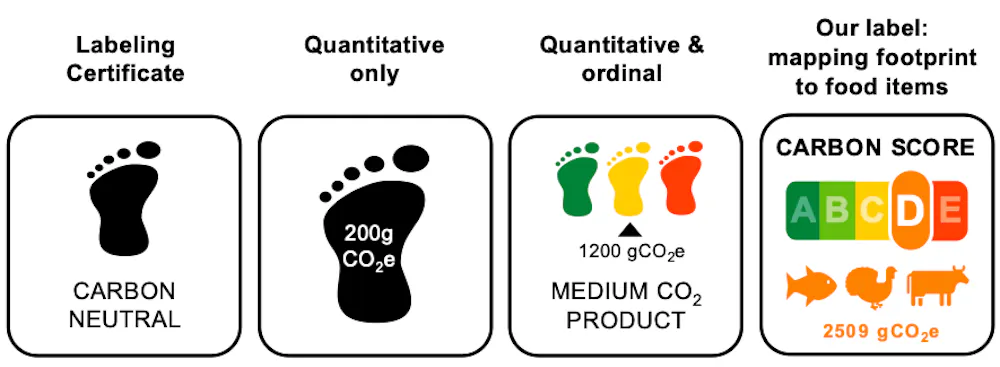
    Most carbon labels follow a similar approach. They typically display a number representing greenhouse gas emissions, and a traffic-light system indicating the level of environmental impact from green (low) to red (high). But such labels do not indicate whether the food is animal- or plant-based. So a high carbon score does not help people identify the source of the emissions.

    Our label maps the carbon footprint to the source of the food, whether plant or animal, along with information about the greenhouse gas emissions.
    Romain Cadario, Yi Li, Anne-Kathrin Klesse, (2025) Appetite., CC BY

    We designed a new type of label. It clearly displays whether the food is sourced mainly from animals or plants, along with the standard emissions score and traffic-light colour code. This approach is especially useful for the growing segment of pre-prepared and packaged foods such as soups and other ready-to-eat meals, which often contain a mix of meat and plant-based food.

    Our label creates a mental link between a food source and its carbon impact. When a consumer sees high carbon scores and red traffic lights appearing more frequently on meat and other animal products, they begin to make the connection between those products and higher emissions. This is key to addressing a lack of knowledge around food carbon emissions.

    We tested our label against the existing labels in a series of experiments with 1,817 everyday consumers from Australia, the United States and the Netherlands.

    One experiment involved soup. Compared with the group exposed to the standard carbon label, the group exposed to our label learned to associate animal-based soups with higher greenhouse gas emissions more effectively. They were more accurate at estimating the greenhouse gas emissions of a second batch of soups without labels.

    This improved knowledge also translates to more climate-friendly food choices. In another experiment with Australian consumers, we encouraged participants to choose five meals from ten options. Five were animal-based and five were plant-based.

    Half the participants saw the meal options with our carbon labels, and the other half did not see the carbon labels. The group exposed to our carbon labels chose fewer animal-based options in their weekly meal plan. In this case, we don’t know whether a third group exposed to the standard label would also make more climate-friendly choices, but our earlier experiments suggested our label was more effective.

    In the final experiment conducted in the Netherlands, displaying our carbon label made university students more likely to choose the plant-based snack option rather than the animal-based option.

    Providing information about the source of the food, whether plant or animal, influenced choices of meal plans.
    Romain Cadario, Yi Li, Anne-Kathrin Klesse, (2025) Appetite., CC BY

    When knowledge isn’t enough

    While people who care most about sustainable eating may think they know better than others, we found that is not the case. These people were not better able than other participants to tell the difference in greenhouse gas emissions between animal- and plant-based foods without seeing our carbon label.

    But they were better learners. When confronted with the facts about the differences between animal and plant-based foods on our labels, they were more likely to change their choices and switch to plant-based foods.

    What this means for consumers and businesses

    A simple change to food labels could help consumers make more informed environmental choices. For businesses and policymakers, it shows displaying only carbon numbers isn’t enough – the food source is crucial.

    Some forward-thinking restaurants and food companies are already experimenting with adding carbon labels to the menu to encourage diners to choose climate-friendly dishes. Our research suggests this approach could be more effective when combined with the new carbon labels we designed.

    Meat products make a significant contribution to climate change.
    Valmedia, Shutterstock

    Implications for climate action

    As Australia grapples with meeting its climate commitments, helping consumers understand the environmental impact of their food choices will become increasingly important.

    The challenge for businesses, policymakers and researchers isn’t convincing people to care about sustainability – they already do. Almost half of Australian shoppers (46%) say sustainability is important to them and influences their purchases, despite cost-of-living pressures.

    But most sustainable actions in retail involve recyclable packaging, products and materials, and local produce. The carbon emission implications of these actions, sadly, are far less than reducing animal-based food consumption.

    Instead, we need to focus on giving people the tools to make their environmental concerns count. Our carbon labels could be the key to helping consumers turn their sustainable intentions into meaningful climate action.

    Yi Li does not work for, consult, own shares in or receive funding from any company or organisation that would benefit from this article, and has disclosed no relevant affiliations beyond their academic appointment.

    ref. Want a side of CO₂ with that? Better food labels help us choose more climate-friendly foods – https://theconversation.com/want-a-side-of-co-with-that-better-food-labels-help-us-choose-more-climate-friendly-foods-250513

    MIL OSI AnalysisEveningReport.nz

  • MIL-Evening Report: Calculating the economic cost of climate change is tricky, even futile – it’s also a distraction

    Source: The Conversation (Au and NZ) – By Dennis Wesselbaum, Associate Professor, Department of Economics, University of Otago

    Piyaset/Shutterstock

    Climate change is no longer a distant threat. It’s here, it’s real and it increasingly affects us all.

    But predicting climate change and its associated costs, particularly over long periods of time, is inherently uncertain. And based on the best available evidence from organisations such as the United Nations’ Intergovernmental Panel on Climate Change, the economic costs of climate change appear to be small – making this a relatively weak argument for environmental action.

    At its most basic, climate is the long-term average of the weather we experience. Or, as former president of the American Meteorological Society, Marshall Shepherd, famously put it, “weather is your mood, and climate is your personality”.

    It’s widely accepted that climate change refers to a shift in long-term weather patterns, typically driven by human activities.

    But the impact of climate change, ranging from rising temperatures and extreme weather events to health impacts and disruptions to food and water supply, varies greatly. Some areas experience more extreme impacts than others, exacerbating social and economic disparities.

    There also appears to be a false sense about our state of knowledge. For example, many believe climate change already causes more frequent and intense storms, but the evidence for this is inconclusive.

    Trying to predict the unpredictable

    To understand the economic costs of climate change, we must first grasp how climate affects socioeconomic outcomes.

    The relationship between temperature and socioeconomic outcomes can be modelled using a “dose-response” function, which shows how much a given change in temperature (the “dose”) influences the outcome (for example, temperature-related mortality).

    A key challenge is to understand the shape of the dose-response function. Is the relationship between temperature and mortality linear or is it more complex? Does it have thresholds beyond which the effects substantially change? Is there only one function or are there different ones for different populations?

    As climate change shifts the distribution of weather variables, it alters the outcomes as well. Yet, predicting how these distributions will evolve is difficult.

    The further into the future we look, the harder it is to make reliable predictions about both weather and the associated economic costs.

    If you were asked in 1925 to predict the economy in 2000, for example, how accurate would you have been? In 1925 you drove a Ford Model T, used coal-fired steam trains and passenger ships for travel, and a trip from London to Auckland took up to eight weeks by sea. You used a telegraph for long-distance communication and a radio for entertainment.

    Compare that with the globalised, interconnected economy of the year 2000. Given the technological advancements, would your prediction have been even close?

    Rather than focusing on the uncertain future economic costs of climate change, we should be addressing how it is affecting human life now.
    James Andrews1/Shutterstock

    Cost estimates

    There are a wide range of estimates on the economic costs of climate change. But one of the most reliable has come from the UN’s Intergovernmental Panel on Climate Change.

    The panel’s latest assessment report avoids quantifying the economic costs of climate change. So, to understand the economic costs of climate change, we can use the best estimate based on the previous report and the insights from meta studies. These analyses posit a temperature rise of 3.7°C will reduce global gross domestic product (GDP) by about 2.6% (ranging from 0.5 to 8.2%) by 2100.

    For New Zealand, this is equivalent to about NZ$11 billion, or twice the cost of Auckland’s City Rail Link.

    However, this comparison is extremely misleading. The value of 2.6% today will differ substantially from 2.6% in 75 years.

    The New Zealand economy grew at a compound annual rate of 1.4% between 1960 and 2000. Using this same average growth rate, New Zealanders will have a 184% higher standard of living in 2100. If nothing is done to address climate change, and given the best cost estimate, our standard of living would still be 176% higher than it is now.

    Reporting costs

    There are also issues with how some people report costs. For instance, while the total damage caused by floods and hurricanes in the United States has gone up in dollar amounts, it has not actually increased as a percentage of peoples’ incomes.

    In this context, it is crucial to distinguish between the damage caused by climate change and that resulting from human activities – such as the construction of more houses, higher property prices and river management practices.

    The economic costs of climate change based on the best available evidence appear to be small and highly uncertain.

    Shifting the focus

    Even if we accept our best estimates, economic costs are not the issue, but saving the environment is.

    Instead of focusing the debate of climate change around economic costs, we need to refocus the debate on tangible impacts happening right now: retreating glaciers, species extinction, shifting seasons and coastal erosion, to name a few.

    Addressing these issues is costly, but action will be needed to save the environment and ensure a liveable world into the future.

    Dennis Wesselbaum does not work for, consult, own shares in or receive funding from any company or organisation that would benefit from this article, and has disclosed no relevant affiliations beyond their academic appointment.

    ref. Calculating the economic cost of climate change is tricky, even futile – it’s also a distraction – https://theconversation.com/calculating-the-economic-cost-of-climate-change-is-tricky-even-futile-its-also-a-distraction-248862

    MIL OSI AnalysisEveningReport.nz

  • MIL-OSI: Targa Resources Corp. Prices $2.0 Billion Offering of Senior Notes

    Source: GlobeNewswire (MIL-OSI)

    HOUSTON, Feb. 24, 2025 (GLOBE NEWSWIRE) — Targa Resources Corp. (“Targa” or the “Company”) (NYSE: TRGP) announced today the pricing of an underwritten public offering (the “Offering”) of $1.0 billion aggregate principal amount of its 5.550% Senior Notes due 2035 and $1.0 billion aggregate principal amount of its 6.125% Senior Notes due 2055 at a price to the public of 99.610% and 99.781% of their face value, respectively. The Offering is expected to close on February 27, 2025, subject to the satisfaction of customary closing conditions.

    The Company expects to use a portion of the net proceeds from the Offering to fund the repurchase from the Company’s joint venture partner of all of the outstanding preferred equity in Targa Badlands LLC, the entity that holds all of the Company’s North Dakota assets, for approximately $1.8 billion in cash (the “Badlands Transaction”). The Company expects the Badlands Transaction to close in the first quarter of 2025, subject to customary closing conditions, with an effective date of January 1, 2025. The closing of the Offering is not contingent on the consummation of the Badlands Transaction. The Company expects to use the remaining net proceeds from the Offering for general corporate purposes, including to repay borrowings under its unsecured commercial paper note program (the “Commercial Paper Program”). If the Company does not complete the Badlands Transaction, the Company expects to use the net proceeds from the Offering for general corporate purposes, including to repay borrowings under the Commercial Paper Program, repay other indebtedness, for capital expenditures, for additions to working capital and for investments in its subsidiaries.

    This Offering is being made pursuant to an effective shelf registration statement and prospectus filed by the Company with the U.S. Securities and Exchange Commission (the “SEC”) and may be made only by means of a prospectus and prospectus supplement related to such Offering meeting the requirements of Section 10 of the Securities Act of 1933, as amended (the “Securities Act”). This announcement shall not constitute an offer to sell or a solicitation of an offer to buy any of these securities, except as required by law.

    About Targa Resources Corp.

    Targa Resources Corp. (NYSE: TRGP) is a leading provider of midstream services and is one of the largest independent infrastructure companies in North America. The Company owns, operates, acquires, and develops a diversified portfolio of complementary domestic infrastructure assets and its operations are critical to the efficient, safe and reliable delivery of energy across the United States and increasingly to the world. The Company’s assets connect natural gas and natural gas liquids (“NGL(s)”) to domestic and international markets with growing demand for cleaner fuels and feedstocks. The Company is primarily engaged in the business of: gathering, compressing, treating, processing, transporting, and purchasing and selling natural gas; transporting, storing, fractionating, treating, and purchasing and selling NGLs and NGL products, including services to liquified petroleum gas exporters; and gathering, storing, terminaling, and purchasing and selling crude oil.

    The principal executive offices of Targa Resources Corp. are located at 811 Louisiana, Suite 2100, Houston, TX 77002, and its telephone number is 713-584-1000.

    Forward-Looking Statements

    Certain statements in this release are “forward-looking statements” within the meaning of Section 27A of the Securities Act, and Section 21E of the Securities Exchange Act of 1934, as amended. All statements, other than statements of historical facts, included in this release that address activities, events or developments that the Company expects, believes or anticipates will or may occur in the future, are forward-looking statements, including the closing of the Badlands Transaction and the expected closing date and use of proceeds from the Offering. These forward-looking statements rely on a number of assumptions concerning future events and are subject to a number of uncertainties, factors and risks, many of which are outside the Company’s control, which could cause results to differ materially from those expected by management of the Company. Such risks and uncertainties include, but are not limited to, those described more fully in the Company’s filings with the SEC, including its most recent Annual Report on Form 10-K. The Company does not undertake an obligation to update or revise any forward-looking statement, whether as a result of new information, future events or otherwise.

    Targa Investor Relations
    InvestorRelations@targaresources.com
    (713) 584-1133

    The MIL Network

  • MIL-OSI: BitMart Research: BNB Chain’s Rise and the Activation of the MEME Track Competition Landscape

    Source: GlobeNewswire (MIL-OSI)

    Mahe, Seychelles, Feb. 24, 2025 (GLOBE NEWSWIRE) — BitMart Research, the research arm of BitMart Exchange, has released a detailed report on BNB Chain’s recent rise and the competitive MEME token landscape. This report explores BNB Chain’s strategic initiatives, its growing influence in the MEME sector, and the implications for investorsdevelopers, and the broader crypto ecosystem.

    I. BNB Chain’s Three Major Strategies: CZ Traffic Diversion, Infrastructure Optimization, and Wealth Effect Creation

    In the context of a sluggish overall market, CZ successfully brought a new wave of traffic and market discussion to BNB Chain. The recent surge in popularity of BNB Chain is largely attributed to CZ’s continuous topic creation through high-frequency Twitter interactions and controversial token listing decisions, such as TST and Broccoli events, which generated FOMO emotions and attracted investors’ attention, thereby driving traffic to BNB Chain.
    Simultaneously, BNB Chain announced its development plans for 2025, further creating an environment for users to trade MEME tokens. Notably, BNB Chain has made significant upgrades in Gas fees, including reducing Gas fees, supporting multiple tokens for Gas payments, and introducing a feature that allows project teams to sponsor users’ Gas fees. These measures aim to lower the barriers for users to enter the Web3 ecosystem and enhance user experience.

    II. Recent Major Events in BNB Chain

    1. TST: From a Teaching Token to a Market FOMO Wave
      On February 6, the BNB Chain team accidentally exposed the contract address of the example token TST in a teaching video on the Four.meme platform. Chinese community KOLs quickly hyped it, causing its market capitalization to soar from less than 500K to52 million. Despite CZ clarifying multiple times that TST was not an official token and that the team did not hold any shares, market enthusiasm continued to rise. On February 9, Binance announced the listing of TST spot and futures trading, and its market capitalization surged 100 times in just three days, breaking through $500 million, becoming a “star asset” in the BNB Chain ecosystem. After this event, BNB Chain’s popularity briefly surpassed Solana, and Four.meme’s traffic surged, becoming one of the core platforms for MEME token issuance.

    2. BNB Chain Announces 2025 Strategic Roadmap
    On February 11, CZ stated that it was time for the BNB Chain to break free from constraints. Subsequently, on February 12, BNB Chain announced its 2025 ecosystem construction goals, revealing several network upgrades. Following this announcement, BNB broke through 640,reaching peak 725, significantly increasing market enthusiasm.

    • Low Latency and High Throughput: Plans to reduce block generation time from 3 seconds to less than 1 second while maintaining the ability to process 100 million transactions per day, enhancing Web3 speed, smoothness, and scalability.
    • Gas Fee-Free Transaction Mechanism: Introducing BNB Chain Paymaster, allowing users to pay Gas fees with any BEP-20 token (not BNB or stablecoins) and introducing a corporate sponsorship Gas model, similar to SUI and Aptos.
    • Anti-MEV Protection Mechanism: To address the over $1.3 billion in MEV losses in 2024, BNB Chain will hide transaction details until block confirmation to combat sandwich attacks and front-running robots. Establishing private transaction pool relay systems, implementing punishment and blacklist mechanisms for violating validators, and expelling MEV abusers through community governance.
    • Smart Wallet Upgrade: Compatible with EIP-7702 standard, supporting batch transactions and one-click operations (such as cross-chain swaps). Future integration of AI assistants to provide portfolio management, MEV risk warnings, and trading strategy optimization.
    • AI-Priority Infrastructure: Auditing smart contract vulnerabilities through code assistants (Code Copilot), reducing development barriers; DataDAOs supporting users in monetizing private data; Trusted Execution Environments (TEEs) providing a secure sandbox for AI agents in DeFi.
    • MEME Token Ecosystem Support: Launching no-code token issuance tools and liquidity solutions to replicate Solana’s MEME fever, while reducing fraud risks through review mechanisms.

    3. Broccoli: CZ Pushes BNB Chain’s Popularity to a Peak
    After the TST price surge following CZ’s mention, CZ’s actions became the focus of MEME players. On February 13, CZ tweeted about the operation mechanism of MEME tokens, asking if creating a token only required sharing a pet’s name and photo. After understanding the mechanism, CZ expressed interest in how it worked. On February 14, CZ announced a pet dog named Broccoli without providing an official contract address, leading to thousands of tokens with the same name appearing on the BSC chain overnight. Countless players rushed to trade on BNB Chain, causing congestion and website crashes on Four.meme. CZ later stated that this “pressure test” exposed technical issues that still needed optimization on the BSC chain. Although CZ repeatedly emphasized that he did not issue any tokens, Binance Alpha listed three Broccoli-related projects on February 19, indirectly indicating his tacit approval of the MEME fever-driven traffic dividend.

    4. SHELL: Chain Staking Activity Triggers a Capital Siphon
    On February 13, BNB Chain, in collaboration with Binance Wallet and PancakeSwap, launched a public offering event for MyShell token SHELL. Backed by Binance Labs’ investment background, the event oversubscribed by 105 times, attracting over 130,000 BNB for subscription. This event not only boosted BNB Chain’s popularity but also drainage Binance Wallet.

    III. Analysis of BNB Chain’s Current Situation and Future Challenges

    1. Competitive Analysis
      BNB Chain vs. Solana According to Nansen’s on-chain data, since early February when CZ drove traffic to BNB Chain through high-frequency tweets, the chain’s active address count has shown explosive growth. On February 18, the single-day active address count exceeded 2.8 million, setting a historical peak in the past 12 months, while Solana’s active address count declined by 36% during the same period. However, Solana’s daily active address count still remains above 4 million.

    (Data Source: Nansen)

    Four.meme vs. Pump.fun According to Dune’s data, Pump.fun platform maintained a monopoly position with over 100,000 new accounts per day before February due to its first-mover advantage. However, with Four.meme leveraging the traffic dividend from the BNB Chain ecosystem, the industry landscape has undergone a significant reshuffle. By February 17, Pump.fun’s new account count had halved to 50,000/day, while Four.meme’s count soared from less than 500 to over 20,000/day. Although Four.meme’s current scale is only 40% of Pump.fun’s, its weekly growth rate of 325% has made it one of the important MEME launch platforms.

     
    (Data Source: Dune)

    (Data Source: Dune)

    2. BNB Chain Drives a New Round of MEME Fever in the Short Term
    More significantly, on February 14, when CZ disclosed the pet dog “Broccoli,” causing a frenzy of imitation tokens, BNB Chain’s network Gas fees surged to $0.43 in an instant, setting a new high since January 2022. This data confirms the success of CZ’s traffic diversion strategy, bringing new active users to the previously sluggish BNB Chain. Combining CZ’s recent actions and BNB’s innovative plans, it can be inferred that MEME will be one of the main development goals for BNB Chain in 2023. Currently, under the influence of Binance’s traffic, BNB Chain has initiated the first phase of MEME fever. In the current market lacking new narrative drivers, BNB Chain may continue to rely on MEME token popularity to maintain market attention, and high-return MEME projects may still emerge in the BNB Chain ecosystem in the short term.

    (Data Source: BNB Chain)

    3. Future Challenges
    However, BNB Chain faces multiple challenges in replicating Solana’s MEME fever. The main challenge is the recent trust crisis in the MEME track. Due to MEME tokens launched by Trump and Argentine President couples causing significant user losses, frequent token launches by presidents and celebrities have harvested a large amount of liquidity from the crypto market and severely damaged market confidence. It may be difficult to restore investor trust in the future. Additionally, the current crypto market is affected by Trump’s transaction cooling down, macroeconomic conditions, and policies, showing a general trend of continuous volatility and downward movement. Following the Adjustment of BTC, altcoins have experienced significant declines. Previously popular Ai Age tokens have also seen significant price drops.

     4. Potential Impact
    With BNB Chain regaining market attention through strategic upgrades and the MEME craze, Solana, which previously dominated the MEME sector almost single-handedly, now faces a new competitor. The rapid rise of the BNB Chain has put unprecedented competitive pressure on Solana, potentially driving it to accelerate technological upgrades and ecosystem reforms. Furthermore, BNB Chain’s success has demonstrated new opportunities for other blockchain ecosystems. More chains may adopt BNB Chain’s “event-driven marketing + technical upgrades + wealth effect” strategy to promote their own ecosystems, potentially sparking a new wave of market enthusiasm.

    About BitMart
    BitMart is the premier global digital asset trading platform. With millions of users worldwide and ranked among the top crypto exchanges on CoinGecko, it currently offers 1,700+ trading pairs with competitive trading fees. Constantly evolving and growing, BitMart is interested in crypto’s potential to drive innovation and promote financial inclusion. To learn more about BitMart, visit their Website, follow their X (Twitter), or join their Telegram for updates, news, and promotions. Download BitMart App to trade anytime, anywhere. 

    Risk Warning
    Note: All cryptocurrency investments, including yield products, are highly speculative and involve significant risks. Past performance of products cannot guarantee future results. Cryptocurrency markets are highly volatile, and before making any investment decisions, you should carefully assess whether it is suitable for trading or holding digital currencies based on your investment objectives, financial situation, and risk tolerance, and consult a professional financial advisor. The information in this article is for reference only and does not constitute any investment, legal, or tax advice. The author and publisher do not assume responsibility for any losses incurred due to the use of this information.

    The MIL Network

  • MIL-OSI: MMP Capital Opens up New Satellite Office in New Hampshire

    Source: GlobeNewswire (MIL-OSI)

    Photo Credit MMP Capital

    PORTSMOUTH, N.H., Feb. 24, 2025 (GLOBE NEWSWIRE) — MMP Capital, a Long Island-based private lending company specializing in equipment financing, and small business lending in general, has announced the opening of its first satellite office in Portsmouth, New Hampshire. This expansion is a significant milestone for the company, which has operated exclusively out of its Long Island headquarters for the past 12 years.

    The new office will be led by industry veteran George Atkins, who joins MMP Capital with a mission to diversify the company into new verticals while maintaining its reputation for excellence in healthcare finance. 

    John-Paul Smolenski, founder and CEO of MMP Capital, speaks on the importance of this expansion, “Opening our Portsmouth office is about both growth and returning to our roots, positioning ourselves for long-term success. George Atkins is the perfect person to lead this effort. His skill and vision will be instrumental as we continue to expand our reach and capabilities.

    George Atkins, regarded as one of the most influential figures in equipment finance, brings decades of experience to his new role at MMP Capital. His leadership is expected to drive development and open new opportunities for the company. He says, “The Portsmouth NH area has some of the most talented equipment finance reps anywhere, and we expect to grow the MMP brand and customer base rapidly and successfully with a great team of tenured professionals.

    Jim Siederman, Executive Vice President at MMP Capital, likened Atkins’ addition to a game-changing moment, “George Atkins is hands down on the Mount Rushmore of Equipment Finance in the 21st Century. His work ethic, discipline, and passion for greatness personify everything we stand for at MMP Capital.

    Establishing a presence in Portsmouth reflects MMP Capital’s commitment to expanding its footprint while staying true to its core values. The company aims to use Atkins’ leadership to explore emerging opportunities and further solidify its reputation.

    Smolenski further elaborates on how this move aligns with the company’s broader strategy, “This expansion is an essential part of our financial planning as we look ahead into 2025 and beyond. Having flexible capital and experienced leadership like George Atkins makes sure that we can meet growing demand without losing the high standards our clients expect.

    About MMP Capital 

    MMP Capital was founded in 2013 with a mission to be the gold standard in healthcare equipment finance in the U.S. Led by a management team with vast experience in sales, credit, and operations from several banks, leasing companies, and funding institutions, MMP Capital is uniquely equipped as a hybrid lender to lend directly or utilize a vast syndication outlet. Our financing options for equipment financing, leasing, and unsecured capital offer U.S. businesses the opportunity to invest in their future, update outdated technology, or offer new services to customers.  

    For Employment Opportunities In the New Hampshire Area Contact:

    Gina Stallone

    Human Resources Manager

    MMP Capital

    gstallone@mmpcapital.com

    Media Contact: 

    Contact Person: Jamie O’Connor, Director of Marketing & Branding

    Organization: MMP Capital

    Email: JOConnor@MMPCapital.com

    Website: www.mmpcapital.com

    A photo accompanying this announcement is available at https://www.globenewswire.com/NewsRoom/AttachmentNg/057a5e21-82e3-41c6-9540-1f99bece85a7

    The MIL Network

  • MIL-OSI China: Ministry aims to bring an end to heavy pollution days

    Source: China State Council Information Office 2

    China has effectively halted the rise of ozone pollution and stabilized its concentration levels as air quality continues to improve, the Ministry of Ecology and Environment said on Monday.
    The country’s average ozone density in 2024 was 143.6 micrograms per cubic meter, a decrease of 2.7 percent compared with 2019, said Li Tianwei, head of the ministry’s Department of Atmospheric Environment.
    The ministry aims to eliminate days with heavy pollution this year, despite expecting less favorable weather conditions, Li said, adding that it plans to further reduce emissions by advancing clean heating, ultralow emission transformation, volatile organic chemical controls and transportation sector management.
    “We will holistically transform the structures of industry, energy consumption and transportation toward green, low-carbon development,” he said.
    The density of the pollutant has remained between 144 and 145 micrograms per cubic meter for three consecutive years, marking a turning point after years of increase, Li said. “This means the upward trend of ozone density since 2015 has been preliminarily curbed,” he added.
    According to the ministry, ozone pollution in China peaked at 148 micrograms per cubic meter in 2019, after rising steadily for several years.
    While the ozone layer in the upper atmosphere protects humans against harmful ultraviolet radiation, ground-level ozone is a pollutant that can cause respiratory issues and lung damage even at relatively low concentrations.
    Ozone pollution is most prevalent in summer. Ozone at ground level is formed when volatile organic chemicals and nitrogen oxides, partially from vehicle emissions, react in sunlight and under high temperatures.
    Li said the stabilization of ozone levels coincides with China’s overall improvement in air quality, helped by stricter pollution controls and favorable meteorological conditions, including fewer sand and dust storms.
    Li credited the improvement to emission reduction efforts in key sectors, highlighting progress in the steel industry. Ultralow emission upgrades have been completed for 130 million metric tons of production capacity, he said, adding that more than 80 percent of the steel industry has been upgraded.
    Despite economic challenges and external pressures, China’s average concentration of PM2.5 — fine particulate matter linked to health risks — fell to 29.3 micrograms per cubic meter last year, down 2.7 percent compared with the previous year.
    The proportion of days with “fairly good” air quality reached 87.2 percent in 2024, an increase of 1.7 percentage points from 2023 and the highest since 2021.
    Meanwhile, the proportion of days with heavy pollution or worse in 2024 dropped to 0.9 percent, the lowest so far this decade and a year-on-year decrease of 0.7 percentage point.

    MIL OSI China News

  • MIL-OSI China: US’ restrictive trade moves to be self-harming

    Source: China State Council Information Office

    China has called on the United States to adhere to international rules and end misguided policies, warning that it will take necessary measures to safeguard its legitimate rights, the Ministry of Commerce said on Sunday.

    On Friday, the Office of the United States Trade Representative invited comments from the public on proposed Section 301 actions aimed at China’s maritime, logistics and shipbuilding sectors.

    The US’ proposed restrictive measures, such as levying port fees, would be self-harming and have detrimental effects, according to an online statement issued by the Commerce Ministry.

    The statement said these moves would not only fail to revive the US shipbuilding industry, but also increase transportation costs on US-related shipping routes and intensify domestic inflationary pressures.

    The moves would diminish the global competitiveness of US goods and negatively affect the interests of US port and terminal operators, as well as their workers, it added.

    Since March 2024, China and the US have held multiple rounds of talks on the proposed actions. China has repeatedly expressed its stance on the Section 301 investigation, urging the US to be rational and objective, and to stop blaming China for its own industrial development issues.

    The ministry noted that a panel of the World Trade Organization has ruled that US imposition of Section 301 tariffs on China is in breach of WTO regulations. The misuse of the Section 301 investigation mechanism, driven by the US’ domestic political needs, continues to erode the multilateral trading system, the ministry said.

    Liao Fan, a professor of international law at the University of Chinese Academy of Social Sciences in Beijing, said that to counter rising protectionism and the weaponization of unilateral sanctions, WTO reform is urgently needed to address systemic issues, such as chronic underfunding and weak enforcement mechanisms.

    John Quelch, executive vice-chancellor of Duke Kunshan University in Kunshan, Jiangsu province, warned that international trade is entering a dangerous “Wild West” era, in which weaker economies and small countries more dependent on international trade are likely to suffer the most.

    “China needs to redouble its efforts to increase trade with Global South countries, gradually reducing dependence on traditional markets,” Quelch said, adding, “China should further stimulate domestic consumption if a global tariff war slows down international trade.”

    Guangxi Yuchai Machinery Co, an automotive engine manufacturer in Yulin, Guangxi Zhuang autonomous region, is already expanding into emerging markets.

    “We have leveraged multiple cooperation mechanisms and trade deals, such as the Belt and Road Initiative and the Regional Comprehensive Economic Partnership, to actively participate in international trade shows and establish new plants in Thailand and Vietnam in recent years. Our export value jumped 73 percent year-on-year in January, hitting a record high for a single month,” said Liu Hongbo, president of marketing at Guangxi Yuchai’s overseas business unit.

    “We have broadened our customer base in key regions, including Southeast Asia and the Middle East, while diversifying our market structure to reduce risks associated with overreliance on any single market,” Liu added.

    MIL OSI China News

  • MIL-OSI China: China rebukes US over new investment curbs, vows to defend interests

    Source: China State Council Information Office

    An aerial drone photo shows U.S. carmaker Tesla’s Megafactory in Shanghai, east China, Feb. 8, 2025. [Photo/Xinhua]

    By shutting out Chinese enterprises and the Chinese market, the United States will end up hurting its own economic interests and international credibility, foreign ministry spokesperson Lin Jian said on Monday.

    Lin made the remarks at a regular press briefing while commenting on a memorandum released by the United States on Friday, which outlined further restrictions on two-way investment with China.

    The memorandum listed China as a “foreign adversary” on national security grounds and imposed various discriminatory measures, Lin said. “We strongly deplore and firmly oppose this and have lodged serious protests with the U.S. side.”

    The tightening of security reviews targeting Chinese investments in the United States severely hits the confidence of Chinese companies in investing in the United States and undermines the U.S. business environment. Increasing restrictions on U.S. investment in China is artificially interfering with the independent decision-making of U.S. companies and distorting the flow of investment exchanges between the two countries, Lin said.

    “China urges the United States to abide by international investment and trade rules, respect the laws of market economy, and stop politicizing and weaponizing economic and trade issues,” the spokesperson said.

    China also calls on the United States to stop undermining China’s legitimate development rights, he added, stressing that China would take all necessary measures to firmly safeguard its legitimate rights and interests.

    In response to U.S. restrictions on China’s shipbuilding industry and other related sectors, Lin said that the United States, driven by domestic political interests, had abused the Section 301 investigation mechanism, thereby seriously violating WTO rules and further damaging the multilateral trading system. “China is strongly dissatisfied with this and firmly opposes it,” Lin said.

    “We urge the United States to respect facts and multilateral rules, and immediately stop its wrong actions. China will take necessary measures to defend its legitimate rights and interests,” Lin added.

    MIL OSI China News

  • MIL-OSI China: Chinese Spring Festival cultural event held in Switzerland

    Source: China State Council Information Office 3

    The “Hello China” Spring Festival cultural experience event, jointly organized by the Schaffhausen Chinese Association and the Chinese Tourism Office in Zurich, was held on Sunday in central Schaffhausen, a northwestern city in Switzerland.

    “Ancient Chinese landscape artworks, contemporary photographs of Inner Mongolian scenery, and a dancing robot made in China – all of these have left a deep impression on people,” Peter Hediger, a Swiss resident who once lived in China, told Xinhua at the event.

    Hediger expressed his admiration for the landscape photographs and traditional Chinese paintings on display, noting that the most surprising element was the artificial intelligence dancing robot. “This represents China’s development and is worth learning from for Switzerland,” he said.

    “This year marks the first Chinese Spring Festival recorded in the UNESCO World Intangible Cultural Heritage List, and it is also the China-Switzerland Cultural Tourism Year,” said Jia Kejie, president of the Schaffhausen Chinese Association. “We organized this event with the theme ‘Hello China’ in collaboration with the Chinese Tourism Office in Zurich, hoping to deepen Swiss understanding of Chinese culture and its people.”

    The Spring Festival experience area combined traditional and contemporary Chinese elements, featuring red snake-year mascots, Chinese drama masks, and the traditional musical instrument Guzheng.

    In addition, a Unitree dancing robot attracted considerable attention as many people rushed to shake hands with it. “A robot is here – it’s so cool!” one attendee exclaimed.

    “Today is the 26th day of the first lunar month in the Chinese calendar. According to Chinese tradition, we are still celebrating the Spring Festival,” said Liu Haisheng, head of the Chinese Tourism Office in Zurich. He expressed his hope that the event would introduce the Chinese Spring Festival to the Swiss public and encourage more Swiss citizens to travel to China.

    Richard Furrer, who previously worked for the Chinese branch of a Swiss manufacturer, has served as the legal advisor for the Schaffhausen Chinese Association for ten years. After studying Mandarin for eight years to communicate with his Chinese colleagues, Furrer now provides voluntary legal aid to Chinese people in Switzerland following his retirement.

    Christoph Melki, a reporter for Schaffhausen Weekly, carefully documented the event with photographs. “I knew nothing about the Spring Festival before,” he told Xinhua. “Perhaps only by experiencing the Spring Festival in China in person can we truly understand its meaning,” he added, hinting that he might travel to China next year.

    MIL OSI China News

  • MIL-OSI China: Silk Road-themed art exhibition opens in Istanbul

    Source: China State Council Information Office 3

    An international art exhibition opened in Türkiye’s Istanbul on Monday, highlighting the cultural connections among China, Türkiye, and other nations along the Silk Road.

    The opening took place in the Maltepe district of Istanbul, attracting a varied audience that included university students, scholars, diplomats from the Chinese consulate in Istanbul, and representatives from the Maltepe Municipality.

    The exhibition showcased nearly 100 exceptional works of art from 34 artists from China, Türkiye, Russia, Iran, and Uzbekistan.

    It also presented a diverse array of artistic expressions, including calligraphy, painting, sculpture, and carpet art, showcasing the rich cultural heritage of participating nations.

    MIL OSI China News

  • MIL-OSI China: Parkinson’s possible to be blocked thanks to Chinese scientists’ breakthrough research

    Source: China State Council Information Office 2

    Chinese scientists have discovered a novel therapeutic target for Parkinson’s disease, a neurodegenerative condition with high disability and mortality rates, and have successfully identified a potentially effective small molecule drug.
    The breakthrough, achieved by a team from Huashan Hospital affiliated with Fudan University in Shanghai, holds promise for early intervention in Parkinson’s disease, offering patients renewed hope for delaying its progression. The research was published in the prestigious academic journal Science on Friday (Beijing time).
    The battle against Parkinson’s disease, the second most common neurodegenerative disorder after Alzheimer’s, has been ongoing for years. There are approximately 3 million Parkinson’s patients in China, roughly half of the global total.
    People diagnosed with Parkinson’s disease may initially experience a reduced sense of smell and sleep disorders, eventually developing more severe movement-related symptoms. As the disease progresses, the effectiveness of medications often declines, leading to a significant deterioration in quality of life.
    Unfortunately, previous drugs and surgical therapies have only addressed the symptoms of Parkinson’s disease, failing to prevent its progression. As a result, further in-depth research into the disease’s pathophysiology and targeted treatments is crucial, according to the scientists.
    After five years of persistent efforts, the team identified FAM171A2 as a key risk gene for neurodegeneration. Using artificial intelligence, they screened over 7,000 approved compounds and pinpointed bemcentinib, an anti-cancer agent currently in clinical trials, as a promising lead candidate.
    The small molecule drug has been shown to effectively block the binding between FAM171A2 and the pathogenic protein, according to the research team.
    Yu Jintai, leader of the team, said that, based on an international patent, they will focus on the pre-clinical research and development of small-molecule drugs, antibodies and gene therapies for Parkinson’s disease in the coming years, with the aim of advancing clinical trials and applications to develop an innovative therapeutic system.
    People over the age of 60 are more susceptible to Parkinson’s disease. As China’s population continues to age, this new medical breakthrough has sparked hope within both the academic and medical communities, as well as among patients, with the expectation that the research will have practical applications in the near future.
    “The experimental results have helped us accurately figure out the pathophysiological mechanisms of Parkinson’s disease, creating a real chance of overcoming a battle that has long seemed insurmountable,” said Wang Jian, director of the neurology department at Huashan Hospital, which is also a national medical center for neurological diseases.
    A referee for Science praised the discovery as a “holy grail” in Parkinson’s research, highlighting its potential to lead to therapies that can block the spread of pathology and, consequently, the disease itself.
    Neurological diseases, particularly those affecting the brain, such as Alzheimer’s and Parkinson’s, have become a major global public health and social challenge.
    Chinese experts have called for greater efforts in brain science research, noting that it will be crucial for developing new treatment methods, enhancing early diagnosis, detection and intervention, and ultimately improving the quality of life for patients. 

    MIL OSI China News

  • MIL-OSI China: China completes 2 new-generation marine vessels

    Source: China State Council Information Office 2

    China’s self-developed marine engineering installation vessels Zhigao and Zhiyuan were completed on Sunday in Nantong, east China’s Jiangsu Province, according to Science and Technology Daily.
    The main tasks of the two vessels are transporting wind turbines to the deep sea and conducting installations. They can operate 100 kilometers offshore, providing strong support for the country’s offshore wind power projects.
    They are the fourth generation of China’s offshore wind power engineering equipment, meaning they have strong wind and wave resistance, excellent comprehensive installation capabilities, and high operating efficiency and intelligence levels, according to the report.
    The vessels are capable of installing a set of offshore wind turbines in three days — 30 percent faster than third-generation equipment, said Zhang Weifeng, chief engineer of an ocean engineering construction company affiliated with PowerChina.
    Moreover, they are designed to withstand winds of up to force 16 and waves as high as 12 meters, Zhang said.

    MIL OSI China News

  • MIL-OSI China: China sees record-breaking inter-regional trips in travel rush

    Source: China State Council Information Office 2

    Passengers wait to board a train at Luoyang Longmen Railway Station in Luoyang, central China’s Henan Province, Feb. 22, 2025. [Photo/Xinhua]
    The total number of inter-regional passenger trips across China during the 40-day Spring Festival travel rush, also known as chunyun, reached a record of 9.02 billion, official data showed Sunday.
    The figure marked a 7.1 percent increase over the same period in 2024, according to a special work team established to facilitate sound operations during chunyun, which concluded on Saturday.
    The travel rush, often referred to as the world’s largest annual human migration, highlights China’s vast mobility and economic activity. With a steadily recovering economy and rising demand for travel, this year’s chunyun saw a robust transportation network handling unprecedented passenger volumes.
    Road traffic made up the lion’s share of these trips. During the period, about 8.39 billion trips were made by road, increasing 7.2 percent year on year.
    Railway passenger volume reached 513 million, expanding 6.1 percent year on year, setting a new record during the chunyun period, according to the China State Railway Group Co., Ltd.
    According to the Civil Aviation Administration of China, the country’s civil aviation sector recorded 90.2 million passenger trips and 739,000 flights during the period, both of which reached new historical highs.
    The Spring Festival, an occasion for family reunions, fell on Jan. 29 this year.

    MIL OSI China News

  • MIL-OSI China: China outlines key tasks to deepen rural reforms, advance rural revitalization

    Source: China State Council Information Office 2

    Agricultural machines work in fields at a farm of Beidahuang Group in northeast China’s Heilongjiang Province, Oct. 12, 2024. [Photo/Xinhua]
    China unveiled its “No. 1 central document” for 2025 on Sunday, outlining priorities to deepen rural reforms further and solid steps to advance all-around rural revitalization.
    As the first policy statement released by China’s central authorities each year, the document is seen as an indicator of policy priorities.
    The document consists of six parts covering six areas: ensuring the supply of grain and other important agricultural products, consolidating the achievements of poverty elimination, developing local industries, advancing rural construction, improving the rural governance system, and optimizing the rural resource allocation system.
    The document calls for enhanced efforts in work related to agriculture, rural areas and farmers in 2025 and beyond, and sets the goals of advancing all-around rural revitalization and consolidating the country’s agricultural foundations further.
    With reform, opening-up, and scientific and technological innovation as driving forces, the country will safeguard its grain security and ensure that no large-scale lapse or relapse into poverty occurs, the document says.
    The country will make every effort to enhance agricultural efficiency, invigorate rural areas and increase farming incomes, thereby laying a solid foundation for the advancement of Chinese modernization, the document stresses.
    It emphasizes the importance of developing new quality productive forces in agriculture in light of local conditions. It also calls for the cultivation of leading high-tech agricultural enterprises, and the acceleration of breakthroughs in crop varieties.
    China will support the development of smart agriculture and expand the application scenarios of technologies such as artificial intelligence, big data, and low-altitude systems, according to the document.
    It outlines plans to expand cold-chain logistics and instant retail services to townships, and encourages regions with suitable conditions to establish public charging and battery-swap facilities for electric vehicles.
    To promote the effective management and utilization of rural resources and assets, the document calls for the exploration of feasible ways to make good use of legally owned rural housing through methods such as leasing, equity participation and cooperation.
    The document urges innovation efforts related to the financing mechanisms for rural revitalization. Steps will be taken to strengthen support from central budget investments, ultra-long special government bonds, and special local government bonds for major projects in agriculture and rural areas. Monetary policy tools will be utilized to encourage financial institutions to increase funding for rural revitalization.
    Reforms related to forestry, state farms, and supply and marketing cooperatives will be advanced in a coordinated manner. The document stresses the importance of deepening the reform of the collective forest tenure, of enhancing comprehensive reforms of water pricing and water rights in the agricultural sector, of strengthening water usage management, and of promoting water-saving irrigation technologies.
    Eligible cities are encouraged to include their agricultural migrant populations with stable employment into the scope of local urban housing security policies gradually, the document notes.

    MIL OSI China News

  • MIL-OSI New Zealand: The Most Important Fact Schools Don’t Teach

    Source: ACT Party

    The Haps

    The Chinese navy has made a big mistake. Sending what Defence Minister Judith Collins called a ‘formidable ship’ so close to Sydney, and interrupting Air New Zealand domestic flights, shows the New Zealand public we need to spend more on defence. ACT supporters have been alone in voting for two per cent of GDP on defence, we predict there will now be more.

    We remember the Ukrainians who’ve lost their lives and their homes in the three years since the Russian invasion. Free Press remains resolute. There are basic facts that cannot be changed. Russia is the aggressor. The war is not just or legal. The breach of borders by force is dangerous to free people everywhere. We must never accept might is right, but we must build our strength so the world doesn’t end up that way.

    The Most Important Fact Schools Don’t Teach

    Schools are teaching children all sorts of things, but so far as we are aware they are not teaching the most important fact of human life. The fact they’re not teaching this fact tells us how mindless education has become, and it limits children’s thinking.

    The fact we’re talking about is the astonishing growth of human life expectancy in the last two centuries. For 100,000 years, people lived to thirty on average. Now, the global average is 72 years.

    People have different ideas about what a good life is. But (except for a few terrorists and cults), everyone agrees being alive is better than being dead. Something in the last 200 years gave us a whole extra life.

    If the education system teaches children nothing else, it should teach that something happened in the last 200 years and it doubled life expectancy. Once they know that, they can learn what works.

    We think the answer might be the problem. The education bureaucracy, academics, and teacher unions don’t want to teach that capitalism is a raging success.

    They’d have to teach about the genesis of the free market in the swamps of the Netherlands. People driven to the lowlands by violence decided to make something of themselves. They drained swamps and built dykes, creating usable land that was theirs.

    The result was a society where ordinary people could make a difference in their own lives. They demanded property rights because they’d literally created their own property. If you couldn’t take then you had to trade, and tribalism gave way to the market. It was around this time Abel Tasman discovered New Zealand for Europe.

    William of Orange, a Dutchman who became King of England, helped take the revolution across the sea, where it germinated on an island buffered from invasion. The common law and the market, along with the enlightenment made the industrial revolution possible.

    In turn the British Navy opened up the world’s sea lanes to trade, and spread their system of democracy and capitalism to the new world, ensuring it would endure for centuries even when they themselves came under attack from fascism.

    All the while ordinary people could get enough calories to be healthy, live in cities with sanitation free of disease, and medical care would stop children and their mothers dying in childbirth or shortly after. Violence that was normal for most humans most of the time, and shortened many lives, is now an exceptional event for most people most of the time.

    The revolution spread further after the Cold War, lifting billions from poverty in the East the same way they had thrived in the west. That same prosperity has raised their life expectancy too. Now the whole world lives twice as long on average as it did before the industrial revolution, but your teacher won’t dwell on that basic fact in most of the world’s schools.

    Instead we have an epidemic of anxiety and depression amongst young people. The tremendous gains of the last two centuries are barely understood. Instead the gains are banked and forgotten while children worry about comparatively small problems.

    We spend a lot of time worrying about differences between people living today when, in reality, everyone is doing vastly better than everyone was even a few generations ago. So much division, so little reality, and not enough hope.

    Imagine if the most important thing children learned was that we’ve doubled our lives in 200 years after 100,000 years of misery. That could be springboard for asking what works and building a much more hopeful future. We just need the Left to make peace with capitalism.

    MIL OSI New Zealand News

  • MIL-OSI Australia: NSW records first death of person with Japanese encephalitis since 2022

    Source: New South Wales Health – State Government

    NSW Health continues to urge the public to be vigilant and take precautions against mosquitoes as NSW records its first death of a person with Japanese encephalitis (JE) since May 2022.
    A man aged in his 70s from northern Sydney died on 23 February in a Sydney hospital, where he had been receiving care for JE since early February.
    It is likely the man acquired JE while holidaying in the Murrumbidgee region in January. This is the state’s third confirmed death from JE since the virus was first detected in NSW in 2022.
    NSW Health expresses its sincere condolences to his loved ones.
    Further, an additional case of JE has been identified in a woman in her 60s in northern NSW. She likely acquired the infection on her rural property in Tenterfield Shire and is receiving care in hospital.
    NSW Health’s Executive Director of Health Protection Dr Jeremy McAnulty said these developments are a reminder of the importance for people to take precautions against mosquitoes, including vaccination.
    “These two cases of JE virus, one of which was infected while travelling for a holiday, shows it is very important all people take precautions against mosquitoes, not just those living in affected regions,” Dr McAnulty said.
    “If you plan on travelling west of the Great Dividing Range, whether for work or holiday, and you plan to spend time outdoors, JE is a risk you must consider.
    “Thankfully, there are simple steps you can take to avoid mosquitoes, and there is also a safe and effective vaccine available.”
    JE vaccine is available through local general practitioners, Aboriginal health services and pharmacists to anyone who lives or routinely works in various inland LGAs or high-risk occupations.
    People who meet the eligibility criteria should make an appointment and let the provider know it is for the JE vaccine, as they may require a few days’ notice to order the vaccine.
    JE virus is spread by mosquitoes and can infect animals and humans. The virus cannot be transmitted between humans and it cannot be caught by eating pork or other pig products.
    There is no specific treatment for JE which, in some cases, can cause severe neurological illness with headache, convulsions, reduced consciousness and death.
    The best thing people throughout the state can do to protect themselves and their families is to take steps to avoid mosquitoes.
    Simple actions you can take include:

    Applying repellent to exposed skin. Use repellents that contain DEET, picaridin, or oil of lemon eucalyptus. Check the label for reapplication times
    Re-applying repellent regularly, particularly after swimming. Be sure to apply sunscreen first and then apply repellent
    Wearing light, loose-fitting long-sleeve shirts, long pants and covered footwear. and socks
    Avoiding going outdoors during peak mosquito times, especially dawn and dusk
    Using insecticide sprays, vapour dispensing units and mosquito coils to repel mosquitoes (mosquito coils should only be used outdoors in well-ventilated areas)
    Covering windows and doors with insect screens and checking there are no gaps
    Removing items that may collect water such as old tyres and empty pots from around your home to reduce the places where mosquitoes can breed
    Using repellents that are safe for children. Most skin repellents are safe for use on children aged three months and older. Always check the label for instructions
    Protecting infants aged less than three months by using an infant carrier draped with mosquito netting, secured along the edges
    While camping, use a tent that has fly screens to prevent mosquitoes entering or sleep under a mosquito net.

    Information on eligibility for a free JE vaccine is available on Japanese encephalitis vaccination.
    For further information on JE virus and ways to protect yourself visit Mosquito borne diseases.

    MIL OSI News