Meeting of the DEVE Committee 18 February | Highlights | Home | DEVE | Committees | European Parliament
Debates:
Exchange of views with Jakub Wiśniewski, Undersecretary of State on the priorities of the Polish Presidency;
Consideration of the draft report on Financing for development – ahead of the 4th International Conference on Financing for Development in Seville;
Consideration of draft opinion and exchange of views on BUDG draft report on a revamped long-term budget for the Union in a changing world;
Exchange of views with David Miliband CEO of the International Rescue Committee’s 2025 Emergency Watchlist;
Exchange of views with UNDP on the State of play of the implementation of the SDGs;
Exchange of views with the UN Resident Coordinator, UNODC and Human Rights Watch (HRW) on the humanitarian, security and development situation in Haiti, jointly with the Subcommittee on Human Rights and in association with the Delegation to the Caribbean-EU Parliamentary Assembly.
Votes:
DEVE opinion on the 2023 discharge of the general budget of the EU related to the Commission
Sebastião Bugalho, Michalis Hadjipantela, Vangelis Meimarakis, Željana Zovko, Wouter Beke, Antonio López‑Istúriz White, Isabel Wiseler‑Lima, Ingeborg Ter Laak, Tomáš Zdechovský, Mirosława Nykiel, Jessica Polfjärd, Luděk Niedermayer, Jan Farský, Inese Vaidere on behalf of the PPE Group Yannis Maniatis, Francisco Assis, Nacho Sánchez Amor, Evin Incir, Nikos Papandreou, Pina Picierno on behalf of the S&D Group Sebastian Tynkkynen, Ondřej Krutílek, Veronika Vrecionová, Waldemar Tomaszewski, Alexandr Vondra, Assita Kanko, Carlo Fidanza, Emmanouil Fragkos, Galato Alexandraki, Alberico Gambino on behalf of the ECR Group Malik Azmani, Oihane Agirregoitia Martínez, Petras Auštrevičius, Dan Barna, Benoit Cassart, Olivier Chastel, Veronika Cifrová Ostrihoňová, Karin Karlsbro, Ľubica Karvašová, Jan‑Christoph Oetjen, Marie‑Agnes Strack‑Zimmermann, Hilde Vautmans, Lucia Yar on behalf of the Renew Group Vladimir Prebilič on behalf of the Verts/ALE Group Isabel Serra Sánchez, Özlem Demirel on behalf of The Left Group
Document selected :
RC-B10-0100/2025
Texts tabled :
RC-B10-0100/2025
Texts adopted :
European Parliament resolution on the recent dismissals and arrests of mayors in Türkiye
–having regard to Rules 150(5) and 136(4) of its Rules of Procedure,
A.whereas Türkiye is expected, as a candidate country, to align with the EUacquisin all areas, including adherence to the rule of law and fundamental rights, as outlined in the Copenhagen criteria; whereas the accession process has been stalled since 2018 due to a continued deterioration in democracy, respect for human rights and the rule of law;
B.whereas Türkiye has systematically misused counter-terrorism laws to target elected officials, opposition politicians and human rights defenders, as noted by the UN Special Rapporteur and the Venice Commission;
C.whereas Türkiye’s practice of replacing democratically elected mayors with government-appointed trustees instead of a member of the municipal council is a blatant attack on the most basic principles of local democracy, predominantly targeting Kurdish regions;
D.whereas since the 2024 local elections, the interior ministry has dismissed eight mayors from the pro-Kurdish DEM Party and two from the opposition Republican People’s Party (CHP), replacing them with Ankara-appointed trustees; whereas this practice has been enabled by legal amendments introduced through an emergency decree in 2016;
E.whereas several mayors, including DEM mayors Mehmet Sıddık Akış (Hakkâri) and Abdullah Zeydan (Van), have been arrested on the basis of vague and unsubstantiated terrorism-related allegations; whereas Ekrem İmamoğlu, Mayor of Istanbul, is facing multiple legal challenges and possible political disqualification;
1.Condemns the arbitrary dismissal and imprisonment of democratically elected mayors and their replacement by unelected government trustees, a practice that violates democratic principles and disenfranchises millions of voters;
2.Calls for the immediate release, acquittal and reinstatement of all elected mayors, unless there is credible, court-verified evidence of wrongdoing, in line with international legal standards;
3.Expresses deep concern over the impact of these actions on local governance, particularly in Kurdish-majority areas; underlines the need to continue the Kurdish peace process;
4.Calls for judicial reforms to abolish the trustee system, in line with the recommendation by the Council of Europe and the Venice Commission, and restore the independence of the judiciary;
5.Urges Türkiye to align its policies with the ECHR and fully implement all ECtHR rulings, in line with Article 46 ECHR, including in cases involving political imprisonment;
6.Recalls that financial assistance to Türkiye under the IPA III and the NDICI is conditional upon respect for the rule of law and fundamental rights, and that sufficient funding needs to be allocated to civil society;
7.Reaffirms the EU’s commitment to supporting democracy, human rights and the rule of law in Türkiye, and calls for the EU to closely monitor the situation and take the necessary diplomatic measures; calls on the VP/HR to consider imposing restrictive measures under the EU Global Human Rights Sanctions Regime against Turkish officials assuming the role of trustee and those appointing them;
8.Instructs its President to forward this resolution to the Council, the Commission, the VP/HR, the Council of Europe and the Turkish authorities.
Priority question for written answer P-000590/2025 to the Commission Rule 144 Isabelle Le Callennec (PPE)
DG ENVI is considering reclassifying the eel to include the species in Appendix I of the Convention on International Trade in Endangered Species of Wild Fauna and Flora. However, although the eel population remains low, it seems to have stabilised over the last few years, in particular thanks to the efforts of fishermen and the fisheries sector to implement Regulation (EC) No 1100/2007 and carry out restocking initiatives. This trend is starting to bear fruit, as confirmed by the International Council for the Exploration of the Sea and as observed by practitioners on the ground. Eels have a lifespan of 15 to 20 years.
Reclassifying the eel under Appendix I would have serious repercussions on the French fisheries sector, including knock-on effects downstream, since it would entail a ban on the marketing of European eels for consumption and thus lead to the closure of certain artisanal fisheries, which nevertheless play a key role in restocking and stock recovery efforts. In addition, a total ban gives rise to concerns about the development of a sizeable black market.
1.In the interests of more transparent governance, does the Commission intend to present this initiative to all stakeholders, keep them informed of progress and continue its work in consultation with the professionals affected by this possible measure?
2.Will it assess the socio-economic consequences of reclassifying the eel in this way?
Montpelier, Vt – Governor Phil Scott today announced Commissioner Craig Bolio will be leaving his role leading the Department of Taxes at the end of the week and has named Bill Shouldice as the new commissioner of the Department of Taxes.
Bolio joined the Tax Department in 2011 and was appointed commissioner in 2019. During his time at the Department of Taxes, Bolio prioritized improving accessibility and outcomes for Vermonters when interfacing with the Department.
“Craig has been an effective leader at the Department of Taxes and a valuable member of my team,” said Governor Phil Scott. “As commissioner, he has helped us navigate through many challenges we’ve faced as a state. I’m appreciative of his service to the Tax Department and wish him well.”
“My 14 years with the Vermont Department of Taxes has been an immensely rewarding and fulfilling experience. I’ve had the luxury of being able to serve in a number of different roles at Tax, and it has been the honor of a lifetime to serve the last five as Commissioner,” said Commissioner Bolio. “I thank Governor Scott for his trust in me and our Department to help Vermonters navigate the frequently complicated, sometimes scary, but ultimately necessary world of taxes. I know the team at Tax will continue to thrive as they move forward.”
Bill Shouldice IV, a lifelong Vermonter, will serve as the next commissioner of the Department of Taxes. Shouldice most recently served as President and CEO of The Vermont Teddy Bear Company. Prior to that, Shouldice served as the president and CEO of The Vermont Country Store. He also served as secretary of the Agency of Commerce and Community Development under Governor Howard Dean. Shouldice’s first job was working at his mother’s business, The Country Store, which was located for many years on Main Street in Montpelier before closing its doors in the early 2000s.
“Bill has a strong background in leadership both in the private sector and in government as well,” said Governor Phil Scott. “I believe his experience will be an asset to the Tax Department as we continue our efforts to make Vermont more affordable.”
“It is an honor to serve the great state of Vermont. I am fortunate to take over a department that has been well run by dedicated employees. That allows me, my team and the rest of Governor Scott’s cabinet to focus on what matters most to Vermonters: a stable and predictable state that is affordable for this and future generations,” said Shouldice.
Shouldice earned his Bachelor of Science in political science from Merrimack College. He also attended the John F. Kennedy School of Government for Senior Executives in State and Local Government at Harvard University. His appointment is effective February 18, 2025.
CHICAGO, Feb. 12, 2025 (GLOBE NEWSWIRE) — Clearcover, a next-generation insurance company, announces the launch of Clearcover Inter-Insurance Exchange (CIX), a reciprocal exchange designed to extend the company’s reach into the non-standard auto market.
CIX represents a groundbreaking step in Clearcover’s strategy to enhance profitability, drive growth, and redefine the auto insurance experience. Initially launching in Illinois, the exchange is set to scale its operations to additional markets in the near future.
“Launching CIX marks a turning point as we continue to redefine auto insurance,” said Clearcover CEO and Co-founder Kyle Nakatsuji. “By broadening our market focus and harnessing our tech-driven platform, we’re empowering more customers and agents while delivering unmatched efficiency and competitive pricing.”
The company recently began expanding its appetite to provide insurance solutions to a broader range of customers in Texas through Clearcover General Agency (CGA). Together, these initiatives highlight Clearcover’s drive to create flexible, customer-centric offerings that align with evolving market needs.
Key Benefits Include:
1. Expanded Reach
Agents can serve a broader range of customers, including those with inconsistent insurance histories, foreign licenses, or fewer than three years of driving experience.
2. Maximized Earnings
Competitive commission structures enable agents to grow their sales pipelines by connecting more drivers to affordable and personalized insurance solutions.
3. Advanced Technology
AI-powered tools are designed to empower customers with seamless self-service capabilities and streamline agent workflows.
Delivering Value Through Subscriber Participation
CIX is structured as a reciprocal exchange, providing enhanced value to its policyholders, known as ‘subscribers.’ As a reciprocal exchange, subscribers participate in forming and owning part of CIX, which in turn may keep premiums lower as member contributions accrue and offset operating expenses.
A Strategic Path to Sustainable Growth
With the launch of CIX and the Texas-based MGA, Clearcover unlocks new revenue streams while strengthening its commitment to innovation in a competitive and evolving industry.
For more information about Clearcover, visit Clearcover.com.
About Clearcover Clearcover is a next-generation insurance company that provides customers with market-leading technology solutions needed to confidently make smart decisions at every step. Clearcover challenges the status quo with hassle-free products and services that redefine what it means to put the customer first, delivering affordable car insurance with one of the industry’s fastest claims experiences. Founded in 2016 by Kyle Nakatsuji and Derek Brigham, Clearcover includes: Clearcover Insurance Company, Clearcover Insurance Agency and Clearcover General Agency. In 2025, Clearcover began operating a reciprocal exchange, Clearcover Inter-Insurance Exchange (“CIX”). Ranked on the Inc. 5000 Fastest Growing Privately Held Companies list and the Deloitte Technology Fast 500™ list, Clearcover has raised more than $560 million in funding to date. The company was featured on Insurance Business America’s 2024 Top Insurance Employers list, CNBC’s 2024 World’s Top Insurtech Companies and Forbes’ 2025 America’s Best Insurance Companies. For more information, visit Clearcover.com.
It’s hard to remember a time the United States seemed as tense and divided as it does today. That should serve as a stark reminder of just how important it is to monitor the health of our own nation.
Today, our new report card on Australia’s progress will be launched in Canberra. It assesses progress on 80 economic, social and environmental targets and models a range of policy shifts that could boost progress.
We find that progress on more than half of these targets has either stagnated or is going backwards. And growing inequalities threaten the wellbeing of many Australians.
Our report comes on the heels of America’s own State of the Nation report, which puts the US near the bottom of global rankings on inequality, violence, trust and polarisation.
The situation in Australia is not yet as dire. However, our results signal a need to start thinking long-term and take bold action on inequality to avoid a similar fate.
Not an A+ student overall
Our report draws on the 17 UN Sustainable Development Goals (SDGs) to select a broad and balanced set of 80 economic, social and environmental indicators.
Each of our indicators can be grouped under one of these 17 goals and includes a 2030 target. We use this target to evaluate progress and allocate “traffic lights” that tell us about the direction in which the country is moving.
We also benchmark Australia against peer nations from the OECD, including the US.
The overall outlook for Australia is mixed. We aren’t completely on track to meet any of the 17 SDGs. And on some indicators, Australia is actually going backwards, away from the target.
Many areas of concern centre on increasing inequality. These include:
a 30% decline in the share of wealth held by the bottom 40% of Australians since 2004
almost 20% of Australians living in financial stress
over 40% of lower-income renter households living in housing stress
There are also some broader economic concerns. Australia’s level of investment in innovation is nearly 40% below OECD averages. Economic complexity – which measures the sophistication and diversity of what our economy produces – has fallen behind Honduras, Armenia and Uganda.
And there’s been a rapid decline in education outcomes for students from lower socio-economic groups.
Shining in some areas
On the other hand, Australia is on track and actually leading our peers in life expectancy, road fatalities, tertiary education, water efficiency and government debt.
We’re also above average on closing gender gaps in both income and political representation. Australia also has very low homicide rates and high feelings of safety and trust compared to our peers.
In some key areas, Australia is actually trending rapidly towards SDG targets.
The gender gap in superannuation, for example, has fallen from 53% in 2014 to 21% in 2021.
The share of renewable electricity in our national energy grid has climbed to 35% and greenhouse gas emissions are steadily falling.
And rates of unemployment, underemployment and youth unemployment have all declined to within or closer to SDG target levels of below 5-6%.
How does the US compare?
America’s State of the Nation report, which tracks progress on a range of similar measures to our report, paints a bleak picture.
There are only four measures where the US performs in the top 20% of high-income countries – economic output, productivity, years of education and long-term unemployment.
Compared to Australia, the US outperforms us on average per-capita income, investments in research and development and knowledge-based capital, economic complexity, household debt and broadband connection speeds.
But despite their apparent economic success, mental health and life satisfaction have deteriorated. Social connections are fraying with increased social isolation, polarisation and eroding trust.
Tragically, suicide rates, fatal overdoses and shootings have increased.
Far worse on some measures
In areas where Australia is also trending backwards, things in the US are often far worse.
Income and wealth inequality, for example, are much higher in the US. The top 1% of Americans hold around 35% of wealth – compared to 24% for the top 1% of Australians.
US welfare payments are almost 90% below the poverty line and the poverty rate is 30% higher than in Australia. Yet US government debt as a share of GDP is almost double that of Australia.
This stark contrast suggests America’s approach to pursuing material prosperity is undermining social wellbeing, with rising inequalities fuelling social tensions and polarisation.
Bold action needed
For the first time, our new report models two future scenarios for Australia, exploring policies that reverse negative trends and accelerate progress towards SDG targets by 2050.
Our modelling shows that with increased policy ambition, Australia can halve poverty and reduce income inequality by a third. We can also boost health, education and productivity, improve biodiversity, and deliver net-zero greenhouse gas emissions.
To do it, we’d need to increase public investment by around 7% a year over 10 years in key areas such as education and health, disaster resilience, sustainable food, energy and urban systems and the natural environment.
Our modelling shows that with these measures, Australia could achieve 90% of our Sustainable Development Goal targets by 2050.
Without them, our future prosperity is projected to stagnate and decline by 2050, reaching just 55% progress towards our targets and with GDP around A$300 billion lower than our more ambitious scenario.
There’s a famous aphorism that in the long run, economic productivity is almost everything. The social fissures in the US despite a strong economy would suggest otherwise.
Australia should take note and take action to ensure the long-term sustainable prosperity of our nation.
Cameron Allen receives funding from the Australian Research Council.
John Thwaites is Chair of Monash Sustainable Development Institute and Climateworks Centre which receive funding for research, education and action projects from the Commonwealth and state governments as well as from philanthropy and industry. He is a former Deputy Premier of Victoria (1999 – 2007)
This week the corporate regulator is taking on executives and directors of Star Entertainment in the Federal Court, in a landmark case for Australian corporate governance.
ASIC will allege that despite multiple red flags that should have prompted internal investigation, directors at Star sat on their hands while accepting the considerable perks of the office.
Historically, ASIC has not been willing to go after apparently lax directors and executives and there are questions about its effectiveness as a regulator. Will this time be different?
What is Star accused of?
The case against Star Entertainment, like so many others, boils down to “acting with reasonable care and diligence” in respect of risk management. Did Star’s board and executives sufficiently focus on the well-known risks of money-laundering and criminal association in the operation of its casinos in Sydney and Queensland?
ASIC will seek to show that they did not. It is suing several former directors and executives, including the former chief executive, in a case expected to last six weeks. The defendants deny they breached their duties.
Warnings were ‘ignored’
In the first days of hearings, ASIC told the court the board had been given evidence of money-laundering risks from high-rollers with ties to criminal organisations, but that those warnings were ignored.
The court was told the board and executives were “incurious and complacent” about alleged criminal activity and money-laundering, with wads of cash delivered in a blue Esky and in paper bags to a private gambling room.
If the allegations are proven, it won’t be just the shareholders who have suffered. Anti-money-laundering laws exist because criminals need to clean their ill-gotten gains, or make them appear legitimate. While not alleged in this instance, in general, money-laundering enables crimes such as scams, fraud, child exploitation and drug/sex trafficking. There are many victims throughout society.
The issues at Star were uncovered by journalists in 2021. This was the catalyst for the NSW Independent Casino Commission to set up a review by Adam Bell SC. On August 31 2022, Bell handed down his findings into The Star casino’s suitability to hold a casino licence in NSW in a 946-page report.
Two months later, the NSW commission announced it had suspended Star’s licence indefinitely, fined the casino $100 million, and appointed an independent manager.
Share price tanked
Since 2021, the share price for Star Entertainment Group has collapsed from $3.76 to 13 cents today, wiping billions in market value.
It is true that Star Entertainment has been hurt by factors other than the financial allegations identified by Bell. But the collapse in revenue suggests the casino operator’s business model was inherently reliant on money-laundering. Strip that out, and what remains is a business that will likely not survive without a white knight.
To what extent can the directors be blamed for these failures? Based on the defences used during the Bell inquiry, they may claim they were not involved in the complex, day-to-day management of operations. Executives failed to inform them of risk-management issues. But are these adequate excuses?
For this sort of money, shareholders might reasonably expect some tough questions would be asked, especially given the red flags that came to light. The internal audit team or external independent advisers could have been charged with further investigating issues of concern.
Putting directors on notice
Unfortunately, the scandal at Star Entertainment is not an isolated case of risk-governance failure. A royal commission found the directors of Crown Casino also failed properly to manage the risks of money-laundering.
The financial crime regulator, Austrac, has identified similar failures at the Commonwealth Bank of Australia, Westpac and Adelaide’s Sky City casino. Turning to cyber risk, it is clear that firms such as Medibank and Latitude Financial have failed to protect sensitive customer data.
While most of the above listed companies have been fined by regulators, the consequences for individual directors have been limited or non-existent. And herein lies the problem – lack of accountability breeds inattention, indolence and recklessness.
Where is the incentive for directors to ask those tough questions of the executive, to rock the boat on a nice cosy board? The reputation of ASIC as an ineffective corporate regulator has not served either shareholders or the Australian public well.
That is why the outcome of this case is so important. A win would put directors on notice that risk governance is a serious matter and they need to do more to earn their substantial fees.
Elizabeth Sheedy is on the advisory board of the Financial Integrity Hub and was previously on the board of the Australian Compliance Institute. In the past she has received research funding from financial institutions that have been accused of money-laundering, and from the Australian Compliance Institute.
Source: United States Senator Marsha Blackburn (R-Tenn)
WASHINGTON, D.C. – Ahead of Valentine’s Day, U.S. Senators Marsha Blackburn (R-Tenn.), Tammy Duckworth (D-Ill.), Susan Collins (R-Maine), Mazie Hirono (D-Hawaii), John Boozman (R-Ark.), Amy Klobuchar (D-Minn.), and Jeanne Shaheen (D-N.H.) introduced the bipartisan Supporting the Abused by Learning Options to Navigate Survivor (SALONS) Stories Act to incentivize domestic violence awareness training for cosmetologists and beauty professionals.
Tennessee passed landmark legislation to give beauty professionals these necessary skills, serving as a model for states around the nation.
“Domestic violence is a tragic epidemic in the United States, impacting millions of women every year who often suffer in silence,” said Senator Blackburn. “Given their close relationship with their clients, beauty professionals have the unique opportunity to be a first line of defense against domestic violence by identifying the signs of abuse and helping victims and survivors escape dangerous situations. The SALONS Stories Act would help save the lives of vulnerable and isolated women across the country, and the nation should follow Tennessee’s lead by equipping cosmetologists to recognize and support victims of domestic violence.”
“Victims of domestic violence often don’t know where to turn or who to talk to, but they do often continue going to their salons—which puts beauty professionals in a unique position of potentially being among the first people who can recognize signs of abuse,” said Senator Duckworth. “I’m proud to join Senator Blackburn in reintroducing our bipartisan bill, which builds on Illinois’s 2017 law, to help more beauty professionals access free domestic violence awareness training that can give them the tools and knowledge they need to help victims effectively. How they handle these critical moments could be life-saving.”
“No state, no community, and no family is immune to the horrors of domestic violence. In Maine, domestic violence has historically been involved in approximately half of annual homicides. That’s unacceptable,” said Senator Collins. “Ending domestic violence requires an all hands on deck approach, and the SALONS Act would equip cosmetologists with the tools they need to join the fight. It’s a bipartisan, commonsense idea that has the potential to save lives.”
“With nearly 20 percent of Hawaii’s residents having experienced domestic violence, it’s critical we do more to prevent this violence and support survivors,” said Senator Hirono. “By expanding opportunities for beauty professionals to participate in domestic violence awareness training, the SALON Stories Act would create another avenue survivors can turn to for help and support. I’m glad to join my colleagues in introducing this lifesaving legislation.”
“Domestic violence often goes underreported because victims are unable to confide in others and the signs of mistreatment can be difficult to identify,” said Senator Boozman. “Cosmetologists, who routinely build trust and close familiarity with their clients, can help break down those barriers. Encouraging states to adopt programs that help them recognize signs of domestic violence can bring victims one step closer to the resources and support needed to escape dangerous, abusive situations.”
“We must do everything we can to prevent human trafficking. That includes thinking outside the box so we can reach the people who need help the most,” said Senator Klobuchar. “This bipartisan legislation is another step in the fight to end trafficking by increasing the number of beauty professionals who are trained to identify and intervene in domestic violence.”
“Too often, victims of domestic violence are discouraged from seeking the help they need because they don’t know who to turn to or confide in,” said Senator Shaheen. “Our bipartisan bill would equip community members like beauty professionals—who have close, personal relationships with many of their clients—with the tools to recognize signs of domestic violence and intervene to ensure survivors get the help they need.”
BACKGROUND
One in four women will be a victim of domestic violence in her lifetime.
In the United States, three women are killed each day by an intimate partner.
To support state initiatives at the federal level, the SALONS Stories Act would provide grants to states that have in place laws requiring cosmetologists to undergo free and easily accessible domestic violence awareness training.
This legislation would also preserve states’ autonomy in setting their cosmetology standards while incentivizing lifesaving legislation.
View the bill text here.
ENDORSEMENTS
The Professional Beauty Association, National Network to End Domestic Violence, National Domestic Violence Hotline, Shear Haven, YWCA USA, and YWCA Nashville have endorsed this legislation.
In view of increased irregular arrivals via the Western Balkan route, the Commission presented an EU Action Plan[1] in December 2022.
This Plan allowed to increase engagement with the region on the main challenges: border management, readmission and returns, fighting migrant smuggling, visa policy alignment, asylum and reception capacities.
The implementation of the Plan brought significant results and contributed to a 79% decrease in irregular border crossings from the Western Balkan so far in 2024.
Between 2021-2024, the Instrument for Pre-accession Assistance (IPA) III[2] has financed bilateral and regional actions for over EUR 350 million to strengthen Western Balkan partners’ migration and border management capacities.
These actions include regional programmes focusing on border security, combatting migrant smuggling and human trafficking, supporting migration management systems and training partners to carry out returns to countries of origin.
Negotiations of a Status Agreement with Bosnia and Herzegovina have been finalised in September 2024. Once it enters into force, it will enable deployments of the standing corps by the European Border and Coast Guard Agency (Frontex) on the territory of Bosnia and Herzegovina .
The fight against organised crime is a shared challenge and priority for the EU and Mexico. The EU closely follows the Mexican government’s new security strategy,
As indicated in the reply to your Question E -002382/2024 from 31 October 2024, the EU remains committed to cooperating with and supporting Mexico to address security and drug trafficking, notably through the programme of the EU with Latin America and the Caribbean against Transnational Organised Crime EL PACCTO[1] and the Cooperation Program between Latin America, the Caribbean and the EU on drug policy COPOLAD[2].
The EU makes use of the appropriate tools to ensure a sound management of EU funds at all stages of the project management cycle, notably through monitoring and evaluation.
Reinforcing EU-Mexico cooperation in the fight against firearms trafficking is also a shared priority. The EU seeks to improve international cooperation of law enforcement services.
The EU has been encouraging Mexico to increase its involvement in the operational actions of the European Multiplatform against criminal threats (EMPACT) firearms and of the network of Police Specialized in Arms Trafficking (red ARCO), which is part of the EU programme El PACCTO.
Regarding allegations that a percentage of firearms seized in Mexico is originating from EU Member States, the Commission underlines that it has no access to the operations of exportation, as it is a national competence. EU law governing the export of firearms for civilian use[3] has safeguards to ensure legal transactions.
The EU recently adopted a recast Regulation that introduces, inter alia, more safeguards such as the issue of a user statement regarding the final use, the need for a proof of receipt and the possibility to carry out post-shipment checks.
To address illicit trafficking of raw materials the EU is stepping up efforts to promote the sustainable and responsible sourcing, production, and processing.
The Memoranda of Understanding (MoUs) are a tool in this regard, in line with the objectives of the EU’s renewed Great Lakes Strategy[1].
The MoU signed with Rwanda[2] is a further step and echoes the one the EU signed with the Democratic Republic of Congo[3] in October 2023.
The MoU with Rwanda places particular emphasis on increased traceability and transparency, to fight against illegal trafficking of minerals. Rwanda’s adhesion to the Extractive Industry Transparency Initiative (EITI)[4] shall be an essential element for the implementation of other MoU components. In the framework of the MoU, the Commission is ready to support Rwanda’s accession to the EITI.
The EU also complements the bilateral engagement with Rwanda on critical raw materials with its ongoing support to the Regional Certification Mechanism of the International Conference of the Great Lakes Region.
The EU is taking measures to ensure full application of the Due Diligence Directive[5] and to support compliance with the obligations under the Conflict Minerals Regulation[6].
As an example, the EU is financing since 2018 the European Partnership for Responsible Minerals[7], a multi-stakeholder partnership and accompanying measure to the Conflict Minerals Regulation.
Responsible sourcing and alignment on environmental, social and governance standards constitute one of the five pillars along which all MoUs are structured.
[5] Directive (EU) 2024/1760 of the European Parliament and of the Council of 13 June 2024 on corporate sustainability due diligence and amending Directive (EU) 2019/1937 and Regulation (EU) 2023/2859, https://eur-lex.europa.eu/eli/dir/2024/1760/oj/eng
[6] Regulation (EU) 2017/821 of the European Parliament and of the Council of 17 May 2017 laying down supply chain due diligence obligations for Union importers of tin, tantalum and tungsten, their ores, and gold originating from conflict-affected and high-risk areas, https://eur-lex.europa.eu/eli/reg/2017/821/oj/eng
The reform of the Stability and Growth Pact that entered into force in spring 2024 put in place a balanced framework that accommodates spending on common priorities of the EU while maintaining sound and sustainable public finances in Member States.
Member States are free to decide the composition of their budget and how to implement the required fiscal adjustment. In addition, Regulation 2024/1263[1] explicitly indicates that social and economic resilience is a common priority in the EU.
As a result, an increase in healthcare investment may be put forward in Member States’ medium-term fiscal-structural plans within a package of investments and reforms that underpin a more gradual fiscal adjustment, up to seven years instead of four years.
The general escape clause is a provision to deal with extraordinary circumstances. Article 25 of Regulation 2024/1263 specifies that it can be activated by the Council in the event of a severe economic downturn in the euro area or the EU as a whole.
It allows Member States to deviate (initially for a period of one year with the possibility to extend annually) from their net expenditure path as set by the Council, provided that it does not endanger fiscal sustainability over the medium term.
The Commission acknowledges quantum computing’s enormous potential to transform and grow many industrial sectors, including Europe’s clean tech industry. The Quantum Technologies Flagship’s Strategic Research and Industry Agenda for 2030[1] highlights many use cases relevant to clean tech.
To further harness quantum’s great potential and building on the Quantum Declaration[2] signed by 26 Member States, the Commission is preparing a comprehensive quantum strategy aiming to consolidate EU and national initiatives and boost European competitiveness in this strategic field, including measures to increase public and private funding, facilitate the transformation of excellent EU research into marketable devices and applications, build pan-European quantum infrastructures such as advanced pilot lines (supported by, e.g., the Chips[3] and EuroHPC[4] Joint Undertakings), and promote quantum centres of excellence.
It will prioritise skills development, working with universities and research institutes to foster European quantum talent and building on the initiatives in quantum funded by the Digital Europe Programme[5].
The new strategy will help Europe maintain a highly competitive position in both quantum technologies and clean tech, as well as many other fields.
Moreover, European universities alliances can play a key role in developing skills and knowledge for a quantum economy through joint programmes, partnerships and coordinated investments in infrastructure, equipment and human resources.
The availability of appropriately equipped and easily accessible rape crisis or sexual violence referral centres is a key element of the specialist support that victims of sexual violence will be entitled to under the recently adopted Directive (EU) 2024/1385[1].
In line with the standards of the Istanbul Convention[2], the directive requires that these centres exist in sufficient number and be adequately spread over the territory of each Member State.
The Commission will closely monitor compliance with these requirements in the context of the transposition of the Istanbul Convention and of the directive, for which implementation workshops will start in 2025.
Spain has allocated Next Generation EU funds for the construction of these centres. In particular, the Recovery and Resilience Plan (RRP) for Spain[3], under Component 22, Investment 4, includes a target with number 327 related to the creation of 52 24-hour comprehensive care services for victims of sexual violence. The satisfactory fulfilment of this target of the plan will be assessed in the context of the 7th payment claim of the RRP.
The Commission remains committed to monitoring the effective use of EU funds allocated under the RRP and to ensuring full compliance with the newly adopted EU legislation on combating violence against women and domestic violence.
The Commission assesses the compliance of Italy’s Recovery and Resilience plan (RRP) measures against the ‘Do No Significant Harm’ (DNSH) principle based on analysis of documentation provided by the Italian authorities.
The assessment is done at the measure level. As a rule and without prejudice to its role as guardian of the Treaties, the Commission does not assess the environmental impact of specific projects within overall investment measures.
This is a primary responsibility of the Member States, which are requested to ensure compliance of specific projects with EU and national law, including the environmental acquis.
Given that the specific project mentioned above has been implemented exclusively through the National Complementary Fund (and not with Recovery and Resilience Facility (RRF) budget), no DNSH assessment has been undertaken by the Commission.
According to Article 168(7) of the Treaty on the Functioning of the EU[1], Member States are responsible for the management of health services.
Principle 16 of the European Pillar of Social Rights Action Plan[2] underscores the right to affordable, good-quality healthcare. The Commission supports Member States in upholding this principle through funding projects .
The works for this hospital, in the amount of EUR 23.5 million, are financed with national funds under the Piano Nazionale Complementare.
Based on the information at the disposal of the Commission, for the investment at stake, the RRF (EU) funds are being used for an amount of EUR 4 million exclusively for the purchase of equipment and digitalisation of hospitals for the Eboli-Battipaglia-Roccadaspida hospitals (as part of the investments M6C2 1.1.1. and M6C2 1.1.2 of the RRP of Italy).
For that reason, the Commission is not launching RRP-related checks on the construction project for a new hospital in Battipaglia.
The EU is committed to providing resettlement and humanitarian admission to the most vulnerable refugees displaced in non-EU countries, in accordance with EU and national law.
As part of the current ad hoc EU-funded scheme (2024-2025), Member States voluntarily provided resettlement and humanitarian admission pledges, including for refugees displaced in Lebanon.
The EU provides financial support to Member States undertaking resettlement and humanitarian admission efforts via the Asylum, Migration and Integration Fund[1]. However, a decision to grant a visa, including a humanitarian visa, lies with the competent national authorities of the Member States.
The Commission has acted swiftly in response to the increasing immediate needs amidst the conflict escalation in Lebanon since September 2024 and allocated an additional EUR 45 million in humanitarian and non-humanitarian assistance.
In addition, the Commission has adjusted ongoing programs with implementing partners in areas such as social protection, education, and primary healthcare.
In 2024, the Commission provided EUR 92 million in humanitarian aid to help vulnerable populations in Lebanon, including Syrian and Palestinian refugees as well as vulnerable host communities and displaced Lebanese[2].
The (over) EUR 92 million include EUR 10 million from the EUR 30 million emergency support announced by the President of the Commission on 3 October 2024. Furthermore, in October 2024, the EU provided EUR 5.5 million in humanitarian aid to respond to the influx of displaced people from Lebanon to Syria[3].
The agreed ceasefire, effective as of 27 November 2024 for an initial period of two months, will facilitate the delivery of humanitarian aid in the region.
Source: United States Senator for Wyoming Cynthia Lummis
February 12, 2025
WASHINGTON, D.C. – Senator Cynthia Lummis (R-WY) released the following statement praising the selection of former Wyoming Game and Fish Department Director Brian Nesvik to serve as Director of the United States Fish and Wildlife Service.
“President Trump has made a great decision in nominating Wyoming’s own Brian Nesvik to serve as Director of the United States Fish and Wildlife Service,” said Lummis. “Brian has spent his entire career serving the people of Wyoming and working alongside outfitters, hunters, landowners, fishermen, and anyone else who loves the great outdoors. That attitude and passion for balancing wildlife conservation and recreational access will serve him well in this important role. I look forward to working to get Brian confirmed as soon as possible.”
Source: United States Senator for Virginia Tim Kaine
WASHINGTON, D.C. – U.S. Senator Tim Kaine (D-VA), a member of the Senate Health, Education, Labor and Pensions (HELP) Committee, joined U.S. Senators Peter Welch (D-VT) and Chuck Grassley (R-IA) in introducing the bipartisan Rural Hospital Support Act, legislation to prevent rural hospital closures by extending and modernizing critical Medicare programs. The legislation would permanently extend the Medicare-Dependent Hospital (MDH) program to ensure eligible rural hospitals are reimbursed for their costs. The bill would also permanently extend the Low-Volume Hospital (LVH) program to level the playing field for rural hospitals whose operating costs often outpace their revenue.
According to the Virginia Hospital & Healthcare Association rural hospital report, in 2024, there were 28 rural hospitals providing care for Virginians across the Commonwealth—from Lee County to the Eastern Shore. These hospitals also serve as economic anchors for rural communities—employing over 9,000 Virginians and providing over $800 million in benefits.
“Across Virginia, rural hospitals are lifelines to Virginians and their families, especially our seniors who often depend on Medicare for critical health care coverage,” said Kaine. “I’m proud to have worked with colleagues on both sides of the aisle to introduce the Rural Hospital Support Act to ensure our rural hospitals have the funding and support necessary to continue providing vital care to all in need.”
The Rural Hospital Support Act does not change other rural hospital Medicare programs including critical access hospitals (CAH), rural referral centers (RRC), Rural Community Hospital Demonstration, or the new voluntary rural emergency hospitals (REH). Each of these rural programs offer unique flexibilities to ensure health care services are accessible in rural America. Additionally, the bill would also update the rebasing year for Sole Community Hospitals (SCH) and MDHs to allow hospitals to tie reimbursement estimates to more recent trends in costs.
In addition to Kaine, Welch, and Grassley, the bill is cosponsored by U.S. Senators Shelley Moore Capito (R-WV), Roger Wicker (R-MS), Jeanne Shaheen (D-NH), Jerry Moran (R-KS), Tina Smith (D-MN), Cindy Hyde-Smith (R-MS), John Fetterman (D-PA), John Boozman (R-AR), Mark Kelly (D-AZ), Roger Marshall (R-KS), and Gary Peters (D-MI).
The Rural Hospital Support Act is endorsed by the Alliance for Rural Hospital Access, American Hospital Association, Iowa Hospital Association, MercyOne, National Rural Health Association, and UnityPoint Health.
The full text of the bill is available here. A one-pager is available here.
Source: United States Senator for Vermont – Bernie Sanders
It is absolutely unacceptable that since 2001, the top health care companies in America spent 95% of their profits, $2.6 trillion, not to make Americans healthy, but to make their CEOs and stockholders obscenely rich.
In America today, 85 million Americans are uninsured or under-insured. One out of four Americans cannot afford the medicine their doctors prescribe. Over half a million Americans go bankrupt each and every year due to medically related debt. 68,000 people in our country die each year because they cannot afford to go to a doctor when they get sick. How many of those Americans would be alive today if the top health care companies in our country spent $2.6 trillion on disease prevention and primary care, instead of stock buybacks and dividends?
The function of a rational health care system is to guarantee quality health care to all, not huge payouts for stockholders and executives in the drug and insurance industries. None of this money was used to search for new treatments and cures, to lower prices, or to improve patient care. That has got to change.
This study confirms that the greatest waste, fraud and abuse in this country is corporate greed. Unfortunately, instead of working with Congress on this real issue, Trump and Musk have launched an immoral and unconstitutional attack on the Department of Health and Human Services.
Instead of taking on the greed of the pharmaceutical industry, Trump and Musk are taking away AIDS treatment from poor people.
Instead of taking on the for-profit insurance industry, Trump and Musk are making it harder for working-class Americans to get the health care they need through Medicaid and community health centers.
This absurdity must end. As the Ranking Member of the Senate Health, Education, Labor, and Pensions Committee, I will do everything I can to take on the unprecedented level of corporate greed in our health care system.
Source: United States Bureau of Alcohol Tobacco Firearms and Explosives (ATF)
Tampa, Florida – United States Attorney Roger B. Handberg announced today the filing of a criminal complaint charging Taqiy Lewis (27, Lakeland) with possessing a firearm and ammunition as a convicted felon. If convicted, Lewis faces a maximum penalty of 15 years in federal prison.
According to the criminal complaint, on December 24, 2020, M.C., a 70-year-old woman, was outside her Lakeland home with her family, including young children. At approximately 5:30 p.m., Lewis and others engaged in a shootout just outside M.C.’s residence. M.C. was struck twice and killed. A.L., a thirteen-year-old child, was also shot and wounded.
More than two years later, on February 9, 2023, during an unrelated investigation, ATF special agents and officers from the Lakeland Police Department recovered a Kahr CM9 9mm pistol while executing a search warrant. Forensic testing using the National Integrated Ballistic Information Network (NIBIN) confirmed that this firearm was the one used to kill M.C. and injure A.L. Further investigation revealed that six casings collected from the crime scene, two spent projectiles recovered from a home, and a bullet recovered from M.C.’s body were all fired by Lewis and the Kahr CM9 pistol he possessed. At the time of the shooting, Lewis was a convicted felon and prohibited from possessing firearms or ammunition under federal law.
A complaint is merely a formal charge that a defendant has committed one or more violations of federal criminal law, and every defendant is presumed innocent unless, and until, proven guilty.
This case was investigated by the Bureau of Alcohol, Tobacco, Firearms and Explosives and the Lakeland Police Department. It will be prosecuted by Assistant United States Attorney Diego F. Novaes.
This case is part of Project Safe Neighborhoods (PSN), a program bringing together all levels of law enforcement and the communities they serve to reduce violent crime and gun violence, and to make our neighborhoods safer for everyone. On May 26, 2021, the Department launched a violent crime reduction strategy strengthening PSN based on these core principles: fostering trust and legitimacy in our communities, supporting community-based organizations that help prevent violence from occurring in the first place, setting focused and strategic enforcement priorities, and measuring the results.
Stan’s new series Invisible Boys follows four young gay men as they understand and explore their identities while living in Geraldton, a regional town in Western Australia.
Charlie Roth (Joseph Zada), Zeke Calogero (Aydan Clafiore), Kade “Hammer” Hammersmith (Zach Blampied) and Matt Jones (Joe Klocek) represent four very different young men. Yet they share the experience of feeling invisible because of their sexuality.
An adaptation of Holden Sheppard’s novel of the same name, the story challenges linear narratives of progress and typical ideals of queer life. It also shows how such mentalities can lead gay and bisexual men growing up in regional Australia to feel invisible, as they often don’t fit the neat narratives associated with “progress”.
Invisible Boys is an example of what my colleague Whitney Monaghan and I have termed a queer storyworld, which centres LGBTQIA+ stories, communities and issues in complex and nuanced ways.
Australian teen drama found international success in the 1990s. Series such as Heartbreak High (1994–99) and Sweat (1996) included underrepresented stories of cultural diversity and diverse sexuality, and were promoted with reference to their “gritty” themes.
The terms “gritty” and “real” have become key markers of the Aussie teen drama. Journalist Grace Back notes how Heartbreak High’s appeal lay in its characters having to “grapple with gritty issues”.
Similarly, Janine Kelly from the Australian Children’s Television Foundation describes More Than This (2022) as a “real, gritty and powerful series [that] reflects the diversity of the suburban Australian public-school environment.”
The trailer for Invisible Boys features a review describing the show as “powerful, topical and all too real”, placing it alongside the bold teen dramas that have come before.
But I’d argue no previous teen drama has been quite as truthful in its representation of some young gay and bisexual men’s experiences.
Sexual desire in the gay teen narrative
Invisible Boys is set in 2017, against the backdrop of the highly visible and divisive same-sex marriage survey.
The show examines how gay teen sex manifests in environments that often aren’t very visible. In the first five minutes, we see 17-year-old Charlie attempting to have sex at a beat – a public space where gay men seek anonymous sexual intimacy.
Later, an inciting incident occurs when Charlie uses an app to arrange a sexual encounter with an older married man in his home, before being caught by his wife.
Joseph Zada plays Charlie, a young gay man living in Geraldton. Stan
Invisible Boys examines how the sexual desires of gay and bisexual men do not hibernate in the face of oppression.
Research shows some older gay adolescents (under 18) seek out and have positive experiences of sex with older men. That these experiences exist means they should have a place in teen dramas, to examine and drive important conversations.
Queer as Folk (1999–2000) faced criticism for its underage sex storyline from the broader public and the LGBTQIA+ community alike, wherein the series opens with 15-year-old Nathan (Charlie Hunnam) seeking and finding a sexual partner on the gay scene in Manchester.
However, this story was based in something real: the oppressive Section 28 laws in England that made it illegal for gay and bisexual men under 18 to explore their sexuality. This drove them to spaces where they could remain anonymous.
Invisible Boys tackles the reality of gay and bisexual life in a regional town. Other teen series in other markets, such as Heartstopper (2022–), present a somewhat normative view of queer teen life under banners of “love is love”. And while this story is true for some, it has been told.
Invisible Boys gives audiences something that will challenge their worldview. Stan
Challenging gay respectability politics
Respectability politics is the view that “marginalised groups must demonstrate that they adhere to normative values before they will be accepted or granted rights by dominant groups”. We see this in the dominance of homonormative representation in Australian TV, which sees heterosexual norms being applied to LGBTQIA+ people – as well as in its exclusion of gay sex.
Invisible Boys challenges the dominance of gay respectability politics in the teen drama genre.
While older Australian series such as Dance Academy (2010–13) (admittedly aimed at younger teen audiences) explored queer sexuality through chaste kisses and teen angst, primetime series such as Please Like Me (2013–16) and In Our Blood (2022) made headway by telling complex, intimate stories of gay men.
Similarly, the horny gay teen isn’t hidden away in Invisible Boys – nor are his choices always comfortable.
A sign for streamers and Australian TV
Streaming services have often struggled to nail Australia’s television sensibility. Netflix’s Tidelands (2018) was criticised for not quite capturing what made Australian series appealing, while Stan’s Eden (2021) was met with similar critiques.
More recently, Prime Video’s Deadloch (2023–) and the Netflix reboot of Heartbreak High (2022–24) have signalled a shift to something more suited to local viewers.
Yet the creators of Heartbreak High made certain decisions that stood out to local viewers, such as not including school uniforms (likely to appeal to a global audience). Invisible Boys does not dilute the specificity of regional Aussie experiences.
The series challenges the way gay adolescence is often understood by broader communities. Stan
In the tradition of iconic teen dramas from 1970s and 1990s, such as Class of ‘74 (1974–75), the original Heartbreak High (1994–99), and Sweat (1996), the series is willing to go there by tackling the inconvenient truths of teenage life.
As someone who grew up gay in regional Australia, it feels like an authentic representation of my own experience. There’s something universal about Charlie, Zeke, Kade and Matt’s stories of not fitting in, and of being invisible to be safe.
Most striking is the way the series captures the complicated mix of joy and fear – the clash of opportunity and consequence – that accompanies becoming visibly gay in these environments.
Invisible Boys is streaming on Stan.
Damien O’Meara does not work for, consult, own shares in or receive funding from any company or organisation that would benefit from this article, and has disclosed no relevant affiliations beyond their academic appointment.
Statistics tell us Indigenous children are 11 times more likely to be removed by child protection systems than non-Indigenous children. Indigenous babies aged under one are at greatest risk.
But beyond the data, what do parents tell us about this experience?
Our recent study reviewed all the studies available about child protection processes in the perinatal period (during pregnancy and the year following birth) in Australia and across the world.
We looked at parents’ experiences across the board, with a special interest in whether First Nations families had been included in existing research.
Families that interact with child protection systems often already face multiple and complex forms of adversity. This can include poverty, homelessness, racism, intergenerational trauma, family violence, disability, mental illness, substance use and incarceration.
The perinatal period offers a unique window for early intervention and family support to reduce the risk of removal.
This could involve greater help accessing suitable housing and addressing family violence, and enhancing access to health care that is culturally safe and trauma-informed, before and after birth.
What we found
Our systematic review examined 24 studies about child protection services becoming involved with families during pregnancy and the first year after birth. This included research from Australia, the United Kingdom, Canada, the United States, New Zealand and Sweden.
We looked at what parents told researchers about their experiences and found striking similarities, regardless of where they lived.
Globally, there were comparatively few studies including First Nations families. But both Indigenous and non-Indigenous parents reported punitive processes that had an enduring impact on the health and wellbeing of the parent and family.
They also agreed that early, transparent, compassionate and culturally appropriate support was required to address their needs. These included legal support to understand court processes, as well as being able to access health care without fear it could lead to removal.
Four themes emerged from these lived experiences. Here, we’ve included the voices of Aboriginal mothers who participated in a 2023 Australian study to illustrate the importance of these issues to Indigenous families.
1. A lack of support before and after removal
Parents often found the birth of their babies life-changing. However many believed child protection services didn’t adequately understand their experience or inform and support them at this time.
Mothers felt confused and overwhelmed, experiencing symptoms of post-traumatic stress disorder and enduring grief following the removal of their babies.
There is no support… I think they should help towards improving family and helping family before taking a child away. It should be the absolute last option.
You have to do what they want; they control everything… who you hang out with, what you do […] There is no fixing the family… What they say goes or they take your kids.
3. Feeling powerless in the system
Many mothers had been in care themselves. They felt unfairly punished, because it was assumed they would not be capable parents due to past and present trauma.
First-time parents felt especially powerless to prove their parenting capacity.
We had got secure accommodation with family. […] We weren’t doing any drugs; we were on the methadone… we had a caseworker…
They led us to believe we’re keeping her… [then] they handed me a piece of paper and said, “We’re taking your baby”. I was in shock… I felt like I was ambushed.
Parents with complex health issues also felt judged according to negative stereotypes and traditional, white, middle-class standards.
Some parents lost welfare entitlements and housing because babies had been removed, compounding their difficulties.
In Australia, current Indigenous-led research and the work of Aboriginal state, territory, and national children’s commissioners is critical to guiding the development of support for families to stay together and thrive.
Parents and researchers are united about the immediate need for child protection systems to:
provide early and sustained family-centred support during pregnancy and beyond
address families’ practical and material needs, including poverty and homelessness
train professionals to reduce power imbalances and build trusted relationships
offer trauma-informed and culturally matched support services
provide immediate and ongoing mental health support if babies are removed.
Renna (a co-author on this article and also a proud Walbunja woman from the Yuin Nation, academic and social worker) reflects on the removal of her baby not long before the apology.
Eighteen years later, I know we will never feel whole, left with empty arms, a life stolen, the shadow festers and grows.
Special thanks to our review co-authors Melissa O’Donnell, Lisa Wood, Colleen Fisher and Renée Usher, our expert advisory group, the Stan Perron Charitable Foundation and the original participants and researchers whose primary studies made our review and this article possible.
*Names have been changed for privacy.
If this article has raised issues for you, or if you’re concerned about someone you know, call Lifeline on 13 11 14. 13YARN is a free and confidential 24/7 national crisis support line for Aboriginal and Torres Strait Islander people who are feeling overwhelmed or having difficulty coping. Call 13 92 76.
Sam Burrow receives a PhD scholarship from the Stan Perron Charitable Foundation.
Renna Gayde is affiliated with SAFeST start coalition, a stream of the Replanting the Birthing Trees Project.
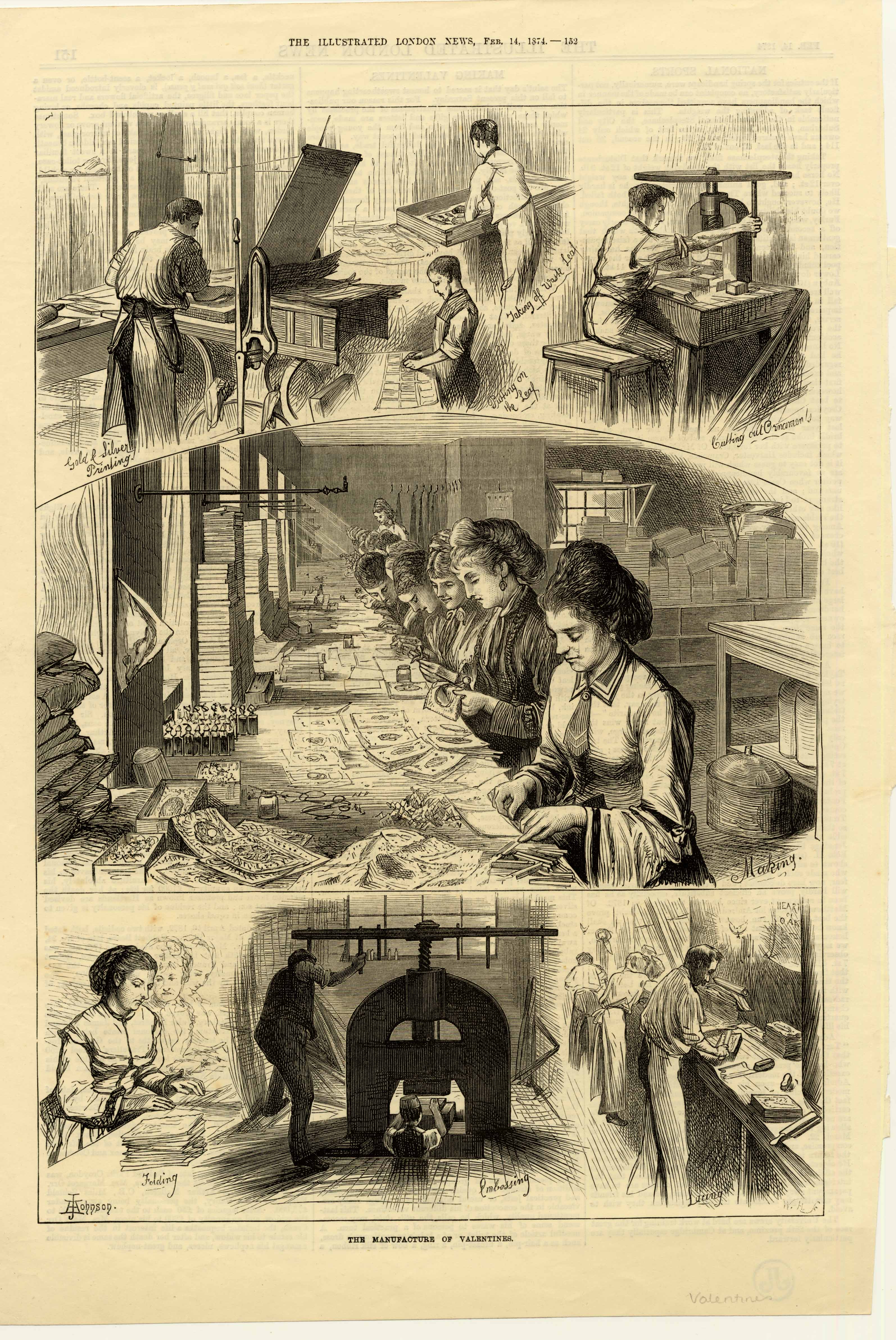
When we think of Valentine’s Day, chubby Cupids, hearts and roses generally come to mind, not industrial processes like mass production and the division of labor. Yet the latter were essential to the holiday’s history.
As a historian researching material culture and emotions, I’m aware of the important role the exchange of manufactured greeting cards played in the 19th-century version of Valentine’s Day.
At the beginning of that century, Britons produced most of their valentines by hand. By the 1850s, however, manufactured cards had replaced those previously made by individuals at home. By the 1860s, more than 1 million cards were in circulation in London alone.
The British journalist and playwright Andrew Halliday was fascinated by these cards, especially one popular card that featured a lady and gentleman walking arm-in-arm up a pathway toward a church.
Halliday recalled watching in fascination as “the windows of small booksellers and stationers” filled with “highly-coloured” valentines, and contemplating “how and where” they “originated.” “Who draws the pictures?” he wondered. “Who writes the poetry?”
In 1864 he decided to find out.
Manufactured intimacy
Today Halliday is most often remembered for his writing on London beggars in a groundbreaking 1864 social survey, “London Labour and the London Poor.” However, throughout the 1860s he was a regular contributor to Charles Dickens’ popular journal “All the Year Round,” in which he entertained readers with essays addressing various facets of ordinary British daily existence, including family relations, travel, public services and popular entertainments.
In one essay for that journal – “Cupid’s Manufactory,” which was later reprinted in 1866 in the collection “Everyday Papers” – Halliday led his readers on a guided tour of one of London’s foremost card manufacturers.
Inside the premises of “Cupid and Co.,” they followed a “valentine step by step” from a “plain sheet of paper” to “that neat white box in which it is packed, with others of its kind, to be sent out to the trade.”
Touring ‘Cupid’s Manufactory’
“Cupid and Co.” was most likely the firm of Joseph Mansell, a lace-paper and stationary company that manufactured large numbers of valentines between the 1840s and 1860s – and also just happened to occupy the same address as “Mr. Cupid’s” in London’s Red Lion Square.
The processes Halliday described, however, were common to many British card manufacturers in the 1860s, and exemplified many industrial practices first introduced during the late 18th century, including the subdivision of tasks and the employment of women and child laborers.
Halliday moved through the rooms of “Cupid’s Manufactory,” describing the variety of processes by which various styles of cards were made for a range of different people and price points.
He noted how the card with the lady and gentleman on the path to the church began as a simple stamped card, in black and white – identical to one preserved today in the collections of the London Museum – priced at one penny.
A portion of these cards, however, then went on to a room where a group of young women were arranged along a bench, each with a different color of “liquid water-colour at her elbow.” Using stencils, one painted the “pale brown” pathway, then handed it to the woman next to her, who painted the “gentleman’s blue coat,” who then handed it to the next, who painted the “salmon-coloured church,” and so forth. It was much like a similar group of female workers depicted making valentines in the “Illustrated London News” in the 1870s.
These colored cards, Halliday noted, would be sold for “sixpence to half-a-crown.” A portion of these, however, were then sent on to another room, where another group of young women glued on feathers, lace-paper, bits of silk or velvet, or even gold leaf, creating even more ornate cards sometimes sold for 5 shillings and above.
All told, Halliday witnessed “about sixty hands” – mostly young women, but also “men and boys,” who worked 10 hours a day in every season of the year, making cards for Valentine’s Day.
Yet, it was on the top floor of the business that Halliday encountered the people who arguably fascinated him the most: the six artists who designed all the cards, and the poets who provided their text – most of whom actually worked offsite.
Here were the men responsible for manufacturing the actual sentiments the cards conveyed – and in the mid-19th century these encompassed a far wider range of emotions than the cards produced by Hallmark and others in the 21st century.
A spectrum of ‘manufactured emotions’
Many Victorians mailed cards not only to those with whom they were in love, but also to those they disliked or wished to mock or abuse. A whole subgenre of cards existed to belittle the members of certain trades, like tailors or draper’s assistants, or people who dressed out of fashion.
Cards were specifically designed for discouraging suitors and for poking fun of the old or the unattractive. While some of these cards likely were exchanged as jokes between friends, the consensus among scholars is that many were absolutely intended to be sent as cruel insults.
Furthermore, unlike in the present day, in the 19th century those who received a Valentine were expected to send one in return, which meant there were also cards to discourage future attentions, recommend patience, express thanks, proclaim mutual admiration, or affirm love’s effusions.
Halliday noted the poet employed by “Cupid’s” had recently finished the text for a mean-spirited comic valentine featuring a gentleman admiring himself in a mirror:
Looking at thyself within the glass,
You appear lost in admiration;
You deceive yourself, and think, alas!
You are a wonder of creation.
This same author, however, had earlier completed the opposite kind of text for the card Halliday had previously highlighted, featuring the “lady and gentleman churchward-bound”:
“The path before me gladly would I trace,
With one who’s dearest to my constant heart,
To yonder church, the holy sacred place,
Where I my vows of Love would fain impart;
And in sweet wedlock’s bonds unite with thee,
Oh, then, how blest my life would ever be!”
These were very different texts by the very same man. And Halliday assured his readers “Cupid’s laureate” had authored many others in every imaginable style and sentiment, all year long, for “twopence a line.”
Halliday showed how a stranger was manufacturing expressions of emotions for the use of other strangers who paid money for them. In fact, he assured his readers that in the lead up to Valentine’s Day “Cupid’s” was “turning out two hundred and fifty pounds’ worth of valentines a week,” and that his business was “yearly on the increase.”
Halliday found this dynamic – the process of mass producing cards for profit to help people express their authentic emotions – both fascinating and bizarre. It was a practice he thought seemed like it ought to be “beneath the dignity of the age.”
And yet it thrived among the earnest Victorians, and it thrives still. Indeed, it remains a core feature of the modern holiday of Valentine’s Day.
This year, like in so many others, I will stand at a display of greeting cards, with many other strangers, as we all try to find that one card designed by someone else, mass-produced for profit, that will convey our sincere personal feelings for our friends and loved ones.
Christopher Ferguson does not work for, consult, own shares in or receive funding from any company or organization that would benefit from this article, and has disclosed no relevant affiliations beyond their academic appointment.
Headline: Governor Stein Announces Additional Team Members
Governor Stein Announces Additional Team Members lsaito
Raleigh, NC
Today, Governor Stein announces additional staff as he continues to grow his team committed to building a safer, stronger North Carolina.
Adam Chandler, Policy Director
Adam Chandler is a native of Burlington, North Carolina, and a 12-year veteran of the U.S. Department of Justice, where he served most recently as Associate Deputy Attorney General and Chief of Staff to the Deputy Attorney General. Adam previously practiced at the Department as an appellate attorney, specializing in antitrust law, and served as a speechwriter for two attorneys general. He graduated from Yale Law School; the University of Oxford, where he studied as a Rhodes Scholar; and Duke University.
Kindl Detar, Senior Policy Advisor
Kindl Detar previously served as a Special Deputy Attorney General and the Director of the Public Protection Section at the North Carolina Department of Justice. Prior to her state government service, she worked at Foundation For The Carolinas and Robinson Bradshaw. Kindl is a graduate of the University of North Carolina at Chapel Hill and the University of Pennsylvania School of Law. A native of Concord, she resides in Charlotte with her husband and three children.
Sadie Weiner, Senior Advisor
Sadie Weiner has worked in state and federal government and campaigns for almost two decades. She served in the Office of Governor Roy Cooper first as Communications Director and most recently as Director of External Affairs. Previously, Weiner was the Communications Director of the Democratic Senatorial Campaign Committee (DSCC), supporting campaigns across the country and picking up two Senate seats. She was also the Communications Director for U.S. Senator Kay Hagan in both her Senate office and her re-election campaign. Weiner lives in Raleigh with her husband and two children.
Awo Eni, Digital Director
Awo Eni returns to North Carolina after working on Cheri Beasley’s campaign for Senate in 2022 as the Deputy Digital Director. She most recently served as Director of Digital Content on Senator Sherrod Brown’s campaign for re-election in Ohio. Awo is a proud British-born Nigerian-American immigrant who calls Texas home. She is a graduate of the University of North Texas.
Liz Doherty, Policy Advisor
Liz Doherty joins the Stein Administration as a policy advisor in the Governor’s office. Prior to this role, she served as a policy advisor to Governor Roy Cooper and held various campaign roles, including as Governor Cooper’s communications director in 2020. She also serves as a board member on the NC Council for Women and completed a Master’s of Public Policy from the Duke University Sanford School in 2023.
Rania Hassan, Policy Analyst
Rania Hassan is a policy analyst in the Office of Governor Josh Stein. She previously worked as policy assistant and analyst in the Office of Governor Roy Cooper. She graduated from NC State University with a B.S. in Environmental Science and a minor in Environmental Policy and Justice.
Madhu Vulimiri, Senior Advisor for Health & Families Policy
Madhu Vulimiri joins the Governor’s Office from the North Carolina Department of Health and Human Services, where she served as the Deputy Director for the Division of Child and Family Well-Being overseeing nutrition programs that support children and families. Prior to that, she led cross-agency priority initiatives at NCDHHS, including in the COVID-19 response, in chief of staff and senior strategy roles to the Chief Deputy Secretary of NCDHHS and at NC Medicaid. She earned her Bachelor of Science in Public Health from the University of North Carolina-Chapel Hill, where she was a Morehead-Cain Scholar, and her Master of Public Policy from Duke University, where she was a Margolis Scholar in Health Policy and Management.
Elena Ashburn, Senior Advisor for Education Policy
Elena Ashburn joins the policy team after serving as an area superintendent in the Wake County Public School System, where she led 17,000 students in 23 schools. She began her career in education as a Teach For America teacher and later served as a middle and high school principal. Elena earned a doctorate in educational leadership from UNC Chapel Hill and was named the North Carolina Wells Fargo Principal of the Year in 2021.
Jonathan Moch, Senior Advisor for Climate & Energy Policy
Jonathan Moch was most recently Science and Technology Policy Advisor for the Office of the Special Presidential Envoy for Climate and Office of Global Change in the U.S. Department of State, where he designed, negotiated, and implemented international climate and energy initiatives and agreements. Prior to the State Department, he was an interdisciplinary Postdoctoral Fellow with joint appointments in Harvard’s engineering, public health, and government schools. Jonathan holds a Ph.D. in Earth and Planetary Sciences with a secondary field in Science, Technology and Society, a master’s in Environmental Science and Engineering from Harvard University, and an undergraduate degree from Princeton University.
P.J. Connelly, Director of the Governor’s Eastern North Carolina Office
P.J. Connelly will serve as the Director of the Governor’s Eastern North Carolina Office. He served in this role for former Governor Roy Cooper from 2022 to 2024. Prior to that, Connelly served North Carolina’s rural communities through the Governor’s Hometown Strong Initiative. He also served as Assistant Director of Boards and Commissions in the Office of the Governor from 2017 to 2019. Connelly is from New Bern, North Carolina.
Headline: 2025 Eastern NC Regional Braille Challenge Set for Feb. 17
2025 Eastern NC Regional Braille Challenge Set for Feb. 17 jejohnson6
The State Library of North Carolina Accessible Books and Library Services (ABLS) is thrilled to announce the upcoming 2025 Eastern NC Regional Braille Challenge, a compelling event that promises to highlight the talents and achievements of blind and visually impaired students in the realm of Braille literacy.
Taking place Feb. 17, from 9 a.m. to 4 p.m. at the Governor Morehead School for the Blind in Raleigh, this event is a unique opportunity for media professionals to capture and share inspiring stories.
The 2025 Eastern NC Regional Braille Challenge is a regional event of The Braille Challenge, a national program of the Braille Institute.
About the Event: The 2025 Eastern NC Regional Braille Challenge is more than a competition; it’s a celebration of Braille literacy, bringing together talented students from the region. From captivating Braille reading sessions to thought-provoking writing challenges, the event is designed to showcase the incredible skills and determination of blind and visually impaired youth.
Event Details:
• Date: Monday, Feb.17
• Time: 9 a.m.-4 p.m.
• Location: Governor Morehead School for the Blind, 301 Ashe Ave, Raleigh, NC 27606
In the event of inclement weather, causing potential travel concerns, the Braille Challenge will be rescheduled to Feb. 24.
Media Opportunity: Journalists, photographers, and camera crews are invited to attend the Braille Challenge and witness firsthand the spirit and resilience of these talented students. From heartwarming success stories to the demonstration of Braille proficiency, this event offers a wealth of visual and narrative opportunities for media coverage.
Interview Opportunities:
• Engage with participants, educators, and organizers to learn more about the significance of Braille literacy.
• Capture emotional moments as students showcase their Braille skills in a competitive and supportive environment.
How to Cover the Event: For media inquiries or to confirm attendance, contact Clint Exum, Outreach Specialist, at clint.exum@dncr.nc.gov or 984-236-1118.
About SLNC ABLS ABLS is the free public library for North Carolinians with a print disability, such as blindness, a physical disability preventing them from holding a book, or a reading disability. Our library serves the entire state by mail or online with an assortment of accessible resources like talking books, braille books, large print books, and descriptive movies. https://statelibrary.ncdcr.gov/blind-print-disabled
About the North Carolina Department of Natural and Cultural Resources The N.C. Department of Natural and Cultural Resources (DNCR) manages, promotes, and enhances the things that people love about North Carolina – its diverse arts and culture, rich history, and spectacular natural areas. Through its programs, the department enhances education, stimulates economic development, improves public health, expands accessibility, and strengthens community resiliency.
The department manages over 100 locations across the state, including 27 historic sites, seven history museums, two art museums, five science museums, four aquariums, 35 state parks, four recreation areas, dozens of state trails and natural areas, the North Carolina Zoo, the State Library, the State Archives, the N.C. Arts Council, the African American Heritage Commission, the American Indian Heritage Commission, the State Historic Preservation Office, the Office of State Archaeology, the Highway Historical Markers program, the N.C. Land and Water Fund, and the Natural Heritage Program. For more information, please visit www.dncr.nc.gov.
Headline: Bennett Place State Historic Site Hosts Lecture and Debuts a Community Project in Honor of Black History Month
Bennett Place State Historic Site Hosts Lecture and Debuts a Community Project in Honor of Black History Month jejohnson6
On Saturday, Feb. 15 at 2 p.m., Bennett Place State Historic Site will host a free lecture with local historian Ernest Dollar entitled “Jublio: Moments of Freedom, 1865.”
Dollar, who serves as director of the Museums Section for the City of Raleigh, will highlight how enslaved people found and claimed freedom for themselves in the final days of the Civil War in North Carolina. This program will explore perspectives of African American men and women’s first moments of freedom as part of the site’s Black History Month programming.
Bennett Place interprets the largest troop surrender of the Civil War in April 1865 and how it contributed to ending slavery.
Now through April 16, visitors are invited to commemorate emancipation by creating community luminaries. A self-guided station at the Visitor Center will provide instructions for making the luminaries, which will be used during an April 25 program marking the 160th anniversary of a new chapter of freedom for more than 331,000 formerly enslaved North Carolinians. Visitors can also learn more about the connection between Bennett Place and emancipation. The Community Luminary table is open Tuesday-Saturday, 9:30 a.m.-4:30 p.m.
About the North Carolina Department of Natural and Cultural Resources The N.C. Department of Natural and Cultural Resources (DNCR) manages, promotes, and enhances the things that people love about North Carolina – its diverse arts and culture, rich history, and spectacular natural areas. Through its programs, the department enhances education, stimulates economic development, improves public health, expands accessibility, and strengthens community resiliency.
The department manages over 100 locations across the state, including 27 historic sites, seven history museums, two art museums, five science museums, four aquariums, 35 state parks, four recreation areas, dozens of state trails and natural areas, the North Carolina Zoo, the State Library, the State Archives, the N.C. Arts Council, the African American Heritage Commission, the American Indian Heritage Commission, the State Historic Preservation Office, the Office of State Archaeology, the Highway Historical Markers program, the N.C. Land and Water Fund, and the Natural Heritage Program. For more information, please visit www.dncr.nc.gov.
Headline: Prominent Civil Rights Attorney James Walker Jr., to be Featured on N.C. Highway Historical Marker
Prominent Civil Rights Attorney James Walker Jr., to be Featured on N.C. Highway Historical Marker jejohnson6
James Robert Walker Jr., a prominent civil rights attorney from northeastern North Carolina, soon will be recognized with a North Carolina Highway Historical Marker.
The marker commemorating Walker will be dedicated during a ceremony at the New Ahoskie Missionary Baptist Church (410 West Hayes St., Ahoskie, N.C.) on Saturday, Feb. 22 at 1 p.m. The marker will be installed at the intersection of U.S. 13 and N.C. 42 in Ahoskie.
Born in 1924 as the first of eight children, Walker grew up in Ahoskie, in a family of educators with advanced degrees and the grandson of a preacher. He served in World War II and earned his bachelor’s degree from North Carolina College, now North Carolina Central University, after being honorably discharged from the United States Army.
Walker later became the first of two Black graduates from any program at UNC-Chapel Hill, having graduated from its law school in 1952. He returned to his native northeastern North Carolina and became a grassroots civil rights attorney, namely waging battles in the realm of voting rights across a six-county area (Halifax, Northampton, Warren, Bertie, Hertford, Gates).
Walker was the principal organizer and president of the Eastern Council on Community Affairs. This group advocated for Black representation in local and state governing bodies, including town councils and state legislatures. It also opposed bills for school separation or segregation.
Walker became the first Black member of UNC-Chapel Hill’s Dialectic and Philanthropic Societies, the school’s debating and literacy society, and the oldest student organization on the campus. The state’s NAACP also recognized him with its Distinguished Service Award for his efforts in civil rights. In 1961, he was the keynote speaker for the National Lawyers Guild in Detroit, Michigan, and in 1978, was named Lawyer of the Year by the same organization.
Walker died in 1997.
For more information about the historical markers, please visit https://www.dncr.nc.gov/blog/2024/07/10/james-walker-jr-1924-1997-96, or call (919) 814-6625.
The Highway Historical Marker Program is a collaboration between the N.C. departments of Natural and Cultural Resources and Transportation.
About the North Carolina Department of Natural and Cultural Resources The N.C. Department of Natural and Cultural Resources (DNCR) manages, promotes, and enhances the things that people love about North Carolina – its diverse arts and culture, rich history, and spectacular natural areas. Through its programs, the department enhances education, stimulates economic development, improves public health, expands accessibility, and strengthens community resiliency.
The department manages over 100 locations across the state, including 27 historic sites, seven history museums, two art museums, five science museums, four aquariums, 35 state parks, four recreation areas, dozens of state trails and natural areas, the North Carolina Zoo, the State Library, the State Archives, the N.C. Arts Council, the African American Heritage Commission, the American Indian Heritage Commission, the State Historic Preservation Office, the Office of State Archaeology, the Highway Historical Markers program, the N.C. Land and Water Fund, and the Natural Heritage Program. For more information, please visit www.dncr.nc.gov.
Fort Myers, Florida – United States Attorney Roger B. Handberg announces that Austin Charles Wesley (25, Lehigh Acres) today pleaded guilty to possessing a firearm as a previously convicted felon. Wesley faces a maximum sentence of 15 years in federal prison. A sentencing hearing has not yet been set.
According to court documents, on October 24, 2024, Wesley was pulled over for speeding by the Florida Highway Patrol on SR-82 in Lee County. During the traffic stop, law enforcement located a loaded Walther .22 caliber handgun concealed underneath Wesley’s clothing. As a multi-time convicted felon, who previously served sentences in Florida state prison for various crimes, Wesley is prohibited from possessing firearms or ammunition under federal law.
This case was investigated by the Bureau of Alcohol, Tobacco, Firearms and Explosives, the Florida Highway Patrol, and the Fort Myers Police Department. It is being prosecuted by Assistant United States Attorney Simon Eth.
This case is part of Project Safe Neighborhoods (PSN), a program bringing together all levels of law enforcement and the communities they serve to reduce violent crime and gun violence, and to make our neighborhoods safer for everyone. On May 26, 2021, the Department launched a violent crime reduction strategy strengthening PSN based on these core principles: fostering trust and legitimacy in our communities, supporting community-based organizations that help prevent violence from occurring in the first place, setting focused and strategic enforcement priorities, and measuring the results.
Marc H. Silverman, Acting United States Attorney for the District of Connecticut, today announced that JOSHUWA DIAZ, 34, of New Haven, pleaded guilty yesterday before U.S. District Judge Vernon D. Oliver in Hartford to a narcotics trafficking offense.
According to court documents and statements made in court, Diaz was arrested on February 16, 2024, after a court-authorized search of his apartment on Orange Street in New Haven revealed approximately 75 grams of fentanyl, 278 grams of cocaine, 47 grams of crack cocaine, and a loaded P80 handgun with no serial number (“ghost gun”).
Diaz pleaded guilty to possession with intent to distribute cocaine, cocaine base (“crack”), and fentanyl, an offense that carries a maximum term of imprisonment of 20 years. Judge Oliver scheduled sentencing for May 7.
Diaz is released on a $50,000 bond pending sentencing.
In April 2013, Diaz was sentenced in New Haven federal court to 78 months of imprisonment for distributing heroin.
This investigation has been conducted by the Drug Enforcement Administration New Haven Task Force, which includes members from the DEA, U.S. Marshals Service, Internal Revenue Service – Criminal Investigation Division, Connecticut State Police and the New Haven, Waterbury, East Haven, Branford, West Haven, Ansonia, Meriden, Naugatuck, and Shelton Police Departments.
The case is being prosecuted by Assistant U.S. Attorney Brendan Keefe.
Source: The Conversation (Au and NZ) – By Pandanus Petter, Postdoctoral Research Fellow, School of Politics and International Relations, Australian National University
The upcoming federal election will see the incumbent Labor prime minister, Anthony Albanese, face off against Liberal opposition leader, Peter Dutton. We’ll likely see a strong focus on the personal qualities and performance of the two leaders.
We tend to think a popular leader can win an election for their party while an unpopular one can lose it. Much of the commentary on the Coalition’s 2022 election loss, for example, centred on the widespread dislike of Scott Morrison.
But how much do party leaders actually affect their party’s vote share, and ultimately, the outcome of an election? We looked at 40 years of opinion polling to find out.
Our research
Opinion polls in Australia have been conducted since the 1940s, but it was not until the 1980s that they began to regularly ask questions about leader satisfaction and voting intention. In recent decades, the proliferation of polls has seen a greater consistency in question wording and protocols.
We have been analysing the polling data on government popularity and responsiveness in Australia. This enables us to track and compare leaders over an extended period.
We’ve crunched the numbers on voter intention and leader satisfaction from September 1985 until December 2024.
We can cross-reference these statistics to show which prime ministers and opposition leaders were a net benefit to their party (more popular than their party overall) and which were a net drag (less popular than their party).
Prime ministers: who helped and who hindered?
By this measure, the prime minister who provided the most electoral benefit to their party was Kevin Rudd between 2007 and 2010.
Rudd achieved some of the highest levels of voter satisfaction recorded since the early Bob Hawke years, averaging 60% satisfaction, a 14-point net benefit for his party.
His popularity declined considerably just before his replacement by Julia Gillard in 2010, and never fully recovered when he became prime minister again in 2013.
John Howard ranks second, with Morrison and Albanese (so far) sharing third place in terms of satisfaction. However, there’s a larger difference between Albanese’s personal popularity and his party’s vote intention.
Morrison’s tenure in office was skewed by the COVID pandemic, which saw a “rally around the flag” effect, seeing a spike in voters’ trust in government.
Paul Keating comes at the bottom of the list. His personal popularity trailed his party’s by eight percentage points on average, with an upset victory in 1993 not enough to win over the public to defeat a resurgent Howard in 1996.
Similiarly, Tony Abbott, although party leader when the Coalition returned to power after the Rudd-Gillard-Rudd years, was consistently less popular than his party – by seven points in opposition and four as prime minister.
What about opposition leaders?
Among opposition leaders, Rudd again tops the list. He was more popular than Labor overall in the year prior to winning the election in December 2007, peaking at 65.5% satisfaction.
The opposition leader who represents the greatest drag on their party was Andrew Peacock in the late 1980s, in what was his second incarnation as Liberal leader.
Overall, prime ministers have a greater impact on their party’s fortunes than opposition leaders. This is expected as incumbency has advantages, with prime ministers usually given more opportunity for media attention, greater recognition with the public, and hopefully a record of achievements in government to point to.
Prime ministers register a net gain to their party of about four percentage points, compared with minus three points for opposition leaders.
Labor leaders show a net gain to their party of two points, compared to minus four points for their Liberal counterparts.
The personalisation of politics
Since at least the 1970s, political leaders have attracted increasing attention in democratic elections around the world.
This trend has not been restricted to countries with presidential systems, such as the United States. It’s also playing out in parliamentary systems such as Australia’s and the United Kingdom’s. This is despite the fact voters elect local members to parliament, rather than voting for the prime minister directly.
This profound shift in democratic politics has been based on several social changes.
First, the rise of television, and more recently social media, has provided the visual images that direct voters’ attention towards the leader.
While television’s heyday has passed – in both the 2019 and 2022 elections, the Australian Election Study surveys show more people followed the election on the internet than on television – visual images of the leaders dominate the media, both traditional and social.
Second, party de-alignment has seen voters moving away from their traditional party loyalties, with the personalities of the leaders filling this gap.
In the 1960s, around one in ten voters said they did not identify with a party, compared with one in four in the 2022 election.
Third, the unprecedented expansion in university education has produced critical voters who are more volatile in their voting than any groups in the past.
One factor that can sway their vote is policies, but another is the leader they find most competent.
What does this mean for the next election?
For Australian voters, leaders matter, rightly or wrongly, for evaluating the performance of a government and choosing which party to vote for.
As we close in on an election in 2025, voters will be looking to Albanese and Dutton. In the chart below, we can see that while on average Dutton has been only marginally beneficial for his party compared with Albanese, this gap has narrowed in the latter half of 2024.
Although Albanese started at a historically very strong position, it appears his popularity began to decline in May 2023. The defeat of the Voice to Parliament Referendum in November sped up the decline.
Dutton received a short-term boost after the result, after which his popularity declined and then has steadily built over time. Current projections indicate the next election will likely be close-run.
It also appears the two current leaders, whatever their other merits, have fallen short of the levels reached by the most popular prime ministers and opposition leaders of the past.
Albanese’s early popularity has waned, while the Coalition and Dutton’s fortunes rise in step with one another.
This reflects a return to a normal vote share for the party after their loss in 2022. While it may prove problematic for the government, it doesn’t necessarily indicate a meteoric increase in Dutton’s personal popularity.
Pandanus Petter is employed at the Australian National University with funding from The Australian Research Council.
Ian McAllister receives funding from the Australian Research Council.