NewzIntel.com

    • Checkout Page
    • Contact Us
    • Default Redirect Page
    • Frontpage
    • Home-2
    • Home-3
    • Lost Password
    • Member Login
    • Member LogOut
    • Member TOS Page
    • My Account
    • NewzIntel Alert Control-Panel
    • NewzIntel Latest Reports
    • Post Views Counter
    • Privacy Policy
    • Public Individual Page
    • Register
    • Subscription Plan
    • Thank You Page

Category: Transport

  • MIL-OSI United Kingdom: ​​​​​​​It’s ‘goodbye’ to Staffordshire Wildlife Trust as Council talks with new tenants for city beauty spot.

    Source: City of Stoke-on-Trent

    Published: Friday, 27th September 2024

    After 15 years running the popular café at Westport Lake, Staffordshire Wildlife Trust is moving on, but say it’s been the best experience getting to serve the local community.

    After 15 years running the popular café at Westport Lake, Staffordshire Wildlife Trust is moving on, but say it’s been the best experience getting to serve the local community.

    The charity will officially stop trading at the site’s café on Sunday (September 29) following their decision to streamline their activities and focus on other nature restoration and community engagement projects across the City.

    The council has been working behind the scenes to help limit the impact on visitors and is now in talks with new tenants who are due to take on the lease early next year.

    Prior to any further announcement there will be some remedial works the council will need to carry out as part of the new lease arrangements.

    Leader of the Council, Councillor Jane Ashworth, said: “We want to thank Staffordshire Wildlife Trust for all their dedication and hard work over the years and they will be sadly missed.

    “Westport Lake is a local beauty spot that is close to my heart and we will be doing everything we can to ensure that new tenants keep this special place vibrant for visitors to enjoy.

    “Westport Lake is a unique and wonderful escape for visitors and is a magnet for wildlife, all the more reason for ensuring that we maintain this attraction as a place where people want to spend time to relax and appreciate nature.

    “The council will now be working hard to ensure the premises are suitable for the new tenant who will be revealed once all the necessary agreements are in place.

    “Stoke-on-Trent City Council would like to wish Staffordshire Wildlife Trust all the best in their future endeavours, and the work they do locally to protect the county’s wildlife and wild places.”

    Staffordshire Wildlife Trust Chief Executive Julian Woolford said: “We’re sad to be leaving Westport Lake Visitor Centre. It’s been a great base for the Trust, and over the years it has enabled us to connect with many thousands of people from the local community. 

    “While we’re leaving this site, we’ll still be in Stoke running lots of events as part of our community outreach. We continue to work in schools and we are also scoping out further river restoration work with partners. We’re also excited to be working with Stoke-on-Trent City Council to explore how nature can be included in the centenary celebrations next year. 

    “I would like to say a personal thank you to all the café staff for their hard work and dedication over the years, and their professionalism since the closure was announced. Finally thank you to all the customers who visited.”

    While Staffordshire Wildlife Trust vacate the building, the café toilets will be out of action. However, the Council will be installing temporary toilets for visitors to use from Monday 30 September, which will be available to visitors until the café facilities reopen in the new year.

    MIL OSI United Kingdom –

    September 29, 2024
  • MIL-OSI Canada: Funding for First Nations Guardians now managed by world’s first Indigenous-led national stewardship network

    Source: Government of Canada News

    News release

    Today, Jaimee Gaunce, Executive Director of the First Nations National Guardians Network (NGN), joined the Honourable Steven Guilbeault, Minister of Environment and Climate Change; the Honourable Patty Hajdu, Minister of Indigenous Services and Minister responsible for the Federal Economic Development Agency for Northern Ontario; and Marcus Powlowski, Member of Parliament for Thunder Bay—Rainy River, to announce the investment of up to $27.6 million to support 80 First Nations Guardians initiatives.

    September 27, 2024 – Thunder Bay, Ontario

    Indigenous peoples are at the forefront of the fight against biodiversity loss and climate change. Across the country, First Nations, Inuit, and Métis are on the ground managing land, water, and helping communities thrive while safeguarding the natural spaces we all depend on for current and future generations.

    Today, Jaimee Gaunce, Executive Director of the First Nations National Guardians Network (NGN), joined the Honourable Steven Guilbeault, Minister of Environment and Climate Change; the Honourable Patty Hajdu, Minister of Indigenous Services and Minister responsible for the Federal Economic Development Agency for Northern Ontario; and Marcus Powlowski, Member of Parliament for Thunder Bay—Rainy River, to announce the investment of up to $27.6 million to support 80 First Nations Guardians initiatives.

    This investment will support 18 new and 62 existing initiatives to safeguard the land, water, and wildlife within First Nation territories while also creating meaningful employment opportunities in remote areas.

    Executive Director Gaunce, Minister Guilbeault, Minister Hajdu, and Member of Parliament Powlowski were also joined by Valérie Courtois, Executive Director of the Indigenous Leadership Initiative; Bertha Sutherland of Constance Lake First Nation; and Dr. Robert Stewart of BZA-Rocky Bay First Nation. This announcement marks a significant milestone, as it is the first time First Nations Guardians’ funding has been independently managed by the National Guardians Network, the world’s first Indigenous-led national stewardship network.

    Longstanding initiatives, such as the Matawa First Nations’ Four Rivers Regional Guardians Network are concrete examples of Guardians’ initiatives in action—acting as the “eyes and ears” on the ground by monitoring ecological health and working to preserve and pass on Indigenous knowledge and nature-based learning to inspire future Guardians.

    For over a decade, Four Rivers Regional Guardians Network has led environmental stewardship and capacity-building for nine Matawa member First Nations in Northern Ontario. With this new investment, Four Rivers will strengthen its support for land, water, and wildlife stewardship within these communities; acquire vital monitoring equipment and other resources; deliver support and training; and standardize monitoring approaches, methods, and data collection and organization.

    The Indigenous Guardians initiative is an important pathway for Indigenous peoples to continue to exercise their rights and responsibilities in stewardship of their traditional lands, and a key component of Canada’s commitment to and implementation of the United Nations Declaration on the Rights of Indigenous Peoples.

    Quotes

    “Indigenous-led stewardship offers profound and transformative benefits for communities and the environment and Guardians are a cornerstone of these efforts. I extend my heartfelt congratulations to the First Nations National Guardians Network for their dedication and success in administering this year’s program. This achievement will ensure that future generations benefit from healthy land and water and stands as a powerful testament to self determination in action.”
    – The Honourable Steven Guilbeault, Minister of Environment and Climate Change

    “The Guardians are on the frontlines of conservation efforts, and by placing this responsibility in their hands, we affirm their knowledge, capacity, and connection to the land. Supporting the leadership and expertise of Indigenous peoples creates a more holistic and sustainable approach to conservation by considering ecosystem health, community well-being, and economic sustainability. Today’s investment not only strengthens environmental protection but also supports meaningful job creation in Indigenous and northern communities.”
    – The Honourable Patty Hajdu, Minister of Indigenous Services and Minister responsible for the Federal Economic Development Agency for Northern Ontario

    “Today marks a major milestone. This is the first round of Guardians’ funding fully administered by the First Nations National Guardians Network. We are proud to fulfill this responsibility. And we welcome the federal commitment to the National Guardians Network as a recognition that First Nations have the expertise, capacity, and knowledge to take the lead in the responsible management of stewardship investments.”
    – Jaimee Gaunce, Executive Director, First Nations National Guardians Network

    “We congratulate the First Nations National Guardians Network on ensuring more Guardians are caring for lands and waters across the country. And we welcome the example the relationship between the Government of Canada and the Network is setting. As countries prepare to attend COP16, the United Nations Biodiversity Conference in October, this approach in partnership with First Nations offers a successful model of how respecting Indigenous leadership and Nationhood creates on-the-ground benefits for lands and waters and communities.”
    – Valérie Courtois, Executive Director, Indigenous Leadership Initiative

    “With today’s announcement, we recognize the essential role of Indigenous leadership in protecting biodiversity and promoting sustainability. I am happy to see the incredible impact this investment will have on local communities and future generations.”
    – Marcus Powlowski, Member of Parliament for Thunder Bay—Rainy River

    Quick facts

    • In December 2022, Minister Guilbeault jointly announced the launch of a new First Nations National Guardians Network with Valérie Courtois, the Founding Director of the Indigenous Leadership Initiative.

    • Environment and Climate Change Canada has invested more than $91.6 million in over 240 First Nations, Inuit, and Métis Guardians initiatives since 2018.

    • Combined, these investments have helped support the creation of almost 1,500 traditionally and culturally meaningful employment opportunities, while protecting nature and wildlife.

    • The federal government expanded its support for Indigenous Guardians in 2021, committing up to $100 million to support new and existing Indigenous Guardians initiatives and the establishment of Indigenous Guardians networks.

    • Funding and decision-making are implemented jointly with First Nations, Inuit, and Métis using a distinctions-based approach that respects and recognizes the unique perspectives, rights, responsibilities, and needs of Indigenous peoples.

    • These types of Indigenous-led stewardship initiatives integrate ecosystem health, community well-being, and economic sustainability, creating a more holistic and sustainable approach to conservation.

    • Canada has committed to conserving 30 percent of its land and water by 2030.

    Related products

    Associated links

    Contacts

    Oliver Anderson
    Director of Communications
    Office of the Minister of Environment and Climate Change
    819-962-0686
    Oliver.Anderson@ec.gc.ca

    Media Relations
    Environment and Climate Change Canada
    819-938-3338 or 1-844-836-7799 (toll-free)
    media@ec.gc.ca

    Environment and Climate Change Canada’s X (Twitter) page

    Environment and Climate Change Canada’s Facebook page

    MIL OSI Canada News –

    September 29, 2024
  • MIL-OSI Canada: Indigenous Guardians projects 2024–2025

    Source: Government of Canada News

    Today, Jaimee Gaunce, Executive Director of the First Nations National Guardians Network (NGN), joined the Honourable Steven Guilbeault, Minister of Environment and Climate Change; the Honourable Patty Hajdu, Minister of Indigenous Services and Minister responsible for the Federal Economic Development Agency for Northern Ontario; and Marcus Powlowski, Member of Parliament for Thunder Bay—Rainy River, to announce the investment of up to $27.6 million to support 80 First Nations Guardians initiatives.

    Alberta

    Project title: Mikisew Cree First Nation Guardian Program
    Recipient: Mikisew Cree First Nation – Government and Industry Relations
    Funding amount: $350,000
    Project description: This two-year, ongoing initiative will study how oil sands development, particularly bitumen mining and hydroelectric projects, are affecting the health of the Peace-Athabasca Delta, the heart of Mikisew’s traditional territory. Guardians work year-round to monitor water quality, collect data, track flood events, and monitor the fish population.

    Project title: Ni Ho Ghe Di – ACFN Guardian Program Athabasca Chipewyan First Nation
    Recipient: Dene Lands and Resource Management
    Funding amount: $350,000
    Project description: This two-year initiative will monitor and report on activities that may cause harm to the ecology, traditional lands, or traditional resources of Athabasca Chipewyan First Nation (ACFN), such as poaching and illegally hunting on the traditional territory, especially to protect Ronald Lake Buffalos. The initiative will also support youth to strengthen their cultural pride and connection to the land and develop on-the-land skills.

    Project title: Guardians of the Territory – Dene Tha’ First Nation
    Recipient: Dene Tha’ First Nation
    Funding amount: $350,000
    Project description: This two-year initiative will engage in diverse activities, such as ecological restoration, supporting resource management plans, and ensuring compliance with laws and regulations. Guardians will protect and recover species at risk, manage land use in the proposed Indigenous Protected and Conserved Area at M’behcholia (Bistcho Lake, Alberta), and conduct environmental and wildlife monitoring.

    Project title: Alexis Nakota Sioux Nations Guardians Initiative
    Recipient: Alexis Nakota Sioux Nation
    Funding amount: $346,400
    Project description: This two-year initiative will involve conducting and analyzing aerial surveys, creating a geographic information system (GIS) data management and visualization system using R-Studio and ArcPY, and continue to develop the Stoney Land and Water Course.

    British Columbia

    Project title: Kitasoo Xai’xais Guardian Watchmen Program Enhancement
    Recipient: Kitasoo Xai’xais Nation
    Funding amount: $604,925
    Project description: This two-year initiative focuses on marine and terrestrial surveying, along with compliance and enforcement practices involving education, observation, and reporting. The Guardians also actively participate in the Coastal Nations Coast Guard Auxiliary and undertake training for emergency response in search and rescue and oil spills.

    Project title: Coastal Stewardship Network
    Recipient: Great Bear Initiative Society
    Funding amount: $499,785
    Project description: This two-year initiative provides programming to the Coastal First Nations – Great Bear Initiative’s eight member nations, who work directly with communities to support Guardians along the North and Central Coast and Haida Gwaii to track resource use and ecosystem health, provide training and professional development, raise awareness, and help establish a stewardship presence on the coast.

    Project title: Songhees Nation Guardians Program
    Recipient: Songhees Nation
    Funding amount: $50,000
    Project description: This one-year initiative continues work with community members, Band Council, and outside organizations to provide monitoring services, promote stewardship in the community, and restore habitat areas. This initiative helps establish stronger Indigenous presence on the water during fishing seasons, as it is critical in establishing more authority over fisheries and coastal resources on the land.

    Project title: Lower Nicola Indian Band – Indigenous Guardians Program – Tier 1
    Recipient: Lower Nicola Indian Band
    Funding amount: $49,450
    Project description: This one-year initiative aims to build capacity, skills, and knowledge for a new Guardians program in the community. This will involve mapping and indexing areas in the territory, engaging with Elders and knowledge keepers, engaging with the community, drafting a plan, and working with chief and council to ensure the vision aligns with the strategic plan.

    Project title: Mamalilikulla First Nation Guardian Program
    Recipient: Mamalilikulla First Nation
    Funding amount: $350,000
    Project description: This two-year initiative involves ongoing activities where Guardians spend time on the land to collect data, monitor cultural sites, manage Grizzly Bear populations, plant crab apple trees to provide food for the bears, and improve fisheries. This work helps the Chief and Council make informed decisions.

    Project title: Wet’suwet’en First Nation Guardian Initiative: A Holistic Approach
    Recipient: Wet’suwet’en First Nation
    Funding amount: $75,745
    Project description: This one-year initiative will monitor and collect data on moose population and mortality rates, assess wildlife habitats, setup wildlife cameras, and conduct riparian assessments. It will also explore starting a water-monitoring program in identified priority areas. These efforts will help the community observe and document activities or cumulative effects that impact their ability to practice traditional ways of life.

    Project title: Saulteau First Nations Indigenous Guardian Proposal
    Recipient: Saulteau First Nations
    Funding amount: $350,000
    Project description: This two-year initiative will help the community take leadership in monitoring, protecting, and restoring the lands and waters, which is essential for the health and well-being of the community. Activities include supporting safe food harvesting and cultural activities, protecting Klinse-za Park, monitoring climate changes, and understanding how events like forest fires affect the community, fluctuations in weather patterns, and alterations in animal movements and water availability.

    Project title: Saik’uz Guardian Program
    Recipient: Saik’uz First Nation
    Funding amount: $350,000
    Project description: This two-year initiative will build upon long-term monitoring efforts through a self-sustaining, community-based Saik’uz Guardians Initiative. The Guardians will be guided by the wisdom of both Indigenous Knowledge and western science, for the purposes of empowerment and self-determination of the Nation’s future connected to the water and land of the Territory.

    Project title: P’egp’ig’lha Guardians
    Recipient: P’egp’ig’lha Council / T’it’q’et First Nation
    Funding amount: $350,000
    Project description: This two-year initiative will conduct patrols of the land to ensure territorial health and study wildlife and fisheries. Guardians play an essential role in protecting and restoring the Stein-Nahatlatch Grizzly Bear population, assisting with wildfire recovery, and strengthening collaboration with other nearby Guardian programs.

    Project title: Pauquachin First Nation Marine Department – Stewardship Initiative
    Recipient: Pauquachin First Nation
    Funding amount: $350,000
    Project description: This two-year initiative monitors one of the most heavily travelled and utilized waterways within British Columbia. Guardians review culturally sensitive archaeological sites, harvesting areas, recreational and commercial fisheries use, environmental threats (pollution sources, dumping, illegal activities, and poaching), and conduct restoration in specified areas of importance. This initiative represents the community’s interests, concerns, and objectives to ensure waterways, food, historical sites, and cultural practices continue for generations to come.

    Project title: Takla Nation’s Tier 2 Guardians Initiative
    Recipient: Takla Nation
    Funding amount: $499,959
    Project description: This ongoing initiative monitors more than 30 established sites across Takla’s lands and waters. This work is essential for Takla to implement environmental and cultural protections, including ensuring archaeological impact assessments are carried out by various proponents and government agencies align with Takla’s Archaeology Policy. Additionally, it builds capacity to monitor the caribou and moose populations and sustains the Guardians program by fostering engagement with youth in the community.

    Project title: Tsilhqot’in Guardian Network
    Recipient: Tsilhqot’in National Government
    Funding amount: $500,000
    Project description: This two-year initiative, led by the Tsilhqot’in National Government in collaboration with six Tsilhqot’in communities—Xeni Gwet’in, Tlesqox, Tletinqox, Tsi Del Del, ?Esdilagh, and Yunesit’in—aims to integrate and strengthen Tsilhqot’in values in the management of the region’s lands and waters. Working in partnership with provincial and federal land and water management agencies, the initiative will see Guardians will conducting patrols for hunting, fishing, and fire prevention, as well as wildlife- and water-monitoring research to ensure the sustainable stewardship of Tsilhqot’in territories.

    Project title: Quatsino Axsilaxa Ahwheatnagwusn Guardians Program
    Recipient: Quatsino First Nation
    Funding amount: $342,765
    Project description: This two-year initiative aims to support the implementation of the Quatsino Land Use Plan and the Marine Use Plan. This will be done through field-based work, such as data collection and monitoring. These efforts will be central to ecosystem restoration and establishing food security through the local harvesting of traditional foods.

    Project title: nłeʔképmx Guardians
    Recipient: Citxw Nlaka’pamux Assembly
    Funding amount: $350,000
    Project description: This two-year initiative will continue to establish presence on the land and provide public education and awareness about the nłeʔképmx territory, protocols, and cultural practices. Guardians will monitor and record activities on the land with a focus on priority areas determined by the Citxw Nlaka’pamux Assembly. These priority areas include critical hunting, fishing, gathering, and other culturally important areas. nłeʔképmx Guardians will record, monitor, and manage for invasive species and will contribute to research regarding species at risk in the territory.

    Project title: Supporting and Maintaining a Strong and Efficient Heiltsuk Guardian Watchmen Program
    Recipient: Heiltsuk Integrated Resource Management Department of the Heiltsuk Tribal Council
    Funding amount: $349,499
    Project description: This two-year initiative will focus on capacity-building, monitoring local aquatics ecosystems and community fisheries for safe harvesting and to support and reestablish this life-sustaining relationship between the people and territory.

    Project title: Haa Aaní Tulatín – Taku River Tlingit First Nation Land Guardian Program
    Recipient: Taku River Tlingit First Nation
    Funding amount: $349,600
    Project description: This two-year initiative will respond to threats to the territory and monitor salmon populations. The Guardians will work to strengthen salmon stewardship by organizing multi-day camps that focus on traditional fishing, intergenerational knowledge transfer, and on-the-land monitoring.

    Project title: Spuzzum Nation Land Guardians Initiative
    Recipient: Spuzzum Indian Band
    Funding amount: $50,020
    Project description: This one-year initiative will focus on protecting important ecosystems by monitoring key territorial and cultural sites, collecting ecological data, and safeguarding species like the endangered Northern Spotted Owl. The Guardians will also help to develop a framework for stewardship policies.

    Project title: Kwadacha Nation Tier 2 Guardian Proposal
    Recipient: Kwadacha Nation
    Funding amount: $348,734
    Project description: This two-year initiative aims to provide long-term ecological and cultural monitoring to track changes on key wildlife habitats, traditional food sources, and water sources. This will aid in discussing how potential changes may impact the roles and responsibilities of being Dena on the land.

    Project title: Doig River First Nation Guardian Program
    Recipient: Doig River First Nation
    Funding amount: $349,188
    Project description: This two-year initiative will focus on improving monitoring of the lands and waters by combining cultural methods and western science. Doig River First Nation Guardians will continue to monitor the health of the land, guided by members, and will work collaboratively with the government to address any impacts.

    Project title: Nahnéhé Gegenı́hı / Kakinawetakwow Uski / FNFN Land Guardian Initiative
    Recipient: Fort Nelson First Nation
    Funding amount: $375,000
    Project description: This two-year initiative supports the Fort Nelson First Nation (FNFN) stewardship, land management, and on-the-land cultural activities. The Guardian is guided by western science monitoring and research while grounded in Indigenous ways of knowing and understanding the health and condition of the lands and waters.

    Project title: Scianew Guardians Initiative
    Recipient: Beecher Bay First Nation
    Funding amount: $348,614
    Project description: This two-year initiative will work toward environmental conservation, monitoring, training for Guardians, impact assessments, land sovereignty, and marine safety. This will be done through partnerships with neighbouring nations, Western Canada Marine Response Corporation (WCMRC) and Kotug Canada.

    Project title: USIB Land Guardian Program
    Recipient: Upper Similkameen Indian Band
    Funding amount: $391,894
    Project description: This two-year initiative aims to address critical environmental challenges while deeply integrating Indigenous Knowledge, community engagement, and sustainable practices. The Guardians initiative emphasizes land conservation, sustainable resource management, and fostering ecosystem resilience.

    Project title: Establishing Boothroyd Guardians Program
    Recipient: Boothroyd Indian Band
    Funding amount: $50,000
    Project description: This one-year initiative will monitor environmental indicators within the territory, support restoration work in areas damaged by wildfire, and the subsequent erosion. Boothroyd Guardians will engage with land-user groups to increase understanding and respect for the environment.

    Project title: TTQ Guardians Program Initiation Project
    Recipient: TTQ Economic Development Corporation
    Funding amount: $62,533
    Project description: This one-year initiative aims to collect and organize Xa’xtsa’s previously recorded cultural knowledge data, map priority areas, and develop a monitoring plan. The goal is to observe changes in the supply of traditional herbs and plants, the frequency and impacts of foraging on the land, vitality of salmon spawning, changes in unauthorized camping, and invasive plants and animals.

    Project title: Wildfire Recovery Monitoring
    Recipient: Okanagan Indian Band
    Funding amount: $350,000
    Project description: This two-year initiative will assess the conditions of the White Rock Lake watershed before and after wildfires for the Okanagan Indian Band. The Guardians will conduct site assessments, inventory culturally significant resources, monitor wildlife, and assess the severity of burn damage to guide restoration efforts.

    Project title: Nanwakolas – Stewarding Through Indigenous Scientific Knowledge
    Recipient: Nanwakolas Council Society
    Funding amount: $500,000
    Project description: This two-year initiative will apply Kwakwaka’wakw values and Indigenous scientific knowledge on a variety of projects, including loxiwe (clam garden) restoration, canoe carving, hosting Guardian seasonal gathering events, as well as data collection on water, wildlife monitoring, climate change studies, and emergency response planning.

    Project title: Continuing to Build the Skwxwú7mesh Úxwumixw (Squamish Nation) Guardians Programs Initiative
    Recipient: Squamish Nation – Squamish Indian Band 555
    Funding amount: $349,505
    Project description: This two-year initiative will conduct stewardship activities, respond to climate events and emergencies, and increase public safety. The Guardians will continue to be on the land engaging and learning from Elders, knowledge keepers, and youth, as well as collaborating with other Nations to share information and build capacity across the National Guardians Network.

    Project title: St’át’imc Land Guardians
    Recipient: St’at’imc Government Services
    Funding amount: $425,180
    Project description: This two-year initiative will focus on the implementation of the St’át’imc Water Accord. This includes collecting baseline data of three intact watersheds and three impacted watersheds to assess water quality. Other activities include capacity-building and reviewing stories and legends through workshops/collaborative research with the Indigenous Law Research Unit.

    Project title: Nak’azdli Whut’en Yinka Huwunline (Looking After/Taking Care) Guardians Program
    Recipient: Nak’azdli Whut’en
    Funding amount: $349,942
    Project description: This two-year initiative will build geospatial mapping technology for Guardians to use in monitoring. It will create open portals for communication while protecting internal data and cultural information. The project will use remote sensing technology to create “living maps” that track seasonal phenology, quantify impacts, and present informed engagements on stewardship with industry, government, consultants, and academics.

    Project title: Lake Babine Nation Yintah Guardians
    Recipient: Lake Babine Nation
    Funding amount: $350,000
    Project description: This two-year initiative will lead the collaborative stewardship of yintah Lake Babine Nation (LBN) territory and the resources of two cultural keystone species, talok (Sockeye Salmon) and khida (moose), to restore moose populations to culturally meaningful levels, and to support fish monitoring, habitat restoration, and collaborative management.

    Manitoba

    Project title: Seal River Watershed Alliance Land Guardians Network
    Recipient: Seal River Watershed Alliance
    Funding amount: $500,000
    Project description: This two-year initiative will employ 14 youth and senior staff in Land Guardian positions across the four Nations of the Alliance. This initiative builds technical capacity and administers species and habitat identification, monitoring, and protection, and stewards the watershed.

    Project title: Askiy Okanawaynichikaywuk (Keepers of the Land)
    Recipient: York Factory First Nation
    Funding amount: $349,860
    Project description: This two-year initiative will maintain trails, monitor cultural and historic sites, observe changes in the land, and support respectful land use. Guardians will have a visible presence, doing community outreach, participating in land-based events, and helping to inform Council’s decisions about land use, stewardship, and protection.

    Project title: Pimachiowin Aki First Nations Guardians Network
    Recipient: Pimachiowin Aki Corporation
    Funding amount: $499,615
    Project description: This two-year initiative will focus on seasonal fishing monitoring of Pickerel (Walleye), all-season road alignment, wildfire management, and climate change adaptation and mitigation. Guardians provide professional capacity and presence in Pimachiowin Aki, expressing Anishinaabe nationhood, as well as filling gaps in the Information Management System and provincial patrols and monitoring activities throughout the year.

    Project title: SCO First Nations Guardians Regional Network
    Recipient: Southern Chiefs’ Organization Inc.
    Funding amount: $500,000
    Project description: This two-year initiative will focus on strengthening Indigenous jurisdiction over their traditional lands, capacity-building, training and skills development in environmental monitoring and management, and encouraging cooperation and collaboration between communities on stewardship and natural resource management issues.

    Project title: SLFN Land-Water-Nature Indigenous Guardianship Stewardship Initiative
    Recipient: Swan Lake First Nation
    Funding amount: $349,285
    Project description: This two-year initiative, together with Agriculture and Agri-Food Canada, will continue to evaluate the revegetation terraces and re-seed as necessary, monitor water quality from the tile drainage structure, and monitor wildlife and pollinator populations. The data collected will assist in understanding the success rate of this project in reducing nutrient pollution and enhancing ecosystems.

    New Brunswick

    Project title: Amlamgog Earth Keepers
    Recipient: Fort Folly First Nation
    Funding amount: $321,411
    Project description: This two-year initiative will expand and enhance an existing salmon recovery initiative. This initiative will focus on flora and fauna monitoring, following the traditional guiding principle of Etuaptmumk (two-eyed seeing).

    Project title: Wotstak First Nation Guardians Initiative – Tier 1
    Recipient: Woodstock First Nation
    Funding amount: $50,000
    Project description: This one-year initiative will collect data and conduct ecosystem monitoring guided by Woodstock’s Aboriginal Traditional Knowledge for conservation, with the goal of developing a land use plan.

    Project title: Elugweieg Toqwe’gig ugjit Ugs’tqamu aq ugjit Sapo’nug (We Work Together for Earth and for Tomorrow)
    Recipient: Esgenoôpetitj Watershed Association
    Funding amount: $349,923
    Project description: This two-year initiative will expand Esgenoôpetitj aquatic monitoring and governance, led by Esgenoôpetitj First Nation (EFN) Fishery Guardians in collaboration with Fisheries and Oceans Canada enforcement personnel in the management, conservation, and protection of the fisheries in the areas most utilized by the community.

    Newfoundland and Labrador

    Project title: Innu Nation Guardian Program
    Recipient: Innu Nation – Environment and Parks Offices
    Funding amount: $700,000
    Project description: This two-year initiative will integrate the Sheshatshiu and Mushuau Innu (Natuashish) communities through environmental stewardship and cultural preservation. The initiative will focus on five objectives: creating additional Guardian positions, providing technical and safety training, hosting youth workshops for knowledge transfer, purchasing necessary equipment, and developing cultural initiatives to uphold and promote Innu traditions and ecological knowledge.

    Nova Scotia

    Project title: Re-Connecting Our People with the Land
    Recipient: Eskasoni Fish & Wildlife Commission Inc.
    Funding amount: $375,000
    Project description: This two-year initiative will help protect the Eskasoni Watershed and the bio-cultural diversity within the Nation for future generations, as well as reconnecting the people with the land by supporting community-led research and conducting surveys to monitor the changes in the fisheries and ecosystems. The Guardians will be responsible for monitoring activities within the watershed that could impact fish habitat, fish passage, and other species at risk or culturally significant species. This initiative will also support designation of an Indigenous Protected and Conserved Area.

    Project title: Nova Scotia Earth Keepers / Nuji kelo’toqatijik Network
    Recipient: Unama’ki Institute of Natural Resources Society
    Funding amount: $500,000
    Project description: This two-year initiative includes gathering and sharing of Indigenous Knowledge, promoting Netukulimk hunting practices, and monitoring and data collection, including identifying areas suitable for cultural activities, harvesting of medical plants, monitoring species at risk, and education and outreach about culturally important species.

    Northwest Territories

    Project title: Ni hat’ni Dene (Watchers of the Land)
    Recipient: Lutsel K’e Dene First Nation
    Funding amount: $349,600
    Project description: This two-year initiative maintains a long-term mandate to promote stewardship of Thaidene Nene, working full-time as caretakers of the land, water, and animals, ambassadors of the Dene way of life, and hosting visitors. Initiatives include protecting the Bathurst Caribou, passing on cultural knowledge to youth, and ensuring food security.

    Project title: DKFN Guardians
    Recipient: Deninu Kue First Nation
    Funding amount: $333,055
    Project description: This two-year initiative will monitor the lands and water. Guardians will patrol the land to ensure it is kept clean and will conduct water-quality sampling and clean fish monitoring.

    Project title: LKFN Guardians and Climate Change Monitoring Project
    Recipient: Łı́ı́dlı̨́ı̨́ Kų́ę́ First Nation
    Funding amount: $349,961
    Project description: This two-year initiative aims to monitor the environmental impacts of climate change in the Dehcho Region of Northwest Territories. The initiative will include monitoring of various indicators, such as permafrost melt, riverbank slumping/erosion, and shifting species populations. Guardians will be equipped with specialized training to monitor erosion, permafrost conditions, observe melt patterns, and assess the depth of thaw. This crucial data collection is important to assess the changing landscape.

    Project title: Sahtu K’aowe Guardians Project in Support of the Tsá Tué Biosphere Reserve
    Recipient: Délįnę Got’įnę Government
    Funding amount: $350,000
    Project description: This two-year initiative supports monitoring of the Great Bear Lake and its watershed using two-eyed seeing methods (bridging western science and Indigenous Knowledge) for the conservation of biodiversity, ecological integrity, climate change adaptation, sustenance of local wildlife, and food security, as well as for cultural continuity and revitalization.

    Ontario

    Project title: Environmental Stewardship on Air Quality Issues for Aamjiwnaang First Nation
    Recipient: Aamjiwnaang First Nation
    Funding amount: $48,732
    Project description: This one-year initiative will monitor the air, water, and land surrounding Aamjiwnaang First Nation (AFN) that has been impacted by industry development. Guardians will identify environmental monitoring gaps (for example, soil, water, air, fish, plants, and species at risk), develop plans for data collection, improve emergency notification, as well as community responses to petroleum refineries, chemical plants, and other industrial facilities in proximity to AFN.

    Project title: Temagami First Nation Guardians
    Recipient: Temagami First Nation
    Funding amount: $451,000
    Project description: This two-year initiative prioritizes water quality, species, and habitat protection; preservation of Indigenous wisdom; and data collection and monitoring. Guardians will be engaged in monitoring, recording, and reporting activities related to land use and environmental protection. Specific attention will be given to Lake Temagami, including monitoring ice huts, houseboats, shores, and more.

    Project title: Atikameksheng Anishnawbek – Phase 2 – Monitoring of Atikameksheng Traditional Land
    Recipient: Atikameksheng Anishnawbek
    Funding amount: $347,263
    Project description: This two-year initiative will help with the collection of maple sap during Sugar Moon and other food harvestings, which is provided to Elders and the Nations’ food bank. Guardians will monitor the lands, conduct field site inspections for proposed forestry cuts to ensure grandmother trees are protected, and complete daily field work sheets and site inspections that will provide important environmental information on spills, violations, and forestry cuts.

    Project title: Anishinabek Traditional Ecological Guardians of Georgian Bay
    Recipient: Magnetawan First Nation
    Funding amount: $500,000
    Project description: This two-year initiative supports land-based learning, knowledge transfer, and technical skills training on species at risk, species monitoring, data collections, and other land-management activities using the two-eyed seeing approach. The initiative will also help to strengthen capacity and sustainable management for other First Nation groups.

    Project title: Charting the Path Ahead – Anishinaabe Aki Shkabewisag (Niiwin Wendaanimok Anishinaabe Guardians Network)
    Recipient: Niiwin Wendaanimok Limited Partnership
    Funding amount: $500,000
    Project description: This two-year initiative will support four Anishinaabe Nations to mitigate and monitor compliance on development in the territory; increase capacity to care for lands, water, plants, and animals; and work collaboratively to identify individual needs and create personalized coaching and mentorship programs. The Anishinaabe Guardians will identify and protect areas of significance by interviewing Elders and knowledge keepers.

    Project title: Ketegaunseebee Aki Guardians
    Recipient: Garden River First Nation
    Funding amount: $301,400
    Project description: This two-year initiative will assist Garden River First Nation in monitoring and protecting the St. Marys River and the lands to uphold a treaty made with neighbouring Indigenous Nations. The initiative will focus on capacity-building, community engagement, and fieldwork including patrolling, monitoring species at risk and invasive species, and forestry.

    Project title: Four Rivers Regional Guardians Network
    Recipient: Matawa First Nations Management
    Funding amount: $389,771
    Project description: This two-year initiative focuses on environmental stewardship and capacity-building in nine Matawa First Nations. The Four Rivers Regional Guardian Network will engage in virtual and in-person networking to expand its knowledge and capacity, including cultural exchanges within the network.

    Project title: Biinjitawaabik Zaaging Anishnaabek Community Guardians
    Recipient: Biinjitiwaabik Zaaging Anishnaabek Rocky Bay First Nation
    Funding amount: $350,000
    Project description: This two-year initiative will implement sturgeon and mining site protocols, conduct environmental monitoring analysis, map the Lake Nipigon basin, and integrate the data into a geographic information system database.

    Project title: The Height of Land Wakohtowin Guardian Program – Treaty No.9
    Recipient: Wahkohtowin Development General Partnership Inc.
    Funding amount: $499,300
    Project description: This two-year initiative is designed to enhance traditional knowledge, practices, and way of life within the communities. Guardians will have first-hand experience in how ecosystem services and the conservation economy work.

    Project title: The Neya Waban Guardian Program – Caretakers of the Land
    Recipient: Algonquins of Pikwakanagan First Nation
    Funding amount: $349,650
    Project description: This two-year initiative will gather crucial information that will support decision-making, identify quality habitat areas for wildlife, and develop management plans and protocols. The Algonquins of Pikwakanagan First Nation will continue to conduct Algonquin knowledge-based data collection to further protect the lands, water, animals, and air for the eleven communities across Ontario and Quebec.

    Project title: Mnisinoog (Warriors for the Bay): Shawanaga First Nation’s Guardians Program
    Recipient: Shawanaga First Nation
    Funding amount: $350,000
    Project description: This two-year initiative focuses on improving aquatic life by using river monitors to sustain and protect the health of the river ecosystem. Aquatic stewardship takes precedence with creel surveys, wide-scale monitoring of waterbodies, and a detailed study on fish consumption.

    Project title: Caldwell First Nation Land Guardian Program
    Recipient: Caldwell First Nation
    Funding amount: $345,840
    Project description: This two-year initiative will focus on education, training, on-the-land learning with technical experts and knowledge holders, and listening sessions with the community. The Guardians will review class environmental assessments on behalf of Caldwell First Nation, monitor and participate in environmental projects in the Territory, and build multi-year capacity initiatives with emphasis on supporting the creation, development, and management of Indigenous Protected and Conserved Areas within traditional territory.

    Prince Edward Island

    Project title: Lennox Island First Nation Guardians Program
    Recipient: Lennox Island First Nation
    Funding amount: $346,800
    Project description: This two-year initiative will help better manage, protect, and utilize the marine resources the community relies on. It will allow the Lennox Island watershed conservation group to participate in coastal erosion studies, take part in fisheries workshops (lobster-handling practices), a Black Ash reforestation project, and the development of a modernized solid-waste management plan.

    Project title: Abegweit Guardians
    Recipient: Abegweit First Nation
    Funding amount: $350,000
    Project description: This two-year initiative embodies a cultural and traditional approach to natural resource management. The initiative also includes data collection and monitoring, and focusing on the use of lands, waters, and resources on traditional territories, including cultural sites.

    Quebec

    Project title: Gardiens du Ndakina
    Recipient: W8banaki
    Funding amount: $500,000
    Project description: This two-year initiative will support the sustainability of traditional practices of members of the Nation, protect their rights to access ancestral territory, and preserve cultural heritage. This initiative will create conservation spaces, share and transfer Indigenous Knowledge, mentor youth, engage with the community, and promote food sovereignty, as well as many other activities.

    Project title: Pushing Forth: Taking the Pessamit Land Guardians to the Next Level
    Recipient: Conseil des Innus de Pessamit
    Funding amount: $349,550
    Project description: This two-year initiative includes a team of six territorial agents, specializing in data collection, surveillance of the lands, and comprehensive inventories of biodiversity and ecosystem processes. The initiative will focus on monitoring and assessments, conducting an inventory of cultural sites, developing expertise in sampling, and community engagement and visibility.

    Project title: Gardiens de territoire Abitibiwinnik
    Recipient: Première Nation Abitibiwinni
    Funding amount: $195,931
    Project description: This two-year initiative will continue to train community members to conduct land surveillance and acquire new skills and knowledge from field work, utilizing both Indigenous Knowledge and western science. The initiative aims to document information acquired from Guardians’ activities, community members, and Elders.

    Project title: Cumulative Effects Assessment of Chisasibi’s Intertidal Zones: Integrating Science, Tradition, and Stewardship
    Recipient: Cree Nation of Chisasibi
    Funding amount: $348,468
    Project description: This two-year initiative will focus on integrating western science, Indigenous Knowledge, and stewardship to address key challenges in the Chisasibi community. The initiative will study the impact of development by reviewing existing research, mapping the community, analyzing vegetation, and collecting environmental samples. Additionally, it will build capacity through workshops and a mentorship initiative involving Kinwhapmaakins (Trapline Managers/Guardians). All data will be collected and combined into a detailed report on cumulative effects.

    Project title: Gardiens Atikamekw de Manawan
    Recipient: Conseil des Atikamekw de Manawan
    Funding amount: $350,000
    Project description: This two-year initiative will enhance the role of the Guardians in working with non-Indigenous land users and partners within the heart of the Nation and the community. This next phase focuses on being active on the land, collecting data, establishing an official community-recognized mandate, and increasing capacity and training, as well as strengthening the role of the Guardians within the community.

    Project title: Kitigan Zibi Anishinabeg Nagadjitòdjig Guardian Initiative
    Recipient: Kitigan Zibi Anishinabeg First Nation
    Funding amount: $594,020
    Project description: This two-year initiative will monitor and inventory cultural keystone species, wild foods, and trees. The Guardians will provide water quality studies, identify culturally significant sites, and record videos to document traditional practices and activities.

    Project title: Protection et participation à la mise en valeur de l’héritage Pekuakamiulnuatsh sur Nitassinan
    Recipient: Pekuakamiulnuatsh Takuhikan
    Funding amount: $49,995
    Project description: This one-year initiative aims to ensure the protection and preservation of the territory while maintaining the well-being of the Nation’s community members as they conduct their Nation’s traditional activities. The Guardians play a crucial role in supporting the Nation’s community, in land surveillance, and accompanying community members onto the Nation’s land.

    Project title: Essipiu Assinu Nakatuenitamu (celui qui prend soin du territoire d’Essipit)
    Recipient: Conseil de la Première Nation des Innus Essipit
    Funding amount: $246,308
    Project description: This two-year initiative supports responsible governance and occupation of the Nation’s territory, land surveillance, and participation in community events, as well as collaboration on a variety of projects that encourage learning and skill development for Guardians and community members.

    Project title: Nutshimiunnuat d’ITUM (gardiens du Nitassinan d’ITUM)
    Recipient: Innu Takuaikan Uashat mak Mani-Utenam
    Funding amount: $350,000
    Project description: This two-year initiative consists of monitoring, protecting, and carrying out stewardship activities in the traditional territory of the Nation. Its objective is to ensure surveillance on the land and protection of the Nation, as well as contribute to studies and inventories on the impacts of climate change and industrial development within the territory.

    Project title: Iakwatonhontsanónhnha (We All Mind Her, the Earth)
    Recipient: Mohawk Council of Kahnawà:ke
    Funding amount: $256,416
    Project description: This two-year initiative will develop an Environmental Charter for the community, helping to define roles and responsibilities of Conservation Officers. It will also consult on a Rights of Nature approach to protect the St. Lawrence River.

    Saskatchewan

    Project title: File Hills Qu’Appelle Guardian Initiative
    Recipient: File Hills Qu’Appelle Tribal Council
    Funding amount: $354,180
    Project description: This two-year initiative will monitor and document the health of waterways, including water quality, medicines, and the condition of riverbanks, focusing specifically on the Lower Qu’Appelle River and Chain of Lakes. It will also work to revitalize language and land stewardship practices.

    Project title: Monitoring and Protection of Athabasca Denesųłiné Nuhenéné in Saskatchewan
    Recipient: Ya’thi Néné Land and Resource Office
    Funding amount: $498,916
    Project description: This two-year initiative will monitor lands and waters in Nuhenéné including Indigenous Protected Areas, caribou harvest areas, mineral exploration, and extraction activities. Guided by Elders, a focus of the Ya’thi Néné Lands and Resources’ Guardians is to connect youth back to the land and build future leaders in sustainable management practices.

    Project title: The Birch Narrows Dene Nation Nuh Nene Strategic Plan
    Recipient: Birch Narrows Dene Nation
    Funding amount: $49,917
    Project description: This one-year initiative will monitor the land, combining ancestral wisdom with modern ecological approaches. Strategic partnerships with neighbouring First Nations and partners, such as Tamarack Environmental Associates, NexGen Energy Ltd., and Fission Uranium Corp. will amplify the impact of conservation efforts. Through training, mentorship, and community engagement, the initiative will help the Nuh Nene Department in its goal of safeguarding cultural identity and the natural environment.

    Project title: Pheasant Rump Nakota First Nation Community-Based Guardians Initiative
    Recipient: Pheasant Rump Nakota First Nation
    Funding amount: $350,000
    Project description: This two-year initiative aims to enhance capacity-building by training and employing youth to collect and analyze data about climate change and industrial impacts in the territory. Data will be used to draft a Land Use Management Plan to inform the Chief and Council’s decision-making on stewardship initiatives and habitat management to ensure sustainable sources of traditional food for the community.

    Project title: Muskowekwan First Nation Community-Based Guardians Initiative
    Recipient: Muskowekwan First Nation
    Funding amount: $350,000
    Project description: This two-year initiative aims to enhance capacity-building for community members to monitor and understand the impacts of climate change. This will provide youth with an opportunity to be trained in Indigenous Knowledge, western science, and climate and environmental monitoring practices, including Geographic Information Systems (GIS) and remote sensing, participatory mapping, and knowledge gathering.

    Yukon

    Project title: Teechik Land Guardians: Nanh gwiinzii vik’ite’tri’giikhii (We Read the Land Well)
    Recipient: Vuntut Gwitchin First Nation
    Funding amount: $349,333
    Project description: This two-year initiative will operate a network of camera traps to monitor predator–prey interactions on the Old Crow winter road and conduct baseline fish and water sampling at the headwaters of the Porcupine River. The Guardian Coordinator will be tasked with organizing patrols, analyzing monitoring data, and preparing communication material for community members and leaders. This capacity-building will strengthen monitoring efforts by enabling the initiative to process more samples, improve use of camera data, and allow Guardians to establish an annual trapping camp to expand into furbearer monitoring.

    MIL OSI Canada News –

    September 29, 2024
  • MIL-OSI: Invesco Ltd: Form 8.3 – Rightmove PLC ;Public dealing disclosure

    Source: GlobeNewswire (MIL-OSI)

    FORM 8.3

    PUBLIC DEALING DISCLOSURE BY
    A PERSON WITH INTERESTS IN RELEVANT SECURITIES REPRESENTING 1% OR MORE
    Rule 8.3 of the Takeover Code (the “Code”)

    1. KEY INFORMATION  
       
    (a) Full name of discloser: Invesco Ltd.  
    (b) Owner or controller of interests and short positions disclosed, if different from 1(a):
    The naming of nominee or vehicle companies is insufficient. For a trust, the trustee(s), settlor and beneficiaries must be named.
       
    (c) Name of offeror/offeree in relation to whose relevant securities this form relates:
    Use a separate form for each offeror/offeree
    Rightmove PLC  
    (d) If an exempt fund manager connected with an offeror/offeree, state this and specify identity of offeror/offeree:    
    (e) Date position held/dealing undertaken:
    For an opening position disclosure, state the latest practicable date prior to the disclosure
    26.09.2024  
    (f) In addition to the company in 1(c) above, is the discloser making disclosures in respect of any other party to the offer?
    If it is a cash offer or possible cash offer, state “N/A”
    Yes, REA Group Ltd  
       
    2. POSITIONS OF THE PERSON MAKING THE DISCLOSURE  
       
    If there are positions or rights to subscribe to disclose in more than one class of relevant securities of the offeror or offeree named in 1(c), copy table 2(a) or (b) (as appropriate) for each additional class of relevant security.  
    (a) Interests and short positions in the relevant securities of the offeror or offeree to which the disclosure relates following the dealing (if any)  
       
    Class of relevant security: 0.1p ordinary GB00BGDT3G23  
      Interests Short Positions  
      Number % Number %  
    (1) Relevant securities owned and/or controlled: 24,029,158 3.04      
    (2) Cash-settled derivatives:          
    (3) Stock-settled derivatives (including options) and agreements to purchase/sell:          
      Total 24,029,158 3.04      
       
    All interests and all short positions should be disclosed.

    Details of any open stock-settled derivative positions (including traded options), or agreements to purchase or sell relevant securities, should be given on a Supplemental Form 8 (Open Positions).


    (b) Rights to subscribe for new securities (including directors’ and other employee options)  
       
    Class of relevant security in relation to which subscription right exists:    
    Details, including nature of the rights concerned and relevant percentages:    
       
    3. DEALINGS (IF ANY) BY THE PERSON MAKING THE DISCLOSURE  
       
    Where there have been dealings in more than one class of relevant securities of the offeror or offeree named in 1(c), copy table 3(a), (b), (c) or (d) (as appropriate) for each additional class of relevant security dealt in.

    The currency of all prices and other monetary amounts should be stated.

     
    (a) Purchases and sales  
       
    Class of relevant security Purchase/sale Number of securities Price per unit  
    0.1p ordinary GB00BGDT3G23 Sale 174,906 6.74 GBP  
       
    (b) Cash-settled derivative transactions  
       
    Class of relevant security Product description e.g. CFD Nature of dealing e.g. opening/closing a long/short position, increasing/reducing a long/short position Number of reference securities Price per unit  
               
       
    (c) Stock-settled derivative transactions (including options)
     
    (i) Writing, selling, purchasing or varying
     
    Class of relevant security Product description e.g. call option Writing, purchasing, selling, varying etc. Number of securities to which option relates Exercise price per unit Type e.g. American, European etc. Expiry date Option money paid/ received per unit
                   
       
    (ii) Exercise  
       
    Class of relevant security Product description e.g. call option Exercising/ exercised against Number of securities Exercise price per unit  
               
       
    (d) Other dealings (including subscribing for new securities)  
                 
    Class of relevant security Nature of dealing e.g. subscription, conversion Details Price per unit (if applicable)  


    4. OTHER INFORMATION  
       
    (a) Indemnity and other dealing arrangements  
       
    Details of any indemnity or option arrangement, or any agreement or understanding, formal or informal, relating to relevant securities which may be an inducement to deal or refrain from dealing entered into by the person making the disclosure and any party to the offer or any person acting in concert with a party to the offer:
    Irrevocable commitments and letters of intent should not be included. If there are no such agreements, arrangements or understandings, state “none”
     
    None  
       
    (b) Agreements, arrangements, or understandings relating to options or derivatives  
       
    Details of any agreement, arrangement or understanding, formal or informal, between the person making the disclosure and any other person relating to:
    (i) the voting rights of any relevant securities under any option; or
    (ii) the voting rights or future acquisition or disposal of any relevant securities to which any derivative is referenced:
    If there are no such agreements, arrangements or understandings, state “none”
     
    None  
       
    (c) Attachments  
       
    Is a Supplemental Form 8 (Open Positions) attached? NO  
       
    Date of disclosure 27.09.2024  
    Contact name Philippa Holmes  
    Telephone number +441491417447  
       

    Public disclosures under Rule 8 of the Code must be made to a Regulatory Information Service.

    The Panel’s Market Surveillance Unit is available for consultation in relation to the Code’s disclosure requirements on +44 (0)20 7638 0129.

    The Code can be viewed on the Panel’s website at www.thetakeoverpanel.org.uk.

    The MIL Network –

    September 29, 2024
  • MIL-OSI Global: Why some flowers are so pleasing for Hindu gods and goddesses

    Source: The Conversation – USA – By Robert J. Stephens, Principal Lecturer in Religion, Clemson University

    Hindu devotees offer flowers to gods and goddesses as part of worship rituals. Dinodia Photo/Corbis Documentary via Getty images

    In preparation for the many Hindu fall festivals such as Diwali, Dussehra or Durga Puja, worshipers all over the world will purchase flowers for use in ritual worship in temples, outdoor ceremonies or altars at home.

    Throughout India, markets are always bustling with flower vendors, selling freshly cut marigolds, roses and lotus flowers. Devotees offer flowers and flower garlands to Hindu deities such as Lakshmi, the goddess of wealth; Ganesha, the remover of obstacles; or the warrior goddess Durga.

    India’s wealthiest temple, Sri Venkateswara Temple at Tirumala, in southern India, used 3 tons of flowers during a floral bath and procession ceremony in 2024. The demand for flowers in worship is so high that two sisters from Bengaluru, Yeshodha and Rhea Karuturi, started a subscription-based service in 2019 to provide fresh flowers for puja or ritual worship throughout India.

    Flower decorations at the Sri Venkateswara Temple.

    Hindu texts describe worship with flowers as one of 16 “upacaras” or “services” to the divine. In temple rituals, “pujaris,” priests responsible for conveying the offerings to the deity, place flowers at the feet or drape them in garlands around the neck of the icon of the deity enshrined in the temple. Flowers are placed on a puja table at the feet of the image with the stems facing the devotee.

    As a scholar of South Asian religions, I know that stories found in the “Puranas,” religious texts likely composed between the second and 10th centuries, describe why gods and goddesses favor certain flowers. The Puranas, loosely translated as “Old Tales,” include popular stories about Hindu gods and goddesses, kings and queens, and sages and other cultural heroes.

    Pleasing the gods

    In her study of the use of Sanskrit ritual manuals in central India, the Indologist Gudrun Buhnemann noted that devotees, ancient and modern, observe elaborate rules for the use of flowers in the worship of particular deities.

    For example, the manuals say that basil is favored by the Hindu god Vishnu but should never be offered to the god Ganesha. Lord Shiva grants blessings to those who worship him through offering leaves from the wood apple tree. Wood apple leaves, however, should never be offered to Surya, the Sun.

    The “Skandha Purana” – the longest Purana with about 81,000 verses – is dedicated to the deity Skandha, a son of god Shiva and goddess Parvati. The text provides a gradation of flowers that culminates in the superiority of the jasmine or “jati” flower for the worship of Vishnu. “The jati flower is better than all other flowers … the man who duly offers me a splendid garland with a thousand jati flowers … lives in my heavenly city for billions of kalpas (ages),” Vishnu explains in the text.

    In her classic study “Offering Flowers, Feeding Skulls: Popular Goddess Worship in West Bengal,” religion scholar June McDaniel discusses traditional practices for the worship of Kali, the fearsome and protective mother goddess, who is to be decorated in red hibiscus flowers. Red flowers, in general, are believed to be sacred to Kali.

    The 14th chapter of the “Shiva Purana” contains a section on “Directions for the Worship of Shiva.” Those who desire wealth should worship Shiva with flowers or petals from the “kamala” or lotus flower, chrysanthemum, or marigold. Worshiping Shiva with 100 flowers is said to enhance one’s wealth and wipe away all sins.

    Flowers can at times displease the gods

    The Puranas also explain which flowers might displease the gods. Red flowers, such as plumeria, and those from the screw pine tree are not to be offered to the god Shiva. The Shiva Purana, in fact, explains why the “ketaki,” or screw pine flower, should never be offered to Shiva in worship.

    Once upon a time, as the story goes, gods Vishnu and Brahma were debating which of them was the superior deity when suddenly a shaft of blazing light appeared between them. They decided to investigate. Transforming himself into a boar, Vishnu tunneled down into the earth to search for the origin of the lingam of light. Riding on a goose, his divine vehicle, Brahma flew upward in an attempt to discover the extent of the light.

    After much digging, Vishnu indicated that he was unable to discover the light’s place of origin. While flying upward, however, Brahma encountered a ketaki flower that had fallen from a branch nearby. Brahma convinced the flower to support a false claim suggesting that he had reached the top of the shaft of light.

    Just at that moment, Shiva appeared from the light and cursed both Brahma and the ketaki flower for their dishonesty. Due to his arrogance and deception, Brahma would henceforth have few devotees. For its part, despite being aromatic and pleasing to the eye, the ketaki flower is cursed by Shiva never to be offered to him in ritual worship.

    However, Shiva later amends the curse to allow for the ketaki to be used for worshiping him during the popular festival called the “Great Night of Shiva” or Mahashivratri. Due to the increase in demand, there is a surge in the price of ketaki flowers during this annual spring festival.

    In one of the most popular Hindu texts, however, the flower offered is less important to the deity than the attitude of the devotee making the offering. In the “Bhagavad Gita” or “Song of the Lord,” the deity Krishna declares that he will accept any sincere devotional offering, regardless of the type of flower: “Whoever offers me a leaf, flower, fruit, or water with sincere devotion, I will accept them.”

    Lotus for Lakshmi

    An icon of Hindu goddess Lakshmi.
    MilenaKatzer/ iStock / Getty Images Plus

    During the coming fall holiday season, devotees around the world will honor many deities, including the mother goddess, with flowers and other rituals. Prominent among the deities will be Sri Lakshmi, the goddess of wealth and good fortune.

    Lakshmi is depicted as seated on a lotus throne, while also holding a lotus in one hand. The lotus flower grows in muddy ponds or pools but blossoms above the water. The lotus in bloom symbolizes many of the qualities associated with Sri Lakshmi, such as purity, prosperity and spiritual enlightenment.

    When devotees around the world lovingly welcome the goddess into their homes on Diwali, the festival of light, they will be sure to offer Lakshmi her favorite flower – the lotus.

    Robert J. Stephens does not work for, consult, own shares in or receive funding from any company or organization that would benefit from this article, and has disclosed no relevant affiliations beyond their academic appointment.

    – ref. Why some flowers are so pleasing for Hindu gods and goddesses – https://theconversation.com/why-some-flowers-are-so-pleasing-for-hindu-gods-and-goddesses-235153

    MIL OSI – Global Reports –

    September 29, 2024
  • MIL-OSI Global: Autoworkers, Boeing machinists, cannabis drivers: Labor unions are mobilizing in new and old industries alike

    Source: The Conversation – USA – By Robert Forrant, Professor of U.S. History and Labor Studies, UMass Lowell

    Members and supporters of an International Association of Machinists and Aerospace Workers union district local convene in Seattle on July 17, 2024. Jason Redmond/AFP via Getty Images

    What do violinists, grocery store clerks, college dorm counselors, nurses, teachers, hotel housekeepers, dockworkers, TV writers, autoworkers, Amazon warehouse workers and Boeing workers have in common?

    In the past year or so, they’ve all gone on strike, tried to get co-workers to join a union, or threatened to walk off the job over an array of issues that include retirement plans, technology replacing workers and lagging wages as inflation increased.

    The array of Americans who are organizing unions extends to the tech, digital media and cannabis industries. Even climbing gym employees have formed a union.

    This is happening as U.S. workers in general are finding themselves in an increasingly precarious position. As a labor historian, I believe mobilization is the result of economic disruption caused by the relocation of jobs, the impact of new technologies on work and the erosion of income stability. It’s become very unlikely that today’s workers will have the same employer for decades, as my father and many men and women of his generation did.

    Greatest generation of jobs

    My father, a butcher, worked for the same company for 40 years and raised a family of seven on his union-secured wages and benefits. While back in the 1950s and 1960s many working-class Americans took that kind of job security for granted, it’s no longer the case. Some career coaches consider keeping a job for many years as a character flaw.

    The upsurge in labor organizing is in part a way for workers to gain some sort of say about what happens to their jobs. It’s also helping employees plan for the future.

    Union members are increasingly using strikes to demand higher wages, better benefits and increased job security. Why should it be, some low-income earners are asking, that in my family we must hold down two or three jobs to make ends meet, while CEO pay goes through the stratosphere?

    There were 33 major strikes involving nearly a half-million workers in 2023, the most since 2000. Many labor scholars attribute much of this uptick in organizing to several long-term trends. They include stagnating wages, high out-of-pocket health spending costs – even for those with insurance coverage – and growing concerns over job insecurity caused by the expanded use of labor-saving technology.

    Hundreds of Los Angeles County workers rally on Sept. 24, 2024, to show support for their union, SEIU, to hold a strike. Many held signs regarding alleged unfair labor practices, abbreviated to ULP.
    Genaro Molina/Los Angeles Times via Getty Images

    Precarious work

    In many industries, large numbers of the reliable jobs that paid enough for workers to be in the middle class have dwindled. That’s largely due to technological advances that replaced labor with automation and manufacturers moving to lower-income places, including Mexico, China and other foreign countries, as well as southern states such as Alabama and Tennessee. These trends have left behind a Rust Belt strewn with decaying buildings that once housed bustling factories and increasing numbers of what are sometimes called “precarious” jobs, which are poorly paid and lack sick leave, vacation time and other basic protections.

    This isn’t new.

    I’ve researched how New England’s textile industry fled cities such as Lowell, Massachusetts, as early as the 1920s for nonunion locations in South Carolina, while precision metalworking plants in Springfield, Massachusetts, sent work to Mississippi and South Carolina starting in the 1950s.

    But faced with mounting economic uncertainty, public support for unions is increasing. A 2024 Gallup Poll found that 70% of Americans approve of them – close to the 71% level seen in 2022, which was the highest approval rating that unions had gotten in half a century.

    Support is even rising among Americans who identify as Republicans, a political party that has historically frowned on organized labor: Gallup found it stood at 49% in 2024, down from 56% two years earlier but up from a low point of 26% in 2011.

    Hotel workers strike

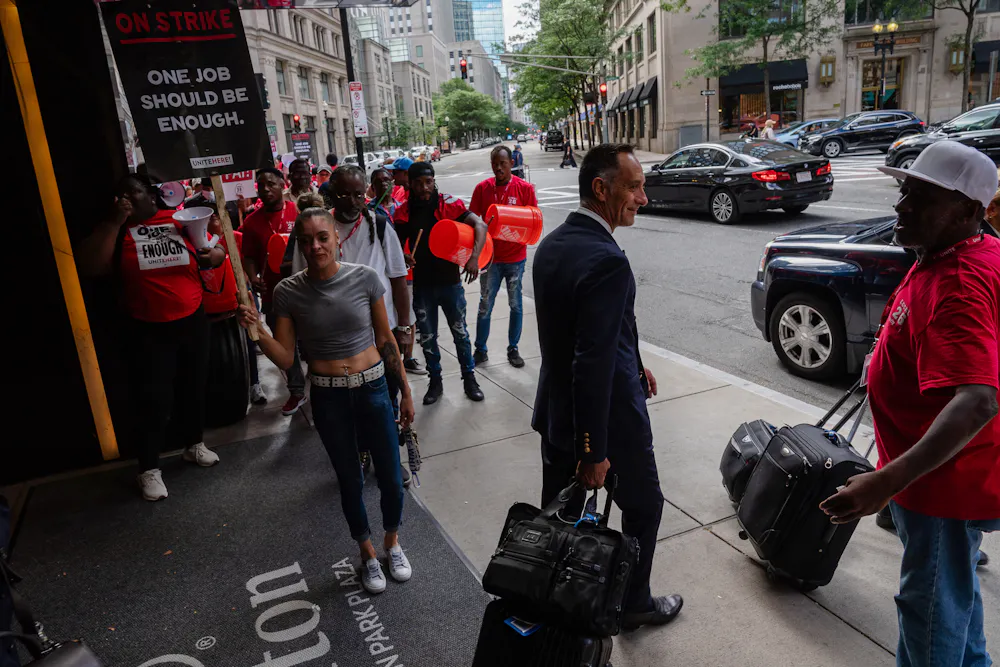
    On Labor Day weekend in 2024, more than 10,000 hotel workers represented by the UNITE HERE union and employed by 24 hotels from Boston to the West Coast to Hawaii went on strike. Their labor actions disrupted travel plans during a busy time.

    Most hotel work stoppages lasted for three days and intended to pressure the companies that own hotels as part of a larger labor contract negotiation strategy. Later in September, workers kept walking off the job at other hotels to pressure management to improve pay, expand health insurance coverage, boost retirement benefits and agree to resolve important job security issues.

    Although the hotel industry has been booming since 2023, UNITE HERE contends that employment has decreased by nearly 40%, while wages have stagnated. On the picket line, workers have described living paycheck to paycheck and working one or two additional jobs to cover recent rent hikes.

    Hotel workers have more bargaining power today because, according to an industry study, 79% of the 450 hotels surveyed looking to hire people said they could not fill open jobs.

    That strike shows no sign of ending. Thousands more hotel workers were joining in by late September.

    Striking hotel workers make way for an airline crew while picketing outside of the Hilton Boston Park Plaza in Boston, Mass., on Sept. 2, 2024.
    Sophie Park/The Washington Post via Getty Images

    Boeing strike

    Unlike the hotel workers’ brief rolling work stoppages, the Boeing strike hasn’t let up since it began on Sept. 13, 2024. About 32,000 workers, mainly in Seattle, Washington, and Portland, Oregon, have walked off the job.

    Boeing workers declared the strike even though the International Association of Machinists District 751 leadership in Seattle wanted to accept a deal from Boeing’s management. But on Sept. 12, 94.6% of all rank-and-file workers rejected the tentative contract their leadership recommended the union accept.

    The Boeing strike started the next day; it could last a long time. On Sept. 25, the workers rejected what the company had called its “best and final offer” to settle the strike.

    This is the eighth time these workers have gone on strike since their union formed in the 1930s. Its two most recent strikes, in 2008 and 2005, lasted 57 days and 28 days, respectively. Boeing’s management, already reeling from the company’s numerous operational and safety problems, has announced several cost-cutting measures, including furloughs for some nonunion employees.

    Boeing’s nonunion backup plan

    Boeing has assured its shareholders and the public that the strike would not hinder production of the 787 Dreamliner jets at the company’s nonunion factory in South Carolina.

    International Association of Machinists union members have never forgiven Boeing for deciding to build that assembly plant. Operational since 2011, it now employs roughly 6,000 workers. Most of them would have been union members had Boeing built that plant or expanded production in Washington or Oregon, because the existing labor agreement would have covered the new workers.

    However, the agreement did not extend to South Carolina.

    At the time of the decision, a Boeing spokesperson said, its contract with the machinists’ union “acknowledges our right to locate work elsewhere, and that’s what we chose to do in this case because we just couldn’t get the terms from them that we needed.”

    Dockworkers could be next

    The timing of the hotel and Boeing strikes makes them perhaps more visible than they might have been because union members’ votes are coveted by both major parties in the 2024 presidential election.

    Meanwhile, 25,000 dockworkers who belong to the International Longshoremen’s Association are planning a possible shutdown of ports from Boston to Houston on Oct. 1, over the union’s concern for job loss due to automation.

    How job security issues are addressed following this wave of strikes could set the tone for what other hospitality, manufacturing and transportation unions seek when their contracts are up for negotiation again.

    Robert Forrant does not work for, consult, own shares in or receive funding from any company or organization that would benefit from this article, and has disclosed no relevant affiliations beyond their academic appointment.

    – ref. Autoworkers, Boeing machinists, cannabis drivers: Labor unions are mobilizing in new and old industries alike – https://theconversation.com/autoworkers-boeing-machinists-cannabis-drivers-labor-unions-are-mobilizing-in-new-and-old-industries-alike-239371

    MIL OSI – Global Reports –

    September 29, 2024
  • MIL-OSI Video: Secretary Blinken met with South African Minister Ronald Lamola

    Source: United States of America – Department of State (video statements)

    Secretary of State Antony J. Blinken met with South African Minister of International Relations and Cooperation Ronald Lamola in New York City, New York, on September 27, 2024.

    Transcript: https://www.state.gov/secretary-antony-j-blinken-and-south-african-minister-of-international-relations-and-cooperation-ronald-lamola-before-their-meeting/

    ———-
    Under the leadership of the President and Secretary of State, the U.S. Department of State leads America’s foreign policy through diplomacy, advocacy, and assistance by advancing the interests of the American people, their safety and economic prosperity. On behalf of the American people we promote and demonstrate democratic values and advance a free, peaceful, and prosperous world.

    The Secretary of State, appointed by the President with the advice and consent of the Senate, is the President’s chief foreign affairs adviser. The Secretary carries out the President’s foreign policies through the State Department, which includes the Foreign Service, Civil Service and U.S. Agency for International Development.

    Get updates from the U.S. Department of State at www.state.gov and on social media!
    Facebook: https://www.facebook.com/statedept
    Twitter: https://twitter.com/StateDept
    Instagram: https://www.instagram.com/statedept
    Flickr: https://flickr.com/photos/statephotos/

    Subscribe to the State Department Blog: https://www.state.gov/blogs
    Watch on-demand State Department videos: https://video.state.gov/
    Subscribe to The Week at State e-newsletter: http://ow.ly/diiN30ro7Cw

    State Department website: https://www.state.gov/
    Careers website: https://careers.state.gov/
    White House website: https://www.whitehouse.gov/

    #StateDepartment #DepartmentofState #Diplomacy

    https://www.youtube.com/watch?v=O7AxKHDeM7E

    MIL OSI Video –

    September 29, 2024
  • MIL-OSI Global: CubeSats, the tiniest of satellites, are changing the way we explore the solar system

    Source: The Conversation – USA – By Mustafa Aksoy, Assistant Professor of Electrical & Computer Engineering, University at Albany, State University of New York

    Most CubeSats weigh less than a bowling ball, and some are small enough to hold in your hand. But the impact these instruments are having on space exploration is gigantic. CubeSats – miniature, agile and cheap satellites – are revolutionizing how scientists study the cosmos.

    A standard-size CubeSat is tiny, about 4 pounds (roughly 2 kilograms). Some are larger, maybe four times the standard size, but others are no more than a pound.

    As a professor of electrical and computer engineering who works with new space technologies, I can tell you that CubeSats are a simpler and far less costly way to reach other worlds.

    Rather than carry many instruments with a vast array of purposes, these Lilliputian-size satellites typically focus on a single, specific scientific goal – whether discovering exoplanets or measuring the size of an asteroid. They are affordable throughout the space community, even to small startup, private companies and university laboratories.

    Tiny satellites, big advantages

    CubeSats’ advantages over larger satellites are significant. CubeSats are cheaper to develop and test. The savings of time and money means more frequent and diverse missions along with less risk. That alone increases the pace of discovery and space exploration.

    CubeSats don’t travel under their own power. Instead, they hitch a ride; they become part of the payload of a larger spacecraft. Stuffed into containers, they’re ejected into space by a spring mechanism attached to their dispensers. Once in space, they power on. CubeSats usually conclude their missions by burning up as they enter the atmosphere after their orbits slowly decay.

    Case in point: A team of students at Brown University built a CubeSat in under 18 months for less than US$10,000. The satellite, about the size of a loaf of bread and developed to study the growing problem of space debris, was deployed off a SpaceX rocket in May 2022.

    A CubeSat can go from whiteboard to space in less than a year.

    Smaller size, single purpose

    Sending a satellite into space is nothing new, of course. The Soviet Union launched Sputnik 1 into Earth orbit back in 1957. Today, about 10,000 active satellites are out there, and nearly all are engaged in communications, navigation, military defense, tech development or Earth studies. Only a few – less than 3% – are exploring space.

    That is now changing. Satellites large and small are rapidly becoming the backbone of space research. These spacecrafts can now travel long distances to study planets and stars, places where human explorations or robot landings are costly, risky or simply impossible with the current technology.

    But the cost of building and launching traditional satellites is considerable. NASA’s lunar reconnaissance orbiter, launched in 2009, is roughly the size of a minivan and cost close to $600 million. The Mars reconnaissance orbiter, with a wingspan the length of a school bus, cost more than $700 million. The European Space Agency’s solar orbiter, a 4,000-pound (1,800-kilogram) probe designed to study the Sun, cost $1.5 billion. And the Europa Clipper – the length of a basketball court and scheduled to launch in October 2024 to the Jupiter moon Europa – will ultimately cost $5 billion.

    These satellites, relatively large and stunningly complex, are vulnerable to potential failures, a not uncommon occurrence. In the blink of an eye, years of work and hundreds of millions of dollars could be lost in space.

    NASA scientists prep the ASTERIA spacecraft for its April 2017 launch.
    NASA/JPL-Caltech

    Exploring the Moon, Mars and the Milky Way

    Because they are so small, CubeSats can be released in large numbers in a single launch, further reducing costs. Deploying them in batches – known as constellations – means multiple devices can make observations of the same phenomena.

    For example, as part of the Artemis I mission in November 2022, NASA launched 10 CubeSats. The satellites are now trying to detect and map water on the Moon. These findings are crucial, not only for the upcoming Artemis missions but to the quest to sustain a permanent human presence on the lunar surface. The CubeSats cost $13 million.

    The MarCO CubeSats – two of them – accompanied NASA’s Insight lander to Mars in 2018. They served as a real-time communications relay back to Earth during Insight’s entry, descent and landing on the Martian surface. As a bonus, they captured pictures of the planet with wide-angle cameras. They cost about $20 million.

    CubeSats have also studied nearby stars and exoplanets, which are worlds outside the solar system. In 2017, NASA’s Jet Propulsion Laboratory deployed ASTERIA, a CubeSat that observed 55 Cancri e, also known as Janssen, an exoplanet eight times larger than Earth, orbiting a star 41 light years away from us. In reconfirming the existence of that faraway world, ASTERIA became the smallest space instrument ever to detect an exoplanet.

    Two more notable CubeSat space missions are on the way: HERA, scheduled to launch in October 2024, will deploy the European Space Agency’s first deep-space CubeSats to visit the Didymos asteroid system, which orbits between Mars and Jupiter in the asteroid belt.

    And the M-Argo satellite, with a launch planned for 2025, will study the shape, mass and surface minerals of a soon-to-be-named asteroid. The size of a suitcase, M-Argo will be the smallest CubeSat to perform its own independent mission in interplanetary space.

    The swift progress and substantial investments already made in CubeSat missions could help make humans a multiplanetary species. But that journey will be a long one – and depends on the next generation of scientists to develop this dream.

    Mustafa Aksoy works for the University at Albany, State University of New York (SUNY) and the Research Foundation for SUNY. He receives funding from the National Aeronautics and Space Administration (NASA), the National Science Foundation (NSF) and Oak Ridge Associated Universities (ORAU). He is a senior member of the Institute of Electrical and Electronics Engineers (IEEE).

    – ref. CubeSats, the tiniest of satellites, are changing the way we explore the solar system – https://theconversation.com/cubesats-the-tiniest-of-satellites-are-changing-the-way-we-explore-the-solar-system-226701

    MIL OSI – Global Reports –

    September 29, 2024
  • MIL-OSI Africa: South Africans must know the names of struggle heroes and heroines

    Source: South Africa News Agency

    President Cyril Ramaphosa has stressed the importance of South Africans recognising and honouring the former liberation heroes and heroines who have returned to their home country, acknowledging their vital role in securing the nation’s freedom.

    The President was speaking during the repatriation and restitution homecoming ceremony of 42 South African freedom fighters who lost their lives in Zambia and Zimbabwe during the apartheid era.

    The ceremony was held at the Freedom Park Heritage Site and Museum in Tshwane, Pretoria on Friday with families of the freedom fighters present. 

    The occasion was also graced by former President Thabo Mbeki, Minister of Defence Angie Motshekga, and the Minister of Sports, Arts and Culture Gayton Mckenzie.

    “South Africans need to know the names and appreciate the contributions of these returned freedom fighters. I ask that we read out the names of these patriots for all our people to know them.

    “Their names will forever be inscribed here at the Wall of Names in Freedom Park so that we may never forget. Any nation that values its freedom holds its liberation heroes and heroines in high regard,” the President said.

    The repatriation of the freedom fighters’ remains from Zambia and Zimbabwe forms part of the Resistance and Liberation Heritage Route Project (RLHR). The RLHR is a national memory project aimed at commemorating, celebrating, educating, promoting, preserving, conserving and providing a durable testament of South African’s road to freedom.

    The repatriation initiative is part of a broader effort to bring the remains of freedom fighters who died in exile to their final resting places.

    As the country celebrates the return of the struggle heroes and heroines, the President said through the act of repatriation, their citizenship has been reinstated.

    “We return them to the land of their birth. We restore them to their families and their people. Decades ago, these freedom fighters left a country that was at war with itself.

    “They left a country in which the fundamental rights of its people were brutally and cruelly suppressed by apartheid, which was declared a crime against humanity. Today, their remains return to a free and democratic South Africa,” he said. 

    The President said it will forever remain a source of regret that they were never to see the dawn of the freedom to which they dedicated their lives. 

    He emphasised that it was fitting that the country gathers at Freedom Park to honour them. 

    “It is here at Freedom Park that we remember our struggle for liberation and the many men and women who fought so that we may be free. It is here that we celebrate the achievement of our democracy.

    “And it is here that we pledge to strive together, sparing neither strength nor courage, until the fundamental freedoms of every person are realised,” the President said. 

    Through the reparation of the remains of these freedom fighters, President Ramaphosa said the country is giving further effect to the Preamble of its Constitution.

    He added that while these freedom fighters belonged to different political traditions, they were united by a common vision of a free South Africa. 

    “And though they departed this life many years ago, their ideals and their values continue to guide the South Africa we are building. Their activism and their sacrifices continue to inspire our efforts to build a better life for all,” he said. 

    The President extended his gratitude to the countries that offered these freedom fighters shelter, support and, in the end, a fitting resting place.

    “We are grateful in this instance to the governments and peoples of Zambia and Zimbabwe for having taken great care of our compatriots and for enabling their remains to be repatriated,” the President said.

    Preserving the nation’s liberation heritage

    President Ramaphosa said government is making every effort to preserve the nation’s liberation heritage. 

    “To do so, we must honour all those who authored this history by taking part in the struggle to free our country. This we must continue to do because our freedom can never be taken for granted. 

    “We must continue to honour those men and women whose love for their country and its people motivated them to sacrifice their lives for freedom,” he said. 

    The President spoke in detail about a few of the struggle horoes and heroines who were well known. 

    One of the prominent names was that of Duma Nokwe who was the Secretary-General of the African National Congress at a crucial moment in the nation’s struggle for liberation. 

    “In exile, he was a prominent voice on the continent and around the world in support of the cause of the South African people.

    “It is perhaps a sign of his esteemed place in the history of the liberation movement that his remains were exhumed still wearing the ANC scarf in which he was buried in Lusaka in 1978,” the President said. 

    Another prominent name is that of John Nyathi Pokela who was Chairman of the Pan Africanist Congress who spent more than a decade on Robben Island for his activities as a member of the Azanian People’s Liberation Army, then known as Poqo. 

    He is remembered for the vital role he played in forging unity within the PAC. He passed away in Harare in 1985.

    Another prominent leader of the Pan Africanist Congress was Edwin Letsholo Makoti. 

    He was a founding member of the PAC and was Secretary for Publicity and Information in the PAC Central Committee at the time of his passing in Harare in 1989.

    The President spoke of the well-known Florence Mophosho, a stalwart of the struggle who is remembered for her commitment, sacrifice and fiery spirit.

    “She was a great leader of our movement and a pioneer in the struggle for women’s rights. She helped us understand that no society can be free until its women are free,” he said. 

    The name of Basil February is also written large in the history of the nation’s struggle. As a member of the Luthuli Detachment of Umkhonto we Sizwe, he was killed in action in the then-Rhodesia during the Wankie Campaign.

    “There are other freedom fighters we honour here today whose names are not as familiar. And yet their sacrifice and their contribution to our freedom is no less profound and is no less valued,” the President said. – SAnews.gov.za

    MIL OSI Africa –

    September 29, 2024
  • MIL-OSI Translation: Report on rules to prevent and combat child sexual abuse

    MIL OSI Translation. Government of the Republic of France statements from French to English –

    Source: Switzerland – Department of Foreign Affairs in French

    Federal Council

    Bern, 27.09.2024 – At its meeting on 27 September 2024, the Federal Council took note of a report on the European Commission’s proposal for a regulation on preventing and combating child sexual abuse. The report highlights the possible legal consequences of the European project. In particular, the planned control of instant messaging services could violate Swiss law.

    In November 2022, the Federal Council announced the preparation of a report in its opinion on the Bellaiche motion 22.4113 “Control of instant messaging. Protecting the population against continuous and unjustified widespread surveillance”. Submitted in connection with the European Commission’s proposal for a regulation establishing rules to prevent and combat child sexual abuse (CSA regulation, for child sexual abuse), this motion tasked the Federal Council in particular with protecting the inhabitants of Switzerland against the control of instant messaging provided for in the proposed European legislative project.

    Consequences of the proposed European Union regulation

    The report of the Federal Department of Justice and Police shows that even if this regulation of the European Union (EU) would not constitute a development of the Schengen acquis and should therefore not be adopted by Switzerland, the envisaged rules could also concern legal entities or natural persons established in Switzerland. The proposed detection order could undermine the sovereignty of our country and infringe Art. 271 of the Criminal Code (acts carried out without right for a foreign state).

    The proposed regulation was withdrawn from the agenda of the EU Council and the European Parliament this summer. Discussions and differences persist between the member states, particularly on the detection order and end-to-end encryption. Hungary, which has held the presidency of the EU Council since July, has proposed a new compromise, which is currently being debated. If the proposed CSA regulation were to be adopted by the EU, the issue of sovereignty and the infringement of Swiss law would need to be clarified in depth.

    The report, which the Federal Council has taken note of, also provides an overview of the measures taken by Switzerland to combat child sexual abuse.

    Address for sending questions

    Communication fedpol, T 41 58 463 13 10, media@fedpol.admin.ch

    Author

    Federal Councilhttps://www.admin.ch/gov/fr/accueil.html

    Federal Department of Justice and Policehttp://www.ejpd.admin.ch

    Federal Office of Policehttp://www.fedpol.admin.ch/fedpol/fr/home.html

    Social sharing

    EDITOR’S NOTE: This article is a translation. Apologies should the grammar and/or sentence structure not be perfect.

    MIL Translation OSI

    September 29, 2024
  • MIL-OSI Translation: Government of Canada supports health sciences SMEs to create new health technologies

    MIL OSI Translation. Canadian French to English –

    Source: Government of Canada – in French

    Press release

    Canada’s health sciences innovation sector continues to play a leading role in developing innovative ideas and products that will support a better, healthier future. The Government of Canada is providing businesses and organizations in this vital sector with the support they need to deliver effective health solutions for Canadians.

    Government of Canada invests in specialized program that will help 75 southern Ontario health sciences SMEs

    September 27, 2024 – Hamilton, Ontario

    Canada’s health sciences innovation sector continues to play a leading role in developing innovative ideas and products that will support a better, healthier future. The Government of Canada is providing businesses and organizations in this vital sector with the support they need to deliver effective health solutions for Canadians.

    Yesterday, the Honourable Filomena Tassi, Minister responsible for the Federal Economic Development Agency for Southern Ontario (FedDev Ontario), attended the 14th edition of the LiONS LAIR presentation competition organized by Innovation Factory. More than 400 members of Hamilton’s life sciences ecosystem came together to celebrate innovation in the Hamilton-Halton region.

    At the event, Minister Tassi announced a Government of Canada investment of over $5 million to enable Innovation Factory, in collaboration with the Synapse Life Sciences Consortium, to support the continued delivery of the Southern Ontario Pharmaceutical and Health Innovation Ecosystem (SOPHIE) program, the period for receiving applications launched yesterday. The program will help up to 75 southern Ontario SMEs commercialize their products and scale their operations. Participating companies will have access to mentoring and advisory services, seed funding and new partnerships. This critical work will help accelerate their product development and anchor health sciences companies in southern Ontario.

    This project aligns with the Government of Canada’s priority to support new growth opportunities in this important sector. Innovators and organizations that create health care technologies help protect the health of Canadians, while strengthening Canada’s health sciences sector and creating new job opportunities in Canada.

    Quotes

    “Innovation Factory is undertaking important work that will support the expansion and development of 75 SMEs, while helping to anchor health sciences companies here in Canada. Today’s investment demonstrates the Government of Canada’s commitment to supporting health sciences innovators and ensuring a healthier future for Canadians.” – The Honourable Filomena Tassi, Minister responsible for the Federal Economic Development Agency for Southern Ontario

    “The renewal of funding for Innovation Factory’s SOPHIE program is a testament to the remarkable impact it has had on Ontario’s health sciences sector over the past several years. This continued support from the Government of Canada allows us to build on that success, fostering innovation, job creation and the global competitiveness of the health sciences industry. We look forward to seeing SOPHIE continue to transform the landscape for health sciences entrepreneurs and strengthen Ontario’s position as a hub for health innovation.” – David Carter, President and CEO, Innovation Factory

    Quick Facts

    Innovation Factory is a non-profit business accelerator that has been acting as a catalyst for technological innovation in the Brant, Halton, Hamilton and Norfolk regions since 2010.

    Innovation Factory provides business services, training, mentoring and strategic relationships to drive market adoption, leverage intellectual property and increase revenue, investment and jobs. Innovators can also access sector-specific resources, including smart transportation data and testing environments, as well as a formal health and health sciences innovation ecosystem.

    FedDev Ontario previously provided an investment of $7 million to Innovation Factory to implement the first call for applications for the SOPHIE program. To date, through SOPHIE, 166 innovative Ontario health sciences start-ups and scale-up companies in the health, medical device and pharmaceutical sectors have received support to develop and commercialize new products and services.

    Applications for the SOPHIE program are currently being accepted. Additional details regarding the program and the application process are available on the SOPHIE website.Innovation Factory

    Since 2015, the Government of Canada, through FedDev Ontario, has invested more than $237 million in 58 projects in the life sciences sector, supporting more than 7,700 jobs.

    Related links

    Contact persons

    Edward HutchinsonPress SecretaryOffice of the Minister responsible for the Federal Economic Development Agency for Southern OntarioEdward.hutchinson@feddevontario.gc.ca

    FedDev Ontario Media Relationsmedia@feddevontario.gc.ca

    Stay connected:

    FedDev-Ontario.Canada.ca

    Follow us on X, Instagram, LinkedIn, Facebook

    Subscribe to the FedDev Ontario newsletter, Southern Ontario Economic News, which features news and updates on economic development in the region.

    EDITOR’S NOTE: This article is a translation. Apologies should the grammar and/or sentence structure not be perfect.

    MIL Translation OSI

    September 29, 2024
  • MIL-OSI Translation: Indigenous Guardian Projects 2024-2025

    MIL OSI Translation. Canadian French to English –

    Source: Government of Canada – in French 2

    Today, Jaimee Gaunce, Executive Director of the First Nations National Guardians Network (FNGN), joined the Honourable Steven Guilbeault, Minister of Environment and Climate Change, the Honourable Patty Hajdu, Minister of Indigenous Services and Minister responsible for the Federal Economic Development Agency for Northern Ontario, and Marcus Powlowski, Member of Parliament for Thunder Bay–Rainy River, to announce an investment of up to $27.6 million to support 80 First Nations Guardians initiatives.

    Alberta

    Project Title: Mikisew Cree First Nation Guardians ProgramRecipient: Mikisew Cree First Nation – Government and Industry RelationsFunding Amount: $350,000Project Description: This ongoing, two-year initiative will study how oil sands development, specifically bitumen extraction and hydroelectric projects, is affecting the health of the Peace-Athabasca Delta, the heart of the Mikisew’s traditional territory. Guardians work throughout the year to monitor water quality, collect data, detect flooding and monitor fish populations.

    Project Title: Ni Ho Ghe Di – Athabasca Chipewyan First Nation Guardians ProgramRecipient: Dene Land and Resource ManagementFunding Amount: $350,000Project Description: This two-year initiative will monitor and report activities that may harm the ecology, traditional lands or traditional resources of the Athabasca Chipewyan First Nation, such as poaching and illegal hunting on traditional territory, particularly to protect the Ronald Lake bison. The initiative will also help youth build cultural pride and connection to the land, as well as develop on-the-land skills.

    Project Title: Guardians of the Land – Dene Tha’ First NationRecipient: Dene Tha’ First NationFunding Amount: $350,000Project Description: This two-year initiative will include activities such as ecological restoration, support for resource management plans, and compliance with laws and regulations. Guardians will contribute to the protection and recovery of species at risk, manage land use in the proposed M’behcholia Indigenous Protected and Conserved Area (Bistcho Lake, Alberta), and provide environmental and wildlife monitoring.

    Project Title: Alexis Nakota Sioux Nation Guardians InitiativeRecipient: Alexis Nakota Sioux NationFunding Amount: $346,400Project Description: This two-year initiative will include conducting and analyzing aerial surveys, creating a Geographic Information System (GIS) data management and visualization system using RStudio and ArcPY, and continuing to develop the Stoney Lands and Waters course.

    British Columbia

    Project Title: Kitasoo Xai’xais Nation Guardian Program EnhancementRecipient: Kitasoo Xai’xais NationFunding Amount: $604,925Project Description: This two-year initiative will focus on marine and terrestrial surveys, as well as compliance and enforcement practices that include education, observation and reporting. In addition, guardians participate in Coastal First Nations Coast Guard Auxiliary activities and receive training on emergency response to search and rescue and oil spills.

    Project Title: Coastal Stewardship NetworkRecipient: Great Bear Initiative SocietyFunding Amount: $499,785Project Description: This two-year initiative provides programming to the eight member nations of the Great Bear Initiative of Coastal First Nations, who work directly with communities to support Guardians along the North and Central Coast and Haida Gwaii to monitor resource use and ecosystem health, provide training and professional development opportunities, raise awareness, and foster coastal stewardship.

    Project Title: Songhees Nation Guardians ProgramRecipient: Songhees NationFunding Amount: $50,000Project Description: This one-year initiative continues work already begun with community members, band council and outside organizations to provide monitoring services, promote community stewardship and restore habitat areas. This initiative helps strengthen Indigenous presence on the water during fishing seasons as it is essential to establishing greater authority over fisheries and coastal resources on the land.

    Project Title: Lower Nicola Indian Band – Indigenous Guardians Program – Tier 1Recipient: Lower Nicola Indian BandFunding Amount: $49,450Project Description: This one-year initiative aims to build capacity, skills and knowledge to implement a new Guardians Program in the community. This program will include mapping and indexing areas of the territory, consulting with Elders and Knowledge Keepers, community engagement, developing a plan and working with Chief and Council to ensure alignment of the vision and strategic plan.

    Project Title: Mamalilikulla First Nation Guardian ProgramRecipient: Mamalilikulla First NationFunding Amount: $350,000Project Description: This two-year initiative includes ongoing activities where guardians will spend time in the field collecting data, monitoring cultural sites, managing grizzly bear populations, planting crabapple trees to feed the bears, and improving fisheries. This work will help Chief and Council make informed decisions.

    Project Title: Wet’suwet’en First Nation Guardians Initiative: A Holistic ApproachRecipient: Wet’suwet’en First NationFunding Amount: $75,745Project Description: This one-year initiative will monitor and collect data on moose populations and mortality rates, assess wildlife habitat, install camera traps, and assess riparian areas. It will also explore the possibility of launching a water monitoring program in identified priority areas. These efforts will help the community observe and document activities or cumulative effects that impact their ability to practice their traditional way of life.

    Project Title: Indigenous Guardians Proposal for Saulteau First NationsRecipient: Saulteau First NationsFunding Amount: $350,000Project Description: This two-year initiative will support the community in taking the lead in monitoring, protecting and restoring lands and waters, which is essential to the health and well-being of the community. Activities include supporting healthy food harvesting, cultural activities, protecting Klinse-za Park, monitoring climate change and understanding how events such as wildfires affect the community, changes in weather patterns, and changes in animal movements and water availability.

    Project Title: Saik’uz Guardians ProgramRecipient: Saik’uz First NationFunding Amount: $350,000Project Description: This two-year initiative will build on the long-term monitoring efforts of the Saik’uz Guardians community-based initiative. Guardians will be guided by the wisdom of Indigenous knowledge and Western science, with the goal of empowering the Nation with respect to the water and land of the territory.

    Project Title: P’egp’ig’lha GuardiansRecipient: P’egp’ig’lha Council/T’it’q’et First NationFunding Amount: $350,000Project Description: This two-year initiative will conduct land patrols to monitor the health of the land and study wildlife and fisheries. Guardians play a vital role in protecting and restoring the Stein-Nahatlatch grizzly bear population, supporting wildfire recovery efforts, and strengthening collaboration with other guardian programs in the area.

    Project Title: Pauquachin First Nation Marine Department – Stewardship InitiativeRecipient: Pauquachin First NationFunding Amount: $350,000Project Description: This two-year initiative will monitor one of British Columbia’s busiest and most heavily used waterways. Guardians monitor culturally sensitive archaeological sites, harvest areas, recreational and commercial fisheries use, environmental threats (pollution sources, marine waste disposal, illegal activities and poaching), and conduct restoration work in designated areas of significance. This initiative represents the interests, concerns and goals of the community to ensure that waterways, foods, historic sites and cultural practices are sustained for generations to come.

    Project Title: Takla Nation Guardians Initiative – Tier 2Recipient: Takla NationFunding Amount: $499,959Project Description: This ongoing initiative is monitoring over 30 sites on Takla lands and waters. This work is critical to the Takla’s ability to implement environmental and cultural protections, including ensuring that archaeological impact assessments conducted by various developers and government agencies are consistent with the Takla Archaeology Policy. It also builds capacity to monitor caribou and moose populations and supports the Guardians program by encouraging youth engagement in the community.

    Project Title: Tsilhqot’in Guardians NetworkRecipient: Tsilhqot’in National GovernmentFunding Amount: $500,000Project Description: This two-year initiative, led by the Tsilhqot’in National Government in collaboration with six Tsilhqot’in communities – Xeni Gwet’in, Tlesqox, Tletinqox, Tsi Del Del, ?Esdilagh and Yunesit’in – aims to integrate and strengthen Tsilhqot’in values into the management of lands and waters in the region. In partnership with provincial and federal land and water management agencies, the Guardians will conduct hunting, fishing and fire prevention patrols, as well as wildlife and water monitoring research to ensure sustainable management of Tsilhqot’in territories.

    Project Title: Quatsino Axsilaxa Ahwheatnagwusn Guardians ProgramRecipient: Quatsino First NationFunding Amount: $342,765Project Description: This two-year initiative will support the implementation of the Quatsino Land Use and Marine Resource Use Plan. This will be done through field work such as data collection and monitoring. These efforts will be critical to ecosystem restoration and food security through local harvesting of traditional foods.

    Project Title: Nłeʔképmx GuardiansRecipient: Citxw Nlaka’pamux AssemblyFunding Amount: $350,000Project Description: This two-year initiative will continue to build on-the-ground presence and awareness of Nłeʔképmx territory, protocols and cultural practices. Guardians will monitor and record activities on the land, focusing on priority areas identified by the Citxw Nlaka’pamux Assembly. These priority areas include hunting, fishing, gathering and other culturally significant areas. Nłeʔképmx Guardians will record, monitor and manage invasive species and contribute to research on species at risk on the territory.

    Project Title: Supporting and Maintaining a Strong and Effective Heiltsuk Guardian ProgramRecipient: Heiltsuk Integrated Resource Management Department of the Heiltsuk Tribal CouncilFunding Amount: $349,499Project Description: This two-year initiative will focus on building capacity, monitoring local aquatic ecosystems and community fisheries for safe operations, and supporting and restoring the vital relationship between people and the land.

    Project Title: Haa Aaní Tulatín – Taku River Tlingit First Nation Land Guardians ProgramRecipient: Taku River Tlingit First NationFunding Amount: $349,600Project Description: This two-year initiative will address threats to the land and monitor salmon populations. The guardians will work to strengthen salmon stewardship by hosting multi-day camps that focus on traditional fishing, intergenerational knowledge transfer, and land monitoring.

    Project Title: Spuzzum First Nation Land Guardians InitiativeRecipient: Spuzzum Indian BandFunding Amount: $50,020Project Description: This one-year initiative will focus on protecting important ecosystems by monitoring key territorial and cultural sites, collecting ecological data, and saving endangered species such as the Northern Spotted Owl. The guardians will also contribute to the development of a stewardship policy framework.

    Project Title: Kwadacha First Nation Guardians Project – Level 2Recipient: Kwadacha First NationFunding Amount: $348,734Project Description: This two-year initiative will provide long-term ecological and cultural monitoring to track changes in key wildlife habitats, traditional food sources and water sources. This will provide an opportunity to discuss how potential changes may impact Dene roles and responsibilities on the land.

    Project Title: Doig River First Nation Guardians ProgramRecipient: Doig River First NationFunding Amount: $349,188Project Description: This two-year initiative will focus on improving land and water monitoring by combining cultural methods and western science. Doig River First Nation Guardians will continue to monitor the health of the land, guided by their members, and will work collaboratively with government to address any impacts.

    Project Title: Nahnéhé Gegenı́hı/Kakinawetakwow Uski/Fort Nelson First Nation Land Guardians InitiativeRecipient: Fort Nelson First NationFunding Amount: $375,000Project Description: This two-year initiative supports stewardship, land management and cultural activities on Fort Nelson First Nation territory. The initiative is informed by Western scientific monitoring and research, while drawing on Indigenous ways of knowing and understanding the health and condition of lands and waters.

    Project Title: Scianew Guardians InitiativeRecipient: Beecher Bay First NationFunding Amount: $348,614Project Description: This two-year initiative will focus on environmental conservation and monitoring, guardian training, impact assessments, territorial sovereignty and maritime safety. This will be accomplished through partnerships with neighbouring nations, the Western Canada Marine Response Corporation (WCMRC) and Kotug Canada.

    Project Title: Upper Similkameen Indian Band Land Guardians ProgramRecipient: Upper Similkameen Indian BandFunding Amount: $391,894Project Description: This two-year initiative aims to address critical environmental challenges while deeply integrating Indigenous knowledge, community engagement and sustainable practices. The Guardians initiative focuses on land conservation, sustainable resource management and building ecosystem resilience.

    Project Title: Boothroyd Guardians Program ImplementationRecipient: Boothroyd Indian BandFunding Amount: $50,000Project Description: This one-year initiative will monitor environmental indicators on the land and support restoration work in areas damaged by wildfires and subsequent erosion. Boothroyd Guardians will work with land user groups to improve understanding and respect for the environment.

    Project Title: TTQ Guardian Program Initiation ProjectRecipient: TTQ Economic Development CorporationFunding Amount: $62,533Project Description: This one-year initiative will collect and interpret previously recorded Xa’xtsa cultural knowledge data, map priority areas, and develop a monitoring plan. The goal is to observe changes in the supply of traditional herbs and plants, the frequency and impact of foraging on the territory, the vitality of salmon spawning, changes in unauthorized camping, and invasive plant and animal species.

    Project Title: Wildfire Recovery MonitoringRecipient: Okanagan Indian BandFunding Amount: $350,000Project Description: This two-year initiative will assess the condition of the White Rock Lake watershed before and after the wildfires on behalf of the Okanagan Indian Band. Guardians will conduct site assessments, inventory significant cultural resources, monitor wildlife, and assess the severity of fire damage to guide restoration efforts.

    Project Title: Nanwakolas – Stewardship through Indigenous Scientific KnowledgeRecipient: Nanwakolas Council CorporationFunding Amount: $500,000Project Description: This two-year initiative will apply Kwakwaka’wakw values and Indigenous scientific knowledge to a variety of projects including loxiwe (clam garden) restoration, canoe carving, seasonal Guardian Gathering events, and data collection on water, wildlife monitoring, climate change studies, and emergency response planning.

    Project Title: Continuing Implementation of the Skwxwú7mesh Úxwumixw (Squamish Nation) Guardian Program InitiativeRecipient: Squamish Nation – Squamish Indian Band 555Funding Amount: $349,505Project Description: This two-year initiative will provide stewardship activities, respond to climate events and emergencies, and enhance public safety. Guardians will continue to be present on the land and learn from Elders, Knowledge Keepers and youth; and collaborate with other Nations to share information and build capacity across the national Guardian network.

    Project Title: Guardians of the St’át’imc LandRecipient: St’at’imc Government ServicesFunding Amount: $425,180Project Description: This two-year initiative will focus on implementing the St’át’imc Water Agreement. It includes collecting baseline data on three intact watersheds and three impacted watersheds to assess water quality. Other activities include capacity building and examining stories and legends through workshops and research in collaboration with the Indigenous Law Research Unit.

    Project Title: Nak’azdli Whut’en Yinka Huwunline (Caring) Guardian ProgramRecipient: Nak’azdli Whut’enFunding Amount: $349,942Project Description: This two-year initiative will develop geospatial mapping technology for Guardians to use in their monitoring activities. This will create open portals for communication while protecting internal data and cultural information. The project will use remote sensing technology to create “living maps” that will track seasonal phenology, quantify impacts, and provide informed stewardship engagements with industry, government, consultants, and academia.

    Project Title: Yintah Guardians of Lake Babine NationRecipient: Lake Babine NationFunding Amount: $350,000Project Description: This two-year initiative will lead the collaborative management of the Yintahs of Lake Babine Nation territory and resources of two key cultural species, talok (sockeye) and khida (moose), to restore moose populations to culturally significant levels, and support fish monitoring, habitat restoration and cooperative management.

    Manitoba

    Project Title: Seal River Watershed Alliance Land Guardian NetworkRecipient: Seal River Watershed AllianceFunding Amount: $500,000Project Description: This two-year initiative will hire 14 youth and Elders as Land Guardians across the four Alliance Nations. This initiative builds technical capacity and manages species and habitat identification, monitoring, protection, and watershed stewardship.

    Project Title: Askiy Okanawaynichikaywuk – Guardians of the LandRecipient: York Factory First Nation Funding Amount: $349,860Project Description: This two-year initiative will maintain trails, monitor cultural and historical sites, observe changes in the land, and support respectful land use. Guardians will provide a visible presence, conduct community outreach, participate in on-the-ground activities, and help guide Council decisions on land use, stewardship, and protection.

    Project Title: Pimachiowin Aki First Nations Guardians NetworkRecipient: Pimachiowin Aki CorporationFunding Amount: $499,615Project Description: This two-year initiative will focus on monitoring the seasonal walleye fishery, all-season road design, wildfire management, and climate change adaptation and mitigation. Guardians provide a professional presence and expertise in Pimachiowin Aki, expressing their belonging to the Anishinaabe Nation, filling gaps in the provincial information management system and patrols, and conducting year-round monitoring activities.

    Project Title: SCOB Regional First Nations Guardians NetworkRecipient: Southern Chiefs’ Organization Inc.Funding Amount: $500,000Project Description: This two-year initiative will focus on strengthening Indigenous jurisdiction over their traditional lands, developing capacity, training and skills in environmental monitoring and management, and promoting cooperation and collaboration among communities on natural resource stewardship and management issues.

    Project Title: Swan Lake First Nation Indigenous Guardians Land, Water and Nature Stewardship InitiativeRecipient: Swan Lake First NationFunding Amount: $349,285Project Description: This two-year initiative, in collaboration with Agriculture and Agri-Food Canada, will continue to assess and reseed revegetation terraces if necessary, monitor water quality from the tile drainage structure, and monitor animal and pollinator populations. The data collected will help understand the success of this project in reducing nutrient pollution and improving ecosystems.

    New Brunswick

    Project Title: Amlamgog Earth GuardiansRecipient: Fort Folly First NationFunding Amount: $321,411Project Description: This two-year initiative will expand and enhance an existing salmon recovery initiative. This initiative will focus on monitoring flora and fauna, in accordance with the traditional guiding principle of “Etuaptmumk” (two-eyed vision).

    Project Title: Wotstak First Nation Guardians Initiative – Tier 1Recipient: Woodstock First NationFunding Amount: $50,000Project Description: This one-year initiative will collect data and monitor the ecosystem, drawing on the knowledge of Woodstock First Nation’s Indigenous traditions of conservation, with the goal of developing a land use plan.

    Project Title: Elugweieg Toqwe’gig ugjit Ugs’tqamu aq ugjit Sapo’nug (We work together for the land and for tomorrow)Recipient: Esgenoôpetitj Watershed AssociationFunding Amount: $349,923Project Description: This two-year initiative will expand monitoring and governance of the Esgenoôpetitj aquatic environment, led by Esgenoôpetitj First Nation Fishery Guardians, in collaboration with Fisheries and Oceans Canada enforcement staff, as part of the management, conservation and protection of fisheries in areas most frequented by the community.

    Newfoundland and Labrador

    Project Title: Innu Nation Guardians ProgramRecipient: Innu Nation – Environment and Parks OfficesFunding Amount: $700,000Project Description: This two-year initiative will integrate the Innu (Natuashish) communities of Sheshatshiu and Mushuau Innu through environmental stewardship and cultural preservation. The initiative will focus on five objectives: the creation of additional guardian positions, technical and safety training, the organization of youth workshops on knowledge transfer, the purchase of necessary equipment, and the development of cultural initiatives to maintain and promote Innu traditions and ecological knowledge.

    Nova Scotia

    Project Title: Reconnecting Our People with the LandBeneficiary: Eskasoni Fish

    Project Title: Nova Scotia Land Guardians Network/Nuji kelo’toqatijikRecipient: Unama’ki Institute of the Natural Resources SocietyFunding Amount: $500,000Project Description: This two-year initiative involves collecting and sharing Indigenous knowledge, promoting Netukulimk hunting practices, monitoring and data collection including designating areas suitable for cultural activities, harvesting medicinal plants, monitoring species at risk, and education and awareness of culturally significant species.

    Northwest Territories

    Project Title: Ni hat’ni Dene (“Keepers of the Land”)Recipient: Lutsel K’e Dene First NationFunding Amount: $349,600Project Description: This two-year initiative is part of a long-term mandate to promote Thaidene Nene stewardship, working full-time as guardians of the land, water and animals, and as ambassadors of the Dene way of life, and welcoming visitors. Initiatives include protecting Bathurst caribou, sharing cultural knowledge with youth, and protecting food security.

    Project Title: Deninu Kue First Nation GuardiansRecipient: Deninu Kue First NationFunding Amount: $333,055Project Description: This two-year initiative will monitor the land and waters. Guardians will patrol the territory to ensure it remains clean and will conduct water quality sampling and fish cleanliness monitoring.

    Project Title: Łı́ı́dlı̨́ı̨́ Kų́ę́ First Nation Guardians and Climate Change Monitoring ProjectRecipient: Łı́ı́dlı̨́ı̨́ Kų́ę́ First NationFunding Amount: $349,961Project Description: This two-year initiative aims to monitor the impacts of climate change on the environment in the Dehcho region of the Northwest Territories. The initiative will include monitoring a variety of indicators such as permafrost thaw, streambank subsidence/erosion, and species population shifts. Guardians will receive specialized training in monitoring erosion and permafrost conditions, observing thaw patterns, and assessing thaw depth. This data collection is essential to assess the evolution of the landscape.

    Project Title: Sahtu K’aowe Guardians Project for Tsá Tué Biosphere ReserveRecipient: Délįnę Got’įnę GovernmentFunding Amount: $350,000Project Description: This two-year initiative supports monitoring of Great Bear Lake and its watershed using the “Two-Eyed Seeing Approach” (uniting Western science and Indigenous knowledge) to ensure biodiversity conservation, ecological integrity, climate change adaptation, local wildlife subsistence, food security, and the continuity and revitalization of cultural practices.

    Ontario

    Project Title: Environmental Stewardship of Air Quality Issues for Aamjiwnaang First NationRecipient: Aamjiwnaang First NationFunding Amount: $48,732Project Description: This one-year initiative will monitor the air, water and lands surrounding Aamjiwnaang First Nation that have been impacted by industrial development. Guardians will identify environmental monitoring gaps (soil, water, air, fish, plants and endangered species), develop data collection plans, and improve emergency notifications and community responses to oil refineries, chemical plants and other industrial facilities located near Aamjiwnaang First Nation.

    Project Title: Temagami First Nation GuardiansRecipient: Temagami First NationFunding Amount: $451,000Project Description: This two-year initiative focuses on water quality, species and habitat protection, preserving Indigenous wisdom, data collection and monitoring. Guardians will participate in tracking, recording and reporting activities related to land use and environmental protection. Special attention will be paid to Lake Temagami, including monitoring ice fishing huts, houseboats, shorelines and more.

    Project Title: Atikameksheng Anishnawbek – Phase 2 – Monitoring the Atikameksheng Traditional TerritoryRecipient: Atikameksheng AnishnawbekFunding Amount: $347,263Project Description: This two-year initiative will collect maple sap during the sugar moon and harvest other food items, which will be distributed to Elders and the Nations Food Bank. Guardians will monitor the land, conduct field inspections for proposed logging operations to ensure that Grandmother Trees are protected, and complete daily field worksheets and site inspections that will provide important environmental information on spills, violations, and logging operations.

    Project Title: Anishinabek Traditional Ecological Guardians of Georgian BayRecipient: Magnetawan First NationFunding Amount: $500,000Project Description: This two-year initiative supports on-the-ground learning, knowledge transfer and technical skills training on species at risk, species monitoring, data collection and other land management activities using the “Two-Eyed Seeing Approach”. The initiative will also help build sustainable management capacity in other First Nations groups.

    Project Title: Charting the Path Ahead – Anishinaabe Aki Shkabewisag (Niiwin Wendaanimok Anishinaabe Guardians Network)Recipient: Niiwin Wendaanimok Limited PartnershipFunding Amount: $500,000Project Description: This two-year initiative will support four Anishinaabe Nations to mitigate and monitor development compliance on the land, increase their capacity to care for land, water, plants and animals, and collaborate to identify individual needs and create customized support and mentorship programs. Anishinaabe Guardians will identify and protect important areas through consultation with Elders and Knowledge Keepers.

    Project Title: Ketegaunseebee Aki GuardiansRecipient: Garden River First NationFunding Amount: $301,400Project Description: This two-year initiative will help Garden River First Nation monitor and protect the St. Mary’s River and lands in fulfillment of a treaty with neighbouring Indigenous nations. The initiative will focus on capacity building, community engagement and on-the-ground work, including species at risk, invasive species and logging monitoring patrols.

    Project Title: Four Rivers Regional Guardians NetworkRecipient: Matawa First Nations ManagementFunding Amount: $389,771Project Description: This two-year initiative focuses on environmental stewardship and capacity building in nine Matawa First Nations. The Four Rivers Regional Guardians Network will participate in virtual and in-person networking events to expand their knowledge and capacity, including cultural exchanges within the network.

    Project Title: Biinjitawaabik Zaaging Anishnaabek Community GuardiansRecipient: Biinjitiwaabik Zaaging Anishnaabek First Nation of Rocky BayFunding Amount: $350,000Project Description: This two-year initiative will implement sturgeon and mine site protocols, conduct environmental monitoring analyses, map the Lake Nipigon basin and compile the data into a geographic information system database.

    Project Title: The Height Of Land Wakohtowin Guardians Program – Treaty 9Recipient: Wahkohtowin Development General Partnership INC.Funding Amount: $499,300Project Description: This two-year initiative aims to strengthen traditional knowledge, practices and lifestyles within communities. Guardians will have first-hand experience in the functioning of ecosystem services and the economics of conservation.

    Project Title: Neya Waban Guardians Program – Guardians of the LandRecipient: Algonquins of Pikwakanagan First NationFunding Amount: $349,650Project Description: This two-year initiative will gather critical information for decision-making, identify areas of quality wildlife habitat, and develop management plans and protocols. The Algonquins of Pikwakanagan First Nation will continue to collect data based on Algonquin knowledge to better protect the land, water, animals and air of the eleven communities in Ontario and Quebec.

    Project Title: Mnisinoog (Warriors for the Bay): Shawanaga First Nation Guardians ProgramRecipient: Shawanaga First NationFunding Amount: $350,000Project Description: This two-year initiative focuses on enhancing aquatic life, using river monitors to maintain and protect the health of the river ecosystem. Aquatic stewardship is a priority, through catch surveys, large-scale monitoring of water bodies, and a detailed study of fish consumption.

    Project Title: Caldwell First Nation Land Guardians ProgramRecipient: Caldwell First NationFunding Amount: $345,840Project Description: This two-year initiative will focus on education, training, on-the-ground learning with technical experts and knowledge holders, and listening sessions with the community. The Guardians will review classroom environmental assessments on behalf of Caldwell First Nation, monitor and participate in environmental projects on the land, and implement multi-year capacity building initiatives, with a focus on supporting the creation, development and management of Indigenous protected and conserved areas on their traditional territory.

    Prince Edward Island

    Project Title: Lennox Island First Nation Guardians ProgramRecipient: Lennox Island First NationFunding Amount: $346,800Project Description: This two-year initiative will help better manage, protect and utilize the marine resources that the community relies on. It will allow the Lennox Island Watershed Conservation Group to participate in coastal erosion studies, fisheries workshops (lobster handling practices), a black ash reforestation project and the development of a modernized solid waste management plan.

    Project Title: Guardians of AbegweitRecipient: Abegweit First NationFunding Amount: $350,000Project Description: This two-year initiative embodies a cultural and traditional approach to natural resource management. The initiative also includes data collection and monitoring, with a focus on land, water and resource use on traditional territories, including cultural sites.

    Quebec

    Project Title: Guardians of the NdakinaRecipient: W8banakiFunding Amount: $500,000Project Description: This two-year initiative will support the sustainability of traditional practices of members of the Nation, protect their rights of access to ancestral territories and preserve cultural heritage. This initiative will create conservation spaces, share and transmit Indigenous knowledge, mentor youth, consult the community, promote food sovereignty and many other activities.

    Project Title: Moving Forward: Taking Pessamit’s Land Guardians to the Next LevelRecipient: Conseil des Innus de PessamitFunding Amount: $349,550Project Description: This two-year initiative involves a team of six territorial agents specializing in data collection, land monitoring, and comprehensive inventories of biodiversity and ecosystem processes. The initiative will focus on monitoring and assessments, conducting an inventory of cultural sites, developing sampling expertise, and community engagement and visibility.

    Project Title: Abitibiwinnik Land GuardiansRecipient: Abitibiwinni First NationFunding Amount: $195,931Project Description: This two-year initiative will continue to train community members in land monitoring and develop new skills and knowledge through fieldwork that uses both Indigenous knowledge and Western science. The initiative aims to document information gathered through the activities of guardians, community members and elders.

    Project Title: Chisasibi Intertidal Cumulative Impact Assessment: Integrating Science, Tradition and StewardshipRecipient: Chisasibi Cree NationFunding Amount: $348,468Project Description: This two-year initiative will focus on integrating western science, Indigenous knowledge and stewardship to address key challenges in the Chisasibi community. The initiative will study the impact of land use planning by reviewing existing research, mapping the community, analyzing vegetation and collecting environmental samples. In addition, it will build capacity through workshops and a mentoring initiative involving the Kinwhapmaakins (trapkeepers/managers). All data will be collected and combined into a detailed cumulative effects report.

    Project Title: Atikamekw Guardians of ManawanRecipient: Atikamekw Council of ManawanFunding Amount: $350,000Project Description: This two-year initiative will strengthen the role of Guardians in working with non-Indigenous land users and partners within the Nation and community. The next phase will focus on field activity, data collection, establishing a formal mandate recognized by the community, capacity building and training, and strengthening the role of Guardians within the community.

    Project Title: Kitigan Zibi Anishinabeg Nagadjitòdjig Guardians InitiativeRecipient: Kitigan Zibi Anishinabeg First NationFunding Amount: $594,020Project Description: This two-year initiative will monitor and inventory key cultural species, wild foods and trees. Guardians will conduct water quality studies, identify sites of cultural significance and record videos to document traditional practices and activities.

    Project Title: Protection and Participation in the Development of Pekuakamiulnuatsh Heritage on NitassinanRecipient: Pekuakamiulnuatsh TakuhikanFunding Amount: $49,995Project Description: This one-year initiative aims to ensure the protection and preservation of the territory, while maintaining the well-being of the members of the Nation community, as they carry out the traditional activities of their Nation. Guardians play a crucial role in supporting the Nation community, monitoring the lands and accompanying community members on Nation lands.

    Project Title: Essipiu Assinu Nakatuenitamu (He who takes care of the territory of Essipit)Recipient: Council of the Innu Essipit First NationFunding Amount: $246,308Project Description: This two-year initiative supports responsible governance and occupation of the Nation’s territory, land monitoring, participation in community events, and collaboration on various projects that encourage learning and skills development for guardians and community members.

    Project Title: Nutshimiunnuat d’ITUM (Guardians of the Nitassinan d’ITUM)Beneficiary: Innu Takuaikan Uashat mak Mani-UtenamFunding Amount: $350,000Project Description: This two-year initiative involves monitoring, protection and stewardship activities on the Nation’s traditional territory. Its objective is to ensure monitoring of the territory and protection of the Nation, as well as to contribute to studies and inventories on the impacts of climate change and industrial development on the territory.

    Project Title: Iakwatonhontsanónhnha – We all mind her, the EarthRecipient: Mohawk Council of Kahnawà:keFunding Amount: $256,416Project Description: This two-year initiative will develop a community environmental charter that will help define the roles and responsibilities of conservation officers. It will also provide an opportunity to consult on a “Rights of Nature” approach to protecting the St. Lawrence River.

    Saskatchewan

    Project Title: File Hills Qu’Appelle Guardians InitiativeRecipient: File Hills Qu’Appelle Tribal CouncilFunding Amount: $354,180Project Description: This two-year initiative will monitor and document stream health, including water quality, medicinal plants, and bank conditions, particularly on the lower Qu’Appelle River and its chain of lakes. It will also revitalize language and land stewardship practices.

    Project Title: Monitoring and Protection of Athabasca Denesųłiné Nuhenéné in SaskatchewanRecipient: Ya’thi Néné Lands and Resources OfficeFunding Amount: $498,916Project Description: This two-year initiative will monitor the lands and waters of Nuhenéné, including Indigenous protected areas, caribou hunting areas, and mining and prospecting activities. Guided by Elders, Ya’thi Néné Land and Resource Guardians are working to reconnect youth to the land and train future leaders in sustainable management practices.

    Project Title: Birch Narrows Dene Nation Nuh Nene Strategic PlanRecipient: Birch Narrows Dene NationFunding Amount: $49,917Project Description: This one-year initiative will monitor the land, combining ancestral wisdom and modern ecological approaches. Strategic partnerships with neighbouring First Nations and partners such as Tamarack Environmental Associates, Nexgen Energy Ltd. and Fission Uranium Corp. will amplify the impact of conservation efforts. Through training, mentoring and community engagement, the initiative will help the Nuh Nene Department achieve its goal of safeguarding cultural identity and the natural environment.

    Project Title: Pheasant Rump Nakota First Nation Community Guardians InitiativeRecipient: Pheasant Rump Nakota First NationFunding Amount: $350,000Project Description: This two-year initiative aims to build capacity by training and employing youth to collect and analyze data on climate change and industry impacts on the land. The data will be used to develop a land use plan to inform Chief and Council decision-making on stewardship and habitat management initiatives to ensure sustainable sources of traditional foods for the community.

    Project Title: Muskowekwan First Nation Community Guardians InitiativeRecipient: Muskowekwan First NationFunding Amount: $350,000Project Description: This two-year initiative aims to build the capacity of community members to monitor and understand the impacts of climate change. Youth will have the opportunity to receive training in Indigenous knowledge, Western science, climate and environmental monitoring practices including geographic information systems and remote sensing, participatory mapping and knowledge gathering.

    Yukon

    Project Title: Teechik Land Guardians: Nanh gwiinzii vik’ite’tri’giikhii/We read the land wellRecipient: Vuntut Gwitchin First NationFunding Amount: $349,333Project Description: This two-year initiative will operate a camera trap network to monitor predator-prey interactions on the Old Crow Winter Road and conduct baseline fish and water sampling at the headwaters of the Porcupine River. The Guardian Coordinator will be responsible for organizing patrols, analyzing monitoring data, and preparing communications materials for community members and leaders. This capacity building will strengthen monitoring efforts by enabling the initiative to process more samples, improve the use of camera data, and enable keepers to establish an annual trapping camp to extend monitoring to furbearers.

    EDITOR’S NOTE: This article is a translation. Apologies should the grammar and/or sentence structure not be perfect.

    MIL Translation OSI

    September 29, 2024
  • MIL-OSI: Safeguard Against Credit Application Fraud with Bectran and Cobalt Integration

    Source: GlobeNewswire (MIL-OSI)

    CHICAGO, Sept. 27, 2024 (GLOBE NEWSWIRE) — Bectran, Inc., the industry leader in credit, collections and accounts receivable management technology, has introduced a new collaboration with Cobalt Intelligence, a highly regarded data solutions firm specializing in secretary of state (SOS) data collection. Bectran’s new API integration with Cobalt provides users with a powerful anti-fraud and efficiency generating toolkit.

    “This collaboration is a realization of our goal to make fraud solutions easier to implement and provide impactful solutions for improving risk management,” comments Louis Ifeguni, Bectran CEO. “The integration will equip credit managers with real-time SOS data at the moment of application submission, resulting in tighter fraud security measures and faster credit approvals.”

    Credit Application Fraud Prevention 

    Fraud agents prey on out-of-date data, presenting a false face to credit departments with their intimate knowledge of the application process. Utilizing secretary of state real-time data, the risk of approving fraudulent credit applications can be severely curtailed. With direct integration into SOS websites, credit departments can be assured of their data integrity by using up-to-date and reliable records.

    Bectran’s automatic credit application system with real-time SOS website data pulls creates corporate verification reports seamlessly alongside application submissions. The SOS data will then be evaluated through Bectran’s scoring models to determine the authenticity of the application. To ensure data accuracy, a screenshot and link to the corresponding SOS document will be displayed immediately alongside the report. For further protection, a timestamp and watermark are attached to every screenshot, providing users with an audit trail for the verification process. The reports, links and screenshots will include all data and documents available on the corresponding SOS website. This varies by state but can include entity type, corporation status, articles of incorporation, SOS ID, corporate officer information, filing date and more. Credit applicants whose corporation status is found to be inactive or out-of-date can be automatically declined.

    Driving Credit Application Efficiency

    In addition to the benefits of fraud protection, automatic SOS verification brings unparalleled efficiency to the credit application process.

    This integration will lead to quicker credit application approvals, with verification done almost instantly. Manual verification processes are tedious in comparison, as they require significant time and effort from credit departments.

    For more information and to automate your credit applications, visit Bectran.com

    About Cobalt

    Cobalt Intelligence is at the forefront of real-time Secretary of State Data and AI automation. Our mission is to streamline the approval process, enhance compliance and drive ethical decision-making using a seamless API integration.

    We are committed to reducing fraud and operational costs and fostering ethical practices in alternative financing. Our real-time Secretary of State data verification and automated KYB compliance ensure precise business analysis and a comprehensive view across multiple states, empowering smarter underwriting decisions.

    About Bectran

    Bectran is the premier SaaS platform for Finance Departments, akin to CRM for Sales. Trusted by diverse organizations, from SMEs to Fortune 500 companies, we streamline credit processing by over 98%, reducing credit defaults and collection costs. Many businesses rely on Bectran for efficient Accounts Receivable and Collections management, achieving up to 95% cost savings. With rapid onboarding in days, our platform is hailed by credit professionals as the future of credit management. Visit Bectran.com to learn more about financial solutions for your industry.

    Aidan Starkes

    Content & Copywriter

    Bectran Inc

    (888) 791-6620

    PR@Bectran.com

    The MIL Network –

    September 29, 2024
  • MIL-OSI Russia: Digest

    MILES AXLE Translation. Region: Russian Federation –

    Source: State University of Management – Official website of the State –

    Last week, a representative delegation of the rector’s office of the State University of Management made a working trip to the southern regions of Russia, visiting Rostov-on-Don and the Donetsk People’s Republic. Meanwhile, our experts turned their attention to the increase in pensions, fines for dangerous driving and car prices after October 1. Also, the curious reader is invited to read about emotional intelligence, cash flow gap, principles of the Scrum management methodology, methods of counteracting high inflation and find out in which countries of the world it is the lowest.

    — Director of the Institute of Economics and Finance of the State University of Management Galina Sorokina recalled the increase in pensions for Russians over 80 years old from October 1. “This form of social support for long-livers is important, since with age, more funds are needed for medicines and help with the household, especially since people over 80 in Russia make up about 3.6% of the total population,” the expert noted. — Also, from October 1, military pensions will be indexed, which Galina Sorokina also reminds about. She listed the categories of citizens who are considered military pensioners: former military personnel, persons who served in the Internal Affairs Directorate, the State Fire Service, the National Guard and other categories, including family members of deceased military personnel. — Galina Sorokina also told what the minimum wage will be in 2025. “The amount of the subsistence minimum depends on the region and the population group – the working-age population, children and pensioners. Regions can also set their own minimum wage, which, however, should not be lower than the Russian average,” explains the economist.

    — Associate Professor of the Department of Economic Policy and Economic Measurements of the Institute of Economics and Finance of the State University of Management Maxim Chirkov appreciated the initiative to pay Russian pensioners the 13th pension. “From my point of view, such an initiative is quite realistic. Although inflation remains quite high, it has begun to decline. Therefore, increasing the incomes of pensioners becomes a top priority, since they are often the most vulnerable part of Russian society,” the economist said. 
    — Maxim Chirkov also explained why in Russia they want to limit online installment payments. “If these restrictions are not in place, it turns out that the established institutions that are supposed to limit citizens’ risks, including credit risks, may turn out to be useless and the risks will increase,” the expert explained. 
    — Maxim Chirkov also outlined the relationship between inflation and public sector salaries. “The Russian economy is growing sharply in the areas of IT, finance, manufacturing, including manufacturing, and others. Under these conditions, civil servants may leave their jobs to take high-paying jobs. Therefore, it is necessary to raise salaries for public sector employees and compare them not with inflation, but with the growth of the average salary in the country,” explained Maxim Chirkov. 
    — In addition, Maxim Chirkov commented on Putin’s statement about working on the creation of a BRICS payment circuit. “The creation of such a system is a logical continuation of the move away from the dollar, financial systems and organizations that have centers in Western countries. Of course, an analogue of SWIFT will be created, that is, a system of interbank transfers, payment systems for individuals using plastic cards,” Chirkov said. 

    — Head of the Department of World Economy and International Economic Relations at the State University of Management Evgeny Smirnov made assumptions about the purposes of the proposed visit of IMF representatives to Russia. “Considering that the IMF is considered a “pro-Western” organization, the visit may also be connected with an attempt to obtain data on the net income Russia receives from participation in international trade by publishing statistics on the external sector,” the expert suspects.

    — Director of the Russian Center for Socio-Economic and Political Research of China at the State University of Management Fanis Sharipov commented on the Moscow BRICS Forum and Symposium on Public Administration. The expert noted that the BRICS association is committed to supporting sustainable development and mutually beneficial cooperation. “The West does not agree to give up its positions. But the world is entering a new era of global economic relations, where the role of the East and the South is growing,” said Fanis Sharipov.

    — Associate Professor of the Department of Institutional Economics of the State University of Management Svetlana Sazanova named the countries with the lowest inflation over the past year. These are China (-0.1%), Switzerland (1.6%), Saudi Arabia (2%), Spain (2.6%), and the Netherlands (3%). “Creeping inflation, within 10%, even has a stimulating effect on the economy, because producers, as a rule, perceive such price increases as increased demand for their products and, in response, increase their production,” the economist notes. — Svetlana Sazanova also explained the reasons for the growth of the Russian economy. In general, economic growth in Russia in 2024 cannot be considered to be caused only by defense orders and an increase in the money supply in the hands of the population. It is also caused by its structural restructuring: an increase in the share of the manufacturing industry and related industries,” the expert is convinced. — Svetlana Sazanova and Associate Professor of the Department of Institutional Economics of the State University of Management Konstantin Andrianov discussed what awaits the United States as a result of the growth of the national debt. “The issue of solving the national debt problem will be postponed until the next president. At the moment, the US debt is about 120% of GDP, which significantly limits the possibilities for stimulating the economy with the help of budget and tax policy,” noted Svetlana Sazanova. “Countries have begun to withdraw their foreign exchange reserves and gold from American depositories, which could lead to a collapse of the dollar exchange rate. The scale of this fall is difficult to predict, but it could be multiple,” said Konstantin Andrianov.

    — Associate Professor of the Department of Institutional Economics of the State University of Management and expert of the Central Bank of the Russian Federation Konstantin Andrianov discussed possible changes in exchange rates after the lifting of sanctions. “At the moment, it is impossible to predict the exact value of the dollar after the sanctions are lifted. We don’t even know when these sanctions will be lifted. Sanctions are in the hands of countries guided by anti-Russian policies, and their political elites are gripped by Russophobia,” the expert said. 
    — Konstantin Andrianov also named the reasons and methods of countering high inflation in Russia. “Since mid-summer, the exchange rate of our national currency has fallen by 7% against the dollar and euro, and by 8% against the yuan, although nothing negative has happened in the economy. This significantly affects the level of inflation; for stable prices we need a stable ruble,” the economist said. 
    — In addition, Konstantin Andrianov assessed the extension of sanctions against the Moscow Exchange. “If the ruble has successfully withstood the sanctions against the Moscow Exchange adopted in June of this year, then it is unlikely that anything else from the outside can become more or less a serious threat for it,” the expert is sure. 
    — Konstantin Andrianov and Deputy Director of the IFE GUM Valeria Ivanova also predicted changes in the euro exchange rate in the event of some countries leaving the EU. “A sharp collapse in the exchange rate is possible due to the loss of investor confidence in the euro as a stable currency. Also, a sharp collapse is possible, especially if the exit of these countries becomes a signal for others, which will lead to a chain reaction,” noted Valeria Ivanova. Konstantin Andrianov notes that the situation in the eurozone remains extremely unstable. Against the background of the refusal of Germany and other EU countries from Russian energy resources, macroeconomic problems began to intensify in many European countries, including France and Italy. 

    — Associate Professor of the Department of Transport Complex Management at the State University of Management Artem Merenkov warned about the increase in prices for cars from October 1. “There is a stock of cars at old prices. That is, this will definitely not be a momentary adjustment. Nevertheless, we can say that a price increase of 5-10% is possible before the end of the year,” the expert believes. — Artem Merenkov also assessed the State Duma’s decision to increase the fine for dangerous driving to 5,000 rubles from October 1. “Whether it will help or not is a matter of time and a combination of actions. Such measures work in a complex. If we look at the data from the State Traffic Safety Inspectorate, we will see that the number of accidents on the roads is decreasing, that is, systematic work definitely yields results,” the specialist said.

    — Professor of the Department of Accounting, Auditing and Taxation of the State University of Management Olga Ageeva told how to determine the profit and loss of a business. “The amount of net profit for the period indicates the same growth in the company’s net assets. In turn, net loss is associated with their decrease by the same amount. And as is known, net assets are what will remain to the owners in the event of liquidation of the enterprise,” the expert noted.

    — Associate Professor of the Department of Economic Policy and Economic Measurements of the State University of Management Natalia Kazantseva reported on the crisis in the area of family mortgages. “The funds allocated from the state budget to support family mortgages have almost been exhausted. Many banks have already stopped accepting orders for their registration, the remaining limits are not enough for its rapid development. This means that the real estate market will have to survive in the current market conditions, where the price of housing is determined by its laws,” the expert noted. — Natalia Kazantseva also spoke about what a cash gap is and how to avoid it. “Daily monitoring of cash balances at the beginning of the day, receipts and expenses will help to avoid a cash gap, this advice is especially relevant for small and medium-sized enterprises. It is important to use electronic document management and negotiate with suppliers, apply installment and deferment tools,” the economist advises.

    — Candidate of Psychological Sciences, Associate Professor of the State University of Management Svetlana Grishaeva commented on the State Duma initiative to ban childfree propaganda. “Childfree propaganda forms attitudes towards childlessness, the less such propaganda and such movements there are, the more likely it is that attitudes towards childlessness will decrease. Children and teenagers are easily influenced by something new, so movements like childfree have imitators and followers,” the psychologist said. — Svetlana Grishaeva also explained in detail what emotional intelligence is. “It is the ability to understand the emotions of other people and the ability to control your feelings. But to control is not the same as not to experience, so you should not think that a low-emotional person has a high level of EI, because emotions are our helpers in many situations,” the expert noted.

    — Senior lecturer of the HR department of the State University of Management Ekaterina Illarionova spoke about the principles of the Scrum management methodology. “The peculiarity of Scrum is that the team works on only one product. This is more expensive than the typical assignment of one specialist to several projects, but this is a story from the series about the stingy who pays twice,” the expert says.

    — Vladimir Popov, Associate Professor of the Department of Private Law at the State University of Management, commented on the new fine from the Ministry of Transport for carrying foreign objects while driving. The Associate Professor believes that this could create problems for drivers. “After all, if a driver eats or drinks while driving, he is also distracted, which increases the likelihood of an accident, but I do not propose banning such behavior yet,” the expert noted.

    — Doctor of Political Sciences, Professor of the State University of Management Viktor Titov discusses the possibilities of reconciliation between Iran and Israel. “Firstly, a very strong argument “for” a partial easing of the Iranian-Israeli confrontation is the fatigue of Israeli society: both from the war that began in October 2023 and from the long-term, virtually permanent confrontation with the Islamic world,” the expert believes.

    These are the topics covered by the experts of the State University of Management this week. Conclusions later, and now let’s run to the anniversary final of the State University of Management KVN League!

    Subscribe to the TG channel “Our GUU” Date of publication: 09/27/2024

    Ростов-на-Дону и Донецкую Народную Республику….” data-yashareImage=”https://guu.ru/wp-content/uploads/photo_2023-03-04_01-46-02.jpg” data-yashareLink=”https://guu.ru/%d0%b4%d0%b0%d0%b9%d0%b4%d0%b6%d0%b5%d1%81%d1%82-%d0%b3%d1%83%d1%83%d0%b3%d0%be%d0%b2%d0%be%d1%80%d0%b8%d1%82-%d0%b2-%d0%be%d0%b6%d0%b8%d0%b4%d0%b0%d0%bd%d0%b8%d0%b8-1-%d0%be%d0%ba%d1%82%d1%8f%d0%b1/”>

    Please note: This information is raw content directly from the source of the information. It is exactly what the source states and does not reflect the position of MIL-OSI or its clients.

    Please note; This information is raw content directly from the information source. It is accurate to what the source is stating and does not reflect the position of MIL-OSI or its clients.

    Digest

    EDITOR’S NOTE: This article is a translation. Apologies should the grammar and or sentence structure not be perfect.

    MIL OSI Russia News –

    September 29, 2024
  • MIL-OSI Canada: Backgrounder: More opportunities to stay and play in Ingonish

    Source: Government of Canada News

    September 27, 2024 · Ingonish, Nova Scotia · Atlantic Canada Opportunities Agency (ACOA)

    Cape Breton’s welcoming culture, outdoor experiences and exceptional scenery draws visitors from around the globe. The Government of Canada, through ACOA, is investing a total of $1,262,165 to support winter activities and expand accommodation options in Ingonish, helping to extend the region’s tourism season.

    Cape Smokey Holding ltd. is receiving a repayable contribution of $578,575 through the Regional Economic Growth through Innovation (REGI) program to upgrade its power capacity. Power poles, three phase electrical lines and modern systems will be installed from the mid-point to the top of the ski hill, and a control room building will be constructed. This will help Cape Smokey meet the electricity demands for its current amenities and future tourism projects, and significantly increase snowmaking capabilities, ensuring consistent conditions for visitors. It will also allow the business to stop daily use of its diesel generator, leading to cleaner air and less noise.

    Cape Smokey is located in Ingonish along the Cabot Trail and within the Cape Breton Highlands National Park. It was built in the 1970s and was operated for many years by local community volunteers. In 2019, new owners purchased the property and began work to turn it into a year-round destination for outdoor enthusiasts. In addition to the ski resort and gondola, plans for the site include a tree top walk, accommodation and residential development, and marina.

    The Cabot Snowmobile Club of Cape Breton Island (CSC) is receiving a non-repayable contribution of $299,840 through the Innovative Communities Fund (ICF) to accomplish phase two of improvements to trail #758, also known as the Mary Barker Trail, from Ingonish to Wreck Cove. With this phase, the Club will undertake stump removal, rough and fine grading, culvert installations, ditch and drainage work, silt and sediment control and resurfacing as required. This work will provide a more functional trail to be used all year round by locals and tourists, helping to establish Ingonish as a launch point for year-round tourism activities.

    The CSC was incorporated in 1973 as a not-for-profit society and currently includes 90 members. It is a member of the Snowmobilers Association of Nova Scotia (SANS). The CSC is responsible for maintaining and grooming more than 200 kms of SANS trails in the Cape Breton Highlands and is one of six snowmobile clubs in Cape Breton that work together to maintain and groom the trail system. It relies heavily on volunteer members to upgrade, maintain and service the trail system which attracts visitors and locals year-round.

    Ingonish Harbour-View Chalets is receiving a repayable contribution of $233,750 through the Tourism Growth Program (TGP) to build two A-frame chalets, each with the capacity to sleep eight people. The chalets will be two kilometers away from Cape Smokey, at the head of the harbour, and directly on the world-famous Cabot Trail. These cabins will fill the need for year-round accomodations that are suitable for larger groups.

    Cabot Chalets is a new business, owned by Juanita Butler and her brother, Patrick Barron. Having grown up in Ingonish, the pair know the availability of winter accommodations throughout Victoria County is scarce. The goal for the business is to become a preferred destination for tourists, by offering luxury accommodations with high end amenities, while also focusing on providing unparalleled customer service.

    MacKinnon House Ltd. is receiving a repayable contribution of $150,000 through the Tourism Growth Program (TGP) to contruct five new visitor accommodation cottages near the site of MacKinnon House in Ingonish. The cottages will operate under the name Smokey Cove Cottages. They will accommodate small and large groups, helping increase capacity of four-season tourist accommodations while providing a home base to explore Cape Breton Highlands National Park and the Cabot Trail.

    MacKinnon House Ltd. is owned and operated by Perry MacKinnon on a property that was once the site of a lighthouse operated by Perry’s grandfather until 1956. MacKinnon House is a four-bedroom, year-round tourism operation on the Cabot Trail, near Cape Smokey Mountain.

    Press Secretary
    Office of the Minister of Rural Economic Development and of the
    Atlantic Canada Opportunities Agency
    Connor.Burton@acoa-apeca.gc.ca

    Clifford AuCoin
    President
    Cabot Snowmobile Club of Cape Breton Island
    ftaucoin@hotmail.com
    902-563-6749 

    MIL OSI Canada News –

    September 29, 2024
  • MIL-OSI Canada: Statement from Minister Ferrada on World Tourism Day

    Source: Government of Canada News

    The Honourable Soraya Martinez Ferrada, Minister of Tourism and Minister responsible for the Economic Development Agency of Canada for the Regions of Quebec, shared the following message with Canadians:

    September 27, 2024 – Ottawa, Ontario 

    The Honourable Soraya Martinez Ferrada, Minister of Tourism and Minister responsible for the Economic Development Agency of Canada for the Regions of Quebec, shared the following message with Canadians:

    “Canada is a tourism superpower. Whether it’s our majestic mountains or our dynamic downtowns, we have what the world wants. Nearly every single Canadian community is implicated in tourism in some way, and it’s no surprise that the sector supports nearly two million jobs and contributes over $43 billion to Canada’s GDP.

    “Tourism is also about pride—the pride of sharing our home with the world. It brings people together to find common ground. In a world of division, tourism is about connection.

    “As a government, we’re here for Canadian tourism. Guided by our Federal Tourism Growth Strategy, we’re seizing opportunities, investing in Indigenous tourism and overcoming challenges.

    “Together, let’s help Canadian tourism reach its full potential. We’re aiming to increase its contribution to Canada’s GDP by 40% by 2030. This means 85,000 more jobs. That’s why we’re supporting the sector through the $108 million Tourism Growth Program. Yet it’s about more than statistics; it’s about Canada taking its place as a world leader in tourism.

    “We’re investing in Indigenous tourism, which has the power to advance reconciliation. Through the Indigenous Tourism Fund and beyond, we’re working with communities and leaders and supporting nearly 200 projects across the country, with more on the way.

    “Together, let’s tackle tourism’s challenges. We need to help the industry attract and retain more staff. We must improve transportation and housing. And we must continue fighting climate change. From warm winters to wildfires, it is an existential threat to Canadian tourism—the recent fires in Jasper being just one example.

    “As we mark World Tourism Day, let’s celebrate the power of travel to broaden perspectives and bring people together. Canada welcomes the world, ready to share our scenery and our stories. Through tourism, we’re building a future where differences are celebrated and unexpected connections flourish—one traveller at a time. Happy World Tourism Day!”

    Marie-Justine Torres
    Press Secretary
    Office of the Minister of Tourism and Minister responsible for the Economic Development Agency of Canada for the Regions of Quebec
    613-327-5918
    Marie-Justine.TorresAmes@ised-isde.gc.ca

    Media Relations
    Innovation, Science and Economic Development Canada
    media@ised-isde.gc.ca

    For easy access to government programs for businesses, download the Canada Business app

    MIL OSI Canada News –

    September 29, 2024
  • MIL-OSI Canada: More opportunities to stay and play in Ingonish

    Source: Government of Canada News (2)

    News release

    Support for four Cape Breton businesses enhances year-round visitor experience

    Support for four Cape Breton businesses enhances year-round visitor experience

    September 27, 2024 · Ingonish, Nova Scotia · Atlantic Canada Opportunities Agency (ACOA)

    Tourism plays a vital role in Atlantic Canada, driving local economies, creating jobs and strengthening communities. Tourism also helps preserve, promote and celebrate the region’s diverse cultural heritage – fostering awareness and understanding of the many peoples who call this place home. The Government of Canada is investing to help four tourism operators in Ingonish expand their winter offerings, extending the region’s tourism season. 

    Escape to winter in Cape Breton

    Today, Jaime Battiste, Parliamentary Secretary to the Minister of Crown-Indigenous Relations  and Member of Parliament for Sydney-Victoria announced a total investment of $1,262,165 to support growing tourism in Ingonish. The announcement was made on behalf of the Honourable Gudie Hutchings, Minister of Rural Economic Development and Minister responsible for ACOA.

    This investment will help Cape Smokey, the Cabot Snowmobile Club, Ingonish Harbour-View Chalets, and MacKinnon House ltd. improve recreation, and accommodation options in the region, making it an even more desireable destination for visitors and helping to boost the economy all year long. Please see the attached backgrounder for more information on the businesses and projects.

    Today’s announcement further demonstrates the Government of Canada’s commitment to supporting a diverse tourism industry in rural communities.

    Quotes

    “From breathtaking vistas, to vibrant culture, and the friendliest people, Ingonish is ready for you to explore all year long. And this magical region sees folks returning again and again to explore more and more. It’s World Tourism Day, so make sure you plan to discover all that this incredible community has to offer.”

    –      The Honourable Gudie Hutchings, Minister of Rural Economic Development and Minister responsible for ACOA

    “Tourism is a powerful economic driver that supports job creation, local businesses and community growth. These projects will give visitors the fantastic outdoor experiences they seek, while filling demand for more high-quality, four-season accommodations in the area.”

    – Jaime Battiste, Parliamentary Secretary to the Minister of Crown-Indigenous Relations  and Member of Parliament for Sydney-Victoria

    “Victoria County Council has made trails development a strategic priority and we are excited to see this investment into a key piece of the Victoria County Trails development plan. This plan is working to connect communities and their businesses with the Highlands Trail system to improve access and user experience for all participants. Victoria County is proud to work with strong volunteer driven organizations like Cabot Snowmobile Club and recognize the unique skills and passion these clubs bring to trail development.”

    – Bruce J Morrison, Warden of Victoria County

    “This new infrastructure will significantly increase our snowmaking capabilities, allowing us to produce more snow, more quickly. This will provide visitors with the certainty they need to confidently book their winter holidays here, knowing they’ll be able to ski or snowboard. This will also help ensure that accommodations are fully booked and that restaurants in the area can operate smoothly. In other words, it’s the spark that ignites the fire for the entire winter season.”

    – Martin Kejval, CEO of Cape Smokey

    “The new trail officially connects Ingonish with the SANS Cape Breton Highlands Trail System. It establishes Ingonish as both a recreational launch point and destination for year-round tourism. The project will not only enhance the snowmobiler’s experience with more awesome groomed trails and a new destination but also promote other recreation such as cross-country skiing, snowshoeing, winter wilderness camping, ATV’ing, bird watching, hiking, mountain biking, and more. The assistance to this community project is greatly appreciated!”

    –      Gordon LeBlanc, Cabot Snowmobile Club Member

    “We are grateful to ACOA for supporting our small business with access to funding! Their support will allow us to realize a dream of being entrepreneurs and open luxury accommodations in our home town of Ingonish. We are excited to open, provide job opportunities, and help the community increase supply of four season accommodations.”

    –      Juanita Butler, Co-owner of Ingonish Harbour-View Chalets

    “I am very excited to see this development happening in this place of historical significance to myself and my family. Thanks to ACOA for helping to make this happen!”

    –      Perry MacKinnon, Owner of MacKinnon House Ltd.

    Quick facts

    Related products

    Contacts

    Connor Burton
    Press Secretary
    Office of the Minister of Rural Economic Development and of the
    Atlantic Canada Opportunities Agency
    Connor.Burton@acoa-apeca.gc.ca

    Lauren Sinclair
    Director of Communications
    Atlantic Canada Opportunities Agency
    Lauren.Sinclair@acoa-apeca.gc.ca
    782-641-6365

    Martin Kejval
    CEO
    Cape Smokey
    martin.kejval@capesmokeyholding.com
    902-294-0051

    Clifford AuCoin
    President
    Cabot Snowmobile Club of Cape Breton Island
    ftaucoin@hotmail.com
    902-563-6749 

    Juanita Butler
    Co-Owner
    4535562 Nova Scotia Limited
    juanitabarron@hotmail.com
    902-717-5906

    R Perry MacKinnon
    Owner
    MacKinnon House Ltd.
    pmackinnon3@gmail.com
    902-285-4261

    Stay connected

    Follow ACOA on Facebook, X, LinkedIn and Instagram.

    MIL OSI Canada News –

    September 29, 2024
  • MIL-OSI Video: Secretary Blinken hosted a Ministerial of the Foreign Ministry Channel for Global Health Security

    Source: United States of America – Department of State (video statements)

    Secretary of State Antony J. Blinken hosted a Ministerial of the Foreign Ministry Channel for Global Health Security in New York City, New York, on September 27, 2024.

    ———-
    Under the leadership of the President and Secretary of State, the U.S. Department of State leads America’s foreign policy through diplomacy, advocacy, and assistance by advancing the interests of the American people, their safety and economic prosperity. On behalf of the American people we promote and demonstrate democratic values and advance a free, peaceful, and prosperous world.

    The Secretary of State, appointed by the President with the advice and consent of the Senate, is the President’s chief foreign affairs adviser. The Secretary carries out the President’s foreign policies through the State Department, which includes the Foreign Service, Civil Service and U.S. Agency for International Development.

    Get updates from the U.S. Department of State at www.state.gov and on social media!
    Facebook: https://www.facebook.com/statedept
    Twitter: https://twitter.com/StateDept
    Instagram: https://www.instagram.com/statedept
    Flickr: https://flickr.com/photos/statephotos/

    Subscribe to the State Department Blog: https://www.state.gov/blogs
    Watch on-demand State Department videos: https://video.state.gov/
    Subscribe to The Week at State e-newsletter: http://ow.ly/diiN30ro7Cw

    State Department website: https://www.state.gov/
    Careers website: https://careers.state.gov/
    White House website: https://www.whitehouse.gov/

    https://www.youtube.com/watch?v=iu-7g9ITF0o

    MIL OSI Video –

    September 29, 2024
  • MIL-OSI Video: Secretary Blinken holds a press availability – 3:30 PM

    Source: United States of America – Department of State (video statements)

    Secretary of State Antony J. Blinken holds a press availability in New York City, New York, on September 27, 2024.
    ———-
    Under the leadership of the President and Secretary of State, the U.S. Department of State leads America’s foreign policy through diplomacy, advocacy, and assistance by advancing the interests of the American people, their safety and economic prosperity. On behalf of the American people we promote and demonstrate democratic values and advance a free, peaceful, and prosperous world.

    The Secretary of State, appointed by the President with the advice and consent of the Senate, is the President’s chief foreign affairs adviser. The Secretary carries out the President’s foreign policies through the State Department, which includes the Foreign Service, Civil Service and U.S. Agency for International Development.

    Get updates from the U.S. Department of State at www.state.gov and on social media!
    Facebook: https://www.facebook.com/statedept
    Twitter: https://twitter.com/StateDept
    Instagram: https://www.instagram.com/statedept
    Flickr: https://flickr.com/photos/statephotos/

    Subscribe to the State Department Blog: https://www.state.gov/blogs
    Watch on-demand State Department videos: https://video.state.gov/
    Subscribe to The Week at State e-newsletter: http://ow.ly/diiN30ro7Cw

    State Department website: https://www.state.gov/
    Careers website: https://careers.state.gov/
    White House website: https://www.whitehouse.gov/
    Terms of Use: https://state.gov/tou

    #StateDepartment #DepartmentofState #Diplomacy

    https://www.youtube.com/watch?v=Z7TcgzUHSGM

    MIL OSI Video –

    September 29, 2024
  • MIL-OSI USA: Gross Domestic Product by State and Personal Income by State, 2nd Quarter 2024

    Source: US Bureau of Economic Analysis

    Real gross domestic product increased in 49 states and the District of Columbia in the second quarter of 2024, with the percent change ranging from 5.9 percent at an annual rate in Idaho to –1.1 percent in Alaska, according to statistics released today by the U.S. Bureau of Economic Analysis (table 1).

    Current-dollar gross domestic product (GDP) increased in all 50 states and the District of Columbia, with the percent change ranging from 8.0 percent at an annual rate in Idaho to 3.0 percent in Alaska (table 1).

    Personal income, in current dollars, increased in all 50 states and the District of Columbia, with the percent change ranging from 6.9 percent at an annual rate in South Carolina to 2.3 percent in North Dakota (table 3).

    Real GDP

    In the second quarter of 2024, real GDP for the nation grew at an annual rate of 3.0 percent. Real GDP increased in 16 of the 23 industry groups for which BEA prepares quarterly state estimates (table 2). Nondurable-goods manufacturing, finance and insurance, and health care and social assistance were the leading contributors to growth in real GDP nationally (table 2).

    • Agriculture, forestry, fishing, and hunting, which increased in 29 states, was the leading contributor to growth in 11 states including Idaho, Kansas, and Nebraska, the states with the fastest increases in real GDP. In contrast, this industry was the leading offset to growth in 10 states including North Dakota, the slowest growing state.
    • Nondurable-goods manufacturing, which increased in all 50 states and the District of Columbia, was the leading contributor to growth in 12 states including Utah, the state with the fourth-fastest increase in real GDP.
    • Mining, which declined in 33 states, was the leading contributor to the decrease in real GDP in Alaska, the only state with a decline in real GDP.

    Personal income

    In the second quarter of 2024, current-dollar personal income increased $315.6 billion, or 5.3 percent at an annual rate (table 3). Nationally, earnings, transfer receipts, and property income (dividends, interest, and rent) all contributed to the increase in personal income (chart 1).

    Earnings increased in all 50 states and the District of Columbia, while growing 6.3 percent nationally. The percent change in earnings ranged from 8.3 percent in Idaho to 2.1 percent in North Dakota. Earnings increased in 22 of the 24 industries for which BEA prepares quarterly estimates and was the largest contributor to growth in personal income in all 50 states and the District of Columbia (tables 4 and 5).

    • In South Carolina, the state with the fastest growth in personal income, durable-goods manufacturing was the leading contributor to the increase in earnings.
    • In Utah, the state with the second-fastest growth in personal income, professional, scientific, and technical services was the leading contributor to the increase in earnings.
    • In Nebraska, the state with the third-fastest growth in personal income, farm earnings was the leading contributor to the increase. In contrast, farm earnings was the leading contributor to the decline in earnings in North Dakota, the state with the slowest growth in personal income.

    Transfer receipts increased in 49 states and the District of Columbia, while growing 6.1 percent nationally. The percent change in transfer receipts ranged from 14.9 percent in California to –0.5 percent in Massachusetts (table 4).

    • The increase in transfer receipts in California was due in part to an increase in Medicaid benefits, which increased 47.8 percent due to program expansion.

    Property income increased in all 50 states and the District of Columbia, while growing 1.5 percent nationally. The percent change ranged from 2.4 percent in Wyoming to 1.0 percent in Nebraska and Mississippi (table 4).

    Update of state statistics

    The estimates for the second quarter of 2024 incorporate the results of BEA’s annual updates of GDP and personal income by state that are also being released today. The annual estimates of GDP and personal income by state from 2019 to 2023 and quarterly estimates of GDP and personal income by state from the first quarter of 2019 through the first quarter of 2024 were revised. This update incorporates new and revised source data that are more complete and more detailed than previously available, updates to seasonal factors, and aligns the states with the annual update of the National Income and Product Accounts and the GDP by industry statistics released on September 26, 2024. Our online journal, the Survey of Current Business, will publish an article in November describing the results.

    BEA released new estimates of per capita personal income for the second quarter of 2024, along with revised estimates for the first quarter of 2019 through the first quarter of 2024. BEA used U.S. Census Bureau population figures to calculate per capita personal income estimates for the first quarter of 2020 through the second quarter of 2024. For earlier estimates, BEA continues to use intercensal population statistics that it developed based on Census Bureau methodology. See “Note on Per Capita Personal Income and Population.”

    Starting in September 2025, BEA will begin to regularly publish quarterly GDP and personal income by state along with annual personal consumption expenditures by state together in a single news release, providing a fuller picture of the economies of all states and the District of Columbia. The combined news release will replace the publication of two separate releases issued on different days.

    *          *          *

    Next release: December 20, 2024, at 10:00 a.m. EST
    Gross Domestic Product by State and Personal Income by State, 3rd Quarter 2024

    MIL OSI USA News –

    September 29, 2024
  • MIL-OSI Europe: Climate COP Troïka “Roadmap to Mission 1.5: Driving the next generation of climate action and ambition” – Address by Minister Jean-Noël Barrot, minister for Europe and Foreign Affairs (26.09.24)

    Source: Republic of France in English
    The Republic of France has issued the following statement:

    Ministers,

    Executive Secretary of the United Nations Framework Convention on Climate Change,

    Ambassadors,

    Colleagues,

    This year, we were convened for a Summit of the Future. Actually, what we are talking about is a threat of the present time: climate change kills, climate change impoverishes and climate change destroys.

    I would like to thank the Climate COP Presidencies Troika for convening us today to make progress in the fight against this scourge.

    We owe it to all our populations, all of our fellow citizens, to be effective. Therefore, we need to set a clear course. The 1.5°C goal is our compass. That is a demanding goal but not one that is totally beyond our reach. If we hope to achieve it, we must take action immediately. And to prepare, at the latest by the Belem COP, enhanced nationally determined contributions that are commensurate with the issue. We need to implement the Paris Agreement.

    Significant strides were made at COP28 when it was jointly decided to phase out fossil fuels. That was vital but it is also vital to actually make this transition in concrete terms.

    France and its European partners are working with determination, which involves a considerable effort to deploy low-carbon and low-emission energy technologies. France has committed to phase out coal by 2030, oil by 2045 and gas by 2050. We call on all Parties to set out and comply with timelines to phase out fossil energy sources. The G7 has started to do this with the phasing out of coal. It needs to do more and other big emitters should follow suit.

    At COP29, an ambitious new climate finance goal needs to be adopted to support developing countries.

    France has fully contributed to the current collective USD 100 billion goal, providing a record €7.6 billion of climate finance in 2022, including €2.6 billion dedicated to adaptation, and €7.1 billion in 2023. Every time we have contributed high and above commitments taken nationally, surpassing goals.

    Now that we have collectively achieved the USD 100 billion goal, it is time for a financing boost. That is what French President Emmanuel Macron proposed in Paris in June 2023 with the Paris Pact for Peoples and the Planet. All the finance sources – public, private and innovative instruments – need to be mobilized.

    The ambitious road map set out in the Paris Pact for Peoples and the Planet has produced tangible progress for the climate. I am thinking of the climate-resilient debt clauses implemented by the World Bank and its peers, as well as the international taxation task force launched at COP28 that Brazil has joined today.

    COP30 in Belem is crucial and we must now begin preparing for it with determination. I call on all Parties to publish nationally determined contributions that reflect the decisions made at COP28. They should be ambitious, cover all economic sectors and all greenhouse gases, be science-based and rooted in a timeline to phase out of fossil fuels.

    EU Member States are currently working on defining our 2040 climate target based on a European Commission proposal of a 90% cut in emissions. The EU will continue to show the highest possible ambition to deliver on our commitment to carbon neutrality by 2050.

    France stands with Brazil to make COP30 the COP of ambition. All our diplomatic firepower will be focused on this goal, alongside all our partners and the United Nations.

    And I am pleased to announce that we will host a high-level event in early 2025 to commemorate the 10-year anniversary of the Paris Agreement. There is only one way forward and that is to scale up the level of ambition on a par with the legitimate expectations of our populations. Let us not get distracted.

    Thank you.

    MIL OSI Europe News –

    September 29, 2024
  • MIL-OSI Translation: Statement by Minister Ferrada on the occasion of World Tourism Day

    MIL OSI Translation. Canadian French to English –

    Source: Government of Canada – in French 1

    The Honourable Soraya Martinez Ferrada, Minister of Tourism and Minister responsible for the Economic Development Agency of Canada for the Regions of Quebec, made the following statement:

    September 27, 2024 – Ottawa, Ontario

    The Honourable Soraya Martinez Ferrada, Minister of Tourism and Minister responsible for the Economic Development Agency of Canada for the Regions of Quebec, made the following statement:

    “Canada is a tourism superpower. It has what the world is looking for, from majestic mountains to vibrant city centres. Almost every Canadian community contributes to the tourism industry in some way. It’s no surprise that the industry accounts for nearly 2 million jobs and more than $43 billion in gross domestic product.

    “We are proud to open our home to the world. Tourism provides a way to find common ground and build connections in an increasingly divided world.

    “As a government, we are strongly supporting tourism. Guided by the Federal Tourism Growth Strategy, we are seizing opportunities, investing in Indigenous tourism and addressing challenges as they arise.

    “Together, let’s realize the full potential of tourism. Our goal is to increase its contribution to gross domestic product by 40% by 2030. This increase would translate into the creation of 85,000 jobs. That’s why we’re supporting the sector through the Tourism Growth Program, an investment of $108 million. Beyond statistics, these measures strengthen Canada’s position as a world leader in tourism.

    “We are investing in Indigenous tourism, which moves us forward on the path to reconciliation. Through initiatives like the Indigenous Tourism Fund, we are working with communities and their leaders. We are currently supporting nearly 200 projects across the country, with more to come.

    “Together, let’s break down barriers to tourism growth. Let’s help the industry attract and retain more workers. Let’s improve transportation and accommodations. Let’s continue to fight climate change. Its impacts, including mild winters and wildfires, pose an existential threat to tourism; the recent fires in Jasper are just one example.

    “On World Tourism Day, let us celebrate the power of travel to broaden perspectives and bring people together. Canada welcomes the world and is ready to share its landscapes and stories. Through tourism, we are building a future where we celebrate differences and create meaningful connections, one traveller at a time. Happy World Tourism Day!”

    Marie-Justine TorresPress SecretaryOffice of the Minister of Tourism and Minister responsible for the Economic Development Agency of Canada for the Regions of Quebec613-327-5918Marie-Justine.TorresAmes@ised-isde.gc.ca

    Media RelationsInnovation, Science and Economic Development Canadamedia@ised-isde.gc.ca

    For easy access to government programs for businesses, download theCanada Business App.

    EDITOR’S NOTE: This article is a translation. Apologies should the grammar and/or sentence structure not be perfect.

    MIL Translation OSI

    September 29, 2024
  • MIL-OSI Translation: More Stay and Entertainment Opportunities in Ingonish

    MIL OSI Translation. Canadian French to English –

    Source: Government of Canada – in French 1

    Press release

    Support for four Cape Breton businesses enhances visitor experience year-round

    Support for four Cape Breton businesses enhances visitor experience year-round

    September 27, 2024 Ingonish, Nova Scotia Atlantic Canada Opportunities Agency (ACOA)

    Tourism plays a vital role in Atlantic Canada, stimulating the local economy, creating jobs and strengthening communities. Tourism also helps preserve, promote and celebrate the region’s diverse cultural heritage, fostering awareness and knowledge of the many peoples who call the region home. The Government of Canada is investing to help four tourism operators in Ingonish expand their winter offerings, extending the region’s tourism season.

    Winter Escape to Cape Breton

    Jaime Battiste, Parliamentary Secretary to the Minister of Crown-Indigenous Relations and Member of Parliament for Sydney-Victoria, today announced a total investment of $1,262,165 to support tourism growth in Ingonish. The announcement was made on behalf of the Honourable Gudie Hutchings, Minister of Rural Economic Development and Minister responsible for ACOA.

    This investment will help Cape Smokey, the Cabot Snowmobile Club, Ingonish Harbour-View Chalets and MacKinnon House by the Sea enhance recreational activities and accommodation options in the region, making it an even more attractive destination for visitors and helping to stimulate the economy year-round. For more information on the businesses and projects, please see the attached backgrounder.

    Today’s announcement further demonstrates the Government of Canada’s commitment to supporting a diverse tourism industry in rural communities.

    Quotes

    “Breathtaking scenery, vibrant culture and welcoming people, Ingonish is ready to be explored all year long. This magical region is where people return again and again to discover more. This World Tourism Day, plan to experience all this incredible community has to offer.”

    – The Honourable Gudie Hutchings, Minister of Rural Economic Development and Minister responsible for ACOA

    “Tourism is a powerful economic driver that supports job creation, local businesses and community growth. These projects will give visitors the fantastic outdoor experiences they seek while meeting the growing demand for high-quality, four-season accommodations in the region.”

    – Jaime Battiste, Parliamentary Secretary to the Minister of Crown-Indigenous Relations and Member of Parliament for Sydney-Victoria

    “Victoria County Council has made trail development a strategic priority and we are pleased to see this investment in a key component of the Victoria County Trail Plan. This plan aims to connect communities and their businesses to the Highlands trail network to improve participant access and user experience. Victoria County is proud to partner with strong volunteer organizations like the Cabot Snowmobile Club and recognizes the unique skills and passion these clubs bring to trail development.”

    – Bruce J Morrison, Warden of Victoria County

    “This new infrastructure will significantly increase our snowmaking capabilities, allowing us to produce more snow, faster. This will give visitors the confidence to book their winter holidays with confidence, knowing they will be able to ski or snowboard. It will also ensure that accommodation is fully booked and that restaurants in the area can operate without any problems. In other words, it is the spark that ignites the powder keg for the entire winter season.”

    – Martin Kejval, CEO Cape Smokey

    “The new trail officially connects Ingonish to the SANS Cape Breton Highlands Trail System, establishing Ingonish as both a recreational gateway and a year-round tourism destination. Not only will the project enhance the snowmobiler experience with more impressive groomed trails and a new destination, it will also promote other recreational activities such as cross-country skiing, snowshoeing, winter wilderness camping, mountain biking, bird watching, hiking, mountain biking and more. Support for this community project is greatly appreciated!”

    – Gordon LeBlanc, member of the Cabot Snowmobile Club

    “We are grateful to ACOA for supporting our small business by providing access to financing. This support will allow us to realize our entrepreneurial dream of opening a luxury accommodation in our hometown of Ingonish. We are excited to get our project off the ground, create jobs and help the community increase the availability of four-season accommodations.”

    Juanita Butler, co-owner of Ingonish Harbour-View Chalets

    “I am very excited to see this development happen in this place of historical importance to me and my family. Thank you to ACOA for helping to make this project happen!”

    – Perry MacKinnon, Owner, MacKinnon House Ltd.

    Quick Facts

    Related products

    Related links

    Contact persons

    Connor BurtonPress SecretaryOffice of the Minister of Rural Economic Development and Minister responsible for the Atlantic Canada Opportunities AgencyConnor.Burton@acoa-apeca.gc.ca

    Lauren SinclairDirector of CommunicationsAtlantic Canada Opportunities AgencyLauren.Sinclair@acoa-apeca.gc.ca782-641-6365

    Martin KejvalCEOCape Smokeymartin.kejval@capesmokeyholding.com902-294-0051

    Clifford AuCoinPresidentCabot Snowmobile Club of Cape Breton Islandftaucoin@hotmail.com902-563-6749

    Juanita ButlerCo-owner4535562 Nova Scotia Limitedjuanitabarron@hotmail.com902-717-5906

    Perry MacKinnonOwnerMacKinnon House Ltd.pmackinnon3@gmail.com902-285-4261

    Stay Connected

    Follow APECA on Facebook, X, LinkedIn And Instagram.

    EDITOR’S NOTE: This article is a translation. Apologies should the grammar and/or sentence structure not be perfect.

    MIL Translation OSI

    September 29, 2024
  • MIL-OSI Translation: Fact Sheet: More Stay and Entertainment Opportunities in Ingonish

    MIL OSI Translation. Canadian French to English –

    Source: Government of Canada – in French 1

    Support for four Cape Breton businesses enhances visitor experience year-round

    September 27, 2024 Ingonish, Nova Scotia Atlantic Canada Opportunities Agency (ACOA)

    Cape Breton’s welcoming culture, outdoor experiences and exceptional landscapes attract visitors from around the world. The Government of Canada, through ACOA, is investing a total of $1,262,165 to support winter activities and expand accommodation options in Ingonish, which will help extend the tourism season in the region.

    Cape Smokey Holding Ltd. receives $578,575 repayable contribution under the program Regional economic growth through innovation (CERI) to improve its power generation capacity. Power poles, three-phase power lines and modern systems will be installed from the middle to the top of the ski area, and a control room building will be constructed. This work will allow Cape Smokey to meet the power needs of its current facilities and tourism projects, and significantly increase its snowmaking capacity, ensuring consistent snow conditions for visitors. It will also allow the company to stop using its diesel generator on a daily basis, which will improve air quality and reduce noise.

    Cape Smokey is located in Ingonish, along the Cabot Trail and within Cape Breton Highlands National Park. It was built in the 1970s and was operated for many years by local volunteers. In 2019, new owners purchased the property and began work to transform it into a four-season destination for outdoor enthusiasts. In addition to the ski hill and gondola, plans for the site include a treetop trail, accommodations, a residential project and a marina.

    The Cabot Snowmobile Club of Cape Breton Island (CSC) is receiving a non-repayable contribution of $299,840 through the Innovative Communities Fund (FCI) to complete the second phase of improvements to Trail No. 758, also known as the Mary Barker Trail, between Ingonish and Wreck Cove. As part of this phase, the snowmobile club will undertake stump removal, rough and fine grading, culvert installation, ditch and drainage work, silt and sediment control and resurfacing where necessary. This work will create a more functional trail that can be used year-round by residents and tourists. This will help make Ingonish a starting point for tourism activities year-round.

    The CSC was incorporated as a non-profit society in 1973 and currently has 90 members. It is a member of the Snowmobilers Association of Nova Scotia (SANS). The CSC is responsible for the maintenance and grooming of over 200 km of SANS trails in the Cape Breton Highlands. It is one of six snowmobile clubs in Cape Breton that collaborate in the maintenance and grooming of the trail system. It relies heavily on volunteer members to enhance and maintain the trail system that attracts visitors and residents throughout the year.

    Ingonish Harbour-View Chalets receives a repayable contribution of $233,750 under the Tourism Growth Program to build two A-frame cottages, each sleeping eight people. The cottages will be located two kilometres from Cape Smokey, at the harbour entrance, and directly on the famous Cabot Trail. These year-round cottages will meet the accommodation needs of larger groups.

    Cabot Chalets is a new business owned by Juanita Butler and her brother, Patrick Barron. Growing up in Ingonish, they know that winter accommodation options are scarce in Victoria County. The business’s goal is to become a premier destination for tourists by offering luxury accommodations with high-end services, while focusing on unmatched customer service.

    MacKinnon House Ltd. receives $150,000 repayable contribution under the Tourism Growth Program to build five new visitor accommodation cottages near the MacKinnon House site in Ingonish. The cottages will be operated under the name Smokey Cove Cottages. The cottages will accommodate groups of varying sizes and help increase the accommodation capacity for year-round visitors, while providing a home base for exploring Cape Breton Highlands National Park and the Cabot Trail.

    MacKinnon House Ltd. is owned by Perry MacKinnon and sits on property that was once the site of a lighthouse operated by Perry’s grandfather until 1956. MacKinnon House is a four-room, year-round tourist property on the Cabot Trail near Cape Smokey Mountain.

    Connor BurtonPress SecretaryOffice of the Minister of Rural Economic Development and Minister responsible for the Atlantic Canada Opportunities AgencyConnor.Burton@acoa-apeca.gc.ca

    Lauren SinclairDirector of CommunicationsAtlantic Canada Opportunities AgencyLauren.Sinclair@acoa-apeca.gc.ca782-641-6365

    Clifford AuCoinPresidentCabot Snowmobile Club of Cape Breton Islandftaucoin@hotmail.com902-563-6749

    Perry MacKinnonOwnerMacKinnon House Ltd.pmackinnon3@gmail.com902-285-4261

    EDITOR’S NOTE: This article is a translation. Apologies should the grammar and/or sentence structure not be perfect.

    MIL Translation OSI

    September 29, 2024
  • MIL-OSI USA: Annual Wildlife Oral Rabies Vaccination Program Begins Oct. 4 to Help Protect North Carolinians and Their Pets

    Source: US State of North Carolina

    Headline: Annual Wildlife Oral Rabies Vaccination Program Begins Oct. 4 to Help Protect North Carolinians and Their Pets

    Annual Wildlife Oral Rabies Vaccination Program Begins Oct. 4 to Help Protect North Carolinians and Their Pets
    hejones1
    Thu, 09/26/2024 – 13:40

    The North Carolina Department of Health and Human Services is working in partnership with the U.S. Department of Agriculture’s Wildlife Services to prevent and eliminate the spread of rabies. Beginning next week, Wildlife Services will be distributing the annual oral rabies vaccine for wild raccoons in Western North Carolina. 

    To ensure the public can safely enjoy the outdoors, NCDHHS and Wildlife Services are using the latest science and technology to vaccinate the raccoon population. Starting Oct. 4, baits containing the oral rabies vaccine will be distributed by both aerial operations and by vehicles in Alleghany, Ashe, Buncombe, Cherokee, Clay, Graham, Haywood, Henderson, Jackson, Madison, Macon, Mitchell, Swain, Transylvania, Wilkes and Yancey counties.  

    “We encourage people to maintain safe distances from wild animals and ensure their pets are vaccinated against rabies,” said NCDHHS State Public Health Veterinarian Emily Herring, DVM. “Through both the oral rabies vaccination program and the vigilance of pet owners, we can work to prevent the spread of this deadly infection.”

    The baits — consisting of a sachet or plastic packet — contain an oral vaccine that vaccinates animals against the rabies virus when consumed. To attract raccoons, the packets are sprinkled with a fishmeal coating or encased inside hard fishmeal–polymer blocks about the size of a matchbox. When the raccoon bites into a bait, the vaccine packet is punctured, allowing the vaccine to enter the animal’s mouth, stimulating the raccoon’s immune system to produce antibodies to fight the disease. This protects the animal from becoming infected with rabies. 

    Intact baits will not harm people, pets or wildlife. The following precautions have been issued by USDA Wildlife Services if you or your pets encounter a bait: 

    • If you or your pet find a bait, leave it where you found it unless it is on your lawn, driveway or other area unlikely to attract raccoons in which case you can move the bait to an area of thicker cover where raccoons are more likely to find it and pets are less likely to encounter it. 
    • Wear gloves or use a towel when you pick up bait. While there is no harm in touching undamaged baits, they have a strong fishmeal smell.  
    • Eating the baits won’t harm your pet but consuming several baits might temporarily upset your pet’s stomach. 
    • Do not try to remove an oral rabies vaccine packet from your pet’s mouth, as you could be bitten. 
    • Instruct children to leave baits alone. If a bait is ingested by a child or adult, call 1-866-4-USDA-WS (1-866-487-3297). NCDHHS has never received a report of a human ingesting a bait packet.
    • Wash your hands thoroughly with soap and water if there is any chance the vaccine packet has ruptured.
    • A warning label on each bait advises people not to touch the bait and contains the rabies information line telephone number.
    • Broken or ruptured baits are ineffective and should be disposed of by using gloves to place the bait in a bag and then into a regular trash bin. Anyone who comes in contact with the bait’s liquid vaccine should thoroughly wash their hands using soap and water and call the phone number listed on the bait or their local health department for further instructions and referral. 

    Sept. 28 is World Rabies Day, which aims to raise awareness about this viral disease. In North Carolina rabies is most commonly found in wild animals, which poses a threat to both people and their domestic animals that may encounter wildlife. This disease is almost always fatal in mammals, including people, once symptoms develop. Increasing the number of vaccinated animals in the population helps establish a buffer to stop the spread of the disease to other wildlife, pets and people.

    While the oral rabies vaccine is safe for domestic dogs and cats, it is only approved for use in vaccinating wildlife. Annual rabies vaccinations for your pets should be administered by a veterinarian. In North Carolina, domestic pets must be vaccinated against rabies by four months of age and routinely thereafter in accordance with state law. 

    Wildlife Services appreciates the assistance of the public by reporting strange acting animals to local animal control offices or to Wildlife Services toll-free at 1-866-4-USDA-WS (1-866-487-3297). 

    The distribution of these vaccines is expected to be completed by late October, depending on weather and other extenuating factors. Once the vaccines have been distributed, Wildlife Services will continue to monitor the status of raccoons and locations of rabies-positive animals. The most current positive raccoon rabies cases have been located along the eastern edge of the vaccination zone.  

    Information about the National Rabies Management Program can be found on the USDA website.  

    For additional general information on rabies, visit the CDC rabies webpage. 

    El Departamento de Salud y Servicios Humanos de Carolina del Norte está trabajando con los Servicios de Vida Silvestre (Wildlife Services en inglés) del Departamento de Agricultura de Estados Unidos para ayudar a prevenir la propagación de la rabia. A partir de la próxima semana, los Servicios de Flora y Fauna Silvestre distribuirán una vacuna oral contra la rabia para mapaches libres en el oeste de Carolina del Norte.

    Para garantizar que el público pueda disfrutar del aire libre de manera segura, el Departamento de Salud y Servicios Humanos de Carolina del Norte (NCDHHS, por sus siglas en inglés) y los Servicios de Vida Silvestre están utilizando la última ciencia y tecnología para vacunar a la población de mapaches. A partir del 4 de octubre , los cebos que contienen la vacuna oral contra la rabia serán distribuidos por operaciones aéreas y por vehículos en los condados de Alleghany, Ashe, Buncombe, Cherokee, Clay, Graham, Haywood, Henderson, Jackson, Madison, Macon, Mitchell, Swain, Transilvania, Wilkes y Yancey.

    “Motivamos a las personas a mantener distancias seguras de los animales salvajes y garantizar que sus mascotas estén vacunadas contra la rabia”, dijo la veterinaria de Salud Pública estatal del NCDHHS, Emily Herring, DVM. “A través del programa de vacunación oral contra la rabia y la vigilancia de los dueños de mascotas, podemos trabajar para prevenir la propagación de esta infección mortal”.

    Los cebos, que consisten en un sobre o un paquete de plástico, contienen una vacuna oral que vacuna a los animales contra el virus de la rabia cuando se consumen. Para atraer a los mapaches, los paquetes se espolvorean con un recubrimiento de harina de pescado o se encierran dentro de bloques duros de polímero de harina de pescado del tamaño de una caja de fósforos. Cuando el mapache muerde un cebo, el paquete de vacunas se perfora, permitiendo que la vacuna entre en la boca del animal, estimulando el sistema inmunológico del mapache para producir anticuerpos para combatir la enfermedad. Esto protege al animal de infectarse con la rabia.

    Los cebos intactos no dañarán a las personas, las mascotas o la vida silvestre. Los Servicios de Vida Silvestre del Departamento de Agricultura de los Estados Unidos han emitido las siguientes precauciones si usted o sus mascotas encuentran un cebo:

    • Si usted o su mascota encuentran un cebo, déjelo donde lo encontró a menos que esté en su césped, camino de entrada u otra área donde es poco probable que atraiga a los mapaches, en cuyo caso puede mover el cebo a un área de cobertura más gruesa donde es más probable que los mapaches lo encuentren y es menos probable que las mascotas lo encuentren.
    • Use guantes o use una toalla cuando recoja el cebo. Si bien no hay nada malo en tocar cebos intactos, tienen un fuerte olor a harina de pescado.
    • Comer los cebos no dañará a su mascota, pero consumir varios cebos podría afectar temporalmente el estómago de su mascota.
    • No intente quitar un paquete de vacuna oral contra la rabia de la boca de su mascota, ya que podría ser mordido.
    • Indique a los niños que dejen los cebos en paz. Si un niño o un adulto ingiere un cebo, llame al 1-866-4-USDA-WS (1-866-487-3297). El NCDHHS nunca ha recibido un informe de un ser humano que ingiera un paquete de cebo.
    • Lávese bien las manos con agua y jabón si hay alguna posibilidad de que el paquete de vacunas se haya roto.
    • Una etiqueta de advertencia en cada cebo aconseja a las personas que no toquen el cebo y contiene el número de teléfono de la línea de información sobre la rabia.
    • Los cebos rotos o perforados son ineficaces y deben desecharse usando guantes para colocar el cebo en una bolsa y luego en un bote de basura regular. Cualquier persona que entre en contacto con la vacuna líquida del cebo debe lavarse bien las manos con agua y jabón y llamar al número de teléfono que figura en el cebo o a su departamento de salud local para obtener más instrucciones y referencias.

    El 28 de septiembre es el Día Mundial de la Rabia, cuyo objetivo es concientizar sobre esta enfermedad viral. En Carolina del Norte, la rabia se encuentra con mayor frecuencia en animales salvajes, lo que representa una amenaza tanto para las personas como para sus animales domésticos que pueden encontrarse con la vida silvestre. Esta enfermedad casi siempre es mortal en los mamíferos, incluidas las personas, una vez que se desarrollan los síntomas. El aumento del número de animales vacunados en la población ayuda a establecer una barrera para detener la propagación de la enfermedad a otras especies silvestres, mascotas y personas.

    Si bien la vacuna oral contra la rabia es segura para perros y gatos domésticos, solo está aprobada para su uso en la vacunación de la vida silvestre. Las vacunas anuales contra la rabia para sus mascotas deben ser administradas por un veterinario. En Carolina del Norte, las mascotas domésticas deben vacunarse contra la rabia a los cuatro meses de edad y de forma rutinaria a partir de entonces de acuerdo con la ley estatal.

    Los Servicios de Vida Silvestre agradecen la asistencia del público al informar sobre animales de comportamiento extraño a las oficinas locales de control de animales o al número gratuito de los Servicios de Vida Silvestre al 1-866-4-USDA-WS (1-866-487-3297).

    Se espera que la distribución de estas vacunas se complete a fines de octubre, dependiendo del clima y otros factores atenuantes. Una vez que se hayan distribuido las vacunas, los Servicios de Vida Silvestre continuarán monitoreando el estado de los mapaches y las ubicaciones de los casos de animales positivos para la rabia. Los casos positivos más actuales de rabia del mapache se han localizado a lo largo del borde del este de la zona de vacunación.

    Puede encontrar información sobre el Programa Nacional de Manejo de la Rabia en el sitio web del Departamento de Agricultura de los Estados Unidos (USDA, por sus siglas en inglés).

    Para obtener información general adicional sobre la rabia, visite la página web de los CDC sobre la rabia.

    Sep 27, 2024

    MIL OSI USA News –

    September 29, 2024
  • MIL-OSI China: China launches first reusable, returnable test satellite

    Source: People’s Republic of China – State Council News

    BEIJING, Sept. 27 — China sent its first reusable and returnable test satellite, the Shijian-19, into space on Friday, using a Long March-2D rocket for the launch.

    The rocket blasted off at 6:30 p.m. (Beijing Time) from the Jiuquan Satellite Launch Center in northwest China.

    The Shijian-19 satellite has realized a number of technological breakthroughs, and will significantly enhance the technical level and application efficiency of China’s returnable satellites.

    Researchers will also use the reusable satellite to carry out space experiments and promote the development and application of new space technologies, contributing to such fields as microgravity science and space life science.

    The satellite will also conduct space breeding experiments to accelerate germplasm resource innovation.

    Shijian-19 is carrying payloads from five countries, including Thailand and Pakistan, to carry out extensive international cooperation.

    It was the 537th flight mission of the Long March series rockets.

    MIL OSI China News –

    September 29, 2024
  • MIL-OSI United Kingdom: Advocate General for Scotland, Catherine Smith KC, sworn in

    Source: United Kingdom – Executive Government & Departments

    Appointment marks the first time Scotland’s three law officers have all been female

    Catherine Smith KC was sworn in as Advocate General for Scotland at a ceremony at the Court of Session in Edinburgh today (Friday 27 September).

    Ms Smith’s appointment means that for the first time, Scotland’s three law officers are all female, following Dorothy Bain KC and Ruth Charteris KC being appointed Lord Advocate and Solicitor General of Scotland respectively in 2021.

    Ms Smith said: “It is a privilege to be sworn in as Advocate General for Scotland. As a Law Officer in the UK Government, I have a responsibility, along with the Attorney General and the Solicitor General for England and Wales, to uphold and promote the rule of law in government. 

    “I look forward to collaborating with the Lord Advocate and Solicitor General for Scotland on areas of shared interest. I am honoured to join them as a Scottish Law Officer, the first time that the three offices have been concurrently held by women.”

    Ms Smith was called to the Bar in 2007 and took silk in 2021. She acted as a part-time Sheriff and sat on the Scottish Civil Justice Council. She was Standing Junior Counsel to the Advocate General from 2012 – 2021 and conducted many cases representing the UK Government. She is one of only two advocates in Scotland to have acted as Counsel to the Investigatory Powers Tribunal and was on the Equality and Human Rights Commission Panel of Counsel. 

    Ms Smith has had a varied career at the Bar, specialising in criminal law in the early years and later working in public law, personal injury and clinical negligence. She has also conducted public inquiries, including representing COSLA and 29 of the 32 Scottish local authorities in the UK and Scottish Covid Inquiries.

    She is also a founding member and former Deputy Chair of JUSTICE Scotland. She has travelled extensively in the post-Soviet states to support human rights focused activities, including visiting Kyiv and Warsaw in the last year.

    Share this page

    The following links open in a new tab

    • Share on Facebook (opens in new tab)
    • Share on Twitter (opens in new tab)

    Updates to this page

    Published 27 September 2024

    MIL OSI United Kingdom –

    September 29, 2024
  • MIL-OSI USA: At Historic Hearing, Huffman Highlights Dangers of Trump’s Project 2025

    Source: United States House of Representatives – Congressman Jared Huffman Representing the 2nd District of California

    Hearing Underscored Devastating Harm of Project 2025 on Democracy, Reproductive Freedom, Workers, Seniors, and More

    September 26, 2024

    Washington, D.C. – This week, U.S. Representative Jared Huffman (CA-02), Founder of the Stop Project 2025 Task Force and Member of the House Democratic Steering and Policy Committee, helped lead an historic hearing on Trump’s Project 2025 and its devastating impact on families across America. The hearing was hosted by the Steering and Policy Committee in collaboration with House Democratic Leadership and the Stop Project 2025 Task Force.


    Rep. Huffman delivers remarks at historic Project 2025 hearing

    Representative Huffman highlighted some of the most prominent threats posed by Project 2025 and how a second Trump administration would consolidate power in the Oval Office so that Trump and his loyalists can seize total control of the government and impose their agenda on every person in America. Featuring testimony from everyday people who know firsthand how the policies of Trump’s Project 2025 have or will hurt them and their families, the hearing explored the impact of proposals to criminalize abortion nationwide, hurt the middle class with higher costs, cut taxes for the wealthiest corporations and billionaires, and end Social Security and Medicare as we know it.

    A full transcript of Congressman Huffman’s testimony is available below and full video is available here.

    Transcription:

    PART ONE

    REP. HUFFMAN: Trump’s Project 2025 is not some fresh set of ideas. It’s a culmination of years of work by extreme MAGA Republicans.

    When he was president, Donald Trump hand-picked three extreme Supreme Court justices – the same justices who overturned Roe v. Wade.

    This summer, those Trump-appointed justices gave Trump a huge gift: absolute immunity from criminal charges. Think about that. Donald Trump, back in the White House, with a blank check to do whatever he wants without ever facing criminal prosecution.

    What will Trump do with all of that power? Now we know.

    Because his loyalists wrote it down.

    It’s called Project 2025. Let’s take a look at how it came together, and who was involved…

    [VIDEO BEGINS]

    PART TWO

    REP. HUFFMAN: So, Project 2025 is Trump’s manifesto to turn our federal government into a tool of MAGA extremism… And the first step is to eliminate checks on presidential power – anything and anyone that could stand in Trump’s way: Firing tens of thousands of career civil servants and then replacing them with MAGA loyalists. Directing the FBI, the Justice Department, and the IRS to investigate Trump’s perceived enemies. Even deploying active-duty military on our streets.

    It’s downright scary.

    More than 140 former Trump officials contributed to Trump’s Project 2025. Extremists like Stephen Miller and sycophants like Mark Meadows.

    And while most of the Trump Project 2025 blueprint is online – and you can read it – they’ve kept a critical part hidden from the public eye.

    The architects of Trump’s Project 2025 acknowledge they have a secret 180-Day Playbook of early actions for Trump to swiftly enact their extreme agenda – they call it their “fourth pillar.”

    Why publish 922 pages of breathtakingly extreme proposals, but keep the implementation plan secret?

    We can only assume that Project 2025’s secret “Fourth Pillar” for the first days and weeks of a second Trump presidency is even more alarming than the parts of Trump’s Project 2025 that they were willing to publish.

    That should scare every American.

    Because the published parts of Trump’s Project 2025 are frightening enough, beginning with criminalizing abortion nationwide with no exceptions.

    At this time, I want to yield to my friend from Massachusetts, a critical partner on our Stop Project 2025 Task Force, Representative Ayanna Pressley.

    —

    This Congress, Rep. Huffman was elected to serve on the powerful House Democratic Steering and Policy Committee, which is responsible for appointing members of the House Democratic Caucus to committee seats and shaping caucus priorities.

    Rep. Huffman founded the Stop Project 2025 Task Force in June 2024 to raise awareness about Project 2025 and coordinate the effort to examine, preempt and counteract it.

    As the leader of the Task Force, Rep. Huffman has repeatedly sounded the alarm on Project 2025, a bucket list of extremist policies that would uproot every government agency to take over the government, eliminate checks and balances, and roll back rights and freedoms.

    • In October 2024, the Task Force is supporting House Democrats in holding local roundtables and townhalls around the country to examine, discuss, and highlight Project 2025 with their communities.
    • In September 2024, Rep. Huffman co-hosted a Special Order Hour and Week of Action in collaboration with House Democrats to highlight the threat of Project 2025.
    • On August 6, 2024, Rep. Huffman demanded Heritage Foundation President Kevin Roberts come before Congress and release Project 2025’s secret 180-day plan. Following the Heritage Foundation’s failure to meet the requested deadline, Huffman and his Task Force launched a tip line for members of the public to come forward with any information about the hidden “Fourth Pillar” of Project 2025.
    • On July 30, 2024, Rep. Huffman issued a statement on reports that Paul Dans is stepping down from his role as the head of Project 2025.
    • On July 17, 2024, Rep. Huffman sent a letter calling out the FCC Commissioner Brendan Carr for crafting part of Project 2025 in his official capacity as an executive-level employee of the federal government.

    ###


    Previous Article

    MIL OSI USA News –

    September 29, 2024
  • MIL-OSI Translation: Burlington manufacturer enhances production of innovative technologies for aerospace industry

    MIL OSI Translation. Canadian French to English –

    Source: Government of Canada – in French 1

    Press release

    With skilled talent, proximity to key economic hubs, and recognized industry and academic leaders, Burlington has become a leading centre for advanced manufacturing, particularly in the aerospace industry. The Government of Canada is committed to supporting our local manufacturing industries as they adopt new processes and develop made-in-Canada products to strengthen their position in global supply chains and create good jobs for Canadians.

    Government of Canada investment helps Formula Solutions Inc. commercialize its innovative jet engine component manufacturing process

    September 27, 2024 – Burlington, Ontario

    With skilled talent, proximity to key economic hubs, and recognized industry and academic leaders, Burlington has become a leading centre for advanced manufacturing, particularly in the aerospace industry. The Government of Canada is committed to supporting our local manufacturing industries as they adopt new processes and develop made-in-Canada products to strengthen their position in global supply chains and create good jobs for Canadians.

    Today, on behalf of the Honourable Filomena Tassi, Minister responsible for the Federal Economic Development Agency for Southern Ontario (FedDev Ontario), Pam Damoff, Parliamentary Secretary to the Minister of Foreign Affairs (Consular Affairs) and Member of Parliament for Oakville North–Burlington, visited Formula Solutions Inc. (FSI), a globally recognized aerospace composites manufacturer that develops and engineers technologies for the aerospace industry.

    At the event, Parliamentary Secretary Damoff met with employees and highlighted how FedDev Ontario’s $1.7 million investment has helped the company accelerate the commercialization of its innovative jet engine component manufacturing process. As a result, FSI has been able to increase production of quality, cost-effective and environmentally responsible jet engine parts for large commercial aircraft and continues to be a significant global player in the aerospace supply chain.

    The Government of Canada is committed to creating opportunities for all Canadians by providing them with the tools they need to scale up and seize new opportunities, create opportunities in our most important sectors, and grow our economy.

    Quotes

    “Manufacturing plays a vital role in southern Ontario’s economic growth. When we invest in a business’s potential, we invest in a strong future for our province and our country. Formula Solutions Inc. manufactures cutting-edge, made-in-Canada parts and products and embraces next-generation innovations to meet the evolving needs of the aerospace industry. Our government’s investments put people first and pave the way for our businesses to thrive.” – The Honourable Filomena Tassi, Minister responsible for the Federal Economic Development Agency for Southern Ontario (FedDev Ontario)

    “Formula Solutions is a great example of the innovation happening in the region. Through strategic investments, we are supporting companies like Formula Solutions, growing and strengthening our aerospace industry, while contributing to the future resilience of our manufacturing sector.” – Pam Damoff, Parliamentary Secretary to the Minister of Foreign Affairs (Consular Affairs) and Member of Parliament for Oakville North–Burlington

    “We appreciate the exceptional support provided by FedDev Ontario to Formula Solutions Inc. (FSI) to advance our innovative aerospace manufacturing technology. The funding received through this program has helped establish FSI as a world-class supplier of advanced composites to the commercial aerospace sector and provides a platform for future growth and technological advancement. This will create new direct and indirect STEM employment opportunities and help strengthen Ontario’s status as a global hub for aerospace manufacturing.” – James Peters, President and CEO, Formula Solutions Inc.

    Quick Facts

    Ontario’s aerospace manufacturers are renowned for their talent and play a key role in the global supply chain for many passenger aircraft.

    Ontario’s aerospace industry comprises more than 200 companies, employing more than 45,000 people and generating revenues of more than $6 billion.

    Founded in 2018, Burlington-based Formula Solutions Inc. is a composite materials manufacturer specializing in carbon fiber-reinforced plastic components for the aerospace industry.

    Since 2015, the Government of Canada, through FedDev Ontario, has invested more than $885 million in nearly 415 manufacturing projects, supporting more than 26,000 jobs.

    Related links

    Contact persons

    Edward HutchinsonPress SecretaryOffice of the Minister responsible for the Federal Economic Development Agency for Southern OntarioEdward.hutchinson@feddevontario.gc.ca

    FedDev Ontario Media Relationsmedia@feddevontario.gc.ca

    Stay connected:

    FedDev-Ontario.Canada.ca

    Follow us on X, Instagram, LinkedIn, Facebook

    Subscribe to the FedDev Ontario newsletter, Southern Ontario Economic News, which features news and updates on economic development in the region.

    EDITOR’S NOTE: This article is a translation. Apologies should the grammar and/or sentence structure not be perfect.

    MIL Translation OSI

    September 29, 2024
  • MIL-OSI USA: ERO Dallas arrests Mexican national charged with aggravated assault on a public servant

    Source: US Immigration and Customs Enforcement

    DALLAS — Officers with Enforcement and Removal Operations Dallas arrested Santos Victor Hernandez-Garcia, an unlawfully present 60-year-old Mexican citizen charged with aggravated assault of a public servant, Sept. 24 in Wichita Falls, Texas.

    “ERO Dallas will continue to prioritize public safety by arresting and removing egregious noncitizen offenders from our Texas and Oklahoma communities,” said ERO Dallas Field Office Director Marcos Charles.

    The Houston Police Department arrested Hernandez for first degree murder with a deadly weapon on July 12, 1990. Hernandez was convicted of the charge in the 174th District Court in Harris County, Texas, on January 15, 1991, and sentenced to 20 years confinement.

    The Office of the Inspector General for the Texas Department of Criminal Justice charged Hernandez for harassment by persons in a correctional facility on Feb. 28, 2002, and Hernandez was convicted of the charge and sentenced to three years confinement by the 3rd District Court in Anderson County, Texas on June 13, 2002.

    Hernandez entered the U.S. at an unknown date, at an unknown location, without inspection.

    ERO Dallas lodged an immigration detainer against Hernandez with the Wichita, Texas County jail on June 27, 2017 and officers from ERO Dallas took custody of Hernandez on Sept. 24, serving him with a warrant of removal.

    Detainers are critical public safety tools which focus enforcement resources on removable noncitizens who have been arrested for criminal activity. Detainers increase the safety of all parties involved — ERO personnel, law enforcement officials, removable noncitizens and the public — by allowing an arrest to be made in a secure and controlled custodial setting as opposed to at-large within the community. Because detainers result in the direct transfer of a noncitizen from state or local custody to ERO custody, they also minimize the potential that an individual will reoffend. Detainers also conserve scarce government resources by allowing ERO to take criminal noncitizens into custody directly rather than expending resources locating these individuals at-large.

    ERO conducts removals of individuals without a lawful basis to remain in the United States, including at the order of immigration judges with Department of Justice’s Executive Office for Immigration Review. The Executive Office for Immigration Review is a separate entity from the Department of Homeland Security and U.S. Immigration and Customs Enforcement. Immigration judges in these courts make decisions based on the merits of each individual case, determining if a noncitizen is subject to a final order of removal or eligible for certain forms of relief from removal.

    Members of the public can report crimes and suspicious activity by dialing 866-DHS-2-ICE (866-347-2423) or completing the online tip form.

    Learn more about ICE’s mission to increase public safety in our ERO Dallas communities on X, formerly known as Twitter, @ERODallas.

    MIL OSI USA News –

    September 29, 2024
←Previous Page
1 … 2,659 2,660 2,661 2,662 2,663
Next Page→
NewzIntel.com

NewzIntel.com

MIL Open Source Intelligence

  • Blog
  • About
  • FAQs
  • Authors
  • Events
  • Shop
  • Patterns
  • Themes

Twenty Twenty-Five

Designed with WordPress