Category: Transport

  • MIL-OSI Security: Expert workshop held in Nigeria to boost judicial cooperation with EU

    Source: Eurojust

    In a significant milestone in the fight against transnational organised crime, a high-level expert workshop was convened in Abuja, Nigeria, on 18 June 2025. The workshop brought together top officials from Eurojust, the Nigerian government, and EU Member States to discuss the judicial cooperation between partners. 

    The expert workshop between Eurojust and Nigeria aims to tackle the complex challenges posed by transnational organised crime, particularly in areas such as fraud, cybercrime, and human trafficking, and terrorism. The impact of these crimes is felt in both the EU and Nigeria, with significant consequences for regional security, economic stability, and good governance, underscoring the need for enhanced cooperation and collaboration.

    During the workshop, participants could join sessions on the role of Eurojust, judicial cooperation procedures in Nigeria, and challenges to judicial cooperation. The workshop also provided a platform for constructive dialogue and knowledge-sharing. By exploring ways to enhance collaboration, participants aimed to identify opportunities for more effective cooperation between Nigeria and EU Member States in the fight against organised crime.

    The workshop is a key event in the implementation of the Working Arrangement, signed between Eurojust and the Nigeria’s Federal Ministry of Justice in November 2023. Nigeria is the first sub-Saharan African country to partner with Eurojust, and the working arrangement lays the foundation for structured and closer cooperation.

    In Abuja, the Eurojust delegation, led by Vice-President José de la Mata, also participated in several high-level meetings, including with the Attorney General of the Federation and Minister of Justice, the EU and EU Member States Ambassadors and the United Nations Office on Drugs and Crime (UNODC).

    MIL Security OSI

  • MIL-OSI Security: Expert workshop held in Nigeria to boost judicial cooperation with EU

    Source: Eurojust

    In a significant milestone in the fight against transnational organised crime, a high-level expert workshop was convened in Abuja, Nigeria, on 18 June 2025. The workshop brought together top officials from Eurojust, the Nigerian government, and EU Member States to discuss the judicial cooperation between partners. 

    The expert workshop between Eurojust and Nigeria aims to tackle the complex challenges posed by transnational organised crime, particularly in areas such as fraud, cybercrime, and human trafficking, and terrorism. The impact of these crimes is felt in both the EU and Nigeria, with significant consequences for regional security, economic stability, and good governance, underscoring the need for enhanced cooperation and collaboration.

    During the workshop, participants could join sessions on the role of Eurojust, judicial cooperation procedures in Nigeria, and challenges to judicial cooperation. The workshop also provided a platform for constructive dialogue and knowledge-sharing. By exploring ways to enhance collaboration, participants aimed to identify opportunities for more effective cooperation between Nigeria and EU Member States in the fight against organised crime.

    The workshop is a key event in the implementation of the Working Arrangement, signed between Eurojust and the Nigeria’s Federal Ministry of Justice in November 2023. Nigeria is the first sub-Saharan African country to partner with Eurojust, and the working arrangement lays the foundation for structured and closer cooperation.

    In Abuja, the Eurojust delegation, led by Vice-President José de la Mata, also participated in several high-level meetings, including with the Attorney General of the Federation and Minister of Justice, the EU and EU Member States Ambassadors and the United Nations Office on Drugs and Crime (UNODC).

    MIL Security OSI

  • MIL-OSI Security: WBCJ Project Organises the Regional Environmental Crime Conference in North Macedonia

    Source: Eurojust

    Environmental crime remains one of the most under-prioritised yet damaging threats in the Western Balkan region. Illegal logging, unregulated mining, hazardous waste trafficking, and other illicit environmental activities continue to endanger public health, biodiversity, and regional economies.

    The conference brought together prosecutors, judges, law enforcement officials, customs authorities, and civil society experts from both the EU and the Western Balkans. Participants shared insights into successful cross-border investigations, discussed recent legislative developments, and explored best practices for coordinated action against environmental crime. Sessions involved case studies on waste trafficking investigations, as well as practical discussions on the roles of Eurojust and the WBCJ Project, Europol, CEPOL, ENPE and OLAF.

    On the second day of the conference, a dedicated field visit to the Qafë Thanë–Kjafasan border station took place, offering participants a first-hand look at operational cross-border cooperation in action.

    By convening key stakeholders from the Western Balkans and the EU, the conference facilitated collaboration, enabled the sharing of expertise and best practices, and strengthened our shared commitment to combating environmental crime through cross-border cooperation.

    MIL Security OSI

  • MIL-OSI Global: How to stay safe during heat waves – and the heat stroke warning signs to watch for

    Source: The Conversation – USA – By Brian Bossak, Professor of Public Health, College of Charleston

    Extreme heat can become lethal quickly. A young man cools off at Washington, D.C.’s Yards Park during a heat wave in 2021. Olivier Douliery/AFP via Getty Images

    Beach trips, cookouts and other outdoor activities are in full swing as summer heats up and the first widespread heat wave of 2025 arrives.

    For many people, summer is their favorite time of year. However, summer also brings the risk of dangerously high temperatures that can become lethal.

    In the U.S., hundreds of people working or playing outside – even those who seem healthy – succumb to heat-related illnesses each year. Older adults and people in areas that historically haven’t needed air conditioning tend to see the highest rates of illnesses during heat waves, as Chicago saw in 1995 when at least 700 people died in a heat wave.

    Even in places where heat is recognized as a dangerous health threat, people can be caught off guard as the thermometer creeps higher, on average, each year. In some cases, dangerous heat can arise quickly. In 2021, a young family died of heat stroke on a California trail after setting out for a hike when temperatures were still in the 70s Fahrenheit (low to mid 20s Celsius).

    I study health risks in a warming climate as a professor of public health, and I’ve seen heat become a growing concern. Here are some of the key warning signs to watch for when temperatures rise – and ways to keep cool when the heat and humidity get too high.

    Signs of heat-related illness to watch for

    Heat-related illnesses occur across a spectrum, and mild heat stress can quickly progress to life-threatening heat stroke if a person is exposed to dangerous conditions for too long.

    Mild forms of heat-related illness include heat cramps and heat rash, both of which can be caused by extensive sweating during hot conditions. Cooling the body and drinking cool fluids can help.

    When heat-related illnesses progress into heat exhaustion, the situation is more serious. Heat exhaustion includes symptoms such as dizziness, nausea, excessive sweating, feeling weak, thirst and getting a headache.

    Construction workers are often out in the heat for long periods of time while wearing long sleeves, durable long pants, gloves and hard hats considered necessary to stay safe. This worker faces a heat wave in Los Angeles in July 2024.
    Etienne Laurent/AFP via Getty Images

    Heat exhaustion is a signal that the body is losing its ability to maintain a stable core temperature. Immediate action such as moving to a cool, ideally air-conditioned space, drinking liquids, loosening clothes and applying wet cloths are some of the recommended steps that can help keep heat exhaustion from progressing to the most dangerous form of heat-related illness, heat stroke.

    Heat stroke is a medical emergency. At this point, the body can no longer maintain a stable core temperature. A body with heat stroke can reach 106 degrees Fahrenheit or higher rapidly, and that heat can quickly damage the brain, heart and kidneys.

    Signs of heat exhaustion and heat stroke, from the National Weather Service and Centers for Disease Control and Prevention.
    NOAA/CDC

    Typically, someone suffering heat stroke has exhausted their reserves of sweat and salt to stay cool, so sweating eventually stops during heat stroke. Their cognitive ability fails, and they cannot remove themselves from danger. Heat stroke can cause seizures or put someone into a coma as their core temperature rises. If the condition is not treated immediately, and the core temperature continues to rise, heat stroke becomes fatal.

    Because heat exhaustion can lead to heat stroke, addressing heat-related illnesses before they progress is vital.

    How to tell when the heat is too high

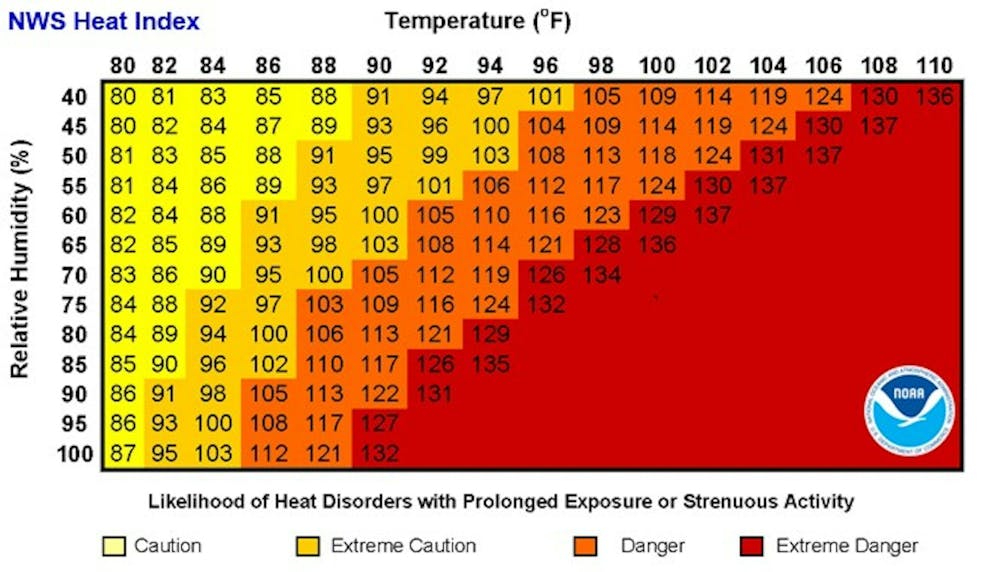
    Heat risk isn’t just about temperature – humidity also increases the risk of heat-related illnesses because it affects how well sweating will cool the human body when it gets hot.

    Instead of just looking at temperature when planning outdoor activities, check the heat index, which accounts for heat illness risk associated with temperature and relative humidity.

    It doesn’t take very high temperatures or very high humidity for the heat index to enter dangerous territory.

    A heat index chart shows how heat and humidity combine for dangerous conditions.
    NOAA

    However, the heat index is still a conservative measure of the impact of heat on humans, particularly for outdoor workers and athletes at summer practices. This is because temperature measurements used in weather forecasting are taken in the shade and are not exposed to direct sunlight. If someone is outside and exposed to the direct sun, the actual heat index can be as much as 15 F higher than the heat index chart indicates.

    A more sophisticated measurement of heat effects on human health is what’s known as the wet-bulb globe temperature, which takes into account other variables, such as wind speed and cloud cover. Neither takes into account a person’s physical exertion, which also raises their body temperature, whether working at a construction site or playing soccer.

    Tips for staying safe in a heat wave

    How can you stay cool when heat waves set in? The answer depends in part on where you are, but the main points are the same:

    • Avoid strenuous outdoor activities in high temperatures if possible. If you start to feel symptoms of heat-related illnesses, drink fluids that will hydrate you. Find shade, rest, and use cool, damp cloths to lower your body temperature. If you see signs of heat stroke in someone else, call for medical help.

    • Be careful with fans. Fans can be useful if the temperature isn’t too high because they wick sweat away from the body and induce evaporative cooling. But at very high temperatures, they can accelerate heat buildup in the body and lead to dangerous conditions. If indoor temperatures reaches 95 degrees or higher, using fans can actually be dangerous and raise the risk of heat-related illnesses.

    • Find a cooling center, library or community center where you can get inside and rest in an air-conditioned space in the hottest hours. In places such as Phoenix, where high temperatures are a regular hazard, cooling centers are typically opened in summer. Northern cities are also opening cooling centers as heat waves occur there more frequently than they did in the past. Urban areas with a lot of pavement and buildings – known as heat islands – can have temperatures well above the city’s average.

    • Hydrate, hydrate, hydrate! Drink plenty of fluids, and don’t forget about the importance of electrolytes. Heat-related dehydration can occur when people sweat excessively, losing water and necessary salts from the body. Some sports drinks or rehydration fluids restore electrolytes and hydration levels.

    Older adults and people with disabilities often face higher risks from heat waves, particularly if they can’t easily move to a cooler environment. Communities and neighbors can help protect vulnerable populations by providing cooling centers and bottled water and making regular wellness checks during high heat.

    Summer can be a season of fun. Just remember the risks, keep an eye on your friends and neighbors when temperatures rise, and plan ahead so you can beat the heat.

    Brian Bossak is not currently receiving relevant external funding for heat-related illness research. In 2017-2019, he served as a consultant on a heat-related research award from the Southeastern Coastal Center for Agricultural Health and
    Safety at the University of Florida.

    ref. How to stay safe during heat waves – and the heat stroke warning signs to watch for – https://theconversation.com/how-to-stay-safe-during-heat-waves-and-the-heat-stroke-warning-signs-to-watch-for-257708

    MIL OSI – Global Reports

  • MIL-OSI Banking: Independent Petroleum Association of America Awards Highest Honor to Midland’s Don Sparks of Discovery Operating, Inc.

    Source: Independent Petroleum Association of America

    Headline: Independent Petroleum Association of America Awards Highest Honor to Midland’s Don Sparks of Discovery Operating, Inc.

    Independent Petroleum Association of America Awards Highest Honor to Midland’s Don Sparks of Discovery Operating, Inc.

    66th Annual Oil & Gas Lifetime Achievement Award Presented to Discovery Operating, Inc. Chairman and Cofounder

    WILLIAMSBURG, VA – At the 96th Annual Meeting of the Independent Petroleum Association of America (IPAA) in Williamsburg, VA, Don Sparks the cofounder and chairman of the board of Discovery Operating, Inc. was presented with the 2025 Chief Roughneck Award.

    IPAA represents thousands of independent businesses that develop 91 percent of America’s oil and natural gas wells. The Chief Roughneck honor dates back to 1955 and has included pioneers in the industry. Sparks was selected by industry peers as the 66th recipient of the award. Past winners of the Chief Roughneck Award can view viewed on the American Oil & Gas Historical Society website.

    The Chief Roughneck Award recognizes one individual whose accomplishments and character represented the highest ideals of the U.S. oil and natural gas industry. The award is considered one of the most meaningful honors in the industry; the award and the character behind it – Joe Roughneck – symbolize the spirit, determination, leadership and integrity of individuals who have made a lasting impression on the energy industry.

    Jeff Eshelman, IPAA President and CEO: “It is the IPAA leadership’s honor to present the Chief Roughneck Award to Don Sparks. Don has made his mark on Midland, mark on the industry and mark on the country. We are immensely grateful to have had him and his family active in IPAA and our advocacy for decades. His technical consulting and independent producing background enables him to be especially sensitive to the particular needs of independent producers, along with working interest participants and royalty interest owners. He’s a true patriot and has played a significant role in our country achieving energy dominance. Don and the Sparks family are the embodiment of this award, and we wish them and Discovery Operating, Inc. success for many more years and generations.”

    Don Sparks, cofounder and Chairman of the Board of Discovery Operating, Inc.: “I’ve been very blessed to work in an industry that I truly believe helps this world and all the people in it and I’m proud to be a part of it. I thank those that helped me get here, it was not by myself. It was one of my dreams to build a family company; My wife has been in partnership in Discovery Operating, Inc. with me from the beginning, and I’ve been blessed to have my sons and three grandchildren involved.  I’ve been blessed with the guys that work with me in the field; they go out there everyday and put their bodies and their time and energy into making sure this industry survives and gets by no matter the oil price. Thank you to the IPAA for this recognition.”

    Don Sparks was born in Pampa, Texas, raised in Amarillo, Texas, and received his bachelor’s degree in petroleum engineering from The University of Texas at Austin in 1962. After graduation, Sparks served as an officer in the U.S. Navy for four years and worked in various engineering and consulting capacities for Bailey, Sipes, Williamson and Runyan; Freeport Oil Company; and Shell Oil Company. He co-founded Discovery Operating, Inc. (DOI) in 1973. More than five decades later, Discovery Operating has evolved into a classic small family owned and operated independent oil and gas company with 31 full-time employees. Discovery operates approximately 420 wells located within a 300-400 mile radius of Midland. Today with the horizontal shale play, DOI’s operated production is over 15,000 BOPD and 35 million cubic feet per day of natural gas. He has been influential in the development of the Wolfcamp and Spraberry shales, and the logging suite and analysis he helped establish has been the basis for picking the landing zones in the horizontal wells drilled and completed in the Midland Basin today. Sparks also cofounded Platt, Sparks & Associates with Ronald Platt which evaluates properties, performs reservoir studies and provides expert testimony for hearings and litigations in Midland and Austin; both men retired from the firm in 2014.

    Sparks is a registered professional engineer and a renowned member of the petroleum engineering community. He has received numerous awards in recognition of his accomplishments, including the IPAA’s Leadership Award, the University of Texas Cockrell School of Engineering Distinguished Graduate Award and the Hearst Lifetime Achievement Energy Award. He previously served as president of the Permian Basin Chapter of the Society of Petroleum Engineers, director of the Permian Basin Petroleum Association and regional vice president, governor and executive committee member of the IPAA. He also served as a member of the U.S. Department of Energy Unconventional Resources Technology Advisory Committee. He is an active member of the National Society of Petroleum Engineers, American Association of Drilling Engineers and Texas Alliance of Energy Producers. Don also served on the Executive Committee and as chairman of the Mountain States Legal Foundation Executive Board.

    Sparks currently resides in Midland, Texas, with his wife, Gwyndolyn. They have three sons, eleven grandchildren and twelve great-grandchildren. All three of his children are partners in Discovery Operating, Inc. William Jeffrey Sparks is Chief Operating Officer, Kevin Don Sparks is Chief Executive Officer and Christopher Todd Sparks is Chief Financial Officer and takes care of outside investments. Gwyn Sparks works at Discovery in accounting.

    About the Independent Petroleum Association of America

    The Independent Petroleum Association of America (IPAA) is a national upstream trade association representing thousands of independent oil and natural gas producers and service companies across the United States. Independent producers develop 91 percent of the nation’s oil and natural gas wells. These companies account for 83 percent of America’s oil production, 90 percent of its natural gas and natural gas liquids (NGL) production, and support over 4.5 million American jobs. Learn more about IPAA by visiting www.ipaa.org and following @IPAAaccess on Twitter.

    About Discovery Operating Company

    Founded in 1973, Discovery Operating, Inc. is a family owned, independent exploration and production company located in Midland, Texas with 31 employees. The company currently operates over 400 wells across Texas.

    MIL OSI Global Banks

  • MIL-OSI USA: Senators Marshall, Warnock, & Gallego Introduce Legislation Promoting Fatherhood Engagement

    US Senate News:

    Source: United States Senator for Kansas Roger Marshall
    Washington – On Wednesday, U.S. Senator Roger Marshall, M.D. (R-Kansas) joined Senators Raphael Warnock (D-Georgia) and Ruben Gallego (D-Arizona) introduced The Dads Matter Act of 2025, which would direct the U.S. Department of Health and Human Services (HHS) to raise awareness about father inclusion and engagement and to provide state-level guidance aimed at strengthening the role of fathers in supporting healthy mothers and babies.
    “As an OBGYN for more than 25 years, I know firsthand the challenges facing mothers, and how important a stable support system can be to both pediatric and maternal health outcomes,” said Senator Marshall. “Fathers play such a critical role in their households, and I am proud to support legislation that champions their role as providers, spouses, and caregivers.”
    “Georgia’s maternal mortality rate is a crisis that we must address with every tool at our disposal. That includes redoubling our efforts to uplift the role of fathers in keeping their family healthy during pregnancy and early childhood,” said Senator Reverend Warnock. “Now is the time to spread awareness about the critical role of fathers in improving maternal health outcomes and creating thriving families and communities.” 
    “Too many women in Arizona die from pregnancy-related causes. This bill helps reverse this trend by recognizing that engaged fathers are part of the solution,” said Senator Gallego. When dads show up, maternal health outcomes are better, babies are healthier, and families are stronger.”
    The Dads Matter Act of 2025 would also direct HHS to issue guidance to states to incentivize maternity care providers to offer training and education to health care professionals about the benefits of including and engaging fathers in the pregnancy, birth, and postpartum process. Additionally, it would direct the Government Accountability Office (GAO) to submit a report to Congress that describes the results and effectiveness of this legislation. 

    MIL OSI USA News

  • MIL-OSI USA: Senators Marshall & Baldwin Introduce Bill to Strengthen Rail Supply & Improve Freight Rail Services for American Farmers & Businesses

    US Senate News:

    Source: United States Senator for Kansas Roger Marshall
    Washington – On Wednesday, U.S. Senator Roger Marshall, M.D. (R-Kansas) joined Senator Tammy Baldwin (D-Wisconsin) in reintroducing the Reliable Rail Service Act, which addresses unreliable service and high rail shipping costs for farmers and manufacturers and aims to strengthen our rail supply chains. It ensures major freight railroads deliver reliable service at reasonable rates, enabling American businesses to get products to market more efficiently.
    “Kansas’s farmers and ranchers depend upon reliable transport of their world-class goods to the rest of the country, and Class 1 railroads are not meeting expectations – this is a disservice to hard-working Kansans,” said Senator Marshall. “This bill lays out reasonable requirements for rail carriers to meet these important obligations, and I look forward to working with Senator Baldwin on getting this to the finish line.”
    “Across the Badger State, our farmers, small businesses, and manufacturers rely on rail service to get their products to market and make ends meet,” said Senator Baldwin. “But when rail service is unreliable, it puts their livelihoods on the line, disrupts supply chains, and drives up costs for hardworking Wisconsin families. That’s why I am proud to work with my Republican colleague to once again introduce our Reliable Rail Service Act and help level the playing field for Wisconsin workers, grow our Made in Wisconsin economy, and keep costs down for consumers.”
    The Reliable Rail Service Act is supported by members of the agricultural industry, labor organizations, energy producers, and manufacturers who know firsthand how poor service, significant disruptions, and sky-high prices are impacting their businesses and prices for consumers.
    Click here to read the full text of the bill.

    MIL OSI USA News

  • MIL-OSI USA: Senators Marshall & Baldwin Introduce Bill to Strengthen Rail Supply & Improve Freight Rail Services for American Farmers & Businesses

    US Senate News:

    Source: United States Senator for Kansas Roger Marshall

    Washington – On Wednesday, U.S. Senator Roger Marshall, M.D. (R-Kansas) joined Senator Tammy Baldwin (D-Wisconsin) in reintroducing the Reliable Rail Service Act, which addresses unreliable service and high rail shipping costs for farmers and manufacturers and aims to strengthen our rail supply chains. It ensures major freight railroads deliver reliable service at reasonable rates, enabling American businesses to get products to market more efficiently.
    “Kansas’s farmers and ranchers depend upon reliable transport of their world-class goods to the rest of the country, and Class 1 railroads are not meeting expectations – this is a disservice to hard-working Kansans,” said Senator Marshall. “This bill lays out reasonable requirements for rail carriers to meet these important obligations, and I look forward to working with Senator Baldwin on getting this to the finish line.”
    “Across the Badger State, our farmers, small businesses, and manufacturers rely on rail service to get their products to market and make ends meet,” said Senator Baldwin. “But when rail service is unreliable, it puts their livelihoods on the line, disrupts supply chains, and drives up costs for hardworking Wisconsin families. That’s why I am proud to work with my Republican colleague to once again introduce our Reliable Rail Service Act and help level the playing field for Wisconsin workers, grow our Made in Wisconsin economy, and keep costs down for consumers.”
    The Reliable Rail Service Act is supported by members of the agricultural industry, labor organizations, energy producers, and manufacturers who know firsthand how poor service, significant disruptions, and sky-high prices are impacting their businesses and prices for consumers.
    Click here to read the full text of the bill.

    MIL OSI USA News

  • MIL-OSI USA: Senators Marshall & Baldwin Introduce Bill to Strengthen Rail Supply & Improve Freight Rail Services for American Farmers & Businesses

    US Senate News:

    Source: United States Senator for Kansas Roger Marshall

    Washington – On Wednesday, U.S. Senator Roger Marshall, M.D. (R-Kansas) joined Senator Tammy Baldwin (D-Wisconsin) in reintroducing the Reliable Rail Service Act, which addresses unreliable service and high rail shipping costs for farmers and manufacturers and aims to strengthen our rail supply chains. It ensures major freight railroads deliver reliable service at reasonable rates, enabling American businesses to get products to market more efficiently.
    “Kansas’s farmers and ranchers depend upon reliable transport of their world-class goods to the rest of the country, and Class 1 railroads are not meeting expectations – this is a disservice to hard-working Kansans,” said Senator Marshall. “This bill lays out reasonable requirements for rail carriers to meet these important obligations, and I look forward to working with Senator Baldwin on getting this to the finish line.”
    “Across the Badger State, our farmers, small businesses, and manufacturers rely on rail service to get their products to market and make ends meet,” said Senator Baldwin. “But when rail service is unreliable, it puts their livelihoods on the line, disrupts supply chains, and drives up costs for hardworking Wisconsin families. That’s why I am proud to work with my Republican colleague to once again introduce our Reliable Rail Service Act and help level the playing field for Wisconsin workers, grow our Made in Wisconsin economy, and keep costs down for consumers.”
    The Reliable Rail Service Act is supported by members of the agricultural industry, labor organizations, energy producers, and manufacturers who know firsthand how poor service, significant disruptions, and sky-high prices are impacting their businesses and prices for consumers.
    Click here to read the full text of the bill.

    MIL OSI USA News

  • MIL-OSI Europe: Answer to a written question – New GAR-based reporting standards introduced under the EU’s sustainable finance policies – E-000904/2025(ASW)

    Source: European Parliament

    The Commission emphasises the need for large financial institutions to disclose alignment with Taxonomy criteria. The Commission intends to address issues with the methodology of the Green Asset Ratio as part of the planned review of the Taxonomy Disclosures Delegated Act[1]. A draft amending Delegated Regulation was published for consultation between 26 February and 26 March 2025[2].

    Financial institutions are also expected to benefit from the possibility to disclose economic activities meeting only certain criteria, like climate change mitigation.

    This is reflected in the proposed amendment to the Corporate Sustainability Reporting Directive to revise reporting rules and better reflect the transition efforts introducing disclosures of partial alignment with the Taxonomy.

    In view of meeting the environment and climate objectives, the 8th Environment Action Programme Mid-Term Review[3] calls for collaborative efforts to render laws effective and promote clean solutions.

    Simplification, modernisation, digitalisation and funding are pivotal. Successful implementation hinges on overcoming challenges to ensure stakeholder buy-in, showcasing the benefits of the green transition.

    The Commission commits to ongoing dialogue with Member States, fostering understanding of climate risks and opportunities and building support for effective policies. This approach precedes legislative revisions, adhering to evidence-based policy-making aligned with Better Regulation guidelines.

    In addition, inclusive dialogues with stakeholders ensure that policies enshrined in the European Green Deal contribute to a just and competitive transition.

    Notably, the Clean Industrial Deal[4] that facilitates achievement of EU climate goals by incentivising industry decarbonisation, was supported by stakeholder initiatives like the Antwerp Declaration for a European Industrial Deal[5] and Clean Transition Dialogues[6], tailored to sectors such as automotive, steel, metals and chemicals.

    • [1] Commission Delegated Regulation (EU) 2021/2178 of 6 July 2021 supplementing Regulation (EU) 2020/852 of the European Parliament and of the Council by specifying the content and presentation of information to be disclosed by undertakings subject to Articles 19a or 29a of Directive 2013/34/EU concerning environmentally sustainable economic activities, and specifying the methodology to comply with that disclosure obligation
      OJ L 443, 10.12.2021, p. 9-67.
    • [2] https://ec.europa.eu/info/law/better-regulation/have-your-say/initiatives/14546-Taxonomy-Delegated-Acts-amendments-to-make-reporting-simpler-and-more-cost-effective-for-companies_en.
    • [3] COM(2024)123 final.
    • [4] COM(2025) 85.
    • [5] https://antwerp-declaration.eu/.
    • [6] COM (2024)163 final.

    MIL OSI Europe News

  • MIL-OSI Europe: Answer to a written question – New GAR-based reporting standards introduced under the EU’s sustainable finance policies – E-000904/2025(ASW)

    Source: European Parliament

    The Commission emphasises the need for large financial institutions to disclose alignment with Taxonomy criteria. The Commission intends to address issues with the methodology of the Green Asset Ratio as part of the planned review of the Taxonomy Disclosures Delegated Act[1]. A draft amending Delegated Regulation was published for consultation between 26 February and 26 March 2025[2].

    Financial institutions are also expected to benefit from the possibility to disclose economic activities meeting only certain criteria, like climate change mitigation.

    This is reflected in the proposed amendment to the Corporate Sustainability Reporting Directive to revise reporting rules and better reflect the transition efforts introducing disclosures of partial alignment with the Taxonomy.

    In view of meeting the environment and climate objectives, the 8th Environment Action Programme Mid-Term Review[3] calls for collaborative efforts to render laws effective and promote clean solutions.

    Simplification, modernisation, digitalisation and funding are pivotal. Successful implementation hinges on overcoming challenges to ensure stakeholder buy-in, showcasing the benefits of the green transition.

    The Commission commits to ongoing dialogue with Member States, fostering understanding of climate risks and opportunities and building support for effective policies. This approach precedes legislative revisions, adhering to evidence-based policy-making aligned with Better Regulation guidelines.

    In addition, inclusive dialogues with stakeholders ensure that policies enshrined in the European Green Deal contribute to a just and competitive transition.

    Notably, the Clean Industrial Deal[4] that facilitates achievement of EU climate goals by incentivising industry decarbonisation, was supported by stakeholder initiatives like the Antwerp Declaration for a European Industrial Deal[5] and Clean Transition Dialogues[6], tailored to sectors such as automotive, steel, metals and chemicals.

    • [1] Commission Delegated Regulation (EU) 2021/2178 of 6 July 2021 supplementing Regulation (EU) 2020/852 of the European Parliament and of the Council by specifying the content and presentation of information to be disclosed by undertakings subject to Articles 19a or 29a of Directive 2013/34/EU concerning environmentally sustainable economic activities, and specifying the methodology to comply with that disclosure obligation
      OJ L 443, 10.12.2021, p. 9-67.
    • [2] https://ec.europa.eu/info/law/better-regulation/have-your-say/initiatives/14546-Taxonomy-Delegated-Acts-amendments-to-make-reporting-simpler-and-more-cost-effective-for-companies_en.
    • [3] COM(2024)123 final.
    • [4] COM(2025) 85.
    • [5] https://antwerp-declaration.eu/.
    • [6] COM (2024)163 final.

    MIL OSI Europe News

  • MIL-OSI Europe: Written question – Regulation (EU) 2020/741 on minimum requirements for water reuse – E-002381/2025

    Source: European Parliament

    Question for written answer  E-002381/2025
    to the Commission
    Rule 144
    Christine Schneider (PPE)

    Numerous reports and observations from various Member States, in particular Germany, indicate that the practical implementation of Regulation (EU) 2020/741 has caused significant difficulties. Many farmers and municipalities lose access to treated waste water because many smaller projects are unable to meet the technical and administrative requirements of the Regulation. This runs counter to the Regulation’s objective of promoting water reuse and addressing water scarcity.

    • 1.How does the Commission assess the practical implementation of Regulation (EU) 2020/741, in particular as regards access to treated waste water for irrigation in agriculture in the Member States, and is the Commission aware that, as a result of the above-mentioned requirements, smaller farms and municipalities in particular have lost access to treated waste water and are instead having to increasingly resort to using valuable drinking water for irrigation?
    • 2.How does the Commission view the criticism that the current requirements of the Regulation could lead to a reduction in water reuse in practice, thus undermining the very objective of the Regulation?
    • 3.Does the Commission intend to evaluate Regulation (EU) 2020/741 in the light of real-world practical experience and feedback so far and, if necessary, propose adjustments to facilitate water reuse?

    Submitted: 12.6.2025

    Last updated: 19 June 2025

    MIL OSI Europe News

  • MIL-OSI Europe: Answer to a written question – Strengthening support for renewable hydrogen to meet EU energy and climate targets – E-001831/2025(ASW)

    Source: European Parliament

    Since 2020, the EU has set up a comprehensive regulatory framework to support the scale up of renewable hydrogen, including enabling financing under the European Hydrogen Bank (EHB).

    After two auctions already implemented under this financial initiative to support hydrogen production in Europe[1], by the end of 2025 the Commission will launch a third auction, with a budget of up to EUR 1 billion from the Innovation Fund (IF).

    The IF also provides funding to hydrogen-related projects through its regular grants[2]. By the end of 2025, the results of the latest regular grant call (IF24) will be published and a new call will be opened.

    Moreover, to enhance impact from its calls, the IF implemented the ‘as-a-Service’ feature[3], allowing Member States[4] to allocate national funding in addition to the Innovation Fund. This feature will be available again in upcoming calls.

    The Commission also works to establish joint European auctions for imports of renewable hydrogen. Under a Team Europe approach, willing Member States will be able to pool funding and attract competitive bids from third-country producers, thus further supporting the decarbonisation of their industry and transport sectors as well as contributing to wider goals such as the development of key import infrastructure corridors.

    The Commission will launch the Mechanism to support market development of hydrogen[5] in the third quarter of 2025. It will bring together buyers and sellers[6] on an online platform, enabling them to find potential commercial partners, and connecting them with financial support.

    • [1] Through the three auction calls, the EHB will have made available EUR 3 billion in grants: https://climate.ec.europa.eu/eu-action/eu-funding-climate-action/innovation-fund/competitive-bidding_en.
    • [2] Under the IF, more than 40 projects covering the full hydrogen value chain are already receiving a total of EUR 3 billion in regular grants.
    • [3] https://climate.ec.europa.eu/eu-action/eu-funding-climate-action/innovation-fund/competitive-bidding_en#auctions-as-a-service-aaas.
    • [4] Germany, Austria, Spain and Lithuania have already contributed, together, with almost EUR 1.2 billion in national resources in the IF23 and IF24 Auctions.
    • [5] In accordance with the mandate received pursuant to Regulation (EU) 1789/2024 of the European Parliament and of the Council of 13 June 2024 on the internal markets for renewable gas, natural gas and hydrogen.
    • [6] The Hydrogen Mechanism covers renewable and low-carbon hydrogen and its derivatives (ammonia, methanol, eSAFs).
    Last updated: 19 June 2025

    MIL OSI Europe News

  • MIL-OSI Europe: Press release – Human rights breaches in Georgia, Iran and Mali

    Source: European Parliament

    On Thursday, Parliament adopted human rights resolutions on Georgia, Iran and Mali.

    Media freedom in Georgia and the case of Mzia Amaglobeli

    MEPs are deeply concerned about arbitrary detentions in Georgia and the government’s harassment of and violence against journalists. They demand the immediate and unconditional release of Georgian journalist Mzia Amaglobeli, condemning her arrest as politically motivated . They strongly condemn the Georgian Dream regime’s systemic assault on democratic institutions, political opposition, independent media, civil society and judicial independence. They call for independent investigations and urge the authorities to act immediately to ensure journalists’ safety.

    Parliament also calls for the release of all political prisoners, including activists, opposition leaders and former President Mikheil Saakashvili. In the resolution, MEPs call urgently for the repeal of repressive laws, restoration of democracy, and full protection of media freedom and civil liberties. The EU must step up its support for Georgian civil society, while pressing for sanctions on officials responsible for democratic backsliding, MEPs add.

    They also express grave concern at the latest wave of assaults against Georgian non‑governmental organisations, which is putting the work of targeted organisations at risk.

    The resolution was adopted by 324 votes in favour, 25 against and 87 abstentions. For further details, the full version will be available here. (19.6.2025)

    The case of Dr Ahmadreza Djalali in Iran

    Parliament condemns Dr Ahmadreza Djalali’s sham trial, torture and lack of access to medical care, and urge Iran to provide him with legal representation and defence and allow contacts with his family.

    MEPs call on Iran to put a moratorium on executions and abolish the death penalty. They urge Sweden and relevant member states and the European External Action Service to adopt targeted measures in response to Iran’s continued detention of EU nationals, including Cécile Kohler and Jacques Paris.

    They reiterate their call on the Council to designate the Islamic Revolutionary Guard Corps a terrorist organisation and extend EU sanctions to those who take EU nationals hostage, execute opposition members en masse, and commit other human rights violations. They demand that UN human rights mechanisms be fully activated in Iran, including the Special Rapporteur. They also call on EU foreign policy chief Kaja Kallas to raise Djalali’s case in public and during all engagements with her Iranian counterparts.

    The resolution was adopted by 486 votes in favour, 8 against and 29 abstentions. For further details, the full version will be available here. (19.6.2025)

    Dissolution of political parties and crackdown on the opposition in Mali

    Parliament condemns the dissolution of political parties in Mali and the repression of the opposition. MEPs criticise the authorities for actions that undermine democracy, human rights, and fundamental freedoms, including freedom of expression, association, and peaceful assembly, and demand respect for international human rights law and Mali’s own commitments.

    They note the transitional president’s 2024 request to create conditions for transparent and peaceful elections, and call for the immediate release of those arrested or abducted for political reasons, an end to repression and intimidation, and guarantees for the safety of opposition members and civil society actors.

    Parliament also denounces the ongoing violence and Islamist terrorism in Mali, and stresses the need for accountability for human rights violations and war crimes committed by the Wagner Group/Africa Corps, and reaffirms the EU’s support for multi-party democracy, civil society, and human rights in Mali. MEPs express serious concern over the growing illegal migration flows from Mali, fuelled by growing insecurity, political instability and economic stagnation and call on the Malian authorities to take full responsibility for preventing uncontrolled departures.

    The resolution was adopted by 511 votes in favour, 14 against and with 25 abstentions. For further details, the full version will be available here. (19.6.2025)

    MIL OSI Europe News

  • MIL-OSI Europe: Press release – Clean Industrial Deal must marry industrial competitiveness with climate action

    Source: European Parliament

    The Industrial Decarbonisation Bank and action plan for affordable energy are crucial for the competitiveness and resilience of European industry, MEPs say.

    The resolution, adopted on Thursday 19 June in response to the European Commission’s Clean Industrial Deal plan, stresses the need to combine climate action with industrial competitiveness.

    It underscores the importance of the newly established Industrial Decarbonisation Bank, which MEPs consider vital for scaling up investment in clean technologies. Investment should be based on carbon impact, scalability, and security of supply, they say.

    Parliament welcomes lead markets for European-made clean, circular and low-carbon products, and stresses the need to stimulate demand through public and private procurement.

    MEPs also advocate for the protection of the EU market from unfair competition and the dumping of industrial overcapacity from third countries. They underline the importance of an effective carbon border adjustment mechanism (CBAM) in the context of phasing out free allowances under the emissions trading system (ETS).

    Faster permitting procedures

    The resolution addresses the importance of regulatory simplification and the need to streamline permitting procedures to support the transition and innovation efforts of small businesses. MEPs want to simplify funding applications, reduce reporting obligations, and fast-track small projects.

    They also want to build the business case for permanent carbon removals in upcoming legislative reviews, as carbon management, including capture, storage, transport, and utilisation, may be necessary for hard-to-abate sectors, they say.

    Affordable energy action plan

    MEPs support the action plan for affordable energy and demand measures to boost cross-border energy infrastructure and complete the energy union. The current fragmentation of regulatory oversight and investment planning across Member States is hampering integration and electrification, they say. MEPs also call on Member States, transmission system operators and the Commission to do more to promote cross-border electricity trading.

    Quote

    “European industry is facing enormous challenges, while a strong industrial base is essential for our competitiveness and strategic autonomy. The Clean Industrial Deal offers a strategy for a competitive and decarbonised European industry. At the same time, it seeks to protect our autonomy and secure jobs. This Deal is an important first step, but time is running out. We urge the Commission to act without delay and raise its level of ambition. When it comes to industrial policy, European cooperation is more crucial than ever” said lead MEP Tom Berendsen (EPP, Netherlands).

    The resolution was adopted with 381 votes to 173, with 13 abstentions.

    Background: Clean Industrial Deal

    Presented by the European Commission in February, the Clean Industrial Deal aims to support the competitiveness and resilience of European industry. It focuses mainly on two sectors: energy-intensive industries and clean technology, and aims to lower energy costs via an action plan on affordable energy. The Clean Industrial Deal also seeks to boost demand for clean products, further finance the clean transition and improve circularity, access to critical raw materials and the establishment of sectoral skills for strategic industries.

    MIL OSI Europe News

  • MIL-OSI United Nations: Experts of the Committee on the Elimination of Discrimination against Women Commend Thailand on Gender Inclusive Climate Action, Ask about Combatting Patriarchal Stereotypes and Ensuring Education for Marginalised Girls

    Source: United Nations – Geneva

    The Committee on the Elimination of Discrimination against Women today concluded its consideration of the eighth periodic report of Thailand, with Committee Experts commending Thailand on its climate change master plan, which was gender inclusive, while raising questions about how the State was combatting patriarchal stereotypes and ensuring the right to education for marginalised girls. 

    A Committee Expert congratulated Thailand on the steps being taken to revise the climate change master plan which focused on gender and social inclusive climate action, including climate finance, adaptation and mitigation, recognising that women and girls experienced disproportionately greater loss and damage from the impacts of climate change. 

    Another Expert said Thailand remained a patriarchal society where women were expected to be caregivers while men were seen as leaders, which was reinforced in the media and other avenues.  What programmes were in place to dismantle harmful gender stereotypes?  Were there programmes to engage men and boys in efforts to transform discriminatory social norms?  What mechanisms were in place to ensure that women from all communities could access justice and public services without stigma or discrimination? 

    A Committee Expert said the Committee was concerned about the high dropout rates among stateless and refugee girls and the fact that Patani Malay girls were discouraged from continuing their education due to early marriage and lack of education in Malay. Were there policies specifically targeted for expanding education to minorities?  What steps were being taken to ensure the safety of girls living in the Southern Border Provinces?

    The delegation said Thailand was aware that gender stereotypes were ingrained, and this would take a lifetime effort to overcome.  Currently, changing the mindset of the people was difficult.  It was important to raise awareness and re-learn what was appropriate.  The Department of Women’s Affairs coordinated with academics to work with young people on a project to identify sexist language in textbooks in schools.  A guidebook had been created and distributed to teachers to provide guidance on how to combat harmful gender stereotypes in schools. 

    The delegation said there were mechanisms in place to ensure women from marginalised groups received education.  There were schools established in the Southern Border Provinces, with border patrol officers teaching the students.  The State provided safety in all areas to prevent threats to students. A religious school, supported by the Government, was located in the Southern Border Provinces, providing additional opportunities for students. 

    Introducing the report, Ramrung Worawat, Director-General of the Department of Women’s Affairs and Family Development, Ministry of Social Development and Human Security of Thailand, head of the delegation, said the act amending the Civil and Commercial Code (no. 24) or the equal marriage act came into force in January 2025.  The act raised the minimum marriage age from 17 to 18 years old, adopted gender-neutral terms on marriage, permitted child adoption by same-sex couples, and ensured inheritance rights to them.  Recent results of the general election in 2023 reflected a notable increase in the number of women and lesbian, gay, bisexual, transgender and intersex individuals elected to leadership positions.  The current cabinet included eight females at ministerial rank, the highest number in Thailand’s political history.   

    In closing remarks, Ms. Worawat said the discussion with the Committee had been very fruitful. The State would aim to take forward the Committee’s recommendations, with a will to transform them into concrete actions.

    In her closing remarks, Nahla Haidar, Committee Chair, thanked Thailand for the constructive dialogue which had provided further insight into the situation of women and girls in the country. 

    The delegation of Thailand was comprised of representatives of the Ministry of Social Development and Human Security; the Ministry of Public Health; the Ministry of Foreign Affairs; the Administrative Centre of the Southern Border Provinces; the Royal Thai Police; the Office of the Attorney General; the National Institute of Development Administration; and the Permanent Mission of Thailand to the United Nations Office at Geneva.

    The Committee on the Elimination of Discrimination against Women’s ninety-first session is being held from 16 June to 4 July.  All documents relating to the Committee’s work, including reports submitted by States parties, can be found on the session’s webpage.  Meeting summary releases can be found here.  The webcast of the Committee’s public meetings can be accessed via the UN Web TV webpage.

    The Committee will next meet at 10 a.m. on Friday, 20 June to begin its consideration of the eighth periodic report of Ireland (CEDAW/C/IRL/8).

    Report

    The Committee has before it the eighth periodic report of Thailand (CEDAW/C/THA/8).

    Presentation of Report

    RAMRUNG WORAWAT, Director-General of the Department of Women’s Affairs and Family Development, Ministry of Social Development and Human Security of Thailand, head of the delegation, said women made up just over half of Thailand’s population and almost 70 per cent of those were women between 15 to 59 years of age.  Since the submission of Thailand’s last report in 2017, Thailand had been revising and drafting laws to further promote women’s rights, gender equality, and the elimination of all forms of discrimination against women. 

    The act amending the Civil and Commercial Code (no. 24) or the equal marriage act came into force in January 2025.  The act raised the minimum marriage age from 17 to 18 years old, adopted gender-neutral terms on marriage, permitted child adoption by same-sex couples, and ensured inheritance rights to them.  In addition, the gender equality act was being reviewed to ensure it further aligned with international standards. 

    The draft anti-discrimination act would strengthen the legal basis for the elimination of discrimination on all grounds, including sex and gender, and address situations of multiple and intersecting discrimination.  Furthermore, the draft act on the protection and promotion of the way of life of ethnic groups was being considered by the Parliament.  The act focused on eliminating discrimination and promoting equality based on cultural diversity.  The plan of action on women’s development (2023-2027) was developed to ensure women’s participation in socio-economic development and to promote their leadership in public spaces. 

    The National Women’s Development Policy and Strategy Committee and the Committee for the Promotion of Gender Equality were responsible for setting and driving gender equality policies.  A substantial budget was allocated for the main agencies, with an additional budget allocated to assist specific groups of women and advance gender equality in an integrated manner.  A strategic plan for the promotion and protection of children and youth in the use of online media was being developed, and a coordinating centre, Child Online Protection Action Thailand, was established to lead collaborative efforts with partners. 

    Thailand continued its policy of inclusive education and provided 15 years of free education for all children without discrimination.  The country supported royal-initiated “Phiengluang Schools” for special target groups in border or underserved areas with limited access to rights and social welfare.  An online teacher training programme aimed to help schools and teachers plan inclusive sexuality education. 

    Economic empowerment measures had been introduced to protect both formal and informal female workers.  The Women’s Role Development Fund was established to enable women to pursue careers and income opportunities, improve women’s access to financial resources, and expand childcare services for children under three years old to promote equality in family responsibilities.  The child support grant programme and the state welfare card programme provided monthly allowances and financial assistance to support low-income households. 

    Women were increasingly taking part in politics at the national and local levels and within the public administration.  Recent results of the general election in 2023 reflected a notable increase in the number of women and lesbian, gay, bisexual, transgender and intersex individuals elected to leadership positions.  The current cabinet included eight females at ministerial rank, the highest number in Thailand’s political history.  There were currently 15 female provincial governors, including the appointment of the first Muslim female governor of Pattani Province in 2022. 

    The Thai Government promoted universal access to public health services and implemented measures to ensure that vulnerable women, including informal female workers and registered migrant women, could access healthcare.  All women and girls were guaranteed equal access to health services under the Universal Health Coverage Scheme.  The most challenging task for Thai Government agencies was advanced and disaggregated data collection.  Enhanced data collection would enable Thailand to better implement policies and undertake targeted actions to empower specific groups. 

    In October 2024, the Cabinet approved guidelines to accelerate the resolution of nationality and legal status issues for long-term migrants and their children born in Thailand, to ensure the legal recognition and integration of stateless individuals who had lived in the Kingdom for extended periods, as well as their Thai-born descendants. 

    The draft policy on administration and development in the Southern Border Provinces (2025-2027) was developed to support vulnerable groups, strengthen family and community roles in problem-solving, and develop networks of women and youth to foster peace at the family and community level.  The Coordination Centre for Women and Children in the Southern Border Provinces was established as a joint mechanism between the Government and civil society, serving as a platform to coordinate and mobilise resources, receive complaints, and resolve issues involving women and children.

    Thailand had developed a national adaptation plan for climate change, with a strong emphasis on gender dimensions at every stage, from planning and decision-making to community participation.  The country was committed to promoting gender equality and to upholding and protecting the human rights of women, girls, lesbian, gay, bisexual, transgender and intersex individuals, and those facing multiple and intersecting forms of discrimination.  Thailand’s progress in gender equality was not just a matter of fulfilling international obligations, but a national priority. 

    Statement by the National Human Rights Institution

    PORNPRAPAI GANJANARINTR, Chairperson of the National Human Rights Commission of Thailand, said while the Thai Government had made efforts to promote gender equality, many women, especially those from vulnerable groups, continued to face serious barriers in accessing their basic rights.  Women with disabilities faced violence and barriers in accessing the justice system, were subjected to forced sterilisation and abortion, and were excluded from decision-making processes.  Ethnic women remained without legal status and were not protected under the law.  Women in detention faced overcrowding, with 46 per cent of women’s detention facilities in Thailand exceeding their capacity, leading to poor hygiene, limited space, and mental health issues. 

    These cases illustrated that many women were still blocked from accessing basic rights due to deep-rooted discrimination.  The National Human Rights Commission of Thailand believed that the structural reform needed action in three key areas: inclusive participation in policymaking bodies at different levels; legal reform and proper enforcement; and the empowerment of women.  It was vital to ensure that every woman, regardless of her background, could fully enjoy her rights.

    Questions by a Committee Expert

    RANGITA DE SILVA DE ALWIS, Committee Expert and Country Rapporteur

    signalled two significant law reform initiatives.  Thailand was the first country in Southeast Asia to guarantee same sex marriage in 2024. The marriage equality bill had helped bend the arch of justice toward all.  The organic act on anti-corruption (No. 2) included provisions to protect those who reported corruption. 

    The Committee looked forward to the expedited revision of the domestic violence law and the new sex worker protection law.  Thailand’s national artificial intelligence strategy must remain vigilant as this was an important new frontier for gender justice and women’s leadership.  Thailand was encouraged to cite the Convention as an authoritative tool in all jurisprudence. 

    How would Thailand broaden the civic space for female journalists and female human rights defenders? How did Thailand provide protection from arbitrary arrest for women human rights defenders?  How were they ensured the right to a fair trial?  How were they protected from online crimes and cyber harassment?  How did the Safe Internet Coalition address hate speech and tech-facilitated gender-based violence?  How was free speech for women guaranteed in politics? 

    Despite the de facto moratorium on the death penalty, Thailand had one of the largest proportions of women on death row, predominately for drug-related offenses. Many of these women had faced numerous stressors throughout their lives, including mental health problems.  Would Thailand consider reviewing mandatory sentencing guidelines so that specific exculpatory or mitigatory factors such as homelessness and metal health were considered? 

    Thailand should be lauded for its women, peace and security plan, which addressed both traditional and non-traditional security challenges.  Not citing the Convention in relation to climate change was a missed opportunity.  How were Muslim women, indigenous women, and lesbian, gay, bisexual, transgender and intersex women engaged as peacemakers?  Would cyber security be considered in the women, peace and security plan? 

    Responses by the Delegation

    The delegation said pregnant women were entitled to paid maternity leave, to protect the health and safety of mothers and children.  This was considered a form of positive discrimination.  Male, female and lesbian, gay, bisexual, transgender and intersex inmates were separated in prisons to ensure their rights.  Thailand recognised the important role of women human rights defenders, and they had been identified as a key target group under the national human rights plan.  The plan included special provisions for developing laws and mechanisms to protect this group.  Thailand had been forced to strengthen its legislative framework to create a safe and enabling environment for human rights defenders.  The anti-corruption act aimed to protect whistleblowers reporting corruption or public misconduct. 

    A course had been developed to promote internet awareness among children, youth and older persons.  In Thailand, most victims of online scams were older persons.  The implementation of the training was carried out in collaboration with public and private companies, academics and non-governmental organizations.  The training fostered skills to ensure safe and secure internet use.  Work to strengthen child and youth protection mechanisms on online media was driven by child protection committees and child protection centres. 

    The Department of Corrections was fully committed to ensuring the protection of the rights of all women in custody.  Special attention was given to the emotional wellbeing of women prisoners and their accompanying children.  Women were subject to non-invasive scans to avoid invasive strip searches.  Women prisoners underwent initial screenings by medical staff upon entry, and were ensured that their specific health needs were fulfilled.  Counselling services were provided to female inmates at least one month, and those who required further psychological support were identified. 

    Female death row inmates benefitted from the right to communicate with their family.  For pregnant women facing capital punishment, the sentence would be suspended until three years after the child was born. The human rights of female death row inmates were ensured, while also upholding legal and ethical safeguards.

    Thailand had participated in many United Nations peacekeeping operations for several decades, and believed female peacekeepers helped foster trust within the communities. The State was committed to providing more female peacekeepers.  Thailand was finalising the national action plan on women, peace and security for 2024 to 2027, which would focus on women affected by conflict-affected situations. It was expected to be launched by the end of 2025.  Gender initiatives had been integrated into several aspects of the peacekeeping module, including training courses. 

    The Southern Border Provinces Administrative Centre had established the subdistrict Peace Councils in 317 subdistricts.  Thailand’s climate change response aimed to allocate a budget for funding assistance to support women engaging in climate change and revise laws which created barriers for women’s participation. 

    Questions by Committee Experts

    A Committee Expert recognised important advances, including the marriage equality act, and the adoption of a national strategy on this issue.  What measures had the State party adopted to ensure the territorialised adoption of gender policies in areas affected by armed conflict?  What measures had been taken to harmonise religious and customary laws with State legislation and gender equality?  How was it ensured that data collected reflected the multiple inequalities by marginalised groups? 

    Another Expert said the Committee was happy to note that the Government had improved relevant policies and regulations and formulated a national action plan for women’s development.  During the pandemic, the Government took a variety of measures to improve women’s working measures and legal provisions.  Would the State party adopt temporary special measures to address the persistent underrepresentation of women in the public and private sectors? 

    Would special measures be adopted to address intersecting forms of discrimination faced by women from marginalised groups, including indigenous women and elderly women? Would temporary special measures be adopted to further reduce poverty and levels of violence for women in Southern Border Provinces, including female genital mutilation?  Would these measures be coupled with capacity building to ensure their effectiveness?

    Responses by the Delegation

    The delegation said Thailand had established gender-responsive budgeting.  Seminars had been organised by Government officials and representatives of the private sector to ensure that gender-responsive budgeting was understood, and that women and girls could benefit from the national budget.  The private business sector cooperated with United Nations Women to integrate gender-responsive budgeting into business operations. 

    A study had been conducted which focused on the allocation of quotas for women and gender diverse individuals at national and local levels of politics.  The Government encouraged political parties to include women proportionally to men in their candidate lists.  Thailand’s number of female candidates had dramatically increased since 2019 and was on a positive trend.   

    Under the application of Islamic law in certain provinces, the Islamic family law was currently applied to Muslim citizens in the Southern Border Provinces.  A hybrid court system was responsible for handling cases involving disputes with family cases.  Muslim women who were victims of domestic violence and sexual violence could seek assistance through alternative avenues.  Marriages were regulated under the Central Islamic Committee, which prohibited marriage for anyone under the age of 17.  Most of the Southern Border Provinces were Muslim.  There were also channels for grievances for Islamic women, including remedies for victims affected by the conduct of officials. Assistance had been provided to more than 3,000 victims, and remedy was also provided to those affected by violence in the Southern Border Provinces.  Scholarships and education support was provided to children affected by the unrest. 

    Questions by Committee Experts

    A Committee Expert said patriarchal practices continued to drive high rates of gender-based violence.  Current frameworks prioritised family reunification over the protection of the survivors.  How was it ensured that survivor centred protection and legal remedies were available to all victims, including those in conflict-affected areas?  Were there plans to enact comprehensive legislation which criminalised online violence against women?  How was it ensured that survivors could report cases of violence safely without fear of reprisals?  How were gender-based violence policies being monitored and evaluated? 

    Thailand remained a patriarchal society where women were expected to be caregivers while men were seen as leaders, which was reinforced in the media and other avenues. What programmes were in place to dismantle harmful gender stereotypes?  Were there programmes to engage men and boys in efforts to transform discriminatory social norms?  What mechanisms were in place to ensure that women from all communities could access justice and public services without stigma or discrimination?  What steps was the State party taking to explicitly criminalise and eliminate harmful practices such as female genital mutilation and bride abduction, and to conduct awareness campaigns on their impact on women’s rights?

    Another Expert asked what steps the State party would take to effectively combat labour trafficking of women?  The anti-trafficking act allowed courts to waive punishments for parents who forced their children into labour due to extreme poverty and other extenuating circumstances; this was unacceptable.  How did the State party intend to ensure the protection of the girl child from being trafficked by her parents?  What steps was the State party taking to ensure the effective implementation of the national referral mechanism throughout the country. 

    The Committee commended the State party for the significant efforts made to bring the perpetrators of trafficking in persons to justice, including corrupt officials who protected traffickers.  While training was provided to police, immigration and labour officials, and prosecutors and judges, it was not mandatory for new judges.  What steps would be taken to ensure all those responsible for trafficking cases and prosecutions were adequately trained? How did the State party envisage regulating prostitution in the future?  Would sex workers be decriminalised and prostitution be legal? 

    Another Expert asked what the State was doing to combat cyber trafficking, which was an increasingly prevalent issue? 

    RANGITA DE SILVA DE ALWIS, Committee Expert and Country Rapporteur, said the Thai President had been the victim of a voice scam.  How were scams tackled in the context of women in political and public life? 

    Responses by the Delegation 

    The delegation said the domestic violence protection act was approved in 2025.  The Ministry of Public Health in Thailand opposed female genital mutilation and recognised it as a grave violation of human rights. Thailand was committed to eliminating this harmful practice in all its forms and was focused on providing education about its potential health consequences.  This effort was carried out in collaboration with community networks. 

    During the period 2021–2023, there were no violations found by labour inspectorates.  Thailand maintained proactive oversight through the labour inspectorate system.  Thailand aimed to conduct awareness raising among children and youth on trafficking and had developed youth focused education and training in this regard. 

    Thailand was aware that gender stereotypes were ingrained, and this would take a lifetime effort to overcome.  Currently, changing the mindset of the people was difficult.  It was important to raise awareness and re-learn what was appropriate. The Department of Women’s Affairs coordinated with academics to work with young people on a project to identify sexist language in textbooks in schools.  A guidebook had been created and distributed to teachers to provide guidance on how to combat harmful gender stereotypes in schools.  While gender stereotypes were the key focus currently, the States pledged to eventually address all kinds of stereotypes. 

    The country operated under the premise that sex work was not considered a crime and that sex workers should have access to appropriate justice avenues if required. 

    Questions by Committee Experts

    An Expert acknowledged the second female Prime Minister of Thailand, who was historically the youngest.  The Committee was concerned about the low levels of women’s representation in political institutions.  Cultural norms and stereotypes actively discouraged women from entering politics. What legislative measures were being taken to combat issues such as gender hate speech and harmful stereotypes which deterred women from participating in public life?  Were there plans to address workplace bullying in parliament?  What was the level of representation of Muslim women in politics? 

    Women appeared to be underrepresented in the Foreign Office, comprising just 15 per cent of ambassadors.  What steps were being taken by the State party to ensure this underrepresentation of women was rectified, including minorities such as women from the deep south and lesbian, gay, bisexual, transgender and intersex women?  The Committee commended the Thai Government for increasing the protection of human rights defenders.  How many recommendations from the fourth and fifth national human rights plan targeting human rights defenders had been implemented? Were there plans to address the small number of female military personnel?  How was it ensured that civil society could participate in multilateral environments?

    A Committee Expert said Thailand had over half a million registered stateless persons in January 2022, many of whom were ethnic minorities in remote areas who were unaware of their rights.  Thailand had not ratified key United Nations Conventions on statelessness.  There were differences when it came to men and women obtaining Thai nationality.  Would the State plan to make amendments to the national act, providing equality on citizenship for men and women?  What measures had been taken to decrease the number of stateless women and children? How did the Government plan to support refugee women, including Rohingya women? 

    Responses by the Delegation 

    The delegation said female police officers could advance to the Commissioner rank through examinations.  Female police officers occupied the highest rank within the Thai police.  The representation of women in the Superintendent rank rose from 13 per cent in 2021 to 16.7 per cent in 2025. Approximately 66 per cent of Thai diplomats were women, and around 36 per cent of Thai ambassadors were women. Measures including maternity leave were put in place to ensure the support of female staff.  Women were encouraged to participate in multilateral fora. 

    For decades, the Thai Government had continually adopted policies and measures to improve the protection of stateless persons in the country.  Their access to public services had been increased.  In 2024, a cabinet solution was adopted to expedite the process to nationality acquisition to a large group of the population.  This would allow stateless children to obtain Thai nationality. 

    It was important to analyse data to determine how to counter the trend of violence against female political candidates. 

    Comprehensive health access was ensured for all migrants, including women.  The migrant health insurance scheme was a voluntarily contributory scheme utilised by migrant workers in the informal sector, prior to national health insurance enrolment.  Public health care was actively working to address the needs of unregistered migrants.  Although Thailand was not party to the 1951 Convention relating to the protection of refugees, the State had taken other steps to ensure their rights were upheld. For instance, a memorandum of understanding had been developed to ensure children and their mothers were placed in child protection centres, instead of being held in immigration centres. 

    Recent steps showed that 80 per cent of Thai women wished to start their own business, with 45 per cent of Thai women considering themselves to be entrepreneurs. 

    The delegation said within the fourth national human rights action plan (2019-2022), there were several recommendations for human rights defenders, including strengthening the protection act, studying best practices on the protection of freedom of assembly, and allocating more funding, among others.  The fifth national human rights action plan also contained three specific recommendations for human rights defenders, including acceding to the International Convention for the Protection of All Persons from Enforced Disappearance, which came into effect in Thailand in 2024. 

    The Committee for the Promotion of Gender Equality was responsible for formulating policies, measures and operational plans to promote gender equality across all sectors. 

    Questions by a Committee Expert

    A Committee Expert said the Committee noted with satisfaction the adoption of the national education act of 1999 which guaranteed all children equal rights and opportunities to receive free and compulsory basic education.  The Committee encouraged the State party to continue efforts aimed at reaching gender parity in primary and secondary school enrolment.  Despite these efforts, the Committee was concerned about the high dropout rates among stateless and refugee girls and the fact that Patani Malay girls were discouraged from continuing their education due to early marriage and lack of education in Malay. 

    Were there policies specifically targeted for expanding education to minorities?  What steps were being taken to ensure the safety of girls living in the Southern Border Provinces?  How was cyber bullying against transgender students being addressed in schools and universities? 

    Thailand was commended for leading in science, technology, engineering and mathematics fields; how was it ensured these translated into employment opportunities for young women?  What steps was the State party taking to ensure age-appropriate sexual reproductive education in schools?

    Responses by the Delegation 

    The delegation said there were mechanisms in place to ensure girls from marginalised groups received education.  There were schools established in the Southern Border Provinces, with border patrol officers teaching the students.  Schools in rural areas faced disadvantages; however, there were no discriminatory practices for migrant girls to access schools.  The current school graduation rates showed a higher percentage of girls compared to boys.  The State provided safety in all areas to prevent threats to students.  A religious school, supported by the Government, was located in the Southern Border Provinces, providing additional opportunities for students. 

    Bullying stemmed from stereotypes, and the Ministry of Education was aware of this issue.  Work had been undertaken to combat bullying of transgender students, including launching a digital platform for reporting on school safety.  At risk students, including victims and perpetrators, were identified, and activities were conducted to encourage friendship and positive interaction. Support was strengthened for teachers to enable them to identify early warning signs and respond in a timely fashion. The development of science and technology projects had provided scholarships to students of all genders. Thailand was committed to providing age-appropriate sexual and reproductive education in schools.  The protest “One School One Hospital” encouraged hospitals to provide advice on sexual health and contraception directly to students. 

    Questions by a Committee Expert

    A Committee Expert said the gender pay gap remained at around 11 per cent in Thailand, and around 66 per cent of female workers in the agricultural sector earned below the minimum wage.  Had the equal pay act been adequately enforced?  What was being done to address noncompliance?  What measures were being taken to ensure women in the domestic sector and migrant workers were covered under social protection schemes? 

    How was the effective protection of pregnant women ensured, particularly in small businesses? Was there a plan to introduce mandated paternity leave?  What steps had been taken to ensure sexual harassment protections extended to all sectors? What mechanisms were in place to monitor sexual harassment?  Were there any plans to formalise the employment pathway for migrant workers? 

    Responses by the Delegation 

    The delegation said the labour protection act mandated that employers paid equal wages for equal work, regardless of a person’s gender.  Thailand was developing a draft act to facilitate the empowerment of informal workers.  Thailand provided compensation for women migrant workers, including paid maternity leave and protection against dismissal due to pregnancy.  Thailand had enacted legislation which prohibited sexual harassment in all workplaces.  Steps were being taken to bring informal migrant workers into the formal system. The State provided legal guidance on rights and duties under the law, including regarding labour disputes. 

    Questions by a Committee Expert

    A Committee Expert said according to the Criminal Court, abortion could be interrupted up to the twelfth week, but after this time period, a pregnant woman was required to have a consultation with a doctor, and faced a sanction and fine if she proceeded with an abortion.  Did the State plan to amend its Criminal Code to fully decriminalise abortion and abolish the need for consultations after the 12-week mark?  How was the State combatting the stigma of abortion by health staff?  The number of forced sterilisation and coercive abortions of persons with disabilities was concerning.  What was being done to end these damaging practices?  What mechanisms were put in place to ensure appropriate measures were taken in this area?  Would the State provide reparations to victims? 

    Women in the Southern Border Provinces faced further issues, including female genital mutilation and unsafe abortions, as well as mental health issues due to the violence they experienced.  How was the State addressing these issues?  What steps was it taking to combat female genital mutilation, ensuring Muslim women could access care appropriate to their religious beliefs? The Committee had heard that women living with HIV were subject to tests without their consent and were pressured to undergo sterilisation.  What steps were being taken to ensure these tests were carried out without coercive pressure?  What was being done to ensure full access to HIV therapy for the most vulnerable groups? How was the right to health guaranteed for women in the prison system? 

    Responses by the Delegation 

    The delegation said a woman could fully terminate her pregnancy under 12 weeks without criminal liability.  Between 12 and 20 weeks, abortion services were accessible following certified consultations with public health professionals and based on medical grounds. Medical personnel received specialised training to enhance their expertise in abortion care.  The current national reproductive health policy aimed to ensure equitable and inclusive births, including for persons with disabilities. 

    Any HIV treatment was provided based on consent, and testing without consent was considered a violation of a patient’s rights.  Sterilisation could only be performed with an individual’s free and informed consent. Women and others living with HIV were only treated if they gave their informed consent; there were no practices of forced testing, and any allegations of such cases were investigated. Thailand focused on improving standardised medical treatment for females who were incarcerated.  Screenings were carried out for cancers and other diseases. The Universal Health Coverage Scheme also covered the border areas, as did the mental health programme. 

    Questions by a Committee Expert

    A Committee Expert asked how the State party planned to reduce gender disparity in social security, particularly for refugees and migrants residing in camps?  Initiatives supporting women’s entrepreneurship were welcomed, including the Women’s Empowerment Fund.  However, women in rural communities faced issues in accessing services.  What policies were in place for ensuring equal access to financial services for women in all areas?  What measures were in place to promote disadvantaged women in sports and culture? 

    Responses by the Delegation

    The delegation said the Human Development Fund was available to provide opportunities for women to access funds for businesses and economic empowerment.  Currently, there were around 17 million female members of this Fund.  By 2024, 17-million-baht worth of loans had been provided to females across the country. Work needed to be done to provide larger loans to women. 

    Questions by a Committee Expert

    A Committee Expert asked what concrete steps the State party was taking to ensure the protection and empowerment of marginalised women and girls?  What was being done to effectively advance the rights of these women and girls?  How was the State party effectively implementing the international standards for the treatment of prisoners as provided for in the Nelson Mandela Rules and the Bangkok Rules?

    The Expert congratulated the State party on the steps being taken to revise the climate change master plan which focused on gender and social inclusive climate action, including climate finance, adaptation and mitigation, recognising that women and girls experienced disproportionately greater loss and damage from the impacts of climate change.  What concrete steps was the State party taking to ensure that climate financing, adaptation and mitigation strategies met the specific needs of women and girls? 

    What steps was the State party taking to ensure that the blue economy and agriculture were sustainable, inclusive, and resilient to climate change, to meet the specific needs of women and girls?  What measures was the State party taking to ensure the protection of all women and girls from the disproportionate impacts of air pollution?

    Responses by the Delegation

    The delegation said inmates in the prison system received three nutritious meals daily which respected local, cultural and religious practices, and drinking water was supplied in adequate quantities.  To address overcrowding concerns, the Department of Corrections could authorise inmates to be moved to alternative custody alternatives.  A committee had been established to manage this process.   

    A national adaptation plan on climate change had been developed, aligning with global adaptation goals.  The plan emphasised the importance of gender equality in planning, decision making and public participation.  Measures in the plan included enhancing early warning systems, developing adaptation guidelines for vulnerable farming communities, and gender-responsive budgets, among other measures.

    Questions by a Committee Expert

    A Committee Expert commended the State party for raising the minimum age of marriage to 18 years.  In addition, Thailand had become the first country in Southeast Asia to legalise same-sex marriage.  However, child marriage persisted in Thailand, particularly in lower income areas. Polygamy was prohibited under the Civil Code, but it was still practiced.  What enforcement mechanisms were in place to eradicate exceptions permitting marriage under the age of 18?  What progress was being envisaged in harmonising Islamic family and inheritance law? What was the body specifically assigned for this important task?  How was the State party addressing systemic barriers that Muslim women faced in accessing divorce?  What concrete steps were being taken to eradicate polygamous unions? 

    Responses by the Delegation

    The delegation said Islamic family law was currently provided to Muslim citizens in the Southern Border Provinces.  Government authorities had supported the application of the use of Islamic family law in line with human rights and standards.  The Administrative Centre of the Southern Border Provinces had disseminated a family law handbook on inheritance and other laws.  After divorce, women were required under the Civil Code to wait for a certain number of days before remarrying.  They could remarry earlier, if they could provide a certificate from a doctor which stated they were not pregnant.  Door to door outreach was conducted to screen populations at risk of air pollution, including pregnant women. 

    Closing Remarks

    RAMRUNG WORAWAT, Director-General of the Department of Women’s Affairs and Family Development, Ministry of Social Development and Human Security of Thailand, head of the delegation, said the discussion with the Committee had been very fruitful. The State would aim to take forward the Committee’s recommendations, with a will to transform them into concrete actions.  Thailand wished to maintain the dialogue with the Committee and advance this important agenda at the international level. 

    NAHLA HAIDAR, Committee Chair, thanked Thailand for the constructive dialogue which had provided further insight into the situation of women and girls in the country.

    ___________

    Produced by the United Nations Information Service in Geneva for use of the media; 
    not an official record. English and French versions of our releases are different as they are the product of two separate coverage teams that work independently.


    CEDAW25.014E

    MIL OSI United Nations News

  • MIL-OSI Security: Update on Developments in Iran

    Source: International Atomic Energy Agency – IAEA

    The International Atomic Energy Agency (IAEA) is continuing to closely monitor and assess the situation regarding the Israeli attacks on nuclear sites in the Islamic Republic of Iran, providing frequent public updates about developments and their possible consequences for human health and the environment, Director General Rafael Mariano Grossi said today.

    Since the military attacks began almost a week ago, the IAEA has been reporting on damage at several of these facilities, including at nuclear-related sites located in Arak, Esfahan, Natanz and Tehran, and their potential radiological impact.

    In his statement to the Board of Governors on 13 June, the morning of the attacks on Iranian nuclear facilities, the Director General recalled the numerous General Conference resolutions on the topic of military attacks against nuclear facilities, in particular, GC(XXIX)/RES/444 and GC(XXXIV)/RES/533, which provide, inter alia, that “any armed attack on and threat against nuclear facilities devoted to peaceful purposes constitutes a violation of the principles of the United Nations Charter, international law and the Statute of the Agency”. 

    He also stated that, furthermore, the IAEA has consistently underlined that “armed attacks on nuclear facilities could result in radioactive releases with grave consequences within and beyond the boundaries of the State which has been attacked”, as was stated in GC(XXXIV)/RES/533.

    Later at the special session of the Board of Governors on 16 June 2025, in his statement, the Director General emphasized that, “For the second time in three years, we are witnessing a dramatic conflict between two IAEA Member States in which nuclear installations are coming under fire and nuclear safety is being compromised. The IAEA, just as has been the case with the military conflict between the Russian Federation and Ukraine, will not stand idly by during this conflict.”

    “The IAEA is monitoring the situation very carefully,” he said. “The IAEA is ready to respond to any nuclear or radiological emergency.”

    It was the Director General’s third comprehensive statement in four days about the situation in Iran, following the statement to the Board on 13 June and one to the United Nations Security Council later the same day. In addition, the Agency has provided regular updates on its official X account.

    IAEA inspectors remain present in Iran, ready to be deployed at nuclear sites when possible, even though the number of Agency staff has been reduced somewhat in light of the security situation, Director General Grossi said.

    He added: “The Agency is and will remain present in Iran. Safeguards inspections in Iran will continue as required by Iran’s safeguards obligations under its NPT (Non-Proliferation Treaty) Safeguards Agreement, as soon as safety and security conditions allow.”

    Calling for maximum restraint to avoid further escalation, Director General Grossi stressed that he was ready “to travel immediately and engage with all relevant parties to help ensure the protection of nuclear facilities and the continued peaceful use of nuclear technology in accordance with the Agency mandate, including by deploying Agency nuclear safety and security experts, in addition to our safeguards inspectors in Iran, wherever necessary.”

    “Military escalation threatens lives, increases the chance of a radiological release with serious consequences for people and the environment and delays indispensable work towards a diplomatic solution for the long-term assurance that Iran does not acquire a nuclear weapon,” he said.

    The IAEA stands ready to act within its statutory mandate to assist in preventing a nuclear accident that could result in grave radiological consequences, he said, adding: “For the IAEA to act, a constructive, professional dialogue will have to ensue, and this must happen sooner rather than later.”

    Based on information available to it, the IAEA has been reporting on the situation at the nuclear facilities and sites in Iran, including:

    The Natanz Fuel Enrichment Plant site was targeted in attacks on 13 June that destroyed the above-ground part of the Pilot Fuel Enrichment Plant, one of the facilities at which Iran was producing uranium enriched up to 60% U-235.

    Electricity infrastructure at the plant – including an electrical sub-station, a main electric power supply building, and emergency power supply and back-up generators – was also destroyed. The loss of power to the underground cascades may have damaged the centrifuges there, Director General Grossi told the Board on 16 June.

    Later this week, the IAEA issued an update, saying that based on continued analysis of high- resolution satellite imagery collected after the attacks on the nuclear site at Natanz, the Agency has identified additional elements that indicate direct impacts also on the underground enrichment halls at Natanz.

    There has been no radiological impact outside the Natanz site, but circumscribed radiological and chemical contamination inside the enrichment facility, Director General Grossi reported.

    “It was limited to this facility. There was no radiological impact externally,” he said.

    Considering the type of nuclear material at the Natanz facility, it is possible that uranium isotopes contained in uranium hexafluoride, uranyl fluoride and hydrogen fluoride are dispersed inside the facility, he said. The radiation, primarily consisting of alpha particles, poses a significant danger if uranium is inhaled or ingested. However, this risk can be effectively managed with appropriate protective measures, such as using respiratory protection devices while inside the affected facilities. The main concern inside the facility is the chemical toxicity of the uranium hexafluoride and the fluoride compounds generated in contact with water.

    At the Esfahan nuclear site, four buildings were damaged in Friday’s attack: the central chemical laboratory, a uranium conversion plant, the Tehran reactor fuel manufacturing plant, and the enriched uranium metal processing facility, which was under construction. As in Natanz, off-site radiation levels remain unchanged at the Esfahan nuclear site.

    On 18 June, the IAEA said in an update that it had information that two centrifuge production facilities in Iran – the TESA Karaj workshop and the Tehran Research Center – were hit. Both locations were previously under IAEA monitoring and verification under the Joint Comprehensive Plan of Action (JCPOA).

    At the Tehran Research Center, one building was hit where advanced centrifuge rotors were manufactured and tested. At the Karaj workshop, two buildings were destroyed where different centrifuge components were manufactured.

    The Khondab Heavy Water Research Reactor, under construction, was hit on 19 June. As the reactor was not operational and did not contain any nuclear material, Director General Grossi said no radiological consequence was expected. While damage to the nearby Heavy Water Production Plant was initially not visible, it is now assessed that key buildings at the facility were damaged, including the distillation unit.

    At present, no damage has been observed at Iran’s other nuclear sites.

    While there so far has been no major radiological incident as a result of the attacks, Director General Grossi stressed the possible nuclear safety and security risks.

    “There is a lot of nuclear material in Iran in different places, which means that the potential for a radiological accident with the dispersion in the atmosphere of radioactive materials and particles does exist,” he said.

    Director General Grossi also emphasized the importance of cooperating and exchanging information with the Iranian authorities.

    “Amid theses challenging and complex circumstances, it is crucial that the IAEA receives timely and regular technical information about the nuclear facilities and their respective sites. This information is needed to promptly inform the international community and ensure an effective response and assistance to any emergency situation in Iran,” he said, adding that he was also in constant contact with other countries in the region.

    MIL Security OSI

  • MIL-OSI NGOs: Update on Developments in Iran

    Source: International Atomic Energy Agency (IAEA) –

    The International Atomic Energy Agency (IAEA) is continuing to closely monitor and assess the situation regarding the Israeli attacks on nuclear sites in the Islamic Republic of Iran, providing frequent public updates about developments and their possible consequences for human health and the environment, Director General Rafael Mariano Grossi said today.

    Since the military attacks began almost a week ago, the IAEA has been reporting on damage at several of these facilities, including at nuclear-related sites located in Arak, Esfahan, Natanz and Tehran, and their potential radiological impact.

    In his statement to the Board of Governors on 13 June, the morning of the attacks on Iranian nuclear facilities, the Director General recalled the numerous General Conference resolutions on the topic of military attacks against nuclear facilities, in particular, GC(XXIX)/RES/444 and GC(XXXIV)/RES/533, which provide, inter alia, that “any armed attack on and threat against nuclear facilities devoted to peaceful purposes constitutes a violation of the principles of the United Nations Charter, international law and the Statute of the Agency”. 

    He also stated that, furthermore, the IAEA has consistently underlined that “armed attacks on nuclear facilities could result in radioactive releases with grave consequences within and beyond the boundaries of the State which has been attacked”, as was stated in GC(XXXIV)/RES/533.

    Later at the special session of the Board of Governors on 16 June 2025, in his statement, the Director General emphasized that, “For the second time in three years, we are witnessing a dramatic conflict between two IAEA Member States in which nuclear installations are coming under fire and nuclear safety is being compromised. The IAEA, just as has been the case with the military conflict between the Russian Federation and Ukraine, will not stand idly by during this conflict.”

    “The IAEA is monitoring the situation very carefully,” he said. “The IAEA is ready to respond to any nuclear or radiological emergency.”

    It was the Director General’s third comprehensive statement in four days about the situation in Iran, following the statement to the Board on 13 June and one to the United Nations Security Council later the same day. In addition, the Agency has provided regular updates on its official X account.

    IAEA inspectors remain present in Iran, ready to be deployed at nuclear sites when possible, even though the number of Agency staff has been reduced somewhat in light of the security situation, Director General Grossi said.

    He added: “The Agency is and will remain present in Iran. Safeguards inspections in Iran will continue as required by Iran’s safeguards obligations under its NPT (Non-Proliferation Treaty) Safeguards Agreement, as soon as safety and security conditions allow.”

    Calling for maximum restraint to avoid further escalation, Director General Grossi stressed that he was ready “to travel immediately and engage with all relevant parties to help ensure the protection of nuclear facilities and the continued peaceful use of nuclear technology in accordance with the Agency mandate, including by deploying Agency nuclear safety and security experts, in addition to our safeguards inspectors in Iran, wherever necessary.”

    “Military escalation threatens lives, increases the chance of a radiological release with serious consequences for people and the environment and delays indispensable work towards a diplomatic solution for the long-term assurance that Iran does not acquire a nuclear weapon,” he said.

    The IAEA stands ready to act within its statutory mandate to assist in preventing a nuclear accident that could result in grave radiological consequences, he said, adding: “For the IAEA to act, a constructive, professional dialogue will have to ensue, and this must happen sooner rather than later.”

    Based on information available to it, the IAEA has been reporting on the situation at the nuclear facilities and sites in Iran, including:

    The Natanz Fuel Enrichment Plant site was targeted in attacks on 13 June that destroyed the above-ground part of the Pilot Fuel Enrichment Plant, one of the facilities at which Iran was producing uranium enriched up to 60% U-235.

    Electricity infrastructure at the plant – including an electrical sub-station, a main electric power supply building, and emergency power supply and back-up generators – was also destroyed. The loss of power to the underground cascades may have damaged the centrifuges there, Director General Grossi told the Board on 16 June.

    Later this week, the IAEA issued an update, saying that based on continued analysis of high- resolution satellite imagery collected after the attacks on the nuclear site at Natanz, the Agency has identified additional elements that indicate direct impacts also on the underground enrichment halls at Natanz.

    There has been no radiological impact outside the Natanz site, but circumscribed radiological and chemical contamination inside the enrichment facility, Director General Grossi reported.

    “It was limited to this facility. There was no radiological impact externally,” he said.

    Considering the type of nuclear material at the Natanz facility, it is possible that uranium isotopes contained in uranium hexafluoride, uranyl fluoride and hydrogen fluoride are dispersed inside the facility, he said. The radiation, primarily consisting of alpha particles, poses a significant danger if uranium is inhaled or ingested. However, this risk can be effectively managed with appropriate protective measures, such as using respiratory protection devices while inside the affected facilities. The main concern inside the facility is the chemical toxicity of the uranium hexafluoride and the fluoride compounds generated in contact with water.

    At the Esfahan nuclear site, four buildings were damaged in Friday’s attack: the central chemical laboratory, a uranium conversion plant, the Tehran reactor fuel manufacturing plant, and the enriched uranium metal processing facility, which was under construction. As in Natanz, off-site radiation levels remain unchanged at the Esfahan nuclear site.

    On 18 June, the IAEA said in an update that it had information that two centrifuge production facilities in Iran – the TESA Karaj workshop and the Tehran Research Center – were hit. Both locations were previously under IAEA monitoring and verification under the Joint Comprehensive Plan of Action (JCPOA).

    At the Tehran Research Center, one building was hit where advanced centrifuge rotors were manufactured and tested. At the Karaj workshop, two buildings were destroyed where different centrifuge components were manufactured.

    The Khondab Heavy Water Research Reactor, under construction, was hit on 19 June. As the reactor was not operational and did not contain any nuclear material, Director General Grossi said no radiological consequence was expected. While damage to the nearby Heavy Water Production Plant was initially not visible, it is now assessed that key buildings at the facility were damaged, including the distillation unit.

    At present, no damage has been observed at Iran’s other nuclear sites.

    While there so far has been no major radiological incident as a result of the attacks, Director General Grossi stressed the possible nuclear safety and security risks.

    “There is a lot of nuclear material in Iran in different places, which means that the potential for a radiological accident with the dispersion in the atmosphere of radioactive materials and particles does exist,” he said.

    Director General Grossi also emphasized the importance of cooperating and exchanging information with the Iranian authorities.

    “Amid theses challenging and complex circumstances, it is crucial that the IAEA receives timely and regular technical information about the nuclear facilities and their respective sites. This information is needed to promptly inform the international community and ensure an effective response and assistance to any emergency situation in Iran,” he said, adding that he was also in constant contact with other countries in the region.

    MIL OSI NGO

  • MIL-OSI NGOs: Update on Developments in Iran

    Source: International Atomic Energy Agency (IAEA) –

    The International Atomic Energy Agency (IAEA) is continuing to closely monitor and assess the situation regarding the Israeli attacks on nuclear sites in the Islamic Republic of Iran, providing frequent public updates about developments and their possible consequences for human health and the environment, Director General Rafael Mariano Grossi said today.

    Since the military attacks began almost a week ago, the IAEA has been reporting on damage at several of these facilities, including at nuclear-related sites located in Arak, Esfahan, Natanz and Tehran, and their potential radiological impact.

    In his statement to the Board of Governors on 13 June, the morning of the attacks on Iranian nuclear facilities, the Director General recalled the numerous General Conference resolutions on the topic of military attacks against nuclear facilities, in particular, GC(XXIX)/RES/444 and GC(XXXIV)/RES/533, which provide, inter alia, that “any armed attack on and threat against nuclear facilities devoted to peaceful purposes constitutes a violation of the principles of the United Nations Charter, international law and the Statute of the Agency”. 

    He also stated that, furthermore, the IAEA has consistently underlined that “armed attacks on nuclear facilities could result in radioactive releases with grave consequences within and beyond the boundaries of the State which has been attacked”, as was stated in GC(XXXIV)/RES/533.

    Later at the special session of the Board of Governors on 16 June 2025, in his statement, the Director General emphasized that, “For the second time in three years, we are witnessing a dramatic conflict between two IAEA Member States in which nuclear installations are coming under fire and nuclear safety is being compromised. The IAEA, just as has been the case with the military conflict between the Russian Federation and Ukraine, will not stand idly by during this conflict.”

    “The IAEA is monitoring the situation very carefully,” he said. “The IAEA is ready to respond to any nuclear or radiological emergency.”

    It was the Director General’s third comprehensive statement in four days about the situation in Iran, following the statement to the Board on 13 June and one to the United Nations Security Council later the same day. In addition, the Agency has provided regular updates on its official X account.

    IAEA inspectors remain present in Iran, ready to be deployed at nuclear sites when possible, even though the number of Agency staff has been reduced somewhat in light of the security situation, Director General Grossi said.

    He added: “The Agency is and will remain present in Iran. Safeguards inspections in Iran will continue as required by Iran’s safeguards obligations under its NPT (Non-Proliferation Treaty) Safeguards Agreement, as soon as safety and security conditions allow.”

    Calling for maximum restraint to avoid further escalation, Director General Grossi stressed that he was ready “to travel immediately and engage with all relevant parties to help ensure the protection of nuclear facilities and the continued peaceful use of nuclear technology in accordance with the Agency mandate, including by deploying Agency nuclear safety and security experts, in addition to our safeguards inspectors in Iran, wherever necessary.”

    “Military escalation threatens lives, increases the chance of a radiological release with serious consequences for people and the environment and delays indispensable work towards a diplomatic solution for the long-term assurance that Iran does not acquire a nuclear weapon,” he said.

    The IAEA stands ready to act within its statutory mandate to assist in preventing a nuclear accident that could result in grave radiological consequences, he said, adding: “For the IAEA to act, a constructive, professional dialogue will have to ensue, and this must happen sooner rather than later.”

    Based on information available to it, the IAEA has been reporting on the situation at the nuclear facilities and sites in Iran, including:

    The Natanz Fuel Enrichment Plant site was targeted in attacks on 13 June that destroyed the above-ground part of the Pilot Fuel Enrichment Plant, one of the facilities at which Iran was producing uranium enriched up to 60% U-235.

    Electricity infrastructure at the plant – including an electrical sub-station, a main electric power supply building, and emergency power supply and back-up generators – was also destroyed. The loss of power to the underground cascades may have damaged the centrifuges there, Director General Grossi told the Board on 16 June.

    Later this week, the IAEA issued an update, saying that based on continued analysis of high- resolution satellite imagery collected after the attacks on the nuclear site at Natanz, the Agency has identified additional elements that indicate direct impacts also on the underground enrichment halls at Natanz.

    There has been no radiological impact outside the Natanz site, but circumscribed radiological and chemical contamination inside the enrichment facility, Director General Grossi reported.

    “It was limited to this facility. There was no radiological impact externally,” he said.

    Considering the type of nuclear material at the Natanz facility, it is possible that uranium isotopes contained in uranium hexafluoride, uranyl fluoride and hydrogen fluoride are dispersed inside the facility, he said. The radiation, primarily consisting of alpha particles, poses a significant danger if uranium is inhaled or ingested. However, this risk can be effectively managed with appropriate protective measures, such as using respiratory protection devices while inside the affected facilities. The main concern inside the facility is the chemical toxicity of the uranium hexafluoride and the fluoride compounds generated in contact with water.

    At the Esfahan nuclear site, four buildings were damaged in Friday’s attack: the central chemical laboratory, a uranium conversion plant, the Tehran reactor fuel manufacturing plant, and the enriched uranium metal processing facility, which was under construction. As in Natanz, off-site radiation levels remain unchanged at the Esfahan nuclear site.

    On 18 June, the IAEA said in an update that it had information that two centrifuge production facilities in Iran – the TESA Karaj workshop and the Tehran Research Center – were hit. Both locations were previously under IAEA monitoring and verification under the Joint Comprehensive Plan of Action (JCPOA).

    At the Tehran Research Center, one building was hit where advanced centrifuge rotors were manufactured and tested. At the Karaj workshop, two buildings were destroyed where different centrifuge components were manufactured.

    The Khondab Heavy Water Research Reactor, under construction, was hit on 19 June. As the reactor was not operational and did not contain any nuclear material, Director General Grossi said no radiological consequence was expected. While damage to the nearby Heavy Water Production Plant was initially not visible, it is now assessed that key buildings at the facility were damaged, including the distillation unit.

    At present, no damage has been observed at Iran’s other nuclear sites.

    While there so far has been no major radiological incident as a result of the attacks, Director General Grossi stressed the possible nuclear safety and security risks.

    “There is a lot of nuclear material in Iran in different places, which means that the potential for a radiological accident with the dispersion in the atmosphere of radioactive materials and particles does exist,” he said.

    Director General Grossi also emphasized the importance of cooperating and exchanging information with the Iranian authorities.

    “Amid theses challenging and complex circumstances, it is crucial that the IAEA receives timely and regular technical information about the nuclear facilities and their respective sites. This information is needed to promptly inform the international community and ensure an effective response and assistance to any emergency situation in Iran,” he said, adding that he was also in constant contact with other countries in the region.

    MIL OSI NGO

  • MIL-OSI Global: Catholic school board’s regressive flag policy sets back reconciliation in a post-Papal visit Canada

    Source: The Conversation – Canada – By Erenna Morrison, PhD Candidate, Curriculum and Pedagogy, Ontario Institute for Studies in Education, University of Toronto

    Following the release of the Truth and Reconciliation Commission’s 94 Calls to Action in 2015, some Catholic school boards have made commitments to reconciliation in education. These boards include the Dufferin-Peel Catholic District School Board (DPCDSB).

    However, the DPCDSB — located in the Greater Toronto area — has also introduced a flag policy that raises serious questions about a commitment to the wider progress being made in welcoming all students and promoting reconciliation.

    On Jan. 28, 2025 — following advocacy in different parts of Ontario and the country against the presence of the Pride flag — the board’s trustees voted in nine to one to add more restrictions to its flag policies. These restrictions stipulated that only flags representing Canada, the provinces, territories and the school board can be be displayed inside schools or other DPCDSB facilities.

    Acts of erasure

    The developments in Peel Region follow earlier policy changes to restrict the presence of the Pride flag and other flags at schools.

    Advocates from the board defending flag restrictions have said that in Catholic schools, the icon of the cross is the only symbol that should be promoted and that this represents inclusion and acceptance of all.

    However, members of the 2SLGBTQI+ community and opponents of restrictive flag policies argue that the Pride flag is needed to signal a welcoming environment. They say its removal is an act of erasure and that it calls into question how the board affirms the rights, dignity and visibility of 2SLGBTQI+ people and how it fosters their safety. The board says, and believes, its practices and policies comply with the Ontario human rights code, adding that supports are available for students who identify as 2SLGBTQI.

    The erasure of the Pride flag has the simultaneous effect of banning other important flags, such as Every Child Matters flags, Indigenous Nation flags and MMIWG2S flags (drawing attention to ending violence, disappearance and murder of First Nations women, girls and two-spirit people).

    In our analysis, this restrictive flag policy expresses colonial violence. We rely on the work of Sandra Styres, researcher of Iethi’nihsténha Ohwentsia’kékha (Land), Resurgence, Reconciliation and the Politics of Education, who examines how colonial violence is expressed in academic settings through “micro-aggressions, purposeful ignorance, structural racism, lateral violence, isolation” and also in “representations and spaces.”

    Crucial time for righting relationships

    Our concern is informed by our combined research and personal engagement focused around reconciliatory education in elementary Catholic schools (Erenna) and Anishinaabe Catholic expressions of self-determination in the Church (Noah). Erenna is a settler and Noah is a member of Michipicoten First Nation.

    We are married writing partners who travelled to Québec City in July 2022 to witness the long-awaited penitential pilgrimage of the late Pope Francis. We left with an awareness that this is a critical time for the righting of relationships that have been severely fractured by a Church complicit in genocide.

    The DPCDSB flag policy speaks to an unwillingness of many to sever emotional attachments to the white imperialism that preserves a western way of thinking, doing and being, in the name of faith.

    When a major Catholic entity like the DPCDSB introduces policies that may cause harm, concerned people, regardless of creed, must pay attention to such injustices.

    Revised flag policy

    Delegate Melanie Cormier, representing the DPCSB’s Indigenous Education Network, shared a statement relaying that the board’s restrictive flag policy fails to acknowledge the Mississaugas of the Credit First Nation whose traditional and treaty territory where the board resides. She states: “Your flag policy is in violation of our jurisdiction. To say that any of our flags can not be flown in our own territories is unacceptable.”

    Brea Corbet, the only trustee with voting power who did not vote to restrict the Pride flag, told an earlier bylaw policies meeting: “When we remove rainbow flags and heritage flags, we are not protecting our Catholic identity; we are revealing institutional fragility. The Pride flag does not threaten Catholic education, policies of exclusion do.”

    Three student trustees also opposed the restrictive policy, but their votes unfortunately aren’t counted. We argue this too speaks to the suppression of student voice within the board.

    This fragility disproportionately threatens the safety of Indigenous, 2SLGBTQI+ and marginalized students and staff as they are overlooked and dismissed by the flag policy.


    Read more:
    New Brunswick’s LGBTQ+ safe schools debate makes false opponents of parents and teachers


    Nurturing all students

    Kanienʼkehá:ka (Mohawk) education professor Frank Deer speaks of educational programming “that is congruent with the identity of the local community.” This programming, he writes, must go beyond curricula to address the school environment as well. Student safety, inclusion and identity affirmation must be prioritized in all aspects of school life.

    Jennifer Brant, a Kanienʼkehà:ka interdisciplinary scholar, speaks in depth about how silence during times like these equates to complicity in accepting injustices that are taking place within “the communities in which we live, the broader society and global communities.”

    Inaction in response to this policy is negligent.

    Detrimental ramifications may also extend to reconciliation efforts in religious spaces more generally. This regressive policy poses lingering questions about the longevity of Catholic schools if they fail to protect and nurture all students.

    Impacts on reconciliation

    The primary target of the DPCDSB’s sweeping flag policy is the 2SLGBTQI+ community. In addition, the flag ban attacks Indigenous sovereignty and Anishinaabek nationhood, perpetuating attitudes tied to the Doctrine of Discovery still present in the Catholic ethos.


    Read more:
    The Vatican just renounced a 500-year-old doctrine that justified colonial land theft … Now what? — Podcast


    Flying the flags of First Nations (at their request) is not only a matter of inclusion, it is a matter of respect — respect for the land, the people and the treaties that connect us.

    In denying this step towards relationality, this governing body of a Catholic school board sets back the Church’s reconciliation efforts riding on the momentum of the papal visit.


    Read more:
    Pope Francis showed in deeds and words he wanted to face the truth in Canada


    The board’s ignorance of how this policy risks damaging relationships with students, families and staff at the board, as well as the broader public, partly reflects an indifference that Pope Francis warned Catholics about during his visit:

    “I trust and pray that Christians and civil society in this land may grow in the ability to accept and respect the identity and the experience of the Indigenous Peoples. It is my hope that concrete ways can be found to make those peoples better known and esteemed, so that all may learn to walk together.”

    Walking together in solidarity

    As we write this piece, we can see through the window a local Toronto Catholic Distric School Board elementary school, where an Every Child Matters flag is flown alongside a Pride and Canadian flag.

    Catholic education, despite its sordid history and contested perspectives about interpreting and practising Church doctrine, can be a tool to drive reconciliation.

    Catholics cannot let a narrow vision overshadow Pope Francis’s pilgrimage and the global Church movement he, the Church’s bishops and Catholic lay people have participated in — via a global synod — to respond to the call to walk together in solidarity with Indigenous, 2SLGBTQI+ and other marginalized people.

    Counter-narratives of hope and possibility

    We wish to continue to hear counter-narratives of hope and possibility for Catholic education. We wish to see active changes that move the DPCDSB, as scholar Sheila Cote-Meek of the Teme-Augama Anishinabai, writes, “to a drastically different way of being, doing and working.”

    As other Catholic boards in Ontario initiate flag debates of their own, we are left with the lingering question. What is the future of Catholic education if it’s not intended to support the physical, emotional, mental and spiritual well-being of all those entrusted to its care?

    The authors do not work for, consult, own shares in or receive funding from any company or organisation that would benefit from this article, and have disclosed no relevant affiliations beyond their academic appointment.

    ref. Catholic school board’s regressive flag policy sets back reconciliation in a post-Papal visit Canada – https://theconversation.com/catholic-school-boards-regressive-flag-policy-sets-back-reconciliation-in-a-post-papal-visit-canada-256765

    MIL OSI – Global Reports

  • MIL-OSI Global: Catholic school board’s regressive flag policy sets back reconciliation in a post-Papal visit Canada

    Source: The Conversation – Canada – By Erenna Morrison, PhD Candidate, Curriculum and Pedagogy, Ontario Institute for Studies in Education, University of Toronto

    Following the release of the Truth and Reconciliation Commission’s 94 Calls to Action in 2015, some Catholic school boards have made commitments to reconciliation in education. These boards include the Dufferin-Peel Catholic District School Board (DPCDSB).

    However, the DPCDSB — located in the Greater Toronto area — has also introduced a flag policy that raises serious questions about a commitment to the wider progress being made in welcoming all students and promoting reconciliation.

    On Jan. 28, 2025 — following advocacy in different parts of Ontario and the country against the presence of the Pride flag — the board’s trustees voted in nine to one to add more restrictions to its flag policies. These restrictions stipulated that only flags representing Canada, the provinces, territories and the school board can be be displayed inside schools or other DPCDSB facilities.

    Acts of erasure

    The developments in Peel Region follow earlier policy changes to restrict the presence of the Pride flag and other flags at schools.

    Advocates from the board defending flag restrictions have said that in Catholic schools, the icon of the cross is the only symbol that should be promoted and that this represents inclusion and acceptance of all.

    However, members of the 2SLGBTQI+ community and opponents of restrictive flag policies argue that the Pride flag is needed to signal a welcoming environment. They say its removal is an act of erasure and that it calls into question how the board affirms the rights, dignity and visibility of 2SLGBTQI+ people and how it fosters their safety. The board says, and believes, its practices and policies comply with the Ontario human rights code, adding that supports are available for students who identify as 2SLGBTQI.

    The erasure of the Pride flag has the simultaneous effect of banning other important flags, such as Every Child Matters flags, Indigenous Nation flags and MMIWG2S flags (drawing attention to ending violence, disappearance and murder of First Nations women, girls and two-spirit people).

    In our analysis, this restrictive flag policy expresses colonial violence. We rely on the work of Sandra Styres, researcher of Iethi’nihsténha Ohwentsia’kékha (Land), Resurgence, Reconciliation and the Politics of Education, who examines how colonial violence is expressed in academic settings through “micro-aggressions, purposeful ignorance, structural racism, lateral violence, isolation” and also in “representations and spaces.”

    Crucial time for righting relationships

    Our concern is informed by our combined research and personal engagement focused around reconciliatory education in elementary Catholic schools (Erenna) and Anishinaabe Catholic expressions of self-determination in the Church (Noah). Erenna is a settler and Noah is a member of Michipicoten First Nation.

    We are married writing partners who travelled to Québec City in July 2022 to witness the long-awaited penitential pilgrimage of the late Pope Francis. We left with an awareness that this is a critical time for the righting of relationships that have been severely fractured by a Church complicit in genocide.

    The DPCDSB flag policy speaks to an unwillingness of many to sever emotional attachments to the white imperialism that preserves a western way of thinking, doing and being, in the name of faith.

    When a major Catholic entity like the DPCDSB introduces policies that may cause harm, concerned people, regardless of creed, must pay attention to such injustices.

    Revised flag policy

    Delegate Melanie Cormier, representing the DPCSB’s Indigenous Education Network, shared a statement relaying that the board’s restrictive flag policy fails to acknowledge the Mississaugas of the Credit First Nation whose traditional and treaty territory where the board resides. She states: “Your flag policy is in violation of our jurisdiction. To say that any of our flags can not be flown in our own territories is unacceptable.”

    Brea Corbet, the only trustee with voting power who did not vote to restrict the Pride flag, told an earlier bylaw policies meeting: “When we remove rainbow flags and heritage flags, we are not protecting our Catholic identity; we are revealing institutional fragility. The Pride flag does not threaten Catholic education, policies of exclusion do.”

    Three student trustees also opposed the restrictive policy, but their votes unfortunately aren’t counted. We argue this too speaks to the suppression of student voice within the board.

    This fragility disproportionately threatens the safety of Indigenous, 2SLGBTQI+ and marginalized students and staff as they are overlooked and dismissed by the flag policy.


    Read more:
    New Brunswick’s LGBTQ+ safe schools debate makes false opponents of parents and teachers


    Nurturing all students

    Kanienʼkehá:ka (Mohawk) education professor Frank Deer speaks of educational programming “that is congruent with the identity of the local community.” This programming, he writes, must go beyond curricula to address the school environment as well. Student safety, inclusion and identity affirmation must be prioritized in all aspects of school life.

    Jennifer Brant, a Kanienʼkehà:ka interdisciplinary scholar, speaks in depth about how silence during times like these equates to complicity in accepting injustices that are taking place within “the communities in which we live, the broader society and global communities.”

    Inaction in response to this policy is negligent.

    Detrimental ramifications may also extend to reconciliation efforts in religious spaces more generally. This regressive policy poses lingering questions about the longevity of Catholic schools if they fail to protect and nurture all students.

    Impacts on reconciliation

    The primary target of the DPCDSB’s sweeping flag policy is the 2SLGBTQI+ community. In addition, the flag ban attacks Indigenous sovereignty and Anishinaabek nationhood, perpetuating attitudes tied to the Doctrine of Discovery still present in the Catholic ethos.


    Read more:
    The Vatican just renounced a 500-year-old doctrine that justified colonial land theft … Now what? — Podcast


    Flying the flags of First Nations (at their request) is not only a matter of inclusion, it is a matter of respect — respect for the land, the people and the treaties that connect us.

    In denying this step towards relationality, this governing body of a Catholic school board sets back the Church’s reconciliation efforts riding on the momentum of the papal visit.


    Read more:
    Pope Francis showed in deeds and words he wanted to face the truth in Canada


    The board’s ignorance of how this policy risks damaging relationships with students, families and staff at the board, as well as the broader public, partly reflects an indifference that Pope Francis warned Catholics about during his visit:

    “I trust and pray that Christians and civil society in this land may grow in the ability to accept and respect the identity and the experience of the Indigenous Peoples. It is my hope that concrete ways can be found to make those peoples better known and esteemed, so that all may learn to walk together.”

    Walking together in solidarity

    As we write this piece, we can see through the window a local Toronto Catholic Distric School Board elementary school, where an Every Child Matters flag is flown alongside a Pride and Canadian flag.

    Catholic education, despite its sordid history and contested perspectives about interpreting and practising Church doctrine, can be a tool to drive reconciliation.

    Catholics cannot let a narrow vision overshadow Pope Francis’s pilgrimage and the global Church movement he, the Church’s bishops and Catholic lay people have participated in — via a global synod — to respond to the call to walk together in solidarity with Indigenous, 2SLGBTQI+ and other marginalized people.

    Counter-narratives of hope and possibility

    We wish to continue to hear counter-narratives of hope and possibility for Catholic education. We wish to see active changes that move the DPCDSB, as scholar Sheila Cote-Meek of the Teme-Augama Anishinabai, writes, “to a drastically different way of being, doing and working.”

    As other Catholic boards in Ontario initiate flag debates of their own, we are left with the lingering question. What is the future of Catholic education if it’s not intended to support the physical, emotional, mental and spiritual well-being of all those entrusted to its care?

    The authors do not work for, consult, own shares in or receive funding from any company or organisation that would benefit from this article, and have disclosed no relevant affiliations beyond their academic appointment.

    ref. Catholic school board’s regressive flag policy sets back reconciliation in a post-Papal visit Canada – https://theconversation.com/catholic-school-boards-regressive-flag-policy-sets-back-reconciliation-in-a-post-papal-visit-canada-256765

    MIL OSI – Global Reports

  • MIL-OSI Global: Light-powered reactions could make the chemical manufacturing industry more energy-efficient

    Source: The Conversation – USA – By Arindam Sau, Ph.D. Candidate in Chemistry, University of Colorado Boulder

    Plants use light to make energy – and a team of scientists is using the same principle to power chemical reactions. fhm/Moment via Getty Images

    Manufactured chemicals and materials are necessary for practically every aspect of daily life, from life-saving pharmaceuticals to plastics, fuels and fertilizers. Yet manufacturing these important chemicals comes at a steep energy cost.

    Many of these industrial chemicals are derived primarily from fossil fuel-based materials. These compounds are typically very stable, making it difficult to transform them into useful products without applying harsh and energy-demanding reaction conditions.

    As a result, transforming these stubborn materials contributes significantly to the world’s overall energy use. In 2022, the industrial sector consumed 37% of the world’s total energy, with the chemical industry responsible for approximately 12% of that demand.

    Conventional chemical manufacturing processes use heat to generate the energy needed for reactions that take place at high temperatures and pressures. An approach that uses light instead of heat could lower energy demands and allow reactions to be run under gentler conditions — like at room temperature instead of extreme heat.

    Sunlight represents one of the most abundant yet underutilized energy sources on Earth. In nature, this energy is captured through photosynthesis, where plants convert light into chemical energy. Inspired by this process, our team of chemists at the Center for Sustainable Photoredox Catalysis, a research center funded by the National Science Foundation, has been working on a system that uses light to power reactions commonly used in the chemical manufacturing industry. We published our results in the journal Science in June 2025.

    We hope that this method could provide a more economical route for creating industrial chemicals out of fossil fuels. At the same time, since it doesn’t rely on super-high temperatures or pressures, the process is safer, with fewer chances for accidents.

    Plants capture sunlight to convert carbon dioxide from the air into carbohydrates, or sugars.
    Wattcle, Nefronus/Wikimedia Commons, CC BY-SA

    How does our system work?

    The photoredox catalyst system that our team has developed is powered by simple LEDs, and it operates efficiently at room temperature.

    At the core of our system is an organic photoredox catalyst: a specialized molecule that we know accelerates chemical reactions when exposed to light, without being consumed in the process.

    Much like how plants rely on pigments to harvest sunlight for photosynthesis, our photoredox catalyst absorbs multiple particles of light, called photons, in a sequence.

    These photons provide bursts of energy, which the catalyst stores and then uses to kick-start reactions. This “multi-photon” harvesting builds up enough energy to force very stubborn molecules into undergoing reactions that would otherwise need highly reactive metals. Once the reaction is complete, the photocatalyst resets itself, ready to harvest more light and keep the process going without creating extra waste.

    Designing molecules that can absorb multiple photons and react with stubborn molecules is tough. One big challenge is that after a molecule absorbs a photon, it only has a tiny window of time before that energy fades away or gets lost. Plus, making sure the molecule uses that energy the right way is not easy. The good news is we’ve found that our catalyst can do this efficiently at room temperature.

    Center for Sustainable Photoredox Catalysis researcher Amreen Bains performs a light-driven photoredox catalyzed reaction.
    John Cline, Colorado State University Photography

    Enabling greener chemical manufacturing

    Our work points toward a future where chemicals are made using light instead of heat. For example, our catalyst can turn benzene — a simple component of crude oil — into a form called cyclohexadienes. This is a key step in making the building blocks for nylon. Improving this part of the process could reduce the carbon footprint of nylon production.

    Imagine manufacturers using LED reactors or even sunlight to power the production of essential chemicals. LEDs still use electricity, but they need far less energy compared with the traditional heating methods used in chemical manufacturing. As we scale things up, we’re also figuring out ways to harness sunlight directly, making the entire process even more sustainable and energy-efficient.

    Right now, we’re using our photoredox catalysts successfully in small lab experiments — producing just milligrams at a time. But to move into commercial manufacturing, we’ll need to show that these catalysts can also work efficiently at a much larger scale, making kilograms or even tons of product. Testing them in these bigger reactions will ensure that they’re reliable and cost-effective enough for real-world chemical manufacturing.

    Similarly, scaling up this process would require large-scale reactors that use light efficiently. Building those will first require designing new types of reactors that let light reach deeper inside. They’ll need to be more transparent or built differently so the light can easily get to all parts of the reaction.

    Our team plans to keep developing new light-driven techniques inspired by nature’s efficiency. Sunlight is a plentiful resource, and by finding better ways to tap into it, we hope to make it easier and cleaner to produce the chemicals and materials that modern life depends on.

    The authors do not work for, consult, own shares in or receive funding from any company or organization that would benefit from this article, and have disclosed no relevant affiliations beyond their academic appointment.

    ref. Light-powered reactions could make the chemical manufacturing industry more energy-efficient – https://theconversation.com/light-powered-reactions-could-make-the-chemical-manufacturing-industry-more-energy-efficient-257796

    MIL OSI – Global Reports

  • MIL-OSI Global: Light-powered reactions could make the chemical manufacturing industry more energy-efficient

    Source: The Conversation – USA – By Arindam Sau, Ph.D. Candidate in Chemistry, University of Colorado Boulder

    Plants use light to make energy – and a team of scientists is using the same principle to power chemical reactions. fhm/Moment via Getty Images

    Manufactured chemicals and materials are necessary for practically every aspect of daily life, from life-saving pharmaceuticals to plastics, fuels and fertilizers. Yet manufacturing these important chemicals comes at a steep energy cost.

    Many of these industrial chemicals are derived primarily from fossil fuel-based materials. These compounds are typically very stable, making it difficult to transform them into useful products without applying harsh and energy-demanding reaction conditions.

    As a result, transforming these stubborn materials contributes significantly to the world’s overall energy use. In 2022, the industrial sector consumed 37% of the world’s total energy, with the chemical industry responsible for approximately 12% of that demand.

    Conventional chemical manufacturing processes use heat to generate the energy needed for reactions that take place at high temperatures and pressures. An approach that uses light instead of heat could lower energy demands and allow reactions to be run under gentler conditions — like at room temperature instead of extreme heat.

    Sunlight represents one of the most abundant yet underutilized energy sources on Earth. In nature, this energy is captured through photosynthesis, where plants convert light into chemical energy. Inspired by this process, our team of chemists at the Center for Sustainable Photoredox Catalysis, a research center funded by the National Science Foundation, has been working on a system that uses light to power reactions commonly used in the chemical manufacturing industry. We published our results in the journal Science in June 2025.

    We hope that this method could provide a more economical route for creating industrial chemicals out of fossil fuels. At the same time, since it doesn’t rely on super-high temperatures or pressures, the process is safer, with fewer chances for accidents.

    Plants capture sunlight to convert carbon dioxide from the air into carbohydrates, or sugars.
    Wattcle, Nefronus/Wikimedia Commons, CC BY-SA

    How does our system work?

    The photoredox catalyst system that our team has developed is powered by simple LEDs, and it operates efficiently at room temperature.

    At the core of our system is an organic photoredox catalyst: a specialized molecule that we know accelerates chemical reactions when exposed to light, without being consumed in the process.

    Much like how plants rely on pigments to harvest sunlight for photosynthesis, our photoredox catalyst absorbs multiple particles of light, called photons, in a sequence.

    These photons provide bursts of energy, which the catalyst stores and then uses to kick-start reactions. This “multi-photon” harvesting builds up enough energy to force very stubborn molecules into undergoing reactions that would otherwise need highly reactive metals. Once the reaction is complete, the photocatalyst resets itself, ready to harvest more light and keep the process going without creating extra waste.

    Designing molecules that can absorb multiple photons and react with stubborn molecules is tough. One big challenge is that after a molecule absorbs a photon, it only has a tiny window of time before that energy fades away or gets lost. Plus, making sure the molecule uses that energy the right way is not easy. The good news is we’ve found that our catalyst can do this efficiently at room temperature.

    Center for Sustainable Photoredox Catalysis researcher Amreen Bains performs a light-driven photoredox catalyzed reaction.
    John Cline, Colorado State University Photography

    Enabling greener chemical manufacturing

    Our work points toward a future where chemicals are made using light instead of heat. For example, our catalyst can turn benzene — a simple component of crude oil — into a form called cyclohexadienes. This is a key step in making the building blocks for nylon. Improving this part of the process could reduce the carbon footprint of nylon production.

    Imagine manufacturers using LED reactors or even sunlight to power the production of essential chemicals. LEDs still use electricity, but they need far less energy compared with the traditional heating methods used in chemical manufacturing. As we scale things up, we’re also figuring out ways to harness sunlight directly, making the entire process even more sustainable and energy-efficient.

    Right now, we’re using our photoredox catalysts successfully in small lab experiments — producing just milligrams at a time. But to move into commercial manufacturing, we’ll need to show that these catalysts can also work efficiently at a much larger scale, making kilograms or even tons of product. Testing them in these bigger reactions will ensure that they’re reliable and cost-effective enough for real-world chemical manufacturing.

    Similarly, scaling up this process would require large-scale reactors that use light efficiently. Building those will first require designing new types of reactors that let light reach deeper inside. They’ll need to be more transparent or built differently so the light can easily get to all parts of the reaction.

    Our team plans to keep developing new light-driven techniques inspired by nature’s efficiency. Sunlight is a plentiful resource, and by finding better ways to tap into it, we hope to make it easier and cleaner to produce the chemicals and materials that modern life depends on.

    The authors do not work for, consult, own shares in or receive funding from any company or organization that would benefit from this article, and have disclosed no relevant affiliations beyond their academic appointment.

    ref. Light-powered reactions could make the chemical manufacturing industry more energy-efficient – https://theconversation.com/light-powered-reactions-could-make-the-chemical-manufacturing-industry-more-energy-efficient-257796

    MIL OSI – Global Reports

  • MIL-OSI Europe: In-Depth Analysis – Stablecoins and digital euro: friends or foes of European monetary policy? – 19-06-2025

    Source: European Parliament

    In this paper, we analyse potential impacts that dollar-denominated stablecoins could have on monetary policy. We also consider related questions about the introduction of the digital euro. Based on our findings, the adoption of stablecoins in Europe is unlikely to be large-scale without state support. The development of the digital euro with full state and central bank backing is more likely to succeed. To be a viable alternative to private payment options, the digital euro needs to be carefully designed.

    MIL OSI Europe News

  • MIL-OSI Europe: Hearings – ECA Review presentation on Performance-orientation, accountability and transparency – 25-06-2025 – Committee on Budgets – Committee on Budgetary Control

    Source: European Parliament

    ECA Review 02/2025: “Performance-orientation, accountability and transparency – lessons to be learned from the weaknesses of the RRF” © Image used under license from Adobe Stock

    On 25 June 2025 the ECA Review 02/2025: “Performance-orientation, accountability and transparency – lessons to be learned from the weaknesses of the RRF” will be presented to Members of the Committee on Budgets (BUDG) and the Committee of Budgetary Control (CONT) by reporting ECA Members Jorg Kristijan Petrovic and Ivana Maletic.

    The RRF suffers from several weaknesses in terms of performance, accountability and transparency, the ECA observes in its review. Although the RRF has played a crucial role in the EU’s post-pandemic recovery, the ECA criticises that information on results is scarce, and there is no information on actual costs. As a result, it was not clear what citizens actually get for their money. The Court calls on EU policy makers to draw lessons from this when mulling future budgets based on performance rather than costs.

    MIL OSI Europe News

  • MIL-OSI Europe: Written question – Keeping Sapri maternity hospital open and safeguarding essential services in small European towns and communities – E-002386/2025

    Source: European Parliament

    Question for written answer  E-002386/2025
    to the Commission
    Rule 144
    Valentina Palmisano (The Left), Dario Tamburrano (The Left), Pasquale Tridico (The Left)

    Sapri’s maternity hospital covers 17 municipalities alone in health district 71 – a border area between Campania, Basilicata and Calabria that is already suffering from demographic decline, poor infrastructure and regional marginalisation.

    Its closure risks preventing people from having access to essential care and increasing territorial inequalities. It also contradicts EU policies to combat demographic decline and ensure the vitality of small communities.

    Resolution 2020/2039 (INI) stresses the need for targeted investments to stop depopulation and support birth rates, while Regulation (EU) 2021/241 and the European Pillar of Social Rights Action Plan promote universal access to health services, which is key to a sustainable demographic fabric.

    In the light of Article 3 TEU, Article 9 TFEU and the EU Charter of Fundamental Rights (Article 21):

    • 1.Will the Commission ensure that EU funds are made compatible with the protection of essential health services, such as maternity hospitals? How?
    • 2.Can Italy use EU funds (NRRP, ESF +, ERDF) to combat population degrowth and ensure the continuity and vitality of these small communities?
    • 3.Does it consider it appropriate to promote EU guidelines providing for specific derogations for healthcare facilities in disadvantaged areas, with a view to safeguarding basic services such as maternity hospitals and combating health desertification in local communities?

    Submitted: 13.6.2025

    Last updated: 19 June 2025

    MIL OSI Europe News

  • MIL-OSI Europe: Highlights – ECA Review presentation on Performance-orientation, accountability and transparency – Committee on Budgetary Control

    Source: European Parliament

    Presentation of ECA Review 02/2025: Performance-orientation, accountability and transparency – lessons learnt from the weaknesses of the RRF © Image used under license from Adobe Stock

    On 25 June 2025 the ECA Review 02/2025: “Performance-orientation, accountability and transparency – lessons to be learned from the weaknesses of the RRF” will be presented to Members of the Committee on Budgets (BUDG) and the Committee of Budgetary Control (CONT) by reporting ECA Members Jorg Kristijan Petrovic and Ivana Maletic.

    The RRF suffers from several weaknesses in terms of performance, accountability and transparency, the ECA observes in its review. Although the RRF has played a crucial role in the EU’s post-pandemic recovery, the ECA criticises that information on results is scarce, and there is no information on actual costs. As a result, it was not clear what citizens actually get for their money. The Court calls on EU policy makers to draw lessons from this when mulling future budgets based on performance rather than costs.

    MIL OSI Europe News

  • MIL-OSI United Kingdom: Gaelic and football united – Thig còmhla rinn!

    Source: Scotland – Highland Council

    Football, language and a shared Celtic heritage will be the focus of a special sporting celebration in Inverness this Saturday (21 June).

    Alba FA is a football team established to use the game as a force to connect, inspire and grow Scottish Gaelic through community activity, both nationally and internationally.

    This Saturday Alba welcome Kernow FA, who represent Cornwall, for a ‘Celtic Nations’ clash at Canal Park.

    As well as the football match, the day includes a Gaelic medium football session (12 noon-1.30pm) for boys and girls, where all participants will receive free access to the main match.

    A pre-match gathering will begin with a pipe band and Highland dance performance followed by team warm-ups and national anthems prior to the 3pm kick-off.

    Driving the idea to create a Scottish national football team made up entirely of Gaelic speakers is Calum Ferguson, a former professional who played for Inverness Caley Thistle.

    He is a former pupil of Central Primary in Inverness, which 40 years ago was the first school in the Highlands to offer Gaelic medium education.

    He said: “You don’t have to be a Gaelic speaker or learner to come along, it’s just a celebration of football and what it can do.

    “This is a new footballing development and we’re trying to do our bit to support the language and Gaelic culture.

    “Above all else we want to preserve the language and pass it on to future generations.

    “Football is a great vehicle to champion that cause and bring people together.

    Thig còmhla rinn – join us!”

    In recent years Calum has been heavily involved in promoting the Gaelic language through football.

    He helped to found FC Sonas, a Gaelic community football club, which delivers football sessions to youngsters.

    Highland Council is supporting Saturday’s events. Efforts to broaden Gaelic language opportunities for young people outside of a school setting is a key strand in the council’s Gaelic language plan.

    Calum was one of the guest speakers at Highland Council’s recent Gaelic conference which examined the economic, social and cultural opportunities that the language can offer for the region.

    Full details of Saturday’s event can be found here: https://www.eventbrite.co.uk/e/alba-fa-vs-kernow-fa-tickets-1390581589969?aff=oddtdtcreator

    Alba Squad list

    • Michael MacÌomhair (MacVicar)
    • Harry MacNeacail (Nicolson)
    • Calum MacIllinnein (MacLennan)
    • Uilleam MacFhionghan (MacKinnon)
    • Domhnall Mhoireasdan (Morrison)
    • Niall Mac a’Phì (MacPhee)
    • Gilleasbuig Mac’Phiocair (MacVicar)
    • Jonathon Peutan (Beaton)
    • Dòmhnall MacEanraig (Henderson)
    • Padraig Mac Ille Mhaoil (MacMillian)
    • Ross MacDhòmhnaill (MacDonald)
    • Alex John Moireasdan (Morrison)
    • Angus John Moireach (Murray)
    • Daniel Moran
    • Gillies O’hAnluain (O’Hanlon)
    • Euan MacAnndra (Anderson)
    • David MacAnndra (Anderson)
    • Sam MacAoidh (MacKay)
    • Luke MacAoidh (MacKay)
    • Calum Frame
    • Calum MacFhearghais⁠ (Ferguson)

    Caption: Alba FA members Innes Scullion centre, Calum Ferguson left, Harry Nicolson right. Photo, Dylan Lawrence.

    MIL OSI United Kingdom

  • MIL-OSI Security: U.S. Marshals Capture Two Memphis Murder Suspects in Middle Tennessee

    Source: US Marshals Service

    Memphis, TN – On June 18, 2025, the U.S. Marshals Service (USMS) captured two First-Degree fugitives in Middle Tennessee responsible for a double homicide in Memphis.

    Around 3 p.m. on April 24, 2025, the Memphis Police Department (MPD) responded to a shooting near a school on S. Lauderdale Street at Mississippi Boulevard resulting in the school being placed on lockdown. Two males were pronounced dead at the scene. During the investigation, MPD Detectives identified suspects involved in this crime.

    As a result of MPD’s investigation, a grand jury indicted Demanuel Jackson, 18, and Mario Simmons, 19 on two counts of First-Degree murder. On May 20, 2025, a warrant was issued through Shelby County Criminal Court for the arrests of Jackson and Simmons.

    The USMS Two Rivers Violent Fugitive Task Force in Memphis was asked to assist in locating and apprehending both men. The Task Force developed information that both suspects were in Murfreesboro and sent investigative leads to the Middle Tennessee Joint Fugitive Task Force based in Nashville.

    Around 8:30 p.m., June 18, Marshals apprehended Jackson and Simmons at a residence in Murfreesboro. They were transported to the Rutherford County Jail and will be held pending transfer to Shelby County.

    “Once again, I commend the great investigative work of the Memphis Police Department and appreciate the collaboration from the fugitive task force in Middle Tennessee who put handcuffs on these suspects,” said U.S. Marshal Tyreece Miller. “The U.S. Marshals Service remains committed to bringing dangerous fugitives to justice.”

    The U.S. Marshals Service Two Rivers Violent Fugitive Task Force (TRVFTF) is a multi-agency task force within Western Tennessee. The TRVFTF has offices in Memphis and Jackson, and its membership is primarily composed of Deputy U.S. Marshals, Shelby, Fayette, Tipton, and Gibson County Sheriff’s Deputies, Memphis and Jackson Police Officers, Tennessee Department of Correction Special Agents and the Tennessee Highway Patrol. Since 2021, the TRVFTF has captured over 3,000 violent offenders and sexual predators.

    MIL Security OSI

  • MIL-OSI Africa: Accor Signs Novotel Victoria Falls, Marking Strategic Market Entry into Zimbabwe

    Accor (www.Group.Accor.com), a world-leading hospitality group, has announced the signing of Novotel Victoria Falls, a landmark project set within Victoria Falls – a UNESCO World Heritage Site and one of the Seven Natural Wonders of the World.

    The agreement, signed during the Future Hospitality Summit (FHS) Africa, marks Accor’s market entry into Zimbabwe, leveraging a first-mover advantage in one of Africa’s most iconic destinations and underscoring the Group’s commitment to pioneering development in emerging markets.

    Scheduled to open in 2028, the 111-key new-build property will be developed under a management agreement with Eagle Real Estate Investment Trust, a Development REIT focused on high-quality assets across tourism, hospitality, health, retail, and residential sectors.

    Located in the Eagle Heights precinct, in a prime location overlooking the Masuwe River, the hotel will blend natural beauty with Novotel’s modern, family-friendly hospitality. Guests will enjoy a thoughtfully designed experience, with facilities including an outdoor swimming pool, kids’ club, all-day dining restaurant, and destination bar – designed to meet the needs of modern travellers seeking comfort, connection, and local discovery.

    Known locally as Mosi-oa-Tunya or “The Smoke That Thunders”, Victoria Falls is not only a dramatic natural wonder but also a world-renowned hub for adventure tourism, offering white-water rafting, bungee jumping, and scenic helicopter flights.

    “This signing represents a bold step forward in our development strategy for Sub-Saharan Africa,” said Maya Ziade, Chief Development Officer, Premium, Midscale & Economy Division, Middle East, Africa & Türkiye at Accor. “Victoria Falls is one of the world’s most extraordinary destinations, and we are proud to bring the Novotel brand experience to Zimbabwe for the very first time. As a first mover, we see this project as a gateway to long-term sustainable growth in the country.”

    The signing signals a strategic entry for Accor into a destination with growing regional and domestic tourism and a limited presence of global hotel brands.

    Bevin Ngara, Managing Director of Eagle Asset Managers, the Eagle REIT Fund Managers, added: “We are delighted to partner with Accor to bring an international standard of hospitality to Victoria Falls. This project reflects our vision of investing in transformative developments that elevate tourism and deliver value to local communities and investors alike.”

    Novotel, with over 590 hotels across 68 countries and 180+ more in the pipeline, champions balanced living for both business travellers and families. As the first internationally branded Novotel in Zimbabwe, the hotel will meet the rising demand for high-quality yet accessible accommodation in Victoria Falls supporting the city’s evolution into a year-round destination for families, nature lovers, and adventure seekers.

    Distributed by APO Group on behalf of Accor.

    Contacts media relations:
    Cybelle Daou Khadij
    Director PR & Communications
    Middle East, Africa and Türkiye
    Cybelle.daou@accor.com

    Follow on Social Media:
    X: https://apo-opa.co/4k8ziS4
    Facebook: https://apo-opa.co/4kLuiDL
    LinkedIn: https://apo-opa.co/4lhFPdX
    Instagram: https://apo-opa.co/4kLrBlF
    TikTok: https://apo-opa.co/4ebcFuM

    About Accor:
    Accor is a world-leading hospitality group offering stays and experiences across more than 110 countries with over 5,600 hotels and resorts, 10,000 bars & restaurants, wellness facilities and flexible workspaces. The Group has one of the industry’s most diverse hospitality ecosystems, encompassing more than 45 hotel brands from luxury to economy, as well as Lifestyle, with Ennismore. ALL Accor, the booking platform and loyalty program embodies the Accor promise during and beyond the hotel stay and gives its members access to unique experiences. Accor is focused on driving positive action through business ethics, responsible tourism, environmental sustainability, community engagement, diversity, and inclusivity. Accor’s mission is reflected in the Group’s purpose: Pioneering the art of responsible hospitality, connecting cultures, with heartfelt care. Founded in 1967, Accor SA is headquartered in France. Included in the CAC 40 index, the Group is publicly listed on the Euronext Paris Stock Exchange (ISIN code: FR0000120404) and on the OTC Market (Ticker: ACCYY) in the United States. For more information, please visit www.Group.Accor.com.

    About Eagle Real Estate Investment Trust (Eagle REIT):
    Eagle REIT is Zimbabwe’s first dollar-denominated Development REIT focusing on developing high-impact real estate assets across the hospitality, healthcare, and residential sectors. It is also the first REIT to be listed on the Victoria Falls Stock Exchange (VFEX), a member of the International Financial Services Center. The REIT is managed by Eagle Asset Management, a licensed investment manager and a subsidiary of Zimre Holdings Limited.

    MIL OSI Africa