Category: Transport

  • MIL-OSI: Form 8.3 – [CRANEWARE PLC – 27 05 2025] – (CGWL)

    Source: GlobeNewswire (MIL-OSI)

    FORM 8.3

    PUBLIC OPENING POSITION DISCLOSURE/DEALING DISCLOSURE BY
    A PERSON WITH INTERESTS IN RELEVANT SECURITIES REPRESENTING 1% OR MORE
    Rule 8.3 of the Takeover Code (the “Code”)

    1.        KEY INFORMATION

    (a)   Full name of discloser: CANACCORD GENUITY WEALTH LIMITED (for Discretionary clients)
    (b)   Owner or controller of interests and short positions disclosed, if different from 1(a):
            The naming of nominee or vehicle companies is insufficient. For a trust, the trustee(s), settlor and beneficiaries must be named.
    N/A
    (c)   Name of offeror/offeree in relation to whose relevant securities this form relates:
            Use a separate form for each offeror/offeree
    CRANEWARE PLC
    (d)   If an exempt fund manager connected with an offeror/offeree, state this and specify identity of offeror/offeree: N/A
    (e)   Date position held/dealing undertaken:
            For an opening position disclosure, state the latest practicable date prior to the disclosure
    27 MAY 2025
    (f)   In addition to the company in 1(c) above, is the discloser making disclosures in respect of any other party to the offer?
            If it is a cash offer or possible cash offer, state “N/A”
    N/A

    2.        POSITIONS OF THE PERSON MAKING THE DISCLOSURE

    If there are positions or rights to subscribe to disclose in more than one class of relevant securities of the offeror or offeree named in 1(c), copy table 2(a) or (b) (as appropriate) for each additional class of relevant security.

    (a)      Interests and short positions in the relevant securities of the offeror or offeree to which the disclosure relates following the dealing (if any)

    Class of relevant security: 1p ORDINARY
      Interests Short positions
    Number % Number %
    (1)   Relevant securities owned and/or controlled: 1,704,956 4.8149    
    (2)   Cash-settled derivatives:        
    (3)   Stock-settled derivatives (including options) and agreements to purchase/sell:        
    TOTAL: 1,704,956 4.8149    

    All interests and all short positions should be disclosed.

    Details of any open stock-settled derivative positions (including traded options), or agreements to purchase or sell relevant securities, should be given on a Supplemental Form 8 (Open Positions).

    (b)      Rights to subscribe for new securities (including directors’ and other employee options)

    Class of relevant security in relation to which subscription right exists:  
    Details, including nature of the rights concerned and relevant percentages:  

    3.        DEALINGS (IF ANY) BY THE PERSON MAKING THE DISCLOSURE

    Where there have been dealings in more than one class of relevant securities of the offeror or offeree named in 1(c), copy table 3(a), (b), (c) or (d) (as appropriate) for each additional class of relevant security dealt in.

    The currency of all prices and other monetary amounts should be stated.

    (a)        Purchases and sales

    Class of relevant security Purchase/sale Number of securities Price per unit
    1p ORDINARY SALE 620 2008p
    1p ORDINARY SALE 3,831 2010p
    1p ORDINARY SALE 50 2025p

    (b)        Cash-settled derivative transactions

    Class of relevant security Product description
    e.g. CFD
    Nature of dealing
    e.g. opening/closing a long/short position, increasing/reducing a long/short position
    Number of reference securities Price per unit
    NONE        

    (c)        Stock-settled derivative transactions (including options)

    (i)        Writing, selling, purchasing or varying

    Class of relevant security Product description e.g. call option Writing, purchasing, selling, varying etc. Number of securities to which option relates Exercise price per unit Type
    e.g. American, European etc.
    Expiry date Option money paid/ received per unit
    NONE              

    (ii)        Exercise

    Class of relevant security Product description
    e.g. call option
    Exercising/ exercised against Number of securities Exercise price per unit

    (d)        Other dealings (including subscribing for new securities)

    Class of relevant security Nature of dealing
    e.g. subscription, conversion
    Details Price per unit (if applicable)
    NONE      

    4.        OTHER INFORMATION

    (a)        Indemnity and other dealing arrangements

    Details of any indemnity or option arrangement, or any agreement or understanding, formal or informal, relating to relevant securities which may be an inducement to deal or refrain from dealing entered into by the person making the disclosure and any party to the offer or any person acting in concert with a party to the offer:
    Irrevocable commitments and letters of intent should not be included. If there are no such agreements, arrangements or understandings, state “none”

    NONE

    (b)        Agreements, arrangements or understandings relating to options or derivatives

    Details of any agreement, arrangement or understanding, formal or informal, between the person making the disclosure and any other person relating to:
    (i)   the voting rights of any relevant securities under any option; or
    (ii)   the voting rights or future acquisition or disposal of any relevant securities to which any derivative is referenced:
    If there are no such agreements, arrangements or understandings, state “none”

    NONE

    (c)        Attachments

    Is a Supplemental Form 8 (Open Positions) attached? NO
    Date of disclosure: 28 MAY 2025
    Contact name: MARK ELLIOTT
    Telephone number: 01253 376539

    Public disclosures under Rule 8 of the Code must be made to a Regulatory Information Service.

    The Panel’s Market Surveillance Unit is available for consultation in relation to the Code’s disclosure requirements on +44 (0)20 7638 0129.

    The Code can be viewed on the Panel’s website at www.thetakeoverpanel.org.uk.

    The MIL Network

  • MIL-OSI: Invesco Ltd: Form 8.3 – Dundee Precious Metals Inc; Public dealing disclosure

    Source: GlobeNewswire (MIL-OSI)

    FORM 8.3

    PUBLIC DEALING DISCLOSURE BY
    A PERSON WITH INTERESTS IN RELEVANT SECURITIES REPRESENTING 1% OR MORE
    Rule 8.3 of the Takeover Code (the “Code”)

    1.        KEY INFORMATION

    (a)        Full name of discloser: Invesco Ltd.
    (b)        Owner or controller of interests and short positions disclosed, if different from 1(a):
            The naming of nominee or vehicle companies is insufficient. For a trust, the trustee(s), settlor and beneficiaries must be named.
     
    (c)        Name of offeror/offeree in relation to whose relevant securities this form relates:
            Use a separate form for each offeror/offeree
    Dundee Precious Metals Inc.
    (d)        If an exempt fund manager connected with an offeror/offeree, state this and specify identity of offeror/offeree:  
    (e)        Date position held/dealing undertaken:
            For an opening position disclosure, state the latest practicable date prior to the disclosure
    27.05.2025
    (f)        In addition to the company in 1(c) above, is the discloser making disclosures in respect of any other party to the offer?
            If it is a cash offer or possible cash offer, state “N/A”
    Yes; Adriatic Metals plc

    2.        POSITIONS OF THE PERSON MAKING THE DISCLOSURE

    If there are positions or rights to subscribe to disclose in more than one class of relevant securities of the offeror or offeree named in 1(c), copy table 2(a) or (b) (as appropriate) for each additional class of relevant security.

    (a)        Interests and short positions in the relevant securities of the offeror or offeree to which the disclosure relates following the dealing (if any)

    Class of relevant security: CA2652692096
      Interests Short positions
      Number % Number %
    (1)        Relevant securities owned and/or controlled: 2,288,811 1.36%    
    (2)        Cash-settled derivatives:        
    (3)        Stock-settled derivatives (including options) and agreements to purchase/sell:        

            TOTAL:

    2,288,811 1.36%    

    *The change in the holding of 117 shares since the last disclosure on 20.05.2025 is due to the transfer out of a discretionary holding at 21.23 CAD.

    All interests and all short positions should be disclosed.

    Details of any open stock-settled derivative positions (including traded options), or agreements to purchase or sell relevant securities, should be given on a Supplemental Form 8 (Open Positions).

    (b)        Rights to subscribe for new securities (including directors’ and other employee options)

    Class of relevant security in relation to which subscription right exists:  
    Details, including nature of the rights concerned and relevant percentages:  

    3.        DEALINGS (IF ANY) BY THE PERSON MAKING THE DISCLOSURE

    Where there have been dealings in more than one class of relevant securities of the offeror or offeree named in 1(c), copy table 3(a), (b), (c) or (d) (as appropriate) for each additional class of relevant security dealt in.

    The currency of all prices and other monetary amounts should be stated.

    (a)        Purchases and sales

    Class of relevant security Purchase/sale Number of securities Price per unit
    CA2652692096 Purchase 10,000 21.03 CAD

    (b)        Cash-settled derivative transactions

    Class of relevant security Product description
    e.g. CFD
    Nature of dealing
    e.g. opening/closing a long/short position, increasing/reducing a long/short position
    Number of reference securities Price per unit
             

    (c)        Stock-settled derivative transactions (including options)

    (i)        Writing, selling, purchasing or varying

    Class of relevant security Product description e.g. call option Writing, purchasing, selling, varying etc. Number of securities to which option relates Exercise price per unit Type
    e.g. American, European etc.
    Expiry date Option money paid/ received per unit
                   

    (ii)        Exercise

    Class of relevant security Product description
    e.g. call option
    Exercising/ exercised against Number of securities Exercise price per unit
             

    (d)        Other dealings (including subscribing for new securities)

    Class of relevant security Nature of dealing
    e.g. subscription, conversion
    Details Price per unit (if applicable)
           

    4.        OTHER INFORMATION

    (a)        Indemnity and other dealing arrangements

    Details of any indemnity or option arrangement, or any agreement or understanding, formal or informal, relating to relevant securities which may be an inducement to deal or refrain from dealing entered into by the person making the disclosure and any party to the offer or any person acting in concert with a party to the offer:
    Irrevocable commitments and letters of intent should not be included. If there are no such agreements, arrangements or understandings, state “none”
     

    (b)        Agreements, arrangements or understandings relating to options or derivatives

    Details of any agreement, arrangement or understanding, formal or informal, between the person making the disclosure and any other person relating to:
    (i)        the voting rights of any relevant securities under any option; or
    (ii)        the voting rights or future acquisition or disposal of any relevant securities to which any derivative is referenced:
    If there are no such agreements, arrangements or understandings, state “none”
     

    (c)        Attachments

    Is a Supplemental Form 8 (Open Positions) attached? NO
    Date of disclosure: 28.05.2025
    Contact name: Philippa Holmes
    Telephone number*: +441491417447

    Public disclosures under Rule 8 of the Code must be made to a Regulatory Information Service.

    The Panel’s Market Surveillance Unit is available for consultation in relation to the Code’s disclosure requirements on +44 (0)20 7638 0129.

    *If the discloser is a natural person, a telephone number does not need to be included, provided contact information has been provided to the Panel’s Market Surveillance Unit.

    The Code can be viewed on the Panel’s website at www.thetakeoverpanel.org.uk.

    The MIL Network

  • MIL-OSI: Form 8.3 – [GLOBALDATA PLC – 27 05 2025] – (CGWL)

    Source: GlobeNewswire (MIL-OSI)

    FORM 8.3

    PUBLIC OPENING POSITION DISCLOSURE/DEALING DISCLOSURE BY
    A PERSON WITH INTERESTS IN RELEVANT SECURITIES REPRESENTING 1% OR MORE
    Rule 8.3 of the Takeover Code (the “Code”)

    1.        KEY INFORMATION

    (a)   Full name of discloser: CANACCORD GENUITY WEALTH LIMITED (for Discretionary clients)
    (b)   Owner or controller of interests and short positions disclosed, if different from 1(a):
            The naming of nominee or vehicle companies is insufficient. For a trust, the trustee(s), settlor and beneficiaries must be named.
    N/A
    (c)   Name of offeror/offeree in relation to whose relevant securities this form relates:
            Use a separate form for each offeror/offeree
    GLOBALDATA PLC
    (d)   If an exempt fund manager connected with an offeror/offeree, state this and specify identity of offeror/offeree: N/A
    (e)   Date position held/dealing undertaken:
            For an opening position disclosure, state the latest practicable date prior to the disclosure
    27 MAY 2025
    (f)   In addition to the company in 1(c) above, is the discloser making disclosures in respect of any other party to the offer?
            If it is a cash offer or possible cash offer, state “N/A”
    N/A

    2.        POSITIONS OF THE PERSON MAKING THE DISCLOSURE

    If there are positions or rights to subscribe to disclose in more than one class of relevant securities of the offeror or offeree named in 1(c), copy table 2(a) or (b) (as appropriate) for each additional class of relevant security.

    (a)      Interests and short positions in the relevant securities of the offeror or offeree to which the disclosure relates following the dealing (if any)

    Class of relevant security: 0.01p ORDINARY
      Interests Short positions
    Number % Number %
    (1)   Relevant securities owned and/or controlled: 11,013,008 1.3655    
    (2)   Cash-settled derivatives:        
    (3)   Stock-settled derivatives (including options) and agreements to purchase/sell:        
    TOTAL: 11,013,008 1.3655    

    All interests and all short positions should be disclosed.

    Details of any open stock-settled derivative positions (including traded options), or agreements to purchase or sell relevant securities, should be given on a Supplemental Form 8 (Open Positions).

    (b)      Rights to subscribe for new securities (including directors’ and other employee options)

    Class of relevant security in relation to which subscription right exists:  
    Details, including nature of the rights concerned and relevant percentages:  

    3.        DEALINGS (IF ANY) BY THE PERSON MAKING THE DISCLOSURE

    Where there have been dealings in more than one class of relevant securities of the offeror or offeree named in 1(c), copy table 3(a), (b), (c) or (d) (as appropriate) for each additional class of relevant security dealt in.

    The currency of all prices and other monetary amounts should be stated.

    (a)        Purchases and sales

    Class of relevant security Purchase/sale Number of securities Price per unit
    0.01p ORDINARY SALE 8,500 186.375p
    0.01p ORDINARY SALE 22,247 187.75p

    (b)        Cash-settled derivative transactions

    Class of relevant security Product description
    e.g. CFD
    Nature of dealing
    e.g. opening/closing a long/short position, increasing/reducing a long/short position
    Number of reference securities Price per unit
    NONE        

    (c)        Stock-settled derivative transactions (including options)

    (i)        Writing, selling, purchasing or varying

    Class of relevant security Product description e.g. call option Writing, purchasing, selling, varying etc. Number of securities to which option relates Exercise price per unit Type
    e.g. American, European etc.
    Expiry date Option money paid/ received per unit
    NONE              

    (ii)        Exercise

    Class of relevant security Product description
    e.g. call option
    Exercising/ exercised against Number of securities Exercise price per unit

    (d)        Other dealings (including subscribing for new securities)

    Class of relevant security Nature of dealing
    e.g. subscription, conversion
    Details Price per unit (if applicable)
    NONE      

    4.        OTHER INFORMATION

    (a)        Indemnity and other dealing arrangements

    Details of any indemnity or option arrangement, or any agreement or understanding, formal or informal, relating to relevant securities which may be an inducement to deal or refrain from dealing entered into by the person making the disclosure and any party to the offer or any person acting in concert with a party to the offer:
    Irrevocable commitments and letters of intent should not be included. If there are no such agreements, arrangements or understandings, state “none”

    NONE

    (b)        Agreements, arrangements or understandings relating to options or derivatives

    Details of any agreement, arrangement or understanding, formal or informal, between the person making the disclosure and any other person relating to:
    (i)   the voting rights of any relevant securities under any option; or
    (ii)   the voting rights or future acquisition or disposal of any relevant securities to which any derivative is referenced:
    If there are no such agreements, arrangements or understandings, state “none”

    NONE

    (c)        Attachments

    Is a Supplemental Form 8 (Open Positions) attached? NO
    Date of disclosure: 28 MAY 2025
    Contact name: MARK ELLIOTT
    Telephone number: 01253 376539

    Public disclosures under Rule 8 of the Code must be made to a Regulatory Information Service.

    The Panel’s Market Surveillance Unit is available for consultation in relation to the Code’s disclosure requirements on +44 (0)20 7638 0129.

    The Code can be viewed on the Panel’s website at www.thetakeoverpanel.org.uk.

    The MIL Network

  • MIL-OSI United Nations: U.S. Soccer Legend Jozy Altidore Named WFP High-Level Supporter

    Source: World Food Programme

    WASHINGTON, D.C. (May 27, 2025) — On the heels of World Football Day, the World Food Programme (WFP) has named Jozy Altidore, renowned Haitian-American professional soccer player and philanthropist, as its newest High-Level Supporter. In this role, Altidore will work to raise awareness and funds for WFP’s emergency food assistance and nutrition programs around the world, including Haiti, his parents’ homeland.

    “Being named a High-Level Supporter of WFP is more than a title, it’s a personal mission. With deep roots in Haiti, I’ve seen how hunger can devastate entire communities,” said Altidore. “I’m committed to using my voice and platform to help WFP bring hope and lasting change where it’s needed most.” 

    Altidore—known as a powerhouse striker for both the U.S. Men’s National Team and Major League Soccer (MLS)’s Toronto FC— is also part-owner of the Buffalo Bills. A steadfast supporter of WFP, Altidore has brought attention to WFP’s life-saving programs in Haiti and recently donated the equivalent of 100,000 school meals as part of World Food Program USA’s ERASE HUNGER® campaign. To learn more about Altidore’s work with us, visit wfpusa.org/jozy-altidore 

    “We are thrilled to welcome Jozy to our esteemed team of High-Level Supporters,” said Barron Segar, World Food Program USA President and CEO. “Jozy brings tremendous passion and an infectious energy and enthusiasm to our mission that we hope will inspire younger Americans, athletes, and sports fans alike to join us in fighting global hunger.” 

    Beyond WFP, Altidore’s philanthropic work has focused on providing children across the globe with access to education, healthcare, and the nutrition necessary to thrive. He partnered with the Saint Luke Foundation for Haiti and served as an ambassador for Hope for Haiti. Altidore supported Haitian development programs and helped fundraise for pediatric medical research and treatments. He is also a founding member of LeBron James’ More Than a Vote campaign. 

    Altidore joins a respected roster of High-Level Supporters, including American celebrity chef Eitan Bernath, Bolivian mountain climbers Cholitas Escaladoras Maya, Congolese soccer player Distel Zola, Brazilian celebrity chef Rita Lobo and Congolese artist Innoss’B. 

    About the United Nations World Food Programme 

    The United Nations World Food Programme is the world’s largest humanitarian organization saving lives in emergencies and using food assistance to build a pathway to peace, stability and prosperity for people recovering from conflict, disasters and the impact of climate change. 


    About World Food Program USA  
    World Food Program USA, a 501(c)(3) organization based in Washington, D.C., proudly supports the mission of the United Nations World Food Programme by mobilizing American policymakers, businesses and individuals to advance the global movement to end hunger. To support or learn more about World Food Program USA’s mission, please visit www.wfpusa.org.   


    MIL OSI United Nations News

  • MIL-OSI United Nations: 28 May 2025 News release Seventy-eighth World Health Assembly concludes: historic outcomes, consequential highlights

    Source: World Health Organisation

    The  Seventy-eighth World Health Assembly (WHA78), the annual meeting of World Health Organization’s (WHO) Member States, came to a close Tuesday, as health leaders lauded vast accomplishments and global solidarity.

    The Assembly, WHO’s highest decision-making body, convened from 19 May to 27 May, under the theme “One World for Health”. Member States considered approximately 75 items and sub-items across all areas of health, engaging in lively debate and adopting consequential resolutions to improve health for all.

    “The words ‘historic’ and ‘landmark’ are overused, but they are perfectly apt to describe this year’s World Health Assembly,” said Dr Tedros Adhanom Ghebreyesus, WHO Director-General. “The adoption of the Pandemic Agreement and the approval of the next increase in assessed contributions, along with the numerous other resolutions that Member States adopted are a sign to the world that we can achieve cooperation in the face of conflict, and unity amid division.”

    World’s first pandemic agreement: equity for all

    On 20 May, Member States adopted the historic WHO Pandemic Agreement. The moment was met with heartfelt applause, celebrating over three years of intense negotiations by the Intergovernmental Negotiating Body, comprising WHO’s Member States.

    The adoption of the Agreement is a once-in-a-generation opportunity to safeguard the world from a repeat of the suffering caused by the COVID-19 pandemic. The Agreement aims to enhance global coordination and cooperation, equity and access for future pandemics, all while respecting national sovereignty.

    Over the next year, Member States will build on the Resolution, by holding consultations on the Pathogen Access and Benefit Sharing system (PABS), an annex to the Agreement which would enhance equitable access to medical advancements.

    Sustainable financing: protecting the future of global health

    In a changing financial landscape, Member States united to protect WHO’s critical work by approving the second 20% increase in assessed contributions (ACs). By 2030–2031, ACs will make up 50% of WHO’s core budget, providing more predictable, resilient, and flexible funding.

    The Assembly’s commitment to sustainable financing did not stop there; at a high-level pledging event during WHA78, health leaders pledged at least US$ 210 million for WHO’s Investment Round, the fundraising campaign for the Organization’s global health strategy for the next four years (the Fourteenth  General Programme of Work). In addition to the US$ 1.7 billion already raised for the Investment Round, these pledges mark a significant step toward sustainable financing of WHO. Since launching in May 2024, the Investment Round has attracted 35 new contributors – moving WHO closer to the broader donor base envisioned in the Director-General’s ongoing transformation agenda.

    Action for health: major decisions and resolutions

    WHA 78 was steadfast in addressing ongoing health issues and adaptable in targeting threats and conflicts. The accomplishments of the Assembly spanned many areas of health as Member States 

    • adopted a new resolution highlighting the global health financing emergency;
    • endorsed first-ever resolutions on lung and kidney health, highlighting the upcoming UN General Assembly focus on noncommunicable diseases;
    • adopted a new resolution on science-driven norms and standards for health policy and implementation;
    • adopted a new target to halve the health impacts of air pollution by 2040; 
    • adopted an innovative resolution to promote social connection with growing evidence linking it to improved health outcomes and reduced risk of early death; 
    • adopted a resolution for a lead-free future;
    • adopted a resolution to address rare diseases, protecting the over 300 million people globally who live with one of more than 7000 rare diseases;
    • agreed to expand the provisions of the International Code of Marketing of Breast-milk Substitutes to tackle the digital marketing of formula milk and baby foods; 
    • adopted a resolution to accelerate the eradication of Guinea worm disease.

    The Assembly adopted other resolutions on digital health, the health and care workforce, medical imaging, nursing and midwifery, sensory impairment, and skin diseases, among others. Two new official WHO health campaigns were established: World Cervical Cancer Elimination Day and World Prematurity Day.

    Strengthening health emergency preparedness and response

    The World Health Assembly also discussed WHO’s work in health emergencies. Over the last year, WHO responded internationally to 51 graded emergencies across 89 countries and territories, including global outbreaks of cholera and mpox – a public health emergency of international concern – as well as multiple humanitarian crises. Working with over 900 partners across 28 health clusters, WHO helped provide health assistance for 72 million people in humanitarian settings. Nearly 60% of new emergencies were climate-related, highlighting the growing health impacts of climate change.

    During the Assembly, Member States

    • considered matters pertaining to WHO’s work in health emergencies and commended the Organization’s leadership in this space;
    • noted the Director-General’s report on implementation of the health emergency prevention, preparedness, response and resilience (HEPR) framework and expressed their support for the strengthening of the global architecture;
    • considered the health needs of people in Ukraine and the occupied Palestinian territory;
    • noted the Director-General’s report on progress made in implementing the International Health Regulations (2005); and
    • approved a decision to strengthen the research base on public health and social measures to control outbreaks.

    MIL OSI United Nations News

  • MIL-OSI Canada: CBSA Makes a Major Cannabis Seizure at the Montreal Marine and Rail Service

    Source: Government of Canada News

    Montreal, Quebec, May 28, 2025 – Canada Border Services Agency

    On April 30, 2025, border services officers at Montreal’s Marine and Rail Service located 641.83 kg of suspected cannabis in a container being exported to Spain. 

    During the inspection, border services officers detected the contraband concealed in pallet bags inside cardboard boxes within the container. The cannabis, valued at over CA $4.8 million, was seized by the Canada Border Service Agency (CBSA) and turned over to the Royal Canadian Mounted Police (RCMP). The investigation is ongoing.

    The CBSA is committed to protecting our communities from contraband and organized crime. CBSA reiterates that although cannabis has been legalized and regulated in Canada, the import or export of cannabis in any form without a permit or exception authorized by Health Canada is a serious criminal offence, punishable by arrest and prosecution. 

    MIL OSI Canada News

  • MIL-OSI USA: ICE, federal partners conduct immigration enforcement operations on Nantucket, Martha’s Vineyard

    Source: US Immigration and Customs Enforcement

    CAPE COD, Mass. — U.S. Immigration and Customs Enforcement, in partnership with the Federal Bureau of Investigation, the Drug Enforcement Administration, the Bureau of Alcohol, Tobacco, Firearms and Explosives and the U.S. Coast Guard conducted immigration enforcement operations on Nantucket and Martha’s Vineyard May 27. The operation yielded around 40 apprehensions including a documented gang member and at least one child sex offender.

    “Operations like this highlight the strong alliances that ICE shares with our fellow law enforcement partners,” said ICE Enforcement and Removal Operations Boston acting Field Office Director Patricia H. Hyde. “ICE officers and FBI, DEA and ATF agents worked together to arrest a significant number of illegal alien offenders which included at least one child predator. Our partners in the U.S. Coast Guard facilitated a safe and efficient transport of the alien offenders off Nantucket and Martha’s Vineyard, ensuring the safety of the residents of those communities. ICE and our federal partners made a strong stand for prioritizing public safety by arresting and removing illegal aliens from our New England neighborhoods.”

    Officers with ICE Boston and agents with FBI Boston, DEA New England and ATF Boston arrested around 40 alien offenders on the two islands, many of whom had U.S. criminality including a documented member of the notorious MS-13 street gang and at least one child sex offender.

    “This operation highlights FBI Boston’s ongoing commitment to supporting our partners at the Department of Homeland Security with identifying and apprehending those who are breaking the law by violating our immigration laws and, in some cases, committing crimes that endanger public safety,” said Kimberly Milka, acting Special Agent in Charge of the FBI’s Boston Division.

    USCG Sector Southeastern New England assisted the immigration enforcement operation by safely transporting aliens from Nantucket and Martha’s Vineyard. USCG provided small boats and a cutter to support ICE operations on the islands.

    Members of the public with information about suspected immigration violations or related criminal activity are encouraged to contact the ICE Tip Line at 866-DHS-2-ICE (866-347-2423) or submit information online via the ICE Tip Form.

    Learn more about ICE’s mission to increase public safety in our communities on X at @EROBoston.

    MIL OSI USA News

  • MIL-OSI United Kingdom: Work on new base for Plymouth’s athletes gets underway

    Source: City of Plymouth

    A new home for Plymouth’s athletes is getting on track with work starting on the concrete foundation for their new pavilion.

    Councillor Sue Dann, Cabinet Member for Customer Services, Sport, Leisure and HR and OD, started the big dig to mark the start of work which will see foundations laid and services run into the site.

    The preparation work is being carried out as part of a massive city investment in sports and wellbeing at the former Brickfields Sports Centre and wider site.

    Now called Foulston Park, the ambitious project has been delivered through a partnership involving Plymouth Argyle, Argyle Community Trust, Plymouth City Council, Plymouth Albion RFC and Devonport Community Leisure Limited.

    City of Plymouth Athletics Club is also a key stakeholder and as part of the extensive negotiations that enabled the redevelopment to go ahead, surrendered the lease on their old club house in return for support for a new pavilion to be built.

    The old pavilions was a wooden clubhouse on land on the other side of the car park, but their new home will be track side, with the Foulston project contractors preparing the land for foundations and utilities to run into the new building.

    The new pavilion is a steel fabricated unit and will be installed over the summer. Costing in the region of £50,000, it has been funded through grants from Plymouth City Council, the Armada Athletics Network and the club.

    Chair of the club, Paul Crutchley said: “This is a very exciting time for the club and is something we have wanted to see happen for a long time. Having the pavilions and a modernised weight and gym facility closer to the track will enable athletes and coaches to train more effectively as well as providing a focal point for the athletic community and support athlete rehabilitation.”

    Getting the pavilion installed is just part of the job. Work needs to be carried out to transform the interior, with plans for a small kitchen, a separate meeting room and small storage room – work he is hoping to persuade club volunteers to help with.

    Councillor Sue Dann said: “There are around 330 club members with aspiring athletes and a host of volunteers who give up their time to support, coach and encourage people of all ages and ability on their athletic journey.

    “They do an incredible job and are truly unsung heroes! It’s good to be able to make their life a little bit easier with the new pavilion. As a city we have committed to being a great place to grow up and grow old and access to great facilities is part of this commitment.

    “We want Foulston Park is be a place where everyone can enjoy keeping fit and well – whatever their chosen activity!”

    Mark Lovell, Chief Executive Officer at Argyle Community Trust added: “We are proud to have already supported the health and wellbeing of hundreds of people across the city since opening The Hub at Foulston Park just a couple of months ago.

    “The gym is providing best in class equipment in an inclusive environment to support fitness journeys and the range of fitness classes means there’s something for everyone.

    “The athletics track is an extremely important and popular part of this as we continue to support local athletes and position Foulston Park as a destination for creating opportunities and inspiring people of all ages and abilities through sport.”

    This is another step in the wider Foulston Park development due to finish late summer 2026. The Hub opened its doors at the end of March and offers a range of health and wellbeing opportunities, including a state-of-the-art gym, physical activity programmes, mental health support, youth and veterans’ programmes and life skills training.

    Much more than just a fitness centre, it has been designed as a friendly and welcoming space for all, whether people are looking to get fitter and healthier, connect with others or simply enjoy a safe and supportive environment. Once complete the park will also see:

    • A new permanent home for Plymouth Argyle’s Academy and Plymouth Argyle Women
    • Extensive community and sport facilities which will include:
      • New grass and all-weather 3G pitches
      • Play zone exclusively for public use
      • Better public access, landscaped public areas and parking

    MIL OSI United Kingdom

  • MIL-OSI Global: What a 120-year-old research station is telling us about the warming of the sea around the UK

    Source: The Conversation – UK – By Tim Smyth, Head of Group: Marine Processes and Observations, Plymouth Marine Laboratory

    Platslee/Shutterstock

    A marine heatwave has been building in the ocean surrounding the UK during an exceptionally warm and dry spring. In other words, the sea surface temperature has been within the top 10% of records for each day of the year since at least the beginning of 2025.

    How can we know the temperature of the sea surface over such a large area? Throughout April and May 2025, scientists have been able to map and monitor the seas surrounding the UK via satellites, buoys and other floating devices, plus computer models that simulate the ocean’s physical and chemical properties.

    Infrared detectors mounted on pole-orbiting satellites can infer the temperature of the top layer of the ocean and have been doing so continuously since the late 1970s. These sensors cannot “see” through clouds, which is why other sources of data are essential.

    These datasets are now 45 years old, which is long enough to create a baseline assessment of the climate during that time. This is important to properly contextualise any departures from the long-term average. Without it, scientists would not know how severe and widespread a marine heatwave truly is.

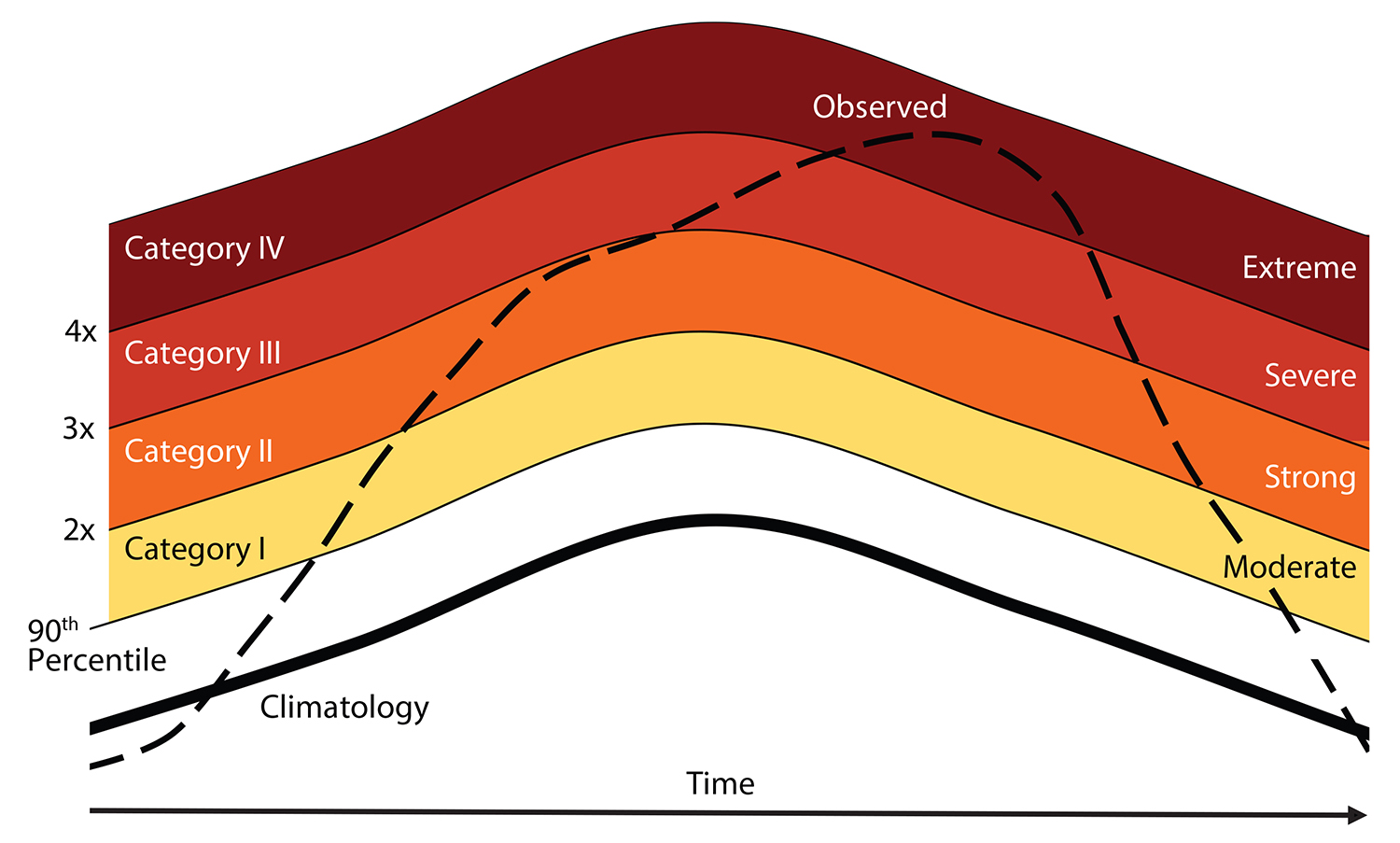
    Thanks to a research station that has been collecting ocean temperatures in the western English Channel for over a century, we know that this part of the sea south of Devon is 2.7°C warmer than the 120-year average, which makes it a category II (“strong”) marine heatwave within the four-category scheme.

    The importance of long-term monitoring

    Marine heatwaves are different to what we expect in a meteorological heatwave. Since 2023, the waters around the UK have been regularly experiencing marine heatwave conditions, because the data shows that the sea temperature has been in the top 10% of records: but most of us would admit that a sea temperature of 10°C in early March doesn’t exactly conjure up the impression of a heatwave.

    The search for better definitions of a marine heatwave continues among scientists, particularly as long-term baseline temperatures continue to warm and the top 10% of warm temperatures shifts upwards. Datasets gathered over several decades in the same place are valuable to this effort.

    For example, the Plymouth Marine Laboratory and the Marine Biological Association have been monitoring conditions in the western English Channel for over a century. One of the longest running surveys in the world is situated 20 miles south of Plymouth.

    Station E1 was originally founded by the International Council for the Exploration of the Seas in 1902, as part of the English (hence the “E”) effort in ocean observation.

    What sets E1 apart is the near continuous nature of its recording since then, the frequency of its data collection (monthly in winter, fortnightly in summer) and its sampling throughout the entire water column (80 metres deep), not just at the surface. This enables scientists to observe the seasonal progression of water mixing and layer formation in that location.

    The 123-year old dataset shows that sea surface temperatures have increased markedly within the past 40 years, at a rate of around 0.6°C a decade. Warm anomalies have been increasingly common, and cold anomalies increasingly rare.

    Marine heatwave conditions have become increasingly frequent, particularly since 2010. The data also shows that at a depth of 50 metres – well below the top layer of the ocean – temperatures have also increased markedly. The ongoing marine heatwave is not just a surface phenomenon.

    Fishers are catching octopus in large numbers off Devon and Cornwall due to the warm sea temperatures.
    Captured by Aixa/Shutterstock

    What caused this heatwave?

    The marine heatwave of spring 2025 has resulted from a combination of factors. It boils down to the fact that more energy is being put into the ocean during the day than is being lost at night.

    March 2025 was the sunniest March on record (since 1910), with UK Met Office statistics showing there were around 185 hours of sunshine. April set new records for UK solar power generation, with a peak of 12.2 gigawatts (GW) being produced on April 1 out of a possible solar generating capacity of 18 GW.

    May continued that trend, with long periods of clear skies under areas of the atmosphere with persistent high pressure. High-pressure areas are also associated with relatively low winds, which restricts the mixing of the warm surface with cooler deep water.

    During the spring, rapidly lengthening days mean the time for energy in (day) outweighs energy out (night). It has also been notable that the spring phytoplankton bloom was very early this year (during early March). This is when tiny plant cells at the seawater surface burst into life, like plants on land. The bloom finished relatively early and the surface waters cleared earlier.

    The conditions during May at E1 resembled those we would ordinarily associate with midsummer, with the phytoplankton bloom sitting deeper in the water. The clearer water at the surface allowed sunlight to penetrate deeper.

    It is evident from our century-plus of measurements that marine heatwaves are happening more frequently and that there appears to be an almost continuous marine heatwave state emerging around the UK.

    The intensity of a marine heatwave is generally tied to persistent high-pressure areas remaining static over the UK, but it is still unclear whether or not this is an emerging climate pattern, or just an episode within the general patterns of change within UK seas.


    Don’t have time to read about climate change as much as you’d like?

    Get a weekly roundup in your inbox instead. Every Wednesday, The Conversation’s environment editor writes Imagine, a short email that goes a little deeper into just one climate issue. Join the 45,000+ readers who’ve subscribed so far.


    Tim Smyth receives funding from Natural Environment Research Council and UK Research and Innovation.

    ref. What a 120-year-old research station is telling us about the warming of the sea around the UK – https://theconversation.com/what-a-120-year-old-research-station-is-telling-us-about-the-warming-of-the-sea-around-the-uk-257378

    MIL OSI – Global Reports

  • MIL-OSI USA: H.R. 980, Veterans Readiness and Employment Improvement Act of 2025

    Source: US Congressional Budget Office

    Bill Summary

    H.R. 980 would expand the types of flight training available to veterans under the Veteran Readiness and Employment (VR&E) program and extend the reduction of pension payments from the Department of Veterans Affairs (VA) for veterans and survivors who reside in Medicaid nursing homes. The bill also would establish new outreach requirements for VA related to the VR&E program.

    Estimated Federal Cost

    The estimated budgetary effects of H.R. 980 are shown in Table 1. Over the 2025‑2035 period, the bill would change net direct spending by less than $500,000 and increase spending subject to appropriation by $137 million. The costs of the legislation fall within budget functions 550 (health) and 700 (veterans benefits and services).

    Table 1.

    Estimated Budgetary Effects of H.R. 980


    By Fiscal Year, Millions of Dollars


    2025

    2026

    2027

    2028

    2029

    2030

    2031

    2032

    2033

    2034

    2035

    2025-2030

    2025-2035


    Increases or Decreases (-) in Direct Spending


    Estimated Budget Authority

    *

    2

    2

    2

    2

    2

    2

    -21

    3

    3

    3

    10

    *

    Estimated Outlays

    *

    2

    2

    2

    2

    2

    2

    -21

    3

    3

    3

    10

    *


    Increases in Spending Subject to Appropriation


    Estimated Authorization

    2

    12

    12

    13

    13

    13

    14

    14

    15

    15

    15

    65

    138

    Estimated Outlays

    2

    11

    12

    13

    13

    13

    14

    14

    15

    15

    15

    64

    137

    * = between -$500,000 and $500,000.

    Basis of Estimate

    For this estimate, CBO assumes that H.R. 980 will be enacted in fiscal year 2025 and that provisions will take effect upon enactment. CBO also estimates that outlays will follow historical spending patterns for affected programs.

    Direct Spending

    H.R. 980 would expand the types of flight training available to veterans under the VR&E program. The bill also would extend the reduction of pension payments for veterans and survivors who reside in a Medicaid nursing home. The costs of both of those programs are paid from mandatory appropriations. In total, the bill would change net direct spending by less than $500,000 over the 2025‑2035 period (see Table 2).

    Table 2.

    Estimated Changes in Direct Spending Under H.R. 980


    By Fiscal Year, Millions of Dollars


    2025

    2026

    2027

    2028

    2029

    2030

    2031

    2032

    2033

    2034

    2035

    2025-2030

    2025-2035

    Flight Training


    Estimated Budget Authority

    *

    2

    2

    2

    2

    2

    2

    3

    3

    3

    3

    10

    24

    Estimated Outlays

    *

    2

    2

    2

    2

    2

    2

    3

    3

    3

    3

    10

    24

    Pensions


    Estimated Budget Authority

    0

    0

    0

    0

    0

    0

    0

    -24

    0

    0

    0

    0

    -24

    Estimated Outlays

    0

    0

    0

    0

    0

    0

    0

    -24

    0

    0

    0

    0

    -24

    Total Changes


    Estimated Budget Authority

    *

    2

    2

    2

    2

    2

    2

    -21

    3

    3

    3

    10

    *

    Estimated Outlays

    *

    2

    2

    2

    2

    2

    2

    -21

    3

    3

    3

    10

    *

    Flight Training.Veterans with service-connected disabilities that negatively affect their ability to work can receive vocational rehabilitation services such as educational assistance, job training, skills counseling, and independent-living services. For veterans pursuing education or training programs, VA pays their tuition, fees, and related costs as well as housing allowances. Under current law, the benefit can be used for flight training that leads to a college degree; section 3 would allow veterans to use the benefit for flight training programs that do not lead to a degree. (Non-degree flight training programs are often provided by vocational pilot schools rather than colleges or universities; they issue licenses or certifications upon successful completion.)

    Using information from VA on the number of students using the Post-9/11 GI Bill for non‑degree flight training, CBO expects that roughly 120 veterans who would not otherwise receive vocational rehabilitation would pursue such training under the bill each year, at an average annual cost of $18,300 per person. As a result, CBO estimates that enacting section 3 would increase direct spending by $24 million over the 2025-2035 period.

    Pensions. Under current law, VA reduces pension payments to veterans and survivors who reside in Medicaid nursing homes to $90 per month. That required reduction expires November 30, 2031. Section 5 would extend that reduction for six months through May 31, 2032. CBO estimates that extending that requirement would reduce VA benefits by $10 million per month. (Those benefits are paid from mandatory appropriations and are therefore considered direct spending.) As a result of that reduction in beneficiaries’ income, Medicaid would pay more of the cost of their care, increasing spending for that program by $6 million per month. Thus, enacting section 5 would reduce net direct spending by $24 million over the 2025-2035 period.

    Spending Subject to Appropriation

    Section 4 would require VA to hold monthly informational sessions with school officials to answer questions concerning the VR&E program and to offer in-person or virtual briefings for veterans regarding VR&E services. CBO estimates that VA would need two trained outreach specialists at each of its 56 regional offices to provide those activities. Using information on VA personnel expenses, CBO estimates that implementing section 4 would increase spending subject to appropriation by $137 million over the 2025‑2035 period (see Table 3).

    Table 3.

    Estimated Increases in Spending Subject to Appropriation Under H.R. 980


    By Fiscal Year, Millions of Dollars


    2025

    2026

    2027

    2028

    2029

    2030

    2031

    2032

    2033

    2034

    2035

    2025-2030

    2025-2035

    Outreach


    Authorization

    2

    12

    12

    13

    13

    13

    14

    14

    15

    15

    15

    65

    138

    Estimated Outlays

    2

    11

    12

    13

    13

    13

    14

    14

    15

    15

    15

    64

    137

    Pay-As-You-Go Considerations

    The Statutory Pay-As-You-Go Act of 2010 establishes budget-reporting and enforcement procedures for legislation affecting direct spending or revenues. The net changes in outlays that are subject to those pay-as-you-go procedures are shown in Table 2.

    Increase in Long-Term Net Direct Spending and Deficits

    CBO estimates that enacting H.R. 980 would not increase net direct spending by more than $2.5 billion in any of the four consecutive 10-year periods beginning in 2036.

    CBO estimates that enacting H.R. 980 would not increase on‑budget deficits by more than $5 billion in any of the four consecutive 10-year periods beginning in 2036.

    Mandates

    The bill contains no intergovernmental or private-sector mandates as defined in the Unfunded Mandates Reform Act.

    Estimate Reviewed By

    David Newman
    Chief, Defense, International Affairs, and Veterans’ Affairs Cost Estimates Unit

    Kathleen FitzGerald
    Chief, Public and Private Mandates Unit

    Christina Hawley Anthony
    Deputy Director of Budget Analysis

    Phillip L. Swagel

    Director, Congressional Budget Office

    MIL OSI USA News

  • MIL-OSI: LPL Financial Welcomes Mai Park Capital to Linsco Channel

    Source: GlobeNewswire (MIL-OSI)

    SAN DIEGO, May 28, 2025 (GLOBE NEWSWIRE) — LPL Financial LLC announced today that financial advisor Mai Park, CPWA®, has joined LPL’s employee advisor channel, Linsco by LPL Financial, aligning with existing firm Pence Wealth Management, to launch Mai Park Capital. She reported serving approximately $330 million in advisory, brokerage and retirement plan assets* and joins LPL from Merrill Lynch.

    Based in Newport Beach, Calif., Park transitioned to financial services in 2007 following a career as a high school science teacher. With more than 20 years of industry experience, Park focuses on estate planning, investment management, retirement planning, tax planning and wealth management, taking a holistic and comprehensive approach with the goal of fostering meaningful, multi-generational relationships.

    “Every client’s financial journey is unique, shaped by their individual values, goals and circumstances,” Park said. “That’s why I believe in taking a personalized approach to working with my clients, one that prioritizes active listening, empathy and experience. Then together, we create a customized roadmap for their financial journey, providing a clear direction, milestones and accountabilities.”

    Why Mai Park made the move to Linsco by LPL
    Looking to better serve her clients with enhanced technology and broader offerings, Park chose to move to LPL Financial and join the team at Pence Wealth Management. She was drawn to the Linsco model, which serves financial advisors seeking the core tenets of independence, including owning their client relationships and having flexibility to run their practices, their way. With Linsco, advisors have access to LPL’s integrated wealth management platform and robust business resources, along with the additional benefits of having support from an experienced branch management team, dedicated marketing consultant and other resources that allow advisors to focus on their clients.

    “LPL has the size, scale and reputation that will allow me to serve my clients with a boutique-level of service while offering the freedom and flexibility to build my practice on my terms,” Park said. “Aligning with LPL and Pence Wealth Management offers me the ability to focus on my core strength — delivering an exceptional client experience.”

    Scott Posner, LPL Managing Director, Business Development, said, “We welcome Mai to the Linsco community and congratulate her and the Pence Wealth Management team on the launch of Mai Park Capital. At LPL, we recognize what it takes to launch and operate a thriving business and are committed to investing in streamlined and integrated business solutions designed to help advisors spend more time with their clients and differentiate their practices. We look forward to supporting Mai Park Capital for years to come.”

    Related
    Advisors, learn how LPL Financial can help take your business to the next level.

    About LPL Financial

    LPL Financial Holdings Inc. (Nasdaq: LPLA) is among the fastest growing wealth management firms in the U.S. As a leader in the financial advisor-mediated marketplace, LPL supports over 29,000 financial advisors and the wealth management practices of approximately 1,200 financial institutions, servicing and custodying approximately $1.8 trillion in brokerage and advisory assets on behalf of approximately 7 million Americans. The firm provides a wide range of advisor affiliation models, investment solutions, fintech tools and practice management services, ensuring that advisors and institutions have the flexibility to choose the business model, services, and technology resources they need to run thriving businesses. For further information about LPL, please visit www.lpl.com.

    Securities and advisory services offered through LPL Financial LLC (“LPL Financial”), a registered investment advisor and broker-dealer, member FINRA/SIPC.

    Throughout this communication, the terms “financial advisors” and “advisors” are used to refer to registered representatives and/or investment advisor representatives affiliated with LPL Financial.

    We routinely disclose information that may be important to shareholders in the “Investor Relations” or “Press Releases” section of our website.

    *Value approximated based on asset and holding details provided to LPL from end of year, 2024.

    Media Contact: 
    Media.relations@LPLFinancial.com 

    Tracking #742801

    The MIL Network

  • MIL-OSI: Richtech Robotics Announces Preliminary Inclusion in US small-cap Russell 2000® Index

    Source: GlobeNewswire (MIL-OSI)

    Las Vegas, NV, May 28, 2025 (GLOBE NEWSWIRE) — Richtech Robotics Inc. (Nasdaq: RR) (“Richtech Robotics” or the “Company”), a Nevada-based provider of AI-driven service robots, announces that it has been selected for preliminary inclusion in the US small-cap Russell 2000® Index, according to a preliminary list of additions published by FTSE Russell on Friday, May 23, 2025. The newly reconstituted indexes are expected to take effect after US market close on June 27, 2025, as part of the 2025 Russell Indexes reconstitution. Membership in the Russell 2000® Index, which remains in place for one year, is based on membership in the broad-market Russell 3000® Index. The Company’s stock will also be automatically added to the appropriate growth and value indexes.

    “We believe our preliminary inclusion in the Russell 2000® Index represents a significant validation of the momentum we’re building at Richtech Robotics,” said Matt Casella, President of Richtech Robotics. “It reflects growing market confidence in our long-term vision and the impact our AI-driven automation is having across the service industry. We’re proud of our team’s commitment to innovation, operational excellence, and delivering value to both our customers and shareholders.”

    Russell indices are widely used by investment managers and institutional investors for index funds and as benchmarks for active investment strategies. According to the data as of the end of June 2024, about $10.6 trillion in assets are benchmarked against the Russell US indexes, which belong to FTSE Russell, a prominent global index provider.

    For more information on the Russell 2000® and Russell 3000® Indexes and the Russell indexes reconstitution, visit the “Russell Reconstitution” section on the FTSE Russell website.

    About Richtech Robotics

    Richtech Robotics is a provider of collaborative robotic solutions specializing in the service industry, including the hospitality and healthcare sectors. Our mission is to transform the service industry through collaborative robotic solutions that enhance the customer experience and empower businesses to achieve more. By seamlessly integrating cutting-edge automation, we aspire to create a landscape of enhanced interactions, efficiency, and innovation, propelling organizations toward unparalleled levels of excellence and satisfaction. Learn more at www.RichtechRobotics.com.

    Forward Looking Statements

    Certain statements in this press release are forward-looking within the meaning of the Private Securities Litigation Reform Act of 1995. These statements may be identified by the use of forward-looking words such as “anticipate,” “believe,” “forecast,” “estimate,” “expect,” and “intend,” among others. Forward-looking statements are predictions, projections and other statements about future events that are based on current expectations and assumptions and, as a result, are subject to risks and uncertainties. Such forward-looking statements include, but are not limited to, statements regarding Richtech Robotics’ inclusion in the Russell Index and the potential impact, if any, of such inclusion on Richtech Robotics’ stock.

    These forward-looking statements are based on Richtech Robotics’ current expectations and actual results could differ materially. There are a number of factors that could cause actual events to differ materially from those indicated by such forward-looking statements include, among others, risks and uncertainties related to Richtech Robotics’ products, industry and general economic and market conditions. Investors should read the risk factors set forth in Richtech Robotics’ Annual Report on Form 10-K/A, filed with the SEC on March 4, 2025, the IPO registration statement and periodic reports filed with the SEC on or after the date thereof. All of Richtech Robotics’ forward-looking statements are expressly qualified by all such risk factors and other cautionary statements. The information set forth herein speaks only as of the date thereof. New risks and uncertainties arise over time, and it is not possible for Richtech Robotics to predict those events or how they may affect Richtech Robotics. If a change to the events and circumstances reflected in Richtech Robotics’ forward-looking statements occurs, Richtech Robotics’ business, financial condition and operating results may vary materially from those expressed in Richtech Robotics’ forward-looking statements.

    Readers are cautioned not to put undue reliance on forward-looking statements, and Richtech Robotics assumes no obligation and does not intend to update or revise these forward-looking statements, whether as a result of new information, future events or otherwise.

    Investors:
    CORE IR
    Matt Blazei
    ir@richtechrobotics.com

    Media: 
    Timothy Tanksley
    Director of Marketing
    Richtech Robotics, Inc
    press@richtechrobotics.com
    702-534-0050

    The MIL Network

  • MIL-OSI: Amy Dolan, 20-Year Mortgage Veteran, Joins Rate in Philadelphia, PA

    Source: GlobeNewswire (MIL-OSI)

    PHILADELPHIA, May 28, 2025 (GLOBE NEWSWIRE) — Rate, a leader in fintech mortgage solutions, announced the addition of Amy Dolan as a new loan officer serving the greater Philadelphia area. With more than two decades of mortgage experience, Dolan brings deep knowledge of loan origination and underwriting to help local buyers confidently navigate the home financing process.

    A recognized industry leader, Dolan is a seven-time All-Star Club Award Recipient and has built a reputation for delivering consistent, high-quality service to homebuyers. Her decision to join Rate reflects a shared commitment to streamlining the mortgage process while putting the customer first.

    “I chose the mortgage industry because helping people achieve their dream of homeownership drives me,” said Dolan. “There’s nothing more rewarding than guiding someone through one of the biggest decisions of their life.”

    Dolan’s community involvement spans well beyond real estate. For the past 14 years, she has led and developed her local youth and high school wrestling program, mentoring student-athletes and building team culture at the grassroots level.

    “We are delighted to welcome Amy to Rate, where her 20 years of mortgage lending experience and deep understanding of underwriting guidelines will ensure a seamless mortgage process for her customers,” said Jeff Nelson, Chief Production Officer – East. “We feel incredibly fortunate to have Amy on our team.”

    This appointment underscores Rate’s continued commitment to investing in experienced loan originators who are trusted in their markets and dedicated to customer care.

    About Rate
    Rate Companies is a leader in mortgage lending and digital financial services. Headquartered in Chicago, Rate has over 850 branches across all 50 states and Washington D.C. Since its launch in 2000, Rate has helped more than 2 million homeowners with home purchase loans and refinances. The company has cemented itself as an industry leader by introducing innovative technology, offering low rates, and delivering unparalleled customer service. Honors and awards include: Top 5 Mortgage Lender by Inside Mortgage Finance for 2024; Best Mortgage Lender for First-Time Homebuyers by NerdWallet for 2023; HousingWire’s Tech100 award for the company’s industry-leading FlashClose℠ digital mortgage platform in 2020, MyAccount in 2022, and Language Access Program in 2023; the most Scotsman Guide Top Originators for 11 consecutive years; Chicago Agent Magazine’s Lender of the Year for seven consecutive years; and Chicago Tribune’s Top Workplaces list for seven straight years. Visit rate.com for more information.

    Media Contact

    press@rate.com

    A photo accompanying this announcement is available at https://www.globenewswire.com/NewsRoom/AttachmentNg/c2234cbc-d2ee-4e13-b625-b9c17329982f

    The MIL Network

  • MIL-OSI: STEALTHGAS INC. Reports First Quarter 2025 Financial and Operating Results

    Source: GlobeNewswire (MIL-OSI)

    ATHENS, Greece, May 28, 2025 (GLOBE NEWSWIRE) — STEALTHGAS INC. (NASDAQ: GASS), a ship-owning company serving the liquefied petroleum gas (LPG) sector of the international shipping industry, announced today its unaudited financial and operating results for the first quarter ended March 31, 2025.

    OPERATIONAL AND FINANCIAL HIGHLIGHTS

    • Strong profitability continued for the first quarter, with Net income of $14.1 million corresponding to a basic EPS of $0.38, similar to the previous quarter’s $14.2 million but reduced compared to the $17.7 million record at the time achieved in the first quarter of 2024.
    • Time Charter equivalent revenues decreased by 4.6% compared to the same period of last year to $36.9 million for the first quarter of 2025 as a result of a more muted market.
    • Preserved the high period coverage. About 70% of fleet days for 2025 are secured on period charters, with total fleet employment days for all subsequent periods generating over $165 million (excl. JV vessels) in contracted revenues.
    • Continued reducing leverage, making $34.4 million in debt repayments during the first quarter of 2025 and a further $19.2 million in the current quarter of 2025. Currently, all the vessels in the fully owned fleet except one are unencumbered.
    • Since the last quarterly announcement the Company has spent $1.8 million in share repurchases. Overall under the current program the Company has spent over $21.2 million in share repurchases since June 2023.
    • Maintaining ample cash and cash equivalents (incl. restricted cash) of $77.1 million as of March 31, 2025 enabling the Company to further reduce debt.

    First Quarter 2025 Results1:

    • Revenues for the three months ended March 31, 2025 amounted to $42.0 million compared to revenues of $41.6 million for the three months ended March 31, 2024, based on an average of 28.0 vessels and 27.0 vessels owned by the Company, respectively, as the vessels remaining in the fleet earned higher revenues due to better market conditions.
    • Voyage expenses and vessels’ operating expenses for the three months ended March 31, 2025, were $5.1 million and $13.5 million, respectively, compared to $2.9 million and $11.5 million, respectively, for the three months ended March 31, 2024. The $2.2 million increase in voyage expenses was mainly due to an increase in port expenses and in bunkers costs as a result of the increase in spot market days for the fleet. The $2.0 million increase in vessels’ operating expenses was mainly due to increase in crew costs and maintenance expenses.
    • Drydocking costs for the three months ended March 31, 2025 and 2024 were $0.4 million and nil, respectively. Drydocking expenses during the first quarter of 2025 mainly relate to the commenced drydocking of one vessel, compared to no drydocking of vessels in the same period of last year.
    • General and administrative expenses remained stable at $2.2 million for both the three months ended March 31, 2025 and 2024.
    • Depreciation for the three months ended March 31, 2025 and 2024 was $6.7 million and $6.5 million, respectively, a $0.2 million increase is mainly related to the increase in average number of vessels owned by the Company and to the partial replacement of some of the older vessels with newer and larger ones which have a higher cost.
    • Impairment loss for the three months ended March 31, 2025 and 2024 was $0.5 million and nil, respectively. As a result of the agreed sale terms for the vessel Gas Cerberus, with delivery expected in the second quarter of 2025, a non-cash impairment loss of $0.5 million was recognized in the first quarter of 2025.
    • Interest and finance costs for the three months ended March 31, 2025 and 2024, were $1.4 million and $3.2 million, respectively. The $1.8 million decrease from the same period of last year is primarily due to continued debt prepayments.
    • Interest income for the three months ended March 31, 2025 and 2024, remained unchanged at $0.8 million.
    • Equity earnings in joint ventures for the three months ended March 31, 2025 and 2024 was a gain of $2.2 million and $2.6 million, respectively. The $0.4 million decrease was primarily due to decrease in number of vessels in joint ventures.
    • As a result of the above, for the three months ended March 31, 2025, the Company reported net income of $14.1 million, compared to net income of $17.7 million for the three months ended March 31, 2024. The weighted average number of shares outstanding, basic, for the three months ended March 31, 2025 and 2024 was 35.7 million and 35.1 million, respectively.
    • Earnings per share, basic, for the three months ended March 31, 2025 amounted to $0.38 compared to earnings per share, basic, of $0.49 for the same period of last year.
    • Adjusted net income was $16.1 million corresponding to an Adjusted EPS of $0.44 for the three months ended March 31, 2025 compared to Adjusted net income of $19.1 million corresponding to an Adjusted EPS of $0.53 for the same period of last year.
    • EBITDA for the three months ended March 31, 2025 amounted to $21.4 million. Reconciliations of Adjusted Net Income, EBITDA and Adjusted EBITDA to Net Income are set forth below.
    • An average of 28.0 vessels were owned by the Company during the three months ended March 31, 2025 compared to 27.04 vessels for the same period of 2024.

    1 EBITDA, Adjusted EBITDA, Adjusted Net Income and Adjusted EPS are non-GAAP measures. Refer to the reconciliation of these measures to the most directly comparable financial measure in accordance with GAAP set forth later in this release.

    Fleet Update Since Previous Announcement

    The Company announced the conclusion of the following chartering arrangements (of three or more months duration):

    • A twelve months time charter for its 2016 built LPG carrier Eco Dominator, until Mar 2026.
    • A twelve months time charter extension for its 2016 built LPG carrier Eco Nical, until May 2026.
    • A six months time charter extension for the 2012 built LPG carrier Gas Esco, until Sep 2025.

    As of June 2025, the Company has total contracted revenues of approximately $165 million.

    As of June 2025, for the remainder of the year, the Company has circa 70% of fleet days secured under period contracts and contracted revenues of approximately $72 million.

    In April 2025, the Company entered into an agreement to sell the vessel Gas Cerberus to a third party, with delivery expected in the second quarter of 2025. The vessel is debt-free, and the full proceeds from the sale will contribute to the Company’s liquidity position.

    The Company has agreed in principle to purchase back from one of its joint venture partners the remaining share (49.9%) which it does not already own in the two vessels Eco Lucidity and Gas Haralambos. The transaction is subject to entry into definitive documentation and customary conditions and is expected to take place within June 2025. Following this transaction, these two vessels will be consolidated within the fully owned fleet of the Company and only one vessel will remain in a JV.

    Board Chairman Michael Jolliffe Commented

    The results that were announced today point to a strong start to the year and underpin our confidence in sustaining the momentum we have built over the last years, throughout 2025. It is no doubt a period of uncertainty and in such periods, among other things, there is reluctance by charterers to commit longer term. With the latest developments, we expect trade flows to normalize and sentiment to improve as the fundamentals of LPG shipping continue to be positive. In this volatile environment StealthGas remains steadfast in its strategy and has all but eliminated its financial risk, being net debt free after having made over $50 million in debt repayments during this year and having 27 out of 28 vessels unencumbered. At the same time in order to return value to our shareholders, we have begun buying back shares, spending $1.8 million in share repurchases since March. Overall under the current program the Company has spent over $21.2 million in share repurchases since June 2023.

    Conference Call details:

    On May 28, 2025 at 10:00 am ET, the company’s management will host a conference call to discuss the results and the company’s operations and outlook.

    Conference call participants should pre-register using the below link to receive the dial-in numbers and a personal PIN, which are required to access the conference call.

    https://register-conf.media-server.com/register/BI2ab472844539410f8650314c8df8fdaf

    Slides and audio webcast:
    There will also be a live and then archived webcast of the conference call, through the STEALTHGAS INC. website (www.stealthgas.com). Participants to the live webcast should register on the website approximately 10 minutes prior to the start of the webcast.

    About STEALTHGAS INC.

    StealthGas Inc. is a ship-owning company serving the liquefied petroleum gas (LPG) sector of the international shipping industry. StealthGas Inc. has a fleet of 31 LPG carriers, including three Joint Venture vessels in the water. These LPG vessels have a total capacity of 349,170 cubic meters (cbm). StealthGas Inc.’s shares are listed on the Nasdaq Global Select Market and trade under the symbol “GASS.”
    Visit our website at www.stealthgas.com

    Forward-Looking Statements

    Matters discussed in this release may constitute forward-looking statements. Forward-looking statements reflect our current views with respect to future events and financial performance and may include statements concerning plans, objectives, goals, strategies, future events or performance and underlying assumptions and other statements, which are other than statements of historical facts. The forward-looking statements in this release are based upon various assumptions, many of which are based, in turn, upon further assumptions, including without limitation, management’s examination of historical operating trends, data contained in our records and other data available from third parties. Although STEALTHGAS INC. believes that these assumptions were reasonable when made, because these assumptions are inherently subject to significant uncertainties and contingencies which are difficult or impossible to predict and are beyond our control, STEALTHGAS INC. cannot assure you that it will achieve or accomplish these expectations, beliefs or projections. Important factors that, in our view, could cause actual results to differ materially from those discussed in the forward-looking statements include the strength of world economies and currencies, geopolitical conditions, including any trade disruptions resulting from tariffs and other protectionist measures imposed by the United States or other countries, general market conditions, including changes in charter hire rates and vessel values, charter counterparty performance, changes in demand that may affect attitudes of time charterers to scheduled and unscheduled drydockings, shipyard performance, changes in STEALTHGAS INC’s operating expenses, including bunker prices, drydocking and insurance costs, ability to obtain financing and comply with covenants in our financing arrangements, actions taken by regulatory authorities, potential liability from pending or future litigation, domestic and international political conditions, the conflict in Ukraine and related sanctions, the conflict in Israel and Gaza, potential disruption of shipping routes due to ongoing attacks by Houthis in the Red Sea and Gulf of Aden or accidents and political events or acts by terrorists.

    Risks and uncertainties are further described in reports filed by STEALTHGAS INC. with the U.S. Securities and Exchange Commission.

    Fleet List
    For information on our fleet and further information:
    Visit our website at www.stealthgas.com

    Fleet Data:
    The following key indicators highlight the Company’s operating performance during the periods ended March 31, 2024 and 2025.

    FLEET DATA Q1 2024   Q1 2025  
    Average number of vessels (1) 27.04   28.00  
    Period end number of owned vessels in fleet 27   28  
    Total calendar days for fleet (2) 2,461   2,520  
    Total voyage days for fleet (3) 2,439   2,500  
    Fleet utilization (4) 99.1%   99.2%  
    Total charter days for fleet (5) 2,232   2,118  
    Total spot market days for fleet (6) 207   382  
    Fleet operational utilization (7) 97.7%   94.0%  
             

    1) Average number of vessels is the number of owned vessels that constituted our fleet for the relevant period, as measured by the sum of the number of days each vessel was a part of our fleet during the period divided by the number of calendar days in that period.
    2) Total calendar days for fleet are the total days the vessels we operated were in our possession for the relevant period including off-hire days associated with major repairs, drydockings or special or intermediate surveys.
    3) Total voyage days for fleet reflect the total days the vessels we operated were in our possession for the relevant period net of off-hire days associated with major repairs, drydockings or special or intermediate surveys.
    4) Fleet utilization is the percentage of time that our vessels were available for revenue generating voyage days and is determined by dividing voyage days by fleet calendar days for the relevant period.
    5) Total charter days for fleet are the number of voyage days the vessels operated on time or bareboat charters for the relevant period.
    6) Total spot market charter days for fleet are the number of voyage days the vessels operated on spot market charters for the relevant period.
    7) Fleet operational utilization is the percentage of time that our vessels generated revenue and is determined by dividing voyage days excluding commercially idle days by fleet calendar days for the relevant period.

    Reconciliation of Adjusted Net Income, EBITDA, adjusted EBITDA and adjusted EPS:

    Adjusted net income represents net income before loss/gain on derivatives excluding swap interest paid/received, impairment loss, net gain/loss on sale of vessels and share based compensation. EBITDA represents net income before interest and finance costs, interest income and depreciation. Adjusted EBITDA represents net income before interest and finance costs, interest income, depreciation, impairment loss, net gain/loss on sale of vessels, share based compensation and loss/gain on derivatives.

    Adjusted EPS represents Adjusted net income divided by the weighted average number of shares.

    EBITDA, adjusted EBITDA, adjusted net income and adjusted EPS are included herein because they are a basis, upon which we and our investors assess our financial performance. They allow us to present our performance from period to period on a comparable basis and provide investors with a means of better evaluating and understanding our operating performance.

    EBITDA, adjusted EBITDA, adjusted net income and adjusted EPS are not recognized measurements under U.S. GAAP. Our calculation of EBITDA, adjusted EBITDA, adjusted net income and adjusted EPS may not be comparable to that reported by other companies in the shipping or other industries. In evaluating Adjusted EBITDA, Adjusted net income and Adjusted EPS, you should be aware that in the future we may incur expenses that are the same as or similar to some of the adjustments in this presentation.

    (Expressed in United States Dollars,
    except number of shares)
    Three Months Period Ended March 31st,
      2024  2025 
    Net Income – Adjusted Net Income    
    Net income 17,729,716   14,107,680  
    Less gain on derivatives (99,286 )  
    Plus swap interest received 208,127    
    Less gain on sale of vessels, net (46,384 )  
    Plus impairment loss   488,400  
    Plus share based compensation 1,345,409   1,540,402  
    Adjusted Net Income 19,137,582   16,136,482  
         
    Net income – EBITDA    
    Net income 17,729,716   14,107,680  
    Plus interest and finance costs 3,169,061   1,415,605  
    Less interest income (753,396 ) (752,471 )
    Plus depreciation 6,492,376   6,653,460  
    EBITDA 26,637,757   21,424,274  
         

    Net income – Adjusted EBITDA

       
    Net income 17,729,716   14,107,680  
    Less gain on derivatives (99,286 )  
    Less gain on sale of vessels, net (46,384 )  
    Plus impairment loss   488,400  
    Plus share based compensation 1,345,409   1,540,402  
    Plus interest and finance costs 3,169,061   1,415,605  
    Less interest income (753,396 ) (752,471 )
    Plus depreciation 6,492,376   6,653,460  
    Adjusted EBITDA 27,837,496   23,453,076  
         
    EPS – Adjusted EPS    
    Net income 17,729,716   14,107,680  
    Adjusted net income 19,137,582   16,136,482  
    Weighted average number of shares, basic 35,119,500   35,725,720  
    EPS – Basic 0.49   0.38  
    Adjusted EPS – Basic 0.53   0.44  
             

    StealthGas Inc.
    Unaudited Condensed Consolidated Statements of Income
    (Expressed in United States Dollars, except for number of shares)

        Three Months Period Ended March 31,
        2024  2025 
         
    Revenues    
      Revenues 41,563,908     42,025,987  
           
    Expenses    
      Voyage expenses 2,345,200     4,573,956  
      Voyage expenses – related party 513,247     518,440  
      Vessels’ operating expenses 11,235,359     13,282,235  
      Vessels’ operating expenses – related party 241,500     228,200  
      Drydocking costs     412,620  
      Management fees – related party 1,053,719     1,080,001  
      General and administrative expenses 2,213,853     2,165,709  
      Depreciation 6,492,376     6,653,460  
      Impairment loss     488,400  
      Net gain on sale of vessels (46,384 )    
    Total expenses 24,048,870     29,403,021  
           
    Income from operations 17,515,038     12,622,966  
           
    Other (expenses)/income    
      Interest and finance costs (3,169,061 )   (1,415,605 )
      (Loss)/gain on derivatives 99,286      
      Interest income 753,396     752,471  
      Foreign exchange (loss)/gain (49,044 )   (26,484 )
    Other expenses, net (2,365,423 )   (689,618 )
           
    Income before equity in earnings of investees 15,149,615     11,933,348  
    Equity earnings in joint ventures 2,580,101     2,174,332  
    Net Income 17,729,716     14,107,680  
           
    Earnings per share    
    – Basic 0.49     0.38  
    – Diluted 0.49     0.39  
           
    Weighted average number of shares    
    – Basic 35,119,500     35,725,720  
    – Diluted 35,247,529     35,764,990  
               

    StealthGas Inc.
    Unaudited Condensed Consolidated Balance Sheets
    (Expressed in United States Dollars)

        December 31, March 31,
        2024 2025 
           
    Assets    
    Current assets    
      Cash and cash equivalents 80,653,398 74,392,306  
      Trade and other receivables 6,156,300 7,253,738  
      Other current assets 193,265 422,168  
      Claims receivable 55,475 55,475  
      Inventories 3,891,147 3,198,028  
      Advances and prepayments 733,212 549,263  
      Fair value of derivatives 387,608 280,577  
    Total current assets 92,070,405 86,151,555  
           
    Non current assets    
      Operating lease right-of-use assets 202,362  
      Vessels, net 608,214,416 601,072,556  
      Other receivables 370,053 237,561  
      Restricted cash 3,867,752 2,734,442  
      Investments in joint ventures 27,717,238 27,257,570  
    Total non current assets 640,169,459 631,504,491  
    Total assets 732,239,864 717,656,046  
           
    Liabilities and Stockholders’ Equity    
    Current liabilities    
      Payable to related parties 388,130 3,039,119  
      Trade accounts payable 10,994,434 10,485,931  
      Accrued liabilities 4,922,587 5,119,206  
      Operating lease liabilities 120,938  
      Deferred income 4,304,667 5,882,276  
      Current portion of long-term debt 23,333,814 20,722,094  
    Total current liabilities 43,943,632 45,369,564  
           
    Non current liabilities    
      Operating lease liabilities 81,424  
      Deferred income 213,563 586,577  
      Long-term debt 61,555,855 30,251,709  
    Total non current liabilities 61,769,418 30,919,710  
    Total liabilities 105,713,050 76,289,274  
           
    Commitments and contingencies    
           
    Stockholders’ equity    
      Capital stock 370,414 371,664  
      Treasury stock (1,057,343 )
      Additional paid-in capital 409,912,934 411,808,336  
      Retained earnings 215,855,858 229,963,538  
      Accumulated other comprehensive income 387,608 280,577  
    Total stockholders’ equity 626,526,814 641,366,772  
    Total liabilities and stockholders’ equity 732,239,864 717,656,046  


    StealthGas Inc.

    Unaudited Condensed Consolidated Statements of Cash Flows
    (Expressed in United States Dollars)

        Three Months Period Ended March 31,
        2024   2025  
         
    Cash flows from operating activities    
      Net income for the period 17,729,716   14,107,680  
           
    Adjustments to reconcile net income to net cash    
    provided by operating activities:    
      Depreciation 6,492,376   6,653,460  
      Amortization of deferred finance charges 258,295   508,464  
      Amortization of operating lease right-of-use assets 24,745   29,194  
      Share based compensation 1,345,409   1,540,402  
      Change in fair value of derivatives 108,840    
      Proceeds from disposal of interest rate swaps 1,018,000    
      Equity earnings in joint ventures (2,580,101 ) (2,174,332 )
      Dividends received from joint ventures   2,634,000  
      Impairment loss   488,400  
      Gain on sale of vessels (46,384 )  
    Changes in operating assets and liabilities:    
      (Increase)/decrease in    
      Trade and other receivables (35,143 ) (964,946 )
      Other current assets 129,193   (228,903 )
      Inventories 353,756   693,119  
      Changes in operating lease liabilities (24,745 ) (29,194 )
      Advances and prepayments (159,743 ) 183,949  
      Increase/(decrease) in    
      Balances with related parties (1,390,625 ) 2,650,989  
      Trade accounts payable (475,368 ) (508,503 )
      Accrued liabilities 240,202   196,619  
      Deferred income 688,600   1,950,623  
    Net cash provided by operating activities 23,677,023   27,731,021  
           
    Cash flows from investing activities    
      Proceeds from sale of vessels, net 34,679,584    
      Acquisition and improvements of vessels (96,413,470 )  
      Advances to joint ventures (1,705 )  
    Net cash used in investing activities (61,735,591 )  
           
    Cash flows from financing activities    
      Proceeds from exercise of stock options 356,250   356,250  
      Stock repurchase (338,176 ) (1,057,343 )
      Deferred finance charges paid (22,167 )  
      Advances to joint ventures (11,848 )  
      Loan repayments (32,045,235 ) (34,424,330 )
      Proceeds from long-term debt 70,000,000    
    Net cash provided by/(used in) financing activities 37,938,824   (35,125,423 )
           
    Net decrease in cash, cash equivalents and restricted cash (119,744 ) (7,394,402 )
    Cash, cash equivalents and restricted cash at beginning of period 83,755,701   84,521,150  
    Cash, cash equivalents and restricted cash at end of period 83,635,957   77,126,748  
    Cash breakdown    
      Cash and cash equivalents 77,085,417   74,392,306  
      Restricted cash, current    
      Restricted cash, non current 6,550,540   2,734,442  
    Total cash, cash equivalents and restricted cash shown in the statements of cash flows 83,635,957   77,126,748  

    The MIL Network

  • MIL-OSI: Zero Hash Secures Regulatory Approval to Operate in Argentina, Accelerating Global Expansion

    Source: GlobeNewswire (MIL-OSI)

    BUENOS AIRES, Argentina, May 28, 2025 (GLOBE NEWSWIRE) — Zero Hash, the leading crypto and stablecoin infrastructure platform, today announced it has secured regulatory approval to operate in Argentina through its approval as a registered Virtual Asset Service Provider (VASP) with the National Securities Commission (CNV) of Argentina. This marks another significant milestone in Zero Hash’s strategic global expansion plans. Zero Hash was awarded approval after completing a rigorous registration process overseen by Argentina’s financial regulatory authorities, who have established some of the most comprehensive crypto regulatory frameworks in Latin America.

    The newly obtained registration enables Zero Hash to onboard Argentinian customers to its growing suite of digital asset services, including stablecoin payments, payouts, and crypto trading services, in full compliance with local regulatory requirements. The achievement adds to Zero Hash’s extensive global regulatory footprint and marks Zero Hash’s continued growth in Latin America following its previous expansion into Brazil.

    “Securing regulatory approval in Argentina represents the continued acceleration in our international growth strategy,” said Edward Woodford, CEO of Zero Hash. “This registration allows us to serve the vibrant Argentinian market, reinforcing our commitment to operate within jurisdictional regulatory frameworks to serve customers anywhere, anytime, 24/7/365.”

    Argentina has emerged as one of Latin America’s most dynamic cryptocurrency markets. Research shows that 65% of Argentina’s population frequently uses mobile wallets and payment applications for transactions, one of the highest adoption rates in Latin America. Additionally, Argentina has the eighth-largest volume in stablecoin payouts among the more than 60 countries handled by Zero Hash’s global stablecoin payouts rail. Like other markets worldwide, Argentinians use digital assets to protect against high inflation and currency instability.

    The extensive regulatory process requires compliance with stringent anti-money laundering protocols, comprehensive KYC procedures, and robust security standards. With this approval, Zero Hash can now:

    • Provide compliant digital asset services to Argentinian businesses and consumers.
    • Establish local operations to better serve the regional market.
    • Contribute to the growth of Argentina’s emerging digital economy.

    “We build our business through proper regulatory channels,” added Stephen Gardner, Chief Legal Officer at Zero Hash. “Our approach has always been to work collaboratively with local regulators to ensure we meet or exceed compliance requirements in every market we enter.”

    This regulatory approval comes at a crucial time for Argentina’s growing freelance workforce. Recent survey data highlights significant challenges within the country’s traditional financial infrastructure, with 88% of respondents indicating that current local banking and payment systems fail to adequately serve freelancers due to high fees, currency volatility issues, and payment delays.

    “Our entry into Argentina addresses a genuine market need,” added Woodford. “Our research shows that an overwhelming 92% of Argentinian freelancers prefer cryptocurrency payment options. We’ve incorporated these options for our local teams in Argentina, recognizing they deserve fair compensation without diminishing their earnings through unfavorable exchange rates. This reflects the real-world utility of digital assets in providing financial stability, reducing transaction costs, and enabling timely compensation for services rendered.”

    About Zero Hash
    Zero Hash is the leading infrastructure provider for crypto, stablecoin, and tokenized assets. Its API and embeddable dev-kit enables innovators to easily launch solutions across cross-border payments, commerce, trading, remittance, payroll, tokenization and on/off-ramps.

    Zero Hash powers solutions for some of the largest and innovative companies including Interactive Brokers, Stripe, Shift4, Franklin Templeton, Felix Pago, Kalshi and LightSpark. Zero Hash Holdings is backed by investors, including Point72 Ventures, Bain Capital Ventures, and NYCA.

    In the United States, Zero Hash LLC is a FinCen-registered Money Service Business and a regulated Money Transmitter that can operate in 51 U.S. jurisdictions. Zero Hash LLC and Zero Hash Liquidity Services LLC are licensed to engage in virtual currency business activity by the New York State Department of Financial Services. Zero Hash Trust Company LLC has been approved by the North Carolina Commissioner of Banks as a non-depository trust company. For information about our global regulatory footprint, including our Argentinian registrations, see here.

    Zero Hash Disclosures

    The Zero Hash services and product offerings may not be available in all jurisdictions, including in the State of New York. Crypto and stablecoin holdings held in Zero Hash accounts are not subject to FDIC or SIPC protections in the U.S., or any such equivalent protections that may exist outside of the U.S. Zero Hash’s technical support and enablement of any asset is not an endorsement of such asset and is not a recommendation to buy, sell, or hold any crypto asset. The value of any cryptocurrency, including digital assets pegged to fiat currency, commodities, or any other asset, may go to zero.

    Learn more by visiting zerohash.com or following us on X @ZeroHashX

    Media Contacts
    Zero Hash
    Shaun O’Keeffe
    (855) 744-7333
    media@zerohash.com 

    The MIL Network

  • MIL-OSI Russia: Fujian Coast Guard Patrols Waters Near Kinmen Islands /Detailed Version-1/

    Translation. Region: Russian Federal

    Source: People’s Republic of China in Russian – People’s Republic of China in Russian –

    Source: People’s Republic of China – State Council News

    FUZHOU, May 28 (Xinhua) — The Fujian Provincial Coast Guard conducted regular law enforcement patrols in waters near the Kinmen Islands on Wednesday, the China Coast Guard said in a statement.

    Since early May, the local coast guard has been continuously stepping up patrols of the waters off Kinmen to carry out special law enforcement operations related to the summer fishing moratorium, said Zhu Anqing, spokesman for the East China Sea Division of the China Coast Guard.

    This, he said, has effectively strengthened the management and control of the relevant waters, properly protected the legitimate rights and interests, as well as the safety of life and property of Chinese fishermen, including those from Taiwan, and reliably ensured normal shipping and operational procedures in the Xiamen-Jinmen marine area. -0-

    MIL OSI Russia News

  • MIL-OSI Russia: Israeli fighter jets strike Houthi targets at Sana’a airport

    Translation. Region: Russian Federal

    Source: People’s Republic of China in Russian – People’s Republic of China in Russian –

    Source: People’s Republic of China – State Council News

    JERUSALEM/SANAA, May 28 (Xinhua) — Israeli warplanes on Wednesday struck the main airport of the Yemeni capital Sanaa and several aircraft belonging to Houthi forces, the Israeli army said in a statement.

    The attack destroyed the last aircraft used by Houthi forces, Israeli Defense Minister Israel Katz said in a statement.

    “This is a clear signal and a direct continuation of our policy: whoever opens fire on Israel will pay a high price,” he warned.

    He noted that Israel would continue to strike Yemeni ports and strategic infrastructure used by the Houthis and their allies. “The airport in Sanaa will be destroyed again and again,” the statement said.

    The Israeli minister also warned that the Houthis would find themselves “under a sea and air blockade.”

    Airport CEO Khaled al-Shayef confirmed that a fourth Yemeni national airline plane, Yemenia Airline Company, was destroyed in Israeli airstrikes on Wednesday morning.

    Since November 2023, the Houthis, who control much of northern Yemen, have carried out regular missile and drone strikes on Israel. They say they are doing so in solidarity with Palestinians in Gaza amid the ongoing Israeli-Palestinian conflict. The group has said it will stop the attacks if Israel ends its military operations and blockade of Gaza. –0–

    MIL OSI Russia News

  • MIL-OSI Russia: Situation in Gaza remains unbearable: EU foreign policy chief

    Translation. Region: Russian Federal

    Source: People’s Republic of China in Russian – People’s Republic of China in Russian –

    Source: People’s Republic of China – State Council News

    BRUSSELS, May 28 (Xinhua) — The situation in Gaza remains “unbearable,” European Union (EU) High Representative for Foreign Affairs and Security Policy Kaja Kallas said on Wednesday.

    A senior diplomat in a post on social media site X accused Israel of carrying out strikes that “go beyond what is necessary.”

    K. Kallas condemned the “disproportionate use of force” by Israeli troops in Gaza and called for a return to the ceasefire to ensure the release of hostages and pave the way for a lasting, negotiated peace.

    “Israel’s military operation in Gaza, the disproportionate use of force and the loss of civilian lives cannot be tolerated,” Kallas said in a statement, adding that continued attacks on civilian infrastructure are “unacceptable.”

    Insisting that humanitarian aid “must never be politicized or militarized,” Kallas stressed the central role of the UN in providing aid.

    “We once again urge the immediate, unimpeded and sustained resumption of assistance on a scale commensurate with the needs of the civilian population in Gaza,” she stressed. –0–

    MIL OSI Russia News

  • MIL-OSI Russia: At least five killed after migrant boat capsizes off Canary Islands

    Translation. Region: Russian Federal

    Source: People’s Republic of China in Russian – People’s Republic of China in Russian –

    Source: People’s Republic of China – State Council News

    MADRID, May 28 (Xinhua) — At least five people, including two minors aged 5 and 16, were killed when a boat carrying about 180 migrants capsized at the entrance to the port of La Restinga on El Hierro, one of the Canary Islands, local authorities said.

    The incident occurred as the boat was being towed to a dock to allow migrants from sub-Saharan Africa to disembark. Local officials also said one infant was missing.

    Search and rescue efforts are ongoing and more bodies may be found in the coming hours. –0–

    MIL OSI Russia News

  • UPSC launches new online application portal to streamline exam registration process

    Source: Government of India

    Source: Government of India (4)

    In a significant move to improve the examination process for aspirants, the Union Public Service Commission (UPSC) has launched a new Online Application Portal, effective from May 28. The portal is designed to simplify and speed up the registration and application process for various UPSC examinations, making it more user-friendly and efficient.

    The new portal, available at [https://upsconline.nic.in](https://upsconline.nic.in), has been structured into four key sections presented as separate cards on the homepage. These include Account Creation, Universal Registration, Common Application Form, and Examination.

    The first three sections contain details common to all exams and can be completed at any time, allowing candidates to register their information in advance. Only the fourth section, related specifically to each examination, needs to be filled in when an exam is officially announced. This section will include the exam notification, application form, and application status.

    This setup allows candidates to complete most of the application process ahead of time, helping them avoid last-minute delays and ensuring they are prepared as soon as a new examination is announced. The system enables the reuse of personal and academic information, making the process faster and reducing errors.

    All candidates are required to freshly register on the new portal and fill out their profiles and applications. The older One Time Registration (OTR) system will no longer be applicable. The portal offers detailed instructions on its homepage and within each section to assist candidates with application submission and document uploads.

    Applicants are strongly encouraged to use their Aadhaar Card as their primary identity document during the registration process. Using Aadhaar will allow for quick, seamless authentication and verification of identity and details, creating a permanent and unified record for use across all future UPSC examinations.

    The new portal will be used for the first time for applications to the Combined Defence Services (CDS) Exam-II, 2025, and the National Defence Academy & Naval Academy (NDA & NA) Exam-II, 2025, both of which are being notified on May 28, 2025.

    With this digital reform, UPSC aims to bring greater transparency, convenience, and efficiency to its recruitment process, supporting the broader push toward digital governance in public service administration.

  • MIL-OSI Security: Clarenville — Clarenville RCMP promotes road safety with checks points and traffic tickets

    Source: Royal Canadian Mounted Police

    With traffic safety and compliance with the Highway Traffic Act front of mind, Clarenville RCMP is promoting road safety with check points and issuing tickets for violations.

    On the evening of May 26, 2025, Clarenville RCMP stopped three separate motorists for speeding violations on the Trans-Canada Highway between Goobies and Sunnyside. The motorists were traveling at speeds of 140 km/h, 137 km/h and 126 km/h. Each driver was ticketed.

    Additionally, police set up a check point on Memorial Avenue in Clarenville and checked approximately 50 vehicles, promoting the importance of wearing seat belts and driving sober. Three motorists were found in violation of the Highway Traffic Act; one having no registration, one having no insurance and one possessing an expired driver’s licence. Tickets were issued.

    With increased traffic volumes expected over the summer months, RCMP NL encourages motorists to drive defensively and follow the rules of the road all while being well-rested and without the influence of alcohol or drugs.

    If you suspect a driver is operating a vehicle while impaired or otherwise observe someone driving in a dangerous manner, please contact your local police or 911 immediately.

    MIL Security OSI

  • MIL-OSI Canada: NFB animator Co Hoedeman dies at age 84

    Source: Government of Canada News

    May 27, 2025 – Montreal – National Film Board of Canada (NFB)

    The National Film Board of Canada (NFB) is mourning the passing of distinguished animator and director Co Hoedeman, who died on May 26 in Montreal at the age of 84.

    Born in Amsterdam on August 1, 1940, Co was a master of stop-motion animation whose 1977 NFB production The Sand Castle received the Academy Award for Best Animated Short Film.

    “Co Hoedeman was a master animator, whose long career at the NFB was distinguished by innovative filmmaking and powerful humanitarian themes. He cared deeply for the well-being of children and was also a fierce defender of the importance of public filmmaking. The NFB and the Canadian animation community have lost a dear friend and colleague. Fortunately for us, we have his legacy of beloved works, which embody so much of his unique spirit,” said Suzanne Guèvremont, Government Film Commissioner and NFB Chairperson.

    Select biography

    Shortly after directing his early films with the NFB, including his award-winning Oddball (1969), Co travelled to Czechoslovakia in 1970 to study puppet animation and then returned to the NFB to begin a series of stop-motion gems.

    Tchou-tchou (1972), created with wooden blocks, received the British Academy award (BAFTA) for Best Animated Film.

    During the 1970s, Co created a series of acclaimed animated films based on Inuit traditional stories, collaborating closely with artists from Nunavut and Nunavik.

    Following his Oscar win for The Sand Castle, he continued to experiment with a range of techniques and themes.

    In 1992, he worked with Indigenous inmates at La Macaza Institution to create The Sniffing Bear, a cautionary tale about substance abuse. In 1998, he began work on a beloved children’s series about Ludovic, a young teddy bear, available in the NFB collection Four Seasons in the Life of Ludovic.

    After completing his final film with the NFB, Marianne’s Theatre (2004), Co began a busy independent animation career. He collaborated with the NFB on the co-production 55 Socks (2011), a deeply personal project drawing on his childhood memories during a dark period of Dutch history, the Hunger Winter of 1944–45. He would also adapt his Ludovic character into a popular children’s TV series.

    In 2003, the Cinémathèque québécoise and the NFB paid tribute to Co and his importance to Quebec cinema with an exhibition entitled “Exposition Co Hoedeman – Les Jardins de l’enfance.” The exhibition was presented the following year at the Musée-Château d’Annecy in France.

    Co was interviewed in 2013 for the NFB online anthology Making Movie History and was the subject of the 1980 NFB documentary Co Hoedeman, Animator. All of his NFB films are available online free of charge at nfb.ca.

    – 30 –

    Stay Connected

    Online Screening Room: NFB.ca
    NFB Facebook | NFB Twitter | NFB Instagram | NFB Blog | NFB YouTube | NFB Vimeo
    Curator’s perspective | Director’s notes

    About the NFB

    MIL OSI Canada News

  • MIL-OSI Global: Hockey night in Belfast? How Canada’s sport could be bridging longtime sectarian divides

    Source: The Conversation – Canada – By Eric Lepp, Assistant Professor of Peace and Conflict Studies, University of Waterloo

    The Belfast Giants celebrate a goal. (Belfast Giants)

    In its simplest form, the protracted tensions in Northern Ireland have at their foundation two separate sectarian identities deeply divided over how, and by whom, they are governed — Protestant/Unionist populations wishing to maintain British rule and Catholic/Nationalists desiring a united Ireland.

    The 1998 Good Friday Peace Agreement brought an end to armed hostilities that devastated cities and towns through years of urban guerilla conflict. Yet divisions remain sewn into the everyday lives and patterns of the Northern Irish people — 90 per cent of students attend segregated schools and there are few friendships spanning the sectarian divide.

    One setting sits identifiably apart from these entrenched divisions: the ice hockey arena. Now in their 25th season, the Belfast Giants, Ireland’s only professional hockey team, impressively draws an average of 6,480 spectators to their games. They’ve also built a large and enthusiastic fan base known as the “Teal Army.”

    As a spectator sport with limited opportunity to play the game competitively and no significant history on either side of the conflict, the hockey arena has emerged as something of a neutral ground where fans from different backgrounds come together side-by-side.

    The arena is a place where symbols of division, so common across Northern Ireland via flags, murals and graffiti, are not allowed.

    The lack of a historical association with one side of the conflict, the fact that the sport is played predominantly by men from outside Northern Ireland — mostly from North America and Scandinavia — and a name and logo rooted in the shared regional lore of mythical giant Finn McCool has allowed the team to forge its own path post-peace agreement.

    The Belfast Giants Mascot, Finn McCool, at a recent game.
    (Belfast Giants)

    The Friendship Four

    In 2015, after years of planning, the Belfast Giants hosted the inaugural Friendship Four hockey tournament.

    Held over the American Thanksgiving weekend, the tournament has since become an annual event that sees four Division I hockey teams from American universities come to Belfast for a two-day experience that includes intercultural exchange, educational visits to local schools and a hockey tournament.

    The Friendship Four promotional poster.
    (Notre Dame Hockey X account)

    Since the tournament began, it has hosted teams from the New England and Boston areas as a means of fostering stronger ties between the sister cities of Belfast and Boston.

    In 2024, the Friendship Four tournament notably included a school with a long association with Ireland, the University of Notre Dame. As a prominent American Catholic university with a team name — the Fighting Irish — that is directly connected to the island’s divisive history, the team’s inclusion in the Friendship Four had the potential to tarnish the neutrality of the event.

    Controversial social media post

    As a researcher who has engaged significantly with supporters of the Belfast Giants, and as an alumnus of the University of Notre Dame, this tournament drew me to Belfast.

    The ‘Know Before You Go’ post from Notre Dame Hockey on X on Nov. 19, 2024 that was subsequently deleted.
    (Notre Dame Hockey X account)

    Before the 2024 tournament in November, the Notre Dame Hockey account posted guidelines on X for their supporters in Belfast, including an image of what to wear, and what not to wear, around the city. It noted: “Just a reminder to avoid our Irish symbolism, that may be deemed offensive to some, while out around town.”

    The post was deleted a few hours later, and an apology was issued acknowledging the tournament was meant to build bridges, not stoke division. Nonetheless, the original post drew significant attention and criticism.

    Belfast media and British news outlets picked up the story about the Notre Dame post. Many of the comments on social media about the story were situated in ethno-sectarian views or pointed fingers of blame.

    The outrage that greeted the Notre Dame X post demonstrates the tension and complexity of identity and symbols in Northern Ireland. But it thankfully wasn’t replicated in the Belfast hockey arena because the groundwork of social capital among hockey fans in the city has been built over the last 25 years.

    ‘Game on!’ and getting on with it

    On Nov. 29, 2024, the Notre Dame team took to the ice to play against Harvard without any extra fanfare.

    The afternoon game was filled with school groups carrying homemade signs and cheering for the teams whose players had visited their schools earlier in the week with overt hopes of seeing themselves on the jumbotrons. The game could have been in Saskatoon given the lack of any sectarian tensions.

    Action at the Friendship Four Championship Hockey Game on Nov. 30, 2024, in Belfast.
    (Notre Dame Hockey Facebook)

    In an age of rising polarization and lack of human connection, the hockey arena in Belfast is worthy of attention.

    Hallmarks of post-conflict reconstruction include the development of a shared understanding of the truth about past events and directly engaging with contested acts and issues. Neither effort has been particularly well-executed in Northern Ireland.

    Nonetheless, as people wait for a more fulsome peace in the region, they have managed to live peacefully side by side in places like the Belfast hockey arena.

    As peace and conflict research continues its attempts to understand how those in conflict-affected communities navigate their everyday lives, the importance of non-traditional, non-partisan activities that can bridge divides should not be overlooked.

    Eric Lepp does not work for, consult, own shares in or receive funding from any company or organisation that would benefit from this article, and has disclosed no relevant affiliations beyond their academic appointment.

    ref. Hockey night in Belfast? How Canada’s sport could be bridging longtime sectarian divides – https://theconversation.com/hockey-night-in-belfast-how-canadas-sport-could-be-bridging-longtime-sectarian-divides-257094

    MIL OSI – Global Reports

  • MIL-OSI Global: Want an advanced AI assistant? Prepare for them to be all up in your business

    Source: The Conversation – Canada – By Isabel Pedersen, Professor of Communication and Digital Media Studies, Ontario Tech University

    Sophisticated AI assistants are becoming commonplace in people’s lives. (Shutterstock)

    The growing proliferation of AI-powered chatbots has led to debates around their social roles as friend, companion or work assistant.

    And they’re growing increasingly more sophisticated. The role-playing platform Character AI promises personal and creative engagement through conversations with its bot characters. There have also been some negative outcomes: currently, Character.ai is facing a court case involving its chatbot’s role in a teen’s suicide.

    Others, like ChatGPT and Google Gemini, promise improved work efficiency through genAI. But where is this going next? Amid this frenzy, inventors are now developing advanced AI assistants that will be far more socially intuitive and capable of more complex tasks.

    The applications of generative AI keep growing.
    (Shutterstock)

    Future shock

    The shock instigated by OpenAI’s ChatGPT two years ago was not only due to the soaring rate of adoption and the threat to jobs, but also because of the cultural blow it aimed at creative writing and education.

    My research explores how the hype surrounding AI affects some people’s ability to make professional judgments about it. This is due to anxiety related to the vulnerability of human civilization, feeding the idea of a future “superintelligence” that might outpace human control.

    With US$1.3 trillion in revenue projected for 2032, the financial forecast for genAI drives further hype.

    Mainstream media coverage also sensationalizes AI’s creativity, and frames the tech as a threat to human civilization.

    Raising the alarm

    Scientists all over the world have signalled an urgency around the implementations and applications of AI.

    Geoffrey Hinton, Nobel Prize winner and AI pioneer, left his position at Google over disagreements about the development of AI and regretted his work at Google because of AI’s progress. The future threat, however, is much more personal.

    Recreating users

    The turn in AI underway now is a shift toward self-centric and personalized AI tools that go well beyond current capabilities to recreating what has become a commodity: the self. AI technologies reshape how we perceive ourselves: our personas, thoughts and feelings.

    The next wave of AI assistants, a form of AI agents, will not only know their users intimately, but they will be able to act on a user’s behalf or even impersonate them. This idea is far more compelling than those that only serve as assistants writing text, creating video or coding software.

    These personalized AI agents will be able to determine intentions and carry out work.

    Iason Gabriel, senior research scientist at Google DeepMind, and a large team of researchers wrote about the ethical development of advanced AI assistants. Their research sounds the alarm that AI assistants can “influence user beliefs and behaviour,” including through “deception, coercion and exploitation.”

    There is still a techno-utopian aspect to AI. In a podcast, Gabriel ruminates that “many of us would like to be plugged into a technology that can take care of a lot of life tasks on our behalf,” also calling it a “thought partner.”

    Senior research scientist at Google DeepMind, Iason Gabriel, discusses the implications of AI.

    Cultural disruption

    This more recent turn in AI disruption will interfere with how we understand ourselves, and as such, we need to anticipate the techno-cultural impact.

    Online, people express hyper-real and highly curated versions of themselves across platforms like X, Instagram or Linkedin. And the way users interact with personal digital assistants like Apple’s Siri or Amazon’s Alexa has socialized us to reimagine our personal lives. These “life narrative” practices inform a key role in developing the next wave of advanced assistants.

    The quantified self movement is when users track their lives through various apps, wearable technologies and social media platforms. New developments in AI assistants could leverage these same tools for biohacking and self-improvement, yet these emerging tools also raise concerns about processing personal data. AI tools involve the risk of identity theft, gender and racial discrimination and various digital divides.

    More than assistance

    Human-AI assistant interaction can converge with other fields. Digital twin technologies for health apply user biodata. They involve creating a virtual representation of a person’s physiological state and can help predict future developments. This could also lead to over-reliance on AI Assistants for medical information without human oversight from medical professionals.

    Other advanced AI assistants will “remember” people’s pasts and infer intentions or make suggestions for future life goals. Serious harms have already been identified when remembering is automated, such as for victims of intimate partner violence.


    Read more:
    Features like iPhone’s and Facebook’s ‘Memories’ can retraumatize survivors of abuse


    We need to expand data protections and governance models to address potential privacy harms. This upcoming cultural disruption will require regulating AI. Let’s prepare now for AI’s next cultural turn.

    Isabel Pedersen receives funding from the Social Sciences and Humanities Research Council of Canada (SSHRC).

    ref. Want an advanced AI assistant? Prepare for them to be all up in your business – https://theconversation.com/want-an-advanced-ai-assistant-prepare-for-them-to-be-all-up-in-your-business-253271

    MIL OSI – Global Reports

  • MIL-OSI Global: Critical minerals don’t belong in landfills – microwave tech offers a cleaner way to reclaim them from e-waste

    Source: The Conversation – USA – By Terence Musho, Associate Professor of Engineering, West Virginia University

    Broken electronics still contain valuable critical minerals. Beeldbewerking/iStock/Getty Images Plus

    When the computer or phone you’re using right now blinks its last blink and you drop it off for recycling, do you know what happens?

    At the recycling center, powerful magnets will pull out steel. Spinning drums will toss aluminum into bins. Copper wires will get neatly bundled up for resale. But as the conveyor belt keeps rolling, tiny specks of valuable, lesser-known materials such as gallium, indium and tantalum will be left behind.

    Those tiny specks are critical materials. They’re essential for building new technology, and they’re in short supply in the U.S. They could be reused, but there’s a problem: Current recycling methods make recovering critical minerals from e-waste too costly or hazardous, so many recyclers simply skip them.

    Sadly, most of these hard-to-recycle materials end up buried in landfills or get mixed into products like cement. But it doesn’t have to be this way. New technology is starting to make a difference.

    A treasure trove of critical materials is often overlooked in e-waste, including gallium in LEDs, indium in LCDs, and tantalum in surface mount capacitors.
    Ansan Pokharel/West Virginia University, CC BY

    As demand for these critical materials keeps growing, discarded electronics can become valuable resources. My colleagues and I at West Virginia University are developing a new technology to change how we recycle. Instead of using toxic chemicals, our approach uses electricity, making it safer, cleaner and more affordable to recover critical materials from electronics.

    How much e-waste are we talking about?

    Americans generated about 2.7 million tons of electronic waste in 2018, according to the latest federal data. Including uncounted electronics, a survey by the United Nations suggests that the U.S. recycles only about 15% of its total e-waste.

    Even worse, nearly half the electronics that people in Northern America sent to recycling centers end up shipped overseas. They often land in scrapyards, where workers may use dangerous methods like burning or leaching using harsh chemicals to pull out valuable metals. These practices can harm both the environment and workers’ health. That’s why the Environmental Protection Agency restricts these methods in the U.S.

    The tiny specks matter

    Critical minerals are in most of the technology around you. Every phone screen has a super-thin layer of a material called indium tin oxide. LEDs glow because of a metal called gallium. Tantalum stores energy in tiny electronic parts called capacitors.

    All of these materials are flagged as “high risk” on the U.S. Department of Energy’s critical materials list. That means the U.S. relies heavily on these materials for important technologies, but their supply could be easily disrupted by conflicts, trade disputes or shortages.

    Right now, just a few countries, including China, control most of the mining, processing and recovery of these materials, making the U.S. vulnerable if those countries decide to limit exports or raise prices.

    These materials aren’t cheap, either. For example, the U.S. Geological Survey reports that gallium was priced between US$220 to $500 per kilogram in 2024. That’s 50 times more expensive than common metals like copper, at $9.48 per kilogram in 2024.

    Revolutionizing recycling with microwaves

    At West Virginia University’s Department of Mechanical, Materials and Aerospace Engineering, I and materials scientist Edward Sabolsky asked a simple question: Could we find a way to heat only specific parts of electronic waste to recover these valuable materials?

    If we could focus the heat on just the tiny specks of critical minerals, we might be able to recycle them easily and efficiently.

    The solution we found: microwaves.

    This equipment isn’t very different from the microwave ovens you use to heat food at home, just bigger and more powerful. The basic science is the same – electromagnetic waves cause electrons to oscillate, creating heat.

    In our approach, though, we’re not heating water molecules like you do when cooking. Instead, we heat carbon, the black residue that collects around a candle flame or car tailpipe. Carbon heats up much faster in a microwave than water does. But don’t try this at home; your kitchen microwave wasn’t designed for such high temperatures.

    West Virginia University researchers are using this experimental microwave reactor to recycle critical materials from end-of-life electronics.
    Ansan Pokharel/West Virginia University, CC BY

    In our recycling method, we first shred the electronic waste, mix it with materials called fluxes that trap impurities, and then heat the mixture with microwaves. The microwaves rapidly heat the carbon that comes from the plastics and adhesives in the e-waste. This causes the carbon to react with the tiny specks of critical materials. The result: a tiny piece of pure, sponge-like metal about the size of a grain of rice.

    This metal can then be easily separated from leftover waste using filters.

    So far, in our laboratory tests, we have successfully recovered about 80% of the gallium, indium and tantalum from e-waste, at purities between 95% and 97%. We have also demonstrated how it can be integrated with existing recycling processes.

    Why the Department of Defense is interested

    Our recycling technology got its start with help from a program funded by the Defense Department’s Advanced Research Projects Agency, or DARPA.

    Many important technologies, from radar systems to nuclear reactors, depend on these special materials. While the Department of Defense uses less of them than the commercial market, they are a national security concern.

    We’re planning to launch larger pilot projects next to test the method on smartphone circuit boards, LED lighting parts and server cards from data centers. These tests will help us fine-tune the design for a bigger system that can recycle tons of e-waste per hour instead of just a few pounds. That could mean producing up to 50 pounds of these critical minerals per hour from every ton of e-waste processed.

    If the technology works as expected, we believe this approach could help meet the nation’s demand for critical materials.

    How to make e-waste recycling common

    One way e-waste recycling could become more common is if Congress held electronics companies responsible for recycling their products and recovering the critical materials inside. Closing loopholes that allow companies to ship e-waste overseas, instead of processing it safely in the U.S., could also help build a reserve of recovered critical minerals.

    But the biggest change may come from simple economics. Once technology becomes available to recover these tiny but valuable specks of critical materials quickly and affordably, the U.S. can transform domestic recycling and take a big step toward solving its shortage of critical materials.

    Terence Musho has received funding from Defense Advanced Research Projects Agency, the National Science Foundation and the Department of Energy.

    ref. Critical minerals don’t belong in landfills – microwave tech offers a cleaner way to reclaim them from e-waste – https://theconversation.com/critical-minerals-dont-belong-in-landfills-microwave-tech-offers-a-cleaner-way-to-reclaim-them-from-e-waste-254908

    MIL OSI – Global Reports

  • MIL-OSI Global: Public health and private equity: What the Walgreens buyout could mean for the future of pharmacy care

    Source: The Conversation – USA – By Patrick Aguilar, Professor of Practice of Organizational Behavior, Washington University in St. Louis

    Pharmacies are more than just stores – they’re vital links between people and their health care.

    One of us, Patrick, witnessed this firsthand in 2003 while working as a pharmacy technician at Walgreens in a midsize West Texas town. Each day involved handling hundreds of prescriptions as they moved through the system – meticulously counting pills, deciphering doctors’ handwriting and sorting out confusing insurance issues. The experience revealed that how pharmacies are owned and managed is as much a public health issue as it is a financial one.

    Fast-forward to today, and Walgreens – one of the world’s largest pharmacy chains, which filled nearly 800 million U.S. prescriptions in 2024 – is at a turning point. In March, the company announced it would be acquired by private equity firm Sycamore Partners for US$10 billion, just 10% of its peak market value. That deal takes the storied pharmacy chain off the public market for the first time in nearly 100 years.

    We’re professors who study the intersection of medicine and business, and we think this deal offers a window into the future of pharmacy care. It matters not just to pharmacists but also to the tens of millions of Americans who rely on outlets like Walgreens to meet their everyday health needs.

    The rise and struggles of Walgreens

    A lot has changed in the pharmacy industry since 1901, when Charles R. Walgreen Sr. purchased the Chicago drugstore where he served as a pharmacist. The company went public in 1927, expanded rapidly throughout the 20th century and grew to 8,000 stores by 2013. By 2014, a merger with the European pharmacy chain Alliance Boots made Walgreens one of the largest pharmacy chains in the world.

    More recently, however, the picture for the pharmacy industry hasn’t been so rosy. Labor costs have risen. Front-end retail sales – things like snacks, greeting cards and cosmetics – have fallen. And financial pressures from pharmacy benefit managers – those third-party groups that manage the cost of prescription drug benefits on the behalf of insurers – have grown.

    All of these things have significantly constrained revenues across the industry, leading stores to shutter. Some estimates suggest that as many as one-third of U.S. retail pharmacies have closed since 2010.

    Against that backdrop, Sycamore Partners’ March acquisition of Walgreens raises big questions. What does Sycamore see in this investment, and what might their strategies imply about the future of American pharmacy care?

    Framing the private equity bet

    Private equity firms typically buy companies, streamline their operations and seek to sell them for a profit within five to seven years of the acquisition.

    This growing movement of private equity into the global economy is by no means limited to health care. In 2020, private equity firms employed 11.7 million U.S. workers, or about 7% of the country’s total workforce. The total assets under management by such investors have grown by over 11% annually over the past two decades, a trend that’s expected to continue.

    In looking at Walgreens, Sycamore, like many of these businesses, likely sees an opportunity to buy low, cut costs and improve profitability. One survey of private equity investors found that the most common self-reported sources of value creation in these deals for companies of Sycamore’s size were changing the product and marketing it more robustly to drive demand, changing incentives for those within the business, and facilitating a high-value exit.

    While private owners may have more patience than public markets, critics argue that private equity firms tend to have a short-term focus, looking for quick, predictable services of margin improvement – like, for example, cutting jobs.

    There’s some evidence in favor of that claim. One study found that employment often drops in the years following a private equity buyout. And if the focus shifts to repaying debt or prepping for resale, long-term projects, such as investing in future innovation, can get deprioritized.

    The history of privatized public companies offers a mix of successes and failures. Dell Technologies and hotel chain Hilton are two prominent examples of companies that went private, restructured successfully and came back stronger. In those cases, going private helped management focus without the constant pressure of quarterly earnings reports.

    On the other hand, companies such as Toys R Us, which was taken private in 2005 and filed for bankruptcy in 2018, show how high debt and missed innovation can lead to collapse.

    What’s next for Walgreens

    So, where does this leave Walgreens − and the investors involved in the deal?

    If part of the returns will be driven by “buying low” – the easiest indicator of potential future success to measure as of today – Sycamore started well: Its purchase price represents a mere 8% premium over the market trading value on the day of the announcement, significantly less than the 46% seen across industries in 2023. That said, Sycamore financed 83.4% of the purchase with debt, a number on the high end for these kinds of transactions. Health care groups have pointed to this number while raising concerns that innovation-focused investments may take a back seat to debt obligations.

    As the dust settles on the purchase, Sycamore has indicated an interest in splitting Walgreens into three business units: one focused on U.S. pharmacies, one on U.K. pharmacies and one on U.S. primary health care through its VillageMD subsidiary.

    That’s not unusual: Sycamore has used a similar approach before with its investment in the office supply retailer Staples, a strategy that has garnered strong financial returns but been called into question for its long-term sustainability.

    Given the significant financial challenges VillageMD has faced since its acquisition by Walgreens, this represents an opportunity to separately evaluate and optimize its performance. Meanwhile, Sycamore’s historic focus on retail and customer-focused businesses might help it modernize the in-store experience or optimize staffing.

    For more than a century, Walgreens has survived and adapted to sweeping changes in retail. Now, it’s entering a new chapter – one that could reshape not just its own future but the role of pharmacies in American life.

    Will Sycamore help Walgreens thrive, using its resources to strengthen services and deliver more value to customers? Or will pressure to generate quick returns create problems? Either way, the answer matters – not just for investors but for anyone who’s ever relied on their neighborhood pharmacy to stay healthy.

    The authors do not work for, consult, own shares in or receive funding from any company or organization that would benefit from this article, and have disclosed no relevant affiliations beyond their academic appointment.

    ref. Public health and private equity: What the Walgreens buyout could mean for the future of pharmacy care – https://theconversation.com/public-health-and-private-equity-what-the-walgreens-buyout-could-mean-for-the-future-of-pharmacy-care-253598

    MIL OSI – Global Reports

  • MIL-OSI Global: Guns bought in the US and trafficked to Mexican drug cartels fuel violence in Mexico and the migration crisis

    Source: The Conversation – USA – By Sean Campbell, Investigative Journalist, The Conversation

    The Mexican security forces tracking Nemesio Oseguera Cervantes – the leader of a deadly drug cartel that has been a top driver of violence in Mexico and narcotic addiction in America – thought they finally had him cornered on May 1, 2015.

    Four helicopters carrying an arrest team whirled over the mountains near Mexico’s southwestern coast toward Cervantes’ compound in the town of Villa Purificación, the heart of the infamous Jalisco Nueva Generación cartel.

    As the lead helicopter pulled within range, bullets from a truck-mounted, military-grade machine gun on the ground struck the engine. Before it reached the ground, the massive helicopter was hit by a pair of rocket-powered grenades.

    This .50-caliber cartridge was found stuck in the truck-mounted Browning M2HB machine gun that the Jalisco Nueva Generación cartel used to damage a Mexican Security Forces Super Cougar helicopter.
    ATF

    Four soldiers from Mexico’s Secretariat of National Defense were killed in the crash. Three more soldiers were killed in the firefight that followed, and another 12 were injured.

    The engagement was the first known incident of a cartel shooting down a military aircraft in Mexico. The cartel’s retaliation for the attempted arrest was swift and brutal. It set fire to trucks, buses, banks, gasoline stations and businesses. The distractions worked. Cervantes, also known as “El Mencho,” escaped.

    The Browning machine gun that took down the helicopter was traced to a legal firearm purchase in Oregon made by a U.S. citizen. And a Barrett .50-caliber rifle used in the ambush was traced to a sale in a U.S. gun shop in Texas 4½ years before.

    Many military-grade weapons like these are trafficked into Mexico from the U.S. each year, aided by loose standards for firearm dealers and gun laws that favor illicit sales.

    We – a professor of economic development who has been tracking gun trafficking for more than 10 years, and an investigative journalist – spent a year sifting through documents to find the number, origins and characteristics of weapons flowing from the U.S. to Mexico.

    The Bureau of Alcohol, Tobacco, Firearms and Explosives – the agency known as ATF tasked with regulating the industry – publishes the number of U.S. guns seized in Mexico and traced back to U.S. dealers, but it doesn’t provide an official trafficking estimate. The 2003 Tiahrt Amendments bar the ATF from creating a database of firearm sales and prohibit federal agencies from sharing detailed trace data outside of law enforcement.

    To estimate weapons flow, we gathered trafficking estimates, including leaked data, previous research, firearm manufacturing totals and the ATF trace data.

    The model we generated gave us a conservative middle estimate: About 135,000 firearms were trafficked across the border in 2022. In contrast, Ukraine, engaged in a war with Russia, received 40,000 small arms from the United States between January 2020 and April 2024 – an average of 9,000 per year.

    Our analysis also found:

    • This flow of weapons is connected to the drug trade in the U.S. and enables increased gang violence in Mexico, causing more people to flee across the border.

    • An increase in guns trafficked to Mexico from the U.S. relates to an increase in Mexico’s homicide rate.

    • More of the most destructive weapons come from independent gun dealers versus large chain stores – 16 times as many assault-style weapons and 60 times as many sniper rifles.

    • The trafficking flow drives an arms race between criminals and Mexican law enforcement; the U.S. gun industry profits on sales to both.

    • ATF oversight of dealers reduces the likelihood their guns are resold on the illicit market.

    Following the flow

    Since 2008, the U.S. has spent more than US$3 billion to help stabilize Mexico through the rule of law and stem its surges of extreme violence, much of it committed with U.S. firearms. Many programs are funded through the U.S. State Department, which is facing budget cuts, and the U.S. Agency for International Development, which has sustained deep cuts.

    Meanwhile, the gun industry and its supporters have undercut these efforts by fighting measures to regulate gun sales.

    From 2015-2023, 185,000 guns linked to crimes in Mexico were sent to the ATF to be traced – the process of using a firearm’s serial number and other characteristics to identify the trail of gun ownership. About 125,000 of those weapons have been traced back to the U.S.

    Our analyses show that U.S.-Mexico firearms trafficking has dire implications for ordinary Mexicans – and that U.S. regulatory actions can have an enormous impact. This adds to a growing body of research tying U.S.-sold guns to Mexico-based gangs and cartels, illegal drug trafficking, homicide rates, corruption of Mexican officials, illicit financial transactions and migration trends.

    Oregon guns tied to cartel

    The Jalisco Nueva Generación cartel is poised to be the biggest player in the drug cartel game. El Mencho, still at large, is one of the most powerful people directing the flow of heroin, fentanyl and methamphetamines into the United States, while orchestrating campaigns of fear, intimidation and displacement in Mexico.

    The Browning .50-caliber rifle that aided El Mencho’s evasion in 2015 was manufactured by a company based in Morgan, Utah, and legally sold to Erik Flores Elortegui, a U.S. citizen.

    Elortegui fled the country after he was indicted in Oregon for smuggling guns into Mexico and is now at the top of the ATF’s most wanted list. He wasn’t alone in his gunrunning schemes. According to a grand jury indictment, Elortegui purchased 20 firearms through an accomplice, Robert Allen Cummins, in 2013 and 2014. Cummins was straw purchasing – buying weapons under his name for Elortegui.

    Two of the .50-caliber weapons that Cummins purchased for Elortegui – the long rifles on the right – were among those later recovered from a tractor trailer in Sonora, Mexico. USA v. Robert Allen Cummins.
    USA v. Robert Allen Cummins

    Before she gave Cummins a 40-month prison sentence in 2017, Judge Ann Aiken admonished him for the pain and suffering his weapons were likely going to cause. She told him to read “Dreamland,” which chronicles America’s opioid crisis and its connection to Mexican drug cartels.

    Guns and violence

    In 2021 the ATF teamed up with academics to produce the National Firearms Commerce and Trafficking Assessment. It showed that the share of firearms trafficked to Mexico, already the top market for illegal U.S.-to-foreign gun transfer, increased by 20% from 2017 to 2021.

    Gun sales are strictly regulated within Mexico. But homicides have risen to disturbing heights – three times that of the U.S. – since the lapse of the U.S. assault weapons ban in 2004. Research suggests the two are linked.

    After their mother was killed by organized crime five years ago, Emylce Ines Espinoza-Alarcon’s sister’s family migrated to the States, she said.

    Espinoza-Alarcon, her children and other relatives were more recently driven from their homes by violence. “As a parent, you try to flee to a different place where they might be safe,” Espinoza-Alarcon said. She said she believes American weapons are to blame, but there “is nowhere else for us to go.”

    Emylce Ines Espinoza-Alarcon holds her toddler as she listens while her aunt, Alicia Zomora-Guevara, front, describes the cartel attack on her town that forced their families into exile. Zomora-Guevara’s son, Kevin Jait Alarcon-Zamora, stands to the right, and Espinoza-Alarcon’s son and teenage daughter sit on the Mexico City hotel room bed in front of her.
    Sean Campbell, CC BY-ND

    A 2023 survey found that 88% of the 180,000 Mexican migrants to the U.S. that year were fleeing violence – a flip from 2017 when most were coming for economic opportunity.

    The ATF’s enforcement

    ATF inspections keep illicit guns in check, our analysis shows.

    The agency’s primary enforcement tools are inspections, violations reports, warning letters and meetings, and, when inspectors find violations that are reckless or willfully endanger the public, revocation notices.

    But the bureau’s 2025 congressional budget request points out that it would need 1,509 field investigators to reach its goal of inspecting each dealer at least once every three years.

    The ATF is “focusing on identifying and addressing willful violations,” a spokesperson wrote in a November 2024 email, referring to the zero-tolerance revocation policy the Biden administration put in place in 2021 that dramatically increased the number of revocations.

    Meanwhile, the ATF announced in April 2025 that it was repealing the revocation policy and reviewing recent rules, including one that clarifies when a gun is a rifle. The webpage listing revocations, including detailed reports, was also removed from the ATF site.

    This is a condensed version. To learn more about the connections between U.S. gun sales, U.S. regulations, Mexican drug cartels and migration, read the full investigation

    The authors do not work for, consult, own shares in or receive funding from any company or organization that would benefit from this article, and have disclosed no relevant affiliations beyond their academic appointment.

    ref. Guns bought in the US and trafficked to Mexican drug cartels fuel violence in Mexico and the migration crisis – https://theconversation.com/guns-bought-in-the-us-and-trafficked-to-mexican-drug-cartels-fuel-violence-in-mexico-and-the-migration-crisis-256070

    MIL OSI – Global Reports

  • MIL-OSI Global: High electricity prices zapping your budget? Here are 5 ways to save

    Source: The Conversation – USA – By Hannah Wiseman, Professor of Law, Penn State

    Pennsylvania residents may get sticker shock when they see their electric bills this summer. Aging infrastructure, extreme weather, transmission bottlenecks and increased demand are sending electricity rates soaring.

    Widespread rate hikes across the commonwealth started in December 2024 and are continuing in 2025. Rising prices are related to how the wholesale electricity market in Pennsylvania operates, among other factors. Utilities are paying much more than in previous years to ensure they can meet their customers’ future demand, and these costs are being passed on to consumers.

    For example, Philadelphia residents were among those hit with a 10% rate increase that went into effect in January 2025 for all residential customers of PECO, Pennsylvania’s largest electric and gas utility. Some of PECO’s residential customers will see an additional 12.5% rate increase kick in on June 1, 2025.

    A notice from PECO sent May 21, 2025.

    As Penn State University professors who research energy law and electricity markets, we want to suggest five ways Pennsylvania consumers can lower their electric bills amid price hikes.

    1. Use less

    Much like when gasoline prices rise, the best response for individual consumers when electric rates go up is often to use less electricity.

    The largest efficiency improvements typically involve weatherizing a home – for example, adding insulation or sealing drafty windows and doors. Installing energy-efficient appliances such as heat pumps or changing your thermostat setting a few degrees can also save money.

    Weatherization has an added benefit: improved health. In addition to maintaining a more comfortable indoor temperature, weatherizing paired with ventilation improvements can improve indoor air quality and control indoor moisture and mold.

    Making a home more energy efficient can be tricky for low-income people, who might not be able to afford the costs, and renters, who don’t own the premises. However, Pennsylvania offers several programs to help residents make energy efficiency improvements, and organizations such as the Philadelphia Energy Authority try to reach low-income households.

    Through the state’s low income usage reduction program, eligible tenants can receive help installing energy-saving features with written permission from their landlord. The multifamily weatherization assistance program has also provided grants for weatherization measures such as insulation and “air sealing to reduce infiltration” in buildings with five or more units that meet income criteria for residents.

    In Pennsylvania, residential electricity rates are expected to climb 10% or more in each of the next three years.
    MStudioImages/E+ Collection via Getty Images

    2. Shop around – but buyer beware

    Pennsylvania has what is called “retail electricity choice,” which means residents can pick who generates their electricity. For example, consumers can shop around for different rates charged per kilowatt-hour of electricity they consume or for electricity produced from wind and solar power.

    But electricity customers cannot choose who carries that electricity to their residences. That is done by a regulated electric distribution company, or utility, with a monopoly on service.

    Consumers can sometimes reduce their bills by choosing a cheaper offer for generation. But retail choice can be risky if consumers do not carefully read the conditions of the contract.

    For example, some plans charge a higher rate than the default rate from the distribution company. Others charge different rates depending on whether the electricity is consumed during peak or off-peak hours. And still others lock customers into long contracts at a fixed price. This becomes undesirable if the default electricity rate drops lower than the contracted rate.

    3. Try solar

    For those who own their home, installing rooftop solar panels is another way to avoid higher electric bills.

    The cost of solar panels has fallen steadily for many years, and rising electric rates make the economics of solar better.

    Central Columbia High School in Bloomsburg, Pa., installed solar panels to offset power consumption.
    Paul Weaver/SOPA Images/LightRocket via Getty Images

    Pennsylvania also has fairly advantageous rules for “net metering, which allows solar homeowners to get credits from the utility for excess solar power fed back into the grid.

    For example, say a customer uses 1,000 kilowatt-hours of electricity in a month and their rooftop solar panels generate 1,200 kilowatt-hours. They won’t have to pay for the 1,000 kilowatt-hours they used, and those additional 200 kilowatt-hours will be credited on their next monthly electric bill.

    Additionally, a number of federal and state tax incentives are available for rooftop solar energy in Pennsylvania. These incentives offset some of the up-front costs of installing solar panels.

    Buying solar panels is a high up-front expense, however, even with tax credits. Programs such as Solarize Greater Philadelphia can help reduce the cost. But keep in mind that not all properties have roofs that are large, strong or sunny enough to benefit from solar.

    For homeowners with suitable roofs, third-party solar is another option. This is when a company installs and continues owning the solar panels and charges the customer a fixed rate for the electricity produced by the solar panels. This rate is typically cheaper than the rate offered by the utility. But as with any contract, consumers need to read the fine print carefully and understand the long-term obligation.

    4. Go to a public hearing

    Local electric utilities are regulated by the Pennsylvania Public Utility Commission. Pennsylvania residents can file formal complaints with the PUC about rate hikes, or they can attend one of PUC’s public input hearings.

    At these hearings, consumers can voice their concerns or argue against certain utility expenditures, such as lobbying expenses that utilities sometimes recoup through charges to customers.

    Consumers might want to pay particular attention to the commission’s proceedings as it considers new electric rates and regulation for data centers and other large-load customers. These rates will determine which costs are shouldered by the data center operators and which costs wind up on the electric bills of all Pennsylvanians.

    Consumers can file comments to advocate for a rate-sharing plan they believe will be fair.

    5. Think holistically

    As Americans continue to digitize their lives, electricity demand – and therefore prices – will likely continue to rise.

    Existing electric power grids are strained by increasing demand.
    Joe Raedle via Getty Images

    Given that growing electricity demand contributes to higher future rates, consumers may want to think about the energy-intensive online applications they use, such as data storage and all the AI features that tech companies are integrating into their products.

    Consumers might also want to consider the types of energy they want produced in their neighborhood. Many people understandably oppose constructing new energy facilities in their communities due to the aesthetic impacts, use of land and in some cases pollution. But this opposition can also slow the construction of new energy generation.

    Better processes for community involvement can enable the construction of generation with fewer negative impacts. These processes include, among other things, more detailed developer-community discussions and more comprehensive and thoughtful community benefits agreements. These agreements allow communities to negotiate services and resources that the energy developer will provide them. Such offerings might include vocational training programs, financial or other donations, or commitments to hire local labor.

    Read more of our stories about Philadelphia and Pennsylvania.

    Hannah Wiseman receives or has recently received funding from the Alfred P. Sloan Foundation, Arnold Ventures, U.S. National Science Foundation, U.S. Department of Energy, Center for Rural Pennsylvania, and the Pennsylvania Department of Environmental Protection. She is a member of the Center for Progressive Reform.

    Seth Blumsack receives or has recently received funding from the Alfred P. Sloan Foundation, Heising Simons Foundation, U.S. National Science Foundation, U.S. Department of Energy, NASA, U.S. Federal Aviation Administration, Center for Rural Pennsylvania and the Pennsylvania Department of Environmental Protection.

    ref. High electricity prices zapping your budget? Here are 5 ways to save – https://theconversation.com/high-electricity-prices-zapping-your-budget-here-are-5-ways-to-save-256049

    MIL OSI – Global Reports

  • MIL-OSI Global: Trump wants to cut funding to sanctuary cities and towns – but they don’t actually violate federal law

    Source: The Conversation – USA – By Benjamin Gonzalez O’Brien, Associate Professor of Political Science, San Diego State University

    While sanctuary policies for immigrants have grown in the U.S. since the 1980s, the Trump administration is the first to challenge them. Marcos Silva/iStock/Getty Images Plus

    San Francisco, Chicago and New York are among the major cities – as well as more than 200 small towns and counties and a dozen states – that over the past 40 years have adopted what is often known as sanctuary policies.

    There is not a single definition of a sanctuary policy. But it often involves local authorities not asking about a resident’s immigration status, or not sharing that personal information with federal immigration authorities.

    So when a San Francisco police officer pulls someone over for a traffic violation, the officer will not ask if the person is living in the country legally.

    American presidents, from Ronald Reagan to Joe Biden, have chosen to leave sanctuary policies largely unchallenged since different places first adopted them in the 1970s. This changed in 2017, when President Donald Trump first tried to cut federal funding to sanctuary places, claiming that their policies “willfully violate Federal law.” Legal challenges during his first term stopped him from actually withholding the money.

    At the start of his second term, Trump signed two executive orders in January and April 2025 which again state that his administration will withhold federal money from areas with sanctuary policies.

    “Working on papers to withhold all Federal Funding for any City or State that allows these Death Traps to exist!!!” Trump said, according to an April White House statement. This statement was immediately followed by his April executive order.

    These two executive orders task the attorney general and secretary of homeland security with publishing a list of all sanctuary places and notifying local and state officials of “non-compliance, providing an opportunity to correct it.” Those that do not comply with federal law, according to the orders, may lose federal funding.

    San Francisco and 14 other sanctuary cities, including New Haven, Connecticut, and Portland, Oregon, sued the Trump administration in February on the grounds that it was illegally trying to coerce cities to comply with its policies. A U.S. district court judge in California issued an injunction on April 24 preventing the administration – at least for the time being – from cutting funding from places with sanctuary policies.

    However, as researchers who have studied sanctuary policies for over a decade, we know that Trump’s claim that sanctuary policies violate federal immigration law is not correct.

    It’s true that the federal government has exclusive jurisdiction over immigration. Yet there is no federal requirement that state or local governments participate or cooperate in federal immigration enforcement, which would require an act of Congress.

    A sign is seen at the Nogales, Ariz., and Mariposa, Mexico, border crossing.
    Jan Sonnenmair/Getty Images

    What’s behind sanctuary policies

    In 1979, the Los Angeles Police Department was the first to announce a prohibition on local officials asking about a resident’s immigration status.

    However, it was not until the 1980s that the sanctuary movement took off, when hundreds of thousands of Salvadorans, Guatemalans and Nicaraguans fled civil war and violence in their home countries and migrated to the U.S. This prompted a number of cities to declare solidarity with the faith-based sanctuary movement that offered refuge to Salvadoran, Guatemalan and Nicaraguan asylum seekers facing deportation.

    In 1985, Berkeley, Calif., and San Francisco pledged that city officials, including police officers, would not report Central Americans to immigration authorities as long as they were law abiding.

    Berkeley also banned officials from using local money to work with federal immigration authorities.

    “We are not asking anyone to do anything illegal,” Nancy Walker, a supervisor for San Francisco, said in 1985, according to The New York Times. “We have got to extend our hand to these people. If these people go home, they die. They are asking us to let them stay.”

    Today, there are hundreds of sanctuary cities, towns, counties and states across the country that all have a variation of policies that limit their cooperation with federal immigration authorities.

    Sometimes – but not always – places with sanctuary policies bar local law enforcement agencies from working with Immigration and Customs Enforcement, the country’s main immigration enforcement agency.

    A large part of ICE’s work is identifying, arresting and deporting immigrants living in the U.S. illegally. In order to carry out this work, ICE issues what is known as “detainer requests” to local law enforcement authorities. A detainer request asks local law enforcement to hold a specific arrested person already being held by police until that person can be transferred to ICE, which can then take steps to deport them.

    While places without sanctuary policies tend to comply with these requests, some sanctuary jurisdictions, like the state of California, only do so in the cases of particular violent criminal offenses.

    Yet local officials in sanctuary places cannot legally block ICE from arresting local residents who are living in the country illegally, or from carrying out any other parts of its work.

    Can Trump withhold federal funding?

    Trump claimed in 2017 that sanctuary policies violated federal law, and he issued an executive order that tried to rescind federal grants that these jurisdictions received.

    However, the 9th Circuit Court of Appeals ruled in a 2018 case involving San Francisco and Santa Clara County, California, that the president could not refuse to “disperse the federal grants in question without congressional authorization.”

    Federal courts, meanwhile, split over whether Trump could freeze funding attached to a specific federal program called the Edward Byrne Memorial Assistance Grant Program, which provides about US$250 million in annual funding to state and local law enforcement.

    These cases were in the process of being appealed to the Supreme Court when the Department of Justice, under Biden, asked that they be dismissed.

    Other Supreme Court rulings also suggest that the Trump administration’s claim that it can withhold federal funding from sanctuary places rests on shaky legal ground.

    The Supreme Court ruled in 1992 and again in 1997 that the federal government could not coerce state or local governments to use their resources to enforce a federal regulatory program, or compel them to enact or administer a federal regulatory program.

    Under pressure

    The first Trump administration was not generally successful, with the exception of the split over the Edward Byrne Memorial Assistance Grant Program, at stripping funding from sanctuary places. But cutting federal funding – even if it happens temporarily – can be economically damaging to cities and counties while they challenge the decision in court.

    Local officials also face other kinds of political pressure to comply with the Trump administration’s demands.

    A legal group founded by Stephen Miller, deputy chief of staff in the Trump administration, for example, sent letters to dozens of local officials in January threatening criminal prosecution for their sanctuary policies.

    Michelle Wu, the mayor of Boston, a sanctuary city, testifies during a House committee hearing on sanctuary city mayors on March 5, 2025, in Washington.
    Nathan Posner/Anadolu via Getty Images

    The real effects of sanctuary policies

    One part of Trump’s argument against sanctuary policies is that places with these policies have more crime than those that do not.

    But there is no established relationship between sanctuary status and crime rates.

    There is, however, evidence that when local law enforcement and ICE work together, it reduces the likelihood of immigrant and Latino communities to report crimes, likely for fear of being arrested by federal immigration authorities.

    Sanctuary policies are certainly worthy of debate, but this requires an accurate representation of what they are, what they do, and the effects they have.

    The authors do not work for, consult, own shares in or receive funding from any company or organization that would benefit from this article, and have disclosed no relevant affiliations beyond their academic appointment.

    ref. Trump wants to cut funding to sanctuary cities and towns – but they don’t actually violate federal law – https://theconversation.com/trump-wants-to-cut-funding-to-sanctuary-cities-and-towns-but-they-dont-actually-violate-federal-law-255831

    MIL OSI – Global Reports

  • MIL-OSI Global: The hidden power of cultural exchanges in countering propaganda and fostering international goodwill

    Source: The Conversation – USA – By Nicholas J. Cull, Professor of Communication, USC Annenberg School for Communication and Journalism

    The bluegrass group Della Mae plays at an orphanage in Kyrgyzstan on its State Department-sponsored American Music Abroad tour in 2012. Photo: Paul Rockower

    At a time when China is believed to spend about US$8 billion annually sending its ideas and culture around the world, President Donald Trump has proposed to cut by 93% the part of the State Department that does the same thing for the United States.

    The division is called the Bureau of Educational and Cultural Affairs. Among its other activities, the bureau brings foreign leaders to the U.S. for visits, funds much of the Fulbright international student, scholar and teacher exchange program and works to get American culture to places all across the globe.

    Does this matter?

    As a historian specializing in the role of communication in foreign policy, I think it does. Reputation is part of national security, and the U.S. has historically enhanced its reputation by building relationships through cultural tools.

    Previous U.S. administrations have realized this, including during President Donald Trump’s first term, when his team, led by Assistant Secretary of State for Educational and Cultural Affairs Marie Royce, raised the Bureau of Educational and Cultural Affairs budget to an all-time high.

    Modern Jazz Quartet traveled to Germany in 1960 as jazz ambassadors on a State Department-sponsored tour.

    Giving politics a human dimension

    Government-funded cultural diplomacy is an old practice. In 1889, President Benjamin Harrison’s government hosted a delegation of leaders from Latin America on a 5,000-mile rail tour around the American heartland as a curtain raiser for the first Pan-American conference. The visitors met a variety of American icons, from wordsmith Mark Twain to gunsmiths Horace Smith and Daniel B. Wesson.

    President Teddy Roosevelt initiated the first longer-term cultural exchange program by spending money raised from an indemnity imposed on the Chinese government for its mishandling of the Boxer Rebellion, during which Western diplomats had been held hostage. The program, for the education of Chinese people, included study in the U.S. In contrast, European powers did nothing special with their share of the money.

    During World II, Nelson Rockefeller, who led a special federal agency created to build links to Latin America, brought South American writers to the U.S. to experience the country firsthand. In so doing, he invented the short-term leader visit as a type of exchange.

    This work went into high gear during the 1950s. The U.S. sought to stitch postwar Germany back into the community of nations, so that nation became a particular focus. Programs linked emerging global leaders to Americans with similar interests: doctor to doctor; pastor to pastor; politician to politician.

    I found that by 1963, one-third of the German federal parliament and two-thirds of the German Cabinet had been cultivated this way.

    Visits gave a human dimension to political alignment, and returnees had the ability to speak to their countrymen and women with the authority of personal experience.

    From jazz to promoting peace

    The globally focused International Visitor Leadership Program built early-career relationships between U.S. citizens and young foreign leaders who later played a central role in aligning their nations with American policy.

    Nearly 250,000 participants have traveled to the U.S. since 1940, including about 500 who went on to lead their own governments.

    Future Prime Minister Margaret Thatcher of Britain visited as a young member of Parliament; F.W. De Klerk came from South Africa and saw the post-Jim Crow South before he helped lead his country to dismantling apartheid; and Egypt’s Anwar Sadat visited the U.S. and began to build trust with Americans a decade before he became leader of his country and partnered with President Jimmy Carter to advance peace with Israel.

    British Prime Minister Margaret Thatcher’s note from 10 Downing Street about her 1967 exchange visit to the US – ‘Forevermore I shall be a true friend to the United States.’
    U.S. Department of State

    Cultural work more broadly has included helping export U.S. music to places where it would not normally be heard. The Cold War tours of American jazz musicians are justly famous. Work bringing together the world’s sometimes persecuted writers for creative sanctuary at the International Writing Program at the University of Iowa is less well known.

    The Reagan administration arranged citizen-to-citizen meetings with the Soviet Union to thaw the Cold War. Reagan’s theory was that ordinary citizens could connect: He imagined a typical Ivan and Anya meeting a typical Jim and Sally and understanding each other.

    Current programs include bringing emerging highfliers in tech, music and sports to the U.S. to connect to and be mentored by Americans in the same field and then go home to be part of a living network of enhanced understanding. Such programs are in danger of being cut under Trump.

    Five U.S. hip-hop artists traveled to Harare, Zimbabwe, in 2024 to perform for audiences and collaborate with local artists as part of the State Department’s Next Level program.
    U.S. Department of State

    Personal experience conquers stereotypes

    How exactly does this work advance U.S. security?

    I see these exchanges as the national equivalent to the advice given to a diplomat in kidnap training: Try to establish a rapport with your hostage-taker so that they will see the person and be inclined to mercy.

    The Bureau of Educational and Cultural Affairs is the part of the Department of State that cultivates empathy and implicitly counters the claims of America’s detractors with personal experience. Quite simply, it is harder to hate people you really know. More than this, exchanged people frequently become the core of each embassy’s local network.

    Of course, an exchange program is just one part of a nation’s reputational security.

    Reputation flows from reality, and reality is demonstrated over time. Historically, America’s reputation has rested on the health of the country’s core institutions, including its legal system and higher education as well as its standard of living.

    U.S. reputational security has also required reform.

    In the 1950s, when President Dwight Eisenhower faced an onslaught of Soviet propaganda emphasizing racism and racial disparities within the U.S., he understood that an effective response required that the U.S. not only showcase Black achievement but also be less racist. Civil rights became a Cold War priority.

    Today, when the U.S. has no shortage of international detractors, observers at home and abroad question whether the country remains a good example of democracy.

    As lawmakers in Washington debate federal spending priorities, building relationships through cultural tools may not survive budget cuts. Historically, both sides of the political aisle have failed to appreciate the significance of investing in cultural relations.

    In 2013, when still a general heading Central Command, Jim Mattis, later Trump’s secretary of defense, was blunt about what such lack of regard would mean. In 2013 he told Congress: ‘If you don’t fund the State Department fully, then I need to buy more ammunition, ultimately.“

    Nicholas J. Cull does not work for, consult, own shares in or receive funding from any company or organization that would benefit from this article, and has disclosed no relevant affiliations beyond their academic appointment.

    ref. The hidden power of cultural exchanges in countering propaganda and fostering international goodwill – https://theconversation.com/the-hidden-power-of-cultural-exchanges-in-countering-propaganda-and-fostering-international-goodwill-256316

    MIL OSI – Global Reports