Category: Transport

  • MIL-OSI Global: Billy Joel has excess fluid in his brain – a neurologist explains what happens when this protective liquid gets out of balance

    Source: The Conversation – USA – By Danielle Wilhour, Assistant Professor of Neurology, University of Colorado Anschutz Medical Campus

    Billy Joel was diagnosed with normal pressure hydrocephalus. Ethan Miller/Getty Images

    Cerebrospinal fluid, or CSF, is a clear, colorless liquid that plays a crucial role in maintaining the health and function of your central nervous system. It cushions the brain and spinal cord, provides nutrients and removes waste products.

    Despite its importance, problems related to CSF often go unnoticed until something goes wrong.

    Recently, cerebrospinal fluid disorders drew public attention with the announcement that musician Billy Joel had been diagnosed with normal pressure hydrocephalus. In this condition, excess CSF accumulates in the brain’s cavities, enlarging them and putting pressure on surrounding brain tissue even though diagnostic readings appear normal. Because normal pressure hydrocephalus typically develops gradually and can mimic symptoms of other neurodegenerative diseases, such as Alzheimer’s or Parkinson’s disease, it is often misdiagnosed.

    I am a neurologist and headache specialist. In my work treating patients with CSF pressure disorders, I have seen these conditions present in many different ways. Here’s what happens when your cerebrospinal fluid stops working.

    What is cerebrospinal fluid?

    CSF is made of water, proteins, sugars, ions and neurotransmitters. It is primarily produced by a network of cells called the choroid plexus, which is located in the brain’s ventricles, or cavities.

    The choroid plexus produces approximately 500 milliliters (17 ounces) of CSF daily, but only about 150 milliliters (5 ounces) are present within the central nervous system at any given time due to constant absorption and replenishment in the brain. This fluid circulates through the ventricles of the brain, the central canal of the spinal cord and the subarachnoid space surrounding the brain and spinal cord.
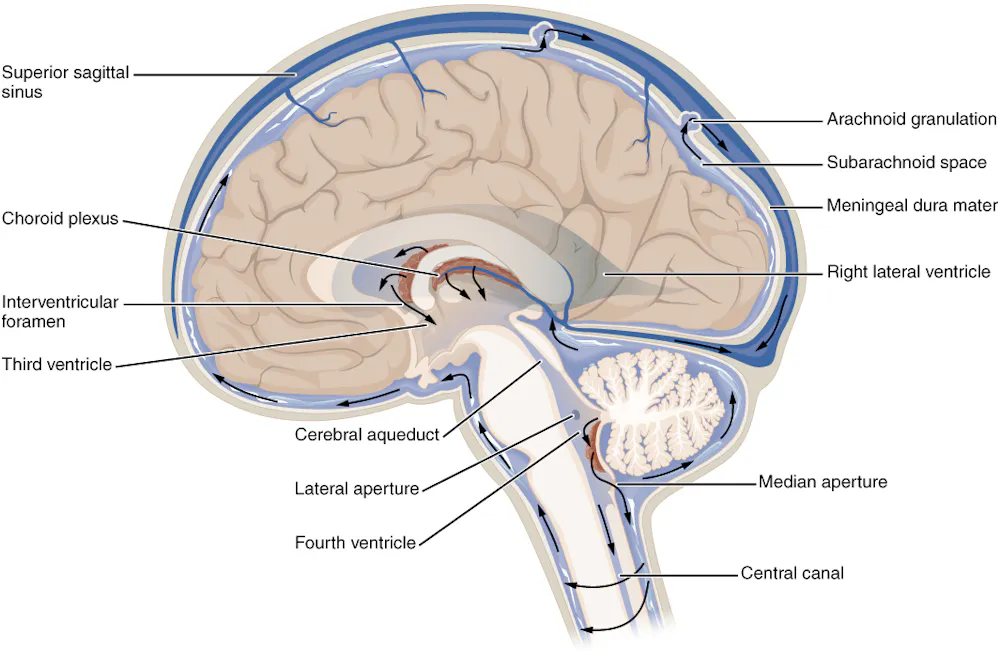
    Cerebrospinal fluid circulates throughout the brain and spinal cord.
    OpenStax, CC BY-SA

    CSF has several critical functions. It protects the brain and spinal cord from injury by absorbing shocks. Suspending the brain in this fluid reduces its effective weight and prevents it from being crushed under its own mass. Additionally, CSF helps maintain a stable chemical environment in the central nervous system, facilitating the removal of metabolic waste and the distribution of nutrients and hormones.

    If the production, circulation or absorption of cerebrospinal fluid is disrupted, it can lead to significant health issues. Two notable conditions are CSF leaks and idiopathic intracranial hypertension.

    Cerebrospinal fluid leak

    A CSF leak occurs when the fluid escapes through a tear or hole in the dura mater – the tough, outermost layer of the meninges that surrounds the brain and spinal cord.

    The dura can be damaged from head injuries or punctured during surgical procedures involving the sinuses, brain or spine, such as lumbar puncture, epidurals, spinal anesthesia or myelogram. Spontaneous CSF leaks can also occur without any identifiable cause.

    CSF leaks were originally thought to be relatively rare, with an estimated annual incidence of 5 per 100,000 people. However, with increased awareness and advances in imaging, health care providers are discovering more and more leaks. They tend to occur more frequently in middle-aged adults and are more common in women than men.

    Risk factors for the condition include connective tissue disorders such as Ehlers-Danlos syndrome as well as postural orthostatic tachycardia syndrome.

    An upright headache could be a sign of a CSF leak.

    Unfortunately, it’s common for health care providers to misdiagnose a CSF leak as another condition, like migraine, sinus infections or allergies. What can make diagnosing a CSF leak challenging is its broad symptoms. Most people with a CSF leak have a positional headache that improves when lying down and worsens when standing. Pain is usually felt in the back of the head and may involve the neck and between the shoulder blades. In addition to headaches, patients may experience ringing in the ears, vision disturbances, memory problems, brain fog, dizziness and nausea.

    Imaging may help guide diagnosis, including an MRI of your brain or entire spine, or a myelogram of the space surrounding your spinal cord. Features of a CSF leak that are visible in a scan include your brain sagging down in the base of your skull as well as a fluid collection outside of your dura. However, an estimated 19% of people with a CSF leak can have normal scans, so not seeing signs of a leak on imaging does not entirely rule it out.

    Conservative treatment for a CSF leak involves rest, lying flat and increasing your fluid intake to give your spine time to heal the puncture. Increasing your caffeine consumption to an equivalent of three to four cups of coffee per day can also help by increasing CSF production through stimulating the choroid plexus. Caffeine also relieves pain by interacting with adenosine receptors, which are key players in the body’s pain perception mechanisms.

    If a conservative approach is not successful, an epidural blood patch may be necessary. In this procedure, blood is drawn from your arm and injected into your spine. The injected blood can help form a covering over the hole and promote the healing process. Headache improvement can be fast, but if the patch does not work or the results are short-lived, additional testing may be needed to better locate the site of the leak. In rare cases, surgery may be recommended. Most patients with a CSF leak respond to some form of these treatments.

    Idiopathic intracranial hypertension

    Idiopathic intracranial hypertension is a disorder involving an excess of CSF that elevates pressure inside the skull and compresses the brain. The term “idiopathic” indicates that the cause of the raised pressure is unknown.

    Most patients with idiopathic intracranial hypertension have a history of obesity or recent weight gain. Other risk factors include taking certain medications such as tetracycline, excessive vitamin A, tretinoin, steroids and growth hormone. Middle-aged obese women are 20 times more likely to be diagnosed with idiopathic intracranial hypertension than other patient groups. As obesity becomes more prevalent, so too does the incidence of this condition.

    Idiopathic intracranial hypertension results from increased intracranial pressure.

    Patients with idiopathic intracranial hypertension typically experience headaches and vision changes, tinnitus or eye pain. Papilledema, or swelling of the optic disc, is the hallmark finding on a fundoscopic examination of the back of the eye. Clinicians may also observe paralysis of the patient’s eye muscles.

    Normal pressure hydrocephalus, Joel’s diagnosis, is a form of this condition that commonly results in difficulty walking, loss of bladder control and cognitive impairment, sometimes referred to as the “wet, wobbly and wacky” triad. Joel’s diagnosis has brought awareness to this underrecognized but potentially treatable disorder, which is often managed through surgically placing a shunt to divert excess fluid and relieve symptoms.

    Brain imaging of patients suspected of having idiopathic intracranial hypertension is crucial to excluding other causes of elevated CSF pressure, such as brain tumors or blood clots in the brain. A lumbar puncture or spinal tap to measure the pressure and composition of CSF is also central to diagnosis.

    Since high intracranial pressure can damage the optic nerve and lead to permanent vision loss, the primary goal of treatment is to decrease pressure and preserve the optic nerve. Treatment options include weight loss, dietary changes and medications to reduce CSF production. Surgical procedures can also reduce intracranial pressure.

    Future directions and unknowns

    Cerebrospinal fluid is indispensable for brain health. Despite advances in understanding diseases related to CSF, several aspects remain unclear.

    The exact mechanisms that lead to conditions like CSF leaks and idiopathic intracranial hypertension are not fully understood, though there are many theories. Further research is vital to enhance diagnostic accuracy and effective treatments for CSF disorders.

    This is an updated version of an article originally published on Aug. 14, 2024.

    Danielle Wilhour does not work for, consult, own shares in or receive funding from any company or organization that would benefit from this article, and has disclosed no relevant affiliations beyond their academic appointment.

    ref. Billy Joel has excess fluid in his brain – a neurologist explains what happens when this protective liquid gets out of balance – https://theconversation.com/billy-joel-has-excess-fluid-in-his-brain-a-neurologist-explains-what-happens-when-this-protective-liquid-gets-out-of-balance-257689

    MIL OSI – Global Reports

  • MIL-OSI Asia-Pac: Departure tax bill passed

    Source: Hong Kong Information Services

    The Government today welcomed the passage of a bill by the Legislative Council to increase the air passenger departure tax from $120 to $200 per passenger, which would apply to air tickets purchased from October 1 onwards.

    It is anticipated that government revenue will increase by about $1.6 billion per year.

    The Government said the new tax rate, which was proposed in the recent Budget, has struck a balance between raising revenue and minimising the impact on passengers when considering increasing the departure tax.

    It added that the impact of the increase on the overall cost of travelling for air passengers is minimal.

    The Air Passenger Departure Tax (Amendment) Bill 2025 will be published in a Gazette notice on June 6.

    MIL OSI Asia Pacific News

  • MIL-OSI Video: Secretary Rubio meets with German Foreign Minister Johann Wadephulon – 11:15AM

    Source: United States of America – Department of State (video statements)

    Secretary of State Marco A. Rubio meets with German Foreign Minister Johann Wadephul at the Department of State, on May 23, 2025.
    ———-
    Under the leadership of the President and Secretary of State, the U.S. Department of State leads America’s foreign policy through diplomacy, advocacy, and assistance by advancing the interests of the American people, their safety and economic prosperity. On behalf of the American people we promote and demonstrate democratic values and advance a free, peaceful, and prosperous world.

    The Secretary of State, appointed by the President with the advice and consent of the Senate, is the President’s chief foreign affairs adviser. The Secretary carries out the President’s foreign policies through the State Department, which includes the Foreign Service, Civil Service and U.S. Agency for International Development.

    Get updates from the U.S. Department of State at www.state.gov and on social media!
    Facebook: https://www.facebook.com/statedept
    X: https://x.com/StateDept
    Instagram: https://www.instagram.com/statedept
    Flickr: https://flickr.com/photos/statephotos/
    Rumble: https://rumble.com/c/StateDept
    Substack: https://statedept.substack.com

    Watch on-demand State Department videos: https://video.state.gov/
    Subscribe to The Week at State e-newsletter: https://public.govdelivery.com/accounts/USSTATEBPA/signup/32562

    State Department website: https://www.state.gov/
    Careers website: https://careers.state.gov/
    White House website: https://www.whitehouse.gov/
    Terms of Use: https://state.gov/tou

    #StateDepartment #DepartmentofState #Diplomacy

    https://www.youtube.com/watch?v=nxuaFw2-4Ik

    MIL OSI Video

  • MIL-OSI United Nations: 28 May 2025 Departmental update Member States endorse World Prematurity Day as official global health campaign

    Source: World Health Organisation

    Preterm births – defined as births that occur before 37 completed weeks of pregnancy – are the leading cause of death amongst children aged under 5 years. Complications such as difficulties breathing, infections and hypothermia are common, while survivors can face significant and long-term disability and ill health.  

    The WHA decision document urges countries to expand access to proven, high-impact interventions, like special newborn care units, support for affected families and kangaroo mother care (KMC), which combines exclusive breastfeeding and skin-to-skin contact. For prevention, the document highlights the need to strengthen antenatal services and more broadly, improve women’ underlying health. 

    “Recognizing this is a crucial issue increasingly shaping child health and survival, WHO welcomes the decision to incorporate World Prematurity Day into its official calendar,” said Dr Anshu Banerjee, Director of Maternal, Newborn, Child and Adolescent Health and Ageing. “It will be an important opportunity to educate, raise awareness and advocate for action to tackle this leading cause of child mortality, while highlighting the need for additional practical, financial and policy support for affected families.” 

    In 2022, WHO released new clinical guidelines for care of preterm and low birthweight infants, with new guidance to help countries expand kangaroo mother care expected later this year. Alongside partners, the Organization also supports countries to deliver comprehensive newborn care packages, including special services for small and sick babies. 

    World Prematurity Day has been observed for over a decade, driven by advocacy from families, civil society, and health professionals. Its formal recognition by WHO is expected to further galvanize global attention and action to this critical issue for maternal and child health. 

    The decision was agreed following discussions on the Global Strategy for Women’s, Children’s and Adolescents’ Health (2016–2030). It aligns with the 2023 WHA Resolution to accelerate progress in maternal, newborn, and child survival, as well as the 2025 World Health Day theme: “Healthy beginnings, hopeful futures.” 

    World Prematurity Day will be officially marked by WHO, Member States, and partners on November 17, starting in 2025. 

    Related document: 

    “,”datePublished”:”2025-05-28T08:00:00.0000000+00:00″,”image”:”https://cdn.who.int/media/images/default-source/mca/maternal-nb/who_20210325_eth_240-min.jpg?sfvrsn=797b47ff_12″,”publisher”:{“@type”:”Organization”,”name”:”World Health Organization: WHO”,”logo”:{“@type”:”ImageObject”,”url”:”https://www.who.int/Images/SchemaOrg/schemaOrgLogo.jpg”,”width”:250,”height”:60}},”dateModified”:”2025-05-28T08:00:00.0000000+00:00″,”mainEntityOfPage”:”https://www.who.int/news/item/28-05-2025-member-states-endorse-world-prematurity-day-as-official-global-health-campaign”,”@context”:”http://schema.org”,”@type”:”NewsArticle”};
    ]]>

    MIL OSI United Nations News

  • MIL-OSI United Nations: 28 May 2025 Departmental update WHO announces the development of recommendations on doxycycline prophylaxis for the prevention of sexually transmitted infections

    Source: World Health Organisation

    WHO is convening a Guideline Development Group (GDG) for the development of evidence-based Clinical guidelines on doxycycline prophylaxis for prevention of sexually transmitted infections (STIs).

    WHO estimates that 374 million new cases of curable STIs occur annually. To reduce the burden of infection and its associated complications, the Global health sector strategy 2022-2030 lists the identification and implementation of novel evidence-based strategies for STI prevention as one of the key action items. Doxycycline post-exposure prophylaxis, i.e. doxycycline taken after unprotected sex, is such a novel intervention that could be considered for STI prevention.

    GDG members will contribute to the review of evidence and will propose recommendations through the GRADE methodology. They will participate in the GDG meeting, which will be held in a series of virtual sessions on 25 and 26 June 2025.

    The general objective of this meeting is to develop recommendations on use of doxycycline post-exposure prophylaxis for the prevention of bacterial STIs (syphilis, chlamydia and gonorrhoea) for men who have sex with men and transgender people. The specific objectives include:

    • to review the evidence and support the evidence-to-decision process through the GRADE methodology including benefits versus harms, values and preferences, feasibility, resource use, equity and cost; and
    • to formulate recommendations based on the evidence review including potential implementation considerations and the research gaps.

    Guideline Development Group composition

    In accordance with WHO guidelines for developing recommendations, the GDG is composed of members from all WHO regions, serving in their individual capacities rather than as representatives of affiliated organizations. GDG members were selected by WHO technical staff based on their technical expertise, their role as end-users (e.g., programme managers and healthcare providers), and their representation of affected communities. Members do not receive financial compensation for their contributions to this process.

    Call for public comments

    To ensure transparency and inclusivity, WHO invites members of the public and interested organizations to review the biographies of the GDG members and provide feedback. Comments can be submitted via email to hiv-aids@who.int by latest 11 June 2025. This feedback helps WHO develop high-quality guidelines that reflect diverse perspectives and respond to the needs of communities worldwide.

    MIL OSI United Nations News

  • MIL-OSI Africa: The African Development Bank approves an investment of US$100 million in Arise Integrated Industrial Platforms Limited.

    Source: Africa Press Organisation – English (2) – Report:

    ABIDJAN, Ivory Coast, May 28, 2025/APO Group/ —

    The Board of Directors of the African Development Bank (www.AfDB.org) has approved an investment of $100 million in the industrial platform developer and operator Arise Integrated Industrial Platforms Ltd (Arise IIP) to contribute to funding industrial parks and special economic zones across Africa as a part of our industrialization strategic priority and flagship Special Agro-Industrial Processing Zones (SAPZ).

    The industrial platforms developed and operated by Arise IIP are primarily dedicated to supporting the transformation of key agricultural and industrial value chains in African countries that are leading global suppliers of raw commodities but have limited local processing capabilities. The platforms will provide developed industrial land, shared infrastructure and utilities, good export connectivity and simplified administrative procedures to agro-industrial tenants, allowing them to relocate global supply chains and value addition within African countries, while contributing to the reduction of carbon footprint of trade flows.

    Arise IIP seeks to replicate its successful industrial platform implementation experience in Gabon, Togo and Benin by establishing Special Economic Zones across other African countries with the aim of improving Africa’s export competitiveness and intra-Africa trade strategies.

    There is economic and social value to be added to African-grown commodities like timber, cashew, cocoa and cotton when they are processed locally instead of being exported in raw form. Through programs like the African Development Bank’s Special Agro-Industrial Processing Zones and investments in Zones partner companies like Arise IIP, we enable transformative, private sector-led agro-industrialization that boosts local processing of commodities, creates jobs and grows rural economies,” said Dr. Beth Dunford, the African Development Bank’s Vice President for Agriculture, Human and Social Development.

    Based on Arise IIP’s existing portfolio in Gabon (Gabon Special Economic Zone – GSEZ), Benin (Glo Djigbe Industrial Zone – GDIZ) and Togo (Plateforme Industrielle d’Adetikope – PIA), it is estimated that over 400 companies have been on-boarded from 47 industry sectors, which has led to the creation of over 50,000 jobs. The dominant sectors include wood, glass, soya, cashew processing, cotton processing and textiles, ceramics, beverages, pharmaceuticals and meat processing. It is also estimated that over $7 billion has been mobilized by tenant companies within the existing zones.

    This investment in ARISE IIP is a signal of the Bank’s commitment to scaling up industrialization in Africa in value chains where we are competitive. This is also a demonstration of the strategic partnership we have with African MFIs such as the Africa Finance Corporation (AFC) and the Fund for Export Development in Africa (FEDA), the Afreximbank’s equity impact investment arm, who are the principal equity investors in ARISE IIP. This is a good demonstration of our joint goals of making Africa’s capital work better for Africa’s development”, said Solomon Quaynor, African Development Bank’s Vice President for Private Sector, Infrastructure and Industrialization.

    Gagan Gupta, CEO of Arise IIP, remarked, “The African Development Bank’s investment highlights their confidence in our model as a driver of Africa’s industrial growth. We are excited to strengthen our efforts in transforming local value chains, creating jobs, and supporting sustainable economic development across the continent. The dedication, vision, and hard work of the entire Arise team have been instrumental in building this partnership.”

    MIL OSI Africa

  • MIL-OSI China: Xinjiang’s Alashankou port handles over 3,000 China-Europe freight trains in Jan-May

    Source: People’s Republic of China – State Council News

    Xinjiang’s Alashankou port handles over 3,000 China-Europe freight trains in Jan-May

    URUMQI, May 28 — As of Monday, the Alashankou Port in northwest China’s Xinjiang Uygur Autonomous Region had handled over 3,000 China-Europe (Central Asia) freight train trips this year, providing a significant boost to the stability and smooth operation of global industrial and supply chains, according to railway authorities.

    Alashankou is a crucial hub connecting China with Central Asia and Europe. Currently, 123 China-Europe (Central Asia) freight train routes operate via the Alashankou Port, connecting 21 countries, including Germany and Poland.

    These trains transport more than 200 categories of goods, ranging from new energy vehicles and mechanical parts to electronics and daily consumer goods.

    “We operate a 24/7 ‘green channel’ to ensure the smooth operation of China-Europe freight trains,” said Yang Peng, a staff member of the Alashankou railway station.

    “This year, the station has handled an average of over 21 China-Europe freight train trips daily, with a peak of 30 trips in a single day,” Yang added.

    In recent years, Xinjiang’s railway authorities have consistently enhanced port logistics capacity, with the region now handling over 50 percent of China’s total China-Europe freight train volume.

    In 2024 alone, the region’s Horgos and Alashankou ports processed 16,400 China-Europe freight train trips, up 14 percent year on year.

    MIL OSI China News

  • MIL-OSI United Kingdom: Greens urge government action in spending review to tackle dire warning on climate crisis

    Source: Green Party of England and Wales

    Green Party co-leader Adrian Ramsay MP said:

    “The dire warning today from the World Meteorological Organization (1) should serve as a wake-up call. With global temperatures predicted to breach internationally agreed safe limits in at least one of the next five years due to global inaction, we are facing a future filled with increasingly severe climate impacts.

    “The Spending Review is the government’s chance to act. It must prepare for the climate consequences we can no longer avoid while also accelerating the path to net zero.

    “In our submission, the Green Party has called for an additional £7 billion annually to be invested in making the changes we need to face the impact of climate change on all our lives – from flood defences to future-proofing homes and buildings. This is no longer an optional extra. It’s vital to protect lives and livelihoods.

    “Delaying now means greater costs, deeper disruption, and irreversible damage. The science couldn’t be clearer, and the warning couldn’t be louder — the Government must respond with urgency and ambition. The Spending Review is the chance to do it.”

    (1) Global climate predictions show temperatures expected to remain at or near record levels in coming five years – Met Office

    MIL OSI United Kingdom

  • MIL-OSI Europe: AFRICA/REPUBLIC OF CONGO – Appointment of bishop of Ouesso

    Source: Agenzia Fides – MIL OSI

    Wednesday, 28 May 2025

    Vatican City (Agenzia Fides) – The Holy Father has appointed the Reverend Brice Armand Ibombo, of the clergy of Gamboma, until now vice rector of the Emile Card. Biayenda National Theological Major Seminary in Brazzaville, as bishop of the diocese of Ouesso, Republic of the Congo.Msgr. Brice Armand Ibombo was born on 23 November 1973 in Abala, in the diocese of Gamboma. After studying philosophy at the Msgr. Georges-Firmin Singha Philosophical Major Seminary of Brazzaville, Republic of the Congo, and theology at the major seminary of Concordia-Pordenone, Italy, he was awarded a doctorate in Church history from the Pontifical Gregorian University of Rome.He was ordained a priest on 28 August 2004.He has held the following offices: parish vicar of the Cathedral of Santo Stefano Protomartire of Concordia Sagittaria (2004-2010), parish administrator of Santa Maria degli Angelii in Caraffa del Bianco (2010-2013), secretary of the Episcopal Conference of the Congo (2013-2023), parish cooperator in Notre-Dame des Victoires of Ouenzé (2014-2015), lecturer in the Department of History of Marien Ngouabi University, Brazzaville (since 2014), member of the College of Consultors of the diocese of Gamboma (since 2019), and vice rector of the Emile Card. Biayenda National Theological Major Seminary in Brazzaville (since 2024). (EG) (Agenzia Fides, 28/5/2025)
    Share:

    MIL OSI Europe News

  • MIL-OSI Europe: ASIA/SRI LANKA – Cardinal Ranjith: “Hope, the word that describes the spirit that prevails in Sri Lanka”

    Source: Agenzia Fides – MIL OSI

    Colombo (Agenzia Fides) – “Sri Lanka is going through a period of profound political and democratic renewal. Since November 2024, we have had a new president and a new parliament, with an absolute majority, changing the old power structure linked to a corrupt political class guilty of abuse of power and human rights violations. In a country that has emerged from a serious social and economic crisis, a new hope is emerging,” said Cardinal Albert Malcolm Ranjith, Archbishop of Colombo, in an interview with Fides. “Hope,” the Cardinal said, is precisely the right word to describe the spirit that prevails in the country today. And we Catholics celebrate the Jubilee of Hope so that our actions, our thoughts, our words, our direction are fully in line with what is happening politically, socially, culturally, and spiritually in the nation.” In the last election, “a change was expected, and it has happened: a socialist-oriented government is now in office, one that appears honest and committed to the welfare of the people and aware of its responsibilities, a government that intends to combat poverty and care for the well-being of the most disadvantaged social classes,” he notes. “The new government,” he says, “has started a new era and set to work to bring justice to those who have suffered injustice in the past, those who are in prison or have suffered violations of fundamental rights. And it is doing so through legality, with full respect for the principles of the rule of law.” “One area to which the government of new President Anura Kumara Dissanayake is devoting resources and attention,” the Cardinal said, “is the country’s economy. It is slowly recovering from the crisis and following the recommendations of the International Monetary Fund, which, in turn, has granted loans. We are in a phase of recovery, and tourism is also in a phase of recovery, and this bodes well, as it is an important sector of our economy that contributes to wealth creation.” “Of course,” Cardinal Ranjith continued, “the recovery process will take at least a few years, but we are on the right track. There is a certain optimism among the population today; we see a responsible political class and a president in whom people place their trust. The majority of the Catholic population has also supported him, and the Church has good relations with the government. There are good prospects for cooperation.”There is still an open wound in the relationship between the Catholic Church and political institutions, the Cardinal told Fides: “It is a question of justice, that is, the search for the perpetrators, executors, and sponsors responsible for the Easter terrorist attacks on churches and hotels in 2019, and their prosecution. President Dissanayake has announced a new investigation to create transparency and find the truth. We are hopeful because a commission has already been set up, which also regularly interviews some of our priests. From the beginning, we have demanded truth and justice against the cover-up of the case. Now we are waiting for a trial and for the real responsibilities or complicity within the state apparatus to come to light. The victims are waiting for justice.” In this context, the Cardinal is grateful that the Holy See has decided to include the 167 Catholic faithful who were murdered in a church in Sri Lanka on Easter Sunday, April 21, 2019, in the catalogue of “Witnesses of the Faith of the 21st Century” compiled by the Dicastery for the Causes of Saints and presented in the Jubilee Year.In the meantime, he says, “the daily life of the Church continues; we walk as the people of God; we continue our social, educational, and charitable activities at the service of humanity. The parishes are celebrating the Holy Year; each diocese has prepared a calendar of celebrations and spiritual initiatives: for us, it is a moment of inner renewal and a new beginning with a new impulse that comes from the Lord. The theme of hope fits the feeling in people’s hearts: in this phase, we are bearers of hope; we have the hope that comes from God. We listen and offer our strength so that the Lord may complete his work and we may do our part humbly and with faith.”Regarding the election of Pope Leo XIV, the Cardinal says: “We see him as a person who, thanks to his missionary experience, is attentive to the reality of all the Churches. I believe that in him we will have a solid point of reference. With his reference to Pope Leo XIII, he told us that the Church today is called to offer Christian responses to modern times. We trust in his humble and wise leadership.” (PA) (Agenzia Fides, 28/5/2025)
    Share:

    MIL OSI Europe News

  • MIL-OSI Europe: ASIA/CHINA – Bishop of Ningbo visits his former parish: “Communion and unity in the love of Jesus Christ”

    Source: Agenzia Fides – MIL OSI

    Ningbo (Agenzia Fides) – “Communion and unity in the love of Jesus Christ.” With this expression, Francis Xavier Jin Yangke, Bishop of the Diocese of Ningbo, summarized the recommendations addressed to the small Catholic community of Yancang, in the parish of Dinghai, Zhejiang province. A special bond unites the Bishop with this community, as he served there as parish priest for 14 years. On Sunday, May 25, accompanied by Father Wang Jiangfei, diocesan chancellor, Bishop Jin returned to his former parishioners to “confirm the brothers in the faith” and exhort everyone to bear witness to the mercy and truth of Christ. The motto chosen for this pastoral visit was: “Jesus is the heart of our life, follow him and do not be afraid.”After the solemn Eucharistic celebration, the Bishop shared a warm conversation with the faithful, recalling the years they had spent together and expressing his gratitude to the lay people who had supported his work with prayer and active participation in parish life. Bishop Jin also encouraged young people to bear witness to the faith among their peers and listened attentively to the parish committee’s report on the management of the community. The Diocese of Ningbo is historically linked to the work of the Lazarist missionaries, as well as to the work of Jesuits such as Martino Martini and Lodovico Buglio.The Apostolic Vicariate of Ningbo was erected in 1924 and elevated to a diocese in 1926. After the resumption of ecclesiastical activity in 1979, the diocese gave great importance to the reopening of churches and the formation of priests and religious, applying the teachings of the Second Vatican Council. Located in a region of strong economic development, thanks to the dynamism of the port of Ningbo, the diocese, although small in size, shows remarkable vitality in the pastoral, cultural, and social spheres. On May 24, 2024, it hosted a conference commemorating the centenary of the Primum Concilium Sinense in Shanghai. The diocesan community is experiencing abundant vocational flourishing: several priestly ordinations and religious professions are celebrated each year. The nuns of the Congregation of the Daughters of Purgatory, made up of about fifty sisters, also receive numerous vocations. Currently, the Diocese of Ningbo has more than 30,000 baptized Catholics and is organized into four deaneries, with 12 parishes, 106 churches, and chapels. It also manages a Catholic cemetery, a Marian shrine dedicated to Our Lady of the Rosary, a vocational center, and a spiritual retreat house. (NZ) (Agenzia Fides, 28/5/2025)
    Share:

    MIL OSI Europe News

  • MIL-OSI China: China expects 12% rise in daily cross-border trips during Dragon Boat Festival holiday

    Source: People’s Republic of China – State Council News

    China’s National Immigration Administration (NIA) has projected a daily average of 2.15 million cross-border trips nationwide during the upcoming Dragon Boat Festival break, an increase of 12.2 percent compared with the holiday period last year.

    The peak of cross-border travel is anticipated on June 1.

    Dragon Boat Festival, also known as Duanwu Festival, falls on the fifth day of the fifth month in the Chinese lunar calendar. This year, it was celebrated on May 31, and the holiday runs from May 31 to June 2.

    Major aviation hubs are expected to see a steady increase in passenger traffic, with Shanghai Pudong International Airport projecting 100,000 daily border crossings.

    During the Dragon Boat Festival holiday, multiple dragon boat races and related events will be held in Guangdong Province, Hong Kong and Macao.

    Coinciding with Children’s Day on June 1 and the weekend, the holiday is expected to spur a surge in outbound travel from the Chinese mainland and home visits by Hong Kong and Macao residents.

    Land border checkpoints connecting Hong Kong and Macao are expected to see a notable increase in traffic. Luohu Port in Shenzhen City is expected to handle a daily average of 230,000 crossings, while the Gongbei checkpoint in Zhuhai City is projected to see a daily average of 367,000 crossings.

    The NIA has urged border authorities to closely monitor cross-border traffic and port operations, providing regular updates to assist travelers. The agency also required adequate staff arrangements to ensure Chinese citizens spend no longer than 30 minutes queuing for entry and exit.

    MIL OSI China News

  • MIL-OSI China: World Health Assembly concludes with historic pandemic agreement adopted

    Source: People’s Republic of China – State Council News

    The nine-day 78th World Health Assembly concluded on Tuesday, during which member states adopted the much-anticipated global pandemic agreement and approved the base program budget of over 4 billion U.S. dollars for 2026-2027.

    The World Health Organization (WHO) noted that the adoption of the Pandemic Agreement culminated more than three years of intensive negotiations launched by governments in response to the devastating impacts of the COVID-19 pandemic, driven by the goal of making the world safer from and more equitable in response to future pandemics.

    “The WHO pandemic agreement will run among the most significant achievements in the history of this organization and of global health,” WHO Director-General Tedros Adhanom Ghebreyesus said after the global pact’s adoption, underscoring that it places humanity in a stronger position than ever before to prepare for and respond to pandemics.

    Delegates at the Assembly approved a base program budget of 4.2 billion dollars for 2026-2027, fully based on the Fourteenth General Program of Work, the global health strategy developed by the UN specialized agency for the next four years. The budget presented to the Assembly was decreased from an initial 5.3 billion dollars submitted to the executive board in February.

    The Assembly adopted a range of decisions and resolutions, including strengthening health financing globally, adopting a new global traditional medicine strategy, galvanizing global support for a lead-free future, committing to improve nutrition for mothers and young children, updating global action plan on antimicrobial resistance and setting a voluntary target to halve the health impacts of air pollution by 2040.

    In addition, the decisions and resolutions passed by the Assembly also address areas such as lung health, kidney health, rare diseases, skin diseases, digital health, medical imaging, health and care workforce, nursing and midwifery.

    Chinese Vice Premier Liu Guozhong, also a member of the Political Bureau of the Communist Party of China Central Committee, attended the Assembly and delivered a speech at a high-level welcoming ceremony. The Chinese delegation participated in the review of over 70 agenda items throughout the Assembly, hosted three thematic side events and held exchange activities with the WHO and delegations from relevant countries.

    MIL OSI China News

  • MIL-OSI: FDCTech Engages E.F. Hutton to Lead Capital Raise and Advise on Uplisting to a Senior Exchange

    Source: GlobeNewswire (MIL-OSI)

    E.F. Hutton’s leadership has advised on over $750 million in private credit deals, reinforcing its commitment to strategic financing and diversified investment solutions.

    Irvine, CA, May 28, 2025 (GLOBE NEWSWIRE) — FDCTech, Inc. (“FDC” or the “Company,” PINK: FDCT), a fintech-driven firm specializing in acquiring and scaling small to mid-size legacy financial services companies, today announced that it has engaged E.F. Hutton & Co. LLC (“E.F. Hutton”) as its financial advisor. E.F. Hutton will provide general financial advisory services to FDCTech, including assistance in identifying and evaluating financing opportunities and potential strategic transactions. The engagement letter with E.F. Hutton became effective as of May 23, 2025.

    E.F. Hutton, a brokerage firm under the leadership of Chief Executive Officer Joseph T. Rallo, has advised on over $750 million in private credit transactions across sectors including consumer, defense, industrials, healthcare, real estate, and technology. The firm’s global expertise in complex financial transactions and strategic capital solutions will help FDCTech pursue its growth and capital raise initiatives.

    Since December 2021, FDCTech has been rapidly growing its revenue and balance sheet, reflecting the success of its expansion and integration strategy. In February 2025, the Company engaged Lucosky Brookman LLP, a nationally recognized corporate and securities law firm, to assist in exploring an uplisting to a senior national securities exchange, such as the Nasdaq Capital Market or the New York Stock Exchange. Today’s announcement of E.F. Hutton’s engagement is another crucial step in the Company’s plan to pursue an uplisting and access broader capital markets.

    By leveraging E.F. Hutton’s extensive global network and deep industry relationships, FDCTech aims to accelerate its growth trajectory in 2025 and beyond, in line with its mission to become a leader in diversified financial services driven by its proprietary technology infrastructure. The Company intends to capitalize on E.F. Hutton’s advisory and capital markets expertise to support its multi-jurisdictional growth strategy and maximize long-term shareholder value.

    For more information on the Company’s results and strategic plans, please visit our SEC filings or the Company’s website.

    E.F. Hutton

    E.F. Hutton & Co. is a broker-dealer headquartered in New York, NY that provides advisory and financing solutions to a variety of clients including corporates, sponsors, and public-private partnerships. The Executive Team at E.F. Hutton & Co. has a proven track record of providing unwavering strategic advice to clients across the globe, including the US, Asia, Europe, UAE, and Latin America.

    Lucosky Brookman LLP

    Lucosky Brookman LLP is a full-service corporate and securities law firm providing sophisticated legal representation to public and private companies, institutional investors, and entrepreneurs. The firm specializes in capital markets, mergers and acquisitions, regulatory compliance, and corporate governance. With extensive experience in securities law and exchange listings, Lucosky Brookman assists companies in navigating complex financial transactions and regulatory frameworks.

    FDCTech, Inc.

    FDCTech, Inc. (“FDC”) is a regulatory-grade financial technology infrastructure developer designed to serve the future financial markets. Our clients include regulated and OTC brokerages and prop and algo trading firms of all sizes in forex, stocks, commodities, indices, ETFs, precious metals, and other asset classes. Our growth strategy involves acquiring and integrating small to mid-size legacy financial services companies, leveraging our proprietary trading technology and liquidity solutions to deliver exceptional value to our clients.

    Press Release Disclaimer

    This press release’s statements may be forward-looking statements or future expectations based on currently available information. Such statements are naturally subject to risks and uncertainties. Factors such as the development of general economic conditions, future market conditions, unusual catastrophic loss events, changes in the capital markets, and other circumstances may cause the actual events or results to be materially different from those anticipated by such statements. The Company does not make any representation or warranty, express or implied, regarding the accuracy, completeness, or updated status of such forward-looking statements or information provided by the third party. Therefore, in no case will the Company and its affiliate companies be liable to anyone for any decision made or action taken in conjunction with the information and/or statements in this press release or any related damages.

    Contact Media Relations

    FDCTech, Inc.
    info@fdctech.com
    www.fdctech.com
    +1 877-445-6047
    200 Spectrum Center Drive, Suite 300,
    Irvine, CA, 92618

    The MIL Network

  • MIL-OSI: Form 8.3 – [Craneware]

    Source: GlobeNewswire (MIL-OSI)

    FORM 8.3

    PUBLIC OPENING POSITION DISCLOSURE/DEALING DISCLOSURE BY
    A PERSON WITH INTERESTS IN RELEVANT SECURITIES REPRESENTING 1% OR MORE
    Rule 8.3 of the Takeover Code (the “Code”)

    1.        KEY INFORMATION

    (a)   Full name of discloser: Danske Bank A/S
    (b)   Owner or controller of interests and short positions disclosed, if different from 1(a):
            The naming of nominee or vehicle companies is insufficient. For a trust, the trustee(s), settlor and beneficiaries must be named.
     
    (c)   Name of offeror/offeree in relation to whose relevant securities this form relates:
            Use a separate form for each offeror/offeree
    Craneware PLC
    (d)   If an exempt fund manager connected with an offeror/offeree, state this and specify identity of offeror/offeree:  
    (e)   Date position held/dealing undertaken:
            For an opening position disclosure, state the latest practicable date prior to the disclosure
    27 May 2025
    (f)   In addition to the company in 1(c) above, is the discloser making disclosures in respect of any other party to the offer?
            If it is a cash offer or possible cash offer, state “N/A”
    N/A

    2.        POSITIONS OF THE PERSON MAKING THE DISCLOSURE

    If there are positions or rights to subscribe to disclose in more than one class of relevant securities of the offeror or offeree named in 1(c), copy table 2(a) or (b) (as appropriate) for each additional class of relevant security.

    (a)      Interests and short positions in the relevant securities of the offeror or offeree to which the disclosure relates following the dealing (if any)

    Class of relevant security: Equity
      Interests Short positions
      Number % Number %
    (1)   Relevant securities owned and/or controlled: 537 041,00 1,52    
    (2)   Cash-settled derivatives:        
    (3)   Stock-settled derivatives (including options) and agreements to purchase/sell:        

            TOTAL:

    537 041,00 1,52    

    All interests and all short positions should be disclosed.
    Details of any open stock-settled derivative positions (including traded options), or agreements to purchase or sell relevant securities, should be given on a Supplemental Form 8 (Open Positions).

    (b)      Rights to subscribe for new securities (including directors’ and other employee options)

    Class of relevant security in relation to which subscription right exists:  
    Details, including nature of the rights concerned and relevant percentages:  

    3.        DEALINGS (IF ANY) BY THE PERSON MAKING THE DISCLOSURE

    Where there have been dealings in more than one class of relevant securities of the offeror or offeree named in 1(c), copy table 3(a), (b), (c) or (d) (as appropriate) for each additional class of relevant security dealt in.

    The currency of all prices and other monetary amounts should be stated.

    (a)        Purchases and sales

    Class of relevant security Purchase/sale Number of securities Price per unit
    Equity Sale          1000
           
    20.4546 GBP

    (b)        Cash-settled derivative transactions

    Class of relevant security Product description
    e.g. CFD
    Nature of dealing
    e.g. opening/closing a long/short position, increasing/reducing a long/short position
    Number of reference securities Price per unit
             

    (c)        Stock-settled derivative transactions (including options)

    (i)        Writing, selling, purchasing or varying

    Class of relevant security Product description e.g. call option Writing, purchasing, selling, varying etc. Number of securities to which option relates Exercise price per unit Type
    e.g. American, European etc.
    Expiry date Option money paid/ received per unit
                   

    (ii)        Exercise

    Class of relevant security Product description
    e.g. call option
    Exercising/ exercised against Number of securities Exercise price per unit
             

    (d)        Other dealings (including subscribing for new securities)

    Class of relevant security Nature of dealing
    e.g. subscription, conversion
    Details Price per unit (if applicable)
           

    4.        OTHER INFORMATION

    (a)        Indemnity and other dealing arrangements

    Details of any indemnity or option arrangement, or any agreement or understanding, formal or informal, relating to relevant securities which may be an inducement to deal or refrain from dealing entered into by the person making the disclosure and any party to the offer or any person acting in concert with a party to the offer:
    Irrevocable commitments and letters of intent should not be included. If there are no such agreements, arrangements or understandings, state “none”

    None

    (b)        Agreements, arrangements or understandings relating to options or derivatives

    Details of any agreement, arrangement or understanding, formal or informal, between the person making the disclosure and any other person relating to:
    (i)   the voting rights of any relevant securities under any option; or
    (ii)   the voting rights or future acquisition or disposal of any relevant securities to which any derivative is referenced:
    If there are no such agreements, arrangements or understandings, state “none”

    None

    (c)        Attachments

    Is a Supplemental Form 8 (Open Positions) attached? NO
    Date of disclosure: 28 May 2025
    Contact name: Kotryna Cinciuke
    Telephone number*: +37060405825

    Public disclosures under Rule 8 of the Code must be made to a Regulatory Information Service.

    The Panel’s Market Surveillance Unit is available for consultation in relation to the Code’s disclosure requirements on +44 (0)20 7638 0129.

    *If the discloser is a natural person, a telephone number does not need to be included, provided contact information has been provided to the Panel’s Market Surveillance Unit.

    The Code can be viewed on the Panel’s website at www.thetakeoverpanel.org.uk.

    The MIL Network

  • MIL-OSI Economics: Governor Ulrik Nødgaard: The cyberthreat has changed

    Source: Danmarks Nationalbank

    The financial sector plays a central role in society, and advanced cyberattacks against a financial company or a payment system can potentially threaten financial stability. Companies in the financial sector have therefore worked targeted over the years to increase cyberresilience, both individually and at the sector level.

    The geopolitical tensions continuously affect the cyberthreat, which is not only limited to digital attacks. Recently, there has been an increased focus on attacks using hybrid means. This can include, for example, influence campaigns, harassment, sabotage or destructive cyberattacks. There have been several incidents of undersea cable breaches, highlighting that the threat is real and serious.

    ”Strengthening cyberresilience is not only about making IT systems difficult to penetrate. It is also important to have a broad perspective on our dependencies and vulnerabilities, when it comes to, for example, telecommunication cables or central service providers,” said Ulrik Nødgaard and continued:

    ”Furthermore, a key focus area for strengthening cyberresilience is the financial sector’s work on contingency planning that aim to enhance individual companies’ ability to continue business even in extreme but plausible scenarios, such as a large-scale destructive cyberattack.”

    Contingency planning is also a focus area in Danmarks Nationalbank’s work. This applies both in the oversight of central payment systems and solutions, and in the work with joint initiatives across the financial sector to secure the most critical activities for society. One example is the work to establish a society-wide contingency plan for card payments in Denmark, which aims to secure access to a basic consumption for at least one week.

    In conclusion, Ulrik Nødgaard emphasized that a lot of good work is already being done, and the financial sector is moving in the right direction. At the same time, he mentioned that there is more work ahead.

    MIL OSI Economics

  • MIL-OSI Global: Anti-trans measures don’t just target transgender men and women – a sociologist explains how ‘male’ or ‘female’ categories miss the mark for nonbinary Americans

    Source: The Conversation – USA – By Barbara J. Risman, Distinguished Professor of Sociology, University of Illinois Chicago

    The nonbinary flag, shown here on a pin, represents people who say ‘man’ or ‘woman’ does not describe their sense of self. Abraham Gonzalez Fernandez/Moment via Getty Images

    Since his inauguration in January 2025, President Donald Trump has issued several executive orders that seek to limit federal recognition of transgender people. These orders have attempted to ban transgender athletes from women’s sports, require identity documents to label people as biologically male or female, bar federal funding for gender-affirming care for minors and bar transgender people from serving in the military.

    The common element in each of these policies is a promise from Trump’s inaugural speech that his administration would recognize only two genders: male and female.

    These executive orders make life difficult for transgender people, many of whom do identify as women or men, just not the sex they were assigned at birth. Apart from that, however, the emphasis on two and only two genders denies the existence of another group that is often misunderstood: nonbinary people.

    Trans vs. nonbinary

    I am a sociologist who studies gender. Over the past few years, co-researchers and I have interviewed 123 nonbinary people in three regions in America: the South, the Midwest and the West Coast. These interviewees spoke about how nonbinary people’s increased visibility in society in recent years helped them feel more welcome and liberated from gender stereotypes.

    All of the respondents are nonbinary. They do not want to be seen as the opposite sex from what they were assigned at birth; they do not feel they were “born in the wrong body.”

    Rather, they want to avoid being forced into the either/or labels that the categories “masculine” and “feminine” or “man” and “woman” entail. They opt out of those binary identifications altogether.

    For many nonbinary people, the pronouns they/them help express their sense of gender.
    Luis Alvarez/DigitalVision via Getty Images

    Decades of research, some of it our own, have shown that sex and gender are different from one another. Sex refers to primary and secondary sex characteristics, while gender is about the cultural meanings built upon sex categories.

    Gender is a social system that justifies rules and expectations that differentiate between the rights and social roles of men and women. These systems vary across time and place. Today, there are societies such as those in Iceland, Barbados and Bosnia-Herzegovina where women lead the government, while in other societies women must be covered or secluded at home.

    Sense of self

    Most of the people we talked to were under age 30. Typically, they rejected the societal pressure to adopt the personality characteristics that are stereotypically associated with their biological sex, such as submissiveness for women and toughness for men.

    Many of them also reject the ways people are expected to dress and use their bodies to show whether they are men or women. Some people who had been raised as boys wore nail polish and earrings, for example, while sporting a beard. Others wore long earrings and makeup – though those kinds of choices do not necessarily mean someone is trans or nonbinary. Many of the respondents who had been raised as girls, meanwhile, chose to wear masculine clothing. They wanted to mix and match traditional symbols of gender.

    Many of the respondents had felt that binary gender identities never quite fit, and they described feeling overjoyed or relieved when they learned about the word “nonbinary”: an identity that offered a more accurate reflection of their sense of self.

    “I was just kind of a flesh blob to myself, until I kind of found out that there was a term … nonbinary. And I heard the term and I was like, “Oh, that actually sounds correct for me. That actually feels right …”

    Another person we interviewed remembered:

    “Before I knew what to call myself … it was like a sense of emptiness. … I finally found that piece to put in that empty spot. And it feels more full now. Like, I feel complete now.”

    He, she, they

    The implications of that discovery were quite diverse, however. Although all the interviewees identified as nonbinary, what that meant for how they wanted to interact with their friends and families differed dramatically.

    For about half of our respondents, using the pronouns “they/them” rather than he/him or she/her was very important, because using that pronoun made them feel respected. Indeed, when asked how they felt being referred to as they/them, one person told us:

    “It felt like magic. It felt like everything just went into place and everything fit. And I was just like, ‘Oh, my God, this is … this is it.‘”

    Not all nonbinary people prefer to be addressed as ‘they/them.’
    MarioGuti/iStock via Getty Images Plus

    Other people we interviewed didn’t really care how others refer to them: he, she or they. Some of these people described having a flexible sense of their own gender. Some days they feel more feminine and use “she”; other days they feel more masculine, and “he” might work better.

    “I don’t have to choose one,” one person told us about their pronouns. “I just need all of them in the arsenal.”

    Still others said they don’t care about a “proper” pronoun because they do not think gender should matter at all. They don’t want to be a third category, a “they.” Instead, they hope for a world where their body parts do not determine how they’re perceived or treated, and so gender is not central to their identity. They would like to do without gender entirely.

    Significance – for everyone

    The people we interviewed want the right to live in peace without being forced into a gender category. The recent executive orders deny this freedom by declaring that gender “does not provide a meaningful basis for identification” – contradicting a decades-long consensus in the social sciences on the distinction between sex and gender.

    Understanding that sex and gender are related but different matters not only for people who identify as nonbinary or transgender, but for everyone. Without that understanding, it is far too easy to presume socially constructed gender differences are essentially biological and to stigmatize people who do not follow strict gender norms. If you believe the myth that biology alone is the sole reason women and men differ, it would be easy to presume, for example, that women are naturally less ambitious or that men cannot be as nurturing.

    If I have learned anything from our team’s research on nonbinary young people, it is that human beings are creative and try to carve out a place for themselves in the world. The evidence suggests that gender nonconformity and diversity is wide and deep in America. What is at stake, however, is how much freedom or oppression individuals will face as they express themselves.

    Barbara J. Risman has received funding from the National Science Foundation for the research discussed in this article.

    ref. Anti-trans measures don’t just target transgender men and women – a sociologist explains how ‘male’ or ‘female’ categories miss the mark for nonbinary Americans – https://theconversation.com/anti-trans-measures-dont-just-target-transgender-men-and-women-a-sociologist-explains-how-male-or-female-categories-miss-the-mark-for-nonbinary-americans-251443

    MIL OSI – Global Reports

  • MIL-OSI Global: A common parasite can decapitate human sperm − with implications for male fertility

    Source: The Conversation – USA – By Bill Sullivan, Professor of Microbiology and Immunology, Indiana University

    _Toxoplasma_ can infiltrate the reproductive system. wildpixel/iStock via Getty Images Plus

    Male fertility rates have been plummeting over the past half-century. An analysis from 1992 noted a steady decrease in sperm counts and quality since the 1940s. A more recent study found that male infertility rates increased nearly 80% from 1990 to 2019. The reasons driving this trend remain a mystery, but frequently cited culprits include obesity, poor diet and environmental toxins.

    Infectious diseases such as gonorrhea or chlamydia are often overlooked factors that affect fertility in men. Accumulating evidence suggests that a common single-celled parasite called Toxoplasma gondii may also be a contributor: An April 2025 study showed for the first time that “human sperm lose their heads upon direct contact” with the parasite.

    I am a microbiologist, and my lab studies Toxoplasma. This new study bolsters emerging findings that underscore the importance of preventing this parasitic infection.

    The many ways you can get toxoplasmosis

    Infected cats defecate Toxoplasma eggs into the litter box, garden or other places in the environment where they can be picked up by humans or other animals. Water, shellfish and unwashed fruits and vegetables can also harbor infectious parasite eggs.

    In addition to eggs, tissue cysts present in the meat of warm-blooded animals can spread toxoplasmosis as well if they are not destroyed by cooking to proper temperature.

    While most hosts of the parasite can control the initial infection with few if any symptoms, Toxoplasma remains in the body for life as dormant cysts in brain, heart and muscle tissue. These cysts can reactivate and cause additional episodes of severe illness that damage critical organ systems.

    Between 30% and 50% of the world’s population is permanently infected with Toxoplasma due to the many ways the parasite can spread.

    Toxoplasma can target male reproductive organs

    Upon infection, Toxoplasma spreads to virtually every organ and skeletal muscle. Evidence that Toxoplasma can also target human male reproductive organs first surfaced during the height of the AIDS pandemic in the 1980s, when some patients presented with the parasitic infection in their testes.

    While immunocompromised patients are most at risk for testicular toxoplasmosis, it can also occur in otherwise healthy individuals. Imaging studies of infected mice confirm that Toxoplasma parasites quickly travel to the testes in addition to the brain and eyes within days of infection.

    Toxoplasma cysts floating in cat feces.
    DPDx Image Library/CDC

    In 2017, my colleagues and I found that Toxoplasma can also form cysts in mouse prostates. Researchers have also observed these parasites in the ejaculate of many animals, including human semen, raising the possibility of sexual transmission.

    Knowing that Toxoplasma can reside in male reproductive organs has prompted analyses of fertility in infected men. A small 2021 study in Prague of 163 men infected with Toxoplasma found that over 86% had semen anomalies.

    A 2002 study in China found that infertile couples are more likely to have a Toxoplasma infection than fertile couples, 34.83% versus 12.11%. A 2005 study in China also found that sterile men are more likely to test positive for Toxoplasma than fertile men.

    Not all studies, however, produce a link between toxoplasmosis and sperm quality.

    Toxoplasma can directly damage human sperm

    Toxoplasmosis in animals mirrors infection in humans, which allows researchers to address questions that are not easy to examine in people.

    Testicular function and sperm production are sharply diminished in Toxoplasma-infected mice, rats and rams. Infected mice have significantly lower sperm counts and a higher proportion of abnormally shaped sperm.

    In that April 2025 study, researchers from Germany, Uruguay and Chile observed that Toxoplasma can reach the testes and epididymis, the tube where sperm mature and are stored, two days after infection in mice. This finding prompted the team to test what happens when the parasite comes into direct contact with human sperm in a test tube.

    After only five minutes of exposure to the parasite, 22.4% of sperm cells were beheaded. The number of decapitated sperm increased the longer they interacted with the parasites. Sperm cells that maintained their head were often twisted and misshapen. Some sperm cells had holes in their head, suggesting the parasites were trying to invade them as it would any other type of cell in the organs it infiltrates.

    In addition to direct contact, Toxoplasma may also damage sperm because the infection promotes chronic inflammation. Inflammatory conditions in the male reproductive tract are harmful to sperm production and function.

    The researchers speculate that the harmful effects Toxoplasma may have on sperm could be contributing to large global declines in male fertility over the past decades.

    Sperm exposed to Toxoplasma. Arrows point to holes and other damage to the sperm; asterisks indicate where the parasite has burrowed. The two nonconfronted controls at the bottom show normal sperm.
    Rojas-Barón et al/The FEBS Journal, CC BY-SA

    Preventing toxoplasmosis

    The evidence that Toxoplasma can infiltrate male reproductive organs in animals is compelling, but whether this produces health issues in people remains unclear. Testicular toxoplasmosis shows that parasites can invade human testes, but symptomatic disease is very rare. Studies to date that show defects in the sperm of infected men are too small to draw firm conclusions at this time.

    Additionally, some reports suggest that rates of toxoplasmosis in high-income countries have not been increasing over the past few decades while male infertility was rising, so it’s likely to only be one part of the puzzle.

    Regardless of this parasite’s potential effect on fertility, it is wise to avoid Toxoplasma. An infection can cause miscarriage or birth defects if someone acquires it for the first time during pregnancy, and it can be life-threatening for immunocompromised people. Toxoplasma is also the leading cause of death from foodborne illness in the United States.

    Taking proper care of your cat, promptly cleaning the litter box and thoroughly washing your hands after can help reduce your exposure to Toxoplasma. You can also protect yourself from this parasite by washing fruits and vegetables, cooking meat to proper temperatures before consuming and avoiding raw shellfish, raw water and raw milk.

    Bill Sullivan receives funding from the National Institutes of Health.

    ref. A common parasite can decapitate human sperm − with implications for male fertility – https://theconversation.com/a-common-parasite-can-decapitate-human-sperm-with-implications-for-male-fertility-256892

    MIL OSI – Global Reports

  • MIL-OSI Global: Chronic stress contributes to cognitive decline and dementia risk – 2 healthy-aging experts explain what you can do about it

    Source: The Conversation – USA – By Jennifer E. Graham-Engeland, Professor of Biobehavioral Health, Penn State

    Social isolation is often stressful and can affect the aging brain. MixMedia/E+ via Getty Images

    The probability of any American having dementia in their lifetime may be far greater than previously thought. For instance, a 2025 study that tracked a large sample of American adults across more than three decades found that their average likelihood of developing dementia between ages 55 to 95 was 42%, and that figure was even higher among women, Black adults and those with genetic risk.

    Now, a great deal of attention is being paid to how to stave off cognitive decline in the aging American population. But what is often missing from this conversation is the role that chronic stress can play in how well people age from a cognitive standpoint, as well as everybody’s risk for dementia.

    We are professors at Penn State in the Center for Healthy Aging, with expertise in health psychology and neuropsychology. We study the pathways by which chronic psychological stress influences the risk of dementia and how it influences the ability to stay healthy as people age.

    Recent research shows that Americans who are currently middle-aged or older report experiencing more frequent stressful events than previous generations. A key driver behind this increase appears to be rising economic and job insecurity, especially in the wake of the 2007-2009 Great Recession and ongoing shifts in the labor market. Many people stay in the workforce longer due to financial necessity, as Americans are living longer and face greater challenges covering basic expenses in later life.

    Therefore, it may be more important than ever to understand the pathways by which stress influences cognitive aging.

    Social isolation and stress

    Although everyone experiences some stress in daily life, some people experience stress that is more intense, persistent or prolonged. It is this relatively chronic stress that is most consistently linked with poorer health.

    In a recent review paper, our team summarized how chronic stress is a hidden but powerful factor underlying cognitive aging, or the speed at which your cognitive performance slows down with age.

    It is hard to overstate the impact of stress on your cognitive health as you age. This is in part because your psychological, behavioral and biological responses to everyday stressful events are closely intertwined, and each can amplify and interact with the other.

    For instance, living alone can be stressful – particularly for older adults – and being isolated makes it more difficult to live a healthy lifestyle, as well as to detect and get help for signs of cognitive decline.

    Moreover, stressful experiences – and your reactions to them – can make it harder to sleep well and to engage in other healthy behaviors, like getting enough exercise and maintaining a healthy diet. In turn, insufficient sleep and a lack of physical activity can make it harder to cope with stressful experiences.

    Stress is often missing from dementia prevention efforts

    A robust body of research highlights the importance of at least 14 different factors that relate to your risk of Alzheimer’s disease, a common and devastating form of dementia and other forms of dementia. Although some of these factors may be outside of your control, such as diabetes or depression, many of these factors involve things that people do, such as physical activity, healthy eating and social engagement.

    What is less well-recognized is that chronic stress is intimately interwoven with all of these factors that relate to dementia risk. Our work and research by others that we reviewed in our recent paper demonstrate that chronic stress can affect brain function and physiology, influence mood and make it harder to maintain healthy habits. Yet, dementia prevention efforts rarely address stress.

    Avoiding stressful events and difficult life circumstances is typically not an option.

    Where and how you live and work plays a major role in how much stress you experience. For example, people with lower incomes, less education or those living in disadvantaged neighborhoods often face more frequent stress and have fewer forms of support – such as nearby clinics, access to healthy food, reliable transportation or safe places to exercise or socialize – to help them manage the challenges of aging
    As shown in recent work on brain health in rural and underserved communities, these conditions can shape whether people have the chance to stay healthy as they age.

    Over time, the effects of stress tend to build up, wearing down the body’s systems and shaping long-term emotional and social habits.

    Lifestyle changes to manage stress and lessen dementia risk

    The good news is that there are multiple things that can be done to slow or prevent dementia, and our review suggests that these can be enhanced if the role of stress is better understood.

    Whether you are a young, midlife or an older adult, it is not too early or too late to address the implications of stress on brain health and aging. Here are a few ways you can take direct actions to help manage your level of stress:

    • Follow lifestyle behaviors that can improve healthy aging. These include: following a healthy diet, engaging in physical activity and getting enough sleep. Even small changes in these domains can make a big difference.

    • Prioritize your mental health and well-being to the extent you can. Things as simple as talking about your worries, asking for support from friends and family and going outside regularly can be immensely valuable.

    • If your doctor says that you or someone you care about should follow a new health care regimen, or suggests there are signs of cognitive impairment, ask them what support or advice they have for managing related stress.

    • If you or a loved one feel socially isolated, consider how small shifts could make a difference. For instance, research suggests that adding just one extra interaction a day – even if it’s a text message or a brief phone call – can be helpful, and that even interactions with people you don’t know well, such as at a coffee shop or doctor’s office, can have meaningful benefits.

    The same behaviors that keep your heart healthy are also beneficial for your brain.

    Walkable neighborhoods, lifelong learning

    A 2025 study identified stress as one of 17 overlapping factors that affect the odds of developing any brain disease, including stroke, late-life depression and dementia. This work suggests that addressing stress and overlapping issues such as loneliness may have additional health benefits as well.

    However, not all individuals or families are able to make big changes on their own. Research suggests that community-level and workplace interventions can reduce the risk of dementia. For example, safe and walkable neighborhoods and opportunities for social connection and lifelong learning – such as through community classes and events – have the potential to reduce stress and promote brain health.

    Importantly, researchers have estimated that even a modest delay in disease onset of Alzheimer’s would save hundreds of thousands of dollars for every American affected. Thus, providing incentives to companies who offer stress management resources could ultimately save money as well as help people age more healthfully.

    In addition, stress related to the stigma around mental health and aging can discourage people from seeking support that would benefit them. Even just thinking about your risk of dementia can be stressful in itself. Things can be done about this, too. For instance, normalizing the use of hearing aids and integrating reports of perceived memory and mental health issues into routine primary care and workplace wellness programs could encourage people to engage with preventive services earlier.

    Although research on potential biomedical treatments is ongoing and important, there is currently no cure for Alzheimer’s disease. However, if interventions aimed at reducing stress were prioritized in guidelines for dementia prevention, the benefits could be far-reaching, resulting in both delayed disease onset and improved quality of life for millions of people.

    Jennifer E. Graham-Engeland receives funding from the National Institutes of Health.

    Martin J. Sliwinski receives funding from The National Institutes of Health

    ref. Chronic stress contributes to cognitive decline and dementia risk – 2 healthy-aging experts explain what you can do about it – https://theconversation.com/chronic-stress-contributes-to-cognitive-decline-and-dementia-risk-2-healthy-aging-experts-explain-what-you-can-do-about-it-250583

    MIL OSI – Global Reports

  • MIL-OSI: Electric Hydrogen Selects Weitz to Deliver HYPRPlant for World’s Largest eFuels Project

    Source: GlobeNewswire (MIL-OSI)

    DEVENS, Mass., May 28, 2025 (GLOBE NEWSWIRE) — Electric Hydrogen, a U.S. manufacturer of advanced electrolyzers, has selected The Weitz Company, through an affiliate, as the engineering, procurement and construction (EPC) partner for the installation of its 100 megawatt (MW) HYPRPlant at Infinium’s Roadrunner eFuels project in West Texas.

    Project Roadrunner is expected to be the world’s largest eFuels facility, producing synthetic aviation fuel, diesel and naphtha for aviation and heavy transport markets.

    Electric Hydrogen’s complete electrolysis solution, HYPRPlant, leverages the company’s proprietary high-power proton exchange membrane (PEM) technology to deliver ultra-low-cost hydrogen made with renewable energy. Built mostly in Texas and shipped as modular skids, the system reduces total installed project costs by as much as 60% and significantly shortens deployment timelines.

    The Weitz Company brings deep industrial EPC experience to the project, ensuring reliable and professional execution. The project will boost local job creation in West Texas.

    “Electric Hydrogen’s technology opens new market opportunities for us in clean energy infrastructure,” said Jesse Hammes, Vice President of Industrial at The Weitz Company. “We’re proud to contribute our expertise to a project of this scale and significance.”

    “This is a defining moment for our company and the renewable hydrogen sector,” said Josh Stewart, Vice President of Deployment at Electric Hydrogen. “Working with Weitz, we’re demonstrating that American-made electrolyzer systems can deliver at industrial scale, on time and on budget at significantly lower total cost than competing solutions.”

    To learn more about Electric Hydrogen’s HYPRPlant, visit https://eh2.com/.

    About Electric Hydrogen
    Electric Hydrogen manufactures, delivers and commissions the world’s most powerful electrolyzers to make clean hydrogen projects economically viable today. The company’s complete HYPRPlant includes all system components required to turn water and electricity into the lowest cost clean hydrogen. Electric Hydrogen has a team of more than 300 people in the United States and Europe. The company was founded in 2020 and is headquartered in Devens, Massachusetts. To learn more about how critical industries leverage Electric Hydrogen’s advanced proton exchange membrane (PEM) technology, visit https://eh2.com/.

    About The Weitz Company
    Founded in 1855, The Weitz Company is a full-service construction company, general contractor, design builder, and construction manager that serves all 50 U.S. states. Weitz is one of the oldest general contractors in the United States and an industry leader in Industrial construction, Senior Living, Student Housing, Mission Critical construction, Commercial construction, virtual design and more. Headquartered in Des Moines, Iowa, The Weitz Company annually ranks in the top tier of Engineering News-Record (ENR) magazine’s Top 400 Contractors and Building Design+Construction’s Giants 300 Contractors lists. As a member of the Orascom Construction PLC global group, Weitz leverages the group’s international expertise and leading innovative strategies to deliver premier results to our clients across market sectors. You can read more about The Weitz Company at https://www.weitz.com/.

    Contact

    V2 Communications for Electric Hydrogen

    electrichydrogen@v2comms.com

    Photos accompanying this announcement are available at :

    https://www.globenewswire.com/NewsRoom/AttachmentNg/7237eeac-88fa-44af-8073-0bd6181b6578

    https://www.globenewswire.com/NewsRoom/AttachmentNg/cab6fb03-9060-42fc-ba62-f98b94a46371

    The MIL Network

  • MIL-OSI: Tokio Marine Group to launch GX business to support green transformation

    Source: GlobeNewswire (MIL-OSI)

    • New global offering will provide specialist insurance and risk management solutions to businesses looking to decarbonize
    • Tokio Marine GX products and capacity will be available via TMHCC’s GX Team

    LONDON, May 28, 2025 (GLOBE NEWSWIRE) — Tokio Marine Holdings, Inc. today announced the launch of Tokio Marine GX (TMGX), a new underwriting business dedicated to providing specialist insurance and risk management solutions to businesses looking to decarbonize their operations and unlock new green opportunities.

    Founded upon GCube’s decades of experience in renewable energy underwriting, Tokio Marine & Nichido Fire’s market-leading offshore marine offering, and with expertise drawn from across Tokio Marine’s global operations, TMGX will provide products and services for clients committed to more sustainable practices.

    TMGX will offer up to $500 million on any single risk and is committed to becoming a prominent lead underwriter, applying decades of knowledge to ensure profitable and sustainable capacity through the green transition.

    Fraser McLachlan, CEO of GCube, has been appointed to the new role of Chairman at TMGX and Ben Kinder, Chief Underwriting Officer (CUO) for Marine, Energy & Renewables at Tokio Marine HCC International (TMHCCI), will take on the role of CUO at TMGX, in addition to his existing role at TMHCCI.

    Tokio Marine GX, an abbreviation of Green Transformation and an acknowledgment of Japan’s green transformation strategy, is Tokio Marine Group’s response to the growing demand for insurance that is critical to transitioning to a more decarbonized, sustainable society. TMGX will offer advisory and risk transfer for businesses, across multiple sectors, seeking to decarbonize their operations. From renewable energy and conventional power providers, to construction and industry, its teams will work with businesses around the world, at every stage of their transition journey.

    TMGX’s insurance products and risk solution services will equip businesses, innovators, entrepreneurs and investors, private and public, with the support they need to secure funding, and build and operate their sustainable initiatives. The business will offer a range of products and services to address risks linked to green initiatives from financial products, such as credit and surety, to bespoke policies for renewables, nuclear and hydrogen risks.

    Decarbonization and the green transition is an immense undertaking, and one which is poised to spark the greatest capital reallocation in a century, requiring $9.2 trillion1 in annual average spending on physical assets. The lack of cost-effective globally available cover has been a barrier to progress. TMGX will reduce the volatility and embed the certainty which this market needs to flourish.

    Brad Irick, Managing Executive Officer and Co-Head of International – Tokio Marine Holdings, said: “We are delighted to announce the launch of Tokio Marine GX. This is a unique insurance proposition. It offers access to the pioneering underwriting spirit of GCube, combined with expertise drawn from across Tokio Marine’s global operations. TMGX clients will benefit from deep claims experience, holistic support and extensive risk appetite in every facet of renewable energy and the green transition. All of this is backed by the financial resources and capacity of one of the world’s largest insurers and an institutional commitment to accelerating societal progress. TMGX will ensure that Tokio Marine is at the forefront of the green transition.”

    Fraser McLachlan, Chairman of TMGX, said: “TMGX will harness the collective expertise and experience from across the Tokio Marine Group to stand shoulder-to-shoulder with clients at each stage of their decarbonization journey. Together, we will unlock new commercial opportunities, while creating a greener, more resilient world for tomorrow.”

    About Tokio Marine Holdings

    Tokio Marine Group is one of the world’s largest global insurance and risk players with a market capitalization of approx. $74 billion as of March 31, 2025, a network encompassing Japan and 46 countries and regions worldwide, and over 43,000 employees. Tokio Marine Group has the capabilities to drive genuine positive change through a business model grounded in a sense of purpose and social responsibility, built on 145 years of history and an enduring culture that fosters innovation and expertise.

    Composed of a diverse range of insurance and solutions businesses across the world, that bring a depth and breadth of capabilities to address and mitigate the ever-evolving risks we face, we provide our clients and communities with the security they need to move forward, while working to create more resilient societies and a better tomorrow.

    For further information:
    Media
    Brian Norris, MHP Group
    Tokiomarinegroup@mhpgroup.com

    ________________
    1 https://www.mckinsey.com/capabilities/sustainability/our-insights/the-net-zero-transition-what-it-would-cost-what-it-could-bring

    The MIL Network

  • MIL-OSI: All resolutions approved at the 2025 STMicroelectronics’ Annual General Meeting of Shareholders

    Source: GlobeNewswire (MIL-OSI)

    All resolutions approved at the 2025 STMicroelectronics’ Annual General Meeting of Shareholders

    Amsterdam, May 28, 2025STMicroelectronics (NYSE: STM), a global semiconductor leader serving customers across the spectrum of electronics applications, announced the results related to the voting items of its 2025 Annual General Meeting of Shareholders (the “2025 AGM”), which was held today in Amsterdam, the Netherlands.

    All the resolutions were approved by the Shareholders:

    • The adoption of the Company’s statutory annual accounts for the year ended December 31, 2024, prepared in accordance with International Financial Reporting Standards (IFRS). The 2024 statutory annual accounts1 were filed with the Netherlands Authority for the Financial Markets (AFM) on March 27, 2025 and are posted on the Company’s website (www.st.com) and the AFM’s website (www.afm.nl);
    • The distribution of a cash dividend of US$ 0.36 per outstanding share of the Company’s common stock, to be distributed in quarterly installments of US$ 0.09 in each of the second, third and fourth quarters of 2025 and first quarter of 2026 to shareholders of record in the month of each quarterly payment as per the table below;
    • The adoption of the remuneration for the members of the Supervisory Board;
    • The appointment of Werner Lieberherr, as member of the Supervisory Board, for a three-year term expiring at the end of the 2028 AGM, in replacement of Ms. Janet Davidson whose mandate has expired at the end of the 2025 AGM;
    • The appointment of Ms. Simonetta Acri, as member of the Supervisory Board, for a three-year term expiring at the end of the 2028 AGM in replacement of Ms. Donatella Sciuto whose mandate has expired at the end of the 2025 AGM;
    • The reappointment of Ms. Anna de Pro Gonzalo, as member of the Supervisory Board, for a three-year term to expire at the end of the 2028 AGM;
    • The reappointment of Ms. Hélène Vletter-van Dort, as member of the Supervisory Board, for a three-year term to expire at the end of the 2028 AGM;
    • The appointment of PricewaterhouseCoopers Accountants N.V. as the Company’s external auditor for the financial years 2026-2029;
    • The appointment of PricewaterhouseCoopers Accountants N.V. to audit the Company’s sustainability reporting for the financial years 2026-2027, to the extent required by law;
    • The approval of the stock-based portion of the compensation of the President and CEO;
    • The approval of the stock-based portion of the compensation of the Chief Financial Officer;
    • The authorization to the Managing Board, until the conclusion of the 2026 AGM, to repurchase shares, subject to the approval of the Supervisory Board;
    • The delegation to the Supervisory Board of the authority to issue new common shares, to grant rights to subscribe for such shares, and to limit and/or exclude existing shareholders’ pre-emptive rights on common shares, until the end of the 2026 AGM;
    • The discharge of the members of the Managing Board; and
    • The discharge of the members of the Supervisory Board.

    The complete agenda and all relevant detailed information concerning the 2025 AGM, as well as all related AGM materials, are available on the Company’s website (www.st.com) and made available to shareholders in compliance with legal requirements.

    The draft minutes of the AGM will be posted on the General Meeting of Shareholders page of the Company’s website (www.st.com) within 30 days following the 2025 AGM.

    As for rule amendments from the Securities and Exchange Commission (SEC) and conforming FINRA rule changes, on US market the standard for settlement is the next business day after a trade or t+1. European settlement rule remains at t+2 for the time being.

    The table below summarizes the full schedule for the quarterly dividends:

                  Transfer between New York and Dutch registered shares restricted:
      In Europe in NYSE      
    Quarter Ex-dividend Date Record Date Payment Date Ex-dividend and Record Date Payment Date: on or after   From End of Business in NY on: Until Open of Business in NY on:
    Q2 2025 23-Jun-25 24-Jun-25 25-Jun-25 24-Jun-25 1-Jul-25   20-Jun-25 25-Jun-25
    Q3 2025 22-Sep-25 23-Sep-25 24-Sep-25 23-Sep-25 30-Sep-25   19-Sep-25 24-Sep-25
    Q4 2025 15-Dec-25 16-Dec-25 17-Dec-25 16-Dec-25 23-Dec-25   12-Dec-25 17-Dec-25
    Q1 2026 23-Mar-26 24-Mar-26 25-Mar-26 24-Mar-26 31-Mar-26   20-Mar-26 25-Mar-26

    About STMicroelectronics
    At ST, we are 50,000 creators and makers of semiconductor technologies mastering the semiconductor supply chain with state-of-the-art manufacturing facilities. An integrated device manufacturer, we work with more than 200,000 customers and thousands of partners to design and build products, solutions, and ecosystems that address their challenges and opportunities, and the need to support a more sustainable world. Our technologies enable smarter mobility, more efficient power and energy management, and the wide-scale deployment of cloud-connected autonomous things. We are on track to be carbon neutral in all direct and indirect emissions (scopes 1 and 2), product transportation, business travel, and employee commuting emissions (our scope 3 focus), and to achieve our 100% renewable electricity sourcing goal by the end of 2027.

    Further information can be found at www.st.com.

    INVESTOR RELATIONS
    Jérôme Ramel
    EVP Corporate Development & Integrated External Communication
    Tel: +41.22.929.59.20
    jerome.ramel@st.com

    MEDIA RELATIONS
    Alexis Breton
    Corporate External Communications
    Tel: +33.6.59.16.79.08
    alexis.breton@st.com


    1    The Annual Report includes the sustainability statement which is prepared based on the general principles of the Corporate Sustainability Reporting Directive (CSRD).

    Attachment

    The MIL Network

  • MIL-OSI: Liquidia Corporation to Present at the 2025 Jefferies Global Healthcare Conference

    Source: GlobeNewswire (MIL-OSI)

    MORRISVILLE, N.C., May 28, 2025 (GLOBE NEWSWIRE) — Liquidia Corporation (NASDAQ: LQDA) announced today that the company’s Chief Executive Officer Dr. Roger Jeffs, Chief Financial Officer and Chief Operating Officer Michael Kaseta, and Chief Business Officer Jason Adair will be providing an update on the company’s business during a fireside chat at the 2025 Jefferies Global Healthcare Conference on Wednesday June 4, 2025, beginning at 11:05 a.m. ET, in New York City.

    Access to a webcast will be available to investors and other interested parties by accessing Liquidia’s website at https://liquidia.com/investors/events-and-presentations.

    An archived, recorded version of the presentation will be available on Liquidia’s website for at least 30 days following the event.

    About Liquidia Corporation
    Liquidia Corporation is a biopharmaceutical company developing innovative therapies for patients with rare cardiopulmonary disease. The company’s current focus spans the development and commercialization of products in pulmonary hypertension and other applications of its proprietary PRINT® Technology. PRINT enabled the creation of YUTREPIA™ (treprostinil) inhalation powder, a drug that has been approved for the treatment of pulmonary arterial hypertension (PAH) and pulmonary hypertension associated with interstitial lung disease (PHILD). The company is also developing L606, an investigational sustained-release formulation of treprostinil administered twice-daily with a next-generation nebulizer and currently markets generic Treprostinil Injection for the treatment of PAH. To learn more about Liquidia, please visit www.liquidia.com.

    Contact Information

    Investors:
    Jason Adair
    Chief Business Officer
    919.328.4350
    jason.adair@liquidia.com

    Media:
    Patrick Wallace
    Director, Corporate Communications
    919.328.4383
    patrick.wallace@liquidia.com

    The MIL Network

  • MIL-OSI: Element Demonstrates Progress on Climate Strategy and Enhanced Transparency in Latest Sustainability Report

    Source: GlobeNewswire (MIL-OSI)

    TORONTO, May 28, 2025 (GLOBE NEWSWIRE) — Element Fleet Management Corp. (TSX:EFN) (“Element” or the “Company”), the largest publicly traded, pure-play automotive fleet manager in the world, today released its 2025 Sustainability Report, underscoring the company’s commitment to driving sustainable practices that support long-term resilience and stakeholder value.

    “Motivated by our Purpose to Move the world through intelligent mobility, our sustainability report demonstrates how we are advancing sustainability with accountability, transparency, and meaningful action,” said Claire M. Murphy, EVP Chief Legal and Sustainability Officer at Element. “Sustainability is core to how we operate, and we are proud of the progress we’ve made to deepen our governance practices and foster positive environmental and social outcomes, while delivering tailored solutions that enable our clients to meet their own sustainability goals.”

     Key highlights from this year’s report include:

    • Climate ambition and action: In 2024, Element’s near-term science-based targets were validated by the Science Based Targets initiative (SBTi), aligning the company’s decarbonization initiatives with global best practices. The Company also achieved, and surpassed, its Scope 1 and 2 reduction targets ahead of schedule, reinforcing its disciplined approach to climate action. Progress continued on reducing Scope 3 emissions intensity, with focused efforts on the most material areas of the Company’s value chain including use of sold products (Category 11) and downstream leased assets (Category 13).
    • Governance and transparency: Element continued to strengthen its sustainability governance and disclosure practices, maintaining a CDP Climate score of B for the second consecutive year. The Company also enhanced alignment with leading sustainability reporting frameworks, establishing the foundation for future regulatory readiness and reinforcing a commitment to transparent reporting practices. 
    • Inclusion and belonging: Element continued to foster inclusion and belonging through team member-led Business Resource Groups and enterprise-wide engagement initiatives.

    “Element is committed to making tangible and measurable differences in everything we do,” said Sheri McGrath, Vice President, Sustainability. “By embedding sustainability into our strategy and partnering closely with our clients, we are making significant strides toward a more sustainable future. This report is a reflection of these achievements, as well as our dedication to continuous improvement.”

    The 2025 Sustainability Report underscores Element’s commitment to act with integrity, innovation, and purpose to address global challenges. By fostering strong partnerships and implementing forward-thinking solutions, the Company is building a foundation for long-term resilience and shared prosperity.

    To explore Element’s sustainability initiatives and achievements in more detail, access the full report here.

    About Element Fleet Management:

    Element Fleet Management (TSX: EFN) is the largest publicly traded pure-play automotive fleet manager in the world. As a Purpose-driven and client-centric company, we deliver value through scalable, sustainable, and technology-enabled fleet and mobility solutions. With operations across North America, Australia, New Zealand, Ireland, and a growing global footprint through our technology platform Autofleet, we provide our clients with end-to-end fleet management services — from vehicle acquisition, maintenance, and risk management to route optimization, electric vehicle integration, and remarketing. At Element, we combine our fleet management expertise with advanced digital capabilities in order to unlock real-time data insights, dynamic planning tools, and advanced optimization that maximize the cost efficiency and vehicle productivity of our clients’ fleets. For more information, please visit: https://www.elementfleet.com.

    This press release contains certain forward-looking statements and forward-looking information regarding Element and its business, which are based upon Element’s current expectations, estimates, projections, assumptions, and beliefs. In some cases, words such as “plan,” “expect”, “intend”, “believe”, “will”, “potential”, “target”, and other similar words, or statements that certain events or conditions “may” or “will” occur are intended to identify forward-looking statements and forward-looking information. These statements are not guarantees of future performance and involve known and unknown risks, uncertainties and other factors that may cause actual results or events to differ materially from those anticipated in the forward-looking statements or information. Forward-looking statements and information herein may include, but are not limited to, statements with respect to, among other things, the Company’s sustainability targets and objectives, including science-based targets, Element’s and our clients’ greenhouse gas emissions, fleet electrification, decarbonization strategies, future climate reporting, and other sustainability related expectations. By their nature, these statements require us to make assumptions and are subject to inherent risks and uncertainties that may be general or specific, which give rise to the possibility that our expectations will not prove to be accurate, that our assumptions may not be correct and that our sustainability priorities, targets, commitments and goals will not be achieved. As we work to advance our sustainability strategy, external factors outside of Element’s reasonable control may impact our performance and ability to achieve our goals, including government policies, legislation and regulatory actions, our ability to implement various sustainability-related initiatives internally and with our clients under expected timeframes, the availability of comprehensive and high-quality GHG emissions data, and standardization of sustainability-related measurement methodologies. These and other factors may cause actual results to differ materially from the expectations expressed in the forward-looking statements and may require Element to adapt its initiatives and activities or adjust its commitments, metrics, targets, and goals. The forward-looking statements herein speak only as of the date hereof and we do not undertake to update any forward-looking statement except as required by law. In addition, a discussion of some of the material risks affecting Element and its business appears under the heading “Risk Management” in Element’s Management Discussion and Analysis for the twelve-month period ended December 31, 2024, and under the heading “Risk Factors” in Element’s Annual Information Form for the year ended December 31, 2024, which have been filed on SEDAR+ and can be accessed on Element’s profile on www.sedarplus.com.

    The MIL Network

  • MIL-OSI: CareCloud Announces Results from Annual Shareholders’ Meeting

    Source: GlobeNewswire (MIL-OSI)

    Shareholders Re-Elect 3 Board Members, Approve the Compensation for the Company’s Named Executives and Approve the Appointment of Public Accounting Firm

    SOMERSET, N.J., May 28, 2025 (GLOBE NEWSWIRE) — CareCloud, Inc. (the “Company”) (Nasdaq: CCLD, CCLDO), a leader in healthcare technology solutions for medical practices and health systems nationwide, today announced that it held its 2025 Annual Shareholders’ Meeting on May 27, 2025, during which shareholders re-elected Anne Busquet, Bill Korn and Lawrence Sharnak for another two-year term. Shareholders also voted to approve, on an advisory basis, the compensation of the Company’s named executive officers, as disclosed in the Company’s 2025 Proxy Statement’s compensation tables and any related information found in such proxy statement and voted to approved the appointment of Rosenberg Rich Baker Berman, P.A. as the Company’s independent registered public accounting firm for the year ending December 31, 2025.

    CareCloud’s shareholders approved the following three proposals:

    1. Re-elect Anne Busquet, Bill Korn and Lawrence Sharnak to the Board of Directors.
    2. The compensation of the Company’s named executive officers, on an advisory basis, as disclosed in the Company’s Proxy Statement.
    3. The appointment of Rosenberg Rich Baker Berman, P.A. as our independent registered public accounting firm for the year ending December 31, 2025.

    CareCloud is proud to announce the re-appointment of Anne Busquet, Bill Korn and Lawrence Sharnak to the Board. Anne Busquet has over 30 years of executive business experience with American Express and Interactive Corp. Bill Korn served as our Chief Financial Officer for 10 years before retiring in October 2023. Lawrence Sharnak served at American Express for more than 30 years where he held a variety of senior leadership roles.

    “We are pleased to announce the re-election of Anne, Bill and Larry,” said CareCloud’s Co-CEO, Stephen Snyder.

    The final voting tallies from this year’s Annual Meeting were included in a Form 8-K which was previously filed with the Securities and Exchange Commission.

    About CareCloud

    CareCloud brings disciplined innovation to the business of healthcare. Our suite of technology-enabled solutions helps clients increase financial and operational performance, streamline clinical workflows and improve the patient experience. More than 40,000 providers count on CareCloud to help them improve patient care while reducing administrative burdens and operating costs. Learn more about our products and services including revenue cycle management (RCM), practice management (PM), electronic health records (EHR), business intelligence, patient experience management (PXM) and digital health, at carecloud.com. To listen to video presentations by CareCloud’s management team, read recent press releases and view the latest investor presentation, please visit ir.carecloud.com.

    Follow CareCloud on LinkedIn, X and Facebook.

    Forward-Looking Statements

    This press release contains various forward-looking statements within the meaning of the safe harbor provisions of the U.S. Private Securities Litigation Reform Act of 1995. These statements relate to anticipated future events, future results of operations or future financial performance. In some cases, you can identify forward-looking statements by terminology such as “may,” “might,” “will,” “shall,” “should,” “could”, “intends,” “expects,” “plans,” “goals,” “projects,” “anticipates,” “believes,” “seeks,” “estimates,” “predicts,” “possible,” “potential,” “target,” or “continue” or the negative of these terms or other comparable terminology.

    Our operations involve risks and uncertainties, many of which are outside our control, and any one of which, or a combination of which, could materially affect our results of operations and whether the forward-looking statements ultimately prove to be correct. Forward-looking statements in this press release include, without limitation, statements reflecting management’s expectations for future financial performance and operating expenditures, expected growth, profitability and business outlook, the impact of pandemics on our financial performance and business activities, and the expected results from the integration of our acquisitions.

    These forward-looking statements are neither historical facts nor assurances of future performance. Instead, they are only predictions, are uncertain and involve substantial known and unknown risks, uncertainties and other factors which may cause our (or our industry’s) actual results, levels of activity or performance to be materially different from any future results, levels of activity or performance expressed or implied by these forward-looking statements. New risks and uncertainties emerge from time to time, and it is not possible for us to predict all of the risks and uncertainties that could have an impact on the forward- looking statements, including without limitation, risks and uncertainties relating to the Company’s ability to manage growth, migrate newly acquired customers and retain new and existing customers, maintain cost-effective global operations, increase operational efficiency and reduce operating costs, predict and properly adjust to changes in reimbursement and other industry regulations and trends, retain the services of key personnel, develop new technologies, upgrade and adapt legacy and acquired technologies to work with evolving industry standards, compete with other companies products and services competitive with ours, and other important risks and uncertainties referenced and discussed under the heading titled “Risk Factors” in the Company’s filings with the Securities and Exchange Commission.

    The statements in this press release are made as of the date of this press release, even if subsequently made available by the Company on its website or otherwise. The Company does not assume any obligations to update the forward-looking statements provided to reflect events that occur or circumstances that exist after the date on which they were made.

    SOURCE CareCloud

    Company Contact:
    Norman Roth
    Interim Chief Financial Officer and Corporate Controller
    CareCloud, Inc.
    nroth@carecloud.com

    Investor Contact:
    Stephen Snyder 
    Co-Chief Executive Officer 
    CareCloud, Inc. 
    ir@carecloud.com

    The MIL Network

  • MIL-OSI Global: Is the bar higher for scientific claims of alien life?

    Source: The Conversation – UK – By Oliver Swainston, Research Assistant, RAND Europe

    Nasa / JPL

    The search for extraterrestrial life has long gone back and forth between scientific curiosity, public fascination and outright scepticism. Recently, scientists claimed the “strongest evidence” of life on a distant exoplanet – a world outside our solar system.

    Grandiose headlines often promise proof that we are not alone, but scientists remain cautious. Is this caution unique to the field of astrobiology? In truth, major scientific breakthroughs are rarely accepted quickly.

    Newton’s laws of motion and gravity, Wegener’s theory of plate tectonics, and human-made climate change all faced prolonged scrutiny before achieving consensus.

    But does the nature of the search for extraterrestrial life mean that extraordinary claims require even more extraordinary evidence? We’ve seen groundbreaking evidence in this search beforehand, from claims of biosignatures (potential signs of life) in Venus’s atmosphere to Nasa rovers finding “leopard spots” – a potential sign of past microbial activity – in a Martian rock.

    Both stories generated a public buzz around the idea that we might be one step closer to finding alien life. But on further inspection, abiotic (non-biological) processes or false detection became more likely explanations.

    In the case of the exoplanet, K2-18 b, scientists working with data from the James Webb Space Telescope (JWST) announced the detection of gases in the planet’s atmosphere – methane, carbon dioxide, and more importantly, two compounds called dimethyl sulphide (DMS) and dimethyl disulphide (DMDS). As far as we know, on Earth, DMS/DMDS are produced exclusively by living organisms.

    Their presence, if accurately confirmed in abundance, would suggest microbial life. The researchers even suggest there’s a 99.4% probability that the detection of these compounds wasn’t a fluke – a figure that, with repeat observations, could reach the gold standard for statistical certainty in the sciences. This is a figure known as five sigma, which equates to about a one in a million chance that the findings are a fluke.

    So why hasn’t the scientific community declared this the discovery of alien life? The answer lies in the difference between detection and attribution, and in the nature of evidence itself.

    JWST doesn’t directly “see” molecules. Instead, it measures the way that light passes through or bounces off a planet’s atmosphere. Different molecules absorb light in different ways, and by analysing these absorption patterns – called spectra – scientists infer what chemicals are likely to be present. This is an impressive and sophisticated method – but also an imperfect one.

    It relies on complex models that assume we understand the biological reactions and atmospheric conditions of a planet 120 light years away. The spectra suggesting the existence of DMS/DMDS may be detected because you cannot explain the spectrum without the molecule you’ve predicted, but it could also result from an undiscovered or misunderstood molecule instead.

    Climate comparison

    Given how momentous the conclusive discovery of extraterrestrial life would be, these assumptions mean that many scientists err on the side of caution. But is this the same for other kinds of science? Let’s compare with another scientific breakthrough: the detection and attribution of human-made climate change.

    The relationship between temperature and increases in CO₂ was first observed by the Swedish scientist Svante Arrhenius in 1927. It was only taken seriously once we began to routinely measure temperature increases. But our atmosphere has many processes that feed CO₂ in and out, many of which are natural.

    The James Webb telescope was used to study K2-18 b.
    NASA-GSFC, Adriana M. Gutierrez (CI Lab)

    So the relationship between atmospheric CO₂ and temperature may have been validated, but the attribution still needed to follow.

    Carbon has three so-called flavours, known as isotopes. One of these isotopes, carbon-14, is radioactive and decays slowly. When scientists observed an increase in atmospheric carbon dioxide but a low volume of carbon-14, they could deduce that the carbon was very old – too old to have any carbon-14. Fossil fuels – coal, oil and natural gas – are composed of ancient carbon and thus are devoid of carbon-14.

    So the attribution of anthropogenic climate change was proven beyond reasonable doubt, with 97% acceptance among scientists. In the search for extraterrestrial life, much like climate change, there is a detection and attribution phase, which requires the robust testing of hypotheses and also rigorous scrutiny.

    In the case of climate change, we had in situ observations from many sources. This means roughly that we could observe these sources close up. The search for extraterrestrial life relies on repeated observations from the same sensors that are far away. In such situations, systematic errors are more costly.

    Further to this, both the chemistry of atmospheric climate change and fossil fuel emissions were validated with atmospheric tests under lab conditions from 1927 onwards. Much of the data we see touted as evidence for extraterrestrial life comes
    from light years away, via one instrument, and without any in situ samples.

    The search for extraterrestrial life is not held to a higher standard of scientific rigour but it is constrained by an inability to independently detect and attribute multiple lines of evidence.

    For now, the claims about K2-18 b remain compelling but inconclusive.

    That doesn’t mean we aren’t making progress. Each new observation adds to a growing body of knowledge about the universe and our place in it. The search continues – not because we’re too cautious, but because we are rightly so.

    The authors do not work for, consult, own shares in or receive funding from any company or organisation that would benefit from this article, and have disclosed no relevant affiliations beyond their academic appointment.

    ref. Is the bar higher for scientific claims of alien life? – https://theconversation.com/is-the-bar-higher-for-scientific-claims-of-alien-life-256258

    MIL OSI – Global Reports

  • MIL-OSI Global: What I’ve learned from teaching philosophy in prisons

    Source: The Conversation – UK – By Jim Chamberlain, Lecturer in Philosophy, University of Sheffield

    zapomicron/Shutterstock

    Of all the subjects that could be taught in prisons, philosophy might seem a strange choice. You might think that we should address the educational basics first, since, according to a House of Commons report, 57% of prisoners in England “have English and Maths levels at or below those expected of an eleven-year-old”. You might also expect prison education to focus on the skills needed for employment after release.

    In the UK, many people think that prisons should harshly punish offenders, and perhaps see philosophy courses as an unjustifiable luxury for those who have broken the law.

    However, we are in a period of potentially significant change for the UK prison system, which has been overcrowded and in poor condition for years.

    In my three years of running philosophy courses in prisons, I have witnessed what can be achieved with this kind of education. I have found that philosophy courses can make a big difference to the lives of prisoners and prison culture, often in unexpected ways.

    Working with colleagues at the charity Philosophy in Prison and the University of Sheffield, I have led philosophy courses in several English prisons, and found that philosophy is particularly well-suited to prison education. Unlike most topics, philosophy can be taught purely in conversation, without textbooks or technology.


    Want more politics coverage from academic experts? Every week, we bring you informed analysis of developments in government and fact check the claims being made.

    Sign up for our weekly politics newsletter, delivered every Friday.


    There are many good reasons for engaging in philosophical conversations with people in prison. Conversations allow almost anyone to get involved, regardless of their levels of literacy. Philosophical conversations can give male prisoners a rare opportunity to relax the rigid norms of masculinity that prisons implicitly enforce.

    But one of the biggest benefits I have seen is the effects of these conversations on people’s attitudes towards disagreement. Prisons are overcrowded and often dangerous places, where disagreement can all too easily lead to conflict. Fortunately, philosophy provides an excellent opportunity for constructive dialogue.

    Getting philosophical

    One of the most intriguing things about philosophy is that nobody knows the answers to the questions it asks of us. Think about questions like, “what makes you the same person you were ten years ago?”, “what is a good life?” or “what is knowledge?”

    Such questions get to the heart of what it is to be human, and they have puzzled people for centuries. They require everyone, from the most experienced philosopher to the complete newcomer, to question why we think as we do. They also sharpen our interest in what others have to say.

    Take the first of these questions, for example. Perhaps you think that your memories of your past make you the same person that you used to be. But we cannot remember being asleep, and we are presumably not different people when we sleep. So, you might suggest instead, we had the same bodies ten years ago. Except that every part of a human body changes over time – over ten years, every cell in our bodies might be replaced. Now, with just four sentences, the puzzle has been set, and a conversation begun.

    Many of the questions we discuss in prison courses originally come from the world of classical philosophy (such as the three mentioned above). And our conversations often explore the ideas of ancient and historical philosophers – whether Aristotle or Bentham has a better understanding of the good life, for example.

    In any philosophical conversation, we will quickly realise that disagreement need not involve confrontation: it can be progressive, exciting, even fun. Philosophy helps people develop and practice the conversational norms – and the confidence – needed for positive disagreement. In my experience, prisoners often enter philosophy courses with little expectation that they will have anything to contribute.

    Many prisoners “have limited or negative experiences of education and therefore a limited belief in the potential of learning”. But philosophy courses can radically improve people’s confidence, and so help them to rethink what education might mean for them.

    One of our course participants summarised this point as follows: “With philosophy, people care about what I think. Nobody listens when you’ve been in prison. Everything you think is wrong, rubbish, you’re nothing.” Another was even more direct: “Hated school, dropped out at 11, can’t read, can’t write. But I can do this.”

    Transforming prison culture

    Evidence shows that participation in education can significantly reduce the likelihood of reoffending. Yet, as the recent Independent Sentencing Review highlights, the rise in the UK prison population has led to finite resources being diverted away from such programmes.

    Philosophy courses can facilitate transformations in prison culture, at relatively little cost. An inspection report into one of the prisons that I have worked in for several years noted that prisoners who took the philosophy courses “reported that their mental health and wellbeing had improved and that they enjoyed the opportunity to participate”.

    Moreover, I have seen philosophy courses influence a whole prison wing, as people continued their conversations after we left. One participant said that “being in a room with inmates I didn’t know but ended up talking to went a long way to understanding each other… I now talk to more people on the wing”.

    No matter what prisoners may have done, they share in our common humanity. By engaging in philosophy with prisoners, we can address this with very positive results – potentially both in and after prison.

    Jim Chamberlain receives funding from The University of Sheffield and from BA/Leverhulme grants to fund philosophy courses in prisons. As well as working for the University of Sheffield, he is a Trustee of the charity Philosophy in Prison. Jim is also a member of the Green Party.

    ref. What I’ve learned from teaching philosophy in prisons – https://theconversation.com/what-ive-learned-from-teaching-philosophy-in-prisons-253796

    MIL OSI – Global Reports

  • MIL-OSI USA: Living with Bears in Connecticut: What You Need to Know

    Source: US State of Connecticut

    Bears are a growing presence in Connecticut, and while they’re an important part of our ecosystem, safely sharing space with them is essential.

    “Black bears are the only bear species found in Connecticut,” says Tracy Rittenhouse, an associate professor in UConn’s Department of Natural Resources and the Environment. “They typically avoid people, but they’re curious animals and are always on the lookout for food, especially during the spring when they are emerging from hibernation and in the fall, as bears eat as much as possible to build fat for hibernation.”

    The challenge arises as we coexist in spaces, with more houses being built in wooded areas. The state’s bear population is expanding into new areas and once a female with cubs establishes a home range in a town, the number of bears in that town will continue to increase for several years.

    Bears become comfortable around people if they learn that residential areas provide easy meals, examples include birdseed, garbage, pet food, and fallen apples from trees. Easy meals lead to new habits for bears and more frequent human encounters. An example of a new habit in Connecticut is bears entering homes, with 70 reports of bears entering homes in the 2024 State of the Bears report.

    Connecticut’s black bear population is estimated at around 1,200 in total. While most live west of the Connecticut River, the population is expanding to the eastern side of the state.

    Adults weigh from 250 to 550 pounds, and a female can have between one and five cubs. Bears prefer to live in forestland and areas with thick underbrush, making many of our landscapes ideal habitats. While grasses, fruits, nuts, and berries are usual food sources, bears are omnivores, and will also eat insects, small mammals, livestock, and deer. Their excellent sense of smell easily leads them to food sources.

    “Sometimes residents with good intentions accidentally put themselves, their loved ones, and their neighbors at increased risk through their actions, like hanging nectar-filled feeders which are just as attractive to large black bears as they are to delicate hummingbirds,” says Amy Harder, associate dean for extension in the College of Agriculture, Health and Natural Resources (CAHNR). “That’s why one of the main roles of UConn Extension is to share expertise from the University to help residents make informed decisions.”

    Removing food sources helps prevent bear conflicts. Here are a few simple steps:

    1. Secure your garbage bins. Store them in a garage or shed if possible and put them out only on the morning of pickup.
    2. Take down bird feeders. Bird feeders attract bears and should especially be removed from March to November when natural food is available.
    3. Pick up fallen fruit. Tree fruits and garden crops are another easy meal, especially apples, pumpkins, and other seasonal crops.
    4. Feed pets indoors. Pet food should be provided indoors or remove the outdoor bowls immediately after feeding.

    Bear encounters still occur, even with the necessary precautions. It’s important to know how to respond to ensure safety.

    “If you encounter a bear, stay calm. Do not run. Bears typically avoid confrontation and will move away if they don’t feel threatened,” Rittenhouse says. “Instead, back away slowly while facing the bear. Make yourself look large by raising your arms or standing on a chair. Use a calm voice and give the bear plenty of space to retreat.”

    Hikers and those working outdoors in areas where bears are active should consider carrying bear spray as a precaution, which offers a highly effective, nonlethal deterrent if used correctly. Bear spray must be easily accessible while working or hiking and users should pay attention to the wind direction to avoid spraying themselves.

    If you have seen bears in your neighborhood, consider keeping bear spray accessible when grilling in your backyard.  Don’t leave a big plate of food on the table next to the grill. Pets and children should be supervised outdoors in neighborhoods where bears are regularly observed.

    The Connecticut Department of Energy and Environmental Protection (DEEP) tracks bear sightings and encourages everyone to report bear sightings. This is especially important if the bear is approaching people or damaging property. Wildlife officials monitor bear activity and educate communities about staying safe. So far, there have already been 500 bear sightings in 2025, and last year, sightings were reported in 159 of Connecticut’s 169 municipalities, according to DEEP, with Simsbury reporting the greatest number of sightings at 967.

    If you live near bears, consider installing an electric fence around your garden, especially during peak growing season. Bear noses are knee-height, and fences should have three or four strands. Harvest ripe fruits and vegetables and remove rotting produce. Use bear-resistant compost bins and avoid putting food scraps or fruit waste into open piles. Beekeepers also need to protect their hives.

    UConn’s bear story map shows bear activity and the geographic locations with the highest bear and human conflict frequency. The story map documents research completed in 2012 and 2013 into the population size and location throughout the state. There is a new study by Rittenhouse and partners that will describe quantitatively how much diet and movements have changed over the last 10 years.

    “Bears are not out to harm us. Coexisting with bears means respecting their presence and taking steps to discourage bears from using areas frequented by people. If we remove food attractants, bears are less likely to spend time in backyards,” Rittenhouse says. “By taking simple steps around your home, garden, and yard, we can reduce bear conflicts and live alongside one of Connecticut’s most iconic wild animals.”

    This work relates to CAHNR’s Strategic Vision area focused on Fostering Sustainable Landscapes at the Urban-Rural Interface.

    Follow UConn CAHNR on social media

    MIL OSI USA News

  • MIL-OSI NGOs: Palestine: Hamas must end ‘shameful’ crackdown against protesters in Gaza

    Source: Amnesty International –

    Amnesty have documented a disturbing pattern of of threats, intimidation and harassment, including interrogations and beatings by Hamas against peaceful protesters

    Gaza protests occur against the backdrop of Israel’s ongoing genocide and humanitarian crisis

    ‘We are entitled to live with dignity. We started marching because we want a solution to our suffering’ – Protester

    ‘The authorities in Gaza must respect the rights of the people in Gaza and protect them, at a time when their survival is at stake’ – Erika Guevara-Rosas

    Authorities in the occupied Gaza Strip must respect the right to peaceful assembly and freedom of expression and cease the ongoing repression of protesters, Amnesty International said today.

    Over the past two months, Amnesty has documented a disturbing pattern of threats, intimidation and harassment, including interrogations and beatings by Hamas-run security forces against individuals exercising their right to peaceful protest amidst Israel’s ongoing genocide and its recent escalation in bombardment and expansion of mass displacement. 

    Since 25 March, residents of Beit Lahia, a town in the North Gaza governorate, have organised multiple marches demanding an end to Israel’s genocide and unlawful displacement. These protests have attracted hundreds, if not thousands of Palestinians. Protesters have been chanting slogans and holding signs criticising the Hamas-led authorities in Gaza, with some people calling for an end to Hamas’ rule. Smaller protests have also taken place in Jabalia refugee camp, Shuja’iya and Khan Younis, where protesters also chanted slogans against specific Hamas leaders.  

    Erika Guevara-Rosas, Senior Director for Research, Advocacy, Policy and Campaigns at Amnesty International, said:

    “The Hamas authorities must immediately cease all repressive measures against Palestinians who are bravely and openly expressing their opposition to Hamas practices in Gaza. Reports of beatings, threats, and interrogations are extremely alarming and constitute serious violations of the rights to freedom of expression and peaceful assembly.

    “It is abhorrent and shameful that while Palestinians in Gaza are enduring atrocities at the hands of Israel, Hamas authorities are further exacerbating their suffering by ramping up threats and intimidation against people simply for saying ‘we want to live’. 

    “Palestinians in Gaza are protesting the devastating impact of Israel’s ongoing genocide and the forced displacement, as well as the failure of the authorities in Gaza to protect them from such attacks. They have the right to criticise the authorities without fearing violent reprisals.

    “The authorities in Gaza must allow peaceful protesters, dissidents, and journalists to exercise their rights without intimidation, harassment, or violence. Interrogation of protesters must cease immediately, and those responsible for violence or threats should be held accountable. The authorities in Gaza must respect the rights of the people in Gaza and protect them, at a time when their survival is at stake.”

    Peaceful protesters summoned for interrogation

    Amnesty interviewed 12 individuals – 10 men and two women – who either participated in or organised protests, as well as family members of three other protesters who said their relatives had been threatened if they decided to continue protesting. The interviewees described incidents where people who took part in protests were summoned for interrogation without following formal procedures, beaten with sticks and, in some cases, being threatened that they would be shot.

    Many expressed ongoing fears of further repression, with some family members of protesters describing threats and violence directed at their loved ones. Others expressed defiance. One resident of al-Atatra in Beit Lahia, whose family was decimated in an Israeli airstrike last year, told Amnesty:

    “We are entitled to live with dignity. We started marching because we want a solution to our suffering. No one incited us or told us to protest. People are protesting because they cannot live, they wanted change… Security forces came threatening and beating us, accusing us of being traitors, simply for raising our voices. We will continue to protest, no matter the risk.”

    He described how after a protest on 16 April, members of Hamas security services summoned him for interrogation, along with several others from the neighbourhood of al-Atatra where he lives. He said he and others were taken to a building in Mashrou’ Beit Lahia which had been transformed into a makeshift detention centre, and were beaten by around 50 armed men in civilian clothes:

    “I was beaten on my neck, on my back, with wooden sticks on my neck. They shouted at me…They accused me of being a traitor – a collaborator with the Mossad [Israeli intelligence agency]. I told them we took to the streets because we wanted to live, we wanted to eat and drink… I lost my family in one of the worst massacres in this war, five of my siblings and their children were killed. It was horrible, to be called a collaborator, to have your patriotism questioned, when your family is wiped out,” he said, adding that the government in Gaza has failed its citizens and while people know Israel is to blame, they also feel the Hamas authorities don’t “see” their suffering. He was released after nearly four hours of detention and interrogation and was ordered not to participate in any further protests.

    Since its takeover of Gaza in 2007 and the establishment of a parallel security and law enforcement apparatus, Hamas has imposed severe restrictions on freedom of association, expression and peaceful assembly, using excessive force in response to several protest movements, most notably in 2019, and regularly detaining and torturing dissidents. Even during Israel’s ongoing genocide, Hamas security services continued to throttle freedom of expression, including by labelling critics as traitors.

    Labelled as ‘traitors’

    Seven protesters interviewed by Amnesty said they had been labeled as “traitors” by security forces in plain clothes, who approached them after the protests, or during interrogation. 

    One protester said:

    “Here in Beit Lahia, we are attached to our land… so when we were displaced, it was like someone took our whole life away. We called on our neighbors, friends, to protest after the evacuation orders, because we were afraid of another displacement. It was a protest against the occupation and also against Hamas. We wanted them to listen to us.”

    He said that initially the protestors called for Israel to end its genocide, establish a ceasefire and open the crossings into Gaza. However, many began chanting against Hamas because “people are angry and fed up”. He told Amnesty that he had been summoned for interrogation multiple times but refused to go until individuals affiliated with Hamas security services came to his home on 17 April.

    “They beat me with sticks, and punched my face, the beating was not very hard, I think it more of a threat. Prior to that, after a protest, one person affiliated with them came over and threatened to shoot me in my feet if I continue to protest,” he said.

    During interrogation he was accused of being recruited by the head of the intelligence services of the Ramallah-based Palestinian authorities and of being paid by Israeli intelligence. “It’s all nonsense,” he said.

    “They know it’s nonsense. Yes, I identify with Fatah [the other main Palestinian political party] but in Gaza now, it’s not about Hamas and Fatah. We want to survive; we want to live.”

    Other residents from Beit Lahia said the authorities threatened them but stopped short of harming them physically.  An 18-year-old student told Amnesty that men in plainclothes threatened to harm him and his family if he did not stop protesting.

    A woman who helped to organise a women-led vigil in Beit Lahia told Amnesty that her husband and children were threatened with arrest for their participation in protests. She said:

    “After the threats against men we wanted to raise our voices as women. It was a small protest, but we wanted to send a message, to our leaders, and also to the occupation [Israel] that we cannot tolerate this anymore. We want to protect our children; we want to live.”

    In recent days, Israeli forces expanded their military operations across the occupied Gaza Strip, re-deploying tanks in Beit Lahia and forcing most residents out. One woman displaced from Beit Lahia to Shati refugee camp in Gaza City on 16 May, told Amnesty: “We protested against Hamas and against the war, and now we are displaced by Israel again.”

    Referencing a comment made by a senior Hamas spokesperson Sami Abu Zuhri, in which he said: “The house will be rebuilt and the martyr…we will reproduce tenfold,” she told Amnesty:

    “They [Hamas leaders] don’t care for our suffering. Even if I rebuild my house that was destroyed, the memories and life I had there will never be rebuilt. My cousin lost her husband and three children in an Israeli strike. Can he look at her and say that her children will be reproduced?”

    Criticism of Abu Zuhri’s remarks and other statements by Hamas leaders that appear to belittle the suffering of Palestinians in Gaza was voiced by displaced people who staged a spontaneous protest when Khan Younis received a mass “evacuation order” on 19 May 2025.

    Humanitarian crisis

    The recent crackdown on protests in the occupied Gaza Strip occurs against the backdrop of Israel’s ongoing genocide and an unprecedented humanitarian crisis. On 2 March Israel had completely cut off the supply of humanitarian aid and other items indispensable to the survival of civilians.

    The 77-day total siege, which Israel slightly but insufficiently eased following international pressure, and the ongoing severe restrictions area clear and calculated effort to collectively punish over two million civilians and contribute to the creation of conditions of life leading to the physical destruction of Palestinians in Gaza.

    MIL OSI NGO

  • MIL-OSI NGOs: Beyond Political Crisis: Building a Rights-Based Future in South Korea

    Source: Amnesty International –

    By Boram Jang, East Asia Researcher at Amnesty International

    On December 3, 2024, in an extraordinary and alarming move, South Korea’s then-President Yoon Suk-yeol declared martial law. Although martial law was reversed within hours by the National Assembly, the damage to public trust in the presidency was profound.

    In the aftermath of that night, thousands gathered across the country – many of them young people and women who had been placed in increasingly vulnerable situations by Yoon’s policies. They protested against more than just a president. They protested against the manipulation of national security rhetoric and the rollback of human rights protections.

    The pivotal presidential election scheduled for June 3 represents more than just a routine electoral exercise – it is an opportunity to raise fundamental human rights deficits that preceded Yoon’s tenure and will persist beyond any single administration if left unaddressed.

    Yoon’s presidency brought a further decline in South Korea’s already halting progress on human rights. His approach represented a coordinated effort to undermine mechanisms and institutions protecting the human rights of marginalized people. The martial law crisis was the culmination of this strategy.

    One of Yoon’s earliest and most symbolic moves was his proposal to abolish the Ministry of Gender Equality and Family. While the ministry ultimately survived due to parliamentary opposition, the attempt signaled an ideological alignment of government policy with anti-feminist narratives that had fueled his electoral campaign.

    Meanwhile, South Korea has become a hotbed of tech-facilitated gender-based violence. The Nth Room case in 2020 revealed systemic failures in both prevention and response to digital sex crimes. Despite public outrage, survivors continue to face digital abuse, delayed or inadequate responses from platforms, and limited legal protection. These are not mere oversights – they represent systemic failures of both state and corporate accountability.

    For LGBTI South Koreans, legal invisibility remains the status quo. No comprehensive anti-discrimination legislation exists. No recognition of same-sex partnerships has been established. No specific protections from housing, education, or employment discrimination have been enacted.

    Since 2007, at least eight anti-discrimination bills have been introduced and subsequently withdrawn due to political pressure – primarily from conservative religious groups. Despite public support for such legislation, most recently polling over 60 percent, no bill has passed. U.N. bodies have repeatedly recommended that South Korea adopt comprehensive protections against discrimination. Still, the legal void remains.

    Judicial progress has been limited. A 2023 appellate court recognized spousal health insurance coverage for same-sex partners. But broader questions – such as legal recognition of queer families – remain unresolved. The Constitutional Court has yet to issue a ruling.

    The struggle for disability rights illustrates how institutional inadequacies have pushed discontent into public spaces. Solidarity Against Disability Discrimination (SADD) has conducted early morning subway demonstrations since 2021 to highlight the persistent exclusion of people with disabilities from public transportation. Their approach – non-violent yet purposefully disruptive – ignited national dialogue precisely because conventional advocacy channels had proven ineffective.

    Amnesty International documented forceful removal of SADD protesters during peaceful protest, including police dragging protesters out of trains and stations. The Seoul Metro has filed multiple lawsuits against the group seeking damages, and lawmakers have proposed legislation to restrict similar protests in the future.

    The protection of all these individuals’ rights requires any incoming administration to prioritize concrete policy action.

    Ahead of the upcoming election, ongoing presidential campaigns have been dominated by promises for economic and political reforms. Substantive human rights commitments remain notably absent from major candidates’ platforms.

    Comprehensive anti-discrimination legislation, disability access, and protest rights are hardly mentioned. This silence speaks volumes – not only about the continued marginalization of human rights in political discourse, but also about the ongoing neglect in prioritization and implementation of human rights reforms.

    South Korea needs comprehensive anti-discrimination legislation that explicitly safeguards against discrimination based on gender, disability, sexual orientation, and gender identity, among other factors. Digital rights must be secured through robust regulation of tech platforms and redress for victims of online gender-based violence. Public infrastructure must become genuinely accessible for all, with clear implementation schedules and sufficient funding. And the right to protest must be upheld, ending punitive measures against peaceful demonstrators.

    The resilience of South Korea’s rule of law will be measured by more than the avoidance of martial law. It will depend on how the state responds to the persistent exclusion of people in vulnerable situations from legal protection and public debate.

    The current elections should not be seen as a conclusion of the martial law saga, but as the beginning of a new chapter – a fresh opportunity to build a future in which human rights are not ignored, but protected.

    This article was originally published by The Diplomat

    MIL OSI NGO