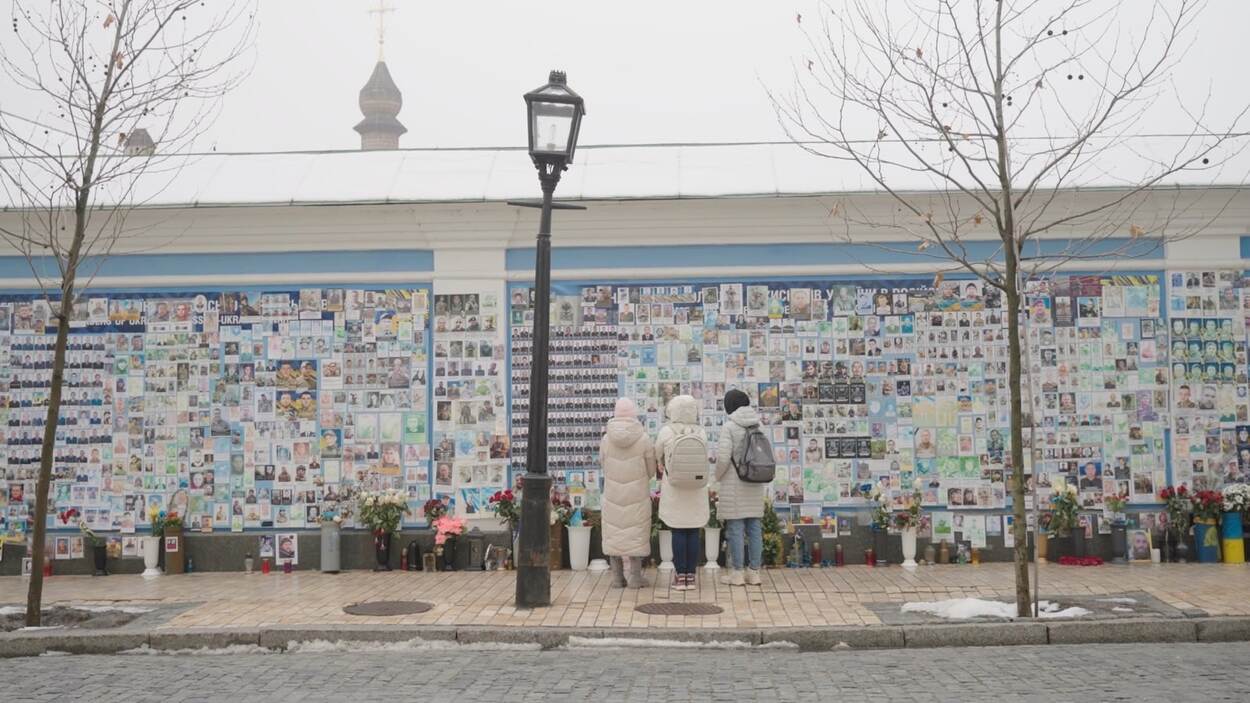
Category: Ukraine

  • MIL-OSI USA: Senator Coons statement on the third anniversary of Russia’s full-scale invasion of Ukraine

    US Senate News:

    Source: United States Senator for Delaware Christopher Coons
    WILMINGTON, Del. – U.S. Senator Chris Coons (D-Del.) issued the following statement commemorating the third anniversary of Russia’s total invasion of Ukraine on February 24, 2022:
    “Three years ago, more than 100,000 Russian troops invaded Ukraine, launching the largest war of aggression in Europe since World War II. I was visiting NATO and U.S. troops in Lithuania the week that the war began, and as I flew back from Europe, I prayed for the success of the brave Ukrainian fighters. Analysts believed it was only a matter of days until Kyiv fell and Putin was victorious.
    “Instead, for three years, the courageous Ukrainian people have defended their homeland, their freedom, and their democracy. Backed by a global coalition of more than 50 nations, they have fought and inflicted massive losses on the Russian aggressors, the largest army in Europe. They have endured unimaginable hardship, the crippling of their economy, and the atrocities of too many war crimes to count.
    “President Zelenskyy has ably led his country, and his people have fought with incredible bravery. Tragically, President Trump appears poised to give Putin a victory at the negotiating table that he has been unable to secure on the battlefield. He has repeated Russian propaganda, picked fights with Zelenskyy, and seems set on imposing a peace “deal” that will effectively surrender Ukraine to Putin. This strategic mistake would embolden our adversaries, waving a flag for Russia to continue marching across eastern Europe, for China to adopt a similar playbook for Taiwan, and for Iran and North Korea to learn that by partnering with this axis of autocrats, they can defeat the West. If he does abandon Ukraine, Trump will go down as the biggest betrayer of our interests and our ideals of this century.
    “On this anniversary, it is time for every American advocate of freedom, no matter their party, to tell President Trump that he must not force Ukraine into a weak peace that will not hold. He must instead make clear to Putin that we will stand behind Ukraine in this war, in partnership with our European allies, who are offering to take on more of the burden of defending Ukraine and to join us in securing the peace. That is “peace through strength,” that is how we bring this war to a just end, and how we live up to the values that have long defined us as Americans.”
    Senator Coons is the Ranking Member of the Senate Appropriations Subcommittee on Defense and a member of the Senate Foreign Relations Committee.

    MIL OSI USA News

  • MIL-OSI Global: Why justice for Ukraine must be at the forefront of peace negotiations

    Source: The Conversation – Canada – By Oleksa Drachewych, Assistant Professor in History, Western University

    On Feb. 18, representatives from Russia and the United States met in Saudi Arabia to determine if peace in Ukraine is possible. Ukrainian representatives were not invited.

    U.S. Secretary of State Marco Rubio said on social media that the meeting was a step in developing an “enduring peace” between Russia and Ukraine. Russian President Vladimir Putin claimed in a media interview that the meeting was “very positive” and confirmed the true meaning of the talks was to start normalising relations between Russia and the U.S.

    Although U.S. President Donald Trump has claimed “the Russians want to see the war end,” Russian officials remain committed to their war aims. Russian foreign minister Sergei Lavrov announced before the meetings that Russia would not return Ukrainian territory. After, he stated that should a peace deal be brokered, any peacekeeping forces could not come from NATO nations. The latter statement stunted growing European efforts to develop a security guarantee for Ukraine should a ceasefire be reached.

    Keith Kellogg, U.S. envoy for Kyiv and Moscow, said after his Feb. 20 meeting with Ukrainian president Volodymyr Zelenskyy that the U.S. is aligned with the nation — and that any end to the war with Russia should ensure there is no “next war”. Yet White House officials do not seem to have Ukraine’s best interest in mind in negotiating a potential resolution to the war.

    For instance, U.S. Secretary of Defense Pete Hegseth announced on Feb. 12 that the U.S. government doesn’t believe NATO membership for Ukraine “is a realistic outcome of a negotiated settlement.” He added that Ukraine would need to accept territorial concessions to Russia.

    Trump has also increasingly parroted Russian narratives — such as claiming that Ukraine started the war. He has also delegitimized Zelenskyy by claiming he is a “dictator” who refuses to hold elections — despite the nation’s constitution stating elections cannot legally be held under martial law.

    Trump also continues to demand 50 per cent of Ukraine’s natural resources to repay the United States for previous military and financial support. This has led to a deterioration in Ukrainian-U.S. relations at a time where Russian-U.S. relations appear to be improving.


    Read more:
    Ukraine’s natural resources are at centre stage in the ongoing war, and will likely remain there


    European leaders have responded with frustration. Zelenskyy has made his position clear that any negotiation must include Ukraine at the table. Ukraine would not accept an imposed peace.

    Any attempt at negotiating a lasting peace between the two nations must include accountability for Russian crimes.

    The realities of Russia’s invasion

    American overtures for peace have often referred to “stopping the millions of deaths” in Russia’s war in Ukraine. While on the surface this goal is admirable, it oversimplifies the realities of what the last three years of war have done to Ukraine. Namely, Russian forces have committed extensive war crimes and atrocity in Ukraine.

    Russian forces barrage Ukraine with drone strikes and terror bombing — including targeting civilians. Even as negotiations were happening in Saudi Arabia, Russian drones struck Odesa, injuring four civilians. This was the latest in a long line of such attacks. International Criminal Court (ICC) arrest warrants are out for Russian military leaders on just this issue.

    The Ukrainian government has confirmed over 19,500 Ukrainian children have been abducted by Russian forces. But in July 2023, Russian officials claimed they had over 700,000 Ukrainian children in Russian territory.

    Investigative reporting confirms the Russian government is assimilating these children — forcing them to stop speaking Ukrainian and raising them with a Russian identity. These actions have also led to ICC arrest warrants for Putin and Maria Lvova-Belova, Russia’s Children’s Rights Commissioner who oversees the program. Russia’s actions violate the UN Genocide Convention.

    Widespread sexual assault by Russian forces has been documented against Ukrainian men and women. Torture chambers have also been found in liberated cities. Russian forces committed mass murder in multiple Ukrainian cities — underscored by the discovery of mass graves in Bucha, Izium and Lyman.

    Mariupol, once a city of over 400,000 has been reduced to a population of 120,000 as of 2023. This showcases the devastation caused by Russian forces. Russia has also started seizing buildings to give to Russian settlers to further Russify the city.

    The realities under Russian occupation are only partially known. The Russian government has demanded Ukrainians living under occupation forfeit their Ukrainian identification documents and obtain Russian passports. In schools, Russia has fully implemented its nationalistic curriculum, which includes “anti-Ukrainian propaganda” aimed at assimilating Ukrainian children.

    Against international law, forcible Russification of the Ukrainian people has become a common feature of Russian occupation during this war.

    Ukraine’s fight for justice

    Ukraine continues to fight against Russian occupation. While it’s honourable to want to stop the deaths caused by fighting, the Russian regime’s actions in Ukrainian territory must be remembered too.

    This is why justice is just as important as resolution. While it’s unlikely Russian officials will find themselves before the ICC, there must be some form of accountability for Russian crimes against Ukraine if peace is negotiated. While present frontlines may dictate where Ukraine may be forced to cede territory or freeze conflict, the realities of Russian aggression cannot be ignored.

    Here, history offers a guide for what shouldn’t be done this time when brokering a peace deal.


    Read more:
    How Russia’s fixation on the Second World War helps explain its Ukraine invasion


    During the Second World War, Soviet forces committed extensive war crimes and atrocities. Yet the Soviet Union never faced a reckoning for those acts. Russian officials remember this. As a result, Putin feels empowered to commit similar atrocities in Ukraine — believing Russia, just as the Soviet Union, won’t face any consequences.

    For any possibility of lasting peace, accountability and justice for Russian war crimes must be at the forefront of negotiations. Otherwise, Russia will have learned it can act with impunity — threatening the likelihood of enduring peace for Ukraine.

    Oleksa Drachewych does not work for, consult, own shares in or receive funding from any company or organisation that would benefit from this article, and has disclosed no relevant affiliations beyond their academic appointment.

    ref. Why justice for Ukraine must be at the forefront of peace negotiations – https://theconversation.com/why-justice-for-ukraine-must-be-at-the-forefront-of-peace-negotiations-250208

    MIL OSI – Global Reports

  • MIL-OSI United Kingdom: UN Human Rights Council 58: UK statement for the annual High-Level Segment

    Source: United Kingdom – Executive Government & Departments

    Speech

    UN Human Rights Council 58: UK statement for the annual High-Level Segment

    UK statement at the annual High-Level Segment of the Human Rights Council. Delivered by Lord Collins, FCDO Minister for Africa, UN, Commonwealth & Human Rights.

    Mr Vice President,

    I stand here not just as a life-long trade unionist but also as a Minister of an internationalist Labour government committed to human rights and the rule of law.

    We have gathered today against the backdrop of an increasingly volatile and uncertain world. Conflicts and geopolitical tensions are robbing people across the world of their most basic rights.

    That’s why the United Kingdom backs Ukraine’s right to choose its own future. That’s why the ceasefire in Gaza must be fully implemented. We want to see an end to the conflict, with every hostage released and vital aid reaching Gaza, leading to a credible process towards a two-state solution.

    That’s why we welcome the Syrian interim authorities’ efforts to build a more inclusive future for all Syrians. It’s why we welcome Bangladesh engaging with the High Commissioner as it addresses past crimes and future aspirations. 

    It’s why we are heartbroken by the suffering in Sudan and commend the DRC for bringing the appalling situation in the East of their country to this Council just two weeks ago.

    That’s why we are urging China to implement the recommendations of the United Nations High Commissioner’s Xinjiang assessment and respect the Joint Declaration on Hong Kong.

    Against this worsening global climate, the United Kingdom is determined to champion equal and inalienable rights for all. So I’m proud that the United Kingdom is standing for election to the Council for the 2026 to 2028 term. 

    Throughout its many terms on the Council, the United Kingdom has always put respect and partnership at the heart of our approach. And we promise to collaborate in the same spirit once again. If elected, we pledge to defend civic space and fundamental freedoms, supporting civil society organisations and human rights defenders.

    We pledge to champion equal rights for all, by standing up for the rights of women and girls and LGBT+ people whose hard-won rights and freedoms are being so cruelly undermined, and by promoting women’s economic empowerment. And we will do all we can to uphold the rule of law. Because human rights and the rule of law are the basic building blocks of sustainable economic growth, stable societies, and humane migration policies.

    We will prioritise human rights and governance principles, including the use of new technologies and responding to modern slavery.

    But the United Kingdom is under no illusion that we can do all this alone. We cannot. That’s why we need your support. And if we have the honour of serving on the Council, we will prioritise practical action to achieve our shared human rights goals and change people’s lives for the better.

    Ultimately, it is only by building genuine, respectful partnerships that we can work together to defend the freedoms we all hold so dear.

    Updates to this page

    Published 24 February 2025

    MIL OSI United Kingdom

  • MIL-OSI Canada: Third Anniversary of Ukraine Invasion Commemorated at Saskatchewan Legislature

    Source: Government of Canada regional news

    Released on February 24, 2025

    Today, Legislative Secretary Responsible for Saskatchewan-Ukraine Relations Jamie Martens and representatives from Saskatchewan’s Ukrainian community, the Saskatchewan-Ukraine Relations Advisory Committee, and the Ukrainian Canadian Congress – Saskatchewan Provincial Council (UCC-SPC) gathered at the Legislative Building in Regina to commemorate the third anniversary of Russia’s military invasion of Ukraine.

    “This war has caused untold suffering to the people of Ukraine, some of whom have resettled here in Saskatchewan,” Martens said. “As a province with a rich Ukrainian heritage, Saskatchewan is proud to support those displaced by this terrible conflict. With open arms we will continue to make these newcomers feel welcome and at home in our communities.”

    On Sunday, February 23, a car rally was organized to demonstrate support for Ukrainians by the Ukrainian Canadian Congress (UCC), Regina Branch, that started at the Northgate Mall in Regina and concluded with a brief ceremony at the Holodomor Monument in Wascana Centre.

    Since the conflict began, nearly 8,000 Ukrainians have arrived in Saskatchewan, many of which have been supported by programs offered through UCC-SPC and the Government of Saskatchewan.

    “The UCC-SPC is grateful to Premier Scott Moe and the Government of Saskatchewan for their steadfast and reliable support for the Ukrainian people,” President of UCC-SPC Elena Krueger said. “From the early days of the conflict and the five charter flights that assisted hundreds to safely arrive in Saskatchewan, to the on-going financial support to UCC Saskatchewan, to various language and employment services, our provincial government truly does stand with Ukraine.”

    Through a funding agreement with the UCC-SPC, the province continues to provide displaced Ukrainians with access to language training, settlement and community supports, as well as connections to employers in their local labour market.

    In another show of solidarity with the people of Ukraine, the Provincial Capital Commission announced funding for necessary restoration work on the Holodomor Monument in Regina’s Wascana Centre, 10 years after its installation in the park. The monument memorializes the man-made famine endured by the Ukrainian people at the hands of the Soviet Union from 1932 to 1933.

    “The Holodomor Monument in Wascana Centre is an important monument to remember the victims of the man-made famine, as well as reiterate our support for the people of Ukraine through the ongoing conflict,” Minister Responsible for the Provincial Capital Commission Eric Schmalz said. “This funding will help ensure that this important monument remains in Wascana Centre for years to come.”

    -30-

    For more information, contact:

    MIL OSI Canada News

  • MIL-OSI Global: German election: the results explained as Friedrich Merz comes out swinging for Europe

    Source: The Conversation – UK – By Ed Turner, Reader in Politics, Co-Director, Aston Centre for Europe, Aston University

    Friedrich Merz, the presumptive chancellor of Germany, has confirmed he will seek a coalition with the social democratic SPD after the Christian Democrats (CDU/CSU) won the February 23 election, topping the poll with 28.5%. Although the SPD has gone from winning the last election to a record low result of 16.4% of the vote, it remains the only credible coalition partner for presumptive chancellor and CDU leader Friedrich Merz.

    Among Merz’s first acts was a bold statement that his first priority is “to strengthen Europe as quickly as possible so that, step by step, we can really achieve independence from the USA”.

    Things might have looked different for Merz. Had a small party, (the Sahra Wagenknecht Alliance, or BSW) won just 0.03% less of the vote, Merz would have needed to find a third coalition partner. That would have most likely meant trying to work with the Greens. This would have been a much more difficult circle to square for the centre right and an option that would have come with a far greater risk of early government collapse, if a deal could even have been reached in the first place.

    The far right Alternative for Germany (AfD) had a record result, coming second with a 20.8% share of the vote. Mainstream parties including the CDU/CSU have ruled out any sort of deal with the far right, which the AfD will now be viewing as an opportunity. A further period of CDU/CSU-SPD government at a time of economic challenges will leave the party feeling it has a good opportunity to capitalise on discontent and grow further.

    The 2025 election saw a record low vote share for the CDU/CSU and SPD. It’s notable that none of the leaders of the one-time Volksparteien (“people’s parties” – with a cross-class, cross-society appeal) were popular. Merz fared best among them but on a scale of -5 to +5 for popularity, he achieved an average of precisely 0.

    Worse still was the situation of the centre-right FDP, which crashed out of the parliament on a grand scale, getting just 4.3%, down 7.1 points. Its leader, Christian Lindner, who had brought about the downfall of the previous “traffic light” coalition between his own party, the SPD and the Greens, announced his retirement from politics. The Greens, with a respectable result (11.6%, down 3.1 points), will prepare for a spell in opposition.

    The election shows a country disunited, a long way from being at ease with itself. Observers are immediately struck by the difference between eastern and western Germany. In the east, the far right Alternative for Germany (AfD) came first in all five states (excluding Berlin, which is a mix of east and west). In the west, with some exceptions, the CDU/CSU was dominant.


    Read more:
    These maps of support for Germany’s far-right AfD lay bare the depth of the urban-rural divide


    It has been evident for some time that concerns about migration as well as a feeling of being treated as second class citizens is driving up support for the far right in the east. Now, opposition to military support for Ukraine and general pessimism are also playing into the trend.

    Age proved another very significant divide. Among those aged 18 to 24, the Left party got 25%, ahead of the AfD (21%). The CDU/CSU took just 13% and the SPD 12% . Among the over 60s, the picture is reversed. The CDU/CSU took 37% and the SPD 23%, while the AfD took 15% and the Left just 5%.

    The Left’s success, at least among the young, was the one big surprise of the election. After a torrid period which saw the departure of leading figure Sahra Wagenknecht and her followers to form a separate party, the Left looked unlikely to meet the 5% vote share threshold needed to enter parliament until very recently. An internal split over Israel and Gaza was also causing difficulties.

    However, the Left profited from the polarisation caused by Friedrich Merz’s decision to press ahead with a vote on hardline policies towards asylum seekers, including more border checks and turning away irregular migrants without processing an asylum claim. A savvy social media campaign spearheaded by the party’s youthful joint parliamentary leader Heidi Reichinnek also helped.

    Meanwhile, the BSW took just 4.97% of the national vote and will therefore not have any seats in parliament. It is however worth noting that the BSW’s popularity was also extremely uneven across the country and another example of geographical division. While it tanked nationally, its anti-migration, “anti-woke” and pro-welfare policies, mixed with its criticism of support for Ukraine, was a more popular offering in the east with results around the 10% mark, double the national average.

    What now for Europe?

    The SPD has claimed it will not enter government at any price. It has hinted it will put any coalition proposals to a vote among party members as a way of trying to exercise leverage over Merz. But, in truth, the party has nowhere else to go. There is no alternative to a CDU/CSU-SPD coalition apart from early elections or a fundamental rethink of the former’s approach to the AfD. Neither is an attractive prospect.

    All parties are also acutely aware of the tremendous pressure from other European countries for Germany to get its act together in the context of US president Trump’s assertiveness and the need to support Ukraine. But there are huge challenges to address on the domestic front. Merz has pledged tax cuts and higher defence expenditure, but there is no clarity at all how these will be paid for. Drastic reductions in welfare and other social expenditure would likely be a “no go” area for the SPD. An option might be to loosen Germany’s “debt brake” – constitutional restrictions on government borrowing. This is something Merz has been reluctant to do, but he has hinted he might consider it in the aftermath of the vote. This fundamental reform would need a two-thirds majority in both chambers of parliament, and if extra funds were only for defence, it is possible the Left and the AfD would combine to defeat it.

    So Germany’s election gives us a paradox: in some ways the outcome is rather familiar, with an old-school Christian democrat leading a coalition with the SPD, another party with a long track record in government – and indeed with some prospect of German leadership in Europe. But it is also a deeply uncertain result. Germany is a country facing huge challenges: sluggish growth, war in Europe and a US president questioning key tenets of the post-war transatlantic relationship. It’s not clear how to put together a governing coalition that can agree on how to face these challenges, and which can satisfy a starkly divided electorate. Turbulent times, in the country and across the continent, may well be ahead.

    Ed Turner receives funding from the German Academic Exchange Service (DAAD) and the Friedrich Ebert Foundation.

    ref. German election: the results explained as Friedrich Merz comes out swinging for Europe – https://theconversation.com/german-election-the-results-explained-as-friedrich-merz-comes-out-swinging-for-europe-250690

    MIL OSI – Global Reports

  • MIL-OSI United Kingdom: UK steps up life-saving medical support for Ukraine’s Armed Forces

    Source: United Kingdom – Executive Government & Departments

    Press release

    UK steps up life-saving medical support for Ukraine’s Armed Forces

    The Ministry of Defence will double its funding for medical and rehabilitation services for Ukraine’s troops

    Britain is stepping up support for Ukrainian troops wounded on the frontline, who will receive life-saving medical support and rehabilitation services through the UK’s Project Renovator.  The programme, which will see its funding doubled, also includes training for surgeons and rebuilding of a military hospital targeted by Russian bombs. 

    Project Renovator draws on the UK’s leading defence medical expertise to expand Ukraine’s military rehabilitation and medical services and help troops who suffered life-changing injuries to return to the frontline or help them readjust to civilian life after the conflict ends. 

    Defence Secretary John Healey MP has today announced a new £20m funding package to step up the programme further – doubling the Government’s funding for the scheme – as the UK’s cast-iron commitment to Ukraine continues three years into the conflict. 

    The project, which started in October 2023 demonstrates the UK’s international leadership role, taking responsibility for repairing and upgrading a military rehabilitation hospital which was targeted and bombed by Putin’s forces earlier in the conflict. The UK is also encouraging allies to support and grow this work as part of the broader NATO Comprehensive Assistance Package for Ukraine scheme. 

    From providing life-saving surgery, to issuing advanced prosthetics, physiotherapy, and aftercare, the rehabilitation hospital will be a significant upgrade for Ukraine’s current services, with Ukrainian surgeons, doctors, and nurses being trained by the UK. 

    The announcement comes on the third anniversary of Putin launching his illegal full-scale invasion, as the Home Office announced new measures to block Russian elites entering the UK. It forms part of this Government’s record support for Ukraine this year – building on £12.8 billion worth of military, humanitarian, and economic support since the beginning of the full-scale invasion.

    Defence Secretary, John Healey MP, said: 

    As we mark three years of this brutal conflict, Putin is still waging a war he thought he would win in three days, because of fierce resistance to the Russian invasion from ordinary Ukrainians – military and civilian alike. 

    In this critical period, Ukrainians need our support to keep them in the fight and to put their nation in the strongest possible position ahead of any talks. That’s why we are stepping up further our UK leadership and life-saving medical support for brave Ukrainian fighters. Our commitment to them is unshakeable. 

    I’m proud of the UK’s leadership in supporting Ukraine, both now and in the long-term, and this new investment in Ukraine’s military medical services will harness the UK’s leading expertise to ensure wounded troops are given the best treatment possible.

    The work will help address a major challenge posed by the conflict, with the largest casualty figures seen in Europe since the Second World War. The support stands in stark contrast to Russia’s widely-reported poor treatment of Russian casualties and veterans, leading to instances of crime and violence when they return from the frontline.

    While a small number of British personnel have been working to deliver the project in Ukraine, nearly 100 Ukrainian surgeons, doctors, and nurses are due to travel to the UK this year to receive further medical training using the latest techniques and equipment. 

    Around £20m of money from a NATO common fund has been invested in the rehabilitation hospital so far, much of which was provided by the UK. In addition to major structural repairs, improvements have included more than £300k worth of new gym equipment, and £400k worth of prosthetics and associated equipment. 

    Norway has also announced it is carrying out similar work to repair and improve a similar facility under the same NATO scheme, working closely with the UK. It comes as both nations have committed to deepen military ties, with a new agreement being drawn up following a visit from the Defence Secretary last week. 

    Defence Medical Services personnel from Project Renovator have been working with the team at the UK’s world-leading equivalent, the Defence Medical Rehabilitation Centre at Stanford Hall, to produce around 50 rehabilitation training videos to support the training of Ukrainian medical staff. 

    Minister for Veterans and People, Alistair Carns DSO, OBE, MC, said:  

    The UK Armed Forces are experts in the area of defence medical services and rehabilitation, pioneering the field during the Second World War.

    These services are absolutely essential to ensuring veterans get the support they need to go back to their daily lives after being on the frontline, especially if wounded.

    The Defence Medical Rehabilitation Centre at Stanford Hall in particular is a world-leading facility, and I am proud that the equipment and the skills of our personnel are being put to good use in supporting Ukraine.

    This year, the UK will spend £4.5 billion on military assistance for Ukraine – more than ever before. Supporting Ukraine in the conflict and to secure a peace deal is critical for the security of Europe and the UK, a foundation for the Prime Minister’s Plan for Change. Earlier this month, the Defence Secretary announced a new £150 million firepower package including drones, tanks and air defence systems.

    Since July 2024, the Government has provided over £5.26 billion in military aid and financial support to Ukraine, including a £3 billion annual military aid and a £2.26 billion loan for military spending. This includes £300 million for artillery ammunition and £68 million for air defence systems, as well as the new £150 million firepower package for thousands of drones, dozens of battle tanks and armoured vehicles.  

    The UK Government has supplied over 90,000 rounds of 155mm artillery, 150 artillery barrels, and 10 AS90 self-propelled howitzers. Air defence support includes 17 Gravehawk systems, 1,000 counter-drone electronic warfare systems, and £68 million for radars and counter-drone tech.  

    The UK has also invested £7.5 million in drone technology and continues training, surpassing 50,000 Ukrainian troops under Operation Interflex. Naval support totals £92 million, providing drones, uncrewed vessels, loitering munitions, and mine countermeasure drones.

    Updates to this page

    Published 24 February 2025

    MIL OSI United Kingdom

  • MIL-OSI United Kingdom: Kremlin-linked elites face exclusion from UK

    Source: United Kingdom – Executive Government & Departments

    News story

    Kremlin-linked elites face exclusion from UK

    Elites with known links to the Kremlin may be subject to exclusion from the UK in show of steadfast support for Ukraine on 3 year anniversary of invasion.

    Elites linked to the Russian state can be excluded from entering the UK under new measures announced by the Home Secretary today.  

    Under the new measures, the government will expand the criteria for exclusion to cover Kremlin-linked elites. This will ensure that, while Russia remains an acute national security threat, elites linked to the Russian state can be prevented from entering the UK.  

    Those who could be barred from the UK include anyone who:

    • provides significant support to the Russian state
    • owes their significant status or wealth to the Russian state
    • enjoy access to the highest levels of the Russian state

    Kremlin-linked elites can pose a real and present danger to our way of life. They denounce our values in public while enjoying the benefits of the UK in private – benefits which they look to deprive Ukraine of through their support of Russia’s war.  They can act as tools for the Russian state, enabling the continuation and expansion of Russia’s aggression.      

    The move will bolster both UK national interest and national security, one of the key priorities underpinning the government’s Plan for Change, by blocking the physical access of those who undermine UK national security. These new measures will complement the UK’s existing sanctions regime against Russian elites who are supporting Putin’s war effort, which will remain in place as long as Russia threatens Ukraine’s sovereignty.  

    The move follows continued action from the UK to respond to Russia’s illegal war in Ukraine including through imposing extensive sanctions on elites linked to the Russian state, strengthening law enforcement capabilities through the National Crime Agency’s (NCA’s) Combatting Kleptocracy Cell and closing the legislative loopholes open to money laundering by criminal actors.   

    These measures also follow ramped up efforts to tackle Russian illicit finance through the NCA’s Operation Destabilise, successfully disrupting 2 Russian money laundering networks which provided services to Russian oligarchs and helped fund Russian state espionage operations. The NCA-led action led to 84 arrests and over £20 million in illicit funds seized. This work continues and since the disruption, a further £1 million of cash has been seized and a further 6 arrests made.

    This change builds on the UK-Ukraine 100 Year Partnership signed in January, which commits both countries to work together to tackle the malign influence of elites linked to the Russian state.  

    Security Minister Dan Jarvis said:

    Border security is national security, and we will use all the tools at our disposal to protect our country against the threat from Russia.

    The measures announced today slam the door shut to the oligarchs who have enriched themselves at the expense of the Russian people whilst bankrolling this illegal and unjustifiable war.

    My message to Putin’s friends in Moscow is simple: you are not welcome in the UK.

    Since the start of the full-scale invasion, the UK’s total military, economic and humanitarian support for Ukraine amounts to £12.8 billion. We remain committed to the provision of £3 billion of military support a year to put Ukraine in the strongest position possible.  

    Earlier this month, the Defence Secretary led the 50-nation strong Ukraine Defence Contact Group for the first time and announced a further £150 million firepower package for Ukraine, including drones, tanks and air defence systems. 

    Defence Secretary, John Healey MP, said:

    As we mark the third anniversary of Russia’s illegal invasion, Putin is still waging a war he thought he would win in three days, because of fierce resistance from the Ukrainians. Our support for them is unshakeable. 

    I am proud of the UK’s leadership and unity on Ukraine. Keeping the Ukrainians in their fight and as strong as possible at any negotiating table is critical not only for them, but for the security of the UK. These new measures send a powerful message that we will do what it takes to turn the tables on Putin’s aggression.

    Updates to this page

    Published 24 February 2025

    MIL OSI United Kingdom

  • MIL-OSI Security: Defense News: Adm. Munsch Discusses Vital Role of NPS in Developing Warfighters, Warfighting Solutions

    Source: United States Navy

    Munsch’s lecture focused on the evolving nature of warfare, particularly in the era of great power competition. He outlined ways to gain an advantage over adversaries by utilizing greater proficiency and competency to outthink and outfight the adversary. 

    One of the key takeaways from the discussion was the role of NPS in developing this intellectual advantage, by highlighting NPS’s unique ability to bring together students, faculty, alumni, and the broader Silicon Valley innovation ecosystem to drive learning and military advancements. 

    “It’s the people. That’s our real inherent advantage,” remarked Munsch. “The joint warfighting concept is built around that concept. The people are our one and inalienable advantage we have over adversaries.”

    During his visit, he also met with NPS students and faculty to hear updates on classified research and innovative projects supporting U.S. and allied naval forces in the European and African areas of operations.

    Munsch commented in his remarks on how NPS fosters asymmetry in warfare by enabling its U.S. and international military students to explore innovative solutions together in ways unmatched by other institutions. He stressed the importance of a synergistic approach, combining the efforts of operators, engineers, financiers, and all-domain warriors to focus and accelerate solutions, rapid adaptation, and effective decision-making.

    Following the lecture, the floor was opened for attendees to ask questions where Munsch addressed pressing issues such as lessons learned from the war in Ukraine, the growing strategic importance of Africa, and the evolving role of non-commissioned officers (NCO) in modern conflicts.

    Munsch highlighted the critical role of leaders and specifically NCOs in the U.S. military, stressing how they dynamically adapt – often the key difference in battle – and their potential beyond their rank. 

    “When you look at collar devices, see that as an indicator not of a person’s maximum ability, but of their minimum ability,” he explained. He emphasized the responsibility of leaders to nurture and develop that untapped potential, saying, “It’s all our jobs to mature that and foster that for the subsequent pay grade.”

    Munsch also reflected on the challenges and strengths of operating with allies and partners, particularly when balancing various national interests. Quoting Winston Churchill, he remarked, “there is only one thing worse than fighting with allies, and that is fighting without them.”

    In his closing remarks, Adm. Munsch left NPS students with a powerful message.

    “All of us here have at least one thing in common – we were called,” Munsch stated. “We were called to sacrifice, to dedicate, to serve. In your years [of service], may you be the shield of freedom and the sword of justice. May you be of sharp of mind and skilled in battle. May your foes fear you, may your friends trust you, and may your fellow countrymen respect you. And may you always celebrate others who’ve made the same commitment. To sacrifice, dedicate and serve.”

    Munsch’s visit underscored the importance of NPS in developing future military leaders and fostering cutting-edge research to maintain our competitive edge and decisive maritime advantage. 

    NPS, located in Monterey, California, provides defense-focused graduate education, including classified studies and interdisciplinary research, to advance the operational effectiveness, technological leadership, and warfighting advantage of the naval service. Established in 1909, NPS offers master’s and doctorate programs to Department of Defense military and civilians, along with international partners, to deliver transformative solutions and innovative leaders through advanced education and research.

    MIL Security OSI

  • MIL-OSI Europe: Minister puts emphasis on safeguarding human rights and international system in address to UN Human Rights Council

    Source: Government of Iceland

    Foreign Minister Þorgerður Katrín Gunnarsdóttir today delivered her address to the 58th session of the United Nations Human Rights Council. In her speech, Foreign Minister Gunnarsdóttir emphasized the need to safeguard the United Nations and the international system established after World War II. That the values that the world’s nations agreed to respect were being severely undermined, and she particularly criticized Russia’s illegal, all-out invasion of Ukraine, on the day when leaders have gathered in Kiev to express support for Ukraine exactly three years after the invasion began.

    The Foreign Minister also addressed gender equality, women´s rights and the rights of LGBTQIA+ people in her address to the Human Rights Council, but a strong undercurrent is now working to undermine the achievements that have been made in recent years.

    “For me, the starting point is a simple truth: no person should have to live in fear of persecution and violence. This continues to apply if the persecution is based on a person´s sexual orientation or gender identity. And we will not hesitate to stand up on their behalf here in this venue, amplifying the voices of those who fight for their rights. Because we are all born free and equal,” said Þorgerður Katrín.

    The 58th session of the Human Rights Council is the first since Iceland became a member of the Council, following elections at the United Nations General Assembly in October. The Foreign Minister noted that eighty years have passed this year since the founding of the United Nations and that it is important to recall the important values that were laid down at the beginning. Of course, the United Nations had not always been able to live up to hopes and expectations. “The Israeli warfare in Gaza for fifteen months following the Hamas terrorist attack on 7 October 2023 is only the latest testament of the failure of our system to address urgent crises. And yet that complex problem now seems more divisive than ever, the talk of removal of people from Gaza being only the latest example of the crossroads we now find ourselves at,” she said, noting further: “There is only one way to meet these challenges. We must redouble our efforts, recommit ourselves to principles laid out in the UN Charter. It may prove difficult. It may require sacrifices – for sure it will require sacrifices since, after all, the world is a different place than it was in 1945, and the United Nations must reflect those changes through reform and renewal.”

    During her visit to Geneva, the Minister of Foreign Affairs will also deliver an address on behalf of the Nordic and Baltic countries (NB8) at an event commemorating the third anniversary of Russia’s full-scale invasion of Ukraine today, and will also deliver an address on behalf of the same countries at an event commemorating the 30th anniversary of the Beijing World Conference on Women. She will also meet with Volker Türk, UN High Commissioner for Human Rights, Mirjana Spoljaric Egger, President of the International Committee of the Red Cross, Dr. Ngozi Okonjo-Iweala, Director-General of the World Trade Organization, and will hold several bilateral ministerial meetings.

    An overview of Iceland’s key priorities can be found here and on this website dedicated to Iceland’s membership of the United Nations Human Rights Council. 

    Iceland joined the UN Human Rights Council on 1 January 2025 along with seventeen other states from all regions of the world. Iceland previously served on the Council for half a term in 2018-2019, filling the seat vacated by the United States in June 2018.

    MIL OSI Europe News

  • MIL-OSI United Nations: UKRAINE LIVE: Diplomatic debate steps up a gear as world marks 3rd anniversary of full-scale Russian invasion

    Source: United Nations MIL OSI b

    February 24 marks three years since Russia launched a full-scale invasion of Ukraine. Thousands of civilians have been kicked and injured, the economy has been shattered and energy infrastructure destroyed. As the General Assembly and Security Council meet today to mark and debate how peace and security can be restored in eastern Europe, we will be providing rolling coverage of the proceedings. Competing resolutions from Ukraine and the US point to a day of consequential diplomacy. UN News app users can follow live here.

    MIL OSI United Nations News

  • MIL-OSI United Kingdom: Plymouth marks three years of Russian invasion of Ukraine

    Source: City of Plymouth

    Plymouth is paying tribute to the enduring courage of the Ukrainian people as it marks three years since the full-scale Russian invasion of Ukraine began.

    The blue and yellow flag of Ukraine is flying from a flagpole in the Civic Square and the Lord Mayor of Plymouth has reflected on the grim anniversary at Full Council.

    Councillor Tina Tuohy, The Lord Mayor of Plymouth said: “Three years – three years of a devastating conflict that we are still watching play out on our screens night after night.

    “With the world leaders currently embroiled in a war of words, it is important to reflect on the war on the ground and the unimaginable suffering the population of Ukraine has endured.

    “I am proud that our city has been able to do its bit for those who have been forced to flee their homeland and seek sanctuary here.

    “We are proud of our quick response to the Homes For Ukraine scheme, which was launched in March 2022 and that we were able to welcome over 200 Ukrainians that year. We have since welcomed over 70 more guests to Plymouth.

    “Many of our residents opened up their homes to host those fleeing from Ukraine and we continue to see new sponsors registering to offer their support.

    “Organisations across the city continue to offer support and a warm welcome to make sure they can access vital services such as health care, education, social care and English language lessons.

    “To the Ukrainians here in Plymouth who will be thinking of their family and friends back home, we stand with you.”

    MIL OSI United Kingdom

  • MIL-OSI United Kingdom: OSCE Reinforced Permanent Council, February 2025: UK statement

    Source: United Kingdom – Executive Government & Departments

    Speech

    OSCE Reinforced Permanent Council, February 2025: UK statement

    UK Foreign Secretary, David Lammy, addresses a Reinforced meeting of the OSCE Permanent Council on the third anniversary of Russia’s full-scale invasion and underlines continued UK support for Ukraine.

    Three years ago, when Putin unleashed his full-scale invasion of Ukraine in a clear breach of the UN charter, he expected a swift victory.  What he got instead was a catastrophic failure.

    Putin’s imperial ambitions have killed and injured close to a million in his own forces and driven its economy into the ground.  The rouble is plummeting, inflation is soaring, and the deficit at record levels.  All for a war that he thought would be over in three days.

    The extent of death, destruction, and suffering caused by one man’s selfish ambition is staggering.  Tens of thousands of Ukrainians have been killed and millions more injured, displaced, and in need of urgent help as civilians are relentlessly attacked.

    Repeated findings of the Moscow Mechanism and other independent reports document Russian atrocities.  There are increasing reports of Russian forces deporting children and using rape, torture and execution as weapons of war.  The OSCE is playing a crucial role in securing justice for survivors and victims. 

    Yet, in the face of this brutality, Ukrainians continue to defend their homeland with extraordinary courage and ingenuity.  This proves that, with the right support, they can defy Putin’s barbarism.

    The UK has been at the forefront of this effort from day one.  Our military support worth £3 billion a year is putting Ukraine in the strongest possible position.  And our new 100 Year Partnership cements our unwavering commitment for generations to come.

    Make no mistake, Putin’s invasion violates laws and principles which underpin Euro-Atlantic security – including the Helsinki Final Act.

    Laws which Russia itself signed up to, and we cannot allow such aggression to succeed.

    The days ahead will determine the future security of our continent.  This is the moment for all of us to step up.  Because it is the right thing to do for the values we hold dear and because it is fundamental to European security.

    That’s why the UK will stand with Ukraine—today, tomorrow, and for generations to come.

    Updates to this page

    Published 24 February 2025

    MIL OSI United Kingdom

  • MIL-OSI Canada: Statement by the Prime Minister marking three years since Russia’s full-scale invasion of Ukraine

    Source: Government of Canada – Prime Minister

    The Prime Minister, Justin Trudeau, today issued the following statement marking three years since Russia’s full-scale invasion of Ukraine:

    “On February 24, 2022, Russia launched an illegal, full-scale invasion of Ukraine, unleashing a campaign of unimaginable brutality that has left hundreds of thousands dead. The invasion was an escalation of a war of aggression, an unequivocal violation of Ukraine’s sovereignty and territorial integrity, and an attack against freedom, democracy, and international law, including the United Nations Charter.

    “When Putin ordered his tanks across the Ukrainian border, he thought Kyiv would quickly fall and the people of Ukraine would surrender. He was wrong. Three years later, Ukraine stands defiant. Ukrainians are valiantly protecting their territory against relentless Russian attacks. Russian aggression has been met with fierce defence and, winter after winter, the Ukrainian flag flies over Kyiv.

    “Ukrainians are continuing to live their lives – united in hope, courage, pride, and an unbreakable love for their country. They are fighting for their families, their land, their heritage, and their identity. They are fighting to ensure that Putin not be rewarded for his unprovoked and unjustifiable aggression. They are fighting to remind the world that democracy and freedom are important enough to die for – and that Ukrainians are strong enough to win.

    “That is what is at stake, and that is why Canada stands resolute with Ukraine. Our support includes billions of dollars for equipment and capabilities like multi-mission drones, armoured combat vehicles, small arms, ammunition, F-16 pilot training, and a National Advanced Surface-to-Air Missile System. Under Operation UNIFIER, the Canadian Armed Forces has trained over 44,000 Ukrainian troops since 2015. We have imposed sanctions on the Russian regime as well as its war chest and oligarchs. As part of the 2024 Fall Economic Statement, we proposed legislative changes to ensure profits from frozen Russian assets in Canada are used to rebuild Ukraine. As part of the International Coalition for the Return of Ukrainian Children, co-led by Canada and Ukraine, we are working with our international partners to ensure the safe return of Ukrainian children unlawfully deported and illegally transferred by Russia. As G7 President this year, Canada will continue to stand with Ukraine and support a just and lasting peace for its people.

    “The friendship between Canada and Ukraine runs deep. Ukrainian immigrants arrived on our shores in 1891 and, generation after generation, the community has helped build the Canada we know and love. Today, we are proudly home to 1.3 million people of Ukrainian descent, and over the past three years, Canadians from all walks of life have stood side-by-side with the community – by waving flags and wearing pins; by donating to charities and helping with Ukrainian resettlement efforts; by learning more about Ukraine’s fight for sovereignty and, when President Zelenskyy visited Canada in 2023, proudly singing the Ukrainian national anthem right alongside him. To our friends in Ukraine: We stand with you, and our support for your sovereignty is ironclad.

    “On this solemn day, we remind ourselves that Ukraine is fighting for freedom, justice, and democracy – values that Canada will always defend. We support a future for Ukraine that’s written by Ukrainians. A future where Ukraine stands strong and free.

    “Slava Ukraini!”

    MIL OSI Canada News

  • MIL-OSI Europe: EU reaffirms unwavering support to Ukraine on anniversary of invasion

    Source: European Union 2

    In February 2022, Russia launched a full-scale invasion of Ukraine. The EU reacted swiftly and decisively, condemning Russia’s unprovoked and unjustified aggression, imposing wide-ranging sanctions, and offering Ukraine its unwavering support. The EU remains committed to supporting Ukraine until it achieves a just and lasting peace. 

    Strong and comprehensive EU response 

    The EU has provided almost €135 billion in support to Ukraine, including economic, military, financial, and humanitarian aid. It continues to work with international partners to ensure sustained support and hold Russia accountable.  

    Hard-hitting sanctions have significantly weakened Russia’s economy and war capabilities. The EU is also working to ensure those responsible for war crimes face justice through the International Centre for the Prosecution of the Crime of Aggression against Ukraine in The Hague. 

    Peace, reconstruction, and Ukraine’s European future 

    On the third anniversary of the invasion, President von der Leyen and the College of Commissioners are visiting Kyiv. The President is meeting with Ukrainian President Volodymyr Zelenskyy, and together, they are co-chairing a College-to-Government meeting to discuss Ukraine’s future as a free and sovereign nation.  

    The EU continues to work with Ukraine on its EU accession process. Ukraine’s progress towards EU membership reflects the will of its people for democratic reforms and a European future.  

    After the war, Ukraine will require extensive reconstruction. The EU has been actively contributing to the country’s resilience and recovery, but further support will be needed to rebuild a free and prosperous country, anchored in European values and well-integrated into the European and global economy.  

    For more information 

    EU solidarity with Ukraine 

    MIL OSI Europe News

  • MIL-OSI China: Xi says bilateral ties show China, Russia good neighbors, true friends

    Source: China State Council Information Office

    Chinese President Xi Jinping said on Monday that history and reality show that China and Russia are good neighbors that cannot be moved away, and true friends who share weal and woe, support each other and achieve common development.

    He made the remarks when having a phone conversation with Russian President Vladimir Putin at the latter’s request.

    Xi said the two leaders had a video meeting before the Chinese Spring Festival during which they made plans for the development of China-Russia relations throughout the year and strengthened coordination on a series of major international and regional issues.

    Various departments from both countries are steadily advancing cooperation in all fields in accordance with the consensus reached by the two leaders, including carrying out activities to commemorate the 80th anniversary of the victory of the Chinese People’s War of Resistance against Japanese Aggression and the 80th anniversary of the victory of World Anti-Fascist War, Xi said.

    Xi said China-Russia ties enjoy strong internal driving force and unique strategic value, adding that the relationship does not target any third party nor would it be influenced by any third party. The development strategies and foreign policies of China and Russia are for the long-term, he said.

    Despite changes in the international situation, China-Russia relations will proceed with ease, which will help each other’s development and revitalization, and inject stability and positive energy into international relations, he said.

    Xi stressed that at the beginning of the overall escalation of the Ukraine crisis, he put forward the “four-should” and other basic proposals for resolving the crisis.

    In September last year, China and Brazil, together with some countries of the Global South, set up the Group of Friends for Peace on the Ukraine crisis to create an atmosphere and accumulate conditions for promoting the political settlement of the crisis, Xi noted.

    China is happy to see Russia and relevant parties make positive efforts to defuse the Ukraine crisis, he said. 

    MIL OSI China News

  • MIL-OSI Video: Ursula von der Leyen: A free and sovereign Ukraine is in the interest of the entire world

    Source: European Commission (video statements)

    February 24, 2022, marked a turning point for Europe. Today, we honor Ukraine’s fallen heroes and stand with those defending their country.

    The EU has provided €134 billion in support, with a new €3.5 billion package arriving in March. We are accelerating arms deliveries, strengthening Ukraine’s economy and energy security, and integrating its electricity market with the EU by 2025.

    A free and sovereign Ukraine is not only in the European interest. It’s also in the interest of the entire world. An investment in Ukraine’s sovereignty is an investment in preventing future wars.
    Slava Ukraini
    Watch on the Audiovisual Portal of the European Commission: https://audiovisual.ec.europa.eu/en/video/I-268103
    Follow us on:
    -X: https://twitter.com/EU_Commission
    -Instagram: https://www.instagram.com/europeancommission/
    -Facebook: https://www.facebook.com/EuropeanCommission
    -LinkedIn: https://www.linkedin.com/company/european-commission/
    -Medium: https://medium.com/@EuropeanCommission

    Check our website: http://ec.europa.eu/

    https://www.youtube.com/watch?v=CMU4fxIZ1_I

    MIL OSI Video

  • MIL-OSI Europe: Continued efforts to ensuring justice and accountability key to lasting peace in Ukraine, OSCE human rights office says

    Source: Organization for Security and Co-operation in Europe – OSCE

    Headline: Continued efforts to ensuring justice and accountability key to lasting peace in Ukraine, OSCE human rights office says

    Continued efforts to ensuring justice and accountability key to lasting peace in Ukraine, OSCE human rights office says | OSCE
    Skip navigation

    Navigation

    Navigation

    Home Newsroom News and press releases Continued efforts to ensuring justice and accountability key to lasting peace in Ukraine, OSCE human rights office says

    MIL OSI Europe News

  • MIL-OSI United Kingdom: UK announces largest sanctions package against Russia since 2022

    Source: United Kingdom – Executive Government & Departments

    Press release

    UK announces largest sanctions package against Russia since 2022

    Three years on from President Putin’s full-scale invasion of Ukraine, the UK has today imposed over 100 new sanctions directly targeting those who continue to aid the invasion.

    • 107 new sanctions announced as UK unleashes our largest sanctions package since the early days of the invasion. 

    • Milestone package targets Russian military supply chains, revenues fuelling Putin’s illegal war, and Kleptocrats driving profits for the Kremlin. 

    • Strengthening Ukraine’s hand will help to build a secure and prosperous Europe and UK – a foundation of the government’s Plan for Change.

    Today’s measures will target funds going into Putin’s war chest and propping up Russia’s kleptocratic system.   

    As the Prime Minister said last week, we are facing a once in a generation moment for the collective security of our continent.  The UK is working with our Allies to put Ukraine in the best position to achieve peace through strength. Today’s action is a further step towards this.  

    The sanctions will also target Russia’s military machine, entities in third countries who support it and the fragile supply networks that it relies on.   

    Targets include:  

    • Producers and suppliers of machine tools, electronics and dual-use goods for Russia’s military, including microprocessors used in weapons systems. These are based in a range of third countries including Central Asian states, Turkey, Thailand, India and China, which is the largest supplier of critical goods for Russia’s military.  

    • North Korean Defence Minister No Kwang Chol and other North Korean generals and senior officials complicit in deploying over 11,000 DPRK forces to Russia. Putin is using DPRK forces as cannon fodder; DPRK has suffered over 4,000 casualties.  

    • 13 Russian targets, including LLC Grant-Trade, its owner Marat Mustafaev and his sister Dinara Mustafaeva, who have used the company to funnel advanced European technology into Russia to support its illegal war.  

    For the first time, we are also using new powers to target foreign financial institutions supporting Russia’s war machine.  We are sanctioning the Kyrgyzstan-based OJSC Keremet Bank, disrupting Russia’s use of the international financial system to support its war efforts.

    Foreign Secretary, David Lammy said:

    Today’s action, the largest in almost three years, underscores the UK’s commitment to Ukraine.    

    Every military supply line disrupted, every rouble blocked, and every enabler of Putin’s aggression exposed is a step towards a just and lasting peace, and towards security and prosperity in the UK as a part of this government’s Plan for Change. 

    Lasting peace will only be achieved through strength. That is why we are focused on putting Ukraine in the strongest possible position.      

    As the world marks the grim milestone of Putin’s full-scale invasion entering its fourth year, we cannot and will not turn our backs on Ukraine in their fight for our shared security.

    Keeping the country safe is the Government’s first priority and an integral part of the Prime Minister’s Plan for Change. Sanctions against Russia’s military machine and the revenues fuelling it will improve the chances of a just and lasting peace in Ukraine, which will benefit security and prosperity in the UK.  

    The new sanctions will put further pressure on Putin’s energy revenues, the most vital source of funding for his illegal invasion. They include specification of another 40 ‘shadow fleet’ ships carrying Russian oil. These vessels have collectively carried more than $5 billion worth of Russian oil and oil products in the last six months alone. The specifications bring the total number of oil tankers sanctioned by the UK to 133 – the highest of any nation in Europe.  

    Finally, we are sanctioning 14 ‘New Kleptocrats’, some of whom are fronting up strategic sectors of Russia’s economy.  Among them are Roman Trotsenko, one of the wealthiest men in Russia, worth £2.2 billion.  

    After three years of the full-scale invasion, Ukrainians continue to defend their country and way of life with ingenuity and courage. They have shown that with the right support they can defend themselves against Russian aggression. Today’s action will strengthen Ukraine’s hand at a critical time in their fight for our shared security.

    Background

    Updates to this page

    Published 24 February 2025

    MIL OSI United Kingdom

  • MIL-OSI United Kingdom: Speech: PM remarks at a meeting convened by President Zelenskyy to mark three years since the full-scale invasion of Ukraine: 24 February 2025

    Source: United Kingdom – Prime Minister’s Office 10 Downing Street

    Speech

    PM remarks at a meeting convened by President Zelenskyy to mark three years since the full-scale invasion of Ukraine: 24 February 2025

    Prime Minister Keir Starmer delivered a speech this morning at a meeting of world leaders to mark three years since the full-scale invasion of Ukraine.

    Thank you very much – colleagues, let me start with Volodymyr and saying on this day of all days, I want to pay tribute to your leadership Volodymyr. And friends – it’s right that we mark this grim anniversary together. For three years we have been united in opposition to Russia’s barbaric invasion. And for three years we have been full of admiration for the incredible response of the Ukrainian people.

    Their voices must be must at the heart of the drive for peace. And I want to be clear – I hear them. I think of the soldiers and civilians that I met in Kyiv just a few weeks ago in the ICU, in the burns unit… The witnesses to the horror of Bucha… The school children I met living under constant bombardment… The soldiers training in the UK, bound for the frontline… Their voices echo in my ears – They inform the decisions I take – and the peace that I believe we must see.

    So I have a very simple, clear message today: the UK is with you. Today and every day. From His Majesty the King… To the NHS workers volunteering in hospitals in Ukraine… To the communities that took Ukrainian refugees to their heart. And that’s why I signed our 100-year partnership with President Zelenskyy last month – Because we believe in Ukraine’s fight today, and the country’s incredible potential to thrive in the years to come.

    This is a time for unity. In this crucial moment as talks begin – we must work together to shape the outcome.

    Russia does not hold all the cards in this war… Because the Ukrainians have the courage to defend their country… Because Russia’s economy is in trouble… And because they have now lost the best of their land forces and their Black Sea Fleet in this pointless invasion. So we must increase the pressure even further to deliver an enduring peace, not just a pause in fighting. We can do that in three ways.

    First, by stepping up our military support to Ukraine. The UK is doing that… Providing £4.5bn in military aid this year – more than ever before. We’re doing more than ever to train Ukrainian troops, helping Ukraine to mobilise even further… And we’re proud to have taken on the leadership of the Ukraine Defence Contact Group.

    Secondly, we must keep dialling up the economic pressure… To get Putin to a point where he is ready not just to talk, but to make concessions. So today we’re announcing the UK’s largest package of sanctions since the early days of the war… Going after Russia’s shadow fleet… And going after companies in China and elsewhere who are sending military components.
    Later today I will be discussing further steps with the G7 – And I am clear that the G7 should be ready to take on more risk – Including on the oil price cap… Sanctioning Russia’s oil giants… And going after the banks that are enabling the evasion of sanctions.

    Third, we must bring our collective strength to the peace effort.
    President Trump has changed the global conversation over the last few weeks. And it has created an opportunity. Now, we must get the fundamentals right.

    If we want peace to endure, Ukraine must have a seat at the table… And any settlement must be based on a sovereign Ukraine… Backed up with strong security guarantees. The UK is ready and willing to support this with troops on the ground – With other Europeans, and with the right conditions in place.
    And ultimately a US backstop will be vital to deter Russia from launching another invasion in just a few years’ time.

    So we will do everything we can to get the best outcome for Ukraine – and for us all. Let me close with one of those voices I mentioned earlier – A patient called Petro, from the burns unit I visited in Kyiv. He said to me… “If Ukraine fails, Europe will be next.” That is what’s at stake here. That is why we will always stand with Ukraine, and with our allies… Against this aggression… And for a just and lasting peace. Slava Ukraini.

    Updates to this page

    Published 24 February 2025

    MIL OSI United Kingdom

  • MIL-OSI United Kingdom: PM remarks at a meeting convened by President Zelenskyy to mark three years since the full-scale invasion of Ukraine: 24 February 2025

    Source: United Kingdom – Executive Government & Departments

    Speech

    PM remarks at a meeting convened by President Zelenskyy to mark three years since the full-scale invasion of Ukraine: 24 February 2025

    Prime Minister Keir Starmer delivered a speech this morning at a meeting of world leaders to mark three years since the full-scale invasion of Ukraine.

    Thank you very much – colleagues, let me start with Volodymyr and saying on this day of all days, I want to pay tribute to your leadership Volodymyr. And friends – it’s right that we mark this grim anniversary together. For three years we have been united in opposition to Russia’s barbaric invasion. And for three years we have been full of admiration for the incredible response of the Ukrainian people.

    Their voices must be must at the heart of the drive for peace. And I want to be clear – I hear them. I think of the soldiers and civilians that I met in Kyiv just a few weeks ago in the ICU, in the burns unit… The witnesses to the horror of Bucha… The school children I met living under constant bombardment… The soldiers training in the UK, bound for the frontline… Their voices echo in my ears – They inform the decisions I take – and the peace that I believe we must see.

    So I have a very simple, clear message today: the UK is with you. Today and every day. From His Majesty the King… To the NHS workers volunteering in hospitals in Ukraine… To the communities that took Ukrainian refugees to their heart. And that’s why I signed our 100-year partnership with President Zelenskyy last month – Because we believe in Ukraine’s fight today, and the country’s incredible potential to thrive in the years to come.

    This is a time for unity. In this crucial moment as talks begin – we must work together to shape the outcome.

    Russia does not hold all the cards in this war… Because the Ukrainians have the courage to defend their country… Because Russia’s economy is in trouble… And because they have now lost the best of their land forces and their Black Sea Fleet in this pointless invasion. So we must increase the pressure even further to deliver an enduring peace, not just a pause in fighting. We can do that in three ways.

    First, by stepping up our military support to Ukraine. The UK is doing that… Providing £4.5bn in military aid this year – more than ever before. We’re doing more than ever to train Ukrainian troops, helping Ukraine to mobilise even further… And we’re proud to have taken on the leadership of the Ukraine Defence Contact Group.

    Secondly, we must keep dialling up the economic pressure… To get Putin to a point where he is ready not just to talk, but to make concessions. So today we’re announcing the UK’s largest package of sanctions since the early days of the war… Going after Russia’s shadow fleet… And going after companies in China and elsewhere who are sending military components.
    Later today I will be discussing further steps with the G7 – And I am clear that the G7 should be ready to take on more risk – Including on the oil price cap… Sanctioning Russia’s oil giants… And going after the banks that are enabling the evasion of sanctions.

    Third, we must bring our collective strength to the peace effort.
    President Trump has changed the global conversation over the last few weeks. And it has created an opportunity. Now, we must get the fundamentals right.

    If we want peace to endure, Ukraine must have a seat at the table… And any settlement must be based on a sovereign Ukraine… Backed up with strong security guarantees. The UK is ready and willing to support this with troops on the ground – With other Europeans, and with the right conditions in place.
    And ultimately a US backstop will be vital to deter Russia from launching another invasion in just a few years’ time.

    So we will do everything we can to get the best outcome for Ukraine – and for us all. Let me close with one of those voices I mentioned earlier – A patient called Petro, from the burns unit I visited in Kyiv. He said to me… “If Ukraine fails, Europe will be next.” That is what’s at stake here. That is why we will always stand with Ukraine, and with our allies… Against this aggression… And for a just and lasting peace. Slava Ukraini.

    Updates to this page

    Published 24 February 2025

    MIL OSI United Kingdom

  • MIL-OSI Europe: Remarks by President António Costa at the International summit on the support of Ukraine

    Source: Council of the European Union

    European Council President António Costa travelled to Kyiv for the International summit on the support of Ukraine, on the third anniversary of Russia’s invasion. He delivered his remarks reiterating EU’s full solidarity and support for Ukraine and its people, as well as calling for credible peace negotiations that involve Ukraine and the EU. President Costa also emphasised EU’s efforts to deliver on its defence capabilities and work towards a future where Ukraine thrives as an integral member of the EU.

    MIL OSI Europe News

  • MIL-OSI: Gran Tierra Energy Inc. Announces 2024 Fourth Quarter & Year-End Results

    Source: GlobeNewswire (MIL-OSI)

    • Record Fourth Quarter Production of 41,009 BOEPD
    • Realized 2024 Net Income of $3 Million ($0.10 per Share, Basic) and 2024 Adjusted EBITDA1of $367 Million
    • Delivered Net Cash Provided by Operating Activities of $239.3 million, up 5% from 2023
    • Generated 2024 Funds Flow from Operations1of $225 Million and Achieved 2024 Average Working Interest Production of 34,710 BOEPD, up 6% from 2023
    • Sixth Consecutive Year of 1P Total Company Reserves Growth
    • Highest Year-End Total Company Reserves in Company History – 167 MMBOE 1P, 293 MMBOE 2P and 385 MMBOE 3P and Achieved 702% 1P, 1,249% 2P and 1,500% 3P Reserves Replacement
    • Net Asset Value per Share3of $35.22 Before Tax and $19.51 After Tax (1P), and $71.14 Before Tax and $41.03 After Tax (2P)
    • Achieved Company’s Best Safety Performance on Record in 2024

    CALGARY, Alberta, Feb. 24, 2025 (GLOBE NEWSWIRE) — Gran Tierra Energy Inc. (“Gran Tierra” or the “Company”) (NYSE American:GTE) (TSX:GTE) (LSE:GTE) today announced the Company’s financial and operating results for the fourth quarter (“the Quarter”) and year ended December 31, 2024.3 All dollar amounts are in United States (“U.S.”) dollars and all reserves and production volumes are on an average working interest before royalties (“WI”) basis unless otherwise indicated. Production is expressed in barrels of oil equivalent (“boe”) per day (“boepd”), and reserves are expressed in boe or million boe (“MMBOE”), unless otherwise indicated. Gran Tierra’s 2024 year-end reserves were evaluated by the Company’s independent qualified reserves evaluator McDaniel & Associates Consultants Ltd. (“McDaniel”) in a report with an effective date of December 31, 2024 (the “GTE McDaniel Reserves Report”). All reserves values, future net revenue and ancillary information contained in this press release have been prepared by McDaniel and calculated in compliance with Canadian National Instrument 51-101 – Standards of Disclosure for Oil and Gas Activities (“NI 51-101”) and the Canadian Oil and Gas Evaluation Handbook (“COGEH”) and derived from the GTE McDaniel Reserves Report, unless otherwise expressly stated. The following reserves categories are discussed in this press release: Proved Developed Producing (“PDP”), Proved (“1P”), 1P plus Probable (“2P”) and 2P plus Possible (“3P”).

    FOURTH QUARTER AND FULL-YEAR 2024 OPERATIONAL AND FINANCIAL HIGHLIGHTS

    Message to Shareholders

    Gary Guidry, President and Chief Executive Officer of Gran Tierra, commented: “2025 is set to be a transformational year for Gran Tierra as we advance exploration drilling in Ecuador, fulfilling all our commitments in the country while integrating our new entry into Canada. We ended 2024 at record highs across all reserve categories and production, setting a solid foundation for the future. While 2024 was dedicated to investing in resource capture, 2025 and beyond will be focused on execution—unlocking the full potential of our extensive, oil-weighted portfolio, which holds over 293 million BOE of 2P reserves. We are also pleased to confirm that Gran Tierra successfully met its average production guidance target for 2024. Furthermore, in 2024, Gran Tierra demonstrated its confidence in the Company’s future prospects by repurchasing 6.7% of our outstanding shares4 of common stock through our normal course issuer bid (“NCIB”) program, showing our dedication to long-term shareholder value creation. With a current before tax 1P net asset value of $35.23 per share, repurchases remain a strategic and efficient way to return capital to our shareholders, while reinforcing our commitment to long-term value creation.

    We are excited about the prospects of our 2025 exploration initiatives in Ecuador and Colombia, where we are set to drill between 6 to 8 high-impact exploration wells in our base case. These prospects have the potential to be significant catalysts in our commitment to unlock new reserves and drive sustainable growth. On the development front, we look forward to further appraising our Ecuador discoveries, commencing development of the large Cohembi field, drilling wells in the Montney and appraisal wells in the Clearwater and Central Alberta. With a robust and diverse portfolio of assets, Gran Tierra is poised to capitalize on emerging opportunities and deliver value to all our stakeholders. As we continue to profitably advance our operational and financial goals, we remain deeply committed to the well-being of our employees and the communities where we operate, recognizing their essential role in our success.”  

    Operational:

    • Production:
      • Gran Tierra achieved 2024 average WI production of 34,710 boepd, representing a 6% increase from 2023, as a result of positive exploration results in Ecuador and two months of production from Canadian operations acquired on October 31, 2024, partially offset by lower production in the Acordionero field caused by downtime related to workovers and deferred production from blockades in Suroriente during the Quarter.
      • Building on the Company’s successful development drilling in 2024 and integrating its recently acquired Canadian assets, Gran Tierra expects 2025 production of 47,000-53,000 boepd, as previously forecast. This projected 2025 production increase is expected to result from the Company’s previously forecast 2025 development drilling program of 5-7 gross wells in Suroriente, 2-3 appraisal wells in Ecuador, as well as 6 development wells in Canada. Gran Tierra also plans to drill 6-8 exploration wells in South America in 2025.
    • 2024 Year-End Reserves and Values3,6:
    Before Tax (as of December 31, 2024) Units 1P 2P 3P
    Reserves MMBOE 167 293 385
    Net Present Value at 10% Discount (“NPV10”) $ million 1,950 3,242 4,517
    Net Debt1 $ million (683) (683) (683)
    Net Asset Value (NPV10 less Net Debt) (“NAV”) $ million 1,267 2,559 3,834
    Outstanding Shares million 35.97 35.97 35.97
    NAV per Share $/share 35.23 71.14 106.62
    After Tax (as of December 31, 2024) Units 1P 2P 3P
    Reserves MMBOE 167 293 385
    NPV10 $ million 1,385 2,159 2,930
    Net Debt1 $ million (683) (683) (683)
    NAV $ million 702 1,476 2,247
    Outstanding Shares million 35.97 35.97 35.97
    NAV per Share $/share 19.51 41.03 62.46
             
    • As of December 31, 2024, Gran Tierra achieved6:
      • Before Tax NAV of $1.3 billion (1P), $2.6 billion (2P), and $3.8 billion (3P)
      • After Tax NAV of $0.7 billion (1P), $1.5 billion (2P), and $2.2 billion (3P)
      • Strong reserves replacement ratios of:
        • 702% 1P, with 1P reserves additions of 89 MMBOE.
        • 1,249% 2P, with 2P reserves additions of 159 MMBOE.
        • 1,500% 3P, with 3P reserves additions of 191 MMBOE.
      • NAV per share of $35.23 Before Tax and $19.51 After Tax (1P), and $71.14 Before Tax and $41.03 After Tax (2P). Gran Tierra’s current share price trades at significant discounts across all of the Company’s NAV per share categories.
      • Finding, development and acquisition costs (“FD&A”), including change in future development costs (“FDC”), on a per boe basis of $9.74 (1P), $8.11 (2P) and $6.92 (3P).
      • FD&A costs excluding change in FDC, on a per boe basis of $4.49 (1P), $2.52 (2P) and $2.10 (3P).
      • Canada now represents 46% of 1P and 51% of 2P reserves compared to Gran Tierra’s total reserves.

    Financial:

    • 2024 Net Income: Gran Tierra realized a net income of $3.2 million or $0.10 per share (basic and diluted), compared to net loss of $6.3 million, or $(0.19) per share (basic and diluted) in 2023.
    • 2024 Adjusted EBITDA1: The Company realized Adjusted EBITDA1 of $366.8 million, a decrease of 8% from $399.4 million in 2023, commensurate with the decrease in the Brent oil price.
    • 2024 Net Cash Provided by Operating Activities: The Company generated net cash provided by operating activities of $239.3 million, an increase of 5% from $228.0 million in 2023.
    • 2024 Funds Flow from Operations1: Gran Tierra realized funds flow from operations1 of $224.9 million, compared to $276.8 million in 2023.
    • 2024 Capital Expenditures: Capital expenditures increased by $7.7 million or 3% to $234.2 million compared to 2023 due to a higher number of wells drilled in 2024, which was predominately funded by the Company’s 2024 net cash provided by operating activities of $239.3 million.
    • Key Metrics During the Quarter: The Company realized net income of $34.2 million, Adjusted EBITDA1 of $76.2 million, and funds flow from operations1 of $44.1 million, compared with $1.1 million, $92.8 million, and $60.3 million, respectively, in third quarter 2024 (“the Prior Quarter”). The Company recognized record high quarterly production of 41,009 BOEPD.
    • Cash Balance: The Company had $103.4 million in cash and cash equivalents as at December 31, 2024 an increase compared to a cash balance of $62.1 million as at December 31, 2023.
    • Share Buybacks: Since January 1, 2022, through its NCIB programs, the Company has re-purchased 6.8 million shares of Common Stock representing about 19% of shares outstanding as of December 31, 2024.
    • 2024 Operating Costs: Total operating expenses were $202.3 million, compared to $186.9 million in 2023, representing an 8% increase while operating expenses per boe were $16.14, 2% higher when compared to 2023. This increase in 2024 was primarily as a result of higher workovers, and removal of diesel subsidies and higher gas and electricity costs in Colombia, partially offset by lower operating costs in Ecuador as a result of production ramp-up in 2024.
    • 2024 Cash General and Administrative Costs: The Company’s gross cash general and administrative (“G&A”) costs decreased to $3.18 per boe from $3.38 per boe in 2023. Total cash G&A costs were $39.9 million, a decrease of 1% from $40.1 million in 2023, due to lower business development, legal and consulting costs compared to 2023, offset by the addition of two months of G&A from the newly acquired Canadian operation.
    • Oil, Natural Gas and Natural Gas Liquids (“NGL”) Sales:
      • 2024: Gran Tierra’s oil, natural gas and NGL sales decreased 2% to $621.8 million, compared to $637.0 million in 2023. This decrease was primarily driven by a 3% decrease in Brent price and a 6% decrease in sales volumes in Colombia, offset by an increase in sales volumes in Ecuador and two months of production in Canada and lower differentials.
      • The Quarter: Gran Tierra generated oil, natural gas and NGL sales of $147.3 million, a decrease of 3% or $4.1 million from the Prior Quarter, primarily driven by a 6% decrease in the Brent oil price, offsetting a 31% increase in production. Oil, natural gas and NGL sales were $39.73 per boe, a 22% decrease from the Prior Quarter primarily as a result of low natural gas prices in Canada.
    • Operating Netback1:
      • 2024: Gran Tierra’s operating netback1 of $31.99 per boe was down 13% from $36.72 in 2023.
      • The Quarter: The Company’s operating netback1 of $22.19 per boe was lower by 38% from the fourth quarter 2023 and a decrease of 35% from the Prior Quarter due to increased weighting to natural gas in Canada and lower oil price.

    Operational Update

    • Colombia:
      • Suroriente Block: The first well on the Cohembi North pad spud on February 10, 2025, with production expected by the end of the first quarter of 2025.
    • Ecuador:
      • Iguana Block: Gran Tierra is currently drilling the first exploration well in its 6-8 well program with the Iguana SUR-B1 exploration well which was spud on February 4, 2025.
    • Canada:
      • Simonette: The development plan with our new joint venture partner, Logan Energy Corp., has commenced with the first two horizontal wells being drilled. Both wells are planned to be stimulated by the end of February and onstream by the end of the first quarter 2025.
      • Central: Gran Tierra has drilled and completed a well in the Nisku with a horizontal lateral length of over 3,000 meters; testing has commenced.
      • Clearwater: Gran Tierra has drilled 5 new wells in the Clearwater at East Dawson and Walrus. The program has confirmed the quality of our acreage in the Clearwater play. These wells are expected to come on-stream in the first quarter 2025. A pilot waterflood at Marten Hills will commence with the drilling of a multilateral injector in the first quarter 2025.

    Gran Tierra’s Commitment to Go “Beyond Compliance” with Safe and Sustainable Operations

    • 2024 was the Company’s safest year on record. GTE has accumulated a total of 27.8 million person-hours without a Lost Time Injury (LTI), and in 2024, the Company’s Total Recordable Incident Frequency (TRIF) was 0.03, placing Gran Tierra in the top quartile for safety performance across its operating regions.
    • 2024 was another exciting year for the NaturAmazonas project, a partnership founded by Conservation International and Gran Tierra Energy in 2017. The high-quality cocoa produced through this program garnered international attention resulting in a signed commercial agreement with KAOKA, one of the largest buyers of organic cocoa worldwide, to export 12.5 tons of organic deforestation free cocoa. This outcome means additional markets and incomes for producers in Putumayo.
    • To date, the NaturAmazonas program has seen over 3,500 hectares of the Amazonian rainforest restored including over 1.6 million trees planted. The meliponiculturists (stingless beekeepers) from our Sustainable Productive Landscapes program, own Colombia’s largest number of hives, which is estimated to be 6,000 hives. Their bees contribute to pollination across approximately 24,000 hectares of native forests and cultivated plantations.
    • The NaturAmazonas project has also benefited more than 4,200 families from the departments of Putumayo, Caquetá and Cauca, who have been trained in conservation techniques and supported the implementation of sustainable economic opportunities such as the production of organic cocoa, honey and açaí.
    • Gran Tierra has been accepted by the Voluntary Principles Initiative (VPI) as an official member of the Voluntary Principles for Security and Human Rights world-wide initiative.

    Corporate Presentation:

    • Gran Tierra’s Corporate Presentation has been updated and is available at www.grantierra.com.

    Financial and Operational Highlights5(all amounts in $000s, except per share and boe amounts)

      Year Ended   Three Months Ended
      December 31, December 31,   December 31, December 31, September 30,
        2024     2023       2024     2023     2024  
    Net Income (Loss) $ 3,216   $ (6,287 )   $ (34,210 ) $ 7,711   $ 1,133  
    Net Income (Loss) Per Share – Basic $ 0.10   $ (0.19 )   $ (1.04 ) $ 0.24   $ 0.04  
    Net Income (Loss) Per Share – Diluted $ 0.10   $ (0.19 )   $ (1.04 ) $ 0.23   $ 0.04  
                 
    Oil, Natural Gas and NGL Sales $ 621,849   $ 636,957     $ 147,290   $ 154,944   $ 151,373  
    Operating Expenses   (202,331 )   (186,864 )     (60,770 )   (47,637 )   (46,060 )
    Transportation Expenses   (18,464 )   (14,546 )     (4,279 )   (3,947 )   (3,911 )
    Operating Netback1 $ 401,054   $ 435,547     $ 82,241   $ 103,360   $ 101,402  
                 
    G&A Expenses Before Stock-based Compensation $ 39,912   $ 40,124     $ 8,672   $ 11,072   $ 9,491  
    G&A Expenses (Recovery) Stock-Based Compensation   9,707     5,722       3,331     1,974     (3,145 )
    G&A Expenses, Including Stock-Based Compensation $ 49,619   $ 45,846     $ 12,003   $ 13,046   $ 6,346  
                 
    EBITDA1 $ 355,690   $ 377,550     $ 65,247   $ 83,634   $ 97,365  
                 
    Adjusted EBITDA1 $ 366,758   $ 399,355     $ 76,168   $ 92,964   $ 92,794  
                 
    Net Cash Provided by Operating Activities $ 239,321   $ 227,992     $ 26,607   $ 69,027   $ 78,654  
                 
    Funds Flow from Operations1 $ 224,941   $ 276,785     $ 44,129   $ 84,663   $ 60,338  
                 
    Capital Expenditures $ 234,236   $ 226,584     $ 70,413   $ 35,826   $ 49,779  
                 
    Free Cash Flow1 $ (9,295 ) $ 50,201     $ (26,284 ) $ 48,837   $ 10,559  
                 
    Average Daily Volumes (BOEPD)            
    Working Interest Production Before Royalties   34,710     32,647       41,009     31,309     32,764  
    Royalties   (6,820 )   (6,548 )     (7,327 )   (6,417 )   (6,776 )
    Production NAR   27,890     26,099       33,682     24,892     25,988  
    (Decrease) Increase in Inventory   (454 )   (152 )     (712 )   57     (523 )
    Sales   27,436     25,947       32,970     24,949     25,465  
    Royalties, % of WI Production Before Royalties   20 %   20 %     18 %   20 %   21 %
                 
    Per boe5            
    Brent $ 79.86   $ 82.16     $ 74.01   $ 82.85   $ 78.71  
    Quality and Transportation Discount   (17.93 )   (14.91 )     (25.45 )   (15.34 )   (14.10 )
    Royalties   (12.33 )   (13.55 )     (8.83 )   (13.47 )   (13.58 )
    Average Realized Price $ 49.60   $ 53.70     $ 39.73   $ 54.04   $ 51.03  
    Transportation Expenses   (1.47 )   (1.23 )     (1.15 )   (1.38 )   (1.32 )
    Average Realized Price Net of Transportation Expenses $ 48.13   $ 52.47     $ 38.58   $ 52.66   $ 49.71  
    Operating Expenses   (16.14 )   (15.75 )     (16.39 )   (16.61 )   (15.53 )
    Operating Netback1 $ 31.99   $ 36.72     $ 22.19   $ 36.05   $ 34.18  
    Cash G&A Expenses   (3.18 )   (3.38 )     (2.34 )   (3.86 )   (3.20 )
    Severance Expenses   (0.12 )         (0.41 )        
    Transaction Costs   (0.47 )         (1.20 )       (0.49 )
    Realized Foreign Exchange Gain (Loss)   0.07     (1.43 )     0.07     (0.34 )   0.34  
    Cash Settlement on Derivative Instruments   0.09           0.30          
    Interest Expense, Excluding Amortization of Debt Issuance Costs   (5.38 )   (4.21 )     (5.40 )   (5.35 )   (5.65 )
    Interest Income   0.29     0.17       0.34     0.10     0.23  
    Other Cash Gain   0.12           0.40          
    Net Lease Payments   0.07     0.16       0.07     0.13     0.07  
    Current Income Tax (Expense) Recovery   (5.53 )   (4.70 )     (2.12 )   2.80     (5.13 )
    Cash Netback1 $ 17.95   $ 23.33     $ 11.90   $ 29.53   $ 20.35  
                 
    Share Information (000s)            
    Common Stock Outstanding, End of Period   35,972     32,247       35,972     32,247     33,288  
    Weighted Average Number of Common – Basic   32,043     33,470       34,333     32,861     33,287  
    Weighted Average Number of Common – Diluted   32,043     33,470       34,333     32,921     33,350  
      As at December 31
     ($000s)   2024   2023 % Change
    Cash and cash equivalents $ 103,379 $ 62,146 66  
           
    Credit facility $ $ 36,364 (100 )
           
    Senior Notes $ 786,619 $ 536,619 47  
                 

    Additional information on 2024 expenses:

    • Quality and Transportation Discount: increased in 2024 to $17.93 per boe compared to $14.91 per boe in 2023.
    • Transportation Expenses: increased by 20% to $1.47 per boe in 2024 from $1.23 per boe in 2023 primarily due to higher sales volumes transported in Ecuador, two months transportation of sales volumes in Canada through pipelines, and an increase in trucking tariffs for Acordionero volumes in 2024.
    • Royalties: decreased to $12.33 per boe in 2024, from $13.55 per boe in 2023. This decrease was driven by the 3% decrease in the Brent oil price in 2024 relative to 2023.

    1 Operating netback, EBITDA, Adjusted EBITDA, funds flow from operations, net debt, free cash flow, and cash netback, are non-GAAP measures and do not have a standardized meaning under GAAP. Cash flow refers to the GAAP line item “net cash provided by operating activities”. Refer to “Non-GAAP Measures” in this press release for descriptions of these non-GAAP measures and reconciliations to the most directly comparable measures calculated and presented in accordance with GAAP.
    2 NAV per share is calculated as NPV10 (before or after tax, as applicable) of the applicable reserves category minus net debt, divided by the number of shares of Gran Tierra’s common stock issued and outstanding.
    3 All dollar amounts are in United States dollars and production and reserves volumes are on an average WI before royalties basis, unless otherwise indicated. Per boe amounts are based on WI sales before royalties. Production is expressed in boepd and reserves are expressed in boe or MMBOE, unless otherwise indicated. For per boe amounts based on net after royalty (“NAR”) production, see Gran Tierra’s Annual Report on Form 10-K filed February 24, 2025
    4 Outstanding shares based on December 31, 2023 balance of 32,246,501 shares
    5 Per boe amounts are based on WI sales before royalties. For per boe amounts based on NAR production, see Gran Tierra’s Annual Report on Form 10-K filed on February 24, 2025.
    6 The after-tax net present value of the Company’s oil and gas properties reflects the tax burden on the properties on a stand-alone basis. It does not consider the corporate tax situation, or tax planning. It does not provide an estimate of the value at the Company level which may be significantly different. The Company’s financial statements should be consulted for information at the Company level.

    Conference Call Information

    Gran Tierra will host its fourth quarter and full year 2024 results conference call on Monday, February 24, 2025, at 9:00 a.m. Mountain Time, 11:00 a.m. Eastern Time, and 4:00 p.m. Greenwich Mean Time. Interested parties may register for the conference call by going to the following link: https://register.vevent.com/register/BI73eac887f1ea473fb403e3c298d6860c. Please note that there is no longer a general dial-in number to participate and each individual party must register through the provided link. Once parties have registered, they will be provided a unique PIN and call-in details. There is also a feature that allows parties to elect to be called back through the “Call Me” function on the platform. Interested parties can also continue to access the live webcast from their mobile or desktop devices by going to the following link: https://edge.media-server.com/mmc/p/6sr4wvg8, which is also available on Gran Tierra’s website at https://www.grantierra.com/investor-relations/presentations-events/.

    About Gran Tierra Energy Inc.

    Gran Tierra Energy Inc., together with its subsidiaries, is an independent international energy company currently focused on oil and natural gas exploration and production in Canada, Colombia and Ecuador. The Company is currently developing its existing portfolio of assets in Canada, Colombia and Ecuador and will continue to pursue additional new growth opportunities that would further strengthen the Company’s portfolio. The Company’s common stock trades on the NYSE American, the Toronto Stock Exchange and the London Stock Exchange under the ticker symbol GTE. Additional information concerning Gran Tierra is available at www.grantierra.com. Except to the extent expressly stated otherwise, information on the Company’s website or accessible from our website or any other website is not incorporated by reference into and should not be considered part of this press release. Investor inquiries may be directed to info@grantierra.com or (403) 265-3221.

    Gran Tierra’s Securities and Exchange Commission (the “SEC”) filings are available on the SEC website at http://www.sec.gov. The Company’s Canadian securities regulatory filings are available on SEDAR+ at http://www.sedarplus.ca and UK regulatory filings are available on the National Storage Mechanism website at https://data.fca.org.uk/#/nsm/nationalstoragemechanism.

    Contact Information

    For investor and media inquiries please contact:

    Gary Guidry, President & Chief Executive Officer

    Ryan Ellson, Executive Vice President & Chief Financial Officer

    Tel: +1.403.265.3221

    For more information on Gran Tierra please go to: www.grantierra.com.

    Forward Looking Statements and Legal Advisories:

    This press release contains opinions, forecasts, projections, and other statements about future events or results that constitute forward-looking statements within the meaning of the United States Private Securities Litigation Reform Act of 1995, Section 27A of the Securities Act of 1933, as amended, and Section 21E of the Securities Exchange Act of 1934, as amended, and financial outlook and forward looking information within the meaning of applicable Canadian securities laws (collectively, “forward- looking statements”), which can be identified by such terms as “believe,” “expect,” “anticipate,” “forecast,” “budget,” “will,” “estimate,” “target,” “project,” “plan,” “should,” “guidance,” “outlook,” “strives” or similar expressions are forward-looking statements. Such forward-looking statements include, but are not limited to, the Company’s strategies and expectations, capital program, drilling plans, cost saving initiatives, future sources of funding for capital expenditures and other activities, future planned operations and production estimates, forecast prices, and the Company’s plans to benefit the environment or communities in which it operates. Statements relating to “reserves” are also deemed to be forward-looking statements, as they involve the implied assessment, based on certain estimates and assumptions, including that the reserves described can be profitably produced in the future.

    The forward-looking statements contained in this press release reflect several material factors and expectations and assumptions of Gran Tierra including, without limitation, that Gran Tierra will continue to conduct its operations in a manner consistent with its current expectations, the ability of Gran Tierra to successfully integrate the assets and operations of i3 Energy or realize the anticipated benefits and operating synergies expected from the acquisition of i3 Energy, the accuracy of testing and production results and seismic data, pricing and cost estimates (including with respect to commodity pricing and exchange rates), rig availability, the risk profile of planned exploration activities, the effects of drilling down-dip, the 5-year weighted-average Brent forecast, the effects of waterflood and multi-stage fracture stimulation operations, the extent and effect of delivery disruptions, and the general continuance of current or, where applicable, assumed operational, regulatory and industry conditions in Canada, Colombia and Ecuador and areas of potential expansion, and the ability of Gran Tierra to execute its business and operational plans in the manner currently planned. Gran Tierra believes the material factors, expectations and assumptions reflected in the forward-looking statements are reasonable at this time but no assurance can be given that these factors, expectations and assumptions will prove to be correct.

    Among the important factors that could cause actual results to differ materially from those indicated by the forward-looking statements in this press release are: our operations are located in South America and unexpected problems can arise due to guerilla activity, strikes, local blockades or protests; technical difficulties and operational difficulties may arise which impact the production, transport or sale of our products; other disruptions to local operations; global health events; global and regional changes in the demand, supply, prices, differentials or other market conditions affecting oil and gas, including inflation and changes resulting from a global health crisis, geopolitical events, including the ongoing conflicts in Ukraine and the Gaza region, or from the imposition or lifting of crude oil production quotas or other actions that might be imposed by OPEC and other producing countries and resulting company or third-party actions in response to such changes; changes in commodity prices, including volatility or a prolonged decline in these prices relative to historical or future expected levels; the risk that current global economic and credit conditions may impact oil and natural gas prices and oil and natural gas consumption more than we currently predict, which could cause further modification of our strategy and capital spending program; prices and markets for oil and natural gas are unpredictable and volatile; the effect of hedges; the accuracy of productive capacity of any particular field; geographic, political and weather conditions can impact the production, transport or sale of our products; our ability to execute our business plan, which may include acquisitions, and realize expected benefits from current or future initiatives; the risk that unexpected delays and difficulties in developing currently owned properties may occur; the ability to replace reserves and production and develop and manage reserves on an economically viable basis; the accuracy of testing and production results and seismic data, pricing and cost estimates (including with respect to commodity pricing and exchange rates); the risk profile of planned exploration activities; the effects of drilling down-dip; the effects of waterflood and multi-stage fracture stimulation operations; the extent and effect of delivery disruptions, equipment performance and costs; actions by third parties; the timely receipt of regulatory or other required approvals for our operating activities; the failure of exploratory drilling to result in commercial wells; unexpected delays due to the limited availability of drilling equipment and personnel; volatility or declines in the trading price of our common stock or bonds; the risk that we do not receive the anticipated benefits of government programs, including government tax refunds; our ability to comply with financial covenants in its credit agreement and indentures and make borrowings under any credit agreement; and the risk factors detailed from time to time in Gran Tierra’s periodic reports filed with the Securities and Exchange Commission, including, without limitation, under the caption “Risk Factors” in Gran Tierra’s Annual Report on Form 10-K for the year ended December 31, 2024 filed February 24, 2025 and its other filings with the SEC. These filings are available on the SEC website at http://www.sec.gov and on SEDAR+ at www.sedarplus.ca. Although the current guidance, capital spending program and long term strategy of Gran Tierra are based upon the current expectations of the management of Gran Tierra, should any one of a number of issues arise, Gran Tierra may find it necessary to alter its business strategy and/or capital spending program and there can be no assurance as at the date of this press release as to how those funds may be reallocated or strategy changed and how that would impact Gran Tierra’s results of operations and financial position. Forecasts and expectations that cover multi-year time horizons or are associated with 2P reserves inherently involve increased risks and actual results may differ materially.

    All forward-looking statements are made as of the date of this press release and the fact that this press release remains available does not constitute a representation by Gran Tierra that Gran Tierra believes these forward-looking statements continue to be true as of any subsequent date. Actual results may vary materially from the expected results expressed in forward-looking statements. Gran Tierra disclaims any intention or obligation to update or revise any forward-looking statements, whether as a result of new information, future events or otherwise, except as expressly required by applicable law. In addition, historical, current and forward-looking sustainability-related statements may be based on standards for measuring progress that are still developing, internal controls and processes that continue to evolve, and assumptions that are subject to change in the future.

    The estimates of future production, future net revenue and certain expenses or costs set forth in this press release may be considered to be future-oriented financial information or a financial outlook for the purposes of applicable Canadian securities laws. Financial outlook and future-oriented financial information contained in this press release about prospective operational and financial performance, financial position or cash flows are provided to give the reader a better understanding of the potential future performance of the Company in certain areas and are based on assumptions about future events, including economic conditions and proposed courses of action, based on management’s assessment of the relevant information currently available, and to become available in the future. In particular, this press release contains projected operational and financial information for 2025. These projections contain forward-looking statements and are based on a number of material assumptions and factors set out above. Actual results may differ significantly from the projections presented herein. The actual results of Gran Tierra’s operations for any period could vary from the amounts set forth in these projections, and such variations may be material. See above for a discussion of the risks that could cause actual results to vary. The future-oriented financial information and financial outlooks contained in this press release have been approved by management as of the date of this press release. Readers are cautioned that any such financial outlook and future-oriented financial information contained herein should not be used for purposes other than those for which it is disclosed herein. The Company and its management believe that the prospective operational and financial information has been prepared on a reasonable basis, reflecting management’s best estimates and judgments, and represent, to the best of management’s knowledge and opinion, the Company’s expected course of action. However, because this information is highly subjective, it should not be relied on as necessarily indicative of future results.

    Non-GAAP Measures

    This press release includes non-GAAP financial measures as further described herein. These non-GAAP measures do not have a standardized meaning under GAAP. Investors are cautioned that these measures should not be construed as alternatives to net income or loss, cash flow from operating activities or other measures of financial performance as determined in accordance with GAAP. Gran Tierra’s method of calculating these measures may differ from other companies and, accordingly, they may not be comparable to similar measures used by other companies. Each non-GAAP financial measure is presented along with the corresponding GAAP measure so as not to imply that more emphasis should be placed on the non-GAAP measure.

    Net Debt, as presented as at December 31, 2024 is comprised of $787 million (gross) of senior notes outstanding less cash and cash equivalents of $103 million, prepared in accordance with GAAP. Management believes that net debt is a useful supplemental measure for management and investors in order to evaluate the financial sustainability of the Company’s business and leverage. The most directly comparable GAAP measure is total debt.

    Operating netback, as presented is defined as oil, natural gas and NGL sales less operating and transportation expenses. Operating netback per boe, as presented is defined as average realized price per boe less operating and transportation expenses per boe. Cash netback, as presented, is defined as net income or loss adjusted for depletion, depreciation and accretion (“DD&A”) expenses, deferred tax expense or recovery, stock-based compensation expense or recovery, amortization of debt issuance costs, non-cash lease expense, lease payments, unrealized foreign exchange gains or losses, other non-cash gains or losses and other financial instruments gains or losses. Cash netback per boe, as presented, is defined as cash netback over WI sales volumes. Management believes that operating netback and cash netback are useful supplemental measures for investors to analyze financial performance and provide an indication of the results generated by Gran Tierra’s principal business activities prior to the consideration of other income and expenses. See the table entitled Financial and Operational Highlights above for the components of operating netback and operating netback per boe. A reconciliation from net income or loss to cash netback is as follows:

        Year Ended   Three Months Ended
        December 31,   December 31,   September 30,
    Cash Netback – Non-GAAP Measure ($000s)     2024       2023       2024       2023       2024  
    Net (loss) income   $ 3,216     $ (6,287 )   $ (34,210 )   $ 7,711     $ 1,133  
    Adjustments to reconcile net (loss) income to cash netback                    
    DD&A expenses     230,619       215,584       63,406       52,635       55,573  
    Deferred tax (recovery) expense     (27,888 )     56,759       4,444       13,517       5,550  
    Stock-based compensation expense (recovery)     9,707       5,722       3,331       1,974       (3,145 )
    Amortization of debt issuance costs     12,918       5,831       3,743       2,437       3,109  
    Non-cash lease expense     5,923       4,967       1,759       1,479       1,370  
    Lease payments     (5,035 )     (3,018 )     (1,495 )     (1,100 )     (1,171 )
    Unrealized foreign exchange (gain) loss     (7,893 )     (5,085 )     (223 )     2,729       (2,081 )
    Other non-cash loss           2,312             3,281        
    Unrealized derivative instruments loss     3,374             3,374              
    Cash netback (non-GAAP)   $ 224,941     $ 276,785     $ 44,129     $ 84,663     $ 60,338  

    EBITDA, as presented, is defined as net income or loss adjusted for DD&A expenses, interest expense, and income tax expense. Adjusted EBITDA, as presented, is defined as EBITDA adjusted for non-cash lease expense, lease payments, foreign exchange gains or losses, transaction costs, other financial instruments gains or losses, other non-cash gain or loss and stock-based compensation expense. Management uses this supplemental measure to analyze performance and income generated by our principal business activities prior to the consideration of how non-cash items affect that income, and believes that this financial measure is a useful supplemental information for investors to analyze our performance and our financial results. A reconciliation from net income or loss or loss to EBITDA and adjusted EBITDA is as follows:

        Year Ended   Three Months Ended
        December 31,   December 31,   September 30,
    EBITDA – Non-GAAP Measure ($000s)     2024       2023       2024       2023       2024  
    Net (loss) income   $ 3,216     $ (6,287 )   $ (34,210 )   $ 7,711     $ 1,133  
    Adjustments to reconcile net (loss) income to EBITDA and Adjusted EBITDA                    
    DD&A expenses     230,619       215,584       63,406       52,635       55,573  
    Interest expense     80,466       55,806       23,752       17,789       19,892  
    Income tax expense     41,389       112,447       12,299       5,499       20,767  
    EBITDA (non-GAAP)   $ 355,690     $ 377,550     $ 65,247     $ 83,634     $ 97,365  
    Non-cash lease expense     5,923       4,967       1,759       1,479       1,370  
    Lease payments     (5,035 )     (3,018 )     (1,495 )     (1,100 )     (1,171 )
    Foreign exchange loss     (8,808 )     11,822       (496 )     3,696       (3,084 )
    Unrealized derivative instruments loss     3,374             3,374              
    Transaction costs     5,907             4,448             1,459  
    Other non-cash gain           2,312             3,281        
    Stock-based compensation expense (recovery)     9,707       5,722       3,331       1,974       (3,145 )
    Adjusted EBITDA (non-GAAP)   $ 366,758     $ 399,355     $ 76,168     $ 92,964     $ 92,794  

    Funds flow from operations, as presented, is defined as net income or loss adjusted for DD&A expenses, deferred tax expense or recovery, stock-based compensation expense or recovery, amortization of debt issuance costs, non-cash lease expense, lease payments, unrealized foreign exchange gains or losses, other non-cash gains or losses, and other financial instruments gains or losses. Management uses this financial measure to analyze performance and income or loss generated by our principal business activities prior to the consideration of how non-cash items affect that income or loss, and believes that this financial measure is also useful supplemental information for investors to analyze performance and our financial results. Free cash flow, as presented, is defined as funds flow from operations adjusted for capital expenditures. Management uses this financial measure to analyze cash flow generated by our principal business activities after capital requirements and believes that this financial measure is also useful supplemental information for investors to analyze performance and our financial results. A reconciliation from net income or loss or loss to funds flow from operations and free cash flow is as follows:

        Year Ended Three Months Ended
        December 31,   December 31,   September 30,
    Funds Flow From Operations – Non-GAAP Measure ($000s)     2024       2023       2024       2023       2024  
    Net (loss) income   $ 3,216     $ (6,287 )   $ (34,210 )   $ 7,711     $ 1,133  
    Adjustments to reconcile net (loss) income to funds flow from operations                    
    DD&A expenses     230,619       215,584       63,406       52,635       55,573  
    Deferred tax (recovery) expense     (27,888 )     56,759       4,444       13,517       5,550  
    Stock-based compensation expense (recovery)     9,707       5,722       3,331       1,974       (3,145 )
    Amortization of debt issuance costs     12,918       5,831       3,743       2,437       3,109  
    Non-cash lease expense     5,923       4,967       1,759       1,479       1,370  
    Lease payments     (5,035 )     (3,018 )     (1,495 )     (1,100 )     (1,171 )
    Unrealized foreign exchange (gain) loss     (7,893 )     (5,085 )     (223 )     2,729       (2,081 )
    Other non-cash loss           2,312             3,281        
    Unrealized derivative instruments loss     3,374             3,374              
    Funds flow from operations (non-GAAP)   $ 224,941     $ 276,785     $ 44,129     $ 84,663     $ 60,338  
    Capital expenditures   $ 234,236     $ 226,584     $ 70,413     $ 35,826     $ 49,779  
    Free cash flow (non-GAAP)   $ (9,295 )   $ 50,201     $ (26,284 )   $ 48,837     $ 10,559  


    DISCLOSURE OF OIL AND GAS INFORMATION

    Gran Tierra’s Statement of Reserves Data and Other Oil and Gas Information on Form 51-101F1 dated effective as at December 31, 2024, which includes disclosure of its oil and gas reserves and other oil and gas information in accordance with NI 51-101 and COGEH forming the basis of this press release, is available on SEDAR+ at www.sedarplus.ca. All reserves values, future net revenue and ancillary information contained in this press release as of December 31, 2024 are derived from the GTE McDaniel Reserves Report.

    Estimates of net present value and future net revenue contained herein do not necessarily represent fair market value of reserves. Estimates of reserves and future net revenue for individual properties may not reflect the same level of confidence as estimates of reserves and future net revenue for all properties, due to the effect of aggregation. There is no assurance that the forecast price and cost assumptions applied by McDaniel in evaluating Gran Tierra’s reserves and future net revenue will be attained and variances could be material. See Gran Tierra’s press release dated January 23, 2025 for a summary of the price forecasts employed by McDaniel in the GTE McDaniel Reserves Report and other information regarding the disclosed future net revenue.

    All evaluations of future net revenue contained in the GTE McDaniel Reserves Report are after the deduction of royalties, operating costs, development costs, production costs and abandonment and reclamation costs but before consideration of indirect costs such as administrative, overhead and other miscellaneous expenses. It should not be assumed that the estimates of future net revenue presented in this press release represent the fair market value of the reserves. There are numerous uncertainties inherent in estimating quantities of crude oil and natural gas reserves and the future cash flows attributed to such reserves. The reserve and associated cash flow information set forth in the GTE McDaniel Reserves Report are estimates only and there is no guarantee that the estimated reserves will be recovered. Actual reserves may be greater than or less than the estimates provided therein.

    BOEs have been converted on the basis of six thousand cubic feet (“Mcf”) natural gas to 1 boe of oil. BOEs may be misleading, particularly if used in isolation. A BOE conversion ratio of 6 Mcf: 1 boe is based on an energy equivalency conversion method primarily applicable at the burner tip and does not represent a value equivalency at the wellhead. In addition, given that the value ratio based on the current price of oil as compared with natural gas is significantly different from the energy equivalent of six to one, utilizing a BOE conversion ratio of 6 Mcf: 1 boe would be misleading as an indication of value.

    References to a formation where evidence of hydrocarbons has been encountered is not necessarily an indicator that hydrocarbons will be recoverable in commercial quantities or in any estimated volume. Gran Tierra’s reported production is a mix of light crude oil and medium, heavy crude oil, tight oil, conventional natural gas, shale gas and natural gas liquids for which there is no precise breakdown since the Company’s sales volumes typically represent blends of more than one product type. Well test results should be considered as preliminary and not necessarily indicative of long-term performance or of ultimate recovery. Well log interpretations indicating oil and gas accumulations are not necessarily indicative of future production or ultimate recovery. If it is indicated that a pressure transient analysis or well-test interpretation has not been carried out, any data disclosed in that respect should be considered preliminary until such analysis has been completed. References to thickness of “oil pay” or of a formation where evidence of hydrocarbons has been encountered is not necessarily an indicator that hydrocarbons will be recoverable in commercial quantities or in any estimated volume.

    Future Net Revenue

    Future net revenue reflects McDaniel’s forecast of revenue estimated using forecast prices and costs, arising from the anticipated development and production of reserves, after the deduction of royalties, operating costs, development costs and abandonment and reclamation costs and taxes but before consideration of indirect costs such as administrative, overhead and other miscellaneous expenses. The estimate of future net revenue below does not necessarily represent fair market value.

    Consolidated Properties at December 31, 2024
    Proved (1P) Total Future Net Revenue ($ million)
    Forecast Prices and Costs
    Years Sales
    Revenue
    Total
    Royalties
    Operating
    Costs
    Future
    Development
    Capital
    Abandonment
    and Reclamation
    Costs
    Future Net
    Revenue Before
    Future Taxes
    Future
    Taxes
    Future Net
    Revenue After
    Future Taxes*
    2025-2029
    (5 Years)
    5,139 (981 ) (1,385 ) (1,025 ) (27 ) 1,721 (491 ) 1,230
    Remainder 3,617 (578 ) (1,549 ) (4 ) (377 ) 1,109 (370 ) 739
    Total (Undiscounted) 8,756 (1,559 ) (2,934 ) (1,029 ) (404 ) 2,830 (861 ) 1,969
    Total (Discounted @ 10%)           1,950 (565 ) 1,385
    Consolidated Properties at December 31, 2024
    Proved Plus Probable (2P) Total Future Net Revenue ($ million)
    Forecast Prices and Costs
    Years Sales
    Revenue
    Total
    Royalties
    Operating
    Costs
    Future
    Development
    Capital
    Abandonment
    and Reclamation
    Costs
    Future Net
    Revenue Before
    Future Taxes
    Future
    Taxes
    Future Net
    Revenue After
    Future Taxes*
    2025-2029
    (5 Years)
    6,620 (1,297 ) (1,583 ) (1,438 ) (25 ) 2,277 (791 ) 1,486
    Remainder 8,685 (1,529 ) (2,967 ) (371 ) (420 ) 3,398 (1,082 ) 2,316
    Total (Undiscounted) 15,305 (2,826 ) (4,550 ) (1,809 ) (445 ) 5,675 (1,873 ) 3,802
    Total (Discounted @ 10%)           3,242 (1,083 ) 2,159
    Consolidated Properties at December 31, 2024
    Proved Plus Probable Plus Possible (3P) Total Future Net Revenue ($ million)
    Forecast Prices and Costs
    Years Sales
    Revenue
    Total
    Royalties
    Operating
    Costs
    Future
    Development
    Capital
    Abandonment
    and Reclamation
    Costs
    Future Net
    Revenue Before
    Future Taxes
    Future
    Taxes
    Future Net
    Revenue After
    Future Taxes*
    2025-2029
    (5 Years)
    7,490 (1,467 ) (1,672 ) (1,563 ) (25 ) 2,763 (1,015 ) 1,748
    Remainder 13,422 (2,598 ) (4,106 ) (519 ) (439 ) 5,760 (1,907 ) 3,853
    Total (Undiscounted) 20,912 (4,065 ) (5,778 ) (2,082 ) (464 ) 8,523 (2,922 ) 5,601
    Total (Discounted @ 10%)           4,517 (1,587 ) 2,930


    Definitions

    Proved reserves are those reserves that can be estimated with a high degree of certainty to be recoverable. It is likely that the actual remaining quantities recovered will exceed the estimated proved reserves.

    Probable reserves are those additional reserves that are less certain to be recovered than proved reserves. It is equally likely that the actual remaining quantities recovered will be greater or less than the sum of the estimated proved plus probable reserves.

    Possible reserves are those additional reserves that are less certain to be recovered than Probable reserves. It is unlikely that the actual remaining quantities recovered will be greater or less than the sum of the estimated proved plus probable plus possible reserves. There is a 10% probability that the quantities actually recovered will equal or exceed the sum of Proved plus Probable plus Possible reserves.

    Certain terms used in this press release but not defined are defined in NI 51-101, CSA Staff Notice 51-324 – Revised Glossary to NI 51-101 Standards of Disclosure for Oil and Gas Activities (“CSA Staff Notice 51-324”) and/or the COGEH and, unless the context otherwise requires, shall have the same meanings herein as in NI 51-101, CSA Staff Notice 51-324 and the COGEH, as the case may be.

    Oil and Gas Metrics

    This press release contains a number of oil and gas metrics, including NAV per share, FD&A costs, operating netback, cash netback, and reserves replacement which do not have standardized meanings or standard methods of calculation and therefore such measures may not be comparable to similar measures used by other companies and should not be used to make comparisons. Such metrics have been included herein to provide readers with additional measures to evaluate the Company’s performance; however, such measures are not reliable indicators of the future performance of the Company and future performance may not compare to the performance in previous periods.

    • NAV per share is calculated as the applicable NPV10 (before or after-tax, as applicable) of the applicable reserves category minus estimated net debt, divided by the number of shares of Gran Tierra’s common stock issued and outstanding. Management uses NAV per share as a measure of the relative change of Gran Tierra’s net asset value over its outstanding common stock over a period of time.
    • FD&A costs are calculated as estimated exploration and development capital expenditures, including acquisitions and dispositions, divided by the applicable reserves additions both before and after changes in FDC costs. The calculation of FD&A costs incorporates the change in FDC required to bring proved undeveloped and developed reserves into production. The aggregate of the exploration and development costs incurred in the financial year and the changes during that year in estimated FDC may not reflect the total FD&A costs related to reserves additions for that year. Management uses FD&A costs per boe as a measure of its ability to execute its capital program and of its asset quality
    • Operating netback and cash netback are calculated as described in this press release. Management believes that operating netback and cash netback are useful supplemental measures for the reasons described in this press release.
    • Reserves replacement is calculated as reserves in the referenced category divided by estimated referenced production. Management uses this measure to determine the relative change of its reserves base over a period of time.

    Disclosure of Reserve Information and Cautionary Note to U.S. Investors

    Unless expressly stated otherwise, all estimates of proved developed producing, proved, probable and possible reserves and related future net revenue disclosed in this press release have been prepared in accordance with NI 51-101. Estimates of reserves and future net revenue made in accordance with NI 51-101 will differ from corresponding GAAP standardized measures prepared in accordance with applicable SEC rules and disclosure requirements of the U.S. Financial Accounting Standards Board (“FASB”), and those differences may be material. NI 51-101, for example, requires disclosure of reserves and related future net revenue estimates based on forecast prices and costs, whereas SEC and FASB standards require that reserves and related future net revenue be estimated using average prices for the previous 12 months and that the standardized measure reflect discounted future net income taxes related to the Company’s operations. In addition, NI 51-101 permits the presentation of reserves estimates on a “company gross” basis, representing Gran Tierra’s working interest share before deduction of royalties, whereas SEC and FASB standards require the presentation of net reserve estimates after the deduction of royalties and similar payments. There are also differences in the technical reserves estimation standards applicable under NI 51-101 and, pursuant thereto, the COGEH, and those applicable under SEC and FASB requirements.

    In addition to being a reporting issuer in certain Canadian jurisdictions, Gran Tierra is a registrant with the SEC and subject to domestic issuer reporting requirements under U.S. federal securities law, including with respect to the disclosure of reserves and other oil and gas information in accordance with U.S. federal securities law and applicable SEC rules and regulations (collectively, “SEC requirements”). Disclosure of such information in accordance with SEC requirements is included in the Company’s Annual Report on Form 10-K and in other reports and materials filed with or furnished to the SEC and, as applicable, Canadian securities regulatory authorities. The SEC permits oil and gas companies that are subject to domestic issuer reporting requirements under U.S. federal securities law, in their filings with the SEC, to disclose only estimated proved, probable and possible reserves that meet the SEC’s definitions of such terms. Gran Tierra has disclosed estimated proved, probable and possible reserves in its filings with the SEC. In addition, Gran Tierra prepares its financial statements in accordance with United States generally accepted accounting principles, which require that the notes to its annual financial statements include supplementary disclosure in respect of the Company’s oil and gas activities, including estimates of its proved oil and gas reserves and a standardized measure of discounted future net cash flows relating to proved oil and gas reserve quantities. This supplementary financial statement disclosure is presented in accordance with FASB requirements, which align with corresponding SEC requirements concerning reserves estimation and reporting.

    The Company believes that the presentation of NPV10 is useful to investors because it presents (i) relative monetary significance of its oil and natural gas properties regardless of tax structure and (ii) relative size and value of its reserves to other companies. The Company also uses this measure when assessing the potential return on investment related to its oil and natural gas properties. NPV10 and the standardized measure of discounted future net cash flows do not purport to present the fair value of the Company’s oil and gas reserves. The Company has not provided a reconciliation of NPV10 to the standardized measure of discounted future net cash flows because it is impracticable to do so.

    The MIL Network

  • MIL-OSI Global: Ukraine war: Trump is not trying to appease Putin – he has a vision of a new US-China-Russia order

    Source: The Conversation – UK – By Stefan Wolff, Professor of International Security, University of Birmingham

    There has been much and justified focus on the implications of a likely deal between US president Donald Trump and his Russian counterpart Vladimir Putin and the overwhelmingly negative consequences this will have for Ukraine and Europe. But if Trump and Putin make a deal, there is much more at stake than Ukraine’s future borders and Europe’s relationship with the US.

    As we are nearing the third anniversary of Russia’s full-scale invasion, Ukraine’s future is more in doubt than it has ever been since February 2022. For once, analogies to Munich in 1938 are sadly appropriate. This is not because of a mistaken belief that Putin can be appeased, but rather because great powers, once again, make decisions on the fate of weaker states and without them in the room.

    Similar to the pressure that Czechoslovakia experienced from both Germany and its supposed allies France and Britain in 1938, Ukraine is now under pressure from Russia on the battlefield and the US both diplomatically and economically. Trump and his team are pushing hard for Ukraine to make territorial concessions to Russia and accept that some 20% of Ukrainian lands under Russia’s illegal occupation are lost. In addition, Trump demands that Ukraine compensate the United States for past military support by handing over half of its mineral and rare earth resources.

    The American refusal to provide tangible security guarantees not only for Ukraine but also for allied Nato troops if they were deployed to Ukraine as part of a ceasefire or peace agreement smacks of the Munich analogy. Not only did France and Britain at the time push Czechoslovakia to cede the ethnic German-majority Sudetenland to Nazi Germany. They also did nothing when Poland and Hungary also seized parts of the country. And they failed to respond when Hitler – a mere six months after the Munich agreement – broke up what was left of Czechoslovakia by creating a Slovak puppet state and occupying the remaining Czech lands.

    There is every indication that Putin is unlikely to stop in or with Ukraine. And it is worth remembering that the second world war started 11 months after Neville Chamberlain thought he had secured “peace in our time”.

    The Munich analogy may not carry that far, however. Trump is not trying to appease Putin because he thinks, as Chamberlain and Daladier did in 1938, that he has weaker cards than Putin. What seems to drive Trump is a more simplistic view of the world in which great powers carve out spheres of influence in which they do not interfere.

    The state of the conflict in Ukraine, February 20 2025.
    Institute for the Study of War

    The problem for Ukraine and Europe in such a world order is that Ukraine is certainly not considered by anyone in Trump’s team as part of an American zone of influence, and Europe is at best a peripheral part of it.

    Trump-eye lens on the world

    For Trump, this isn’t really about Ukraine or Europe but about re-ordering the international system in a way that fits his 19th-century view of the world in which the US lives in splendid isolation and virtually unchallenged in the western hemisphere. In this world view, Ukraine is the symbol of what was wrong with the old order. Echoing the isolationism of Henry Cabot, Trump’s view is that the US has involved itself into too many different foreign adventures where none of its vital interests were at stake.

    Echoing Putin’s talking points, the war against Ukraine no longer is an unjustified aggression but was, as Trump has now declared, Kyiv’s fault. Ukraine has become the ultimate test that the liberal international order failed to pass.

    The war against Ukraine clearly is a symbol of the failure of the liberal international order, but hardly its sole cause. In the hands of Trump and Putin it has become the tool to deal it a final blow. But while the US and Russia, in their current political configurations, may have found it easy to bury the existing order, they will find it much harder to create a new one.

    The push-back from Ukraine and key European countries may seem inconsequential for now, but even without the US, the EU and Nato have strong institutional roots and deep pockets. For all the justified criticism of the mostly aspirational responses from Europe so far, the continent is built on politically and economically far stronger foundations than Russia and the overwhelming majority of its people have no desire to emulate the living conditions in Putin’s want-to-be empire.

    Nor will Trump and Putin be able to rule the world without China. A deal between them may be Trump’s idea of driving a wedge between Moscow and Beijing, but this is unlikely to work given Russia’s dependence on China and China’s rivalry with the US.

    If Trump makes a deal with Xi as well, for example over Chinese territorial claims in the South China Sea, let alone over Taiwan, all he would achieve is further retrenchment of the US to the western hemisphere. This would leave Putin and Xi to pursue their own, existing deal of a no-limits partnership unimpeded by an American-led counter-weight.

    From the perspective of what remains of the liberal international order and its proponents, a Putin-Xi deal, too, has an eerie parallel in history – the short-lived Hitler-Stalin pact of 1939. Only this time, there is little to suggest that the Putin-Xi alliance will break down as quickly.

    Stefan Wolff is a past recipient of grant funding from the Natural Environment Research Council of the UK, the United States Institute of Peace, the Economic and Social Research Council of the UK, the British Academy, the NATO Science for Peace Programme, the EU Framework Programmes 6 and 7 and Horizon 2020, as well as the EU’s Jean Monnet Programme. He is a Trustee and Honorary Treasurer of the Political Studies Association of the UK and a Senior Research Fellow at the Foreign Policy Centre in London.

    ref. Ukraine war: Trump is not trying to appease Putin – he has a vision of a new US-China-Russia order – https://theconversation.com/ukraine-war-trump-is-not-trying-to-appease-putin-he-has-a-vision-of-a-new-us-china-russia-order-249979

    MIL OSI – Global Reports

  • MIL-OSI Europe: After three years of war, the Netherlands continues to support Ukraine

    Source: Government of the Netherlands

    On 24 February 2022 Russia launched its full-scale invasion of Ukraine. For three years the Ukrainian people have been fighting for their lives and for their liberty. This article explains why supporting Ukraine remains important – to the whole of Europe.

    Enlarge image
    Wall of Remembrance of the Fallen for Ukraine, in the center of Kyiv.

    Why the Netherlands continues to support Ukraine:

    For the Ukrainian people

    Russia has caused devastation to the daily lives of millions of Ukrainians. Many Ukrainian towns and villages have been completely destroyed. In the areas occupied by Russia, Ukrainians have suffered violence at the hands of Russian soldiers. They have been murdered, tortured and raped. Ukrainian children have also been abducted. With international support, Ukrainians have been defending their country for three years.

    Russia started the war. And Russia could end it at any time.

    For the security of Europe as a whole

    Russia’s aggression is about more than Ukraine. President Putin has spoken publicly about a conflict with ‘the West’. And Russia is stepping up its efforts to undermine European countries. This includes cyberattacks, sabotage, election interference and spreading fake news.

    In other words: by defending itself against Russia, Ukraine is fighting for the security of Europe as a whole. That’s another reason why it’s important to support Ukraine. A Russian victory in Ukraine will not bring an end to the danger. And the costs for Europe will end up being much higher. Europe may have to deal with even more Russian cyberattacks or other kinds of attacks. And with more Ukrainian refugees who are unable to return home.

    For a world in which aggression is not rewarded

    A Russian victory would have consequences for the whole world. It would send a signal to Russia and to China, North Korea and Iran that aggression will be rewarded. And that brute strength is more important than international rules and agreements. That could lead to even more wars.

    Peace through strength, not war through weakness.

    Ukraine must be able to defend itself. And Russia must be made to pay a high price for its aggression. That is why the government is continuing to provide unwavering support to Ukraine. To help secure a positive outcome to the war, based on the idea of: achieving peace by showing strength, not risking further war by showing weakness.

    Dutch support for Ukraine

    The Netherlands continues to support Ukraine. It is for example providing:

    • Military supportequipment, such as munitions, F-16 aircraft and anti-aircraft systems. The Netherlands is also providing training to Ukrainian military personnel.
    • Sanctions against Russia: the sanctions imposed by EU member states are hurting the Russian economy. That makes it harder and more expensive for Russia to keep the war going.
    • Justice for Ukraine: working to ensure that war crimes do not go unpunished and that people who have suffered damage, loss or injury in the war receive compensation.
    • Reconstruction: support to repair damage where it is most needed: water mains, roads, hospitals and the electrical grid. This support is crucial so that Ukraine can continue to function.
    • Humanitarian aid: helping international, Dutch and Ukrainian organisations to provide emergency goods, ensure the availability of drinking water, medicine and food, provide protection, and assist civilian victims.
    • Protection of Ukrainian cultural heritage: Russia is deliberately attacking cultural targets in Ukraine, in an attempt to erase Ukraine’s culture and identity. The Netherlands is supporting Ukraine in the protection of its cultural heritage.
    • Other support: the Netherlands is also helping Ukraine by providing support in areas like healthcare, psychosocial care for victims, agriculture and cybersecurity.

    MIL OSI Europe News

  • MIL-OSI Security: Europol steps up efforts to trace sanctioned assets three years after Russia’s invasion of Ukraine

    Source: Europol

    Launched on 11 April 2022, Operation OSCAR was established by Europol to strengthen financial investigations into assets linked to sanctioned individuals and entities following Russia’s invasion of Ukraine. A total of 44 partners, including Eurojust and Frontex, are actively involved. By facilitating intelligence exchange, supporting financial investigations and enhancing international cooperation, Operation OSCAR plays a key role in enforcing EU…

    MIL Security OSI

  • MIL-OSI NGOs: Ukraine/Russia: ‘Justice, accountability and reparation’ for victims must be a global priority

    Source: Amnesty International –

    Three years since Russia’s full-scale invasion

    ‘A genuine commitment by President Trump to securing lasting peace in Ukraine must be delivered not in words but in actions’ – Agnès Callamard

    Marking the three-year anniversary of Russia’s full-scale invasion of Ukraine and amid the start of US-Russia peace talks, Agnès Callamard, Amnesty International’s Secretary General, said:  

    “At a time when the US President is seeking to re-write the history of the last decade, and particularly of the last three years, the 3rd anniversary of the Russian aggression is a stark reminder of how much the people of Ukraine have endured and lost; of the devastation that Russia has waged against Ukraine.

    “Any negotiations over the future of the people of Ukraine must prioritise justice for all crimes under international law committed since Russia’s military intervention in 2014, accountability for those responsible, and reparations for victims of Russia’s aggression. Past suffering, including deadly Russian airstrikes on civilians and the forcible transfer of children to Russia, must not be forgotten or left unaddressed. Those most impacted by Russia’s war of aggression must have their voices heard and their needs met, and any negotiated outcome that does not account for this will fail in the long-term. 

    “We demand justice, accountability and reparation – as well as meaningful participation in the peace process – for the Ukrainian civilians abducted by Russian security services, prisoners of war tortured and unlawfully convicted, children threatened for studying Ukrainian online, teachers in Russian-occupied Ukraine subjected to forced labour in schools reopened under a Russian curriculum, and Crimean Tatars and other minorities who face brutal suppression as Russia seeks to alter the demographics of occupied territories. Without ending these ongoing violations immediately and strong guarantees for justice, a rushed ‘peace deal’ will only prolong their suffering and ensure impunity for the perpetrators of heinous rights violations. 

    “A genuine commitment by President Trump to securing lasting peace in Ukraine must be delivered not in words but in actions – including supporting all possible avenues for real justice and accountability for those suspected of war crimes and all crimes under international law.” 

    Violations of international human rights and humanitarian law

    Amnesty has documented widespread violations of international human rights and humanitarian law in Ukraine since Russia’s full-scale invasion began on 24 February 2022, including acts that amount to war crimes and likely crimes against humanity. Russia’s full-scale invasion of Ukraine constitutes aggression, which is a crime under international law. Its strategy and tactics, including continued use of indiscriminate weapons and deliberate targeting of civilians, have caused widespread human suffering and seriously impacted Ukraine’s most vulnerable people, including children and older people

    Since March 2023, the International Criminal Court has issued arrest warrants against Russian President Vladimir Putin and several senior Russian officials. The Trump administration’s focus on a negotiated settlement has renewed attention on the war, but its executive order imposing sanctions against the International Criminal Court earlier this month undermines the rights of victims and survivors of international crimes in Ukraine and beyond. 

    MIL OSI NGO

  • MIL-OSI NGOs: Ukraine/Russia: Three years since Russia’s full-scale invasion, justice for victims must be a global priority 

    Source: Amnesty International –

    Ahead of the three-year anniversary of Russia’s full-scale invasion of Ukraine and amid the start of U.S.-Russia peace talks, Agnès Callamard, Amnesty International’s Secretary General, said:  

    “At a time when the US President is seeking to re-write the history of the last decade, and particularly of the last three years, the 3rd anniversary of the Russian aggression is a stark reminder of how much the people of Ukraine have endured and lost; of the devastation that Russia has waged against Ukraine.” 

    “Any negotiations over the future of the people of Ukraine must prioritize justice for all crimes under international law committed since Russia’s military intervention in 2014, accountability for those responsible, and reparations for victims of Russia’s aggression. Past suffering, including deadly Russian airstrikes on civilians and the forcible transfer of children to Russia, must not be forgotten or left unaddressed. Those most impacted by Russia’s war of aggression must have their voices heard and their needs met, and any negotiated outcome that does not account for this will fail in the long-term. 

    “On the third anniversary of Russia’s full-scale invasion, we demand justice, accountability, and reparation – as well as meaningful participation in the peace process – for the Ukrainian civilians abducted by Russian security services, prisoners of war tortured and unlawfully convicted, children threatened for studying Ukrainian online, teachers in Russian-occupied Ukraine subjected to forced labour in schools reopened under a Russian curriculum, and Crimean Tatars and other minorities who face brutal suppression as Russia seeks to alter the demographics of occupied territories. Without ending these ongoing violations immediately and strong guarantees for justice, a rushed ‘peace deal’ will only prolong their suffering and ensure impunity for the perpetrators of heinous rights violations. 

    “U.S. Secretary of State Rubio said last week that President Trump wants to end the war in a way that is sustainable and enduring. A genuine commitment by President Trump to securing lasting peace in Ukraine must be delivered not in words but in actions – including supporting all possible avenues for real justice and accountability for those suspected of war crimes and all crimes under international law.”

    MIL OSI NGO

  • MIL-OSI NGOs: ‘My family lived on the second floor – where the missile hit and exploded’

    Source: Amnesty International –

    This story contains descriptions of attacks during armed conflict, including descriptions of the people who were killed. We published these details to bear witness to this family’s experience.

    On 24 February 2022, Russia launched its full-scale invasion of Ukraine. For millions of families across the country, this moment marked the beginning of an ongoing nightmare.

    To mark the three-year anniversary, Olga Padey recounts the tragic loss of her niece Anastasia, a passionate gymnast, and nephew Maksym, a young karate champion. They were both killed, along with their mother, when their home was hit by a Russian missile in Kyiv, far from the front lines.

    Hundreds of thousands of Ukrainians have been killed or injured since the beginning of the full-scale invasion. Amnesty International has been documenting stories of dozens of families who have lost their loved ones due to Russian aggression.

    My brother, Vasya, lost his entire family: his wife and two children, my niece and nephew. On 8 July 2024, a Russian missile struck their residential building near downtown Kyiv. My brother was on a work trip, so he survived. However, my brother’s life ended as well. He visits the cemetery where his children and wife are buried every day – morning and evening. Now, the house where they lived has been rebuilt, but he would never return there. He lives in the countryside.

    I asked him – should I talk about what happened? Is it important for people to hear this? We understand it won’t bring our loved ones back. But he said, “Yes.” Let there be a memory. Let it be a drop in the sea. A thread to the shirt. A memory, a memory… A memory of them.

    Maksym was just 10 when he was killed Russian missile that destroyed his home. His sister, Anastasia, was eight. This drawing is taken from a memorial calendar produced by Amnesty International Ukraine. The artist is Beata Kurkul.

    My nephew Maksym was 10 years old. He was a long-awaited and loved child. My husband was his godfather. Maksym loved karate – he was a champion. He went fishing with his father a lot, he was his father’s son. Our little Anastasia, Nastya, was eight. She was always cuddling up to her mom, loved rhythmic gymnastics and dreamed of becoming a blogger. “I’ll show you all,” she would promise. Zoryana, my brother’s wife, was tranquil and neat. At their home, everything was always cleaned, cooked, done; I was always amazed at how she managed to do it all. There was never a moment when she just sat and did nothing; she always found something to do.

    The basement wouldn’t have saved them

    I have many photos and videos where they are laughing, talking, running. Those are happy memories of a happy family. But no matter how hard I try to remember only the good, I find myself remembering – every day – the destroyed building. That image. Maybe one day I will forget?

    The basement wouldn’t have saved them, because it collapsed. It was completely destroyed

    Olga Padey

    Zoryana, my brother’s wife, was afraid of rockets. She was scared. I know they usually went down to the basement during air raids. This time, they didn’t. But the basement wouldn’t have saved them, because it collapsed. It was completely destroyed. It would have taken a long time to search for them if they had gone down there. Instead, they hid in the bathroom, following the two walls rule. They lived on the second floor, where the rocket hit and exploded.

    It was an ordinary day. I spoke to my brother in the morning; he said he had left home for work. We talked for about 10 minutes. Later that day, the sirens started, there were explosions as Russians struck a children’s hospital. Then my brother phoned me once more. I thought, “Damn, we just talked this morning, and now he’s calling again.”

    He said, “Part of the building collapsed, Zoryana and the kids were home, they were at home, probably at home.” I told my husband, we quickly woke up our child, and went there. When we arrived, the State Emergency Service was searching for people in the rubble. Then the sirens went off again, and the work was paused.

    The bodies were found the same day

    We stayed by the building all the time. No one answered their phone. I tried to find out whether they had been taken to the hospital, if they were already found, I called different hospitals.

    What’s left of Anastasia and Maksym’s home, after it was hit by a Russian missile in Kyiv. The two children died, along with their mother.

    The bodies were found that same day. The first responders carried out a girl. I thought she was a bit older than my niece, and she had a strand of purple hair. I said, “This is not Nastya.” Nastya is somewhere alive, everything’s fine! But that was Nastya. The day before, they had gone to the hairdresser. Maksym had a haircut, and Nastya made a strand of purple hair. We didn’t know that. When they asked me to identity Maksym, I didn’t recognize him. He had a new haircut, and he had no face.

    At that time, my brother was returning to Kyiv from another city. When he arrived, Zoryana had been found. She had no head.

    There is no safe place

    I found out I was going to have a child during the first year of the full-scale war. I had been waiting to be a mother for so long. I wanted it so much. And it is only thanks to my child that I am holding on. Every day I think about Zoryana, about Maksym and Nastya, about my brother. I think about families, like the family where the father lost his wife and three daughters in Lviv. Or the family in Kharkiv, where the mother and three children were killed.

    In Ukraine, there is no safe place right now. So many people are dying. But for me, it’s such a shock every time… I have hope that justice will be served. That there will be responsibility for all those who give the orders. And for those who directly carry those orders out.  When will that happen? I hope it’s soon.

    MIL OSI NGO

  • MIL-OSI New Zealand: Deputy PM visit harnesses huge interest in NZ in the Gulf

    Source: New Zealand Government

    Deputy Prime Minister Winston Peters has completed a successful visit to the Gulf region today, focused on building economic growth opportunities and conducting strategic foreign policy discussions. 

    “The Gulf is an exciting, fast-developing region with much promise for New Zealand,” Mr Peters says. 

    “We chose to come to the Gulf at this time to help harness the huge attention for New Zealand generated by Kiwi athletes Joseph Parker and James McDonald. 

    “New Zealand as a trade-dependent country can and should be doing more to attract investment and collaboration with the Gulf, building on the high-quality trade agreements we have in place. 

    “We have focused on generating investment and collaboration in areas as diverse as our racing and meat sectors and via work in Antarctica and the Pacific,” Mr Peters says 

    “Our discussions over the past few days have enabled us to explore commercial opportunities for New Zealand businesses and hear on-the-ground perspectives about some of the world’s most pressing and fast-moving foreign policy challenges.” 

    Minister Peters held formal discussions with the Foreign Ministers of United Arab Emirates and Saudi Arabia, HH Sheikh Abdullah bin Zayed bin Sultan Al Nahyan and HH Prince Faisal bin Farhan al Saud, as well as with Adel al Jubeir, Saudi Arabia’s Minister of State for Foreign Affairs. 

    “The United Arab Emirates and Saudi Arabia are both serious and highly influential actors in the Middle East and globally, whose societies are rapidly transforming. 

    “Whether it’s on Gaza, Ukraine, US/Russia relations, defence spending or myriad other regional and global issues, Saudi Arabia and the UAE are influential, pragmatic and engaged players – and New Zealand benefits from working with and talking to them closely.” 

    While in UAE, Mr Peters witnessed the signing of a cooperation arrangement between Antarctica NZ and the Emirates Polar Programme and while in Saudi Arabia announced the reinvigoration of negotiations towards a Double Taxation Agreement. 

    While in Saudi Arabia, he also paid respects during Founding Day commemorations, witnessed Kiwi boxer Joseph Parker’s knockout victory over Martin Bakole and attended the 2025 Saudi Cup – the world’s richest horse race meeting, at which Kiwi jockey James McDonald was runner-up. 

    Mr Peters’ visits were the first by a New Zealand Foreign Minister to Saudi Arabia since 2017 and to UAE since 2021.   

    Minister Peters leaves the Middle East today for North Asia, for programmes in China, Mongolia and South Korea.

    MIL OSI New Zealand News

  • MIL-OSI Europe: Statement by the OSCE Troika to mark the start of the fourth year of Russia’s full-scale war against Ukraine

    Source: Organization for Security and Co-operation in Europe – OSCE

    Headline: Statement by the OSCE Troika to mark the start of the fourth year of Russia’s full-scale war against Ukraine

    HELSINKI/VALLETTA/BERN, 24 February 2025 – Today, the OSCE Troika – Chairperson-in-Office of the OSCE and Foreign Minister of Finland Elina Valtonen, Deputy Prime Minister and Minister for Foreign Affairs and Tourism of Malta Ian Borg, and Federal Councillor and Head of the Federal Department of Foreign Affairs of Switzerland Ignazio Cassis – made the following statement:
    “Today, as we mark the start of the fourth year of Russia’s full-scale war against Ukraine, the OSCE Troika calls on Russia to end its war of aggression, and to respect its commitments under international law, including those enshrined in the UN Charter and, notably, the Helsinki Final Act, as we mark its fiftieth anniversary.
    The war must end in a comprehensive, just and lasting peace based on international law and in full respect for Ukraine’s independence, sovereignty and territorial integrity. The OSCE Chairperson-in-Office, Minister for Foreign Affairs of Finland Elina Valtonen, stated: ‘There can be no negotiations on Ukraine without Ukraine. As Ukraine’s future is an intrinsic element of European security, Europe must be included in negotiations. The OSCE is well-equipped to contribute to European security and a just and lasting peace for Ukraine and our continent.’
    Defending the Helsinki Principles agreed 50 years ago is more important than ever. Russia’s war of aggression is a grave violation of the Helsinki Principles, most notably the inviolability of frontiers, refraining from the use of force, territorial integrity and respect for the rights inherent in sovereignty. These principles form the bedrock of European security and are the foundation for our work in the OSCE.
    As stated by Deputy Prime Minister and Minister for Foreign Affairs and Tourism of Malta Ian Borg: ‘What we do for peace today will help determine whether we live in war tomorrow.’ Only full compliance with the OSCE’s principles and commitments, to which we all fully agreed, can pave the way for a just and lasting peace. Federal Councillor and Head of the Federal Department of Foreign Affairs of Switzerland Ignazio Cassis stressed: ‘We have proven that we can tackle global challenges and find solutions, even when divisions seem stronger than unity.’
    In the face of Russia’s war of aggression, supporting Ukraine’s territorial integrity, sovereignty and independence will remain an OSCE priority. We admire the courage and resilience of the Ukrainian people and call on Russia to immediately and unconditionally withdraw its armed forces and military equipment from the entire territory of Ukraine within its internationally recognized borders. We are deeply concerned about the military co-operation between the Democratic People’s Republic of Korea, Iran and Russia as it escalates the war, adds to its global consequences and prolongs the suffering of Ukrainian people.
    We will continue to explore ways to expand our work on the return of children forcibly transferred and deported by Russia and the release of civilian detainees. We commend the crucial work of the International Coalition for the Return of Ukrainian Children to strengthen international coordination and action in this regard. We also look forward to the swift implementation of the OSCE Extra-Budgetary project on enhancing co-ordinated and analytical approaches to investigating serious crimes, particularly related to missing children.
    We mourn the innocent lives lost as a result of Russia’s war against Ukraine. The suffering of the people in Ukraine must stop. We condemn all actions aimed at inflicting death, devastation, and trauma on civilians in violation of international humanitarian law, including attacks on critical infrastructure and other civilian targets. International humanitarian law and human rights must be strictly respected.
    As shown in several reports by the OSCE Moscow Mechanism missions of experts, we highlight the important role of the OSCE in holding accountable those responsible for violations of human rights and international humanitarian law, including the execution and torture of prisoners of war and civilian detainees and the attacks on Ukrainian civilian infrastructure and civilians. We must ensure that there is no impunity for crimes committed in and against Ukraine, including war crimes and the crime of aggression committed against Ukraine. We support the active use of the OSCE tools to ensure accountability and commend ODIHR’s work in promoting accountability by monitoring and documenting human rights violations.
    We emphasize the important work of the Chairperson-in-Office’s Special Representative – Project Co-ordinator and the OSCE’s Extra-Budgetary Support Programme for Ukraine (SPU). The SPU is a strong and clear political signal of our continued steadfast support for Ukraine and its people. It demonstrates how we can answer to Ukraine’s needs and priorities created by the war in a creative and efficient way.
    In closing, we demand the immediate release of three OSCE officials – Vadym Golda, Maksym Petrov and Dmytro Shabanov – who remain in detention in Donetsk and Luhansk in violation of the principles and commitments made by all the participating States of our Organization.”

    MIL OSI Europe News