Commenting on the outcome of the evaluation of the cooperation, Representative of Denmark at Eurojust, Ms Kirstine Troldborg, and Liaison Prosecutor for Norway, Mr Rudolf Christoffersen jointly, said: This really shows the importance of long-term judicial cooperation across borders between national authorities. Only by closely working together via Eurojust, we can really tackle major criminal networks and get justice done. The support of the Agency to our joint investigation team has been instrumental in getting these impressive results.
Investigations at national level in both countries showed that a well-structured organised crime group (OCG) trafficked large quantities of different kinds of illicit drugs to Denmark and Norway from Morocco via Spain. In order to tackle the OCG at large, judicial authorities in Denmark and Norway decided to set up a dedicated JIT in 2019, with financial, logistical and operational support from Eurojust.
Over the five-year period, this not only resulted in the total of 1 037 years of prison sentences being imposed, but also in the seizure of over 9 600 kilos of cannabis, around 675 kilos of cocaine, 355 kilos of amphetamine, 77 kilos of synthetic drugs and 41 kilos of heroin across the two countries.
Also, both in Denmark and Norway, various firearms, several apartments and other real estate, a vehicle, a boat, a motorbike and luxury watches, as well as cash and cryptocurrencies, were seized, with a total estimated value of EUR 15.6 million.
The following authorities were involved in the coordination of the operations against the OCG in both countries:
Denmark: National Special Crime Unit; Attached Prosecution Service to National Special Crime Unit
Norway: Norwegian National Criminal Investigation Service
In view of Protocol 22 of the Lisbon Treaty of 2009, the EU legislation in the area of freedom, security and justice does not apply to Denmark. Since the entry into force of the Eurojust Regulation in December 2019, Denmark no longer has a National Member at Eurojust, but a Representative. Norway is one of twelve countries* with a Liaison Prosecutor at Eurojust that can open requests for judicial cooperation to authorities in EU Member States and vice versa, via Eurojust.
*The other countries with Liaison Prosecutors at Eurojust are: Albania, Georgia, Iceland, Moldova, Montenegro, North Macedonia, Serbia, Switzerland, Ukraine, the United Kingdom and the United States.
Flighttime Enterprises Inc., an American subsidiary of a Russian aircraft parts supplier, along with three of its current and former employees, have been charged federally with crimes related to a scheme to illegally export aircraft parts and components from the United States to Russia and Russian airline companies without the required licenses from the Department of Commerce.
The three individuals charged include Daniela Friery, 43, a naturalized U.S. citizen residing in Loveland, Ohio; Pavil Iglin, 46, a citizen of Russia who currently resides in Florida pursuant to a non-immigrant visa; and Marat Aysin, 39, a legal permanent resident of the United States who currently resides in Florida.
According to the 11-count indictment unsealed today, the three defendants worked for Flighttime Enterprises Inc., an aircraft equipment supplier with office locations near West Chester, Ohio, and Miami.
As alleged in the indictment, following Russia’s further invasion of Ukraine in February 2022, Flighttime and the individual defendants knowingly and willfully violated and evaded the export restrictions imposed on Russia to ship aviation parts to Russia and Russian end users, including airlines subject to Department of Commerce Temporary Denial Orders, by mislabeling shipments, providing false certifications, and using intermediary companies and countries to obscure the true end destination and end users. The indictment details four specific export transactions totaling more than $2 million.
For example, in June 2022, Flighttime employees allegedly negotiated the purchase of an auxiliary power unit from an American supplier for $395,000. The U.S. supplier initially expressed hesitation about the transaction due to the company’s connections to Russia. In connection with the purchase, Aysin falsely told the American supplier that the part would be used to replenish stock in West Chester. Through Aysin, Iglin allegedly signed and dated a Russia end-user certificate with the supplier falsely certifying that the part would not be exported to Russia. The part was thereafter illegally exported to Russia for a Russian aviation company without the required license.
The company and three defendants are each charged with one count of conspiring to violate the Export Control Reform Act (ECRA), and multiple counts of violating the ECRA, which are federal crimes punishable by up to 20 years in prison.
They are also charged with conspiracy to commit smuggling, which carries a maximum penalty of five years in prison, and multiple counts of smuggling, which carry maximum penalties of 10 years in prison. Finally, they are each charged with one count of conspiring to launder monetary instruments, a federal crime punishable by up to 10 years in prison.
Sue J. Bai, head of the Justice Department’s National Security Division; U.S. Attorney Kenneth L. Parker for the Southern District of Ohio; Special Agent in Charge Elena Iatarola of the FBI Cincinnati Field Office; and Special Agent in Charge Jeffrey Levine of the Office of Export Enforcement, Bureau of Industry and Security (BIS) announced the case.
The FBI and BIS are investigating the case.
Assistant U.S. Attorney Timothy S. Mangan for the Southern District of Ohio is prosecuting the case with assistance from Trial Attorneys Maria Fedor and Menno Goedman of the National Security Division’s Counterintelligence and Export Control Section.
An indictment is merely an allegation. All defendants are presumed innocent until proven guilty beyond a reasonable doubt in a court of law.
Flighttime Enterprises Inc., an American subsidiary of a Russian aircraft parts supplier, along with three of its current and former employees, have been charged federally with crimes related to a scheme to illegally export aircraft parts and components from the United States to Russia and Russian airline companies without the required licenses from the Department of Commerce.
The three individuals charged include Daniela Friery, 43, a naturalized U.S. citizen residing in Loveland, Ohio; Pavil Iglin, 46, a citizen of Russia who currently resides in Florida pursuant to a non-immigrant visa; and Marat Aysin, 39, a legal permanent resident of the United States who currently resides in Florida.
According to the 11-count indictment unsealed today, the three defendants worked for Flighttime Enterprises Inc., an aircraft equipment supplier with office locations near West Chester, Ohio, and Miami.
As alleged in the indictment, following Russia’s further invasion of Ukraine in February 2022, Flighttime and the individual defendants knowingly and willfully violated and evaded the export restrictions imposed on Russia to ship aviation parts to Russia and Russian end users, including airlines subject to Department of Commerce Temporary Denial Orders, by mislabeling shipments, providing false certifications, and using intermediary companies and countries to obscure the true end destination and end users. The indictment details four specific export transactions totaling more than $2 million.
For example, in June 2022, Flighttime employees allegedly negotiated the purchase of an auxiliary power unit from an American supplier for $395,000. The U.S. supplier initially expressed hesitation about the transaction due to the company’s connections to Russia. In connection with the purchase, Aysin falsely told the American supplier that the part would be used to replenish stock in West Chester. Through Aysin, Iglin allegedly signed and dated a Russia end-user certificate with the supplier falsely certifying that the part would not be exported to Russia. The part was thereafter illegally exported to Russia for a Russian aviation company without the required license.
The company and three defendants are each charged with one count of conspiring to violate the Export Control Reform Act (ECRA), and multiple counts of violating the ECRA, which are federal crimes punishable by up to 20 years in prison.
They are also charged with conspiracy to commit smuggling, which carries a maximum penalty of five years in prison, and multiple counts of smuggling, which carry maximum penalties of 10 years in prison. Finally, they are each charged with one count of conspiring to launder monetary instruments, a federal crime punishable by up to 10 years in prison.
Sue J. Bai, head of the Justice Department’s National Security Division; U.S. Attorney Kenneth L. Parker for the Southern District of Ohio; Special Agent in Charge Elena Iatarola of the FBI Cincinnati Field Office; and Special Agent in Charge Jeffrey Levine of the Office of Export Enforcement, Bureau of Industry and Security (BIS) announced the case.
The FBI and BIS are investigating the case.
Assistant U.S. Attorney Timothy S. Mangan for the Southern District of Ohio is prosecuting the case with assistance from Trial Attorneys Maria Fedor and Menno Goedman of the National Security Division’s Counterintelligence and Export Control Section.
An indictment is merely an allegation. All defendants are presumed innocent until proven guilty beyond a reasonable doubt in a court of law.
Annalena Baerbock, the German foreign minister, spoke for much of the European diplomatic community when she reacted to news of Donald Trump’s phone chat with Vladimir Putin: “This is the way the Trump administration operates,” she declared. “This is not how others do foreign policy, but this is now the reality.”
The resigned tone of Baerbock’s words was not matched by her colleague, defence minister Boris Pistorius, whose criticism that “the Trump administration has already made public concessions to Putin before negotiations have even begun” was rather more direct.
Their sentiments were echoed, not only by European leaders, but in the US itself: “Putin Scores a Big Victory, and Not on the Battlefield” read a headline in the New York Times. The newspaper opined that Trump’s call had succeeded in bringing Putin back in from the cold after three years in which Russia had become increasingly isolated both politically and economically.
This was not lost on the Russian media, where commentators boasted that the phone call “broke the west’s blockade”. The stock market gained 5% and the rouble strengthened against the dollar as a result.
Reflecting on the call, Putin’s spokesman, Dmitry Peskov, continued with operation flatter Donald Trump by comparing his attitude favourably with that of his predecessor in the White House, Joe Biden. “The previous US administration held the view that everything needed to be done to keep the war going. The current administration, as far as we understand, adheres to the point of view that everything must be done to stop the war and for peace to prevail.
“We are more impressed with the position of the current administration, and we are open to dialogue.”
Trump’s conversation with Putin roughly coincided with a meeting of senior European defence officials in Brussels which heard the new US secretary of defense, Pete Hegseth, outline America’s radical new outlook when it comes to European security. Namely that it’s not really America’s problem any more.
Hegseth also told the meeting in Brussels yesterday that the Trump administration’s position is that Nato membership for Ukraine has been taken off the table, that the idea it would get its 2014 borders back was unrealistic and that if Europe wanted to guarantee Ukraine’s security as part of any peace deal, that would be its business. Any peacekeeping force would not involve American troops and would not be a Nato operation, so it would not involve collective defence.
Sign up to receive our weekly World Affairs Briefing newsletter from The Conversation UK. Every Thursday we’ll bring you expert analysis of the big stories in international relations.
International security expert David Dunn believes that the fact that Trump considers himself a consummate deal maker makes the fact that his administration is willing to concede so much ground before negotiations proper have even got underway is remarkable. And not in a good way.
Dunn, who specialises in US foreign and security policy at the University of Birmingham, finds it significant that Trump spoke with Putin first and then called Ukraine’s president Volodymyr Zelensky to fill him in on the call. This order of priority, says Dunn, is a sign of the subordination of Ukraine’s role in the talks.
He concludes that “for the present at least, it appears that negotiations will be less about pressuring Putin to bring a just end to the war he started than forcing Ukraine to give in to the Russian leader’s demands”.
Hegseth’s briefing to European defence officials, meanwhile, came as little surprise to David Galbreath. Writing here, Galbreath – who specialises in defence and security at the University of Bath – says the US pivot away from a focus on Europe has been years in the making – “since the very end of the cold war”.
There has long been a feeling in Washington that the US has borne too much of the financial burden for European security. This is not just a Donald Trump thing, he believes, but an attitude percolating in US security circles for some decades. Once the Berlin Wall fell and the Soviet Union disintegrated, the focus for Nato become not so much collective defence as collective security, where “conflict would be managed on Nato’s borders”.
But it was then the US which invoked article 5 of the Nato treaty, which establishes that “an armed attack against one or more [member states] in Europe or North America shall be considered an attack against them all”. The Bush government invoked Article 5 the day after the 9/11 attacks and Nato responded by patrolling US skies to provide security.
Pete Hegseth dashes Ukraine’s hopes of a future guaranteed by Nato.
Galbreath notes that many European countries, particularly the newer ones such as Estonia and Latvia, sent troops to Iraq and Afghanistan. “The persistent justification I heard in the Baltic states was “we need to be there when the US needs us so that they will be there when we need them”.
The prospect of a profound shift in the world order are daunting after 80 years in which security – in Europe certainly – was guaranteed by successive US administrations and underpinned, not just by Nato but by a whole set of international agreements.
Now, instead of the US acting as the “world’s policeman”, we have a president talking seriously about taking control of Greenland, one way or another, who won’t rule out using force to seize the Panama Canal and who dreams of turning Gaza into a coastal “riviera” development.
Meanwhile Russia is engaged in a brutal war of conquest in Ukraine and is actively meddling in the affairs of several other countries. And in China, Xi Jinping regularly talks up the idea of reunifying with Taiwan, by force if necessary, and is fortifying islands in the South China Sea with a view to aggressively pursuing territorial claims there as well.
And we thought the age of empires was in the rear view mirror, writes historian Eric Storm of Leiden University. Storm, whose speciality is the rise of nation states, has discerned a resurgence of imperial tendencies around the world and fears that the rules-based order that has dominated the decades since the second world war now appears increasingly tenuous.
In any given week, you’d expect the imminent prospect of the collapse of the Gaza ceasefire to be the big international story. And certainly, while Trump and Putin were “flooding the zone” (see last week’s round-up for the origins of this phrase) the prospects of the deal lasting beyond its first phase have become more and more uncertain.
Hamas has recently pulled back from its threat not to release any more hostages. Earlier in the week it threatened to call a halt to the hostage-prisoner exchange, claiming that the Israel Defense Forces (IDF) had breached the terms of the ceasefire deal. Israeli prime minister, Benjamin Netanyahu, responded – with Trump’s backing – saying that unless all hostages were released on Saturday, all bets were off and the IDF would resume its military operations in the Gaza Strip. Trump added that “all hell is going to break out”.
The US president has also doubled down on his idea for a redeveloped Gaza and has continued to pressure Jordan and Egypt to accept millions of Palestinian refugees. This, as you would expect, has not made the population of Gaza feel any more secure.
Nils Mallock and Jeremy Ginges, behavioural psychologists at the London School of Economics, were in the region last month and conducted a survey of Israelis and Palestinians in Gaza to get a feel for how the two populations regard each other. It makes for depressing reading.
The number of Israelis who reject the idea of a two-state solution has risen sharply since the October 7 2023 attacks by Hamas, from 46% to 62%. And roughly the same proportion of people in Gaza can now no longer envisage living side by side with Israelis. Both sides think that the other side is motivated by hatred, something which is known to make any diplomatic solution less feasible.
We also asked Scott Lucas, a Middle East specialist at University College Dublin, to assess the likelihood of the ceasefire lasting into phase two, which is when the IDF is supposed to pull out of Gaza, allowing the people there room to being to rebuild, both physically and in terms of governance.
He responded with a hollow laugh and a shake of the head, before sending us this digest of the key developments in the Middle East crisis this week.
We’ve become very used to seeing apocalyptic photos of the devastation of Gaza: the pulverised streets, choked with rubble, that make the idea of rebuilding seem so remote. But the people of Gaza also cultivated a huge amount of crops – about half the food they ate was grown there. Gazan farmers grew tomatoes, peppers, cucumbers and strawberries in open fields as well as cultivating olive and citrus trees.
Geographers Lina Eklund, He Yin and Jamon Van Den Hoek have analysed satellite images across the Gaza Strip over the past 17 months to work out the scale of agricultural destruction. It makes for terrifying reading.
Ukraine’s security is Europe’s security. There can be no peace deal without Ukraine at the table. As we stand for Ukraine’s independence and territorial integrity, our priority must be to strengthen Ukraine.
A spontaneous memorial of flowers in St Petersburg, Russia, on the day of Alexei Navalny’s death, February 16 2024.Aleksey Dushutin/Shutterstock
This is the best day of the past five months for me … This is my home … I am not afraid of anything and I urge you not to be afraid of anything either.
These were Alexei Navalny’s words after landing at Moscow’s Sheremetyevo Airport on January 17 2021. Russia’s leading opposition figure had spent the past months recovering in Germany from an attempt on his life by the Russian Federal Security Service (FSB). Minutes after making his comments, Navalny was detained at border control. And he would remain behind bars until his death on February 16 2024, in the remote “Polar Wolf” penal colony within the Arctic Circle.
“Why did he return to Russia?” That’s the question I’m asked about Navalny most frequently. Wasn’t it a mistake to return to certain imprisonment, when he could have maintained his opposition to Russia’s president, Vladimir Putin, from abroad?
But Navalny’s decision to return didn’t surprise me. I’ve researched and written about him extensively, including co-authoring Navalny: Putin’s Nemesis, Russia’s Future?, the first English-language, book-length account of his life and political activities. Defying the Kremlin by returning was a signature move, reflecting both his obstinacy and bravery. He wanted to make sure his supporters and activists in Russia did not feel abandoned, risking their lives while he lived a cushy life in exile.
The Insights section is committed to high-quality longform journalism. Our editors work with academics from many different backgrounds who are tackling a wide range of societal and scientific challenges.
Besides, Navalny wasn’t returning to certain imprisonment. A close ally of his, Vladimir Ashurkov, told me in May 2022 that his “incarceration in Russia was not a certainty. It was a probability, a scenario – but it wasn’t like he was walking into a certain long-term prison term.”
Also, Navalny hadn’t chosen to leave Russia in the first place. He was unconscious when taken by plane from Omsk to Berlin for treatment following his poisoning with the nerve agent Novichok in August 2020. Navalny had been consistent in saying he was a Russian politician who needed to remain in Russia to be effective.
In a subsequent interview, conducted in a forest on the outskirts of the German capital as he slowly recovered, Navalny said: “In people’s minds, if you leave the country, that means you’ve surrendered.”
Video: ACF.
Outrage, detention and death
Two days after Navalny’s final return to Russia, the Anti-Corruption Foundation (ACF) – the organisation he established in 2011 – published its biggest ever investigation. The YouTube video exploring “Putin’s palace” on the Black Sea coast achieved an extraordinary 100 million views within ten days. By the start of February 2021, polling suggested it had been watched by more than a quarter of all adults in Russia.
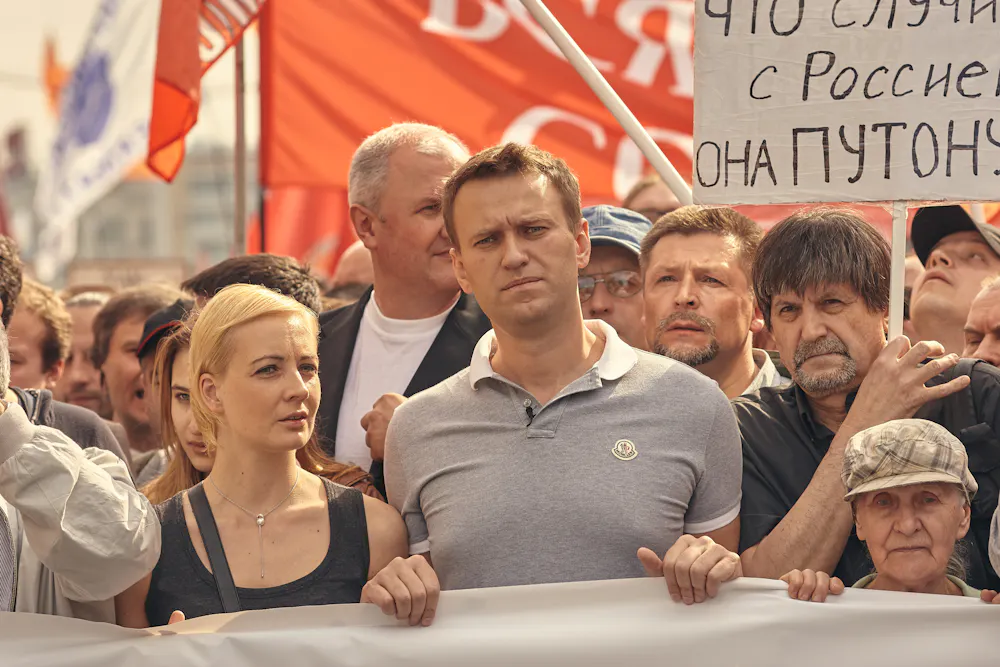
Outrage at Navalny’s detention, combined with this Putin investigation, got people on to the streets. On January 23 2021, 160,000 people turned out across Russia in events that did not have prior approval from the authorities. More than 40% of the participants said they were taking part in a protest for the first time.
But the Russian authorities were determined to also make it their last time. Law enforcement mounted an awesome display of strength, detaining protesters and sometimes beating them. The number of participants at protests on January 31 and February 2 declined sharply as a result.
Between Navalny’s return to Russia in January 2021 and his death in February 2024, aged 47, he faced criminal case after criminal case, adding years and years to his time in prison and increasing the severity of his detention. By the time of his death, he was in the harshest type of prison in the Russian penitentiary system – a “special regime” colony – and was frequently sent to a punishment cell.
The obvious intent was to demoralise Navalny, his team and supporters – making an example of him to spread fear among anyone else who might consider mounting a challenge to the Kremlin. But Navalny fought back, as described in his posthumously published memoir, Patriot. He made legal challenges against his jailers. He went on hunger strike. And he formed a union for his fellow prisoners.
He also used his court appearances to make clear his political views, including following Russia’s full-scale invasion of Ukraine in February 2022, declaring: “I am against this war. I consider it immoral, fratricidal, and criminal.”
Navalny’s final public appearance was via video link. He was in good spirits, with his trademark optimism and humour still on display. Tongue firmly in cheek, he asked the judge for financial help:
Your Honour, I will send you my personal account number so that you can use your huge salary as a federal judge to ‘warm up’ my personal account, because I am running out of money.
Navalny died the following day. According to the prison authorities, he collapsed after a short walk and lost consciousness. Although the Russian authorities claimed he had died of natural causes, documents published in September 2024 by The Insider – a Russia-focused, Latvia-based independent investigative website – suggest Navalny may have been poisoned.
A mourner adds her tribute to Alexei Navalny’s grave in Moscow after his burial on March 1 2024. Aleksey Dushutin/Shutterstock
Whether or not Putin directly ordered his death, Russia’s president bears responsibility – for leading a system that tried to assassinate Navalny in August 2020, and for allowing his imprisonment following Navalny’s return to Russia in conditions designed to crush him.
Commenting in March 2024, Putin stated that, just days before Navalny’s death, he had agreed for his most vocal opponent to be included in a prisoner swap – on condition the opposition figure never returned to Russia. “But, unfortunately,” Putin added, “what happened, happened.”
‘No one will forget’
Putin is afraid of Alexei, even after he killed him.
Yulia Navalnaya, Navalny’s wife, wrote these words on January 10 2025 after reading a curious letter. His mother, Lyudmila Navalnaya, had written to Rosfinmonitoring – a Russian state body – with a request for her son’s name to be removed from their list of “extremists and terrorists” now he was no longer alive.
The official response was straight from Kafka. Navalny’s name could not be removed as it had been added following the initiation of a criminal case against him. Even though he was dead, Rosfinmonitoring had not been informed about a termination of the case “in accordance with the procedure established by law”, so his name would have to remain.
This appears to be yet another instance of the Russian state exercising cruelty behind the veil of bureaucratic legality – such as when the prison authorities initially refused to release Navalny’s body to his mother after his death.
“Putin is doing this to scare you,” Yulia continued. “He wants you to be afraid to even mention Alexei, and gradually to forget his name. But no one will forget.”
Alexei Navalny and his wife, Yulia Navalnaya, at a protest rally in Moscow, May 2012. Dmitry Laudin/Shutterstock
Today, Navalny’s family and team continue his work outside of Russia – and are fighting to keep his name alive back home. But the odds are against them. Polling suggests the share of Russians who say they know nothing about Navalny or his activities roughly doubled to 30% between his return in January 2021 and his death three years later.
Navalny fought against an autocratic system – and paid the price with his life. Given the very real fears Russians may have of voicing support for a man still labelled an extremist by the Putin regime, it’s not easy to assess what people there really think of him and his legacy. But we will also never know how popular Navalny would have been in the “normal” political system he fought for.
What made Navalny the force he was?
Navalny didn’t mean for the humble yellow rubber duck to become such a potent symbol of resistance.
In March 2017, the ACF published its latest investigation into elite corruption, this time focusing on then-prime minister (and former president), Dmitry Medvedev. Navalny’s team members had become masters of producing slick videos that enabled their message to reach a broad audience. A week after posting, the film had racked up over 7 million views on YouTube – an extraordinary number at that time.
The film included shocking details of Medvedev’s alleged avarice, including yachts and luxury properties. In the centre of a large pond in one of these properties was a duck house, footage of which was captured by the ACF using a drone.
Video: ACF.
Such luxuries jarred with many people’s view of Medvedev as being a bit different to Putin and his cronies. As Navalny wrote in his memoir, Medvedev had previously seemed “harmless and incongruous”. (At the time, Medvedev’s spokeswoman said it was “pointless” to comment on the ACF investigation, suggesting the report was a “propaganda attack from an opposition figure and a convict”.)
But people were angry, and the report triggered mass street protests across Russia. They carried yellow ducks and trainers, a second unintended symbol from the film given Medvedev’s penchant for them.
Another reason why so many people came out to protest on March 26 2017 was the organising work carried out by Navalny’s movement.
The previous December, Navalny had announced his intention to run in the 2018 presidential election. As part of the campaign, he and his team created a network of regional headquarters to bring together supporters and train activists across Russia. Although the authorities had rejected Navalny’s efforts to register an official political party, this regional network functioned in much the same way, gathering like-minded people in support of an electoral candidate. And this infrastructure helped get people out on the streets.
The Kremlin saw this as a clear threat. According to a December 2020 investigation by Bellingcat, CNN, Der Spiegel and The Insider, the FSB assassination squad implicated in the Novichok poisoning of Navalny had started trailing him in January 2017 – one month after he announced his run for the presidency.
At the protests against Medvedev, the authorities’ growing intolerance of Navalny was also on display – he was detained, fined and sentenced to 15 days’ imprisonment.
The Medvedev investigation was far from the beginning of Navalny’s story as a thorn in the Kremlin’s side. But this episode brings together all of the elements that made Navalny the force he was: anti-corruption activism, protest mobilisation, attempts to run as a “normal” politician in a system rigged against him, and savvy use of social media to raise his profile in all of these domains.
Courting controversy
In Patriot, Navalny writes that he always “felt sure a broad coalition was needed to fight Putin”. Yet over the years, his attempts to form that coalition led to some of the most controversial points of his political career.
In a 2007 video, Navalny referred to himself as a “certified nationalist”, advocating for the deportation of illegal immigrants, albeit without using violence and distancing himself from neo-Nazism. In the video, he says: “We have the right to be Russians in Russia, and we’ll defend that right.”
Although alienating some, Navalny was attempting to present a more acceptable face of nationalism, and he hoped to build a bridge between nationalists and liberals in taking on the Kremlin’s burgeoning authoritarianism.
But the prominence of nationalism in Navalny’s political identity varied markedly over time, probably reflecting his shifting estimations of which platform could attract the largest support within Russia. By the time of his thwarted run in the 2018 presidential election, nationalist talking points were all but absent from his rhetoric.
However, some of these former comments and positions continue to influence how people view him. For example, following Russia’s annexation of Crimea in 2014, Navalny tried to take a pragmatic stance. While acknowledging Russia’s flouting of international law, he said that Crimea was “now part of the Russian Federation” and would “never become part of Ukraine in the foreseeable future”.
Many Ukrainians take this as clear evidence that Navalny was a Russian imperialist. Though he later revised his position, saying Crimea should be returned to Ukraine, some saw this as too little, too late. But others were willing to look past the more controversial parts of his biography, recognising that Navalny represented the most effective domestic challenge to Putin.
Another key attempt to build a broad political coalition was Navalny’s Smart Voting initiative. This was a tactical voting project in which Navalny’s team encouraged voters to back the individual thought best-placed to defeat the ruling United Russia candidate, regardless of the challenger’s ideological position.
The project wasn’t met with universal approval. Some opposition figures and voters baulked at, or flatly refused to consider, the idea of voting for people whose ideological positions they found repugnant – or whom they viewed as being “fake” opposition figures, entirely in bed with the authorities. (This makes clear that Navalny was never the leader of the political opposition in Russia; he was, rather, the leading figure of a fractious constellation of individuals and groups.)
But others relished the opportunity to make rigged elections work in their favour. And there is evidence that Smart Voting did sometimes work, including in the September 2020 regional and local elections, for which Navalny had been campaigning when he was poisoned with Novichok.
In an astonishing moment captured on film during his recovery in Germany, Navalny speaks to an alleged member of the FSB squad sent to kill him. Pretending to be the aide to a senior FSB official, Navalny finds out that the nerve agent had been placed in his underpants.
How do Russians feel about Navalny now?
It’s like a member of the family has died.
This is what one Russian friend told me after hearing of Navalny’s death a year ago. Soon afterwards, the Levada Center – an independent Russian polling organisation – conducted a nationally representative survey to gauge the public’s reaction to the news.
The poll found that Navalny’s death was the second-most mentioned event by Russian people that month, after the capture of the Ukrainian city of Avdiivka by Russian troops. But when asked how they felt about his death, 69% of respondents said they had “no particular feelings” either way – while only 17% said they felt “sympathy” or “pity”.
And that broadly fits with Navalny’s approval ratings in Russia. After his poisoning in 2020, 20% of Russians said they approved of his activities – but this was down to 11% by February 2024.
Video: BBC.
Of course, these numbers must be taken for what they are: polling in an authoritarian state regarding a figure vilified and imprisoned by the regime, during a time of war and amid draconian restrictions on free speech. To what extent the drop in support for Navalny was real, rather than reflecting the increased fear people had in voicing their approval for an anti-regime figure, is hard to say with certainty.
When asked why they liked Navalny, 31% of those who approved of his activities said he spoke “the truth”, “honestly” or “directly”. For those who did not approve of his activities, 22% said he was “paid by the west”, “represented” the west’s interests, that he was a “foreign agent”, a “traitor” or a “puppet”.
The Kremlin had long tried to discredit Navalny as a western-backed traitor. After Navalny’s 2020 poisoning, Putin’s spokesman, Dmitry Peskov, said that “experts from the United States’ Central Intelligence Agency are working with him”. The Russian state claimed that, rather than a patriot exposing official malfeasance with a view to strengthening his country, Navalny was a CIA stooge intent on destroying Russia.
Peskov provided no evidence to back up this claim – and the official propaganda wasn’t believed by all. Thousands of Russians defied the authorities by coming out to pay their respects at Navalny’s funeral on March 1 2024. Many, if not all, knew this was a significant risk. Police employed video footage to track down members of the funeral crowd, including by using facial recognition technology.
The first person to be detained was a Muscovite the police claimed they heard shouting “Glory to the heroes!” – a traditional Ukrainian response to the declaration “Glory to Ukraine!”, but this time referencing Navalny. She spent a night in a police station before being fined for “displaying a banned symbol”.
Putin always avoided mentioning Navalny’s name in public while he was alive – instead referring to him as “this gentleman”, “the character you mentioned”, or the “Berlin patient”. (The only recorded instance of Putin using Navalny’s name in public when he was alive was in 2013.)
However, having been re-elected president in 2024 and with Navalny dead, Putin finally broke his long-held practice, saying: “As for Navalny, yes he passed away – this is always a sad event.” It was as if the death of his nemesis diminished the potency of his name – and the challenge that Navalny had long presented to Putin.
Nobody can become another Navalny
Someone else will rise up and take my place. I haven’t done anything unique or difficult. Anyone could do what I’ve done.
So wrote Navalny in the memoir published after his death. But that hasn’t happened: no Navalny 2.0 has yet emerged. And it’s no real surprise. The Kremlin has taken clear steps to ensure nobody can become another Navalny within Russia.
In 2021, the authorities made a clear decision to destroy Navalny’s organisations within Russia, including the ACF and his regional network. Without the organisational infrastructure and legal ability to function in Russia, no figure has been able to take his place directly.
More broadly, the fate of Navalny and his movement has had a chilling effect on the opposition landscape. So too have other steps taken by the authorities.
Russia has become markedly more repressive since the start of its war on Ukraine. The human rights NGO First Department looked into the number of cases relating to “treason”, “espionage” and “confidential cooperation with a foreign state” since Russia introduced the current version of its criminal code in 1997. Of the more than 1,000 cases, 792 – the vast majority – were initiated following Russia’s full-scale invasion of Ukraine in 2022.
Russian law enforcement has also used nebulous anti-extremism and anti-terrorism legislation to crack down on dissenting voices. Three of Navalny’s lawyers were sentenced in January 2025 for participating in an “extremist organisation”, as the ACF was designated by a Moscow court in June 2021. The Russian legislature has also passed a barrage of legislation relating to so-called “foreign agents”, to tarnish the work of those the regime regards as foreign-backed “fifth columnists”.
Mass street protests are largely a thing of the past in Russia. Restrictions were placed on public gatherings during the COVID pandemic – but these rules were applied selectively, with opposition individuals and groups being targeted. And opportunities for collective action were further reduced following the full-scale invasion of Ukraine.
Freedom of speech has also come under assault. Article 29, point five of the Russian constitution states: “Censorship shall be prohibited.” But in September 2024, Kremlin spokesperson Peskov said: “In the state of war that we are in, restrictions are justified, and censorship is justified.”
Legislation passed very soon after the 2022 invasion of Ukraine made it illegal to comment on the Russian military’s activities truthfully – and even to call the war a war.
YouTube – the platform so central to Navalny’s ability to spread his message – has been targeted. Without banning it outright – perhaps afraid of the public backlash this might cause – the Russian state media regulator, Roskomnadzor, has slowed down internet traffic to the site within Russia. The result has been a move of users to other websites supporting video content, including VKontakte – a Russian social media platform.
In short, conditions in Russia are very different now compared to when Navalny first emerged. The relative freedom of the 2000s and 2010s gave him the space to challenge the corruption and authoritarianism of an evolving system headed by Putin. But this space has shrunk over time, to the point where no room remains for a figure like him within Russia.
In 2019, Navalny told Ivan Zhdanov, who is now director of the ACF: “We changed the regime, but not in the way we wanted.” So, did Navalny and his team push the Kremlin to become more authoritarian – making it not only intolerant of him but also any possible successor?
There may be some truth in this. And yet, the drastic steps taken by the regime following the start of the war on Ukraine suggest there were other, even more significant factors that have laid bare the violent nature of Putin’s personal autocracy – and the president’s disdain for dissenters.
Plenty for Russians to be angry about
How can we win the war when dedushka [grandpa] is a moron?
In June 2023, Evgeny Prigozhin – a long-time associate of Putin and head of the private military Wagner Group – staged an armed rebellion, marching his forces on the Russian capital. This was not a full-blown political movement against Putin. But the target of Prigozhin’s invective against Russia’s military leadership had become increasingly blurry, testing the taboo of direct criticism of the president – who is sometimes referred to, disparagingly, as “grandpa” in Russia.
And Prigozhin paid the price. In August 2023, he was killed when the private jet he was flying in crashed after an explosion on board. Afterwards, Putin referred to Prigozhin as a “talented person” who “made serious mistakes in life”.
In the west, opposition to the Kremlin is often associated with more liberal figures like Navalny. Yet the most consequential domestic challenge to Putin’s rule came from a very different part of the ideological spectrum – a figure in Prigozhin leading a segment of Russian society that wanted the Kremlin to prosecute its war on Ukraine even more aggressively.
Video: BBC.
Today, there is plenty for Russians to be angry about, and Putin knows it. He recently acknowledged an “overheating of the economy”. This has resulted in high inflation, in part due to all the resources being channelled into supporting the war effort. Such cost-of-living concerns weigh more heavily than the war on the minds of most Russians.
A favourite talking point of the Kremlin is how Putin imposed order in Russia following the “wild 1990s” – characterised by economic turbulence and symbolised by then-president Boris Yeltsin’s public drunkenness. Many Russians attribute the stability and rise in living standards they experienced in the 2000s with Putin’s rule – and thank him for it by providing support for his continued leadership.
The current economic problems are an acute worry for the Kremlin because they jeopardise this basic social contract struck with the Russian people. In fact, one way the Kremlin tried to discredit Navalny was by comparing him with Yeltsin, suggesting he posed the same threats as a failed reformer. In his memoir, Navalny concedes that “few things get under my skin more”.
Although originally a fan of Yeltsin, Navalny became an ardent critic. His argument was that Yeltsin and those around him squandered the opportunity to make Russia a “normal” European country.
Navalny also wanted Russians to feel entitled to more. Rather than be content with their relative living standards compared with the early post-Soviet period, he encouraged them to imagine the level of wealth citizens could enjoy based on Russia’s extraordinary resources – but with the rule of law, less corruption, and real democratic processes.
‘Think of other possible Russias’
When looking at forms of criticism and dissent in Russia today, we need to distinguish between anti-war, anti-government, and anti-Putin activities.
Despite the risk of harsh consequences, there are daily forms of anti-war resistance, including arson attacks on military enlistment offices. Some are orchestrated from Ukraine, with Russians blackmailed into acting. But other cases are likely to be forms of domestic resistance.
Criticism of the government is still sometimes possible, largely because Russia has a “dual executive” system, consisting of a prime minister and presidency. This allows the much more powerful presidency to deflect blame to the government when things go wrong.
There are nominal opposition parties in Russia – sometimes referred to as the “systemic opposition”, because they are loyal to the Kremlin and therefore tolerated by the system. Within the State Duma, these parties often criticise particular government ministries for apparent failings. But they rarely, if ever, now dare criticise Putin directly.
Nothing anywhere close to the challenge presented by Navalny appears on the horizon in Russia – at either end of the political spectrum. But the presence of clear popular grievances, and the existence of organisations (albeit not Navalny’s) that could channel this anger should the Kremlin’s grip loosen, mean we cannot write off all opposition in Russia.
Navalny’s wife, Yulia, has vowed to continue her husband’s work. And his team in exile maintain focus on elite corruption in Russia, now from their base in Vilnius, Lithuania. The ACF’s most recent investigation is on Igor Sechin, CEO of the oil company Rosneft.
But some have argued this work is no longer as relevant as it was. Sam Greene, professor in Russian politics at King’s College London, captured this doubt in a recent Substack post:
[T]here is a palpable sense that these sorts of investigations may not be relevant to as many people as they used to be, given everything that has transpired since the mid-2010s, when they were the bread and butter of the Anti-Corruption Foundation. Some … have gone as far as to suggest that they have become effectively meaningless … and thus that Team Navalny should move on.
Navalny’s team are understandably irritated by suggestions they’re no longer as effective as they once were. But it’s important to note that this criticism has often been sharpest within Russia’s liberal opposition. The ACF has been rocked, for example, by recent accusations from Maxim Katz, one such liberal opposition figure, that the organisation helped “launder the reputations” of two former bank owners. In their response, posted on YouTube, the ACF referred to Katz’s accusations as “lies” – but this continued squabbling has left some Russians feeling “disillusioned and unrepresented”.
So, what will Navalny’s long-term legacy be? Patriot includes a revealing section on Mikhail Gorbachev – the last leader of the Soviet Union, whom Navalny describes as “unpopular in Russia, and also in our family”. He continues:
Usually, when you tell foreigners this, they are very surprised, because Gorbachev is thought of as the person who gave Eastern Europe back its freedom and thanks to whom Germany was reunited. Of course, that is true … but within Russia and the USSR he was not particularly liked.
At the moment, there is a similar split in perceptions of Navalny. Internationally, he was nominated for the Nobel Peace Prize, awarded the Sakharov Prize by the European Parliament, and a documentary about him won an Oscar.
But there are also those outside of Russia who remain critical: “Navalny’s life has brought no benefit to the Ukrainian victory; instead, he has caused considerable harm,” wrote one Ukrainian academic. “He fuelled the illusion in the west that democracy in Russia is possible.”
Trailer for the Oscar-winning documentary Navalny.
Inside Russia, according to Levada Center polling shortly after his death, 53% of Russians thought Navalny played “no special role” in the history of the country, while 19% said he played a “rather negative” role. Revealingly, when commenting on Navalny’s death, one man in Moscow told RFE/RL’s Russian Service: “I think that everyone who is against Russia is guilty, even if they are right.”
But, for a small minority in Russia, Navalny will go down as a messiah-like figure who miraculously cheated death in 2020, then made the ultimate sacrifice in his battle of good and evil with the Kremlin. This view may have been reinforced by Navalny’s increasing openness about his Christian faith.
Ultimately, Navalny’s long-term status in Russia will depend on the nature of the political system after Putin has gone. Since it seems likely that authoritarianism will outlast Putin, a more favourable official story about Navalny is unlikely to emerge any time soon. However, how any post-Putin regime tries to make sense of Navalny’s legacy will tell us a lot about that regime.
While he was alive, Navalny stood for the freer Russia in which he had emerged as a leading opposition figure – and also what he called the “Beautiful Russia of the Future”. Perhaps, after his death, his lasting legacy in Russia remains the ability for some to think – if only in private – of other possible Russias.
To hear about new Insights articles, join the hundreds of thousands of people who value The Conversation’s evidence-based news. Subscribe to our newsletter.
Ben Noble has previously received funding from the British Academy and the Leverhulme Trust. He is an Associate Fellow of Chatham House.
European defence ministers left their meeting in Brussels on February 12 in shock after the new US secretary of defence, Pete Hegseth, told them they could no longer rely on the US to guarantee their security.
Hegseth said he was there “to directly and unambiguously express that stark strategic realities prevent the United States of America from being primarily focused on the security of Europe”.
He also insisted that European countries provide the “overwhelming” share of funding for Ukraine in the future. The US has been the biggest source of military aid to Ukraine, with its weapons, equipment and financial assistance crucial in helping Kyiv resist the Russian invasion.
Hegseth’s comments are in keeping with the stance of the US president, Donald Trump, on the Nato transatlantic military alliance. Trump sees Nato as an excessive financial burden on the US and has repeatedly called on its members to increase their defence spending.
But Hegseth’s remarks could also be seen as a sign of America’s waning commitment to the terms of Nato’s founding treaty. Signed in 1949 by the US, Canada and several western European nations, Article 5 of the treaty requires member states to defend each other in the event of an armed attack.
The US has the largest military – and the biggest stockpile of nuclear weapons – in Nato. So, on the face of it, efforts to recast the alliance appear a drastic shift in Europe’s security landscape in the post-cold war era.
However, those familiar with the political sentiment around Nato and the defence of Europe in the US will see that this move follows in the footsteps of what others have sought to do – starting from the very end of the cold war.
Changing over time
In 1991, following the collapse of the Soviet Union, Nato was under considerable pressure to change for the new world order. A rising China was not yet on the minds of many in Washington, but the feeling was that the financial commitments the US had made to defend western Europe during the cold war could not continue.
The so-called “peace dividend”, a slogan popularised by former US president George H.W. Bush and former UK prime minister Margaret Thatcher, allowed nearly all Nato states to reduce their military spending at this time.
In 1992, almost as soon as European Nato countries were shrinking their forces and moving away from mass armies to professional soldiering, the alliance became actively engaged in maintaining a no-fly zone over Yugoslavia.
A new Nato was becoming apparent. It was transitioning from being a collective defence organisation to one of collective security, where conflicts were managed on Nato’s borders.
This collective security arrangement worked well to keep the alliance together until 2001, when the administration of George W. Bush entered the White House and involved the US in wars in Afghanistan and Iraq. Following the 9/11 terrorist attacks in the US, Nato invoked Article 5 and returned to the principle of collective defence.
Many European countries, including the new, smaller Nato states like Estonia and Latvia, sent troops to Iraq and Afghanistan. The persistent justification I heard in the Baltic states was “we need to be there when the US needs us so that they will be there when we need them”.
Yet in 2011, before the wars in Iraq and Afghanistan were over, the administration of Barack Obama introduced a foreign policy strategy known as the “pivot to Asia”. The implication was that the US would shift its attention from primarily the western hemisphere to China.
By this point, China had become the second-largest economy in the world and was rapidly developing its military. The reaction to this US policy shift in European capitals was one of shock and disappointment. They saw it as the US deciding that its own security did not sit in Europe like it had since 1945.
Then, in 2014, Russia invaded Crimea and the Donbas in eastern Ukraine. The pivot to Asia looked like it had stalled. But US interest and investment in European defence continued to decline, with American military bases across Europe closed down. The first Trump administration continued the pattern set by Obama.
President Joe Biden, who entered office in 2021, used Russia’s invasion of Ukraine in 2022 to show European leaders that the US still saw its own security in Europe and that it would stand beside Ukraine.
But the US continued to insist that European countries invest in their own defence. The UK, Poland and France have all committed to increase their defence spending over recent years – though spending by European Nato states as a whole continued to fall.
There has been a long-held belief in the US that Europe is “freeriding” on American power. While the US saw its own security in Europe, this freeriding was allowed to continue.
But as the perspective of the US has changed, with the focus now on countering China, it has been keen to suggest that European defence should increasingly become the job of Europe itself.
Nato will not go out with a bang. It is much more likely to gradually disappear with a whimper. After all, who did Trump meet on his second day in office? Not Nato but the Quad: an alliance between Australia, India, Japan and the US in the Indo-Pacific.
David J. Galbreath has received research funding from the UKRI.
Source: The Conversation – UK – By David Hastings Dunn, Professor of International Politics in the Department of Political Science and International Studies, University of Birmingham
Donald Trump likes to portray himself as the great deal maker. Typically, his idea of the “Art of the Deal” had tended to involve outlandishly bullish opening demands – whether that’s on tariffs or trade deals – before settling on more moderate, but still exacting conditions. This context makes what happened when the US president spoke with his Russian counterpart Vladimir Putin about Ukraine so remarkable.
The very fact that Trump spoke with Putin at all was a diplomatic gift to the pariah state and its leader. For three years Russia has been diplomatically isolated by most western leaders, many of whom have called for Putin to face war crimes charges (there is currently an ICC arrest warrant out for Putin for the alleged illegal transfer of children from, Ukraine to Russia).
Indeed, the fact that Trump spoke with Putin and only then called the Ukrainian president, Volodymyr Zelensky, to inform him of their conversation indicates the subordination of Ukraine’s role in the talks.
Trumpeting the call as “highly productive” on his TruthSocial website, Trump wrote that the two leaders had spoken about the “strengths of our respective nations, and the great benefit that we will someday have in working together”. He said they had arranged to visit each other’s nations. In fact, the two will initially meet in Saudi Arabia – where Putin would not be arrested under the ICC’s warrant.
At the same time, Trump’s new defense secretary spelled out to a meeting of European defence officials the administration’s position on some of the key issues. It was clear that several of Ukraine’s “red lines” had already fallen by the wayside as far as the US is concerned.
Hegseth said that returning to Ukraine’s pre-2014 borders is “an unrealistic objective” and an “illusionary goal” and that any deal must be based on “a realistic assessment of the battlefield.”
Likewise Ukraine’s future Nato membership – something the US committed to support in the 2008 Budapest Declaration, was also a non-starter. And he said the US would not onlynot join any international force deployed to ensure Ukrainian security, but that if such a force were constituted it would not be a Nato operation. As such, he said, it would not be covered by the alliance’s article 5 pledge for collective security. This effectively dooms this initiative to failure.
As important as what was announced by the Trump administration on this subject, was what was omitted. Trump has never condemned Putin for his illegal invasion of Ukraine. And there has been no mention in his social media posts that Russia’s invasion of Ukraine was a violation of international law. Or the inviolability of Ukraine’s borders or the issue of Russian reparations for the material and human damage inflicted on Ukraine.
Russia celebrates
Russia, meanwhile, is cock-a-hoop. Kremlin spokesman Dmitri Peskov reported that Putin talked about Moscow’s demands, telling Trump of “the need to eliminate the root causes of the conflict”. This suggests that while Ukraine’s red lines are going to be ignored by the US, Russia will continue to insist on its maximalist demands that the Russians intend to take in their approach to the negotiation.
In addition to the concessions that Hegseth indicated the Trump administration has already decided to go along with, Russia is also likely to press for the demilitarisation of Ukraine. It will demand control, not just of the territory that it occupies, but of the remainder of the Ukrainian provinces that Putin has already declared to be “Russian”: Luhansk, Donetsk, Zaporizhzhia and Kherson, in the south and east of Ukraine.
Both the Russian stock market and the ruble rose sharply on the US announcement of the talks, and the government-controlled press in Russian could hardly hide their glee, reporting that: “Russia is ready for talks. But on its terms”.
European leaders shocked
The pace and scale of US concessions on Ukraine seen to have caught the US’s European Nato allies off guard. Like Ukraine itself, they have been sidelined by Trump’s decision to seek direct negotiations with Putin. The UK’s defence secretary, John Healey, issued a statement appealing that “that there can be no negotiation about Ukraine without Ukraine and Ukraine’s voice must be at the heart of any talks”.
German foreign minister, Anna Baerbock, meanwhile, said the call had come out of the blue without any consultation with Europe: “This is the way the Trump administration operates,” she said, adding: “This is not how others do foreign policy, but this is now the reality.” Baerbock said a deal must not be imposed on Ukraine and that Europe should be involved in negotiations: “This is about European peace. That’s why we Europeans must be involved.”
The French foreign ministry put out a statement saying that: “Ukraine and Europe must be part of any negotiations. Ukraine should be provided with strong security guarantees.”
Other commentators have been less diplomatic. Michael McFaul, who served as US ambassador to Russia under Barack Obama, took to X to question Trump’s tactics: “Diplomacy 101: Don’t give anything without getting something in return. Don’t negotiate in public. Don’t negotiate about Ukraine’s future without first coordinating your position with Ukrainians.”
We’ll know more about what – if any – agency Volodymyr Zelensky and his diplomats have in the future of their country after US secretary of state, Marco Rubio, and vice-president, JD Vance, meet with Zelensky at the Munich Security Conference on February 14-16.
But for the present at least, it appears that negotiations will be less about pressuring Putin to bring a just end to the war he started, than forcing Ukraine to give in to the Russian leader’s demands.
David Hastings Dunn has previously received funding from the ESRC, the Gerda Henkel Foundation, the Open Democracy Foundation and has previously been both a NATO and a Fulbright Fellow.
PALM BEACH, Fla., Feb. 13, 2025 (GLOBE NEWSWIRE) — FN Media GroupNews Commentary – The surge in global defense budgets has had a significant impact on the Global Military Drone Market. As political tensions rise worldwide, nations are investing in cutting-edge unmanned aerial systems (UAS) to bolster their defense and security capabilities. Increased defense expenditure has allowed countries like the United States, China, and other NATO members to allocate substantial funds to advanced drone programs, enhancing surveillance, supporting combat missions, and improving autonomous drone features. A recent report from an industry expert said that: “The growing demand for real-time intelligence in dynamic, complex military environments has significantly increased the need for sophisticated drones equipped with advanced surveillance and reconnaissance capabilities. Military drones are now integrated with cutting-edge technologies such as high-resolution cameras, infrared sensors, and other advanced systems that enhance situational awareness for both tactical operations and comprehensive intelligence gathering. For instance, the Northrop Grumman RQ-4 Global Hawk is capable of surveying over 40,000 square miles in a single day, providing extensive monitoring of large areas. This level of surveillance is invaluable for sustained military operations in regions like Ukraine and other conflict zones, where real-time intelligence is crucial for strategic decision-making and operational effectiveness.” Active Companies in the markets today include ZenaTech, Inc. (NASDAQ: ZENA), AeroVironment (NASDAQ: AVAV), Kratos Defense & Security Solutions, Inc. (NASDAQ: KTOS), L3Harris Technologies (NYSE: LHX), Unusual Machines (NYSE: UMAC).
The article continued: “The integration of emerging technologies into military drones presents a significant growth opportunity for the market. Technologies such as artificial intelligence (AI), machine learning, autonomous navigation systems, and advanced sensors are revolutionizing the capabilities of military drones. AI-driven systems, for instance, can enable drones to analyze vast amounts of real-time data, enhancing decision-making and targeting accuracy. Autonomous navigation allows drones to operate with minimal human intervention, improving operational efficiency and reducing the risk to personnel. For example, the U.S. military has incorporated AI into its MQ-9 Reaper drones to enhance autonomous targeting and surveillance capabilities, allowing for more precise missions in complex environments.”
ZenaTech (NASDAQ:ZENA) ZenaDrone Subsidiary Develops and Tests Proprietary Drone Communications System Enabling Secure and Reliable Communications for US Defense Applications – ZenaTech, Inc. (FSE: 49Q) (BMV: ZENA) (“ZenaTech”), a technology company specializing in AI (Artificial Intelligence) drones, Drone as a Service (DaaS), enterprise SaaS and Quantum Computing solutions, announces that its subsidiary ZenaDrone has developed and is currently testing a proprietary drone communications management system called “DroneNet” that enables direct and secure drone communications in situations without reliable internet, cellular or satellite communications. The internally developed system is specifically built for use with the Company’s ZenaDrone 1000 and IQ series of drone products. A drone communications system is a two-way link between a drone and its base station used to direct the drone and relay real-time drone video and sensor data.
“We believe our proprietary DroneNet communications system will improve both the reliability and performance of our drones ensuring we are not dependent on third-party products with compatibility issues. This internal development ensures we gain more customization of our products, cost management, and control of our supply chain, all of which results in what we believe to be superior drone solutions. Once we’ve tested this initial version, our plan for future advancements includes developing and testing our own microchips with multilayer encryption suitable for NDAA-compliant use required for US Defense applications,” said CEO Shaun Passley, Ph.D.
Drones used by the military for intelligence, surveillance and reconnaissance applications require reliable communications systems for uninterrupted data transmission, mission effectiveness, and operational security. Drones must relay real-time video, sensor data, and telemetry to command centers, allowing defense operators to make time-sensitive decisions. This is especially critical for Beyond Visual Line of Sight (BVLOS) operations, where drones operate over longer distances often in harsh or contested environments. Without secure and resilient communications links, drones risk losing control, can face signal jamming, or data latency, which can compromise mission success. Advanced proprietary communication solutions, using satellite and 4G help ensure connectivity in GPS-denied or high-interference environments and can safeguard data against jamming and cyber threats.
The ZenaDrone 1000 is an autonomous drone, in a VTOL (Vertical Takeoff and Landing) quadcopter design with eight rotors; it is considered a medium-sized drone measuring 12X7 feet in size. It is designed for stable flight, maneuverability, heavy lift capabilities up to 40 kilos, incorporating innovative software technology, AI, sensors, and purpose-built attachments, along with compact and rugged hardware engineered for industrial and defense use. Continued…Read this full release by visiting:https://www.financialnewsmedia.com/news-zena/
Other recent developments in the markets include:
AeroVironment (NASDAQ: AVAV), through its wholly owned subsidiary Arcturus UAV, has recently been awarded a contract by the Danish Defense Acquisition and Logistics Organization (DALO) with a contract ceiling value of $181 million to deliver the JUMP® 20 medium uncrewed aircraft system (UAS) to the Danish Armed Forces. This 10-year program of record will equip the Danish Army with JUMP 20 systems to enhance intelligence, surveillance, and reconnaissance (ISR) operations, reinforcing AV’s position as a global leader in advanced autonomous solutions.
JUMP 20 is a vertical take-off and landing (VTOL), fixed-wing UAS with 13+ hours of endurance and an operational range of 185 km (115 mi). Runway independent, the system is easily storable and transportable, and can autonomously launch and land at speed without personnel intervention, making it ideal for on-the-move operations.
Kratos Defense & Security Solutions, Inc. (NASDAQ: KTOS), a Technology Company in Defense, National Security and Global Markets, recently announced a $34,856,449 award modification to a previously awarded cost-plus-fixed-fee contract from the U.S. Marine Corps. The expanded scope is to support the XQ-58A Unmanned Aerial Systems mission systems and subsystems integration for the Marine Air-Ground Task Force Unmanned Aerial System Expeditionary (MUX) Tactical Aircraft (TACAIR).
Since 2022, Kratos and its industry partner, Northrop Grumman, have been working with the U.S. Marine Corps to define operational requirements for the MQ-58 Valkyrie variant. The team recently demonstrated advanced collaborative capabilities during the Penetrating Affordable Autonomous Collaborative Killer Portfolio (PAACK-P) program, which is transitioning to MUX TACAIR in 2025. The modification contract provides the additional non-recurring engineering and material to support the planned spiral developmental efforts, as well as additional flight tests for the continuing capability enhancement of the Valkyrie system.
L3Harris Technologies (NYSE: LHX) has recently introduced AMORPHOUS™, its new software that features a single user interface to operate thousands of autonomous assets simultaneously. Designed with an open architecture, this software enables the United States and allied militaries to control a mix of uncrewed platforms, payloads and systems, even if another manufacturer produces them.
AMORPHOUS, which stands for Autonomous Multi-domain Operations Resiliency Platform for Heterogeneous Unmanned Swarms, includes an intuitive and distributed command-and-control interface to give operators the flexibility to conduct a wider array of intricate military missions. This collaborative autonomy at scale will provide warfighters with a decisive overmatch capability.
Unusual Machines (NYSE: UMAC) has recently announced the signing of a binding agreement to acquire of Aloft Technologies, Inc. (https://www.aloft.ai/), the leading FAA-approved provider of unmanned aerial system (UAS) services to enterprise, public safety, and government customers. The acquisition is almost all in stock, valued at $14.5M.
The proposed acquisition brings together companies that share commitment to strengthening the U.S. drone industry. Aloft Technologies has long been recognized as the leader in the drone fleet and airspace management sector, powering more than 70% of all FAA-approved Low Altitude Authorization and Notification Capability (LAANC) airspace authorizations in the United States. Aloft has provided more than more than 1.6 million authorizations in total, with 400,000 authorizations provided in 2024.
Aloft has been able to leverage the data collected through millions of safe flights and airspace interactions to launch Air Boss, their new real-time UAS air traffic management (UTM) software. With the FAA forecasting more than 3 million drones in the airspace by 2028, outnumbering traditional aircraft more than 10-to-1, the coordination and integration of all aircraft is critical to national security and the national economy.
About FN Media Group:
At FN Media Group, via our top-rated online news portal at www.financialnewsmedia.com, we are one of the very few select firms providing top tier one syndicated news distribution, targeted ticker tag press releases and stock market news coverage for today’s emerging companies. #tickertagpressreleases #pressreleases
DISCLAIMER: FN Media Group LLC (FNM), which owns and operates FinancialNewsMedia.com and MarketNewsUpdates.com, is a third party publisher and news dissemination service provider, which disseminates electronic information through multiple online media channels. FNM is NOT affiliated in any manner with any company mentioned herein. FNM and its affiliated companies are a news dissemination solutions provider and are NOT a registered broker/dealer/analyst/adviser, holds no investment licenses and may NOT sell, offer to sell or offer to buy any security. FNM’s market updates, news alerts and corporate profiles are NOT a solicitation or recommendation to buy, sell or hold securities. The material in this release is intended to be strictly informational and is NEVER to be construed or interpreted as research material. All readers are strongly urged to perform research and due diligence on their own and consult a licensed financial professional before considering any level of investing in stocks. All material included herein is republished content and details which were previously disseminated by the companies mentioned in this release. FNM is not liable for any investment decisions by its readers or subscribers. Investors are cautioned that they may lose all or a portion of their investment when investing in stocks. For current services performed FNM has been compensated fifty four hundred dollars for news coverage of the current press releases issued by ZenaTech, Inc. by the Company. FNM HOLDS NO SHARES OF ANY COMPANY NAMED IN THIS RELEASE.
This release contains “forward-looking statements” within the meaning of Section 27A of the Securities Act of 1933, as amended, and Section 21E the Securities Exchange Act of 1934, as amended and such forward-looking statements are made pursuant to the safe harbor provisions of the Private Securities Litigation Reform Act of 1995. “Forward-looking statements” describe future expectations, plans, results, or strategies and are generally preceded by words such as “may”, “future”, “plan” or “planned”, “will” or “should”, “expected,” “anticipates”, “draft”, “eventually” or “projected”. You are cautioned that such statements are subject to a multitude of risks and uncertainties that could cause future circumstances, events, or results to differ materially from those projected in the forward-looking statements, including the risks that actual results may differ materially from those projected in the forward-looking statements as a result of various factors, and other risks identified in a company’s annual report on Form 10-K or 10-KSB and other filings made by such company with the Securities and Exchange Commission. You should consider these factors in evaluating the forward-looking statements included herein, and not place undue reliance on such statements. The forward-looking statements in this release are made as of the date hereof and FNM undertakes no obligation to update such statements.
Contact Information:
Media Contact email: editor@financialnewsmedia.com – +1(561)325-8757
ATHENS, Greece, Feb. 13, 2025 (GLOBE NEWSWIRE) — IMPERIAL PETROLEUM INC. (NASDAQ: IMPP, the “Company”), a ship-owning company providing petroleum products, crude oil and dry bulk seaborne transportation services, announced today its unaudited financial and operating results for the fourth quarter and twelve months ended December 31, 2024.
OPERATIONAL AND FINANCIAL HIGHLIGHTS
Fleet operational utilization of 86.0% in Q4 24’ versus 68.5% in Q4 23’.
Almost 180% increase in Q4 24’ time charter days compared to Q4 23’, as two of our product tankers and one newly acquired bulk carrier were under time charter (“TC”) employment for the whole period.
For the 12M 24’ period our operational utilization was 78.3%. 69% of our fleet calendar days were dedicated to spot activity, while 29% to time charter activity.
Delivery of the product tanker, Clean Imperial on January 10, 2025. With this vessel addition, our tanker fleet totals nine ships.
Revenues of $26.2 million in Q4 24’ compared to $29.9 million in Q4 23’, representing a 12.4% decline due primarily to decreased spot market rates.
Net income of $3.9 million in Q4 24’ compared to $6.5 million in Q4 23’. In Q4 24’ we incurred a $3.3 million foreign exchange loss.
Cash and cash equivalents including time deposits of $206.7 million as of December 31, 2024, compared to $124.0 million as of December 31, 2023, representing a 66.7% increase.
For the 12M 24’ period our net income was $50.2 million, while our operating cash flow amounted to $77.7 million.
Recurring profitability and a debt-free capital structure facilitate robust cash flow generation and low breakeven points.
Fourth Quarter 2024 Results:
Revenues for the three months ended December 31, 2024 amounted to $26.2 million, a decrease of $3.7 million, or 12.4%, compared to revenues of $29.9 million for the three months ended December 31, 2023, primarily due to a decrease in the spot market rates.
Voyage expenses and vessels’ operating expenses fo r the three months ended December 31, 2024 were $8.5 million and $6.7 million, respectively, compared to $13.8 million and $5.7 million, respectively, for the three months ended December 31, 2023. The $5.3 million decrease in voyage expenses is mainly attributed to increased time charter activity leading to a decline of spot days by 10.3%. The decline in spot days along with the decrease in the Suez Canal transits compared to the same period of last year, led to decreased bunker consumption by 15.6% and lower port expenses by 44.9%. The $1.0 million increase in vessels’ operating expenses is primarily due to the increased size of our fleet by an average of 2.0 vessels between the two periods.
Drydocking costs for the three months ended December 31, 2024 and 2023 were $0.2 million and $2.5 million, respectively. This decrease is due to the fact that during the three months ended December 31, 2024, no vessel underwent drydocking and charges related only to a drydocking which took place at the end of the third quarter of 2024, while one of our suezmax tankers and one of our handysize dry vessels underwent drydocking in the fourth quarter of last year.
General and administrative costs for the three months ended December 31, 2024 and 2023 were $1.0 million and $1.2 million, respectively. This change is mainly attributed to the decrease in stock-based compensation costs.
Depreciation for the three months ended December 31, 2024 and 2023 was $4.5 million and $3.5 million, respectively. The change is attributable to the increase in the average number of vessels in our fleet.
Management fees for each of the three months ended December 31, 2024 and 2023 were $0.4 million.
Interest and finance costs for the three months ended December 31, 2024 and 2023 were $0.3 million and $0.01 million, respectively. The $0.3 million of costs for the three months ended December 31, 2024 relate mainly to accrued interest expense – related party in connection with the $14.0 million, part of the acquisition price of our bulk carrier, Neptulus, which is payable by May 2025.
Interest income for the three months ended December 31, 2024 was $2.3 million as compared to $2.0 million for the three months ended December 31, 2023. The $0.3 million increase is mainly attributed to a higher amount of funds placed under time deposits.
Foreign exchange gain/(loss) for the three months ended December 31, 2024 was a loss of $3.3 million as compared to a gain of $1.4 million for the three months ended December 31, 2023. The $3.3 million foreign exchange loss for the three months ended December 31, 2024, is mainly attributed to the decline in the euro/dollar exchange rate and to the higher amount of funds placed under time deposits in euro.
As a result of the above, for the three months ended December 31, 2024, the Company reported net income of $3.9 million, compared to net income of $6.5 million for the three months ended December 31, 2023. Dividends paid on Series A Preferred Shares amounted to $0.4 million for the three months ended December 31, 2024. The weighted average number of shares of common stock outstanding, basic, for the three months ended December 31, 2024 was 32.7 million. Earnings per share, basic and diluted, for the three months ended December 31, 2024 amounted to $0.10 and $0.10, respectively, compared to loss per share, basic and diluted, of $0.02 and $0.02, respectively, for the three months ended December 31, 2023.
Adjusted net income1 was $4.6 million corresponding to an Adjusted EPS1, basic of $0.12 for the three months ended December 31, 2024 compared to an Adjusted net income of $7.2 million corresponding to an Adjusted EPS, basic, of $0.01 for the same period of last year.
EBITDA1 for the three months ended December 31, 2024 amounted to $6.4 million, while Adjusted EBITDA1 for the three months ended December 31, 2024 amounted to $7.1 million.
An average of 11.0 vessels were owned by the Company during the three months ended December 31, 2024 compared to 9.0 vessels for the same period of 2023.
Twelve months 2024 Results:
Revenues for the twelve months ended December 31, 2024 amounted to $147.5 million, representing a decrease of $36.2 million, or 19.7%, compared to revenues of $183.7 million for the twelve months ended December 31, 2023, primarily due to softer market spot rates. As of the end of 2024, daily spot market rates were about $22,000 for standard product tankers versus $33,000 as of the end of the same period of 2023 and $30,000 for standard suezmax tankers as opposed to $60,000 as of the end of the same period of 2023.
Voyage expenses and vessels’ operating expenses for the twelve months ended December 31, 2024 were $52.0 million and $26.4 million, respectively, compared to $62.5 million and $25.6 million, respectively, for the twelve months ended December 31, 2023. The $10.5 million decrease in voyage expenses is mainly attributed to a reduction in port expenses due to decreased transits through the Suez Canal and a decrease in voyage commissions resulting from lower market rates and consequently softer revenue generation. The $0.8 million increase in vessels’ operating expenses was primarily due to the increase in the average number of vessels.
Drydocking costs for the twelve months ended December 31, 2024 and 2023 were $1.7 million and $6.6 million, respectively. This decrease is due to the fact that during the twelve months ended December 31, 2024 two tanker vessels underwent drydocking, while in the same period of last year three of our product tankers, one of our suezmax tankers and two of our drybulk carriers underwent drydocking.
General and administrative costs for each of the twelve months ended December 31, 2024 and 2023 were $4.9 million.
Depreciation for the twelve months ended December 31, 2024 was $17.0 million, a $1.4 million increase from $15.6 million for the same period of last year, mainly due to the depreciation of the vessels added in the fleet during 2024.
Management fees for the twelve months ended December 31, 2024 and 2023 were $1.7 million and $1.6 million, respectively. The increase of $0.1 million is attributable to the slight increase in the average number of vessels in our fleet.
Other operating income for the twelve months ended December 31, 2024 was $1.9 million and related to the collection of a claim in connection with repairs undertaken in prior years.
Net loss on sale of vessel/ Net gain on sale of vessel – related party for the twelve months ended December 31, 2024 was a loss of $1.6 million and related to the sale of the Aframax tanker Gstaad Grace II to a third party whereas net gain on sale of vessel for the twelve months ended December 31, 2023 was $8.2 million and related to the sale of the Aframax tanker Afrapearl II (ex. Stealth Berana) to C3is Inc., a related party.
Impairment loss for the twelve months period ended December 31, 2024 and 2023 stood at nil and $9.0 million, and related to the spin-off of two drybulk carriers to C3is Inc. in 2023. The decline of drybulk vessels’ fair values, at the time of the spin off, compared to one year before when these vessels were acquired resulted in the incurrence of impairment loss.
Interest and finance costs for the twelve months ended December 31, 2024 and 2023 were $0.4 million and $1.8 million, respectively. The $0.4 million of costs for the twelve months ended December 31, 2024 relate mainly to accrued interest expense – related party in connection with the $14.0 million, part of the acquisition price of our bulk carrier, Neptulus, which is payable by May 2025. The $1.8 million of costs for the twelve months ended December 31, 2023 related mainly to $1.3 million of interest charges incurred up to the full repayment of all outstanding loans concluded in April 2023 along with the full amortization of $0.5 million of loan related charges following the repayment of the Company’s outstanding debt.
Interest income for the twelve months ended December 31, 2024 and 2023 was $8.3 million and $5.8 million, respectively. The increase is mainly attributed to the interest earned from the time deposits held by the Company as well as the interest income – related party for the twelve months ended December 31, 2024 in connection with the $38.7 million of the sale price of the Aframax tanker Afrapearl II (ex. Stealth Berana) which was received in July 2024.
As a result of the above, the Company reported net income for the twelve months ended December 31, 2024 of $50.2 million, compared to a net income of $71.1 million for the twelve months ended December 31, 2023. The weighted average number of shares outstanding, basic, for the twelve months ended December 31, 2024 was 29.9 million. Earnings per share, basic and diluted, for the twelve months ended December 31, 2024 amounted to $1.54 and $1.40, respectively, compared to earnings per share, basic and diluted, of $3.22 and $2.93 for the twelve months ended December 31, 2023.
Adjusted Net Income was $55.1 million corresponding to an Adjusted EPS, basic of $1.70 for the twelve months ended December 31, 2024 compared to adjusted net income of $74.4 million, corresponding to an Adjusted EPS, basic of $3.39 for the same period of last year.
EBITDA for the twelve months ended December 31, 2024 amounted to $59.2 million while Adjusted EBITDA for the twelve months ended December 31, 2024 amounted to $64.2 million.
An average of 10.4 vessels were owned by the Company during the twelve months ended December 31, 2024 compared to 10.0 vessels for the same period of 2023.
As of December 31, 2024, cash and cash equivalents including time deposits amounted to $206.7 million and total bank debt amounted to nil.
1 EBITDA, Adjusted EBITDA, Adjusted Net Income and Adjusted EPS are non-GAAP measures. Refer to the reconciliation of these measures to the most directly comparable financial measure in accordance with GAAP set forth later in this release. Reconciliations of Adjusted Net Income, EBITDA and Adjusted EBITDA to Net Income are set forth below.
Fleet Employment Table
As of February 13, 2025, the profile and deployment of our fleet is the following:
Name
Year Built
Country Built
Vessel Size (dwt)
Vessel Type
Employment Status
Expiration of Charter(1)
Tankers
Magic Wand
2008
Korea
47,000
MR product tanker
Spot
Clean Thrasher
2008
Korea
47,000
MR product tanker
Time Charter
May 2025
Clean Sanctuary (ex. Falcon Maryam)
2009
Korea
46,000
MR product tanker
Spot
Clean Nirvana
2008
Korea
50,000
MR product tanker
Spot
Clean Justice
2011
Japan
46,000
MR product tanker
Time Charter
August 2027
Aquadisiac
2008
Korea
51,000
MR product tanker
Spot
Clean Imperial
2009
Korea
40,000
MR product tanker
Time Charter
January 2026
Suez Enchanted
2007
Korea
160,000
Suezmax tanker
Spot
Suez Protopia
2008
Korea
160,000
Suezmax tanker
Spot
Drybulk Carriers(2)
Eco Wildfire
2013
Japan
33,000
Handysize drybulk
Time Charter
February 2025
Glorieuse
2012
Japan
38,000
Handysize drybulk
Time Charter
February 2025
Neptulus
2012
Japan
33,000
Handysize drybulk
Time Charter
March 2025
Fleet Total
751,000 dwt
(1) Earliest date charters could expire. (2) We have contracted to acquire seven Japanese built drybulk carriers, aggregating approximately 443,000 dwt, which are expected to be delivered to us between February 2025 and May 2025.
CEOHarry Vafias Commented
For yet another year Imperial Petroleum demonstrated exceptional results; we continued to be consistent with profitability, cash flow generation and fleet growth across the quarters. Market conditions in 2024 were somewhat softer than 2023 when tanker rates oscillated around all time high levels. Nevertheless, our debt free fleet of eleven vessels managed to generate $50 million of profit and maintain an enviable cash base of $207 million. In the period ahead our key focus is to materialize our already announced fleet growth plans, sustain our profitable momentum and as always, seek opportunities to enhance the value of our Company.
Conference Call details:
On February 13, 2025 at 10:00 am ET, the company’s management will host a conference call to discuss the results and the company’s operations and outlook.
Online Registration:
Conference call participants should pre-register using the below link to receive the dial-in numbers and a personal PIN, which are required to access the conference call.
There will also be a live and then archived webcast of the conference call, through the IMPERIAL PETROLEUM INC. website (www.ImperialPetro.com). Participants to the live webcast should register on the website approximately 10 minutes prior to the start of the webcast.
About IMPERIAL PETROLEUM INC.
IMPERIAL PETROLEUM INC. is a ship-owning company providing petroleum products, crude oil and drybulk seaborne transportation services. The Company owns a total of twelve vessels on the water – seven M.R. product tankers, two suezmax tankers and three handysize drybulk carriers – with a total capacity of 751,000 deadweight tons (dwt), and has contracted to acquire an additional seven drybulk carriers of 443,000 dwt aggregate capacity. Following these deliveries, the Company’s fleet will count a total of 19 vessels. IMPERIAL PETROLEUM INC.’s shares of common stock and 8.75% Series A Cumulative Redeemable Perpetual Preferred Stock are listed on the Nasdaq Capital Market and trade under the symbols “IMPP” and “IMPPP,” respectively.
Forward-Looking Statements
Matters discussed in this release may constitute forward-looking statements. Forward-looking statements reflect our current views with respect to future events and financial performance and may include statements concerning plans, objectives, goals, strategies, future events or performance, and underlying assumptions and other statements, which are other than statements of historical facts. The forward-looking statements in this release are based upon various assumptions, many of which are based, in turn, upon further assumptions, including without limitation, management’s examination of historical operating trends, data contained in our records and other data available from third parties. Although IMPERIAL PETROLEUM INC. believes that these assumptions were reasonable when made, because these assumptions are inherently subject to significant uncertainties and contingencies which are difficult or impossible to predict and are beyond our control, IMPERIAL PETROLEUM INC. cannot assure you that it will achieve or accomplish these expectations, beliefs or projections. Important factors that, in our view, could cause actual results to differ materially from those discussed in the forward-looking statements include the strength of world economies and currencies, geopolitical conditions, including any trade disruptions resulting from tariffs imposed by the United States or other countries, general market conditions, including changes in charter hire rates and vessel values, charter counterparty performance, changes in demand that may affect attitudes of time charterers to scheduled and unscheduled drydockings, changes in IMPERIAL PETROLEUM INC’s operating expenses, including bunker prices, drydocking and insurance costs, ability to obtain financing and comply with covenants in our financing arrangements, actions taken by regulatory authorities, potential liability from pending or future litigation, domestic and international political conditions, the conflict in Ukraine and related sanctions, the conflicts in the Middle East, potential disruption of shipping routes due to ongoing attacks by Houthis in the Red Sea and Gulf of Aden or accidents and political events or acts by terrorists.
Risks and uncertainties are further described in reports filed by IMPERIAL PETROLEUM INC. with the U.S. Securities and Exchange Commission.
Fleet List and Fleet Deployment For information on our fleet and further information: Visit our website at www.ImperialPetro.com
Company Contact: Fenia Sakellaris IMPERIAL PETROLEUM INC. E-mail: info@ImperialPetro.com
Fleet Data: The following key indicators highlight the Company’s operating performance during the periods ended December 31, 2023 and 2024.
FLEET DATA
Q4 2023
Q4 2024
12M 2023
12M 2024
Average number of vessels (1)
9.00
11.00
10.00
10.39
Period end number of owned vessels in fleet
9
11
9
11
Total calendar days for fleet (2)
828
1,012
3,650
3,801
Total voyage days for fleet (3)
789
1,010
3,481
3,700
Fleet utilization (4)
95.3
%
99.8
%
95.4
%
97.3
%
Total charter days for fleet (5)
160
446
1,058
1,092
Total spot market days for fleet (6)
629
564
2,423
2,608
Fleet operational utilization (7)
68.5
%
86.0
%
75.1
%
78.3
%
1) Average number of vessels is the number of owned vessels that constituted our fleet for the relevant period, as measured by the sum of the number of days each vessel was a part of our fleet during the period divided by the number of calendar days in that period. 2) Total calendar days for fleet are the total days the vessels we operated were in our possession for the relevant period including off-hire days associated with major repairs, drydockings or special or intermediate surveys. 3) Total voyage days for fleet reflect the total days the vessels we operated were in our possession for the relevant period net of off-hire days associated with major repairs, drydockings or special or intermediate surveys. 4) Fleet utilization is the percentage of time that our vessels were available for revenue generating voyage days, and is determined by dividing voyage days by fleet calendar days for the relevant period. 5) Total charter days for fleet are the number of voyage days the vessels operated on time or bareboat charters for the relevant period. 6) Total spot market charter days for fleet are the number of voyage days the vessels operated on spot market charters for the relevant period. 7) Fleet operational utilization is the percentage of time that our vessels generated revenue, and is determined by dividing voyage days excluding commercially idle days by fleet calendar days for the relevant period.
Reconciliation of Adjusted Net Income, EBITDA, adjusted EBITDA and adjusted EPS:
Adjusted net income represents net income before impairment loss, net (gain)/loss on sale of vessel and share based compensation. EBITDA represents net income before interest and finance costs, interest income and depreciation. Adjusted EBITDA represents net income before interest and finance costs, interest income, depreciation, impairment loss, net (gain)/loss on sale of vessel and share based compensation. Adjusted EPS represents Adjusted net income attributable to common shareholders divided by the weighted average number of shares. EBITDA, adjusted EBITDA, adjusted net income and adjusted EPS are not recognized measurements under U.S. GAAP. Our calculation of EBITDA, adjusted EBITDA, adjusted net income and adjusted EPS may not be comparable to that reported by other companies in the shipping or other industries. In evaluating Adjusted EBITDA, Adjusted net income and Adjusted EPS, you should be aware that in the future we may incur expenses that are the same as or similar to some of the adjustments in this presentation.
EBITDA, adjusted EBITDA, adjusted net income and adjusted EPS are included herein because they are a basis, upon which we and our investors assess our financial performance. They allow us to present our performance from period to period on a comparable basis and provide investors with a means of better evaluating and understanding our operating performance.
(Expressed in United States Dollars, except number of shares)
Third Quarter Ended December 31st,
Twelve Months Period Ended December 31st,
2023
2024
2023
2024
Net Income – Adjusted Net Income
Net income
6,463,943
3,917,661
71,134,002
50,157,772
Less/Plus net (gain)/loss on sale of vessel
—
—
(8,182,777
)
1,589,702
Plus impairment loss
—
—
8,996,023
—
Plus share based compensation
752,407
665,062
2,434,855
3,397,082
Adjusted Net Income
7,216,350
4,582,723
74,382,103
55,144,556
Net income – EBITDA
Net income
6,463,943
3,917,661
71,134,002
50,157,772
Plus interest and finance costs
11,139
276,622
1,821,908
398,320
Less interest income
(2,004,611
)
(2,268,975
)
(5,833,756
)
(8,305,517
)
Plus depreciation
3,485,073
4,466,447
15,629,116
16,991,900
EBITDA
7,955,544
6,391,755
82,751,270
59,242,475
Net income – Adjusted EBITDA
Net income
6,463,943
3,917,661
71,134,002
50,157,772
Less/Plus net (gain)/loss on sale of vessel
—
—
(8,182,777
)
1,589,702
Plus impairment loss
—
—
8,996,023
—
Plus share based compensation
752,407
665,062
2,434,855
3,397,082
Plus interest and finance costs
11,139
276,622
1,821,908
398,320
Less interest income
(2,004,611
)
(2,268,975
)
(5,833,756
)
(8,305,517
)
Plus depreciation
3,485,073
4,466,447
15,629,116
16,991,900
Adjusted EBITDA
8,707,951
7,056,817
85,999,371
64,229,259
EPS
Numerator
Net income
6,463,943
3,917,661
71,134,002
50,157,772
Less: Cumulative dividends on preferred shares
(462,225
)
(435,246
)
(2,130,254
)
(1,740,983
)
Less: Undistributed earnings allocated to non-vested shares
—
(122,899
)
(2,508,399
)
(2,311,172
)
Less: Deemed dividend from the conversion of the Series C Preferred Shares
(6,507,789
)
—
(6,507,789
)
—
Net (loss)/ income attributable to common shareholders, basic
(506,071
)
3,359,516
59,987,560
46,105,617
Denominator
Weighted average number of shares
23,566,153
32,729,505
18,601,539
29,933,920
EPS – Basic
(0.02
)
0.10
3.22
1.54
Adjusted EPS
Numerator
Adjusted net income
7,216,350
4,582,723
74,382,103
55,144,556
Less: Cumulative dividends on preferred shares
(462,225
)
(435,246
)
(2,130,254
)
(1,740,983
)
Less: Undistributed earnings allocated to non-vested shares
(12,908
)
(146,370
)
(2,638,768
)
(2,549,216
)
Less: Deemed dividend from the conversion of the Series C Preferred Shares
(6,507,789
)
—
(6,507,789
)
—
Adjusted net income attributable to common shareholders, basic
233,428
4,001,107
63,105,292
50,854,357
Denominator
Weighted average number of shares
23,566,153
32,729,505
18,601,539
29,933,920
Adjusted EPS, Basic
0.01
0.12
3.39
1.70
Imperial Petroleum Inc. Unaudited Consolidated Statements of Income (Expressed in United States Dollars, except for number of shares)
Quarters Ended December 31,
Twelve Month Periods Ended December 31,
2023
2024
2023
2024
Revenues
Revenues
29,881,814
26,211,665
183,725,820
147,479,980
Expenses
Voyage expenses
13,470,678
8,122,190
60,276,962
50,168,529
Voyage expenses – related party
348,535
338,262
2,253,979
1,856,361
Vessels’ operating expenses
5,541,258
6,561,878
25,295,851
26,044,734
Vessels’ operating expenses – related party
117,500
89,500
346,583
328,000
Drydocking costs
2,454,960
195,418
6,551,534
1,691,361
Management fees – related party
364,320
445,280
1,606,440
1,672,440
General and administrative expenses
1,173,120
994,777
4,934,468
4,894,070
Depreciation
3,485,073
4,466,447
15,629,116
16,991,900
Other operating income
—
—
—
(1,900,000
)
Impairment loss
—
—
8,996,023
—
Net gain on sale of vessel – related party
—
—
(8,182,777
)
—
Net loss on sale of vessel
—
—
—
1,589,702
Total expenses
26,955,444
21,213,752
117,708,179
103,337,097
Income from operations
2,926,370
4,997,913
66,017,641
44,142,883
Other (expenses)/income
Interest and finance costs
(11,139
)
(3,508
)
(1,821,908
)
(16,269
)
Interest expense – related party
—
(273,114
)
—
(382,051
)
Interest income
1,260,971
2,268,975
4,470,396
6,668,877
Interest income – related party
743,640
—
1,363,360
1,636,640
Dividend income from related party
191,667
191,667
404,167
762,500
Foreign exchange gain/(loss)
1,352,434
(3,264,272
)
700,346
(2,654,808
)
Other income/(expenses), net
3,537,573
(1,080,252
)
5,116,361
6,014,889
Net Income
6,463,943
3,917,661
71,134,002
50,157,772
Earnings per share
– Basic
(0.02
)
0.10
3.22
1.54
– Diluted
(0.02
)
0.10
2.93
1.40
Weighted average number of shares
-Basic
23,566,153
32,729,505
18,601,539
29,933,920
-Diluted
23,566,153
34,704,542
22,933,671
33,008,816
Imperial Petroleum Inc. Unaudited Consolidated Balance Sheets (Expressed in United States Dollars)
December 31,
December 31,
2023
2024
Assets
Current assets
Cash and cash equivalents
91,927,512
79,783,531
Time deposits
32,099,810
126,948,481
Receivables from related parties
37,906,821
—
Trade and other receivables
13,498,813
13,456,083
Other current assets
302,773
652,769
Inventories
7,291,123
7,306,356
Advances and prepayments
161,937
250,562
Total current assets
183,188,789
228,397,782
Non current assets
Operating lease right-of-use asset
—
78,761
Vessels, net
180,847,252
208,230,018
Investment in related party
12,798,500
12,798,500
Total non current assets
193,645,752
221,107,279
Total assets
376,834,541
449,505,061
Liabilities and Stockholders’ Equity
Current liabilities
Trade accounts payable
8,277,118
5,243,872
Payable to related parties
2,324,334
18,725,514
Accrued liabilities
3,008,500
3,370,020
Operating lease liability, current portion
—
78,761
Deferred income
919,116
1,419,226
Total current liabilities
14,529,068
28,837,393
Total liabilities
14,529,068
28,837,393
Commitments and contingencies
Stockholders’ equity
Common stock
332,573
382,755
Preferred Stock, Series A
7,959
7,959
Preferred Stock, Series B
160
160
Treasury stock
(5,885,727
)
(8,390,225
)
Additional paid-in capital
270,242,635
282,642,357
Retained earnings
97,607,873
146,024,662
Total stockholders’ equity
362,305,473
420,667,668
Total liabilities and stockholders’ equity
376,834,541
449,505,061
Imperial Petroleum Inc. Unaudited Consolidated Statements of Cash Flows (Expressed in United States Dollars
Twelve Month Periods Ended December 31,
2023
2024
Cash flows from operating activities
Net income for the year
71,134,002
50,157,772
Adjustments to reconcile net income to net cash
provided by operating activities:
Depreciation
15,629,116
16,991,900
Amortization of deferred finance charges
474,039
—
Non – cash lease expense
62,609
71,237
Share based compensation
2,434,855
3,397,082
Impairment loss
8,996,023
—
Net gain on sale of vessel – related party
(8,182,777
)
—
Net loss on sale of vessel
—
1,589,702
Unrealized foreign exchange (gain)/loss on time deposits
(426,040
)
1,983,810
Dividend income from related party
(404,167
)
—
Changes in operating assets and liabilities:
(Increase)/decrease in
Trade and other receivables
(6,477,912
)
42,730
Other current assets
(62,771
)
(349,996
)
Inventories
(1,908,513
)
(15,233
)
Changes in operating lease liabilities
(62,609
)
(71,237
)
Advances and prepayments
(181,990
)
(88,625
)
Due from related parties
(2,940,967
)
2,206,821
Increase/(decrease) in
Trade accounts payable
118,523
(2,173,926
)
Due to related parties
—
3,091,759
Accrued liabilities
1,383,841
361,520
Deferred income
(54,903
)
500,110
Net cash provided by operating activities
79,530,359
77,695,426
Cash flows from investing activities
Dividends income received
241,667
—
Proceeds from sale of vessel, net
3,865,890
41,153,578
Acquisition and improvement of vessels
(28,145,103
)
(74,672,266
)
Increase in bank time deposits
(167,501,480
)
(247,603,451
)
Maturity of bank time deposits
203,827,710
150,770,970
Proceeds from seller financing
—
35,700,000
Net cash provided by/(used in) investing activities
12,288,684
(94,651,169
)
Cash flows from financing activities
Proceeds from exercise of stock options
—
475,000
Proceeds from equity offerings
29,070,586
—
Proceeds from warrants exercise
—
8,600,000
Stock issuance costs
(1,492,817
)
—
Issuance costs on warrants exercise
—
(22,178
)
Stock repurchase
(5,885,727
)
(2,504,498
)
Warrants repurchase
(1,521,738
)
—
Dividends paid on preferred shares
(2,130,254
)
(1,736,562
)
Loan repayments
(70,438,500
)
—
Cash retained by C3is Inc. at spin-off
(5,000,000
)
—
Net cash (used in)/provided by financing activities
(57,398,450
)
4,811,762
Net increase/(decrease) in cash and cash equivalents
34,420,593
(12,143,981
)
Cash and cash equivalents at beginning of year
57,506,919
91,927,512
Cash and cash equivalents at end of year
91,927,512
79,783,531
Cash breakdown
Cash and cash equivalents
91,927,512
79,783,531
Total cash and cash equivalents shown in the statements of cash flows
PALM BEACH, Fla., Feb. 13, 2025 (GLOBE NEWSWIRE) — FN Media GroupNews Commentary – The Military Drone Market is expected to see substantial growth in the coming years. A recent report from Straits Research. Said that the global military drone market size was valued at USD 21.81 billion in 2024 and is expected to grow from USD 24.25 billion in 2025 to reach USD 56.69 billion by 2033, growing at a CAGR of 11.20% during the forecast period (2025-2033). The report said: “A military drone, also known as an unmanned aerial vehicle (UAV), is a type of aircraft that operates without a human pilot on board. These drones are equipped with advanced technologies for surveillance, reconnaissance, intelligence gathering, and, in some cases, targeted strikes. Military drones are used extensively in modern warfare for a variety of roles, including combat, surveillance, logistical support, and search-and-rescue missions. The global market is experiencing rapid growth, driven by technological advancements and increasing global demand for enhanced surveillance, intelligence, and reconnaissance capabilities. As nations recognize the strategic advantages of unmanned aerial systems (UAS) in military operations, drones are increasingly deployed in both combat and non-combat roles. This expansion is further supported by rising defense budgets, particularly in regions such as Asia-Pacific, Europe, and the Middle East. Despite the promising growth, there are significant challenges facing the global market, including complex regulatory issues and ethical concerns surrounding the use of autonomous weapons. However, innovations in artificial intelligence (AI), miniaturization, and battery life are expected to open new growth opportunities, enabling more advanced, efficient, and versatile drone capabilities in the near future.” Active Companies in the markets today include ZenaTech, Inc. (NASDAQ: ZENA), AgEagle Aerial Systems Inc. (NYSE: UAVS), EHang Holdings Limited (NASDAQ: EH), Vertical Aerospace (NYSE: EVTL), The Boeing Company (NYSE: BA).
Straits Research continued: “Geopolitical tensions, especially in regions like Asia-Pacific, the Middle East, and Eastern Europe, are driving a significant demand for military drones. As nations seek to strengthen their surveillance, intelligence, and tactical capabilities, military drones have become integral to modern defense strategies. For example, the Indo-Pacific region increasingly views drones as vital for maintaining a strategic balance in contested areas. Similarly, Russia’s actions in Ukraine have highlighted the tactical advantages of drones, prompting Eastern European nations near the conflict zone to prioritize drone investments to enhance border security and ensure readiness in case of escalations.
ZenaTech (NASDAQ:ZENA) ZenaDrone Subsidiary Develops and Tests Proprietary Drone Communications System Enabling Secure and Reliable Communications for US Defense Applications – ZenaTech, Inc. (FSE: 49Q) (BMV: ZENA) (“ZenaTech”), a technology company specializing in AI (Artificial Intelligence) drones, Drone as a Service (DaaS), enterprise SaaS and Quantum Computing solutions, announces that its subsidiary ZenaDrone has developed and is currently testing a proprietary drone communications management system called “DroneNet” that enables direct and secure drone communications in situations without reliable internet, cellular or satellite communications. The internally developed system is specifically built for use with the Company’s ZenaDrone 1000 and IQ series of drone products. A drone communications system is a two-way link between a drone and its base station used to direct the drone and relay real-time drone video and sensor data.
“We believe our proprietary DroneNet communications system will improve both the reliability and performance of our drones ensuring we are not dependent on third-party products with compatibility issues. This internal development ensures we gain more customization of our products, cost management, and control of our supply chain, all of which results in what we believe to be superior drone solutions. Once we’ve tested this initial version, our plan for future advancements includes developing and testing our own microchips with multilayer encryption suitable for NDAA-compliant use required for US Defense applications,” said CEO Shaun Passley, Ph.D.
Drones used by the military for intelligence, surveillance and reconnaissance applications require reliable communications systems for uninterrupted data transmission, mission effectiveness, and operational security. Drones must relay real-time video, sensor data, and telemetry to command centers, allowing defense operators to make time-sensitive decisions. This is especially critical for Beyond Visual Line of Sight (BVLOS) operations, where drones operate over longer distances often in harsh or contested environments. Without secure and resilient communications links, drones risk losing control, can face signal jamming, or data latency, which can compromise mission success. Advanced proprietary communication solutions, using satellite and 4G help ensure connectivity in GPS-denied or high-interference environments and can safeguard data against jamming and cyber threats.
The ZenaDrone 1000 is an autonomous drone, in a VTOL (Vertical Takeoff and Landing) quadcopter design with eight rotors; it is considered a medium-sized drone measuring 12X7 feet in size. It is designed for stable flight, maneuverability, heavy lift capabilities up to 40 kilos, incorporating innovative software technology, AI, sensors, and purpose-built attachments, along with compact and rugged hardware engineered for industrial and defense use. Continued…Read this full release by visiting:https://www.financialnewsmedia.com/news-zena/
Other recent developments in the markets include:
AgEagle Aerial Systems Inc. (NYSE: UAVS) recently announced it recently completed a successful demonstration of its eBee VISION Intelligence Safety and Reconnaissance (ISR) UAS platform for key officials of the U.S. Department of Defense (DOD).
AgEagle CEO Bill Irby commented, “As we continue to expand our presence in the defense sector, this demonstration underscores AgEagle’s commitment to delivering innovative UAV solutions that meet the rigorous demands of diverse military applications. By providing enhanced intelligence, surveillance, and reconnaissance capabilities, the eBee VISION ensures our defense customers have the operational efficiency and situational awareness information they require for mission success.”
EHang Holdings Limited (NASDAQ: EH) recently announced the launch of its Exhibition (Experience) Center in Shenzhen’s Luohu Sports and Leisure Park. It is the world’s first EH216-S takeoff and landing site featuring a fully automated vertical lift vertiport. It also marks a new smart infrastructure in Shenzhen dedicated to the commercial operations of the EH216-S pilotless passenger-carrying aerial vehicle, establishing a groundbreaking model for electric vertical takeoff and landing (“eVTOL”) aircraft operations in urban areas.
The Luohu UAM Center, designed by EHang, boasts an automated three-dimensional vertical lift vertiport. This innovative facility reduces labor costs and optimizes space usage through its automated operations. The Luohu UAM Center, spanning approximately 753 square meters, has brought this advanced design to life. The first floor is dedicated to a hangar and boarding area, providing passengers with a seamless and comfortable experience. The integrated takeoff and landing pad with the hangar enables rapid charging, thereby streamlining flight operations. During the launch ceremony on January 21, an EH216-S aircraft was lifted from the first to the second floor by the vertical lift platform. It then took to the skies, completing a lap over the Luohu Sports and Leisure Park before landing smoothly, marking its first flight at the Luohu UAM Center. The demonstration received widespread acclaim from attendees.
Vertical Aerospace (NYSE: EVTL) has successfully completed the second stage of piloted thrustborne testing of its full scale VX4 prototype. The company is now preparing for a new chapter in its history, with the VX4 entering the penultimate phase of flight testing: wingborne flight. This phase will mark a defining moment in the VX4’s development, pushing beyond the limits of the secure airspace of Cotswold Airport’s airfield and into real-world operating conditions for the first time.
During Phase 2, the aircraft completed over thirty piloted test flights. Flight tests included completing successful hover and low speed flight maneuvers, as well as executing handling and performance procedures including roll, yaw, and spot-turns.
Shift5, the observability platform for onboard operational technology, and The Boeing Company (NYSE: BA) have recently entered into a global strategic reseller partnership to offer Shift5’s Compliance Module to automate Aircraft Network Security Program (ANSP) compliance efforts for commercial and civil aviation operators. The partnership will drastically reduce the time and manual effort required by maintenance and security teams to identify and report anomalies in onboard data in e-enabled aircraft, allowing them to address credible cyber threats and potential safety issues to improve the safety and operations of fleets.
Federal Aviation Administration’s (FAA) guidelines in Advisory Circular (AC) 119-1 and European Union Aviation Safety Agency’s (EASA) guidelines in Common Requirements Regulation (EU) 2017/373 and the Single European Sky Framework require operators flying connected or e-enabled aircraft with advanced connectivity capabilities to create an ANSP to ensure their safety, integrity, and reliability are in alignment with regulatory standards.
About FN Media Group: At FN Media Group, via our top-rated online news portal at www.financialnewsmedia.com, we are one of the very few select firms providing top tier one syndicated news distribution, targeted ticker tag press releases and stock market news coverage for today’s emerging companies. #tickertagpressreleases #pressreleases
DISCLAIMER: FN Media Group LLC (FNM), which owns and operates FinancialNewsMedia.com and MarketNewsUpdates.com, is a third party publisher and news dissemination service provider, which disseminates electronic information through multiple online media channels. FNM is NOT affiliated in any manner with any company mentioned herein. FNM and its affiliated companies are a news dissemination solutions provider and are NOT a registered broker/dealer/analyst/adviser, holds no investment licenses and may NOT sell, offer to sell or offer to buy any security. FNM’s market updates, news alerts and corporate profiles are NOT a solicitation or recommendation to buy, sell or hold securities. The material in this release is intended to be strictly informational and is NEVER to be construed or interpreted as research material. All readers are strongly urged to perform research and due diligence on their own and consult a licensed financial professional before considering any level of investing in stocks. All material included herein is republished content and details which were previously disseminated by the companies mentioned in this release. FNM is not liable for any investment decisions by its readers or subscribers. Investors are cautioned that they may lose all or a portion of their investment when investing in stocks. For current services performed FNM has been compensated fifty four hundred dollars for news coverage of the current press releases issued by ZenaTech, Inc. by the Company. FNM HOLDS NO SHARES OF ANY COMPANY NAMED IN THIS RELEASE.
This release contains “forward-looking statements” within the meaning of Section 27A of the Securities Act of 1933, as amended, and Section 21E the Securities Exchange Act of 1934, as amended and such forward-looking statements are made pursuant to the safe harbor provisions of the Private Securities Litigation Reform Act of 1995. “Forward-looking statements” describe future expectations, plans, results, or strategies and are generally preceded by words such as “may”, “future”, “plan” or “planned”, “will” or “should”, “expected,” “anticipates”, “draft”, “eventually” or “projected”. You are cautioned that such statements are subject to a multitude of risks and uncertainties that could cause future circumstances, events, or results to differ materially from those projected in the forward-looking statements, including the risks that actual results may differ materially from those projected in the forward-looking statements as a result of various factors, and other risks identified in a company’s annual report on Form 10-K or 10-KSB and other filings made by such company with the Securities and Exchange Commission. You should consider these factors in evaluating the forward-looking statements included herein, and not place undue reliance on such statements. The forward-looking statements in this release are made as of the date hereof and FNM undertakes no obligation to update such statements.
Contact Information: Media Contact email: editor@financialnewsmedia.com – +1(561)325-8757
Source: United States Department of Defense (video statements)
Secretary of Defense Pete Hegseth delivers opening remarks at the 26th Ukraine Defense Contact Group meeting in Brussels, Feb. 12, 2025
—————
Your military is an all-volunteer force that serves to protect our security and way of life, but Service members are more than a fighting force. They are leaders, humanitarians and your fellow Americans. Get to know more about the men and women who serve, who they are, what they do, and why they do it.
For more on the Department of Defense, visit: http://www.defense.gov
—————
Keep up with the Department of Defense on social media!
Like the DoD on Facebook: http://facebook.com/DeptofDefense
Follow the DoD on Twitter: http://twitter.com/DeptofDefense
Follow the DoD on Instagram: http://instagram.com/DeptofDefense
Follow the DoD on LinkedIn: https://www.linkedin.com/company/DeptofDefense
Pentagon Press Secretary John Ullyot provided the following readout:
On February 12, Secretary of Defense Pete Hegseth met with his United Kingdom counterpart, Secretary of State for Defence John Healey at NATO Headquarters in Brussels, Belgium. The two Secretaries discussed the UK-hosted Ukraine Defense Contact Group that followed their meeting that day and the need to set the stage for negotiations to stop the fighting and reach an enduring peace. Ahead of Thursday’s NATO Defense Ministerial, the two leaders also highlighted the need for increased Allied defense investments and greater burden-sharing by European Allies.
Pentagon Press Secretary John Ullyot provided the following readout:
On February 12, on the margins of the UDCG and NATO Defense Ministerial at NATO Headquarters in Brussels, Belgium, Secretary of Defense Pete Hegseth held a bilateral meeting with his German counterpart, Minister of Defense Boris Pistorius. The Secretary and the Minister discussed supporting diplomatic efforts to achieve a durable peace in Ukraine, the need for European leadership on continental security, and the close friendship between the German people and U.S. service members and their families in Germany. Both leaders affirmed that a strong focus on Allied defense spending—including meeting a spending target aligned with the demands of the strategic environment—is necessary for Europe’s long-term defense and deterrence goals.
Vatican City (Agenzia Fides) – When the Evangelist Luke tells us about the birth of Jesus, he shows us “the humility of a God who comes into history, does not dismantle the structures of the world, but wants to illuminate them and recreate them from within”, says the Pope’s catechesis at the general audience, read for the Pope by a member of the Secretariat of State, Father Pierluigi Giroli.In the cycle of catechesis – Jubilee 2025, Jesus Christ our Hope, the Pope deals with the event of the birth of Jesus with numerous quotes from the book “The Infancy Narratives” by Benedict XVI.The Son of God, says the Pope, “enters history as our travelling companion, and begins to travel while still in His mother’s womb. As soon as He was conceived, He went from Nazareth to the house of Zechariah and Elizabeth; and then, at the end of the pregnancy, from Nazareth to Bethlehem for the census. The long-awaited Messiah, allows Himself to be counted, that is, counted and registered, like any other citizen. He submits to the decree of an emperor, Caesar Augustus, who thinks he is the master of all the earth.”Luke places Jesus’ birth in “an exactly datable time” and in “an exactly indicated geographical setting”, so that “the universal and the concrete touch each other”. However, “Jesus is born a way entirely unprecedented for a king. The Son of God is not born in a royal palace, but at the back of a house, in the space where the animals are kept”.The evangelist “shows us that God does not come into the world with resounding proclamations, he does not manifest himself with noise, but begins his journey in humility”. And “the first witnesses” of this event are “the shepherds”, men who are “on the margins of society”. Nevertheless, the Pope said, “they practice the occupation by which God himself makes himself known to his people (cf. Gen 48:15; 49:24; Ps 23:1; 80:2; Is 40:11)”. They are the ones chosen by God “as the recipients of the most beautiful news that has ever resounded in history”.They are the first to learn “that the long-awaited Messiah is born in a very humble place, and he is born for them, to be their Saviour, their shepherd. This news opens their hearts to wonder, praise and joyful proclamation,” so that they “become the first to see the most essential thing of all: the gift of salvation”.At the end of the catechesis and the greetings in the other languages, the Pope took the microphone only for the greetings in Spanish and Italian to make another appeal for peace: “I think of the many countries that are at war. Sisters, brothers, let us pray for peace. Let us do our utmost for peace. Do not forget that war is a defeat. Always. We were not born to kill, but to make peoples grow. May pathways of peace be found. Please, in your daily prayer, ask for peace. Tormented Ukraine… how it suffers. Then, think of Palestine, Israel, Myanmar, North Kivu, South Sudan. So many countries at war. Please, let us pray for peace. Let us do penance for peace,” he concluded. (F.B.) (Agenzia Fides, 12/2/2025)
Share:
Vatican City (Agenzia Fides) – When the Evangelist Luke tells us about the birth of Jesus, he shows us “the humility of a God who comes into history, does not dismantle the structures of the world, but wants to illuminate them and recreate them from within”, says the Pope’s catechesis at the general audience, read for the Pope by a member of the Secretariat of State, Father Pierluigi Giroli.In the cycle of catechesis – Jubilee 2025, Jesus Christ our Hope, the Pope deals with the event of the birth of Jesus with numerous quotes from the book “The Infancy Narratives” by Benedict XVI.The Son of God, says the Pope, “enters history as our travelling companion, and begins to travel while still in His mother’s womb. As soon as He was conceived, He went from Nazareth to the house of Zechariah and Elizabeth; and then, at the end of the pregnancy, from Nazareth to Bethlehem for the census. The long-awaited Messiah, allows Himself to be counted, that is, counted and registered, like any other citizen. He submits to the decree of an emperor, Caesar Augustus, who thinks he is the master of all the earth.”Luke places Jesus’ birth in “an exactly datable time” and in “an exactly indicated geographical setting”, so that “the universal and the concrete touch each other”. However, “Jesus is born a way entirely unprecedented for a king. The Son of God is not born in a royal palace, but at the back of a house, in the space where the animals are kept”.The evangelist “shows us that God does not come into the world with resounding proclamations, he does not manifest himself with noise, but begins his journey in humility”. And “the first witnesses” of this event are “the shepherds”, men who are “on the margins of society”. Nevertheless, the Pope said, “they practice the occupation by which God himself makes himself known to his people (cf. Gen 48:15; 49:24; Ps 23:1; 80:2; Is 40:11)”. They are the ones chosen by God “as the recipients of the most beautiful news that has ever resounded in history”.They are the first to learn “that the long-awaited Messiah is born in a very humble place, and he is born for them, to be their Saviour, their shepherd. This news opens their hearts to wonder, praise and joyful proclamation,” so that they “become the first to see the most essential thing of all: the gift of salvation”.At the end of the catechesis and the greetings in the other languages, the Pope took the microphone only for the greetings in Spanish and Italian to make another appeal for peace: “I think of the many countries that are at war. Sisters, brothers, let us pray for peace. Let us do our utmost for peace. Do not forget that war is a defeat. Always. We were not born to kill, but to make peoples grow. May pathways of peace be found. Please, in your daily prayer, ask for peace. Tormented Ukraine… how it suffers. Then, think of Palestine, Israel, Myanmar, North Kivu, South Sudan. So many countries at war. Please, let us pray for peace. Let us do penance for peace,” he concluded. (F.B.) (Agenzia Fides, 12/2/2025)
Share:
2. Negotiations ahead of Parliament’s first reading (Rule 72) (action taken)
The decision of the AFET and BUDG committees to enter into interinstitutional negotiations had been announced on 10 February 2025 (minutes of 10.2.2025, item 7).
As no request for a vote pursuant to Rule 72(2) had been made, the committees responsible had been able to enter into negotiations upon expiry of the deadline.
3. Commission Work Programme 2025 (debate)
Commission statement: Commission Work Programme 2025 (2025/2500(RSP))
The President gave explanations on the conduct of the debate, as a new format was being tested.
The following spoke: Gerben-Jan Gerbrandy, on the presence of the Commission at the debate.
Maroš Šefčovič (Member of the Commission) made the statement.
The following spoke: Jeroen Lenaers, on behalf of the PPE Group, Iratxe García Pérez, on behalf of the S&D Group, Jordan Bardella, on behalf of the PfE Group, Nicola Procaccini, on behalf of the ECR Group, Valérie Hayer, on behalf of the Renew Group, Bas Eickhout, on behalf of the Verts/ALE Group, Martin Schirdewan, on behalf of The Left Group, René Aust, on behalf of the ESN Group, Tomas Tobé, Camilla Laureti, Sebastiaan Stöteler, who also answered a blue-card question from Gerben-Jan Gerbrandy, Patryk Jaki, who also answered a blue-card question from Yvan Verougstraete, Billy Kelleher, Kira Marie Peter-Hansen, who also answered a blue-card question from Tomáš Zdechovský, Pasquale Tridico, Christine Anderson, Kateřina Konečná, who also answered a blue-card question from Tomáš Zdechovský, Dolors Montserrat, Mohammed Chahim, Tamás Deutsch, who also answered a blue-card question from Martin Hojsík, Lídia Pereira, who also answered a blue-card question from João Oliveira, Gabriele Bischoff, Charlie Weimers, who also answered a blue-card question from Petras Gražulis, Gerben-Jan Gerbrandy, who also answered a blue-card question from Sander Smit, Željana Zovko, Damian Boeselager, Andrey Novakov, Yannis Maniatis, Jorge Buxadé Villalba, Adrian-George Axinia, Gordan Bosanac, Tomislav Sokol, Ana Catarina Mendes, Irene Montero, Monika Beňová, Lena Düpont, Alex Agius Saliba, Karlo Ressler, Paolo Borchia, Assita Kanko, Martin Hojsík, Angelika Niebler, Anna Bryłka, Zsuzsanna Borvendég, Elissavet Vozemberg-Vrionidi, Heléne Fritzon, Harald Vilimsky, Beata Szydło, Paulo Cunha, who also answered a blue-card question from João Oliveira, Mario Mantovani, Hannah Neumann, Li Andersson, Thomas Geisel, Nikolina Brnjac, Kathleen Van Brempt, Gilles Pennelle, Ioan-Rareş Bogdan and Marion Maréchal.
The following spoke under the catch-the-eye procedure: Michał Wawrykiewicz, Juan Fernando López Aguilar, Sebastian Tynkkynen, Hilde Vautmans, Tilly Metz, Lynn Boylan, Lukas Sieper, Sunčana Glavak, Maria Grapini, Bert-Jan Ruissen, Seán Kelly, Vytenis Povilas Andriukaitis, Thomas Bajada, Cristina Maestre and Jean-Marc Germain.
The following spoke: Maroš Šefčovič.
The following spoke: Jeroen Lenaers, who referred to the presence of the Commission at the debate.
The debate closed.
4. One year after the murder of Alexei Navalny and the continued repression of the democratic opposition in Russia (debate)
Statements by Parliament: One year after the murder of Alexei Navalny and the continued repression of the democratic opposition in Russia (2024/2526(RSP))
The President made an introductory address.
The following spoke: Sandra Kalniete, on behalf of the PPE Group, Andreas Schieder, on behalf of the S&D Group, Pierre-Romain Thionnet, on behalf of the PfE Group, Nicola Procaccini, on behalf of the ECR Group, Bernard Guetta, on behalf of the Renew Group, Sergey Lagodinsky, on behalf of the Verts/ALE Group, Martin Schirdewan, on behalf of The Left Group, and Petar Volgin, on behalf of the ESN Group.
The debate closed.
(The sitting was suspended for a few moments.)
IN THE CHAIR: Sophie WILMÈS Vice-President
5. Resumption of the sitting
The sitting resumed at 12:05.
6. Voting time
For detailed results of the votes, see also ‘Results of votes’ and ‘Results of roll-call votes’.
6.1. VAT: rules for the digital age * (vote)
Report on the draft Council directive amending Directive 2006/112/EC as regards VAT rules for the digital age [15159/2024 – C10-0170/2024 – 2022/0407(CNS)] – Committee on Economic and Monetary Affairs. Rapporteur: Ľudovít Ódor (A10-0001/2025)
Before the vote, Ľudovít Ódor (rapporteur) to make a statement on the basis of Rule 165(4).
(‘Results of votes’, item 1)
6.2. Administrative cooperation in the field of taxation *(vote)
Report on the proposal for a Council directive amending Directive 2011/16/EU on administrative cooperation in the field of taxation [COM(2024)0497 – C10-0169/2024 – 2024/0276(CNS)] – Committee on Economic and Monetary Affairs. Rapporteur: Aurore Lalucq (A10-0002/2025)
6.3. Objection pursuant to Rule 115(2) and (3): Genetically modified maize DP910521 (vote)
Motion for a resolution tabled by the ENVI Committee, in accordance with Rule 115(2) and 115(3), (B10-0061/2025) – Members responsible: Martin Häusling, Biljana Borzan, Anja Hazekamp
6.4. Objection pursuant to Rule 115(2) and (3): Genetically modified maize MON 95275 (vote)
Motion for a resolution tabled by the ENVI Committee, in accordance with Rule 115(2) and 115(3), on the draft Commission implementing decision authorising the placing on the market of products containing, consisting of or produced from genetically modified maize MON 95275 pursuant to Regulation (EC) No 1829/2003 of the European Parliament and of the Council (D102172/03 – 2024/3011(RSP)) (B10-0060/2025) –Members responsible:Martin Häusling, Biljana Borzan, Anja Hazekamp
8. Approval of the minutes of the previous sitting
The minutes of the previous sitting were approved.
9. Collaboration between conservatives and the far right as a threat to competitiveness in the EU (topical debate)
The following spoke: René Repasi to open the debate proposed by the S&D Group.
The following spoke: Adam Szłapka (President-in-Office of the Council) and Stéphane Séjourné (Executive Vice-President of the Commission).
The following spoke: Daniel Caspary, on behalf of the PPE Group, Javi López, on behalf of the S&D Group, António Tânger Corrêa, on behalf of the PfE Group, Carlo Fidanza, on behalf of the ECR Group, Billy Kelleher, on behalf of the Renew Group, Daniel Freund, on behalf of the Verts/ALE Group, Martin Schirdewan, on behalf of The Left Group, Ivan David, on behalf of the ESN Group, Lukas Mandl, Heléne Fritzon, Klara Dostalova, Jadwiga Wiśniewska, Sandro Gozi, Maria Ohisalo, Marina Mesure, Markus Buchheit, Lukas Sieper, Angelika Niebler, Katarina Barley, Anders Vistisen, Charlie Weimers, Charles Goerens, Thomas Waitz, Jussi Saramo, Erik Kaliňák, Alma Ezcurra Almansa, Mohammed Chahim, Paolo Borchia, Assita Kanko, Moritz Körner, Reinier Van Lanschot, Luis-Vicențiu Lazarus, Riho Terras, Alessandra Moretti, Ondřej Knotek, Stefano Cavedagna, Anna Stürgkh, Majdouline Sbai, François-Xavier Bellamy, Andreas Schieder, Jorge Buxadé Villalba, Cristian Terheş, Stefan Berger, Vasile Dîncu, Afroditi Latinopoulou, Thomas Pellerin-Carlin, Csaba Dömötör, Estelle Ceulemans, Jean-Paul Garraud, Tiemo Wölken and Marc Angel.
The following spoke: Stéphane Séjourné and Adam Szłapka.
The debate closed.
10. Competitiveness Compass (debate)
Council and Commission statements: Competitiveness Compass (2025/2531(RSP))
Adam Szłapka (President-in-Office of the Council) and Stéphane Séjourné (Executive Vice-President of the Commission) made the statements.
The following spoke: Christian Ehler, on behalf of the PPE Group.
IN THE CHAIR: Roberts ZĪLE Vice-President
The following spoke: Mohammed Chahim, on behalf of the S&D Group, Tom Vandendriessche, on behalf of the PfE Group, Johan Van Overtveldt, on behalf of the ECR Group, Morten Løkkegaard, on behalf of the Renew Group, Marie Toussaint, on behalf of the Verts/ALE Group, Hanna Gedin, on behalf of The Left Group, Sarah Knafo, on behalf of the ESN Group, Markus Ferber, Gabriele Bischoff, who also answered a blue-card question from Bogdan Rzońca, Anders Vistisen, Piotr Müller, João Cotrim De Figueiredo, Ville Niinistö, Anthony Smith, Lefteris Nikolaou-Alavanos, Peter Liese, Alex Agius Saliba, Julie Rechagneux, who also answered a blue-card question from Anthony Smith, Elena Donazzan, Pascal Canfin, Sara Matthieu, Per Clausen, who also answered a blue-card question from Jadwiga Wiśniewska, Andreas Schwab, Irene Tinagli, who also answered a blue-card question from Diana Iovanovici Şoşoacă, András Gyürk, Gheorghe Piperea, Svenja Hahn, João Oliveira, Lídia Pereira, Aurore Lalucq, Jana Nagyová, Giovanni Crosetto, Anna-Maja Henriksson, Rudi Kennes, Massimiliano Salini, Ana Catarina Mendes, who also answered blue-card questions from João Oliveira and Lídia Pereira, Margarita de la Pisa Carrión, who also answered a blue-card question from Dario Nardella, Kosma Złotowski, Anna Stürgkh, Fernando Navarrete Rojas, Estelle Ceulemans, Sebastian Kruis, Dick Erixon, Jeannette Baljeu, Jens Gieseke, Jonás Fernández, Tomasz Buczek, Antonella Sberna, Oihane Agirregoitia Martínez, Tom Berendsen, Laura Ballarín Cereza, Pascale Piera, Nora Junco García, Cynthia Ní Mhurchú, Pilar del Castillo Vera, Dario Nardella, Ľudovít Ódor, Eszter Lakos and Carla Tavares.
IN THE CHAIR: Christel SCHALDEMOSE Vice-President
The following spoke: Virgil-Daniel Popescu, Lara Wolters, Jessica Polfjärd, Delara Burkhardt, Eero Heinäluoma, Victor Negrescu and Marcos Ros Sempere.
The following spoke under the catch-the-eye procedure: Hélder Sousa Silva, Nina Carberry, Maria Zacharia, Maria Grapini and Sebastian Tynkkynen.
The following spoke: Stéphane Séjourné and Adam Szłapka.
The debate closed.
11. Composition of committees and delegations
The ECR Group had notified the President of the following decisions changing the composition of the committees and delegations:
– ITRE Committee: Diego Solier to replace Carlo Ciccioli
– PETI Committee: Chiara Gemma
The decisions took effect as of that day.
12. Need for targeted support to EU regions bordering Russia, Belarus and Ukraine (debate)
Council and Commission statements: Need for targeted support to EU regions bordering Russia, Belarus and Ukraine (2025/2532(RSP))
Adam Szłapka (President-in-Office of the Council)andRaffaele Fitto(Executive Vice-President of the Commission) made the statements.
The following spoke: Andrzej Halicki, on behalf of the PPE Group, Marcos Ros Sempere, on behalf of the S&D Group, Sebastian Tynkkynen, on behalf of the ECR Group, Ľubica Karvašová, on behalf of the Renew Group, Mārtiņš Staķis, on behalf of the Verts/ALE Group, Marcin Sypniewski, on behalf of the ESN Group, Ioan-Rareş Bogdan, Marina Kaljurand, Tobiasz Bocheński, Elsi Katainen, Michael von der Schulenburg, Andrey Novakov, Eero Heinäluoma, Georgiana Teodorescu, Eugen Tomac, Mika Aaltola, Carla Tavares, Aurelijus Veryga, Petras Auštrevičius, Riho Terras, Reinis Pozņaks, Christophe Gomart and Maciej Wąsik.
The following spoke under the catch-the-eye procedure: Seán Kelly, Juan Fernando López Aguilar, Liudas Mažylis, Vilija Blinkevičiūtė and Diana Iovanovici Şoşoacă.
The following spoke: Raffaele Fitto and Adam Szłapka.
The debate closed.
13. US withdrawal from the Paris Climate Agreement and the World Health Organisation, and the suspension of US development and humanitarian aid (debate)
Commission statement: US withdrawal from the Paris Climate Agreement and the World Health Organisation, and the suspension of US development and humanitarian aid (2025/2527(RSP))
Hadja Lahbib (Member of the Commission) made the statement.
The following spoke: Michał Szczerba, on behalf of the PPE Group, Mohammed Chahim, on behalf of the S&D Group, Ondřej Knotek, on behalf of the PfE Group, Alexandr Vondra, on behalf of the ECR Group, Barry Andrews, on behalf of the Renew Group, Michael Bloss, on behalf of the Verts/ALE Group, Jonas Sjöstedt, on behalf of The Left Group, Christine Anderson, on behalf of the ESN Group, Udo Bullmann, who also declined to take a blue-card question from Alexander Sell, António Tânger Corrêa, Anna Zalewska, Dan Barna, Ignazio Roberto Marino, Isabel Serra Sánchez, Alexander Sell, Ondřej Dostál, Tomislav Sokol, Vytenis Povilas Andriukaitis, Gerolf Annemans, Francesco Torselli, Charles Goerens, Lena Schilling, Marc Botenga, Anja Arndt, David McAllister, Tiemo Wölken, who also answered a blue-card question from Alexander Sell, Julien Sanchez, Laurence Trochu, Sigrid Friis and Isabella Lövin.
IN THE CHAIR: Antonella SBERNA Vice-President
The following spoke: Catarina Martins, who also answered a blue-card question from Diana Iovanovici Şoşoacă, Stanislav Stoyanov, Radan Kanev, Nicola Zingaretti, Juan Carlos Girauta Vidal, Sergio Berlato, who also answered a blue-card question from Radan Kanev, Michal Wiezik, Rasmus Nordqvist, Valentina Palmisano, Milan Mazurek, Lídia Pereira, Marta Temido, who also answered a blue-card question from João Oliveira, Marieke Ehlers, who also answered a blue-card question from Nicolae Ştefănuță, Lukas Sieper on some of the remarks made by the previous speaker, Nikolas Farantouris, Sander Smit, who also answered a blue-card question from Anna Strolenberg, Antonio Decaro, Hermann Tertsch, Murielle Laurent, Roman Haider, Leire Pajín, Virginie Joron, Heléne Fritzon, Gerald Hauser, Robert Biedroń, Anne-Sophie Frigout and Aleksandar Nikolic.
The following spoke under the catch-the-eye procedure: Seán Kelly, Marit Maij, Alexander Jungbluth, Lukas Sieper, Nikolina Brnjac and Michał Wawrykiewicz.
The following spoke: Hadja Lahbib.
The debate closed.
14. Honouring the memory of Ján Kuciak and Martina Kušnírová: advancing media freedom, strengthening the rule of law and protecting journalists across the EU (debate)
Commission statement: Honouring the memory of Ján Kuciak and Martina Kušnírová: advancing media freedom, strengthening the rule of law and protecting journalists across the EU (2025/2556(RSP))
Michael McGrath (Member of the Commission) made the statement.
The following spoke: Miriam Lexmann, on behalf of the PPE Group, Ana Catarina Mendes, on behalf of the S&D Group, Juan Carlos Girauta Vidal, on behalf of the PfE Group, Małgorzata Gosiewska, on behalf of the ECR Group, Veronika Cifrová Ostrihoňová, on behalf of the Renew Group, Tineke Strik, on behalf of the Verts/ALE Group, Konstantinos Arvanitis, on behalf of The Left Group, Milan Uhrík, on behalf of the ESN Group, David Casa, Emma Rafowicz, Irena Joveva, Katarína Roth Neveďalová, Magdalena Adamowicz, Sophie Wilmès, Hristo Petrov and Laurence Farreng.
IN THE CHAIR: Esteban GONZÁLEZ PONS Vice-President
The following spoke under the catch-the-eye procedure: Juan Fernando López Aguilar, Maria Zacharia and Lukas Sieper.
The following spoke: Michael McGrath.
The debate closed.
15. Debate on cases of breaches of human rights, democracy and the rule of law (debate)
Michalis Hadjipantela, Evin Incir, Malik Azmani, Vladimir Prebilič, Isabel Serra Sánchez and Sebastiaan Stöteler introduced their groups’ motions for resolutions.
The following spoke: Reinhold Lopatka, on behalf of the PPE Group, Nacho Sánchez Amor, on behalf of the S&D Group, Arkadiusz Mularczyk, on behalf of the ECR Group, Mélissa Camara, on behalf of the Verts/ALE Group, Giorgos Georgiou, on behalf of The Left Group, Nikos Papandreou and Per Clausen.
The following spoke under the catch-the-eye procedure: Geadis Geadi and Maria Zacharia.
The following spoke: Glenn Micallef (Member of the Commission).
The debate closed.
Vote: 13 February 2025.
15.2. Repression by the Ortega-Murillo regime in Nicaragua, targeting human rights defenders, political opponents and religious communities in particular
Željana Zovko, Leire Pajín, Carlo Fidanza, Oihane Agirregoitia Martínez, Diana Riba i Giner and Tomasz Froelich introduced their groups’ motions for resolutions.
The following spoke: Antonio López-Istúriz White, on behalf of the PPE Group, Francisco Assis, on behalf of the S&D Group, Davor Ivo Stier, Gabriel Mato and Francisco José Millán Mon.
The following spoke: Glenn Micallef (Member of the Commission).
The debate closed.
Vote: 13 February 2025.
15.3. Continuing detention and risk of the death penalty for individuals in Nigeria charged with blasphemy, notably the case of Yahaya Sharif-Aminu
Miriam Lexmann, Hannes Heide, Bert-Jan Ruissen, Catarina Vieira, Merja Kyllönen, Susanna Ceccardi and Tomasz Froelich introduced their groups’ motions for resolutions.
The following spoke: Arkadiusz Mularczyk, on behalf of the ECR Group.
The following spoke: Glenn Micallef (Member of the Commission).
The debate closed.
Vote: 13 February 2025.
16. Silent crisis: the mental health of Europe’s youth (debate)
Commission statement: Silent crisis: the mental health of Europe’s youth (2025/2552(RSP))
Glenn Micallef (Member of the Commission) made the statement.
The following spoke: Tomislav Sokol, on behalf of the PPE Group, Alex Agius Saliba, on behalf of the S&D Group, Aurelijus Veryga, on behalf of the ECR Group, Veronika Cifrová Ostrihoňová, on behalf of the Renew Group, Ignazio Roberto Marino, on behalf of the Verts/ALE Group, Catarina Martins, on behalf of The Left Group, Milan Mazurek, on behalf of the ESN Group, Adam Jarubas, Nikos Papandreou, Michele Picaro and Nicolae Ştefănuță.
IN THE CHAIR: Victor NEGRESCU Vice-President
The following spoke: Emma Fourreau, Alvise Pérez, András Tivadar Kulja, Romana Jerković, Kim Van Sparrentak, Elena Nevado del Campo, Nicolás González Casares, Peter Agius, Maria Walsh and Jessika Van Leeuwen.
The following spoke under the catch-the-eye procedure: Martine Kemp, Ana Miranda Paz, João Oliveira and Sunčana Glavak.
The following spoke: Glenn Micallef.
The debate closed.
17. Explanations of vote
Written explanations of vote
Explanations of vote submitted in writing under Rule 201 appear on the Members’ pages on Parliament’s website.
18. Agenda of the next sitting
The next sitting would be held the following day, 13 February 2025, starting at 09:00. The agenda was available on Parliament’s website.
19. Approval of the minutes of the sitting
In accordance with Rule 208(3), the minutes of the sitting would be put to the House for approval at the beginning of the afternoon of the next sitting.
20. Closure of the sitting
The sitting closed at 21:26.
LIST OF DOCUMENTS SERVING AS A BASIS FOR THE DEBATES AND DECISIONS OF PARLIAMENT
I. Motions for resolutions tabled
Recent dismissals and arrests of mayors in Türkiye
The following Members or political groups had requested that a debate be held, in accordance with Rule 150, on the following motions for resolutions:
on the recent dismissals and arrests of mayors in Türkiye (B10-0100/2025) Isabel Serra Sánchez, Özlem Demirel on behalf of The Left Group
on the recent dismissals and arrests of mayors in Türkiye (B10-0103/2025) Vladimir Prebilič, Mélissa Camara, Mounir Satouri, Vicent Marzà Ibáñez, Catarina Vieira, Maria Ohisalo, Erik Marquardt, Nicolae Ştefănuță, Ville Niinistö, Villy Søvndal on behalf of the Verts/ALE Group
on the recent dismissals and arrests of mayors in Türkiye (B10-0110/2025) Malik Azmani, Oihane Agirregoitia Martínez, Petras Auštrevičius, Dan Barna, Benoit Cassart, Olivier Chastel, Veronika Cifrová Ostrihoňová, Karin Karlsbro, Ľubica Karvašová, Jan-Christoph Oetjen, Marie-Agnes Strack-Zimmermann, Hilde Vautmans, Sophie Wilmès, Lucia Yar on behalf of the Renew Group
on the recent dismissals and arrests of mayors in Türkiye (B10-0115/2025) Sebastiaan Stöteler, Marieke Ehlers, Jaroslav Bžoch, Roberto Vannacci, Susanna Ceccardi on behalf of the PfE Group
on the recent dismissals and arrests of mayors in Türkiye (B10-0119/2025) Yannis Maniatis, Francisco Assis, Nacho Sánchez Amor, Evin Incir, Nikos Papandreou, Pina Picierno on behalf of the S&D Group
on the recent dismissals and arrests of mayors in Türkiye (B10-0121/2025) Sebastião Bugalho, Vangelis Meimarakis, Željana Zovko, Wouter Beke, Antonio López Istúriz White, Isabel Wiseler Lima, Ingeborg Ter Laak, Tomáš Zdechovský, Mirosława Nykiel, Jessica Polfjärd, Luděk Niedermayer, Jan Farský, Inese Vaidere on behalf of the PPE Group
on the recent dismissals and arrests of mayors in Türkiye (B10-0124/2025) Joachim Stanisław Brudziński, Sebastian Tynkkynen, Małgorzata Gosiewska, Waldemar Tomaszewski, Veronika Vrecionová, Ondřej Krutílek, Assita Kanko, Alexandr Vondra on behalf of the ECR Group
Repression by the Ortega-Murillo regime in Nicaragua, targeting human rights defenders, political opponents and religious communities in particular
The following Members or political groups had requested that a debate be held, in accordance with Rule 150, on the following motions for resolutions:
on the repression by the Ortega-Murillo regime in Nicaragua, targeting human rights defenders, political opponents and religious communities in particular (B10-0126/2025) Sebastião Bugalho, Željana Zovko, Antonio López-Istúriz White, Gabriel Mato, David McAllister, Vangelis Meimarakis, Wouter Beke, Isabel Wiseler-Lima, Ingeborg Ter Laak, Tomáš Zdechovský, Mirosława Nykiel, Jessica Polfjärd, Luděk Niedermayer, Jan Farský, Andrey Kovatchev, Inese Vaidere on behalf of the PPE Group
on the repression by the Ortega-Murillo regime in Nicaragua, targeting human rights defenders, political opponents and religious communities in particular (B10-0128/2025) Diana Riba i Giner, Catarina Vieira, Maria Ohisalo, Nicolae Ştefănuță, Ville Niinistö on behalf of the Verts/ALE Group
on the repression by the Ortega-Murillo regime in Nicaragua, targeting human rights defenders, political opponents and religious communities in particular (B10-0130/2025) Tomasz Froelich on behalf of the ESN Group
on the repression by the Ortega-Murillo regime in Nicaragua, targeting human rights defenders, political opponents and religious communities in particular (B10-0131/2025) Bernard Guetta, Oihane Agirregoitia Martínez, Petras Auštrevičius, Malik Azmani, Dan Barna, Benoit Cassart, Olivier Chastel, Engin Eroglu, Karin Karlsbro, Ľubica Karvašová, Ilhan Kyuchyuk, Urmas Paet, Marie-Agnes Strack-Zimmermann, Hilde Vautmans, Lucia Yar on behalf of the Renew Group
on the repression by the Ortega-Murillo regime in Nicaragua, targeting human rights defenders, political opponents and religious communities in particular (B10-0132/2025) Hermann Tertsch, Jorge Martín Frías, Gerolf Annemans, Nikola Bartůšek, Roberto Vannacci, Susanna Ceccardi on behalf of the PfE Group
on the repression by the Ortega-Murillo regime in Nicaragua, targeting human rights defenders, political opponents and religious communities in particular (B10-0134/2025) Yannis Maniatis, Francisco Assis, Leire Pajín on behalf of the S&D Group
on the repression by the Ortega-Murillo regime in Nicaragua, targeting human rights defenders, political opponents and religious communities in particular (B10-0135/2025) Adam Bielan, Jadwiga Wiśniewska, Mariusz Kamiński, Ondřej Krutílek, Veronika Vrecionová, Joachim Stanisław Brudziński, Małgorzata Gosiewska, Waldemar Tomaszewski, Sebastian Tynkkynen, Assita Kanko, Ivaylo Valchev, Alexandr Vondra, Aurelijus Veryga, Alberico Gambino on behalf of the ECR Group
Continuing detention and risk of the death penalty for individuals in Nigeria charged with blasphemy, notably the case of Yahaya Sharif-Aminu
The following Members or political groups had requested that a debate be held, in accordance with Rule 150, on the following motions for resolutions:
on continuing detention and risk of the death penalty for individuals in Nigeria charged with blasphemy, notably the case of Yahaya Sharif-Aminu (B10-0101/2025) Merja Kyllönen on behalf of The Left Group
on continuing detention and risk of the death penalty for individuals in Nigeria charged with blasphemy, notably the case of Yahaya Sharif-Aminu (B10-0104/2025) Catarina Vieira, Maria Ohisalo, Nicolae Ştefănuță on behalf of the Verts/ALE Group
on continuing detention and risk of the death penalty for individuals in Nigeria charged with blasphemy, notably the case of Yahaya Sharif-Aminu (B10-0111/2025) Susanna Ceccardi, Nikola Bartůšek on behalf of the PfE Group
on continuing detention and risk of the death penalty for individuals in Nigeria charged with blasphemy, notably the case of Yahaya Sharif-Aminu (B10-0113/2025) Tomasz Froelich on behalf of the ESN Group
on continuing detention and risk of the death penalty for individuals in Nigeria charged with blasphemy, notably the case of Yahaya Sharif-Aminu (B10-0117/2025) Jan Christoph Oetjen, Oihane Agirregoitia Martínez, Petras Auštrevičius, Malik Azmani, Dan Barna, Benoit Cassart, Olivier Chastel, Engin Eroglu, Karin Karlsbro, Ilhan Kyuchyuk, Urmas Paet, Marie Agnes Strack Zimmermann, Hilde Vautmans, Lucia Yar on behalf of the Renew Group
on continuing detention and risk of the death penalty for individuals in Nigeria charged with blasphemy, notably the case of Yahaya Sharif-Aminu (B10-0120/2025) Yannis Maniatis, Francisco Assis, Hannes Heide on behalf of the S&D Group
on continuing detention and risk of the death penalty for individuals in Nigeria charged with blasphemy, notably the case of Yahaya Sharif-Aminu (B10-0122/2025) Sebastião Bugalho, Vangelis Meimarakis, Željana Zovko, Wouter Beke, Isabel Wiseler Lima, Ingeborg Ter Laak, Tomáš Zdechovský, Mirosława Nykiel, Jessica Polfjärd, Luděk Niedermayer, Jan Farský, Inese Vaidere, Andrey Kovatchev on behalf of the PPE Group
on continuing detention and risk of the death penalty for individuals in Nigeria charged with blasphemy, notably the case of Yahaya Sharif-Aminu(B10-0123/2025) Bert Jan Ruissen, Jadwiga Wiśniewska, Ondřej Krutílek, Veronika Vrecionová, Bogdan Rzońca, Joachim Stanisław Brudziński, Małgorzata Gosiewska, Waldemar Tomaszewski, Michał Dworczyk, Sebastian Tynkkynen, Assita Kanko, Alexandr Vondra, Alberico Gambino on behalf of the ECR Group
II. Delegated acts (Rule 114(2))
Draft delegated acts forwarded to Parliament
– Commission Delegated Regulation supplementing Regulation (EU) 600/2014 of the European Parliament and of the Council as regards OTC derivatives identifying reference data to be used for the purposes of the transparency requirements laid down in Article 8a(2) and Articles 10 and 21 (C(2025)00417 – 2025/2534(DEA))
Deadline for raising objections: 3 months from the date of receipt of 24 January 2025
referred to committee responsible: ECON
– Commission Delegated Regulation amending the regulatory technical standards laid down in Delegated Regulation (EU) 2021/931 as regards the specification of the formula for calculating the supervisory delta of call and put options mapped to the commodity risk category (C(2025)00459 – 2025/2537(DEA))
Deadline for raising objections: 3 months from the date of receipt of 28 January 2025
referred to committee responsible: ECON
– Commission Delegated Regulation amending Delegated Regulation (EU) 2019/624 as regards ante-mortem inspections in slaughterhouses, ante-mortem inspections at the holding of provenance and post-mortem inspections (C(2025)00539 – 2025/2540(DEA))
Deadline for raising objections: 2 months from the date of receipt of 30 January 2025
referred to committee responsible: ENVI opinion: AGRI
– Commission Delegated Regulation amending the regulatory technical standards laid down in Delegated Regulation (EU) 2022/2059, Delegated Regulation (EU) 2022/2060 and Delegated Regulation (EU) 2023/1577 as regards the technical details of back-testing and profit and loss attribution requirements, the criteria for assessing the modellability of risk factors, and the treatment of foreign-exchange risk and commodity risk in the non-trading book (C(2025)00595 – 2025/2543(DEA))
Deadline for raising objections: 3 months from the date of receipt of 3 February 2025
referred to committee responsible: ECON
– Commission Delegated Regulation supplementing Directive 2003/87/EC of the European Parliament and of the Council by laying down detailed rules for the yearly calculation of price differences between eligible aviation fuels and fossil kerosene and for the EU ETS allocation of allowances for the use of eligible aviation fuels (C(2025)00681 – 2025/2559(DEA))
Deadline for raising objections: 2 months from the date of receipt of 6 February 2025
referred to committee responsible: ENVI opinion: ITRE
– Commission Delegated Regulation amending Regulation (EU) 2023/2053 of the European Parliament and of the Council as regards the management of bluefin tuna in the eastern Atlantic and in the Mediterranean (C(2025)00748 – 2025/2560(DEA))
Deadline for raising objections: 2 months from the date of receipt of 7 February 2025
referred to committee responsible: PECH
III. Implementing measures (Rule 115)
Draft implementing measures falling under the regulatory procedure with scrutiny forwarded to Parliament
– Commission Regulation amending Regulation (EU) 2023/1803 as regards International Financial Reporting Standard 9 and International Financial Reporting Standard 7 (Text with EEA relevance) (D103844/01 – 2025/2525(RPS) – deadline: 21 April 2025) referred to committee responsible: ECON opinion: JURI
– Commission Regulation amending and correcting Regulation (EU) No 142/2011 as regards certain requirements for the placing on the market and imports of animal by-products and derived products not intended for human consumption (D103880/01 – 2025/2535(RPS) – deadline: 28 April 2025) referred to committee responsible: ENVI
IV. Transfers of appropriations and budgetary decisions
In accordance with Article 29 of the Financial Regulation, the Committee on Budgets had decided to approve transfer of appropriations No 1/2025 – Section IX – European Data Protection Supervisor.
In accordance with Article 31(1) of the Financial Regulation, the Committee on Budgets had decided to approve the Commission’s transfer of appropriations DEC 01/2025 – Section III – Commission.
In accordance with Article 31(6) of the Financial Regulation, the Council of the European Union had decided to approve the Commission’s transfer of appropriations DEC 01/2025 – Section III – Commission.
Source: United Kingdom – Executive Government & Departments
UK Military Advisor, Lt Col Joby Rimmer, says nobody desires peace more than Ukraine, yet peace must be just and sustainable. It is our responsibility to ensure that they do not stand alone.
Thank you, Mr Chair. As we approach the fourth year of Russia’s illegal war of aggression, Ukraine’s resilience remains nothing short of extraordinary. Despite immense challenges, Ukraine continues to demonstrate an unbreakable spirit and an unyielding commitment to its sovereignty, freedom, and the rules-based international order.
Last week at the FSC, the Russian Delegation stated that they owned ‘the strategic initiative along the entire line of contact’. But Ukrainian forces continue to hold their ground, not only defending their homeland but also reclaiming and securing additional territory, including in Kursk. Russian open sources report the Russian VDV 11th Airborne brigade commander has been relieved of duty following his failure to stop this recent Ukrainian counterattack. DPRK Troops deployed to the frontlines in December 2024, were withdrawn from their positions to recuperate following heavy losses. As of mid-January 2025, DPRK forces had highly likely sustained c4,000 casualties, more than one third of the 11,000 troops deployed to Kursk. Far from maintaining the ‘strategic initiative’, Russia has to resort to recklessly deploying DPRK troops to the front line, showing a complete disregard for human life, whilst not even officially acknowledging their presence on the battlefield.
There is no evidence of a Russian willingness to compromise. Russia spoke of being ‘open to reasonable initiatives to achieve a peaceful resolution’. But when examining the options available, Moscow has chosen a path of aggression, regardless of the catastrophic loss of life on both sides. There is no sense of reason. This is not a ‘special military operation’. It is a full-scale invasion and occupation attempt, a blatant violation of international law, and a direct challenge to global stability.
No one desires peace more than Ukraine. The Ukrainian people have suffered relentless bombardment and forced displacement, and we see the UN reports of war crimes committed by Russian forces. Yet peace must be just and sustainable. A truly just and lasting peace means one that respects the UN Charter and the Helsinki Final Act. Ukraine cannot be expected to surrender its sovereignty or accept a dictated settlement that rewards Russian aggression. The Russian delegation in this forum said there will be no ‘freeze along the line of contact’. We would agree. Russia must withdraw from all of Ukraine’s sovereign territory. Any peace that fails to hold Russia accountable will only invite further aggression – not just against Ukraine, but against other nations that dare to assert their independence.
President Putin’s war is built on a demand for total submission through violence. No sovereign nation could or should, accept such terms. The international community has a moral and strategic obligation to stand with Ukraine. Our commitment to Ukraine remains absolute. We will continue to confront Russian aggression through military, economic, and diplomatic means. We will hold President Putin and his regime accountable for their war crimes. We will ensure that Ukraine has the resources necessary to defend itself for as long as it takes. Ukraine’s courage and determination have already defied expectations. It is our responsibility to ensure that they do not stand alone. Thank you, Mr Chair.
Source: United Kingdom – Executive Government & Departments 3
Joint Statement by Germany, France, Poland, Italy, Spain, the United Kingdom, the European External Action Service and the European Commission.
12 February 2025, Paris.
We are ready to enhance our support for Ukraine. We commit to its independence, sovereignty and territorial integrity in the face of Russia’s war of aggression.
We share the goal to keep supporting Ukraine until a just, comprehensive and lasting peace is reached. A peace that guarantees the interest of Ukraine and our own.
We are looking forward to discussing the way ahead together with our American allies. Our shared objectives should be to put Ukraine in a position of strength. Ukraine and Europe must be part of any negotiations. Ukraine should be provided with strong security guarantees. A just and lasting peace in Ukraine is a necessary condition for a strong transatlantic security.
We recall that the security of the European continent is our common responsibility. We are therefore working together to strengthen our collective defence capabilities.
Ambassador Holland recalls Russia’s deceit at the OSCE in the weeks leading up to their full-scale invasion of Ukraine and reiterates that UK will support Ukraine to achieve a just and lasting peace.
Thank you, Mister Chair. In just over a week, we will reach yet another unwelcome milestone: three years since Russia launched its illegal and unprovoked full-scale invasion of its sovereign neighbour, Ukraine.
A war that Russia believed would be over in three days will enter a fourth year. A war Russia launched under the false pretext of protecting Ukrainian civilians has instead caused thousands of them to be killed. A war which we were told would not happen has, since those denials, violated every principle of the Helsinki Final Act and demonstrated contempt for the rules that govern armed conflict.
Let us recall, using their own language, what Russia told us in the days and weeks leading up to their full-scale invasion. On the 20th of January, we were told that “the myth of Russia’s alleged impending” invasion had been “hyped up.” On the 3rd of February we were told that the speculation of an invasion was “unsubstantiated conjectures”. This was an “information campaign being whipped up primarily by the United States and the United Kingdom”. On the 10th of February, apparently the facts showed that these were “scare stories” and nothing more than “a puff of propaganda and idle talk”.
We all know what happened on the 24th of February. The records of our meetings offer incontrovertible evidence of Russia’s disinformation and deceit. It continues to this day, week in and week out.
Mister Chair, on that note we have recently heard Russia single-out on multiple occasions the UK’s role in providing military support to Ukraine. The UK makes no secret of our unbreakable support for Ukraine. We have agreed a new 100-year partnership with Ukraine. We are proud to have committed to providing £3 billion of military aid to Ukraine every year for as long as is needed. I want to be clear, though – this is not about fuelling war but supporting an innocent, sovereign and independent State in an ongoing defence against a barbaric onslaught that Russia assured us would never happen.
We have always said that we will support Ukraine to achieve a just and lasting peace. Our priority remains to put Ukraine in the strongest possible position to achieve this.
SINGAPORE, Feb. 13, 2025 (GLOBE NEWSWIRE) — Valeura Energy Inc. (TSX:VLE, OTCQX:VLERF) (“Valeura” or the “Company”) is pleased to announce the results of its third-party independent reserves and resources assessment as at year-end 2024.
Highlights
Record high year-end reserves: 32 MMbbl proved (1P), 50 MMbbl proved plus probable (2P) and 60 MMbbl proved plus probable plus possible (3P) reserves;
2P reserves replacement ratio of 245% even after annual production increase of 12%;
2P reserves and end of field life (“EOFL”) increased at every field;
2P reserves net present value before tax of US$934 million and US$752 million after tax(1);
Considering year-end 2024 cash position of US$259 million, Company net asset value (“NAV”) is US$1,012 million, equating C$13.6 per common share(2);
Contingent resources(3) of 48 MMbbl, more than double the total at end 2023; and
Decommissioning costs significantly reduced through engineering studies and increased EOFL to beyond 2030.
(1)
Discounted at 10% (NPV10)
(2)
Proved plus probable (2P) NPV10after tax plus cash of US$259.4 million (no debt), using US$/C$ exchange rate of 1.435, and 106.65 million common shares outstanding, as at December 31, 2024
(3)
Unrisked 2C (best estimate) contingent resources
Dr. Sean Guest, President and CEO commented:
“I am pleased to announce the results of our end 2024 reserves and resources evaluation, which shows again that our aggressive work programme can increase the ultimate potential of our fields and add value to our Company. In our second full year of operations we have again added more than double the reserves we produced, achieving a 2P reserves replacement ratio of 245%. This is a significant feat, considering we also increased production by 12% relative to 2023.
We also added to the ultimate potential of our portfolio, with all Thailand fields now having an economic field life lasting beyond 2030. Since taking over these assets, we have added at least four additional years of production life to each field. This means more years of future cash flow and is therefore a prime example of one key element of our strategy in action – driving further organic growth.
The net asset value of our business is now over US$1 billion – a record high, equating to more than C$13.6 per common share. This is based on our 2P after tax NPV10increasing by 76% year-on-year, coupled with a new record year-end cash position.
In addition to discovering volumes through the drill bit and aggressively working to build our understanding of the intricate subsurface environment, various other financial and engineering studies have also added value. Our field abandonment costs have been reduced further through updated engineering studies which are benchmarked to actual abandonment operations in the Gulf of Thailand. The effect of this, combined with extended field life across the portfolio, is expected to reduce our Asset Retirement Obligation (“ARO”) on our balance sheet by more than 50% since we first assumed operatorship of these assets.
We are relentless in our pursuit of value and we remain focussed on allocating capital efficiently. Moreover, we see exciting reserves-adding opportunities ahead through the potential Wassana field redevelopment, as well as through ongoing infill development and appraisal drilling across the portfolio, and the selective exploration targets we will pursue this year.
At the same time, inorganic growth remains a key part of our strategy, and we are actively evaluating several opportunities to assess fit with our strict screening criteria.”
Valeura commissioned Netherland, Sewell & Associates, Inc. (“NSAI”) to assess reserves and resources for all of its Thailand assets as of December 31, 2024. NSAI’s evaluation is presented in a report dated February 13, 2025 (the “NSAI 2024 Report”). This follows previous evaluations conducted by the same firm for December 31, 2023 (the “NSAI 2023 Report”) and December 31, 2022 (the “NSAI 2022 Report”).
Oil and Gas Reserves by Field Based on Forecast Prices and Costs
Gross (Before Royalties) Reserves, Working Interest Share (Mbbl)
Reserves by Field
Jasmine (Light/Medium)
Manora (Light/Medium)
Nong Yao (Light/Medium)
Wassana (Heavy)
Total
Proved
Producing Developed
5,268
1,370
6,541
2,894
16,073
Non-Producing Developed
703
433
153
242
1,531
Undeveloped
4,713
705
3,742
5,490
14,650
Total Proved (1P)
10,684
2,509
10,436
8,626
32,255
Total Probable (P2)
6,108
848
6,500
4,297
17,753
Total Proved + Probable (2P)
16,792
3,357
16,936
12,923
50,008
Total Possible (P3)
3,647
718
4,297
1,027
9,689
Total Proved + Probable + Possible (3P)
20,440
4,075
21,233
13,950
59,697
Summary of Reserves Replacement, Value, and Field Life
As compared to the NSAI 2023 Report, the NSAI 2024 Report indicates an addition of 2.4 MMbbl of proved (1P) reserves and 12.1 MMbbl of proved plus probable (2P) reserves, after having produced 8.4 MMbbl of oil in 2024. This reflects a 1P reserves replacement ratio of 128% and a 2P reserves replacement ratio of 245%.
Based on the mid-point of the Company’s 2025 production guidance of 23.0 – 25.5 Mbbl/d (24.25 Mbbl/d), on a 2P reserves basis as of December 31, 2024, the Company estimates its reserves life index (“RLI”) to be approximately 5.6 years. Using the same 2025 production estimate and 2P reserves as of December 31, 2023 and December 31, 2022, the RLI was approximately 4.3, and 3.3 years, respectively.
The net present value of estimated future revenue after income taxes, based on a 10% discount rate has increased between the NSAI 2023 Report and the NSAI 2024 Report from US$193.9 million to US$358.6 million on a 1P basis, an increase of 85%. On a 2P basis, the net present value of estimated future revenue after income taxes, based on a 10% discount rate has increased from US$428.5 million to US$752.2 million, an increase of 76%.
The Company estimates that, based on the 2P net present value of estimated future revenue after income taxes in the NSAI 2024 Report, based on a 10% discount rate, plus the Company’s 2024 year-end cash position of US$259.4 million, as disclosed on January 8, 2025, the Company has a 2P net asset value (“NAV”) of US$1,011.6 million. Using the year-end count of common shares outstanding (being 106.65 million) and foreign exchange rates, Valeura’s NAV equates to approximately C$13.6/share.
1P NPV10
2P NPV10
3P NPV10
Before Tax
After Tax
Before Tax
After Tax
Before Tax
After Tax
NPV10(US$ million)
360.7
358.6
933.9
752.2
1,339.1
990.2
Cash at December 31, 2024 (US$ million)(1)
259.4
259.4
259.4
259.4
259.4
259.4
Net Asset Value (US$ million)
620.1
618.0
1,193.3
1,011.6
1,598.5
1,249.6
Common shares (million)(2)
106.65
106.65
106.65
106.65
106.65
106.65
Estimated NAV per basic share (C$ per share)(3)
8.3
8.3
16.1
13.6
21.5
16.8
(1)
Cash at December 31, 2024 of US$259.4 million, debt nil
(2)
Issued and outstanding common shares as of December 31, 2024
(3)
US$/C$ exchange rate of 1.435 as at December 31, 2024
The NSAI 2024 Report indicates a further extension in the anticipated end of field life for all assets in Valeura’s Thailand portfolio, as compared to the NSAI 2023 Report.
Gross (Before Royalties) 2P Reserves, Working Interest Share
End of Field Life
2P NPV10After Tax (US$ million)
Fields
December 31, 2023 (MMbbl)
2024 Production (MMbbl)
Additions (MMbbl)
December 31, 2024 (MMbbl)
Reserves Replacement Ratio (%)
NSAI 2023 Report
NSAI 2024 Report
December 31, 2023
December 31, 2024
Jasmine
10.4
(2.9
)
9.2
16.8
324
%
Dec 2028
Aug 2031
81.8
163.9
Manora
2.2
(0.9
)
2.1
3.4
223
%
Jul 2027
Apr 2030
21.2
45.7
Nong Yao
12.4
(3.1
)
7.7
16.9
245
%
Dec 2028
Dec 2033
185.6
416.1
Wassana
12.9
(1.4
)
1.5
12.9
102
%
Jun 2032
Dec 2035
139.9
126.6
Total
37.9
(8.4
)
20.5
50.0
245
%
428.5
752.2
Valeura has demonstrated two consecutive years of growth in both aggregate 2P reserves and the associated after-tax 2P NPV10 value.
Gross (Before Royalties) 2P Reserves, Working Interest Share (MMbbl)
2P NPV10After Tax (US$ million)
Fields
December 31, 2022
December 31, 2023
December 31, 2024
December 31, 2022
December 31, 2023
December 31, 2024
Jasmine
10.0
10.4
16.8
37.1
81.8
163.9
Manora
1.8
2.2
3.4
12.1
21.2
45.7
Nong Yao
11.2
12.4
16.9
145.5
185.6
416.1
Wassana
6.1
12.9
12.9
66.3
139.9
126.6
Total
29.1
37.9
50.0
261.0
428.5
752.2
The NSAI 2024 Report does not assume a new redevelopment concept for the Wassana field and therefore does not include potential upside volumes associated with the Company’s contemplated redevelopment. Valeura is targeting readiness for a final investment decision (“FID”) in early Q2 2025. Should the Company opt to proceed with the redevelopment, management anticipates a higher production profile, with longer field life than is currently reflected in the NSAI 2024 Report.
Net Present Values of Future Net Revenue Based on Forecast Prices and Costs
Net present values of future net revenue from oil reserves are based on cost estimates as of the date of the NSAI 2024 Report, and forecast Brent crude oil reference prices of US$75.58, US$78.51, US$79.89, US$81.82, and US$83.46 per bbl for the years ending December 31, 2025, 2026, 2027, 2028, and 2029, respectively, with 2% escalation thereafter. NSAI assumes cost inflation of 2% per annum. Price realisation forecasts for each field are based on the Brent crude oil reference prices above, and adjusted for oil quality, and market differentials.
Based on Valeura’s revised corporate structure, as modified by the reorganisation completed in November 2024, values estimated by NSAI assume a combined, single tax filing for all of the Company’s Thai III fiscal concessions, covering the Wassana, Nong Yao, and Manora fields. The Jasmine field, being a Thai I fiscal concession, is outside this scope.
All estimated costs associated with the eventual decommissioning of the Company’s fields are included as part of the calculation of future net revenue, specifically within the Proved Producing Developed category.
Before Tax NPV10(US$ million)
Future Net Revenue by Field
Jasmine
Manora
Nong Yao
Wassana
Total
Proved
Producing Developed
(124.7)
(27.6)
146.2
(160.7)
(166.8)
Non-Producing Developed
35.3
27.9
7.0
16.2
86.4
Undeveloped
93.6
7.9
108.1
231.5
441.0
Total Proved (1P)
4.2
8.2
261.3
87.0
360.7
Total Probable (P2)
217.4
39.1
204.5
112.3
573.3
Total Proved + Probable (2P)
221.5
47.3
465.8
199.3
933.9
Total Possible (P3)
168.8
29.6
150.7
56.1
405.1
Total Proved + Probable + Possible (3P)
390.3
76.9
616.5
255.4
1,339.1
After Tax NPV10(US$ million)
Future Net Revenue by Field
Jasmine
Manora
Nong Yao
Wassana
Total
Proved
Producing Developed
(131.4)
(27.6)
146.2
(160.7)
(173.4)
Non-Producing Developed
33.9
27.9
7.0
16.2
85.1
Undeveloped
99.6
7.9
108.1
231.5
447.0
Total Proved (1P)
2.1
8.2
261.3
87.0
358.6
Total Probable (P2)
161.8
37.4
154.8
39.6
393.6
Total Proved + Probable (2P)
163.9
45.7
416.1
126.6
752.2
Total Possible (P3)
96.7
20.4
93.3
27.6
238.0
Total Proved + Probable + Possible (3P)
260.6
66.1
509.3
154.2
990.2
Asset Retirement Obligations
During 2024, the Company conducted extensive engineering studies into the eventual decommissioning of its fields. These studies utilised costs benchmarked to current decommissioning activities underway elsewhere within the Gulf of Thailand. Valeura’s work since acquiring the assets in early 2023 has resulted in a reduction of 32% in the anticipated cost to decommission the assets (US$ real basis).
In addition, the significant extensions to the economic life of all of the Company’s fields means the timing for decommissioning expenditure has shifted further into the future. The combined effect is estimated to be a material reduction in the ARO liability to be shown on the Company’s balance sheet. While the final ARO is still to be reviewed by the Company’s auditor, management estimates that the ARO as at December 31, 2024 will have been reduced by approximately 35% from year-end 2023 and more than 50% relative to the Company’s first estimate upon assuming operatorship of the Thai portfolio in Q1 2023.
Resources
NSAI assessed the Company’s contingent resources of its Thailand assets for additional reservoir accumulations and reported estimates in the NSAI 2024 Report, the NSAI 2023 Report, and the NSAI 2022 Report. Contingent resources are heavy crude oil and light/medium crude oil, and are further divided into two subcategories, being Development Unclarified and Development Not Viable (see oil and gas advisories). Each subcategory is assigned a percentage risk, reflecting the estimated chance of development. Aggregate totals are provided below.
Contingent Resources
NSAI 2022 Report Gross (Before Royalties) Working Interest Share
NSAI 2023 Report Gross (Before Royalties) Working Interest Share
NSAI 2024 Report Gross (Before Royalties) Working Interest Share
Unrisked (MMbbl)
Risked (MMbbl)
Unrisked (MMbbl)
Risked (MMbbl)
Unrisked (MMbbl)
Risked (MMbbl)
Low Estimate (1C)
10.4
1.8
15.2
6.5
29.4
9.2
Best Estimate (2C)
14.1
2.5
19.9
8.9
48.4
13.5
High Estimate (3C)
22.1
3.9
27.9
11.6
72.1
18.0
Comparing the NSAI 2023 Report to the NSAI 2024 Report, the Company has recorded an increase in the best estimate (2C) unrisked contingent resources of 143%.
The Company last completed an independent assessment of its prospective resources in Türkiye, effective December 31, 2018, which is available under Valeura’s issuer profile on SEDAR+ at www.sedarplus.com. Valeura has no reserves or contingent resources associated with its properties in Türkiye.
Further Disclosure and Webcast Valeura intends to disclose a summary of the NSAI 2024 Report to Thailand’s upstream regulator later in February 2025. Thereafter, the Company will publish its estimates of reserves and resources in accordance with the requirements of National Instrument 51-101 – Standards of Disclosure for Oil and Gas Activities along with its annual information form for the year ended December 31, 2025, on approximately March 26, 2025.
Valeura’s management team will host an investor and analyst webcast at 08:00 Calgary / 15:00 London / 22:00 Bangkok / 23:00 Singapore on Thursday, February 13, 2025 to discuss its reserves and contingent resources. Please register in advance via the link below.
Valeura Energy Inc. (General Corporate Enquiries)+65 6373 6940 Sean Guest, President and CEO Yacine Ben-Meriem, CFO Contact@valeuraenergy.com
Valeura Energy Inc. (Investor and Media Enquiries)+1 403 975 6752 / +44 7392 940495 Robin James Martin, Vice President, Communications and Investor Relations IR@valeuraenergy.com
Contact details for the Company’s advisors, covering research analysts and joint brokers, including Auctus Advisors LLP, Canaccord Genuity Ltd (UK), Cormark Securities Inc., Research Capital Corporation, and Stifel Nicolaus Europe Limited, are listed on the Company’s website at www.valeuraenergy.com/investor-information/analysts/.
About the Company
Valeura Energy Inc. is a Canadian public company engaged in the exploration, development and production of petroleum and natural gas in Thailand and in Türkiye. The Company is pursuing a growth-oriented strategy and intends to re-invest into its producing asset portfolio and to deploy resources toward further organic and inorganic growth in Southeast Asia. Valeura aspires toward value accretive growth for stakeholders while adhering to high standards of environmental, social and governance responsibility.
Additional information relating to Valeura is also available on SEDAR+ at www.sedarplus.ca.
Oil and Gas Advisories
Reserves and contingent resources disclosed in this news release are based on an independent evaluation conducted by the incumbent independent petroleum engineering firm, NSAI with an effective date of December 31, 2024. The NSAI estimates of reserves and resources were prepared using guidelines outlined in the Canadian Oil and Gas Evaluation Handbook and in accordance with National Instrument 51-101 – Standards of Disclosure for Oil and Gas Activities. The reserves and contingent resources estimates disclosed in this news release are estimates only and there is no guarantee that the estimated reserves and contingent resources will be recovered.
This news release contains a number of oil and gas metrics, including “NAV”, “reserves replacement ratio”, “RLI”, and “end of field life” which do not have standardised meanings or standard methods of calculation and therefore such measures may not be comparable to similar measures used by other companies. Such metrics are commonly used in the oil and gas industry and have been included herein to provide readers with additional measures to evaluate the Company’s performance; however, such measures are not reliable indicators of the future performance of the Company and future performance may not compare to the performance in previous periods.
“NAV” is calculated by adding the estimated future net revenues based on a 10% discount rate to net cash, (which is comprised of cash less debt) as of December 31, 2024. NAV is expressed on a per share basis by dividing the total by basic common shares outstanding. NAV per share is not predictive and may not be reflective of current or future market prices for Valeura.
“Reserves replacement ratio” for 2024 is calculated by dividing the difference in reserves between the NSAI 2024 Report and the NSAI 2023 Report, plus actual 2024 production, by the assets’ total production before royalties for the calendar year 2024.
“RLI” is calculated by dividing reserves by management’s estimated total production before royalties for 2025.
“End of field life” is calculated by NSAI as the date at which the monthly net revenue generated by the field is equal to or less than the asset’s operating cost.
Reserves
Reserves are estimated remaining quantities of commercially recoverable oil, natural gas, and related substances anticipated to be recoverable from known accumulations, as of a given date, based on the analysis of drilling, geological, geophysical, and engineering data, the use of established technology, and specified economic conditions, which are generally accepted as being reasonable. Reserves are further categorised according to the level of certainty associated with the estimates and may be sub-classified based on development and production status.
Proved reserves are those reserves that can be estimated with a high degree of certainty to be recoverable. It is likely that the actual remaining quantities recovered will exceed the estimated proved reserves.
Developed reserves are those reserves that are expected to be recovered from existing wells and installed facilities or, if facilities have not been installed, that would involve a low expenditure (e.g., when compared to the cost of drilling a well) to put the reserves on production.
Developed producing reserves are those reserves that are expected to be recovered from completion intervals open at the time of the estimate. These reserves may be currently producing or, if shut in, they must have previously been on production, and the date of resumption of production must be known with reasonable certainty.
Developed non-producing reserves are those reserves that either have not been on production, or have previously been on production, but are shut in, and the date of resumption of production is unknown.
Undeveloped reserves are those reserves expected to be recovered from known accumulations where a significant expenditure (e.g., when compared to the cost of drilling a well) is required to render them capable of production. They must fully meet the requirements of the reserves classification (proved, probable, possible) to which they are assigned.
Probable reserves are those additional reserves that are less certain to be recovered than proved reserves. It is equally likely that the actual remaining quantities recovered will be greater or less than the sum of the estimated proved plus probable reserves.
Possible reserves are those additional reserves that are less certain to be recovered than probable reserves. It is unlikely that the actual remaining quantities recovered will exceed the sum of the estimated proved plus probable plus possible reserves. There is a 10% probability that the quantities actually recovered will equal or exceed the sum of the estimated proved plus probable plus possible reserves.
The estimated future net revenues disclosed in this news release do not necessarily represent the fair market value of the reserves associated therewith.
The estimates of reserves and future net revenue for individual properties may not reflect the same confidence level as estimates of reserves and future net revenue for all properties, due to the effects of aggregation.
Contingent Resources
Contingent resources are those quantities of petroleum estimated, as of a given date, to be potentially recoverable from known accumulations using established technology or technology under development, but which are not currently considered to be commercially recoverable due to one or more contingencies. Contingencies are conditions that must be satisfied for a portion of contingent resources to be classified as reserves that are: (a) specific to the project being evaluated; and (b) expected to be resolved within a reasonable timeframe.
Contingent resources are further categorised according to the level of certainty associated with the estimates and may be sub‐classified based on a project maturity and/or characterised by their economic status. There are three classifications of contingent resources: low estimate, best estimate and high estimate. Best estimate is a classification of estimated resources described in the Canadian Oil and Gas Evaluation Handbook as the best estimate of the quantity that will be actually recovered; it is equally likely that the actual remaining quantities recovered will be greater or less than the best estimate. If probabilistic methods are used, there should be at least a 50 percent probability that the quantities actually recovered will equal or exceed the best estimate.
The project maturity subclasses include development pending, development on hold, development unclarified and development not viable. The contingent resources disclosed in this news release are classified as either development unclarified or development not viable.
Development unclarified is defined as a contingent resource that requires further appraisal to clarify the potential for development and has been assigned a lower chance of development until commercial considerations can be clearly defined. Chance of development is the likelihood that an accumulation will be commercially developed.
Conversion of the development unclarified resources referred to in this news release is dependent upon (1) the expected timetable for development; (2) the economics of the project; (3) the marketability of the oil and gas production; (4) the availability of infrastructure and technology; (5) the political, regulatory, and environmental conditions; (6) the project maturity and definition; (7) the availability of capital; and, ultimately, (8) the decision of joint venture partners to undertake development.
The major positive factor relevant to the estimate of the contingent development unclarified resources referred to in this news release is the successful discovery of resources encountered in appraisal and development wells within the existing fields. The major negative factors relevant to the estimate of the contingent development unclarified resources referred to in this news release are: (1) the outstanding requirement for a definitive development plan; (2) current economic conditions do not support the resource development; (3) limited field economic life to develop the resources; and (4) the outstanding requirement for a final investment decision and commitment of all joint venture partners.
Development not viable is defined as a contingent resource where no further data acquisition or evaluation is currently planned and hence there is a low chance of development, there is usually less than a reasonable chance of economics of development being positive in the foreseeable future. The major negative factors relevant to the estimate of development not viable referred to in this news release are: (1) current economic conditions do not support the resource development; and (2) availability of technical knowledge and technology within the industry to economically support resource development.
If these contingencies are successfully addressed, some portion of these contingent resources may be reclassified as reserves.
Of the best estimate 2C contingent resources estimated in the NSAI 2024 Report, on a risked basis: 74% of the estimated volumes are light/medium crude oil, with the remainder being heavy oil; 77% are categorised as Development Unclarified, with the remainder being Development Not Viable. Development Unclarified 2C resources have been assigned an average chance of development for the four fields ranging from 30% to 50% depending on oil type, while 2C Development Not Viable resources have been assigned an average chance of development ranging from 16% to 17%.
Resources Project Maturity Subclass
Light and Medium Crude Oil (Development Unclarified)
Chance of Development (%)
Unrisked
Risked
Gross (Mbbl)
Net (Mbbl)
Gross (Mbbl)
Net (Mbbl)
Contingent Low Estimate (1C) Development Unclarified
8,267
7,334
3,108
2,742
38
%
Contingent Best Estimate (2C) Development Unclarified
14,178
12,538
4,227
3,728
30
%
Contingent High Estimate (3C) Development Unclarified
21,072
18,644
5,289
4,673
25
%
Resources Project Maturity Subclass
Heavy Crude Oil (Development Unclarified)
Chance of Development (%)
Unrisked
Risked
Gross (Mbbl)
Net (Mbbl)
Gross (Mbbl)
Net (Mbbl)
Contingent Low Estimate (1C) Development Unclarified
7,807
7,358
4,045
3,813
52
%
Contingent Best Estimate (2C) Development Unclarified
10,641
10,029
5,325
5,018
50
%
Contingent High Estimate (3C) Development Unclarified
14,524
13,689
6,560
6,182
45
%
Resources Project Maturity Subclass
Light and Medium Crude Oil (Development Not Viable)
Chance of Development (%)
Unrisked
Risked
Gross (Mbbl)
Net (Mbbl)
Gross (Mbbl)
Net (Mbbl)
Contingent Low Estimate (1C) Development Not Viable
11,294
10,502
1,694
1,575
15
%
Contingent Best Estimate (2C) Development Not Viable
21,539
19,965
3,652
3,319
17
%
Contingent High Estimate (3C) Development Not Viable
33,503
30,964
5,363
4,802
16
%
Resources Project Maturity Subclass
Heavy Crude Oil (Development Not Viable)
Chance of Development (%)
Unrisked
Risked
Gross (Mbbl)
Net (Mbbl)
Gross (Mbbl)
Net (Mbbl)
Contingent Low Estimate (1C) Development Not Viable
2,069
1,950
310
293
15
%
Contingent Best Estimate (2C) Development Not Viable
2,091
1,971
341
321
16
%
Contingent High Estimate (3C) Development Not Viable
3,003
2,830
815
768
27
%
The NSAI estimates have been risked, using the chance of development, to account for the possibility that the contingencies are not successfully addressed. Due to the early stage of development for the development unclarified resources, NSAI did not perform an economic analysis of these resources; as such, the economic status of these resources is undetermined and there is uncertainty that any portion of the contingent resources disclosed in this new release will be commercially viable to produce.
Glossary
bbl barrels of oil Mbbl thousand barrels of oil MMbbl million barrels of oil
Advisory and Caution Regarding Forward-Looking Information
Certain information included in this news release constitutes forward-looking information under applicable securities legislation. Such forward-looking information is for the purpose of explaining management’s current expectations and plans relating to the future. Readers are cautioned that reliance on such information may not be appropriate for other purposes, such as making investment decisions. Forward-looking information typically contains statements with words such as “anticipate”, “believe”, “expect”, “plan”, “intend”, “estimate”, “propose”, “project”, “target” or similar words suggesting future outcomes or statements regarding an outlook.
Forward-looking information in this news release includes, but is not limited to, the Company’s belief that it has added to the ultimate potential of its portfolio; the anticipated economic life of its portfolio; expectations regarding future cash flow; the expectation that ARO on its December 31, 2024 balance sheet will indicate a reduction of approximately 35% versus December 31, 2023 and more than 50% since first assuming operatorship of its assets; business objectives and targets; organic and inorganic growth opportunities; the anticipated end of life for Valeura’s Thailand assets; the potential for adding reserves through the Wassana field redevelopment as well as through ongoing infill development, appraisal drilling, and exploration targets; statements related to the Company’s 2025 production guidance of 23.0 – 25.5 Mbbl/d; estimates of the Company’s RLI; timing for FID readiness on the potential Wassana field redevelopment; management’s anticipation of a higher production profile with longer field life from the Wassana field, should it opt to proceed with the redevelopment; forecast Brent crude oil reference prices; assumption of a single tax filing; estimated costs for the eventual decommissioning of its fields; the intention to disclose a summary of the NSAI 2024 Report to Thailand’s upstream regulator; the anticipated filing date of the Company’s annual information form along with its estimates of reserves and resources; and the timing of the investor and analyst webcast.
In addition, statements related to “reserves” and “resources” are deemed to be forward-looking information
as they involve the implied assessment, based on certain estimates and assumptions, that the resources can
be discovered and profitably produced in the future.
Although the Company believes the expectations and assumptions reflected in such forward-looking information are reasonable, they may prove to be incorrect.
Forward-looking information is based on management’s current expectations and assumptions regarding, among other things: political stability of the areas in which the Company is operating; continued safety of operations and ability to proceed in a timely manner; continued operations of and approvals forthcoming from governments and regulators in a manner consistent with past conduct; ability to achieve extensions to licences in Thailand and Türkiye to support attractive development and resource recovery; future drilling activity on the required/expected timelines; the prospectivity of the Company’s lands; the continued favourable pricing and operating netbacks across its business; future production rates and associated operating netbacks and cash flow; decline rates; future sources of funding; future economic conditions; the impact of inflation of future costs; future currency exchange rates; interest rates; the ability to meet drilling deadlines and fulfil commitments under licences and leases; future commodity prices; the impact of the Russian invasion of Ukraine; the impact of conflicts in the Middle East; royalty rates and taxes; management’s estimate of cumulative tax losses being correct; future capital and other expenditures; the success obtained in drilling new wells and working over existing wellbores; the performance of wells and facilities; the availability of the required capital to funds its exploration, development and other operations, and the ability of the Company to meet its commitments and financial obligations; the ability of the Company to secure adequate processing, transportation, fractionation and storage capacity on acceptable terms; the capacity and reliability of facilities; the application of regulatory requirements respecting abandonment and reclamation; the recoverability of the Company’s reserves and contingent resources; future growth; the sufficiency of budgeted capital expenditures in carrying out planned activities; the impact of increasing competition; the availability and identification of mergers and acquisition opportunities; the ability to successfully negotiate and complete any mergers and acquisition opportunities; the ability to efficiently integrate assets and employees acquired through acquisitions; global energy policies going forward; international trade policies; future debt levels; and the Company’s continued ability to obtain and retain qualified staff and equipment in a timely and cost efficient manner. In addition, the Company’s work programmes and budgets are in part based upon expected agreement among joint venture partners and associated exploration, development and marketing plans and anticipated costs and sales prices, which are subject to change based on, among other things, the actual results of drilling and related activity, availability of drilling, offshore storage and offloading facilities and other specialised oilfield equipment and service providers, changes in partners’ plans and unexpected delays and changes in market conditions. Although the Company believes the expectations and assumptions reflected in such forward-looking information are reasonable, they may prove to be incorrect.
Forward-looking information involves significant known and unknown risks and uncertainties. Exploration, appraisal, and development of oil and natural gas reserves and resources are speculative activities and involve a degree of risk. A number of factors could cause actual results to differ materially from those anticipated by the Company including, but not limited to: the ability of management to execute its business plan or realise anticipated benefits from acquisitions; the risk of disruptions from public health emergencies and/or pandemics; competition for specialised equipment and human resources; the Company’s ability to manage growth; the Company’s ability to manage the costs related to inflation; disruption in supply chains; the risk of currency fluctuations; changes in interest rates, oil and gas prices and netbacks; the risk that the Company’s tax advisors’ and/or auditors’ assessment of the Company’s cumulative tax losses varies significantly from management’s expectations of the same; potential changes in joint venture partner strategies and participation in work programmes; uncertainty regarding the contemplated timelines and costs for work programme execution; the risks of disruption to operations and access to worksites; potential changes in laws and regulations, including international treaties and trade policies; the uncertainty regarding government and other approvals; counterparty risk; the risk that financing may not be available; risks associated with weather delays and natural disasters; and the risk associated with international activity. See the most recent annual information form and management’s discussion and analysis of the Company for a detailed discussion of the risk factors.
Certain forward-looking information in this news release may also constitute “financial outlook” within the meaning of applicable securities legislation. Financial outlook involves statements about Valeura’s prospective financial performance or position and is based on and subject to the assumptions and risk factors described above in respect of forward-looking information generally as well as any other specific assumptions and risk factors in relation to such financial outlook noted in this news release. Such assumptions are based on management’s assessment of the relevant information currently available, and any financial outlook included in this news release is made as of the date hereof and provided for the purpose of helping readers understand Valeura’s current expectations and plans for the future. Readers are cautioned that reliance on any financial outlook may not be appropriate for other purposes or in other circumstances and that the risk factors described above or other factors may cause actual results to differ materially from any financial outlook.
The forward-looking information contained in this news release is made as of the date hereof and the Company undertakes no obligation to update publicly or revise any forward-looking information, whether as a result of new information, future events or otherwise, unless required by applicable securities laws. The forward-looking information contained in this news release is expressly qualified by this cautionary statement.
This news release does not constitute an offer to sell or the solicitation of an offer to buy securities in any jurisdiction, including where such offer would be unlawful. This news release is not for distribution or release, directly or indirectly, in or into the United States, Ireland, the Republic of South Africa or Japan or any other jurisdiction in which its publication or distribution would be unlawful.
Neither the Toronto Stock Exchange nor its Regulation Services Provider (as that term is defined in the policies of the Toronto Stock Exchange) accepts responsibility for the adequacy or accuracy of this news release.
This information is provided by Reach, the non-regulatory press release distribution service of RNS, part of the London Stock Exchange. Terms and conditions relating to the use and distribution of this information may apply. For further information, please contact rns@lseg.com or visit www.rns.com.
YEAR 2024 FOR SIILI: Profitability affected by declined revenue, successful launch of the new data and AI focused strategy
Siili Solutions Plc Financial statements bulletin 13 February 2025 at 9:00 am (EET)
In 2024 we clarified our new strategy and successfully launched its implementation. We focused on strengthening our competitiveness and securing profitability in a continuously challenging market situation. However, the challenging market situation affected negatively on Siili’s revenue and growth both domestically and internationally.
July-December 2024
Siili published its new strategy in August
Siili signed an agreement to purchase majority stake of the Finnish Integrations Group Oy
Siili appointed Maria Niiniharju as Siili’s VP, Private Business and member of Siili’s management team
Revenue for the second half of the year was EUR 52,713 (57,414) thousand, representing decline of 8.2% year on year
Adjusted EBITA for the second half of the year was EUR 2,100 (3,732) thousand, which corresponds to 4.0% (6.5%) of revenue
January-December 2024
We focused on streamlining our organization and creation of our new strategy
We strengthened data and AI expertise through training and recruitment
We achieved 10th place in the Young Professional A raction Index survey by Academic Work
Full-year revenue amounted EUR 111,899 (122,702) thousand, representing decline of 8.8% year on year
Adjusted EBITA was EUR 5,409 (8,742) thousand, which corresponds to 4.8% (7.1%) of revenue
H2/2024
H2/2023
2024
2023
Q4/2024
Q4/2023
Revenue, EUR 1,000
52,713
57,414
111,899
122,702
28,589
30,365
Revenue growth, %
-8.2%
-3.4%
-8.8%
3.7%
-5.9%
-6.7%
Organic revenue growth, %
-8.2%
-5.5%
-8.8%
0.1%
-5.9%
-6.7%
Share of international revenue, %
30.2%
27.7%
29.0%
26.7%
28.8%
25.8%
Adjusted EBITA, EUR 1,000
2,100
3,732
5,409
8,742
1,403
2,471
Adjusted EBITA, % of revenue
4.0%
6.5%
4.8%
7.1%
4.9%
8.1%
EBITA, EUR 1,000
2,058
3,399
4,752
8,409
1,361
2,138
EBIT, EUR 1,000
1,482
2,763
3,592
6,909
1,075
1,844
Earnings per share, EUR
0.20
0.18
0.43
0.61
0.18
0.14
Number of employees at the end of the period
942
1,007
942
1,007
942
1,007
Average number of employees during the period
954
1,034
975
1,026
944
1,030
Total full-time employees and subcontractors (FTE) at the end of the period
1,033
1,091
1,033
1,091
1,033
1,091
Outlook for 2025 and financial goals for 2025-2028
Revenue for 2025 is expected to be EUR 108-130 million and adjusted EBITA EUR 4.7-7.7 million.
On 26 November 2024, the company announced the financial goals for the years 2025–2028 as follows:
Annual revenue growth of 20 percent, of which organic growth accounts for about half.
Adjusted EBITA 12 percent of revenue.
The aim is to keep the ratio of net debt-to-EBITDA below two.
The aim is to pay a dividend corresponding to 30–70 percent of net profit annually.
CEO TOMI PIENIMÄKI:
2024 was another challenging year from a market perspective, both for Siili and the entire IT service sector. During the year, we focused on crystallising our strategy and creating a foundation for stronger competitiveness and profitability.
The market situation affected both Siili’s revenue and the rate of growth both domestically and internationally. Full-year revenue amounted to approximately EUR 112 million, representing a decline of 9% year on year. The share of international operations in the Group’s revenue continued to increase and rose from the previous year’s level of 27% to 29% in 2024.
The slowdown in growth also weighed on profitability. Adjusted EBITA for the year was EUR 5.4 million, which corresponds to about 5% of revenue. This year, we aim to improve Siili’s profitability by focusing on operational efficiency and growth with focus on the Data and AI business.
Despite the challenges of the operating environment, last year was, however, successful for Siili in many ways. During the first half of the year, we focused on designing our new strategy and streamlining the organisation. We also launched a three-level training programme in artificial intelligence for our consultants and continued to strengthen the data and AI expertise of the Siili team through both training and recruitment throughout the year.
Our new strategy has been well received
In the new strategy published in August, we placed data and artificial intelligence at the core of the strategy. Our objective is to be a pioneer in the AI transition as a developer of generative AI solutions and as an AI partner that reinforces its customers’ competitiveness.
We have now three strategic priorities that strengthen our position as a leader in leveraging AI:
Significant growth in Data and AI business
Pioneer in AI-powered digital development
Community of top talent
Our updated strategy and our promise “Impact driven, AI powered” have been well received in the markets. During the year, we were selected as a partner for several AI and data projects in line with our strategy. Towards the end of the year, we had many successful openings consistent with the strategy in projects dealing with, for example, AI strategies, training, and implementation. We will continue to focus on expanding our business with strategic customers and building long-standing partnerships.
We focus on improving our profitability
We continue to improve our operational efficiency. We will focus in particular on capacity and utilization management, cost efficiency, offer development and pricing optimization. Improving profitability is progressing according to plan in stages. We have made a concrete action plan to improve our efficiency and profitability and we will implement it with determination and monitor its progress.
Last year, we also started to develop our operating models towards more data-driven decision-making and better forecasting. In addition, we are strongly investing in the implementation of a new management model that increases efficiency, recruitments that support the strategy and optimization of subcontracting. We strive to seek profitable growth in growth areas in line with the strategy, while firmly protecting profitability in more challenging market segments.
We are strengthening our community of top talent
At the beginning of November, we strengthened the data and AI expertise of the management team when Maria Niiniharju took up the position as the leader of Siili’s Private Business and became a new member of Siili’s management team. In accordance with our strategy, we also expanded our competence through recruitment of data and AI experts, who we have now 43% more compared to previous year. Towards the end of the year, we strengthened our integration expertise by signing an agreement to purchase a majority stake in Integrations Group Oy. With Integrations Group, we will be a stronger partner for our customers in various demanding AI and data integration projects.
We aim to be the best community for digital development professionals, and we continued to develop our culture and leadership further last year. Our efforts to develop Siili’s community were recognized in autumn when Siili achieved 10th place in the Young Professional Attraction Index survey by Academic Work.
In 2025, we will celebrate Siili’s 20th anniversary. With two decades of innovation and growth under our belt, this is a good time to continue Siili’s journey by focusing on the implementation of the strategy and the improvement of profitability during the year. Although we cannot see immediate signs of an improvement in market conditions, our successes in 2024 have proven the performance of our strategy. I want to extend my thanks to the entire Siili team and our customers for the past year. I am looking forward to the opportunity to build new and innovative solutions at the cutting edge of the AI transition.
RISKS AND UNCERTAINTY FACTORS
Siili is exposed to various risk factors related to its operational activities and business environment. The realisation of risks may have an unfavourable effect on Siili’s business, financial position or company value. The most significant risks related to Siili’s operations are described below, along with other known risks that may become significant in the future. In addition, there are risks that Siili is not necessarily aware of and which may become significant.
The loss of one or more key clients, a considerable decrease in purchases, financial difficulties experienced by clients or a change in a client’s strategy with regard to the procurement of IT services could have a negative effect on the company.
Failure to achieve recruitment goals in terms of both quality and quantity, and failure to match supply to customer demand in a timely manner.
Probability and adverse effects of the realisation of the aforementioned risks are more likely in an uncertain economic environment.
Failure in pricing, planning, implementation and improving cost efficiency of customer projects.
Loss of the contribution of key personnel or deterioration of the employer’s reputation.
Realisation of information security risks, for example, as a result of data breach and/or human error by an employee.
General negative or weakened economic development and the resulting uncertainty in the clients’ operating environment. The general economic cycle and changes in the clients’ operating environment can have negative effects through slowing down, postponing or cancelling decision-making on IT investments.
Russia’s war of aggression against Ukraine has not had and is not expected have a direct impact on Siili’s business. However, the general uncertainty and inflation in 2024 continued to affect in particular our clients’ investment decisions, thereby also weighing on Siili’s business. Slow recovery of the economy is expected to continue to affect Siili’s business and growth opportunities also in the current financial year. According to management observations and estimates, the impacts of the market environment in the financial year 2024 were moderate, and they are expected to reduce in 2025. We prepare for these effects by taking care of customer satisfaction and cost efficiency.
EVENTS AFTER THE END OF THE FINANCIAL YEAR
Acquisition of Integrations Group Oy
On 18 November 2024, Siili Solutions Plc announced it had signed an agreement to purchase a stake of 51% of the shares in the Finnish company Integrations Group Oy. The transaction in Integrations Group Oy shares was completed on 2 January 2025. Siili is committed to purchasing the remaining 49% of shares in Integrations Group Oy over the coming years in parts as detailed in the shareholders’ agreement; hence, Integrations Group Oy is consolidated 100% in the Siili Group as of 2 January 2025.
Integrations Group Oy is a company specialising in integration implementations and services, based in Espoo and Tampere. The company’s unaudited revenue for the financial year 2024 was EUR 2.2 million, and its operating profit amounted to EUR 0.3 million. The company has 13 employees. Integrations Group Oy will continue to operate as a stand-alone company under its own brand.
The acquisition of the majority stake in Integrations Group executes on Siili’s strategic objective to expand its business in the growing data and generative AI market.
The acquisition does not have a material effect on the Siili Group’s revenue, adjusted EBITA or balance sheet values. The company will prepare an acquisition cost calculation under IFRS 3 during the first year-half.
DIVIDEND PROPOSAL
In line with the dividend policy approved by its Board of Directors, Siili seeks to distribute 30–70% of its profit for the period to shareholders. In addition, an additional profit distribution can be made.
On 31 December 2024, the distributable assets of the parent company of Siili Solutions Plc amounted to EUR 35,291,522.61, including the profit for the period EUR 1,629,162.50. The Board of Directors proposes to the Annual General Meeting 2025 that a dividend of EUR 0.18 per share be paid for the financial year 2024. According to the proposal, a total dividend of EUR 1,460,215.62 would be paid. The proposed dividend represents approximately 42% of the Group’s profit for the financial year.
No significant changes have taken place in Siili’s financial position since the end of the financial year. The company has a good level of liquidity, and the Board believes that the proposed dividend will not pose a risk to liquidity.
FINANCIAL CALENDAR FOR 2025
Siili will hold a results announcement event for analysts, portfolio managers and the media on 13 February 2025 at 1:00 p.m. The presentation materials will be published on the company website after the event.
The Annual Report 2024 will be published in electronic format on the company website on 14 March 2025.
The Annual General Meeting will be held on 8 April 2025.
The business review for 1 January–31 March 2025 will be published on 22 April 2025.
The half-year report for 1 January–30 June 2025 will be published on 12 August 2025.
The business review for 1 January–30 September 2025 will be published on 21 October 2025.
Helsinki, 13 February 2025
Board of Directors, Siili Solutions Plc
FURTHER INFORMATION:
CEO Tomi Pienimäki
tel. +358 40 834 1399
CFO Aleksi Kankainen
tel. +358 40 534 2709
SIILI SOLUTIONS IN BRIEF:
Siili Solutions Plc is a unique combination of a digital agency and a technology powerhouse. We believe in human-centricity in everything we deliver. Siili is the go-to partner for clients seeking growth, efficiency and competitive advantage through digital transformation. Siili has offices in Finland, Germany, Poland, Hungary, Netherlands, United Kingdom, Austria and USA. Siili Solutions Plc shares are listed on Nasdaq Helsinki Ltd. Siili has grown profitably since it was founded in 2005. / www.siili.com
Sally Sara: Well, Australian industry is on tenterhooks, awaiting indications on whether there’ll be an Australian exemption from US tariffs on steel and aluminium. The Trade Minister, Don Farrell, has his bags all but packed, ready to fly to the US to meet his US counterpart, Howard Lutnick, as soon as Mr Lutnick is confirmed in the role. But before that, Mr Farrell is at the centre of electoral forms. He has negotiated with the Coalition in what integrity experts have called an affront to our democracy.
Don Farrell is with me in the studio. Don Farrell, welcome to Radio National Breakfast.
Minister for Trade: Nice to be with you, Sally.
Sara: You’ve got quite a bit on in your portfolios at the moment. Let’s start with the question of tariffs. Has Australia been killing the American aluminium market as Donald Trump’s senior trade adviser, Peter Navarro has accused Australia of doing?
Minister for Trade: I don’t believe we have, Sally. We make a terrific product here in aluminium. It’s a high-quality product. Australian companies do really well in the export market, and we sell our product to willing purchasers in the United States. I think we the reason we’re making those sales, of course, is the high quality and the high value of the product we sell. And I don’t believe we have done at any stage anything that has not been agreed to by the American Government.
Sara: Has DFAT been reporting the sales of Australian steel and aluminium to the US Commerce Department?
Minister for Trade: Well, I can’t say I know exactly how that information is collected by the Americans. I’m sure they have accurate figures on what we export into the United States. I think it’s important to remember, Sally, that in the relationship between Australia and the United States, it’s overwhelmingly in the United States’ favour. We have trade worth about $100 billion. $30 billion of that is what we sell for the United States, but 70 billion is what the Americans sell to us.
Sara: Minister, I’ll bring you back to the question, though. Have we been – has Australia been reporting the volumes of steel and aluminium exports to the US Commerce Department?
Minister for Trade: I’m sure that we comply with all of the obligations that America imposes on those companies that are supplying into the United States. And it wouldn’t matter whether it was beef or lamb or grain or steel or aluminium, I would be absolutely certain Australian companies comply with all of their obligations in terms of reporting into the United States. But just getting back to my other point —
Sara: But has DFAT been passing on those figures to the US Department of Commerce?
Minister for Trade: I don’t know who is responsible for reporting to the United States, but whoever it would be, would be complying with all of the obligations.
Sara: So, you you’re not sure?
Minister for Trade: Well, I don’t know exactly – I don’t get down into those precise details, but I’m certain that we comply with all of our obligations to report to the United States Government in terms of whatever exports that we might be passing on into the United States.
Sara: There’s a bit of a tangle of words here on the previous exemption what’s your understanding? Did the Coalition Government give a verbal agreement about limiting Australian aluminium being exported into the United States, which it then didn’t abide by?
Minister for Trade: You’d have to ask Mr. Morrison or —
Sara: What’s your understanding?
Minister for Trade: Well, look, they are matters for Mr Morrison or Mr Birmingham, who was the Trade Minister at the time. What I’m aware of is what we’ve been doing over the last three years, and I think we have been complying with all of the arrangements that were in place and the appropriate arrangements that were in place to ensure that we continued to supply high-quality Australian-made aluminium into the American market.
Sara: Has DFAT been in contact with Australian aluminium exporters urging them to contain the amount of aluminium – Australian aluminium – that’s going into the US, has that occurred?
Minister for Trade: I would say DFAT is very commonly in contact with all of the Australian companies that sell product into the American market. Where there are arrangements in place we would ensure that the companies that export to the United States are fully aware of their obligations.
Sara: How can you comply with a deal when you’re not sure what that deal was?
Minister for Trade: Well, I’m not sure quite what you’re referring to —
Sara: In terms of containing what the previous promise was.
Minister for Trade: I would expect, and I understand that Australian companies that export to the United States are exporting on the basis of what they understand to be the rules.
Sara: What do you understand the rules to be?
Minister for Trade: Well, we were given an exemption by the former, well, President Trump when he was formally president for the first time, and we have supplied aluminium in accordance with that arrangement. I might say the total amount of aluminium that we supply to the United States is a relatively small amount in the scheme of things and –
Sara: What’s your understanding of the deal when it comes to the amount that we are allowed to send?
Minister for Trade: Well, I understand that there’s a ceiling to how much we export to the United States. Of course, in the middle of all of this you had the Russia-Ukraine war. And I understand that because of difficulties in arrangements between getting Russian aluminium into the United States, we increased the amount of aluminium that we supplied into the American market. But all of that was done with the full knowledge of the American Government. We haven’t done, at any stage, anything that the American Government has not been comfortable with.
Sara: Minister, I need to ask you about electoral reforms. After the deal was announced yesterday, the Centre for Public Integrity issued a statement saying they’ve been advocating for political donations reform and transparency for a long time. But in terms of this agreement, they’ve described it as an affront to our democratic process and the legislation went through without proper process and scrutiny. What’s your response to those comments?
Minister for Trade: Well, Sally, I say this. From the time that I became the Special Minister of State three years ago, we have worked on reforming the Australian electoral system. We want to make it easier for ordinary Australians to participate in the electoral process. And you shouldn’t have to be beholden to billionaires in order to successfully run for politics in Australia. I want to see the ideas of Australia being the issue that determines whether or not they are or are not elected, not their wealth. And what we did last night was, as you say, dramatically increase the transparency of the Australian political system. For the first time, when you walk into the ballot place in the election after next, so, it doesn’t apply to this election because we’re so close to the election, for the first time, you’ll know exactly who else is donating to the candidate that you’re contemplating supporting. These are significant reforms. We’re capping the amount of money that you can spend on elections. Instead of the cost of elections blowing out, we are capping those costs.
Sara: Do you understand the criticism of the independents? Because they will be capped with this per candidate cap. But if a candidate is a member of a major party, they’ll have the money under that per candidate cap and then another pot of money that is capped with the party. In other words, they have access to two pots of money.
Minister for Trade: Can I say that they are completely wrong about that assessment. At the moment, there is no cap at all on how much candidates or parties can spend. The major parties, the Labor Party, the Liberal Party, have voluntarily capped the amount of money that they can spend on an election. So, that, in fact, it’s the opposite of the criticism that is being made about this legislation. We’re actually reducing the amount of money that the major political parties can spend on an election and that is to the benefit of all candidates. And can I say this, Sally? We’ve kept the amount of money you can spend on a single electorate at $800,000. If you can’t get your message out to the Australian people with a spend of $800,000, then there’s something wrong with your campaigning.
Sara: Minister, we’ll need to leave it there. You’ve got a lot on your plate at the moment. Thank you so much.
LEAWOOD, Kan., Feb. 12, 2025 (GLOBE NEWSWIRE) — Euronet (or the “Company”) (NASDAQ: EEFT), a global leader in payments processing and cross-border transactions, today announced fourth quarter and full year 2024 financial results.
Euronet reports the following consolidated results for the fourth quarter 2024 compared with the same period of 2023:
Revenues of $1,047.3 million, a 9% increase from $957.7 million (10% increase on a constant currency1 basis).
Operating income of $122.7 million, a 26% increase from $97.4 million (27% increase on a constant currency basis).
Adjusted operating income2 of $122.7 million, a 23% increase from $99.9 million (24% increase on a constant currency basis).
Adjusted EBITDA3 of $165.8 million, a 12% increase from $147.6 million (13% increase on a constant currency basis).
Net income attributable to Euronet of $45.2 million, or $0.98 diluted earnings per share, compared with $69.3 million, or $1.43 diluted earnings per share.
Adjusted earnings per share4 of $2.08, a 10% increase from $1.88.
Euronet’s cash and cash equivalents were $1,278.8 million and ATM cash was $643.8 million, totaling $1,922.6 million as of December 31, 2024, and availability under its revolving credit facilities was approximately $1,335 million.
Euronet reports the following consolidated results for the full year 2024 compared with the same period of 2023:
Revenues of $3,989.8 million, an 8% increase from $3,688.0 million (9% increase on a constant currency basis).
Operating income of $503.2 million, a 16% increase from $432.6 million (18% increase on a constant currency basis).
Adjusted operating income of $502.8 million, a 16% increase from $432.1 million (18% increase on a constant currency basis).
Adjusted EBITDA of $678.5 million, a 10% increase from $618.7 million (11% increase on a constant currency basis).
Net income attributable to Euronet of $306.0 million, or $6.45 diluted earnings per share, compared with $279.7 million, or $5.50 diluted earnings per share.
Adjusted earnings per share of $8.61, a 15% increase from $7.46.
See the reconciliation of non-GAAP items in the attached financial schedules.
“I am pleased we delivered 15% growth in Adjusted EPS for the full year — at the top end of our range, driven by strong performance in all three segments. As we entered 2024, we told shareholders that we expected our Adjusted EPS to grow between 10% and 15%, and we would be driving to go through the range. Throughout the year our results increasingly demonstrated that it was likely we would perform at the upper end of that range. Now with these very good fourth quarter results, you can see we performed at the top of the range and even ahead of our historical 10- and 20-year CAGR rates. I would like to also point out that our 2024 adjusted EPS of $8.61 was adversely impacted by significant increases in interest and tax expense, but also benefited from share repurchases. With interest, taxes and share repurchases netting each other, you can see that the 15% increase in adjusted EPS was driven by the 16% increase in operating income made possible by strong revenue growth, scale and cost management. For the fourth quarter we delivered record adjusted EPS of $2.08, a 10% year-over-year increase as well as double-digit growth in operating income and adjusted EBITDA,” stated Michael J. Brown, Euronet’s Chairman and Chief Executive Officer. “EFT delivered double-digit growth across all metrics driven by international travel, growth in merchant acquiring business, fee increase opportunities, and expansion into new markets. Money Transfer produced strong fourth quarter results across all metrics including a 33% growth in digital transactions. In epay, our core business delivered strong results from continued digital branded payments and mobile growth.”
Adjusted operating income and adjusted EBITDA were adjusted for non-cash purchase accounting adjustments in the EFT Segment during the fourth quarter and full-year of 2023 and the full year of 2024 and a non-cash gain in the full year 2023.
Taking into consideration recent trends in the business and the global economy, the Company anticipates its 2025 adjusted EPS will grow 12% to 16% year-over-year, consistent with its 10 and 20 year compounded annualized growth rates. This outlook does not include any changes that may develop in foreign exchange rates, interest rates or other unforeseen factors.
Segment and Other Results
The EFT Processing Segment reports the following results for the fourth quarter 2024 compared with the same period or date in 2023:
Revenues of $265.6 million, a 12% increase from $237.9 million (13% increase on a constant currency basis).
Operating income of $37.3 million, a 46% increase from $25.5 million (48% increase on a constant currency basis).
Adjusted operating income of $37.3 million, a 33% increase from $28.0 million (35% increase on a constant currency basis).
Adjusted EBITDA of $61.7 million, an 18% increase from $52.2 million (19% increase on a constant currency basis).
Transactions of 3,203 million, a 35% increase from 2,369 million.
Total of 55,248 installed ATMs as of December 31, 2024, a 5% increase from 52,652 at December 31, 2023. Operated 49,945 active ATMs as of December 31, 2024, a 6% increase from 47,303 as of December 31, 2023.
The EFT Processing Segment reports the following results for the full year 2024 compared with the same period in 2023:
Revenues of $1,161.2 million, a 10% increase from $1,058.3 million (10% increase on a constant currency basis).
Operating income of $256.0 million, a 24% increase from $206.3 million (25% increase on a constant currency basis).
Adjusted operating income of $255.6 million, a 24% increase from $205.8 million (25% increase on a constant currency basis).
Adjusted EBITDA of $353.5 million, an 18% increase from $300.4 million (19% increase on a constant currency basis).
Transactions of 11,424 million, a 35% increase from 8,473 million.
Revenue, operating income, and adjusted EBITDA growth for both the fourth quarter and full year 2024 was driven by continued growth in transactions in nearly all markets, new market expansion, fee increase opportunities, cost management and growth in the merchant acquiring business with adjusted EBITDA doubling in the last two years.
The EFT Segment’s total installed ATMs at December 31, 2024 grew 5% over December 31, 2023 ATMs due to the net addition of 1,729 Euronet-owned ATMs, 773 new outsourcing ATMs and the addition of 94 low-margin ATMs in India. The difference between installed and active ATMs relates to ATMs that have been seasonally deactivated.
The epay Segment reports the following results for the fourth quarter 2024 compared with the same period or date in 2023:
Revenues of $342.2 million, an 8% increase from $316.7 million (10% increase on a constant currency basis).
Operating income of $48.0 million, a 10% increase from $43.6 million (12% increase on a constant currency basis).
Adjusted EBITDA of $49.9 million, a 10% increase from $45.4 million (12% increase on a constant currency basis).
Transactions of 1,185 million, a 31% increase from 906 million.
POS terminals of approximately 777,000 as of December 31, 2024, a 5% decrease from approximately 821,000.
Retailer locations of approximately 362,000 as of December 31, 2024, a 3% increase from approximately 352,000.
The epay Segment reports the following results for the full year 2024 compared with the same period in 2023:
Revenues of $1,150.5 million, a 6% increase from $1,082.4 million (7% increase on a constant currency basis).
Operating income of $129.9 million, a 3% increase from $126.2 million (4% increase on a constant currency basis).
Adjusted EBITDA of $137.2 million, a 3% increase from $133.1 million (4% increase on a constant currency basis).
Transactions of 4,374 million, a 15% increase from 3,789 million.
Fourth quarter and full year 2024 constant currency revenue, operating income and adjusted EBITDA growth was driven by continued expansion of digital branded payment and mobile sales.
The Money Transfer Segment reports the following results for the fourth quarter 2024 compared with the same period or date in 2023:
Revenues of $441.9 million, a 9% increase from $405.1 million (9% increase on a constant currency basis).
Operating income of $58.4 million, a 13% increase from $51.9 million (12% increase on a constant currency basis).
Adjusted EBITDA of $64.4 million, a 9% increase from $59.3 million (9% increase on a constant currency basis).
Total transactions of 46.9 million, an 11% increase from 42.4 million.
Network locations of approximately 607,000 as of December 31, 2024, a 5% increase from approximately 580,000.
The Money Transfer Segmentreports the following results for the full year 2024 compared with the same period in 2023:
Revenues of $1,686.5 million, an 8% increase from $1,555.2 million (9% increase on a constant currency basis).
Operating income of $201.0 million, an 8% increase from $185.4 million (9% increase on a constant currency basis).
Adjusted EBITDA of $227.0 million, a 5% increase from $216.4 million (5% increase on a constant currency basis).
Total transactions of 176.9 million, a 9% increase from 161.7 million.
Fourth quarter constant currency revenue, operating income and adjusted EBITDA growth was the result of 14% growth in U.S.-outbound transactions, 11% growth in international-originated money transfers and 8% growth in xe transactions, partially offset by a 14% decline in the intra-U.S. business. These transaction growth rates include 33% growth in direct-to-consumer digital transactions.
Full year 2024 constant currency revenue, operating income, and adjusted EBITDA growth was the result of 12% growth in U.S.-outbound transactions, 11% growth in international-originated money transfers and 16% growth in xe transactions, partially offset by a 14% decline in the intra-U.S. business. These transaction growth rates include 28% growth in direct-to-consumer digital transactions.
Corporate and Other reports $21.0 million of expense for the fourth quarter 2024 compared with $23.6 million for the fourth quarter 2023. For the full year 2024, Corporate and Other reports $83.7 million of expense compared with $85.3 million for the full year 2023. The decrease in corporate expenses for both the fourth quarter and full year 2024 is largely the result of a decrease in long-term compensation expenses based on lower share value.
Balance Sheet and Financial Position Unrestricted cash and cash equivalents on hand were $1,278.8 million as of December 31, 2024, compared to $1,524.1 million as of September 30, 2024. The net decrease in unrestricted cash and cash equivalents during the quarter is mainly due to working capital fluctuations, repayment of short-term borrowings, $50 million in share repurchases, partially offset by cash generated from operations. Total indebtedness was $1,949.8 million as of December 31, 2024, compared to $2,278.8 million as of September 30, 2024. The decrease in debt was largely due to repayment of short-term borrowings. Availability under the Company’s revolving credit facility was approximately $1,335 million as of December 31, 2024. The increase in availability of the revolving credit facility was primarily the result of an increase and extension of our credit facility in December 2024 from $1.25 billion to $1.90 billion.
Non-GAAP Measures In addition to the results presented in accordance with U.S. GAAP, the Company presents non-GAAP financial measures, such as constant currency financial measures, adjusted operating income, adjusted EBITDA, and adjusted earnings per share. These measures should be used in addition to, and not a substitute for, revenues, net income and earnings per share computed in accordance with U.S. GAAP. We believe that these non-GAAP measures provide useful information to investors regarding the Company’s performance and overall results of operations. These non-GAAP measures are also an integral part of the Company’s internal reporting and performance assessment for executives and senior management. The non-GAAP measures used by the Company may not be comparable to similarly titled non-GAAP measures used by other companies. The attached schedules provide a full reconciliation of these non-GAAP financial measures to their most directly comparable U.S. GAAP financial measure.
The Company does not provide a reconciliation of its forward-looking non-GAAP measures to GAAP due to the inherent difficulty in forecasting and quantifying certain amounts that are necessary for GAAP and the related GAAP and non-GAAP reconciliation, including adjustments that would be necessary for foreign currency exchange rate fluctuations and other charges reflected in the Company’s reconciliation of historic numbers, the amount of which, based on historical experience, could be significant.
(1) Constant currency financial measures are computed as if foreign currency exchange rates did not change from the prior period. This information is provided to illustrate the impact of changes in foreign currency exchange rates on the Company’s results when compared to the prior period.
(2) Adjusted operating income is defined as operating income excluding, to the extent incurred in the period, non-cash gains and non-cash purchase accounting adjustments. Adjusted operating income represents a performance measure and is not intended to represent a liquidity measure.
(3) Adjusted EBITDA is defined as net income excluding, to the extent incurred in the period, interest expense, income tax expense, depreciation, amortization, share-based compensation, non-cash gains, non-cash purchase accounting adjustments and other non-operating or non-recurring items that are considered expenses or income under U.S. GAAP. Adjusted EBITDA represents a performance measure and is not intended to represent a liquidity measure.
(4) Adjusted earnings per share is defined as diluted U.S. GAAP earnings per share excluding, to the extent incurred in the period, the tax-effected impacts of: a) foreign currency exchange gains or losses, b) share-based compensation, c) acquired intangible asset amortization, d) non-cash income tax expense, e) non-cash gains and non-cash purchase accounting adjustments, f) other non-operating or non-recurring items and g) dilutive shares relate to the Company’s convertible bonds. Adjusted earnings per share represents a performance measure and is not intended to represent a liquidity measure.
Conference Call and Slide Presentation Euronet Worldwide will host an analyst conference call on February 13, 2025, at 9:00 a.m. Eastern Time to discuss these results. The call may also include discussion of Company developments on the Company’s operations, forward-looking information, and other material information about business and financial matters. To listen to the call via telephone please register at Euronet Worldwide Fourth Quarter 2024 Earnings Call. The conference call will also be available via webcast at http://ir.euronetworldwide.com. Participants should register at least five minutes prior to the scheduled start time of the event. A slideshow will be included in the webcast.
A webcast replay will be available beginning approximately one hour after the event at http://ir.euronetworldwide.com and will remain available for one year.
About Euronet Worldwide, Inc. A global leader in payments processing and cross-border transactions, Euronet moves money in all the ways consumers and businesses depend upon. This includes money transfers, credit/debit processing, ATMs, point-of-sale services, branded payments, currency exchange and more. With products and services in more than 200 countries and territories provided through its own brand and branded business segments, Euronet and its financial technologies and networks make participation in the global economy easier, faster and more secure for everyone.
Starting in Central Europe in 1994, Euronet now supports an extensive global real-time digital and cash payments network that includes 55,248 installed ATMs, approximately 1,160,000 EFT point-of-sale terminals and a growing portfolio of outsourced debit and credit card services which are under management in 67 countries; card software solutions; a prepaid processing network of approximately 777,000 point-of-sale terminals at approximately 362,000 retailer locations in 64 countries; and a global money transfer network of approximately 607,000 locations serving 197 countries and territories with digital connections to 4.1 billion bank accounts and 3.1 billion digital wallet accounts. Euronet serves clients from its corporate headquarters in Leawood, Kansas, USA, and 67 worldwide offices. For more information, please visit the Company’s website at www.euronetworldwide.com.
Statements contained in this news release that concern Euronet’s or its management’s intentions, expectations, or predictions of future performance, are forward-looking statements. Euronet’s actual results may vary materially from those anticipated in such forward-looking statements as a result of a number of factors, including: conditions in world financial markets and general economic conditions, including impacts from the COVID-19 or other pandemics; inflation; military conflicts in the Ukraine and the Middle East, and the related economic sanctions; our ability to successfully integrate any acquired operations; economic conditions in specific countries and regions; technological developments affecting the market for our products and services; our ability to successfully introduce new products and services; foreign currency exchange rate fluctuations; the effects of any breach of our computer systems or those of our customers or vendors, including our financial processing networks or those of other third parties; interruptions in any of our systems or those of our vendors or other third parties; our ability to renew existing contracts at profitable rates; changes in fees payable for transactions performed for cards bearing international logos or over switching networks such as card transactions on ATMs; our ability to comply with increasingly stringent regulatory requirements, including anti-money laundering, anti-terrorism, anti-bribery, consumer and data protection and privacy; changes in laws and regulations affecting our business, including tax and immigration laws and any laws regulating payments, including dynamic currency conversion transactions; changes in our relationships with, or in fees charged by, our business partners; competition; the outcome of claims and other loss contingencies affecting Euronet; the cost of borrowing (including fluctuations in interest rates), availability of credit and terms of and compliance with debt covenants; and renewal of sources of funding as they expire and the availability of replacement funding. These risks and other risks are described in the Company’s filings with the Securities and Exchange Commission, including our Annual Report on Form 10-K, Quarterly Reports on Form 10-Q and Current Reports on Form 8-K. Copies of these filings may be obtained via the SEC’s Edgar website or by contacting the Company. Any forward-looking statements made in this release speak only as of the date of this release. Except as may be required by law, Euronet does not intend to update these forward-looking statements and undertakes no duty to any person to provide any such update under any circumstances. The Company regularly posts important information to the investor relations section of its website.
EURONET WORLDWIDE, INC.
Condensed Consolidated Balance Sheets
(in millions)
As of
December 31,
As of
2024
December 31,
(unaudited)
2023
ASSETS
Current assets:
Cash and cash equivalents
$
1,278.8
$
1,254.2
ATM cash
643.8
525.2
Restricted cash
9.2
15.2
Settlement assets
1,522.7
1,681.5
Trade accounts receivable, net
284.9
370.6
Prepaid expenses and other current assets
297.1
316.0
Total current assets
4,036.5
4,162.7
Property and equipment, net
329.7
332.1
Right of use lease asset, net
132.1
142.6
Goodwill and acquired intangible assets, net
1,048.1
1,015.1
Other assets, net
288.1
241.9
Total assets
$
5,834.5
$
5,894.4
LIABILITIES AND EQUITY
Current liabilities:
Settlement obligations
$
1,522.7
$
1,681.5
Accounts payable and other current liabilities
841.0
816.9
Current portion of operating lease liabilities
48.3
50.3
Short-term debt obligations
814.0
151.9
Total current liabilities
3,226.0
2,700.6
Debt obligations, net of current portion
1,134.4
1,715.4
Operating lease liabilities, net of current portion
87.4
95.8
Capital lease obligations, net of current portion
1.4
2.3
Deferred income taxes
71.8
47.0
Other long-term liabilities
84.3
83.6
Total liabilities
4,605.3
4,644.7
Equity
1,229.2
1,249.7
Total liabilities and equity
$
5,834.5
$
5,894.4
EURONET WORLDWIDE, INC.
Consolidated Statements of Operations
(unaudited – in millions, except share and per share data)
Year Ended
Three Months Ended
December 31,
December 31,
2024
2023
2024
2023
Revenues
$
3,989.8
$
3,688.0
$
1,047.3
$
957.7
Operating expenses:
Direct operating costs
2,389.3
2,222.8
640.8
596.4
Salaries and benefits
650.2
602.9
167.9
158.0
Selling, general and administrative
315.3
296.8
83.4
72.4
Depreciation and amortization
131.8
132.9
32.5
33.5
Total operating expenses
3,486.6
3,255.4
924.6
860.3
Operating income
503.2
432.6
122.7
97.4
Other income (expense):
Interest income
23.8
15.2
5.7
5.1
Interest expense
(80.5
)
(55.6
)
(21.3
)
(16.5
)
Foreign currency exchange (loss) gain
(19.1
)
8.0
(35.5
)
11.6
Other income
21.5
0.2
4.3
0.3
Total other (expense) income, net
(54.3
)
(32.2
)
(46.8
)
0.5
Income before income taxes
448.9
400.4
75.9
97.9
Income tax expense
(142.6
)
(120.9
)
(30.6
)
(28.4
)
Net income
306.3
279.5
45.3
69.5
Net (income) loss attributable to non-controlling interests
(0.3
)
0.2
(0.1
)
(0.2
)
Net income attributable to Euronet Worldwide, Inc.
$
306.0
$
279.7
$
45.2
$
69.3
Add: Interest expense from assumed conversion of convertible notes, net of tax
4.2
4.2
0.9
1.0
Net income for diluted earnings per share calculation
$
310.2
$
283.9
$
46.1
$
70.3
Earnings per share attributable to Euronet
Worldwide, Inc. stockholders – diluted
$
6.45
$
5.50
$
0.98
$
1.43
Diluted weighted average shares outstanding
48,082,766
51,599,633
47,050,602
49,066,284
EURONET WORLDWIDE, INC.
Reconciliation of Net Income to Operating Income (Expense), Adjusted Operating Income (Expense) and Adjusted EBITDA
Earnings before interest, taxes, depreciation, amortization, non-cash purchase accounting expense adjustment and share-based compensation (Adjusted EBITDA) (1)
$
52.2
$
45.4
$
59.3
$
(9.3
)
$
147.6
(1) Adjusted operating income (expense) and Adjusted EBITDA are non-GAAP measures that should be considered in addition to, and not a substitute for, net income computed in accordance with U.S. GAAP.
EURONET WORLDWIDE, INC.
Reconciliation of Net Income to Operating Income (Expense), Adjusted Operating Income (Expense) and Adjusted EBITDA
(unaudited – in millions)
Twelve months ended December 31, 2024
EFT Processing
epay
Money Transfer
Corporate Services
Consolidated
Net income
$
306.3
Add: Income tax expense
142.6
Add: Total other expense, net
54.3
Operating income (expense)
$
256.0
$
129.9
$
201.0
$
(83.7
)
$
503.2
Less: Non-cash purchase accounting income adjustment
(0.4
)
—
—
—
(0.4
)
Adjusted operating income (expense) (1)
255.6
129.9
201.0
(83.7
)
502.8
Add: Depreciation and amortization
97.9
7.3
26.0
0.6
131.8
Add: Share-based compensation
—
—
—
43.9
43.9
Earnings before interest, taxes, depreciation, amortization, non-cash purchase accounting income adjustment and share-based compensation (Adjusted EBITDA) (1)
Earnings before interest, taxes, depreciation, amortization, non-cash purchase accounting expense adjustment, non-cash gain and share-based compensation (Adjusted EBITDA) (1)
$
300.4
$
133.1
$
216.4
$
(31.2
)
$
618.7
(1) Adjusted operating income (expense) and Adjusted EBITDA are non-GAAP measures that should be considered in addition to, and not a substitute for, net income computed in accordance with U.S. GAAP.
EURONET WORLDWIDE, INC.
Reconciliation of Adjusted Earnings per Share
(unaudited – in millions, except share and per share data)
Year Ended
Three Months Ended
December 31,
December 31,
2024
2023
2024
2023
Net income attributable to Euronet Worldwide, Inc.
Diluted weighted average shares outstanding (GAAP)
48,082,766
51,599,633
47,050,602
49,066,284
Effect of adjusted EPS dilution of convertible notes
(2,781,818
)
(2,781,818
)
(2,781,818
)
(2,781,818
)
Effect of unrecognized share-based compensation on diluted shares outstanding
369,573
230,000
295,559
158,030
Adjusted diluted weighted average shares outstanding
45,670,521
49,047,815
44,564,343
46,442,496
(1) Intangible asset amortization of $4.7 million and $5.4 million are included in depreciation and amortization expense of $32.5 million and $ 33.5 million for both the three months ended December 31, 2024 and December 31, 2023, in the consolidated statements of operations. Intangible asset amortization of $21.7 million and $24.4 million are included in depreciation and amortization expense of $131.8 million and $132.9 million for the twelve months ended December 31, 2024 and December 31, 2023, respectively, in the consolidated statements of operations.
(2) Share-based compensation of $10.6 million and $14.2 million are included in salaries and benefits expense of $167.9 million and $158.0 million for the three months ended December 31, 2024 and December 31, 2023, respectively, in the consolidated statements of operations. Share-based compensation of $43.9 million and $53.7 million are included in salaries and benefits expense of $650.2 million and $602.9 million for the twelve months ended December 31, 2024 and December 31, 2023, respectively, in the consolidated statements of operations.
(3) A non-cash gain of $3.0 million is included in operating income for the twelve months ended December 31, 2023, in the consolidated statements of operations.
(4) Non-cash purchase accounting (income)/expense adjustment of respectively ($0.4) million and $2.5 million is included in operating income for the twelve months ended December 31, 2024 and December 31, 2023 in the consolidated statement of operations.
(5) Adjustment is the aggregate U.S. GAAP income tax effect on the preceding adjustments determined by applying the applicable statutory U.S. federal, state and/or foreign income tax rates.
(6) Non-cash investment gain of respectively $3.5 million and $20.3 million for the three and twelve months ended December 31, 2024 is included in other income in the consolidated statement of operations.
(7) Adjustment is the non-cash GAAP tax impact recognized on certain items such as the utilization of certain material net deferred tax assets and amortization of indefinite-lived intangible assets.
(8) Adjusted earnings and adjusted earnings per share are non-GAAP measures that should be considered in addition to, and not as a substitute for, net income and earnings per share computed in accordance with U.S. GAAP.
Ukrainian President Volodymyr Zelensky said on Wednesday that he discussed ways to bring peace to Ukraine in a phone conversation with U.S. President Donald Trump.
“We long talked about opportunities to achieve peace, discussed our readiness to work together at the team level,” Zelensky said on social media platform X, formerly known as Twitter.
The Ukrainian leader noted that Trump shared details of his conversation with Russian President Vladimir Putin.
Zelensky also said he discussed Ukraine’s technological capabilities with Trump, including drones and other advanced industries, as well as the preparation of a new document on bilateral security, economic cooperation, and resource partnership.
Zelensky added that he and Trump agreed to stay in contact and plan future meetings.
The Kremlin announced on Wednesday that Russian President Vladimir Putin held a phone conversation with U.S. President Donald Trump.
“The Russian president has invited the U.S. president to visit Moscow,” Kremlin spokesman Dmitry Peskov said, adding that Putin expressed readiness to receive U.S. officials in Moscow.
The two presidents discussed the situation in Ukraine and the peaceful settlement of the conflict, Peskov said, stressing that Trump embraced a quick ceasefire and peaceful settlement of the problem while Putin underlined the needs to eliminate the root causes of the Ukraine conflict.
“During the talks, they also touched upon the issues of the Middle East, Iran’s nuclear program as well as Russia-U.S. relations in the economic domain,” Peskov said.
He noted that Putin and Trump, during the talks, agreed to keep personal contacts, including arranging a meeting in the future.
The Kremlin spokesman described the phone conversation as an “extensive and substantive dialogue,” which lasted nearly 90 minutes.
U.S. President Donald Trump speaks during a press conference at the White House in Washington, D.C., the United States, on Jan. 30, 2025. [Photo/Xinhua]
U.S. President Donald Trump said Wednesday that he and Russian President Vladimir Putin agreed during a phone conversation earlier in the day that Washington and Moscow will immediately engage in direct negotiations aimed at ending the Ukraine-Russia conflict.
“I just had a lengthy and highly productive phone call with President Vladimir Putin of Russia,” Trump said, offering his version of the content of the call in a post on Truth Social.
Trump said he and Putin agreed that “we want to stop the millions of deaths taking place in the War with Russia/Ukraine.”
“We agreed to work together, very closely, including visiting each other’s Nations. We have also agreed to have our respective teams start negotiations immediately, and we will begin by calling President Zelenskyy, of Ukraine, to inform him of the conversation, something which I will be doing right now,” Trump said.
He said he has asked U.S. Secretary of State Marco Rubio, Director of the Central Intelligence Agency John Ratcliffe, National Security Advisor Michael Waltz and Special Envoy to the Middle East Steve Witkoff to lead the U.S. team in the negotiations.
Trump said he felt “strongly” that the negotiations between the United States and Russia “will be successful.”
U.S. President Donald Trump said Wednesday that he and Russian President Vladimir Putin agreed during a phone conversation earlier in the day that Washington and Moscow will immediately engage in direct negotiations aimed at ending the Ukraine-Russia conflict.
U.S. President Donald Trump speaks during a press conference at the White House in Washington, D.C., the United States, on Jan. 30, 2025. (Xinhua/Hu Yousong)
“I just had a lengthy and highly productive phone call with President Vladimir Putin of Russia,” Trump said, offering his version of the content of the call in a post on Truth Social.
Trump said he and Putin agreed that “we want to stop the millions of deaths taking place in the War with Russia/Ukraine.”
“We agreed to work together, very closely, including visiting each other’s Nations. We have also agreed to have our respective teams start negotiations immediately, and we will begin by calling President Zelenskyy, of Ukraine, to inform him of the conversation, something which I will be doing right now,” Trump said.
He said he has asked U.S. Secretary of State Marco Rubio, Director of the Central Intelligence Agency John Ratcliffe, National Security Advisor Michael Waltz and Special Envoy to the Middle East Steve Witkoff to lead the U.S. team in the negotiations.
Trump said he felt “strongly” that the negotiations between the United States and Russia “will be successful.”
I thank the High Representative for Foreign Affairs and Security Policy and Vice-President of the European Commission, Kaja Kallas for her invitation. It is a pleasure to be back following my participation in this conference in 2022.
Let me begin by congratulating the new EU leadership and welcoming the EU Commissioners. Your leadership comes at a critical juncture, and I look forward to working closely with you to strengthen the vital and strong partnership between our institutions. Excellencies,
There is no doubt that the world we face today is more complex and uncertain than when we last met in 2022.
We are seeing that geopolitical tensions, economic uncertainty, and a growing climate crisis are reshaping our global landscape. We are seeing key global players redefining their foreign policy and adding uncertainty to what is already a highly volatile political and economic environment.
A few years ago, who would have imagined the war in Ukraine? Yet here we are, still grappling with the aftermath.
I hope that we will be able to restore peace and stability in Ukraine, returning to a state of security that transcends the borders that have been so deeply affected. We must also recognise that the greatest impact of these conflicts is felt by the people— not just in Ukraine but also in Gaza, Sudan, and the Sahel— people who are desperately searching for hope.
The human toll is immeasurable, and this pressure on humanitarian support—where the European Union has been a generous leader—only adds to the challenges we face in achieving our Sustainable Development Goals.
Excellencies, When we adopted the 2030 Agenda in 2015, we had a vision, but today, with five years to go, the road to realising our SDGs has become much more difficult. However, this does not mean we should abandon these Goals. Quite the opposite – they are now more urgent than ever.
When we look at the poverty agenda, the inclusion agenda, human rights, climate, and the need for stronger institutions to support these goals, it becomes clear that we must intensify our collective efforts.
But to get there, we would need stronger, not weaker, international cooperation reinforced by leadership. In September, our Member States came together to adopt the Pact for the Future, reaffirming our commitment to the 2030 Agenda and highlighting four areas of shared concern.
First, we must tackle the peace and security agenda, recognising the rapid pace of technological advancements and the importance of staying ahead.
Second, there’s the matter of AI and quantum computing—fields where we are making strides and where we must establish clear guardrails and work collaboratively. The European Union has taken commendable steps in this area, and we value the leadership you’ve shown. We look forward to deepening this cooperation.
Third, we must address the urgent need to reform the international financial architecture. Many developing countries are grappling with overwhelming debt burdens and limited fiscal space. The combination of rising interest rates—unexpected, partly due to the war in Ukraine—and the aftermath of COVID-19 has put these countries in a difficult position. They are often forced to choose between funding essential services like education or health and servicing their debt. This is not just about managing a crisis; it is about shifting the conversation toward investment—investing in people, the future, and resilience.
While Official Development Assistance (ODA) is undeniably vital, we must ensure it is strengthened so that it can truly fulfil its promise. ODA alone won’t be enough to meet the scale of the challenges we face. That’s why we must also find innovative ways to harness domestic resources and create an environment that attracts private sector investment. As many countries prioritise industrialisation and the growth of small and medium-sized enterprises, it is crucial that we also create the conditions that allow these efforts to flourish. We need to ensure that there is a favourable environment for domestic resources to be better utilised and for private sector investment to flow in. This way, we are giving countries a fair chance at financing their own development and creating sustainable, long-term solutions that go beyond ODA alone.
Last but certainly not least, the Pact for the Future calls upon us to consider the future generations that will inherit the world we shape today. It emphasises the importance of keeping climate action at the centre of our efforts. As we move forward, we must ensure that these future constituencies are included in the decisions we make now.
Excellencies, The values that underpin our global stability – and on which the UN-EU partnership is rooted are under attack: solidarity, peace, justice, tolerance, human rights, and a rules-based international order.
We see the EU as an indispensable partner in defending these values.
As we look ahead to 2025, this is a crucial moment to reflect on the path ahead. What are the EU’s priorities, and how can it balance work within Europe while nurturing the global partnerships that contribute to a more stable Europe and a more peaceful world?
These partnerships are fundamental, as they not only support Europe’s security and prosperity but also promote the shared values that we all hold dear. This aligns with our UN Charter, which calls for a future built on peace, dignity, and prosperity for all.
Excellencies, The SDGs offer a valuable framework for engaging with our partners across sectors—civil society, government, academia, business, and beyond. Investing in the SDGs should not be viewed as a burden but as a strategic opportunity—one that will drive future markets, social cohesion, resilience, and security, not least for the European Union itself.
Goals 7 to 15 represent critical areas where economic investments and equality must be prioritized. By addressing these, we unlock dividends for the first six SDGs—providing governments with the resources to fund critical programs such as social protection, education, health, and women’s empowerment.
However, these goals also depend on robust partnerships and strong institutions. Investing in governance and institutions may take longer to yield results, but it is the foundation for lasting change. The work is difficult, but it is vital if we are to secure a future where no one is left behind.
To make this a reality, we must find ways to accelerate action on the SDGs together. That is why we have invested in strengthening our strategic UN-EU partnership, not just at the global level but critically – in countries.
Over the past years, and with the impulse provided by the Joint Guidance that was shared with you and the UN Resident Coordinators in 2023. We have seen our partnership grow in scope and impact, yielding results in joint advocacy, policy, and programmatic collaboration.
Together, we have engaged in significant reflection on how to sharpen our focus and ensure that our efforts on the ground deliver greater impact. The UN has established a strong presence, but should we aim for even greater coordination and coherence? Absolutely. We continue to strive for that, and with recent policy decisions by some of our larger donors, we need to leverage these efforts to accelerate action on the ground.
This is a crucial moment for us to also focus on the regional level—how we can deploy from HQ to the regions and ensure that the countries most in need can come together. The UN has the expertise, but is it sufficient? Can we deliver at the scale and speed that development demands?
Right now, the answer is no. We need more investment—investment that can drive real change. To do that, we need to work more effectively together with the EU, multilateral development banks, national development banks, and regional institutions so that we can all pull in the same direction. Only by working together can we achieve the progress we need.
Excellencies, In Guatemala, we jointly support the national digital transformation agenda, leveraging the joint SDG Fund digital track—where the EU is the most significant contributor—to scale up innovation and modernize public services.
In Ghana, our focus is similar, with a special emphasis on empowering women and young people through digital transformation.
In Bosnia and Herzegovina, joint UN-EU teams are tackling shared priorities, from energy and green transition to digital transformation, human rights, and gender equality. And we are enhancing our programmatic and policy collaboration.
In Nepal, the focus is on climate resilience, where the melting glaciers are a stark reminder of the climate challenges we face.
In Zambia, we are focusing on human rights, governance, and emergency response—especially in the wake of climate-related events.
These are just a few examples of our growing cooperation at the country level. New areas for collaboration are being identified, and we are looking to scale up the work already being done. For example, in the context of food systems and investments, we are identifying synergies that can create a multiplier effect.
We know that issues like food systems are as important to Europe as they are to Africa, Asia, and SIDS. We are looking at enhancing connectivity and energy access, particularly for small and medium-sized enterprises. This will help empower women, young people, and the agricultural sector by ensuring that businesses can access energy and financial services. Trade also plays a key role in this. By improving connectivity and access to e-commerce, we can help women and young people thrive economically. The intersection between education, technology, and the climate agenda is crucial for transforming societies.
The Global Gateway Strategy and EU priorities, such as infrastructure investments, are vital in this regard. We must ensure we’re better aligned and able to deliver scalable, impactful change. The example of the M300 project, which aims to connect 300 million people to power in Africa, shows great promise—but we need to ensure that these connections are linked with other investments to amplify their impact.
Excellencies, With UN Resident Coordinators and EU Ambassadors in 122 countries where we share presence in partner countries, we can achieve significant development impact that speaks to the ambition of the 2030 Agenda.
You lead Teams Europe, while our Resident Coordinators steer the UN country teams. Each is making a difference. But by working together, we can aim for large-scale transformation. In most countries, we are already consulting each other on the development of our respective country strategies. But we see scope to expand opportunities for you and Resident Coordinators to co-lead regular strategic dialogues that enable the advancement of shared priorities and investment pathways to accelerate the implementation of the SDGs.
Such pathways – or transitions – range from increasing energy access to transforming food systems, to advancing decent jobs, social protection, health and education, to expanding digital connectivity, to tackling the triple planetary crisis of climate change, biodiversity loss and pollution.
Excellencies, Our institutions are transforming rapidly.
Just as the EU is reshaping its development cooperation approach, including through the Global Gateway Strategy and the Team Europe approach, the UN development system is also enhancing its impact, coherence and efficiency.
The UN development system reform spearheaded by the Secretary-General is bearing fruit. The feedback received from developing countries on how the UN is responding to their development needs is very clear.
In 2023, 96 percent of host governments said that UN teams on the ground are effectively responding to national priorities for SDG delivery. And 92 percent of host governments said that UN Resident Coordinators effectively lead the delivery of strategic support for national plans and priorities, compared to 79 percent in 2019.
By leveraging our respective expertise and capacities, we can maximise synergies between Global Gateway priorities and the key transitions required for SDG acceleration. In complex settings, your leadership, alongside that of the Resident Coordinators, is equally critical to strengthening the coherence between humanitarian, development and peacebuilding action to enable early development investments and to help countries return to a development path.
Together, we can promote development partners’ coordination mechanisms that are adapted to the country’s context and enable alignment of development investments with national priorities and the SDGs.
By leveraging our respective convening power, we can scale up collaboration with governments and the national financing ecosystems, as well as International Financing Institutions and multilateral development banks – using existing tools such as the Integrated National Financing Frameworks.
By challenging business as usual, beyond siloed or project-based models, we can — and we must— develop multistakeholder platforms for innovative financing and policy support.
Excellencies, The challenges are immense but not insurmountable.
Our strong partnership with the EU gives me hope.
By strengthening our partnership even further, we can turn the Pact for the Future’s ambition for the SDGs into concrete, life-changing results across the globe.
But the time for acceleration is now.
Let us act boldly for a more equitable, resilient, and sustainable future where no one is left behind.
Today’s scheduled rotation of the International Atomic Energy Agency (IAEA) team currently based at Ukraine’s Zaporizhzhya Nuclear Power Plant (ZNPP) was cancelled as a result of intense military activity in the region, Director General Rafael Mariano Grossi said.
Despite written assurances received from both sides that the planned rotation could take place safely, the situation proved to be too dangerous for the teams to continue and the mission was aborted.
“I deeply regret today’s cancellation of the carefully prepared and agreed rotation of our staff, who are carrying out vital work in very challenging circumstances to help prevent a nuclear accident during the military conflict. It is completely unacceptable that the safety of our staff is jeopardised in this way,” Director General Grossi said.
“As a result of these extremely concerning events, I am in active consultation with both sides to guarantee the safety of our teams and to secure the continued presence of the IAEA at the Zaporizhzhya Nuclear Power Plant to enable our staff to continue their indispensable mission, helping to maintain nuclear safety and security,” he said.