Category: Ukraine

  • MIL-OSI Canada: Minister Anand to travel to Belgium, the Netherlands and Germany

    Source: Government of Canada News

    June 22, 2025 – Ottawa, Ontario – Global Affairs Canada

    The Honourable Anita Anand, Minister of Foreign Affairs, today announced that she will travel to Belgium, the Netherlands and Germany to attend the Canada-European Union (EU) Summit and the North Atlantic Treaty Organization (NATO) Summit, from June 23 to 26, 2025.

    On June 23, in Brussels, Belgium, on the margins of the Canada EU Summit, Minister Anand will have a bilateral meeting with the Deputy Prime Minister and Minister of Foreign Affairs, European Affairs and Development Cooperation of Belgium, along with senior EU officials, to discuss opportunities to strengthen collaboration at a time when the world is undergoing significant change and uncertainty. She will then attend the Summit with Prime Minister Mark Carney.

    From June 24 to 25, in The Hague, the Netherlands, on the margins of the NATO Summit, Minister Anand will meet her Allied counterparts to discuss issues related to Euro-Atlantic security, Canada’s steadfast support for Ukraine, and opportunities to further deepen Canada’s contribution to the Alliance. She will also attend the Summit with Prime Minister Carney.

    Minister Anand will conclude her trip in Berlin, Germany, on June 26, for a bilateral meeting with the Minister for Foreign Affairs of the Federal Republic of Germany, to explore ways to better respond to some of today’s most pressing global challenges and to promote economic growth.

    Quick facts

    ·         At the G7 Leaders’ Summit in Kananaskis, Alberta, Prime Minister Mark Carney reiterated Canada’s commitment to work more closely with the European Union to expand the Canada-EU free trade relationship, defend rules-based trade and deepen cooperation on shared defence and security challenges.

    ·         Canada is a founding member of NATO, a cornerstone of Canadian security and defence policy and an important platform for Canada’s contributions to international peace and security. Canada’s priority for NATO is to ensure that the Alliance remains modern, flexible, agile and able to face current and future threats.

    Related products

    ·         Prime Minister Carney to attend the Canada-EU Summit and the NATO Summit

    Associated links

    ·         Canada-EU relations

    ·         Canada-Belgium relations

    ·         Canada-Netherlands relations

    ·         Canada-Germany relations

    ·         Canada and the North Atlantic Treaty Organization

    MIL OSI Canada News

  • MIL-OSI Video: Ukraine: Rising Civilian Toll & Diplomatic Push Amid Escalating Attacks | Briefing | United Nations

    Source: United Nations (video statements)

    Briefing by Miroslav Jenča, Assistant Secretary-General for Europe, Central Asia and Americas, Departments of Political and Peacebuilding Affairs and Peace Operations, on maintenance of peace and security of Ukraine.

    https://www.youtube.com/watch?v=5s9dUnBbnLs

    MIL OSI Video

  • MIL-OSI Video: Ukraine: Rising Civilian Toll & Diplomatic Push Amid Escalating Attacks | Briefing | United Nations

    Source: United Nations (video statements)

    Briefing by Miroslav Jenča, Assistant Secretary-General for Europe, Central Asia and Americas, Departments of Political and Peacebuilding Affairs and Peace Operations, on maintenance of peace and security of Ukraine.

    https://www.youtube.com/watch?v=5s9dUnBbnLs

    MIL OSI Video

  • MIL-OSI Video: Iran, Israel, Ukraine & other topics – Daily Press Briefing (20 June 2025)

    Source: United Nations (video statements)

    Noon briefing by Stéphane Dujarric, Spokesperson for the Secretary-General.

    Highlights:

    Iran/Israel
    Security Council/Afternoon
    Ukraine
    Occupied Palestinian Territory
    Peacekeeping
    Switzerland
    Children and Armed Conflict
    World Refugee Day
    Sudan
    Sri Lanka
    International Days
    Guests on Monday

    IRAN/ISRAEL
    Speaking to the Security Council this morning, the Secretary-General urged Israel and Iran to give peace a chance and warned Council members that we are not drifting toward crisis – we are racing toward it.
    He said that the Non-Proliferation Treaty is a cornerstone of international security and Iran must respect it. The only way to bridge the trust gap with Iran, he added, is through diplomacy to establish a credible, comprehensive and verifiable solution – including full access to inspectors of the International Atomic Energy Agency.
    Mr. Guterres warned that the only thing that is predictable is that the consequences of continuing this conflict are unpredictable.
    Rosemary DiCarlo, the Under-Secretary-General for Political and Peacebuilding Affairs, told the Council that the scope and scale of attacks in Iran and Israel continue to widen, with grave consequences for civilians in both countries. The intensifying cycle of attacks and counterattacks has resulted in hundreds of civilian casualties, including fatalities, in both Iran and Israel.
    She added that we are teetering on the edge of a full-blown conflict and a humanitarian crisis. International humanitarian law must be respected, including the principles of distinction, proportionality, and precaution in attack.
    Ms. DiCarlo said that we welcome the talks between the Foreign Ministers of France, Germany, the UK, and Iran in Geneva today. We strongly encourage such efforts. We must pursue every possible opportunity to de-escalate, to cease the hostilities, to settle disputes by peaceful means, she said.
    Rafael Grossi, the Director General of the IAEA, told the Council that attacks on nuclear sites in Iran have caused a sharp degradation in nuclear safety and security there. Though they have not so far led to a radiological release affecting the public, there is a danger this could occur, he said.
    Mr. Grossi said that he is ready to travel immediately and to engage with all relevant parties to help ensure the protection of nuclear facilities and the continued peaceful use of nuclear technology in accordance with the Agency mandate, including by deploying Agency nuclear safety and security experts wherever necessary.

    SECURITY COUNCIL/AFTERNOON
    At 3:00 p.m., the Security Council will reconvene for a briefing on Maintenance of Peace and Security of Ukraine. Miroslav Jenča, the Assistant Secretary-General for Europe, Central Asia, and the Americas, and Edem Wosornu, the Director of Operations and Advocacy at OCHA, are expected to brief Council members.

    UKRAINE
    On Ukraine, our colleagues at the Office for the Coordination of Humanitarian Affairs tell us that today, attacks in the cities of Kharkiv and Odesa killed and injured civilians, including children and first responders. This is according to local authorities. Homes, education facilities and utility pipelines were also damaged. Additional casualties were reported in the regions of Donetsk, Kherson, and Dnipro. In Odesa and Kharkiv, humanitarian organizations, supporting local responders, provided hot meals, emergency shelter and psychosocial support.
    Meanwhile, an inter-agency humanitarian convoy today delivered vital aid to the community of Bilozerka in the region of Kherson, in the south of the country. The supplies included hygiene items, bed linen, kitchen sets, first aid kits and a charging station. The area remains under constant shelling, and thousands of residents need humanitarian aid. This was the second humanitarian convoy to reach front-line areas of the Kherson region this week. Our humanitarian colleagues note that some 9.4 million Ukrainians are still displaced inside the country or abroad—more than four years since the full-scale invasion and over a decade into the war that began in 2014. This includes 5.6 million refugees globally, according to the UN Refugee Agency. The International Organization for Migration says that another 3.8 million people remain internally displaced.

    Full highlights: https://www.un.org/sg/en/content/noon-briefing-highlight?date%5Bvalue%5D%5Bdate%5D=20%20June%202025

    https://www.youtube.com/watch?v=eHyjvej_gQM

    MIL OSI Video

  • MIL-OSI Video: Iran, Israel, Ukraine & other topics – Daily Press Briefing (20 June 2025)

    Source: United Nations (video statements)

    Noon briefing by Stéphane Dujarric, Spokesperson for the Secretary-General.

    Highlights:

    Iran/Israel
    Security Council/Afternoon
    Ukraine
    Occupied Palestinian Territory
    Peacekeeping
    Switzerland
    Children and Armed Conflict
    World Refugee Day
    Sudan
    Sri Lanka
    International Days
    Guests on Monday

    IRAN/ISRAEL
    Speaking to the Security Council this morning, the Secretary-General urged Israel and Iran to give peace a chance and warned Council members that we are not drifting toward crisis – we are racing toward it.
    He said that the Non-Proliferation Treaty is a cornerstone of international security and Iran must respect it. The only way to bridge the trust gap with Iran, he added, is through diplomacy to establish a credible, comprehensive and verifiable solution – including full access to inspectors of the International Atomic Energy Agency.
    Mr. Guterres warned that the only thing that is predictable is that the consequences of continuing this conflict are unpredictable.
    Rosemary DiCarlo, the Under-Secretary-General for Political and Peacebuilding Affairs, told the Council that the scope and scale of attacks in Iran and Israel continue to widen, with grave consequences for civilians in both countries. The intensifying cycle of attacks and counterattacks has resulted in hundreds of civilian casualties, including fatalities, in both Iran and Israel.
    She added that we are teetering on the edge of a full-blown conflict and a humanitarian crisis. International humanitarian law must be respected, including the principles of distinction, proportionality, and precaution in attack.
    Ms. DiCarlo said that we welcome the talks between the Foreign Ministers of France, Germany, the UK, and Iran in Geneva today. We strongly encourage such efforts. We must pursue every possible opportunity to de-escalate, to cease the hostilities, to settle disputes by peaceful means, she said.
    Rafael Grossi, the Director General of the IAEA, told the Council that attacks on nuclear sites in Iran have caused a sharp degradation in nuclear safety and security there. Though they have not so far led to a radiological release affecting the public, there is a danger this could occur, he said.
    Mr. Grossi said that he is ready to travel immediately and to engage with all relevant parties to help ensure the protection of nuclear facilities and the continued peaceful use of nuclear technology in accordance with the Agency mandate, including by deploying Agency nuclear safety and security experts wherever necessary.

    SECURITY COUNCIL/AFTERNOON
    At 3:00 p.m., the Security Council will reconvene for a briefing on Maintenance of Peace and Security of Ukraine. Miroslav Jenča, the Assistant Secretary-General for Europe, Central Asia, and the Americas, and Edem Wosornu, the Director of Operations and Advocacy at OCHA, are expected to brief Council members.

    UKRAINE
    On Ukraine, our colleagues at the Office for the Coordination of Humanitarian Affairs tell us that today, attacks in the cities of Kharkiv and Odesa killed and injured civilians, including children and first responders. This is according to local authorities. Homes, education facilities and utility pipelines were also damaged. Additional casualties were reported in the regions of Donetsk, Kherson, and Dnipro. In Odesa and Kharkiv, humanitarian organizations, supporting local responders, provided hot meals, emergency shelter and psychosocial support.
    Meanwhile, an inter-agency humanitarian convoy today delivered vital aid to the community of Bilozerka in the region of Kherson, in the south of the country. The supplies included hygiene items, bed linen, kitchen sets, first aid kits and a charging station. The area remains under constant shelling, and thousands of residents need humanitarian aid. This was the second humanitarian convoy to reach front-line areas of the Kherson region this week. Our humanitarian colleagues note that some 9.4 million Ukrainians are still displaced inside the country or abroad—more than four years since the full-scale invasion and over a decade into the war that began in 2014. This includes 5.6 million refugees globally, according to the UN Refugee Agency. The International Organization for Migration says that another 3.8 million people remain internally displaced.

    Full highlights: https://www.un.org/sg/en/content/noon-briefing-highlight?date%5Bvalue%5D%5Bdate%5D=20%20June%202025

    https://www.youtube.com/watch?v=eHyjvej_gQM

    MIL OSI Video

  • MIL-OSI New Zealand: New Zealand announces further aid for Ukraine

    Source: New Zealand Government

    Prime Minister Christopher Luxon and Foreign Minister Winston Peters have announced a new $16 million package of support for Ukraine ahead of this week’s NATO Summit in the Hague.   
    “New Zealand stands in solidarity with Ukraine. Its war of self-defence is well into its fourth year and our condemnation of Russia’s illegal full-scale invasion remains undiminished,” Mr Luxon says.
    New Zealand will make $4 million contributions to two multi-national funds providing lethal and non-lethal military assistance for Ukraine: the NATO Security Assistance and Training for Ukraine (NSATU) fund; and the United Kingdom and Latvia-led Drone Coalition for Ukraine.
    “The defence of Ukraine has significant implications not only for the security of the Euro-Atlantic, but also for the Indo-Pacific,” Mr Peters says.  
    “We must continue to work with others in the international community to uphold a rules-based order that serves all our interests.”
    New Zealand will also provide $7 million in further humanitarian assistance for conflict affected communities in Ukraine, and $1 million for Ukrainians displaced in neighbouring countries.  
    “The scale of need remains vast, as Russia continues its bombardment of densely populated civilian areas of Ukraine,” Mr Luxon says.
    This support package follows the recently announced sanctions targeting Russia’s “shadow fleet” and other enablers of Russia’s war in Ukraine. 
    “It is vital the international community maintains pressure on Russia to end its war and engage meaningfully with efforts to achieve a just and lasting peace in Ukraine,” Mr Peters says.  
    More information about diplomatic, military, humanitarian and economic support to Ukraine, as well as sanctions, travel bans, and export controls against Russia, can be found on the Ministry of Foreign Affairs and Trade website here.

    MIL OSI New Zealand News

  • MIL-OSI Global: US and Iran have a long, complicated history, spanning decades before US strikes on nuclear sites

    Source: The Conversation – USA – By Jeffrey Fields, Professor of the Practice of International Relations, USC Dornsife College of Letters, Arts and Sciences

    People observe fire and smoke from an Israeli airstrike on an oil depot in Tehran, Iran, on June 15, 2025. Stringer/Getty Images

    With the U.S. bombing of three nuclear sites in Iran, relations between the two countries have arguably reached one of the lowest points in modern times. But the bad blood between the two countries isn’t new: The U.S. and Iran have been in conflict for decades – at least since the U.S. helped overthrow a democracy-minded prime minister, Mohammed Mossadegh, in August 1953. The U.S. then supported the long, repressive reign of the Shah of Iran, whose security services brutalized Iranian citizens for decades.

    The two countries have been particularly hostile to each other since Iranian students took over the U.S. Embassy in Tehran in November 1979, resulting in economic sanctions and the severing of formal diplomatic relations between the nations.

    Since 1984, the U.S. State Department has listed Iran as a “state sponsor of terrorism,” alleging the Iranian government provides terrorists with training, money and weapons.

    Some of the major events in U.S.-Iran relations highlight the differences between the nations’ views, but others arguably presented real opportunities for reconciliation.

    1953: US overthrows Mossadegh

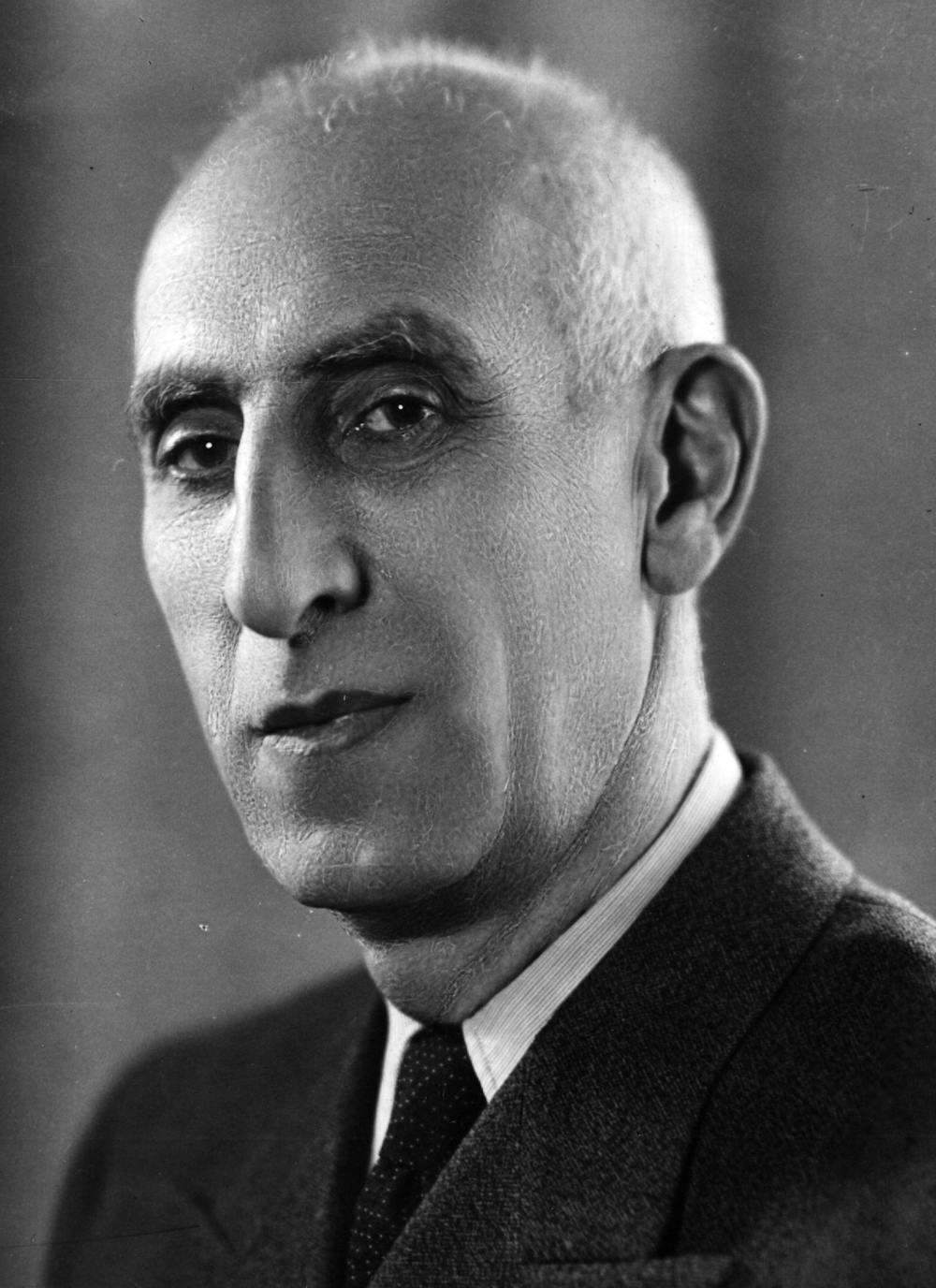
    Mohammed Mossadegh.
    Wikimedia Commons

    In 1951, the Iranian Parliament chose a new prime minister, Mossadegh, who then led lawmakers to vote in favor of taking over the Anglo-Iranian Oil Company, expelling the company’s British owners and saying they wanted to turn oil profits into investments in the Iranian people. The U.S. feared disruption in the global oil supply and worried about Iran falling prey to Soviet influence. The British feared the loss of cheap Iranian oil.

    President Dwight Eisenhower decided it was best for the U.S. and the U.K. to get rid of Mossadegh. Operation Ajax, a joint CIA-British operation, convinced the Shah of Iran, the country’s monarch, to dismiss Mossadegh and drive him from office by force. Mossadegh was replaced by a much more Western-friendly prime minister, handpicked by the CIA.

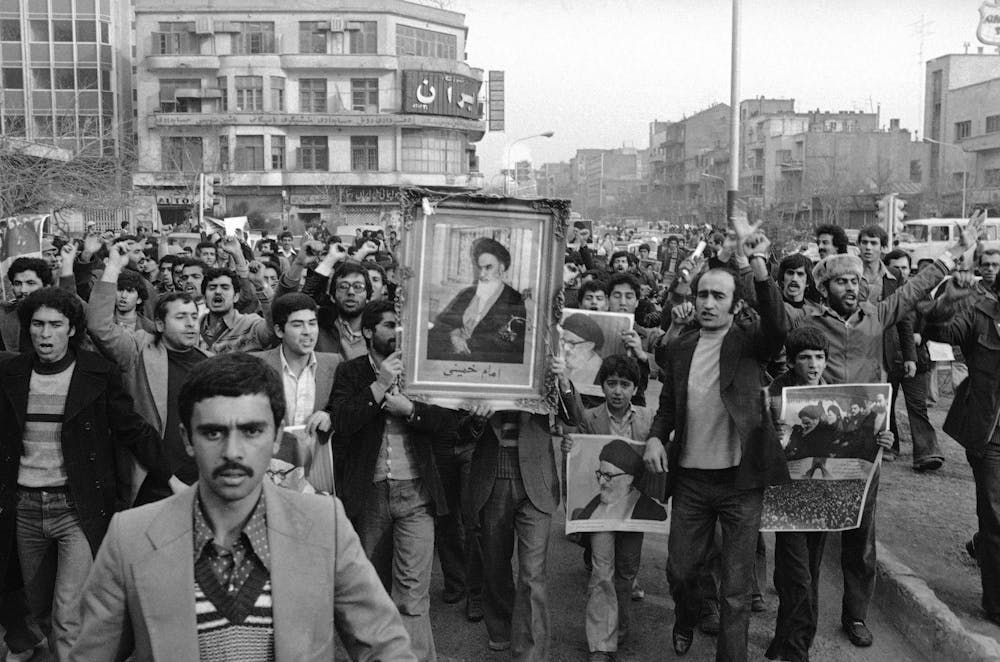
    Demonstrators in Tehran demand the establishment of an Islamic republic.
    AP Photo/Saris

    1979: Revolutionaries oust the shah, take hostages

    After more than 25 years of relative stability in U.S.-Iran relations, the Iranian public had grown unhappy with the social and economic conditions that developed under the dictatorial rule of Shah Mohammad Reza Pahlavi.

    Pahlavi enriched himself and used American aid to fund the military while many Iranians lived in poverty. Dissent was often violently quashed by SAVAK, the shah’s security service. In January 1979, the shah left Iran, ostensibly to seek cancer treatment. Two weeks later, Ayatollah Ruhollah Khomeini returned from exile in Iraq and led a drive to abolish the monarchy and proclaim an Islamic government.

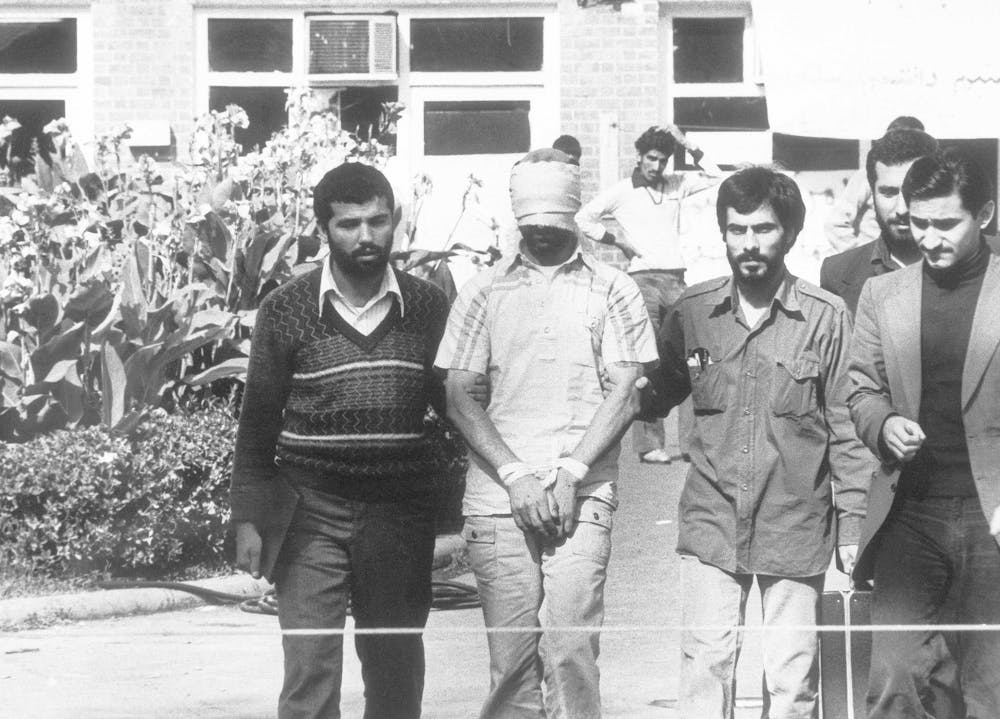
    Iranian students at the U.S. Embassy in Tehran show a blindfolded American hostage to the crowd in November 1979.
    AP Photo

    In October 1979, President Jimmy Carter agreed to allow the shah to come to the U.S. to seek advanced medical treatment. Outraged Iranian students stormed the U.S. Embassy in Tehran on Nov. 4, taking 52 Americans hostage. That convinced Carter to sever U.S. diplomatic relations with Iran on April 7, 1980.

    Two weeks later, the U.S. military launched a mission to rescue the hostages, but it failed, with aircraft crashes killing eight U.S. servicemembers.

    The shah died in Egypt in July 1980, but the hostages weren’t released until Jan. 20, 1981, after 444 days of captivity.

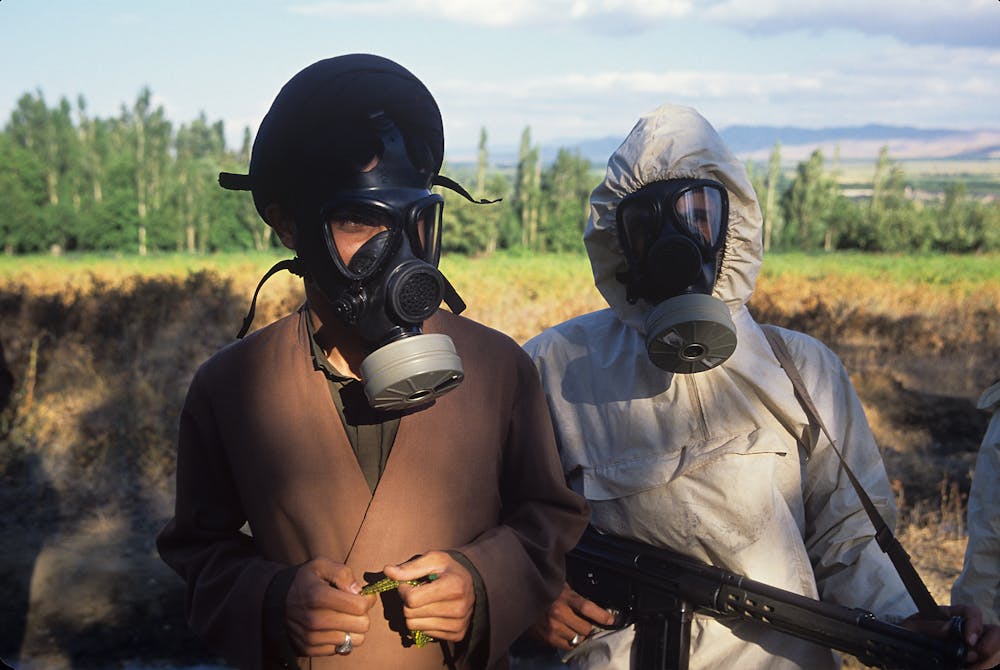
    An Iranian cleric, left, and an Iranian soldier wear gas masks to protect themselves against Iraqi chemical-weapons attacks in May 1988.
    Kaveh Kazemi/Getty Images

    1980-1988: US tacitly sides with Iraq

    In September 1980, Iraq invaded Iran, an escalation of the two countries’ regional rivalry and religious differences: Iraq was governed by Sunni Muslims but had a Shia Muslim majority population; Iran was led and populated mostly by Shiites.

    The U.S. was concerned that the conflict would limit the flow of Middle Eastern oil and wanted to ensure the conflict didn’t affect its close ally, Saudi Arabia.

    The U.S. supported Iraqi leader Saddam Hussein in his fight against the anti-American Iranian regime. As a result, the U.S. mostly turned a blind eye toward Iraq’s use of chemical weapons against Iran.

    U.S. officials moderated their usual opposition to those illegal and inhumane weapons because the U.S. State Department did not “wish to play into Iran’s hands by fueling its propaganda against Iraq.” In 1988, the war ended in a stalemate. More than 500,000 military and 100,000 civilians died.

    1981-1986: US secretly sells weapons to Iran

    The U.S. imposed an arms embargo after Iran was designated a state sponsor of terrorism in 1984. That left the Iranian military, in the middle of its war with Iraq, desperate for weapons and aircraft and vehicle parts to keep fighting.

    The Reagan administration decided that the embargo would likely push Iran to seek support from the Soviet Union, the U.S.’s Cold War rival. Rather than formally end the embargo, U.S. officials agreed to secretly sell weapons to Iran starting in 1981.

    The last shipment, of anti-tank missiles, was in October 1986. In November 1986, a Lebanese magazine exposed the deal. That revelation sparked the Iran-Contra scandal in the U.S., with Reagan’s officials found to have collected money from Iran for the weapons and illegally sent those funds to anti-socialist rebels – the Contras – in Nicaragua.

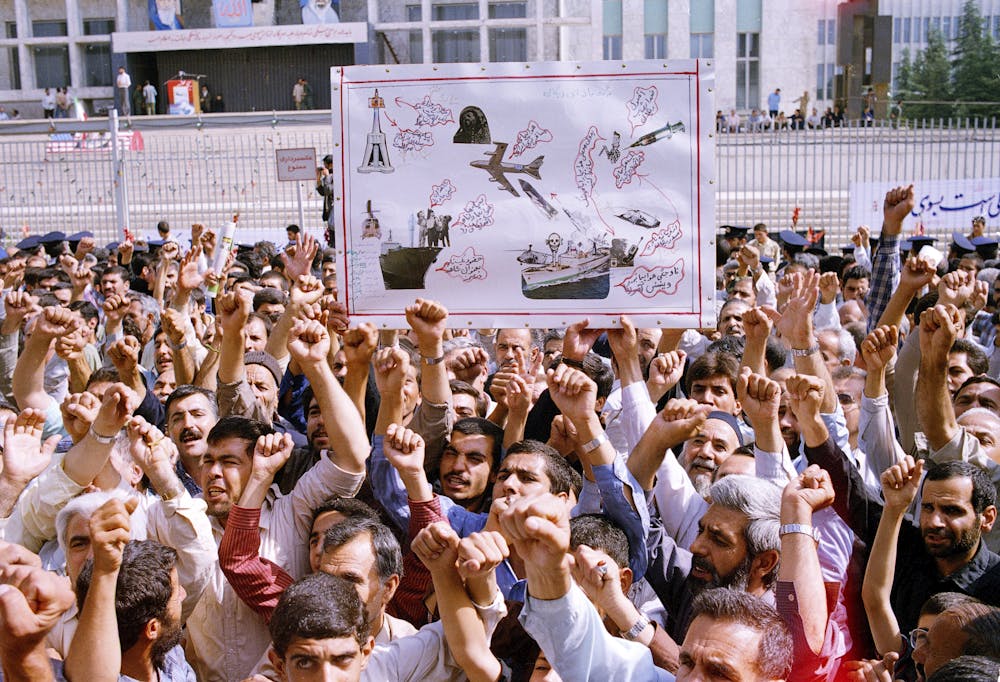
    At a mass funeral for 76 of the 290 people killed in the shootdown of Iran Air 655, mourners hold up a sign depicting the incident.
    AP Photo/CP/Mohammad Sayyad

    1988: US Navy shoots down Iran Air flight 655

    On the morning of July 8, 1988, the USS Vincennes, a guided missile cruiser patrolling in the international waters of the Persian Gulf, entered Iranian territorial waters while in a skirmish with Iranian gunboats.

    Either during or just after that exchange of gunfire, the Vincennes crew mistook a passing civilian Airbus passenger jet for an Iranian F-14 fighter. They shot it down, killing all 290 people aboard.

    The U.S. called it a “tragic and regrettable accident,” but Iran believed the plane’s downing was intentional. In 1996, the U.S. agreed to pay US$131.8 million in compensation to Iran.

    1997-1998: The US seeks contact

    In August 1997, a moderate reformer, Mohammad Khatami, won Iran’s presidential election.

    U.S. President Bill Clinton sensed an opportunity. He sent a message to Tehran through the Swiss ambassador there, proposing direct government-to-government talks.

    Shortly thereafter, in early January 1998, Khatami gave an interview to CNN in which he expressed “respect for the great American people,” denounced terrorism and recommended an “exchange of professors, writers, scholars, artists, journalists and tourists” between the United States and Iran.

    However, Supreme Leader Ayatollah Ali Khamenei didn’t agree, so not much came of the mutual overtures as Clinton’s time in office came to an end.

    In his 2002 State of the Union address, President George W. Bush characterized Iran, Iraq and North Korea as constituting an “Axis of Evil” supporting terrorism and pursuing weapons of mass destruction, straining relations even further.

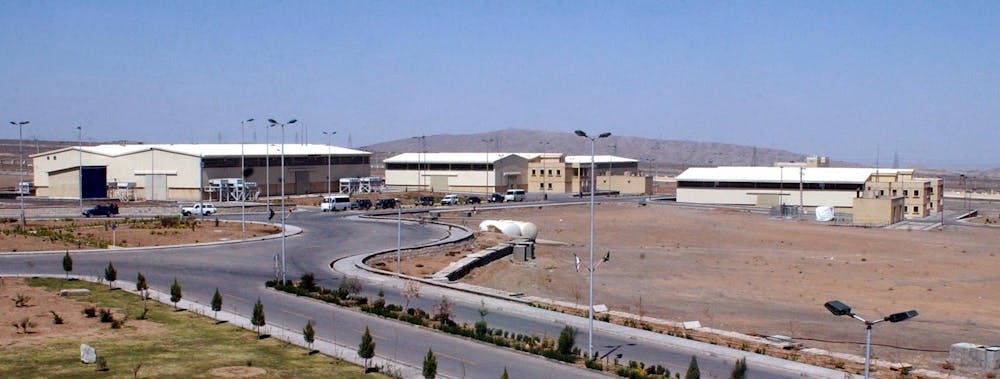
    Inside these buildings at the Natanz nuclear facility in Iran, technicians enrich uranium.
    AP Photo/Vahid Salemi

    2002: Iran’s nuclear program raises alarm

    In August 2002, an exiled rebel group announced that Iran had been secretly working on nuclear weapons at two installations that had not previously been publicly revealed.

    That was a violation of the terms of the Nuclear Nonproliferation Treaty, which Iran had signed, requiring countries to disclose their nuclear-related facilities to international inspectors.

    One of those formerly secret locations, Natanz, housed centrifuges for enriching uranium, which could be used in civilian nuclear reactors or enriched further for weapons.

    Starting in roughly 2005, U.S. and Israeli government cyberattackers together reportedly targeted the Natanz centrifuges with a custom-made piece of malicious software that became known as Stuxnet.

    That effort, which slowed down Iran’s nuclear program was one of many U.S. and international attempts – mostly unsuccessful – to curtail Iran’s progress toward building a nuclear bomb.

    2003: Iran writes to Bush administration

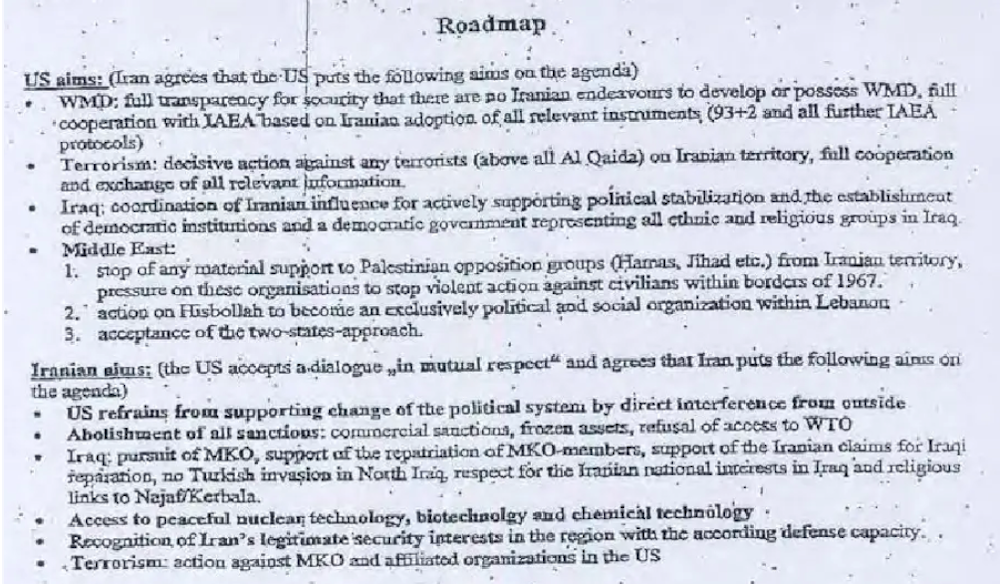
    An excerpt of the document sent from Iran, via the Swiss government, to the U.S. State Department in 2003, appears to seek talks between the U.S. and Iran.
    Washington Post via Scribd

    In May 2003, senior Iranian officials quietly contacted the State Department through the Swiss embassy in Iran, seeking “a dialogue ‘in mutual respect,’” addressing four big issues: nuclear weapons, terrorism, Palestinian resistance and stability in Iraq.

    Hardliners in the Bush administration weren’t interested in any major reconciliation, though Secretary of State Colin Powell favored dialogue and other officials had met with Iran about al-Qaida.

    When Iranian hardliner Mahmoud Ahmadinejad was elected president of Iran in 2005, the opportunity died. The following year, Ahmadinejad made his own overture to Washington in an 18-page letter to President Bush. The letter was widely dismissed; a senior State Department official told me in profane terms that it amounted to nothing.

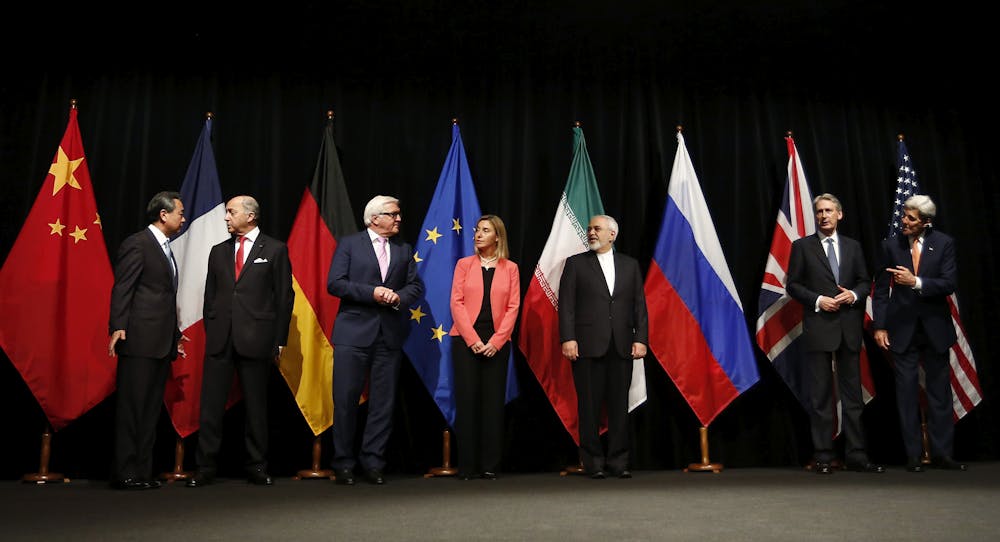
    Representatives of several nations met in Vienna in July 2015 to finalize the Iran nuclear deal.
    Austrian Federal Ministry for Europe, Integration and Foreign Affairs/Flickr

    2015: Iran nuclear deal signed

    After a decade of unsuccessful attempts to rein in Iran’s nuclear ambitions, the Obama administration undertook a direct diplomatic approach beginning in 2013.

    Two years of secret, direct negotiations initially bilaterally between the U.S. and Iran and later with other nuclear powers culminated in the Joint Comprehensive Plan of Action, often called the Iran nuclear deal.

    Two years of secret, direct negotiations conducted bilaterally at first between the U.S. and Iran and later with other nuclear powers culminated in the Joint Comprehensive Plan of Action, often called the Iran nuclear deal.

    Iran, the U.S., China, France, Germany, Russia and the United Kingdom signed the deal in 2015. It severely limited Iran’s capacity to enrich uranium and mandated that international inspectors monitor and enforce Iran’s compliance with the agreement.

    In return, Iran was granted relief from international and U.S. economic sanctions. Though the inspectors regularly certified that Iran was abiding by the agreement’s terms, President Donald Trump withdrew from the agreement in May 2018.

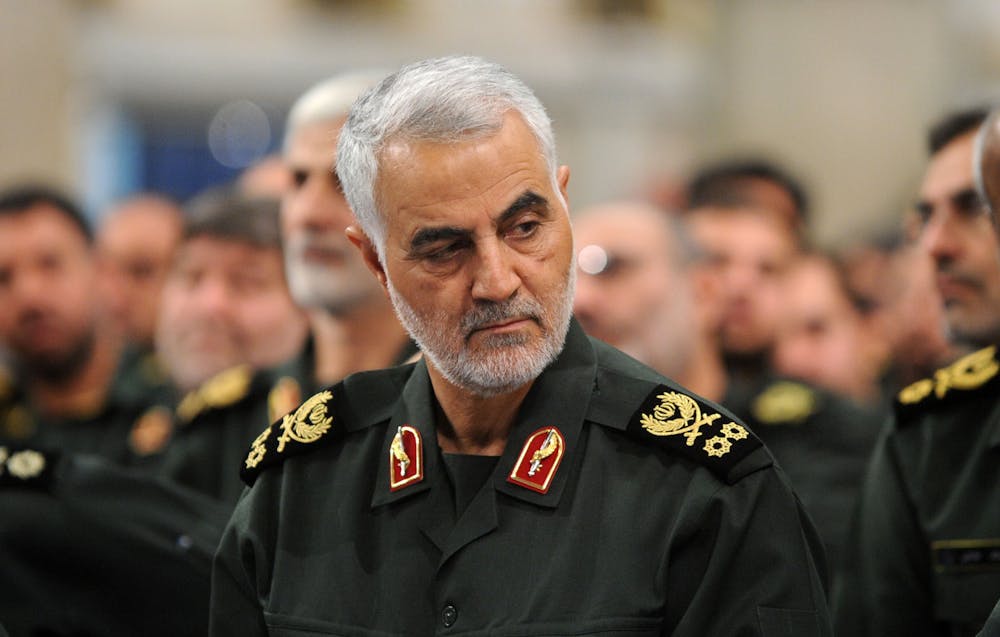
    2020: US drones kill Iranian Maj. Gen. Qassem Soleimani

    An official photo from the Iranian government shows Maj. Gen. Qassem Soleimani, who was killed in a Jan. 3 drone strike ordered by President Donald Trump.
    Iranian Supreme Leader Press Office/Anadolu Agency via Getty Images

    On Jan. 3, 2020, an American drone fired a missile that killed Maj. Gen. Qassem Soleimani, the leader of Iran’s elite Quds Force. Analysts considered Soleimani the second most powerful man in Iran, after Supreme Leader Ayatollah Khamenei.

    At the time, the Trump administration asserted that Soleimani was directing an imminent attack against U.S. assets in the region, but officials have not provided clear evidence to support that claim.

    Iran responded by launching ballistic missiles that hit two American bases in Iraq.

    2023: The Oct. 7 attacks on Israel

    Hamas’ brazen attack on Israel on Oct. 7, 2023, provoked a fearsome militarized response from Israel that continues today and served to severely weaken Iran’s proxies in the region, especially Hamas – the perpetrator of the attacks – and Hezbollah in Lebanon.

    2025: Trump 2.0 and Iran

    Trump saw an opportunity to forge a new nuclear deal with Iran and to pursue other business deals with Tehran. Once inaugurated for his second term, Trump appointed Steve Witkoff, a real estate investor who is the president’s friend, to serve as special envoy for the Middle East and to lead negotiations.

    Negotiations for a nuclear deal between Washington and Tehran began in April, but the countries did not reach a deal. They were planning a new round of talks when Israel struck Iran with a series of airstrikes on June 13, forcing the White House to reconsider is position.

    On June 22, in the early morning hours, the U.S. chose to act decisively in an attempt to cripple Iran’s nuclear capacity, bombing three nuclear sites and causing what Pentagon officials called “severe damage.” Iran vowed to retaliate.

    This story has been updated to reflect the U.S. bombing of Iranian nuclear sites on June 22, 2025.

    Jeffrey Fields receives funding from the Carnegie Corporation of New York and Schmidt Futures.

    ref. US and Iran have a long, complicated history, spanning decades before US strikes on nuclear sites – https://theconversation.com/us-and-iran-have-a-long-complicated-history-spanning-decades-before-us-strikes-on-nuclear-sites-259240

    MIL OSI – Global Reports

  • MIL-OSI Global: US joins Israel in attack on Iran and ushers in a new era of impunity

    Source: The Conversation – UK – By Simon Mabon, Professor of International Relations, Lancaster University

    When US B-2 bombers hit Iran’s nuclear facilities at Fordow, Natanz and Isfahan, Donald Trump declared the strikes a success and urged the Islamic Republic to make peace or face even more devastating strikes. The US president proclaimed the might of the US military, operating in full coordination with Israel, before taking to truth social.

    Trump and the Israeli prime minister, Benjamin Netanyahu, will hope that the strikes will end Iran’s nuclear programme once and for all. It may, it may not. More certain is that the operation will sound the death knell for the post-second world war global order.

    After the horrors of the that war and the cold war that followed, a global order emerged seemingly predicated on a set of largely liberal rules and norms that sought to prevent a retreat into global conflict. Predicated on non-intervention, diplomacy and a respect for the rule of law, this global order was idealistic and – ultimately – aspirational.

    But in recent years, this vision of global politics has come crashing down. Now America joining Israel in its attacks on Iran will rightly provoke serious questions about the future of global order and what comes next.


    Get your news from actual experts, straight to your inbox. Sign up to our daily newsletter to receive all The Conversation UK’s latest coverage of news and research, from politics and business to the arts and sciences.


    Trump’s decision to use US air power to land heavy blows against Iran’s nuclear programme is the latest event on a continuum which arguably reaches back to the Hamas terror attack of October 7.

    Israel’s destruction of Gaza, its decapitation of Hamas and disabling of Hezbollah’s military capacity and its strikes against the Houthi rebels have consolidated Israel’s position of strength in the region, to generally positive acclaim from global audiences. Yet the spectre of Iran continued to loom large, even as its proxies were defeated

    Iran has long been framed as an nefarious puppet master controlling a complex web of “proxy actors” across the Middle East each accused of doing the bidding of Tehran. The reality is rather different. While the Islamic Republic undeniably wields influence over such groups, it is not the perfidious mastermind that some would suggest, nor is it the source of all ills in the region.

    Instead, Iran is in a perilous position. The Islamic Republic faces serious social and economic pressures, with the “women life freedom movement” galvanising popular opposition, while unrest across Iran’s peripheral provinces which are home to ethnic and religious minorities continues to ferment.

    In recent years, diplomacy has shown it can work, ameliorating longstanding and deep-seated animosities. This was bearing fruits as seen in the gradual rapprochement between Iran and Saudi Arabia from 2023, which had been preceded by the signing of the Abraham accords in 2020.

    Seen by many as a key achievement of Trump’s first presidency, this was a series of agreements between Israel and Bahrain, the United Arab Emirates, Morocco and Sudan in which the Arab countries recognised Israel and all sides signed a declaration of principles focused on mutual understanding, respect for human dignity, and cooperation.

    While many in Israel and the US hoped that Saudi Arabia would officially recognise Israel, the events of October 7 and the destruction of Gaza that followed ended those hopes. Now the possibility of all-out conflict between Iran and Israel and the US risks blowing a major regional conflict with global implications.

    Serious questions must be asked as to the longer-term strategy here. While Israeli officials have articulated a need for strikes on Iran’s nuclear facilities to prevent the Islamic Republic from getting a nuclear weapons capability, Iran is a signatory of the nuclear non-proliferation treaty (although it has threatened recently to quit) and key officials have regularly declared that nuclear weapons have no place in Iran’s strategic portfolio.

    Israel is not a signatory to the treaty. In fact, it is thought to possess between 75 and 400 nuclear warheads. It’s hard to tell, as the country has maintained a steadfast policy of nuclear opacity, never actually admitting the extent of its nuclear capability.

    New impunity?

    Is this the start of a new order of impunity across the region, backed by western powers? And if so, what does this mean for the war in Ukraine and the potential for an aggressive Russia engaging in further dangerous adventurism? What does it mean for the possibility of China taking advantage in this breakdown to perhaps fulfil its generations-old ambition to unite with Taiwan, by force, if necessary? Are we seeing the shift to a world in which Donald Trump’s threats to annex Greenland – even perhaps Canada – must be taken seriously?

    The contours of global politics are changing before our eyes. Gone are the norms that have served as the bedrock of the so-called liberal international order. The risk is that while this period has itself featured tragedy and suffering on an almost unimaginable scale, tearing up the rule book will be far worse.

    Simon Mabon receives funding from Carnegie Corporation of New York and the Henry Luce Foundation. He is a Senior Research Fellow with the Foreign Policy Centre.

    ref. US joins Israel in attack on Iran and ushers in a new era of impunity – https://theconversation.com/us-joins-israel-in-attack-on-iran-and-ushers-in-a-new-era-of-impunity-259511

    MIL OSI – Global Reports

  • MIL-OSI Global: What is a ‘bunker buster’? An expert explains what the US dropped on Iran

    Source: The Conversation – Global Perspectives – By James Dwyer, Lecturer, School of Social Sciences, University of Tasmania

    The jagged silhouette of a B2 stealth bomber seen during a 2015 flyover in the US. Jonathan Daniel / Getty Images

    Late on Saturday night, local time, the United States carried out strikes against Iranian nuclear enrichment sites at Fordow, Natanz and Isfahan, marking its open participation in the conflict between Iran and Israel.

    The US says it fired 30 submarine-launched missiles at the sites in Natanz and Isfahan, as well as dropping more than a dozen “bunker buster” bombs at Fordow and Natanz.

    The kind of bomb in question is the extremely destructive GBU-57 Massive Ordance Penetrator, or MOP, which weighs around 13.5 tonnes.

    The attacks raise a lot of questions. What are these enormous bombs? Why did the US feel it had to get involved in the conflict? And, going forward, what does it mean for Iran’s nuclear ambitions?

    What are ‘bunker busters’, and why are they used?

    Bunker busters are weapons designed to destroy heavily protected facilities such as bunkers deep underground, beyond the reach of normal bombs.

    Bunker busters are designed to bury themselves into the ground before detonating. This allows more of the explosive force to penetrate into the ground, rather than travelling through the air or across the surface.

    Iran’s nuclear enrichment sites at Fordow, Natanz and Isfahan are built deep underground. Estimates suggest that Fordow for example could be 80m beneath the surface, and capped with layers of reinforced concrete and soil.

    What is the MOP?

    The bunker buster used in this particular operation is the largest in the US arsenal. Leaving aside nuclear weapons, the MOP is the largest known buster buster in the world.

    Weighing some 13.5 tonnes, the MOP is believed to be able to penetrate up to 60 metres below ground in the right conditions. It is not known how many the US possesses, but the numbers are thought to be small (perhaps 20 or so in total).

    We also don’t know exactly how many were used in Iran, though some reports say it was 14. However, it is likely to be a significant portion of the US MOP arsenal.

    Why does only the US possess this capability?

    The US is not the only state with bunker-busting weaponry. However, the size of MOP means it requires very specialised bombers to carry and drop it.

    Only the B2 stealth bomber is currently able to deploy the MOP. Each B2 can carry at most two MOPs at a time. Around seven of America’s 19 operational B2s were used in the Iran operation.

    There has been some consideration whether large transport aircraft such as the C-130 Hercules could be modified to carry and drop the MOP from its rear cargo doors. While this would allow other countries (including Israel) to deploy the MOP, it is for now purely hypothetical.

    Why has the US (apparently) used them in Iran

    The Trump administration claims Iran may be only a few weeks from possessing a nuclear weapon, and that it needed to act now to destroy Iranian nuclear enrichment sites. This claim is notably at odds with published assessments from the US intelligence community.

    However, Israel lacks bunker busting weaponry sufficient to damage the deeply buried and fortified enrichment sites at Fordow, Natanz and Isfahan.

    An F-15E Strike Eagle releases a GBU-28 ‘bunker buster’ laser-guided bomb, a smaller equivalewnt of the 13,600 kg GBU-57 ‘Massive Ordnance Penetrator’ believed to have been used in Iran.
    Michael Ammons / US Air Force

    Only the MOP could do the job (short of using nuclear weapons). Even then, multiple MOPs would have been required to ensure sufficient damage to the underground facilities.

    The US has claimed that these sites have been utterly destroyed. We cannot conclusively say whether this is true.

    Iran may also have other, undeclared nuclear sites elsewhere in the country.

    Iran’s reaction

    The US has reportedly reached out to Iran via diplomatic channels to emphasise that this attack was a one-off, not part of a larger project of regime change. It is hard to say what will happen in the next few weeks.

    Iran may retaliate with large strikes against Israel or against US forces in the region. It could also interrupt shipping in the Strait of Hormuz, which would affect a large portion of global oil shipments, with profound economic implications.

    Alternatively, Iran could capitulate and take steps to demonstrate it is ending its nuclear program. However, capitulation would not necessarily mean the end of Iran’s nuclear ambitions.

    The value of nuclear weapons

    Perhaps a greater concern is that the attack will reinforce Iran’s desire to go nuclear. Without nuclear weapons, Iran was unable to threaten the US enough to deter today’s attack.

    Iran may take lessons from the fate of other states. Ukraine (in)famously surrendered its stockpile of former Soviet nuclear weapons in the early 1990s. Russia has since felt emboldened to annex Crimea in 2014 and launch an ongoing invasion in 2022. Other potential nuclear states, such as Iraq and Gadaffi’s regime in Libya, also suffered from military intervention.

    By contrast, North Korea successfully tested its first nuclear weapon in 2006. Since then there has been no serious consideration of military intervention in North Korea.

    Iran may yet have the ability to produce useful amounts of weapons-grade uranium. It may now aim to buy itself time to assemble a relatively small nuclear device, similar in scale to the bombs used in Hiroshima and Nagasaki.

    Depending on what facilities and resources have survive the US strikes, the attack has likely reinforced that the only way the Iranian regime can guarantee its survival is to possess nuclear weapons.

    James Dwyer does not work for, consult, own shares in or receive funding from any company or organisation that would benefit from this article, and has disclosed no relevant affiliations beyond their academic appointment.

    ref. What is a ‘bunker buster’? An expert explains what the US dropped on Iran – https://theconversation.com/what-is-a-bunker-buster-an-expert-explains-what-the-us-dropped-on-iran-259508

    MIL OSI – Global Reports

  • Russian attacks kill one in eastern Ukraine, one in the north

    Source: Government of India

    Source: Government of India (4)

    Russian strikes on Saturday on key towns in Donetsk region on the eastern front of the war in Ukraine killed at least one person while another died in a drone attack in the north near the Russian border, officials said.

    The Russian military said its forces had captured another village in its slow advance westward through Donetsk region. And reports from Kharkiv region in the northeast suggested Russian troops were closing in on the city of Kupiansk.

    Russian forces struck Sloviansk and Kramatorsk – two cities that Moscow will target as its forces press on with their westward drive. Both towns have come under frequent attack since the Russian invasion of its neighbour in February 2022.

    Donetsk region Governor Vadym Filashkin said one person died and three were injured in Sloviansk, with pictures posted online showing buildings reduced to rubble. He said four multi-storey dwellings and 32 private homes had suffered damage.

    In Kramatorsk, pictures posted by the city council showed heavy damage to part of an apartment building. Officials said at least one person was trapped under rubble and a number of other residents were injured.

    A mass drone attack on the town of Nizhyn near the Russian border killed one person and damaged local infrastructure.

    The Russian Defence Ministry said its forces had seized the village of Zaporizhzhia, southwest of Pokrovsk, where Ukrainian forces have been holding back Russian attacks for months.

    Zaporizhzhia village is distinct from the Ukrainian city of Zaporizhzhia, the regional centre and large industrial hub located some 160 km (90 miles) to the southeast.

    The General Staff of Ukraine’s armed forces on Friday listed the village as one of several where Kyiv’s forces had repelled Russian attacks.

    On Friday, the Russian Defence Ministry said it had captured the village of Moskovka, just outside the city of Kupiansk, also the target of repeated Russian attacks in recent months.

    Both Russian and Ukrainian military bloggers have reported an upswing in fighting around Kupiansk this past week. The town was first occupied by Russian forces in the first weeks of the 2022 invasion, but recaptured by Ukrainian troops later in the year in a lightning counter-offensive.

    (Reuters)

  • Strikes on Iran mark Trump’s biggest, and riskiest, foreign policy gamble

    Source: Government of India

    Source: Government of India (4)

    With his unprecedented decision to bomb Iran’s nuclear sites, directly joining Israel’s air attack on its regional arch-foe, U.S. President Donald Trump has done something he had long vowed to avoid – intervene militarily in a major foreign war.

    The dramatic U.S. strike, including the targeting of Iran’s most heavily fortified nuclear installation deep underground, marks the biggest foreign policy gamble of Trump’s two presidencies and one fraught with risks and unknowns.

    Trump, who insisted on Saturday that Iran must now make peace or face further attacks, could provoke Tehran into retaliating by closing the Strait of Hormuz, the world’s most important oil artery, attacking U.S. military bases and allies in the Middle East, stepping up its missile barrage on Israel and activating proxy groups against American and Israeli interests worldwide, analysts said.

    Such moves could escalate into a broader, more protracted conflict than Trump had envisioned, evoking echoes of the “forever wars” that America fought in Iraq and Afghanistan, which he had derided as “stupid” and promised never to be dragged into.

    “The Iranians are seriously weakened and degraded in their military capabilities,” said Aaron David Miller, a former Middle East negotiator for Democratic and Republican administrations. “But they have all sorts of asymmetric ways that they can respond… This is not going to end quick.”

    In the lead-up to the bombing that he announced late on Saturday, Trump had vacillated between threats of military action and appeals for renewed negotiation to persuade Iran to reach a deal to dismantle its nuclear program.

    A senior White House official said that once Trump was convinced that Tehran had no interest in reaching a nuclear agreement, he decided the strikes were “the right thing to do.”

    Trump gave the go-ahead once he was assured of a “high probability of success,” the official said – a determination reached after more than a week of Israeli air attacks on Iran’s nuclear and military facilities paved the way for the U.S. to deliver the potentially crowning blow.

    NUCLEAR THREAT REMAINS

    Trump touted the “great success” of the strikes, which he said included the use of massive “bunker-buster bombs” on the main site at Fordow. But some experts suggested that while Iran’s nuclear program may have been set back for many years, the threat may be far from over.

    Iran denies seeking a nuclear weapon, saying its program is for purely peaceful purposes.

    “In the long term, military action is likely to push Iran to determine nuclear weapons are necessary for deterrence and that Washington is not interested in diplomacy,” the Arms Control Association, a non-partisan U.S.-based organization that advocates for arms control legislation, said in a statement.

    “Military strikes alone cannot destroy Iran’s extensive nuclear knowledge. The strikes will set Iran’s program back, but at the cost of strengthening Tehran’s resolve to reconstitute its sensitive nuclear activities,” the group said.

    Eric Lob, assistant professor in the Department of Politics and International Relations at Florida International University, said Iran’s next move remains an open question and suggested that among its forms of retaliation could be to hit “soft targets” of the U.S. and Israel inside and outside the region.

    But he also said there was a possibility that Iran could return to the negotiating table – “though they would be doing so in an even weaker position” – or seek a diplomatic off-ramp.

    In the immediate aftermath of the U.S. strikes, however, Iran showed little appetite for concessions.

    Iran’s Atomic Energy Organization said it would not allow development of its “national industry” to be stopped, and an Iranian state television commentator said every U.S. citizen or military member in the region would not be legitimate targets.

    Karim Sadjadpour, an analyst at the Carnegie Endowment for International Peace, posted on X: “Trump indicated this is now the time for peace. It’s unclear and unlikely the Iranians will see it the same way. This is more likely to open a new chapter of the 46-year-old US-Iran war than conclude it.”

    ‘REGIME CHANGE’

    Some analysts suggested that Trump, whose administration has previously disavowed any aim of dislodging the Iranian leadership, could be drawn into seeking “regime change” if Tehran carries out major reprisals or moves to build a nuclear weapon.

    That, in turn, would bring additional risks.

    “Beware mission creep, aiming for regime change and democratization campaigns,” said Laura Blumenfeld, a Middle East analyst at the Johns Hopkins School for Advanced International Studies in Washington. “You’ll find the bones of many failed U.S. moral missions buried in Middle East sands.”

    Jonathan Panikoff, a former U.S. deputy intelligence officer for the Middle East, said Iran’s leadership would quickly engage in “disproportionate attacks” if it felt its survival was imperiled.

    But Tehran will also have to be mindful of the consequences, he said. While actions such as closing the Strait of Hormuz would pose problems for Trump with the resulting higher oil prices and potential U.S. inflationary impact, it would also hurt China, one of Iran’s few powerful allies.

    At the same time, Trump is already facing strong push-back from congressional Democrats against the Iran attack and will also have to contend with opposition from the anti-interventionist wing of his Republican MAGA base.

    Trump, who faced no major international crisis in his first term, is now embroiled in one just six months into his second.

    Even if he hopes U.S. military involvement can be limited in time and scope, the history of such conflicts often carries unintended consequences for American presidents.

    Trump’s slogan of “peace through strength” will certainly be tested as never before, especially with his opening of a new military front after failing to meet his campaign promises to quickly end wars in Ukraine and Gaza.

    “Trump is back in the war business,” said Richard Gowan, U.N. director at the International Crisis Group. “I am not sure anyone in Moscow, Tehran or Beijing ever believed his spiel that he is a peacemaker. It always looked more like a campaign phrase than a strategy.”

    (Reuters)

  • MIL-Evening Report: What is a ‘bunker buster’? An expert explains what the US dropped on Iran

    Source: The Conversation (Au and NZ) – By James Dwyer, Lecturer, School of Social Sciences, University of Tasmania

    The jagged silhouette of a B2 stealth bomber seen during a 2015 flyover in the US. Jonathan Daniel / Getty Images

    Late on Saturday night, local time, the United States carried out strikes against Iranian nuclear enrichment sites at Fordow, Natanz and Isfahan, marking its open participation in the conflict between Iran and Israel.

    The US says it fired 30 submarine-launched missiles at the sites in Natanz and Isfahan, as well as dropping more than a dozen “bunker buster” bombs at Fordow and Natanz.

    The kind of bomb in question is the extremely destructive GBU-57 Massive Ordance Penetrator, or MOP, which weighs around 13.5 tonnes.

    The attacks raise a lot of questions. What are these enormous bombs? Why did the US feel it had to get involved in the conflict? And, going forward, what does it mean for Iran’s nuclear ambitions?

    What are ‘bunker busters’, and why are they used?

    Bunker busters are weapons designed to destroy heavily protected facilities such as bunkers deep underground, beyond the reach of normal bombs.

    Bunker busters are designed to bury themselves into the ground before detonating. This allows more of the explosive force to penetrate into the ground, rather than travelling through the air or across the surface.

    Iran’s nuclear enrichment sites at Fordow, Natanz and Isfahan are built deep underground. Estimates suggest that Fordow for example could be 80m beneath the surface, and capped with layers of reinforced concrete and soil.

    What is the MOP?

    The bunker buster used in this particular operation is the largest in the US arsenal. Leaving aside nuclear weapons, the MOP is the largest known buster buster in the world.

    Weighing some 13.5 tonnes, the MOP is believed to be able to penetrate up to 60 metres below ground in the right conditions. It is not known how many the US possesses, but the numbers are thought to be small (perhaps 20 or so in total).

    We also don’t know exactly how many were used in Iran, though some reports say it was 14. However, it is likely to be a significant portion of the US MOP arsenal.

    Why does only the US possess this capability?

    The US is not the only state with bunker-busting weaponry. However, the size of MOP means it requires very specialised bombers to carry and drop it.

    Only the B2 stealth bomber is currently able to deploy the MOP. Each B2 can carry at most two MOPs at a time. Around seven of America’s 19 operational B2s were used in the Iran operation.

    There has been some consideration whether large transport aircraft such as the C-130 Hercules could be modified to carry and drop the MOP from its rear cargo doors. While this would allow other countries (including Israel) to deploy the MOP, it is for now purely hypothetical.

    Why has the US (apparently) used them in Iran

    The Trump administration claims Iran may be only a few weeks from possessing a nuclear weapon, and that it needed to act now to destroy Iranian nuclear enrichment sites. This claim is notably at odds with published assessments from the US intelligence community.

    However, Israel lacks bunker busting weaponry sufficient to damage the deeply buried and fortified enrichment sites at Fordow, Natanz and Isfahan.

    An F-15E Strike Eagle releases a GBU-28 ‘bunker buster’ laser-guided bomb, a smaller equivalewnt of the 13,600 kg GBU-57 ‘Massive Ordnance Penetrator’ believed to have been used in Iran.
    Michael Ammons / US Air Force

    Only the MOP could do the job (short of using nuclear weapons). Even then, multiple MOPs would have been required to ensure sufficient damage to the underground facilities.

    The US has claimed that these sites have been utterly destroyed. We cannot conclusively say whether this is true.

    Iran may also have other, undeclared nuclear sites elsewhere in the country.

    Iran’s reaction

    The US has reportedly reached out to Iran via diplomatic channels to emphasise that this attack was a one-off, not part of a larger project of regime change. It is hard to say what will happen in the next few weeks.

    Iran may retaliate with large strikes against Israel or against US forces in the region. It could also interrupt shipping in the Strait of Hormuz, which would affect a large portion of global oil shipments, with profound economic implications.

    Alternatively, Iran could capitulate and take steps to demonstrate it is ending its nuclear program. However, capitulation would not necessarily mean the end of Iran’s nuclear ambitions.

    The value of nuclear weapons

    Perhaps a greater concern is that the attack will reinforce Iran’s desire to go nuclear. Without nuclear weapons, Iran was unable to threaten the US enough to deter today’s attack.

    Iran may take lessons from the fate of other states. Ukraine (in)famously surrendered its stockpile of former Soviet nuclear weapons in the early 1990s. Russia has since felt emboldened to annex Crimea in 2014 and launch an ongoing invasion in 2022. Other potential nuclear states, such as Iraq and Gadaffi’s regime in Libya, also suffered from military intervention.

    By contrast, North Korea successfully tested its first nuclear weapon in 2006. Since then there has been no serious consideration of military intervention in North Korea.

    Iran may yet have the ability to produce useful amounts of weapons-grade uranium. It may now aim to buy itself time to assemble a relatively small nuclear device, similar in scale to the bombs used in Hiroshima and Nagasaki.

    Depending on what facilities and resources have survive the US strikes, the attack has likely reinforced that the only way the Iranian regime can guarantee its survival is to possess nuclear weapons.

    James Dwyer does not work for, consult, own shares in or receive funding from any company or organisation that would benefit from this article, and has disclosed no relevant affiliations beyond their academic appointment.

    ref. What is a ‘bunker buster’? An expert explains what the US dropped on Iran – https://theconversation.com/what-is-a-bunker-buster-an-expert-explains-what-the-us-dropped-on-iran-259508

    MIL OSI AnalysisEveningReport.nz

  • MIL-OSI Russia: Opening remarks by the IAEA Director General at the meeting of the Board of Governors

    Translation. Region: Russian Federal

    Source: International Atomic Energy Agency –

    (Prepared for delivery at a Council meeting)

    Madam Chairperson,

    Following Friday’s attacks on nuclear facilities in the Islamic Republic of Iran, the military conflict continues. As I reported to the IAEA Board of Governors and then to the UN Security Council last Friday, the IAEA is monitoring the situation very closely. Since the beginning of the events, our Incident and Emergency Centre has been working 24/7 to update the status of Iranian nuclear facilities and radiation levels at the sites in an ongoing exchange of information with the Iranian authorities.

    The IAEA is ready to respond to any nuclear or radiological emergency within an hour.

    Based on the information available to the IAEA, the following situation currently exists at Iranian nuclear facilities.

    Following the strike on the Natanz fuel enrichment plant site, which destroyed the above-ground portion of the experimental fuel enrichment facility, one of the facilities used by Iran to produce uranium enriched to 60% U-235, no further damage was reported at the site.

    The facility’s electrical infrastructure, including an electrical substation, the main electrical systems building, and emergency and backup generators, was also destroyed.

    There are no signs of physical impact on the underground centrifuge cascade shop, which contains part of the experimental fuel enrichment facility and the main fuel enrichment facility. At the same time, the power outage in the centrifuge cascade shop could have damaged the centrifuges located there.

    Radiation levels outside the Natanz site remain unchanged and within normal limits, indicating no external radiological impact on the population or the environment as a result of this event.

    The Natanz facility site contains both radiological and chemical contamination. Given the type of nuclear material present at the facility, it is possible that uranium isotopes contained in uranium hexafluoride, uranyl fluoride and hydrogen fluoride are dispersed throughout the facility. The radiation, consisting predominantly of alpha particles, poses a serious hazard if uranium is inhaled or ingested. However, this risk can be effectively mitigated by appropriate protective measures, such as the use of respiratory protection while inside the affected facilities. Of greatest concern to the facility itself is the chemical toxicity of uranium hexafluoride and the fluorides formed upon contact with water.

    No damage was reported at the Fordow enrichment plant site or the heavy water reactor under construction at Khondab. The Bushehr nuclear power plant and the Tehran research reactor were not targets of the recent strikes and were not damaged in this regard.

    Four buildings at the Isfahan nuclear facility were damaged in Friday’s strikes: the central chemical laboratory, a uranium conversion plant, a fuel fabrication plant for the Tehran reactor, and a plant under construction to convert uranium hexafluoride into uranium dioxide powder.

    As at Natanz, radiation levels outside the facility remain unchanged.

    I confirm the cooperation and exchange of information between the Iranian authorities and the IAEA. In these tense and challenging circumstances, it is essential for the IAEA to receive timely and regular technical information about the facilities and their associated sites. This information is essential to promptly inform the international community and to ensure an effective response and assistance in the event of any emergency in Iran. Without information, we cannot accurately assess the radiological conditions and potential impacts on the population and the environment, and we cannot provide the necessary assistance.

    The Agency is and will continue to be present in Iran. Safeguards inspections will continue in Iran as soon as it is safe to do so, as required by Iran’s safeguards obligations under the NPT.

    I remain in touch with the inspectors in Iran; their safety is our top priority and all necessary measures are being taken to ensure that they are not harmed.

    I stand ready to travel immediately and work with all relevant parties to ensure the protection of nuclear facilities and the continued peaceful use of nuclear technology in accordance with the Agency’s mandate, including by deploying, where necessary, Agency nuclear security and safety experts to complement our safeguards inspectors in Iran.

    Madam Chairperson,

    Military escalation threatens human lives, increases the likelihood of a radiological release with serious consequences for the population and the environment, and delays the critical task of a diplomatic settlement to provide long-term assurance that Iran will not acquire nuclear weapons.

    In accordance with the objectives of the IAEA and its Statute, I call on all parties to exercise maximum restraint to avoid further escalation.

    Last week, the Council made an important decision resolution on Iran’s safeguards obligations. The resolution contains important provisions on proliferation and underlines support for a diplomatic solution to the challenges posed by Iran’s nuclear programme. IAEA Member States can play a vital and active role in promoting an urgent shift away from military escalation and towards diplomacy. I urge you to use all available diplomatic means and assure you of my continued readiness to contribute, including through an early visit to Iran to assess the situation and ensure nuclear safety, security and non-proliferation in that country.

    There is probably no goal more important or more widely supported than that of ensuring that humanity uses the enormous energy of the atom for good, not destruction. For over 60 years, the IAEA has played a central role in helping its Member States translate this desire into real progress.

    Given the IAEA’s clear mandate and unique resources, I reaffirm the Agency’s readiness to facilitate technical discussions and support efforts to ensure transparency, nuclear safety and security, and achieve a peaceful resolution of issues related to nuclear activities in Iran.

    Dear colleagues,

    For the second time in three years, we are witnessing a dramatic conflict between two IAEA Member States, in which nuclear installations are coming under fire and nuclear safety is being threatened.

    As in the case of a military conflict between the Russian Federation and Ukraine, the IAEA will not stand aside.

    We can and will act within our statutory mandate to help prevent a nuclear accident that could lead to unpredictable radiological consequences. For the IAEA to act, constructive and professional dialogue must begin, and this must happen as soon as possible.

    As insurmountable as this task may seem in the context of an ongoing military conflict, we have already demonstrated that even in such circumstances, technical assistance, provided in a spirit of respect and impartiality, can benefit everyone without exception.

    I intend to continue my ongoing engagement with the conflicting parties to find the most appropriate way to achieve this goal, and I ask Member States to support me in this effort. I count on the Council, and especially the Member States that are best placed to do so, to respond to this call to assist the IAEA in helping those who are trading blows today to prevent the worst from happening. There is always a time and a place for diplomacy.

    Please note: This information is raw content directly from the source of the information. It is exactly what the source states and does not reflect the position of MIL-OSI or its clients.

    MIL OSI Russia News

  • MIL-OSI Russia: Update on events in Iran

    Translation. Region: Russian Federal

    Source: International Atomic Energy Agency –

    The International Atomic Energy Agency (IAEA) continues to closely monitor and assess the situation in relation to the Israeli attacks on nuclear facilities in the Islamic Republic of Iran, issuing frequent public updates on developments and their possible impact on the population and the environment, Director General Rafael Mariano Grossi said.

    Since the outbreak of hostilities nearly a week ago, the IAEA has reported damage at some of these facilities, including nuclear sites located in Arak, Isfahan, Natanz and Tehran, and their potential radiological consequences.

    In his statementAt the meeting of the Board of Governors on 13 June, the morning of the day that Iranian nuclear facilities were targeted, the Director General recalled numerous General Conference resolutions on the issue of military attacks on nuclear facilities, including GC(XXIX)/RES/444 and GC(XXXIV)/RES/533, which, inter alia, state that “any armed attack or threat of attack against nuclear facilities used for peaceful purposes constitutes a violation of the principles of the Charter of the United Nations, international law and the Statute of the Agency”.

    He also mentioned that, moreover, the IAEA has consistently emphasized that “armed attacks on nuclear facilities may result in radioactive releases with serious consequences both within and beyond the State that is attacked”, as noted in resolution GC(XXXIV)/RES/533.

    Later, at a special session of the Governing Council on 16 June 2025, in itsstatement The Director General stressed that “for the second time in three years, we are witnessing a dramatic conflict between two IAEA Member States, in which nuclear installations are being targeted and nuclear safety is being threatened. As in the case of the military conflict between the Russian Federation and Ukraine, the IAEA will not stand aside.”

    “The IAEA is monitoring the situation very closely,” he added. “The IAEA is ready to respond within an hour to any nuclear or radiological emergency.”

    It was the third summary statement by the Director-General on the situation in Iran in four days after he spokeat the meeting of the Board of Governors on June 13 andagain— at the United Nations Security Council later that day. The agency also regularly posts updates on its official X account.

    Director General Grossi said IAEA inspectors remain present in Iran and are ready to visit nuclear sites when possible, even though the Agency’s staff numbers have been partially reduced given the security situation.

    He also added: “The Agency is and will continue to be present in Iran. As soon as it is safe to do so, safeguards inspections will continue in Iran, as required by Iran’s safeguards obligations under its NPT (Non-Proliferation Treaty) Safeguards Agreement.”

    Calling on all parties to exercise maximum restraint to avoid further escalation, Director General Grossi stressed that he “stands ready to travel immediately and engage with all relevant parties to ensure the protection of nuclear facilities and the continued peaceful use of nuclear technology in accordance with the Agency’s mandate, including by deploying, where necessary, Agency nuclear security and safety experts to complement our safeguards inspectors in Iran.”

    “Military escalation threatens human lives, increases the likelihood of a radiological release with serious consequences for the population and the environment, and delays the critical task of a diplomatic solution to provide long-term assurance that Iran will not acquire nuclear weapons,” he said.

    The IAEA stands ready to act within its statutory mandate to help prevent a nuclear accident that could lead to serious radiological consequences, he said, adding: “For the IAEA to act, constructive and professional dialogue must begin, and this must happen as soon as possible.”

    Based on the information available, the IAEA has reported on the situation at nuclear facilities and sites in Iran, including the following developments.

    One of the targets of the June 13 strikes was the Natanz fuel enrichment plant, which destroyed the above-ground portion of the experimental fuel enrichment facility, one of the facilities Iran used to produce uranium enriched to 60% U-235.

    The facility’s electrical infrastructure, including the electrical substation, the main power supply building, and emergency and backup generators, was also destroyed. A power outage to the underground centrifuge cascade hall could have damaged the centrifuges there, CEO Grossi told the Council in a speech on June 16.

    Later this week, the IAEA issued an update, reporting that, following its ongoing analysis of high-resolution satellite imagery obtained after the strikes on the Natanz site, the Agency had identified additional indicators that point to direct impacts on the underground enrichment facilities at Natanz as well.

    According to Director General Grossi, there are no radiological consequences outside the Natanz site, but there is limited radiological and chemical contamination in the enrichment plant premises.

    “The contamination is limited to the perimeter of this facility. There was no radiological impact on the external environment,” he said.

    He explained that given the type of nuclear material present at the Natanz facility, it is possible that uranium isotopes contained in uranium hexafluoride, uranyl fluoride and hydrogen fluoride are dispersed throughout the facility. The radiation, which consists predominantly of alpha particles, poses a serious hazard if uranium is inhaled or ingested. However, this risk can be effectively mitigated by appropriate protective measures, such as the use of respiratory protection when inside the affected facilities. The greatest concern for the facility itself is the chemical toxicity of uranium hexafluoride and the fluorides formed when in contact with water.

    At the Isfahan nuclear facility, Friday’s strikes damaged four buildings: the central chemical laboratory, the uranium conversion plant, the Tehran reactor fuel fabrication plant, and the facility under construction to convert uranium hexafluoride into enriched uranium metal. As in Natanz, radiation levels outside the Isfahan facility remain unchanged.

    On June 18, the IAEA said in an update that it had information that two Iranian centrifuge-related facilities were targeted by the attacks: the TESA facility in Karaj and the Tehran Research Center. Both locations were previously subject to IAEA monitoring and verification measures under the Joint Comprehensive Plan of Action (JCPOA).

    One building was damaged at the Tehran Research Center, where rotors for advanced centrifuges were manufactured and tested. In Karaj, two buildings were destroyed, which housed workshops for manufacturing various centrifuge components.

    On 19 June, the heavy water research reactor under construction at Hondaba was hit. Since the reactor was not operational and did not contain nuclear material, Director General Grossi reported that there were no radiological consequences. Although damage to the nearby heavy water plant was initially not visible, the Agency now assesses that major structures, including the distillation plant, were damaged.

    To date, no damage has been reported at other Iranian nuclear facilities.

    Although no major radiological incidents have occurred as a result of these attacks so far, Director General Grossi emphasized the possible risks from a nuclear safety perspective.

    “There are significant quantities of nuclear material in Iran in different places, which means that the possibility of a radiological accident with the dispersion of radioactive substances and particles in the atmosphere really does exist,” he said.

    Director General Grossi also stressed the importance of cooperation and information exchange with Iranian authorities.

    “In this tense and challenging environment, it is of utmost importance for the IAEA to receive timely and regular technical information on nuclear facilities and their respective sites. This information is necessary to promptly inform the international community and ensure an effective response and assistance in the event of any emergency in Iran,” he explained, adding that he is in constant contact with other countries in the region.

    This update was first published on IAEA.org in English on June 19.

    Please note: This information is raw content directly from the source of the information. It is exactly what the source states and does not reflect the position of MIL-OSI or its clients.

    MIL OSI Russia News

  • MIL-OSI Russia: Update 294 – Statement by the IAEA Director General on the situation in Ukraine

    Translation. Region: Russian Federal

    Source: International Atomic Energy Agency –

    Director General Rafael Mariano Grossi Was in Ukraine as Part of the Ongoing Effforts of the International Atomic Energy Agency (IAEA) To Help Prevent aCcident During the Military Conflict, with The Wail of Air Raid Sirens ForCing His Meetings to Be Held in An Underground Shelter.

    One of the main priorities of the one-day visit to Kyiv – including a meeting with President Volodymyr Zelenskyy – was to discuss how the IAEA could assist in rebuilding Ukraine’s damaged and degraded nuclear energy infrastructure.

    But the current risks to nuclear safety and security remained a prominent topic, both in the day’s high-level meetings in the capital and in reports from some of the IAEA teams deployed elsewhere in the country.

    IAEA expert teams based at two of Ukraine’s operating nuclear power plants (NPPs) – Khmelnytskyy and Rivne – were also told to seek shelter during a day of unusually frequent air raid alerts. The team at the Rivne NPP, in western Ukraine, went to the shelter three times, two of which were reportedly due to cruise missile alerts and the other due to a ballistic missile alert.

    While the Were No Reports of Attacks Affecting the Operation of the Npps, The Sound of Air Raid Sirens Blaring in Kyiv and Elsewhere Highlighted the Continbed Dangerous Situation, Including for Nuclear Safety.

    In HIS FIRST MEITING AFTER Arriving to the Capital for HIS 12TH VISIT To UKRANE SINCE February 2022, Director General General General Met with Energy Galushchenko and Oteer Senior Officials in the Basement of the Energy Ministry in Downtown Kyiv Because of the Air Raid Alarm.

    Later in the day, he met with President Zelenskyy and Foreign Minister Andrii Sybiha, with whom he also discussed the IAEA’s plans to support the country in restoring and expanding its infrastructure related to nuclear power, which is of paramount importance for Ukraine’s electricity generation.

    “It is clear that the dangers to nuclear safety continue to be very real and ever-present. My teams report that this was the most intense day of air raid alarms they had experienced since late last year. More than three years after this horrific war began, the IAEA’s on the ground presence remains essential to help avoid the threat of a severe nuclear accident,” Director General Grossi said.

    “But at the same time, we must start looking to the future. While the IAEA remains committed to doing everything we can to help keep Ukraine’s nuclear facilities safe and secure until this devastating war ends, it is also crucial to prepare for the reconstruction phase, where the IAEA can also play an important role,” he said. “In today’s meetings, President Zelensky and his ministers voiced strong support and appreciation for the IAEA’s continued presence at Ukraine’s nuclear sites and our essential role in helping to strengthen its energy infrastructure.”

    Specifically, the Director General spoke to his hosts about the IAEA conducting a thorough safety assessment of the damaged New Safe Confinement (NSC) at the Chornobyl site, as well as the Agency’s safety assistance related to a government plan to build two new reactor units at the Khmelnytskyy site and its technical work to help keep the national grid stable, which is of critical importance for the safe operation of NPPs.

    At Ukraine’s largest NPP, Zaporizhzhya, the IAEA team was informed that the nearby city of Enerhodar – where most plant staff live – had experienced several power outages since midnight, with intermittent tap water supplies also affecting the plant itself. The IAEA team was also informed that the city and its water pump station have relied on mobile diesel generators for power. The Zaporizhzhya NPP remained connected to off-site power at all times.

    Later this Week, Director General General Grossi Will Also BE Visiting The Russian Federal High-Level Talks on Nuclear Safety and Security.

    Please note: This information is raw content directly from the source of the information. It is exactly what the source states and does not reflect the position of MIL-OSI or its clients.

    MIL OSI Russia News

  • MIL-OSI United Nations: Update 296 – IAEA Director General Statement on Situation in Ukraine

    Source: International Atomic Energy Agency (IAEA)

    Nuclear safety remains precarious at Ukraine’s Zaporizhzhya Nuclear Power Plant (ZNPP) and its six reactors cannot be restarted as long as the military conflict continues to jeopardize the situation at the site, Director General Rafael Mariano Grossi told IAEA Member States this week.

    Addressing the regular June meeting of the Board of Governors, the Director General briefed them about his 12th mission to Ukraine during the current conflict, which took place in early June, followed by a visit to Russia, which also focused on nuclear safety and security at the ZNPP.

    Addressing the Board meeting, he highlighted “the extremely vulnerable” status of the off-site power supply at the site, which for more than a month now has relied on one single power line for the electricity it needs to cool its reactors and spent fuel. Before the conflict, Europe’s largest nuclear power plant (NPP) had access to ten power lines.

    In addition, Director General Grossi noted that the ZNPP reactors’ “reliance on groundwater for cooling remains an interim solution, whilst in their cold shutdown state”.  The plant has depended on 11 groundwater wells since the downstream Kakhovka dam was destroyed two years ago.

    In their meeting in Kyiv on 3 June, Ukrainian President Volodymyr Zelenskyy “made a point to recognize the importance of the IAEA’s permanent presence” at the ZNPP, the Director General told the Board, adding he had assured President Zelenskyy of the IAEA’s continued commitment to Ukraine’s nuclear safety and to helping it rebuild its energy infrastructure.

    The Director General added: “As the military conflict moves further into its fourth year, Ukraine needs support, and the IAEA is providing it … it is also crucial to prepare for the reconstruction phase.”

    At the ZNPP, the IAEA team based there has held several meetings with the ZNPP to discuss the site’s electrical system and also visited its 750 kilovolt (kV) switchyard.

    Apart from the sole remaining 330 kV back-up line that was disconnected due to military activities on 7 May, the site does not know the current condition of its five other 330 kV lines, which remain unavailable after they were damaged outside of the ZNPP area early in the conflict.

    The ZNPP said maintenance work was conducted at one of the four 750 kV power lines that was originally connected to the ZNPP before being damaged in 2022. Since the conflict, the ZNPP had lost access to three of its 750 kV lines.

    In addition, the ZNPP informed the IAEA about a planned project to pump water into the cooling pond from the Dnipro River in order to maintain a water level that is sufficient to cool one operating reactor initially, followed by a second unit, until the pond reaches its full capacity. According to the site, a pumping station will be constructed to supply water directly to the cooling pond until the plant can rebuild the Kakhovka dam.

    The exact location of the pumping station cannot yet be determined, as it depends on the security conditions, the ZNPP said, adding the project would only start once military activities cease.

    Separately this week, the IAEA team was informed that that the Russian regulator, Rostekhnadzor, over the next two weeks will perform pre-licensing inspection activities at ZNPP reactor units 1 and 2, whose current operational licences issued by Ukraine are due to expire in December this year and in February 2026, respectively. The IAEA team has requested to observe these activities and will seek additional information regarding items such as the scope of these undertakings and any criteria for assessing nuclear safety.

    Over the past several weeks, the IAEA team has also been monitoring a leak in one reactor unit’s essential service water system which delivers cooling water to the safety systems. The leak – which can occur in NPPs without any significant safety consequences – was discovered during maintenance and the team was informed that it was caused by corrosion. It has since been repaired.

    The IAEA team reported hearing military activities on most days over the past weeks, at varying distances away from the ZNPP including last week’s purported drone attack on the site’s training centre.

    The Khmelnytskyy, Rivne and the South Ukraine NPPs are continuing to operate amid the problems caused by the conflict. Three of their nine operating reactor units are still undergoing planned outages for refuelling and maintenance. The IAEA teams at these plants and the Chornobyl sites have continued to report on – and be informed about – nearby military activities, including drones observed flying nearby. Last Monday, the IAEA teams at Khmelnytskyy and Rivne were required to shelter.

    Over the past two weeks, the IAEA teams based at these four sites have all rotated.

    As part of the IAEA’s assistance programme to support nuclear safety and security in Ukraine, the Chornobyl site received essential items to improve staff living conditions and the National Scientific Centre Institute of Metrology received personal radiation detectors.

    These deliveries were funded by Austria, Belgium, France and Norway and brought the total number of IAEA-coordinated deliveries since the start of the armed conflict to 140.

    MIL OSI United Nations News

  • MIL-OSI United Nations: Press Arrangements for IAEA Board of Governors Meeting 9-13 September 2024

    Source: International Atomic Energy Agency (IAEA)

    The IAEA Board of Governors will convene its regular September meeting at the Agency’s headquarters starting at 10:30 CEST on Monday, 9 September, in Board Room C, Building C, 4th floor, in the Vienna International Centre (VIC).

    Board discussions are expected to include, among others: nuclear and radiation safety; nuclear security; strengthening the Agency’s activities related to nuclear science, technology and applications; verification and monitoring in the Islamic Republic of Iran in light of United Nations Security Council resolution 2231 (2015); application of safeguards in the Democratic People’s Republic of Korea; implementation of the NPT safeguards agreement in the Syrian Arab Republic; NPT Safeguards Agreement with the Islamic Republic of Iran; nuclear safety, security and safeguards in Ukraine; transfer of the nuclear materials in the context of AUKUS and its safeguards in all aspects under the NPT; application of IAEA safeguards in the Middle East; and the restoration of sovereign equality of Member States in the IAEA.

    The Board of Governors meeting is closed to the press.

    Director General Rafael Mariano Grossi will open the meeting with an introductory statement which will be released to journalists after delivery and posted on the IAEA website. The IAEA will provide video footage here and will make photos available on Flickr

    Press Conference:

    Director General Grossi is expected to hold a press conference at 13:00 CEST on Monday, 9 September, in the Press Room of the M building.

    A live video stream of the press conference will be available. The IAEA will provide video footage here and will make photos available on Flickr

    Photo Opportunity:

    There will be a photo opportunity with the IAEA Director General and the Chair of the Board, Ambassador Holger Federico Martinsen of Argentina, before the start of the Board meeting, on 9 September at 10:30 CEST in Board Room C, in the C building in the VIC.

    Press Working Area:

    The Press Room on the M-Building’s ground floor will be available as a press working area starting from 9:00 CEST on 9 September.

    Accreditation:

    All journalists interested in covering the meeting in person must register with the Press Office by 16:00 CEST on Thursday, 5 September. Please email press@iaea.org.  We encourage those journalists who do not yet have permanent accreditation to request it at UNIS Vienna.

    Please plan your arrival to allow sufficient time to pass through the VIC security check.

    MIL OSI United Nations News

  • MIL-OSI United Nations: United Nations Security Council Update

    Source: International Atomic Energy Agency (IAEA)

    IAEA Director General Rafael Mariano Grossi

    (As prepared for delivery)

    I thank the President of the Security Council for allowing me the opportunity to update you on the IAEA’s activities concerning nuclear safety, security and safeguards in Ukraine. I also thank the Council for their continuing support of the IAEA’s efforts.

    It has been more than two years since the war began, the first ever to be fought amid the facilities of a major nuclear power programme.

    The IAEA has been monitoring the situation closely and assisting Ukraine every day since the start of the war. IAEA staff are continuously present, monitoring the situation at all five of Ukraine’s nuclear power plants, including at Zaporizhzhya Nuclear Power Plant, which remains under Russian operational control.

    Today my statement will focus on the recent grave violations of the five concrete principles that I first established in this very chamber on 30 May. These five concrete principles are there to prevent a nuclear accident and to maintain the integrity of the Zaporizhzhya NPP.  Let me remind them what they are:  

    1. There should be no attack of any kind from or against the plant, in particular targeting the reactors, spent fuel storage, other critical infrastructure, or personnel;
    2. ZNPP should not be used as storage or a base for heavy weapons (i.e. multiple rocket launchers, artillery systems and munitions, and tanks) or military personnel that could be used for an attack from the plant;
    3. Off-site power to the plant should not be put at risk. To that effect, all efforts should be made to ensure off-site power remains available and secure at all times;
    4. All structures, systems and components essential to the safe and secure operation of ZNPP should be protected from attacks or acts of sabotage;
    5. No action should be taken that undermines these principles.

    On 30 May last year I said here that observing these principles was essential to avoid the danger of a catastrophic nuclear incident and that I had respectfully and solemnly asked both sides to commit to them.

    At our meeting last May distinguished Members of the Security Council and Ukraine clearly supported those principles.

    Nevertheless, Madame President, over the past ten days, the first of these principles has been violated repeatedly in what marks a step-change increase in risk to nuclear safety and security at Zaporizhzhya Nuclear Power Plant.

    On Sunday, 7 April, the International Support and Assistance Mission to ZNPP (ISAMZ) confirmed the first attacks since November 2022 to directly target ZNPP.

    The ISAMZ team was able to inspect the location of one direct strike at the apex of the containment dome of the Unit 6 reactor building.  Whilst the damage to the structure is superficial, the attack sets a very dangerous precedent of the successful targeting of the reactor containment. 

    The other two attacks were in close proximity to the main reactor buildings and resulted in at least one casualty.

    Agency experts at the site have been informed by ZNPP of a drone strike against the site’s oxygen and nitrogen production facility; two attacks on the training centre located just outside the site perimeter and reports of a drone shot down above the turbine hall of Unit 6. 

    These reckless attacks must cease immediately. Though, fortunately,  they have not led to a radiological incident this time, they significantly increase the risk at Zaporizhzhya NPP, where nuclear safety is already compromised.

    I am not only concerned about the attacks themselves, but also the context in which they have occurred. For several months before these direct attacks there had already been an increase in isolated drone incursions in the vicinity of the facility and in the nearby town of Energodar.

    In other areas of nuclear safety degradation, the plant is currently relying on just two lines of external power. There have been at least four occasions in the past year when the plant has had only one line of external power supply, with the precarity lasting for periods of up to four months.

    Let me put it plainly. Two years of war are weighing heavily on nuclear safety at Zaporizhzhya Nuclear Power Plant. Every one of the IAEA’s 7 pillars of nuclear safety and security have been compromised.  We cannot sit by and watch as the final weight tips the finely balanced scale.   

    Even though the plant’s six reactors are now in cold shutdown, with the final unit shifting into that status two days ago following the IAEA’s recommendation, the potential dangers of a major nuclear accident remain very real.

    The Agency will continue closely to follow the operational status of the Zaporizhzhya Nuclear Power Plant and provide technically viable alternatives in a context of rapid changes and challenges.

    Our work at this facility remains essential. This has been recognized by all, irrespective of their side in this conflict. But to be effective, the IAEA teams need timely access to assess the condition of the plant and evaluate the cumulative impact that more than 26 months in a war zone have had on nuclear safety.

    Madame President,

    We are getting dangerously close to a nuclear accident. We must not allow complacency to let a roll of the dice decide what happens tomorrow. We must do everything in our power today to minimize the risk of an accident.

    The five principles established in this very chamber one year ago must be adhered to. They are there to prevent a major nuclear accident with potentially significant radiological consequences.

    The latest attacks represent a flagrant violation of these crucial principles and must stop.

    I am asking this Council for its steadfast support for the five principles and the IAEA’s seven pillars of nuclear safety and security which they help to underpin. And I am asking for your continued support of the IAEA’s role monitoring the situation, in the service of the international community.  

    Despite huge challenges, the IAEA has kept open the indispensable lines of communication and will continue doing so. The support of your nations and of the Council as a whole is a necessity.

    I thank the Council for inviting me today, thereby demonstrating your continuing commitment to this critical issue.

    The IAEA and myself remain at your disposal to assist this body in its mission to preserve international peace and security.

    Thank you, Madame President.

    MIL OSI United Nations News

  • MIL-OSI United Nations: Update 297 – IAEA Director General Statement on Situation in Ukraine

    Source: International Atomic Energy Agency (IAEA)

    The IAEA team based at Ukraine’s Zaporizhzhya Nuclear Power Plant (ZNPP) has been informed that challenges related to the availability of cooling water and off-site power will need to be fully resolved before any of its reactors can be restarted, Director General Rafael Mariano Grossi said today.

    Those pre-conditions for any future decision to take the ZNPP’s six reactors from their current cold shutdown status were communicated to the IAEA team during discussions with the plant and Rostekhnadzor, the Russian regulator which is this week conducting pre-licensing inspection activities at reactor units 1 and 2. The current operating licenses – issued by the Ukrainian State regulator, SNRIU, – are due to expire in December this year and in February 2026, respectively.

    Europe’s largest nuclear power plant (NPP) has not been generating electricity for almost three years now, and its location on the frontline of the conflict continues to put nuclear safety in constant jeopardy.

    Its off-site power situation also remains extremely fragile, with only one power line currently functioning compared with ten before the conflict. In addition, the destruction of the Kakhovka dam in mid-2023 means the ZNPP does not have sufficient water to cool six operating reactors.

    “Based on the discussions at the site this week, it is clear that there is a general consensus among all parties that the Zaporizhzhya Nuclear Power Plant cannot start operating again as long as this large-scale war continues to endanger nuclear safety at the site, which is what the IAEA has also been stating very clearly,” Director General Grossi said.

    During this week’s meeting, the Rostekhnadzor representative said a team of its inspectors are currently conducting a two-week pre-licensing inspection scheduled to end on Friday. The results of the inspection – together with documentation submitted by the ZNPP – will subsequently be evaluated by Rostekhnadzor.  

    Also this week, the IAEA team has been observing various maintenance activities at the site, including on parts of the safety system of reactor unit 5 and on the unit 4 main transformer – which commenced its planned maintenance period this week.

    The team was informed that a pump in one of the site’s 11 groundwater wells built after the destruction of the Kakhovka dam is currently not working and will be replaced. The ten remaining wells continue to supply the sufficient flow of water needed for the shutdown reactors.

    The IAEA team reported hearing explosions at various distances from the site on most days over the past week.

    At Ukraine’s other nuclear sites, the IAEA teams at the three operating NPPs – Khmelnytskyy, Rivne and the South Ukraine – and the Chornobyl site all reported hearing air raid alarms over the past week, with the IAEA team at the Khmelnytskyy NPP sheltering at the site yesterday.

    The IAEA team based at the Khmelnytskyy NPP observed a two-day emergency exercise to test the response to a site blackout.

    Over the past week, one of the three reactor units at the South Ukraine NPP completed its planned refuelling and maintenance outage and returned to full power generation, after which another unit was shut down for maintenance. The refuelling and maintenance outage of the third unit is still ongoing, as is the planned such outage of one Rivne NPP’s four reactors.

    MIL OSI United Nations News

  • MIL-OSI United Nations: Update on Developments in Iran

    Source: International Atomic Energy Agency (IAEA)

    The International Atomic Energy Agency (IAEA) is continuing to closely monitor and assess the situation regarding the Israeli attacks on nuclear sites in the Islamic Republic of Iran, providing frequent public updates about developments and their possible consequences for human health and the environment, Director General Rafael Mariano Grossi said today.

    Since the military attacks began almost a week ago, the IAEA has been reporting on damage at several of these facilities, including at nuclear-related sites located in Arak, Esfahan, Natanz and Tehran, and their potential radiological impact.

    In his statement to the Board of Governors on 13 June, the morning of the attacks on Iranian nuclear facilities, the Director General recalled the numerous General Conference resolutions on the topic of military attacks against nuclear facilities, in particular, GC(XXIX)/RES/444 and GC(XXXIV)/RES/533, which provide, inter alia, that “any armed attack on and threat against nuclear facilities devoted to peaceful purposes constitutes a violation of the principles of the United Nations Charter, international law and the Statute of the Agency”. 

    He also stated that, furthermore, the IAEA has consistently underlined that “armed attacks on nuclear facilities could result in radioactive releases with grave consequences within and beyond the boundaries of the State which has been attacked”, as was stated in GC(XXXIV)/RES/533.

    Later at the special session of the Board of Governors on 16 June 2025, in his statement, the Director General emphasized that, “For the second time in three years, we are witnessing a dramatic conflict between two IAEA Member States in which nuclear installations are coming under fire and nuclear safety is being compromised. The IAEA, just as has been the case with the military conflict between the Russian Federation and Ukraine, will not stand idly by during this conflict.”

    “The IAEA is monitoring the situation very carefully,” he said. “The IAEA is ready to respond to any nuclear or radiological emergency.”

    It was the Director General’s third comprehensive statement in four days about the situation in Iran, following the statement to the Board on 13 June and one to the United Nations Security Council later the same day. In addition, the Agency has provided regular updates on its official X account.

    IAEA inspectors remain present in Iran, ready to be deployed at nuclear sites when possible, even though the number of Agency staff has been reduced somewhat in light of the security situation, Director General Grossi said.

    He added: “The Agency is and will remain present in Iran. Safeguards inspections in Iran will continue as required by Iran’s safeguards obligations under its NPT (Non-Proliferation Treaty) Safeguards Agreement, as soon as safety and security conditions allow.”

    Calling for maximum restraint to avoid further escalation, Director General Grossi stressed that he was ready “to travel immediately and engage with all relevant parties to help ensure the protection of nuclear facilities and the continued peaceful use of nuclear technology in accordance with the Agency mandate, including by deploying Agency nuclear safety and security experts, in addition to our safeguards inspectors in Iran, wherever necessary.”

    “Military escalation threatens lives, increases the chance of a radiological release with serious consequences for people and the environment and delays indispensable work towards a diplomatic solution for the long-term assurance that Iran does not acquire a nuclear weapon,” he said.

    The IAEA stands ready to act within its statutory mandate to assist in preventing a nuclear accident that could result in grave radiological consequences, he said, adding: “For the IAEA to act, a constructive, professional dialogue will have to ensue, and this must happen sooner rather than later.”

    Based on information available to it, the IAEA has been reporting on the situation at the nuclear facilities and sites in Iran, including:

    The Natanz Fuel Enrichment Plant site was targeted in attacks on 13 June that destroyed the above-ground part of the Pilot Fuel Enrichment Plant, one of the facilities at which Iran was producing uranium enriched up to 60% U-235.

    Electricity infrastructure at the plant – including an electrical sub-station, a main electric power supply building, and emergency power supply and back-up generators – was also destroyed. The loss of power to the underground cascades may have damaged the centrifuges there, Director General Grossi told the Board on 16 June.

    Later this week, the IAEA issued an update, saying that based on continued analysis of high- resolution satellite imagery collected after the attacks on the nuclear site at Natanz, the Agency has identified additional elements that indicate direct impacts also on the underground enrichment halls at Natanz.

    There has been no radiological impact outside the Natanz site, but circumscribed radiological and chemical contamination inside the enrichment facility, Director General Grossi reported.

    “It was limited to this facility. There was no radiological impact externally,” he said.

    Considering the type of nuclear material at the Natanz facility, it is possible that uranium isotopes contained in uranium hexafluoride, uranyl fluoride and hydrogen fluoride are dispersed inside the facility, he said. The radiation, primarily consisting of alpha particles, poses a significant danger if uranium is inhaled or ingested. However, this risk can be effectively managed with appropriate protective measures, such as using respiratory protection devices while inside the affected facilities. The main concern inside the facility is the chemical toxicity of the uranium hexafluoride and the fluoride compounds generated in contact with water.

    At the Esfahan nuclear site, four buildings were damaged in Friday’s attack: the central chemical laboratory, a uranium conversion plant, the Tehran reactor fuel manufacturing plant, and the enriched uranium metal processing facility, which was under construction. As in Natanz, off-site radiation levels remain unchanged at the Esfahan nuclear site.

    On 18 June, the IAEA said in an update that it had information that two centrifuge production facilities in Iran – the TESA Karaj workshop and the Tehran Research Center – were hit. Both locations were previously under IAEA monitoring and verification under the Joint Comprehensive Plan of Action (JCPOA).

    At the Tehran Research Center, one building was hit where advanced centrifuge rotors were manufactured and tested. At the Karaj workshop, two buildings were destroyed where different centrifuge components were manufactured.

    The Khondab Heavy Water Research Reactor, under construction, was hit on 19 June. As the reactor was not operational and did not contain any nuclear material, Director General Grossi said no radiological consequence was expected. While damage to the nearby Heavy Water Production Plant was initially not visible, it is now assessed that key buildings at the facility were damaged, including the distillation unit.

    At present, no damage has been observed at Iran’s other nuclear sites.

    While there so far has been no major radiological incident as a result of the attacks, Director General Grossi stressed the possible nuclear safety and security risks.

    “There is a lot of nuclear material in Iran in different places, which means that the potential for a radiological accident with the dispersion in the atmosphere of radioactive materials and particles does exist,” he said.

    Director General Grossi also emphasized the importance of cooperating and exchanging information with the Iranian authorities.

    “Amid theses challenging and complex circumstances, it is crucial that the IAEA receives timely and regular technical information about the nuclear facilities and their respective sites. This information is needed to promptly inform the international community and ensure an effective response and assistance to any emergency situation in Iran,” he said, adding that he was also in constant contact with other countries in the region.

    MIL OSI United Nations News

  • MIL-OSI United Nations: Press Arrangements for IAEA Board of Governors Meeting, 20-22 November 2024 

    Source: International Atomic Energy Agency (IAEA)

    The IAEA Board of Governors will convene its regular November meeting at the Agency’s headquarters starting at 10:30 CET on Wednesday, 20 November, in Board Room C, Building C, 4th floor, in the Vienna International Centre (VIC). 

    Board discussions are expected to include, among others: applications for membership of the Agency; report of the Technical Assistance and Cooperation Committee; verification and monitoring in the Islamic Republic of Iran in light of United Nations Security Council resolution 2231 (2015); nuclear verification: the conclusion of safeguards agreements and of additional protocols (if any), staff of the Department of Safeguards to be used as Agency inspectors, application of safeguards in the Democratic People’s Republic of Korea, implementation of the NPT safeguards agreement in the Syrian Arab Republic, naval nuclear propulsion: Australia and naval nuclear propulsion: Brazil, and NPT safeguards agreement with the Islamic Republic of Iran; nuclear safety, security and safeguards in Ukraine; transfer of the nuclear materials in the context of AUKUS and its safeguards in all aspects under the NPT; and restoration of the Sovereign Equality of Member States in the IAEA. 

    The Board of Governors meeting is closed to the press. 

    Director General Rafael Mariano Grossi will open the meeting with an introductory statement, which will be released to journalists after delivery and posted on the IAEA website.  

    Press Conference 

    Director General Grossi is expected to hold a press conference at 13:00 CET on Wednesday, 20 November, in the Press Room of the M building. 

    A live video stream of the press conference will be available. The IAEA will provide video footage of the press conference and the Director General’s opening statement here and will make photos available on Flickr.  

    Photo Opportunity 

    There will be a photo opportunity with the IAEA Director General and the Chair of the Board, Ambassador Philbert Abaka Johnson of Ghana, before the start of the Board meeting, on 20 November at 10:30 CET in Board Room C, in the C building in the VIC. 

    Press Working Area 

    The Press Room on the M-Building’s ground floor will be available as a press working area, starting from 9:00 CET on 20 November. 

    Accreditation

    All journalists interested in covering the meeting in person – including those with permanent accreditation – are requested to inform the IAEA Press Office of their plans. Journalists without permanent accreditation must send copies of their passport and press ID to the IAEA Press Office by 14:00 CET on Tuesday, 19 November. 

    We encourage those journalists who do not yet have permanent accreditation to request it at UNIS Vienna

    Please plan your arrival to allow sufficient time to pass through the VIC security check. 

    MIL OSI United Nations News

  • MIL-OSI United Nations: Press Arrangements for IAEA Board of Governors Meeting, 12 December 2024

    Source: International Atomic Energy Agency (IAEA)

    The IAEA Board of Governors will convene a meeting at the Agency’s headquarters starting at 10:00 CET on Thursday, 12 December, in Board Room C, Building C, 4th floor, in the Vienna International Centre (VIC).

    The meeting is convened by the Chair of the Board following a letter addressed to him by the Governor from Ukraine, requesting a meeting of the Board.

    The Board of Governors meeting is closed to the press.

    Photo Opportunity

    There will be a photo opportunity before the start of the Board meeting on Thursday, at 10:00 in Board Room C, Building C, 4th floor, in the VIC.

    Press Working Area and Accreditation

    The Press Room on the M-Building’s ground floor will be available as a press working area starting from 09:00 on 12 December.

    All journalists interested in covering the meeting in person – including those with permanent accreditation – are requested to inform the IAEA Press Office of their plans. Journalists without permanent accreditation must send copies of their passport and press ID to the IAEA Press Office by 14:00 on Wednesday, 11 December. 

    MIL OSI United Nations News

  • MIL-OSI United Nations: Press Arrangements for IAEA Board of Governors Meeting, 3-7 March 2025

    Source: International Atomic Energy Agency (IAEA)

    The International Atomic Energy Agency (IAEA) Board of Governors will convene its regular March meeting at the Agency’s headquarters starting at 10:30 CET on Monday, 3 March, in Board Room C, Building C, 4th floor, in the Vienna International Centre (VIC). 

    Board discussions are expected to include, among others: Nuclear Safety Review 2025; Nuclear Security Review 2025; Nuclear Technology Review 2025; verification and monitoring in the Islamic Republic of Iran in light of United Nations Security Council resolution 2231 (2015); the conclusion of safeguards agreements and of additional protocols; application of safeguards in the Democratic People’s Republic of Korea; implementation of the NPT safeguards agreement in the Syrian Arab Republic; NPT safeguards agreement with the Islamic Republic of Iran; nuclear safety, security and safeguards in Ukraine; transfer of the nuclear materials in the context of AUKUS and its safeguards in all aspects under the NPT; the restoration of the sovereign equality of Member States in the IAEA; and personnel matters. 

    The Board of Governors meeting is closed to the press. 

    IAEA Director General Rafael Mariano Grossi will open the meeting with an introductory statement, which will be released to journalists after delivery and posted on the IAEA website.  

    Press Conference 

    Director General Grossi is expected to hold a press conference at 13:00 CET on Monday, 3 March, in the Press Room of the M building. 

    A live video stream of the press conference will be available. The IAEA will provide video footage of the press conference and the Director General’s opening statement here and will make photos available on Flickr.  

    Photo Opportunity 

    There will be a photo opportunity with the IAEA Director General and the Chair of the Board, Ambassador Matilda Aku Alomatu Osei-Agyeman of Ghana, before the start of the Board meeting, on 3 March at 10:30 CET in Board Room C, in the C building in the VIC. 

    Press Working Area 

    Conference room M7 on the M-Building’s ground floor will be available as a press working area, starting from 09:00 CET on 3 March. Please note the change of room.

    Accreditation

    All journalists interested in covering the meeting in person – including those with permanent accreditation – are requested to inform the IAEA Press Office of their plans. Journalists without permanent accreditation must send copies of their passport and press ID to the IAEA Press Office by 14:00 CET on Friday, 28 February. 

    We encourage those journalists who do not yet have permanent accreditation to request it at UNIS Vienna

    Please plan your arrival to allow sufficient time to pass through the VIC security check. 

    MIL OSI United Nations News

  • MIL-OSI United Nations: Statement by IAEA Director General Rafael Mariano Grossi on the Occasion of the International Conference on Nuclear Security 2024

    Source: International Atomic Energy Agency (IAEA)

    When we met the last time, at ICONS 2020, many of us could not have imagined the momentous change we would experience between then and today, change that would affect billions of people, international peace and security, and nuclear security. A global pandemic was in the making and a war – in Ukraine – for first time soon would be fought among the facilities of one of Europe’s biggest nuclear power programmes.

    Meanwhile, profound technological advances have been made. Assessing their impact on nuclear security is a crucial task. Artificial Intelligence, and unmanned vehicles pose both a threat to nuclear security and offer new tools with which to enhance it. In the nuclear field itself, Small Modular Reactors promise new opportunities for applications such as desalination and power brought to remote communities via barge, but also require us to consider new security elements.

    The use of nuclear science and technology, often facilitated by the IAEA, has come on in leaps and bounds. Climate change and the drive for energy security are fuelling a desire for nuclear power. At this past Conference of the Parties to the UN Framework Convention on Climate Change, COP28, world leaders – those whose states use nuclear power and those whose do not – for the first time in nearly 30 years of COP meetings agreed nuclear power must be part of the transition to net zero. More than 20 countries have signed a pledge towards tripling nuclear power capacity and at the IAEA’s Nuclear Energy Summit in March heads of state agreed on the urgent need for conducive financial conditions. 

    Nuclear security is relevant throughout all the steps of the nuclear fuel cycle and is part of the social contract that underpins the existence and growth of nuclear power. Nuclear power programmes require national nuclear security threat assessments and “security by design”. Nurturing relevant research and a strong security culture are key, not only in countries with NPPs.

    The use of life-saving and life-affirming applications of nuclear science and technology is growing, from cancer patients gaining access to radiotherapy to farmers benefiting from new crop varieties developed with the help of irradiation. IAEA initiative such as Rays of Hope: Cancer care for all; Nutec Plastics; Zoonotic Disease Integrated Action (ZODIAC); and Atoms4Food are key vehicles facilitating wider access.

    All these opportunities to use nuclear and radioactive material depend on a strong and adaptive global nuclear security regime. For countries new to using nuclear and radioactive material, this means building up legal infrastructure, practices and culture that bolster nuclear security.  Nationally and across borders, collaboration and laser-focused vigilance are key to preventing groups with malicious intent from using nuclear and radioactive material to cause panic and harm.

    The threats to nuclear and other radioactive material and associated facilities are real and varied. The international nuclear security threat landscape keeps evolving. Today, anyone can type a few words into a computer and generative AI can create images of nuclear Armageddon, meaning it is now possible to spread panic about radiation fallout without a nuclear device. Risk scenarios include theft of nuclear and other radioactive material for use in improvised devices and sabotage at nuclear installations or during transport of nuclear and radioactive material. The risk of cyber-attacks requires the implementation of computer security programmes by those who use nuclear power and those who don’t. Risks come from outsiders and from those within the fold who are disgruntled or have been corrupted.

    Nuclear security is the national responsibility of individual states, but it also benefits enormously from close collaboration and the enabling role of the IAEA.  ICONS, which started in 2013, has been the place for ministers, policymakers, senior officials, and experts to gather to assesses current priorities, prepare for new challenges, and engage in scenario-based policy discussions. ICONS 2024, presided over by the co-presidents, HE Tim Watts, Assistant Minister for Foreign Affairs of Australia and HE Sungat Yessimkhanov, Vice-Minister of Energy of the Republic of Kazakhstan, covers the themes of policy, law and regulation; technology and infrastructure for prevention, detection and response; capacity building; and cross-cutting areas, such as the interface between nuclear security and nuclear safety. ICONS is the most important high-level international meeting on nuclear security. At this time of heightened tensions, it is imperative that there remains a unity of purpose and that nuclear security does not become a political football.

    This year marks the 10-year anniversary of the IAEA’s Division of Nuclear Security. The IAEA is at the forefront of adapting nuclear security to new challenges, including war. The seven indispensable pillars for ensuring nuclear safety and security have broad international support. They have brought crucial clarity at a time of war and are testament to the adaptiveness of the IAEA and the security regime.

    Those seven pillars are backed up by an enormous ongoing effort by the IAEA to support Ukraine, including through the continuous presence of IAEA experts at all of Ukraine’s nuclear power plants, including Zaporizhzhya NPP on the front lines of the war. When there were allegations of nuclear security breaches, the IAEA was there to investigate with impartiality and science. We set the facts straight that no nuclear material had been diverted, cutting through the fog of war, and diffusing a tense situation.   

    Not all our efforts require quite as much courage as our experts have shown in Ukraine, nor do they make international headlines. But every day, the IAEA – the Secretariat and the Member States – work together fastidiously to underpin nuclear security, never resting, always learning.

    Radioactive sources are extensively used in many domains, including medicine, industry, agriculture and research. An incident in one State can have far-reaching consequences for others, so security for one is security for all. That means supporting States with no, or less developed nuclear security infrastructure makes everyone safer. That support, which often comes via the IAEA, includes making lawmakers aware of their responsibilities.

    Nuclear Security requires the implementation of appropriate and robust legislative regulatory frameworks. In 2022, the first Conference of the Parties to the Amendment to the Convention on the Physical Protection of Nuclear Material (A/CPPNM) was held under the auspices of the IAEA. Reflecting the global importance of the legal framework and of nuclear security, parties managed to agree an outcome document and for the IAEA convene a subsequent conference. Since 2020, 14 new parties have joined the A/CPPNM bringing the total to 136. Five new Parties joined the CPPNM, bringing that total to 164. In addition to the A/CPPNM, political commitment to legally non-binding instruments, like the Code of Conduct on the Safety and Security of Radioactive Sources and its supplementary guidance, is a strong indication of radiation safety and nuclear security culture.

    But legal frameworks are just the beginning. They must be implemented. The IAEA plays a central role in assisting its Members States so they are able to do that. Last year we inaugurated the most visible symbol of our collaboration: the Nuclear Security Training and Demonstration Centre (NSTDC). This first-of-its-kind space, made possible by 15 donors, is a cornerstone for capacity building amid the growing need for sophisticated hands-on nuclear security training using advanced, specialized equipment. The NSTDC is part of a wide range of services offered by the IAEA, including peer reviews, such as the International Physical Protection Advisory Service (IPPAS), of which there have now been more than 100, and Advisory Missions on Regulatory Infrastructure for Radiation Safety and Nuclear Security (RISS), a service we launched in 2022. Our Incident and Trafficking Database (ITDB) now has 145 members and has enabled the reporting of more than 600 incidents in which nuclear or radioactive material went out of regulatory control.  Almost 8,000 people have benefited from our training in nuclear security, and we continue to work very hard to remove barriers that prevent talent from entering the field.  In March 2021, we launched the Women in Nuclear Security Initiative (WINSI) to support the achievement of gender equality in nuclear security. Meanwhile, the IAEA’s Marie Sklodowska Curie Fellowship Programme financially supports women pursuing a master’s degree in nuclear subjects and offers them internships, while our Lise Meitner offers women in the early and middle part of their career enriching opportunities within the field.   

    As the use of nuclear and other radioactive material around the world increases, more and more States are needing to increase their level of nuclear security. Nuclear security is as important as nuclear safety – we must put it on equal footing in terms of reliability of funding and the robustness of implementation.

    At ICONS 2024 we are – as the name of the conference indicates – “shaping the future”, not only of nuclear security, but of the world our children will inherit. That is because nuclear security is about more than preventing nuclear terrorism. It is an enabler to providing, through nuclear science and technology, the clean energy; cutting-edge medicine; nutritious food and hope for a better tomorrow.

    MIL OSI United Nations News

  • MIL-OSI United Nations: IAEA Director General Statement on Developments in the Russian Federation

    Source: International Atomic Energy Agency (IAEA)

    The IAEA has been monitoring the situation on the reported military activities taking place in the vicinity of the Kursk Nuclear Power Plant (NPP).

    This NPP has six units of two different reactor types: RBMK-1000 and VVER-510. Two of the RBMK-1000 are in shutdown and two are fully operational. The two VVER-510 units are under construction.

    In view of the reportedly significant military activity, I wish to remind all parties of the seven indispensable pillars for ensuring nuclear safety and security during an armed conflict. Additionally, I emphasize the five concrete principles to help to ensure nuclear safety and security which have been established for the Zaporizhzhya NPP in the context of the current conflict between the Russian Federation and Ukraine, and which are equally applicable in this situation. These include, among others, the imperative to ensure the physical integrity of a nuclear power plant. This is valid irrespective of where an NPP is situated.

    At this juncture, I would like to appeal to all sides to exercise maximum restraint in order to avoid a nuclear accident with the potential for serious radiological consequences. I am personally in contact with the relevant authorities of both countries and will continue to be seized of the matter. I will continue to update the international community as appropriate.

    MIL OSI United Nations News

  • MIL-OSI United Nations: IAEA Director General’s Speech at the Nobel Peace Prize Forum

    Source: International Atomic Energy Agency (IAEA)

    Nobel’s spotlight on our perilous path and how we change course

    I want to start by congratulating Nihon Hidankyō and the hibakusha for their Nobel Peace Prize.

    As a young diplomat almost 40 years ago, I was fortunate to be part of a UN disarmament fellowship programme and to visit Hiroshima. There, fellows had an opportunity to meet the hibakusha and I had a conversation with an ailing victim. I have carried to every meeting, to every negotiation, and to every posting, the memory this woman’s silent testimony. When I asked her about that morning in 1945, she struggled to express the horror in words. She tried to articulate some words but stayed silent. Looking at me, right into my eyes. The look in her eyes has stayed with me ever since, like a powerful reminder, a secret mandate, to work so that her suffering is never repeated.

    For decades after the Second World War, the international community has been dealing with this unique dilemma: we built robust norms and passed nonproliferation and disarmament treaties. Instead of dozens of countries armed with nuclear weapons, as was the concern in the 1960s, there are less than ten. Stockpiles of nuclear weapons have shrunk from tens of thousands to thousands.

    But on its journey through the perils of the atomic age, the world has come to a crucial crossroads. Our deep psychological connection caused by collectively seeing the horror of the consequences of nuclear war seems to be evaporating, taking with it our joint resolve to do everything possible to prevent a repetition.

    Like a giant spotlight, this year’s Nobel Peace Prize has lit up our path ahead. It has done it, by reminding us of the past, and of the consequences of ignoring the perils of nuclear weapons use.

    Context of conflicts

    To understand the important challenges we face, we must look at the global context, at what is happening around the world.  

    War has returned to Europe, and it directly involves a nuclear weapon state. The conflict in Ukraine is also an indirect confrontation between the world’s biggest nuclear weapon states, the first since the end of the Cold War. But nuclear exercises and open references to the use of nuclear weapons in the theatre of this war are increasing the risks and can not be ignored.

    In the Middle East, the conflict of the past year has ignited smoldering tensions between Israel and Iran and led to the unprecedented step of direct exchanges and attacks between the two. Here there is also a nuclear weapons dimension. On one side, the assumed presence of nuclear weapons looms in the background. On the other, the very real potential of nuclear proliferation is raising the stakes.

    We find ourselves in a harmful loop: the erosion of the restraints around nuclear weapons is making these conflicts more dangerous. Meanwhile, these conflicts are contributing to the erosion of the restraints. The vicious circle dynamic is in motion.

    An unfortunate change of direction

    Doctrines regarding the use of nuclear weapons are being revised or reinterpreted. The quantity and quality of nuclear weapon stockpiles are being increased. 

    And in some non-nuclear weapon states – states that are important in their region – leaders are asking “why not us?”. And they are asking this openly!

    At the start of the nuclear arms race, J Robert Oppenheimer described the USSR and the US as “two scorpions in a bottle” each capable of killing the other, but only by risking their own life.

    Oppenheimer’s blunt statement would later be developed and elaborated under the roof of deterrence and the more sophisticated concept of “Mutual Assured Destruction,” or MAD.

    Today, independent of the vantage point of the observer, there is widespread concern that the risk of mutual destruction through nuclear war is higher than it has been for more than a generation.

    Lessons from history

    But it does not have to be this way. We can do better. History has shown that effective dialogue among superpowers has, more often than not, led to confidence and, as a result, also to arms limitation and even disarmament. At certain moments in history, world leaders took the right decisions, to tone down, or, to use today’s parlance, to de-escalate. Let’s see:

    The end of the Cuban Missile Crisis happened thanks to the direct engagement of Soviet leader Nikita Khrushchev and US President John F Kennedy. Decades later, at the Geneva Summit of 1985, Mikhail Gorbachev and President Ronald Reagan agreed a crucial axiom: “Nuclear war cannot be won and should never be fought.” They met again the next year in Reykjavik and significant reductions in nuclear arsenals followed. Nuclear weapon reductions and the elimination of a whole category of weapon, through the Intermediate-Range Nuclear Forces, or INF, Treaty, were agreed. These steps towards rapprochement took leadership and courage. They often happened despite skepticism and voices against them.

    Diplomacy and dialogue (and the duty of nuclear weapon states)

    A return to diplomacy and dialogue is urgently needed, and this, not only in things nuclear. Shutting the other side out has never solved a problem and almost certainly aggravates it. Top leadership involvement is simply indispensable when nuclear weapons are involved. President Trump took the initiative and talked to Kim Jong Un. More of this is needed. Some have said these talks were ill prepared. I say, this is important. Nuclear weapon policy and limitations does not work bottom up. It is of course the other way around.

    We must be proactive in building the trust and protections that lower the risk of close calls and of brinkmanship, especially during today’s tensions. Not taking active steps means we rely on luck – or the assumption that the other side will show restraint – to save us from nuclear war. The longer you rely on luck, the more likely it is to run out.

    Conflict and tensions compel nations to arm themselves. Diplomacy and compromise create conditions in which they can disarm.

    The road to a nuclear weapon-free world is long and winding. The disarmament landscape is complex, and it’s worth acknowledging that. This does not diminish the responsibility nuclear weapons states have to make progress. After all, they committed themselves to this goal back in 1968, through the Non-Proliferation Treaty.

    Steps can be taken to decrease the reliance on nuclear weapons, both in their production and the scenarios for their use.

    Nuclear weapon states, through their actions at home and on the world stage, have a responsibility to avoid a scenario in which more countries seek nuclear weapons. Pushing ahead with increases in arsenals leads to despair, cynicism, and a growing skepticism about the value of past commitments. Disengagement and unilateralism fuel sentiments of vulnerability in other countries, and with that, the notion nuclear weapons could be the ultimate protection against outside threats.

    Engagement among the five permanent members of the Security Council is indispensable. Such engagement can take many different shapes, starting with direct contact among themselves, bilaterally or as a group. This dialogue, which still exists, has been reduced to a very low level, virtually without real impact. Perhaps its revival could be assisted by an international organization, or facilitated with the support of a respected, impartial leader. Therefore, it’s essential that the United Nations, other international organizations, and their leaders work effectively to ensure their continued relevance amid the changing needs of their stakeholders.

    Do not make things worse (by falling for the siren call of proliferation)

    The IAEA has played its indispensable technical role during past attempts of nuclear proliferation, particularly in the Middle East. As the difficult experiences in Iraq, Libya and Syria remind us, the draw of nuclear weapons is real and so is the geopolitical and military response.

    Today’s tensions are prompting even leaders of important counties that, so far, are in good standing with the NPT to ask: “Why shouldn’t we have a nuclear weapon too?”

    To this, I would say, “Do not make things worse.” Acquiring a nuclear weapon will not increase national security, it will do the opposite. Other countries will follow. And this will contribute to the unravelling of a nonproliferation regime that has had its ups and downs – and it still has its limitations – but none-the-less it has served humanity extraordinarily well. The problem and challenge to the NPT regime may come from those nuclear armed but also those who, while not having nuclear weapons, may feel the NPT has failed as a catalyst to disarmament.

    Weakening the non-proliferation treaty under the argument that progress on nuclear disarmament has been slow and more drastic approaches are required, would be totally misguided and may make us throw away existing international measures committing nuclear weapon states and non-nuclear weapon states in this field.

    I come from a non-nuclear weapon state. I understand the frustration that some people feel about the “haves” and “have-nots” of nuclear weapons. But I have also seen the legacy of peace and prosperity left by leaders who resisted that siren call. In the 1980s, vision, resolve and dialogue meant Brazil and Argentina changed course and did not go down the path to nuclear arms. Today, Latin America is a nuclear weapon free zone.

    Multilateral leaders: step up by stepping in

    Many wonder whether there’s still a role for multilateralism in guiding us through this maze of conflicting interests. Yes, there is. During difficult times in the past, international organizations have had a big impact on peace and security. But it only happens when leaders of these organizations get off the side lines and use their mandate and their own good offices effectively.

    We prove our relevance in extraordinary times.   

    Each organization has different tools, a different mandate, a different membership, and each of their leaders will determine how to act. I can speak for the IAEA.  We have nuclear science at our core, and we are the world’s nuclear weapons watchdog. Let me give you an example:

    For almost three years, Ukraine, the world and the IAEA have been confronted with a completely unprecedented situation – never before has a military conflict involved the seizure of a nuclear power plant and been fought among the facilities of a major nuclear power programme.

    At the beginning of the war, Ukraine’s biggest nuclear power plant – the biggest nuclear power plant in Europe, with nearly 6 gigawatts of installed capacity – was taken by Russia. This established a hotspot in the middle of a combat zone. The chance of an incident – or accident – causing terrible radiological consequences became real.

    Observing this from the outside was never, in my mind, an option. Staying on the sidelines and later reflecting on “lessons learned” may have been the more traditional – or expected – path for an international organization. But to me this would have been a dereliction of duty. So, we leaned into our core mission, crossed the front lines of war, and established a permanent presence of IAEA experts at all Ukraine’s nuclear power plants. That makes us the only international organization operating independently in occupied territory. We are informing the world of what’s going on and reducing the chance that a radiological incident enflames the conflict and causes even more devastation.

    We did the same by going to Kursk when a Russian nuclear reactor was at risk of coming into the line of fire. I am in constant communication with both sides.

    I have been meeting with President Zelenskyy, and President Putin regularly. Nuclear safety and security during this conflict must have the buy-in and continued involvement of both leaders. Talking to only one of them would not achieve this important goal. At the same time, I am keeping an open dialogue with leaders on all continents and briefing the UN Security Council. When it comes to nuclear safety in Ukraine it has been possible to build a level of agreement that is rare during the divisions of this conflict. Where there is agreement, there is hope for more agreement.

    Ukraine is not our only hotspot.

    In Iran, the IAEA’s job is to verify the exclusively peaceful nature of a growing nuclear programme. Iran has now enriched uranium to a level that is hard to justify. It has not yet answered the IAEA’s questions completely and it has made our work more difficult by taking away some of our cameras and blocking some of our most experienced safeguards inspectors from going into the country. This has caused concern and led to a pattern of mistrust and recriminations. In diplomacy, progress often requires prompting, catalyzing, and suggesting ways forward. This presents a role for an impartial, honest and effective broker. It is a role I, in my capacity as the IAEA’s Director General, have been playing. In fact, I returned from my latest visit to Tehran just a few weeks ago where I presented alternatives and ideas to reduce the growing tensions, and hopefully to retain Iran within the NPT and the non-proliferation norms.

    The danger of playing it safe

    When it comes to working on behalf of peace and security, playing it safe is dangerous.

    Silence and indifference can be deadly.

    Dag Hammerskjold, the second Secretary General of the United Nations, said: “It is when we all play safe that we create a world of utmost insecurity.”

    A new path

    This week, the Norwegian Nobel Committee looked beyond today’s conflicts. In its own way, it did not play it safe. Instead, it shined a light on the horrors of nuclear war and the people who have been warning us about them for many decades.

    In doing that, the Nobel Committee, Nihon Hidankyō and the hibakusha have illuminated the danger of the path we are now on.

    We have to make a new path.

    First, the leaders of the nuclear weapon states must recognize the need for a responsible management of their nuclear arsenals. Experiences from the past confirm that even at times of crisis and conflict it has been possible to recognize the unique terminal power of these weapons and the responsibility that comes with it. What Kennedy, Khrushchev, Reagan, Gorbachev, or Trump did by reaching out to a nuclear-armed adversary, sets a precedent, a useful one. Such contacts, either bilateral or at the P5 level could possibly be facilitated by a competent broker. These are the first steps to bringing down the tone so that nuclear sabre rattling recedes and the commitments to the unequivocal undertakings to move towards a nuclear free world can be fulfilled.

    Secondly, an iron-clad resolve to observe and strengthen the global non-proliferation regime needs to be adopted. Nuclear weapon and nuclear non-weapon states must work together to ensure the non-proliferation of nuclear weapons.

    Ladies and gentlemen,

    We need to walk through perilous times by recognizing limitations and keeping our eyes on our common objectives.

    Nuclear disarmament cannot be imposed on the nuclear armed.

    Realism is not defeatism. Diplomacy is not weakness.

    Difficult times call for enlightened leadership, at the national level, and at the international level as well.

    Putting the international system back on track is within our reach. World leaders, including those at the top of the multilateral system, have a duty and an irrevocable responsibility to work towards this.  

    Personally, I am convinced. Perhaps, because the secret mandate I received that day in Hiroshima from a hibakusha burns in me, stronger than ever. Thank you.

    MIL OSI United Nations News

  • MIL-OSI United Nations: IAEA Director General Grossi’s Statement to UNSC on Situation in Iran

    Source: International Atomic Energy Agency (IAEA)

    (As prepared for delivery)

    Attacks on nuclear sites in the Islamic Republic of Iran have caused a sharp degradation in nuclear safety and security in Iran. Though they have not so far led to a radiological release affecting the public, there is a danger this could occur.

    The International Atomic Energy Agency has been monitoring closely the situation at Iran’s nuclear sites since Israel began its attacks a week ago. As part of its mission, the IAEA is the global nerve centre for information on nuclear and radiological safety, and we can respond to any nuclear or radiological emergency.

    Based on information available to the IAEA, the following is the current situation at Iran’s nuclear sites. Which I offer as a follow up to my most recent report to this Security Council.

    The Natanz enrichment site contains two facilities. The first is the main Fuel Enrichment Plant. Initial attacks on the 13th of June targeted and destroyed electricity infrastructure at the facility, including an electrical sub-station, the main electric power supply building, and emergency power supply and back-up generators. On the same day, the main cascade hall appears to have been attacked using ground-penetrating munitions.

    The second facility at Natanz is the Pilot Fuel Enrichment Plant. It consists of aboveground and underground cascade halls. On the 13th of June the above-ground part was functionally destroyed and the strikes on the underground cascade halls were seriously damaging.

    The level of radioactivity outside the Natanz site has remained unchanged and at normal levels, indicating no external radiological impact on the population or the environment.

    However, within the Natanz facility there is both radiological and chemical contamination. It is possible that Uranium isotopes contained in Uranium Hexafluoride, Uranyl Fluoride and Hydrogen Fluoride are dispersed inside the facility. The radiation, primarily consisting of alpha particles, poses a significant danger if inhaled or ingested. This risk can be effectively managed with appropriate protective measures, such as using respiratory devices. The main concern inside the facility is chemical toxicity.

    Fordow is Iran’s main enrichment location for enriching uranium to 60%. The Agency is not aware of any damage at Fordow at this time.

    At the Esfahan nuclear site, four buildings were damaged in last Friday’s attack: the central chemical laboratory, a uranium conversion plant, the Tehran reactor-fuel manufacturing plant, and the enriched uranium metal processing facility, which was under construction.

    No increase of off-site radiation levels was reported. As in Natanz, the main concern is chemical toxicity.  

    The Khondab Heavy Water Research Reactor under construction in Arak, was hit on the 19th of June. As the reactor was not operational and did not contain any nuclear material, no radiological consequence is expected. The nearby Heavy Water Production Plant is also assessed to have been hit, and similarly no radiological consequence is expected.

    As stated in the IAEA’s update of the 18th of June, at the Tehran Research Center, one building, where advanced centrifuge rotors were manufactured and tested, was hit. At the Karaj workshop, two buildings, where different centrifuge components were manufactured, were destroyed. There was no radiological impact, internally or externally.

    Let me now refer to the Bushehr Nuclear Power Plant. This is the nuclear site in Iran where the consequences of an attack could be most serious. It is an operating nuclear power plant and as such it hosts thousands of kilograms of nuclear material. Countries of the region have reached out directly to me over the past few hours to express their concerns, and I want to make it absolutely and completely clear: In case of an attack on the Bushehr Nuclear Power Plant a direct hit could result in a very high release of radioactivity to the environment.

    Similarly, a hit that disabled the only two lines supplying electrical power to the plant could cause its reactor’s core to melt, which could result in a high release of radioactivity to the environment. In their worst-case, both scenarios would necessitate protective actions, such as evacuations and sheltering of the population or the need to take stable iodine, with the reach extending to distances from a few to several hundred kilometres. Radiation monitoring would need to cover distances of several hundred kilometres and food restrictions may need to be implemented.

    Any action against the Tehran Nuclear Research Reactor could also have severe consequences, potentially for large areas of the city of Tehran and its inhabitants. In such a case, protective actions would need to be taken.

    I will continue to provide public updates about the developments at all these sites and their possible health and environmental consequences.

    The Agency is, as madame Undersecretary kindly reminded, and will remain present in Iran and inspections there will resume, as required by Iran’s safeguards obligations under its NPT Safeguards Agreement, as soon as safety and security conditions allow.

    In this context, let me restate that the safety of our inspectors is of utmost importance. The host country has a responsibility in this regard, and we expect every effort to be made to ensure that their security and their communication lines with the IAEA headquarters will be maintained.

    As stated in my most recent report to the Agency’s Board of Governors and based on inspections conducted at the relevant facilities since then, Iran’s uranium stockpiles remain under safeguards in accordance with Iran’s comprehensive safeguards agreement. You may recall that more than 400kg of this stockpile is uranium enriched up to 60% U-235. It is essential that the Agency resumes inspections as soon as possible to provide credible assurances that none of it has been diverted.

    Importantly, any special measures by Iran to protect its nuclear materials and equipment must be done in accordance with Iran’s safeguards obligations and the Agency.  

    Therefore, it is of paramount importance that the Agency’s inspectors are allowed to verify that all relevant materials, especially those enriched to 60%, are accounted for. Beyond the potential radiological risks, attacks on such materials would make this effort of course more difficult.

    Madame President,

    The IAEA has consistently underlined, as stated in its General Conference resolution, that armed attacks on nuclear facilities should never take place, and could result in radioactive releases with grave consequences within and beyond the boundaries of the State which has been attacked.

    I therefore again call on maximum restraint. Military escalation threatens lives and delays indispensable work towards a diplomatic solution for the long-term assurance that Iran does not acquire a nuclear weapon.

    Madame President,

    The presence, support, analysis and inspections of technical experts are crucial to mitigating risks to nuclear safety and security – that is true during peacetime and even more so during military conflict.

    For the second time in three years, we are witnessing a dramatic conflict between two UN and IAEA Member States in which nuclear installations are coming under fire and nuclear safety is being compromised. The IAEA, just as has been the case with the military conflict between the Russian Federation and Ukraine, will not stand idle during this conflict.

    As I stated in this chamber just a few days ago, I am ready to travel immediately and to engage with all relevant parties to help ensure the protection of nuclear facilities and the continued peaceful use of nuclear technology in accordance with the Agency mandate, including by deploying Agency nuclear safety and security experts, in addition to our safeguards inspectors in Iran, wherever necessary.

    For the IAEA to act, a constructive, professional dialogue is needed. I urge the Members of this Council to support us in making it happen sooner rather than later.

    The IAEA must receive timely and regular technical information about affected nuclear facilities and their respective sites. I urge in this regard the Iranian regulatory authorities to continue a constructive dialogue with the IAEA Incident and Emergency Centre, which has been operating 24/7 since the beginning of this conflict.

    Nuclear facilities and material must not be shrouded by the fog of war.

    Yesterday there was an incorrect statement to the media by an Israeli military official that Bushehr Nuclear Power Plant had been attacked. Though the mistake was quickly identified and the statement retracted, the situation underscored the vital need for clear and accurate communication, and the Agency’s unique role in providing it in a technically accurate and politically impartial way is obvious.

    Let me conclude by assuring the international community of the IAEA’s continued support at this very grave time.

    A diplomatic solution is within reach if the necessary political will is there. Elements for an agreement have been discussed. The IAEA can guarantee, through a watertight inspections system, that nuclear weapons will not be developed in Iran.  They can form the basis of a long-standing agreement that brings peace and avoids a nuclear crisis in the Middle East. This opportunity should not be missed. The alternative would be a protracted conflict and a looming threat of nuclear proliferation that, while emanating from the Middle East, would effectively erode the NPT and the non-proliferation regime as a whole.

    MIL OSI United Nations News

  • MIL-OSI United Nations: Press Arrangements for IAEA Board of Governors Meeting, 9-13 June 2025

    Source: International Atomic Energy Agency (IAEA)

    The International Atomic Energy Agency (IAEA) Board of Governors will convene its regular June meeting at the Agency’s headquarters at 10:00 CEST on Monday, 9 June, in Board Room C, Building C, 4th floor, in the Vienna International Centre (VIC). 

    Board discussions are expected to include, among others: Annual Report for 2024; strengthening of the Agency’s technical cooperation activities: Technical Cooperation Report for 2024; Report of the Programme and Budget Committee; verification and monitoring in the Islamic Republic of Iran in light of United Nations Security Council resolution 2231 (2015); staff of the Department of Safeguards to be used as Agency inspectors; Safeguards Implementation Report for 2024; application of safeguards in the Democratic People’s Republic of Korea; implementation of the NPT Safeguards Agreement in the Syrian Arab Republic; NPT Safeguards Agreement with the Islamic Republic of Iran; nuclear safety, security and safeguards in Ukraine; transfer of the nuclear materials in the context of AUKUS and its safeguards in all aspects under the NPT; designation of members to serve on the Board in 2025–2026; provisional agenda for the 69th regular session of the General Conference; restoration of the sovereign equality of Member States in the IAEA; and representation of other organizations at the 69th regular session of the General Conference.

    The Board of Governors meeting is closed to the press. 

    IAEA Director General Rafael Mariano Grossi will open the meeting with an introductory statement, which will be released to journalists after delivery and posted on the IAEA website.  

    Press Conference 

    Director General Grossi is expected to hold a press conference at 12:30 CEST on Monday, 9 June, in the Press Room of the M building. 

    A live video stream of the press conference will be available. The IAEA will provide video footage of the press conference and the Director General’s opening statement here and will make photos available on Flickr.  

    Photo Opportunity 

    There will be a photo opportunity with the IAEA Director General and the Chair of the Board, Ambassador Matilda Aku Alomatu Osei-Agyeman of Ghana, before the start of the Board meeting, on 9 June at 10:00 CEST in Board Room C, in the C building in the VIC. 

    Press Working Area 

    The Press Room of the M building’s ground floor will be available as a press working area, starting from 09:00 CEST on 9 June.

    Accreditation

    All journalists interested in covering the meeting in person – including those with permanent accreditation – are requested to inform the IAEA Press Office of their plans. Journalists without permanent accreditation must send copies of their passport and press ID to the IAEAPress Office by 14:00 CEST on Friday, 6 June. 

    We encourage those journalists who do not yet have permanent accreditation to request it at UNIS Vienna

    Please plan your arrival to allow sufficient time to pass through the VIC security check. 

    The time for the press conference was updated from an earlier version. 

    MIL OSI United Nations News

  • MIL-OSI United Nations: IAEA Director General’s Introductory Statement to the Board of Governors

    Source: International Atomic Energy Agency (IAEA)

    (As prepared for delivery)

    As the armed conflict in Ukraine enters its fourth year, the nuclear safety and security situation throughout the country continues to be highly precarious. The presence of the IAEA at all Ukrainian nuclear facilities has been and continues to be an invaluable asset to the international community and must be preserved.

    The IAEA remains present at Ukraine’s nuclear power plant facilities. Difficult conditions have in the past month complicated and delayed one rotation of experts, which was safely completed in recent days. Back in December, a drone hit and severely damaged an IAEA official vehicle during a rotation. As I reported to you in the special Board meeting shortly afterward, staff survived this unacceptable attack unharmed, but the rear of the vehicle was destroyed. Other episodes followed, confirming the dangerous situation.

    Around Ukraine, the Khmelnitsky NPP, the Rivne NPP and the South Ukraine NPP, continue to operate amid serious challenges, including on the electricity infrastructure, a major risk to the reliable and stable supply of power crucial for the safe operation of NPPs. The electrical grid’s ability to provide a reliable off-site power supply to Ukrainian NPPs was further reduced by damage sustained following military attacks in November and December 2024, a mission of IAEA experts that visited and assessed seven critical electrical substations concluded late last year. Considering the seriousness of the situation, I visited the Kyivska electrical substation last month to observe the damage sustained first hand. On what was my 11th visit to Ukraine since the start of the war, I also met with President Volodymyr Zelenskyy, reiterating the IAEA’s commitment to supporting nuclear safety and security in Ukraine and our readiness to support the country’s plans to expand nuclear power at Khmelnytskyy NPP. Consultations with Moscow have also taken place and will continue, in the interest of nuclear safety and security at Zaporizhzhya Nuclear Power Plant.

    At Ukraine’s Zaporizhzhya Nuclear Power Plant (ZNPP), where the 6 reactor units are in cold shutdown, the status of the off-site power supply remains extremely vulnerable. For about one week ZNPP had to rely on a single off-site power line following the loss of its only remaining back-up line, confirming the extremely fragile situation. 

    Last month at the Chornobyl site a drone caused significant damage to the structure built to prevent any radioactive release from the reactor damaged in the 1986 accident and to protect it from external hazards. Although this attack did not result in any radioactive release, it nevertheless underlines the persistent risk to nuclear safety during this military conflict.

    Since the Board gathered for its last regular meeting in November 2024, the Agency has arranged 31 deliveries of nuclear safety, security and medical equipment and supplies to Ukraine, bringing the total so far to 108 deliveries valued at more than EUR 15.6 million. The Agency also has initiated the first phase of its support on safety and security of radioactive sources in Ukraine.

    We are grateful to all 30 donor states and the European Union for their extrabudgetary contributions, and I encourage those who can, to support the delivery of the comprehensive assistance programme, for which EUR 22 million are necessary.

    As reflected in my latest report to the Board on Nuclear Safety, Security and Safeguards in Ukraine, I would like to reiterate that all the IAEA’s activities in Ukraine are being conducted in line with relevant resolutions of the UN General Assembly and of the IAEA policy-making organs.

    Madame Chairperson,

    In February, I travelled to Fukushima to participate in collecting water samples off the coast of the Fukushima Daiichi Nuclear Power Station. I did this together with scientists from China, Korea and Switzerland as part of additional measures to promote transparency and build trust in the region during the ongoing release of ALPS-treated water from the plant. Additional measures focus on expanding international participation and transparency, allowing hands-on independent measurements of the concentration level of the water. This work is conducted within agreed parameters set by the IAEA in its role as an independent, impartial and technical organization.  IAEA officials and experts from laboratories from China, France, the Republic of Korea, and Switzerland also sampled ALPS -treated water – prior to dilution – from measurement/confirmation tanks on the premises at the site. The IAEA has maintained its independent monitoring and analysis efforts, confirming that tritium concentrations in the discharged batches remain far below operational limits.

    In December 2024, an IAEA Task Force concluded that the approach TEPCO, and the Government of Japan are taking continues to align with international safety standards.

    While in Japan, I also visited facilities where soil removed after the Fukushima Daiichi Nuclear Power Station accident is safely stored, managed, and recycled, an effort the IAEA has been supporting by working to ensure it meets international safety standards.

    You have before you the Nuclear Safety Review 2025 and the Nuclear Security Review 2025. Both documents present, in their respective areas, an analytical overview, the global trends, and the Agency’s main activities in 2024. They also identify the top priorities for the years ahead.

    This month the inaugural meeting of the Nuclear Security Working Group established under the Nuclear Harmonization and Standardization Initiative’s Regulatory Track will identify nuclear security topics of common interest amongst participating States and share regulatory approaches, good practices and lessons learned in ensuring the security of SMRs.

    Our preparatory work in advance of the launch of Atomic Technology Licensed for Applications at Sea (ATLAS) later this year is progressing. ATLAS will provide a framework to enable the peaceful maritime uses of nuclear technology, a prospect that is generating significant interest.

    Contracting Parties to the Joint Convention on the Safety of Spent Fuel Management and on the Safety of Radioactive Waste Management (Joint Convention) later this month will participate in the 8th Review Meeting to study National Reports with the aim of improving safety in radioactive waste and spent fuel management.

    December saw the start of a new project supporting the establishment of sustainable regulatory infrastructure for radiation safety and the security of radioactive material in Central East Asia and the Pacific Islands.

    In June, Romania will host ConvEx-3, the IAEA’s highest level and most complex emergency exercise. In the event of an incident with transboundary implications, Member States will be called upon to implement a harmonized response and therefore this exercise will have a particular focus on regional collaboration.

    The International Conference on Nuclear and Radiological Emergency Preparedness and Response will be held in December in Riyadh in the Kingdom of Saudi Arabia.

    Madame Chairperson,

    Today, 417 nuclear power reactors operating in 31 countries make up almost 377 gigawatts of installed capacity, providing just under 10 per cent of the world’s total electricity and a quarter of its low-carbon supply.

    It is clear that countries are turning more and more to nuclear energy. In the IAEA’s high case scenario, global nuclear electricity generating capacity is seen increasing two and a half times by 2050.  Delivering on that promise will require public support. That is why the first IAEA International Conference on Stakeholder Engagement for Nuclear Power Programmes will gather governments, industry and practitioners from around the world in the final week of May. Mayors of municipalities with nuclear power facilities from around the world will share their experiences. No one is better placed to assess the impact and contribution to the community of nuclear facilities than those living there.

    Following our first Nuclear Stakeholder Engagement School, hosted by the Abdus Salam International Centre for Theoretical Physics in Trieste, Italy last November, we are now planning two more later this year. In addition, we have also established a new Stakeholder Engagement Advisory Service, which will help countries assess and strengthen their stakeholder engagement programmes.

    The use of Artificial Intelligence (AI) is rapidly evolving and growing in all spheres of life, including in nuclear science and technology. AI data centres require a lot of energy and nuclear reactors provide clean, reliable, and adaptable options, including in the form of SMRs and micro reactors.  Meanwhile, the integration of AI into the nuclear sector offers the chance to streamline operations across the nuclear power project life cycle. In this context the IAEA will host the International Symposium on Artificial Intelligence and Nuclear Energy this December. We look forward to welcoming as many of you as possible to this important and first-of-a-kind event here at the Agency’s headquarters.

    Within the Secretariat we are also intent on making the most of AI while mitigating its risks, therefore we have established official guidelines, a portal and a community of practice.

    Our work on fusion continues apace with the publication of Experiences for Consideration in Fusion Plant Design Safety and Safety Assessment.

    Madame Chairperson,

    The Nuclear Technology Review before you highlights key advancements in nuclear applications that support Member States in addressing critical priorities. This year’s review places particular emphasis on innovations in food safety and authenticity, energy security, early disease detection and cancer treatment, environmental sustainability, and advanced manufacturing.

    In November, the IAEA hosted the Ministerial Conference on Nuclear Science, Technology and Applications and the Technical Cooperation Programme. The Ministerial Declaration recognized both the critical role of nuclear science, technology, and applications in tackling global challenges, and the important role of the Technical Cooperation programme as a key mechanism in transferring, expanding and further accelerating Member State access to nuclear technology, materials, equipment and expertise for peaceful purposes.

    I am pleased to report the IAEA’s technical cooperation programme achieved an implementation rate of 86% in 2024. We provided our emergency assistance to Türkiye and Syria, assessing damage to civil structures following the earthquakes and building the capacities of Turkish and Syrian experts in non-destructive testing. We initiated procurement to reinstate X-ray and laboratory services in Grenada and Honduras in the aftermath of Hurricane Beryl and Tropical Storm Sara, and we aided oil-spill clean-up efforts in Trinidad and Tobago.

    In 2024, the Rate of Attainment for contributions to the TC Fund was 95%, underscoring Member States’ commitment to our work. To ensure resources for the TC programme are sufficient, assured and predicable, I urge Member States to contribute on time, and in full, to the TC Fund.

    Our flagship initiatives are making progress across the globe. Under Atoms4Food, about 27 countries from all regions have officially requested support. Member States have pledged almost EUR 9 million, two thirds of which was contributed by Japan to support livestock production in Côte d’Ivoire, food safety in Mauritania, and molecular laboratories in Vietnam, among other projects.

    Our network of international partnerships has grown with Memoranda of Understanding having been signed with Anglo American, CGIAR, and the Inter-American Institute of Cooperation in Agriculture (IICA). The partnership with Anglo American focuses on combating soil salinization through climate-smart agricultural practices.

    While I was in Japan last month, I signed a partnership with Sumitomo Corporation, one of the world’s largest integrated trading companies, to cooperate particularly in the area of sustainable uses of nuclear related technologies for multiple areas, including healthcare, shipping, fusion and capacity building efforts.  

    Under Rays of Hope, the Anchor Centre in Argentina held its first capacity-building event to strengthen paediatric radiotherapy services in Latin America and the Caribbean, creating a regional network for knowledge exchange and support.

    In January 2025, the IAEA conducted its first national-level quality assurance audit in diagnostic radiology, reviewing 16 hospitals in Qatar.

    The International Conference on Advances in Radiation Oncology (ICARO-4) will take place in the first week of June, focusing on emerging radiotherapy techniques to address global health challenges.

    Under the Zoonotic Disease Integrated Action (ZODIAC), a novel surveillance technology for high-risk pathogens was transferred to the IAEA’s Animal Production and Health Laboratory in November and will soon be passed on to Member States. New funding pledges from the Republic of Korea, Portugal, and Japan are supporting ZODIAC’s coordinated research projects in Asia and Africa, as well as the development of AI-driven platforms for zoonotic disease monitoring.

    Under NUTEC Plastics 104 Member States are engaged in microplastic monitoring, with 42 developing recycling technologies. Four countries in Asia-Pacific and Latin America have validated radiation-based upcycling technology at lab scale, with private sector collaboration helping to build up operations. China is developing a pilot-scale facility, bringing the total number of countries promoting the technology to nine.

    In November this year, the International High-Level Forum on NUclear TEChnology for Controlling Plastic Pollution (NUTEC-Plastics): Scaling Solutions and Partnerships for Global Impact will take place in the Philippines. I thank the Philippines Government for hosting this important milestone.

    The Global Water Analysis Laboratory Network (GloWAL) baseline survey has received 85 responses from 65 countries, informing future activities. Its first coordination meeting for the Spanish-speaking Latin America and the Caribbean is underway.

    Under ReNuAL 2, the construction of new greenhouses in Seibersdorf is nearing completion and the modernized laboratories will be ready to welcome staff soon.  

    Madame Chairperson,

    Regarding the issue of Iran’s nuclear programme, you have before you my latest report on verification and monitoring in the Islamic Republic of Iran in light of United Nations Security Council Resolution 2231 (2015).

    Following my last report, Iran’s stockpile of uranium enriched up to 60% U‑235 has increased to 275 kg, up from 182 kg in the past quarter. Iran is the only non-nuclear weapon State enriching to this level, causing me serious concern.

    It has been four years since Iran stopped implementing its nuclear-related commitments under the Joint Comprehensive Plan of Action (JCPOA), including provisionally applying its Additional Protocol and therefore it is also four years since the Agency was able to conduct complementary access in Iran.

    You also have before you my report on the NPT Safeguards Agreement with the Islamic Republic of Iran. Iran says it has declared all nuclear material, activities and locations required under its NPT Safeguards Agreement. However, this statement is inconsistent with the Agency’s findings of uranium particles of anthropogenic origin at undeclared locations in Iran. The Agency needs to know the current location(s) of the nuclear material and/or of contaminated equipment involved.

    There is also a discrepancy in the material balance of uranium involved in uranium metal production experiments conducted at Jaber Ibn Hayan Mutlipurpose Laboratory, for which Iran has not accounted.

    Having stated it had suspended such implementation, Iran still is not implementing modified Code 3.1, which is a legal obligation for Iran.

    I am seriously concerned that the outstanding safeguards issues remain unresolved. They stem from Iran’s obligations under its Comprehensive Safeguards Agreement and need to be resolved for the Agency to be in a position to provide assurance that Iran’s nuclear programme is exclusively peaceful.

    I deeply regret that Iran, despite having indicated a willingness to consider accepting the designation of four additional experienced Agency inspectors, did not accept their designation.

    There has been no significant progress towards implementing the Joint Statement of 4 March 2023. I call upon Iran urgently to implement the Joint Statement through serious engagement.

    In response to the Board’s request in its resolution of November 2024, I will produce a comprehensive and updated assessment on the presence and use of undeclared nuclear material in connection with past and present outstanding issues regarding Iran’s nuclear programme.

    High-level engagement is indispensable to making real progress. My visit to Tehran last November, and meetings with President Masoud Pezeshkian and Foreign Minister Abbas Araghchi indicate that there may be room for constructive compromises. I hope to see them again soon and pursue effective dialogue and tangible results.

    The Board has before it for approval a draft Additional Protocol for Saint Vincent and the Grenadines.

    I have made it a priority to strengthen the legal framework for safeguards. Since the last Board meeting in November, Oman, Mongolia, Cyprus, Saint Vincent and the Grenadines and Zambia have amended their original Small Quantities Protocols and Saudi Arabia has rescinded its original SQP. The number of States with safeguards agreements in force remains 191, and 143 of these States have additional protocols in force. I call upon the remaining three States Parties to the Treaty on the Non-Proliferation of Nuclear Weapons without comprehensive safeguards agreements to bring such agreements into force without delay. I also encourage States that have not yet concluded additional protocols to do so as soon as possible, and I reiterate my repeated calls for the remaining 14 States with SQPs based on the original standard text to amend or rescind them as soon as possible. Let me assure you that I will continue to use my good offices to strengthen the indispensable legal framework on which the continued peaceful uses of nuclear science and technology rest.

    The IAEA continues to monitor the Democratic People’s Republic of Korea’s nuclear programme.

    The Agency has observed that the 5MW(e) reactor at Yongbyon resumed operation in mid-October 2024, following a shutdown period of approximately 60 days. This shutdown is assessed to be of sufficient length to refuel the reactor and start its seventh operational cycle. Strong indicators of preparations for a new reprocessing campaign, including the operation of the steam plant serving the Radiochemical Laboratory, have been observed.

    In late-January 2025, the DPRK released photographs of General Secretary Kim Jong Un visiting “the nuclear material production base and the Nuclear Weapons Institute”. The depicted centrifuge cascades and infrastructure are consistent with the layout of a centrifuge enrichment facility and with the structure of the Yongbyon Uranium Enrichment Plant. This development follows the DPRK’s publication in September 2024 of photographs of an undeclared enrichment facility at the Kangson Complex. The undeclared enrichment facilities at both Kangson and Yongbyon, combined with General Secretary Kim’s call for “overfulfilling the plan for producing weapons-grade nuclear materials,” are of serious concern. There are indications that the uranium enrichment plants at Kangson and Yongbyon continue to operate, and there are indications that the light water reactor (LWR) at Yongbyon continues to operate. Additions to the support infrastructure have been observed adjacent to the LWR.

    There were no indications of significant changes at the Nuclear Test Site at Punggye-ri, which remains prepared to support a nuclear test.

    The continuation and further development of the DPRK’s nuclear programme are clear violations of relevant UN Security Council resolutions and are deeply regrettable. I call upon the DPRK to comply fully with its obligations under relevant UN Security Council resolutions, to cooperate promptly with the Agency in the full and effective implementation of its NPT Safeguards Agreement and to resolve all outstanding issues, especially those that have arisen during the absence of Agency inspectors from the country. The Agency continues to maintain its enhanced readiness to play its essential role in verifying the DPRK’s nuclear programme.

    Concerning the safety of the LWR, we lack the necessary information to make an assessment. Safety should always be a paramount consideration when operating a reactor. Nuclear safety is a sovereign responsibility of the State and the IAEA supports the States in this area.

    Following the change of Government in the Syrian Arab Republic towards the end of 2024, I have written to the new Minister of Foreign Affairs and Expatriates. I requested cooperation with the Agency to enable us to fulfill our obligation to verify nuclear material and facilities under Syria’s safeguards agreement. I conveyed the importance of continuing and reinforcing cooperation between Syria and the Agency to address unresolved issues. Clarifying these issues remains essential to Syria demonstrating its commitment to nuclear non-proliferation and international peace and security.

    I hope to be able to engage with the new government soon. Bringing total clarity to the situation regarding past activities in this field in Syria is indispensable to the realization of current efforts to modernize the country and put it on a firm path to peace and development.

    In April and May, the IAEA will participate in the Third Preparatory Meeting for the 2026 Review Conference of the Nuclear Non-Proliferation Treaty (NPT) in New York.

    Madame Chairperson,

    The IAEA’s Marie Sklodowska‑Curie Fellowship Programme has been expanding the talent base for the nuclear field since 2020 with 760 female students and graduates from 121 Member States so far having been supported in studying in 72 countries. In the current, fifth cycle, we selected 200 candidates from 109 countries. I would like to thank Member States that have contributed so far. For this programme to continue accepting new fellowship candidates it urgently needs further support. I ask those who can, to support this endeavor. 

    This year, we have planned three Lise Meitner Programme cohorts, in Argentina, Canada and Japan. They are focused on nuclear power, advanced nuclear technologies and research reactors.

    I am happy to report that we have reached parity, women now make up half the staff in the professional and higher categories. This is up from about 30% when I took office in 2019.

    I thank Member States who have paid their regular budget contributions, including some who paid in advance. It is important that all Member States pay their contributions in a timely manner. This will ensure liquidity of the regular budget throughout the year, allowing the Agency to carry out its activities effectively.

    You recently received for your consideration my proposed programme and budget for the 2026-2027 biennium.

    It has been prepared with due consideration of the constraints of the prevailing financial environment. Despite increasing demands and higher operational costs, I have decided for the third time in a row to propose a zero real growth budget. The proposal maintains balance among the different programmes and emphasises my commitment to ensuring our resources are managed with discipline, efficiency and restraint so that we maximize the impact of the Agency’s work.

    This being our first Board meeting of 2025, I want to conclude by saying that I look forward to making 2025 a successful year in which the IAEA benefits all Member States as we advance our common goals of peace and development.

    MIL OSI United Nations News

  • MIL-Evening Report: What is a ‘bunker buster’? An expert explains what the US dropped on Iran – and what might happen now

    Source: The Conversation (Au and NZ) – By James Dwyer, Lecturer, School of Social Sciences, University of Tasmania

    The jagged silhouette of a B2 stealth bomber seen during a 2015 flyover in the US. Jonathan Daniel / Getty Images

    Late on Saturday night, local time, the United States carried out strikes against Iranian nuclear enrichment sites at Fordow, Natanz and Isfahan, marking its open participation in the conflict between Iran and Israel.

    The US says it fired 30 submarine-launched missiles at the sites in Natanz and Isfahan, as well as dropping more than a dozen “bunker buster” bombs at Fordow and Natanz.

    The kind of bomb in question is the extremely destructive GBU-57 Massive Ordance Penetrator, or MOP, which weighs around 13.5 tonnes.

    The attacks raise a lot of questions. What are these enormous bombs? Why did the US feel it had to get involved in the conflict? And, going forward, what does it mean for Iran’s nuclear ambitions?

    What are ‘bunker busters’, and why are they used?

    Bunker busters are weapons designed to destroy heavily protected facilities such as bunkers deep underground, beyond the reach of normal bombs.

    Bunker busters are designed to bury themselves into the ground before detonating. This allows more of the explosive force to penetrate into the ground, rather than travelling through the air or across the surface.

    Iran’s nuclear enrichment sites at Fordow, Natanz and Isfahan are built deep underground. Estimates suggest that Fordow for example could be 80m beneath the surface, and capped with layers of reinforced concrete and soil.

    What is the MOP?

    The bunker buster used in this particular operation is the largest in the US arsenal. Leaving aside nuclear weapons, the MOP is the largest known buster buster in the world.

    Weighing some 13.5 tonnes, the MOP is believed to be able to penetrate up to 60 metres below ground in the right conditions. It is not known how many the US possesses, but the numbers are thought to be small (perhaps 20 or so in total).

    We also don’t know exactly how many were used in Iran, though some reports say it was 14. However, it is likely to be a significant portion of the US MOP arsenal.

    Why does only the US possess this capability?

    The US is not the only state with bunker-busting weaponry. However, the size of MOP means it requires very specialised bombers to carry and drop it.

    Only the B2 stealth bomber is currently able to deploy the MOP. Each B2 can carry at most two MOPs at a time. Around seven of America’s 19 operational B2s were used in the Iran operation.

    There has been some consideration whether large transport aircraft such as the C-130 Hercules could be modified to carry and drop the MOP from its rear cargo doors. While this would allow other countries (including Israel) to deploy the MOP, it is for now purely hypothetical.

    Why has the US (apparently) used them in Iran

    The Trump administration claims Iran may be only a few weeks from possessing a nuclear weapon, and that it needed to act now to destroy Iranian nuclear enrichment sites. This claim is notably at odds with published assessments from the US intelligence community.

    However, Israel lacks bunker busting weaponry sufficient to damage the deeply buried and fortified enrichment sites at Fordow, Natanz and Isfahan.

    An F-15E Strike Eagle releases a GBU-28 ‘bunker buster’ laser-guided bomb, a smaller equivalewnt of the 13,600 kg GBU-57 ‘Massive Ordnance Penetrator’ believed to have been used in Iran.
    Michael Ammons / US Air Force

    Only the MOP could do the job (short of using nuclear weapons). Even then, multiple MOPs would have been required to ensure sufficient damage to the underground facilities.

    The US has claimed that these sites have been utterly destroyed. We cannot conclusively say whether this is true.

    Iran may also have other, undeclared nuclear sites elsewhere in the country.

    Iran’s reaction

    The US has reportedly reached out to Iran via diplomatic channels to emphasise that this attack was a one-off, not part of a larger project of regime change. It is hard to say what will happen in the next few weeks.

    Iran may retaliate with large strikes against Israel or against US forces in the region. It could also interrupt shipping in the Strait of Hormuz, which would affect a large portion of global oil shipments, with profound economic implications.

    Alternatively, Iran could capitulate and take steps to demonstrate it is ending its nuclear program. However, capitulation would not necessarily mean the end of Iran’s nuclear ambitions.

    The value of nuclear weapons

    Perhaps a greater concern is that the attack will reinforce Iran’s desire to go nuclear. Without nuclear weapons, Iran was unable to threaten the US enough to deter today’s attack.

    Iran may take lessons from the fate of other states. Ukraine (in)famously surrendered its stockpile of former Soviet nuclear weapons in the early 1990s. Russia has since felt emboldened to annex Crimea in 2014 and launch an ongoing invasion in 2022. Other potential nuclear states, such as Iraq and Gadaffi’s regime in Libya, also suffered from military intervention.

    By contrast, North Korea successfully tested its first nuclear weapon in 2006. Since then there has been no serious consideration of military intervention in North Korea.

    Iran may yet have the ability to produce useful amounts of weapons-grade uranium. It may now aim to buy itself time to assemble a relatively small nuclear device, similar in scale to the bombs used in Hiroshima and Nagasaki.

    Depending on what facilities and resources have survive the US strikes, the attack has likely reinforced that the only way the Iranian regime can guarantee its survival is to possess nuclear weapons.

    James Dwyer does not work for, consult, own shares in or receive funding from any company or organisation that would benefit from this article, and has disclosed no relevant affiliations beyond their academic appointment.

    ref. What is a ‘bunker buster’? An expert explains what the US dropped on Iran – and what might happen now – https://theconversation.com/what-is-a-bunker-buster-an-expert-explains-what-the-us-dropped-on-iran-and-what-might-happen-now-259508

    MIL OSI AnalysisEveningReport.nz